As Filed with the Securities and Exchange Commission on May 11, 2026.
Registration No.
UNITED STATES
SECURITIES AND EXCHANGE COMMISSION
Washington, D.C. 20549
FORM S-4
REGISTRATION STATEMENT
UNDER
THE SECURITIES ACT OF 1933
Future Vision II Acquisition Corp.
(Exact name of Registrant as specified in its charter)
| Cayman Islands |
|
6770 |
|
Not Applicable |
(State or other jurisdiction of
incorporation or organization) |
|
(Primary Standard Industrial
Classification Code Number) |
|
(I.R.S. Employer
Identification No.) |
For Co-Registrants, see “Co-Registrants Table” on the following page.
Xiandai Tongxin Building
201 Xin Jinqiao Road, Rm 302, Pudong New District,
Shanghai, China
+ (86) 136 0300 0540
(Address, including zip code, and telephone number, including area code, of Registrant’s principal executive offices)
Qin Li, Esq.
Concord Sage PC
1360 Valley Vista Dr Suite 140, Diamond Bar,
Diamond Bar, CA 91765
Tel: (619) 732-6858
(Name, address, including zip code, and telephone number, including area code, of agent for service)
Copies to:
|
Qin Li, Esq.
Kyle Leung, Esq.
Concord Sage PC
1360 Valley Vista Dr Suite 140, Diamond Bar,
Diamond Bar, CA 91765
Tel: (619) 732-6858 |
|
Celine Wang, Esq.
L&C LAW GROUP
38-08 Union St. STE 7D
Flushing, NY 11354
Tel: (718) 801-8088 |
Approximate date of commencement of proposed sale of the securities to the public: As soon as practicable after this Registration Statement becomes effective and after all conditions under the Merger Agreement are satisfied or waived.
If the securities being registered on this Form are being offered in connection with the formation of a holding company and there is compliance with General Instruction G, check the following box: ☐
If this Form is filed to register additional securities for an offering pursuant to Rule 462(b) under the Securities Act, check the following box and list the Securities Act registration statement number of the earlier effective registration statement for the same offering. ☐
If this Form is a post-effective amendment filed pursuant to Rule 462(d) under the Securities Act, check the following box and list the Securities Act registration statement number of the earlier effective registration statement for the same offering. ☐
Indicate by check mark whether the registrant is a large accelerated filer, an accelerated filer, a non-accelerated filer, or a smaller reporting company, or emerging growth company. See the definitions of “large accelerated filer”, “accelerated filer”, “smaller reporting company,” and “emerging growth company” in Rule 12b-2 of the Exchange Act.
Registrant and Co-Registrant:
| |
Large accelerated filer |
☐ |
Accelerated filer |
☐ |
| |
Non-accelerated |
☒ |
Smaller reporting company |
☒ |
| |
|
|
Emerging growth company |
☒ |
If an emerging growth company that prepares its financial statements in accordance with U.S. GAAP, indicate by check mark if the registrant has elected not to use the extended transition period for complying with any new or revised financial accounting standards† provided pursuant to Section 7(a)(2)(B) of the Securities Act. ☐
If applicable, place an X in the box to designate the appropriate rule provision relied upon in conducting this transaction:
Exchange Act Rule 13e-4(i) (Cross-Border Issuer Tender Offer) ☐
Exchange Act Rule 14d-1(d) (Cross-Border Third-Party Tender Offer) ☐
The Registrant and Co-Registrant hereby amends this Registration Statement on such date or dates as may be necessary to delay its effective date until the Registrant and Co-Registrant shall file a further amendment which specifically states that this Registration Statement shall thereafter become effective in accordance with Section 8(a) of the Securities Act of 1933 or until the Registration Statement shall become effective on such date as the Securities and Exchange Commission, acting pursuant to said Section 8(a), may determine.
CO-REGISTRANT TABLE
MicroTouch Technology INC
(Exact name of Registrant as specified in its charter)
| Cayman Islands |
|
7372 |
|
Not Applicable |
(State or other jurisdiction of
incorporation or organization) |
|
(Primary Standard Industrial
Classification Code Number) |
|
(I.R.S. Employer
Identification No.) |
| (1) |
The Co-Registrant has the following principal executive office: |
Room 902, 9th Floor, One Midtown, 11 Hoi Shing Road,
Tsuen Wan District, New Territories, Hong Kong
| (2) |
The agent for service for the Co-Registrant is: |
Celine Wang, Esq.
L&C
LAW GROUP
38-08 Union St. STE 7D
Flushing, NY 11354
Tel: (718) 801-8088
The information in this preliminary proxy statement/prospectus is not complete and may be changed. These securities may not be issued until the Securities and Exchange Commission declares our registration statement effective. This preliminary proxy statement/prospectus is not an offer to sell these securities and is not soliciting an offer to buy these securities in any jurisdiction or state where the offer or sale is not permitted.
PRELIMINARY
PROXY STATEMENT/PROSPECTUS
SUBJECT TO COMPLETION, DATED MAY 11, 2026
PROXY STATEMENT
FOR EXTRAORDINARY GENERAL MEETING OF SHAREHOLDERS OF
FUTURE VISION II ACQUISITION CORP.
AND
PROSPECTUS FOR 6,325,000 ORDINARY SHARES OF
FUTURE VISION II ACQUISITION CORP.
(TO BE RENAMED “MICROTOUCH INC.” OR ANY OTHER NAMES AS THE BOARD OF DIRECTORS OF FUTURE VISION MAY DETERMINE AND AGREE WITH MICROTOUCH, SUBJECT TO CONFIRMATION AND APPROVAL OF THE REGISTRAR OF COMPANIES IN THE CAYMAN ISLANDS.)
The Board of Directors of Future Vision II Acquisition Corp., a Cayman Islands exempted company has unanimously approved the transaction contemplated by that certain Merger Agreement dated as of January 16, 2026 (the “Merger Agreement”) by and among Future Vision II Acquisition Corp. (“Future Vision”), Future Vision II Acquisition Merger Subsidiary Corp. (“Merger Sub”), a Cayman Islands exempted company incorporated for the purpose of effectuating the Business Combination and MicroTouch Technology Inc. (“MicroTouch”), a Cayman Islands exempted company (collectively, the “Business Combination”).
MicroTouch is an information technology services provider specializing in two core areas: algorithmic real-time traffic matching for digital advertising and full-lifecycle custom software development for enterprise clients.
The Future Vision Board of Directors determined that the Business Combination and related transactions are fair to and in the best interest of Future Vision’s shareholders, approved and adopted the Merger Agreement and related transactions, and declared their advisability. As used in this proxy statement/prospectus, “New MT” refers to Future Vision after giving effect to the Business Combination.
Unless the context otherwise requires, references to “we,” “us,” “our,” and the “Company” refer to Future Vision prior to the consummation of the Business Combination, and to New MT following the consummation.
Corporate Structure & Holding Company Risks
New MT will be a Cayman Islands holding company with no direct business operations. Similarly, the target, MicroTouch Technology Inc., is not a Chinese or Hong Kong operating company. Its business is conducted through its indirect subsidiaries in the Hong Kong Special Administrative Region (“Hong Kong”) of the People’s Republic of China (the “PRC”). This holding company structure involves unique risks to investors. Investors in our securities are not purchasing equity in a Hong Kong operating entity but rather in a Cayman Islands holding company.
Operations in Hong Kong; No Mainland China Operations. MicroTouch is, and New MT will be, headquartered in Hong Kong and generate revenues and profits from its Hong Kong subsidiaries, Fast Joyful Technology Limited, and Shuang Long Technology Limited. Although MicroTouch does not have, and New MT will not have, operations in Mainland China, because our operations are located in Hong Kong, we are subject to all of the legal and operational risks associated with having operations in the PRC. These risks apply equally to operations in Hong Kong. As advised by Hong Kong counsel, Jason and Cole LLP, under the current legal framework of the Hong Kong, New MT is currently not required to obtain any permissions or approvals from PRC authorities in order to offer the securities being registered to foreign investors or to consummate the Business Combination. However, there is no guarantee that PRC authorities will not take a contrary view or that such requirements will not be imposed retroactively in the future.
Regulatory Framework & Permissions. Hong Kong operates under the “one country, two systems” principle enshrined in the Basic Law of the Hong Kong Special Administrative Region of the People’s Republic of China (the “Basic Law”). Pursuant to Article 5 and Annex III of the Basic Law, national laws of the PRC do not apply in Hong Kong except for those specifically listed in Annex III (which relate primarily to national defense, foreign affairs, and other matters outside the autonomy of Hong Kong). However, the PRC government has significant oversight and discretion over the conduct of businesses operating in the PRC, including Hong Kong, and may intervene in or influence our operations at any time. The regulation of securities offerings, company law, and capital markets falls squarely within Hong Kong’s autonomy and is governed exclusively by Hong Kong law. We believe that no PRC securities, cybersecurity, data security, anti-monopoly, or overseas listing approval requirements (including those administered by the CSRC or CAC) currently extend to companies incorporated and operating solely in Hong Kong such as MicroTouch, provided they have no subsidiaries, operations, or variable interest entity structures in mainland China.
Accordingly, neither the offering of securities pursuant to this registration statement nor the consummation of the Business Combination currently requires any filing with, or approval from, the China Securities Regulatory Commission (CSRC), the Cyberspace Administration of China (CAC), or any other mainland China governmental authority. See also “Risk Factors— Risks Relating to Doing Business in Hong Kong — Being based in and having the majority of our operations in Hong Kong pose risks to investors. All legal and operational risks associated with operations in mainland China also apply to operations in Hong Kong.”
Risks Related to Regulatory Changes and Uncertainties. Despite operating exclusively in Hong Kong, this structure involves unique risks. The PRC government may exert more control over offerings conducted overseas and/or foreign investment in Hong Kong-based issuers. Recent statements and regulatory actions by the PRC government, such as those related to the use of variable interest entities (“VIEs”), data security, and anti-monopoly concerns, may impact our ability to conduct our business, accept foreign investments, or list on a U.S. or other foreign exchange. Although we do not currently utilize a VIE structure, any future actions by the PRC government regarding such structures or other forms of foreign investment could adversely affect us. If (i) requisite permissions or approvals from the mainland PRC are currently required or should become necessary in the future; (ii) we inadvertently conclude that such permissions or approvals are not required; or (iii) there are changes in applicable laws (such as the interpretation of the Data Security Law or the recent Safeguarding National Security Ordinance, commonly known as “Article 23”), we may face significant challenges. Any such change in the legal or regulatory environment in Hong Kong, or any action by the PRC government to significantly limit or completely hinder our ability to offer or continue to offer securities to investors, could result in a material change in our operations and/or the value of the securities we are registering for sale. Furthermore, these risks could significantly limit or completely hinder our ability to offer or continue to offer securities to investors and cause the value of such securities to significantly decline or be worthless.
Cash Transfer Restrictions. As a holding company, New MT will rely on dividends from its subsidiaries to meet its cash needs. As of the date of this prospectus, MicroTouch has not made any transfers between the holding company and its subsidiaries, and none of MicroTouch’s subsidiaries have ever issued any dividends or distribution to the holding company. Hong Kong currently has a separate financial system from mainland China, meaning it maintains its own currency and operates without the foreign exchange controls applicable in mainland China, allowing for the free convertibility of currency and the free flow of capital. Hoever, any future actions by the PRC government to alter this separate system or impose restrictions on capital flows between Hong Kong and the United States could severely restrict our ability to pay dividends or otherwise transfer funds to U.S. investors.
Auditor Headquarters. MicroTouch’s auditor, HYYH CPA. LLC, is headquartered in Baltimore, Maryland. Future Vision’s auditor, ZH CPA, LLC, is headquartered in Denver, Colorado. As such, they are subject to regular PCAOB inspections, and the PCAOB currently has access to conduct these inspections. Because our auditors are headquartered in the United States, they are not subject to the determinations announced by the PCAOB on December 16, 2021. However, uncertainties persist regarding the broader regulatory environment. Under the Holding Foreign Companies Accountable Act (the “HFCAA”), as amended, if the PCAOB determines it is unable to inspect or investigate completely registered public accounting firms headquartered in mainland China or Hong Kong, and we retain such a firm in the future, the SEC will prohibit our securities from being traded on a national securities exchange or in the over-the-counter trading market in the United States. Furthermore, findings from ongoing PCAOB inspections globally, including those of firms in China and Hong Kong, could lead to enforcement actions or affect overall investor confidence in issuers with significant China operations. Although our auditors are currently inspectable, broader market uncertainties related to these regulatory oversight issues, or any future inability of the PCAOB to fully inspect our specific auditor for any reason, could negatively affect the trading price of our ordinary shares and potentially lead to delisting under the HFCAA.
Merger Consideration. Pursuant to the Merger Agreement, MicroTouch will merge with Merger Sub and survive as a wholly-owned subsidiary of Future Vision. The consideration to be paid in the Merger in respect of each MicroTouch ordinary share will be a number of New MT ordinary shares determined by the quotient of (i) the valuation of MicroTouch ($90,000,000.00), divided by (ii) $10.05.
No Fairness Opinion. Future Vision’s Board of Directors did not obtain a fairness opinion from an independent investment banking firm or other independent financial advisor in connection with its determination to approve the Business Combination. Future Vision is not required to obtain a fairness opinion under its governing documents. Accordingly, investors will be relying solely on the judgment of Future Vision’s Board of Directors in valuing MicroTouch’s business, and assume the risk that the Board may not have properly valued such business.
Ownership & Dilution. Future Vision’s shareholders will experience immediate dilution as a consequence of the issuance of New MT ordinary shares to the MicroTouch shareholders. The following table illustrates the ownership of New MT ordinary shares immediately following the Business Combination under five different redemption scenarios:
| |
|
0%
Redemption(1) |
|
|
25%
Redemption(2) |
|
|
50%
Redemption(3) |
|
|
75%
Redemption(4) |
|
|
100%
Redemption(5) |
|
| |
|
Shares % |
|
|
Shares % |
|
|
Shares % |
|
|
Shares % |
|
|
Shares % |
|
| Future Vision II Public Shareholders |
|
|
5,750,000 |
|
|
|
4,312,500 |
|
|
|
2,875,000 |
|
|
|
1,437,500 |
|
|
|
0 |
|
| |
|
|
33.6 |
% |
|
|
27.5 |
% |
|
|
20.2 |
% |
|
|
11.2 |
% |
|
|
0.0 |
% |
| Insiders/Sponsor |
|
|
1,766,400 |
|
|
|
1,766,400 |
|
|
|
1,766,400 |
|
|
|
1,766,400 |
|
|
|
1,766,400 |
|
| |
|
|
10.3 |
% |
|
|
11.3 |
% |
|
|
12.4 |
% |
|
|
13.8 |
% |
|
|
15.5 |
% |
| Underwriter |
|
|
86,250 |
|
|
|
86,250 |
|
|
|
86,250 |
|
|
|
86,250 |
|
|
|
86,250 |
|
| |
|
|
0.5 |
% |
|
|
0.5 |
% |
|
|
0.6 |
% |
|
|
0.7 |
% |
|
|
0.8 |
% |
| MicroTouch Shareholders |
|
|
8,955,224 |
|
|
|
8,955,224 |
|
|
|
8,955,224 |
|
|
|
8,955,224 |
|
|
|
8,955,224 |
|
| |
|
|
52.3 |
% |
|
|
57.1 |
% |
|
|
62.8 |
% |
|
|
69.8 |
% |
|
|
78.7 |
% |
| Public Shareholders’ Rights as Converted(6) |
|
|
575,000 |
|
|
|
575,000 |
|
|
|
575,000 |
|
|
|
575,000 |
|
|
|
575,000 |
|
| |
|
|
3.3 |
% |
|
|
3.6 |
% |
|
|
4.0 |
% |
|
|
4.5 |
% |
|
|
5.0 |
% |
| Total |
|
|
17,132,874 |
|
|
|
15,695,374 |
|
|
|
14,257,874 |
|
|
|
12,820,374 |
|
|
|
11,382,874 |
|
| |
|
|
100.0 |
% |
|
|
100.0 |
% |
|
|
100.0 |
% |
|
|
100.0 |
% |
|
|
100.0 |
% |
|
(1) |
Assumes that no Future Vision public shares are redeemed. |
|
(2) |
Assumes that 1,437,500 Future Vision public shares (25% of the outstanding public shares) are redeemed. |
|
(3) |
Assumes that 2,875,000 Future Vision public shares (50% of the outstanding public shares) are redeemed. |
|
(4) |
Assumes that 4,312,250 Future Vision public shares (75% of the outstanding public shares) are redeemed. |
|
(5) |
Assumes that 5,750,000 Future Vision public shares (100% of the outstanding public shares) are redeemed. |
|
(6) |
Represents the 575,000 New MT ordinary shares to be issued upon the automatic conversion of the Public Rights held by public shareholders upon the consummation of the Business Combination. These shares are issued regardless of whether the underlying public shares are redeemed. |
Potential Economic Dilution. In addition to the changes in percentage ownership depicted in the table above, public shareholders will experience immediate financial dilution due to the Sponsor “promote” structure. As of the date of this prospectus, the Sponsor paid an aggregate of $3,015,000 for 1,736,500 Future Vision ordinary shares, representing approximately $1.74 per share (including (i) 1,437,500 founder shares purchased for an aggregate of $25,000, or approximately $0.017 per share, and (ii) 299,000 private units purchased for $10.00 per unit, each unit consisting of one ordinary share and one right entitling the holder to 1/10 of an ordinary share upon the consummation of a business combination).
The significant disparity between the price paid by the Sponsor for its shares (approximately $1.74 per share, and specifically $0.017 per share for the founder shares) and the price paid by public shareholders in the IPO ($10.00 per unit) will result in immediate dilution to the net tangible book value per share for non-redeeming public shareholders. While the Sponsor will receive additional shares upon conversion of the rights included in its Private Units, this issuance mirrors the rights received by public shareholders (at the same 1/10 ratio) and does not constitute a unique dilutive benefit unavailable to the public. For a detailed analysis of the dilution resulting from the Sponsor’s ownership, including the calculation of the net tangible book value per share and the specific dilution to public shareholders under various redemption scenarios, please see the section entitled “Proposal No. 1 The Business Combination Proposal — Potential Dilution to Non-Redeeming Future Vision Public Shareholders” beginning on page 98 of this proxy statement/prospectus.
Certain Conflicts of Interests and Sponsor Compensation
HWei Super Speed Co., Ltd, a BVI limited liability company, is the sponsor of Future Vision (“Sponsor”) because it is an entity primarily responsible for organizing, directing or managing the business and affairs of Future Vision. You should keep in mind that the Sponsor may have conflicting interests with you in the Business Combination, such as an incentive to complete a business combination with a less favorable target on terms less favorable to you because the Sponsor (i) has purchased 1,437,500 founder shares on February 27, 2024, representing approximately 20% of Future Vision’s total shares outstanding (prior to the IPO) at approximately $0.017 per share, which is a significantly lower price than what shareholders paid for their public units in the Future Vision IPO, but such founder shares will expire worthless if Future Vision is unable to consummate the proposed Business Combination or another business combination prior to Future Vision’s deadline to liquidate, and (ii) purchased 299,000 private units for $2,990,000 upon the consummation of the Future Vision IPO, but the private units will also expire worthless if Future Vision liquidates prior to completing a business combination.
In addition, if the Sponsor were to loan any amount(s) to Future Vision and/or incur any fees or out-of-pocket expenses on Future Vision’s behalf, the total sum of such loans, fees and out-of-pocket expenses would be repayable on or after the closing of the proposed Business Combination and constitute Sponsor compensation. If any such amounts were loaned or incurred and Future Vision failed to complete an initial business combination before its deadline pursuant to Future Vision’s Amended and Restated Memorandum and Articles of Association, as may be amended to extend such date, such amounts would be forfeited. As of the date of this proxy statement/prospectus, there are no amounts outstanding under any loans payable to the Sponsor and no fees due or out-of-pocket expenses to be repaid by Future Vision to the Sponsor (other than the accrued administrative fees discussed below).
Pursuant
to the SEC’s rules governing special purpose acquisition companies, the securities of Future Vision and any promissory notes from
Future Vision issued to the Sponsor may be considered “compensation” earned or awarded to the Sponsor. At the Closing, the
Sponsor will receive 1,766,400 New MT ordinary shares, consisting of (i) 1,437,500 shares representing the founder shares, (ii) 299,000
shares representing the ordinary shares included in the private units, and (iii) 29,900 shares to be issued upon conversion of the rights
included in the private units. Additionally, as of [December 31, 2025], a total of [$158,000] of service fees have been accrued by Future
Vision for services rendered by the Sponsor pursuant to an administrative services agreement between Future Vision and Sponsor.
The Sponsor is also entitled to registration rights, which will obligate New MT to register the Sponsor’s shares for resale. This provides the Sponsor with potential liquidity and exit opportunities that are supported by the company’s resources.
Enforceability of Civil Liabilities
MicroTouch is incorporated under the laws of the Cayman Islands as an exempted company with limited liability. We conduct substantially all of our operations in Hong Kong, and substantially all of our assets are located outside of the United States. In addition, all of our directors and executive officers are nationals or residents of jurisdictions other than the United States, and all or a substantial portion of their assets are located outside of the United States. As a result, it may be difficult or impossible for investors to effect service of process within the United States upon us or these persons, or to bring an action against us or against these persons in the United States, in the event that you believe that your rights have been infringed under the U.S. federal securities laws or otherwise. Even if you are successful in bringing an action of this kind, the laws of the Cayman Islands and of Hong Kong may render you unable to enforce a judgment against our assets or the assets of our directors and officers.
There is uncertainty as to whether the courts of the Cayman Islands or Hong Kong would recognize or enforce judgments of U.S. courts against us or such persons predicated upon the civil liability provisions of the securities laws of the United States or any state. We have been advised by our Cayman Islands and Hong Kong legal counsel that there is currently no treaty between the United States and the Cayman Islands or between the United States and Hong Kong providing for the reciprocal enforcement of judgments of courts of the United States in civil and commercial matters. Therefore, a final judgment for the payment of money rendered by any federal or state court in the United States based on civil liability, whether or not predicated solely upon the U.S. federal securities laws, would not be automatically enforceable in the Cayman Islands or Hong Kong.
Risks Associated with the Sponsor’s Status as a Non-U.S. Person
The Sponsor is a BVI limited liability company and is controlled by a non-U.S. person. Consequently, the Sponsor is a “foreign person” under the regulations administered by the Committee on Foreign Investment in the United States (“CFIUS”). As such, the Business Combination with MicroTouch (or any other target company) may be subject to review by CFIUS to determine if the transaction threatens U.S. national security. If CFIUS considers the Business Combination to be a “covered transaction,” it may initiate a review or investigation, which could significantly delay the closing of the Business Combination or result in a prohibition of the transaction. If we are unable to consummate the Business Combination due to a CFIUS review or an order prohibiting the transaction, and we are unable to complete an alternative business combination within the prescribed timeframe, we would be required to liquidate the Trust Account and return funds to our public shareholders. In such an event, investors would lose the investment opportunity in MicroTouch and the potential for any price appreciation in the combined company, and the Future Vision Rights (and any Private Units held by the Sponsor) would expire worthless, as they are only exercisable upon the completion of a business combination.
Nasdaq Listing Risks
Future Vision’s units, ordinary shares, and rights are listed on Nasdaq under the symbol “FVNNU”, “FVN” and “FVNNR,” respectively. Future Vision will apply for listing (to be effective at the time of the Business Combination) of the ordinary shares to be issued to the MicroTouch shareholders, and in connection therewith, apply for listing of the New MT’s ordinary shares on the Nasdaq Capital Market under a new symbol “[MCT]” to reflect the change of business resulting from the Business Combination and the anticipated name change of Future Vision to “MicroTouch Inc.”
Closing of the Business Combination is conditioned upon the combined company meeting Nasdaq’s initial listing requirements. Under current Nasdaq Capital Market rules, we must maintain a minimum Market Value of Unrestricted Publicly Held Shares (MVUPHS) of $15,000,000. However, if we are deemed to be a ‘China-based company’ (as defined under Nasdaq’s 2026 listing standards for companies principally administered in a Restrictive Market), we will instead likely be required to satisfy a significantly higher minimum MVUPHS of $25,000,000 upon the consummation of the Business Combination. For purposes of this calculation, ‘Unrestricted’ shares exclude any shares held by our Sponsor, officers, directors, or 10% shareholders. Based on our current Trust Account, if more than 75.2% (under the $15 million threshold) or 58.6% (under the $25 million threshold) of our public shareholders elect to redeem their shares, we will fail to meet this requirement. In such an event, the Business Combination will not close unless this condition is waived by MicroTouch and we secure additional backstop financing. Investors should be aware that the shareholder vote occurs prior to Nasdaq’s final determination of listing eligibility. If shareholders approve the merger but redemptions subsequently exceed the threshold for Nasdaq’s minimum listing standards, the merger may be aborted after the vote has been tallied. This could lead to the liquidation of Future Vision if no other target is found before the deadline. In addition, even if we meet all quantitative metrics, Nasdaq retains the discretionary authority to deny our listing based on the expected liquidity and concentration of our share distribution. If the post-merger ‘public float’ is deemed too thin or susceptible to volatility, Nasdaq may deny our application, preventing the merger from closing.
Because MicroTouch shareholders will own more than 50% of combined voting power of New MT, with Seeoysin Technology Investment Ltd. and Super Plus Holding Limited owning 41.3% and 11.0% respectively (no redemptions), and up to 62.2% and 16.5% respectively (maximum redemptions), New MT would be a “controlled company” as defined by Nasdaq rules and may elect to rely on certain exemptions from Nasdaq corporate governance rules. This means investors may not have the same protections afforded to shareholders of companies that are subject to those Nasdaq corporate governance rules. New MT’s status as a “controlled company” may cause its securities to look less attractive to certain investors and harm New MT’s trading price. See “Risk Factors — If New MT meets the definition of a “controlled company” under the rules of the Nasdaq Listing Rule, it may choose to exempt from certain corporate governance requirements that could have an adverse effect on the public shareholders.”
The accompanying proxy statement/prospectus provides shareholders of Future Vision with detailed information about the Business Combination and other matters to be considered at the Extraordinary General Meeting (defined below) of Future Vision. It also contains or references information about Future Vision, MicroTouch and New MT and certain related matters. We encourage you to read the entire accompanying proxy statement/prospectus, including the Annexes and other documents referred to therein, carefully and in its entirety. You should also carefully consider the risk factors described in “Risk Factors” beginning on page 46 of the accompanying proxy statement/prospectus.
NEITHER THE SECURITIES AND EXCHANGE COMMISSION NOR ANY STATE SECURITIES REGULATORY AGENCY HAS APPROVED OR DISAPPROVED THE TRANSACTIONS DESCRIBED IN THE ACCOMPANYING PROXY STATEMENT/PROSPECTUS, PASSED UPON THE MERITS OR FAIRNESS OF THE BUSINESS COMBINATION OR RELATED TRANSACTIONS OR PASSED UPON THE ADEQUACY OR ACCURACY OF THE DISCLOSURE IN THE ACCOMPANYING PROXY STATEMENT/PROSPECTUS. ANY REPRESENTATION TO THE CONTRARY CONSTITUTES A CRIMINAL OFFENSE.
This proxy statement/prospectus is dated May 11, 2026
and is first being mailed to Future Vision shareholders on or about [●], 2026.
PRELIMINARY PROXY STATEMENT/PROSPECTUS
SUBJECT
TO COMPLETION, DATED MAY 11, 2026
FUTURE VISION II ACQUISITION CORP.
A Cayman Islands Exempted Company
Xiandai Tongxin Building
201 Xin Jinqiao Road, Rm 302, Pudong New District,
Shanghai, China
NOTICE OF EXTRAORDINARY GENERAL MEETING OF
FUTURE VISION II ACQUISITION CORP.
TO BE HELD ON [●], 2026
To the Shareholders of Future Vision II Acquisition Corp.:
NOTICE IS HEREBY GIVEN that an extraordinary general meeting of the shareholders of Future Vision II Acquisition Corp. (“we,” “us,” “our,” the “Company,” or “Future Vision”) will be held on, [●] 2026, at [●] Eastern Time, at Xiandai Tongxin Building, 201 Xin Jinqiao Road, Rm 302, Pudong New District, Shanghai, China, or such other date, time, or place to which the meeting may be postponed or adjourned (the “Extraordinary General Meeting”).
The purpose of the Extraordinary General Meeting is to seek approval by the holders of the ordinary shares of Future Vision to approve the Merger Agreement dated as of January 16, 2026,(as amended from time to time, the “Merger Agreement”) by and among Future Vision, Future Vision II Acquisition Merger Subsidiary Corp., (“Merger Sub”), and MicroTouch Technology Inc. (“MicroTouch”), and other proposals necessary to consummate the Business Combination.
At the Extraordinary General Meeting, Future Vision shareholders will be asked to consider and vote upon the following proposals, as more fully described in the accompanying Notice of Extraordinary General Meeting and Proxy Statement/Prospectus:
| |
1. |
To approve, as an ordinary resolution, the Merger Agreement, a copy of which is attached herein as Annex A, and the transactions contemplated therein. This proposal is referred to as the “Business Combination Proposal” or “Proposal No. 1.” |
| |
|
|
| |
2. |
To approve, as a special resolution, (i) the change of name by Future Vision from “Future Vision II Acquisition Corp.” to “MicroTouch Inc.” or other name as the Board of Directors of Future Vision II may determine and agree with MicroTouch upon the consummation of the Business Combination, subject to and conditional upon the necessary approval of the Registrar of Companies of the Cayman Islands and (ii) the registered office provider and directors of the Company be authorized to undertake all such matters and actions, as may be required to give effect to this resolution. This proposal is referred to as the “Name Change Proposal” or “Proposal No. 2.” |
| |
|
|
| |
3. |
To approve, as an ordinary resolution, for the purposes of complying with the applicable provisions of Nasdaq Rule 5635, the issuance of Future Vision ordinary shares in connection with the Business Combination. This proposal is referred to as the “Nasdaq Proposal” or “Proposal No. 3.” |
| |
|
|
| |
4. |
To approve, as a special resolution, the adoption of the amended and restated memorandum and articles of association, substantially in the form attached herein as Annex B, in substitution for and to the exclusion of, the existing memorandum and articles of association of the Company, effective from the completion of the Business Combination to reflect the Name Change Proposal and removing or amending those provisions which terminate or otherwise cease to be applicable following the consummation of the Business Combination. This proposal is referred to as the “Charter Amendment Proposal” or “Proposal No. 4.” |
| |
5. |
To approve, as an ordinary resolution, the election of each of Aijiao Tian, Jinyan Han, Kai Lun Wong, Shuding Zeng and Maria Borg to serve as directors on the board of directors of New MT upon the consummation of the Business Combination. This proposal is referred to as the “Director Election Proposal” or “Proposal No. 5.” |
| |
|
|
| |
6. |
To approve, as an ordinary resolution, the adjournment of the Extraordinary General Meeting, if necessary or advisable, in the event Future Vision does not receive the requisite shareholder vote to approve one or more proposals presented to shareholders for vote. This proposal is called the “Adjournment Proposal” or “Proposal No. 6.” |
These items of business are described in the accompanying Proxy Statement/Prospectus, which we encourage you to read carefully and in its entirety. It is important to note that the Business Combination Proposal, the Name Change Proposal, the Charter Amendment Proposal, and the Director Election Proposal (Proposals 1, 2, 4, and 5) are cross-conditioned on the approval of each other. In addition, the Business Combination is conditioned on the approval of the Nasdaq Proposal (Proposal 3) to satisfy listing requirements. If any one of these proposals is not approved, the Business Combination will not be consummated. The Adjournment Proposal is not conditioned on the approval of any other proposal.
Our Board unanimously recommends that you vote “FOR” each of these proposals and “FOR” each of the director nominees. When you consider the recommendation regarding these proposals by the Board of Future Vision, you should keep in mind that the directors and officers of Future Vision and HWei Super Speed Co., Ltd, the sponsor of Future Vision (“Sponsor”) have interests in the Business Combination that are different from or in addition to, or may conflict with, your interests as a shareholder. For instance, the Sponsor, Future Vision’s officers and directors and/or their affiliates will benefit from the completion of a business combination and may be incentivized to complete an acquisition of a less favorable target company or on terms less favorable to shareholders rather than liquidating Future Vision. See the section of this proxy statement/prospectus entitled “The Business Combination Proposal — Interests of Certain Persons in the Business Combination” for a further discussion of these considerations.
Only Future Vision shareholders who hold Future Vision ordinary shares of record as of the close of business on [●], 2026 (the “Record Date”) are entitled to vote at the Extraordinary General Meeting or any adjournment of the Extraordinary General Meeting. As of the Record Date, there were 7,544,000 Future Vision ordinary shares outstanding, including the Future Vision ordinary shares in the Future Vision units. Each unit consists of one Future Vision ordinary share and one Future Vision right to receive 1/10 of an ordinary share upon the consummation of the Business Combination. Each Future Vision ordinary share is entitled to one vote. Future Vision rights do not have voting rights.
The approval of the Business Combination Proposal, the Nasdaq Proposal, the Director Election Proposal and the Adjournment Proposal (Proposals 1, 3, 5, and 6) will each require an ordinary resolution, being a resolution passed by a simple majority of the votes by the shareholders of the Company as, being entitled to do so, vote in person or by proxy at the Extraordinary General Meeting, or any adjournment thereof. Broker non-votes will have no effect on the vote for these proposals.
The approval of the Name Change Proposal and Charter Amendment Proposal (Proposals 2 and 4) will each require a special resolution, being a resolution passed by a majority of at least two-thirds of the votes by the shareholders of the Future Vision as, being entitled to do so, vote in person or by proxy at the Extraordinary General Meeting, or any adjournment thereof. Broker non-votes will have no effect on the vote for these proposals. The accompanying Proxy Statement/Prospectus and proxy card are being provided to Future Vision’s shareholders in connection with Future Vision’s solicitation of proxies to be voted at the Extraordinary General Meeting and at any adjournment of the Extraordinary General Meeting. Whether or not you plan to attend the Extraordinary General Meeting, all of Future Vision’s shareholders are urged to read the accompanying proxy statement/prospectus, including the Annexes and the documents referred to herein, carefully and in their entirety. You should also carefully consider the risk factors described under the heading “Risk Factors” beginning on page 46 of the accompanying proxy statement/prospectus.
Holders of Ordinary Share will not be entitled to appraisal rights under Cayman Islands law in connection with the Business Combination and any other Proposal.
Pursuant to Future Vision’s current Amended and Restated Memorandum and Articles of Association, regardless of how you vote, or whether you vote at all, on the Business Combination Proposal, we are providing our public shareholders (other than our Sponsor and other insiders) with the opportunity to redeem, upon the closing of the Business Combination, ordinary shares of Future Vision then held by them (sometimes referred to as the “public shares”) for a per-share price, payable in cash, equal to the aggregate amount then on deposit in the trust account calculated as of two (2) business days prior to the consummation of the Business Combination, including interest (which interest shall be net of taxes payable) earned on the trust account and not previously released by us to pay our taxes, divided by the number of then issued public shares, subject to the limitations described herein. The per-share amount we will distribute to investors who properly redeem their shares will not be reduced by the cash portion of the deferred underwriting commission that we will pay to Kingswood Capital Partners LLC., or transaction expenses incurred in connection with the Business Combination. For illustrative purposes, based on the fair value of marketable securities held in our trust account of $[●] as of [●], 2026, the estimated per share redemption price would have been approximately $[●], net of taxes payable.
HOW TO EXERCISE YOUR REDEMPTION RIGHTS
If you wish to exercise your redemption rights, you must take the following steps BEFORE 5:00 p.m., Eastern Time, on [●], 2026 (two business days prior to the meeting):
| |
1. |
Submit a Written Request: You must submit a written request to the Transfer Agent (Transhare Corporation) that the Company redeem your public shares for cash. To be valid, this request MUST include the full legal name, phone number, and address of the beneficial owner of the shares. |
| |
|
|
| |
2. |
Deliver Your Shares: You must deliver your public shares to the Transfer Agent, physically or electronically using The Depository Trust Company’s DWAC (Deposit/Withdrawal at Custodian) System, at the following address:
Transhare Corporation Attn: SPAC Redemption Department 17755 US Highway 19 N, Suite 140 Clearwater, FL 33764 Phone: (303) 662-1112 |
| |
|
|
| |
3. |
Street Name Holders: If you hold your shares in “street name” (i.e., through a broker, bank, or other nominee), you must instruct your broker to withdraw the shares from your account and tender them to the Transfer Agent on your behalf via the DWAC system. You should contact your broker sufficiently in advance of the deadline to ensure this process is completed. |
Any demand for redemption, once made, may be withdrawn at any time until two (2) days prior to the deadline for exercising redemption requests and thereafter, with our consent, until the Closing.
No public shareholder, acting together with any affiliate of his or any other person with whom he is acting in concert or as a partnership, limited partnership, syndicate, or other group for the purposes of acquiring, holding, or disposing of public shares may exercise this redemption right with respect to more than 15 per cent of the public shares in the aggregate without the prior consent of the Future Vision. Every public share that is redeemed by our public shareholders will reduce the amount in our trust account, which held marketable securities with a fair value of $[●] as of [●], 2026. Unless otherwise specified, the information in the accompanying proxy statement assumes that none of our public shareholders exercise their redemption rights with respect to public shares.
The Sponsor, our officers and directors, have agreed to waive their redemption rights with respect to any public shares (if any) they may hold in connection with the consummation of the Business Combination (No person was paid any consideration in exchange for these waivers), and the Future Vision ordinary shares held by them will be excluded from the pro rata calculation used to determine the per-share redemption price. Currently, the Sponsor beneficially owns approximately 23.0% of our issued and outstanding ordinary shares. The Sponsor and our directors and officers have agreed to vote all ordinary shares owned by them in favor of the Business Combination.
Each shareholder’s vote is very important. Whether or not you plan to attend the extraordinary general meeting in person, please submit your proxy card without delay.
On behalf of the Future Vision board of directors, I thank you for your support and we look forward to the successful consummation of the Business Combination.
| |
By Order of the Board of Directors |
| |
|
| |
Danhua Xu |
| |
Chairwoman of the Board |
If you sign, date and return your proxy card without indicating how you wish to vote, your proxy will be voted “FOR” each of the proposals presented at the Extraordinary General Meeting. If you fail to return your proxy card or fail to instruct your bank, broker or other nominee how to vote, and do not attend the Meeting, the effect will be, among other things, that your ordinary shares of Future Vision will not be counted for purposes of determining whether a quorum is present at the Meeting and will not be voted. Abstentions will be counted towards the quorum requirement but will not count as a vote cast at the Meeting. Broker non-votes will not be counted for quorum or voting purposes. If you are a shareholder of record and you attend the Meeting and wish to vote in person, you may withdraw your proxy and vote in person. Your attention is directed to the remainder of the proxy statement/prospectus following this notice for a more complete description of the proposed Business Combination and related transactions and each of the proposals. You are encouraged to read the entire proxy statement/prospectus, including the financial statements and annexes attached hereto and the other documents referred to therein.
The accompanying Proxy Statement/Prospectus is dated [●], 2026
and first mailed to the shareholders of Future Vision II Acquisition Corp. on or about [●], 2026
HOW TO OBTAIN ADDITIONAL INFORMATION
This proxy statement incorporates important business and financial information about Future Vision that is not included or delivered herewith. If you would like to receive additional information or if you want additional copies of this document, agreements contained in the appendices or any other documents filed by Future Vision with the Securities and Exchange Commission, such information is available without charge upon written or oral request. Please contact the following:
Solicitation Agent:
Transhare
Corporation
17755 North US Highway 19, Suite 140,
Clearwater,
FL 33764
or
Future Vision II Acquisition Corp.
Xiandai Tongxin Building
201 Xin Jinqiao Road, Rm 302, Pudong New District,
Shanghai, China
Attn: Chief Financial Officer
Telephone: +86 136 0300 0540
If you would like to request documents, please do so no later than five business days before the extraordinary general meeting in order to receive them before Future Vision’s extraordinary general meeting. Please be sure to include your complete name and address in your request. Please see “Where You Can Find Additional Information” to find out where you can find more information about Future Vision and MicroTouch. You should rely only on the information contained in this proxy statement in deciding how to vote on the Business Combination. Neither Future Vision, MicroTouch nor the Merger Sub has authorized anyone to give any information or to make any representations other than those contained in this proxy statement. Do not rely upon any information or representations made outside of this proxy statement. The information contained in this proxy statement may change after the date of this proxy statement. Do not assume after the date of this proxy statement that the information contained in this proxy statement is still correct.
USE OF CERTAIN TERMS
Unless otherwise stated in this proxy statement, or the context otherwise requires, references to:
| |
● |
“Amended and Restated Memorandum and Articles of Association” are to Future Vision’s currently effective amended and restated memorandum and articles of association; |
| |
|
|
| |
● |
“Business Combination” are to the transactions contemplated by the Merger Agreement; |
| |
|
|
| |
● |
“Code” are to the Internal Revenue Code of 1986, as amended; |
| |
|
|
| |
● |
“Companies Act” are to the Companies Act (As Revised) of the Cayman Islands, as the same may be amended from to time; |
| |
|
|
| |
● |
“directors” are to our current directors and our independent director nominees named in this prospectus; |
| |
|
|
| |
● |
“equity-linked securities” are to any debt or equity securities that are convertible, exercisable or exchangeable for our ordinary shares issued in connection with our initial business combination including but not limited to a private placement of equity or debt; |
| |
|
|
| |
● |
“founder shares” are to the 1,437,500 ordinary shares initially issued to our sponsor in a private placement prior to the IPO (for the avoidance of doubt, the founder shares will not be “public shares”); |
| |
● |
“ordinary shares” are to the ordinary shares of Future Vision, par value $0.0001 per share. |
| |
● |
“public units” are to the units issued in the IPO, each unit consisted of one Future Vision ordinary share, par value $0.0001, and one right to receive one-tenth (1/10) of one Future Vision ordinary share upon consummation of a business combination. |
| |
● |
“IPO” are to the initial public offering of 5,750,000 units of Future Vision consummated on September 13, 2024; |
| |
● |
“initial shareholders” are to our sponsor and any other holders of our founder shares prior to the IPO (or their permitted transferees); |
| |
|
|
| |
● |
“insiders” are to our officers, directors, our sponsor and any future holder of our founder shares; |
| |
|
|
| |
● |
“management” or “management team” are to our executive officers, directors, director nominees, and to our advisors unless otherwise specified; |
| |
● |
“Merger Sub” are to Future Vision II Acquisition Merger Subsidiary Corp., a Cayman Islands exempted company and wholly-owned subsidiary of Future Vision. |
| |
|
|
| |
● |
“New MT” are to Future Vision II Acquisition Corp. after the consummation of the Business Combination. |
| |
● |
“period to consummate the initial business combination” are to the period of within 18 months from the consummation of the Public Offering (September 13, 2024) subject to extension to a maximum of 24 months by means of up to six one-month extensions as specifically set forth in our proxy statement; |
| |
|
|
| |
● |
“private rights” are to our rights which are included within the placement units being purchased by our sponsor in the private placement; |
| |
● |
“private shares” are to our ordinary shares included within the placement units being purchased by our sponsor in the private placement; |
| |
|
|
| |
● |
“private units” are to the units being purchased by our sponsor, with each placement unit consisting of one placement share and one placement right to acquire 1/10th of one ordinary share; |
| |
|
|
| |
● |
“private placement” are to the private placement of 299,000 placement units at a price of $10.00 per unit, for an aggregate purchase price of $2,990,000, which occur simultaneously with the completion of the IPO; |
| |
|
|
| |
● |
“public rights” are to the rights sold as part of the units in the IPO (whether they are subscribed for in the IPO or acquired in the open market; |
| |
|
|
| |
● |
“public shareholders” are to the holders of our public shares, including our sponsor and management team to the extent our sponsor and/or members of our management team purchase public shares, provided that our sponsor’s and each member of our management team’s status as a “public shareholder” will only exist with respect to such public shares; |
| |
|
|
| |
● |
“public shares” are to our ordinary shares sold as part of the units in the IPO (whether they are purchased in the IPO or thereafter in the open market); |
| |
|
|
| |
● |
“Record Date” are to [●], 2026; |
| |
|
|
| |
● |
“China” or the “PRC” are to the People’s Republic of China, including the Hong Kong Special Administrative Region, the Macao Special Administrative Region and Taiwan Region; |
| |
|
|
| |
● |
“Hong Kong” are to the Hong Kong Special Administrative Region of the People’s Republic of China; |
| |
|
|
| |
● |
“Mainland China” are to the mainland of the People’s Republic of China; excluding Taiwan, Hong Kong and the Macau Special Administrative Regions of the People’s Republic of China for the purposes of this prospectus only; |
| |
|
|
| |
● |
“representative” or “underwriter” are to Kingswood Capital Partners, LLC, which is the representative of the underwriters in the IPO; |
| |
|
|
| |
● |
“representative shares” are to the 57,500 ordinary shares to be issued to the representative in connection with the IPO; Upon the closing of an initial business combination, the Company shall issue to the Representative 28,750 ordinary shares (the over-allotment option has exercised in full); |
| |
|
|
| |
● |
“rights” are to our rights, which include the public rights as well as the placement rights to the extent they are no longer held by the initial purchasers of the placement units or their permitted transferee; |
| |
|
|
| |
● |
“rights agreement” are to the rights agreement, dated as of September 11, 2024, between Transhare Corporation and Future Vision |
| |
|
|
| |
● |
“Registration Rights Agreement” are to the registration rights agreement wherein certain Future Vision and Future Vision equityholders will receive, on or prior to the Closing of the Business Combination, registration rights applicable to PubCo securities; |
| |
|
|
| |
● |
“Solicitation agent” are to Transhare Corporation; |
| |
● |
“HK$” or “HKD” are to Hong Kong dollar(s), the legal currency of Hong Kong; |
| |
|
|
| |
● |
“sponsor” are to HWei Super Speed Co., Ltd, a British Virgin Island business company; |
| |
|
|
| |
● |
“transfer agent” are to Transhare Corporation, a full-service stock transfer agency and registrar with offices at 17755 North US Highway 19, Suite 140, Clearwater, FL 33764; |
| |
● |
“trust account” are to the segregated trust account located in the United States with Wilmington Trust, National Association acting as trustee, into which we will deposit certain proceeds from the IPO and the sale of the placement units; |
| |
|
|
| |
● |
“U.S. Dollars” and “$” are to the legal currency of the United States. |
| |
|
|
| |
● |
“MicroTouch” are to MicroTouch Technology Inc., a Cayman Islands exempted company and its subsidiaries. |
MicroTouch does not have any substantial business of its own. It is a holding company and conducts business in Hong Kong through its Hong Kong subsidiaries. The vast majority of MicroTouch’s business is directly settled in US dollars, with a small portion settled in Hong Kong dollars.
For the convenience of readers, certain foreign currency amounts in this prospectus have been translated into US dollars. All conversions involving Hong Kong dollars are calculated at an exchange rate of 1.00 US dollar to 7.8 Hong Kong dollars. This does not imply that Hong Kong dollar amounts have been, or may be, converted, realized or settled into US dollars at such exchange rate or any other exchange rate.
TABLE OF CONTENTS
ABOUT THIS PROXY STATEMENT/PROSPECTUS
This document, which forms part of a registration statement on Form S-4 filed by Future Vision (File No. [ ]) with the SEC, constitutes a prospectus of Future Vision under Section 5 of the Securities Act, with respect to the issuance of Future Vision ordinary shares to MicroTouch’s shareholders if the Business Combination is consummated. This document also constitutes a notice of meeting and a proxy statement under Section 14(a) of the Exchange Act, with respect to the Extraordinary General Meeting at which Future Vision’ shareholders will be asked to consider and vote upon the Proposals to approve the Business Combination.
SPECIAL NOTE REGARDING FORWARD-LOOKING STATEMENTS
This proxy statement contains forward-looking statements that involve risks and uncertainties. These forward-looking statements include, among other things, statements about the parties’ ability to close the Business Combination, the timing of the Closing, the anticipated benefits of the Business Combination, and the financial conditions, results of operations, earnings outlook and prospects of Future Vision and MicroTouch during the period following the consummation of the Business Combination. Forward-looking statements provide our current expectations or forecasts of future events. Forward-looking statements include statements about our expectations, beliefs, plans, objectives, intentions, assumptions and other statements that are not historical facts. Words or phrases such as “anticipate,” “believe,” “continue,” “estimate,” “expect,” “intend,” “may,” “ongoing,” “plan,” “potential,” “predict,” “project,” “will” or similar words or phrases, or the negatives of those words or phrases, may identify forward-looking statements, but the absence of these words does not necessarily mean that a statement is not forward-looking. Examples of forward-looking statements in this proxy statement include, but are not limited to, statements regarding our disclosure concerning our operations, cash flows and financial position.
The forward-looking statements are based on information available as of the date of this proxy statement/prospectus and on the current expectations, forecasts and assumptions of the management of Future Vision and MicroTouch and involve a number of judgments, risks and uncertainties, and are inherently subject to changes in circumstances and their potential effects and speak only as of the date of such statements. There can be no assurance that future developments will be those that have been anticipated. These forward-looking statements involve a number of risks and uncertainties that may cause actual results or performance to be materially different from those expressed, contemplated or implied by these forward-looking statements. These risks and uncertainties include, but are not limited to, those factors described in “Risk Factors,” those discussed and identified in public filings made with the SEC by Future Vision and the following:
| |
● |
MicroTouch’s limited operating history; |
| |
|
|
| |
● |
the ability to generate revenues, and raise sufficient financing to meet working capital requirements; |
| |
|
|
| |
● |
the ability to pursue and effectively develop new product opportunities and acquisitions and to obtain value from such product opportunities and acquisitions; |
| |
|
|
| |
● |
market acceptance of MicroTouch’s services and new services from time to time and ability to identify or discover additional product and service candidates; |
| |
|
|
| |
● |
the ability to maintain and obtain required licenses; |
| |
|
|
| |
● |
competition from similar service providers; |
| |
|
|
| |
● |
reliance on third-party collaborators; |
| |
|
|
| |
● |
the ability to manage the growth of the business; |
| |
|
|
| |
● |
the ability to attract and retain key employees or to enforce the terms of noncompetition agreements with employees; |
| |
|
|
| |
● |
the failure to comply with applicable laws and regulations; |
| |
|
|
| |
● |
potential security breaches, including cybersecurity incidents; |
| |
|
|
| |
● |
costs associated with being a public company; |
| |
|
|
| |
● |
the failure to satisfy the conditions to the consummation of the transaction, including the adoption of the Merger Agreement by the shareholders of Future Vision and the satisfaction of the minimum cash condition (if any) or Nasdaq listing requirements (including the $15 million or $25 million public float requirement); and |
| |
|
|
| |
● |
other factors discussed in the section of this proxy statement entitled “Risk Factors” beginning on page 46. |
Forward-looking statements are subject to known and unknown risks and uncertainties and are based on potentially inaccurate assumptions that could cause actual results to differ materially from those expected or implied by the forward-looking statements. Actual results could differ materially from those anticipated in forward-looking statements for many reasons, including the factors described in “Risk Factors” in this proxy statement. Accordingly, you should not rely on these forward-looking statements, which speak only as of the date of this proxy statement. We undertake no obligation to publicly revise any forward-looking statement to reflect circumstances or events after the date of this proxy statement or to reflect the occurrence of unanticipated events. You should, however, review the factors and risks we describe in the reports we will file from time to time with the SEC after the date of this proxy statement.
DELIVERY OF DOCUMENTS TO FUTURE VISION’S SHAREHOLDERS
Pursuant to the rules of the SEC, Future Vision and service providers that it employs to deliver communications to its shareholders are permitted to deliver to two or more shareholders sharing the same address a single copy of the proxy statement, unless Future Vision has received contrary instructions from one or more of such shareholders. Upon written or oral request, Future Vision will deliver a separate copy of the proxy statement to any shareholder at a shared address to which a single copy of the proxy statement was delivered and who wishes to receive separate copies in the future. Future Vision Shareholders receiving multiple copies of the proxy statement may likewise request that Future Vision deliver single copies of the proxy statement in the future. Future Vision Shareholders may notify Future Vision of their requests by contacting Future Vision as follows:
Future Vision II Acquisition Corp.
Xiandai Tongxin Building
201 Xin Jinqiao Road, Rm 302, Pudong New District,
Shanghai, China
Attn: Chief Financial Officer
Telephone: +86 136 0300 0540
or
Solicitation Agent
Transhare Corporation
17755 North US Highway 19, Suite 140,
Clearwater, FL 33764
QUESTIONS AND ANSWERS ABOUT THE PROPOSALS
FOR FUTURE VISION SHAREHOLDERS
Q: What is the purpose of this document?
A: The purpose of this document is to notify you of the Extraordinary General Meeting of the Shareholders of Future Vision.
Future Vision, MicroTouch Technology Inc., a Cayman Islands exempted company (“MicroTouch”) and Future Vision II Acquisition Merger Subsidiary Corp., a Cayman Islands exempted company and wholly-owned subsidiary of Future Vision (the “Merger Sub”), have agreed to a Business Combination under the terms of a Merger Agreement, dated as of January 16, 2026, (as it may be amended from time to time, the “Merger Agreement”). Under the terms of the Business Combination, Merger Sub will merge with and into MicroTouch, with MicroTouch surviving the merger. As a result, MicroTouch will be a wholly-owned subsidiary of Future Vision. The former securityholders of MicroTouch will receive 8,955,224 Future Vision ordinary shares as consideration. The Merger Agreement is attached to this proxy statement as Annex A, the Merger Agreement is incorporated into this proxy statement by reference. You are encouraged to read this proxy statement, including “Risk Factors” and all the annexes hereto.
The public units that were issued in Future Vision’s initial public offering (the “IPO”) each consist of one public share and one right entitling the holder thereof to receive one-tenth (1/10) of one ordinary share. In connection with the business combination, Future Vision public shareholders will be entitled to redeem their Future Vision public shares for a pro rata share of the trust account that holds the proceeds of the IPO that closed on September 13, 2024 (the “trust account”) net of taxes payable.
Simultaneously with the consummation of the IPO completed on September 13, 2024, we consummated the private placement of an aggregate of 299,000 private units, which were sold and issued to our Sponsor. The Future Vision private units are identical to the Future Vision public units sold in the IPO, except that the Future Vision private units, so long as they are held by our Sponsor, (i) will not be redeemable by us, (ii) may not be transferred, assigned or sold by the holders until the completion of our initial business combination, and (iii) will be entitled to registration rights.
The Future Vision public units, Future Vision public shares, and Future Vision public rights are currently listed on the Nasdaq Capital Market. Only holders of Future Vision ordinary shares are receiving this proxy statement and are entitled to vote on the Proposals.
We are required under our Amended and Restated Memorandum and Articles of Association and the rules of the Nasdaq Stock Market Inc. to obtain approval of our shareholders for the Business Combination and other matters described herein.
Our public shareholders should note that because our Sponsor, HWei Super Speed Co., Ltd., and our IPO underwriter, Kingswood Capital Partners, LLC, own in the aggregate approximately 23.8% of Future Vision ordinary shares as of the record date and each of them have agreed to vote their Future Vision shares in favor of the Business Combination Proposal. As a result, in the event that only the minimum number of shares representing a quorum is present at a shareholders’ meeting held to vote on our initial business combination, the percentage of non-affiliated public shares that is necessary to meet the simple majority requirement (i.e., an ordinary resolution) to approve the business combination agreement and other proposals is any number greater than 1.2% (approximately 92,000 ordinary shares) of the total outstanding shares of Future Vision.
This proxy statement contains important information as required under the rules and regulations of the Securities and Exchange Commission (the “SEC”) about the proposed Business Combination and the other matters to be acted upon at the extraordinary general meeting of Future Vision shareholders. You should read it carefully.
Q: What is being voted on?
A: Below are the proposals on which Future Vision shareholders are being asked to vote:
| |
1. |
To approve, as an ordinary resolution, the Merger Agreement, a copy of which is attached herein as Annex A, and the transactions contemplated therein. This proposal is referred to as the “Business Combination Proposal” or “Proposal No. 1.” |
| |
2. |
To approve, as a special resolution, (i) the change of name by Future Vision from “Future Vision II Acquisition Corp.” to “MicroTouch Inc.” or other name as the Board of Directors of Future Vision may determine and agree with MicroTouch upon the consummation of the Business Combination, subject to and conditional upon the necessary approval of the Registrar of Companies of the Cayman Islands and (ii) the registered office provider and directors of the Company be authorized to undertake all such matters and actions, as may be required to give effect to this resolution. This proposal is referred to as the “Name Change Proposal” or “Proposal No. 2.” |
| |
|
|
| |
3. |
To approve, as an ordinary resolution, for the purposes of complying with the applicable provisions of Nasdaq Rule 5635, the issuance of Future Vision ordinary shares in connection with the Business Combination. This proposal is referred to as the “Nasdaq Proposal” or “Proposal No. 3.” |
| |
|
|
| |
4. |
To approve, as a special resolution, the adoption of the amended and restated memorandum and articles of association, substantially in the form attached herein as Annex B, in substitution for and to the exclusion of, the existing memorandum and articles of association of the Company, effective from the completion of the Business Combination to reflect the Name Change Proposal and removing or amending those provisions which terminate or otherwise cease to be applicable following the consummation of the Business Combination. This proposal is referred to as the “Charter Amendment Proposal” or “Proposal No. 4.” |
| |
5. |
To approve, as an ordinary resolution, the election of each of Aijiao Tian, Jinyan Han, Kai Lun Wong, Shuding Zeng and Maria Borg to serve as directors on the board of directors of New MT upon the consummation of the Business Combination. This proposal is referred to as the “Director Election Proposal” or “Proposal No. 5.” |
| |
|
|
| |
6. |
To approve, as an ordinary resolution, the adjournment of the extraordinary general meeting, if necessary or advisable, in the event Future Vision does not receive the requisite shareholder vote to approve one or more proposals presented to shareholders for vote. This proposal is called the “Adjournment Proposal” or “Proposal No. 6.” |
Q: Why is Future Vision proposing the Business Combination?
A: Future Vision is a blank check company formed for the purpose of effecting a merger, share exchange, asset acquisition, share purchase, recapitalization, reorganization or other similar business combination with one or more businesses.
MicroTouch Technology Inc. is an IT services enterprise operating two core businesses: its proprietary SmartFlow Real-Time Matching (SFM) service connects premium traffic suppliers and ad demand parties via an in-house algorithm, aggregating non-PII multi-tagged traffic for dynamic ad matching; and customized software development for enterprise clients, which provides full-lifecycle, scenario-tailored solutions built from scratch.
The total consideration to be paid to the shareholders of MicroTouch in connection with the Business Combination is based on the valuation of MicroTouch of $90 million. In determining whether or not to proceed with the Business Combination, the Future Vision Board has considered various factors, and obtained a Valuation Report (the “Valuation Report”) from King Kee Appraisal and Advisory Limited (“KKG”). For more information, see “Proposal No. 1: The Business Combination Proposals — Future Vision’s Board of Directors’ Reasons for the Approval of the Business Combination” and “Proposal No. 1: The Business Combination Proposals — Valuation Report from King Kee” Based on its due diligence investigations of MicroTouch and the industries in which it operates, including the financial and other information provided by MicroTouch in the course of Future Vision’s due diligence investigations, the Future Vision Board believes that the Business Combination with MicroTouch is in the best interests of Future Vision and presents an opportunity to increase shareholder equity value. However, there can be no assurances of this. Although the Future Vision Board believes that the Business Combination with MicroTouch presents a unique business combination opportunity and is in the best interests of Future Vision, the Future Vision Board did consider certain potentially material negative factors in arriving at that conclusion. See “The Business Combination Proposal — Future Vision’s Board of Directors’ Reasons for the Approval of the Business Combination” for a discussion of the factors considered by the Future Vision Board in making its decision.
Q: Did the Future Vision Board obtain a third-party valuation or fairness opinion in determining whether or not to proceed with the Business Combination?
A: The Board has obtained a Valuation Report from KKG, dated January 13, 2026, but did not obtain a fairness opinion. For a description of the Report, see “Proposal No. 1: The Business Combination Proposals — Valuation Report from King Kee.”
To assist it in evaluating the Business Combination, the board of directors of Future Vision engaged King Kee Appraisal and Advisory Limited (“KKG”) to conduct due diligence on MicroTouch and provide an independent analysis of the fair value of 100% of the equity interests in MicroTouch as of September 30, 2025. KKG issued its valuation report (the “Valuation Report”) on January 13, 2026.
It is important to note that a fairness opinion is distinct from a valuation report. A fairness opinion is typically rendered by a financial advisor and addresses whether the consideration for a transaction is fair, from a financial point of view, to the shareholders of the party for whom the opinion is rendered (i.e., the public shareholders of Future Vision). A valuation report, by contrast, focuses on quantifying the overall equity value of a target company (such as MicroTouch) using various valuation methodologies to determine a range of fair value, but does not directly opine on whether the exchange ratio or implied value in the Business Combination Agreement is fair to any particular group.
The scope of the Valuation Report prepared by KKG includes: (i) conducting due diligence on MicroTouch’s business, financial condition, and operations; (ii) valuing 100% of the equity interests in MicroTouch using the income approach (based on management’s projections of future cash flows) and the market approach (based on comparable company analysis); and (iii) deriving a range of fair value for MicroTouch’s equity as of September 30, 2025, of $90.9 million to $92.0 million based on the foregoing approaches. The Valuation Report was used by the board of directors of Future Vision as one reference in evaluating the terms of the Transaction, without relieving the board of its fiduciary duty to make an independent judgment as to the fairness of the Transaction.
Q: What is the consideration being paid to MicroTouch shareholders in connection with the Business Combination?
A: We estimate that the MicroTouch shareholders will receive approximately 8,955,224 Future Vision ordinary shares, which is determined by the equity valuation of $90 million representing 100% of the equity of MicroTouch, and dividing the equity valuation by $10.05, which represents the equity valuation of one Future Vision ordinary share.
Prior to the consummation of the Business Combination, Future Vision public shareholders will be provided with the opportunity to partake in share redemption (discussed elsewhere in this proxy statement/prospectus). The amount of redemptions of public shareholders’ shares will not alter the amount of consideration issued in consideration shares to the MicroTouch shareholders nor change the equity value of $90 million.
However, the consummation of the Merger and the other transactions contemplated by the Business Combination Agreement requires that Future Vision having at least $5,000,001 of net tangible assets (after giving effect to redemptions by Future Vision’s public shareholders) immediately prior to or upon the Closing. In the maximum redemption scenario, when 5,750,000 Future Vision Public Shares are redeemed, net tangible assets of Future Vision will be less than $5,000,001, Future Vision’s failure to maintain compliance with the net tangible assets requirement will result in termination of the Merger.
Q: Following the closing of the Business Combination, what percentage of the combined company will the former Future Vision public shareholders own?
A: Assuming (i) there are no redemptions of the public shares, (ii) the issuance of 8,955,224 Future Vision ordinary shares to the MicroTouch shareholders pursuant to the Merger Agreement, (iii) the issuance of Future Vision ordinary shares upon the conversion of the Future Vision public and private rights and (iv) 28,750 Future Vision ordinary shares issuable as deferred underwriting commission of the IPO, Future Vision will have an aggregate of approximately 17,132,874 ordinary shares issued and outstanding. Of such amount, it is anticipated that upon completion of the Business Combination, the ownership of the outstanding Future Vision ordinary share of the New MT will be as follows:
| |
● |
Future Vision public shareholders will own 5,750,000, approximately 33.6%, of the outstanding Future Vision ordinary shares; |
| |
|
|
| |
● |
Sponsor will own, including the conversion of all private rights, will own 1,766,400, approximately 10.3% of the outstanding Future Vision ordinary shares; |
| |
● |
Holders of Future Vision public rights will own 575,000, approximately 3.3% of the outstanding Future Vision ordinary shares; |
| |
|
|
| |
● |
the former MicroTouch shareholders will own 8,955,224, approximately 52.3% of the outstanding Future Vision ordinary shares; |
Assuming (i) redemption by holders of all of Future Vision’s public shares (except shares owned by the SPAC Sponsor and parties to the Insider Letter Agreement (Exhibit 10.5) that agreed not redeem their ordinary shares) and; (ii) the issuance of 8,955,224 Future Vision ordinary shares at closing to the MicroTouch shareholders, (iii) the issuance of Future Vision ordinary shares upon the conversion of the Future Vision public rights and private rights, and (iv) 28,750 ordinary shares issuable as deferred underwriting commission of the IPO, Future Vision will have approximately 11,382,874 shares issued and outstanding at closing of the Business Combination. Of such amount, it is anticipated that upon completion of the Business Combination, the ownership of the outstanding Future Vision ordinary shares of the post-Merger company will be as follows:
| |
● |
Sponsor will own, including the conversion of all private rights, will own 1,766,400, approximately 15.5% of the outstanding Future Vision ordinary shares; |
| |
|
|
| |
● |
Holders of Future Vision public rights will own 575,000, approximately 5.0% of the outstanding Future Vision ordinary shares; |
| |
|
|
| |
● |
the former MicroTouch shareholders will own 8,955,224, approximately 78.7% of the outstanding Future Vision ordinary shares; |
If the actual facts are different than these assumptions, the percentage ownership retained by our public shareholders following the Business Combination will be different. The numbers of Future Vision Shares and percentage interests set forth above are based on a number of additional assumptions, including that MicroTouch does not issue any additional equity securities prior to the Business Combination. If the actual facts differ from our assumptions, the numbers of shares and percentage interests set forth above will be different.
Assuming no redemptions of the Future Vision public shares issued in our IPO, the combined company would have a pro forma valuation of approximately $172 million based upon a price of $10.05 per Future Vision Share and the securities issued to the MicroTouch security holders would have a value of approximately $90 million at an assumed price of $10.05 per share.
Assuming maximum redemptions of the Future Vision public shares issued in our IPO, the combined company would have a pro forma valuation of approximately $114 million based upon a price of $10.05 per Future Vision Share and the securities issued to the MicroTouch security holders would have a value of approximately $90 million at an assumed price of $10.05 per share.
The consummation of the Merger and the other transactions contemplated by the Business Combination Agreement requires that Future Vision having at least $5,000,001 of net tangible assets (after giving effect to redemptions by Future Vision’s public shareholders) immediately prior to or upon the Closing. In the maximum redemption scenario, when 5,750,000 Future Vision Public Shares are redeemed, net tangible assets of Future Vision will be less than $5,000,001, Future Vision’s failure to maintain compliance with the net tangible assets requirement will result in termination of the Merger.
For more information, please see the section entitled “Unaudited Pro Forma Condensed Combined Financial Information.”
Q: Do Future Vision’s Sponsor, or any of Future Vision’s directors or officers have interests that may conflict with my interests with respect to the Business Combination?
A: Future Vision’s Sponsor, directors and officers have interests in the Business Combination that are different from, or in additional to your interests as a public shareholder. You should keep in mind the following interests of Future Vision’s directors and officers:
| |
● |
If the proposed Business Combination is not completed by the date that is 18 months from the closing of the IPO, or March 13, 2026, the 1,437,500 Initial Shares held by Future Vision’s Sponsor, which were acquired prior to the IPO for an aggregate purchase price of $25,000 (or $0.017 per share), will be worthless. The accretion in value of the founder shares over the purchase price paid by the Sponsor for such shares would result in the Sponsor earning a positive rate of return on its investment, which could occur even if other Future Vision shareholders experience a negative rate of return on their investment in the post-Business Combination company. |
| |
● |
If the proposed Business Combination is not completed by the date that is 18 months from the closing of the IPO, or March 13, 2026 (or up to 24 months from the closing of the Initial Public Offering), the 299,000 Future Vision private units purchased by our Sponsor, for a total purchase price of $2,990,000, will be worthless. |
| |
|
|
| |
● |
The exercise of Future Vision’s directors’ and officers’ discretion in agreeing to changes or waivers in the terms of the transaction may result in a conflict of interest when determining whether such changes or waivers are appropriate and in Future Vision’s shareholders’ best interest. |
| |
|
|
| |
● |
If the Business Combination with MicroTouch is completed, Future Vision will designate one member to the Board of Directors of the post Business combination company. Shuding Zeng, who is an independent director of Future Vision. |
| |
● |
Future
Vision’s Sponsor has extended working capital loans in the aggregate principal amount of $382,950 to Future Vision. Such working
capital loans evidenced by a promissory note and will either be paid upon consummation of the Business Combination, without interest,
or, at holder’s discretion, converted into additional private units at a price of $10.00 per unit. These private units would
be identical to the private units held by the Sponsor. |
| |
● |
Directors, officers and founders will receive reimbursement for any out-of-pocket expenses incurred by them in connection with activities on our behalf, such as identifying potential target businesses, performing business due diligence on suitable target businesses and business combinations as well as traveling to and from the offices, plants or similar locations of prospective target businesses to examine their operations. There is no limit on the amount of out-of-pocket expenses reimbursable by us. Presently, none of the Sponsor or our directors, officers and their affiliates have incurred any out-of-pocket expenses that are subject to reimbursement. |
| |
|
|
| |
● |
The Sponsor, Directors and officers are not entitled to redemption rights with respect to any Founder The Sponsor, our officers and directors, have agreed to waive their redemption rights with respect to any public shares (if any) they may hold in connection with the consummation of the Business Combination. No person was paid any consideration in exchange for these waivers. |
| |
|
|
| |
● |
If Future Vision does not consummate the Business Combination by March 13, 2026 (unless further extended by the Future Vision board upon the funding of additional contribution to the trust account based on the amount of $191,475 ($0.0333 per Future Vision public share) at each extension), Future Vision will be required to dissolve and liquidate and the securities held by Future Vision’s insiders will be worthless because such holders have agreed to waive their rights to any liquidation distributions. |
See “Risk Factors — Risks Related to information about Future Vision as a SPAC — Future Vision’s directors and officers may have certain conflicts in determining to recommend the Business Combination with MicroTouch, since certain of their interests, and certain interests of their affiliates and associates, are different from, or in addition to, your interests as a shareholder” and “Because Future Vision’s Sponsor and its officers and directors own Future Vision Shares which will not participate in liquidation distributions and, therefore, they will lose their entire investment in us and face other financial consequences if the Business Combination is not completed, and they may have a conflict of interest in determining whether the Business Combination is appropriate.”
Q: When and where is the extraordinary general meeting of Future Vision’s shareholders?
A: The extraordinary general meeting will be held on [●], 2026, at [●] a.m., Eastern time.
The Board determined that the extraordinary general meeting will held at [ ].
Q: Who may vote at the extraordinary general meeting of shareholders?
A: Only holders of record of Future Vision Shares as of the close of business on [●], 2026, the Record Date, may attend and vote at the extraordinary general meeting of shareholders. As of the Record Date, there were 7,544,000 Future Vision Shares issued and outstanding and entitled to vote.
Please see “Extraordinary general Meeting of Future Vision shareholders — Record Date; Who is Entitled to Vote” for further information.
Q: What is the quorum requirement for the extraordinary general meeting of shareholders?
A: One or more shareholders representing at least a majority of the Future Vision ordinary shares issued and outstanding as of the Record Date and entitled to vote at the extraordinary general meeting must be present in person or represented by proxy in order to hold the extraordinary general meeting and conduct business. This is called a quorum. The Sponsor, who beneficially own approximately 23.0% of the issued and outstanding Future Vision ordinary shares as of the Record Date, will count towards this quorum. Future Vision ordinary shares will be counted for purposes of determining whether there is a quorum if the shareholder (i) is present and entitled to vote at the meeting, or (ii) has properly submitted a proxy card. If a quorum is not present within 15 minutes from the time appointed for the meeting to commence, the meeting shall stand adjourned to the same time and place in the next week or to such other day, time and/or place as the Directors may determine, and if at the adjourned meeting a quorum is not present within 15 minutes from the time appointed for the meeting to commence, the meeting shall be dissolved. If you are a beneficial owner of Future Vision ordinary share and you do not instruct your bank, broker or other nominee how to vote your shares on any of the proposals, your shares will not be counted as present for purposes of determining whether a quorum exists.
Q: What vote is required to approve the Proposals?
A: The approval of the Business Combination Proposal, the Nasdaq Proposal, the Director Election Proposal and the Adjournment Proposal (Proposals 1, 3, 5, and 6) will each require an ordinary resolution, being a resolution passed by a simple majority of the votes by the shareholders of the Company as, being entitled to do so, vote in person or by proxy at the extraordinary general meeting, or any adjournment thereof. Broker non-votes will have no effect on the vote for these proposals.
The approval of the Name Change Proposal and Charter Amendment Proposal (Proposals 2 and 4) will each require a special resolution, being a resolution passed by a majority of at least two-thirds of the votes by the shareholders of the Company as, being entitled to do so, vote in person or by proxy at the extraordinary general meeting, or any adjournment thereof. Broker non-votes will have no effect on the vote for this proposal.
Q: How will the Sponsor vote?
A: Future Vision’s Sponsor, who as of the Record Date owned 1,736,500 ordinary shares of an aggregate of (i) the 1,437,500 founder shares, and (ii) 299,000 private units, or approximately 23.0% of the issued and outstanding Future Vision ordinary shares. The Sponsor has agreed to vote its Future Vision ordinary shares acquired by them prior to and in conjunction with the IPO in favor of each of the Proposals, including the Business Combination Proposal. Future Vision’s Sponsor has also agreed that they will vote any shares it purchases or will purchase in the open market since the IPO in favor of each of the other Proposals.
However, any such open market purchases will be made in compliance with Rule 14e-5 under the Exchange Act. Specifically, pursuant to the guidance provided in Question 166.01 of the SEC’s Compliance and Disclosure Interpretations regarding Tender Offer Rules, and notwithstanding the voting obligations set forth in the letter agreement described above: (i) such purchases will not be made at a price higher than the price offered through the redemption process; (ii) such purchased shares will not be voted in favor of the Business Combination Proposal; and (iii) such purchases will not be made if they would violate the anti-manipulation provisions of the Exchange Act.
Q: Am I required to vote against the Business Combination Proposal in order to have my Future Vision ordinary shares redeemed?
A: No. You are not required to vote against the Business Combination Proposal in order to have the right to demand that Future Vision redeem your ordinary shares for cash equal to your pro rata share of the aggregate amount then on deposit in the trust account (before payment of deferred underwriting commissions and including interest earned on their pro rata portion of the trust account, net of taxes payable). These rights to demand redemption of Future Vision ordinary shares for cash are referred to herein as redemption rights. If the Business Combination is not completed, then holders of Future Vision ordinary shares electing to exercise their redemption rights will not be entitled to receive such payments.
Public shareholders may seek to have their shares redeemed regardless of whether they vote for or against the Business Combination. Any public shareholder who holds shares of Future Vision on or before [●], 2026, the Record Date will have the right to demand that his, her or its shares be redeemed for a pro rata share of the aggregate amount then on deposit in the trust account, less any taxes then due but not yet paid, at the consummation of the Business Combination.
To vote its public shares on the Business Combination Proposal at the extraordinary general meeting, a shareholder must be a shareholder as of [●], 2026, the Record Date. You will not be able to redeem your shares upon consummation of the Business Combination unless you have either (i) have a written agreement from the seller/transferor of the public shares whereby the seller/transferor agrees to vote the shares in accordance with your instructions, or (ii) obtain a proxy from the seller/transferor which authorizes you to vote the public shares held in record name of the seller/transferor and must actually vote such public shares on the Business Combination Proposal.
Q: Do I have redemption rights?
A: Shareholders (other than our Sponsor) may redeem their Future Vision ordinary shares provided that you own your Future Vision public shares when you submit the request in writing to Future Vision’s transfer agent to redeem your public shares into cash, you will be able to exercise redemption rights with respect to your public shares. You must be a shareholder as of the Record Date for the extraordinary general meeting. Accordingly, if you own your public shares on the Record Date but transfer your public shares after the Record Date but before the extraordinary general meeting, you will not be able to exercise redemption rights with respect to your public shares.
If you transfer your shares after the Record Date, but before the extraordinary general meeting, unless the purchaser/transferee obtains from you a proxy to vote those public shares, you would retain your right to vote at the extraordinary general meeting. However, you will not be able to exercise the redemption rights with respect to the public shares because you no longer own such shares.
However, a redemption payment will only be made in the event that the proposed Business Combination is consummated. If the proposed Business Combination is not completed for any reason, then public shareholders who exercised their redemption rights would not be entitled to receive the redemption payment. You may not elect to redeem your shares prior to the completion of the Business Combination.
The Future Vision public units that were issued in Future Vision’s IPO, each consist of one Future Vision ordinary share, and one right to acquire one-tenth (1/10) of one ordinary share. Assuming the Proposed Business Combination closes, Future Vision shareholders (except for our Sponsor and other insiders) who elect their redemption right will be entitled to redeem their Future Vision ordinary shares for a pro rata share of the trust account net of taxes payable.
Future Vision’s Amended and Restated Memorandum and Articles of Association provides that a public shareholder, individually or together with any affiliate of such shareholder or any other person with whom such shareholder is acting in concert or as a “group” (as defined under Section 13 of the Exchange Act), will be restricted from seeking redemption rights with respect to more than an aggregate of 15% of the shares sold in the IPO. Therefore, any persons who hold more than 15% of our shares will not be able to redeem any shares in excess of the 15% limitation.
Q: If I am a holder of the Future Vision Units, can I exercise redemption rights with respect to my Future Vision Units?
A: No. Holders of outstanding units must separate the underlying public shares and rights prior to exercising redemption rights with respect to the public shares.
If you hold units registered in your own name, you must deliver the certificate for such units to our transfer agent with written instructions to separate such units into public shares and rights. This must be completed far enough in advance to permit the mailing of the public share certificates back to you (if applicable) so that you may then exercise your redemption rights upon the separation of the public shares from the units. See “How do I exercise my redemption rights?” below.
Q: If I am a holder of the Future Vision Rights, can I exercise redemption rights with respect to my Future Vision Rights?
A: No. The holders of Future Vision Rights have no redemption rights with respect to the Future Vision Rights.
Q: How do I exercise my redemption rights?
A: If you are a public shareholder and you seek to have your shares redeemed, you must (i) demand, no later than 5:00 p.m., Eastern time on [●], 2026 (two (2) business days before the extraordinary general meeting), that Future Vision redeem your shares into cash; and (ii) submit your request in writing to Future Vision’s transfer agent, Transhare Corporation, offices at 17755 North US Highway 19, Suite 140, Clearwater, FL 33764, and deliver your shares to Future Vision’s transfer agent physically (by delivery of a duly executed instrument of transfer in favor of the Company, accompanied by the relevant share certificate for such Future Vision Shares) or electronically using The Depository Trust Company’s (“DTC”) DWAC (Deposit/Withdrawal at Custodian) System at least two (2) business days before the extraordinary general meeting.
Any corrected or changed written demand of redemption rights must be received by Future Vision’s transfer agent no later than two (2) business days before the extraordinary general meeting. No demand for redemption will be honored unless the holder’s shares have been delivered (either physically or electronically) to the transfer agent at least two (2) business days before the extraordinary general meeting.
Public shareholders may seek to have their shares redeemed regardless of whether they vote for or against the Business Combination. Provided public shareholders own their shares on the Record Date (or obtain a written agreement or proxy from the seller/transferor who owned such shares on the Record Date), any public shareholder who continues to hold such Future Vision Shares on or before [●], 2026 (two (2) business days before the extraordinary general meeting) will have the right to demand that his, her or its shares be redeemed for a pro rata share of the aggregate amount then on deposit in the trust account, less any taxes then due but not yet paid, at the consummation of the Business Combination).
Any request for redemption, once made, may be withdrawn at any time up to two (2) days prior to the date of the extraordinary general meeting of Future Vision shareholders. The actual per share redemption price will be equal to the aggregate amount then on deposit in the trust account (before payment of deferred underwriting commissions and including interest earned on their pro rata portion of the trust account, net of taxes payable), divided by the number of Ordinary Share sold in the Initial Public Offering. Please see the section entitled “Extraordinary general Meeting of Future Vision shareholders — Redemption Rights” for more information on the procedures to be followed if you wish to redeem your Future Vision Shares for cash.
Q: What is the material U.S. federal income tax consequences of the Business Combination?
A: For U.S. federal income tax purposes, the Business Combination does not involve an exchange of Future Vision Ordinary Shares by the current public shareholders.
Public Shareholders who do not exercise their redemption rights will retain their Future Vision Ordinary Shares and will not receive any additional Future Vision Ordinary Shares or other consideration in the Merger. As a result, there will be no material U.S. federal income tax consequences as a result of the Merger to the current holders of Future Vision Ordinary Share.
Furthermore, as of the date of this proxy statement/prospectus, MicroTouch does not have any shareholders who are U.S. persons for U.S. federal income tax purposes. Accordingly, the exchange of MicroTouch ordinary shares for New MT ordinary shares will not subject the current holders of MicroTouch to U.S. federal income taxation.
The primary material U.S. federal income tax consequence to a U.S. holder of Future Vision Ordinary Shares arises if such holder elects to exercise its redemption rights, which will generally be treated as a taxable sale of shares or a corporate distribution depending on the specific circumstances. See the Q&A below and section entitled “Material United States Federal Income Tax Considerations” for a more complete discussion of the tax consequences.
Q: What are the U.S. federal income tax consequences of exercising my redemption rights?
A: In the event that a U.S. Holder elects to redeem its Future Vision Ordinary Shares for cash, the treatment of the transaction for U.S. federal income tax purposes will depend on whether the redemption qualifies as a sale or exchange of the Future Vision Ordinary Shares under Section 302 of the Internal Revenue Code (the “Code”). If the redemption qualifies as a sale or exchange of the Future Vision Ordinary Shares, the U.S. Holder will be treated as recognizing capital gain or loss equal to the difference between the amount realized on the redemption and such U.S. Holder’s adjusted tax basis in the Future Vision Ordinary Shares surrendered in such redemption transaction. There may be certain circumstances, however, in which the redemption may be treated as a distribution for U.S. federal income tax purposes depending on the amount of Future Vision Ordinary Shares that such U.S. Holder owns or is deemed to own after the redemption. The receipt of cash by a U.S. holder of Future Vision Ordinary Shares in redemption of such shares will be a taxable transaction for U.S. federal income tax purposes. Please see the section entitled “Material United States Federal Income Tax Considerations ” for additional information. You are urged to consult your tax advisors regarding the tax consequences of exercising your redemption rights.
Q: How can I vote?
A: If you were a holder of record Future Vision ordinary shares on the Record Date for the extraordinary general meeting of Future Vision shareholders, you may vote with respect to the applicable Proposals in person at the extraordinary general meeting of Future Vision shareholders via the live webcast, or by submitting a proxy by mail so that it is received prior to [●] a.m. on [●], 2026, in accordance with the instructions provided to you under “Extraordinary general Meeting of Future Vision shareholders.” If you hold your shares in “street name,” which means your shares are held of record by a broker, bank or other nominee, your broker or bank or other nominee may provide voting instructions (including any telephone or Internet voting instructions). You should contact your bank, broker or other nominee in advance of the extraordinary general meeting to ensure that votes related to the shares you beneficially own will be properly counted. In this regard, you must provide your bank, broker or other nominee with instructions on how to vote your shares or, if you wish to attend the extraordinary general meeting of Future Vision shareholders and vote in person, obtain a proxy from your bank, broker or other nominee.
Q: Will how I vote affect my ability to exercise redemption rights?
A: No. You may exercise your redemption rights regardless of whether you vote or, if you vote, irrespective of whether you vote “FOR” or “AGAINST” the Business Combination Proposals, the Amended M&A Proposal, the Sole Director Appointment Proposal, or the Adjournment Proposal. As a result, the Business Combination Agreement can be approved by shareholders who shall redeem their shares and no longer remain shareholders, leaving shareholders who choose not to redeem their shares holding shares in a company with a potentially less liquid trading market for its shares, fewer shareholders and the potential inability to meet the Nasdaq listing standards.
Q: If my shares are held in “street name” by my bank, broker or other nominee, will they automatically vote my shares for me?
A: No. Under the rules of various national securities exchanges, your bank, broker or other nominee cannot vote your shares with respect to non-discretionary matters unless you provide instructions on how to vote in accordance with the information and procedures provided to you by your bank, broker or other nominee. Future Vision believes the Proposals are non-discretionary and, therefore, your bank, broker or other nominee cannot vote your shares without your instruction. If you do not provide instructions with your proxy, your bank, broker or other nominee may submit a proxy card expressly indicating that it is NOT voting your shares; this indication that a bank, broker or other nominee is not voting your shares is referred to as a “broker non-vote.” Broker non-votes will not be considered present for the purposes of establishing a quorum and will have no effect on the Proposals. You should instruct your broker to vote your Future Vision Shares in accordance with directions you provide.
If your shares are held in “street name” through a broker, bank or other nominee, you should have received a proxy card and voting instructions with these proxy materials from that organization rather than directly from us. Simply complete and mail the proxy card to ensure that your vote is counted. You may be eligible to vote your shares electronically over the Internet or by telephone. Many banks and brokerage firms offer Internet and telephone voting. If your bank or brokerage firm does not offer Internet or telephone voting information, please complete and return your proxy card in the self-addressed, postage-paid envelope provided.
Q: What if I abstain from voting or fail to instruct my bank, broker or other nominee on how to vote my shares?
A: Future Vision will count a properly executed proxy marked “ABSTAIN” with respect to a particular Proposal as present for the purposes of determining whether a quorum is present at the extraordinary general meeting of Future Vision shareholders. For purposes of approval, an abstention on any of the Proposals will have the same effect as a vote “AGAINST” such Proposal.
If you are a “street name” holder and you do not provide instructions with your proxy, your bank, broker or other nominee may submit a proxy card expressly indicating that it is NOT voting your Future Vision Ordinary Share; this indication that a bank, broker or nominee is not voting your Future Vision Ordinary Share is referred to as a “broker non-vote.” Your bank, broker or other nominee can vote your Future Vision Ordinary Share only if you provide instructions on how to vote. You should instruct your broker to vote your Future Vision Ordinary Share in accordance with directions you provide. However, if your broker does not vote, your shares will not be counted as present for the purposes of establishing a quorum.
Q: What will happen if I return my proxy card without indicating how to vote?
A: If you sign and return your proxy card without indicating how to vote on any particular Proposal, the Future Vision Ordinary Share represented by your proxy will be voted in favor of each Proposal and for each of the nominees for election to our Board of Directors. Proxy cards that are returned without a signature will not be counted as present at the extraordinary general meeting and cannot be voted.
Q: Can I change my vote after I have mailed my proxy card?
A: Yes. You may change your vote at any time before your proxy is voted at the extraordinary general meeting. You may revoke your proxy by executing and returning a proxy card dated later than the previous one, or by attending the extraordinary general meeting in person and casting your vote by ballot or by submitting a written revocation stating that you would like to revoke your proxy that we receive prior to the extraordinary general meeting. If you hold your shares through a bank, broker or other nominee, you should follow the instructions of your bank, broker or other nominee regarding the revocation of proxies. If you are a record holder, you should send any notice of revocation or your completed new proxy card, as the case may be, to:
Transhare Corporation
17755 North US Highway 19, Suite 140,
Clearwater, FL 33764
or
Future Vision II Acquisition Corp.
Xiandai Tongxin Building
201 Xin Jinqiao Road, Rm 302, Pudong New District,
Shanghai, China
Attn: Chief Financial Officer
Telephone: +86 136 0300 0540
Q: Should I send in my share certificates now?
A: Future Vision shareholders who intend to have their Future Vision Shares redeemed should send their certificates to Future Vision’s transfer agent at least two (2) business days before the extraordinary general meeting. Please see “Extraordinary general Meeting of Future Vision shareholders — Redemption Rights” for the procedures to be followed if you wish to redeem your Ordinary Share for cash.
Q: When is the Business Combination expected to occur?
A: Assuming the requisite shareholder approvals are received and all other conditions to closing satisfied, Future Vision expects that the Business Combination will occur no later than [●], 2026.
Q: May I seek statutory appraisal rights or dissenter rights with respect to my shares?
A: No. Appraisal rights are not available to holders of Future Vision ordinary shares in connection with the proposed Business Combination. For additional information, see the sections entitled “Extraordinary general Meeting of Future Vision shareholders — Appraisal Rights.”
Q: What happens if I sell my Future Vision Shares before the Meeting?
A: The Record Date for the extraordinary general meeting is earlier than the date of the extraordinary general meeting, as well as the date that the Business Combination is expected to be consummated. If you transfer your Future Vision Shares after the Record Date, but before the extraordinary general meeting, unless the transferee obtains from you a proxy or a written agreement to vote those shares, you would retain your right to vote at the extraordinary general meeting, but will not hold an interest in Future Vision after the Business Combination is consummated. If you transfer your Future Vision Shares after the Record Date but before the extraordinary general meeting, you will no longer have the right to exercise redemption rights with respect to your Future Vision Shares.
Q: Are there risks associated with the Business Combination that I should consider in deciding how to vote?
A: Yes. There are several risks related to the Business Combination and other transactions contemplated by the Merger Agreement, that are discussed in this proxy statement. Please read with particular care the detailed description of the risks described in “Risk Factors” beginning on page 46 of this proxy statement.
Q: What happens to my Rights if the Business Combination with MicroTouch is consummated?
A: Each holder of a Future Vision’s Right will receive one-tenth (1/10) of a New MT ordinary share upon consummation of our Business Combination with MicroTouch. Each Future Vision Unit that is outstanding immediately prior to the Effective Time will be automatically separated into one Future Vision Ordinary Share and one-tenth of one Future Vision Ordinary Share (as the Future Vision Rights included therein will automatically convert into Future Vision Ordinary Shares in accordance with the terms of the Future Vision Rights). As soon as practicable upon the consummation of our Business Combination, we will direct registered holders of the rights to return their rights to our rights agent-Transhare Corporation. Upon receipt of the rights, the rights agent will issue to the registered holder of such right(s) the number of full ordinary shares to which he, she or it is entitled. We will notify registered holders of the rights to deliver their rights to the rights agent promptly upon consummation of such Business Combination and have been informed by the rights agent that the process of exchanging their rights for ordinary shares should take no more than a matter of days. No fractional New MT ordinary shares will be issued in connection with the conversion of the rights, and any fractional entitlement will be rounded down to the nearest whole ordinary share.
Further, even if a shareholder votes no to the business combination and/or redeems their ordinary shares, the public rights owner will still automatically receive their proportionate share of ordinary shares underlying the public rights if the business combination closes.
Q: What happens if the Business Combination is not consummated?
A: After giving effect to the amendment to its Amended and Restated Memorandum and Articles of Association on September 13, 2024, if Future Vision does not consummate a Business Combination by March 13, 2026, unless the Board of Directors approves up to six (6) one-month extensions to complete its initial business combination (subject to the contribution of $191,475 ($0.0333 per Future Vision public share) to the Trust Account for each additional extension), or we obtain the approval of Future Vision shareholders to extend the deadline for it to consummate an initial business combination, then pursuant to our Amended and Restated Memorandum and Articles of Association, Future Vision’s officers must take all actions necessary in accordance with the Cayman Islands law to dissolve and liquidate Future Vision as soon as reasonably practicable. Following dissolution, Future Vision will no longer exist as a company. In any liquidation, the funds held in the trust account, plus any interest earned thereon (net of taxes payable), together with any remaining out-of-trust net assets will be distributed pro-rata to holders of Future Vision ordinary shares who acquired such ordinary shares in Future Vision’s IPO or in the aftermarket. The closing price of Future Vision’s ordinary share on the Nasdaq Capital Market as of the Record Date of [●], 2026 was $[●]. Future Vision’s Sponsor waived the right to any liquidation distribution with respect to any Future Vision ordinary shares held by them.
Q: What happens to the funds deposited in the trust account following the Business Combination?
A: Following the closing of the Business Combination, funds in the trust account will be released to Future Vision. Holders of Future Vision ordinary shares exercising redemption rights will receive their per share redemption price. The balance of the funds will be utilized to fund the Business Combination. As of [●], 2026, the Record Date, there was $[●] in Future Vision’s trust account; based upon which amount approximately $[●] per outstanding share issued in Future Vision’s IPO, include taxes payable, will be paid to the public investors that elect to redeem Future Vision ordinary shares. Any funds remaining in the trust account after such payments will be used for future working capital and other corporate purposes of the combined entity.
Q: Who will solicit the proxies and pay the cost of soliciting proxies for the Extraordinary General Meeting?
A: Future Vision will pay the cost of soliciting proxies for the Extraordinary General Meeting. Future Vision has engaged Transhare as its solicitation agent to assist in the solicitation of proxies for the Extraordinary General Meeting. Future Vision has agreed to pay the solicitation agent a fee for such services. Future Vision will also reimburse banks, brokers and other custodians, nominees and fiduciaries representing beneficial owners of Future Vision Shares for their expenses in forwarding soliciting materials to beneficial owners of the Future Vision Shares and in obtaining voting instructions from those owners. Our directors, officers and employees may also solicit proxies by telephone, by facsimile, by mail, on the Internet or in person. They will not be paid any additional amounts for soliciting proxies.
Q: How does Future Vision’s Board of Directors recommend that I vote?
A: The Future Vision Board of Directors recommends that its shareholders vote or give instruction to vote:
| |
● |
FOR Proposal No. 1, the Business Combination Proposal; |
| |
|
|
| |
● |
FOR Proposal No. 2, the Name Change Proposal; |
| |
|
|
| |
● |
FOR Proposal No. 3, the Nasdaq Proposal; |
| |
|
|
| |
● |
FOR Proposal No. 4, the Charter Amendment Proposal; |
| |
|
|
| |
● |
FOR Proposal No. 5, the Director Election Proposal; and |
| |
|
|
| |
● |
FOR Proposal No. 6, the Adjournment Proposal. |
You should read “Business Combination Proposal: Approval of the Business Combination — Future Vision’s Board’s Reasons for Approval of the Business Combination” beginning on page 105 for a discussion of the factors that our Board of Directors considered in deciding to recommend the approval of the Business Combination Proposal.
Q: How many votes do I and others have?
A: You are entitled to one vote for each Future Vision ordinary share that you held as of the Record Date. As of the close of business on the Record Date, there were 7,544,000 issued and outstanding Future Vision ordinary shares. Public rights do not have voting rights.
Q: Who can help answer my questions?
A: If you have questions about the Proposals or if you need additional copies of this proxy statement or the enclosed proxy card you should contact Future Vision’s proxy solicitor at:
Solicitation Agent
Transhare Corporation
17755 North US Highway 19, Suite 140,
Clearwater, FL 33764
You may also obtain additional information about Future Vision from documents filed with the SEC by following the instructions in the section titled “Where You Can Find Additional Information.”
SUMMARY OF THE PROXY STATEMENT/PROSPECTUS
This summary highlights selected information from this proxy statement/prospectus but may not contain all of the information that may be important to you. Accordingly, we encourage you to read carefully this entire proxy statement/prospectus, including the Merger Agreement executed among Future Vision, MicroTouch, and Merger Sub which is attached as Annex A and the section entitled “Risk Factors” beginning on page 46. Please read these documents carefully as they are the legal documents that govern the Business Combination and your rights related to voting, any redemption rights and in the Business Combination.
The Parties to the Business Combination
Future Vision II Acquisition Corp.
Future Vision II Acquisition Corp. is a Cayman Islands exempted company incorporated as a blank check company under the Companies Act (As Revised) of the Cayman Islands on January 30, 2024 (“Future Vision”), formed for the purpose of engaging in a merger, share exchange, asset acquisition, stock purchase, recapitalization, reorganization or other similar business combination, with one or more target businesses or entities. Future Vision does not have any business operations. Future Vision is a type of company commonly referred to as a Special Purpose Acquisition Company, or SPAC.
On September 13, 2024, Future Vision consummated the IPO of 5,750,000 units (the “public units”), inclusive of the over-allotment option of 750,000 public units. Each public unit consisted of one Future Vision ordinary share, par value $0.0001 (“public share”), and one right to receive one-tenth (1/10) of one Future Vision ordinary share upon consummation of a business combination (“public rights”). The public units were sold at an offering price of $10.00 per unit, generating gross proceeds of $57,500,000. Simultaneously with the closing of the IPO, Future Vision consummated a private placement with its sponsor, HWei Super Speed Co., Ltd (the “Sponsor”) for the purchase of 299,000 private units (the “private units”) at a price of $10.00 per private unit, generating total proceeds of $2,990,000, pursuant to the Placement Unit Purchase Agreement dated September 13, 2024. Each Future Vision private unit is identical to public units sold in the IPO, except that the private units, so long as they are held by the Sponsor, (i) will not be redeemable by Future Vision or entitled to liquidation distributions, (ii) may not, subject to certain limited exceptions, be transferred, assigned or sold by the holders until the completion of a business combination, (iii) will be entitled to registration rights. Meanwhile, 57,500 ordinary shares were issued to the representative, Kingswood Capital Partners LLC, at the closing of the IPO as representative shares (“representative shares”), and 28,750 representative shares will be issued as the deferred underwriting commission at the consummation of a business combination.
As
of September 13, 2024, a total of $57,500,000 of the net proceeds from the IPO, and a portion of the proceeds from the sale of the
private units were deposited in a trust account established for the benefit of the Future Vision’s public shareholders. As of December
31, 2025, the fair value of marketable securities held in Trust Account of $61,035,590.
Since the IPO, Future Vision’s sole business activity has been identifying and evaluating suitable acquisition transaction candidates and engaging in non-binding discussions with potential target entities. Other than the proposed Business Combination with MicroTouch, Future Vision is not a party to any binding agreement with any other target entity. Please refer to the section titled “Proposal No. 1 The Business Combination Proposal — Background of the Business Combination” for details.
Future Vision presently has no revenue and has had losses since inception from incurring formation and operating costs since completion of the IPO. The public units, public shares and public rights are each quoted on the Nasdaq Capital Market, under the symbols “FVNNU,” “FVN”, and “FVNNR”, respectively. Future Vision public units commenced trading on the Nasdaq Capital Market on September 13, 2024. Public shares, and public rights commenced trading on the Nasdaq Capital Market on November 4, 2024. Future Vision’s principal offices are located at Xiandai Tongxin Building, 201 Xin Jinqiao Road, Rm 302, Pudong New District, Shanghai, China.
Pursuant to Future Vision’s current Amended and Restated Memorandum and Articles of Association, Future Vision’s board of directors has the ability to further extend the period of time to consummate a business combination up to six additional times after the IPO, each by an additional one month. In order to extend the time available for Future Vision to consummate a business combination, the Sponsor must deposit into the Trust Account an amount of $191,475 ($0.0333 per Future Vision public share) on or prior to the date of the applicable deadline, for each one-month extension.
Sponsor
Our sponsor, HWei Super Speed Co., Ltd, is a British Virgin Islands limited liability company. The Sponsor initiated the formation of Future Vision and provided the initial risk capital to Future Vision.
Prior SPAC Experience: The Sponsor, its affiliates, and its promoters have no prior experience in organizing, operating, or consummating business combinations for special purpose acquisition companies (“SPACs”). Specifically, none of the Sponsor, its affiliates, or promoters has been involved with any SPAC that has (1) completed a business combination, (2) liquidated prior to completing a business combination, (3) a pending business combination (other than the proposed Business Combination with MicroTouch), or (4) is currently searching for a target. Consequently, there is no historical data to disclose regarding extensions or redemption levels experienced by prior SPACs affiliated with the Sponsor.
The Sponsor and its affiliates have interests in the Business Combination that are different from, or in addition to, those of other shareholders generally. In particular, the Sponsor holds founder and placement units that were acquired for a nominal price or a price significantly lower than the market value of the shares post-Business Combination. This creates a “promote” structure that results in material dilution to non-redeeming shareholders and provides a financial incentive for the Sponsor to complete the Business Combination even if the trading price of New MT’s shares declines.
The following table sets forth the compensation received or to be received by the Sponsor and its affiliates in connection with the Business Combination, including the securities held by such parties and the price paid for such securities:
| Type of Compensation/Security |
|
Recipient |
|
|
Amount of
Securities/
Nature of
Payment |
|
|
Total
Price Paid/
Capital Contribution |
|
|
Approximate
Value at $10.00
Per Share(1) |
|
| Founder Shares (Future Vision
Ordinary Shares) |
|
Sponsor |
|
|
1,437,500 Shares(2) |
|
|
$25,000 (approx. $0.017/share) |
|
|
$ |
14,375,000 |
(6) |
| Private Placement Units |
|
Sponsor |
|
|
299,000 Units |
|
|
$2,990,000 ($10.00/unit) |
|
|
$ |
2,990,000 |
(7) |
| Rights Shares (from Private Units) |
|
Sponsor |
|
|
29,900 Shares(3) |
|
|
Included in Unit Price |
|
|
$ |
299,000 |
(7) |
| Administrative Support Fees |
|
Sponsor |
|
|
Accrued monthly fees |
|
|
Service provided |
|
|
$ |
158,000 |
(4) |
| Promissory Note |
|
Sponsor |
|
|
Repayment of transaction costs |
|
|
$382,950 (Outstanding) |
|
|
$ |
382,950 |
(5) |
| Working Capital Loans |
|
Sponsor |
|
|
Repayment of working capital loans |
|
|
$0 (Outstanding) |
|
|
$ |
0 |
|
| Out-of-Pocket Expenses |
|
Officers & Directors |
|
|
Reimbursement for travel/diligence |
|
|
$0 (Outstanding) |
|
|
$ |
0 |
|
| Total |
|
|
|
|
|
|
|
$3,397,950 |
|
|
$ |
18,204,950 |
|
|
(1) |
Assumes a value of $10.00 per share. This value does not take into account any potential trading restrictions or lock-up agreements. |
|
(2) |
Represents the 1,437,500 Ordinary Shares initially acquired by the Sponsor. These shares are identical to the public shares and will become New MT ordinary shares upon consummation of the Business Combination. |
|
(3) |
Represents the New MT ordinary shares to be issued upon the automatic conversion of the 1/10th right included in each private unit upon consummation of the Business Combination. |
|
(4) |
Represents the aggregate
amount of administrative support fees that have accrued and remain unpaid. As of December 31, 2025, $158,000 has accrued. |
|
(5) |
The Sponsor may authorize
promissory notes to cover transaction expenses. As of the date of this prospectus, $382,950 amount is outstanding. |
|
(6) |
Founder Shares Lock-Up: Pursuant to a letter agreement, the Sponsor has agreed not to transfer, assign, or sell any of these shares until the earlier of (A) 12 months after the completion of the Business Combination, or (B) subsequent to the Business Combination, if the last sale price of the New MT ordinary shares equals or exceeds $12.00 per share (as adjusted for share subdivisions, share dividends, rights issuances, reorganizations, recapitalizations and the like) for any 20 trading days within any 30-trading day period commencing at least 150 days after the Business Combination. Exceptions are permitted for transfers to affiliates, family members, or for estate planning, subject to the transferee agreeing to remain bound by these transfer restrictions. |
|
(7) |
Private Placement Lock-Up: Pursuant to a letter agreement, the Sponsor has agreed not to transfer, assign, or sell any of the Private Placement Units (or the underlying shares and rights) until 30 days after the completion of the Business Combination. Exceptions are permitted for transfers to affiliates, family members, or for estate planning, subject to the transferee agreeing to remain bound by these transfer restrictions. |
The issuance of these securities and compensation will result in material dilution to non-redeeming public shareholders. Assuming no redemptions, non-redeeming public shareholders’ ownership will dilute from approximately 76.8% pre-merger to 33.6% post-merger. The extent of dilution varies based on redemption levels, with maximum dilution (100% redemptions) resulting in non-redeeming public shareholders holding 0% ownership (excluding rights conversions).
Waiver of Redemption Rights
Pursuant to the Insider Letter Agreement entered into at the time of Future Vision’s IPO, the Sponsor and Future Vision’s officers and directors have agreed to waive their redemption rights with respect to their founder shares and any private placement shares in connection with the completion of the business combination (excluding public shares the parties may acquire from time to time). No consideration was paid to the Sponsor or Future Vision’s officers and directors in exchange for their agreement to waive their redemption rights. This waiver was provided to align the interests of the Sponsor and the insiders with those of Future Vision and its shareholders and to facilitate the completion of a business combination.
Merger Sub
Future Vision II Acquisition Merger Subsidiary Corp. is a Cayman Islands exempted company and wholly owned subsidiary of Future Vision, incorporated on November 12, 2024, by Future Vision to consummate a business combination. Merger Sub owns no material assets and does not operate any business.
MicroTouch
MicroTouch Technology Inc. is a Cayman Islands exempted company, incorporated on October 10, 2025, as an investment holding company and conducts its operations primarily through two of its indirectly owned subsidiaries. MicroTouch is an enterprise focused on information technology services, with its headquarters in Hong Kong. It operates two core businesses.
One business is SmartFlow Real-Time Matching Information Technology Services (“SFM”). This service connects high-quality traffic suppliers and advertising demand parties through an independently developed real-time matching algorithm system. It aggregates traffic resources with multi-dimensional tags (excluding personally identifiable information) into a unified pool, then dynamically matches and distributes advertising content based on the customer’s targeted requirements. The settlement is based on the CPM (Cost Per Mille) model.
The other business is customized software development, which provides enterprise-level customers with full-lifecycle personalized solutions covering needs analysis, system design, development, testing, and long-term maintenance. All projects are built from scratch according to specific business scenarios, operated on a project-based model, and settled in phases.
The
company strictly complies with regulatory requirements related to data protection and privacy security throughout the entire process
of business operations, and does not collect, store, or process any information that can directly identify individuals. It only
processes aggregated statistical tag data. Data transmission adopts encryption protocols, storage implements column level
encryption, and a role-based access control system and a complete operation log retention mechanism are established. A multi-level
security protection system is constructed to ensure data compliance and security.
The Business Combination
On January 16, 2026, Future Vision, Merger Sub and MicroTouch entered into the Merger Agreement pursuant to which the Merger Sub will merge with and into MicroTouch, with MicroTouch surviving the merger in accordance with the Companies Act (As Revised) of the Cayman Islands. MicroTouch and its subsidiaries will thereafter be direct or indirect subsidiaries of Future Vision. For more information about the Business Combination, please see the section entitled “The Business Combination Proposal.”
References to “New MT” are to Future Vision after the consummation of the Business Combination.
The corporate structures Before
the Completion of the Business Combination:
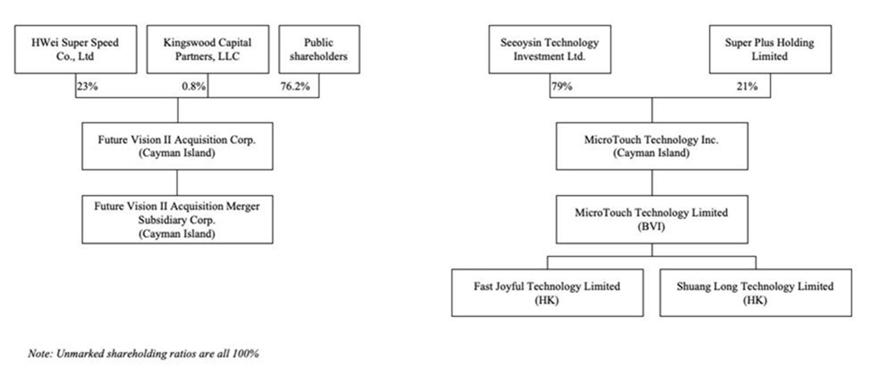
The organizational chart of the post-merger corporate structure:
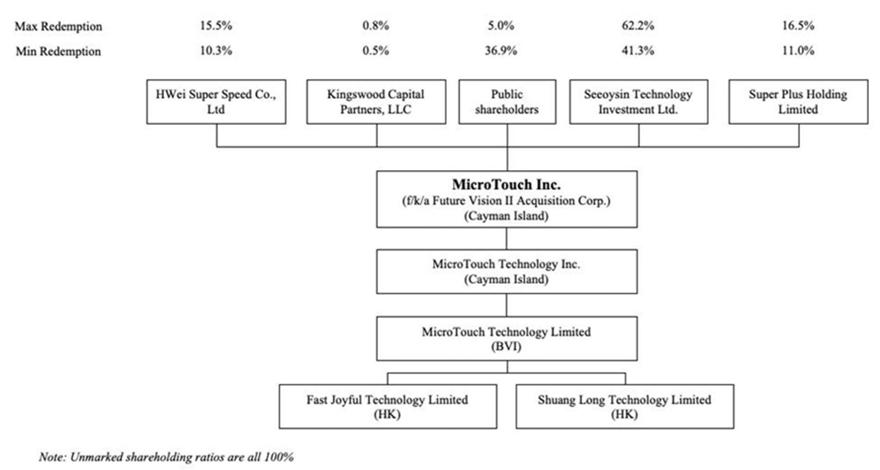
Merger Consideration to MicroTouch Security Holders
Upon the closing of the transactions contemplated in the Merger Agreement, in consideration for the cancelation of all of the issued and outstanding share capital of MicroTouch, Future Vision will issue to MicroTouch shareholders an aggregate of 8,955,224 Future Vision ordinary shares.
The Holding Foreign Companies Accountable Act
Pursuant to the HFCAA, if the SEC determines that we have filed audit reports issued by a registered public accounting firm that has not been subject to inspections by the PCAOB for two consecutive years, the SEC will prohibit our securities from being traded on a national securities exchange or in the over-the-counter trading market in the United States. On December 16, 2021, the PCAOB issued a report to notify the SEC of its determination that the PCAOB was unable to inspect or investigate completely registered public accounting firms headquartered in Mainland China and Hong Kong. On December 15, 2022, the PCAOB issued a report that vacated its December 16, 2021 determination and removed Mainland China and Hong Kong from the list of jurisdictions where it is unable to inspect or investigate completely registered public accounting firms.
MicroTouch’s auditor is, and New MT’s auditor will be, headquartered in Baltimore, Maryland, and Future Vision’s auditor is headquartered in Denver, Colorado. As such, both auditors are subject to PCAOB inspections to assess its compliance with the applicable professional standards. The PCAOB currently has access to inspect the working papers of our auditors, and such auditors were not subject to the determinations announced by the PCAOB on December 16, 2021, because they are headquartered in the United States. Each year, the PCAOB will determine whether it can inspect and investigate completely audit firms in Mainland China and Hong Kong, among other jurisdictions. If the PCAOB determines in the future that it no longer has full access to inspect and investigate completely accounting firms in Mainland China and Hong Kong and New MT uses an accounting firm headquartered in one of these jurisdictions to issue an audit report on its financial statements filed with the SEC, New MT would be identified as a Commission-Identified Issuer following the filing of the annual report for the relevant fiscal year. In accordance with the HFCAA, New MT’s securities would be prohibited from being traded on a national securities exchange or in the over-the-counter trading market in the United States if it is identified as a Commission-Identified Issuer for two consecutive years in the future. If New MT’s securities are prohibited from trading in the United States, there is no certainty that it will be able to list on a non-U.S. exchange or that a market for its securities will develop outside of the United States. In the event of such prohibition, the Nasdaq may determine to delist our securities. The delisting of New MT’s securities, or the threat of their being delisted, may materially and adversely affect the value of your investment and could cause the value of such securities to significantly decline or be worthless.
Cash and Asset Flows through MicroTouch’s Organization
MicroTouch is permitted under the laws of the Cayman Islands to provide funding to its subsidiaries in Hong Kong through loans or capital contributions without restrictions on the amount of the funds. There are no restrictions or limitation on MicroTouch’s ability to distribute earnings from its businesses, including subsidiaries, to the U.S. investors. The Company’s equity structure is a direct holding structure, that is, the overseas entity to be listed in the U.S., MicroTouch, directly controls MicroTouch Technology Limited(“MT BVI”), a holding company incorporated in the British Virgin Islands (“BVI”), which holds 100% of shares of Fast Joyful Technology Limited and Shuang Long Technology Limited, its Hong Kong operating entities (“MT HK Subs”),. Cash is transferred through The Company’s organization in the following manner: (i) funds may be transferred from MicroTouch, the holding company incorporated in the Cayman Islands to MT HK Subs through MT BVI in the form of capital contributions or shareholder loans, as the case may be; and (ii) dividends or other distributions may be paid by MT HK Subs to MicroTouch through MT BVI. MT HK Subs is permitted under the laws of Hong Kong to provide funding to MicroTouch through dividend distribution out of distributable profits without restrictions on the amount of the funds or restrictions on foreign exchange. If MicroTouch intends to distribute dividends to its shareholders, it will depend on payment of dividends from MT HK Subs to MT BVI in accordance with the laws and regulations of Hong Kong, and MT BVI will transfer the dividends to MicroTouch, and the dividends will be distributed by the MicroTouch to all shareholders respectively in proportion to the shares they hold, regardless of whether the shareholders are U.S. investors or investors in other countries or regions. If MT HK Subs incurs debt on its own in the future, the instruments governing such debt may restrict MT HK Subs’ ability to pay dividends, make distribution or transfer funds to MicroTouch. However, MT HK Subs has not declared any dividend to MicroTouch through MT BVI, and MicroTouch has not declared any dividend to its shareholders, after the reorganization and up to the date of this prospectus. As of the date of this prospectus, MicroTouch does not have any U.S. investors, so no dividends or distributions have been made to any U.S. investors. Both MicroTouch and MT HK Subs currently intend to retain all available funds and future earnings, if any, for the operation and expansion of our business and do not anticipate declaring or paying any dividends in the foreseeable future. Any future determination related to our dividend policy will be made at the discretion of our board of directors after considering our financial condition, results of operations, capital requirements, contractual requirements, business prospects and other factors the board of directors deems relevant, and subject to the restrictions contained in any future financing instruments.
Within its direct holding structure, the cross-border transfer of funds within its corporate group is legal and compliant with the laws and regulations of the Cayman Islands, the BVI and Hong Kong. In the future, cash proceeds from overseas financing activities, including this offering, can be directly transferred to MT BVI, and then transferred to the subordinate operating entity, MT HK Subs, via capital contribution or shareholder loans, as the case may be.
In the reporting periods presented in this prospectus, no cash and other asset transfers have occurred between MicroTouch and its subsidiaries.
Currently, substantially all of MicroTouch’s operations are in Hong Kong. It does not have or intend to set up any subsidiary or enter into any contractual arrangements to establish a VIE structure with any entity in Mainland China. However, all legal and operational risks associated with being based in or having the majority of operations in the PRC also apply to operations in Hong Kong. Since Hong Kong is a special administrative region of the PRC, the PRC government has significant oversight and discretion over the conduct of our business. Althoughthe basic policies of the PRC regarding Hong Kong are reflected in the Basic Law, providing Hong Kong with a high degree of autonomy and executive, legislative and independent judicial powers, including that of final adjudication under the principle of “one country, two systems”, there is no guarantee that this autonomy will continue. If the PRC government were to intervene in or influence our operations, or if the laws and regulations of mainland China were applied to Hong Kong, it could have a material impact on the transfer of cash from MicroTouch to MT HK Subs or from MT HK Subs to MicroTouch and the investors in the U.S., which could result in a material change in our operations and/or the value of New MT;s securities.
Subject to the Cayman Islands Companies Act and its amended and restated memorandum and articles of association, its board of directors may authorize and declare a dividend to shareholders out of profits or share premium at such time and of such an amount as they think fit if they are satisfied that immediately following the dividend the value of its assets will exceed its liabilities and it will be able to pay its debts as they become due. There is no further Cayman Islands statutory restriction on the amount of funds which may be distributed by it by dividend.
MicroTouch has not declared any dividend to its shareholders after the reorganization and up to the date of this prospectus. If it determines to pay dividends on any of its Ordinary Shares in the future, as a holding company, it will be dependent on the receipt of funds from its Hong Kong subsidiaries. Under the current practice of the Inland Revenue Department of Hong Kong, no tax is payable in Hong Kong in respect of dividends paid by it.
There are no restrictions or limitations under the laws of Hong Kong imposed on the conversion of HKD into foreign currencies and the remittance of currencies out of Hong Kong.
See “Dividend Policy” and “Risk Factors – Risks Related to the Corporate Structure – The Company may rely on dividends and other distributions on equity paid by its subsidiaries to fund any cash and financing requirements it may have, and any limitation on the ability of its subsidiaries to make payments to it could have a material adverse effect on its ability to conduct its business.”
PRC and Regulatory Permissions
CAC Approval
MicroTouch’s management has assessed the criteria to determine whether approval is needed from the Cybersecurity Administration of China (“CAC”) or other PRC authorities for this Business Combination. The currently effective China Cybersecurity Review Measures, released by relevant PRC governmental authorities in December 2021, requires platforms that contain data of 1 million or more users to undergo a cybersecurity review if they plan to list overseas. MicroTouch and MT HK Subs do not collect or store consumer data. They also do not have more than 1 million users and, as such, are not required to undergo any review or obtain any form of permission. Furthermore, we believe that as the Hong Kong subsidiary has not been involved in the collection of user data, does not implicate cybersecurity, or engage in any other type of restricted industry, in Mainland China, it is not currently required to seek permission from or meet filing requirements with the CAC.
Recent statements by the Chinese government have indicated an intent to exert more oversight and control over overseas offerings and/or foreign investments in China-based issuers. These recent statements and regulatory actions by China’s government, such as those related to the use of variable interest entities, data security, and anti-monopoly concerns, may impact the company’s ability to conduct its business, accept foreign investments, or list on a U.S. or other foreign exchange. Any future action by the Chinese government expanding the categories of industries and companies whose foreign securities offerings are subject to government review could significantly limit or completely hinder MicroTouch’s ability to offer or continue to offer securities to investors and could cause the value of such securities to decline significantly or become worthless. The PRC government has initiated a series of regulatory actions and made a number of public statements on the regulation of business operations in China, including cracking down on illegal activities in the securities market, enhancing supervision over China-based companies listed overseas using a variable interest entity structure, adopting new measures to extend the scope of cybersecurity reviews, and expanding efforts in anti-monopoly enforcement. As of the date of this prospectus, management has assessed and believes MicroTouch and MT HK Subs are not directly subject to these regulatory actions or statements, as they have not implemented any monopolistic behavior, do not have a variable interest entity structure, and their business does not involve the collection of user data, implicate cybersecurity, or engage in any other type of restricted industry, in Mainland China. However, any future actions by the PRC government regarding these matters could result in a material change in our operations and/or the value of New MT’s securities.
Since these statements and regulatory actions are new, the interpretation and enforcement of the aforementioned cybersecurity and overseas listing laws and regulations are also highly uncertain. Additionally, given the recency of the issuance of the aforementioned PRC laws and regulations related to cybersecurity and data privacy, MicroTouch and MT HK Subs still face uncertainties regarding the interpretation and implementation of these laws and regulations, and MicroTouch cannot rule out the possibility that any PRC governmental authorities may subject it and/or its subsidiary to such laws and regulations in the future. If such laws and regulations are deemed applicable to MicroTouch and/or its subsidiary, MicroTouch cannot assure investors that it and its subsidiary will be compliant with such new regulations in all respects, and it and/or its subsidiary may be ordered by PRC governmental authorities to rectify and terminate any actions deemed illegal and be subject to fines and other government sanctions, which may materially and adversely affect its subsidiary’s business and MicroTouch’s financial condition and results of operations and could cause the value of such securities to significantly decline or be worthless.
CSRC Filing
On February 17, 2023, the CSRC promulgated the Trial Administrative Measures for Overseas Securities Offering and Listing by Domestic Companies (the “Overseas Listing Trial Measures”) and circulated five supporting guidelines, which became effective on March 31, 2023. The Overseas Listing Trial Measures regulate both direct and indirect overseas offerings and listings of PRC domestic companies’ securities by adopting a filing-based regulatory regime.
In light of China’s extension of its authority to Hong Kong, MicroTouch may be subject to risks arising from the legal systems of Hong Kong and China in connection with MT HK Subs’s operations. After MicroTouch’s management reviewed PRC laws and regulations regarding filing requirements, as of the date of this prospectus, MicroTouch does not believe it is required to obtain approval from or complete filing with the CSRC for this offering pursuant to the Overseas Listing Trial Measures. Additionally, based on current PRC laws and regulations, as of the date of this prospectus, neither MicroTouch nor its operating subsidiary MT HK Subs is required to obtain any permissions or approvals from Hong Kong authorities for the continued listing of its ordinary shares in the U.S. or the issuance of its ordinary shares to foreign investors. Thus, MicroTouch has not submitted an application for approval for this offering to the CSRC. This belief is based on the following facts: (i) its principal business activities, conducted via MT HK Subs, are carried out in Hong Kong, not Mainland China; (ii) its principal assets are in Hong Kong, not Mainland China. As of the date of this prospectus, MT HK Subs has obtained all requisite permissions and approvals from Hong Kong authorities to operate its business in Hong Kong, including but not limited to its business registration certificate. However, as the Overseas Listing Trial Measures were newly published, there are substantial uncertainties regarding its implementation and interpretation, and the CSRC may hold a view contrary to MicroTouch’s understanding of the Overseas Listing Trial Measures under the “substance over form” principle adopted therein for determining an “indirect overseas offering and listing by PRC domestic companies”—a matter over which the CSRC may have substantial discretion. Furthermore, on February 24, 2023, the CSRC revised the Provisions on Strengthening the Management of Confidentiality and Archives Related to the Overseas Issuance of Securities and Overseas Listing by Domestic Companies (issued in 2009, or the “Archives Rules”). The revised Archives Rules came into effect on March 31, 2023, together with the Overseas Listing Trial Measures. Consistent with the Overseas Listing Trial Measures, the revised Archives Rules expand their application to cover indirect overseas offerings and listings by stipulating that a domestic company planning to publicly disclose or provide to relevant individuals or entities (including securities companies, securities service providers, and overseas regulators) any documents and materials containing state secrets or government agencies’ working secrets shall first obtain approval from competent authorities in accordance with the law and file with the secrecy administrative department at the same level.
Neither MicroTouch nor MT HK Subs qualifies as a “domestic company” for the purposes of the Overseas Listing Trial Measures and the Draft Rules Regarding Overseas Listing. Neither the CSRC nor any other PRC regulatory agency has contacted MicroTouch in connection with MicroTouch’s or its subsidiary’s operations or the proposed Business Combination. MicroTouch is currently not required to obtain regulatory approval from the CSRC or any other PRC authorities for its or its subsidiary’s operations in Hong Kong or the proposed Business Combination. We believe that further PRC laws or regulations related to CSRC filings are not enforceable in Hong Kong.
As of the date of this prospectus, neither MicroTouch nor its operating subsidiary has received any inquiries, notices, warnings, or sanctions from the China Securities Regulatory Commission or any other PRC governmental authorities regarding its planned overseas listing. Since these statements and regulatory actions are new, the interpretation and enforcement of overseas listing laws and regulations are also highly uncertain. There is no assurance that the relevant PRC governmental authorities will reach the same conclusion as MicroTouch. If MicroTouch and/or its subsidiary are required to obtain approval or complete filings with any governmental authorities (such as the CSRC) in connection with the listing or continued listing of its securities on a stock exchange outside Hong Kong or Mainland China, it is uncertain how long it will take for MicroTouch and/or its subsidiary to obtain such approval or complete such filing. Even if MicroTouch and its subsidiary obtain such approval or complete such filing, the approval or filing could be rescinded. Any failure to obtain or delay in obtaining the necessary permissions from or completing the necessary filing procedures with PRC governmental authorities for conducting offerings or listing outside Hong Kong or Mainland China may subject MicroTouch and/or its subsidiary to sanctions imposed by PRC governmental authorities, which could include fines and penalties, suspension of business, proceedings against MicroTouch and/or its subsidiary, and even fines on the controlling shareholder and other responsible persons. Such sanctions may restrict the subsidiary’s ability to conduct its business, MicroTouch’s ability to make foreign investments in Mainland China or accept foreign investments, or its ability to list on a U.S. or other overseas exchange, and may materially and adversely affect the subsidiary’s business, as well as MicroTouch’s reputation, financial condition, and results of operations. Such actions could significantly limit or completely hinder our ability to offer or continue to offer securities to investors and cause the value of such securities to significantly decline or be worthless.
Recent statements by the Chinese government have indicated an intent to exert more oversight and control over overseas offerings and/or foreign investments in China-based issuers. Any future action by the Chinese government expanding the categories of industries and companies whose foreign securities offerings are subject to government review could significantly limit or completely hinder MicroTouch’s ability to offer or continue to offer securities to investors and could cause the value of such securities to decline significantly or become worthless. Recently, the PRC government has initiated a series of regulatory actions and made a number of public statements on the regulation of business operations in China, including cracking down on illegal activities in the securities market, enhancing supervision over China-based companies listed overseas using a variable interest entity structure, adopting new measures to extend the scope of cybersecurity reviews, and expanding efforts in anti-monopoly enforcement. As of the date of this prospectus, MicroTouch and its operating subsidiary are not directly subject to these regulatory actions or statements, as MicroTouch has not implemented any monopolistic behavior, does not have a variable interest entity structure, and its business does not involve the collection of user data, implicate cybersecurity, or engage in any other type of restricted industry, in Mainland China. Please see “Risks Related to MicroTouch.”
Regulatory Licenses for MicroTouch’s Operations in Hong Kong
MicroTouch operates in Hong Kong solely through its wholly-owned subsidiaries. MicroTouch is duly incorporated in the Cayman Islands and maintains its annual business registration, which is the only permission required from the Cayman Islands to operate. There is no approval process in the Cayman Islands that MicroTouch needs to comply with to offer its securities.
MT HK Subs is duly incorporated in Hong Kong and maintains its annual business registration, which is the only permission required from Hong Kong to operate. There is no approval process in Hong Kong that MicroTouch needs to comply with to offer its securities.
MT HK Subs does not conduct any operations in Mainland China. However, its operations may still be affected by decisions made by the PRC government. Because MT HK Subs is located in Hong Kong, all legal and operational risks associated with having operations in the PRC also apply to our operations in Hong Kong. China exercises sovereignty over Hong Kong and therefore can exert substantial influence on Hong Kong matters that may impact the operating subsidiary’s operations. Chinese regulatory authorities could disallow the current holding company structure, and any change in the interpretation of existing rules and regulations or the promulgation of new rules and regulations could result in a material change in our operations and/or the value of New MT’s securities, and could significantly limit or completely hinder our ability to offer or continue to offer securities to investors and cause the value of such securities to significantly decline or be worthless.
Management and Board of Directors Following the Business Combination
After the consummation of the Business Combination, the Board of Directors of New MT will consist of five members, one of whom will be designated by Future Vision and four of which will be designated by MicroTouch. The members designated by MicroTouch will include Aijiao Tian, Jinyan Han, Kai Lun Wong and Maria Borg, the member designated by Future Vision will be Shuding Zeng, who presently is on the board of directors of Future Vision. Aijiao Tian will be the Chief Executive Officer of New MT after the consummation of the Business Combination. See “Directors, Executive Officers, Executive Compensation and Corporate Governance”
Emerging Growth Company Status
Future Vision is, and New MT will be, an “emerging growth company.” As an “emerging growth company” under the JOBS Act, can benefit from reduced reporting requirements, such as submitting only two years of audited financial statements and being exempt from auditor attestation for internal control over financial reporting. These benefits can last up to five years or until MicroTouch exceeds certain thresholds in annual revenue, market value, or debt issuance. See “Implications of Being an Emerging Growth Company” and “Risk Factors - We are an “emerging growth company,” and we cannot be certain that the reduced disclosure requirements applicable to “emerging growth companies” will not make our securities less attractive to investors” for details.
Controlled Company
Following consummation of the Business Combination, Seeoysin Technology Investment Ltd. and Super Plus Holding Limited will collectively own more than 50% of the combined voting power of New MT. Specifically, assuming no redemptions by Future Vision’s public shareholders, Seeoysin Technology Investment Ltd. and Super Plus Holding Limited will hold approximately 41.3% and 11.0% of the voting power, respectively (representing a combined 52.3% of the voting power). Assuming maximum redemptions, they will hold approximately 62.2% and 16.5% of the voting power, respectively (representing a combined 78.7% of the voting power).
Because these entities will own more than 50% of the voting power in New MT, New MT will qualify as a “controlled company” under Nasdaq rules. This would allow New MT to opt out of certain corporate governance requirements, such as having a majority-independent board of directors and independent compensation and nominating committees. The ability for New MT to opt-out of these Nasdaq corporate governance rules designed to protect shareholders may make investing in New MT less desirable for certain investors, thus adversely affecting New MT’s market price.
See “Risk Factors — If New MT meets the definition of a “controlled company” under the rules of the Nasdaq Listing Rule, it may choose to exempt from certain corporate governance requirements that could have an adverse effect on the public shareholders.”
Foreign Private Issuer
As of the date of this proxy statement/prospectus, Future Vision is a domestic issuer. However, New MT believes that it will qualify as a foreign private issuer under the Exchange Act at the first measurement period following the consummation of the Business Combination. As a result, New MT anticipates that it will be permitted to follow the corporate governance practices of its home country, the Cayman Islands, in lieu of the corporate governance standards of Nasdaq applicable to U.S. domestic companies. For example, it will not be required to have a majority of the board consisting of independent directors nor have a compensation committee or a nominating and corporate governance committee consisting entirely of independent directors. As a result, New MT’s shareholders may not have the same protection afforded to shareholders of U.S. domestic companies that are subject to Nasdaq corporate governance requirements. Foreign private issuers are also subject to reduced disclosure requirements and are exempt from certain provisions of the U.S. securities rules and regulations applicable to U.S. domestic issuers such as the rules regulating solicitation of proxies and certain insider reporting and short-swing profit rules. See “Risk Factors — As a foreign private issuer, we are not subject to certain U.S. securities law disclosure requirements that apply to a domestic U.S. issuer, which may limit the information publicly available to our shareholders.”
Other Agreements Relating to the Business Combination
Extension of Future Vision Duration
Pursuant to the Amended and Restated Memorandum and Articles of Association, Future Vision’s board of directors has the ability to further extend the period of time to consummate a Business Combination up to six times after March 13, 2026, each by an additional one month to complete our initial Business Combination. In order to extend the time available for Future Vision to consummate a Business Combination, the Sponsor or other insiders or their respective affiliates or designees must deposit into the Trust Account an amount of $191,475 ($0.0333 per Future Vision public share) on or prior to the date of the applicable deadline, for each one-month extension.
On March 9, 2026 and April
8, 2026, Future Vision issued an unsecured promissory note (the “Note”)
in the principal amount of $382,950, ($191,475 per month) to HWei Super Speed Co. Ltd., the Company’s
sponsor. The Note was issued in connection with the Sponsor’s advance of funds to the
Company to be deposited into the Company’s trust account to effectuate an extension
of the date by which the Company must consummate its initial business combination. Pursuant to the Company’s
Amended and Restated Memorandum and Articles of Association, the Board of Directors approved the Extension upon the Sponsor’s
request, extending the Business Combination Deadline from March 13, 2026 to May 13, 2026.
Voting and Transaction Support Agreement
To facilitate the execution of the Merger Agreement, MicroTouch shareholders have entered into a Voting and Transaction Support Agreement with Future Vision and MicroTouch contemporaneously with the execution of the Merger Agreement. Under this agreement, each MicroTouch shareholder will execute written resolutions to approve the Business Combination within three days of receiving the written resolutions from MicroTouch. MicroTouch anticipates delivering these written resolutions to its shareholders following the SEC’s declaration of the effectiveness of the Proxy/Registration Statement.
Non-Compete Agreement
The MicroTouch shareholders will enter into a non-compete and non-solicitation agreement with New MT at the Closing of the Business Combination.
MicroTouch Shareholders Lock-Up Agreement
MicroTouch Shareholders will enter into a lock up agreement with respect to the Consideration Shares to be received by the MicroTouch Shareholders after the consummation of the Business Combination.
The lock up is subject to customary exceptions and carve-outs, such as transfers to the shareholders of Company Shareholders, by gift to immediate family members or by court order, or by virtue of the laws of descent, in each case if the transferee agrees to be bound by the terms of the lock up agreement. Please refer to “Shares Eligible for Future Sale – Lock-Up Agreement” for a detailed description.
Redemption Rights
Pursuant to Future Vision’s Amended and Restated Memorandum and Articles of Association, regardless of how you vote, or whether you vote at all, on the Business Combination Proposal, holders of Future Vision ordinary share may elect to have their shares redeemed for cash at the applicable redemption price per share equal to the quotient obtained by dividing the aggregate amount on deposit in the trust account as of two (2) business days prior to the consummation of the Business Combination, including interest (net of taxes payable), by the total number of then outstanding public shares, subject to the limitations described herein. It is anticipated that this would have amounted to approximately $[●] per share.
You will be entitled to receive cash for any public shares to be redeemed only if you:
| |
● |
(a) hold public Future Vision ordinary shares, or (b) hold Future Vision public ordinary shares through Future Vision public units and you elect to separate your Public Units into the underlying public Ordinary Share and Public rights prior to exercising your redemption rights with respect to the public Ordinary Share; and |
| |
|
|
| |
● |
prior to 5:00 p.m., Eastern Time, on [●], 2026, (a) submit a written request to the Transfer Agent, that Future Vision redeem your public shares for cash and (b) deliver your public shares to the Transfer Agent, physically (by delivery of a duly executed instrument of transfer in favor of the Company, accompanied by the relevant share certificate for such Future Vision Shares) or electronically through the DTC DWAC (Deposit/Withdrawal at Custodian) System. |
To vote your public shares on the Business Combination Proposal at the extraordinary general meeting, a shareholder must be a shareholder as of [●], 2026, the Record Date for the extraordinary general meeting. Accordingly, if you purchase public shares after the Record Date you will not be able to redeem your shares upon consummation of the Business Combination unless you have either (i) have a written agreement from the seller/transferor of the public shares whereby the seller/transferor agrees to vote the shares in accordance with your instructions, or (ii) obtain a proxy from the seller/transferor which authorizes you to vote the public shares held in record name of the seller/transferor and must actually vote such public shares on the Business Combination Proposal.
If a holder exercises its redemption rights, then such holder will be exchanging its public Future Vision Ordinary Share for cash and will no longer own shares of Future Vision follow the Closing of the Business Combination. Such a holder will be entitled to receive cash for its public Future Vision Ordinary Share only if it properly demands redemption and delivers its shares (either physically (by delivery of a duly executed instrument of transfer in favor of the Company, accompanied by the relevant share certificate for such Future Vision Shares) or electronically) to our Transfer Agent in accordance with the procedures described herein. Please see the section titled “The Extraordinary General Meeting of Future Vision shareholders — Redemption Rights” for the procedures to be followed if you wish to redeem your public Ordinary Share for cash.
The potential dilutive impact of redemptions to public shareholders that do not redeem their shares, Please see the section titled “The Extraordinary General Meeting of Future Vision shareholders — Potential Dilution to Non-Redeeming Future Vision Public Shareholders”
The following table illustrates the estimated ownership of New MT ordinary shares immediately following the Business Combination under five different redemption scenarios, ranging from no redemptions to 100% redemptions. This table assumes a share price of $10.00 and gives effect to the issuance of 86,250 New MT ordinary shares to the IPO Underwriters in satisfaction of deferred underwriting commissions.
| |
|
0%
Redemption(1) |
|
|
25%
Redemption(2) |
|
|
50%
Redemption(3) |
|
|
75%
Redemption(4) |
|
|
100%
Redemption(5) |
|
| |
|
Shares % |
|
|
Shares % |
|
|
Shares % |
|
|
Shares % |
|
|
Shares % |
|
| Future Vision II Public Shareholders |
|
|
5,750,000 |
|
|
|
4,312,500 |
|
|
|
2,875,000 |
|
|
|
1,437,500 |
|
|
|
0 |
|
| |
|
|
33.6 |
% |
|
|
27.5 |
% |
|
|
20.2 |
% |
|
|
11.2 |
% |
|
|
0.0 |
% |
| Insiders/Sponsor |
|
|
1,766,400 |
|
|
|
1,766,400 |
|
|
|
1,766,400 |
|
|
|
1,766,400 |
|
|
|
1,766,400 |
|
| |
|
|
10.3 |
% |
|
|
11.3 |
% |
|
|
12.4 |
% |
|
|
13.8 |
% |
|
|
15.5 |
% |
| Underwriter |
|
|
86,250 |
|
|
|
86,250 |
|
|
|
86,250 |
|
|
|
86,250 |
|
|
|
86,250 |
|
| |
|
|
0.5 |
% |
|
|
0.5 |
% |
|
|
0.6 |
% |
|
|
0.7 |
% |
|
|
0.8 |
% |
| MicroTouch Shareholders |
|
|
8,955,224 |
|
|
|
8,955,224 |
|
|
|
8,955,224 |
|
|
|
8,955,224 |
|
|
|
8,955,224 |
|
| |
|
|
52.3 |
% |
|
|
57.1 |
% |
|
|
62.8 |
% |
|
|
69.8 |
% |
|
|
78.7 |
% |
| Public Shareholders’ Rights as Converted(6) |
|
|
575,000 |
|
|
|
575,000 |
|
|
|
575,000 |
|
|
|
575,000 |
|
|
|
575,000 |
|
| |
|
|
3.3 |
% |
|
|
3.6 |
% |
|
|
4.0 |
% |
|
|
4.5 |
% |
|
|
5.0 |
% |
| Total |
|
|
17,132,874 |
|
|
|
15,695,374 |
|
|
|
14,257,874 |
|
|
|
12,820,374 |
|
|
|
11,382,874 |
|
| |
|
|
100.0 |
% |
|
|
100.0 |
% |
|
|
100.0 |
% |
|
|
100.0 |
% |
|
|
100.0 |
% |
|
(1) |
Assumes that no Future Vision public shares are redeemed. |
|
(2) |
Assumes that 1,437,500 Future Vision public shares (25% of the outstanding public shares) are redeemed. |
|
(3) |
Assumes that 2,875,000 Future Vision public shares (50% of the outstanding public shares) are redeemed. |
|
(4) |
Assumes that 4,312,250 Future Vision public shares (75% of the outstanding public shares) are redeemed. |
|
(5) |
Assumes that 5,750,000 Future Vision public shares (100% of the outstanding public shares) are redeemed. |
|
(6) |
Represents the 575,000 New MT ordinary shares to be issued upon the automatic conversion of the Public Rights held by public shareholders upon the consummation of the Business Combination. These shares are issued regardless of whether the underlying public shares are redeemed. |
Extension of Time
Pursuant to Future Vision’s existing Amended and Restated Memorandum and Articles of Association, the Board of Directors has the option to extend the period of time to consummate a business combination up to six (6) times, each by an additional one month (for a total of up to 6 months). In order to exercise each one-month extension, the Sponsor must deposit $191,475 (approximately $0.0333 per public share) into the Trust Account. Because these extensions are already authorized by our governing documents, they do not require a shareholder vote. Consequently, shareholders do not have the right to redeem their shares in connection with the exercise of these funded extensions.
Shareholder Vote Extensions: If Future Vision requires additional time beyond the funded extensions described above, it would be necessary to hold an Extraordinary General Meeting (EGM) to seek shareholder approval to amend the Articles of Association to further extend the liquidation deadline. In accordance with Nasdaq Listing Rules and our Articles of Association, in connection with any such shareholder vote to approve an extension, public shareholders would be provided with the opportunity to redeem their Future Vision ordinary shares for a pro rata portion of the funds in the Trust Account, regardless of whether they vote for or against the extension proposal.
Impact of the Business Combination on the Public Float and Shares outstanding of Future Vision
As merger consideration, Future Vision will issue the MicroTouch shareholders approximately 8,955,224 Future Vision ordinary shares.
The following assumes there are no redemptions of our public shares, and the issuance of Future Vision ordinary shares upon the conversion of the Future Vision public rights and private rights, and the issuance of 287,500 representative shares as deferred underwriting commission.
New MT will have an aggregate of approximately 17,132,874 shares issued and outstanding upon completion of the Business Combination:
| |
● |
Future Vision public shareholders will own 5,750,000, approximately 33.6%, of the outstanding Future Vision ordinary shares; |
| |
|
|
| |
● |
Sponsor will own, including the conversion of all private rights, will own 1,766,400, approximately 10.3% of the outstanding Future Vision ordinary shares; |
| |
|
|
| |
● |
Holders of Future Vision public rights will own 575,000, approximately 3.3% of our ordinary shares; |
| |
|
|
| |
● |
the former MicroTouch shareholders will own 8,955,224, approximately 52.3% of the outstanding Future Vision ordinary shares; |
The following assumes full redemption by holders of all of Future Vision’s public ordinary shares and the issuance of Future Vision ordinary shares upon the conversion of the Future Vision public rights and private rights, and the issuance of 287,500 representative shares as deferred underwriting commission.
New MT will have approximately 11,382,874 shares issued and outstanding at closing of the Business Combination:
| |
● |
Sponsor will own, including the conversion of all private rights, will own 1,766,400, approximately 15.5% of the outstanding Future Vision ordinary shares; |
| |
|
|
| |
● |
Holders of Future Vision public rights will own 575,000, approximately 5.0% of our ordinary shares; |
| |
|
|
| |
● |
the former MicroTouch shareholders will own 8,955,224, approximately 78.7% of the outstanding Future Vision ordinary shares; |
Assuming no redemptions of the Future Vision Public Shares, the combined company would have a pro forma valuation of approximately $172 million based upon a price of $10.05 per Future Vision Share and the securities issued to the MicroTouch security holders would have a value of approximately $90 million at an assumed price of $10.05 per share.
Assuming maximum redemptions of the Future Vision Public Shares, the combined company would have a pro forma valuation of approximately $114 million based upon a price of $10.05 per Future Vision Share and the securities issued to the MicroTouch security holders would have a value of approximately $90 million at an assumed price of $10.05 per share.
If the actual facts are different than these assumptions, the percentage ownership and percentage of voting power retained by our public shareholders following the Business Combination will be different.
For more information, please see the sections entitled “Unaudited Pro Forma Condensed Combined Financial Information,” and “Directors, Executive Officers, Executive Compensation and Corporate Governance” — “Directors After Completion of the Business Combination”.
The Proposals
At the extraordinary general meeting, shareholders of the Company will be asked to consider and, if thought fit, approve the following items of business:
| |
1. |
To approve, as an ordinary resolution, the Merger Agreement, a copy of which is attached herein as Annex A, and the transactions contemplated therein. This proposal is referred to as the “Business Combination Proposal” or “Proposal No. 1.” |
| |
|
|
| |
2. |
To approve, as a special resolution, (i) the change of name by Future Vision from “Future Vision II Acquisition Corp.” to “MicroTouch Inc.” or other name as the Board of Directors of Future Vision II may determine and agree with MicroTouch upon the consummation of the Business Combination, subject to and conditional upon the necessary approval of the Registrar of Companies of the Cayman Islands and (ii) the registered office provider and directors of the Company be authorized to undertake all such matters and actions, as may be required to give effect to this resolution. This proposal is referred to as the “Name Change Proposal” or “Proposal No. 2.” |
| |
|
|
| |
3. |
To approve, as an ordinary resolution, for the purposes of complying with the applicable provisions of Nasdaq Rule 5635, the issuance of Future Vision ordinary shares in connection with the Business Combination. This proposal is referred to as the “Nasdaq Proposal” or “Proposal No. 3.” |
| |
|
|
| |
4. |
To approve, as a special resolution, the adoption of the amended and restated memorandum and articles of association, substantially in the form attached herein as Annex B, in substitution for and to the exclusion of, the existing memorandum and articles of association of the Company, effective from the completion of the Business Combination to reflect the Name Change Proposal and removing or amending those provisions which terminate or otherwise cease to be applicable following the consummation of the Business Combination. This proposal is referred to as the “Charter Amendment Proposal” or “Proposal No. 4.” |
| |
|
|
| |
5. |
To approve, as an ordinary resolution, the election of each of Aijiao Tian, Jinyan Han, Kai Lun Wong, Shuding Zeng and Maria Borg to serve as directors on the board of directors of New MT upon the consummation of the Business Combination. This proposal is referred to as the “Director Election Proposal” or “Proposal No. 5.” |
| |
|
|
| |
6. |
To approve, as an ordinary resolution, the adjournment of the extraordinary general meeting, if necessary or advisable, in the event Future Vision does not receive the requisite shareholder vote to approve one or more proposals presented to shareholders for vote. This proposal is called the “Adjournment Proposal” or “Proposal No. 6.” |
Please see the sections entitled “The Business Combination Proposal,” “Name Change Proposal”, “Nasdaq Proposal”, “The Charter Amendment Proposal”, “The Director Election Proposal” and “The Adjournment Proposal”, for more information on Proposals 1 through 6.
Voting Securities, Record Date
As of the record date of [●], 2026 (“Record Date”) there were 7,544,000 Future Vision ordinary shares issued and outstanding. Only Record Date holders of Future Vision ordinary shares are entitled to vote at the extraordinary general meeting of shareholders.
The approval of the Business Combination Proposal, the Nasdaq Proposal, the Director Election Proposal and the Adjournment Proposal (Proposals 1, 3, 5, and 6) will each require an ordinary resolution, being a resolution passed by a simple majority of the votes by the shareholders of the Company as, being entitled to do so, vote in person or by proxy at the extraordinary general meeting, or any adjournment thereof. Broker non-votes will have no effect on the vote for these proposals.
The approval of the Name Change Proposal and Charter Amendment Proposal (Proposals 2 and 4) will each require a special resolution, being a resolution passed by a majority of at least two-thirds of the votes by the shareholders of the Company as, being entitled to do so, vote in person or by proxy at the extraordinary general meeting, or any adjournment thereof. Broker non-votes will have no effect on the vote for this proposal.
As of the Record Date, Future Vision’s Sponsor, officers and directors, owned, either directly or beneficially, and were entitled to vote 1,736,500 Future Vision ordinary shares, or approximately 23.0% of Future Vision’s issued and outstanding ordinary shares. With respect to the Business Combination, Future Vision’s Sponsor have agreed to vote their respective Future Vision Shares in favor of the Business Combination Proposal. They have also indicated that they intend to vote in favor of the other proposals.
Date, Time and Place of Extraordinary General Meeting
The extraordinary general meeting will be held physically on [●], 2026, at [●] a.m., Eastern time, at the offices of Future Vision II Acquisition Corp., Xiandai Tongxin Building, 201 Xin Jinqiao Road, Rm 302, Pudong New District, Shanghai, China. You may attend the extraordinary general meeting in person to vote your shares. We are not providing a virtual webcast for this meeting. If you cannot attend in person, we strongly encourage you to submit your proxy card by mail to ensure your vote is counted.
Anticipated Accounting Treatment
The Business Combination will be treated by Future Vision as a “reverse recapitalization” in accordance with accounting principles generally accepted in the United States of America (“GAAP”). For accounting purposes, MicroTouch is considered to be acquiring Future Vision in this transaction. Therefore, for accounting purposes, the Business Combination will be treated as the equivalent of a capital transaction in which MicroTouch is issuing shares for the net assets of Future Vision. The net assets of Future Vision will be stated at historical cost, with no goodwill or other intangible assets recorded. The post-acquisition financial statements of Future Vision will show the consolidated balances and transactions of Future Vision and MicroTouch as well as comparative financial information of MicroTouch (the acquirer for accounting purposes).
Regulatory Approvals
The Business Combination and the other transactions contemplated by the Merger Agreement are not subject to any federal or state regulatory requirements or approvals, including the Hart-Scott-Rodino Antitrust Improvements Act of 1976. Consummation of the Business Combination (and the issuance of the shares to the MicroTouch shareholders) will require a declaration of effectiveness by the SEC of the Proxy Statement/Prospectus, listing approval from the Nasdaq Stock Market Inc., and filing of a plan of merger between MicroTouch and the Merger Sub with the Cayman Registry.
Appraisal Rights
Holders of Future Vision Shares are not entitled to appraisal rights under Cayman Islands law in connection with any of the Proposals.
Shareholder Interests of Certain Persons in the Business Combination
When you consider the recommendation of Future Vision’s Board of Directors in favor of adoption of the Business Combination Proposal and other Proposals, you should keep in mind that Future Vision’s Sponsor, directors and officers have interests in the Business Combination that are different from, or in addition to, your interests as a shareholder. Some of these interests potentially incentivizes the Sponsor, directors and officers of Future Vision to complete a business combination with a less favorable target on terms less favorable to the public shareholders.
| |
● |
Future Vision has an 18-month deadline (March 13, 2026) to complete its proposed Business Combination or another business combination. If this is not achieved, Future Vision will be required to liquidate. In this scenario, the Sponsor’s 1,437,500 founder shares, acquired pre-IPO for $25,000 ($0.017 per share), will become worthless as the Sponsor is excluded from any liquidation distributions. |
| |
|
|
| |
● |
However, if the Business Combination is successful, these founder shares are estimated to be worth $18.5 million, based on a projected value of $10.05 per share. This presents a potentially significant upside for the Sponsor, even if public shareholders experience losses in their investment in New MT. This inherent conflict of interest warrants careful consideration by potential public investors. |
| |
|
|
| |
● |
Further, if the proposed Business Combination is not completed by March 13, 2026, and Future Vision does not extend such date, the 299,000 Future Vision private units purchased by our Sponsor, for a total purchase price of $2,990,000, will be worthless. This poses a potentially significant loss of capital for the Sponsor in the event the proposed Business Combination or another business combination is not completed by the date of Future Vision’s liquidation. |
| |
|
|
| |
● |
the Sponsor, and its officers and directors will lose their entire investment in Future Vision if the proposed Business Combination is not consummated within the deadline. Additionally, although, as of the date of this proxy statement/prospectus, there are no amounts outstanding under any loans payable to the Sponsor, officers and directors, and no fees due or out-of-pocket expenses to be repaid by Future Vision, if any are incurred after the date of this proxy statement/prospectus, they would not be repaid unless Future Vision consummates the Business Combination within the deadline; |
| |
|
|
| |
● |
The exercise of Future Vision’s directors’ and officers’ discretion in agreeing to changes or waivers in the terms of the transaction may result in a conflict of interest when determining whether such changes or waivers are appropriate and in Future Vision shareholders’ best interest. |
Recommendations of the Board of Directors to shareholders
After careful consideration of the terms and conditions of the Merger Agreement, the Board of Directors of Future Vision has determined that the Business Combination and the transactions contemplated thereby are fair to and in the best interests of Future Vision and its shareholders. In reaching its decision with respect to the Business Combination and the transactions contemplated thereby, the Future Vision Board of Directors reviewed various industry and financial data and the due diligence and evaluation materials provided by MicroTouch including forward looking summarized financial forecasts for the MicroTouch businesses for the years 2026 to 2030 including projected revenues and EBITDA. Future Vision’s Board of Directors recommends that Future Vision shareholders vote:
| |
● |
FOR Proposal No. 1, the Business Combination Proposal; |
| |
|
|
| |
● |
FOR Proposal No. 2, the Name Change Proposal; |
| |
|
|
| |
● |
FOR Proposal No. 3, the NASDAQ Proposal; |
| |
|
|
| |
● |
FOR Proposal No. 4, the Charter Amendment Proposal; |
| |
|
|
| |
● |
FOR Proposal No. 5, the Director Election Proposal; and |
| |
|
|
| |
● |
FOR Proposal No. 6, the Adjournment Proposal. |
See “Business Combination Proposal: Approval of the Business Combination — Future Vision’s Board’s Reasons for Approval of the Business Combination”
Risk Factors
In evaluating the Business Combination and the Proposals to be considered and voted on at the extraordinary general meeting, you should carefully review and consider the risk factors set forth under the section entitled “Risk Factors” beginning on page [46] of this proxy statement. The occurrence of one or more of the events or circumstances described in that section, alone or in combination with other events or circumstances, may have a material adverse effect on (i) the ability of Future Vision and MicroTouch to complete the Business Combination and (ii) the business, cash flows, financial condition and results of operations of the combined companies following consummation of the Business Combination. Such risks include, but are not limited to:
Risks Related to Our Corporate Structure
| |
● |
We may rely on dividends and other distributions on equity paid by our subsidiaries to fund any cash and financing requirements we may have, and any limitation on the ability of our subsidiaries to make payments to us could have a material adverse effect on our ability to conduct our business. |
Risks Related to our Business
| |
● |
If we are not successful in expanding our service offerings, we may not achieve our financial goals and our results of operations may be adversely affected. |
| |
|
|
| |
● |
MicroTouch’s competitive position and results of operations could be harmed if MicroTouch does not compete effectively. |
| |
● |
MicroTouch has a limited operating history, and it may not be able to sustain rapid growth, effectively manage growth or implement business strategies. |
| |
|
|
| |
● |
MicroTouch’s results of operations could materially suffer in the event of insufficient pricing to enable MicroTouch to meet profitability expectations. |
| |
● |
MicroTouch makes significant investments in research and development of new products and services that may not achieve expected returns. |
| |
● |
MicroTouch requires a significant amount of capital to fund its research and development investments. If MicroTouch cannot obtain sufficient capital on favorable terms or at all, its business, financial condition and prospects may be materially and adversely affected. |
| |
● |
MicroTouch’s success depends on its ability to attract, hire, retain and motivate key management personnel and highly skilled employees. |
| |
● |
MicroTouch’s business depends substantially on the market recognition of its brand and negative media coverage could adversely affect MicroTouch’s business. |
| |
● |
MicroTouch’s failure to protect intellectual property rights may undermine its competitive position. |
| |
● |
MicroTouch may be subject to intellectual property infringement claims, which may be expensive to defend and may disrupt its business and operations. |
| |
● |
Compromise of MicroTouch’s confidential or proprietary information could damage its reputation, harm its businesses and adversely impact its financial results. |
| |
● |
Third parties may register trademarks or domain names or purchase internet search engine keywords that are similar to MicroTouch’s trademarks, brand or websites, or misappropriate MicroTouch’s data and copy MicroTouch’s system, all of which could cause confusion to MicroTouch’s users, divert online customers away from MicroTouch’s products and services or harm its reputation. |
| |
● |
MicroTouch’s business is highly dependent on the proper functioning and improvement of its information technology systems and infrastructure. MicroTouch’s business and operating results may be harmed by service disruptions, or by MicroTouch’s failure to timely and effectively scale up and adjust MicroTouch’s existing technology and infrastructure. |
| |
● |
MicroTouch uses third-party services and technologies in connection with MicroTouch’s business, and any disruption to the provision of these services and technologies to MicroTouch could result in adverse publicity and a slowdown in the growth of MicroTouch’s users, which could materially and adversely affect MicroTouch’s business, financial condition and results of operations. |
| |
● |
MicroTouch’s insurance policies may not provide adequate coverage for all claims associated with its business operations. |
| |
● |
MicroTouch may be subject to claims, disputes or legal proceedings in the ordinary course of its business. If the outcome of these proceedings is unfavorable to MicroTouch, then MicroTouch’s business, results of operations and financial condition could be adversely affected. |
| |
● |
MicroTouch may need additional capital to support or expand its business, and MicroTouch may be unable to obtain such capital in a timely manner or on acceptable terms, if at all. |
| |
● |
MicroTouch’s business may be materially and adversely affected by the effects of natural disasters, health epidemics or similar situation, and may continue to cause negative impacts to the MicroTouch’s business, results of operations and financial condition. |
| |
● |
Compliance with Hong Kong’s Personal Data (Privacy) Ordinance and any such other existing or future data privacy related laws, regulations and governmental orders may entail significant expenses and could materially affect MicroTouch’s business. |
| |
● |
MicroTouch, its subsidiaries have a limited customer base and depend on a small number of customers for a significant portion of revenues which may result in heightened concentration risk. |
| |
● |
MicroTouch, its subsidiaries depend on a limited number of vendors for a significant portion of its purchase which may result in heightened concentration risk. |
| |
● |
PCAOB’s Determinations on Public Accounting Firms Headquartered in Mainland China and in Hong Kong |
| |
● |
If we fail to maintain an effective system of internal control over financial reporting after the completion of the Business Combination, we may be unable to accurately report our financial results or prevent fraud, and investor confidence in us and the market price of New MT ordinary shares may be adversely affected. |
Risks Related to New MT’s Status as a Foreign Private Issuer
| |
● |
New MT will convert to foreign private issuer status within the meaning of the rules under the Exchange Act upon the first available determination date, and, as such, New MT will be exempt from certain provisions applicable to United States domestic public companies. New MT may lose its status as a foreign private issuer in the future, causing it to incur substantial costs, time and resources. |
| |
● |
As an exempted company incorporated in the Cayman Islands, New MT will be permitted to adopt certain home country practices in relation to corporate governance matters that differ significantly from the Nasdaq listing standards; these practices may afford less protection to shareholders than they would enjoy if New MT complied fully with the Nasdaq listing standards. |
| |
● |
Upon completing our initial business combination, New MT plans to immediately transition to Foreign Private Issuer (FPI) status when eligible, and New MT currently does not intend to hold an annual shareholders’ meeting or annual director elections. This approach may have adverse effects on shareholders. |
Risks Related to the Business Combination and being a Public Company
| |
● |
Going public through a merger rather than an underwritten offering presents risks to unaffiliated investors. Subsequent to our completion of the business combination, we may be required to take write-downs or write-offs, restructuring and impairment or other charges that could negatively affect our financial condition, results of operations and share price, which could cause you to lose some or all of your investment. |
| |
● |
The combined company expects to incur significant costs as a result of operating as a public company. |
| |
● |
MicroTouch’s management will be required to devote substantial time to maintaining and improving its internal controls over financial reporting and the requirements of being a public company which may, among other things, strain its resources, divert management’s attention and affect its ability to accurately report its financial results and prevent fraud. |
| |
● |
MicroTouch will need to grow the size of its organization and may experience difficulties in managing this growth. |
| |
● |
New MT will be an “emerging growth company,” and New MT cannot be certain that the reduced disclosure requirements applicable to “emerging growth companies” will not make its securities less attractive to investors. |
| |
● |
As a “smaller reporting company” New MT is permitted to provide less disclosure than larger public companies which may make its securities less attractive to investors. |
| |
● |
Future Vision and MicroTouch have incurred and expect to incur significant costs associated with the Business Combination. Whether or not the Business Combination is completed, the incurrence of these costs will reduce the amount of cash available to be used for other corporate purposes by Future Vision. |
| |
● |
In the event that a significant number of Future Vision ordinary shares are redeemed, its share may become less liquid following the Business Combination. |
| |
● |
New MT will be required to meet the initial listing requirements to be listed on the Nasdaq Capital Market following the Business Combination. New MT may not be able to meet those initial listing requirements. Even if New MT’s securities are so listed, New MT may be unable to maintain the listing of its securities in the future. |
| |
● |
Future Vision may waive one or more of the conditions to the Business Combination without resoliciting Shareholder approval for the Business Combination. |
| |
● |
Future Vision’s Shareholders will experience immediate dilution as a consequence of the issuance of Future Vision Shares as consideration in the Business Combination. Having a minority share position may reduce the influence that Future Vision’s current Shareholders have on the management of Future Vision. |
Risks Related to Future Vision as a SPAC
| |
● |
Future Vision will be forced to liquidate the trust account if it cannot consummate a business combination by March 13, 2026, or fails to obtain the Board and/or shareholder approval required for an extension of such date to a later date. |
| |
● |
If you or a “group” of Shareholders are deemed to hold in excess of 15% of Future Vision’s Ordinary Share, you will lose the ability to redeem all such shares in excess of 15% of Future Vision’s Ordinary Share. |
| |
● |
If third parties bring claims against Future Vision, the proceeds held in trust could be reduced and the per-share liquidation price received by Future Vision’s Shareholders may be less than $10.05. |
| |
● |
Shareholders may be held liable for claims by third parties against us to the extent of distributions received by them upon redemption of their public shares. |
| |
● |
If Future Vision’s due diligence investigation of MicroTouch was inadequate, then Shareholders of Future Vision following the Business Combination could lose some or all of their investment. |
| |
● |
Because Future Vision’s Sponsor and its officers and directors own Future Vision Shares which will not participate in liquidation distributions and, therefore, they will lose their entire investment in us and face other financial consequences if the Business Combination is not completed, they may have a conflict of interest in determining whether the Business Combination is appropriate. |
| |
● |
Future Vision is requiring Shareholders who wish to redeem their Future Vision ordinary shares in connection with the Business Combination to comply with specific requirements for redemption that may make it more difficult for them to exercise their redemption rights prior to the deadline for exercising their rights. |
| |
|
|
| |
● |
Future Vision will require its Shareholders who wish to redeem their Ordinary Share in connection with the Business Combination to comply with specific requirements for redemption described above, and such redeeming Shareholders may be unable to sell their securities when they wish to in the event that the Business Combination is not consummated. |
| |
● |
Future Vision’s Sponsor, including its officers and directors, have agreed to vote their shares in favor of the Business Combination, regardless of how the Public Shareholders vote. |
| |
|
|
| |
● |
If Future Vision’s security holders exercise their registration rights with respect to their securities, it may have an adverse effect on the market price of Future Vision’s securities. |
| |
● |
Future Vision will be unable to close the Business Combination if the redemptions of public shares result in its Net Tangible Assets being less than $5,000,001 unless it is able to obtain sufficient equity financing. |
| |
● |
We may not be able to complete the Business Combination if it is subject to U.S. foreign investment regulations and review by a U.S. government entity such as the Committee on Foreign Investment in the United States (“CFIUS”), or ultimately prohibited. |
| |
● |
If the assets in our trust account are considered to be securities under the Investment Company Act, we could be considered to be operating as an unregistered investment company. If we are found to be operating as an unregistered investment company, we may be required to change our operations, wind down our operations, or register as an investment company, which would have material adverse consequences for our investors. |
Risks Related to the Financial Projections
| |
● |
You should be aware that uncertainties are inherent in prospective financial projections of any kind, and such uncertainties increase with the passage of time. None of Future Vision or MicroTouch or any of their respective affiliates, advisors, officers, directors, or representatives has made or makes any representation or can give any assurance to any Future Vision Shareholders, or any other person, regarding the ultimate performance of MicroTouch compared to the information set forth under “The Business Combination Proposal — Summary of Financial Analysis” or that any such results will be achieved. |
| |
|
|
| |
● |
The projections for our combined business are subjective in nature and may not be realized. |
| |
|
|
| |
● |
MicroTouch management made numerous material estimates with respect to MicroTouch for the years ending September 30, 2026 through 2030 in developing the projections provided to the Future Vision Board of Directors. |
Risks Related to doing business in Hong Kong
| |
● |
As MicroTouch is not a Hong Kong operating company but a Cayman Islands holding company with no business operations of its own, it relies on dividends distribution or payments from MT HK Subs to fund its cash and financing requirements. |
| |
● |
The enactment of Law of the PRC on Safeguarding National Security in the Hong Kong Special Administrative Region could impact our operating subsidiaries in Hong Kong. |
| |
● |
Being based in and having the majority of our operations in Hong Kong pose risks to investors. All legal and operational risks associated with operations in Mainland China also apply to operations in Hong Kong. |
| |
● |
Our business operations are principally in Hong Kong. Any adverse changes in the economic, political, legal and social conditions of Hong Kong may lead to an adverse impact on the demand for our services and may result in deteriorating financial performance of the Company. |
| |
● |
The U.S. government’s new China-focused Outbound Investment Program may adversely affect our business, financial condition, and results of operations. |
| |
● |
We face risks associated with our international operations, including unfavorable regulatory, political, trade, tax and labor conditions, which could harm our business. |
| |
● |
We are subject to anti-corruption, anti-bribery, anti-money laundering, financial and economic sanctions, export control and similar laws, and noncompliance with such laws can subject us to administrative, civil and criminal penalties, collateral consequences, remedial measures and legal expenses, all of which could adversely affect our business, results of operations, financial condition and reputation. |
| |
● |
Although we are based in Hong Kong, if we should become subject to the recent scrutiny, criticism and negative publicity involving U.S.-listed China-based companies, we may have to expend significant resources to investigate and/or defend the allegations, which could harm our Hong Kong operating subsidiary’s business operations, this offering and our reputation, and could result in a loss of your investment in our ordinary shares if such allegations cannot be addressed and resolved favorably. |
| |
● |
Although the audit report of MicroTouch and Future Vision, respectively, included in this prospectus is prepared by U.S. auditors who are currently inspected by the PCAOB, there is no guarantee that future audit reports will be prepared by auditors inspected by the PCAOB and, as such, in the future investors may be deprived of the benefits of such inspection. Furthermore, trading in Future Vision ordinary shares, and subsequently New MT ordinary shares after the consummation of the Business Combination may be prohibited under the HFCAA if the SEC subsequently determines the audit work is performed by auditors that the PCAOB is unable to inspect or investigate completely, and as a result, U.S. national securities exchanges, such as the Nasdaq, may determine to delist our securities. |
Risks Related to an Investment in New MT’s Ordinary Shares
| |
● |
Certain judgments obtained against us by New MT’s shareholders may not be enforceable. |
| |
● |
New MT’s Key Projected Financial Metrics are subject to significant risks, assumptions, estimates and uncertainties, including assumptions regarding future market and changes in regulations. As a result, New MT’s projected revenues, market share, expenses and profitability may differ materially from its expectations. |
| |
● |
If a public market for New MT’s ordinary shares does not develop, investors may not be able to re-sell their ordinary shares, rendering their shares illiquid and possibly resulting in a complete loss of their investment. |
| |
● |
New MT may be unable to obtain additional financing to fund its operations or growth. |
| |
● |
New MT may be subject to securities litigation, which is expensive and could divert management attention. |
| |
● |
If securities or industry analysts do not publish research or publish inaccurate or unfavorable research about New MT or its business, its ordinary shares price and trading volume could decline. |
| |
● |
If New MT cannot satisfy, or continue to satisfy, the initial listing requirements and other rules of Nasdaq, New MT’s securities may not be listed or may be delisted, which could negatively impact the price of its securities and your ability to sell them. |
| |
● |
You may face difficulties in protecting your interests, and your ability to protect your rights through U.S. courts may be limited, because New MT is incorporated under Cayman Islands law. |
| |
● |
You may experience difficulties in effecting service of legal process, enforcing foreign judgments or bringing actions in Hong Kong against New MT or its management named in the proxy statement based on foreign laws. |
| |
● |
Changes in laws or regulations, or a failure to comply with any laws and regulations, may adversely affect New MT’s business, investments and results of operations. |
| |
● |
Future changes to tax laws could adversely affect New MT. |
| |
● |
New MT is an emerging growth company within the meaning of the Securities Act, and if New MT takes advantage of certain exemptions from disclosure requirements available to emerging growth companies, this could make New MT’s securities less attractive to investors and may make it more difficult to compare New MT’s performance with other public companies. |
| |
● |
As a foreign private issuer, New MT will be exempt from certain U.S. securities laws and Nasdaq corporate governance requirements applicable to U.S. domestic public companies, which may result in less publicly available information about New MT than is available for U.S. domestic issuers and may afford shareholders fewer protections. |
| |
● |
As a foreign private issuer, New MT is permitted to adopt certain home country practices in relation to corporate governance matters that differ significantly from the Nasdaq listing standards. These practices may afford less protection to shareholders than they would enjoy if New MT complied fully with corporate governance listing standards. |
Risks Related to New MT’s ordinary shares and Organizational Structure
| |
● |
The price of New MT’s ordinary shares likely will be volatile like the shares of other early-stage companies. |
| |
● |
If the Business Combination’s benefits do not meet the expectations of investors or securities analysts, the market price of our securities may decline. |
| |
● |
If securities or industry analysts do not publish research or publish unfavorable research about New MT’s business, our share price and trading volume could decline. |
| |
● |
New MT may fail to realize any or all of the anticipated benefits of the Business Combination. |
| |
● |
New MT has broad discretion in the use of our existing cash, cash equivalents and the net proceeds from the Business Combination and may not use them effectively. |
| |
● |
MicroTouch has never paid dividends on its ordinary shares, and New MT does not anticipate paying any cash dividends on our ordinary shares in the foreseeable future. |
| |
● |
Sales of a substantial number of our securities in the public market by our existing shareholders could cause our share price to decline. |
| |
● |
The rights agreement designate the courts of the State of New York or the United States District Court for the Southern District of New York as the sole and exclusive forum for certain types of actions and proceedings that may be initiated by holders of our rights, which could limit the ability of right holders to obtain a favorable judicial forum for disputes with our company. |
| |
● |
New MT will have a controlling Shareholder whose interests may differ from those of its public Shareholders. |
| |
● |
If New MT meets the definition of a “controlled company” under the rules of the Nasdaq Listing Rule, it may choose to exempt from certain corporate governance requirements that could have an adverse effect on the public shareholders. |
| |
● |
Because New MT may be a “controlled company” following the Business Combination under The Nasdaq Stock Market listing standards, our Shareholders may not have certain corporate governance protections that are available to Shareholders of companies that are not controlled companies. |
| |
|
|
| |
● |
As a “smaller reporting company” we are permitted to provide less disclosure than larger public companies which may make our securities less attractive to investors. |
SUMMARY UNAUDITED PRO FORMA CONDENSED COMBINED FINANCIAL INFORMATION
The following summary
unaudited pro forma condensed combined financial information (the “Summary Pro Forma Information”) of Future Vision and
MicroTouch, gives effect to the transactions contemplated by the Business Combination and related transactions. The following
unaudited pro forma condensed combined financial information has been prepared in accordance with Article 11 of Regulation S-X as
amended by the final rule, Release No. 33-10786 “Amendments to Financial Disclosures about Acquired and Disposed
Businesses.” The unaudited pro forma condensed combined financial statements are based on the Future Vision historical
financial statements and MicroTouch historical financial statements as adjusted to give effect to the Business Combination and
related transactions (collectively, the “Transactions”). The unaudited pro forma condensed combined balance sheet gives
pro forma effect to the Transactions as if they had been consummated on December 31, 2025. The unaudited pro forma condensed
combined statement of operations for the twelve months ended September 30, 2025 and for the three months ended
December 31, 2025 gives effect to the Transactions as if they had occurred on October 1, 2024, the beginning of the
earliest period presented.
The Summary Pro Forma Information has been derived from, and should be read in conjunction with, the more detailed unaudited pro forma condensed combined financial information included in the section titled “Unaudited Pro Forma Condensed Combined Financial Statements” in this proxy statement/prospectus and the accompanying notes thereto. The unaudited pro forma condensed combined financial information is based upon, and should be read in conjunction with, the historical financial statements and related notes of Future Vision and MicroTouch for the applicable periods included in this proxy statement/prospectus. The Summary Pro Forma Information has been presented for informational purposes only and is not necessarily indicative of what the combined company’s financial position or results of operations actually would have been had the Business Combination and related transactions been completed as of the dates indicated. In addition, the Summary Pro Forma Information does not purport to project the future financial position or operating results of the combined company’s following the reverse recapitalization.
The unaudited pro forma condensed combined financial information has been prepared using the assumptions below with respect to the potential redemption into cash of Future Vision ordinary shares:
| |
● |
Scenario 1 — Assuming no other Future Vision shareholders exercise their redemption rights, all Future Vision shares previously subject to redemption for cash amounting to approximately $60 million would be transferred to shareholders’ equity; and |
| |
● |
Scenario 2 — Assuming the 50% number of
Future Vision’s public shares of 5,750,000 shares subject to redemption are redeemed for cash by Future Vision’s shareholders,
cash required at approximately $31 million would be paid out in cash at the closing of the Business Combination. |
| |
● |
Scenario
3 — Assuming the maximum number of Future Vision public shares of 5,750,000 shares subject to redemption are redeemed for cash
by Future Vision shareholders, cash required at approximately $61 million would be paid out in cash at the closing of the Business
Combination. |
| | |
Pro Forma Combined | |
| (In US$,
except for share, or otherwise noted) | |
Scenario 1
Assuming No
Redemptions | | |
Scenario 2
Assuming 50%
Redemptions | | |
Scenario 3
Assuming Maximum
Redemptions | |
| Summary Unaudited
Pro Forma Condensed Combined Statement of Operations Data for the Three Months Ended December 31, 2025 | |
| | | |
| | | |
| | |
| Income for the period | |
$ | 1,057,742 | | |
$ | 1,057,742 | | |
$ | 1,057,742 | |
| Pro forma basic and diluted net
income per redeemable ordinary shares | |
| - | | |
| - | | |
| - | |
| Pro forma basic and diluted net
income per non-redeemable ordinary shares | |
| 0.06 | | |
| 2.15 | | |
| 0.09 | |
| Summary Unaudited
Pro Forma Condensed Combined Statement of Operations Data for the Year Ended September 30, 2025 | |
| | | |
| | | |
| | |
| Income for the year | |
$ | 3,486,540 | | |
$ | 3,486,540 | | |
$ | 3,486,540 | |
| Pro forma basic and diluted net
income per redeemable ordinary shares | |
| - | | |
| - | | |
| - | |
| Pro forma basic and diluted net
income per non-redeemable ordinary shares | |
| 0.20 | | |
| 2.22 | | |
| 0.12 | |
| Summary Unaudited
Pro Forma Condensed Combined Balance Sheet Data as of December 31, 2025 | |
| | | |
| | | |
| | |
| Total assets | |
| 80,252,836 | | |
| 49,735,041 | | |
| 19,217,246 | |
| Total liabilities | |
| 4,869,803 | | |
| 4,869,803 | | |
| 4,869,803 | |
| Total equity | |
$ | 75,383,033 | | |
$ | 44,865,238 | | |
$ | 14,347,443 | |
COMPARATIVE SHARE INFORMATION
The following table sets forth the historical comparative share information for MicroTouch and Future Vision on a stand-alone basis and the unaudited pro forma combined per share information after giving effect to the Business Combination, (1) assuming no Future Vision’s shareholders exercise redemption rights with respect to their ordinary share upon the consummation of the Business Combination; and (2) assuming that Future Vision’s shareholders exercise their redemption rights with respect to a maximum of 5,750,000 ordinary shares upon consummation of the Business Combination, in each instance assuming the conversion of the outstanding Future Vision Public Rights and Private Rights into an aggregate of 604,900 ordinary shares.
The historical information should be read in conjunction with the information in the historical financial statements of Future Vision and MicroTouch included elsewhere in this proxy statement. The unaudited pro forma condensed combined per share information is derived from, and should be read in conjunction with, the information contained in the section of this proxy statement entitled “Unaudited Pro Forma Condensed Combined Financial Information.”
The unaudited pro forma combined share information below does not purport to represent what the actual results of operations or the earnings per share would been had the companies been combined during the periods presented, nor to project the Company’s results of operations or earnings per share for any future date or period. The unaudited pro forma combined shareholders’ equity per share information below does not purport to represent what the value of Future Vision and MicroTouch would have been had the companies been combined during the periods presented. Except for per share data and as otherwise indicated, all amounts set out herein are in U.S dollar.
| (In US$,
except for share, or otherwise noted) | |
Future
Vision | | |
MicroTouch | | |
Pro
Forma
Combined Assuming
No Redemptions
into Cash | | |
Pro
Forma
Combined Assuming
50% Redemptions
into Cash | | |
Pro
Forma
Combined Assuming
Maximum Redemptions
into Cash | |
| December 31,
2025, book value per share (include temporary equity associated with the redeemable public shares) | |
| 8.21 | | |
| 250.5 | | |
| 3.7 | | |
| 2.3 | | |
| 0.2 | |
| | |
| | | |
| | | |
| | | |
| | | |
| | |
| Three
months ended December 31, 2025 | |
| | | |
| | | |
| | | |
| | | |
| | |
| Weighted average
non-redeemable shares outstanding – basic and diluted | |
| 1,794,000 | | |
| 10,000 | | |
| 17,132,874 | | |
| 14,257,874 | | |
| 11,382,874 | |
| Weighted average
redeemable shares outstanding – basic and diluted | |
| 5,750,000 | | |
| - | | |
| - | | |
| - | | |
| - | |
| Post-Combination
weighted average ordinary shares outstanding | |
| - | | |
| - | | |
| 17,132,874 | | |
| 14,257,874 | | |
| 11,382,874 | |
| Net Income for
the three months ended December 31, 2025 | |
| 507,041 | | |
| 1,050,701 | | |
| 1,057,742 | | |
| 1,057,742 | | |
| 1,057,742 | |
| Earnings/(loss)
per share: | |
| | | |
| | | |
| | | |
| | | |
| | |
| Basic and diluted
per redeemable ordinary shares | |
| 0.09 | | |
| - | | |
| - | | |
| - | | |
| - | |
| Basic and diluted
per non-redeemable ordinary shares | |
| (0.01 | ) | |
| 105.07 | | |
| 0.06 | | |
| 2.15 | | |
| 0.09 | |
| |
| | | |
| | | |
| | | |
| | | |
| | |
| Year
ended September 30, 2025 | |
| | | |
| | | |
| | | |
| | | |
| | |
| Weighted average
non-redeemable shares outstanding – basic and diluted | |
| 1,794,000 | | |
| 10,000 | | |
| 17,132,874 | | |
| 14,257,874 | | |
| 11,382,874 | |
| Weighted average
redeemable shares outstanding – basic and diluted | |
| 5,750,000 | | |
| - | | |
| - | | |
| - | | |
| - | |
| Post-Combination
weighted average ordinary shares outstanding | |
| - | | |
| - | | |
| 17,132,874 | | |
| 14,257,874 | | |
| 11,382,874 | |
| Net Income for
the year ended September 30, 2025 | |
| 2,066,574 | | |
| 1,919,966 | | |
| 3,486,540 | | |
| 3,486,540 | | |
| 3,486,540 | |
| Earnings/(loss)
per share: | |
| | | |
| | | |
| | | |
| | | |
| | |
| Basic and diluted
per redeemable ordinary shares | |
| 0.38 | | |
| - | | |
| - | | |
| - | | |
| - | |
| Basic and diluted
per non-redeemable ordinary shares | |
| (0.06 | ) | |
| 192.00 | | |
| 0.20 | | |
| 2.22 | | |
| 0.12 | |
Weighted average shares outstanding — basic and diluted
We calculated the weighted-average
number of shares outstanding for the net income per share attributable to common shareholders, basic and diluted, assumes that the business
combination occurred as of the December 31, 2025. In addition, as the Business Combination is being reflected as if it had occurred
on this date, the calculation of weighted average shares outstanding for basic and diluted net income per share assumes that the shares
have been outstanding for the entire period presented. The weighted-average number of shares outstanding in the three scenarios, no redemption
and maximum redemption, were determined as below:
| | |
Pro
Forma
Combined Assuming
No Redemptions
into Cash | | |
Pro
Forma
Combined Assuming
50% Redemptions
into Cash | | |
Pro
Forma
Combined Assuming
Maximum Redemptions
into Cash | |
| Future
Vision’s Ordinary shares issue to MicroTouch security holders | |
| 8,955,224 | | |
| 8,955,224 | | |
| 8,955,224 | |
| Future Vision’s
Ordinary shares, already issued to the Sponsor and Private Shareholders | |
| 1,766,400 | | |
| 1,766,400 | | |
| 1,766,400 | |
| Future Vision’s
Ordinary shares, already issued at IPO | |
| 5,750,000 | | |
| 2,875,000 | | |
| - | |
| Future Vision’s
Ordinary shares issue for conversion of Future Vision Rights | |
| 575,000 | | |
| 575,000 | | |
| 575,000 | |
| Future
Vision’s representative shares | |
| 86,250 | | |
| 86,250 | | |
| 86,250 | |
| New
MT’s Weighted-average number of shares outstanding for the net income per share attributable to common shareholders, basic
and diluted | |
| 17,132,874 | | |
| 14,257,874 | | |
| 11,382,874 | |
Any potentially dilutive outstanding shares were excluded from the computation of diluted net income per share for the periods presented because including them would have had an anti-dilutive effect, or issuance of such shares is contingent upon the satisfaction of certain conditions which were not satisfied by the end of the periods.
The following table sets forth, with respect to each material transaction reasonably likely to occur in connection with the Business Combination while excluding the Business Combination itself, across potential redemption levels.
| |
|
No Redemption
Scenario |
|
|
25% Redemption
Scenario |
|
|
50% Redemption
Scenario |
|
|
75% Redemption
Scenario |
|
| Net
tangible book value of Future Vision as of December 31, 2025, unadjusted | |
$ | 1,804,521 | | |
$ | 1,804,521 | | |
$ | 1,804,521 | | |
$ | 1,804,521 | |
| Increase
in temporary equity associated with the redeemable public shares(1) | |
| 60,097,778 | | |
| 60,097,778 | | |
| 60,097,778 | | |
| 60,097,778 | |
| Decrease
in net tangible book value for payment of offering cost(2) | |
| (500,000 | ) | |
| (500,000 | ) | |
| (500,000 | ) | |
| (500,000 | ) |
| Decrease
in net tangible book value for payment of deferred underwriting costs(3) | |
| (575,000 | ) | |
| (575,000 | ) | |
| (575,000 | ) | |
| (575,000 | ) |
| Decrease
in net tangible book value for redemption by public shareholders(4) | |
| - | | |
| (15,108,125 | ) | |
| (30,216,250 | ) | |
| (45,324,375 | ) |
| As adjusted net tangible book
as of December 31, 2025 | |
$ | 60,827,299 | | |
$ | 45,719,174 | | |
$ | 30,611,049 | | |
$ | 15,502,924 | |
| | |
| | | |
| | | |
| | | |
| | |
| Issued and outstanding shares
held by Future Vision’s sponsor and its affiliates | |
| 1,736,500 | | |
| 1,736,500 | | |
| 1,736,500 | | |
| 1,736,500 | |
| Issued and outstanding shares
held by underwriter | |
| 57,500 | | |
| 57,500 | | |
| 57,500 | | |
| 57,500 | |
| Non-redeemed of public shares | |
| 5,750,000 | | |
| 4,312,500 | | |
| 2,875,000 | | |
| 1,437,500 | |
| Issuance
of ordinary shares for conversion of public rights into ordinary shares(5) | |
| 575,000 | | |
| 575,000 | | |
| 575,000 | | |
| 575,000 | |
| Issuance
of ordinary shares for conversion of private rights into ordinary shares(6) | |
| 29,900 | | |
| 29,900 | | |
| 29,900 | | |
| 29,900 | |
| Issuance of ordinary shares to
underwriter for payment of deferred underwriting costs | |
| 28,750 | | |
| 28,750 | | |
| 28,750 | | |
| 28,750 | |
| As
adjusted issued and outstanding shares as of December 31, 2025 | |
| 8,177,650 | | |
| 6,740,150 | | |
| 5,302,650 | | |
| 3,865,150 | |
| | |
| | | |
| | | |
| | | |
| | |
| Offering price
per share in Future Vision’s IPO | |
$ | 10 | | |
$ | 10 | | |
$ | 10 | | |
$ | 10 | |
| Net tangible book
value per share, as adjusted | |
$ | 7.44 | | |
$ | 6.78 | | |
$ | 5.77 | | |
$ | 4.01 | |
| Dilution in offering
price per share | |
$ | 2.56 | | |
$ | 3.22 | | |
$ | 4.23 | | |
$ | 5.99 | |
| Equalizing
company value(7) | |
$ | 81,776,500 | | |
$ | 67,401,500 | | |
$ | 53,026,500 | | |
$ | 38,651,500 | |
| (1) |
This represents the increase in temporary equity associated with the redeemable public shares. The temporary equity reflects the funds held in the trust account attributable to Future Vision’s redeemable public shares as of September 30, 2025, including the gross proceeds from the initial public offering of such shares and accumulated interest earned on the trust account, which represents the potential redemption amount payable to public shareholders upon exercise of their redemption rights in connection with the Business Combination. |
| (2) |
This presentation also assumes that the value of total assets and therefore net tangible book value of Future Vision as of its most recent balance sheet date are reduced by $500,000, to account for the estimated total Business Combination transaction expenses. |
| (3) |
The value of total assets and net tangible book value of Future Vision are also decreased by $575,000 repayment to the IPO Underwriter upon the closing of the Business Combination. |
| (4) |
Assumes redeemed for cash by Future Vision shareholders, at a redemption
price of $10.51 per share. The redemption price per share is the total amount of the trust account as of December 31, 2025 divided
by the total number of outstanding public shares. |
| (5) |
Future Vision Public Rights: There are currently 5,750,000 Future Vision Rights outstanding held by Public Shareholders, each of which will automatically convert into 1/10 of one New MT Ordinary Share at Closing, for a total of 575,000 New MT Ordinary Shares to be issued in respect of the Future Vision Rights at Closing. New MT will not receive any consideration for the issuance of 575,000 New MT Ordinary Shares. |
| (6) |
Future Vision Private Rights: There are currently 299,000 Future Vision Rights outstanding held by Future Vision’s initial shareholders, each of which will automatically convert into 1/10 of one New MT Ordinary Share at Closing, for a total of 29,900 New MT Ordinary Shares to be issued in respect of the Future Vision Rights at Closing. New MT will not receive any consideration for this issuance of 29,900 New MT Ordinary Shares. |
| (7) |
Represents the price for each redemption scenario at which the potential dilution from the Transactions results in the amount of non-redeeming shareholders’ interest per share being at least $10.00 (the initial public offering price of SPAC Units). |
TRADING MARKET AND DIVIDENDS
Ticker Symbol and Market Price
The Future Vision Public Units, Future Vision Shares, and Future Vision Rights are each quoted on the Nasdaq Capital Market, under the symbols “FVNNU,” “FVN”, and “FVNNR” respectively. Each of the Future Vision Public Units consists of one Future Vision Share, and a Future Vision Right to acquire one-tenth of a Future Vision Share. The Future Vision Public Units commenced trading on September 13, 2024. The Future Vision Shares and Future Vision Rights commenced trading on November 4, 2024.
On January 16, 2026,
the trading date before the public announcement of the Business Combination, Future Vision’s Ordinary Shares, Public Units and
Public Rights closed at $10.61, $11.89 and $0.1480, respectively. On May 7, 2026, the trading date immediately prior to the date
of this proxy statement, Future Vision’s Ordinary Share, Public Units and Public Rights closed at $10.81, $10.79 and $0.1173,
respectively. The Future Vision Public Rights will convert into Future Vision Shares upon completion of the Business Combination, and
as a result, the Future Vision Public Rights will cease trading upon the completion of the Business Combination.
Holders
As of the record date of [●], 2026, there were [●] holders of record of Future Vision Public Units, [●] holders of record of Future Vision Shares, [●] holders of record of Future Vision Public Rights. The number of holders of record does not include a substantially greater number of “street name” holders or beneficial holders whose Ordinary Shares, Public Units and Public Rights are held of record by banks, brokers and other financial institutions.
Dividends
Future Vision has not paid any cash dividends on its Future Vision Shares to date and does not intend to pay cash dividends prior to the completion of a Business Combination. The payment of cash dividends in the future will depend upon Future Vision’s revenues and earnings, if any, capital requirements and general financial condition subsequent to completion of the Business Combination. The payment of any dividends subsequent to the Business Combination will be within the discretion of its then Board of Directors. It is the present intention of Future Vision’s Board of Directors to retain all earnings, if any, for use in its business operations and, accordingly, Future Vision’s Board of Directors does not anticipate declaring any dividends in the foreseeable future.
MicroTouch
No MicroTouch securities are publicly traded. It is a privately held company with two (2) shareholders.
RISK FACTORS
In addition to the other information contained in this proxy statement/prospectus, including the matters addressed under the heading “Forward-Looking Statements,” you should carefully consider the following risk factors in deciding how to vote on the proposals presented in this proxy statement/prospectus. The risk factors described below disclose both material and other risks, and are not intended to be exhaustive and are not the only risks facing us. Additional risks not currently known to us or that we currently deem to be immaterial also may materially adversely affect our business, financial condition, results of operations and cash flows in future periods or are not identified because they are generally common to businesses.
Unless the context otherwise requires, all references in this subsection to “we,” “us” or “our” refer to the business of MicroTouch prior to the Closing and to Post-Closing New MT. The occurrence of one or more of the events or circumstances described in these risk factors, alone or in combination with other events or circumstances, may have a material adverse effect on the business, financial condition, results of operations, cash flows and future prospects of Post-Closing New MT, in which event the market price of Post-Closing New MT’s ordinary shares could decline, and you could lose part or all of your investment.
Risks Related to Our Corporate Structure
We may rely on dividends and other distributions on equity paid by our subsidiaries to fund any cash and financing requirements we may have, and any limitation on the ability of our subsidiaries to make payments to us could have a material adverse effect on our ability to conduct our business.
We are a holding company incorporated in the Cayman Islands, and we may rely on dividends and other distributions on equity paid by our subsidiaries for our cash and financing requirements, including the funds necessary to pay dividends and other cash distributions to our shareholders and service any debt we may incur. If any of our subsidiaries incurs debt on its own behalf in the future, the instruments governing the debt may restrict its ability to pay dividends or make other distributions to us.
Under the current practice of the Inland Revenue Department of Hong Kong, no tax is payable in Hong Kong in respect of dividends paid by us. See “GOVERNMENT REGULATIONS — Hong Kong Laws and regulations related to taxation” of this prospectus. Any limitation on the ability of our Hong Kong subsidiary to pay dividends or make other distributions to us could materially and adversely limit our ability to grow, make investments or acquisitions that could be beneficial to our business, pay dividends, or otherwise fund and conduct our business.
Risks Related to our Business
If we are not successful in expanding our service offerings, we may not achieve our financial goals and our results of operations may be adversely affected.
We have been expanding, and plan to continue to expand, the nature and scope of our solution and service offerings. The success of our expanded solution and service offerings depends, in part, upon demand for such solutions and services by new and existing clients and our ability to meet their demand in a cost-effective manner. We may face a number of challenges in expanding our solution and service offerings, including:
|
● |
acquiring or developing the necessary expertise; |
|
● |
maintaining high-quality control and process execution standards; |
|
● |
maintaining productivity levels and implementing necessary process improvements; |
|
● |
controlling costs and expenses; and |
|
● |
successfully attracting existing and new clients for new solutions and services we develop. |
A failure by us to effectively manage the growth of our solution and service portfolio could damage our reputation, cause us to lose business and adversely affect our results of operations. In the event that we are unable to successfully grow our service portfolio, we could lose our competitive edge in providing our SFM and software development services, since significant time and resources that are devoted to such growth could have been utilised instead to improve and expand our existing solutions and services.
MicroTouch’s competitive position and results of operations could be harmed if MicroTouch does not compete effectively.
The markets for MicroTouch’s products and services are characterized by intense competition, new industry standards, limited barriers to entry, disruptive technology developments, short product life cycles, customer price sensitivity and frequent product introductions (including alternatives with limited functionality available at lower costs or free of charge). Any of these factors could create downward pressure on pricing and profitability and could adversely affect MicroTouch’s ability to retain current customers or attract new customers. MicroTouch’s future success will depend on a continued ability to enhance and integrate MicroTouch’s existing products and services, introduce new products and services in a timely and cost-effective manner, meet changing customer expectations and needs, extend MicroTouch’s core technology into new applications, and anticipate emerging standards, business models, software delivery methods and other technological developments. Furthermore, some of MicroTouch’s current and potential competitors enjoy competitive advantages such as greater financial, technical, sales, marketing and other resources, broader brand awareness, and access to larger customer bases. As a result of these advantages, potential and current customers might select the products and services of MicroTouch’s competitors, causing a loss of market share to MicroTouch.
MicroTouch has a limited operating history, and it may not be able to sustain rapid growth, effectively manage growth or implement business strategies.
MicroTouch has a limited operating history. Although MicroTouch has experienced significant growth since launching its business, MicroTouch’s historical performance results and growth rate may not be indicative of its future performance. MicroTouch may not be able to achieve similar results or grow at the same rate as it has in the past. To keep pace with the development of the Internet advertising technology service industry, MicroTouch may need to adjust and upgrade its product and service offerings or modify its business model. These adjustments may not achieve expected results and may have a material and adverse impact on MicroTouch’s financial conditions and results of operations.
In addition, MicroTouch’s rapid growth and expansion have placed, and is expected to continue to place, a significant strain on MicroTouch’s management and resources. There is no assurance that the future growth of MicroTouch will be sustained at a similar rate or at all. MicroTouch believes that its revenue, expenses and operating results may vary from period to period in response to a variety of factors beyond its control, which primarily include general economic conditions, emergencies and changes in policies, laws and regulations that may affect MicroTouch’s business operations and its ability to monitor costs. In addition, MicroTouch’s ability to develop new sources of revenues, diversify monetization methods, attract and retain customers, continue developing innovative technologies, increase brand awareness, expand into new market segments, will also affect its future growth to a great extent. Therefore, you should not rely on MicroTouch’s historical results to predict its future financial performance.
MicroTouch’s results of operations could materially suffer in the event of insufficient pricing to enable MicroTouch to meet profitability expectations.
If MicroTouch is not able to obtain sufficient pricing for its services and solutions, MicroTouch’s revenues and profitability could materially suffer. The rates MicroTouch is able to charge for services and solutions are affected by a number of factors, including:
| |
● |
general economic and political conditions; |
| |
|
|
| |
● |
the competitive environment in MicroTouch’s industry; |
| |
|
|
| |
● |
market price of its service and products provided; |
| |
|
|
| |
● |
MicroTouch’s bargaining power when entering into contract with customers; |
| |
|
|
| |
● |
MicroTouch’s customers’ preferences and desire to reduce their costs; and |
| |
|
|
| |
● |
MicroTouch’s ability to accurately estimate, monitor and manage its contract revenues, costs of sales, profit margins and cash flows over the full contract period. |
In addition, MicroTouch’s profitability with respect to services and solutions for new technologies may be different when compared to the profitability of MicroTouch’s current business, due to factors such as the use of alternative pricing, the mix of work and the number of service providers, among others.
The competitive environment the Internet advertising technology service industry affects MicroTouch’s ability to obtain favorable pricing in a number of ways, any of which could have a material negative impact on its results of operations. The less MicroTouch is able to differentiate and/or clearly convey the value of MicroTouch’s services and solutions, the more risk MicroTouch faces in terms of its services and solutions will be seen as commodities, and price will become the driving factor in selecting a service provider. In addition, the introduction of new services or products by competitors could reduce MicroTouch’s ability to obtain favorable pricing for the services or products that MicroTouch offers. Competitors may be willing, at times, to price contracts lower than MicroTouch in an effort to enter new markets or increase market share. Further, if competitors develop and implement methodologies that yield greater efficiency and productivity, they may be better positioned to offer similar services at lower prices. As such, failure to adopt a sufficient pricing policy or adjust its pricing policy in a timely and effective manner could adversely and materially affect MicroTouch’s competitive position in the industry, which could adversely and materially affect MicroTouch’s operations and financial conditions.
MicroTouch makes significant investments in research and development of new products and services that may not achieve expected returns.
MicroTouch has made and will continue to make significant investments in research, development, and marketing for existing products, services, and technologies, as well as new technology or new applications of existing technology. Investments in new technology are speculative. Commercial success depends on many factors, including but not limited to, innovativeness, developer support, and effective distribution and marketing. There is no assurance that MicroTouch will be rewarded from its investments in developing new services and products. If MicroTouch’s customers do not perceive its latest offerings as providing significant new functionality or other value, they may reduce their purchases of services or products, thus unfavorably affecting revenue and profits. MicroTouch may not achieve significant revenue from new products and services, or new applications of existing products and services, for several years, if at all. New products and services may not be profitable, and even if they are profitable, operating margins for some new products, services and businesses may not be as high as the margins MicroTouch has experienced historically. Furthermore, developing new technologies is complex and unpredictable, which can require long development and testing periods. Significant delays in new releases or significant problems in creating new products or offering new services could adversely affect MicroTouch’s revenue and profits.
MicroTouch requires a significant amount of capital to fund its research and development investments. If MicroTouch cannot obtain sufficient capital on favorable terms or at all, its business, financial condition and prospects may be materially and adversely affected.
Operating MicroTouch, its subsidiaries’ business requires significant, continuous investment in acquiring, maintaining and upgrading contents, services and technologies. Historically, MicroTouch has financed its operations primarily with net cash generated from operating activities, financial support from shareholders and equity financings and loans from third-parties. As part of MicroTouch’s growth strategy, MicroTouch plans to continue investing substantial capital in research and development activities in the future, which may require MicroTouch to obtain additional equity or debt financing. MicroTouch’s ability to obtain additional financing in the future is subject to a number of uncertainties, including but not limited to those relating to:
| |
● |
MicroTouch’s future business development, financial condition and results of operations; |
| |
|
|
| |
● |
general market conditions for financing activities; and |
| |
|
|
| |
● |
macro-economic and other conditions in Hong Kong and elsewhere. |
Although MicroTouch expects to rely on net cash provided by operating activities and financing through capital markets for liquidity needs as MicroTouch’s business continues to grow and after it becomes a public company, there can be no assurances that MicroTouch will be successful in its efforts to diversify sources of liquidity. If MicroTouch raises additional funds through future issuances of equity or convertible debt securities, MicroTouch’s existing shareholders could suffer significant dilution, and any new equity securities MicroTouch issues could have rights, preferences and privileges superior to those of holders of MicroTouch’s ordinary shares. Any debt financing that MicroTouch secures in the future could involve restrictive covenants relating to MicroTouch’s capital raising activities and other financial and operational matters, including the ability to pay dividends. This may make it more difficult for MicroTouch to obtain additional capital to fund its research and development, and pursue business opportunities, including potential acquisitions. If MicroTouch is unable to obtain sufficient capital to meet capital needs, then it may not be able to implement growth strategies, which may cause MicroTouch’s business, financial condition and general prospects to be materially and adversely affected.
MicroTouch’s success depends on its ability to attract, hire, retain and motivate key management personnel and highly skilled employees.
MicroTouch’s success is largely attributable to the continued commitment and contribution of MicroTouch’s directors and key senior management personnel. Their extensive knowledge and experience in the Internet advertising technology service industry as well as their established relationships with MicroTouch’s customers, are vital to MicroTouch’s business. There are no assurances that MicroTouch will be able to retain these key personnel, and the loss of any of them without suitable and timely replacements, or the inability to attract and retain qualified personnel may adversely affect MicroTouch’s business, results of operations, financial position and general prospects.
MicroTouch believes that its future success depends on MicroTouch’s continued ability to attract, hire, retain and motivate qualified and skilled employees, as they are critical in improving MicroTouch’s infrastructure and technologies and optimizing its operations. Competition for recruitment of highly skilled professionals is intense, which could also increase costs to attract and retain talented employees. MicroTouch may not be able to hire and retain skilled employees at compensation levels consistent with MicroTouch’s existing compensation level and structure. Some of the companies with which MicroTouch competes for experienced employees may have greater resources than MicroTouch does and may be able to offer more attractive terms of employment. In addition, MicroTouch invests significant time and resources in training employees to ensure their competitiveness, which increases these employees’ value to competitors who may seek to recruit them. If MicroTouch fails to retain these employees, MicroTouch could incur significant expenses in hiring and training new employees, and MicroTouch’s ability to provide services consistently could diminish, resulting in a material adverse effect on MicroTouch’s business and ability to sustain profitability. Moreover, if any member of MicroTouch’s management team or any of its other key personnel joins a competitor or forms a competing business, MicroTouch’s trade secrets and know-hows may leak which could have a material adverse effect on its business.
MicroTouch’s business depends substantially on the market recognition of its brand and negative media coverage could adversely affect MicroTouch’s business.
MicroTouch believes that enhancing its brand and extending its customer base are cornerstones to sustaining its competitive advantages. Negative publicity about MicroTouch and its business, shareholders, affiliates, directors, officers, and other employees, as well as the industry in which MicroTouch operates, could be devastating and could materially and adversely affect the public perception of MicroTouch’s brand, and in turn, reduce the sales of its products and services. Negative publicity concerning could be related to a wide variety of matters, including:
| |
● |
alleged misconduct or other improper activities committed by MicroTouch’s shareholders, affiliates, directors, officers and other employees; |
| |
|
|
| |
● |
false or malicious allegations or rumors about MicroTouch or its shareholders, affiliates, directors, officers, and other employees; |
| |
|
|
| |
● |
user complaints about the quality of MicroTouch’s products and services; |
| |
● |
copyright or patent infringements involving MicroTouch and contents offered on MicroTouch’s systems; and |
| |
|
|
| |
● |
governmental and regulatory investigations or penalties resulting from MicroTouch’s failure to comply with applicable laws and regulations. |
In addition to traditional media, there has been an increasing use of social media platforms and similar devices, including instant messaging applications, social media websites and other forms of internet-based communications that provide individuals with access to a broad audience of users and other interested persons. The availability of information on instant messaging applications and social media platforms is virtually immediate as its impact without affording MicroTouch an opportunity for redress or correction. The opportunity for dissemination of information, including inaccurate information, is seemingly limitless and readily available. Information concerning MicroTouch, shareholders, directors, officers and employees may be posted on such platforms at any time. The risks associated with any such negative publicity or incorrect information cannot be eliminated entirely or mitigated and may materially harm MicroTouch’s reputation, business, financial condition and results of operations.
MicroTouch’s failure to protect intellectual property rights may undermine its competitive position.
MicroTouch believes that its patents, copyrights, trademarks and other intellectual property are essential to the success of MicroTouch. MicroTouch depends to a large extent on the ability to develop and maintain the intellectual property rights relating to MicroTouch’s SmartFlow Real-Time Matching Information Technology solutions and products. MicroTouch has devoted considerable time and energy to the development and improvement of software, websites, and intellectual property.
MicroTouch relies primarily on a combination of patents, copyrights, trademarks and trade secrets laws, and contractual restrictions for the protection of the intellectual property used in MicroTouch’s business. Nevertheless, these provide only limited protection and the actions MicroTouch takes to protect intellectual property rights may not be adequate or legally effectual. MicroTouch’s trade secrets may become known or be independently discovered by competitors. MicroTouch may have no rights or limited rights to stop others’ use of MicroTouch’s information, including intellectual property. Moreover, to the extent that MicroTouch’s employees or third parties with whom MicroTouch does business use intellectual property owned by others in their work for MicroTouch, disputes may arise as to the rights to such intellectual property. Furthermore, the legal framework regarding intellectual property rights is complex. Litigation may be necessary to enforce our intellectual property rights or defend against claims by third parties, and any such litigation could be costly, time-consuming, and uncertain in outcome. Accordingly, MicroTouch may not be able to effectively protect intellectual property rights or to enforce MicroTouch’s contractual rights. Preventing any unauthorized use of MicroTouch’s intellectual property is difficult and costly and the steps MicroTouch takes may be inadequate to prevent the misappropriation of company intellectual property. In the event that MicroTouch resorts to litigation to enforce intellectual property rights, such litigation could result in substantial costs and a diversion of MicroTouch’s managerial and financial resources. MicroTouch cannot provide assurance that MicroTouch will prevail in such litigation. Any failure in protecting or enforcing MicroTouch’s intellectual property rights could have a material adverse effect on its business, financial condition and results of operations.
MicroTouch may be subject to intellectual property infringement claims, which may be expensive to defend and may disrupt its business and operations.
MicroTouch cannot be certain that its operations or any aspects of its business do not or will not infringe upon or otherwise violate trademarks, copyrights, know-how or other intellectual property rights held by third parties. MicroTouch may from time to time in the future be subject to legal proceedings and claims relating to the intellectual property rights of others or allegedly developed, invented or owned by others. In addition, there may be third-party trademarks, copyrights, know-how or other intellectual property rights that are infringed by its solutions, services or other aspects of its business without its awareness. Holders of such intellectual property rights may seek to enforce such rights against MicroTouch in Hong Kong, the United States or other jurisdictions. If any third-party infringement claims are brought against MicroTouch, it may be forced to divert some resources from its business and operations to defend against these claims, regardless of their merits.
If MicroTouch were found to be in violation of the intellectual property rights of others or allegedly developed, invented or owned by others, it may be subject to liability for its infringement activities or may be prohibited from using such intellectual property, and it may incur licensing fees or be forced to develop alternatives of its own. As a result, MicroTouch’s business and operating results may be materially and adversely affected.
Compromise of MicroTouch’s confidential or proprietary information could damage its reputation, harm its businesses and adversely impact its financial results.
MicroTouch’s own confidential and proprietary information and that of its clients could be compromised, whether intentionally or unintentionally, by its employees, consultants or vendors. A compromise of the security of its information technology systems leading to theft or misuse of its own or its clients’ proprietary or confidential information, or the public disclosure or use of such information by others, could result in losses, third-party claims against MicroTouch and reputational harm, including the loss of clients. The theft or compromise of its or its clients’ information could negatively impact its reputation, financial results and prospects. In addition, if its reputation is damaged due to a data security breach, its ability to attract new engagements and clients may be impaired or it may be subjected to damages or penalties, which could negatively impact its businesses, financial results or financial condition.
Third parties may register trademarks or domain names or purchase internet search engine keywords that are similar to MicroTouch’s trademarks, brand or websites, or misappropriate MicroTouch’s data and copy MicroTouch’s system, all of which could cause confusion to MicroTouch’s users, divert online customers away from MicroTouch’s products and services or harm its reputation.
To divert potential customers from MicroTouch to such competitors’ or third parties’ websites or platforms, competitors and other third parties may purchase (i) trademarks that are similar to MicroTouch’s trademarks and (ii) keywords that are confusingly similar to MicroTouch’s brand or websites in internet search engine advertising programs and in the header and text of the resulting sponsored links or advertisements in order to divert potential customers from MicroTouch to such competitors’ or third parties’ websites or platforms. Preventing such unauthorized use is inherently difficult. If MicroTouch is unable to prevent such unauthorized use, competitors and other third parties may continue to drive potential customers away from MicroTouch to competing, irrelevant or potentially offensive platform, which could harm MicroTouch’s reputation and cause MicroTouch to lose revenue.
MicroTouch’s business is highly dependent on the proper functioning and improvement of its information technology systems and infrastructure. MicroTouch’s business and operating results may be harmed by service disruptions, or by MicroTouch’s failure to timely and effectively scale up and adjust MicroTouch’s existing technology and infrastructure.
MicroTouch’s business depends on the continuous and reliable operation of MicroTouch’s information technology (“IT”) systems. MicroTouch’s IT systems are vulnerable to damage or interruption as a result of fires, floods, earthquakes, power losses, telecommunications failures, undetected errors in software, computer viruses, hacking and other attempts to harm MicroTouch’s IT systems. Disruptions, failures, unscheduled service interruptions or a decrease in connection speeds could damage MicroTouch’s reputation and cause MicroTouch’s customers and end-users to migrate to its competitors’ platforms. If MicroTouch experiences frequent or constant service disruptions, whether caused by failures of MicroTouch’s own IT systems or those of third-party service providers, then MicroTouch’s user experience may be negatively affected, which in turn may have a material and adverse effect on MicroTouch’s reputation and business. MicroTouch may not be successful in minimizing the frequency or duration of service interruptions.
MicroTouch uses third-party services and technologies in connection with MicroTouch’s business, and any disruption to the provision of these services and technologies to MicroTouch could result in adverse publicity and a slowdown in the growth of MicroTouch’s users, which could materially and adversely affect MicroTouch’s business, financial condition and results of operations.
MicroTouch’s business partially depends on services provided by, and relationships with, various third parties. Some third-party software MicroTouch uses in its operations is currently publicly available and free of charge. If the owner of any such software decides to charge users or no longer makes the software publicly available, then MicroTouch may need to incur significant costs to obtain licensing, find replacement software or develop it on MicroTouch’s own. If MicroTouch is unable to obtain licensing, find or develop replacement software at a reasonable cost, or at all, MicroTouch’s business and operations may be adversely affected.
MicroTouch exercises no control over the third parties with whom MicroTouch has business arrangements. If such third parties increase their prices, fail to provide their services effectively, terminate their service or agreements or discontinue their relationships with MicroTouch, then MicroTouch could suffer service interruptions, reduced revenues or increased costs, any of which may have a material adverse effect on MicroTouch’s business, financial condition and results of operations.
MicroTouch’s insurance policies may not provide adequate coverage for all claims associated with its business operations.
MicroTouch maintains various
insurance policies, such as group personal accident insurance and corporate employee benefits insurance. However, MicroTouch’s
insurance coverage is still limited in terms of amount, scope and benefit. MicroTouch does not have any business liability or disruption
insurance coverage for MicroTouch’s operations in Hong Kong. Any business disruption may result in MicroTouch’s incurring
substantial costs and the diversion of MicroTouch’s resources. Any uninsured business disruption, litigation or legal proceedings
or natural disasters, such as epidemics, pandemics or earthquakes, or other events beyond MicroTouch’s control could result in
substantial costs and the diversion of MicroTouch’s management’s attention. If MicroTouch was to be held liable for uninsured
losses or amounts and claims for insured losses exceeding the limits of its insurance coverage, then MicroTouch’s business, financial
condition, and results of operations may be materially and adversely affected as a result.
MicroTouch may be subject to claims, disputes or legal proceedings in the ordinary course of its business. If the outcome of these proceedings is unfavorable to MicroTouch, then MicroTouch’s business, results of operations and financial condition could be adversely affected.
MicroTouch may be subject to claims, disputes, or legal proceedings in the ordinary course of its business from time to time, which could adversely affect MicroTouch’s business, results of operations and financial condition. MicroTouch may receive formal and informal inquiries from governmental authorities and regulators regarding MicroTouch’s compliance with applicable laws and regulations, many of which are evolving and subject to interpretation. Claims arising out of actual or alleged violations of laws could be asserted against MicroTouch by MicroTouch’s employees, customers, media partners, competitors, governmental entities in civil or criminal investigations and proceedings or other third parties. These claims could be asserted under a variety of laws, including but not limited to advertising laws, Internet information services laws, intellectual property laws, unfair competition laws, data protection and privacy laws, labor and employment laws, securities laws, real estate laws, tort laws, contract laws, property laws and employee benefit laws. MicroTouch may also be subject to lawsuits due to actions by MicroTouch’s media partners or advertising customers.
There can be no guarantee that MicroTouch will be successful in defending itself in legal and arbitration actions or in asserting MicroTouch’s rights under various laws. If the outcome of these proceedings is unfavorable to MicroTouch, then MicroTouch’s business, results of operations and financial conditions could be adversely affected. Even if MicroTouch is successful in its attempt to defend itself in legal and arbitration actions or to assert MicroTouch’s rights under various laws, enforcing MicroTouch’s rights against the various parties involved may be expensive, time-consuming and ultimately futile. These actions may expose MicroTouch to negative publicity, substantial monetary damages and legal defense costs, injunctive relief, and criminal and civil fines and penalties, including but not limited to suspension or revocation of MicroTouch’s licenses to conduct business.
MicroTouch may need additional capital to support or expand its business, and MicroTouch may be unable to obtain such capital in a timely manner or on acceptable terms, if at all.
Although MicroTouch believes that MicroTouch’s anticipated cash flows from operating activities, together with cash on hand, will be sufficient to meet MicroTouch’s anticipated working capital requirements and capital expenditures in the ordinary course of business for the next twelve months, MicroTouch cannot assure you this will be the case. MicroTouch may also need additional cash resources in the future if it pursues opportunities for investments, acquisitions or similar actions. If MicroTouch determines that its cash requirements exceed the amount of cash and cash equivalents MicroTouch has on hand at the time, MicroTouch may seek to issue equity or debt securities or obtain credit facilities. The issuance and sale of additional equity would result in further dilution to MicroTouch’s shareholding. The incurrence of indebtedness would result in increased fixed obligations and could result in operational and financial covenants that would restrict MicroTouch’s operations. MicroTouch has historically used bank borrowings to partially finance operations. MicroTouch cannot assure you that additional financing will be available in amounts sufficient or on terms acceptable to MicroTouch, if at all.
MicroTouch’s business may be materially and adversely affected by the effects of natural disasters, health epidemics or similar situation, and may continue to cause negative impacts to the MicroTouch’s business, results of operations and financial condition.
MicroTouch’s business could be materially and adversely affected by natural disasters, such as earthquakes, floods, blizzards, typhoons or fire accidents, epidemics such as avian flu, swine flu, Severe Acute Respiratory Syndrome (or SARS), Ebola, Zika, COVID-19, or other events, such as acts of war, terrorism, environmental accidents, power shortages or communication interruptions.
Compliance with Hong Kong’s Personal Data (Privacy) Ordinance and any such other existing or future data privacy related laws, regulations and governmental orders may entail significant expenses and could materially affect MicroTouch’s business.
MicroTouch is subject to a variety of laws and other obligations regarding data privacy and protection in Hong Kong.
In particular, the Personal Data (Privacy) Ordinance (Chap. 486) of Hong Kong (“PDPO”) imposes a duty on any data user who, either alone or jointly with other persons, controls the collection, holding, processing or use of any personal data which relates directly or indirectly to a living individual and can be used to identify that individual. Under the PDPO, data users shall take all practicable steps to protect the personal data they hold from any unauthorized or accidental access, processing, erasure, loss, or use. Once collected, such personal data should not be kept longer than necessary for the fulfilment of the purpose for which it is or is to be used and shall be erased if it is no longer required, unless erasure is prohibited by law or is not in the public interest. The PDPO also confers on the Privacy Commissioner for Personal Data (“Privacy Commissioner”) power to conduct investigations and institute prosecutions. The data protection principles (collectively, the “DPP”), which are contained in Schedule 1 to the PDPO, outline how data users should collect, handle, and use personal data, complemented by other provisions imposing further compliance requirements. The collective objective of DPPs is to ensure that personal data is collected on a fully informed basis and in a fair manner, with due consideration towards minimizing the amount of personal data collected. Once collected, the personal data should be processed in a secure manner and should only be kept for as long as necessary for the fulfilment of the purposes of using the data. Use of the data should be limited to or related to the original collection purpose. Data subjects are given certain rights, inter alia: (a) the right to be informed by a data user whether the data user holds personal data of which the individual is the data subject; (b) if the data user holds such data, to be supplied with a copy of such data; and (c) the right to request correction of any data they consider to be inaccurate. The Commissioner may carry out criminal investigations and institute prosecution for certain offenses. Depending on the severity of the cases, the Privacy Commissioner will decide whether to prosecute or refer cases involving suspected commission to the Department of Justice of Hong Kong. Victims may also seek compensation by civil action from data users for damage caused by a contravention of the PDPO. The Commissioner may provide legal assistance to the aggrieved data subjects if the Commissioner deems fit to do so.
MicroTouch believes that it has been in compliance with the data privacy and personal information requirements of the PDPO. However, if MicroTouch or MT HK Subs (conducting business operations in Hong Kong) have violated certain provisions of the PDPO, MicroTouch could face significant civil penalties and/or criminal prosecution, which could adversely affect its business, financial condition, and results of operations.
MicroTouch, its subsidiaries have a limited customer base and depend on a small number of customers for a significant portion of revenues which may result in heightened concentration risk.
Due to the nature of MicroTouch’s
business and its limited operating history, MicroTouch, its subsidiaries have a limited customer base and have depended on a small number
of customers for a significant portion of revenues. For the year ended September 30, 2025, four(4) customers accounted for 25%,
17%, 15%, and 10% of the Company’s total revenues. For the three months ended December 31, 2025, four(4) customers accounted
for 23%, 22%, 22% and 14% of the Company’s total revenues, respectively.
As of September 30,
2025, two(2) customers accounted for 70% and 30% of the Company’s accounts receivable. As of December 31, 2025, three(3) customers
accounted for 34%, 24% and 22% of the Company’s accounts receivable, respectively.
MicroTouch’s ability to maintain close relationships with its top customers is essential to the growth and profitability of MicroTouch’s business. If MicroTouch fails to retain these top customers in any particular period, or if a large customer enters into fewer engagements with MicroTouch, or fails to enter into any engagements with MicroTouch, or if MicroTouch fails to develop additional major customers, or if MicroTouch fails to develop additional major customers, then MicroTouch’s revenue could decline, which may adversely affect MicroTouch’s results of operations. Please refer to page 166 of the proxy statement/prospectus for a more detailed description of MicroTouch’s arrangements with each of its major customers.
MicroTouch, its subsidiaries depend on a limited number of vendors for a significant portion of its purchase which may result in heightened concentration risk.
MicroTouch, its subsidiaries
also conduct business with a limited number of vendors. For the year ended September 30, 2025, three(3) vendors accounted for 26%,
22% and 18% of the Company’s total purchases. For the three months ended December 31, 2025, four(4) vendors accounted for 35%,
32%, 20% and 13% of the Company’s total purchases, respectively.
As of September 30,
2025, the Company had no accounts payable owed to vendors. As of December 31, 2025, two(2) vendors accounted for 52% and 48% of
the Company’s accounts payable, respectively.
MicroTouch’s financial results could be materially and adversely affected if any one supplier fails to fulfill its contractual obligations, or if MicroTouch is unable to find other suppliers to provide the same level of supplies. In addition, MicroTouch cannot assure you that performance by third-party vendors will be satisfactory, and if they under-perform, it will have a material adverse effect on the cash flows or profitability of MicroTouch’s business.
PCAOB’s Determinations on Public Accounting Firms Headquartered in Mainland China and in Hong Kong
The U.S. Holding Foreign Companies Accountable Act (HFCAA), as amended, requires that the securities of companies be prohibited from trading on U.S. exchanges if the Public Company Accounting Oversight Board (PCAOB) is unable to inspect the company’s auditor for two consecutive years. While the PCAOB historically faced restrictions inspecting audit firms in Mainland China and Hong Kong, it secured inspection access following a Statement of Protocol in August 2022. Consequently, in December 2022, the PCAOB vacated its prior determination that it was obstructed from inspecting firms in these locations, and inspections have been ongoing since then. This currently mitigates the immediate risk of delisting under the HFCAA that arises solely from lack of PCAOB inspection access to firms based in Mainland China and Hong Kong.
Future Vision and
MicroTouch’s independent registered public accounting firms, ZH CPA, LLC and HYYH CPA. LLC are respectively registered with
the PCAOB and headquartered in Denver, Colorado, and Baltimore, Maryland, respectively. As such, they are subject to regular PCAOB
inspections, and the PCAOB currently has access to conduct these inspections. However, uncertainties persist regarding the broader
regulatory environment. There is no guarantee that the PCAOB’s access to inspect firms in Mainland China and Hong Kong will
continue without restriction. Any future determination by the PCAOB that it is obstructed could re-introduce delisting risks under
the HFCAA for issuers using auditors that cannot be fully inspected. Furthermore, findings from ongoing PCAOB inspections globally,
including those of firms in China and Hong Kong, could lead to enforcement actions or affect overall investor confidence in issuers
with significant China operations. Although our auditors are currently inspectable, broader market uncertainties related to these
regulatory oversight issues, or any future inability of the PCAOB to fully inspect our specific auditor for any reason, could
negatively affect the trading price of our ordinary shares and potentially lead to delisting under the HFCAA.
If we fail to maintain an effective system of internal control over financial reporting after the completion of the Business Combination, we may be unable to accurately report our financial results or prevent fraud, and investor confidence in us and the market price of New MT ordinary shares may be adversely affected.
Prior to the completion of the Business Combination, we had been a private company with limited accounting personnel and other resources with which to address our internal control and procedures over financial reporting. In the course of auditing our consolidated financial statements for the fiscal years ended September 30, 2024 and 2025, we identified two material weaknesses in our internal control over financial reporting as of September 30, 2025. As defined in the standards established by the U.S. Public Company Accounting Oversight Board, a “material weakness” is a deficiency, or a combination of deficiencies, in internal control over financial reporting, such that there is a reasonable possibility that a material misstatement of our company’s annual or interim consolidated financial statements will not be prevented or detected on a timely basis.
The material weaknesses identified relate to 1) insufficient financial reporting and accounting personnel with appropriate knowledge, skills, and experience in the application of U.S. GAAP and SEC rules to prepare consolidated financial statements and related disclosures completely and accurately; and 2) lack of sufficient controls designed and implement in IT environment and IT general control activities, which mainly associated with areas of logical access security, IT service organization and cyber security for the financial systems. Neither we nor our independent registered public accounting firm undertook a comprehensive assessment of our internal control under the Sarbanes-Oxley Act for purposes of identifying and reporting any weakness in our internal control over financial reporting. Had we performed a formal assessment of our internal control over financial reporting or had our independent registered public accounting firm performed an audit of our internal control over financial reporting, additional control deficiencies may have been identified.
We have implemented and are continuing to implement a number of measures to address the material weaknesses that have been identified. However, we cannot assure you that we will be able to continue implementing these measures in the future, or that we will not identify additional material weaknesses or significant deficiencies in the future. See “MANAGEMENT’S DISCUSSION AND ANALYSIS OF FINANCIAL CONDITION AND RESULTS OF OPERATIONS OF MICROTOUCH — Internal Control of Financial Reporting”
Upon the completion of the Business Combination, New MT will become a public company in the United States subject to the Sarbanes-Oxley Act of 2002. Section 404 of the Sarbanes-Oxley Act of 2002 (“Section 404”) will require that we include a report of management on our internal control over financial reporting in our annual report on Form 20-F beginning with the second annual report on Form 20-F after becoming a public company. In addition, once we cease to be an “emerging growth company” as such term is defined in the JOBS Act, our independent registered public accounting firm must attest to and report on the effectiveness of our internal control over financial reporting. Our post-Business Combination management may conclude that our internal control over financial reporting is not effective. Moreover, even if our management concludes that our internal control over financial reporting is effective, our independent registered public accounting firm, after conducting its own independent testing, may issue a report that is qualified if it is not satisfied with our internal controls or the level at which our controls are documented, designed, operated or reviewed, or if it interprets the relevant requirements differently from us. In addition, after we become a public company, our reporting obligations may place a significant strain on our management, operational and financial resources and systems for the foreseeable future. We may be unable to timely complete our evaluation testing and any required remediation. While documenting and testing our internal control procedures, in order to satisfy the requirements of Section 404, we may identify other weaknesses and deficiencies in our internal control over financial reporting.
In addition, if we fail to maintain the adequacy of our internal control over financial reporting, as these standards are modified, supplemented or amended from time to time, we may not be able to conclude on an ongoing basis that we have effective internal control over financial reporting in accordance with Section 404. Generally, if we fail to achieve and maintain an effective internal control environment, we could suffer material misstatements in our financial statements and fail to meet our reporting obligations, which would likely cause investors to lose confidence in our reported financial information. This could in turn limit our access to capital markets, harm our results of operations, and lead to a decline in the trading price of New MT ordinary shares. Additionally, ineffective internal control over financial reporting could expose us to increased risk of fraud or misuse of corporate assets and subject us to potential delisting from Nasdaq, regulatory investigations and civil or criminal sanctions. We may also be required to restate our financial statements from prior periods.
Risks Related to New MT’s Status as a Foreign Private Issuer
New MT will convert to foreign private issuer status within the meaning of the rules under the Exchange Act upon the first available determination date, and, as such, New MT will be exempt from certain provisions applicable to United States domestic public companies. New MT may lose its status as a foreign private issuer in the future, causing it to incur substantial costs, time and resources.
Because New MT will convert to foreign private issuer under the Exchange Act upon the first relevant determination date following the consummation of the Business Combination, New MT is exempt from certain provisions of the securities rules and regulations in the United States that are applicable to U.S. domestic issuers, including: (i) the rules under the Exchange Act requiring the filing of quarterly reports on Form 10-Q or current reports on Form 8-K with the SEC; (ii) the sections of the Exchange Act regulating the solicitation of proxies, consents, or authorizations in respect of a security registered under the Exchange Act; (iii) the sections of the Exchange Act requiring insiders to file public reports of their share ownership and trading activities and liability for insiders who profit from trades made in a short period of time; and (iv) the selective disclosure rules by issuers of material non-public information under Regulation FD.
New MT will be required to file an annual report on Form 20-F within four months of the end of each fiscal year. In addition, New MT intends to publish its results on a quarterly basis through press releases, distributed pursuant to the rules and regulations of Nasdaq. Press releases relating to financial results and material events will also be furnished to the SEC on Form 6-K. However, the information New MT is required to file with or furnish to the SEC will be less extensive and less timely compared to that required to be filed with the SEC by U.S. domestic issuers. Accordingly, after the Business Combination, if you continue to hold New MT’s securities, you may receive less or different information about New MT than you currently receive about Future Vision or that you would receive about a U.S. domestic public company.
New MT could lose its status as a foreign private issuer under current SEC rules and regulations if more than 50% of New MT’s outstanding voting securities become directly or indirectly held of record by U.S. holders and any one of the following is true: (i) the majority of New MT’s directors or executive officers are U.S. citizens or residents; (ii) more than 50% of New MT’s assets are located in the United States; or (iii) New MT’s business is administered principally in the United States. If New MT loses its status as a foreign private issuer in the future, it will no longer be exempt from the rules described above and, among other things, will be required to file periodic reports and annual and quarterly financial statements as if it were a company incorporated in the United States. If this were to happen, New MT would likely incur substantial costs in fulfilling these additional regulatory requirements and members of New MT’s management would likely have to divert time and resources from other responsibilities to ensuring these additional regulatory requirements are fulfilled.
As an exempted company incorporated in the Cayman Islands, New MT will be permitted to adopt certain home country practices in relation to corporate governance matters that differ significantly from the Nasdaq listing standards; these practices may afford less protection to shareholders than they would enjoy if New MT complied fully with the Nasdaq listing standards.
As a Cayman Islands exempted company intending to apply to list its securities on Nasdaq, New MT will be subject to the Nasdaq corporate governance listing standards. However, the Nasdaq rules will permit a foreign private issuer like New MT to follow the corporate governance practices of New MT’s home country (assuming New MT converts to foreign private issuer on the first available determination date). Certain corporate governance practices in the Cayman Islands, which is New MT’s home country, may differ significantly from the Nasdaq corporate governance listing standards. For instance, New MT will not be required to:
| |
● |
have a majority of the board be independent (although all of the members of the audit committee must be independent under the Exchange Act); |
| |
|
|
| |
● |
have a compensation committee or a nominations or corporate governance committee consisting entirely of independent directors; or |
| |
|
|
| |
● |
have regularly scheduled executive sessions with only independent directors each year. |
In addition, New MT currently does not intend to hold an annual general meeting or annual director elections, which may severely limit shareholders’ ability to influence corporate governance decisions, including changing directors, approving mergers, or amending constitutional documents.
MicroTouch currently follows and New MT may continue to follow its home country practices with respect to corporate governance. As a result of New MT’s reliance on the “foreign private issuer” exemptions, New MT shareholders may be afforded less protection than they otherwise would enjoy under the Nasdaq corporate governance listing standards applicable to U.S. domestic issuers.
Upon completing our initial business combination, New MT plans to immediately transition to Foreign Private Issuer (FPI) status when eligible, and New MT currently does not intend to hold an annual shareholders’ meeting or annual director elections. This approach may have adverse effects on shareholders.
New MT’s plan to skip annual shareholders’ meetings and annual director elections—allowed by Cayman Islands governance rules and enabled by its foreign private issuer status—poses prominent risks of weakened shareholder oversight and management accountability.
Risks Related to the Business Combination and being a Public Company
Going public through a merger rather than an underwritten offering presents risks to unaffiliated investors. Subsequent to our completion of the business combination, we may be required to take write-downs or write-offs, restructuring and impairment or other charges that could negatively affect our financial condition, results of operations and share price, which could cause you to lose some or all of your investment.
Going public through a merger rather than an underwritten offering, as MicroTouch is seeking to do, presents risks to unaffiliated investors. Such risks include the absence of a due diligence investigation conducted by an underwriter that would be subject to liability for any material misstatements or omissions in a registration statement. We cannot assure you that due diligence conducted in connection with this business combination has identified all material issues that may be present in MicroTouch’s business prior to the completion of the business combination during the course of our due diligence, that it would be possible to uncover all material issues through a customary amount of due diligence, or that factors outside of MicroTouch’s and Future Vision’s control will not later arise. As a result of these factors, we may be forced to later write-down or write-off assets, restructure our operations, or incur impairment or other charges that could result in our reporting losses. Even if our due diligence successfully identifies certain risks, unexpected risks may arise and previously known risks may materialize in a manner not consistent with our preliminary risk analysis. Even though these charges may be non-cash items and not have an immediate impact on our liquidity, the fact that we report charges of this nature could contribute to negative market perceptions about the post-combination company or its securities. In addition, charges of this nature may cause us to violate net worth or other covenants to which we may be subject as a result of assuming pre-existing debt held by a target business or by virtue of our obtaining debt financing thereafter. Accordingly, any Shareholders who choose to remain Shareholders following the business combination could suffer a reduction in the value of their securities. These Shareholders are unlikely to have a remedy for the reduction in value.
The combined company expects to incur significant costs as a result of operating as a public company.
As a public company, the combined company will incur significant legal, accounting and other expenses. The combined company will be subject to the reporting requirements of the Securities Exchange Act of 1934, as amended (the “Exchange Act”), which require, among other things, that it file with the SEC annual, quarterly and current reports with respect to its business and financial condition. In addition, the Sarbanes-Oxley Act, as well as rules subsequently adopted by the SEC and the Nasdaq Capital Market to implement provisions of the Sarbanes-Oxley Act, the Dodd-Frank Wall Street Reform and Consumer Protection Act (the “Dodd-Frank Act”) and the Public Company Accounting Oversight Board impose significant requirements on public companies, including requiring the establishment and maintenance of effective disclosure and financial controls and changes in corporate governance practices. These expenses will likely increase in the future, particularly after the combined company ceases to be an “emerging growth company” if it is also no longer a “smaller reporting company” as a result of additional corporate governance and disclosure requirements under the Sarbanes-Oxley Act, the Dodd-Frank Act, and SEC rules and regulations.
The combined company expects the rules and regulations applicable to public companies to result in it continuing to incur substantial legal and financial compliance costs. These costs will increase its net loss or decrease any net income and may require the combined company to reduce costs in other areas of its business.
MicroTouch’s management will be required to devote substantial time to maintaining and improving its internal controls over financial reporting and the requirements of being a public company which may, among other things, strain its resources, divert management’s attention and affect its ability to accurately report its financial results and prevent fraud.
Historically, MicroTouch has operated as a private company. Following the Business Combination, the combined company will be subject to the reporting requirements of the Exchange Act, the Sarbanes-Oxley Act and the rules of the Nasdaq Capital Market. The Sarbanes-Oxley Act requires, among other things, that a company maintain effective disclosure controls and procedures (“DCP”) and internal controls over financial reporting (“ICFR”). MicroTouch’s management and other personnel, who will be managing Future Vision after completion of the Business Combination, have limited experience operating as a public company, which may result in operational inefficiencies or errors, or a failure to improve or maintain effective ICFR and DCP necessary to ensure timely and accurate reporting of operational and financial results. MicroTouch’s existing management team will need to devote a substantial amount of time to these compliance initiatives and may need to add personnel in areas such as accounting, financial reporting, investor relations and legal in connection with operations as a public company. Ensuring that the combined company has adequate internal financial and accounting controls and procedures in place is a costly and time-consuming effort that needs to be re-evaluated frequently. The combined company’s compliance with existing and evolving regulatory requirements will result in increased administrative expenses and a diversion of management’s time and attention.
Pursuant to Sections 302 and 404 of the Sarbanes-Oxley Act (“Section 404”), the combined company will be required to furnish certain certifications and reports by its management on its ICFR, which, after it is no longer an emerging growth company and if it becomes an accelerated or large accelerated filer under SEC rules, must be accompanied by an attestation report on ICFR issued by its independent registered public accounting firm. To achieve compliance with Section 404 within the prescribed period, the combined company will document and evaluate its ICFR, which is both costly and challenging. Implementing any appropriate changes to its internal controls may require specific compliance training for the combined company’s directors, officers and employees, entail substantial costs to modify its existing accounting systems, and take a significant period of time to complete. Such changes may not, however, be effective in maintaining the adequacy of its ICFR, and any failure to maintain that adequacy, or consequent inability to produce accurate financial statements on a timely basis, could increase its operating costs and could materially impair its ability to operate its business. Moreover, effective internal controls are necessary for the combined company to produce reliable and timely financial reports and are important to help prevent fraud. Any failure by the combined company to file its periodic reports in a timely manner may cause investors to lose confidence in its reported financial information and may lead to a decline in the price of our Ordinary Share.
In accordance with Nasdaq Capital Market rules, the majority of the directors of a company that has securities quoted on Nasdaq must be directors that are “independent” under those rules. There is an exemption for “controlled companies”, companies that are majority owned by one person or group. Although the combined company immediately after the Business Combination will be a controlled company, MicroTouch has stated that it does intend to rely on these exemptions. However, were it to rely on that exemption and the combined company ceases to be a “controlled company” under the Nasdaq Stock Market listing requirements, it will be required to maintain a majority of independent members of the Board of Directors. The various rules and regulations applicable to public companies make it more difficult and more expensive to maintain directors’ and officers’ liability insurance, and the combined company may be required to accept reduced coverage or incur substantially higher costs to maintain coverage. If the combined company is unable to maintain adequate directors’ and officers’ insurance, its ability to recruit and retain qualified officers and directors will be significantly curtailed.
MicroTouch will need to grow the size of its organization and may experience difficulties in managing this growth.
As MicroTouch’s expansion plans and strategies develop, and as it transitions into operating as part of a public company, it expects it will need additional managerial, operational, sales, marketing, financial and other personnel. Future growth would impose significant added responsibilities on members of management, including:
| |
● |
identifying, recruiting, compensating, integrating, maintaining and motivating additional employees; |
| |
|
|
| |
● |
coping with demands on management related to the increased size of its business; |
| |
|
|
| |
● |
assimilating different corporate cultures and business practices; |
| |
|
|
| |
● |
converting other entities’ books and records and conforming their practices to ours; |
| |
|
|
| |
● |
integrating operating, accounting and information technology systems of other entities with ours and in maintaining uniform procedures, policies and standards, such as internal accounting controls; and |
| |
|
|
| |
● |
improving MicroTouch’s operational, financial and management controls, reporting systems and procedures. |
MicroTouch’s future financial performance as part of Future Vision and its ability to expand its business will depend, in part, on its ability to effectively manage any future growth, and MicroTouch’s management may also have to divert a disproportionate amount of its attention away from day-to-day activities in order to devote a substantial amount of time to managing these growth activities.
If MicroTouch is not able to effectively expand its organization by hiring new employees and expanding its groups of consultants and contractors, MicroTouch may not be able to successfully implement the tasks necessary to further develop and commercialize its product candidates and, accordingly, may not achieve its expansion goals.
New MT will be an “emerging growth company,” and New MT cannot be certain that the reduced disclosure requirements applicable to “emerging growth companies” will not make its securities less attractive to investors.
New MT will be an “emerging growth company,” as defined under the JOBS Act and will continue to be after the Business Combination is completed. For so long as New MT is an emerging growth company, New MT intend to take advantage of certain exemptions from reporting requirements that are applicable to other public companies that are not emerging growth companies, including, but not limited to, not being required to comply with the auditor attestation requirements of Section 404 of the Sarbanes-Oxley Act, reduced disclosure obligations regarding executive compensation in our periodic reports and proxy statements, and exemptions from the requirements of holding a nonbinding advisory vote on executive compensation and Shareholder approval of any golden parachute payments not previously approved.
New MT could be an emerging growth company for up to five years from the end of its most recently completed fiscal year, although New MT may lose such status earlier, depending on the occurrence of certain events, including when New MT have generated total annual gross revenue of at least $1.235 billion or when New MT are deemed to be a “large accelerated filer” under the Exchange Act, which means that the market value of our Ordinary Share that is held by non-affiliates exceeds $700 million as of December 31 of the prior year, or when New MT have issued more than $1.0 billion in nonconvertible debt securities during the prior three-year period.
New MT cannot predict if investors will not find its securities less attractive or its company less comparable to certain other public companies because New MT rely on these exemptions. If some investors find New MT’s securities less attractive as a result, there may be a less active trading market for its securities, and its share price may be more volatile.
Under the JOBS Act, emerging growth companies can delay adopting new or revised accounting standards issued subsequent to the enactment of the JOBS Act until such time as those standards apply to private companies.
As a “smaller reporting company” New MT is permitted to provide less disclosure than larger public companies which may make its securities less attractive to investors.
New MT is currently a “smaller reporting company,” as defined by Rule 12b-2 of the Exchange Act and will continue to be one immediately after the Business Combination. As a smaller reporting company, New MT is eligible to take advantage of certain exemptions from various reporting requirements applicable to other public companies. Consequently, it may be more challenging for investors to analyze our results of operations and financial prospects which may result in less investor confidence. Investors may find New MT’s securities less attractive as a result of its smaller reporting company status. If some investors find its securities less attractive, there may be a less active trading market for its securities and its share price may be more volatile.
Future Vision and MicroTouch have incurred and expect to incur significant costs associated with the Business Combination. Whether or not the Business Combination is completed, the incurrence of these costs will reduce the amount of cash available to be used for other corporate purposes by Future Vision.
Future Vision and MicroTouch expect to incur significant costs associated with the Business Combination. MicroTouch and Future Vision will only pay some of these expenses if the Business Combination occurs, such as deferral underwriting fee to Future Vision’s underwriter in its IPO. Other fees and expenses, including legal fees, independent auditor fees, fees to our solicitation agent, and expenses incurred in connection with the proxy solicitation for the extraordinary general meeting will be incurred regardless of whether the Business Combination occurs. These expenses will reduce the amount of cash available to be used for other corporate purposes by Future Vision whether or not the Business Combination is completed.
In the event that a significant number of Future Vision ordinary shares are redeemed, its share may become less liquid following the Business Combination.
If a significant number of Future Vision Shares are redeemed, Future Vision may be left with a significantly smaller number of Shareholders. As a result, trading in the shares of Future Vision following the Business Combination may be limited and your ability to sell your shares in the market could be adversely affected. The Nasdaq Capital Market may delist the Future Vision Shares on its exchange, which could limit investors’ ability to make transactions in Future Vision’s securities and subject Future Vision to additional trading restrictions.
New MT will be required to meet the initial listing requirements to be listed on the Nasdaq Capital Market following the Business Combination. New MT may not be able to meet those initial listing requirements. Even if New MT’s securities are so listed, New MT may be unable to maintain the listing of its securities in the future.
If New MT fails to meet the listing requirements and the Nasdaq Capital Market does not list its securities on its exchange, the Business Combination will not close. However, even if New MT meets the initial listing requirements, if New MT is subsequently delisted, New MT could face significant material adverse consequences, including:
| |
● |
a limited availability of market quotations for our securities; |
| |
|
|
| |
● |
reduced liquidity with respect to our securities; |
| |
|
|
| |
● |
a determination that our shares are a “penny stock,” which will require brokers trading in our securities to adhere to more stringent rules, possibly resulting in a reduced level of trading activity in the secondary trading market for our securities; |
| |
|
|
| |
● |
a limited amount of news and analyst coverage for the post-transaction company; and |
| |
|
|
| |
● |
a decreased ability to issue additional securities or obtain additional financing in the future. |
Future Vision may waive one or more of the conditions to the Business Combination without resoliciting Shareholder approval for the Business Combination.
Future Vision may agree to waive, in whole or in part, some of the conditions to its obligations to complete the Business Combination, to the extent permitted by applicable laws. The Board of Directors of Future Vision will evaluate the materiality of any waiver to determine whether amendment of this proxy statement and re-solicitation of proxies is warranted. In some instances, if the Board of Directors of Future Vision determines that a waiver is not sufficiently material to warrant re-solicitation of Shareholders, Future Vision has the discretion to complete the Business Combination without seeking further Shareholder approval. For example, it is a condition to Future Vision’s obligations to close the Business Combination that there be no restraining order, injunction or other order restricting MicroTouch’s conduct of its business, however, if the Board of Directors of Future Vision determines that any such order or injunction is not material to the business of MicroTouch, then the Board of Directors may elect to waive that condition and close the Business Combination.
Future Vision’s Shareholders will experience immediate dilution as a consequence of the issuance of Future Vision Shares as consideration in the Business Combination. Having a minority share position may reduce the influence that Future Vision’s current Shareholders have on the management of Future Vision.
Assuming (i) there are no redemptions of the public shares, (ii) the issuance of 8,955,224 Future Vision ordinary shares to the MicroTouch shareholders pursuant to the Merger Agreement, (iii) the issuance of Future Vision Shares upon the conversion of the Future Vision public and private rights and (iv) 28,750 Ordinary Shares issuable as deferred underwriting commission of the IPO, Future Vision will have an aggregate of approximately 17,132,874 ordinary shares issued and outstanding. Of such amount, it is anticipated that upon completion of the Business Combination, the ownership of the outstanding Future Vision ordinary share of the New MT will be as follows:
| |
● |
Future Vision public shareholders will own 5,750,000, approximately 33.6%, of the outstanding Future Vision ordinary shares; |
| |
● |
Sponsor will own, including the conversion of all private rights, will own 1,766,400, approximately 10.3% of the outstanding Future Vision ordinary shares; |
| |
|
|
| |
● |
Holders of Future Vision public rights will own 575,000, approximately 3.3% of the outstanding Future Vision ordinary shares; |
| |
|
|
| |
● |
the former MicroTouch shareholders will own 8,955,224, approximately 52.3% of the outstanding Future Vision ordinary shares; |
Assuming (i) redemption by holders of all of Future Vision’s public share and; (ii) the issuance of 8,955,224 Future Vision ordinary shares at closing to the MicroTouch shareholders, (iii) the issuance of Future Vision Shares upon the conversion of the Future Vision Public Rights and Private Rights, and (iv) 28,750 Ordinary Shares issuable as deferred underwriting commission of the IPO, Future Vision will have approximately 11,382,874 shares issued and outstanding at closing of the Business Combination. Of such amount, it is anticipated that upon completion of the Business Combination, the ownership of the outstanding Future Vision Ordinary Share of the post-Merger company will be as follows:
| |
● |
Sponsor will own, including the conversion of all private rights, will own 1,766,400, approximately 15.5% of the outstanding Future Vision ordinary shares; |
| |
|
|
| |
● |
Holders of Future Vision public rights will own 575,000, approximately 5.0% of the outstanding Future Vision ordinary shares; |
| |
|
|
| |
● |
the former MicroTouch shareholders will own 8,955,224, approximately 78.7% of the outstanding Future Vision ordinary shares; |
Assuming no redemptions of the Future Vision public shares issued in our IPO, the combined company would have a pro forma valuation of approximately $172 million based upon a price of $10.05 per Future Vision Share and the securities issued to the MicroTouch security holders would have a value of approximately $90 million at an assumed price of $10.05 per share.
Assuming maximum redemptions of the Future Vision public shares issued in our IPO, the combined company would have a pro forma valuation of approximately $114 million based upon a price of $10.05 per Future Vision Share and the securities issued to the MicroTouch security holders would have a value of approximately $90 million at an assumed price of $10.05 per share.
The minority position of the former Future Vision Shareholders will give them limited influence over the management and operations of the combined company.
Risks Related to Future Vision as a SPAC
Future Vision will be forced to liquidate the trust account if it cannot consummate a business combination by March 13, 2026, or fails to obtain the Board and/or shareholder approval required for an extension of such date to a later date.
Although Future Vision’s board of directors also has the ability to further extend the period of time to consummate a Business Combination up to six additional times after March 13, 2026, each by an additional one month, in order to do so, the Sponsor or other insiders or their respective affiliates or designees must deposit into the Trust Account an amount of $191,475 ($0.0333 per Future Vision public share) on or prior to the date of the applicable deadline, for each one-month extension. Further, although Future Vision can amend its Amended and Restated Memorandum and Articles of Association to extend the date by which it may complete a business combination prior to a forced liquidation, doing so will require the approval of the majority of the Future Vision Shareholders and the time and expense associated with that consent. We also would be required to offer our public Shareholders the opportunity to redeem their Future Vision Shares in connection with such solicitation. It may also require depositing a significant sum of money in its IPO Trust account. If the Board of Future Vision were to pursue such an option, it might be unsuccessful in obtaining the consent of the Future Vision Shareholders.
If you or a “group” of Shareholders are deemed to hold in excess of 15% of Future Vision’s Ordinary Share, you will lose the ability to redeem all such shares in excess of 15% of Future Vision’s Ordinary Share.
Future Vision’s Amended and Restated Memorandum and Articles of Association provides that a public Shareholder, individually or together with any affiliate of such Shareholder or any other person with whom such Shareholder is acting in concert or as a “group” (as defined under Section 13 of the Exchange Act), will be restricted from seeking redemption rights with respect to more than an aggregate of 15% of the shares sold in the Initial Public Offering. Your inability to redeem more than an aggregate of 15% of the shares sold in the Initial Public Offering will reduce your influence over Future Vision’s ability to consummate its initial business combination and you could suffer a material loss on your investment in Future Vision if you sell such excess shares in open market transactions. As a result, you will continue to hold that number of shares exceeding 15% and, in order to dispose of such shares, you would be required to sell your shares in open market transaction, potentially at a loss.
If third parties bring claims against Future Vision, the proceeds held in trust could be reduced and the per-share liquidation price received by Future Vision’s Shareholders may be less than $10.05.
Future Vision’s placing of funds in trust may not protect those funds from third-party claims against Future Vision. Although Future Vision has received from many of the vendors, service providers (other than its independent accountants) and prospective target businesses with which it does business executed agreements waiving any right, title, interest or claim of any kind in or to any monies held in the trust account for the benefit of Future Vision’s public Shareholders, they may still seek recourse against the trust account. Additionally, a court may not uphold the validity of such agreements. Accordingly, the proceeds held in trust could be subject to claims which could take priority over those of Future Vision’s public Shareholders. If Future Vision liquidates the trust account before the completion of a business combination and distributes the proceeds held therein to its public Shareholders, our Sponsor has contractually agreed that it will be liable to ensure that the proceeds in the trust account are not reduced by the claims of target businesses or claims of vendors or other entities that are owed money by us for services rendered or contracted for or products sold to us, but only if such a vendor or prospective target business does not execute such a waiver. However, Future Vision cannot assure you that they will be able to meet such obligation. Therefore, the per-share distribution from the trust account for our Shareholders may be less than $10.05 due to such claims.
Additionally, if Future Vision is forced to file a bankruptcy case or an involuntary bankruptcy case is filed against it which is not dismissed, the proceeds held in the trust account could be subject to applicable bankruptcy law and may be included in Future Vision’s bankruptcy estate and subject to the claims of third parties with priority over the claims of its Shareholders. To the extent any bankruptcy claims deplete the trust account, Future Vision may not be able to return $10.05 to our public Shareholders.
Shareholders may be held liable for claims by third parties against us to the extent of distributions received by them upon redemption of their public shares.
If Future Vision is forced to enter into an insolvent liquidation, any distributions received by shareholders could be viewed as an unlawful payment if it was proved that immediately following the date on which the distribution was made, we were unable to pay our debts as they fall due in the ordinary course of business. As a result, a liquidator could seek to recover some or all amounts received by our shareholders. Furthermore, our directors may be viewed as having breached their fiduciary duties to us or our creditors and/or may have acted in bad faith, thereby exposing themselves and our company to claims, by paying public shareholders from the trust account prior to addressing the claims of creditors. We cannot assure you that claims will not be brought against us for these reasons. We and our directors and officers who knowingly and willfully authorize or permit any distribution to be paid out of our share premium account while we are unable to pay our debts as they fall due in the ordinary course of business commits of an offence and may be liable on conditions for a fine of Cayman $15,000 and imprisonment for five years in the Cayman Islands.
If Future Vision’s due diligence investigation of MicroTouch was inadequate, then Shareholders of Future Vision following the Business Combination could lose some or all of their investment.
Even though Future Vision conducted a due diligence investigation of MicroTouch, it cannot be sure that this diligence uncovered all material issues that may be present inside MicroTouch or its business, or that it would be possible to uncover all material issues through a customary amount of due diligence, or that factors outside of MicroTouch and its business and outside of its control will not later arise.
Because Future Vision’s Sponsor and its officers and directors own Future Vision Shares which will not participate in liquidation distributions and, therefore, they will lose their entire investment in us and face other financial consequences if the Business Combination is not completed, they may have a conflict of interest in determining whether the Business Combination is appropriate.
Future Vision’s Sponsor and Future Vision’s officers and directors own an aggregate of 1,437,500 Ordinary Shares, 299,000 Ordinary Shares underlying the Private Units, and rights underlying the Private Units to purchase 29,900 Ordinary Shares of Future Vision. Such individuals have waived their right to redeem these shares, or to receive distributions with respect to these shares upon the liquidation of the trust account if Future Vision is unable to consummate a business combination. No person was paid any consideration in exchange for these waivers. Accordingly, the Future Vision Shares, as well as the Private Rights underlying the Future Vision Private Units purchased by an affiliate of our Sponsor, will be worthless if Future Vision does not consummate a business combination. Based on a market price of $[●] Ordinary Share of Future Vision on the record date of [●], 2026, and $[●] per right on such date, the value of these shares, and rights was approximately $[●], and $[●], respectively. The Future Vision Shares acquired prior to the IPO, as well as the Private Rights underlying the Future Vision Private Units will be worthless if Future Vision does not consummate a business combination prior to its liquidation date. Consequently, our directors and officers have interests in and arising from the Business Combination that are different from, or in addition, to your interests as a Shareholder in identifying and selecting MicroTouch as a suitable target business. This may result in a conflict of interest when determining whether the terms, conditions and timing of the Business Combination are appropriate and are fair to, and in the best interests of, Future Vision and its Shareholders.
In addition, at the closing of the Business Combination, our Sponsor, executive officers and directors, or any of their respective affiliates, will be reimbursed for any out-of-pocket expenses incurred in connection with activities on our behalf such as identifying potential target businesses and performing due diligence on suitable business combinations. There is no cap or ceiling on the reimbursement of out-of-pocket expenses incurred in connection with activities on our behalf. Presently, none of the Sponsor or our directors, officers and their affiliates have incurred any out-of-pocket expenses that are subject to reimbursement. These financial interests of our Sponsor, executive officers and directors may have influenced their motivation in identifying and selecting MicroTouch for the Business Combination. One of our independent directors, Shuding Zeng, is expected to remain on the board of Future Vision following the closing of the Business Combination.
Future Vision is requiring Shareholders who wish to redeem their Future Vision ordinary shares in connection with the Business Combination to comply with specific requirements for redemption that may make it more difficult for them to exercise their redemption rights prior to the deadline for exercising their rights.
Future Vision is requiring Shareholders who wish to redeem their Ordinary Share to deliver their shares to Future Vision’s transfer agent either physically (by delivery of a duly executed instrument of transfer in favor of the Company, accompanied by the relevant share certificate for such Future Vision Shares) or electronically using DTC, DWAC (Deposit/Withdrawal At Custodian) System by no later than two (2) business days prior to the Extraordinary General Meeting. In order to obtain a physical certificate, a Shareholder’s broker and/or clearing broker, DTC and Future Vision’s transfer agent will need to act to facilitate this request. It is Future Vision’s understanding that Shareholders should generally allot at least two weeks to obtain physical certificates from the transfer agent. The requirement for physical or electronic delivery ensures that a redeeming holder’s election to redeem is irrevocable once the Business Combination is consummated. Any failure to observe these procedures will result in your loss of redemption rights in connection with the vote on the Business Combination.
However, because we do not have any control over this process or over the brokers or DTC, it may take significantly longer than two weeks to obtain a physical share certificate. While we have been advised that it takes a short time to deliver shares through the DWAC System, we cannot assure you of this fact. Accordingly, if it takes longer than Future Vision anticipates for Shareholders to deliver their Ordinary Share, Shareholders who wish to redeem may be unable to meet the deadline for exercising their redemption rights and thus may be unable to redeem their Ordinary Share.
Future Vision will require its Shareholders who wish to redeem their Ordinary Share in connection with the Business Combination to comply with specific requirements for redemption described above, and such redeeming Shareholders may be unable to sell their securities when they wish to in the event that the Business Combination is not consummated.
Future Vision is requiring that public Shareholders who wish to redeem their Ordinary Share in connection with the proposed Business Combination to comply with specific requirements for redemption as described above. If the Business Combination is not consummated, investors who attempted to redeem their Ordinary Share will be unable to sell their securities after the failed Business Combination until Future Vision has returned their securities to them. The market price for Future Vision’s Ordinary Share may decline during this time and you may not be able to sell your securities when you wish to, even while other Shareholders that did not seek redemption may be able to sell their securities.
Future Vision’s Sponsor, including its officers and directors, have agreed to vote their shares in favor of the Business Combination, regardless of how the Public Shareholders vote.
Future Vision’s Sponsor, including its officers and directors, have agreed, subject to applicable securities laws, to vote any ordinary shares owned by them in favor of the Business Combination Proposal. This is unlike some other similarly structured transactions where the insiders vote in accordance with the public holders and therefore a majority of unaffiliated shareholders would be required to approve a proposed transaction. Because the Sponsor and Insiders vote in favor of the Business Combination Proposal, the transaction is not structured such that the vote of a majority of unaffiliated shareholders is required to approve the Business Combination Proposal. As of the date of this proxy statement/prospectus, the Sponsor own ordinary shares equal to approximately 23.0% of Future Vision’s issued and outstanding ordinary shares. Accordingly, it is more likely that the necessary shareholder approval will be received for the Business Combination than would be the case if the Sponsor agreed to vote any ordinary shares owned by them in accordance with the majority of the shares represented at the extraordinary general meeting by the public shareholders.
If Future Vision’s security holders exercise their registration rights with respect to their securities, it may have an adverse effect on the market price of Future Vision’s securities.
The purchasers of the private placement Future Vision Private Units and our Sponsor, officers and directors are entitled to demand that we register the resale of the shares underlying the Future Vision Private Units and any securities our Sponsor, officers, directors or their affiliates may be issued in payment of working capital loans made to us at any time after we consummate a business combination. If such persons exercise their registration rights with respect to all of their securities, then there will be an additional 29,900 Future Vision Shares eligible for trading in the public market. The presence of these additional ordinary share trading in the public market may have an adverse effect on the market price of Future Vision’s securities.
Future Vision will be unable to close the Business Combination if the redemptions of public shares result in its net tangible assets being less than $5,000,001 unless it is able to obtain sufficient equity financing.
Future Vision’s current Amended and Restated Memorandum and Articles of Association do not provide a specified maximum redemption threshold, except that in no event will Future Vision redeem its public shares in an amount (after payment of deferred underwriting commissions) that would cause its net tangible assets to be less than $5,000,001 (such that Future Vision is not subject to the SEC’s “penny stock” rules). It is also a condition to closing under the Merger Agreement that, among other things, following payment to all shareholders who have exercised their redemption rights (and after giving effect to the payment of expenses related to the Business Combination that are to be paid at or after closing, provided that Future Vision can pay such expenses in equity securities and not cash), Future Vision has cash of at least 5 million. If redemptions by Future Vision’s public shareholders cause Future Vision to be unable to meet this closing condition, then MicroTouch will not be required to consummate the Business Combination, although it may, in its sole discretion, waive this condition. In the event that MicroTouch waives this condition, Future Vision does not intend to seek additional shareholder approval or to extend the time period in which its public shareholders can exercise their redemption rights. In no event, however, will Future Vision close the Business Combination if redemptions of public shares would cause Future Vision’s Net Tangible Assets to be less than $5,000,001.
We may not be able to complete the Business Combination if it is subject to U.S. foreign investment regulations and review by a U.S. government entity such as the Committee on Foreign Investment in the United States (“CFIUS”), or ultimately prohibited.
Our Sponsor, HWei Super Speed Co. Ltd., a BVI limited liability company, currently holds 23% of our issued and outstanding shares. Controlling or non-controlling investments in U.S. businesses that produce, design, test, manufacture, fabricate or develop one or more critical technologies in one of 27 identified industries – including aviation, defense, semiconductors, telecommunications and biotechnology – are subject to a mandatory filing with the Committee on Foreign Investment in the U.S. (“CFIUS”). In addition, CFIUS is an interagency committee authorized to review certain transactions involving foreign investment in the United States by foreign persons in order to determine the effect of such transactions on the national security of the United States. Because we may be considered a “foreign person” under such rules and regulations, any proposed business combination between us and a U.S. business engaged in a regulated industry or which may affect national security, we could be subject to such foreign ownership restrictions and/or CFIUS review. The scope of CFIUS was expanded by the Foreign Investment Risk Review Modernization Act of 2018 (“FIRRMA”) to include certain non-passive, non-controlling investments in sensitive U.S. businesses and certain acquisitions of real estate even with no underlying U.S. business. FIRRMA, and subsequent implementing regulations that are now in force, also subject certain categories of investments to mandatory filings. If our potential initial business combination with a U.S. business falls within the scope of foreign ownership restrictions, we may be unable to consummate a business combination with such business. In addition, if our potential business combination falls within CFIUS’s jurisdiction, we may be required to make a mandatory filing or determine to submit a voluntary notice to CFIUS, or to proceed with the initial business combination without notifying CFIUS and risk CFIUS intervention, before or after closing the initial business combination. CFIUS may decide to block or delay our initial business combination, impose conditions to mitigate national security concerns with respect to such initial business combination or order us to divest all or a portion of a U.S. business of the combined company if we had proceeded without first obtaining CFIUS clearance. The foreign ownership limitations, and the potential impact of CFIUS, may limit the attractiveness of a transaction with us or prevent us from pursuing certain initial business combination opportunities that we believe would otherwise be beneficial to us and our shareholders. As a result, the pool of potential targets with which we could complete an initial business combination may be limited and we may be adversely affected in terms of competing with other special purpose acquisition companies which do not have similar foreign ownership issues.
Moreover, the process of government review, whether by CFIUS or otherwise, could be lengthy. Because we have only a limited time to complete our initial business combination our failure to obtain any required approvals within the requisite time period may require us to liquidate. If we liquidate, our rights will expire worthless. This will also cause you to lose any potential investment opportunity in a target company and the chance of realizing future gains on your investment through any price appreciation in the combined company.
The Sponsor is a BVI limited liability company and is controlled by a non-U.S. person. Consequently, the Sponsor is a “foreign person” under the regulations administered by the Committee on Foreign Investment in the United States (“CFIUS”). As such, the Business Combination with MicroTouch (or any other target company) may be subject to review by CFIUS to determine if the transaction threatens U.S. national security. If CFIUS considers the Business Combination to be a “covered transaction,” it may initiate a review or investigation, which could significantly delay the closing of the Business Combination or result in a prohibition of the transaction. If we are unable to consummate the Business Combination due to a CFIUS review or an order prohibiting the transaction, and we are unable to complete an alternative business combination within the prescribed timeframe, we would be required to liquidate the Trust Account and return funds to our public shareholders. In such an event, investors would lose the investment opportunity in MicroTouch and the potential for any price appreciation in the combined company, and the Future Vision Rights (and any Private Units held by the Sponsor) would expire worthless, as they are only exercisable upon the completion of a business combination.
If the assets in our trust account are considered to be securities under the Investment Company Act, we could be considered to be operating as an unregistered investment company. If we are found to be operating as an unregistered investment company, we may be required to change our operations, wind down our operations, or register as an investment company, which would have material adverse consequences for our investors.
The SEC’s adopting release with respect to the SPAC Rules provided guidance describing the extent to which SPACs could become subject to regulation under the Investment Company Act. Whether a SPAC is an investment company is a question of facts and circumstances. The funds in our trust account are currently held in U.S. government treasury obligations with a maturity of 185 days or less or in money market funds meeting certain conditions under Rule 2a-7 under the Investment Company Act. However, even if the assets in our trust account are U.S. government securities or shares of money market funds, there is a risk that we could nevertheless be considered to be operating as an unregistered investment company.
If we are deemed to be an investment company, we may have to change our operations, wind down our operations, or register as an investment company. Our activities may be restricted, including restrictions on the nature of our investments and the issuance of securities, and we may be subject to burdensome compliance, reporting, and record-keeping requirements. If we are required to wind down our operations as a result of this status and are unable to complete our initial business combination, our public shareholders would suffer material adverse consequences. Specifically, our public shareholders may receive only approximately $10.00 per share on the liquidation of our trust account, our Share Rights will expire worthless, and investors would lose the possibility of an investment opportunity in a target company as well as any potential price appreciation in the combined company following a business combination.
Mitigation Efforts and Associated Risks
In order to avoid being regulated as an investment company, we must ensure that we are engaged primarily in a business other than investing, reinvesting, or trading in securities, and that our activities do not include investing, owning, holding, or trading “investment securities” constituting more than 40% of our total assets (exclusive of U.S. government securities and cash items) on an unconsolidated basis. We intend to complete an initial business combination with an operating business, and the trust account is intended solely as a temporary depository for funds pending that combination or our liquidation.
To mitigate the risk that we might be deemed to be an investment company, which risk increases the longer we hold investments in the trust account, we may at any time instruct the trustee to liquidate the U.S. government treasury obligations or money market funds held in the trust account and thereafter hold all funds in an interest-bearing demand deposit account at a bank until the earlier of the consummation of our initial business combination or our liquidation.
Following such liquidation to a bank account, we would likely receive less interest on the funds held in the trust account than we would earn if the trust account remained invested in U.S. government treasury obligations or money market funds. As a result, this could reduce the dollar amount our public shareholders would receive upon any redemption or liquidation. In addition, upon moving the funds to a deposit account, we will maintain the cash in bank accounts which, at times, may exceed federally insured limits guaranteed by the FDIC. While we intend to place our deposits in high-quality banks, only a small portion of the funds in our trust account would be guaranteed by the FDIC.
Risks Related to the Financial Projections
You should be aware that uncertainties are inherent in prospective financial projections of any kind, and such uncertainties increase with the passage of time. None of Future Vision or MicroTouch or any of their respective affiliates, advisors, officers, directors, or representatives has made or makes any representation or can give any assurance to any Future Vision Shareholders, or any other person, regarding the ultimate performance of MicroTouch compared to the information set forth under “The Business Combination Proposal — Summary of Financial Analysis” or that any such results will be achieved.
The inclusion of MicroTouch’s projections relating to its business in this proxy statement should not be regarded as an indication that Future Vision, MicroTouch or their respective advisors or other representatives considered or consider the projections to be necessarily predictive of actual future performance or events, and the projections set forth under “The Business Combination Proposal — Summary of Future Vision Financial Analysis” should not be relied upon as such.
The projections were prepared by management of MicroTouch based, in part, on certain information furnished by MicroTouch and speak as of the date that such projections were made. Neither the independent registered public accounting firm of Future Vision or MicroTouch nor any other independent accounts has audited, reviewed, compiled, examined or performed any procedures with respect to the accompanying unaudited prospective financial information for the purpose of its inclusion herein, and accordingly, neither the independent registered public accounting firm of Future Vision or MicroTouch, nor any other independent accountant expresses an opinion or provides any form of assurance with respect thereto for the purpose of this proxy statement. Due to inherent uncertainties in financial projections of any kind, Shareholders are cautioned not to place undue reliance, if any, on the projections.
The projections for our combined business are subjective in nature and may not be realized.
MicroTouch’s projections are inherently subjective in nature and susceptible to interpretation and, accordingly, such projections may not be achieved. Although MicroTouch indicated that it expects to achieve the projected revenue target for 2026 of $25.0 million, and that it expects to achieve its 2027 revenue target of $30.0 million, the projections reflect numerous assumptions made by MicroTouch management, including material assumptions regarding, among other things:
| |
● |
its ability to successfully identify suitable strategic opportunities, complete desired strategic transactions, or realize their expected benefits; |
| |
|
|
| |
● |
its ability to compete for strategic transactions with other market participants, some of whom may have greater resources than it does; |
| |
|
|
| |
● |
its ability to form strategic relationships that operate with adequate profit margin as compared with its profit margin or which would increase its overall profit margin; |
| |
|
|
| |
● |
its ability to implement its business model in every local market that it enters; and |
| |
|
|
| |
● |
its ability to finance strategic transactions and other matters that may not be realized and are subject to significant uncertainties and contingencies, all of which are difficult to predict and many of which are beyond the control of MicroTouch. |
Accordingly, there can be no assurance that the assumptions made in preparing the projections will be realized. There may be differences between actual and projected results, and the differences may be material, some of which differences MicroTouch has identified and discussed in greater detail in the section entitled “The Business Combination Proposal — Summary of Future Vision Financial Analysis”. The risk that these uncertainties and contingencies could cause the assumptions to fail to be reflective of actual results is further increased by the length of time over which these assumptions apply. The failure to achieve assumptions and projections in early periods could have a compounding effect on the projections shown for the later periods. Thus, any such failure of an assumption or projection to be reflective of actual results in an early period could have a greater effect on the projected results failing to be reflective of actual events in later periods. MicroTouch’s business is subject to numerous risks.
MicroTouch believes that the period from 2026 through 2030 remains in line with the projections at this time. However, projections for the years 2026 to 2030 may be unrealizable given that many variables may affect results. Due to the assumptions made and the risks and variables impacting MicroTouch’s businesses, there is also significant risk that the projections for the years ending 2026 to 2030 may not be realized.
All of these assumptions involve variables making them difficult to predict, and some are beyond the control of MicroTouch and Future Vision. Although MicroTouch’s and Future Vision’s management believes that there was a reasonable basis for the projections and underlying assumptions, any assumptions for near-term projected cases remain uncertain, and such uncertainty increases with the length of the projected period. The projections are forward-looking statements and are subject to risks and uncertainties. See the section titled “Special Note Regarding Forward-Looking Statements” on page 2. For a discussion of these projections, please see the section titled “The Business Combination Proposal — Summary of Financial Analysis of MicroTouch” beginning on page 111.
MicroTouch management made numerous material estimates with respect to MicroTouch for the years ending September 30, 2026 through 2030 in developing the projections provided to the Future Vision Board of Directors.
The projections prepared by MicroTouch management were based on estimates from both discussions with, and materials provided, by MicroTouch for the years from 2026 to 2030, which themselves were based on numerous assumptions. Additionally, such estimates were then used by Future Vision to extrapolate certain prospective financial results based on Future Vision management’s assessment of comparable companies and industry metrics. The selected summary of the adjusted and unadjusted projections that were made available to the Future Vision Board of Directors and which Future Vision management’s assessments were based upon can be found in the section titled “The Business Combination Proposal — Summary of Financial Analysis of MicroTouch” beginning on page 111. Future Vision management did not consider ranges for various financial measures but rather considered in deriving these measures, peak sales amounts, which may reduce the utility in later years of the prospective financial results.
Risks Related to doing business in Hong Kong
We conduct substantially all of our operations in the Hong Kong Special Administrative Region of the People’s Republic of China. Hong Kong SAR operates under the “one country, two systems” principle and is governed by its own legal and regulatory framework, primarily the Basic Law of the Hong Kong Special Administrative Region.
As MicroTouch is not a Hong Kong operating company but a Cayman Islands holding company with no business operations of its own, it relies on dividends distribution or payments from MT HK Subs to fund its cash and financing requirements.
MicroTouch is not a Hong Kong operating company but a Cayman Islands holding company with no business operations of its own, and may rely on dividends distribution or payments from its MT HK Subs to fund its cash and financing requirements, including the funds necessary to pay dividends and other cash distributions to its shareholders and U.S. investors, to service any debt we may incur and to pay our operating expenses. While unlikely under the Basic Law of Hong Kong, PRC regulatory authorities could disallow this holding company structure, which would likely result in a material change in our operations and could significantly limit or completely hinder our ability to offer or continue to offer securities to investors and cause the value of such securities to significantly decline or become worthless.
Subject to the laws of the Cayman Islands and our currently effective amended memorandum and articles of association, New MT’s board of directors may authorize and declare a dividend to shareholders out of funds lawfully available therefor at such time and of such an amount as they deem fit provided that in no circumstances may a dividend be paid out of New MT’s share premium account if this would result in New MT being unable to pay its debts as they fall due in the ordinary course of business. MT HK Subs may distribute earnings by dividends to New MT, provided that the entity remains solvent after such distribution. Moreover, according to the Companies Ordinance, Chapter 622 of the Laws of Hong Kong, a Hong Kong company may only make a distribution out of profits available for distribution. If our Hong Kong or BVI subsidiaries incur debt in the future, the instruments governing the debt may restrict their ability to pay dividends or make other distributions to New MT.
Currently, there are no restrictions on foreign exchange, and other than as described above, there are no limitations on our ability to transfer cash between New MT, its subsidiaries, or investors. The PRC laws and regulations on foreign exchange do not currently have any material impact on transfer of cash from New MT to its Hong Kong subsidiaries or from its Hong Kong subsidiaries to New MT However, in the future, funds may not be available to support operations or for other uses outside of Hong Kong due to potential interventions or the imposition of restrictions by the PRC government on our ability or that of our subsidiaries to transfer cash. Any limitation on the ability of our subsidiaries to make payments to us could have a material adverse effect on our ability to conduct our business and might materially decrease the value of our ordinary shares or cause them to be worthless.
The enactment of Law of the PRC on Safeguarding National Security in the Hong Kong Special Administrative Region could impact our operating subsidiaries in Hong Kong.
On June 30, 2020, the Standing Committee of the PRC National People’s Congress adopted the Law of the PRC on Safeguarding National Security in the Hong Kong Special Administrative Region (the “Hong Kong National Security Law”). This law defines the duties and government bodies of the Hong Kong National Security Law for safeguarding national security and four categories of offences—secession, subversion, terrorist activities, and collusion with a foreign country or external elements to endanger national security—and their corresponding penalties. On July 14, 2020, the U.S. President signed the Hong Kong Autonomy Act, or HKAA, into law, authorizing the U.S. administration to impose blocking sanctions against individuals and entities who are determined to have materially contributed to the erosion of Hong Kong’s autonomy. On August 7, 2020, the U.S. government imposed HKAA-authorized sanctions on eleven individuals, including the then former HKSAR chief executive Carrie Lam. On October 14, 2020, the U.S. State Department submitted to relevant committees of Congress the report required under HKAA, identifying persons materially contributing to “the failure of the Government of China to meet its obligations under the Joint Declaration or the Basic Law.” The HKAA further authorizes secondary sanctions, including the imposition of blocking sanctions, against foreign financial institutions that knowingly conduct a significant transaction with foreign persons sanctioned under this authority. The imposition of sanctions may directly affect the foreign financial institutions as well as any third parties or customers dealing with any foreign financial institution that is targeted. It is difficult to predict the full impact of the Hong Kong National Security Law and HKAA on Hong Kong and companies located in Hong Kong. If our Hong Kong subsidiaries are determined to be in violation of the Hong Kong National Security Law or the HKAA by competent authorities, our subsidiary’s business operations, financial position and results of operations could be materially and adversely affected.
Being based in and having the majority of our operations in Hong Kong pose risks to investors. All legal and operational risks associated with operations in Mainland China also apply to operations in Hong Kong.
New MT will primarily operate through our subsidiaries in Hong Kong, MT HK Subs, and currently do not have, or intend to set up, any subsidiary or any contractual arrangement to establish a VIE structure with any entity in Mainland China. In addition, we do not, directly or indirectly, conduct business involving the collection of user data, own or control any entity or subsidiary, in Mainland China, we are headquartered in Hong Kong, and all of our revenues and profits are generated by our subsidiaries in Hong Kong, MT HK Subs. However, by virtue of HKSAR being a special administration region of the PRC, legal and operational risks associated with operations in Mainland China also apply to operations in Hong Kong.
Pursuant to the Basic Law of the Hong Kong Special Administrative Region of the PRC, or the Basic Law, PRC laws and regulations shall not be applied in Hong Kong except for those listed in Annex III of the Basic Law (which is confined to laws relating to national defense, foreign affairs and other matters that are not within the scope of autonomy). However, we still face risks and uncertainties associated with the complex and evolving PRC laws and regulations, especially since the enactment of the Hong Kong National Security Law, which was enacted on June 30, 2020 in both the PRC and Hong Kong SAR, and as to whether and how recent PRC government statements and regulatory developments, such as those relating to data and cyberspace security and anti-monopoly concerns, would be applicable to our operating entity in Hong Kong.
The PRC government has initiated a series of regulatory actions and statements to regulate business operations in certain areas in Mainland China with little advance notice, including a cracking down on illegal activities in the securities market, enhancing supervision over Mainland China-based companies listed overseas using the variable interest entity structure, adopting new measures to extend the scope of cybersecurity reviews, and expanding the efforts in anti-monopoly enforcement. For example, the CAC and a number of other departments under the State Council promulgated the Cybersecurity Review Measures on December 28, 2021, which became effective on February 15, 2022. According to this regulation, (i) critical information infrastructure operators, or CIIO, purchasing network products and services and network platform operators carrying out data processing activities, which affect or may affect national security, and (ii) network platform operators with personal information of more than 1 million users who want to list abroad, are required to conduct cybersecurity review.
Our business does not involve the collection of user data, including user data from Mainland China. However, if our business is deemed to involve the collection of user data, such as registered names and contact details, of more than one million PRC individuals after obtaining due consent excluding biometric or other sensitive personal data, then we may be subject to Personal Information Protection Law of the People’s Republic of China or Provisions on Promoting and Regulating Cross-border Data Transfer that would require us or our subsidiary to obtain any permission or approval for carrying out the business that we presently engage in. In addition, we are not operating any business as a “network platform operator” in China, and as of the date of this prospectus, we have not received, and do not anticipate receiving any notice from any PRC authority that determine us or our subsidiary as a “network platform operator”. On this basis, we do not believe we are subject to the PRC cybersecurity review in connection with the Business Combination. However, these laws and regulations are relatively new. There are uncertainties with regard to their interpretation and enforcement and the PRC regulatory authorities may not agree with our interpretation.
The Chinese government may intervene or influence our operations at any time, which could result in a material change in our operations and/or the value of our securities. Additionally, the PRC government has recently indicated an intent to exert more oversight and control over overseas securities offerings and other capital markets activities and foreign investment in China-based companies, which could significantly limit or completely hinder the ability of China-based companies to offer or continue to offer securities to investors and cause the value of such securities to significantly decline or be worthless.
The PRC legal system is evolving rapidly, and enforcement of certain laws, regulations and rules may further change or develop with little advance notice. The Chinese government may exercise significant oversight over the conduct of business in Hong Kong and may intervene or influence our operating subsidiaries’ operations at any time.
The PRC government has, in recent years, published new policies that significantly affected certain industries, including the internet sector. It is possible that the PRC government will release additional regulations or policies in the future that could adversely affect our business, financial condition and results of operations. Furthermore, the PRC government has recently indicated an intent to exert more oversight and control over overseas securities offerings and other capital markets activities and foreign investment in China-based companies, which could significantly limit or completely hinder our ability to offer or continue to offer securities to investors and cause the value of such securities to significantly decline or be worthless.
For example, on February 17, 2023, the CSRC, promulgated Trial Administrative Measures of the Overseas Securities Offering and Listing by Domestic Companies, or the Trial Measures, along with five supporting guidelines. These regulations became effective on March 31, 2023. According to the Trial Measures, PRC domestic companies that seek to offer and list securities in overseas markets, either through direct or indirect means, are required to complete the filing procedure with the CSRC and report relevant information. The Trial Measures provide that if the issuer meets the following criteria at the same time, the overseas securities offering and listing conducted by such issuer will be deemed as an indirect overseas offering subject to the filing procedures as set forth under the Trial Measures: (i) 50% or more of the issuer’s operating revenue, total profit, total assets or net assets as documented in its audited combined financial statements for the most recent accounting year is accounted for by domestic companies; and (ii) the main parts of the issuer’s business activities are conducted in Mainland China, or its main place(s) of business are located in Mainland China, or the senior managers in charge of its business operations and management are mostly Chinese citizens or domiciled in Mainland China.
As of the date of this prospectus, we do not, directly or indirectly, own or control any entity or subsidiary in Mainland China or intend to set up any subsidiary or enter into any contractual arrangements to establish a variable interest entity structure with any entity in Mainland China. Nor do we or any of our subsidiaries have any operation in Mainland China, and all of our operations and revenue are Hong Kong based. All our officers and substantially all members of our board of directors are based in Hong Kong and we are not controlled by any Mainland Chinese company or individual. On this basis, we do not believe we will be classified as a “China-based company” under the China Overseas Listing Filing Rules, which is required to file with the China Securities Regulatory Commission, or CSRC, its registration statement in connection with an overseas initial public offering.
However, these laws and regulations are relatively new. There are uncertainties with regard to their interpretation and enforcement and the PRC regulatory authorities may not agree with our interpretation, which could result in a material change in our operations and the value of the securities we are registering for sale. Any such action, once taken by the Chinese government, could significantly limit or completely hinder our ability to offer or continue to offer securities to investors and cause the value of such securities to significantly decline or become worthless. In the event that we or our operating entities were to become subject to PRC laws and regulations, we could incur material costs to ensure compliance, and we or our operating entities might be subject to fines or delisting, no longer be permitted to conduct offerings to foreign investors, and no longer be permitted to continue the business operations as presently conducted. Any of these could result in a material adverse effect on our business and operations and the value of the securities we are offering.
If (i) we fail to obtain or maintain the requisite permissions or approvals from the Chinese government in a timely manner, should such permissions or approvals become necessary in the future; (ii) we inadvertently conclude that such permissions or approvals are not required; or (iii) there are changes in applicable laws, regulations, or their interpretations that may impose upon us the obligation to obtain such permissions or approvals in the future, we may face significant challenges in securing the required permissions or approvals, we may become vulnerable to regulatory actions or other sanctions imposed by the CSRC, the CAC, or other PRC regulatory authorities for non-compliance with any new regulatory requirements. The consequences of such non-compliance could be severe. The relevant regulatory authorities may order rectification, issue a warning, and impose a fine against us, persons directly in charge and other responsible personnel and the controlling shareholder or actual controller who organizes or instructs such violations, potentially resulting in material adverse effects on our operations and financial condition, which, in turn, could cause the value of our ordinary shares to significantly decline or become worthless.
Our business operations are principally in Hong Kong. Any adverse changes in the economic, political, legal and social conditions of Hong Kong may lead to an adverse impact on the demand for our services and may result in deteriorating financial performance of the Company.
Hong Kong is a special administrative region (SAR) of the PRC and the basic policies of the PRC regarding Hong Kong are reflected in the Basic Law, namely, Hong Kong’s constitutional document, which provides Hong Kong with a high degree of autonomy and executive, legislative and independent judicial powers, including that of final adjudication under the principle of “one country, two systems”. However, we cannot assure you that there will not be any political movements or large scale political unrest in Hong Kong, which may in turn adversely impact the market or lead to disruption of the general economic, political and social conditions in Hong Kong. If such unrest or movement persists for a substantial period of time, it may lead to such disruption, and our overall business, results of operations and financial condition may be adversely affected.
If there is any material adverse change in the general economic, political and legal developments in Hong Kong, our operations and financial position may be adversely affected.
The U.S. government’s new China-focused Outbound Investment Program may adversely affect our business, financial condition, and results of operations.
On October 28, 2024, the Office of Investment Security of the U.S. Department of the Treasury issued a final rule (the “Outbound Investment Rule”) to implement President Biden’s August 2023 Executive Order on Addressing United States Investments in Certain National Security Technologies and Products in Countries of Concern, which provided for the establishment of a new national security regulatory framework to control outbound investment from the United States in certain sensitive industry sectors in the People’s Republic of China, including Hong Kong and Macau. The Outbound Investment Rule became effective on January 2, 2025.
The Outbound Investment Rule imposes notification requirements and prohibitions on specified investments by U.S. persons in certain entities engaged in specified “Covered Activities” within three areas of technology: semiconductors and microelectronics, quantum information technologies, and artificial intelligence systems. Persons from “Countries of Concern” (which are defined in the Outbound Investment Rule to include entities with their principal place of business in China or that are controlled by Chinese citizens or the Chinese government, including through contractual arrangements, ownership of 50% or more of the entity’s voting power, equity interests, or voting power of the board) that are engaged in specified activities within these three technology sectors are defined as “Covered Foreign Persons.” Investments by U.S. persons subject to the Outbound Investment Rule that are defined as “Covered Transactions” include acquisitions of equity interests, certain debt financing, and joint ventures involving Covered Foreign Persons. The Outbound Investment Rule excludes some investments from the scope of Covered Transactions, including acquisitions of publicly traded securities. Notably, President Trump issued the America First Trade Policy Memorandum on February 20, 2025, which proposes to further expand the set of technologies of concern. These rules may limit our ability to engage in certain kinds of business operations; they may also limit our ability to raise capital from U.S. and other sources if we engage in the development of such technologies of concern. Continuing changes in both U.S. and non-U.S. jurisdictions to foreign investment laws and rules could adversely affect our strategic initiatives, financial performance, and growth prospects.
We do not consider ourselves to be a Covered Foreign Person and, therefore, we believe that this offering will not be subject to the Outbound Investment Rule’s prohibitions or notification requirements. However, we cannot foreclose the possibility that we will become a Covered Foreign Person in the future, including as a result of future regulatory changes. Even though following this offering, U.S. persons’ acquisitions of certain publicly traded securities (such as our ordinary shares) will be exempted from the scope of covered transactions under the Outbound Investment Rule, the Outbound Investment Rule could still limit our ability to raise capital or contingent equity capital from U.S. investors, thus our ability to raise such capital may be significantly and negatively affected, which could be detrimental to our business, financial condition and prospects.
We face risks associated with our international operations, including unfavorable regulatory, political, trade, tax and labor conditions, which could harm our business.
We are subject to legal and regulatory requirements, political uncertainty and social, environmental and economic conditions in numerous jurisdictions, including markets in which we generate significant sales, over which we have little control and which are inherently unpredictable. Our operations in such jurisdictions create risks relating to conforming our products to regulatory and safety requirements; establishing, staffing and managing foreign business locations; attracting local customers; navigating foreign government taxes, regulations and permit requirements; enforceability of our contractual rights; trade restrictions, customs regulations, tariffs and price or exchange controls; and preferences in foreign nations for domestically manufactured products. For example, we monitor tax legislation changes on a global basis, including changes arising as a result of the Organization for Economic Cooperation and Development’s multi-jurisdictional plan of action to address base erosion and profit shifting. Such conditions may increase our costs, impact our ability to sell our products and require significant management attention, and may harm our business if we are unable to manage them effectively.
We are subject to anti-corruption, anti-bribery, anti-money laundering, financial and economic sanctions, export control and similar laws, and noncompliance with such laws can subject us to administrative, civil and criminal penalties, collateral consequences, remedial measures and legal expenses, all of which could adversely affect our business, results of operations, financial condition and reputation.
We are subject to anti-corruption, anti-bribery, anti-money laundering, financial and economic sanctions, export control and similar laws and regulations in various jurisdictions in which we conduct or in the future may conduct activities, including the U.S. Foreign Corrupt Practices Act, or FCPA, the U.K. Bribery Act 2010, and other anti-corruption laws and regulations, and we face the risk of unintentional breaches or allegations of violating of these laws and regulations. These risks are heightened by the technical nature of many of these laws and regulations, and the rapidly changing regulatory climate. Our policies and procedures designed to ensure compliance with these regulations may not be sufficient or entirely effective, and we cannot guarantee that our directors, officers, employees, representatives, consultants, agents, and business partners, for whom we may be held accountable, will fully comply. Any non-compliance with anti-corruption, anti-bribery, anti-money laundering or financial and economic sanctions or export control laws could subject us to whistleblower complaints, adverse media coverage, investigations, and severe administrative, civil and criminal sanctions, collateral consequences, remedial measures and legal expenses, all of which could materially and adversely affect our business, results of operations, financial condition and reputation. We also cannot predict with certainty how these types of regulations will be interpreted or enforced, and the U.S. or other governments may impose additional measures that could impact our business in the future.
Certain countries, regions, or individual counterparties with which we trade or operate in, or may trade or operate in the future, may be or become the subject of economic sanctions of one or more countries that may have jurisdiction over all or portions of our operations. There is no assurance we will be successful in complying with these types of laws, including sanctions programs administered by the U.S. Department of Treasury’s Office of Foreign Asset Controls, or OFAC, His Majesty’s Treasury of the United Kingdom, the European Union and its member states, and others. The number of authorities imposing these types of sanctions has grown in recent years and the complexity of the sanctions regimes has increased, making compliance with them more onerous and uncertain. Any violation of economic sanctions, or even an alleged or suspected violation, could harm our reputation and cause financial institutions or other counterparties to refuse to do business with us, which may negatively affect our business, our results of operations, or the trading price of the ordinary shares. In addition, changes in economic sanctions laws in the future could also adversely impact our business and investments in the ordinary shares.
Although we are based in Hong Kong, if we should become subject to the recent scrutiny, criticism and negative publicity involving U.S.-listed China-based companies, we may have to expend significant resources to investigate and/or defend the allegations, which could harm our Hong Kong operating subsidiary’s business operations, this offering and our reputation, and could result in a loss of your investment in our ordinary shares if such allegations cannot be addressed and resolved favorably.
During the last several years, U.S. listed public companies that have substantially all of their operations in China have been the subject of intense scrutiny by investors, financial commentators and regulatory agencies. Much of the scrutiny has centered on financial and accounting irregularities and mistakes, lack of effective internal controls over financial reporting and, in many cases, allegations of fraud. As a result of this scrutiny, the publicly traded stock of many U.S.-listed Chinese companies that have been the subject of such scrutiny has sharply decreased in value. Many of these companies are now subject to shareholder lawsuits and/or SEC enforcement actions that are conducting internal and/or external investigations into the allegations.
Although our subsidiaries are based in Hong Kong, if we should become the subject of any such scrutiny, whether any allegations are true or not, we may have to expend significant resources to investigate such allegations and/or defend the Company. Such investigations or allegations would be costly and time-consuming and likely would distract our management from our normal business and could result in our reputation being harmed. The price of our ordinary shares could decline because of such allegations, even if the allegations are false.
Although the audit report of MicroTouch and Future Vision, respectively, included in this prospectus is prepared by U.S. auditors who are currently inspected by the PCAOB, there is no guarantee that future audit reports will be prepared by auditors inspected by the PCAOB and, as such, in the future investors may be deprived of the benefits of such inspection. Furthermore, trading in Future Vision ordinary shares, and subsequently New MT ordinary shares after the consummation of the Business Combination may be prohibited under the HFCAA if the SEC subsequently determines the audit work is performed by auditors that the PCAOB is unable to inspect or investigate completely, and as a result, U.S. national securities exchanges, such as the Nasdaq, may determine to delist our securities.
The HFCAA was enacted on December 18, 2020. The HFCAA states if the SEC determines that a company has filed audit reports issued by a registered public accounting firm that has not been subject to inspection by the PCAOB for three consecutive years beginning in 2021, the SEC shall prohibit the company’s shares from being traded on a national securities exchange or in the over-the-counter trading market in the United States.
On March 24, 2021, the SEC adopted interim final rules relating to the implementation of certain disclosure and documentation requirements of the HFCAA. A company will be required to comply with these rules if the SEC identifies it as having a “non-inspection” year under a process to be subsequently established by the SEC. The SEC is assessing how to implement other requirements of the HFCAA, including the listing and trading prohibition requirements described above.
Furthermore, on June 22, 2021, the U.S. Senate passed the Accelerating Holding Foreign Companies Accountable Act, which became law on December 29, 2022 and amends the HFCAA and requires the SEC to prohibit an issuer’s securities from trading on any U.S. stock exchanges if its auditor is not subject to PCAOB inspections for two consecutive years instead of three, and thus, reduces the time before our Shares may be prohibited from trading or delisted.
On September 22, 2021, the PCAOB adopted a final rule implementing the HFCAA, which provides a framework for the PCAOB to use when determining, as contemplated under the HFCAA, whether the Board is unable to inspect or investigate completely registered public accounting firms located in a foreign jurisdiction because of a position taken by one or more authorities in that jurisdiction.
On November 5, 2021, the SEC approved the PCAOB’s Rule 6100, Board Determinations Under the Holding Foreign Companies Accountable Act. Rule 6100 provides a framework for the PCAOB to use when determining, as contemplated under the HFCAA, whether it is unable to inspect or investigate completely registered public accounting firms located in a foreign jurisdiction because of a position taken by one or more authorities in that jurisdiction.
On December 2, 2021, the SEC issued amendments to finalize rules implementing the submission and disclosure requirements in the HFCAA, which took effect on January 10, 2022. The rules apply to registrants that the SEC identifies as having filed an annual report with an audit report issued by a registered public accounting firm that is located in a foreign jurisdiction and that PCAOB is unable to inspect or investigate completely because of a position taken by an authority in foreign jurisdictions.
On December 16, 2021, PCAOB announced the PCAOB HFCAA determinations (the “PCAOB determinations”) relating to the PCAOB’s inability to inspect or investigate completely registered public accounting firms headquartered in the PRC and dependency of the PRC, because of a position taken by one or more authorities in the PRC. The PCAOB made its determinations pursuant to PCAOB Rule 6100, which provides a framework for how the PCAOB fulfills its responsibilities under the HFCAA. The report further listed in its Appendix A and Appendix B, Registered Public Accounting Firms Subject to Mainland China Determination and Registered Public Accounting Firms Subject to the Hong Kong Determination, respectively.
On August 26, 2022, the PCAOB announced that it had signed a Statement of Protocol (the “SOP”) with the CSRC and the Ministry of Finance of China. The SOP, together with two protocol agreements governing inspections and investigations (together, the “SOP Agreement”), establishes a specific, accountable framework to make possible complete inspections and investigations by the PCAOB of audit firms based in the PRC, as required under U.S. law. The Agreement remains unpublished and is subject to further explanation and implementation. Pursuant to the fact sheet with respect to the SOP Agreement disclosed by the SEC, the PCAOB shall have sole discretion to select any audit firms for inspection or investigation and the PCAOB inspectors and investigators shall have a right to see all audit documentation without redaction. According to the PCAOB, its December 2021 determinations under the HFCAA remain in effect. The PCAOB is required to reassess these determinations by the end of 2022. Under the PCAOB’s rules, a reassessment of a determination under the HFCAA may result in the PCAOB reaffirming, modifying or vacating the determination.
On December 15, 2022, PCAOB announced that it was able to secure complete access to inspect and investigate audit firms in the PRC for the first time in history, and released the 2022 HFCAA Determination Report (the “Report”). The Report states that PCAOB (1) is able to select engagements, audit areas, and potential violations to be reviewed or investigated; (2) has timely access to, and the ability to retain and use, any document or information that PCAOB considers relevant to an inspection or investigation; and (3) is able to conduct inspections and investigations in a manner consistent with the provisions of HFCAA and the rules of PCAOB, as interpreted and applied by PCAOB. The Report concludes that, consistent with the HFCAA, PCAOB is able to inspect and investigate completely firms headquartered in the PRC and Hong Kong. However, the PCAOB didn’t exclude the possibility of losing complete access again and made clear that, if in the future it determines it no longer can inspect or investigate completely because of a position taken by any PRC authorities, it will act expeditiously according to the HFCAA.
MicroTouch’s auditor, HYYH CPA, LLC, and Future Vision’s auditor ZH CPA, LLC, the independent registered public accounting firms that issues the audit report included elsewhere in this prospectus, are respectively firms headquartered in Baltimore, Maryland, and Denver, Colorado, and are each registered with the PCAOB, is subject to laws in the United States pursuant to which the PCAOB conducts regular inspections to assess its compliance with the applicable professional standards. Therefore, we believe that, as of the date of this prospectus, our auditor is not subject to the determinations announced by the PCAOB on December 16, 2021. However, the recent developments would add uncertainties to our offering, and we cannot assure you whether Nasdaq or regulatory authorities would not apply additional and\or more stringent criteria to us after considering the effectiveness of our auditor’s audit procedures and quality control procedures, the adequacy of personnel and training, or sufficiency of resources, geographic reach or experience as it relates to the audit of our financial statements.
The SEC may propose additional rules or guidance that could impact us if our auditor is not subject to PCAOB inspection. For example, on August 6, 2020, the President’s Working Group on Financial Markets, or the PWG, issued the Report on Protecting United States Investors from Significant Risks from Chinese Companies to the then President of the United States. This report recommended the SEC implement five recommendations to address companies from jurisdictions that do not provide the PCAOB with sufficient access to fulfil its statutory mandate. Some of the concepts of these recommendations were implemented with the enactment of the HFCAA. However, some of the recommendations were more stringent than the HFCAA. For example, if a company’s auditor was not subject to PCAOB inspection, the report recommended that the transition period before a company would be delisted would end on January 1, 2022.
The SEC has announced that the SEC staff is also actively assessing how best to implement other requirements of the HFCAA, including the identification process and the trading prohibition requirements, and is preparing a consolidated proposal for the rules regarding the implementation of the HFCAA and to address the recommendations in the PWG report. It is unclear when the SEC will complete its rulemaking and when such rules will become effective and what, if any, of the PWG recommendations will be adopted. The implications of this possible regulation, in addition to the requirements of the HFCAA, are uncertain. Such uncertainty could cause the market price of our Shares to be materially and adversely affected, and our securities could be delisted or prohibited from being traded on the U.S. national securities exchange earlier than would be required by the HFCAA. If it were determined that the PCAOB is unable to inspect or investigate our auditor completely, the trading in our Shares would be prohibited, and as a result, Nasdaq might determine to delist our Shares. If our Shares are unable to be listed on another securities exchange by then, such a delisting would substantially impair your ability to sell or purchase our Shares when you wish to do so, and the risk and uncertainty associated with a potential delisting would have a negative impact on the price of our Shares.
Risks Related to an Investment in New MT’s Ordinary Shares
Certain judgments obtained against us by New MT’s shareholders may not be enforceable.
New MT is an exempted company incorporated under the laws of the Cayman Islands. New MT conduct all of New MT’s operations outside of the United States. Most of New MT’s assets are located in Hong Kong SAR, outside of the United States. In addition, all of New MT’s senior executive officers reside within Hong Kong for a significant portion of the time and are not U.S. nationals. Substantially all of the assets of these persons are located outside the United States. As a result, it may be difficult or impossible for you to bring an action against us or against these individuals in the United States in the event that you believe that your rights have been infringed under the U.S. federal securities laws or otherwise. Even if you are successful in bringing an action of this kind, the laws of the Cayman Islands and of Hong Kong may render you unable to enforce a judgment against New MT’s assets or the assets of New MT’s directors and officers.
New MT’s Key Projected Financial Metrics are subject to significant risks, assumptions, estimates and uncertainties, including assumptions regarding future market and changes in regulations. As a result, New MT’s projected revenues, market share, expenses and profitability may differ materially from its expectations.
New MT operates in a rapidly evolving and highly competitive industry and its Key Projected Financial Metrics are subject to the risks and assumptions made by management with respect to this industry. Operating results are difficult to forecast because they generally depend on New MT’s assessment of factors that are inherently beyond its control and impossible to predict with certainty, such as the development and commercialization of new business.
Additionally, New MT’s business is dependent on, among other things, attracting new customers, developing and marketing new products, brand protection and employee retention, many of which may be difficult to predict. This may result in decreased projected revenue levels, and New MT may be unable to adopt timely measures to compensate for any shortcomings in revenue and/or operating profitability. This inability could cause New MT’s operating results in a given period to be higher or lower than budgeted.
If a public market for New MT’s ordinary shares does not develop, investors may not be able to re-sell their ordinary shares, rendering their shares illiquid and possibly resulting in a complete loss of their investment.
Even if New MT are successful in developing a public market, there may not be enough liquidity in such market to enable shareholders to sell their ordinary shares. If a public market for New MT’s ordinary shares does not develop, investors may not be able to re-sell their ordinary shares, rendering their shares illiquid and possibly resulting in a complete loss of their investment. New MT cannot predict the extent to which investor interest in us will lead to the development of an active, liquid trading market. The trading price of and demand for the ordinary shares of us and the development and continued existence of a market and favorable price for the ordinary shares of us will depend on a number of conditions, including the development of a market following, including by analysts and other investment professionals, the businesses, operations, results and prospects of us, general market and economic conditions, governmental actions, regulatory considerations, legal proceedings and developments or other factors. These and other factors may impair the development of a liquid market and the ability of investors to sell shares at an attractive price. These factors also could cause the market price and demand for the ordinary shares of us to fluctuate substantially, which may limit or prevent investors from readily selling their shares and may otherwise affect negatively the price and liquidity of the ordinary shares of us. Many of these factors and conditions are beyond the control of us or New MT’s shareholders.
New MT may be unable to obtain additional financing to fund its operations or growth.
New MT may require additional financing to fund its operations or growth. The failure to secure additional financing could have a material adverse effect on the continued development or growth of New MT. None of New MT’s officers, directors or shareholders is required to provide any financing to New MT in connection with or after the business combination.
New MT may be subject to securities litigation, which is expensive and could divert management attention.
The market price of New MT’s ordinary shares may be volatile and, in the past, companies that have experienced volatility in the market price of their stock have been subject to securities class action litigation. New MT may be the target of this type of litigation in the future. Securities litigation against New MT could result in substantial costs and divert management’s attention from other business concerns, which could seriously harm New MT’s business.
If securities or industry analysts do not publish research or publish inaccurate or unfavorable research about New MT or its business, its ordinary shares price and trading volume could decline.
The trading market for New MT’s ordinary shares will depend in part on the research and reports that securities or industry analysts publish about New MT or its business. Securities and industry analysts do not currently, and may never, publish research on New MT. If no securities or industry analysts commence coverage of New MT, the trading price for its ordinary shares would likely be negatively impacted. In the event securities or industry analysts initiate coverage, if one or more of the analysts who cover New MT downgrade its securities or publish inaccurate or unfavorable research about its business, its stock price would likely decline. If one or more of these analysts cease coverage of New MT or fail to publish reports on New MT, demand for its ordinary shares could decrease, which might cause its ordinary share price and trading volume to decline.
If New MT cannot satisfy, or continue to satisfy, the initial listing requirements and other rules of Nasdaq, New MT’s securities may not be listed or may be delisted, which could negatively impact the price of its securities and your ability to sell them.
New MT will seek to have its securities approved for listing on the Nasdaq Capital Market. New MT cannot assure you that it will be able to meet the initial listing requirement including shareholders’ equity, minimum share price, minimum market value of publicly held shares, 300 round lot shareholders and various additional requirements in order to obtain approval to list on the Nasdaq Capital Market. Even if New MT’s securities are listed on Nasdaq, it cannot assure you that its securities will continue to be listed on Nasdaq.
In addition, in order to maintain its listing on Nasdaq, New MT will be required to comply with certain rules of Nasdaq, including those regarding minimum shareholders’ equity, minimum share price, minimum market value of publicly held shares, 300 round lot shareholders and various additional requirements. Even if New MT initially meets the listing requirements and other applicable rules of Nasdaq, New MT may not be able to continue to satisfy these requirements and applicable rules. If New MT is unable to satisfy Nasdaq criteria for maintaining its listing, its securities could be subject to delisting.
If Nasdaq does not list New MT’s securities, or subsequently delists its securities from trading, New MT could face significant consequences, including:
| |
● |
a limited availability for market quotations for its securities; |
| |
|
|
| |
● |
reduced liquidity with respect to New MT’s securities; |
| |
|
|
| |
● |
a determination that its ordinary shares is a “penny stock,” which will require brokers trading in New MT’s ordinary shares to adhere to more stringent rules and possibly result in a reduced level of trading activity in the secondary trading market for New MT’s ordinary shares; |
| |
|
|
| |
● |
limited amount of news and analyst coverage; and |
| |
|
|
| |
● |
a decreased ability to issue additional securities or obtain additional financing in the future. |
You may face difficulties in protecting your interests, and your ability to protect your rights through U.S. courts may be limited, because New MT is incorporated under Cayman Islands law.
New MT is an exempted company incorporated under the laws of the Cayman Islands. New MT’s corporate affairs are governed by its memorandum and articles of association, the Companies Act (As Revised) of the Cayman Islands and the common law of the Cayman Islands. The rights of shareholders to take action against New MT’s directors, actions by New MT’s minority shareholders and the fiduciary duties of New MT’s directors to New MT under Cayman Islands law are to a large extent governed by the common law of the Cayman Islands. The common law of the Cayman Islands is derived in part from comparatively limited judicial precedent in the Cayman Islands as well as from the common law of England, the decisions of whose courts are of persuasive authority, but are not binding, on a court in the Cayman Islands. The rights of New MT’s shareholders and the fiduciary duties of New MT’s directors under Cayman Islands law are not as clearly established as they would be under statutes or judicial precedent in some jurisdictions in the United States. In particular, the Cayman Islands have a less developed body of securities laws than the United States. Some U.S. states, such as Delaware, have more fully developed and judicially interpreted bodies of corporate law than the Cayman Islands. In addition, Cayman Islands companies may not have standings to initiate a shareholder derivative action in a federal court of the United States.
Shareholders of Cayman Islands exempted companies like New MT have no general rights under Cayman Islands law to inspect corporate records (save for New MT’s memorandum and articles of association, register of mortgages and charges and any special resolutions of New MT’s shareholders) or to obtain copies of lists of shareholders of these companies. New MT’s directors have discretion under its articles of association that will become effective immediately prior to completion of the Business Combination to determine whether or not, and under what conditions, its corporate records may be inspected by its shareholders, but are not obliged to make them available to its shareholders. This may make it more difficult for you to obtain the information needed to establish any facts necessary for a shareholder motion or to solicit proxies from other shareholders in connection with a proxy contest.
As a result of all of the above, New MT’s public shareholders may have more difficulty in protecting their interests in the face of actions taken by New MT’s management, users of the board of directors or controlling shareholders than they would as public shareholders of a company incorporated in the United States.
You may experience difficulties in effecting service of legal process, enforcing foreign judgments or bringing actions in Hong Kong against New MT or its management named in the proxy statement based on foreign laws.
New MT is an exempted company incorporated under the laws of the Cayman Islands. New MT conducts substantially all of its operations in Hong Kong, and substantially all of New MT’s assets are located in Hong Kong. In addition, all of New MT’s senior executive officers reside outside of the U.S. As a result, it may be difficult for New MT’s shareholders to effect service of process upon New MT or such persons inside or outside the U.S.
Furthermore, neither Hong Kong, being a Special Administrative Region of the PRC, nor the PRC has entered into treaties with the Cayman Islands or the U.S. providing for the reciprocal recognition and enforcement of judgments in civil or commercial matters. While Hong Kong, as a Special Administrative Region of the PRC, operates under a separate common law system and may recognize certain foreign judgments on a case-by-case basis, enforcement in Hong Kong or the PRC of judgments from a Cayman Islands court (or U.S. courts) generally requires a new action or re-litigation in the local courts, subject to grounds for refusal such as public policy or lack of reciprocity. Therefore, recognition and enforcement in Hong Kong or the PRC of a judgment from a Cayman Islands court (or a U.S. court) in relation to any matter not subject to a binding arbitration provision may be difficult or impossible.
Changes in laws or regulations, or a failure to comply with any laws and regulations, may adversely affect New MT’s business, investments and results of operations.
New MT is subject to laws, regulations and rules enacted by national, regional and local governments and the Nasdaq. In particular, New MT is required to comply with certain SEC, Nasdaq and other legal or regulatory requirements. Compliance with, and monitoring of, applicable laws, regulations and rules may be difficult, time consuming and costly. Those laws, regulations and rules and their interpretation and application may also change from time to time and those changes could have a material adverse effect on New MT’s business, investments and results of operations. In addition, a failure to comply with applicable laws, regulations and rules, as interpreted and applied, could have a material adverse effect on New MT’s business and results of operations.
Future changes to tax laws could adversely affect New MT.
Government agencies in jurisdictions where New MT and its affiliates will do business have had an extended focus on issues related to the taxation of multinational corporations. One example is in the area of “base erosion and profit shifting,” including situations where payments are made between affiliates from a jurisdiction with high tax rates to a jurisdiction with lower tax rates. As a result, the tax laws in the countries in which New MT and its affiliates do business could change on a prospective or retroactive basis, and any such changes could adversely affect New MT and its affiliates.
New MT is an emerging growth company within the meaning of the Securities Act, and if New MT takes advantage of certain exemptions from disclosure requirements available to emerging growth companies, this could make New MT’s securities less attractive to investors and may make it more difficult to compare New MT’s performance with other public companies.
New MT is an emerging growth company within the meaning of the Securities Act, as modified by the JOBS Act, and New MT may take advantage of certain exemptions from various reporting requirements that are applicable to other public companies that are not emerging growth companies including, but not limited to, not being required to comply with the auditor attestation requirements of Section 404 of the Sarbanes-Oxley Act, reduced disclosure obligations regarding executive compensation in New MT periodic reports and proxy statements, and exemptions from the requirements of holding a nonbinding advisory vote on executive compensation and shareholder approval of any golden parachute payments not previously approved. As a result, New MT’s shareholders may not have access to certain information they may deem important.
Further, Section 102(b) (1) of the JOBS Act exempts emerging growth companies from being required to comply with new or revised financial accounting standards until private companies (that is, those that have not had a Securities Act registration statement declared effective or do not have a class of securities registered under the Exchange Act) are required to comply with the new or revised financial accounting standards. The JOBS Act provides that a company can elect to opt out of the extended transition period and comply with the requirements that apply to non-emerging growth companies but any such an election to opt out is irrevocable. New MT has elected not to opt out of such extended transition period which means that when a standard is issued or revised and it has different application dates for public or private companies, New MT, as an emerging growth company, can adopt the new or revised standard at the time private companies adopt the new or revised standard. This may make comparison of New MT’s financial statements with another public company which is neither an emerging growth company nor an emerging growth company which has opted out of using the extended transition period difficult or impossible because of the potential differences in accountant standards used.
As a foreign private issuer, New MT will be exempt from certain U.S. securities laws and Nasdaq corporate governance requirements applicable to U.S. domestic public companies, which may result in less publicly available information about New MT than is available for U.S. domestic issuers and may afford shareholders fewer protections.
Following the consummation of the Business Combination, New MT expects to qualify as a “foreign private issuer” under the rules of the U.S. Securities and Exchange Commission (SEC) and intends to make such a determination as soon as practicable. As a foreign private issuer, New MT will be exempt from certain provisions of the Securities Exchange Act of 1934, as amended (the Exchange Act), that apply to U.S. domestic public companies, including:
| |
- |
the requirement to file quarterly reports on Form 10-Q and current reports on Form 8-K; instead, New MT will file annual reports on Form 20-F and furnish reports on Form 6-K; |
| |
- |
certain proxy solicitation rules under Section 14 of the Exchange Act (including the requirement to provide detailed proxy statements in many circumstances); and |
| |
- |
the reporting and “short-swing” profit recovery provisions of Section 16 of the Exchange Act applicable to officers, directors, and 10% shareholders. |
In addition, as a foreign private issuer, New MT will be permitted to follow home-country (Cayman Islands) corporate governance practices in lieu of certain Nasdaq listing requirements, subject to specific disclosures.
As a result of these exemptions, there may be less timely and comprehensive public information available concerning New MT than would be the case if New MT were a U.S. domestic issuer. Shareholders may also receive less detailed or different disclosures regarding executive compensation, shareholder meetings, and related-party transactions, and may have fewer protections under U.S. securities laws and Nasdaq rules than they would if New MT were a U.S. domestic public company.
As a foreign private issuer, New MT is permitted to adopt certain home country practices in relation to corporate governance matters that differ significantly from the Nasdaq listing standards. These practices may afford less protection to shareholders than they would enjoy if New MT complied fully with corporate governance listing standards.
As a foreign private issuer, New MT are permitted to take advantage of certain provisions in the Nasdaq listing standards that allow us to follow Cayman Islands law for certain governance matters. Certain corporate governance practices in the Cayman Islands may differ significantly from corporate governance listing standards as, except for general fiduciary duties and duties of care, Cayman Islands law has no corporate governance regime which prescribes specific corporate governance standards. Currently, New MT do not intend to rely on home country practice with respect to New MT’s corporate governance after New MT complete with this Business combination. However, if New MT choose to follow home country practice in the future, New MT’s shareholders may be afforded less protection than they otherwise would have under corporate governance listing standards applicable to U.S. domestic issuers.
Risks Related to New MT’s ordinary shares and Organizational Structure
The price of New MT’s ordinary shares likely will be volatile like the shares of other early-stage companies.
The stock markets in general and the markets for early-stage shares have experienced extreme volatility. The market for the ordinary shares of smaller companies such as ours is characterized by significant price volatility when compared to the shares of larger, more established companies that trade on a national securities exchange and have large public floats, and we expect that our share price will be more volatile than the shares of such larger, more established companies for the indefinite future.
In addition to the factors discussed in this “Risk Factors” section, price declines in our ordinary shares could also result from general market and economic conditions and a variety of other factors, including:
| |
● |
adverse actions taken by regulatory agencies with respect to our products; |
| |
|
|
| |
● |
announcements of technological innovations, patents or new products by our competitors; |
| |
|
|
| |
● |
regulatory developments in the United States and foreign countries; |
| |
|
|
| |
● |
any lawsuit involving us or our product candidates; |
| |
|
|
| |
● |
announcements concerning our competitors, or the industry in which we compete in general; |
| |
|
|
| |
● |
developments concerning any strategic alliances or acquisitions we may enter into; |
| |
|
|
| |
● |
actual or anticipated variations in our operating results; |
| |
|
|
| |
● |
changes in recommendations by securities analysts or lack of analyst coverage; |
| |
|
|
| |
● |
deviations in our operating results from the estimates of analysts; |
| |
|
|
| |
● |
our inability, or the perception by investors that we will be unable, to continue to meet all applicable requirements for continued listing of our ordinary shares on the Nasdaq Capital Market, and the possible delisting of our ordinary shares; |
| |
|
|
| |
● |
sales of our ordinary shares by our executive officers, directors and principal Shareholders or sales of substantial amounts of Ordinary Share; and |
| |
|
|
| |
● |
loss of any of our key management personnel. |
In the past, following periods of volatility in the market price of a particular company’s securities, litigation has often been brought against that company. Any such lawsuit could consume resources and management time and attention, which could adversely affect our business.
If the Business Combination’s benefits do not meet the expectations of investors or securities analysts, the market price of our securities may decline.
If the benefits of the Business Combination do not meet the expectations of investors or securities analysts, the market price of our securities may decline. The market values of our securities at the time of the Business Combination may vary significantly from their prices on the date the Merger Agreement was executed, the date of this proxy statement, or the date on which our Shareholders vote on the Business Combination.
In addition, following the Business Combination, fluctuations in the price of our securities could contribute to the loss of all or part of your investment. Prior to the Business Combination, there has not been a public market for MicroTouch’s securities. Accordingly, the valuation ascribed to MicroTouch’s ordinary shares in the Business Combination may not be indicative of the actual price that will prevail in the trading market following the Business Combination. If an active market for our securities develops and continues, the trading price of our securities following the Business Combination could be volatile and subject to wide fluctuations in response to various factors, some of which are beyond our control. Our securities may trade at prices significantly below the price you paid for them. In such circumstances, the trading price of our securities may not recover and may experience a further decline, which could have a material adverse effect on your investment in our securities.
Factors affecting the trading price of the post-combination company’s securities following the Business Combination may include:
| |
● |
actual or anticipated fluctuations in our quarterly financial results or the quarterly financial results of companies perceived to be similar to us; |
| |
|
|
| |
● |
changes in the market’s expectations about our operating results; |
| |
|
|
| |
● |
the public’s reaction to our press releases, our other public announcements and our filings with the SEC; |
| |
|
|
| |
● |
speculation in the press or investment community; |
| |
|
|
| |
● |
success of competitors; |
| |
|
|
| |
● |
our operating results failing to meet the expectation of securities analysts or investors in a particular period; |
| |
|
|
| |
● |
changes in financial estimates and recommendations by securities analysts concerning the post-combination company or the market in general; |
| |
|
|
| |
● |
operating and share price performance of other companies that investors deem comparable to the post-combination company; |
| |
|
|
| |
● |
our ability to market new and enhanced products on a timely basis; |
| |
|
|
| |
● |
changes in laws and regulations affecting our business; |
| |
|
|
| |
● |
commencement of, or involvement in, litigation involving the post-combination company; |
| |
|
|
| |
● |
changes in the post-combination company’s capital structure, such as future issuances of securities or the incurrence of additional debt; |
| |
|
|
| |
● |
the volume of shares of our securities available for public sale; |
| |
|
|
| |
● |
any major change in our Board or management; |
| |
|
|
| |
● |
sales of substantial amounts of ordinary shares by our directors, officers or significant Shareholders or the perception that such sales could occur; and |
| |
|
|
| |
● |
general economic and political conditions such as recessions, interest rates, and acts of war or terrorism. |
Broad market and industry factors may materially harm the market price of our securities irrespective of our operating performance. The stock market in general and Nasdaq have experienced price and volume fluctuations that have often been unrelated or disproportionate to the operating performance of the particular companies affected. The trading prices and valuations of these shares, and of our securities, may not be predictable. A loss of investor confidence in the market for the shares of other companies that investors perceive to be similar to the post-combination company could depress our share price regardless of our business, prospects, financial conditions or results of operations. A decline in the market price of our securities also could adversely affect our ability to issue additional securities and our ability to obtain additional financing in the future.
If securities or industry analysts do not publish research or publish unfavorable research about New MT’s business, our share price and trading volume could decline.
The trading market for our securities will depend in part on the research and reports that securities or industry analysts publish about us, our business, our market, or our competitors. Securities and industry analysts do not currently, and may never, publish research on the company. Because the Business Combination will result in MicroTouch being acquired by a special purpose acquisition company (“SPAC”), research coverage from industry analysts may be limited. If no securities or industry analysts commence coverage of our company, our share price and trading volume could be negatively impacted.
If any of the analysts who may cover the company change their recommendation regarding our share adversely, provide more favorable relative recommendations about our competitors or publishes inaccurate or unfavorable research about our business, our share price would likely decline. If any analyst who may cover us ceases coverage of us or fails to publish reports on us regularly, demand for our share could decrease, which could cause our share price and trading volume to decline.
There are many large companies active in the Internet advertising industry and Software Development service industry, which makes it more difficult for us to receive widespread coverage. Furthermore, if one or more of the analysts who do cover us downgrade our shares, its price would likely decline. If one or more of these analysts cease coverage of us, we could lose market visibility, which in turn could cause the price of our securities to decline.
New MT may fail to realize any or all of the anticipated benefits of the Business Combination.
The success of the Business Combination will depend, in part, on our ability to successfully manage and deploy the cash received upon the consummation of the Business Combination. Although we intend to use the cash received upon the consummation of the Business Combination for the continued development of our product candidates, there can be no assurance that we will be able to achieve our intended objectives.
New MT has broad discretion in the use of our existing cash, cash equivalents and the net proceeds from the Business Combination and may not use them effectively.
Our management will have broad discretion in the application of our existing cash, cash equivalents and the net proceeds from the Business Combination, and you will not have the opportunity as part of your investment decision to assess whether such proceeds are being used appropriately. Because of the number and variability of factors that will determine our use of our existing cash, cash equivalents and the net proceeds from the Business Combination, their ultimate use may vary substantially from their currently intended use. Our management might not apply our cash resources in ways that ultimately increase the value of your investment. The failure by our management to apply these funds effectively could harm our business. Pending their use, we may invest our cash resources in short-term, investment-grade, interest-bearing securities. These investments may not yield a favorable return to our Shareholders.
MicroTouch has never paid dividends on its ordinary shares, and New MT does not anticipate paying any cash dividends on our ordinary shares in the foreseeable future.
MicroTouch have never declared or paid cash dividends on its ordinary shares; New MT does not anticipate paying any cash dividends on its ordinary shares in the foreseeable future. We currently intend to retain all available funds and any future earnings to fund the development and growth of our business. As a result, capital appreciation, if any, of our ordinary shares will be our Shareholders’ sole source of gain for the foreseeable future.
Sales of a substantial number of our securities in the public market by our existing shareholders could cause our share price to decline.
Sales of a substantial number of our securities in the public market or the perception that these sales might occur, could depress the market price of our securities and could impair our ability to raise capital through the sale of additional equity securities. We are unable to predict the effect that sales may have on the prevailing market price of our securities.
The rights agreement designate the courts of the State of New York or the United States District Court for the Southern District of New York as the sole and exclusive forum for certain types of actions and proceedings that may be initiated by holders of our rights, which could limit the ability of right holders to obtain a favorable judicial forum for disputes with our company.
The rights agreement provide that, subject to applicable law, (i) any action, proceeding or claim against us arising out of or relating in any way to the right agreement, including under the Securities Act, will be brought and enforced in the courts of the State of New York or the United States District Court for the Southern District of New York, and (ii) that we irrevocably submit to such jurisdiction, which jurisdiction shall be the exclusive forum for any such action, proceeding or claim. We will waive any objection to such exclusive jurisdiction and that such courts represent an inconvenient forum.
Notwithstanding the foregoing, these provisions of the right agreement do not apply to suits brought to enforce any liability or duty created by the Exchange Act, the Securities Act, or any other claim for which the federal district courts of the United States of America are the sole and exclusive forum. Any person or entity purchasing or otherwise acquiring any interest in any of our rights shall be deemed to have notice of and to have consented to the forum provisions in the right agreement. If any action, the subject matter of which is within the scope the forum provisions of the right agreement, is filed in a court other than a court of the State of New York or the United States District Court for the Southern District of New York (a “foreign action”) in the name of any holder of our rights, such holder shall be deemed to have consented to: (x) the personal jurisdiction of the state and federal courts located in the State of New York in connection with any action brought in any such court to enforce the forum provisions (an “enforcement action”), and (y) having service of process made upon such right holder in any such enforcement action by service upon such right holder’s counsel in the foreign action as agent for such right holder.
This choice-of-forum provision may limit a right holder’s ability to bring a claim in a judicial forum that it finds favorable for disputes with our company, which may discourage such lawsuits. Alternatively, if a court were to find this provision of the right agreement inapplicable or unenforceable with respect to one or more of the specified types of actions or proceedings, we may incur additional costs associated with resolving such matters in other jurisdictions, which could materially and adversely affect our business, financial condition and results of operations and result in a diversion of the time and resources of our management and Board of Directors.
New MT will have a controlling Shareholder whose interests may differ from those of its public Shareholders.
Upon the closing of the Business Combination, assuming maximum redemption of Future Vision Ordinary Shares, approximately 62.2% of the voting power of New MT’s ordinary shares post-Business Combination, will be controlled, directly or indirectly, by the majority shareholder of MicroTouch, Seeoysin Technology Investment Ltd. This Shareholder, for such period of time, will have significant influence over corporate management and affairs, as well as matters requiring Shareholder approval, and he will be able to, subject to applicable law, participate in the election of the members of the Board of Directors and actions to be taken by it, including amendments to the Amended and Restated Memorandum and Articles of Association (assuming it is approved by the Shareholders) and approval of significant corporate transactions, including mergers and sales of substantially all of its assets. The directors so elected will have the authority, subject to applicable rules and regulations, to issue additional share, implement share repurchase programs, declare dividends and make other decisions. It is possible that the interests of this Shareholder may in some circumstances conflict with the Company’s interests and the interests of its other Shareholders. This could influence his decisions, including with regard to whether and when to dispose of assets and whether and when to incur new or refinance existing indebtedness. In addition, the determination of future tax reporting positions, the structuring of future transactions and the handling of any future challenges by any taxing authorities to the Company’s tax reporting positions may take into consideration this Shareholder’s tax or other considerations, which may differ from the Company’s considerations or those of its other Shareholders.
If New MT meets the definition of a “controlled company” under the rules of the Nasdaq Listing Rule, it may choose to exempt from certain corporate governance requirements that could have an adverse effect on the public shareholders.
Upon consummation of the Business Combination, the former MicroTouch shareholders are expected to own a majority of the voting power of New MT in most redemption scenarios, as illustrated in the table below:
| |
|
0%
Redemption(1) |
|
|
25%
Redemption(2) |
|
|
50%
Redemption(3) |
|
|
75%
Redemption(4) |
|
|
100%
Redemption(5) |
|
| |
|
Shares % |
|
|
Shares % |
|
|
Shares % |
|
|
Shares % |
|
|
Shares % |
|
| Future Vision II Public Shareholders |
|
|
5,750,000 |
|
|
|
4,312,500 |
|
|
|
2,875,000 |
|
|
|
1,437,750 |
|
|
|
0 |
|
| |
|
|
33.6 |
% |
|
|
27.5 |
% |
|
|
20.2 |
% |
|
|
11.2 |
% |
|
|
0.0 |
% |
| Insiders/Sponsor |
|
|
1,766,400 |
|
|
|
1,766,400 |
|
|
|
1,766,400 |
|
|
|
1,766,400 |
|
|
|
1,766,400 |
|
| |
|
|
10.3 |
% |
|
|
11.3 |
% |
|
|
12.4 |
% |
|
|
13.8 |
% |
|
|
15.5 |
% |
| Underwriter |
|
|
86,250 |
|
|
|
86,250 |
|
|
|
86,250 |
|
|
|
86,250 |
|
|
|
86,250 |
|
| |
|
|
0.5 |
% |
|
|
0.5 |
% |
|
|
0.6 |
% |
|
|
0.7 |
% |
|
|
0.8 |
% |
| MicroTouch Shareholders |
|
|
8,955,224 |
|
|
|
8,955,224 |
|
|
|
8,955,224 |
|
|
|
8,955,224 |
|
|
|
8,955,224 |
|
| |
|
|
52.3 |
% |
|
|
57.1 |
% |
|
|
62.8 |
% |
|
|
69.8 |
% |
|
|
78.7 |
% |
| Public Shareholders’ Rights as Converted(6) |
|
|
575,000 |
|
|
|
575,000 |
|
|
|
575,000 |
|
|
|
575,000 |
|
|
|
575,000 |
|
| |
|
|
3.3 |
% |
|
|
3.6 |
% |
|
|
4.0 |
% |
|
|
4.5 |
% |
|
|
5.0 |
% |
| Total |
|
|
17,132,874 |
|
|
|
15,695,374 |
|
|
|
14,257,874 |
|
|
|
12,820,374 |
|
|
|
11,382,874 |
|
| |
|
|
100.0 |
% |
|
|
100.0 |
% |
|
|
100.0 |
% |
|
|
100.0 |
% |
|
|
100.0 |
% |
In those redemption scenarios, the former MicroTouch shareholders will own more than 50% of the combined voting power of New MT. In such circumstances, New MT would qualify as a “controlled company” under Nasdaq Listing Rule 5615(c).
As a controlled company, New MT would be permitted to elect not to comply with certain Nasdaq corporate governance requirements, including the requirements that:
| |
- |
a majority of the board of directors consist of independent directors; |
| |
- |
the compensation of officers be determined, or recommended to the board for determination, by a majority of the independent directors or by a compensation committee comprised solely of independent directors; and |
|
- |
director nominees be selected, or recommended for the board’s selection, by a majority of the independent directors or by a nominating committee comprised solely of independent directors. |
Although New MT currently intends to comply with these governance standards, it may in the future elect to rely on one or more of the controlled-company exemptions. If New MT does so, you would not have the same protections afforded to shareholders of companies that are subject to all of Nasdaq’s corporate governance requirements. New MT’s status as a controlled company, and any future decision to avail itself of these exemptions, could make its ordinary shares less attractive to certain investors and may adversely affect the trading price of New MT ordinary shares.
Because New MT may be a “controlled company” following the Business Combination under The Nasdaq Stock Market listing standards, our Shareholders may not have certain corporate governance protections that are available to Shareholders of companies that are not controlled companies.
So long as more than 50% of the voting power for the election of directors is held by an individual, a group or another company, New MT on a post-Business Combination basis, will qualify as a “controlled company” under The Nasdaq Stock Market listing requirements. Following the completion of the Business Combination, MicroTouch shareholders, if treated as a group, through holdings of the ordinary share will control a majority of the voting power of our outstanding share capital. As a result, New MT will be a “controlled company” under The Nasdaq Stock Market listing standards and will not be subject to the requirements that would otherwise require us to have: (i) a majority of independent directors; (ii) a nominating committee comprised solely of independent directors; (iii) compensation of our executive officers determined by a majority of the independent directors or a compensation committee comprised solely of independent directors; and (iv) director nominees selected, or recommended for the Board’s selection, either by a majority of the independent directors or a nominating committee comprised solely of independent directors. Although New MT has indicated that it does intend for the combined company to rely on the exemptions for controlled companies, it may eventually rely upon the controlled company exemption.
MicroTouch shareholders, or the majority shareholder of MicroTouch may have their interest in New MT diluted due to future equity issuances or his own actions in selling ordinary share, in each case, which could result in a loss of the “controlled company” exemption under The Nasdaq Stock Market listing rules. If any of those foregoing events transpire, New MT would then be required to comply with those provisions of The Nasdaq Stock Market listing requirements.
As a “smaller reporting company” we are permitted to provide less disclosure than larger public companies which may make our securities less attractive to investors.
We are currently a “smaller reporting company,” as defined by Rule 12b-2 of the Exchange Act and will continue to be one immediately after the Business Combination. As a smaller reporting company, we are eligible to take advantage of certain exemptions from various reporting requirements applicable to other public companies. Consequently, it may be more challenging for investors to analyze our results of operations and financial prospects which may result in less investor confidence. Investors may find our securities less attractive as a result of our smaller reporting company status. If some investors find our securities less attractive, there may be a less active trading market for our securities and our share price may be more volatile.
EXTRAORDINARY GENERAL MEETING OF FUTURE VISION SHAREHOLDERS
General
We are furnishing this proxy statement to the Future Vision shareholders as part of the solicitation of proxies by our Board of Directors for use at the extraordinary general meeting of Future Vision shareholders to be held on [●], 2026 and at any adjournment or postponement thereof. This proxy statement is first being furnished to our shareholders on or about [●], 2026 in connection with the vote on the following proposals: (i) the Business Combination Proposal, (ii) the Name Change Proposal, (iii) the Nasdaq Proposal, (iv) the Charter Amendment Proposal, (v) the Director Election Proposal, and (vi) the Adjournment Proposal. This document provides you with the information you need to know to be able to vote or instruct your vote to be cast at the extraordinary general meeting.
Date, Time and Place
The extraordinary general meeting of shareholders will be held on, [●], 2026 at [●] a.m.
The extraordinary general meeting will be held physically on [●], 2026, at [●] a.m., Eastern time, at the offices of Future Vision II Acquisition Corp., Xiandai Tongxin Building, 201 Xin Jinqiao Road, Rm 302, Pudong New District, Shanghai, China. You may attend the extraordinary general meeting in person to vote your shares. We are not providing a virtual webcast for this meeting. If you cannot attend in person, we strongly encourage you to submit your proxy card by mail to ensure your vote is counted. The record date for the extraordinary general meeting is [●], 2026. Only shareholders of record at the close of business on that date may attend and vote at the extraordinary general meeting or any adjournment thereof. A complete list of our shareholders of record entitled to attend and vote at the extraordinary general meeting will be available for ten days before the extraordinary general meeting at our principal executive offices for inspection by shareholders during ordinary business hours for any purpose germane to the extraordinary general meeting.
Purpose of the Extraordinary General Meeting of Future Vision shareholders
At the extraordinary general meeting of shareholders, we are asking holders of Future Vision Shares to consider and, if thought fit, approve the following items of business:
| |
1. |
To approve, as an ordinary resolution, the Merger Agreement, a copy of which is attached herein as Annex A, and the transactions contemplated therein. This proposal is referred to as the “Business Combination Proposal” or “Proposal No. 1.” |
| |
|
|
| |
2. |
To approve, as a special resolution, (i) the change of name by Future Vision from “Future Vision II Acquisition Corp.” to “MicroTouch Inc.” or other name as the Board of Directors of Future Vision may determine and agree with MicroTouch upon the consummation of the Business Combination, subject to and conditional upon the necessary approval of the Registrar of Companies of the Cayman Islands and (ii) the registered office provider and directors of the Company be authorized to undertake all such matters and actions, as may be required to give effect to this resolution. This proposal is referred to as the “Name Change Proposal” or “Proposal No. 2.” |
| |
|
|
| |
3. |
To approve, as an ordinary resolution, for the purposes of complying with the applicable provisions of Nasdaq Rule 5635, the issuance of Future Vision ordinary shares in connection with the Business Combination. This proposal is referred to as the “Nasdaq Proposal” or “Proposal No. 3.” |
| |
|
|
| |
4. |
To approve, as a special resolution, the adoption of the amended and restated memorandum and articles of association, substantially in the form attached herein as Annex B, in substitution for and to the exclusion of, the existing memorandum and articles of association of the Company, effective from the completion of the Business Combination to reflect the Name Change Proposal and removing or amending those provisions which terminate or otherwise cease to be applicable following the consummation of the Business Combination. This proposal is referred to as the “Charter Amendment Proposal” or “Proposal No. 4.” |
| |
5. |
To approve, as an ordinary resolution, the election of each of Aijiao Tian, Jinyan Han, Kai Lun Wong, Shuding Zeng and Maria Borg to serve as directors on the board of directors of New MT upon the consummation of the Business Combination. This proposal is referred to as the “Director Election Proposal” or “Proposal No. 5.” |
| |
|
|
| |
6. |
To approve, as an ordinary resolution, the adjournment of the extraordinary general meeting, if necessary or advisable, in the event Future Vision does not receive the requisite shareholder vote to approve one or more proposals presented to shareholders for vote. This proposal is called the “Adjournment Proposal” or “Proposal No. 6.” |
Recommendation of the Future Vision Board of Directors to shareholders
After careful consideration of the terms and conditions of the Merger Agreement, the Board of Directors of Future Vision has determined that the Business Combination and the transactions contemplated thereby are fair to and in the best interests of Future Vision and its shareholders. In reaching its decision with respect to the Business Combination and the transactions contemplated thereby, the Board of Directors of Future Vision reviewed various industry and financial data and the due diligence and evaluation materials provided by MicroTouch, including financial information related to its current operations and business plan and its potential future expansion. Future Vision’s Board of Directors recommends that Future Vision shareholders vote:
| |
● |
FOR Proposal No. 1, the Business Combination Proposal; |
| |
|
|
| |
● |
FOR Proposal No. 2, the Name Change Proposal; |
| |
|
|
| |
● |
FOR Proposal No. 3, the Nasdaq Proposal; |
| |
|
|
| |
● |
FOR Proposal No. 4, the Charter Amendment Proposal; |
| |
|
|
| |
● |
FOR Proposal No. 5, the Director Election Proposal; and |
| |
|
|
| |
● |
FOR Proposal No. 6, the Adjournment Proposal. |
Future Vision’s Board of Directors have interests that may be different from or in addition to your interests as a shareholder. See “The Business Combination Proposal — Interests of Certain Persons in the Business Combination” in this proxy statement for further information.
Record Date; Who Is Entitled to Vote
We have fixed the close of business on [●], 2026, as the “record date” for determining those Future Vision shareholders entitled to notice of and to vote at the extraordinary general meeting. As of the close of business on the record date, there were 7,544,000 Ordinary Shares of Future Vision issued and outstanding and entitled to vote. Each holder of Future Vision Shares is entitled to one vote per share on each of the Proposals described herein.
As of the Record Date, Future Vision’s Sponsor, either directly or beneficially, owned and were entitled to vote 1,736,500 Ordinary Shares, or approximately 23.0% of Future Vision’s issued and outstanding Ordinary Shares. With respect to the Business Combination, Future Vision’s Sponsor has agreed to vote their respective Ordinary Shares owned by them in favor of the Business Combination Proposal and the other Proposals.
Quorum and Required Vote for shareholder Proposals
A quorum of Future Vision shareholders is necessary to hold a valid meeting. The presence in person or by proxy of one or more holders of at least a majority of the outstanding Future Vision Ordinary Shares entitled to vote at the extraordinary general meeting is necessary to constitute a quorum at the extraordinary general meeting. A shareholder’s failure to vote by proxy or to vote in person at the extraordinary general meeting (which would include voting at the extraordinary general meeting) will not be counted towards the number of Ordinary Share required to validly establish a quorum. Shareholders of record who participate in the extraordinary general meeting in person or by proxy, will be counted as present for purposes of determining whether a quorum exists. If you are a beneficial owner (as defined below) of the Company’s Ordinary Shares and you do not instruct your bank, broker or other nominee how to vote your shares on any of the proposals (also referred to as broker non-votes), your shares will not be counted as present at the extraordinary general meeting for purposes of determining whether a quorum exists.
The approval of the Business Combination Proposal, the Nasdaq Proposal, the Director Election Proposal and the Adjournment Proposal (Proposals 1, 3, 5, and 6) will each require an ordinary resolution, being a resolution passed by a simple majority of the votes by the shareholder of the Company as, being entitled to do so, vote in person or by proxy at the extraordinary general meeting, or any adjournment thereof. Broker non-votes will have no effect on the vote for these proposals.
The approval of the Name Change Proposal and Charter Amendment Proposal (Proposals 2 and 4) will each require a special resolution, being a resolution passed by a majority of at least two-thirds of the votes by the shareholders of the Company as, being entitled to do so, vote in person or by proxy at the extraordinary general meeting, or any adjournment thereof. Broker non-votes will have no effect on the vote for this proposal.
Our Board unanimously recommends that you vote “FOR” each of these proposals and “FOR” each of the director nominees.
Voting Your Shares — shareholders of Record
If you are a shareholder of record, you may vote by mail or at the extraordinary general meeting. Each Ordinary Share that you own in your name entitles you to one vote on each of the proposals on which you are entitled to vote at the extraordinary general meeting. Your one or more proxy cards show the number of our Ordinary Shares that you own.
Voting by Mail. You can vote your shares by completing, signing, dating and returning the enclosed proxy card in the postage-paid envelope provided. By signing the proxy card and returning it in the enclosed prepaid and addressed envelope, you are authorizing the individuals named on the proxy card to vote your shares at the extraordinary general meeting in the manner you indicate. We encourage you to sign and return the proxy card even if you plan to attend the extraordinary general meeting so that your shares will be voted if you are unable to attend the extraordinary general meeting. If you receive more than one proxy card, it is an indication that your shares are held in multiple accounts. Please sign and return all proxy cards to ensure that all of your shares are voted. If you sign and return the proxy card but do not give instructions on how to vote your shares, your Ordinary Share will be voted as recommended by our Board. Our Board recommends voting “FOR” the Business Combination Proposal, “FOR” the Charter Amendment Proposal, “FOR” the Director Election Proposal, and “FOR” the Adjournment Proposal. To ensure that votes submitted by mail are counted, votes submitted by mail must be received by [●] a.m., Eastern time, on [●], 2026.
Voting at the Extraordinary General Meeting. If you attend the extraordinary general meeting, you may also submit your vote at the extraordinary general meeting via the extraordinary general meeting website at [https://●], in which case any votes that you previously submitted by mail will be superseded by the vote that you cast at the extraordinary general meeting.
IF YOU RETURN YOUR PROXY CARD WITHOUT AN INDICATION OF HOW YOU WISH TO VOTE, YOUR SHARES WILL BE VOTED IN FAVOR OF THE BUSINESS COMBINATION PROPOSAL (AS WELL AS THE OTHER PROPOSALS). IN ORDER TO REDEEM YOUR SHARES, YOU MUST CONTINUE TO HOLD YOUR SHARES THROUGH THE CLOSING DATE OF THE BUSINESS COMBINATION AND TENDER YOUR SHARES TO OUR TRANSFER AGENT EITHER PHYSICALLY.
(BY DELIVERY OF A DULY EXECUTED INSTRUMENT OF TRANSFER IN FAVOUR OF THE COMPANY, ACCOMPANIED BY THE RELEVANT SHARE CERTIFICATE FOR SUCH Future Vision SHARES) OR ELECTRONICALLY USING THE DTC’S DWAC SYSTEM AT LEAST TWO BUSINESS DAYS PRIOR TO THE DATE OF THE EXTRAORDINARY GENERAL MEETING. IF THE BUSINESS COMBINATION IS NOT COMPLETED, THEN THESE SHARES WILL NOT BE REDEEMED FOR CASH. IF YOU HOLD THE SHARES IN STREET NAME, YOU WILL NEED TO ELECTRONICALLY TRANSFER YOUR SHARES TO THE DTC ACCOUNT OF OUR TRANSFER AGENT, AT LEAST TWO (2) DAYS PRIOR TO THE DATE OF THE EXTRAORDINARY GENERAL MEETING.
Revoking Your Proxy
If you give a proxy, you may revoke it at any time before it is exercised by doing any one of the following:
| |
● |
you may send another proxy card with a later date; |
| |
|
|
| |
● |
if you are a record holder, you may
notify our corporate secretary in writing before the extraordinary general meeting that you have revoked your proxy at Future Vision
II Acquisition Corp., Xiandai Tongxin Building 201 Xin Jinqiao Road, Rm 302, Pudong New District, Shanghai, China, Attn: Chief
Financial Officer; or our solicitation agent, Transhare Corporation, 17755 North US Highway 19, Suite 140, Clearwater, FL 33764 |
| |
|
|
| |
● |
you may attend the extraordinary general meeting, revoke your proxy, and vote in person, as indicated above. |
Who Can Answer Your Questions About Voting Your Shares?
If you have any questions about how to vote or direct a vote in respect of your Ordinary Share, you may call our proxy solicitor at (303) 662-1112.
No Additional Matters May Be Presented at the Extraordinary General Meeting
This extraordinary general meeting has been called only to consider the approval of the Business Combination and the other proposals stated herein. Under Future Vision’s Amended and Restated Memorandum and Articles of Association, other than procedural matters incident to the conduct of the extraordinary general meeting, no other matters may be considered at the extraordinary general meeting if they are not included in the notice of the extraordinary general meeting.
Redemption Rights
Pursuant to Future Vision’s Amended and Restated Memorandum and Articles of Association, a holder of Future Vision public shares may demand that Future Vision redeem such ordinary share for cash in connection with a business combination. You may not elect to redeem your shares prior to the completion of a business combination.
If you are a public shareholder and you seek to have your shares redeemed, you must (i) demand, no later than 5:00 p.m., Eastern time on [●], 2026 (two (2) business days before the extraordinary general meeting), that Future Vision redeem your shares into cash; and (ii) submit your request in writing to Future Vision’s transfer agent, at the address listed at the end of this section and delivering your shares to Future Vision’s transfer agent either physically (by delivery of a duly executed instrument of transfer in favor of the Company, accompanied by the relevant share certificate for such Future Vision Shares) or electronically using the DTC’s DWAC system at least two (2) business days prior to the vote at the meeting. In order to validly request redemption, you must either make a request for redemption on the proxy card or separately send a request in writing to Future Vision’s transfer agent. The proxy card or separate request must be signed by the applicable shareholder in order to validly request redemption.
You may tender the Future Vision Shares for which you are electing redemption by two (2) business days before the extraordinary general meeting by either:
| |
● |
Delivering a duly executed instrument of transfer in favor of the Company, accompanied by the relevant share certificates representing Future Vision’s Shares to Future Vision’s transfer agent, or |
| |
|
|
| |
● |
Delivering the Future Vision Shares electronically through the DTC’s DWAC system. |
Future Vision shareholders (except for our Sponsor) will be entitled to redeem their Future Vision Shares for a full pro rata share of the trust account (currently anticipated to be no less than approximately $[●] per share) net of taxes payable.
Any corrected or changed written demand of redemption rights must be received by Future Vision’s transfer agent two (2) business days prior to the extraordinary general meeting. No demand for redemption will be honored unless the holder’s shares have been delivered (either physically or electronically) to the transfer agent at least two (2) business days prior to the vote at the meeting.
Public shareholders may seek to have their shares redeemed regardless of whether they vote for or against the Business Combination. Any public shareholder who voted on the Business Combination Proposal and holds shares of Future Vision on or before [●] 2026 (two (2) business days before the extraordinary general meeting) will have the right to demand that his, her or its shares be redeemed for a pro rata share of the aggregate amount then on deposit in the trust account, less any taxes then due but not yet paid, at the consummation of the Business Combination.
In connection with tendering your shares for redemption, you must elect either to physically (by delivery of a duly executed instrument of transfer in favor of the Company, accompanied by the relevant share certificate for such Future Vision Shares) or tender your share certificates to Future Vision’s transfer agent or deliver your shares to the transfer agent electronically using the DTC’s DWAC (Deposit/Withdrawal At Custodian) System, in each case, by the business day prior to the extraordinary general meeting.
Through the DWAC system, this electronic delivery process can be accomplished by contacting your broker and requesting delivery of your shares through the DWAC system. Delivering shares physically may take significantly longer. In order to obtain a physical share certificate, a shareholder’s broker and/or clearing broker, DTC, and Future Vision’s transfer agent will need to act together to facilitate this request. There is a nominal cost associated with the above-referenced tendering process and the act of certificating the shares or delivering them through the DWAC system. The transfer agent will typically charge the tendering broker a fee and the broker would determine whether or not to pass this cost on to the redeeming holder. It is Future Vision’s understanding that shareholders should generally allot at least two weeks to obtain physical certificates from the transfer agent. Future Vision does not have any control over this process or over the brokers or DTC, and it may take longer than two weeks to obtain a physical share certificate. Shareholders who request physical share certificates and wish to redeem may be unable to meet the deadline for tendering their Future Vision Shares before exercising their redemption rights and thus will be unable to redeem their Future Vision Shares.
In the event that a shareholder tenders its Future Vision Shares and decides prior to the consummation of the Business Combination that it does not want to redeem its Future Vision Shares; the shareholder may withdraw the tender. In the event that a shareholder tenders Future Vision Shares and the Business Combination is not completed, these Future Vision Shares will not be redeemed for cash and the physical certificates representing these Future Vision Shares will be returned to the shareholder promptly following the determination that the Business Combination will not be consummated. Future Vision anticipates that a shareholder who tenders Future Vision Shares for redemption in connection with the vote to approve the Business Combination would receive payment of the redemption price for such Future Vision Shares soon after the completion of the Business Combination.
If properly demanded by Future Vision’s public shareholders, Future Vision will redeem each share into a pro rata portion of the funds available in the Trust Account, calculated as of two business days prior to the anticipated consummation of the Business Combination. As of the record date, this would amount to approximately $[●] per share, net of taxes payable. If you exercise your redemption rights, you will be exchanging your Future Vision Shares for cash and will no longer own the Future Vision Shares.
Notwithstanding the foregoing, a holder of the public shares, together with any affiliate of his or her or any other person with whom he or she is acting in concert or as a “group” (as defined in Section 13(d)-(3) of the Exchange Act) will be restricted from seeking redemption rights with respect to more than 15% of the Future Vision Shares.
If too many public shareholders exercise their redemption rights, we may not be able to meet certain conditions, and as a result, would not be able to proceed with the Business Combination.
Tendering Ordinary Share Certificates in connection with Redemption Rights
Future Vision is requiring the Future Vision public shareholders seeking to exercise their redemption rights, whether they are record holders or hold their shares in “street name,” to either tender their shares physically (by delivery of a duly executed instrument of transfer in favor of the Company, accompanied by the relevant share certificate for such Future Vision Shares) to Future Vision’s transfer agent, or to deliver their shares to the transfer agent electronically using the DTC’s DWAC (Deposit/Withdrawal At Custodian) System, at the holder’s option at least two (2) business days prior to the extraordinary general meeting. There is a nominal cost associated with the above-referenced tendering process and the act of certificating the shares or delivering them through the DWAC System. The transfer agent will typically charge the tendering broker a fee and it would be up to the broker whether to pass this cost on to the redeeming holder. However, this fee would be incurred regardless of whether Future Vision requires holders seeking to exercise redemption rights to tender their Future Vision Shares. The need to deliver Future Vision Shares is a requirement of exercising redemption rights regardless of the timing of when such delivery must be effectuated.
Any request for redemption, once made, may be withdrawn at any time up to two (2) days prior to the business day immediately preceding the consummation of the proposed Business Combination. Furthermore, if a shareholder delivered his certificate for redemption and subsequently decided prior to the date immediately preceding the consummation of the proposed Business Combination not to elect redemption, he may simply request that the transfer agent return the certificate (physically or electronically).
A redemption payment will only be made in the event that the proposed Business Combination is consummated. If the proposed Business Combination is not completed for any reason, then public shareholders who exercised their redemption rights would not be entitled to receive the redemption payment. In such case, Future Vision will promptly return the share certificates to the public shareholder.
United States Federal Income Taxation Relating to Redeeming shareholders
General
This section is a general summary of the material U.S. federal income tax provisions relating to the redemption of Future Vision’s Ordinary Share in connection with a business combination. This section does not address any aspect of U.S. federal gift or estate tax, or the state, local or non-U.S. tax consequences of an investment in our securities, nor does it provide any actual representations as to any tax consequences of the acquisition, ownership or disposition of our securities.
The discussion below of the U.S. federal income tax consequences to “U.S. Holders” will apply to a beneficial owner of our securities that is for U.S. federal income tax purposes:
| |
● |
an individual citizen or resident of the United States; |
| |
|
|
| |
● |
a corporation (or other entity treated as a corporation) that is created or organized (or treated as created or organized) in or under the laws of the United States, any state thereof or the District of Columbia |
| |
|
|
| |
● |
an estate whose income is includible in gross income for U.S. federal income tax purposes regardless of its source, or |
| |
|
|
| |
● |
a trust if (i) a U.S. court can exercise primary supervision over the trust’s administration and one or more U.S. persons are authorized to control all substantial decisions of the trust, or (ii) it has a valid election in effect under applicable U.S. Treasury regulations to be treated as a U.S. person. |
This discussion is based on the Internal Revenue Code of 1986, as amended (the “Code”), its legislative history, Treasury regulations promulgated thereunder, published rulings and court decisions, all as currently in effect. These authorities are subject to change or differing interpretations, possibly on a retroactive basis.
This discussion does not address all aspects of U.S. federal income taxation that may be relevant to any particular holder based on such holder’s individual circumstances. In particular, this discussion considers only the redemption of our Ordinary shareholders who own and hold our securities as capital assets within the meaning of Section 1221 of the Code, and does not address the potential application of the alternative minimum tax. In addition, this discussion does not address the U.S. federal income tax consequences to holders that are subject to special rules, including:
| |
● |
financial institutions or financial services entities; |
| |
|
|
| |
● |
broker-dealers; |
| |
|
|
| |
● |
taxpayers that are subject to the mark-to-market accounting rules under Section 475 of the Code; |
| |
|
|
| |
● |
tax-exempt entities; |
| |
|
|
| |
● |
governments or agencies or instrumentalities thereof; |
| |
|
|
| |
● |
insurance companies; |
| |
|
|
| |
● |
regulated investment companies; |
| |
|
|
| |
● |
expatriates or former long-term residents of the United States; |
| |
|
|
| |
● |
persons that actually or constructively own 5 percent or more of our voting shares; |
| |
|
|
| |
● |
persons that acquired our securities pursuant to an exercise of employee share options, in connection with employee share incentive plans or otherwise as compensation; |
| |
|
|
| |
● |
persons that hold our securities as part of a straddle, constructive sale, hedging, conversion or other integrated transaction; |
| |
● |
persons whose functional currency is not the U.S. dollar; |
| |
|
|
| |
● |
controlled foreign corporations; or |
| |
|
|
| |
● |
passive foreign investment companies. |
This discussion does not address any aspect of U.S. federal non-income tax laws, such as gift or estate tax laws, state, local or non-U.S. tax laws or, except as discussed herein, any tax reporting obligations of a holder of our securities. Additionally, this discussion does not consider the tax treatment of partnerships or other pass-through entities or persons who hold our securities through such entities. If a partnership (or other entity classified as a partnership for U.S. federal income tax purposes) is the beneficial owner of our securities, the U.S. federal income tax treatment of a partner in the partnership generally will depend on the status of the partner and the activities of the partnership.
We have not sought, and will not seek, a ruling from the IRS or an opinion of counsel as to any U.S. federal income tax consequence described herein. The IRS may disagree with the descriptions herein, and its determination may be upheld by a court. Moreover, there can be no assurance that future legislation, regulations, administrative rulings or court decisions will not adversely affect the accuracy of the statements in this discussion.
THIS DISCUSSION IS ONLY A SUMMARY OF THE MATERIAL U.S. FEDERAL INCOME TAX CONSEQUENCES OF THE REDEMPTION OF OUR SECURITIES IN CONNECTION WITH THE BUSINESS COMBINATION. IT DOES NOT PROVIDE ANY ACTUAL REPRESENTATIONS AS TO ANY TAX CONSEQUENCES OF THE ACQUISITION, OWNERSHIP AND DISPOSITION OF OUR SECURITIES AND WE HAVE NOT OBTAINED ANY OPINION OF COUNSEL WITH RESPECT TO SUCH TAX CONSEQUENCES. AS A RESULT, EACH PROSPECTIVE INVESTOR IN OUR SECURITIES IS URGED TO CONSULT ITS OWN TAX ADVISOR WITH RESPECT TO THE PARTICULAR TAX CONSEQUENCES TO SUCH INVESTOR OF THE ACQUISITION, OWNERSHIP AND DISPOSITION OF OUR SECURITIES, INCLUDING THE APPLICABILITY AND EFFECT OF ANY STATE, LOCAL, AND NON-U.S. TAX LAWS, AS WELL AS U.S. FEDERAL TAX LAWS AND ANY APPLICABLE TAX TREATIES.
Redemption of Ordinary Share
If a U.S. Holder redeems Ordinary Share into the right to receive cash pursuant to the exercise of a shareholder redemption right, for U.S. federal income tax purposes, such conversion or sale generally will be treated as a redemption and will be subject to the following rules. If the redemption qualifies as a sale of the Ordinary Share under Section 302 of the Code:
| |
● |
a U.S. Holder generally will recognize capital gain or loss in an amount equal to the difference between the amount realized and the U.S. Holder’s adjusted tax basis in the securities. |
| |
|
|
| |
● |
The regular U.S. federal income tax rate on capital gains recognized by U.S. Holders generally is the same as the regular U.S. federal income tax rate on ordinary income, except that under tax law currently in effect long-term capital gains recognized by non-corporate U.S. Holders are generally subject to U.S. federal income tax at reduced rates. Capital gain or loss will constitute long-term capital gain or loss if the U.S. Holder’s holding period for the securities exceeds one year. The deductibility of capital losses is subject to various limitations. U.S. Holders who recognize losses with respect to a disposition of our securities should consult their own tax advisors regarding the tax treatment of such losses. |
Whether redemption of our shares qualifies for sale treatment will depend largely on the total number of shares of Future Vision Ordinary Share treated as held by such U.S. Holder. The redemption of Ordinary Share generally will be treated as a sale or exchange of Ordinary Share (rather than as a distribution) if the receipt of cash upon the redemption (i) is “substantially disproportionate” with respect to a U.S. Holder, (ii) results in a “complete termination” of such holder’s interest in us or (iii) is “not essentially equivalent to a dividend” with respect to such holder. These tests are explained more fully below.
In determining whether any of the foregoing tests are satisfied, a U.S. Holder must take into account not only the Future Vision Ordinary Share actually owned by such holder, but also our Future Vision Ordinary Share that is constructively owned by such holder. A U.S. Holder may constructively own, in addition to our Ordinary Share owned directly, Ordinary Share owned by related individuals and entities in which such holder has an interest or that have an interest in such holder, as well as any Ordinary Share such holder has a right to acquire by exercise of an option. In order to meet the substantially disproportionate test, the percentage of our issued and outstanding voting shares actually and constructively owned by a U.S. Holder immediately following the redemption of our Ordinary Share must, among other requirements, be less than 80% of the percentage of our issued and outstanding voting and Ordinary Share actually and constructively owned by such holder immediately before the redemption. There will be a complete termination of a U.S. Holder’s interest if either (i) all of our Ordinary Share is actually and constructively owned by such U.S. Holder are redeemed or (ii) all of our Ordinary Share actually owned by such U.S. Holder is redeemed and such holder is eligible to waive, and effectively waives, in accordance with specific rules, the attribution of shares owned by family members and such holder does not constructively own any other shares. The redemption of the Ordinary Share will not be essentially equivalent to a dividend if such redemption results in a “meaningful reduction” of a U.S. Holder’s proportionate interest in us. Whether the redemption will result in a meaningful reduction in a U.S. Holder’s proportionate interest in us will depend on the particular facts and circumstances. However, the IRS has indicated in a published ruling that even a small reduction in the proportionate interest of a small minority shareholder in a publicly held corporation who exercises no control over corporate affairs may constitute such a “meaningful reduction.” U.S. Holders should consult with their own tax advisors as to the tax consequences of any such redemption.
If none of the foregoing tests are satisfied, then the redemption may be treated as a distribution a U.S. Holder generally will be required to include in gross income as dividends the amount received. Such amount will be taxable to a corporate U.S. holder at regular rates and will not be eligible for the dividends-received deduction generally allowed to domestic corporations in respect of dividends received from other domestic corporations. Distributions in excess of such earnings and profits generally will be applied against and reduce the U.S. Holder’s basis in its Ordinary Share (but not below zero) and, to the extent in excess of such basis, will be treated as gain from the sale or exchange of such Ordinary Share. With respect to non-corporate U.S. Holders, dividends may be subject to the lower applicable long-term capital gains tax rate (see above) if our Ordinary Share is readily tradeable on an established securities market in the United States and certain other requirements are met. U.S. Holders should consult their own tax advisors regarding the availability of the lower rate for any cash dividends paid with respect to our Ordinary Share. After the application of those rules, any remaining tax basis a U.S. Holder has in the redeemed Ordinary Share will be added to the adjusted tax basis in such holder’s remaining Ordinary Share. If there are no remaining Ordinary Share, a U.S. Holder should consult its own tax advisors as to the allocation of any remaining basis.
Certain U.S. Holders may be subject to special reporting requirements with respect to a redemption of Ordinary Share, and such holders should consult with their own tax advisors with respect to their reporting requirements.
Appraisal Rights
Appraisal rights are not available to holders of Future Vision Shares in connection with the proposed Business Combination or any other Proposals.
Proxies and Proxy Solicitation Costs
We are soliciting proxies on behalf of our Board of Directors. This solicitation is being made by mail but also may be made by telephone or in person. Future Vision and its directors, officers and employees may also solicit proxies in person, by telephone or by other electronic means. Future Vision has engaged Solicitation Agent to assist in the solicitation of proxies for the Extraordinary General Meeting. Any solicitation made and information provided in such a solicitation will be consistent with the written proxy statement and proxy card.
Future Vision will bear the entire cost of the proxy solicitation, including the preparation, assembly, printing, mailing and distribution of the proxy materials. Future Vision will pay Transhare a fee of $6,000.00, plus disbursements, reimburse Transhare for its reasonable out-of-pocket expenses and indemnify Transhare and its affiliates against certain claims, liabilities, losses, damages and expenses for their services as our proxy solicitor. Future Vision will ask banks, brokers and other nominees to forward its proxy materials to their principals and to obtain their authority to execute proxies and voting instructions. Future Vision will reimburse them for their reasonable expenses.
If you send in your completed proxy card, you may still vote your shares in person if you revoke your proxy before it is exercised at the extraordinary general meeting.
Future Vision Sponsor
On February 27, 2024, Future Vision issued 1,437,500 shares of Ordinary Share to our Sponsor, HWei Super Speed Co., Ltd, for an aggregate purchase price of $25,000. The Sponsor currently owns 1,437,500 ordinary share.
The Sponsor has agreed not to transfer, assign or sell any of its founder shares until the earlier to occur of: (A) twelve months after the completion of our initial business combination and (B) subsequent to our initial business combination, if the reported last sale price of our ordinary shares equals or exceeds $12.00 per share (as adjusted for share subdivisions, share dividends, reorganizations, recapitalizations and the like) for any 20 trading days within any 30-trading day period commencing 150 days after our initial business combination.
In addition, in conjunction with the closing of the IPO, the Sponsor purchased 299,000 Future Vision private units, comprised of (a) one Future Vision ordinary share, (b) one right to purchase 1/10th of a Future Vision ordinary share. These private units are identical to the Future Vision public units sold in the IPO, except that the private units, so long as they are held by our sponsor (and/or its designees), (i) will not be redeemable by us, (ii) may not subject to certain limited exceptions, be transferred, assigned or sold by the holders until the completion of our initial business combination, (iii) may be exercised by the holders on a cashless basis and (iv) will be entitled to registration rights. Additionally, the rights will be exercisable on a cashless basis and be non-redeemable so long as they are held by the initial purchasers or their permitted transferees.
The private units and their component securities will not be transferable, assignable or salable until 30 days after the completion of our initial business combination
Pursuant to a registration rights agreement between us and our Sponsor, those shareholders are entitled to certain registration rights with respect to the Future Vision Shares held by them, as well as the underlying securities. The holders of these securities are entitled to make up to two demands that Future Vision register the sale of such securities. In addition, the holders have certain “piggy-back” registration rights with respect to registration statements filed subsequent to the consummation of a business combination. Future Vision will bear the expenses incurred in connection with the filing of any such registration statements.
PROPOSAL NO. 1 THE BUSINESS COMBINATION PROPOSAL
The discussion in this proxy statement of the Business Combination and the principal terms of the Merger Agreement, is subject to, and is qualified in its entirety by reference to, the Merger Agreement The full text of the Merger Agreement is attached hereto as Exhibits 2.2, which are incorporated by reference herein.
Overview
In connection with the Business Combination, we are asking our shareholders to approve, as an ordinary resolution, the Merger Agreement entered into dated as of January 16, 2026, 2026 by and among Future Vision, MicroTouch Technology Inc. (“MicroTouch”) and Future Vision II Acquisition Merger Subsidiary Corp. (the “Merger Sub”) (as amended from time to time, the “Merger Agreement”), and the transactions contemplated thereby, (collectively referred to as the “Business Combination”). This proposal is referred to as the “Business Combination Proposal” or “Proposal No. 1.”
General Description of the Business Combination
Business Combination with MicroTouch; Business Combination Consideration
On the closing date of the Business Combination contemplated by the Merger Agreement (the “Closing”), the Merger Sub will merge with and into MicroTouch and MicroTouch will survive the merger as the surviving company under Cayman Islands Law. As a result, MicroTouch will become a wholly-owned subsidiary of Future Vision. Thereafter, Future Vision will make all requisite filings with the Registrar of Companies in the Cayman Islands to change its name to MicroTouch Inc. or other name as the Board of Directors of Future Vision may determine and agree with MicroTouch pursuant to the Companies Act (As Revised) of the Cayman Islands subject to the passing of the Name Change Proposal and the necessary approval of the Registrar of Companies of the Cayman Islands.
Upon the Closing, in consideration for all of the outstanding issued share capital of MicroTouch, the MicroTouch shareholders MicroTouch will receive on a pro rata basis Future Vision ordinary shares equal to an aggregate of approximately 52.3% (or 8,955,224 shares of Future Vision Ordinary Share) of the total issued and outstanding shares of Future Vision upon completion of the Business Combination (assuming no redemptions of the IPO related Future Vision ordinary shares and conversion of all public and private rights and issuance of the ordinary shares to pay the deferred underwriting commission). The aggregate number of Future Vision ordinary shares to be issued, shall be determined by the equity valuation of $90 million, and dividing equity valuation by $10.05, which represents the equity valuation of one Future Vision ordinary share.
Prior to the effective time of the Business Combination, all outstanding convertible securities of MicroTouch, if any, shall be exercised or cancelled by the holders thereof, and the MicroTouch ordinary share then issued and outstanding shall be exchanged for Future Vision ordinary shares at the closing of the Business Combination.
Potential Dilution to Non-Redeeming Future Vision Public Shareholders
The unadjusted net tangible
book value of Future Vision as of December 31, 2025, is [$61,902,299] equating to Future Vision’s total assets of [$62,060,299]
minus its total liabilities of [$158,000] As of such date, Future Vision had a total of 7,544,000 shares issued and outstanding, consisting
of 1,736,500 shares held by its initial shareholders, 57,500 shares held by the IPO underwriter and 5,750,000 shares held by public shareholders
and subject to redemption. Therefore, Future Vision’s unadjusted net tangible book value per share as of December 31, 2025 is approximately
$8.21 per share.
The following table sets forth,
with respect to each material transaction reasonably likely to occur in connection with the Business Combination while excluding the
Business Combination itself, across potential redemption levels.
| |
|
No Redemption
Scenario |
|
|
25% Redemption
Scenario |
|
|
50% Redemption
Scenario |
|
|
75% Redemption
Scenario |
|
| Net
tangible book value of Future Vision as of December 31, 2025, unadjusted | |
$ | 1,804,521 | | |
$ | 1,804,521 | | |
$ | 1,804,521 | | |
$ | 1,804,521 | |
| Increase
in temporary equity associated with the redeemable public shares(1) | |
| 60,097,778 | | |
| 60,097,778 | | |
| 60,097,778 | | |
| 60,097,778 | |
| Decrease
in net tangible book value for payment of offering cost(2) | |
| (500,000 | ) | |
| (500,000 | ) | |
| (500,000 | ) | |
| (500,000 | ) |
| Decrease
in net tangible book value for payment of deferred underwriting costs(3) | |
| (575,000 | ) | |
| (575,000 | ) | |
| (575,000 | ) | |
| (575,000 | ) |
| Decrease
in net tangible book value for redemption by public shareholders(4) | |
| - | | |
| (15,108,125 | ) | |
| (30,216,250 | ) | |
| (45,324,375 | ) |
| As adjusted net tangible book as
of December 31, 2025 | |
$ | 60,827,299 | | |
$ | 45,719,174 | | |
$ | 30,611,049 | | |
$ | 15,502,924 | |
| | |
| | | |
| | | |
| | | |
| | |
| Issued and outstanding shares held
by Future Vision’s sponsor and its affiliates | |
| 1,736,500 | | |
| 1,736,500 | | |
| 1,736,500 | | |
| 1,736,500 | |
| Issued and outstanding shares held
by underwriter | |
| 57,500 | | |
| 57,500 | | |
| 57,500 | | |
| 57,500 | |
| Non-redeemed of public shares | |
| 5,750,000 | | |
| 4,312,500 | | |
| 2,875,000 | | |
| 1,437,500 | |
| Issuance
of ordinary shares for conversion of public rights into ordinary shares(5) | |
| 575,000 | | |
| 575,000 | | |
| 575,000 | | |
| 575,000 | |
| Issuance
of ordinary shares for conversion of private rights into ordinary shares(6) | |
| 29,900 | | |
| 29,900 | | |
| 29,900 | | |
| 29,900 | |
| Issuance of ordinary shares to
underwriter for payment of deferred underwriting costs | |
| 28,750 | | |
| 28,750 | | |
| 28,750 | | |
| 28,750 | |
| As
adjusted issued and outstanding shares as of December 31, 2025 | |
| 8,177,650 | | |
| 6,740,150 | | |
| 5,302,650 | | |
| 3,865,150 | |
| | |
| | | |
| | | |
| | | |
| | |
| Offering price
per share in Future Vision’s IPO | |
$ | 10 | | |
$ | 10 | | |
$ | 10 | | |
$ | 10 | |
| Net tangible book value per share,
as adjusted | |
$ | 7.44 | | |
$ | 6.78 | | |
$ | 5.77 | | |
$ | 4.01 | |
| Dilution in offering
price per share | |
$ | 2.56 | | |
$ | 3.22 | | |
$ | 4.23 | | |
$ | 5.99 | |
| Equalizing
company value(7) | |
$ | 81,776,500 | | |
$ | 67,401,500 | | |
$ | 53,026,500 | | |
$ | 38,651,500 | |
| (1) |
This represents the increase in temporary equity associated with
the redeemable public shares. The temporary equity reflects the funds held in the trust account attributable to Future Vision’s
redeemable public shares as of December 31, 2025, including the gross proceeds from the initial public offering of such shares and
accumulated interest earned on the trust account, which represents the potential redemption amount payable to public shareholders
upon exercise of their redemption rights in connection with the Business Combination. |
| (2) |
This presentation also assumes that the value of total assets and therefore net tangible book value of Future Vision as of its most recent balance sheet date are reduced by $500,000, to account for the estimated total Business Combination transaction expenses. |
| (3) |
The value of total assets and net tangible book value of Future Vision are also decreased by $575,000 repayment to the IPO Underwriter upon the closing of the Business Combination. |
| (4) |
Assumes redeemed for cash by Future Vision shareholders, at a redemption
price of $10.51 per share. The redemption price per share is the total amount of the trust account as of December 31, 2025 divided
by the total number of outstanding public shares. |
| (5) |
Future Vision Public Rights: There are currently 5,750,000 Future Vision Rights outstanding held by Public Shareholders, each of which will automatically convert into 1/10 of one New MT Ordinary Share at Closing, for a total of 575,000 New MT Ordinary Shares to be issued in respect of the Future Vision Rights at Closing. New MT will not receive any consideration for the issuance of 575,000 New MT Ordinary Shares. |
| (6) |
Future Vision Private Rights: There are currently 299,000 Future Vision Rights outstanding held by Future Vision’s initial shareholders, each of which will automatically convert into 1/10 of one New MT Ordinary Share at Closing, for a total of 29,900 New MT Ordinary Shares to be issued in respect of the Future Vision Rights at Closing. New MT will not receive any consideration for this issuance of 29,900 New MT Ordinary Shares. |
| (7) |
Represents the price for each redemption scenario at which the potential dilution from the Transactions results in the amount of non-redeeming shareholders’ interest per share being at least $10.00 (the initial public offering price of SPAC Units). |
Finally, as of December 31,
2025, there are no amounts outstanding under any loans payable to the SPAC Sponsor and no fees due or out-of-pocket expenses to be repaid
by Future Vision to the SPAC Sponsor. If the SPAC Sponsors were to loan any amount(s) to Future Vision and/or incur any fees or out-of-pocket
expenses on Future Vision’s behalf after the date of this proxy statement/prospectus, the total sum of such loans, fees and out-of-pocket
expenses would be repayable on or after the Closing and reduce the total assets or net tangible book value of the combined company. Further,
up to $1,500,000 of loans may be convertible into Future Vision Private Units at $10.00 per Future Vision Private Unit at the option
of the lender, which would cause dilution to the non-redeeming shareholders. Such potential loans, fees and out-of-pocket expenses have
not been factored into the calculations in the above presentation because it is not materially probable that any will accrue after the
date of this proxy statement/prospectus.
Other than as described above in this “Potential Dilution to Non-Redeeming Future Vision Public Shareholders” section of the proxy statement/prospectus, there are no additional material potential sources of future dilution that non-redeeming shareholders may experience by electing not to tender their shares in connection with the Business Combination.
Background of the Business Combination
Future Vision was formed on January 30, 2024 for the purpose of entering into a merger, share exchange, asset acquisition, stock purchase, recapitalization, reorganization or similar business combination with one or more businesses or entities. Entities such as Future Vision are referred to as “SPACs” or “special purpose acquisition companies”.
Under Nasdaq listing rules, any SPAC, including Future Vision, can only proceed with a business combination if the SPAC has net tangible assets of at least $5,000,001 at completion of the business combination. Further, NASDAQ rules require that our business combination must occur with one or more target businesses that together have an aggregate fair market value of at least 80% of the assets held in the trust account (excluding taxes payable on the interest earned on the trust account) at the time of our signing a definitive agreement in connection with our business combination. The fair market value of the target or targets will be determined by our board of directors based upon one or more standards generally accepted by the financial community (such as actual and potential sales, earnings, cash flow and/or book value). Although our board of directors will rely on generally accepted standards, our board of directors will have discretion to select the standards employed. In addition, the application of the standards generally involves a substantial degree of judgment. Accordingly, investors will be relying on the business judgment of the board of directors in evaluating the fair market value of the target or targets.
In connection with Future Vision’s formation, in February, 2024, the Sponsor purchased 1,437,500 Ordinary Share to for an aggregate purchase price of $25,000.
Pursuant to Future Vision’s IPO, which is completed on September 13, 2024, Future Vision sold 5,750,000 public units. Each unit consisted of (i) one ordinary share, and (ii) one right to receive one-tenth of one ordinary share.
Simultaneously with the closing of Future Vision’s IPO, the Sponsor purchased 299,000 Private Units at a price of $10.00 per private unit. The private units are identical to the Future Vision public units sold in the Initial Public Offering, except that the private units, so long as they are held by our Sponsor (and/or its designees), (i) will not be redeemable by us, (ii) may not subject to certain limited exceptions, be transferred, assigned or sold by the holders until the completion of our initial business combination, (iii) may be exercised by the holders on a cashless basis and (iv) will be entitled to registration rights.
In accordance with Future Vision’s Amended and Restated Memorandum and Articles of Association, the amounts held in the trust account may only be used by Future Vision upon the consummation of a business combination, except that there can be released to Future Vision, from time to time, any interest earned on the funds in the trust account that it may need to pay its tax obligations. The remaining interest earned on the funds in the trust account will not be released until the earlier of the completion of a business combination and Future Vision’s liquidation. Future Vision executed an Investment Management Trust Agreement dated as of September 11, 2024 with Wilmington Trust N.A. to hold the IPO proceeds in trust, and it must liquidate unless a business combination is consummated by the date that is 18 months from the closing of the Initial Public Offering, or March 13, 2026, unless such time period is extended.
Under its Amended and Restated Memorandum and Articles of Association, Future Vision had until March 13, 2026 to consummate a business combination. However, if Future Vision anticipates that it may not be able to consummate a business combination by March 13, 2026, it may extend the period of time to consummate a Business Combination up to six times, each by an additional one month (for a total of 24 months to complete a Business Combination) (the “Combination Period”). In order to extend the time available for Future Vision to consummate a Business Combination, the Sponsor or its affiliate or designees must deposit into the Trust Account an amount of $191,475 ($0.0333 per Future Vision public share), for each one-month extension.
After closing Future Vision’s IPO on September 13, 2024, the officers and directors of Future Vision began formulating a plan to contact potential candidates for a business combination. In addition, Future Vision were contacted by a number of individuals and entities with respect to business combination opportunities.
Future Vision’s evaluated each candidate in the context of the screening criteria established by its management, which included:
| |
● |
those which have exhibited strong growth in revenue or profit in recent fiscal periods or have healthy cash flow from operations; |
| |
|
|
| |
● |
those which may offer an attractive return for our shareholders, potential upside from growth in the target business and with an improved capital structure will be provide a favorable upside reward metric measured against any identified downside risks; |
| |
|
|
| |
● |
candidates which meet some key characteristics such as being or having the capability of being a disruptive participant within an industry, especially TMT industries; |
| |
|
|
| |
● |
candidates which are capable of obtaining both organic and acquisitive growth; |
| |
|
|
| |
● |
those candidates which are or can be positioned to enhance shareholder value and revenue growth as a result of increased presence across geographic borders; and |
| |
|
|
| |
● |
candidates which possess exploitable intellectual property |
Future Vision’s business strategy was to identify and complete its business combination with one or more entities that meets one or more criteria of:
| |
● |
being or having the potential to be disruptive in the TMT industry; |
| |
|
|
| |
● |
possessing a strong growth record; |
| |
|
|
| |
● |
significant potential for further growth; |
| |
|
|
| |
● |
a leading technology position or potential for such position; or |
| |
|
|
| |
● |
a proven management team prepared for being a public company. |
Up until January 2, 2026, Future Vision reviewed a number of potential business combination candidates, entered into non-disclosure agreements (NDAs) with some of these potential targets and submitted (or received) letters of intent to certain of these potential targets, in addition to its proposal to MicroTouch. The Future Vision management team held frequent discussions during this period with a wide range of management teams at these potential targets. Future Vision failed to reach NDA terms with certain targets. Some other targets did not agree to the terms in the letter of intent proposed by Future Vision.
With regard to some of those targets with which Future Vision did not pursue a business combination, we summarize our review and analysis process below.
Candidate 1: The candidate was introduced to the Future Vision by a third party. The candidate is a technology freight platform company focused on vehicle transportation. Future Vision held a meeting with the management of the candidate. Ms. Danhua Xu, CEO of Future Vision, and Ms. Chen Caihong, CFO of Future Vision, attended the meeting. The meeting was followed by a series of emails, phone calls, and meetings. We reviewed the candidate’s presentation materials and analyzed the candidate’s business operations, financial status, management team, and growth strategy. We found that the candidate did not demonstrate the ability or potential to be competitive in the industry, the candidate did not have readily available current audit financial data, and it would take too much time to merge with Future Vision. Therefore, we did not engage in any transactions with this candidate.
Candidate 2: The candidate learned about the future vision through a third party. The candidate is a provider of comprehensive AI-based intelligent security solutions. Future Vision held a meeting with the management of the candidate. Ms. Danhua Xu, CEO of Future Vision, and Ms. Chen Caihong, CFO of Future Vision, attended the meeting. After the meeting, we conducted a series of emails, phone calls, and meetings. We reviewed the candidate’s presentation materials and analyzed the candidate’s business operations, financial status, management team, and growth strategy. We found that the candidate has no significant tangible assets, has not generated any meaningful income, and has negative cash flow from operations. Therefore, we did not engage in any transactions with that candidate.
Candidate 3: The candidate was introduced to Future Vision by a third party. The candidate is a company engaged in the development and distribution of mobile games. Future Vision held a meeting with the management of the candidate. Ms. Danhua Xu, CEO of Future Vision, and Ms. Chen Caihong, CFO of Future Vision, attended the meeting. After the meeting, we communicated through a series of emails, phone calls, and meetings. We reviewed the candidate’s presentation materials and analyzed the candidate’s business operations, legal structure, financial status, management team, and growth strategy. After discussion with our Chinese legal advisors, we were informed that the candidate’s main business falls under the restrictive foreign investment category list in China’s relevant foreign investment laws and regulations. In addition, the company’s revenue and profit growth in recent fiscal years is not encouraging. Therefore, we did not engage in any transactions with that candidate.
Candidate 4: The candidate was introduced to Future Vision by a third party. The candidate is a blockchain technology and solution technology company. Future Vision held a meeting with the management of the candidate. Ms. Danhua Xu, CEO of Future Vision, and Ms. Chen Caihong, CFO of Future Vision, attended the meeting. After the meeting, we conducted a series of emails, phone calls, and meetings. We reviewed the candidate’s presentation materials and analyzed the candidate’s business operations, financial status, management team, and growth strategy. We found that although the candidates have certain innovations in the field of blockchain technology and solutions, their technical maturity is not high, market acceptance is limited, and they face high regulatory uncertainty and legal risks. In addition, its business model has not been widely verified by the market, and its future profitability is uncertain. Therefore, we did not deal with the candidate.
Candidate 5: The candidate was introduced to Future Vision by a third party. The candidate is a company that focuses on the application of intelligent human-computer interaction technology. Future Vision held a meeting with the management of the candidate. Ms. Danhua Xu, CEO of Future Vision, and Ms. Chen Caihong, CFO of Future Vision, attended the meeting. After the meeting, we conducted a series of emails, phone calls, and meetings. We reviewed the candidate’s presentation materials and analyzed the candidate’s business operations, financial status, management team, and growth strategy. We found that the candidate has a small market share in the field of intelligent human-computer interaction technology and faces fierce competition from multiple technology giants. Its management team lacks sufficient experience and resources in market promotion and product innovation, making it difficult to achieve rapid growth. At the same time, its financial situation also shows high operating costs and low profitability. Therefore, we did not engage in any transactions with that candidate.
Candidate 6: The candidate was introduced to Future Vision by a third party. The candidate is a digital parking operator based on artificial intelligence algorithms. A meeting was held between the future vision and the management of the candidate. Ms. Danhua Xu, CEO of Future Vision, and Ms. Chen Caihong, CFO of Future Vision, attended the meeting. After the meeting, we conducted a series of emails, phone calls, and meetings. We reviewed the candidate’s presentation materials and analyzed the candidate’s business operations, financial status, management team, and growth strategy. We found that the candidate’s financial data in recent years is not satisfactory, with high operating costs and a relatively single revenue model, which increases the difficulty of profitability. Therefore, we did not deal with this candidate.
Candidate 7: The candidate was introduced to Future Vision by a third party. The candidate is a company dedicated to the research and application of remote visual intelligent control. Future Vision held a meeting with the management of the candidate. Ms. Danhua Xu, CEO of Future Vision, and Ms. Chen Caihong, CFO of Future Vision, attended the meeting. After the meeting, we conducted a series of emails, phone calls, and meetings. We reviewed the candidate’s presentation materials and analyzed the candidate’s business operations, financial status, management team, and growth strategy. We noticed that although the candidate’s technology in the field of remote visual intelligent control is cutting-edge, its application scenarios are relatively limited, and the market demand has not yet been fully released. In addition, the technology research and development cycle is long and the investment return period is uncertain, which increases the investment risk. Meanwhile, the management team of the candidate lacks experience in operational management and market expansion, making it difficult to effectively promote business development. Therefore, we did not engage in any transactions with that candidate.
Candidate 8: The candidate was introduced to Future Vision by a third party. This candidate is a new generation of city-level intelligent visual overall solution service provider. Future Vision held a meeting with the management of the candidate. Ms. Danhua Xu, CEO of Future Vision, and Ms. Chen Caihong, CFO of Future Vision, attended the meeting. After the meeting, we conducted a series of emails, phone calls, and meetings. We reviewed the candidate’s presentation materials and analyzed the candidate’s business operations, financial status, management team, and growth strategy. Although the candidate has a certain market position in the field of city-level intelligent visual overall solution services, we find that its service costs are high and it is difficult to popularize on a large scale. At the same time, the high degree of customization of its technical solutions makes it difficult to ensure service efficiency and customer satisfaction. In addition, the financial situation of the candidates also shows high accounts receivable and low cash flow, which increases financial risks. Therefore, we did not engage in any transactions with that candidate.
Candidate 9: The candidate was introduced to Future Vision by a third party. The candidate is a service provider of intelligent AR training technology for the metaverse. Future Vision held a meeting with the management of the candidate. Ms. Danhua Xu, CEO of Future Vision, and Ms. Chen Caihong, CFO of Future Vision, attended the meeting. After the meeting, we conducted a series of emails, phone calls, and meetings. We reviewed the candidate’s presentation materials and analyzed the candidate’s business operations, financial status, management team, and growth strategy. We recognize the innovation of candidates in the field of intelligent AR training technology in the metaverse, but considering that the field is still in its early stages of development, market acceptance and profit models are still unclear. At the same time, the technical implementation of the candidate is difficult, the cost of R&D investment is high, and there are technical challenges from multiple aspects. In addition, its management team has relatively limited experience in the field of the metaverse, making it difficult to effectively respond to market changes and risks. Therefore, we did not engage in any transactions with this candidate.
On November 28, 2024, Future Vision entered into a Business Combination Agreement (the “VIWO Agreement”) with VIWO Technonlogy Inc, a provider of the Intelligent digital technology services, relating to a proposed business combination between Future Vision and VIWO. The VIWO Agreement provided for termination in the event that any of the conditions precedent in the VIWO Agreement were not fulfilled or waived on or prior to the termination date.
On December 29, 2025, VIWO Technology Inc., delivered a written notice to Future Vision II Acquisition Corp., and Future Vision II Acquisition Merger Subsidiary Corp., terminating that certain Merger Agreement, dated as of November 28, 2024 (as amended by Amendment No. 1 dated December 10, 2024,) The termination was effected pursuant to Section 11.1(b) of certain Merger Agreement, on the grounds that the merger had not been consummated on or prior to November 28, 2025 (the “Outside Closing Date”).
Background to Negotiations with MicroTouch
The background of Future Vision’s interaction with MicroTouch is as follows:
On November 5, 2025, MicroTouch was introduced to Future Vision by Jeff Pan, a seasoned professional with extensive experience in internet engineering, software, and TMT investment and operations. Representatives of both MicroTouch and Future Vision had previously become acquainted with Mr. Pan through industry events and offline exchanges. Mr. Pan did not act as an advisor to the transaction and did not receive any compensation for the introduction.
On November 26, 2025, Future Vision held an introductory online meeting with MicroTouch’s management, including Danhua Xu (Future Vision CEO), Caihong Chen (Future Vision CFO), and Aijiao Tian (MicroTouch CEO). At this meeting, MicroTouch presented its business plan and preliminary financial outlook. Following this initial meeting, discussions remained high-level and sporadic while Future Vision discussed its then-pending transaction with VIWO Technology Inc.
On December 29, 2025, following the termination of the VIWO Agreement, Future Vision’s management immediately re-engaged with MicroTouch to accelerate discussions regarding a potential business combination.
On January 2, 2026, Future Vision proposed a letter of intent (“LOI”) to MicroTouch. Simultaneously, Future Vision’s board engaged King Kee Appraisal and Advisory Limited (“KKG”) to commence an independent analysis of the fair value of MicroTouch. The initial terms of the LOI include a preliminary valuation between $80 million to $120 million for MicroTouch (subject to confirmatory financial due diligence), 100% share consideration, a closing condition requiring Future Vision to have $15 million net cash after redemptions, and a 12-month lock-up for all MicroTouch shareholders. From January 3, 2026, through January 5, 2026, MicroTouch’s management and Future Vision’s management held multiple telephonic conferences to negotiate these terms.
During these negotiations, the parties’ management teams focused heavily on valuation and deal certainty. MicroTouch advocated for the $120 million valuation based on projected growth. Future Vision countered that current market conditions required a more conservative pricing. The parties management teams also discussed extensively the minimum cash condition from their respective perspectives. On January 5, 2026, based on the negotiations between the parties regarding MicroTouch’s growth prospects and comparable market multiples, the parties agreed to fix the enterprise value at $90.0 million. This valuation was subsequently supported by verbal feedback from KKG indicating a fair value range of $90-$100 million. Additionally, to prioritize deal certainty in light of challenging SPAC market conditions, Future Vision and MicroTouch’s management reached consensus to reduce the minimum cash condition from $15.0 million to $5,000,001, acknowledging MicroTouch’s asset-light business model. However, the parties acknowledged the risk that high redemption rates could result in the combined company failing to meet the Nasdaq initial listing requirement of $15.0 million in market value of unrestricted publicly held shares (or $25.0 million if applicable). The parties also discussed potential financing alternatives such as PIPE to mitigate the risk of high redemptions but determined to defer the finalization of any such arrangements until after signing.
The parties also negotiated the structural terms regarding the lock-up period and exclusivity. While Future Vision initially proposed a standard 12-month lock-up, MicroTouch negotiated for a reduced 6-month period with an early release provision if the stock price traded above $12.00 for 20 trading days. Future Vision agreed to these revised terms. Finally, the parties mutually agreed to shorten the exclusivity period from 45 days to 30 days to facilitate a swift execution timeline.
By January 6, 2026, the material terms of the LOI were agreed upon. Future Vision’s management commenced confirmatory business and financial due diligence on MicroTouch, while instructing its legal counsel to conduct review of corporate records and material contracts. Due to the familiarity with the sector gained during the VIWO transaction process, Future Vision’s management was able to conclude their industry analysis of MicroTouch expeditiously.
On January 11, 2026, a first draft of the Merger Agreement was prepared by Future Vision’s legal counsel and provided to MicroTouch. The draft substantially reflected the terms agreed to in the LOI discussions.
From January 11 through January 15, 2026, Future Vision’s management conducted a series of conference calls with MicroTouch’s management to exchange comments on the draft Merger Agreement. Key negotiated points included representations regarding financial projections and the scope of the indemnity survival period.
On January 13, 2026, KKG delivered its final report to the Future Vision board of directors, formally confirming that the fair value of 100% equity interest of MicroTouch as of September 30, 2025, was approximately $92 million. This report validated the $90 million valuation previously agreed to in the LOI and utilized in the draft Merger Agreement.
On January 16, 2026, upon the approval of the respective boards of directors of Future Vision and MicroTouch, the parties entered into the Merger Agreement.
On January 16, 2026, the management of Future Vision, Future Vision’s advisor and the management of MicroTouch held a conference call to discuss the plans on periodical communications of the status, updates and progress of the proposed merger under the Merger Agreement.
On January 16, 2026, the management of Future Vision, Future Vision’s advisor and the management of MicroTouch held a conference call to discuss the audited financial statements under the Merger Agreement.
Between January 2, 2026 and January 16, 2026, the Future Vision and MicroTouch management held regular meetings to discuss the Business Combination, including the preparation and filing of the proxy statement/prospectus on Form S-4.
Future Vision’s Board of Directors’ Reasons for the Approval of the Business Combination
For the purpose of approval of the Business Combination, Future Vision’s Board of Directors has reviewed and evaluated the business and financial information provided by MicroTouch, including presentations on business operations, financial statements for various time periods, including for the years ended September 30, 2024 and 2025, projections for various time periods, including for the years ended September 30, 2025 to 2030, copies of material contracts and other relevant information. The Board of Future Vision also reviewed and discussed with its legal counsels regarding its legal due diligence on MicroTouch.
Future Vision’s Board of Directors considered several factors pertaining to the Business Combination as generally supporting its decision to enter into the Merger Agreement and the Business Combination, including but not limited to, the following material factors:
Exceptional Team and Management Expertise: MicroTouch’s core team possesses deep experience in the SmartFlow Real-Time Matching Information Technology Services industry. Its members demonstrate not only keen industry insight and precise market judgment but also strong leadership, commitment, and collaboration skills throughout negotiations. The team’s extensive industry resources and network will create further development opportunities for the combined company. Post-merger leadership will be formed by founders with a proven track record and seasoned executives with investment and management experience.
Unique Technological Advantages: MicroTouch holds advanced technological capabilities in the SFM Technology field, supported by continuous R&D investment. Its innovative technical solutions effectively enhance operational efficiency, reduce costs, and improve product quality, granting it significant competitive strength particularly within the internet advertising industry and laying a foundation for long-term sustainable development.
Broad Market Prospects: With the rapid growth of digital marketing and increasing corporate demand for marketing efficiency, the application of SFM technology—as a core driver—continues to deepen within the internet advertising industry, offering sustained market potential. The trend toward deeper integration between technology and the industry presents long-term growth opportunities for the combined company.
Strong Financial Expectations and Synergies: The combined company is projected to achieve substantial revenue and profit growth in the coming years, with further EBITDA improvements expected through synergies. This will strengthen the company’s financial position and operational flexibility, supporting continued expansion and development.
Industry Trends and Strategic Alignment: The Board considered the development trends of the internet advertising technology services industry, MicroTouch’s business and financial condition, and its growth prospects. It evaluated the potential enhancement of the company’s future per-share value resulting from the merger, concluding that the transaction aligns with the company’s long-term strategy and shareholder interests.
Future Vision Board considered these potential prospects as they may have an impact on the future per share valuation of company relative to the $10.05 per share valuation at which the Merger Agreement was negotiated.
Other Alternatives. The belief of Future Vision Board is that the proposed Business Combination represents the best potential business combination opportunity for the Company based upon the process utilized to evaluate and assess other potential acquisition targets, and the belief of the Board and management is that such processes had not presented a better alternative.
Valuation Report. The Future Vision Board considered King Kee’s Valuation Report, in which King Kee expressed an independent opinion of the fair value of the 100% equity interest in MicroTouch Technology Inc.
Terms of the Merger Agreement. Future Vision Board considered the terms and conditions of the Merger Agreement and the transactions contemplated thereby, including the negotiated valuation of $90 million for MicroTouch at $10.05 per share and the consideration to be paid to its shareholders in the Business Combination, relative to the results of the Company’s financial analysis of MicroTouch’s potential future valuation.
In making the recommendation, the Future Vision Board also considered, among other things, the following potential deterrents to the Business Combination:
| |
● |
the risk that the announcement of the Business Combination and potential diversion of MicroTouch’s management and employee attention may adversely affect MicroTouch’s operations; |
| |
|
|
| |
● |
the risk that certain key employees of MicroTouch might not choose to remain with the Company post-Closing; |
| |
|
|
| |
● |
the risk that the Board of Future Vision may not have properly valued MicroTouch’s business; |
| |
● |
the risks associated with the Internet advertising industry in general; |
| |
● |
the risk associated with laws and regulations; |
| |
|
|
| |
● |
the risk of competition in the industry, including the potential for new entrants; |
| |
|
|
| |
● |
the substantial expense and human resources necessary to operate a public company; |
| |
|
|
| |
● |
the risk that the potential benefits of the Business Combination may not be fully achieved, or may not be achieved within the expected timeframe; |
| |
|
|
| |
● |
the risk that the Business Combination might not be consummated in a timely manner or that the closing of the Business Combination might not occur despite the companies’ efforts, including by reason of a failure to obtain the approval of Future Vision shareholders; |
| |
● |
the risks and costs to Future Vision if the Business Combination is not completed, including the risk of diverting management focus and resources from other businesses combination opportunities, which could result in Future Vision being unable to effect a Business Combination by March 13, 2026 (or a later date as may be approved by its board and/or shareholders) and force Future Vision to liquidate; |
| |
|
|
| |
● |
the risk that Future Vision does not have enough cash at closing to meet the closing requirements of the Merger Agreement; |
| |
|
|
| |
● |
the risk of failure to satisfy the conditions to Closing (to the extent not waived by the parties); |
| |
|
|
| |
● |
the fact that completion of the Business Combination is conditioned on the satisfaction of certain closing conditions that are not within Future Vision’ control; |
| |
|
|
| |
● |
the possibility of litigation challenging the Business Combination or that an adverse judgment granting permanent injunctive relief could indefinitely enjoin consummation of the Business Combination; |
| |
|
|
| |
● |
the inability to maintain the listing of MicroTouch’s securities on Nasdaq following the Business Combination; |
| |
|
|
| |
● |
the significant fees and expenses associated with completing the Business Combination and the substantial time and effort of management required to complete the Business Combination; |
| |
|
|
| |
● |
the potential conflicts of interest of the Sponsor and Future Vision’s officers and directors in the Business Combination; and |
| |
|
|
| |
● |
the other risks described in the “Risk Factors” section of this proxy statement |
The Future Vision Board concluded that these risks could be managed or mitigated by MicroTouch or were unlikely to have a material impact on the Business Combination or MicroTouch, and that, overall, the potentially negative factors or risks associated with the Business Combination were outweighed by the potential benefits of the Business Combination to Future Vision and its shareholders. The Future Vision Board realized that there can be no assurance about future results, including results considered or expected as disclosed in the foregoing reasons. The foregoing discussion of the material factors considered by the Future Vision Board is not intended to be exhaustive, but does set forth the principal factors considered by the Future Vision Board. Accordingly, after considering the foregoing potentially negative and potentially positive reasons, the Future Vision Board unanimously determined that the Merger Agreement, and the transactions contemplated thereby, including the Business Combination, were advisable, fair to, and in the best interests of, Future Vision and its shareholders.
MicroTouch’s Reasons for the Business Combination
In reaching its decision to approve the Merger Agreement and the Business Combination, the MicroTouch Board of Directors consulted with MicroTouch’s management and its legal and financial advisors. The MicroTouch Board considered a wide variety of factors in connection with its evaluation of the Business Combination. In light of the complexity of those factors, the MicroTouch Board did not consider it practicable to, nor did it attempt to, quantify or otherwise assign relative weights to the specific factors it took into account in reaching its decision.
Reasons for Engaging in the Business Combination
The MicroTouch Board determined that the Business Combination with Future Vision represents the best available strategic alternative for MicroTouch to achieve its long-term commercial goals. The material factors supporting this decision included:
|
● |
Access to Capital Markets: The Business Combination will provide MicroTouch with access to the U.S. public capital markets, providing a platform to raise the capital necessary to fund the rapid expansion of its SmartFlow Real-Time Matching Information Technology (“SFM”) services and accelerate R&D investment. |
|
● |
Brand Visibility: A U.S. listing is expected to enhance MicroTouch’s corporate branding and visibility among potential international clients and partners, which is critical for its strategy to expand beyond its current markets. |
|
● |
Certainty of Value: The MicroTouch Board viewed the negotiated equity valuation of $90 million as a fair and achievable valuation that minimizes the pricing risk typically associated with a traditional IPO, where valuation is subject to market volatility up until the moment of pricing. |
|
● |
Partnership with Future Vision: The MicroTouch Board placed value on the experience and network of the Future Vision management team, believing their expertise in capital markets and corporate governance will aid MicroTouch in its transition to a public company. |
Consideration of Alternatives
In the period leading up to the execution of the Merger Agreement, MicroTouch’s management and Board considered various strategic alternatives, including: (i) remaining a privately held company funded by cash flow and private equity; (ii) pursuing a traditional Initial Public Offering (“IPO”); and (iii) pursuing a business combination with a SPAC.
The MicroTouch Board determined that a Business Combination with Future Vision was superior to a traditional IPO for the following reasons:
|
● |
Market Environment for Micro-Cap IPOs: The MicroTouch Board assessed that the current market environment for traditional IPOs, particularly for companies with a valuation under $200 million, remains challenging and highly volatile. A traditional IPO would likely carry significant pricing uncertainty and execution risk. |
|
● |
Timeline and Efficiency: The SPAC merger process was viewed as a more efficient path to a public listing compared to a traditional IPO, which typically requires a longer timeline and is more susceptible to “market windows” closing unexpectedly. |
|
● |
Flexible Capital Structure: The structure of the Business Combination allows MicroTouch to roll over 100% of its existing equity, aligning the interests of existing shareholders with the long-term success of the combined company, while obtaining the benefits of a public currency for future acquisitions. |
Reasons for the Timing of the Merger
The MicroTouch Board believes that the current timing is the optimal to consummate the Business Combination due to the following business dynamics:
|
● |
Inflection Point in Growth: MicroTouch is approaching a critical inflection point in its growth trajectory (as reflected in the projected revenue growth from $25.0 million in 2026 to $30.0 million in 2027). The Board believes that accessing public capital now is essential to capitalize on current market demand for SFM technology and to capture market share before competitors can entrench themselves. |
|
● |
Industry Consolidation: The digital marketing and traffic tag industry is undergoing rapid technological evolution. The Board believes that becoming a public company at this stage will provide MicroTouch with the currency (stock) and capital to pursue opportunistic acquisitions or strategic partnerships that may arise in the near term. |
|
● |
Readiness for Scale: The Board determined that MicroTouch’s management team and operational infrastructure have reached a level of maturity that is prepared for the rigors of public market scrutiny, making this the appropriate moment to transition. |
Valuation Report from King Kee
On January 2, 2026, Future Vision’s board of directors engaged King Kee Appraisal and Advisory Limited (“KKG”) to investigate MicroTouch and provide an independent analysis on the fair value of 100% equity interest of MicroTouch as at September 30, 2025. The valuation report of KKG is intended to assist the board of directors of Future Vision in assessing the fair value of MicroTouch. The report is not intended to express an opinion as to the fairness of the business combination, nor does it constitute a recommendation to purchase or sell any securities. KKG confirms that it does not have any material interest relationship with Future Vision, MicroTouch, or their respective affiliates, directors and management that would impair its independence.
The Board of Directors of Future Vision selected KKG based on KKG’s reputation and experience in valuation and its familiarity with the industry in which MicroTouch operates. On January 13, 2026, KKG reported to the Future Vision board of directors on its valuation of 100% equity of MicroTouch. The valuation was carried out on a fair value basis. KKG was paid a fee of $35,000 upon engagement for its services. No portion of KKG’s fee is contingent upon the conclusion reached in the valuation report or the consummation of the Business Combination.
Future Vision has identified
KKG as an expert in the section entitled “Experts” and has filed KKG’s written consent as an exhibit to the registration
statement of which this proxy statement/prospectus forms a part. The full valuation report of KKG has been filed as Exhibit 99.6 to such
registration statement.
The valuation of the 100% equity interest in MicroTouch Technology Inc. was developed through the application of an income approach known as discount cash flow methodology and cross-checked by market approach. Income approach was known as discount cash flow methodology, under this method, the equity result depends on the present worth of future economic benefits to be derived from the projected sales income. Indication of the result is developed by discounting projected future net cash flows available for payment of shareholders’ interest to their present worth. Market approach was known as comparable company methodology; Market approach considers prices recently paid for similar assets. with adjustment made to market prices to reflect condition and utility of the appraised assets relative to the market comparative.
The conclusion of value is based on accepted valuation procedures and practices that rely substantially on the use of numerous assumptions and the consideration of various factors that are relevant to the operation of MicroTouch. And the various risks and uncertainties that have potential impact on the businesses also have been considered.
The following factors form an integral part of the basis of the valuation opinion:
| |
● |
Assumptions on the market and the asset that are considered to be fair and reasonable; |
| |
● |
Financial performance that shows a consistent trend of the operation; |
| |
● |
Consideration and analysis on the micro and macro economy affecting the subject asset; |
| |
● |
Analysis on tactical planning, management standard and synergy of the subject asset; |
| |
● |
Analytical review of the subject asset; and |
| |
● |
Assessment of the leverage and liquidity of the subject asset. |
The following is a summary of the material financial analyses delivered by KKG to the Board of Directors of Future Vision in connection with rendering the valuation opinion described above. The following summary, however, does not purport to be a complete description of the financial analyses performed by KKG.
Discounted Cash Flow Analysis
King Kee leveraged the financial projections and operational estimates of MicroTouch provided by the company’s management and Future Vision II Acquisition Corp. to conduct a discounted cash flow analysis for valuing MicroTouch’s 100% equity interest. The analysis was predicated on the assumption that MicroTouch’s future performance would align with the provided projections covering the explicit forecast period from fiscal year 2026 to 2030.
King Kee focused on calculating the present value of after-tax cash flows generated by MicroTouch, which were derived from projected revenues, cost of goods sold, operating expenses, income taxes, changes in net working capital, and the exclusion of capital expenditures and depreciation/amortization (given MicroTouch’s light-asset nature). For the terminal value calculation beyond the explicit forecast period (post-2030), King Kee applied the Gordon Growth Model, using a long-term sustainable growth rate of 2% (sourced from The World Economic Outlook Database) and a discount rate consistent with the weighted average cost of capital (WACC).
In determining the discount rate, King Kee utilized the Capital Asset Pricing Model (CAPM) to estimate the cost of equity. Key parameters included an unlevered beta of 0.75 (derived from comparable companies), a levered beta of 0.79, a 10-year Hong Kong government bond yield of 4.7% as the risk-free rate, an equity risk premium of 5.1%, a size premium of 3.0%, and a specific risk premium of 1.0%, resulting in a cost of equity of 12.7%. The cost of debt was set at 4.3%, and MicroTouch’s target capital structure was based on a debt-to-equity ratio of 6.3% (from comparable companies), leading to a calculated WACC of 12.0%.
By discounting the projected after-tax cash flows and terminal value at the 12.0% WACC, and adjusting for cash and non-operating assets/liabilities of -$1.196 million, the discounted cash flow analysis yielded an indicated equity value of $92 million for MicroTouch as of the valuation date (30 September 2025).
Financial projection
KKG relied on the financial projections from October 1, 2025, to September 30, 2030, with the terminal year assumptions provided and approved by MicroTouch’s management. The key projections are aligned with the company’s business characteristics and management’s operational plans, as follows:
Revenue: The revenue growth rate ranges from 15.0% to 30.0% over the forecasting period. Specifically, the growth rate is projected at 30.0% in 2026, 20% in 2027, 30.0% in 2028–2029, and 15.0% in 2030, reflecting a strategic trajectory of rapid expansion in the early stage and gradual stabilization in the mature phase.
EBIT: The EBIT margin ranges from (1.6)% to 28.2% over the forecasting period. After a temporary dip to (1.6)% in 2026 and (2.4)% in 2027 (attributed to phased market and team expansion), the margin rebounds to 10.3% in 2028, 19.1% in 2029, and 28.2% in 2030, demonstrating continuous improvement in operational profitability.
Income tax: The company’s effective tax rate over the forecasting period is 16.5%, in line with applicable tax regulations. No income tax is accrued in 2026–2027 due to insufficient taxable profits, while tax provisions commence in 2028 and grow in tandem with pre-tax profit growth.
Working capital: The net working capital as a percentage of revenue remains stable at 18.7% throughout the forecasting period, indicating a mature working capital management model that effectively supports business operations without excessive capital tie-up.
Capital expenditure: Given MicroTouch’s light-asset business model (core assets being technology and human resources), no capital expenditure is projected over the forecasting period, which is consistent with the company’s operational characteristics and expansion strategy.
The key parameters utilised included the following:
A discount rate of 12.0%: KKG calculated the weighted average cost of capital (WACC) as 12.0% based on the Capital Asset Pricing Model (CAPM) and the company’s target capital structure, which was used as the discount rate in the discounted cash flow (DCF) approach.
A constant growth rate of 2.0% in the terminal year: In determining the terminal value, KKG adopted the Gordon Growth Model, which is based on an expected long-term sustainable growth rate of 2% (sourced from The World Economic Outlook Database) for the business into perpetuity.
Based on the investigation and analyses outlined above, KKG is of the opinion that the fair value of 100% equity interest in MicroTouch Technology Inc. as at the valuation date (September 30, 2025), primarily based on the DCF approach, is USD 92,000,000.
Further, KKG adopted market approach to cross-check the MicroTouch’s 100% equity value. The result of market approach is around USD 90.9 million. And the value of MicroTouch 100% equity derived by income approach and market approach are relatively close. KKG deemed the value range is reasonable as well.
| Market approach |
|
|
|
|
|
|
|
| Comparable company |
|
Capital IQ Ticker |
|
Country |
|
|
P/Sales |
| New Media Lab Limited |
|
SEHK:1284 |
|
Hong Kong |
|
|
1.1x |
| Computer And Technologies Holdings Limited |
|
SEHK:46 |
|
Hong Kong |
|
|
1.6x |
| MMTec, Inc. |
|
MTC |
|
Hong Kong |
|
|
7.8x |
| ZW Data Action Technologies Inc. |
|
CNET |
|
Hong Kong |
|
|
1.0x |
| TJGC Group Limited |
|
TJGC |
|
Hong Kong |
|
|
8.2x |
| Everbright Digital Holding Limited |
|
EDHL |
|
Hong Kong |
|
|
8.9x |
| VS MEDIA Holdings Limited |
|
VSME |
|
Hong Kong |
|
|
nmf |
| Average |
|
|
|
|
|
|
4.8x |
| Median |
|
|
|
|
|
|
4.7x |
| Market approach |
|
|
|
|
| Selected multiple |
|
|
4.7x |
|
| Target financials |
|
|
19,198 |
|
| Business enterprise value |
|
|
90,900 |
|
| Plus: Net debt |
|
|
n/a |
|
| 100% equity value (USD’000) |
|
|
90,900 |
|
Summary of Financial Analysis of MicroTouch
The following is a summary of the material financial analyses reviewed by Future Vision in connection with the valuation of MicroTouch. The summary set forth below does not purport to be a complete description of the financial analyses reviewed or factors considered by us nor does the order of the financial analyses described represent the relative importance or weight given to those financial analyses reviewed by the Board of Directors. We may have deemed various assumptions more or less probable than other assumptions, so the reference ranges resulting from any particular portion of the analyses summarized below should not be taken to be our view of the actual value of MicroTouch.
Selected Market Analyses
Future Vision reviewed certain financial information of MicroTouch and the structure of the proposed Business Combination and reviewed MicroTouch management’s forecast and its existing business and business plan.
Certain MicroTouch Projected Financial Information
The projections regarding MicroTouch’s future performance and the review by Future Vision’s Board of Directors reflect and consider numerous assumptions made by MicroTouch management, including material assumptions regarding, among other things,
| |
● |
MicroTouch’s ability to successfully identify suitable strategic opportunities, complete desired strategic transactions, or realize their expected benefits; |
| |
|
|
| |
● |
MicroTouch’s ability to compete for strategic transactions with other potential players, some of whom may have greater resources than the combined company will; |
| |
|
|
| |
● |
MicroTouch’s ability to form strategic relationships with partners that operate with adequate profit margin as compared with MicroTouch or which would increase overall profit margins for MicroTouch; |
| |
|
|
| |
● |
MicroTouch’s ability to implement its business model in every local market that it enters; |
| |
|
|
| |
● |
MicroTouch’s ability to finance strategic transactions and the potential costs of such financing (whether it be debt or equity or a combination thereof); |
| |
|
|
| |
● |
changing government regulations; |
The MicroTouch projections were prepared by taking into account the following:
| |
● |
MicroTouch’s historical performance in 2024 and 2025; |
| |
|
|
| |
● |
MicroTouch’s historical performance in its ability to prepare for the market; |
The competitive landscape was analyzed, to assess the addressable market and to forecast the future pipeline of SmartFlow Real-Time Matching Information Technology.
The timeframe leading out to 2030 was selected through an analysis of: (i) recent market trends, (ii) the evolving local regulatory framework, and (iii) market consolidation in the SmartFlow Real-Time Matching Information Technology Services sector. The goal was to use a timeframe that led to a more stable, mature and predictable business landscape.
During the fiscal year 2024 and 2025, MicroTouch experienced strong growth in securing SmartFlow Real-Time Matching Information Technology and in revenue generation. As for the projections, the rapid increase in revenues is mainly driven by the expectation that such growth will continue. The projected increased SmartFlow Real-Time Matching Information Technology trend is mainly based on an extrapolation of actual historical data.
For purposes of evaluating MicroTouch’s financial condition and in connection with the preparation by MicroTouch of its projections, Future Vision management was provided with documents from MicroTouch including projections for various time periods, including for the years ended September 30, 2026 through 2030, copies of material contracts, summaries of various industry analysis and trends and forecasts, information related to governmental regulations which may affect payments and collections rates and information related past performance.
Cautionary Statement Regarding MicroTouch Forecasts
MicroTouch provided Future Vision with its internally prepared forecasts for each of the fiscal years in the five-year period ending September 30, 2030. Future Vision and MicroTouch do not, as a matter of general practice, publicly disclose long-term forecasts or internal projections of their future performance, revenue, financial condition or other results. However, in connection with the proposed Business Combination, management of MicroTouch prepared the financial projections set forth below to present key elements of the forecasts provided to Future Vision. Future Vision is including the following summary of certain MicroTouch internal, unaudited prospective financial information from MicroTouch’s management team’s projections for the combined post-merger company solely because that information was made available to Future Vision’s Board in connection with the evaluation of the Business Combination. In the view of MicroTouch’s management team, such forecasts were prepared on a reasonable basis, reflected the best currently available estimates and judgments and presented, to the best knowledge and belief of MicroTouch’s management, the expected course of action and the expected future financial performance as of the date that such projections were made.
The inclusion in this proxy statement of the Future Vision forecasts and of certain analyses referencing such forecasts should not be seen as an indication that MicroTouch, Future Vision or their respective boards of directors, management, affiliates, advisors, or any other related parties consider the forecasts predictive of actual future financial performance or events. All such parties cannot provide any assurance whatsoever that actual results will be consistent or even partially consistent with the forecasts provided. Indeed, actual results may differ profoundly from projections due to various uncertainties, and none of aforementioned parties undertakes any obligation to update, revise, reconcile, or confirm or disconfirm any forecasts based on circumstances arising after the date at which listed forecasts were generated, based on future events or any other factors. MicroTouch indicated that it expects to achieve the projected revenue target for 2026 of $25.0 million, and that it expects to achieve its 2027 revenue target of $30.0 million. None of MicroTouch or Future Vision or any of their respective affiliated parties intends to make publicly available any updates to the forecasts in this document, except as required by law. Nonetheless, a summary of the financial projections is provided in this proxy statement because they were made available to Future Vision and Future Vision’s board of directors in connection with their review of the proposed Business Combination.
Further, the inclusion of financial projections in this proxy statement should not be regarded as an indication that Future Vision, MicroTouch, their respective boards of directors, or their respective affiliates, advisors or other representatives considered, or now consider, such financial projections necessarily to be predictive of actual future results or to support or fail to support your decision whether to vote for or against the Business Combination Proposal. You are cautioned that the projections solely represent MicroTouch’s best efforts in predicting future operating results and must be considered in that light. As a result, in making a decision regarding the Business Combination, please understand that the projections may be materially different than actual results. Future Vision does not intend to reference these financial projections in its future periodic reports filed with the SEC under the Exchange Act.
The financial forecasts prepared by management of Future Vision and MicroTouch were not prepared with a view toward public disclosure nor prepared with a view toward compliance with the guidelines established by the American Institute of Certified Public Accountants for preparation and presentation of prospective financial information, or in accordance with GAAP. Neither the independent registered public accounting firm of MicroTouch nor of Future Vision nor any other independent accountant has audited, reviewed, compiled, examined or performed any procedures with respect to the unaudited prospective financial information for the purpose of its inclusion in this proxy statement, and accordingly, neither independent registered public accounting firm nor any other independent accountant expresses an opinion or provides any form of assurance with respect thereto. Due to inherent uncertainties in financial projections of any kind, shareholders are cautioned not to place undue reliance, if any, on the forecasts. Forecasts are subjective in nature and may not be realized, and reflect numerous assumptions made by management, including material assumptions regarding, among other things, market size, commercial efforts, industry performance, general business and economic conditions and numerous other matters that may not be realized and are subject to significant uncertainties and contingencies, all of which are difficult to predict and many of which are beyond the control of the preparing party.
There may be differences between actual and projected results, and the differences may be material. The risk that these uncertainties and contingencies could cause the assumptions to fail to be reflective of actual results is further increased by the length of time over which these assumptions apply. The failure to achieve assumptions and projections in early periods could have a compounding effect on the projections shown for the later periods. Thus, any such failure of an assumption or projection to be reflective of actual results in an early period could have a greater effect on the projected results failing to be reflective of actual events in later periods.
The financial projections reflect numerous estimates and assumptions with respect to general business, economic, industry, regulatory, market and financial conditions and trends and other future events, as well as matters specific to MicroTouch’s business, all of which are difficult to predict and many of which are beyond MicroTouch’s and Future Vision’s control. The financial projections are forward-looking statements that are inherently subject to significant uncertainties and contingencies, many of which are beyond Future Vision’s and MicroTouch’s control and MicroTouch’s limited operating history, diverse geographic markets and nascent industry make evaluating its business and future prospects, including the assumptions and analyses developed by MicroTouch upon which operating and financial results forecast rely, difficult and uncertain. The various risks and uncertainties include risks set forth in the sections entitled “Risk Factors,” “Management’s Discussion and Analysis of Financial Condition and Results of Operations of MicroTouch” and “Cautionary Note Regarding Forward-Looking Statements.” As a result, there can be no assurance that the projected results will be realized or that actual results will not be significantly higher or lower than projected. Since the financial projections cover multiple years, such information by its nature becomes less reliable with each successive year. These financial projections are subjective in many respects and thus are susceptible to multiple interpretations and periodic revisions based on actual experience and business developments.
Financial measures provided to a financial advisor in connection with a business combination transaction are excluded from the definition of non-GAAP financial measures and therefore are not subject to SEC rules regarding disclosures of non-GAAP financial measures, which would otherwise require a reconciliation of a non-GAAP financial measure to a GAAP financial measure. Accordingly, we have not provided a reconciliation of such financial measures.
In light of the foregoing factors and the uncertainties inherent in these projections, shareholders are cautioned not to place undue reliance on these projections.
The key elements of the projections provided by MicroTouch’s management team to Future Vision are summarized in the table below with specific assumptions immediately following the table:
Projected Financial Metrics ($000’s):
| Metric |
|
2026e |
|
|
2027e |
|
|
2028e |
|
|
2029e |
|
|
2030e |
|
|
Terminal Year |
|
| Revenue |
|
|
24,958 |
|
|
|
29,950 |
|
|
|
38,934 |
|
|
|
50,615 |
|
|
|
58,207 |
|
|
|
59,371 |
|
| % Growth |
|
|
30.0 |
% |
|
|
20.0 |
% |
|
|
30.0 |
% |
|
|
30.0 |
% |
|
|
15.0 |
% |
|
|
2.0 |
% |
| Gross Profit |
|
|
8,238 |
|
|
|
9,049 |
|
|
|
12,809 |
|
|
|
18,612 |
|
|
|
23,803 |
|
|
|
24,280 |
|
| % Margin (Gross) |
|
|
33.0 |
% |
|
|
30.2 |
% |
|
|
32.9 |
% |
|
|
36.8 |
% |
|
|
40.9 |
% |
|
|
40.9 |
% |
| EBITDA |
|
|
-409 |
|
|
|
-728 |
|
|
|
3,992 |
|
|
|
9,679 |
|
|
|
16,442 |
|
|
|
16,770 |
|
| % Margin (EBITDA) |
|
|
-1.6 |
% |
|
|
-2.4 |
% |
|
|
10.3 |
% |
|
|
19.1 |
% |
|
|
28.2 |
% |
|
|
28.2 |
% |
| |
● |
Gross profit, Gross profit margin, EBITDA and EBITDA margin are non-GAAP measures and each is an addition to, and not a substitute for or superior to, measures of financial performance prepared in accordance with GAAP and should not be considered as an alternative to net income, operating income or any other performance measure derived in accordance with GAAP or as alternative to cash flows from operating activities as a measure of liquidity. |
| |
● |
EBITDA is equivalent to Operating Income (EBIT) in the valuation report, since no Depreciation & Amortization (D&A) is projected for MicroTouch (light-asset business model). |
As of the date of this proxy statement/prospectus, the management and board of directors of MicroTouch believe that certain assumptions underlying the financial projections may not timely reflect current market conditions or the future performance of MicroTouch. As a result, the above financial metrics do not reflect the current view of MicroTouch’s management and board of directors about its future performance, and should not be relied on by investors. However, the above financial metrics were included in MicroTouch’s projections that were provided to KKG for purpose of rendering its valuation report, which opinion is materially related to the Business Combination. Therefore, they have been included here to provide readers with a more complete understanding of the information utilized by Future Vision’s board in approving the Business Combination. Further, the projections are disclosed in this proxy statement/prospectus in order to comply with Item 1015 of Regulation M-A regarding disclosure of KKG’ analyses or substantive work. Accordingly, consistent with SEC guidance, the metrics provided to KKG for purpose of rendering its valuation report are not deemed to be non-GAAP financial measures requiring reconciliation to GAAP and/or other additional disclosures.
Assumptions and Basis for the Projected Financial Metrics Table
Basis for Five-Year Projection Period
In preparing the financial projections for the fiscal years 2026 through 2030, MicroTouch management carefully considered the Company’s limited operating history and the significant recent evolution of its business model—specifically the introduction of the SmartFlow Real-Time Matching Information Technology Services (“SmartFlow”) in 2025. This new service line represents the core of the Company’s strategic transformation from traditional project-based software development to a platform-based, service-oriented real-time data matching solution. Despite the limited historical data for this specific service line, management believes that a five-year projection period is supported by a reasonable basis due to the following factors:
|
● |
Evolution of the Business Model: While the traditional custom software development business provides a stable cash flow and established customer base, the SmartFlow business serves as a high-growth engine. The intelligent, system-driven nature of the platform allows for greater scalability and economies of scale. The synergistic development of these two business lines is the primary driver of projected revenue growth. |
|
● |
Quantifiable Market Opportunity: According to third-party industry reports, the market for real-time data matching services is expected to achieve a Compound Annual Growth Rate (CAGR) of 10.42% over the next decade, providing a vast addressable market for the SmartFlow business. |
|
● |
Structured Cost Control Measures: The Company has implemented a clear cost-management plan, including the optimization of business processes and the introduction of agile development methodologies. These initiatives are expected to gradually improve overall gross margins and EBITDA margins, particularly as the SmartFlow business enters its mature phase. |
Analysis of Specific Trends and Underlying Assumptions
The projections include certain trends that may appear inconsistent, such as the initial deceleration of revenue growth, a temporary decline in gross margins followed by a rebound, and the transition of EBIT margins from negative to significantly positive. These trends reflect the Company’s strategic pivot to the SmartFlow platform, which requires substantial upfront investment in R&D and marketing, prioritizing long-term scale and efficiency over short-term profitability:
|
● |
2026–2027 Growth and Margin Compression: The projected deceleration in growth at the start of the forecast period reflects a phase of product refinement and market penetration following the initial validation of the SmartFlow business. During this stage, revenue growth relies on the retention of existing clients and the steady acquisition of new customers as the system is optimized. Simultaneously, the expansion of the SmartFlow business requires higher upfront costs for technical support, customer success services, and operational infrastructure, leading to a temporary increase in unit costs and a decrease in gross margin. |
|
● |
2028–2029 Growth Rebound: The anticipated acceleration in these years is based on the following assumptions: (i) the SmartFlow system reaching functional maturity after two years of iteration, leading to rapid replication and market adoption; (ii) the “demonstration effect” of early customers reducing acquisition costs for new clients; and (iii) the realization of significant marginal cost efficiencies as the platform scales. |
|
● |
2030 and Beyond: The projected deceleration in 2030 reflects the natural stabilization of growth as the Company enters a mature operational phase, accounting for increased market saturation and competitive factors. |
General Operational Assumptions
The MicroTouch Management Projections reflect numerous material estimates and assumptions made by MicroTouch management and believed to be reasonable with respect to expected future financial performance. Generally, MicroTouch’s projected revenue is based on a variety of operational assumptions, including, the timing of development and commercialization of its products, population size and growth, level of product awareness with customers, and pricing mix. Further, projected gross profit is driven by the projected revenue and corresponding costs related to the delivery of its products, including related overhead costs.
In connection with the preparation of the unaudited prospective financial information, MicroTouch’s management team considered various material assumptions, including but not limited to, the following:
| |
● |
Assumptions relating to future product development and launch; |
| |
● |
Assumptions relating to sales and marketing performance, marketing channels, investment levels and sales and marketing effectiveness based on industry trends; |
| |
● |
Assumptions related to obtaining operating funds include historical sales, sales growth rate, development of new sales channels, and acquisition of new customers; |
| |
● |
Assumptions relating to time and cost to acquire customers, including conversion rate from lead funnel for various sub-verticals and onboarding timeline; |
| |
● |
Assumptions relating to access to continuous working capital; |
| |
● |
Assumptions relating to the ability to grow customer base, customer retention, purchase volume and recurring purchases; |
| |
● |
Assumptions relating to regulatory requirements for current and future products, including government permissions for new products entering the market; |
| |
● |
Other important assumptions affecting profitability projections include maintaining pricing, maintaining or reducing cost of goods sold and maintaining or increasing gross margin, which are based on MicroTouch’s existing products being mature products and that sales prices and cost of goods sold are not expected to fluctuate significantly; |
| |
● |
Assumptions concerning profit forecasts include sales volume, sales pricing, gross margin, sales costs, expense levels, and tax levels; |
| |
● |
Assumptions relating to strategic partnerships for research and development, and sales and marketing across various sub-verticals; |
| |
● |
Assumptions relating to key hires including sales and marketing hires and operating costs; |
| |
● |
Assumptions relating to estimated timing of Closing the Business Combination and receiving the estimated net proceeds of the Business Combination; |
| |
● |
Assumptions relating to third-party forecasts for industry growth and growth of comparable companies; |
| |
● |
Market size based on third-party data; |
| |
● |
Assumptions relating to the continued growth of the relevant customer markets include MicroTouch’s business plans, and development trends in the SmartFlow Real-Time Matching Information Technology digital solutions industry; and |
| |
● |
Assumption that there will not be any material liabilities. |
| |
● |
the global economics remains stable, which will likely enhance customers’ willingness to pay; |
| |
● |
the demographics of the MicroTouch’s target customer base remain solid and are expected to increase steadily, thereby expanding the number of potential customers; |
| |
● |
MicroTouch will be able to continuously expand into new, high-quality market channels to find new customers and improve the efficiency of user acquisition; |
| |
● |
MicroTouch will be able to continually iterate its data systems to ensure the accuracy and efficiency of business decisions; |
| |
● |
MicroTouch will be able to develop new products and establish collaborations with potential partners; |
| |
● |
MicroTouch will be able to explore market insights to identify new and expandable product markets; |
| |
● |
MicroTouch will be able to attract or retain the experienced management team and qualified personnel or find suitable or comparable replacements on a timely basis; and |
| |
● |
future legislative or regulatory changes would not have a material adverse effect on MicroTouch’s business, results of operations, and financial condition. |
The above statements include industry position and industry data and forecasts that MicroTouch obtained or derived from internal company reports, independent third-party publications and other industry data. Some data are also based on good faith estimates, which are derived from internal company analyses or review of internal company reports as well as the independent sources referred to above.
Statements as to industry position are based on market data currently available. While neither Future Vision or MicroTouch are aware of any misstatements regarding the industry data presented herein, these estimates involve risks and uncertainties and are subject to change based on various factors, including those discussed under the heading “Risk Factors” in this proxy statement/prospectus.
Other Future Vision Considerations
The Board of Directors focused its analysis on whether the Business Combination is likely to generate a return for Future Vision’s shareholders that is greater than if the trust were to be liquidated. Our Board of Directors unanimously concluded that the Merger Agreement with MicroTouch is fair to and in the best interests of the Future Vision shareholders.
Recommendation of Future Vision’s Board of Directors
After careful consideration, Future Vision’s Board of Directors determined that the Business Combination with MicroTouch is fair to, and in the best interests of, Future Vision and its shareholders. On the basis of the foregoing, Future Vision’s Board of Directors has approved and declared advisable the Business Combination and recommends that you vote or give instructions to vote “FOR” each of the Business Combination Proposal and the other Proposals.
Future Vision’s Board of Directors have interests that may be different from, or in addition to your interests as a shareholder. See “The Business Combination Proposal — Interests of Certain Persons in the Business Combination” for further information.
Interests of Certain Persons in the Business Combination
When you consider the recommendation of Future Vision’s Board of Directors in favor of adoption of the Business Combination Proposal and other proposals, you should keep in mind that Future Vision’s Sponsor, directors and officers have interests in the Business Combination that are different from, or in addition to, your interests as a shareholder. Some of these interests potentially incentivizes the Sponsor, directors and officers of Future Vision to complete a business combination with a less favorable target on terms less favorable to the public shareholders.
| |
● |
Future Vision has an 18-month deadline (March 13, 2026) to complete its proposed Business Combination or another business combination. If this is not achieved, Future Vision will be required to liquidate. In this scenario, the Sponsor’s 1,437,500 founder shares, acquired pre-IPO for $25,000 ($0.017 per share), will become worthless as the Sponsor is excluded from any liquidation distributions. |
| |
|
|
| |
● |
However, if the proposed Business Combination is successful, these founder shares are estimated to be worth $18.5 million, based on a projected value of $10.05 per share. This presents a potentially significant upside for the Sponsor, even if public shareholders experience losses in their investment in New MT. This inherent conflict of interest warrants careful consideration by potential public investors. |
| |
● |
Further, if the proposed Business Combination is not completed by March 13, 2026, and Future Vision does not extend such date, the 299,000 Future Vision private units purchased by our Sponsor at the closing of the Future Vision IPO, for a total purchase price of $2,990,000, will be worthless. This poses a potentially significant loss of capital for the Sponsor in the event the proposed Business Combination or another business combination is not completed by the date of Future Vision’s liquidation. |
| |
|
|
| |
● |
the Sponsor, and its officers and directors will lose their entire investment in Future Vision if the proposed Business Combination is not consummated within the deadline. Additionally, although, as of the date of this proxy statement/prospectus, there are no amounts outstanding under any loans payable to the Sponsor, officers and directors, and no fees due or out-of-pocket expenses to be repaid by Future Vision, if any are incurred after the date of this proxy statement/prospectus, they would not be repaid unless Future Vision consummates the Business Combination within the deadline; |
| |
|
|
| |
● |
The exercise of Future Vision’s directors’ and officers’ discretion in agreeing to changes or waivers in the terms of the transaction may result in a conflict of interest when determining whether such changes or waivers are appropriate and in Future Vision’s shareholders’ best interest. |
Material Effects of the Business Combination
The following material benefits and detriments from the Business Combination are expected to affect (i) Future Vision and its affiliates, (ii) the SPAC Sponsor and their affiliates, (iii) MicroTouch and its affiliates, and (iv) the Public Shareholders. This information is provided pursuant to Item 1605(c) of Regulation S-K, as promulgated under the Securities Act.
Future Vision and its affiliates. For Future Vision, the Business Combination represents the opportunity to complete the purpose for which it was formed. The only potential detriment to Future Vision of the Business Combination is the opportunity cost—that by consummating the Business Combination, Future Vision is foregoing the opportunity to consummate a business combination transaction with another entity that theoretically could be of greater value to Future Vision than MicroTouch. However, Future Vision’s board considered the benefits of the transaction with MicroTouch and determined such transaction was the best transaction available to it at such time.
SPAC Sponsor and their affiliates. For the SPAC Sponsor, the principal material benefit represented by the Business Combination is that unless the Business Combination (or another initial business combination transaction) is consummated by Future Vision prior to the deadline pursuant to the Existing Charter, the SPAC Sponsor will lose their entire $3,015,000 investment in Future Vision (including $25,000 for Founder Shares), which such investment is described in greater detail in the section of this proxy statement/prospectus entitled “Information about Future Vision – SPAC Sponsor and their affiliates”.
MicroTouch and its affiliates. For MicroTouch and its affiliates, the Business Combination represents the opportunity to become a publicly traded company, with all the attendant benefits thereof including increased access to capital from the public markets. For MicroTouch’s affiliates, the tradability of their New MT Ordinary Shares is expected to make their holdings more liquid. The potential detriments to MicroTouch and its affiliates are the increased costs and difficulty of operating as a public company and the dilution of their ownership stake in MicroTouch’s business of between approximately 21.3% (assuming redemption of 100% of the Future Vision Ordinary Shares held by the Public Shareholders) and approximately 47.7% (assuming no redemption of Future Vision Ordinary Shares by Public Shareholders), from 100% of MicroTouch prior to the Business Combination to between approximately 78.7% (assuming redemption of 100% of the Future Vision Ordinary Shares held by the Public Shareholders) and approximately 52.3% (assuming no redemption of Future Vision Ordinary Shares by Public Shareholders) of New MT.
Public Shareholders. For the Public Shareholders of Future Vision, the Business Combination represents the opportunity to share in the growth of a company such as MicroTouch that was chosen by the management of Future Vision as an acquisition target in an initial business combination (which was Future Vision’s original purpose). Unlike the Future Vision Insiders, if an initial business combination was not consummated by Future Vision within the required time period, the Public Shareholders would receive a pro-rata portion of the trust account, equivalent to their initial investment plus interest. Like the Future Vision Insiders, however, the Future Vision Rights held by the Public Shareholders would expire worthless if no business combination such as the Business Combination is completed by the deadline. The primary potential detriment to the Public Shareholders of the Business Combination is the dilution of their ownership stake in the combined business of between approximately 39.3% (assuming no redemption of Future Vision Ordinary Shares by Public Shareholders) and approximately 71.2% (assuming redemption of 100% of the Future Vision Ordinary Shares held by the Public Shareholders), from approximately 76.2% of Future Vision prior to the Business Combination to between approximately 36.9% (assuming no redemption of Future Vision Ordinary Shares by Public Shareholders) and approximately 5.0% (assuming redemption of 100% of the Future Vision Ordinary Shares held by the Public Shareholders) of New MT.
Anticipated Accounting Treatment
The Business Combination will be treated by Future Vision as a “reverse recapitalization” in accordance with GAAP. For accounting purposes, MicroTouch is considered to be acquiring Future Vision in this transaction. Therefore, for accounting purposes, the Business Combination will be treated as the equivalent of a capital transaction in which MicroTouch is issuing share for the net assets of Future Vision. The net assets of Future Vision will be stated at historical cost, with no goodwill or other intangible assets recorded. The post-acquisition financial statements of Future Vision will show the consolidated balances and transactions of Future Vision and MicroTouch as well as comparative financial information of MicroTouch (the acquirer for accounting purposes).
Regulatory Approvals
The Business Combination and the other transactions contemplated by the Merger Agreement are not subject to any additional federal or state regulatory requirements or approvals, including the Hart-Scott Rodino Antitrust Improvements Act of 1976. Consummation of the Business Combination (and the issuance of the shares to the MicroTouch shareholders) will require a declaration of effectiveness of the Proxy Statement/Prospectus, listing approval from the Nasdaq Stock Market Inc., and filing of a plan of merger between MicroTouch and the Merger Sub with the Cayman Registry.
THE MERGER AGREEMENT
The following is a summary of the material provisions of the Merger Agreement, a copy of which is attached as Annex A to this proxy statement. You are encouraged to read the Merger Agreement, in its entirety for a more complete description of the terms and conditions of the Business Combination.
Merger with MicroTouch; Consideration
Upon the closing of the transactions contemplated in the Merger Agreement (the “Closing”), MicroTouch will become a wholly-owned subsidiary of Future Vision. The consummation of the transactions contemplated by the Merger Agreement are referred to collectively as the Business Combination. Merger Sub will merge with and into MicroTouch with MicroTouch surviving the merger. The former shareholders of MicroTouch will receive 8,955,224 ordinary shares of Future Vision.
Assuming (i) there are no redemptions of the public shares, (ii) the issuance of 8,955,224 Future Vision ordinary shares to the MicroTouch shareholders pursuant to the Merger Agreement, (iii) the issuance of Future Vision Shares upon the conversion of the Future Vision public and private rights and (iv) 28,750 Ordinary Shares issuable as deferred underwriting commission of the IPO, Future Vision will have an aggregate of approximately 17,132,874 ordinary shares issued and outstanding. Of such amount, it is anticipated that upon completion of the Business Combination, the ownership of the outstanding Future Vision ordinary share of the New MT will be as follows:
| |
● |
Future Vision public shareholders will own 5,750,000, approximately 33.6%, of the outstanding Future Vision ordinary shares; |
| |
|
|
| |
● |
Sponsor will own, including the conversion of all private rights, will own 1,766,400, approximately 10.3% of the outstanding Future Vision ordinary shares; |
| |
|
|
| |
● |
Holders of Future Vision public rights will own 575,000, approximately 3.3% of the outstanding Future Vision ordinary shares; |
| |
|
|
| |
● |
the former MicroTouch shareholders will own 8,955,224, approximately 52.3% of the outstanding Future Vision ordinary shares; |
Assuming (i) redemption by holders of all of Future Vision’s public Share and; (ii) the issuance of 8,955,224 Future Vision ordinary shares at closing to the MicroTouch shareholders, (iii) the issuance of Future Vision Shares upon the conversion of the Future Vision Public Rights and Private Rights, and (iv) 28,750 Ordinary Shares issuable as deferred underwriting commission of the IPO, Future Vision will have approximately 11,382,874 shares issued and outstanding at closing of the Business Combination. Of such amount, it is anticipated that upon completion of the Business Combination, the ownership of the outstanding Future Vision Ordinary Share of the post-Merger company will be as follows:
| |
● |
Sponsor will own, including the conversion of all private rights, will own 1,766,400, approximately 15.5% of the outstanding Future Vision ordinary shares; |
| |
|
|
| |
● |
Holders of Future Vision public rights will own 575,000, approximately 5.0% of the outstanding Future Vision ordinary shares; |
| |
|
|
| |
● |
the former MicroTouch shareholders will own 8,955,224, approximately 78.7% of the outstanding Future Vision ordinary shares; |
If the actual facts are different than these assumptions, the percentage ownership retained by our public shareholders following the Business Combination will be different.
Shareholder Approval
Prior to the consummation of the Business Combination, the holders of a majority of Future Vision’s ordinary shares attending a shareholder’s meeting, in person or by proxy (at which there is a quorum), must approve the transactions contemplated by the Merger Agreement (the “shareholder Approval”). In connection with obtaining the shareholder Approval, Future Vision must call an extraordinary general meeting of its holders of ordinary shares and must prepare and file with the SEC a Proxy Statement on Schedule 14A, which will be mailed to all shareholders entitled to vote at the meeting. Under the terms of the Merger Agreement, Future Vision also agreed to obtain shareholder approval for the Name Change Proposal (Proposal No. 2), the Nasdaq Approval (Proposal No. 3), the Charter Amendment Proposal (Proposal No. 4), and the Director Election Proposal (Proposal No. 5). This proxy statement is intended to satisfy the information requirements under Schedule 14A for each of these proposals.
Upon the declaration of effectiveness by the SEC of this proxy statement/prospectus, MicroTouch will cause the MicroTouch shareholders to execute written resolutions to approve the Merger Agreement pursuant to the Shareholder Support Agreement entered into by the relevant parties.
Representations and Warranties under the Merger Agreement
The Merger Agreement includes typical representations, warranties, and covenants for transactions of this size and type. Pursuant to the Merger Agreement, investors are not third-party beneficiaries and should not rely on the representations, warranties, agreements, or covenants, or any descriptions of them, as accurate depictions of the actual state of facts or conditions of the parties involved, or any of their subsidiaries or affiliates. The assertions embodied in those representations, warranties and applicable covenants were made for purposes of the contract among the parties and are subject to important qualifications and limitations.
In the Merger Agreement, MicroTouch represented and warranted:
| |
● |
corporate existence and power, and authorization of MicroTouch to enter into and perform under the Merger Agreement; |
| |
● |
except for the filing of a plan of merger between MicroTouch and the Merger Sub with the Cayman Registry, the SEC declaring the Proxy/Registration Statement effective, MicroTouch does not need any permissions or approvals from government authorities to execute, perform, or consummate the Merger; |
| |
● |
the capital structure, list of subsidiaries, financial statements, leased properties, contracts with customers and suppliers, licenses and permits of MicroTouch as disclosed by MicroTouch to Future Vision by way of the disclosure schedule that is part of, but not included as an exhibit to the Merger Agreement, are true, correct and complete; |
| |
● |
the absence of (i) contravention with other obligations of MicroTouch as a result of MicroTouch’s entering, performance and consummation of the transactions contemplated by the Merger Agreement, and (ii) pending or threatened litigation, or legal judgements against MicroTouch; and |
| |
● |
other representations and warranties that are customary to a transaction of this size and type. |
MicroTouch also covenanted to:
| |
● |
conduct its business in the ordinary course in accordance with the terms of Merger Agreement; |
| |
● |
provide Future Vision with information and notice, and assist Future Vision in preparing the Proxy/Registration Statement, including the delivery of financial statements reviewed by the independent auditors of MicroTouch in accordance with PCAOB auditing standards; |
| |
● |
obtain the MicroTouch shareholders approval of the business combination by way of written resolutions after the SEC declaring the Proxy/Registration Statement effective; |
| |
● |
refrain from making any claims against the Future Vision trust account holding the IPO proceeds; and |
| |
● |
other customary agreements and covenants that are customary to a transaction of this size and type. |
Future Vision made similar representations, warranties, and covenants to MicroTouch, as applicable. Additionally, Future Vision agreed to ensure its continued listing on NASDAQ, maintain current and timely filing of all SEC filings and compliance with SEC reporting requirements, make appropriate arrangements to disburse funds held in trust, elect directors and officers of the combined company in accordance with the terms of the Merger Agreement, the plan of merger between MicroTouch and the Merger Sub with the Cayman Registry, and relevant agreements, and maintain Directors and Officers (D&O) insurance for present and former directors and officers of MicroTouch and its subsidiaries.
Conduct Prior to Closing; Covenants
The Merger Agreement contains certain customary covenants of Future Vision and MicroTouch, including, among others, the following:
| |
● |
MicroTouch has agreed to: |
| |
|
(i) |
operate its business in the ordinary course prior to the closing of the Business Combination (with certain exceptions) and not to take certain specified actions without the prior written consent of Future Vision; |
| |
|
|
| |
|
(ii) |
enter into restrictive covenant agreements with MicroTouch’s shareholders pursuant to which they will agree to certain non-compete and non-solicit provisions; and |
| |
|
|
| |
|
(iii) |
enter into lock-up agreements with MicroTouch’s shareholders; |
| |
|
|
| |
● |
Future Vision has agreed to: |
| |
|
|
| |
|
(i) |
operate its business in the ordinary course prior to the closing of the Business Combination (with certain exceptions) and not to take certain specified actions without the prior written consent of MicroTouch; |
| |
|
|
| |
|
(ii) |
file with the Nasdaq Stock Market a listing qualifications application to obtain from the Nasdaq Stock Market continued listing of the Future Vision Ordinary Shares and other listed securities, which listing application will reflect the change in management of Future Vision, the change to its Board of Directors, the change of the operations to reflect the MicroTouch businesses, the issuance of the Future Vision Shares to the MicroTouch shareholders; and such other matters as are customary for a company whose securities are traded on the Nasdaq Capital Market; and |
| |
|
|
| |
● |
Future Vision and MicroTouch have agreed to use their commercially reasonable efforts to jointly prepare this proxy statement, including any required disclosure and financial statements which must be included under SEC rules, and to respond to inquiries and comments from the SEC related thereto. |
Conditions to Closing
Consummation of the Closing (as defined in the Merger Agreement) is condition upon customary factors including:
| |
● |
the performance of the Parties’ obligation under the Merger Agreement; |
| |
● |
the absence of any legal action, law or order prohibiting the consummation of the Business Combination; |
| |
● |
the declaration of effectiveness by the SEC of the Proxy/Registration Statement; |
| |
● |
both Future Vision and MicroTouch shareholders approving the Business Combination; |
| |
● |
as to Future Vision, changing its name to “MicroTouch Inc.”, having at least $5,000,001 of net tangible assets immediately after the closing, and the election of the persons identified in the Merger Agreement to the board of directors; and |
| |
● |
the exchange of closing certificates by officers of the Parties. |
Conditions to Obligations of Future Vision
The obligations of Future Vision to consummate the transactions contemplated by the Merger Agreement, in addition to the conditions described above, are conditioned upon, among other things, each of the following:
| (a) | MicroTouch shall have duly performed all of its obligations
hereunder required to be performed by it at or prior to the Closing Date in all material respects, unless the applicable obligation has
a materiality qualifier in which case it shall be duly performed in all respects. |
| (b) | All of the representations and warranties of MicroTouch contained
in Article IV in the Merger Agreement, disregarding all qualifications and exceptions contained herein relating to materiality or Company
Material Adverse Effect, shall: (i) be true and correct at and as of the date of this Agreement, and (ii) be true and correct as of the
Closing Date (except for the representation and warranties that speak as of a specific date prior to the Closing Date, in which case
such representations and warranties need only to be true and correct as of such earlier date), in the case of (i) and (ii), other than
as would not in the aggregate reasonably be expected to have a Company Material Adverse Effect. |
| (c) | There shall have been no event, change or occurrence which
has a Company Material Adverse Effect. |
| (d) | Future Vision shall have received a certificate signed by
the chief executive officer of MicroTouch to the effect set forth in clauses (a) through (c). |
Conditions to Obligations of MicroTouch
The obligations of MicroTouch to consummate the transactions contemplated by the Merger Agreement, in addition to the conditions described above in the first paragraph of this section, are conditioned upon, among other things, each of the following:
| (a) | Future Vision shall have duly performed all of their obligations
hereunder required to be performed by them at or prior to the Closing Date in all material respects, unless the applicable obligation
has a materiality qualifier in which case it shall be duly performed in all respects. |
| (b) | All of the representations and warranties of Future Vision
contained in Article V of this Agreement, disregarding all qualifications and exceptions contained herein relating to materiality or
Purchaser Material Adverse Effect, shall: (i) be true and correct at and as of the date of this Agreement and (ii) be true and correct
as of the Closing Date (except for representation and warranties that speak as of a specific date prior to the Closing Date, in which
case such representations and warranties need only to be true and correct as of such earlier date), in the case of (i) and (ii), other
than as would not in the aggregate reasonably be expected to have a Purchaser Material Adverse Effect. |
| (c) | There shall have been no event, change or occurrence which
has Purchaser Material Adverse Effect. |
| (d) | From the date hereof until the Closing, Future Vision shall
have been in material compliance with the reporting requirements under the Securities Act and the Exchange Act applicable to Future Vision. |
| (e) | Purchaser Ordinary Shares shall remain listed for trading
on Nasdaq and the additional listing application for the Consideration Shares shall have been approved by Nasdaq. As of the Closing Date,
Purchaser shall not have received any written notice from Nasdaq that it has failed, or would reasonably be expected to fail to meet
the Nasdaq listing requirements as of the Closing Date for any reason, where such notice has not been subsequently withdrawn by Nasdaq
or the underlying failure appropriately remedied or satisfied. |
| (f) | The Post-Closing Directors and Officers of Future Vision
shall have been elected to the board of directors of the Purchaser immediately before the Closing. |
| (g) | The Purchaser’s name shall have been changed to “MicroTouch
Inc.” immediately before the Closing. |
| (h) | MicroTouch shall have received a certificate signed by the
chief executive officer of the Purchaser to the effect set forth in clauses (a) through (g). |
Lock-up Agreements
MicroTouch Shareholders will enter into a lock up agreement with respect to the Consideration Shares to be received by the MicroTouch Shareholders after the consummation of the Business Combination.
The lock up is subject to customary exceptions and carve-outs, such as transfers to the shareholders of Company Shareholders, by gift to immediate family members or by court order, or by virtue of the laws of descent, in each case if the transferee agrees to be bound by the terms of the lock up agreement.
Termination
The Merger Agreement may be terminated by the Parties if Closing has not occurred by December 31, 2026 or in the event of a material breach of the Agreement by either party, including any material breach of the representations and warranties, agreements, and covenants and such breach is not cured within fifteen (15) days following receipt by the breaching party a notice describing such breach.
The foregoing summary of the Merger Agreement, does not purport to be complete and is qualified in its entirety by reference to the actual Merger Agreement, which is filed as Annex A hereto. Terms used herein as defined terms and not otherwise defined herein shall have the meanings ascribed to them in the Merger Agreement.
Except as described above, no consideration was paid by Future Vision in connection with the agreements described above.
Vote Required for Approval
The approval of the Business Combination Proposal requires passing of a resolution by a simple majority of the votes by the shareholder of the Company as, being entitled to do so, vote in person or by proxy at the extraordinary general meeting, or any adjournment thereof. Broker non-votes will have no effect on the vote for these proposals.
Recommendation of the Board
OUR BOARD UNANIMOUSLY RECOMMENDS THAT OUR SHAREHOLDERS
VOTE “FOR” THE BUSINESS COMBINATION PROPOSAL.
PROPOSAL NO. 2 THE Name Change PROPOSAL
Overview
In connection with the Business Combination, we are asking our shareholders to approve as a special resolution, that upon completion of the Business Combination, the name of the Company be changed from “Future Vision II Acquisition Corp.” to “MicroTouch Inc.” or other name as the Board of Directors of Future Vision may determine and agree with MicroTouch, subject to and conditional upon the necessary approval of the Registrar of Companies of the Cayman Islands, and (ii) the registered office provider and directors of the Company be authorized to undertake all such matters and actions, as may be required to give effect to this resolution. This proposal is referred to as the “Name Change Proposal” or “Proposal No. 2.”
Reasons for the Approval of the Name Change Proposal
In the judgment of the Board, the Name Change are necessary to address the needs of the post-combination company. In particular, the name of the new public entity is desirable to reflect the business of the post-combination company.
Vote Required for Approval
The approval of the Name Change Proposal requires passing of a resolution passed by a majority of at least two-thirds of the votes by the shareholders of the Company as, being entitled to do so, vote in person or by proxy at the extraordinary general meeting, or any adjournment thereof. Broker non-votes will have no effect on the vote for this proposal.
The Name Change Proposal is conditioned upon approval of the other condition precedent proposals. If the other condition precedent proposals are not approved, the Name Change Proposal will have no effect, even if approved by our shareholders.
Recommendation of the Board
OUR BOARD UNANIMOUSLY RECOMMENDS THAT OUR SHAREHOLDERS
VOTE “FOR” THE Name Change PROPOSAL.
The existence of financial and personal interests of one or more of Future Vision’s directors may result in a conflict of interest on the part of such director(s) between what he or they may believe is in the best interests of Future Vision and its shareholders and what he or they may believe is best for himself or themselves in determining to recommend that shareholders vote for the proposals. See the section entitled “The Business Combination Proposal — Interests of Future Vision’s Directors and Officers in the Business Combination” for a further discussion.
PROPOSAL NO. 3 THE NASDAQ PROPOSAL
Overview
In connection with the Business Combination, we are asking our shareholders to approve as an ordinary resolution under the Cayman Islands Companies Act a proposal to approve, for the purposes of complying with Nasdaq Rule 5635, the issuance of shares of Future Vision ordinary shares in connection with the Business Combination (such proposal, the “Nasdaq Proposal” or “Proposal No. 3.”).
Reasons for the Approval for Purposes of Nasdaq Rule 5635
Under Nasdaq Rule 5635(a)(1), a listed company is required to obtain shareholder approval prior to the issuance of common stock, or of securities convertible into or exercisable for common stock, if the number of shares of common stock to be issued is, or will be upon issuance, equal to or in excess of 20% of the number of shares of common stock outstanding before the issuance of the common stock or of securities convertible into or exercisable for common stock. If the Business Combination is completed pursuant to the Merger Agreement, Future Vision currently expects to issue an estimated 8,955,224 shares of Future Vision in connection with the Business Combination, which is more than 20% of the ordinary shares of Future Vision currently outstanding.
Additionally, under Nasdaq Rule 5635(b), shareholder approval is required prior to the issuance of securities when the issuance or potential issuance will result in a change of control of the registrant. If the Business Combination is consummated there would be a change of control because after giving effect to the Business Combination, it is expected that the MicroTouch shareholders will control approximately 52.3% of the outstanding ordinary shares, assuming no redemptions by Future Vision shareholders in connection with the Business Combination.
Additionally, pursuant to Nasdaq Listing Rule 5635(a)(2), when a Nasdaq-listed company proposes to issue securities in connection with the acquisition of the stock or assets of another company, shareholder approval is required if any director, officer or substantial shareholder of such company has a 5% or greater interest (or such persons collectively have a 10% or greater interest), directly or indirectly, in such company or the assets to be acquired or in the consideration to be paid in the transaction or series of related transactions and the present or potential issuance of common stock (or securities convertible into or exercisable for common stock) could result in an increase in outstanding shares of common stock or voting power of 5% or more.
In the event that this proposal is not approved by Future Vision’s shareholders, the Business Combination cannot be consummated. In the event that this proposal is approved by Future Vision’s shareholders, but the Merger Agreement is terminated (without the Business Combination being consummated) prior to the issuance of shares of Future Vision ordinary shares pursuant to the Merger Agreement, Future Vision will not issue such shares of Future Vision ordinary shares.
Vote Required for Approval
The approval of the Nasdaq Proposal requires passing of a resolution by a simple majority of the votes by the shareholder of the Company as, being entitled to do so, vote in person or by proxy at the extraordinary general meeting, or any adjournment thereof. Broker non-votes will have no effect on the vote for these proposals.
The Sponsor has agreed to vote all of its shares in favor of the Nasdaq Proposal. See “The Business Combination Agreement — Related Agreements — Letter Agreement” for more information.
Recommendation of the Board
OUR BOARD UNANIMOUSLY RECOMMENDS THAT OUR SHAREHOLDERS
VOTE “FOR” THE NASDAQ PROPOSAL.
The existence of financial and personal interests of one or more of Future Vision’s directors may result in a conflict of interest on the part of such director(s) between what he or they may believe is in the best interests of Future Vision and its shareholders and what he or they may believe is best for himself or themselves in determining to recommend that shareholders vote for the proposals. See the section entitled “The Business Combination Proposal — Interests of Future Vision’s Directors and Officers in the Business Combination” for a further discussion.
PROPOSAL NO. 4 THE CHARTER AMENDMENT PROPOSAL
Overview
In connection with the Business Combination, we are asking our shareholders to approve as a special resolution, the adoption of the amended and restated memorandum and articles of association, substantially in the form attached herein as Annex B, in substitution for and to the exclusion of, the existing memorandum and articles of association of the Company, effective from the completion of the Business Combination to reflect the Name Change Proposal and removing or amending those provisions which terminate or otherwise cease to be applicable following the consummation of the Business Combination. This proposal is referred to as the “Charter Amendment Proposal” or “Proposal No. 4.”
| |
● |
If the Business Combination Proposal and the Name Change Proposal are approved, we would amend our current Amended and Restated Memorandum and Articles of Association with the matters described in this Proposal. |
Comparison of Current Charter to Proposed Charter
The following is a summary of the key changes effected by the proposed amendments (the “Proposed Charter”) relative to the current Amended and Restated Memorandum and Articles of Association. This summary is qualified in its entirety by reference to the full text of the proposed amended and restated memorandum and articles of association, substantially in the form included as Annex B to this proxy statement.
| |
● |
to change the name of the public entity to “MicroTouch Inc.” or other name as the Board of Directors of Future Vision may determine and agree with MicroTouch from “Future Vision II Acquisition Corp.”; |
| |
|
|
| |
● |
to change the financial year from December 31st to September 30th,
and the start date of the fiscal year from January 1st to October 1st |
| |
|
|
| |
● |
to adopt an Amended and Restated Memorandum and Articles of Association, substantially in the form attached to the accompanying proxy statement as Annex B, reflecting the Name Change Proposal and removing or amending those provisions which terminate or otherwise cease to be applicable following the consummation of the Business Combination. |
Reasons for the Approval of the Charter Amendment Proposal
In the judgment of the Board, the Proposed Charter are necessary to address the needs of the post-combination company.
Vote Required for Approval
The approval of the Charter Amendment Proposal requires passing of a resolution passed by a majority of at least two-thirds of the votes by the shareholders of the Company as, being entitled to do so, vote in person or by proxy at the extraordinary general meeting, or any adjournment thereof. Broker non-votes will have no effect on the vote for this proposal.
The Charter Amendment Proposal is conditioned upon approval of the other condition precedent proposals. If the other condition precedent proposals are not approved, the Charter Amendment Proposal will have no effect, even if approved by our shareholders.
Recommendation of the Board
OUR BOARD UNANIMOUSLY RECOMMENDS THAT OUR SHAREHOLDERS
VOTE “FOR” THE CHARTER AMENDMENT PROPOSAL.
The existence of financial and personal interests of one or more of Future Vision’s directors may result in a conflict of interest on the part of such director(s) between what he or they may believe is in the best interests of Future Vision and its shareholders and what he or they may believe is best for himself or themselves in determining to recommend that shareholders vote for the proposals. See the section entitled “The Business Combination Proposal — Interests of Future Vision’s Directors and Officers in the Business Combination” for a further discussion.
PROPOSAL NO. 5 THE DIRECTOR ELECTION PROPOSAL
Overview
In connection with the Business Combination, we are asking our Shareholders to approve, as an ordinary resolution, the election of each of Aijiao Tian, Jinyan Han, Kai Lun Wong, Shuding Zeng and Maria Borg to serve as directors on the Company’s board of directors (the “Board”) effective from the completion of the Business Combination. This proposal is referred to as the “Director Election Proposal” or “Proposal No. 5.”
Assuming the Business Combination Proposal and the other Condition Precedent Proposals are approved, Future Vision’s Ordinary Shareholders are also being asked to approve the Director Election Proposal to consider and vote upon a proposal to approve the election of five directors who, upon consummation of the Business Combination, will be the directors of Future Vision.
Nominees
As contemplated by the Merger Agreement, the Future Vision Board of Directors following consummation of the transaction will consist of five directors:
| |
● |
Aijiao Tian, the Chief Executive Officer of MicroTouch; |
| |
|
|
| |
● |
Jinyan Han, the Chief Financial Officer of MicroTouch; |
| |
|
|
| |
● |
Shuding Zeng, the current independent director of Future Vision, a candidate designated by Future Vision, who qualifies as “independent” under applicable SEC and Nasdaq rules; |
| |
|
|
| |
● |
Kai Lun Wong, a candidate designated by MicroTouch, who qualifies as “independent” under applicable SEC and Nasdaq rules; |
| |
|
|
| |
● |
Maria Borg, a candidate designated by MicroTouch, who qualifies as “independent” under applicable SEC and Nasdaq rules. |
Accordingly, our board of directors has nominated each of the above-named individuals to serve as our directors upon the consummation of the Business Combination, with Aijiao Tian to serve as the Chairperson of the board of directors, in each case, in accordance with the terms and subject to the conditions of Future Vision’s organizational documents. For more information on the experience of each of these director nominees, please see the section titled “Management of Future Vision Following the Business Combination” of this proxy statement.
The existence of financial and personal interests of one or more of Future Vision’s directors may result in a conflict of interest on the part of such director(s) between what he, she or they may believe is in the best interests of Future Vision and its shareholders and what he, she or they may believe is best for himself, herself or themselves in determining to recommend that shareholders vote for the proposals. See the section titled “Business Combination Proposal — Interests of Future Vision’s Directors and Executive Officers in the Business Combination” for a further discussion of these considerations.
Vote Required for Approval
The approval of the Director Election Proposal requires passing of a resolution by a simple majority of the votes by the shareholder of the Company as, being entitled to do so, vote in person or by proxy at the extraordinary general meeting, or any adjournment thereof. Broker non-votes will have no effect on the vote for these proposals.
The election of the five director nominees under this Director Election Proposal is conditioned on the approval of the other condition precedent proposals.
Recommendation of the Board
Future Vision’s BOARD OF DIRECTORS UNANIMOUSLY RECOMMENDS THAT ORDINARY SHAREHOLDERS
VOTE “FOR” THE APPROVAL OF THE DIRECTOR ELECTION PROPOSAL.
PROPOSAL NO. 6 THE ADJOURNMENT PROPOSAL
Overview
In connection with the Business Combination, we are asking our shareholders to approve, as an ordinary resolution, the adjournment of the extraordinary general meeting, if necessary or advisable, in the event Future Vision does not receive the requisite shareholder vote to approve one or more proposals presented to shareholders for vote. This proposal is called the “Adjournment Proposal” or “Proposal No. 6.”
Purpose of the Adjournment Proposal
In the event there are not sufficient votes for, or otherwise in connection with, the adoption of the Business Combination Proposal, or any of the other Condition Precedent Proposals, the Future Vision Board of Directors may adjourn the extraordinary general meeting to a later date, or dates, if necessary, to permit further solicitation of proxies. The Adjournment Proposal will only be presented to our shareholders if there are insufficient votes for, or otherwise in connection with, the approval of any of such proposals.
In no event will Future Vision solicit proxies to adjourn the Extraordinary General Meeting or consummate the Business Combination beyond the date by which it may properly do so under Cayman Islands law and its Amended and Restated Memorandum and Articles of Association. The purpose of the Adjournment Proposal would be to provide more time for Future Vision to further solicit proxies in the event, based on the tabulated votes, there are not sufficient votes at the time of the Extraordinary General Meeting to approve the proposals. Such additional time would increase the likelihood of obtaining a favorable vote on each of the proposals.
In addition to an adjournment of the Extraordinary General Meeting upon approval of an adjournment proposal, the Future Vision Board of Directors is empowered under Cayman Islands law to postpone the meeting at any time prior to the meeting being called to order. In such event, Future Vision will issue a press release and take such other steps as it believes are necessary and practical in the circumstances to inform its shareholders of the postponement.
Consequences if the Adjournment Proposal is not Approved
If an adjournment proposal is presented at the Extraordinary General Meeting and such proposal is not approved by its shareholders, Future Vision’s Board of Directors may not be able to adjourn the Extraordinary general Meeting to a later date in the event, based on the tabulated votes, there are not sufficient votes at the time of the Extraordinary general Meeting to approve the consummation of the Business Combination. In such event, the Business Combination would not be completed.
Required Vote
Approval of the proposal to adjourn the Extraordinary General Meeting requires passing of a resolution by a simple majority of the votes by the shareholder of the Company as, being entitled to do so, vote in person or by proxy at the extraordinary general meeting, or any adjournment thereof. Broker non-votes will have no effect on the vote for these proposals. Adoption of the Adjournment Proposal is not conditioned upon the adoption of any of the other Proposals.
Recommendation of the Board
THE BOARD OF DIRECTORS OF Future Vision RECOMMENDS THAT THE Future Vision SHAREHOLDERS
VOTE “FOR” THE APPROVAL OF THE ADJOURNMENT PROPOSAL.
UNAUDITED PRO FORMA CONDENSED COMBINED FINANCIAL INFORMATION
Introduction
Future Vision is providing the following selected unaudited pro forma condensed combined financial information to aid you in your analysis of the financial aspects of the transactions.
The unaudited pro forma
condensed combined balance sheet as of December 31, 2025 gives pro forma effect to the Business Combination as if they had been consummated
as of that date. The unaudited pro forma condensed combined statement of operations for the year ended September 30, 2025 and for
the three months ended December 31, 2025 give pro forma effect to the Business Combination as if they had occurred as of the beginning
of the earliest period presented.
This information should be read together with MicroTouch’s and Future Vision’s financial statements and related notes, Management’s Discussion and Analysis of Financial Condition and Results of Operations of MicroTouch” “Management’s Discussion and Analysis of Financial Condition and Results of Operations of Future Vision” and other financial information, and other information relating to Future Vision and MicroTouch included elsewhere in this proxy statement/prospectus.
The unaudited pro forma
condensed combined balance sheet as of December 31, 2025 has been prepared using the following:
| |
● |
MicroTouch’s historical unaudited consolidated balance sheet
as of December 31, 2025, as included elsewhere in this proxy statement/prospectus, and |
| |
|
|
| |
● |
Future Vision’s historical audited balance sheet as of December 31,
2025, as included elsewhere in this proxy statement/prospectus. |
The unaudited pro forma condensed combined statement of operations for the year ended September 30, 2025 has been prepared using the following:
| |
● |
MicroTouch’s historical audited combined statement of operations for the year ended September 30, 2025, as included elsewhere in this proxy statement/prospectus, and |
| |
|
|
| |
● |
Future Vision’s historical unaudited statement of operations for the nine months ended September 30, 2025, combining the audited statements of operations for the period from January 30, 2024 (inception) through December 31, 2024, and excluding the unaudited statements of operations for the period from January 30, 2024 (inception) through September 30, 2024. The statements of operations corresponding to the periods mentioned above are as included elsewhere in this proxy statement/prospectus, in the Form 10-Q filed on October 31, 2025, in the Form 10-K filed on March 5, 2025 and in the Form 10-Q filed on October 18, 2024. |
The unaudited pro forma
condensed combined statement of operations for the three months ended December 31, 2025 has been prepared using the following:
| |
● |
MicroTouch’s historical unaudited consolidated statement of operations for the three months ended December 31, 2025, as included elsewhere in this proxy statement/prospectus, and |
| |
|
|
| |
● |
Future Vision’s historical audited statement of operations for the year ended December 31, 2025, and excluding the unaudited statements of operations for the nine months ended September 30, 2025. The statements of operations corresponding to the periods mentioned above are as included elsewhere in this proxy statement/prospectus and in the Form 10-Q filed on October 31, 2025. |
Description of the Transactions
On January 16, 2026, Future Vision, Merger Sub and MicroTouch entered into the Merger Agreement pursuant to which the Merger Sub will merge with and into MicroTouch, with MicroTouch surviving the merger in accordance with the Companies Act (As Revised) of the Cayman Islands. MicroTouch and its subsidiaries will thereafter be direct or indirect subsidiaries of Future Vision.
As a result, MicroTouch will be a wholly-owned subsidiary of Future Vision. The former security holders of MicroTouch will receive Future Vision’s ordinary shares. Upon the closing of the Business Combination, the former shareholders of MicroTouch will receive 8,955,224 ordinary shares (after rounding adjustment) of Future Vision. Further. We have assumed that under the Merger Agreement is $10.05 per ordinary share of Future Vision at a valuation of MicroTouch of $90 million.
Accounting for the Transactions
The Business Combination will be accounted for as a reverse recapitalization in accordance with U.S. GAAP. Under this method of accounting, Future Vision will be treated as the “acquired” company for financial reporting purposes. This determination was primarily based on MicroTouch shareholders expecting to have a majority of the voting power of the combined company, MicroTouch comprising the ongoing operations of the combined entity, MicroTouch comprising a majority of the governing body of the combined company, and MicroTouch’s senior management comprising the senior management of the combined company. Accordingly, for accounting purposes, the Business Combination will be treated as the equivalent of MicroTouch issuing share for the net assets of Future Vision, accompanied by a recapitalization. The net assets of Future Vision will be stated at historical cost, with no goodwill or other intangible assets recorded. Operations prior to the Business Combination will be those of MicroTouch.
Basis of Pro Forma Presentation
The unaudited pro forma condensed combined financial statements were prepared in accordance with Article 11 of SEC Regulation S-X, as amended by the final rule, Release No. 33-10786, Amendments to Financial Disclosures about Acquired and Disposed Businesses. Release No. 33-10786 replaced the previous pro forma adjustment criteria with simplified requirements to depict the accounting for the Business Combination (“Transaction Accounting Adjustments”) and present the reasonably estimable synergies and other transaction effects that have occurred or are reasonably expected to occur (“Management’s Adjustments”). Management has elected not to present Management’s Adjustments and will only be presenting Transaction Accounting Adjustments in the unaudited pro forma condensed combined financial information. The adjustments presented in the unaudited pro forma condensed combined financial statements have been identified and presented to provide relevant information necessary for an understanding of the combined company reflecting the Business Combination.
The unaudited pro forma condensed combined information contained herein assumes that Future Vision’s shareholders approve the Business Combination proposal and other proposals. Future Vision’s public shareholders may elect to redeem their public shares for cash even if they vote against the Business Combination. Future Vision cannot predict how many of its public shareholders will exercise their right to have their shares redeemed for cash; however, we are assuming maximum redemption of 5,750,000 public shares subject to redemption in the preparation of the pro forma condensed combined financial statements.
The unaudited pro forma condensed combined financial information is for illustrative purposes only. The financial results may have been different had the companies always been combined. You should not rely on the unaudited pro forma condensed combined financial information as being indicative of the historical results that would have been achieved had the companies always been combined or the future results that the combined company will experience. MicroTouch and Future Vision have not had any historical relationship prior to the Business Combination. Accordingly, no pro forma adjustments were required to eliminate activities between the companies.
There is no historical activity with respect to Merger Sub. Accordingly, no adjustments were required with respect to these entities in the pro forma condensed combined financial statements.
The unaudited pro forma condensed combined financial information has been prepared assuming three alternative levels of redemption into cash of Future Vision’s ordinary shares:
| |
● |
Scenario 1 — Assuming no other Future Vision’s shareholders exercise their redemption rights, all Future Vision’s shares previously subject to redemption for cash amounting to approximately $60 million would be transferred to shareholders’ equity; and |
| |
● |
Scenario 2 — Assuming the 50% number of
Future Vision’s public shares of 5,750,000 shares subject to redemption are redeemed for cash by Future Vision’s shareholders,
cash required at approximately $31 million would be paid out in cash at the closing of the Business Combination. |
| |
● |
Scenario 3 — Assuming the maximum number of Future Vision’s
public shares of 5,750,000 shares subject to redemption are redeemed for cash by Future Vision’s shareholders, cash required
at approximately $61 million would be paid out in cash at the closing of the Business Combination. |
Included in the shares outstanding and weighted average shares outstanding as presented in the pro forma condensed combined financial statements are approximately 8,955,224 ordinary shares to be issued to the MicroTouch’s shareholders, such amount calculated using estimated consideration of $90 million paid to the MicroTouch’s shareholders.
Upon the completion of the Business Combination, assuming, among other things, that no Future Vision’s public shareholder exercises redemption rights (assuming automatic conversion of rights into ordinary shares), Future Vision’s public shareholders, the Sponsor, and MicroTouch’s shareholders will own approximately 36.9%, 10.3% and 52.3% of the outstanding shares of New MT, respectively.
If 5,750,000 ordinary shares of Future Vision subject to redemption are ultimately fully redeemed, Future Vision’s public shareholders, the Sponsor and MicroTouch’s shareholders are expected to own approximately 5.0%, 15.5%, and 78.7% of New MT, respectively, of the ordinary shares following the consummation of the Business Combination assuming that the closing will take place no later than March 13, 2026. As such, Future Vision’s shareholders who do not redeem their ordinary shares of Future Vision will experience immediate and material dilution following the consummation of the Business Combination.
UNAUDITED
PRO FORMA CONDENSED COMBINED BALANCE SHEET
AS
OF DECEMBER 31, 2025
(In
US$, except for share, or otherwise noted)
| | |
| | |
| | |
Scenario
1 | | |
Scenario
2 | | |
Scenario
3 | |
| | |
| | |
| | |
Assuming
No | | |
Assuming
50% | | |
Assuming
Maximum | |
| | |
| | |
| | |
Redemptions
into Cash | | |
Redemptions
into Cash | | |
Redemptions
into Cash | |
| | |
(A) | | |
(B) | | |
Pro
Forma | | |
| |
Pro
Forma | | |
Pro
Forma | | |
| |
Pro
Forma | | |
Pro
Forma | | |
| |
Pro
Forma | |
| | |
MicroTouch | | |
Future
Vision | | |
Adjustments | | |
| |
Balance
Sheet | | |
Adjustments | | |
| |
Balance
Sheet | | |
Adjustments | | |
| |
Balance
Sheet | |
| ASSETS | |
| | | |
| | | |
| | | |
| |
| | | |
| | | |
| |
| | | |
| | | |
| |
| | |
| Current
assets | |
| | | |
| | | |
| | | |
| |
| | | |
| | | |
| |
| | | |
| | | |
| |
| | |
| Cash
and cash equivalents | |
| 8,319,685 | | |
| 1,024,709 | | |
| 61,035,590 | | |
(1) | |
| 69,146,984 | | |
| 61,035,590 | | |
(1) | |
| 38,629,189 | | |
| 61,035,590 | | |
(1) | |
| 8,111,394 | |
| | |
| | | |
| | | |
| (158,000 | ) | |
(2) | |
| | | |
| (158,000 | ) | |
(2) | |
| | | |
| (158,000 | ) | |
(2) | |
| | |
| | |
| | | |
| | | |
| (575,000 | ) | |
(9) | |
| | | |
| (575,000 | ) | |
(9) | |
| | | |
| (575,000 | ) | |
(9) | |
| | |
| | |
| | | |
| | | |
| (500,000 | ) | |
(10) | |
| | | |
| (500,000 | ) | |
(10) | |
| | | |
| (500,000 | ) | |
(10) | |
| | |
| | |
| | | |
| | | |
| | | |
| |
| | | |
| (30,517,795 | ) | |
(4) | |
| | | |
| (61,035,590 | ) | |
(5) | |
| | |
| Short-term
investments | |
| 2,080,947 | | |
| - | | |
| - | | |
| |
| 2,080,947 | | |
| - | | |
| |
| 2,080,947 | | |
| - | | |
| |
| 2,080,947 | |
| Accounts
receivable, net | |
| 5,576,423 | | |
| - | | |
| - | | |
| |
| 5,576,423 | | |
| - | | |
| |
| 5,576,423 | | |
| - | | |
| |
| 5,576,423 | |
| Prepaid
services fees | |
| 2,995,443 | | |
| - | | |
| - | | |
| |
| 2,995,443 | | |
| - | | |
| |
| 2,995,443 | | |
| - | | |
| |
| 2,995,443 | |
| Cash
held in trust account-current | |
| - | | |
| 61,035,590 | | |
| (61,035,590 | ) | |
(1) | |
| - | | |
| (61,035,590 | ) | |
(1) | |
| - | | |
| (61,035,590 | ) | |
(1) | |
| - | |
| Total
current assets | |
| 18,972,498 | | |
| 62,060,299 | | |
| (1,233,000 | ) | |
| |
| 79,799,797 | | |
| (31,750,795 | ) | |
| |
| 49,282,002 | | |
| (62,268,590 | ) | |
| |
| 18,764,207 | |
| | |
| | | |
| | | |
| | | |
| |
| | | |
| | | |
| |
| | | |
| | | |
| |
| | |
| Non-current
assets | |
| | | |
| | | |
| | | |
| |
| | | |
| | | |
| |
| | | |
| | | |
| |
| | |
| Prepayments | |
| 64,404 | | |
| - | | |
| - | | |
| |
| 64,404 | | |
| - | | |
| |
| 64,404 | | |
| - | | |
| |
| 64,404 | |
| Deferred
tax assets | |
| 228,555 | | |
| - | | |
| - | | |
| |
| 228,555 | | |
| - | | |
| |
| 228,555 | | |
| - | | |
| |
| 228,555 | |
| Operating
lease right-of-use assets | |
| 160,080 | | |
| - | | |
| - | | |
| |
| 160,080 | | |
| - | | |
| |
| 160,080 | | |
| - | | |
| |
| 160,080 | |
| Total
non-current assets | |
| 453,039 | | |
| - | | |
| - | | |
| |
| 453,039 | | |
| - | | |
| |
| 453,039 | | |
| - | | |
| |
| 453,039 | |
| | |
| | | |
| | | |
| | | |
| |
| | | |
| | | |
| |
| | | |
| | | |
| |
| | |
| TOTAL
ASSETS | |
| 19,425,537 | | |
| 62,060,299 | | |
| (1,233,000 | ) | |
| |
| 80,252,836 | | |
| (31,750,795 | ) | |
| |
| 49,735,041 | | |
| (62,268,590 | ) | |
| |
| 19,217,246 | |
| | |
| | | |
| | | |
| | | |
| |
| | | |
| | | |
| |
| | | |
| | | |
| |
| | |
| LIABILITIES
AND SHAREHOLDERS’ EQUITY | |
| | | |
| | | |
| | | |
| |
| | | |
| | | |
| |
| | | |
| | | |
| |
| | |
| | |
| | | |
| | | |
| | | |
| |
| | | |
| | | |
| |
| | | |
| | | |
| |
| | |
| Current
Liabilities | |
| | | |
| | | |
| | | |
| |
| | | |
| | | |
| |
| | | |
| | | |
| |
| | |
| Accounts
payable | |
| 2,581,915 | | |
| - | | |
| - | | |
| |
| 2,581,915 | | |
| - | | |
| |
| 2,581,915 | | |
| - | | |
| |
| 2,581,915 | |
| Other
payables and accrued liabilities | |
| 1,161,969 | | |
| - | | |
| - | | |
| |
| 1,161,969 | | |
| - | | |
| |
| 1,161,969 | | |
| - | | |
| |
| 1,161,969 | |
| Amounts
due to related parties, current | |
| 699,184 | | |
| 158,000 | | |
| (158,000 | ) | |
(2) | |
| 699,184 | | |
| (158,000 | ) | |
(2) | |
| 699,184 | | |
| (158,000 | ) | |
(2) | |
| 699,184 | |
| Operating
lease liabilities, current | |
| 78,006 | | |
| - | | |
| - | | |
| |
| 78,006 | | |
| - | | |
| |
| 78,006 | | |
| - | | |
| |
| 78,006 | |
| Taxes
payable | |
| 53,056 | | |
| - | | |
| - | | |
| |
| 53,056 | | |
| - | | |
| |
| 53,056 | | |
| - | | |
| |
| 53,056 | |
| Total
current liabilities | |
| 4,574,130 | | |
| 158,000 | | |
| (158,000 | ) | |
| |
| 4,574,130 | | |
| (158,000 | ) | |
| |
| 4,574,130 | | |
| (158,000 | ) | |
| |
| 4,574,130 | |
| | |
| | | |
| | | |
| | | |
| |
| | | |
| | | |
| |
| | | |
| | | |
| |
| | |
| Non-current
liabilities | |
| | | |
| | | |
| | | |
| |
| | | |
| | | |
| |
| | | |
| | | |
| |
| | |
| Deferred
tax liabilities | |
| 213,599 | | |
| - | | |
| - | | |
| |
| 213,599 | | |
| - | | |
| |
| 213,599 | | |
| - | | |
| |
| 213,599 | |
| Long-term
borrowing | |
| - | | |
| - | | |
| - | | |
| |
| - | | |
| - | | |
| |
| - | | |
| - | | |
| |
| - | |
| Operating
lease liabilities, noncurrent | |
| 82,074 | | |
| - | | |
| - | | |
| |
| 82,074 | | |
| - | | |
| |
| 82,074 | | |
| - | | |
| |
| 82,074 | |
| Total
non-current liabilities | |
| 295,673 | | |
| - | | |
| - | | |
| |
| 295,673 | | |
| - | | |
| |
| 295,673 | | |
| - | | |
| |
| 295,673 | |
| | |
| | | |
| | | |
| | | |
| |
| | | |
| | | |
| |
| | | |
| | | |
| |
| | |
| TOTAL
LIABILITIES | |
| 4,869,803 | | |
| 158,000 | | |
| (158,000 | ) | |
| |
| 4,869,803 | | |
| (158,000 | ) | |
| |
| 4,869,803 | | |
| (158,000 | ) | |
| |
| 4,869,803 | |
| | |
| | | |
| | | |
| | | |
| |
| | | |
| | | |
| |
| | | |
| | | |
| |
| | |
| COMMITMENTS
AND CONTINGENCIES | |
| | | |
| | | |
| | | |
| |
| | | |
| | | |
| |
| | | |
| | | |
| |
| | |
| Ordinary
shares subject to redemption | |
| - | | |
| 60,097,778 | | |
| (60,097,778 | ) | |
(3) | |
| - | | |
| (60,097,778 | ) | |
(4) | |
| - | | |
| (60,097,778 | ) | |
(5) | |
| - | |
| | |
| | | |
| | | |
| | | |
| |
| | | |
| | | |
| |
| | | |
| | | |
| |
| | |
| SHAREHOLDERS’
EQUITY | |
| | | |
| | | |
| | | |
| |
| | | |
| | | |
| |
| | | |
| | | |
| |
| | |
| Ordinary
shares, US$0.0001 par value, | |
| 1 | | |
| 179 | | |
| 575 | | |
(3) | |
| 1,713 | | |
| 288 | | |
(4) | |
| 1,426 | | |
| - | | |
| |
| 1,138 | |
| | |
| | | |
| | | |
| 60 | | |
(6) | |
| | | |
| 60 | | |
(6) | |
| | | |
| 60 | | |
(6) | |
| | |
| | |
| | | |
| | | |
| 3 | | |
(7) | |
| | | |
| 3 | | |
(7) | |
| | | |
| 3 | | |
(7) | |
| | |
| | |
| | | |
| | | |
| 895 | | |
(8) | |
| | | |
| 895 | | |
(8) | |
| | | |
| 895 | | |
(8) | |
| | |
| Subscription
receivables | |
| (1 | ) | |
| - | | |
| - | | |
| |
| (1 | ) | |
| - | | |
| |
| (1 | ) | |
| - | | |
| |
| (1 | ) |
| Additional
paid-in capital | |
| 11,000,000 | | |
| 1,804,342 | | |
| 58,947,203 | | |
(3) | |
| 72,325,587 | | |
| 28,429,695 | | |
(4) | |
| 41,808,079 | | |
| (2,087,812 | ) | |
(5) | |
| 11,290,572 | |
| | |
| | | |
| | | |
| (60 | ) | |
(6) | |
| | | |
| (60 | ) | |
(6) | |
| | | |
| (60 | ) | |
(6) | |
| | |
| | |
| | | |
| | | |
| (3 | ) | |
(7) | |
| | | |
| (3 | ) | |
(7) | |
| | | |
| (3 | ) | |
(7) | |
| | |
| | |
| | | |
| | | |
| (895 | ) | |
(8) | |
| | | |
| (895 | ) | |
(8) | |
| | | |
| (895 | ) | |
(8) | |
| | |
| | |
| | | |
| | | |
| 575,000 | | |
(9) | |
| | | |
| 575,000 | | |
(9) | |
| | | |
| 575,000 | | |
(9) | |
| | |
| Retained
earnings | |
| 3,555,734 | | |
| - | | |
| (500,000 | ) | |
(10) | |
| 3,055,734 | | |
| (500,000 | ) | |
(10) | |
| 3,055,734 | | |
| (500,000 | ) | |
(10) | |
| 3,055,734 | |
| Total
shareholders’ equity | |
| 14,555,734 | | |
| 1,804,521 | | |
| 59,022,778 | | |
| |
| 75,383,033 | | |
| 28,504,983 | | |
| |
| 44,865,238 | | |
| (2,012,812 | ) | |
| |
| 14,347,443 | |
| | |
| | | |
| | | |
| | | |
| |
| | | |
| | | |
| |
| | | |
| | | |
| |
| | |
| TOTAL
LIABILITIES AND SHAREHOLDERS’ EQUITY | |
| 19,425,537 | | |
| 62,060,299 | | |
| (1,233,000 | ) | |
| |
| 80,252,836 | | |
| (31,750,795 | ) | |
| |
| 49,735,041 | | |
| (62,268,590 | ) | |
| |
| 19,217,246 | |
| | |
| | | |
| | | |
| | | |
| |
| | | |
| | | |
| |
| | | |
| | | |
| |
| | |
| Shares
outstanding as of December 31, 2025 | |
| 10,000 | | |
| 7,544,000 | | |
| | | |
| |
| 17,132,874 | | |
| | | |
| |
| 14,257,874 | | |
| | | |
| |
| 11,382,874 | |
| Book
value per share or Pro Forma book value per share as of December 31, 2025 (include temporary equity associated with the redeemable
public shares) | |
| 1,455.57 | | |
| 8.21 | | |
| | | |
| |
| 4.40 | | |
| | | |
| |
| 3.15 | | |
| | | |
| |
| 1.26 |
The pro forma adjustment to the unaudited condensed combined pro forma balance sheet consists of the following:
| |
● |
(A) |
Derived from the unaudited consolidated balance sheet of MicroTouch
as of December 31, 2025. |
| |
|
|
| |
● |
(B) |
Derived from the audited balance sheet of Future Vision as of December 31,
2025. |
| |
|
|
| |
|
(1) |
Reflects the release of cash from marketable securities held in the
trust account. |
| |
|
|
| |
|
(2) |
Reflects the payment of Future Vision’s due to related parties. |
| |
|
|
| |
|
(3) |
In Scenario 1, which assumes no Future Vision’s shareholders
exercise their redemption rights, reclassification of Future Vision’s ordinary shares subject to possible redemption to ordinary
shares and additional paid-in capital. |
| |
|
|
| |
|
(4) |
In Scenario 2, which assumes the 50% number of shares are redeemed
for cash by the Future Vision’s shareholders, $31 million would be paid out in cash. The $31 million, or 2,875,000 ordinary
shares, represents all public shares issued and outstanding, after giving effect to payments to redeeming shareholders based on a
consummation of the Business Combination on December 31, 2025. |
| |
|
|
|
| |
|
(5) |
In Scenario 3, which assumes the maximum number of shares are redeemed
for cash by the Future Vision’s shareholders, $60 million would be paid out in cash. The $61 million, or 5,750,000 ordinary
shares, represents all public shares issued and outstanding, after giving effect to payments to redeeming shareholders based on a
consummation of the Business Combination on December 31, 2025. |
| |
|
|
| |
|
(6) |
Reflects upon consummation of the Business Combination, conversion
of the outstanding Future Vision’s Public Rights and Private Rights into an aggregate of 604,900 Ordinary Shares. |
| |
|
|
| |
|
(7) |
Reflects the issuance of 28,750 representative shares as the deferred
underwriting commission at the consummation of a Business Combination. |
| |
|
|
| |
|
(8) |
Reflects the recapitalization of Future Vision (a) the contribution
of all the share capital in MicroTouch to Future Vision, and (b) the issuance of 8,955,224 ordinary shares to MicroTouch’s
shareholders. |
| |
|
|
| |
|
(9) |
Reflects the payment of deferred underwriting fees. |
| |
|
|
| |
|
(10) |
Reflects the payment of transaction expenses of $0.5 million upon
consummation of the Business Combination. |
UNAUDITED PRO FORMA CONDENSED COMBINED STATEMENT OF OPERATIONS
FOR THE YEAR ENDED SEPTEMBER 30,
2025
(In US$, except for share, or otherwise noted)
| |
|
|
|
|
|
|
|
Scenario
1
Assuming No
Redemptions into Cash |
|
|
Scenario
2
Assuming 50%
Redemptions into Cash |
|
|
Scenario
3
Assuming Maximum
Redemptions into Cash |
|
| |
|
(A)
MicroTouch |
|
|
(B)
Future Vision |
|
|
Pro
Forma
Adjustments |
|
|
|
|
Pro
Forma
Income Statement |
|
|
Pro
Forma
Adjustments |
|
|
|
|
Pro
Forma
Income Statement |
|
|
Pro
Forma
Adjustments |
|
|
|
|
Pro
Forma
Income Statement |
|
| OPERATING
REVENUES |
|
|
|
|
|
|
|
|
|
|
|
|
|
|
|
|
|
|
|
|
|
|
|
|
|
|
|
|
|
|
|
|
|
|
|
|
|
|
| Services |
|
|
19,198,455 |
|
|
|
- |
|
|
|
- |
|
|
|
|
|
19,198,455 |
|
|
|
- |
|
|
|
|
|
19,198,455 |
|
|
|
- |
|
|
|
|
|
19,198,455 |
|
| Total
operating revenues |
|
|
19,198,455 |
|
|
|
- |
|
|
|
- |
|
|
|
|
|
19,198,455 |
|
|
|
- |
|
|
|
|
|
19,198,455 |
|
|
|
- |
|
|
|
|
|
19,198,455 |
|
| |
|
|
|
|
|
|
|
|
|
|
|
|
|
|
|
|
|
|
|
|
|
|
|
|
|
|
|
|
|
|
|
|
|
|
|
|
|
|
| COST
OF REVENUES |
|
|
(11,531,091 |
) |
|
|
- |
|
|
|
- |
|
|
|
|
|
(11,531,091 |
) |
|
|
- |
|
|
|
|
|
(11,531,091 |
) |
|
|
- |
|
|
|
|
|
(11,531,091 |
) |
| |
|
|
|
|
|
|
|
|
|
|
|
|
|
|
|
|
|
|
|
|
|
|
|
|
|
|
|
|
|
|
|
|
|
|
|
|
|
|
| GROSS
PROFIT |
|
|
7,667,364 |
|
|
|
- |
|
|
|
- |
|
|
|
|
|
7,667,364 |
|
|
|
- |
|
|
|
|
|
7,667,364 |
|
|
|
- |
|
|
|
|
|
7,667,364 |
|
| |
|
|
|
|
|
|
|
|
|
|
|
|
|
|
|
|
|
|
|
|
|
|
|
|
|
|
|
|
|
|
|
|
|
|
|
|
|
|
| OPERATING
EXPENSES |
|
|
|
|
|
|
|
|
|
|
|
|
|
|
|
|
|
|
|
|
|
|
|
|
|
|
|
|
|
|
|
|
|
|
|
|
|
|
| Selling
expenses |
|
|
(219,240 |
) |
|
|
- |
|
|
|
- |
|
|
|
|
|
(219,240 |
) |
|
|
- |
|
|
|
|
|
(219,240 |
) |
|
|
- |
|
|
|
|
|
(219,240 |
) |
| General
and administrative expenses |
|
|
(292,650 |
) |
|
|
(486,251 |
) |
|
|
(500,000 |
) |
|
(10) |
|
|
(1,278,901 |
) |
|
|
(500,000 |
) |
|
(10) |
|
|
(1,278,901 |
) |
|
|
(500,000 |
) |
|
(10) |
|
|
(1,278,901 |
) |
| Research
and development expenses |
|
|
(4,364,730 |
) |
|
|
- |
|
|
|
- |
|
|
|
|
|
(4,364,730 |
) |
|
|
- |
|
|
|
|
|
(4,364,730 |
) |
|
|
- |
|
|
|
|
|
(4,364,730 |
) |
| Total
operating expenses |
|
|
(4,876,620 |
) |
|
|
(486,251 |
) |
|
|
(500,000 |
) |
|
|
|
|
(5,862,871 |
) |
|
|
(500,000 |
) |
|
|
|
|
(5,862,871 |
) |
|
|
(500,000 |
) |
|
|
|
|
(5,862,871 |
) |
| |
|
|
|
|
|
|
|
|
|
|
|
|
|
|
|
|
|
|
|
|
|
|
|
|
|
|
|
|
|
|
|
|
|
|
|
|
|
|
| INCOME
(LOSS) FROM OPERATIONS |
|
|
2,790,744 |
|
|
|
(486,251 |
) |
|
|
(500,000 |
) |
|
|
|
|
1,804,493 |
|
|
|
(500,000 |
) |
|
|
|
|
1,804,493 |
|
|
|
(500,000 |
) |
|
|
|
|
1,804,493 |
|
| |
|
|
|
|
|
|
|
|
|
|
|
|
|
|
|
|
|
|
|
|
|
|
|
|
|
|
|
|
|
|
|
|
|
|
|
|
|
|
| OTHER
INCOME (EXPENSES) |
|
|
|
|
|
|
|
|
|
|
|
|
|
|
|
|
|
|
|
|
|
|
|
|
|
|
|
|
|
|
|
|
|
|
|
|
|
|
| Investment
loss |
|
|
(395,426 |
) |
|
|
- |
|
|
|
- |
|
|
|
|
|
(395,426 |
) |
|
|
- |
|
|
|
|
|
(395,426 |
) |
|
|
- |
|
|
|
|
|
(395,426 |
) |
| Interest
expense |
|
|
(146,376 |
) |
|
|
- |
|
|
|
- |
|
|
|
|
|
(146,376 |
) |
|
|
- |
|
|
|
|
|
(146,376 |
) |
|
|
- |
|
|
|
|
|
(146,376 |
) |
| Other
(loss) income, net |
|
|
(284 |
) |
|
|
2,552,825 |
|
|
|
- |
|
|
|
|
|
2,552,541 |
|
|
|
- |
|
|
|
|
|
2,552,541 |
|
|
|
- |
|
|
|
|
|
2,552,541 |
|
| Total
other (loss) income, net |
|
|
(542,086 |
) |
|
|
2,552,825 |
|
|
|
- |
|
|
|
|
|
2,010,739 |
|
|
|
- |
|
|
|
|
|
2,010,739 |
|
|
|
- |
|
|
|
|
|
2,010,739 |
|
| |
|
|
|
|
|
|
|
|
|
|
|
|
|
|
|
|
|
|
|
|
|
|
|
|
|
|
|
|
|
|
|
|
|
|
|
|
|
|
| INCOME
BEFORE INCOME TAXES |
|
|
2,248,658 |
|
|
|
2,066,574 |
|
|
|
(500,000 |
) |
|
|
|
|
3,815,232 |
|
|
|
(500,000 |
) |
|
|
|
|
3,815,232 |
|
|
|
(500,000 |
) |
|
|
|
|
3,815,232 |
|
| |
|
|
|
|
|
|
|
|
|
|
|
|
|
|
|
|
|
|
|
|
|
|
|
|
|
|
|
|
|
|
|
|
|
|
|
|
|
|
| PROVISION
FOR INCOME TAXES |
|
|
|
|
|
|
|
|
|
|
|
|
|
|
|
|
|
|
|
|
|
|
|
|
|
|
|
|
|
|
|
|
|
|
|
|
|
|
| Current |
|
|
(30,859 |
) |
|
|
- |
|
|
|
- |
|
|
|
|
|
(30,859 |
) |
|
|
- |
|
|
|
|
|
(30,859 |
) |
|
|
- |
|
|
|
|
|
(30,859 |
) |
| Deferred |
|
|
(297,833 |
) |
|
|
- |
|
|
|
- |
|
|
|
|
|
(297,833 |
) |
|
|
- |
|
|
|
|
|
(297,833 |
) |
|
|
- |
|
|
|
|
|
(297,833 |
) |
| Total
provision for income tax |
|
|
(328,692 |
) |
|
|
- |
|
|
|
- |
|
|
|
|
|
(328,692 |
) |
|
|
- |
|
|
|
|
|
(328,692 |
) |
|
|
- |
|
|
|
|
|
(328,692 |
) |
| |
|
|
|
|
|
|
|
|
|
|
|
|
|
|
|
|
|
|
|
|
|
|
|
|
|
|
|
|
|
|
|
|
|
|
|
|
|
|
| NET
INCOME |
|
|
1,919,966 |
|
|
|
2,066,574 |
|
|
|
(500,000 |
) |
|
|
|
|
3,486,540 |
|
|
|
(500,000 |
) |
|
|
|
|
3,486,540 |
|
|
|
(500,000 |
) |
|
|
|
|
3,486,540 |
|
| |
|
|
|
|
|
|
|
|
|
|
|
|
|
|
|
|
|
|
|
|
|
|
|
|
|
|
|
|
|
|
|
|
|
|
|
|
|
|
| OTHER
COMPREHENSIVE INCOME |
|
|
|
|
|
|
|
|
|
|
|
|
|
|
|
|
|
|
|
|
|
|
|
|
|
|
|
|
|
|
|
|
|
|
|
|
|
|
| Foreign
currency translation adjustment |
|
|
- |
|
|
|
- |
|
|
|
- |
|
|
|
|
|
- |
|
|
|
- |
|
|
|
|
|
- |
|
|
|
- |
|
|
|
|
|
- |
|
| |
|
|
|
|
|
|
|
|
|
|
|
|
|
|
|
|
|
|
|
|
|
|
|
|
|
|
|
|
|
|
|
|
|
|
|
|
|
|
| TOTAL
COMPREHENSIVE INCOME |
|
|
1,919,966 |
|
|
|
2,066,574 |
|
|
|
(500,000 |
) |
|
|
|
|
3,486,540 |
|
|
|
(500,000 |
) |
|
|
|
|
3,486,540 |
|
|
|
(500,000 |
) |
|
|
|
|
3,486,540 |
|
| |
|
|
|
|
|
|
|
|
|
|
|
|
|
|
|
|
|
|
|
|
|
|
|
|
|
|
|
|
|
|
|
|
|
|
|
|
|
|
| EARNINGS
(LOSS) PER SHARE |
|
|
|
|
|
|
|
|
|
|
|
|
|
|
|
|
|
|
|
|
|
|
|
|
|
|
|
|
|
|
|
|
|
|
|
|
|
|
| Basic
and diluted per redeemable ordinary shares |
|
|
- |
|
|
|
0.38 |
|
|
|
|
|
|
|
|
|
- |
|
|
|
|
|
|
|
|
|
- |
|
|
|
|
|
|
|
|
|
- |
|
| Basic
and diluted per non-redeemable ordinary shares |
|
|
192.00 |
|
|
|
(0.06 |
) |
|
|
|
|
|
|
|
|
0.20 |
|
|
|
|
|
|
|
|
|
2.22 |
|
|
|
|
|
|
|
|
|
0.12 |
|
| |
|
|
|
|
|
|
|
|
|
|
|
|
|
|
|
|
|
|
|
|
|
|
|
|
|
|
|
|
|
|
|
|
|
|
|
|
|
|
| WEIGHTED
AVERAGE NUMBER OF ORDINARY SHARES |
|
|
|
|
|
|
|
|
|
|
|
|
|
|
|
|
|
|
|
|
|
|
|
|
|
|
|
|
|
|
|
|
|
|
|
|
|
|
| Basic
and diluted, redeemable ordinary shares |
|
|
- |
|
|
|
5,750,000 |
|
|
|
|
|
|
|
|
|
- |
|
|
|
|
|
|
|
|
|
- |
|
|
|
|
|
|
|
|
|
- |
|
| Basic
and diluted, non-redeemable ordinary shares |
|
|
10,000 |
|
|
|
1,794,000 |
|
|
|
|
|
|
(11) |
|
|
17,132,874 |
|
|
|
|
|
|
(11) |
|
|
14,257,874 |
|
|
|
|
|
|
(11) |
|
|
11,382,874 |
|
Notes and adjustment to Unaudited Pro Forma Condensed Combined Statement of Income
The notes and pro forma adjustments to the unaudited condensed combined pro forma statements of operations consist of the following:
| |
● |
A. |
Derived from MicroTouch’s audited combined statement of operations for the year ended September 30, 2025. |
| |
|
|
| |
● |
B. |
Derived from Future Vision’s unaudited statement of operations for the nine months ended September 30, 2025, combining the audited statements of operations for the period from January 30, 2024 (inception) through December 31, 2024, and excluding the unaudited statements of operations for the period from January 30, 2024 (inception) through September 30, 2024. The statements of operations corresponding to the periods mentioned above are as included elsewhere in this proxy statement/prospectus, in the Form 10-Q filed on October 31, 2025, in the Form 10-K filed on March 5, 2025 and in the Form 10-Q filed on October 18, 2024. |
| |
|
|
| |
|
(10) |
Reflects the payment
of transaction expenses of $0.5 million upon consummation of the Business Combination. |
| |
|
|
| |
|
(11) |
Pursuant to Rule 11-02
of Regulation S-X, the Company has evaluated the income tax impact of the $500,000 transaction expenses incurred in connection with
the Business Combination. The transaction is consummated in accordance with the Companies Act (As Revised) of the Cayman Islands.
The Cayman Islands does not impose corporate income tax, capital gains tax, withholding tax or any other direct taxes. In addition,
the relevant tax authorities of each operating entity have not yet formally confirmed the tax deductibility of the transaction expenses
in connection with this Business Combination, resulting in the related tax impact not being reasonably estimable at the current time.
Accordingly, no tax adjustments related to such transaction expenses have been presented in these unaudited pro forma condensed combined
financial statements. |
| |
|
|
|
| |
|
(12) |
The calculation of weighted average shares outstanding for basic and diluted net income per share
assumes that the business combination occurred as of the earliest period presented. In addition, as the Business Combination is being
reflected as if it had occurred on this date, the calculation of weighted average shares outstanding for basic and diluted net income
per share assumes that the shares have been outstanding for the entire period presented. This calculation is retroactively adjusted
to eliminate the number of shares redeemed in the Business Combinations for the entire period. The calculation of weighted average
shares outstanding for the year ended September 30, 2025, assuming no redemption into cash, 50% redemption into cash, and maximum
redemption into cash, is set forth in below table: |
| |
|
Assuming
No Redemptions
into Cash |
|
|
Assuming
50%
Redemptions
into Cash |
|
|
Assuming
Maximum
Redemptions
into Cash |
|
| Future Vision’s
shares issued in the Business Combination |
|
|
8,955,224 |
|
|
|
8,955,224 |
|
|
|
8,955,224 |
|
| Future Vision’s Sponsor
shares, including the conversion of all private rights |
|
|
1,766,400 |
|
|
|
1,766,400 |
|
|
|
1,766,400 |
|
| Future Vision’s public shares |
|
|
5,750,000 |
|
|
|
2,875,000 |
|
|
|
- |
|
| Future Vision’s shares converted
from public rights |
|
|
575,000 |
|
|
|
575,000 |
|
|
|
575,000 |
|
| Future Vision’s
representative shares |
|
|
86,250 |
|
|
|
86,250 |
|
|
|
86,250 |
|
| WEIGHTED
AVERAGE NUMBER OF ORDINARY SHARES, BASIC AND DILUTED |
|
|
17,132,874 |
|
|
|
14,257,874 |
|
|
|
11,382,874 |
|
UNAUDITED
PRO FORMA CONDENSED COMBINED STATEMENT OF OPERATIONS
FOR
THE THREE MONTHS ENDED DECEMBER 31, 2025
(In
US$, except for share, or otherwise noted)
| | |
| | |
| | |
Scenario
1
Assuming No
Redemptions into Cash | | |
Scenario
2
Assuming 50%
Redemptions into Cash | | |
Scenario
3
Assuming Maximum
Redemptions into Cash | |
| | |
(A)
MicroTouch | | |
(B)
Future Vision | | |
Pro
Forma
Adjustments | | |
| |
Pro
Forma
Income Statement | | |
Pro
Forma
Adjustments | | |
| |
Pro
Forma
Income Statement | | |
Pro
Forma
Adjustments | | |
| |
Pro
Forma
Income Statement | |
| OPERATING
REVENUES | |
| | | |
| | | |
| | | |
| |
| | | |
| | | |
| |
| | | |
| | | |
| |
| | |
| Services | |
| 8,748,443 | | |
| - | | |
| - | | |
| |
| 8,748,443 | | |
| - | | |
| |
| 8,748,443 | | |
| - | | |
| |
| 8,748,443 | |
| Total
operating revenues | |
| 8,748,443 | | |
| - | | |
| - | | |
| |
| 8,748,443 | | |
| - | | |
| |
| 8,748,443 | | |
| - | | |
| |
| 8,748,443 | |
| | |
| | | |
| | | |
| | | |
| |
| | | |
| | | |
| |
| | | |
| | | |
| |
| | |
| COST
OF REVENUES | |
| (5,804,162 | ) | |
| - | | |
| - | | |
| |
| (5,804,162 | ) | |
| - | | |
| |
| (5,804,162 | ) | |
| - | | |
| |
| (5,804,162 | ) |
| | |
| | | |
| | | |
| | | |
| |
| | | |
| | | |
| |
| | | |
| | | |
| |
| | |
| GROSS
PROFIT | |
| 2,944,281 | | |
| - | | |
| - | | |
| |
| 2,944,281 | | |
| - | | |
| |
| 2,944,281 | | |
| - | | |
| |
| 2,944,281 | |
| | |
| | | |
| | | |
| | | |
| |
| | | |
| | | |
| |
| | | |
| | | |
| |
| | |
| OPERATING
EXPENSES | |
| | | |
| | | |
| | | |
| |
| | | |
| | | |
| |
| | | |
| | | |
| |
| | |
| Selling
expenses | |
| (56,750 | ) | |
| - | | |
| - | | |
| |
| (56,750 | ) | |
| - | | |
| |
| (56,750 | ) | |
| - | | |
| |
| (56,750 | ) |
| General
and administrative expenses | |
| (288,837 | ) | |
| (84,096 | ) | |
| (500,000 | ) | |
(11) | |
| (872,933 | ) | |
| (500,000 | ) | |
(11) | |
| (872,933 | ) | |
| (500,000 | ) | |
(11) | |
| (872,933 | ) |
| Research
and development expenses | |
| (2,144,927 | ) | |
| - | | |
| - | | |
| |
| (2,144,927 | ) | |
| - | | |
| |
| (2,144,927 | ) | |
| - | | |
| |
| (2,144,927 | ) |
| Total
operating expenses | |
| (2,490,514 | ) | |
| (84,096 | ) | |
| (500,000 | ) | |
| |
| (3,074,610 | ) | |
| (500,000 | ) | |
| |
| (3,074,610 | ) | |
| (500,000 | ) | |
| |
| (3,074,610 | ) |
| | |
| | | |
| | | |
| | | |
| |
| | | |
| | | |
| |
| | | |
| | | |
| |
| | |
| INCOME
(LOSS) FROM OPERATIONS | |
| 453,767 | | |
| (84,096 | ) | |
| (500,000 | ) | |
| |
| (130,329 | ) | |
| (500,000 | ) | |
| |
| (130,329 | ) | |
| (500,000 | ) | |
| |
| (130,329 | ) |
| | |
| | | |
| | | |
| | | |
| |
| | | |
| | | |
| |
| | | |
| | | |
| |
| | |
| OTHER
INCOME (EXPENSES) | |
| | | |
| | | |
| | | |
| |
| | | |
| | | |
| |
| | | |
| | | |
| |
| | |
| Investment
loss | |
| 832,810 | | |
| - | | |
| - | | |
| |
| 832,810 | | |
| - | | |
| |
| 832,810 | | |
| - | | |
| |
| 832,810 | |
| Interest
expense | |
| (36,895 | ) | |
| - | | |
| - | | |
| |
| (36,895 | ) | |
| - | | |
| |
| (36,895 | ) | |
| - | | |
| |
| (36,895 | ) |
| Other
(loss) income, net | |
| - | | |
| 591,137 | | |
| - | | |
| |
| 591,137 | | |
| - | | |
| |
| 591,137 | | |
| - | | |
| |
| 591,137 | |
| Total
other (loss) income, net | |
| 795,915 | | |
| 591,137 | | |
| - | | |
| |
| 1,387,052 | | |
| - | | |
| |
| 1,387,052 | | |
| - | | |
| |
| 1,387,052 | |
| | |
| | | |
| | | |
| | | |
| |
| | | |
| | | |
| |
| | | |
| | | |
| |
| | |
| INCOME
BEFORE INCOME TAXES | |
| 1,249,682 | | |
| 507,041 | | |
| (500,000 | ) | |
| |
| 1,256,723 | | |
| (500,000 | ) | |
| |
| 1,256,723 | | |
| (500,000 | ) | |
| |
| 1,256,723 | |
| | |
| | | |
| | | |
| | | |
| |
| | | |
| | | |
| |
| | | |
| | | |
| |
| | |
| PROVISION
FOR INCOME TAXES | |
| | | |
| | | |
| | | |
| |
| | | |
| | | |
| |
| | | |
| | | |
| |
| | |
| Current | |
| (22,197 | ) | |
| - | | |
| - | | |
| |
| (22,197 | ) | |
| - | | |
| |
| (22,197 | ) | |
| - | | |
| |
| (22,197 | ) |
| Deferred | |
| (176,784 | ) | |
| - | | |
| - | | |
| |
| (176,784 | ) | |
| - | | |
| |
| (176,784 | ) | |
| - | | |
| |
| (176,784 | ) |
| Total
provision for income tax | |
| (198,981 | ) | |
| - | | |
| - | | |
| |
| (198,981 | ) | |
| - | | |
| |
| (198,981 | ) | |
| - | | |
| |
| (198,981 | ) |
| | |
| | | |
| | | |
| | | |
| |
| | | |
| | | |
| |
| | | |
| | | |
| |
| | |
| NET
INCOME | |
| 1,050,701 | | |
| 507,041 | | |
| (500,000 | ) | |
| |
| 1,057,742 | | |
| (500,000 | ) | |
| |
| 1,057,742 | | |
| (500,000 | ) | |
| |
| 1,057,742 | |
| | |
| | | |
| | | |
| | | |
| |
| | | |
| | | |
| |
| | | |
| | | |
| |
| | |
| OTHER
COMPREHENSIVE INCOME | |
| | | |
| | | |
| | | |
| |
| | | |
| | | |
| |
| | | |
| | | |
| |
| | |
| Foreign
currency translation adjustment | |
| - | | |
| - | | |
| - | | |
| |
| - | | |
| - | | |
| |
| - | | |
| - | | |
| |
| - | |
| | |
| | | |
| | | |
| | | |
| |
| | | |
| | | |
| |
| | | |
| | | |
| |
| | |
| TOTAL
COMPREHENSIVE INCOME | |
| 1,050,701 | | |
| 507,041 | | |
| (500,000 | ) | |
| |
| 1,057,742 | | |
| (500,000 | ) | |
| |
| 1,057,742 | | |
| (500,000 | ) | |
| |
| 1,057,742 | |
| | |
| | | |
| | | |
| | | |
| |
| | | |
| | | |
| |
| | | |
| | | |
| |
| | |
| EARNINGS
(LOSS) PER SHARE | |
| | | |
| | | |
| | | |
| |
| | | |
| | | |
| |
| | | |
| | | |
| |
| | |
| Basic
and diluted per redeemable ordinary shares | |
| - | | |
| 0.09 | | |
| | | |
| |
| - | | |
| | | |
| |
| - | | |
| | | |
| |
| - | |
| Basic
and diluted per non-redeemable ordinary shares | |
| 105.07 | | |
| (0.01 | ) | |
| | | |
| |
| 0.06 | | |
| | | |
| |
| 2.15 | | |
| | | |
| |
| 0.09 | |
| | |
| | | |
| | | |
| | | |
| |
| | | |
| | | |
| |
| | | |
| | | |
| |
| | |
| WEIGHTED
AVERAGE NUMBER OF ORDINARY SHARES | |
| | | |
| | | |
| | | |
| |
| | | |
| | | |
| |
| | | |
| | | |
| |
| | |
| Basic
and diluted, redeemable ordinary shares | |
| - | | |
| 5,750,000 | | |
| | | |
| |
| - | | |
| | | |
| |
| - | | |
| | | |
| |
| - | |
| Basic
and diluted, non-redeemable ordinary shares | |
| 10,000 | | |
| 1,794,000 | | |
| | | |
(12) | |
| 17,132,874 | | |
| | | |
(12) | |
| 14,257,874 | | |
| | | |
(12) | |
| 11,382,874 | |
Notes
and adjustment to Unaudited Pro Forma Condensed Combined Statement of Income
The
notes and pro forma adjustments to the unaudited condensed combined pro forma statements of operations consist of the following:
| |
●
|
A. |
Derived from MicroTouch’s
unaudited consolidated statement of operations for the three months ended December 31, 2025. |
| |
|
|
| |
● |
B. |
Derived from Future
Vision’s audited statement of operations for the year ended December 31, 2025, and excluding the unaudited statements
of operations for the nine months ended September 30, 2025. The statements of operations corresponding to the periods mentioned above
are as included elsewhere in this proxy statement/prospectus and in the Form 10-Q filed on October 31, 2025. |
| |
|
|
| |
|
(10) |
Reflects the payment
of transaction expenses of $0.5 million upon consummation of the Business Combination. |
| |
|
|
| |
|
(11) |
Pursuant to Rule 11-02
of Regulation S-X, the Company has evaluated the income tax impact of the $500,000 transaction expenses incurred in connection with
the Business Combination. The transaction is consummated in accordance with the Companies Act (As Revised) of the Cayman Islands.
The Cayman Islands does not impose corporate income tax, capital gains tax, withholding tax or any other direct taxes. In addition,
the relevant tax authorities of each operating entity have not yet formally confirmed the tax deductibility of the transaction expenses
in connection with this Business Combination, resulting in the related tax impact not being reasonably estimable at the current time.
Accordingly, no tax adjustments related to such transaction expenses have been presented in these unaudited pro forma condensed combined
financial statements. |
| |
|
|
|
| |
|
(12) |
The calculation of weighted
average shares outstanding for basic and diluted net income per share assumes that the business combination occurred as of the earliest
period presented. In addition, as the Business Combination is being reflected as if it had occurred on this date, the calculation
of weighted average shares outstanding for basic and diluted net income per share assumes that the shares have been outstanding for
the entire period presented. This calculation is retroactively adjusted to eliminate the number of shares redeemed in the Business
Combinations for the entire period. The calculation of weighted average shares outstanding for the three months ended December 31,
2025, assuming no redemption into cash, 50% redemption into cash, and maximum redemption into cash, is set forth in below table: |
| |
|
Assuming
No Redemptions
into Cash |
|
|
Assuming
50%
Redemptions
into Cash |
|
|
Assuming
Maximum
Redemptions
into Cash |
|
| Future Vision’s shares issued in the Business Combination |
|
|
8,955,224 |
|
|
|
8,955,224 |
|
|
|
8,955,224 |
|
| Future Vision’s Sponsor shares, including the conversion of all private rights |
|
|
1,766,400 |
|
|
|
1,766,400 |
|
|
|
1,766,400 |
|
| Future Vision’s public shares |
|
|
5,750,000 |
|
|
|
2,875,000 |
|
|
|
- |
|
| Future Vision’s shares converted from public rights |
|
|
575,000 |
|
|
|
575,000 |
|
|
|
575,000 |
|
| Future Vision’s representative shares |
|
|
86,250 |
|
|
|
86,250 |
|
|
|
86,250 |
|
| WEIGHTED AVERAGE NUMBER OF ORDINARY SHARES, BASIC AND DILUTED |
|
|
17,132,874 |
|
|
|
14,257,874 |
|
|
|
11,382,874 |
|
The pro forma shares of the New MT’s ordinary shares issued and outstanding immediately after the Merger under the three redemption scenarios are as below:
| |
|
Assuming
No Redemptions
into Cash |
|
|
Assuming
50%
Redemptions
into Cash |
|
|
Assuming
Maximum
Redemptions
into Cash |
|
| Future Vision’s shares issued in the Business Combination |
|
|
8,955,224 |
|
|
|
8,955,224 |
|
|
|
8,955,224 |
|
| Future Vision’s Sponsor shares, including the conversion of all private rights |
|
|
1,766,400 |
|
|
|
1,766,400 |
|
|
|
1,766,400 |
|
| Future Vision’s public shares |
|
|
5,750,000 |
|
|
|
2,875,000 |
|
|
|
- |
|
| Future Vision’s shares converted from public rights |
|
|
575,000 |
|
|
|
575,000 |
|
|
|
575,000 |
|
| Future Vision’s representative shares |
|
|
86,250 |
|
|
|
86,250 |
|
|
|
86,250 |
|
| New MT’s shares outstanding of ordinary shares |
|
|
17,132,874 |
|
|
|
14,257,874 |
|
|
|
11,382,874 |
|
MATERIAL UNITED STATES FEDERAL INCOME TAX CONSIDERATIONS
U.S. Federal Income Tax Considerations
The following discussion is a summary of U.S. federal income tax considerations for U.S. Holders and Non-U.S. Holders (each as defined below, and together, “holders”) of (i) the exercise of redemption rights by U.S. Holders (as defined below) of Future Vision Ordinary Shares, and (ii) the ownership and disposition of New MT Ordinary Shares after the Business Combination.
This section applies only to holders that hold Future Vision securities, or as applicable, MicroTouch securities and, after the completion of the Business Combination, New MT securities, as “capital assets” within the meaning of Section 1221 of the Code (generally, property held for investment). This discussion does not discuss all aspects of U.S. federal income taxation that may be relevant to holders in light of their particular circumstances or status including:
| |
● |
financial institutions or financial services entities; |
| |
|
|
| |
● |
broker-dealers; |
| |
|
|
| |
● |
taxpayers that are subject to the mark-to-market accounting rules; |
| |
|
|
| |
● |
tax-exempt entities; |
| |
|
|
| |
● |
governments or agencies or instrumentalities thereof; |
| |
|
|
| |
● |
insurance companies; |
| |
|
|
| |
● |
regulated investment companies or real estate investment trusts; |
| |
|
|
| |
● |
expatriates or former long-term residents of the United States; |
| |
|
|
| |
● |
persons that actually or constructively own five percent or more of our voting shares or five percent or more of the total value of all classes of our shares, or following the Business Combination, will own five percent or more of the shares of New MT, by vote or value; |
| |
|
|
| |
● |
persons that acquired our securities pursuant to an exercise of employee share options, in connection with employee share incentive plans or otherwise as compensation; |
| |
|
|
| |
● |
persons that hold our securities as part of a straddle, constructive sale, hedging, conversion or other integrated or similar transaction; |
| |
|
|
| |
● |
persons whose functional currency is not the U.S. dollar; |
| |
|
|
| |
● |
controlled foreign corporations; or |
| |
|
|
| |
● |
passive foreign investment companies. |
With respect to the consequences of ownership and disposition of New MT Ordinary Shares, this discussion is limited to U.S. Holders that will acquire such New MT Shares by virtue of the Business Combination.
This discussion is based on the Code, proposed, temporary and final Treasury regulations promulgated under the Code, and judicial and administrative interpretations thereof, all as of the date hereof. The foregoing is subject to change, which change could apply retroactively and could affect the tax considerations described herein. This discussion does not address U.S. federal taxes other than those pertaining to U.S. federal income taxation (such as estate or gift taxes, the alternative minimum tax or the Medicare tax on investment income), nor does it address any aspects of U.S. state or local or Non-U.S. taxation.
We have not and do not intend to seek any rulings from the Internal Revenue Service (“IRS”) regarding the Business Combination or any other related matters. There can be no assurance that the IRS will not take positions inconsistent with the considerations discussed below or that any such positions would not be sustained by a court.
As used in this proxy statement/prospectus, the term “U.S. Holder” means a beneficial owner of Future Vision securities or MicroTouch securities, as applicable, and after the Business Combination, New MT securities received in the Business Combination, who or that is, for U.S. federal income tax purposes:
| |
● |
an individual who is a citizen or resident of the United States; |
| |
|
|
| |
● |
a corporation (or other entity that is treated as a corporation for U.S. federal income tax purposes) that is created or organized (or treated as created or organized) in or under the laws of the United States or any state thereof or the District of Columbia; |
| |
|
|
| |
● |
an estate whose income is subject to U.S. federal income tax regardless of its source; or |
| |
|
|
| |
● |
a trust if (i) a U.S. court can exercise primary supervision over the administration of such trust and one or more U.S. persons have the authority to control all substantial decisions of the trust or (ii) it has a valid election in place to be treated as a U.S. person for U.S. federal income tax purposes. |
A “Non-U.S. Holder” means a beneficial owner of Future Vision securities or MicroTouch securities, and, after the Business Combination, New MT securities received in the Business Combination, that is, for U.S. federal income tax purposes, an individual, corporation, estate or trust that is not a U.S. Holder.
This discussion does not consider the tax treatment of partnerships or other pass-through entities or persons who hold our securities through such entities. If a partnership (or any entity or arrangement so characterized for U.S. federal income tax purposes) holds Future Vision securities or MicroTouch securities, the U.S. federal income tax treatment of such partnership and a person treated as a partner of such partnership will generally depend on the status of the partner and the activities of the partnership. A holder that is a partnership and the partners in such partnership should consult their own tax advisors with regard to the U.S. federal income tax consequences of the transactions described herein.
THIS SUMMARY DOES NOT PURPORT TO BE A COMPREHENSIVE ANALYSIS OR DESCRIPTION OF ALL POTENTIAL U.S. FEDERAL INCOME TAX CONSEQUENCES OF THE BUSINESS COMBINATION, OWNERSHIP AND DISPOSITION OF NEW MT SECURITIES AND THE EXERCISE OF REDEMPTION RIGHTS. IN ADDITION, THE U.S. FEDERAL INCOME TAX TREATMENT OF THE BENEFICIAL OWNERS OF FUTURE VISION SECURITIES, MicroTouch SECURITIES OR NEW MT SECURITIES MAY BE AFFECTED BY MATTERS NOT DISCUSSED HEREIN AND DEPENDS IN SOME INSTANCES ON DETERMINATIONS OF FACT AND INTERPRETATIONS OF COMPLEX PROVISIONS OF U.S. FEDERAL INCOME TAX LAW FOR WHICH NO CLEAR PRECEDENT OR AUTHORITY MAY BE AVAILABLE. HOLDERS OF FUTURE VISION SECURITIES OR MicroTouch SECURITIES SHOULD CONSULT WITH THEIR TAX ADVISORS REGARDING THE PARTICULAR TAX CONSEQUENCES TO THEM OF THE BUSINESS COMBINATION AND OF THE OWNERSHIP AND DISPOSITION OF NEW MT SECURITIES AFTER THE BUSINESS COMBINATION, INCLUDING THE APPLICABILITY AND EFFECTS OF U.S. FEDERAL, STATE, LOCAL, AND OTHER TAX LAWS.
U.S. Federal Income Taxation of U.S. Holders
Material U.S. Federal Income Tax Consequences of Exercising Redemption Rights
In the event that a U.S. Holder of Future Vision Ordinary Shares elects to exercise its redemption rights pursuant to the redemption provisions described in this proxy statement/prospectus, the treatment of the redemption for U.S. federal income tax purposes will generally depend on whether the redemption qualifies as a sale under Section 302 of the Code or as a distribution, the consequences of which will be impacted by the PFIC rules, as discussed below.
Subject to such PFIC rules, the U.S. federal income tax consequences to a U.S. Holder of Future Vision Ordinary Shares that exercises its redemption rights to receive cash from the trust account in exchange for all or a portion of its Future Vision Ordinary Shares will depend on whether the redemption qualifies as a sale of such shares redeemed under Section 302 of the Code or is treated as a distribution under Section 301 of the Code.
The redemption of Future Vision Ordinary Shares will generally qualify as a sale of such shares redeemed if such redemption (i) is “substantially disproportionate” with respect to the redeeming U.S. Holder, (ii) results in a “complete termination” of such U.S. Holder’s interest in us or (iii) is “not essentially equivalent to a dividend” with respect to such U.S. Holder. These tests are explained more fully below.
For purposes of such tests, a U.S. Holder takes into account not only Future Vision Ordinary Shares actually owned by such U.S. Holder, but also Future Vision Ordinary Shares that are constructively owned by such U.S. Holder. A redeeming U.S. Holder may constructively own, in addition to Future Vision Ordinary Shares owned directly, Future Vision Ordinary Shares owned by certain related individuals and entities in which such U.S. Holder has an interest or that have an interest in such U.S. Holder, as well as any Future Vision Ordinary Shares such U.S. Holder has a right to acquire by exercise of an option, which would generally include Future Vision Ordinary Shares which could be acquired pursuant to the rights.
The redemption of Future Vision Ordinary Shares will generally be “substantially disproportionate” with respect to a redeeming U.S. Holder if the percentage of our outstanding voting shares that such U.S. Holder actually or constructively owns immediately after the redemption is less than 80 percent of the percentage of our outstanding voting shares that such U.S. Holder actually or constructively owned immediately before the redemption. Prior to the Business Combination, the Future Vision Ordinary Shares may not be treated as voting shares for this purpose and, consequently, this substantially disproportionate test may not be applicable. There will be a complete termination of such U.S. Holder’s interest if either (i) all of the Future Vision Ordinary Shares actually or constructively owned by such U.S. Holder are redeemed or (ii) all of the Future Vision Ordinary Shares actually owned by such U.S. Holder are redeemed and such U.S. Holder is eligible to waive, and effectively waives in accordance with specific rules, the attribution of any Future Vision securities owned by certain family members and such U.S. Holder does not constructively own any other shares of us. The redemption of Future Vision Ordinary Shares will not be essentially equivalent to a dividend if it results in a “meaningful reduction” of such U.S. Holder’s proportionate interest in us. Whether the redemption will result in a meaningful reduction in such U.S. Holder’s proportionate interest will depend on the particular facts and circumstances applicable to it. The IRS has indicated in a published ruling that even a small reduction in the proportionate interest of a small minority shareholder in a publicly held corporation who exercises no control over corporate affairs may constitute such a “meaningful reduction.”
Redemption Treated as a Sale of Future Vision Ordinary Shares Under Section 302 of the Code
If any of the above tests is satisfied, the redemption will generally be treated as sale of a U.S. Holder’s Future Vision Ordinary Shares. Subject to the PFIC rules discussed below, a U.S. Holder treated as selling Future Vision Ordinary Shares will generally recognize capital gain or loss. The amount of gain or loss recognized will generally be equal to the difference between (i) the sum of the amount of cash and the fair market value of any property received in such sale and (ii) the U.S. Holder’s adjusted tax basis in the shares disposed of.
Under tax law currently in effect, long-term capital gains recognized by non-corporate U.S. Holders are generally subject to U.S. federal income tax at a preferential rate of tax. Capital gain or loss will be long-term capital gain or loss if the U.S. Holder’s holding period for the relevant securities exceeds one year. However, it is unclear whether the redemption rights with respect to the Future Vision Ordinary Shares may prevent the holding period for such shares from commencing prior to the termination of such rights. The deductibility of capital losses is subject to limitations.
Redemption Treated as a Distribution Under Section 301 of the Code
If none of the above tests is satisfied, a redemption will be treated as a distribution under Section 301 of the Code with respect to Future Vision Ordinary Shares. Such distribution will generally be treated as a dividend for U.S. federal income tax purposes to the extent the distribution is paid out of Future Vision’s current or accumulated earnings and profits (as determined under U.S. federal income tax principles). Distributions in excess of any such earnings and profits will generally be applied against and reduce the U.S. Holder’s basis in its other Future Vision securities (but not below zero) and, to the extent in excess of such basis, will be treated as capital gain from the sale or exchange of such redeemed shares. After the application of those rules, any remaining tax basis a U.S. Holder has in the redeemed Future Vision Ordinary Shares will be added to the adjusted tax basis in such holder’s remaining Future Vision securities. If there are no remaining Future Vision securities, a U.S. Holder should consult its tax advisors as to the allocation of any remaining basis.
Any dividend will not be eligible for the dividends received deduction allowed to corporations in respect of dividends received from U.S. corporations. If Future Vision is, or was in its preceding taxable year, a PFIC (as discussed below under “PFIC Considerations”), dividends received by certain non-corporate U.S. Holders (including individuals) generally would not constitute “qualified dividend income” and thus would not be eligible to be taxed at the applicable preferential capital gains rate.
ALL U.S. HOLDERS SHOULD CONSULT THEIR TAX ADVISORS AS TO THE TAX CONSEQUENCES TO THEM OF A REDEMPTION OF ALL OR A PORTION OF THEIR FUTURE VISION ORDINARY SHARES PURSUANT TO AN EXERCISE OF REDEMPTION RIGHTS, INCLUDING THE APPLICATION OF THE PFIC RULES.
Material U.S. Federal Income Tax Effects of the Business Combination The following discusses the U.S. federal income tax consequences of the Business Combination to Future Vision, MicroTouch, and their respective security holders.
Tax Consequences to Future Vision and MicroTouch
The Business Combination is a corporate transaction that is not expected to result in any material U.S. federal income tax consequences to Future Vision, New MT, or MicroTouch.
Tax Consequences to Future Vision Shareholders
For U.S. federal income tax purposes, the Business Combination does not involve an exchange of Future Vision Ordinary Shares by the holders thereof. Therefore, a U.S. Holder of Future Vision Ordinary Shares who does not elect to redeem their shares for cash will not recognize any gain or loss for U.S. federal income tax purposes as a result of the Business Combination. Such U.S. Holder will retain the same adjusted tax basis and holding period in their shares following the Business Combination as they had immediately prior to it. The U.S. federal income tax consequences to a U.S. Holder of Future Vision Ordinary Shares that exercises its redemption rights are described above under “—Material U.S. Federal Income Tax Consequences of Exercising Redemption Rights.”
Tax Consequences to MicroTouch Shareholders
As of the date of this proxy statement/prospectus, MicroTouch does not have any shareholders who are U.S. persons for U.S. federal income tax purposes. Because all current holders of MicroTouch ordinary shares are Non-U.S. Holders, the exchange of their MicroTouch ordinary shares for New MT Ordinary Shares pursuant to the Business Combination will not subject them to U.S. federal income taxation.
Material U.S. Federal Income Tax Effects of Ownership and Disposition of New MT Ordinary Shares
The following discussion is a summary of certain material U.S. federal income tax consequences of the ownership and disposition of New MT Ordinary Shares.
Taxation of Distributions with respect to New MT Ordinary Shares
Subject to the PFIC rules described below under “Passive Foreign Investment Company Rules,” the U.S. federal income tax consequences to a U.S. Holder of New MT Ordinary Shares who receives any distribution paid on the New MT Ordinary Shares generally will correspond to the U.S. federal income tax consequences to a U.S. Holder of Future Vision Ordinary Shares who is treated as receiving a distribution from paid on the Future Vision Ordinary Shares, if such U.S. Holder’s redemption of ordinary shares does not qualify as a sale of ordinary shares, as discussed above in “—U.S. Federal Income Tax Consequences to U.S. Holders of Future Vision Securities of Exercising Redemption Rights—Redemption Treated as a Distribution Under Section 301 of the Code.”
Gain or Loss on Sale, Taxable Exchange or Other Taxable Disposition of New MT Ordinary Shares
Subject to the PFIC rules described below under “—Passive Foreign Investment Company Rules,” the U.S. federal income tax consequences to a U.S. Holder of New MT Ordinary Shares on the sale or other taxable disposition of the New MT Ordinary Shares will generally correspond to the U.S. federal income tax consequences to a U.S. Holder of Future Vision Ordinary Shares redeeming their Future Vision Ordinary Shares, if their redemption of Future Vision Ordinary Shares qualifies as a sale of Future Vision Ordinary Shares, as discussed above in “—U.S. Federal Income Tax Consequences to U.S. Holders of Future Vision Securities of Exercising Redemption Rights—Redemption Treated as a Sale of Future Vision Ordinary Shares Under Section 302 of the Code.”
Passive Foreign Investment Company Rules
The treatment of U.S. Holders could be materially different from that described above if Future Vision or New MT is or was treated as a PFIC for U.S. federal income tax purposes.
A non-U.S. corporation is a PFIC for U.S. federal income tax purposes for any taxable year in which (i) 50% or more of the value of its assets (generally determined on the basis of a weighted quarterly average) consists of assets, including its pro rata share of the assets of any corporation in which it is considered to own at least 25% of the shares by value, that produce, or are held for the production of, passive income, or (ii) 75% or more of its gross income, including its pro rata share of the gross income of any corporation in which it is considered to own at least 25% of the shares by value, consists of passive income. Passive income generally includes dividends, interest, rents and royalties (other than rents or royalties derived from the active conduct of a trade or business) and gains from the disposition of passive assets. Cash and cash equivalents are generally passive assets. The value of goodwill will generally be treated as an active or passive asset based on the nature of the income produced in the activity to which the goodwill is attributable.
Pursuant to the start-up exception, a corporation will not be a PFIC for the first taxable year the corporation has gross income (the “start-up year”), if (1) no predecessor of the corporation was a PFIC, (2) it is established to the satisfaction of the IRS that the corporation will not be a PFIC for either of the first two taxable years following the start-up year, and (3) the corporation is not in fact a PFIC for either of those years (the “start-up exception”). PFIC status for any taxable year is a factual annual determination that can be made only after the end of that year and will depend on the composition of New MT’s income and assets and the value of its assets from time to time and, for the taxable year in which the Business Combination occurs, the composition of the income and assets, and the value of the assets, of Future Vision, its predecessor for this purpose. The value of New MT’s assets includes the value of its goodwill and other intangible assets not shown on its financial statements, which may be determined, in large part, by reference to the market price of the New MT Ordinary Shares from time to time, which is subject to change and may be volatile. Accordingly, there is a risk that New MT may be a PFIC for its current or any future taxable year.
If Future Vision is or was a PFIC for any taxable year during the holding period of a U.S. Holder in its Future Vision Ordinary Shares, then, New MT will also be treated as a PFIC as to such U.S. Holder with respect to New MT Shares received in exchange for Future Vision Ordinary Shares pursuant to the Business Combination, even if New MT does not meet the test for PFIC status in its own right, unless the U.S. Holder made an applicable PFIC election (or elections). In addition, if this rule were to apply, such U.S. Holder would be treated for purposes of the PFIC rules as if such U.S. Holder held such New MT Shares (treated as shares of a PFIC as to such holder) for a period that includes such holder’s holding period for the Future Vision Ordinary Shares exchanged therefor.
If New MT is a PFIC or is treated as a PFIC with respect to a U.S. Holder, such U.S. Holder generally will be subject to special and adverse rules with respect to (i) any gain recognized by the U.S. Holder on the sale or other disposition of its New MT Shares and (ii) any “excess distribution” made to the U.S. Holder (generally, any distributions to such U.S. Holder during a taxable year of the U.S. Holder to the extent greater than 125% of the average annual distributions received by such U.S. Holder in respect of the New MT Shares during the three preceding taxable years of such U.S. Holder or, if shorter, such U.S. Holder’s holding period for the New MT Shares).
Under these rules (the “interest charge rules”):
| |
● |
the U.S. Holder’s gain or excess distribution will be allocated ratably over the U.S. Holder’s holding period for the New MT Ordinary Shares; |
| |
|
|
| |
● |
the amount allocated to the U.S. Holder’s taxable year in which the U.S. Holder recognized the gain or received the excess distribution, or to the period in the U.S. Holder’s holding period before the first day of New MT’s first taxable year in which New MT is a PFIC, will be taxed as ordinary income; |
| |
|
|
| |
● |
the amount allocated to other taxable years (or portions thereof) of the U.S. Holder and included in the U.S. Holder’s holding period will be taxed at the highest tax rate in effect for that year and applicable to the U.S. Holder; and |
| |
|
|
| |
● |
an additional tax equal to the interest charge generally applicable to underpayments of tax will be imposed on the U.S. Holder with respect to the tax attributable to each taxable year described in the preceding bullet of the U.S. Holder. |
PFIC Elections
In general, if New MT is a PFIC, a U.S. Holder may avoid the adverse PFIC tax consequences under the interest charge rules described above in respect of New MT Ordinary Shares (a) by making or having made a qualified electing fund (“QEF”) election or a mark-to-market election for the first taxable year for which New MT (or Future Vision) is or was a PFIC and in which such U.S. Holder held (or was deemed to hold) such New MT (or Future Vision) Shares and maintain such election or (b) by making and maintaining a QEF election along with an applicable purging election (collectively, the “PFIC Elections”).
QEF and Purging Elections
As a result of making and maintaining a timely and valid QEF election (if eligible to do so), a U.S. Holder of New MT Ordinary Shares must include in income such U.S. Holder’s pro rata share of New MT’s net capital gains (as long-term capital gain) and other earnings and profits (as ordinary income), on a current basis, whether or not distributed. A U.S. Holder generally may make a separate election to defer the payment of taxes on undistributed income inclusions under the QEF rules, but if deferred, any such taxes will be subject to an interest charge. A subsequent distribution of such earnings and profits that were previously included in income should generally not be taxable as a dividend to such U.S. Holder. The tax basis of a U.S. Holder’s shares in a PFIC with respect to which a QEF election has been made will be increased by amounts that are included in income and decreased by amounts distributed but not taxed as dividends, under the above rules.
In the absence of a purging election, a U.S. Holder would be treated for purposes of the interest charge rules as if the U.S. Holder held such New MT Shares for a period that includes a period when the QEF election was not in effect, including such U.S. Holder’s holding period for the Future Vision securities exchanged therefor, respectively. U.S. Holders are urged to consult their tax advisors regarding the application of the purging elections rules to their particular circumstances.
The QEF election is made on a shareholder-by-shareholder basis, and once made, can be revoked only with the consent of the IRS. A U.S. Holder generally makes a QEF election by attaching a completed IRS Form 8621 (Information Return by a Shareholder of a Passive Foreign Investment Company or Qualified Electing Fund), including the information provided in a PFIC Annual Information Statement from Future Vision or New MT, as the case may be, to a timely filed U.S. federal income tax return for the tax year to which the election relates. In the event that New MT determines after the completion of the Business Combination that New MT is a PFIC for U.S. federal income tax purposes for any taxable year, New MT will, upon request of a holder of New MT Ordinary Shares, make reasonable best efforts to provide a PFIC Annual Information Statement to such holder. Retroactive QEF elections generally may be made only by filing a protective statement with such federal income tax return and if certain other conditions are met or with the consent of the IRS. U.S. Holders are urged to consult their tax advisors regarding the availability and tax consequences of a retroactive QEF election under their particular circumstances.
Mark-to-Market Election
As an alternative to a QEF election, if a U.S. Holder owns shares in a company that is a PFIC and the shares are “regularly traded” on a “qualified exchange,” such U.S. Holder could make a mark-to-market election that would result in tax treatment different from that under the interest charge rules described above. The Future Vision Ordinary Shares and New MT Ordinary Shares will be treated as regularly traded for any calendar year in which more than a de minimis quantity of the Future Vision Ordinary Shares or New MT Ordinary Shares, as applicable, are traded on a qualified exchange on at least 15 days during each calendar quarter. Nasdaq, where the Future Vision Shares are listed and the New MT Ordinary Shares are expected to be listed, is a qualified exchange for this purpose.
Such electing U.S. Holder generally will include for each of its taxable years as ordinary income the excess, if any, of the fair market value of its New MT Shares at the end of such year over its adjusted basis in its New MT Ordinary Shares. The U.S. Holder also will recognize an ordinary loss in respect of the excess, if any, of its adjusted basis of its New MT Ordinary Shares over the fair market value of its New MT Ordinary Shares at the end of its taxable year (but only to the extent of the net amount of previously included in income as a result of the mark-to-market election). The U.S. Holder’s basis in its New MT Ordinary Shares will be adjusted to reflect any such income or loss amounts. Any gain recognized on a sale or other taxable disposition of its New MT Ordinary Shares will be treated as ordinary income, and any loss will be treated as an ordinary loss (but only to the extent of the net amount previously included in income as a result of the mark-to-market election, with any excess treated as a capital loss). If a U.S. Holder makes the mark-to-market election, distributions paid on New MT Ordinary Shares will be treated as discussed under “U.S. Federal Income Tax Consequences of Ownership and Disposition of New MT Ordinary Shares— Taxation of Distributions with respect to New MT Ordinary Shares” above.
If made, a mark-to-market election will be effective for the taxable year for which the election is made and for all subsequent taxable years in which New MT is a PFIC, unless the New MT Ordinary Shares cease to qualify as “regularly traded” on a “qualified exchange” for purposes of the PFIC rules or the IRS consents to the revocation of the election. U.S. Holders are urged to consult their tax advisors regarding the availability and tax consequences of a mark-to-market election with respect to New MT Ordinary Shares under their particular circumstances (including the possible recognition of income or gain under the PFIC interest charge rules in the case that the mark-to-market election is not made for the first taxable year in which the U.S. Holders own (or are treated as owning) the New MT Ordinary Shares).
Other PFIC Rules
If New MT is a PFIC and, at any time, has a non-U.S. subsidiary that is a PFIC, a U.S. Holder generally would be deemed to own a proportionate amount of the shares of such lower-tier PFIC and generally could incur liability for the deferred tax and interest charge under the interest charge rules described above if New MT receives an excess distribution from, or disposes of all or part of its interest in, the lower-tier PFIC, or the U.S. Holder otherwise was deemed to have disposed of an interest in the lower-tier PFIC, in each case as if the U.S. Holder held such shares directly, even though the U.S. Holder will not receive any proceeds of that distribution or disposition. A mark-to-market election cannot be made with respect to a lower-tier PFIC. U.S. Holders are urged to consult their tax advisors regarding the tax issues raised by lower-tier PFICs.
A U.S. Holder that owns (or is deemed to own) shares in a PFIC during any taxable year of the U.S. Holder may have to file an IRS Form 8621 (whether or not a QEF or mark-to-market election is made) and to provide such other information as may be required by the U.S. Treasury Department. Failure to do so, if required, will extend the statute of limitations applicable to such U.S. Holder until such required information is furnished to the IRS.
THE RULES DEALING WITH PFICS ARE VERY COMPLEX AND ARE IMPACTED BY VARIOUS FACTORS IN ADDITION TO THOSE DESCRIBED ABOVE. ALL U.S. HOLDERS ARE URGED TO CONSULT THEIR TAX ADVISORS REGARDING THE CONSEQUENCES TO THEM OF THE PFIC RULES, INCLUDING, WITHOUT LIMITATION, WHETHER A QEF ELECTION (OR A QEF ELECTION ALONG WITH A PURGING ELECTION), A MARK-TO-MARKET ELECTION, OR ANY OTHER ELECTION IS AVAILABLE AND THE CONSEQUENCES TO THEM OF ANY SUCH ELECTION, THE APPLICATION OF THE PFIC RULES TO WARRANTS, AND THE IMPACT OF ANY PROPOSED OR FINAL PFIC TREASURY REGULATIONS.
U.S. Federal Income Taxation of Non-U.S. Holders
Distributions
A Non-U.S. Holder generally will not be subject to U.S. federal income tax or withholding tax on distributions received with respect to New MT Ordinary Shares if the Non-U.S. Holder is not engaged in a U.S. trade or business. If the Non-U.S. Holder is engaged in a U.S. trade or business, our distributions will be subject to U.S. federal income tax to the extent they constitute income effectively connected with the Non-U.S. Holder’s U.S. trade or business (and a corporate Non-U.S. Holder may also be subject to U.S. federal branch profits tax). However, distributions paid to a Non-U.S. Holder who is engaged in a trade or business may be exempt from taxation under an income tax treaty if the income arising from the distribution is not attributable to a U.S. permanent establishment maintained by the Non-U.S. Holder.
Sale, Exchange or other Disposition of New MT Shares
In general, a Non-U.S. Holder will not be subject to U.S. federal income tax or withholding tax on any gain resulting from the disposition of New MT Ordinary Shares provided the Non-U.S. Holder is not engaged in a U.S. trade or business. A Non-U.S. Holder that is engaged in a U.S. trade or business will be subject to U.S. federal income tax in the event the gain from the disposition of New MT Ordinary Shares is effectively connected with the conduct of such U.S. trade or business (provided, in the case of a Non-U.S. Holder entitled to the benefits of an income tax treaty with the United States, such gain also is attributable to a U.S. permanent establishment). However, even if not engaged in a U.S. trade or business, individual Non-U.S. Holders may be subject to tax on gain resulting from the disposition of New MT Ordinary Shares if they are present in the United States for 183 days or more during the taxable year of the disposition and meet certain other requirements.
Information Reporting and Backup Withholding
Dividend payments (including constructive dividends) with respect to New MT Shares and proceeds from the sale, exchange or redemption of Future Vision Securities may be subject to information reporting to the IRS and possible United States backup withholding. Backup withholding (currently at a rate of 24 percent) will not apply, however, to a U.S. Holder who furnishes a correct taxpayer identification number (generally on an IRS Form W-9 provided to the relevant paying agent) and makes other required certifications, or who is otherwise exempt from backup withholding and establishes such exempt status if required to do so. Any amounts withheld under the backup withholding rules may be allowed as a refund or credit against a holder’s U.S. federal income tax liability, if any, provided the required information is timely furnished to the IRS.
In addition, certain U.S. Holders (and to the extent specified in applicable Treasury Regulations, certain individual Non-U.S. Holders) holding specified foreign financial assets with an aggregate value in excess of the applicable dollar thresholds are required to report information to the IRS relating to New MT Shares or the non-U.S. financial accounts through which they are held, subject to certain exceptions (including an exception for New MT Shares held in accounts maintained by U.S. financial institutions), by attaching a complete IRS Form 8938 (Statement of Specified Foreign Financial Assets) with their tax return for each year in which they hold New MT Shares. Additionally, in the event an individual U.S. Holder (and to the extent specified in applicable Treasury Regulations, an individual Non-U.S. Holder or a U.S. entity) that is required to file IRS Form 8938 does not file such form, the statute of limitations on the assessment of U.S. federal income taxes of such holder for the related tax year may not close until three years after the date that the required information is filed. U.S. Holders (including U.S. entities) and Non-U.S. Holders should consult their own tax advisors regarding their reporting obligations.
INFORMATION ABOUT FUTURE VISION
Unless the context otherwise requires, all references in this section to “Future Vision,” the “Company,” “we,” “us,” or “our” refers to Future Vision II Acquisition Corporation prior to the consummation of the Business Combination.
Future Vision II Acquisition Corp. is a blank check company incorporated as a Cayman Islands exempted company on January 30, 2024 for the purpose of effecting a merger, share exchange, asset acquisition, share purchase, reorganization or similar business combination with one or more businesses (a “Business Combination”). We may pursue an acquisition or a business combination with a target in any business or industry that can benefit from the expertise and capabilities of our management team. Our efforts in identifying prospective target businesses will not be limited to a particular geographic region, although we intend to primarily focus on businesses in Asia. We have generated no revenues to date and we do not expect that we will generate operating revenues at the earliest until we consummate our Business Combination. The Company is an early stage and emerging growth company and, as such, the Company is subject to all of the risks associated with early stage and emerging growth companies.
IPO and Unregistered Sales of Equity Securities
On February 27, 2024, we issued our Sponsor, HWei Super Speed Co., Ltd, 1,437,500 founder shares for an aggregate purchase price of $25,000, or approximately $0.017 per share.
On September 13, 2024, we consummated our IPO of 5,750,000 units (“Units”), including 750,000 units issued to the underwriter upon full exercise of their over-allotment option. Each Unit consists of one ordinary share of the Company, par value $0.0001 per share (the “Ordinary Shares”) and one right entitling the holder thereof to receive one-tenth (1/10) of one ordinary share of upon consummation of the Company’s initial business combination (the “Rights”).
Also, on September 13, 2024, we closed a private placement of an aggregate of 299,000 units (the “Placement Units”) at a price of $10.00 per Placement Unit, generating gross proceeds of $2,990,000 (the “Private Placement”). The Placement Units are identical to the Units sold in the Offering, except as described in the Company’s registration statement on Form S-1 (File No. 333- 280356) (the “Registration Statement”), including in part that our Sponsor agreed not to transfer, assign or sell any of the Placement Units or underlying securities (except in limited circumstances, as described in the Registration Statement) until 30 days following the completion of the Company’s initial business combination. The Sponsor was granted certain demand and piggyback registration rights in connection with the purchase of the Placement Units. The Placement Units were issued pursuant to Section 4(a)(2) of the Securities Act of 1933, as amended, as the transactions did not involve a public offering.
Fair Market Value of Target Business
The target business or businesses that Future Vision acquires must collectively have a fair market value equal to at least 80% of the balance of the funds in the Trust Account (excluding taxes payable on the income earned on the Trust Account) at the time of the execution of a definitive agreement for its initial business combination. As described elsewhere in this proxy statement/prospectus, Future Vision’s board of directors determined that this test was met in connection with the proposed Business Combination.
Shareholder Approval of Business Combination
Pursuant to the currently effective Amended and Restated Memorandum and Articles of Association, Future Vision is seeking shareholder approval of the Business Combination at a meeting called for such purpose at which public shareholders may seek to redeem their Ordinary Shares, regardless of whether they vote for or against the proposed Business Combination or are holders of record on the record date established for such vote. Accordingly, in connection with the Business Combination, public shareholders may seek to redeem their Ordinary Shares in accordance with the procedures set forth in this proxy statement/prospectus.
SPAC Sponsor and their Affiliates
Future Vision’s Sponsor is HWei Super Speed Co., Ltd, a limited liability company incorporated in the British Virgin Islands for the sole purpose of consummating a SPAC IPO. Future Vision’s Officers and Board of Directors are nominal shareholders of the Sponsor, but Ms. Danhua Xu and Caihong Chen hold voting securities of the Sponsor.
HWei Super Speed Co., Ltd was responsible for organizing, directing and managing the business and affairs of Future Vision from its incorporation until consummation of its IPO. Future Vision’s activities included identifying and negotiating terms with the representative of the underwriters in Future Vision IPO and other third-party service providers such as Future Vision’s auditors and legal counsel. Future Vision’s Sponsor has had no operations outside of the responsibilities described above that it had and fulfilled to Future Vision.
Sponsor Compensation
Pursuant to the SEC’s rules governing SPACs, securities of Future Vision and promissory notes from Future Vision issued to any entity and/or person primarily responsible for organizing, directing or managing the business and affairs of the SPAC, such as the Sponsor, excluding its officers and directors who are not affiliates of any such entity, may be considered “compensation” awarded to or earned by the Sponsor.
Securities Issuance:
| |
A. |
Founder shares: On February 27, 2024, our Sponsor purchased 1,437,500 founder shares for an aggregate purchase price of $25,000, or approximately $0.017 per share, which is significantly below the price at which our public shareholders purchased our public units. As a result, with respect to these founder shares, our Sponsor can earn a positive rate of return on its investment even if other Future Vision shareholders experience a negative rate of return, although the founder shares are identical to the ordinary shares underlying the public units purchased by our public shareholders (with the exception of redemption rights). As such, the founder shares should be characterized as compensation to the Sponsor. |
| |
B. |
Private Placement Units: Simultaneously with the closing of the IPO, Sponsor purchased 299,000 private units of Future Vision at a price of $10.00 per placement unit. This is typically noted as an extension of the risk capital by the Sponsor, because while the private units are virtually identical with what our public shareholders purchased at the Future Vision IPO, the private units are not eligible for Future Vision redemption in the event we do not complete a business combination. As such, this incentivizes the Sponsor to close a business combination with even a less desirable target. |
Promissory Notes:
| |
A. |
Working Capital Loans: Future Vision’s Sponsor has extended working
capital loans in the aggregate principal amount of $382,950 to Future Vision. Such working capital loans evidenced by a promissory
note and will either be paid upon consummation of the Business Combination, without interest, or, at holder’s discretion, converted
into additional private units at a price of $10.00 per unit. These private units would be identical to the Private Units held by
the Sponsor. |
| |
B. |
On February 22, 2024, Future Vision issued an unsecured promissory note to the Sponsor, pursuant to which Future Vision was eligible to borrow up to an aggregate principal amount of $500,000, without interests, to be used for a portion of the expenses of the IPO (Sep 13, 2024). As of the date of the IPO, Future Vision borrowed $375,000 which was paid back. |
Restrictions on the sale by Sponsor of Future Vision and New MT securities
The Sponsor has agreed not to transfer, assign or sell any of their founder shares until the earlier to occur of: (A) twelve (12) months after the completion of our initial business combination and (B) subsequent to our initial business combination, if the reported last sale price of our ordinary shares equals or exceeds $12.00 per share (as adjusted for share subdivisions, share dividends, reorganizations, recapitalizations and the like) for any 20 trading days within any 30-trading day period commencing at least 150 days after our initial business combination or if we complete a transaction after our initial business combination which results in all of our shareholders having the right to exchange their shares for cash, securities or other property after our initial business combination.
The Sponsor, officers and directors
have entered into a letter agreement with us, pursuant to which they have agreed to (i) waive their redemption rights with respect to
their founder shares and public shares in connection with the completion of our initial business combination, (ii) waive their redemption
rights with respect to their founder shares and public shares in connection with a shareholder vote to approve an amendment to our amended
and restated memorandum and articles of association to (A) modify the substance or timing of our obligation to provide for the redemption
of our public shares in connection with an initial business combination or to redeem 100% of our public shares if we do not complete
our initial business combination within 18 months from the closing of this offering (subject to six one-month extensions after the closing
of the offering) or (B) with respect to any other material provisions relating to shareholders’ rights or pre-initial business
combination activity, (iii) waive their rights to liquidating distributions from the trust account with respect to their founder shares
if we fail to complete our initial business combination within 18 months from the closing of this offering (subject to six one-month
extensions after the closing of the offering), although they will be entitled to liquidating distributions from the trust account with
respect to any public shares they hold if we fail to complete our initial business combination within the prescribed time frame and (iv)
vote any founder shares held by them and any public shares purchased during the IPO offering in favor of our initial business combination.
Redemption of Ordinary Shares
Pursuant to Future Vision’s current Amended and Restated Memorandum and Articles of Association, regardless of how you vote, or whether you vote at all, on the Business Combination Proposal, we are providing our public shareholders (other than the Sponsor, Officers or Director) with the opportunity to redeem, upon the closing of the Business Combination (the “Closing”), Ordinary Shares of Future Vision then held by them (sometimes referred to as the “public shares”) for a per-share price, payable in cash, equal to the aggregate amount then on deposit in the trust account calculated as of two (2) business days prior to the consummation of the Business Combination, including interest (which interest shall be net of taxes payable) earned on the trust account and not previously released by us to pay our taxes, divided by the number of then issued public shares, subject to the limitations described herein. The per-share amount we will distribute to investors who properly redeem their shares will not be reduced by the cash portion of the deferred underwriting commission that we will pay to Kingswood Capital Partners LLC., or transaction expenses incurred in connection with the Business Combination. For illustrative purposes, based on the fair value of marketable securities held in our trust account of $[●] as of [●], 2026, the estimated per share redemption price would have been approximately $[●], net of taxes payable.
You will be entitled to receive cash for any Ordinary Shares to be redeemed only if you:
| |
● |
hold (i) Ordinary Shares, or (ii) our public units issued in the IPO, and you elect to separate your public units into the underlying Ordinary Shares and rights prior to exercising your redemption rights with respect to the public shares; and |
| |
|
|
| |
● |
prior to 5:00 p.m., Eastern time, on [●], 2026, (a) submit a written request to the Transfer Agent, Transhare Corporation, that the Company redeem your Ordinary Shares for cash and (b) deliver your Ordinary Shares to the Transfer Agent, physically (by delivery of a duly executed instrument of transfer in favor of the Company, accompanied by the relevant share certificate for such Future Vision Shares) or electronically through the DTC DWAC (Deposit/Withdrawal at Custodian) System. |
Any demand for redemption, once made, may be withdrawn at any time until two (2) days prior to the deadline for exercising redemption requests and thereafter, with our consent, until the Closing.
No public shareholder, acting together with any affiliate of his or any other person with whom he is acting in concert or as a partnership, limited partnership, syndicate, or other group for the purposes of acquiring, holding, or disposing of Ordinary Shares may exercise this redemption right with respect to more than 15 per cent of the Ordinary Shares in the aggregate without the prior consent of the Future Vision. Every Ordinary Share that is redeemed by our public shareholders will reduce the amount in our trust account, which held marketable securities with a fair value of $[●] as of [●], 2026. Unless otherwise specified, the information in the accompanying proxy statement assumes that none of our public shareholders exercise their redemption rights with respect to public shares.
MANAGEMENT’S DISCUSSION AND ANALYSIS OF FINANCIAL CONDITION AND
RESULTS OF OPERATIONS OF FUTURE VISION
Unless the context otherwise requires, all references in this section to “Future Vision,” the “Company,” “we,” “us,” or “our” refers to Future Vision II Acquisition Corporation prior to the consummation of the Business Combination.
The following discussion should be read in conjunction with our financial statements and footnotes thereto for the period from January 30, 2024 (Inception) through December 31, 2024 and for the year ended December 31, 2025, which are included elsewhere in this proxy statement.
Overview
We are a blank check company incorporated in the Cayman Islands on January 30, 2024 which formed for the purpose of effecting a merger, share exchange, asset acquisition, share purchase, reorganization or similar business combination with one or more businesses. We intend to effectuate our business combination using cash derived from the proceeds of the initial public offering and the sale of the Private Units, our shares, debt or a combination of cash, shares and debt.
On September 13, 2024, we consummated our IPO of 5,000,000 Units, at $10.00 per Unit, generating gross proceeds of $50,000,000, and incurring offering costs of $1,845,513. We granted the underwriter a 45-day option to purchase up to an additional 750,000 Units at the IPO price to cover over-allotments, if any. As of September 13, 2024, the over-allotment option was exercised, generating gross proceeds of $7,500,000 and deposited into the Trust Account. Meanwhile, 57,500 ordinary shares were issued to the underwriter at the closing of the IPO as representative shares, and 28,750 representative shares will be issued as the deferred underwriting commission at the consummation of a Business Combination.
Simultaneously with the consummation of the closing of the IPO, we consummated a private placement of an aggregate of 299,000 units to the Sponsor at a price of $10.00 per Unit, generating gross proceeds of $2,990,000.
Following the closing of the IPO on September 13, 2024, an amount of $57,500,000 ($10.00 per Unit) from the net proceeds of the sale of the Units in the IPO and a portion of the proceeds from the sale of the Placement Units was placed in a trust account (“Trust Account”) and established for the benefit of our public shareholders and the underwriters of the IPO with Wilmington Trust, National Association acting as trustee.
Currently, we have no revenue, have had losses since inception from incurring formation and operating costs and have had no operations other than identifying and evaluating suitable acquisition transaction candidates, including with MicroTouch Technology Inc.. We have relied upon the working capital available to us following the consummation of the IPO and the Private Placement to fund our operations, as well as the funds loaned by the Sponsor, our officers, directors or their affiliates. We expect to continue to incur significant costs in the pursuit of our acquisition plans. We cannot assure you that our plans to raise capital or to complete our initial business combination will be successful.
Results of Operations and Known Trends or Future Events
We have neither engaged in any operations nor generated any revenues to date. Our only activities since inception have been organizational activities and those necessary to prepare for our IPO. Following our IPO, we will not generate any operating revenues until after completion of our initial business combination. We will generate non-operating income in the form of interest income on cash and cash equivalents after our IPO. There has been no significant change in our financial position and no material adverse change has occurred since the date of our audited financial statements. We expect that we will incur increased expenses as a result of being a public company (for legal, financial reporting, accounting and auditing compliance), as well as for due diligence expenses in connection with completing a business combination.
For the year ended December 31, 2025, we had a net income of $2,070,450, which consists of income earned on marketable securities held in trust account of $2,429,893, interest income earned on bank account of $31,606 and operating expenses of $391,049.
For the period from January 30, 2024 (inception) through December 31, 2024, we had a net income of $640,343, which consists of income earned on marketable securities held in trust account of $818,197, interest income earned on bank account of $12,757 and operating expenses of $190,611.
Liquidity and Capital Resources
For the year December 31, 2025, cash used in operating activities was $307,796. As of December 31, 2025, we had cash of $1,024,709 available for working capital needs and marketable securities held in Trust Account of $61,035,590. All marketable securities are held in the Trust Account and is generally unavailable for our use, prior to an initial business combination, and is restricted for use either in a business combination or to redeem the ordinary shares. As of December 31, 2025, none of the amount on marketable securities in the Trust Account was available to be withdrawn as described above.
We intend to use substantially all of the net proceeds of the IPO, including the marketable securities held in the Trust Account, to acquire a target business or businesses and to pay our expenses relating thereto, including deferred underwriting commissions of $575,000 payable to Kingswood Capital Partners, LLC in cash, the representative of the underwriters of the IPO. To the extent that our share capital is used in whole or in part as consideration to effect our initial business combination, the remaining proceeds held in the Trust Account as well as any other net proceeds not expended will be used as working capital to finance the operations of the target business. Such working capital funds could be used in a variety of ways including continuing or expanding the target business’ operations, for strategic acquisitions and for marketing, research and development of existing or new products. Such funds could also be used to repay any operating expenses or finders’ fees which we had incurred prior to the completion of our initial business combination if the funds available to us outside of the Trust Account were insufficient to cover such expenses.
If our estimates of the costs of undertaking in-depth due diligence and negotiating our initial business combination is less than the actual amount necessary to do so, we may have insufficient funds available to operate our business prior to our initial business combination. Moreover, we may need to obtain additional financing either to consummate our initial business combination or because we become obligated to redeem a significant number of our public shares upon consummation of our initial business combination, in which case we may issue additional securities or incur debt in connection with such business combination. Subject to compliance with applicable securities laws, we would only consummate such financing simultaneously with the consummation of our initial business combination. Following our initial business combination, if cash on hand is insufficient, we may need to obtain additional financing in order to meet our obligations.
As of December 31, 2025, we had cash of $1,024,709 and a working capital of $866,709. In connection with our assessment of going concern considerations in accordance with Accounting Standards Codification (“ASC”) 205-40, “Going Concern,” we have determined, considering the funds available from our IPO consummated on September 13, 2024, that we have sufficient funds for our working capital needs until a minimum of one year from the date of issuance of these financial statements. However, we have until September 13, 2026 to consummate an initial business combination. If a business combination is not consummated by this date, there will be a mandatory liquidation and subsequent dissolution. Management has determined that the need to satisfy this mandatory liquidation requirement, should a business combination not occur, raises substantial doubt about our ability to continue as a going concern. We intend to complete an initial business combination before the mandatory liquidation date. Nevertheless, there can be no assurance that we will be able to consummate a business combination by September 13, 2026. No adjustments have been made to the carrying amounts and classification of assets or liabilities should the Company be required to liquidate after such date.
Off-Balance Sheet Arrangements
As of December 31, 2025, we have no obligations, assets or liabilities that would be considered off-balance sheet arrangements. We do not participate in transactions that create relationships with unconsolidated entities or financial partnerships, often referred to as variable interest entities, which would have been established for the purpose of facilitating off-balance sheet arrangements. We have not entered into any off-balance sheet financing arrangements, established any special purpose entities, guaranteed any debt or commitments of other entities, or purchased any non-financial assets.
Contractual Obligations
As of December 31, 2025, we do not have any long-term debt, capital lease obligations, operating lease obligations or long-term liabilities.
We are obligated to pay the underwriters a deferred underwriting commission equal to 1.0% of the gross proceeds of the IPO, or $575,000, will be paid to the underwriters in cash from the funds held in the Trust Account upon the consummation of a Business Combination. In addition, 28,750 representative shares will be issued at the consummation of a Business Combination. The underwriter has agreed to waive its rights to the deferred underwriting commission held in the Trust Account in the event the Company does not complete a Business Combination within the Combination Period.
The founder shares, the Ordinary Shares included in the Private Units, and any Ordinary Shares that may be issued upon conversion of working capital loans (and any underlying securities) will be entitled to registration rights pursuant to a registration rights agreement entered into in connection with the IPO. The holders of these securities are entitled to make up to two demands, excluding short form demands, that we register such securities. In addition, the holders have certain “piggy-back” registration rights with respect to registration statements filed subsequent to our completion of our initial business combination. We will bear the expenses incurred in connection with the filing of any such registration statements.
Critical Accounting Policies and Estimates
The preparation of financial statements in conformity with accounting principles generally accepted in the United States of America (“GAAP”) requires management to make estimates and assumptions that affect the reported amounts of assets and liabilities, contingent assets and liabilities, each as of the date of the financial statements, and revenue and expenses during the periods presented. On an ongoing basis, management evaluates their estimates and assumptions, and the effects of any such revisions are reflected in the financial statements in the period in which they are determined to be necessary. Management bases their estimates on historical experience and on various other factors that they believe are reasonable under the circumstances, the results of which form the basis for making judgments about the carrying value of assets and liabilities that are not readily apparent from other sources. Actual outcomes could differ materially from those estimates in a manner that could have a material effect on our consolidated financial statements. We have not identified any critical accounting estimates.
While our significant accounting policies are more fully described in Note 2 — Summary of Significant Accounting Policies” in the notes to our consolidated financial statements, we believe that there were the following critical accounting policies that affected the preparation of consolidated financial statements.
Ordinary Shares Subject to Possible Redemption
All of the 5,750,000 Ordinary Shares sold as part of the Units in the IPO contain a redemption feature which allows for the redemption of such Public Shares in connection with the Company’s liquidation, if there is a shareholder vote or tender offer in connection with the Business Combination and in connection with certain amendments to the Company’s amended and restated certificate of incorporation.
The Company accounted for its ordinary shares subject to possible redemption in accordance with the guidance in ASC Topic 480, “Distinguishing Liabilities from Equity” (ASC 480). Ordinary shares subject to mandatory redemption (if any) were classified as a liability instrument and will be measured at fair value. Conditionally redeemable ordinary shares (including ordinary shares that features redemption rights that are either within the control of the holder or subject to redemption upon the occurrence of uncertain events not solely within the Company’s control) were classified as temporary equity. At all other times, ordinary shares were classified as stockholders’ equity. In accordance with ASC 480-10-S99, the Company classified the ordinary shares subject to redemption outside of permanent equity as the redemption provisions are not solely within the control of the Company.
Given that the 5,750,000 ordinary shares sold as part of the units in the IPO were issued with other freestanding instruments (i.e., Rights), the initial carrying value of ordinary shares classified as temporary equity has been allocated to the proceeds determined in accordance with ASC 470-20. If it is probable that the equity instrument will become redeemable, the Company has the option to either (i) accrete changes in the redemption value over the period from the date of issuance (or from the date that it becomes probable that the instrument will become redeemable, if later) to the earliest redemption date of the instrument or (ii) recognize changes in the redemption value immediately as they occur and adjust the carrying amount of the instrument to equal the redemption value at the end of each reporting period. The Company has elected the accretion method (i) to recognize the changes in redemption value as a charge against retained earnings or, in the absence of retained earnings, by a charge against additional paid-in-capital over an expected 18-month period, which is the initial period that the Company has to complete a Business Combination. The Company reassessed the estimation of redemption shares value as of each subsequent quarterly period end. For the year ended December 31, 2025, the Company reassessed the estimation of redemption value to more accurately reflect the terms of the related share agreements and articles of association, which has affected the earnings per share and accretion to redemption value of the shares subject to possible redemption.
Recent Accounting Pronouncements
In November 2024, the FASB issued ASU 2024-03, Income Statement — Reporting Comprehensive Income — Expense Disaggregation Disclosures (Subtopic 220-40): Disaggregation of Income Statement Expenses (“ASU 2024-03 ”) which requires detailed disclosures in the notes to financial statements disaggregating specific expense categories and certain other disclosures to provide enhanced transparency into the nature and function of expenses. The FASB further clarified the effective date in January 2025 with the issuance of ASU 2025-01, Income Statement — Reporting Comprehensive Income — Expense Disaggregation Disclosures (Subtopic 220-40): Clarifying the Effective Date (“ASU 2025-01”). ASU 2024-03 is effective for annual periods beginning after December 15, 2026, and interim periods within annual reporting periods beginning after December 15, 2027, with early adoption permitted. The requirements should be applied on a prospective basis while retrospective application is permitted. Our management does not expect to adopt this guidance early and does not expect the adoption of this ASU to have a material impact on our consolidated financial statements.
On December 8, 2025, the FASB issued ASU 2025-11 — Interim Reporting (“ASU 2025-11”) which is intended to improve the navigability of the guidance in ASC 270, Interim Reporting, and clarify when it applies. Under the amendments, an entity is subject to ASC 270 if it provides interim financial statements and notes in accordance with GAAP. ASU 2025-11 also addresses the form and content of such financial statements, interim disclosures requirements, and establishes a principle under which an entity must disclose events since the end of the last annual reporting period that have a material impact on the entity. ASU 2025-11 is effective for interim reporting periods within annual reporting periods beginning after December 15, 2027, and early adoption is permitted. We are currently evaluating the impact the adoption of ASU 2025-11 may have on our consolidated financial statements.
Management does not believe that any recently issued, but not effective, accounting pronouncements, if currently adopted, would have a material effect on our financial statements.
INFORMATION ABOUT MicroTouch
The information in this section describes the current and proposed business and operations of MicroTouch. Unless the context otherwise requires, all references in this section to “MicroTouch,” “we,” “us,” or “our” refer to the current and proposed business and operations of MicroTouch.
Overview
Company Profile and Business Positioning
We are an enterprise focusing on information technology services, dedicated to providing customers with efficient and accurate digital support through technology-driven solutions. We position ourselves in two core areas: SmartFlow Real-Time Matching Information Technology Services and enterprise-level custom software development. Relying on independently developed technology systems, professional project management capabilities, and a stable network of customers and partners, we create long-term value for our customers.
Adhering to the business philosophy of “technology-driven and customer-oriented,” all our services are developed to meet the specific needs of customers—we do not provide standardized products or general modules. Through continuous technological innovation, strict quality control, and a transparent business model, we have established a good reputation in the industry and competitive barriers.
Corporate Structure
MicroTouch Technology Inc. was incorporated in the Cayman Islands on October 10, 2025 as an investment holding company and conducts its operations primarily through two of its indirectly wholly-owned subsidiaries, Shuang Long Technology Limited (“Shuang Long”), and Fast Joyful Technology Limited (“Fast Joyful”), each of them is wholly owned by MicroTouch Technology Limited (“MT BVI”). Shuang Long and Fast Joyful (collectively the “MT HK Subs”) were incorporated in Hong Kong, the People’s Republic of China.
MicroTouch wholly owns MicroTouch Technology Limited. (“MT BVI”), an investment holding company that was incorporated in the British Virgin Islands (“BVI”) on October 17, 2025. The primary purpose of MT BVI is to hold Shuang Long and Fast Joyful.
The Hong Kong subsidiaries Shuang Long and Fast Joyful are collectively referred to as “MT HK Subs”.
The following diagram illustrates MicroTouch’s corporate structure, as of the date of this prospectus:
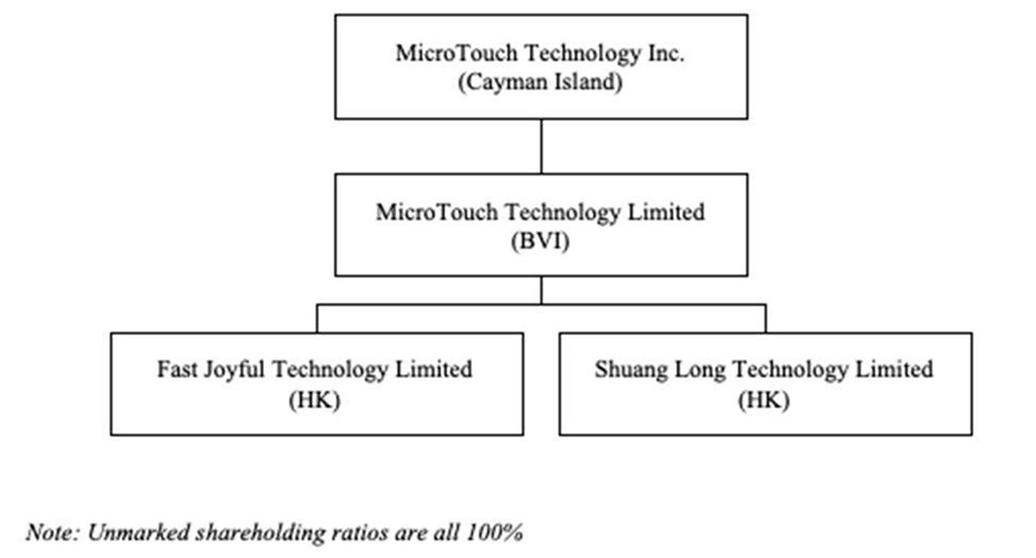
Core Business Segments
SmartFlow Real-Time Matching Information Technology Services (SFM)
This service connects high-quality traffic suppliers with advertising demand parties through an independently developed real-time matching algorithm system, enabling precise aggregation and efficient distribution of traffic resources. We mainly use the CPM (Cost Per Mille) model for settlement, calculating fees with customers and suppliers based on the actual number of ad impressions. This business does not involve any standardized advertising products; all matching logic is dynamically generated according to customers’ delivery requirements and suppliers’ traffic tags to ensure a high degree of alignment between delivery channels and target audiences.
Custom Software Development Business
This business focuses on providing enterprise-level customers with full-lifecycle custom software development services, covering requirements analysis, system design, development implementation, testing and verification, and long-term maintenance support. All our projects adopt a project-based model—solutions are built from scratch based on customers’ specific business scenarios, and no prefabricated software products or modules are provided. Settlement is conducted in phases: an advance payment is collected after the agreement is signed, and subsequent payments are collected upon acceptance of key milestones, ensuring the security and predictability of cash flow.
Industry Background and Market Opportunities
Smart
Traffic Distribution: Driven by the Expanding Programmatic Advertising Market
As the global digital advertising market continues to expand, the scale of programmatic advertising transactions is growing rapidly. According to data from industry research institutions, the global programmatic advertising spending market was estimated at USD 131.28 billion in 2024 and is projected to grow to USD 320.35 billion by 2033, with a compound annual growth rate (CAGR) of 10.42%. The popularization of mobile Internet, 5G networks, and multi-screen interactive scenarios has further driven the demand for fragmented and refined management of traffic resources. At the same time, advertisers are increasingly demanding precision in delivery, efficiency in resource utilization, and compliance with data regulations—making traditional extensive traffic procurement models no longer able to meet market expectations.
Against this backdrop, technology-driven traffic distribution technology with real-time matching capabilities have become a key direction for industry development. Our SFM service aligns with this trend: through an algorithm-driven dynamic matching mechanism, we help advertising demand parties quickly identify target channels among massive traffic, while providing traffic suppliers with stable monetization paths. Benefiting from our long-established supplier network, technical system, and transparent settlement model, this business has gained a differentiated advantage in the increasingly competitive programmatic advertising ecosystem.
Data Source: https://www.marketgrowthreports.com/market-reports/programmatic-advertising-spending-market-112715
Custom Software Development: Fueled by Accelerated Enterprise Digital Transformation
The accelerated digital transformation of enterprises has injected strong momentum into the custom software development industry. According to industry research institutions, the software and BPO (Business Process Outsourcing) services market is expected to reach USD 445.27672 billion by 2025 and grow to USD 634.2019 billion by 2035 at a CAGR of approximately 3.6%—driven by customers expanding application management and process outsourcing. As customers’ demand for intelligent and autonomous systems grows, traditional general-purpose software can no longer meet enterprises’ increasingly complex business processes, industry compliance requirements, and system integration needs. More and more medium and large enterprises are choosing customization to build core competitive barriers, while small and medium-sized enterprises are also increasing their adoption of IT services in the process of digital transformation.
Our custom software development business focuses on the enterprise-level market, serving customers across multiple vertical sectors including manufacturing, financial services, retail and distribution, and healthcare. Relying on an experienced development team, a mature project management system, and agile iteration methodologies, we can deliver highly tailored digital tools to customers while ensuring quality and schedule. The project-based settlement model and full-lifecycle service framework further enhance the business’s anti-cyclical capabilities and cash flow stability.
Data Source: https://www.marketgrowthreports.com/market-reports/it-services-market-116058
Competitive Advantages
We have established a solid market position in our respective fields through the following core advantages:
Independent and Controllable Technology: The core matching algorithms for SFM services and the technical framework for custom development are independently developed by us.
Customer Demand Orientation: Our services are developed based on customers’ actual scenarios, avoiding adaptation deviations caused by standardized products.
Transparent Settlement Mechanism: The combination of CPM volume-based settlement and phased project payments ensures the verifiability of the business model and fund security.
Professional Team Support: A composite team consisting of algorithm engineers, software developers, project managers, and industry experts guarantees the quality of service delivery.
Compliance-First Philosophy: Strict adherence to data protection, privacy security, and industry regulatory requirements has earned long-term trust from customers.
In summary, through the differentiated layout and potential synergies of our two core businesses, we have formed a business structure characterized by “technology-driven, precise services, and steady operations.” In the future, we will continue to consolidate our existing advantages, increase R&D investment, expand into international markets, and optimize internal resource allocation to achieve sustainable and high-quality growth.
Our Business
SmartFlow Real-Time Matching Information Technology Services (SFM)
SFM focuses on providing efficient traffic resource connection services for advertising demand parties and traffic suppliers through an independently developed real-time matching technology system. The business centers on technology-driven traffic aggregation, intelligent algorithm matching, and dynamic distribution. All matching logic is dynamically generated based on customers’ real-time delivery requirements and suppliers’ traffic tags to ensure that advertising content accurately reaches target channels.
Revenue from this business mainly comes from CPM settlement fees charged to advertising demand parties. As a technology service provider, we capture value through the value-added of technical services and the difference in traffic resource usage.
Technical Process
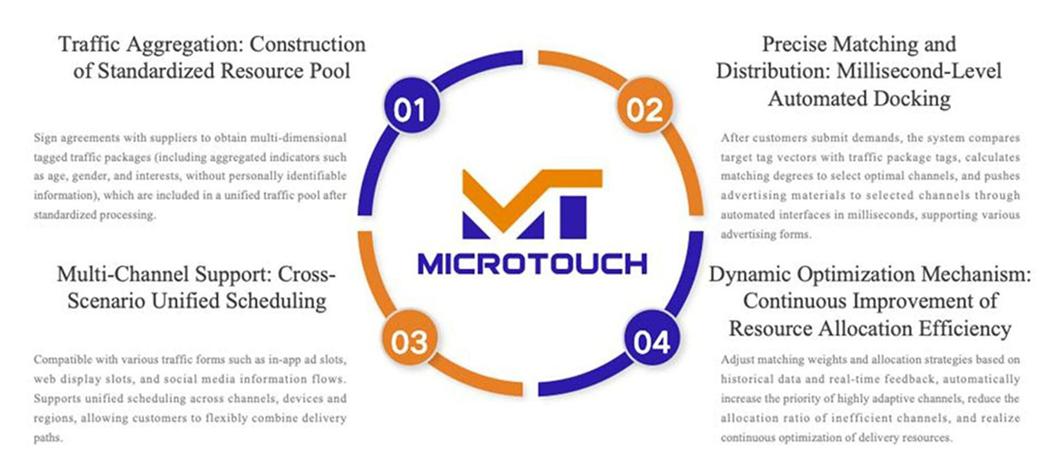
Traffic Aggregation: This is the foundation of the SFM business. We obtain traffic package resources with multi-dimensional tags by signing long-term cooperation agreements with high-quality traffic suppliers. These tags include statistical information (such as age range, gender, occupation, geographic location, interests, and consumption behavior) but do not contain any personally identifiable information. After standardizing the traffic packages uploaded by suppliers, we integrate them into our system resource pool to form a unified traffic pool available for real-time calls.
Precise Matching and Distribution: Upon receiving a customer’s delivery request, the system initiates the real-time matching process. The system compares the customer’s specified target tag vector with the traffic package tags in the resource pool from multiple dimensions, calculates the matching degree, and automatically selects the optimal channels. After matching, the system pushes the customer’s advertising creative materials to the selected traffic channels through automated interfaces, achieving millisecond-level distribution. The entire process requires no manual intervention and supports multiple content formats such as display ads and video ads.
Dynamic Optimization Mechanism: The system has a built-in dynamic optimization module that continuously adjusts matching weights and allocation strategies based on historical matching data and real-time channel feedback. If a channel shows high adaptability during a specific period, the system will automatically increase its priority; otherwise, it will reduce the allocation ratio. This mechanism ensures continuous improvement in the allocation of delivery resources.
Multi-Channel Support: SFM is compatible with multiple traffic formats, including but not limited to in-app ad slots, web display slots, and social media feeds. The system supports unified scheduling across channels, devices, and regions, allowing customers to flexibly combine delivery paths based on budgets and targets.
Supplier Network
Supplier Selection and Tiered Management: We implement strict access evaluations for suppliers, assessing dimensions such as traffic tag accuracy, delivery stability, historical cooperation records, and compliance. After passing the evaluation, suppliers are classified into core tier, standard tier, and backup tier. Core-tier suppliers enjoy priority technical docking and accelerated settlement benefits.
Traffic Package Tag System: Suppliers are required to submit traffic packages in accordance with unified tag standards, and the granularity and update frequency of tags are bound by agreements. We regularly conduct random sampling to verify tag accuracy and require suppliers to rectify any deviations found.
Cooperation Mechanism and Settlement: We sign framework cooperation agreements with suppliers, specifying traffic package pricing, tag maintenance responsibilities, and settlement cycles. Settlement adopts the CPM model: monthly reconciliation is conducted based on the actual number of impressions recorded by the system, and payment is completed in the following month after mutual confirmation.
Customer Base
The main customers of our SFM service are professional advertising agencies, which are usually entrusted by brand owners or enterprise clients to develop media strategies, allocate budgets, and monitor execution. Our customer base is dominated by advertising agencies with strong professional procurement capabilities and clear delivery target profiles.
Customer demand characteristics share the following commonalities: Customers typically provide targeted requirements with multi-dimensional tags (e.g., age range, gender distribution, occupation, region, interests, and consumption behavior), expecting advertising content to accurately reach target audiences. Customers are sensitive to cost per impression and require the system to achieve optimal costs while meeting targeting conditions. Delivery formats include banner ads, native ads, video pre-rolls, and feed ads, requiring unified scheduling across devices. Some customers require hourly or intra-day delivery adjustments, and the system must support real-time pausing, scaling, or channel replacement.
Service Delivery Process
SFM service delivery follows a standardized six-step process to ensure closed-loop demand management and traceability: Account managers collect delivery requirements through structured demand templates or meetings, including total budget, cost ceiling, targeting tags, material specifications, delivery time, and regional restrictions. Based on historical channel costs and inventory forecasts, the system calculates the achievable impression range and issues a budget execution plan; the corresponding budget is locked after customer confirmation. The delivery requirement is entered into the matching engine, and the system automatically completes channel selection and ad material API call, updating the delivery status to “In Progress.” The operation center monitors key indicators; if thresholds are triggered, the algorithm automatically adjusts channel weights or manual intervention is initiated. Customers can view consumption progress, channel distribution, and tag coverage through a self-service delivery system. The system generates a monthly delivery execution report, which forms the final bill after customer confirmation.
Core Technology System
Intelligent Algorithm Matching System: Our independently developed SmartFlow matching engine is the core of the business’s technology. It mainly includes sub-modules such as a tag vector encoder, a similarity calculation accelerator, a ranking and recommendation model, and an anti-fraud rule engine. The tag vector encoder maps both supplier traffic package tags and customer targeting tags into high-dimensional sparse vectors. The similarity calculation accelerator enables millisecond-level large-scale vector nearest-neighbor search. The ranking and recommendation model outputs channel ranking scores by integrating features such as historical channel performance, real-time costs, and remaining budget. The anti-fraud rule engine intercepts abnormal behavior in real time, with a low false positive rate. Feedback signals from deliveries are collected regularly, and model parameters are updated through learning algorithms to achieve rapid channel convergence. The matching engine is deployed in a containerized cluster, supporting horizontal scaling and strong concurrent matching request capabilities at peak times.
Real-Time Data Processing Architecture: The overall technical architecture adopts a microservice and event-driven model, mainly including a data ingestion layer, a storage and caching layer, and a distribution execution layer. The data ingestion layer is responsible for accessing and preliminarily processing supplier traffic packages and real-time buried point data. The storage and caching layer uses distributed databases and in-memory caching mechanisms to ensure strong consistency of tag metadata and fast access to hot data. Full historical data is archived in object storage to support cold data queries. The distribution execution layer accelerates the global delivery of ad materials through a content delivery network (CDN), and delivery instructions are sent to supplier interfaces, supporting industry-standard protocol versions. The end-to-end data processing latency is stably maintained at the millisecond level, and the system availability reaches a high level.
System Security and Compliance: We have established a multi-layered security protection system: Full-site data transmission uses encryption protocols, and network firewalls are deployed to defend against common attacks. Tag data storage implements column-level encryption, with keys managed by a hardware security module (HSM). Access control is based on a role-based permission model, implementing the principle of least privilege, and operation logs are retained for a long time. We do not store or process any personally identifiable information; all traffic tags are aggregated statistical dimensions, complying with personal information protection requirements.
Settlement Model
Customer Settlement Mechanism: We use the standard CPM model to charge customers. Customers specify the delivery cost when submitting delivery requirements, and we determine the plan based on these requirements. Our delivery system uses valid logs returned by suppliers as the basis for billing, deducting our self-set invalid traffic filtering ratio. In the following month, the delivery system generates a monthly impression statement for customer verification. After the customer confirms the statement within the specified time, we issue a commercial invoice promptly.
Supplier Settlement Mechanism: We also use the CPM model to settle with suppliers. The system records the actual number of delivery instructions pushed to the supplier, deducting invalid portions caused by customer-side issues. A detailed supplier usage statement is generated in the following month; after supplier confirmation, we complete payment before the end of the following month.
Accounts Receivable Management: We implement credit limit control for customers. Before cooperating with new customers, we conduct business inquiries and industry reputation checks on their basic information. A credit limit ceiling is set for new customers’ first orders, and credit limits for existing customers are dynamically adjusted based on historical payment records. The accounts receivable turnover days are maintained at a low level; thanks to our effective customer risk control, no bad debt provisions have been made since the launch of the SFM business.
Risk Management and Quality Control: We have established a traffic quality monitoring system, setting threshold alerts for indicators such as abnormal impression ratios and tag drift. If a supplier’s traffic quality declines, we immediately suspend scheduling and initiate a rectification process. The system retains complete operation logs to facilitate post-event traceability and dispute resolution.
Future Development Plans
Within the planned period, we intend to:
|
● |
Upgrade matching algorithms and introduce federated learning technology to improve cross-regional tag consistency. |
|
● |
Expand the supplier network, focusing on short video and emerging content platforms. |
|
● |
Optimize the degree of settlement automation and shorten the reconciliation cycle. |
|
● |
Explore in-depth API docking with programmatic advertising trading platforms to improve traffic acquisition efficiency. |
The above measures aim to continuously consolidate the technical barriers and market competitiveness of the SFM service, achieving steady growth in business scale and profitability.
Custom
Software Development Business
This business focuses on providing enterprise-level customers with full-lifecycle personalized software solutions, covering all links including requirements analysis, system design, development implementation, testing and verification, and long-term maintenance support. All projects are built from scratch based on customers’ specific business scenarios—no standardized software products, prefabricated modules, or general templates are involved. We operate through a project-based model; relying on a professional technical team, a mature project management system, and a rigorous quality control process, we ensure that the delivered results are highly tailored to customers’ actual needs and have sustainable scalability.
Our serving customers across industries such as manufacturing, financial services, retail and distribution, healthcare, and logistics and transportation. Revenue from this business mainly comes from project development fees; settlement is conducted in phases: an advance payment is collected after the agreement is signed, and the balance is collected upon acceptance of key milestones.
Business Process
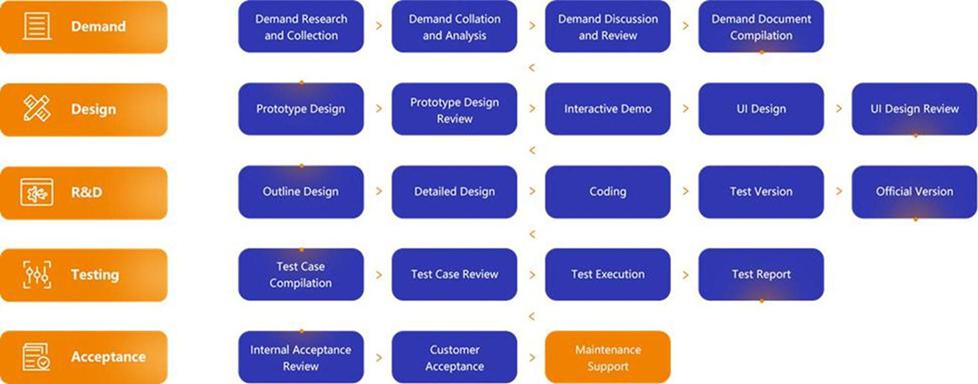
The custom software development business operates with a project-based core model—each project is independently initiated, accounted for, and delivered. We form a dedicated team for each project, ensuring full coverage from demand collection to system launch and subsequent maintenance. This model emphasizes in-depth customer participation: during the project, regular reviews and iterative demonstrations are conducted to respond to demand changes in a timely manner, avoiding deviations between the final delivery and customer expectations. We do not provide off-the-shelf software licenses or subscription services; all intellectual property rights are transferred to the customer in accordance with the agreement after project acceptance.
Requirements Analysis: This is the first key link in project initiation. Our requirements analysts conduct multiple rounds of in-depth communication with the customer’s business departments, technical departments, and end users, using methods such as interviews, questionnaires, process mapping, and data sample analysis to fully identify business pain points, functional requirements, non-functional requirements, and system integration boundaries. The analysis results are formalized in the form of a Business Requirements Document (BRD) and a Functional Requirements Document (FRD), clarifying priorities, acceptance criteria, and risk points. After the customer confirms the requirement documents in writing, they serve as the sole basis for subsequent design and development; any subsequent changes must be approved through a formal change control process.
System Design: The system design phase is carried out based on the confirmed requirement documents. Our system architects are responsible for formulating the overall technical architecture, including application architecture, data architecture, integration architecture, security architecture, and deployment architecture. The design process adopts the principles of modularization and layering to ensure the system has high cohesion and low coupling, facilitating subsequent expansion and maintenance. The deliverables include a System Design Specification (SDS), database ER diagrams, API Specification, UI Prototype, and technical selection report. The design plan must pass the joint review of our internal technical review committee and the customer before entering the development phase.
Development and Implementation: This is the core execution link of the project. Our development team organizes implementation in accordance with agile development methodologies, taking fixed cycles as an iteration unit. At the end of each iteration, a runnable functional module is delivered, and customer demonstrations and feedback collection are conducted. The coding process strictly complies with our unified coding standards and version control system; all code submissions must pass automated unit tests and static code scanning. A code review mechanism is implemented for key modules, with senior engineers checking the quality. The development environment is physically isolated from the production environment to prevent unvalidated code from affecting the customer’s business continuity.
Maintenance and Support: After the system is launched, we provide long-term maintenance and support services, including defect repair, function optimization, version upgrade, performance tuning, and security patch application. The maintenance team tracks the entire lifecycle of issues through a ticket system; we also provide preventive maintenance, including regular system health checks, performance baseline monitoring, and capacity planning recommendations, to ensure the long-term stable operation of the system.
Customer Base
Customers of the custom software development business are all enterprise entities with independent IT departments or digital transformation budgets. Customers are relatively evenly distributed across industries, including manufacturing, financial services, retail and distribution, healthcare, logistics and transportation, etc. Customers generally face problems such as outdated traditional systems, fragmented business processes, and cross-system data silos, and have clear functional requirements and delivery cycle requirements for customized solutions.
We implement a full-lifecycle customer relationship management system. After a new customer signs a contract, they are immediately entered into the customer relationship management system to establish a complete file, recording historical projects, key contacts, contract terms, and service evaluations. Account managers are responsible for regular visits and demand exploration, and organizing satisfaction follow-ups. Existing customers enjoy priority resource scheduling, maintenance fee discounts, and priority experience rights for new technologies.
Professional Team and Core Capabilities
The core team of the custom software development business consists of project managers, requirements analysts, system architects, development engineers, testing engineers, and operation and maintenance support personnel, all with rich industry experience. Among them, project managers are responsible for overall project planning, schedule control, and customer communication; requirements analysts and system architects are responsible for business translation and technical solution design; development engineers cover front-end, back-end, database, and other directions; testing engineers perform functional testing, performance testing, and security testing; operation and maintenance support engineers are responsible for launch deployment and later maintenance.
Project Management Methodology: Our project management combines a mature project management framework with agile methods, and the core processes include initiation, planning, execution, monitoring, and closure. During the project initiation phase, a project charter and management plan are prepared, clarifying the baselines for scope, time, cost, quality, risk, etc. The execution phase adopts iterative development, with regular review meetings and retrospective meetings held. Schedule tracking uses visualization tools; if deviations exceed the threshold, a change control assessment is triggered immediately. Our internal project management system realizes working hour statistics, risk early warning, and document archiving, ensuring transparent and traceable management.
Technology Stack and Toolchain: Our technology stack remains neutral and open, supporting the seamless integration of the customer’s existing technology ecosystem. Front-end frameworks, back-end languages, databases, middleware, and other components are flexibly selected based on project requirements. The development process adopts containerized deployment and continuous integration/delivery (CI/CD) pipelines; code repositories are managed uniformly, and automated testing covers major functions. We have established an internal technology middle system, encapsulating common components such as identity authentication, permission management, log auditing, and configuration centers to improve project reusability and system consistency.
Settlement Model
Phased Settlement Mechanism: The settlement of the custom software development business adopts a phased milestone model. An advance payment is collected after the agreement is signed to cover team formation and initial research costs. Subsequent payments are made after each key milestone is accepted and approved.
Advance Payment and Milestone Acceptance: The advance payment is collected promptly after the agreement takes effect to cover the costs of team formation and initial research. Each milestone acceptance is jointly confirmed by the customer representative and the project manager; the acceptance criteria are based on a written checklist, including functional integrity, performance indicators, security compliance, and other requirements. For milestones that fail to pass acceptance, we provide free rectification until they meet the standards before entering the next settlement phase. Acceptance disputes are submitted to the senior management of both parties for coordination; if necessary, an independent third party is invited to conduct an evaluation.
Risk Management and Quality Assurance
We have established a risk management system covering the entire project lifecycle. During the project initiation phase, a risk register is prepared to identify technical risks, schedule risks, cost risks, change risks, and external dependency risks, with regular updates to their status and response measures. Major risks are escalated to the company’s management meeting for review. In terms of quality assurance, the company implements multi-level quality control: code reviews and automated testing are conducted during the development phase; functional testing and user acceptance testing (UAT) are conducted during the testing phase; stress testing, security penetration testing, and disaster recovery drills are performed before launch. Defects are managed by category, and major defects must be repaired in a timely manner. Our project on-time delivery rate and customer acceptance pass rate remain at a high level, with a solid quality reputation.
Future Development Plans
We intend to continuously deepen the competitiveness of the custom software development business in the future, with specific measures including:
|
● |
Expanding the coverage of common components in the technology middle system to further improve project delivery efficiency; |
|
● |
Cultivating industry-specific vertical solution capabilities; |
|
● |
Introducing low-code development systems as auxiliary tools to shorten the cycle of small and medium-sized projects; |
|
● |
Strengthening ecological cooperation with cloud service providers and consulting institutions to participate in joint bidding and solution packaging. |
Through the above strategic measures, we aim to consolidate the leading position of the custom software development business in the enterprise-level market and achieve dual-driven growth in revenue scale and technical capabilities.
Sales and Marketing
We mainly rely on the recommendation and word-of-mouth of long-term major customers for business expansion. The company has a local marketing team, which aims to expand market share through in-depth customer tracking and demand analysis. The sales and marketing team focuses on customer maintenance, new customer development, brand promotion, and industry influence building to form a sustainable business growth model.
Our customer acquisition channels mainly rely on offline relationship networks and industry word-of-mouth. Existing customers recommend us to peers based on past cooperation experiences, and referrals are the main source of new customers. In addition, we participate in relevant industry exhibitions at home and abroad from time to time to demonstrate our technical capabilities and establish potential customer files on site. We have established strategic cooperation frameworks with leading media agencies, and formed strategic cooperation alliances with management consulting firms, system integrators, and cloud service providers, and are included in their recommended supplier lists. We promote our technical advantages and service cases through our official website to attract potential customers to consult proactively.
Research and Development
Research and development (R&D) is an indispensable part of our sustainable development. To better meet customer needs, we are committed to exploring and researching emerging technologies and how to best integrate them into our existing and new solutions. Currently, we are using emerging technologies and tools to improve project delivery capabilities and efficiency. For example, we have applied DevOps methodologies and tools in project delivery processes and systems. This methodology has greatly improved development and operation efficiency as well as project quality. We can accurately identify customer problems and focus on quickly collecting and analyzing customer data without deploying expensive hardware. The DevOps methodology has significantly shortened the project delivery cycle and improved customer satisfaction, allowing customers to browse their data more easily.
Our technical team is the core driving force for business development, covering algorithm engineers, software development engineers, system architects, data analysts, testing engineers, operation and maintenance engineers, and other professional talents. Team members generally have educational backgrounds in computer science, software engineering, or related fields, and most have years of experience in large-scale system design and implementation. The technical team adopts a matrix organizational structure, which not only ensures the stable operation of the SmartFlow service real-time matching engine but also supports the flexible delivery of custom software development projects.
Employees
Our management team consists of senior managers with rich industry experience and diverse professional backgrounds. The core members have an average of more than 10 years of work experience, covering information technology services, smart traffic real-time distribution information technology, enterprise software development, financial management, capital market operations, and other fields. Most members of the management team have held key positions in well-known information technology enterprises or software service providers, with profound strategic planning, business development, and operation management capabilities. We have a sound governance structure and a transparent and efficient management decision-making mechanism, ensuring that our strategic direction is highly aligned with daily operations.
We believe that human resource management and planning are crucial to the company’s development. Therefore, we are committed to efficiently recruiting, training, developing, and retaining talents. At the same time, we will adjust staffing according to the specific needs of each project. This initiative aims to improve operational efficiency and minimize human resource redundancy. As of the date of this prospectus, we have a total of 7 employees, with the number of employees by function as follows:
| Function |
|
Number of
full-time
employees |
|
|
% of Total |
|
| Research and Development |
|
5 |
|
|
|
72 |
% |
| Business and Marketing |
|
1 |
|
|
|
14 |
% |
| Administrative, Human Resources and Finance |
|
1 |
|
|
|
14 |
% |
| Total |
|
7 |
|
|
|
100 |
% |
None of our employees are members of trade unions or have signed collective bargaining agreements. We believe that employee relations are good. We believe that attracting and retaining experienced employees, as well as sales and marketing personnel, is key to our success. In addition, we believe that we maintain a good working relationship with our employees, and there have been no major labor disputes, nor have we encountered any recruitment difficulties.
Insurance
We currently do not hold any commercial insurance, directors’ and officers’ liability insurance, group comprehensive life insurance for employees, property insurance, business interruption insurance, or general third-party liability insurance. Please refer to “Risk Factors—Risks Related to Our Business and Industry—We currently have no insurance coverage, which exposes us to potential significant financial losses and operational disruptions.”
Legal Proceedings
In
the ordinary course of business, we may from time to time be involved in various legal or administrative proceedings. As of the date
of this prospectus, neither we nor any of our subsidiaries have been involved in any litigation, claims, administrative proceedings,
or arbitrations that have a material adverse impact on the company’s operations or financial condition.
Intellectual Property
We rely on copyright law, trade secret law, confidentiality procedures, and contractual terms with employees, contractors, and other relevant parties to protect our proprietary technology. Our success depends in part on our ability to obtain, maintain, and enforce proprietary protection for our products, technologies, and know-how, to operate without infringing the proprietary rights of others, and to prevent others from infringing our proprietary rights.
As of the date of this prospectus, we do not hold any patents, copyrights, trademarks, but only one domain name.
We will continue to regularly evaluate opportunities to seek intellectual property protection to safeguard technologies, designs, and methods that we believe provide significant competitive advantages. However, our ability to do so may be limited until we can generate cash flow from operations or raise sufficient funds to continue investing in intellectual property. If we are unable to make such investments in intellectual property, our ability to protect our intellectual property or prevent others from infringing our proprietary rights may be affected.
Licenses and Permits
Except for business licenses and other company establishment permits, the company does not hold any other licenses or permits.
Facilities
Our headquarters is located in Hong Kong, China. We believe that our existing facilities are sufficient to meet our current needs, and additional space can be obtained on commercially reasonable terms to meet our future needs.
MANAGEMENT’S DISCUSSION AND ANALYSIS OF
FINANCIAL CONDITION AND RESULTS OF OPERATIONS OF MICROTOUCH
You should read the
following discussion and analysis of our financial condition and results of operations in conjunction with our consolidated financial
statements and the related notes included elsewhere in this proxy statement/prospectus. This discussion contains forward-looking
statements that involve risks and uncertainties about our business and operations. Our actual results and the timing of selected
events may differ materially from those anticipated in these forward-looking statements as a result of various factors, including
those we describe under “Risk Factors” and elsewhere in this proxy statement/prospectus. Unless the context otherwise
requires, references in this section to “we”, “us”, “our”, “Company” and similar
first-person references are intended to mean the business and operations of MicroTouch and its consolidated subsidiaries taken
as a whole prior to the Business Combination.
Overview
MicroTouch is a holding
company with no business operation. Through our wholly owned subsidiaries, Shuang Long Technology Limited (“Shuang Long”)
and Fast Joyful Technology Limited (“Fast Joyful”), we position ourselves in two core areas: SmartFlow Real-Time Matching
Information Technology Services and Custom Software Development Business.
On January 16, 2026,
we entered into a Merger Agreement with Future Vision and the Merger Sub. Upon the consummation of the Business Combination, we
will be a wholly owned subsidiary of Future Vision and Future Vision’s name will be changed from “Future Vision II
Acquisition Corp” to “MicroTouch Inc”.
For the three months
ended December 31, 2025, our revenue was USD 8.7 million, an increase of USD 7.8 million or 800.8% from the USD 1.0 million
for the three months ended December 31, 2024. The revenue is primarily generated from two operating segments: SmartFlow Real-Time
Matching Information Technology Services and Custom Software Development Business.
For the three months
ended December 31, 2025, our gross profit was USD 2.9 million, an increase of USD 2.6 million or 667.5% from the USD 0.4 million
for the three months ended December 31, 2024.
For the three months
ended December 31, 2025, our total operating expenses were USD 2.5 million, an increase of USD 2.3 million or 1,104.9% from
the USD 0.2 million for the three months ended December 31, 2024. The increase was driven primarily by a 2,357.1% rise in
research and development expenses, a 316.8% increase in general and administrative expenses, and a 13.2% increase in selling and
marketing expenses.
For the three months
ended December 31, 2025, our net income was USD 1.1 million, representing a turnaround from a net loss of USD 0.3 million
for the three months ended December 31, 2024. This represents an increase of USD 1.4 million. The variance percentage of 444.3%
reflects the material change from a net loss in the 2024 period to a net income in the 2025 period.
For the year ended
September 30, 2025, our revenue was USD 19.2 million, an increase of USD 16.4 million or 586.5% from the USD 2.8 million for
the year ended September 30, 2024. The revenue mainly comes from SmartFlow Real-Time Matching Information Technology Services,
which commenced operations in 2025, and our existing Custom Software Development Business.
For the year ended
September 30, 2025, our gross profit was USD 7.7 million, an increase of USD 6.6 million or 612.3% from the USD 1.1 million
for the year ended September 30, 2024.
For the year ended September 30,
2025, our operating expenses were USD 4.9 million, an increase of USD 0.9 million or 23.2% from the USD 4.0 million for the year
ended September 30, 2024.
For the year ended September 30,
2025, our net income was USD 2.0 million, representing a turnaround from a net loss of USD 2.6 million for the year ended September 30,
2024. This represents an increase of USD 4.5 million. The negative variance percentage of 173.7% reflects the change from a net
loss in 2024 to a net income in 2025.
Key Factors that Affect Operating Results
We believe the following
key factors may affect our financial condition and results of operations:
Market Competition and Industry Trend
Changes
The information technology
services industry where we operate is highly competitive, with both established enterprises with mature technologies and new entrants
with capital advantages continuing to enter the market. Competitive pressures may lead to price wars, increased customer acquisition
costs, or loss of market share, which will directly compress our profit margins.
In addition, the industry
is characterized by rapid technological iteration and changing market demand. The growth of downstream application fields such
as digital transformation of enterprises and real-time information matching has driven the demand for our services, but changes
in industry development trends (such as changes in technical standards or shifts in customer demand preferences) may require us
to continuously adjust our business layout and service content. Failure to promptly adapt to such changes may lead to a decline
in the competitiveness of our services and have an adverse impact on operating results.
Our ability to acquire customers
Our future success depends
in part on our ability to acquire new customers. We believe we have significant opportunities to expand our customer base because
we possess professional digital information technology solutions, and the demand for these solutions will continue to grow as digital
systems remain a critical component of nearly every enterprise’s strategy. We are confident that with the emergence of increasing
digital transformation needs, our advantages in the fields of intelligent traffic distribution and customized software development
will enable us to effectively capitalize on long-term trends.
Our customer base consists
primarily of corporate clients with specific IT service needs, and we do not target individual consumers. As such, we refrain from
mass media marketing (e.g., TV, radio ads) and instead focus on precise customer acquisition channels aligned with corporate client
characteristics: word-of-mouth referrals from existing clients, participation in industry vertical exhibitions/technical seminars
to showcase core solutions, and targeted online presence to attract demand-driven inquiries. During the year ended September 30,
2025 and the three months ended December 31, 2025, we added 19 and 6 new customers, respectively.
Fluctuations in Customers’ Marketing
and IT Expenditures
We generate corresponding
technology service fees by providing customers with relevant information technology services, which support their brand promotion,
product and service sales, and enterprise system informatization upgrades. Whether customers are willing to implement their marketing
budgets and digital software investments through us directly determines our ability to generate revenue.
Customers’ marketing
and IT expenditures may be comprehensively affected by various factors, including: (i) changes in social, economic, and geopolitical
environments at the domestic, regional, and global levels, such as the risk of a severe or prolonged economic slowdown in the Hong
Kong Special Administrative Region, economic fluctuations or threats of political unrest in Taiwan region; economic and geopolitical
challenges such as trade disputes between the United States and China and regional industrial chain adjustments; and changes in
economic, monetary, and fiscal policies such as the introduction and phased withdrawal of quantitative easing policies, as well
as interest rate and exchange rate adjustments. These factors may lead to a contraction in enterprises’ overall operating
budgets, thereby simultaneously affecting their willingness and intensity of investment in marketing promotion and digital transformation
software. (ii) industry-related developments, such as the evolution of consumers’ trending preferences and usage habits regarding
social media platforms, the iterative upgrading of internet advertising technologies; and the advancement of emerging technical
directions and diverse solution models in the digital software field (e.g., AI-integrated systems, cloud-based customized applications,
low-code development tools), which may alter customers’ priority in selecting service types. (iii) brand-specific factors,
such as the brand’s digital transformation strategy (including implementation pace and resource allocation priorities), operating
performance, financial health, as well as dynamic adjustments to sales and marketing plans and technology investment budgets.
If any of the above factors
undergo significant changes, it may cause customers to substantially reduce their marketing budgets or digital software expenditures.
This will not only directly decrease our technology service fee income from internet advertising services and digital software
development businesses but also weaken our bargaining power with partners such as search engines, social media platforms, and technical
resource suppliers in terms of pricing policies and cooperation terms.
Technological Innovation and R&D
Investment Efficiency
Technological advantage
is the core competitiveness of our business operations. Continuous R&D investment is crucial to maintaining technological leadership,
improving service performance, and meeting customer personalized needs.
The scale and efficiency
of R&D investment directly affect our ability to respond to market changes and competitive challenges. Insufficient R&D
investment may lead to technological obsolescence, while inefficient R&D investment will increase operating costs and reduce
overall profitability.
Three Months Ended December 31, 2024
Compared to the Three Months Ended December 31, 2025
Results of Operations
The following table
sets forth key components of our results of operations for the three months ended December 31, 2024 and 2025:
| | |
For the
Three Months Ended
December 31, | | |
| | |
% of | |
| | |
2024 | | |
2025 | | |
Variance | | |
variance | |
| | |
USD | | |
USD | | |
USD | | |
% | |
| Revenue | |
| 971,218 | | |
| 8,748,443 | | |
| 7,777,225 | | |
| 800.8 | % |
| Cost of revenue | |
| (587,616 | ) | |
| (5,804,162 | ) | |
| (5,216,546 | ) | |
| 887.7 | % |
| Gross profit | |
| 383,602 | | |
| 2,944,281 | | |
| 2,560,679 | | |
| 667.5 | % |
| | |
| | | |
| | | |
| | | |
| | |
| Operating expenses | |
| | | |
| | | |
| | | |
| | |
| Selling and marketing expenses | |
| (50,112 | ) | |
| (56,750 | ) | |
| (6,638 | ) | |
| 13.2 | % |
| General and administrative expenses | |
| (69,299 | ) | |
| (288,837 | ) | |
| (219,538 | ) | |
| 316.8 | % |
| Research and
development expenses | |
| (87,295 | ) | |
| (2,144,927 | ) | |
| (2,057,632 | ) | |
| 2,357.1 | % |
| Total operating
expenses | |
| (206,706 | ) | |
| (2,490,514 | ) | |
| (2,283,808 | ) | |
| 1,104.9 | % |
| | |
| | | |
| | | |
| | | |
| | |
| Income from
operations | |
| 176,896 | | |
| 453,767 | | |
| 276,871 | | |
| 156.5 | % |
| | |
| | | |
| | | |
| | | |
| | |
| Other income | |
| | | |
| | | |
| | | |
| | |
| Investment (loss) income | |
| (488,014 | ) | |
| 832,810 | | |
| 1,320,824 | | |
| (270.7 | )% |
| Interest expense | |
| (36,895 | ) | |
| (36,895 | ) | |
| - | | |
| - | % |
| Other expense,
net | |
| (29 | ) | |
| - | | |
| 29 | | |
| (100.0 | )% |
| Total other
(expense) income, net | |
| (524,938 | ) | |
| 795,915 | | |
| 1,320,853 | | |
| (251.6 | )% |
| | |
| | | |
| | | |
| | | |
| | |
| (Loss) profit before income taxes | |
| (348,042 | ) | |
| 1,249,682 | | |
| 1,597,724 | | |
| (459.1 | )% |
| Benefit from
(provision for) income taxes | |
| 42,834 | | |
| (198,981 | ) | |
| (241,815 | ) | |
| (564.5 | )% |
| Net (loss)
income | |
| (305,208 | ) | |
| 1,050,701 | | |
| 1,355,909 | | |
| (444.3 | )% |
Revenue
The following table
sets forth our revenue for the three months ended December 31, 2024 and 2025, respectively:
| |
|
For
the Three Months Ended December 31, |
|
| |
|
2024 |
|
|
2025 |
|
|
Variance |
|
| |
|
(USD) |
|
|
%
of
revenue |
|
|
(USD) |
|
|
%
of
revenue |
|
|
Amount |
|
|
% |
|
| Operating
revenues |
|
|
|
|
|
|
|
|
|
|
|
|
|
|
|
|
|
|
|
|
|
|
|
|
| SmartFlow Real-Time
Matching Information Technology Services | |
| 200,000 | | |
| 20.6 | % | |
| 5,611,443 | | |
| 64.1 | % | |
| 5,411,443 | | |
| 2,705.7 | % |
| Custom Software
Development Business | |
| 771,218 | | |
| 79.4 | % | |
| 3,137,000 | | |
| 35.9 | % | |
| 2,365,782 | | |
| 306.8 | % |
| Total operating
revenue | |
| 971,218 | | |
| 100.0 | % | |
| 8,748,443 | | |
| 100.0 | % | |
| 7,777,225 | | |
| 800.8 | % |
For the three months
ended December 31, 2025, our total operating revenue was USD 8.75 million, representing an increase of USD 7.78 million, or
800.8%, compared to USD 0.97 million for the three months ended December 31, 2024. This growth was primarily driven by the
launch of our SmartFlow Real-Time Matching Information Technology Services and the expansion of our Custom Software Development
Business. SmartFlow revenue reached USD 5.61 million, accounting for 64.1% of total revenue in the quarter, while Custom Software
Development revenue grew 306.8% to USD 3.14 million, driven by expanded enterprise customer service coverage.
Cost of revenue
The following table
sets forth the breakdown of our cost of revenue for the three months ended December 31, 2024 and 2025, respectively:
| |
|
For
the Three Months Ended December 31, |
|
| |
|
2024 |
|
|
2025 |
|
|
Variance |
|
| |
|
(USD) |
|
|
%
of
cost
of
revenue |
|
|
(USD) |
|
|
%
of
cost
of
revenue |
|
|
Amount |
|
|
% |
|
| Cost
of revenue |
|
|
|
|
|
|
|
|
|
|
|
|
|
|
|
|
|
|
|
|
|
|
|
|
| SmartFlow Real-Time
Matching Information Technology Services | |
| (119,600 | ) | |
| 20.4 | % | |
| (3,891,241 | ) | |
| 67.0 | % | |
| (3,771,641 | ) | |
| 3,153.5 | % |
| Custom Software
Development Business | |
| (468,016 | ) | |
| 79.6 | % | |
| (1,912,921 | ) | |
| 33.0 | % | |
| (1,444,905 | ) | |
| 308.7 | % |
| Total cost
of revenue | |
| (587,616 | ) | |
| 100.0 | % | |
| (5,804,162 | ) | |
| 100.0 | % | |
| (5,216,546 | ) | |
| 887.7 | % |
For the three months
ended December 31, 2025, our total cost of revenue was USD 5.80 million, representing an increase of USD 5.22 million, or
887.7%, compared to USD 0.59 million for the three months ended December 31, 2024, primarily attributable to the significant
growth in our overall business revenue.
Costs related to our
SmartFlow Real-Time Matching Information Technology services totaled USD 3.89 million in the quarter, a 3,153.5% increase from
USD 0.12 million in the prior-year period, driven by the rapid expansion of this new business line. Costs for our Custom Software
Development Business increased 308.7% to USD 1.91 million from USD 0.47 million, as we expanded service coverage for enterprise
customers, resulting in higher resource utilization.
Gross profit
Our gross profit from
our major revenue type is summarized as follows:
| |
|
For the Three Months Ended December
31, |
|
| |
|
2024 |
|
|
2025 |
|
|
Variance |
|
|
%
of
variance |
|
| Gross profit |
|
|
|
|
|
|
|
|
|
|
|
|
|
|
|
|
| SmartFlow Real-Time
Matching Information Technology Services | |
| 80,400 | | |
| 1,720,202 | | |
| 1,639,802 | | |
| 2,039.6 | % |
| Custom Software
Development Business | |
| 303,202 | | |
| 1,224,079 | | |
| 920,877 | | |
| 303.7 | % |
| Total Gross
profit | |
| 383,602 | | |
| 2,944,281 | | |
| 2,560,679 | | |
| 667.5 | % |
| Gross profit margin | |
| | | |
| | | |
| | | |
| | |
| SmartFlow Real-Time Matching Information
Technology Services | |
| 40.2 | % | |
| 30.7 | % | |
| (9.5 | )% | |
| | |
| Custom Software Development Business | |
| 39.3 | % | |
| 39.0 | % | |
| (0.3 | )% | |
| | |
| Total Gross profit margin | |
| 39.5 | % | |
| 33.7 | % | |
| (5.8 | )% | |
| | |
For the three months
ended December 31, 2025, our total gross profit was USD 2.94 million, representing an increase of USD 2.56 million, or 667.5%,
compared to USD 0.38 million for the three months ended December 31, 2024. This growth was primarily driven by the expansion
of our new SmartFlow Real-Time Matching Information Technology services and our Custom Software Development Business.
Our total gross profit
margin decreased 5.8 percentage points to 33.7% from 39.5% in the prior-year quarter. The decline was primarily attributable to
the lower gross margin of our SmartFlow business, which decreased 9.5 percentage points to 30.7% amid intensified industry competition
in the real-time matching technology market, as we increased investments in technology R&D and operational capabilities to
support rapid business scaling and market penetration. The gross profit margin of our Custom Software Development Business remained
stable at 39.0%, a slight 0.3 percentage point decrease from 39.3% in the prior-year period, as operational efficiencies offset
the impact of expanded enterprise service coverage.
Operating expenses
Our operating expenses
consist of the following:
| |
|
For
the Three Months Ended December 31, |
|
| |
|
2024 |
|
|
2025 |
|
|
Variance |
|
|
%
of
variance |
|
| Selling and marketing
expenses | |
| (50,112 | ) | |
| (56,750 | ) | |
| (6,638 | ) | |
| 13.2 | % |
| General and administrative expenses | |
| (69,299 | ) | |
| (288,837 | ) | |
| (219,538 | ) | |
| 316.8 | % |
| Research
and development expenses | |
| (87,295 | ) | |
| (2,144,927 | ) | |
| (2,057,632 | ) | |
| 2,357.1 | % |
| Total operating
expenses | |
| (206,706 | ) | |
| (2,490,514 | ) | |
| (2,283,808 | ) | |
| 1,104.9 | % |
Our selling and marketing
expenses mainly represent the salary of marketing personnel. Our selling and marketing expenses increased by USD 6,638, or 13.2%,
from USD 50,112 for the three months ended December 31, 2024 to USD 56,750 for the three months ended December 31, 2025,
which was mainly due to the expansion of our sales team.
Our general and administrative
expenses mainly represent payroll expenses, amortization of operating lease right-of-use assets, and service costs. Our general
and administrative expenses increased by USD 219,538, or 316.8%, from USD 69,299 for the three months ended December 31, 2024
to USD 288,837 for the three months ended December 31, 2025, primarily attributable to higher De-SPAC audit fees incurred
in preparation for our U.S. De-SPAC offering.
Our total operating
expenses increased by USD 2,283,808, or 1,104.9%, from USD 206,706 for the three months ended December 31, 2024 to USD 2,490,514
for the three months ended December 31, 2025.
Other income
Our total other income,
net represented a net income of USD 795,915 for the three months ended December 31, 2025, compared to a net expense of USD
524,938 for the three months ended December 31, 2024, representing an improvement of USD 1,320,853, or 251.66%. This net income
primarily consists of investment income, offset by interest expenses and other net expenses.
Investment income was
a net income of USD 832,810 for the three months ended December 31, 2025, compared to a net loss of USD 488,014 for the three months
ended December 31, 2024, representing an improvement of USD 1,320,824, or 270.57%, primarily due to fluctuations in the fair value
of our short-term investment portfolio.
Our interest expense
primarily relates to interest expense on loans. Our interest expense remained consistent at USD 36,895 for both the three months
ended December 31, 2025 and 2024, with no change year-over-year.
Our other income, net
shifted from a net expense of USD 29 for the three months ended December 31, 2024 to no net expense for the three months ended
December 31, 2025, representing an improvement of USD 29.
Provision for income
taxes
Our operating subsidiaries
are subject to income taxes within Hong Kong at the applicable tax rate on taxable income. For the three months ended December 31,
2025, we recorded an income tax expense of USD 198,981, compared to an income tax credit of USD 42,834 for the three months ended
December 31, 2024, representing an increase in income tax expense of USD 241,815, or 564.54%.
Net income
As a result of the
foregoing, we reported a net income of USD 1,050,701 for the three months ended December 31, 2025, as compared to a net loss
of USD 305,208 for the three months ended December 31, 2024, representing an improvement of USD 1,355,909, or 444.25%.
Liquidity and Capital
Resources
To date, we have financed
our operations primarily through cash flows from our shareholders’ capital injection. Our financing activities provided net
cash inflow of USD 8.2 million for the three months ended December 31, 2025, primarily from our shareholders’ capital
contributions of USD 11.0 million, partially offset by payments of USD 2.8 million for the repayment of bank loans. We plan to
support our future operations primarily from cash generated from our operations.
As reflected in our
unaudited consolidated financial statements, we reported a net loss of USD 0.3 million for the three months ended December 31,
2024, as compared to a net profit of USD 1.1 million for the three months ended December 31, 2025. As of December 31,
2024, we had cash and cash equivalents of USD 0.4 million, compared to USD 8.3 million as of December 31, 2025. We had working
capital of USD 5.0 million as of December 31, 2024, which increased to USD 14.4 million as of December 31, 2025. Our
working capital requirements are influenced by the size of our operations, the volume and value of our client contracts, and the
timing for collecting accounts receivable and repayment of accounts payable.
We believe that our
current cash and cash flows provided by operating activities, shareholders’ capital injection, will be sufficient to meet
our working capital needs in the next 12 months from the date the audited financial statements were issued. If we experience an
adverse operating environment or incur unanticipated capital expenditure requirements, or if we determine to accelerate our growth,
then additional financing may be required. No assurance can be given, however, that additional financing, if required, would be
available at all or on favorable terms. Such financing may include the sale of additional debt or the sale of additional equity
securities. Any financing which involves the sale of equity securities or instruments that are convertible into equity securities
could result in immediate and possibly significant dilution to our existing shareholders.
We do not plan to pay
any dividends out of our retained earnings in the foreseeable future.
The following table
sets forth a summary of our cash flows for the years ended December 31, 2024 and 2025:
| |
|
For
the
Three Months Ended
December 31, |
|
| |
|
2024 |
|
|
2025 |
|
| Net cash used in operating
activities | |
| (297,255 | ) | |
| (263,507 | ) |
| Net cash provided by investing
activities | |
| 15 | | |
| 707 | |
| Net cash provided by financing
activities | |
| - | | |
| 8,190,000 | |
| Net (decrease) increase in cash
and cash equivalents | |
| (297,240 | ) | |
| 7,927,200 | |
| Cash and cash equivalents at the
beginning of the period | |
| 561,406 | | |
| 392,485 | |
| Cash and cash equivalents at the
end of the period | |
| 264,166 | | |
| 8,319,685 | |
Operating Activities
Net cash used in operating
activities amounted to USD 297,255 for the three months ended December 31, 2024, driven by changes in operating assets and
liabilities, including cash outflows of USD 56,603 from increases in accounts receivable, USD 157,779 from increases in prepaid
services fees and prepayments, USD 19,098 from decreases in accounts payable, and USD 17,953 from decreases in lease liabilities,
partially offset by cash inflows of USD 47,098 from increases in contract fulfillment costs, USD 2,960 from increases in amount
due to related party, and USD 6,631 from increases in income tax payable.
Net cash used in operating
activities amounted to USD 263,507 for the three months ended December 31, 2025, driven by changes in operating assets and
liabilities, including cash outflows of USD 1,426,947 from increases in accounts receivable, USD 2,740,084 from increases in prepaid
services fees and prepayments, and USD 18,890 from decreases in lease liabilities, partially offset by cash inflows of USD 2,581,915
from increases in accounts payable, USD 34,822 from increases in amount due to related party, USD 866,191 from increases in other
payables and accrued liabilities, and USD 22,197 from increases in income tax payable.
Investing Activities
Net cash provided by
investing activities amounted to USD 15 for the three months ended December 31, 2024, primarily from proceeds from the sale
of short-term investments of USD 15.
Net cash provided by
investing activities amounted to USD 707 for the three months ended December 31, 2025, primarily from proceeds from the sale
of short-term investments of USD 360,574, partially offset by cash outflows from the purchase of short-term investments of USD
359,867.
Financing Activities
For the three months
ended December 31, 2024, there were no cash inflows or outflows from financing activities, resulting in a net cash flow of
nil from such activities.
Net cash provided by
financing activities amounted to USD 8,190,000 for the three months ended December 31, 2025, primarily from proceeds from
capital contributions by shareholders of USD 11,000,000, partially offset by cash outflows of USD 2,810,000 for the repayment of
bank loans.
Off-Balance Sheet Financing Arrangements
We did not have any
off-balance sheet arrangement as of December 31, 2025, as defined in Item 303(a)(4)(ii) of Regulation S-K.
Year Ended September 30, 2024
Compared to the Year Ended September 30, 2025
Results of Operations
The following table
sets forth key components of our results of operations for the fiscal years ended September 30, 2024 and 2025:
| | |
For the
Years Ended
September 30, | | |
| | |
% of | |
| | |
2024 | | |
2025 | | |
Variance | | |
variance | |
| | |
USD | | |
USD | | |
USD | | |
% | |
| Revenue | |
| 2,796,470 | | |
| 19,198,455 | | |
| 16,401,985 | | |
| 586.5 | % |
| Cost of revenue | |
| (1,720,000 | ) | |
| (11,531,091 | ) | |
| (9,811,091 | ) | |
| 570.4 | % |
| Gross profit | |
| 1,076,470 | | |
| 7,667,364 | | |
| 6,590,894 | | |
| 612.3 | % |
| | |
| | | |
| | | |
| | | |
| | |
| Operating expenses | |
| | | |
| | | |
| | | |
| | |
| Selling and marketing expenses | |
| (103,008 | ) | |
| (219,240 | ) | |
| (116,232 | ) | |
| 112.8 | % |
| General and administrative expenses | |
| (215,130 | ) | |
| (292,650 | ) | |
| (77,520 | ) | |
| 36.0 | % |
| Research and
development expenses | |
| (3,641,274 | ) | |
| (4,364,730 | ) | |
| (723,456 | ) | |
| 19.9 | % |
| Total operating
expenses | |
| (3,959,412 | ) | |
| (4,876,620 | ) | |
| (917,208 | ) | |
| 23.2 | % |
| | |
| | | |
| | | |
| | | |
| | |
| Income from
operations | |
| (2,882,942 | ) | |
| 2,790,744 | | |
| 5,673,686 | | |
| (196.8 | )% |
| | |
| | | |
| | | |
| | | |
| | |
| Other income | |
| | | |
| | | |
| | | |
| | |
| Investment loss | |
| (102,067 | ) | |
| (395,426 | ) | |
| (293,359 | ) | |
| 287.4 | % |
| Interest expense | |
| (110,248 | ) | |
| (146,376 | ) | |
| (36,128 | ) | |
| 32.8 | % |
| Other income
(expense), net | |
| 153 | | |
| (284 | ) | |
| (437 | ) | |
| (285.6 | )% |
| Total other
income, net | |
| (212,162 | ) | |
| (542,086 | ) | |
| (329,924 | ) | |
| 155.5 | % |
| | |
| | | |
| | | |
| | | |
| | |
| Profit before income taxes | |
| (3,095,104 | ) | |
| 2,248,658 | | |
| 5,343,762 | | |
| (172.7 | )% |
| Provision
for income taxes | |
| 489,573 | | |
| (328,692 | ) | |
| (818,265 | ) | |
| (167.1 | )% |
| Net income | |
| (2,605,531 | ) | |
| 1,919,966 | | |
| 4,525,497 | | |
| (173.7 | )% |
Revenue
The following table
sets forth our revenue for the years ended September 30, 2024 and 2025, respectively:
| |
|
For
the Years Ended September 30, |
|
| |
|
2024 |
|
|
2025 |
|
|
Variance |
|
| |
|
(USD) |
|
|
%
of
revenue |
|
|
(USD) |
|
|
%
of
revenue |
|
|
Amount |
|
|
% |
|
| Operating
revenues |
|
|
|
|
|
|
|
|
|
|
|
|
|
|
|
|
|
|
|
|
|
|
|
|
| SmartFlow Real-Time
Matching Information Technology Services | |
| - | | |
| - | % | |
| 11,083,172 | | |
| 57.7 | % | |
| 11,083,172 | | |
| - | % |
| Custom Software
Development Business | |
| 2,796,470 | | |
| 100.0 | % | |
| 8,115,283 | | |
| 42.3 | % | |
| 5,318,813 | | |
| 190.2 | % |
| Total operating
revenue | |
| 2,796,470 | | |
| 100.0 | % | |
| 19,198,455 | | |
| 100.0 | % | |
| 16,401,985 | | |
| 586.5 | % |
Our revenue increased
by USD 16.4 million, or 586.5%, from USD 2.8 million for the year ended September 30, 2024 to USD 19.2 million for the year
ended September 30, 2025. This substantial growth is primarily driven by the launch of our new business line and the expansion
of our existing service offerings. The revenue from SmartFlow Real-Time Matching Information Technology Services was USD 11.1 million,
accounting for 57.7% of our total revenue for the year ended September 30, 2025. For our Custom Software Development Business,
revenue increased to USD 8.1 million for the year ended September 30, 2025 from USD 2.8 million for the year ended September 30,
2024, representing an increase of USD 5.3 million, or 190.2%. This growth is primarily because we expanded our service coverage
for enterprise customers.
Cost of revenue
The following table
sets forth the breakdown of our cost of revenue for the years ended September 30, 2024 and 2025:
| |
|
For
the Years Ended September 30, |
|
| |
|
2024 |
|
|
2025 |
|
|
Variance |
|
| |
|
(USD) |
|
|
%
of
cost
of
revenue |
|
|
(USD) |
|
|
%
of
cost
of
revenue |
|
|
Amount |
|
|
% |
|
| Cost
of revenue |
|
|
|
|
|
|
|
|
|
|
|
|
|
|
|
|
|
|
|
|
|
|
|
|
| SmartFlow
Real-Time Matching Information Technology Services |
|
|
- |
|
|
|
- |
% |
|
|
(6,547,091 |
) |
|
|
56.8 |
% |
|
|
(6,547,091 |
) |
|
|
- |
% |
| Custom
Software Development Business |
|
|
(1,720,000 |
) |
|
|
100.0 |
% |
|
|
(4,984,000 |
) |
|
|
43.2 |
% |
|
|
(3,264,000 |
) |
|
|
189.8 |
% |
| Total
cost of revenue |
|
|
(1,720,000 |
) |
|
|
100.0 |
% |
|
|
(11,531,091 |
) |
|
|
100.0 |
% |
|
|
(9,811,091 |
) |
|
|
570.4 |
% |
Our cost of revenue
increased by USD 9.8 million, or 570.4%, from USD 1.7 million for the year ended September 30, 2024 to USD 11.5 million for
the year ended September 30, 2025, which was due to the growth of business revenue.
Our Real-Time Matching
Information Technology Services costs were USD 6.5 million for the year ended September 30, 2025, representing a new cost
item. Our Custom Software Development Business costs increased by USD 3.3 million, or 189.8%, from USD 1.7 million for the year
ended September 30, 2024 to USD 5.0 million for the year ended September 30, 2025, which is due to the company having developed
more business that utilizes more resource costs.
Gross profit
Our gross profit from
our major revenue type is summarized as follows:
| |
|
For the Years Ended September 30, |
|
| |
|
2024 |
|
|
2025 |
|
|
Variance |
|
|
%
of
variance |
|
| Gross profit |
|
|
|
|
|
|
|
|
|
|
|
|
|
|
|
|
| SmartFlow Real-Time
Matching Information Technology Services |
|
|
- |
|
|
|
4,536,081 |
|
|
|
4,536,081 |
|
|
|
- |
% |
| Custom Software
Development Business |
|
|
1,076,470 |
|
|
|
3,131,283 |
|
|
|
2,054,813 |
|
|
|
190.9 |
% |
| Total Gross
profit |
|
|
1,076,470 |
|
|
|
7,667,364 |
|
|
|
6,590,894 |
|
|
|
612.3 |
% |
| Gross profit margin |
|
|
|
|
|
|
|
|
|
|
|
|
|
|
|
|
| SmartFlow Real-Time Matching Information
Technology Services |
|
|
0.0 |
% |
|
|
40.9 |
% |
|
|
40.9 |
% |
|
|
|
|
| Custom Software Development Business |
|
|
38.5 |
% |
|
|
38.6 |
% |
|
|
0.1 |
% |
|
|
|
|
| Total Gross profit margin |
|
|
38.5 |
% |
|
|
39.9 |
% |
|
|
1.4 |
% |
|
|
|
|
Our total gross profit
increased by USD 6.6 million, or 612.3%, from USD 1.1 million for the year ended September 30, 2024 to USD 7.7 million for
the year ended September 30, 2025. The increase in total gross profit was mainly driven by the addition of our new SmartFlow Real-Time
Matching Information Technology Services business and the growth of our Custom Software Development Business.
Our total gross profit
margin increased by 1.4 percentage points from 38.5% for the year ended September 30, 2024 to 39.9% for the year ended September 30,
2025. Specifically, the gross profit margin of our SmartFlow Real-Time Matching Information Technology Services was 40.9% in 2025,
as it was a new business with no corresponding revenue or costs in 2024. The gross profit margin of our Custom Software Development
Business increased slightly by 0.1 percentage points from 38.5% to 39.6%, which benefited from operational efficiencies and more
effective resource allocation as the business scaled.
Operating expenses
Our operating expenses
consist of the following:
| |
|
For
the Years Ended September 30, |
|
| |
|
2024 |
|
|
2025 |
|
|
Variance |
|
|
%
of
variance |
|
| Selling
and marketing expenses |
|
|
(103,008 |
) |
|
|
(219,240 |
) |
|
|
(116,232 |
) |
|
|
112.8 |
% |
| General
and administrative expenses |
|
|
(215,130 |
) |
|
|
(292,650 |
) |
|
|
(77,520 |
) |
|
|
36.0 |
% |
| Research
and development expenses |
|
|
(3,641,274 |
) |
|
|
(4,364,730 |
) |
|
|
(723,456 |
) |
|
|
19.9 |
% |
| Total
operating expenses |
|
|
(3,959,412 |
) |
|
|
(4,876,620 |
) |
|
|
(917,208 |
) |
|
|
23.2 |
% |
Our selling and marketing
expenses mainly represent the salary of marketing personnel. Our selling and marketing expenses increased by USD 0.1 million, or
112.8%, from USD 0.1 million for the year ended September 30, 2024 to USD 0.2 million for the year ended September 30,
2025, which was mainly due to the expansion of our sales team.
Our general and administrative
expenses mainly represent payroll expenses, amortization of operating lease right-of-use assets, and service costs. Our general
and administrative expenses increased by USD 0.1 million, or 36.0%, from USD 0.2 million for the year ended September 30,
2024 to USD 0.3 million for the year ended September 30, 2025. We expect our general and administrative expenses, including
but not limited to, staff costs, to increase in the foreseeable future as our business further grows. We expect our amortization
of operating lease right-of-use assets to remain consistent unless we need to further expand our office spaces due to business
expansion. We also expect our legal and professional fees for legal, audit, and consulting services to increase as we incur audit,
legal, and advisory fees for the business combination.
Our research and development
expenses primarily represent payments to outsourced technical development subcontractors. Our research and development expenses
increased by USD 0.7 million, or 19.9%, from USD 3.6 million for the year ended September 30, 2024 to USD 4.4 million for
the year ended September 30, 2025, which was mainly due to our strategic investment in cutting-edge technology tracks, leveraging
our outsourced partners to accelerate core technology iteration and the delivery of our new product matrix, thereby strengthening
our technical barriers and long-term market competitiveness.
Our total operating
expenses increased by USD 0.9 million, or 23.2%, from USD 4.0 million for the year ended September 30, 2024 to USD 4.9 million
for the year ended September 30, 2025.
Other income
Our total other income,
net, represented a net expense of USD 0.5 million for the year ended September 30, 2025, an increase of USD 0.3 million, or
155.8%, from a net expense of USD 0.2 million for the year ended September 30, 2024. This net expense primarily consists of
investment losses, interest expenses, and other net expenses.
Investment losses increased
by USD 0.3 million, or 287.4%, from a loss of USD 0.1 million for the year ended September 30, 2024 to a loss of USD 0.4 million
for the year ended September 30, 2025, primarily due to fluctuations in the fair value of our short-term investment portfolio.
Income from finance
expenses primarily relates to interest expense on loans. Our interest expense increased by USD 36,128, or 32.8%, from USD 110,248
for the year ended September 30, 2024 to USD 146,376 for the year ended September 30, 2025.
Our other income (expense),
net, shifted from a net income of USD 153 for the year ended September 30, 2024 to a net expense of USD 284 for the year ended
September 30, 2025, representing a change of USD 437, or 285.6%.
Provision for
income taxes
Our operating subsidiaries
are subject to income taxes within Hong Kong at the applicable tax rate on taxable income. Our income tax expenses decreased by
USD 0.8 million, or 167.1%, from USD 0.5 million for the year ended September 30, 2024 to a tax benefit of USD 0.3 million
for the year ended September 30, 2025.
Net income
As a result of the
foregoing, we reported a net loss of USD 2.6 million for the year ended September 30, 2024, as compared to a net profit of
USD 2.0 million for the year ended September 30, 2025, representing an improvement of USD 4.5 million, or 173.7%.
Liquidity and
Capital Resources
To date, we have financed
our operations primarily through cash flows from operating activities and loans. Our financing activities provided net cash inflow
of USD 2.8 million in 2024, primarily from borrowings. We plan to support our future operations primarily from cash generated from
our operations.
As reflected in our
audited consolidated financial statements, we reported a net loss of USD 2.6 million for the year ended September 30, 2024,
as compared to a net profit of USD 2.0 million for the year ended September 30, 2025. As of September 30, 2024, we had
cash and cash equivalents of USD 0.6 million, compared to USD 0.4 million as of September 30, 2025. We had working capital
of USD 3.0 million as of September 30, 2024, which increased to USD 5.0 million as of September 30, 2025. Our working
capital requirements are influenced by the size of our operations, the volume and value of our client contracts, and the timing
for collecting accounts receivable and repayment of accounts payable.
We believe that our
current cash and cash flows provided by operating activities, loans from banks, will be sufficient to meet our working capital
needs in the next 12 months from the date the audited financial statements were issued. If we experience an adverse operating environment
or incur unanticipated capital expenditure requirements, or if we determine to accelerate our growth, then additional financing
may be required. No assurance can be given, however, that additional financing, if required, would be available at all or on favorable
terms. Such financing may include the sale of additional debt or the sale of additional equity securities. Any financing which
involves the sale of equity securities or instruments that are convertible into equity securities could result in immediate and
possibly significant dilution to our existing shareholders.
We do not plan to pay
any dividends out of our retained earnings in the foreseeable future.
The following table
sets forth a summary of our cash flows for the years ended September 30, 2024 and 2025:
| |
|
For
the
Years Ended
September 30, |
|
| |
|
2024 |
|
|
2025 |
|
| Net
cash used in operating activities |
|
|
(8,764,052 |
) |
|
|
(284,724 |
) |
| Net
cash provided by investing activities |
|
|
90,051 |
|
|
|
115,803 |
|
| Net
cash provided by financing activities |
|
|
2,810,000 |
|
|
|
- |
|
| Net
decrease in cash and cash equivalents |
|
|
(5,864,001 |
) |
|
|
(168,921 |
) |
| Cash
and cash equivalents at the beginning of year |
|
|
6,425,407 |
|
|
|
561,406 |
|
| Cash
and cash equivalents at the end of year |
|
|
561,406 |
|
|
|
392,485 |
|
Operating Activities
Net cash used in operating
activities amounted to USD 8.8 million for the year ended September 30, 2024, driven by changes in operating assets and liabilities,
including cash outflows of USD 1.1 million from increases in accounts receivable, USD 0.2 million from increases in prepayments
to suppliers, and USD 47,098 from increases in contract fulfillment costs, partially offset by cash inflows of USD 4.8 million
from increases in other payables and accrued liabilities, USD 283,618 from increases in expense paid by related party, USD 47,098
from increases in accounts payable, and partially offset by cash outflows of USD 52,511 each from decreases in lease liabilities.
Net cash used in operating
activities amounted to USD 0.3 million for the year ended September 30, 2025, driven by changes in operating assets and liabilities,
including cash outflows of USD 3.1 million from increases in accounts receivable, USD 0.1 million from increases in prepayments
to suppliers, and USD 47,098 from increases in contract fulfillment costs, partially offset by cash inflows of USD 0.1 million
from increases in other payables and accrued liabilities, USD 47,098 from increases in accounts payable, USD 380,744 from increases
in expense paid by related party, and USD 30,859 each from increases in income tax payable.
Investing Activities
Net cash provided by
investing activities amounted to USD 90,051 for the year ended September 30, 2024, primarily from proceeds from the sale of
short-term investments of USD 48.8 million, partially offset by cash outflows from the purchase of short-term investments of USD
48.7 million.
Net cash provided by
investing activities amounted to USD 0.1 million for the year ended September 30, 2025, primarily from proceeds from the sale
of short-term investments of USD 1.0 million, partially offset by cash outflows from the purchase of short-term investments of
USD 0.9 million.
Financing Activities
Net cash provided by
financing activities amounted to USD 2.8 million for the year ended September 30, 2024, primarily from proceeds from third-party
loans. There were no cash inflows from financing activities for the year ended September 30, 2025.
Off-Balance Sheet Financing Arrangements
We did not have any
off-balance sheet arrangement as of September 30, 2025, as defined in Item 303(a)(4)(ii) of Regulation S-K.
Internal Control of Financial Reporting
We are not currently
required to comply with the SEC rules that implement Sections 302 and 404 of the Sarbanes-Oxley Act, and we are therefore not required
to make a formal assessment of the effectiveness of our internal control over financial reporting for that purpose. Our management
has not completed an assessment of the effectiveness of our internal control over financial reporting and our independent registered
public accounting firm has not conducted an audit of our internal control over financial reporting. In connection with the audit
of our consolidated financial statements as of September 30, 2025 and for the fiscal year then ended, and our unaudited consolidated
financial statements as of December 31, 2025 and for the three months then ended, our management and our independent registered
public accounting firm identified deficiencies that represented material weaknesses in our internal control over financial reporting.
The material weaknesses identified relate to: (1) insufficient financial reporting and accounting personnel with appropriate
knowledge, skills, and experience in the application of U.S. GAAP and SEC rules to prepare consolidated financial statements
and related disclosures completely and accurately; and (2) lack of sufficient controls designed and implemented in IT environment
and IT general control activities, which mainly associated with areas of financial system segregation of logical access security,
IT service organization and cyber security for the financial systems.
To remedy our identified
material weaknesses subsequent to December 31, 2025, we have started adopting measures to improve our internal control over
financial reporting, including, among others: (1) hiring more qualified accounting personnel with relevant U.S. GAAP
and SEC reporting experience and qualifications to strengthen the financial reporting function and to set up a financial and system
control framework; (2) implementing regular and continuous U.S. GAAP accounting and financial reporting training programs
for our accounting and financial reporting personnel; and (3) setting up the system control framework to address information
technology general controls (“ITGC”) deficiencies.
However, we cannot assure
you that we will remediate our material weaknesses in a timely manner. See “Risk Factors—If we fail to maintain
an effective system of internal control over financial reporting after the completion of the Business Combination, we may be unable
to accurately report our financial results or prevent fraud, and investor confidence in us and the market price of New MT ordinary
shares may be adversely affected.”
As a company with less
than US$1.235 billion in revenue for its last fiscal year, PubCo will qualify as an “emerging growth company”
pursuant to the JOBS Act. An emerging growth company may take advantage of specified reduced reporting and other requirements that
are otherwise applicable generally to public companies. These provisions include exemption from the auditor attestation requirement
under Section 404 of the Sarbanes-Oxley Act of 2002 in the assessment of the emerging growth company’s internal
control over financial reporting.
IMPLICATIONS OF BEING AN EMERGING GROWTH COMPANY
New MT will qualify as an “emerging growth company” as defined in the Jumpstart Our Business Startups Act of 2012, or the JOBS Act. An emerging growth company may take advantage of specified reduced reporting and other burdens that are otherwise applicable generally to public companies. These provisions include:
| |
● |
The ability to include only two years of audited financial statements and only two years of related management’s discussion and analysis of financial condition and results of operations disclosure; and |
| |
|
|
| |
● |
An exemption from the auditor attestation requirement in the assessment of our internal control over financial reporting pursuant to the Sarbanes-Oxley Act of 2002. |
We may take advantage of these provisions for up to five years from incorporation or such earlier time that we are no longer an emerging growth company. We would cease to be an emerging growth company if we have more than US$1.235 billion in annual revenue, have more than US$700 million in market value of our ordinary shares held by non-affiliates or issue more than US$1 billion of non-convertible debt over a three-year period.
GOVERNMENT REGULATIONS
Hong Kong Regulations
As we conduct business in Hong Kong through our wholly-owned subsidiaries, our business operations are subject to various laws and regulations of Hong Kong. The following is a brief summary of the Hong Kong laws and regulations that may currently and materially affect our business. This section does not purport to be a comprehensive summary of all present and proposed laws, rules, regulations and legislation relating to the industries in which we operate and business in which we engage.
Hong Kong Laws and Regulations relating to Business Registration
The Business Registration Ordinance (Chapter 310 of the Laws of Hong Kong) requires every person carrying on any business to make application to the Commissioner of Inland Revenue in the prescribed manner for the registration of that business. The Commissioner of Inland Revenue must register each business for which a business registration application is made and as soon as practicable after the prescribed business registration fee and levy are paid, issue a business registration certificate or branch registration certificate for the relevant business or the relevant branch as the case may be.
Hong Kong Laws and Regulations relating to Protection of Personal Data
Personal Data (Privacy) Ordinance (Chapter 486 of the Laws of Hong Kong) (“PDPO”) aims to protect the privacy of individuals of their personal data. The PDPO imposes a statutory duty on data users to comply with the requirements of the six data protection principles (the “Data Protection Principles”) contained in Schedule 1 to the PDPO. The PDPO provides that a data user shall not do an act, or engage in a practice, that contravenes a Data Protection Principle unless the act or practice, as the case may be, is required or permitted under the PDPO. The six Data Protection Principles are:
| |
● |
Principle 1 – purpose and manner of collection of personal data; |
| |
|
|
| |
● |
Principle 2 – accuracy and duration of retention of personal data; |
| |
|
|
| |
● |
Principle 3 – use of personal data; |
| |
|
|
| |
● |
Principle 4 – security of personal data; |
| |
|
|
| |
● |
Principle 5 – information to be generally available; and |
| |
|
|
| |
● |
Principle 6 – access to personal data. |
Non-compliance with a Data Protection Principle may lead to a complaint to the Privacy Commissioner for Personal Data (the “Privacy Commissioner”). The Privacy Commissioner may serve an enforcement notice to direct the data user to remedy the contravention. A data user who contravenes an enforcement notice commits an offence which may lead to a fine and imprisonment.
The PDPO also gives data subjects certain rights, inter alia:
| |
● |
the right to be informed by a data user whether the data user holds personal data of which the individual is the data subject; |
| |
|
|
| |
● |
if the data user holds such data, to be supplied with a copy of such data; and |
| |
|
|
| |
● |
the right to request correction of any data they consider to be inaccurate. |
The PDPO criminalizes, including but not limited to, the misuse or inappropriate use of personal data in direct marketing activities, non-compliance with a data access request and the unauthorized disclosure of personal data obtained without the relevant data user’s consent.
Hong Kong Laws and Regulations relating to Trade Description
Trade Descriptions Ordinance (Chapter 362 of the Laws of Hong Kong) (“TDO”) aims to prohibit false or misleading trade description and statements to goods and services provided by traders to the consumers during or after a commercial transaction. Pursuant to the TDO, any person in the course of any trade or business applies a false trade description to any goods and services or supply or offers to supply them commits an offence and a person also commits the same offence if he/she is in possession for sale or for any purpose of trade or manufacture of any goods with a false description. The TDO also provides that traders may commit an offence if they engage in a commercial practice that has a misleading omission of material information of the goods, an aggressive commercial practice, involves bait advertising, bait and switch or wrong acceptance of payment.
Hong Kong Laws and Regulations relating to Supply of Services
Supply of Services (Implied Terms) Ordinance (Chapter 457 of the Laws of Hong Kong) (“SSITO”) stipulates that in a contract for the supply of service, where the supplier is acting in the course of a business, there is an implied term that the supplier will carry out the service with reasonable care and skill. The SSITO provides that where, under a contract for the supply of a service by a supplier acting in the course of a business, the time for the service to be carried out is not fixed by the contract, is not left to be fixed in a manner agreed by the contract or is not determined by the course of dealing between the parties, there is an implied term that the supplier will carry out the service within a reasonable time. The SSITO also provides that where, under a contract for the supply of a service, the consideration for the service is not determined by the contract, is not left to be determined in a manner agreed by the contract or is not determined by the course of dealing between the parties, there is an implied term that the party contracting with the supplier will pay a reasonable charge.
Hong Kong Laws and Regulations relating to Exemption Clauses in a Contract
Control of Exemption Clauses Ordinance (Chapter 71 of the Laws of Hong Kong) (“CECO”) aims to limit the scope where the seller may limit its liability via the terms of the contracts.
Under section 7 of CECO, a person cannot by reference to any contract term or to a notice given to persons generally or to particular persons exclude or restrict his liability for death or personal injury resulting from negligence. In the case of other loss or damage, a person cannot so exclude or restrict his liability for negligence except in so far as the term or notice satisfies the requirements of reasonableness.
Pursuant to section 8 of CECO, as between contracting parties where one of them deals as consumer or on the other’s written standard terms of business, as against that party, the other cannot by reference to any contract term (i) when himself in breach of contract, exclude or restrict any liability of his in respect of the breach; or (ii) claim to be entitled to render a contractual performance substantially different from that which was reasonably expected of him; or (iii) in respect of the whole or any part of his contractual obligation, to render no performance at all, except in so far as the contract term satisfies the requirement of reasonableness.
Hong Kong Laws and Regulations relating to Intellectual Properties Rights
Trade Marks Ordinance (Chapter 559 of the Laws of Hong Kong) (“TMO”) provides the framework for the Hong Kong’s system of registration of trademarks and sets out the rights attached to a registered trade mark. The TMO restricts unauthorized use of a sign which is identical or similar to the registered mark for identical and/or similar goods and/or services for which the mark was registered, where such use is likely to cause confusion on the part of the public. The TMO provides that a person may also commit a criminal offence if that person fraudulently uses a trade mark, including selling and importing goods bearing a forged trade mark, or possessing or using equipment for the purpose of forging a trade mark.
Patents Ordinance (Chapter 514 of the Laws of Hong Kong) provides the framework for “re-registration” system of Chinese, UK and European patents in Hong Kong. Pursuant to Patents (Amendment) Ordinance 2016, which came into full effect in Hong Kong on 19 December 2019 provide a new framework for a new patent system - an “original grant patent” system, running in parallel with the “re-registration” system.
Copyright Ordinance (Chapter 528 of the Laws of Hong Kong) (“Copyright Ordinance”) provides comprehensive protection for recognized categories of work including artistic work. The Copyright Ordinance restricts certain acts such as copying and/or issuing or making available copies to the public of a copyright work without the authorization from the copyright owner as it may constitute primary infringement. The Copyright Ordinance provides that a person may also incur liability for secondary infringement if that person possesses, sells, distributes or deals with a copy of a work which is, and which he knows or has reason to believe to be, an infringing copy of work for the purposes of or in the course of any trade or business without the consent of the copyright owner.
Hong Kong Laws and Regulations relating to Competition
Competition Ordinance (Chapter 619 of the Laws of Hong Kong) (“Competition Ordinance”) prohibits and deters undertakings in all sectors from adopting anti-competitive conduct which has the object or effect of preventing, restricting or distorting competition in Hong Kong. The key prohibitions include (i) prohibition of agreements between businesses which have the object or effect of preventing, restricting or distorting competition in Hong Kong; and (ii) prohibiting companies with a substantial degree of market power from abusing their power by engaging in conduct that has the object or effect of preventing, restricting or distorting competition in Hong Kong. The penalties for breaches of the Competition Ordinance include, but are not limited to, financial penalties of up to 10% of the total gross revenues obtained in Hong Kong for each year of infringement, up to a maximum of three years in which the contravention occurs.
Hong Kong Laws and Regulations relating to Employment
Employment Ordinance (Chapter 57 of the Laws of Hong Kong) (“EO”) governs conditions of employment in Hong Kong, and provides a wide range of employment protections and benefits for employees, such as wage protection, rest days, holidays with pay, paid annual leave, sickness allowance, maternity protection, statutory paternity leave, severance payment, long service payment, employment protection, termination of employment contract and protection against anti-union discrimination.
Pursuant to Mandatory Provident Fund Schemes Ordinance (Chapter 485 of the Laws of Hong Kong) (“MPFSO”), every employer must take all practicable steps to ensure that the employee becomes a member of a Mandatory Provident Fund (MPF) scheme. An employer who fails to comply with such a requirement may face a fine and imprisonment. The MPFSO provides that an employer who is employing a relevant employee must, for each contribution period, from the employer’s own funds, contribute to the relevant MPF scheme the amount determined in accordance with the MPFSO.
Pursuant to Employees’ Compensation Ordinance (Chapter 282 of the Laws of Hong Kong) (“ECO”), all employers are required to take out insurance policies to cover their liabilities under the ECO and at common law for injuries at work in respect of all of their employees. An employer failing to do so may be liable to a fine and imprisonment.
Pursuant to Minimum Wage Ordinance (Chapter 608 of the Laws of Hong Kong) (“MWO”), an employee is entitled to be paid wages no less than the statutory minimum wage rate during the wage period. With effect from 1 May 2025, the statutory minimum hourly wage rate is HK$42.1. Failure to comply with MWO constitutes an offence under EO.
Hong Kong Laws and regulations related to taxation
Inland Revenue Ordinance (Chapter 112 of the Laws of Hong Kong)
Under the Inland Revenue Ordinance (Chapter 112 of the Laws of Hong Kong), where an employer commences to employ in Hong Kong an individual who is or is likely to be chargeable to tax, or any married person, the employer shall give a written notice to the Commissioner of Inland Revenue not later than three months after the date of commencement of such employment. Where an employer ceases or is about to cease to employ in Hong Kong an individual who is or is likely to be chargeable to tax, or any married person, the employer shall give a written notice to the Commissioner of Inland Revenue not later than one month before such individual ceases to be employed in Hong Kong.
Tax on dividends
Under the current practice of the Inland Revenue Department of Hong Kong, no tax is payable in Hong Kong in respect of dividends paid by the Company.
Capital gains and profit tax
No tax is imposed in Hong Kong in respect of capital gains from the sale of shares. However, trading gains from the sale of shares by persons carrying on a trade, profession or business in Hong Kong, where such gains are derived from or arise in Hong Kong, will be subject to Hong Kong profits tax which is imposed at the rates of 8.25% on assessable profits up to HKD2,000,000 and 16.5% on any part of assessable profits over HKD2,000,000 on corporations from the year of assessment commencing on or after April 1, 2018. Certain categories of taxpayers (for example, financial institutions, insurance companies and securities dealers) are likely to be regarded as deriving trading gains rather than capital gains unless these taxpayers can prove that the investment securities are held for long-term investment purposes.
Stamp Duty Ordinance (Chapter 117 of the Laws of Hong Kong)
Under the Stamp Duty Ordinance, the Hong Kong stamp duty, currently charged at the ad valorem rate of 0.1% on the higher of the consideration for or the market value of the shares, will be payable by the purchaser on every purchase and by the seller on every sale of Hong Kong shares (in other words, a total of 0.2% is currently payable on a typical sale and purchase transaction of Hong Kong shares). In addition, a fixed duty of HK$5 is currently payable on any instrument of transfer of Hong Kong shares. Where one of the parties is a resident outside Hong Kong and does not pay the ad valorem duty due by it, the duty not paid will be assessed on the instrument of transfer (if any) and will be payable by the transferee. If no stamp duty is paid on or before the due date, a penalty of up to ten times the duty payable may be imposed.
Estate duty
Hong Kong estate duty was abolished effective from February 11, 2006. No Hong Kong estate duty is payable by shareholders in relation to the shares owned by them upon death.
Withholding Tax
Any payments by a Hong Kong company for the use, or the right to the use, in Hong Kong of any patent, design, trademark, copyright material owned by non-resident owners are subject to payment of Hong Kong tax. The assessable profits are taken to be 30% of the royalty payments to the non-resident owners. The tax payable is then computed by applying the appropriate tax rate to the assessable profits so arrived at. Furthermore, the non-resident company is chargeable in the Hong Kong company’s name who is required under the Inland Revenue Ordinance to withhold from the payments made to the non-resident company sufficient money for the payment of the tax.
DIRECTORS, EXECUTIVE OFFICERS, EXECUTIVE COMPENSATION
AND CORPORATE GOVERNANCE
Set forth immediately below is a description of our pre-Business Combination directors and management and related material. For information about directors expected to be appointed to the board upon the Closing of the Business Combination, please see the discussion below entitled “Directors after Completion of Business Combination.”
Future Vision II Acquisition Corp.
Directors and Executive Officers
Our officers, directors and independent director nominees are as follows:
| Name |
|
Age |
|
Position |
| Danhua Xu |
|
45 |
|
Chief Executive Officer, Chairwoman of the Board |
| Caihong Chen |
|
52 |
|
Chief Financial Officer and Director |
| Zheng “Terrence” Wu |
|
37 |
|
Independent Director |
| Shuding Zeng |
|
44 |
|
Independent Director |
| Lei Xiong |
|
35 |
|
Independent Director |
Our management team is led by Danhua Xu, Chief Executive Officer and Chairwoman, and Caihong Chen, Chief Financial Officer and Director.
Danhua Xu, Chief Executive Officer and Chairwoman of the Board of Directors. Ms. Xu has served as the General Manager and Executive Director at Budget International (HK) Limited since September 2016, where she is responsible for investments and international operations planning. She also advised clients on matters relating to mergers and acquisitions. Ms. Xu served as Chief Financial Officer at Ditop Co., Ltd from 2009 to 2016, where she was responsible for the company’s financial business, and as Account Manager at Canton Telecom Industry Services Co., Ltd. from 2004 to 2009. Ms. Xu holds a Bachelor of Science degree in Life Sciences from South China Normal University.
Caihong Chen, Chief Financial Officer and Director. Ms. Chen, an investment and banking professional who brings nearly 25 years of financial experience to the Company resides in China. Currently, Ms. Chen is serving as the General Manager at Increase Family Office, a role Ms. Chen has held since August of 2016. Ms. Chen served as a Vice President of Operations in the Marketing Department of CITIC Trust Co., Ltd. from 2012 to 2016. Prior to her tenure at CITIC, she served in the capacity of Sub-Branch Manager at two Mainland China branches of the China Construction Bank from 2000 to 2012, where she accumulated extensive banking and finance experience. Ms. Chen has invested in various companies in the U.S. and Hong Kong, which later became public, most notably, including investment in Uber (NYSE: UBER), Meten EdtechX Education (NASDAQ: METX) and Razer (01337.HK). Ms. Chen holds a Bachelor of Art degree in Chinese Linguistics & Literature from Guangzhou Normal University and holds qualifications as an Associate Financial Planner (AFP), and various professional certifications including the Securities Qualification Certificate, Foreign Currency Qualification Certificate and Accounting Certificate.
Zheng “Terrence” Wu, Independent Director, Chair of the Audit Committee and Member of the Compensation Committee. Since the closing of the IPO, Wu, who resides in China, has served as an independent director, bringing nearly 10 years of TMT experience and extensive finance and compliance expertise to the Company. In January 2020, Mr. Wu co-founded Yishang Co. Ltd., a start-up company focusing on TMT sector equity investments and has served as Yishang’s General Manager since its inception. Prior to co-founding Yishang, Mr. Wu served as a Senior Vice President of the TMT Sector at Citibank (China) Limited from December 2013 to December 2019. During his tenure at Citibank, he managed a vertical team of eight members and successfully led various types of financing, global cash management and FX management projects for a number of PRC listed companies, including Fujian Furi Electronics Co., Ltd.’s (SHA:600203) acquisition of Shenzhen Chino-E Communication Co., Ltd., a national-level high-tech enterprise; Zhejiang Crystal-Optech Co., Ltd., a domestic advanced and world-renowned enterprise in R&D and manufacturing of optics and optoelectronics; Kay Zhong Precision Technology Co., Ltd. (002823.SZ), a high-tech enterprise focusing on micro motor commutators; Shenzhen Sosen Electronics Co., Ltd. (301002.SZ), a high-tech enterprise integrating R&D, production, sales and service of LED Driver; and Shenzhen ChuangYiTong Technology Co., Ltd. (300991.SZ), a leading company in manufacturing connectors. Mr. Wu also has three years of experience in relationship management, serving as Manager of Relationship Management at the Royal Bank of Scotland (China) Limited from 2010 to 2013. Mr. Wu holds a Bachelor degree in Logistics Management from Beijing Normal University (2009), and an Economics Master of Science in Banking and Finance from Loughborough University, U.K. (2012).
Shuding Zeng, Independent Director, Chair of the Compensation Committee and Member of the Audit Committee. Since the closing of the IPO, Zeng, who resides in China, has served as an independent director. In November 2016, Mr. Zeng founded Shenzhen Langtuosha Network Technology Co., Ltd. with a comprehensive team covering shape design, hardware development, software design, independent product brand operation, online self-management, cross-border wholesale and retail, etc., to achieve full link coverage from research and development to independent channel sales, where he presently serves as President. From October 2009 to November 2016, he founded a TFT LCD display and human-computer interaction capacitive touch screen integration factory, led the team to achieve innovation and breakthrough in technology and management, made remarkable progress in LCD display and touch screen technology, and successfully promoted the cooperation projects with many well-known companies at home and abroad. From March 2005 to October 2009, he served as the Technical Director of BYD (002594.SZ), during which he led the team to establish the core cooperative relationship with Gionee, CECT, Wentai, Longqi and other mobile phone solutions and terminal brands, successfully helping to promote the company’s market share and technical influence in the field of mobile communication. With his accumulation in the field of display technology (such as LCD and CMOS projection, computer graphics, image processing technology, visualization processing technology, deep learning and computer vision, etc.), Mr. Zeng has a deep grasp of CELL display technology, and has exquisite precision semiconductor full process technology, proficient in front-end and back-end technology. He has conducted in-depth research on the performance optimization of semiconductor devices. Mr. Zeng holds a Bachelor degree in Project Management from Hunan Institute of Technology.
Lei Xiong, Independent Director, Member of the Audit Committee and Compensation Committee. Since the closing of the IPO, Xiong, who resides in China, has served as our independent director. Mr. Xiong has more than ten years of Unity development experience (Unity is the world’s most widely used game engine for creating and deploying games, films, and immersive experiences across 20+ platforms on the Unity framework) and profound attainments in the field of computer vision. Mr. Xiong has issued and authorized six national invention patents and 18 software copyrights. In July 2020, Mr. Xiong founded Shenzhen Coolfish Digital Technology Co., Ltd., the visualization and security education software developed has become the industry leader and established a cooperative relationship with Shenzhen Hospital of Southern Medical University and helped the hospital build a mixed reality rehabilitation experimental center, providing rehabilitation services for more than 10,000 patients every year. Mr. Xiong presently serves as Shenzhen Coolfish Digital Technology Co., Ltd.’s President. From June 2013 to July 2020, he worked as the Technical Director of Shenzhen Daxing Digital Electronics Co., LTD., and led the team to complete the research and development of the core algorithm of spatial gesture recognition and motion capture based on computer vision technology. He has realized breakthrough applications of deep learning and computer vision technology, graphics processing technology and visualization processing technology in many fields. Mr. Xiong holds a Bachelor degree in Mechanical Design from Jianghan University, and a Master degree in Business Administration from Wuhan University.
Each of our officers and directors may become an officer or director of another special purpose acquisition company with a class of securities intended to be registered under the Securities Exchange Act of 1934, as amended, or the Exchange Act, even before we have entered into a definitive agreement regarding our initial business combination. For more information, see the section of this prospectus entitled “Management — Conflicts of Interest” and see “Risk Factors.”
Other than as described above, Future Vision’s SPAC Sponsors, their affiliates and promoters do not have any material roles or responsibilities in directing and managing Future Vision’s activities.
Number and Terms of Office of Officers and Directors
We currently have five directors after the effectiveness of the IPO. All directors shall hold office until the next annual general meeting. In accordance with the Nasdaq corporate governance requirements, we are not required to hold an annual general meeting until one year after our first fiscal year end following our listing on Nasdaq. Moreover, there is no requirement under the Companies Act for us to hold annual or general meetings or appoint directors.
We may not hold an annual general meeting of shareholders until after we complete our initial business combination.
Our Amended and Restated Memorandum and Articles of Association provide that our directors shall hold office until the expiration of their respective terms of office and until their successors shall have been elected and qualified. A director elected to fill a vacancy resulting from the death, resignation or removal of a director shall serve for the remainder of the full term of the director whose death, resignation or removal shall have created such vacancy and until his successor shall have been elected and qualified. The directors shall also have power at any time to appoint any person who is willing to act as a director, either to fill a vacancy or as an additional director. After the completion of an initial business combination, the Company may by ordinary resolution appoint any person to be a director or may by ordinary resolution remove any director.
Our officers are appointed by the board of directors and serve at the discretion of the board of directors. Our board of directors is authorized to nominate persons to the offices set forth in our Amended and Restated Memorandum and Articles of Association as it deems appropriate. Our Amended and Restated Memorandum and Articles of Association provide that our officers may consist of one or more chief executive officers, presidents, a chief financial officer, vice presidents, secretary, treasurer and such other offices as may be determined by the board of directors.
Director Independence
Nasdaq listing standards require that a majority of our board of directors be independent. An “independent director” is defined generally as a person other than an officer or employee of the Company or its subsidiaries or any other individual having a relationship which in the opinion of the Company’s board of directors, would interfere with the director’s exercise of independent judgment in carrying out the responsibilities of a director. Our board of directors has determined that Zheng “Terrence” Wu, Shuding Zeng, and Lei Xiong are “independent directors,” as defined in Nasdaq listing standards and applicable SEC rules. Our independent directors will have regularly scheduled meetings at which only independent directors are present.
Executive Officer and Director Compensation
None of our executive officers or directors have received any cash compensation for services rendered to us. In addition, our sponsor, executive officers and directors, or any of their respective affiliates will be reimbursed for any out-of-pocket expenses incurred in connection with activities on our behalf such as identifying potential target businesses and performing due diligence on suitable business combinations. Our audit committee will review on a quarterly basis all payments that were made to our sponsor, executive officers or directors, or our or their respective affiliates. Any such payments prior to an initial business combination will be made using funds held outside the trust account. Other than quarterly audit committee review of such reimbursements, we do not expect to have any additional controls in place governing our reimbursement payments to our directors and executive officers for their out-of-pocket expenses incurred in connection with our activities on our behalf in connection with identifying and completing an initial business combination. Other than these payments and reimbursements, no compensation of any kind, including finder’s and consulting fees, will be paid by the company to our sponsor, executive officers and directors, or any of their respective affiliates, prior to completion of our initial business combination.
Audit Committee
A listed company of the Nasdaq must have an audit committee with a minimum of three independent directors who satisfy the independence requirements of Rule 10A-3. Upon the effectiveness of the IPO, we had established an audit committee of the board of directors. Messrs. Zheng “Terrence” Wu, Shuding Zeng, and Lei Xiong will serve as members of our audit committee. Our board of directors has determined that each of Zheng Wu, Shuding Zeng, and Lei Xiong meet the independent director standard under Nasdaq listing standards and under Rule 10A-3(b)(1) of the Exchange Act. Zheng “Terrence” Wu will serve as the chairman of the audit committee.
Each member of the audit committee is financially literate and our board of directors has determined that each qualifies as an “audit committee financial expert” as defined in applicable SEC rules. We have adopted an audit committee charter, which details the principal functions of the audit committee, including:
| |
● |
appointing, compensating and overseeing our independent registered public accounting firm; |
| |
|
|
| |
● |
reviewing and approving the annual audit plan for the company and assisting board oversight of (1) the integrity of our financial statements, (2) our compliance with legal and regulatory requirements, (3) our independent registered public accounting firm’s qualifications and independence, and (4) the performance of our internal audit function and independent registered public accounting firm; the appointment, compensation, retention, replacement, and oversight of the work of the independent registered public accounting firm and any other independent registered public accounting firm engaged by us; |
| |
|
|
| |
● |
overseeing the integrity of our financial statements and our compliance with legal and regulatory requirements; |
| |
|
|
| |
● |
discussing the annual audited financial statements and unaudited quarterly financial statements with management and the independent registered public accounting firm; |
| |
|
|
| |
● |
pre-approving all audit services and permitted non-audit services to be performed by our independent registered public accounting firm, including the fees and terms of the services to be performed; |
| |
|
|
| |
● |
appointing or replacing the independent registered public accounting firm; |
| |
|
|
| |
● |
establishing procedures for the receipt, retention and treatment of complaints (including anonymous complaints) we receive concerning accounting, internal accounting controls, auditing matters or potential violations of law; |
| |
|
|
| |
● |
monitoring our environmental sustainability and governance practices; |
| |
|
|
| |
● |
establishing procedures for the receipt, retention and treatment of complaints received by us regarding accounting, internal accounting controls or reports which raise material issues regarding our financial statements or accounting policies; |
| |
● |
approving audit and non-audit services provided by our independent registered public accounting firm; |
| |
|
|
| |
● |
discussing earnings press releases and financial information provided to analysts and rating agencies; |
| |
|
|
| |
● |
discussing with management our policies and practices with respect to risk assessment and risk management; |
| |
|
|
| |
● |
reviewing any material transaction between us and our Chief Financial Officer that has been approved in accordance with our Code of Ethics for our officers, and providing prior written approval of any material transaction between us and our President, as appropriate, any legal, regulatory or compliance matters, including any correspondence with regulators or government agencies and any employee complaints or published reports that raise material issues regarding our financial statements or accounting policies and any significant changes in accounting standards or rules promulgated by the Financial Accounting Standards Board, the SEC or other regulatory authorities; and |
| |
|
|
| |
● |
producing an annual report for inclusion in our proxy statement, in accordance with applicable rules and regulations. |
Compensation Committee
Upon the effectiveness of the IPO, we had established a compensation committee of our board of directors. The members of our compensation committee are Zheng “Terrence” Wu, Shuding Zeng, and Lei Xiong. Shuding Zeng serves as chairman of the compensation committee. Under Nasdaq listing standards and governance rules and applicable SEC rules, we are required to have at least two members of the compensation committee, all of whom must be independent directors.
Our board of directors has determined that each of Zheng “Terrence” Wu, Shuding Zeng, and Lei Xiong is independent. We will adopt a compensation committee charter, which will detail the principal functions of the compensation committee, including:
| |
● |
reviewing and approving on an annual basis the corporate goals and objectives relevant to our chief executive officer’s compensation, evaluating our chief executive officer’s performance in light of such goals and objectives and determining and approving the remuneration (if any) of our chief executive officer based on such evaluation; |
| |
|
|
| |
● |
reviewing and making recommendations to our board of salaries and approving incentive compensation and equity awards, as well as compensation policies, for all other officers who file reports of their ownership, and changes in ownership, of the Company’s ordinary shares under Section 16(a) of the Exchange Act (the “Section 16 Officers”), as designated by our board of directors; |
| |
|
|
| |
● |
making recommendations to the board of directors with respect to incentive compensation programs and equity-based plans that are subject to board approval; |
| |
|
|
| |
● |
approving any employment or severance agreements with our Section 16 Officers; |
| |
|
|
| |
● |
granting any awards under equity compensation plans and annual bonus plans to our President and the Section 16 Officers; |
| |
|
|
| |
● |
approving the compensation of our directors; and |
| |
|
|
| |
● |
producing an annual report on executive compensation for inclusion in our proxy statement, in accordance with applicable rules and regulations. |
No compensation of any kind, including finders, consulting or other similar fees, will be paid to any of our existing shareholders, officers, directors or any of their respective affiliates, prior to, or for any services they render in order to effectuate the consummation of an initial business combination. Accordingly, it is likely that prior to the consummation of an initial business combination, the compensation committee will only be responsible for the review and recommendation of any compensation arrangements to be entered into in connection with such initial business combination.
The charter will also provide that the compensation committee may, in its sole discretion, retain or obtain the advice of a compensation consultant, legal counsel or other adviser and will be directly responsible for the appointment, compensation and oversight of the work of any such adviser. However, before engaging or receiving advice from a compensation consultant, external legal counsel or any other adviser, the compensation committee will consider the independence of each such adviser, including the factors required by Nasdaq and the SEC.
Compensation Committee Interlocks and Insider Participation
None of our executive officers currently serves, and in the past year has not served, as a member of the compensation committee of any entity that has one or more executive officers serving on our board of directors.
Guidelines for Selecting Director Nominees
The guidelines for selecting nominees, which will be specified in a charter to be adopted by us, generally provide that, with regards to persons to be nominated:
| |
● |
should possess personal qualities and characteristics, accomplishments and reputation in the business community; |
| |
|
|
| |
● |
should have current knowledge and contacts in the communities in which we do business and, in our industry, or other industries relevant to our business; |
| |
|
|
| |
● |
should have the ability and willingness to commit adequate time to the board of directors and committee matters; |
| |
|
|
| |
● |
should demonstrate ability and willingness to commit adequate time to the board of directors and committee matters; |
| |
|
|
| |
● |
should possess the fit of the individual’s skills and personality with those of other directors and potential directors in building a board of directors that is effective, collegial and responsive to our needs; and |
| |
|
|
| |
● |
should demonstrate diversity of viewpoints, background, experience, and other demographics, and all aspects of diversity in order to enable the board of directors to perform its duties and responsibilities effectively, including candidates with a diversity of age, gender, nationality, race, ethnicity, and sexual orientation. |
Each year in connection with the nomination of candidates for election to the board of directors, the board of directors will evaluate the background of each candidate, including candidates that may be submitted by our shareholders.
Code of Ethics
Future Vision adopted a Code of Ethics applicable to our directors, officers and employees. We filed a copy of our Code of Ethics as an exhibit to the registration statement for our IPO. You are able to review this document by accessing our public filings at the SEC’s website at www.sec.gov. In addition, a copy of the Code of Ethics and the charters of the committees of our board of directors will be provided without charge upon request from us. If we make any amendments to our Code of Ethics other than technical, administrative or other non-substantive amendments, or grant any waiver, including any implicit waiver, from a provision of the Code of Ethics applicable to our principal executive officer, principal financial officer, principal accounting officer or controller or persons performing similar functions requiring disclosure under applicable SEC or Nasdaq rules, we will disclose the nature of such amendment or waiver via press release or posting on our website.
Conflicts of Interest
Under Cayman Islands law, directors owe the following fiduciary duties:
| |
(i) |
duty to act in good faith in what the director believes to be in the best interests of the Company as a whole; |
| |
|
|
| |
(ii) |
duty to exercise powers for the purposes for which those powers were conferred and not for a collateral purpose; |
| |
|
|
| |
(iii) |
directors should not improperly fetter the exercise of future discretion; |
| |
(iv) |
duty not to put themselves in a position in which there is a conflict between their duty to the company and their personal interests; and |
| |
|
|
| |
(v) |
duty to exercise independent judgment. |
In addition to the above, directors also owe a duty of care which is not fiduciary in nature. This duty has been defined as a requirement to act as a reasonably diligent person having both the general knowledge, skill and experience that may reasonably be expected of a person carrying out the same functions as are carried out by that director in relation to the company and the general knowledge skill and experience of that director.
Below is a table summarizing the entities to which our executive officers, directors and director nominees currently have fiduciary duties, contractual obligations or other current material management relationships:
| Individual(1) |
|
Entity(2) |
|
Entity’s Business |
|
Affiliation |
| Danhua Xu |
|
Budget International (HK) Limited |
|
Finance and Investments |
|
General Manager |
| |
|
|
|
|
|
|
| Caihong Chen |
|
Increase Family Office Yishang Co., Ltd. |
|
Family Office Computer Integrated System Services |
|
General Manager Director, Executive General Manager, Co-Founder |
| |
|
|
|
|
|
|
| Zheng “Terrence” Wu |
|
Yishang Co., Ltd. |
|
Computer Integrated System Services |
|
Director, Executive General Manager, Co-Founder |
| |
|
|
|
|
|
|
| Shuding Zeng |
|
Shenzhen Langtaosha Network Technology Co., Ltd. |
|
CELL display technology |
|
President |
| |
|
|
|
|
|
|
| Lei Xiong |
|
Shenzhen Coolfish Digital Technology Co., Ltd. |
|
Computer vision technology |
|
President |
| (1) |
Each person has a fiduciary duty with respect to the listed entities next to their respective names. |
| (2) |
Each of the entities listed in this table has priority and preference relative to our company with respect to the performance by each individual listed in this table of his or her obligations and the presentation by each such individual of business opportunities. |
Limitation on Liability and Indemnification of Officers and Directors
Cayman Islands law allows us to indemnify our directors, officers and auditors acting in relation to any of our affairs against actions, costs, charges, losses, damages and expenses incurred by reason of any act done or omitted in the execution of their duties as our directors, officers and auditors.
Under our Amended and Restated Memorandum and Articles of Association, we shall indemnify, among other persons, our directors and officers against all actions, proceedings, costs, charges, expenses, losses, damages or liabilities incurred or sustained by them in or about the conduct of the Company’s business or affairs or in the execution or discharge of their or any of their duties, powers, authorities or discretions, except such (if any) as they shall incur or sustain through their own fraud, wilful default or wilful neglect. We expect to purchase a policy of directors’ and officers’ liability insurance that insures our officers and directors against the cost of defense, settlement or payment of a judgment in some circumstances and insures us against our obligations to indemnify our officers and directors.
Our officers and directors have agreed to waive any right, title, interest or claim of any kind in or to any monies in the trust account, and have agreed to waive any right, title, interest or claim of any kind they may have in the future as a result of, or arising out of, any services provided to us and will not seek recourse against the trust account for any reason whatsoever. Accordingly, any indemnification provided will only be able to be satisfied by us if (i) we have sufficient funds outside of the trust account or (ii) we consummate an initial business combination.
Our indemnification obligations may discourage shareholders from bringing a lawsuit against our officers or directors for breach of their fiduciary duty. These provisions also may have the effect of reducing the likelihood of derivative litigation against our officers and directors, even though such an action, if successful, might otherwise benefit us and our shareholders. Furthermore, a shareholder’s investment may be adversely affected to the extent we pay the costs of settlement and damage awards against our officers and directors pursuant to these indemnification provisions.
We believe that these provisions, the insurance and the indemnity agreements are necessary to attract and retain talented and experienced officers and directors.
We entered into agreements with our officers and directors to provide contractual indemnification in addition to the indemnification provided for in our amended and restated memorandum and articles of association. Our amended and restated memorandum and articles of association permit us to secure insurance on behalf of any officer, director or employee for any liability arising out of his or her actions, regardless of whether the Companies Act would permit such indemnification.
We expect to purchase a policy of directors’ and officers’ liability insurance that insures our officers and directors against the cost of defense, settlement or payment of a judgment in some circumstances and insures us against our obligations to indemnify our officers and directors. Our officers and directors have agreed to waive any right, title, interest or claim of any kind in or to any monies in the trust account, and have agreed to waive any right, title, interest or claim of any kind they may have in the future as a result of, or arising out of, any services provided to us and will not seek recourse against the trust account for any reason whatsoever (except to the extent they are entitled to funds from the trust account due to their ownership of public shares). Accordingly, any indemnification provided will only be able to be satisfied by us if (i) we have sufficient funds outside of the trust account or (ii) we complete an initial business combination.
Our indemnification obligations may discourage shareholders from bringing a lawsuit against our officers or directors for breach of their fiduciary duty. These provisions also may have the effect of reducing the likelihood of derivative litigation against our officers and directors, even though such an action, if successful, might otherwise benefit us and our shareholders. Furthermore, a shareholder’s investment may be adversely affected to the extent we pay the costs of settlement and damage awards against our officers and directors pursuant to these indemnification provisions.
We believe that these provisions, the insurance and the indemnity agreements are necessary to attract and retain talented and experienced officers and directors.
Policy on Board Pre-Approval of Audit and Permissible Non-Audit Services of the Independent Auditors
Our audit committee was formed upon the consummation of the Initial Public Offering. As a result, the audit committee did not pre-approve all of the foregoing services, although any services rendered prior to the formation of our audit committee were approved by our board of directors. Since the formation of our audit committee, and on a going-forward basis, the audit committee has and will pre-approve all auditing services and permitted non-audit services to be performed for us by our auditors, including the fees and terms thereof (subject to the de minimis exceptions for non-audit services described in the Exchange Act which are approved by the audit committee prior to the completion of the audit).
MicroTouch’s Directors and Executive Officers
The following table sets forth certain information regarding MicroTouch’s executive officers as of the date of this proxy statement. MicroTouch expects that these executive officers will continue as executive officers of New MT following the Business Combination. Additional executive officers may be appointed by the New MT board of directors and serve at the discretion of the New MT board of directors. New MT’s board of directors is authorized to nominate persons to the offices set forth in New MT’s Amended and Restated Memorandum and Articles of Association as it deems appropriate. New MT’s Amended and Restated Memorandum and Articles of Association provide that New MT’s officers may consist of one or more chief executive officers, presidents, a chief financial officer, vice presidents, secretary, treasurer and such other offices as may be determined by the board of directors.
| Name |
|
Age |
|
Position |
|
Held Position Since |
| Aijiao Tian |
|
43 |
|
Chief Executive Officer |
|
October 2025 |
| Jinyan Han |
|
45 |
|
Chief Finance Officer |
|
October 2025 |
There is no arrangement or understanding between the persons described above and any other person pursuant to which the person was selected to his or her office or position.
Executive Officers and Directors
Aijiao Tian, has served as CEO of MicroTouch since October 2025. She boasts over 20 years of experience in internet technology, digital marketing, and corporate strategic management. She excels in leading technology-driven business growth, formulating commercial strategies, and overseeing large-scale team operations. Since October 2025, she has served as Chief Executive Officer (CEO) of MicroTouch, taking full responsibility for the company’s strategic direction, core product line planning, and commercial monetization. She established a two-wheel drive model centered on a programmatic advertising system and technical solutions, promoting the synergistic development of Advertising Technology (AdTech) and SaaS software, and achieving large-scale business growth and technological innovation. From 2015 to 2025, she worked at Yunchuang Technology Co., Ltd. as Deputy General Manager, leading market strategy and commercial ecological cooperation. She expanded the company’s business in digital marketing services and technology export, providing data-driven online marketing solutions for numerous corporate clients and accumulating profound experience in internet commercialization. From 2009 to 2015, she held successive positions as Senior Consultant and Director of the Strategic Development Department at Wise Management Consulting Co., Ltd. She specialized in providing consulting services for technology and consumer goods enterprises in digital transformation, market entry, and operational optimization. Her professional advice helped multiple clients build early-stage online business systems and technical support frameworks. From 2002 to 2009, she served as a Project Manager at Huamao Import and Export Co., Ltd., responsible for international business and project operations. This experience fostered her rigorous commercial logic and cross-border operational capabilities, laying a solid foundation for her subsequent management in global internet businesses. Ms. Tian graduated from the University of International Business and Economics.
Jinyan Han, has served as Chief Financial Officer of MicroTouch since October 2025. With nearly 20 years of in-depth experience in the financial sector, Han Jinyan has accumulated extensive expertise in corporate financial management and capital market operations. She graduated from Nankai University. Prior to joining MicroTouch, From March 2020 to August 2025, she worked as Financial Director at Kleite Information Technology Co., Ltd., establishing a financial compliance framework for cross-border business and supporting the company’s expansion into the Southeast Asian market. From May 2014 to February 2020, she served as Financial Manager at HengYuchen Software Technology Co., Ltd., leading the digital transformation of the financial department, launching a financial shared service system, and improving the efficiency of processes such as accounting treatment. rom July 2006 to April 2014, she worked as Financial Supervisor at Zhihuitong Technology Development Co., Ltd., establishing a standardized financial control system and supporting the steady growth of the company’s revenue. Leveraging her profound understanding of industry business logic and full-cycle financial control capabilities, Ms. Han continuously promotes the optimization of MicroTouch’s financial system, achieving the coordinated development of financial stability and business growth.
Involvement in Certain Legal Proceedings
During the past ten years, none of our directors or executive officers have been the subject of the following events:
| |
● |
a petition under the Federal bankruptcy laws or any state insolvency law was filed by or against, or a receiver, fiscal agent or similar officer was appointed by a court for the business or property of such person, or any partnership in which he was a general partner at or within two years before the time of such filing, or any corporation or business association of which he was an executive officer at or within two years before the time of such filing; |
| |
|
|
| |
● |
convicted in a criminal proceeding or is a named subject of a pending criminal proceeding (excluding traffic violations and other minor offenses); |
| |
|
|
| |
● |
the subject of any order, judgment, or decree, not subsequently reversed, suspended or vacated, of any court of competent jurisdiction, permanently or temporarily enjoining him from, or otherwise limiting, the following activities: |
| |
|
|
| |
|
i) |
acting as a futures commission merchant, introducing broker, commodity trading advisor, commodity pool operator, floor broker, leverage transaction merchant, any other person regulated by the Commodity Futures Trading Commission, or an associated person of any of the foregoing, or as an investment adviser, underwriter, broker or dealer in securities, or as an affiliated person, director or employee of any investment company, bank, savings and loan association or insurance company, or engaging in or continuing any conduct or practice in connection with such activity; |
| |
|
|
|
| |
|
ii) |
engaging in any type of business practice; or |
| |
|
|
| |
|
iii) |
engaging in any activity in connection with the purchase or sale of any security or commodity or in connection with any violation of Federal or State securities laws or Federal commodities laws; |
| |
|
|
| |
● |
the subject of any order, judgment or decree, not subsequently reversed, suspended or vacated, of any Federal or State authority barring, suspending or otherwise limiting for more than 60 days the right of such person to engage in any activity described in paragraph 3.i in the preceding paragraph or to be associated with persons engaged in any such activity; |
| |
|
|
| |
● |
was found by a court of competent jurisdiction in a civil action or by the SEC to have violated any Federal or State securities law, and the judgment in such civil action or finding by the SEC has not been subsequently reversed, suspended, or vacated; |
| |
|
|
| |
● |
was found by a court of competent jurisdiction in a civil action or by the Commodity Futures Trading Commission to have violated any Federal commodities law, and the judgment in such civil action or finding by the Commodity Futures Trading Commission has not been subsequently reversed, suspended or vacated; |
| |
|
|
| |
● |
was the subject of, or a party to, any Federal or State judicial or administrative order, judgment, decree, or finding, not subsequently reversed, suspended or vacated, relating to an alleged violation of: |
| |
|
|
| |
|
i) |
any Federal or State securities or commodities law or regulation; |
| |
|
|
| |
|
ii) |
any law or regulation respecting financial institutions or insurance companies including, but not limited to, a temporary or permanent injunction, order of disgorgement or restitution, civil money penalty or temporary or permanent cease-and-desist order, or removal or prohibition order, or |
| |
|
|
| |
|
iii) |
any law or regulation prohibiting mail or wire fraud or fraud in connection with any business entity; or |
| |
|
|
| |
● |
was the subject of, or a party to, any sanction or order, not subsequently reversed, suspended or vacated, of any self-regulatory organization (as defined in Section 3(a)(26) of the Exchange Act (15 U.S.C. 78c(a)(26))), any registered entity (as defined in Section 1(a)(29) of the Commodity Exchange Act (7 U.S.C. 1(a)(29))), or any equivalent exchange, association, entity or organization that has disciplinary authority over our members or persons associated with a member. |
Compensation of Directors and Executive Officers of MicroTouch
The following table presents information regarding the total compensation awarded to, earned by, and paid to the named executive officers of MicroTouch for services rendered to MicroTouch in all capacities for the years indicated.
| Name and Principal Position |
|
Year |
|
|
Salary
($) |
|
|
Bonus
($) |
|
|
Option
Awards
($) |
|
|
All other
Compensation
($) |
|
|
Total
($) |
|
| Aijiao Tian |
|
2025 |
|
|
|
- |
|
|
|
- |
|
|
|
- |
|
|
|
- |
|
|
|
- |
|
| Chief Executive Officer |
|
2026(1) |
|
|
|
30,000 |
|
|
|
- |
|
|
|
- |
|
|
|
- |
|
|
|
30,000 |
|
| |
|
|
|
|
|
|
|
|
|
|
|
|
|
|
|
|
|
|
|
|
|
|
|
| Jinyan Han |
|
2025 |
|
|
|
- |
|
|
|
- |
|
|
|
- |
|
|
|
- |
|
|
|
- |
|
| Chief Financial Officer |
|
2026(1) |
|
|
|
30,000 |
|
|
|
- |
|
|
|
- |
|
|
|
- |
|
|
|
30,000 |
|
| (1) |
Compensation amounts stated here are for October 2025 through March 2026. Aijiao Tian and Jianyan
Han have served as our Chief Executive Officer and Chief Financial Officer, respectively, since October 2025. |
Narrative Disclosure to Compensation Table
Employment Agreements
MicroTouch has entered into employment agreements with its named executive officers and certain other key employees which governs the terms of their continuing employment with MicroTouch.
Employment Agreements with Current Executive Officers
We have entered into employment agreements with our executive officers. We will pay a monthly salary of $5,000 each to the Chief Executive Officer and Chief Financial Officer. Each of our executive officers is employed for a continuous term unless either we or the executive officer gives prior notice to terminate such employment, or for a specified time period, or for a specified time period which will be renewed automatically unless a notice of non-renewal is given. We may terminate an executive officer’s employment for cause, at any time, without notice or remuneration, including but not limited to as a result of the executive officer’s commitments of any serious or persistent breach or non-observance of the terms and conditions of the employment, conviction of a criminal offence, fraud or dishonesty, habitual neglect of his or her duties, material misconduct being inconsistent with the due and faithful discharge of the executive officer’s material duties or material breach of internal procedures or regulations which causes damage to the Company. An executive officer may terminate his or her employment at any time with prior written notice to the Company.
Each of the named executive officers have agreed to hold, both during and after the termination or expiry of their respective employment agreement, in strict confidence and not to use, except as required in the performance of his or her duties in connection with the employment or pursuant to applicable law, any confidential information of MicroTouch or trade secrets, any confidential information or trade secrets of MicroTouch’s customers or prospective customers, or the confidential or proprietary information of any third party received by MicroTouch and for which MicroTouch has confidential obligations. Both named executive officers have also agreed to disclose in confidence to MicroTouch all inventions, designs, and trade secrets which they conceive, develop, or reduce to practice during the employment with MicroTouch and to assign all rights, title, and interest in them to MicroTouch, and assist MicroTouch in obtaining and enforcing patents, copyrights, and other legal rights for these inventions, designs, and trade secrets. In addition, each of the named executive officers have agreed to be bound by non-competition and non-solicitation restrictions during the term of his or her employment.
Equity Awards
As
of the date of this prospectus, none of our named executive officers held any equity awards.
Directors and Executive Officers after the Business Combination
Directors and Executive Officers after Completion of the Business Combination
Assuming shareholder approval, effective as of the closing date of the Business Combination, the Board of Directors of New MT will consist of five members, one of whom will be designated by the Sponsor of Future Vision and four of which will be designated by MicroTouch. The members designated by MicroTouch will include Aijiao Tian, Jinyan Han, Kai Lun Wong and Maria Borg and the member designated by the Sponsor of Future Vision will be Shuding Zeng who presently is on the board of directors of Future Vision. Aijiao Tian will be the Chairman and Chief Executive Officer of Future Vision and MicroTouch after the consummation of the Business Combination. Our independent directors will be Kai Lun Wong, Shuding Zeng and Maria Borg.
Each director of our company is to serve until their resignation, he or she is removed by ordinary resolution or until his or her office is otherwise vacated in accordance with the Proposed Charter.
Set forth below is biographical information related to the persons who will serve on our Board following the Business combination. Biographical information for Shuding Zeng is provided above under “Future Vision II Acquisition Corp. — Directors and Executive Officers” on page 184 of this proxy statement. Biographical information for Aijiao Tian and Jinyan Han is provided above under “MicroTouch’s Directors and Officers” on page 192 of this proxy statement.
| Name |
|
Age |
|
Position |
| Aijiao Tian |
|
43 |
|
Chief Executive Officer and Chairman of the Board |
| Jinyan Han |
|
45 |
|
Chief Financial Officer and Director |
| Kai Lun Wong |
|
46 |
|
Independent Director Nominee |
| Shuding Zeng |
|
44 |
|
Independent Director Nominee |
| Maria Borg |
|
49 |
|
Independent Director Nominee |
Kai Lun Wong will serve as our independent director after the Business Combination. Kai Lun Wong has over 20 years of experience in cross-border commercial law, cross-border compliance, and corporate governance, with experience practicing in multiple jurisdictions including Singapore and Hong Kong. He holds a Master’s degree from the Faculty of Law at the University of Malaya. From 2003 to 2008, he worked at SageLegal Counsel LLP, providing trust establishment and cross-border real estate transaction compliance services. From 2008 to 2013, he worked at TrustLex Law Partners Limited, providing compliance coaching to technology startups and establishing cross-border legal compliance service processes. Since 2013, he has been a Senior Partner at Ng & Abdullah Consulting Limited, focusing on cross-border dispute resolution and corporate governance, providing companies with cross-border transaction compliance audits and consulting on optimizing board governance structures.
Maria Borg will serve as our independent director after the Business Combination. Maria Borg has over 20 years of experience in corporate financial management, corporate investment and financing, and corporate financial strategy. She has a graduate of the University of Hong Kong. From 2000 to 2010, she worked as a financial advisor at Holborn Consulting Services Limited focusing on corporate financial compliance consulting and financial statement audit support. From 2010 to 2019, she served as a senior financial manager at North Capital Partners Limited, leading cross-border investment and financing financial due diligence, providing financing and financial planning, and cross-border cash pooling services for technology startups. Since 2019, she has been a partner at Fry Financial Consulting Co., Limited, overseeing corporate financial services, providing companies with financial compliance, financing and financial statement optimization, and cross-border supply chain financial management.
Number and Terms of Office of Officers and Directors
New MT will have five directors after the effectiveness of the Business Combination. All directors shall hold office on terms that the director shall automatically retire from office (unless he has sooner vacated office) at the next or a subsequent annual general meeting or upon any specified event or after any specified period in a written agreement between New MT and the director, if any; but no such term shall be implied in the absence of express provision. Each director whose term of office expires shall be eligible for re-election at a meeting of the shareholders or re-appointment by the directors. In accordance with the Nasdaq corporate governance requirements, New MT are not required to hold an annual general meeting until one year after New MT’s first fiscal year end following New MT’s listing on Nasdaq. Moreover, there is no requirement under the Companies Act for us to hold annual or general meetings or appoint directors.
New MT may not hold an annual general meeting of shareholders until after New MT complete New MT’s initial business combination. Upon completing our initial business combination, we intend to promptly convert to foreign private issuer (FPI) status when eligible. As an FPI relying on the “home country exemption” under Nasdaq rules, we would not be required to hold annual shareholder meetings or conduct annual director elections, as such requirements are not mandated under Cayman Islands law or our Articles of Association. While we retain the discretion to voluntarily hold annual meetings or director elections post-FPI conversion, we currently do not anticipate doing so unless necessitated by corporate governance developments or shareholder demand. This approach aligns with customary practices for Cayman Islands-based companies.
New MT’s Amended and Restated Memorandum and Articles of Association provide that New MT’s directors may hold office on terms that the director shall automatically retire from office (unless he has sooner vacated office) at the next or a subsequent annual general meeting or upon any specified event or after any specified period in a written agreement between New MT and the director, if any; but no such term shall be implied in the absence of express provision. Each director whose term of office expires shall be eligible for re-election at a meeting of the shareholders or re-appointment by the directors. A director of New MT may be appointed by ordinary resolution or by the directors. Any appointment may be to fill a vacancy or as an additional director.
As of the date of this proxy statement/prospectus, New MT’s executive officers will consist of Aijiao Tian and Jinyan Han after the effectiveness of the Business Combination. Additional executive officers may be appointed by the New MT board of directors and serve at the discretion of the board of directors. New MT’s board of directors is authorized to nominate persons to the offices set forth in New MT’s Amended and Restated Memorandum and Articles of Association as it deems appropriate. New MT’s Amended and Restated Memorandum and Articles of Association provide that the directors may appoint any person, who need not be a director to any office that may be required (including without limitation, for the avoidance of doubt, one or more chief executive officers, presidents, a chief financial officer, a treasurer, vice-presidents, one or more assistant vice-presidents, one or more assistant treasurers and one or more assistant secretaries), for such period and on such terms, including as to remuneration, as they think fit.
Director Independence and Financial Experts
Upon the consummation of the Business Combination, we expect that a majority of the Board of Directors will be independent under Nasdaq Capital Market’s listing standards. The independent directors, as determined under Nasdaq Capital Market Listing Rules are Kai Lun Wong, Shuding Zeng and Maria Borg.
Our independent directors will have regularly scheduled meetings at which only independent directors are present.
Any affiliated transactions will be on terms no less favorable to us than could be obtained from independent parties. Our board of directors will review and approve all affiliated transactions with any interested director abstaining from such review and approval.
Maria Borg qualifies as an “audit committee financial experts” as defined under the rules and regulations of the SEC.
Officer Compensation Following the Business Combination
The policies of New MT with respect to the compensation of its executive officers following the Business Combination are expected to be administered by the board of directors of New MT in consultation with its compensation committee and governed by employment agreements to be entered into with such officers individually. New MT may also rely on data and analyses from third parties, such as compensation consultants, in connection with its compensation programs. New MT intends to design and implement programs to provide for compensation that is sufficient to attract, motivate and retain executives of New MT and potentially other individuals and to establish an appropriate relationship between executive compensation and the creation of stockholder value.
Director Compensation
Prior to the Business Combination, MicroTouch has not adopted a formal policy or plan to compensate its directors. Current members of the Board of MicroTouch have not received additional compensation for their service as members of the MicroTouch Board.
The board of directors of New MT expects to adopt a nonemployee director compensation program (the “Director Compensation Policy”), which will become effective in connection with the completion of the Business Combination. The Director Compensation Policy will be designed to align compensation with New MT’s business objectives and the creation of stockholder value, while enabling New MT to attract, retain, incentivize and reward non-employee directors who contribute to the long-term success of New MT. The Director Compensation Policy is expected to provide for an annual cash retainer for all non-employee directors, in addition to equity grants determined by the compensation committee and reimbursement for reasonable expenses incurred in connection with attending board and committee meetings. The board of New MT expects to review non-employee director compensation periodically to ensure that non-employee director compensation remains competitive such that New MT is able to recruit and retain qualified non-employee directors. The amount and form of such compensation has not yet been determined.
Audit Committee
A listed company of the Nasdaq must have an audit committee with a minimum of three independent directors who satisfy the independence requirements of Rule 10A-3. Upon the effectiveness of the Business Combination, New MT will establish an audit committee of the board of directors. Kai Lun Wong, Shuding Zeng, Maria Borg will serve as members of New MT’s audit committee. New MT’s board of directors will determine that each of Kai Lun Wong, Shuding Zeng and Maria Borg meet the independent director standard under Nasdaq listing standards and under Rule 10A-3(b)(1) of the Exchange Act. Maria Borg will serve as the chairman of the audit committee.
Each member of the audit committee is financially literate and New MT’s board of directors has determined that each qualifies as an “audit committee financial expert” as defined in applicable SEC rules. New MT have adopted an audit committee charter, which details the principal functions of the audit committee, including:
| |
● |
appointing, compensating and overseeing New MT’s independent registered public accounting firm; |
| |
|
|
| |
● |
reviewing and approving the annual audit plan for the company and assisting board oversight of (1) the integrity of New MT’s financial statements, (2) New MT’s compliance with legal and regulatory requirements, (3) New MT’s independent registered public accounting firm’s qualifications and independence, and (4) the performance of New MT’s internal audit function and independent registered public accounting firm; the appointment, compensation, retention, replacement, and oversight of the work of the independent registered public accounting firm and any other independent registered public accounting firm engaged by us; |
| |
|
|
| |
● |
overseeing the integrity of New MT’s financial statements and New MT’s compliance with legal and regulatory requirements; |
| |
● |
discussing the annual audited financial statements and unaudited quarterly financial statements with management and the independent registered public accounting firm; |
| |
|
|
| |
● |
pre-approving all audit services and permitted non-audit services to be performed by New MT’s independent registered public accounting firm, including the fees and terms of the services to be performed; |
| |
|
|
| |
● |
appointing or replacing the independent registered public accounting firm; |
| |
|
|
| |
● |
establishing procedures for the receipt, retention and treatment of complaints (including anonymous complaints) New MT receive concerning accounting, internal accounting controls, auditing matters or potential violations of law; |
| |
|
|
| |
● |
monitoring New MT’s environmental sustainability and governance practices; |
| |
|
|
| |
● |
establishing procedures for the receipt, retention and treatment of complaints received by us regarding accounting, internal accounting controls or reports which raise material issues regarding New MT’s financial statements or accounting policies; |
| |
● |
approving audit and non-audit services provided by New MT’s independent registered public accounting firm; |
| |
|
|
| |
● |
discussing earnings press releases and financial information provided to analysts and rating agencies; |
| |
|
|
| |
● |
discussing with management New MT’s policies and practices with respect to risk assessment and risk management; |
| |
|
|
| |
● |
reviewing any material transaction between us and New MT’s Chief Financial Officer that has been approved in accordance with New MT’s Code of Ethics for New MT’s officers, and providing prior written approval of any material transaction between us and New MT’s President, as appropriate, any legal, regulatory or compliance matters, including any correspondence with regulators or government agencies and any employee complaints or published reports that raise material issues regarding New MT’s financial statements or accounting policies and any significant changes in accounting standards or rules promulgated by the Financial Accounting Standards Board, the SEC or other regulatory authorities; and |
| |
|
|
| |
● |
producing an annual report for inclusion in New MT’s proxy statement, in accordance with applicable rules and regulations. |
Guidelines for Selecting Director Nominees
The guidelines for selecting nominees, which will be specified in a charter to be adopted by us, generally provide that, with regards to persons to be nominated:
| |
● |
should possess personal qualities and characteristics, accomplishments and reputation in the business community; |
| |
|
|
| |
● |
should have current knowledge and contacts in the communities in which New MT do business and, in New MT’s industry, or other industries relevant to New MT’s business; |
| |
|
|
| |
● |
should have the ability and willingness to commit adequate time to the board of directors and committee matters; |
| |
|
|
| |
● |
should demonstrate ability and willingness to commit adequate time to the board of directors and committee matters; |
| |
● |
should possess the fit of the individual’s skills and personality with those of other directors and potential directors in building a board of directors that is effective, collegial and responsive to New MT’s needs; and |
| |
|
|
| |
● |
should demonstrate diversity of viewpoints, background, experience, and other demographics, and all aspects of diversity in order to enable the board of directors to perform its duties and responsibilities effectively, including candidates with a diversity of age, gender, nationality, race, ethnicity, and sexual orientation. |
Each year in connection with the nomination of candidates for election to the board of directors, the board of directors will evaluate the background of each candidate, including candidates that may be submitted by New MT’s shareholders.
Code of Ethics
New MT will adopt a Code of Ethics applicable to New MT’s directors, officers and employees upon the closing of the Business Combination. New MT filed a copy of New MT’s Code of Ethics as an exhibit to the registration statement for New MT’s Business Combination. You are able to review this document by accessing New MT’s public filings at the SEC’s website at www.sec.gov. In addition, a copy of the Code of Ethics and the charters of the committees of New MT’s board of directors will be provided without charge upon request from us. If New MT make any amendments to New MT’s Code of Ethics other than technical, administrative or other non-substantive amendments, or grant any waiver, including any implicit waiver, from a provision of the Code of Ethics applicable to New MT’s principal executive officer, principal financial officer, principal accounting officer or controller or persons performing similar functions requiring disclosure under applicable SEC or Nasdaq rules, New MT will disclose the nature of such amendment or waiver via press release or posting on New MT’s website.
Conflicts of Interest
Under Cayman Islands law, directors owe the following fiduciary duties:
| |
(i) |
duty to act in good faith in what the director believes to be in the best interests of the Company as a whole; |
| |
|
|
| |
(ii) |
duty to exercise powers for the purposes for which those powers were conferred and not for a collateral purpose; |
| |
|
|
| |
(iii) |
directors should not improperly fetter the exercise of future discretion; |
| |
|
|
| |
(iv) |
duty not to put themselves in a position in which there is a conflict between their duty to the company and their personal interests; and |
| |
|
|
| |
(v) |
duty to exercise independent judgment. |
In addition to the above, directors also owe a duty of care which is not fiduciary in nature. This duty has been defined as a requirement to act as a reasonably diligent person having both the general knowledge, skill and experience that may reasonably be expected of a person carrying out the same functions as are carried out by that director in relation to the company and the general knowledge skill and experience of that director.
Limitation on Liability and Indemnification of Officers and Directors
Cayman Islands law allows us to indemnify New MT’s directors, officers and auditors acting in relation to any of New MT’s affairs against actions, costs, charges, losses, damages and expenses incurred by reason of any act done or omitted in the execution of their duties as New MT’s directors, officers and auditors.
Under New MT’s Amended and Restated Memorandum and Articles of Association, New MT shall indemnify, among other persons, New MT’s directors and officers against all actions, proceedings, costs, charges, expenses, losses, damages or liabilities incurred or sustained by them in or about the conduct of New MT’s business or affairs or in the execution or discharge of their or any of their duties, powers, authorities or discretions, except such (if any) as they shall incur or sustain through their own fraud, wilful default or wilful neglect. New MT expect to purchase a policy of directors’ and officers’ liability insurance that insures New MT’s officers and directors against the cost of defense, settlement or payment of a judgment in some circumstances and insures us against New MT’s obligations to indemnify New MT’s officers and directors.
New MT’s officers and directors have agreed to waive any right, title, interest or claim of any kind in or to any monies in the trust account, and have agreed to waive any right, title, interest or claim of any kind they may have in the future as a result of, or arising out of, any services provided to us and will not seek recourse against the trust account for any reason whatsoever. Accordingly, any indemnification provided will only be able to be satisfied by us if (i) New MT have sufficient funds outside of the trust account or (ii) New MT consummate an initial business combination.
New MT’s indemnification obligations may discourage shareholders from bringing a lawsuit against New MT’s officers or directors for breach of their fiduciary duty. These provisions also may have the effect of reducing the likelihood of derivative litigation against New MT’s officers and directors, even though such an action, if successful, might otherwise benefit us and New MT’s shareholders. Furthermore, a shareholder’s investment may be adversely affected to the extent New MT pay the costs of settlement and damage awards against New MT’s officers and directors pursuant to these indemnification provisions.
We believe that these provisions, the insurance and the indemnity agreements are necessary to attract and retain talented and experienced officers and directors.
We will enter into agreements with New MT’s officers and directors to provide contractual indemnification in addition to the indemnification provided for in New MT’s amended and restated memorandum and articles of association. New MT’s amended and restated memorandum and articles of association will permit us to secure insurance on behalf of any officer, director or employee for any liability arising out of his or her actions, regardless of whether the Companies Act would permit such indemnification.
We expect to purchase a policy of directors’ and officers’ liability insurance that insures New MT’s officers and directors against the cost of defense, settlement or payment of a judgment in some circumstances and insures us against New MT’s obligations to indemnify New MT’s officers and directors. New MT’s officers and directors have agreed to waive any right, title, interest or claim of any kind in or to any monies in the trust account, and have agreed to waive any right, title, interest or claim of any kind they may have in the future as a result of, or arising out of, any services provided to us and will not seek recourse against the trust account for any reason whatsoever (except to the extent they are entitled to funds from the trust account due to their ownership of public shares). Accordingly, any indemnification provided will only be able to be satisfied by us if (i) New MT have sufficient funds outside of the trust account or (ii) New MT complete an initial business combination.
New MT’s indemnification obligations may discourage shareholders from bringing a lawsuit against New MT’s officers or directors for breach of their fiduciary duty. These provisions also may have the effect of reducing the likelihood of derivative litigation against New MT’s officers and directors, even though such an action, if successful, might otherwise benefit us and New MT’s shareholders. Furthermore, a shareholder’s investment may be adversely affected to the extent New MT pay the costs of settlement and damage awards against New MT’s officers and directors pursuant to these indemnification provisions.
We believe that these provisions, the insurance and the indemnity agreements are necessary to attract and retain talented and experienced officers and directors.
CERTAIN RELATIONSHIPS AND RELATED TRANSACTIONS
Certain Transactions of Future Vision
Nature of relationship with the related party:
The following is a list of
the related party, with which the Company has transactions:
| No. |
|
Name
of Related Parties |
|
Relationship |
| 1 |
|
HWei
Super Speed Co. Ltd. |
|
Founder
and sponsor of the Company |
Transactions with the related party:
(i) Founder Shares
On February 27, 2024,
the Sponsor acquired 1,437,500 ordinary shares (“Founder shares”) for an aggregate purchase price of $25,000, among
which, up to 187,500 Founder Shares are subject to forfeiture if the underwriters’ over-allotment is not exercised. On
September 13, 2024, the over-allotment option was exercised and none of the Founder Shares were subject to forfeiture.
The Sponsor has agreed not
to transfer, assign or sell their Founder Shares (excluding any units or shares comprising the units acquired in the offering) until
the earlier to occur of (a) twelve months after the completion of the Company’s initial Business Combination and (b) upon completion
of the Company’s initial Business Combination, (x) if the last reported sale price of the Company’s ordinary shares equals
or exceeds $12.00 per unit (as adjusted for share subdivisions, share capitalizations, reorganizations, recapitalizations and the like)
for any 20 trading days within any 30-trading day period commencing at least 150 days after the Company’s initial Business Combination
or (y) the date on which the Company completes a liquidation, merger, share exchange, reorganization or other similar transaction after
the Company’s initial Business Combination that results in all of the Company’s shareholders having the right to exchange
their ordinary shares for cash, securities or other property. Any permitted transferees would be subject to the same restrictions and
other agreements of our sponsor, directors and executive officers with respect to any Founder Shares.
(ii) Promissory Note — Related Party
On February 22, 2024,
the Company issued a promissory note to the Sponsor, pursuant to which the Company may borrow up to an aggregate principal amount of
$500,000 (the “Promissory Note”) to be used for a portion of the expenses for the IPO. This loan is non-interest bearing,
unsecured and is due at the earlier of (1) September 30, 2024 or (2) the closing of the IPO. The loan will be repaid upon the closing
of the IPO out of the offering proceeds not held in the Trust Account.
For the period from January
30, 2024 (inception) through December 31, 2024, the Company had borrowed $375,000 under the Promissory Note with the Sponsor
for its IPO. Shortly after completion of the IPO, such amount was fully repaid.
(iii) Working Capital Loans
In addition, in order to
finance transaction costs in connection with an intended initial Business Combination, the Sponsor, the Company’s officers and
directors may, but are not obligated to, loan the Company funds as may be required. If the Company completes the initial Business Combination,
it intends to repay such loaned amount at closing. In the event that the initial Business Combination does not close, the Company may
use a portion of the working capital held outside the Trust Account to repay such loaned amounts but no proceeds from the Trust Account
would be used for such repayment. Up to $1,500,000 of such working capital loans (“Working Capital Loans”) made by the
Sponsor, the Company’s officers and directors, or the Company’s or their affiliates to the Company prior to or in connection
with its initial Business Combination may be convertible into units, at a price of $10.00 per unit at the option of the lender, upon
consummation of its initial Business Combination. The units would be identical to the Placement Units.
For the year ended December 31,
2025 and for the period from January 30, 2024 (inception) through December 31, 2024, the Company had no borrowings
under the Working Capital Loans.
(iv) Administrative Services Arrangement
Commencing on the effective
date of the registration statement of the IPO, the Company has agreed to pay an affiliate of the Sponsor a total of $10,000 per
month for office space, utilities and secretarial and administrative support. Upon completion of its initial Business Combination or
its liquidation, the Company will cease paying these monthly fees.
For the year ended December
31, 2025 and for the period from January 30, 2024 (inception) through December 31, 2024, the Company has accrued $121,667 and
$36,333 for the service provided by the Sponsor, respectively.
As of December 31, 2025
and 2024, the Company had amount due to the related party of $158,000 and $36,333, respectively.
Balance with the related party:
| | |
| |
December 31, | |
| | |
| |
2025 | | |
2024 | |
| Amount due
to a related party: | |
| |
| | | |
| | |
| Related party | |
Nature | |
| | | |
| | |
| HWei Super Speed Co.
Ltd. | |
Administrative support service fee | |
| 158,000 | | |
| 36,333 | |
The amount due to the related
party is non-interest bearing and due on demand.
Other than equity provided to our Sponsor, no compensation of any kind, including finder’s and consulting fees, will be paid to our sponsor, officers and directors, or any of their respective affiliates, for services rendered prior to or in connection with the completion of an initial business combination. However, these individuals will be reimbursed for any out-of-pocket expenses incurred in connection with activities on our behalf such as identifying potential target businesses and performing due diligence on suitable business combinations. Our audit committee will review on a quarterly basis all payments that were made to our sponsor, officers, directors or our or their respective affiliates and will determine which expenses and the amount of expenses that will be reimbursed. There is no cap or ceiling on the reimbursement of out-of-pocket expenses incurred by such persons in connection with activities on our behalf.
Certain Transactions of MicroTouch
The following is a list of related parties which MicroTouch has transactions with:
| Name of Related Party |
|
Nature of Relationship |
| See Weng Choy |
|
Shareholder of the MicroTouch |
Due to related parties
As of September 30,
2025 and December 31, 2025, the balances of amounts due to related parties were as follows:
| |
|
September 30,
2025 |
|
|
December 31,
2025 |
|
| Due to related parties |
|
|
|
|
|
|
|
|
| See Weng Choy |
|
|
664,362 |
|
|
|
664,362 |
|
Related party transaction
The balance represented the office rental and
payroll expenses paid by the related party on behalf of the Company. The amount was unsecured, interest-free and repayable on demand.
| |
|
For the
Year ended
September 30,
2024 |
|
|
For the
Year ended
September 30,
2025 |
|
| See Weng Choy |
|
|
283,618 |
|
|
|
380,744 |
|
The transactions amount was
USD 283,618 and 380,744 represented the office rental and payroll expenses paid by the related party on behalf of the Company for the
years ended September 30, 2024 and 2025, respectively.
| | |
For the
three months ended
December 31, | |
| | |
2024 | | |
2025 | |
| See Weng Choy | |
| 2,960 | | |
| 34,822 | |
The transactions amount was
USD 2,960 and 34,822 represented the office rental and payroll expenses paid by the related party on behalf of the Company for the three
months ended December 31, 2024 and 2025, respectively.
Related Party Policy
Our Code of Ethics requires us to avoid, wherever possible, all related party transactions that could result in actual or potential conflicts of interests, except under guidelines approved by the Board of Directors (or the audit committee). Related-party transactions are defined as transactions in which (1) the aggregate amount involved will or may be expected to exceed $120,000 in any calendar year, (2) we or any of our subsidiaries is a participant, and (3) any (a) executive officer, director or nominee for election as a director, (b) greater than 5% beneficial owner of our ordinary shares, or (c) immediate family member, of the persons referred to in clauses (a) and (b), has or will have a direct or indirect material interest (other than solely as a result of being a director or a less than 10% beneficial owner of another entity). A conflict of interest situation can arise when a person takes actions or has interests that may make it difficult to perform his or her work objectively and effectively. Conflicts of interest may also arise if a person, or a member of his or her family, receives improper personal benefits as a result of his or her position.
Our audit committee, pursuant to its written charter, is responsible for reviewing and approving related-party transactions to the extent we enter into such transactions. All ongoing and future transactions between us and any of our officers and directors or their respective affiliates will be on terms believed by us to be no less favorable to us than are available from unaffiliated third parties. Such transactions will require prior approval by our audit committee and a majority of our uninterested “independent” directors, or the members of our Board of Directors who do not have an interest in the transaction, in either case who had access, at our expense, to our attorneys or independent legal counsel. We will not enter into any such transaction unless our audit committee and a majority of our disinterested “independent” directors determine that the terms of such transaction are no less favorable to us than those that would be available to us with respect to such a transaction from unaffiliated third parties. Additionally, we require each of our directors and executive officers to complete a directors’ and officers’ questionnaire that elicits information about related party transactions.
These procedures are intended to determine whether any such related party transaction impairs the independence of a director or presents a conflict of interest on the part of a director, employee or officer.
To further minimize potential conflicts of interest, we have agreed not to consummate a business combination with an entity which is affiliated with any of our Sponsor unless we obtain an opinion from an independent investment banking firm that the Business Combination is fair to our unaffiliated shareholders from a financial point of view. Furthermore, in no event will any of our existing officers, directors or Sponsor, or any entity with which they are affiliated, be paid any finder’s fee, consulting fee or other compensation prior to, or for any services they render in order to effectuate, the consummation of a business combination.
SECURITY OWNERSHIP OF CERTAIN BENEFICIAL OWNERS AND
MANAGEMENT PRIOR TO THE BUSINESS COMBINATION
The following table sets forth as of the Record Date the number of Future Vision Ordinary Share beneficially owned by (i) each person who is known by us to be the beneficial owner of more than five percent of our issued and outstanding Ordinary Share (ii) each of our officers and directors; and (iii) all of our officers and directors as a group. As of the Record Date, we had 7,544,000 Ordinary Share issued and outstanding.
Unless otherwise indicated, we believe that all persons named in the table have sole voting and investment power with respect to all Ordinary Share beneficially owned by them.
The following table sets forth information regarding the beneficial ownership of our Ordinary Share as of the Record Date by:
| |
● |
each person known by us to be the beneficial owner of more than 5% of our outstanding Ordinary Share; |
| |
|
|
| |
● |
each of our officers and directors; and |
| |
|
|
| |
● |
all of our officers and directors as a group. |
Unless otherwise indicated, we believe that all persons named in the table have sole voting and investment power with respect to all Ordinary Share beneficially owned by them. The following table does not reflect beneficial ownership of the rights included in the units offered by this proxy statement or the included the private placement as these rights are not convertible within 60 days of the date of this proxy statement.
| Name and Address of Beneficial Owner(1) |
|
Amount and
Nature of
Beneficial
Ownership |
|
|
Approximate
Percentage of
Outstanding
Ordinary
Shares |
|
| Greater than 5% Holders |
|
|
|
|
|
|
|
|
| HWei Super Speed Co., Ltd(2) |
|
|
1,736,500 |
|
|
|
23.0 |
% |
| |
|
|
|
|
|
|
|
|
| Directors and Named Executive Officers |
|
|
|
|
|
|
|
|
| Danhua Xu |
|
|
|
|
|
|
|
|
| Caihong Chen |
|
|
|
|
|
|
|
|
| Zheng “Terrence” Wu |
|
|
|
|
|
|
|
|
| Shuding Zeng |
|
|
|
|
|
|
|
|
| Lei Xiong |
|
|
|
|
|
|
|
|
| All executive officers and directors as a group (5 individuals) |
|
|
|
|
|
|
|
|
| (1) |
Unless otherwise noted, the business address of each of our shareholders is Xiandai Tongxin Building, 201 Xin Jinqiao Road, Rm 302, Pudong New District, Shanghai, China. |
| (2) |
Each of our officers and directors is a shareholder of our sponsor; however, only our Chairman and Chief Financial Officer have voting securities in our sponsor and are the directors of our sponsor. The address for our sponsor is Xiandai Tongxin Building, 201 Xin Jinqiao Road, Rm 302, Pudong New District, Shanghai, China. |
Presently, our Sponsor beneficially own approximately 23.0% of the issued and outstanding Ordinary Shares. Because of the ownership block held by our founders, officers and directors, such individuals may be able to effectively exercise influence over all matters requiring approval by our shareholders, including the election of directors and approval of significant corporate transactions other than approval of our initial business combination.
Holders of our public shares will not have the right to appoint any directors to our board of directors prior to our initial business combination. Because of this ownership block, our Sponsor may be able to effectively influence the outcome of all other matters requiring approval by our shareholders, including amendments to our amended and restated memorandum and articles of association and approval of significant corporate transactions including our initial business combination.
The holders of the founder shares have agreed (a) to vote any founder shares owned by it in favor of any proposed business combination and (b) not to redeem any founder shares in connection with a shareholder vote to approve a proposed initial business combination. Our sponsor and our executive officers and directors are deemed to be our “promoters” as such term is defined under the federal securities laws.
Restrictions on Transfers of Founder Shares and Placement Units
The founder shares and placement units are each subject to transfer restrictions pursuant to lock-up provisions in the agreements entered into by our sponsor and management team at the closing of our IPO.
Our sponsor, directors and each member of our management team have agreed not to transfer, assign or sell any of their founder shares until the earlier to occur of (a) twelve months after the completion of our initial business combination and (b) upon completion of our initial business combination, (x) if the last reported sale price of our ordinary shares equals or exceeds $12.00 per unit (as adjusted for share subdivisions, share capitalizations, reorganizations, recapitalizations and the like) for any 20 trading days within any 30-trading day period commencing at least 150 days after our initial business combination or (y) the date on which we complete a liquidation, merger, share exchange, reorganization or other similar transaction after our initial business combination that results in all of our shareholders having the right to exchange their ordinary shares for cash, securities or other property.
The placement units and their component securities are not transferable or salable until 30 days after the completion of our initial business combination. The foregoing restrictions are not applicable to transfers (a) to our officers or directors, any affiliates or family members of any of our officers or directors, any members or partners of our sponsor or its affiliates, any affiliates of our sponsor, or any employees of such affiliates; (b) in the case of an individual, by gift to a member of one of the individual’s immediate family or to a trust, the beneficiary of which is a member of the individual’s immediate family, an affiliate of such person or to a charitable organization; (c) in the case of an individual, by virtue of laws of descent and distribution upon death of the individual; (d) in the case of an individual, pursuant to a qualified domestic relations order; (e) by private sales or transfers made in connection with the completion of a business combination at prices no greater than the price at which the founder shares or placement units, as applicable, were originally purchased; (f) by virtue of the limited partnership agreements or other applicable organizational documents of our sponsor upon dissolution of our sponsor; (g) as distributions to limited partners or members of our sponsor; (h) by virtue of the laws of the Cayman Islands or of our sponsor’s organizational documents upon liquidation or dissolution of our sponsor; (i) to the company for no value for cancellation in connection with the completion of our initial business combination; (j) in the event of our liquidation prior to the completion of our initial business combination; or (k) in the event of our completion of a liquidation, merger, share exchange, reorganization or other similar transaction which results in all of our shareholders having the right to exchange their ordinary shares for cash, securities or other property subsequent to our completion of our initial business combination; provided, however, that in the case of clauses (a) through (h), or with the prior written consent of the Company, these permitted transferees must enter into a written agreement agreeing to be bound by these transfer restrictions and the other restrictions contained in the letter agreements.
In order to fund working capital deficiencies or finance transaction costs in connection with an intended initial business combination, our sponsor or an affiliate of our sponsor or certain of our officers and directors may, but are not obligated to, loan us funds as may be required. If we complete our initial business combination, we will repay such loaned amounts. In the event that our initial business combination does not close, we may use a portion of the working capital held outside the trust account to repay such loaned amounts, but no proceeds from our trust account would be used for such repayment. Up to $1,500,000 of such loans may be convertible into units, at a price of $10.00 per unit at the option of the lender, upon consummation of our initial business combination. The units would be identical to the placement units. The terms of such loans by our sponsor, officers and directors, if any, have not been determined and no written agreements exist with respect to such loans. We do not expect to seek loans from parties other than our sponsor or an affiliate of our sponsor as we do not believe third parties will be willing to loan such funds and provide a waiver against any and all rights to seek access to funds in our trust account.
Our executive officers and directors, and HWei Super Speed Co., Ltd, are our “promoters,” as that term is defined under the federal securities laws.
Prior to the business combination MicroTouch had 10,000 ordinary shares issued and outstanding.
| Name and Address of Beneficial Owner(1) |
|
Amount and
Nature of
Beneficial
Ownership |
|
|
Approximate
Percentage of
Outstanding
Shares |
|
| Seeoysin Technology Investment Ltd. |
|
|
7,900 |
|
|
|
79 |
% |
| Super Plus Holding Limited |
|
|
2,100 |
|
|
|
21 |
% |
| Total |
|
|
10,000 |
|
|
|
100 |
% |
| |
|
|
|
|
|
|
|
|
| Directors and Named Executive Officers(2) |
|
|
|
|
|
|
|
|
| Aijiao Tian |
|
|
|
|
|
|
|
|
| Jinyan Han |
|
|
|
|
|
|
|
|
| (1) |
Unless
otherwise noted, the business address of each of MicroTouch’s shareholders is P.O. Box 905, Quastisky Building, Road Town,
Tortola, British Virgin Islands. |
| (2) |
Unless otherwise noted, the business address of each of MicroTouch’s Directors and Named Executive Officers is Room 902, 9th Floor, ONE MIDTOWN, 11 Hoi Shing Road, Tsuen Wan District, New Territories, Hong Kong. |
SECURITY OWNERSHIP OF THE COMBINED COMPANY
AFTER THE BUSINESS COMBINATION
The following table sets forth information regarding the beneficial ownership of New MT Ordinary Shares immediately after the consummation of the Business Combination assuming that no public shares are redeemed, and alternatively, that 5,750,000 public shares are redeemed, by:
| |
● |
each person known to New MT who will be the beneficial owner of more than 5% of any class of its shares immediately after the Business Combination; |
| |
|
|
| |
● |
each of its officers and directors; |
| |
|
|
| |
● |
each person who will become an executive officer and director of the post-combination company; and |
| |
|
|
| |
● |
all of its officers and directors as a group. |
The following table also assumes the following: (i) a $90 million merger valuation, and (ii) the conversion of the Future Vision Public Rights and Private Rights into 604,900 Future Vision Ordinary Share, and (iii) 28,750 Ordinary Shares issuable as deferred underwriting commission of the IPO. Unless otherwise indicated, Future Vision believes that all persons named in the table will have, immediately after the consummation of the Business Combination, sole voting and investment power with respect to all Future Vision securities beneficially owned by them.
Beneficial ownership is determined in accordance with SEC rules and includes voting or investment power with respect to securities. Except as indicated by the footnotes below, Future Vision believes, based on the information furnished to it as of the Record Date, that the persons and entities named in the table below will have, immediately after the consummation of the Business Combination, sole voting and investment power with respect to all shares that they beneficially own, subject to applicable community property laws. They are not, however, deemed to be outstanding and beneficially owned for the purpose of computing the percentage ownership of any other person.
Subject to the paragraph above, percentage ownership of outstanding shares is based on Future Vision issuing in the Business Combination approximately 8,955,224 New MT Ordinary Shares. Using those assumptions and further assuming no additional issuances of Future Vision shares, there will be approximately 11,382,874 New MT Ordinary Shares outstanding upon consummation of the Business Combination if the maximum number of redemptions occurs and approximately 17,132,874 New MT Ordinary Shares outstanding upon consummation of the Business Combination if no redemptions occur.
| |
|
Assuming No
Redemption |
|
|
Assuming Maximum
Redemption |
|
| Name and Address of Beneficial Owner |
|
Amount and
Nature of
Beneficial
Ownership |
|
|
Approximate
Percentage of
Outstanding
Shares |
|
|
Amount and
Nature of
Beneficial
Ownership |
|
|
Approximate
Percentage of
Outstanding
Shares |
|
| HWei Super Speed Co., Ltd(1) |
|
|
1,766,400 |
|
|
|
10.3 |
% |
|
|
1,766,400 |
|
|
|
15.5 |
% |
| Seeoysin Technology Investment Ltd.(2) |
|
|
7,074,627 |
|
|
|
41.3 |
% |
|
|
7,074,627 |
|
|
|
62.2 |
% |
| Super Plus Holding Limited(3) |
|
|
1,880,597 |
|
|
|
11.0 |
% |
|
|
1,880,597 |
|
|
|
16.5 |
% |
| |
|
|
|
|
|
|
|
|
|
|
|
|
|
|
|
|
| Directors and Named Executive Officers(4) |
|
|
|
|
|
|
|
|
|
|
|
|
|
|
|
|
| Aijiao Tian |
|
|
- |
|
|
|
- |
|
|
|
- |
|
|
|
- |
|
| Jinyan Han |
|
|
- |
|
|
|
- |
|
|
|
- |
|
|
|
- |
|
| Shuding Zeng |
|
|
- |
|
|
|
- |
|
|
|
- |
|
|
|
- |
|
| Kai Lun Wong |
|
|
- |
|
|
|
- |
|
|
|
- |
|
|
|
- |
|
| Maria Borg |
|
|
- |
|
|
|
- |
|
|
|
- |
|
|
|
- |
|
| All directors and executive officers as a group (five individuals) |
|
|
- |
|
|
|
- |
|
|
|
- |
|
|
|
- |
|
| (1) |
Each of Future Vision officers and directors is a shareholder of the sponsor; however, only Future Vision’s Chairman and Chief Financial Officer have voting securities in the sponsor and are the directors of the sponsor. The address for the sponsor is Xiandai Tongxin Building, 201 Xin Jinqiao Road, Rm 302, Pudong New District, Shanghai, China. |
| (2) |
See Weng Choy, the ultimate natural beneficial owner of Seeoysin
Technology Investment Ltd., has ultimate voting and dispositive power over the shares held by such entity and therefore may be
deemed to be the ultimate beneficial owner of the securities held by such entity. The address of the shareholder is P.O. Box
905, Quastisky Building, Road Town, Tortola, British Virgin Islands. |
| (3) |
Christos Antoniou, the ultimate natural beneficial owner of Super Plus
Holding Limited, has ultimate voting and dispositive power over the shares held by such entity and therefore may be deemed to be the
ultimate beneficial owner of the securities held by such entity. The address of the shareholder is P.O. Box 905, Quastisky Building,
Road Town, Tortola, British Virgin Islands. |
| (4) |
Unless otherwise noted, the business address of each of New MT’s Directors and Named Executive Officers is Room 902, 9th Floor, ONE MIDTOWN, 11 Hoi Shing Road, Tsuen Wan District, New Territories, Hong Kong. |
DESCRIPTION OF New MT’S SECURITIES
The following description of the material terms of the securities of New MT includes a summary of specified provisions of the Proposed Charter that will be in effect on the Closing Date and immediately prior to the Effective Time. This description is qualified by reference to the Proposed Charter, the form of which is attached hereto as Annex B. In this section, the terms “we”, “our” or “us” refer to New MT following the consummation of the Business Combination, and all capitalized terms used in this section are as defined in the Proposed Charter, unless elsewhere defined herein.
General
We are a Cayman Islands exempted company and our affairs are governed by the Proposed Charter, the Companies Act and the common law of the Cayman Islands.
Pursuant to our Proposed Charter, our authorized share capital will be US$50,000.00 divided into 500,000,000.00 ordinary shares of US$0.0001 each.
The following description summarizes certain terms of our shares as will be set out more particularly in our Proposed Charter, when adopted. Because it is only a summary, it may not contain all the information that is important to you.
All of New MT’s issued and outstanding ordinary shares as of the completion of the Business Combination will be fully paid and non-assessable.
New MT’s shareholders who are non-residents of the Cayman Islands may freely hold and vote their ordinary shares. The Proposed Charter prohibits New MT from issuing bearer shares and all New MT ordinary shares will be issued in registered form, which will be deemed issued when registered in New MT’s register of members.
New MT will maintain a register of its members and a shareholder will only be entitled to a share certificate if the board of directors of New MT resolves that share certificates be issued.
Dividends
The holders of New MT ordinary shares are entitled to receive such dividends as may be declared by the board of directors, subject to the Proposed Charter and the Cayman Islands Companies Act. In addition, New MT shareholders may by ordinary resolution declare a dividend, but no dividend may exceed the amount recommended by the board of directors. Under Cayman Islands law, dividends may be paid only out of funds which are lawfully available for that purpose, and New MT may pay a dividend out of either profit or share premium account, provided that in no circumstances may a dividend be paid if this would result in the company being unable to pay its debts as they fall due in the ordinary course of business.
Voting Rights
Voting at any meeting of shareholders will be decided by poll and not by way of a show of hands. A poll shall be taken in such manner as the chairperson of the meeting directs, and the result of the poll shall be deemed to be the resolution of the meeting.
Every shareholder present at a meeting of shareholders shall have one vote for each New MT ordinary share of which he is the holder, unless any such share carries special voting rights.
All proposals submitted at a meeting shall be decided by an ordinary resolution except where a greater majority is required by the Proposed Charter or by the Cayman Islands Companies Act. In the case of an equality of votes, the chairperson of the meeting shall be entitled to a second or casting vote.
An ordinary resolution to be passed by the shareholders will require a simple majority of the votes by the shareholder of New MT as, being entitled to do so, vote in person or, where proxies are allowed, by proxy or, in the case of corporations, by their duly authorized representatives, at a general or extraordinary meeting of New MT held in accordance with the Proposed Charter, while a special resolution will require a majority of at least two-thirds of the votes by the shareholders of New MT as, being entitled to do so, vote in person or, where proxies are allowed, by proxy or, in the case of corporations, by their duly authorized representatives, at a general or extraordinary meeting of New MT held in accordance with the Proposed Charter.
Transfer of Ordinary Shares
Subject to the restrictions contained in the Proposed Charter, the rules or regulations of any stock exchange on which the New MT ordinary shares are then listed and any relevant securities laws, New MT shareholders may freely transfer all or any of their New MT Ordinary Shares by an instrument of transfer in any usual or common form or in a form prescribed by such stock exchange or in any other form approved by the board of directors of New MT.
Where the shares in question are not listed on or subject to the rules of a stock exchange, but subject to any rights and restrictions for the time being attached to any share, the directors of New MT may decline to register any transfer of any share which is not fully paid up or on which New MT has a lien. The directors may also decline to register any transfer of any share unless:
| |
● |
the instrument of transfer is lodged with New MT, accompanied by the certificate for the shares to which it relates (if any) and such other evidence as the board of directors of New MT may reasonably require to show the right of the transferor to make the transfer; |
| |
● |
the instrument of transfer is in respect of only one class of shares; |
| |
● |
the instrument of transfer is properly stamped, if required; |
| |
● |
in the case of a transfer to joint holders, the number of joint holders to whom the share is to be transferred does not exceed four; |
| |
● |
the shares transferred are fully paid up and free of any lien in favor of New MT; and |
| |
● |
a fee of such maximum sum as the applicable stock exchange may determine to be payable, or such lesser sum as the board of directors of New MT may from time to time require, is paid to New MT in respect thereof. |
If the board of directors of New MT refuses to register a transfer of any such shares not listed on or subject to the rules of a stock exchange, they shall, within one month after the date on which the instrument of transfer was lodged, send to each of the transferor and the transferee notice of such refusal.
Register of Members
Under the Cayman Islands Companies Act, New MT must keep a register of members and there will be entered therein:
| |
● |
the names and addresses of the shareholders and a statement of the shares held by each shareholder, which shall (i) distinguish each share by its number (so long as the share has a number); (ii) confirm the amount paid, or agreed to be considered as paid, on the shares of each shareholder; (iii) confirm the number and category of shares held by each shareholder; and confirm whether each relevant category of shares held by a shareholder carries voting rights under the articles of association of New MT, and if so, whether such voting rights are conditional; |
| |
|
|
| |
● |
the date on which the name of any person was entered on the register as a shareholder; and |
| |
|
|
| |
● |
the date on which any person ceased to be a shareholder. |
Under the Cayman Islands Companies Act, the register of members of New MT will be a prima facie evidence of the matters set out therein (i.e., the register of members will raise a presumption of fact on the matters referred to above unless rebutted) and a shareholder registered in the register of members will be deemed as a matter of the Cayman Islands Companies Act to have legal title to the shares as set against its name in the register of members. Upon the closing of the Business Combination, the register of members will be immediately updated to record and give effect to the issuance of shares by New MT to the custodian or its nominee. Once the register of members of New MT has been updated, the shareholders recorded in the register of members will be deemed to have legal title to the shares set against their name.
If the name of any person is incorrectly entered in or omitted from the register of members, or if there is any default or unnecessary delay in entering on the register the fact of any person having ceased to be a shareholder of New MT, the person or shareholder aggrieved (or any shareholder of New MT or New MT itself) may apply to the Grand Court of the Cayman Islands for an order that the register be rectified, and the Court may either refuse such application or it may, if satisfied of the justice of the case, make an order for the rectification of the register.
Liquidation
If New MT is wound up, the shareholders may, subject to the Proposed Charter and any other sanction required by the Cayman Companies Act, pass a special resolution allowing the liquidator to do either or both of the following:
| |
● |
divide in specie among the shareholders the whole or any part of New MT’s assets and, for that purpose, to value any assets and to determine how the division shall be carried out as between the shareholders or different classes of shareholders; and |
| |
|
|
| |
● |
vest the whole or any part of the assets in trustees for the benefit of shareholders and those liable to contribute to the winding up. |
The directors have the authority to present a petition for our winding up to the Grand Court of the Cayman Islands on our behalf without the sanction of a resolution passed at a general meeting.
Calls on Ordinary Shares and Forfeiture
Subject to the terms of allotment, the directors may make calls on the shareholders of New MT in respect of any monies unpaid on their shares including any premium and each shareholder shall (subject to receiving at least 14 clear days’ notice specifying when and where payment is to be made), pay to New MT the amount called on his shares. Shareholders registered as the joint holders of a share shall be jointly and severally liable to pay all calls in respect of the share. If a call remains unpaid after it has become due and payable the person from whom it is due and payable shall pay interest on the amount unpaid from the day it became due and payable until it is paid at the rate fixed by the terms of allotment of the share or in the notice of the call or if no rate is fixed, at the rate of ten percent per annum. The directors may waive payment of the interest wholly or in part.
New MT will have a first and paramount lien on all shares (whether fully paid up or not) registered in the name of a shareholder (whether solely or jointly with others). The lien will be for all monies payable to New MT by the shareholder or the shareholder’s estate:
| |
● |
either alone or jointly with any other person, whether or not that other person is a shareholder; and |
| |
● |
whether or not those monies are presently payable. |
At any time, the directors may declare any share to be wholly or partly exempt from the lien on shares provisions of the Proposed Charter.
New MT may sell, in such manner as the directors may determine, any share on which the sum in respect of which the lien exists is presently payable, if due notice that such sum is payable has been given (as prescribed by the Proposed Charter) and, within 14 clear days of the date on which the notice is deemed to be given under the Proposed Charter, such notice has not been complied with.
Forfeiture or Surrender of Ordinary Shares
If a shareholder fails to pay any capital call, the directors of New MT may give to such shareholder not less than 14 clear days’ notice requiring payment and specifying the amount unpaid including any interest which may have accrued, any expenses which have been incurred by New MT due to that person’s default and the place where payment is to be made. The notice shall also contain a warning that if the notice is not complied with, the shares in respect of which the call is made will be liable to be forfeited.
If such notice is not complied with, the directors may, before the payment required by the notice has been received, resolve that any share the subject of that notice be forfeited (which forfeiture shall include all dividends or other monies payable in respect of the forfeited share and not paid before such forfeiture).
A forfeited share may be sold, re-allotted or otherwise disposed of on such terms and in such manner as the directors determine and at any time before a sale, re-allotment or disposition the forfeiture may be cancelled on such terms as the directors think fit.
A person whose shares have been forfeited shall cease to be a shareholder in respect of the forfeited shares, but shall, notwithstanding such forfeiture, remain liable to pay to New MT all monies which at the date of forfeiture were payable by him to New MT in respect of the shares, together with all expenses and interest from the date of forfeiture or surrender until payment.
A declaration, whether statutory or under oath, made by a director or the secretary shall be conclusive evidence that the person making the declaration is our director or secretary and that the particular shares have been forfeited or surrendered on a particular date.
Redemption and Purchase of Ordinary Shares
Subject to the Cayman Islands Companies Act and any rights for the time being conferred on the shareholders holding a particular class of shares, and, where applicable, the rules of a relevant stock exchange, any competent regulatory authority or otherwise under applicable laws, New MT may by action of its directors:
| |
● |
issue shares that are to be redeemed or liable to be redeemed, at the option of New MT or the shareholder holding those redeemable shares, on the terms and in the manner the directors determine before the issue of those shares; |
| |
● |
with the consent by special resolution of the shareholders holding shares of a particular class, vary the rights attaching to that class of shares so as to provide that those shares are to be redeemed or are liable to be redeemed at the option of New MT on the terms and in the manner which the directors determine at the time of such variation; and |
| |
● |
purchase all or any of New MT shares of any class including any redeemable shares on the terms and in the manner which the directors determine at the time of such purchase. |
New MT may make a payment in respect of the redemption or purchase of the New MT shares in any manner authorized by the Cayman Islands Companies Act, including out of any combination of capital, our profits and the proceeds of a fresh issue of shares.
When making a payment in respect of the redemption or purchase of shares, the directors may make the payment in cash or in specie (or partly in one and partly in the other) if so authorized by the terms of the allotment of those shares or by the terms applying to those shares, or otherwise by agreement with the shareholder holding those shares.
Variations of Rights of Shares
If at any time the share capital of New MT is divided into different classes of shares, all or any of the rights attached to any class (unless otherwise provided by the terms of issue of the shares of that class) may be varied with the consent in writing of the holders of at least two-thirds (2/3) of the issued shares of that class, or with the sanction of a special resolution passed by a majority of not less than two-thirds of the votes cast at a separate meeting of the holders of the shares of that class where at least one-third (1/3) of the issued shares of that class are present in person or by proxy at a separate general meeting of the holders of shares of that class.
Unless the terms on which a class of shares was issued state otherwise, the rights conferred on the shareholder holding shares of any class shall not be deemed to be varied by the creation or issue of further shares ranking pari passu with the existing shares of that class.
General Meetings of Shareholders
New MT may (but shall not be obliged to, unless required by the applicable rules of an applicable stock exchange) in each year hold an annual general meeting, which, if held, shall be convened by the directors, in accordance with the Proposed Charter. At least seven (7) clear days’ notice shall be given for any general meeting to shareholders. All general meetings other than annual general meetings shall be called extraordinary general meetings and New MT shall specify the meeting as such in the notices calling it. The directors of New MT may call a general meeting at any time. Additionally, the board of directors of New MT must convene an extraordinary general meeting upon the requisition of shareholders holding at least forty per cent (40%) of the rights to vote attaching to all issued and outstanding shares of New MT that as at the date of the deposit of the requisition shares carry the right to vote at general meetings of New MT.
Inspection of Books and Records
Holders of New MT ordinary shares will have no general right under the Cayman Islands Companies Act to inspect or obtain copies of our register of members or our corporate records (save for New MT’s memorandum and articles of association, register of mortgages and charges and any special resolutions of New MT’s shareholders).
Changes in Share Capital
Subject to the Cayman Islands Companies Act, New MT may from time to time by ordinary resolution:
| |
● |
increase the share capital by new shares of the amount fixed by that ordinary resolution and with the attached rights, priorities and privileges set out in that ordinary resolution; |
| |
● |
consolidate and divide all or any share capital into shares of a larger amount than existing shares; |
| |
|
|
| |
● |
convert all or any paid-up shares into stock, and reconvert that stock into paid-up shares of any denomination; |
| |
|
|
| |
● |
sub-divide its existing shares or any of them into shares of a smaller amount so, however, that in the sub-division, the proportion between the amount paid and the amount, if any, unpaid on each reduced share shall be the same as it was in case of the share from which the reduced share is derived; or |
| |
|
|
| |
● |
cancel any shares that at the date of the passing of that ordinary resolution have not been taken or agreed to be taken by any person and diminish the amount of its share capital by the amount of the shares so cancelled or, in the case of shares without nominal par value, diminish the number of shares into which our capital is divided. |
Subject to the Cayman Islands Companies Act and to any rights for the time being conferred on the shareholders holding a particular class of shares, New MT may by special resolution reduce its share capital in any way.
Anti-Takeover Provisions
Some provisions of the Proposed Charter may discourage, delay or prevent a change of control of New MT or management that shareholders may consider favorable, including provisions that authorize New MT’s board of directors to issue preferred shares in one or more series and to designate the price, rights, preferences, privileges and restrictions of such preferred shares.
New MT’s Proposed Charter requires an ordinary resolution to remove any director and requires a special resolution to amend the Proposed Charter. These provisions of New MT’s Proposed Charter and Cayman Islands law could delay the ability of shareholders to change the membership of a majority of its board, force shareholder action to be taken at an annual meeting or an extraordinary general meeting called by the New MT board or on the requisition of the holders of shares carrying at least 40% of the rights to vote at a shareholder meeting of New MT, and in turn delay the ability of shareholders to force consideration of a proposal or take action. However, under Cayman Islands law, New MT’s directors may only exercise the rights and powers granted to them under the Proposed Charter for a proper purpose and for what they believe in good faith to be in the best interests of Proposed Charter.
Exempted Company
New MT is an exempted company with limited liability incorporated under the laws of Cayman Islands. A Cayman Islands exempted company:
| |
● |
is a company that conducts its business mainly outside the Cayman Islands; |
| |
|
|
| |
● |
is prohibited from trading in the Cayman Islands with any person, firm or corporation except in furtherance of the business of the exempted company carried on outside the Cayman Islands (and for this purpose can effect and conclude contracts in the Cayman Islands and exercise in the Cayman Islands all of its powers necessary for the carrying on of its business outside the Cayman Islands); |
| |
|
|
| |
● |
does not have to make its register of members open to inspection by shareholders of that company; |
| |
|
|
| |
● |
does not have to hold an annual general meeting; |
| |
|
|
| |
● |
may obtain an undertaking against the imposition of any future taxation; |
| |
● |
may register by way of continuation in another jurisdiction and be deregistered in the Cayman Islands; |
| |
|
|
| |
● |
may register as a limited duration company; and |
| |
|
|
| |
● |
may register as a segregated portfolio company. |
Our Transfer Agent
The transfer agent for New MT ordinary shares is Transhare Corporation. New MT has agreed to indemnify Transhare in its role as transfer agent, its agents and each of its shareholders, directors, officers and employees against all claims and losses that may arise out of acts performed or omitted for its activities in that capacity, except for any claims and losses due to any gross negligence or intentional misconduct of the indemnified person or entity.
Certain Differences in Corporate Law
Cayman Islands companies are governed by the Cayman Islands Companies Act. The Cayman Islands Companies Act is modeled on English law but does not follow recent English law statutory enactments, and differs from laws applicable to United States corporations and their shareholders. Set forth below is a summary of the material differences between the provisions of the Cayman Islands Companies Act applicable to us and the laws applicable to companies incorporated in the United States and their shareholders.
Mergers and Similar Arrangements
In certain circumstances, the Companies Act allows for mergers or consolidations between two Cayman Islands companies, or between a Cayman Islands exempted company and a company incorporated in another jurisdiction (provided that is permitted by the laws of that other jurisdiction).
Where the merger or consolidation is between two Cayman Islands companies, the directors of each company must approve a written plan of merger or consolidation containing certain prescribed information. That plan or merger or consolidation must then be authorized by either (a) a special resolution (usually a majority of two-thirds of the votes of shareholders, who, being entitled to do so, attend and vote at a general meeting) of the shareholders of each company; or (b) such other authorization, if any, as may be specified in such constituent company’s articles of association. No shareholder resolution is required for a merger between a parent company (i.e., a company that owns at least 90% of the votes at a general meeting of a subsidiary company) and its subsidiary company. The consent of each holder of a fixed or floating security interest of a constituent company must be obtained unless the Grand Court of the Cayman Islands waives such requirement. If the Cayman Islands Registrar of Companies is satisfied that the requirements of the Companies Act (which includes certain other formalities) have been complied with, the Registrar of Companies will register the plan of merger or consolidation.
Where the merger or consolidation involves a foreign company, the procedure is similar, save that with respect to the foreign company, the directors of the Cayman Islands exempted company are required to make a declaration to the effect that, having made due enquiry, they are of the opinion that the requirements set out below have been met: (i) that the merger or consolidation is permitted or not prohibited by the constitutional documents of the foreign company and by the laws of the jurisdiction in which the foreign company is existing, and that those laws and any requirements of those constitutional documents have been or will be complied with; (ii) that no petition or other similar proceeding has been filed and remains outstanding and no order has been made or resolution adopted to wind up or liquidate the foreign company in any jurisdictions; (iii) that no receiver, trustee, administrator or other similar person has been appointed in any jurisdiction and is acting in respect of the foreign company, its affairs or its property or any part thereof; and (iv) that no scheme, order, compromise or other similar arrangement has been entered into or made in any jurisdiction whereby the rights of creditors of the foreign company are suspended or restricted.
Where the surviving company is the Cayman Islands exempted company, the directors of the Cayman Islands exempted company are further required to make a declaration to the effect that, having made due enquiry, they are of the opinion that the requirements set out below have been met: (i) that the foreign company is able to pay its debts as they fall due and that the merger or consolidation is bona fide and not intended to defraud unsecured creditors of the foreign company; (ii) that in respect of the transfer of any security interest granted by the foreign company to the surviving or consolidated company (a) consent or approval to the transfer has been obtained, released or waived, (b) the transfer is permitted by and has been approved in accordance with the constitutional documents of the foreign company, and (c) the laws of the jurisdiction of the foreign company with respect to the transfer have been or will be complied with; (iii) that the foreign company will, upon the merger or consolidation becoming effective, cease to be incorporated, registered or exist under the laws of the relevant foreign jurisdiction; and (iv) that there is no other reason why it would be against the public interest to permit the merger or consolidation.
Where the above procedures are adopted, the Cayman Islands Companies Act provides for a right of dissenting shareholders to be paid a payment of the fair value of his shares upon their dissenting from the merger or consolidation if they follow a prescribed procedure. In essence, that procedure is as follows (a) the shareholder must give his written objection to the merger or consolidation to the constituent company before the vote on the merger or consolidation, including a statement that the shareholder proposes to demand payment for his shares if the merger or consolidation is authorized by the vote; (b) within 20 days immediately following the date on which the merger or consolidation is approved by the shareholders, the constituent company must give written notice of authorization to each shareholder who made a written objection; (c) a shareholder must, within 20 days immediately following of the date on which such notice from the constituent company is given, give the constituent company a written notice of his decision to dissent including, among other details, a demand for payment of the fair value of his shares; (d) within seven days immediately following the date of the expiration of the period set out in paragraph (c) above or seven days immediately following the date on which the plan of merger or consolidation is filed, whichever is later, the constituent company, the surviving company or the consolidated company must make a written offer to each dissenting shareholder to purchase his shares at a specified price that the company determines to be their fair value and if the company and the dissenting shareholder agree the price within 30 days immediately following the date on which the offer is made, the company must pay the shareholder such amount; and (e) if the company and the dissenting shareholder fail to agree a price within the period specified in paragraph (d), within 20 days immediately following the date on which such period expires, the company must (and any dissenting shareholder may) file a petition with the Grand Court of the Cayman Islands to determine the fair value of the shares of the dissenting shareholders and such petition must be accompanied by a verified list of the names and addresses of the dissenting shareholders who have filed notice under paragraph (c) and with whom agreements as to the fair value of their shares have not been reached by the company. At the hearing of that petition, the Grand Court of the Cayman Islands has the power to determine the fair value of the shares together with a fair rate of interest, if any, to be paid by the company upon the amount determined to be the fair value. Any dissenting shareholder whose name appears on the list filed by the company may participate fully in all proceedings until the determination of fair value is reached. These rights of a dissenting shareholder are not available in certain circumstances, for example, to dissenters holding shares of any class for which an open market exists on a recognized stock exchange or recognized interdealer quotation system at the expiry date of the period allowed for written notice of an election to dissent under the Companies Act or where the consideration for such shares to be contributed are shares of any company listed on a national securities exchange or shares of the surviving or consolidated company.
Moreover, Cayman Islands law has separate statutory provisions that facilitate the reconstruction or amalgamation of companies in certain circumstances, schemes of arrangement will generally be more suited for complex mergers or other transactions involving widely held companies, commonly referred to in the Cayman Islands as a “scheme of arrangement” which may be tantamount to a merger. In the event that a merger was sought pursuant to a scheme of arrangement (the procedures for which are more rigorous and take longer to complete than the procedures typically required to consummate a merger in the United States), the arrangement in question must be approved by (i) seventy-five percent (75%) in value of the shareholders or class of shareholders, as the case may be, or (ii) a majority in number representing seventy-five percent (75%) in value of creditors or class of creditors, as the case may be, that are present and voting either in person or by proxy at a meeting, or meetings convened for that purpose. The convening of the meetings and subsequently the arrangement must be sanctioned by the Grand Court of the Cayman Islands. While a dissenting shareholder would have the right to express to the court the view that the transaction should not be approved, the court can be expected to approve the arrangement if it satisfies itself that:
| |
● |
the statutory provisions as to majority vote have been complied with; |
| |
● |
the shareholders have been fairly represented at the meeting in question and the statutory majority are acting bona fide without coercion of the minority to promote interests adverse to those of the class; |
| |
|
|
| |
● |
the arrangement is such as a businessman would reasonably approve by an intelligent and honest man of that class acting in respect of his interest; and |
| |
|
|
| |
● |
the arrangement is not one that would more properly be sanctioned under some other provision of the Companies Act. |
If a scheme of arrangement or takeover offer (as described below) is approved, any dissenting shareholder would have no rights comparable to appraisal rights (providing rights to receive payment in cash for the judicially determined value of the shares), which would otherwise ordinarily be available to dissenting shareholders of United States corporations.
Squeeze-out Provisions. When a takeover offer is made and accepted by holders of 90% of the shares affected within four months, the offer or may, within a two-month period commencing on the expiration of such four-month period, require the holders of the remaining shares to transfer such shares on the terms of the offer. An objection can be made to the Grand Court of the Cayman Islands but this is unlikely to succeed in the case of an offer which has been so approved unless there is evidence of fraud, bad faith or collusion.
Shareholders’ Suits
In principle, New MT will normally be the proper plaintiff to sue for a wrong done to it as a company and as a general rule, a derivative action may not be brought by a minority shareholder. However, based on English law authorities, which would in all likelihood be of persuasive authority in the Cayman Islands, the Cayman Islands courts can be expected to follow and apply the common law principles (namely the rule in Foss v. Harbottle and the exceptions thereto) so that a non-controlling shareholder may be permitted to commence a class action against or derivative actions in the name of the company to challenge:
| |
● |
an act which is illegal or ultra vires with respect to the company and is therefore incapable of ratification by the shareholders; |
| |
|
|
| |
● |
an act which, although not ultra vires, requires authorization by a qualified (or special) majority (that is, more than a simple majority) which has not been obtained; and |
| |
|
|
| |
● |
an act which constitutes a “fraud on the minority” where the wrongdoers are themselves in control of the company. |
SHARES ELIGIBLE FOR FUTURE SALE
Business Combination Merger Consideration Shares
The 8,955,224 ordinary shares of New MT to be issued to the existing shareholders of MicroTouch in connection with the Business Combination will not be registerde under the Securities Ac and will be issued in reliance on the exemption provided by Section 4(a)(2) of the Securities Act.
Accordingly, these shares will be “restricted securities” as defined under Rule 144 promulgated under the Securities Act and may not be sold, transferred, or otherwise disposed of without registration under the Securities Act or an applicable exemption therefrom.
Lock-Up Agreement
MicroTouch shareholders
MicroTouch Shareholders will enter into a lock up agreement with respect to the Consideration Shares to be received by the MicroTouch Shareholders after the consummation of the Business Combination.
The lock up is subject to customary exceptions and carve-outs, such as transfers to the shareholders of Company Shareholders, by gift to immediate family members or by court order, or by virtue of the laws of descent, in each case if the transferee agrees to be bound by the terms of the lock up agreement.
Founder Shares
Except as described herein, our sponsor, officers and directors have agreed not to transfer, assign or sell any of their founder shares until the earlier to occur of (a) twelve months after the completion of our initial business combination and (b) upon completion of our initial business combination, (x) if the last reported sale price of our ordinary shares equals or exceeds $12.00 per unit (as adjusted for share subdivisions, share capitalizations, reorganizations, recapitalizations and the like) for any 20 trading days within any 30-trading day period commencing at least 150 days after our initial business combination or (y) the date on which we complete a liquidation, merger, share exchange, reorganization or other similar transaction after our initial business combination that results in all of our shareholders having the right to exchange their ordinary shares for cash, securities or other property.
Registration Rights
The holders of the founder shares, placement units (including securities contained therein), public units (including securities contained therein) that may be issued upon conversion of working capital loans, any ordinary shares issuable upon the exercise of the placement rights any ordinary shares and rights (and underlying ordinary shares) that may be issued upon conversion of the units issued as part of the working capital loans will be entitled to registration rights pursuant to a registration rights agreement to be signed prior to or on the effective date of this offering, requiring us to register such securities for resale. The holders of these securities are entitled to make up to two demands, excluding short form demands, that we register such securities. In addition, the holders have certain “piggy-back” registration rights with respect to registration statements filed subsequent to our completion of our initial business combination and rights to require us to register for resale such securities pursuant to Rule 415 under the Securities Act. Notwithstanding the foregoing, the underwriters may not exercise their demand and “piggyback” registration rights after five (5) and seven (7) years after the effective date of the registration statement of which this prospectus forms a part and may not exercise their demand rights on more than one occasion. We will bear the expenses incurred in connection with the filing of any such registration statements.
However, the registration rights agreement provides that we will not permit any registration statement filed under the Securities Act to become effective until termination of the applicable lockup period, which occurs (i) in the case of the founder shares, as described in the following paragraph, and (ii) in the case of the placement rights, 30 days after the completion of our initial business combination. The registration rights agreement does not contain liquidated damages or other cash settlement provisions resulting from delays in registering our securities. We will bear the expenses incurred in connection with the filing of any such registration statements.
Restrictions on the Use of Rule 144 by Shell Companies or Former Shell Companies
Rule 144 is not available for the resale of securities initially issued by shell companies (other than business combination related shell companies) or issuers that have been at any time previously a shell company. However, Rule 144 also includes an important exception to this prohibition if the following conditions are met:
| |
● |
the issuer of the securities that was formerly a shell company has ceased to be a shell company; |
| |
|
|
| |
● |
the issuer of the securities is subject to the reporting requirements of Section 13 or 15(d) of the Exchange Act; and |
| |
|
|
| |
● |
the issuer of the securities has filed all Exchange Act reports and material required to be filed, as applicable, during the preceding 12 months (or such shorter period that the issuer was required to file such reports and materials), other than Form 8-K reports; and |
| |
|
|
| |
● |
at least one year has elapsed from the time that the issuer filed current Form 10 type information with the SEC reflecting its status as an entity that is not a shell company. |
As of the date of this proxy statement/prospectus, there are 7,544,000 Future Vision Ordinary Shares outstanding. Of these shares, 5,750,000 shares sold in the initial public offering of Future Vision are freely tradable without restriction or further registration under the Securities Act, except for any shares purchased by one of our affiliates within the meaning of Rule 144 under the Securities Act. All of the remaining 1,794,000 shares owned collectively by the Sponsors and the IPO Underwriter are restricted securities under Rule 144, in that they were issued in private transactions not involving a public offering.
As of the date of this proxy statement/prospectus, there are a total of 6,049,000 Future Vision Rights outstanding, consisting of 5,750,000 Public Rights and 299,000 Private Rights. Each Future Vision Right is convertible into 1/10th of one ordinary share upon the consummation of the Business Combination, in accordance with the terms of the Rights Agreement. The Public Rights and are freely tradable, except for any Public Rights purchased by one of our affiliates within the meaning of Rule 144 under the Securities Act.
As a result, our initial shareholders will be able to sell their founder shares and placement units (including component securities contained therein), as applicable, pursuant to Rule 144 without registration one year after we have completed our initial business combination.
ENFORCEABILITY OF CIVIL LIABILITIES
Cayman Islands
The Cayman Islands has a less exhaustive body of securities laws as compared to the United States and provides less protection to investors. Additionally, Cayman Islands companies may not have standing to sue before the federal courts of the United States.
New MT have been advised by its Cayman Islands legal counsel that there is uncertainty as to whether the courts of the Cayman Islands would (i) recognize or enforce against New MT judgments of courts of the United States based on certain civil liability provisions of U.S. securities laws; and (ii) entertain original actions brought in each respective jurisdiction against New MT or its directors or officers predicated upon the securities laws of the United States or any state in the United States.
There is no statutory enforcement in the Cayman Islands of judgments obtained in the United States, although the courts of the Cayman Islands will in certain circumstances recognize and enforce a foreign judgment, without any re-examination or re-litigation of matters adjudicated upon, provided such judgment:
| |
(a) |
is given by a foreign court of competent jurisdiction; |
| |
|
|
| |
(b) |
imposes on the judgment debtor a liability to pay a liquidated sum for which the judgment has been given; |
| |
|
|
| |
(c) |
is final; |
| |
|
|
| |
(d) |
is not in respect of taxes, a fine or a penalty; |
| |
(e) |
was not obtained by fraud; and |
| |
|
|
| |
(f) |
is not of a kind the enforcement of which is contrary to natural justice or the public policy of the Cayman Islands. |
Subject to the above limitations, in appropriate circumstances, a Cayman Islands court may give effect in the Cayman Islands to other kinds of final foreign judgments such as declaratory orders, orders for performance of contracts and injunctions.
Hong Kong
A judgment of a court in the United States predicated upon U.S. federal or state securities laws may be enforced in Hong Kong at common law by bringing an action in a Hong Kong court on that judgment for the amount due thereunder, and then seeking summary judgment on the strength of the foreign judgment, provided that the foreign judgment, among other things, is (1) for a debt or a definite sum of money (not being taxes or similar charges to a foreign government taxing authority or a fine or other penalty) and (2) final and conclusive on the merits of the claim, but not otherwise. Such a judgment may not, in any event, be so enforced in Hong Kong if (a) it was obtained by fraud; (b) the proceedings in which the judgment was obtained were opposed to natural justice; (c) its enforcement or recognition would be contrary to the public policy of Hong Kong; (d) the court of the United States was not jurisdictionally competent; or (e) the judgment was in conflict with a prior Hong Kong judgment.
Hong Kong has no arrangement for the reciprocal enforcement of judgments with the United States. As a result, there is uncertainty as to the enforceability in Hong Kong, in original actions or in actions for enforcement, of judgments of United States courts of civil liabilities predicated solely upon the federal securities laws of the United States or the securities laws of any State or territory within the United States.
As a result, it may be difficult for investors to effect service of process within the United States upon us or these persons, or to enforce judgments obtained in U.S. courts against us or them, including judgments predicated upon the civil liability provisions of the securities laws of the United States or any state in the United States. It will also be costlier and time-consuming for the investors to effect service of process outside the United States, or to enforce judgments obtained from the U.S. courts in the courts of the jurisdictions where our directors and officers reside. For example, to enforce a foreign judgment in Hong Kong, you will be required to apply to the Hong Kong High Court to enforce a foreign judgment for which you will be required to engage a local counsel to facilitate or prepare the application, together with its various supporting documents. You will then be required to go through the standard litigation process to sue on the judgment as a debt. In addition, a judgment of a United States court for civil liabilities predicated upon the federal securities laws of the United States may also not be enforceable in or recognized by the courts of the jurisdictions where our directors and officers reside. As such, it may be difficult for you to enforce judgments obtained in U.S. courts based on the civil liability provisions of the U.S. federal securities laws against us and our officers and directors.
As a result of the foregoing, public shareholders may have more difficulty in protecting their interests in the face of actions taken against the management, members of the board of directors or controlling shareholders than they would as public shareholders of a United States-based company.
Special Considerations for Exempted Companies
New MT is an exempted company with limited liability (meaning our public shareholders have no liability, as members of the Company, for liabilities of the Company over and above the amount paid for their shares) under the Cayman Islands Companies Act. The Cayman Islands Companies Act distinguishes between ordinary resident companies and exempted companies. Any company that is registered in the Cayman Islands but conducts business mainly outside of the Cayman Islands may apply to be registered as an exempted company. The requirements for an exempted company are essentially the same as for an ordinary company except for the exemptions and privileges listed below:
| |
● |
annual reporting requirements are minimal and consist mainly of a statement that the company has conducted its operations mainly outside of the Cayman Islands and has complied with the provisions of the Companies Act; |
| |
|
|
| |
● |
an exempted company’s register of members is not open to inspection by shareholders of that company; |
| |
|
|
| |
● |
an exempted company does not have to hold an annual general meeting; |
| |
|
|
| |
● |
an exempted company may issue shares with no par value; |
| |
|
|
| |
● |
an exempted company may obtain an undertaking against the imposition of any future taxation (such undertakings are usually given for 20 or 30 years in the first instance); |
| |
|
|
| |
● |
an exempted company may register by way of continuation in another jurisdiction and be deregistered in the Cayman Islands; |
| |
|
|
| |
● |
an exempted company may register as a limited duration company; and |
| |
|
|
| |
● |
an exempted company may register as a segregated portfolio company. |
LEGAL MATTERS
The validity of the securities offered by this Prospectus is being issued to the MicroTouch shareholders and certain other Cayman Islands legal matters will be passed upon for Future Vision by Ogier. Concord Sage PC, counsel for Future Vision, represented Future Vision in connection with the merger and the preparation of this proxy statement/prospectus. SH Wong &Co, counsel for Future Vision, represented Future Vision in connection with the merger and preparation of this proxy statement with respect to certain Hong Kong law matters.
L&C LAW GROUP counsel for MicroTouch, represented MicroTouch in connection with the merger and the preparation of this proxy statement/prospectus. Jason and Cole LLP, counsel for MicroTouch, represented MicroTouch in connection with the merger and preparation of this proxy statement with respect to certain Hong Kong law matters.
Ogier, represented MicroTouch in connection with the merger and provided its assistance with the preparation of this proxy statement/prospectus with respect to certain Cayman Islands law matters.
EXPERTS
The consolidated financial statements of MicroTouch Technology Inc. as of September 30, 2024 and 2025 and for the year then ended included in this proxy statement have been audited by HYYH CPA. LLC, an independent registered public accounting firm, as set forth in their report appearing elsewhere herein. Such consolidated financial statements have been so included in reliance upon such report given on the authority of such firm as experts in accounting and auditing.
The financial statements
of Future Vision II Acquisition Corp. as of December 31, 2025 and 2024, and for the year end December 31, 2025 and for the period
from January 30, 2024 (inception) through December 31, 2024 have been so included in reliance on the report of ZH CPA, LLC,
an independent registered public accounting firm (the report on the financial statements contains an explanatory paragraph regarding
the ability of Future Vision II Acquisition Corp. to continue as a going concern) appearing elsewhere in this prospectus, given on the
authority of said firm as experts in auditing and accounting.
The analysis of the fair value of MicroTouch Technology Inc. as of September 30, 2025, described in this proxy statement/prospectus, was prepared by King Kee Appraisal and Advisory Limited, an independent valuation firm. Such analysis has been included in this proxy statement/prospectus in reliance upon the authority of said firm as experts in valuation and appraisals.
SHAREHOLDER PROPOSALS AND OTHER MATTERS
The Future Vision Board knows of no matter other than those described herein that will be presented for consideration at the Shareholder Meeting. However, should any other matters properly come before the Shareholder Meeting or any adjournments or postponements thereof, it is the intention of the person(s) named in the accompanying proxy to vote in accordance with their best judgment in the interests of Future Vision.
WHERE YOU CAN FIND ADDITIONAL INFORMATION
Future Vision is subject to the informational requirements of the Exchange Act, and is required to file reports, proxy statements and other information with the SEC. You can read Future Vision’s SEC filings, including this proxy statement, over the Internet at the SEC’s website at http://www.sec.gov. If you would like to request a copy of this proxy statement or the documents attached as annexes to this proxy statement, or if you have questions about the business combination or the proposals to be presented at the extraordinary general meeting, you should contact the Company by writing to or calling us at the following address and telephone number and we will provide the requested documents to you without charge:
Future Vision II Acquisition Corp.
Xiandai Tongxin Building, 201 Xin Jinqiao Road, Rm 302, Pudong New District, Shanghai, China
Attn: Chief Financial Officer
Telephone: +86 136 0300 0540
You may also obtain these documents by requesting them in writing or by telephone from the Company’s proxy solicitation agent at the following address and telephone number:
Transhare Corporation
17755 North US Highway 19, Suite 140,
Clearwater, FL 33764
If you are a shareholder of the Company and would like to request documents, please do so no later than five business days before the extraordinary general meeting in order to receive them before the extraordinary general meeting. If you request any documents from us, we will mail them to you by first class mail, or another equally prompt means.
All information contained in this proxy statement relating to Future Vision has been supplied by Future Vision, and all such information relating to MicroTouch has been supplied by MicroTouch. Information provided by either Future Vision or MicroTouch does not constitute any representation, estimate or projection of any other party.
This document is a proxy statement of Future Vision for the extraordinary general meeting. Neither Future Vision nor MicroTouch has authorized anyone to give any information or make any representation about the Business Combination, Future Vision or MicroTouch that is different from, or in addition to, that contained in this proxy statement. Therefore, if anyone does give you information of this sort, you should not rely on it. The information contained in this proxy statement speaks only as of the date of this proxy statement, unless the information specifically indicates that another date applies.
This proxy statement does not constitute an offer to sell, or a solicitation of an offer to buy, any securities, or the solicitation of a proxy, in any jurisdiction to or from any person to whom it is not lawful to make any such offer or solicitation in such jurisdiction.
Annex A
Merger Agreement
Please refer to Exhibit 2.1.
Annex B
Amended
and Restated
Memorandum
and Articles of Association
of
[MicroTouch Inc.]
Please refer to Exhibit 3.2.
INDEX TO FINANCIAL STATEMENTS
OF
FUTURE VISION II ACQUISITION CORP.
| |
|
Page(s) |
| Report of Independent Registered Public Accounting Firm (PCAOB ID: 6413) |
|
F-2 |
| Consolidated Balance Sheets as of December 31, 2025 and 2024 |
|
F-3 |
| Consolidated Statement of Operations and Comprehensive Income for the year ended December 31, 2025 and for the period from January 30, 2024 (inception) through December 31, 2024 |
|
F-4 |
| Consolidated Statement of Changes in Shareholders’ Equity for the year ended December 31, 2025 and for the period from January 30, 2024 (inception) through December 31, 2024 |
|
F-5 |
| Consolidated Statement of Cash Flows for the year ended December 31, 2025 and for the period from January 30, 2024 (inception) through December 31, 2024 |
|
F-6 |
| Notes to Consolidated Financial Statements |
|
F-7 – F-22 |
INDEX TO AUDITED ANNUAL CONSOLIDATED FINANCIAL STATEMENTS OF
MicroTouch Technology Inc.

REPORT OF INDEPENDENT REGISTERED PUBLIC ACCOUNTING FIRM
To the Shareholders and Board of Directors of
Future Vision II Acquisition Corp.
Opinion on the Consolidated Financial Statements
We have audited the accompanying consolidated balance sheets of Future Vision II Acquisition Corp. (the “Company”) as of December 31, 2025 and 2024, and the related consolidated statements of operations and comprehensive income, changes in shareholders’ equity, and cash flows for the year ended December 31, 2025 and for the period from January 30, 2024 (inception) through December 31, 2024, and the related notes (collectively referred to as the consolidated financial statements). In our opinion, the consolidated financial statements present fairly, in all material respects, the financial position of the Company as of December 31, 2025 and 2024, and the results of its operations and its cash flows for the year ended December 31, 2025 and for the period from January 30, 2024 (inception) through December 31, 2024, in conformity with accounting principles generally accepted in the United States of America.
Explanatory Paragraph — Going Concern
The accompanying consolidated financial statements have been prepared assuming that the Company will continue as a going concern. As discussed in Note 1 to the consolidated financial statements, the Company has until September 13, 2026 to consummate the Initial Business Combination. If a business combination is not consummated by this date, there will be a mandatory liquidation and subsequent dissolution of the Company. Management has determined that the need to satisfy this mandatory liquidation, should a business combination not occur, and the potential subsequent dissolution, raises substantial doubt about the Company’s ability to continue as a going concern. Management’s plans in regard to these matters are also described in Note 1. The consolidated financial statements do not include any adjustments that might result from the outcome of this uncertainty.
Basis for Opinion
These consolidated financial statements are the responsibility of the Company’s management. Our responsibility is to express an opinion on the Company’s consolidated financial statements based on our audits. We are a public accounting firm registered with the Public Company Accounting Oversight Board (United States) (“PCAOB”) and are required to be independent with respect to the Company in accordance with the U.S. federal securities laws and the applicable rules and regulations of the Securities and Exchange Commission and the PCAOB.
We conducted our audits in accordance with the standards of the PCAOB. Those standards require that we plan and perform the audit to obtain reasonable assurance about whether the consolidated financial statements are free of material misstatement, whether due to error or fraud. The Company is not required to have, nor were we engaged to perform, an audit of its internal control over financial reporting. As part of our audits, we are required to obtain an understanding of internal control over financial reporting, but not for the purpose of expressing an opinion on the effectiveness of the Company’s internal control over financial reporting. Accordingly, we express no such opinion.
Our audits included performing procedures to assess the risks of material misstatement of the consolidated financial statements, whether due to error or fraud, and performing procedures that respond to those risks. Such procedures included examining, on a test basis, evidence regarding the amounts and disclosures in the consolidated financial statements. Our audits also included evaluating the accounting principles used and significant estimates made by management, as well as evaluating the overall presentation of the consolidated financial statements. We believe that our audits provide a reasonable basis for our opinion.
/s/ ZH CPA, LLC
We have served as the Company’s auditor since 2024.
Denver, Colorado
March 6, 2026
999 18th Street, Suite 3000, Denver, CO, 80202 USA Phone: 1.303.386.7224 Fax: 1.303.386.7101 Email: admin@zhcpa.us
FUTURE VISION II ACQUISITION CORP.
CONSOLIDATED BALANCE SHEETS
Currency expressed in United States dollars (“US$”)
| |
|
December 31, |
|
| |
|
2025 |
|
|
2024 |
|
| ASSETS |
|
|
|
|
|
|
|
|
| Current assets |
|
|
|
|
|
|
|
|
| Cash |
|
$ |
1,024,709 |
|
|
$ |
1,332,505 |
|
| Prepaid expenses |
|
|
- |
|
|
|
4,980 |
|
| Marketable securities held in Trust Account |
|
|
61,035,590 |
|
|
|
- |
|
| Total current assets |
|
|
62,060,299 |
|
|
|
1,337,485 |
|
| |
|
|
|
|
|
|
|
|
| Non-current assets |
|
|
|
|
|
|
|
|
| Marketable securities held in Trust Account |
|
|
- |
|
|
|
58,605,697 |
|
| Total non-current assets |
|
|
- |
|
|
|
58,605,697 |
|
| |
|
|
|
|
|
|
|
|
| TOTAL ASSETS |
|
$ |
62,060,299 |
|
|
$ |
59,943,182 |
|
| |
|
|
|
|
|
|
|
|
| Liabilities, Ordinary Shares Subject to Possible Redemption and Shareholders’ Equity |
|
|
|
|
|
|
|
|
| Current liabilities |
|
|
|
|
|
|
|
|
| Accounts payable and accrued expenses |
|
$ |
- |
|
|
$ |
75,000 |
|
| Due to a related party |
|
|
158,000 |
|
|
|
36,333 |
|
| Total current liabilities |
|
|
158,000 |
|
|
|
111,333 |
|
| |
|
|
|
|
|
|
|
|
| Total Liabilities |
|
|
158,000 |
|
|
|
111,333 |
|
| |
|
|
|
|
|
|
|
|
| Commitments and contingencies (Note 7) |
|
|
- |
|
|
|
- |
|
| |
|
|
|
|
|
|
|
|
| Ordinary shares subject to possible redemption, 5,750,000 shares at December 31, 2025 and 2024 |
|
|
60,097,778 |
|
|
|
52,137,642 |
|
| |
|
|
|
|
|
|
|
|
| Shareholders’ Equity: |
|
|
|
|
|
|
|
|
| Ordinary shares, $0.0001 par value, 500,000,000 shares authorized, 1,794,000 shares issued and outstanding (excluding 5,750,000 shares subject to redemption) at December 31, 2025 and 2024 |
|
|
179 |
|
|
|
179 |
|
| Additional paid-in capital |
|
|
1,804,342 |
|
|
|
7,694,028 |
|
| Retained earnings |
|
|
- |
|
|
|
- |
|
| Total Shareholders’ Equity |
|
|
1,804,521 |
|
|
|
7,694,207 |
|
| TOTAL LIABILITIES, ORDINARY SHARES SUBJECT TO POSSIBLE REDEMPTION AND SHAREHOLDERS’ EQUITY |
|
$ |
62,060,299 |
|
|
$ |
59,943,182 |
|
The accompanying notes are an integral part of these consolidated financial statements.
FUTURE VISION II ACQUISITION CORP.
CONSOLIDATED STATEMENTS OF OPERATIONS AND COMPREHENSIVE INCOME
Currency expressed in United States dollars (“US$”), except for number of shares
| |
|
For the
Year Ended
December 31,
2025 |
|
|
For the
Period From
January 30, 2024
(Inception) Through
December 31,
2024 |
|
| Formation and operating costs |
|
$ |
269,382 |
|
|
$ |
154,278 |
|
| Administrative fee |
|
|
121,667 |
|
|
|
36,333 |
|
| Total operating expenses |
|
|
391,049 |
|
|
|
190,611 |
|
| |
|
|
|
|
|
|
|
|
| Loss from operations |
|
|
(391,049 |
) |
|
|
(190,611 |
) |
| |
|
|
|
|
|
|
|
|
| Other income: |
|
|
|
|
|
|
|
|
| Interest income |
|
|
31,606 |
|
|
|
12,757 |
|
| Income earned on marketable securities held in Trust Account |
|
|
2,429,893 |
|
|
|
818,197 |
|
| Total other income |
|
|
2,461,499 |
|
|
|
830,954 |
|
| |
|
|
|
|
|
|
|
|
| Income before income taxes |
|
|
2,070,450 |
|
|
|
640,343 |
|
| Income taxes provision |
|
|
- |
|
|
|
- |
|
| Net income |
|
|
2,070,450 |
|
|
|
640,343 |
|
| |
|
|
|
|
|
|
|
|
| Other comprehensive income |
|
|
- |
|
|
|
- |
|
| Comprehensive income |
|
$ |
2,070,450 |
|
|
$ |
640,343 |
|
| |
|
|
|
|
|
|
|
|
| Basic and diluted weighted average ordinary shares outstanding, redeemable ordinary shares |
|
|
5,750,000 |
|
|
|
1,865,327 |
|
| Basic and diluted earnings per ordinary share, redeemable ordinary shares |
|
$ |
0.60 |
|
|
$ |
0.50 |
|
| Basic and diluted weighted average ordinary shares outstanding, non-redeemable ordinary shares |
|
|
1,794,000 |
|
|
|
1,426,476 |
|
| Basic and diluted loss per ordinary share, non-redeemable ordinary shares |
|
$ |
(0.78 |
) |
|
$ |
(0.21 |
) |
The accompanying notes are an integral part of these consolidated financial statements.
FUTURE VISION II ACQUISITION CORP.
CONSOLIDATED STATEMENT OF CHANGES IN SHAREHOLDERS’ EQUITY
Currency expressed in United States dollars (“US$”), except for number of shares
| |
|
Ordinary Shares |
|
|
Additional
Paid-in |
|
|
Retained |
|
|
Total
Shareholders’ |
|
| |
|
Shares |
|
|
Amount |
|
|
Capital |
|
|
earnings |
|
|
Equity |
|
| Balance as of January 30, 2024 (inception) |
|
|
- |
|
|
$ |
- |
|
|
$ |
- |
|
|
$ |
- |
|
|
$ |
- |
|
| Founder shares issued to Sponsor |
|
|
1,437,500 |
|
|
|
144 |
|
|
|
24,856 |
|
|
|
- |
|
|
|
25,000 |
|
| Proceeds allocated to Public Rights |
|
|
- |
|
|
|
- |
|
|
|
5,010,612 |
|
|
|
- |
|
|
|
5,010,612 |
|
| Sale of private placement shares |
|
|
299,000 |
|
|
|
30 |
|
|
|
2,989,970 |
|
|
|
- |
|
|
|
2,990,000 |
|
| Issuance of representative shares |
|
|
57,500 |
|
|
|
5 |
|
|
|
522,014 |
|
|
|
- |
|
|
|
522,019 |
|
| Underwriters’ discount |
|
|
- |
|
|
|
- |
|
|
|
(120,649 |
) |
|
|
- |
|
|
|
(120,649 |
) |
| Other offering expenses |
|
|
- |
|
|
|
- |
|
|
|
(40,171 |
) |
|
|
- |
|
|
|
(40,171 |
) |
| Net income |
|
|
- |
|
|
|
- |
|
|
|
- |
|
|
|
640,343 |
|
|
|
640,343 |
|
| Accretion of ordinary share subject to redemption value |
|
|
- |
|
|
|
- |
|
|
|
(692,604 |
) |
|
|
(640,343 |
) |
|
|
(1,332,947 |
) |
| Balance as of December 31, 2024 |
|
|
1,794,000 |
|
|
$ |
179 |
|
|
$ |
7,694,028 |
|
|
$ |
- |
|
|
$ |
7,694,207 |
|
| Net income |
|
|
- |
|
|
|
- |
|
|
|
- |
|
|
|
2,070,450 |
|
|
|
2,070,450 |
|
| Accretion of ordinary share subject to redemption value |
|
|
- |
|
|
|
- |
|
|
|
(5,889,686 |
) |
|
|
(2,070,450 |
) |
|
|
(7,960,136 |
) |
| Balance as of December 31, 2025 |
|
|
1,794,000 |
|
|
$ |
179 |
|
|
$ |
1,804,342 |
|
|
$ |
- |
|
|
$ |
1,804,521 |
|
The accompanying notes are an integral part of these consolidated financial statements.
FUTURE VISION II ACQUISITION CORP.
CONSOLIDATED STATEMENTS OF CASH FLOWS
Currency expressed in United States dollars (“US$”)
| |
|
For the
Year Ended
December 31,
2025 |
|
|
For the
Period From
January 30, 2024
(Inception) Through
December 31,
2024 |
|
| Cash Flows from Operating Activities: |
|
|
|
|
|
|
|
|
| Net income |
|
$ |
2,070,450 |
|
|
$ |
640,343 |
|
| Adjustments to reconcile net income to net cash used in operating activities: |
|
|
|
|
|
|
|
|
| Income earned on marketable securities held in Trust Account |
|
|
(2,429,893 |
) |
|
|
(818,197 |
) |
| Changes in operating assets and liabilities: |
|
|
|
|
|
|
|
|
| Prepaid expenses |
|
|
4,980 |
|
|
|
(4,980 |
) |
| Due to a related party |
|
|
121,667 |
|
|
|
36,333 |
|
| Accounts payable and accrued expenses |
|
|
(75,000 |
) |
|
|
- |
|
| Net Cash Used in Operating Activities |
|
|
(307,796 |
) |
|
|
(146,501 |
) |
| |
|
|
|
|
|
|
|
|
| Cash Flows from Investing Activities: |
|
|
|
|
|
|
|
|
| Purchase of marketable securities held in Trust Account |
|
|
- |
|
|
|
(57,787,500 |
) |
| Net Cash Used in Investing Activities |
|
|
- |
|
|
|
(57,787,500 |
) |
| |
|
|
|
|
|
|
|
|
| Cash Flows from Financing Activities: |
|
|
|
|
|
|
|
|
| Proceeds from issuance of ordinary shares to Sponsor |
|
|
- |
|
|
|
25,000 |
|
| Proceeds from issuance of promissory note to related party |
|
|
- |
|
|
|
375,000 |
|
| Repayment of promissory note to related party |
|
|
- |
|
|
|
(375,000 |
) |
| Proceeds from sale of public units through public offerings, net of underwriters’ discount |
|
|
- |
|
|
|
56,637,500 |
|
| Proceeds from ordinary shares issued in private placement |
|
|
- |
|
|
|
2,990,000 |
|
| Payment of offering costs |
|
|
- |
|
|
|
(385,994 |
) |
| Net Cash Provided by Financing Activities |
|
|
- |
|
|
|
59,266,506 |
|
| |
|
|
|
|
|
|
|
|
| Net Change in Cash |
|
|
(307,796 |
) |
|
|
1,332,505 |
|
| Cash, Beginning of Period |
|
|
1,332,505 |
|
|
|
- |
|
| Cash, End of Period |
|
$ |
1,024,709 |
|
|
$ |
1,332,505 |
|
| |
|
|
|
|
|
|
|
|
| Supplemental Disclosure of Non-cash Investing and Financing Activities: |
|
|
|
|
|
|
|
|
| Offering costs included in accrued offering costs |
|
$ |
- |
|
|
$ |
75,000 |
|
| Representative shares issued and charged to offering costs |
|
$ |
- |
|
|
$ |
522,019 |
|
| Accretion of ordinary shares subject to redemption value |
|
$ |
7,960,136 |
|
|
$ |
1,332,947 |
|
The accompanying notes are an integral part of these consolidated financial statements.
FUTURE VISION II ACQUISITION CORP.
NOTES TO CONSOLIDATED FINANCIAL STATEMENTS
December 31, 2025 and 2024
Note 1 — Organization and Business Operation
Future Vision II Acquisition Corp. (the “Company”) is a blank check company incorporated as a Cayman Islands exempted company on January 30, 2024. The Company was formed for the purpose of effecting a merger, share exchange, asset acquisition, share purchase, reorganization or similar business combination with one or more businesses (the “Business Combination”).
On November 12, 2024, the Company formed a wholly-owned subsidiary, Future Vision II Acquisition Merger Subsidiary Corp., which is an exempted company incorporated under the laws of the Cayman Islands, for the purpose of consummating a Business Combination.
As of December 31, 2025, the Company had not commenced any operations. All activities through December 31, 2025 have been limited to the Company’s organizational activities as well as activities related to the Initial Public Offering (as defined below). The Company will not generate any operating revenues until after the completion of a Business Combination, at the earliest. The Company will generate non-operating income in the form of interest income from the proceeds derived from the Initial Public Offering and Private Placement (as defined below). The Company has selected December 31 as its fiscal year end.
The Company’s founder and sponsor is HWei Super Speed Co. Ltd., a British Virgin Island business company with limited liability (the “Sponsor”). The registration statement for the Company’s Initial Public Offering was declared effective on September 11, 2024. On September 13, 2024, the Company consummated its Initial Public Offering of 5,000,000 units (the “Units” and, with respect to the Ordinary Shares included in the Units being offered, the “Public Shares”), at $10.00 per Unit, generating gross proceeds of $50,000,000 (the “Initial Public Offering”, or “IPO”), and incurring offering costs of $1,845,513. The Company granted the underwriter a 45-day option to purchase up to an additional 750,000 Units at the Initial Public Offering price to cover over-allotments, if any. As of September 13, 2024, the over-allotment option was exercised, generating gross proceeds of $7,500,000 and deposited into the Trust Account. Meanwhile, 57,500 ordinary shares were issued to the underwriter at the closing of the IPO as representative shares (the “Representative Shares”), and 28,750 representative shares will be issued as the deferred underwriting commission at the consummation of a Business Combination.
Simultaneously with the consummation of the closing of the IPO, the Company consummated the private placement of an aggregate of 299,000 units (the “Placement Units”) to the Sponsor at a price of $10.00 per Unit, generating gross proceeds of $2,990,000 (the “Private Placement”). (see Note 4).
The Company’s initial Business Combination must occur with one or more target businesses that together have an aggregate fair market value of at least 80% of the assets held in the Trust Account (as defined below) (net of amounts disbursed to management for working capital purposes, if permitted, and excluding the amount of any deferred underwriting discount held in trust) at the time of the agreement to enter into the initial Business Combination. However, the Company will only complete a Business Combination if the post-transaction company owns or acquires 50% or more of the outstanding voting securities of the target or otherwise acquires an interest in the target sufficient for the post-transaction company not to be required to register as an investment company under the Investment Company Act of 1940, as amended (the “Investment Company Act”). There is no assurance that the Company will be able to complete a Business Combination successfully.
FUTURE VISION II ACQUISITION CORP.
NOTES TO CONSOLIDATED FINANCIAL STATEMENTS
December 31, 2025 and 2024
Following the closing of the IPO on September 13, 2024, an amount of $57,500,000 ($10.00 per Unit) from the net proceeds of the sale of the Units in the IPO and a portion of the proceeds from the sale of the Placement Units was placed in a trust account (“Trust Account”) and invested in U.S. government securities, within the meaning set forth in Section 2(a)(16) of the Investment Company Act of 1940, with a maturity of 180 days or less, or in money market funds meeting certain conditions of Rule 2a-7 of the Investment Company Act of 1940 which invest only in direct U.S. government treasury obligations, as determined by the Company. The proceeds from this offering held in the trust account will not be released from the trust account (1) to the Company, until the completion of the initial Business Combination, or (2) to public shareholders, until the earliest of: (a) the completion of the initial Business Combination, (b) the redemption of any ordinary shares sold as part of the units in this offering (the “public shares”) properly submitted in connection with a shareholder vote to amend the Company’s second amended and restated memorandum and articles of association (A) to modify the substance or timing of the Company’s obligation to provide holders of the Company’s ordinary shares the right to have their shares redeemed in connection with the Company’s initial Business Combination or to redeem 100% of the Company’s public shares if the Company does not complete the initial Business Combination March 13, 2026 or up to September 13, 2026 (an “Extension Period”) or (B) with respect to any other provision relating to the rights of holders of the Company’s ordinary shares, and (c) the redemption of the Company’s public shares if it has not consummated the Business Combination within 18 months from the closing of this offering or during any Extension Period, subject to applicable law. Public shareholders who redeem their ordinary shares in connection with a shareholder vote described in clause (b) in the preceding sentence shall not be entitled to funds from the trust account upon the subsequent completion of an initial Business Combination or liquidation if the Company has not consummated an initial Business Combination within 18 months from the closing of this offering, with respect to such ordinary shares so redeemed. The proceeds deposited in the trust account could become subject to the claims of the Company’s creditors, if any, which could have priority over the claims of the Company’s public shareholders.
The shareholders will be entitled to redeem their Public Shares for a pro rata portion of the amount then in the Trust Account (initially $10.05 per share, plus any pro rata interest earned on the funds held in the Trust Account and not previously released to the Company to pay its tax obligations). The per-share amount to be distributed to shareholders who redeem their Public Shares will not be reduced by the deferred underwriting commissions the Company will pay to the underwriter. The ordinary shares subject to redemption is recorded at a redemption value and classified as temporary equity upon the completion of the IPO, in accordance with Accounting Standards Codification (“ASC”) Topic 480 “Distinguishing Liabilities from Equity.” In such case, the Company will proceed with a Business Combination if the Company has net tangible assets of at least $5,000,001 upon such consummation of a Business Combination and, if the Company seeks shareholder approval, a majority of the issued and outstanding shares voted are voted in favor of the Business Combination. The Company will have only 18 months from the closing of the Initial Public Offering or during any Extension Period to complete the initial Business Combination (the “Combination Period”). If the Company is unable to complete the initial Business Combination within the Combination Period, the Company will: (i) cease all operations except for the purpose of winding up, (ii) as promptly as reasonably possible but not more than ten business days thereafter, redeem the public shares, at a per-share price, payable in cash, equal to the aggregate amount then on deposit in the Trust Account including interest earned on the funds held in the Trust Account and not previously released to the Company for working capital purposes or to pay the Company’s taxes (less up to $50,000 of interest to pay dissolution expenses), divided by the number of then outstanding public shares, which redemption will completely extinguish public shareholders’ rights as shareholders (including the right to receive further liquidating distributions, if any); and (iii) as promptly as reasonably possible following such redemption, subject to the approval of the Company’s remaining shareholders and its board of directors, dissolve and liquidate, subject in each case to the Company’s obligations under Cayman Islands law to provide for claims of creditors and the requirements of other applicable law. There will be no redemption rights or liquidating distributions with respect to the Company’s warrants, which will expire worthless if the Company fails to complete the Business Combination within the 18 months from the closing of this offering or during any Extension Period.
FUTURE VISION II ACQUISITION CORP.
NOTES TO CONSOLIDATED FINANCIAL STATEMENTS
December 31, 2025 and 2024
The Founder shares except as described below, are identical to the ordinary shares included in the units being sold in this offering, and holders of Founder shares have the same shareholder rights as public shareholders, except that (a) prior to the initial Business Combination, only holders of the founder shares have the right to vote on the appointment of directors and holders of a majority of the founder shares may remove a member of the board of directors for any reason; (b) in a vote to continue the company in a jurisdiction outside of the Cayman Islands, holders of founder shares will have ten votes for every founder share and holders of ordinary shares will have one vote for every ordinary share; (c) the Founder shares are subject to certain transfer restrictions, as described in more detail below; (d) the Company’s initial shareholder has entered into an agreement with the Company, pursuant to which they have agreed to (i) waive their redemption rights with respect to their Founder shares in connection with the completion of the Company’s initial Business Combination, (ii) waive their redemption rights with respect to their Founder shares and public shares in connection with a stockholder vote to approve an amendment to the Company’s second amended and restated memorandum and articles of association to (A) modify the substance or timing of the Company’s obligation to provide for the redemption of the Company’s public shares in connection with an initial Business Combination or to redeem 100% of the Company’s public shares if the Company has not consummated an initial Business Combination within 18 months from the closing of this offering or during any Extension Period, and (B) with respect to any other provisions relating to shareholders’ rights, and (iii) waive their rights to liquidating distributions from the Trust Account with respect to their Founder shares if the Company fails to complete its initial Business Combination within 18 months from the closing of this offering or during any Extension Period, (although they will be entitled to liquidating distributions from the Trust Account with respect to any public shares they hold if the Company fails to complete its initial Business Combination within the prescribed time frame), and are entitled to registration rights. If the Company submits its initial Business Combination to its public shareholders for a vote, its founder has agreed (and its permitted transferees will agree) to vote their Founder shares, private placement shares and any public shares purchased during or after this offering in favor of its initial Business Combination. The other members of the Company’s management team have entered into agreements similar to the one entered into by the Company’s Sponsor with respect to any public shares acquired by them in or after this offering.
The Company will have until 18 months from the closing of the IPO (or up to 24 months from the closing of this offering if the Company extends the period of time to consummate a Business Combination by up to six additional months through six one-month extensions of time, as further provided in the Company’s amended and restated memorandum and articles of association) to consummate a Business Combination (the “Combination Period”). If the Company is unable to complete a Business Combination within the Combination Period, the Company will (i) cease all operations except for the purpose of winding up, (ii) as promptly as reasonably possible but not more than ten business days thereafter, redeem the public shares, at a per-share price, payable in cash, equal to the aggregate amount then on deposit in the trust account including interest earned on the funds held in the trust account and not previously released to the Company to pay its franchise and income taxes as well as expenses relating to the administration of the trust account (less up to $50,000 of interest released to the Company to pay taxes and potentially, dissolution expenses), divided by the number of then outstanding public shares, which redemption will completely extinguish public shareholders’ rights as shareholders (including the right to receive further liquidating distributions, if any), subject to applicable law, and (iii) as promptly as reasonably possible following such redemption, subject to the approval of our remaining shareholders and the Company’s board of directors, dissolve and liquidate, subject in each case to our obligations under the Companies Act to provide for claims of creditors and the requirements of other applicable law.
The underwriter has agreed to waive its rights to the deferred underwriting commission held in the Trust Account in the event the Company does not complete a Business Combination within the Combination Period and, in such event, such amounts will be included with the funds held in the Trust Account that will be available to fund the redemption of the Public Shares. In the event of such distribution, it is possible that the per share value of the assets remaining available for distribution will be less than the IPO price per Unit ($10.05).
FUTURE VISION II ACQUISITION CORP.
NOTES TO CONSOLIDATED FINANCIAL STATEMENTS
December 31, 2025 and 2024
The Sponsor has agreed that it will be liable to the Company if and to the extent any claims by a third party (other than our independent registered public accounting firm) for services rendered or products sold to the Company, or by a prospective target business with which the Company has discussed entering into a transaction agreement, reduce the amount of funds in the Trust Account to below (i) $10.05 per public share and (ii) the actual amount per public share held in the Trust Account as of the date of the liquidation of the Trust Account if less than $10.00 per public share due to reductions in the value of the trust assets, in each case net of the interest which may be withdrawn to pay taxes. This liability will not apply with respect to any claims by a third party or prospective target business who executed a waiver of any and all rights to seek access to the Trust Account nor will it apply to any claims under the Company’s indemnity of the underwriters of the IPO against certain liabilities, including liabilities under the Securities Act. Moreover, in the event that an executed waiver is deemed to be unenforceable against a third party, then the Company’s Sponsor will not be responsible to the extent of any liability for such third party claims.
On
November 28, 2024, the Company, VIWO Technology Inc., a Cayman Islands exempted company (“VIWO”) and the Merger Sub,
have agreed to a Business Combination under the terms of a Merger Agreement (the “VIWO Merger Agreement”), pursuant to
which the Merger Sub will merge with and into VIWO, with VIWO surviving the merger (the “VIWO Merger”). As a result,
VIWO will be a wholly-owned subsidiary of Future Vision. The former securityholders of VIWO will receive 9,950,250 VIWO ordinary
shares valued at $100 million equal to approximately 54.89% of the ordinary shares issued and outstanding of VIWO as consideration
upon the consummation of the Business Combination (“Consideration Shares”). The VIWO Merger Agreement contains customary
representations, warranties and covenants of the parties thereto. The consummation of the proposed VIWO Merger is subject to certain
conditions as further described in the VIWO Merger Agreement.
The Company filed a Form 8-K with the SEC on November 29, 2024 to announce the VIWO Merger Agreement.
On December 10, 2024, the parties entered into Amendment No. 1 to the VIWO Merger Agreement requiring the Company to cause VIWO shareholders to enter into a lock up agreement with respect to the Consideration Shares to be received by the VIWO shareholders after the consummation of the Business Combination.
The Company filed a Form 8-K with the SEC on December 11, 2024 to announce Amendment No. 1 to the VIWO Merger Agreement.
On December 29, 2025, VIWO delivered a written notice to the Company and the Merger Sub, terminating that certain VIWO Merger Agreement, dated as of November 28, 2024 (as amended by Amendment No. 1 dated December 10, 2024), by and among VIWO, the Company and the Merger Sub. The termination was effected pursuant to Section 11.1(b) of the VIWO Merger Agreement, on the grounds that the merger had not been consummated on or prior to November 28, 2025 (the “Outside Closing Date”). Upon termination, the VIWO Merger Agreement became void and of no further effect, without any liability or obligation on the part of any party thereto.
The Company filed a Form 8-K with the SEC on December 29, 2025 to announce termination of the VIWO Merger Agreement.
On January 16, 2026, the Company, the Merger Sub and MicroTouch Technology INC (“MicroTouch”), entered into a Merger Agreement (the “MicroTouch Merger Agreement”). Pursuant to the MicroTouch Merger Agreement, Merger Sub will merge with and into MicroTouch, with MicroTouch surviving the merger as a wholly owned subsidiary of the Company (the “MicroTouch Merger”). Upon effectiveness of the MicroTouch Merger, the Company will change its name to “MicroTouch Inc.” or another name determined by MicroTouch, subject to approval by the Registrar of Companies in the Cayman Islands.
FUTURE VISION II ACQUISITION CORP.
NOTES TO CONSOLIDATED FINANCIAL STATEMENTS
December 31, 2025 and 2024
Going Concern Consideration
As of December 31, 2025, the Company had $1,024,709 of cash in its operating bank account, and working capital of $866,709. In connection with the Company’s assessment of going concern considerations in accordance with Accounting Standards Codification (“ASC”) 205-40 “Going Concern,” and through the consummation of the IPO on September 13, 2024, the Company has sufficient funds for the working capital needs of the Company until a minimum of one year from the date of issuance of these financial statements. However, the Company has until September 13, 2026 to consummate the Initial Business Combination. If a business combination is not consummated by this date, there will be a mandatory liquidation and subsequent dissolution of the Company. Management has determined that the need to satisfy this mandatory liquidation, should a business combination not occur, and the potential subsequent dissolution, raises substantial doubt about the Company’s ability to continue as a going concern.
The Company intends to complete the Initial Business Combination before the mandatory liquidation date. However, there can be no assurance that the Company will be able to consummate any business combination by September 13, 2026. No adjustments have been made to the carrying amounts and classification of assets or liabilities should the Company be required to liquidate after such date.
Note 2 — Significant Accounting Policies
Basis of Presentation
The accompanying financial statements have been prepared in conformity with accounting principles generally accepted in the United States of America (“U.S. GAAP”) and pursuant to the rules and regulations of the SEC.
Principles of Consolidation
The consolidated financial statements include the financial statements of the Company and its wholly-owned subsidiary, Future Vision II Acquisition Merger Subsidiary Corp, a Cayman Islands exempted company which was formed in November 12, 2024 for the purpose of consummating a Business Combination. All transactions and balances among the Company and its subsidiary have been eliminated upon consolidation.
Emerging Growth Company
The Company is an “emerging growth company” as defined in Section 2(a) of the Securities Act of 1933, as amended, (the “Securities Act”), as modified by the Jumpstart Our Business Startups Act of 2012 (the “JOBS Act”), and it may take advantage of certain exemptions from various reporting requirements that are applicable to other public companies that are not emerging growth companies including, but not limited to, not being required to comply with the independent registered public accounting firm attestation requirements of Section 404 of the Sarbanes-Oxley Act, reduced disclosure obligations regarding executive compensation in its periodic reports and proxy statements, and exemptions from the requirements of holding a nonbinding advisory vote on executive compensation and shareholder approval of any golden parachute payments not previously approved.
Further, Section 102(b)(1) of the JOBS Act exempts emerging growth companies from being required to comply with new or revised financial accounting standards until private companies (that is, those that have not had a Securities Act registration statement declared effective or do not have a class of securities registered under the Exchange Act) are required to comply with the new or revised financial accounting standards. The JOBS Act provides that a company can elect to opt out of the extended transition period and comply with the requirements that apply to non-emerging growth companies but any such election to opt out is irrevocable. The Company has elected not to opt out of such extended transition period which means that when a standard is issued or revised and it has different application dates for public or private companies, the Company, as an emerging growth company, can adopt the new or revised standard at the time private companies adopt the new or revised standard. This may make comparison of the Company’s financial statements with another public company which is neither an emerging growth company nor an emerging growth company which has opted out of using the extended transition period difficult or impossible because of the potential differences in accounting standards used.
FUTURE VISION II ACQUISITION CORP.
NOTES TO CONSOLIDATED FINANCIAL STATEMENTS
December 31, 2025 and 2024
Use of Estimates
The preparation of the consolidated financial statements in conformity with U.S. GAAP requires management to make estimates and assumptions that affect the reported amounts of assets and liabilities and disclosure of contingent assets and liabilities at the date of the consolidated financial statements and the reported amounts of incomes and expenses during the reporting period.
Making estimates requires management to exercise significant judgment. It is at least reasonably possible that the estimate of the effect of a condition, situation or set of circumstances that existed at the date of the consolidated financial statements, which management considered in formulating its estimate, could change in the near term due to one or more future confirming events. Actual results could differ from these estimates. Significant estimates made by management on the consolidated financial statements include, but are not limited to, the fair value of public rights and the redemption value of redeemable shares.
Cash
Cash includes demand deposits with banks that the company may deposit additional funds at any time and also effectively may withdraw funds at any time without prior notice or penalty.
Marketable Securities Held in Trust Account
As of December 31, 2025 and 2024, all of the assets held in the Trust Account were held in U.S. Treasury Securities Money Market Funds. All of the Company’s investments held in the Trust Account are classified as marketable securities. Marketable securities are presented on the consolidated balance sheets at fair value at the end of each reporting period. Gains and losses resulting from the change in fair value of investments held in Trust Account are included in income earned on marketable securities held in Trust Account on the consolidated statement of operations and comprehensive income. The estimated fair values of marketable securities held in Trust Account are determined using available market information. As of December 31, 2025 and 2024, the estimated fair value of marketable securities held in Trust Account was $61,035,590 and $58,605,697, respectively. For the year ended December 31, 2025 and for the period from January 30, 2024 (inception) through December 31, 2024, the Company recorded income earned on investments held in Trust Account of $2,429,893 and $818,197, respectively.
Concentration of Credit Risk
Financial instruments that potentially subject the Company to concentration of credit risk consist of cash accounts in financial institution which, at times may exceed the Federal depository insurance coverage of $250,000 and marketable securities held in Trust Account. Also, the Company maintains certain bank accounts in Hong Kong, where cash balances are protected under Deposit Protection Scheme in accordance with the Deposit Protection Scheme Ordinance, with the maximum protection of up to HKD500,000 per depositor per Scheme member, including both principal and interest. The Company has not experienced losses on this account and management believes the Company is not exposed to significant risks on such account.
Offering Costs Associated with the Initial Public Offering
Offering costs consisted of legal, accounting, underwriting fees and other costs incurred through the IPO that were directly related to the IPO. Offering cost amounted to $1,845,513, consisting of $862,500 and $522,019 of underwriting commissions which were paid in cash and representative shares (57,500 ordinary shares) at the closing date of the IPO, respectively and $460,994 of other offering costs. The Company complies with the requirements of the ASC 340-10-S99-1 and SEC Staff Accounting Bulletin (“SAB”) Topic 5A - “Expenses of Offering”. The Company allocates offering costs among public shares, public rights based on the relative fair values of public shares and public rights.
FUTURE VISION II ACQUISITION CORP.
NOTES TO CONSOLIDATED FINANCIAL STATEMENTS
December 31, 2025 and 2024
Fair Value of Financial Instruments
ASC Topic 820 “Fair Value Measurements” defines fair value, the methods used to measure fair value and the expanded disclosures about fair value measurements. Fair value is the price that would be received to sell an asset or paid to transfer a liability in an orderly transaction between the buyer and the seller at the measurement date. In determining fair value, the valuation techniques consistent with the market approach, income approach and cost approach shall be used to measure fair value. ASC Topic 820 establishes a fair value hierarchy for inputs, which represent the assumptions used by the buyer and seller in pricing the asset or liability. These inputs are further defined as observable and unobservable inputs. Observable inputs are those that buyer and seller would use in pricing the asset or liability based on market data obtained from sources independent of the Company. Unobservable inputs reflect the Company’s assumptions about the inputs that the buyer and seller would use in pricing the asset or liability developed based on the best information available in the circumstances.
The fair value hierarchy is categorized into three levels based on the inputs as follows:
| |
● |
Level 1 - Valuations based on unadjusted quoted prices in active markets for identical assets or liabilities that the Company has the ability to access. Valuation adjustments and block discounts are not being applied. Since valuations are based on quoted prices that are readily and regularly available in an active market, valuation of these securities does not entail a significant degree of judgment. |
| |
|
|
| |
● |
Level 2 - Valuations based on (i) quoted prices in active markets for similar assets and liabilities, (ii) quoted prices in markets that are not active for identical or similar assets, (iii) inputs other than quoted prices for the assets or liabilities, or (iv) inputs that are derived principally from or corroborated by market through correlation or other means. |
| |
|
|
| |
● |
Level 3 - Valuations based on inputs that are unobservable and significant to the overall fair value measurement. |
The fair value of the Company’s assets and liabilities, which qualify as financial instruments under ASC Topic 820 approximates the carrying amounts represented in the accompanying consolidated balance sheet, primarily due to their short-term nature. The carrying amounts reported in the consolidated balance sheet for cash, accounts payable and accrued expenses and due to a related party each qualify as financial instruments and are a reasonable estimate of their fair values because of the short period between the origination of such instruments and their expected realization and their current market rate of interest.
The following table presents information about the Company’s assets that are measured at fair value on a recurring basis as of the presented periods, and indicates the fair value hierarchy of the valuation inputs the Company utilized to determine such fair value:
| |
|
|
|
|
December 31, |
|
| Description |
|
Level |
|
|
2025 |
|
|
2024 |
|
| Assets: |
|
|
|
|
|
|
|
|
|
|
|
| Marketable securities held in Trust Account-current |
|
1 |
|
|
$ |
61,035,590 |
|
|
$ |
- |
|
| Marketable securities held in Trust Account-non-current |
|
1 |
|
|
$ |
- |
|
|
$ |
58,605,697 |
|
Ordinary Shares Subject to Possible Redemption
All of the 5,750,000 Ordinary Shares sold as part of the Units in the IPO contain a redemption feature which allows for the redemption of such Public Shares in connection with the Company’s liquidation, if there is a shareholder vote or tender offer in connection with the Business Combination and in connection with certain amendments to the Company’s amended and restated certificate of incorporation as disclosed in Note 1.
FUTURE VISION II ACQUISITION CORP.
NOTES TO CONSOLIDATED FINANCIAL STATEMENTS
December 31, 2025 and 2024
The Company accounted for its ordinary shares subject to possible redemption in accordance with the guidance in ASC Topic 480, “Distinguishing Liabilities from Equity” (ASC 480). Ordinary shares subject to mandatory redemption (if any) were classified as a liability instrument and will be measured at fair value. Conditionally redeemable ordinary shares (including ordinary shares that features redemption rights that are either within the control of the holder or subject to redemption upon the occurrence of uncertain events not solely within the Company’s control) were classified as temporary equity. At all other times, ordinary shares were classified as stockholders’ equity. In accordance with ASC 480-10-S99, the Company classified the ordinary shares subject to redemption outside of permanent equity as the redemption provisions are not solely within the control of the Company.
Given that the 5,750,000 ordinary shares sold as part of the units in the IPO were issued with other freestanding instruments (i.e., Rights), the initial carrying value of ordinary shares, net of allocated offering cost, has been classified as temporary equity, and has been allocated to the proceeds determined in accordance with ASC 470-20. If it is probable that the equity instrument will become redeemable, the Company has the option to either (i) accrete changes in the redemption value over the period from the date of issuance (or from the date that it becomes probable that the instrument will become redeemable, if later) to the earliest redemption date of the instrument or (ii) recognize changes in the redemption value immediately as they occur and adjust the carrying amount of the instrument to equal the redemption value at the end of each reporting period. The Company has elected the accretion method (i) to recognize the changes in redemption value as a charge against retained earnings or, in the absence of retained earnings, as a charge against additional paid-in capital, over an expected 18-month period, which is the initial period that the Company has to complete a Business Combination.
For the year ended December 31, 2025 and for the period from January 30, 2024 (inception) through December 31, 2024, the Company recorded accretion of ordinary share subject to redemption value of $7,960,136 and $1,332,947, respectively.
Ordinary shares subject to possible redemption reflected on the consolidated balance sheet are recorded in the following table:
| Gross proceeds |
|
$ |
57,500,000 |
|
| Less: |
|
|
|
|
| Proceeds allocated to public rights |
|
|
(5,010,612 |
) |
| Offering costs allocated to redeemable shares |
|
|
(1,684,693 |
) |
| Plus: |
|
|
|
|
| Accretion of carrying value to redemption value |
|
|
1,332,947 |
|
| Ordinary shares subject to possible redemption as of December 31, 2024 |
|
$ |
52,137,642 |
|
| Plus: |
|
|
|
|
| Accretion of carrying value to redemption value |
|
|
7,960,136 |
|
| Ordinary shares subject to possible redemption as of December 31, 2025 |
|
$ |
60,097,778 |
|
Related Parties
Parties, which can be a corporation or individual, are considered to be related if the Company has the ability, directly or indirectly, to control the other party or exercise significant influence over the other party in making financial and operational decisions. Companies are also considered to be related if they are subject to common control or common significant influence.
FUTURE VISION II ACQUISITION CORP.
NOTES TO CONSOLIDATED FINANCIAL STATEMENTS
December 31, 2025 and 2024
Earnings (Loss) Per Ordinary Share
The Company complies with accounting and disclosure requirements of FASB ASC Topic 260, “Earnings Per Share”. The consolidated statements of operations and comprehensive income include a presentation of earnings (loss) per redeemable share and earnings (loss) per non-redeemable share following the two-class method of income per share. In order to determine the net income (loss) attributable to both the redeemable shares and non-redeemable shares, the Company first considered the undistributed income (loss) allocable to both the redeemable shares and non-redeemable shares and the undistributed income (loss) is calculated using the total net income (loss) less any dividends paid. The Company then allocated the undistributed income (loss) ratably based on the weighted average number of shares outstanding between the redeemable and non-redeemable shares. Any remeasurement of the accretion to redemption value of the shares subject to possible redemption was considered to be dividends paid to the public shareholders. For the year ended December 31, 2025 and for the period from January 30, 2024 (inception) through December 31, 2024, the Company did not have any dilutive securities and other contracts that could, potentially, be exercised or converted into common stock and then share in the earnings of the Company. As a result, diluted income (loss) per share is the same as basic income (loss) per share for the period presented.
Earnings (loss) per share presented in the consolidated statements of operations and comprehensive income is based on the following:
| |
|
For the
Year Ended
December 31,
2025 |
|
|
For the
Period From
January 30, 2024
(Inception) Through
December 31,
2024 |
|
| Net income |
|
$ |
2,070,450 |
|
|
$ |
640,343 |
|
| Less: Accretion of redeemable ordinary shares to redemption value |
|
|
(7,960,136 |
) |
|
|
(1,332,947 |
) |
| Net loss including accretion of redeemable ordinary shares to redemption value |
|
$ |
(5,889,686 |
) |
|
$ |
(692,604 |
) |
Earnings (loss) per share presented on the consolidated statement of operations and comprehensive income is based on the following:
| |
|
For the
Year Ended
December 31,
2025 |
|
|
For the
Period From
January 30, 2024
(Inception) Through
December 31,
2024 |
|
| |
|
Redeemable
Ordinary Share |
|
|
Non-Redeemable
Ordinary
Share |
|
|
Redeemable
Ordinary
Share |
|
|
Non-Redeemable
Ordinary
Share |
|
| Numerators: |
|
|
|
|
|
|
|
|
|
|
|
|
|
|
|
|
| Allocation of net loss |
|
$ |
(4,489,090 |
) |
|
$ |
(1,400,596 |
) |
|
$ |
(392,470 |
) |
|
$ |
(300,134 |
) |
| Accretion of redeemable ordinary shares to redemption value |
|
|
7,960,136 |
|
|
|
- |
|
|
|
1,332,947 |
|
|
|
- |
|
| Allocation of net income (loss) |
|
$ |
3,471,046 |
|
|
$ |
(1,400,596 |
) |
|
$ |
940,477 |
|
|
$ |
(300,134 |
) |
| Denominators: |
|
|
|
|
|
|
|
|
|
|
|
|
|
|
|
|
| Weighted-average ordinary shares outstanding |
|
|
5,750,000 |
|
|
|
1,794,000 |
|
|
|
1,865,327 |
|
|
|
1,426,476 |
|
| |
|
|
|
|
|
|
|
|
|
|
|
|
|
|
|
|
| Basic and diluted earnings (loss) per share |
|
$ |
0.60 |
|
|
$ |
(0.78 |
) |
|
$ |
0.50 |
|
|
$ |
(0.21 |
) |
FUTURE VISION II ACQUISITION CORP.
NOTES TO CONSOLIDATED FINANCIAL STATEMENTS
December 31, 2025 and 2024
Income Taxes
The Company accounts for income taxes under ASC 740 Income Taxes (“ASC 740”). ASC 740 requires the recognition of deferred tax assets and liabilities for both the expected impact of differences between the financial statement and tax basis of assets and liabilities and for the expected future tax benefit to be derived from tax loss and tax credit carry forwards. ASC 740 additionally requires a valuation allowance to be established when it is more likely than not that all or a portion of deferred tax assets will not be realized.
ASC 740 also clarifies the accounting for uncertainty in income taxes recognized in an enterprise’s financial statements and prescribes a recognition threshold and measurement process for financial statement recognition and measurement of a tax position taken or expected to be taken in a tax return. For those benefits to be recognized, a tax position must be more-likely-than-not to be sustained upon examination by taxing authorities. ASC 740 also provides guidance on derecognition, classification, interest and penalties, accounting in interim period, disclosure and transition.
The Company recognizes accrued interest and penalties related to unrecognized tax benefits as income tax expense. There were no unrecognized tax benefits and no amounts accrued for interest and penalties as of December 31, 2025 and 2024. The Company is currently not aware of any issues under review that could result in significant payments, accruals or material deviation from its position.
The Company determined that the Cayman Islands is the Company’s only major tax jurisdiction.
The Company may be subject to potential examination by taxing authorities in the areas of income taxes. These potential examinations may include questioning the timing and amount of deductions, the nexus of income among various tax jurisdictions and compliance with federal and state tax laws. The Company’s management does not expect that the total amount of unrecognized tax benefits will materially change over the next twelve months.
There is currently no taxation imposed on income by the Government of the Cayman Islands for the year ended December 31, 2025 and for the period from January 30, 2024 (inception) through December 31, 2024.
Recent Accounting Pronouncements
In November 2024, the FASB issued ASU 2024-03, Income Statement — Reporting Comprehensive Income — Expense Disaggregation Disclosures (Subtopic 220-40): Disaggregation of Income Statement Expenses (“ASU 2024-03”) which requires detailed disclosures in the notes to financial statements disaggregating specific expense categories and certain other disclosures to provide enhanced transparency into the nature and function of expenses. The FASB further clarified the effective date in January 2025 with the issuance of ASU 2025-01, Income Statement — Reporting Comprehensive Income — Expense Disaggregation Disclosures (Subtopic 220-40): Clarifying the Effective Date (“ASU 2025-01”). ASU 2024-03 is effective for annual periods beginning after December 15, 2026, and interim periods within annual reporting periods beginning after December 15, 2027, with early adoption permitted. The requirements should be applied on a prospective basis while retrospective application is permitted. The Company does not expect to adopt this guidance early and does not expect the adoption of this ASU to have a material impact on its consolidated financial statements.
On December 8, 2025, the FASB issued ASU 2025-11 — Interim Reporting (“ASU 2025-11”) which is intended to improve the navigability of the guidance in ASC 270, Interim Reporting, and clarify when it applies. Under the amendments, an entity is subject to ASC 270 if it provides interim financial statements and notes in accordance with GAAP. ASU 2025-11 also addresses the form and content of such financial statements, interim disclosures requirements, and establishes a principle under which an entity must disclose events since the end of the last annual reporting period that have a material impact on the entity. ASU 2025-11 is effective for interim reporting periods within annual reporting periods beginning after December 15, 2027, and early adoption is permitted. The Company is currently evaluating the impact the adoption of ASU 2025-11 may have on its consolidated financial statements.
Management does not believe that any recently issued, but not effective, accounting pronouncements, if currently adopted, would have a material effect on the Company’s financial statements.
FUTURE VISION II ACQUISITION CORP.
NOTES TO CONSOLIDATED FINANCIAL STATEMENTS
December 31, 2025 and 2024
Note 3 — Initial Public Offering
On September 13, 2024, the Company consummated its IPO of 5,000,000 Units, at $10.00 per Unit, generating gross proceeds of $50,000,000. The Company granted the underwriter a 45-day option to purchase up to an additional 750,000 Units at the IPO price to cover over-allotments. On September 13, 2024, the over-allotment option was exercised, generating gross proceeds of $7,500,000 and deposited into the Trust Account.
Each unit has an offering price of $10.00 and consists of one ordinary share (“Public Share”) and one right (“Public Right”) to receive one-tenth (1/10) of an ordinary share upon the consummation of the initial business combination.
Meanwhile, the Company incurred offering costs of approximately $1,845,513, consisting of $862,500 and $522,019 of underwriting commissions which were paid in cash and representative shares (57,500 ordinary shares) at the closing date of the IPO, respectively and $460,994 of other offering costs.
Meanwhile, pursuant the underwriting agreement, 1.0% of the gross proceeds of the IPO, or $575,000, will be paid in cash, and 28,750 representative shares will be issued, both of which as the deferred underwriting commission at the consummation of a Business Combination.
All of the 5,750,000 public shares sold as part of the Public Units in the IPO contain a redemption feature and the Company has classified related proceeds in temporary equity as disclosed in Note 2.
Note 4 — Private Placement
Simultaneously with the closing of the IPO, the Sponsor purchased an aggregate of 299,000 Placement Units at a price of $10.00 per Placement Unit raising $2,990,000 in the aggregate.
The proceeds from the sale of the Placement Units were added to the net proceeds from the IPO held in the Trust Account. The Private Placement Units are identical to the Public Units sold in this IPO, subject to limited exceptions. The holder of the Private Placement Units will be entitled to registration rights. In addition, these Private Placement Units may not, subject to certain limited exceptions, be redeemable, transferred, assigned or sold until the later of the completion of our initial Business Combination or 12 months following the closing of the IPO.
Note 5 — Related Party Transactions
Nature of relationship with the related party:
The following is a list of the related party, with which the Company has transactions:
| No. |
|
Name of Related Parties |
|
Relationship |
| 1 |
|
HWei Super Speed Co. Ltd. |
|
Founder and sponsor of the Company |
Transactions with the related party:
(i) Founder Shares
On February 27, 2024, the Sponsor acquired 1,437,500 ordinary shares (“Founder shares”) for an aggregate purchase price of $25,000, among which, up to 187,500 Founder Shares are subject to forfeiture if the underwriters’ over-allotment is not exercised. On September 13, 2024, the over-allotment option was exercised and none of the Founder Shares were subject to forfeiture.
FUTURE VISION II ACQUISITION CORP.
NOTES TO CONSOLIDATED FINANCIAL STATEMENTS
December 31, 2025 and 2024
The Sponsor has agreed not to transfer, assign or sell their Founder Shares (excluding any units or shares comprising the units acquired in the offering) until the earlier to occur of (a) twelve months after the completion of the Company’s initial Business Combination and (b) upon completion of the Company’s initial Business Combination, (x) if the last reported sale price of the Company’s ordinary shares equals or exceeds $12.00 per unit (as adjusted for share subdivisions, share capitalizations, reorganizations, recapitalizations and the like) for any 20 trading days within any 30-trading day period commencing at least 150 days after the Company’s initial Business Combination or (y) the date on which the Company completes a liquidation, merger, share exchange, reorganization or other similar transaction after the Company’s initial Business Combination that results in all of the Company’s shareholders having the right to exchange their ordinary shares for cash, securities or other property. Any permitted transferees would be subject to the same restrictions and other agreements of our sponsor, directors and executive officers with respect to any Founder Shares.
(ii) Promissory Note — Related Party
On February 22, 2024, the Company issued a promissory note to the Sponsor, pursuant to which the Company may borrow up to an aggregate principal amount of $500,000 (the “Promissory Note”) to be used for a portion of the expenses for the IPO. This loan is non-interest bearing, unsecured and is due at the earlier of (1) September 30, 2024 or (2) the closing of the IPO. The loan will be repaid upon the closing of the IPO out of the offering proceeds not held in the Trust Account.
For the period from January 30, 2024 (inception) through December 31, 2024, the Company had borrowed $375,000 under the Promissory Note with the Sponsor for its IPO. Shortly after completion of the IPO, such amount was fully repaid.
(iii) Working Capital Loans
In addition, in order to finance transaction costs in connection with an intended initial Business Combination, the Sponsor, the Company’s officers and directors may, but are not obligated to, loan the Company funds as may be required. If the Company completes the initial Business Combination, it intends to repay such loaned amount at closing. In the event that the initial Business Combination does not close, the Company may use a portion of the working capital held outside the Trust Account to repay such loaned amounts but no proceeds from the Trust Account would be used for such repayment. Up to $1,500,000 of such working capital loans (“Working Capital Loans”) made by the Sponsor, the Company’s officers and directors, or the Company’s or their affiliates to the Company prior to or in connection with its initial Business Combination may be convertible into units, at a price of $10.00 per unit at the option of the lender, upon consummation of its initial Business Combination. The units would be identical to the Placement Units.
For the year ended December 31, 2025 and for the period from January 30, 2024 (inception) through December 31, 2024, the Company had no borrowings under the Working Capital Loans.
(iv) Administrative Services Arrangement
Commencing on the effective date of the registration statement of the IPO, the Company has agreed to pay an affiliate of the Sponsor a total of $10,000 per month for office space, utilities and secretarial and administrative support. Upon completion of its initial Business Combination or its liquidation, the Company will cease paying these monthly fees.
For the year ended December 31, 2025 and for the period from January 30, 2024 (inception) through December 31, 2024, the Company has accrued $121,667 and $36,333 for the service provided by the Sponsor, respectively.
As of December 31, 2025 and 2024, the Company had amount due to the related party of $158,000 and $36,333, respectively.
FUTURE VISION II ACQUISITION CORP.
NOTES TO CONSOLIDATED FINANCIAL STATEMENTS
December 31, 2025 and 2024
Balance with the related party:
| |
|
|
|
December 31, |
|
| |
|
|
|
2025 |
|
|
2024 |
|
| Amount due to a related party: |
|
|
|
|
|
|
|
|
|
|
| Related party |
|
Nature |
|
|
|
|
|
|
|
|
| HWei Super Speed Co. Ltd. |
|
Administrative support service fee |
|
|
158,000 |
|
|
|
36,333 |
|
The amount due to the related party is non-interest bearing and due on demand.
Note 6 — Shareholder’s Equity
Ordinary Shares
The Company is authorized to issue 500,000,000 ordinary shares with a par value of $0.0001 per share. On January 30, 2024, the Company issued 10,000 ordinary shares to the Sponsor for an aggregate purchase price of $1. On February 27, 2024, the Company issued 1,437,500 ordinary shares to the Sponsor including an aggregate of 187,500 shares that are subject to forfeiture to the extent that the underwriter’s over-allotment option is not exercised in full or in part, so that the initial shareholder will own 20% of the Company’s issued and outstanding ordinary shares (excluding the Private Placement shares and Representative shares (as described below) and assuming the initial shareholder does not purchase any shares in the IPO). Meanwhile, the Sponsor irrevocably surrendered to the Company for cancellation and for nil consideration 10,000 ordinary shares.
On September 13, 2024, the Company consummated its IPO of 5,000,000 units at $10.00 per Unit, with the exercise of the underwriter’s over-allotment option of 750,000 units, generating gross proceeds of $57,500,000. As a result, the 187,500 ordinary shares of founder shares were no longer subject to forfeiture.
Simultaneously with the consummation of the closing of the IPO, the Company issued 299,000 ordinary shares to the Sponsor in the private placement.
On September 13, 2024, the Company issued 57,500 Representative Shares to the representative of the underwriters (and/or its designees) as part of the underwriting compensation. The representative shares have deemed compensation by FINRA and are therefore subject to a lock-up for a period of 180 days immediately following the date of the commencement of sales in this offering pursuant to FINRA Rule 5110I(1). Pursuant to FINRA Rule 5110I(1), these securities will not be the subject of any hedging, short sale, derivative, put or call transaction that would result in the economic disposition of the securities by any person for a period of 180 days immediately following the commencement of sales in this offering, nor may they be sold, transferred, assigned, pledged or hypothecated for a period of 180 days immediately following September 13, 2024 except to any underwriter and selected dealer participating in the offering and their officers, partners, registered persons or affiliates.
As of December 31, 2025 and 2024, as a result of closing of the IPO, the exercise of the Representative’s Over-Allotment Option and the sales of Placement Units in the private placement, there were 7,544,000 ordinary shares issued and outstanding, including 5,750,000 ordinary shares subject to possible redemption, which are classified as temporary equity, and 1,794,000 ordinary shares. 1,794,000 ordinary shares issued and outstanding, consisting of 1,437,500 ordinary shares of founder shares, 299,000 ordinary shares from private placement and 57,500 ordinary shares to the underwriter.
FUTURE VISION II ACQUISITION CORP.
NOTES TO CONSOLIDATED FINANCIAL STATEMENTS
December 31, 2025 and 2024
Rights
As of December 31, 2025 and 2024, there were 5,750,000 public rights included in the Public Units and 299,000 private rights include in the Placement Units outstanding. There was no right attached to the Representative Shares. Except in cases where the Company is not the surviving company in a Business Combination, each holder of a right will receive one-tenth (1/10) of an ordinary share (the “Rights”) upon consummation of the initial Business Combination. In the event the Company will not be the surviving company upon completion of our initial Business Combination, each holder of a right will be required to affirmatively convert his, her or its rights in order to receive the one-tenth (1/10) of a share of the Company underlying each right upon consummation of the Business Combination unless otherwise waived in the course of the Business Combination. No fractional shares will be issued upon exchange of rights. No additional consideration will be required to be paid by a holder of rights in order to receive its additional shares upon consummation of a Business Combination. Fractional shares will either be rounded down to the nearest whole share or otherwise addressed in accordance with the applicable provisions of Cayman Law. If the Company is unable to complete an initial Business Combination within the required time period and the Company liquidates the funds held in the Trust Account, holders of rights will not receive any of such funds with respect to their rights, nor will they receive any distribution from the Company’s assets held outside of the Trust Account with respect to such Rights, and the Rights will expire worthless. Further, there are no contractual penalties for failure to deliver securities to the holders of the Rights upon consummation of an initial Business Combination. Accordingly, the Rights may expire worthless.
Note 7 — Commitments & Contingencies
Registration Rights
The holders of the Founder Shares and Private Placement Units (and their underlying securities) are entitled to registration rights pursuant to the registration rights agreement signed on the effective date of the IPO, requiring the Company to register such securities for resale. The holders of these securities are entitled to make up to three demands, excluding short form demands, that the Company registers such securities. In addition, the holders have certain “piggy-back” registration rights with respect to registration statements filed subsequent to the completion of the initial business combination and rights to require the Company to register for resale such securities pursuant to Rule 415 under the Securities Act. The Company will bear the expenses incurred in connection with the filing of any such registration statements.
Underwriting Agreement
The Company granted the underwriters a 45-day option from the effective date of the IPO to purchase up to an additional 750,000 units to cover over-allotments at the IPO price. On September 13, 2024, the over-allotment options were exercised, generating gross proceeds of $7,500,000 and deposited into the Trust Account.
The underwriters were entitled to an underwriting discount of 4.0% of the gross proceeds of the IPO, of which (i) 1.5% of the gross proceeds of the IPO, or $862,500, were paid in cash at the closing of the IPO, (ii) 57,500 ordinary shares were paid at the closing of the IPO as representative shares (“Representative Shares”) (such representative shares shall be registered so as to circumvent reliance on the Rule 144 exemption and shall only therein be subject to FINRA’s 180-day lock-up period rule), (iii) 1.0% of the gross proceeds of the IPO, or 575,000, will be paid in cash, and 28,750 representative shares will be issued, both of which as the deferred underwriting commission at the consummation of a Business Combination.
FUTURE VISION II ACQUISITION CORP.
NOTES TO CONSOLIDATED FINANCIAL STATEMENTS
December 31, 2025 and 2024
Note 8 — Segment Information
ASC Topic 280, “Segment Reporting,” establishes standards for companies to report in their financial statement information about operating segments, products, services, geographic areas, and major customers. Operating segments are defined as components of an enterprise that engage in business activities from which it may recognize revenues and incur expenses, and for which separate financial information is available that is regularly evaluated by the Company’s CODM, or group, in deciding how to allocate resources and assess performance.
The Company’s CODM has been identified as the Chief Executive Officer, who reviews the assets, operating results, and financial metrics for the Company as a whole to make decisions about allocating resources and assessing financial performance. Accordingly, management has determined that there is only one reportable segment.
The CODM assesses performance for the single segment and decides on resource allocation based on the net income or loss reported on the consolidated statement of operations and comprehensive income. The measure of segment assets is reported on the consolidated balance sheet as total assets. When evaluating the Company’s performance and making key decisions regarding resource allocation, the CODM reviews several key metrics included in net income or loss and total assets, which include the following:
| |
|
December 31, |
|
| |
|
2025 |
|
|
2024 |
|
| Cash |
|
$ |
1,024,709 |
|
|
$ |
1,332,505 |
|
| Marketable securities held in Trust Account-current |
|
$ |
61,035,590 |
|
|
$ |
- |
|
| Marketable securities held in Trust Account-non-current |
|
$ |
- |
|
|
$ |
58,605,697 |
|
| |
|
For the
Year Ended
December 31,
2025 |
|
|
For the
Period From
January 30, 2024
(Inception) Through
December 31,
2024 |
|
| Operating expenses |
|
$ |
391,049 |
|
|
$ |
190,611 |
|
| Income earned on marketable securities held in Trust Account |
|
$ |
2,429,893 |
|
|
$ |
818,197 |
|
The CODM reviews income earned on marketable securities held in Trust Account to measure and monitor shareholder value and determine the most effective strategy of investment with the Trust Account funds while maintaining compliance with the Trust Agreement.
Operating expenses are reviewed and monitored by the CODM to manage and forecast cash to ensure enough capital is available to complete a Business Combination or similar transaction within the Business Combination period. The CODM also reviews operating expenses to manage, maintain and enforce all contractual agreements to ensure costs are aligned with all agreements and budget. Operating expenses, as reported on the consolidated statements of operations and comprehensive income, are the significant segment expenses provided to the CODM on a regular basis.
FUTURE VISION II ACQUISITION CORP.
NOTES TO CONSOLIDATED FINANCIAL STATEMENTS
December 31, 2025 and 2024
Note 9 — Subsequent Events
The Company evaluated subsequent events and transactions that occurred after the consolidated balance sheet date through the date of these consolidated financial statements were issued. Based on this review, except for the proposed merger with MicroTouch, which has already been disclosed in Note 1 to the consolidated financial statements, the Company did not identify any other subsequent events that would require adjustment or disclosure in the consolidated financial statements.
REPORT OF INDEPENDENT REGISTERED PUBLIC ACCOUNTING FIRM
To the Shareholders and Board of Directors of
MicroTouch Technology Inc.
Opinion on the Financial Statements
We have audited the accompanying combined balance sheets of MicroTouch Technology Inc (the “Company”) as of September 30, 2024 and 2025, the related combined statements of income and comprehensive income, changes in shareholders’ equity and cash flows for the years then ended, and the related notes (collectively referred to as the “financial statements”). In our opinion, the financial statements present fairly, in all material respects, the financial position of the Company at September 30, 2024, and 2025, and the results of its operations and its cash flows for the years then ended, in conformity with accounting principles generally accepted in the United States of America.
Basis for Opinion
These financial statements are the responsibility of the Company’s management. Our responsibility is to express an opinion on the Company’s financial statements based on our audits. We are a public accounting firm registered with the Public Company Accounting Oversight Board (United States) (“PCAOB”) and are required to be independent with respect to the Company in accordance with the U.S. federal securities laws and the applicable rules and regulations of the Securities and Exchange Commission and the PCAOB.
We conducted our audits in accordance with the standards of the PCAOB. Those standards require that we plan and perform the audits to obtain reasonable assurance about whether the financial statements are free of material misstatement, whether due to error or fraud. The Company is not required to have, nor were we engaged to perform, an audit of its internal control over financial reporting. As part of our audits, we are required to obtain an understanding of internal control over financial reporting but not for the purpose of expressing an opinion on the effectiveness of the Company’s internal control over financial reporting. Accordingly, we express no such opinion.
Our audits included performing procedures to assess the risks of material misstatement of the financial statements, whether due to error or fraud, and performing procedures that respond to those risks. Such procedures included examining, on a test basis, evidence regarding the amounts and disclosures in the financial statements. Our audits also included evaluating the accounting principles used and significant estimates made by management, as well as evaluating the overall presentation of the financial statements. We believe that our audits provide a reasonable basis for our opinion.
/s/ HYYH CPA. LLC
We have served as the Company’s auditor since 2025.
PCAOB ID: 7302
Baltimore, Maryland
February 10, 2026
MicroTouch Technology Inc.
COMBINED BALANCE SHEETS
AS OF SEPTEMBER 30, 2024 AND 2025
(All amounts in US$, except for share data and per share data, or otherwise noted)
| |
|
As of
September 30, |
|
| |
|
2024 |
|
|
2025 |
|
| ASSETS |
|
|
|
|
|
|
|
|
| CURRENT ASSETS |
|
|
|
|
|
|
|
|
| Cash and cash equivalents |
|
|
561,406 |
|
|
|
392,485 |
|
| Short-term investments |
|
|
1,760,073 |
|
|
|
1,248,844 |
|
| Accounts receivable, net |
|
|
1,063,189 |
|
|
|
4,153,200 |
|
| Prepaid services fees |
|
|
134,224 |
|
|
|
247,298 |
|
| Contract fulfillment costs |
|
|
47,098 |
|
|
|
- |
|
| Total current assets |
|
|
3,565,990 |
|
|
|
6,041,827 |
|
|
|
|
|
|
|
|
|
|
| NON-CURRENT ASSETS |
|
|
|
|
|
|
|
|
| Deferred tax assets |
|
|
648,181 |
|
|
|
271,159 |
|
| Prepayments |
|
|
104,447 |
|
|
|
72,465 |
|
| Right-of-use assets, net |
|
|
252,173 |
|
|
|
178,970 |
|
| Total non-current assets |
|
|
1,004,801 |
|
|
|
522,594 |
|
| TOTAL ASSETS |
|
|
4,570,791 |
|
|
|
6,564,421 |
|
| |
|
|
|
|
|
|
|
|
| LIABILITIES AND SHAREHOLDERS’ EQUITY |
|
|
|
|
|
|
|
|
| CURRENT LIABILITIES |
|
|
|
|
|
|
|
|
| Accounts payable |
|
|
47,098 |
|
|
|
- |
|
| Other payables and accrued liabilities |
|
|
434,227 |
|
|
|
295,778 |
|
| Amount due to related party, current |
|
|
- |
|
|
|
664,362 |
|
| Operating lease liability, current |
|
|
73,203 |
|
|
|
77,021 |
|
| Taxes payable |
|
|
- |
|
|
|
30,859 |
|
| Total current liabilities |
|
|
554,528 |
|
|
|
1,068,020 |
|
|
|
|
|
|
|
|
|
|
| NON-CURRENT LIABILITIES |
|
|
|
|
|
|
|
|
| Long-term borrowing |
|
|
2,810,000 |
|
|
|
2,810,000 |
|
| Amount due to related party, non-current |
|
|
283,618 |
|
|
|
- |
|
| Deferred tax liabilities |
|
|
158,608 |
|
|
|
79,419 |
|
| Operating lease liability, non-current |
|
|
178,970 |
|
|
|
101,949 |
|
| Total non-current liabilities |
|
|
3,431,196 |
|
|
|
2,991,368 |
|
| Total liabilities |
|
|
3,985,724 |
|
|
|
4,059,388 |
|
|
|
|
|
|
|
|
|
|
| COMMITMENTS AND CONTINGENCIES |
|
|
|
|
|
|
|
|
|
|
|
|
|
|
|
|
|
| SHAREHOLDERS’ EQUITY |
|
|
|
|
|
|
|
|
| Ordinary shares (par value of $0.0001 per share; 500,000,000 shares authorized, 10,000 issued and outstanding, as of September 30, 2024 and 2025, respectively) * |
|
|
1 |
|
|
|
1 |
|
| Subscription receivables |
|
|
(1 |
) |
|
|
(1 |
) |
| Retain earnings |
|
|
585,067 |
|
|
|
2,505,033 |
|
| Total shareholders’ equity |
|
|
585,067 |
|
|
|
2,505,033 |
|
| Total liabilities and shareholders’ equity |
|
|
4,570,791 |
|
|
|
6,564,421 |
|
|
(*) |
The share numbers and amounts are presented on a retrospective basis, see Note 1. |
The accompanying notes are an integral part of these combined financial statements.
MicroTouch Technology Inc.
COMBINED STATEMENTS OF INCOME AND COMPREHENSIVE INCOME
FOR THE YEARS ENDED SEPTEMBER 30, 2024 AND 2025
(All amounts in US$, except for share data and per share data, or otherwise noted)
| |
|
For the
Years Ended
September 30, |
|
| |
|
2024 |
|
|
2025 |
|
| OPERATING REVENUES |
|
|
|
|
|
|
|
|
| - SmartFlow Real-Time Matching Information Technology Services |
|
|
- |
|
|
|
11,083,172 |
|
| - Custom Software Development Business |
|
|
2,796,470 |
|
|
|
8,115,283 |
|
| Total operating revenues |
|
|
2,796,470 |
|
|
|
19,198,455 |
|
| |
|
|
|
|
|
|
|
|
| COST OF REVENUES |
|
|
(1,720,000 |
) |
|
|
(11,531,091 |
) |
| |
|
|
|
|
|
|
|
|
| GROSS PROFIT |
|
|
1,076,470 |
|
|
|
7,667,364 |
|
| |
|
|
|
|
|
|
|
|
| OPERATING EXPENSES |
|
|
|
|
|
|
|
|
| Selling expenses |
|
|
(103,008 |
) |
|
|
(219,240 |
) |
| General and administrative expenses |
|
|
(215,130 |
) |
|
|
(292,650 |
) |
| Research and development expenses |
|
|
(3,641,274 |
) |
|
|
(4,364,730 |
) |
| Total operating expenses |
|
|
(3,959,412 |
) |
|
|
(4,876,620 |
) |
| |
|
|
|
|
|
|
|
|
| (LOSS) INCOME FROM OPERATIONS |
|
|
(2,882,942 |
) |
|
|
2,790,744 |
|
| |
|
|
|
|
|
|
|
|
| OTHER INCOME (EXPENSE) |
|
|
|
|
|
|
|
|
| Investment loss |
|
|
(102,067 |
) |
|
|
(395,426 |
) |
| Interest expense |
|
|
(110,248 |
) |
|
|
(146,376 |
) |
| Other income (expense), net |
|
|
153 |
|
|
|
(284 |
) |
| Total other expense, net |
|
|
(212,162 |
) |
|
|
(542,086 |
) |
| |
|
|
|
|
|
|
|
|
| (LOSS) INCOME BEFORE INCOME TAXES |
|
|
(3,095,104 |
) |
|
|
2,248,658 |
|
| |
|
|
|
|
|
|
|
|
| BENEFIT OF (PROVISION FOR) INCOME TAXES |
|
|
|
|
|
|
|
|
| Income tax credit (expense) |
|
|
489,573 |
|
|
|
(328,692 |
) |
|
|
|
|
|
|
|
|
|
| NET (LOSS) INCOME |
|
|
(2,605,531 |
) |
|
|
1,919,966 |
|
|
|
|
|
|
|
|
|
|
| OTHER COMPREHENSIVE (LOSS) INCOME |
|
|
|
|
|
|
|
|
| Foreign currency translation adjustment |
|
|
- |
|
|
|
- |
|
| |
|
|
|
|
|
|
|
|
| COMPREHENSIVE (LOSS) INCOME |
|
|
(2,605,531 |
) |
|
|
1,919,966 |
|
| |
|
|
|
|
|
|
|
|
| WEIGHTED AVERAGE NUMBER OF ORDINARY SHARES* |
|
|
|
|
|
|
|
|
| Basic and diluted |
|
|
10,000 |
|
|
|
10,000 |
|
| |
|
|
|
|
|
|
|
|
| (LOSS) INCOME PER SHARE |
|
|
|
|
|
|
|
|
| Basic and diluted |
|
|
(261 |
) |
|
|
192 |
|
|
(*) |
The share numbers and amounts are presented on a retrospective basis, see Note 1. |
The accompanying notes are an integral part of these combined financial statements.
MicroTouch Technology Inc.
COMBINED STATEMENTS OF CHANGES IN SHAREHOLDERS’ EQUITY
FOR THE YEARS ENDED SEPTEMBER 30, 2024 AND 2025
(All amounts in US$, except for share data and per share data, or otherwise noted)
| |
|
Ordinary shares |
|
|
Subscription |
|
|
Retain earnings
(Accumulative |
|
|
|
|
| |
|
Shares * |
|
|
Amount |
|
|
receivables |
|
|
deficit) |
|
|
Total |
|
| Balance as of September 30, 2023 |
|
|
10,000 |
|
|
|
1 |
|
|
|
(1 |
) |
|
|
3,190,598 |
|
|
|
3,190,598 |
|
| Net loss |
|
|
- |
|
|
|
- |
|
|
|
- |
|
|
|
(2,605,531 |
) |
|
|
(2,605,531 |
) |
| Balance as of September 30, 2024 |
|
|
10,000 |
|
|
|
1 |
|
|
|
(1 |
) |
|
|
585,067 |
|
|
|
585,067 |
|
| Net income |
|
|
- |
|
|
|
- |
|
|
|
- |
|
|
|
1,919,966 |
|
|
|
1,919,966 |
|
| Balance as of September 30, 2025 |
|
|
10,000 |
|
|
|
1 |
|
|
|
(1 |
) |
|
|
2,505,033 |
|
|
|
2,505,033 |
|
|
(*) |
The share numbers and amounts are presented on a retrospective basis, see Note 1. |
The accompanying notes are an integral part of these combined financial statements.
MicroTouch Technology Inc.
COMBINED STATEMENTS OF CASH FLOWS
FOR THE YEARS ENDED SEPTEMBER 30, 2024 AND 2025
(All amounts in US$, except for share data and per share data, or otherwise noted)
| |
|
For the
Years Ended
September 30, |
|
| |
|
2024 |
|
|
2025 |
|
| CASH FLOWS FROM OPERATING ACTIVITIES: |
|
|
|
|
|
|
|
|
| Net (loss) income |
|
|
(2,605,531 |
) |
|
|
1,919,966 |
|
| Adjustments to reconcile net loss to net cash (used in) provided by operating activities: |
|
|
|
|
|
|
|
|
| Amortization of right-of-use assets |
|
|
52,511 |
|
|
|
73,203 |
|
| Provision for expected credit losses |
|
|
3,841 |
|
|
|
17,098 |
|
| Loss from short-term investment |
|
|
102,067 |
|
|
|
395,426 |
|
| Deferred income tax (benefits) expense |
|
|
(489,573 |
) |
|
|
297,833 |
|
| Change in operating assets and liabilities: |
|
|
|
|
|
|
|
|
| Accounts receivables |
|
|
(1,067,030 |
) |
|
|
(3,107,109 |
) |
| Prepaid services fees and prepayments |
|
|
(238,671 |
) |
|
|
(81,092 |
) |
| Contract fulfillment costs |
|
|
(47,098 |
) |
|
|
47,098 |
|
| Accounts payable |
|
|
47,098 |
|
|
|
(47,098 |
) |
| Amount due to related party |
|
|
283,618 |
|
|
|
380,744 |
|
| Other payables and accrued liabilities |
|
|
(4,752,773 |
) |
|
|
(138,449 |
) |
| Income tax payable |
|
|
- |
|
|
|
30,859 |
|
| Lease liabilities |
|
|
(52,511 |
) |
|
|
(73,203 |
) |
| Net cash used in operating activities |
|
|
(8,764,052 |
) |
|
|
(284,724 |
) |
| |
|
|
|
|
|
|
|
|
| CASH FLOWS FROM INVESTING ACTIVITIES: |
|
|
|
|
|
|
|
|
| Purchase of short-term investments |
|
|
(48,718,168 |
) |
|
|
(869,593 |
) |
| Proceeds from sale of short-term investments |
|
|
48,808,219 |
|
|
|
985,396 |
|
| Net cash provided by investing activities |
|
|
90,051 |
|
|
|
115,803 |
|
| |
|
|
|
|
|
|
|
|
| CASH FLOWS FROM FINANCING ACTIVITIES: |
|
|
|
|
|
|
|
|
| Proceeds from third-party loan |
|
|
2,810,000 |
|
|
|
- |
|
| Net cash provided by financing activities |
|
|
2,810,000 |
|
|
|
- |
|
| |
|
|
|
|
|
|
|
|
| EFFECT OF EXCHANGE RATE ON CASH AND CASH EQUIVALENTS |
|
|
- |
|
|
|
- |
|
| |
|
|
|
|
|
|
|
|
| CHANGE IN CASH AND CASH EQUIVALENTS |
|
|
(5,864,001 |
) |
|
|
(168,921 |
) |
| |
|
|
|
|
|
|
|
|
| CASH AND CASH EQUIVALENTS, beginning of year |
|
|
6,425,407 |
|
|
|
561,406 |
|
| |
|
|
|
|
|
|
|
|
| CASH AND CASH EQUIVALENTS, end of year |
|
|
561,406 |
|
|
|
392,485 |
|
| |
|
|
|
|
|
|
|
|
| SUPPLEMENTAL CASH FLOW INFORMATION: |
|
|
|
|
|
|
|
|
| Cash paid for income taxes |
|
|
- |
|
|
|
- |
|
| Cash paid for interest |
|
|
- |
|
|
|
- |
|
| |
|
|
|
|
|
|
|
|
| NON-CASH INVESTING AND FINANCING ACTIVITIES: |
|
|
|
|
|
|
|
|
| Additions of operating lease right-of-use assets in exchange of operating lease liabilities |
|
|
304,684 |
|
|
|
- |
|
The accompanying notes are an integral part of these combined financial statements.
MicroTouch Technology Inc.
NOTES TO COMBINED FINANCIAL STATEMENTS
(All amounts in US$, except for share data and per share data, or otherwise noted)
Note 1 — Nature of business and organization
MicroTouch Technology Inc. (“MicroTouch”, or the “Company”) was incorporated in the Cayman Islands on October 10, 2025 as an investment holding company and conducts its operations primarily through two of its indirectly wholly-owned subsidiaries, Shuang Long Technology Limited (“Shuang Long”), and Fast Joyful Technology Limited (“Fast Joyful”), each of them is wholly owned by MicroTouch Technology Limited (“MT BVI”). Shuang Long and Fast Joyful (collectively the “Operating Subsidiaries”) were incorporated in Hong Kong, the People’s Republic of China.
MicroTouch wholly owns MicroTouch Technology Limited. (“MT BVI”), an investment holding company that was incorporated in the British Virgin Islands (“BVI”) on October 17, 2025. The primary purpose of MT BVI is to hold Shuang Long and Fast Joyful.
The Hong Kong subsidiaries Shuang Long and Fast Joyful are collectively referred to as “MT HK Subs”.
The Company, through its Operating Subsidiaries, is a technology service provider based in Hong Kong, engaging in (i) SmartFlow Real-Time Matching Information Technology Services and (ii) Custom Software Development Business.
As of September 30, 2025, details of the subsidiary company are as follows:
| Name |
|
Place of
incorporation |
|
|
Date of
incorporation |
|
|
Business
engaged in |
|
|
Attributable
equity
interest (%) |
|
| MicroTouch Technology Limited (“MT BVI”) |
|
British Virgin Islands |
|
|
October 17, 2025 |
|
|
Holding company |
|
|
|
100 |
|
| Fast Joyful Technology Limited (“Fast Joyful”) |
|
Hong Kong |
|
|
August 18, 2022 |
|
|
Custom Software Development Business |
|
|
|
100 |
|
| Shuang Long Technology Limited (“Shuang Long”) |
|
Hong Kong |
|
|
September 15, 2022 |
|
|
SmartFlow Real-Time Matching Information Technology Services |
|
|
|
100 |
|
Reorganization
On November 3, 2025, the Company completed its reorganization of the entities under common control of same group of shareholders, with no change in ultimate control before and after the transactions (the “Reorganization”). As all subsidiaries were controlled by the same group of controlling shareholders before and after the Reorganization, the transactions are accounted for as a common control transaction under ASC 805-50.
Accordingly, the combined financial statements have been prepared on a historical cost basis, as if the Reorganization had been effective from the beginning of the earliest period presented. The results of operations for the periods presented include those of the previously separate entities on a combined basis, with all intra-group transactions eliminated.
The Company, together with its wholly-owned subsidiary, is effectively controlled by the same shareholder group both before and after the Reorganization. As such, the Reorganization is considered as a recapitalization of entities under common control. The Company has retroactively restated all shares and per share data for all the periods presented.
In accordance with the Financial Accounting Standards Board (“FASB”) Accounting Standards Codification (“ASC”) 805-50-25, the Reorganization has been accounted for as a recapitalization among entities under common control since the same shareholders controlled all these entities prior to and after the Reorganization. The combination of the Company and its subsidiaries have been accounted for at historical cost and prepared on the basis as if the aforementioned transactions had become effective as of the beginning of the first period presented in the accompanying combined financial statements. The results of operations for the period presented comprise those of the previously separate entities combined from the beginning of the period to the end of the period. By eliminating the effects of intra-entity transactions in determining the results of operations for the period before the Reorganization, those results will be substantially the same as the results of operations for the period after the date of Reorganization.
The effects of all inter-company transactions are eliminated in combination. Furthermore, ASC 805-50-45-5 indicates that the financial statements and financial information presented for prior years also shall be retrospectively adjusted to furnish comparative information.
Note 2 — Summary of significant accounting policies
Basis of presentation
The accompanying combined financial statements have been prepared in accordance with accounting principles generally accepted in the United States of America (“U.S. GAAP”) and applicable rules and regulations of the Securities and Exchange Commission. The combined financial statements include the accounts of the Company and its wholly-owned subsidiaries. A subsidiary is an entity (including a structured entity), directly or indirectly, controlled by the Company. The financial statements of the subsidiaries are prepared for the same reporting period as the Company, using consistent accounting policies. All significant inter-company balances and transactions between the Company and its subsidiaries are eliminated upon combination.
Use of estimates
The preparation of combined financial statements in conformity with U.S. GAAP requires management to make estimates and assumptions that affect the reported amounts of assets and liabilities and disclosure of contingent assets and liabilities at the date of the combined financial statements and the reported amounts of revenues and expenses during the reporting period. Actual results could vary from the estimates and assumptions that were used.
Cash and cash equivalents
Cash and cash equivalents primarily consist of bank deposits and unused funds placed with financial institutions, which are unrestricted as to withdrawal or use. The Company has experienced no loss of deposit balances and believes that its cash and cash equivalents do not carry any significant credit risk.
Accounts receivable, net
Accounts receivable, net are recorded at the net invoice amount less estimates for expected credit losses. Management regularly reviews outstanding accounts and provides a provision for credit loss accounts. The Company grants credit to customers, without collateral, under payment terms ranging from 90 to 180 days. When collection of the original invoice amounts is no longer probable, we will either partially or fully write-off the balance against the allowance for expected credit losses.
In establishing the required provision for expected credit loss accounts, management considers, aging of the receivables, the economic environment, industry trend analysis, and the credit history and financial conditions of the customers. The Company adopts a forward-looking adjustment methodology that incorporates multiple relevant risk dimensions, applies appropriate weighting to key indicators across these dimensions, and combines the resulting adjustments with historical loss experience and minimum loss rate thresholds to determine the final expected credit loss rate. Management reviews its receivables on a regular basis to determine if the allowance for the expected credit loss is adequate and adjusts the allowance when necessary. Delinquent account balances are written-off against the allowance for expected credit losses after all means of collection have been exhausted and that the likelihood of collection is not probable.
Allowance for expected credit losses
ASU No. 2016-13, Financial Instruments - Credit Losses (Topic 326): Measurement of Credit Losses on Financial Instruments requires entities to use a current lifetime expected credit loss methodology to measure impairments of certain financial assets. There are other provisions within the standard that affect how impairments of other financial assets may be recorded and presented, and that expand disclosures. The Company adopted the new standard effective August 18, 2022 the first day of the Company’s fiscal year and applied to accounts receivable and other financial instruments. The adoption of this guidance did not materially impact on the net earnings and financial position and had no impact on the cash flows.
Short-term investments
Short-term investments are investment in marketable equity securities that are measured and recorded at fair value based on quoted prices in active markets on reporting dates with changes in fair value, whether realized or unrealized, recorded through the income statement.
Long-term borrowings
Long-term borrowings are initially recognized at fair value, net of upfront fees incurred. Borrowings are subsequently measured at amortized cost. Any difference between the proceeds (net of transaction costs) and the redemption amount is recognized in combined statements of income and comprehensive income over the period of the borrowings using the effective interest method.
Other payables and accrued liabilities
Other payables and accrued liabilities primarily include, accrued salary, accrued expenses, and other payables for the operation in the ordinary course of business.
Fair value measurement
The accounting standard regarding fair value of financial instruments and related fair value measurements defines financial instruments and requires disclosure of the fair value of financial instruments held by the Company.
The accounting standards define fair value, establish a three-level valuation hierarchy for disclosures of fair value measurement and enhance disclosure requirements for fair value measures. The three levels are defined as follow:
| |
● |
Level 1 inputs to the valuation methodology are quoted prices (unadjusted) for identical assets or liabilities in active markets. |
| |
● |
Level 2 inputs to the valuation methodology include quoted prices for similar assets and liabilities in active markets, and inputs that are observable for the assets or liability, either directly or indirectly, for substantially the full term of the financial Instruments. |
| |
● |
Level 3 inputs to the valuation methodology are unobservable and significant to the fair value. |
The carrying amount of financial assets and liabilities, which consist primarily of cash at banks, accounts receivable, and other payables, are reported in the balance sheets at face value or cost, which approximate fair value because of the short period of time between the origination of such instruments and their expected realization and their current market rates of interest.
Revenue recognition
The Company adopted ASC Topic 606, “Revenue from Contracts with Customers”, and all subsequent ASUs that modified ASC 606. The core principle of the guidance requires an entity to recognize revenue to depict the transfer of promised goods or services to customers in an amount that reflects the consideration to which the entity expects to be entitled in exchange for those goods or services.
Revenue from contracts with customers is recognized using the following five steps:
| |
1. |
identify the contract(s) with a customer; |
| |
|
|
| |
2. |
identify the performance obligations in the contract; |
| |
|
|
| |
3. |
determine the transaction price; |
| |
|
|
| |
4. |
allocate the transaction price to the performance obligations in the contract; and |
| |
|
|
| |
5. |
recognize revenue when (or as) the entity satisfies a performance obligation. |
The unit of account for revenue recognition is a performance obligation (a good or service). A contract may contain one or more performance obligations. Performance obligations are accounted for separately if they are distinct. A good or service is distinct if the customer can benefit from the good or service either on its own or together with other resources that are readily available to the customer, and the good or service is distinct in the context of the contract. Otherwise, performance obligations are combined with other promised goods or services until we identify a bundle of goods or services that is distinct. Promises in contracts which do not result in the transfer of a good or service are not performance obligations, as well as those promises that are administrative in nature, or are immaterial in the context of the contract. We have addressed whether various goods and services promised to the customer represent distinct performance obligations.
Transaction price is the amount of consideration in the contract to which we expect to be entitled in exchange for transferring the promised goods or services. The transaction price is fixed and is adjusted for time value of money if the contract includes a significant financing component. Consideration payable to a customer is deducted from the transaction price if we do not receive a separate identifiable benefit from the customer. The timing of revenue recognition (either at a point in time or over time) is determined based on when the Company satisfies its performance obligations for the promised services to customers, as further detailed in the discussion of the Company’s revenue streams below.
The Company currently generates its revenue from the following main sources:
| |
(a) |
SmartFlow Real-Time Matching Information Technology Services |
The Group connects high-quality traffic suppliers with advertising demand parties through an independently developed real-time matching algorithm system, enabling precise aggregation and efficient distribution of traffic resources. The Group mainly use the CPM (Cost Per Mille) model for settlement, calculating fees with customers and suppliers based on the actual number of advertising impressions. This business does not involve any standardized advertising products; all matching logic is dynamically generated according to customers’ delivery requirements and suppliers’ traffic tags to ensure a high degree of alignment between delivery channels and target audiences.
Revenue is recognized at a point in time when advertising impressions are successfully delivered and confirmed by the customer, based on the CPM model.
| |
(b) |
Custom Software Development Business |
The Group focuses on providing enterprise-level customers with full-lifecycle custom software development services, covering requirements analysis, system design, development implementation, testing and verification, and 90 days maintenance support. All the projects adopt a project-based model - solutions are built from scratch based on customers’ specific business scenarios, and no prefabricated software products or modules are provided. Settlement is conducted in phases: customer paid when acceptance of each agreed-upon project phase, ensuring the security and predictability of cash flow.
Revenue is recognized over time for the following reasons: (1) The custom software created by the Group has no alternative use; (2) The Group has an enforceable and unconditional right to payment for the performance completed to date under the phased settlement terms. The Group uses the output method to measure progress toward satisfaction of the performance obligation, with the receipt of customer acceptance reports (e.g., completion of requirements analysis, system design acceptance, development finalization, testing verification) as the basis for recognition.
The following table disaggregates the Company’s total revenues by revenue streams:
| |
|
For the
years ended
September 30, |
|
| |
|
2024 |
|
|
2025 |
|
| By revenue type: |
|
|
|
|
|
|
|
|
| SmartFlow Real-Time Matching Information Technology Services |
|
$ |
- |
|
|
$ |
11,083,172 |
|
| Custom Software Development Business |
|
|
2,796,470 |
|
|
|
8,115,283 |
|
| Total |
|
$ |
2,796,470 |
|
|
$ |
19,198,455 |
|
The following table summarizes the Company’s revenues recognized at a point in time or over time:
| |
|
For the
years ended
September 30, |
|
| |
|
2024 |
|
|
2025 |
|
| Timing of revenue recognition |
|
|
|
|
|
|
|
|
| At a point in time |
|
$ |
- |
|
|
$ |
11,083,172 |
|
| Over time |
|
|
2,796,470 |
|
|
|
8,115,283 |
|
| Total |
|
$ |
2,796,470 |
|
|
$ |
19,198,455 |
|
Contract balances
Timing of revenue recognition may differ from the timing of invoicing to customers. Accounts receivable represent revenue recognized for the amounts invoiced and/or prior to invoicing when the Company has satisfied its performance obligation and has unconditional right to the payment. Contract assets represent the Company’s right to consideration in exchange for goods or services that the Company has transferred to a customer. The Company has no contract assets as of September 30, 2024 and 2025.
The contract liability represents the billings or cash received for services in advance of revenue recognition which is recognized as revenue when all the Company’s revenue recognition criteria are met. The Company has no contract liability as of September 30, 2024 and 2025.
Contract costs
Contract costs include contract acquisition costs and contract fulfillment costs.
Contract acquisition costs consist of incremental costs incurred by the Company to originate contracts with customers. Contract acquisition costs, which generally include costs that are only incurred as a result of obtaining a contract, are capitalized when the incremental costs are expected to be recovered over the contract period. All other costs incurred regardless of obtaining a contract are expensed as incurred. Contract acquisition costs are amortized over the period the costs are expected to contribute directly or indirectly to future cash flows, which is generally over the contract term, on a basis consistent with the transfer of goods or services to the customer to which the costs relate.
Contract fulfillment costs consist of costs incurred by the Company to fulfill a contract with a customer and are capitalized when the costs generate or enhance resources that will be used in satisfying future performance obligations of the contract and the costs are expected to be recovered. The contract fulfillment cost is recognized as cost of revenue at the point in time when the custom software are accepted by the customer.
There was no contract acquisition costs as of September 30, 2024 and 2025. The Company’s contract fulfillment costs amounted to $47,098 and nil as of September 30, 2024 and 2025, respectively. The recognized contract fulfillment costs are directly attributable to customer contracts, primarily consisting of outsourced labor costs for teams responsible for delivering the contractually specified services.
Cost of revenues
Cost of revenue for SmartFlow Real-Time Matching Information Technology Services comprised of costs paid to channel distributors.
For Custom Software Development Business, the cost of revenue consists primarily of the third-party software development costs.
Earnings per share
The Company computes earnings per share (“EPS”) in accordance with ASC 260, “Earnings per Share”. ASC 260 requires companies to present basic and diluted EPS. Basic EPS is measured as net income divided by the weighted average ordinary shares outstanding for the period. Diluted EPS presents the dilutive effect on a per share basis of the potential ordinary shares (e.g., convertible securities, options and warrants) as if they had been converted at the beginning of the periods presented, or issuance date, if later. Potential ordinary shares that have an anti-dilutive effect (i.e., those that increase income per share or decrease loss per share) are excluded from the calculation of diluted EPS. For the years ended September 30, 2024 and 2025, diluted earnings per share was equal to basic EPS, as all potentially dilutive securities were anti-dilutive under the treasury stock method prescribed by ASC 260-10-45.
Leases
ROU assets represent the right to use underlying assets for the lease terms and lease liabilities represent the obligation to make lease payments arising from the leases. Operating lease ROU assets and liabilities are recognized at commencement date based on the present value of lease payments over the lease term, reduced by lease incentives received, plus any initial direct costs, using the discount rate for the lease at the commencement date. If the implicit rate is not readily determinable for the operating leases, the Company generally uses the incremental borrowing rate based on the estimated rate of interest for collateralized borrowing over a similar term of the lease payments at commencement date. Our lease terms may include options to extend or terminate the lease when it is reasonably certain that the Company will exercise that option. Lease expense for lease payments is recognized on a straight-line basis over the lease term. The Company has elected not to separate non-lease components from lease components; therefore, it will account for lease components and the non-lease components as a single lease component when there is only one vendor in the lease contract for the office leases. Lease payments are fixed.
For operating leases, lease expense is recognized on a straight-line basis in operations over the lease term.
Any lease with a term of 12 months or less is considered short-term. As permitted by ASC 842, short-term leases are excluded from the ROU asset and lease liabilities on the combined balance sheets.
Research and development
Research and development expenses primarily consist of outsourced subcontractor’s expenses to the development of new services or upgrading of existing services for the research and development activities of the Company. Only software development costs for software intended for external sale or lease qualify for capitalization, and the Company’s current R&D activities are focused on service development and upgrading. Accordingly, no R&D costs have been capitalized by the Company to date.
Income taxes
The Company accounts for current income taxes in accordance with the laws of the relevant tax authorities. The charge for taxation is based on the results for the fiscal year as adjusted for items, which are non-assessable or disallowed. It is calculated using tax rates that have been enacted or substantively enacted by the balance sheet date.
Deferred taxes are accounted for using the asset and liability method in respect of temporary differences arising from differences between the carrying amount of assets and liabilities in the financial statements and the corresponding tax basis used in the computation of assessable tax profit. In principle, deferred tax liabilities are recognized for all taxable temporary differences. Deferred tax assets are recognized to the extent that it is probable that taxable profit will be available against which deductible temporary differences can be utilized. Deferred tax is calculated using tax rates that are expected to apply to the period when the asset is realized or the liability is settled. Deferred tax is charged or credited in the income statement, except when it is related to items credited or charged directly to equity, in which case the deferred tax is also dealt with in equity. Deferred tax assets are reduced by a valuation allowance when, in the opinion of management, it is more likely than not that some portion or all of the deferred tax assets will not be realized. Current income taxes are provided for in accordance with the laws of the relevant taxing authorities.
An uncertain tax position is recognized as a benefit only if it is “more likely than not” that the tax position would be sustained in a tax examination, with a tax examination being presumed to occur. The amount recognized is the largest amount of tax benefit that is greater than 50% likely of being realized on examination. For tax positions not meeting the “more likely than not” test, no tax benefit is recorded. No penalties and interest incurred related to underpayment of income tax are classified as income tax expense in the period incurred.
Related parties
The Company identifies related parties, and accounts for and discloses related party transactions in accordance with ASC 850, Related Party Disclosures, and other relevant ASC standards.
Parties, which can be a corporation or individual, are considered to be related if they have the ability, directly or indirectly, to control the other party or exercise significant influence over the other party in making financial and operational decisions. Entities are also considered to be related if they are subject to common control or common significant influence.
Transactions involving related parties cannot be presumed to be carried out on an arm’s-length basis, as the requisite conditions of competitive, free market dealings may not exist. Representations about transactions with related parties, if made, shall not imply that the related party transactions were consummated on terms equivalent to those that prevail in arm’s-length transactions unless such representations can be substantiated.
Segment reporting
In November 2023, the FASB issued ASU 2023-07, Segment Reporting (Topic 280): Improvements to Reportable Segment Disclosures, which enhances segment expense transparency. The Company adopted this standard in the year ended September 30, 2025. ASC 280 defines that an operating segment is a component of a public entity with a discrete financial information and operating results available for regular review by the entity’s Chief Operating Decision Maker (“CODM”).
The Company’s General Manager, serving as the CODM, reviews gross profit data of each reportable segment on a monthly basis to allocate resources and assess performance. The CODM reviews each segment’s gross profit from the statements of operations, comparing results to prior periods and forecasts to conduct performance evaluations, allocate corporate resources, and formulate and adjust segment operating strategies. Gross profit is selected as the core segment performance indicator because it directly reflects each reportable segment’s core operating profitability, excluding the impact of corporate-level operating expenses and non-operating items, and accurately and comparably measures each segment’s revenue generation and cost control efficiency. Additionally, it is a concise, intuitive metric that aligns with the CODM’s daily decision-making needs for timely resource allocation and segment performance assessment. The Group generates substantially all of its revenue from clients in Hong Kong. Accordingly, no geographical segments are presented. Substantially all of the Group’s long-lived assets are located in Hong Kong.
For the year ended September 30, 2024, the Company had one reportable segment: the Custom Software Development Business, which provides full-lifecycle custom software development services to enterprise customers. For the year ended September 30, 2025, the Company has two reportable segments: (1) the SmartFlow Real-Time Matching Information Technology Services, which was established on October 1, 2024, and connects advertising demand parties and traffic suppliers via an independent real-time matching algorithm system; and (2) the Custom Software Development Business.
The table below provides information about the Company’s segments.
| Year ended September 30, 2024 |
|
Custom Software
Development
Business |
|
|
Total |
|
| Revenues from customer | |
| 2,796,470 | | |
| 2,796,470 | |
| Less: | |
| | | |
| - | |
| Cost of revenue | |
| (1,720,000 | ) | |
| (1,720,000 | ) |
| Gross Profit | |
| 1,076,470 | | |
| 1,076,470 | |
| |
| | | |
| | |
| Reconciliation of segment profit
or loss | |
| | | |
| | |
| Less: Operating Expenses: | |
| | | |
| | |
| Selling expenses | |
| | | |
| (103,008 | ) |
| General and administrative expenses | |
| | | |
| (215,130 | ) |
| Research and development expenses | |
| | | |
| (3,641,274 | ) |
| Less: Other Expenses (Non-Operating): | |
| | | |
| | |
| Investment loss | |
| | | |
| (102,067 | ) |
| Interest expense | |
| | | |
| (110,248 | ) |
| Other income,
net | |
| | | |
| 153 | |
| Loss
before income taxes | |
| | | |
| (3,095,104 | ) |
| Year ended September 30,
2025 |
|
SmartFlow
Real-Time
Matching
Information
Technology
Services |
|
|
Custom Software
Development
Business |
|
|
Totals |
|
| Revenues from customer | |
| 11,083,172 | | |
| 8,115,283 | | |
| 19,198,455 | |
| Less: | |
| | | |
| | | |
| - | |
| Cost of revenue | |
| (6,547,091 | ) | |
| (4,984,000 | ) | |
| (11,531,091 | ) |
| Gross Profit | |
| 4,536,081 | | |
| 3,131,283 | | |
| 7,667,364 | |
| |
| | | |
| | | |
| | |
| Reconciliation of segment profit
or loss | |
| | | |
| | | |
| | |
| Less: Operating Expenses: | |
| | | |
| | | |
| | |
| Selling expenses | |
| | | |
| | | |
| (219,240 | ) |
| General and administrative expenses | |
| | | |
| | | |
| (292,650 | ) |
| Research and development expenses | |
| | | |
| | | |
| (4,364,730 | ) |
| Less: Other Expenses (Non-Operating): | |
| | | |
| | | |
| | |
| Investment loss | |
| | | |
| | | |
| (395,426 | ) |
| Interest expense | |
| | | |
| | | |
| (146,376 | ) |
| Other income, net | |
| | | |
| | | |
| (284 | ) |
| Income before
income taxes | |
| | | |
| | | |
| 2,248,658 | |
Recently issued accounting pronouncements
From time to time, new accounting pronouncements are issued by the FASB or other standard setting bodies and adopted by the Company as of the specified effective date. Unless otherwise discussed, the Company believes that the impact of recently issued standards that are not yet effective will not have a material impact on its financial position or results of operations upon adoption.
Recently adopted accounting standards
In November 2023, the FASB issued Accounting Standards Update (“ASU”) No. 2023-07, Segment Reporting (Topic 280), Improvements to Reportable Segment Disclosures. The purpose of the update was to improve financial reporting by requiring disclosures of incremental segment information on an annual and interim basis for all public entities to enable investors to develop more decision-useful financial analyses. The amendments in this ASU are effective for fiscal years beginning after December 15, 2023, and interim periods within fiscal years beginning after December 15, 2024, with early adoption permitted and requires retrospective application to all periods presented in the consolidated financial statements. The Company adopted ASU 2023-07 on April 1, 2023. The adoption of the ASU 2023-07 did not have a material impact on combined financial disclosures.
In December 2023, the FASB issued ASU 2023-09, Income Taxes (Topic 740): Improvements to Income Tax Disclosures (ASU 2023-09), which requires disclosure of incremental income tax information within the rate reconciliation and expanded disclosures of income taxes paid, among other disclosure requirements. ASU 2023-09 is effective for fiscal years beginning after December 15, 2024. Early adoption is permitted. The Company adopted ASU 2023-09 on April 1, 2023. The adoption of the ASU 2023-09 did not have a material impact on combined financial statements and disclosures.
New accounting standards not yet adopted
In March 2024, the FASB issued ASU 2024-02, “Codification Improvements — Amendments to Remove References to the Concepts Statements”. This update contains amendments to the Codification that remove references to various FASB Concepts Statements. These changes remove references to various Concepts Statements and the amendments apply to all reporting entities within the scope of the affected accounting guidance. The amendments in this Update are effective for public business entities for fiscal years beginning after December 15, 2024. Early application of the amendments in this Update is permitted for any fiscal year or interim period for which financial statements have not yet been issued (or made available for issuance). The Company believes the future adoption of this ASU is not expected to have a material impact on its financial statements.
In November 2024, the FASB issued ASU 2024-03, Income Statement - Reporting Comprehensive Income - Expense Disaggregation Disclosures (Subtopic 220-40): Disaggregation of Income Statement Expenses, which requires incremental disclosures about specific expense categories, including but not limited to, purchases of inventory, employee compensation, depreciation, amortization and selling expenses. The amendments are effective for fiscal years beginning after December 15, 2026, and for interim periods within fiscal years beginning after December 15, 2027. Early adoption is permitted and the amendments may be applied either prospectively or retrospectively. Management is currently evaluating this ASU to determine its impact on the Company’s disclosures.
In January 2025, the FASB issued ASU 2025-01 Income Statement—Reporting Comprehensive Income—Expense Disaggregation Disclosures (Subtopic 220-40). The FASB issued ASU 2024-03 on November 4, 2024. ASU 2024-03 states that the amendments are effective for public business entities for annual reporting periods beginning after December 15, 2026, and interim reporting periods beginning after December 15, 2027. Following the issuance of ASU 2024-03, the FASB was asked to clarify the initial effective date for entities that do not have an annual reporting period that ends on December 31 (referred to as non-calendar year-end entities). Because of how the effective date guidance was written, a non-calendar year-end entity may have concluded that it would be required to initially adopt the disclosure requirements in ASU 2024-03 in an interim reporting period, rather than in an annual reporting period. The FASB’s intent in the basis for conclusions of ASU 2024-03 is clear that all public business entities should initially adopt the disclosure requirements in the first annual reporting period beginning after December 15, 2026, and interim reporting periods within annual reporting periods beginning after December 15, 2027.
Except for the above-mentioned pronouncements, there are no new recent issued accounting standards that will have a material impact on the combined balance sheets, statements of income and comprehensive income and cash flows.
Note 3 — Short-term investments
Short-term investments consisted of the following:
| |
|
September 30,
2024 |
|
|
September 30,
2025 |
|
| Marketable securities |
|
|
1,760,073 |
|
|
|
1,248,844 |
|
| |
|
|
|
|
September 30, 2024 |
|
| |
|
September 30, |
|
|
Fair Value |
|
| |
|
2024 |
|
|
Level 1 |
|
|
Level 2 |
|
|
Level 3 |
|
| Marketable securities |
|
|
1,760,073 |
|
|
|
1,760,073 |
|
|
|
- |
|
|
|
- |
|
| |
|
|
|
|
September 30, 2025 |
|
| |
|
September 30, |
|
|
Fair Value |
|
| |
|
2025 |
|
|
Level 1 |
|
|
Level 2 |
|
|
Level 3 |
|
| Marketable securities |
|
|
1,248,844 |
|
|
|
1,248,844 |
|
|
|
- |
|
|
|
- |
|
For the years ended September 30, 2024 and 2025, the realized investment income represented a loss of USD 811,152 and a gain of USD 11,298, respectively, while the unrealized gains and losses from changes in fair value were a gain of USD 709,085 and a loss of USD 406,724, respectively.
Note 4 — Accounts receivable, net
Accounts receivable, net consisted of the following:
| |
|
September 30,
2024 |
|
|
September 30,
2025 |
|
| Accounts receivable |
|
|
1,067,030 |
|
|
|
4,170,298 |
|
| Less: allowance of expected credit losses |
|
|
(3,841 |
) |
|
|
(17,098 |
) |
| Accounts receivable, net |
|
|
1,063,189 |
|
|
|
4,153,200 |
|
| |
|
September 30,
2024 |
|
|
September 30,
2025 |
|
| Beginning balance |
|
|
- |
|
|
|
3,841 |
|
| Provision for expected credit losses, net of recovery |
|
|
3,841 |
|
|
|
13,257 |
|
| Ending balance |
|
|
3,841 |
|
|
|
17,098 |
|
Note 5 — Long-term borrowing
Long-term borrowing consisted of the following:
| |
|
|
|
|
|
|
|
September 30, |
|
| Lender |
|
Annual Interest Rate |
|
|
Maturity Date |
|
|
2024 |
|
|
|
2025 |
|
|
Unrelated third-party company |
|
5.20911% per annum |
|
|
December 19, 2026
(for USD 2,000,000) |
|
|
2,810,000 |
|
|
|
2,810,000 |
|
| |
|
|
January 23, 2027
(for USD 810,000) |
|
|
|
|
|
|
| Total |
|
|
|
|
|
|
|
2,810,000 |
|
|
|
2,810,000 |
|
The Company’s subsidiary, Fast Joyful entered into a loan agreement (the “Agreement”) with an unrelated third-party company (the “Lender”) on December 20, 2023. Pursuant to the Agreement, the total loan amount provided by the Lender to the Company is USD 2,810,000.00, which was disbursed in two tranches: USD 2,000,000.00 on December 20, 2023 and USD 810,000.00 on January 24, 2024. The loan has a term of three years and an annual interest rate of 5.20911%, which was used for the Company’s working capital support. For the years ended September 30, 2024 and 2025, the Company recognized interest expenses of USD 110,248 and USD 146,376 respectively. Prior to the original maturity dates, the Company fully repaid the loan principal and all accrued interest on December 31, 2025.
Note 6 — Other payables and accrued liabilities
Other payables and accrued liabilities consisted of the following:
| |
|
September 30,
2024 |
|
|
September 30,
2025 |
|
| Salary payables |
|
|
23,979 |
|
|
|
39,154 |
|
| R&D Payables |
|
|
300,000 |
|
|
|
- |
|
| Accrued interest payable |
|
|
110,248 |
|
|
|
256,624 |
|
| Total other payables and accrued liabilities |
|
|
434,227 |
|
|
|
295,778 |
|
Note 7 — Related party transactions and balances
The following is a list of related parties which the Company has transactions with:
| Name of Related Party |
|
Nature of
Relationship |
|
| See Weng Choy |
|
Shareholder of the Company |
|
Due to related parties
As of September 30, 2024 and 2025, the balances of amounts due to related parties were as follows:
| |
|
September 30, |
|
|
September 30, |
|
| |
|
2024 |
|
|
2025 |
|
| Due to related parties |
|
|
|
|
|
|
|
|
| See Weng Choy |
|
|
283,618 |
|
|
|
664,362 |
|
Related party transaction
| |
|
For the
Year ended
September 30,
2024 |
|
|
For the
Year ended
September 30,
2025 |
|
| See Weng Choy |
|
|
283,618 |
|
|
|
380,744 |
|
The balance represented the office rental and payroll expenses paid by the related party on behalf of the Company. The amount was unsecured, interest-free and repayable on demand. The transactions amount was USD 283,618 and 380,744 represented the office rental and payroll expenses paid by the related party on behalf of the Company for the years ended September 30, 2024 and 2025, respectively.
Note 8 — Taxes
Income tax
Cayman Islands
The Company is incorporated in the Cayman Islands and is not subject to tax on income or capital gains under current Cayman Islands law. In addition, no Cayman Islands withholding tax will be imposed upon payments of dividends by this entity to its shareholders.
British Virgin Islands
MT BVI is incorporated in the British Virgin Islands. Under the current laws of the British Virgin Islands, it is not subject to tax on income or capital gains. Additionally, upon payments of dividends by the Company to its shareholders, no BVI withholding tax will be imposed.
Hong Kong
MT HK Subs are incorporated in Hong Kong and are subject to Hong Kong Profits Tax on the taxable income as reported in its statutory financial statements adjusted in accordance with relevant Hong Kong tax laws. Under the two-tiered profits tax rates regime, the first 2 million Hong Kong Dollar (“HKD”) of profits of the qualifying group entity will be taxed at 8.25%, and profits above HKD 2 million will be taxed at 16.5%. Additionally, upon payments of dividends by the Company to its shareholders, no HK withholding tax will be imposed.
The income tax expenses consisted of the following components:
| |
|
For the
year ended
September 30,
2024 |
|
|
For the
year ended
September 30,
2025 |
|
| Current tax |
|
|
- |
|
|
|
30,859 |
|
| Deferred tax |
|
|
(489,573 |
) |
|
|
297,833 |
|
| Total income tax (credit) expense |
|
|
(489,573 |
) |
|
|
328,692 |
|
Reconciliation between the provision for income taxes computed by applying the Hong Kong Profits Tax rate of 16.5% to income before income taxes and the actual provision of income taxes is as follows:
| |
|
For the
year ended
September 30,
2024 |
|
|
For the
year ended
September 30,
2025 |
|
| (Loss) profit before income taxes |
|
|
(3,095,104 |
) |
|
|
2,248,658 |
|
| Hong Kong Profits Tax rate |
|
|
16.50 |
% |
|
|
16.50 |
% |
| Income taxes computed at Hong Kong Profits Tax rate |
|
|
(510,692 |
) |
|
|
371,029 |
|
| Reconciling items: |
|
|
|
|
|
|
|
|
| Tax effect of two-tier tax rate |
|
|
21,119 |
|
|
|
(42,337 |
) |
| Income tax expenses |
|
|
(489,573 |
) |
|
|
328,692 |
|
Significant components of deferred tax assets and liabilities were as follows:
| |
|
September 30,
2024 |
|
|
September 30,
2025 |
|
| Deferred tax assets: |
|
|
|
|
|
|
|
|
| Net operating loss carry forward |
|
|
605,938 |
|
|
|
238,808 |
|
| Operating lease liabilities |
|
|
41,609 |
|
|
|
29,530 |
|
| Allowance for expected credit losses |
|
|
634 |
|
|
|
2,821 |
|
| Total deferred tax assets, net |
|
|
648,181 |
|
|
|
271,159 |
|
| |
|
|
|
|
|
|
|
|
| Deferred tax liabilities: |
|
|
|
|
|
|
|
|
| Operating lease right-of-use assets |
|
|
41,609 |
|
|
|
29,530 |
|
| Unrealized gain on equity investments |
|
|
116,999 |
|
|
|
49,889 |
|
| Total deferred tax assets, net |
|
|
489,573 |
|
|
|
191,740 |
|
As of each reporting date, management considers both positive and negative factors when assessing the future realization of the deferred tax assets and applied weigh to the relative impact of the evidences to the extent it could be objectively verified. As of September 30, 2024 and 2025, there were no valuation allowance recognized.
Uncertain tax positions
The Company evaluates each uncertain tax position (including the potential application of interest and penalties) based on the technical merits, and measure the unrecognized benefits associated with the tax positions. As of the Company did not have any significant unrecognized uncertain tax positions, The Company did not incur any interest and penalties related to potential underpaid income tax expenses for the years ended September 30, 2024 and 2025. and does not anticipate any significant increases or decreases in unrecognized tax benefits in the next 12 months from September 30, 2025.
Note 9 — Concentration of risk
Customer concentration risk
For the year ended September 30, 2024, one customer accounted for 100% of the Company’s total revenues. For the year ended September 30, 2025, three customers accounted for 25%, 17% and 15% of the Company’s total revenues, respectively.
As of September 30, 2024, one customer accounted for 100% of the Company’s accounts receivable. As of September 30, 2025, two customers accounted for 70% and 30% of the Company’s accounts receivable, respectively.
Vendor concentration risk
For the year ended September 30, 2024, one vendor accounted for 100% of the Company’s total purchases. For the year ended September 30, 2025, three vendors accounted for 26%, 18% and 22% of the Company’s total purchases, respectively.
As of September 30, 2024, one customer accounted for 100% of the Company’s accounts payable. As of September 30, 2025, the Company had no accounts payable owed to vendors.
Note 10 — Leases
For operating leases, we calculated right of use assets and lease liabilities based on the present value of the remaining lease payments as of the date of adoption using the incremental borrowing rate, in accordance with ASC 842, Leases.
As of September 30, 2025, the Company had one non-cancellable lease contract for office space.
Supplemental balance sheet information related to operating lease was as follows:
| |
|
September 30,
2024 |
|
|
September 30,
2025 |
|
| Operating lease right-of-use assets |
|
|
252,173 |
|
|
|
178,970 |
|
| |
|
|
|
|
|
|
|
|
| Operating lease liabilities - current |
|
|
73,203 |
|
|
|
77,021 |
|
| Operating lease liabilities - non-current |
|
|
178,970 |
|
|
|
101,949 |
|
| Total operating lease liabilities |
|
|
252,173 |
|
|
|
178,970 |
|
The operating lease expenses were charged to general and administrative expenses. No lease costs for operating leases were capitalized. A summary of operating lease expenses recognized in the Company’s statements of operations is as follows:
| |
|
For the
Year ended
September 30,
2024 |
|
|
For the
Year ended
September 30,
2025 |
|
| Total operating lease expenses |
|
|
63,000 |
|
|
|
84,000 |
|
Cash flow information related to leases consists of the following is as follows:
| |
|
For the
Year ended
September 30,
2024 |
|
|
For the
Year ended
September 30,
2025 |
|
| Cash paid for amounts included in the measurement of lease liabilities: |
|
|
|
|
|
|
|
|
| Total operating lease expenses |
|
|
63,000 |
|
|
|
84,000 |
|
Future minimum lease payments under non-cancellable operating lease agreements as of September 30, 2025 were as follows:
| For the year ended September 30, |
|
Total |
|
| 2026 |
|
|
84,000 |
|
| 2027 |
|
|
84,000 |
|
| Thereafter |
|
|
21,000 |
|
| Total undiscounted cash flows |
|
|
189,000 |
|
| |
|
|
|
|
| Discounted (present value): |
|
|
|
|
| Operating lease liabilities - current |
|
|
77,021 |
|
| Operating lease liabilities - non current |
|
|
101,949 |
|
| Total operating lease liabilities |
|
|
178,970 |
|
Operating lease liabilities are based on the net present value of the remaining lease payments over the remaining lease term. In determining the present value of lease payments, the Company used its incremental borrowing rate based on the information available at the lease commencement date. As of September 30, 2025, the remaining lease term is 2.25 years and the discount rate used to determine the operating lease liabilities is 5.095%.
Note 11 — Ordinary shares
As of the date of this prospectus, the Company is authorized to issue 500,000,000 Ordinary Shares, with 10,000 Ordinary Shares issued and outstanding (each having a par value of $0.0001). In respect of these 10,000 issued and outstanding Ordinary Shares, the corresponding subscription consideration has not been settled by the Company’s shareholder, and the Company has therefore recognized such amount as share subscription receivable in these financial statements.
Note 12 — Commitments and contingencies
Contingencies
In the normal course of business, we are subject to loss contingencies, such as legal proceedings and claims arising out of its business, that cover a wide range of matters, including, among others, government investigations and tax matters. In accordance with ASC No. 450-20, “Loss Contingencies”, we will record accruals for such loss contingencies when it is probable that a liability has been incurred and the amount of loss can be reasonably estimated.
We are not currently a party to any material litigation or other legal proceedings brought against us. We are also not aware of any legal proceeding, investigation or claim, or other legal exposure that has a more than remote possibility of having a material adverse effect on our business, financial condition or results of operations.
Note 13 — Subsequent events
The Company has evaluated events from September 30, 2025 up through February 10, 2026, the date the financial statements were issued. The Company did not identify any subsequent events with a material financial impact on the Company’s combined financial statements.
MicroTouch Technology Inc.
CONSOLIDATED BALANCE SHEETS
AS OF SEPTEMBER 30, 2025 AND DECEMBER 31, 2025 (UNAUDITED)
(All amounts in US$, except for share data and per share data, or otherwise noted)
| | |
As of | |
| | |
September 30,
2025 | | |
December 31,
2025 | |
| | |
(Audited) | | |
| |
| ASSETS | |
| | | |
| | |
| CURRENT ASSETS | |
| | | |
| | |
| Cash and cash equivalents | |
| 392,485 | | |
| 8,319,685 | |
| Short-term investments | |
| 1,248,844 | | |
| 2,080,947 | |
| Accounts receivable, net | |
| 4,153,200 | | |
| 5,576,423 | |
| Prepaid services fees | |
| 247,298 | | |
| 2,995,443 | |
| Total current assets | |
| 6,041,827 | | |
| 18,972,498 | |
| | |
| | | |
| | |
| NON-CURRENT ASSETS | |
| | | |
| | |
| Deferred tax assets | |
| 271,159 | | |
| 228,555 | |
| Prepayments | |
| 72,465 | | |
| 64,404 | |
| Right-of-use assets, net | |
| 178,970 | | |
| 160,080 | |
| Total non-current assets | |
| 522,594 | | |
| 453,039 | |
| TOTAL ASSETS | |
| 6,564,421 | | |
| 19,425,537 | |
| |
| | | |
| | |
| LIABILITIES AND SHAREHOLDERS’ EQUITY | |
| | | |
| | |
| CURRENT LIABILITIES | |
| | | |
| | |
| Accounts payable | |
| - | | |
| 2,581,915 | |
| Other payables and accrued liabilities | |
| 295,778 | | |
| 1,161,969 | |
| Amount due to related party | |
| 664,362 | | |
| 699,184 | |
| Operating lease liability, current | |
| 77,021 | | |
| 78,006 | |
| Taxes payable | |
| 30,859 | | |
| 53,056 | |
| Total current liabilities | |
| 1,068,020 | | |
| 4,574,130 | |
| | |
| | | |
| | |
| NON-CURRENT LIABILITIES | |
| | | |
| | |
| Long-term borrowing | |
| 2,810,000 | | |
| - | |
| Deferred tax liabilities | |
| 79,419 | | |
| 213,599 | |
| Operating lease liability, non-current | |
| 101,949 | | |
| 82,074 | |
| Total non-current liabilities | |
| 2,991,368 | | |
| 295,673 | |
| Total liabilities | |
| 4,059,388 | | |
| 4,869,803 | |
| |
| | | |
| | |
| COMMITMENTS AND CONTINGENCIES | |
| | | |
| | |
| |
| | | |
| | |
| SHAREHOLDERS’ EQUITY | |
| | | |
| | |
| Ordinary shares (par value of $0.0001 per share; 500,000,000 shares authorized, 10,000 issued and outstanding, as of September 30, 2025 and December 31, 2025, respectively)* | |
| 1 | | |
| 1 | |
| Subscription receivables | |
| (1 | ) | |
| (1 | ) |
| Additional paid-in capital | |
| - | | |
| 11,000,000 | |
| Retained earnings | |
| 2,505,033 | | |
| 3,555,734 | |
| Total shareholders’ equity | |
| 2,505,033 | | |
| 14,555,734 | |
| Total liabilities and shareholders’ equity | |
| 6,564,421 | | |
| 19,425,537 | |
|
(*) |
The share numbers and amounts are presented on a retrospective basis, see Note 1. |
The accompanying notes are an integral part of these unaudited consolidated financial statements.
MicroTouch Technology Inc.
UNAUDITED CONSOLIDATED STATEMENTS OF INCOME AND COMPREHENSIVE INCOME
FOR THE THREE MONTHS ENDED DECEMBER 31, 2024 AND 2025
(All amounts in US$, except for share data and per share data, or otherwise noted)
| | |
For the
Three Months Ended
December 31, | |
| | |
2024 | | |
2025 | |
| OPERATING REVENUES | |
| | | |
| | |
| - SmartFlow Real-Time Matching Information Technology Services | |
| 200,000 | | |
| 5,611,443 | |
| - Custom Software Development Business | |
| 771,218 | | |
| 3,137,000 | |
| Total operating revenues | |
| 971,218 | | |
| 8,748,443 | |
| | |
| | | |
| | |
| COST OF REVENUES | |
| (587,616 | ) | |
| (5,804,162 | ) |
| | |
| | | |
| | |
| GROSS PROFIT | |
| 383,602 | | |
| 2,944,281 | |
| | |
| | | |
| | |
| OPERATING EXPENSES | |
| | | |
| | |
| Selling expenses | |
| (50,112 | ) | |
| (56,750 | ) |
| General and administrative expenses | |
| (69,299 | ) | |
| (288,837 | ) |
| Research and development expenses | |
| (87,295 | ) | |
| (2,144,927 | ) |
| Total operating expenses | |
| (206,706 | ) | |
| (2,490,514 | ) |
| | |
| | | |
| | |
| INCOME FROM OPERATIONS | |
| 176,896 | | |
| 453,767 | |
| | |
| | | |
| | |
| OTHER INCOME (EXPENSE) | |
| | | |
| | |
| Investment (loss) income | |
| (488,014 | ) | |
| 832,810 | |
| Interest expense | |
| (36,895 | ) | |
| (36,895 | ) |
| Other expense, net | |
| (29 | ) | |
| - | |
| Total other (expense) income, net | |
| (524,938 | ) | |
| 795,915 | |
| | |
| | | |
| | |
| (LOSS) INCOME BEFORE INCOME TAXES | |
| (348,042 | ) | |
| 1,249,682 | |
| | |
| | | |
| | |
| BENEFIT OF (PROVISION FOR) INCOME TAXES | |
| | | |
| | |
| Income tax credit (expense) | |
| 42,834 | | |
| (198,981 | ) |
| | |
| | | |
| | |
| NET (LOSS) INCOME | |
| (305,208 | ) | |
| 1,050,701 | |
| | |
| | | |
| | |
| OTHER COMPREHENSIVE (LOSS) INCOME | |
| | | |
| | |
| Foreign currency translation adjustment | |
| - | | |
| - | |
| | |
| | | |
| | |
| COMPREHENSIVE (LOSS) INCOME | |
| (305,208 | ) | |
| 1,050,701 | |
| | |
| | | |
| | |
| WEIGHTED AVERAGE NUMBER OF ORDINARY SHARES* | |
| | | |
| | |
| Basic and diluted | |
| 10,000 | | |
| 10,000 | |
| | |
| | | |
| | |
| (LOSS) INCOME PER SHARE | |
| | | |
| | |
| Basic and diluted | |
| (31 | ) | |
| 105 | |
|
(*) |
The share numbers and amounts are presented on a retrospective basis, see Note 1. |
The accompanying notes are an integral part of these unaudited consolidated financial statements.
MicroTouch Technology Inc.
UNAUDITED CONSOLIDATED STATEMENTS OF CHANGES IN SHAREHOLDERS’ EQUITY
FOR THE THREE MONTHS ENDED DECEMBER 31, 2024 AND 2025
(All amounts in US$, except for share data and per share data, or otherwise noted)
| |
|
Ordinary shares |
|
|
Subscription |
|
|
Additional
paid-in |
|
|
Retain earnings
(Accumulative |
|
|
|
|
| |
|
Shares* |
|
|
Amount |
|
|
receivables |
|
|
capital |
|
|
deficit) |
|
|
Total |
|
| Balance as of September 30, 2024 |
|
|
10,000 |
|
|
|
1 |
|
|
|
(1 |
) |
|
|
- |
|
|
|
585,067 |
|
|
|
585,067 |
|
| Net loss |
|
|
- |
|
|
|
- |
|
|
|
- |
|
|
|
- |
|
|
|
(305,208 |
) |
|
|
(305,208 |
) |
| Balance as of December 31, 2024 |
|
|
10,000 |
|
|
|
1 |
|
|
|
(1 |
) |
|
|
- |
|
|
|
279,859 |
|
|
|
279,859 |
|
| |
|
Ordinary shares |
|
|
Subscription |
|
|
Additional
paid-in |
|
|
Retain |
|
|
|
|
| |
|
Shares* |
|
|
Amount |
|
|
receivables |
|
|
capital |
|
|
earnings |
|
|
Total |
|
| Balance as of September 30, 2025 |
|
|
10,000 |
|
|
|
1 |
|
|
|
(1 |
) |
|
|
- |
|
|
|
2,505,033 |
|
|
|
2,505,033 |
|
| Capital contribution
from shareholders |
|
|
- |
|
|
|
- |
|
|
|
- |
|
|
|
11,000,000 |
|
|
|
- |
|
|
|
11,000,000 |
|
| Net income |
|
|
- |
|
|
|
- |
|
|
|
- |
|
|
|
- |
|
|
|
1,050,701 |
|
|
|
1,050,701 |
|
| Balance as of December 31, 2025 |
|
|
10,000 |
|
|
|
1 |
|
|
|
(1 |
) |
|
|
11,000,000 |
|
|
|
3,555,734 |
|
|
|
14,555,734 |
|
|
(*) |
The share numbers and amounts are presented on a retrospective basis, see Note 1. |
The accompanying notes are an integral part of these unaudited consolidated financial statements.
MicroTouch Technology Inc.
UNAUDITED CONSOLIDATED STATEMENTS OF CASH FLOWS
FOR THE THREE MONTHS ENDED DECEMBER 31, 2024 AND 2025
(All amounts in US$, except for share data and per share data, or otherwise noted)
| | |
For the
Three Months Ended
December 31, | |
| | |
2024 | | |
2025 | |
| CASH FLOWS FROM OPERATING ACTIVITIES: | |
| | | |
| | |
| Net (loss) income | |
| (305,208 | ) | |
| 1,050,701 | |
| Adjustments to reconcile net loss to net cash (used in) provided by operating activities: | |
| | | |
| | |
| Amortization of right-of-use assets | |
| 17,953 | | |
| 18,890 | |
| Provision for expected credit losses | |
| (627 | ) | |
| 3,724 | |
| Loss (gain) from short-term investment | |
| 488,014 | | |
| (832,810 | ) |
| Deferred income tax (benefits) expense | |
| (49,465 | ) | |
| 176,784 | |
| Change in operating assets and liabilities: | |
| | | |
| | |
| Accounts receivables | |
| (56,603 | ) | |
| (1,426,947 | ) |
| Prepaid services fees and prepayments | |
| (157,779 | ) | |
| (2,740,084 | ) |
| Contract fulfillment costs | |
| 47,098 | | |
| - | |
| Accounts payable | |
| (19,098 | ) | |
| 2,581,915 | |
| Amount due to related party | |
| 2,960 | | |
| 34,822 | |
| Other payables and accrued liabilities | |
| (253,178 | ) | |
| 866,191 | |
| Income tax payable | |
| 6,631 | | |
| 22,197 | |
| Lease liabilities | |
| (17,953 | ) | |
| (18,890 | ) |
| Net cash used in operating activities | |
| (297,255 | ) | |
| (263,507 | ) |
| | |
| | | |
| | |
| CASH FLOWS FROM INVESTING ACTIVITIES: | |
| | | |
| | |
| Purchase of short-term investments | |
| - | | |
| (359,867 | ) |
| Proceeds from sale of short-term investments | |
| 15 | | |
| 360,574 | |
| Net cash provided by investing activities | |
| 15 | | |
| 707 | |
| |
| | | |
| | |
| CASH FLOWS FROM FINANCING ACTIVITIES: | |
| | | |
| | |
| Payments to bank loans | |
| - | | |
| (2,810,000 | ) |
| Proceeds from capital contributions by shareholders | |
| - | | |
| 11,000,000 | |
| Net cash provided by financing activities | |
| - | | |
| 8,190,000 | |
| | |
| | | |
| | |
| EFFECT OF EXCHANGE RATE ON CASH AND CASH EQUIVALENTS | |
| - | | |
| - | |
| | |
| | | |
| | |
| CHANGE IN CASH AND CASH EQUIVALENTS | |
| (297,240 | ) | |
| 7,927,200 | |
| | |
| | | |
| | |
| CASH AND CASH EQUIVALENTS, beginning of year | |
| 561,406 | | |
| 392,485 | |
| | |
| | | |
| | |
| CASH AND CASH EQUIVALENTS, end of year | |
| 264,166 | | |
| 8,319,685 | |
| | |
| | | |
| | |
| SUPPLEMENTAL CASH FLOW INFORMATION: | |
| | | |
| | |
| Cash paid for income taxes | |
| - | | |
| - | |
| Cash paid for interest | |
| - | | |
| 293,519 | |
The accompanying notes are an integral part of these unaudited consolidated financial statements.
MicroTouch Technology Inc.
NOTES TO UNAUDITED CONDENSED CONSOLIDATED FINANCIAL STATEMENTS
(All amounts in US$, except for share data and per share data, or otherwise noted)
Note 1 — Nature of business and organization
MicroTouch Technology Inc. (“MicroTouch”, or the “Company”) was incorporated in the Cayman Islands on October 10, 2025 as an investment holding company and conducts its operations primarily through two of its indirectly wholly-owned subsidiaries, Shuang Long Technology Limited (“Shuang Long”), and Fast Joyful Technology Limited (“Fast Joyful”), each of them is wholly owned by MicroTouch Technology Limited (“MT BVI”). Shuang Long and Fast Joyful (collectively the “Operating Subsidiaries”) were incorporated in Hong Kong, the People’s Republic of China.
MicroTouch wholly owns MicroTouch Technology Limited. (“MT BVI”), an investment holding company that was incorporated in the British Virgin Islands (“BVI”) on October 17, 2025. The primary purpose of MT BVI is to hold Shuang Long and Fast Joyful.
The Hong Kong subsidiaries Shuang Long and Fast Joyful are collectively referred to as “MT HK Subs”.
The Company, through its Operating Subsidiaries, is a technology service provider based in Hong Kong, engaging in (i) SmartFlow Real-Time Matching Information Technology Services and (ii) Custom Software Development Business.
As of December 31, 2025, details of the subsidiary company are as follows:
| Name |
|
Place of
incorporation |
|
Date of
incorporation |
|
Business
engaged in |
|
Attributable equity
interest (%) |
|
| MicroTouch Technology Limited (“MT BVI”) |
|
British Virgin Islands |
|
October 17, 2025 |
|
Holding company |
|
|
100 |
|
| Fast Joyful Technology Limited (“Fast Joyful”) |
|
Hong Kong |
|
August 18, 2022 |
|
Custom Software Development Business |
|
|
100 |
|
| Shuang Long Technology Limited (“Shuang Long”) |
|
Hong Kong |
|
September 15, 2022 |
|
SmartFlow Real-Time Matching Information Technology Services |
|
|
100 |
|
Reorganization
On November 3, 2025, the Company completed its reorganization of the entities under common control of same group of shareholders, with no change in ultimate control before and after the transactions (the “Reorganization”). As all subsidiaries were controlled by the same group of controlling shareholders before and after the Reorganization, the transactions are accounted for as a common control transaction under ASC 805-50.
Accordingly, the unaudited consolidated financial statements have been prepared on a historical cost basis, as if the Reorganization had been effective from the beginning of the earliest period presented. The results of operations for the periods presented include those of the previously separate entities on a consolidated basis, with all intra-group transactions eliminated.
The Company, together with its wholly-owned subsidiary, is effectively controlled by the same shareholder group both before and after the Reorganization. As such, the Reorganization is considered as a recapitalization of entities under common control. The Company has retroactively restated all shares and per share data for all the periods presented.
In accordance with the Financial Accounting Standards Board (“FASB”) Accounting Standards Codification (“ASC”) 805-50-25, the Reorganization has been accounted for as a recapitalization among entities under common control since the same shareholders controlled all these entities prior to and after the Reorganization. The unaudited consolidation of the Company and its subsidiaries have been accounted for at historical cost and prepared on the basis as if the aforementioned transactions had become effective as of the beginning of the first period presented in the accompanying unaudited consolidated financial statements. The results of operations for the period presented comprise those of the previously separate entities consolidated from the beginning of the period to the end of the period. By eliminating the effects of intra-entity transactions in determining the results of operations for the period before the Reorganization, those results will be substantially the same as the results of operations for the period after the date of Reorganization.
The effects of all inter-company transactions are eliminated in consolidation. Furthermore, ASC 805-50-45-5 indicates that the financial statements and financial information presented for prior years also shall be retrospectively adjusted to furnish comparative information.
Note 2 — Summary of significant accounting policies
Basis of presentation
The accompanying unaudited consolidated financial statements of the Company have been prepared in accordance with accounting principles generally accepted in the United States of America (“U.S. GAAP”) and applicable rules and regulations of the Securities and Exchange Commission (“SEC”), regarding financial reporting, and include all normal and recurring adjustments that management of the Company considers necessary for a fair presentation of its financial position and operation results. Unaudited quarterly results are not necessarily indicative of the results for the full fiscal year. The accompanying unaudited consolidated financial statements should be read in conjunction with the audited combined financial statements and accompanying notes for the years ended September 30, 2024 and 2025. All transactions and balances among the Company and its subsidiaries have been eliminated upon consolidation.
Use of estimates
The preparation of unaudited consolidated financial statements in conformity with U.S. GAAP requires management to make estimates and assumptions that affect the reported amounts of assets and liabilities and disclosure of contingent assets and liabilities at the date of the unaudited consolidated financial statements and the reported amounts of revenues and expenses during the reporting period. Actual results could vary from the estimates and assumptions that were used.
Cash and cash equivalents
Cash and cash equivalents primarily consist of bank deposits and unused funds placed with financial institutions, which are unrestricted as to withdrawal or use. The Company has experienced no loss of deposit balances and believes that its cash and cash equivalents do not carry any significant credit risk.
Accounts receivable, net
Accounts receivable, net are recorded at the net invoice amount less estimates for expected credit losses. Management regularly reviews outstanding accounts and provides a provision for credit loss accounts. The Company grants credit to customers, without collateral, under payment terms ranging from 90 to 180 days. When collection of the original invoice amounts is no longer probable, we will either partially or fully write-off the balance against the allowance for expected credit losses.
In establishing the required provision for expected credit loss accounts, management considers, aging of the receivables, the economic environment, industry trend analysis, and the credit history and financial conditions of the customers. The Company adopts a forward-looking adjustment methodology that incorporates multiple relevant risk dimensions, applies appropriate weighting to key indicators across these dimensions, and combines the resulting adjustments with historical loss experience and minimum loss rate thresholds to determine the final expected credit loss rate. Management reviews its receivables on a regular basis to determine if the allowance for the expected credit loss is adequate and adjusts the allowance when necessary. Delinquent account balances are written-off against the allowance for expected credit losses after all means of collection have been exhausted and that the likelihood of collection is not probable.
Allowance for expected credit losses
ASU No. 2016-13, Financial Instruments - Credit Losses (Topic 326): Measurement of Credit Losses on Financial Instruments requires entities to use a current lifetime expected credit loss methodology to measure impairments of certain financial assets. There are other provisions within the standard that affect how impairments of other financial assets may be recorded and presented, and that expand disclosures. The Company adopted the new standard effective August 18, 2022 the first day of the Company’s fiscal year and applied to accounts receivable and other financial instruments. The adoption of this guidance did not materially impact on the net earnings and financial position and had no impact on the cash flows.
Prepaid services fees
Prepaid services fees primarily consist of prepaid
research and development expenses, prepaid operation and maintenance fees, and prepaid professional fees, which represent advance payments
for services not yet rendered.
Short-term investments
Short-term investments are investment in marketable equity securities that are measured and recorded at fair value based on quoted prices in active markets on reporting dates with changes in fair value, whether realized or unrealized, recorded through the income statement.
Accounts payable
Accounts payable primarily include amounts owed
to suppliers for services procured in the Company’s principal business operations.
Other payables and accrued liabilities
Other payables and accrued
liabilities primarily include, accrued salary, accrued expenses, and other payables for the operation in the ordinary course of business.
Long-term borrowings
Long-term borrowings are initially recognized at fair value, net of upfront fees incurred. Borrowings are subsequently measured at amortized cost. Any difference between the proceeds (net of transaction costs) and the redemption amount is recognized in unaudited consolidated statements of income and comprehensive income over the period of the borrowings using the effective interest method.
Fair value measurement
The accounting standard regarding fair value of financial instruments and related fair value measurements defines financial instruments and requires disclosure of the fair value of financial instruments held by the Company.
The accounting standards define fair value, establish a three-level valuation hierarchy for disclosures of fair value measurement and enhance disclosure requirements for fair value measures. The three levels are defined as follow:
| |
● |
Level 1 inputs to the valuation methodology are quoted prices (unadjusted) for identical assets or liabilities in active markets. |
| |
● |
Level 2 inputs to the valuation methodology include quoted prices for similar assets and liabilities in active markets, and inputs that are observable for the assets or liability, either directly or indirectly, for substantially the full term of the financial Instruments. |
| |
● |
Level 3 inputs to the valuation methodology are unobservable and significant to the fair value. |
The carrying amount of financial assets and liabilities, which consist primarily of cash at banks, accounts receivable, and other payables, are reported in the balance sheets at face value or cost, which approximate fair value because of the short period of time between the origination of such instruments and their expected realization and their current market rates of interest.
Revenue recognition
The Company adopted ASC Topic 606, “Revenue from Contracts with Customers”, and all subsequent ASUs that modified ASC 606. The core principle of the guidance requires an entity to recognize revenue to depict the transfer of promised goods or services to customers in an amount that reflects the consideration to which the entity expects to be entitled in exchange for those goods or services.
Revenue from contracts with customers is recognized using the following five steps:
| |
1. |
identify the contract(s) with a customer; |
| |
|
|
| |
2. |
identify the performance obligations in the contract; |
| |
|
|
| |
3. |
determine the transaction price; |
| |
|
|
| |
4. |
allocate the transaction price to the performance obligations in the contract; and |
| |
|
|
| |
5. |
recognize revenue when (or as) the entity satisfies a performance obligation. |
The unit of account for revenue recognition is a performance obligation (a good or service). A contract may contain one or more performance obligations. Performance obligations are accounted for separately if they are distinct. A good or service is distinct if the customer can benefit from the good or service either on its own or together with other resources that are readily available to the customer, and the good or service is distinct in the context of the contract. Otherwise, performance obligations are combined with other promised goods or services until we identify a bundle of goods or services that is distinct. Promises in contracts which do not result in the transfer of a good or service are not performance obligations, as well as those promises that are administrative in nature, or are immaterial in the context of the contract. We have addressed whether various goods and services promised to the customer represent distinct performance obligations.
Transaction price is the amount of consideration in the contract to which we expect to be entitled in exchange for transferring the promised goods or services. The transaction price is fixed and is adjusted for time value of money if the contract includes a significant financing component. Consideration payable to a customer is deducted from the transaction price if we do not receive a separate identifiable benefit from the customer. The timing of revenue recognition (either at a point in time or over time) is determined based on when the Company satisfies its performance obligations for the promised services to customers, as further detailed in the discussion of the Company’s revenue streams below.
The Company currently generates its revenue from the following main sources:
| |
(a) |
SmartFlow Real-Time Matching Information Technology Services |
The Group connects high-quality traffic suppliers with advertising demand parties through an independently developed real-time matching algorithm system, enabling precise aggregation and efficient distribution of traffic resources. The Group mainly use the CPM (Cost Per Mille) model for settlement, calculating fees with customers and suppliers based on the actual number of advertising impressions. This business does not involve any standardized advertising products; all matching logic is dynamically generated according to customers’ delivery requirements and suppliers’ traffic tags to ensure a high degree of alignment between delivery channels and target audiences.
Revenue is recognized at a point in time when advertising impressions are successfully delivered and confirmed by the customer, based on the CPM model.
| |
(b) |
Custom Software Development Business |
The Group focuses on providing enterprise-level customers with full-lifecycle custom software development services, covering requirements analysis, system design, development implementation, testing and verification, and 90 days maintenance support. All the projects adopt a project-based model - solutions are built from scratch based on customers’ specific business scenarios, and no prefabricated software products or modules are provided. Settlement is conducted in phases: customer paid when acceptance of each agreed-upon project phase, ensuring the security and predictability of cash flow.
Revenue is recognized over time for the following reasons: (1) The custom software created by the Group has no alternative use; (2) The Group has an enforceable and unconditional right to payment for the performance completed to date under the phased settlement terms. The Group uses the output method to measure progress toward satisfaction of the performance obligation, with the receipt of customer acceptance reports (e.g., completion of requirements analysis, system design acceptance, development finalization, testing verification) as the basis for recognition.
The following table disaggregates the Company’s total revenues by revenue streams:
| |
|
For the
three months ended
December 31, |
|
| |
|
2024 |
|
|
2025 |
|
| By revenue type: |
|
|
|
|
|
|
|
|
| SmartFlow Real-Time Matching Information Technology Services |
|
$ |
200,000 |
|
|
$ |
5,611,443 |
|
| Custom Software Development Business |
|
|
771,218 |
|
|
|
3,137,000 |
|
| Total |
|
$ |
971,218 |
|
|
$ |
8,748,443 |
|
The following table summarizes the Company’s revenues recognized at a point in time or over time:
| |
|
For the
three months ended
December 31, |
|
| |
|
2024 |
|
|
2025 |
|
| Timing of revenue recognition |
|
|
|
|
|
|
|
|
| At a point in time |
|
$ |
200,000 |
|
|
$ |
5,611,443 |
|
| Over time |
|
|
771,218 |
|
|
|
3,137,000 |
|
| Total |
|
$ |
971,218 |
|
|
$ |
8,748,443 |
|
Contract balances
Timing of revenue recognition may differ from the timing of invoicing to customers. Accounts receivable represent revenue recognized for the amounts invoiced and/or prior to invoicing when the Company has satisfied its performance obligation and has unconditional right to the payment. Contract assets represent the Company’s right to consideration in exchange for goods or services that the Company has transferred to a customer. The Company has no contract assets as of September 30, 2025 and December 31, 2025.
The contract liability represents the billings or cash received for services in advance of revenue recognition which is recognized as revenue when all the Company’s revenue recognition criteria are met. The Company has no contract liability as of September 30, 2025 and December 31, 2025.
Cost of revenues
Cost of revenue for SmartFlow Real-Time Matching Information Technology Services comprised of costs paid to channel distributors.
For Custom Software Development Business, the cost of revenue consists primarily of the third-party software development costs.
Earnings per share
The Company computes earnings per share (“EPS”) in accordance with ASC 260, “Earnings per Share”. ASC 260 requires companies to present basic and diluted EPS. Basic EPS is measured as net income divided by the weighted average ordinary shares outstanding for the period. Diluted EPS presents the dilutive effect on a per share basis of the potential ordinary shares (e.g., convertible securities, options and warrants) as if they had been converted at the beginning of the periods presented, or issuance date, if later. Potential ordinary shares that have an anti-dilutive effect (i.e., those that increase income per share or decrease loss per share) are excluded from the calculation of diluted EPS. For the three months ended December 31, 2024 and 2025, diluted earnings per share was equal to basic EPS, as all potentially dilutive securities were anti-dilutive under the treasury stock method prescribed by ASC 260-10-45.
Research and development
Research and development expenses primarily consist of outsourced subcontractor’s expenses to the development of new services or upgrading of existing services for the research and development activities of the Company. Only software development costs for software intended for external sale or lease qualify for capitalization, and the Company’s current R&D activities are focused on service development and upgrading. Accordingly, no R&D costs have been capitalized by the Company to date.
Income taxes
The Company accounts for current income taxes in accordance with the laws of the relevant tax authorities. The charge for taxation is based on the results for the fiscal year as adjusted for items, which are non-assessable or disallowed. It is calculated using tax rates that have been enacted or substantively enacted by the balance sheet date.
Deferred taxes are accounted
for using the asset and liability method in respect of temporary differences arising from differences between the carrying amount of
assets and liabilities in the financial statements and the corresponding tax basis used in the computation of assessable tax profit.
In principle, deferred tax liabilities are recognized for all taxable temporary differences. Deferred tax assets are recognized to the
extent that it is probable that taxable profit will be available against which deductible temporary differences can be utilized. Deferred
tax is calculated using tax rates that are expected to apply to the period when the asset is realized or the liability is settled. Deferred
tax is charged or credited in the income statement, except when it is related to items credited or charged directly to equity, in which
case the deferred tax is also dealt with in equity. Deferred tax assets are reduced by a valuation allowance when, in the opinion of
management, it is more likely than not that some portion or all of the deferred tax assets will not be realized. Current income taxes
are provided for in accordance with the laws of the relevant taxing authorities.
An uncertain tax position is recognized as a benefit only if it is “more likely than not” that the tax position would be sustained in a tax examination, with a tax examination being presumed to occur. The amount recognized is the largest amount of tax benefit that is greater than 50% likely of being realized on examination. For tax positions not meeting the “more likely than not” test, no tax benefit is recorded. No penalties and interest incurred related to underpayment of income tax are classified as income tax expense in the period incurred.
Related parties
The Company identifies related parties, and accounts for and discloses related party transactions in accordance with ASC 850, Related Party Disclosures, and other relevant ASC standards.
Parties, which can be a corporation or individual, are considered to be related if they have the ability, directly or indirectly, to control the other party or exercise significant influence over the other party in making financial and operational decisions. Entities are also considered to be related if they are subject to common control or common significant influence.
Transactions involving related parties cannot be presumed to be carried out on an arm’s-length basis, as the requisite conditions of competitive, free market dealings may not exist. Representations about transactions with related parties, if made, shall not imply that the related party transactions were consummated on terms equivalent to those that prevail in arm’s-length transactions unless such representations can be substantiated.
Segment reporting
In November 2023, the FASB issued ASU 2023-07, Segment Reporting (Topic 280): Improvements to Reportable Segment Disclosures, which enhances segment expense transparency. The Company adopted this standard in the year ended September 30, 2025. ASC 280 defines that an operating segment is a component of a public entity with a discrete financial information and operating results available for regular review by the entity’s Chief Operating Decision Maker (“CODM”).
The Company’s General Manager, serving as the CODM, reviews gross profit data of each reportable segment on a monthly basis to allocate resources and assess performance. The CODM reviews each segment’s gross profit from the statements of operations, comparing results to prior periods and forecasts to conduct performance evaluations, allocate corporate resources, and formulate and adjust segment operating strategies. Gross profit is selected as the core segment performance indicator because it directly reflects each reportable segment’s core operating profitability, excluding the impact of corporate-level operating expenses and non-operating items, and accurately and comparably measures each segment’s revenue generation and cost control efficiency. Additionally, it is a concise, intuitive metric that aligns with the CODM’s daily decision-making needs for timely resource allocation and segment performance assessment. The Group generates substantially all of its revenue from clients in Hong Kong. Accordingly, no geographical segments are presented. Substantially all of the Group’s long-lived assets are located in Hong Kong.
For the three months ended December 31, 2024 and 2025, the Company has two reportable segments: (1) the SmartFlow Real-Time Matching Information Technology Services; and (2) the Custom Software Development Business.
The table below provides information about the Company’s segments.
| Year ended December 31, 2024 |
|
SmartFlow
Real-Time
Matching
Information
Technology
Services |
|
|
Custom
Software
Development
Business |
|
|
Total |
|
| Revenues from customer | |
| 200,000 | | |
| 771,218 | | |
| 971,218 | |
| Less: | |
| | | |
| | | |
| - | |
| Cost of revenue | |
| (119,600 | ) | |
| (468,016 | ) | |
| (587,616 | ) |
| Gross Profit | |
| 80,400 | | |
| 303,202 | | |
| 383,602 | |
| | |
| | | |
| | | |
| | |
| Reconciliation of segment profit
or loss | |
| | | |
| | | |
| | |
| Less: Operating Expenses: | |
| | | |
| | | |
| | |
| Selling expenses | |
| | | |
| | | |
| (50,112 | ) |
| General and administrative expenses | |
| | | |
| | | |
| (69,299 | ) |
| Research and development expenses | |
| | | |
| | | |
| (87,295 | ) |
| Less: Other Expenses (Non-Operating): | |
| | | |
| | | |
| | |
| Investment loss | |
| | | |
| | | |
| (488,014 | ) |
| Interest expense | |
| | | |
| | | |
| (36,895 | ) |
| Other income, net | |
| | | |
| | | |
| (29 | ) |
| Loss before
income taxes | |
| | | |
| | | |
| (348,042 | ) |
| Year ended December 31, 2025 |
|
SmartFlow
Real-Time
Matching
Information
Technology
Services |
|
|
Custom
Software
Development
Business |
|
|
Totals |
|
| Revenues from customer | |
| 5,611,443 | | |
| 3,137,000 | | |
| 8,748,443 | |
| Less: | |
| | | |
| | | |
| - | |
| Cost of revenue | |
| (3,891,241 | ) | |
| (1,912,921 | ) | |
| (5,804,162 | ) |
| Gross Profit | |
| 1,720,202 | | |
| 1,224,079 | | |
| 2,944,281 | |
| | |
| | | |
| | | |
| | |
| Reconciliation of segment profit
or loss | |
| | | |
| | | |
| | |
| Less: Operating Expenses: | |
| | | |
| | | |
| | |
| Selling expenses | |
| | | |
| | | |
| (56,750 | ) |
| General and administrative expenses | |
| | | |
| | | |
| (288,837 | ) |
| Research and development expenses | |
| | | |
| | | |
| (2,144,927 | ) |
| Less: Other Expenses (Non-Operating): | |
| | | |
| | | |
| | |
| Investment income | |
| | | |
| | | |
| 832,810 | |
| Interest expense | |
| | | |
| | | |
| (36,895 | ) |
| Other income, net | |
| | | |
| | | |
| - | |
| Income before
income taxes | |
| | | |
| | | |
| 1,249,682 | |
Recently issued accounting pronouncements
From time to time, new accounting pronouncements are issued by the FASB or other standard setting bodies and adopted by the Company as of the specified effective date. Unless otherwise discussed, the Company believes that the impact of recently issued standards that are not yet effective will not have a material impact on its financial position or results of operations upon adoption.
Recently adopted accounting standards
In November 2023, the FASB issued Accounting Standards Update (“ASU”) No. 2023-07, Segment Reporting (Topic 280), Improvements to Reportable Segment Disclosures. The purpose of the update was to improve financial reporting by requiring disclosures of incremental segment information on an annual and interim basis for all public entities to enable investors to develop more decision-useful financial analyses. The amendments in this ASU are effective for fiscal years beginning after December 15, 2023, and interim periods within fiscal years beginning after December 15, 2024, with early adoption permitted and requires retrospective application to all periods presented in the consolidated financial statements. The Company adopted ASU 2023-07 on April 1, 2023. The adoption of the ASU 2023-07 did not have a material impact on combined financial disclosures.
In December 2023, the FASB issued ASU 2023-09, Income Taxes (Topic 740): Improvements to Income Tax Disclosures (ASU 2023-09), which requires disclosure of incremental income tax information within the rate reconciliation and expanded disclosures of income taxes paid, among other disclosure requirements. ASU 2023-09 is effective for fiscal years beginning after December 15, 2024. Early adoption is permitted. The Company adopted ASU 2023-09 on April 1, 2023. The adoption of the ASU 2023-09 did not have a material impact on combined financial statements and disclosures.
New accounting standards not yet adopted
In March 2024, the FASB issued ASU 2024-02, “Codification Improvements — Amendments to Remove References to the Concepts Statements”. This update contains amendments to the Codification that remove references to various FASB Concepts Statements. These changes remove references to various Concepts Statements and the amendments apply to all reporting entities within the scope of the affected accounting guidance. The amendments in this Update are effective for public business entities for fiscal years beginning after December 15, 2024. Early application of the amendments in this Update is permitted for any fiscal year or interim period for which financial statements have not yet been issued (or made available for issuance). The Company believes the future adoption of this ASU is not expected to have a material impact on its financial statements.
In November 2024, the FASB issued ASU 2024-03, Income Statement - Reporting Comprehensive Income - Expense Disaggregation Disclosures (Subtopic 220-40): Disaggregation of Income Statement Expenses, which requires incremental disclosures about specific expense categories, including but not limited to, purchases of inventory, employee compensation, depreciation, amortization and selling expenses. The amendments are effective for fiscal years beginning after December 15, 2026, and for interim periods within fiscal years beginning after December 15, 2027. Early adoption is permitted and the amendments may be applied either prospectively or retrospectively. Management is currently evaluating this ASU to determine its impact on the Company’s disclosures.
In January 2025, the FASB issued ASU 2025-01 Income Statement—Reporting Comprehensive Income—Expense Disaggregation Disclosures (Subtopic 220-40). The FASB issued ASU 2024-03 on November 4, 2024. ASU 2024-03 states that the amendments are effective for public business entities for annual reporting periods beginning after December 15, 2026, and interim reporting periods beginning after December 15, 2027. Following the issuance of ASU 2024-03, the FASB was asked to clarify the initial effective date for entities that do not have an annual reporting period that ends on December 31 (referred to as non-calendar year-end entities). Because of how the effective date guidance was written, a non-calendar year-end entity may have concluded that it would be required to initially adopt the disclosure requirements in ASU 2024-03 in an interim reporting period, rather than in an annual reporting period. The FASB’s intent in the basis for conclusions of ASU 2024-03 is clear that all public business entities should initially adopt the disclosure requirements in the first annual reporting period beginning after December 15, 2026, and interim reporting periods within annual reporting periods beginning after December 15, 2027.
Except for the above-mentioned pronouncements, there are no new recent issued accounting standards that will have a material impact on the unaudited consolidated balance sheets, statements of income and comprehensive income and cash flows.
Note 3 — Short-term investments
Short-term investments consisted of the following:
| |
|
September 30,
2025 |
|
|
December 31,
2025 |
|
| Marketable securities |
|
|
1,248,844 |
|
|
|
2,080,947 |
|
| |
|
|
|
|
September 30, 2025 |
|
| |
|
September 30, |
|
|
Fair Value |
|
| |
|
2025 |
|
|
Level 1 |
|
|
Level 2 |
|
|
Level 3 |
|
| Marketable securities |
|
|
1,248,844 |
|
|
|
1,248,844 |
|
|
|
- |
|
|
|
- |
|
| |
|
|
|
|
December 31, 2025 |
|
| |
|
December 31, |
|
|
Fair Value |
|
| |
|
2025 |
|
|
Level 1 |
|
|
Level 2 |
|
|
Level 3 |
|
| Marketable securities |
|
|
2,080,947 |
|
|
|
2,080,947 |
|
|
|
- |
|
|
|
- |
|
For the three months ended December 31, 2024 and 2025, the realized investment income represented a gain of USD 15 and USD 707, respectively, while the unrealized gains and losses from changes in fair value were a loss of USD 488,029 and a gain of USD 832,103, respectively.
Note 4 — Accounts receivable, net
Accounts receivable, net consisted of the following:
| |
|
September 30,
2025 |
|
|
December 31,
2025 |
|
| Accounts receivable |
|
|
4,170,298 |
|
|
|
5,597,245 |
|
| Less: allowance of expected credit losses |
|
|
(17,098 |
) |
|
|
(20,822 |
) |
| Accounts receivable, net |
|
|
4,153,200 |
|
|
|
5,576,423 |
|
| |
|
For the
three months ended
December 31, |
|
| |
|
2024 |
|
|
2025 |
|
| Beginning balance |
|
|
3,841 |
|
|
|
17,098 |
|
| (Reversal of) provision for expected credit losses |
|
|
(627 |
) |
|
|
3,724 |
|
| Ending balance |
|
|
3,214 |
|
|
|
20,822 |
|
Note 5 — Prepaid services fees
Prepaid services fees consisted
of the following:
| | |
September 30,
2025 | | |
December 31,
2025 | |
| Prepaid R&D expenses | |
| - | | |
| 2,720,045 | |
| Prepaid O&M fees | |
| 215,316 | | |
| 243,416 | |
| Prepaid professional fees | |
| 31,982 | | |
| 31,982 | |
| Total prepaid services fees | |
| 247,298 | | |
| 2,995,443 | |
Note 6 — Accounts payable
Accounts payable consisted
of the following:
| | |
September 30,
2025 | | |
December 31,
2025 | |
| Accounts payable to suppliers | |
| - | | |
| 2,581,915 | |
| Total accounts payable | |
| - | | |
| 2,581,915 | |
Note 7 — Other payables and accrued liabilities
Other payables and accrued
liabilities consisted of the following:
| | |
September 30,
2025 | | |
December 31,
2025 | |
| Salary payables | |
| 39,154 | | |
| 65,370 | |
| R&D Payables | |
| - | | |
| 921,599 | |
| Audit Fee Payable | |
| - | | |
| 175,000 | |
| Accrued interest payable | |
| 256,624 | | |
| - | |
| Total other payables and accrued liabilities | |
| 295,778 | | |
| 1,161,969 | |
Note 8 — Long-term borrowing
Long-term borrowing consisted of the following:
| Lender |
|
Annual Interest Rate |
|
|
Maturity Date |
|
|
September 30,
2025 |
|
|
December 31,
2025 |
|
| Unrelated third-party company |
|
5.20911% per annum |
|
|
December 19, 2026 (for USD 2,000,000) January 23, 2027 (for USD 810,000) |
|
|
|
2,810,000 |
|
|
|
- |
|
| Total |
|
|
|
|
|
|
|
|
2,810,000 |
|
|
|
- |
|
The Company’s subsidiary, Fast Joyful entered into a loan agreement (the “Agreement”) with an unrelated third-party company (the “Lender”) on December 20, 2023. Pursuant to the Agreement, the total loan amount provided by the Lender to the Company is USD 2,810,000.00, which was disbursed in two tranches: USD 2,000,000.00 on December 20, 2023 and USD 810,000.00 on January 24, 2024. The loan has a term of three years and an annual interest rate of 5.20911%, which was used for the Company’s working capital support. For the three months ended December 31, 2024 and 2025, the Company recognized interest expenses of USD 36,895 and USD 36,895 respectively. Prior to the original maturity dates, the Company fully repaid the loan principal and all accrued interest on December 31, 2025.
Note 9 — Related party transactions and balances
The following is a list of related parties which the Company has transactions with:
| Name of Related Party |
|
Nature of
Relationship |
|
| See Weng Choy |
|
Shareholder of the Company |
|
Due to related parties
As of September 30, 2025 and December 31, 2025, the balances of amounts due to related parties were as follows:
| | |
September 30, | | |
December 31, | |
| | |
2025 | | |
2025 | |
| Due to related parties | |
| | | |
| | |
| See Weng Choy | |
| 664,362 | | |
| 699,184 | |
Related party transaction
| | |
For the
three months ended
December 31, | |
| | |
2024 | | |
2025 | |
| See Weng Choy | |
| 2,960 | | |
| 34,822 | |
The balance represented the office rental and payroll expenses paid by the related party on behalf of the Company. The amount was unsecured, interest-free and repayable on demand. The transactions amount was USD 2,960 and 34,822 represented the office rental and payroll expenses paid by the related party on behalf of the Company for the three months ended December 31, 2024 and 2025, respectively.
Note 10 — Taxes
Income tax
Cayman Islands
The Company is incorporated in the Cayman Islands and is not subject to tax on income or capital gains under current Cayman Islands law. In addition, no Cayman Islands withholding tax will be imposed upon payments of dividends by this entity to its shareholders.
British Virgin Islands
MT BVI is incorporated in the British Virgin Islands. Under the current laws of the British Virgin Islands, it is not subject to tax on income or capital gains. Additionally, upon payments of dividends by the Company to its shareholders, no BVI withholding tax will be imposed.
Hong Kong
MT HK Subs are incorporated in Hong Kong and are subject to Hong Kong Profits Tax on the taxable income as reported in its statutory financial statements adjusted in accordance with relevant Hong Kong tax laws. Under the two-tiered profits tax rates regime, the first 2 million Hong Kong Dollar (“HKD”) of profits of the qualifying group entity will be taxed at 8.25%, and profits above HKD 2 million will be taxed at 16.5%. Additionally, upon payments of dividends by the Company to its shareholders, no HK withholding tax will be imposed.
The income tax expenses consisted of the following components:
| | |
For the
three months ended
December 31,
2024 | | |
For the
three months ended
December 31,
2025 | |
| Current tax | |
| 6,631 | | |
| 22,197 | |
| Deferred tax | |
| (49,465 | ) | |
| 176,784 | |
| Total income tax (credit) expense | |
| (42,834 | ) | |
| 198,981 | |
Reconciliation between the provision for income taxes computed by applying the Hong Kong Profits Tax rate of 16.5% to income before income taxes and the actual provision of income taxes is as follows:
| | |
For the
three months ended
December 31,
2024 | | |
For the
three months ended
December 31,
2025 | |
| (Loss) profit before income taxes | |
| (348,042 | ) | |
| 1,249,682 | |
| Hong Kong Profits Tax rate | |
| 16.50 | % | |
| 16.50 | % |
| Income taxes computed at Hong Kong Profits Tax rate | |
| (57,427 | ) | |
| 206,198 | |
| Reconciling items: | |
| | | |
| | |
| Tax effect of different tax rates in other jurisdictions | |
| - | | |
| 35,213 | |
| Tax effect of two-tier tax rate | |
| 14,593 | | |
| (42,430 | ) |
| Income tax expenses | |
| (42,834 | ) | |
| 198,981 | |
Significant components of deferred tax assets and liabilities were as follows:
| | |
September 30,
2025 | | |
December 31,
2025 | |
| Deferred tax assets: | |
| | | |
| | |
| Net operating loss carry forward | |
| 238,808 | | |
| 198,706 | |
| Operating lease liabilities | |
| 29,530 | | |
| 26,413 | |
| Allowance for expected credit losses | |
| 2,821 | | |
| 3,436 | |
| Total deferred tax assets, net | |
| 271,159 | | |
| 228,555 | |
| | |
| | | |
| | |
| Deferred tax liabilities: | |
| | | |
| | |
| Operating lease right-of-use assets | |
| 29,530 | | |
| 26,413 | |
| Unrealized gain on equity investments | |
| 49,889 | | |
| 187,186 | |
| Total deferred tax assets, net | |
| 191,740 | | |
| 14,956 | |
As of each reporting date, management considers both positive and negative factors when assessing the future realization of the deferred tax assets and applied weigh to the relative impact of the evidences to the extent it could be objectively verified. As of September 30, 2025 and December 31, 2025, there were no valuation allowance recognized.
Uncertain tax positions
The Company evaluates each uncertain
tax position (including the potential application of interest and penalties) based on the technical merits, and measure the unrecognized
benefits associated with the tax positions. As of each reporting date, the Company did not have any significant unrecognized uncertain
tax positions, The Company did not incur any interest and penalties related to potential underpaid income tax expenses for the three
months ended December 31, 2024 and 2025. and does not anticipate any significant increases or decreases in unrecognized tax benefits
in the next 12 months from December 30, 2025.
Note 11 — Concentration of risk
Customer concentration risk
For the three months ended December 31, 2024, two customers accounted for 79% and 21% of the Company’s total revenues, respectively. For the three months ended December 31, 2025, four customers accounted for 23%, 22%, 22% and 14% of the Company’s total revenues, respectively.
As of September 30, 2025, two customers accounted for 70% and 30% of the Company’s accounts receivable, respectively. As of December 31, 2025, three customers accounted for 34%, 24% and 22% of the Company’s accounts receivable, respectively.
Vendor concentration risk
For the three months ended December 31, 2024, two vendors accounted for 80% and 16% of the Company’s total purchases, respectively. For the three months ended December 31, 2025, four vendors accounted for 35%, 32%, 20% and 13% of the Company’s total purchases, respectively.
As of September 30, 2025, the Company had no accounts payable owed to vendors. As of December 31, 2025, two vendors accounted for 52% and 48% of the Company’s accounts payable, respectively.
Note 12 — Shareholders’ equity
Ordinary shares
As of the date of this prospectus, the Company is authorized to issue 500,000,000 Ordinary Shares, with 10,000 Ordinary Shares issued and outstanding (each having a par value of $0.0001). In respect of these 10,000 issued and outstanding Ordinary Shares, the corresponding subscription consideration has not been settled by the Company’s shareholder, and the Company has therefore recognized such amount as share subscription receivable in these financial statements.
Additional paid-in capital
During the period from
December 24, 2025 to December 31, 2025, the shareholders of the Company contributed additional paid-in capital in the
aggregate amount of $11,000,000.
Note 13 — Commitments and contingencies
Contingencies
In the normal course of business, we are subject to loss contingencies, such as legal proceedings and claims arising out of its business, that cover a wide range of matters, including, among others, government investigations and tax matters. In accordance with ASC No. 450-20, “Loss Contingencies”, we will record accruals for such loss contingencies when it is probable that a liability has been incurred and the amount of loss can be reasonably estimated.
We are not currently a party to any material litigation or other legal proceedings brought against us. We are also not aware of any legal proceeding, investigation or claim, or other legal exposure that has a more than remote possibility of having a material adverse effect on our business, financial condition or results of operations.
Note 14 — Subsequent events
The Company has evaluated events from December 31, 2025 up through April 13, 2026, the date the financial statements were issued. The Company did not identify any subsequent events with a material financial impact on the Company’s unaudited consolidated financial statements.
PART II
INFORMATION NOT REQUIRED IN PROSPECTUS
| Item 20. |
Indemnification of Directors and Officers. |
Cayman Islands law does not limit the extent to which a company’s memorandum and articles of association may provide for indemnification of officers and directors, except to the extent any such provision may be held by the Cayman Islands courts to be contrary to public policy, such as to provide indemnification against willful default, willful neglect, civil fraud or the consequences of committing a crime. Our Proposed Charter will provide for indemnification of our officers and directors to the maximum extent permitted by law, including for any liability incurred in their capacities as such, except through their own actual fraud, willful default or willful neglect. We expect to purchase a policy of directors’ and officers’ liability insurance that insures our officers and directors against the cost of defense, settlement or payment of a judgment in some circumstances and insures us against our obligations to indemnify our officers and directors.
Our officers and directors have agreed to waive any right, title, interest or claim of any kind in or to any monies in the trust account, and have agreed to waive any right, title, interest or claim of any kind they may have in the future as a result of, or arising out of, any services provided to us and will not seek recourse against the trust account for any reason whatsoever (except to the extent they are entitled to funds from the trust account due to their ownership of public shares). Accordingly, any indemnification provided will only be able to be satisfied by us if (i) we have sufficient funds outside of the trust account or (ii) we consummate an initial business combination.
We believe that these provisions, the insurance and the indemnity agreements are necessary to attract and retain talented and experienced officers and directors.
Insofar as indemnification for liabilities arising under the Securities Act may be permitted to directors, officers or persons controlling us pursuant to the foregoing provisions, we have been informed that in the opinion of the SEC such indemnification is against public policy as expressed in the Securities Act and is therefore unenforceable.
We will enter into indemnity agreements with each of our officers and directors to provide contractual indemnification in addition to the indemnification provided for in our amended and restated memorandum and articles of association, a form of which is to be filed as an exhibit to this Registration Statement. These agreements will require us to indemnify these individuals to the fullest extent permitted under Cayman Islands law and to advance expenses incurred as a result of any proceeding against them as to which they could be indemnified.
| Item 21. |
Exhibits and Financial Statement Schedules. |
(a) The following exhibits are filed as part of this Registration Statement:
| Exhibit No. |
|
Description |
| 2.1* |
|
Merger Agreement, dated as of January 16, 2026, by and among Future Vision II Acquisition Corp., Future Vision II Acquisition Merger Subsidiary Corp., and MicroTouch Technology Inc. (included as Annex A to the proxy statement/prospectus). (Exhibit 2.1 to Form 8-K filed on January 20, 2026) |
| 2.2*** |
|
PLAN OF MERGER, between MicroTouch Technology INC and Future Vision II Acquisition Merger Subsidiary Corp. |
| 3.1* |
|
Amended and Restated Memorandum and Articles of Association dated September 9, 2024. (Exhibit 3.1 to Form 8-K filed on September 12, 2024) |
| 3.2*** |
|
Second Amended and Restated Memorandum and Articles of Association of New MT (included as Annex B to the proxy statement/prospectus). |
| 4.1* |
|
Specimen Ordinary Share Certificate of New MT (incorporated by reference to Exhibit 4.2 to our Registration Statement 333-280356 filed with the SEC on August 26, 2024). |
| 4.2* |
|
Rights Agreement, dated as of September 11, 2024, between Transhare Corporation and the Company. (Exhibit 4.1 to Form 8-K filed on September 12, 2024) |
| 5.1*** |
|
Opinion of Ogier |
| 10.1* |
|
Registration Rights Agreement. (Exhibit 10.2 to Form 8-K filed on September 12, 2024) |
| 10.2* |
|
Form of Placement Unit Purchase Agreement between the Registrant and HWei Super Speed Co., Ltd (Exhibit 10.3 to Form 8-K filed on September 12, 2024) |
| 10.3* |
|
Form of Indemnification Agreement (Exhibit 10.4.1 to Form 8-K field on September 12, 2024) |
| 10.4* |
|
Insider Letter Agreement dated as of September 11, 2024 among the Company, HWei Super Speed Co., Ltd. and each director and officer of the Company. (Exhibit 10.5 to Form 8-K filed on September 12, 2024) |
| 10.5* |
|
Administrative Services Agreement dated as of September 11, 2024 between the Sponsor and Future Vision (Exhibit 10.6 to Form 8-K filed on September 12, 2024) |
| 10.6* |
|
Investment Management Trust Agreement (Exhibit 10.1 to Form 8-K filed on September 12, 2024) |
| 10.7* |
|
Transaction Support Agreement dated January 16, 2026, by and between the Company, MicroTouch, and the shareholders of MicroTouch (Exhibit 10.1 to Form 8-K filed on January 20, 2026) |
| 10.8*** |
|
Form of Lock Up Agreement by and between the Company, MicroTouch, and the shareholders of MicroTouch |
| 10.9*** |
|
Form of Non-Compete and Solicitation Agreement by and between the Company, MicroTouch, and the shareholders of MicroTouch |
| 10.10*** |
|
Form of Employment Agreement |
| 14* |
|
Code of Ethics. (Exhibit 14 to S-1/A filed on July 18, 2024) |
| 23.1*** |
|
Consent of Ogier (included in Exhibit 5.1) |
| 23.2*** |
|
Consent of ZH CPA, LLC |
| 23.3*** |
|
Consent of HYYH CPA. LLC |
| 23.4*** |
|
Consent of Jason and Cole LLP |
| 23.5*** |
|
Consent of SH Wong & Co |
| 23.6*** |
|
Consent of King Kee Appraisal and
Advisory Limited |
| 97*** |
|
Clawback Policy |
| 99.1*** |
|
Form of Proxy Card |
| 99.2*** |
|
Consent of Aijiao Tian to be named as a director. |
| 99.3*** |
|
Consent of Jinyan Han to be named as a director. |
| 99.4*** |
|
Consent of Maria Borg to be named as a director. |
| 99.5*** |
|
Consent of Kai Lun Wong to be named as a director. |
| 99.6*** |
|
Valuation Report of King Kee Appraisal and Advisory Limited dated January 13, 2026 |
| 99.7*** |
|
Loan Agreement by and between See Weng Choy and Fast Joyful Technology Limited |
| 99.8*** |
|
Code of Ethics |
| 107*** |
|
Filing Fee Table |
| * |
Incorporated by reference |
| ** |
To be filed by amendment |
| *** |
Filed herewith |
| **** |
Previously Filed |
(a) The undersigned registrants each hereby undertakes as follows:
(1) To file, during any period in which offers or sales are being made, a post-effective amendment to this registration statement:
i. To include any prospectus required by Section 10(a)(3) of the Securities Act of 1933;
ii. To reflect in the prospectus any facts or events arising after the effective date of the registration statement (or the most recent post-effective amendment thereof) which, individually or in the aggregate, represent a fundamental change in the information set forth in the registration statement. Notwithstanding the foregoing, any increase or decrease in volume of securities offered (if the total dollar value of securities offered would not exceed that which was registered) and any deviation from the low or high end of the estimated maximum offering range may be reflected in the form of prospectus filed with the Commission pursuant to Rule 424(b) if, in the aggregate, the changes in volume and price represent no more than 20 percent change in the maximum aggregate offering price set forth in the “Calculation of Registration Fee” table in the effective registration statement;
iii. To include any material information with respect to the plan of distribution not previously disclosed in the registration statement or any material change to such information in the registration statement.
(2) That, for the purpose of determining any liability under the Securities Act of 1933, each such post-effective amendment shall be deemed to be a new registration statement relating to the securities offered therein, and the offering of such securities at that time shall be deemed to be the initial bona fide offering thereof.
(3) To remove from registration by means of a post-effective amendment any of the securities being registered which remain unsold at the termination of the offering.
(4) That, for the purpose of determining liability under the Securities Act of 1933 to any purchaser, each prospectus filed pursuant to Rule 424(b) as part of a registration statement relating to an offering, other than registration statements relying on Rule 430B or other than prospectuses filed in reliance on Rule 430A, shall be deemed to be part of and included in the registration statement as of the date it is first used after effectiveness. Provided, however, that no statement made in a registration statement or prospectus that is part of the registration statement or made in a document incorporated or deemed incorporated by reference into the registration statement or prospectus that is part of the registration statement will, as to a purchaser with a time of contract of sale prior to such first use, supersede or modify any statement that was made in the registration statement or prospectus that was part of the registration statement or made in any such document immediately prior to such date of first use.
(5) That, for the purpose of determining liability of the registrant under the Securities Act of 1933 to any purchaser in the initial distribution of the securities, the undersigned registrant undertakes that in a primary offering of securities of the undersigned registrant pursuant to this registration statement, regardless of the underwriting method used to sell the securities to the purchaser, if the securities are offered or sold to such purchaser by means of any of the following communications, the undersigned registrant will be a seller to the purchaser and will be considered to offer or sell such securities to such purchaser:
i. Any preliminary prospectus or prospectus of the undersigned registrant relating to the offering required to be filed pursuant to Rule 424;
ii. Any free writing prospectus relating to the offering prepared by or on behalf of the undersigned registrant or used or referred to by the undersigned registrant;
iii. The portion of any other free writing prospectus relating to the offering containing material information about the undersigned registrant or its securities provided by or on behalf of the undersigned registrant; and
iv. Any other communication that is an offer in the offering made by the undersigned registrant to the purchaser.
(6) That prior to any public reoffering of the securities registered hereunder through use of a prospectus which is a part of this registration statement, by any person or party who is deemed to be an underwriter within the meaning of Rule 145(c), the issuer undertakes that such reoffering prospectus will contain the information called for by the applicable registration form with respect to reofferings by persons who may be deemed underwriters, in addition to the information called for by the other items of the applicable form.
(7) That every prospectus: (i) that is filed pursuant to the immediately preceding paragraph, or (ii) that purports to meet the requirements of Section 10(a)(3) of the Act and is used in connection with an offering of securities subject to Rule 415, will be filed as a part of an amendment to the registration statement and will not be used until such amendment is effective, and that, for purposes of determining any liability under the Securities Act of 1933, each such post-effective amendment shall be deemed to be a new registration statement relating to the securities offered therein, and the offering of such securities at that time shall be deemed to be the initial bona fide offering thereof.
(8) Insofar as indemnification for liabilities arising under the Securities Act of 1933 may be permitted to directors, officers and controlling persons of each registrant pursuant to the foregoing provisions, or otherwise, each registrant has been advised that in the opinion of the SEC such indemnification is against public policy as expressed in the Securities Act and is, therefore, unenforceable. In the event that a claim for indemnification against such liabilities (other than the payment by each registrant of expenses incurred or paid by a director, officer or controlling person of each registrant in the successful defense of any action, suit or proceeding) is asserted by such director, officer or controlling person in connection with the securities being registered, each registrant will, unless in the opinion of its counsel the matter has been settled by controlling precedent, submit to a court of appropriate jurisdiction the question whether such indemnification by it is against public policy as expressed in the Act and will be governed by the final adjudication of such issue.
(b) The undersigned registrant hereby undertakes to respond to requests for information that is incorporated by reference into the prospectus pursuant to Items 4, 10(b), 11, or 13 of this Form S-4, within one business day of receipt of such request, and to send the incorporated documents by first class mail or other equally prompt means. This includes information contained in documents filed subsequent to the effective date of the registration statement through the date of responding to the request.
(c) The undersigned registrant hereby undertakes to supply by means of a post-effective amendment all information concerning a transaction, and the company being acquired involved therein, that was not the subject of and included in the registration statement when it became effective.
SIGNATURES
Pursuant to the requirements
of the Securities Act of 1933, the registrant has duly caused this registration statement to be signed on its behalf by the undersigned,
thereunto duly authorized, in Beijing China, on the May 11, 2026.
| |
FUTURE VISION II ACQUISITION CORP. |
| |
|
|
| |
By: |
/s/ Danhua Xu |
| |
Name: |
Danhua Xu |
| |
Title: |
Chairwoman, Chief Executive Officer |
POWER OF ATTORNEY
KNOW ALL MEN BY THESE PRESENTS, that each of the undersigned constitutes and appoints Danhua Xu or Caihong Chen his or her true and lawful attorney-in-fact, with full power of substitution and resubstitution for him or her and in his or her name, place and stead, their true and lawful attorney-in-fact and agent, with full power of substitution and resubstitution, for such person and in his or her name, place and stead, in any and all capacities, to sign this Registration Statement on Form S-4 (including all pre-effective and post-effective amendments and registration statements filed pursuant to Rule 462 under the Securities Act of 1933), and to file the same, with all exhibits thereto, and other documents in connection therewith, with the U.S. Securities and Exchange Commission, granting unto said attorney-in-fact and agent full power and authority to do and perform each and every act and thing requisite and necessary to be done in and about the premises, as fully to all intents and purposes as he or she might or could do in person, hereby ratifying and confirming that any such attorney-in-fact and agent, or his substitute or substitutes, may lawfully do or cause to be done by virtue hereof.
Pursuant to the requirements of the Securities Act of 1933, this registration statement has been signed by the following persons on behalf of the registrant and in the capacities and on the dates indicated.
| Name |
|
Position |
|
Date |
| |
|
|
|
|
| /s/ Danhua Xu |
|
Chairwoman, Chief Executive Officer |
|
May 11, 2026 |
| Danhua Xu |
|
(Principal Executive Officer) |
|
|
| |
|
|
|
|
| /s/ Caihong Chen |
|
Director, Chief Financial Officer |
|
May 11, 2026 |
| Caihong Chen |
|
(Principal Finance and Accounting Officer) |
|
|
| |
|
|
|
|
| /s/ Shuding Zeng |
|
Independent Director |
|
May 11, 2026 |
| Shuding Zeng |
|
|
|
|
| |
|
|
|
|
| /s/ Lei Xiong |
|
Independent Director |
|
May 11, 2026 |
| Lei Xiong |
|
|
|
|
| |
|
|
|
|
| /s/ Zheng “Terrence” Wu |
|
Independent Director |
|
May 11, 2026 |
| Zheng “Terrence” Wu |
|
|
|
|
Pursuant to the requirements
of the Securities Act of 1933, the co-registrant has duly caused this registration statement to be signed on its behalf by the undersigned,
thereunto duly authorized, in Hong Kong, on the May 11, 2026.
| |
MicroTouch Technology Inc. |
| |
|
|
| |
By: |
/s/ Aijiao Tian |
| |
Name: |
Aijiao Tian |
| |
Title: |
Chief Executive Officer |
POWER OF ATTORNEY
KNOW ALL MEN BY THESE PRESENTS, that each of the undersigned constitutes and appoints Aijiao Tian or Jianyan Han his or her true and lawful attorney-in-fact, with full power of substitution and resubstitution for him or her and in his or her name, place and stead, their true and lawful attorney-in-fact and agent, with full power of substitution and resubstitution, for such person and in his or her name, place and stead, in any and all capacities, to sign this Registration Statement on Form S-4 (including all pre-effective and post-effective amendments and registration statements filed pursuant to Rule 462 under the Securities Act of 1933), and to file the same, with all exhibits thereto, and other documents in connection therewith, with the U.S. Securities and Exchange Commission, granting unto said attorney-in-fact and agent full power and authority to do and perform each and every act and thing requisite and necessary to be done in and about the premises, as fully to all intents and purposes as he or she might or could do in person, hereby ratifying and confirming that any such attorney-in-fact and agent, or his substitute or substitutes, may lawfully do or cause to be done by virtue hereof.
Pursuant to the requirements of the Securities Act of 1933, this registration statement has been signed by the following persons on behalf of the registrant and in the capacities and on the dates indicated.
| Name |
|
Position |
|
Date |
| |
|
|
|
|
| /s/ Aijiao Tan |
|
Chief Executive Officer |
|
May 11, 2026 |
| Aijiao Tan |
|
(Principal Executive Officer) |
|
|
| |
|
|
|
|
| /s/ Jinyan Han |
|
Chief Financial Officer |
|
May 11, 2026 |
| Jinyan Han |
|
(Principal Finance and Accounting Officer) |
|
|
SIGNATURE OF AUTHORIZED U.S. REPRESENTATIVE OF THE REGISGRANT AND CO-REGISTRANT
Pursuant to the Securities
Act, the undersigned, the duly authorized representative in the United States of the Registrant and co-Registrant has signed this registration
statement on May 11, 2026.
| |
Concord & Sage P.C. |
| |
Authorized U.S. Representative of the Registrant |
| |
|
|
| |
By: |
/s/ Qin Li |
| |
Name: |
Qin Li, Esq. |
| |
Authorized U.S. Representative of the Co-Registrant |
| |
|
|
| |
By: |
/s/ Celine Wang |
| |
Name: |
Celine Wang, Esq. |