Pacific
Admiral® VUL 2 PROSPECTUS May 1, 2026
Pacific
Admiral® VUL 2 a flexible
premium variable universal life insurance policy issued by Pacific Life Insurance
Company (“Pacific Life”) through the Pacific
Select Exec Separate Account of Pacific Life.
● Flexible premium means
you can vary the amount and frequency of your premium payments. You must, however, pay enough premiums
to cover the ongoing costs of Policy
benefits.
● Variable
means the Policy’s value depends on the performance of the Variable Investment
Options you choose available under the Policy. Other investment options that may be available under the
Policy include the Fixed Options and Indexed Fixed
Options.
● Universal
life insurance means you can accumulate cash value and the Policy provides
a Death Benefit to the Beneficiary you choose.
You should
be aware that the Securities and Exchange Commission (SEC) has not approved or disapproved of the securities
or passed upon the accuracy or adequacy of the
disclosure in this prospectus. Any representation to the contrary is a criminal offense.
Additional information about certain investment products,
including variable life insurance, has been prepared by the SEC’s staff and is available at
Investor.gov.
Certain
Investment Options, Policy features and benefits described in this prospectus may vary or may not be
available depending on the broker-dealer through which the Policy is sold. See APPENDIX:
FINANCIAL INTERMEDIARY VARIATIONS in this prospectus for more information.
If
you are a new investor in the Policy, you may cancel your Policy within 10 days of receiving it without
paying fees or penalties. In some states, this cancellation
period may be longer. Upon cancellation, you will receive either a full refund of the amount you paid
with your application or your total Policy value, plus any Policy charges
and fees deducted, less Policy Debt. You should review this prospectus, or consult with your financial
professional, for additional information about
the specific cancellation terms that apply. In order to sell this product, a financial professional must
be a properly licensed and appointed life insurance
producer.
Withdrawals are not permitted during the first
year of the Policy, but the Policy may be surrendered during the first year.
See WITHDRAWALS, SURRENDERS AND LOANS – Surrendering Your Policy
for more information about the consequences related to surrendering your Policy. You
should speak with your financial professional about Policy features, Investment Options, benefits, risks,
and fees and whether the Policy is appropriate for you when considering
your financial situation and objectives.
This
Policy is not available in all states. This prospectus is not an offer in any state or jurisdiction where
we are not legally permitted to offer the Policy. This Policy
is subject to availability, is offered at our discretion, and may be discontinued for purchase at any
time. The Policy is described in detail in this prospectus
and its Statement of Additional Information (SAI). Each Fund is described in its prospectus and in its
SAI. No one has the right to describe the Policy or any Fund any differently
than they have been described in these documents.
This
material is not intended to be used, nor can it be used by any taxpayer, for the purpose of avoiding
U.S. federal, state or local tax penalties. Pacific Life, its distributors
and their respective representatives do not provide tax, accounting or legal advice. Any taxpayer should
seek advice based on the taxpayer’s particular
circumstances from an independent tax advisor.
This Policy
is not a deposit or obligation of, or guaranteed or endorsed by, any bank. It’s not federally insured
by the Federal Deposit Insurance Corporation (FDIC), the Federal
Reserve Board, or any other government agency. Investment in a Policy involves risk, including possible
loss of principal and previous earnings.
1
TABLE OF CONTENTS
Where
To Go For More Information back cover
2
SPECIAL TERMS
In this
prospectus, you or your
mean the policyholder or Owner. Pacific Life, we, us or
our refer to Pacific Life Insurance Company. Policy
means a Pacific Admiral®
VUL 2 variable universal life insurance policy, unless we state otherwise.
We have tried to make this prospectus easy
to read and understand, but you may find some words and terms that are new to you. We have
identified some of these below.
If
you have any questions, please ask your financial professional or call us at (800) 347-7787. In order
to sell this product, a financial professional must be a properly
licensed and appointed life insurance producer.
1
– Year High Cap Plus Indexed Account – an Account that is part of our General
Account. We credit interest on the Indexed Account, in part, based on any
positive change in an Index. This Account offers a guaranteed participation rate of 100%, a 15% guaranteed
minimum Growth Cap, a guaranteed Segment Adjustment Factor
equal to 0.60, and a 0% guaranteed interest rate. This Account is called “1 Year Indexed Account
6” in your Policy.
1 –
Year Indexed Account – an Account that is part of our General Account. We
credit interest on the Indexed Account, in part, based on any positive change
in an Index. This Account offers a guaranteed participation rate of 100%, a 2% guaranteed minimum Growth
Cap, a guaranteed Segment Adjustment Factor equal to 1.00, and
a 0% guaranteed interest rate. This Account is called “1 Year Indexed Account” in your Policy.
(See the INDEXED
FIXED OPTIONS section in this prospectus for a summary table of the differences
between the Indexed Accounts.)
Accounts
– consist of the Fixed Account, the Variable Accounts, the Indexed Accounts,
and the Standard Loan Account, each of which may be referred to as an
Account.
Account Addition –
will increase the Fixed Account Value, Variable Account Value, and/or the Indexed Account Value based
on your allocation instructions, except Additional
Credits attributed to the Fixed Option will be added proportionately to the Fixed Option and Additional
Credits attributed to the Variable Options will
be added proportionately to the Variable Options. Account Additions may consist of Premium payments,
loan repayments and any applicable Additional Credits.
Account Deductions –
treated as a proportionate deduction from the Fixed and Variable Account Value until each have been reduced
to zero. Any remaining deductions will be deducted
proportionately from each Segment Value across all segments in the Indexed Accounts. In lieu of the above
and at our sole discretion, we may make
available the option for the Owner(s) to select the Fixed or Variable Accounts and amounts where the
Account Deductions are taken from. Call us to confirm
that this option is available.
Accumulated
Value – the total amount of your Policy’s Variable Account Value, Fixed
Account Value, Indexed Account Value and the Standard Loan Account
Value, on any Business Day.
Additional
Credit – Beginning as early as the 11th Policy Year, at our discretion and on a
non-guaranteed basis, we may credit the Accumulated Value with an additional amount. The additional amount,
if any, will be credited no less frequently than annually as an Account Addition. Once credited, the
additional amount is nonforfeitable except indirectly due to any Surrender Charge. The calculated additional
credited rate varies by multiple factors, including, but not limited to, the amounts of Coverage Layers
and whether they are Basic Life Coverage or provided under a Rider, and the Policy’s Net Accumulated
Value, and will vary across Policies.
Age –
the Insured’s age on his/her birthday nearest the Policy Date. We add one year to this Age on each
Policy Anniversary.
Alternate
Loan – a loan (available through the Alternate Loan Rider 3) that is secured
by the Designated Account Value (the loan amount secured remains in designated
Indexed Accounts). The amount you may borrow is determined, in part, by how much of your Accumulated
Value is allocated to the designated Indexed Accounts.
Alternate Loan Value –
the sum of the value of all Alternate Loans taken minus any Alternate Loan repayments
Alternate Policy Debt –
the amount necessary to repay any Alternate Loan in full. It is equal to the Alternate Loan Value plus
any accrued Alternate Loan Interest Charged.
Basic Face Amount –
is the sum of the Face Amounts of all Basic Life Coverage Layers on the Insured. The Basic Face Amount
of the initial Basic Life Coverage is shown in the Policy Specifications.
Basic Life Coverage – is insurance Coverage
on the Insured provided by the Policy as shown in the Policy Specifications and any related Supplemental
Schedule of Coverage. See “Basic Life Coverage Layer” and “Coverage
Layer” definitions.
3
Basic Life Coverage Layer –
is a layer of insurance Coverage on the Insured provided by the Policy. There will be one or more Basic
Life Coverage Layers created at issue. Multiple Basic Life Coverage Layers will be created at issue if
a Policy is issued with multiple Risk Classes and each Basic Life Coverage Layer will have a different
Basic Face Amount, Risk Class, and set of charges. In addition, each increase in Basic Face Amount will
create a new Basic Life Coverage Layer. Each Basic Life Coverage Layer has its own Basic Face Amount,
Risk Class, Coverage Layer Date, and set of charges. The Basic Life Coverage layer(s) at issue will be
shown in the Policy Specifications and any additional Basic Life Coverage Layer(s) added after issue
will be shown in the Supplemental Schedule of Coverage. Please see the DEATH BENEFITS
section for more information on Basic Life Coverage Layers.
Beneficiary
– the person, people, entity or entities you name to receive the Death Benefit
Proceeds.
Business Day –
Each day the New York Stock Exchange (“NYSE”) is open for regular trading. Each Business
Day ends when the NYSE closes each day which is typically 4:00
p.m. Eastern Standard Time. In this Prospectus, references to “day” or “date”
means Business Day unless otherwise specified. If any transaction
or event called for under a Policy is scheduled to occur on a day that is not a Business Day, such transaction
or event will be deemed to occur on the next following Business
Day unless otherwise specified. If any transaction is requested for a day that does not exist in a given
calendar month, it will occur on the last day of
such month. Any systematic pre-authorized transaction scheduled to occur on December 30th or December
31st where that day is not a Business Day will be deemed
an order for the last Business Day of the calendar year and will be calculated using the applicable values
at the close of that Business Day. A Business
Day is also called a valuation day in your Policy.
Cash
Surrender Value – the Policy’s Accumulated Value less any Surrender
Charge.
Cash Value Accumulation Test
– one of two Death Benefit Qualification Tests available under the Policy,
and defined in Section 7702(b) of the Tax Code.
Class
–
is used in determining Policy charges, interest credited to your Policy, including but not limited to
Additional Credits, features of the Indexed Accounts, certain limitations on Policy features and benefits,
and depends on a number of factors, including but not limited to the, Death Benefit, Death Benefit Option,
Face Amount by Basic Life Coverage or Coverage provided under a Rider, Policy Date, Policy duration,
premiums paid, source of premium, Policy ownership structure, underwriting type, reinsurance, the Age
and Risk Class of the Insured, requested or scheduled additions or increases of Coverage Layers, and
the presence and attributes of Policy features, including optional Riders, and benefits. See the YOUR
INVESTMENT OPTIONS – Fixed Options and YOUR INVESTMENT OPTIONS – Indexed Fixed Options
sections in this prospectus for further details about how interest is credited.
Closing
Value – the value of the Index as of the close of the New York Stock Exchange,
which is usually 4:00 p.m. Eastern time. If an Index is traded on an exchange
other than the New York Stock Exchange, we will use that exchange’s Closing Value. If no Closing
Value is published for a given day, we will use the Closing
Value for the next day for which the Closing Value is published. In calculating the change in value of
the Index, we use the Closing Value of the Index.
Code or Tax Code – is the U.S. Internal
Revenue Code of 1986, as amended.
Coverage
– insurance coverage on the Insured as provided by the Policy or other attached
Riders.
Coverage Layer –
is insurance coverage on the Insured provided by the Policy or under an optional Rider. Generally, increases
in the Basic Face Amount under the Policy or additional life insurance Coverage added by a Rider are
referred to as a “Coverage Layer”.
Coverage
Layer Date – is the effective date of a particular Coverage Layer
and is the date used to determine Coverage Layer months, years and anniversaries.
The Coverage Layer Date for the initial Coverage Layer is the Policy Date as shown in the Policy Specifications.
Cutoff Date –
4:00 p.m. Eastern time, two Business Days before the Segment Start Date.
Death Benefit – the amount which
is payable on the date of the Insured’s death.
Death
Benefit Proceeds – the amount which is payable to the Beneficiary on
the date of the Insured's death, adjusted as provided in the Policy.
Death Benefit Qualification Test –
either the Cash Value Accumulation Test or the Guideline Premium Test. This test determines what the
lowest Minimum Death Benefit should be
in relation to a Policy’s Accumulated Value. Each test available under the Policy is defined in
Section 7702 of the Tax Code.
Designated
Account – an Indexed Account that we have classified as a Designated Account for
the purposes of securing an Alternate Loan. We may add or remove
Designated Accounts, at our discretion. See Changes to Designated Accounts
below for additional information.
Designated
Account Value – the sum of the Segment Values for all Segments in
each Designated Account.
4
Designated Amount – the amount you instruct
us to allocate to an Indexed Fixed Option classified as a Designated Account. We will only transfer the
Designated Amount (or such lesser amount if Policy charges have been deducted,
or if you have taken a withdrawal or Standard Loan) to an Indexed Fixed Option
on a Segment Start Date. Any interest earned on the Designated Amount while it is allocated to the Fixed
Account will not be transferred to an Indexed Fixed Option on
a Segment Start Date.
Evidence
of Insurability – is information, including among other things, medical
information, satisfactory to us that is used to determine insurability and the Insured’s
Risk Class, subject to our approval and issue limits.
Face
Amount – the amount used to determine the Death Benefit on the Insured provided
by the Basic Life Coverage or Coverage under a Rider, as shown in the Policy Specifications and any related
Supplemental Schedule of Coverage. The Face Amount is subject to increase or decrease as provided elsewhere
in the Policy.
Fixed Account –
an Account that is part of our General Account. Net Premiums and Accumulated Value under the Policy may
be allocated to this Account for accumulation at a fixed
rate of interest declared by us.
Fixed Account
Value – the total amount of your Policy’s value allocated to the Fixed Account.
Fixed Options –
Investment Options that are part of our General Account and that consist of one or more Fixed Accounts
available under this Policy. Currently, the only Fixed
Option available for investment as of the Policy Date is the Fixed Account.
Free Look Right – your right to cancel
(or refuse) your Policy and return it for a refund.
Free
Look Transfer Date – the day we transfer Accumulated Value from the Fidelity®
VIP Government Money Market Variable Account to the Investment Options
you chose.
Fund –
one of the funds providing underlying portfolios for the Variable Investment Options offered under the
Policy.
General Account –
includes all of our assets, except for those held in the Separate Account, or any of our other separate
Accounts.
Grace
Period – a
61-day period, beginning
on the date
we send you,
and anyone to
whom you have
assigned your Policy,
notice that your
Policy’s Accumulated
Value less Total
Policy Debt is
insufficient to pay
the Monthly Deduction.
The Grace Period
gives you 61
days in which
to pay sufficient
premium to keep your Policy In Force and prevent your Policy from lapsing.
Growth Cap –
the maximum total interest rate for a Segment over the Segment Term, as described in the Indexed Fixed
Options, including both Minimum Segment Guaranteed Interest
Rate and the Segment Indexed Interest Rate.
Guideline
Premium Limit –
the maximum amount
of premium or
premiums that can
be paid for
any given Face
Amount in order
to qualify the
Policy as life
insurance for tax purposes as specified in the Guideline Premium Test.
Guideline Premium Test –
one of two Death Benefit Qualification Tests available under the Policy, and defined in Section 7702(a)(2)
of the Tax Code.
Illustration
– a display of hypothetical Policy benefits over time to show how the Policy
and certain Riders operates based on the assumed Age and Risk Class of an Insured, Basic Coverage or
Coverage provided under a Rider, Death Benefit Option, premium payments, any other Rider requested, and
historical or hypothetical gross rate(s) of return, which are not guaranteed and likely not to occur
in the future.
Index –
The Standard & Poor’s 500®
Composite Stock Price Index, excluding dividends (“S&P 500®”).
Each Index is a price return index and the performance of an Index
does not include income from any dividends or other distributions paid by the Index’s component
companies. If dividends and other distributions were included,
the Index performance would be higher.
Indexed
Account – an Account that is part of our General Account under the Contract to which
Accumulated Value may be transferred or allocated to. The Indexed
Account provides for credited interest based in part on the positive performance of a particular Index.
Currently, there are two Indexed Accounts – the 1-Year
Indexed Account and the 1-Year High Cap Plus Indexed Account.
Indexed
Account Value – the total amount of your Policy’s Accumulated
Value allocated to the Indexed Accounts. The Indexed Account Value will not include
Segment Indexed Interest for any Segments that have not reached Segment Maturity.
Indexed Fixed Options –
Investment Options that are part of our General Account and that consist of one or more of the Indexed
Accounts available under this Policy. The Indexed
Accounts available as of the Policy Date are the 1-Year Indexed Account and the 1-Year High Cap Plus
Indexed Account.
Index Growth
Rate – a rate that represents the change in value (up or down) of an Index from
the Segment Start Date to Segment Maturity. We use this rate to help
determine what amount may be credited as interest to an Indexed Account.
5
Numerically, the Index Growth Rate is (b ÷ a) –
1, where:
a = The Closing Value of the Index as
of the day before the beginning of the Segment Term; and
b = The
Closing Value of the Index as of the day before the end of the Segment Term.
In Force – means a Policy is
in effect and provides a Death Benefit on the life of the Insured.
In
Proper Form – is when we will process your requests once we receive
all letters, forms or other necessary documents, completed to our satisfaction. In Proper
Form may require, among other things, a notarized signature or some other proof of authenticity that
is required for us to act on a Written Request.
We
do not generally require such proof, but we may ask for proof if it appears that your signature has changed,
if the signature does not appear to be yours, if we have
not received a properly completed application or confirmation of an application, or for other reasons
to protect you and us. Call us or contact your financial
professional if you have questions about the In Proper Form requirement for a request.
Insured – the person on whose
life the Policy is issued.
Investment
Option – consist of the Variable Options, any available Fixed Options, any available
Indexed Fixed Options, or any additional Investment Options
that may be added.
Lockout
Period – a 12-month period of time during which you may not make any transfers
into the Indexed Fixed Options. A Lockout Period begins any time
a deduction is taken from the Indexed Fixed Options as a result of a Standard Loan or withdrawal that
is not part of a Systematic Distribution Program.
Long
Term Performance Rider (“LTPR”) – an optional Rider
available with the Policy that provides additional insurance Coverage on the Insured along with the Basic
Face Amount of the Policy. LTPR Coverage cannot be issued on a Policy with SVER Coverage.
LTPR Termination Charge (“Termination Charge”) –
each LTPR Coverage Layer has its own Termination Charge that applies for 10 Policy Years after
the Coverage Layer Date. If you terminate the LTPR while the Policy is still In
Force, we will assess the Termination Charge against your Policy’s Accumulated
Value and the Policy Surrender Charge will be reduced by and no longer include the surrender charge associated
with the LTPR Coverage.
Each
subsequent increase in LTPR Coverage will result in an additional LTPR Coverage Layer that has its own
Termination Charge that applies for 10 Policy Years
following the Coverage Layer Date.
Minimum
Death Benefit – is based on the Death Benefit Qualification Test for
the Policy and at any time will be no less than the minimum amount we determine
to be required for this Policy to qualify as life insurance under the Code. The Minimum Death Benefit
is equal to the Minimum Death Benefit Percentage multiplied by
the Cash Surrender Value as determined under applicable tax law.
Minimum Death Benefit Percentage –
is a factor used to determine the Minimum Death Benefit. This factor will depend on the Death Benefit
Qualification Test that you have chosen.
The Minimum Death Benefit Percentages as of the Policy Date are shown in the Policy Specifications.
Minimum Segment Guaranteed Interest Rate –
the minimum annual rate that will be used to help determine the Segment Guaranteed Interest, if any,
and the Segment Indexed Interest Rate. Currently the rate is 0%
and is guaranteed to never be lower than 0%.
Modified
Endowment Contract – a type of life insurance policy as described in Section
7702A of the Tax Code, which receives less favorable tax treatment
on distributions of cash value than conventional life insurance policies. Classification of a Policy
as a Modified Endowment Contract is generally dependent
on the amount of premium paid during the first seven Policy Years, or after a material change has been
made to the Policy.
Monthly
Deduction – an amount that is deducted monthly from your Policy’s
Accumulated Value on the Monthly Payment Date until the Monthly Deduction
End Date. See the YOUR POLICY’S ACCUMULATED VALUE – Monthly Deductions
section in this prospectus for more information.
Monthly Deduction End Date –
is the date when Monthly Deductions end as shown in the Policy Specifications. This date is the Policy
Anniversary when the Insured attains age
121.
Monthly Payment Date –
the day we
deduct monthly charges
from your Policy’s
Accumulated Value. The
first Monthly Payment
Date is your
Policy Date, and
it is the same day each month thereafter.
Net Accumulated
Value – the Accumulated Value less any Total Policy Debt.
Net Amount At Risk – the difference between
the Death Benefit payable if the Insured died and the Accumulated Value of your Policy. We use a Net
Amount At Risk to calculate the Cost of Insurance Charge. For Cost of Insurance
Charge purposes, the Net Amount At Risk is equal to the Death Benefit as of
the most recent Monthly Payment Date divided by 1.0008295, reduced by the
6
Accumulated Value of your Policy.
Net Cash Surrender Value –
the Cash Surrender Value less any Total Policy Debt.
Net
Premium – premium paid less any premium load deducted.
Owner –
the person named on the application who makes the decisions about the Policy and its benefits while it
is In Force. Two or more Owners are called Joint Owners.
See the POLICY BASICS – Owners, the Insured, and Beneficiaries section
in this prospectus for more information.
Participation
Rate – the percentage of the Index Growth Rate used to calculate the Segment
Indexed Interest Rate.
Policy
Anniversary – the same day as your Policy Date every year after
we issue your Policy.
Policy
Date – the date upon which life insurance coverage under the Policy becomes effective.
The Policy Date is used to determine the Monthly Payment Date, Policy
months, Policy Years, and Policy monthly, quarterly, semi-annual and annual anniversaries.
Policy Specifications –
summarizes information specific to your Policy at the time the Policy is issued. We will send you updated
Policy Specification pages or supplemental schedules
if you change your Policy’s Face Amount or any of the Policy’s other benefits.
Policy Year –
starts on your Policy Date and each Policy Anniversary and ends on the day before the next Policy Anniversary.
Premium Band –
the amount used to determine any surplus premium load that may apply for premium paid that is greater
than the Premium Band amount.
Riders
– provide extra benefits, some at additional cost. Any optional Rider which
offers additional life insurance Coverage on the Insured will have an initial
Face Amount and any increase may also be referred to as a “Coverage Layer”.
Risk Class – is determined during
the underwriting process and is used to determine certain Policy charges. The Risk Class of each Insured
is shown in the Policy Specifications. The
Risk Class of each Insured for any additional coverage added after issue will be shown in the Supplemental
Schedule of Coverage.
Scheduled
Annual Renewable Term Rider (“S-ARTR”) – an optional Rider available
with the Policy that provides additional scheduled increases in insurance Coverage on the Insured generally
without the requirements for future medical underwriting.
Segment
– a portion of your Accumulated Value in an Indexed Fixed Option. We create
a Segment when Accumulated Value is transferred from the Fixed Account
to an Indexed Fixed Option.
Segment
Adjustment Factor – one factor
used in determining the final Segment Indexed Interest that is credited at Segment Maturity.
Segment Guaranteed Interest –
the interest we credit daily to each Segment in the 1-Year Indexed Account and 1-Year High Cap Plus Indexed
Account from the Segment Start Date to the Segment Maturity at an
annual rate equal to 0% for the Indexed Fixed Options.
Segment
Indexed Interest – at Segment Maturity, Segment Indexed Interest, if
any, will be credited to the Segment and is equal to the Segment Indexed Interest
Rate for that Segment multiplied by the average of all Segment monthly balances over the entire Segment
Term. That amount will then be multiplied by the Segment Adjustment
Factor to determine the final Segment Indexed Interest credited at Segment Maturity.
Segment Indexed Interest Rate –
this is the rate that will be applied to a Segment at Segment Maturity to determine the Segment Indexed
Interest after adjustment for any Participation
Rate or any Growth Cap limits. The calculation for the Segment Indexed Interest Rate is described below.
The Segment Indexed Interest Rate for the 1-Year
Indexed Account and the 1-Year High Cap Plus Indexed Account reflects any growth in the Index,
multiplied by the Participation Rate, subject to the Growth Cap, that exceeds
the Minimum Segment Guaranteed Interest Rate. It is equal to the lesser of (a × b)
and c - d, but not less than zero where:
a = Index
Growth Rate
b = Participation
Rate
c = Growth Cap
d = Minimum Segment Guaranteed Interest Rate
Segment Maturity –
the end of the Segment Term and the date we calculate any Segment Indexed Interest and credit it to the
7
Segment.
Segment
Maturity Value – the value of the Segment at Segment Maturity, including
any Segment Indexed Interest.
Segment
Start Dates – the dates on which transfers or Segment Maturity reallocations
into the Indexed Fixed Options may occur, generally the 15th
of each month as shown in your Policy
Specifications. We use a Segment Start Date to determine Segment months and Segment years.
Segment Term –
a one-year period beginning on the Segment Start Date and ending on the Segment Maturity date.
Segment Value –
the amount transferred to an Indexed Fixed Option from the Fixed Account on the Segment Start Date. After
the Segment Start Date, the Segment Value equals a + b - c + d where:
a = The Segment Value as of the previous day;
b
= The Segment Guaranteed Interest since the previous day;
c
= Any Segment Deductions since the previous day; and
d
= Any Segment Indexed Interest credited only at Segment Maturity.
Separate
Account – the
Pacific Select Exec
Separate Account, a
separate account of
ours registered as
a unit investment
trust under the
Investment Company Act of 1940.
Standard Loan –
a loan taken under the Policy and secured by the Policy Accumulated Value amount transferred to the Standard
Loan Account.
Standard
Loan Account – an account which holds amounts transferred from the
Investment Options as collateral for Standard Loans.
Standard
Loan Account Value – the total amount of your Policy’s Accumulated
Value allocated to the Standard Loan Account.
Standard
Policy Debt – the amount necessary to repay any Standard Loan in
full. It is equal to the Standard Loan Account plus any accrued loan interest charge.
Supplemental Schedule of Coverage –
is the written notice we will provide you reflecting certain changes made to your Policy after the Policy
Date.
Surrender
Charge – a charge that will apply for the first 10 Policy Years
for the initial Basic Life Coverage Layer and the initial Long Term Performance Rider
Coverage Layer (“LTPR”), if any, that reduces the Policy’s Accumulated Value if you
surrender your Policy. If the LTPR is in effect, the total Policy Surrender
Charge is increased by the surrender charge associated with the LTPR Coverage. Each subsequent increase
in Basic Life or LTPR Coverage will result in an additional
Coverage Layer that has its own Surrender Charge that applies for 10 Policy Years following the Coverage
Layer Date.
Surrender
Value Enhancement Rider 3 (“SVER”) – an
optional Rider available under the Policy that provides additional insurance Coverage on the Insured
along with the Basic Face Amount of the Policy. SVER Coverage cannot be issued on a Policy with LTPR
Coverage.
Systematic Distribution Program
– a program of periodic distribution that we designate, which includes periodic
distribution of the Policy’s Accumulated Value
through Policy loans and withdrawals while the Insured is alive and the Policy is In Force.
Total Face Amount –
the sum of all Basic Face Amounts and the Face Amounts of any Riders providing life insurance coverage
on the Insured, unless specifically excluded. The
Total Face Amount is used in determining the Death Benefit under this Policy and the initial Total Face
Amount is shown on the cover of your Policy or
subsequent Supplemental Schedule of Coverage.
Total
Interest Credited – the sum of Segment Indexed Interest plus Segment Guaranteed
Interest that we credit to a Segment within the Indexed Fixed Options.
Total Policy Debt –
is equal to the sum of any Standard Policy Debt plus any Alternate Policy Debt.
Variable Account – a subaccount of
the Separate Account which invests in shares of a corresponding underlying Fund.
Variable Account Value –
the total amount of your Policy’s Accumulated Value allocated to the Variable Accounts.
Variable Investment Option (“Variable Option”)
– a Variable Account available under this Policy that is a subaccount of
the Separate Account.
When the
Policy is In Force – this Policy is In Force as of the latest of the Policy
Date, your acceptance of the delivered Policy, and your payment of the initial
premium.
8
Written Request or In Writing –
your signed request in writing, that is received by us at our Administrative Office In Proper Form, containing
information needed to act on the request. Written Request includes an
electronic request provided in a form acceptable to us.
IMPORTANT
INFORMATION YOU SHOULD CONSIDER ABOUT THE POLICY
| | | | | |
FEES AND EXPENSES | LOCATION IN PROSPECTUS |
Charges
for Early Withdrawals | If
you fully surrender your Policy within the first 10 years of Policy issue or any Basic Life Coverage
Layer or Long Term Performance Rider (“LTPR”) Coverage Layer added to the Policy (each Coverage
Layer will have its own 10-year Surrender Charge period from its Coverage Layer Date), you will be assessed
a Surrender Charge of up to a maximum of 1.71% ($17.10) per $1,000 of Basic Face Amount plus 5.70% ($57.00)
per $1,000 of Face Amount added by the LTPR. This charge will vary based on the individual characteristics
of the Insured and other options chosen. For example, if you fully surrender your
Policy within the first 10 years of Policy issue, you could pay a Surrender Charge up to $1,710 on $100,000
of Basic Face Amount. | Fee
Tables Surrendering Your Policy Optional Riders and Benefits |
Transaction
Charges | In
addition to Surrender Charges, you may also be charged for other transactions. These other charges may
include charges for each premium paid, withdrawal charges for partial withdrawals, Termination Charges
for terminating the LTPR, fees to exercise the Overloan Protection 3 Rider, transfer fees for transfers
among the Investment Options, fees for Illustration requests, unscheduled face amount increases for certain
Riders, and for requests to increase or exercise certain benefits under an optional Rider. | Fee
Tables Deductions From Your Premiums Making Withdrawals |
Ongoing
Fees and Expenses (annual charges) | In addition to Surrender Charges and transaction charges,
an investment in the Policy is subject to certain ongoing fees and expenses, including fees and expenses
covering the cost of insurance under the Policy, administrative charges, asset charges, coverage charges,
interest on any Policy loans, and the cost of optional benefits available under the Policy. Certain
fees and expenses are set based on characteristics of the Insured (e.g. age, sex, and rating classification).
Please review the Policy Specifications page of your Policy for rates applicable to your Policy. You
will also bear expenses associated with the Variable Investment Options you choose under the Policy,
as shown in the following table: | Fee Tables Monthly Deductions Appendix:
Funds Available Under the Policy |
| | ANNUAL FEE | MINIMUM | MAXIMUM |
| | Variable Investment Options (Fund fees
and expenses) | 0.03%1 | 1.10%1 |
1
9
| | | |
RISKS | LOCATION IN PROSPECTUS |
Risk
of Loss | You
can lose money by investing in the Policy, including loss of principal and any prior earnings. | Principal
Risks of Investing in the Policy |
Not a Short-Term Investment | This Policy is not a short-term
investment and is not appropriate for an investor who needs ready access to cash. The Policy is designed
to provide a Death Benefit. This Policy may not be the right kind of policy if you plan to withdraw money
or surrender your Policy for short-term needs. Withdrawals are not allowed in the first Policy Year. Surrender
Charges apply for up to 10 years after Policy issue and following each Basic Life or LTPR Coverage Layer
added to the Policy. A surrender and withdrawal may be subject to negative tax consequences, including
a potential 10% federal income tax penalty if taken before age 59½. If there is a reduction in the
Face Amount of a Basic Life Coverage Layer or LTPR Coverage Layer, including decreases due to withdrawals,
the Surrender Charge for the affected Coverage Layer will not change | Principal Risks of Investing
in the Policy Changing the Face Amount Surrendering Your Policy |
Risks
Associated with Investment Options | An
investment in this Policy is subject to the risk of poor investment performance and can vary depending
on the performance of the Investment Options available under the Policy (e.g. the Variable Investment
Options). Each Investment Option (including any Fixed Option or Indexed Fixed Option) will
have its own unique risks. You should review, working with your financial professional,
the Investment Options before making an investment decision. | Principal Risks of Investing in the Policy Investment
Options - Fixed Options Investment Options - Indexed Fixed Options Appendix:
Funds Available Under the Policy |
Insurance Company Risks | Investment in the Policy
is subject to the risks related to us, and any obligations (including any Fixed Option or Indexed Fixed
Option), guarantees, or benefits are subject to our claims-paying ability. If we experience financial
distress, we may not be able to meet our obligations to you. More information about us, including our
financial strength ratings, is available upon request by calling us at (800) 347-7787 or visiting our
website at www.PacificLife.com. | Principal
Risks of Investing in the Policy About Pacific Life |
Policy Lapse | Your
Policy remains In Force as long as you have sufficient Net Accumulated Value to cover your Policy’s
Monthly Deductions of Policy charges. Insufficient premium payments, poor investment performance, withdrawals,
and unpaid loans or loan interest may cause your Policy to lapse – which means no Death Benefit
will be paid. There are costs associated with reinstating a lapsed Policy and there is no guarantee that
a reinstatement will be approved. | Principal
Risks of Investing in the Policy Lapsing and Reinstatement |
10
| | | |
RESTRICTIONS | LOCATION IN PROSPECTUS |
Investments | Certain
Investment Options described in this prospectus may not be available depending on the broker-dealer through
which the Policy is sold. Transfers between Investment Options are generally limited
to 25 each calendar year. Any transfers to or from the Fixed Account will be counted towards the 25 allowed
each calendar year unless part of a transfer program (for example, the first year transfer service) or
the transfer is from the Fixed Account to an Indexed Fixed Option. Transfers to or from a
Variable Investment Option cannot be made before the seventh calendar day following the last transfer
to or from the same Variable Investment Option. Additional Fund transfer restrictions apply. There is
a $25 fee per transfer in excess of 12 transfers per Policy Year. We do not currently impose this charge.
Under the Fixed Options, there may be frequency, amount and/or percentage limits
on the amount that may be transferred into or out of the Fixed Options. These limits are significantly
more restrictive than those that apply to transfers into or out of the Variable Investment Options. It
may take several Policy Years to transfer your Accumulated Value out of the Fixed Options to the Variable
Investment Options. Additional Fixed Option transfer restrictions apply. Under
the Indexed Fixed Options, once a Segment is created, you cannot transfer out of a Segment until the
end of the Segment Term. Money may be transferred from a Segment for withdrawals and Standard Policy
Loans, however, if the withdrawal or loan was not part of a systematic distribution program, you will
not be able to transfer into an Indexed Fixed Option for a 12-month period. Additional Indexed Fixed
Option transfer restrictions apply. Certain Funds may stop accepting additional
investments into their Fund or may liquidate a Fund. In addition, if a Fund determines that excessive
trading has occurred, they may limit your ability to continue to invest in their Fund for a certain period
of time. We reserve the right to remove, close to new investment, or substitute Funds as
Investment Options. Additionally, we reserve the right to remove or change the Fixed Options and the
Fixed Indexed Options. | Transferring
Among Investment Options and Market-Timing Restrictions Transfer Services Loans Indexed
Fixed Options Appendix: Funds Available Under the Policy Appendix: Financial Intermediary
Variations |
Optional
Benefits | We
offer several optional benefits in the form of a Rider to the Policy that may only be selected at Policy
issue. A Rider may have an additional charge and could be subject to conditions to exercise or underwriting.
Your selection of certain optional Riders may result in restrictions on some Policy benefits. Not all
Riders are available in every state. There are conditions under which an optional benefit may be modified
or terminated by us, as provided in this prospectus. We may stop offering an optional benefit at any
time for new Policy purchases. If you purchased the Flexible Duration No-Lapse Guarantee Rider, at initial purchase
and during the entire time that you own this Rider, you must allocate 100% of the Accumulated Value among
the allowable Investment Options. as indicated under the APPENDIX: FUNDS AVAILABLE UNDER THIS POLICY
– Allowable Investment Options section in this prospectus. Certain
Policy features and benefits described in this prospectus may vary or may not be available depending
on the broker-dealer through which your Policy is sold. | Death Benefits Optional Riders and Benefits Appendix:
Funds Available
Under the Policy Appendix:
State Variations Appendix: Financial Intermediary Variations |
11
| | | |
TAXES | LOCATION IN PROSPECTUS |
Tax
Implications | Consult
with a tax professional to determine the tax implications of an investment in and payments received under
the Policy. Withdrawals may be subject to ordinary income tax and may be subject to tax penalties. Tax
consequences for loans and withdrawals generally differ. There is no additional tax benefit to you if
the Policy is purchased through a tax-qualified plan. | Variable Life Insurance and Your Taxes |
| | | |
CONFLICTS OF INTEREST | LOCATION IN PROSPECTUS |
Investment
Professional Compensation | Some
financial professionals may receive compensation for selling this Policy to you in the form of commissions,
additional cash compensation, and non-cash compensation. We may also provide additional payments in the
form of cash, other special compensation or reimbursement of expenses to the financial professional’s
selling broker dealer. These financial professionals may have a financial incentive to offer or recommend
this Policy over another investment. | Distribution
Arrangements |
Exchanges | Some
financial professionals may have a financial incentive to offer you a new policy in place of the one
you already own. You should only exchange your policy if you determine, after
comparing the features, fees, and risks of both policies, that it is preferable for you to purchase the
new policy rather than continue to own the existing policy. | Policy Exchanges Distribution Arrangements |
OVERVIEW OF THE POLICY
Purpose
The primary purpose of the Policy is to provide
life insurance Death Benefit protection and flexibility for premium payments, and investment selections
to meet your specific life insurance needs. This Policy may be
appropriate if you are looking to provide a Death Benefit for family members or others. Discuss
with your financial professional whether this Policy, its optional benefits and
its Investment Options are appropriate for you, taking into consideration your age,
income, net worth, tax status, insurance needs, financial objectives, investment goals, liquidity needs,
time horizon, risk tolerance and relevant information. Together you
can decide if this Policy is right for you. Also, before you purchase this Policy, you may request a
personalized illustration of your hypothetical future benefits
under the Policy based on your personal characteristics (e.g. age and risk class), Face Amount of your
Policy, Death Benefit Option, Death Benefit Qualification
Test, planned premium, any Rider requested, and historical or hypothetical gross rate(s) of return.
Premiums
After you pay the first premium payment, the Policy gives
you the flexibility to choose the amount and frequency of your additional premium payments
within certain limits. You may schedule your premium payments, referred to as
planned premium, on an annual, semi-annual, quarterly, or monthly basis.
You
are not required to pay any planned premiums. However, payment of insufficient premiums may result in
a lapse of the Policy. There is no guarantee that
your Policy will not lapse even if you pay your planned premium. Your Policy will lapse if the Accumulated
Value, less Total Policy Debt, is not enough to cover
the monthly charge on the day we make the deduction. If this occurs, your Policy will enter its Grace
Period. The Grace Period is 61 days from the date
we send you a notice that explains the sufficient amount to pay to keep your Policy In Force. During
the Grace Period, your Policy will remain In Force and continue
to provide a death benefit. If sufficient premium has not been made within the Grace Period, your Policy
will lapse. You should consider a periodic review of your
Coverage with your financial professional. This Policy offers riders that provide no-lapse protection
for a certain period if rider conditions are met. See
the No-Lapse Guarantee Rider and the Flexible Duration No- Lapse Guarantee Rider in the OTHER
BENEFITS AVAILABLE UNDER THE POLICY section
in this prospectus. Also see the YOUR POLICY’S ACCUMULATED VALUE - Lapsing
and Reinstatement section in this
prospectus.
12
Your Net Premium payments may be allocated to Variable Investment
Options (each of which invests in a corresponding Fund), the Fixed Options which provide
a guaranteed minimum interest rate, and/or Indexed Fixed Options which may credit interest based in part
on the performance of an underlying Index.
Additional information about the Funds is provided in the APPENDIX:
FUNDS AVAILABLE UNDER THE POLICY section in this prospectus.
Federal
tax law puts limits on the premium payments you can make in relation to your Policy’s Death Benefit.
We may refuse all or part of a premium payment you make, or remove
all or part of a premium from your Policy and return it to you under certain circumstances, for example,
if the amount of premium you paid would result
in your Policy no longer qualifying as life insurance or becoming a Modified Endowment Contract under
the Tax Code.
Policy
Features
Death Benefit
While the Policy is In Force, we will pay Death
Benefit Proceeds to the Beneficiary upon the death of the Insured. The Death Benefit Proceeds equal the
Death Benefit plus any additional benefit provided by a rider less any outstanding
loan or unpaid Policy charges. You may choose between three Death Benefit
Options:
● Option
A – the Total Face Amount of the Policy,
● Option B – the Total Face Amount of the
Policy plus the Accumulated Value, or
● Option C – the Total Face Amount of the
Policy plus the total premiums that have been paid, less any withdrawals or distributions that reduce
your Accumulated Value.
Policy
charges vary depending on which Death Benefit Option or Death Benefit Qualification Test is selected.
Withdrawals
You can withdraw part of the Accumulated Value starting on
your Policy’s first anniversary (no withdrawals may be made during the first year of the Policy
but the Policy may be surrendered during the first year). Each withdrawal must
be at least $200 and after a withdrawal, the remaining Accumulated Value less
any loan amount must be at least $500. Making a withdrawal may have tax consequences, increase the risk
of the Policy lapsing, and reduce Policy values and the Death Benefit,
perhaps significantly. Withdrawals may also be subject to a charge of $25 per withdrawal, but we are
not currently imposing this charge. Withdrawals
from an Indexed Account may result in a Lockout Period where no transfers into an Indexed Account can
occur for a 12-month period.
Surrender
You
can surrender your Policy at any time while the Insured is alive. Any outstanding loan, loan interest,
or Surrender Charge will be deducted and surrender proceeds
will be paid in a single lump sum check. Upon surrender, you will have no life insurance Coverage or
benefits under this Policy. The surrender proceeds, or a portion of,
may be subject to tax consequences, including a possible tax penalty on Modified Endowment Contract policies
for certain situations including, but
not limited to surrendering a policy owned by a natural person(s) before age 59 ½. Please consult
your tax advisor.
Loans
You can borrow money from us any time after
the Free Look Transfer Date to gain access to the Accumulated Value in the Policy. The maximum amount
available to borrow is less than 100% of your Accumulated Value. There are two
loan types that are available. The Standard Loan under your Policy and the Alternate
Loan available by rider. Generally, the minimum amount you can borrow is $200 for a Standard Loan and
$200 for an Alternate Loan. Loans may have tax consequences. See
the APPENDIX: STATE LAW VARIATIONS section in this prospectus
for a list of state variations to the minimum loan amount.
A Standard Loan is available based on the Accumulated
Value allocated to any of the Investment Options (including the Indexed Accounts). An Alternate
Loan is only available based on the Accumulated Value allocated to certain Indexed
Accounts (referred to as Designated Accounts for Alternate Loan purposes)
and is not available until Policy Year 3. Standard Loans using the Accumulated Value in an Indexed Account
may result in a Lockout Period where no transfers into an Indexed
Account can occur for a 12-month period.
When
you borrow money from us under a Standard Loan, we use your Policy’s Accumulated Value as security.
You pay interest on the amount you borrow which is due on your Policy
Anniversary. The Accumulated Value set aside to secure your loan is transferred to a Standard Loan Account
which earns interest daily. Taking out
a Standard Loan, whether or not you repay it, will affect the growth of your Policy’s Accumulated
Value since the amount used to secure the loan will not
participate in the investment experience of the Investment Options, will not be available to pay any
Policy charges, may increase the risk of the Policy lapsing,
and could reduce the amount of the Death Benefit. When you borrow money from us under an Alternate Loan,
we
13
use the Accumulated
Value in the Designated Accounts but the amount borrowed remains in the Indexed Accounts subject to the
performance of that applicable Designated Account. We keep
track of the amount borrowed as Alternate Loan Value and there is no loan interest earned for the amount
tracked by that value. However, you pay
interest on the amount you borrow which is due on your Policy Anniversary.
Optional Benefits
The
Policy offers the following Investment Option transfer services at no additional cost: dollar cost averaging,
portfolio rebalancing, first year transfer, Fixed Option interest sweep,
and the Scheduled Indexed Transfer program. You may only participate in one transfer service at any time.
You can find additional information about
the transfer services in the OTHER BENEFITS AVAILABLE UNDER THE POLICY section
in this prospectus.
The Policy
offers several riders (some for an additional charge) that provide supplemental benefits under the Policy.
Your financial professional can help you determine if any of these
riders are suitable for you. These riders may not be available in all states.
Any
charges associated with each rider are presented in the FEE
TABLES section in this prospectus.
Riders
available:
| | |
Alternate
Loan Rider 3 | Premier Chronic Illness Rider |
Conversion Rider | Premier Living Benefits Rider 2 |
Flexible Duration No-Lapse
Guarantee Rider | Premier LTC Rider |
Long
Term Performance Rider | Scheduled
Annual Renewable Term Rider |
Minimum Indexed Benefit Rider | Surrender Value Enhancement Rider 3 |
No-Lapse Guarantee Rider | Terminal Illness Rider |
Overloan Protection 3 Rider | |
You can
find additional information about the riders in the OTHER BENEFITS AVAILABLE UNDER
THE POLICY and OPTIONAL RIDERS AND
BENEFITS sections in this prospectus.
FEE TABLES
The following
tables describe the fees and expenses that you will pay when buying, owning, and surrendering or making
withdrawals from the Policy. Please refer to your
Policy Specifications page for information about the specific fees you will pay each year based on the
options you have elected.
The first table describes the fees and expenses that you will
pay at the time you buy the Policy, surrender or make withdrawals from the Policy, or transfer
Accumulated Value between Investment Options.
| | | |
| | TRANSACTION FEES |
CHARGE | WHEN CHARGE IS DEDUCTED | AMOUNT DEDUCTED |
Maximum
Sales Charge Imposed on Premiums (Load)
Basic
premium load
| Upon
receipt of premium5 | 6.90% of basic premium |
Surplus premium load | Upon receipt of premium that exceeds the Premium band amount5 | 20.00%
of surplus premium |
Internal premium load | Upon receipt of a replacement or conversion of a policy you have
with us5 | 6.90% of internal premium |
14
| | | |
Maximum Surrender Charge1 | Upon full surrender of the Policy, a Surrender Charge applies for
10 Policy Years from Policy issue and applies for 10 Policy
Years from the Coverage Layer Date for each Basic Life
Coverage increase. In addition,
if you elect LTPR, upon full surrender of the Policy
while the LTPR is in effect, a Surrender Charge applies
for 10 Policy Years from Policy issue and for 10 Policy
Years from the Coverage Layer Date for each additional
LTPR Coverage Layer increase.2 | $17.10 per $1,000 of Basic Face Amount $57.00 per $1,000 of LTPR Face Amount |
LTPR Termination Charge3 | Upon terminating the LTPR while the Policy remains In Force,
a Termination Charge applies for 10 Policy Years from Policy
issue and following each additional LTPR Coverage Layer. | $57.00 per $1,000 of LTPR Face
Amount |
Withdrawal charge (including
any withdrawals under the Automated Income Program)4 | Upon partial withdrawal of Accumulated Value | $25 per withdrawal |
Transfer fees4 | Upon transfer of Accumulated Value between Investment Options | $25 per transfer in excess of 12 per Policy Year |
Illustration request4 | Upon request of Policy illustration in excess of 1 per year | $25 per request |
Face Amount Increase4 Administrative charge for increase in Face Amount of LTPR
or SVER Coverage | Upon effective date of requested Face Amount increase | $100 per request |
Terminal Illness Rider Processing Charge4 | Upon approval of specific request | $100 per request |
Overloan Protection 3 Rider Minimum and Maximum guaranteed charge Charge for a representative Insured | At exercise of benefit | 1.12%-4.52% of Accumulated Value on date of exercise6 Maximum guaranteed charge for a male standard
non tobacco who exercises the Rider at Age 85 is
3.1% of Accumulated
Value on date of exercise3 |
1
2
3
4
5
6
We offer different underwriting methods such as guaranteed
issue, simplified issue, or regular issue. The cost of
15
insurance rates are generally higher
if guaranteed issue or simplified issue are used, than if the Policy is issued through regular underwriting.
As a result, a healthy individual who uses regular issue for
the Policy may pay lower cost of insurance rates than if the individual uses guaranteed or simplified
issue.
The
next table describes the fees and expenses that you will pay periodically during the time you own the Policy, not including Fund fees
and expenses.
| PERIODIC CHARGES OTHER THAN FUND OPERATING EXPENSES |
| CHARGE | WHEN CHARGE IS DEDUCTED | AMOUNT DEDUCTED |
| Base Policy Charges: |
| Cost of Insurance1,2 Minimum and Maximum guaranteed charge Minimum and Maximum current charge Charge for a representative Insured | Monthly
Payment Date | $0.01 - $83.34 per $1,000 of Net Amount At Risk
$0.01 - $83.34 per $1,000 of Net Amount At Risk
Maximum guaranteed charge during Policy Year 1 is $0.22 per $1,000 of Net Amount At Risk for a male standard non tobacco who is Age 45 at Policy issue3
Current charge during Policy Year 1 is $0.05 per
$1,000 of Net Amount At Risk for a male standard non tobacco who is Age 45 at Policy issue3 |
| Administrative charge1 Maximum guaranteed and current charge | Monthly Payment Date | $10.00 |
| Asset charge1 Maximum guaranteed charge Current charge | Monthly Payment Date | Maximum guaranteed charge is 0.36% annually (0.03%
monthly) of unloaned Accumulated Value
Current charge is 0.15% annually (0.0125% monthly)
of unloaned Accumulated Value |
| Indexed Fixed Option charge1 Maximum guaranteed charge Current charge | Monthly Payment Date | Maximum guaranteed charge is 3% annually (0.25% monthly) of Accumulated Value allocated to the 1-Year High Cap Plus Indexed Account)
Current charge is 3% annually (0.25% monthly) of Accumulated Value allocated to the 1-Year High Cap Plus Indexed Account)
|
| Coverage charge1,4 Minimum and Maximum guaranteed charge Minimum and Maximum current charges Charge for a representative Insured | Monthly Payment Date, beginning on effective date of each Basic Life Coverage Layer | $24.50 per Policy plus $0.18 - $11.99 per $1,000 of Basic Life Coverage Layer $7.35 - $24.50 per Policy plus $0.02 - $4.55 per $1,000 of Basic Life Coverage Layer Maximum guaranteed charge during Policy Year 1 is $24.50 per Policy plus $0.76 per $1,000 of Basic Life Coverage Layer for a male standard non tobacco who is Age 45 at Policy issue, with Death Benefit Option A3. Current charge during Policy
Year 1 is $15.00 per Policy plus $0.52 per $1,000 of Basic Life Coverage Layer for a male standard non tobacco who is Age
45 at Policy issue, with Death Benefit Option A3 |
| |
Optional
Benefit Charges7: |
16
| | | |
Standard Loan interest charge Maximum guaranteed and current charge | Policy Anniversary | 2.25% of Policy’s Standard Loan Account balance annually5 |
Alternate Loan Rider 3 Interest charge Maximum guaranteed charge | Policy Anniversary | Maximum guaranteed rate is 8% (0.67% monthly)
of the Alternate Loan Value balance
annually6 |
Long Term
Performance Rider Cost
of Insurance1,2 Minimum
and Maximum guaranteed charge Minimum
and Maximum current charges
Charge
for a representative Insured
Coverage
charge1,4
Minimum
and Maximum guaranteed charge Minimum
and Maximum current charges
Charge
for a representative Insured |
Monthly
Payment Date
Monthly
Payment Date
| $0.01-$83.34 per $1,000 of Net Amount At Risk $0.01-$83.34 per $1,000 of Net Amount At Risk
Maximum
guaranteed charge during Policy Year 1 is $0.22 per $1,000 of Net Amount
At Risk for a male standard non tobacco who is Age 45 at Policy issue3 Current charge during Policy Year 1 is $0.05 per $1,000 of Net Amount At Risk for
a male standard non tobacco who is Age 45 at Policy issue3 $0.18-$12.79 per $1,000 of Rider Coverage Layer $0.01-3.19 per
$1,000 of Rider Coverage Layer Maximum
guaranteed charge during Policy Year 1 is $0.80 per $1,000 of Rider Coverage
Layer for a male standard non- tobacco who is Age 45 at Policy issue with
Death Benefit Option A3 Current
charge during Policy Year 1 is $0.35 per $1,000 of Rider Coverage Layer
for a male standard non tobacco who is Age 45 at Policy issue with Death Benefit
Option A3 |
Surrender Value Enhancement Rider 3 Cost
of Insurance1, 2 Minium
and Maximum guaranteed charge
Minimum
and Maximum current charge
Charge
for a representative Insured Coverage
charge1, 4 Minimum
and Maximum guaranteed
Minimum
and Maximum and current charge
Charge
for a representative Insured |
Monthly Payment Date
Monthly
Payment Date
| $0.01-$83.34
per $1,000 of Net Amount At Risk $0.01-$83.34
per $1,000 of Net Amount At Risk
Maximum
guaranteed charge during Policy Year 1 is $0.22 per $1,000 of Net Amount
At Risk for a male standard non tobacco who is Age 45 at Policy issue3
Current charge during Policy Year 1 is $0.06 per $1,000 of
Net Amount At Risk for a male standard non tobacco
who is Age 45 at Policy issue3
$0.00 - $12.32
per $1,000 of Rider Coverage Layer
$0.00
- $4.88 per $1,000 of Rider Coverage Layer
Maximum
guaranteed and current charge during Policy Year 1 is $0.00 per
$1,000 of
Rider Coverage Layer for a male standard non tobacco who is Age 45 at Policy
issue 3
|
Flexible Duration No-Lapse
Guarantee Rider Minimum
and Maximum guaranteed charge
Minimum and Maximum current charge
Charge
for a representative Insured
| Monthly
Payment Date | $0.02-$1.10 per $1,000 of Net Amount At Risk9
$0.02-$1.10 per $1,000 of Net Amount At Risk9
Maximum
guaranteed and current charge is $0.10 per $1,000 of Net Amount
At Risk at the end of Policy Year 1 for a male
standard non tobacco who is Age 45 at Policy
issue3
|
17
| | | |
Scheduled Annual Renewable Term Rider Cost of Insurance1,2 Minimum and Maximum guaranteed charge
Minimum
and Maximum current charge Charge
for a representative Insured Coverage
charge1,4 Minimum
and Maximum guaranteed charge
Minimum
and Maximum current charges
Charge
for a representative Insured
| Monthly Payment Date | $0.01-83.34 per $1,000 of Net Amount
At Risk
$0.01-83.34
per $1,000 of Net Amount At Risk
Maximum
guaranteed charge during Policy Year 1 is $0.80 per $1,000 of Net Amount
At Risk for a male standard non tobacco who is Age 45 at Policy issue3
Current charge during Policy Year 1 is $0.00
per $1,000 of Net Amount At Risk for a
male standard non tobacco who is Age 45 at Policy issue3
$0.18-$12.79 per $1,000 of Rider Coverage
Layer
The current
Coverage charge for this Rider is $0.00
Maximum
guaranteed charge during Policy Year 1 is $0.80 per $1,000 of Rider Coverage
Layer for a male standard non- tobacco who is Age 45 at Policy issue with
Death Benefit Option A3
|
Premier LTC
Rider Minimum
and Maximum guaranteed charge
Minimum
and Maximum current charge
Charge
for a representative Insured | Monthly
Payment Date | $0.02-$1.87
per $1,000 of LTC Net Amount at Risk9
$0.01-$1.15
per $1,000 of LTC Net Amount at Risk9
Maximum
guaranteed charge is $0.20 per $1,000 of LTC Net Amount
at Risk for a male, who is Age 45 at
Policy issue3
Current
charge is $0.07 per $1,000 of LTC Net Amount
at Risk for a single male, who is
Age 45 at Policy issue with a 2% benefit3
|
Premier
Chronic Illness Rider Minimum
and Maximum guaranteed charge
Charge
for a representative Insured
Minimum
and Maximum current charge
Charge
for a representative Insured
| Monthly
Payment Date | $0.09-$1.70
per $1,000 of Rider Net Amount at Risk9
Maximum guaranteed charge is $0.28 per
$1,000 of Rider Net Amount at Risk for a single
male, who is Age 45 at Policy issue with a 2.0% benefit3
$0.01-$1.24 per $1,000 of Rider Net Amount at Risk9
Current charge is $0.10 per
$1,000 of Rider Net Amount At Risk for a single male, who is
Age 45 at Policy issue with a 2.0% benefit3
|
1.
2.
3.
4.
18
5.
6.
7.
The next item shows the minimum
and maximum total operating expenses charged by the Fund that you pay periodically during the time that
you own the Policy. A complete list of Funds available under the
Policy, including their annual expenses, may be found at the back of this document in the
APPENDIX: FUNDS AVAILABLE UNDER THE POLICY.
Annual Fund Expenses
| | | | | |
| | | Minimum | | Maximum |
Expenses that are deducted from Fund assets, including management fees, distribution
and/or service (12b-1) fees, and other expenses. | | 0.03% | | 1.10% |
PRINCIPAL RISKS OF INVESTING IN THE POLICY
Risk of Loss
You
can lose money by investing in this Policy, including loss of principal and previous earnings. The Policy
is not a deposit or obligation of, or guaranteed or endorsed
by any bank. It is not federally insured by the Federal Deposit Insurance Corporation (FDIC), the Federal
Reserve Board, or any other government agency.
Unsuitable as Short-Term Savings Vehicle (Surrender
and Withdrawal Risk)
The
Policy provides life insurance and is not intended to be used as a short-term investment and is not appropriate
for an investor who needs ready access to cash. The Policy is designed to provide a Death Benefit. The
Policy may be inappropriate for you if you do not have the financial ability to keep it in force for
a substantial period of time.
The Policy may not be the
right kind of policy for you if you plan to withdraw money or surrender your Policy for short-term needs.
A surrender will terminate the Policy and all of its benefits. Withdrawals cannot be taken until after
first year of the Policy and may be subject to a withdrawal fee. A withdrawal will reduce your Accumulated
Value and may significantly reduce the value of the Death Benefit or benefit Riders under the Policy,
potentially by more than the amount withdrawn, and could even terminate a benefit Rider. Withdrawals
may also significantly increase the risk of lapse.
If you
invest in the Indexed Accounts and you surrender your Policy before Segment Maturity, no interest will
be paid and you will forfeit any Segment Indexed Interest we would have otherwise credited. Once
a Segment is created, if money is transferred from the Segment for a withdrawals or Standard Loans, a
Lockout Period will apply if the withdrawal or Standard Loan is not part of a Systematic Distribution
Program. Once a Lockout Period begins, an investor may not make any transfers into the Indexed Fixed
Options for 12 months.
Surrender Charges reduce
the Cash Surrender Value of your Policy. Surrender Charges apply for up to 10 Policy Years after Policy
issue for any at-issue Basic Coverage or LTPR Coverage, and after the Coverage Layer Date for any added
Basic or LTPR Coverage Layer. A surrender and withdrawal may be subject to negative tax consequences,
including a potential 10% federal income tax penalty if taken before age 59½. Any decrease in the
Face Amount of Basic Life or LTPR, including a decrease due to withdrawals, does not reduce the Coverage
Charge or the Surrender Charge for the reduced Coverage Layer.
Please
discuss your insurance needs and financial objectives with your life insurance producer. Together you
can decide if the Policy
19
and any optional Riders are right for you. We are a variable
life insurance policy provider. We do not give advice or make recommendations regarding insurance or
investment products and are not a fiduciary.
Policy
Lapse
Your Policy
remains In Force as long as you have sufficient Net Accumulated Value to cover your Policy’s Monthly
Deductions. Insufficient premium payments, fees and expenses, poor investment performance, withdrawals,
and unpaid loans or loan interest may cause your Policy to lapse – which means no Death Benefit
or other benefits will be paid. There are costs associated with reinstating a lapsed Policy. There is
no guarantee that your Policy will not lapse even if you pay your planned premium. You should consider
a periodic review of your Policy with your life insurance producer.
Before
your Policy lapses, there is a Grace Period. The Grace Period gives you 61 days to pay enough additional
premium to keep your Policy In Force and to prevent your Policy from lapsing. The 61-day period begins
on the date we send notice that your Policy’s Net Accumulated Value is not enough to pay the Policy’s
Monthly Deductions.
The Policy may be eligible
for the No-Lapse Guarantee Rider or the Flexible Duration No-Lapse Guarantee Rider that may help prevent
the Policy from lapsing. See No-Lapse Guarantee Rider and Flexible Duration No-Lapse Guarantee Rider
in the OTHER BENEFITS AVAILABLE UNDER THE POLICY section in this prospectus.
If the Policy lapses, you have three years from the end of the Grace Period to
apply for reinstatement. Evidence of insurability is required when you apply for reinstatement and there
is no guarantee that reinstatement will be approved. The costs associated with reinstating a lapsed Policy
include sufficient net premium to:
• cover all due and unpaid Monthly Deductions
and loan interest charges that accrued during the Grace Period;
• keep
the Policy in force for three months after the date of reinstatement, and
• cover
any negative Accumulated Value if there was a policy loan or other outstanding debt at the time of lapse.
If the Policy is reinstated, the same
Risk Class(es) in use at the time of lapse will apply to the reinstated Policy.
Limitations
on Access to Accumulated Value through Withdrawals
Withdrawals
under the Policy are available starting on the first Policy Anniversary. Each withdrawal must be at least
$200. We will not accept a withdrawal request if the withdrawal
will cause the Policy to become a Modified Endowment Contract (MEC), unless you have told us In Writing
that you desire to have your Policy become a MEC.
See the Tax Implications section below for additional information on
MECs.
Risks Associated with Variable
Investment Options
You
should consider the Policy’s Investment Options as well as its costs. Your investment is subject
to the risk of poor investment performance and can vary depending on the performance of the Variable
Investment Options you have chosen. Each Variable Investment Option will have its own unique risks. The
value of each Variable Investment Option will fluctuate with the value of the investments it holds, and
returns are not guaranteed. You can lose money by investing in the Policy, including loss of principal.
You bear the risk of any Variable Investment Options you choose. You should read each Fund prospectus
carefully before investing. You can obtain a Fund prospectus by contacting your life insurance producer
or by visiting https://pacificlife.com/prospectuses. No assurance can be given that a Fund will achieve
its investment objectives.
We may add or remove Investment
Options at any time, and removal of Variable Investment Options may limit the number of such options
that are available to an investor under the
Policy in the future. We may significantly reduce the number of Variable Investment Options, including
reducing them to a single option. If, in the future,
an investor is not satisfied with the Variable Investment Options, they may choose to surrender their
Policy, but they may be subject to Surrender Charges, taxes,
and tax penalties. If they purchase another investment vehicle, it may have different features, fees,
and risks than the Policy. Investors should discuss
with their financial professional if the Policy is appropriate for them given the Company’s right
to make changes to the Investment Options.
Risks Associated with Policy Loans
When you borrow money from your Policy, we use your Policy’s
Accumulated Value as security. You pay interest, which accrues at the Loan
Account Charge Interest Rate, on the amount you borrow. Accrued interest is due on your Policy Anniversary.
Under a Standard Loan, the Accumulated Value set aside to secure your loan is transferred to a Loan Account
which earns interest daily at the Loan Account Credit Interest Rate. Taking out
a Standard Loan, whether or not you repay it, will affect the growth of your Policy’s Accumulated
Value since the amount used to secure the loan will not participate
in the investment experience of the Investment Options, will not be available to pay any Policy charges,
may increase the risk of the Policy lapsing, and could reduce
the amount of the Death Benefit.
Risks Associated
with the Fixed Options
20
Under the Fixed Options, there may be frequency, amount and/or
percentage limits on how much may be transferred from the Fixed Options. These limits are
significantly more restrictive than those that apply to transfers out of the Variable Investment Options
and it may take several Policy Years to transfer your Accumulated Value out of the Fixed Options to the
Variable Investment Options. Such restrictions on transfers from the Fixed Options may prevent you
from reallocating your Accumulated Value at the times and in the amounts that
you desire and may result in lower investment performance than if you allocated
to Variable Investment Options. See the YOUR INVESTMENT OPTIONS – Transferring
Among Investment Options and Market-timing Restrictions section
in this prospectus. We declare the annual interest rate for the Fixed Options at our discretion, subject
to a guaranteed minimum interest rate. You bear the risk
that we will not declare an interest rate greater than the guaranteed minimum.
Risks Associated with Indexed Fixed Options
The value of the Segments in each of the Indexed Fixed Options
is based on the way we credit interest to a Segment. We add interest using Segment Index
Interest which, in part, is based on any positive change in an external index.
There is no guarantee that Segment Indexed Interest will be greater than zero, but
it will never be negative. If the underlying Index remains level or declines over a prolonged period
of time and we have not credited Segment Index Interest,
you may need to increase premium payments to prevent the Policy from lapsing.
Once a Segment is created, you cannot transfer Accumulated
Value out of that Segment until the end of the Segment Term. Money may be transferred out for
withdrawals and Standard Policy Loans, however, a Lockout Period will apply if
the withdrawal or Standard Loan is not part of a Systematic Distribution Program.
We manage our obligation to credit Segment
Indexed Interest in part by purchasing call options on the Index and by prospectively adjusting the Participation
Rate, Segment Adjustment Factor, and/or Growth Cap (or Indexed Threshold Rate
for the 1-Year No Cap Indexed Account) on future Segments to reflect changes
in the costs of purchasing such call options (the price of call options varies with market conditions).
In certain cases, we may reduce the Participation Rate, Segment
Adjustment Factor or the Growth Cap or increase the Indexed Threshold Rate for a future Segment. If we
do so, the amount of the Segment Indexed Interest
which you may otherwise have received would be reduced. However, we will not change any rates, caps or
thresholds below any guaranteed rates.
There is no guarantee that the Index described
in this Prospectus will be available during the entire time you own your Policy. If the Index is discontinued
or we are unable to utilize it, we may substitute a successor
index of our choosing. If we do so, the performance of the new index would differ from the Index.
This, in turn, may affect the Segment Indexed Interest you earn. There is no guarantee
that we will offer the Indexed Accounts during the entire time you own
your Policy. We may discontinue offering one (or more) of the Indexed Accounts at any time. If we discontinue
an Indexed Account, you may transfer Indexed Accumulated Value
to any other available Indexed Account or to the Fixed Options consistent with your Policy’s investment
and transfer restrictions at Segment Maturity. If
you do not do so, your Indexed Accumulated Value will be reallocated to the Fixed Account.
An allocation to the Indexed Fixed Options
is not equivalent to investing in the underlying stocks comprising the Index. You will have no ownership
rights in the underlying stocks comprising the Index, such as voting
rights, dividend payments, or other distributions. Also, we are not affiliated with the Index or the
underlying stocks comprising the Index. Consequently, the Index and the issuers
of the underlying stocks comprising the Index have no involvement with the Policy.
The Index is a price return index and the performance of the Index does not include income from any dividends
or other distributions paid by the Index’s component
companies. If dividends and other distributions were included, the Index performance would be higher.
For more information on “investor control”
see the VARIABLE LIFE INSURANCE AND YOUR TAXES section in this prospectus and also the SAI.
The Participation Rate, Growth Cap, Minimum
Segment Guaranteed Interest Rate, and current Segment Adjustment Factor that are established at Segment
creation may vary from Segment to Segment but will not be lower than what is guaranteed.
Other than the Minimum Segment Guaranteed Interest Rate, these
factors may be better or worse from Segment to Segment.
Risks
Associated with the Long Term Performance Rider
A Surrender Charge and a Termination Charge apply to the LTPR Face Amount at Policy
issue, if any, and each additional LTPR Coverage Layer. They apply for 10 Policy Years after each Coverage
Layer Date. The Rider Surrender Charge is added to the Policy’s Surrender Charge, which will reduce
the Policy’s Cash Surrender Value and Net Cash Surrender Value. This means that during the first
10 Policy Years following any LTPR Coverage Layer Date, there may be less money available under your
Policy for withdrawals, Policy loans, and upon surrender. In addition, if you terminate the LTPR while
the Policy remains In Force, we will assess the Termination Charge against your Policy’s Accumulated
Value and the Policy Surrender Charge will be reduced by and no longer include the surrender charge associated
with LTPR coverage. If the Policy’s Net Accumulated Value after the Termination Charge is deducted
is insufficient to cover your Policy’s Monthly Deductions of Policy charges, the Policy will go
into a Grace Period.
Risks Associated with Insurance
Coverage Available Under the Policy and Optional Riders
Insurance Coverage may be provided under the Policy, as well
as through a combination of Coverage under any of the three optional insurance Riders available with
the Policy – the Long Term Performance Rider (LTPR), Surrender Value Enhancement Rider 3 (SVER),
and Scheduled Annual Renewable Term Rider (S-ARTR). We pay different compensation based on the insurance
Coverage and the optional Riders you select for your Policy. It is possible your financial professional
may recommend more Basic
21
Life Coverage under the Policy rather than recommending a
combination of Basic Life Coverage and Coverage under one or more of the Riders based on the compensation
your financial professional receives.
You should
ask your financial professional to discuss with you the different insurance Coverages and ask for different
illustrations to show the impact of the different insurance Coverages, Face Amounts, and Death Benefit
Options on the Policy values and benefits. How you structure your insurance Coverage with your financial
professional should be based on your insurance needs and financial objects after examining the features,
fees, and benefits of each type of Coverage.
You may
ask your financial professional how he/she will personally be compensated based on your purchase of the
Policy and the optional Riders you select.
Insurance
Company Risks
Investment
in the Policy is subject to the risks related to us, and any obligations (including under any Fixed Options
or Indexed Fixed Options), guarantees, or benefits are backed by
our claims paying ability and financial strength. You must look to our strength with regard to such guarantees.
Tax Implications
We believe the Policy meets the statutory definition of life
insurance for federal income tax purposes. We do not know whether the current treatment of life
insurance policies under current federal income tax, estate, or gift tax laws
will continue. We also do not know if the current interpretations of the laws by the IRS
or the courts will remain the same. Also, future legislation may adversely change the tax treatment of
life insurance policies.
Death
benefits from a life insurance policy may generally be excluded from income under the Tax Code. Also,
you generally are not subject to taxation on any increase
in the Accumulated Value until it is withdrawn. You may be subject to income tax if you take withdrawals
or surrender your Policy, or if your Policy lapses and you have
not repaid any outstanding Total Policy Debt. If your Policy becomes a MEC, distributions you receive
beginning on the date the Policy becomes a MEC may
be subject to tax and a 10% penalty.
Cybersecurity
and Business Continuity Risks
Our
business relies heavily on the effective operation of our computer systems and networks, as well as those
of our business partners and service providers. Consequently, we are potentially susceptible to operational
and information security risks associated with the technologies, processes and procedures designed to
protect networks, systems, computers, programs and information from cyber-attacks, operational failure,
AI misuse, damage or unauthorized access. These risks include but are not limited to, theft, loss, misuse,
corruption and destruction of information maintained online or digitally, denial of service on websites
and other operational failures, and unauthorized disclosure of confidential, proprietary and customer
information. Cyber-attacks affecting us, any third-party administrator, the underlying Funds, intermediaries,
and other affiliated or third-party service providers may adversely affect us and your Policy Value..
For instance, cyber-attacks or operational incidents may interfere with Policy transaction processing,
including the processing of orders from our website or with the underlying Funds; impact our ability
to calculate Accumulated Unit Values, Subaccount Unit Values or an underlying Fund to calculate a net
asset value; cause the disclosure and possible destruction of confidential, proprietary and customer
information; impede order processing; subject us and/or our service providers and intermediaries to regulatory
fines, litigation, loss of business, financial losses and reputational damage. Cybersecurity risks may
also impact the issuers of securities in which the underlying Funds invest, which may cause the Funds
underlying your Policy to lose value. The digitalization, increased information availability, use of
new and constantly evolving technologies, the increased sophistication and severity of cyber campaigns,
and the heightened geopolitical risk and tension, continue to pose new and significant cybersecurity
and operational risks and threats. While measures and controls have been adopted and are periodically
reviewed and updated to mitigate cybersecurity and operational risks, there can be no guarantee or assurance
that we, the underlying Funds, or our service providers will not suffer losses affecting your Policy
due to cyber-attacks, operational incidents, misuse of AI, or information security breaches in the future.
We are also exposed to risks related to natural and man-made
disasters or other events, including (but not limited to) earthquakes, fires, floods, storms, epidemics
and pandemics (such as COVID-19), geopolitical tensions, armed conflicts, wars, terrorist acts, civil
unrest, malicious acts and/or other events that could adversely affect our ability to conduct business.
The risks from such events are common to all insurers. To mitigate such risks, we have business continuity
plans in place that include remote workforces, remote system and telecommunication accessibility, and
other plans to ensure availability of critical resources and business continuity during an event. Such
events can also have an adverse impact on financial markets, U.S. and global economies, service providers,
and Fund performance for the funds available through your Policy. There can be no assurance that we,
the Funds, or our service providers will avoid such adverse impacts due to such events and some events
may be beyond control and cannot be fully mitigated or foreseen.
POLICY
BASICS
Pacific Admiral®
VUL 2 is a flexible premium variable life insurance policy with variable and Indexed
Fixed Options that
22
insures the life of one person and pays
Death Benefit Proceeds after that person has died.
When
you buy a Pacific Admiral®
VUL 2 life insurance Policy, you are entering into a contract with Pacific Life Insurance
Company. Your contract with us is made up of your application,
your Policy, applications to change or reinstate the Policy, any amendments, Riders or endorsements to
your Policy, and Policy Specifications.
Issuing the Policy
Your financial professional will assist you in completing
your application for the Policy. Your financial professional’s broker-dealer firm has up to 7 business
days to review the application before it is sent to us. If we approve your application,
we will issue your Policy. If your application does not meet our underwriting
and administrative requirements, we can reject it or ask you for more information. When your Policy is
sent to you, you will be asked to sign a policy delivery receipt.
For Policy delivery status, check with your financial professional.
Our obligations to you under the Policy begin when the Policy
is In Force.
If there
are any outstanding contractual or administrative requirements that prevent your Policy from being placed
In Force, your financial professional will review them with you no
later than when the Policy is delivered. See the HOW PREMIUMS WORK –
Your Initial Premium section in this prospectus for more
information.
Your
Policy will be In Force until one of the following happens:
● The
Insured dies,
● The Grace Period expires and your Policy lapses,
or
● You surrender your Policy.
If
your Policy is not In Force when the Insured dies, we are not obligated to pay the Death Benefit Proceeds
to your Beneficiary.
Owners,
the Insured, and Beneficiaries
Owners
You can own a Policy by yourself or with someone
else. You need the signatures of all Owners for all Policy transactions.
If one of the Joint Owners dies, the surviving Owner will
hold all rights under the Policy. If the Owner or the last Joint Owner dies, his or her estate will own
the Policy unless you have given us other instructions.
You can change the Owner of your Policy by completing a Change
of Owner Form. Please contact us or your financial professional for a Change of Owner Form.
Once we receive and record your request, the change will be effective as of the day you signed the Change
of Owner Form. You should consult your financial professional or
legal counsel about designating ownership interests.
The
Insured
This Policy insures the
life of one person who is Age 90 or younger at the time you apply for your Policy, and who has given
us satisfactory evidence of insurability. The Policy
pays Death Benefit Proceeds after the Insured has died.
The
Insured is assigned an underwriting or insurance Risk Class which we use to calculate cost of insurance
and other charges. Most insurance companies use similar risk classification
criteria. We use the medical or paramedical underwriting method to assign underwriting or insurance Risk
Classes, which may require a medical examination.
We may, however, use other forms of underwriting if we think it is appropriate.
When we use a person’s Age in Policy calculations, we
generally use his or her Age as of the nearest Policy Date, and we add one year to this Age on each
Policy Anniversary. For example, when we talk about someone “reaching Age
100”, we are referring to the Policy Anniversary closest to that person’s 100th
birthday, not to the day when he or she actually turns 100.
Beneficiaries
Here
are some things you need to know about naming Beneficiaries:
● You
can name one or more primary Beneficiaries who each receive
an equal share of the Death Benefit Proceeds unless you tell us otherwise. If one Beneficiary
dies, his or her share will pass to the surviving primary Beneficiaries in proportion to the share of
the Death Benefit Proceeds they’re entitled to receive, unless
you tell us otherwise.
23
● You
can also name one or more contingent Beneficiaries.
If no primary Beneficiaries survive the Insured, then the Death Benefit Proceeds will be
distributed to each contingent Beneficiary equally, unless you tell us otherwise.
● You
can choose to make your Beneficiary permanent (sometimes
called irrevocable). You cannot change a permanent Beneficiary’s
rights under the Policy without his or her
permission.
If no
Beneficiary (primary or contingent) is living when the Death Benefit Proceeds are payable, you, as the
Policy Owner, will receive the Death Benefit Proceeds.
If you are no longer living, the Death Benefit Proceeds will go to your estate.
You can change your Beneficiary at any time while the Insured
is alive, and while the Policy is In Force. If you would like to change your Policy’s
Beneficiary, please contact us or your financial professional for a Change of
Beneficiary Form. Once we receive and record your request, the change will be effective
as of the day you signed the Change of Beneficiary Form.
Policy
Date
Your Policy Date
This is the date upon which life insurance
Coverage under the Policy becomes effective. It is also the beginning of your first Policy Year. Your
Policy’s monthly, quarterly, semi-annual
and annual anniversary dates are based on your Policy Date.
The
Policy Date is set so that it never falls on the 29th,
30th or 31st
of any month.
You or
your financial professional may request that multiple applications have the same Policy Date and be placed
In Force on a common date. For multilife or employer sponsored cases,
please contact your financial professional for additional details.
Backdating your Policy
You can have your Policy backdated up to 6 months, as long
as we approve it.
Backdating
in some cases may lower your cost of insurance rates since these rates are based on the Age of the Insured.
Your first premium payment must cover the premium load and
monthly charges for the period between the backdated Policy Date and the day your Policy is issued.
Re-dating your Policy
Once your Policy is issued, you may request us to re-date
your Policy. This means your Policy will have a new Policy Date. Re-dating will only be allowed
back to the date money is received on your Policy, and can be the earlier of:
● The
date your Policy is delivered to you and you paid initial premium, or
● The
date we received the initial premium, if earlier than the delivery date.
If your delivery date is the 29th,
30th or 31st
of any month, the Policy will be dated the 28th of that month.
If the Policy is re-dated, no Policy charges
will be deducted for any period during which Coverage was not provided under the terms of the Policy
and all Policy charges will be calculated from the new Policy Date.
There will be no Coverage before the new Policy Date.
It
may be disadvantageous to request that the Policy be re-dated. A new Policy Date may cause an Insured’s
Age for insurance purposes to change and the cost
of insurance rates to increase. It will also affect events based on time elapsed since Policy Date, such
as suicide and contestable clauses and Surrender Charge
periods.
We will not re-date Policies
that are issued with a temporary insurance premium. Policies with the Policy Date pre-determined under
an employer or corporate sponsored plan
may not be eligible to re-date.
Illustrations
The Policy offers a range of options that
allow you to structure the Policy and include optional Riders to meet your insurance needs and financial
objectives. Illustrations demonstrate the operation of the Policy and the Riders you select. Insurance
Coverages you select and the different Riders have different Policy charges and Additional Credits which
impact the Accumulated Values of your Policy over time. Running several illustrations with different
insurance Coverages, Face Amounts, Death Benefit Options and the other elections that can be made when
you purchase the Policy can help you to determine how to structure your Policy, including insurance Coverages,
to align with your insurance needs and financial objectives. Different illustrations also show how your
different selections impact Policy values and benefits.
We
will provide you with Illustrations based on different sets of assumptions upon your request.
• Illustrations
based on information you give us about the insured – Age and Risk Class
24
• Illustrations
based on the death benefit elections – different insurance Coverages and the Face Amount of all
Coverage Layers, the Death Benefit Option, and changes in selections over time, such as reductions to
Face Amount and changes to Death Benefit Option.
• Illustrations based on other elections –
planned premium payments, planned withdrawals, and loans, selection of other optional Riders requested.
• Illustrations
that show the allocation of premium payments to specified Variable Accounts. These will reflect the expenses
of the Fund in which the Variable Account invests.
• Illustrations that show allocation of premium
payments to one or more Indexed Accounts.
• Illustrations when you are considering the
purchase of the Policy may use a hypothetical gross rate of return up to 12%. Illustrations may also
be requested that reflect net rates of return.
• Illustration used after your Policy is In Force
use both historical and hypothetical rates.
Such
Illustrations reflect assumptions about the Policy’s non-guaranteed elements and about your assumed
elections under the Policy. The Policy’s actual non-guaranteed elements, and your actual use of
the Policy’s options, are likely to vary from the assumptions used in such Illustrations. For these
reasons, actual Policy values will likely be more or less favorable than shown in such Illustrations.
You can request such Illustrations at
any time. You can get one Policy Illustration free of charge per Policy Year. We reserve the right to
charge $25 for each additional Illustration.
Your Free
Look Right
Your
Policy provides a free look period once the Policy is delivered
to you and you sign the Policy delivery receipt. During the free look period, you have the
Free Look Right to cancel (or refuse) your Policy and return it with instructions
to us or your life insurance producer for a refund. The amount refunded may be
more or less than the premium payments you have made and the length of the free look period may vary,
depending on the state where you signed your application
and the type of policy you purchased.
You will
find a complete description of the free look period that applies to your Policy on the Policy’s
cover sheet or on a notice that accompanies it. Generally,
the free look period ends 10 days after you receive your Policy, but in some states, the free look is
different. See the APPENDIX: STATE LAW VARIATIONS
section in this prospectus for a list of state variations to the free look period.
Some states may also have a different free look period if you are replacing
another life insurance policy. Please call us or your life insurance producer if you have questions about
your Free Look Right.
We will
allocate any premium payments we receive during the free look period in accordance with the requirements
of the state in which your Policy was issued. In states that require
us to return all premiums paid, your initial Net Premium will be allocated to the Fidelity VIP Government
Money Market Variable Account and will
remain there during the entire free look period. At the end of the free look period, your premiums will
be allocated to the Investment Options you selected.
In states that do not require us to return all premiums paid, your initial Net Premium will be applied
to the Investment Options you selected.
If your Policy was issued in a state that requires
us to refund your premium, the amount of the refund is the greater of premium payments received during
the Free-Look Period or the Policy’s Accumulated Value,
plus any Policy charges and fees deducted, less Standard Policy Debt. If your Policy was issued in a
state that does not require us to refund your premium, the amount we return to
you will include:
● Any charges or taxes we have deducted from
your premiums;
● The Net Premiums allocated to the Fixed Options;
● The
Accumulated Value allocated to the Variable Investment Options; and
● Any
monthly fees and charges we have deducted from your Policy’s Accumulated Value in the Variable
Investment Options.
The amount of your refund
may be more or less than the premium payments you have made, depending on the state in which your Policy
was issued. See the APPENDIX: STATE LAW VARIATIONS
section in this prospectus for information on which states do or do not require
refund of premiums paid.
For free
look rights under the Premier LTC Rider, see the OPTIONAL RIDERS AND BENEFITS
– Premier LTC Rider – 30-Day Right to Examine
section in this Prospectus.
California
Policies
25
For Policies issued in the state of California, the Policy’s
free look period is 30 days from date of delivery as of the Policy effective date if:
● An
individual Policy Owner is Age 60 or older; or
● The
Policy Owner is either a Guardian, a Custodian or an Individual Trust, and the Insured is age 60 and
over.
During the 30-day free look
period, we will hold the Net Premiums in the Fidelity®
VIP Government Money Market Variable Account. On the day following the
end of the 30-day free look period, we will automatically transfer the Accumulated Value in the Fidelity®
VIP Government Money Market Variable Account to the Investment
Options you chose. This automatic transfer to your Investment Option allocation choices is excluded from
the transfer limitations described later in this
prospectus. If you exercise your Free Look Right during the 30-day free look period, we will refund the
greater of premium payments received during the Free-Look
period or the Policy’s Accumulated Value, plus any Policy charges and fees deducted, less any Standard
Policy Debt. You may specifically direct that,
during the 30-day free look period, all Net Premiums received by us be immediately allocated to the Investment
Options according to your most recent allocation
instructions. You may do this:
● On your application
● In
Writing any time prior to the end of the 30-day free look period.
If you specifically request your Net Premiums be immediately
allocated to the Investment Options, and you exercise your Free Look Right during the 30-day
free look period, the amount of your refund may be more or less than the premium
payments you have made. Your refund will be calculated as of the day we or
your life insurance producer receive your request and the Policy. The refund will be:
● Any
charges or taxes we have deducted from your premiums
● The
Net Premiums allocated to the Fixed Options
● The Accumulated Value allocated to the Variable
Investment Options and the Indexed Fixed Options
● Any
monthly charges and fees we have deducted from your Policy’s Accumulated Value in the Variable
Investment Options.
Timing
of Payments, Forms and Requests
Effective
date
Once your Policy is In Force,
the effective date of payments, forms and requests you send us is usually determined by the day and time
we receive the item In Proper Form.
You may reach our service representatives on
any Business Day at (800) 347-7787 between the hours of 6 a.m. through 5 p.m. Pacific time.
Please send your forms and Written Requests
or questions to:
Pacific
Life Insurance Company P.O. Box 2030
Omaha, NE 68103
Unless you receive premium notices via list bill, send premiums
(other than initial premium) to:
Pacific
Life Insurance Company P.O. Box 100957
Pasadena, California 91189-0957
We accept faxes for variable transaction requests
(transfers, allocation changes, rebalancing and loans) at: (866) 398-0467
You may also submit variable transaction requests electronically
at: Transactions@pacificlife.com
Sending
any application, premium payment, form, request or other correspondence to any other address will not
be considered In Proper Form and will result in a
processing delay.
Premium
payments, loan requests, transfer requests, loan payments or withdrawal or surrender requests that we
receive In Proper Form on a Business Day will be effective as of
the end of that day, unless the transaction is scheduled to occur on another Business Day. If we receive
your payment or request at or after the time of the close
of a Business Day, your payment or request will be effective as of the end of the next Business Day.
If a scheduled transaction falls on a day that is not a Business
Day, we will process it as of the end of the next Business Day.
26
Other forms, notices and requests are normally effective as
of the next Business Day after we receive them In Proper Form, unless the transaction is
scheduled to occur on another Business Day. Change of Owner and Beneficiary Forms
are effective as of the day you sign the change form, once we receive them
In Proper Form.
Electronic
Information Consent
Subject
to availability, you may authorize us to provide prospectuses, prospectus supplements, reports, annual
statements, statements and immediate confirmations, tax forms,
proxy solicitations, privacy notice and other notices and documentation in electronic format when available
instead of receiving paper copies of these documents
by U.S. mail. If you wish to receive documents and notices electronically, you may enroll in this service
by accessing the Policy Owner website, My
Life Insurance Account, at https://Life.MyAccount.PacificLife.com. Not all Policy documentation and notifications
may be currently available in electronic format. You will continue
to receive paper copies of any documents and notifications not available in electronic format by
U.S. mail. In addition, you will continue to receive paper copies of annual statements
if required by state or federal law.
For electronic
delivery, you must have ready access to a computer with Internet access, provide us with a current and
active e-mail address to an active e- mail account to receive
this information electronically, and have the ability to read and retain it. While we impose no additional
charge for this service, there may be potential costs associated
with electronic delivery, such as on-line charges. Documents will be available on our Internet website.
You may access and print all documents provided
through this service. Subject to applicable law, as documents become available, we will notify you of
this by sending you an e- mail message that will include
instructions on how to retrieve the document. You are responsible for any e-mail filters that may prevent
you from receiving e-mail notifications and
for notifying us promptly in the event that your e-mail address changes. You may revoke your consent
for electronic delivery at any time, provided that we are
properly notified, and we will then start providing you with a paper copy of all required Documents.
We will provide you with paper copies at any time
upon request. Such a request will not constitute revocation of your consent to receive required Documents
electronically.
If you
plan on enrolling in this service, or are currently enrolled, please note that:
● There
is no additional charge.
● You should provide a current e-mail address
and notify us promptly when your e-mail address changes.
● You
should update any e-mail filters that may prevent you from receiving e-mail notifications from us.
● You
may request a paper copy of the information at any time for no charge, even though you consented to electronic
delivery, or if you decide to revoke your consent.
● Electronic
delivery will be cancelled if e-mails are returned undeliverable.
● This
consent will remain in effect until you revoke it.
If
you are currently enrolled in this service, please access the Policy Owner website, My Life Insurance
Account usinghttps://Life.MyAccount.PacificLife.com, or call
(800) 347-7787 if you would like to revoke your consent, wish to receive a paper copy of the information
above, or need to update your e-mail address. You may opt out
of electronic delivery at any time.
When we
make payments and transfers
We will
normally send the proceeds of withdrawals, loans, surrenders, exchanges and Death Benefit payments, and
process transfer requests, within seven days after the effective
date of the request In Proper Form. We may delay payments and transfers, or the calculation of payments
and transfers based on the value in the Variable Investment
Options under unusual circumstances, for example, if:
● The
New York Stock Exchange closes on a day other than a regular holiday or weekend
● Trading
on the New York Stock Exchange is restricted
● An
emergency exists as determined by the SEC, as a result of which the sale of securities is not practicable,
or it is not practicable to determine the value of a Variable Account’s
assets, or
● The SEC permits a delay for the protection
of Policy Owners.
We may delay transfers and
payments from the Fixed Options and the Indexed Fixed Options, including the proceeds from withdrawals,
surrenders and loans, for up to six months.
If we defer payment of surrenders, withdrawals or loans for more than 10 days after we receive your request,
we will pay interest at the rate required by
the state in which the Policy is delivered, but not less than an annual rate equal to the guaranteed
rate payable on the Fixed Options.
27
Death Benefit Proceeds paid are subject to the conditions
and adjustments as described in this section, in the GENERAL INFORMATION ABOUT
YOUR POLICY section in this prospectus, and the WITHDRAWALS,
SURRENDERS AND LOANS section in this prospectus. Death Benefit Proceeds
are paid as a lump sum check. We may make other options available in addition
to the single check option. If required by state law, we will pay interest on the
Death Benefit Proceeds from the date of death to the date the claim is paid at a rate not less than the
rate payable for funds left on deposit that is in effect on the
date of death, which will vary by state. If payment of any lump sum Death Benefit Proceeds is delayed
more than 31 calendar days after we receive the requirements to pay
the claim, we will pay additional interest, if required by state law, at a rate of 10% annually beginning
with the 31st calendar day or a lessor
percentage as required by applicable state law. Contact us, your life insurance producer, or refer to
your Policy or Rider to determine if state specific differences
apply. Also see the APPENDIX: STATE LAW VARIATIONS – TIMING
OF PAYMENTS, FORMS AND REQUESTS section in this prospectus
for states that require different rates.
Statements
and Reports We Will Send You
We send
the following statements, reports, and other documents and notifications to Policy Owners:
● A
confirmation for certain financial transactions, usually including premium payments, transfers, loans,
loan repayments, withdrawals and surrenders. Monthly deductions
and scheduled transactions made under the dollar cost averaging, portfolio rebalancing and first year
transfer services are reported on your quarterly Policy statement.
● A
quarterly Policy statement. The statement will tell you the Accumulated Value of your Policy by Investment
Options, Cash Surrender Value, the amount of the Death Benefit,
the Policy’s Face Amount, and any Standard Policy Debt and/or Alternate Policy Debt. It will also
include a summary of all transactions that have taken place since the last quarterly statement, as well
as any other information required by
law.
● An annual Policy statement. The report will
provide the same information as the quarterly Policy statement (e.g. Accumulated Value, Cash
Surrender Value, etc.) but will include a summary of all transactions that have
taken place since the last annual Policy statement.
● Supplemental
schedules of benefits and planned premiums. We will send these to you if you change your Policy’s
Face Amount or change any of the Policy’s other
benefits.
● Other
documents and notifications as required by law.
If you
identify an error on a confirmation, quarterly or annual statement, you must notify us In Writing as
soon as possible, preferably within 90 days from the date
of the confirmation or statement, to ensure proper accounting to your Policy. When you write us, include
your name, Policy number and description of the identified error.
Mail will be sent to you at the mailing address
you have provided. If mail is returned to us as undeliverable multiple times, we will discontinue mailing
to your last known address or by other means where permitted.
We will, however, regularly attempt to locate your new mailing address, and will resume mailing
your policy related materials to you upon confirmation of your new address. You can access the statements
referenced above through the Policy Owner website, My Life Insurance
Account, at https://Life.MyAccount.PacificLife.com, or receive copies of documents from us upon request.
Telephone and Electronic Transactions
By electing this option on the application,
you authorize us to accept telephone and electronic instructions for the following transactions:
● Transfers
between Investment Options
● Initiate the dollar cost averaging
● Rebalance
Variable Investment Options
● Change future premium allocation instructions
● Initiate
loans.
If you do not authorize us to accept telephone
or electronic instructions on your application, you can later instruct us to accept telephone or electronic
instructions as long as you complete and file a Transaction Authorization Form
with us.
Certain life insurance producers are able to give us instructions
electronically if authorized by you. You may appoint anyone to give us instructions on your
behalf by completing and filing a Transaction Authorization Form with us.
Here are some things you need to know about telephone and
electronic transactions:
● If your Policy is jointly owned, all Joint
Owners must sign the Transaction Authorization Form. We will take instructions from any Owner or anyone
you appoint.
28
● We
may use any reasonable method to confirm that your telephone or electronic instructions are genuine.
For example, we may ask you to provide personal identification
or we may record all or part of the telephone conversation. We may refuse any transaction request made
by telephone or electronically.
● A
new Transaction Authorization Form will be required when a registered representative changes to a new
Broker-Dealer.
We will
send you a written confirmation of each telephone and electronic transaction.
Sometimes,
you may not be able to make loans or transfers by telephone or electronically, for example, if our telephone
lines or our website are busy because of unusual market activity
or a significant economic or market change, or our telephone lines or the Internet are out of service
during severe storms or other emergencies or due to operational
disruptions. In these cases, you can send your request to us In Writing or call us when service has resumed.
When
you authorize us to accept your telephone and electronic instructions, you agree that:
● We
can accept and act upon instructions you or anyone you appoint give us over the telephone or electronically
● Neither
we, any of our affiliates, the Pacific Select Fund, or any director, trustee, officer, employee or agent
of ours or theirs will be liable for any loss, damages, costs or
expenses that result from transactions processed because of a request by telephone or submitted electronically
that we believe to be genuine, as long as we have followed our own
procedures
● You bear the risk of any loss that arises from
your right to make loans or transfers over the telephone or electronically.
29
DEATH BENEFITS
The Death
Benefit
We will pay Death Benefit
Proceeds to your Beneficiary after the Insured dies while the Policy is still In Force. Your Beneficiary
generally will not have to pay federal income tax on
the portion of any Death Benefit Proceeds that are payable as a lump sum at death. Some Riders and settlement
options may affect how the Death Benefit Proceeds
are paid, see the OPTIONAL RIDERS AND BENEFITS section
in this prospectus for more details.
Your
Policy’s Death Benefit depends on three choices you must make:
● The
Total Face Amount
● The Death Benefit Option
● The
Death Benefit Qualification Test
The Policy’s
Death Benefit is the higher of:
1. The Death Benefit calculated under the Death
Benefit Option in effect; or
2. The Minimum Death Benefit according to the
Death Benefit Qualification Test that applies to your Policy.
Certain
Riders may impact the Policy’s Death Benefit, see the OPTIONAL RIDERS AND BENEFITS
section in this prospectus.
Withdrawals
and Policy Loans may impact the Policy’s Death Benefit, see the WITHDRAWALS,
SURRENDERS AND LOANS section in this prospectus for
more details.
The Total
Face Amount
The Face
Amount for your Policy is based on the insurance Coverage you select for your Policy and the Face Amount
for each insurance Coverage provided under a Rider that you selected. Your Policy’s Total Face
Amount is the sum of the Face Amount for each Coverage you select.
Your
Policy’s insurance Coverage includes Basic Coverage. You may also select insurance Coverage under
the Long Term Performance Rider (LTPR), Surrender Value Enhancement Rider 3 (SVER), and Scheduled Annual
Renewable Term Rider (S-ARTR). The Basic Coverage and Coverage under the Riders have different Policy
charges and Additional Credits which impact the Accumulated Values of your Policy over time, which you
should consider in selecting insurance Coverage under the Policy and the Riders. These Riders are described
in Optional Riders and Benefits.
The possible
combinations are:
| | | |
• Basic
only | • Basic and LTPR | • Basic
and SVER |
• Basic and S-ARTR | • Basic,
LTPR, and S-ARTR | • Basic,
SVER, and S-ARTR |
The minimum
Basic Face Amount at Policy issue is $10,000. The minimum Total Face Amount at Policy issue is $50,000.
The Face Amount for each insurance Coverage
you select creates a Coverage Layer. Your Policy’s initial Face Amount is the sum of the insurance
Coverage Layers, which you select in your application. The Coverage Layers you select in your application
are effective on the Policy Date and are shown in the Policy’s Specifications and any related Supplemental
Schedule of Coverage. After Your Policy’s issue date, if You increase or decrease the Face Amount,
your Policy’s Total Face Amount, will be shown in the Policy’s Specifications and any related
Supplemental Schedule of Coverage.
There
will be one or more Basic Life Coverage Layers created at issue. Multiple Basic Life Coverage Layers
will be created at issue if a policy is issued with multiple Risk Classes. In that case, each Basic
Life Coverage Layer created at issue will have a different set of charges.
Please
see the OPTIONAL RIDERS AND BENEFITS section for a description
of the three optional Coverage Riders – LTPR, SVER, and S-ARTR – and a summary comparison
of the Basic Coverage and the Rider Coverages. That section also discusses the charges that apply to
the different Coverages and the impact of the different Coverages on the values and benefits under the
Policy. Because the Policy offers a range of options that allow you to structure the insurance Coverages
through the Policy and the three optional Coverage Riders – LTPR, SVER, and S-ARTR – you
should discuss with your financial professional the available Coverages, the Face Amounts, and Death
Benefit Option for you to select and make selections that align with your insurance needs and financial
objectives. Ask your financial professional to run multiple illustrations that vary these options. See
also, Risks
30
Associated with Insurance Coverage Available Under the Policy
and Optional Riders, above.
Changing the Face Amount
You can increase or decrease your Policy’s
Face Amount as long as we approve it. If you change the Face Amount, we will send you a Supplemental
Schedule of Coverage for benefits and premiums.
● You
can change the Face Amount as long as the Insured is alive.
● You must send us your Written Request while
your Policy is In Force.
● Unless you request otherwise, the change will
become effective on the first Monthly Payment Date on or after we receive and approve your request.
● Changing
the Total Face Amount can affect the Net Amount At Risk, which affects the cost of insurance charge.
An increase in the Face Amount may increase the cost of
insurance charge, while a decrease may decrease the charge.
● If
your Policy’s Death Benefit is equal to the Minimum Death Benefit, and the Net Amount At Risk is
more than three times the Death Benefit on the Policy Date, we may
reduce the Death Benefit by requiring you to make a withdrawal from your Policy. If we require you to
make a withdrawal, the withdrawal may be taxable.
Please see the WITHDRAWALS, SURRENDERS AND LOANS section
in this prospectus for information about making withdrawals.
● We
will refuse your request to make the Basic Face Amount less than $1,000.00.
Requesting an Increase in Face Amount
You may request an increase in the Basic Face Amount under
the Policy, or the Face Amounts under the LTPR or SVER. Each Face Amount increase will create
a new Coverage Layer with its own Coverage Layer Date and Policy charges.
Here are some additional things you should know about requesting
an increase in the Face Amount under the Policy:
● The Insured must be Age 90 or younger at the
time of the increase.
● You must give us satisfactory Evidence of Insurability.
● Each
increase you make to the Face Amount must be a minimum of $25,000.
● Each
increase in Face Amount will have an associated cost of insurance rate and Coverage charge. Each increase
of the Basic or LTPR Face Amount will also cause your
Policy to have a separate corresponding 10-year Surrender Charge. Each increase of the LTPR Face Amount
will also have a separate corresponding 10-year Termination Charge.
Any cost or charge changes will take effect on the next Monthly Payment Date after the Face
Amount increase is applied to the Policy.
● There is a $100 charge for any increases in
Face Amount under the LTPR or SVER. Currently, we are not imposing the $100
charge.
● We
reserve the right to limit Face Amount increases to one per Policy Year.
● A
requested increase in Face Amount will terminate the Flexible Duration No-Lapse Guarantee Rider. See
the OPTIONAL RIDERS AND BENEFITS – Flexible
Duration No-Lapse Guarantee Rider section in this prospectus.
Term Increases in Face Amount
Your Policy may be issued with the S-ARTR Rider. Under this
Rider there may be scheduled annual renewable insurance coverage increases in Face Amount
under the S-ARTR Rider. In this Rider, a scheduled increase is referred to as a Term Increase. All Term
Increases will be shown in the Policy Specifications. Future Term
Increases will not require future medical underwriting, but may in some instances require financial underwriting.
Financial underwriting generally includes a review of the Insureds earned
income and net worth in relation to the amount of life insurance coverage requested.
A Term Increase in S-ARTR Coverage will increase the Face
Amount of the existing Coverage Layer.
There
is a cost of insurance charge associated with each such Term Increase that has gone into effect and continues
to be in effect. Such cost of insurance charge is part of the Monthly
Deduction for the Policy and is calculated the same as that for other Coverage Layers, subject to maximum
cost of insurance Rates that are the same
as those applicable to the initial Coverage Layer. The monthly Cost of Insurance Rates are shown in the
Policy Specifications. There is also a guaranteed Coverage
charge associated with each Term Increase. The guaranteed Coverage charge is based on the current S-ARTR
Face Amount. There is no surrender charge
associated with a Term Increase.
31
Other Increases in Face Amount
The Policy’s Face Amount may increase under the Basic
Life Coverage, the S-ARTR Rider, the LTPR, or the SVER when you request a change in Death
Benefit Option. In this case, we will increase the Face Amount of the most recently
issued Coverage Layer. If there are Basic Life, S-ARTR, LTPR, and/or SVER
Coverage Layers with the same Coverage Layer Date, we will increase the S-ARTR Coverage Layer first,
then the LTPR or SVER, and finally the Basic Face Amount.
Requesting a Decrease in Total Face Amount
You may request a decrease in the Policy’s Total Face Amount. A decrease
in the Total Face Amount is subject to the following limits:
• We do not allow decreases during the first
Policy Year
• You may only request one decrease per Policy
Year
• The
Policy’s Basic Face Amount must be at least $1,000 following a decrease. We can refuse your request
if the change in Face Amount would mean that your Policy no longer qualifies as life insurance under
the Code
• Unless
you have told us otherwise In Writing, any request for a decrease will not take effect if the Policy
would be classified as a Modified Endowment Contract under the Code.
Decreasing the Total Face Amount may affect your Policy’s tax status. To
ensure your Policy continues to qualify as life insurance, we might be required:
• To
return part of your premium payments to you if you have chosen the Guideline Premium Test, or
• To
make distributions from the Accumulated Value, which may be taxable. For more information, please see
the VARIABLE LIFE INSURANCE AND YOUR TAXES section in this prospectus.
We can refuse your request if the amount of any distributions would exceed the
Net Cash Surrender Value under the Policy.
If there
is a decrease in Total Face Amount, the Coverage charge for the Basic Life Coverage and any LTPR or SVER
Coverage will not change. This is because the Coverage charge for these Coverages is based on the Coverage
Layer at issue and at the time of any increase in Face Amount. The Coverage Charge is based on the expenses
of issuing the Coverage. A decrease in Face Amount under the S-ARTR will decrease the S-ARTR Coverage
charge because the charge is based on the S-ARTR current Face Amount.
Additionally, the cost of insurance charge may decrease since the Face Amount
decrease may affect the Net Amount At Risk. If all LTPR, SVER, or S-ARTR Coverage Layers terminate due
to a Face Amount Decrease, the Coverage charge for that Rider will no longer be deducted and Rider benefits
will terminate.
If there is a decrease
in the Basic or LTPR Face Amount, the Surrender Charge and Termination Charge, as applicable, for the
affected Coverage Layer will not change. No Surrender Charge is imposed on a Face Amount decrease. The
Termination Charge will not be deducted upon an LTPR Face Amount decrease unless the decrease reduces
the Rider Face Amount to zero and the Rider terminates. If all LTPR Coverage Layers are terminated due
to a Face Amount decrease, the LTPR Termination Charge will be deducted from the Policy’s Accumulated
Value, and the Policy’s Surrender Charge will be reduced by and no longer include the surrender
charge associated with LTPR Coverage. See the OPTIONAL RIDERS AND BENEFITS section of this prospectus
for more information.
Processing of Decreases
Decreasing the Total Face Amount, whether as
a result of your request or as a result of a withdrawal or change in Death Benefit Option, will reduce
the Face Amount of the Coverage Layers.
We will apply any decrease in the Face Amount to eligible
Coverage Layers to the most recent eligible increases you made to the Face Amount first and then
to the Initial Face Amount.
If
more than one Coverage Layer has the same Coverage Layer Date, we will first reduce the Face Amount of
any S-ARTR Rider Coverage Layer first, then any LTPR or SVER Rider Coverage
Layer, then the Basic Face Amount of any Policy Coverage Layer.
If you elected an accelerated death benefit rider, any accelerated
Death Benefit payments made under a rider will decrease the Total Face Amount. You can find
specific information about this decrease in the applicable rider description which can be found in the
OPTIONAL RIDERS AND BENEFITS section in
this prospectus.
Death Benefit
Options
The Policy offers three
Death Benefit Options, Options A, B, and C. The Death Benefit Option you choose will generally depend
on which is more important to you: the amount of the
Death Benefit, Cost of Insurance Charges or the Accumulated Value of your
32
Policy.
Death
Benefit Option A provides a Death Benefit equal to the Total Face Amount of the Policy. Additional premiums
and Investment Option performance do not change the Total Face
Amount, except in limited circumstances to ensure that the Policy qualifies as life insurance under the
Code. However, additional premiums and positive Investment
Option performance will increase the Accumulated Value and decrease the Net Amount At Risk which may,
in turn, reduce Cost of Insurance charges. Withdrawals may reduce the
Total Face Amount depending on the timing, withdrawal amount and withdrawal frequency during
a Policy year.
Death
Benefit Option B provides a Death Benefit equal to the Total Face Amount of the Policy plus the Accumulated
Value. Additional premiums and positive Investment Option
performance will increase the Death Benefit. However, since the Death Benefit under this option is based,
in part, on the Accumulated Value, Policy
charges and negative Investment Option performance may decrease the Death Benefit. Cost of Insurance
charges are generally higher than Death Benefit
Option A. Withdrawals do not reduce the Total Face Amount, but they do reduce the Accumulated Value which
will in turn reduce the Death Benefit.
Death Benefit Option C provides a Death Benefit
equal to the Total Face Amount of the Policy plus the total premiums paid, minus any withdrawal or
distributions that reduce the Accumulated Value. The more premiums you pay and
the less you withdraw, the larger the Death Benefit, subject to the Option C
Death Benefit Limit. However, while taking withdrawals does not reduce the Total Face Amount, it does
increase the sum of the withdrawals, which has the effect
of reducing the Death Benefit. Cost of Insurance charges are generally higher than Death Benefit Option
A.
Below is a chart that compares
each Death Benefit Option based on features you may want to consider.
| | | | |
Feature | Death Benefit Option A | Death
Benefit Option B | Death Benefit Option C |
Death
Benefit | Equal to Total Face Amount | Equal to Total Face Amount plus Accumulated
Value | Equal to Total Face Amount plus total premiums
paid less any withdrawals or distributions
that impact your Accumulated Value subject
to the Option C Death Benefit Limit. |
Cost of Insurance | Generally, higher Accumulated Values will decrease
the Net Amount at Risk. This may in turn reduce
Cost of Insurance charges. Cost of Insurance
charges are generally lower than Death
Benefit Option B and C. | Generally, higher Accumulated Values will have no impact on
the Net Amount at Risk. Cost of Insurance
charges are generally higher than Death
Benefit Option A. | Generally, higher Accumulated
Values will decrease the Net Amount at Risk, but premium
payments will increase your Net Amount
at Risk. Cost of Insurance charges are generally higher than Death Benefit
Option A. |
Accumulated Value | The Accumulated Value has no impact on your Death
Benefit except to ensure that the Policy qualifies
as life insurance under the Code (see the Minimum
Death Benefit in the Death Benefits –
Death Benefit Qualification Test section in this
prospectus). However, your Cost of Insurance
Charges are generally lower than Death
Benefit Option B and C. Lower Cost of Insurance
charges can lead to higher Accumulated
Values. | The higher your Accumulated Value, the higher
the Death Benefit. However,
your Cost of Insurance Charges are generally
higher than Death Benefit Option A and higher Cost of Insurance Charges can lead to lower Accumulated
Values. | The Accumulated Value has no impact on your
Death Benefit except to ensure that the Policy
qualifies as life insurance under the Code
(see the Minimum Death Benefit in the Death Benefits
– Death Benefit Qualification Test
section in this prospectus). However, your
Cost of Insurance Charges are generally
higher than Death Benefit Option A and higher Cost
of Insurance Charges can lead to lower
Accumulated Values. |
Impact of Withdrawals | May reduce Total Face Amount and if it does, there
will be a reduction in the Death Benefit. | Does
not reduce Total Face Amount. But it does
reduce the Accumulated Value which
will in turn reduce the Death Benefit. | Does not reduce Total Face Amount. But it
does increase the total sum of withdrawals,
which will reduce the Death Benefit. |
All three Death Benefit Options in the table above and their
features may be impacted by the Minimum Death Benefit. See the Death Benefits
– Death Benefit Qualification Test
section in this prospectus.
Here
are some things you need to know about the Death Benefit:
● You choose your Death Benefit Option and Death
Benefit Qualification Test on your Policy application.
33
● If
you do not choose a Death Benefit Option, we will assume you have chosen Option A.
● The
Death Benefit will never be lower than the Total Face Amount of your Policy if you have chosen Option
A or B.
● You
may change your Death Benefit Option subject to certain limits.
| | | | | |
Option A – the Total Face Amount of your Policy. | | Option
B – the Total Face Amount of your Policy plus its Accumulated Value. | | Option
C – the Total Face Amount of your Policy plus the total premiums you have paid minus any withdrawals
or distributions that reduce your Accumulated Value. |
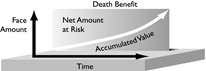
| | 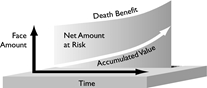
| | 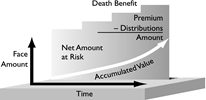
|
The Death Benefit is designed
to remain level. | | The Death Benefit changes as your Policy’s Accumulated Value changes. The
better your Investment Options perform, the larger the Death Benefit will be, but will never be lower
than Death Benefit Option A. | | The more premiums you pay and the less you withdraw, the larger the Death Benefit
will be. |
The graphs are intended to show how the Death
Benefit Options work and are not predictive of investment performance in your Policy. The Death Benefit
Option selected by an investor impacts the dollar value of the Death Benefit,
the charges paid, and the resulting Accumulated Value.
Limits
on Option C
The following
limits apply to Option C:
● Option C must be elected at Policy issue.
● To
elect Option C, the Insured must be Age 80 or younger at the time the Policy is issued.
● The
calculation of the total premiums paid under Option C will be equal to the minimum of (1) the total premiums
paid, minus any withdrawal or distributions that reduce
the Accumulated Value; or (2) the Option C Death Benefit Limit shown in your Policy Specifications minus
the Face Amount of your Policy.
● Once
the Policy is issued, the Option C Death Benefit Limit will not change, even if you increase or decrease
the Face Amount of your Policy or any Rider. However if you
change your Death Benefit Option from Option C to Option A or Option B, the Option C Death Benefit Limit
will no longer apply to the Policy.
● We
will not approve any increase in Face Amount to the Policy or any Rider that would cause the Death Benefit
to exceed the Option C Death Benefit Limit.
Changing Your Death Benefit Option
You
can change your Death Benefit Option while your Policy is In Force, subject to the following:
● You
can change the Death Benefit Option once in any Policy Year.
● You must send us your Written Request.
● You
can change from any Death Benefit Option to Option A or Option B. If you elect the Premier LTC Rider
or the Premier Chronic Illness Rider, you can only change to Option
A after exercising the rider (as defined in the Premier LTC Rider and Premier Chronic Illness Rider sections,
accordingly).
● You cannot change from Death Benefit Option
A or B to Option C.
● The change will become effective on the first
Monthly Payment Date after we receive your request. If we receive your request on a Monthly
Payment Date, we will process it that day.
● We
will not let you change the Death Benefit Option if doing so means the Basic Face Amount of your Policy
will become less than $1,000.
34
● Changing
the Death Benefit Option can also affect the monthly cost of insurance charge since this charge varies
with the Net Amount At Risk.
● The new Death Benefit Option will be used in
all future calculations.
We
will not change
your Death Benefit
Option if it
means your Policy
will be treated
as a Modified
Endowment Contract, unless
you have told
us In Writing
that this would
be acceptable to
you. Modified Endowment
Contracts are discussed
in the VARIABLE
LIFE INSURANCE AND
YOUR TAXES section
in this prospectus.
Changing
your Death Benefit Option will increase or decrease your Total Face Amount under the Policy. The Total
Face Amount of your Policy will change by the amount needed to
make the Death Benefit under the new Death Benefit Option equal the Death Benefit under the old Death
Benefit Option just before the change.
If the change is an increase in the Total Face
Amount, we will process the increase as described in the DEATH BENEFITS – Changing
the Face Amount – Other Increases
in Face Amount section in this prospectus. If
the change is a decrease in the Total Face Amount, we will process the decrease as described
in the DEATH BENEFITS – Changing the Face Amount – Processing
of Decreases section in this prospectus.
Death Benefit Qualification Test
In order for your Policy to be qualified as
Life Insurance under the Code, it must qualify under one of two Tests, the Cash Value Accumulation Test
(CVAT) or the Guideline Premium Test (GPT).
You choose one of these Death Benefit Qualification Tests
on your application. If no Death Benefit Qualification Test is chosen, we will confirm the desired
Death Benefit Qualification Test selection with your life insurance producer.
Your Death Benefit Qualification Test determines the following:
● Premium
limitations
● Amount of Minimum Death Benefit
Each test determines what the Minimum Death
Benefit should be in relation to your Policy’s Accumulated Value. The Death Benefit determined
under either test will be at least equal
to the amount required for the Policy to qualify as life insurance under the Tax Code. Once the Policy
is issued, the Death Benefit Qualification Test cannot
be changed. You may wish to consult your financial professional about which Death Benefit Qualification
Test to choose before making a selection.
Comparing
the Death Benefit Qualification Tests
The table
below shows a general comparison of how features of your Policy may be affected by your choice of Death
Benefit Qualification Test. When choosing between the tests,
you should consider:
| | | |
| | Cash
Value Accumulation Test | Guideline
Premium Test |
Premium
payments1 | Allows flexibility to pay more premium | Premium
payments are limited under the Tax Code |
Death Benefit | Generally higher than Guideline Premium
Test | Generally lower than CVAT |
Monthly cost of insurance
charges | May be higher, if the
Death Benefit is higher | May be lower, except in early years of
Policy. |
Face Amount decreases | Will
not require return of premium or distribution of Accumulated Value | May require return of premium or distribution
of Accumulated Value to continue Policy as life insurance |
1 If
you want to
pay a premium
that increases the
Net Amount At
Risk, you will
need to provide
us with satisfactory
Evidence of Insurability
before we can
increase the Death
Benefit. In this
event, your cost
of insurance charges
will also increase.
Cost of insurance
charges are based,
among other things,
upon your Policy’s
Net Amount At
Risk. See YOUR
POLICY’S ACCUMULATED VALUE for
more information on how cost of insurance charges are calculated.
Examples
of Death Benefit Calculations
The tables
below compare the Death Benefits provided by the Policy’s available Death Benefit Options. The
examples are intended only to show differences in Death
Benefits and Net Amounts at Risk. Accumulated Value assumptions may not be realistic.
These
examples show that each Death Benefit Option provides a different level of protection. Keep in mind that
generally, cost of insurance charges, which affect your Policy’s
Accumulated Value, increase over time. The cost of insurance is charged at a rate based on the Net Amount
At Risk. As the Net Amount At Risk increases, your
cost of insurance increases. Accumulated Value also varies depending on the performance of the Investment
Options in your Policy.
The examples
displayed in the tables below represent varied outcomes using differing testing methods. The Cash Value
Accumulation Test may be more beneficial if you want more flexibility in your ability to pay more premium
into the policy, though you may experience higher policy charges. The Guideline Premium Test may be more
beneficial if you want to limit your policy’s charges,
35
though the amount of premium you pay into the policy is limited according to the
Tax Code.
The example below assumes the following:
● The
Insured is Age 45 at the time the Policy was issued and dies at the beginning of the tenth Policy Year;
● Face
Amount is $100,000
● Accumulated Value at the date of death is $25,000
● Total
premium paid into the Policy is $30,000
● The Minimum Death Benefit under the Guideline
Premium Test is $39,250 (assuming a Guideline Minimum Death Benefit Percentage of 157% of
the Accumulated Value)
● The Minimum Death Benefit under the Cash Value
Accumulation Test is $43,250 (assuming a Cash Value Accumulation Test Minimum Death Benefit
Percentage of 173% of the Accumulated Value).
| | | | | |
| | If you
select the Guideline Premium Test, the Death Benefit is the larger of these two amounts |
Death Benefit Option | How it’s calculated | Death Benefit under the Death Benefit Option | Minimum Death Benefit | Net Amount At Risk used for
cost of insurance charge |
Option
A | Total Face Amount | $100,000 | $39,250 | $74,917.12 |
Option
B | Total Face Amount plus Accumulated Value | $125,000 | $39,250 | $99,896.40 |
Option
C | Total Face Amount plus premiums less distributions | $130,000 | $39,250 | $104,892.25 |
| |
| | If you select the Cash Value Accumulation Test, the Death Benefit
is the larger of these two amounts |
Death Benefit Option | How it’s calculated | Death Benefit under the Death Benefit Option | Minimum Death Benefit | Net Amount At Risk used for
cost of insurance charge |
Option
A | Total Face Amount | $100,000 | $43,250 | $74,917.12 |
Option
B | Total Face Amount plus Accumulated Value | $125,000 | $43,250 | $99,896.40 |
Option
C | Total Face Amount plus premiums less distributions | $130,000 | $43,250 | $104,892.25 |
If
the Death Benefit equals the Minimum Death Benefit, any increase in Accumulated Value will cause an automatic
increase in the Death Benefit.
Here’s
the same example, but with an Accumulated Value of $75,000. Because Accumulated Value has increased,
the Minimum Death Benefit is now:
● $117,750 for the Guideline Premium Test
● $129,750
for the Cash Value Accumulation Test.
| | | | | |
| | If you
select the Guideline Premium Test, the Death Benefit is the larger of these two amounts |
Death Benefit Option | How it’s calculated | Death Benefit under the Death Benefit Option | Minimum Death Benefit | Net Amount At Risk used for
cost of insurance charge |
Option A | Total Face Amount | $100,000 | $117,750 | $42,652.41 |
Option B | Total Face Amount plus Accumulated Value | $175,000 | $117,750 | $99,854.96 |
Option C | Total Face Amount plus premiums less distributions | $130,000 | $117,750 | $54,892.25 |
| |
| | If you select the Cash Value Accumulation Test, the Death Benefit
is the larger of these two amounts |
36
| | | | | |
Death Benefit Option | How it’s calculated | Death Benefit under the Death
Benefit Option | Minimum Death
Benefit | Net Amount At Risk used for
cost of insurance charge |
Option A | Total Face Amount | $100,000 | $129,750 | $54,642.46 |
Option B | Total Face Amount plus Accumulated Value | $175,000 | $129,750 | $99,854.96 |
Option C | Total Face Amount plus premiums less distributions | $130,000 | $129,750 | $54,892.25 |
When We
Pay the Death Benefit
We calculate
the amount of the Death Benefit Proceeds effective the end of the day the Insured dies. If the Insured
dies on a day that is not a Business Day, any portion of the Death
Benefit Proceeds attributed to the Variable Accumulated Value is determined as of the next Business Day.
We will pay the Death Benefit Proceeds after receiving proof
that the Insured died while the Policy was In Force, along with payment instructions. Your
Beneficiary can choose to receive the Death Benefit Proceeds in a lump sum or
we may make other options available in addition to the single check option.
Death
Benefit Proceeds equal the total of the Death Benefits provided by your Policy and any Riders you have
added, minus any Total Policy Debt, minus any overdue Monthly Deductions.
If required by state law, we will pay interest on the Death
Benefit Proceeds from the date of death to the date the claim is paid at a rate not less than the rate
payable for funds left on deposit that is in effect on the date of death which,
will vary by state. See the APPENDIX: STATE LAW VARIATIONS –
TIMING OF PAYMENTS, FORMS AND REQUESTS section in this prospectus.
It
is important that we have a current address, social security number, telephone number and email address
for each designated Beneficiary so that we can pay Death Benefit Proceeds
promptly. If we cannot pay the Death Benefit Proceeds to the designated
Beneficiary within the dormancy period defined by a state's Unclaimed
Property laws or regulations, we will be required to pay the Death Benefit Proceeds to the applicable
state. Once the Death Benefit Proceeds are paid to a state, any subsequent claim
by a designated Beneficiary must be made with the applicable state. For more information, check
with the state to whom the Death Benefit Proceeds were paid.
37
OTHER BENEFITS AVAILABLE UNDER THE POLICY
In
addition to the standard Death Benefits associated with your Policy, other standard and/or optional benefits
may also be available to you. The following table summarizes information about
those benefits. Information about the fees associated with each benefit included in the table may be found
in the FEE TABLES section.
Certain
Policy features and benefits described in this prospectus may vary or may not be available depending
on the broker-dealer through which your Policy is sold. See APPENDIX:
FINANCIAL INTERMEDIARY VARIATIONS in this prospectus for more information.
| | | | |
Name of Benefit | Purpose | Is
Benefit Standard or Optional? | Brief
Description of Restriction/Limitations |
Dollar Cost Averaging | Allows
you to make scheduled transfers between Variable Investment Options. | Standard | ● Each transfer must be for $50 or more. ● Transfers may not be made to or from the Fixed Options or the Indexed
Fixed Options. ● Transfers
can be scheduled monthly, quarterly, semi- annually or annually. ●
The Variable Investment Option must have at least $5,000 to start. ●
The amount remaining in a Variable Investment Option after a transfer must be at least $500. ● May not use this service and the Portfolio Rebalancing, First Year Transfer,
or Fixed Option Interest Sweep at the same time. ●
There is no assurance that dollar cost averaging will be a successful strategy. |
First Year Transfer | Allows you to make monthly transfers from
the Fixed Account to the Variable Investment Options during the Policy’s first year. | Standard | ● Must enroll when you apply for the Policy. ● Transfers may not be
made between the Variable Investment Options. ● May
not use this service and the Dollar Cost Averaging, Portfolio Rebalancing, or Fixed Option Interest Sweep
at the same time. |
Fixed Option Interest Sweep | Allows you to make scheduled transfers
of the accumulated interest earnings from the Fixed Account to the Variable Investment Options. | Standard | ● Each transfer must be at least $50. If the earnings
are not $50 at the time of transfer, the transfer will be held until the next scheduled transfer date
when the interest earnings are at least $50. ● May
not use this service and the Dollar Cost Averaging, Portfolio Rebalancing, or First Year Transfer at
the same time. |
Portfolio Rebalancing | Allows you to make automatic transfers
among the Variable Investment Options according to your allocation instructions. | Standard | ● Transfers may not be made to or from the Fixed Options
or the Indexed Fixed Options. ●
Transfers can be scheduled monthly, quarterly, semi-annually, or annually. ● If you make transfers out of the Variable |
38
| | | | |
| | | | Investment
Options you selected under the service, the service will end. You will have to wait 30 days before you
can re-enroll with new allocation instructions. ●
May not use this service and the Dollar Cost Averaging, First Year Transfer, or Fixed Option Interest
Sweep at the same time. |
Automated Income Option | Allows you to make scheduled withdrawals
or loans from the Policy. | Standard | ● This option is available for use after the 7th Policy
Anniversary. ●The Policy must have a minimum
Net Cash Surrender Value of $50,000 to start withdrawals or loans under this option and cannot be a Modified
Endowment Contract. ● Only one type
of loan may be elected at one time. ●
Withdrawals or loans can be scheduled monthly or annually. ●
Each withdrawal or loan must be at least $500 for monthly or $1,000 for annual payments. ● Withdrawals or loans will be taken proportionately from the Fixed Accumulated
Value and the Variable Accumulated Value until it has been reduced to zero. Any remaining deductions
will be taken proportionate to each Segment Value across all segments in the Indexed Accounts. ● Any additional withdrawal or loan made that is not
part of this option will cause this option to cancel and delay in restarting a new schedule under this
option. ● Withdrawals and loans under this
program may reduce Policy values and the Death Benefit, perhaps significantly, and may increase your
risk of lapse. ● Withdrawals
and loans under the AIO program may result in tax liability. |
Scheduled
Indexed Transfer Program | Allows you to make scheduled transfers from the Fixed Account to the available
Indexed Fixed Options. | Standard | ● Must specify one of the two available methods to make
the allocation: the Specified Amount method or the Period Depletion method. ● Allocations from the Fixed Account to new segments of an Indexed Fixed
Option will occur on the Transfer Date after any other transfers or premium payments allocations have
occurred. |
Long Term Performance Rider (LTPR) | Provides insurance on the Insured in combination
with the Basic Face Amount of the Policy. | Optional | ●
Must be elected at Policy issue. ●
Additional cost applies. ● Available
for Insured’s Age 90 or younger at issue. ●
Any increase in Face Amount under the Rider will be subject to satisfactory evidence of insurability. |
39
| | | | |
| | | | ●
Rider termination may only occur on a monthly anniversary. ●
Cannot be issued with the Surrender Value Enhancement Rider 3. |
Surrender
Value Enhancement Rider 3 (SVER) | Provides insurance on the Insured in combination with the Basic Face Amount of
the Policy. | Optional | ● Must be elected at Policy issue. ● Additional cost applies. ●
Any increase in Face Amount under the Rider will be subject to satisfactory evidence of insurability. ● Cannot be issued with the LTPR. |
Scheduled Annual Renewable Term Rider (S-ARTR) | Provides
for scheduled increases in insurance on the Insured generally without the requirements for future medical
underwriting. | Optional | ● Must be elected at Policy issue. ● Additional cost applies. ●
Does not provide term insurance at Policy issue, only as scheduled on certain Policy Anniversaries. ● Any request for an increase in the amount of future
scheduled insurance may be subject to evidence of insurability and is subject to our approval. ● The amount of scheduled insurance under this rider
is limited based on age of the insured. ●
If you reject a scheduled increase that has been approved, all future increases may be forfeited. |
Flexible Duration No-Lapse Guarantee (FDNLG) Rider | Provides
that the Policy and any optional benefits you have selected will remain In Force even if the Policy’s
Net Cash Surrender Value is insufficient to cover the total monthly deduction, provided that the No-Lapse
Guarantee Value less any Policy Debt is greater than zero. | Optional | ●
Must be elected at Policy issue. ●
Additional cost applies. ● Available
if Insured is at least age 18 and is no older than age 90 at Policy issue. ●
At the initial purchase and during the entire time that you own this rider, you must allocate 100% of
your Accumulated Value among the allowable Investment Options for the Rider listed under the APPENDIX:
FUNDS AVAILABLE UNDER THE POLICY – Allowable Investment Options section in this prospectus
or the Rider will terminate. ●
The no-lapse guarantee applies as long as the Net No- Lapse Guarantee Value (No-Lapse Guarantee Value
less any Total Policy Debt) is greater than zero. ●
The No-Lapse Guarantee Value depends on a number of factors including amount and timing of premiums paid
and hypothetical values under the rider which are affected by Policy loans, withdrawals, interest rates,
Policy changes, and other factors. ●
Benefit will terminate upon electing an unscheduled increase in Face Amount under the Policy. |
40
| | | | |
Up
to Age 90 No-Lapse Guarantee (NLG) Rider | Protects the Policy from lapsing for a
specified guaranteed period of time due to poor Policy performance. | Standard,
if eligible | ● Automatically issued on your Policy if Insureds are
Age 79 and younger and Death Benefit Option A or B is chosen at Policy Issue. ● Subject to the above, the guarantee period is based on the age of the
Insured when the Policy is issued and ends on the Policy Anniversary when the Insured reaches attained
age 90. ● The range a guarantee period may
last is 11 years (if the Insured is Age 79) to 90 years (if the Insured is Age 0). Your guarantee period
is shown in your Policy specifications. ●
Benefit will be provided if a certain amount of premium is paid each Policy month. ● The no-lapse guarantee is in effect as long as the No-Lapse Credit less
Policy Debt is equal to or greater than zero. The No-Lapse Credit depends on a number of factors and
is affected by Policy loans, premiums, and withdrawals. ●
Benefit will terminate if any rider added to the Policy after issue has charges. |
Overloan Protection 3 Rider | Provides Policy lapse protection if Policy
debt through a Standard Loan is greater than the Accumulated Value, resulting in the Policy being overloaned. | Standard | ● Automatically issued on your Policy if eligibility
requirements are met. ● Additional
one-time cost at exercise of benefit. ●
Benefit cannot be exercised during the first 15 Policy years, before the Insured is Age 75, while there
is an Alternate Loan in effect, the Policy has entered the Grace Period, or if Death Benefit Option B
or C was elected (can change to Option A to exercise benefit). ●
Once exercised, no premiums, withdrawals, loan repayments (other than loan interest due), a Policy benefit
change or addition at your request, or transfers at your request between Investment Options may occur. ● If the Rider is exercised, all Accumulated Value in
the Investment Options and Segment Maturity Value of any Indexed Account at Segment Maturity will be
transferred to the Fixed Account. ●
If the Rider is exercised, any accelerated death benefit riders (Premier LTC, Premier Living Benefit
2, Premier ●Chronic Illness, and Terminal Illness
Riders) will terminate and any increases in Face Amount that are scheduled to take effect after exercise
of this Rider will be cancelled. |
41
| | | | |
Premier
LTC Rider | Provides access to all or a portion of the Policy death benefit proceeds if the
Insured has been certified as a chronically ill individual. | Optional | ●
Must be elected at Policy issue. ● Satisfactory Evidence of Insurability
is required. ● Additional cost applies. ● Subject to the eligibility and other conditions described
in the rider. Some of the conditions include the Insured being certified as a chronically ill individual,
meeting the 90-day Elimination Period before benefits are payable, and obtaining written consent for
benefit payments by any assignee or irrevocable Beneficiary. ●
This Rider will not pay for care or services under certain circumstances as outlined in the Rider. ● Cannot be added to a Policy that was issued with the
Premier Living Benefits Rider 2 or the Premier Chronic Illness Rider. ● Payments are made monthly. ●
Chronic Illness must be certified by a licensed health care practitioner (not the insured, owner, beneficiary,
or relative). ● If the Rider is exercised, certain
Policy values including the Total Face Amount, Death Benefit, Accumulated Value, loan amounts, and Cost
of Insurance charges (in most cases) will be reduced. In addition, any Automated Income Option or other
Systematic Distribution Program will be discontinued. |
Premier
Chronic Illness Rider | Provides access to a portion of the Policy Death Benefit Proceeds if the Insured
has been certified as chronically ill. | Optional | ● Available at Policy issue. ● Satisfactory Evidence of Insurability is required. ● Not available for Policies issued in California. ● Cannot be issued with the Premier Living Benefits Rider 2 or the Premier
LTC Rider. ● Available if Insured is at least
age 18 and no older than age 75 at Policy issue. ●
Subject to the eligibility and other conditions described in the Rider such as certification of having
a chronic illness, making a Written Request for benefits, and not exceeding the maximum amount of the
Death Benefit that may be utilized for chronic illness benefits. ●
When benefits are paid, certain Policy values (the Total Face Amount, Accumulated Value, Policy loans,
Policy Debt, Loan Account, Loan Account Value and any Surrender Charges) will be reduced by the Acceleration
Percentage. In addition, any Automated Income Option or other Systematic Distribution Program will be
discontinued. ● Chronic illness benefits may be
requested once every 12-month period. ●
Chronic illness must be certified by a licensed |
42
| | | | |
| | | | health
care practitioner (not the Insured, Owner, or Immediate Family Member). ● During a Benefit Year (as defined in the Premier Chronic Illness Rider
section), a Policy Owner can only change from Death Benefit Option B to Option A. ● During a Benefit Year, transfers from the Fixed Account to the Variable
Investment Options are not permitted. ●
Transfers to the Indexed Fixed Account are not permitted. ●
Overloan protection riders will terminate at the time the first Terminal Illness Benefit Proceeds are
paid. |
Premier Living Benefits Rider 2 | Provides access to all or a portion of
the Policy death benefit proceeds if the Insured has been certified as a chronically ill individual or
a terminally ill individual. | Optional, if eligible | ● Automatically
added at Policy issue if eligible. ●
Policy Owner may opt out of this Rider. ●
Satisfactory Evidence of Insurability is required. ●
Cannot be issued with the Terminal Illness Rider, the Premier Chronic Illness Rider, or the Premier LTC
Rider. ● Subject to the eligibility and other conditions described
in the rider such as certification of having a chronic or
terminal illness, making a Written Request
for benefits, and not exceeding the maximum amount of the Death Benefit that may be utilized for chronic
or terminal illness benefits. ●
When benefits are paid, the Policy death benefit will be reduced by an amount greater than the benefit
payment. Other Policy values will be reduced pro rata. ●
Chronically ill benefits may be requested once every 12-month period. ● Chronic illness must be certified by a licensed health care practitioner
(not the insured, owner, beneficiary, or relative). ●
Terminal illness must be certified by a licensed physician (not the insured, owner, beneficiary, or relative). ● Once the Rider is exercised, we will not allow any
requested increases in benefits under the Policy or any Riders. ●
If the Rider is exercised, certain Policy values including the Total Face Amount, Death Benefit, Accumulated
Value, loan amounts, and Cost of Insurance charges (in most cases) will be reduced. In addition, any
Automated Income option or other Systematic Distribution Program will be discontinued. |
43
| | | | |
Terminal
Illness Rider | Provides access to a portion of the Policy Death Benefit Proceeds if the Insured
has been certified as a terminally ill individual. | Optional, if eligible | ●
Available at Policy issue. ● Not available
for Policies issued with the Premier Living Benefits Rider 2. ●
You may only exercise this Rider benefit once. ●
You may opt out of the Rider at any time. ●
Subject to the eligibility and other conditions described in the Rider such as certification of having
a terminal illness, making a Written Request for benefits, and not exceeding the maximum amount of the
Death Benefit that may be utilized for terminal illness benefits. ●
Terminal illness must be certified by a licensed physician (not the Insured, Owner, or Immediate Family
Member). ● When benefits are paid, certain
Policy values (the Total Face Amount, Accumulated Value, Policy Debt, Loan Account, Loan Account Value,
and any Surrender Charges) will be reduced by the Acceleration Percentage. In addition, any Automated
Income option or other systematic Distribution Program will be discontinued. |
Conversion
Rider | Allows you to convert eligible coverages into a new Policy. | Standard | ● Automatically added at Policy issue. ● If the Policy’s Face Amount has been increased and that resulted
in insurance coverage with Risk Classes that differ from the Policy’s original insurance coverage,
the new Policy will be issued with the Risk Class of the most recent insurance coverage added. ● If exercised, a new Policy will be issued and any
insurance coverage under this Policy will terminate. |
Alternate
Loan Rider 3 | Allows an alternative to the Standard Loan under the Policy and when you borrow
money using the Indexed Accounts as security for the loan, the money backing the loan will remain invested
in those Indexed Accounts. | Standard | ● Automatically added at Policy issue. ● Available starting in Policy Year 3. ●
Must have Accumulated Value allocated to the Indexed Accounts to use this loan. ● Loan interest rate charged on amount borrowed is higher than the Standard
Loan interest rate. ● Currently,
all Indexed Accounts are available for use with this benefit. |
Minimum
Indexed Benefit Rider | Allows for a termination credit when the interest credited to certain Indexed
Accounts is less than the charges attributable to those Indexed Accounts. | Standard | ● Automatically added at Policy issue. ● Will not provide a benefit if the interest credited to the Indexed Accounts
is greater than certain charges when the Policy is no longer In Force. ● Benefit will be reduced when a benefit payment is made under any rider
that pays an accelerated death benefit. |
44
OPTIONAL RIDERS AND BENEFITS
You
may select to add to your Policy various optional Riders that provide extra benefits. Some Riders are
available with an additional cost. We will add any ongoing Rider charges to the Monthly Deductions. Some
Rider charges apply upon exercise of the benefit or benefit-related requests. Each Coverage
type, including those offered through Coverage Riders, incurs its own set of charges with unique features
and benefits. When considering Coverage types, you should ask your financial professional to show you
Policy Illustrations with and without Coverage Riders to help show the impact on the Policy’s values.
See the FEE TABLES section
in this prospectus for information about Rider charges.
Not all
Riders are available in every state. See APPENDIX: STATE LAW VARIATIONS. Some
broker-dealers may limit their clients’ ability to purchase some optional Riders based on the client’s
age or other factors. Ask your financial professional for more information about
the Riders available with the Policy. You should work with your financial professional to decide whether
an optional Rider is appropriate for you. See the Appendix: Financial Intermediary
Variations for more information.
The available optional Riders include:
• Three Coverage Riders that provide insurance
Coverage in addition to the Basic Coverage available under the Policy.
• Three
Riders that provide no-lapse guarantees that may keep a Policy In Force even if the Policy’s Accumulated
Value is not sufficient to pay Monthly Deductions.
• Four Riders that provide accelerated Death
Benefits.
The table in the OTHER BENEFITS
AVAILABLE UNDER THE POLICY section above provides an overview of these
optional Riders for you to compare.
Below
is a summary of the Coverage Riders, no-lapse guarantee Riders, and accelerated death benefit Riders
followed by a description of each Rider.
Summary
of Coverage Riders
In addition to the Basic
Life Coverage that is provided under the Policy, you may also select insurance Coverage under:
• Long
Term Performance Rider (LTPR). This Rider provides additional insurance on
the Insured in combination with the Face Amount of the Policy. A Coverage Layer is provided at Policy
issue if you select the LTPR. This Rider has a Surrender Charge that increases the total Surrender Charge
under the Policy based on the Face Amount of each LTPR Coverage Layer, including any increase in Coverage.
The LTPR Surrender Charge applies for 10 years after each LTPR Coverage’s Coverage Layer Date.
If the Policy is surrendered during any Coverage Layers’ 10-year period, the Coverage Layers’
Surrender Charge will be deducted from the Policy’s Accumulated Value. The Rider also has a Termination
Charge based on each LTPR Coverage Layer. The LTPR Termination Charge applies for 10 years after each
LTPR Coverage’s Coverage Layer Date. If you terminate the LTPR during any Coverage Layers’
10-year period, while the Policy remains In Force, we will deduct the Coverage Layers’ Termination
Charge from your Policy’s Accumulated Value and the Policy Surrender Charge will be reduced by
and no longer include the surrender charge associated with LTPR Coverage. You may request increases or
decreases in the Face Amount provided by the Rider. Any increase will be subject to satisfactory Evidence
of Insurability and will result in new Coverage Charges, new LTPR Surrender Charges and new Termination
Charges for the new Coverage Layer. The Coverage Charges associated with LTPR are not reduced or eliminated
unless the LTPR is terminated.
• Surrender Value Enhancement Rider 3 (SVER).
This Rider provides additional insurance on the Insured in combination with the Face Amount of the Policy.
A Coverage Layer is provided at Policy issue if you select this Rider. You may request increases or decreases
in the Face Amount provided by the Rider. Any increase will be subject to satisfactory Evidence of Insurability
and will result in new Coverage Charges for the new Coverage Layer. The Coverage
Charges associated with SVER are not reduced or eliminated unless the SVER is terminated.
• Scheduled
Annual Renewable Term Rider (S-ARTR). This Rider provides insurance on the Insured
on a specified schedule you select. A Coverage Layer is not provided at Policy issue. No future Evidence
of Insurability is required for the scheduled increases in Face Amount provided by the Rider.
Possible Combinations with other Coverages
• Basic
only
• Basic
and S-ARTR
• Basic
and LTPR
45
• Basic,
LTPR, and S-ARTR
• Basic and SVER
• Basic,
SVER, and S-ARTR
The chart below provides
a high-level summary of the different types of Coverages under the Policy, LTPR, SVER, and S-ARTR.
| | | | | |
| | Long
Term Performance Rider (LTPR) | Basic
Life Coverage (Basic) | Surrender
Value Enhancement Rider 3 (SVER) | Scheduled
Annual Renewable Term Rider (S-ARTR) |
Summary | Provides additional insurance Coverage along with the Basic
Coverage May provide greatest long-term Accumulated Value due to Additional Credits but
lowest short-term Accumulated Value due to Surrender Charges and Termination Charges | Provides Basic insurance
Coverage May provide lower Additional Credits than the LTPR and the lowest required premiums
for the no-lapse guarantee riders | Provides
additional insurance Coverage along with the Basic Coverage May provide best opportunity
for early Cash Surrender Value because no Surrender Charges or Termination Charges apply to the Rider
Coverage, but lowest long-term Accumulated Value because no Additional Credits apply | Provides additional insurance
Coverage in specified amounts on a specified schedule |
Cost of Insurance | | | | |
Current Rates | Generally,
same current rates as Basic | Generally,
same current rates as LTPR | Generally
higher current rates than LTPR and Basic | Because the current rates are based upon when additional Coverage
is added, the current rates are generally higher than Basic and LTPR |
Guaranteed Rates | Same guaranteed Cost of Insurance Rates apply to all |
Coverage Charge | | | | |
When Current Coverage Charges are Assessed | For Death Benefit Option
A & C, the Coverage Charge is assessed for 10 years for each Coverage Layer starting on its Coverage
Layer Date For Death Benefit Option B, the Coverage Charge is assessed for 5 years for each
Coverage Layer starting on its Coverage Layer Date | The Coverage Charge is assessed for 10 years for each Coverage
Layer starting on its Coverage Layer Date | The Coverage Charge is assessed in years 2-10 for each Coverage
Layer | None
currently assessed |
How Coverage Charges are determined | Based on the Face Amount
of each Coverage Layer | Not
applicable |
46
| | | | | |
| | Long
Term Performance Rider (LTPR) | Basic
Life Coverage (Basic) | Surrender
Value Enhancement Rider 3 (SVER) | Scheduled
Annual Renewable Term Rider (S-ARTR) |
Current Coverage Charge Rates | For Death Benefit Option
A & C, the current rate is the same for all 10 years For Death Benefit Option
B, the current rate is the same for all 5 years | For Death Benefit Option A & C, the current rate is the
same for the first 3 years, and then a lower rate applies in years 4-10 For
Death Benefit Option B, the current rates decrease each year | The current rate is the same in years 2-5, and then a higher
rate applies in years 6-10 | Not
applicable |
Guaranteed Maximum Coverage Charge Rate | Higher guaranteed maximum rate than Basic | Lower guaranteed maximum
rate than LTPR, SVER, and S-ARTR | Higher
guaranteed maximum rate than Basic | Higher
guaranteed maximum rate than Basic |
Surrender Charge | For each Coverage Layer,
the Surrender Charge applies for 10 years starting on its Coverage Layer Date | No Surrender Charge applies for the Rider Coverage |
Surrender Charge Rate | Is
higher than the Surrender Charge rate for Basic | Is lower than the Surrender Charge rate for LTPR | Not applicable |
Termination Charge | For each Coverage Layer,
the Termination Charge applies for 10 years starting on its Coverage Layer Date | No Termination Charge applies for the Rider Coverage |
Additional Credits | Additional
Credits may be added that may be higher than Additional Credits for Basic | Additional Credits may
be added that may be lower than Additional Credits for LTPR | No Additional Credits
are added |
No-Lapse
Guarantee | Generally,
higher required Premiums compared to Basic | Generally, lower required Premiums than for LTPR and SVER
and provides the opportunity for the best no-lapse guarantee | Generally, higher required Premiums compared to Basic | Each
scheduled increase in S-ARTR will generally result in a lower no-lapse guarantee duration than it was
prior to the increase |
Ability
to Convert Coverage | Coverage can be converted to another policy in year 8 | Not available |
Underwriting
Considerations | Underwriting is required for increases in Coverage | No underwriting is required
for scheduled increases in Coverage |
The
charts below compare the hypothetical Cash Surrender Values of three different scenarios over the course
of 40 Policy Years. The Total Face Amount in each scenario is $1,000,000. The three different scenarios
have the following Coverages and Face Amounts associated with each Coverage:
● $1,000,000 of Basic Coverage
47
● $10,000
of Basic Coverage + $990,000 of LTPR Coverage, the maximum ratio allowed for LTPR
● $10,000 of Basic Coverage + $990,000 of SVER Coverage, the
maximum ratio allowed for SVER
This chart assumes:
● An
insured male age 45 with a super preferred rating
● 10 premium payments of $14,746
● 7% gross rate (6.55% net)
● Current charges
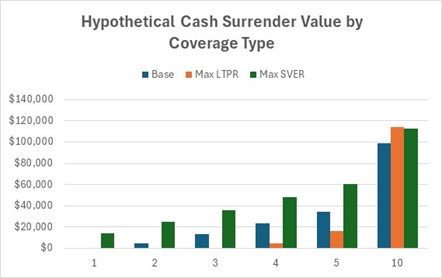
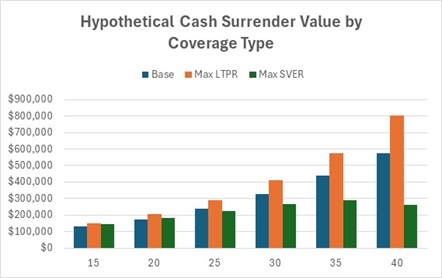
Summary
of No-Lapse Guarantee Riders
This
Policy currently offers three no-lapse guarantee riders. The Riders are the Flexible Duration No-Lapse
Guarantee Rider (FDNLG), the Up to Age 90 No-Lapse Guarantee
Rider (NLG), and the Overloan Protection 3 Rider.
● Up
to Age 90 No-Lapse Guarantee Rider. The
no lapse guarantee under this Rider is designed to last for a certain guarantee period as long as certain
minimum premiums are paid. This Rider provides that the Policy and
any optional benefits you have elected will remain In Force during the guarantee period as long as the
No-Lapse Credit less Policy Debt is equal to or greater than zero. The Rider is available at Policy issue
for Insureds Age 79 and younger and if you choose Death Benefit
Option A or B when applying for your Policy. This Rider is automatically added to the Policy if eligibility
conditions are met.
48
● Flexible
Duration No-Lapse Guarantee Rider. The no lapse guarantee under this Rider can
cover the lifetime of the Insured and is designed to provide
no-lapse protection for a period longer than the No-Lapse Guarantee Rider. This Rider provides that the
Policy and any optional benefits you have elected will remain In Force even if the Policy’s Net
Accumulated Value is insufficient to cover the total monthly deduction, provided that the No
Lapse Guarantee Value less any Policy Debt is greater than zero.
● Overloan
Protection 3 Rider. The no lapse guarantee under this Rider is designed to prevent
the Policy from lapsing when the Standard Policy Debt is greater
than the Policy’s Accumulated Value resulting in the Policy being overloaned. There are restrictions
on when this Rider may be exercised. This Rider is available at Policy issue for Insureds Age 80 and
younger if the Guideline Premium Test is used as the Death Benefit Qualification Test. This
Rider is automatically added to the Policy if eligibility conditions are met.
Summary of Accelerated Death Benefit Riders
This Policy currently offers four accelerated
death benefit Riders. The Riders are the Premier LTC Rider, Premier Living Benefits Rider 2, Premier
Chronic Illness Rider, and the Terminal Illness Rider.
● Premier
LTC Rider. This Rider is a long-term care insurance rider that provides protection from
the financial impacts of requiring long-term care services
due to a chronic illness by providing acceleration of all or a portion of the Death Benefit. Benefit
payments are made monthly. This Rider is not available for a Policy issued with the Premier Living Benefits
Rider 2 or the Premier Chronic Illness Rider.
● Premier
Living Benefits Rider 2. This Rider provides protection from the financial impacts
of becoming chronically ill or terminally ill by providing acceleration
of a portion of the Death Benefit. Benefit payments for a chronic illness can be made monthly or as an
annual payment. Benefit payments for a terminal illness will
be paid in one lump sum. This Rider is not available for a Policy issued with the Terminal Illness Rider,
the Premier LTC
Rider,
or the Premier Chronic Illness Rider.
● Premier Chronic Illness Rider. This
Rider provides protection from the financial impacts of becoming chronically ill by providing acceleration
of a
portion of the Death Benefit. This Rider does not provide benefits for someone
who is terminally ill. The benefit payments can be made monthly or as an annual payment. This Rider is
not available for a Policy issued with the Premier Living Benefits Rider 2 or the Premier LTC Rider.
● Terminal
Illness Rider.
This Rider provides
protection from the
financial impacts of
becoming terminally ill
by providing acceleration
of a portion
of the Death
Benefit. This Rider
does not provide
benefits for someone
who is chronically
ill. The benefit
payments will be
paid in one
lump sum. This
Rider is not available if your Policy was issued with the Premier Living Benefits
Rider 2.
Complete information about
each Rider is below.
Optional
Riders and Benefits
Long Term
Performance Rider (LTPR)
Provides
insurance on the Insured and renews annually until the Policy terminates. The Rider is available for
Insureds Age 90 or younger at the time of Rider issue. The Rider modifies
the Death Benefit of the Policy to include the Face Amount of the Rider, so that the Death Benefit equals
the greater of the Death Benefit as calculated
under 1) the Death Benefit Option you choose on the Policy plus the Face Amount of the Rider, or 2) the
Minimum Death Benefit under the Death Benefit Qualification Test you have chosen. You may request increases
or decreases in Face Amount of the Rider, subject to certain limitations.
We reserve the right in our sole discretion to restrict elective increases in the Rider Face Amount to
one per Policy Year. This Rider does not have Accumulated
Value of its own and does not have any cash value. This Rider must be elected
at Policy issue. This Rider cannot be issued on a Policy with SVER
Coverage.
You should elect this Rider
if you desire potential better long-term performance of your Policy’s Accumulated Value (in exchange
for lower short-term liquidity) than would be
provided under Basic Life Coverage alone. This Rider reduces the Policy’s Cash Surrender Value
and Net Cash Surrender Value within the first 10 Policy
Years of any Coverage Layer due to the surrender charge associated with LTPR Coverage, which increases
the Policy Surrender Charge. This means that
during the first 10 Policy Years following any LTPR Coverage Layer Date, there may be less money available
under your Policy for withdrawals and Policy loans.
However, the Coverage Charge on LTPR Coverage may generally be lower compared to Basic Life Coverage,
and additional Policy credits, if any,
may be higher on LTPR Coverage compared to Basic Life Coverage. This may increase the Policy’s
Accumulated Value over time. See the section YOUR
POLICY’S ACCUMULATED VALUE – Additional Credit.
Rider
Charges
This Rider has a Rider Coverage
Charge, a Rider Cost of Insurance Charge, and a Rider Termination Charge, and it increases the Policy’s
Surrender Charge. Each Rider Coverage Layer
added to the Policy has its own set of charges. The Face Amount, Risk Class, effective date, Coverage
Layer Date, and charges for any Rider Coverage Layer
added after the Policy Date will be shown in
49
a Supplemental Schedule of Coverage sent to you at the mailing
address you have provided.
Coverage and Cost of Insurance Charges
The Rider Coverage Charge is the sum of Coverage charges for
each Rider Coverage Layer. The maximum monthly Coverage Charge for each Rider Coverage
Layer will be shown on the Policy Specifications. Generally, the LTPR Coverage Charge may be lower than
the Coverage Charge on Basic Life Coverage. The Rider Cost
of Insurance charge is the sum of the Cost of Insurance charge for each Rider Coverage Layer and is determined
as a rate per $1,000 of Net Amount At
Risk. The Coverage Layer Date and the Rider Coverage Charge associated with each Rider Coverage Layer
remain unchanged, even if that Rider Coverage
Layer is reduced to zero, until the Rider is terminated.
Surrender
and Termination Charges
Each
LTPR Coverage Layer has a Termination Charge while this Rider is in effect. The Termination Charge will
be effective as of Policy issue or the Coverage Layer Date, and
applies for 10 Policy Years. The Termination Charge is deducted from the Policy’s Accumulated Value
if you terminate the Rider while the Policy remains
in Force. The Policy Surrender Charge will also be reduced accordingly by the amount of the surrender
charge associated with LTPR Coverage. If the Policy’s
Net Accumulated Value after the Termination Charge is deducted is insufficient to cover your Policy’s
Monthly Deductions of Policy charges, the Policy
will go into a Grace Period. Each subsequent increase in LTPR Coverage will result in an additional Rider
Coverage Layer that has its own Termination
Charge that applies for 10 Policy Years after the Coverage Layer Date. For any Rider Coverage Layer representing
an increase in Coverage, the associated
Termination Charge will be provided in a Supplemental Schedule of Coverage.
The Termination Charge is based on the Face Amount of that
Coverage Layer, the Age and Risk Class of the Insured, and the Death Benefit Option, as of the
date the Coverage Layer is effective. The Termination Charge at issue = (LTPR
Termination Charge rate * LTPR Face Amount at issue). The new Termination
Charge on any Coverage Layer increase = (LTPR Termination Charge rate * LTPR Face Amount increase). The
Rider’s total Termination Charge
is the sum of the Termination Charges on any Rider Coverage Layer that has an associated Termination
Charge. We may charge less than the maximum Termination Charge
shown in the Fee Table. Each LTPR Coverage Layer also has a surrender charge associated with LTPR Coverage
which increases the Surrender Charge under the Policy while the Rider
is in effect. The Surrender Charge will be effective as of Policy issue or the Coverage Layer Date, and
applies for 10 Policy Years. The surrender charge associated with LTPR
Coverage is deducted from the Policy’s Accumulated Value if you surrender the Policy while the
Rider is in effect. Each subsequent increase in LTPR
Coverage will result in an additional Rider Coverage Layer that has its own surrender charge associated
with LTPR Coverage that applies for 10 Policy
Years after the Coverage Layer Date. For any Rider Coverage Layer representing an increase in Coverage,
the associated Surrender Charge will be provided
in a Supplemental Schedule of Coverage. The maximum Surrender Charges under the Policy include the sum
of the Surrender Charges on any Rider Coverage
Layer that has an associated Surrender Charge. We may charge less than the maximum Surrender Charge shown
in the Fee Table.
The initial surrender charge associated with LTPR Coverage
and initial Termination Charge applicable to your Policy for any such Rider Coverage Layer will
be effective as of its Coverage Layer Date and as of the beginning of each Coverage
Year (the anniversary of each Coverage Layer Date, which may be the same
as the Policy Anniversary) thereafter for 10 Policy Years following the Coverage Layer Date. The initial
LTPR Termination Charge and surrender charge associated with LTPR
Coverage will decrease on each Monthly Payment Date until the charge becomes $0 after 10 Policy Years
in the same manner
as the Policy’s Surrender
Charge on Basic Life Coverage. See the WITHDRAWALS, SURRENDERS AND LOANS – Surrendering
Your Policy section for more
information on the Surrender Charge. See the FEE TABLES section
in this prospectus for more information on the costs associated with this Rider. The
total Surrender Charge at Policy issue is shown on the Policy Specifications.
The surrender charges associated with the Rider will reduce
the Policy’s Cash Surrender Value and Net Cash Surrender Value. This is because the surrender
charge associated with LTPR Coverage increases the Policy’s total Surrender
Charge, which is used to determine the Cash Surrender Value and Net Cash Surrender
Value. This may reduce the amount available to you for withdrawals and Policy loans.
The LTPR Termination Charge will be deducted from the Policy’s
Accumulated Value under the following circumstances:
● If the Rider is terminated by Written Request,
or
● If the Rider is terminated when the Rider Face
Amount is reduced to zero due to a Death Benefit Option Change, a requested Face Amount
Decrease or a withdrawal, and the Policy remains In Force.
The Termination Charge will be deducted from
the Policy’s Accumulated Value on the first Monthly Payment Date on or following the date the Rider
is terminated, and your Policy’s Surrender Charge will
be reduced by and no longer include the surrender charge associated with LTPR Coverage. If the Rider
terminates for any other reason, including if an accelerated death benefit payment
reduces the Rider Face Amount to zero, the Termination Charge will not be deducted
from the Policy’s Accumulated Value.
Increases
or Decreases in Rider Face Amount
50
You may request an increase or decrease in the Rider Face
Amount.
Increases.
Each increase will be subject to satisfactory evidence of insurability. Any elected
increase in Rider Face Amount will add a new Coverage Layer. Each
Coverage Layer has its own Face Amount, Risk Class, Coverage Layer Date, and will have associated cost
of insurance, Coverage charge, Termination Charge, and surrender charge
associated with LTPR Coverage that increases your Policy’s total Surrender Charge. The increase
will become effective on the first Monthly Payment Date
on or following the date we receive and approve your request. We may limit increases of Rider Face Amount
to one per Policy year. We may deduct an administrative
charge (to evaluate insurability) not to exceed $100 from your Policy’s Accumulated Value on the
effective date of any requested increase.
Decreases. Decreases are permitted
on and after the first Policy Anniversary. Each decrease will be effective on the first Monthly Payment
Date on or following the date the Written
Request is received at our Consumer Markets Division. A Coverage charge is assessed in order to recover
the expense of issuing coverage on the
Policy. A Rider Face Amount decrease will not decrease its Coverage charge because the Rider’s
Coverage is based on the at coverage issue Face Amount
of the Rider. Similarly, a Rider Face Amount decrease will not decrease the Termination Charge or surrender
charge associated with LTPR Coverage. No surrender
charge associated with LTPR Coverage is imposed on a Face Amount decrease. The Termination Charge will
not be deducted upon a Rider Face Amount decrease unless the decrease
reduces the Rider Face Amount to zero and the Rider terminates. If the Rider terminates,
we will assess the Termination Charge against your Policy’s Accumulated
Value and reduce your Policy’s Surrender Charge by the amount of the surrender charge
associated with LTPR Coverage. If the Face Amount of this Rider is decreased, then the most recently
added Coverage Layer will be decreased or eliminated in the following
order:
● The
Face Amount of any scheduled annual renewable rider (e.g. S-ARTR);
● The
Face Amount of this Rider; and
● The Face Amount of Basic Life Coverage under
the Policy.
Rider
Termination
The Rider
will terminate on the earliest of
● Your Written Request;
● The
date the Policy is no longer In Force; or
● The date the Rider Face Amount decreases to
zero.
While the Policy remains
in force, LTPR termination and the deduction of the LTPR Termination Charge can only occur on a Monthly
Payment Date. If, after deducting the LTPR
Termination Charge, the Accumulated Value less any Total Policy Debt is insufficient to cover the current
Monthly Deduction, a 61-day Grace Period then
begins during which the Policy continues In Force. See the YOUR POLICY'S ACCUMULATED
VALUE – Lapsing and Reinstatement
section.
Upon Rider termination,
all Rider charges and any benefits associated with this Rider will be terminated. The Termination Charge
will reduce the Policy’s Accumulated Value, as described
above. Upon Rider termination, the Rider cannot be added back to the Policy.
Reinstatement
If
the Policy lapses and is later reinstated, then this Rider will also be reinstated as long as this Rider
was in effect on the date the Policy was no longer In Force.
Conversion
This Rider is not convertible.
Example
A
Policy is issued to an Insured at age 45, with a Face Amount of $250,000. The Policy also included $20,000
of insurance under this Rider which increases the Face Amount
to $270,000. The Rider charges (Rider Coverage Charge and Rider Cost of Insurance) are added to the Monthly
Deductions, and the surrender charge associated
with LTPR Coverage is added to the Policy’s total Surrender Charge. At age 50, the Insured requests
$15,000 of additional insurance under the Rider
and submits evidence of insurability. The increase is approved by us and the additional insurance is
added to the Policy increasing the Face Amount
to $285,000 ($250,000 under the base Policy plus $35,000 under the Rider).
Surrender Value Enhancement Rider 3 (SVER)
The SVER provides insurance on the Insured in combination
with the Face Amount of the Policy and may also provide higher early cash value. You may
purchase the Rider at Policy issue. The Rider modifies the Death Benefit of the Policy to include the
51
Face Amount of the Rider, so that the Death Benefit
equals the greater of the Death Benefit as calculated under 1) the Death Benefit Option you choose on
the Policy plus the Face Amount of the Rider, or 2)
the Minimum Death Benefit under the Death Benefit Qualification Test you have chosen. This Rider
must be elected at Policy issue. This Rider cannot
be issued on a Policy with LTPR Coverage.
The guaranteed
monthly cost of insurance rate and monthly Coverage charge will be shown in your Policy Specifications.
Our current cost of insurance rates for the Rider are lower
than the guaranteed rates.
You may
request increases or decreases in Face Amount of the Rider. Each increase will be subject to satisfactory
evidence of insurability and will have associated cost of insurance
and Coverage charges. Unless you request otherwise, the increase will become effective on the first Monthly
Payment Date on or following the date we receive
and approve your request. We may limit increases of Rider Face Amount to one per Policy Year. We may
deduct an administrative charge not to exceed $100 from your Policy’s
Accumulated Value on the effective date of any unscheduled increase. Decreases will be effective on the
first Monthly Payment Date on or following the date the Written Request is received at our Life Insurance
Division. A Face Amount decrease of this Rider will not decrease the Coverage charge. Decreases will
first be applied against the most recent increase, if any, and then against successively
earlier increases, if any, and finally against the original SVER Face Amount.
The Rider will terminate on the earliest of your Written Request,
or on lapse or termination of this Policy.
You should
elect this Rider if you desire higher short-term liquidity of your Policy’s Accumulated Value (in
exchange for lower long-term performance) than would
be provided under Basic Life Coverage alone. This Rider increases the Policy’s early Cash Surrender
Value and Net Cash Surrender Value since this Coverage
does not increase the Policy’s Surrender Charge and has no Coverage Charge in the first policy
year, though there are no additional Policy credits on SVER
Coverage. For more information, see the YOUR POLICY’S ACCUMULATED VALUE –
Additional Credit section in this prospectus.
Example
A Policy is issued to an Insured at age 45, with a Face Amount
of $250,000. The Policy also included $20,000 of insurance under this Rider which increases
the Face Amount to $270,000. The Rider charges (Rider Coverage Charge and Rider Cost of Insurance) are
added to the Monthly Deductions, though the Rider does not
increase the Policy’s total Surrender Charge. At age 50, the Insured requests $15,000 of additional
insurance under the Rider and submits evidence of insurability. The increase is approved by us and the
additional insurance is added to the Policy increasing the Face Amount to $285,000
($250,000 under the base Policy plus $35,000 under the Rider).
Scheduled
Annual Renewable Term Rider (S-ARTR)
The S-ARTR
Rider provides for scheduled annual renewable insurance Coverage in Face Amount without future medical
underwriting after policy issue. In this Rider, a scheduled
increase is referred to as a Term Increase, and is scheduled for a particular Policy Anniversary, as
shown in the Policy Specifications. The Face
Amount contributes to the Total Face Amount, and consequently to the Death Benefit, of the Policy. This
Rider does not have Accumulated Value of its
own and does not have any cash value. This Rider must be elected at Policy issue.
A Term Increase is a future increase in the
Face Amount of this rider. Each Term Increase will increase the Face Amount of the Rider Coverage Layer.
Once a Term Increase goes into effect, it becomes part of the Rider
Face Amount.
This
Rider provides no term insurance at the time of policy issue and only provides additional insurance coverage
as scheduled on certain Policy Anniversaries. If you wish
to have additional insurance coverage at the time of policy issue, you must purchase another rider such
as the LTPR or the SVER.
The guaranteed
monthly cost of insurance rates will be shown in your Policy Specifications. Our current cost of insurance
rates for the Rider are lower than the guaranteed rates.
This Rider has a Coverage charge that
varies by Coverage year and Rider Face Amount. Any increase or decrease in the Rider’s Face Amount
will impact the Coverage charge. The guaranteed monthly Coverage charges will be shown in the Policy
Specifications. We currently do not impose the Coverage charge for this Rider.
This
Rider also has
a Rider Charge
that will be
shown in your
Policy Specifications.
See the FEE
TABLES section in
this prospectus for
more information
on the costs associated with this Rider.
The Rider is available subject to the following:
● The maximum Term Increase at attained ages
0-79 is 20% of the Total Face Amount before the increase.
● The
maximum Term Increase at attained ages 80-94 is 5% of the Total Face Amount before the increase.
● Increases
will not be scheduled beyond attained age 94.
● Each
increase is an increase to the Coverage Layer at issue, and does not create a new Coverage Layer; the
original rates at
52
Policy issue will apply to the increase.
● The
cost of insurance charges will increase as a result of the increase in the Policy’s Net Amount
At Risk.
You may request an increase
or decrease in the schedule of future Term Increases by providing a written request. Any increase to
the Face Amount of the Term Increases may be subject
to evidence of insurability and is subject to our approval. If you reject a Term Increase that has been
approved, all future Term Increases may be forfeited.
For any change in Term Increases, we will send you a Supplemental Schedule of Coverage to reflect the
change.
This Rider is effective
on the Policy Date unless otherwise stated. It will terminate on the earlier of:
● Your
written request
● The date the Rider or the Policy ceases to
be In Force
● The
death of the Insured.
If the
Policy is reinstated, any Term Increases that would have occurred during the time the Policy was lapsed
will be forfeited. Term Increases that are scheduled to occur after
the reinstatement of the policy and rider will be handled as if the Policy had never lapsed.
This Rider differs from the LTPR and SVER in
a number of ways, including:
● You
may schedule increases in Face Amount with this Rider without creating a new Rider coverage layer, however,
this Rider does not add additional insurance coverage at Policy issue.
● Scheduled
increases in Face Amount for this Rider do not require additional medical underwriting after issue however,
if there is a requested change in the amount of scheduled increases additional underwriting may be required
● Increases in Face Amount for this Rider may
only occur on Policy Anniversaries
● Cost of insurance rates and charges for this
Rider currently differ from the cost of insurance rates and charges for the LTPR and SVER.
Example
A Policy is issued to an Insured at age 45, with a Face Amount
of $250,000. Prior to Policy issue, the Insured scheduled two future increases to occur over
the first ten Policy years which will not require evidence of insurability. The
scheduled increases will occur on the third and sixth Policy Anniversary. No term
insurance is added to the Policy at issue. No unscheduled insurance increases are allowed under the Rider.
On the
third Policy Anniversary,
there is a
scheduled increase in
Face Amount by
adding $10,000 of
insurance under this
Rider. This increases
the total Face
Amount to $260,000
($250,000 under the
base Policy plus
$10,000 under the
Rider). A Rider
Coverage charge will
now be deducted
each month for
the coverage added.
On the
sixth Policy Anniversary, there is a scheduled increase of $15,000 of insurance under this Rider. This
increases the total Face Amount to $275,000 ($250,000 under
the base Policy plus $25,000 under the Rider – including the previous scheduled increase on the
third Policy Anniversary). The Rider Coverage charge will
increase due to the additional insurance added.
Flexible
Duration No-Lapse Guarantee Rider (FDNLG)
This
Rider provides a no-lapse guarantee that the Policy and any optional benefits you have selected will
remain In Force as long as the Net No-Lapse Guarantee Value is greater
than zero, even if the Policy’s Net Accumulated Value (Accumulated Value less any Total Policy
Debt) is not enough to cover the Monthly Deductions due.
As long as the No-Lapse Guarantee under this Rider is in effect, the Policy will not enter the Grace
Period and lapse. This Rider must be
elected at Policy issue. We assess a monthly charge for this Rider.
If you elect the FDNLG Rider, it will be in effect when we
issue the Policy. The Rider cannot be added after the Policy Issue Date.
Rider Eligibility
You
are eligible to elect the Rider if:
● The Insured is age 90 or younger at Policy
issue and is not juvenile (Insured’s age at Policy issue is at least 18).
● At
initial purchase and during the entire time you own this Rider, you must allocate 100% of your Accumulated
Value among the allowable Investment Options. For
the list of investment options allowed under the FDNLG Rider, see
53
the APPENDIX: FUNDS AVAILABLE
UNDER THIS POLICY - Allowable Investment Options section
in this prospectus. We reserve the right to change the allowable
Investment Options under the Rider for current and new Policy owners. You may contact us at any time
for information on the allowable Investment Options.
We may add or remove allowable Investment Options
at any time. If your Policy was issued with Investment Option requirements, following a change
to the allowable Investment Options, your current allocation of Accumulated Value may not comply with
our revised allocation requirements for the Rider.
As a result, you will be required to reallocate your Policy Accumulated Value
to the revised allowable Investment Options in order to maintain the Rider benefits. We have the right
to significantly reduce the number of allowable Investment Options
even to a single conservative Investment Option. Our right to add or remove allowable Investment Options
may limit the number of Investment Options that are otherwise available
to you under the Policy. Please discuss with your life insurance producer if this Policy
and Rider are appropriate for you given our right to make changes to the allowable Investment Options.
We may make such a change due to a fund reorganization,
fund substitution, fund liquidation, or to help protect our ability to provide the guarantees
under the Rider (for example, changes in an underlying Fund’s investment objective and principal
investment strategies, or changes in general market conditions).
If such a change is required, we will provide you with reasonable notice (generally 90 calendar days)
prior to the effective date of such change
to allow you to reallocate your Accumulated Value to maintain your Rider benefits. If you do not reallocate
your Accumulated Value to comply with the new Rider allocation requirements,
your Rider will terminate.
We will
send you written notice in the event any transaction made by you will cause the Rider to terminate for
failure to invest according to the investment allocation requirements.
However, you will have at least 20 calendar days starting from the date of our written notice, to instruct
us to take appropriate corrective action to continue the Rider. If
you take appropriate corrective action and continue the Rider, the Rider benefits and features
available immediately before the terminating event will remain in effect.
Rider Terms:
Net
Basic Premium – equals the Basic Premium reduced by applicable fees
and charges.
Basic Fund
– receives Net Basic Premium, less any withdrawals or accelerated death
benefit payments.
Excess
Fund – receives Net Excess Premium, less any withdrawals or accelerated death
benefit payments.
Excess
Premium – equals the portion of each Premium Payment received in a Policy year in
excess of the Basic Premium.
Excess
Premium Load– an amount equal to the Excess Premium multiplied by
the Excess Premium Load rate which is 10%. This load is not deducted from any
premium made under the Policy and is used only as a factor for determining benefits under this Rider.
No-Lapse Premium
Load – an amount
equal to the
Premium Payment multiplied
by the No-Lapse
Premium Load rate
which is 5.90%.
This load is
not deducted from any premium
made under the Policy and is used only as a factor for determining benefits under this Rider.
Optional Benefit Charges –
are equal to the sum of the charges, if any, for each optional benefit attached to the Policy. The charges
incurred for those optional benefits are used
in the calculation to determine the No-Lapse Guarantee Value for this Rider. See the No- Lapse Deduction
subsection below. This is only used to determine
benefits under this Rider is not a charge deducted from the Accumulated Value.
Rider Charge Effect on Policy Values
There is a monthly charge for the FDNLG Rider. The charge
is deducted from your Policy’s Accumulated Value as a Monthly Deduction. This charge does
not reduce your No-Lapse Guarantee Value. The Rider Charge is shown in the Policy
Specifications and equals a monthly rate per dollar of Policy Net Amount
at Risk (Rider Charge). Currently, the charge range is $0.02 – $1.10 per $1,000 of Net Amount at
Risk.
Example:
Assumptions:
● Policy’s Net Amount at Risk is $80,000
● Rider
Charge Deduction is 0.0001
Then
the Rider Charge associated with the FDNLG Rider is $8 ($80,000 × 0.0001).
No Lapse Guarantee Value
54
The duration of the guarantee under the FDNLG Rider can cover
the lifetime of the Insured. The duration of the FDNLG Rider is determined
by the No
Lapse Guarantee Value.
The guarantee is
in effect as
long as the
Net No-Lapse Guarantee
Value (No Lapse
Guarantee Value less
any Total Policy Debt) is greater
than zero.
The No-Lapse
Guarantee Value is equal to the sum of the Basic Fund, the Excess Fund and the No-Lapse Guarantee Loan
Account Value. The Basic Fund contains the Net Basic Premium
and is credited with an Accumulation Amount that can range from a 4.28% to 4.92% annual rate, based on
issue age and duration. The Excess Fund
contains the Net Excess Premium and is credited with an Accumulation Amount based upon a 1% annual rate.
The No-Lapse Guarantee Loan Account Value
is equal to the Standard Loan Account Value on your Policy and any Alternate Loan Value.
Note: The No-Lapse Guarantee Value
is tracked only for the purpose of determining if the No Lapse Guarantee is in effect. The value, including
any Accumulation Amounts added to the No-Lapse Guarantee Value,
is not added to the Policy’s Accumulated Value, and as such cannot be withdrawn or
loaned against, and is not used in the determination of the Death Benefit or to any other benefit under
the Policy.
Example:
Assumptions:
● Policy
1 elected FDNLG Rider at issue
o Basic Fund is $11,000 before no-lapse deductions
o Excess
Fund is $0 before no-lapse deductions
o No-Lapse Guarantee Loan Account Value is $9,000
o Upcoming
monthly no-lapse deduction of $1,000
● Policy 2 did not elect FDNLG Rider at issue
● For
both policies:
o Accumulated Value of $10,000 before monthly
deductions
o Policy Debt of $9,000
o Surrender
charge of $500
o Upcoming monthly deduction of $1,000
o Withdrawal
of $200
Result:
● Both
policies have a Net Accumulated Value of -$700 ($10,000 - $9,000 - $500 - $1,000-$200) after the monthly
deduction
● Policy 1 remains in force because Net No-Lapse
Guarantee Value is greater than $0 even though Net Accumulated Value is less than $0.
● Policy
1 has a Net No-Lapse Guarantee Value of $300 ($11,000 - $9,000 - $500 - $1,000-$200) after the monthly
deduction
● Policy
2 enters the Grace Period since Net Accumulated Value is less than $0.
Basic
and Excess Fund under the Rider
The Basic
and Excess Fund are an accumulation of policy premiums, withdrawals, and loans. While the Basic Fund
may become negative, the Excess Fund will never be less than
zero. Both the Basic Fund and the Excess Fund are increased and reduced as described below.
1. Net
Basic Premiums are added to the Basic Fund; Net Excess Premiums are added to the Excess Fund,
2. No
Lapse Deductions reduce the Excess Fund, and then the Basic Fund,
3. Accumulation
Amounts are added to the Basic Fund and Excess Fund,
4. Any withdrawal of policy Accumulated Value
will reduce the Excess Fund and then the Basic Fund, including any policy
55
fees, and
5. Standard
Loans and Alternate
Loans will reduce
the Excess Fund
and then the
Basic Fund. Net
Premium is allocated
to the Basic
Fund and Excess
Fund as follows:
● Net
Basic Premium is
the higher of
the premium up
to the Annual
Premium Threshold for
the Policy Year,
as described in
the Policy Specifications,
or the amount
needed to bring
any negative Basic
Fund back to
zero. This amount
is reduced by
the No- Lapse
Premium Load and
added to the
Basic Fund.
● Net Excess Premium is any premium in excess
of the Basic Premium. Excess Premium is reduced by the No-Lapse Premium Load and the Excess
Premium Load and added to the Excess Fund. Please
note, the No-Lapse Premium Load and the Excess Premium Load are only used to determine
the benefits provided by this Rider. They are not assessed against any premium made under the Policy
or against the Policy’s Accumulated Value.
Example:
Assumptions:
● Annual
Premium Threshold for the current year is $10,000
● Premium Received is $15,000
● Basic
fund is positive
● No Lapse Premium Load is 5.90%
● Excess
Premium Load is 10%
The
Net Basic Premium and Net Excess Premium are calculated as follows:
● Basic Premium is $10,000 (lesser of $10,000
and $15,000). Net Basic Premium of $9,410 [$10,000 × (1-5.90%)] will be added to the Basic Fund.
● Excess
Premium is $5,000. Net Excess Premium of $4,205 [$5,000 × (1 – 5.90% - 10%)] will be added
to the Excess Fund
Example:
Assumptions:
● Annual
Premium Threshold for the current year is $10,000
● Premium Received is $15,000
● Basic
Fund is -$12,233.
● No Lapse Premium Load is 5.90%
● Excess
Premium Load is 10%
The
Net Basic Premium and Net Excess Premium are calculated as follows:
● Basic Premium is $13,000. The Net Basic Premium
is $12,233 [$13,000 × (1-5.90%)], which, when added to the Basic Fund, brings the Basic Fund
to zero.
● Excess Premium is $2,000. Net Excess Premium
of $1,682 [$2,000 × (1 – 5.90% - 10%)] will be added to the Excess Fund
No-Lapse Deduction
The
No-Lapse Deduction is an amount that is deducted first from the Excess Fund until the Excess Fund is
reduced to zero and then from the Basic Fund. The No-Lapse
Monthly Deduction is the greater of the No-Lapse Monthly Charge Deduction or the Alternative No-Lapse
Monthly Deduction, as described below.
No-Lapse Monthly Charge Deduction. The No-Lapse
Monthly Charge Deduction is described in the Policy Specifications and includes the following:
● The
No-Lapse Coverage Charge
● The No-Lapse Administrative Charge
56
● Optional
Benefit Charges, if any (applies to the LTPR, SVER, S-ARTR Rider, Overloan Protection 3 Rider, Premier
LTC Rider, Premier Living Benefits Rider 2, Premier Chronic Illness Rider, and/or the Terminal Illness
Rider as applicable)
● Transactional policy fees and charges, if any
● The
No-Lapse Cost of Insurance Charge.
Alternative
No-Lapse Monthly Deduction. The Alternative No-Lapse Monthly Deduction
is also described in the Rider Specifications and includes:
● Optional Benefit Charges, if any
● Transactional
policy fees and charges, if any
● The Alternative No-Lapse Cost of Insurance
Charge.
Example:
Assumptions:
● Basic
Fund before No-Lapse Deduction is $9,000
● Excess Fund is $3,500
● No-Lapse
Monthly Charge Deduction is $3,000
● Alternative No-Lapse Monthly Deduction is $4,000.
Then the Basic and Excess Funds are reduced
as follows:
● The No-Lapse Deduction is $4,000 (the greater
of $3,000 and $4,000)
● Excess Fund will be reduced to $0
● Basic
Fund to $8,500.
No-Lapse
Accumulation Amount
The No-Lapse
Accumulation Amount is an amount that is added to the Basic Fund and the Excess Fund as follows.
● The Basic Fund No-Lapse Accumulation Amount
is added to the Basic Fund. It is equal to the Basic Fund following premium payments, No-Lapse Deduction,
withdrawals, loans and other Policy distributions; multiplied by the No-Lapse Accumulation Factor as
shown in the Policy Specifications. If your Basic Fund is negative, the accumulation will further reduce
your Basic Fund. The No-Lapse Accumulation Factor varies by Policy duration and age. For our example,
we will use 0.002466, which is equivalent to an annual rate of 3%.
● The
Excess Fund No-Lapse Accumulation Amount is added to the Excess Fund. It is equal to the Excess Fund
following premium payments, No- Lapse Deduction, withdrawals, loans and other Policy distributions; multiplied
by the Excess Accumulation Factor as shown in the Policy Specifications. The Excess Fund Accumulation
Factor is 0.0008295, which is equivalent to an annual rate of 1%.
Example:
Assumptions:
● Basic
Fund is $8,500, after premiums and no-lapse deductions.
● Excess Fund is $2,500, after premiums and no-lapse
deductions
● No Lapse Accumulation Factor is 0.002466
● Excess
Fund Accumulation is 0.0008295
Then the Basic and Excess
Funds after the Accumulation Amounts are added are:
● Basic Fund Accumulation Amount is $20.96 and
the Basic Fund is $8,520.96
● Excess Fund Accumulation Amount is $2.07, and
the Excess Fund is $2,502.07.
57
Example:
Assumptions:
● Basic
Fund is $5,000, after premiums and no-lapse deductions.
● Excess Fund is $0, after premiums and no-lapse
deductions
● No Lapse Accumulation Factor is 0.002466
● Excess
Fund Accumulation is 0.0008295
Then the Basic and Excess
Funds after the Accumulation Amounts are added are:
o Basic Fund Accumulation Amount is -$12.33, and the Basic Fund is -$5,012.33.
o Excess Fund Accumulation Amount is $0, and the Excess Fund is $0.
Loan Effects on Rider
Loans (Standard Loans and/or Alternate Loans) have an effect on the No Lapse Guarantee Value
o Any new loan, including any loan interest that is added to the loan on an anniversary, will be added to the No-Lapse Guarantee
Loan Account Value and will reduce the Excess Fund and then the Basic Fund.
o Any loan repayment will be added to the Basic Fund only to the extent that the Basic Fund is negative. Otherwise, it will be
added to the Excess Fund.
Important Considerations
The growth of your No-Lapse Guarantee Value depends on a number of factors including,
but not limited to, the amount of premium you pay, the timing of your premium payments and any Policy
changes. Any modification you make to the originally planned timing of or amount of premium paid and
any Policy changes will affect the duration of the No-Lapse Guarantee provided by the Rider. Before making
any change to the Policy, please request and review a current Illustration.
This Rider will terminate if an unscheduled increase in Face Amount under the Policy is elected. Please work with your life insurance
producer before making any requests to increase the Face Amount under the Policy.
If your Net No-Lapse Guarantee Value
is equal to or less than zero, the benefits under this rider will not
be in effect. However, you can restore the no-lapse guarantee benefit by making a premium
payment or a loan repayment in an amount sufficient to make your Net No-Lapse Guarantee Value positive.
Some examples of things you should consider:
1. If
you defer a payment, you will not receive the Accumulation Amount associated with that premium in the
Basic and Excess Fund. If such a deferral would cause your No Lapse Guarantee Value to be negative, you
will have to make a sufficient payment to bring the Basic Fund to positive, including any negative Accumulation
Amounts.
2. If you defer payments and then try to “catch
up” with a single large payment, that payment may be split into a Basic and Excess Premium based
on the Annual Premium Threshold. Any premium allocated to the Excess Fund will have lower Accumulation
Amounts associated with it.
3. If you take a Standard Loan and/or an Alternate
Loan, your Basic Fund may be reduced. A loan repayment may not recover the value deducted from the Basic
Fund, but instead could be added to the Excess Fund.
4. Any
withdrawal will reduce the Excess and Basic Fund. However, a subsequent premium payment will be affected
both by the Annual Premium Threshold and the Basic and Excess fund accumulation amounts, plus associated
No Lapse and Excess Premium Loads.
5. You have the ability to increase the duration
of your FDNLG rider by paying higher premiums, subject to the Annual Premium Threshold.
Rider Termination
The Rider will terminate on the earliest of:
o Your Written Request;
o Policy Surrender;
58
o The date the Policy is no longer In Force,
o Allocation into any Investment Option that is not an allowable Investment Option and no corrective action was taken, after
written notice was provided, to comply with the requirements to continue the Rider;
o Upon electing an increase in Face Amount;
o The end of the Maximum No-Lapse Guarantee Period, as shown in the Policy Specifications; or
o The date when the Net No-Lapse Guarantee Value and the Net Accumulated Value are both less than or equal to zero and the
Policy lapses (see the YOUR POLICY’S ACCUMULATED VALUE –
Lapsing and Reinstatement section in this prospectus).
Reinstatement
This Rider may not be reinstated if it was terminated before the date the Policy
was no longer In Force. Otherwise, this Rider will reinstate on the date that the Policy is reinstated.
Up to Age 90 No-Lapse Guarantee (NLG) Rider
This
Rider provides for the continuation of death benefit coverage for a specified guarantee period, if certain
minimum premiums under the Rider are paid, even if the Policy’s Net Accumulated Value is less than
the Monthly Deduction due on a Monthly Payment Date. There is no additional fee
for this Rider.
Rider
Eligibility
The Rider
is available at Policy issue for Insureds Age 79 and younger and if you choose Death Benefit Option A
or B when applying for your Policy. This Rider is automatically
added to the Policy if eligibility conditions are met.
Rider
Terms
No-Lapse Guarantee Period –
the time during which we guarantee the death benefit will remain In Force as long as the guarantee
under this Rider is in effect. This period is shown in the Policy Specifications. This period begins
on the Policy Date and will not re-start if insurance Coverage is added or increased. The guarantee period
is based on the ages of the Insureds when the Policy is issued and the range of the guarantee
period may last 11 years (if the Insured is Age 79) to 90 years (if the Insured is Age 0).
This period ends when the Insured reaches attained age 90.
No-Lapse
Guarantee Premium – is an annual amount used during the No-Lapse
Guarantee Period to determine the No-Lapse Credit (defined in the How the
Rider Works section below). The No-Lapse Credit is used to determine
if the guarantee under this Rider is in effect. The No-Lapse Guarantee Premium in effect as of the
Policy Date is shown in the Policy Specifications and is expressed as an annual amount. The
No-Lapse Guarantee Premium is calculated such that it covers sufficient future Monthly
Deductions under the Policy. The No-Lapse Guarantee Premium may change. Any increase in Face Amount,
scheduled or not, or addition or increase in insurance Coverage will cause an increase in the No-Lapse
Guarantee Premium. A decrease in Face Amount or in other insurance Coverage will not cause a decrease
in the No-Lapse Guarantee Premium. If the No-Lapse Guarantee Premium changes as a result of such a
change, we will inform you of the amount of the changed No-Lapse Guarantee Premium.
How
the Rider Works
This Rider
guarantees that the Policy will continue in effect through the end of the No-Lapse Guarantee Period as
long as the No-Lapse Credit less Policy Debt is equal to or greater than zero. The length of
the No-Lapse Guarantee period is shown in the Policy Specifications.
The
No-Lapse Credit is used to determine if the guarantee under this Rider is in effect. It is calculated
at the beginning of each Policy month during the No-Lapse Guarantee Period. The No-Lapse Credit
as of the Policy Date, which is also the first Monthly Payment Date, is equal to the premium paid
less one-twelfth of the No-Lapse Guarantee Premium. On any other Monthly Payment Date, the No-Lapse Credit
is equal to:
● The No-Lapse Credit as of the prior Monthly
Payment Date multiplied by (i), where:
- i = no greater than 1.00364439 if
the No-Lapse Credit is negative; otherwise,
- i = 1.00000;
● Plus premiums
received since the prior Monthly Payment Date;
● Less withdrawals taken since the prior Monthly
Payment Date; and
● Less one-twelfth of the then current No-Lapse
Guarantee Premium.
59
Example:
Assumptions
a. No
Lapse Premium is $838.61
b. No Lapse Credit on the prior Monthly Payment
Date is $1,000
c. Withdrawal Amount taken since prior Monthly
Payment Date is $500
d. Premium Payment made on the current Monthly
Payment Date is $100
Since the No Lapse Credit
is positive, the No Lapse Credit is $530.12 = ($1,000 * (1.00000) + $100 - $500 - $838.61/12).
For
the guarantee under this Rider to be in effect, the No-Lapse Credit less Policy Debt must be equal to
or greater than zero.
If the
No-Lapse Credit less Policy Debt is less than zero, the guarantee under this Rider is not in effect.
The guarantee under this Rider may be brought back into
effect by paying additional premium equal to the amount of premium necessary after deduction of the premium
load so that the No-Lapse Credit less Policy Debt is equal to
or greater than zero (the “Catch-Up” premium). If your Policy is in the grace period, you
may pay the lesser of the Catch-Up premium (if this Rider is in effect)
or the amount due to move the Policy out of the grace period. See the YOUR ACCUMULATED
VALUE – Lapsing and Reinstatement section
in this prospectus for more information on the Policy grace period.
If
the guarantee under this Rider is in effect, the Policy and any attached optional benefits that are currently
In Force, will remain In Force, will not enter the grace
period and will not lapse during the specified guarantee period. Instead, the Policy will continue under
the guarantee provided by this Rider and it will stay
In Force as long as the No-Lapse Credit less Policy Debt is equal to or greater than zero.
Accumulated Value Deficit –
When the Policy is continued under the No-Lapse Guarantee, the Net Accumulated Value can be less than
or equal to zero. If the Policy does not have
sufficient Net Accumulated Value from which Monthly Deductions can be collected, then any uncollected
Monthly Deductions, or portions thereof, are accumulated
without interest as an Accumulated Value Deficit. Any Premium or Loan Repayment that is received while
the Net Accumulated Value is less than or equal to zero and the No-Lapse
Guarantee is in effect, will be applied as described in the Policy. Beginning on the next
Monthly Payment Date following the receipt of the Premium or Loan Repayment and
until eliminated, the Accumulated Value Deficit will first be reduced and
then Monthly Deductions will be processed according to the terms of the Policy.
Example:
Assumptions:
● Policy is within No-Lapse Guarantee Period
● Accumulated
Value of $11,000 before monthly deductions
● Policy Debt of $9,500
● Policyholder
has paid a premium at the beginning of each Policy month at least equal to one twelfth of the No-Lapse
Guarantee Premium
● Upcoming Monthly deduction = $2,000
Result:
● Policy Net Accumulated Value after monthly
deductions will fall below $0 to -$500 ($11,000 - $9,500 - $2,000).
● Policy
does not enter the Grace Period since policyholder has paid sufficient premium to meet the
minimum No-Lapse Guarantee premium requirement.
Effect
on Other Riders
If the
Policy is continued under the guarantee provided by this Rider, any attached Riders will continue or
end according to their respective terms.
Rider Termination
This Rider will end on the earliest of:
● If
you add any Rider that has separate charges after the Policy Date;
60
● The
date when the No-Lapse Credit less Policy Debt is less than or equal to zero and the Net Accumulated Value
is less than the Monthly Deduction due on the Monthly Payment Date, unless a Catch-Up premium is made;
or
● At
the end of the Guarantee Period.
Rider Reinstatement
This Rider may not be reinstated if it was terminated before the date the Policy
ceased to be In Force. Otherwise, this Rider will reinstate on the date the Policy is reinstated.
Upon Reinstatement, any Catch-Up Amount and any Accumulated Value Deficit, without interest,
will be restored. Any Catch-Up Amount existing at the time of Policy lapse must be paid upon
Reinstatement for the No-Lapse Guarantee to be in effect.
Overloan Protection 3 Rider
The
Rider guarantees that your Policy will not lapse if the Standard Policy Debt is greater than the Policy’s Accumulated
Value, resulting in it being overloaned. On or after the earliest exercise effective date, if all Rider Exercise Requirements have been met you
may exercise the Rider by submitting a Written Request. This Rider is automatically
issued on your Policy if eligibility requirements are met. There is no charge for this Rider
unless you exercise it. See below for charge information.
The Rider After Policy Issue
The
Rider cannot be exercised during the first 15 Policy Years before the Insured is Age 75, or
while there is an Alternate Loan in effect. Please see Rider Termination below
for termination conditions of the Rider before and after exercise. You may not pay premiums or take withdrawals from your Policy after exercise of the Rider. The Rider may not be exercised after the Policy has entered
the Grace Period.
Rider Exercise Requirements
The exercise effective date will be the Monthly Payment Date on or next following the date we receive your Written Request to exercise
the Rider and all exercise requirements have been met. The earliest
exercise effective date is shown in the Policy Specifications.
To exercise the Rider, each of the following conditions must be true as of the exercise
effective date:
● The Death Benefit Option is Option A. If your
policy does not meet this prerequisite, you must change your Death Benefit Option to Death Benefit Option
A, by Written Request, prior to Rider exercise. Changes to your Death Benefit Option take effect on the
Monthly Payment Date next following your Written Request. Such changes will modify your Total Face Amount
and, as a result, this Rider may impact your ability to meet all the exercise conditions described below.
● There is no Alternate Loan Value on the Policy.
● There must be sufficient Accumulated Value to cover the rider exercise charge as described below.
● The Standard Policy Debt is greater than the Total Face Amount, but less than 99.9% of the Accumulated Value after the charge
for this Rider has been deducted from the Accumulated Value.
● There are no projected forced distributions of Accumulated Value for any Policy Year.
● The Guideline Premium Limit for the Policy will remain greater than zero at all times prior to Insured’s Age 100.
● The Policy must not be a Modified Endowment Contract, and exercising this Rider must not cause the Policy to become a
Modified Endowment Contract.
● The Policy must not be in the Grace Period.
Contact us if you have any questions about your eligibility to exercise this Rider.
On the exercise effective date, we:
1. Transfer any Accumulated Value in the Investment Options into the Fixed Account. No transfer charge will be assessed for
such transfer, nor will it count against, or be subject to, any transfer limitations then in effect.
2. Upon each Index Account Segment's Maturity, reallocate the Segment Maturity Value into the Fixed Account. No transfer
charge will be assessed for such transfer, nor will it count against, or be subject to, any transfer
limitations then in effect.
3. Deduct the charge for this Rider from your Policy’s Accumulated Value.
There
is a one-time charge to exercise this Rider. The charge will not exceed the Accumulated Value multiplied
by the overloan protection rate shown for the
Insured’s Age at exercise in the Policy Specifications, as of the exercise
effective date. The charge ranges from 1.12% to 4.52% of the Policy’s
Accumulated Value, and is based on the Insured’s sex, Risk Class and Age
as applicable at the time the Rider is exercised. If you never exercise the Rider, there
is no charge for it. After you exercise the Rider, and while it continues in effect, the Policy’s
lowest Death Benefit will be the Death Benefit percentage multiplied
by the greater of the
61
Accumulated
Value or the Standard Policy Debt.
A hypothetical
example
For a male standard nonsmoker, Age 85 when
the Rider is exercised, the charge will be 2.97% of the Policy’s Accumulated Value on the exercise
effective date. If the Policy’s Accumulated Value is $25,000,
the charge deducted from the Accumulated Value on the exercise effective date is $742.50. ($25,000 ×
2.97% = $742.50).
The Rider
After Exercise
After
the exercise effective date and as long as the Rider stays in effect, the Policy will not lapse if the
Accumulated Value is insufficient to cover Policy charges,
even if the insufficiency is caused by overloan.
After
the Rider is exercised, the Policy’s Minimum Death Benefit will be the Death Benefit percentage
multiplied by the greater of the Accumulated Value or the Standard
Policy Debt. Calculation of the Death Benefit, Minimum Death Benefit and Death Benefit Proceeds is described
in the DEATH BENEFITS section in this prospectus.
Effect on Other Riders
Other than this Rider and any term insurance rider on the Insured that contributes to the Total Face Amount of the Policy, any Riders in
effect with regularly scheduled charges will be terminated. Additionally, any accelerated death
benefit rider will terminate upon exercise of this Rider. Any increases in Face Amount that
are scheduled to take effect after exercise of the Rider will be cancelled.
Rider Termination
This Rider will terminate on the earliest of the following events:
● The Policy terminates;
● You make a Written Request to terminate the Rider; or
● If, after the exercise effective date:
o Any premium is paid
o Any withdrawal is taken
o Any loan repayment is made, other than for loan interest due
o Any Policy benefit is changed or added at your request
o Any transfer among the Investment Options is done at your request.
If the Rider terminates after the exercise effective date and while the Policy is In Force, any amount by which the Standard
Policy Debt exceeds the Accumulated Value is due and payable to us.
Possible Tax Consequences
You should be aware that the tax consequences of this Rider have not been ruled on by the IRS or the courts and it is possible
that the IRS could assert that the outstanding loan balance should be treated as a taxable distribution
when this Rider is exercised. You should consult a tax advisor as to the tax risks associated with
this Rider.
Example
A
Policy is issued to an Insured age 55 with a Face Amount of $250,000, Death Benefit Option A and the
Guideline Premium Test was elected. This Rider is automatically added to the Policy at issue. There is
no charge for this Rider until it is exercised. During the first 17 years of the Policy, the Insured
makes additional premium payments, withdrawals and takes out Standard Loans (no Alternative Loans were
made). Over the next 3 Policy years, the Insured takes out additional Standard Loans on the Policy. This
loan activity increases the total amount of Standard Loans which now exceed the Policy’s Accumulated
Value, however, the Accumulated Value is still positive.
The Insured
decides to exercise this Rider. Upon exercise, the one-time Rider charge will be assessed.
No more loans, premium payments, or withdrawals will be allowed while this Rider is in effect. As long as the Rider stays in effect, the Policy will not lapse
even if the Accumulated Value is insufficient to cover any Policy charges.
Premier
LTC Rider
(This Rider is called “Accelerated Death
Benefit Rider for Long-Term Care” in your Policy)
62
The
Premier LTC Rider (LTC Rider) is a long-term care insurance rider that provides benefits for Covered
Services incurred for Adult Day Care, Assisted Living
Care, Home Health Care, Hospice Care, and Nursing Home Care. The Rider accelerates all or a portion of
the Policy’s Death Benefit if you become Chronically
Ill. You can only elect the LTC Rider at Policy issue. The Rider allows the Policy Owner to accelerate
the Policy’s death benefit proceeds as a monthly
benefit for Covered Services while the Insured is Chronically Ill and receiving Qualified Long-Term Care
Services at an approved location as prescribed under a Plan
of Care, subject to the limitations, exclusions and eligibility conditions defined in the Rider (see
the Limitations, Exclusions and Eligibility
Conditions for Benefits subsection below). We assess a monthly charge for the Rider.
For more information, please see the APPENDIX: STATE LAW
VARIATIONS section in this prospectus. This
Rider must be elected at Policy Issue.
This Rider
cannot be added to any policy that has the Premier Living Benefit Rider 2 or the Premier Chronic Illness
Rider attached. You may elect both the Terminal Illness
Rider and the LTC Rider at policy issue, as long as the Insured meets the eligibility requirements for
each rider.
If you
choose to exercise the Rider, at the time we pay any benefit payment, we will reduce your Policy’s
Death Benefit, as described in the Policy and Rider. Other Policy values,
including but not limited to Surrender Charge, Accumulated Value and Total Face Amount will be reduced
pro rata.
30-Day Right to Examine
The Owner has 30 days from the day this Rider is received to examine and return
it to us if the Owner decides not to keep this Rider. The Owner does not have to tell us the reason for returning this Rider. The Rider can be returned to us at our Administrative Office or
to the Producer through whom it was bought. If you wish to cancel the Rider without cancelling the Policy, you must return the Policy
and this Rider to us so that we can send you back the Policy without this Rider. We will refund,
as a credit to the Policy, the full amount of any Rider Charges paid within 30 days of such
a Rider return and the Rider will be void from the start.
Rider Charge
We
assess the LTC Rider Charge on each Monthly Payment Date and deduct it from the Policy’s Accumulated
Value. The current charge for this rider is $0.01-$1.15 per $1,000 of
LTC Net Amount at Risk. The maximum monthly charge for this Rider is equal to (a × b) where:
(a) Is
the Maximum Monthly LTC Rider Charge Rate as shown in the Policy Specifications divided by 1000; and
(b) Is
the LTC Net Amount at Risk.
During
any Claim Period, we will waive any LTC Rider Charges that would occur as part of the Policy Monthly
Deduction. The charges will resume when the Claim Period is no longer
in effect. Rider charges will apply during any Elimination Period.
A
hypothetical example of a Maximum Monthly LTC Rider Charge Calculation:
Assume the following:
● Policy Death Benefit is $1,000,000
● LTC Coverage Amount is $750,000
● Policy Net Amount at Risk (NAR) is $948,351
● Maximum Monthly LTC Rider Charge rate per $1000 of LTC NAR is 0.3426
● LTC NAR = $711,263.25. The LTC Net Amount of Risk (NAR) is calculated on each Monthly Payment Date as [a × b] ÷ c where:
a. Is the LTC Coverage Amount;
b. Is the Policy’s Net Amount at Risk; and
c. Is the Policy’s Death Benefit.
LTC Rider Charge = [Maximum Monthly LTC Rider Charge Rate ÷ 1000] x LTC NAR = $243.68
Rider Terms
Acceleration Percentage – an amount used to calculate Policy and Rider values after a benefit payment and after the corresponding
reduction to the Policy’s Total Face Amount. It is calculated after each benefit payment as
the LTC Benefit Amount divided by the Policy Death Benefit prior to the benefit payment.
63
Activities of Daily Living – generally include the following self-care functions:
● Bathing oneself
● Continence
● Dressing oneself
● Feeding oneself
● Getting oneself to and from the toilet
● Transferring oneself into or out of a bed, chair or wheelchair.
The Rider attached to your Policy contains more detailed information about these self-care functions.
Adjusted
LTC Coverage Amount – the amount used to calculate the Maximum
Monthly Benefit Payment Amount. If no benefits have been paid under the Rider, the Adjusted
LTC Coverage Amount is equal to the LTC Coverage Amount. Any decrease to LTC Coverage Amount
will also decrease the Adjusted LTC Coverage Amount by the same dollar amount, except that
the Adjusted LTC Coverage Amount will not be reduced for a benefit payment under this rider. We do not allow increases to the Adjusted LTC Coverage Amount.
Assessment
– an evaluation done in the United States by a Licensed Health Care Practitioner to determine or
verify that the Insured is a Chronically Ill Individual.
Assisted
Living Care – personal/custodial monitoring and assistance with
Activities of Daily Living provided in a residential setting in an Assisted Living Facility.
Assisted Living Facility – a facility that is licensed or certified or complies with the state’s facility licensing requirements to engage
primarily in providing ongoing Assisted Living Care and related services as described in the Rider.
Chronically Ill Individual – an Insured who has been certified in writing as:
● Being unable to perform at least two Activities of Daily Living without hands-on or standby assistance from another individual
for a period of at least 90 days due to a loss of functional capacity; or
● Requiring
substantial supervision by another person for protection from threats to the Insured’s health or
safety due to a Severe Cognitive Impairment as described in the Rider.
Claim Forms
– we will provide Claim Forms
for the filing of a Proof of Loss when we receive the notice of claim. If the Owner, Insured or Insured’s Representative does not receive the necessary Claim Forms within 15 days, a Proof of Loss can be filed without
them by sending us a letter which describes the occurrence, the character and the extent of the loss for which the claim is made. That
letter must be sent to us at our Administrative Office within the time noted below under Proof of
Loss.
Claim Period – an
uninterrupted period of time during which benefits are being paid under this Rider. The Claim
Period for an occurrence begins on the date a benefit payment is made. After the final benefit payment for an occurrence is made, the Claim Period
terminates at the end of the day prior to the next Monthly Payment Date.
Confinement or Confined – an Insured who is a resident in a Nursing Home Facility, an Assisted Living Facility or a Hospice Care
Facility for a period for which a room and board charge is made.
Covered Services – the types of Qualified Long-Term Care Services the Insured must receive and must be prescribed under a Plan of
Care in order to qualify for a benefit to be payable under this Rider.
Elimination Period
– the total number of days that the Insured is a Chronically Ill Individual before benefits are
payable. The Elimination Period is 90 days for all covered services. The Elimination Period must only
be met once; any subsequent claim will not be subject to a new Elimination Period.
Home Health Care – medical and non-medical services, provided to ill, disabled or infirm persons by a Home Health Care Agency in
their residences. Such services may include Homemaker Services and assistance with Activities of
Daily Living and may be performed by a Home Health Care Agency or by any other skilled or unskilled individuals.
64
Home
Health Care Agency – an entity that is licensed or certified to provide Home Health Care for
compensation by the state in which it operates and employs staff who are qualified by training or experience
to provide such care.
Hospice Care – services designed to provide palliative care and
alleviate the Insured’s physical, emotional and social discomforts if he or she is Terminally Ill
and in the last phases of life. Hospice Care includes Home Health Care as well as care received in a
Nursing Home Facility, Hospice Care Facility, or Assisted Living Facility.
Hospice Care Facility
– a facility that is appropriately licensed or certified to provide Hospice Care in the state in
which it operates.
Immediate Family Member – the Insured’s Spouse and
the parents, brothers, sisters and children of either the Insured or the Insured’s Spouse by blood,
adoption or marriage.
In Good Order – the date the applicable Elimination Period has been
completed and all of the requirements under the eligibility conditions for the payment of benefits under
this Rider have been met and verified by us.
International Benefit – Benefits are payable under this Rider when the Insured incurs Covered Services outside the United States
provided the initial and any annual renewal certifications are completed by a Licensed Health Care Practitioner.
A Plan of Care can be completed remotely provided it is prescribed in the United States. The Insured is not required to return to the
United States to be certified as being a Chronically Ill Individual.
Licensed Health Care Practitioner – a physician, a registered professional nurse, licensed social worker or other individual who
meets such requirements as may be prescribed by the Secretary of the Treasury of the United States. A Licensed
Health Care Practitioner must reside in the United States and cannot be you or an Immediate Family Member.
LTC Coverage Amount – the total benefits payable under the Rider, adjusted for certain policy transactions as further described in
LTC Coverage Amount.
LTC Net Amount at Risk (NAR) – the LTC NAR is calculated on each Monthly Payment Date as (a) multiplied by (b) divided by (c) where:
a. Is the LTC Coverage Amount;
b. Is the Net Amount at Risk of the Policy; and
c. Is the Death Benefit of the Policy.
Maintenance
or Personal Care Services – means any care the primary purpose of which
is the provision of needed assistance with any of the disabilities as a result of which the Insured is a Chronically Ill Individual. This includes protection from threats to health and
safety due to Severe Cognitive Impairment.
Minimum LTC Coverage Amount – the minimum amount of long term care coverage available under the Rider; generally $50,000
but varies by state and is shown in your policy specifications.
Monthly
Per Diem Limitation – the Per
Diem Limitation declared by the Internal Revenue Service and in effect on the date any LTC Benefit is
effective, multiplied by the Maximum Per Diem Limitation Percentage shown in the Policy Specifications
then multiplied by 30. The IRS releases updated Per Diem Limitations annually. Current Per Diem Limitations
can be found on the IRS’ website at www.irs.gov. You may also contact us at our Life Insurance
Operations Center to request a quote for the current Limitations.
Nursing Home Care –
nursing care and related services provided on an in-patient basis by a Nursing Home Facility.
Nursing Home Facility – a facility or distinctly separate part of a hospital or other institution that is appropriately licensed or certified
or complies with the state’s facility licensing requirements to engage primarily in providing Nursing
Home Care to inpatients under a planned program supervised by a Physician.
Option C Amount
– if Death Benefit Option C is elected, the Option C Amount is the Policy’s Total Face Amount
plus premiums paid, less any withdrawals (WD) or other distributions and is subject to Death Benefit
Option C Limit as described in the Policy Specifications.
Physician – a doctor of medicine or osteopathy legally authorized to practice medicine and surgery by the state in which he or she
65
performs such function or action (as defined in Section 1861(r)(1) of the Social
Security Act).
Plan of Care – a written individualized plan of services which is appropriate and consistent with the Health Insurance Portability and
Accountability Act of 1996 (“HIPAA”). An approved Plan will be consistent with the care needs that were verified during the process
of establishing that the Insured is a Chronically Ill Individual. When we have received all information required
to verify the Plan of Care, which will include the proposed provider of long term care services,
we will generally complete the verification process within ten business days of the date of the claimant’s
benefit eligibility approval.
Proof of Loss
– written Proof of Loss is information satisfactory to us that describes and confirms that the
Insured has met the eligibility requirements for an occurrence for the payment of benefits. An occurrence
is an uninterrupted period of time during which the Insured is claiming benefits under this Rider. If
the Insured recovers, but later opens a new claim, the subsequent claim will be considered a new occurrence.
You must provide written Proof of Loss within 90 days after the occurrence or commencement of any loss
covered for which benefits are claimed. However, we will still consider a claim if it was not possible
to secure proof within the 90-day time frame and you provided the Proof of Loss as soon as reasonably
possible thereafter. Except in the absence of legal capacity, we will not consider a service to be a
Covered Service if Proof of Loss for that service is furnished more than one year after the date the
proof is otherwise required.
Qualified Long-Term Care Services – services that meet the requirements of Section 7702B(c)(1) of the Internal Revenue Code of
1986, as amended, as follows: necessary diagnostic, preventative, therapeutic, curing, treating, mitigating and rehabilitative services,
and Maintenance or Personal Care Services which are required by a Chronically Ill Individual and are provided pursuant to a Plan of
Care prescribed by a Licensed Health Care Practitioner.
Severe Cognitive Impairment – means a deficiency in an individual’s short or long-term memory, orientation as to person, place and
time, deductive or abstract reasoning, or judgment as it relates to safety awareness.
Terminally Ill – means the Insured has a life expectancy of 12 months or less, as certified by a Physician.
Limitations, Exclusions and Eligibility Conditions for Benefits
To receive the Rider Benefit, you must satisfy the following conditions:
● A Licensed Health Care Practitioner certifies the Insured as being a Chronically Ill Individual;
● The Insured receives care that is a Covered Service under this Rider and care is provided pursuant to a written Plan of Care;
● Coverage under this Rider is In Force on the date(s) the care is received;
● Any assignee or any irrevocable Beneficiary under the Policy must provide written consent to payment of benefits;
● The applicable Elimination Period has been satisfied.
If the Insured recovers from a Chronic Illness and the LTC Coverage Amount has not been exhausted, a new claim may be initiated,
subject to the same eligibility requirements that applied to the initial claim. However, the Elimination Period will already have been
satisfied. Benefits for subsequent claims will be calculated in the same manner as they were for the
initial claim.
You must elect to accelerate benefits under
the Policy by making a claim for benefits under this Rider. If the entire Death Benefit under the Policy
is accelerated under the terms of this Rider, the Policy will terminate.
Certain
pre-existing condition limitations apply. A pre-existing condition
is any condition for which the Insured received medical advice or treatment in the six months preceding
the LTC Rider Effective Date. If the Insured is Confined for a pre-existing condition that was disclosed in the application, that condition is considered a Covered Service and the Elimination Period will begin on the Rider
Effective Date. We will not pay benefits for a Confinement due wholly or in part to a pre-existing
condition which is not disclosed in the application if the need for services begins during the first
six months after the Rider Effective Date.
The Rider will not pay benefits for:
● Care or services that result from an attempt at suicide (while sane or insane) or an intentionally self-inflicted injury;
● Care or services that result from alcoholism or drug addiction;
● Care or services that result from committing or attempting to commit or participating in a felony, riot or insurrection;
● Treatment provided in a government facility (unless current or future law requires that this Rider provide coverage);
● Services
for which benefits are available under Medicare or other governmental program (except Medicaid), any state or
federal workers’ compensation, employer’s liability or occupational disease law, or
any motor vehicle no-fault law; or
66
● Services received while this Rider is not In Force, except as provided in the Extension of Benefits provision. LTC
Coverage Amount
The LTC Coverage Amount is the maximum amount of benefits payable under this Rider. The initial LTC Coverage Amount is shown
in the Policy Specifications and is adjusted thereafter as described below. The LTC Coverage Amount
will never exceed the Policy’s Total Face Amount, or, if Death Benefit Option C is in effect,
the lesser of the Total Face Amount or the Option C Amount.
The LTC Coverage Amount will be decreased at the time:
● We receive your Written Request;
● We pay a benefit in accordance with the terms of the Rider;
● A withdrawal from the Policy occurs; or
● The
LTC Coverage Amount is greater than the Policy’s Total Face Amount; or, if you selected Death Benefit Option C, the
LTC Coverage Amount will be decreased to the lesser of the Policy’s Total Face Amount
or the Option C Amount.
| | | |
Transaction | Reduction to LTC Coverage Amount | LTC Coverage Amount After Transaction |
Benefit Payment | LTC Benefit Amount | A – B where: A
is the LTC Coverage Amount before Benefit Payment; and B is the LTC Benefit Amount See Example #1 below |
Withdrawal | Withdrawal /Policy Death Benefit x LTC Coverage Amount | A x (1- B/C) where: A
is the LTC Coverage Amount before the withdrawal; B
is the Withdrawal; and C is
the Policy Death Benefit before the withdrawal See
Example #2 below |
Other
reduction to the Total Face Amount (Death Benefit Option
A or B is in effect) | Maximum of A or (B –
C) where: A is
0; B is
the LTC Coverage Amount; and C
is the Policy Face Amount after the face reduction | Minimum of A or B where: A is the LTC Coverage Amount before the reduction to Total
Face Amount; and B is
the Total Face Amount after the reduction See
Example #3 below |
Other
reduction to the Total Face Amount (Death Benefit Option
C is in effect) | Maximum of A or (B –
C) where: A is
0; B is
the LTC Coverage Amount; and C
is the lesser of Policy Face Amount after the face reduction or the
Option C Amount after the face reduction | Minimum
of A, B or C where: A is
the LTC Coverage Amount before the reduction to Total
Face Amount; B is
the Total Face Amount after the reduction; C
is the Option C Amount after the reduction to Total Face
Amount See Example
#4 below |
67
If
no benefits have been paid under the Rider, the Adjusted LTC Coverage Amount is equal to the LTC Coverage
Amount. Any decrease to LTC Coverage Amount will also decrease
the Adjusted LTC Coverage Amount by the same dollar amount, except that the Adjusted LTC Coverage Amount
will not be reduced for a benefit payment
under this rider. We do not allow increases to the Adjusted LTC Coverage Amount.
Hypothetical
Example #1:
Assume
the following:
● LTC
Coverage Amount at issue is $750,000 and Total Face Amount is $1,000,000
● LTC
Benefit Amount = $10,000
Then:
LTC
Coverage Amount - $740,000 ($750,000-$10,000)
Adjusted LTC Coverage Amount
= $750,000 (benefit payment does not reduce the Adjusted LTC Coverage Amount)
Hypothetical
Example #2:
Assume
the following:
● LTC
Coverage Amount at issue is $740,000
● Death Benefit Option B
● Adjusted
LTC Coverage Amount is $750,000
● Total Face Amount is $1,000,000
● Accumulated
Value is $50,000
● Death Benefit is $1,050,000
● Withdrawal
processed for $25,000
Then:
LTC Coverage
Amount after WD = LTC Coverage Amount before Withdrawal x (1 – WD/DB) = $722,380.95
This is a reduction of $17,619.05 (740,000 – 722,380.95).
The same dollar amount reduces the Adjusted LTC Coverage Amount.
Adjusted
LTC Coverage Amount = $732,380.95
Hypothetical Example #3:
Assume the following:
● LTC Coverage Amount is $722,380.95
● Adjusted
LTC Coverage Amount is $732,380.95
● Total Face Amount is $1,000,000
If
there is a policy transaction that reduces the Total Face Amount to $800,000 there is no reduction to
the LTC Coverage Amount or the Adjusted LTC Coverage Amount. This is
because the LTC Coverage Amount of $722,380.95 is still less than the Total Face Amount after reduction
to $800,000.
If there
is a policy transaction that reduces the Total Face Amount to $600,000, then the LTC Coverage Amount
is reduced to $600,000 so that the LTC Coverage Amount does not
exceed the Total Face Amount. This is a reduction of $122,380.95 and this same dollar amount will reduce
the Adjusted LTC Coverage Amount. The Adjusted
LTC Coverage Amount after this reduction is $610,000.
Hypothetical
Example #4: (Option C)
Assume the following:
68
● LTC
Coverage Amount is $950,000
● Adjusted LTC Coverage Amount is $950,000
● Total
Face Amount is $1,000,000
● DB Option C is in effect
● Cumulative
Premiums = 100,000
● Cumulative Withdrawals = 150,000
The Option C Amount before the face reduction
= 950,000 (1,000,000 + 100,000 – 150,000)
The
Face Amount is reduced to 975,000
After
this reduction to Total Face Amount, the Option C Amount is 925,000 (975,000 + 100,000 – 150,000)
Although the LTC Coverage Amount does not exceed
the Total Face Amount after the reduction to the Total Face Amount, the LTC Coverage Amount does
exceed the Option C Amount. Therefore, after the reduction to the Total Face Amount,
the LTC Coverage Amount is reduced to $925,000. (The Adjusted LTC Coverage
Amount is also reduced to $925,000).
The Rider
at Exercise
The LTC
Benefit Amount is the lesser of the dollar amount you requested or the Maximum Monthly Benefit Payment
Amount available under this Rider. Any requested LTC Benefit
Amount may not be less than the Minimum Monthly Benefit Payment Amount.
The Maximum Monthly Benefit Payment Amount is the lesser of:
● The
Maximum Monthly Percentage multiplied by the Adjusted LTC Coverage Amount; or
● The
Monthly Per Diem Limitation; or
● The LTC Coverage Amount
The Maximum
Monthly Percentage is the maximum percentage of the Adjusted LTC Coverage Amount that will be paid as
a monthly LTC Benefit. You elect the Maximum Monthly
Percentage shown in the Policy Specifications at Policy issue and cannot change it thereafter.
Provided the Policy is not in its Grace Period,
the amount of the LTC Benefit Proceeds is equal to (a - b) where:
(a) Is
the LTC Benefit Amount; and
(b)
Is any Total Policy Debt immediately prior to the benefit
payment, multiplied by the Acceleration Percentage.
LTC Benefit
Proceeds During Policy Grace Period - If benefit payment is made while the Policy is in its Grace Period,
we reduce the payment by any unpaid Monthly Deductions. The
LTC Benefit Proceeds are equal to: (a – b – c) where:
a. Is
the LTC Benefit Amount; and
b. Is any Total Policy Debt immediately prior
to the benefit payment, multiplied by the Acceleration Percentage; and
c. Is
any Monthly Deductions due and unpaid immediately prior to the benefit payment, multiplied by 1 minus
the Acceleration Percentage
If (b
+ c) is greater than (a), no benefit payment will be made and the Policy will remain In Force.
A hypothetical example where the Policy is not
in the Grace Period:
Assume
the following:
● LTC
Coverage Amount is $750,000
● LTC Benefit Amount is $10,000
● Total
Policy Debt before the benefit payment is $5,000
69
● Policy
Death Benefit before the LTC Benefit Amount is $1,000,000
Acceleration
percentage = 10,000÷ 1,000,000 = 1%
LTC Benefit
Proceeds = 10,000 – (5,000 x 1%) = $9,950.00
A hypothetical
example where the Policy is in the Grace Period:
Assume
the following:
● LTC
Coverage Amount is $750,000
● LTC Benefit Amount is $10,000
● Policy
Accumulated Value is $15,000
● Standard Policy Debt before the benefit payment
is $10,000
● Alternate Policy Debt before the benefit payment
is $5,200
● Total Policy Debt (Standard Policy Debt + Alternate
Policy Debt) before the benefit payment is $15,200
● Monthly
Deductions due and unpaid is $200
● Policy Death Benefit before the LTC Benefit
Amount is $1,000,000
Acceleration Percentage = 10,000 ÷ 1,000,000
= 1%
We
will reduce Standard Policy Debt, Accumulated Value and Monthly Deductions due and unpaid each by the
Acceleration Percentage (1%). If your Policy has an
alternate loan under an alternate loan rider, then any Alternate Policy Debt is also reduced by the Acceleration
Percentage (1%).
● Accumulated Value after the benefit payment
is $14,850
● Standard Policy Debt after the benefit payment
$9,900
● Alternate Policy Debt after the benefit payment
$5,148
● Monthly Deductions due and Unpaid after the
benefit payment is $198.00
LTC Benefit Proceeds = $10,000
- $152 - $198 = $9,650.00
If a
benefit payment is made on the Monthly Payment Date, the benefit payment will be processed before the
calculation of the Policy Monthly Deductions.
Your
Policy After Exercising the Rider
● When you exercise the Rider and we make a Benefit
payment, the following values will be reduced by an amount equal to the value below multiplied by the
Acceleration Percentage:
● The Policy’s Total Face Amount;
● The
Policy’s Accumulated Value;
● Any Alternate Accumulated Value of the Policy
or any rider;
● Any Standard Policy Debt;
● Any
alternate loan values (including Alternate Policy Debt),
● Any
Surrender Charge applicable for each Coverage Layer unless the Policy has a Maximum Surrender Charge.
If your Policy has a Maximum
● Surrender Charge, it will be reduced by the
Acceleration Percentage;
● Any Termination Charge applicable for each
LTPR Coverage Layer,
● Any Monthly Deduction due and unpaid during
a Policy Grace Period;
70
● For
Policies with Death Benefit Option C, the sum of the premiums less withdrawals and other distributions
as described in the Policy; and
● For Policies with Death Benefit Option C, the
Option C Death Benefit Limit.
For example,
if the Acceleration Percentage is 2%, each of the above values is reduced by 2% as shown below:
| | | | |
Policy
Value | Before
benefit payment | Reduction (2% x Value) | After
benefit payment |
Total
Face Amount | $500,000 | $10,000 | $490,000 |
Accumulated
Value | $50,000 | $1,000 | $49,000 |
Standard
Policy Debt | $25,000 | $500 | $24,500 |
Alternate
Policy Debt | $25,000 | $500 | $24,500 |
Surrender
Charge | $1,000 | $20 | $980 |
Other
values reduced by the Acceleration Percentage are reduced in a similar manner as shown in the example
above.
The Face Amount of each Coverage Layer of the
Policy or any insurance Rider on the Insured will be reduced according to the terms of the Policy and
Rider. You may not decrease the Total Face Amount starting on the date a claim
is In Good Order and continuing until the end of that Claim Period.
Your
Policy’s Cost of Insurance charges will be calculated according to the terms of the Policy, but
will be based on the reduced Policy values following a Benefit
payment.
After reduction to your Policy’s Accumulated
Value and any Total Policy Debt, any amount of Monthly Deductions that are due and unpaid at the time
of a benefit payment are reduced by an amount equal to the Acceleration
Percentage multiplied by the Monthly Deduction due and unpaid prior to the benefit payment.
Transfers of Accumulated Value during any Claim Period
Transfers from the Fixed Account to the Variable Investment
Options are not permitted. You may transfer Accumulated Value from the Variable Investment
Options to the Fixed Account, subject to limitations on allocations to the Fixed
Option.
Other Effects on the Policy
Beginning on the date a claim is In Good Order under this Rider:
● We
will not allow Death Benefit Option Changes, except for changes into Death Benefit Option A;
● We
will not allow any requested increases in benefits under the Policy or any Riders; and
● We
will discontinue the Automated Income Option or any other systematic distribution program in effect
You
may not request
a Policy Loan
or Policy Withdrawal
starting on the
date a claim
is In Good
Order and continuing
until the end
of that Claim
Period. When a Claim Period is no
longer in effect, Policy Loans and Policy Withdrawals will be available according to the terms of the
Policy.
The Riders After Exercising the Premier LTC
Rider
Generally, optional rider benefits under the
Policy will remain In Force subject to their terms and conditions, unless otherwise stated. We will calculate
charges for optional riders in accordance with the terms of each applicable rider.
Charges may be affected by the reduction in benefits and policy values. In addition:
● For
any no-lapse guarantee rider using no lapse guarantee premiums (No-Lapse Guarantee Rider), the no-lapse
premium and the no-lapse credit will be reduced on the date of
each benefit payment;
● For any no-lapse guarantee rider that is based
on a no-lapse guarantee value (Flexible Duration No-Lapse Guarantee Rider), the no-lapse guarantee
value will be reduced on each Benefit Payment Date by an amount equal to the no-lapse
guarantee value prior to payment of Benefit Proceeds, multiplied
by the Acceleration Percentage;
● Overloan protection riders (Overloan Protection
3 Rider) cannot be exercised starting on the date a claim is In Good Order and continuing until the
end of that Claim Period; The
Indexed Termination
Credit Accrued provided
by the Minimum
Indexed Benefit Rider
will be reduced
on each Benefit
Payment Date by
an amount equal to the Indexed
Termination Credit Accrued prior to the Benefit Payment multiplied by the Acceleration Percentage.
Lapse Protection during Claim Period
71
During
any Claim Period, the Policy and Riders will not lapse. On each Monthly Payment Date during any Claim
Period, we will make a determination of the Policy’s Net Accumulated
Value. If the Policy’s Net Accumulated Value is greater or equal to zero, the Net Accumulated Value
will not be reduced to less than zero, except for any
amount attributable to any Standard Loan or Alternate Loan that would otherwise reduce the Net Accumulated
Value. If the Policy’s Net Accumulated Value is
less than zero, the Net Accumulated Value will not be reduced further, except for any amount attributable
to any Standard Loan or Alternate Loan that would
otherwise reduce the Net Accumulated Value. Policy Standard Loans and Alternate Loans will continue to
be processed according to the Policy and may result
in a negative Net Accumulated Value. You may have to pay additional Premium to prevent
your Policy and any Riders from lapsing when the Claim Period is no longer in effect. If the
Insured dies during the Claim Period, we will pay the Policy’s Death Benefit as defined
in the contract. If we receive notification of the Insured’s death before
a benefit payment is made, we will not make the benefit payment. If we receive notification
of the Insured’s death after a benefit payment is made, the benefit payment will reduce the Death
Benefit proceeds payable under the Policy.
A hypothetical
example with no Total Policy Debt:
Assume
the following:
● Accumulated
Value prior to Monthly Deductions or benefit payment is $1,201
● At
benefit payment, Acceleration Percentage is 1%
● Accumulated
Value after benefit payment, but before Monthly Deductions is $1,189
● Monthly
Deductions due is $1,500
We will limit monthly deductions to $1,189
so that after the monthly deductions are assessed, the Accumulated Value is 0. The difference is “offset”
and there is no requirement that this offset amount ever be repaid.
A
hypothetical example with Total Policy Debt:
Assume
the following:
● Accumulated
Value prior to Monthly Deductions or benefit payment is $1,201
● Standard
Policy Debt prior to benefit payment is $250
● Alternate Policy Debt prior to benefit payment
is $250
● Total
Policy Debt (Alternate Policy Debt + Standard Policy Debt) prior to benefit payment is $500
● At
benefit payment, Acceleration Percentage is 1%
● Accumulated
Value after benefit payment, but before Monthly Deductions is $1,189
● Standard
Policy Debt after the benefit payment is $247.50
● Alternate
Policy Debt after the benefit payment is $247.50
● Total
Policy Debt (Alternate Policy Debt + Standard Policy Debt) after the benefit payment is $495
● Net
Accumulated Value is $694 ($1,189 - $495)
● Monthly Deductions due is $1,500
We
will limit monthly deductions to $694 so that after the monthly deductions are assessed, the Net Accumulated
Value is 0. The difference is “offset” and there
is no requirement that this offset amount ever be repaid. Note that the Standard Loan interest charge
will be added to the Standard Policy Debt and the Alternate
Loan interest charge will be added to the Alternate Policy Debt so that the Net Accumulated Value at
the end of the month will be negative.
Rider
Termination
The Rider
is effective on the Rider Effective Date unless otherwise stated. It will terminate on the same date
any of the following occur:
● The Insured’s death;
● The
Rider is cancelled pursuant to the Owner’s request;
● Exercise
of any Policy overloan protection (Overloan Protection 3 Rider);
72
● Any
terminal illness benefit payment resulting in an Adjusted LTC Coverage Amount that is less than the Minimum
LTC Coverage Amount;
● The LTC Coverage Amount is zero; or
● The
Policy is terminated.
Lapse and Reinstatement
The Policy’s Lapse and Reinstatement section applies to the Rider, except
as follows:
● We
will provide Notice of pending lapse or termination for non-payment of premium to you and the Insured,
any assignee of record and any additional designee;
● To
protect the Policy and Rider against unintentional lapse, you must designate at least one additional
person to receive the lapse notice or you must waive
the designation in writing;
● We will waive any LTC Rider Charges that would
occur as part of the Policy Monthly Deduction during any Claim Period;
● The
Policy and Riders will not lapse during any Claim Period and the Policy’s Net Accumulated Value
will not be reduced to less than zero, except for amounts
attributable to Policy loans.
You may have to pay additional
Premium to prevent your Policy and any Riders from lapsing when the Claim Period is no longer in effect.
You can reinstate your Rider under the Rider’s
Reinstatement provision within six months from the end of the Grace Period and subject to our approval
of your reinstatement application. A reinstated Rider will only
cover loss resulting from an injury or condition that begins after the date of reinstatement.
Otherwise, you will have the same rights under the Rider as you had before it
terminated. If the Rider terminates while the Insured is Chronically Ill, we may reinstate
coverage subject to conditions described in the Rider.
You cannot
reinstate the Rider after six months from the end of the Grace Period, even if your Policy is reinstated.
Extension of Benefits
If
this Rider terminates while the Insured is Confined in a Nursing Home Facility, Hospice Care Facility,
or an Assisted Living Facility, benefits may be paid for such
Confinement if the Confinement began while this Rider was In Force and the Confinement continues without
interruption after termination. Extension of benefits stops
on the earliest of:
● The date when the Insured no longer meets the
eligibility for the payment of benefits requirements;
● The
date the Insured is no longer Confined in a Nursing Home Facility, Hospice Care Facility, or an Assisted
Living Facility; or
● The date when the LTC Coverage Amount remaining
after a monthly benefit payment is zero.
This Extension of Benefits
provision is subject to all provision of this rider and all applicable coverage maximums.
If benefits are continued under this Extension of Benefits
provision because the Policy has lapsed, no Death Benefit will be payable to the beneficiary under
the Policy.
Payment
of an Accelerated Death Benefit under this rider will reduce the Policy’s Death Benefit and other
values under the Policy. In most circumstances, the cost of
insurance charges will also be reduced. In addition, premium limitations and Death Benefits required
in order for the Policy to qualify as a life
insurance policy or avoid being classified as a Modified Endowment Contract under the Tax Code will also
be affected. See the VARIABLE
LIFE INSURANCE AND YOUR TAXES - Modified Endowment Contracts and the
HOW PREMIUMS WORK - Limits on the Premium Payments You Can Make sections
in this prospectus for more information on the relation
of the Policy’s Death Benefit to premium payments and Modified Endowment Contract status.
Claims Provisions
We prefer
that either you or the Insured notify us as soon as the Insured first becomes eligible and may soon need
care covered by this Rider. Notify us even if you or the Insured is
unsure, and we can help determine whether the Insured is eligible for benefits. To file a claim, you
or the Insured may call us, notify us in writing or submit
a completed Claim Form we provide.
When
we receive the notice of claim, we will expect the Insured to submit a completed Claim Form. The information
needed to establish the Insured’s eligibility for benefits
will include:
73
● Certification
by a Licensed Health Care Practitioner that the Insured is a Chronically Ill Individual;
● Confirmation
through sufficient Proof of Loss that the Insured has incurred a Qualified Long-Term Care Service to
initiate the Elimination Period; and
● A Plan of Care
In order
to ensure that the Insured continues to meet the eligibility conditions for Rider Benefits throughout
the Claim Period, we reserve the right to have the Insured
evaluated by our nurse, to contact the Insured’s Physician(s) or other care provider and to review
the Insured’s medical records at any time during the Claim
Period.
We will provide Claim Forms for the filing
of a Proof of Loss when we receive the notice of claim. If you, the Insured or the Insured’s Representative
does not receive the necessary Claim Forms within 15 days, you
can file a Proof of Loss without them by sending us a letter describing the occurrence, the
character and the extent of the loss for which the claim is made. That letter
must be sent to us at our Administrative Office within 90 days following the loss for
which benefits are claimed. We will not pay benefits until we verify eligibility for benefits.
Once a claim is In Good Order, benefit payments will start
within 30 business days. Benefit payments will be made as long as the Insured continues to meet
the eligibility for the payment of benefits and our liability continues. Any periodic
benefit payments will be made on a monthly basis as long as the loss and our
liability continue. We pay the Benefits to you (or your designee) unless the Policy has been otherwise
assigned.
If you or the Insured disagree with our decision
regarding a claim, you may submit a Written Request for reconsideration of your claim within 60 days
of that decision. Any internal review of claim decisions will be consistent
with applicable laws and regulations. You or the Insured should submit any additional information
that you or the Insured feel is necessary for our review.
Care
Coordination
The Rider
provides access to Care Coordination under a national long-term care services referral network via a
toll-free telephone number. Care
Coordination
helps identify a person’s functional, cognitive, personal and social needs for care and services
and can help link the person to a full range of appropriate
services. Services include free consultation, Assessments and tailored information to assist in planning
and implementing a Plan of Care. There is no additional charge for
this service and it has no effect on the LTC Coverage Amount. This service is subject to availability
and may be modified, suspended, or discontinued
at any time upon thirty days written notice.
Premier
Living Benefits Rider 2
(This
Rider is called “Accelerated Death Benefit Rider for Chronic Illness and Terminal Illness”
in your Policy.)
This
Rider is only available at Policy issue and is not available for Policies issued with the Terminal Illness
Rider, the Premier Chronic Illness Rider, or the Premier
LTC Rider.
The Premier
Living Benefits Rider is a chronic illness and terminal illness Rider that provides protection from the
financial impacts of becoming chronically ill or terminally ill by
providing acceleration of a portion of the Death Benefit.
There is
no additional cost for the rider. However, if you choose to exercise the Rider, at the time we pay any
Benefit payment, we will reduce your Policy’s Death Benefit
by an amount greater than the Benefit payment itself, as described in the Rider. Other Policy values,
including but not limited to Surrender Charge,
Accumulated Value and Total Face Amount will be reduced pro rata.
There
is no separate premium requirement for this Rider. However, this Rider does not eliminate the need to
pay premiums to keep the Policy In Force. Even when receiving
payment benefits under this Rider, the Owner must continue to pay any necessary premiums to avoid policy
lapse.
You may opt out of the Rider at any time after
the Policy is issued. There is no charge for opting out of the Rider.
Rider Terms
Accelerated Death Benefit – the
adjusted death benefit or portion of death benefit that is paid to a Chronically or Terminally Ill Individual.
Activities of Daily Living –
generally include the following self-care functions:
● Bathing oneself
● Continence
74
● Dressing
oneself
● Feeding
oneself
● Getting
oneself to and from the toilet
● Transferring oneself into or out of a bed,
chair or wheelchair.
The Rider attached to your Policy contains
more detailed information about these self-care functions.
Benefit
Payment – the periodic or lump sum payment of the Accelerated Death
Benefit proceeds.
Benefit
Payment Date – the date or dates that a Benefit Payment is paid.
Benefits will be paid when we confirm that the Insured has met the required  conditions. See the Eligibility Conditions subsection
below.
conditions. See the Eligibility Conditions subsection
below.
Certification of Illness –
is either of the following:
● A written certification from a Licensed Health
Care Practitioner that the insured is a Chronically Ill Individual who meets the conditions of this Rider.
Each certification is valid for a 12-month period and must state that the Chronic Illness is expected
to be permanent; or
● A written certification from a Licensed Physician
that the insured is a Terminally Ill Individual who meets the conditions of this Rider. The
certification must include the clinical, radiological or laboratory evidence of
the condition that supports the certification
We reserve the right to
obtain an additional opinion of the Insured’s conditions at our expense. If this opinion differs
from that of the Insured’s Licensed Health Care Practitioner or Licensed Physician, eligibility
for Benefits will be determined by a third-party Licensed Health Care Practitioner or Licensed Physician
who is mutually acceptable to you and to us.
Chronic Illness - a
medical condition where the Chronically Ill Individual has received a certification of illness that states:
● They
are permanently
unable to perform
at least two
Activities of Daily
Living without hands-on
or stand-by assistance
from another individual;
or
● They require permanent continual supervision
by another person for protection from threats to the Insured’s health or safety due to severe cognitive
impairment (deficiency in short or long-term memory, orientation as to person, place, and time, deductive
or abstract reasoning, or judgment as it related to safety awareness).
Chronically
Ill Individual – an Insured who has been certified as having a Chronic
Illness.
Initial Eligible Amount –
the lesser of the Maximum Lifetime Chronic Illness Benefit or the Death Benefit, when the first Benefit
Payment under this Rider is made.
Licensed Health Care Practitioner –
a physician, registered nurse, licensed social worker or other individual whom
the United States Secretary of the Treasury may prescribe by
regulation, and resides in the United States. A Licensed Health Care Practitioner may not be the Insured,
the Owner, or the Insured’s or Owner’s
spouse, child, stepchild, brother or sister, parent or grandparent, or the spouse, child,
stepchild, brother, sister, parent, or grandparent of any of these persons. The Licensed Health Care
Practitioner must be independent of us, meaning he or she
may not be our employee or be compensated in a manner that is linked to the outcome of the certification.
Licensed Physician –
a physician who is licensed and residing in the United States and the physician is not the Owner, the
Insured, or the Insured’s or
Owner’s
spouse, child, stepchild, brother or sister, parent or grandparent, or the spouse, child, stepchild,
brother, sister, parent, or grandparent of any of these persons.
The Licensed Physician must be independent of us, meaning he or she may not be our employee or be compensated
in a manner that is linked to the outcome of the certification.
Maximum Lifetime
Chronic Illness Benefit
– the maximum
amount of Death
Benefit that you
can accelerate as
a Chronic Illness
Benefit during the
Insured’s lifetime, as
shown in your
Policy Specifications.
The Chronic Illness
Benefit will not
exceed the actual
death benefit at
the time this
Rider is exercised.
Per Diem Limitation –
used in the calculation of the Chronic Illness Benefit. Either annual or monthly
Benefit Payments may be elected and they are determined as follows:
● Annual
Per Diem Limitation – the Per
Diem Limitation as declared by the Internal Revenue Service on each Benefit Payment Date multiplied by
the Maximum Per Diem Limit Percentage, then multiplied by 365.
75
● Monthly
Per Diem Limitation – the Per
Diem Limitation as declared by the Internal Revenue Service on each Benefit Payment Date multiplied by
the Maximum Per Diem Limit Percentage, then multiplied by 30.
Terminal
Illness – A medical condition where
the Terminally Ill Individual has been certified to have a life expectancy that is reasonably expected
to be 12- months or less from the Benefit Date.
Terminally
Ill Individual – an Insured who has been certified as having a Terminal
Illness.
Eligibility Conditions – Chronic Illness or Terminal
Illness
Eligibility Conditions –
To receive an Accelerated Death Benefit, all the following conditions must be satisfied:
● The
Policy Owner must provide a written Request for Benefits. If we need additional information, within 15
days of our receipt of the written Request for Benefits, a
Benefit Form will be provided to the Insured. You must submit written proof that the Insured is either
a Chronically Ill or Terminally Ill Individual.
● The
Insured must provide Certification of Illness that they are either a Chronically Ill Individual or a
Terminally Ill Individual, whichever applies.
● The
Owner must provide us with the written consent of the assignee of record named under the Policy, if any,
or the irrevocable beneficiary named under the Policy, if any.
● There
is no legal requirement that the benefit be used to meet the claims of creditors, whether in bankruptcy
or otherwise, and there shall be no government agency that requires
the benefit to apply for, obtain, or keep a government benefit or entitlement.
● The
Chronic or Terminal Illness shall not be the result of attempted suicide, or intentionally self-inflicted
injury
Request for Benefits – A
written request for benefits may be for either one of the following:
● Chronic
Illness Benefits – may be made at any time after the date the Insured develops a Chronic Illness
as defined in this Rider. Only one request for Chronic Illness Benefits may be submitted during any 12-month
period and each request must include a new Certification of Illness. Requests should also include the
desired dollar amount and your election of annual or monthly benefit proceeds.
● Terminal
Illness Benefits - may be made at any time after the date the Insured develops a Terminal Illness as
defined in this Rider. A request should include the desired dollar amount which is paid in one lump sum.
Accelerated Death Benefit Payments and Values – Chronic Illness Benefit
● The
Chronic Illness Benefit is the Accelerated Death
Benefit payable when the Insured is a Chronically Ill Individual who has met the Eligibility
Conditions subsection referenced above.
● Chronic
Illness Benefit Proceeds – the amount of Chronic Illness Benefits
that is payable on each Benefit Payment Date.
The
Chronic Illness Benefit Proceeds are equal to a – (b x c) – (d x c), where:
a
= The Chronic Illness Benefit;
b = The Total Policy Debt
prior to the payment of the Chronic Illness Benefit;
c = The
Chronic Illness Acceleration Percentage; and
d = The sum of any Monthly
Deductions that are due and unpaid prior to the payment of the Chronic Illness Benefit, if the Policy
is in the Grace Period.
The Chronic Illness Acceleration
Percentage is equal to (a ÷ b), where:
a
= The Chronic Illness Benefit; and
b = The Chronic Illness Reduction
Factor multiplied by the Death Benefit on the Benefit Payment Date.
The Chronic
Illness Reduction Factor is equal to (c + d) ÷ e, where:
c
= 100% of the Cash Surrender Value immediately prior to the benefit payment;
d
= The Chronic Illness Risk Factor (which varies based on the Insured’s attained Age, sec and Risk
Class, the Accelerated Death Benefit Interest Rate, and a mortality table for disabled lives declared
by us) times the result of the Death Benefit less the greater of
76
zero or the Accumulated Value immediately prior to the benefit payment; and
e = The Death Benefit.
Election of Proceeds
– The Chronic Illness Benefit Proceeds may be
paid in one annual payment or in 12-monthly payments. Proceeds will be paid as an annual benefit unless
you elect to receive monthly payments.
Annual Benefit Proceeds
– Under this option, you may elect to receive one annual payment that will not exceed the Maximum
Annual Chronic Illness Benefit Amount. A new Certification of Illness is required before each election
date, which is the start of a new 12-month period. The following stipulations apply:
● The
amount of Chronic Illness Benefits requested may not be less than the Minimum Annual Chronic Illness
Benefit Amount shown in the Policy Specifications; and
● The
amount of Chronic Illness Benefits paid will never be greater than the Maximum Annual Chronic Illness
Benefit Amount
Monthly Benefit Proceeds –
Under this option, you may elect to receive proceeds in 12-monthly payments that will result in payment
of the Chronic Illness Benefit Proceeds over a
12-month election period or until you cancel your request. The amount of Monthly Benefit Proceeds may
vary from month to month, but will not exceed the
Maximum Monthly Chronic Illness Benefit Amount (shown in the Policy Specifications) each Benefit Payment
Date. A new Certification of Illness
is required before each election date, which is the start of each new 12-month period however a new Request
for Benefits will not be required. The following
stipulations apply:
● The amount of the Chronic Illness Benefits
requested may not be less than the Minimum Monthly Chronic Illness Benefit Amount shown in the Policy
Specifications;
● The Chronic Illness Benefit will never be greater
than the Maximum Monthly Chronic Illness Benefit Amount on that Benefit Payment Date; and
● You
may not change the dollar amount of the Chronic Illness Benefits you requested
You may
cancel an election of Monthly Benefit Proceeds at any time during the 12-month period that the Monthly
Benefit Proceeds are being paid. However, a new Request for Chronic
Illness Benefits may not be made until 12 months after the date the prior Request for Benefits was processed.
Upon canceling
your election, you will
not receive any remaining monthly payments due and unpaid for the current 12-month election period.
Proceeds (annual or monthly) will be paid to you (or your
designee) or your estate while the Insured is still living, subject to any required acknowledgment
of concurrence for payout. Upon the death of the Owner we will pay the benefit,
provided the benefit is requested prior to the Owner’s
death, to his or her estate. Any payment of proceeds
that is made in good faith by us is deemed irrevocable. Accelerated Death Benefits are paid as described
in this Rider.
The Total
Accelerated Chronic Illness Benefit is equal to the amount that the Death Benefit
has been reduced as a result of paying an Accelerated Death Benefit
under this Rider. The Total Accelerated Chronic Illness Benefit is equal to zero at the date of issue
of this Rider.
Example
● Assumptions:
● Accumulated
Value is $150,000
● Chronic Illness Benefit is $65,000
● Death
Benefit is $600,000
● Cash Surrender Value is $100,000
● Chronic
Illness Factor is 48.57734%
● Policy Debt is $20,000
The
Reduction Factor is 0.5309967 = [$100,000 + 0.4857734 x ($600,000 - $150,000)] ÷ $600,000.
The Acceleration Percentage is 20.40188% = $65,000 ÷ (0.5309967 x $600,000)
The Chronic Illness Benefit Proceeds is $60,919.62 = $65,000
- ($20,000 x 0.2040188)
77
End of Example
Accelerated Death Benefit Payment and Values – Terminal Illness Benefit
Terminal
Illness Benefit Proceeds – Terminal Illness Benefit Proceeds is the amount
of Terminal Illness Benefit that is payable on the Benefit Payment Date. Terminal Illness Benefit Proceeds
will be paid in one lump sum and are at least equal to the Acceleration Percentage multiplied by the
difference between the current Cash Surrender Value and any outstanding Total Policy Debt. More details
about the calculation are in the Policy Specifications. We will pay the Terminal
Illness Benefit Proceeds only once per Policy.
The Terminal Illness Acceleration Percentage is equal to (a ÷ b), where:
a = The Terminal Illness Benefit; and
b = The Terminal Illness Eligible Coverage on the Benefit Payment Date.
The Terminal Illness Benefit is the Accelerated Death Benefit payable when the Insured is a Terminally Ill Individual who has met
the Eligibility Conditions subsection referenced above.
The Terminal Illness Eligible Coverage is the portion of the Policy Death Benefit that will qualify for determining the Terminal
Illness Benefit under this Rider. The Terminal Illness Eligible Coverage is listed in the Policy Specifications. The Terminal Illness
Eligible Coverage does not include:
● Any insurance under the Policy on the life of someone other than the Eligible Insured; or
● Any rider, on the Insured, that is not explicitly listed as being Terminal Illness Eligible Coverage.
Example
Assumptions:
● Eligible Coverage is $100,000
● Terminal Illness Benefit is $75,000
● Accelerated Death Benefit Interest Rate is 8%
● Cash Surrender Value is $25,000
● Policy Debt is $10,000
● Processing Charge is $0
The Acceleration Percentage is 75% = ($75,000 ÷ $100,000)
The Terminal Illness Reduction Factor is 0.92592593 = 1 ÷ (1 + 0.08)
The Terminal Illness Benefit Proceeds is $63,333.33 = [($100,000 - $25,000) x 0.92592593 + $25,000] x 0.75 - ($10,000 x 0.75) - 0
End of Example
Request for Benefits
Processing the Request for Benefits – Depending on whether a Chronic Illness Benefit or a Terminal Illness Benefit is requested, we
will do one of the following on each Benefit Payment Date.
Upon request for Chronic Illness Benefits, we will:
● Calculate the Chronic Illness Benefit Proceeds;
● Verify
that the Policy is not in the Grace Period. If it is, the Chronic Illness Benefit will be reduced by
the amount needed to pay any portion of the Monthly Deduction due;
● Limit
the Chronic Illness Benefit Proceeds to the Maximum Annual Chronic Illness Benefit Amount or Maximum
Monthly Chronic Illness Benefit Amount, each shown in the Policy Specifications, as applicable; and
● Reduce Policy and Rider values as described herein.
Upon request for Terminal Illness Benefits, we will:
● Calculate the Terminal Illness Benefit Proceeds;
78
● Limit the Terminal Illness Benefit as shown in Terminal Illness Benefit Limitation shown in the Policy Specifications;
● Reduce Policy and Rider values as described herein; and
● Terminate any Chronic Illness Benefits.
Accelerated
Death Benefits are payable immediately beginning on the Benefit Date. If payment of Accelerated Death
Benefit proceeds is delayed thirty-one (31) calendar days after the Benefit Date, we will pay Death Benefit
Proceeds Additional Interest as described in the Death Benefit Proceeds section of the Policy. Such additional
interest rate will be applied to the Accelerated Death Benefit proceeds beginning on the 31st
calendar day referenced above to each Benefit Payment Date.
Rider Effects on Your Policy
When you exercise the Rider and we pay Benefit Proceeds, the following values will be reduced by an amount equal to the value below
multiplied by the applicable Chronic or Terminal Illness Acceleration Percentage. On each Benefit
Payment Date, the following values will be reduced:
● The Total Face Amount;
● The Accumulated Value;
● The Surrender Charge for each Coverage Layer;
● Any Termination
Charge applicable for each LTPR Coverage Layer;
● Any Policy Debt;
● Any
Alternate Accumulated Value;
● For Policies with Death Benefit Option C, the sum of the premiums less withdrawals; and
● For Policies with Death Benefit Option C, the Option C Death Benefit Limit.
Other Rider Effects on the Policy
After we make the initial Benefit Payment under the Rider:
● You can change your Death Benefit Option, but only to Death Benefit Option A;
● We will not allow any requested increases in benefits under the Policy or any Riders;
● Policy Loan availability will continue according to Policy terms; and
● We may discontinue any systematic distribution program in effect.
Premier Living Benefits Rider 2 Effects on Other Riders
Generally, optional rider benefits under the Policy will remain In Force subject
to their terms and conditions, unless otherwise stated. We will calculate charges for optional riders in accordance with the terms of each applicable rider. The charges may be affected by the
reduction in benefits and policy values. In addition:
o If the
Policy has an alternate loan under an alternate loan rider, then any alternate loan values are reduced
by the Acceleration Percentage under this Rider. Alternate Policy Debt, Alternate Loan and Alternate
Loan Interest Charged are all reduced on each Benefit Payment Date by an amount equal to their respective
values prior to the payment of Accelerated Death Benefit proceeds, multiplied by the Acceleration Percentage.
o Face Amounts for any term insurance rider (S-ARTR, LTPR,
and SVER) on the Insured will be reduced as the Policy’s Total Face Amount is reduced;
o For
any no-lapse guarantee rider using no lapse guarantee premiums (No-Lapse Guarantee Rider), the no-lapse
premium and any no-lapse credit will be reduced on the date of each Benefit Payment by an amount equal
to the applicable no-lapse guarantee premium or no-lapse credit prior to the payment of Benefit Proceeds, multiplied by the Acceleration Percentage;
o For
any no-lapse guarantee rider that is based on a no-lapse guarantee value (Flexible Duration No-Lapse
Guarantee Rider), the no-lapse guarantee value will be reduced on each Benefit Payment Date by an amount equal to the no-lapse guarantee value prior
to payment of Benefit Proceeds, multiplied by the Acceleration Percentage;
79
o For policies with overloan protection riders (Overloan Protection 3 Rider), the overloan protection riders will terminate at the
time the first Benefit Proceeds are paid;
o The Indexed Termination Credit Accrued provided by the Minimum Indexed Benefit Rider will be reduced on each Benefit
Payment Date by an amount equal to the Indexed Termination Credit Accrued prior to the Benefit Payment multiplied by the
Acceleration Percentage.
Accelerated Death Benefits may affect your eligibility for, or amount of, other benefits provided by federal, state or local government.
Payments of Accelerated Death Benefits provided by the Rider are intended to qualify as Death Benefits
under section 101(g) of the Tax Code. You should consult with your personal tax advisor before requesting
any accelerated Death Benefit payments.
Payment of an Accelerated
Death Benefit under this rider will reduce the Policy’s Death Benefit and other values under the
Policy. In most circumstances, the cost of insurance charges will also be reduced. In addition, premium
limitations and Death Benefits required in order for the Policy to qualify as a life insurance policy
or avoid being classified as a Modified Endowment Contract under the Tax Code will also be affected.
See the VARIABLE LIFE INSURANCE AND YOUR TAXES - Modified Endowment Contracts and HOW PREMIUMS WORK -
Limits on the Premium Payments You Can Make sections in this prospectus for more information
on the relation of the Policy’s Death Benefit to premium payments and Modified Endowment Contract
status.
Rider Termination
The Rider is effective on the Policy Date unless otherwise stated. It will terminate on the earlier of:
o Your Written Request;
o Acceleration
of any part of the Policy’s Death Benefit because of the Insured’s terminal illness while
the Insured is still living;
o The date Rider benefits equal to the total Death Benefit have been accelerated;
o Exercise of an overloan protection rider (Overloan Protection 3 Rider);
o When the Rider or the Policy terminate; or
o When you notify us of the Insured’s death.
If your Policy lapses and is reinstated, you may reinstate the Rider.
Premier Chronic Illness Rider
(This Rider
is called “Accelerated Death Benefit Rider for Chronic Conditions” in your Policy)
If
you purchase this Rider, you cannot elect the Premier Living Benefits Rider 2. This
Rider is not available for a Policy issued with the Premier Living Benefits Rider 2 or the Premier
LTC Rider.
The Premier Chronic Illness Rider is a chronic
illness rider that provides protection from the financial impacts of becoming chronically ill by providing
acceleration of a portion of the Death Benefit. You can only elect the Premier Chronic
Illness Rider at Policy issue. This Rider is available for purchase if the
Insured is age 75 or younger and is not a juvenile (Insured’s age at Policy issue is at least 18). We
assess a monthly charge for the Rider.
If
you choose to exercise the Rider, at the time we pay any Benefit Payment, we will reduce certain Policy
values. The Face Amount, Accumulated Value, Policy loans, Policy Debt, Loan Account, loan interest charged,
Loan Account Value, and any Surrender Charge for each Coverage Layer will be reduced by the Acceleration
Percentage as calculated under this Rider. The Death Benefit will indirectly be adjusted as well as certain
Policy values above are reduced. See the Rider Effects on Your Policy Values subsection below for additional
information.
Rider Charge
We
assess the Rider charge on each Monthly Payment Date and deduct it from the Policy’s Accumulated Value.
Currently, the charge range is $0.01 - $1.24 per $1,000 of Rider Net Amount at Risk. The maximum
monthly charge for this Rider is equal to (a × b), where:
(a) Is the Maximum Monthly Rider Charge Rate as
shown in the Policy Specifications adjusted for one dollar of Rider Net Amount at Risk; and
(b) Is
the Rider Net Amount at Risk.
See the Lapse
Protection subsection below for information on when the Rider charge
is not assessed.
Rider Net Amount at Risk (NAR). The
Rider NAR is calculated on each Monthly Payment Date as (c x d) ÷ e, where:
80
(c) Is the Remaining Lifetime Benefit Amount,
(d) Is the Net Amount at Risk of the Policy, and
(e) Is the Death Benefit of the Policy.
Example:
Assumptions:
● Policy Death Benefit is $1,000,000
● Remaining Lifetime
Benefit Amount is $750,000
● Policy Net Amount at Risk (NAR) is $948,351
● Maximum
Monthly Rider Charge rate per $1000 of Rider NAR is 0.8234
Then:
Rider NAR = [$750,000 x $948,351] ÷ $1,000,000 = $711,263.25
And:
Rider Charge = [0.8234 ÷
1000] x $711,263.25 = $585.65
Rider Terms
Accelerated
Death Benefit – a portion of the Death benefit that is paid
if we receive a Written Certification that the Insured is chronically ill and all of the
eligibility conditions under this Rider have been met. See the Eligibility
Conditions subsection below.
Acceleration
Percentage – an amount used to calculate Policy and Rider values after
each benefit payment and after the corresponding reduction to the Policy’s Total Face
Amount. It is calculated as (a) divided by (b), where:
(a) Is the Benefit Payment prior to any reductions
or discounts, and
(b) Is the Death Benefit of the Policy prior to
the Benefit Payment.
Activities of Daily Living –
generally include the following self-care functions:
● Bathing oneself
● Continence
● Dressing
oneself
● Feeding oneself
● Getting
oneself to and from the toilet
● Transferring oneself into or out of a bed,
chair or wheelchair.
The Rider attached to your
Policy contains more detailed information about these self-care functions.
Benefit
Payment – is the Maximum Monthly Benefit Payment. If the Maximum Annual
Lump Sun Benefit Payment is elected, Benefit Payment is 12 times the Maximum Monthly Benefit
Payment. The final Benefit Payment will be adjusted to ensure the total of all Benefit Payments
do not exceed the Lifetime Benefit Amount.
Benefit
Proceeds – is the Benefit Payment received by the Owner if all
eligibility conditions have been satisfied, subject to the following reductions:
● If
there is an outstanding loan balance under the Policy, a portion of each Benefit Payment is
used to reduce the Policy Debt. The amount of this reduction is the Policy Debt prior to the Benefit
Payment multiplied by the Acceleration Percentage,
● If the Policy is in a Grace Period, an amount
needed to bring the Policy out of the Grace Period, and
81
● If
the Maximum Annual Lump Sum Benefit Payment is elected, an amount to reflect the discounted
sum of the Maximum Monthly Benefit Payments.
Benefit Year – a
period of 12 months that begins on the Monthly Payment date on or following the date all eligibility
conditions are satisfied and as long as the eligibility conditions continue to be satisfied and
this rider has not terminated (see the Rider Termination section
below). Subsequent Benefit Years will begin no earlier than the end of the current Benefit
Year.
Chronically Ill –
an Insured who has been certified In Writing by a Licensed Health Care Practitioner as:
● Being
unable to perform, without substantial assistance from another individual, at least two Activities
of Daily Living for an expected period of at least 90 days due to a loss of functional capacity;
or
● Requiring
substantial supervision by another person for protection from threats to the Insured’s health or
safety due to a Severe Cognitive Impairment.
Elimination
Period – the total number of consecutive days, after which
the Owner is eligible to receive Benefit Proceeds, if all other eligibility conditions have been met. This
period begins upon the first day that the Insured is Chronically Ill and expires at the end of 90 days.
Benefit Proceeds are not paid retroactively after this period has been met. A new Elimination
Period does not need to be met for a continuing diagnosis of the same chronic illness.
Immediate
Family Member – includes
the spouse, parents, brothers, sisters, and children by blood, adoption, or marriage of the Owner and
the Insured, and of the spouse of the Owner and Insured.
Internal
Revenue Service Per Diem Limitation – is periodically declared by the IRS
and is used in the calculation of the Maximum Monthly Benefit Payment.
Licensed
Health Care Practitioner – a physician, a registered professional
nurse, licensed social worker or other individual who meets such requirements as may be prescribed by
the Secretary of the Treasury of the United States. A Licensed Health Care Practitioner
must reside in the United States and cannot be the Owner, the Insured or an Immediate Family Member.
Lifetime
Benefit Amount – the maximum amount of Death Benefit
that can be accelerated under this Rider during the Insured’s lifetime. The initial Lifetime
Benefit Amount is shown in the Policy Specifications and may not be the amount used in calculating
a Benefit Payment since the Lifetime Benefit Amount is determined at the time the eligibility conditions
are met for purposes of the Benefit Payment.
Lifetime
Benefit Percentage – a factor used to calculate the initial Lifetime Benefit Amount
for the Rider and the percentage is shown in the Policy Specifications at time of issue and
will not change. This percentage is also used as a factor to calculate the adjusted Lifetime Benefit Amount
after a Policy change to reduce the Death Benefit.
Maximum
Monthly Benefit Percentage – this percentage is elected at Policy
issue and can be used to calculate the Maximum Monthly Benefit Payment. This percentage cannot be changed
once elected and is shown in the Policy Specifications.
Maximum
Per Diem Limitation Percentage – this
percentage may be used in the Maximum Monthly Benefit Payment and is shown in the Policy Specifications.
See Benefit Payment – Maximum
Monthly Benefit Payment below to see how this percentage is used.
Severe
Cognitive Impairment – means
a deficiency or deterioration in the Insured’s intellectual capacity that is:
● Comparable
to and includes Alzheimer’s disease and similar forms of dementia, and
● Measured
by clinical evidence and standardized tests that reliably measure impairment in the Insured’s short
or long-term memory, orientation as to person, place and time, deductive or abstract reasoning, and judgment
as it relates to safety awareness.
Remaining Lifetime Benefit Amount –
the Lifetime Benefit Amount reduced by any Benefit Proceeds.
Written
Certification – a signed written statement completed by a Licensed
Health Care Practitioner certifying that the Insured is Chronically Ill that includes proof of the Insured’s
chronic illness and must be satisfactory to us. Such certification must be provided before the start
of each Benefit Year and will be effective as of the first day of each Benefit Year. We reserve the right
to obtain, at any time, an additional opinion of the Insured’s condition which can include a physical
examination from a Licensed Health Care Practitioner, at our expense. Should this opinion differ from
that of the Written Certification provided by the Insured, eligibility for benefits will be determined
by a third Licensed Health Care Practitioner who is mutually acceptable to the Owner and us.
Eligibility
Conditions
Benefit
Proceeds are payable under this Rider when we verify that all of the following conditions are
met:
● The
Owner must provide a Request for Benefits and a benefit Form, or the equivalent as required by us,
● We
must receive Written Certification that they Insured is Chronically Ill,
82
● We
must receive authorization from the Insured to obtain copies of any relevant medical records required,
● The
Owner must provide us with the written consent of any assignee(s) of record named under the Policy, or
the irrevocable Beneficiary(ies) named under the Policy, if any, and
● The
Elimination Period has been satisfied.
Benefit
Proceeds may not be available if the law requires the benefit to meet the claims of creditors, whether
in bankruptcy, child support or maintenance or otherwise, or a government agency requires the benefit in
order to apply for, obtain, or keep a government benefit or entitlement.
Subject
to the above, Benefit Proceeds are payable immediately upon the satisfaction of the eligibility conditions
listed above. Benefit Proceeds begin on the Monthly Payment Date, on or following the date
the eligibility conditions are met. The first payment upon meeting eligibility conditions includes
any Benefit Proceeds that are retroactive to the Monthly Payment Date on or following the date all
eligibility conditions are met. If any Benefit Proceeds payment is delayed 31 calendar days, we will
pay additional interest beginning on the 31st calendar
day to the date the Benefit Proceeds are paid.
Request
for Benefits
A request
for benefits under this Rider occurs when the eligibility conditions have been met and a written notice
requesting an Accelerated Death Benefit has been submitted. Any request given by or on behalf
of the Owner to us with information sufficient to identify the Insured, will be deemed an appropriate
request to us. Only one request can be approved during any 12-month period. Request should include the
desired dollar amount of the Accelerated Death Benefit and your preferred payment option. If the
Insured recovers and a subsequent request is submitted, that request is considered to be a
new request. We must approve the request before any Benefit Proceeds will be paid.
Within
15 days of our receipt of a request, a benefit form will be provided to the Owner. If we do not provide
the form to the Owner or the Owner’s authorized representative within 15 days of your request,
it will be considered that you complied with the form requirements. However, you must still submit written
proof that the eligibility conditions (see the Eligibility Conditions section
above) have been met along with the nature and extend of the chronic illness. Any information
provided can be used to determine proof of eligibility.
Within
90 days prior to the end of the current Benefit Year, we will send you a request for Written Certification
to recertify that the Insured remains Chronically Ill. Payment of Benefit Proceeds will not automatically
continue under this Rider unless Written Certification is provided at least once every Benefit Year.
In order for payment to continue, we must receive Written Certification 60 days before the end of the
current Benefit Year. If the Written Certification is received on time, the next benefit Year will begin
following the end of the current Benefit Year.
If Written Certification
is not received 60 days before the end of the current Benefit Year, a new Benefit Year will
not automatically begin upon the end of the preceding Benefit Year. In such an event, the following conditions
will apply:
● If
the Written Certification is received from 59 days prior to the end of the Benefit Year to within 90
days after the end of the preceding Benefit Year, the new Benefit Year will begin on the Monthly Payment
Date on or following the date we receive the Written Certification. If monthly Benefit Payments still
remain under the current Benefit Year, the monthly Benefit Payments for the new Benefit Year will start
when the last payment for the current Benefit Year is made.
● If the Written Certification is received
beyond 90 days after the end of the preceding Benefit Year, your request will be treated
as a new request and the new Benefit Year will begin on the Monthly Payment Date on or following
the date all eligible conditions are met, including the new Elimination Period if required.
You must notify us if the Insured is no longer Chronically Ill. You can cancel
payment of Benefit Proceeds under the monthly payment option at any time by written notification to us
and any remaining Benefit Proceed payments will cease upon our receipt of the notification. Any
subsequent request for payments must satisfy the eligibility conditions.
Lifetime
Benefit Amount
The Lifetime
Benefit Amount is determined at the time the eligibility conditions are met for purposes of the
Benefit Payment. Any Policy changes that reduce the Death Benefit also reduce the Remaining Lifetime
Benefit Amount proportionately. The Lifetime Benefit Amount is equal to the Remaining
Lifetime Benefit Amount plus the sum of all prior Benefit Payments. Any Policy changes that
increase the Death Benefit do not impact or change the Remaining Lifetime Benefit Amount.
If payment of Benefit Proceeds is not in effect and a request for benefits has
not been submitted, you can request a decrease in the Lifetime Benefit Amount after the first Policy Year.
The effective date of such decrease will be the Monthly Payment Date after we approve
your request.
Increases to the Lifetime Benefit Amount are
not possible, even if there is an increase to the Death Benefit. However, any Policy changes that reduce
the Death Benefit also reduce the Remaining Lifetime Benefit Amount proportionately.
After any Policy change, other than an increase to the Death Benefit, the Lifetime
Benefit Amount will be adjusted to ensure that the Lifetime Benefit Amount will never exceed the Policy’s
Face Amount.
83
Example:
Assume the following:
● Remaining Lifetime Benefit Amount at issue
is $750,000
● Total Face Amount is $1,000,000
● Benefit
Payment processed is $10,000
Then:
Total Face
Amount = $1,000,000 - $10,000 = $990,000
Remaining Lifetime Benefit
Amount = $750,000 - $10,000 = $740,000
Lifetime Benefit Amount
= $750,000 (benefit payment does not reduce the Lifetime Benefit Amount)
End of
Example
After any Policy change,
the Lifetime Benefit Amount will be adjusted to ensure that:
● The
Lifetime Benefit Amount will never exceed the Policy’s Face Amount, and
● The
Lifetime Benefit Amount will be at least equal to the greater of:
o The
Lifetime Benefit Amount Percentage of the Policy’s Face Amount, and
o The
Minimum Lifetime Benefit Amount which is the greater of $50,000 or 50% of the Policy’s Face Amount.
Example:
Assume the following:
● Remaining Lifetime Benefit Amount is $740,000
● Lifetime
Benefit Amount is $750,000
● Total Face Amount is $1,000,000
● Accumulated
Value is $50,000
● Death Benefit is $1,050,000
● Withdrawal
processed for $25,000
Then:
Remaining
Lifetime Benefit Amount after Withdrawal = Remaining Lifetime Benefit Amount before Withdrawal
x (1 – Withdrawal ÷ Death Benefit) = $722,380.95
This is
a reduction of $17,619.05 = ($740,000 – $722,380.95). The same dollar amount reduces the Lifetime
Benefit Amount.
Lifetime Benefit Amount = $732,380.95
Example:
Assume the following:
● Remaining Lifetime Benefit Amount is $740,000
● Lifetime
Benefit Amount is $750,000
● Total Face Amount is $1,000,000
● Accumulated
Value is $50,000
● Death Benefit is $1,050,000
84
● Face
Reduction to $800,000
Then:
Remaining
Lifetime Benefit Amount after Face Reduction = Remaining Lifetime Benefit Amount before Face Reduction
x (1 – Face Reduction ÷ Death Benefit) = $599,047.62.
This
is a reduction of $140,952.38 = ($740,000 – $599,047.62). The same dollar amount reduces the Lifetime
Benefit Amount.
Lifetime Benefit Amount = $609,047.62.
End
of Example
If no Benefit
Payments have been paid, the Remaining Lifetime Benefit Amount is equal to the Lifetime Benefit Amount.
Subsequent Benefit Payments paid under this Rider reduce the Remaining Lifetime Benefit Amount as
follows:
● If
the Maximum Monthly Benefit Payment option is selected, the Remaining Lifetime Benefit is reduced by
the Maximum Monthly Benefit Payment.
● If the Maximum Annual Lump Sum Benefit
Payment option is selected, the Remaining Lifetime Benefit Amount is reduced by 12 times the Maximum
Monthly Benefit Payment.
Benefit Payment
You can elect to receive Benefit Payments monthly (12 payments over a Benefit Year)
or elect to receive one annual payment. If no election is made, the default will be monthly Benefit Payments.
Maximum
Monthly Benefit Payment. Under a monthly benefit option, you can elect
receipt of Benefit Proceeds in 12 monthly payments over a Benefit Year, or until you cancel your
request. The Maximum Monthly Benefit Payment is the minimum of these three amounts:
● The
Lifetime Benefit Amount multiplied by the Maximum Monthly Benefit Percentage,
● The
IRS Per Diem Limitation multiplied by the day in the month factor as shown in the Policy Specifications,
multiplied by the Maximum Per Diem Limitation Percentage shown in the Policy Specification, or
● The
amount requested by you.
The Maximum Monthly Benefit
Payment will not be less than the Minimum Monthly Benefit Payment shown in the Policy Specifications
and will not be more than the Remaining Lifetime Benefit Amount.
Maximum Annual Lump Sum Benefit Payment. Under
a lump sum benefit option, you can elect receipt of Benefit Proceeds in one annual payment in a Benefit
Year. The Maximum Annual Lump Sum Benefit Payment is a discounted sum of the Maximum Monthly Benefit
Payments in a Benefit Year. The Maximum Annual Lump Sum Benefit Payment will not exceed the Remaining
Lifetime Benefit Amount. If the Maximum Annual Lump Sum Benefit Payment is elected, the Benefit Proceeds
will be at least as great as the Acceleration Percentage times the Policy’s Net Cash Surrender
Value.
Discount Rate. The discount rate is used
to determine the Maximum Annual Lump Sum Benefit Payment and will not exceed the greater of these
two amounts:
● The current yield on 90-day Treasury bills,
or
● The
current maximum statutory adjustable policy loan interest rate based on Moody’s Corporate Bond Yield Average
– Monthly Average Corporates published by Moody’s Investors Service, Inc., for the calendar
month ending two months before the request for an accelerated payment.
In
the event that either of the above amounts are discontinued, an appropriate substitute index will
be used subject to approval of any state regulatory agencies.
Example:
Assume the following:
● Total Face Amount is $500,000
● Remaining
Lifetime Benefit Amount is $500,000
● Maximum Monthly Benefit is 4%
85
● IRS
Per Diem Limitation is $390
● Month Factor is 30
● Maximum
Per Diem Limitation Percentage is 125%
● Discount Rate is 8.00%
● Policy
Debt = $0
● Policy is not in Grace Period
● Lump
Sum Annual Benefit Payment is selected
And:
● Lifetime
Benefit Amount x Maximum Monthly Benefit Percentage = $20,000
● IRS
Per Diem Limitation x 30 x 125%=$14,625
● Requested Amount = $10,000
Then:
Maximum Monthly Benefit is
$10,000 (minimum of the above three amounts)
Maximum
Lump Sum Annual Benefit Payment (Discounted value at 8.00%) is $115,870 (calculated from each monthly
benefit) Benefit Payment is $120,000 (12 x Maximum Monthly Benefit)
Benefit
Proceeds is $115,870 (Benefit Payment adjusted for Discounting, Debt, and Grace) Remaining Lifetime Benefit Amount
= Lifetime Benefit Amount – Benefit Payment = $380,000
End of
Example
Who Benefit Proceeds Are
Paid To. Unless otherwise assigned or designated by the Owner, all
Benefit Proceeds will be payable to the Owner or the Owner’s estate while the Insured is still
living, subject to any required acknowledgement from any assignee(s) of record named under the Policy,
or the irrevocable Beneficiary(ies) named under the Policy, if applicable. Upon the death of the Owner,
we will pay any Benefit Proceeds requested prior to the Owner’s death, to his or her estate. Any
payment of Benefit Proceeds that is made in good faith by us is deemed irrevocable.
Death
of the Insured. If written notice of the Insured’s death is received
by us prior to a payment of Benefit Proceeds, then such proceeds will not be paid. However, any Benefit
Proceeds paid by us after the date of death but prior to our receipt of written notice of the Insured’s
death, will reduce the Death Benefit Proceeds payable under the Policy.
Example
where the Policy is not in the Grace Period:
Assumptions:
● Remaining Lifetime
Benefit Amount is $750,000
● Benefit Payment is $20,000
● Policy
Debt before the Benefit Payment is $5,000
● Policy Death Benefit before the Benefit Payment
is $1,000,000
Acceleration Percentage = $20,000 ÷ $1,000,000
= 2% Benefit Proceeds = $20,000 – ($5,000 x 2%) = $19,900
Example
where the Policy is in the Grace Period:
Assumptions:
● Remaining Lifetime
Benefit Amount is $750,000
● Benefit Payment is $20,000
● Policy
Accumulated Value is $15,000
● Policy Debt before the Benefit Payment is $15,200
86
● Unpaid
Grace Amount is $1,200
● Policy Death Benefit before the Benefit Payment
is $1,000,000 Acceleration Percentage = $20,000 ÷ $1,000,000 = 2%
Benefit
Proceeds = $20,000 – (2% x $15,200) – $1,200 = $18,496
End of
Example
Rider Effects on Your Policy
Values
When we pay a Benefit Payment,
we will reduce the following Policy values (if applicable) by their current value multiplied
by the Acceleration Percentage:
● The Policy’s Total Face Amount,
● The
Accumulated Value,
● Any Alternate Accumulated Value of the Policy or any rider;
● Any
Policy loans, Policy Debt, Loan interest charged, Loan Account, and the Loan Account Value,
● Any alternate loan values (including
Alternate Policy Debt),
● Any Termination Charge applicable for each LTPR Coverage Layer,
and
● Any
Surrender Charge for each Coverage Layer.
For example,
if the Acceleration Percentage is 2%, each of the above values is reduced by 2% as shown below:
| | | | |
Policy
Value | Before
Benefit Payment | Reduction (2% x Value) | After Benefit
Payment |
Basic Face Amount | $1,000,000 | $20,000 | $980,000 |
Accumulated
Value | $15,000 | $300 | $14,700 |
Policy
Debt | $15,200 | $304 | $14,896 |
Surrender
Charge | $1,000 | $20 | $980 |
End
of Example
Other
Rider Effects on Your Policy
After
we make a Benefit Payment under the Rider:
● We will not allow any increase or decrease to
the Total Face Amount during a Benefit Year,
● Policy
loans may not be requested during a Benefit Year However, when a Benefit Year ends, Policy
loans may be requested,
● Death Benefit Option changes are allowed during
a Benefit Year, but only from Death Benefit Option B into Death Benefit Option A while
this Rider is In Force,
● Policy withdrawals may not be requested during
a Benefit Year,
● Any Systematic Distribution Program in effect
will be discontinued,
● During a Benefit Year, transfers
from the Fixed Options to the Variable Investment Options are not permitted,
● If
your Policy has the No-Lapse Guarantee Rider, the no-lapse guarantee premium is reduced on the date of
each Benefit Payment by an amount equal to the no-lapse guarantee premium prior to the Benefit Payment,
multiplied by the Acceleration Percentage. The no-lapse credit is reduced on the date of each
Benefit Payment by an amount equal to the No-Lapse Credit prior to the Benefit Payment multiplied by
the Acceleration Percentage, and
● For any no-lapse guarantee rider that is based
on a no-lapse guarantee value (Flexible Duration No-Lapse Guarantee Rider), the no-lapse guarantee value will be reduced on each Benefit Payment Date by an amount equal to the no-lapse guarantee value prior
to payment of Benefit Proceeds, multiplied by the Acceleration Percentage;
Accelerated
Death Benefits may affect your eligibility for, or amount of, other benefits provided by federal, state
or local government.
87
Payments of Accelerated Death Benefits provided by the Rider are intended
to qualify as Death Benefits under section 101(g) of the Tax Code. The federal, state, or local
tax consequences resulting from payment of Accelerated Death Benefit proceeds will depend on your specific
facts and circumstances. You should consult with your personal tax advisor before requesting any Accelerated
Death Benefit payments.
Payment of an Accelerated Death Benefit under
this Rider will reduce the Policy’s Death Benefit and other values under the Policy. In most circumstances,
the cost of insurance charges will also be reduced. In addition, premium limitations and Death Benefits
required in order for the Policy to qualify as a life insurance policy or avoid being classified as a
Modified Endowment Contract under the Tax Code will also be affected. See the VARIABLE LIFE INSURANCE
AND YOUR TAXES - Modified Endowment Contracts and HOW PREMIUMS
WORK - Limits on the Premium Payments You Can Make sections in this prospectus
for more information on the relation of the Policy’s Death Benefit to premium payments and Modified
Endowment Contract status.
Premier Chronic Illness
Rider Effects on Other Riders
Generally,
optional rider benefits under the Policy will continue to remain In Force subject to the terms and conditions
of the Policy and riders, unless otherwise stated. We will calculate charges for optional riders
in accordance with the terms of each applicable Rider. The charges may be affected by the reduction
in benefits and Policy values. In addition:
o For policies with overloan protection riders (Overloan Protection 3 Rider), the overloan protection riders will terminate at the
time the first Benefit Proceeds are paid; and
o The Indexed Termination Credit Accrued provided by the Minimum Indexed Benefit Rider will be reduced on each Benefit
Payment Date by an amount equal to the Indexed Termination Credit Accrued prior to the Benefit Payment multiplied by the
Acceleration Percentage.
Lapse Protection
During any Benefit Year, the Policy and any rider will not lapse. Currently, this benefit is administered such that the Monthly Deduction under the Policy, and any Rider will not be
assessed during a Benefit Year. Policy loans will continue to be processed according to Policy terms and can result in a negative Net Cash Surrender Value.
When Benefit Payments are no longer being made for a Benefit Year, additional premium
or a loan repayment may be required to keep the Policy In Force when Monthly Deductions resume.
Rider
Termination
This Rider
will terminate upon the occurrence of any of the following:
● Your Written Request,
● The
acceleration of any part of the Death Benefit of the Policy for reason of terminal illness while the
Insured is still living,
● The date the Remaining Lifetime Benefit Amount
is zero,
● Exercise of an overloan protection rider (Overloan Protection 3 Rider);
● The
date the Policy terminates, or
● The date we receive, at our office, written
notice of the death of the Insured.
Rider Reinstatement
If the Policy is reinstated, this Rider may also be reinstated according to the
reinstatement provision of the Policy.
Terminal Illness Rider
(This Rider is called “Accelerated Death Benefit Rider for Terminal Illness” in your Policy.)
Not available for Policies issued with the Premier Living Benefits Rider 2. If
you purchased the Premier LTC Rider or the Premier Chronic Illness Rider, this Rider is included in the
Policy. If you were not eligible for the Premier Living Benefits Rider 2, the Premier LTC Rider, or
the Premier Chronic Illness Rider, this Rider is included in the Policy.
The Terminal Illness Rider provides protection from the financial impacts of having a medical condition that is reasonably expected to
result in a life expectancy of 12 months or less by providing acceleration of a portion of the Death
Benefit. For more information, please see the APPENDIX: STATE LAW VARIATIONS section
in this prospectus. This Rider must be elected at Policy Issue.
There is no additional cost for the rider. However, if you choose to exercise the Rider, at the time we pay the Rider Benefit, we
will reduce your Policy’s Death Benefit by an amount greater than the Benefit payment itself, as described in the Rider. Other
88
Policy values, including but not limited to, Surrender Charge, Accumulated Value and Total Face Amount will be reduced pro
rata.
You may opt out of the Rider at any time after the Policy is issued. There is no charge for opting out of the Rider.
Rider Terms
Eligible
Coverage – the portion of the Policy Face Amount that will
qualify for determining the Terminal Illness Benefit under the Terminal Illness Benefit Rider. Your Policy’s Eligible Coverage is listed in the Policy Specifications under the Terminal Illness Rider. It
does not include any insurance on the life of anyone other than the Insured and any other rider on the
Insured.
Licensed Physician – a physician licensed and residing in the United States. The Licensed Physician cannot be you or an immediate
family member.
Terminally Ill Individual – an Insured who has been certified in writing as having a medical condition that is reasonably expected to
result in a life expectancy of 12 months or less.
Eligibility Conditions
To receive the Rider Benefits, you must satisfy the following conditions:
o You
must submit a Written Request while the Policy is In Force; we will provide you with a claim form within
15 days of your Written Request. Your completed claim form must contain proof that the Insured is a Terminally
Ill Individual;
o Any assignee or any irrevocable Beneficiary under the Policy must provide written consent;
o The Terminally Ill Individual’s illness must not be the result of attempted suicide or intentionally self-inflicted injury;
o If your Policy is a last survivor policy, it will only be eligible for a Terminal Illness Benefit after the death of the first Insured and
only if the survivor is a Terminally Ill Individual.
The Terminal
Illness Benefit will be payable when we receive written certification from a Licensed Physician that
the Insured is a Terminally Ill Individual and meets the conditions described in the Rider. We reserve
the right to obtain an additional opinion of the Insured’s conditions at our expense. If this opinion
differs from that of the Insured’s Licensed Physician, eligibility for Benefits will be determined
by a third Licensed Physician who is mutually acceptable to you and to us.
The
Terminal Illness Benefit will not be payable if the law requires the Benefit to meet creditor claims
or a government agency requires the Benefit for application or maintenance of a government benefit or
entitlement.
The Rider at Exercise
You may submit your Written Request for benefits under the Rider, including the amount of Terminal Illness Benefit requested, when
the Insured qualifies as a Terminally Ill Individual and meets the eligibility conditions.
When we make the benefit payment we will:
o Limit the benefit to the lesser of 75% of the Eligible Coverage or $250,000;
o Calculate the Terminal Illness Benefit Proceeds, as described below; and
o Reduce Policy and Rider values.
Calculating the Benefit Under the Rider
The Terminal Illness Benefit Proceeds is the amount payable under the Rider. It is a one-time payment equal to the Terminal Illness
Benefit multiplied by (a) and reduced by (b) and (c) where:
(a)
The Terminal Illness Reduction Factor;
(b)
Total Policy Debt multiplied by the Acceleration Percentage; and
(c) A processing charge, guaranteed not to exceed $100.
If the Insured dies within 30 days of payment of the Terminal Illness Benefit Proceeds, we will refund the amounts defined in (a) and
(c) above.
The Terminal Illness Reduction Factor is equal to (a) ÷ (b) where:
89
(a) Equals 1; and
(b) Equals 1 plus the Accelerated Death Benefit Interest Rate.
The Accelerated Death Benefit Interest Rate will not exceed the greater of:
o The current yield on the 90-day Treasury Bill; or
o The maximum fixed annual rate of 8% in arrears or a variable rate determined in accordance with the National Association of
Insurance Commissioners Policy Loan Interest Rate Model.
Example
Assumptions:
● Eligible Coverage is $100,000
● Terminal Illness Benefit is $75,000
● Accelerated Death Benefit Interest Rate is 8%
● Policy Debt is $10,000
● Processing Charge is $100
The Acceleration Percentage is 75% = $75,000 ÷ $100,000
The Terminal Illness Reduction Factor is 0.92592593 = 1 ÷ (1 + 0.08)
The Terminal Illness Benefit Proceeds is $61,844.44 = ($75,000 x 0.92592593) - ($10,000 x 0.75) - $100
End of Example
We pay the Terminal Illness Benefit as a lump sum. It is guaranteed never to be less than $500 or 25% of your Policy’s Face Amount.
We will pay the Terminal Illness Proceeds once per Policy.
If you
send us Written Notice that the Insured has died before we have paid the Terminal Illness Benefit, we
will not make the payment. However, if we pay the Terminal Illness Benefit before we receive Written
Notice of the Insured’s death, the payment will be effective, and we will reduce the Death Benefit
Proceeds payable under the Policy.
We pay the Benefits to you (or your designee) or to your estate while the Insured is still living, unless the Policy has been otherwise assigned.
When you exercise the Rider, we will send you a statement demonstrating the effect of exercising the Rider on the Policy’s
Accumulated Value, Death Benefit, Premium, Cost of Insurance Charges and Policy Loans.
At the time of each Benefit payment, we will:
o Calculate the amount payable upon request under this Rider (the “Terminal Illness Benefit Proceeds”);
o Reduce the Policy and Rider values as described in the Rider; and
o Send you an endorsement to the Policy, which will include a statement of the effect of the Benefit payment on the Policy’s
Accumulated Value, Death Benefit, Premium, cost of insurance Charges and Policy Loans.
If you request another transaction on the same day as a Terminal Illness Benefit is paid, we will process the Terminal Illness Benefit
Proceeds after we have processed the other requested transactions.
Your Policy After Exercising the Rider
When you exercise the Rider and we make a Benefit payment, Policy values will be reduced by an amount equal to the value below
multiplied by the Acceleration Percentage:
o The Total Face Amount;
o The Accumulated Value;
o The Surrender Charge for each Coverage Layer;
90
o Any Termination
Charge applicable for each LTPR Coverage Layer,
o Any Policy Debt;
o Any
Alternate Accumulated Value;
o For Policies with Death Benefit Option C, the sum of the premiums less withdrawals; and
o For Policies with Death Benefit Option C, the Option C Death Benefit Limit.
The Acceleration Percentage equals (a ÷ b) where:
(a) The Terminal Illness Benefit; and
(b) The Eligible Coverage on the date of each Benefit payment.
Your Policy’s Total Face Amount will be reduced by an amount equal to the Acceleration Percentage multiplied by the Total Face
Amount prior to the benefit payment. The Face Amount of each Coverage Layer of the Policy or any term insurance Rider on the
Insured will be reduced according to the terms of the Policy and Rider.
The Policy’s Death Benefit and Accumulated Value will continue to be calculated in accordance with the terms of the Policy.
The Policy’s Investment Options values are reduced on the date of each benefit payment by an amount equal to the Acceleration
Percentage multiplied by the Investment Option values prior to the benefit payment. The reduction to
the values in each of the Investment Options will be treated as an Account Deduction.
We
will reduce your Standard Policy Debt, Standard Loan Account and Standard Loan Account Value on the date
of a Benefit payment by an amount equal to their respective values prior to the Benefit payment multiplied
by the Acceleration Percentage. If your Policy has an alternate loan under an alternate loan rider, alternate
loan values are reduced by benefit payments under this Rider. Alternate Policy Debt, Alternate Loan and
Alternate Loan Interest Charged are all reduced on the date of the benefit payment by an amount equal
to their respective values prior to the benefit payment multiplied by the Acceleration Percentage.
Your Policy’s Cost of Insurance charges will be calculated according to
the terms of the Policy, but will be based on the reduced Policy values following the Benefit payment.
Your Policy’s Cash Surrender Value and Net Cash Surrender Value following the Benefit payment will be calculated according to the
terms of the Policy.
The Riders After Exercising the Terminal Illness Rider
Generally, optional rider benefits under the Policy will remain In Force subject
to their terms and conditions, unless otherwise stated. We will calculate charges for optional riders in accordance with the terms of each applicable rider. The charges may be affected by the
reduction in benefits and policy values. In addition:
● Face Amounts for any insurance rider on the Insured will be reduced as the Policy’s Total Face Amount is reduced;
● For any no-lapse guarantee rider using no lapse guarantee premiums (No-Lapse Guarantee Rider), the no-lapse
premium and the no-lapse credit will each be reduced on the date of each Benefit payment;
● For
any no-lapse guarantee rider that is based on a no-lapse guarantee value (Flexible Duration No-Lapse
Guarantee Rider), the no-lapse guarantee value will be reduced on each Benefit Payment Date by an amount equal to the no-lapse guarantee value prior
to payment of Benefit Proceeds, multiplied by the Acceleration Percentage;
● For
policies with overloan protection riders (Overloan Protection 3 Rider), the rider will terminate at the
time the first Terminal Illness Benefit proceeds are paid;
● The Indexed Termination Credit Accrued provided
by the Minimum Indexed Benefit Rider will be reduced on each Benefit payment Date by an amount equal
to the Indexed Termination Credit Accrued prior to the Benefit Payment multiplied by the Acceleration
Percentage.
Terminal Illness Benefit Accelerated Death Benefits may affect your eligibility for, or amount of, other benefits provided by federal,
state or local government. Payments of Accelerated Death Benefits provided by the Rider are intended
to qualify as Death Benefits under section 101(g) of the Tax Code.
You should consult with your personal tax advisor before requesting any accelerated Death Benefit payments.
The Rider is effective on the Policy Date unless otherwise
stated. It will terminate on the earlier of:
o Your Written Request;
91
o The date the Benefit under the Rider are paid;
o Exercise of an overloan protection rider;
o When the Rider or the Policy terminate; or
o When you notify us of Insured’s death.
If
your
Policy
lapses
and
is
reinstated,
you
may
reinstate
the
Rider.
Payment
of an Accelerated Death Benefit under this rider will reduce the Policy’s Death Benefit and other
values under the Policy. In most circumstances, the cost of insurance charges will also be reduced. In
addition, premium limitations and Death Benefits required in order for the Policy
to qualify as a life insurance policy or avoid being classified as a Modified Endowment Contract under
the Tax Code will also be affected. See the VARIABLE LIFE INSURANCE AND YOUR TAXES -
Modified Endowment Contracts and the HOW PREMIUMS WORK - Limits on the Premium
Payments You Can Make sections in this prospectus for more information on the relation of the Policy’s
Death Benefit to premium payments and Modified Endowment Contract status.
Conversion
Rider Allows you
to convert certain
Eligible Coverages into
a new Policy
at any time
during the conversion
Policy year, as
shown in the
Policy Specifications.
This
Rider is automatically added to the Policy. Some life insurance producers may have
a financial incentive to offer you a new policy in place of the one you already own. You should only
convert your policy if you determine, after comparing features, fees (including surrender charges and
premium loads), and risks of both policies, that it is preferable for you to purchase a new policy rather
than own the existing policy. Call (800) 347-7787 if you have any questions about this Rider. There
is no additional fee for this Rider.
Rider Term:
Eligible Coverage - is
Coverage under the Policy that qualifies for conversion, as shown in the Policy Specifications. S-ARTR
Coverage is not eligible for conversion.
How the Rider Works:
You
may request to have your new policy issued on any other permanent life insurance policy that we make
available for conversions at the time of your conversion request. A minimum Base Face Amount under the
Policy, as shown in your Policy Specifications, is required for conversion. We will issue your new policy
at the same Risk Class as this Policy. However, if you have increased your Policy’s Face Amount,
resulting in your Policy having one or more Coverage Layers with Risk Classes that differ from the Risk
Class for the Policy’s original Face Amount, the new policy will be issued at the Risk Class of
the Policy’s most recent Coverage Layer.
If you exercise the Rider, we will not impose
a Surrender Charge on this Policy and we will not require any evidence of insurability for the conversion.
However, if you elect riders on the new policy that you do not currently have, you may have to provide
evidence of insurability as needed for those riders. Working with your life insurance producer, please
read the new policy prospectus for complete information prior to requesting a conversion.
If
you exercise the Rider, we will issue the new policy you selected and Coverage under this Policy will
terminate. Surrender Charges are waived on any amount of Accumulated Value less Total Policy Debt transferred
from this Policy to purchase the new policy. If the new policy is a variable universal life policy, the
value transferred to the new policy will not be subject to any premium load. Premium loads will apply
on the new policy for additional premium added at issue or after the initial premium paid from this Policy’s
Accumulated Value less Total Policy Debt. Any Surrender Charges applicable to the new policy will continue
to apply under the terms of the new policy.
The Rider will terminate
on
the
earliest
of
your
Written
Request,
the
death
of
the
Insured,
or
the
date
the
Policy
is
no
longer
In
Force.
Example This
example assumes that, during Policy Year 8, the Owner elects to convert this Policy and purchase another
variable universal life policy issued by us. The existing
Policy has a Face Amount of $500,000, premium payments subject to a Surrender Charge, an Accumulated
Value of $150,000, and a $20,000 loan outstanding (Policy
Debt). The new policy has a premium load and offers the same or similar Risk Class as the existing Policy.
When the transfer occurs, the new policy will be issued with
a Face Amount of $500,000, and the Accumulated Value less Policy Debt ($130,000; ($150,000
less $20,000)) will be transferred to the new policy. We will waive the Surrender
Charge that would be incurred on the amount transferred from the old policy.
The new policy will not assess a premium load on the amount transferred ($130,000) from the old policy
and the new policy will also be issued without the owner providing
evidence of insurability. Once the new policy is issued, the old policy will terminate and no longer
provide any insurance coverage.
92
Things to Keep in Mind
Other Variable Life Insurance Policies
We offer other variable life insurance policies which provide insurance protection
on the life of the Insured. We also offer riders that provide additional insurance protection on the Insured. Many life insurance policies and riders have some flexibility in structuring the amount of insurance protection, the amount that is payable upon death, and premium payments in targeting cash values based on your particular
needs.
This Policy
Providing
Coverage on the Insured using Rider Coverage will result in different Policy charges than Coverage under
the Policy alone. In general, your Policy Coverage offers the advantage
of lower overall guaranteed charges than the added Riders. If you add a Rider or Riders to your Policy,
and if we apply maximum guaranteed charges,
you may increase your risk of lapse even if all planned premiums are paid. Adding a Rider or Riders may
also affect the amount of premium you can
pay on your Policy and still have it qualify as life insurance. Please
keep in mind that your financial professional may have a financial
incentive to recommend more Basic Life Coverage under the Policy instead of a combination of Basic Life
Coverage with Coverage under any of
the three
optional insurance riders available under the Policy (the LTPR, SVER, or S-ARTR). See the section ABOUT
PACIFIC LIFE – Distribution Arrangements for
more information.
Accelerated
death benefit payments received for a chronic illness may be taxable in certain situations, such as when
benefit payments are made from multiple policies or when benefit
amounts exceed certain IRS limitations (referred to as “per diem” limitations). Pacific Life
cannot determine the taxability of benefit payments. Tax treatment
of long-term care benefits is complex, and will depend on the amount of benefits taken, the amount of
qualified expenses incurred and possibly other factors.
Receipt of accelerated death benefits may affect eligibility for public assistance programs such as Medicaid.
Consult your qualified and independent
legal and tax advisors about the tax implications of these benefits.
Combining
a Policy with the LTPR or S-ARTR Rider (if available), may lower costs and may improve Accumulated Value
accrual for the same amount of Death Benefit. However,
your Policy has guaranteed maximum charges. Adding the LTPR will result in guaranteed maximum charges
that are higher than for a single Policy with
the same Face Amount.
Combining
a Policy with the SVER may improve Accumulated Value accrual in the early years of your Policy, but could
result in either higher or lower charges than under a single
Policy and result in worse long-term performance due to the lack of Additional Credits under SVER coverage.
The timing of certain charges for Policies
held for certain periods may also be affected.
We also
offer the ability to have increases in Coverage, either by requesting an increase in Face Amount or by
using scheduled increases in Policy and/or Rider Coverages. Scheduled
increases will avoid the need for further medical underwriting. A requested increase in Coverage can
provide for a larger increase, but would be subject
to full underwriting and could result in a different Risk Class than that originally underwritten. Policy
charges will vary based on the amount and timing
of increases, and on whether the increase was scheduled or requested.
Ultimately,
individual needs and objectives vary, and they may change through time. It is important that you consider
your goals and options carefully. You should discuss your insurance
needs and financial objectives with your life insurance producer before purchasing any life insurance
product or purchasing additional insurance benefits. You should also consider a
periodic review of your Coverage with your life insurance producer.
HOW
PREMIUMS WORK
Your Policy gives you the
flexibility to choose the amount and frequency of your premium payments within certain limits. Each premium
payment must be at least $50 unless a lower
premium payment is required to keep the Policy In Force.
The
amount, frequency, and period of time over which you make premium payments may affect whether your Policy
will be classified as a Modified Endowment Contract, or no
longer qualifies as life insurance for tax purposes. See the VARIABLE LIFE INSURANCE AND
YOUR TAXES section in this
prospectus for more information.
We deduct
a premium load from each premium payment, and then allocate your Net Premium to the Investment Options
you have chosen. However, if you have chosen the Indexed
Fixed Options, your Net Premium will first be allocated to the Fixed Account and transferred from the
Fixed Account to the Indexed Fixed Options on
the Segment Start Date. The Accumulated Value transferred from the Fixed Account to the Indexed Fixed
Options may be less than the Net Premium or
the Accumulated Value you transferred to the Fixed Account because there may have been deductions from
the Fixed Account, such as those due to Monthly
Deductions, withdrawals or Policy loans.
There
is other information you should know about allocating all or part of a Net Premium to the Indexed Fixed
Options. You can only allocate a Net Premium to the Indexed Fixed
Options if your Policy is not in a Lockout Period. In addition, you must notify us of your allocation
to the Indexed Fixed Options by the Cutoff Date
(two Business Days before a Segment Start Date) of a particular Segment Start Date in order for Accumulated
Value to be transferred from the Fixed
Account to the Indexed Fixed
93
Options on that Segment Start Date. See the YOUR INVESTMENT
OPTIONS – Indexed Fixed Options section
in this prospectus. Otherwise, your Accumulated Value will not be transferred to the Indexed Fixed Options
on the Segment Start Date.
We do
not count the allocation from the Fixed Account to the Indexed Fixed Options towards the number of transfers
you may make in a Policy Year. In addition, we do not count
such transfer towards the number of transfers you may make in a Policy Year without a transfer fee.
Your Initial Premium
We apply your first premium payment to the Policy on the later
of the day we receive it or the day we receive all contractual and administrative requirements
necessary for your Policy to be In Force. See the HOW PREMIUMS
WORK – Allocating Your Premiums section in this prospectus for more information
on when your first Net Premium is allocated to the Investment Options.
If you have outstanding contractual and administrative
requirements, your financial professional will notify you of a delivery
date when any outstanding requirements are due to
us, not to exceed 45 days from the date we issue your Policy. If we do not receive your first premium
payment and all contractual and administrative requirements
on or before the delivery date, we can cancel the Policy and refund any premium payment you have made.
We may extend the delivery date in some
cases. There is no required minimum initial premium amount.
Planned
Premium Payments
You can
schedule the amount and frequency of your premium payments. We refer to scheduled premium payments as
your planned premium. Here’s how it works:
● You
indicate whether you want to make premium payments annually, semi-annually, or quarterly. You can also
choose monthly payments using our monthly Electronic Funds
Transfer Plan, which is described below. If you want to change the scheduled premium payment amount or
frequency, contact us In Writing.
● We
send you a notice to remind you of your scheduled premium payment (except for monthly Electronic Funds
Transfer Plan payments, which are paid automatically). If
you own more than one Policy, you can request us to send one notice – called a list
bill – that reminds you of your payments for
all of your Policies. We require at least three participants for a list bill. You can choose to receive
the list bill every month.
● If you
have any Total
Policy Debt, we
will treat any
payment you make
during the life
of your Policy
as a loan
repayment, not as
a premium payment,
unless you tell
us otherwise In
Writing. When a
payment, or any
portion of it,
exceeds your Total
Policy Debt, we
will treat it
as a premium
payment.
You do not have to make the premium payments
you have scheduled. However, not making a premium payment may have an impact on any financial
objectives you may have set for your Policy’s Accumulated Value and Death
Benefit, and could cause your Policy to lapse. Even if you pay all your premiums
when they’re scheduled, your Policy could lapse if the Accumulated Value, less any Total
Policy Debt, is not enough to pay your monthly charges. See the YOUR POLICY’S
ACCUMULATE VALUE section in this prospectus for more information.
Paying Your Premium
Premium payments must be made in a form acceptable to us before we can process it. You may pay your premium:
● By personal check, drawn on a U.S. bank;
● By cashier’s check, if it originates in a U.S. bank;
● By money order in a single denomination of more than $10,000 for In Force payments, if it originates in a U.S. bank;
● By third party payments, when there is a clear relationship between the payor (individual, corporation, trust, etc.) and the
Insured(s) and/or Owner;
● By temporary check with the ABA routing number and account number pre-printed on the check;
● Wire transfers that originate in U.S. banks.
We will not accept premium payments in the following forms:
● Cash;
● Credit card or check drawn against a credit card account;
94
● Traveler’s checks;
● Cashier’s check or money order drawn on a non-U.S. bank, even if the payment may be effected through a U.S. bank;
● Money order in a single denomination of $10,000 or less;
● Third party payments, if there is not a clear relationship between the payor (individual, corporation, trust, etc.) and the
Insured(s) and/or Owner;
● Wire transfers that originate from foreign bank accounts.
If
your Policy is subject to the Minimum Death Benefit, and you want to pay a premium that increases the
Net Amount At Risk, you will need to provide us with satisfactory Evidence of Insurability
before we can increase the Death Benefit regardless of which Death Benefit Option you have selected. In this event, your cost of insurance charges will also increase. Cost of insurance charges are based,
among other things, upon your Policy’s Net Amount At Risk. For more information,
see the YOUR POLICY’S ACCUMULATED VALUE section in this prospectus
on how cost of insurance charges are calculated.
All
unacceptable forms of premium payments will be returned to the payor along with a letter of explanation.
We reserve the right to reject or accept any form of payment. If you make premium payments or loan repayments
by Electronic Funds Transfer or by check other than a cashier’s check, your payment of any withdrawal proceeds and any refund during the free look period may be delayed until
we receive confirmation in our administrative office that your payment has cleared.
Monthly Electronic Funds Transfer Plan
You can make monthly premium payments or loan payments using our Electronic Funds Transfer Plan. Here’s how it works:
● You authorize us to withdraw a specified amount from your checking account, savings account or money market account each month.
● If you do not specify a day for us to make the withdrawal, we will withdraw the payment on your Policy’s monthly anniversary.
● If
you make monthly payments by the Electronic Funds Transfer Plan, we will apply the
payments as loan repayment unless you have requested that payments be applied as premium payments. Loan payments made by the Electronic Funds Transfer Plan
must be at least $50.
Deductions From Your Premiums
There are different premium types for this Policy. The premium type is used to determine the applicable premium load for each
premium payment. The three premium load types are basic premium load, internal premium load, and surplus
premium load.
We deduct a maximum basic premium load of 6.90% from each premium payment you make excluding any internal premiums. Internal
premiums are premiums made by a replacement or conversion of an existing policy you have with us. We
deduct a maximum internal premium load of 6.90% from each internal premium. If
the existing policy you have with us is a variable universal life policy and a conversion or split option
rider was used or the transfer was made in connection with a transfer or exchange offer by us or Pacific Select
Distributors, LLC (our distributor), the value transferred from the old policy will not incur any premium
load, including any internal premium load. Premium loads will apply
on the new policy for additional premium added at
issue or after the initial premium paid.
The surplus premium
load is deducted from premiums paid (excluding internal premiums) that are greater than a certain amount
(called the Premium Band in your Policy Specifications)
as
long
as
the
Policy
is
In
Force.
The
surplus
premium
load
is
the
surplus
premium
load
rate
multiplied
by
total
premiums
made
in
excess
of
the
Premium
Band.
The
maximum
surplus
premium
load
rate
on
a
guaranteed
basis
is
20%
of
the
premiums
made
in
excess
of
the
Premium
Band. The Premium Band and the current
surplus
premium
load
rate
will
vary
by
Policy,
however,
once
the
Policy
is
issued
the
applicable
Premium
Band
and the
95
current
surplus premium load rate will never change. Work with your life insurance producer prior
to purchase to determine what Premium Band and surplus premium load applies to you.
Premium loads help pay for the cost of distributing our Policies, and is also used to pay state and local premium taxes, any other taxes
that may be imposed, and to compensate us for certain costs or lost investment opportunities resulting
from our amortization and delayed recognition of certain policy acquisition expenses for federal income
tax purposes. These consequences are referred to as the deferred acquisition cost (“DAC tax”).
Like other Policy charges, we may profit from premium loads and may use these profits for any lawful purpose, such as the payment of
distribution and administrative expenses. We will amend the prospectus and notify you in advance
if we change our current load rate.
Limits on the Premium Payments You Can Make
We will not accept premium payments after your Policy’s Monthly Deduction End Date.
Federal
tax law puts limits on the amount of premium payments you can make in relation to your Policy’s
Death Benefit. These limits apply in the following situations:
● If
you have chosen the Guideline Premium Test as your Death Benefit Qualification Test and accepting the
premium means your Policy will no longer qualify as life
insurance federal income tax purposes.
● If
applying the premium in that Policy Year means your Policy will become a Modified Endowment Contract.
You may direct us to accept premium
payments or other instructions that will cause your Policy to be treated as a Modified Endowment Contract
by signing a Modified Endowment Contract Election
Form. You will find a detailed discussion of Modified Endowment Contracts in the VARIABLE
LIFE INSURANCE AND YOUR TAXES section
in this prospectus. You should speak to a qualified tax advisor
for complete information regarding Modified Endowment Contracts.
● If
applying the premium payment to your Policy will increase the Net Amount At Risk. This will happen if
your Policy’s Death Benefit is equal to the Minimum Death
Benefit or would be equal to it once we applied your premium payment. You will
find more detailed information regarding these situations in the SAI.
Allocating Your Premiums
We generally allocate your Net Premiums to the Investment
Options you have chosen on your application on the day we receive them. See the APPENDIX:
FUNDS AVAILABLE UNDER THE POLICY section in this prospectus
for more information about the Funds underlying the Variable Investment Options.
If we do not have allocation instructions, we will contact you to obtain updated allocation instructions.
If you purchased the Flexible Duration No- Lapse Guarantee Rider, at
initial purchase and during the entire time that you own this Rider, you must allocate 100% of the Accumulated
Value among the allowable Investment Options. We currently do not impose requirements
on the allowable Investment Options under the Rider. We reserved the right to impose
such requirements on new Policy issues only. See the APPENDIX: FUNDS AVAILABLE
UNDER THIS POLICY – Allowable Investment Options
section in this prospectus.
Where
we allocate your first premium depends on the state and replacement status. For policies that require
us to return the premiums you have paid if you exercise
your Free Look Right, we will hold your Net Premiums in the Fidelity®
VIP Government Money Market Variable Account until the end of the applicable
state free look period, and then transfer them to the Investment Options you have chosen.
If your Policy requires refunds to be based
on Accumulated Value if you exercise your Free Look Right, we allocate Net Premiums to the Investment
Options you have chosen on the day we receive them or your Policy Date, if later.
If your Policy has outstanding contractual and/or administrative requirements
necessary before it can be placed In Force, we will allocate any Net Premiums received to the Fidelity®
VIP Government Money Market Variable Account until the
requirements are satisfied and your Policy is placed In Force.
96
YOUR POLICY’S ACCUMULATED VALUE
Accumulated
Value is the value of your Policy on any Business Day. It is used as the basis for determining Policy
benefits and charges.
We use it to calculate how much money is available to you
for loans and withdrawals, and how much you will receive if you surrender your Policy. It also affects
the amount of the Death Benefit if you choose a Death Benefit Option that’s calculated using Accumulated
Value.
The Accumulated Value of your Policy is not guaranteed – it depends on the
performance of the Investment Options you have chosen, the premium payments you have made, Policy charges
and how much you have borrowed or withdrawn from the Policy.
If your Accumulated Value plus any Indexed
Termination Credit less any Total Policy Debt is insufficient to pay for Policy charges, your Policy
will enter its Grace Period. We will send you a notice telling you the amount of premium to pay to keep
your Policy In Force. The 61-day Grace Period starts on the notice date. If you do not pay sufficient
premium during the Grace Period to restore your Policy’s Accumulated Value, your Policy will lapse.
This Policy offers riders that provide no-lapse protection for a certain period if rider conditions are
met. See the No-Lapse Guarantee Rider, the Flexible Duration No-Lapse Guarantee Rider, and the Overloan
Protection 3 Rider in the OTHER BENEFITS AVAILABLE UNDER THE POLICY section in this prospectus.
Also see the YOUR POLICY’S ACCUMULATED VALUE - Lapsing and Reinstatement section in
this prospectus.
Calculating Your Policy’s Accumulated Value
Your
Policy’s Accumulated Value is the sum of the following:
• Variable Account Value – the sum of the Accumulated
Value in each Variable Account.
• Fixed Account Value – the value allocated to the Fixed
Options.
• Indexed Account Value – is the sum of the Segment Values
for all Segments in each Indexed Account.
• Standard Loan Account Value – The value of any Standard
Loans that you have taken, including interest on the amount of loan.
The
Accumulated Value in the Fixed and Variable Options is made up of the following:
• Net Premiums that you
allocate
• Any non-guaranteed Additional Credits that we may pay
• Policy
Charges that we deduct
• Withdrawals that you request
• Standard Loans that
you request and that become part of the Standard Loan Account
• Earnings on the Accounts.
Your Policy’s
Accumulated Value is the total amount allocated to the Variable Investment Options, the Indexed Fixed
Options and the Fixed Options, plus the amount in the Standard Loan Account. Please see the WITHDRAWALS,
SURRENDERS AND LOANS – Taking Out a Loan section in this prospectus for information
about Standard Loans and the Standard Loan Account.
The Variable Account Value is the sum of
the value allocated to each of the Variable Accounts. For each Variable Account, we determine the value
allocated to the Variable Investment Options on any Business Day by multiplying the number of accumulation
units for each Variable Investment Option credited to your Policy on that day, by the Variable Investment
Option’s unit value at the end of that day. The process we use to calculate unit values for the
Variable Investment Options is described in the YOUR INVESTMENT OPTIONS section in this prospectus.
The
Fixed Account Value is the sum of the value in the Fixed Account. We credit interest to this Account
on a daily basis, at a rate not less than the guaranteed minimum of 1.00%. Please see the YOUR
INVESTMENT OPTIONS – Fixed Options section in this prospectus for further details.
The
Indexed Account Value is the sum of the Segment Values for all Segments in the Indexed Fixed Options.
Each segment may receive Segment Indexed Interest credits at the Segment Maturity Date. Please see the
YOUR
INVESTMENT OPTIONS – Indexed Fixed Options section in this prospectus for further
details.
When you request a Standard Policy Loan, an equivalent amount of money is processed
as an Account Deduction and added to the Standard Loan Account. Please see the WITHDRAWALS, SURRENDERS
AND LOANS – Taking Out a Loan section in this prospectus for information about Standard
Loans and the Standard Loan Account.
97
Additional Credit
Your Policy may be eligible for an Additional
Credit. Here is how it works:
| |
We will calculate an additional credit rate (also known as the Additional Credit
Factor) for each policy month starting as early as Policy Year 11. The calculated additional credit rate
varies by several factors including your Age, Sex, Risk Class, Death Benefit Option and Policy Duration,
the Policy’s Face Amount, the Face Amount for each Coverage Layer at issue, the type of Coverage,
the Policy Accumulated Value and proportion of Basic Face Amount to Total Face Amount at Policy Issue.
Because the calculated additional credit rate varies by multiple factors, the range of the Additional
Credit will also vary across policies. The calculated additional credit rate may be 0% based on the factors
listed above (for example, Age, Sex, Risk Class, Death Benefit Option, Coverage type, etc.). |
We
calculate the Additional Credit amount based upon the Fixed Account Value and Variable Account Value
of your Policy as described below. The additional amount, if any, will be credited monthly as an Account
Addition. The Fixed Account Additional Credit is credited to the Fixed Account Value and the Variable
Account Additional Credit is credited to the Variable Account Value. The Fixed Account Additional Credit
is allocated to the Fixed Options on a pro-rata basis, and the Variable Account Additional Credit is
allocated to the Variable Options on a pro-rata basis. |
Your Policy’s Additional Credit is not guaranteed and
may vary each policy month. In addition, we may discontinue the program at any time. |
For more information on the additional credit, you may ask your life insurance
producer to provide an In Force Illustration. Also, please see the YOUR INVESTMENT OPTIONS
– Indexed Fixed Options - Indexed Account Additional Credit and Aggregate Adjustment
Factor section in this prospectus for further details. |
| |
An example: Assume: the following hypothetical values: • Policy’s Fixed Account Value is $50,000 • Policy’s Variable Account Value is $75,000 • Policy is in month 1 of the 11th policy year • Additional credit rate in year 11, month 1 is 0.10%. The
Fixed Account Additional Credit added to the Fixed Account Value on the Policy month is: 0.10% x $50,000
= $50. The Variable Account Additional Credit added to the Variable Account Value on
the Policy month is: 0.10% x $75,000 = $75 |
Policy Charges
We
take various charges from your Policy’s Accumulated Value to compensate us for the cost of the
Policy benefits and for maintaining your Policy:
1. Monthly Deductions
2. Transaction Fees
3. Standard Loan Interest Charged against the Standard Loan Account
and any Alternate Loan Interest under the Alternate Loan Rider 3 Guaranteed maximum fees are shown in
the FEE
TABLES section in this prospectus. All Policy charges assessed under the policy will
reduce the Accumulated Value as an Account Deduction.
We offer different underwriting
methods such as guaranteed issue, simplified issue, or regular issue. If guaranteed issue or simplified
issue is used, the cost of insurance rates are generally higher than if the Policy were issued through
regular underwriting. As a result, a healthy individual who uses guaranteed or simplified issue may pay
higher cost of insurance rates than if the healthy individual used regular issue for the Policy. See
the MORE ON POLICY CHARGES – Underwriting Methods and Nonstandard Ratings section in the Statement
of Additional Information for additional information on underwriting.
Monthly
Deductions
We deduct a monthly charge from your Policy’s Accumulated Value on each
Monthly Payment Date until the Monthly Deduction End Date. The order in which the monthly charges are
deducted from the Policy’s Investment Options is described in the Account Deductions definition
in the Special Terms section. If there is not enough Accumulated Value less Total Policy Debt to pay
the monthly charge, your Policy could lapse. For more information, see the Lapsing and Reinstatement
subsection below.
98
The Monthly Deduction is made up of six charges:
1. Net Amount at Risk (NAR)-based
charges
a. Flexible
Duration No-Lapse Guarantee Rider charge (if applicable)
b. Premier Chronic Illness Rider charge (if applicable)
c. Premier
LTC Rider charge (if applicable)
d. Cost of Insurance charge
2. Administrative charge
3. Coverage
charge
4. Charges
for certain optional Riders and benefits
5. Indexed Fixed Option charge (if applicable)
6. Asset charge
Your
Policy and any Riders will provide a list of all guaranteed Policy charges as shown in the FEE
TABLES section in this prospectus. For any given charge, we may charge less than these
amounts, but we will never charge more than these guaranteed amounts. Any lesser charge will apply uniformly
to all members of the same Class.
We may profit from Policy charges and may
use these profits for any lawful purpose such as the payment of distribution and administrative expenses.
There
are no Monthly Deductions after the Monthly Deduction End Date.
Cost of Insurance Charge
This
Cost of Insurance Charge is for providing you with life insurance protection. It is based upon the cost
of insurance rates of each Coverage Layer and a Net Amount At Risk. The current charge range is $0.01
- $83.34 per $1,000 of Net Amount At Risk.
The Net Amount At Risk used for calculating
cost of insurance charges is determined on the Monthly Payment Date as:
● The Death Benefit under the Policy divided by the Net Amount
At Risk Factor of 1.0008295
● Less the Accumulated Value
If
your policy has multiple Coverage Layers, the Net Amount at Risk is proportional to each Coverage Layer
based upon the Face Amount of the Coverage Layer.
There are maximum or guaranteed cost of insurance
rates associated with each Coverage Layer. These rates are shown in your Policy Specifications or in
any Supplemental Schedule of Coverage that we provide.
The guaranteed rates include
the insurance risks associated with insuring one person. They are calculated using 2017 Commissioners
Standard Ordinary Mortality Tables. The cost of insurance rates take into consideration the Age and sex
of the Insured unless unisex rates are required. Unisex rates are used when a Policy is owned by an employer
in connection with employment-related or benefit programs. Cost of insurance rates also vary based on
the Risk Class of the Insured and the Policy’s at-issue Face Amount.
| |
How we calculate cost of insurance We calculate cost of insurance
by multiplying the current cost of insurance rate by a Net Amount At Risk at the beginning of each Policy
month. The Net Amount At Risk used in the cost of insurance calculation is the difference
between a discounted Death Benefit that would be payable if the Insured died and the Accumulated Value
of your Policy at the beginning of the Policy month before the monthly charge is due. First,
we calculate the total Net Amount At Risk for your Policy in two steps: • Step 1: we divide the
Death Benefit that would be payable at the beginning of the Policy month by 1.0008295. • Step 2: we subtract
your Policy’s Accumulated Value at the beginning of the Policy month from the amount we calculated
in Step 1. Next, we allocate the Net Amount At Risk in proportion to
the Face Amount of all Coverage Layers, and each increase that’s In Force as of your Monthly Payment
Date. We then multiply the amount of each allocated Net Amount At Risk by the cost of
insurance rate for each Coverage Layer. The sum of these amounts is your cost of insurance charge. |
99
| |
Premiums, Net Premiums, Policy fees and charges,
withdrawals, investment performance and fees and expenses of the underlying Funds may affect your Net
Amount At Risk, depending on the Death Benefit Option you choose or if your Death Benefit under the Policy
is the Minimum Death Benefit. |
Administrative Charge
Currently,
we deduct a charge not to exceed $10.00 a month to help cover the costs of administering and maintaining
our Policies. We guarantee that this charge will not increase.
Coverage charge
We
deduct a Coverage charge every month to help cover the costs of distributing our Policies.
Each
Coverage Layer on the Insured in the Policy has its own Coverage charge. The total amount of Coverage
charges deducted monthly is the sum of the Coverage charges calculated for each Coverage Layer in effect.
The
Coverage charge for each Coverage Layer is calculated based on the Face Amount, Insured’s Age and
Risk Class, and Death Benefit Option on the Coverage Layer Date. However, for the S-ARTR Coverage Layer,
the Coverage charge is calculated based on the current S-ARTR Face Amount. The Coverage charge also varies
with the Death Benefit Option you choose, by Policy duration, and by Coverage type. Generally, the Coverage
charge on LTPR Coverage may be lower than the Coverage charge on Basic Life Coverage.
Your
Policy Specifications and any Supplemental Schedule of Coverage provide the Policy’s guaranteed
Coverage charges. We may charge less than our guaranteed rate. The current Coverage Charge is $7.35 -
$24.50 per Policy plus $0.02 - $4.55 per $1,000 of Basic Life Coverage Layer.
A
hypothetical example:
For a policy that has a Policy Face Amount of $350,000, a
Death Benefit Option A and C Coverage Charge rate of 0.8813 in year one, a Death Benefit Option B Coverage
Charge rate of 2.1618 in year one, and a per Policy Coverage Charge of $24.50 in year one:
The
guaranteed monthly Coverage charge in year one is:
● Under Death Benefit Option A, is $332.96 (($350,000 ÷
1,000) x 0.8813) + 24.50
● Under
Death Benefit Option B, is $781.13 (($350,000 ÷ 1,000) x 2.1618) + 24.50
Charges
for optional riders
If you add any Riders to your Policy, we add any charges for them to your monthly
charge. The current charges are discussed for each Rider, where applicable, in the FEE TABLES
and OPTIONAL
RIDERS AND BENEFITS sections in this prospectus.
Indexed Fixed Option Charge
We
assess an additional charge every month for amounts allocated to the 1-Year High Cap Plus Indexed Account.
The charge is added to the Monthly Deductions assessed against the Policy’s Accumulated Value.
The charge is calculated by multiplying the current Indexed Fixed Option Charge rate, which is 3.00%
annually (0.25% monthly), by the value of the 1-Year High Cap Plus Indexed Account after transactions
and before monthly deductions on the Monthly Payment Date.
| |
An example: Assume the Indexed Fixed Option Charge rate
is 0.25% per month. For a Policy with $10,000 allocated to the 1-Year High Cap
Plus Indexed Account, the monthly Indexed Fixed Option Charge is: ($10,000 x 0.25%) = $25 |
See
the YOUR
INVESTMENT OPTIONS – Indexed Fixed Options – Segment Value Changes section in this prospectus.
Asset charge
The asset charge is deducted monthly and
is assessed against the Policy’s unloaned Accumulated Value. The current charge is 0.15% annually
(0.0125% monthly) of unloaned Accumulated Value. The charge is guaranteed not to exceed 0.36% annually
(0.03% monthly) of unloaned Accumulated Value.
| |
An example Assume a Policy with an Accumulated Value
of $250,000, a Standard Loan Account of $25,000, and thus an unloaned Accumulated Value of $225,000. The
maximum monthly asset charge is: $225,000 x 0.03% = $67.50 |
Transaction
Fees
Surrender Charge
100
Under
the Policy, the Surrender Charge applies for the first 10 Policy Years for the initial Basic Life Coverage
Layer and any initial LTPR Coverage Layer, and for 10 Policy Years following the Coverage Layer Date
of any additional Basic Life Coverage Layer or LTPR Coverage Layer. The Surrender Charge reduces the
Policy’s Accumulated Value if you surrender your Policy. If the LTPR is in effect, the total Policy
Surrender Charge is increased by the surrender charge associated with LTPR Coverage. Each subsequent
increase in Basic Life or LTPR Coverage will result in an additional Coverage Layer that has its own
Surrender Charge that applies for 10 Policy Years following the Coverage Layer Date. See the section
WITHDRAWALS,
SURRENDERS AND LOANS – Surrendering Your Policy for more information on the Surrender
Charge.
Withdrawal Charge
Under the Policy, there is a $25 withdrawal
charge for each partial withdrawal of Accumulated Value (including any withdrawal under the Automated
Income Program). Currently, we are not imposing this charge.
Transfer Fee
Under
the Policy, there is a $25 transfer charge for each transfer in excess of 12 transfers per Policy year.
Currently, we are not imposing this charge.
Illustration Request
Under
the Policy, you can request one Policy Illustration each Policy year free of charge. After that there
is a $25 per request fee for each Illustration. Currently, we are not imposing this charge.
Premium
Load
Current
fee information about premium loads (basic, surplus, and internal) can be found in the HOW PREMIUMS WORK - Deductions
From Your Premiums section in this prospectus and for Surrender Charges, see the WITHDRAWALS, SURRENDERS
AND LOANS - Surrendering Your Policy section in this prospectus.
Long
Term Performance Rider Face Amount Increase
Under the Policy, there is a $100 fee upon
each request to increase the LTPR Face Amount and cover costs incurred in evaluating insurability. Currently,
we are not imposing this charge.
Surrender Value Enhancement Rider 3 Face Amount Increase
Under
the Policy, there is a $100 fee upon each request to increase the SVER Face Amount and cover costs incurred
in evaluating insurability. Currently, we are not imposing this charge.
Terminal
Illness Rider (Processing Charge)
Under the Rider, there is a $100 processing
fee to determine and distribute the benefit payment. Currently, we are not imposing this charge.
Overloan Protection 3 Rider
The Rider charge is deducted from your Accumulated
Value upon exercising the Rider. The charge varies by the Insured’s sex, Risk Class and Age at
the time the Rider is exercised. The charge to exercise the Rider is shown as a table in your Policy
Specifications. For more information, see the sections OPTIONAL RIDERS AND BENEFITS and WITHDRAWALS,
SURRENDERS AND LOANS – Overloan Protection 3 Rider in this prospectus.
Loan
Interest
Currently, there is a loan interest charge of 2.25% for the amount you borrow.
In addition to the loan interest charge, the amount used to secure the loan will be credited interest
at a minimum amount of 2.00% to help offset the loan interest charge of 2.25%. Loan interest on the Standard
Loan Account and Standard Policy Debt accrues daily and any loan interest on each Policy Anniversary
will be added to the Standard Loan Account. On each Policy Anniversary, we transfer the excess of the
Standard Policy Debt over Standard Loan Account Value from the Investment Options to the Standard Loan
Account. If the Standard Loan Account Value is greater than Standard Policy Debt, then such excess is
transferred from the Standard Loan Account to the Variable Options or the Fixed Account on a proportionate
basis according to your most recent allocation instructions.
There is a loan interest
charge for the amount borrowed under an Alternate Loan. Interest owing on the amount borrowed accrues
daily. On a guaranteed basis, the maximum Alternate Loan Interest charge is 8.00% per Policy Year. The
Current interest charge is 5.50% per year. There is no interested credited to the amount borrowed. Interest
that has accrued during the Policy Year is due on your Policy Anniversary. Any such interest that has
accrued and has not been paid is treated as a new Alternate Loan on that date and will be added to the
Alternate Loan Value.
Fund Charges and Expenses
Each Fund pays advisory
fees, any service and distribution (12b-1) fees, and other expenses. These fees and expenses are deducted
from the assets of the Fund(s) and may vary from year to year. They are not fixed and are not part of
the terms of your Policy. You
101
will find more about Fund fees and expenses in each Fund’s prospectus. If
you choose a Variable Investment Option, these fees and expenses affect you indirectly because they reduce
Fund returns. Each Fund is governed by its own Board of Trustees or Board of Directors.
Lapsing
and Reinstatement
There is no guarantee that your Policy will not lapse even
if you pay your planned premium. Your Policy will lapse if there is not enough Accumulated
Value, after subtracting
any Total Policy Debt, to cover the monthly charge on the day we make the deduction. This Policy offers
riders that provide no-lapse protection for a certain period if rider conditions are met. See the No-Lapse
Guarantee Rider, the Flexible Duration No-Lapse Guarantee Rider, and the Overloan Protection 3 Rider
in the OTHER BENEFITS AVAILABLE UNDER THE POLICY section in this prospectus.
Your
Policy’s Accumulated Value is affected by the following:
• Loans or withdrawals you make from your Policy
• Certain
Rider benefits paid from your Policy
• Not making planned premium payments
• The performance of your
Investment Options
• Charges under the Policy.
If
your Policy’s Accumulated Value plus any Indexed Termination Credit (see Indexed Fixed Options
– Minimum Indexed Benefit Rider) less Total Policy Debt is not enough to pay the total monthly
charge, your policy will enter its Grace Period. We deduct the amount that is available and send you,
and anyone you have assigned your Policy to, a notice telling you the amount to pay to keep your Policy
In Force. The minimum amount you must pay to keep your Policy In Force is equal to three times the monthly
charge that was due on the Monthly Payment Date, less any Indexed Termination Credit, when there was
not enough Accumulated Value to pay the charge, plus premium load. For more information regarding payment
due to keep your Policy In Force, please contact our Consumer Markets Division.
We
will give you a Grace Period of 61 days from the date we send the notice to pay sufficient premium to
keep your Policy In Force. Your Policy will remain In Force during the Grace Period. We may accept an
amount that is less than the amount provided in the notice to keep the Policy In Force. If you receive
a notice, speak with your financial professional or contact us directly if you have any questions.
If
we do not receive your payment within the Grace Period, your Policy will lapse with no value. This means
we will end your life insurance Coverage.
If you make the minimum payment
If
we receive your payment within the Grace Period, we will allocate your Net Premium on the day it is received
to the Investment Options you have chosen and deduct the monthly charge from your Investment Options
as an Account Deduction at the next policy monthly payment date. A minimum of the Monthly Deduction due
plus three times the Monthly Deduction due when the insufficiency occurred less any Indexed Termination
Credit, plus any applicable premium load, must be paid.
If your Policy is in danger
of lapsing and you have Total Policy Debt, you may find that making the minimum payment would cause the
total premiums paid to exceed the maximum amount for your Policy’s Face Amount under tax laws.
In that situation, we will not accept the portion of your payment that would exceed the maximum amount.
To stop your Policy from lapsing, you will have to repay a portion of your Total Policy Debt.
Remember
to tell us if your payment is a premium payment. Otherwise, we will treat it as a loan repayment.
How to avoid future lapsing
To stop your Policy from lapsing in the future,
you may want to make larger or more frequent premium payments if tax laws permit it. Or if you have a
Policy loan, you may want to repay a portion of it.
Paying Death Benefit Proceeds
during the Grace Period
If the Insured dies during the Grace Period, we will pay Death Benefit Proceeds
(which include any Indexed Termination Credit) to your Beneficiary. See the YOUR INVESTMENT OPTIONS
– Indexed Fixed Options – Minimum Indexed Benefit Rider
section in this prospectus. We will reduce the payment by any unpaid monthly charges and any Total Policy
Debt.
Reinstating a lapsed Policy
If your Policy lapses, you have three years
from the end of the Grace Period to apply for a reinstatement. We will consider your reinstatement request
if you send us the following:
• A written application
102
• Evidence
satisfactory to us that the Insured is still insurable
• A Premium payment (less any Indexed Termination Credit) sufficient,
after reduction by any premium load, to:
o Cover all unpaid monthly charges and Policy loan interest
that were due in the Grace Period,
o Keep your Policy In Force for three months after the day your
Policy is reinstated, and
Cover any negative Accumulated Value if there
was a Policy loan or other outstanding Total Policy Debt at the time of lapse. We will reinstate your
Policy as of the first Monthly Payment Date on or after the day we approve the reinstatement. When we
reinstate your Policy, its Accumulated Value will be the same as it was on the day your Policy lapsed.
We will allocate the Accumulated Value according to your most recent premium allocation instructions.
At reinstatement:
• Surrender charges and Policy charges other than Cost of Insurance
charges will resume their original schedule as if lapse had never occurred.
• Cost of Insurance Charges
will be calculated using Cost of Insurance Rates that resume their original schedule as if lapse had
never occurred, reflecting the Insured’s Age at reinstatement and policy duration measured from
the original Policy Date.
• Additional Credits will resume their original schedule as
if lapse had never occurred.
Reinstating a lapsed Policy with Total Policy
Debt
If there was a Standard Loan and/or an Alternate Loan at the time of lapse, upon
reinstatement we will eliminate the loan by deducting any Total Policy Debt from the Accumulated Value.
Any negative Accumulated Value will be due in addition to sufficient premium at the time of reinstatement.
YOUR INVESTMENT OPTIONS
You
can find a complete list of the Variable Investment Options available under this Policy in the APPENDIX:
FUNDS AVAILABLE UNDER THE POLICY section
in this prospectus.
We put
your Net Premium in our General Account and Separate Account. We own the assets in our Accounts and allocate
your Net Premiums, less any charges, to the Investment
Options you have chosen. Amounts allocated to any available Fixed Options or Indexed Fixed Options are
held in our General Account. Amounts allocated
to the Variable Investment Options are held in our Separate Account. You will find information about
when we allocate Net Premiums to your Investment
Options in the HOW PREMIUMS WORK section in this prospectus.
You choose
your initial Investment
Options on your
application. If you
choose more than
one Investment Option,
you must tell
us the dollar
amount or percentage
you want to allocate to each Investment Option. You can change your premium allocation instructions at
any time.
You can change your premium
allocation instructions by writing or sending a fax. If we have your completed telephone and electronic
authorization on file, you can call us at (800)
347-7787 or submit a request electronically. Or you can ask your life insurance producer to contact us.
You will find more information regarding telephone
and electronic instructions in the POLICY BASICS section
in this prospectus.
The
Investment Options you choose, and how they perform, will affect your Policy’s Accumulated Value
and may affect the Death Benefit. Please review the Investment
Options carefully. You may ask your life insurance producer to help you choose the right ones for your
goals and tolerance for risk. Any financial firm or representative you
engage to provide advice and/or make transfers for you is not acting on our behalf. We are not responsible
for any investment decisions or allocations
you make, recommendations such financial representatives make or any allocations or specific transfers
they choose to make on your behalf. Some broker-dealers
may not allow or may limit the amount you may allocate to certain Investment Options. Work with your
life insurance producer to help you choose the right
Investment Options for your investment goals and risk tolerance. Make sure you understand any costs you
may pay directly and indirectly on your Investment
Options because they will affect the value of your Policy.
Variable
Investment Options
You can
find a complete list of the Variable Investment Options available under this Policy in the APPENDIX:
FUNDS AVAILABLE UNDER THE POLICY section
in this prospectus. There you will find Information regarding the Funds available through the Separate
Account, including the Fund name, investment objective, the
investment adviser and any sub-adviser, current expenses, and performance. Each Fund has issued a prospectus
that contains more detailed information about
each Fund. To obtain a copy of a Fund prospectus, please contact your financial professional or call
800-347-7787.
We may
add or remove Investment Options at any time, and removal of Variable Investment Options may limit the
number of such options that are available to an investor under the
Policy in the future. We may significantly reduce the number of Variable
103
Investment Options, including reducing them to a single
option. If, in the future, an investor is not satisfied with the Variable Investment
Options, they may choose to surrender their Policy, but they may be subject to
Surrender Charges, taxes, and tax penalties. If they purchase another investment vehicle, it may have
different features, fees, and risks than the Policy. Investors
should discuss with their financial professional if the Policy is appropriate for them given the Company’s
right to make changes to the Investment Options.
Certain of the asset allocation Fund(s), including the Pacific
Select Fund asset allocation Fund(s), may use futures and options to reduce the portfolios’
equity exposure during periods when market indicators suggest high market volatility.
This strategy is designed to reduce the risk of market losses from investing
in equity securities. However, this strategy may result in periods of underperformance, including periods
when specified benchmark indexes are appreciating but market
volatility is high. As a result, your Accumulated Value may increase less than it would have without
these defensive actions.
Any Policy
value allocated to a Variable Option will vary based on the investment experience of the corresponding
Fund in which the Variable Option invests. When investing
in Variable Options, there is a risk of loss of the entire amount invested. We are not responsible for
the operation of the underlying Funds or any
of their portfolios. We also are not responsible for ensuring that the underlying Funds and their portfolios
comply with any laws that apply.
Calculating unit values
When you choose a Variable Investment Option, we credit your
Policy with accumulation units. The number of units we
credit equals the amount we have allocated divided by the
unit value of the Variable Account. Similarly, the number of accumulation units in your Policy will be
reduced when you make a transfer, withdrawal or loan from a Variable Investment Option,
and when your monthly charges are deducted.
| |
An example |
You ask
us to allocate $6,000 to the Equity Index Investment Option on a Business Day. At the end of that day,
the unit value of the Variable Account is $15. We will credit your Policy with 400 units ($6,000 divided
by $15). |
The value
of an accumulation
unit is the
basis for all
financial transactions
relating to the
Variable Investment Options.
The value of
an accumulation
unit is not
the same as
the value of
a share in
the underlying Fund.
We calculate the
unit value for
each Variable Account
once every Business
Day, usually at
or about 4:00 p.m. Eastern
time.
Generally, for any transaction,
we will use the next unit value calculated after we receive your Written Request. If we receive your
Written Request before the time of the close of
the New York Stock Exchange, which is usually 4:00 p.m. Eastern time, on a Business Day, we will use
the unit value calculated as of the end of that Business Day. If we receive your request at or after
the time of the close of the New York Stock Exchange on a Business Day, we will use the
unit value calculated as of the end of the next Business Day. Unit values will not be calculated on days
that the New York Stock Exchange, our Consumer Markets
Division, or an underlying Fund are closed which include weekends, New Year’s
Day, Martin Luther King Jr. Day, President’s Day, Good Friday, Memorial
Day, Juneteenth, Independence Day (July 4th), Labor Day, Thanksgiving Day, and Christmas Day. An underlying
fund may be closed when other federal holidays are observed
such as Columbus Day and Veterans Day.
If a
scheduled transaction falls on a day that is not a Business Day, we will process it as of the end of
the next Business Day. For your monthly charge, we will
use the unit value calculated on your Monthly Payment Date. If your Monthly Payment Date does not fall
on a Business Day, we will use the unit value calculated
as of the end of the next Business Day. For information about timing of transactions, see the POLICY
BASICS section in this prospectus.
The
unit value calculation is based on the following:
● The
investment performance of the underlying Fund
● Any
dividends or distributions paid by the underlying Fund
● Any charges for any taxes that are, or may
become, associated with the operation of the Variable Account.
The unit value of a Variable Account will change with the value of its corresponding
Fund. Changes in the unit value of a Variable Account will not change the number of accumulation units
credited to your Policy. For unit values please go to www.pacificlife.com.
Fixed
Options
You can allocate Net Premium
or Accumulated Value to the Fixed Account. See the YOUR INVESTMENT OPTIONS –
Transferring Among Investment Options and Market-timing
Restrictions section in this prospectus for information on the allocation
rules.
The Fixed Account provides
a guaranteed minimum annual rate of interest. The amounts allocated to the Fixed Account are held in
our General Account. For more information about the
General Account, see the ABOUT PACIFIC LIFE section
in this prospectus.
104
Here are some things you need to know about the Fixed Account:
● Accumulated
Value allocated to the Fixed Account earns interest on a daily basis using a 365-day year. Our minimum
annual interest rate is 1.00%.
● We
may offer a higher annual interest rate on the Fixed Account. If we do, we will guarantee the higher
rate until your next Policy Anniversary. Any higher rate will apply uniformly to
all members of the same Class.
● There are no direct charges. Policy charges
still apply. Although the Fixed Account provides a guaranteed minimum interest rate, as a General
Account asset, any guarantee is backed by our claims paying ability.
● There
are limitations on when and how much you can transfer from the Fixed Options. These limitations are described
below, in the YOUR INVESTMENT
OPTIONS – Transferring Among Investment Options and Market-timing Restrictions section
in this prospectus. It may take several Policy Years
to transfer your Accumulated Value out of the Fixed Account.
We
reserve the right to limit aggregate allocations to the General Account (which includes the Fixed Account)
during the most recent 12 months for all Pacific Life policies in which you have an ownership interest
or to which payments are made by a single payor, to $1,000,000. Any
allocations in excess of these limits will be allocated to your other Investment Options according to
your most recent allocation instructions. If we do not
have allocation instructions that include other available Investment Options, we will contact you to
obtain updated allocation instructions. We may
increase the limits at any time at our sole discretion. To find out if higher limits are in effect, ask
your life insurance producer or contact us. Also see the APPENDIX:
STATE LAW VARIATIONS section in this prospectus.
We have
not registered the
Fixed Account with
the SEC. Disclosures
regarding the Fixed
Account, however, are
subject to certain
generally applicable provisions of the federal securities
laws relating to the accuracy and completeness of statements made in the prospectus.
We may
terminate or suspend
the Fixed Account
or add additional
Fixed Options at
any time. We
will notify you
before any such
changes occur. At least one Fixed
Account will always be available.
Indexed Fixed Options
| |
We
have not registered the Indexed Fixed Options with the SEC. Disclosures regarding the Indexed Accounts,
however, are subject to certain generally applicable provisions of the federal securities laws relating
to the accuracy and completeness of statements made in the prospectus. |
Pacific Life believes that the Policies are in substantial compliance with the
applicable provisions of Section 989J(a)(1)-(3) of the Dodd-Frank Wall Street Reform and Consumer Protection
Act. The Indexed Accounts qualify for an exemption from registration under the federal securities laws
because, as a Pacific Life General Account Investment Option, its value does not vary according to the
performance of a Separate Account. In addition, the products in which the Indexed Accounts are offered
satisfy standard non-forfeiture laws. Accordingly, the Company has a reasonable basis for concluding
that the Indexed Accounts provide sufficient guarantees of principal and interest through the Company’s
General Account to qualify under Section 3(a)(8). |
The Indexed Accounts are
held in our General Account. Currently, there are two Indexed Accounts, the 1-Year Indexed Account and
the 1-Year High Cap Plus Indexed Account.
| | | |
Here is a summary comparing the
Indexed Fixed Options | |
| | 1-Year
Indexed Account | 1-Year
High Cap Plus Indexed Account |
Index | S&P
500® Index | S&P 500® Index |
Segment Term | 1 year | 1
year |
Maximum Indexed Fixed
Option Charge Rate | N/A | 0.25%/month (3.00% annually) |
Guaranteed Minimum Participation Rate | 100% | 100% |
Guaranteed Minimum Growth
Cap | 2% | 15% |
Guaranteed Maximum Indexed
Threshold Rate | N/A | N/A |
Minimum Segment Guaranteed Interest Rate | 0% | 0% |
Guaranteed Minimum Segment
Adjustment Factor | 1.0 | 0.60 |
105
Allocations
to the Indexed Accounts are made first to the Fixed Account and transferred to the Indexed Accounts on
the next Segment Start Date. Any amounts allocated to the Fixed Account while pending transfer to the
Indexed Accounts will earn interest on a daily basis and the interest accrued will remain in the Fixed
Account unless otherwise requested. If you surrender your Policy before Segment Maturity, you will forfeit
any Segment Indexed Interest. Once a Segment is created, you cannot transfer Accumulated Value
out of that Segment to any other Variable Option, Indexed Account or Fixed Option until the end of the
Segment Term. Money may be transferred from a Segment for withdrawals and Standard Policy Loans, however,
a Lockout Period will apply if the withdrawal or Standard Loan is not part of a Systematic Distribution
Program. Once a Lockout Period begins, an investor may not make any transfers into the Indexed Fixed
Options for 12 months. We reserve the right to add additional Indexed Accounts or to cease offering
one or more of the Indexed Accounts at any time—although at least one Indexed Account will always
be available. If we cease offering an Indexed Account, we would not allow any new Segments to be created
and for any existing Segments, the change would take affect at the end of a Segment Term. We will amend
the prospectus and notify you of any change at your address on file with us. Be sure to discuss with
your financial professional if this Policy is appropriate for you given the Company’s right to
make changes to, or limit allocations or transfers to, the Indexed Fixed Options.
You
may allocate all or part of your Net Premium and your Accumulated Value to the Indexed Accounts if certain
conditions are met. Currently, we do not limit the amount that you may allocate and/or transfer to the
Indexed Fixed Options. However, we reserve the right to limit allocations and/or transfers to the Indexed
Fixed Options to a certain percentage of your Accumulated Value. We will amend the prospectus and notify
you of any limitation at your address on file with us. Accumulated Value in the Indexed Accounts is divided
into Segments. We create a separate Segment for each allocation to an Indexed Account. Allocations to
the Indexed Accounts are made first to the Fixed Account and transferred from the Fixed Account to an
Indexed Account on the next Segment Start Date (currently the 15th of each month). Each Segment represents
Accumulated Value transferred from the Fixed Account to the Indexed Accounts on a Segment Start Date.
If
you have an existing Segment, before the end of your Segment Term, please contact us at (800) 347-7787
or contact your financial professional for information on the Growth Cap, Participation Rate, Segment
Adjustment Factor and Segment Guaranteed Interest Rate for a new Segment. If you are allocating to a
Segment for the first time, you can contact us or ask your financial professional for information prior
to investment. You can find Segment start and maturity dates, current Segment activity, and additional
information for all open, and recently matured Segments on your quarterly and annual Policy statements.
Minimum Segment Guaranteed Interest
The Minimum Segment Guaranteed Interest
Rate is the minimum annual rate that is added to each Index Segment at Segment Maturity. The rate is
guaranteed to never be lower than 0% and is applied uniformly to all members of the same Class. Currently,
the rate is 0% and will have no effect on Segment Indexed Interest, if any, credited at the end of a
Segment.
Growth Cap
Segment Indexed Interest is subject to
a Growth Cap for the 1-Year Indexed Account and the 1-Year High Cap Plus Indexed Account, which is the
highest percentage that will be credited for a one-year period even if the change in the Index is higher.
The steps used to calculate the amount of interest credited and how the Growth Cap is used can be found
in the Segment Maturity section below. The Growth Cap is subject to change at our
discretion, but the Growth Cap percentage is guaranteed (the Guaranteed Minimum Growth Cap) never to
be lower than 2% for the 1-Year Indexed Account and 15% for the 1-Year High Cap Plus Indexed Account.
The Growth Cap or a new Segment Term will be available to investors prior to the Segment Term. If you
have an existing Segment, before the end of your Segment Term, please contact us at (800) 347-7787 or
contact your life insurance producer for the Growth Cap that will apply to a new Segment. If you are
allocating to a Segment for the first time, you can contact us or ask your life insurance producer for
information on the current Growth Caps prior to investment.
Participation Rate
The
Participation Rate is used to determine the Indexed Growth Rate that will be used to determine the amount
of interest credited at the end of a Segment Term. The steps used to calculate the amount of interest
credited at the end of a term and how the Participation Rate is used can be found in the Segment
Maturity
section
below. The Participation Rate is subject to change at our discretion, but the Participation Rate is guaranteed
(Guaranteed Minimum Participation Rate) to never be lower than 100% for the 1-Year Indexed Account and
100% for the 1-Year High Cap Plus Indexed Account. If you have an existing Segment, before the end of
your Segment Term, please contact us at (800) 347-7787 or contact your life insurance producer for information
on the current Participation Rate that will apply to a new Segment. If you are allocating to a Segment
for the first time, you can contact us or ask your life insurance producer for information on the current
Participation Rates prior to investment. Once a Segment is created, you cannot transfer Accumulated Value
out of that Segment to any other Indexed Account or Fixed Option until the end of the Segment Term. Money
may be transferred from a Segment for withdrawals and Standard Policy Loans, however, a Lockout Period
will apply if the withdrawal or Standard Loan is not part of a Systematic Distribution Program. All
of
the
Indexed Accounts have a Participation Rate.
Segment Adjustment Factor
Segment
Indexed Interest is subject to a Segment Adjustment Factor for the 1-Year High Cap Plus Indexed Account
and the 1-Year Indexed Account. The Segment Adjustment Factor may increase, decrease, or have no effect
on the amount of interest credited at the
106
end of a Segment Term. The Segment Adjustment Factor is multiplied by the interest
credited (the Segment Indexed Interest) at the end of a Segment Term. The result is the Total Interest
Credited. Here is how the Segment Adjustment Factor may affect the amount of interest credited at the
end of a Segment Term:
● If
the Segment Adjustment Factor is greater than 1.0 and the Segment Indexed Interest Rate is greater than
zero, it will increase the amount of indexed interest credited at the end of a Segment Term.
● If
the Segment Adjustment Factor is equal to 1.0, then the Segment Adjustment Factor will have no effect
on the amount of indexed interest credited at the end of a Segment Term.
● If the Segment Adjustment Factor is less than 1.0 and the
Segment Indexed Interest Rate is greater than zero, it will decrease the amount of indexed interest
credited at the end of a Segment Term. The Segment Indexed Interest Rate will not be less than zero.
The
Segment Adjustment Factor is subject to change at our discretion, but the Segment Adjustment Factor is
guaranteed to never be less than 0.60 for the 1- Year High Cap Plus Indexed Account and 1.0 for the 1-Year
Indexed Account. If you have an existing Segment, before the end of your Segment Term, please contact
us at (800) 347-7787 or contact your life insurance producer for information on the current Segment Adjustment
Factor that will apply to a new Segment. If you are allocating to a Segment for the first time, you can
contact us or ask your life insurance producer for information on the current Segment Adjustment Factor
prior to investment. Once a Segment is created, you cannot transfer Accumulated Value out of that Segment
to any other Indexed Account or Fixed Option until the end of the Segment Term. Money may be transferred
from a Segment for withdrawals and Standard Policy Loans, however, a Lockout Period will apply if the
withdrawal or Standard Loan is not part of a Systematic Distribution Program.
Indexed Account Additional
Credit and Aggregate Adjustment Factor
In addition to the Segment Adjustment Factor described above,
we will calculate an Indexed Account Additional Credit Factor each policy month starting as early as
Policy Year 11 and thereafter. This factor is not guaranteed and the Indexed Account Additional Credit
Factor will never reduce the amount of interest credited at the end of a Segment Term. The Segment Adjustment
Factor described above, the Indexed Account Additional Credit Factor and the Aggregate Adjustment Factor
are each calculated separately for each Segment and will vary by Segment. See the YOUR POLICY’S ACCUMULATED
VALUE
– Additional Credit section in this prospectus for more information.
When
a Segment is created, the guaranteed and current Aggregate Adjustment Factors for each Segment are determined
as follows:
● The
guaranteed Aggregate Adjustment Factor is equal to the guaranteed minimum Segment Adjustment Factor for
that Segment.
● The
current Aggregate Adjustment Factor is equal to the current Segment Adjustment Factor for that Segment
plus the Indexed Account Additional Credit Factor.
The Aggregate Adjustment
Factor is used instead of the Segment Adjustment Factor when calculating the amount of Segment Indexed
Interest credited at the end of the segment term.
We credit interest on Accumulated Value in the Indexed Accounts
at the end of a one-year period (the Segment Maturity), based in part on any positive change in the S&P
500®
Index1, excluding dividends.2
This positive change, however, is limited by any applicable Growth Cap (as discussed below, the Growth
Cap includes the Minimum Segment Guaranteed Interest Rate). Generally, a portion of the total return
on investments in the securities that underlie the S&P 500® are investment dividends.
However, allocations to the 1-Year Indexed Account and 1-Year High Cap Plus Indexed Account will not
receive the portion of total returns attributable to dividends, so that the index’s performance
will be less than that of the securities underlying the S&P 500®
Index. We refer to the total interest we credit to a Segment as the Total Interest Credited. If you surrender
your Policy before Segment Maturity, no interest will be paid and you will forfeit any interest we would
have otherwise credited. If you take a partial withdrawal from a Segment, the withdrawal will reduce
the average monthly Segment balance which will result in lower Segment Indexed Interest if applicable.
If you surrender your Policy before Segment Maturity, no interest will be paid and you will forfeit any
interest we would have otherwise credited. If you take a partial withdrawal from a Segment, the withdrawal
will reduce the average monthly Segment balance but any interest due will still be paid. We determine
the Segment balance each month (a Segment Month) and average these amounts for determining the interest
that may be applied. See the “Here is an example of how a withdrawal from the Policy affects Segment
Indexed Interest” table below for a partial withdrawal and average monthly Segment balance example.
The following examples are not intended to serve as projections of future investment
returns nor are they a reflection of how your Policy will actually perform.
107
1 The
"S&P
500 INDEX" is a product of S&P Dow Jones Indices LLC or its affiliates (“SPDJI”)
and has been licensed for use by Pacific Life Insurance Company. Standard &
Poor’s® and S&P® are registered trademarks of Standard &
Poor’s Financial Services LLC (“S&P”); Dow Jones® is a registered
trademark of Dow Jones Trademark Holdings LLC (“Dow Jones”); and these trademarks have been
licensed for use by SPDJI and sublicensed for certain purposes by Pacific Life Insurance
Company. It is not possible to invest directly in an index. Pacific Life Insurance
Company’s Product(s) are not sponsored, endorsed, sold or promoted by SPDJI, Dow
Jones, S&P, any of their respective affiliates (collectively, “S&P Dow Jones Indices”).
S&P Dow Jones Indices does not make any representation or warranty, express or implied, to the owners
of Pacific
Life Insurance Company’s Product(s) or any member of the public regarding the advisability of
investing in securities generally or in Pacific Life Insurance Company’s Product(s)
particularly or the ability of the S&P 500 INDEX to track general market performance.
Past performance of an index is not an indication or guarantee of future results. S&P Dow Jones Indices’
only relationship to Pacific Life Insurance Company with respect to the S&P 500 INDEX
is the licensing of the Index and certain trademarks, service marks and/or trade names of S&P Dow
Jones Indices and/or its licensors. The S&P 500 INDEX is determined, composed
and calculated by S&P Dow Jones Indices without regard to Pacific Life Insurance Company
or Pacific
Life Insurance Company’s Product(s). S&P Dow Jones Indices has no obligation to take
the needs of Pacific Life Insurance Company or the owners of Pacific Life Insurance
Company’s Product(s) into consideration in determining, composing or calculating
the S&P
500 INDEX. S&P Dow Jones Indices is not responsible for and have not participated
in the determination of the prices, and amount of Pacific Life Insurance Company’s Product(s)
or the timing of the issuance or sale of Pacific Life Insurance Company’s Product(s)
or in the determination or calculation of the equation by which Pacific Life Insurance
Company’s Product(s) is to be converted into cash, surrendered or redeemed, as
the case may be. S&P Dow Jones Indices has no obligation or liability in connection with the
administration, marketing or trading of Pacific Life Insurance Company’s Product(s).
There is no assurance that investment products based on the S&P 500 INDEX will accurately track
index performance or provide positive investment returns. S&P Dow Jones Indices LLC is not
an investment or tax advisor. A tax advisor should be consulted to evaluate the impact of any tax-exempt
securities on portfolios and the tax consequences of making any particular investment decision. Inclusion
of a security within an index is not a recommendation by S&P Dow Jones Indices to buy, sell, or hold
such security, nor is it considered to be investment advice.
S&P DOW JONES INDICES DOES NOT
GUARANTEE THE ADEQUACY, ACCURACY, TIMELINESS AND/OR THE COMPLETENESS OF THE S&P 500 INDEX
OR ANY DATA RELATED THERETO OR ANY COMMUNICATION, INCLUDING BUT NOT LIMITED TO, ORAL OR WRITTEN COMMUNICATION
(INCLUDING ELECTRONIC COMMUNICATIONS) WITH RESPECT THERETO. S&P DOW JONES INDICES SHALL NOT
BE SUBJECT TO ANY DAMAGES OR LIABILITY FOR ANY ERRORS, OMISSIONS, OR DELAYS THEREIN. S&P DOW
JONES INDICES MAKES NO EXPRESS OR IMPLIED WARRANTIES, AND EXPRESSLY DISCLAIMS ALL WARRANTIES, OF MERCHANTABILITY
OR FITNESS FOR A PARTICULAR PURPOSE OR USE OR AS TO RESULTS TO BE OBTAINED BY PACIFIC LIFE INSURANCE
COMPANY, OWNERS OF PACIFIC LIFE INSURANCE COMPANY'S PRODUCT(S),
OR ANY OTHER PERSON OR ENTITY FROM THE USE OF THE S&P 500 INDEX OR WITH RESPECT TO
ANY DATA RELATED THERETO. WITHOUT LIMITING ANY OF THE FOREGOING, IN NO EVENT WHATSOEVER SHALL S&P
DOW JONES INDICES BE LIABLE FOR ANY INDIRECT, SPECIAL, INCIDENTAL, PUNITIVE, OR CONSEQUENTIAL DAMAGES
INCLUDING BUT NOT LIMITED TO, LOSS OF PROFITS, TRADING LOSSES, LOST TIME OR GOODWILL, EVEN IF THEY HAVE
BEEN ADVISED OF THE POSSIBLITY OF SUCH DAMAGES, WHETHER IN CONTRACT, TORT, STRICT LIABILITY, OR OTHERWISE.
THERE ARE NO THIRD PARTY BENEFICIARIES OF ANY AGREEMENTS OR ARRANGEMENTS BETWEEN S&P DOW JONES INDICES
AND PACIFIC
LIFE INSURANCE COMPANY, OTHER THAN THE LICENSORS OF S&P DOW JONES INDICES.
2 The Standard & Poor’s
500®
Index
(“S&P 500®”) is an unmanaged index that covers 500 industrial,
utility, transportation, and financial companies of the U.S. markets.
108
Examples
Below
is a hypothetical example that shows how we currently credit interest to a Segment in the 1-Year Indexed
Account.
Assumptions:
● The segment Accumulated Value is $10,000 at the start of the
first segment.
● All
Policy charges are deducted from the Fixed Account and/or the Variable Accounts.
● The rates for the Growth Cap and Participation Rate and the
factor for the Segment Adjustment Factor are hypothetical and for illustrative purposes only.
● Accumulated
Value is reallocated to a new Segment at Segment Maturity.
| | | | | | | | | | | |
Segment | | Year
1 | | Year
2 | | Year
3 | | Year
4 | | Year
5 |
Amount at Start of Segment | | 10,000.00 | | 10,900.00 | | 10,900.00 | | 10,987.20 | | 11,184.96 |
Average Segment Monthly Balance | | 10,000.00 | | 10,900.00 | | 10,900.00 | | 10,987.20 | | 11,184.96 |
Starting Index Value | | 1,000.00 | | 1,200.00 | | 1,050.00 | | 1,058.40 | | 1,077.45 |
Ending Index Value | | 1,200.00 | | 1,050.00 | | 1,058.40 | | 1,077.45 | | 1,148.56 |
Index Growth Rate1 | | 20.00% | | -12.50% | | 0.80% | | 1.80% | | 6.60% |
Growth Cap | | 9.0% | | 9.0% | | 9.0% | | 9.0% | | 9.0% |
Participation Rate | | 100% | | 100% | | 100% | | 100% | | 100% |
Minimum Segment Guaranteed Interest Rate | | 0% | | 0% | | 0% | | 0% | | 0% |
Segment Guaranteed Interest | | 0.00 | | 0.00 | | 0.00 | | 0.00 | | 0.00 |
Segment Indexed Interest Rate | | 9.00% | | 0.00% | | 0.80% | | 1.80% | | 6.60% |
Segment Indexed Interest* | | 900.00 | | 0.00 | | 87.20 | | 197.26 | | 738.19 |
Total Interest Credited over Term | | 900.00 | | 0.00 | | 87.20 | | 197.26 | | 738.19 |
Segment Adjustment Factor | | 1.0 | | 1.0 | | 1.0 | | 1.0 | | 1.0 |
Segment Adjustment | | 0.00 | | 0.00 | | 0.00 | | 0.00 | | 0.00 |
Segment Maturity Value | | 10,900.00 | | 10,900.00 | | 10,987.20 | | 11,184.96 | | 11,923.15 |
* The Segment Adjustment is zero since the factor is 1.0. | | | | | | | | | | |
Total Return over Period | | 19.23% | | | | | | | | |
Annual Return over Period | | 3.58% | | | | | | | | |
1 The performance of the Index reflected
in this example is not necessarily an indication or guarantee of how the Index will perform in the future.
109
Below is a hypothetical example that shows how we currently credit interest to a
Segment in the 1-Year High Cap Plus Indexed Account.
Assumptions:
● The segment Accumulated Value is $10,000 at the start of the
first segment.
● All
Policy charges, including the annual 3.00% (monthly 0.25%) Indexed Fixed Option Charge, are deducted
from the Fixed Account and/or the Variable Accounts.
● The rates for the Growth Cap and Participation Rate and the
factor for the Segment Adjustment Factor are hypothetical and for illustrative purposes only.
● Accumulated
Value is reallocated to a new Segment at Segment Maturity.
| | | | | | | | | | | |
Segment | | Year
1 | | Year
2 | | Year
3 | | Year
4 | | Year
5 |
Amount at Start of Segment | | 10,000.00 | | 11,800.00 | | 11,800.00 | | 11,913.28 | | 12,170.59 |
Average Segment Monthly Balance | | 10,000.00 | | 11,800.00 | | 11,800.00 | | 11,913.28 | | 12,170.59 |
Starting Index Value | | 1,000.00 | | 1,200.00 | | 1,050.00 | | 1,058.40 | | 1,077.45 |
Ending Index Value | | 1,200.00 | | 1,050.00 | | 1,058.40 | | 1,077.45 | | 1,148.56 |
Index Growth Rate1 | | 20.00% | | -12.50% | | 0.80% | | 1.80% | | 6.60% |
Growth Cap | | 15% | | 15% | | 15% | | 15% | | 15% |
Participation Rate | | 100% | | 100% | | 100% | | 100% | | 100% |
Minimum Segment Guaranteed Interest Rate | | 0% | | 0% | | 0% | | 0% | | 0% |
Segment Guaranteed Interest | | 0.00 | | 0.00 | | 0.00 | | 0.00 | | 0.00 |
Segment Indexed Interest Rate | | 15.00% | | 0.00% | | 0.80% | | 1.80% | | 6.60% |
Segment Indexed Interest* | | 1,800.00 | | 0.00 | | 113.28 | | 275.31 | | 963.89 |
Total Interest Credited over Term | | 1,800.00 | | 0.00 | | 113.28 | | 275.31 | | 963.89 |
Segment Adjustment Factor | | 1.2 | | 1.2 | | 1.2 | | 1.2 | | 1.2 |
Segment Adjustment added | | 300.00 | | 0.00 | | 18.88 | | 42.88 | | 160.64 |
Segment Maturity Value | | 11,800.00 | | 11,800.00 | | 11,913.28 | | 12,170.59 | | 13,134.48 |
* Includes the Segment Adjustment added | | | | | | | | | | |
Total Return over Period | | 31.34% | | | | | | | | |
Annual Return over Period | | 5.60% | | | | | | | | |
1 The performance of the Index reflected
in this example is not necessarily an indication or guarantee of how the Index will perform in the future. |
Below is a hypothetical example that shows how we credit interest to a Segment in
the 1-Year Indexed Account on a guaranteed basis. On a guaranteed basis refers to the fact that the Growth
Cap is guaranteed to never be lower than 2%, the Participation Rate is guaranteed to never be lower than
100%, and the Segment Adjustment Factor is guaranteed to never be lower than 1.
Assumptions:
● The
segment Accumulated Value is $10,000 at the start of the first segment.
● All Policy charges are deducted from the Fixed Account and/or
the Variable Accounts.
● Accumulated
Value is reallocated to a new Segment at Segment Maturity.
| | | | | | | | | | |
Segment | | Year 1 | | Year 2 | | Year 3 | Year
4 | | Year
5 |
Amount at Start of Segment | | 10,000.00 | | 10,200.00 | | 10,200.00 | 10,281.60 | | 10,466.66 |
Average
Segment Monthly Balance | | 10,000.00 | | 10,200.00 | | 10,200.00 | 10,281.60 | | 10,466.66 |
Starting
Index Value | | 1,000.00 | | 1,200.00 | | 1,050.00 | 1,058.40 | | 1,077.45 |
Ending
Index Value | | 1,200.00 | | 1,050.00 | | 1,058.40 | 1,077.45 | | 1,148.56 |
Index
Growth Rate1 | | 20.00% | | -12.50% | | 0.80% | 1.80% | | 6.60% |
Growth Cap | | 2% | | 2% | | 2% | 2% | | 2% |
Participation Rate | | 100% | | 100% | | 100% | 100% | | 100% |
Minimum Segment Guaranteed Interest Rate | | 0% | | 0% | | 0% | 0% | | 0% |
Segment Guaranteed Interest | | 0.00 | | 0.00 | | 0.00 | 0.00
| | 0.00
|
Segment Indexed Interest Rate | | 2.00% | | 0.00% | | 0.80% | 1.80% | | 2.00% |
Segment
Indexed Interest* | | 200.00 | | 0.00 | | 81.60 | 185.06 | | 209.33 |
Total
Interest Credited over Term | | 200.00 | | 0.00 | | 81.60 | 185.06 | | 209.33 |
110
| | | | | | | | | | |
Segment
Adjustment Factor | | 1.0 | | 1.0 | | 1.0 | 1.0 | | 1.0 |
Segment
Adjustment | | 0.00 | | 0.00 | | 0.00 | 0.00 | | 0.00 |
Segment
Maturity Value | | 10,200.00 | | 10,200.00 | | 10,281.60 | 10,466.66 | | 10,675.99 |
*
The Segment Adjustment is zero since the factor is 1.0. | | | | | | | | | |
Total Return over Period | | 6.76% | | | | | | | |
Annual Return over Period | | 1.32% | | | | | | | |
1 The performance of the Index reflected
in this example is not necessarily an indication or guarantee of how the Index will perform in the future.
Below is a hypothetical example that shows how we credit interest to a Segment in
the 1-Year High Cap Plus Indexed Account on a guaranteed basis. On a guaranteed basis refers to the fact
that the Growth Cap is guaranteed to never be lower than 15%, the Participation Rate is guaranteed to
never be lower than 100%, and the Segment Adjustment Factor is guaranteed to never be lower than 0.60.
Assumptions:
● The
segment Accumulated Value is $10,000 at the start of the first segment.
● All Policy charges, including the annual 3.00% (0.25% monthly)
Indexed Fixed Option Charge, are deducted from the Fixed Account and/or the Variable Accounts.
● Accumulated
Value is reallocated to a new Segment at Segment Maturity.
| | | | | | | | | | | |
Segment | | Year
1 | | Year
2 | | Year
3 | | Year
4 | | Year
5 |
Amount at Start of Segment | | 10,000.00 | | 10,900.00 | | 10,900.00 | | 10,952.32 | | 11,070.60 |
Average Segment Monthly Balance | | 10,000.00 | | 10,900.00 | | 10,900.00 | | 10,952.32 | | 11,070.60 |
Starting Index Value | | 1,000.00 | | 1,200.00 | | 1,050.00 | | 1,058.40 | | 1,077.45 |
Ending Index Value | | 1,200.00 | | 1,050.00 | | 1,058.40 | | 1,077.45 | | 1,148.56 |
Index Growth Rate1 | | 20.00% | | -12.50% | | 0.80% | | 1.80% | | 6.60% |
Growth Cap | | 15% | | 15% | | 15% | | 15% | | 15% |
Participation Rate2 | | 100% | | 100% | | 100% | | 100% | | 100% |
Minimum Segment Guaranteed Interest Rate | | 0% | | 0% | | 0% | | 0% | | 0% |
Segment Guaranteed Interest | | 0.00 | | 0.00 | | 0.00 | | 0.00 | | 0.00 |
Segment Indexed Interest Rate | | 15.00% | | 0.00% | | 0.80% | | 1.80% | | 6.60% |
Segment Indexed Interest* | | 900.00 | | 0.00 | | 52.32 | | 118.28 | | 438.39 |
Total Interest Credited over Term | | 900.00 | | 0.00 | | 52.32 | | 118.28 | | 438.39 |
Segment Adjustment Factor | | 0.60 | | 0.60 | | 0.60 | | 0.60 | | 0.60 |
Segment Adjustment subtracted | | (600.00) | | 0.00 | | (34.88) | | (78.85) | | (292.26) |
Segment Maturity Value | | 10,900.00 | | 10,900.00 | | 10,952.32 | | 11,070.60 | | 11,508.98 |
* Includes Segment Adjustment deduction | | | | | | | | | | |
Total Return over Period | | 15.09% | | | | | | | | |
Annual
Return over Period | | 2.85% | | | | | | | | |
1
The performance of the Index reflected in this example is not necessarily an indication or guarantee
of how the Index will perform in the future. 2 The guaranteed minimum
Participation Rate will never be lower than 100%. |
Here
is how Segments Work
● Segment
Creation. A new Segment is created when there is a transfer to an Indexed Account. The
Segment continues until the end of the Segment Term.
● Segment Value Change. Over the Segment Term,
the Segment is credited with the Segment Guaranteed Interest, if any, and is reduced by Segment Deductions
(discussed below).
● Segment
Deductions. Over the Segment Term, money may be transferred from the Segments for the Policy’s
Monthly Deductions, for withdrawals and for Standard Policy Loans and Alternate Loans (first from the
Fixed Account and/or the Variable Accounts until their values have reached zero).
● Segment Indexed Interest. Based on the performance
of the Index for the Segment Term, interest may be credited to the Segment at the end of the Segment
Term. It is possible, however, that Segment Indexed Interest will not be greater than zero.
● Segment Maturity.
At
the end of a Segment Term, the Segment Value is reallocated to a new Segment or to the Fixed Option,
based on your instructions. If the Segment Value was reallocated to the Fixed Option, you may transfer
from the Fixed Option
111
to any Variable Investment Options subject to certain transfer limitations. Segment
Value cannot be directly moved to Variable Option(s). It must go first through the Fixed Account. See
the YOUR
INVESTMENT OPTIONS – Transferring Among Investment Options and Market-timing Restrictions
section in this prospectus. Before the end of a Segment Term, please contact us at (800) 347-7787 or
contact your life insurance producer for the current rates (Participation Rate, Growth Cap, Segment Adjustment
Factor as applicable) that will apply to a new Segment. You can find Segment start and maturity dates,
current Segment activity, and additional information for all open, and recently matured Segments on your
quarterly and annual Policy statements. Once a Segment is created, you cannot transfer Accumulated Value
out of that Segment to any other Indexed Account or Fixed Option until the end of the Segment Term.
Money may be transferred from a Segment for withdrawals and Standard Policy Loans, however, a Lockout
Period will apply if the withdrawal or Standard Loan is not part of a Systematic Distribution Program.
Once a Lockout Period begins, an investor may not make any transfers into the Indexed Fixed Options for
12 months. If no reallocation instructions are provided, the Segment Maturity Value will be reallocated
to a new Segment of the same Indexed Account. The Participation Rate, Growth Cap, Segment Adjustment
Factor, and, if applicable, the Segment Guaranteed Interest Rate may change from Segment to Segment and
rates for a new Segment may be worse than the rates available for the immediately prior Segment. If the
same index account is no longer available and no reallocation instructions are provided, the Segment
Maturity Value would be allocated to the Fixed Account. (For more information see Reallocation Instructions
under Important Considerations below.)
Important Considerations:
● Net Premiums and Accumulated Value are not directly deposited
in or allocated to the Indexed Accounts. Such amounts are first allocated or transferred to the Fixed
Account. On a Segment Start Date, we then transfer such Net Premiums and Accumulated Value to the Indexed
Accounts.
● All
Segment Start Dates currently begin on the 15th of a month. Each Segment Start Date has a Cutoff Date.
To begin a Segment on a particular Segment Start Date, we must receive your instructions and payment
by the Cutoff Date for that Segment Start Date.
● You can only allocate all or a portion of your Net Premiums
or transfer Accumulated Value to the Indexed Accounts if your Policy is not in a Lockout Period (discussed
below). However, the Lockout Period will not affect any maturing Segments. Accumulated Value in a Segment
that matures during the Lockout Period will be reallocated to a new Segment, or to the Fixed Account
per your instructions.
● Account
Deductions are taken proportionately from the Fixed Account Value and the Variable Account Value until
each have been reduced to zero. Any remaining deductions will be taken proportionate to each Segment
Value across all Segments in the Indexed Accounts.
● There is no guarantee that Segment Indexed Interest will be
greater than zero at Segment Maturity.
● The total interest crediting rate that is applied to each
Segment will never exceed the Growth Cap and will never be less than the 0% Minimum
● Segment Guaranteed Interest Rate.
● If the Segment Indexed Interest at Segment Maturity is greater
than zero, the Segment Indexed Interest is reduced if the Segment Adjustment Factor is less than 1.0,
but in no event will the Segment Indexed Interest be less than zero.
● You cannot transfer Accumulated Value from an Indexed Account
to any other Investment Option until Segment Maturity. Money may be transferred from a Segment for withdrawals
and Standard Policy Loans, however, a Lockout Period will apply if the withdrawal or Standard Loan is
not part of a Systematic Distribution Program.
● At Segment Maturity, we will automatically invest Segment
Maturity Value into a new Segment unless you tell us otherwise by the Cutoff Date.
● We may eliminate or substitute the Index if the Index we are
currently using is no longer published, if the licensing agreement for a particular Index expires, or
if the cost of providing the investment on the Index becomes too high. We will supplement this Prospectus
prior to any elimination or substitution of the underlying Index. There will always be one Indexed Account
available for investment.
● Changing the Index will not affect the guarantees for the
Indexed Accounts.
● The
Indices exclude dividends, which may reduce Index Returns.
● We will amend the prospectus and notify you and any assignee
of record if we replace the Index.
● We will select a replacement Index at our sole discretion,
based on the availability of the Index, our ability to purchase call options on the Index and our ability
to hedge the Index.
112
The Participation Rate, Growth Cap, Minimum Segment Guaranteed Interest Rate,
and current Segment Adjustment Factor that are established at Segment creation may vary from Segment
to Segment but will not be lower than what is guaranteed. Other than the Minimum Segment Guaranteed Interest
Rate, these factors may be better or worse from Segment to Segment.
The way we calculate interest
on Accumulated Value allocated to the Indexed Accounts is different from the way Accumulated Value allocated
to a Variable Account, such as the Equity Index Variable Account, is calculated. The Equity Index Variable
Account invests in the Pacific Select Fund Equity Index Portfolio, whose investment strategy is to invest
at least 80% of its assets in equity securities of companies that are included in the S&P 500®
Index. Accumulated Value allocated to the Equity Index Variable Account is valued daily based on the
net asset value of the underlying Equity Index Fund. The Equity Index Variable Account reflects the change
in the underlying Equity Index Fund’s net asset value.
Conversely, the Indexed
Fixed Options are part of Pacific Life’s General Account. Investment of General Account assets
is at Pacific Life’s sole discretion, subject to applicable law and regulation. The Segment Indexed
Interest credited to Segments of the Indexed Accounts is based in part on any positive change in the
S&P 500® Index (without dividends). It is a one-year point-to-point interest crediting
strategy that will credit interest based on the one-year performance of the S&P 500®
(without dividends) between two points in time, limited by a Growth Cap as described above. For additional
details on the Segment Indexed Interest, refer to the Special Terms section of this prospectus.
Segment Creation:
● Segments can be funded by:
a. Premium payments
b.
Transfers from the Fixed Account
c.
Reallocated amounts from prior Segments to any available Indexed Account following Segment Maturity.
● A
new Segment is created when amounts are transferred from the Fixed Account to an Indexed Account.
● Accumulated
Value held in the Fixed Account will earn interest at the Fixed Account rate until it is transferred
to an available Indexed Account.
In order for us to create a Segment on a
particular Segment Start Date, we must receive your instructions and payment by the Cutoff Date for that
Segment Start Date. It is important to remember the Accumulated Value we transfer from the Fixed Account
at the Segment Start Date may be less than your Designated Amount if we deducted Policy charges, or if
you took a withdrawal or Standard Loan, from the Fixed Account before the Segment Start Date.
Once
a Segment is created, you may not transfer Accumulated Value out of that Segment to any other Indexed
Account or Fixed Option before the end of the Segment Term.
Allocations to the Indexed
Accounts will first be made to the Fixed Account and transferred to the Indexed Accounts on the next
Segment Start Date. The value in the Indexed Accounts may come from several sources:
● Net Premiums or loan repayments that you have instructed us
to transfer to the Indexed Account;
● Transfers you request from the Fixed Account;
● Transfers
from the Variable Accounts, which can be made to the Fixed Account under policy Transfer guidelines,
and then transferred from the Fixed Account into an Indexed Account.
Transfers
from the Fixed Account to an Indexed Account may not be made during the Lockout Period.
Each
Segment has its own Participation Rate, Segment Adjustment Factor, and Growth Cap, as applicable. The
Participation Rate, Segment Adjustment Factor, and Growth Cap for a Segment are those in effect on the
Segment Start Date. The Participation Rate, Segment Adjustment Factor, and Growth Cap in effect as of
the Policy Date are shown in the Policy Specifications. We will notify you In Writing if they change.
We reserve the right to change the Segment Start Dates and to limit transfers
into the Indexed Accounts, but in any event, you will be allowed to make transfers at least once per
calendar quarter. We will notify you In Writing if we change the Segment Start Dates or limit transfers
into the Indexed Account.
There are two ways to make transfers to the Indexed Accounts:
● Payment
and Reallocation Instructions; and
● Transfers by Written Request.
Transfers
to the Indexed Accounts will be based on your latest instructions on file with us. There are two types
of instructions for transfers to the Indexed Accounts.
113
1. Payment
Instructions: Your instructions to us to transfer a portion of a Net Premium or loan repayment
to an Indexed Account. The portion of the Net Premium or loan repayment that you designated will be deposited
into the Fixed Account on the day it is received and will remain there until the next Segment Start Date,
assuming we received your instructions and payment by the Cutoff Date for that Segment Start Date. The
Fixed Account will earn interest and be assessed Policy charges during this period. On the Segment Start
Date, we will transfer the lesser of the amount of Net Premium or loan repayment you designated for transfer,
or the Fixed Account value. If you did not give us instructions and your payment by the Cutoff Date or
if your Policy is in a Lockout Period, we will not make the transfer to the Indexed Account.
An example:
We
receive and apply a premium payment of $10,000 on January 2, which corresponds to a Net Premium of $9,310
after deduction of a $690 maximum basic premium load. Based upon your payment instructions, 100% of the
Net Premium is applied to an Indexed Account and the Designated Amount = $9,310.
On January 2, the Designated
Amount is applied to the Fixed Account and the Fixed Account balance is $9,310. The Policy earns interest
and charges are deducted, and on January 15 (the Segment Start Date), the Fixed Account balance is equal
to $9,280.
On
January 15, the Segment Start Date, the Fixed Account balance is $9,280, which is less than the Designated
Amount. This amount will be transferred to the Indexed Account selected and the Fixed Account balance
will be zero.
Another
example:
Using
the same examples as above, but assuming that the Fixed Account Value is $9,500 on the Segment Start
Date:
On
January 15, the Segment Start Date, the Designated Amount of $9,310 will be transferred to the Indexed
Account. The Fixed Account value will be $190.
2. Reallocation Instructions: Your instructions to
us to reallocate the Segment Maturity Value to the Indexed Accounts at the end of a Segment Term or the
Fixed Option. If you did not give us instructions, the Segment Maturity Value automatically will be reallocated
to the same Indexed Accounts to create a new Segment. Transfer of the Segment Maturity Value from the
Fixed Account to other Investment Options must be made in compliance with your Policy’s transfer
restrictions. Transfer restrictions in effect may increase the amount of time required to transfer your
Indexed Accumulated Value from the Indexed Accounts. See Transferring Among Investment Options and
Market-timing Restrictions. If the current Segment Start Date (the 15th
of a month) were to change, any Segment Maturity Value will be transferred and held in the Fixed Account
at Segment Maturity and then transferred to the applicable Indexed Accounts on the new Segment Start
Date.
You
may also make transfers to the Indexed Accounts by Written Request. We must receive your request before
the Cutoff Date. When we receive your Written Request, we will make the allocation first to the Fixed
Account and then transfer it to the Indexed Accounts on the next Segment Start Date. If you want to transfer
Accumulated Value from other Investment Options into the Indexed Accounts, your Accumulated Value will
first be transferred from the Investment Options to the Fixed Account, according to the Transfer provisions
in your Policy, and then transferred from the Fixed Account to the Indexed Accounts. See Transferring
Among Investment Options and Market-timing Restrictions.
Any reallocation of
Segment Maturity Value from the Indexed Accounts to the Fixed Option will occur before any other transfer.
Segment Value Changes:
Deductions from your Policy’s Accumulated Value for
Monthly Deductions, Standard Policy Loans and withdrawals are taken first from the Policy’s Fixed
Accumulated Value and Variable Accumulated Value on a proportionate basis. If
there is no Fixed Accumulated Value or Variable Accumulated Value, we will
take deductions from the Indexed Accumulated Value. Any deductions from the Indexed Accounts will be
taken proportionate to each Segment Value across all Segments in the
Indexed Accounts. For each Segment, deductions are taken from the Segment monthly balance (defined below
under Segment Maturity). If
a withdrawal or Standard Loan is taken from the Policy that results in a deduction from the Indexed Accounts,
and the withdrawal or Standard Loan is not taken pursuant
to a Systematic Distribution Program, then a Lockout Period will begin. During the Lockout Period you
may not allocate all or a portion of a Net Premium,
loan repayments or otherwise transfer Accumulated Value from the Fixed Account into the Indexed Accounts.
Segment reallocations for any maturing Segment will be made according
to your reallocation instructions.
Deductions
from the Indexed Accumulated Value may be taken for monthly Policy charges, withdrawals or Standard Loans.
Segment Indexed Interest, if any, will
be credited to the Segment and is equal to the Segment Indexed Interest Rate multiplied by the average
of all Segment Monthly Balances over the entire Segment Term,
multiplied by the Segment Adjustment Factor. This means that Segment
Indexed Interest will not be applied to amounts that
are deducted from the Indexed Accounts over the Segment Term.
114
| | | | | |
Here is an example of how a withdrawal from the Policy affects Segment Indexed
Interest. ● We
create the Segment on January 15 with a $1,000 allocation. ● You have not taken a Standard Loan, and we have not deducted
Policy charges from the Segment. ● On July 15, you take a single withdrawal of $300 from the
Segment. ● At
the end of the Segment Term, the Index Growth Rate and corresponding Segment Indexed Interest Rate are
8%. |
| | End
of Segment Month | | Segment
Monthly Balance | |
| | February
14 | | $1,000 | |
| | March 14 | | $1,000 | |
| | April 14 | | $1,000 | |
| | May 14 | | $1,000 | |
| | June 14 | | $1,000 | |
| | July 14 | | $1,000 | |
| | August 14 | | $700 | |
| | September 14 | | $700 | |
| | October 14 | | $700 | |
| | November 14 | | $700 | |
| | December 14 | | $700 | |
| | January 14 (of
the following year) | | $700 | |
The average monthly Segment balance is
$850 (6 months × $1,000 + 6 months × $700, divided by 12). The
Segment Adjustment Factor is 1. |
The
Segment Indexed Interest credited at Segment Maturity is $68 ($850 × 8% x 1= $68.00). Upon Segment
Maturity, the final Segment Accumulated Value is $768 (the $700 remaining Segment balance plus the $68
Segment Indexed Interest). |
| |
How surrenders affect Segment Indexed Interest |
Using the example above, if you surrender the Policy on July 15th
instead of taking a withdrawal, you will forfeit the Segment Indexed Interest we would otherwise have
credited, and the $1,000 Accumulated Value in the Segment is included in the Policy’s Net Cash
Surrender Value. Note: Any Segment Guaranteed Interest that has already accrued and
is part of your Accumulated Value will be included in your Policy’s Net Cash Surrender Value. However,
keep in mind, the Minimum Segment Guaranteed Interest rate is 0.0%, which means there will be no Segment
Guaranteed Interest. |
Segment
Maturity:
We calculate Segment Indexed
Interest, if any, and credit it to the Segment at Segment Maturity. We will never credit negative interest
to the Indexed Fixed Options. The Segment ends
at Segment Maturity and we allocate the Segment Maturity Value to the Investment Options according to
your reallocation instructions on file with
us. If you have not given us reallocation instructions, we will reallocate the Segment Maturity Value
to a new Segment in the same Indexed Accounts. If the
same Indexed Account is not available and there are not instructions for the Segment Maturity reallocation,
it will be reallocated to the Fixed Account. Reallocation
to a new Segment will be subject to the Participation Rate, Segment Adjustment Factor, or Growth Cap
then in effect. The Cut-off Date for reallocation
instructions is two business days before the Segment Maturity. Before the end of your Segment Term, please
contact us at (800) 347-7787 or contact your
financial professional for the current Participation Rate, Segment Adjustment Factor, or Growth Cap that
will apply to a new Segment. If you are allocating
to a Segment for the first time, you can contact us or ask your financial professional for information
on the current Growth Caps prior to investment.
You can find Segment start and maturity dates, current Segment activity, and additional information for
all open, and recently matured Segments on your
quarterly and annual Policy statements. However, if the Segment Maturity Value consists only of the Segment
Indexed Interest, we will transfer such value
into the Fixed Account. Segment Maturity Value could consist only of Segment Indexed Interest if the
Segment Value at maturity is zero and the Policy is
still In Force. For example, if the Policy is in grace or is being kept In Force by the No-Lapse Guarantee
Rider.
The Segment Indexed Interest
is the average of all Segment monthly balances over the entire Segment Term multiplied by the Segment
Indexed Interest Rate, multiplied by the
Segment Adjustment Factor.
The Segment
monthly balance is, as of the end of any Segment Month, the amount initially transferred to the Segment
minus all Segment Deductions. We calculate the Segment monthly
balance as of the end of each Segment Month, and average these
115
amounts for determining the Segment Indexed Interest. You
can find Segment start and maturity dates, current Segment activity, and additional
information for all open, and recently matured Segments on your quarterly
and annual Policy statements.
Indexed
Accounts with a Growth Cap
The Segment
Index Interest Rate is one component used in the calculation of the Segment Indexed Interest
The Segment Indexed Interest Rate reflects
the Index Growth Rate, and is equal to [the lesser of (a × b) and c] – d, but not less than
zero, where:
a = Index
Growth Rate;
b = Participation
Rate (guaranteed to be no less than 100% for the 1-Year Indexed Account or 100% for the 1-Year High Cap
Plus Indexed Account);
c = Growth Cap (will not be less than 2% for the 1-Year Indexed
Account or 15% for the 1-Year High Cap Plus Indexed Account); and
d = Minimum Segment Guaranteed Interest Rate (0%).
Minimum Indexed Benefit Rider
This benefit may provide an Indexed Termination Credit to
the Policy when Accumulated Value is allocated to certain eligible indexed accounts and the
eligible Indexed Account’s Segment Indexed Interest credited is less than
the charges (Indexed Fixed Option Charge and a portion of the Policy asset charge attributable
to eligible indexed accounts). Currently, all Indexed Accounts are eligible indexed accounts. Only Indexed
Accounts classified as an eligible indexed account will be
used in the calculation of the Indexed Termination Credit. We reserve the right to classify additional
Indexed Accounts or add new Indexed Accounts as an eligible
indexed account at any time. Any Indexed Account that is classified as an eligible indexed account cannot
be declassified as an eligible indexed account.
We may cease offering one or more Indexed Accounts and if such Indexed Accounts were eligible indexed
accounts, that
eligible indexed account
will no longer be available. Any benefit provided by this benefit will remain until the Policy terminates.
The Indexed Termination Credit does not increase
the Policy’s Accumulated Value and will never go below zero. The Indexed Termination Credit is
the greater of zero or the Indexed Termination Credit Accrued.
The Indexed Termination Credit Accrued is an amount that starts at zero when the Policy is
issued. It is a cumulative amount that is calculated as follows :
● The
value of the Index Termination Credit as of the prior day,
● Plus
the Indexed Fixed Option Charge (currently 0.25% per month) attributable to the eligible Indexed Accounts
as of each Monthly Payment Date,
● Plus the portion of the Policy’s asset
charge rate (currently 0.0125% per month) multiplied by the Indexed Account Value of all eligible Indexed
Account(s) as of each Monthly Payment Date,
● Minus
the Segment Indexed Interest Credited to eligible indexed accounts as of each Segment Maturity Date
The
Indexed Termination Credit is used to determine the following:
● The death benefit proceeds for Policies in a Grace Period
and not in a Grace Period,
● The Net Cash Surrender Value at the time of a full surrender
(including exchanges and conversions) of the Policy,
● When the Policy enters a Grace Period,
● The amount of payment due during a Grace Period, and
● The
amount of Premium required to reinstate the Policy
Effect on the Policy and Other Riders
Effect
on the Death Benefit Proceeds for Policies in a Grace Period – On the date of death, your Death
Benefit calculated under the Policy’s Death Benefit Options will include the Indexed Termination
Credit when calculating the Death Benefit Proceeds.
Effect on the Death Benefit Proceeds for
Policies not in a Grace Period – On the date of death, your Death Benefit calculated
under Death Benefit Option B will include the Indexed Termination Credit when calculating the Death Benefit
Proceeds.
Effect on the Net Cash Surrender Value – When the Policy is terminated by
your request to surrender it, including for Policy exchange and conversions, the Policy’s Net Cash
Surrender Value will be increased by the Indexed Termination Credit, if any, calculated on the date of
Policy Surrender. There are no other circumstances in which the Indexed Termination Credit may increase
the Net Cash Surrender Value.
116
Effect
on the Grace Period and Lapse – We will use the Policy’s Accumulated Value plus
the Indexed Termination Credit, if any, reduced by any Total Policy Debt to determine if the Policy will
lapse. If that amount is not sufficient to provide for the Policy’s Monthly Deductions, the Policy
will enter the Grace Period.
Coordination with an Accelerated Death Benefit Rider
The
Indexed Termination Credit Accrued will be reduced by the Acceleration Percentage, as defined in the
applicable rider, when a benefit payment is made under any rider that pays an accelerated death benefit.
See the OPTIONAL RIDERS AND BENEFITS – Premier LTC Rider, Premier Chronic
Illness
Rider, Premier Living Benefits Rider 2, or Terminal Illness Rider, as applicable,
section in this prospectus for information on the Acceleration Percentage for a particular rider.
Reinstatement
If the Policy lapses and is later reinstated, then this rider will also be reinstated.
At such time, the Indexed Termination Credit will equal the Indexed Termination Credit on the date of
lapse. Any premium required to reinstate the Policy will be reduced by any Indexed Termination Credit
on the date of lapse.
Termination
This rider will terminate
on the date the Policy ceases to be In Force. You may not terminate this rider by Written Request.
Transferring Among Investment Options and Market-timing Restrictions
Transfers
You can transfer among your Investment Options any time during the life of your
Policy without triggering any current income tax. If your state requires us to refund your premiums when
you exercise your Free Look Right, you can make transfers and use transfer programs only after the Free
Look Transfer Date. Your transfer of Accumulated Value on the Free Look Transfer Date does not count
as a transfer for purpose of applying the limitations described in this section. You can make transfers
by writing to us, by making a telephone or electronic transfer, or by signing up for one of our automatic
transfer services. You will find more information about making telephone and electronic transfers in
the POLICY
BASICS section of this prospectus.
Transfers will normally
be effective as of the end of the Business Day we receive your written, telephone or electronic request.
Here
are some things you need to know about making transfers:
● Transfers are limited to 25 for each calendar year. Any transfers
to or from the Fixed Account will be counted towards the 25 allowed each calendar year unless part of
a transfer program (for example, the first year transfer service) or if the transfer is from the Fixed
Account to an Indexed Fixed Option.
● If you have used all 25 transfers available to you in a calendar
year, you may no longer make transfers between the Investment Options until the start of the next calendar
year. However, you may make 1 transfer of all or a portion of your Policy’s Accumulated Value remaining
in the Variable Investment Options into the Fidelity® VIP Government Money
Market Variable Account prior to the start of the next calendar year.
● You may only make 2 transfers in any calendar month to or
from each of the following Investment Options:
| | | | |
Fidelity®
VIP Bond Index Portfolio Initial Class | Fidelity®
VIP International Index Portfolio Initial Class | Fidelity®
VIP Total Market Index Portfolio Initial Class | |
For example, if you transfer from the Fidelity VIP Bond Index Portfolio
Initial Class to the Fidelity VIP Total Market Index Portfolio Initial Class, that counts as one transfer
for each Investment Option. Only one more transfer involving those two Investment Options can occur during
the calendar month. If you later transfer from the Fidelity VIP Bond Index Portfolio Initial Class to
the Pacific Select Fund Growth Portfolio Class P, that would be the second transfer in the calendar month
involving the Fidelity VIP Bond Index Portfolio and that Investment Option is no longer available for
the remainder of the calendar month. All other Investment Options listed above would still be available
to transfer into or out of for the remainder of the calendar month.
● Additionally,
only 2 transfers in any calendar month may involve any of the following Investment Options:
| | | |
Dimensional VA Internation Small Portfolio
Institutional Class | | Vanguard
VIF Global Bond Index Portfolio Institutional Class |
For example,
if you transfer from the DFA VA International Small Portfolio to the Pacific Select Fund Growth Portfolio
Class P, that counts as one transfer for the calendar
month. If you later transfer from the DFA VA International Small Portfolio to the Pacific Select Fund
Floating Rate Income Portfolio Class P, that would be the second transfer for the
calendar month and no more transfers will be allowed for any of the Investment Options listed
above for the remainder of the calendar month.
117
For
the purpose of applying the limitations, multiple transfers that occur on the same day are considered
1 transfer. Transfers into the Standard Loan Account,
a transfer of Accumulated Value from the Standard Loan Account into your Investment Options following
a loan payment, transfers that occur as a result of the
dollar cost averaging service, the portfolio rebalancing service, Fixed Option interest sweep service,
approved corporate owned life insurance policy
rebalancing programs, the first year transfer service or the Scheduled Indexed Transfer Program are excluded
from the transfer limitations. Also, allocations of premium payments
are not subject to these limitations.
Transfers
to or from a Variable Investment Option cannot be made before the seventh calendar day following the
last transfer to or from the same Variable Investment Option.
If the seventh calendar day is not a Business Day, then a transfer may not occur until the next Business
Day. The day of the last transfer is not
considered a calendar day for purposes of meeting this requirement. For example, if you make a transfer
into the Equity Index Variable Investment Option
on Monday, you may not make any transfers to or from that Variable Investment Option before the
following Monday. Transfers to or from the
Fidelity® VIP Government Money Market Variable Account
are excluded from this limitation.
There
is no limit on the number of transfers into the Fixed Account other than the restriction that the total
number of transfers cannot exceed 25 in a policy year. Transfers to
the Fixed Options may be limited (see the YOUR INVESTMENT OPTIONS – Fixed Options
section in this prospectus).
You can make one transfer in any 12-month period from each
Fixed Option, except if you have signed up for the first year transfer service (see the YOUR
INVESTMENT OPTIONS – Transfer Services section in this prospectus).
Transfers from the Fixed Account may be made into the Variable
Investment Options. Transfers from the Fixed Account into the Variable Investment
Options may be limited. Currently, we do not impose additional limitations on transfers and/or allocations
from the Fixed Account to the Variable Investment Options.
However, we reserve the right to impose limitations such transfers and allocations. We will provide you
with appropriate notice of any such limitations. Please contact
us or your life insurance producer to find out if limitations are currently in effect.
If
you request a transfer to the Indexed Fixed Options and we receive your instructions by the Cutoff Date,
we will make the transfer first to the Fixed Account and then to
the Indexed Fixed Options on the next Segment Start Date.
Currently,
there is no charge for making a transfer but we may charge you in the future. The maximum fee we will
charge for a transfer is $25 per transfer in excess of 12
per Policy Year.
There
is no minimum required value for the Investment Option you are transferring to or from.
There
is no minimum amount required if you are making transfers between Variable Investment Options.
You cannot make a transfer if your Policy is in the Grace
Period and is in danger of lapsing.
We can
restrict or suspend transfers.
We will
notify you or your representative if we refuse or delay your transfer request.
We
have the right to impose limits on transfer amounts, the value of the Investment Options you are transferring
to or from, or impose further limits on the number and frequency
of transfers you can make. We have the right to terminate transfer privileges at any time. Any policy
we establish with regard to the exercise of
any of these rights will be applied uniformly to all Policy Owners.
There
are no exceptions to the above transfer limitations in the absence of an error by us, a substitution
of Investment Options, reorganization of underlying Funds,
or other extraordinary circumstances.
We do
not count the transfer from the Fixed Account to an Indexed Fixed Option towards the number of transfers
you may make in Policy Year. Further, we do not count such transfer
towards the number of transfers you may make in a Policy Year without a transfer fee.
You
may not transfer from an Indexed Fixed Option until Segment Maturity. In addition, you may not allocate
all or a portion of a Net Premium or Accumulated Value to the
Indexed Fixed Option if your Policy is in a Lockout Period.
Upon
Segment Maturity, the Segment Maturity Value cannot be transferred directly into the Variable Options.
The Segment Maturity Value must first be transferred to the Fixed
Account before it can be transferred to the Variable Options. You must provide us instructions prior
to the Cut-off Date, to automatically transfer the
Segment Maturity Value to the Fixed Account. Once the Segment Maturity Value is transferred to the Fixed
Account, any transfers, thereafter from the Fixed
Account to the Variable Options, will be subject to the Fixed Account transfer restrictions, which may
increase the amount of time required to transfer the
value into the Variable Options. Segment Maturity reallocations can be made directly to another
Indexed Account as long as the maturing Segment has a value
greater than 0.
Market-timing
restrictions
The Policy
is not designed to serve as a vehicle for frequent trading in response to short-term fluctuations in
the market. Accordingly, organizations or individuals that use market-timing
investment strategies and make frequent transfers should not purchase the Policy. Such frequent trading
can disrupt management of the underlying
Funds and raise expenses. The transfer limitations set forth above
118
are intended to reduce frequent trading. As required by SEC
regulation (Rule 22c-2 of the 1940 Act), we entered into written agreements with
each Fund or its principal underwriter that require us to provide to a Fund, upon
Fund request, certain information about the trading activity of individual Contract Owners. The agreement
requires us to execute any Fund instructions we receive
that restrict or prohibit further purchases or transfers by specific Contract Owners who violate the
frequent trading or market timing policies established by a Fund. The
policies of a Fund may be more restrictive than our policies or the policies of other Funds. See the
Fund prospectuses for additional information.
In addition, we monitor certain large transaction activity
in an attempt to detect trading that may be disruptive to the Funds. In the event transfer activity is
found to be disruptive, certain future subsequent transfers by such Policy Owners,
or by a life insurance producer or other party acting on behalf of one or more
Policy Owners, will require preclearance. Frequent trading and large transactions that are disruptive
to Fund management can have an adverse effect on Fund
performance and therefore your Policy’s performance. Such trading may also cause dilution in the
value of the Investment Options held by long-term Policy
Owners. While these issues can occur in connection with any of the underlying Funds, Funds holding securities
that are subject to market pricing inefficiencies are more
susceptible to abuse. For example, Funds holding international securities may be more susceptible to
time-zone arbitrage which seeks to take advantage of pricing
discrepancies occurring between the time of the closing of the market on which the security is traded
and the time of pricing of the Fund.
Our
policies and procedures which limit the number and frequency of transfers and which may impose preclearance
requirements on certain large transactions are applied
uniformly to all Policy Owners, subject to the transfer restrictions outlined above. However, there is
a risk that these policies and procedures will not detect
all potentially disruptive activity or will otherwise prove ineffective in whole or in part. Further,
we and our affiliates make available to our variable
life insurance policy owners and variable annuity contract owners underlying Funds not affiliated with
us. We are unable to monitor or restrict the trading
activity with respect to shares of such Funds not sold in connection with our contracts. In the event
the Board of Trustees/Directors of any underlying Fund imposes
a redemption fee or trading (transfers) limitations, we will pass them on to you.
We
reserve the right to restrict, in our sole discretion and without prior notice, transfers initiated by
a market timing organization or individual or other party authorized
to give transfer instructions on behalf of multiple Policy Owners. Such restrictions could include:
● Not
accepting transfer instructions from a representative acting on behalf of more than one Policy Owner,
and
● Not accepting preauthorized transfer forms
from market timers or other entities acting on behalf of more than one Policy Owner at a time.
We further reserve the right to impose, without prior notice,
restrictions on transfers that we determine, in our sole discretion, will disadvantage or potentially
hurt the rights or interests of other Policy Owners.
119
Transfer
Services
We offer several services
that allow you to make transfers of Accumulated Value or interest earnings from one Investment Option
to another. Under the dollar cost averaging and
portfolio rebalancing services, you can transfer among the Variable Investment Options. Under the first
year transfer service, you can make transfers from
the Fixed Account to the Variable Investment Options. Under the Fixed Option interest sweep service,
you can transfer interest earnings from the Fixed
Account to the Variable Investment Options. Under the Scheduled Indexed Transfer Program, you can schedule
transfers from the Fixed Account to the Indexed
Accounts.
We may restrict the number
of transfer services in which you can participate at any time. Currently, you may use only one transfer
service at any time. We have the right to discontinue,
modify or suspend any of these transfer services at any time.
Detailed
information regarding each transfer service appears in the SAI.
Dollar cost averaging
Our
dollar cost averaging service allows you to make scheduled transfers of $50 or more between Variable
Investment Options. It does not allow you to make
transfers to or from either of the Fixed Options or the Indexed Fixed Options. We process transfers as
of the end of the Business Day on your Policy’s monthly,
quarterly, semi-annual or annual anniversary, depending on the interval you choose. You must have at
least $5,000 in a Variable Investment Option to start
the service. The amount remaining in a Variable Investment Option after a transfer must be at least $500.
Since the value of accumulation units can change,
more units are credited for a scheduled transfer when unit values are lower, and fewer units when unit
values are higher. This allows you to average the cost of investments over time.
By making allocations on a regularly scheduled basis, instead of on a lump sum
basis, you may reduce exposure to market volatility. Investing this way does not guarantee profits or
prevent losses.
We will
not charge you for the dollar cost averaging service or for transfers made under this service, even if
we decide to charge you in the future for transfers outside of the
service, except if we have to by law.
Example
You instruct us to transfer $12,000 of Accumulated
Value from one Variable Investment Option to another Variable Investment Option that you select over
a 12-month period. Each month, we will transfer $1,000 based
on the instructions provided.
Portfolio
rebalancing
As the
value of the underlying Funds changes, the value of the allocations to the Variable Investment Options
will also change. The portfolio rebalancing service automatically transfers
your Policy’s Accumulated Value among the Variable Investment Options according to your requested
percentage allocations. We process transfers as
of the end of the Business Day on your Policy’s next quarterly, semi-annual or annual anniversary,
depending on the interval you choose, unless you specify
a different start date.
Because
the portfolio rebalancing service matches your original percentage allocations, we may transfer money
from an Investment Option with relatively higher returns to one with
relatively lower returns.
We do
not charge for the portfolio rebalancing service and we do not currently charge for transfers made under
this service. If imposed, transfer fees could be substantial
if total transfers scheduled under this service plus any unscheduled transfers you request exceed any
applicable minimum guarantee of free transfers per Policy Year.
If at any time you move all or any portion
of your Policy’s Accumulated Value out of the Investment Options you selected at the time you enrolled
in the portfolio rebalancing service, your enrollment will be cancelled.
Once the portfolio rebalancing service is cancelled, you must wait 30 days before you can
re-enroll.
Example
You allocate 25% of your Accumulated Value
to four different Variable Investment Options (e.g. Variable Investment Option A, B, C and D) and instruct
us to maintain that allocation every three months. You elect
to have your Variable Investment Options rebalanced quarterly measured from the date your Policy
was issued. Over the three-month period, the Accumulated Value in each of your
Variable Investment Options will change due to market fluctuations. At the end
of the three-month period, we will rebalance your values (buy and sell accumulation units) so that the
Accumulated Value in each Variable Investment Option is back to 25% of the Accumulated Value.
120
First year transfer
Our
first year transfer service allows you to make transfers from the Fixed Account to the Variable Investment
Options during the Policy's first year. It does not allow
you to transfer among Variable Investment Options. You enroll in the service when you apply for your
Policy using the New Business Variable Life Optional Services form.
This service allows you to average the cost
of investments over the first 12 months from the date your initial premium is applied to your Policy.
Investing this way does not guarantee profits
or prevent losses.
We do
not charge for the first year transfer service and we do not currently charge for transfers made under
this service. If imposed, transfer fees could be substantial
if total transfers scheduled under this service plus any unscheduled transfers you request exceed any
applicable minimum guarantee of free transfers per Policy Year.
Example
A Policy is issued and Accumulated Value is allocated to the
Fixed Account with a request to use the first year transfer service. You choose the amount you
want transferred each month for the first 12 months of the Policy. If you allocated
$20,000 to the Fixed Account and instructed us to transfer $1,000 per month,
we will transfer $1,000 for 12 consecutive months. After the 12 months, the service will terminate.
Fixed Option interest sweep
The Fixed Option interest sweep service allows you to make
scheduled transfers of the accumulated interest earnings from the Fixed Account to the Variable
Investment Options. At the time you complete the election form for the Fixed Option
interest sweep service, you will select the Variable Investment Options to
which you wish to transfer the interest earnings. Interest earnings subject to transfer under the Fixed
Option interest sweep service will begin to accrue on the Policy’s
first monthly anniversary following your enrollment in the service. Each transfer must be at least $50.
If the Fixed Account Option does not have interest earnings of at
least $50, the transfer will be held until the next scheduled transfer date when the interest earnings
are at least $50. Amounts transferred under the Fixed
Option interest sweep service do not count against the Fixed Option transfer limitations or Investment
Option transfer restrictions.
We do not charge for the Fixed Option interest
sweep service and we do not currently charge for transfers made under this service. If imposed, transfer
fees could be substantial if total transfers scheduled under this
service plus any unscheduled transfers you request exceed any applicable minimum guarantee of
free transfers per Policy Year.
Scheduled
Indexed Transfer Program
Our Scheduled
Indexed Transfer program (SIT) allows you to make scheduled transfers from the Fixed Account to the available
Indexed Fixed Options. When you complete the form
for the SIT, you must specify one of the two available methods to make the allocation: the Specified
Amount method or the Period Depletion method.
If you select the Specified Amount method,
you will request a specific amount to be transferred. This amount will be transferred until the Fixed
Account has been depleted or the number
of transfers specified have been completed.
If you
select the Period Depletion method, you will specify the number of transfers you wish to make. Amounts
will be reallocated from the Fixed Account into an Indexed Fixed Option
using a declining balance calculation until the Fixed Account has been depleted.
Allocations from the Fixed Account to new Segments of an Indexed
Fixed Option will occur on the Transfer Date after any other transfers or premium payment
allocations have occurred.
121
WITHDRAWALS, SURRENDERS
AND LOANS
You can take out all or part of your Policy’s
Accumulated Value while your Policy is In Force by making withdrawals or surrendering your Policy. You
can take out a loan using your Policy as security. You can also
use your Policy’s loan and withdrawal features to supplement your income, for example, during
retirement.
Making
a withdrawal, taking out a loan or surrendering your Policy can change your Policy’s tax status,
generate taxable income, or make your Policy more susceptible
to lapsing. Withdrawals and surrenders may have tax consequences, including a possible tax penalty if
withdrawn before age 59½. Taking withdrawals and loans against your Policy may also increase the
likelihood of your Policy lapsing. Be sure to plan
carefully before using these Policy benefits.
If
you withdraw a larger amount than your investment in your Policy, or if your Policy is classified as
a Modified Endowment Contract, your withdrawal may be
considered taxable income.
For more
information on the tax treatment of withdrawals or loans, or in the event you surrender your Policy,
see the VARIABLE LIFE INSURANCE AND YOUR
TAXES section in this prospectus.
Making
Withdrawals
You can
withdraw part of your Policy’s Accumulated Value starting on your Policy’s first anniversary
and until the Monthly Deduction End Date. Here’s how it
works:
● You must send us a Written Request that’s
signed by all Owners.
● Each withdrawal must be at least $200, and
the Net Cash Surrender Value of your Policy after the withdrawal must be at least $500. Note that
additional restrictions on the maximum withdrawal amount apply if the Premier
LTC Rider or the Premier Chronic Illness Rider is elected. See the OPTIONAL
RIDERS AND BENEFITS section and the rider specifications for more details.
● We
will not accept your request to make a withdrawal if it will cause your Policy to become a Modified Endowment
Contract, unless you have told us In Writing that you want
your Policy to become a Modified Endowment Contract.
● We
may charge you $25 for each withdrawal you make. (There is no charge currently imposed upon a withdrawal.)
● The
Accumulated Value, Cash Surrender Value and Net Cash Surrender Value of your Policy will be reduced by
the amount of each withdrawal.
● The withdrawal will be processed as an Account
Deduction.
● If the Insured dies after you have sent a withdrawal
request to us, but before we have made the withdrawal, we will deduct the amount of the withdrawal
from any Death Benefit Proceeds owing.
How withdrawals
affect your Policy’s Death Benefit
Making
a withdrawal will affect your Policy’s Death Benefit in the following ways:
● If
your Policy’s Death Benefit does not equal the Minimum Death Benefit, the Death Benefit may decrease
by the amount of your withdrawal.
● If your Policy’s Death Benefit equals
the Minimum Death Benefit, the Death Benefit may decrease by more than the amount of your withdrawal.
● Because
a withdrawal will reduce the Accumulated Value, and because the amount of the Death Benefit may be based
on the Accumulated Value, a withdrawal may reduce the
Death Benefit, depending on the Death Benefit Option chosen.
How withdrawals
affect your Policy’s Face Amount
If you
have chosen Death Benefit Option B or Option C, making a withdrawal does not reduce your Policy’s
Total Face Amount.
If you
have chosen Death Benefit Option A, then a withdrawal may reduce your Policy’s Total Face Amount;
however, the first withdrawal of each year in the first
15 Policy Years up to the lesser of $10,000 or 10% of the Net Cash Surrender Value will not reduce the
Policy’s Total Face Amount. If you withdraw a larger
amount, or make additional withdrawals, the Total Face Amount will usually be reduced by the amount,
if any, by which the Total Face Amount exceeds the result of the
Death Benefit immediately before the withdrawal minus the amount of the withdrawal.
We reserve the right to refuse any withdrawal request that
would reduce the Policy’s Total Face Amount to less than $1,000 after the withdrawal.
122
| |
An example
of a withdrawal in the first 15 Policy Years |
For
a Policy with a Total Face Amount of $250,000 and a Surrender Value of $80,000, the Owner may withdraw
the lesser of $10,000 or $8,000 (10% × $80,000) without any reduction in Total Face Amount. Example
1: Owner requests a withdrawal of $6,000. There will be no reduction in Total Face Amount. Example 2: Owner requests a withdrawal of $10,000. The Total Face Amount reduction
is the amount of the withdrawal, less the allowable withdrawal amount, or $2,000 ($10,000 – $8,000
= $2,000). The Total Face Amount following the withdrawal is $248,000 ($250,000 – $2,000 = $248,000). |
Taking Out a Loan
You
can borrow money from us any time after the Free Look Transfer Date. The maximum amount available to
borrow is less than 100% of your Accumulated Value. There
are two loan types that are available. The Standard Loan under your Policy and the Alternate Loan under
the Alternate Loan Rider 3. Generally, the minimum
amount you can borrow is $200 for a Standard Loan and $200 for an Alternate Loan. See the APPENDIX:
STATE LAW VARIATIONS section in this prospectus
for a list of state variations to the minimum loan amount.
A
Standard Loan is available based on the Accumulated Value allocated to any of the Investment Options
(including the Indexed Accounts). An Alternate Loan
is only available based on the Accumulated Value allocated to certain Indexed Accounts (referred to as
Designated Accounts for Alternate Loan purposes) and is not available
until Policy Year 3.
Taking
out a Standard Loan will affect the growth of your Policy’s Accumulated Value, and may affect the
Death Benefit. When you borrow money from us, we use
your Policy’s Accumulated Value as security. You pay interest on the amount you borrow. For a Standard
Loan, the Accumulated Value set aside to secure your loan also earns
interest.
You may request a Standard
Loan either by sending us a request In Writing, over the telephone or electronically. You will find more
information about requesting a loan by telephone
or electronically in the POLICY BASICS section
in this prospectus.
How it
works when you take out a Standard Loan and/or an Alternate Loan
When
you take out a Standard Loan:
● To secure the loan, we transfer an amount equal
to the amount you are borrowing from your Accumulated Value in the Investment Options to the
Standard Loan Account. We will transfer the loan from the Investment Options that
make up your Policy’s Accumulated Value to the Standard Loan Account.
The loan amount will be processed as an Account Deduction by transferring the amount proportionately
from the Fixed Account Value and the Variable Account
Value until each have been reduced to zero.
● Interest owing on the amount you have borrowed
accrues daily at an annual rate of 2.25%. Interest that has accrued during the Policy Year is due on
your Policy Anniversary. Taking
a loan or making a withdrawal from the Policy that results in a deduction from the Indexed Fixed Options,
other than a withdrawal or loan pursuant to a Systematic
Distribution Program, will cause a Lockout Period to begin. During the Lockout Period, you may not allocate
any Net Premium payments, loan repayments or otherwise transfer Accumulated
Value from the Fixed Account into the Indexed Fixed Options. Reallocations for any maturing
Segment will be made according to your reallocation instructions.
● The
amount in the Standard Loan Account earns interest daily at an annual rate of at least 2.00%. On each
Policy Anniversary, if the Standard Policy Debt exceeds the
Standard Loan Account Value, then the excess is transferred from your Policy’s Investment Options
to the Standard Loan Account on a proportionate
basis to the Standard Loan Account. If the Standard Loan Account Value exceeds Standard Policy Debt,
then the excess will be transferred from
the Standard Loan Account to the Investment Options according to your most recent premium allocation
instructions.
● We currently intend to credit interest on the
amount in the Standard Loan Account at an annual rate of 2.25% in Policy Year 6 and thereafter. We can
decrease the rate credited if we believe the change is needed to ensure that your
Policy loan is not treated as a taxable distribution under federal income tax laws, or under any applicable
ruling, regulation, or court decision. We will not decrease the annual rate to less than 2.00% on the
amount in the Standard Loan Account.
When you
take out an Alternate Loan:
● To secure the Alternate Loan, no money is transferred
from the Indexed Fixed Options. The Alternate Loan amount remains invested in the Indexed
Fixed Options (referred to as Designated Accounts for Alternate Loan purposes).
Currently all available Indexed Fixed Options are Designated Accounts.
● The
Alternate Loan Value is how we keep track of the loan amount you have taken and there is no loan interest
earned for the amount tracked by the Alternate Loan Value. The
Accumulated Value will remain in the Designated Accounts and will be subject to the performance of that
applicable Designated Account.
● Interest
owing on the amount borrowed accrues daily. On a guaranteed basis, the maximum Alternate Loan Interest
Charged is 8.00% per year. The current interest charge
is 5.50%. Interest that has accrued during the Policy Year is due on your Policy
123
Anniversary. Any such interest that has accrued
and has not been paid is treated as a new Alternate Loan on that date and will be added to the Alternate
Loan Value.
How much you can borrow as a Standard Loan or
Alternate Loan
Standard
Loan
The maximum amount you may
borrow on any date is equal to the Accumulated Value less:
o Three
times the most recent monthly deduction that reduces the Accumulated Value under the Policy;
o Any
Surrender Charge; and
o Any existing
Total Policy Debt.
| |
An example of how much you can borrow (Standard Loan)
For a Policy in Policy Year 5 with: |
●
Accumulated Value of $100,000 ●
Standard Policy Debt of $60,000 ●
A most recent Monthly Deduction of $225 ●
A Surrender Charge of $5,000 if the Policy was surrendered on the day the loan is taken. |
The maximum amount you can
borrow is $34,325. (100,000 – (3 × 225) – 5,000 – 60,000) |
Alternate Loan
The maximum
amount of each Alternate Loan is equal to the lesser of the Standard Loan Amount available under the
Policy and (a - b - c - d - e), where:
a = The
Designated Account Value,
b = Interest
on the Designated Account Value calculated to the end of the current Policy Year at the Alternate Loan
Interest Charged rate,
c = Interest
on any existing Standard Policy Debt calculated to the end of the current Policy Year at the Standard
Loan Interest Charge rate,
d = The
most recent Monthly Deduction multiplied by the number of Monthly Payment dates remaining in the current
Policy Year, and
e = Any
existing Alternate Policy Debt.
| |
An example of how much you can borrow (Alternate Loan) |
For a Policy at the beginning of Policy Year 3 with: |
● Standard Loan Amount available for $120,000. ● Designated Account Value;
a= $100,000 ● Interest
on Designated Account Value; b=$7,500 (Alternate Loan Interest Charge Rate (Maximum) of 7.5% x $100,000
= $7,500) ● Standard
Policy Debt of $20,000 with interest due on Policy Year 3; c= $250 (Standard Loan Interest Charge Rate
of 2.25% x $20,000 = $450) ● The
most recent Monthly Deduction of $225 with 12 Monthly Payments remaining in the current Policy Year;
d=$2,700 ● No
existing Alternate Policy Debt; e=0 |
Since
the maximum Alternate Loan Amount is less than the Standard Loan Amount available ($120,000), the maximum
amount you can borrow is $87,550 ($100,000 – ($7,500) – ($450) – ($2,700) – ($0))
as an Alternate Loan. The Alternate Loan maximum is less than the Standard Loan Amount available |
Paying off your Standard Loan and/or Alternate Loan
You can pay off all or part of a Standard Loan
or Alternate Loan any time while your Policy is In Force.
For
Standard Loans, unless you tell us otherwise, we will generally transfer any loan payments you make proportionately
to your Investment Options according to your most recent
allocation instructions. We may, however, first transfer any loan payments you make to the Fixed Option
or the Indexed Fixed Options, up to the amount
originally transferred from the Fixed Option or the
124
Indexed Fixed Options to the Standard Loan Account. We will
then transfer any excess amount to your
Variable Investment Options and Indexed Fixed Options according to your most recent premium allocation
instructions.
For Alternate
Loans, any loan payments you make will reduce the Alternate Loan Account (including any repayment of
Alternate Loan Interest Charged).
While
you have Total Policy Debt (which includes any Standard Loan and Alternate Loan), we will treat any money
you send us as a loan repayment unless you tell us otherwise in
writing. Loan payments will first be applied to an Alternate Loan and then to a Standard Loan unless
you tell us which loan (Standard Loan or Alternate
Loan) the repayment should be applied to.
You can
make monthly loan payments using our Electronic Funds Transfer Plan. Please see the HOW YOUR
PREMIUMS WORK- Paying Your Premium - Monthly
Electronic Funds Transfer Plan section in this prospectus for details.
What happens if you do not pay off your Standard
Loan or Alternate Loan
If you
do not pay off your Standard Loan and/or Alternate Loan, we will deduct the Total Policy Debt from one
of the following:
● The Death Benefit Proceeds before we pay them
to your Beneficiary
● The Cash Surrender Value if you surrender your
Policy.
Taking
out a loan, whether or not you repay it, will have a permanent effect on the value of your Policy. For
example, while your Policy’s Accumulated Value
is held in the Standard Loan Account, it will miss out on all earnings available in the Investment Options.
The amount of interest you earn on the Standard Loan Account may
also be less than the amount of interest you would have earned from the Fixed Option or the Indexed Fixed
Options. Also, although your Accumulated
Value remains in the Designated Accounts when you take out an Alternate Loan, there is no guarantee that
the earnings in the
Designated
Accounts will be greater than the Alternate Loan Interest Charged. These could lower your Policy’s
Accumulated Value, which could reduce the amount of the Death Benefit.
When a loan is outstanding, the amount in the
Standard Loan Account is not available to help pay for any Policy charges. If, after deducting your Total
Policy Debt, there is not enough Accumulated Value in your Policy to cover the
Policy charges, your Policy could lapse. You may need to make additional premium
payments or loan repayments to prevent your Policy from lapsing.
Your Total Policy Debt could result in taxable income if you
surrender your Policy, if your Policy lapses, or if your Policy is a Modified Endowment Contract.
You should talk to your tax advisor before taking out a loan under your Policy. See the VARIABLE
LIFE INSURANCE AND YOUR TAXES – Taxation of Distributions
section in this prospectus.
Ways
to Use Your Policy’s Loan and Withdrawal Features
You
can use your Policy’s loan and withdrawal features to supplement your income, for example, during
retirement. If you are interested in using your life insurance
Policy to supplement your retirement income, please contact us for more information.
Setting up an income stream may not be suitable for all Policy
Owners.
Here are some things you
should consider when setting up an income stream:
• The
rate of return you expect to earn on your Investment Options
• How
long you would like to receive regular income
• The
loan type (Standard Loan or Alternate Loan) and the interest rate that you pay on the debt
• The
amount of Accumulated Value you want to maintain in your Policy.
You can
ask your life insurance producer for Illustrations showing how Policy charges may affect existing Accumulated
Value and how future withdrawals and loans may affect the
Accumulated Value and Death Benefit. You can also ask for accompanying charts and graphs that compare
results from various retirement strategies. Taking
withdrawals and loans against your Policy may increase the likelihood of your Policy lapsing.
Understanding the risks
Using
your Policy to supplement your income does not change your rights or our obligations under the Policy.
The terms for Standard Loans, Alternate Loans, and withdrawals described
in this prospectus remain the same. It is important to understand the
125
risks
that are involved in using your Policy’s Standard Loan,
Alternate Loan, and withdrawal features. Use of these features may increase the chance of your Policy
lapsing.
You should consult with your financial adviser
and carefully consider how much you can withdraw and borrow from your Policy each year to set up your
income stream.
Alternate Loan Rider 3
This rider provides for
an Alternate Loan option in addition to the Standard Loan under the Policy. Starting in Policy Year 3,
if you have Accumulated Value allocated to designated
Indexed Accounts (called Designated Accounts for Alternate Loan purposes), you can take out an Alternate
Loan, and the money backing the loan will remain
invested in the Designated Account(s). Currently, all available Indexed Accounts are Designated Accounts
(see Changes to Designated Accounts below).
You can have both an Alternate Loan and a Standard Loan under the Policy in effect at the same time.
An Alternate Loan is not available until Policy Year
3. This Rider is automatically added to the Policy at issue.
See
the YOUR INVESTMENT OPTIONS – Indexed Fixed Options section
in this prospectus for Indexed Accounts currently available.
Rider
Terms
Alternate Loan –
is a loan that is secured by the Designated Account Value (the loan amount secured that remains in designated
Indexed Accounts). The amount you may borrow is
determined, in part, by how much of your Accumulated Value is allocated to the Designated Account(s).
Alternate Loan Value – the sum of the value
of all Alternate Loans taken minus any Alternate Loan repayments.
Alternate
Policy Debt – the amount necessary to repay the Alternate Loan(s)
in full. It is equal to the Alternate Loan Value plus any accrued Alternate Loan Interest
Charged.
Designated Account –
an Indexed Account that we have classified as a Designated Account for the purposes of securing an Alternate
Loan. We may add or remove Designated Accounts,
at our discretion. See Changes to Designated Accounts below
for additional information.
Designated
Account Value – the sum of the Segment Values for all Segments in
each Designated Account.
Standard
Policy Debt – the amount necessary to repay the Standard Policy
Loan(s) under your Policy in full. It is equal to the Standard Loan Account plus any
accrued loan interest charge.
Total Policy
Debt – is equal to the sum of any Alternate Policy Debt and any Standard Policy
Debt.
Alternate Loan Amounts Available
The minimum amount of each Alternate Loan is $200. The maximum
amount of each Alternate Loan is equal to the lesser of the Standard Loan Amount available
under the Policy and (a-b-c-d-e), where:
a = The
Designated Account Value,
b = Interest
on the Designated Account Value calculated to the end of the current Policy Year at the Alternate Loan
Interest Charged rate,
c = Interest
on any existing Standard Policy Debt calculated to the end of the current Policy Year at a rate that
is equal to the difference between the Policy’s Loan Interest
Charge Rate and the Policy’s Annual Loan Account Credit Interest Rate then in effect,
d = The most recent Monthly Deduction multiplied
by the number of Monthly Payment dates remaining in the current Policy year, and
e = Any existing Alternate Policy Debt.
Changes
to Designated Accounts
We reserve
the right to classify an additional Indexed Account as a Designated Account and to de-classify an existing
Indexed Account as a Designated Account at any time. Additionally,
the provisions in your Policy provide us the right to add additional Indexed Accounts or to terminate
one or more of the Indexed Accounts at any
time. We will notify you in writing, at your last known address, of any changes to the Indexed Account(s)
identified as Designated Account(s) at least 30 calendar
days before a change, and the notification will include a list of available Designated Account(s).
Declassification of a Designated Account
126
If
an Indexed Account is declassified as a Designated Account, we will provide you notification of the change
which will include the effective date of the declassification
of the Designated Account. On such date the following will apply:
The Segment
Value of any Segment that has not yet matured will continue to contribute to the Designated Account Value
until Segment Maturity.
Unless
you specify by Written Request by the Cutoff Date, at Segment Maturity, the Segment Maturity Value will
be reallocated to the same Indexed Account. This Indexed
Account will not be considered a Designated Account and any value that is allocated to it will not contribute
to the Designated Account Value.
On
the first Monthly Payment Date following the effective date of declassification, any Excess Alternate
Loan Value will be automatically reclassified as Standard Policy Debt as described in Automatic
Reclassification of Alternate Policy Debt as Standard Policy Debt below.
Termination
of a Designated Account
If an
Indexed Account that is also a Designated Account is terminated, we will provide you notification of
the change which will include the effective date of the termination
of the Designated Account and information regarding the reallocation of Segment Maturity Value upon Segment
Maturity. On such date the following will apply:
● The
Segment Value of any Segment that has not yet matured will continue to contribute to the Designated Account
Value until Segment Maturity.
● Unless you
specify otherwise by
Written Request by
the Cutoff Date,
at Segment Maturity,
the Segment Maturity
Value will be
reallocated to another
Investment Option that
we will identify
in our notice
to you. If
this Investment Option
is not a
Designated Account, then
any value that
is allocated to it will not
contribute to the Designated Account Value.
● On the first Monthly Payment Date following
the effective date of the Segment Maturity, any Excess Alternate Loan Value will be automatically
 reclassified as Standard Policy Debt as described
in Automatic Reclassification of Alternate Policy Debt as Standard Policy
Debt below.
reclassified as Standard Policy Debt as described
in Automatic Reclassification of Alternate Policy Debt as Standard Policy
Debt below.
Reclassifying
Loan Types
A reclassification
occurs when all or a portion of Alternate Policy Debt is transferred to Standard Policy Debt, or if all
or a portion of Standard Policy Debt is
transferred to Alternate Policy Debt. Alternate Policy Debt and Standard Policy Debt may be reclassified
upon Written Request as described below. In addition,
Alternate Policy Debt may be automatically reclassified as Standard Policy Debt as described below. Reclassifying
a loan type changes the way debt is
secured and may also change the current interest rate and the amount of interest charged on that debt.
It does not create a new loan, is not a loan repayment, and
does not cause a reduction or increase, at the time of reclassification, in your Total Policy Debt.
Reclassifying Standard Policy Debt as Alternate Policy
Debt
All or a portion of Standard Policy Debt may be reclassified
as Alternate Policy Debt, by Written Request once in any twelve-month period provided the
Maximum Alternate Loan Available is greater than or equal to zero and the Policy
is not in a Lockout Period. A Lockout Period is a 12-month period of time during
which you may not make any transfers into the Indexed Fixed Options. A Lockout Period begins any time
a deduction is taken from the Indexed
Fixed
Options as a result of a Standard Loan or withdrawal that is not part of a Systematic Distribution Program.
This type of reclassification will reduce the amount of Standard
Policy Debt and will increase the amount of Alternate Policy Debt. Upon reclassification, the
Standard Loan Account
Value is decreased
by the amount
reclassified, and that
amount is used
to create a
new Segment in
the Designated Account(s)
that you identify in your Written
Request. The reclassification is effective on the Date of Reclassification, shown in the Policy Specifications.
Your Written Request for reclassification will be effective
on the Segment Start Date After your Written Request is received, provided the Written Request is
received by us before the Cut-Off Date, otherwise the reclassification is effective
on the Segment Start Date next following your Written Request.
Reclassifying
Alternate Policy Debt as Standard Policy Debt
All or a portion of Standard
Policy Debt may be reclassified as Alternate Policy Debt, by Written Request once in any twelve-month
period.
This type of reclassification will reduce the Alternate Policy
Debt as an Account Deduction and will increase the amount of Standard Policy Debt. If this
results in a decrease to the Indexed Account Value, then your Policy will enter
a Lockout Period. A decrease in Indexed Account Value will not occur if there is
enough Fixed Account Value and/or Variable Account Value to transfer to the Standard Loan Account and
cover the reclassification amount. The reclassification is calculated
and effective on the Reclassification Date. If we receive your Written Request before the end of a Business
Day, the reclassification will be effective that Business Day. If
127
your
Written Request is received after the end of a Business Day, the reclassification will be effective
as of the next Business Day.
Automatic
Reclassification of Alternate Policy Debt as Standard Policy Debt
On each
Monthly Payment Date, we will check the value of the Excess Alternate Loan Value, described below. If
such amount is greater than zero, we will automatically reclassify
that portion of the Alternate Policy Debt that is equal to the Excess Alternate Loan Value, as Standard
Policy Debt. This may occur more than one time in any
twelve-month period and will occur even if the amount being reclassified exceeds the Policy’s maximum
Loan Amount Available. We will process the automatic
loan reclassification on or immediately following the Monthly Payment Date on which there was Excess
Alternate Loan
Value.
When
automatic reclassification occurs, Alternate Policy Debt is reduced as an Account Deduction, and Standard
Policy Debt is increased by the Excess Alternate Loan Value. Automatic
reclassification will not cause the Policy to enter a Lockout Period.
Excess
Alternate Loan Value is equal to (the lesser of (f-g) and h) – i, where:
f = The Accumulated Value,
g = The Standard Loan Account Value, if any,
h = The Alternate Loan Value, and
i = The Designated Account Value.
Effect on the Policy and Other Riders
The Overloan
Protection 3 Rider
cannot be exercised
while there is
an Alternate Loan
in effect. To
exercise the Overloan
Protection 3 Rider,
the Policy Owner
must request a reclassification from an Alternate Loan to a Standard Loan or pay off the Alternate Loan.
Segment Maturity Value Reallocation
When there is an Alternate Loan on your Policy, reallocation
of Segment Maturity Value in the Designated Account(s) at Segment Maturity is affected. You
may request to reallocate Segment Maturity Value to Indexed Account(s) that are
Designated Account(s) and to those that are not Designated Indexed Account(s).
However, any Segment Maturity Value Reallocation must result in sufficient Designated Account Value to
satisfy (j + k + l), where:
j = The
Alternate Policy Debt,
k = Loan
interest calculated to the end of the current Policy Year, and
l
= The most recent Monthly Deduction multiplied by the number of Monthly Payment Dates remaining in the
current Policy Year.
If there
is requested reallocation to any Indexed Account(s) that are not also Designated Account(s) and the requested
reallocation results in a Designated Account Value that does
not satisfy (j+k+l), as described above, then the Segment Maturity Value will be proportionately reallocated
to the extent necessary for the resulting Designated
Account Value to equal (j+k+l). If the Designated Account Value prior to reallocation is insufficient
to satisfy (j+k+l), then any requested reallocation to
those Indexed Account(s) that are not also Designated Indexed Accounts, will instead be reallocated to
proportionately only to the Designated Accounts, following
the Reallocation Instructions on file.
If the
same Designated Account in which the Segment is allocated is not available at Segment Maturity, the Segment
Maturity Value of that Segment will be reallocated as described
in Changes to Designated Accounts subsection above.
Termination
The rider will terminate on the date the Policy is no longer
In Force. This Rider may not otherwise be terminated.
Reinstatement
If the Policy lapses and is later reinstated,
then this rider will also be reinstated except that in addition to any amount that must be paid, you
must also provide sufficient premium, after
reduction to cover any Alternate Loan Interest Charged, that is due and unpaid during the Grace Period.
Automated Income Option
128
Our automated income option (“AIO”) program allows
you to make scheduled withdrawals or loans (Standard Loan or an Alternate Loan). Your Policy is
eligible after the 7th Policy Anniversary. To begin the program, you must have
a minimum Net Cash Surrender Value of $50,000, and your Policy must not qualify
as a Modified Endowment Contract. With this program, you may only elect a Standard loan or an Alternate
Loan, not both. Only one loan type is available for this program.
You may switch between loan types, as long as the new election is 100% to the new loan type (for example,
switch from a Standard Loan to an Alternate
Loan must be 100%).
You request
participation in the AIO program and specify your AIO preferences by sending us an AIO Request Form.
If you wish to do so, contact your life insurance producer for an
AIO Request Form.
There
is no fee to participate in the AIO program. The $25 fee for withdrawals under the AIO program is currently
waived.
Withdrawals and loans may
reduce Policy values and benefits and may result in tax liability. They may also increase your risk of
lapse. In order to minimize the risk of lapse, you should
not take additional loans or withdrawals while you are in the AIO program. Any additional withdrawal
or loan made that is not part of this option will
cause this program to cancel and delay in restarting a new schedule under this option.
Withdrawals and loans under the AIO program may result in
tax liability. Please consult your tax advisor. For more information, see the VARIABLE
LIFE INSURANCE AND YOUR TAXES section
in this prospectus.
You may
discontinue participation in the AIO program at any time by sending a Written Request to us.
Detailed information appears in the SAI.
Overloan Protection 3 Rider
Subject to availability in your state, your Policy will have
an Overloan Protection 3 Rider if the Insured is Age 80 or younger and you elect the Guideline
Premium Test as the Death Benefit Qualification Test. Exercise of this Rider will
guarantee, as long as the Rider stays in effect, that the Policy will not lapse even
if the Standard Policy Debt exceeds the Accumulated Value. For more information, please
see the OPTIONAL RIDERS AND BENEFITS section in this prospectus.
This rider cannot be exercised while an Alternate Loan is in place. If you
want to exercise this rider, you would have to request a transfer of any Alternate Loan to a Standard
Loan.
Surrendering Your Policy
You can surrender or cash in your Policy at
any time it is In Force.
Here
are some things you need to know about surrendering your Policy:
● You
must send us your Policy and a Written Request.
● If
a premium payment of over $1,000 was received within 10 business days of the surrender request, the premium
amount received may be withheld from the surrender proceeds
until we obtain verification the payment cleared the bank. The amount withheld will be noted on our surrender
confirmation letter and a separate letter will be provided when the remainder
of the proceeds are disbursed.
● We will send you the Policy’s Net Cash
Surrender Value. Surrender proceeds will be paid in a single lump sum check. We may make other options
available in addition to the single check option.
● Each
Basic Life Coverage Layer, and each LTPR Coverage Layer, if any, has a 10-year Surrender Charge period.
● If
you have a Basic Life Coverage Layer or LTPR Coverage Layer on your Policy that’s been In Force
for less than 10 Policy Years, a Surrender Charge will apply if you surrender your Policy.
● The
Policy cannot be surrendered during the Grace Period.
● The
Surrender Charge for each Basic Life Coverage layer is based on the Face Amount of that Coverage Layer
and the Age and Risk Class of the Insured, and the Death Benefit Option, on the date the Coverage Layer
is effective. The Maximum Surrender Charge is the sum of the surrender charge
on each Coverage Layer that has an associated surrender charge.
● If
you elect the LTPR, each LTPR Coverage Layer has a surrender charge associated with LTPR Coverage which
increases the total Surrender Charge under the Policy
while the Rider is in effect. The surrender charge for each LTPR Coverage Layer is based on the Face
Amount of that Coverage Layer and the Age
and Risk Clas of the Insured, and the Death Benefit Option, as of the date the Coverage Layer is effective.
The Rider’s total
surrender charge is the sum of the Surrender Charges on each Coverage Layer that has an associated Surrender
Charge. The surrender charge associated with LTPR Coverage
at Policy issue = (LTPR surrender charge rate * LTPR Face Amount at issue). The new surrender charge
on an LTPR Coverage Layer increase = (LTPR surrender charge rate * LTPR Face Amount increase).
129
● The
Policy’s total Surrender Charge is the sum of the Basic Life Coverage Surrender Charge and the
surrender charge associated with LTPR Coverage, if applicable.
The Policy total Surrender Charge at issue = (base Surrender Charge rate * Basic Face Amount at issue)
+ (LTPR surrender charge rate * LTPR Face
Amount at issue). The total Surrender Charge at Policy issue is shown on the Policy Specifications.
● If
you increase your Policy’s Face Amount, through a Basic Life Coverage increase or an LTPR Coverage
increase, we will send you a Supplemental Schedule of
Coverage that shows the Surrender Charge associated with the increase.
Your Policy has an initial Surrender Charge, which includes
the amount of the surrender charge associated with LTPR Coverage, if in effect. The initial Surrender
Charge decreases on each Monthly Payment Date by 1/12 of the Reduction Factor until the charge becomes
$0 after 10 Policy Years. The initial Surrender Charge, the Surrender Charge at the end of each Policy
Year, the Reduction Factor (the amount by which the Surrender Charge is reduced) and the last year in
which a Surrender Charge is assessed are shown in the maximum Surrender Charge table in your Policy
Specifications.
| |
Example |
For a Policy that insures
a male non-smoker, Age 45 at Policy issue, with a Policy Face Amount of $100,000 Initial
Surrender Charge = $1,180.80 Reduction Factor = 0 (the Surrender Charge has a one-year
level period) In Policy month 1, the Surrender Charge is: $1,180.80 ($1,180.80 – (0) |
If there have been decreases in the Basic Life Coverage Layer
Face Amount, or the LTPR Coverage Layer Face Amount, if any, including decreases due to withdrawals,
the applicable Surrender Charge rate will not change for that Coverage Layer as a result of the
decrease. However, if all LTPR Coverage Layers are terminated by Written Request,
or if the Rider Face Amount is reduced to zero due to a Death Benefit Option
change, a requested Face Amount decrease, or a withdrawal, the LTPR Termination Charge will be deducted
from the Policy’s Accumulated Value, and the Policy’s Surrender
Charge will be reduced by and no longer include the amount of the surrender charge associated with LTPR
Coverage. The highest Surrender Charge rate described
is the guaranteed maximum charge. We may charge less than such guaranteed maximum charge. Any lesser
charge will apply uniformly to all members
of the same Class.
In addition,
any Coverage Layer representing an increase in Basic Life Coverage or LTPR Coverage will have associated
Surrender Charge rates and Reduction Factor which will
be provided in a Supplemental Schedule of Coverage. The Surrender Charge rates for any such Coverage
Layer will be effective as of the Coverage Layer
Date and as of the beginning of each Coverage Year thereafter, and will decrease in the same manner as
the initial Coverage Layer.
There
is no Surrender Charge on any Coverage Layer after 10 Policy years from the date the Coverage Layer is
effective.
We guarantee
the Surrender Charge rates for any Coverage Layer will not increase.
If
you decrease the Face Amount, the decrease will not affect your Surrender Charge under the Policy or
the LTPR. However, if all LTPR Coverage Layers are terminated by
Written Request, or if the Rider Face Amount is reduced to zero due to a Death Benefit Option change,
a requested Face Amount decrease, or a withdrawal, the LTPR Termination Charge
will be deducted from the Policy’s Accumulated Value, and the Policy’s Surrender
Charge will be reduced by the amount of the surrender charge associated with LTPR Coverage.
Example:
A male non-smoker, Age 55 is issued a policy with an initial
Policy Face Amount of $100,000. In month 70, there is an increase in basic life coverage of
$250,000, for a total policy face amount of $350,000. The initial $100,000 is
Coverage Layer 1, and the $250,000 is Coverage Layer 2.
In
Policy month 1, the Surrender Charge is: $4,164 ($100,000 * 0.041640 – (0))
Coverage Layer 1 Reduction Factor = 0 (the surrender charge
has a one-year level period)
In Policy
month 12, the Surrender Charge is: $4,164 ($100,000 * 0.041640 – (0))
Coverage Layer 1 Reduction Factor = 0 (the surrender charge
has a one-year level period)
In Policy
month 70, the Surrender Charge is: $13,220.10 (($100,000 * 0.031224 – (9/12) * (416.4) + $250,000
* 0.041640 – (0))
Coverage
Layer 1 Reduction Factor = 416.4 ($100,000 * 0.031224 - $100,000 * 0.027060)
Coverage Layer 2 Reduction Factor = 0 (the surrender charge
has a one-year level period)
The maximum
guaranteed coverage charge on this policy is in month 70 and is $13,220.10.
130
GENERAL INFORMATION ABOUT YOUR POLICY
This
section tells you some additional things you should know about your Policy.
Paying the Death Benefit in the Case of Suicide
If the Insured, whether sane or insane, commits
suicide within two years of the Policy Date, Death Benefit Proceeds will be the total of all premiums
you have paid, less any Total Policy Debt, withdrawals and LTC
Benefit Amount processed and any withdrawals you have made. Also see the APPENDIX:
STATE LAW VARIATIONS – PAYING THE DEATH
BENEFIT IN THE CASE OF SUICIDE section in this prospectus.
If you reinstate your Policy and the Insured commits suicide, while sane or insane,
within two years of the latest reinstatement date, the Death Benefit Proceeds will be the sum of the
premiums paid, less any benefits paid under this Policy or Riders attached to this Policy, and less the
sum of any Policy loans and withdrawals taken, since the latest reinstatement date.
If the Insured commits suicide, while sane or insane, after two years from the
Policy Date but within two years of any increase in Total Face Amount or, if applicable, the latest reinstatement
date after any such increase, the Death Benefit Proceeds will be limited by the following adjustments:
1. Any
such increase in Total Face Amount will be excluded;
2. Refund
of the portion of Monthly Deductions associated with any such increase will be included; and
3. Premium
load associated with the portion of Monthly Deductions referred to in 2) above will be included.
Replacement of Life Insurance or Annuities
The term replacement has a special meaning
in the life insurance industry. Before you make a decision to buy, we want you to understand what impact
a replacement may have on your existing insurance policy.
A
replacement occurs when you buy a new life insurance policy or annuity contract, and a policy or contract
you already own has been or will be:
● Lapsed, forfeited, surrendered or partially
surrendered, assigned to the replacing insurer, or otherwise terminated;
● Converted
to reduced paid-up insurance, continued as extended term insurance, or otherwise reduced in value by
the use of nonforfeiture benefits or other policy values;
● Amended
to effect either a reduction in benefits or in the term for which Coverage would otherwise remain In
Force or for which benefits would be paid;
● Reissued
with any reduction in cash value; or
● Pledged as collateral or subject to borrowing,
whether in a single loan or under a schedule of borrowing over a period of time.
There
are circumstances when replacing your existing life insurance policy or annuity contract can benefit
you. As a general rule, however, replacement is not in
your best interest. A replacement may affect your plan of insurance in the following ways:
● You
will pay new acquisition costs;
● You may have to submit to new medical examinations;
● You
may pay increased premiums because of the increased age or changed health of the Insured;
● Claims
made in the early Policy Years may be contested;
● You
may have to pay Surrender Charges and/or income taxes on your current Policy or contract values;
● Your
new Policy or contract values may be subject to Surrender Charges; and
● If
part of a financed purchase, your existing Policy or contract values or Death Benefit may be reduced.
You should carefully compare the costs and
benefits of your existing policy or contract with those of the new Policy or contract to determine whether
replacement is in your best interest.
Policy
Exchange
131
If your Policy is issued in Connecticut, you may exchange
this Policy for a policy with benefits that do not vary with the investment results of a Separate
Account. You must request this in writing within 18 months of your Policy Date
and return the original Policy.
The new
policy will have the same Owner, Beneficiary and Cash Surrender Value as those of your original Policy
on the date of exchange. It will also have the same issue Age, Policy
Date, Face Amount, benefits, Riders and underwriting class as the original Policy. However, if your Risk
Class is not available, the Policy will be issued
with a comparable risk classification. Any Total Policy Debt will be carried over to the new policy.
Evidence of insurability will not be required.
Errors on Your Application
If the sex or birth date of the Insured is stated incorrectly
on your application and it is discovered on or after the death of the Insured, the Death Benefit under
your Policy will be the greater of the following:
● The
Death Benefit based on a Net Amount At Risk adjusted by the ratio of the incorrect cost of insurance
rate to the correct cost of insurance rate for the Insured’s
sex and Age, or
● The Minimum Death Benefit for the correct sex
and birth date.
If the Insured’s sex
or birth date is misstated in the application and it is discovered before the death of the Insured, we
will not recalculate the Accumulated Value, but we will use the
correct sex and birth date of the Insured in calculating future Monthly Deductions.
Contesting the Validity of Your Policy
We have the right to contest the validity of your Policy for
two years from the Policy Date. Once your Policy has been In Force for two years from the Policy
Date during the lifetime of the Insured, we generally lose the right to contest
its validity.
We also
have the right to contest the validity of a Policy that you reinstate for two years from the day that
it was reinstated. Once your reinstated Policy has been
In Force for two years from the reinstatement date during the lifetime of the Insured, we generally lose
the right to contest its validity. During this period,
we may contest your Policy only if there is a material misrepresentation on your application for reinstatement.
We have the right to contest the validity of
an increase in the Face Amount of a Policy for two years from the day the increase becomes effective.
Once the increased Face Amount has been In Force for two years during
the lifetime of the Insured, we generally lose the right to contest its validity.
Regardless of the above, we can contest the validity of your
Policy for failure to pay premiums at any time or if the Policy was procured by fraud. The Policy
will terminate upon successful contest with respect to the Insured.
Assigning Your Policy as Collateral
You may assign your Policy as collateral to
secure a loan, mortgage, or other kind of debt. An assignment will take place only when we receive and
record your signed Collateral Assignment Form. When recorded, the
assignment will take effect as of the date the form was signed. Any rights created by the
assignment will be subject to any payments made or actions taken by us before
we record the change. We will not be responsible for the validity of any assignment.
Please contact us for a Collateral Assignment Form if you would like to assign your Policy.
Non-participating
This Policy will not share in any of our surplus earnings.
Policy Changes
We reserve the right to make any change to the provisions
of this Policy to comply with, or give you the benefit of, any federal or state statute, rule, or
regulation, including but not limited to requirements for life insurance contracts
under the Tax Code or of any state. We will provide you with a copy of any such
change, and file such a change with the insurance supervisory official of the state in which this Policy
is delivered, and any other applicable regulatory authority.
You have the right to refuse any such change.
Lost
Policy
If you lose your Policy,
you may request a Certificate of Coverage free of charge. To request a Certificate of Coverage or a duplicate
Policy, please contact us for a Certificate of Insurance/
Duplicate Policy Request Form.
Audits
of Premiums/Loans
You may
request us to run a report of premium payments you have made or loan transactions under your Policy.
132
Risk Class Change
If
you have a change in Risk Class, such as a change in smoking status or health, you can request us to
review your Risk Class. Changing your Risk Class may change the rates
used for cost of insurance and may also change the rates on any Riders on your Policy which base charges
on Risk Class. We may charge you a fee of up to $100 at the time you request us
to change your Risk Class.
133
VARIABLE LIFE INSURANCE
AND YOUR TAXES
The tax consequences of
owning a Policy or receiving proceeds from it may vary by jurisdiction and according to the circumstances
of each Owner or Beneficiary.
The following is based on our understanding
of the present federal income tax laws as they are currently interpreted by the Internal Revenue Service
(IRS). It is based on the Internal Revenue Code (the Tax Code) and does
not cover any state or local tax laws. More detailed information appears in the SAI.
We do not know whether the current treatment of life insurance
policies under current federal income tax or estate or gift tax laws will continue. We also do
not know whether the current interpretations of the laws by the IRS or the courts
will remain the same. Future legislation may adversely change the tax treatment
of life insurance policies. This may affect the performance and underlying tax assumptions of this Policy,
including any Riders. In some cases, these changes could result
in a decrease in Policy values or lapse.
We do not
make any guarantees about the tax status of your Policy, and you should not consider the discussion that
follows to be tax advice. This is not a complete discussion
of all federal income tax questions that may arise under a Policy. There are special rules that we do
not include here that may apply in certain situations.
Speak to a qualified tax advisor for complete information about federal, state and local taxes that may
apply to you.
The Policy
as Life Insurance
Death
benefits from a life insurance policy may generally be excluded from income under Section 101(a) of the
Tax Code unless an interest in the Policy was transferred
for valuable consideration, including in a reportable policy sale, as defined in Section 101(a)(3) (B).
We believe that the Policy meets the statutory definition
of life insurance for federal income tax purposes. That means it will receive the same tax advantages
as a conventional fixed life insurance policy. The two main tax advantages are:
● In
general, your Policy’s Beneficiary will not be subject to federal income taxes when he or she receives
the Death Benefit Proceeds unless the Policy was acquired through
a sale by a previous Owner, or if the Death Benefit Proceeds are received in a series of installments.
● You
will generally not be taxed on your Policy’s Accumulated Value unless you receive a cash distribution
by making a withdrawal, surrendering your Policy, or in some
instances, taking a loan from your Policy or collaterally assigning the Accumulated Value.
Policy Features and Charges
The tax laws defining life insurance do not cover all policy
features. Your Policy may have features that could prevent it from qualifying as life insurance.
For example, the tax laws have yet to fully address:
● Substandard
risk policies
● Policies with term insurance on the Insured
● Life
insurance policies that continue Coverage beyond Age 100, or other advanced ages.
● Certain
features available to you, either in the Policy or in an attached rider.
We
intend to follow
the safe harbor
guidance provided by
the IRS in
Revenue Procedure 2010-28,
2010-10 I.R.B. 270
on the statutory
definition of life
insurance contracts that
continue beyond age
100, however, the
guidance did not
address all issues
that may impact
a contract at
these later ages.
You should consult
your tax advisor, as there may be tax consequences.
The
Tax Code and tax regulations impose limitations on unreasonable mortality and expense charges for purposes
of determining whether a policy qualifies as life insurance for federal
tax purposes. We can change our mortality charges if we believe the changes are needed to ensure that
your Policy qualifies as a life insurance contract.
Diversification Rules and Ownership of the Separate
Account
Your Policy will not qualify
for the tax benefit of a life insurance contract unless, among other requirements, the Separate Account
follows certain rules requiring diversification
of investments underlying the Policy. Section 817(h) of the Tax Code and related Treasury Regulations
describe the diversification rules.
For a variable life insurance policy to qualify
for tax deferral, assets in the Separate Accounts supporting the Policy must be considered to be owned
by the insurance company and not by the Policy Owner. If a Policy
Owner is treated as having control over the underlying assets, the Policy Owner will be taxed
currently on income and gains from the account and in such a case of “investor
control” the Policy Owner would not derive the tax benefits normally associated
with variable life insurance.
134
For more information about diversification rules, please refer
to the Pacific Select Fund prospectus. For more information regarding investor control, please
refer to the SAI.
Policy
Exchanges
If you exchange your Policy
for another one that insures the same person, it generally will be treated as a tax-free exchange under
Section 1035 of the Code and, if so, will not result
in the recognition of gain or loss unless you no longer have a substantial family, business, or financial
relationship with the Insured. In that case, the exchange
of the Policy is considered a reportable policy sale that may result in current taxation of any gain
in the Policy at the time of the sale and also subject a
portion of the Death Benefit to taxation. If the Policy Owner or the person Insured by the Policy is
changed, the exchange will be treated as a taxable exchange.
Change of Ownership
You may
have taxable income
if you transfer
ownership of your
Policy, sell your
Policy, or change
the ownership of
it in any
way. This may
include the transfer
or sale of any entity or business that owns a Policy. The determination of taxation upon a change of
Ownership cannot be determined by Pacific Life. Please
consult your tax advisor for advice on your specific situation.
Corporate or Employer Owners
There are special tax issues for employer Owners:
● Section
101(j) of the Tax Code generally provides that Death Benefits paid in connection with certain life insurance
policies involving an employer will be taxable income.
Employer-involved policies issued or materially modified on or after August 18, 2006 may be subject to
income tax liability on the Policy’s Death
Benefit unless certain requirements and conditions of Section 101(j) are met.
● Using
your Policy to informally fund a promised deferred compensation benefit for executives may have special
tax consequences.
● Corporate ownership of a Policy may affect
your liability under the alternative minimum tax (Section 56 of the Tax Code) and the environmental tax
(Section 59A of the Tax Code).
● Where
a business is the Owner of the Policy, Section 264(f) of the Tax Code may disallow a portion of the entity’s
interest expense unless, at the time the Policy is issued,
the Insured is an officer, director, employee, or 20% owner of the business. If the Policy is later exchanged
for a new life insurance Policy, the Insured
must meet this exception at the time the new Policy is issued.
Please
consult your tax advisor for these and other special rules for employer-involved Policies.
Loans and corporate-owned policies
If
you borrow money to buy or carry certain life insurance policies, tax law provisions may limit the deduction
of interest. If the taxpayer is an entity that’s a direct
or indirect Beneficiary of certain life insurance, endowment or annuity contracts, a portion of the entity’s
deductions for loan interest may be disallowed, even though
this interest may relate to debt that’s completely unrelated to the contract.
Modified
Endowment Contracts
Section
7702A of the Tax Code defines a class of life insurance policies known as “Modified Endowment Contracts”.
If your Policy is a Modified Endowment Contract, any
distributions you receive during the life of the Policy are treated less favorably than under non- MEC
life insurance policies. Withdrawals, loans, pledges,
assignments and the surrender of your Policy are all considered distributions and may be subject to tax
on an income-first basis and a 10% penalty.
When a Policy becomes a Modified Endowment Contract
A life insurance policy becomes a Modified Endowment Contract
if, at any time during the first seven policy years, the sum of actual premiums paid exceeds
the seven-pay limit. The seven-pay limit is the cumulative total of the level
annual premiums (or seven-pay premiums) required to pay for the Policy’s future death
and endowment benefits.
| |
An Example
For
a policy with seven-pay premiums of $1,000 a year, the maximum premiums you could pay during the first
seven years to avoid modified endowment treatment would be: ● $1,000 in the first year |
135
| |
●
$2,000 through the first two years ● $3,000 through the first three years, etc. |
If
there is a material change to your Policy, like a change in the Death Benefit, we may have to retest
your Policy and restart the seven- pay premium period to determine
whether the change has caused the Policy to become a Modified Endowment Contract.
Taxation of Distributions
Tax treatment of distributions from your Policy’s Accumulated
Value may be treated differently, depending upon whether your Policy is a Modified Endowment
Contract.
| | |
LIFE INSURANCE POLICY (non-Modified Endowment Contract) | MODIFIED
ENDOWMENT CONTRACT |
Surrendering your Policy |
Proceeds are taxed to the extent they exceed the investment
in the contract1
| Proceeds are taxed to the extent they exceed the investment
in the contract. 3
|
Making a withdrawal |
If you
make a withdrawal after your Policy has been In Force for 15 years,
you will only be taxed on the amount you withdraw that exceeds the investment
in the contract. Special
rules apply if you make a withdrawal within the first 15 Policy Years.
If there is a reduction in benefits and an applicable distribution of policy
value in the prior two years, a portion of the distribution may be taxable. | You will be taxed on the amount of the withdrawal that’s
considered income (i.e. gain)2 |
Taking out a loan |
You will
not pay tax on the loan amount unless your Policy is surrendered, lapses
or matures and you have not repaid your Total Policy Debt | You will be taxed on the amount of the loan that’s considered
income, including all previously non-taxed gains. |
1 The investment
in the contract is generally the premiums you have paid plus any taxable distributions less any withdrawals
or premiums previously recovered that were taxable. 2 Income
(i.e. gain) is the difference between the Accumulated Value and the investment in the contract. 3 Distributions
under Modified Endowment Contracts may be subject to an additional 10% penalty tax. |
All
Modified Endowment Contracts issued to you in a calendar year by us or our affiliates are treated as
a single contract when we calculate whether a distribution
amount is subject to tax. In addition, an assignment of policy cash value may be treated as a distribution
under the contract.
10% penalty
tax on Modified Endowment Contracts
If any
amount you receive from a Modified Endowment Contract is taxable, you may also have to pay a penalty
tax equal to 10% of the taxable amount. A taxpayer will not have to
pay the penalty tax if any of the following exceptions apply:
● You
are at least 59½ years old;
● You are receiving an amount because you have
become disabled;
● You are receiving an amount that’s part
of a series of substantially equal periodic payments, paid out at least annually. These payments may
be made for your life or life expectancy or for the joint lives or
joint life expectancies of you and your Beneficiaries.
Distributions
before a Policy becomes a Modified Endowment Contract
If
your Policy fails the seven-pay test and becomes a Modified Endowment Contract, any amount you receive
or are deemed to have received during the two years
before it became a Modified Endowment Contract may be taxable. The distribution would be treated as having
been made in anticipation of the Policy’s failing to
meet the seven-pay test.
136
Federal Estate Taxes
According
to the Tax Cuts and Jobs Act of 2017, the federal estate tax exemption amount has been temporarily increased
to $10,000,000 per person (indexed for inflation effective
for tax years after 2011); the maximum estate tax rate is 40%. For 2021, the indexed exemption amount
is $11,700,000. In 2026, the federal estate tax exemption
amount is scheduled to revert to $5,000,000 per person (indexed for inflation for years after 2011).
Optional Policy Benefits and Riders
Riders providing Accelerated Death Benefits
If you exercise a Rider that accelerates the
Death Benefit under the Policy in connection with certain chronic or terminal illnesses, the amounts
received under the Rider may qualify for favorable tax treatment under
Section 101(g) of the Tax Code.
However,
benefits under the Rider that are paid to someone other than a person insured by the Policy will be taxed
if either Insured:
● Is a director, officer or employee of the person
receiving the benefit, or
● Has a financial interest in a business of the
person receiving the benefit.
Payment
of an accelerated death benefit will reduce the Death Benefit, associated cost of insurance charges,
and other values under the Policy. Further, the premium
limitations and Death Benefits required for the Policy to qualify as a life insurance policy or avoid
being classified as a Modified Endowment Contract under the Tax Code
will also be affected.
Benefits
paid by accelerating the policy’s Death Benefit may qualify for favorable tax treatment under Section
101(g) of the Tax Code. Tax treatment of an accelerated death benefit
due to terminal illness depends on your life expectancy at the time benefits are accelerated.
Accelerated death benefit payments received
due to a chronic illness may be taxable in certain situations, such as when benefit payments are made
from multiple policies or when benefit amounts exceed certain IRS
limitations (referred to as “per diem” limitations).
Under the Premier LTC Rider, the Pension Protection Act of
2006 provides that any LTC Rider charges under the Policy are treated as non-taxable distributions
from your Policy. The LTC Rider charges will reduce your Policy’s cost basis, but not below zero.
We will report these charges to you in the year in which the charge
was assessed on IRS Form 1099-R.
Pacific
Life cannot determine the taxability of benefit payments. Tax laws relating to accelerated death benefits
are complex. Receipt of accelerated death benefits may affect eligibility
for public assistance programs such as Medicaid. Clients are advised to consult with qualified and independent
legal and tax advisors for more information
prior to receiving benefits.
Income
payments from Net Cash Value or Death Benefit Proceeds
Your
Policy contains provisions
that allow for
all or a
portion of the
Net Cash Surrender
Value or Death
Benefit to be
paid in a
series of installments.
In addition, certain
policies may have
Optional Riders that
provide for installment
benefits. These installments
may be for
a certain period
of time, or
may be payable
based upon the life of one or more individuals.
Under
the rules of Section 72 of the Tax Code, each payment made will be comprised of two portions: A portion
representing a return of the investment in the contract, and the remainder
representing interest. The Exclusion Ratio as defined in Section 72(b) is used to determine what amount
of each payment is excluded from tax reporting.
The calculation of the Exclusion ratio is based
upon these two policy values as of the date the amount of the installment payment is being determined:
● The
portion of the Net Cash Surrender Value or Death Benefit Proceeds being applied to the installment benefit;
● The
investment in the contract.
The portion of each payment
that is treated as a return of the investment in the contract is equal to the Exclusion Ratio multiplied
by the Payment Amount. For installments payments that are based upon the life of
one or more individuals, once the investment in the contract has been depleted any subsequent
payment(s) would be treated as a return of interest and thus fully taxable.
137
ABOUT PACIFIC LIFE
Pacific Life Insurance
Company is a life insurance company domiciled in Nebraska. Along with our subsidiaries and affiliates,
our operations include life insurance, annuity, institutional products, mutual funds, broker-dealer operations,
and investment and advisory services.
We were originally organized on January 2,
1868, under the name “Pacific Mutual Life Insurance Company of California” and reincorporated
as “Pacific Mutual Life Insurance Company” on July 22, 1936. On September 1, 1997, we converted
from a mutual life insurance company to a stock life insurance company ultimately controlled by a mutual
holding company and were authorized by California regulatory authorities to change our name to Pacific
Life Insurance Company. On September 1, 2005, Pacific Life changed from a California corporation to a
Nebraska corporation. Pacific Life is a subsidiary of Pacific LifeCorp, a holding company, which, in
turn, is a subsidiary of Pacific Mutual Holding Company, a mutual holding company. Under their respective
charters, Pacific Mutual Holding Company must always hold at least 51% of the outstanding voting stock
of Pacific LifeCorp, and Pacific LifeCorp must always own 100% of the voting stock of Pacific Life. Owners
of Pacific Life’s annuity contracts and life insurance policies have certain membership interests
in Pacific Mutual Holding Company, consisting principally of the right to vote on the election of the
Board of Directors of the mutual holding company and on other matters, and certain rights upon liquidation
or dissolutions of the mutual holding company.
Our executive office is at 700 Newport Center
Drive, Newport Beach, California 92660.
How Our Accounts Work
We
own the assets in our General Account and our Separate Account. We allocate your Net Premiums to these
Accounts according to the Investment Options you have chosen.
General Account
Our
General Account includes all of our assets, including the Fixed Options and Indexed Fixed Options, except
for those held in our Separate Accounts. We guarantee you an interest rate for up to one year on any
amount allocated to the Fixed Options. The rate is reset annually. The Fixed Options and Indexed Fixed
Options are part of our General Account, which we may invest as we wish, according to any laws that apply.
We will credit at least the guaranteed Fixed Option rate on any amount allocated to the Fixed Options,
even if the investments we make earn less. Unlike the Separate Account, the General Account is subject
to liabilities arising from any of our other business. Our obligations under the Policy which include
the Death Benefit and other benefits provided under any rider, are paid from the General Account. Our
ability to pay these guarantees is backed by our financial strength and claims paying ability as a company.
You must look to the company’s strength with regard to policy guarantees. We can provide you with
reports of our ratings as an insurance company and our ability to pay claims with respect to our General
Account assets.
The Fixed Options and Indexed Fixed Options are not securities,
so they do not fall under any securities act. However, other federal securities laws will apply to the
accuracy and completeness of the disclosure about the Fixed Options.
Separate Account
Amounts
allocated to the Variable Investment Options are held in our Separate Account. The assets in this account
are kept separate from the assets in our General Account and our other separate accounts, and are protected
from our general creditors. The assets of the Separate Account may not be used to pay any liabilities
of the Company other than those arising from the Policies and any other policies supported by the Separate
Account.
The Separate Account is divided into Variable Accounts. Each Variable Account
invests in shares of a corresponding Fund. Information regarding the Funds available through the Separate
Account, including the Fund name, investment objective, the investment adviser and any sub-adviser, current
expenses, and performance is available in an appendix to this Prospectus. See the APPENDIX: FUNDS AVAILABLE
UNDER THE POLICY section in this prospectus. Each Fund has issued a prospectus that contains more detailed
information about each Fund, and may be found at www.PacificLife.com.
We are the legal owner
of the assets in the Separate Account, and pay its operating expenses. We do not hold ourselves out to
be trustees of the Separate Account assets. The Separate Account is operated only for our variable life
insurance policies. Pacific Life is obligated to pay all amounts promised to Policy Owners under the
terms of the Policy. We must keep assets in the Separate Account equal to the reserves and policy liabilities
(i.e. amounts at least equal to the aggregate Variable Account Value) sufficient to pay obligations under
the insurance policies funded by the Separate Account and may only transfer to the General Account assets
of the Separate Account which exceed such reserves and Policy liabilities. Some of the money
in the Separate Account may include charges we collect from the account and any investment results on
those charges.
Income, gains, and losses credited to, or charged against,
the Separate Account reflect the Separate Account’s own investment experience and not the investment
experience of our other assets.
Similarly, the income, gains or losses, realized
or unrealized, of the assets of any Variable Account belong to that Variable Account and are credited
to or charged against the assets held in that Variable Account without regard to our other income, gains
or losses.
138
Making changes to the Separate Account
We can add, change or
remove any Fund that the Separate Account or any Variable Account holds or buys.
We
can substitute shares of one Fund with shares of another Fund if:
● Any Fund is no longer available for investment; or
● Our
management believes that a Fund is no longer appropriate in view of the purposes of the Policy.
We
will give you any required notice or receive any required approval from Policy Owners or the SEC before
we substitute any shares. We will comply with the filing or other procedures established by insurance
regulators as required by law.
We can add new Variable Accounts, which may include additional
subaccounts of the Separate Account, to serve as Investment Options under the Policies. These may be
managed separate accounts or they may invest in a new Fund, or in shares of another investment company
or one of its portfolios, or in a suitable investment vehicle with a specified investment objective.
We
can add new Variable Accounts when we believe that it is warranted by marketing needs or investment conditions.
We will decide on what basis we will make new Variable Accounts available to existing Policy Owners.
We
can also cease offering any of our Variable Accounts if we believe marketing, tax, or investment conditions
warrant it. If we cease offering any Variable Account, we will provide any required notice or receive
any required approval from Policy Owners or the SEC, as applicable.
If we make any changes
to Variable Accounts or substitution of Funds, we can make appropriate changes to this Policy or any
of our other policies, by appropriate endorsement, to reflect the change or substitution.
If
we believe it is in the best interests of people holding voting rights under the Policies and we meet
any required regulatory approvals we can do the following:
● Operate the Separate Account as a management investment company,
unit investment trust, or any other form permitted under securities or other laws (the Separate Account’s
current form is a unit investment trust);
● Register or deregister the Separate Account under the Investment
Company Act (the Separate Account is currently registered);
● Combine the Separate Account with one of our other separate
accounts or our affiliates’ separate accounts;
● Combine one or more Variable Accounts;
● Create a committee, board or other group to manage the Separate
Account;
● Change
the classification of any Variable Account.
Taxes we pay
We
may be charged for state and local taxes. Currently, we pay these taxes because they are small amounts
with respect to the Policy. If these taxes increase significantly, we may deduct them from the Separate
Account.
We may charge the Separate Account for any federal, state and local taxes that
apply to the Separate Account or to our operations. This could happen if our tax status or the tax treatment
of variable life insurance changes.
Voting Rights
We are the legal owner
of the shares of the Funds that are held by the Variable Accounts. We may vote on any matter at shareholder
meetings of the Funds. However, we are required by law to vote as you instruct on the shares relating
to your allocation in a Variable Investment Option. This is called your voting interest.
Your
voting interest is calculated as of a day set by the Board of Trustees or Board of Directors of a Fund,
called the record date. Your voting interest equals the Accumulated Value in a Variable
Investment Option divided by the net asset value of a share of the corresponding Fund. Fractional shares
are included. If allowed by law, we may change how we calculate your voting interest.
We will send you documents
from the Fund called proxy materials. They include information about the items you will be voting
on and forms for you to give us your instructions. We will vote shares held in the Separate Account for
which we do not receive voting instructions in the same proportion as all other shares in the Fund held
by the Separate Account for which we have received timely instructions. As a result of proportional voting,
the votes cast by a small number of policy owners may determine the outcome of a vote.
We
will vote shares of any Fund we hold in our General Account in the same proportion as the total votes
for all of our separate accounts, including this Separate Account. We will vote shares of any Fund held
by any of our non-insurance affiliates in the same proportion as the total votes for all of our separate
accounts and those of our insurance affiliates.
139
If the law changes to allow it, we can vote as we wish on shares of the Fund(s)
held in the Separate Account.
When required by state insurance regulatory authorities, we
may disregard voting instructions that:
● Would change a Fund’s investment objective or subclassification;
● Would
approve or disapprove an investment advisory contract.
We may disregard voting
instructions on a change initiated by Policy Owners that would change a Fund’s investment policy,
investment adviser or Fund manager if:
● Our disapproval is reasonable;
● We determine in good faith that the change would be against
state law or otherwise be inappropriate, considering the Fund’s objectives and purpose, and considering
what effect the change would have on us.
If we disregard any voting instructions,
we will include a summary of the action we took and our reasons for it in the next report to Policy Owners.
Distribution Arrangements
Pacific Select Distributors,
LLC (“PSD”), a broker-dealer and our subsidiary, pays various forms of sales compensation
to broker-dealers (including other affiliates) that solicit applications for the Policies. PSD also may
reimburse other expenses associated with the promotion and solicitation of applications for the Policies.
We
offer the Policies for sale through broker-dealers that have entered into selling agreements with PSD.
Broker-dealers sell the Policies through their financial professionals who have been appointed by us
to sell our products. PSD pays compensation to broker-dealers for the promotion and sale of the Policies.
The individual financial professional who sells you a Policy typically will receive a portion of the
compensation, under the representative’s own arrangement with his or her broker-dealer.
Commissions
are paid to Broker Dealers on Basic Life Coverage, as well as on any term insurance added to the Policy
under the LTPR or SVER, and on the Premier LTC Rider and Premier Chronic Illness Rider. Commissions are
based on “target” premiums we determine. The commissions we pay vary with the agreement,
but the most common schedule of commissions we pay is:
● 95% of premiums
paid up to the first target premium
● 3% of premiums paid above the target
premium up to ten times the target premium
● 1% of premiums paid thereafter.
We
pay a different schedule of commissions on SVER Coverage. The most common schedule of commissions we
pay on the SVER is:
● 25% of premiums paid up to the first target premium
● 25% of premiums paid above the target premium up to five times the target
premium
● 2% of premiums paid thereafter.
A target premium is a
hypothetical premium that is used only to calculate commissions. It varies with the Death Benefit Option
you choose, the Age of the Insured on the Policy Date, and the sex (unless unisex rates are required)
and Risk Class of the Insured. A Policy’s target premium is generally derived relative to the seven-pay
premium at issue. Before you buy a Policy, you can ask us or your financial professional for a personalized
Illustration that shows you the seven-pay premium.
Your financial professional
typically receives a portion of the compensation that is payable to his or her broker-dealer in connection
with the Policy, depending on the agreement between your financial professional and his or her firm.
Pacific Life is not involved in determining that compensation arrangement, which may present its own
incentives or conflicts.
Because your financial professional may receive
a higher commission percentage under the base Policy, your financial professional may have a financial
incentive to recommend more Basic Life Coverage under the Policy instead of a
combination of Basic Life Coverage with Coverage under any of the three optional
insurance riders available under the Policy: the LTPR, SVER, and S-ARTR. Before selecting or increasing
the amount of one or more types of Coverage under this Policy,
you should determine, after examining the features, fees, and benefits of each type of Coverage (Basic
Life, LTPR, SVER, and /or S-ARTR), that the type and
amount of Coverage you elect aligns with your insurance needs and financial objectives. You may ask your
financial professional how he/she will personally
be compensated for the transaction.
PSD or
an affiliate may pay broker-dealers an annual renewal commission of up to 0.10% of a Policy’s Accumulated
Value less any Total Policy Debt, or starting on the 7th Policy
Anniversary, an annual target premium renewal commission of up to 2%. We
140
calculate
the renewal amount monthly and it becomes payable on each Policy Anniversary.
In addition to the commissions described above, we and/or an affiliate may pay
additional cash compensation from their own resources in connection with the promotion and solicitation
of applications for the Policies by some, but not all, broker-dealers. The range of additional cash compensation
based on premium payments usually ranges from 0% to 45% of premiums paid up to the first target premium,
but generally does not exceed 1.50% of commissions paid on premium thereafter. Such additional compensation
may give Pacific Life greater access to financial professionals of the broker-dealers that receive such
compensation. While this greater access provides the opportunity for training and other educational programs
so that your financial professional may serve you better, this additional compensation also may afford
Pacific Life a “preferred” status at the recipient broker-dealer and provide some other marketing
benefit such as website placement, access to financial professional lists, extra marketing assistance,
or other heightened visibility and access to the broker-dealer’s sales force that otherwise influences
the way that the broker-dealer and the financial professional market the Policies.
We
may also provide compensation to broker-dealers for providing ongoing service in relation to Policies
that have already been purchased.
Additional Compensation and Revenue Sharing
To the extent permitted by SEC and FINRA rules and other applicable laws and regulations,
selling broker dealers may receive additional payments in the form of cash, other special compensation
or reimbursement of expenses, sometimes called “revenue sharing”. These additional compensation
or reimbursement arrangements may include, for example, payments in connection with the firm’s
“due diligence” examination of the Policies, payments for providing conferences or seminars,
sales or training programs for invited financial professionals and other employees, payments for travel
expenses, including lodging, incurred by financial professionals and other employees for such seminars
or training programs, seminars for the public, advertising and sales campaigns regarding the Policies,
and payments to assist a firm in connection with its administrative systems, operations and marketing
expenses and/or other events or activities sponsored by the firms. Subject to applicable FINRA rules
and other applicable laws and regulations, PSD and its affiliates may contribute to, as well as sponsor,
various educational programs, or promotions in which participating firms and their salespersons may receive
prizes such as merchandise, cash, or other awards. Such additional compensation may give us greater access
to financial professionals of the broker-dealers that receive such compensation or may otherwise influence
the way that a broker-dealer and financial professional market the Policies.
These
arrangements may not be applicable to all firms, and the terms of such arrangements may differ between
firms. We provide additional information on special compensation or reimbursement arrangements involving
selling firms and other financial institutions in the SAI, which is available upon request. Any such
compensation, which may be significant at times, will not result in any additional direct charge to you
by us.
The compensation and other benefits provided by PSD or its affiliates, may be
more or less than the overall compensation on similar or other products. This may influence your financial
professional or broker-dealer to present this Policy over other investment vehicles available in the
marketplace. You may ask your financial professional about these differing and divergent interests, how
he/she is personally compensated and how his/her broker-dealer is compensated for soliciting applications
for the Policy.
We may agree to waive or reduce some or all of such charges
and/or credit additional amounts under our Policies, for those Policies sold to persons who meet criteria
established by us, who may include current and retired officers, directors and employees of us and our
affiliates, trustees of the Pacific Select Fund, financial professionals and employees of broker/dealers
with a current selling agreement with us and their affiliates, and immediate family members of such persons
(“Eligible Persons”). We will credit additional amounts to Policies owned by Eligible Persons.
If such Policies are purchased directly through Pacific Select Distributors, LLC (PSD), Eligible Persons
will not be afforded the benefit of services of any other broker/dealer and will bear the responsibility
of determining whether a variable life insurance Policy, optional benefits and underlying Investment
Options are appropriate, taking into consideration age, income, net worth, tax status, insurance needs,
financial objectives, investment goals, liquidity needs, time horizon, risk tolerance and other relevant
information. In addition, Eligible Persons who purchased their Policy through PSD, must contact us directly
with servicing questions, Policy changes and other matters relating to their Policies.
The
amount credited to Policies owned by Eligible Persons will equal the reduction in expenses we enjoy by
not incurring brokerage commissions in selling such Policies, with the determination of the expense reduction
and of such crediting being made in accordance with our administrative procedures. These credits will
be added to an eligible persons Policy after the Free Look Transfer Date has occurred, or, if premiums
are paid using the monthly Electronic Funds Transfer plan, on the first Policy Anniversary.
Fund
managers of the underlying Funds available under this Policy may help pay for conferences or meetings
sponsored by us or PSD relating to management of the Funds and our variable life insurance products.
Please
refer to the SAI for additional information on distribution arrangements and the conflicts of interest
that they may present.
141
State Regulation
On September 1, 2005, Pacific Life redomesticated
to Nebraska. We are subject to the laws of the state of Nebraska governing insurance companies and to
regulations issued by the Commissioner of Insurance of Nebraska. In addition, we are subject to the insurance
laws and regulations of the other states and jurisdictions in which we are licensed or may become licensed
to operate.
An
annual statement in a prescribed form must be filed with the Commissioner of Insurance of Nebraska and
with regulatory authorities of other states on or before March 1st in
each year. This statement covers our operations for the preceding year and our financial condition as
of December 31st of that year. Our affairs are subject to review and examination
at any time by the Commissioner of Insurance or his agents, and subject to full examination of our operations
at periodic intervals.
Legal Proceedings and Legal Matters
In
the ordinary course of business, we, like other insurance companies, are subject to various legal proceedings
(including class actions). It is not possible to predict with certainty the ultimate outcome of any pending
legal proceeding, however, at the present time, we believe that we, the Separate Account, and PSD are
not involved in any legal proceeding that would have a material adverse effect on the Separate Account,
the ability of PSD to perform its duties as distributor, or on our ability to meet our obligations under
the Policy.
Financial Statements
Pacific Life’s financial
statements and the financial statements of Pacific Select Exec Separate Account of Pacific Life are
incorporated by reference in the Statement of Additional Information to the filed Form N-VPFS.
142
APPENDIX: FUNDS AVAILABLE UNDER THE POLICY
The
following is a list of Funds available under the Policy. More information about the Funds is available
in the prospectuses for the Funds, which may be amended from time to time and can be found online at
https://pacificlife.onlineprospectus.net/PacificLife/Products/index.html. You can also request this information
at no cost by calling (800) 347-7787 or by sending an email request to PolicyService@PacificLife.com.
Certain Investment Options may not be available depending on the broker-dealer through which the Policy
is sold. See APPENDIX: FINANCIAL INTERMEDIARY VARIATIONS in this prospectus
for more information.
The current expenses and performance information below reflects fees and expenses
of the Funds, but do not reflect the other fees and expenses that your Policy may charge. Expenses would
be higher and performance would be lower if these other charges were included. Each Fund’s past
performance is not necessarily an indication of future performance.
| | | | | | |
Investment
Objective | Fund;
Advisor (Subadvisor) | Current
Expenses | Average
Annual Total Returns
(as of 12/31/2025) |
| | | | 1 Year | 5 Year | 10
Year |
Provide
high total return (including income and capital gains) consistent with preservation of capital over the
long term. | American
Funds IS Asset Allocation Fund Class 1; Capital Research and Management Company℠ | 0.29% | 16.16% | 9.24% | 10.05% |
The
fund has two primary investment objectives. It seeks (1) to provide a level of current income that exceeds
the average yield on U.S. stocks generally and (2) to provide a growing stream of income over the years.
Secondary objective is to provide growth of capital. | American Funds IS Capital Income Builder® Class 1; Capital
Research and Management Company℠ | 0.27%1 | 20.69% | 9.36% | 7.84% |
Provide,
over the long term, with a high level of total return consistent with prudent investment management.
Total return comprises the income generated by the fund and the changes in the market value of the fund’s
investments. | American
Funds IS Capital World Bond Fund Class 1; Capital Research and Management Company℠ | 0.48% | 9.55% | -2.27% | 1.47% |
Provide
growth of capital. | American
Funds IS Growth Fund Class 1; Capital Research and Management Company℠ | 0.33% | 20.54% | 13.66% | 18.26% |
Provide
long-term capital appreciation. | American
Funds IS New World Fund® Class 1; Capital Research and Management
Company℠ | 0.57%1 | 28.60% | 5.59% | 9.53% |
143
| | | | | | |
Investment
Objective | Fund;
Advisor (Subadvisor) | Current
Expenses | Average
Annual Total Returns
(as of 12/31/2025) |
| | | | 1 Year | 5 Year | 10
Year |
Provide
as high a level of current income as is consistent with the preservation of capital. | American Funds IS The Bond Fund of America
Class 1; Capital Research and Management Company℠ | 0.22%1 | 7.40% | 0.10% | 2.61% |
Produce
income and to provide an opportunity for growth of principal consistent with sound common stock investing. | American
Funds IS Washington Mutual Investors Fund Class 1; Capital Research and Management
Company℠ | 0.25%1 | 17.50% | 14.17% | 12.65% |
Seeks
high total investment return. | BlackRock
Global Allocation V.I. Fund Class I; BlackRock Advisors, LLC | 0.76%1 | 19.80% | 5.79% | 7.59% |
Seeks
to achieve long-term capital appreciation. | Dimensional VA International Small Portfolio Institutional Class (formerly
DFA VA International Small Portfolio); Dimensional Fund Advisors, LP | 0.39% | 46.16% | 10.59% | 10.67% |
Seeks
to achieve long-term capital appreciation. | Dimensional VA International Value Portfolio Institutional Class (formerly
DFA VA International Value Portfolio); Dimensional Fund Advisors, LP | 0.27% | 49.66% | 17.11% | 13.03% |
Achieve
a stable real return in excess of the rate of inflation with a minimum of risk. | Dimensional VA Short-Term Fixed Portfolio
Institutional Class (formerly DFA VA Short-Term Fixed Portfolio); Dimensional
Fund Advisors, LP | 0.12% | 4.23% | 2.77% | 2.01% |
Achieve
long-term capital appreciation. | Dimensional
VA U.S. Targeted Value Portfolio Institutional Class (formerly DFA VA U.S.
Targeted Value Portfolio); Dimensional Fund Advisors, LP | 0.29% | 21.36% | 12.11% | 12.66% |
Seeks
to provide investment results that correspond to the aggregate price and interest performance of the
debt securities in the Bloomberg Barclays U.S. Aggregate Bond Index. | Fidelity® VIP Bond Index
Portfolio Initial Class; Fidelity Management & Research Company LLC | 0.14% | 6.98% | -0.57% | N/A |
144
| | | | | | |
Investment
Objective | Fund;
Advisor (Subadvisor) | Current
Expenses | Average
Annual Total Returns
(as of 12/31/2025) |
| | | | 1 Year | 5 Year | 10
Year |
Seeks
long-term capital appreciation. | Fidelity®
VIP Contrafund® Portfolio Initial Class; Fidelity Management & Research
Company LLC | 0.54% | 21.52% | 15.37% | 15.78% |
Seeks
capital appreciation. | Fidelity®
VIP Energy Portfolio Initial Class; Fidelity Management & Research Company LLC | 0.60% | 10.59% | 24.18% | 7.96% |
Seeks
to provide investment results that correspond to the total return of stocks of mid- to small-capitalization
U.S. companies. | Fidelity®
VIP Extended Market Index Portfolio Initial Class; Fidelity Management & Research
Company LLC | 0.12% | 12.32% | 8.02% | N/A |
Seeks
high total return. (Principal preservation as the fund approaches its target date and beyond is of secondary
importance.) | Fidelity®
VIP Freedom 2030 Portfolio℠ Initial Class; Fidelity Management & Research
Company LLC | 0.49% | 15.52% | 6.25% | 8.88% |
Seeks
high total return. (Principal preservation as the fund approaches its target date and beyond is of secondary
importance.) | Fidelity®
VIP Freedom 2035 Portfolio℠ Initial Class; Fidelity Management & Research
Company LLC | 0.53% | 16.69% | 7.55% | 10.00% |
Seeks
high total return with a secondary objective of principal preservation as the fund approaches its target
date and beyond. | Fidelity®
VIP Freedom 2040 Portfolio℠ Initial Class; Fidelity Management & Research
Company LLC | 0.57% | 18.79% | 9.01% | 10.87% |
Seeks
high total return. (Principal preservation as the fund approaches its target date and beyond is of secondary
importance.) | Fidelity®
VIP Freedom 2045 Portfolio℠ Initial Class; Fidelity Management & Research
Company LLC | 0.60% | 19.83% | 9.44% | 11.09% |
Seeks
high total return with a secondary objective of principal preservation as the fund approaches its target
date and beyond. | Fidelity®
VIP Freedom 2050 Portfolio℠ Initial Class; Fidelity Management & Research
Company LLC | 0.60% | 19.79% | 9.43% | 11.08% |
145
| | | | | | |
Investment
Objective | Fund;
Advisor (Subadvisor) | Current
Expenses | Average
Annual Total Returns
(as of 12/31/2025) |
| | | | 1 Year | 5 Year | 10
Year |
Seeks
high total return with a secondary objective of principal preservation as the fund approaches its target
date and beyond. | Fidelity®
VIP Freedom 2055 Portfolio℠ Initial Class; Fidelity Management & Research
Company LLC | 0.60% | 19.85% | 9.43% | N/A |
Seeks
high total return with a secondary objective of principal preservation as the fund approaches its target
date and beyond. | Fidelity®
VIP Freedom 2060 Portfolio℠ Initial Class; Fidelity Management & Research
Company LLC | 0.60% | 19.83% | 9.44% | N/A |
Seeks
high total return with a secondary objective of principal preservation as the fund approaches its target
date and beyond. | Fidelity®
VIP Freedom 2065 Portfolio℠ Initial Class; Fidelity Management & Research
Company LLC | 0.60% | 19.86% | 9.43% | N/A |
Seeks
high total return. (Principal preservation is of secondary importance.) | Fidelity® VIP Freedom Retirement
Portfolio℠ Initial Class (formerly Fidelity® VIP
Freedom Income Portfolio℠); Fidelity Management & Research Company LLC | 0.36% | 9.63% | 2.35% | 4.44% |
Seeks
as high a level of current income as is consistent with preservation of capital and liquidity. | Fidelity®
VIP Government Money Market Portfolio Initial Class; Fidelity Management & Research
Company LLC | 0.25% | 4.13% | 3.10% | 2.03% |
Seeks
to provide investment results that correspond to the total return of foreign developed and emerging stock
markets. | Fidelity®
VIP International Index Portfolio Initial Class; Fidelity Management & Research
Company LLC | 0.16% | 33.15% | 8.02% | N/A |
Seeks
to provide investment results that correspond to the total return of a broad range of U.S. stocks. | Fidelity®
VIP Total Market Index Initial Class; Fidelity Management & Research Company LLC | 0.11% | 17.11% | 13.14% | N/A |
Seeks
long-term capital growth, consistent with preservation of capital and balanced by current income. | Janus
Henderson Balanced Portfolio Institutional Shares; Janus Henderson Investors US LLC | 0.62% | 15.11% | 8.48% | 10.14% |
146
| | | | | | |
Investment
Objective | Fund;
Advisor (Subadvisor) | Current
Expenses | Average
Annual Total Returns
(as of 12/31/2025) |
| | | | 1 Year | 5 Year | 10
Year |
Seeks
long-term growth of capital by investing predominantly in securities of companies selected in accordance
with the Fund’s sustainable investing criteria. | Neuberger Berman AMT Quality Equity Portfolio Class I; Neuberger Berman
Investment Advisers LLC | 0.87% | 13.74% | 12.83% | 12.94% |
Seeks
capital appreciation. | Pacific
Select Fund Bond Plus Portfolio Class P; Pacific Life Fund Advisors, LLC | 0.46%1 | 7.38% | N/A | N/A |
Seeks
capital appreciation. | Pacific
Select Fund Capital Appreciation Portfolio Class P; Pacific Life Fund Advisors, LLC | 0.75%1 | N/A | N/A | N/A |
Seeks
a high level of current income; capital appreciation is of secondary importance. | Pacific Select Fund Core Income Portfolio
Class P; Pacific Life Fund Advisors LLC (Aristotle Pacific Capital LLC) | 0.55% | 6.94% | 0.86% | 3.34% |
Seeks
to maximize total return consistent with prudent investment management. | Pacific Select Fund Emerging Markets Debt
Portfolio Class P; Pacific Life Fund Advisors LLC (Principal Global Investors, LLC) | 0.84%1 | 15.89% | 3.62% | 5.34% |
Seeks
a high level of current income. | Pacific
Select Fund Floating Rate Income Portfolio Class P; Pacific Life Fund Advisors LLC
(Aristotle Pacific Capital LLC) | 0.74% | 6.52% | 6.32% | 5.37% |
Seeks
long-term growth of capital. | Pacific
Select Fund Growth Portfolio Class P; Pacific Life Fund Advisors LLC (MFS Investment Management) | 0.59% | 12.24% | 11.41% | 15.81% |
Seeks
long-term growth of capital. | Pacific
Select Fund Health Sciences Portfolio Class P; Pacific Life Fund Advisors LLC
(MFS Investment Management) | 0.95% | 16.52% | 6.00% | 9.77% |
147
| | | | | | |
Investment
Objective | Fund;
Advisor (Subadvisor) | Current
Expenses | Average
Annual Total Returns
(as of 12/31/2025) |
| | | | 1 Year | 5 Year | 10
Year |
Seeks
to provide capital appreciation. | Pacific
Select Fund Hedged Equity Portfolio Class P; Pacific Life Fund Advisors LLC (JPMorgan Investment
Management, Inc.) | 0.66% | 7.33% | N/A | N/A |
Seeks
a high level of current income. | Pacific
Select Fund High Yield Bond Portfolio Class P; Pacific Life Fund Advisors LLC
(Aristotle Pacific Capital LLC) | 0.45% | 7.49% | 4.25% | 6.07% |
Seeks
to maximize total return consistent with prudent investment management. | Pacific Select Fund Inflation Managed Portfolio
Class P; Pacific Life Fund Advisors LLC (Pacific Investment Management Company
LLC) | 1.10% | 8.21% | 1.51% | 3.46% |
Seeks
to maximize total return. | Pacific
Select Fund Intermediate Bond Portfolio Class P; Pacific Life Fund Advisors LLC
(JPMorgan Investment Management, Inc.) | 0.45% | 7.29% | -0.06% | 0.24% |
Seeks capital appreciation. | Pacific Select Fund International Equity
Plus Bond Alpha Portfolio Class P; Pacific Life Fund Advisors, LLC | 0.47%1 | 32.79% | N/A | N/A |
Seeks
long-term growth of capital. | Pacific
Select Fund International Growth Portfolio Class P; Pacific Life Fund Advisors LLC
(ClearBridge Investments, LLC) | 0.79% | 22.93% | N/A | N/A |
Seeks
capital appreciation. | Pacific
Select Fund Large-Cap Plus Bond Alpha Portfolio Class P; Pacific Life Fund Advisors, LLC | 0.46%1 | 18.54% | N/A | N/A |
Seeks
long-term growth of capital. | Pacific
Select Fund Mid-Cap Growth Portfolio Class P; Pacific Life Fund Advisors LLC
(Federated MDTA LLC) | 0.69%1 | 2.42% | 0.45% | 11.29% |
148
| | | | | | |
Investment
Objective | Fund;
Advisor (Subadvisor) | Current
Expenses | Average
Annual Total Returns
(as of 12/31/2025) |
| | | | 1 Year | 5 Year | 10
Year |
Seeks
capital appreciation. | Pacific
Select Fund Mid-Cap Plus Bond Alpha Portfolio Class P (formerly called Pacific
Select Fund Mid-Cap Equity Portfolio Class P); Pacific Life Fund Advisors LLC (Fidelity Diversifying
Solutions LLC) | 0.46%1 | 9.26% | 7.06% | 11.27% |
Seeks
long-term growth of capital. | Pacific
Select Fund Mid-Cap Value Portfolio Class P; Pacific Life Fund Advisors LLC (Boston Partners Global
Investors, Inc.) | 0.75% | 11.37% | 11.17% | 10.31% |
Seeks
high, long-term growth of capital. | Pacific
Select Fund Pacific Dynamix – Aggressive Growth Portfolio Class P; Pacific Life
Fund Advisors LLC | 0.39%1 | 19.18% | 18.75% | N/A |
Seeks
current income and moderate growth of capital. | Pacific Select Fund Pacific Dynamix – Conservative Growth Portfolio Class
P; Pacific
Life Fund Advisors LLC | 0.39%1 | 12.15% | 4.55% | N/A |
Seeks
moderately high, long-term growth of capital with low, current income. | Pacific Select Fund Pacific Dynamix –
Growth Portfolio Class P; Pacific Life Fund Advisors LLC | 0.39%1 | 16.73% | 8.35% | N/A |
Seeks
long-term growth of capital and low to moderate income. | Pacific Select Fund Pacific Dynamix – Moderate Growth Portfolio Class P; Pacific
Life Fund Advisors LLC | 0.39%1 | 14.17% | 6.72% | N/A |
Seeks
capital appreciation. | Pacific
Select Fund QQQ Plus Bond Alpha Portfolio Class P; Pacific Life Fund Advisors, LLC
(Fidelity Diversifying Solutions LLC) | 0.46%1 | 20.67% | N/A | N/A |
Seeks
capital appreciation; no consideration is given to income. | Pacific Select Fund Small-Cap Growth Portfolio Class P; Pacific Life
Fund Advisors LLC (Goldman Sachs Asset Management) | 0.66% | 12.22% | -0.39% | 10.54% |
149
| | | | | | |
Investment
Objective | Fund;
Advisor (Subadvisor) | Current
Expenses | Average
Annual Total Returns
(as of 12/31/2025) |
| | | | 1 Year | 5 Year | 10
Year |
Seeks
investment results that correspond to the total return of an index of small-capitalization companies. | Pacific
Select Fund Small-Cap Index Portfolio Class P; Pacific Life Fund Advisors LLC
(BlackRock Investment Management, LLC) | 0.37% | 12.44% | 5.71% | 9.21% |
Seeks capital appreciation. | Pacific Select Fund Small-Cap Plus Bond Alpha
Portfolio Class P; Pacific Life Fund Advisors, LLC | 0.50%1 | 12.72% | N/A | N/A |
Seeks
long-term growth of capital. | Pacific
Select Fund Technology Portfolio Class P; Pacific Life Fund Advisors LLC (FIAM LLC) | 0.85%1 | 22.90% | 13.76% | 17.69% |
Seeks
to maximize total return consistent with prudent investment management. | Pacific Select Fund Total Return Portfolio
Class P (formerly called Pacific Select Fund Managed Bond Portfolio
Class P); Pacific Life Fund Advisors LLC (Pacific Investment Management Company LLC) | 0.87% | 9.20% | 0.47% | 2.67% |
Track
the total return of the S&P 500 Index. | Schwab S&P 500 Index Portfolio; Schwab Asset Management, Inc. | 0.03% | 17.83% | 14.38% | 14.75% |
Seeks
to provide an above-average level of current income and reasonable long-term capital appreciation. | Vanguard
VIF Equity Income Portfolio; Wellington Management Company LLP | 0.29% | 16.80% | 12.59% | 11.52% |
Seeks
to track the performance of a benchmark index that measures the investment return of the global, investment-grade,
fixed income market. | Vanguard
VIF Global Bond Index Portfolio; The Vanguard Group, Inc. | 0.13% | 5.69% | -0.41% | N/A |
Seeks
to provide a high level of current income. | Vanguard VIF High Yield Bond Portfolio; Wellington Management Company LLP | 0.24% | 9.18% | 4.05% | 5.62% |
Seeks
to provide long-term capital appreciation. | Vanguard VIF International Portfolio; Ballie Gifford Overseas Ltd. and
Schroder Investment Management North America Inc. | 0.32% | 19.97% | 0.62% | 10.48% |
150
| | | | | | |
Investment
Objective | Fund;
Advisor (Subadvisor) | Current
Expenses | Average
Annual Total Returns
(as of 12/31/2025) |
| | | | 1 Year | 5 Year | 10
Year |
Seeks
to track the performance of a benchmark index that measures the investment return of mid-capitalization
stocks. | Vanguard
VIF Mid-Cap Index Portfolio; The Vanguard Group, Inc. | 0.17% | 11.54% | 8.46% | 10.77% |
Seeks
to provide a high level of income and moderate long-term capital appreciation by tracking the performance
of a benchmark index that measures the performance of publicly traded equity REITs and other real estate-related
investments. | Vanguard
VIF Real Estate Index Portfolio; The Vanguard Group, Inc. | 0.26% | 3.11% | 4.51% | 5.08% |
Seeks
to provide current income while maintaining limited price volatility. | Vanguard VIF Short-Term Investment Grade
Portfolio; The Vanguard Group, Inc. | 0.14% | 6.85% | 2.23% | 2.81% |
Seeks
to provide long-term capital appreciation. | Vanguard VIP Small Company Growth Portfolio; The Vanguard
Group, Inc. | 0.29% | 6.10% | 3.81% | 9.61% |
1
See
each Fund prospectus for complete information regarding these arrangements.
ALLOWABLE INVESTMENT OPTIONS
Flexible
Duration No-Lapse Guarantee Rider Allocation Restrictions
If you
elect the FDNLG Rider, at initial purchase and during the entire time that you own the Rider, you must
allocate 100% of your Accumulated Value only to allowable Investment Options.
If you do not allocate your entire Accumulate Value according to any applicable requirements,
your Rider may terminate. The Allowable Investment Options are as follows:
| | | |
American
Funds IS Asset Allocation Fund
Class 1 | Janus
Henderson Balanced Portfolio
Institutional Shares | Pacific Select Fund Intermediate Bond Portfolio Class P |
American Funds IS Capital World Bond Fund Class 1 | Pacific
Select Fund Bond Plus Portfolio
Class P | Pacific
Select Fund Pacific Dynamix –
Conservative Growth Portfolio Class P |
American Funds IS The Bond Fund of America
Class 1 | Pacific Select Fund Capital
Appreciation Portfolio Class P | Pacific
Select Fund Pacific Dynamix –
Moderate Growth Portfolio Class P |
Dimensional VA Short-Term Fixed Portfolio
Institutional Class | Pacific
Select Fund Core Income Portfolio
Class P | Pacific
Select Fund Total Return Portfolio
Class P |
Fidelity®
VIP Bond Index Portfolio
Initial Class | Pacific Select Fund Emerging Markets Debt Portfolio Class P | Vanguard VIF Global Bond Index Portfolio |
Fidelity®
VIP Freedom 2030 Portfolio℠
Initial Class | Pacific Select Fund Floating Rate Income Portfolio Class P | Vanguard VIF High Yield Bond Portfolio |
Fidelity® VIP Freedom Retirement Portfolio℠ Initial Class | Pacific Select Fund High Yield Bond Portfolio
Class P | Vanguard VIF Short-Term
Investment Grade Portfolio |
Fidelity®
VIP Government Money Market Portfolio Initial Class | Pacific Select Fund Inflation Managed Portfolio Class P | |
We reserve
the right to limit the allowable Investment Options under the Rider. We may add or remove allowable
151
Investment Options at any time. If
your Policy was issued with Investment Option requirements, following a change to the allowable Investment
Options, your current allocation of Accumulated Value may not
comply with our revised allocation requirements for the Rider. As a result, you will be required to reallocate
your Policy Accumulated Value to the revised allowable Investment
Options in order to maintain the Rider benefits.
We have
the right to significantly reduce the number of allowable
Investment Options even to a single conservative Investment Option. Our right to add or remove allowable
Investment Options may limit the number of Investment Options that are otherwise
available to you under the Policy. Please discuss with your financial
professional if this Policy and Rider are appropriate for you given our right to make changes to the
allowable Investment Options. We may make such a change due to
a Fund reorganization, Fund substitution, Fund liquidation, or to help protect our ability to provide
the guarantees under the Rider (for example,
changes in an underlying Fund’s investment objective and principal investment strategies, or changes
in general market conditions). If such
a change is required, we will provide you with reasonable notice (generally 90 calendar days) prior to
the effective date of such change to allow you
to reallocate your Accumulated Value to maintain your Rider benefits. If you do not reallocate your Accumulated
Value to comply with the new Rider allocation requirements, your Rider
will terminate. We will send you written notice in the event any transaction made by
you will cause the Rider to terminate for failure to invest according to the investment allocation requirements.
However, you will have at least 20 calendar days starting from
the date of our written notice, to instruct us to take appropriate corrective action to continue the
Rider. If you take appropriate corrective action
and continue the Rider, the Rider benefits and features available immediately before the terminating
event will remain in effect.
The investment allocation requirements are designed to reduce
risk and may reduce overall volatility in investment performance, which
may reduce investment returns. In turn, they may also limit the potential growth of your Policy and its
benefits. This may conflict with your personal investment objectives.
152
APPENDIX: STATE LAW VARIATIONS
Certain
Policy features described in this Prospectus may vary or may not be available in your state. The state
in which your Policy is issued governs whether or not
certain features, Riders, charges or fees are available or will vary under your Policy. These are all
the material state variations, and they will be reflected
in your Policy and in Riders or Endorsements to your Policy. See your financial professional or contact
us for specific information that may be applicable to your state.
Policies are not currently available for
sale in the state of California. We will update the prospectus when Policies become available in the
state.
YOUR FREE LOOK RIGHT
Free
Look Right
For policies
issued in California, you may return this policy within 10 days of policy delivery. For Insureds Age
60 or older, you may return this policy within 30 days of policy
delivery.1
For policies
issued as an internal replacement in Michigan or Pennsylvania, you may return this policy within 45 days
of policy delivery.
For policies
issued in Florida, you may return this policy within 14 days of policy delivery.
For policies issued in North Dakota, you may return this policy
within 20 days of policy delivery.
The table
below shows which states do or do not require refund of premiums paid.
| | |
Return
of Premium3 | Return
of Accumulated Value + Loads + Charges |
FL; SC2;
CA1 | AK; AL; AR; AZ; CA1;
CO; CT; DC; DE; GA; HI; IA; ID; IL; IN; KS; KY; LA; MA;
MD; ME; MI; MN; MO; MS; MT; NC; ND; NE; NH; NJ; NM; NV; OH;
OK; OR; PA; RI; SD; TN; TX; UT; VA; VT; WA; WI; WV; WY |
1. In
California, for ages 60+ and if we've not received a Written Request for immediate investment in variable
options, premium is returned for a free look surrender.
2. In South Carolina for products issued as a replacement, we
will return Accumulated Value + Loads + Charges for a free look surrender.
3. States included in this category provide the greater of the
return of premium amount or the return of premium amount plus any positive investment experience in the
Fidelity® VIP Government Money Market Variable Account.
TIMING OF PAYMENTS, FORMS AND REQUESTS
For Policies
issued in California, and Florida the additional annual interest rate for Death Benefit Proceeds delayed
for more than 31 calendar days is the following:
California: 1%
Florida:
The Moody’s Corporate Bond Yield Average – Monthly Average Corporate rate which may vary.
WITHDRAWALS, SURRENDERS AND LOANS
Taking Out a Loan
For
Policies issued in Florida, there is no minimum loan amount required.
OPTIONAL RIDERS AND BENEFITS
Premier
Living Benefits Rider 2
Rider
Terms
For policies issued in Florida,
the following applies:
All references
to the term “Chronically Ill Individual” are referred to as “an Individual with Chronic
Illness”.
For policies
issued in California, the following applies:
153
The Insured may certify that they have more than one Chronic
Illness and may submit a Notice of Claim for more than one certified Chronic Illness. The
Certification of Illness must be renewed every twelve-months and any new certification
may certify the same Chronic Illness that was identified in any prior certification.
The Insured has the right to request an additional
opinion of their condition if the Licensed Health Care Practitioner determines that they Insured does
not have a Chronic Illness and the Licensed Health Care Practitioner
who provided the initial option of the Insured’s condition did not personally examine the
Insured prior to providing their opinion.
All references to the term “Chronically Ill Individual” are referred
to as “an Individual with Chronic Illness”.
All
references to the term “Benefit Form” are referred to as “Claim Form”.
All references to the term “Request for Benefits”
are referred to as “Notice of Claim”.
All
references to the term “Benefit Form” are referred to as “Claim Form”.
All references to the term “Accelerated Death Benefit
Payment Notice” are referred to as “Accelerated Death Benefit Payment Statements”.
Additional and/or revised Rider Terms apply
including but not limited to:
Appeals
– within 60 days of our decision, the Owner may appeal our decision and request
reconsideration of the claim, In Writing, if the Owner and/or Insured
disagrees with our decision regarding a Notice of Claim.
Chronic
Illness – a medical condition where the Insured has received a Certification
of Illness certifying the Individual with Chronic Illness has either of the following:
● Impairment
in performing at least two out of six Activities of Daily Living due to a loss of functional capacity
to perform the activity; or
●
Impairment of cognitive
ability, meaning the Insured needs Substantial Supervision due to Cognitive Impairment.
Election of Benefit Proceeds –
you may elect the Chronic Illness Benefit payment as Chronic Illness Lump Sum Proceeds, as Annual Benefit
Proceeds or as Monthly Benefit Proceeds.
Entire Contract –
this Rider, Rider Specifications and features, the Policy, Policy Specifications and features, and any
forms attached thereto, including any Applications, Supplemental
Schedules of Coverage, endorsements, benefits, or riders, and all additional Policy information sections
added to the Policy are a contract between you and
us. Only our President, Chief Executive Officer or Secretary is authorized to change this contract or
extend the time for paying premiums.
Free Look Right – you may cancel
this Rider within 30 days after you receive it, at which time this Rider will be deemed void from the
beginning.
Incontestability
– we will not contest this rider after it has been in effect, during the lifetime of the Eligible
Insured, for two years after its Effective Date.
We may
only contest the Rider based on a statement made in the application for this Rider if such statement
is attached to the Policy and if the statement was material
to the risk accepted or the hazard assumed by us. We will not contest this Rider as to the statements
contained in an application for reinstatement after
it has been in effect for a period of two years after the effective date of reinstatement.
Per Diem Limitation –
declared annually by the Internal Revenue Service and is used in the calculation of the Chronic Illness
Benefit Proceeds.
Physical
Examination(s) – conducted by a Licensed Health Care Practitioner
or Licensed Physician. Physical Examination of the Individual with Chronic Illness
may be required by us, at our expense, during the pendency of a claim and, where permitted by law, to
make an autopsy in case of death.
Physician
– as defined in Section 1861(r)(1) of the Social Security Act, a physician
who is licensed and residing in the United States. A Physician does not include
the Owner, the Insured or an Immediate Family Member and is independent of us.
Proof
of Loss – a completed Claim Form and documentation that establishes the occurrence
of a qualifying even within 90 days after the Insured receives that
documentation must be sent to us from the Insured.
Severe
Cognitive Impairment – a loss or deterioration in the Insured’s intellectual
capacity that is: (a) comparable to (and includes) Alzheimer’s
disease and similar forms of irreversible dementia; and (b) measured
by clinical evidence and standardized tests that reliably measure impairment in the Insured’s
(i) short or long-term memory; (ii) orientation as to person, people, places,
and time; and (iii) deductive or abstract reasoning.
Timely
Payment of Claims – payment of Accelerated Death Benefit proceeds is
delayed thirty-one (31) calendar days after the Benefit Date, we will pay Death
Benefit Proceeds Additional Interest which will be applied to the Accelerated Death Benefit proceeds
beginning on the 31st calendar day, to each Benefit Payment Date.
154
Premier LTC Rider
Rider
Ineligibility
For policies
issued in North Dakota, the Premier LTC Rider is not currently available.
For policies issued in California, the following applies:
The legal name of this Rider is Accelerated
Death Benefit Rider for Comprehensive Long-Term Care.
For
policies issued in Florida, the following applies:
The
legal name of this Rider is Long-Term Care Accelerated Death Benefit Rider.
Rider Terms
For
policies issued in Connecticut, the following applies:
Assisted
Living Facility – a facility that is licensed or certified or complies
with the state’s facility licensing requirements to engage primarily in providing ongoing
Assisted Living Care and related services as described in the Rider.
A managerial residential community that provides residents
with services from assisted living service agencies will be considered an Assisted Living
Facility.
For policies
issued in Florida, the following applies:
Assisted
Living Facility – a facility that is engaged primarily in providing
ongoing Assisted Living Care and related services that has the appropriate state licensure
or certification as an Assisted Living Facility where required.
For policies issued in Florida, the following applies:
Claim Forms –When
we receive the notice of claim, we will send the claimant forms for filing proof of loss. If these forms
are not given to the claimant within 15 days, the claimant
may meet the proof of loss requirements by giving the insurer a written statement of the nature and the
extent of the loss within the time limit stated in
the Proof of Loss provision.
For policies
issued in Arizona, Connecticut, Delaware, Florida, Indiana, New Jersey, North Dakota, South Dakota, and
Washington D.C. the following applies:
Elimination Period –the total number
of days that the Insured is a Chronically Ill Individual before benefits are payable. However, in no
case will the Elimination Period start
date be more than:
90 days
prior to the date the Owner or Insured contacts us for a loss related to the Insured’s inability
to perform Activities of Daily Living; or
365 days
prior to the date the Owner or Insured contacts us for a loss due to Severe Cognitive Impairment.
For policies issued in Montana, the following
applies:
Elimination Period –
the total number of days that the Insured is a Chronically Ill Individual before benefits are payable.
This period includes the time it takes to determine that
the Insured is Chronically Ill. Each occurrence of days counted towards satisfying the Elimination Period
begins on the first day that the Insured is a Chronically
Ill Individual and incurs Covered Services. However, in no case will the Elimination Period start date
be more than:
90 days
prior to the date the Owner or Insured contacts us for a loss related to the Insured’s inability
to perform Activities of Daily Living; or 365 days prior to the
date the Owner or Insured contacts us for a loss due to severe Cognitive Impairment.
For policies issued in Montana, the following applies:
Home Health Care –
medical and non-medical services, provided to ill, disabled or infirm persons by a Home Health Care Agency
in their residences. Such services may include:
Nursing;
Home health aide services;
Physical therapy;
155
Occupational therapy;
Speech therapy;
Hospice
service;
Medical supplies and equipment
suitable for use in the home; and
Medically
necessary personal hygiene, grooming and dietary assistance.
For
policies issued in Florida, the following applies:
Hospital
– means any establishment that:
Offers
services more intensive than those required for room, board, personal services, and general nursing care,
and offers facilities and beds for use beyond 24 hours by individuals
requiring diagnosis, treatment, or care for illness, deformity, infirmity, abnormality, disease, or pregnancy;
and
Regularly makes available
at least clinical laboratory services, diagnostic X-ray services, and treatment facilities for surgery
or obstetrical care, or other definitive medical
treatment of similar extent.
For policies
issued in Washington D.C., the following applies:
Immediate
Family – the Insured’s Spouse or civil union partner and the parents, brothers,
sisters and children of either the Insured, the Insured’s Spouse or civil
union partner by blood, adoption or marriage.
For
policies issued in Montana, the following applies:
Irreversible
Dementia – means deterioration or loss of intellectual faculties, reasoning power,
memory, and will due to organic brain disease characterized by confusion,
disorientation, apathy and stupor of varying degrees which is not capable of being reversed and from
which recovery is impossible.
For policies
issued in Arizona, the following applies:
Licensed
Health Care Practitioner – a physician licensed pursuant to Arizona
title 32, chapter 13 or 17, any registered nurse or registered nurse practitioner
licensed to Arizona title 32, chapter 15, licensed social worker or other individual who meets such requirements
as may be prescribed by the Secretary of the Treasury
of the United States. A Licensed Health Care Practitioner must reside in the United States and cannot
be you or an Immediate Family Member.
For policies issued in Florida, the following
applies:
Licensed
Health Care Practitioner – a physician or nurse licensed pursuant
to Part I of Chapter 464, Florida Statutes; a psychotherapist licensed under Chapter
490 or Chapter 491, Florida Statutes; any individual who meets any requirements as may be prescribed
by rule adopted by the Florida Insurance regulatory authority.
For policies issued in South Dakota, the following
applies:
A Licensed Health Care Practitioner
may be an Immediate Family Member if that family member is the only doctor in the area, provided the
doctor is acting within the scope of the
practice.
For policies issued in Montana,
the following applies:
Maintenance
or Personal Care
Services – any
care the primary
purpose of which
is the provision
of needed assistance
with any of
the disabilities
as a result
of which the
Insured is a
Chronically Ill Individual.
This includes protection
from threats to
health and safety
due to severe
Cognitive Impairment and
Irreversible Dementia.
For
policies issued in Florida, the following applies:
Proof
of Loss – Written proof must be available to us within 90 days after the loss for
which benefits are claimed. If it was not reasonably possible to give written
proof in the time required, we shall not reduce or deny the claim for this reason if the proof is filed
as soon as reasonably possible. In any event, the proof
required must be given no later than one year from the time specified unless the claimant was legally
incapacitated.
For policies
issued in Florida, the following applies:
Qualified
Long-Term Care Services – necessary diagnostic, preventive, curing, treating,
mitigating and rehabilitative services, and Maintenance or Personal
Care Services which are required by a Chronically Ill Individual and are provided pursuant to a Plan
of Care prescribed by a Licensed Health Care Practitioner.
156
For policies issued in Montana or Arizona, the following applies:
The term Severe Cognitive Impairment is referred
to as Cognitive Impairment.
For policies
issued in Washington D.C. the following applies:
Spouse
– means the person of the same or opposite sex to whom the Insured is legally
married under the laws of the state or jurisdiction in which the marriage
took place.
For policies
issued in Florida, the following applies:
Terminally
Ill – the Insured has a medical prognosis that his or her life expectancy is
one year or less if the illness runs its normal course.
Limitations,
Exclusions and Eligibility Conditions for Benefits
For
policies issued in New Jersey, the following applies:
Certain
pre-existing condition limitations apply. A preexisting condition is any condition for
which the Insured received medical advice or treatment in the six
months preceding the LTC Rider Effective Date. We will not pay benefits for a Confinement due wholly
or in part to a preexisting condition if the need
for services begins during the first six months after the LTC Rider Effective Date.
For policies issued in Montana, the following applies:
The Rider will pay benefits for:
Confinements due to preexisting conditions
that occur six months after the LTC Rider Effective Date.
For
policies issued in South Dakota, the following applies:
The
Rider will pay benefits for:
Care
or services that result from an attempt at suicide (while sane or insane) or an intentionally self-inflicted
injury;
Care or services that result
from active duty in the armed forces of any nation or international government or units auxiliary thereto,
or the National Guard;
The rider will pay for services available under governmental
programs (except Medicaid), state or federal workers’ compensation, employer’s
liability or occupational disease law,
or any motor vehicle no fault law. It will not pay for work related injuries or illnesses if benefits
are paid under workers’ compensation or other similar
laws.
For policies issued in Florida,
the following applies:
To receive
the Rider Benefit, you must satisfy the following condition:
A
Licensed Health Care Practitioner certifies the Insured as being a Chronically Ill Individual within
the preceding twelve-month period;
Claims
Provisions
For policies
issued in Florida, the following applies:
At our
expense, we have the right to have the Insured examined as often as reasonably necessary while a claim
is pending except that when a Licensed Health Care Practitioner
has certified that the Insured is a Chronically Ill Individual, additional certifications may not be
performed until after the expiration of the 90-day period starting
on the date of certification. We may also have an autopsy made unless prohibited by law.
For policies issued in Florida, the following
applies:
Written notice of claim
must be given within 20 days after a covered loss starts or as soon as reasonably possible. The notice
may be given to us at our Administrative Office or
to our agent.
For policies
issued in Montana, the following applies:
We will
pay benefits within 30 days of the date we receive the Insured’s claim, however if we need to collect
information in order to verify eligibility, benefits will be paid within
60 days of our receipt of the original Proof of Loss unless we have notified you,
157
your designee, your assignee or the claimant of
the reasons we have not paid the claim in full or unless we have a reasonable
belief that insurance fraud has been committed and we have reported the possible
insurance fraud to the commissioner.
For policies
issued in Florida, the following applies:
If a
claim is not paid or denied within 120 days after receipt, we will add 10% simple interest to any overdue
claim payments.
Other
Effects on the Policy
For policies
issues in California, the following applies:
You
may request a loan or make withdrawals during the Claim Period.
Lapse and Reinstatement
For policies issued in Montana, the following applies:
We will provide such notice at least 30 days
before the effective date of lapse or termination. Notice shall be given by first class United States
mail, postage prepaid; and notice will
not be given until 30 days after a premium is due and unpaid. Notice shall be deemed to have been given
as of five days after the date of mailing.
Extension of Benefits
For policies issued in New Jersey, the following applies:
If this Rider terminates, we will recognize
the basis for a claim under this Rider predicated upon the Insured’s continuous certification as
a Chronically Ill Individual before the date
of termination in the same manner as if the insurance was In Force. Extension of Benefits stops on the
earliest of:
●
The date when the Insured
no longer meets the Eligibility for the Payment of Benefits requirements;
● The
date the Insured is no longer incurring Covered Services; or
●
The date when the LTC Coverage
Amount remaining after monthly benefit payment is zero.
This
Extension of Benefits is subject to all of the provisions of this rider, and all applicable coverage
maximums.
If benefits are continued
under this Extension of Benefits provision because the Policy has lapsed, no Death Benefit will be payable
to the beneficiary under the Policy.
Non-Duplication with Other Plans
For policies issued in Florida, the following
applies:
We will not pay benefits
for any amount that would be reimbursable under Medicare or any other plan or program but for the application
of a deductible or coinsurance amount. We will
pay the difference between the actual expense and the benefits payable by Medicaid or private insurance,
but our payment will not exceed the amount we
would have paid in the absence of such other insurance. However, if the Insured’s Medicaid or private
insurance denies payment for a service that we cover,
we will pay the benefit as outlined in this Rider. The care
coordinator can assist in identifying other insurance benefits to which the Insured is entitled that
can be applied to meet actual expenses.
PAYING THE DEATH BENEFIT IN THE CASE OF SUICIDE
Suicide
Exclusion
For policies issued in Colorado,
Minnesota, Missouri, and North Dakota, the suicide exclusion period is one year.
GENERAL INFORMATION ABOUT YOUR POLICY
Policy
Exchange
If your Policy is issued
in Connecticut, you may exchange this Policy for a policy with benefits that do not vary with the investment
results of a Separate Account. You must request
this in writing within 18 months of your Policy Date and return the original Policy.
158
APPENDIX: FINANCIAL INTERMEDIARY VARIATIONS
Certain
Investment Options, Policy features and benefits described in this prospectus may vary or may not be
available depending on the broker-dealer through which your Policy is sold. For example, a broker-dealer
may choose not to recommend a certain optional benefit that is described in this prospectus. Only those
Investment Options and optional benefits available through your broker-dealer will be available under
your Policy.
The
chart below identifies material variations, limitations or restrictions applicable to the Policy sold
through particular broker-dealers. Note that there may be other variations, limitations, or restrictions
of which we are not aware and that are not reasonably available to us, as variations may exist for some
broker-dealers without our knowledge. Based on several considerations (e.g. the large number of broker-dealers
through whom contracts are distributed, terms of our existing selling agreements, recommendations based
on suitability criteria made without our involvement), we cannot identify such other variations, limitations,
or restrictions, if any, without unreasonable effort or incurring unreasonable expenses. Accordingly,
the chart may not reflect all variations, limitations and restrictions appliable to the sale of the Policies
through a particular broker-dealer. Before you purchase the Policy, you should discuss with your
financial professional any variations, limitations, or restrictions related to the Investment Options,
Policy features and benefits. If a particular Investment Option, Policy feature or benefit
that interests you is not recommended through your broker-dealer, you may contact another broker-dealer
or us to explore its availability.
| | |
Broker-Dealer | Variation |
Janney
Montgomery Scott | ● 1-Year
High Cap Plus Indexed Account is not available. ● 1-Year No Cap Indexed Account is not available. |
Morgan
Stanley Smith Barney | ● 1-Year
High Cap Plus Indexed Account is not available. |
Robert W. Baird &
Company, Inc. | ● Indexed
Accounts are not available. |
Raymond James & Associates, Inc. Raymond
James Financial Services, Inc. | ● The
Flexible Duration No-Lapse Guarantee Rider is required. |
Stifel Independent Advisors
LLC Stifel Nicolaus & Company, Inc. | ● 1-Year
High Cap Indexed Account is not available. |
UBS Financial Services Insurance Agency, Inc. | ● Alternate
Loan Rider 3 is not available. |
159
WHERE TO GO FOR MORE INFORMATION
You will find additional
information about the Policy and Pacific Select Exec Separate Account in the Statement of Additional
Information (“SAI”) dated May 1, 2026. The SAI has been filed with the SEC and is considered
to be part of this prospectus because it is incorporated by reference.
You
can get a copy of the SAI without charge, upon request, by calling (800)347-7787, or you can view it
online at https://pacificlife.onlineprospectus.net/pacificlife/products/. Reports and other information
about Pacific Select Exec Separate Account are available on the SEC website at http://www.sec.gov, and
copies of this information may be obtained, upon payment of a duplicating fee, by electronic request
at the following email address: publicinfo@sec.gov.
You may contact us at
the number below to request information or make inquiries about the Policy.
If
you ask us, we will provide you with one or more Illustrations. Illustrations may help you understand
how your Policy’s Death Benefit, Cash Surrender Value and Accumulated Value would vary over time
based on different assumptions. You can get one Policy Illustration free of charge per Policy Year by
calling or writing to us. We reserve the right to charge $25 for additional Illustrations.
How to
Contact Us
Pacific Life Insurance Company
P.O. Box 2030
Omaha, Nebraska 68103-2030
(800)
347-7787
6 a.m. through 5 p.m. Pacific time
www.PacificLife.com
We accept
faxes or emails for both Variable and Indexed Fixed Option transaction requests (transfers, allocation
changes, rebalancing) and also Policy loans at:
(866) 398-0467
Transactions@pacificlife.com
PREMIUM
PAYMENTS
Unless you receive premium notices via list bill, send premiums (other than initial
premium) to:
Pacific Life Insurance Company
P.O. Box 100957
Pasadena, California
91189-0957
FINRA Public Disclosure Program
FINRA
provides investor protection education through its website and printed materials. The FINRA regulation
website address is www.finra.org. An investor brochure that includes information describing the BrokerCheck
program may be obtained from FINRA. The FINRA BrokerCheck hotline number is (800) 289-9999. FINRA does
not charge a fee for the BrokerCheck program services.
EDGAR Contract No. C000262405
N-6
N-6
0000832908
false
2026-05-11
PACIFIC SELECT EXEC SEPARATE ACCT PACIFIC LIFE INS
0000832908
2026-05-11
2026-05-11
0000832908
vip:RiskOfLossMember
2026-05-11
2026-05-11
0000832908
vip:NotShortTermInvestmentRiskMember
2026-05-11
2026-05-11
0000832908
vip:InvestmentOptionsRiskMember
2026-05-11
2026-05-11
0000832908
vip:InsuranceCompanyRiskMember
2026-05-11
2026-05-11
0000832908
vip:ContractLapseRiskMember
2026-05-11
2026-05-11
0000832908
ck0000832908:BasicPremiumLoadMember
2026-05-11
2026-05-11
0000832908
ck0000832908:SurplusPremiumLoadMember
2026-05-11
2026-05-11
0000832908
ck0000832908:InternalPremiumLoadMember
2026-05-11
2026-05-11
0000832908
ck0000832908:LTPRMember
2026-05-11
2026-05-11
0000832908
ck0000832908:IllustrationRequestMember
2026-05-11
2026-05-11
0000832908
ck0000832908:FaceAmountIncreaseMember
2026-05-11
2026-05-11
0000832908
ck0000832908:TerminalIllnessRiderMember
2026-05-11
2026-05-11
0000832908
ck0000832908:OverloanProtection3RiderMember
2026-05-11
2026-05-11
0000832908
ck0000832908:AssetChargeMember
2026-05-11
2026-05-11
0000832908
ck0000832908:IndexedFixedOptionChargeMember
2026-05-11
2026-05-11
0000832908
ck0000832908:CoverageChargeMember
2026-05-11
2026-05-11
0000832908
ck0000832908:StandardLoanInterestChargeMember
2026-05-11
2026-05-11
0000832908
ck0000832908:AlternateLoanRider3InterestChargeMember
2026-05-11
2026-05-11
0000832908
ck0000832908:LongTermPerformanceRiderCostOfInsuranceMember
2026-05-11
2026-05-11
0000832908
ck0000832908:LongTermPerformanceRiderCoverageChargeMember
2026-05-11
2026-05-11
0000832908
ck0000832908:SurrenderValueEnhancementRider3CostOfInsuranceMember
2026-05-11
2026-05-11
0000832908
ck0000832908:SurrenderValueEnhancementRider3CoverageChargeMember
2026-05-11
2026-05-11
0000832908
ck0000832908:FlexibleDurationNoLapseGuaranteeRiderMember
2026-05-11
2026-05-11
0000832908
ck0000832908:ScheduledAnnualRenewableTermRiderCostOfInsuranceMember
2026-05-11
2026-05-11
0000832908
ck0000832908:ScheduledAnnualRenewableTermRiderCoverageChargeMember
2026-05-11
2026-05-11
0000832908
ck0000832908:PremierLTCRiderMember
2026-05-11
2026-05-11
0000832908
ck0000832908:PremierChronicIllnessRiderMember
2026-05-11
2026-05-11
0000832908
ck0000832908:LongTermPerformanceRiderMember
2026-05-11
2026-05-11
0000832908
ck0000832908:ScheduledAnnualRenewableTermRiderMember
2026-05-11
2026-05-11
0000832908
ck0000832908:SurrenderValueEnhancementRider3SVERMember
2026-05-11
2026-05-11
0000832908
ck0000832908:LimitationsOnAccessToAccumulatedValueThroughWithdrawalsMember
2026-05-11
2026-05-11
0000832908
ck0000832908:RisksAssociatedWithPolicyLoansMember
2026-05-11
2026-05-11
0000832908
ck0000832908:RisksAssociatedWithFixedOptionsMember
2026-05-11
2026-05-11
0000832908
ck0000832908:RisksAssociatedWithIndexedFixedOptionsMember
2026-05-11
2026-05-11
0000832908
ck0000832908:RisksAssociatedWithTheLongTermPerformanceRiderMember
2026-05-11
2026-05-11
0000832908
ck0000832908:RisksAssociatedWithInsuranceCoverageAvailableUnderThePolicyAndOptionalRidersMember
2026-05-11
2026-05-11
0000832908
ck0000832908:TaxImplicationsMember
2026-05-11
2026-05-11
0000832908
ck0000832908:CybersecurityAndBusinessContinuityRisksMember
2026-05-11
2026-05-11
0000832908
ck0000832908:OptionADeathBenefitMember
2026-05-11
2026-05-11
0000832908
ck0000832908:OptionBDeathBenefitMember
2026-05-11
2026-05-11
0000832908
ck0000832908:OptionCDeathBenefitMember
2026-05-11
2026-05-11
0000832908
ck0000832908:DollarCostAveragingMember
2026-05-11
2026-05-11
0000832908
ck0000832908:FirstYearTransferMember
2026-05-11
2026-05-11
0000832908
ck0000832908:FixedOptionInterestSweepMember
2026-05-11
2026-05-11
0000832908
ck0000832908:PortfolioRebalancingMember
2026-05-11
2026-05-11
0000832908
ck0000832908:AutomatedIncomeOptionMember
2026-05-11
2026-05-11
0000832908
ck0000832908:ScheduledIndexedTransferProgramMember
2026-05-11
2026-05-11
0000832908
ck0000832908:UpToAge90NoLapseGuaranteeNLGRiderMember
2026-05-11
2026-05-11
0000832908
ck0000832908:PremierLivingBenefitsRider2Member
2026-05-11
2026-05-11
0000832908
ck0000832908:ConversionRiderMember
2026-05-11
2026-05-11
0000832908
ck0000832908:AlternateLoanRider3Member
2026-05-11
2026-05-11
0000832908
ck0000832908:MinimumIndexedBenefitRiderMember
2026-05-11
2026-05-11
0000832908
ck0000832908:AmericanFundsISAssetAllocationFundClass1Member
2026-05-11
2026-05-11
0000832908
ck0000832908:AmericanFundsISCapitalIncomeBuilderClass1Member
2026-05-11
2026-05-11
0000832908
ck0000832908:AmericanFundsISCapitalWorldBondFundClass1Member
2026-05-11
2026-05-11
0000832908
ck0000832908:AmericanFundsISGrowthFundClass1Member
2026-05-11
2026-05-11
0000832908
ck0000832908:AmericanFundsISNewWorldFundClass1Member
2026-05-11
2026-05-11
0000832908
ck0000832908:AmericanFundsISTheBondFundOfAmericaClass1Member
2026-05-11
2026-05-11
0000832908
ck0000832908:AmericanFundsISWashingtonMutualInvestorsFundClass1Member
2026-05-11
2026-05-11
0000832908
ck0000832908:BlackRockGlobalAllocationVIFundClassIMember
2026-05-11
2026-05-11
0000832908
ck0000832908:DimensionalVAInternationalSmallPortfolioInstitutionalClassMember
2026-05-11
2026-05-11
0000832908
ck0000832908:DimensionalVAInternationalValuePortfolioInstitutionalClassMember
2026-05-11
2026-05-11
0000832908
ck0000832908:DimensionalVAShortTermFixedPortfolioInstitutionalClassMember
2026-05-11
2026-05-11
0000832908
ck0000832908:DimensionalVAUSTargetedValuePortfolioInstitutionalClassMember
2026-05-11
2026-05-11
0000832908
ck0000832908:FidelityVIPBondIndexPortfolioInitialClassMember
2026-05-11
2026-05-11
0000832908
ck0000832908:FidelityVIPContrafundPortfolioInitialClassMember
2026-05-11
2026-05-11
0000832908
ck0000832908:FidelityVIPEnergyPortfolioInitialClassMember
2026-05-11
2026-05-11
0000832908
ck0000832908:FidelityVIPExtendedMarketIndexPortfolioInitialClassMember
2026-05-11
2026-05-11
0000832908
ck0000832908:FidelityVIPFreedom2030PortfolioInitialClassMember
2026-05-11
2026-05-11
0000832908
ck0000832908:FidelityVIPFreedom2035PortfolioInitialClassMember
2026-05-11
2026-05-11
0000832908
ck0000832908:FidelityVIPFreedom2040PortfolioInitialClassMember
2026-05-11
2026-05-11
0000832908
ck0000832908:FidelityVIPFreedom2045PortfolioInitialClassMember
2026-05-11
2026-05-11
0000832908
ck0000832908:FidelityVIPFreedom2050PortfolioInitialClassMember
2026-05-11
2026-05-11
0000832908
ck0000832908:FidelityVIPFreedom2055PortfolioInitialClassMember
2026-05-11
2026-05-11
0000832908
ck0000832908:FidelityVIPFreedom2060PortfolioInitialClassMember
2026-05-11
2026-05-11
0000832908
ck0000832908:FidelityVIPFreedom2065PortfolioInitialClassMember
2026-05-11
2026-05-11
0000832908
ck0000832908:FidelityVIPFreedomRetirementPortfolioInitialClassMember
2026-05-11
2026-05-11
0000832908
ck0000832908:FidelityVIPGovernmentMoneyMarketPortfolioInitialClassMember
2026-05-11
2026-05-11
0000832908
ck0000832908:FidelityVIPInternationalIndexPortfolioInitialClassMember
2026-05-11
2026-05-11
0000832908
ck0000832908:FidelityVIPTotalMarketIndexInitialClassMember
2026-05-11
2026-05-11
0000832908
ck0000832908:JanusHendersonBalancedPortfolioInstitutionalSharesMember
2026-05-11
2026-05-11
0000832908
ck0000832908:NeubergerBermanAMTQualityEquityPortfolioClassIMember
2026-05-11
2026-05-11
0000832908
ck0000832908:PacificSelectFundBondPlusPortfolioClassPMember
2026-05-11
2026-05-11
0000832908
ck0000832908:PacificSelectFundCapitalAppreciationPortfolioClassPMember
2026-05-11
2026-05-11
0000832908
ck0000832908:PacificSelectFundCoreIncomePortfolioClassPMember
2026-05-11
2026-05-11
0000832908
ck0000832908:PacificSelectFundEmergingMarketsDebtPortfolioClassPMember
2026-05-11
2026-05-11
0000832908
ck0000832908:PacificSelectFundFloatingRateIncomePortfolioClassPMember
2026-05-11
2026-05-11
0000832908
ck0000832908:PacificSelectFundGrowthPortfolioClassPIMember
2026-05-11
2026-05-11
0000832908
ck0000832908:PacificSelectFundHealthSciencesPortfolioClassPMember
2026-05-11
2026-05-11
0000832908
ck0000832908:PacificSelectFundHedgedEquityPortfolioClassPMember
2026-05-11
2026-05-11
0000832908
ck0000832908:PacificSelectFundHighYieldBondPortfolioClassPMember
2026-05-11
2026-05-11
0000832908
ck0000832908:PacificSelectFundInflationManagedPortfolioClassPMember
2026-05-11
2026-05-11
0000832908
ck0000832908:PacificSelectFundIntermediateBondPortfolioClassPMember
2026-05-11
2026-05-11
0000832908
ck0000832908:PacificSelectFundInternationalEquityPlusBondAlphaPortfolioClassPMember
2026-05-11
2026-05-11
0000832908
ck0000832908:PacificSelectFundInternationalGrowthPortfolioClassPMember
2026-05-11
2026-05-11
0000832908
ck0000832908:PacificSelectFundLargeCapPlusBondAlphaPortfolioClassPMember
2026-05-11
2026-05-11
0000832908
ck0000832908:PacificSelectFundMidCapGrowthPortfolioClassPMember
2026-05-11
2026-05-11
0000832908
ck0000832908:PacificSelectFundMidCapPlusBondAlphaPortfolioClassPMember
2026-05-11
2026-05-11
0000832908
ck0000832908:PacificSelectFundMidCapValuePortfolioClassPMember
2026-05-11
2026-05-11
0000832908
ck0000832908:PacificSelectFundPacificDynamixAggressiveGrowthPortfolioClassPMember
2026-05-11
2026-05-11
0000832908
ck0000832908:PacificSelectFundPacificDynamixConservativeGrowthPortfolioClassPMember
2026-05-11
2026-05-11
0000832908
ck0000832908:PacificSelectFundPacificDynamixGrowthPortfolioClassPMember
2026-05-11
2026-05-11
0000832908
ck0000832908:PacificSelectFundPacificDynamixModerateGrowthPortfolioClassPMember
2026-05-11
2026-05-11
0000832908
ck0000832908:PacificSelectFundQQQPlusBondAlphaPortfolioClassPMember
2026-05-11
2026-05-11
0000832908
ck0000832908:PacificSelectFundSmallCapGrowthPortfolioClassPMember
2026-05-11
2026-05-11
0000832908
ck0000832908:PacificSelectFundSmallCapIndexPortfolioClassPMember
2026-05-11
2026-05-11
0000832908
ck0000832908:PacificSelectFundSmallCapPlusBondAlphaPortfolioClassPMember
2026-05-11
2026-05-11
0000832908
ck0000832908:PacificSelectFundTechnologyPortfolioClassPMember
2026-05-11
2026-05-11
0000832908
ck0000832908:PacificSelectFundTotalReturnPortfolioClassPMember
2026-05-11
2026-05-11
0000832908
ck0000832908:SchwabSP500IndexPortfolioMember
2026-05-11
2026-05-11
0000832908
ck0000832908:VanguardVIFEquityIncomePortfolioMember
2026-05-11
2026-05-11
0000832908
ck0000832908:VanguardVIFGlobalBondIndexPortfolioMember
2026-05-11
2026-05-11
0000832908
ck0000832908:VanguardVIFHighYieldBondPortfolioMember
2026-05-11
2026-05-11
0000832908
ck0000832908:VanguardVIFInternationalPortfolioMember
2026-05-11
2026-05-11
0000832908
ck0000832908:VanguardVIFMidCapIndexPortfolioMember
2026-05-11
2026-05-11
0000832908
ck0000832908:VanguardVIFRealEstateIndexPortfolioMember
2026-05-11
2026-05-11
0000832908
ck0000832908:VanguardVIFShortTermInvestmentGradePortfolioMember
2026-05-11
2026-05-11
0000832908
ck0000832908:VanguardVIPSmallCompanyGrowthPortfolioMember
2026-05-11
2026-05-11
xbrli:pure
iso4217:USD
STATEMENT OF ADDITIONAL INFORMATION
May 1, 2026
PACIFIC
ADMIRAL VUL 2
PACIFIC SELECT EXEC SEPARATE ACCOUNT
Pacific
Admiral VUL 2 is a flexible premium variable universal life insurance policy issued by Pacific Life Insurance
Company.
This Statement of Additional Information (SAI) is not a prospectus and should
be read in conjunction with the Policy’s prospectus, dated May 1, 2026, which is available without
charge upon written or telephone request to Pacific Life or at www.PacificLife.com. Terms used in this
SAI have the same meanings as in the prospectus, and some additional terms are defined particularly for
this SAI. This SAI is incorporated by reference into the Policy’s prospectus.
Pacific
Life Insurance Company
P.O. Box 2030
Omaha, NE 68103
(800) 800-7681
TABLE
OF CONTENTS
i
GENERAL INFORMATION AND HISTORY
How
We Are Organized
Pacific Life was established on January 2, 1868 under the
name, Pacific Mutual Life Insurance Company of California. It was reincorporated as Pacific Mutual Life
Insurance Company on July 22, 1936. On September 1, 1997, Pacific Life converted from a mutual life insurance
company to a stock life insurance company. Pacific Life redomesticated to Nebraska on September 1, 2005.
Pacific Life is a subsidiary of Pacific LifeCorp, a holding company, which in turn is a subsidiary of
Pacific Mutual Holding Company, a mutual holding company.
Under their charters,
Pacific Mutual Holding Company must always hold at least 51% of the outstanding voting stock of Pacific
LifeCorp. Pacific LifeCorp must always own 100% of the voting stock of Pacific Life. Owners of Pacific
Life’s annuity contracts and life insurance policies have certain membership interests in Pacific Mutual
Holding Company. They have the right to vote on the election of the Board of Directors of the mutual
holding company and on other matters. They also have certain rights if the mutual holding company is
liquidated or dissolved.
The Separate Account
The Separate Account was established on
May 12, 1988 under California law under the authority of our Board of Directors, and is now governed
by the laws of the State of Nebraska as a result of Pacific Life’s redomestication to Nebraska on September
1, 2005. It is registered with the SEC as a type of investment company called a unit investment trust.
The SEC does not oversee the administration or investment practices or policies of the Separate Account.
The
Separate Account is not the only investor in the Funds. Investments in the Funds by other separate accounts
for variable annuity contracts and variable life insurance policies could cause conflicts. For more information,
please see the Statement of Additional Information for the Funds.
Pursuant to Commodity
Futures Trading Commission Rule 4.5, Pacific Life has claimed an exclusion from the definition of the
term “commodity pool operator” under the Commodity Exchange Act. Therefore, it is not subject to
registration or regulation as a commodity pool operator under the Commodity Exchange Act.
PREMIUM
LIMITATIONS
Federal tax law puts limits on the amount of premium payments
you can make in relation to your Policy’s Death Benefit. These limits apply in the following situations.
Guideline Premium Limit
If you have chosen the
Guideline Premium Test as your Death Benefit Qualification Test, the total amount you can pay in premiums
and still have your Policy qualify as life insurance is your Policy’s Guideline Premium Limit. The
sum of the premiums paid, less any withdrawals, at any time cannot exceed the Guideline Premium Limit,
which is the greater of:
● the
guideline single premium or
● the
sum of the guideline level annual premiums.
We may refuse to accept
all or part of a premium payment if, by accepting it, you will exceed your Policy’s Guideline Premium
Limit. If we find that you have exceeded your Guideline Premium Limit, we may remove all or part of a
premium you have paid from your Policy as of the day we applied it, and return it to you. We will adjust
the Death Benefit retroactively to that date to reflect the reduction in premium payments.
Your
Policy’s guideline single premium and guideline level annual premiums appear on your Policy Specifications.
Before you buy a Policy, you can ask us or your life insurance producer for a personalized Illustration
that will show you the guideline single premium and guideline level annual premiums.
1
Modified Endowment Contract
A life insurance policy will become a Modified
Endowment Contract if the sum of premium payments made during the first seven contract years, less a
portion of withdrawals, exceeds the seven-pay limit defined in Section 7702A of the Internal Revenue
Code. You will find a detailed discussion of Modified Endowment Contracts in VARIABLE LIFE INSURANCE
AND YOUR TAXES in the prospectus.
Unless you have told us in writing that you
want your Policy to become a Modified Endowment Contract, we will remove all or part of the premium payment
from your Policy as of the day we applied it and return it to you. We will also adjust the Death Benefit
retroactively to that date to reflect the reduction in premium payments. If we receive such a premium
within 30 days before your Policy Anniversary, we will hold it and apply it to your Policy on the Policy
Anniversary.
In both of these situations, if we remove an excess premium from your Policy,
we will return the premium amount to you no later than 60 days after the end of the Policy Year. We may
adjust the amount for interest or for changes in Accumulated Value that relate to the amount of the excess
premium we are returning to you.
If we do not return the premium amount to
you within that time, we will increase your Policy’s Death Benefit retroactively, to the day we applied
the premium, and prospectively so that it is always the amount necessary to ensure your Policy qualifies
as life insurance, or to prevent it from becoming a Modified Endowment Contract. If we increase your
Death Benefit, we will adjust cost of insurance or Rider charges retroactively and prospectively to reflect
the increase.
Increasing the Net Amount At Risk
An increase in the Net
Amount At Risk occurs if the Policy’s Death Benefit is equal to the Minimum Death Benefit, or would
be equal to it once we apply your premium payment. We may choose to accept your premium payment in this
situation, but before we do so, we may require satisfactory evidence of the insurability of the Insured.
TRANSFER SERVICES
You may only participate
in one transfer service at any time.
Dollar Cost Averaging
Our
dollar cost averaging service allows you to make scheduled transfers of $50 or more between Variable
Investment Options without paying a transfer fee. Here is how the service works:
● You can set up this service at any time while your Policy
is In Force.
● You
need to complete a request form to enroll in the service. You may enroll by telephone or electronically
if we have your completed telephone and electronic authorization on file.
● You must have at least $5,000 in a Variable Investment Option
to start the service.
● We
will automatically transfer Accumulated Value from one Variable Investment Option to one or more of the
other Variable Investment Options you have selected.
● We will process transfers as of the end of the Business Day
on your Policy’s monthly, quarterly, semi-annual or annual anniversary, depending on the interval you
have chosen. We will not make the first transfer until after the Free Look Transfer Date in states that
require us to return your premiums if you exercise your Free Look Right.
● We will not charge you for the dollar cost averaging service
or for transfers made under this service, even if we decide to charge you in the future for transfers
outside of the service, except if we have to by law.
● We have the right to discontinue, modify or suspend the service
at any time.
● We
will keep making transfers at the intervals you have chosen until one of the following happens:
● the
total amount you have asked us to transfer has been transferred
2
● there
is no more Accumulated Value in the Investment Option you are transferring from
● your Policy enters the Grace Period and is in danger of lapsing
● we
receive your Written Request to cancel the service
● we discontinue the service.
Portfolio
Rebalancing
The portfolio rebalancing service automatically transfers
your Policy’s Accumulated Value among the Variable Investment Options according to your original percentage
allocations. Here is how the service works:
● You
can set up this service at any time while your Policy is In Force.
● You enroll in the service by completing a request form. You
may enroll by telephone or electronically if we have your completed telephone and electronic authorization
on file.
● Unless
you choose a different start date, your first rebalancing will take place at the end of the Business
Day we receive your request. Subsequent rebalancing will take place at the end of the Business Day on
your Policy’s monthly, quarterly, semi-annual or annual anniversary, depending on the interval you
chose.
● You
must be invested in two or more Variable Investment Options in order to elect portfolio rebalancing.
The available Fixed Options and Indexed Fixed Options are not included in portfolio rebalancing.
● We
will not make the first transfer until after the Free Look Transfer Date, if your Policy was issued in
a state that requires us to return your premiums if you exercise your Free Look Right.
● If you cancel this service, you must wait 30 days to begin
it again.
● We
do not charge for the portfolio rebalancing service, and we do not currently charge for transfers made
under this service.
● We
can discontinue, suspend or change the service at any time.
First Year Transfer
Our
first year transfer service allows you to make transfers from the Fixed Account to the Variable Investment
Options or the Fixed LT Account during the first 12 Policy months from the date your initial premium
is applied to your Policy. Here is how the service works:
● You enroll in the service when you apply for your Policy using
the New Business Variable Life Optional Services form.
● You choose amounts to be transferred for 12 months from the
payment date.
● Transfers
under the first year transfer service take place on your Policy’s Monthly Payment Date, starting on
the first Monthly Payment Date following the Free Look Transfer Date.
● If you sign up for this service, we will waive the usual transfer
limit for the Fixed Account during the first 12 Policy months from the date your initial premium is applied
to your Policy.
● If
program ends during the second Policy Year, we will not count it toward the usual one transfer per year
for the Fixed Account.
● If
the Accumulated Value in the Fixed Account is less than the amount to be transferred, we will transfer
the balance and then cancel the service.
● If
there is Accumulated Value remaining in the Fixed Account at the end of the service, the transfer limitations
for the Fixed Account will apply.
● We
do not charge for the first year transfer service, and we do not currently charge for transfers made
under this service.
3
Fixed Option Interest Sweep
The Fixed Option interest
sweep service allows you to make scheduled transfers of the accumulated interest earnings from any available
Fixed Options to the Variable Investment Options. Here is how the service works:
● You can set up this service at any time while your Policy
is In Force.
● You
enroll in the service by sending us a Written Request. You may enroll by telephone or electronically
if we have your completed telephone and electronic authorization on file.
● If you cancel this service, you must wait 30 days to begin
it again.
● We
do not charge for the Fixed Option interest sweep service, and we do not currently charge for transfers
made under this service.
● We
can discontinue, suspend or change the service at any time.
● Interest earnings transferred from any available Fixed Options
to the Variable Investment Options are excluded from the transfer limitations.
WITHDRAWAL FEATURES
Automated Income Option
Our
automated income option (“AIO”) program allows you to make scheduled withdrawals or loans (Standard
Loan or an Alternate Loan). With this program, you may only elect a Standard loan or an Alternate Loan,
not both. Only one loan type is available for this program. You may switch between loan types, as long
as the new election is 100% to the new loan type (for example, switch from a Standard Loan to an Alternate
Loan must be 100%).. Here is how the program works:
● You can set up the income stream from your Policy on either
a monthly or annual basis. Each scheduled income payment must be at least $500 if you choose to receive
monthly payments, or $1,000 if you choose annual payments.
● You may choose to receive either a fixed amount of income
or an amount based on a fixed duration. Depending upon your objectives, you may wish to reduce your Face
Amount or change your Policy’s Death Benefit Option in order to maximize your income.
● You
can choose the scheduled income payment date. You may elect to have your income payments sent either
by check or by electronic deposit to a bank account. The effective date of the withdrawal or loan will
be the Business Day before any income payment date.
● If the scheduled income payment date falls on a weekend or
holiday, the actual income payment date will be the Business Day before the scheduled income payment
date.
● The
withdrawal or loan will be taken from your Policy’s Investment Options in proportion to the Accumulated
Value in each Investment Option.
Upon our receipt of your AIO request form,
we will run a hypothetical Illustration to determine if your request can be fulfilled, or if any adjustments
will be necessary. We use the Illustration to test your Policy for the minimum Net Cash Surrender Value
requirement. Your Policy must continue to have an illustrated Net Cash Surrender Value at the maturity
date sufficient to meet the minimum Accumulated Value required to allow for payment of Policy charges,
including Policy loan interest.
Illustrations generally will be run at an
annual gross earnings rate chosen by you, not to exceed 12%. No earnings rate used is a guarantee or
indication of actual earnings.
We will complete an AIO agreement form, and send it and the
Illustration to your life insurance producer for delivery to you. The AIO agreement form will confirm
your income payment amount, frequency and duration, and will also confirm your Policy’s cost basis
and other information about your elections under the AIO program.
4
Unless you request otherwise, distributions under the AIO program will be taken
first as withdrawals if not taxable, then they will be taken as loans.
Payments
under the AIO program will begin as scheduled once we receive your signed AIO agreement form. We will
send you a letter confirming the date and amount of the first income payment.
The income payments
will usually remain constant during each income period, unless there is insufficient Net Cash
Surrender Value to make a payment. The duration of each income period is one year, except that the first
income period may differ depending on the following:
● If the AIO program start date is six months or more from your
next Policy Anniversary, the income period will end on the next Policy Anniversary. In this case, the
first income period will last at least six months, but not more than one year.
● If the AIO program start date is less than six months from
your next Policy Anniversary, the income period will extend to the following Policy Anniversary. In this
case, the first income period will last at least one year, but no more than 18 months.
After
the first income period, and each year you remain in the AIO program, we will run an Illustration after
each Policy Anniversary. The Illustration will generally be run at a rate chosen by you, not to exceed
a gross annual rate of 12%. Your Policy must continue to have an illustrated Net Cash Surrender Value
at the maturity date sufficient to meet the minimum Accumulated Value required to allow for payment of
Policy charges, including Policy loan interest. There is no charge for Illustrations we run in connection
with the AIO program. They do not count toward your one free Illustration per year.
We
will send you a letter and the Illustration to notify you of any changes in your income payment amount
or duration. The new income payment amount will be effective on the income payment date following the
previous income period.
Over time, your Policy’s actual performance, and perhaps
your use of the Policy’s options are likely to vary from the assumptions used in the Illustrations.
Changes in your Policy’s Investment Option allocations can impact your future values and income you
receive. Your Policy may also be susceptible to lapse.
You are responsible to monitor your Policy’s
Accumulated Value to ensure your Policy is not in danger of lapsing. You may need to make additional
premium payments or loan repayments to prevent your Policy from lapsing. We will provide notice if the
Policy’s Accumulated Value, plus any Indexed Termination Credit (see Indexed Fixed Options
–
Minimum Indexed Benefit Rider in the Prospectus) less Total Policy Debt is not enough to pay the total
monthly charge and will provide a Grace Period. The Grace Period allows you to pay sufficient premium
to keep your Policy In Force and prevent your Policy from lapsing. You will not receive a notice to remind
you of your scheduled premium payments while you are in the AIO program.
MORE
INFORMATION ON POLICY CHARGES
Underwriting Methods and Nonstandard Ratings
We
normally use the medical or paramedical method to assign underwriting or insurance Risk Classes, which
may require a medical examination. We offer two additional forms of underwriting for executive and employee
groups that meet specified multilife guidelines.
Guaranteed issue may be available where an
employer-employee relationship exists and where at least 10 lives will be insured. To be eligible, prospective
Insureds must be employed in an occupation or industry we consider an acceptable risk, must be full time
employees or executives, and must be actively at work on a continuous basis during the 3-month period
preceding application for insurance. Maximum Age for an Insured at Policy issue is usually 70. Cost of
insurance rates distinguish between executive only groups and all-employee groups, instead of on individual
underwriting information.
Simplified issue may be offered where the group does not qualify
for guaranteed issue. Simplified issue is a process of limited underwriting using a short form application
that includes health and avocation questions to be completed by each prospective Insured. We may request
additional information, including an attending physician’s statement, but will not require a physical
examination. Simplified issue is available to executives only, under similar criteria as
5
guaranteed issue, except for lower participation levels and generally higher Death
Benefits permitted per life. Cost of insurance rates are based on both individual underwriting information
and executive class experience.
The current cost of insurance rates are generally
higher for Policies issued under the guaranteed issue or simplified issue underwriting methods than for
Policies issued under the fully underwritten medical or paramedical underwriting method. Guaranteed cost
of insurance charges are not affected.
The guaranteed rates include the insurance
risks associated with insuring one person. They are calculated using 2017 Commissioners Standard Ordinary
Mortality Tables (sex blended tables are used for unisex cost of insurance rates). The rates are also
based on the Age and sex of the Insured unless unisex rates are required.
If we determine from
the application for insurance, or any later Evidence of Insurability, that the Insured presents a risk
not accounted for by our standard Risk Classes, typically due to medical history, profession or hobby,
we may still issue a Coverage Layer with higher or additional charges, referred to as a nonstandard
rating. Most insurance companies have a similar process. The Policy charges may be increased
by a nonstandard table factor. In certain cases, there may be an additional flat-rate charge for a period
specified at the time the Coverage Layer is issued. If we determine that a nonstandard rating applies
to your Coverage Layer, you will be notified of the applicable charges, inclusive of any additional rate
or charge, at the time the Coverage Layer is issued.
Changes in Face Amount
Net
Premiums you pay are allocated to the Accumulated Value in your base Policy and any charges, withdrawals
and distributions are subtracted from that Accumulated Value.
Instead, to determine the cost of insurance
charge on each Coverage Layer, as described in the prospectus under YOUR POLICY’S ACCUMULATED
VALUE, we discount the total Death Benefit for all Coverage Layers that would have been
payable at the beginning of the Policy month and subtract the Accumulated Value in the base Policy at
the beginning of the month before the monthly charge is due to determine the total Net Amount At Risk
for all Coverage Layers. We then prorate the Net Amount At Risk for each Coverage Layer in the same proportion
that the Face Amount of each Coverage Layer bears to the Total Face Amount for all Coverage Layers. The
Net Amount At Risk for each Coverage Layer is multiplied by the current cost of insurance rate for that
Coverage Layer.
If you elect Death Benefit Option C, your Death Benefit on
the base Policy is your base Policy’s Face Amount plus any premium payments you make and less any withdrawals
and distributions, subject to a maximum Death Benefit disclosed in your Policy Specifications. If you
elect Death Benefit Option C and your Policy’s Death Benefit equals the maximum Death Benefit as shown
in your Policy Specifications, the Death Benefit provided by each Coverage Layer will be reduced proportionately
for purposes of calculating the Net Amount At Risk. Unless you tell us which Coverage Layer(s) to reduce.
MORE ON VARIABLE LIFE INSURANCE AND YOUR TAXES
This
discussion about taxes is based on our understanding of the present federal income tax laws as they are
currently interpreted by the Internal Revenue Service (IRS). It is based on the Internal Revenue Code
(the Tax Code) and does not cover any state or local tax laws. This is not a complete discussion of all
federal income tax questions that may arise under the Policy. There are special rules that we do not
include here that may apply in certain situations.
We do not make any guarantees
about the tax status of your Policy, and you should not consider the discussion that follows to be tax
advice. Speak to a qualified tax advisor for complete information about federal, state and local taxes
that may apply to you.
We do not know whether the current treatment of life insurance policies under
current federal income tax or estate or gift tax laws will continue. We also do not know whether the
current interpretations of the laws by the IRS or the courts will remain the same. Future legislation
may adversely change the tax treatment of life insurance policies, other tax consequences described in
this discussion and in the Policy prospectus section VARIABLE LIFE INSURANCE AND YOUR TAXES
or tax consequences that relate directly or indirectly to life insurance policies.
6
Mortality and Expense Charges
The Tax Code and tax regulations
impose limitations on unreasonable mortality and expense charges for purposes of determining whether
a policy qualifies as life insurance for federal tax purposes. For life insurance policies entered into
on or after October 21, 1988, these calculations must be based upon reasonable mortality charges and
other charges reasonably expected to be actually paid.
The Treasury Department
has issued proposed regulations about reasonable standards for mortality charges. While we believe that
our mortality costs and other expenses used in calculating whether the Policy qualifies as life insurance
are reasonable under current laws, we cannot be sure that the IRS agrees with us. We can change our mortality
charges if we believe the changes are needed to ensure that your Policy qualifies as a life insurance
Policy.
Investor Control
For a variable life insurance policy to qualify
for tax deferral, assets in the Separate Accounts supporting the Policy must be considered to be owned
by the insurance company and not by the policy Owner. Under current U.S. tax law, if a policy Owner has
excessive control over the investments made by a separate account, or the underlying Fund, the policy
Owner will be taxed currently on income and gains from the account or Fund. In other words, in such a
case of “investor control” the policy Owner would not derive the tax benefits normally associated
with variable life insurance.
The application of the investor control doctrine is subject
to some uncertainty. Generally, according to the IRS, there are two ways that impermissible investor
control may exist. The first relates to the design of the Policy or the relationship between the Policy
and a separate account or underlying Fund. For example, at various times, the IRS has focused on, among
other factors, the number and type of investment choices available pursuant to a given Policy, whether
the Policy offers access to Funds that are available to the general public, the number of transfers that
a policy Owner may make from one Investment Option to another, and the degree to which a Policy Owner
may select or control particular investments.
With respect to this first aspect of investor
control, we believe that the design of our Policies and the relationship between our Policies and the
Funds satisfy the current view of the IRS on this subject, such that the investor control doctrine should
not apply. However, because of some uncertainty with respect to this subject and because the IRS may
issue further guidance on this subject, we reserve the right to make such changes as we deem necessary
or appropriate to reduce the risk that your Policy might not qualify as a life insurance policy for tax
purposes.
The second way that impermissible investor control might exist concerns your actions.
Under case law and IRS guidance, you may not select or control particular investments, other than choosing
among broad investment choices such as selecting a particular Fund. You may not select or direct the
purchase or sale of a particular investment of a Fund. All investment decisions concerning the Fund(s)
must be made by the portfolio manager for such Fund in his or her sole and absolute discretion, and not
by the Policy Owner.
Furthermore, you may not communicate directly or indirectly
with such a portfolio manager or any related investment officers concerning the selection, quality, or
rate of return of any specific investment or group of investments held by a Fund.
Finally,
the IRS may issue additional guidance on the investor control doctrine, which might further restrict
your actions or features of the Policy. Such guidance could be applied retroactively. If any of the rules
outlined above are not complied with, the IRS may seek to tax you currently on income and gains from
a Fund such that you would not derive the tax benefits normally associated with variable life insurance.
Although highly unlikely, such an event may have an adverse impact on the Fund and other Policies. We
urge you to consult your own tax advisor with respect to the application of the investor control doctrine.
Comparison to Taxable Investments
With respect to taxable
investments, current tax law generally provides for a maximum tax rate for individual taxpayers, or entities
taxed at the individual level, of 20% on long-term capital gains and on certain “qualifying dividends”
on corporate stock. The long-term capital gains rate does not apply to corporations. Corporations pay
tax based upon the corporate tax rate, which, depending upon income, may be higher than the long-term
capital tax rate for individuals. An individual taxpayer will also have to satisfy a more than 60-day
holding period with respect to
7
any distributions of qualifying dividends in order to obtain the benefit of the
lower tax rate. Earnings from non-qualifying dividends, interest income, other types of ordinary income
and short-term capital gains will be taxed at the ordinary income tax rate applicable to the taxpayer.
These
rules mean that for policyholders who are individuals the tax-related advantage of life insurance compared
to certain taxable investments is reduced because the tax burden applicable to long-term capital gains
and from certain “qualifying dividends” on corporate stock may be less than the individual’s ordinary
income tax rate which is applied to taxable distributions from a life insurance Policy.
MORE
ON THE POLICIES
Distribution Arrangements
Pacific
Select Distributors, LLC (PSD), our subsidiary, acts as the distributor of the Policies. PSD is located
at 700 Newport Center Drive, Newport Beach, California 92660. PSD is registered as a broker-dealer with
the SEC and is a member of FINRA. We pay PSD for acting as distributor under a distribution agreement.
We and PSD enter into selling agreements with broker-dealers whose life insurance producers are authorized
by state insurance departments to sell the Policies.
The aggregate amount of
underwriting commissions paid to PSD with regard to 2025 was $238,632,297 respectively, of which $0 was
retained.
PSD
or an affiliate pays various sales compensation to broker-dealers that solicit applications for the Policies.
PSD or an affiliate also may provide reimbursement for other expenses associated with the promotion and
solicitation of applications for the Policies. More information on commissions paid to broker-dealers
is in the ABOUT PACIFIC LIFE – Distribution Arrangements section in the Prospectus.
We
and/or an affiliate may pay additional cash compensation from their own resources in connection with
the promotion and solicitation of applications for the Policies by some, but not all, broker-dealers.
As
of December 31, 2025, the following firms have arrangements in effect with PSD pursuant to which the
firms are entitled to receive a revenue sharing payment: Equitable Advisors LLC, Benefit Funding, CBIZ,
Cadaret Grant & Co Inc, Cambridge Inv Research Inc, Capital Investment Group, Cetera Advisors LLC,
Cetera Advisors Networks LLC, Cetera Financial Specialists LLC, Cetera Investment Services LLC, Commonwealth
Financial Network Equity, CPS Financial & Insurance Services Inc, FAS CORPFirst Heartland Capital
Corporation, Futurity First Insurance, Independent Financial Group, Kestra Investment Services LLC, Linsco
Private Ledger Corp, Lion Street Financial LLC, M Holdings Securities, Next Financial Group Inc, PensionMark
Securities LLC, P J Robb Variable Corp, Royal Alliance, Sagepoint Financial Inc, Saybrus Equity Svcs
Inc, Securities America, Simplicity Financial Investment Services Inc, Sorrento Pacific Financial LLC,
The Huntington Investment Company, The Leaders Group, Transamerica Financial, Triad Advisors Inc., United
Planners, Western International Securities, Woodbury Financial Services, and World Equity Group.
We
or our affiliates may also pay other override payments, expense allowances and reimbursements, bonuses,
wholesaler fees, and training and marketing allowances. Such payments may offset the broker-dealer’s
expenses in connection with activities that it is required to perform, such as educating personnel and
maintaining records. Life insurance producers may also receive non-cash compensation such as expense-paid
educational or training seminars involving travel within and outside the U.S. or promotional merchandise.
All
of the compensation described in this section, and other compensation or benefits provided by us or our
affiliates, may be more or less than the overall compensation on similar or other products and may influence
your life insurance producer or broker-dealer to present this Policy over other Investment Options. You
may ask your life insurance producer about these differing and divergent interests and how he/she and
his/her broker-dealer are compensated for selling the Policy.
Portfolio managers of
the underlying portfolios of Pacific Select Fund available under this Policy may from time to time bear
all or a portion of the expenses of conferences or meetings sponsored by Pacific Life or PSD that are
attended by, among others, life insurance producers of PSD, who would receive information and/or training
regarding the Fund’s portfolios and their management by the portfolio managers in addition to information
8
respecting the variable annuity and/or life insurance products issued by Pacific
Life and its affiliates. Other persons may also attend all or a portion of any such conferences or meetings,
including directors, officers and employees of Pacific Life, officers and trustees of Pacific Select
Fund, and spouses/guests of the foregoing. The Pacific Select Fund’s Board of Trustees may hold meetings
concurrently with such a conference or meeting. The Pacific Select Fund pays for the expenses of the
meetings of its Board of Trustees, including the pro rata share of expenses for attendance by the Trustees
at the concurrent conferences or meetings sponsored by Pacific Life or PSD. Additional expenses and promotional
items may be paid for by Pacific Life and/or portfolio managers. PSD serves as the Pacific Select Fund’s
distributor.
Performance
Performance information may appear in advertisements,
sales literature, or reports to Policy Owners or prospective buyers.
Information about performance
of any Variable Account of the Separate Account reflects only the performance of a hypothetical Policy.
The calculations are based on allocating the hypothetical Policy’s Accumulated Value to the Variable
Account during a particular time period.
Performance information is no guarantee of
how a Fund or Variable Account will perform in the future. You should keep in mind the investment objectives
and policies, characteristics and quality of the Fund in which the Variable Account invests, and the
market conditions during the period of time that’s shown.
We may show performance
information in any way that’s allowed under the law that applies to it. This may include presenting
a change in Accumulated Value due to the performance of one or more Variable Accounts, or as a change
in a Policy Owner’s Death Benefit.
We may show performance as a change in Accumulated
Value over time or in terms of the average annual compounded rate of return on Accumulated Value. This
would be based on allocating premium payments for a hypothetical Policy to a particular Variable Account
over certain periods of time, including one year, or from the day the Variable Account started operating.
If a Fund has existed for longer than its corresponding Variable Account, we may also show the hypothetical
returns that the Variable Account would have achieved had it invested in the Fund from the day the Fund
started operating.
Performance may reflect the deduction of all Policy charges
including premium load, the cost of insurance, the administrative charge, and the mortality and expense
risk charge. The different Death Benefit Options will result in different expenses for the cost of insurance,
and the varying expenses will result in different Accumulated Values.
Performance
may also reflect the deduction of the surrender charge, if it applies, by assuming the hypothetical Policy
is surrendered at the end of the particular period. At the same time, we may give other performance figures
that do not assume the Policy is surrendered and do not reflect any deduction of the surrender charge.
We
may also show performance of the underlying Funds based on the change in value of a hypothetical investment
over time or in terms of the average annual compounded return over time. Performance of the Fund(s) will
not reflect the deduction of Policy charges. If Policy charges were reflected, the performance would
be lower.
In our advertisements, sales literature and reports to Policy Owners, we may compare
performance information for a Variable Account to:
● other variable life separate accounts, mutual funds, or investment
products tracked by research firms, rating services, companies, publications, or persons who rank separate
accounts or investment products on overall performance or other criteria.
● the Consumer Price Index, to assess the real rate of return
from buying a Policy by taking inflation into consideration.
● various indices that are unmanaged.
Reports
and promotional literature may also contain our rating or a rating of our claims paying ability. These
ratings are set by firms that analyze and rate insurance companies and by nationally recognized statistical
rating organizations.
9
Financial Statements
The financial statements
of Pacific Select Exec Separate Account of Pacific Life as of December 31, 2025 and for each of the periods
presented are incorporated by reference to the Variable Account’s Form N-VPFS, File No. 811-05563 filed
with the SEC on April 6, 2026. Pacific Life’s statutory basis financial statements as of December 31,
2025 and 2024 and for each of the three years in the period ended December 31, 2025 are incorporated
by reference to the Variable Account’s Form N-VPFS, File No. 811-05563 filed with the SEC on April
6, 2026. These financial statements should be considered only as bearing on the ability of Pacific Life
to meet its obligations under the Policies and not as a bearing on the investment performance of the
assets held in the Separate Account.
Independent Registered Public Accounting Firm
and Independent Auditors
The financial statements of Pacific Select Exec Separate Account of Pacific Life
Insurance Company as of December 31, 2025 and for each of the periods presented have been audited by
Deloitte & Touche LLP, independent registered public accounting firm, as stated in their report incorporated
by reference in the Statement of Additional Information and appearing in the Variable Account’s Form
N-VPFS, File No. 811-05563, filed with the SEC on April 6, 2026. Such financial statements are incorporated
by reference in reliance upon the report of such firm given upon their authority as experts in accounting
and auditing.
The statutory basis financial statements of Pacific Life Insurance
Company as of December 31, 2025 and 2024 and for each of the three years in the period ended December
31, 2025 incorporated by reference in the Statement of Additional Information and appearing in the Variable
Account’s Form N-VPFS, File No. 811-05563, filed with the SEC on April 6, 2026, have been audited by
Deloitte & Touche LLP, independent auditors, as stated in their report which express an unqualified
opinion on the statutory-basis financial statements and an adverse opinion on accounting principles generally
accepted in the United States of America. Such financial statements are incorporated by reference in
reliance upon the report of such firm given upon their authority as experts in accounting and auditing.
The
business address of Deloitte & Touche LLP is 695 Town Center Drive, Costa Mesa, CA 92626.
10
Form No. 15-53346-00