FEES AND EXPENSES | LOCATION IN PROSPECTUS | |||
Charges for Early Withdrawals | If you fully surrender your Policy within the first 10 years of Policy issue or any Basic Life Coverage Layer or Long Term Performance Rider (“LTPR”) Coverage Layer added to the Policy (each Coverage Layer will have its own 10-year Surrender Charge period from its Coverage Layer Date), you will be assessed a Surrender Charge of up to a maximum of 1.71% ($17.10) per $1,000 of Basic Face Amount plus 5.70% ($57.00) per $1,000 of Face Amount added by the LTPR. This charge will vary based on the individual characteristics of the Insured and other options chosen. For example, if you fully surrender your Policy within the first 10 years of Policy issue, you could pay a Surrender Charge up to $1,710 on $100,000 of Basic Face Amount. | Fee Tables Surrendering Your Policy Optional Riders and Benefits | ||
Transaction Charges | In addition to Surrender Charges, you may also be charged for other transactions. These other charges may include charges for each premium paid, withdrawal charges for partial withdrawals, Termination Charges for terminating the LTPR, fees to exercise the Overloan Protection 3 Rider, transfer fees for transfers among the Investment Options, fees for Illustration requests, unscheduled face amount increases for certain Riders, and for requests to increase or exercise certain benefits under an optional Rider. | Fee Tables Deductions From Your Premiums Making Withdrawals | ||
Ongoing Fees and Expenses (annual charges) | In addition to Surrender Charges and transaction charges, an investment in the Policy is subject to certain ongoing fees and expenses, including fees and expenses covering the cost of insurance under the Policy, administrative charges, asset charges, coverage charges, interest on any Policy loans, and the cost of optional benefits available under the Policy. Certain fees and expenses are set based on characteristics of the Insured (e.g. age, sex, and rating classification). Please review the Policy Specifications page of your Policy for rates applicable to your Policy. You will also bear expenses associated with the Variable Investment Options you choose under the Policy, as shown in the following table: | Fee Tables Monthly Deductions Appendix: Funds Available Under the Policy | ||
ANNUAL FEE | MINIMUM | MAXIMUM | ||
Variable Investment Options (Fund fees and expenses) | 0.03%1 | 1.10%1 | ||
1 As a percentage of Fund net assets.
If you fully surrender your Policy within the first 10 years of Policy issue or any Basic Life Coverage Layer or Long Term Performance Rider (“LTPR”) Coverage Layer added to the Policy (each Coverage Layer will have its own 10-year Surrender Charge period from its Coverage Layer Date), you will be assessed a Surrender Charge of up to a maximum of 1.71% ($17.10) per $1,000 of Basic Face Amount plus 5.70% ($57.00) per $1,000 of Face Amount added by the LTPR. This charge will vary based on the individual characteristics of the Insured and other options chosen.
For example, if you fully surrender your Policy within the first 10 years of Policy issue, you could pay a Surrender Charge up to $1,710 on $100,000 of Basic Face Amount.
Fee Tables
Surrendering Your Policy
Optional Riders and Benefits
Fee Tables
Deductions From Your Premiums
Making Withdrawals
In addition to Surrender Charges and transaction charges, an investment in the Policy is subject to certain ongoing fees and expenses, including fees and expenses covering the cost of insurance under the Policy, administrative charges, asset charges, coverage charges, interest on any Policy loans, and the cost of optional benefits available under the Policy.
Certain fees and expenses are set based on characteristics of the Insured (e.g. age, sex, and rating classification). Please review the Policy Specifications page of your Policy for rates applicable to your Policy.
You will also bear expenses associated with the Variable Investment Options you choose under the Policy, as shown in the following table:
Fee Tables
Monthly Deductions
Appendix: Funds Available Under the Policy
ANNUAL FEE MINIMUMMAXIMUM Variable Investment Options (Fund fees and expenses)0.03%11.10%11 As a percentage of Fund net assets.
RISKS | LOCATION IN PROSPECTUS | |
Risk of Loss | You can lose money by investing in the Policy, including loss of principal and any prior earnings. | Principal Risks of Investing in the Policy |
Not a Short-Term Investment | This Policy is not a short-term investment and is not appropriate for an investor who needs ready access to cash. The Policy is designed to provide a Death Benefit. This Policy may not be the right kind of policy if you plan to withdraw money or surrender your Policy for short-term needs. Withdrawals are not allowed in the first Policy Year. Surrender Charges apply for up to 10 years after Policy issue and following each Basic Life or LTPR Coverage Layer added to the Policy. A surrender and withdrawal may be subject to negative tax consequences, including a potential 10% federal income tax penalty if taken before age 59½. If there is a reduction in the Face Amount of a Basic Life Coverage Layer or LTPR Coverage Layer, including decreases due to withdrawals, the Surrender Charge for the affected Coverage Layer will not change | Principal Risks of Investing in the Policy Changing the Face Amount Surrendering Your Policy |
Risks Associated with Investment Options | An investment in this Policy is subject to the risk of poor investment performance and can vary depending on the performance of the Investment Options available under the Policy (e.g. the Variable Investment Options). Each Investment Option (including any Fixed Option or Indexed Fixed Option) will have its own unique risks. You should review, working with your financial professional, the Investment Options before making an investment decision. | Principal Risks of Investing in the Policy Investment Options - Fixed Options Investment Options - Indexed Fixed Options Appendix: Funds Available Under the Policy |
Insurance Company Risks | Investment in the Policy is subject to the risks related to us, and any obligations (including any Fixed Option or Indexed Fixed Option), guarantees, or benefits are subject to our claims-paying ability. If we experience financial distress, we may not be able to meet our obligations to you. More information about us, including our financial strength ratings, is available upon request by calling us at (800) 347-7787 or visiting our website at www.PacificLife.com. | Principal Risks of Investing in the Policy About Pacific Life |
Policy Lapse | Your Policy remains In Force as long as you have sufficient Net Accumulated Value to cover your Policy’s Monthly Deductions of Policy charges. Insufficient premium payments, poor investment performance, withdrawals, and unpaid loans or loan interest may cause your Policy to lapse – which means no Death Benefit will be paid. There are costs associated with reinstating a lapsed Policy and there is no guarantee that a reinstatement will be approved. | Principal Risks of Investing in the Policy Lapsing and Reinstatement |
Certain Investment Options described in this prospectus may not be available depending on the broker-dealer through which the Policy is sold.
Transfers between Investment Options are generally limited to 25 each calendar year. Any transfers to or from the Fixed Account will be counted towards the 25 allowed each calendar year unless part of a transfer program (for example, the first year transfer service) or the transfer is from the Fixed Account to an Indexed Fixed Option.
Transfers to or from a Variable Investment Option cannot be made before the seventh calendar day following the last transfer to or from the same Variable Investment Option. Additional Fund transfer restrictions apply. There is a $25 fee per transfer in excess of 12 transfers per Policy Year. We do not currently impose this charge.
Under the Fixed Options, there may be frequency, amount and/or percentage limits on the amount that may be transferred into or out of the Fixed Options. These limits are significantly more restrictive than those that apply to transfers into or out of the Variable Investment Options. It may take several Policy Years to transfer your Accumulated Value out of the Fixed Options to the Variable Investment Options. Additional Fixed Option transfer restrictions apply.
Under the Indexed Fixed Options, once a Segment is created, you cannot transfer out of a Segment until the end of the Segment Term. Money may be transferred from a Segment for withdrawals and Standard Policy Loans, however, if the withdrawal or loan was not part of a systematic distribution program, you will not be able to transfer into an Indexed Fixed Option for a 12-month period. Additional Indexed Fixed Option transfer restrictions apply.
Certain Funds may stop accepting additional investments into their Fund or may liquidate a Fund. In addition, if a Fund determines that excessive trading has occurred, they may limit your ability to continue to invest in their Fund for a certain period of time.
We reserve the right to remove, close to new investment, or substitute Funds as Investment Options. Additionally, we reserve the right to remove or change the Fixed Options and the Fixed Indexed Options.
Transferring Among Investment Options and Market-Timing Restrictions
Transfer Services
Loans
Indexed Fixed Options
Appendix: Funds Available Under the Policy
Appendix: Financial Intermediary Variations
We offer several optional benefits in the form of a Rider to the Policy that may only be selected at Policy issue. A Rider may have an additional charge and could be subject to conditions to exercise or underwriting. Your selection of certain optional Riders may result in restrictions on some Policy benefits. Not all Riders are available in every state. There are conditions under which an optional benefit may be modified or terminated by us, as provided in this prospectus. We may stop offering an optional benefit at any time for new Policy purchases.
If you purchased the Flexible Duration No-Lapse Guarantee Rider, at initial purchase and during the entire time that you own this Rider, you must allocate 100% of the Accumulated Value among the allowable Investment Options. as indicated under the APPENDIX: FUNDS AVAILABLE UNDER THIS POLICY – Allowable Investment Options section in this prospectus.
Certain Policy features and benefits described in this prospectus may vary or may not be available depending on the broker-dealer through which your Policy is sold.
Death Benefits
Optional Riders and Benefits
Appendix: Funds Available Under the Policy
Appendix: State Variations
Appendix: Financial Intermediary Variations
Some financial professionals may have a financial incentive to offer you a new policy in place of the one you already own.
You should only exchange your policy if you determine, after comparing the features, fees, and risks of both policies, that it is preferable for you to purchase the new policy rather than continue to own the existing policy.
Policy Exchanges
Distribution Arrangements
FEE TABLES
The following tables describe the fees and expenses that you will pay when buying, owning, and surrendering or making withdrawals from the Policy. Please refer to your Policy Specifications page for information about the specific fees you will pay each year based on the options you have elected.
The first table describes the fees and expenses that you will pay at the time you buy the Policy, surrender or make withdrawals from the Policy, or transfer Accumulated Value between Investment Options.
TRANSACTION FEES | ||
CHARGE | WHEN CHARGE IS DEDUCTED | AMOUNT DEDUCTED |
Maximum Sales Charge Imposed on Premiums (Load)
| Upon receipt of premium5 | 6.90% of basic premium |
Surplus premium load | Upon receipt of premium that exceeds the Premium band amount5 | 20.00% of surplus premium |
Internal premium load | Upon receipt of a replacement or conversion of a policy you have with us5 | 6.90% of internal premium |
Maximum Surrender Charge1 | Upon full surrender of the Policy, a Surrender Charge applies for 10 Policy Years from Policy issue and applies for 10 Policy Years from the Coverage Layer Date for each Basic Life Coverage increase. In addition, if you elect LTPR, upon full surrender of the Policy while the LTPR is in effect, a Surrender Charge applies for 10 Policy Years from Policy issue and for 10 Policy Years from the Coverage Layer Date for each additional LTPR Coverage Layer increase.2 | $17.10 per $1,000 of Basic Face Amount $57.00 per $1,000 of LTPR Face Amount |
LTPR Termination Charge3 | Upon terminating the LTPR while the Policy remains In Force, a Termination Charge applies for 10 Policy Years from Policy issue and following each additional LTPR Coverage Layer. | $57.00 per $1,000 of LTPR Face Amount |
Withdrawal charge (including any withdrawals under the Automated Income Program)4 | Upon partial withdrawal of Accumulated Value | $25 per withdrawal |
Transfer fees4 | Upon transfer of Accumulated Value between Investment Options | $25 per transfer in excess of 12 per Policy Year |
Illustration request4 | Upon request of Policy illustration in excess of 1 per year | $25 per request |
Face Amount Increase4 Administrative charge for increase in Face Amount of LTPR or SVER Coverage | Upon effective date of requested Face Amount increase | $100 per request |
Terminal Illness Rider Processing Charge4 | Upon approval of specific request | $100 per request |
Overloan Protection 3 Rider Minimum and Maximum guaranteed charge Charge for a representative Insured | At exercise of benefit | 1.12%-4.52% of Accumulated Value on date of exercise6 Maximum guaranteed charge for a male standard non tobacco who exercises the Rider at Age 85 is 3.1% of Accumulated Value on date of exercise3 |
1 Your Policy has a Surrender Charge related to Basic Life Coverage and LTPR Coverage, if applicable. The Surrender Charge for the Basic Life Coverage and any LTPR Coverage is based on the Age and Risk Class of the Insured, the Face Amount of the effected Coverage Layer(s), as well as the Death Benefit Option you choose. If there is a reduction in the Face Amount of a Basic Life or LTPR Coverage Layer, including decreases due to withdrawals, the Surrender Charge for the effected Basic Life or LTPR Coverage Layer will not change. The Surrender Charge assessed on each Coverage Layer reduces to $0 after 10 Policy Years from Policy issue and from the effective date of each additional Coverage Layer. The Surrender Charge shown in the table may not be typical of the Surrender Charge you will pay. Ask your life insurance producer for information on this charge for your Policy. The Surrender Charge for your Policy will be stated in the Policy Specifications.
2 The at-issue Basic Life and LTPR Coverage layer Face Amount is used in the calculation of the initial Surrender Charge. Each Basic Life or LTPR Face Amount increase will have a corresponding Surrender Charge related to the amount of the increase and will be applied for 10 Policy Years from the Coverage Layer Date.
3 Any at-issue LTPR Face Amount is used in the calculation of the initial Termination Charge. If you terminate the LTPR while the Policy remains In Force, we will assess the Termination Charge against the Policy’s Accumulated Value and the Policy Surrender Charge will be reduced by and no longer include the surrender charge associated with the LTPR coverage. Each subsequent increase in LTPR Coverage will result in an additional LTPR Coverage Layer that has its own Termination Charge that applies for 10 Policy Years following the Coverage Layer Date.
4 We currently do not impose this charge.
5 If an internal transfer occurs between two variable universal life policies you have with us in connection with a transfer or exchange offer by Pacific Life or Pacific Select Distributors, LLC (our distributor), including pursuant to a conversion or split option rider, the amount transferred will not incur any Premium Load (which includes basic, surplus, and internal premium loads). Premium loads will apply (basic and surplus) on new Policy for additional premium added at issue or after the initial premium paid. In addition, the internal transfer will not incur a surrender charge on any amount transferred from the old policy to purchase the new policy. Any surrender charge applicable to the new policy will continue to apply under the terms of the new policy.
6 The charge to exercise the Overloan Protection 3 Rider is shown as a table in your Policy Specifications. The charge varies by the Insured’s sex, Risk Class and Age at the time the Rider is exercised. For more information on this Rider, see the WITHDRAWALS, SURRENDERS AND LOANS – Overloan Protection 3 Rider section in this prospectus.
We offer different underwriting methods such as guaranteed issue, simplified issue, or regular issue. The cost of
insurance rates are generally higher if guaranteed issue or simplified issue are used, than if the Policy is issued through regular underwriting. As a result, a healthy individual who uses regular issue for the Policy may pay lower cost of insurance rates than if the individual uses guaranteed or simplified issue.
The next table describes the fees and expenses that you will pay periodically during the time you own the Policy, not including Fund fees and expenses.
| PERIODIC CHARGES OTHER THAN FUND OPERATING EXPENSES | ||
| CHARGE | WHEN CHARGE IS DEDUCTED | AMOUNT DEDUCTED |
| Base Policy Charges: | ||
| Cost of Insurance1,2
Minimum and Maximum guaranteed charge
Minimum and Maximum current charge
Charge for a representative Insured | Monthly Payment Date | $0.01 - $83.34 per $1,000 of Net Amount At Risk
Current charge during Policy Year 1 is $0.05 per $1,000 of Net Amount At Risk for a male standard non tobacco who is Age 45 at Policy issue3 |
| Administrative charge1
Maximum guaranteed and current charge | Monthly Payment Date | $10.00 |
| Asset charge1
Maximum guaranteed charge
Current charge | Monthly Payment Date | Maximum guaranteed charge is 0.36% annually (0.03%
monthly) of unloaned Accumulated Value
Current charge is 0.15% annually (0.0125% monthly) of unloaned Accumulated Value |
| Indexed Fixed Option charge1
Maximum guaranteed charge
Current charge | Monthly Payment Date | Maximum guaranteed charge is 3% annually (0.25% monthly) of Accumulated Value allocated to the 1-Year High Cap Plus Indexed Account)
|
| Coverage charge1,4
Minimum and Maximum guaranteed charge
Minimum and Maximum current charges
Charge for a representative Insured | Monthly Payment Date, beginning on effective date of each Basic Life Coverage Layer | $24.50 per Policy plus $0.18 - $11.99 per $1,000 of Basic Life Coverage Layer
$7.35 - $24.50 per Policy plus $0.02 - $4.55 per $1,000 of Basic Life Coverage Layer
Maximum guaranteed charge during Policy Year 1 is $24.50 per Policy plus $0.76 per $1,000 of Basic Life Coverage Layer for a male standard non tobacco who is Age 45 at Policy issue, with Death Benefit Option A3.
Current charge during Policy Year 1 is $15.00 per Policy plus $0.52 per $1,000 of Basic Life Coverage Layer for a male standard non tobacco who is Age 45 at Policy issue, with Death Benefit Option A3 |
Optional Benefit Charges7: |
Standard Loan interest charge Maximum guaranteed and current charge | Policy Anniversary | 2.25% of Policy’s Standard Loan Account balance annually5 |
Alternate Loan Rider 3 Interest charge Maximum guaranteed charge | Policy Anniversary | Maximum guaranteed rate is 8% (0.67% monthly) of the Alternate Loan Value balance annually6 |
Long Term Performance Rider Cost of Insurance1,2 Minimum and Maximum guaranteed charge Minimum
and Maximum current charges
Minimum
and Maximum guaranteed charge Minimum
and Maximum current charges Charge for a representative Insured |
| $0.01-$83.34 per $1,000 of Net Amount At Risk $0.01-$83.34 per $1,000 of Net Amount At Risk Current charge during Policy Year 1 is $0.05 per $1,000 of Net Amount At Risk for a male standard non tobacco who is Age 45 at Policy issue3 $0.18-$12.79 per $1,000 of Rider Coverage Layer $0.01-3.19 per $1,000 of Rider Coverage Layer Maximum guaranteed charge during Policy Year 1 is $0.80 per $1,000 of Rider Coverage Layer for a male standard non- tobacco who is Age 45 at Policy issue with Death Benefit Option A3 Current charge during Policy Year 1 is $0.35 per $1,000 of Rider Coverage Layer for a male standard non tobacco who is Age 45 at Policy issue with Death Benefit Option A3 |
Surrender Value Enhancement Rider 3 Cost of Insurance1, 2 Minium
and Maximum guaranteed charge Coverage charge1, 4 Minimum
and Maximum guaranteed | Monthly Payment Date
| $0.01-$83.34 per $1,000 of Net Amount At Risk $0.01-$83.34 per $1,000 of Net Amount At Risk
|
Flexible Duration No-Lapse Guarantee Rider Minimum and Maximum guaranteed charge
| Monthly Payment Date | $0.02-$1.10 per $1,000 of Net Amount At Risk9
|
Scheduled Annual Renewable Term Rider Cost of Insurance1,2 Minimum and Maximum guaranteed charge Charge for a representative Insured Coverage charge1,4 Minimum
and Maximum guaranteed charge
| Monthly Payment Date | $0.01-83.34 per $1,000 of Net Amount At Risk
Maximum
guaranteed charge during Policy Year 1 is $0.80 per $1,000 of Net Amount
At Risk for a male standard non tobacco who is Age 45 at Policy issue3 Current charge during Policy Year 1 is $0.00 per $1,000 of Net Amount At Risk for a male standard non tobacco who is Age 45 at Policy issue3
|
Premier LTC Rider Minimum
and Maximum guaranteed charge Minimum
and Maximum current charge | Monthly Payment Date | $0.02-$1.87
per $1,000 of LTC Net Amount at Risk9
|
Premier Chronic Illness Rider Minimum and Maximum guaranteed charge
| Monthly Payment Date | $0.09-$1.70 per $1,000 of Rider Net Amount at Risk9
|
1. The charge is not deducted on and after your Policy’s Monthly Deduction End Date
2. Cost of insurance rates apply uniformly to all members of the same Class and vary based on Age, sex, and Risk Class of the Insured. Cost of insurance rates may also vary based on your Policy’s at-issue Face Amount. The cost of insurance charges shown in the table may not be typical of the charges you will pay. Your Policy Specifications will indicate the guaranteed cost of insurance charge applicable to your Policy, and more detailed information concerning your cost of insurance charges is available on request from your life insurance producer or us. Also, before you purchase the Policy, you may request personalized Illustrations. Cost of insurance rates for your Policy will be stated in the Policy Specifications and calculated using the Net Amount At Risk.
3. Charges shown for the representative insured may not be typical of the charges you will pay The Coverage charge rate is based on the Age, sex, and Risk Class of the Insured on the Policy Date or date Rider is effective. It also varies with the Death Benefit Option you choose, by Policy duration, and by Coverage type. Generally, the Coverage charge on LTPR Coverage may be lower than the Coverage Charge on Basic Life Coverage. Each Coverage Layer will have a corresponding Coverage charge related to the amount of the increase, based on the Age and Risk Class of the Insured at the time of the increase. A decrease in Face Amount will not decrease the applicable Coverage charge for any Coverage Layer (except for the S-ARTR) because the Coverage charge is based on the Coverage Layer at issue and the charge is used to recover the expense of issuing the insurance coverage. A decrease in Face Amount under the S-ARTR will decrease the S-ARTR Coverage charge since that charge is based on the S-ARTR current Face Amount. The Coverage charge for Basic Life Coverage under the Policy applies to the initial Basic Life Coverage Layer only and is not assessed against any additional Basic Life Coverage Layer. Ask your life insurance producer for information regarding this charge for your Policy. The Coverage charge for your Policy and the Coverage charge schedule will be stated in the Policy Specifications. We currently do not deduct the Coverage charge for the S-ARTR.
4. Coverage charge rate is based on the Age, sex, and Risk Class of the Insured on the Policy Date or date Rider is effective. It also varies with the Death Benefit Option you choose, by Policy duration, and by Coverage type. Generally, the Coverage charge on LTPR Coverage may be lower than the Coverage Charge on Basic Life Coverage. Each Coverage Layer will have a corresponding Coverage charge related to the amount of the increase, based on the Age and Risk Class of the
Insured at the time of the increase. A decrease in Face Amount will not decrease the applicable Coverage charge for any Coverage Layer (except for the S-ARTR) because the Coverage charge is based on the Coverage Layer at issue and the charge is used to recover the expense of issuing the insurance coverage. A decrease in Face Amount under the S-ARTR will decrease the S-ARTR Coverage charge since that charge is based on the S-ARTR current Face Amount. The Coverage charge for Basic Life Coverage under the Policy applies to the initial Basic Life Coverage Layer only and is not assessed against any additional Basic Life Coverage Layer. Ask your life insurance producer for information regarding this charge for your Policy. The Coverage charge for your Policy and the Coverage charge schedule will be stated in the Policy Specifications. We currently do not deduct the Coverage charge for the S-ARTR.
5. In addition to the Standard Loan interest charge, the Standard Loan Account Value that is used to secure Standard Policy Debt will be credited interest at a minimum of 2.00% to help offset the Standard Loan interest charge of 2.25%. Standard Loan interest on the Standard Loan Account and Standard Policy Debt accrues daily and any Standard Loan interest that has accrued is due on each Policy Anniversary. Any unpaid Standard Loan interest on each Policy Anniversary will be added to the Standard Loan Account. On each Policy Anniversary, we transfer the excess of the Standard Policy Debt over Standard Loan Account Value from the Investment Options to the Standard Loan Account. If the Standard Loan Account Value is greater than Standard Policy Debt, then such excess is transferred from the Standard Loan Account to the Variable Options or the Fixed Account on a proportionate basis according to your most recent allocation instructions.
6. There is no credited interest on the Alternate Loan Value balance (the amount used to secure the alternate loan); the amount to secure the loan remains in eligible Indexed Accounts (also called Designated Accounts).
7. Riders are described under the OPTIONAL RIDERS AND BENEFITS section in this prospectus.
8. Rider charges are based on the Age, sex, and Risk Class of the person insured under the Rider on the effective date of the Rider. Ask your life insurance producer for information on optional Rider charges for your Policy. The charges for any optional benefit Riders you add to your Policy will be stated in the Policy Specifications.
The next item shows the minimum and maximum total operating expenses charged by the Fund that you pay periodically during the time that you own the Policy. A complete list of Funds available under the Policy, including their annual expenses, may be found at the back of this document in the APPENDIX: FUNDS AVAILABLE UNDER THE POLICY.
Annual Fund Expenses
Minimum | Maximum | |||
Expenses that are deducted from Fund assets, including management fees, distribution and/or service (12b-1) fees, and other expenses. | 0.03% | 1.10% |
TRANSACTION FEES | ||
CHARGE | WHEN CHARGE IS DEDUCTED | AMOUNT DEDUCTED |
Maximum Sales Charge Imposed on Premiums (Load)
| Upon receipt of premium5 | 6.90% of basic premium |
Surplus premium load | Upon receipt of premium that exceeds the Premium band amount5 | 20.00% of surplus premium |
Internal premium load | Upon receipt of a replacement or conversion of a policy you have with us5 | 6.90% of internal premium |
Maximum Surrender Charge1 | Upon full surrender of the Policy, a Surrender Charge applies for 10 Policy Years from Policy issue and applies for 10 Policy Years from the Coverage Layer Date for each Basic Life Coverage increase. In addition, if you elect LTPR, upon full surrender of the Policy while the LTPR is in effect, a Surrender Charge applies for 10 Policy Years from Policy issue and for 10 Policy Years from the Coverage Layer Date for each additional LTPR Coverage Layer increase.2 | $17.10 per $1,000 of Basic Face Amount $57.00 per $1,000 of LTPR Face Amount |
LTPR Termination Charge3 | Upon terminating the LTPR while the Policy remains In Force, a Termination Charge applies for 10 Policy Years from Policy issue and following each additional LTPR Coverage Layer. | $57.00 per $1,000 of LTPR Face Amount |
Withdrawal charge (including any withdrawals under the Automated Income Program)4 | Upon partial withdrawal of Accumulated Value | $25 per withdrawal |
Transfer fees4 | Upon transfer of Accumulated Value between Investment Options | $25 per transfer in excess of 12 per Policy Year |
Illustration request4 | Upon request of Policy illustration in excess of 1 per year | $25 per request |
Face Amount Increase4 Administrative charge for increase in Face Amount of LTPR or SVER Coverage | Upon effective date of requested Face Amount increase | $100 per request |
Terminal Illness Rider Processing Charge4 | Upon approval of specific request | $100 per request |
Overloan Protection 3 Rider Minimum and Maximum guaranteed charge Charge for a representative Insured | At exercise of benefit | 1.12%-4.52% of Accumulated Value on date of exercise6 Maximum guaranteed charge for a male standard non tobacco who exercises the Rider at Age 85 is 3.1% of Accumulated Value on date of exercise3 |
1 Your Policy has a Surrender Charge related to Basic Life Coverage and LTPR Coverage, if applicable. The Surrender Charge for the Basic Life Coverage and any LTPR Coverage is based on the Age and Risk Class of the Insured, the Face Amount of the effected Coverage Layer(s), as well as the Death Benefit Option you choose. If there is a reduction in the Face Amount of a Basic Life or LTPR Coverage Layer, including decreases due to withdrawals, the Surrender Charge for the effected Basic Life or LTPR Coverage Layer will not change. The Surrender Charge assessed on each Coverage Layer reduces to $0 after 10 Policy Years from Policy issue and from the effective date of each additional Coverage Layer. The Surrender Charge shown in the table may not be typical of the Surrender Charge you will pay. Ask your life insurance producer for information on this charge for your Policy. The Surrender Charge for your Policy will be stated in the Policy Specifications.
2 The at-issue Basic Life and LTPR Coverage layer Face Amount is used in the calculation of the initial Surrender Charge. Each Basic Life or LTPR Face Amount increase will have a corresponding Surrender Charge related to the amount of the increase and will be applied for 10 Policy Years from the Coverage Layer Date.
3 Any at-issue LTPR Face Amount is used in the calculation of the initial Termination Charge. If you terminate the LTPR while the Policy remains In Force, we will assess the Termination Charge against the Policy’s Accumulated Value and the Policy Surrender Charge will be reduced by and no longer include the surrender charge associated with the LTPR coverage. Each subsequent increase in LTPR Coverage will result in an additional LTPR Coverage Layer that has its own Termination Charge that applies for 10 Policy Years following the Coverage Layer Date.
4 We currently do not impose this charge.
5 If an internal transfer occurs between two variable universal life policies you have with us in connection with a transfer or exchange offer by Pacific Life or Pacific Select Distributors, LLC (our distributor), including pursuant to a conversion or split option rider, the amount transferred will not incur any Premium Load (which includes basic, surplus, and internal premium loads). Premium loads will apply (basic and surplus) on new Policy for additional premium added at issue or after the initial premium paid. In addition, the internal transfer will not incur a surrender charge on any amount transferred from the old policy to purchase the new policy. Any surrender charge applicable to the new policy will continue to apply under the terms of the new policy.
6 The charge to exercise the Overloan Protection 3 Rider is shown as a table in your Policy Specifications. The charge varies by the Insured’s sex, Risk Class and Age at the time the Rider is exercised. For more information on this Rider, see the WITHDRAWALS, SURRENDERS AND LOANS – Overloan Protection 3 Rider section in this prospectus.
| PERIODIC CHARGES OTHER THAN FUND OPERATING EXPENSES | ||
| CHARGE | WHEN CHARGE IS DEDUCTED | AMOUNT DEDUCTED |
| Base Policy Charges: | ||
| Cost of Insurance1,2
Minimum and Maximum guaranteed charge
Minimum and Maximum current charge
Charge for a representative Insured | Monthly Payment Date | $0.01 - $83.34 per $1,000 of Net Amount At Risk
Current charge during Policy Year 1 is $0.05 per $1,000 of Net Amount At Risk for a male standard non tobacco who is Age 45 at Policy issue3 |
| Administrative charge1
Maximum guaranteed and current charge | Monthly Payment Date | $10.00 |
| Asset charge1
Maximum guaranteed charge
Current charge | Monthly Payment Date | Maximum guaranteed charge is 0.36% annually (0.03%
monthly) of unloaned Accumulated Value
Current charge is 0.15% annually (0.0125% monthly) of unloaned Accumulated Value |
| Indexed Fixed Option charge1
Maximum guaranteed charge
Current charge | Monthly Payment Date | Maximum guaranteed charge is 3% annually (0.25% monthly) of Accumulated Value allocated to the 1-Year High Cap Plus Indexed Account)
|
| Coverage charge1,4
Minimum and Maximum guaranteed charge
Minimum and Maximum current charges
Charge for a representative Insured | Monthly Payment Date, beginning on effective date of each Basic Life Coverage Layer | $24.50 per Policy plus $0.18 - $11.99 per $1,000 of Basic Life Coverage Layer
$7.35 - $24.50 per Policy plus $0.02 - $4.55 per $1,000 of Basic Life Coverage Layer
Maximum guaranteed charge during Policy Year 1 is $24.50 per Policy plus $0.76 per $1,000 of Basic Life Coverage Layer for a male standard non tobacco who is Age 45 at Policy issue, with Death Benefit Option A3.
Current charge during Policy Year 1 is $15.00 per Policy plus $0.52 per $1,000 of Basic Life Coverage Layer for a male standard non tobacco who is Age 45 at Policy issue, with Death Benefit Option A3 |
Optional Benefit Charges7: |
Standard Loan interest charge Maximum guaranteed and current charge | Policy Anniversary | 2.25% of Policy’s Standard Loan Account balance annually5 |
Alternate Loan Rider 3 Interest charge Maximum guaranteed charge | Policy Anniversary | Maximum guaranteed rate is 8% (0.67% monthly) of the Alternate Loan Value balance annually6 |
Long Term Performance Rider Cost of Insurance1,2 Minimum and Maximum guaranteed charge Minimum
and Maximum current charges
Minimum
and Maximum guaranteed charge Minimum
and Maximum current charges Charge for a representative Insured |
| $0.01-$83.34 per $1,000 of Net Amount At Risk $0.01-$83.34 per $1,000 of Net Amount At Risk Current charge during Policy Year 1 is $0.05 per $1,000 of Net Amount At Risk for a male standard non tobacco who is Age 45 at Policy issue3 $0.18-$12.79 per $1,000 of Rider Coverage Layer $0.01-3.19 per $1,000 of Rider Coverage Layer Maximum guaranteed charge during Policy Year 1 is $0.80 per $1,000 of Rider Coverage Layer for a male standard non- tobacco who is Age 45 at Policy issue with Death Benefit Option A3 Current charge during Policy Year 1 is $0.35 per $1,000 of Rider Coverage Layer for a male standard non tobacco who is Age 45 at Policy issue with Death Benefit Option A3 |
Surrender Value Enhancement Rider 3 Cost of Insurance1, 2 Minium
and Maximum guaranteed charge Coverage charge1, 4 Minimum
and Maximum guaranteed | Monthly Payment Date
| $0.01-$83.34 per $1,000 of Net Amount At Risk $0.01-$83.34 per $1,000 of Net Amount At Risk
|
Flexible Duration No-Lapse Guarantee Rider Minimum and Maximum guaranteed charge
| Monthly Payment Date | $0.02-$1.10 per $1,000 of Net Amount At Risk9
|
Scheduled Annual Renewable Term Rider Cost of Insurance1,2 Minimum and Maximum guaranteed charge Charge for a representative Insured Coverage charge1,4 Minimum
and Maximum guaranteed charge
| Monthly Payment Date | $0.01-83.34 per $1,000 of Net Amount At Risk
Maximum
guaranteed charge during Policy Year 1 is $0.80 per $1,000 of Net Amount
At Risk for a male standard non tobacco who is Age 45 at Policy issue3 Current charge during Policy Year 1 is $0.00 per $1,000 of Net Amount At Risk for a male standard non tobacco who is Age 45 at Policy issue3
|
Premier LTC Rider Minimum
and Maximum guaranteed charge Minimum
and Maximum current charge | Monthly Payment Date | $0.02-$1.87
per $1,000 of LTC Net Amount at Risk9
|
Premier Chronic Illness Rider Minimum and Maximum guaranteed charge
| Monthly Payment Date | $0.09-$1.70 per $1,000 of Rider Net Amount at Risk9
|
1. The charge is not deducted on and after your Policy’s Monthly Deduction End Date
2. Cost of insurance rates apply uniformly to all members of the same Class and vary based on Age, sex, and Risk Class of the Insured. Cost of insurance rates may also vary based on your Policy’s at-issue Face Amount. The cost of insurance charges shown in the table may not be typical of the charges you will pay. Your Policy Specifications will indicate the guaranteed cost of insurance charge applicable to your Policy, and more detailed information concerning your cost of insurance charges is available on request from your life insurance producer or us. Also, before you purchase the Policy, you may request personalized Illustrations. Cost of insurance rates for your Policy will be stated in the Policy Specifications and calculated using the Net Amount At Risk.
3. Charges shown for the representative insured may not be typical of the charges you will pay The Coverage charge rate is based on the Age, sex, and Risk Class of the Insured on the Policy Date or date Rider is effective. It also varies with the Death Benefit Option you choose, by Policy duration, and by Coverage type. Generally, the Coverage charge on LTPR Coverage may be lower than the Coverage Charge on Basic Life Coverage. Each Coverage Layer will have a corresponding Coverage charge related to the amount of the increase, based on the Age and Risk Class of the Insured at the time of the increase. A decrease in Face Amount will not decrease the applicable Coverage charge for any Coverage Layer (except for the S-ARTR) because the Coverage charge is based on the Coverage Layer at issue and the charge is used to recover the expense of issuing the insurance coverage. A decrease in Face Amount under the S-ARTR will decrease the S-ARTR Coverage charge since that charge is based on the S-ARTR current Face Amount. The Coverage charge for Basic Life Coverage under the Policy applies to the initial Basic Life Coverage Layer only and is not assessed against any additional Basic Life Coverage Layer. Ask your life insurance producer for information regarding this charge for your Policy. The Coverage charge for your Policy and the Coverage charge schedule will be stated in the Policy Specifications. We currently do not deduct the Coverage charge for the S-ARTR.
4. Coverage charge rate is based on the Age, sex, and Risk Class of the Insured on the Policy Date or date Rider is effective. It also varies with the Death Benefit Option you choose, by Policy duration, and by Coverage type. Generally, the Coverage charge on LTPR Coverage may be lower than the Coverage Charge on Basic Life Coverage. Each Coverage Layer will have a corresponding Coverage charge related to the amount of the increase, based on the Age and Risk Class of the
Insured at the time of the increase. A decrease in Face Amount will not decrease the applicable Coverage charge for any Coverage Layer (except for the S-ARTR) because the Coverage charge is based on the Coverage Layer at issue and the charge is used to recover the expense of issuing the insurance coverage. A decrease in Face Amount under the S-ARTR will decrease the S-ARTR Coverage charge since that charge is based on the S-ARTR current Face Amount. The Coverage charge for Basic Life Coverage under the Policy applies to the initial Basic Life Coverage Layer only and is not assessed against any additional Basic Life Coverage Layer. Ask your life insurance producer for information regarding this charge for your Policy. The Coverage charge for your Policy and the Coverage charge schedule will be stated in the Policy Specifications. We currently do not deduct the Coverage charge for the S-ARTR.
5. In addition to the Standard Loan interest charge, the Standard Loan Account Value that is used to secure Standard Policy Debt will be credited interest at a minimum of 2.00% to help offset the Standard Loan interest charge of 2.25%. Standard Loan interest on the Standard Loan Account and Standard Policy Debt accrues daily and any Standard Loan interest that has accrued is due on each Policy Anniversary. Any unpaid Standard Loan interest on each Policy Anniversary will be added to the Standard Loan Account. On each Policy Anniversary, we transfer the excess of the Standard Policy Debt over Standard Loan Account Value from the Investment Options to the Standard Loan Account. If the Standard Loan Account Value is greater than Standard Policy Debt, then such excess is transferred from the Standard Loan Account to the Variable Options or the Fixed Account on a proportionate basis according to your most recent allocation instructions.
6. There is no credited interest on the Alternate Loan Value balance (the amount used to secure the alternate loan); the amount to secure the loan remains in eligible Indexed Accounts (also called Designated Accounts).
7. Riders are described under the OPTIONAL RIDERS AND BENEFITS section in this prospectus.
8. Rider charges are based on the Age, sex, and Risk Class of the person insured under the Rider on the effective date of the Rider. Ask your life insurance producer for information on optional Rider charges for your Policy. The charges for any optional benefit Riders you add to your Policy will be stated in the Policy Specifications.
Current charge during Policy Year 1 is $0.05 per $1,000 of Net Amount At Risk for a male standard non tobacco who is Age 45 at Policy issue
Annual Fund Expenses
Minimum | Maximum | |||
Expenses that are deducted from Fund assets, including management fees, distribution and/or service (12b-1) fees, and other expenses. | 0.03% | 1.10% |
PRINCIPAL RISKS OF INVESTING IN THE POLICY
Risk of Loss
You can lose money by investing in this Policy, including loss of principal and previous earnings. The Policy is not a deposit or obligation of, or guaranteed or endorsed by any bank. It is not federally insured by the Federal Deposit Insurance Corporation (FDIC), the Federal Reserve Board, or any other government agency.
Unsuitable as Short-Term Savings Vehicle (Surrender and Withdrawal Risk)
The Policy provides life insurance and is not intended to be used as a short-term investment and is not appropriate for an investor who needs ready access to cash. The Policy is designed to provide a Death Benefit. The Policy may be inappropriate for you if you do not have the financial ability to keep it in force for a substantial period of time.
The Policy may not be the right kind of policy for you if you plan to withdraw money or surrender your Policy for short-term needs. A surrender will terminate the Policy and all of its benefits. Withdrawals cannot be taken until after first year of the Policy and may be subject to a withdrawal fee. A withdrawal will reduce your Accumulated Value and may significantly reduce the value of the Death Benefit or benefit Riders under the Policy, potentially by more than the amount withdrawn, and could even terminate a benefit Rider. Withdrawals may also significantly increase the risk of lapse.
If you invest in the Indexed Accounts and you surrender your Policy before Segment Maturity, no interest will be paid and you will forfeit any Segment Indexed Interest we would have otherwise credited. Once a Segment is created, if money is transferred from the Segment for a withdrawals or Standard Loans, a Lockout Period will apply if the withdrawal or Standard Loan is not part of a Systematic Distribution Program. Once a Lockout Period begins, an investor may not make any transfers into the Indexed Fixed Options for 12 months.
Surrender Charges reduce the Cash Surrender Value of your Policy. Surrender Charges apply for up to 10 Policy Years after Policy issue for any at-issue Basic Coverage or LTPR Coverage, and after the Coverage Layer Date for any added Basic or LTPR Coverage Layer. A surrender and withdrawal may be subject to negative tax consequences, including a potential 10% federal income tax penalty if taken before age 59½. Any decrease in the Face Amount of Basic Life or LTPR, including a decrease due to withdrawals, does not reduce the Coverage Charge or the Surrender Charge for the reduced Coverage Layer.
Please discuss your insurance needs and financial objectives with your life insurance producer. Together you can decide if the Policy
and any optional Riders are right for you. We are a variable life insurance policy provider. We do not give advice or make recommendations regarding insurance or investment products and are not a fiduciary.
Policy Lapse
Your Policy remains In Force as long as you have sufficient Net Accumulated Value to cover your Policy’s Monthly Deductions. Insufficient premium payments, fees and expenses, poor investment performance, withdrawals, and unpaid loans or loan interest may cause your Policy to lapse – which means no Death Benefit or other benefits will be paid. There are costs associated with reinstating a lapsed Policy. There is no guarantee that your Policy will not lapse even if you pay your planned premium. You should consider a periodic review of your Policy with your life insurance producer.
Before your Policy lapses, there is a Grace Period. The Grace Period gives you 61 days to pay enough additional premium to keep your Policy In Force and to prevent your Policy from lapsing. The 61-day period begins on the date we send notice that your Policy’s Net Accumulated Value is not enough to pay the Policy’s Monthly Deductions.
The Policy may be eligible for the No-Lapse Guarantee Rider or the Flexible Duration No-Lapse Guarantee Rider that may help prevent the Policy from lapsing. See No-Lapse Guarantee Rider and Flexible Duration No-Lapse Guarantee Rider in the OTHER BENEFITS AVAILABLE UNDER THE POLICY section in this prospectus.
If the Policy lapses, you have three years from the end of the Grace Period to apply for reinstatement. Evidence of insurability is required when you apply for reinstatement and there is no guarantee that reinstatement will be approved. The costs associated with reinstating a lapsed Policy include sufficient net premium to:
• cover all due and unpaid Monthly Deductions and loan interest charges that accrued during the Grace Period;
• keep the Policy in force for three months after the date of reinstatement, and
• cover any negative Accumulated Value if there was a policy loan or other outstanding debt at the time of lapse.
If the Policy is reinstated, the same Risk Class(es) in use at the time of lapse will apply to the reinstated Policy.
Limitations on Access to Accumulated Value through Withdrawals
Withdrawals under the Policy are available starting on the first Policy Anniversary. Each withdrawal must be at least $200. We will not accept a withdrawal request if the withdrawal will cause the Policy to become a Modified Endowment Contract (MEC), unless you have told us In Writing that you desire to have your Policy become a MEC. See the Tax Implications section below for additional information on MECs.
Risks Associated with Variable Investment Options
You should consider the Policy’s Investment Options as well as its costs. Your investment is subject to the risk of poor investment performance and can vary depending on the performance of the Variable Investment Options you have chosen. Each Variable Investment Option will have its own unique risks. The value of each Variable Investment Option will fluctuate with the value of the investments it holds, and returns are not guaranteed. You can lose money by investing in the Policy, including loss of principal. You bear the risk of any Variable Investment Options you choose. You should read each Fund prospectus carefully before investing. You can obtain a Fund prospectus by contacting your life insurance producer or by visiting https://pacificlife.com/prospectuses. No assurance can be given that a Fund will achieve its investment objectives.
We may add or remove Investment Options at any time, and removal of Variable Investment Options may limit the number of such options that are available to an investor under the Policy in the future. We may significantly reduce the number of Variable Investment Options, including reducing them to a single option. If, in the future, an investor is not satisfied with the Variable Investment Options, they may choose to surrender their Policy, but they may be subject to Surrender Charges, taxes, and tax penalties. If they purchase another investment vehicle, it may have different features, fees, and risks than the Policy. Investors should discuss with their financial professional if the Policy is appropriate for them given the Company’s right to make changes to the Investment Options.
Risks Associated with Policy Loans
When you borrow money from your Policy, we use your Policy’s Accumulated Value as security. You pay interest, which accrues at the Loan Account Charge Interest Rate, on the amount you borrow. Accrued interest is due on your Policy Anniversary. Under a Standard Loan, the Accumulated Value set aside to secure your loan is transferred to a Loan Account which earns interest daily at the Loan Account Credit Interest Rate. Taking out a Standard Loan, whether or not you repay it, will affect the growth of your Policy’s Accumulated Value since the amount used to secure the loan will not participate in the investment experience of the Investment Options, will not be available to pay any Policy charges, may increase the risk of the Policy lapsing, and could reduce the amount of the Death Benefit.
Risks Associated with the Fixed Options
Under the Fixed Options, there may be frequency, amount and/or percentage limits on how much may be transferred from the Fixed Options. These limits are significantly more restrictive than those that apply to transfers out of the Variable Investment Options and it may take several Policy Years to transfer your Accumulated Value out of the Fixed Options to the Variable Investment Options. Such restrictions on transfers from the Fixed Options may prevent you from reallocating your Accumulated Value at the times and in the amounts that you desire and may result in lower investment performance than if you allocated to Variable Investment Options. See the YOUR INVESTMENT OPTIONS – Transferring Among Investment Options and Market-timing Restrictions section in this prospectus. We declare the annual interest rate for the Fixed Options at our discretion, subject to a guaranteed minimum interest rate. You bear the risk that we will not declare an interest rate greater than the guaranteed minimum.
Risks Associated with Indexed Fixed Options
The value of the Segments in each of the Indexed Fixed Options is based on the way we credit interest to a Segment. We add interest using Segment Index Interest which, in part, is based on any positive change in an external index. There is no guarantee that Segment Indexed Interest will be greater than zero, but it will never be negative. If the underlying Index remains level or declines over a prolonged period of time and we have not credited Segment Index Interest, you may need to increase premium payments to prevent the Policy from lapsing.
Once a Segment is created, you cannot transfer Accumulated Value out of that Segment until the end of the Segment Term. Money may be transferred out for withdrawals and Standard Policy Loans, however, a Lockout Period will apply if the withdrawal or Standard Loan is not part of a Systematic Distribution Program.
We manage our obligation to credit Segment Indexed Interest in part by purchasing call options on the Index and by prospectively adjusting the Participation Rate, Segment Adjustment Factor, and/or Growth Cap (or Indexed Threshold Rate for the 1-Year No Cap Indexed Account) on future Segments to reflect changes in the costs of purchasing such call options (the price of call options varies with market conditions). In certain cases, we may reduce the Participation Rate, Segment Adjustment Factor or the Growth Cap or increase the Indexed Threshold Rate for a future Segment. If we do so, the amount of the Segment Indexed Interest which you may otherwise have received would be reduced. However, we will not change any rates, caps or thresholds below any guaranteed rates.
There is no guarantee that the Index described in this Prospectus will be available during the entire time you own your Policy. If the Index is discontinued or we are unable to utilize it, we may substitute a successor index of our choosing. If we do so, the performance of the new index would differ from the Index. This, in turn, may affect the Segment Indexed Interest you earn. There is no guarantee that we will offer the Indexed Accounts during the entire time you own your Policy. We may discontinue offering one (or more) of the Indexed Accounts at any time. If we discontinue an Indexed Account, you may transfer Indexed Accumulated Value to any other available Indexed Account or to the Fixed Options consistent with your Policy’s investment and transfer restrictions at Segment Maturity. If you do not do so, your Indexed Accumulated Value will be reallocated to the Fixed Account.
An allocation to the Indexed Fixed Options is not equivalent to investing in the underlying stocks comprising the Index. You will have no ownership rights in the underlying stocks comprising the Index, such as voting rights, dividend payments, or other distributions. Also, we are not affiliated with the Index or the underlying stocks comprising the Index. Consequently, the Index and the issuers of the underlying stocks comprising the Index have no involvement with the Policy. The Index is a price return index and the performance of the Index does not include income from any dividends or other distributions paid by the Index’s component companies. If dividends and other distributions were included, the Index performance would be higher. For more information on “investor control” see the VARIABLE LIFE INSURANCE AND YOUR TAXES section in this prospectus and also the SAI.
The Participation Rate, Growth Cap, Minimum Segment Guaranteed Interest Rate, and current Segment Adjustment Factor that are established at Segment creation may vary from Segment to Segment but will not be lower than what is guaranteed. Other than the Minimum Segment Guaranteed Interest Rate, these factors may be better or worse from Segment to Segment.
Risks Associated with the Long Term Performance Rider
A Surrender Charge and a Termination Charge apply to the LTPR Face Amount at Policy issue, if any, and each additional LTPR Coverage Layer. They apply for 10 Policy Years after each Coverage Layer Date. The Rider Surrender Charge is added to the Policy’s Surrender Charge, which will reduce the Policy’s Cash Surrender Value and Net Cash Surrender Value. This means that during the first 10 Policy Years following any LTPR Coverage Layer Date, there may be less money available under your Policy for withdrawals, Policy loans, and upon surrender. In addition, if you terminate the LTPR while the Policy remains In Force, we will assess the Termination Charge against your Policy’s Accumulated Value and the Policy Surrender Charge will be reduced by and no longer include the surrender charge associated with LTPR coverage. If the Policy’s Net Accumulated Value after the Termination Charge is deducted is insufficient to cover your Policy’s Monthly Deductions of Policy charges, the Policy will go into a Grace Period.
Risks Associated with Insurance Coverage Available Under the Policy and Optional Riders
Insurance Coverage may be provided under the Policy, as well as through a combination of Coverage under any of the three optional insurance Riders available with the Policy – the Long Term Performance Rider (LTPR), Surrender Value Enhancement Rider 3 (SVER), and Scheduled Annual Renewable Term Rider (S-ARTR). We pay different compensation based on the insurance Coverage and the optional Riders you select for your Policy. It is possible your financial professional may recommend more Basic
Life Coverage under the Policy rather than recommending a combination of Basic Life Coverage and Coverage under one or more of the Riders based on the compensation your financial professional receives.
You should ask your financial professional to discuss with you the different insurance Coverages and ask for different illustrations to show the impact of the different insurance Coverages, Face Amounts, and Death Benefit Options on the Policy values and benefits. How you structure your insurance Coverage with your financial professional should be based on your insurance needs and financial objects after examining the features, fees, and benefits of each type of Coverage.
You may ask your financial professional how he/she will personally be compensated based on your purchase of the Policy and the optional Riders you select.
Insurance Company Risks
Investment in the Policy is subject to the risks related to us, and any obligations (including under any Fixed Options or Indexed Fixed Options), guarantees, or benefits are backed by our claims paying ability and financial strength. You must look to our strength with regard to such guarantees.
Tax Implications
We believe the Policy meets the statutory definition of life insurance for federal income tax purposes. We do not know whether the current treatment of life insurance policies under current federal income tax, estate, or gift tax laws will continue. We also do not know if the current interpretations of the laws by the IRS or the courts will remain the same. Also, future legislation may adversely change the tax treatment of life insurance policies.
Death benefits from a life insurance policy may generally be excluded from income under the Tax Code. Also, you generally are not subject to taxation on any increase in the Accumulated Value until it is withdrawn. You may be subject to income tax if you take withdrawals or surrender your Policy, or if your Policy lapses and you have not repaid any outstanding Total Policy Debt. If your Policy becomes a MEC, distributions you receive beginning on the date the Policy becomes a MEC may be subject to tax and a 10% penalty.
Cybersecurity and Business Continuity Risks
Our business relies heavily on the effective operation of our computer systems and networks, as well as those of our business partners and service providers. Consequently, we are potentially susceptible to operational and information security risks associated with the technologies, processes and procedures designed to protect networks, systems, computers, programs and information from cyber-attacks, operational failure, AI misuse, damage or unauthorized access. These risks include but are not limited to, theft, loss, misuse, corruption and destruction of information maintained online or digitally, denial of service on websites and other operational failures, and unauthorized disclosure of confidential, proprietary and customer information. Cyber-attacks affecting us, any third-party administrator, the underlying Funds, intermediaries, and other affiliated or third-party service providers may adversely affect us and your Policy Value.. For instance, cyber-attacks or operational incidents may interfere with Policy transaction processing, including the processing of orders from our website or with the underlying Funds; impact our ability to calculate Accumulated Unit Values, Subaccount Unit Values or an underlying Fund to calculate a net asset value; cause the disclosure and possible destruction of confidential, proprietary and customer information; impede order processing; subject us and/or our service providers and intermediaries to regulatory fines, litigation, loss of business, financial losses and reputational damage. Cybersecurity risks may also impact the issuers of securities in which the underlying Funds invest, which may cause the Funds underlying your Policy to lose value. The digitalization, increased information availability, use of new and constantly evolving technologies, the increased sophistication and severity of cyber campaigns, and the heightened geopolitical risk and tension, continue to pose new and significant cybersecurity and operational risks and threats. While measures and controls have been adopted and are periodically reviewed and updated to mitigate cybersecurity and operational risks, there can be no guarantee or assurance that we, the underlying Funds, or our service providers will not suffer losses affecting your Policy due to cyber-attacks, operational incidents, misuse of AI, or information security breaches in the future.
We are also exposed to risks related to natural and man-made disasters or other events, including (but not limited to) earthquakes, fires, floods, storms, epidemics and pandemics (such as COVID-19), geopolitical tensions, armed conflicts, wars, terrorist acts, civil unrest, malicious acts and/or other events that could adversely affect our ability to conduct business. The risks from such events are common to all insurers. To mitigate such risks, we have business continuity plans in place that include remote workforces, remote system and telecommunication accessibility, and other plans to ensure availability of critical resources and business continuity during an event. Such events can also have an adverse impact on financial markets, U.S. and global economies, service providers, and Fund performance for the funds available through your Policy. There can be no assurance that we, the Funds, or our service providers will avoid such adverse impacts due to such events and some events may be beyond control and cannot be fully mitigated or foreseen.
DEATH BENEFITS
The Death Benefit
We will pay Death Benefit Proceeds to your Beneficiary after the Insured dies while the Policy is still In Force. Your Beneficiary generally will not have to pay federal income tax on the portion of any Death Benefit Proceeds that are payable as a lump sum at death. Some Riders and settlement options may affect how the Death Benefit Proceeds are paid, see the OPTIONAL RIDERS AND BENEFITS section in this prospectus for more details.
Your Policy’s Death Benefit depends on three choices you must make:
● The Total Face Amount
● The Death Benefit Option
● The Death Benefit Qualification Test
The Policy’s Death Benefit is the higher of:
1. The Death Benefit calculated under the Death Benefit Option in effect; or
2. The Minimum Death Benefit according to the Death Benefit Qualification Test that applies to your Policy.
Certain Riders may impact the Policy’s Death Benefit, see the OPTIONAL RIDERS AND BENEFITS section in this prospectus.
Withdrawals and Policy Loans may impact the Policy’s Death Benefit, see the WITHDRAWALS, SURRENDERS AND LOANS section in this prospectus for more details.
The Total Face Amount
The Face Amount for your Policy is based on the insurance Coverage you select for your Policy and the Face Amount for each insurance Coverage provided under a Rider that you selected. Your Policy’s Total Face Amount is the sum of the Face Amount for each Coverage you select.
Your Policy’s insurance Coverage includes Basic Coverage. You may also select insurance Coverage under the Long Term Performance Rider (LTPR), Surrender Value Enhancement Rider 3 (SVER), and Scheduled Annual Renewable Term Rider (S-ARTR). The Basic Coverage and Coverage under the Riders have different Policy charges and Additional Credits which impact the Accumulated Values of your Policy over time, which you should consider in selecting insurance Coverage under the Policy and the Riders. These Riders are described in Optional Riders and Benefits.
The possible combinations are:
• Basic only | • Basic and LTPR | • Basic and SVER |
• Basic and S-ARTR | • Basic, LTPR, and S-ARTR | • Basic, SVER, and S-ARTR |
The minimum Basic Face Amount at Policy issue is $10,000. The minimum Total Face Amount at Policy issue is $50,000.
The Face Amount for each insurance Coverage you select creates a Coverage Layer. Your Policy’s initial Face Amount is the sum of the insurance Coverage Layers, which you select in your application. The Coverage Layers you select in your application are effective on the Policy Date and are shown in the Policy’s Specifications and any related Supplemental Schedule of Coverage. After Your Policy’s issue date, if You increase or decrease the Face Amount, your Policy’s Total Face Amount, will be shown in the Policy’s Specifications and any related Supplemental Schedule of Coverage.
There will be one or more Basic Life Coverage Layers created at issue. Multiple Basic Life Coverage Layers will be created at issue if a policy is issued with multiple Risk Classes. In that case, each Basic Life Coverage Layer created at issue will have a different set of charges.
Please see the OPTIONAL RIDERS AND BENEFITS section for a description of the three optional Coverage Riders – LTPR, SVER, and S-ARTR – and a summary comparison of the Basic Coverage and the Rider Coverages. That section also discusses the charges that apply to the different Coverages and the impact of the different Coverages on the values and benefits under the Policy. Because the Policy offers a range of options that allow you to structure the insurance Coverages through the Policy and the three optional Coverage Riders – LTPR, SVER, and S-ARTR – you should discuss with your financial professional the available Coverages, the Face Amounts, and Death Benefit Option for you to select and make selections that align with your insurance needs and financial objectives. Ask your financial professional to run multiple illustrations that vary these options. See also, Risks
Associated with Insurance Coverage Available Under the Policy and Optional Riders, above.
Changing the Face Amount
You can increase or decrease your Policy’s Face Amount as long as we approve it. If you change the Face Amount, we will send you a Supplemental Schedule of Coverage for benefits and premiums.
● You can change the Face Amount as long as the Insured is alive.
● You must send us your Written Request while your Policy is In Force.
● Unless you request otherwise, the change will become effective on the first Monthly Payment Date on or after we receive and approve your request.
● Changing the Total Face Amount can affect the Net Amount At Risk, which affects the cost of insurance charge. An increase in the Face Amount may increase the cost of insurance charge, while a decrease may decrease the charge.
● If your Policy’s Death Benefit is equal to the Minimum Death Benefit, and the Net Amount At Risk is more than three times the Death Benefit on the Policy Date, we may reduce the Death Benefit by requiring you to make a withdrawal from your Policy. If we require you to make a withdrawal, the withdrawal may be taxable. Please see the WITHDRAWALS, SURRENDERS AND LOANS section in this prospectus for information about making withdrawals.
● We will refuse your request to make the Basic Face Amount less than $1,000.00.
Requesting an Increase in Face Amount
You may request an increase in the Basic Face Amount under the Policy, or the Face Amounts under the LTPR or SVER. Each Face Amount increase will create a new Coverage Layer with its own Coverage Layer Date and Policy charges.
Here are some additional things you should know about requesting an increase in the Face Amount under the Policy:
● The Insured must be Age 90 or younger at the time of the increase.
● You must give us satisfactory Evidence of Insurability.
● Each increase you make to the Face Amount must be a minimum of $25,000.
● Each increase in Face Amount will have an associated cost of insurance rate and Coverage charge. Each increase of the Basic or LTPR Face Amount will also cause your Policy to have a separate corresponding 10-year Surrender Charge. Each increase of the LTPR Face Amount will also have a separate corresponding 10-year Termination Charge. Any cost or charge changes will take effect on the next Monthly Payment Date after the Face Amount increase is applied to the Policy.
● There is a $100 charge for any increases in Face Amount under the LTPR or SVER. Currently, we are not imposing the $100 charge.
● We reserve the right to limit Face Amount increases to one per Policy Year.
● A requested increase in Face Amount will terminate the Flexible Duration No-Lapse Guarantee Rider. See the OPTIONAL RIDERS AND BENEFITS – Flexible Duration No-Lapse Guarantee Rider section in this prospectus.
Term Increases in Face Amount
Your Policy may be issued with the S-ARTR Rider. Under this Rider there may be scheduled annual renewable insurance coverage increases in Face Amount under the S-ARTR Rider. In this Rider, a scheduled increase is referred to as a Term Increase. All Term Increases will be shown in the Policy Specifications. Future Term Increases will not require future medical underwriting, but may in some instances require financial underwriting. Financial underwriting generally includes a review of the Insureds earned income and net worth in relation to the amount of life insurance coverage requested.
A Term Increase in S-ARTR Coverage will increase the Face Amount of the existing Coverage Layer.
There is a cost of insurance charge associated with each such Term Increase that has gone into effect and continues to be in effect. Such cost of insurance charge is part of the Monthly Deduction for the Policy and is calculated the same as that for other Coverage Layers, subject to maximum cost of insurance Rates that are the same as those applicable to the initial Coverage Layer. The monthly Cost of Insurance Rates are shown in the Policy Specifications. There is also a guaranteed Coverage charge associated with each Term Increase. The guaranteed Coverage charge is based on the current S-ARTR Face Amount. There is no surrender charge associated with a Term Increase.
Other Increases in Face Amount
The Policy’s Face Amount may increase under the Basic Life Coverage, the S-ARTR Rider, the LTPR, or the SVER when you request a change in Death Benefit Option. In this case, we will increase the Face Amount of the most recently issued Coverage Layer. If there are Basic Life, S-ARTR, LTPR, and/or SVER Coverage Layers with the same Coverage Layer Date, we will increase the S-ARTR Coverage Layer first, then the LTPR or SVER, and finally the Basic Face Amount.
Requesting a Decrease in Total Face Amount
You may request a decrease in the Policy’s Total Face Amount. A decrease in the Total Face Amount is subject to the following limits:
• We do not allow decreases during the first Policy Year
• You may only request one decrease per Policy Year
• The Policy’s Basic Face Amount must be at least $1,000 following a decrease. We can refuse your request if the change in Face Amount would mean that your Policy no longer qualifies as life insurance under the Code
• Unless you have told us otherwise In Writing, any request for a decrease will not take effect if the Policy would be classified as a Modified Endowment Contract under the Code.
Decreasing the Total Face Amount may affect your Policy’s tax status. To ensure your Policy continues to qualify as life insurance, we might be required:
• To return part of your premium payments to you if you have chosen the Guideline Premium Test, or
• To make distributions from the Accumulated Value, which may be taxable. For more information, please see the VARIABLE LIFE INSURANCE AND YOUR TAXES section in this prospectus.
We can refuse your request if the amount of any distributions would exceed the Net Cash Surrender Value under the Policy.
If there is a decrease in Total Face Amount, the Coverage charge for the Basic Life Coverage and any LTPR or SVER Coverage will not change. This is because the Coverage charge for these Coverages is based on the Coverage Layer at issue and at the time of any increase in Face Amount. The Coverage Charge is based on the expenses of issuing the Coverage. A decrease in Face Amount under the S-ARTR will decrease the S-ARTR Coverage charge because the charge is based on the S-ARTR current Face Amount.
Additionally, the cost of insurance charge may decrease since the Face Amount decrease may affect the Net Amount At Risk. If all LTPR, SVER, or S-ARTR Coverage Layers terminate due to a Face Amount Decrease, the Coverage charge for that Rider will no longer be deducted and Rider benefits will terminate.
If there is a decrease in the Basic or LTPR Face Amount, the Surrender Charge and Termination Charge, as applicable, for the affected Coverage Layer will not change. No Surrender Charge is imposed on a Face Amount decrease. The Termination Charge will not be deducted upon an LTPR Face Amount decrease unless the decrease reduces the Rider Face Amount to zero and the Rider terminates. If all LTPR Coverage Layers are terminated due to a Face Amount decrease, the LTPR Termination Charge will be deducted from the Policy’s Accumulated Value, and the Policy’s Surrender Charge will be reduced by and no longer include the surrender charge associated with LTPR Coverage. See the OPTIONAL RIDERS AND BENEFITS section of this prospectus for more information.
Processing of Decreases
Decreasing the Total Face Amount, whether as a result of your request or as a result of a withdrawal or change in Death Benefit Option, will reduce the Face Amount of the Coverage Layers.
We will apply any decrease in the Face Amount to eligible Coverage Layers to the most recent eligible increases you made to the Face Amount first and then to the Initial Face Amount.
If more than one Coverage Layer has the same Coverage Layer Date, we will first reduce the Face Amount of any S-ARTR Rider Coverage Layer first, then any LTPR or SVER Rider Coverage Layer, then the Basic Face Amount of any Policy Coverage Layer.
If you elected an accelerated death benefit rider, any accelerated Death Benefit payments made under a rider will decrease the Total Face Amount. You can find specific information about this decrease in the applicable rider description which can be found in the OPTIONAL RIDERS AND BENEFITS section in this prospectus.
Death Benefit Options
The Policy offers three Death Benefit Options, Options A, B, and C. The Death Benefit Option you choose will generally depend on which is more important to you: the amount of the Death Benefit, Cost of Insurance Charges or the Accumulated Value of your
Policy.
Death Benefit Option A provides a Death Benefit equal to the Total Face Amount of the Policy. Additional premiums and Investment Option performance do not change the Total Face Amount, except in limited circumstances to ensure that the Policy qualifies as life insurance under the Code. However, additional premiums and positive Investment Option performance will increase the Accumulated Value and decrease the Net Amount At Risk which may, in turn, reduce Cost of Insurance charges. Withdrawals may reduce the Total Face Amount depending on the timing, withdrawal amount and withdrawal frequency during a Policy year.
Death Benefit Option B provides a Death Benefit equal to the Total Face Amount of the Policy plus the Accumulated Value. Additional premiums and positive Investment Option performance will increase the Death Benefit. However, since the Death Benefit under this option is based, in part, on the Accumulated Value, Policy charges and negative Investment Option performance may decrease the Death Benefit. Cost of Insurance charges are generally higher than Death Benefit Option A. Withdrawals do not reduce the Total Face Amount, but they do reduce the Accumulated Value which will in turn reduce the Death Benefit.
Death Benefit Option C provides a Death Benefit equal to the Total Face Amount of the Policy plus the total premiums paid, minus any withdrawal or distributions that reduce the Accumulated Value. The more premiums you pay and the less you withdraw, the larger the Death Benefit, subject to the Option C Death Benefit Limit. However, while taking withdrawals does not reduce the Total Face Amount, it does increase the sum of the withdrawals, which has the effect of reducing the Death Benefit. Cost of Insurance charges are generally higher than Death Benefit Option A.
Below is a chart that compares each Death Benefit Option based on features you may want to consider.
Feature | Death Benefit Option A | Death Benefit Option B | Death Benefit Option C |
Death Benefit | Equal to Total Face Amount | Equal to Total Face Amount plus Accumulated Value | Equal to Total Face Amount plus total premiums paid less any withdrawals or distributions that impact your Accumulated Value subject to the Option C Death Benefit Limit. |
Cost of Insurance | Generally, higher Accumulated Values will decrease the Net Amount at Risk. This may in turn reduce Cost of Insurance charges. Cost of Insurance charges are generally lower than Death Benefit Option B and C. | Generally, higher Accumulated Values will have no impact on the Net Amount at Risk. Cost of Insurance charges are generally higher than Death Benefit Option A. | Generally, higher Accumulated Values will decrease the Net Amount at Risk, but premium payments will increase your Net Amount at Risk. Cost of Insurance charges are generally higher than Death Benefit Option A. |
Accumulated Value | The Accumulated Value has no impact on your Death Benefit except to ensure that the Policy qualifies as life insurance under the Code (see the Minimum Death Benefit in the Death Benefits – Death Benefit Qualification Test section in this prospectus). However, your Cost of Insurance Charges are generally lower than Death Benefit Option B and C. Lower Cost of Insurance charges can lead to higher Accumulated Values. | The higher your Accumulated Value, the higher the Death Benefit. However, your Cost of Insurance Charges are generally higher than Death Benefit Option A and higher Cost of Insurance Charges can lead to lower Accumulated Values. | The Accumulated Value has no impact on your Death Benefit except to ensure that the Policy qualifies as life insurance under the Code (see the Minimum Death Benefit in the Death Benefits – Death Benefit Qualification Test section in this prospectus). However, your Cost of Insurance Charges are generally higher than Death Benefit Option A and higher Cost of Insurance Charges can lead to lower Accumulated Values. |
Impact of Withdrawals | May reduce Total Face Amount and if it does, there will be a reduction in the Death Benefit. | Does not reduce Total Face Amount. But it does reduce the Accumulated Value which will in turn reduce the Death Benefit. | Does not reduce Total Face Amount. But it does increase the total sum of withdrawals, which will reduce the Death Benefit. |
All three Death Benefit Options in the table above and their features may be impacted by the Minimum Death Benefit. See the Death Benefits – Death Benefit Qualification Test section in this prospectus.
Here are some things you need to know about the Death Benefit:
● You choose your Death Benefit Option and Death Benefit Qualification Test on your Policy application.
● If you do not choose a Death Benefit Option, we will assume you have chosen Option A.
● The Death Benefit will never be lower than the Total Face Amount of your Policy if you have chosen Option A or B.
● You may change your Death Benefit Option subject to certain limits.
Option A – the Total Face Amount of your Policy. | Option B – the Total Face Amount of your Policy plus its Accumulated Value. | Option C – the Total Face Amount of your Policy plus the total premiums you have paid minus any withdrawals or distributions that reduce your Accumulated Value. | ||
|
|
| ||
The Death Benefit is designed to remain level. | The Death Benefit changes as your Policy’s Accumulated Value changes. The better your Investment Options perform, the larger the Death Benefit will be, but will never be lower than Death Benefit Option A. | The more premiums you pay and the less you withdraw, the larger the Death Benefit will be. |
The graphs are intended to show how the Death Benefit Options work and are not predictive of investment performance in your Policy. The Death Benefit Option selected by an investor impacts the dollar value of the Death Benefit, the charges paid, and the resulting Accumulated Value.
Limits on Option C
The following limits apply to Option C:
● Option C must be elected at Policy issue.
● To elect Option C, the Insured must be Age 80 or younger at the time the Policy is issued.
● The calculation of the total premiums paid under Option C will be equal to the minimum of (1) the total premiums paid, minus any withdrawal or distributions that reduce the Accumulated Value; or (2) the Option C Death Benefit Limit shown in your Policy Specifications minus the Face Amount of your Policy.
● Once the Policy is issued, the Option C Death Benefit Limit will not change, even if you increase or decrease the Face Amount of your Policy or any Rider. However if you change your Death Benefit Option from Option C to Option A or Option B, the Option C Death Benefit Limit will no longer apply to the Policy.
● We will not approve any increase in Face Amount to the Policy or any Rider that would cause the Death Benefit to exceed the Option C Death Benefit Limit.
Changing Your Death Benefit Option
You can change your Death Benefit Option while your Policy is In Force, subject to the following:
● You can change the Death Benefit Option once in any Policy Year.
● You must send us your Written Request.
● You can change from any Death Benefit Option to Option A or Option B. If you elect the Premier LTC Rider or the Premier Chronic Illness Rider, you can only change to Option A after exercising the rider (as defined in the Premier LTC Rider and Premier Chronic Illness Rider sections, accordingly).
● You cannot change from Death Benefit Option A or B to Option C.
● The change will become effective on the first Monthly Payment Date after we receive your request. If we receive your request on a Monthly Payment Date, we will process it that day.
● We will not let you change the Death Benefit Option if doing so means the Basic Face Amount of your Policy will become less than $1,000.
● Changing the Death Benefit Option can also affect the monthly cost of insurance charge since this charge varies with the Net Amount At Risk.
● The new Death Benefit Option will be used in all future calculations.
We will not change your Death Benefit Option if it means your Policy will be treated as a Modified Endowment Contract, unless you have told us In Writing that this would be acceptable to you. Modified Endowment Contracts are discussed in the VARIABLE LIFE INSURANCE AND YOUR TAXES section in this prospectus.
Changing your Death Benefit Option will increase or decrease your Total Face Amount under the Policy. The Total Face Amount of your Policy will change by the amount needed to make the Death Benefit under the new Death Benefit Option equal the Death Benefit under the old Death Benefit Option just before the change.
If the change is an increase in the Total Face Amount, we will process the increase as described in the DEATH BENEFITS – Changing the Face Amount – Other Increases in Face Amount section in this prospectus. If the change is a decrease in the Total Face Amount, we will process the decrease as described in the DEATH BENEFITS – Changing the Face Amount – Processing of Decreases section in this prospectus.
Death Benefit Qualification Test
In order for your Policy to be qualified as Life Insurance under the Code, it must qualify under one of two Tests, the Cash Value Accumulation Test (CVAT) or the Guideline Premium Test (GPT).
You choose one of these Death Benefit Qualification Tests on your application. If no Death Benefit Qualification Test is chosen, we will confirm the desired Death Benefit Qualification Test selection with your life insurance producer. Your Death Benefit Qualification Test determines the following:
● Premium limitations
● Amount of Minimum Death Benefit
Each test determines what the Minimum Death Benefit should be in relation to your Policy’s Accumulated Value. The Death Benefit determined under either test will be at least equal to the amount required for the Policy to qualify as life insurance under the Tax Code. Once the Policy is issued, the Death Benefit Qualification Test cannot be changed. You may wish to consult your financial professional about which Death Benefit Qualification Test to choose before making a selection.
Comparing the Death Benefit Qualification Tests
The table
below shows a general comparison of how features of your Policy may be affected by your choice of Death
Benefit Qualification Test. When choosing between the tests,
you should consider:
Cash Value Accumulation Test | Guideline Premium Test | |
Premium payments1 | Allows flexibility to pay more premium | Premium payments are limited under the Tax Code |
Death Benefit | Generally higher than Guideline Premium Test | Generally lower than CVAT |
Monthly cost of insurance charges | May be higher, if the Death Benefit is higher | May be lower, except in early years of Policy. |
Face Amount decreases | Will not require return of premium or distribution of Accumulated Value | May require return of premium or distribution of Accumulated Value to continue Policy as life insurance |
1 If you want to pay a premium that increases the Net Amount At Risk, you will need to provide us with satisfactory Evidence of Insurability before we can increase the Death Benefit. In this event, your cost of insurance charges will also increase. Cost of insurance charges are based, among other things, upon your Policy’s Net Amount At Risk. See YOUR POLICY’S ACCUMULATED VALUE for more information on how cost of insurance charges are calculated.
Examples of Death Benefit Calculations
The tables below compare the Death Benefits provided by the Policy’s available Death Benefit Options. The examples are intended only to show differences in Death Benefits and Net Amounts at Risk. Accumulated Value assumptions may not be realistic.
These examples show that each Death Benefit Option provides a different level of protection. Keep in mind that generally, cost of insurance charges, which affect your Policy’s Accumulated Value, increase over time. The cost of insurance is charged at a rate based on the Net Amount At Risk. As the Net Amount At Risk increases, your cost of insurance increases. Accumulated Value also varies depending on the performance of the Investment Options in your Policy.
The examples displayed in the tables below represent varied outcomes using differing testing methods. The Cash Value Accumulation Test may be more beneficial if you want more flexibility in your ability to pay more premium into the policy, though you may experience higher policy charges. The Guideline Premium Test may be more beneficial if you want to limit your policy’s charges,
though the amount of premium you pay into the policy is limited according to the Tax Code.
The example below assumes the following:
● The Insured is Age 45 at the time the Policy was issued and dies at the beginning of the tenth Policy Year;
● Face Amount is $100,000
● Accumulated Value at the date of death is $25,000
● Total premium paid into the Policy is $30,000
● The Minimum Death Benefit under the Guideline Premium Test is $39,250 (assuming a Guideline Minimum Death Benefit Percentage of 157% of the Accumulated Value)
● The Minimum Death Benefit under the Cash Value Accumulation Test is $43,250 (assuming a Cash Value Accumulation Test Minimum Death Benefit Percentage of 173% of the Accumulated Value).
If you select the Guideline Premium Test, the Death Benefit is the larger of these two amounts | ||||
Death Benefit Option | How it’s calculated | Death Benefit under the Death Benefit Option | Minimum Death Benefit | Net Amount At Risk used for cost of insurance charge |
Option A | Total Face Amount | $100,000 | $39,250 | $74,917.12 |
Option B | Total Face Amount plus Accumulated Value | $125,000 | $39,250 | $99,896.40 |
Option C | Total Face Amount plus premiums less distributions | $130,000 | $39,250 | $104,892.25 |
If you select the Cash Value Accumulation Test, the Death Benefit is the larger of these two amounts | ||||
Death Benefit Option | How it’s calculated | Death Benefit under the Death Benefit Option | Minimum Death Benefit | Net Amount At Risk used for cost of insurance charge |
Option A | Total Face Amount | $100,000 | $43,250 | $74,917.12 |
Option B | Total Face Amount plus Accumulated Value | $125,000 | $43,250 | $99,896.40 |
Option C | Total Face Amount plus premiums less distributions | $130,000 | $43,250 | $104,892.25 |
If the Death Benefit equals the Minimum Death Benefit, any increase in Accumulated Value will cause an automatic increase in the Death Benefit.
Here’s the same example, but with an Accumulated Value of $75,000. Because Accumulated Value has increased, the Minimum Death Benefit is now:
● $117,750 for the Guideline Premium Test
● $129,750 for the Cash Value Accumulation Test.
If you select the Guideline Premium Test, the Death Benefit is the larger of these two amounts | ||||
Death Benefit Option | How it’s calculated | Death Benefit under the Death Benefit Option | Minimum Death Benefit | Net Amount At Risk used for cost of insurance charge |
Option A | Total Face Amount | $100,000 | $117,750 | $42,652.41 |
Option B | Total Face Amount plus Accumulated Value | $175,000 | $117,750 | $99,854.96 |
Option C | Total Face Amount plus premiums less distributions | $130,000 | $117,750 | $54,892.25 |
If you select the Cash Value Accumulation Test, the Death Benefit is the larger of these two amounts | ||||
Death Benefit Option | How it’s calculated | Death Benefit under the Death Benefit Option | Minimum Death Benefit | Net Amount At Risk used for cost of insurance charge |
Option A | Total Face Amount | $100,000 | $129,750 | $54,642.46 |
Option B | Total Face Amount plus Accumulated Value | $175,000 | $129,750 | $99,854.96 |
Option C | Total Face Amount plus premiums less distributions | $130,000 | $129,750 | $54,892.25 |
When We Pay the Death Benefit
We calculate the amount of the Death Benefit Proceeds effective the end of the day the Insured dies. If the Insured dies on a day that is not a Business Day, any portion of the Death Benefit Proceeds attributed to the Variable Accumulated Value is determined as of the next Business Day.
We will pay the Death Benefit Proceeds after receiving proof that the Insured died while the Policy was In Force, along with payment instructions. Your Beneficiary can choose to receive the Death Benefit Proceeds in a lump sum or we may make other options available in addition to the single check option.
Death Benefit Proceeds equal the total of the Death Benefits provided by your Policy and any Riders you have added, minus any Total Policy Debt, minus any overdue Monthly Deductions.
If required by state law, we will pay interest on the Death Benefit Proceeds from the date of death to the date the claim is paid at a rate not less than the rate payable for funds left on deposit that is in effect on the date of death which, will vary by state. See the APPENDIX: STATE LAW VARIATIONS – TIMING OF PAYMENTS, FORMS AND REQUESTS section in this prospectus.
It is important that we have a current address, social security number, telephone number and email address for each designated Beneficiary so that we can pay Death Benefit Proceeds promptly. If we cannot pay the Death Benefit Proceeds to the designated Beneficiary within the dormancy period defined by a state's Unclaimed Property laws or regulations, we will be required to pay the Death Benefit Proceeds to the applicable state. Once the Death Benefit Proceeds are paid to a state, any subsequent claim by a designated Beneficiary must be made with the applicable state. For more information, check with the state to whom the Death Benefit Proceeds were paid.
Changing the Face Amount
You can increase or decrease your Policy’s Face Amount as long as we approve it. If you change the Face Amount, we will send you a Supplemental Schedule of Coverage for benefits and premiums.
● You can change the Face Amount as long as the Insured is alive.
● You must send us your Written Request while your Policy is In Force.
● Unless you request otherwise, the change will become effective on the first Monthly Payment Date on or after we receive and approve your request.
● Changing the Total Face Amount can affect the Net Amount At Risk, which affects the cost of insurance charge. An increase in the Face Amount may increase the cost of insurance charge, while a decrease may decrease the charge.
● If your Policy’s Death Benefit is equal to the Minimum Death Benefit, and the Net Amount At Risk is more than three times the Death Benefit on the Policy Date, we may reduce the Death Benefit by requiring you to make a withdrawal from your Policy. If we require you to make a withdrawal, the withdrawal may be taxable. Please see the WITHDRAWALS, SURRENDERS AND LOANS section in this prospectus for information about making withdrawals.
● We will refuse your request to make the Basic Face Amount less than $1,000.00.
Requesting an Increase in Face Amount
You may request an increase in the Basic Face Amount under the Policy, or the Face Amounts under the LTPR or SVER. Each Face Amount increase will create a new Coverage Layer with its own Coverage Layer Date and Policy charges.
Here are some additional things you should know about requesting an increase in the Face Amount under the Policy:
● The Insured must be Age 90 or younger at the time of the increase.
● You must give us satisfactory Evidence of Insurability.
● Each increase you make to the Face Amount must be a minimum of $25,000.
● Each increase in Face Amount will have an associated cost of insurance rate and Coverage charge. Each increase of the Basic or LTPR Face Amount will also cause your Policy to have a separate corresponding 10-year Surrender Charge. Each increase of the LTPR Face Amount will also have a separate corresponding 10-year Termination Charge. Any cost or charge changes will take effect on the next Monthly Payment Date after the Face Amount increase is applied to the Policy.
● There is a $100 charge for any increases in Face Amount under the LTPR or SVER. Currently, we are not imposing the $100 charge.
● We reserve the right to limit Face Amount increases to one per Policy Year.
● A requested increase in Face Amount will terminate the Flexible Duration No-Lapse Guarantee Rider. See the OPTIONAL RIDERS AND BENEFITS – Flexible Duration No-Lapse Guarantee Rider section in this prospectus.
Term Increases in Face Amount
Your Policy may be issued with the S-ARTR Rider. Under this Rider there may be scheduled annual renewable insurance coverage increases in Face Amount under the S-ARTR Rider. In this Rider, a scheduled increase is referred to as a Term Increase. All Term Increases will be shown in the Policy Specifications. Future Term Increases will not require future medical underwriting, but may in some instances require financial underwriting. Financial underwriting generally includes a review of the Insureds earned income and net worth in relation to the amount of life insurance coverage requested.
A Term Increase in S-ARTR Coverage will increase the Face Amount of the existing Coverage Layer.
There is a cost of insurance charge associated with each such Term Increase that has gone into effect and continues to be in effect. Such cost of insurance charge is part of the Monthly Deduction for the Policy and is calculated the same as that for other Coverage Layers, subject to maximum cost of insurance Rates that are the same as those applicable to the initial Coverage Layer. The monthly Cost of Insurance Rates are shown in the Policy Specifications. There is also a guaranteed Coverage charge associated with each Term Increase. The guaranteed Coverage charge is based on the current S-ARTR Face Amount. There is no surrender charge associated with a Term Increase.
Other Increases in Face Amount
The Policy’s Face Amount may increase under the Basic Life Coverage, the S-ARTR Rider, the LTPR, or the SVER when you request a change in Death Benefit Option. In this case, we will increase the Face Amount of the most recently issued Coverage Layer. If there are Basic Life, S-ARTR, LTPR, and/or SVER Coverage Layers with the same Coverage Layer Date, we will increase the S-ARTR Coverage Layer first, then the LTPR or SVER, and finally the Basic Face Amount.
Requesting a Decrease in Total Face Amount
You may request a decrease in the Policy’s Total Face Amount. A decrease in the Total Face Amount is subject to the following limits:
• We do not allow decreases during the first Policy Year
• You may only request one decrease per Policy Year
• The Policy’s Basic Face Amount must be at least $1,000 following a decrease. We can refuse your request if the change in Face Amount would mean that your Policy no longer qualifies as life insurance under the Code
• Unless you have told us otherwise In Writing, any request for a decrease will not take effect if the Policy would be classified as a Modified Endowment Contract under the Code.
Decreasing the Total Face Amount may affect your Policy’s tax status. To ensure your Policy continues to qualify as life insurance, we might be required:
• To return part of your premium payments to you if you have chosen the Guideline Premium Test, or
• To make distributions from the Accumulated Value, which may be taxable. For more information, please see the VARIABLE LIFE INSURANCE AND YOUR TAXES section in this prospectus.
We can refuse your request if the amount of any distributions would exceed the Net Cash Surrender Value under the Policy.
If there is a decrease in Total Face Amount, the Coverage charge for the Basic Life Coverage and any LTPR or SVER Coverage will not change. This is because the Coverage charge for these Coverages is based on the Coverage Layer at issue and at the time of any increase in Face Amount. The Coverage Charge is based on the expenses of issuing the Coverage. A decrease in Face Amount under the S-ARTR will decrease the S-ARTR Coverage charge because the charge is based on the S-ARTR current Face Amount.
Additionally, the cost of insurance charge may decrease since the Face Amount decrease may affect the Net Amount At Risk. If all LTPR, SVER, or S-ARTR Coverage Layers terminate due to a Face Amount Decrease, the Coverage charge for that Rider will no longer be deducted and Rider benefits will terminate.
If there is a decrease in the Basic or LTPR Face Amount, the Surrender Charge and Termination Charge, as applicable, for the affected Coverage Layer will not change. No Surrender Charge is imposed on a Face Amount decrease. The Termination Charge will not be deducted upon an LTPR Face Amount decrease unless the decrease reduces the Rider Face Amount to zero and the Rider terminates. If all LTPR Coverage Layers are terminated due to a Face Amount decrease, the LTPR Termination Charge will be deducted from the Policy’s Accumulated Value, and the Policy’s Surrender Charge will be reduced by and no longer include the surrender charge associated with LTPR Coverage. See the OPTIONAL RIDERS AND BENEFITS section of this prospectus for more information.
Processing of Decreases
Decreasing the Total Face Amount, whether as a result of your request or as a result of a withdrawal or change in Death Benefit Option, will reduce the Face Amount of the Coverage Layers.
We will apply any decrease in the Face Amount to eligible Coverage Layers to the most recent eligible increases you made to the Face Amount first and then to the Initial Face Amount.
If more than one Coverage Layer has the same Coverage Layer Date, we will first reduce the Face Amount of any S-ARTR Rider Coverage Layer first, then any LTPR or SVER Rider Coverage Layer, then the Basic Face Amount of any Policy Coverage Layer.
If you elected an accelerated death benefit rider, any accelerated Death Benefit payments made under a rider will decrease the Total Face Amount. You can find specific information about this decrease in the applicable rider description which can be found in the OPTIONAL RIDERS AND BENEFITS section in this prospectus.
The Total Face Amount
The Face Amount for your Policy is based on the insurance Coverage you select for your Policy and the Face Amount for each insurance Coverage provided under a Rider that you selected. Your Policy’s Total Face Amount is the sum of the Face Amount for each Coverage you select.
Your Policy’s insurance Coverage includes Basic Coverage. You may also select insurance Coverage under the Long Term Performance Rider (LTPR), Surrender Value Enhancement Rider 3 (SVER), and Scheduled Annual Renewable Term Rider (S-ARTR). The Basic Coverage and Coverage under the Riders have different Policy charges and Additional Credits which impact the Accumulated Values of your Policy over time, which you should consider in selecting insurance Coverage under the Policy and the Riders. These Riders are described in Optional Riders and Benefits.
The possible combinations are:
• Basic only | • Basic and LTPR | • Basic and SVER |
• Basic and S-ARTR | • Basic, LTPR, and S-ARTR | • Basic, SVER, and S-ARTR |
The minimum Basic Face Amount at Policy issue is $10,000. The minimum Total Face Amount at Policy issue is $50,000.
The Face Amount for each insurance Coverage you select creates a Coverage Layer. Your Policy’s initial Face Amount is the sum of the insurance Coverage Layers, which you select in your application. The Coverage Layers you select in your application are effective on the Policy Date and are shown in the Policy’s Specifications and any related Supplemental Schedule of Coverage. After Your Policy’s issue date, if You increase or decrease the Face Amount, your Policy’s Total Face Amount, will be shown in the Policy’s Specifications and any related Supplemental Schedule of Coverage.
There will be one or more Basic Life Coverage Layers created at issue. Multiple Basic Life Coverage Layers will be created at issue if a policy is issued with multiple Risk Classes. In that case, each Basic Life Coverage Layer created at issue will have a different set of charges.
Please see the OPTIONAL RIDERS AND BENEFITS section for a description of the three optional Coverage Riders – LTPR, SVER, and S-ARTR – and a summary comparison of the Basic Coverage and the Rider Coverages. That section also discusses the charges that apply to the different Coverages and the impact of the different Coverages on the values and benefits under the Policy. Because the Policy offers a range of options that allow you to structure the insurance Coverages through the Policy and the three optional Coverage Riders – LTPR, SVER, and S-ARTR – you should discuss with your financial professional the available Coverages, the Face Amounts, and Death Benefit Option for you to select and make selections that align with your insurance needs and financial objectives. Ask your financial professional to run multiple illustrations that vary these options. See also, Risks
Associated with Insurance Coverage Available Under the Policy and Optional Riders, above.
OTHER BENEFITS AVAILABLE UNDER THE POLICY
In addition to the standard Death Benefits associated with your Policy, other standard and/or optional benefits may also be available to you. The following table summarizes information about those benefits. Information about the fees associated with each benefit included in the table may be found in the FEE TABLES section.
Certain Policy features and benefits described in this prospectus may vary or may not be available depending on the broker-dealer through which your Policy is sold. See APPENDIX: FINANCIAL INTERMEDIARY VARIATIONS in this prospectus for more information.
Name of Benefit | Purpose | Is Benefit Standard or Optional? | Brief Description of Restriction/Limitations |
Dollar Cost Averaging | Allows you to make scheduled transfers between Variable Investment Options. | Standard | ● Each transfer must be for $50 or more. ● Transfers may not be made to or from the Fixed Options or the Indexed Fixed Options. ● Transfers can be scheduled monthly, quarterly, semi- annually or annually. ● The Variable Investment Option must have at least $5,000 to start. ● The amount remaining in a Variable Investment Option after a transfer must be at least $500. ● May not use this service and the Portfolio Rebalancing, First Year Transfer, or Fixed Option Interest Sweep at the same time. ● There is no assurance that dollar cost averaging will be a successful strategy. |
First Year Transfer | Allows you to make monthly transfers from the Fixed Account to the Variable Investment Options during the Policy’s first year. | Standard | ● Must enroll when you apply for the Policy. ● Transfers may not be made between the Variable Investment Options. ● May not use this service and the Dollar Cost Averaging, Portfolio Rebalancing, or Fixed Option Interest Sweep at the same time. |
Fixed Option Interest Sweep | Allows you to make scheduled transfers of the accumulated interest earnings from the Fixed Account to the Variable Investment Options. | Standard | ● Each transfer must be at least $50. If the earnings are not $50 at the time of transfer, the transfer will be held until the next scheduled transfer date when the interest earnings are at least $50. ● May not use this service and the Dollar Cost Averaging, Portfolio Rebalancing, or First Year Transfer at the same time. |
Portfolio Rebalancing | Allows you to make automatic transfers among the Variable Investment Options according to your allocation instructions. | Standard | ● Transfers may not be made to or from the Fixed Options or the Indexed Fixed Options. ● Transfers can be scheduled monthly, quarterly, semi-annually, or annually. ● If you make transfers out of the Variable |
Investment Options you selected under the service, the service will end. You will have to wait 30 days before you can re-enroll with new allocation instructions. ● May not use this service and the Dollar Cost Averaging, First Year Transfer, or Fixed Option Interest Sweep at the same time. | |||
Automated Income Option | Allows you to make scheduled withdrawals or loans from the Policy. | Standard | ● This option is available for use after the 7th Policy Anniversary. ●The Policy must have a minimum Net Cash Surrender Value of $50,000 to start withdrawals or loans under this option and cannot be a Modified Endowment Contract. ● Only one type of loan may be elected at one time. ● Withdrawals or loans can be scheduled monthly or annually. ● Each withdrawal or loan must be at least $500 for monthly or $1,000 for annual payments. ● Withdrawals or loans will be taken proportionately from the Fixed Accumulated Value and the Variable Accumulated Value until it has been reduced to zero. Any remaining deductions will be taken proportionate to each Segment Value across all segments in the Indexed Accounts. ● Any additional withdrawal or loan made that is not part of this option will cause this option to cancel and delay in restarting a new schedule under this option. ● Withdrawals and loans under this program may reduce Policy values and the Death Benefit, perhaps significantly, and may increase your risk of lapse. ● Withdrawals and loans under the AIO program may result in tax liability. |
Scheduled Indexed Transfer Program | Allows you to make scheduled transfers from the Fixed Account to the available Indexed Fixed Options. | Standard | ● Must specify one of the two available methods to make the allocation: the Specified Amount method or the Period Depletion method. ● Allocations from the Fixed Account to new segments of an Indexed Fixed Option will occur on the Transfer Date after any other transfers or premium payments allocations have occurred. |
Long Term Performance Rider (LTPR) | Provides insurance on the Insured in combination with the Basic Face Amount of the Policy. | Optional | ● Must be elected at Policy issue. ● Additional cost applies. ● Available for Insured’s Age 90 or younger at issue. ● Any increase in Face Amount under the Rider will be subject to satisfactory evidence of insurability. |
● Rider termination may only occur on a monthly anniversary. ● Cannot be issued with the Surrender Value Enhancement Rider 3. | |||
Surrender Value Enhancement Rider 3 (SVER) | Provides insurance on the Insured in combination with the Basic Face Amount of the Policy. | Optional | ● Must be elected at Policy issue. ● Additional cost applies. ● Any increase in Face Amount under the Rider will be subject to satisfactory evidence of insurability. ● Cannot be issued with the LTPR. |
Scheduled Annual Renewable Term Rider (S-ARTR) | Provides for scheduled increases in insurance on the Insured generally without the requirements for future medical underwriting. | Optional | ● Must be elected at Policy issue. ● Additional cost applies. ● Does not provide term insurance at Policy issue, only as scheduled on certain Policy Anniversaries. ● Any request for an increase in the amount of future scheduled insurance may be subject to evidence of insurability and is subject to our approval. ● The amount of scheduled insurance under this rider is limited based on age of the insured. ● If you reject a scheduled increase that has been approved, all future increases may be forfeited. |
Flexible Duration No-Lapse Guarantee (FDNLG) Rider | Provides that the Policy and any optional benefits you have selected will remain In Force even if the Policy’s Net Cash Surrender Value is insufficient to cover the total monthly deduction, provided that the No-Lapse Guarantee Value less any Policy Debt is greater than zero. | Optional | ● Must be elected at Policy issue. ● Additional cost applies. ● Available if Insured is at least age 18 and is no older than age 90 at Policy issue. ● At the initial purchase and during the entire time that you own this rider, you must allocate 100% of your Accumulated Value among the allowable Investment Options for the Rider listed under the APPENDIX: FUNDS AVAILABLE UNDER THE POLICY – Allowable Investment Options section in this prospectus or the Rider will terminate. ● The no-lapse guarantee applies as long as the Net No- Lapse Guarantee Value (No-Lapse Guarantee Value less any Total Policy Debt) is greater than zero. ● The No-Lapse Guarantee Value depends on a number of factors including amount and timing of premiums paid and hypothetical values under the rider which are affected by Policy loans, withdrawals, interest rates, Policy changes, and other factors. ● Benefit will terminate upon electing an unscheduled increase in Face Amount under the Policy. |
Up to Age 90 No-Lapse Guarantee (NLG) Rider | Protects the Policy from lapsing for a specified guaranteed period of time due to poor Policy performance. | Standard, if eligible | ● Automatically issued on your Policy if Insureds are Age 79 and younger and Death Benefit Option A or B is chosen at Policy Issue. ● Subject to the above, the guarantee period is based on the age of the Insured when the Policy is issued and ends on the Policy Anniversary when the Insured reaches attained age 90. ● The range a guarantee period may last is 11 years (if the Insured is Age 79) to 90 years (if the Insured is Age 0). Your guarantee period is shown in your Policy specifications. ● Benefit will be provided if a certain amount of premium is paid each Policy month. ● The no-lapse guarantee is in effect as long as the No-Lapse Credit less Policy Debt is equal to or greater than zero. The No-Lapse Credit depends on a number of factors and is affected by Policy loans, premiums, and withdrawals. ● Benefit will terminate if any rider added to the Policy after issue has charges. |
Overloan Protection 3 Rider | Provides Policy lapse protection if Policy debt through a Standard Loan is greater than the Accumulated Value, resulting in the Policy being overloaned. | Standard | ● Automatically issued on your Policy if eligibility requirements are met. ● Additional one-time cost at exercise of benefit. ● Benefit cannot be exercised during the first 15 Policy years, before the Insured is Age 75, while there is an Alternate Loan in effect, the Policy has entered the Grace Period, or if Death Benefit Option B or C was elected (can change to Option A to exercise benefit). ● Once exercised, no premiums, withdrawals, loan repayments (other than loan interest due), a Policy benefit change or addition at your request, or transfers at your request between Investment Options may occur. ● If the Rider is exercised, all Accumulated Value in the Investment Options and Segment Maturity Value of any Indexed Account at Segment Maturity will be transferred to the Fixed Account. ● If the Rider is exercised, any accelerated death benefit riders (Premier LTC, Premier Living Benefit 2, Premier ●Chronic Illness, and Terminal Illness Riders) will terminate and any increases in Face Amount that are scheduled to take effect after exercise of this Rider will be cancelled. |
Premier LTC Rider | Provides access to all or a portion of the Policy death benefit proceeds if the Insured has been certified as a chronically ill individual. | Optional | ● Must be elected at Policy issue. ● Satisfactory Evidence of Insurability is required. ● Additional cost applies. ● Subject to the eligibility and other conditions described in the rider. Some of the conditions include the Insured being certified as a chronically ill individual, meeting the 90-day Elimination Period before benefits are payable, and obtaining written consent for benefit payments by any assignee or irrevocable Beneficiary. ● This Rider will not pay for care or services under certain circumstances as outlined in the Rider. ● Cannot be added to a Policy that was issued with the Premier Living Benefits Rider 2 or the Premier Chronic Illness Rider. ● Payments are made monthly. ● Chronic Illness must be certified by a licensed health care practitioner (not the insured, owner, beneficiary, or relative). ● If the Rider is exercised, certain Policy values including the Total Face Amount, Death Benefit, Accumulated Value, loan amounts, and Cost of Insurance charges (in most cases) will be reduced. In addition, any Automated Income Option or other Systematic Distribution Program will be discontinued. |
Premier Chronic Illness Rider | Provides access to a portion of the Policy Death Benefit Proceeds if the Insured has been certified as chronically ill. | Optional | ● Available at Policy issue. ● Satisfactory Evidence of Insurability is required. ● Not available for Policies issued in California. ● Cannot be issued with the Premier Living Benefits Rider 2 or the Premier LTC Rider. ● Available if Insured is at least age 18 and no older than age 75 at Policy issue. ● Subject to the eligibility and other conditions described in the Rider such as certification of having a chronic illness, making a Written Request for benefits, and not exceeding the maximum amount of the Death Benefit that may be utilized for chronic illness benefits. ● When benefits are paid, certain Policy values (the Total Face Amount, Accumulated Value, Policy loans, Policy Debt, Loan Account, Loan Account Value and any Surrender Charges) will be reduced by the Acceleration Percentage. In addition, any Automated Income Option or other Systematic Distribution Program will be discontinued. ● Chronic illness benefits may be requested once every 12-month period. ● Chronic illness must be certified by a licensed |
health care practitioner (not the Insured, Owner, or Immediate Family Member). ● During a Benefit Year (as defined in the Premier Chronic Illness Rider section), a Policy Owner can only change from Death Benefit Option B to Option A. ● During a Benefit Year, transfers from the Fixed Account to the Variable Investment Options are not permitted. ● Transfers to the Indexed Fixed Account are not permitted. ● Overloan protection riders will terminate at the time the first Terminal Illness Benefit Proceeds are paid. | |||
Premier Living Benefits Rider 2 | Provides access to all or a portion of the Policy death benefit proceeds if the Insured has been certified as a chronically ill individual or a terminally ill individual. | Optional, if eligible | ● Automatically added at Policy issue if eligible. ● Policy Owner may opt out of this Rider. ● Satisfactory Evidence of Insurability is required. ● Cannot be issued with the Terminal Illness Rider, the Premier Chronic Illness Rider, or the Premier LTC Rider. ● Subject to the eligibility and other conditions described
in the rider such as certification of having a chronic or ● When benefits are paid, the Policy death benefit will be reduced by an amount greater than the benefit payment. Other Policy values will be reduced pro rata. ● Chronically ill benefits may be requested once every 12-month period. ● Chronic illness must be certified by a licensed health care practitioner (not the insured, owner, beneficiary, or relative). ● Terminal illness must be certified by a licensed physician (not the insured, owner, beneficiary, or relative). ● Once the Rider is exercised, we will not allow any requested increases in benefits under the Policy or any Riders. ● If the Rider is exercised, certain Policy values including the Total Face Amount, Death Benefit, Accumulated Value, loan amounts, and Cost of Insurance charges (in most cases) will be reduced. In addition, any Automated Income option or other Systematic Distribution Program will be discontinued. |
Terminal Illness Rider | Provides access to a portion of the Policy Death Benefit Proceeds if the Insured has been certified as a terminally ill individual. | Optional, if eligible | ● Available at Policy issue. ● Not available for Policies issued with the Premier Living Benefits Rider 2. ● You may only exercise this Rider benefit once. ● You may opt out of the Rider at any time. ● Subject to the eligibility and other conditions described in the Rider such as certification of having a terminal illness, making a Written Request for benefits, and not exceeding the maximum amount of the Death Benefit that may be utilized for terminal illness benefits. ● Terminal illness must be certified by a licensed physician (not the Insured, Owner, or Immediate Family Member). ● When benefits are paid, certain Policy values (the Total Face Amount, Accumulated Value, Policy Debt, Loan Account, Loan Account Value, and any Surrender Charges) will be reduced by the Acceleration Percentage. In addition, any Automated Income option or other systematic Distribution Program will be discontinued. |
Conversion Rider | Allows you to convert eligible coverages into a new Policy. | Standard | ● Automatically added at Policy issue. ● If the Policy’s Face Amount has been increased and that resulted in insurance coverage with Risk Classes that differ from the Policy’s original insurance coverage, the new Policy will be issued with the Risk Class of the most recent insurance coverage added. ● If exercised, a new Policy will be issued and any insurance coverage under this Policy will terminate. |
Alternate Loan Rider 3 | Allows an alternative to the Standard Loan under the Policy and when you borrow money using the Indexed Accounts as security for the loan, the money backing the loan will remain invested in those Indexed Accounts. | Standard | ● Automatically added at Policy issue. ● Available starting in Policy Year 3. ● Must have Accumulated Value allocated to the Indexed Accounts to use this loan. ● Loan interest rate charged on amount borrowed is higher than the Standard Loan interest rate. ● Currently, all Indexed Accounts are available for use with this benefit. |
Minimum Indexed Benefit Rider | Allows for a termination credit when the interest credited to certain Indexed Accounts is less than the charges attributable to those Indexed Accounts. | Standard | ● Automatically added at Policy issue. ● Will not provide a benefit if the interest credited to the Indexed Accounts is greater than certain charges when the Policy is no longer In Force. ● Benefit will be reduced when a benefit payment is made under any rider that pays an accelerated death benefit. |
OPTIONAL RIDERS AND BENEFITS
You may select to add to your Policy various optional Riders that provide extra benefits. Some Riders are available with an additional cost. We will add any ongoing Rider charges to the Monthly Deductions. Some Rider charges apply upon exercise of the benefit or benefit-related requests. Each Coverage type, including those offered through Coverage Riders, incurs its own set of charges with unique features and benefits. When considering Coverage types, you should ask your financial professional to show you Policy Illustrations with and without Coverage Riders to help show the impact on the Policy’s values. See the FEE TABLES section in this prospectus for information about Rider charges.
Not all Riders are available in every state. See APPENDIX: STATE LAW VARIATIONS. Some broker-dealers may limit their clients’ ability to purchase some optional Riders based on the client’s age or other factors. Ask your financial professional for more information about the Riders available with the Policy. You should work with your financial professional to decide whether an optional Rider is appropriate for you. See the Appendix: Financial Intermediary Variations for more information.
The available optional Riders include:
• Three Coverage Riders that provide insurance Coverage in addition to the Basic Coverage available under the Policy.
• Three Riders that provide no-lapse guarantees that may keep a Policy In Force even if the Policy’s Accumulated Value is not sufficient to pay Monthly Deductions.
• Four Riders that provide accelerated Death Benefits.
The table in the OTHER BENEFITS AVAILABLE UNDER THE POLICY section above provides an overview of these optional Riders for you to compare.
Below is a summary of the Coverage Riders, no-lapse guarantee Riders, and accelerated death benefit Riders followed by a description of each Rider.
Summary of Coverage Riders
In addition to the Basic Life Coverage that is provided under the Policy, you may also select insurance Coverage under:
• Long Term Performance Rider (LTPR). This Rider provides additional insurance on the Insured in combination with the Face Amount of the Policy. A Coverage Layer is provided at Policy issue if you select the LTPR. This Rider has a Surrender Charge that increases the total Surrender Charge under the Policy based on the Face Amount of each LTPR Coverage Layer, including any increase in Coverage. The LTPR Surrender Charge applies for 10 years after each LTPR Coverage’s Coverage Layer Date. If the Policy is surrendered during any Coverage Layers’ 10-year period, the Coverage Layers’ Surrender Charge will be deducted from the Policy’s Accumulated Value. The Rider also has a Termination Charge based on each LTPR Coverage Layer. The LTPR Termination Charge applies for 10 years after each LTPR Coverage’s Coverage Layer Date. If you terminate the LTPR during any Coverage Layers’ 10-year period, while the Policy remains In Force, we will deduct the Coverage Layers’ Termination Charge from your Policy’s Accumulated Value and the Policy Surrender Charge will be reduced by and no longer include the surrender charge associated with LTPR Coverage. You may request increases or decreases in the Face Amount provided by the Rider. Any increase will be subject to satisfactory Evidence of Insurability and will result in new Coverage Charges, new LTPR Surrender Charges and new Termination Charges for the new Coverage Layer. The Coverage Charges associated with LTPR are not reduced or eliminated unless the LTPR is terminated.
• Surrender Value Enhancement Rider 3 (SVER). This Rider provides additional insurance on the Insured in combination with the Face Amount of the Policy. A Coverage Layer is provided at Policy issue if you select this Rider. You may request increases or decreases in the Face Amount provided by the Rider. Any increase will be subject to satisfactory Evidence of Insurability and will result in new Coverage Charges for the new Coverage Layer. The Coverage Charges associated with SVER are not reduced or eliminated unless the SVER is terminated.
• Scheduled Annual Renewable Term Rider (S-ARTR). This Rider provides insurance on the Insured on a specified schedule you select. A Coverage Layer is not provided at Policy issue. No future Evidence of Insurability is required for the scheduled increases in Face Amount provided by the Rider.
Possible Combinations with other Coverages
• Basic only
• Basic and S-ARTR
• Basic and LTPR
• Basic, LTPR, and S-ARTR
• Basic and SVER
• Basic, SVER, and S-ARTR
The chart below provides a high-level summary of the different types of Coverages under the Policy, LTPR, SVER, and S-ARTR.
Long Term Performance Rider (LTPR) | Basic Life Coverage (Basic) | Surrender Value Enhancement Rider 3 (SVER) | Scheduled Annual Renewable Term Rider (S-ARTR) | |
Summary | Provides additional insurance Coverage along with the Basic Coverage May provide greatest long-term Accumulated Value due to Additional Credits but lowest short-term Accumulated Value due to Surrender Charges and Termination Charges | Provides Basic insurance Coverage May provide lower Additional Credits than the LTPR and the lowest required premiums for the no-lapse guarantee riders | Provides additional insurance Coverage along with the Basic Coverage May provide best opportunity for early Cash Surrender Value because no Surrender Charges or Termination Charges apply to the Rider Coverage, but lowest long-term Accumulated Value because no Additional Credits apply | Provides additional insurance Coverage in specified amounts on a specified schedule |
Cost of Insurance | ||||
Current Rates | Generally, same current rates as Basic | Generally, same current rates as LTPR | Generally higher current rates than LTPR and Basic | Because the current rates are based upon when additional Coverage is added, the current rates are generally higher than Basic and LTPR |
Guaranteed Rates | Same guaranteed Cost of Insurance Rates apply to all | |||
Coverage Charge | ||||
When Current Coverage Charges are Assessed | For Death Benefit Option A & C, the Coverage Charge is assessed for 10 years for each Coverage Layer starting on its Coverage Layer Date For Death Benefit Option B, the Coverage Charge is assessed for 5 years for each Coverage Layer starting on its Coverage Layer Date | The Coverage Charge is assessed for 10 years for each Coverage Layer starting on its Coverage Layer Date | The Coverage Charge is assessed in years 2-10 for each Coverage Layer | None currently assessed |
How Coverage Charges are determined | Based on the Face Amount of each Coverage Layer | Not applicable | ||
Long Term Performance Rider (LTPR) | Basic Life Coverage (Basic) | Surrender Value Enhancement Rider 3 (SVER) | Scheduled Annual Renewable Term Rider (S-ARTR) | |
Current Coverage Charge Rates | For Death Benefit Option A & C, the current rate is the same for all 10 years For Death Benefit Option B, the current rate is the same for all 5 years | For Death Benefit Option A & C, the current rate is the same for the first 3 years, and then a lower rate applies in years 4-10 For Death Benefit Option B, the current rates decrease each year | The current rate is the same in years 2-5, and then a higher rate applies in years 6-10 | Not applicable |
Guaranteed Maximum Coverage Charge Rate | Higher guaranteed maximum rate than Basic | Lower guaranteed maximum rate than LTPR, SVER, and S-ARTR | Higher guaranteed maximum rate than Basic | Higher guaranteed maximum rate than Basic |
Surrender Charge | For each Coverage Layer, the Surrender Charge applies for 10 years starting on its Coverage Layer Date | No Surrender Charge applies for the Rider Coverage | ||
Surrender Charge Rate | Is higher than the Surrender Charge rate for Basic | Is lower than the Surrender Charge rate for LTPR | Not applicable | |
Termination Charge | For each Coverage Layer, the Termination Charge applies for 10 years starting on its Coverage Layer Date | No Termination Charge applies for the Rider Coverage | ||
Additional Credits | Additional Credits may be added that may be higher than Additional Credits for Basic | Additional Credits may be added that may be lower than Additional Credits for LTPR | No Additional Credits are added | |
No-Lapse Guarantee | Generally, higher required Premiums compared to Basic | Generally, lower required Premiums than for LTPR and SVER and provides the opportunity for the best no-lapse guarantee | Generally, higher required Premiums compared to Basic | Each scheduled increase in S-ARTR will generally result in a lower no-lapse guarantee duration than it was prior to the increase |
Ability to Convert Coverage | Coverage can be converted to another policy in year 8 | Not available | ||
Underwriting Considerations | Underwriting is required for increases in Coverage | No underwriting is required for scheduled increases in Coverage | ||
The charts below compare the hypothetical Cash Surrender Values of three different scenarios over the course of 40 Policy Years. The Total Face Amount in each scenario is $1,000,000. The three different scenarios have the following Coverages and Face Amounts associated with each Coverage:
● $1,000,000 of Basic Coverage
● $10,000 of Basic Coverage + $990,000 of LTPR Coverage, the maximum ratio allowed for LTPR
● $10,000 of Basic Coverage + $990,000 of SVER Coverage, the maximum ratio allowed for SVER
This chart assumes:
● An insured male age 45 with a super preferred rating
● 10 premium payments of $14,746
● 7% gross rate (6.55% net)
● Current charges
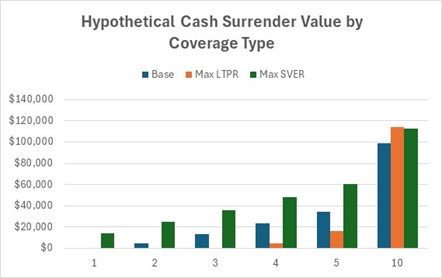
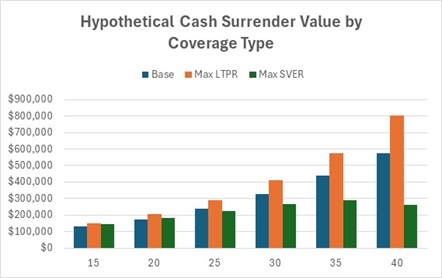
Summary of No-Lapse Guarantee Riders
This Policy currently offers three no-lapse guarantee riders. The Riders are the Flexible Duration No-Lapse Guarantee Rider (FDNLG), the Up to Age 90 No-Lapse Guarantee Rider (NLG), and the Overloan Protection 3 Rider.
● Up to Age 90 No-Lapse Guarantee Rider. The no lapse guarantee under this Rider is designed to last for a certain guarantee period as long as certain minimum premiums are paid. This Rider provides that the Policy and any optional benefits you have elected will remain In Force during the guarantee period as long as the No-Lapse Credit less Policy Debt is equal to or greater than zero. The Rider is available at Policy issue for Insureds Age 79 and younger and if you choose Death Benefit Option A or B when applying for your Policy. This Rider is automatically added to the Policy if eligibility conditions are met.
● Flexible Duration No-Lapse Guarantee Rider. The no lapse guarantee under this Rider can cover the lifetime of the Insured and is designed to provide no-lapse protection for a period longer than the No-Lapse Guarantee Rider. This Rider provides that the Policy and any optional benefits you have elected will remain In Force even if the Policy’s Net Accumulated Value is insufficient to cover the total monthly deduction, provided that the No Lapse Guarantee Value less any Policy Debt is greater than zero.
● Overloan Protection 3 Rider. The no lapse guarantee under this Rider is designed to prevent the Policy from lapsing when the Standard Policy Debt is greater than the Policy’s Accumulated Value resulting in the Policy being overloaned. There are restrictions on when this Rider may be exercised. This Rider is available at Policy issue for Insureds Age 80 and younger if the Guideline Premium Test is used as the Death Benefit Qualification Test. This Rider is automatically added to the Policy if eligibility conditions are met.
Summary of Accelerated Death Benefit Riders
This Policy currently offers four accelerated death benefit Riders. The Riders are the Premier LTC Rider, Premier Living Benefits Rider 2, Premier Chronic Illness Rider, and the Terminal Illness Rider.
● Premier LTC Rider. This Rider is a long-term care insurance rider that provides protection from the financial impacts of requiring long-term care services due to a chronic illness by providing acceleration of all or a portion of the Death Benefit. Benefit payments are made monthly. This Rider is not available for a Policy issued with the Premier Living Benefits Rider 2 or the Premier Chronic Illness Rider.
● Premier Living Benefits Rider 2. This Rider provides protection from the financial impacts of becoming chronically ill or terminally ill by providing acceleration of a portion of the Death Benefit. Benefit payments for a chronic illness can be made monthly or as an annual payment. Benefit payments for a terminal illness will be paid in one lump sum. This Rider is not available for a Policy issued with the Terminal Illness Rider, the Premier LTC
Rider, or the Premier Chronic Illness Rider.
● Premier Chronic Illness Rider. This Rider provides protection from the financial impacts of becoming chronically ill by providing acceleration of a portion of the Death Benefit. This Rider does not provide benefits for someone who is terminally ill. The benefit payments can be made monthly or as an annual payment. This Rider is not available for a Policy issued with the Premier Living Benefits Rider 2 or the Premier LTC Rider.
● Terminal Illness Rider. This Rider provides protection from the financial impacts of becoming terminally ill by providing acceleration of a portion of the Death Benefit. This Rider does not provide benefits for someone who is chronically ill. The benefit payments will be paid in one lump sum. This Rider is not available if your Policy was issued with the Premier Living Benefits Rider 2.
Complete information about each Rider is below.
Optional Riders and Benefits
Long Term Performance Rider (LTPR)
Provides insurance on the Insured and renews annually until the Policy terminates. The Rider is available for Insureds Age 90 or younger at the time of Rider issue. The Rider modifies the Death Benefit of the Policy to include the Face Amount of the Rider, so that the Death Benefit equals the greater of the Death Benefit as calculated under 1) the Death Benefit Option you choose on the Policy plus the Face Amount of the Rider, or 2) the Minimum Death Benefit under the Death Benefit Qualification Test you have chosen. You may request increases or decreases in Face Amount of the Rider, subject to certain limitations. We reserve the right in our sole discretion to restrict elective increases in the Rider Face Amount to one per Policy Year. This Rider does not have Accumulated Value of its own and does not have any cash value. This Rider must be elected at Policy issue. This Rider cannot be issued on a Policy with SVER Coverage.
You should elect this Rider if you desire potential better long-term performance of your Policy’s Accumulated Value (in exchange for lower short-term liquidity) than would be provided under Basic Life Coverage alone. This Rider reduces the Policy’s Cash Surrender Value and Net Cash Surrender Value within the first 10 Policy Years of any Coverage Layer due to the surrender charge associated with LTPR Coverage, which increases the Policy Surrender Charge. This means that during the first 10 Policy Years following any LTPR Coverage Layer Date, there may be less money available under your Policy for withdrawals and Policy loans. However, the Coverage Charge on LTPR Coverage may generally be lower compared to Basic Life Coverage, and additional Policy credits, if any, may be higher on LTPR Coverage compared to Basic Life Coverage. This may increase the Policy’s Accumulated Value over time. See the section YOUR POLICY’S ACCUMULATED VALUE – Additional Credit.
Rider Charges
This Rider has a Rider Coverage Charge, a Rider Cost of Insurance Charge, and a Rider Termination Charge, and it increases the Policy’s Surrender Charge. Each Rider Coverage Layer added to the Policy has its own set of charges. The Face Amount, Risk Class, effective date, Coverage Layer Date, and charges for any Rider Coverage Layer added after the Policy Date will be shown in
a Supplemental Schedule of Coverage sent to you at the mailing address you have provided.
Coverage and Cost of Insurance Charges
The Rider Coverage Charge is the sum of Coverage charges for each Rider Coverage Layer. The maximum monthly Coverage Charge for each Rider Coverage Layer will be shown on the Policy Specifications. Generally, the LTPR Coverage Charge may be lower than the Coverage Charge on Basic Life Coverage. The Rider Cost of Insurance charge is the sum of the Cost of Insurance charge for each Rider Coverage Layer and is determined as a rate per $1,000 of Net Amount At Risk. The Coverage Layer Date and the Rider Coverage Charge associated with each Rider Coverage Layer remain unchanged, even if that Rider Coverage Layer is reduced to zero, until the Rider is terminated.
Surrender and Termination Charges
Each LTPR Coverage Layer has a Termination Charge while this Rider is in effect. The Termination Charge will be effective as of Policy issue or the Coverage Layer Date, and applies for 10 Policy Years. The Termination Charge is deducted from the Policy’s Accumulated Value if you terminate the Rider while the Policy remains in Force. The Policy Surrender Charge will also be reduced accordingly by the amount of the surrender charge associated with LTPR Coverage. If the Policy’s Net Accumulated Value after the Termination Charge is deducted is insufficient to cover your Policy’s Monthly Deductions of Policy charges, the Policy will go into a Grace Period. Each subsequent increase in LTPR Coverage will result in an additional Rider Coverage Layer that has its own Termination Charge that applies for 10 Policy Years after the Coverage Layer Date. For any Rider Coverage Layer representing an increase in Coverage, the associated Termination Charge will be provided in a Supplemental Schedule of Coverage.
The Termination Charge is based on the Face Amount of that Coverage Layer, the Age and Risk Class of the Insured, and the Death Benefit Option, as of the date the Coverage Layer is effective. The Termination Charge at issue = (LTPR Termination Charge rate * LTPR Face Amount at issue). The new Termination Charge on any Coverage Layer increase = (LTPR Termination Charge rate * LTPR Face Amount increase). The Rider’s total Termination Charge is the sum of the Termination Charges on any Rider Coverage Layer that has an associated Termination Charge. We may charge less than the maximum Termination Charge shown in the Fee Table. Each LTPR Coverage Layer also has a surrender charge associated with LTPR Coverage which increases the Surrender Charge under the Policy while the Rider is in effect. The Surrender Charge will be effective as of Policy issue or the Coverage Layer Date, and applies for 10 Policy Years. The surrender charge associated with LTPR Coverage is deducted from the Policy’s Accumulated Value if you surrender the Policy while the Rider is in effect. Each subsequent increase in LTPR Coverage will result in an additional Rider Coverage Layer that has its own surrender charge associated with LTPR Coverage that applies for 10 Policy Years after the Coverage Layer Date. For any Rider Coverage Layer representing an increase in Coverage, the associated Surrender Charge will be provided in a Supplemental Schedule of Coverage. The maximum Surrender Charges under the Policy include the sum of the Surrender Charges on any Rider Coverage Layer that has an associated Surrender Charge. We may charge less than the maximum Surrender Charge shown in the Fee Table.
The initial surrender charge associated with LTPR Coverage
and initial Termination Charge applicable to your Policy for any such Rider Coverage Layer will
be effective as of its Coverage Layer Date and as of the beginning of each Coverage
Year (the anniversary of each Coverage Layer Date, which may be the same
as the Policy Anniversary) thereafter for 10 Policy Years following the Coverage Layer Date. The initial
LTPR Termination Charge and surrender charge associated with LTPR
Coverage will decrease on each Monthly Payment Date until the charge becomes $0 after 10 Policy Years
in the same manner
as the Policy’s Surrender
Charge on Basic Life Coverage. See the WITHDRAWALS, SURRENDERS AND LOANS – Surrendering
Your Policy section for more
information on the Surrender Charge. See the FEE TABLES section
in this prospectus for more information on the costs associated with this Rider. The
total Surrender Charge at Policy issue is shown on the Policy Specifications.
The surrender charges associated with the Rider will reduce the Policy’s Cash Surrender Value and Net Cash Surrender Value. This is because the surrender charge associated with LTPR Coverage increases the Policy’s total Surrender Charge, which is used to determine the Cash Surrender Value and Net Cash Surrender Value. This may reduce the amount available to you for withdrawals and Policy loans.
The LTPR Termination Charge will be deducted from the Policy’s Accumulated Value under the following circumstances:
● If the Rider is terminated by Written Request, or
● If the Rider is terminated when the Rider Face Amount is reduced to zero due to a Death Benefit Option Change, a requested Face Amount
Decrease or a withdrawal, and the Policy remains In Force.
The Termination Charge will be deducted from the Policy’s Accumulated Value on the first Monthly Payment Date on or following the date the Rider is terminated, and your Policy’s Surrender Charge will be reduced by and no longer include the surrender charge associated with LTPR Coverage. If the Rider terminates for any other reason, including if an accelerated death benefit payment reduces the Rider Face Amount to zero, the Termination Charge will not be deducted from the Policy’s Accumulated Value.
Increases or Decreases in Rider Face Amount
You may request an increase or decrease in the Rider Face Amount.
Increases. Each increase will be subject to satisfactory evidence of insurability. Any elected increase in Rider Face Amount will add a new Coverage Layer. Each Coverage Layer has its own Face Amount, Risk Class, Coverage Layer Date, and will have associated cost of insurance, Coverage charge, Termination Charge, and surrender charge associated with LTPR Coverage that increases your Policy’s total Surrender Charge. The increase will become effective on the first Monthly Payment Date on or following the date we receive and approve your request. We may limit increases of Rider Face Amount to one per Policy year. We may deduct an administrative charge (to evaluate insurability) not to exceed $100 from your Policy’s Accumulated Value on the effective date of any requested increase.
Decreases. Decreases are permitted on and after the first Policy Anniversary. Each decrease will be effective on the first Monthly Payment Date on or following the date the Written Request is received at our Consumer Markets Division. A Coverage charge is assessed in order to recover the expense of issuing coverage on the Policy. A Rider Face Amount decrease will not decrease its Coverage charge because the Rider’s Coverage is based on the at coverage issue Face Amount of the Rider. Similarly, a Rider Face Amount decrease will not decrease the Termination Charge or surrender charge associated with LTPR Coverage. No surrender charge associated with LTPR Coverage is imposed on a Face Amount decrease. The Termination Charge will not be deducted upon a Rider Face Amount decrease unless the decrease reduces the Rider Face Amount to zero and the Rider terminates. If the Rider terminates, we will assess the Termination Charge against your Policy’s Accumulated Value and reduce your Policy’s Surrender Charge by the amount of the surrender charge associated with LTPR Coverage. If the Face Amount of this Rider is decreased, then the most recently added Coverage Layer will be decreased or eliminated in the following order:
● The Face Amount of any scheduled annual renewable rider (e.g. S-ARTR);
● The Face Amount of this Rider; and
● The Face Amount of Basic Life Coverage under the Policy.
Rider Termination
The Rider will terminate on the earliest of
● Your Written Request;
● The date the Policy is no longer In Force; or
● The date the Rider Face Amount decreases to zero.
While the Policy remains in force, LTPR termination and the deduction of the LTPR Termination Charge can only occur on a Monthly Payment Date. If, after deducting the LTPR Termination Charge, the Accumulated Value less any Total Policy Debt is insufficient to cover the current Monthly Deduction, a 61-day Grace Period then begins during which the Policy continues In Force. See the YOUR POLICY'S ACCUMULATED VALUE – Lapsing and Reinstatement section.
Upon Rider termination, all Rider charges and any benefits associated with this Rider will be terminated. The Termination Charge will reduce the Policy’s Accumulated Value, as described above. Upon Rider termination, the Rider cannot be added back to the Policy.
Reinstatement
If the Policy lapses and is later reinstated, then this Rider will also be reinstated as long as this Rider was in effect on the date the Policy was no longer In Force.
Conversion
This Rider is not convertible.
Example
A Policy is issued to an Insured at age 45, with a Face Amount of $250,000. The Policy also included $20,000 of insurance under this Rider which increases the Face Amount to $270,000. The Rider charges (Rider Coverage Charge and Rider Cost of Insurance) are added to the Monthly Deductions, and the surrender charge associated with LTPR Coverage is added to the Policy’s total Surrender Charge. At age 50, the Insured requests $15,000 of additional insurance under the Rider and submits evidence of insurability. The increase is approved by us and the additional insurance is added to the Policy increasing the Face Amount to $285,000 ($250,000 under the base Policy plus $35,000 under the Rider).
Surrender Value Enhancement Rider 3 (SVER)
The SVER provides insurance on the Insured in combination with the Face Amount of the Policy and may also provide higher early cash value. You may purchase the Rider at Policy issue. The Rider modifies the Death Benefit of the Policy to include the
Face Amount of the Rider, so that the Death Benefit equals the greater of the Death Benefit as calculated under 1) the Death Benefit Option you choose on the Policy plus the Face Amount of the Rider, or 2) the Minimum Death Benefit under the Death Benefit Qualification Test you have chosen. This Rider must be elected at Policy issue. This Rider cannot be issued on a Policy with LTPR Coverage.
The guaranteed monthly cost of insurance rate and monthly Coverage charge will be shown in your Policy Specifications. Our current cost of insurance rates for the Rider are lower than the guaranteed rates.
You may request increases or decreases in Face Amount of the Rider. Each increase will be subject to satisfactory evidence of insurability and will have associated cost of insurance and Coverage charges. Unless you request otherwise, the increase will become effective on the first Monthly Payment Date on or following the date we receive and approve your request. We may limit increases of Rider Face Amount to one per Policy Year. We may deduct an administrative charge not to exceed $100 from your Policy’s Accumulated Value on the effective date of any unscheduled increase. Decreases will be effective on the first Monthly Payment Date on or following the date the Written Request is received at our Life Insurance Division. A Face Amount decrease of this Rider will not decrease the Coverage charge. Decreases will first be applied against the most recent increase, if any, and then against successively earlier increases, if any, and finally against the original SVER Face Amount.
The Rider will terminate on the earliest of your Written Request, or on lapse or termination of this Policy.
You should elect this Rider if you desire higher short-term liquidity of your Policy’s Accumulated Value (in exchange for lower long-term performance) than would be provided under Basic Life Coverage alone. This Rider increases the Policy’s early Cash Surrender Value and Net Cash Surrender Value since this Coverage does not increase the Policy’s Surrender Charge and has no Coverage Charge in the first policy year, though there are no additional Policy credits on SVER Coverage. For more information, see the YOUR POLICY’S ACCUMULATED VALUE – Additional Credit section in this prospectus.
Example
A Policy is issued to an Insured at age 45, with a Face Amount of $250,000. The Policy also included $20,000 of insurance under this Rider which increases the Face Amount to $270,000. The Rider charges (Rider Coverage Charge and Rider Cost of Insurance) are added to the Monthly Deductions, though the Rider does not increase the Policy’s total Surrender Charge. At age 50, the Insured requests $15,000 of additional insurance under the Rider and submits evidence of insurability. The increase is approved by us and the additional insurance is added to the Policy increasing the Face Amount to $285,000 ($250,000 under the base Policy plus $35,000 under the Rider).
Scheduled Annual Renewable Term Rider (S-ARTR)
The S-ARTR Rider provides for scheduled annual renewable insurance Coverage in Face Amount without future medical underwriting after policy issue. In this Rider, a scheduled increase is referred to as a Term Increase, and is scheduled for a particular Policy Anniversary, as shown in the Policy Specifications. The Face Amount contributes to the Total Face Amount, and consequently to the Death Benefit, of the Policy. This Rider does not have Accumulated Value of its own and does not have any cash value. This Rider must be elected at Policy issue.
A Term Increase is a future increase in the Face Amount of this rider. Each Term Increase will increase the Face Amount of the Rider Coverage Layer. Once a Term Increase goes into effect, it becomes part of the Rider Face Amount.
This Rider provides no term insurance at the time of policy issue and only provides additional insurance coverage as scheduled on certain Policy Anniversaries. If you wish to have additional insurance coverage at the time of policy issue, you must purchase another rider such as the LTPR or the SVER.
The guaranteed monthly cost of insurance rates will be shown in your Policy Specifications. Our current cost of insurance rates for the Rider are lower than the guaranteed rates.
This Rider has a Coverage charge that varies by Coverage year and Rider Face Amount. Any increase or decrease in the Rider’s Face Amount will impact the Coverage charge. The guaranteed monthly Coverage charges will be shown in the Policy Specifications. We currently do not impose the Coverage charge for this Rider.
This Rider also has a Rider Charge that will be shown in your Policy Specifications. See the FEE TABLES section in this prospectus for more information on the costs associated with this Rider.
The Rider is available subject to the following:
● The maximum Term Increase at attained ages 0-79 is 20% of the Total Face Amount before the increase.
● The maximum Term Increase at attained ages 80-94 is 5% of the Total Face Amount before the increase.
● Increases will not be scheduled beyond attained age 94.
● Each increase is an increase to the Coverage Layer at issue, and does not create a new Coverage Layer; the original rates at
Policy issue will apply to the increase.
● The cost of insurance charges will increase as a result of the increase in the Policy’s Net Amount At Risk.
You may request an increase or decrease in the schedule of future Term Increases by providing a written request. Any increase to the Face Amount of the Term Increases may be subject to evidence of insurability and is subject to our approval. If you reject a Term Increase that has been approved, all future Term Increases may be forfeited. For any change in Term Increases, we will send you a Supplemental Schedule of Coverage to reflect the change.
This Rider is effective on the Policy Date unless otherwise stated. It will terminate on the earlier of:
● Your written request
● The date the Rider or the Policy ceases to be In Force
● The death of the Insured.
If the Policy is reinstated, any Term Increases that would have occurred during the time the Policy was lapsed will be forfeited. Term Increases that are scheduled to occur after the reinstatement of the policy and rider will be handled as if the Policy had never lapsed.
This Rider differs from the LTPR and SVER in a number of ways, including:
● You may schedule increases in Face Amount with this Rider without creating a new Rider coverage layer, however, this Rider does not add additional insurance coverage at Policy issue.
● Scheduled increases in Face Amount for this Rider do not require additional medical underwriting after issue however, if there is a requested change in the amount of scheduled increases additional underwriting may be required
● Increases in Face Amount for this Rider may only occur on Policy Anniversaries
● Cost of insurance rates and charges for this Rider currently differ from the cost of insurance rates and charges for the LTPR and SVER.
Example
A Policy is issued to an Insured at age 45, with a Face Amount of $250,000. Prior to Policy issue, the Insured scheduled two future increases to occur over the first ten Policy years which will not require evidence of insurability. The scheduled increases will occur on the third and sixth Policy Anniversary. No term insurance is added to the Policy at issue. No unscheduled insurance increases are allowed under the Rider.
On the third Policy Anniversary, there is a scheduled increase in Face Amount by adding $10,000 of insurance under this Rider. This increases the total Face Amount to $260,000 ($250,000 under the base Policy plus $10,000 under the Rider). A Rider Coverage charge will now be deducted each month for the coverage added.
On the sixth Policy Anniversary, there is a scheduled increase of $15,000 of insurance under this Rider. This increases the total Face Amount to $275,000 ($250,000 under the base Policy plus $25,000 under the Rider – including the previous scheduled increase on the third Policy Anniversary). The Rider Coverage charge will increase due to the additional insurance added.
Flexible Duration No-Lapse Guarantee Rider (FDNLG)
This Rider provides a no-lapse guarantee that the Policy and any optional benefits you have selected will remain In Force as long as the Net No-Lapse Guarantee Value is greater than zero, even if the Policy’s Net Accumulated Value (Accumulated Value less any Total Policy Debt) is not enough to cover the Monthly Deductions due. As long as the No-Lapse Guarantee under this Rider is in effect, the Policy will not enter the Grace Period and lapse. This Rider must be elected at Policy issue. We assess a monthly charge for this Rider.
If you elect the FDNLG Rider, it will be in effect when we issue the Policy. The Rider cannot be added after the Policy Issue Date.
Rider Eligibility
You are eligible to elect the Rider if:
● The Insured is age 90 or younger at Policy issue and is not juvenile (Insured’s age at Policy issue is at least 18).
● At initial purchase and during the entire time you own this Rider, you must allocate 100% of your Accumulated Value among the allowable Investment Options. For the list of investment options allowed under the FDNLG Rider, see
the APPENDIX: FUNDS AVAILABLE UNDER THIS POLICY - Allowable Investment Options section in this prospectus. We reserve the right to change the allowable Investment Options under the Rider for current and new Policy owners. You may contact us at any time for information on the allowable Investment Options.
We may add or remove allowable Investment Options at any time. If your Policy was issued with Investment Option requirements, following a change to the allowable Investment Options, your current allocation of Accumulated Value may not comply with our revised allocation requirements for the Rider. As a result, you will be required to reallocate your Policy Accumulated Value to the revised allowable Investment Options in order to maintain the Rider benefits. We have the right to significantly reduce the number of allowable Investment Options even to a single conservative Investment Option. Our right to add or remove allowable Investment Options may limit the number of Investment Options that are otherwise available to you under the Policy. Please discuss with your life insurance producer if this Policy and Rider are appropriate for you given our right to make changes to the allowable Investment Options.
We may make such a change due to a fund reorganization, fund substitution, fund liquidation, or to help protect our ability to provide the guarantees under the Rider (for example, changes in an underlying Fund’s investment objective and principal investment strategies, or changes in general market conditions). If such a change is required, we will provide you with reasonable notice (generally 90 calendar days) prior to the effective date of such change to allow you to reallocate your Accumulated Value to maintain your Rider benefits. If you do not reallocate your Accumulated Value to comply with the new Rider allocation requirements, your Rider will terminate.
We will send you written notice in the event any transaction made by you will cause the Rider to terminate for failure to invest according to the investment allocation requirements. However, you will have at least 20 calendar days starting from the date of our written notice, to instruct us to take appropriate corrective action to continue the Rider. If you take appropriate corrective action and continue the Rider, the Rider benefits and features available immediately before the terminating event will remain in effect.
Rider Terms:
Net Basic Premium – equals the Basic Premium reduced by applicable fees and charges.
Basic Fund – receives Net Basic Premium, less any withdrawals or accelerated death benefit payments.
Excess Fund – receives Net Excess Premium, less any withdrawals or accelerated death benefit payments.
Excess Premium – equals the portion of each Premium Payment received in a Policy year in excess of the Basic Premium.
Excess Premium Load– an amount equal to the Excess Premium multiplied by the Excess Premium Load rate which is 10%. This load is not deducted from any premium made under the Policy and is used only as a factor for determining benefits under this Rider.
No-Lapse Premium Load – an amount equal to the Premium Payment multiplied by the No-Lapse Premium Load rate which is 5.90%. This load is not deducted from any premium made under the Policy and is used only as a factor for determining benefits under this Rider.
Optional Benefit Charges – are equal to the sum of the charges, if any, for each optional benefit attached to the Policy. The charges incurred for those optional benefits are used in the calculation to determine the No-Lapse Guarantee Value for this Rider. See the No- Lapse Deduction subsection below. This is only used to determine benefits under this Rider is not a charge deducted from the Accumulated Value.
Rider Charge Effect on Policy Values
There is a monthly charge for the FDNLG Rider. The charge is deducted from your Policy’s Accumulated Value as a Monthly Deduction. This charge does not reduce your No-Lapse Guarantee Value. The Rider Charge is shown in the Policy Specifications and equals a monthly rate per dollar of Policy Net Amount at Risk (Rider Charge). Currently, the charge range is $0.02 – $1.10 per $1,000 of Net Amount at Risk.
Example:
Assumptions:
● Policy’s Net Amount at Risk is $80,000
● Rider Charge Deduction is 0.0001
Then the Rider Charge associated with the FDNLG Rider is $8 ($80,000 × 0.0001).
No Lapse Guarantee Value
The duration of the guarantee under the FDNLG Rider can cover the lifetime of the Insured. The duration of the FDNLG Rider is determined by the No Lapse Guarantee Value. The guarantee is in effect as long as the Net No-Lapse Guarantee Value (No Lapse Guarantee Value less any Total Policy Debt) is greater than zero.
The No-Lapse Guarantee Value is equal to the sum of the Basic Fund, the Excess Fund and the No-Lapse Guarantee Loan Account Value. The Basic Fund contains the Net Basic Premium and is credited with an Accumulation Amount that can range from a 4.28% to 4.92% annual rate, based on issue age and duration. The Excess Fund contains the Net Excess Premium and is credited with an Accumulation Amount based upon a 1% annual rate. The No-Lapse Guarantee Loan Account Value is equal to the Standard Loan Account Value on your Policy and any Alternate Loan Value.
Note: The No-Lapse Guarantee Value is tracked only for the purpose of determining if the No Lapse Guarantee is in effect. The value, including any Accumulation Amounts added to the No-Lapse Guarantee Value, is not added to the Policy’s Accumulated Value, and as such cannot be withdrawn or loaned against, and is not used in the determination of the Death Benefit or to any other benefit under the Policy.
Example:
Assumptions:
● Policy 1 elected FDNLG Rider at issue
o Basic Fund is $11,000 before no-lapse deductions
o Excess Fund is $0 before no-lapse deductions
o No-Lapse Guarantee Loan Account Value is $9,000
o Upcoming monthly no-lapse deduction of $1,000
● Policy 2 did not elect FDNLG Rider at issue
● For both policies:
o Accumulated Value of $10,000 before monthly deductions
o Policy Debt of $9,000
o Surrender charge of $500
o Upcoming monthly deduction of $1,000
o Withdrawal of $200
Result:
● Both policies have a Net Accumulated Value of -$700 ($10,000 - $9,000 - $500 - $1,000-$200) after the monthly deduction
● Policy 1 remains in force because Net No-Lapse Guarantee Value is greater than $0 even though Net Accumulated Value is less than $0.
● Policy 1 has a Net No-Lapse Guarantee Value of $300 ($11,000 - $9,000 - $500 - $1,000-$200) after the monthly deduction
● Policy 2 enters the Grace Period since Net Accumulated Value is less than $0.
Basic and Excess Fund under the Rider
The Basic and Excess Fund are an accumulation of policy premiums, withdrawals, and loans. While the Basic Fund may become negative, the Excess Fund will never be less than zero. Both the Basic Fund and the Excess Fund are increased and reduced as described below.
1. Net Basic Premiums are added to the Basic Fund; Net Excess Premiums are added to the Excess Fund,
2. No Lapse Deductions reduce the Excess Fund, and then the Basic Fund,
3. Accumulation Amounts are added to the Basic Fund and Excess Fund,
4. Any withdrawal of policy Accumulated Value will reduce the Excess Fund and then the Basic Fund, including any policy
fees, and
5. Standard Loans and Alternate Loans will reduce the Excess Fund and then the Basic Fund. Net Premium is allocated to the Basic Fund and Excess Fund as follows:
● Net Basic Premium is the higher of the premium up to the Annual Premium Threshold for the Policy Year, as described in the Policy Specifications, or the amount needed to bring any negative Basic Fund back to zero. This amount is reduced by the No- Lapse Premium Load and added to the Basic Fund.
● Net Excess Premium is any premium in excess of the Basic Premium. Excess Premium is reduced by the No-Lapse Premium Load and the Excess Premium Load and added to the Excess Fund. Please note, the No-Lapse Premium Load and the Excess Premium Load are only used to determine the benefits provided by this Rider. They are not assessed against any premium made under the Policy or against the Policy’s Accumulated Value.
Example:
Assumptions:
● Annual Premium Threshold for the current year is $10,000
● Premium Received is $15,000
● Basic fund is positive
● No Lapse Premium Load is 5.90%
● Excess Premium Load is 10%
The Net Basic Premium and Net Excess Premium are calculated as follows:
● Basic Premium is $10,000 (lesser of $10,000 and $15,000). Net Basic Premium of $9,410 [$10,000 × (1-5.90%)] will be added to the Basic Fund.
● Excess Premium is $5,000. Net Excess Premium of $4,205 [$5,000 × (1 – 5.90% - 10%)] will be added to the Excess Fund
Example:
Assumptions:
● Annual Premium Threshold for the current year is $10,000
● Premium Received is $15,000
● Basic Fund is -$12,233.
● No Lapse Premium Load is 5.90%
● Excess Premium Load is 10%
The Net Basic Premium and Net Excess Premium are calculated as follows:
● Basic Premium is $13,000. The Net Basic Premium is $12,233 [$13,000 × (1-5.90%)], which, when added to the Basic Fund, brings the Basic Fund to zero.
● Excess Premium is $2,000. Net Excess Premium of $1,682 [$2,000 × (1 – 5.90% - 10%)] will be added to the Excess Fund
No-Lapse Deduction
The No-Lapse Deduction is an amount that is deducted first from the Excess Fund until the Excess Fund is reduced to zero and then from the Basic Fund. The No-Lapse Monthly Deduction is the greater of the No-Lapse Monthly Charge Deduction or the Alternative No-Lapse Monthly Deduction, as described below.
No-Lapse Monthly Charge Deduction. The No-Lapse Monthly Charge Deduction is described in the Policy Specifications and includes the following:
● The No-Lapse Coverage Charge
● The No-Lapse Administrative Charge
● Optional Benefit Charges, if any (applies to the LTPR, SVER, S-ARTR Rider, Overloan Protection 3 Rider, Premier LTC Rider, Premier Living Benefits Rider 2, Premier Chronic Illness Rider, and/or the Terminal Illness Rider as applicable)
● Transactional policy fees and charges, if any
● The No-Lapse Cost of Insurance Charge.
Alternative No-Lapse Monthly Deduction. The Alternative No-Lapse Monthly Deduction is also described in the Rider Specifications and includes:
● Optional Benefit Charges, if any
● Transactional policy fees and charges, if any
● The Alternative No-Lapse Cost of Insurance Charge.
Example:
Assumptions:
● Basic Fund before No-Lapse Deduction is $9,000
● Excess Fund is $3,500
● No-Lapse Monthly Charge Deduction is $3,000
● Alternative No-Lapse Monthly Deduction is $4,000.
Then the Basic and Excess Funds are reduced as follows:
● The No-Lapse Deduction is $4,000 (the greater of $3,000 and $4,000)
● Excess Fund will be reduced to $0
● Basic Fund to $8,500.
No-Lapse Accumulation Amount
The No-Lapse Accumulation Amount is an amount that is added to the Basic Fund and the Excess Fund as follows.
● The Basic Fund No-Lapse Accumulation Amount is added to the Basic Fund. It is equal to the Basic Fund following premium payments, No-Lapse Deduction, withdrawals, loans and other Policy distributions; multiplied by the No-Lapse Accumulation Factor as shown in the Policy Specifications. If your Basic Fund is negative, the accumulation will further reduce your Basic Fund. The No-Lapse Accumulation Factor varies by Policy duration and age. For our example, we will use 0.002466, which is equivalent to an annual rate of 3%.
● The Excess Fund No-Lapse Accumulation Amount is added to the Excess Fund. It is equal to the Excess Fund following premium payments, No- Lapse Deduction, withdrawals, loans and other Policy distributions; multiplied by the Excess Accumulation Factor as shown in the Policy Specifications. The Excess Fund Accumulation Factor is 0.0008295, which is equivalent to an annual rate of 1%.
Example:
Assumptions:
● Basic Fund is $8,500, after premiums and no-lapse deductions.
● Excess Fund is $2,500, after premiums and no-lapse deductions
● No Lapse Accumulation Factor is 0.002466
● Excess Fund Accumulation is 0.0008295
Then the Basic and Excess Funds after the Accumulation Amounts are added are:
● Basic Fund Accumulation Amount is $20.96 and the Basic Fund is $8,520.96
● Excess Fund Accumulation Amount is $2.07, and the Excess Fund is $2,502.07.
Example:
Assumptions:
● Basic Fund is $5,000, after premiums and no-lapse deductions.
● Excess Fund is $0, after premiums and no-lapse deductions
● No Lapse Accumulation Factor is 0.002466
● Excess Fund Accumulation is 0.0008295
Then the Basic and Excess Funds after the Accumulation Amounts are added are:
o Basic Fund Accumulation Amount is -$12.33, and the Basic Fund is -$5,012.33.
o Excess Fund Accumulation Amount is $0, and the Excess Fund is $0.
Loan Effects on Rider
Loans (Standard Loans and/or Alternate Loans) have an effect on the No Lapse Guarantee Value
o Any new loan, including any loan interest that is added to the loan on an anniversary, will be added to the No-Lapse Guarantee Loan Account Value and will reduce the Excess Fund and then the Basic Fund.
o Any loan repayment will be added to the Basic Fund only to the extent that the Basic Fund is negative. Otherwise, it will be added to the Excess Fund.
Important Considerations
The growth of your No-Lapse Guarantee Value depends on a number of factors including, but not limited to, the amount of premium you pay, the timing of your premium payments and any Policy changes. Any modification you make to the originally planned timing of or amount of premium paid and any Policy changes will affect the duration of the No-Lapse Guarantee provided by the Rider. Before making any change to the Policy, please request and review a current Illustration.
This Rider will terminate if an unscheduled increase in Face Amount under the Policy is elected. Please work with your life insurance producer before making any requests to increase the Face Amount under the Policy.
If your Net No-Lapse Guarantee Value is equal to or less than zero, the benefits under this rider will not be in effect. However, you can restore the no-lapse guarantee benefit by making a premium payment or a loan repayment in an amount sufficient to make your Net No-Lapse Guarantee Value positive.
Some examples of things you should consider:
1. If you defer a payment, you will not receive the Accumulation Amount associated with that premium in the Basic and Excess Fund. If such a deferral would cause your No Lapse Guarantee Value to be negative, you will have to make a sufficient payment to bring the Basic Fund to positive, including any negative Accumulation Amounts.
2. If you defer payments and then try to “catch up” with a single large payment, that payment may be split into a Basic and Excess Premium based on the Annual Premium Threshold. Any premium allocated to the Excess Fund will have lower Accumulation Amounts associated with it.
3. If you take a Standard Loan and/or an Alternate Loan, your Basic Fund may be reduced. A loan repayment may not recover the value deducted from the Basic Fund, but instead could be added to the Excess Fund.
4. Any withdrawal will reduce the Excess and Basic Fund. However, a subsequent premium payment will be affected both by the Annual Premium Threshold and the Basic and Excess fund accumulation amounts, plus associated No Lapse and Excess Premium Loads.
5. You have the ability to increase the duration of your FDNLG rider by paying higher premiums, subject to the Annual Premium Threshold.
Rider Termination
The Rider will terminate on the earliest of:
o Your Written Request;
o Policy Surrender;
o The date the Policy is no longer In Force,
o Allocation into any Investment Option that is not an allowable Investment Option and no corrective action was taken, after written notice was provided, to comply with the requirements to continue the Rider;
o Upon electing an increase in Face Amount;
o The end of the Maximum No-Lapse Guarantee Period, as shown in the Policy Specifications; or
o The date when the Net No-Lapse Guarantee Value and the Net Accumulated Value are both less than or equal to zero and the Policy lapses (see the YOUR POLICY’S ACCUMULATED VALUE – Lapsing and Reinstatement section in this prospectus).
Reinstatement
This Rider may not be reinstated if it was terminated before the date the Policy was no longer In Force. Otherwise, this Rider will reinstate on the date that the Policy is reinstated.
Up to Age 90 No-Lapse Guarantee (NLG) Rider
This Rider provides for the continuation of death benefit coverage for a specified guarantee period, if certain minimum premiums under the Rider are paid, even if the Policy’s Net Accumulated Value is less than the Monthly Deduction due on a Monthly Payment Date. There is no additional fee for this Rider.
Rider Eligibility
The Rider is available at Policy issue for Insureds Age 79 and younger and if you choose Death Benefit Option A or B when applying for your Policy. This Rider is automatically added to the Policy if eligibility conditions are met.
Rider Terms
No-Lapse Guarantee Period – the time during which we guarantee the death benefit will remain In Force as long as the guarantee under this Rider is in effect. This period is shown in the Policy Specifications. This period begins on the Policy Date and will not re-start if insurance Coverage is added or increased. The guarantee period is based on the ages of the Insureds when the Policy is issued and the range of the guarantee period may last 11 years (if the Insured is Age 79) to 90 years (if the Insured is Age 0). This period ends when the Insured reaches attained age 90.
No-Lapse Guarantee Premium – is an annual amount used during the No-Lapse Guarantee Period to determine the No-Lapse Credit (defined in the How the Rider Works section below). The No-Lapse Credit is used to determine if the guarantee under this Rider is in effect. The No-Lapse Guarantee Premium in effect as of the Policy Date is shown in the Policy Specifications and is expressed as an annual amount. The No-Lapse Guarantee Premium is calculated such that it covers sufficient future Monthly Deductions under the Policy. The No-Lapse Guarantee Premium may change. Any increase in Face Amount, scheduled or not, or addition or increase in insurance Coverage will cause an increase in the No-Lapse Guarantee Premium. A decrease in Face Amount or in other insurance Coverage will not cause a decrease in the No-Lapse Guarantee Premium. If the No-Lapse Guarantee Premium changes as a result of such a change, we will inform you of the amount of the changed No-Lapse Guarantee Premium.
How the Rider Works
This Rider guarantees that the Policy will continue in effect through the end of the No-Lapse Guarantee Period as long as the No-Lapse Credit less Policy Debt is equal to or greater than zero. The length of the No-Lapse Guarantee period is shown in the Policy Specifications.
The No-Lapse Credit is used to determine if the guarantee under this Rider is in effect. It is calculated at the beginning of each Policy month during the No-Lapse Guarantee Period. The No-Lapse Credit as of the Policy Date, which is also the first Monthly Payment Date, is equal to the premium paid less one-twelfth of the No-Lapse Guarantee Premium. On any other Monthly Payment Date, the No-Lapse Credit is equal to:
● The No-Lapse Credit as of the prior Monthly Payment Date multiplied by (i), where:
- i = no greater than 1.00364439 if the No-Lapse Credit is negative; otherwise,
- i = 1.00000;
● Plus premiums received since the prior Monthly Payment Date;
● Less withdrawals taken since the prior Monthly Payment Date; and
● Less one-twelfth of the then current No-Lapse Guarantee Premium.
Example:
Assumptions
a. No Lapse Premium is $838.61
b. No Lapse Credit on the prior Monthly Payment Date is $1,000
c. Withdrawal Amount taken since prior Monthly Payment Date is $500
d. Premium Payment made on the current Monthly Payment Date is $100
Since the No Lapse Credit is positive, the No Lapse Credit is $530.12 = ($1,000 * (1.00000) + $100 - $500 - $838.61/12).
For the guarantee under this Rider to be in effect, the No-Lapse Credit less Policy Debt must be equal to or greater than zero.
If the No-Lapse Credit less Policy Debt is less than zero, the guarantee under this Rider is not in effect. The guarantee under this Rider may be brought back into effect by paying additional premium equal to the amount of premium necessary after deduction of the premium load so that the No-Lapse Credit less Policy Debt is equal to or greater than zero (the “Catch-Up” premium). If your Policy is in the grace period, you may pay the lesser of the Catch-Up premium (if this Rider is in effect) or the amount due to move the Policy out of the grace period. See the YOUR ACCUMULATED VALUE – Lapsing and Reinstatement section in this prospectus for more information on the Policy grace period.
If the guarantee under this Rider is in effect, the Policy and any attached optional benefits that are currently In Force, will remain In Force, will not enter the grace period and will not lapse during the specified guarantee period. Instead, the Policy will continue under the guarantee provided by this Rider and it will stay In Force as long as the No-Lapse Credit less Policy Debt is equal to or greater than zero.
Accumulated Value Deficit – When the Policy is continued under the No-Lapse Guarantee, the Net Accumulated Value can be less than or equal to zero. If the Policy does not have sufficient Net Accumulated Value from which Monthly Deductions can be collected, then any uncollected Monthly Deductions, or portions thereof, are accumulated without interest as an Accumulated Value Deficit. Any Premium or Loan Repayment that is received while the Net Accumulated Value is less than or equal to zero and the No-Lapse Guarantee is in effect, will be applied as described in the Policy. Beginning on the next Monthly Payment Date following the receipt of the Premium or Loan Repayment and until eliminated, the Accumulated Value Deficit will first be reduced and then Monthly Deductions will be processed according to the terms of the Policy.
Example:
Assumptions:
● Policy is within No-Lapse Guarantee Period
● Accumulated Value of $11,000 before monthly deductions
● Policy Debt of $9,500
● Policyholder has paid a premium at the beginning of each Policy month at least equal to one twelfth of the No-Lapse Guarantee Premium
● Upcoming Monthly deduction = $2,000
Result:
● Policy Net Accumulated Value after monthly deductions will fall below $0 to -$500 ($11,000 - $9,500 - $2,000).
● Policy does not enter the Grace Period since policyholder has paid sufficient premium to meet the minimum No-Lapse Guarantee premium requirement.
Effect on Other Riders
If the Policy is continued under the guarantee provided by this Rider, any attached Riders will continue or end according to their respective terms.
Rider Termination
This Rider will end on the earliest of:
● If you add any Rider that has separate charges after the Policy Date;
● The date when the No-Lapse Credit less Policy Debt is less than or equal to zero and the Net Accumulated Value is less than the Monthly Deduction due on the Monthly Payment Date, unless a Catch-Up premium is made; or
● At the end of the Guarantee Period.
Rider Reinstatement
This Rider may not be reinstated if it was terminated before the date the Policy ceased to be In Force. Otherwise, this Rider will reinstate on the date the Policy is reinstated. Upon Reinstatement, any Catch-Up Amount and any Accumulated Value Deficit, without interest, will be restored. Any Catch-Up Amount existing at the time of Policy lapse must be paid upon Reinstatement for the No-Lapse Guarantee to be in effect.
Overloan Protection 3 Rider
The Rider guarantees that your Policy will not lapse if the Standard Policy Debt is greater than the Policy’s Accumulated Value, resulting in it being overloaned. On or after the earliest exercise effective date, if all Rider Exercise Requirements have been met you may exercise the Rider by submitting a Written Request. This Rider is automatically issued on your Policy if eligibility requirements are met. There is no charge for this Rider unless you exercise it. See below for charge information.
The Rider After Policy Issue
The Rider cannot be exercised during the first 15 Policy Years before the Insured is Age 75, or while there is an Alternate Loan in effect. Please see Rider Termination below for termination conditions of the Rider before and after exercise. You may not pay premiums or take withdrawals from your Policy after exercise of the Rider. The Rider may not be exercised after the Policy has entered the Grace Period.
Rider Exercise Requirements
The exercise effective date will be the Monthly Payment Date on or next following the date we receive your Written Request to exercise the Rider and all exercise requirements have been met. The earliest exercise effective date is shown in the Policy Specifications. To exercise the Rider, each of the following conditions must be true as of the exercise effective date:
● The Death Benefit Option is Option A. If your policy does not meet this prerequisite, you must change your Death Benefit Option to Death Benefit Option A, by Written Request, prior to Rider exercise. Changes to your Death Benefit Option take effect on the Monthly Payment Date next following your Written Request. Such changes will modify your Total Face Amount and, as a result, this Rider may impact your ability to meet all the exercise conditions described below.
● There is no Alternate Loan Value on the Policy.
● There must be sufficient Accumulated Value to cover the rider exercise charge as described below.
● The Standard Policy Debt is greater than the Total Face Amount, but less than 99.9% of the Accumulated Value after the charge for this Rider has been deducted from the Accumulated Value.
● There are no projected forced distributions of Accumulated Value for any Policy Year.
● The Guideline Premium Limit for the Policy will remain greater than zero at all times prior to Insured’s Age 100.
● The Policy must not be a Modified Endowment Contract, and exercising this Rider must not cause the Policy to become a Modified Endowment Contract.
● The Policy must not be in the Grace Period.
Contact us if you have any questions about your eligibility to exercise this Rider. On the exercise effective date, we:
1. Transfer any Accumulated Value in the Investment Options into the Fixed Account. No transfer charge will be assessed for such transfer, nor will it count against, or be subject to, any transfer limitations then in effect.
2. Upon each Index Account Segment's Maturity, reallocate the Segment Maturity Value into the Fixed Account. No transfer charge will be assessed for such transfer, nor will it count against, or be subject to, any transfer limitations then in effect.
3. Deduct the charge for this Rider from your Policy’s Accumulated Value.
There is a one-time charge to exercise this Rider. The charge will not exceed the Accumulated Value multiplied by the overloan protection rate shown for the Insured’s Age at exercise in the Policy Specifications, as of the exercise effective date. The charge ranges from 1.12% to 4.52% of the Policy’s Accumulated Value, and is based on the Insured’s sex, Risk Class and Age as applicable at the time the Rider is exercised. If you never exercise the Rider, there is no charge for it. After you exercise the Rider, and while it continues in effect, the Policy’s lowest Death Benefit will be the Death Benefit percentage multiplied by the greater of the
Accumulated Value or the Standard Policy Debt.
A hypothetical example
For a male standard nonsmoker, Age 85 when the Rider is exercised, the charge will be 2.97% of the Policy’s Accumulated Value on the exercise effective date. If the Policy’s Accumulated Value is $25,000, the charge deducted from the Accumulated Value on the exercise effective date is $742.50. ($25,000 × 2.97% = $742.50).
The Rider After Exercise
After the exercise effective date and as long as the Rider stays in effect, the Policy will not lapse if the Accumulated Value is insufficient to cover Policy charges, even if the insufficiency is caused by overloan.
After the Rider is exercised, the Policy’s Minimum Death Benefit will be the Death Benefit percentage multiplied by the greater of the Accumulated Value or the Standard Policy Debt. Calculation of the Death Benefit, Minimum Death Benefit and Death Benefit Proceeds is described in the DEATH BENEFITS section in this prospectus.
Effect on Other Riders
Other than this Rider and any term insurance rider on the Insured that contributes to the Total Face Amount of the Policy, any Riders in effect with regularly scheduled charges will be terminated. Additionally, any accelerated death benefit rider will terminate upon exercise of this Rider. Any increases in Face Amount that are scheduled to take effect after exercise of the Rider will be cancelled.
Rider Termination
This Rider will terminate on the earliest of the following events:
● The Policy terminates;
● You make a Written Request to terminate the Rider; or
● If, after the exercise effective date:
o Any premium is paid
o Any withdrawal is taken
o Any loan repayment is made, other than for loan interest due
o Any Policy benefit is changed or added at your request
o Any transfer among the Investment Options is done at your request.
If the Rider terminates after the exercise effective date and while the Policy is In Force, any amount by which the Standard Policy Debt exceeds the Accumulated Value is due and payable to us.
Possible Tax Consequences
You should be aware that the tax consequences of this Rider have not been ruled on by the IRS or the courts and it is possible that the IRS could assert that the outstanding loan balance should be treated as a taxable distribution when this Rider is exercised. You should consult a tax advisor as to the tax risks associated with this Rider.
Example
A Policy is issued to an Insured age 55 with a Face Amount of $250,000, Death Benefit Option A and the Guideline Premium Test was elected. This Rider is automatically added to the Policy at issue. There is no charge for this Rider until it is exercised. During the first 17 years of the Policy, the Insured makes additional premium payments, withdrawals and takes out Standard Loans (no Alternative Loans were made). Over the next 3 Policy years, the Insured takes out additional Standard Loans on the Policy. This loan activity increases the total amount of Standard Loans which now exceed the Policy’s Accumulated Value, however, the Accumulated Value is still positive.
The Insured decides to exercise this Rider. Upon exercise, the one-time Rider charge will be assessed. No more loans, premium payments, or withdrawals will be allowed while this Rider is in effect. As long as the Rider stays in effect, the Policy will not lapse even if the Accumulated Value is insufficient to cover any Policy charges.
Premier LTC Rider
(This Rider is called “Accelerated Death Benefit Rider for Long-Term Care” in your Policy)
The Premier LTC Rider (LTC Rider) is a long-term care insurance rider that provides benefits for Covered Services incurred for Adult Day Care, Assisted Living Care, Home Health Care, Hospice Care, and Nursing Home Care. The Rider accelerates all or a portion of the Policy’s Death Benefit if you become Chronically Ill. You can only elect the LTC Rider at Policy issue. The Rider allows the Policy Owner to accelerate the Policy’s death benefit proceeds as a monthly benefit for Covered Services while the Insured is Chronically Ill and receiving Qualified Long-Term Care Services at an approved location as prescribed under a Plan of Care, subject to the limitations, exclusions and eligibility conditions defined in the Rider (see the Limitations, Exclusions and Eligibility Conditions for Benefits subsection below). We assess a monthly charge for the Rider. For more information, please see the APPENDIX: STATE LAW VARIATIONS section in this prospectus. This Rider must be elected at Policy Issue.
This Rider cannot be added to any policy that has the Premier Living Benefit Rider 2 or the Premier Chronic Illness Rider attached. You may elect both the Terminal Illness Rider and the LTC Rider at policy issue, as long as the Insured meets the eligibility requirements for each rider.
If you choose to exercise the Rider, at the time we pay any benefit payment, we will reduce your Policy’s Death Benefit, as described in the Policy and Rider. Other Policy values, including but not limited to Surrender Charge, Accumulated Value and Total Face Amount will be reduced pro rata.
30-Day Right to Examine
The Owner has 30 days from the day this Rider is received to examine and return it to us if the Owner decides not to keep this Rider. The Owner does not have to tell us the reason for returning this Rider. The Rider can be returned to us at our Administrative Office or to the Producer through whom it was bought. If you wish to cancel the Rider without cancelling the Policy, you must return the Policy and this Rider to us so that we can send you back the Policy without this Rider. We will refund, as a credit to the Policy, the full amount of any Rider Charges paid within 30 days of such a Rider return and the Rider will be void from the start.
Rider Charge
We assess the LTC Rider Charge on each Monthly Payment Date and deduct it from the Policy’s Accumulated Value. The current charge for this rider is $0.01-$1.15 per $1,000 of LTC Net Amount at Risk. The maximum monthly charge for this Rider is equal to (a × b) where:
(a) Is the Maximum Monthly LTC Rider Charge Rate as shown in the Policy Specifications divided by 1000; and
(b) Is the LTC Net Amount at Risk.
During any Claim Period, we will waive any LTC Rider Charges that would occur as part of the Policy Monthly Deduction. The charges will resume when the Claim Period is no longer in effect. Rider charges will apply during any Elimination Period.
A hypothetical example of a Maximum Monthly LTC Rider Charge Calculation:
Assume the following:
● Policy Death Benefit is $1,000,000
● LTC Coverage Amount is $750,000
● Policy Net Amount at Risk (NAR) is $948,351
● Maximum Monthly LTC Rider Charge rate per $1000 of LTC NAR is 0.3426
● LTC NAR = $711,263.25. The LTC Net Amount of Risk (NAR) is calculated on each Monthly Payment Date as [a × b] ÷ c where:
a. Is the LTC Coverage Amount;
b. Is the Policy’s Net Amount at Risk; and
c. Is the Policy’s Death Benefit.
LTC Rider Charge = [Maximum Monthly LTC Rider Charge Rate ÷ 1000] x LTC NAR = $243.68
Rider Terms
Acceleration Percentage – an amount used to calculate Policy and Rider values after a benefit payment and after the corresponding reduction to the Policy’s Total Face Amount. It is calculated after each benefit payment as the LTC Benefit Amount divided by the Policy Death Benefit prior to the benefit payment.
Activities of Daily Living – generally include the following self-care functions:
● Bathing oneself
● Continence
● Dressing oneself
● Feeding oneself
● Getting oneself to and from the toilet
● Transferring oneself into or out of a bed, chair or wheelchair.
The Rider attached to your Policy contains more detailed information about these self-care functions.
Adjusted LTC Coverage Amount – the amount used to calculate the Maximum Monthly Benefit Payment Amount. If no benefits have been paid under the Rider, the Adjusted LTC Coverage Amount is equal to the LTC Coverage Amount. Any decrease to LTC Coverage Amount will also decrease the Adjusted LTC Coverage Amount by the same dollar amount, except that the Adjusted LTC Coverage Amount will not be reduced for a benefit payment under this rider. We do not allow increases to the Adjusted LTC Coverage Amount.
Assessment – an evaluation done in the United States by a Licensed Health Care Practitioner to determine or verify that the Insured is a Chronically Ill Individual.
Assisted Living Care – personal/custodial monitoring and assistance with Activities of Daily Living provided in a residential setting in an Assisted Living Facility.
Assisted Living Facility – a facility that is licensed or certified or complies with the state’s facility licensing requirements to engage primarily in providing ongoing Assisted Living Care and related services as described in the Rider.
Chronically Ill Individual – an Insured who has been certified in writing as:
● Being unable to perform at least two Activities of Daily Living without hands-on or standby assistance from another individual for a period of at least 90 days due to a loss of functional capacity; or
● Requiring substantial supervision by another person for protection from threats to the Insured’s health or safety due to a Severe Cognitive Impairment as described in the Rider.
Claim Forms – we will provide Claim Forms for the filing of a Proof of Loss when we receive the notice of claim. If the Owner, Insured or Insured’s Representative does not receive the necessary Claim Forms within 15 days, a Proof of Loss can be filed without them by sending us a letter which describes the occurrence, the character and the extent of the loss for which the claim is made. That letter must be sent to us at our Administrative Office within the time noted below under Proof of Loss.
Claim Period – an uninterrupted period of time during which benefits are being paid under this Rider. The Claim Period for an occurrence begins on the date a benefit payment is made. After the final benefit payment for an occurrence is made, the Claim Period terminates at the end of the day prior to the next Monthly Payment Date.
Confinement or Confined – an Insured who is a resident in a Nursing Home Facility, an Assisted Living Facility or a Hospice Care Facility for a period for which a room and board charge is made.
Covered Services – the types of Qualified Long-Term Care Services the Insured must receive and must be prescribed under a Plan of Care in order to qualify for a benefit to be payable under this Rider.
Elimination Period – the total number of days that the Insured is a Chronically Ill Individual before benefits are payable. The Elimination Period is 90 days for all covered services. The Elimination Period must only be met once; any subsequent claim will not be subject to a new Elimination Period.
Home Health Care – medical and non-medical services, provided to ill, disabled or infirm persons by a Home Health Care Agency in their residences. Such services may include Homemaker Services and assistance with Activities of Daily Living and may be performed by a Home Health Care Agency or by any other skilled or unskilled individuals.
Home Health Care Agency – an entity that is licensed or certified to provide Home Health Care for compensation by the state in which it operates and employs staff who are qualified by training or experience to provide such care.
Hospice Care – services designed to provide palliative care and alleviate the Insured’s physical, emotional and social discomforts if he or she is Terminally Ill and in the last phases of life. Hospice Care includes Home Health Care as well as care received in a Nursing Home Facility, Hospice Care Facility, or Assisted Living Facility.
Hospice Care Facility – a facility that is appropriately licensed or certified to provide Hospice Care in the state in which it operates.
Immediate Family Member – the Insured’s Spouse and the parents, brothers, sisters and children of either the Insured or the Insured’s Spouse by blood, adoption or marriage.
In Good Order – the date the applicable Elimination Period has been completed and all of the requirements under the eligibility conditions for the payment of benefits under this Rider have been met and verified by us.
International Benefit – Benefits are payable under this Rider when the Insured incurs Covered Services outside the United States provided the initial and any annual renewal certifications are completed by a Licensed Health Care Practitioner.
A Plan of Care can be completed remotely provided it is prescribed in the United States. The Insured is not required to return to the United States to be certified as being a Chronically Ill Individual.
Licensed Health Care Practitioner – a physician, a registered professional nurse, licensed social worker or other individual who meets such requirements as may be prescribed by the Secretary of the Treasury of the United States. A Licensed Health Care Practitioner must reside in the United States and cannot be you or an Immediate Family Member.
LTC Coverage Amount – the total benefits payable under the Rider, adjusted for certain policy transactions as further described in
LTC Coverage Amount.
LTC Net Amount at Risk (NAR) – the LTC NAR is calculated on each Monthly Payment Date as (a) multiplied by (b) divided by (c) where:
a. Is the LTC Coverage Amount;
b. Is the Net Amount at Risk of the Policy; and
c. Is the Death Benefit of the Policy.
Maintenance or Personal Care Services – means any care the primary purpose of which is the provision of needed assistance with any of the disabilities as a result of which the Insured is a Chronically Ill Individual. This includes protection from threats to health and safety due to Severe Cognitive Impairment.
Minimum LTC Coverage Amount – the minimum amount of long term care coverage available under the Rider; generally $50,000 but varies by state and is shown in your policy specifications.
Monthly Per Diem Limitation – the Per Diem Limitation declared by the Internal Revenue Service and in effect on the date any LTC Benefit is effective, multiplied by the Maximum Per Diem Limitation Percentage shown in the Policy Specifications then multiplied by 30. The IRS releases updated Per Diem Limitations annually. Current Per Diem Limitations can be found on the IRS’ website at www.irs.gov. You may also contact us at our Life Insurance Operations Center to request a quote for the current Limitations.
Nursing Home Care – nursing care and related services provided on an in-patient basis by a Nursing Home Facility.
Nursing Home Facility – a facility or distinctly separate part of a hospital or other institution that is appropriately licensed or certified or complies with the state’s facility licensing requirements to engage primarily in providing Nursing Home Care to inpatients under a planned program supervised by a Physician.
Option C Amount – if Death Benefit Option C is elected, the Option C Amount is the Policy’s Total Face Amount plus premiums paid, less any withdrawals (WD) or other distributions and is subject to Death Benefit Option C Limit as described in the Policy Specifications.
Physician – a doctor of medicine or osteopathy legally authorized to practice medicine and surgery by the state in which he or she
performs such function or action (as defined in Section 1861(r)(1) of the Social Security Act).
Plan of Care – a written individualized plan of services which is appropriate and consistent with the Health Insurance Portability and Accountability Act of 1996 (“HIPAA”). An approved Plan will be consistent with the care needs that were verified during the process of establishing that the Insured is a Chronically Ill Individual. When we have received all information required to verify the Plan of Care, which will include the proposed provider of long term care services, we will generally complete the verification process within ten business days of the date of the claimant’s benefit eligibility approval.
Proof of Loss – written Proof of Loss is information satisfactory to us that describes and confirms that the Insured has met the eligibility requirements for an occurrence for the payment of benefits. An occurrence is an uninterrupted period of time during which the Insured is claiming benefits under this Rider. If the Insured recovers, but later opens a new claim, the subsequent claim will be considered a new occurrence. You must provide written Proof of Loss within 90 days after the occurrence or commencement of any loss covered for which benefits are claimed. However, we will still consider a claim if it was not possible to secure proof within the 90-day time frame and you provided the Proof of Loss as soon as reasonably possible thereafter. Except in the absence of legal capacity, we will not consider a service to be a Covered Service if Proof of Loss for that service is furnished more than one year after the date the proof is otherwise required.
Qualified Long-Term Care Services – services that meet the requirements of Section 7702B(c)(1) of the Internal Revenue Code of 1986, as amended, as follows: necessary diagnostic, preventative, therapeutic, curing, treating, mitigating and rehabilitative services, and Maintenance or Personal Care Services which are required by a Chronically Ill Individual and are provided pursuant to a Plan of Care prescribed by a Licensed Health Care Practitioner.
Severe Cognitive Impairment – means a deficiency in an individual’s short or long-term memory, orientation as to person, place and time, deductive or abstract reasoning, or judgment as it relates to safety awareness.
Terminally Ill – means the Insured has a life expectancy of 12 months or less, as certified by a Physician.
Limitations, Exclusions and Eligibility Conditions for Benefits
To receive the Rider Benefit, you must satisfy the following conditions:
● A Licensed Health Care Practitioner certifies the Insured as being a Chronically Ill Individual;
● The Insured receives care that is a Covered Service under this Rider and care is provided pursuant to a written Plan of Care;
● Coverage under this Rider is In Force on the date(s) the care is received;
● Any assignee or any irrevocable Beneficiary under the Policy must provide written consent to payment of benefits;
● The applicable Elimination Period has been satisfied.
If the Insured recovers from a Chronic Illness and the LTC Coverage Amount has not been exhausted, a new claim may be initiated, subject to the same eligibility requirements that applied to the initial claim. However, the Elimination Period will already have been satisfied. Benefits for subsequent claims will be calculated in the same manner as they were for the initial claim.
You must elect to accelerate benefits under the Policy by making a claim for benefits under this Rider. If the entire Death Benefit under the Policy is accelerated under the terms of this Rider, the Policy will terminate.
Certain pre-existing condition limitations apply. A pre-existing condition is any condition for which the Insured received medical advice or treatment in the six months preceding the LTC Rider Effective Date. If the Insured is Confined for a pre-existing condition that was disclosed in the application, that condition is considered a Covered Service and the Elimination Period will begin on the Rider Effective Date. We will not pay benefits for a Confinement due wholly or in part to a pre-existing condition which is not disclosed in the application if the need for services begins during the first six months after the Rider Effective Date.
The Rider will not pay benefits for:
● Care or services that result from an attempt at suicide (while sane or insane) or an intentionally self-inflicted injury;
● Care or services that result from alcoholism or drug addiction;
● Care or services that result from committing or attempting to commit or participating in a felony, riot or insurrection;
● Treatment provided in a government facility (unless current or future law requires that this Rider provide coverage);
● Services for which benefits are available under Medicare or other governmental program (except Medicaid), any state or federal workers’ compensation, employer’s liability or occupational disease law, or any motor vehicle no-fault law; or
● Services received while this Rider is not In Force, except as provided in the Extension of Benefits provision. LTC Coverage Amount
The LTC Coverage Amount is the maximum amount of benefits payable under this Rider. The initial LTC Coverage Amount is shown in the Policy Specifications and is adjusted thereafter as described below. The LTC Coverage Amount will never exceed the Policy’s Total Face Amount, or, if Death Benefit Option C is in effect, the lesser of the Total Face Amount or the Option C Amount.
The LTC Coverage Amount will be decreased at the time:
● We receive your Written Request;
● We pay a benefit in accordance with the terms of the Rider;
● A withdrawal from the Policy occurs; or
● The LTC Coverage Amount is greater than the Policy’s Total Face Amount; or, if you selected Death Benefit Option C, the LTC Coverage Amount will be decreased to the lesser of the Policy’s Total Face Amount or the Option C Amount.
Transaction | Reduction to LTC Coverage Amount | LTC Coverage Amount After Transaction |
Benefit Payment | LTC Benefit Amount | A – B where: A is the LTC Coverage Amount before Benefit Payment; and B is the LTC Benefit Amount See Example #1 below |
Withdrawal | Withdrawal /Policy Death Benefit x LTC Coverage Amount | A x (1- B/C) where: A is the LTC Coverage Amount before the withdrawal; B is the Withdrawal; and C is the Policy Death Benefit before the withdrawal See Example #2 below |
Other reduction to the Total Face Amount (Death Benefit Option A or B is in effect) | Maximum of A or (B – C) where: A is 0; B is the LTC Coverage Amount; and C is the Policy Face Amount after the face reduction | Minimum of A or B where: A is the LTC Coverage Amount before the reduction to Total Face Amount; and B is the Total Face Amount after the reduction See Example #3 below |
Other reduction to the Total Face Amount (Death Benefit Option C is in effect) | Maximum of A or (B – C) where: A is 0; B is the LTC Coverage Amount; and C is the lesser of Policy Face Amount after the face reduction or the Option C Amount after the face reduction | Minimum of A, B or C where: A is the LTC Coverage Amount before the reduction to Total Face Amount; B is the Total Face Amount after the reduction; C is the Option C Amount after the reduction to Total Face Amount See Example #4 below |
If no benefits have been paid under the Rider, the Adjusted LTC Coverage Amount is equal to the LTC Coverage Amount. Any decrease to LTC Coverage Amount will also decrease the Adjusted LTC Coverage Amount by the same dollar amount, except that the Adjusted LTC Coverage Amount will not be reduced for a benefit payment under this rider. We do not allow increases to the Adjusted LTC Coverage Amount.
Hypothetical Example #1:
Assume the following:
● LTC Coverage Amount at issue is $750,000 and Total Face Amount is $1,000,000
● LTC Benefit Amount = $10,000
Then:
LTC Coverage Amount - $740,000 ($750,000-$10,000)
Adjusted LTC Coverage Amount = $750,000 (benefit payment does not reduce the Adjusted LTC Coverage Amount)
Hypothetical Example #2:
Assume the following:
● LTC Coverage Amount at issue is $740,000
● Death Benefit Option B
● Adjusted LTC Coverage Amount is $750,000
● Total Face Amount is $1,000,000
● Accumulated Value is $50,000
● Death Benefit is $1,050,000
● Withdrawal processed for $25,000
Then:
LTC Coverage Amount after WD = LTC Coverage Amount before Withdrawal x (1 – WD/DB) = $722,380.95
This is a reduction of $17,619.05 (740,000 – 722,380.95). The same dollar amount reduces the Adjusted LTC Coverage Amount.
Adjusted LTC Coverage Amount = $732,380.95
Hypothetical Example #3:
Assume the following:
● LTC Coverage Amount is $722,380.95
● Adjusted LTC Coverage Amount is $732,380.95
● Total Face Amount is $1,000,000
If there is a policy transaction that reduces the Total Face Amount to $800,000 there is no reduction to the LTC Coverage Amount or the Adjusted LTC Coverage Amount. This is because the LTC Coverage Amount of $722,380.95 is still less than the Total Face Amount after reduction to $800,000.
If there is a policy transaction that reduces the Total Face Amount to $600,000, then the LTC Coverage Amount is reduced to $600,000 so that the LTC Coverage Amount does not exceed the Total Face Amount. This is a reduction of $122,380.95 and this same dollar amount will reduce the Adjusted LTC Coverage Amount. The Adjusted LTC Coverage Amount after this reduction is $610,000.
Hypothetical Example #4: (Option C)
Assume the following:
● LTC Coverage Amount is $950,000
● Adjusted LTC Coverage Amount is $950,000
● Total Face Amount is $1,000,000
● DB Option C is in effect
● Cumulative Premiums = 100,000
● Cumulative Withdrawals = 150,000
The Option C Amount before the face reduction = 950,000 (1,000,000 + 100,000 – 150,000)
The Face Amount is reduced to 975,000
After this reduction to Total Face Amount, the Option C Amount is 925,000 (975,000 + 100,000 – 150,000)
Although the LTC Coverage Amount does not exceed the Total Face Amount after the reduction to the Total Face Amount, the LTC Coverage Amount does exceed the Option C Amount. Therefore, after the reduction to the Total Face Amount, the LTC Coverage Amount is reduced to $925,000. (The Adjusted LTC Coverage Amount is also reduced to $925,000).
The Rider at Exercise
The LTC Benefit Amount is the lesser of the dollar amount you requested or the Maximum Monthly Benefit Payment Amount available under this Rider. Any requested LTC Benefit Amount may not be less than the Minimum Monthly Benefit Payment Amount.
The Maximum Monthly Benefit Payment Amount is the lesser of:
● The Maximum Monthly Percentage multiplied by the Adjusted LTC Coverage Amount; or
● The Monthly Per Diem Limitation; or
● The LTC Coverage Amount
The Maximum Monthly Percentage is the maximum percentage of the Adjusted LTC Coverage Amount that will be paid as a monthly LTC Benefit. You elect the Maximum Monthly Percentage shown in the Policy Specifications at Policy issue and cannot change it thereafter.
Provided the Policy is not in its Grace Period, the amount of the LTC Benefit Proceeds is equal to (a - b) where:
(a) Is the LTC Benefit Amount; and
(b) Is any Total Policy Debt immediately prior to the benefit payment, multiplied by the Acceleration Percentage.
LTC Benefit Proceeds During Policy Grace Period - If benefit payment is made while the Policy is in its Grace Period, we reduce the payment by any unpaid Monthly Deductions. The LTC Benefit Proceeds are equal to: (a – b – c) where:
a. Is the LTC Benefit Amount; and
b. Is any Total Policy Debt immediately prior to the benefit payment, multiplied by the Acceleration Percentage; and
c. Is any Monthly Deductions due and unpaid immediately prior to the benefit payment, multiplied by 1 minus the Acceleration Percentage
If (b + c) is greater than (a), no benefit payment will be made and the Policy will remain In Force.
A hypothetical example where the Policy is not in the Grace Period:
Assume the following:
● LTC Coverage Amount is $750,000
● LTC Benefit Amount is $10,000
● Total Policy Debt before the benefit payment is $5,000
● Policy Death Benefit before the LTC Benefit Amount is $1,000,000
Acceleration percentage = 10,000÷ 1,000,000 = 1%
LTC Benefit Proceeds = 10,000 – (5,000 x 1%) = $9,950.00
A hypothetical example where the Policy is in the Grace Period:
Assume the following:
● LTC Coverage Amount is $750,000
● LTC Benefit Amount is $10,000
● Policy Accumulated Value is $15,000
● Standard Policy Debt before the benefit payment is $10,000
● Alternate Policy Debt before the benefit payment is $5,200
● Total Policy Debt (Standard Policy Debt + Alternate Policy Debt) before the benefit payment is $15,200
● Monthly Deductions due and unpaid is $200
● Policy Death Benefit before the LTC Benefit Amount is $1,000,000
Acceleration Percentage = 10,000 ÷ 1,000,000 = 1%
We will reduce Standard Policy Debt, Accumulated Value and Monthly Deductions due and unpaid each by the Acceleration Percentage (1%). If your Policy has an alternate loan under an alternate loan rider, then any Alternate Policy Debt is also reduced by the Acceleration Percentage (1%).
● Accumulated Value after the benefit payment is $14,850
● Standard Policy Debt after the benefit payment $9,900
● Alternate Policy Debt after the benefit payment $5,148
● Monthly Deductions due and Unpaid after the benefit payment is $198.00
LTC Benefit Proceeds = $10,000 - $152 - $198 = $9,650.00
If a benefit payment is made on the Monthly Payment Date, the benefit payment will be processed before the calculation of the Policy Monthly Deductions.
Your Policy After Exercising the Rider
● When you exercise the Rider and we make a Benefit payment, the following values will be reduced by an amount equal to the value below multiplied by the Acceleration Percentage:
● The Policy’s Total Face Amount;
● The Policy’s Accumulated Value;
● Any Alternate Accumulated Value of the Policy or any rider;
● Any Standard Policy Debt;
● Any alternate loan values (including Alternate Policy Debt),
● Any Surrender Charge applicable for each Coverage Layer unless the Policy has a Maximum Surrender Charge. If your Policy has a Maximum
● Surrender Charge, it will be reduced by the Acceleration Percentage;
● Any Termination Charge applicable for each LTPR Coverage Layer,
● Any Monthly Deduction due and unpaid during a Policy Grace Period;
● For Policies with Death Benefit Option C, the sum of the premiums less withdrawals and other distributions as described in the Policy; and
● For Policies with Death Benefit Option C, the Option C Death Benefit Limit.
For example, if the Acceleration Percentage is 2%, each of the above values is reduced by 2% as shown below:
Policy Value | Before benefit payment | Reduction (2% x Value) | After benefit payment |
Total Face Amount | $500,000 | $10,000 | $490,000 |
Accumulated Value | $50,000 | $1,000 | $49,000 |
Standard Policy Debt | $25,000 | $500 | $24,500 |
Alternate Policy Debt | $25,000 | $500 | $24,500 |
Surrender Charge | $1,000 | $20 | $980 |
Other values reduced by the Acceleration Percentage are reduced in a similar manner as shown in the example above.
The Face Amount of each Coverage Layer of the Policy or any insurance Rider on the Insured will be reduced according to the terms of the Policy and Rider. You may not decrease the Total Face Amount starting on the date a claim is In Good Order and continuing until the end of that Claim Period.
Your Policy’s Cost of Insurance charges will be calculated according to the terms of the Policy, but will be based on the reduced Policy values following a Benefit payment.
After reduction to your Policy’s Accumulated Value and any Total Policy Debt, any amount of Monthly Deductions that are due and unpaid at the time of a benefit payment are reduced by an amount equal to the Acceleration Percentage multiplied by the Monthly Deduction due and unpaid prior to the benefit payment.
Transfers of Accumulated Value during any Claim Period
Transfers from the Fixed Account to the Variable Investment Options are not permitted. You may transfer Accumulated Value from the Variable Investment Options to the Fixed Account, subject to limitations on allocations to the Fixed Option.
Other Effects on the Policy
Beginning on the date a claim is In Good Order under this Rider:
● We will not allow Death Benefit Option Changes, except for changes into Death Benefit Option A;
● We will not allow any requested increases in benefits under the Policy or any Riders; and
● We will discontinue the Automated Income Option or any other systematic distribution program in effect
You may not request a Policy Loan or Policy Withdrawal starting on the date a claim is In Good Order and continuing until the end of that Claim Period. When a Claim Period is no longer in effect, Policy Loans and Policy Withdrawals will be available according to the terms of the Policy.
The Riders After Exercising the Premier LTC Rider
Generally, optional rider benefits under the Policy will remain In Force subject to their terms and conditions, unless otherwise stated. We will calculate charges for optional riders in accordance with the terms of each applicable rider. Charges may be affected by the reduction in benefits and policy values. In addition:
● For any no-lapse guarantee rider using no lapse guarantee premiums (No-Lapse Guarantee Rider), the no-lapse premium and the no-lapse credit will be reduced on the date of each benefit payment;
● For any no-lapse guarantee rider that is based on a no-lapse guarantee value (Flexible Duration No-Lapse Guarantee Rider), the no-lapse guarantee value will be reduced on each Benefit Payment Date by an amount equal to the no-lapse guarantee value prior to payment of Benefit Proceeds, multiplied by the Acceleration Percentage;
● Overloan protection riders (Overloan Protection 3 Rider) cannot be exercised starting on the date a claim is In Good Order and continuing until the end of that Claim Period; The Indexed Termination Credit Accrued provided by the Minimum Indexed Benefit Rider will be reduced on each Benefit Payment Date by an amount equal to the Indexed Termination Credit Accrued prior to the Benefit Payment multiplied by the Acceleration Percentage.
Lapse Protection during Claim Period
During any Claim Period, the Policy and Riders will not lapse. On each Monthly Payment Date during any Claim Period, we will make a determination of the Policy’s Net Accumulated Value. If the Policy’s Net Accumulated Value is greater or equal to zero, the Net Accumulated Value will not be reduced to less than zero, except for any amount attributable to any Standard Loan or Alternate Loan that would otherwise reduce the Net Accumulated Value. If the Policy’s Net Accumulated Value is less than zero, the Net Accumulated Value will not be reduced further, except for any amount attributable to any Standard Loan or Alternate Loan that would otherwise reduce the Net Accumulated Value. Policy Standard Loans and Alternate Loans will continue to be processed according to the Policy and may result in a negative Net Accumulated Value. You may have to pay additional Premium to prevent your Policy and any Riders from lapsing when the Claim Period is no longer in effect. If the Insured dies during the Claim Period, we will pay the Policy’s Death Benefit as defined in the contract. If we receive notification of the Insured’s death before a benefit payment is made, we will not make the benefit payment. If we receive notification of the Insured’s death after a benefit payment is made, the benefit payment will reduce the Death Benefit proceeds payable under the Policy.
A hypothetical example with no Total Policy Debt:
Assume the following:
● Accumulated Value prior to Monthly Deductions or benefit payment is $1,201
● At benefit payment, Acceleration Percentage is 1%
● Accumulated Value after benefit payment, but before Monthly Deductions is $1,189
● Monthly Deductions due is $1,500
We will limit monthly deductions to $1,189 so that after the monthly deductions are assessed, the Accumulated Value is 0. The difference is “offset” and there is no requirement that this offset amount ever be repaid.
A hypothetical example with Total Policy Debt:
Assume the following:
● Accumulated Value prior to Monthly Deductions or benefit payment is $1,201
● Standard Policy Debt prior to benefit payment is $250
● Alternate Policy Debt prior to benefit payment is $250
● Total Policy Debt (Alternate Policy Debt + Standard Policy Debt) prior to benefit payment is $500
● At benefit payment, Acceleration Percentage is 1%
● Accumulated Value after benefit payment, but before Monthly Deductions is $1,189
● Standard Policy Debt after the benefit payment is $247.50
● Alternate Policy Debt after the benefit payment is $247.50
● Total Policy Debt (Alternate Policy Debt + Standard Policy Debt) after the benefit payment is $495
● Net Accumulated Value is $694 ($1,189 - $495)
● Monthly Deductions due is $1,500
We will limit monthly deductions to $694 so that after the monthly deductions are assessed, the Net Accumulated Value is 0. The difference is “offset” and there is no requirement that this offset amount ever be repaid. Note that the Standard Loan interest charge will be added to the Standard Policy Debt and the Alternate Loan interest charge will be added to the Alternate Policy Debt so that the Net Accumulated Value at the end of the month will be negative.
Rider Termination
The Rider is effective on the Rider Effective Date unless otherwise stated. It will terminate on the same date any of the following occur:
● The Insured’s death;
● The Rider is cancelled pursuant to the Owner’s request;
● Exercise of any Policy overloan protection (Overloan Protection 3 Rider);
● Any terminal illness benefit payment resulting in an Adjusted LTC Coverage Amount that is less than the Minimum LTC Coverage Amount;
● The LTC Coverage Amount is zero; or
● The Policy is terminated.
Lapse and Reinstatement
The Policy’s Lapse and Reinstatement section applies to the Rider, except as follows:
● We will provide Notice of pending lapse or termination for non-payment of premium to you and the Insured, any assignee of record and any additional designee;
● To protect the Policy and Rider against unintentional lapse, you must designate at least one additional person to receive the lapse notice or you must waive the designation in writing;
● We will waive any LTC Rider Charges that would occur as part of the Policy Monthly Deduction during any Claim Period;
● The Policy and Riders will not lapse during any Claim Period and the Policy’s Net Accumulated Value will not be reduced to less than zero, except for amounts attributable to Policy loans.
You may have to pay additional Premium to prevent your Policy and any Riders from lapsing when the Claim Period is no longer in effect.
You can reinstate your Rider under the Rider’s Reinstatement provision within six months from the end of the Grace Period and subject to our approval of your reinstatement application. A reinstated Rider will only cover loss resulting from an injury or condition that begins after the date of reinstatement. Otherwise, you will have the same rights under the Rider as you had before it terminated. If the Rider terminates while the Insured is Chronically Ill, we may reinstate coverage subject to conditions described in the Rider.
You cannot reinstate the Rider after six months from the end of the Grace Period, even if your Policy is reinstated.
Extension of Benefits
If this Rider terminates while the Insured is Confined in a Nursing Home Facility, Hospice Care Facility, or an Assisted Living Facility, benefits may be paid for such Confinement if the Confinement began while this Rider was In Force and the Confinement continues without interruption after termination. Extension of benefits stops on the earliest of:
● The date when the Insured no longer meets the eligibility for the payment of benefits requirements;
● The date the Insured is no longer Confined in a Nursing Home Facility, Hospice Care Facility, or an Assisted Living Facility; or
● The date when the LTC Coverage Amount remaining after a monthly benefit payment is zero.
This Extension of Benefits provision is subject to all provision of this rider and all applicable coverage maximums.
If benefits are continued under this Extension of Benefits provision because the Policy has lapsed, no Death Benefit will be payable to the beneficiary under the Policy.
Payment of an Accelerated Death Benefit under this rider will reduce the Policy’s Death Benefit and other values under the Policy. In most circumstances, the cost of insurance charges will also be reduced. In addition, premium limitations and Death Benefits required in order for the Policy to qualify as a life insurance policy or avoid being classified as a Modified Endowment Contract under the Tax Code will also be affected. See the VARIABLE LIFE INSURANCE AND YOUR TAXES - Modified Endowment Contracts and the HOW PREMIUMS WORK - Limits on the Premium Payments You Can Make sections in this prospectus for more information on the relation of the Policy’s Death Benefit to premium payments and Modified Endowment Contract status.
Claims Provisions
We prefer that either you or the Insured notify us as soon as the Insured first becomes eligible and may soon need care covered by this Rider. Notify us even if you or the Insured is unsure, and we can help determine whether the Insured is eligible for benefits. To file a claim, you or the Insured may call us, notify us in writing or submit a completed Claim Form we provide.
When we receive the notice of claim, we will expect the Insured to submit a completed Claim Form. The information needed to establish the Insured’s eligibility for benefits will include:
● Certification by a Licensed Health Care Practitioner that the Insured is a Chronically Ill Individual;
● Confirmation through sufficient Proof of Loss that the Insured has incurred a Qualified Long-Term Care Service to initiate the Elimination Period; and
● A Plan of Care
In order to ensure that the Insured continues to meet the eligibility conditions for Rider Benefits throughout the Claim Period, we reserve the right to have the Insured evaluated by our nurse, to contact the Insured’s Physician(s) or other care provider and to review the Insured’s medical records at any time during the Claim Period.
We will provide Claim Forms for the filing of a Proof of Loss when we receive the notice of claim. If you, the Insured or the Insured’s Representative does not receive the necessary Claim Forms within 15 days, you can file a Proof of Loss without them by sending us a letter describing the occurrence, the character and the extent of the loss for which the claim is made. That letter must be sent to us at our Administrative Office within 90 days following the loss for which benefits are claimed. We will not pay benefits until we verify eligibility for benefits.
Once a claim is In Good Order, benefit payments will start within 30 business days. Benefit payments will be made as long as the Insured continues to meet the eligibility for the payment of benefits and our liability continues. Any periodic benefit payments will be made on a monthly basis as long as the loss and our liability continue. We pay the Benefits to you (or your designee) unless the Policy has been otherwise assigned.
If you or the Insured disagree with our decision regarding a claim, you may submit a Written Request for reconsideration of your claim within 60 days of that decision. Any internal review of claim decisions will be consistent with applicable laws and regulations. You or the Insured should submit any additional information that you or the Insured feel is necessary for our review.
Care Coordination
The Rider provides access to Care Coordination under a national long-term care services referral network via a toll-free telephone number. Care
Coordination helps identify a person’s functional, cognitive, personal and social needs for care and services and can help link the person to a full range of appropriate services. Services include free consultation, Assessments and tailored information to assist in planning and implementing a Plan of Care. There is no additional charge for this service and it has no effect on the LTC Coverage Amount. This service is subject to availability and may be modified, suspended, or discontinued at any time upon thirty days written notice.
Premier Living Benefits Rider 2
(This Rider is called “Accelerated Death Benefit Rider for Chronic Illness and Terminal Illness” in your Policy.)
This Rider is only available at Policy issue and is not available for Policies issued with the Terminal Illness Rider, the Premier Chronic Illness Rider, or the Premier LTC Rider.
The Premier Living Benefits Rider is a chronic illness and terminal illness Rider that provides protection from the financial impacts of becoming chronically ill or terminally ill by providing acceleration of a portion of the Death Benefit.
There is no additional cost for the rider. However, if you choose to exercise the Rider, at the time we pay any Benefit payment, we will reduce your Policy’s Death Benefit by an amount greater than the Benefit payment itself, as described in the Rider. Other Policy values, including but not limited to Surrender Charge, Accumulated Value and Total Face Amount will be reduced pro rata.
There is no separate premium requirement for this Rider. However, this Rider does not eliminate the need to pay premiums to keep the Policy In Force. Even when receiving payment benefits under this Rider, the Owner must continue to pay any necessary premiums to avoid policy lapse.
You may opt out of the Rider at any time after the Policy is issued. There is no charge for opting out of the Rider.
Rider Terms
Accelerated Death Benefit – the adjusted death benefit or portion of death benefit that is paid to a Chronically or Terminally Ill Individual.
Activities of Daily Living – generally include the following self-care functions:
● Bathing oneself
● Continence
● Dressing oneself
● Feeding oneself
● Getting oneself to and from the toilet
● Transferring oneself into or out of a bed, chair or wheelchair.
The Rider attached to your Policy contains more detailed information about these self-care functions.
Benefit Payment – the periodic or lump sum payment of the Accelerated Death Benefit proceeds.
Benefit
Payment Date – the date or dates that a Benefit Payment is paid.
Benefits will be paid when we confirm that the Insured has met the required  conditions. See the Eligibility Conditions subsection
below.
conditions. See the Eligibility Conditions subsection
below.
Certification of Illness – is either of the following:
● A written certification from a Licensed Health Care Practitioner that the insured is a Chronically Ill Individual who meets the conditions of this Rider. Each certification is valid for a 12-month period and must state that the Chronic Illness is expected to be permanent; or
● A written certification from a Licensed Physician that the insured is a Terminally Ill Individual who meets the conditions of this Rider. The certification must include the clinical, radiological or laboratory evidence of the condition that supports the certification
We reserve the right to obtain an additional opinion of the Insured’s conditions at our expense. If this opinion differs from that of the Insured’s Licensed Health Care Practitioner or Licensed Physician, eligibility for Benefits will be determined by a third-party Licensed Health Care Practitioner or Licensed Physician who is mutually acceptable to you and to us.
Chronic Illness - a medical condition where the Chronically Ill Individual has received a certification of illness that states:
● They are permanently unable to perform at least two Activities of Daily Living without hands-on or stand-by assistance from another individual; or
● They require permanent continual supervision by another person for protection from threats to the Insured’s health or safety due to severe cognitive impairment (deficiency in short or long-term memory, orientation as to person, place, and time, deductive or abstract reasoning, or judgment as it related to safety awareness).
Chronically Ill Individual – an Insured who has been certified as having a Chronic Illness.
Initial Eligible Amount – the lesser of the Maximum Lifetime Chronic Illness Benefit or the Death Benefit, when the first Benefit Payment under this Rider is made.
Licensed Health Care Practitioner – a physician, registered nurse, licensed social worker or other individual whom the United States Secretary of the Treasury may prescribe by regulation, and resides in the United States. A Licensed Health Care Practitioner may not be the Insured, the Owner, or the Insured’s or Owner’s spouse, child, stepchild, brother or sister, parent or grandparent, or the spouse, child, stepchild, brother, sister, parent, or grandparent of any of these persons. The Licensed Health Care Practitioner must be independent of us, meaning he or she may not be our employee or be compensated in a manner that is linked to the outcome of the certification.
Licensed Physician –
a physician who is licensed and residing in the United States and the physician is not the Owner, the
Insured, or the Insured’s or
Owner’s
spouse, child, stepchild, brother or sister, parent or grandparent, or the spouse, child, stepchild,
brother, sister, parent, or grandparent of any of these persons.
The Licensed Physician must be independent of us, meaning he or she may not be our employee or be compensated
in a manner that is linked to the outcome of the certification.
Maximum Lifetime Chronic Illness Benefit – the maximum amount of Death Benefit that you can accelerate as a Chronic Illness Benefit during the Insured’s lifetime, as shown in your Policy Specifications. The Chronic Illness Benefit will not exceed the actual death benefit at the time this Rider is exercised.
Per Diem Limitation – used in the calculation of the Chronic Illness Benefit. Either annual or monthly Benefit Payments may be elected and they are determined as follows:
● Annual Per Diem Limitation – the Per Diem Limitation as declared by the Internal Revenue Service on each Benefit Payment Date multiplied by the Maximum Per Diem Limit Percentage, then multiplied by 365.
● Monthly Per Diem Limitation – the Per Diem Limitation as declared by the Internal Revenue Service on each Benefit Payment Date multiplied by the Maximum Per Diem Limit Percentage, then multiplied by 30.
Terminal Illness – A medical condition where the Terminally Ill Individual has been certified to have a life expectancy that is reasonably expected to be 12- months or less from the Benefit Date.
Terminally Ill Individual – an Insured who has been certified as having a Terminal Illness.
Eligibility Conditions – Chronic Illness or Terminal Illness
Eligibility Conditions – To receive an Accelerated Death Benefit, all the following conditions must be satisfied:
● The Policy Owner must provide a written Request for Benefits. If we need additional information, within 15 days of our receipt of the written Request for Benefits, a Benefit Form will be provided to the Insured. You must submit written proof that the Insured is either a Chronically Ill or Terminally Ill Individual.
● The Insured must provide Certification of Illness that they are either a Chronically Ill Individual or a Terminally Ill Individual, whichever applies.
● The Owner must provide us with the written consent of the assignee of record named under the Policy, if any, or the irrevocable beneficiary named under the Policy, if any.
● There is no legal requirement that the benefit be used to meet the claims of creditors, whether in bankruptcy or otherwise, and there shall be no government agency that requires the benefit to apply for, obtain, or keep a government benefit or entitlement.
● The Chronic or Terminal Illness shall not be the result of attempted suicide, or intentionally self-inflicted injury
Request for Benefits – A written request for benefits may be for either one of the following:
● Chronic Illness Benefits – may be made at any time after the date the Insured develops a Chronic Illness as defined in this Rider. Only one request for Chronic Illness Benefits may be submitted during any 12-month period and each request must include a new Certification of Illness. Requests should also include the desired dollar amount and your election of annual or monthly benefit proceeds.
● Terminal Illness Benefits - may be made at any time after the date the Insured develops a Terminal Illness as defined in this Rider. A request should include the desired dollar amount which is paid in one lump sum.
Accelerated Death Benefit Payments and Values – Chronic Illness Benefit
● The Chronic Illness Benefit is the Accelerated Death Benefit payable when the Insured is a Chronically Ill Individual who has met the Eligibility Conditions subsection referenced above.
● Chronic Illness Benefit Proceeds – the amount of Chronic Illness Benefits that is payable on each Benefit Payment Date.
The Chronic Illness Benefit Proceeds are equal to a – (b x c) – (d x c), where:
a = The Chronic Illness Benefit;
b = The Total Policy Debt prior to the payment of the Chronic Illness Benefit;
c = The Chronic Illness Acceleration Percentage; and
d = The sum of any Monthly Deductions that are due and unpaid prior to the payment of the Chronic Illness Benefit, if the Policy is in the Grace Period.
The Chronic Illness Acceleration Percentage is equal to (a ÷ b), where:
a = The Chronic Illness Benefit; and
b = The Chronic Illness Reduction Factor multiplied by the Death Benefit on the Benefit Payment Date.
The Chronic Illness Reduction Factor is equal to (c + d) ÷ e, where:
c = 100% of the Cash Surrender Value immediately prior to the benefit payment;
d = The Chronic Illness Risk Factor (which varies based on the Insured’s attained Age, sec and Risk Class, the Accelerated Death Benefit Interest Rate, and a mortality table for disabled lives declared by us) times the result of the Death Benefit less the greater of
zero or the Accumulated Value immediately prior to the benefit payment; and
e = The Death Benefit.
Election of Proceeds – The Chronic Illness Benefit Proceeds may be paid in one annual payment or in 12-monthly payments. Proceeds will be paid as an annual benefit unless you elect to receive monthly payments.
Annual Benefit Proceeds – Under this option, you may elect to receive one annual payment that will not exceed the Maximum Annual Chronic Illness Benefit Amount. A new Certification of Illness is required before each election date, which is the start of a new 12-month period. The following stipulations apply:
● The amount of Chronic Illness Benefits requested may not be less than the Minimum Annual Chronic Illness Benefit Amount shown in the Policy Specifications; and
● The amount of Chronic Illness Benefits paid will never be greater than the Maximum Annual Chronic Illness Benefit Amount
Monthly Benefit Proceeds – Under this option, you may elect to receive proceeds in 12-monthly payments that will result in payment of the Chronic Illness Benefit Proceeds over a 12-month election period or until you cancel your request. The amount of Monthly Benefit Proceeds may vary from month to month, but will not exceed the Maximum Monthly Chronic Illness Benefit Amount (shown in the Policy Specifications) each Benefit Payment Date. A new Certification of Illness is required before each election date, which is the start of each new 12-month period however a new Request for Benefits will not be required. The following stipulations apply:
● The amount of the Chronic Illness Benefits requested may not be less than the Minimum Monthly Chronic Illness Benefit Amount shown in the Policy Specifications;
● The Chronic Illness Benefit will never be greater than the Maximum Monthly Chronic Illness Benefit Amount on that Benefit Payment Date; and
● You may not change the dollar amount of the Chronic Illness Benefits you requested
You may
cancel an election of Monthly Benefit Proceeds at any time during the 12-month period that the Monthly
Benefit Proceeds are being paid. However, a new Request for Chronic
Illness Benefits may not be made until 12 months after the date the prior Request for Benefits was processed.
Upon canceling
your election, you will
not receive any remaining monthly payments due and unpaid for the current 12-month election period.
Proceeds (annual or monthly) will be paid to you (or your designee) or your estate while the Insured is still living, subject to any required acknowledgment of concurrence for payout. Upon the death of the Owner we will pay the benefit, provided the benefit is requested prior to the Owner’s death, to his or her estate. Any payment of proceeds that is made in good faith by us is deemed irrevocable. Accelerated Death Benefits are paid as described in this Rider.
The Total Accelerated Chronic Illness Benefit is equal to the amount that the Death Benefit has been reduced as a result of paying an Accelerated Death Benefit under this Rider. The Total Accelerated Chronic Illness Benefit is equal to zero at the date of issue of this Rider.
Example
● Assumptions:
● Accumulated Value is $150,000
● Chronic Illness Benefit is $65,000
● Death Benefit is $600,000
● Cash Surrender Value is $100,000
● Chronic Illness Factor is 48.57734%
● Policy Debt is $20,000
The Reduction Factor is 0.5309967 = [$100,000 + 0.4857734 x ($600,000 - $150,000)] ÷ $600,000.
The Acceleration Percentage is 20.40188% = $65,000 ÷ (0.5309967 x $600,000)
The Chronic Illness Benefit Proceeds is $60,919.62 = $65,000 - ($20,000 x 0.2040188)
End of Example
Accelerated Death Benefit Payment and Values – Terminal Illness Benefit
Terminal Illness Benefit Proceeds – Terminal Illness Benefit Proceeds is the amount of Terminal Illness Benefit that is payable on the Benefit Payment Date. Terminal Illness Benefit Proceeds will be paid in one lump sum and are at least equal to the Acceleration Percentage multiplied by the difference between the current Cash Surrender Value and any outstanding Total Policy Debt. More details about the calculation are in the Policy Specifications. We will pay the Terminal Illness Benefit Proceeds only once per Policy.
The Terminal Illness Acceleration Percentage is equal to (a ÷ b), where:
a = The Terminal Illness Benefit; and
b = The Terminal Illness Eligible Coverage on the Benefit Payment Date.
The Terminal Illness Benefit is the Accelerated Death Benefit payable when the Insured is a Terminally Ill Individual who has met the Eligibility Conditions subsection referenced above.
The Terminal Illness Eligible Coverage is the portion of the Policy Death Benefit that will qualify for determining the Terminal Illness Benefit under this Rider. The Terminal Illness Eligible Coverage is listed in the Policy Specifications. The Terminal Illness Eligible Coverage does not include:
● Any insurance under the Policy on the life of someone other than the Eligible Insured; or
● Any rider, on the Insured, that is not explicitly listed as being Terminal Illness Eligible Coverage.
Example
Assumptions:
● Eligible Coverage is $100,000
● Terminal Illness Benefit is $75,000
● Accelerated Death Benefit Interest Rate is 8%
● Cash Surrender Value is $25,000
● Policy Debt is $10,000
● Processing Charge is $0
The Acceleration Percentage is 75% = ($75,000 ÷ $100,000)
The Terminal Illness Reduction Factor is 0.92592593 = 1 ÷ (1 + 0.08)
The Terminal Illness Benefit Proceeds is $63,333.33 = [($100,000 - $25,000) x 0.92592593 + $25,000] x 0.75 - ($10,000 x 0.75) - 0
End of Example
Request for Benefits
Processing the Request for Benefits – Depending on whether a Chronic Illness Benefit or a Terminal Illness Benefit is requested, we will do one of the following on each Benefit Payment Date.
Upon request for Chronic Illness Benefits, we will:
● Calculate the Chronic Illness Benefit Proceeds;
● Verify that the Policy is not in the Grace Period. If it is, the Chronic Illness Benefit will be reduced by the amount needed to pay any portion of the Monthly Deduction due;
● Limit the Chronic Illness Benefit Proceeds to the Maximum Annual Chronic Illness Benefit Amount or Maximum Monthly Chronic Illness Benefit Amount, each shown in the Policy Specifications, as applicable; and
● Reduce Policy and Rider values as described herein. Upon request for Terminal Illness Benefits, we will:
● Calculate the Terminal Illness Benefit Proceeds;
● Limit the Terminal Illness Benefit as shown in Terminal Illness Benefit Limitation shown in the Policy Specifications;
● Reduce Policy and Rider values as described herein; and
● Terminate any Chronic Illness Benefits.
Accelerated Death Benefits are payable immediately beginning on the Benefit Date. If payment of Accelerated Death Benefit proceeds is delayed thirty-one (31) calendar days after the Benefit Date, we will pay Death Benefit Proceeds Additional Interest as described in the Death Benefit Proceeds section of the Policy. Such additional interest rate will be applied to the Accelerated Death Benefit proceeds beginning on the 31st calendar day referenced above to each Benefit Payment Date.
Rider Effects on Your Policy
When you exercise the Rider and we pay Benefit Proceeds, the following values will be reduced by an amount equal to the value below multiplied by the applicable Chronic or Terminal Illness Acceleration Percentage. On each Benefit Payment Date, the following values will be reduced:
● The Total Face Amount;
● The Accumulated Value;
● The Surrender Charge for each Coverage Layer;
● Any Termination Charge applicable for each LTPR Coverage Layer;
● Any Policy Debt;
● Any Alternate Accumulated Value;
● For Policies with Death Benefit Option C, the sum of the premiums less withdrawals; and
● For Policies with Death Benefit Option C, the Option C Death Benefit Limit.
Other Rider Effects on the Policy
After we make the initial Benefit Payment under the Rider:
● You can change your Death Benefit Option, but only to Death Benefit Option A;
● We will not allow any requested increases in benefits under the Policy or any Riders;
● Policy Loan availability will continue according to Policy terms; and
● We may discontinue any systematic distribution program in effect.
Premier Living Benefits Rider 2 Effects on Other Riders
Generally, optional rider benefits under the Policy will remain In Force subject to their terms and conditions, unless otherwise stated. We will calculate charges for optional riders in accordance with the terms of each applicable rider. The charges may be affected by the reduction in benefits and policy values. In addition:
o If the Policy has an alternate loan under an alternate loan rider, then any alternate loan values are reduced by the Acceleration Percentage under this Rider. Alternate Policy Debt, Alternate Loan and Alternate Loan Interest Charged are all reduced on each Benefit Payment Date by an amount equal to their respective values prior to the payment of Accelerated Death Benefit proceeds, multiplied by the Acceleration Percentage.
o Face Amounts for any term insurance rider (S-ARTR, LTPR, and SVER) on the Insured will be reduced as the Policy’s Total Face Amount is reduced;
o For any no-lapse guarantee rider using no lapse guarantee premiums (No-Lapse Guarantee Rider), the no-lapse premium and any no-lapse credit will be reduced on the date of each Benefit Payment by an amount equal to the applicable no-lapse guarantee premium or no-lapse credit prior to the payment of Benefit Proceeds, multiplied by the Acceleration Percentage;
o For any no-lapse guarantee rider that is based on a no-lapse guarantee value (Flexible Duration No-Lapse Guarantee Rider), the no-lapse guarantee value will be reduced on each Benefit Payment Date by an amount equal to the no-lapse guarantee value prior to payment of Benefit Proceeds, multiplied by the Acceleration Percentage;
o For policies with overloan protection riders (Overloan Protection 3 Rider), the overloan protection riders will terminate at the time the first Benefit Proceeds are paid;
o The Indexed Termination Credit Accrued provided by the Minimum Indexed Benefit Rider will be reduced on each Benefit Payment Date by an amount equal to the Indexed Termination Credit Accrued prior to the Benefit Payment multiplied by the Acceleration Percentage.
Accelerated Death Benefits may affect your eligibility for, or amount of, other benefits provided by federal, state or local government. Payments of Accelerated Death Benefits provided by the Rider are intended to qualify as Death Benefits under section 101(g) of the Tax Code. You should consult with your personal tax advisor before requesting any accelerated Death Benefit payments.
Payment of an Accelerated Death Benefit under this rider will reduce the Policy’s Death Benefit and other values under the Policy. In most circumstances, the cost of insurance charges will also be reduced. In addition, premium limitations and Death Benefits required in order for the Policy to qualify as a life insurance policy or avoid being classified as a Modified Endowment Contract under the Tax Code will also be affected. See the VARIABLE LIFE INSURANCE AND YOUR TAXES - Modified Endowment Contracts and HOW PREMIUMS WORK - Limits on the Premium Payments You Can Make sections in this prospectus for more information on the relation of the Policy’s Death Benefit to premium payments and Modified Endowment Contract status.
Rider Termination
The Rider is effective on the Policy Date unless otherwise stated. It will terminate on the earlier of:
o Your Written Request;
o Acceleration of any part of the Policy’s Death Benefit because of the Insured’s terminal illness while the Insured is still living;
o The date Rider benefits equal to the total Death Benefit have been accelerated;
o Exercise of an overloan protection rider (Overloan Protection 3 Rider);
o When the Rider or the Policy terminate; or
o When you notify us of the Insured’s death.
If your Policy lapses and is reinstated, you may reinstate the Rider.
Premier Chronic Illness Rider
(This Rider is called “Accelerated Death Benefit Rider for Chronic Conditions” in your Policy)
If you purchase this Rider, you cannot elect the Premier Living Benefits Rider 2. This Rider is not available for a Policy issued with the Premier Living Benefits Rider 2 or the Premier LTC Rider.
The Premier Chronic Illness Rider is a chronic illness rider that provides protection from the financial impacts of becoming chronically ill by providing acceleration of a portion of the Death Benefit. You can only elect the Premier Chronic Illness Rider at Policy issue. This Rider is available for purchase if the Insured is age 75 or younger and is not a juvenile (Insured’s age at Policy issue is at least 18). We assess a monthly charge for the Rider.
If you choose to exercise the Rider, at the time we pay any Benefit Payment, we will reduce certain Policy values. The Face Amount, Accumulated Value, Policy loans, Policy Debt, Loan Account, loan interest charged, Loan Account Value, and any Surrender Charge for each Coverage Layer will be reduced by the Acceleration Percentage as calculated under this Rider. The Death Benefit will indirectly be adjusted as well as certain Policy values above are reduced. See the Rider Effects on Your Policy Values subsection below for additional information.
Rider Charge
We assess the Rider charge on each Monthly Payment Date and deduct it from the Policy’s Accumulated Value. Currently, the charge range is $0.01 - $1.24 per $1,000 of Rider Net Amount at Risk. The maximum monthly charge for this Rider is equal to (a × b), where:
(a) Is the Maximum Monthly Rider Charge Rate as shown in the Policy Specifications adjusted for one dollar of Rider Net Amount at Risk; and
(b) Is the Rider Net Amount at Risk.
See the Lapse Protection subsection below for information on when the Rider charge is not assessed.
Rider Net Amount at Risk (NAR). The Rider NAR is calculated on each Monthly Payment Date as (c x d) ÷ e, where:
(c) Is the Remaining Lifetime Benefit Amount,
(d) Is the Net Amount at Risk of the Policy, and
(e) Is the Death Benefit of the Policy.
Example:
Assumptions:
● Policy Death Benefit is $1,000,000
● Remaining Lifetime Benefit Amount is $750,000
● Policy Net Amount at Risk (NAR) is $948,351
● Maximum Monthly Rider Charge rate per $1000 of Rider NAR is 0.8234
Then:
Rider NAR = [$750,000 x $948,351] ÷ $1,000,000 = $711,263.25
And:
Rider Charge = [0.8234 ÷ 1000] x $711,263.25 = $585.65
Rider Terms
Accelerated Death Benefit – a portion of the Death benefit that is paid if we receive a Written Certification that the Insured is chronically ill and all of the eligibility conditions under this Rider have been met. See the Eligibility Conditions subsection below.
Acceleration Percentage – an amount used to calculate Policy and Rider values after each benefit payment and after the corresponding reduction to the Policy’s Total Face Amount. It is calculated as (a) divided by (b), where:
(a) Is the Benefit Payment prior to any reductions or discounts, and
(b) Is the Death Benefit of the Policy prior to the Benefit Payment.
Activities of Daily Living – generally include the following self-care functions:
● Bathing oneself
● Continence
● Dressing oneself
● Feeding oneself
● Getting oneself to and from the toilet
● Transferring oneself into or out of a bed, chair or wheelchair.
The Rider attached to your Policy contains more detailed information about these self-care functions.
Benefit Payment – is the Maximum Monthly Benefit Payment. If the Maximum Annual Lump Sun Benefit Payment is elected, Benefit Payment is 12 times the Maximum Monthly Benefit Payment. The final Benefit Payment will be adjusted to ensure the total of all Benefit Payments do not exceed the Lifetime Benefit Amount.
Benefit Proceeds – is the Benefit Payment received by the Owner if all eligibility conditions have been satisfied, subject to the following reductions:
● If there is an outstanding loan balance under the Policy, a portion of each Benefit Payment is used to reduce the Policy Debt. The amount of this reduction is the Policy Debt prior to the Benefit Payment multiplied by the Acceleration Percentage,
● If the Policy is in a Grace Period, an amount needed to bring the Policy out of the Grace Period, and
● If the Maximum Annual Lump Sum Benefit Payment is elected, an amount to reflect the discounted sum of the Maximum Monthly Benefit Payments.
Benefit Year – a period of 12 months that begins on the Monthly Payment date on or following the date all eligibility conditions are satisfied and as long as the eligibility conditions continue to be satisfied and this rider has not terminated (see the Rider Termination section below). Subsequent Benefit Years will begin no earlier than the end of the current Benefit Year.
Chronically Ill – an Insured who has been certified In Writing by a Licensed Health Care Practitioner as:
● Being unable to perform, without substantial assistance from another individual, at least two Activities of Daily Living for an expected period of at least 90 days due to a loss of functional capacity; or
● Requiring substantial supervision by another person for protection from threats to the Insured’s health or safety due to a Severe Cognitive Impairment.
Elimination Period – the total number of consecutive days, after which the Owner is eligible to receive Benefit Proceeds, if all other eligibility conditions have been met. This period begins upon the first day that the Insured is Chronically Ill and expires at the end of 90 days. Benefit Proceeds are not paid retroactively after this period has been met. A new Elimination Period does not need to be met for a continuing diagnosis of the same chronic illness.
Immediate Family Member – includes the spouse, parents, brothers, sisters, and children by blood, adoption, or marriage of the Owner and the Insured, and of the spouse of the Owner and Insured.
Internal Revenue Service Per Diem Limitation – is periodically declared by the IRS and is used in the calculation of the Maximum Monthly Benefit Payment.
Licensed Health Care Practitioner – a physician, a registered professional nurse, licensed social worker or other individual who meets such requirements as may be prescribed by the Secretary of the Treasury of the United States. A Licensed Health Care Practitioner must reside in the United States and cannot be the Owner, the Insured or an Immediate Family Member.
Lifetime Benefit Amount – the maximum amount of Death Benefit that can be accelerated under this Rider during the Insured’s lifetime. The initial Lifetime Benefit Amount is shown in the Policy Specifications and may not be the amount used in calculating a Benefit Payment since the Lifetime Benefit Amount is determined at the time the eligibility conditions are met for purposes of the Benefit Payment.
Lifetime Benefit Percentage – a factor used to calculate the initial Lifetime Benefit Amount for the Rider and the percentage is shown in the Policy Specifications at time of issue and will not change. This percentage is also used as a factor to calculate the adjusted Lifetime Benefit Amount after a Policy change to reduce the Death Benefit.
Maximum Monthly Benefit Percentage – this percentage is elected at Policy issue and can be used to calculate the Maximum Monthly Benefit Payment. This percentage cannot be changed once elected and is shown in the Policy Specifications.
Maximum Per Diem Limitation Percentage – this percentage may be used in the Maximum Monthly Benefit Payment and is shown in the Policy Specifications. See Benefit Payment – Maximum Monthly Benefit Payment below to see how this percentage is used.
Severe Cognitive Impairment – means a deficiency or deterioration in the Insured’s intellectual capacity that is:
● Comparable to and includes Alzheimer’s disease and similar forms of dementia, and
● Measured by clinical evidence and standardized tests that reliably measure impairment in the Insured’s short or long-term memory, orientation as to person, place and time, deductive or abstract reasoning, and judgment as it relates to safety awareness.
Remaining Lifetime Benefit Amount – the Lifetime Benefit Amount reduced by any Benefit Proceeds.
Written Certification – a signed written statement completed by a Licensed Health Care Practitioner certifying that the Insured is Chronically Ill that includes proof of the Insured’s chronic illness and must be satisfactory to us. Such certification must be provided before the start of each Benefit Year and will be effective as of the first day of each Benefit Year. We reserve the right to obtain, at any time, an additional opinion of the Insured’s condition which can include a physical examination from a Licensed Health Care Practitioner, at our expense. Should this opinion differ from that of the Written Certification provided by the Insured, eligibility for benefits will be determined by a third Licensed Health Care Practitioner who is mutually acceptable to the Owner and us.
Eligibility Conditions
Benefit Proceeds are payable under this Rider when we verify that all of the following conditions are met:
● The Owner must provide a Request for Benefits and a benefit Form, or the equivalent as required by us,
● We must receive Written Certification that they Insured is Chronically Ill,
● We must receive authorization from the Insured to obtain copies of any relevant medical records required,
● The Owner must provide us with the written consent of any assignee(s) of record named under the Policy, or the irrevocable Beneficiary(ies) named under the Policy, if any, and
● The Elimination Period has been satisfied.
Benefit Proceeds may not be available if the law requires the benefit to meet the claims of creditors, whether in bankruptcy, child support or maintenance or otherwise, or a government agency requires the benefit in order to apply for, obtain, or keep a government benefit or entitlement.
Subject to the above, Benefit Proceeds are payable immediately upon the satisfaction of the eligibility conditions listed above. Benefit Proceeds begin on the Monthly Payment Date, on or following the date the eligibility conditions are met. The first payment upon meeting eligibility conditions includes any Benefit Proceeds that are retroactive to the Monthly Payment Date on or following the date all eligibility conditions are met. If any Benefit Proceeds payment is delayed 31 calendar days, we will pay additional interest beginning on the 31st calendar day to the date the Benefit Proceeds are paid.
Request for Benefits
A request for benefits under this Rider occurs when the eligibility conditions have been met and a written notice requesting an Accelerated Death Benefit has been submitted. Any request given by or on behalf of the Owner to us with information sufficient to identify the Insured, will be deemed an appropriate request to us. Only one request can be approved during any 12-month period. Request should include the desired dollar amount of the Accelerated Death Benefit and your preferred payment option. If the Insured recovers and a subsequent request is submitted, that request is considered to be a new request. We must approve the request before any Benefit Proceeds will be paid.
Within 15 days of our receipt of a request, a benefit form will be provided to the Owner. If we do not provide the form to the Owner or the Owner’s authorized representative within 15 days of your request, it will be considered that you complied with the form requirements. However, you must still submit written proof that the eligibility conditions (see the Eligibility Conditions section above) have been met along with the nature and extend of the chronic illness. Any information provided can be used to determine proof of eligibility.
Within 90 days prior to the end of the current Benefit Year, we will send you a request for Written Certification to recertify that the Insured remains Chronically Ill. Payment of Benefit Proceeds will not automatically continue under this Rider unless Written Certification is provided at least once every Benefit Year. In order for payment to continue, we must receive Written Certification 60 days before the end of the current Benefit Year. If the Written Certification is received on time, the next benefit Year will begin following the end of the current Benefit Year.
If Written Certification is not received 60 days before the end of the current Benefit Year, a new Benefit Year will not automatically begin upon the end of the preceding Benefit Year. In such an event, the following conditions will apply:
● If the Written Certification is received from 59 days prior to the end of the Benefit Year to within 90 days after the end of the preceding Benefit Year, the new Benefit Year will begin on the Monthly Payment Date on or following the date we receive the Written Certification. If monthly Benefit Payments still remain under the current Benefit Year, the monthly Benefit Payments for the new Benefit Year will start when the last payment for the current Benefit Year is made.
● If the Written Certification is received beyond 90 days after the end of the preceding Benefit Year, your request will be treated as a new request and the new Benefit Year will begin on the Monthly Payment Date on or following the date all eligible conditions are met, including the new Elimination Period if required.
You must notify us if the Insured is no longer Chronically Ill. You can cancel payment of Benefit Proceeds under the monthly payment option at any time by written notification to us and any remaining Benefit Proceed payments will cease upon our receipt of the notification. Any subsequent request for payments must satisfy the eligibility conditions.
Lifetime Benefit Amount
The Lifetime Benefit Amount is determined at the time the eligibility conditions are met for purposes of the Benefit Payment. Any Policy changes that reduce the Death Benefit also reduce the Remaining Lifetime Benefit Amount proportionately. The Lifetime Benefit Amount is equal to the Remaining Lifetime Benefit Amount plus the sum of all prior Benefit Payments. Any Policy changes that increase the Death Benefit do not impact or change the Remaining Lifetime Benefit Amount.
If payment of Benefit Proceeds is not in effect and a request for benefits has not been submitted, you can request a decrease in the Lifetime Benefit Amount after the first Policy Year. The effective date of such decrease will be the Monthly Payment Date after we approve your request.
Increases to the Lifetime Benefit Amount are not possible, even if there is an increase to the Death Benefit. However, any Policy changes that reduce the Death Benefit also reduce the Remaining Lifetime Benefit Amount proportionately.
After any Policy change, other than an increase to the Death Benefit, the Lifetime Benefit Amount will be adjusted to ensure that the Lifetime Benefit Amount will never exceed the Policy’s Face Amount.
Example:
Assume the following:
● Remaining Lifetime Benefit Amount at issue is $750,000
● Total Face Amount is $1,000,000
● Benefit Payment processed is $10,000
Then:
Total Face Amount = $1,000,000 - $10,000 = $990,000
Remaining Lifetime Benefit Amount = $750,000 - $10,000 = $740,000
Lifetime Benefit Amount = $750,000 (benefit payment does not reduce the Lifetime Benefit Amount)
End of Example
After any Policy change, the Lifetime Benefit Amount will be adjusted to ensure that:
● The Lifetime Benefit Amount will never exceed the Policy’s Face Amount, and
● The Lifetime Benefit Amount will be at least equal to the greater of:
o The Lifetime Benefit Amount Percentage of the Policy’s Face Amount, and
o The Minimum Lifetime Benefit Amount which is the greater of $50,000 or 50% of the Policy’s Face Amount.
Example:
Assume the following:
● Remaining Lifetime Benefit Amount is $740,000
● Lifetime Benefit Amount is $750,000
● Total Face Amount is $1,000,000
● Accumulated Value is $50,000
● Death Benefit is $1,050,000
● Withdrawal processed for $25,000
Then:
Remaining Lifetime Benefit Amount after Withdrawal = Remaining Lifetime Benefit Amount before Withdrawal x (1 – Withdrawal ÷ Death Benefit) = $722,380.95
This is a reduction of $17,619.05 = ($740,000 – $722,380.95). The same dollar amount reduces the Lifetime Benefit Amount.
Lifetime Benefit Amount = $732,380.95
Example:
Assume the following:
● Remaining Lifetime Benefit Amount is $740,000
● Lifetime Benefit Amount is $750,000
● Total Face Amount is $1,000,000
● Accumulated Value is $50,000
● Death Benefit is $1,050,000
● Face Reduction to $800,000
Then:
Remaining Lifetime Benefit Amount after Face Reduction = Remaining Lifetime Benefit Amount before Face Reduction x (1 – Face Reduction ÷ Death Benefit) = $599,047.62.
This is a reduction of $140,952.38 = ($740,000 – $599,047.62). The same dollar amount reduces the Lifetime Benefit Amount.
Lifetime Benefit Amount = $609,047.62.
End of Example
If no Benefit Payments have been paid, the Remaining Lifetime Benefit Amount is equal to the Lifetime Benefit Amount. Subsequent Benefit Payments paid under this Rider reduce the Remaining Lifetime Benefit Amount as follows:
● If the Maximum Monthly Benefit Payment option is selected, the Remaining Lifetime Benefit is reduced by the Maximum Monthly Benefit Payment.
● If the Maximum Annual Lump Sum Benefit Payment option is selected, the Remaining Lifetime Benefit Amount is reduced by 12 times the Maximum Monthly Benefit Payment.
Benefit Payment
You can elect to receive Benefit Payments monthly (12 payments over a Benefit Year) or elect to receive one annual payment. If no election is made, the default will be monthly Benefit Payments.
Maximum Monthly Benefit Payment. Under a monthly benefit option, you can elect receipt of Benefit Proceeds in 12 monthly payments over a Benefit Year, or until you cancel your request. The Maximum Monthly Benefit Payment is the minimum of these three amounts:
● The Lifetime Benefit Amount multiplied by the Maximum Monthly Benefit Percentage,
● The IRS Per Diem Limitation multiplied by the day in the month factor as shown in the Policy Specifications, multiplied by the Maximum Per Diem Limitation Percentage shown in the Policy Specification, or
● The amount requested by you.
The Maximum Monthly Benefit Payment will not be less than the Minimum Monthly Benefit Payment shown in the Policy Specifications and will not be more than the Remaining Lifetime Benefit Amount.
Maximum Annual Lump Sum Benefit Payment. Under a lump sum benefit option, you can elect receipt of Benefit Proceeds in one annual payment in a Benefit Year. The Maximum Annual Lump Sum Benefit Payment is a discounted sum of the Maximum Monthly Benefit Payments in a Benefit Year. The Maximum Annual Lump Sum Benefit Payment will not exceed the Remaining Lifetime Benefit Amount. If the Maximum Annual Lump Sum Benefit Payment is elected, the Benefit Proceeds will be at least as great as the Acceleration Percentage times the Policy’s Net Cash Surrender Value.
Discount Rate. The discount rate is used to determine the Maximum Annual Lump Sum Benefit Payment and will not exceed the greater of these two amounts:
● The current yield on 90-day Treasury bills, or
● The current maximum statutory adjustable policy loan interest rate based on Moody’s Corporate Bond Yield Average – Monthly Average Corporates published by Moody’s Investors Service, Inc., for the calendar month ending two months before the request for an accelerated payment.
In the event that either of the above amounts are discontinued, an appropriate substitute index will be used subject to approval of any state regulatory agencies.
Example:
Assume the following:
● Total Face Amount is $500,000
● Remaining Lifetime Benefit Amount is $500,000
● Maximum Monthly Benefit is 4%
● IRS Per Diem Limitation is $390
● Month Factor is 30
● Maximum Per Diem Limitation Percentage is 125%
● Discount Rate is 8.00%
● Policy Debt = $0
● Policy is not in Grace Period
● Lump Sum Annual Benefit Payment is selected
And:
● Lifetime Benefit Amount x Maximum Monthly Benefit Percentage = $20,000
● IRS Per Diem Limitation x 30 x 125%=$14,625
● Requested Amount = $10,000
Then:
Maximum Monthly Benefit is $10,000 (minimum of the above three amounts)
Maximum Lump Sum Annual Benefit Payment (Discounted value at 8.00%) is $115,870 (calculated from each monthly benefit) Benefit Payment is $120,000 (12 x Maximum Monthly Benefit)
Benefit Proceeds is $115,870 (Benefit Payment adjusted for Discounting, Debt, and Grace) Remaining Lifetime Benefit Amount = Lifetime Benefit Amount – Benefit Payment = $380,000
End of Example
Who Benefit Proceeds Are Paid To. Unless otherwise assigned or designated by the Owner, all Benefit Proceeds will be payable to the Owner or the Owner’s estate while the Insured is still living, subject to any required acknowledgement from any assignee(s) of record named under the Policy, or the irrevocable Beneficiary(ies) named under the Policy, if applicable. Upon the death of the Owner, we will pay any Benefit Proceeds requested prior to the Owner’s death, to his or her estate. Any payment of Benefit Proceeds that is made in good faith by us is deemed irrevocable.
Death of the Insured. If written notice of the Insured’s death is received by us prior to a payment of Benefit Proceeds, then such proceeds will not be paid. However, any Benefit Proceeds paid by us after the date of death but prior to our receipt of written notice of the Insured’s death, will reduce the Death Benefit Proceeds payable under the Policy.
Example where the Policy is not in the Grace Period:
Assumptions:
● Remaining Lifetime Benefit Amount is $750,000
● Benefit Payment is $20,000
● Policy Debt before the Benefit Payment is $5,000
● Policy Death Benefit before the Benefit Payment is $1,000,000
Acceleration Percentage = $20,000 ÷ $1,000,000 = 2% Benefit Proceeds = $20,000 – ($5,000 x 2%) = $19,900
Example where the Policy is in the Grace Period:
Assumptions:
● Remaining Lifetime Benefit Amount is $750,000
● Benefit Payment is $20,000
● Policy Accumulated Value is $15,000
● Policy Debt before the Benefit Payment is $15,200
● Unpaid Grace Amount is $1,200
● Policy Death Benefit before the Benefit Payment is $1,000,000 Acceleration Percentage = $20,000 ÷ $1,000,000 = 2%
Benefit Proceeds = $20,000 – (2% x $15,200) – $1,200 = $18,496
End of Example
Rider Effects on Your Policy Values
When we pay a Benefit Payment, we will reduce the following Policy values (if applicable) by their current value multiplied by the Acceleration Percentage:
● The Policy’s Total Face Amount,
● The Accumulated Value,
● Any Alternate Accumulated Value of the Policy or any rider;
● Any Policy loans, Policy Debt, Loan interest charged, Loan Account, and the Loan Account Value,
● Any alternate loan values (including Alternate Policy Debt),
● Any Termination Charge applicable for each LTPR Coverage Layer, and
● Any Surrender Charge for each Coverage Layer.
For example, if the Acceleration Percentage is 2%, each of the above values is reduced by 2% as shown below:
Policy Value | Before Benefit Payment | Reduction (2% x Value) | After Benefit Payment |
Basic Face Amount | $1,000,000 | $20,000 | $980,000 |
Accumulated Value | $15,000 | $300 | $14,700 |
Policy Debt | $15,200 | $304 | $14,896 |
Surrender Charge | $1,000 | $20 | $980 |
End of Example
Other Rider Effects on Your Policy
After we make a Benefit Payment under the Rider:
● We will not allow any increase or decrease to the Total Face Amount during a Benefit Year,
● Policy loans may not be requested during a Benefit Year However, when a Benefit Year ends, Policy loans may be requested,
● Death Benefit Option changes are allowed during a Benefit Year, but only from Death Benefit Option B into Death Benefit Option A while this Rider is In Force,
● Policy withdrawals may not be requested during a Benefit Year,
● Any Systematic Distribution Program in effect will be discontinued,
● During a Benefit Year, transfers from the Fixed Options to the Variable Investment Options are not permitted,
● If your Policy has the No-Lapse Guarantee Rider, the no-lapse guarantee premium is reduced on the date of each Benefit Payment by an amount equal to the no-lapse guarantee premium prior to the Benefit Payment, multiplied by the Acceleration Percentage. The no-lapse credit is reduced on the date of each Benefit Payment by an amount equal to the No-Lapse Credit prior to the Benefit Payment multiplied by the Acceleration Percentage, and
● For any no-lapse guarantee rider that is based on a no-lapse guarantee value (Flexible Duration No-Lapse Guarantee Rider), the no-lapse guarantee value will be reduced on each Benefit Payment Date by an amount equal to the no-lapse guarantee value prior to payment of Benefit Proceeds, multiplied by the Acceleration Percentage;
Accelerated Death Benefits may affect your eligibility for, or amount of, other benefits provided by federal, state or local government.
Payments of Accelerated Death Benefits provided by the Rider are intended to qualify as Death Benefits under section 101(g) of the Tax Code. The federal, state, or local tax consequences resulting from payment of Accelerated Death Benefit proceeds will depend on your specific facts and circumstances. You should consult with your personal tax advisor before requesting any Accelerated Death Benefit payments.
Payment of an Accelerated Death Benefit under this Rider will reduce the Policy’s Death Benefit and other values under the Policy. In most circumstances, the cost of insurance charges will also be reduced. In addition, premium limitations and Death Benefits required in order for the Policy to qualify as a life insurance policy or avoid being classified as a Modified Endowment Contract under the Tax Code will also be affected. See the VARIABLE LIFE INSURANCE AND YOUR TAXES - Modified Endowment Contracts and HOW PREMIUMS WORK - Limits on the Premium Payments You Can Make sections in this prospectus for more information on the relation of the Policy’s Death Benefit to premium payments and Modified Endowment Contract status.
Premier Chronic Illness Rider Effects on Other Riders
Generally, optional rider benefits under the Policy will continue to remain In Force subject to the terms and conditions of the Policy and riders, unless otherwise stated. We will calculate charges for optional riders in accordance with the terms of each applicable Rider. The charges may be affected by the reduction in benefits and Policy values. In addition:
o For policies with overloan protection riders (Overloan Protection 3 Rider), the overloan protection riders will terminate at the time the first Benefit Proceeds are paid; and
o The Indexed Termination Credit Accrued provided by the Minimum Indexed Benefit Rider will be reduced on each Benefit Payment Date by an amount equal to the Indexed Termination Credit Accrued prior to the Benefit Payment multiplied by the Acceleration Percentage.
Lapse Protection
During any Benefit Year, the Policy and any rider will not lapse. Currently, this benefit is administered such that the Monthly Deduction under the Policy, and any Rider will not be assessed during a Benefit Year. Policy loans will continue to be processed according to Policy terms and can result in a negative Net Cash Surrender Value.
When Benefit Payments are no longer being made for a Benefit Year, additional premium or a loan repayment may be required to keep the Policy In Force when Monthly Deductions resume.
Rider Termination
This Rider will terminate upon the occurrence of any of the following:
● Your Written Request,
● The acceleration of any part of the Death Benefit of the Policy for reason of terminal illness while the Insured is still living,
● The date the Remaining Lifetime Benefit Amount is zero,
● Exercise of an overloan protection rider (Overloan Protection 3 Rider);
● The date the Policy terminates, or
● The date we receive, at our office, written notice of the death of the Insured.
Rider Reinstatement
If the Policy is reinstated, this Rider may also be reinstated according to the reinstatement provision of the Policy.
Terminal Illness Rider
(This Rider is called “Accelerated Death Benefit Rider for Terminal Illness” in your Policy.)
Not available for Policies issued with the Premier Living Benefits Rider 2. If you purchased the Premier LTC Rider or the Premier Chronic Illness Rider, this Rider is included in the Policy. If you were not eligible for the Premier Living Benefits Rider 2, the Premier LTC Rider, or the Premier Chronic Illness Rider, this Rider is included in the Policy.
The Terminal Illness Rider provides protection from the financial impacts of having a medical condition that is reasonably expected to result in a life expectancy of 12 months or less by providing acceleration of a portion of the Death Benefit. For more information, please see the APPENDIX: STATE LAW VARIATIONS section in this prospectus. This Rider must be elected at Policy Issue.
There is no additional cost for the rider. However, if you choose to exercise the Rider, at the time we pay the Rider Benefit, we will reduce your Policy’s Death Benefit by an amount greater than the Benefit payment itself, as described in the Rider. Other
Policy values, including but not limited to, Surrender Charge, Accumulated Value and Total Face Amount will be reduced pro rata.
You may opt out of the Rider at any time after the Policy is issued. There is no charge for opting out of the Rider.
Rider Terms
Eligible Coverage – the portion of the Policy Face Amount that will qualify for determining the Terminal Illness Benefit under the Terminal Illness Benefit Rider. Your Policy’s Eligible Coverage is listed in the Policy Specifications under the Terminal Illness Rider. It does not include any insurance on the life of anyone other than the Insured and any other rider on the Insured.
Licensed Physician – a physician licensed and residing in the United States. The Licensed Physician cannot be you or an immediate family member.
Terminally Ill Individual – an Insured who has been certified in writing as having a medical condition that is reasonably expected to result in a life expectancy of 12 months or less.
Eligibility Conditions
To receive the Rider Benefits, you must satisfy the following conditions:
o You must submit a Written Request while the Policy is In Force; we will provide you with a claim form within 15 days of your Written Request. Your completed claim form must contain proof that the Insured is a Terminally Ill Individual;
o Any assignee or any irrevocable Beneficiary under the Policy must provide written consent;
o The Terminally Ill Individual’s illness must not be the result of attempted suicide or intentionally self-inflicted injury;
o If your Policy is a last survivor policy, it will only be eligible for a Terminal Illness Benefit after the death of the first Insured and only if the survivor is a Terminally Ill Individual.
The Terminal Illness Benefit will be payable when we receive written certification from a Licensed Physician that the Insured is a Terminally Ill Individual and meets the conditions described in the Rider. We reserve the right to obtain an additional opinion of the Insured’s conditions at our expense. If this opinion differs from that of the Insured’s Licensed Physician, eligibility for Benefits will be determined by a third Licensed Physician who is mutually acceptable to you and to us.
The Terminal Illness Benefit will not be payable if the law requires the Benefit to meet creditor claims or a government agency requires the Benefit for application or maintenance of a government benefit or entitlement.
The Rider at Exercise
You may submit your Written Request for benefits under the Rider, including the amount of Terminal Illness Benefit requested, when the Insured qualifies as a Terminally Ill Individual and meets the eligibility conditions.
When we make the benefit payment we will:
o Limit the benefit to the lesser of 75% of the Eligible Coverage or $250,000;
o Calculate the Terminal Illness Benefit Proceeds, as described below; and
o Reduce Policy and Rider values.
Calculating the Benefit Under the Rider
The Terminal Illness Benefit Proceeds is the amount payable under the Rider. It is a one-time payment equal to the Terminal Illness Benefit multiplied by (a) and reduced by (b) and (c) where:
(a) The Terminal Illness Reduction Factor;
(b) Total Policy Debt multiplied by the Acceleration Percentage; and
(c) A processing charge, guaranteed not to exceed $100.
If the Insured dies within 30 days of payment of the Terminal Illness Benefit Proceeds, we will refund the amounts defined in (a) and
(c) above.
The Terminal Illness Reduction Factor is equal to (a) ÷ (b) where:
(a) Equals 1; and
(b) Equals 1 plus the Accelerated Death Benefit Interest Rate.
The Accelerated Death Benefit Interest Rate will not exceed the greater of:
o The current yield on the 90-day Treasury Bill; or
o The maximum fixed annual rate of 8% in arrears or a variable rate determined in accordance with the National Association of Insurance Commissioners Policy Loan Interest Rate Model.
Example
Assumptions:
● Eligible Coverage is $100,000
● Terminal Illness Benefit is $75,000
● Accelerated Death Benefit Interest Rate is 8%
● Policy Debt is $10,000
● Processing Charge is $100
The Acceleration Percentage is 75% = $75,000 ÷ $100,000
The Terminal Illness Reduction Factor is 0.92592593 = 1 ÷ (1 + 0.08)
The Terminal Illness Benefit Proceeds is $61,844.44 = ($75,000 x 0.92592593) - ($10,000 x 0.75) - $100
End of Example
We pay the Terminal Illness Benefit as a lump sum. It is guaranteed never to be less than $500 or 25% of your Policy’s Face Amount. We will pay the Terminal Illness Proceeds once per Policy.
If you send us Written Notice that the Insured has died before we have paid the Terminal Illness Benefit, we will not make the payment. However, if we pay the Terminal Illness Benefit before we receive Written Notice of the Insured’s death, the payment will be effective, and we will reduce the Death Benefit Proceeds payable under the Policy.
We pay the Benefits to you (or your designee) or to your estate while the Insured is still living, unless the Policy has been otherwise assigned.
When you exercise the Rider, we will send you a statement demonstrating the effect of exercising the Rider on the Policy’s Accumulated Value, Death Benefit, Premium, Cost of Insurance Charges and Policy Loans.
At the time of each Benefit payment, we will:
o Calculate the amount payable upon request under this Rider (the “Terminal Illness Benefit Proceeds”);
o Reduce the Policy and Rider values as described in the Rider; and
o Send you an endorsement to the Policy, which will include a statement of the effect of the Benefit payment on the Policy’s Accumulated Value, Death Benefit, Premium, cost of insurance Charges and Policy Loans.
If you request another transaction on the same day as a Terminal Illness Benefit is paid, we will process the Terminal Illness Benefit Proceeds after we have processed the other requested transactions.
Your Policy After Exercising the Rider
When you exercise the Rider and we make a Benefit payment, Policy values will be reduced by an amount equal to the value below multiplied by the Acceleration Percentage:
o The Total Face Amount;
o The Accumulated Value;
o The Surrender Charge for each Coverage Layer;
o Any Termination Charge applicable for each LTPR Coverage Layer,
o Any Policy Debt;
o Any Alternate Accumulated Value;
o For Policies with Death Benefit Option C, the sum of the premiums less withdrawals; and
o For Policies with Death Benefit Option C, the Option C Death Benefit Limit. The Acceleration Percentage equals (a ÷ b) where:
(a) The Terminal Illness Benefit; and
(b) The Eligible Coverage on the date of each Benefit payment.
Your Policy’s Total Face Amount will be reduced by an amount equal to the Acceleration Percentage multiplied by the Total Face Amount prior to the benefit payment. The Face Amount of each Coverage Layer of the Policy or any term insurance Rider on the Insured will be reduced according to the terms of the Policy and Rider.
The Policy’s Death Benefit and Accumulated Value will continue to be calculated in accordance with the terms of the Policy.
The Policy’s Investment Options values are reduced on the date of each benefit payment by an amount equal to the Acceleration Percentage multiplied by the Investment Option values prior to the benefit payment. The reduction to the values in each of the Investment Options will be treated as an Account Deduction.
We will reduce your Standard Policy Debt, Standard Loan Account and Standard Loan Account Value on the date of a Benefit payment by an amount equal to their respective values prior to the Benefit payment multiplied by the Acceleration Percentage. If your Policy has an alternate loan under an alternate loan rider, alternate loan values are reduced by benefit payments under this Rider. Alternate Policy Debt, Alternate Loan and Alternate Loan Interest Charged are all reduced on the date of the benefit payment by an amount equal to their respective values prior to the benefit payment multiplied by the Acceleration Percentage.
Your Policy’s Cost of Insurance charges will be calculated according to the terms of the Policy, but will be based on the reduced Policy values following the Benefit payment.
Your Policy’s Cash Surrender Value and Net Cash Surrender Value following the Benefit payment will be calculated according to the terms of the Policy.
The Riders After Exercising the Terminal Illness Rider
Generally, optional rider benefits under the Policy will remain In Force subject to their terms and conditions, unless otherwise stated. We will calculate charges for optional riders in accordance with the terms of each applicable rider. The charges may be affected by the reduction in benefits and policy values. In addition:
● Face Amounts for any insurance rider on the Insured will be reduced as the Policy’s Total Face Amount is reduced;
● For any no-lapse guarantee rider using no lapse guarantee premiums (No-Lapse Guarantee Rider), the no-lapse premium and the no-lapse credit will each be reduced on the date of each Benefit payment;
● For any no-lapse guarantee rider that is based on a no-lapse guarantee value (Flexible Duration No-Lapse Guarantee Rider), the no-lapse guarantee value will be reduced on each Benefit Payment Date by an amount equal to the no-lapse guarantee value prior to payment of Benefit Proceeds, multiplied by the Acceleration Percentage;
● For policies with overloan protection riders (Overloan Protection 3 Rider), the rider will terminate at the time the first Terminal Illness Benefit proceeds are paid;
● The Indexed Termination Credit Accrued provided by the Minimum Indexed Benefit Rider will be reduced on each Benefit payment Date by an amount equal to the Indexed Termination Credit Accrued prior to the Benefit Payment multiplied by the Acceleration Percentage.
Terminal Illness Benefit Accelerated Death Benefits may affect your eligibility for, or amount of, other benefits provided by federal, state or local government. Payments of Accelerated Death Benefits provided by the Rider are intended to qualify as Death Benefits under section 101(g) of the Tax Code.
You should consult with your personal tax advisor before requesting any accelerated Death Benefit payments.
The Rider is effective on the Policy Date unless otherwise stated. It will terminate on the earlier of:
o Your Written Request;
o The date the Benefit under the Rider are paid;
o Exercise of an overloan protection rider;
o When the Rider or the Policy terminate; or
o When you notify us of Insured’s death.
If your Policy lapses and is reinstated, you may reinstate the Rider.
Payment of an Accelerated Death Benefit under this rider will reduce the Policy’s Death Benefit and other values under the Policy. In most circumstances, the cost of insurance charges will also be reduced. In addition, premium limitations and Death Benefits required in order for the Policy to qualify as a life insurance policy or avoid being classified as a Modified Endowment Contract under the Tax Code will also be affected. See the VARIABLE LIFE INSURANCE AND YOUR TAXES - Modified Endowment Contracts and the HOW PREMIUMS WORK - Limits on the Premium Payments You Can Make sections in this prospectus for more information on the relation of the Policy’s Death Benefit to premium payments and Modified Endowment Contract status.
Conversion Rider Allows you to convert certain Eligible Coverages into a new Policy at any time during the conversion Policy year, as shown in the Policy Specifications.
This Rider is automatically added to the Policy. Some life insurance producers may have a financial incentive to offer you a new policy in place of the one you already own. You should only convert your policy if you determine, after comparing features, fees (including surrender charges and premium loads), and risks of both policies, that it is preferable for you to purchase a new policy rather than own the existing policy. Call (800) 347-7787 if you have any questions about this Rider. There is no additional fee for this Rider.
Rider Term:
Eligible Coverage - is Coverage under the Policy that qualifies for conversion, as shown in the Policy Specifications. S-ARTR Coverage is not eligible for conversion.
How the Rider Works:
You may request to have your new policy issued on any other permanent life insurance policy that we make available for conversions at the time of your conversion request. A minimum Base Face Amount under the Policy, as shown in your Policy Specifications, is required for conversion. We will issue your new policy at the same Risk Class as this Policy. However, if you have increased your Policy’s Face Amount, resulting in your Policy having one or more Coverage Layers with Risk Classes that differ from the Risk Class for the Policy’s original Face Amount, the new policy will be issued at the Risk Class of the Policy’s most recent Coverage Layer.
If you exercise the Rider, we will not impose a Surrender Charge on this Policy and we will not require any evidence of insurability for the conversion. However, if you elect riders on the new policy that you do not currently have, you may have to provide evidence of insurability as needed for those riders. Working with your life insurance producer, please read the new policy prospectus for complete information prior to requesting a conversion.
If you exercise the Rider, we will issue the new policy you selected and Coverage under this Policy will terminate. Surrender Charges are waived on any amount of Accumulated Value less Total Policy Debt transferred from this Policy to purchase the new policy. If the new policy is a variable universal life policy, the value transferred to the new policy will not be subject to any premium load. Premium loads will apply on the new policy for additional premium added at issue or after the initial premium paid from this Policy’s Accumulated Value less Total Policy Debt. Any Surrender Charges applicable to the new policy will continue to apply under the terms of the new policy.
The Rider will terminate on the earliest of your Written Request, the death of the Insured, or the date the Policy is no longer In Force.
Example This example assumes that, during Policy Year 8, the Owner elects to convert this Policy and purchase another variable universal life policy issued by us. The existing Policy has a Face Amount of $500,000, premium payments subject to a Surrender Charge, an Accumulated Value of $150,000, and a $20,000 loan outstanding (Policy Debt). The new policy has a premium load and offers the same or similar Risk Class as the existing Policy.
When the transfer occurs, the new policy will be issued with a Face Amount of $500,000, and the Accumulated Value less Policy Debt ($130,000; ($150,000 less $20,000)) will be transferred to the new policy. We will waive the Surrender Charge that would be incurred on the amount transferred from the old policy. The new policy will not assess a premium load on the amount transferred ($130,000) from the old policy and the new policy will also be issued without the owner providing evidence of insurability. Once the new policy is issued, the old policy will terminate and no longer provide any insurance coverage.
Things to Keep in Mind
Other Variable Life Insurance Policies
We offer other variable life insurance policies which provide insurance protection on the life of the Insured. We also offer riders that provide additional insurance protection on the Insured. Many life insurance policies and riders have some flexibility in structuring the amount of insurance protection, the amount that is payable upon death, and premium payments in targeting cash values based on your particular needs.
This Policy
Providing
Coverage on the Insured using Rider Coverage will result in different Policy charges than Coverage under
the Policy alone. In general, your Policy Coverage offers the advantage
of lower overall guaranteed charges than the added Riders. If you add a Rider or Riders to your Policy,
and if we apply maximum guaranteed charges,
you may increase your risk of lapse even if all planned premiums are paid. Adding a Rider or Riders may
also affect the amount of premium you can
pay on your Policy and still have it qualify as life insurance. Please
keep in mind that your financial professional may have a financial
incentive to recommend more Basic Life Coverage under the Policy instead of a combination of Basic Life
Coverage with Coverage under any of
the three
optional insurance riders available under the Policy (the LTPR, SVER, or S-ARTR). See the section ABOUT
PACIFIC LIFE – Distribution Arrangements for
more information.
Accelerated death benefit payments received for a chronic illness may be taxable in certain situations, such as when benefit payments are made from multiple policies or when benefit amounts exceed certain IRS limitations (referred to as “per diem” limitations). Pacific Life cannot determine the taxability of benefit payments. Tax treatment of long-term care benefits is complex, and will depend on the amount of benefits taken, the amount of qualified expenses incurred and possibly other factors. Receipt of accelerated death benefits may affect eligibility for public assistance programs such as Medicaid. Consult your qualified and independent legal and tax advisors about the tax implications of these benefits.
Combining a Policy with the LTPR or S-ARTR Rider (if available), may lower costs and may improve Accumulated Value accrual for the same amount of Death Benefit. However, your Policy has guaranteed maximum charges. Adding the LTPR will result in guaranteed maximum charges that are higher than for a single Policy with the same Face Amount.
Combining a Policy with the SVER may improve Accumulated Value accrual in the early years of your Policy, but could result in either higher or lower charges than under a single Policy and result in worse long-term performance due to the lack of Additional Credits under SVER coverage. The timing of certain charges for Policies held for certain periods may also be affected.
We also offer the ability to have increases in Coverage, either by requesting an increase in Face Amount or by using scheduled increases in Policy and/or Rider Coverages. Scheduled increases will avoid the need for further medical underwriting. A requested increase in Coverage can provide for a larger increase, but would be subject to full underwriting and could result in a different Risk Class than that originally underwritten. Policy charges will vary based on the amount and timing of increases, and on whether the increase was scheduled or requested.
Ultimately, individual needs and objectives vary, and they may change through time. It is important that you consider your goals and options carefully. You should discuss your insurance needs and financial objectives with your life insurance producer before purchasing any life insurance product or purchasing additional insurance benefits. You should also consider a periodic review of your Coverage with your life insurance producer.
Name of Benefit | Purpose | Is Benefit Standard or Optional? | Brief Description of Restriction/Limitations |
Dollar Cost Averaging | Allows you to make scheduled transfers between Variable Investment Options. | Standard | ● Each transfer must be for $50 or more. ● Transfers may not be made to or from the Fixed Options or the Indexed Fixed Options. ● Transfers can be scheduled monthly, quarterly, semi- annually or annually. ● The Variable Investment Option must have at least $5,000 to start. ● The amount remaining in a Variable Investment Option after a transfer must be at least $500. ● May not use this service and the Portfolio Rebalancing, First Year Transfer, or Fixed Option Interest Sweep at the same time. ● There is no assurance that dollar cost averaging will be a successful strategy. |
First Year Transfer | Allows you to make monthly transfers from the Fixed Account to the Variable Investment Options during the Policy’s first year. | Standard | ● Must enroll when you apply for the Policy. ● Transfers may not be made between the Variable Investment Options. ● May not use this service and the Dollar Cost Averaging, Portfolio Rebalancing, or Fixed Option Interest Sweep at the same time. |
Fixed Option Interest Sweep | Allows you to make scheduled transfers of the accumulated interest earnings from the Fixed Account to the Variable Investment Options. | Standard | ● Each transfer must be at least $50. If the earnings are not $50 at the time of transfer, the transfer will be held until the next scheduled transfer date when the interest earnings are at least $50. ● May not use this service and the Dollar Cost Averaging, Portfolio Rebalancing, or First Year Transfer at the same time. |
Portfolio Rebalancing | Allows you to make automatic transfers among the Variable Investment Options according to your allocation instructions. | Standard | ● Transfers may not be made to or from the Fixed Options or the Indexed Fixed Options. ● Transfers can be scheduled monthly, quarterly, semi-annually, or annually. ● If you make transfers out of the Variable |
Investment Options you selected under the service, the service will end. You will have to wait 30 days before you can re-enroll with new allocation instructions. ● May not use this service and the Dollar Cost Averaging, First Year Transfer, or Fixed Option Interest Sweep at the same time. | |||
Automated Income Option | Allows you to make scheduled withdrawals or loans from the Policy. | Standard | ● This option is available for use after the 7th Policy Anniversary. ●The Policy must have a minimum Net Cash Surrender Value of $50,000 to start withdrawals or loans under this option and cannot be a Modified Endowment Contract. ● Only one type of loan may be elected at one time. ● Withdrawals or loans can be scheduled monthly or annually. ● Each withdrawal or loan must be at least $500 for monthly or $1,000 for annual payments. ● Withdrawals or loans will be taken proportionately from the Fixed Accumulated Value and the Variable Accumulated Value until it has been reduced to zero. Any remaining deductions will be taken proportionate to each Segment Value across all segments in the Indexed Accounts. ● Any additional withdrawal or loan made that is not part of this option will cause this option to cancel and delay in restarting a new schedule under this option. ● Withdrawals and loans under this program may reduce Policy values and the Death Benefit, perhaps significantly, and may increase your risk of lapse. ● Withdrawals and loans under the AIO program may result in tax liability. |
Scheduled Indexed Transfer Program | Allows you to make scheduled transfers from the Fixed Account to the available Indexed Fixed Options. | Standard | ● Must specify one of the two available methods to make the allocation: the Specified Amount method or the Period Depletion method. ● Allocations from the Fixed Account to new segments of an Indexed Fixed Option will occur on the Transfer Date after any other transfers or premium payments allocations have occurred. |
Long Term Performance Rider (LTPR) | Provides insurance on the Insured in combination with the Basic Face Amount of the Policy. | Optional | ● Must be elected at Policy issue. ● Additional cost applies. ● Available for Insured’s Age 90 or younger at issue. ● Any increase in Face Amount under the Rider will be subject to satisfactory evidence of insurability. |
● Rider termination may only occur on a monthly anniversary. ● Cannot be issued with the Surrender Value Enhancement Rider 3. | |||
Surrender Value Enhancement Rider 3 (SVER) | Provides insurance on the Insured in combination with the Basic Face Amount of the Policy. | Optional | ● Must be elected at Policy issue. ● Additional cost applies. ● Any increase in Face Amount under the Rider will be subject to satisfactory evidence of insurability. ● Cannot be issued with the LTPR. |
Scheduled Annual Renewable Term Rider (S-ARTR) | Provides for scheduled increases in insurance on the Insured generally without the requirements for future medical underwriting. | Optional | ● Must be elected at Policy issue. ● Additional cost applies. ● Does not provide term insurance at Policy issue, only as scheduled on certain Policy Anniversaries. ● Any request for an increase in the amount of future scheduled insurance may be subject to evidence of insurability and is subject to our approval. ● The amount of scheduled insurance under this rider is limited based on age of the insured. ● If you reject a scheduled increase that has been approved, all future increases may be forfeited. |
Flexible Duration No-Lapse Guarantee (FDNLG) Rider | Provides that the Policy and any optional benefits you have selected will remain In Force even if the Policy’s Net Cash Surrender Value is insufficient to cover the total monthly deduction, provided that the No-Lapse Guarantee Value less any Policy Debt is greater than zero. | Optional | ● Must be elected at Policy issue. ● Additional cost applies. ● Available if Insured is at least age 18 and is no older than age 90 at Policy issue. ● At the initial purchase and during the entire time that you own this rider, you must allocate 100% of your Accumulated Value among the allowable Investment Options for the Rider listed under the APPENDIX: FUNDS AVAILABLE UNDER THE POLICY – Allowable Investment Options section in this prospectus or the Rider will terminate. ● The no-lapse guarantee applies as long as the Net No- Lapse Guarantee Value (No-Lapse Guarantee Value less any Total Policy Debt) is greater than zero. ● The No-Lapse Guarantee Value depends on a number of factors including amount and timing of premiums paid and hypothetical values under the rider which are affected by Policy loans, withdrawals, interest rates, Policy changes, and other factors. ● Benefit will terminate upon electing an unscheduled increase in Face Amount under the Policy. |
Up to Age 90 No-Lapse Guarantee (NLG) Rider | Protects the Policy from lapsing for a specified guaranteed period of time due to poor Policy performance. | Standard, if eligible | ● Automatically issued on your Policy if Insureds are Age 79 and younger and Death Benefit Option A or B is chosen at Policy Issue. ● Subject to the above, the guarantee period is based on the age of the Insured when the Policy is issued and ends on the Policy Anniversary when the Insured reaches attained age 90. ● The range a guarantee period may last is 11 years (if the Insured is Age 79) to 90 years (if the Insured is Age 0). Your guarantee period is shown in your Policy specifications. ● Benefit will be provided if a certain amount of premium is paid each Policy month. ● The no-lapse guarantee is in effect as long as the No-Lapse Credit less Policy Debt is equal to or greater than zero. The No-Lapse Credit depends on a number of factors and is affected by Policy loans, premiums, and withdrawals. ● Benefit will terminate if any rider added to the Policy after issue has charges. |
Overloan Protection 3 Rider | Provides Policy lapse protection if Policy debt through a Standard Loan is greater than the Accumulated Value, resulting in the Policy being overloaned. | Standard | ● Automatically issued on your Policy if eligibility requirements are met. ● Additional one-time cost at exercise of benefit. ● Benefit cannot be exercised during the first 15 Policy years, before the Insured is Age 75, while there is an Alternate Loan in effect, the Policy has entered the Grace Period, or if Death Benefit Option B or C was elected (can change to Option A to exercise benefit). ● Once exercised, no premiums, withdrawals, loan repayments (other than loan interest due), a Policy benefit change or addition at your request, or transfers at your request between Investment Options may occur. ● If the Rider is exercised, all Accumulated Value in the Investment Options and Segment Maturity Value of any Indexed Account at Segment Maturity will be transferred to the Fixed Account. ● If the Rider is exercised, any accelerated death benefit riders (Premier LTC, Premier Living Benefit 2, Premier ●Chronic Illness, and Terminal Illness Riders) will terminate and any increases in Face Amount that are scheduled to take effect after exercise of this Rider will be cancelled. |
Premier LTC Rider | Provides access to all or a portion of the Policy death benefit proceeds if the Insured has been certified as a chronically ill individual. | Optional | ● Must be elected at Policy issue. ● Satisfactory Evidence of Insurability is required. ● Additional cost applies. ● Subject to the eligibility and other conditions described in the rider. Some of the conditions include the Insured being certified as a chronically ill individual, meeting the 90-day Elimination Period before benefits are payable, and obtaining written consent for benefit payments by any assignee or irrevocable Beneficiary. ● This Rider will not pay for care or services under certain circumstances as outlined in the Rider. ● Cannot be added to a Policy that was issued with the Premier Living Benefits Rider 2 or the Premier Chronic Illness Rider. ● Payments are made monthly. ● Chronic Illness must be certified by a licensed health care practitioner (not the insured, owner, beneficiary, or relative). ● If the Rider is exercised, certain Policy values including the Total Face Amount, Death Benefit, Accumulated Value, loan amounts, and Cost of Insurance charges (in most cases) will be reduced. In addition, any Automated Income Option or other Systematic Distribution Program will be discontinued. |
Premier Chronic Illness Rider | Provides access to a portion of the Policy Death Benefit Proceeds if the Insured has been certified as chronically ill. | Optional | ● Available at Policy issue. ● Satisfactory Evidence of Insurability is required. ● Not available for Policies issued in California. ● Cannot be issued with the Premier Living Benefits Rider 2 or the Premier LTC Rider. ● Available if Insured is at least age 18 and no older than age 75 at Policy issue. ● Subject to the eligibility and other conditions described in the Rider such as certification of having a chronic illness, making a Written Request for benefits, and not exceeding the maximum amount of the Death Benefit that may be utilized for chronic illness benefits. ● When benefits are paid, certain Policy values (the Total Face Amount, Accumulated Value, Policy loans, Policy Debt, Loan Account, Loan Account Value and any Surrender Charges) will be reduced by the Acceleration Percentage. In addition, any Automated Income Option or other Systematic Distribution Program will be discontinued. ● Chronic illness benefits may be requested once every 12-month period. ● Chronic illness must be certified by a licensed |
health care practitioner (not the Insured, Owner, or Immediate Family Member). ● During a Benefit Year (as defined in the Premier Chronic Illness Rider section), a Policy Owner can only change from Death Benefit Option B to Option A. ● During a Benefit Year, transfers from the Fixed Account to the Variable Investment Options are not permitted. ● Transfers to the Indexed Fixed Account are not permitted. ● Overloan protection riders will terminate at the time the first Terminal Illness Benefit Proceeds are paid. | |||
Premier Living Benefits Rider 2 | Provides access to all or a portion of the Policy death benefit proceeds if the Insured has been certified as a chronically ill individual or a terminally ill individual. | Optional, if eligible | ● Automatically added at Policy issue if eligible. ● Policy Owner may opt out of this Rider. ● Satisfactory Evidence of Insurability is required. ● Cannot be issued with the Terminal Illness Rider, the Premier Chronic Illness Rider, or the Premier LTC Rider. ● Subject to the eligibility and other conditions described
in the rider such as certification of having a chronic or ● When benefits are paid, the Policy death benefit will be reduced by an amount greater than the benefit payment. Other Policy values will be reduced pro rata. ● Chronically ill benefits may be requested once every 12-month period. ● Chronic illness must be certified by a licensed health care practitioner (not the insured, owner, beneficiary, or relative). ● Terminal illness must be certified by a licensed physician (not the insured, owner, beneficiary, or relative). ● Once the Rider is exercised, we will not allow any requested increases in benefits under the Policy or any Riders. ● If the Rider is exercised, certain Policy values including the Total Face Amount, Death Benefit, Accumulated Value, loan amounts, and Cost of Insurance charges (in most cases) will be reduced. In addition, any Automated Income option or other Systematic Distribution Program will be discontinued. |
Terminal Illness Rider | Provides access to a portion of the Policy Death Benefit Proceeds if the Insured has been certified as a terminally ill individual. | Optional, if eligible | ● Available at Policy issue. ● Not available for Policies issued with the Premier Living Benefits Rider 2. ● You may only exercise this Rider benefit once. ● You may opt out of the Rider at any time. ● Subject to the eligibility and other conditions described in the Rider such as certification of having a terminal illness, making a Written Request for benefits, and not exceeding the maximum amount of the Death Benefit that may be utilized for terminal illness benefits. ● Terminal illness must be certified by a licensed physician (not the Insured, Owner, or Immediate Family Member). ● When benefits are paid, certain Policy values (the Total Face Amount, Accumulated Value, Policy Debt, Loan Account, Loan Account Value, and any Surrender Charges) will be reduced by the Acceleration Percentage. In addition, any Automated Income option or other systematic Distribution Program will be discontinued. |
Conversion Rider | Allows you to convert eligible coverages into a new Policy. | Standard | ● Automatically added at Policy issue. ● If the Policy’s Face Amount has been increased and that resulted in insurance coverage with Risk Classes that differ from the Policy’s original insurance coverage, the new Policy will be issued with the Risk Class of the most recent insurance coverage added. ● If exercised, a new Policy will be issued and any insurance coverage under this Policy will terminate. |
Alternate Loan Rider 3 | Allows an alternative to the Standard Loan under the Policy and when you borrow money using the Indexed Accounts as security for the loan, the money backing the loan will remain invested in those Indexed Accounts. | Standard | ● Automatically added at Policy issue. ● Available starting in Policy Year 3. ● Must have Accumulated Value allocated to the Indexed Accounts to use this loan. ● Loan interest rate charged on amount borrowed is higher than the Standard Loan interest rate. ● Currently, all Indexed Accounts are available for use with this benefit. |
Minimum Indexed Benefit Rider | Allows for a termination credit when the interest credited to certain Indexed Accounts is less than the charges attributable to those Indexed Accounts. | Standard | ● Automatically added at Policy issue. ● Will not provide a benefit if the interest credited to the Indexed Accounts is greater than certain charges when the Policy is no longer In Force. ● Benefit will be reduced when a benefit payment is made under any rider that pays an accelerated death benefit. |
Examples of Death Benefit Calculations
The tables below compare the Death Benefits provided by the Policy’s available Death Benefit Options. The examples are intended only to show differences in Death Benefits and Net Amounts at Risk. Accumulated Value assumptions may not be realistic.
These examples show that each Death Benefit Option provides a different level of protection. Keep in mind that generally, cost of insurance charges, which affect your Policy’s Accumulated Value, increase over time. The cost of insurance is charged at a rate based on the Net Amount At Risk. As the Net Amount At Risk increases, your cost of insurance increases. Accumulated Value also varies depending on the performance of the Investment Options in your Policy.
The examples displayed in the tables below represent varied outcomes using differing testing methods. The Cash Value Accumulation Test may be more beneficial if you want more flexibility in your ability to pay more premium into the policy, though you may experience higher policy charges. The Guideline Premium Test may be more beneficial if you want to limit your policy’s charges,
though the amount of premium you pay into the policy is limited according to the Tax Code.
The example below assumes the following:
● The Insured is Age 45 at the time the Policy was issued and dies at the beginning of the tenth Policy Year;
● Face Amount is $100,000
● Accumulated Value at the date of death is $25,000
● Total premium paid into the Policy is $30,000
● The Minimum Death Benefit under the Guideline Premium Test is $39,250 (assuming a Guideline Minimum Death Benefit Percentage of 157% of the Accumulated Value)
● The Minimum Death Benefit under the Cash Value Accumulation Test is $43,250 (assuming a Cash Value Accumulation Test Minimum Death Benefit Percentage of 173% of the Accumulated Value).
If you select the Guideline Premium Test, the Death Benefit is the larger of these two amounts | ||||
Death Benefit Option | How it’s calculated | Death Benefit under the Death Benefit Option | Minimum Death Benefit | Net Amount At Risk used for cost of insurance charge |
Option A | Total Face Amount | $100,000 | $39,250 | $74,917.12 |
Option B | Total Face Amount plus Accumulated Value | $125,000 | $39,250 | $99,896.40 |
Option C | Total Face Amount plus premiums less distributions | $130,000 | $39,250 | $104,892.25 |
If you select the Cash Value Accumulation Test, the Death Benefit is the larger of these two amounts | ||||
Death Benefit Option | How it’s calculated | Death Benefit under the Death Benefit Option | Minimum Death Benefit | Net Amount At Risk used for cost of insurance charge |
Option A | Total Face Amount | $100,000 | $43,250 | $74,917.12 |
Option B | Total Face Amount plus Accumulated Value | $125,000 | $43,250 | $99,896.40 |
Option C | Total Face Amount plus premiums less distributions | $130,000 | $43,250 | $104,892.25 |
If the Death Benefit equals the Minimum Death Benefit, any increase in Accumulated Value will cause an automatic increase in the Death Benefit.
Here’s the same example, but with an Accumulated Value of $75,000. Because Accumulated Value has increased, the Minimum Death Benefit is now:
● $117,750 for the Guideline Premium Test
● $129,750 for the Cash Value Accumulation Test.
If you select the Guideline Premium Test, the Death Benefit is the larger of these two amounts | ||||
Death Benefit Option | How it’s calculated | Death Benefit under the Death Benefit Option | Minimum Death Benefit | Net Amount At Risk used for cost of insurance charge |
Option A | Total Face Amount | $100,000 | $117,750 | $42,652.41 |
Option B | Total Face Amount plus Accumulated Value | $175,000 | $117,750 | $99,854.96 |
Option C | Total Face Amount plus premiums less distributions | $130,000 | $117,750 | $54,892.25 |
If you select the Cash Value Accumulation Test, the Death Benefit is the larger of these two amounts | ||||
Death Benefit Option | How it’s calculated | Death Benefit under the Death Benefit Option | Minimum Death Benefit | Net Amount At Risk used for cost of insurance charge |
Option A | Total Face Amount | $100,000 | $129,750 | $54,642.46 |
Option B | Total Face Amount plus Accumulated Value | $175,000 | $129,750 | $99,854.96 |
Option C | Total Face Amount plus premiums less distributions | $130,000 | $129,750 | $54,892.25 |
Limits on Option C
The following limits apply to Option C:
● Option C must be elected at Policy issue.
● To elect Option C, the Insured must be Age 80 or younger at the time the Policy is issued.
● The calculation of the total premiums paid under Option C will be equal to the minimum of (1) the total premiums paid, minus any withdrawal or distributions that reduce the Accumulated Value; or (2) the Option C Death Benefit Limit shown in your Policy Specifications minus the Face Amount of your Policy.
● Once the Policy is issued, the Option C Death Benefit Limit will not change, even if you increase or decrease the Face Amount of your Policy or any Rider. However if you change your Death Benefit Option from Option C to Option A or Option B, the Option C Death Benefit Limit will no longer apply to the Policy.
● We will not approve any increase in Face Amount to the Policy or any Rider that would cause the Death Benefit to exceed the Option C Death Benefit Limit.
APPENDIX: FUNDS AVAILABLE UNDER THE POLICY
The following is a list of Funds available under the Policy. More information about the Funds is available in the prospectuses for the Funds, which may be amended from time to time and can be found online at https://pacificlife.onlineprospectus.net/PacificLife/Products/index.html. You can also request this information at no cost by calling (800) 347-7787 or by sending an email request to PolicyService@PacificLife.com. Certain Investment Options may not be available depending on the broker-dealer through which the Policy is sold. See APPENDIX: FINANCIAL INTERMEDIARY VARIATIONS in this prospectus for more information.
The current expenses and performance information below reflects fees and expenses of the Funds, but do not reflect the other fees and expenses that your Policy may charge. Expenses would be higher and performance would be lower if these other charges were included. Each Fund’s past performance is not necessarily an indication of future performance.
Investment Objective | Fund; Advisor (Subadvisor) | Current | Average
Annual Total Returns | ||
1 Year | 5 Year | 10 Year | |||
Provide high total return (including income and capital gains) consistent with preservation of capital over the long term. | American Funds IS Asset Allocation Fund Class 1; Capital Research and Management Company℠ | 0.29% | 16.16% | 9.24% | 10.05% |
The fund has two primary investment objectives. It seeks (1) to provide a level of current income that exceeds the average yield on U.S. stocks generally and (2) to provide a growing stream of income over the years. Secondary objective is to provide growth of capital. | American Funds IS Capital Income Builder® Class 1; Capital Research and Management Company℠ | 0.27%1 | 20.69% | 9.36% | 7.84% |
Provide, over the long term, with a high level of total return consistent with prudent investment management. Total return comprises the income generated by the fund and the changes in the market value of the fund’s investments. | American Funds IS Capital World Bond Fund Class 1; Capital Research and Management Company℠ | 0.48% | 9.55% | -2.27% | 1.47% |
Provide growth of capital. | American Funds IS Growth Fund Class 1; Capital Research and Management Company℠ | 0.33% | 20.54% | 13.66% | 18.26% |
Provide long-term capital appreciation. | American Funds IS New World Fund® Class 1; Capital Research and Management Company℠ | 0.57%1 | 28.60% | 5.59% | 9.53% |
Investment Objective | Fund; Advisor (Subadvisor) | Current | Average
Annual Total Returns | ||
1 Year | 5 Year | 10 Year | |||
Provide as high a level of current income as is consistent with the preservation of capital. | American Funds IS The Bond Fund of America Class 1; Capital Research and Management Company℠ | 0.22%1 | 7.40% | 0.10% | 2.61% |
Produce income and to provide an opportunity for growth of principal consistent with sound common stock investing. | American Funds IS Washington Mutual Investors Fund Class 1; Capital Research and Management Company℠ | 0.25%1 | 17.50% | 14.17% | 12.65% |
Seeks high total investment return. | BlackRock Global Allocation V.I. Fund Class I; BlackRock Advisors, LLC | 0.76%1 | 19.80% | 5.79% | 7.59% |
Seeks to achieve long-term capital appreciation. | Dimensional VA International Small Portfolio Institutional Class (formerly DFA VA International Small Portfolio); Dimensional Fund Advisors, LP | 0.39% | 46.16% | 10.59% | 10.67% |
Seeks to achieve long-term capital appreciation. | Dimensional VA International Value Portfolio Institutional Class (formerly DFA VA International Value Portfolio); Dimensional Fund Advisors, LP | 0.27% | 49.66% | 17.11% | 13.03% |
Achieve a stable real return in excess of the rate of inflation with a minimum of risk. | Dimensional VA Short-Term Fixed Portfolio Institutional Class (formerly DFA VA Short-Term Fixed Portfolio); Dimensional Fund Advisors, LP | 0.12% | 4.23% | 2.77% | 2.01% |
Achieve long-term capital appreciation. | Dimensional VA U.S. Targeted Value Portfolio Institutional Class (formerly DFA VA U.S. Targeted Value Portfolio); Dimensional Fund Advisors, LP | 0.29% | 21.36% | 12.11% | 12.66% |
Seeks to provide investment results that correspond to the aggregate price and interest performance of the debt securities in the Bloomberg Barclays U.S. Aggregate Bond Index. | Fidelity® VIP Bond Index Portfolio Initial Class; Fidelity Management & Research Company LLC | 0.14% | 6.98% | -0.57% | N/A |
Investment Objective | Fund; Advisor (Subadvisor) | Current | Average
Annual Total Returns | ||
1 Year | 5 Year | 10 Year | |||
Seeks long-term capital appreciation. | Fidelity® VIP Contrafund® Portfolio Initial Class; Fidelity Management & Research Company LLC | 0.54% | 21.52% | 15.37% | 15.78% |
Seeks capital appreciation. | Fidelity® VIP Energy Portfolio Initial Class; Fidelity Management & Research Company LLC | 0.60% | 10.59% | 24.18% | 7.96% |
Seeks to provide investment results that correspond to the total return of stocks of mid- to small-capitalization U.S. companies. | Fidelity® VIP Extended Market Index Portfolio Initial Class; Fidelity Management & Research Company LLC | 0.12% | 12.32% | 8.02% | N/A |
Seeks high total return. (Principal preservation as the fund approaches its target date and beyond is of secondary importance.) | Fidelity® VIP Freedom 2030 Portfolio℠ Initial Class; Fidelity Management & Research Company LLC | 0.49% | 15.52% | 6.25% | 8.88% |
Seeks high total return. (Principal preservation as the fund approaches its target date and beyond is of secondary importance.) | Fidelity® VIP Freedom 2035 Portfolio℠ Initial Class; Fidelity Management & Research Company LLC | 0.53% | 16.69% | 7.55% | 10.00% |
Seeks high total return with a secondary objective of principal preservation as the fund approaches its target date and beyond. | Fidelity® VIP Freedom 2040 Portfolio℠ Initial Class; Fidelity Management & Research Company LLC | 0.57% | 18.79% | 9.01% | 10.87% |
Seeks high total return. (Principal preservation as the fund approaches its target date and beyond is of secondary importance.) | Fidelity® VIP Freedom 2045 Portfolio℠ Initial Class; Fidelity Management & Research Company LLC | 0.60% | 19.83% | 9.44% | 11.09% |
Seeks high total return with a secondary objective of principal preservation as the fund approaches its target date and beyond. | Fidelity® VIP Freedom 2050 Portfolio℠ Initial Class; Fidelity Management & Research Company LLC | 0.60% | 19.79% | 9.43% | 11.08% |
Investment Objective | Fund; Advisor (Subadvisor) | Current | Average
Annual Total Returns | ||
1 Year | 5 Year | 10 Year | |||
Seeks high total return with a secondary objective of principal preservation as the fund approaches its target date and beyond. | Fidelity® VIP Freedom 2055 Portfolio℠ Initial Class; Fidelity Management & Research Company LLC | 0.60% | 19.85% | 9.43% | N/A |
Seeks high total return with a secondary objective of principal preservation as the fund approaches its target date and beyond. | Fidelity® VIP Freedom 2060 Portfolio℠ Initial Class; Fidelity Management & Research Company LLC | 0.60% | 19.83% | 9.44% | N/A |
Seeks high total return with a secondary objective of principal preservation as the fund approaches its target date and beyond. | Fidelity® VIP Freedom 2065 Portfolio℠ Initial Class; Fidelity Management & Research Company LLC | 0.60% | 19.86% | 9.43% | N/A |
Seeks high total return. (Principal preservation is of secondary importance.) | Fidelity® VIP Freedom Retirement Portfolio℠ Initial Class (formerly Fidelity® VIP Freedom Income Portfolio℠); Fidelity Management & Research Company LLC | 0.36% | 9.63% | 2.35% | 4.44% |
Seeks as high a level of current income as is consistent with preservation of capital and liquidity. | Fidelity® VIP Government Money Market Portfolio Initial Class; Fidelity Management & Research Company LLC | 0.25% | 4.13% | 3.10% | 2.03% |
Seeks to provide investment results that correspond to the total return of foreign developed and emerging stock markets. | Fidelity® VIP International Index Portfolio Initial Class; Fidelity Management & Research Company LLC | 0.16% | 33.15% | 8.02% | N/A |
Seeks to provide investment results that correspond to the total return of a broad range of U.S. stocks. | Fidelity® VIP Total Market Index Initial Class; Fidelity Management & Research Company LLC | 0.11% | 17.11% | 13.14% | N/A |
Seeks long-term capital growth, consistent with preservation of capital and balanced by current income. | Janus Henderson Balanced Portfolio Institutional Shares; Janus Henderson Investors US LLC | 0.62% | 15.11% | 8.48% | 10.14% |
Investment Objective | Fund; Advisor (Subadvisor) | Current | Average
Annual Total Returns | ||
1 Year | 5 Year | 10 Year | |||
Seeks long-term growth of capital by investing predominantly in securities of companies selected in accordance with the Fund’s sustainable investing criteria. | Neuberger Berman AMT Quality Equity Portfolio Class I; Neuberger Berman Investment Advisers LLC | 0.87% | 13.74% | 12.83% | 12.94% |
Seeks capital appreciation. | Pacific Select Fund Bond Plus Portfolio Class P; Pacific Life Fund Advisors, LLC | 0.46%1 | 7.38% | N/A | N/A |
Seeks capital appreciation. | Pacific Select Fund Capital Appreciation Portfolio Class P; Pacific Life Fund Advisors, LLC | 0.75%1 | N/A | N/A | N/A |
Seeks a high level of current income; capital appreciation is of secondary importance. | Pacific Select Fund Core Income Portfolio Class P; Pacific Life Fund Advisors LLC (Aristotle Pacific Capital LLC) | 0.55% | 6.94% | 0.86% | 3.34% |
Seeks to maximize total return consistent with prudent investment management. | Pacific Select Fund Emerging Markets Debt Portfolio Class P; Pacific Life Fund Advisors LLC (Principal Global Investors, LLC) | 0.84%1 | 15.89% | 3.62% | 5.34% |
Seeks a high level of current income. | Pacific Select Fund Floating Rate Income Portfolio Class P; Pacific Life Fund Advisors LLC (Aristotle Pacific Capital LLC) | 0.74% | 6.52% | 6.32% | 5.37% |
Seeks long-term growth of capital. | Pacific Select Fund Growth Portfolio Class P; Pacific Life Fund Advisors LLC (MFS Investment Management) | 0.59% | 12.24% | 11.41% | 15.81% |
Seeks long-term growth of capital. | Pacific Select Fund Health Sciences Portfolio Class P; Pacific Life Fund Advisors LLC (MFS Investment Management) | 0.95% | 16.52% | 6.00% | 9.77% |
Investment Objective | Fund; Advisor (Subadvisor) | Current | Average
Annual Total Returns | ||
1 Year | 5 Year | 10 Year | |||
Seeks to provide capital appreciation. | Pacific Select Fund Hedged Equity Portfolio Class P; Pacific Life Fund Advisors LLC (JPMorgan Investment Management, Inc.) | 0.66% | 7.33% | N/A | N/A |
Seeks a high level of current income. | Pacific Select Fund High Yield Bond Portfolio Class P; Pacific Life Fund Advisors LLC (Aristotle Pacific Capital LLC) | 0.45% | 7.49% | 4.25% | 6.07% |
Seeks to maximize total return consistent with prudent investment management. | Pacific Select Fund Inflation Managed Portfolio Class P; Pacific Life Fund Advisors LLC (Pacific Investment Management Company LLC) | 1.10% | 8.21% | 1.51% | 3.46% |
Seeks to maximize total return. | Pacific Select Fund Intermediate Bond Portfolio Class P; Pacific Life Fund Advisors LLC (JPMorgan Investment Management, Inc.) | 0.45% | 7.29% | -0.06% | 0.24% |
Seeks capital appreciation. | Pacific Select Fund International Equity Plus Bond Alpha Portfolio Class P; Pacific Life Fund Advisors, LLC | 0.47%1 | 32.79% | N/A | N/A |
Seeks long-term growth of capital. | Pacific Select Fund International Growth Portfolio Class P; Pacific Life Fund Advisors LLC (ClearBridge Investments, LLC) | 0.79% | 22.93% | N/A | N/A |
Seeks capital appreciation. | Pacific Select Fund Large-Cap Plus Bond Alpha Portfolio Class P; Pacific Life Fund Advisors, LLC | 0.46%1 | 18.54% | N/A | N/A |
Seeks long-term growth of capital. | Pacific Select Fund Mid-Cap Growth Portfolio Class P; Pacific Life Fund Advisors LLC (Federated MDTA LLC) | 0.69%1 | 2.42% | 0.45% | 11.29% |
Investment Objective | Fund; Advisor (Subadvisor) | Current | Average
Annual Total Returns | ||
1 Year | 5 Year | 10 Year | |||
Seeks capital appreciation. | Pacific Select Fund Mid-Cap Plus Bond Alpha Portfolio Class P (formerly called Pacific Select Fund Mid-Cap Equity Portfolio Class P); Pacific Life Fund Advisors LLC (Fidelity Diversifying Solutions LLC) | 0.46%1 | 9.26% | 7.06% | 11.27% |
Seeks long-term growth of capital. | Pacific Select Fund Mid-Cap Value Portfolio Class P; Pacific Life Fund Advisors LLC (Boston Partners Global Investors, Inc.) | 0.75% | 11.37% | 11.17% | 10.31% |
Seeks high, long-term growth of capital. | Pacific Select Fund Pacific Dynamix – Aggressive Growth Portfolio Class P; Pacific Life Fund Advisors LLC | 0.39%1 | 19.18% | 18.75% | N/A |
Seeks current income and moderate growth of capital. | Pacific Select Fund Pacific Dynamix – Conservative Growth Portfolio Class P; Pacific Life Fund Advisors LLC | 0.39%1 | 12.15% | 4.55% | N/A |
Seeks moderately high, long-term growth of capital with low, current income. | Pacific Select Fund Pacific Dynamix – Growth Portfolio Class P; Pacific Life Fund Advisors LLC | 0.39%1 | 16.73% | 8.35% | N/A |
Seeks long-term growth of capital and low to moderate income. | Pacific Select Fund Pacific Dynamix – Moderate Growth Portfolio Class P; Pacific Life Fund Advisors LLC | 0.39%1 | 14.17% | 6.72% | N/A |
Seeks capital appreciation. | Pacific Select Fund QQQ Plus Bond Alpha Portfolio Class P; Pacific Life Fund Advisors, LLC (Fidelity Diversifying Solutions LLC) | 0.46%1 | 20.67% | N/A | N/A |
Seeks capital appreciation; no consideration is given to income. | Pacific Select Fund Small-Cap Growth Portfolio Class P; Pacific Life Fund Advisors LLC (Goldman Sachs Asset Management) | 0.66% | 12.22% | -0.39% | 10.54% |
Investment Objective | Fund; Advisor (Subadvisor) | Current | Average
Annual Total Returns | ||
1 Year | 5 Year | 10 Year | |||
Seeks investment results that correspond to the total return of an index of small-capitalization companies. | Pacific Select Fund Small-Cap Index Portfolio Class P; Pacific Life Fund Advisors LLC (BlackRock Investment Management, LLC) | 0.37% | 12.44% | 5.71% | 9.21% |
Seeks capital appreciation. | Pacific Select Fund Small-Cap Plus Bond Alpha Portfolio Class P; Pacific Life Fund Advisors, LLC | 0.50%1 | 12.72% | N/A | N/A |
Seeks long-term growth of capital. | Pacific Select Fund Technology Portfolio Class P; Pacific Life Fund Advisors LLC (FIAM LLC) | 0.85%1 | 22.90% | 13.76% | 17.69% |
Seeks to maximize total return consistent with prudent investment management. | Pacific Select Fund Total Return Portfolio Class P (formerly called Pacific Select Fund Managed Bond Portfolio Class P); Pacific Life Fund Advisors LLC (Pacific Investment Management Company LLC) | 0.87% | 9.20% | 0.47% | 2.67% |
Track the total return of the S&P 500 Index. | Schwab S&P 500 Index Portfolio; Schwab Asset Management, Inc. | 0.03% | 17.83% | 14.38% | 14.75% |
Seeks to provide an above-average level of current income and reasonable long-term capital appreciation. | Vanguard VIF Equity Income Portfolio; Wellington Management Company LLP | 0.29% | 16.80% | 12.59% | 11.52% |
Seeks to track the performance of a benchmark index that measures the investment return of the global, investment-grade, fixed income market. | Vanguard VIF Global Bond Index Portfolio; The Vanguard Group, Inc. | 0.13% | 5.69% | -0.41% | N/A |
Seeks to provide a high level of current income. | Vanguard VIF High Yield Bond Portfolio; Wellington Management Company LLP | 0.24% | 9.18% | 4.05% | 5.62% |
Seeks to provide long-term capital appreciation. | Vanguard VIF International Portfolio; Ballie Gifford Overseas Ltd. and Schroder Investment Management North America Inc. | 0.32% | 19.97% | 0.62% | 10.48% |
Investment Objective | Fund; Advisor (Subadvisor) | Current | Average
Annual Total Returns | ||
1 Year | 5 Year | 10 Year | |||
Seeks to track the performance of a benchmark index that measures the investment return of mid-capitalization stocks. | Vanguard VIF Mid-Cap Index Portfolio; The Vanguard Group, Inc. | 0.17% | 11.54% | 8.46% | 10.77% |
Seeks to provide a high level of income and moderate long-term capital appreciation by tracking the performance of a benchmark index that measures the performance of publicly traded equity REITs and other real estate-related investments. | Vanguard VIF Real Estate Index Portfolio; The Vanguard Group, Inc. | 0.26% | 3.11% | 4.51% | 5.08% |
Seeks to provide current income while maintaining limited price volatility. | Vanguard VIF Short-Term Investment Grade Portfolio; The Vanguard Group, Inc. | 0.14% | 6.85% | 2.23% | 2.81% |
Seeks to provide long-term capital appreciation. | Vanguard VIP Small Company Growth Portfolio; The Vanguard Group, Inc. | 0.29% | 6.10% | 3.81% | 9.61% |
1To help limit Fund expenses, Fund advisers have contractually agreed to reduce investment advisory fees or otherwise reimburse certain of their Funds which reflect temporary fee reductions. There can be no assurance that Fund expense waivers or reimbursements will be extended beyond their current terms as outlined in each Fund prospectus, and they may not cover certain expenses such as extraordinary expenses. See each Fund prospectus for complete information regarding these arrangements.
The following is a list of Funds available under the Policy. More information about the Funds is available in the prospectuses for the Funds, which may be amended from time to time and can be found online at https://pacificlife.onlineprospectus.net/PacificLife/Products/index.html. You can also request this information at no cost by calling (800) 347-7787 or by sending an email request to PolicyService@PacificLife.com. Certain Investment Options may not be available depending on the broker-dealer through which the Policy is sold. See APPENDIX: FINANCIAL INTERMEDIARY VARIATIONS in this prospectus for more information.
The current expenses and performance information below reflects fees and expenses of the Funds, but do not reflect the other fees and expenses that your Policy may charge. Expenses would be higher and performance would be lower if these other charges were included. Each Fund’s past performance is not necessarily an indication of future performance.
Investment Objective | Fund; Advisor (Subadvisor) | Current | Average
Annual Total Returns | ||
1 Year | 5 Year | 10 Year | |||
Provide high total return (including income and capital gains) consistent with preservation of capital over the long term. | American Funds IS Asset Allocation Fund Class 1; Capital Research and Management Company℠ | 0.29% | 16.16% | 9.24% | 10.05% |
The fund has two primary investment objectives. It seeks (1) to provide a level of current income that exceeds the average yield on U.S. stocks generally and (2) to provide a growing stream of income over the years. Secondary objective is to provide growth of capital. | American Funds IS Capital Income Builder® Class 1; Capital Research and Management Company℠ | 0.27%1 | 20.69% | 9.36% | 7.84% |
Provide, over the long term, with a high level of total return consistent with prudent investment management. Total return comprises the income generated by the fund and the changes in the market value of the fund’s investments. | American Funds IS Capital World Bond Fund Class 1; Capital Research and Management Company℠ | 0.48% | 9.55% | -2.27% | 1.47% |
Provide growth of capital. | American Funds IS Growth Fund Class 1; Capital Research and Management Company℠ | 0.33% | 20.54% | 13.66% | 18.26% |
Provide long-term capital appreciation. | American Funds IS New World Fund® Class 1; Capital Research and Management Company℠ | 0.57%1 | 28.60% | 5.59% | 9.53% |
Investment Objective | Fund; Advisor (Subadvisor) | Current | Average
Annual Total Returns | ||
1 Year | 5 Year | 10 Year | |||
Provide as high a level of current income as is consistent with the preservation of capital. | American Funds IS The Bond Fund of America Class 1; Capital Research and Management Company℠ | 0.22%1 | 7.40% | 0.10% | 2.61% |
Produce income and to provide an opportunity for growth of principal consistent with sound common stock investing. | American Funds IS Washington Mutual Investors Fund Class 1; Capital Research and Management Company℠ | 0.25%1 | 17.50% | 14.17% | 12.65% |
Seeks high total investment return. | BlackRock Global Allocation V.I. Fund Class I; BlackRock Advisors, LLC | 0.76%1 | 19.80% | 5.79% | 7.59% |
Seeks to achieve long-term capital appreciation. | Dimensional VA International Small Portfolio Institutional Class (formerly DFA VA International Small Portfolio); Dimensional Fund Advisors, LP | 0.39% | 46.16% | 10.59% | 10.67% |
Seeks to achieve long-term capital appreciation. | Dimensional VA International Value Portfolio Institutional Class (formerly DFA VA International Value Portfolio); Dimensional Fund Advisors, LP | 0.27% | 49.66% | 17.11% | 13.03% |
Achieve a stable real return in excess of the rate of inflation with a minimum of risk. | Dimensional VA Short-Term Fixed Portfolio Institutional Class (formerly DFA VA Short-Term Fixed Portfolio); Dimensional Fund Advisors, LP | 0.12% | 4.23% | 2.77% | 2.01% |
Achieve long-term capital appreciation. | Dimensional VA U.S. Targeted Value Portfolio Institutional Class (formerly DFA VA U.S. Targeted Value Portfolio); Dimensional Fund Advisors, LP | 0.29% | 21.36% | 12.11% | 12.66% |
Seeks to provide investment results that correspond to the aggregate price and interest performance of the debt securities in the Bloomberg Barclays U.S. Aggregate Bond Index. | Fidelity® VIP Bond Index Portfolio Initial Class; Fidelity Management & Research Company LLC | 0.14% | 6.98% | -0.57% | N/A |
Investment Objective | Fund; Advisor (Subadvisor) | Current | Average
Annual Total Returns | ||
1 Year | 5 Year | 10 Year | |||
Seeks long-term capital appreciation. | Fidelity® VIP Contrafund® Portfolio Initial Class; Fidelity Management & Research Company LLC | 0.54% | 21.52% | 15.37% | 15.78% |
Seeks capital appreciation. | Fidelity® VIP Energy Portfolio Initial Class; Fidelity Management & Research Company LLC | 0.60% | 10.59% | 24.18% | 7.96% |
Seeks to provide investment results that correspond to the total return of stocks of mid- to small-capitalization U.S. companies. | Fidelity® VIP Extended Market Index Portfolio Initial Class; Fidelity Management & Research Company LLC | 0.12% | 12.32% | 8.02% | N/A |
Seeks high total return. (Principal preservation as the fund approaches its target date and beyond is of secondary importance.) | Fidelity® VIP Freedom 2030 Portfolio℠ Initial Class; Fidelity Management & Research Company LLC | 0.49% | 15.52% | 6.25% | 8.88% |
Seeks high total return. (Principal preservation as the fund approaches its target date and beyond is of secondary importance.) | Fidelity® VIP Freedom 2035 Portfolio℠ Initial Class; Fidelity Management & Research Company LLC | 0.53% | 16.69% | 7.55% | 10.00% |
Seeks high total return with a secondary objective of principal preservation as the fund approaches its target date and beyond. | Fidelity® VIP Freedom 2040 Portfolio℠ Initial Class; Fidelity Management & Research Company LLC | 0.57% | 18.79% | 9.01% | 10.87% |
Seeks high total return. (Principal preservation as the fund approaches its target date and beyond is of secondary importance.) | Fidelity® VIP Freedom 2045 Portfolio℠ Initial Class; Fidelity Management & Research Company LLC | 0.60% | 19.83% | 9.44% | 11.09% |
Seeks high total return with a secondary objective of principal preservation as the fund approaches its target date and beyond. | Fidelity® VIP Freedom 2050 Portfolio℠ Initial Class; Fidelity Management & Research Company LLC | 0.60% | 19.79% | 9.43% | 11.08% |
Investment Objective | Fund; Advisor (Subadvisor) | Current | Average
Annual Total Returns | ||
1 Year | 5 Year | 10 Year | |||
Seeks high total return with a secondary objective of principal preservation as the fund approaches its target date and beyond. | Fidelity® VIP Freedom 2055 Portfolio℠ Initial Class; Fidelity Management & Research Company LLC | 0.60% | 19.85% | 9.43% | N/A |
Seeks high total return with a secondary objective of principal preservation as the fund approaches its target date and beyond. | Fidelity® VIP Freedom 2060 Portfolio℠ Initial Class; Fidelity Management & Research Company LLC | 0.60% | 19.83% | 9.44% | N/A |
Seeks high total return with a secondary objective of principal preservation as the fund approaches its target date and beyond. | Fidelity® VIP Freedom 2065 Portfolio℠ Initial Class; Fidelity Management & Research Company LLC | 0.60% | 19.86% | 9.43% | N/A |
Seeks high total return. (Principal preservation is of secondary importance.) | Fidelity® VIP Freedom Retirement Portfolio℠ Initial Class (formerly Fidelity® VIP Freedom Income Portfolio℠); Fidelity Management & Research Company LLC | 0.36% | 9.63% | 2.35% | 4.44% |
Seeks as high a level of current income as is consistent with preservation of capital and liquidity. | Fidelity® VIP Government Money Market Portfolio Initial Class; Fidelity Management & Research Company LLC | 0.25% | 4.13% | 3.10% | 2.03% |
Seeks to provide investment results that correspond to the total return of foreign developed and emerging stock markets. | Fidelity® VIP International Index Portfolio Initial Class; Fidelity Management & Research Company LLC | 0.16% | 33.15% | 8.02% | N/A |
Seeks to provide investment results that correspond to the total return of a broad range of U.S. stocks. | Fidelity® VIP Total Market Index Initial Class; Fidelity Management & Research Company LLC | 0.11% | 17.11% | 13.14% | N/A |
Seeks long-term capital growth, consistent with preservation of capital and balanced by current income. | Janus Henderson Balanced Portfolio Institutional Shares; Janus Henderson Investors US LLC | 0.62% | 15.11% | 8.48% | 10.14% |
Investment Objective | Fund; Advisor (Subadvisor) | Current | Average
Annual Total Returns | ||
1 Year | 5 Year | 10 Year | |||
Seeks long-term growth of capital by investing predominantly in securities of companies selected in accordance with the Fund’s sustainable investing criteria. | Neuberger Berman AMT Quality Equity Portfolio Class I; Neuberger Berman Investment Advisers LLC | 0.87% | 13.74% | 12.83% | 12.94% |
Seeks capital appreciation. | Pacific Select Fund Bond Plus Portfolio Class P; Pacific Life Fund Advisors, LLC | 0.46%1 | 7.38% | N/A | N/A |
Seeks capital appreciation. | Pacific Select Fund Capital Appreciation Portfolio Class P; Pacific Life Fund Advisors, LLC | 0.75%1 | N/A | N/A | N/A |
Seeks a high level of current income; capital appreciation is of secondary importance. | Pacific Select Fund Core Income Portfolio Class P; Pacific Life Fund Advisors LLC (Aristotle Pacific Capital LLC) | 0.55% | 6.94% | 0.86% | 3.34% |
Seeks to maximize total return consistent with prudent investment management. | Pacific Select Fund Emerging Markets Debt Portfolio Class P; Pacific Life Fund Advisors LLC (Principal Global Investors, LLC) | 0.84%1 | 15.89% | 3.62% | 5.34% |
Seeks a high level of current income. | Pacific Select Fund Floating Rate Income Portfolio Class P; Pacific Life Fund Advisors LLC (Aristotle Pacific Capital LLC) | 0.74% | 6.52% | 6.32% | 5.37% |
Seeks long-term growth of capital. | Pacific Select Fund Growth Portfolio Class P; Pacific Life Fund Advisors LLC (MFS Investment Management) | 0.59% | 12.24% | 11.41% | 15.81% |
Seeks long-term growth of capital. | Pacific Select Fund Health Sciences Portfolio Class P; Pacific Life Fund Advisors LLC (MFS Investment Management) | 0.95% | 16.52% | 6.00% | 9.77% |
Investment Objective | Fund; Advisor (Subadvisor) | Current | Average
Annual Total Returns | ||
1 Year | 5 Year | 10 Year | |||
Seeks to provide capital appreciation. | Pacific Select Fund Hedged Equity Portfolio Class P; Pacific Life Fund Advisors LLC (JPMorgan Investment Management, Inc.) | 0.66% | 7.33% | N/A | N/A |
Seeks a high level of current income. | Pacific Select Fund High Yield Bond Portfolio Class P; Pacific Life Fund Advisors LLC (Aristotle Pacific Capital LLC) | 0.45% | 7.49% | 4.25% | 6.07% |
Seeks to maximize total return consistent with prudent investment management. | Pacific Select Fund Inflation Managed Portfolio Class P; Pacific Life Fund Advisors LLC (Pacific Investment Management Company LLC) | 1.10% | 8.21% | 1.51% | 3.46% |
Seeks to maximize total return. | Pacific Select Fund Intermediate Bond Portfolio Class P; Pacific Life Fund Advisors LLC (JPMorgan Investment Management, Inc.) | 0.45% | 7.29% | -0.06% | 0.24% |
Seeks capital appreciation. | Pacific Select Fund International Equity Plus Bond Alpha Portfolio Class P; Pacific Life Fund Advisors, LLC | 0.47%1 | 32.79% | N/A | N/A |
Seeks long-term growth of capital. | Pacific Select Fund International Growth Portfolio Class P; Pacific Life Fund Advisors LLC (ClearBridge Investments, LLC) | 0.79% | 22.93% | N/A | N/A |
Seeks capital appreciation. | Pacific Select Fund Large-Cap Plus Bond Alpha Portfolio Class P; Pacific Life Fund Advisors, LLC | 0.46%1 | 18.54% | N/A | N/A |
Seeks long-term growth of capital. | Pacific Select Fund Mid-Cap Growth Portfolio Class P; Pacific Life Fund Advisors LLC (Federated MDTA LLC) | 0.69%1 | 2.42% | 0.45% | 11.29% |
Investment Objective | Fund; Advisor (Subadvisor) | Current | Average
Annual Total Returns | ||
1 Year | 5 Year | 10 Year | |||
Seeks capital appreciation. | Pacific Select Fund Mid-Cap Plus Bond Alpha Portfolio Class P (formerly called Pacific Select Fund Mid-Cap Equity Portfolio Class P); Pacific Life Fund Advisors LLC (Fidelity Diversifying Solutions LLC) | 0.46%1 | 9.26% | 7.06% | 11.27% |
Seeks long-term growth of capital. | Pacific Select Fund Mid-Cap Value Portfolio Class P; Pacific Life Fund Advisors LLC (Boston Partners Global Investors, Inc.) | 0.75% | 11.37% | 11.17% | 10.31% |
Seeks high, long-term growth of capital. | Pacific Select Fund Pacific Dynamix – Aggressive Growth Portfolio Class P; Pacific Life Fund Advisors LLC | 0.39%1 | 19.18% | 18.75% | N/A |
Seeks current income and moderate growth of capital. | Pacific Select Fund Pacific Dynamix – Conservative Growth Portfolio Class P; Pacific Life Fund Advisors LLC | 0.39%1 | 12.15% | 4.55% | N/A |
Seeks moderately high, long-term growth of capital with low, current income. | Pacific Select Fund Pacific Dynamix – Growth Portfolio Class P; Pacific Life Fund Advisors LLC | 0.39%1 | 16.73% | 8.35% | N/A |
Seeks long-term growth of capital and low to moderate income. | Pacific Select Fund Pacific Dynamix – Moderate Growth Portfolio Class P; Pacific Life Fund Advisors LLC | 0.39%1 | 14.17% | 6.72% | N/A |
Seeks capital appreciation. | Pacific Select Fund QQQ Plus Bond Alpha Portfolio Class P; Pacific Life Fund Advisors, LLC (Fidelity Diversifying Solutions LLC) | 0.46%1 | 20.67% | N/A | N/A |
Seeks capital appreciation; no consideration is given to income. | Pacific Select Fund Small-Cap Growth Portfolio Class P; Pacific Life Fund Advisors LLC (Goldman Sachs Asset Management) | 0.66% | 12.22% | -0.39% | 10.54% |
Investment Objective | Fund; Advisor (Subadvisor) | Current | Average
Annual Total Returns | ||
1 Year | 5 Year | 10 Year | |||
Seeks investment results that correspond to the total return of an index of small-capitalization companies. | Pacific Select Fund Small-Cap Index Portfolio Class P; Pacific Life Fund Advisors LLC (BlackRock Investment Management, LLC) | 0.37% | 12.44% | 5.71% | 9.21% |
Seeks capital appreciation. | Pacific Select Fund Small-Cap Plus Bond Alpha Portfolio Class P; Pacific Life Fund Advisors, LLC | 0.50%1 | 12.72% | N/A | N/A |
Seeks long-term growth of capital. | Pacific Select Fund Technology Portfolio Class P; Pacific Life Fund Advisors LLC (FIAM LLC) | 0.85%1 | 22.90% | 13.76% | 17.69% |
Seeks to maximize total return consistent with prudent investment management. | Pacific Select Fund Total Return Portfolio Class P (formerly called Pacific Select Fund Managed Bond Portfolio Class P); Pacific Life Fund Advisors LLC (Pacific Investment Management Company LLC) | 0.87% | 9.20% | 0.47% | 2.67% |
Track the total return of the S&P 500 Index. | Schwab S&P 500 Index Portfolio; Schwab Asset Management, Inc. | 0.03% | 17.83% | 14.38% | 14.75% |
Seeks to provide an above-average level of current income and reasonable long-term capital appreciation. | Vanguard VIF Equity Income Portfolio; Wellington Management Company LLP | 0.29% | 16.80% | 12.59% | 11.52% |
Seeks to track the performance of a benchmark index that measures the investment return of the global, investment-grade, fixed income market. | Vanguard VIF Global Bond Index Portfolio; The Vanguard Group, Inc. | 0.13% | 5.69% | -0.41% | N/A |
Seeks to provide a high level of current income. | Vanguard VIF High Yield Bond Portfolio; Wellington Management Company LLP | 0.24% | 9.18% | 4.05% | 5.62% |
Seeks to provide long-term capital appreciation. | Vanguard VIF International Portfolio; Ballie Gifford Overseas Ltd. and Schroder Investment Management North America Inc. | 0.32% | 19.97% | 0.62% | 10.48% |
Investment Objective | Fund; Advisor (Subadvisor) | Current | Average
Annual Total Returns | ||
1 Year | 5 Year | 10 Year | |||
Seeks to track the performance of a benchmark index that measures the investment return of mid-capitalization stocks. | Vanguard VIF Mid-Cap Index Portfolio; The Vanguard Group, Inc. | 0.17% | 11.54% | 8.46% | 10.77% |
Seeks to provide a high level of income and moderate long-term capital appreciation by tracking the performance of a benchmark index that measures the performance of publicly traded equity REITs and other real estate-related investments. | Vanguard VIF Real Estate Index Portfolio; The Vanguard Group, Inc. | 0.26% | 3.11% | 4.51% | 5.08% |
Seeks to provide current income while maintaining limited price volatility. | Vanguard VIF Short-Term Investment Grade Portfolio; The Vanguard Group, Inc. | 0.14% | 6.85% | 2.23% | 2.81% |
Seeks to provide long-term capital appreciation. | Vanguard VIP Small Company Growth Portfolio; The Vanguard Group, Inc. | 0.29% | 6.10% | 3.81% | 9.61% |
1To help limit Fund expenses, Fund advisers have contractually agreed to reduce investment advisory fees or otherwise reimburse certain of their Funds which reflect temporary fee reductions. There can be no assurance that Fund expense waivers or reimbursements will be extended beyond their current terms as outlined in each Fund prospectus, and they may not cover certain expenses such as extraordinary expenses. See each Fund prospectus for complete information regarding these arrangements.
Cybersecurity and Business Continuity Risks
Our business relies heavily on the effective operation of our computer systems and networks, as well as those of our business partners and service providers. Consequently, we are potentially susceptible to operational and information security risks associated with the technologies, processes and procedures designed to protect networks, systems, computers, programs and information from cyber-attacks, operational failure, AI misuse, damage or unauthorized access. These risks include but are not limited to, theft, loss, misuse, corruption and destruction of information maintained online or digitally, denial of service on websites and other operational failures, and unauthorized disclosure of confidential, proprietary and customer information. Cyber-attacks affecting us, any third-party administrator, the underlying Funds, intermediaries, and other affiliated or third-party service providers may adversely affect us and your Policy Value.. For instance, cyber-attacks or operational incidents may interfere with Policy transaction processing, including the processing of orders from our website or with the underlying Funds; impact our ability to calculate Accumulated Unit Values, Subaccount Unit Values or an underlying Fund to calculate a net asset value; cause the disclosure and possible destruction of confidential, proprietary and customer information; impede order processing; subject us and/or our service providers and intermediaries to regulatory fines, litigation, loss of business, financial losses and reputational damage. Cybersecurity risks may also impact the issuers of securities in which the underlying Funds invest, which may cause the Funds underlying your Policy to lose value. The digitalization, increased information availability, use of new and constantly evolving technologies, the increased sophistication and severity of cyber campaigns, and the heightened geopolitical risk and tension, continue to pose new and significant cybersecurity and operational risks and threats. While measures and controls have been adopted and are periodically reviewed and updated to mitigate cybersecurity and operational risks, there can be no guarantee or assurance that we, the underlying Funds, or our service providers will not suffer losses affecting your Policy due to cyber-attacks, operational incidents, misuse of AI, or information security breaches in the future.
We are also exposed to risks related to natural and man-made disasters or other events, including (but not limited to) earthquakes, fires, floods, storms, epidemics and pandemics (such as COVID-19), geopolitical tensions, armed conflicts, wars, terrorist acts, civil unrest, malicious acts and/or other events that could adversely affect our ability to conduct business. The risks from such events are common to all insurers. To mitigate such risks, we have business continuity plans in place that include remote workforces, remote system and telecommunication accessibility, and other plans to ensure availability of critical resources and business continuity during an event. Such events can also have an adverse impact on financial markets, U.S. and global economies, service providers, and Fund performance for the funds available through your Policy. There can be no assurance that we, the Funds, or our service providers will avoid such adverse impacts due to such events and some events may be beyond control and cannot be fully mitigated or foreseen.
Limitations on Access to Accumulated Value through Withdrawals
Withdrawals under the Policy are available starting on the first Policy Anniversary. Each withdrawal must be at least $200. We will not accept a withdrawal request if the withdrawal will cause the Policy to become a Modified Endowment Contract (MEC), unless you have told us In Writing that you desire to have your Policy become a MEC. See the Tax Implications section below for additional information on MECs.
Risks Associated with the Fixed Options
Under the Fixed Options, there may be frequency, amount and/or percentage limits on how much may be transferred from the Fixed Options. These limits are significantly more restrictive than those that apply to transfers out of the Variable Investment Options and it may take several Policy Years to transfer your Accumulated Value out of the Fixed Options to the Variable Investment Options. Such restrictions on transfers from the Fixed Options may prevent you from reallocating your Accumulated Value at the times and in the amounts that you desire and may result in lower investment performance than if you allocated to Variable Investment Options. See the YOUR INVESTMENT OPTIONS – Transferring Among Investment Options and Market-timing Restrictions section in this prospectus. We declare the annual interest rate for the Fixed Options at our discretion, subject to a guaranteed minimum interest rate. You bear the risk that we will not declare an interest rate greater than the guaranteed minimum.
Risks Associated with Indexed Fixed Options
The value of the Segments in each of the Indexed Fixed Options is based on the way we credit interest to a Segment. We add interest using Segment Index Interest which, in part, is based on any positive change in an external index. There is no guarantee that Segment Indexed Interest will be greater than zero, but it will never be negative. If the underlying Index remains level or declines over a prolonged period of time and we have not credited Segment Index Interest, you may need to increase premium payments to prevent the Policy from lapsing.
Once a Segment is created, you cannot transfer Accumulated Value out of that Segment until the end of the Segment Term. Money may be transferred out for withdrawals and Standard Policy Loans, however, a Lockout Period will apply if the withdrawal or Standard Loan is not part of a Systematic Distribution Program.
We manage our obligation to credit Segment Indexed Interest in part by purchasing call options on the Index and by prospectively adjusting the Participation Rate, Segment Adjustment Factor, and/or Growth Cap (or Indexed Threshold Rate for the 1-Year No Cap Indexed Account) on future Segments to reflect changes in the costs of purchasing such call options (the price of call options varies with market conditions). In certain cases, we may reduce the Participation Rate, Segment Adjustment Factor or the Growth Cap or increase the Indexed Threshold Rate for a future Segment. If we do so, the amount of the Segment Indexed Interest which you may otherwise have received would be reduced. However, we will not change any rates, caps or thresholds below any guaranteed rates.
There is no guarantee that the Index described in this Prospectus will be available during the entire time you own your Policy. If the Index is discontinued or we are unable to utilize it, we may substitute a successor index of our choosing. If we do so, the performance of the new index would differ from the Index. This, in turn, may affect the Segment Indexed Interest you earn. There is no guarantee that we will offer the Indexed Accounts during the entire time you own your Policy. We may discontinue offering one (or more) of the Indexed Accounts at any time. If we discontinue an Indexed Account, you may transfer Indexed Accumulated Value to any other available Indexed Account or to the Fixed Options consistent with your Policy’s investment and transfer restrictions at Segment Maturity. If you do not do so, your Indexed Accumulated Value will be reallocated to the Fixed Account.
An allocation to the Indexed Fixed Options is not equivalent to investing in the underlying stocks comprising the Index. You will have no ownership rights in the underlying stocks comprising the Index, such as voting rights, dividend payments, or other distributions. Also, we are not affiliated with the Index or the underlying stocks comprising the Index. Consequently, the Index and the issuers of the underlying stocks comprising the Index have no involvement with the Policy. The Index is a price return index and the performance of the Index does not include income from any dividends or other distributions paid by the Index’s component companies. If dividends and other distributions were included, the Index performance would be higher. For more information on “investor control” see the VARIABLE LIFE INSURANCE AND YOUR TAXES section in this prospectus and also the SAI.
The Participation Rate, Growth Cap, Minimum Segment Guaranteed Interest Rate, and current Segment Adjustment Factor that are established at Segment creation may vary from Segment to Segment but will not be lower than what is guaranteed. Other than the Minimum Segment Guaranteed Interest Rate, these factors may be better or worse from Segment to Segment.
Risks Associated with Insurance Coverage Available Under the Policy and Optional Riders
Insurance Coverage may be provided under the Policy, as well as through a combination of Coverage under any of the three optional insurance Riders available with the Policy – the Long Term Performance Rider (LTPR), Surrender Value Enhancement Rider 3 (SVER), and Scheduled Annual Renewable Term Rider (S-ARTR). We pay different compensation based on the insurance Coverage and the optional Riders you select for your Policy. It is possible your financial professional may recommend more Basic
Life Coverage under the Policy rather than recommending a combination of Basic Life Coverage and Coverage under one or more of the Riders based on the compensation your financial professional receives.
You should ask your financial professional to discuss with you the different insurance Coverages and ask for different illustrations to show the impact of the different insurance Coverages, Face Amounts, and Death Benefit Options on the Policy values and benefits. How you structure your insurance Coverage with your financial professional should be based on your insurance needs and financial objects after examining the features, fees, and benefits of each type of Coverage.
You may ask your financial professional how he/she will personally be compensated based on your purchase of the Policy and the optional Riders you select.
Risks Associated with Policy Loans
When you borrow money from your Policy, we use your Policy’s Accumulated Value as security. You pay interest, which accrues at the Loan Account Charge Interest Rate, on the amount you borrow. Accrued interest is due on your Policy Anniversary. Under a Standard Loan, the Accumulated Value set aside to secure your loan is transferred to a Loan Account which earns interest daily at the Loan Account Credit Interest Rate. Taking out a Standard Loan, whether or not you repay it, will affect the growth of your Policy’s Accumulated Value since the amount used to secure the loan will not participate in the investment experience of the Investment Options, will not be available to pay any Policy charges, may increase the risk of the Policy lapsing, and could reduce the amount of the Death Benefit.
Risks Associated with the Long Term Performance Rider
A Surrender Charge and a Termination Charge apply to the LTPR Face Amount at Policy issue, if any, and each additional LTPR Coverage Layer. They apply for 10 Policy Years after each Coverage Layer Date. The Rider Surrender Charge is added to the Policy’s Surrender Charge, which will reduce the Policy’s Cash Surrender Value and Net Cash Surrender Value. This means that during the first 10 Policy Years following any LTPR Coverage Layer Date, there may be less money available under your Policy for withdrawals, Policy loans, and upon surrender. In addition, if you terminate the LTPR while the Policy remains In Force, we will assess the Termination Charge against your Policy’s Accumulated Value and the Policy Surrender Charge will be reduced by and no longer include the surrender charge associated with LTPR coverage. If the Policy’s Net Accumulated Value after the Termination Charge is deducted is insufficient to cover your Policy’s Monthly Deductions of Policy charges, the Policy will go into a Grace Period.
Tax Implications
We believe the Policy meets the statutory definition of life insurance for federal income tax purposes. We do not know whether the current treatment of life insurance policies under current federal income tax, estate, or gift tax laws will continue. We also do not know if the current interpretations of the laws by the IRS or the courts will remain the same. Also, future legislation may adversely change the tax treatment of life insurance policies.
Death benefits from a life insurance policy may generally be excluded from income under the Tax Code. Also, you generally are not subject to taxation on any increase in the Accumulated Value until it is withdrawn. You may be subject to income tax if you take withdrawals or surrender your Policy, or if your Policy lapses and you have not repaid any outstanding Total Policy Debt. If your Policy becomes a MEC, distributions you receive beginning on the date the Policy becomes a MEC may be subject to tax and a 10% penalty.
Risk of Loss
You can lose money by investing in this Policy, including loss of principal and previous earnings. The Policy is not a deposit or obligation of, or guaranteed or endorsed by any bank. It is not federally insured by the Federal Deposit Insurance Corporation (FDIC), the Federal Reserve Board, or any other government agency.
This Policy is not a short-term investment and is not appropriate for an investor who needs ready access to cash. The Policy is designed to provide a Death Benefit. This Policy may not be the right kind of policy if you plan to withdraw money or surrender your Policy for short-term needs. Withdrawals are not allowed in the first Policy Year.
Surrender Charges apply for up to 10 years after Policy issue and following each Basic Life or LTPR Coverage Layer added to the Policy. A surrender and withdrawal may be subject to negative tax consequences, including a potential 10% federal income tax penalty if taken before age 59½. If there is a reduction in the Face Amount of a Basic Life Coverage Layer or LTPR Coverage Layer, including decreases due to withdrawals, the Surrender Charge for the affected Coverage Layer will not change
Principal Risks of Investing in the Policy
Changing the Face Amount
Surrendering Your Policy
Unsuitable as Short-Term Savings Vehicle (Surrender and Withdrawal Risk)
The Policy provides life insurance and is not intended to be used as a short-term investment and is not appropriate for an investor who needs ready access to cash. The Policy is designed to provide a Death Benefit. The Policy may be inappropriate for you if you do not have the financial ability to keep it in force for a substantial period of time.
The Policy may not be the right kind of policy for you if you plan to withdraw money or surrender your Policy for short-term needs. A surrender will terminate the Policy and all of its benefits. Withdrawals cannot be taken until after first year of the Policy and may be subject to a withdrawal fee. A withdrawal will reduce your Accumulated Value and may significantly reduce the value of the Death Benefit or benefit Riders under the Policy, potentially by more than the amount withdrawn, and could even terminate a benefit Rider. Withdrawals may also significantly increase the risk of lapse.
If you invest in the Indexed Accounts and you surrender your Policy before Segment Maturity, no interest will be paid and you will forfeit any Segment Indexed Interest we would have otherwise credited. Once a Segment is created, if money is transferred from the Segment for a withdrawals or Standard Loans, a Lockout Period will apply if the withdrawal or Standard Loan is not part of a Systematic Distribution Program. Once a Lockout Period begins, an investor may not make any transfers into the Indexed Fixed Options for 12 months.
Surrender Charges reduce the Cash Surrender Value of your Policy. Surrender Charges apply for up to 10 Policy Years after Policy issue for any at-issue Basic Coverage or LTPR Coverage, and after the Coverage Layer Date for any added Basic or LTPR Coverage Layer. A surrender and withdrawal may be subject to negative tax consequences, including a potential 10% federal income tax penalty if taken before age 59½. Any decrease in the Face Amount of Basic Life or LTPR, including a decrease due to withdrawals, does not reduce the Coverage Charge or the Surrender Charge for the reduced Coverage Layer.
Please discuss your insurance needs and financial objectives with your life insurance producer. Together you can decide if the Policy
and any optional Riders are right for you. We are a variable life insurance policy provider. We do not give advice or make recommendations regarding insurance or investment products and are not a fiduciary.
An investment in this Policy is subject to the risk of poor investment performance and can vary depending on the performance of the Investment Options available under the Policy (e.g. the Variable Investment Options).
Each Investment Option (including any Fixed Option or Indexed Fixed Option) will have its own unique risks.
You should review, working with your financial professional, the Investment Options before making an investment decision.
Principal Risks of Investing in the Policy
Investment Options - Fixed Options
Investment Options - Indexed Fixed Options
Appendix: Funds Available Under the Policy
Risks Associated with Variable Investment Options
You should consider the Policy’s Investment Options as well as its costs. Your investment is subject to the risk of poor investment performance and can vary depending on the performance of the Variable Investment Options you have chosen. Each Variable Investment Option will have its own unique risks. The value of each Variable Investment Option will fluctuate with the value of the investments it holds, and returns are not guaranteed. You can lose money by investing in the Policy, including loss of principal. You bear the risk of any Variable Investment Options you choose. You should read each Fund prospectus carefully before investing. You can obtain a Fund prospectus by contacting your life insurance producer or by visiting https://pacificlife.com/prospectuses. No assurance can be given that a Fund will achieve its investment objectives.
We may add or remove Investment Options at any time, and removal of Variable Investment Options may limit the number of such options that are available to an investor under the Policy in the future. We may significantly reduce the number of Variable Investment Options, including reducing them to a single option. If, in the future, an investor is not satisfied with the Variable Investment Options, they may choose to surrender their Policy, but they may be subject to Surrender Charges, taxes, and tax penalties. If they purchase another investment vehicle, it may have different features, fees, and risks than the Policy. Investors should discuss with their financial professional if the Policy is appropriate for them given the Company’s right to make changes to the Investment Options.
Principal Risks of Investing in the Policy
About Pacific Life
Insurance Company Risks
Investment in the Policy is subject to the risks related to us, and any obligations (including under any Fixed Options or Indexed Fixed Options), guarantees, or benefits are backed by our claims paying ability and financial strength. You must look to our strength with regard to such guarantees.
Principal Risks of Investing in the Policy
Lapsing and Reinstatement
Policy Lapse
Your Policy remains In Force as long as you have sufficient Net Accumulated Value to cover your Policy’s Monthly Deductions. Insufficient premium payments, fees and expenses, poor investment performance, withdrawals, and unpaid loans or loan interest may cause your Policy to lapse – which means no Death Benefit or other benefits will be paid. There are costs associated with reinstating a lapsed Policy. There is no guarantee that your Policy will not lapse even if you pay your planned premium. You should consider a periodic review of your Policy with your life insurance producer.
Before your Policy lapses, there is a Grace Period. The Grace Period gives you 61 days to pay enough additional premium to keep your Policy In Force and to prevent your Policy from lapsing. The 61-day period begins on the date we send notice that your Policy’s Net Accumulated Value is not enough to pay the Policy’s Monthly Deductions.
The Policy may be eligible for the No-Lapse Guarantee Rider or the Flexible Duration No-Lapse Guarantee Rider that may help prevent the Policy from lapsing. See No-Lapse Guarantee Rider and Flexible Duration No-Lapse Guarantee Rider in the OTHER BENEFITS AVAILABLE UNDER THE POLICY section in this prospectus.
If the Policy lapses, you have three years from the end of the Grace Period to apply for reinstatement. Evidence of insurability is required when you apply for reinstatement and there is no guarantee that reinstatement will be approved. The costs associated with reinstating a lapsed Policy include sufficient net premium to:
• cover all due and unpaid Monthly Deductions and loan interest charges that accrued during the Grace Period;
• keep the Policy in force for three months after the date of reinstatement, and
• cover any negative Accumulated Value if there was a policy loan or other outstanding debt at the time of lapse.
If the Policy is reinstated, the same Risk Class(es) in use at the time of lapse will apply to the reinstated Policy.
● Automatically added at Policy issue.
● Available starting in Policy Year 3.
● Must have Accumulated Value allocated to the Indexed Accounts to use this loan.
● Loan interest rate charged on amount borrowed is higher than the Standard Loan interest rate.
● Currently, all Indexed Accounts are available for use with this benefit.
● This option is available for use after the 7th Policy Anniversary.
●The Policy must have a minimum Net Cash Surrender Value of $50,000 to start withdrawals or loans under this option and cannot be a Modified Endowment Contract.
● Only one type of loan may be elected at one time.
● Withdrawals or loans can be scheduled monthly or annually.
● Each withdrawal or loan must be at least $500 for monthly or $1,000 for annual payments.
● Withdrawals or loans will be taken proportionately from the Fixed Accumulated Value and the Variable Accumulated Value until it has been reduced to zero. Any remaining deductions will be taken proportionate to each Segment Value across all segments in the Indexed Accounts.
● Any additional withdrawal or loan made that is not part of this option will cause this option to cancel and delay in restarting a new schedule under this option.
● Withdrawals and loans under this program may reduce Policy values and the Death Benefit, perhaps significantly, and may increase your risk of lapse.
● Withdrawals and loans under the AIO program may result in tax liability.
● Automatically added at Policy issue.
● If the Policy’s Face Amount has been increased and that resulted in insurance coverage with Risk Classes that differ from the Policy’s original insurance coverage, the new Policy will be issued with the Risk Class of the most recent insurance coverage added.
● If exercised, a new Policy will be issued and any insurance coverage under this Policy will terminate.
Insured at the time of the increase. A decrease in Face Amount will not decrease the applicable Coverage charge for any Coverage Layer (except for the S-ARTR) because the Coverage charge is based on the Coverage Layer at issue and the charge is used to recover the expense of issuing the insurance coverage. A decrease in Face Amount under the S-ARTR will decrease the S-ARTR Coverage charge since that charge is based on the S-ARTR current Face Amount. The Coverage charge for Basic Life Coverage under the Policy applies to the initial Basic Life Coverage Layer only and is not assessed against any additional Basic Life Coverage Layer. Ask your life insurance producer for information regarding this charge for your Policy. The Coverage charge for your Policy and the Coverage charge schedule will be stated in the Policy Specifications. We currently do not deduct the Coverage charge for the S-ARTR.
Maximum guaranteed charge during Policy Year 1 is $24.50 per Policy plus $0.76 per $1,000 of Basic Life Coverage Layer for a male standard non tobacco who is Age 45 at Policy issue, with Death Benefit Option A3.
Current charge during Policy Year 1 is $15.00 per Policy plus $0.52 per $1,000 of Basic Life Coverage Layer for a male standard non tobacco who is Age 45 at Policy issue, with Death Benefit Option A
● Each transfer must be for $50 or more.
● Transfers may not be made to or from the Fixed Options or the Indexed Fixed Options.
● Transfers can be scheduled monthly, quarterly, semi- annually or annually.
● The Variable Investment Option must have at least $5,000 to start.
● The amount remaining in a Variable Investment Option after a transfer must be at least $500.
● May not use this service and the Portfolio Rebalancing, First Year Transfer, or Fixed Option Interest Sweep at the same time.
● There is no assurance that dollar cost averaging will be a successful strategy.
● Must enroll when you apply for the Policy.
● Transfers may not be made between the Variable Investment Options.
● May not use this service and the Dollar Cost Averaging, Portfolio Rebalancing, or Fixed Option Interest Sweep at the same time.
● Each transfer must be at least $50. If the earnings are not $50 at the time of transfer, the transfer will be held until the next scheduled transfer date when the interest earnings are at least $50.
● May not use this service and the Dollar Cost Averaging, Portfolio Rebalancing, or First Year Transfer at the same time.
8. Rider charges are based on the Age, sex, and Risk Class of the person insured under the Rider on the effective date of the Rider. Ask your life insurance producer for information on optional Rider charges for your Policy. The charges for any optional benefit Riders you add to your Policy will be stated in the Policy Specifications.
● Must be elected at Policy issue.
● Additional cost applies.
● Available if Insured is at least age 18 and is no older than age 90 at Policy issue.
● At the initial purchase and during the entire time that you own this rider, you must allocate 100% of your Accumulated Value among the allowable Investment Options for the Rider listed under the APPENDIX: FUNDS AVAILABLE UNDER THE POLICY – Allowable Investment Options section in this prospectus or the Rider will terminate.
● The no-lapse guarantee applies as long as the Net No- Lapse Guarantee Value (No-Lapse Guarantee Value less any Total Policy Debt) is greater than zero.
● The No-Lapse Guarantee Value depends on a number of factors including amount and timing of premiums paid and hypothetical values under the rider which are affected by Policy loans, withdrawals, interest rates, Policy changes, and other factors.
● Benefit will terminate upon electing an unscheduled increase in Face Amount under the Policy.
Flexible Duration No-Lapse Guarantee Rider (FDNLG)
This Rider provides a no-lapse guarantee that the Policy and any optional benefits you have selected will remain In Force as long as the Net No-Lapse Guarantee Value is greater than zero, even if the Policy’s Net Accumulated Value (Accumulated Value less any Total Policy Debt) is not enough to cover the Monthly Deductions due. As long as the No-Lapse Guarantee under this Rider is in effect, the Policy will not enter the Grace Period and lapse. This Rider must be elected at Policy issue. We assess a monthly charge for this Rider.
If you elect the FDNLG Rider, it will be in effect when we issue the Policy. The Rider cannot be added after the Policy Issue Date.
Rider Eligibility
You are eligible to elect the Rider if:
● The Insured is age 90 or younger at Policy issue and is not juvenile (Insured’s age at Policy issue is at least 18).
● At initial purchase and during the entire time you own this Rider, you must allocate 100% of your Accumulated Value among the allowable Investment Options. For the list of investment options allowed under the FDNLG Rider, see
the APPENDIX: FUNDS AVAILABLE UNDER THIS POLICY - Allowable Investment Options section in this prospectus. We reserve the right to change the allowable Investment Options under the Rider for current and new Policy owners. You may contact us at any time for information on the allowable Investment Options.
We may add or remove allowable Investment Options at any time. If your Policy was issued with Investment Option requirements, following a change to the allowable Investment Options, your current allocation of Accumulated Value may not comply with our revised allocation requirements for the Rider. As a result, you will be required to reallocate your Policy Accumulated Value to the revised allowable Investment Options in order to maintain the Rider benefits. We have the right to significantly reduce the number of allowable Investment Options even to a single conservative Investment Option. Our right to add or remove allowable Investment Options may limit the number of Investment Options that are otherwise available to you under the Policy. Please discuss with your life insurance producer if this Policy and Rider are appropriate for you given our right to make changes to the allowable Investment Options.
We may make such a change due to a fund reorganization, fund substitution, fund liquidation, or to help protect our ability to provide the guarantees under the Rider (for example, changes in an underlying Fund’s investment objective and principal investment strategies, or changes in general market conditions). If such a change is required, we will provide you with reasonable notice (generally 90 calendar days) prior to the effective date of such change to allow you to reallocate your Accumulated Value to maintain your Rider benefits. If you do not reallocate your Accumulated Value to comply with the new Rider allocation requirements, your Rider will terminate.
We will send you written notice in the event any transaction made by you will cause the Rider to terminate for failure to invest according to the investment allocation requirements. However, you will have at least 20 calendar days starting from the date of our written notice, to instruct us to take appropriate corrective action to continue the Rider. If you take appropriate corrective action and continue the Rider, the Rider benefits and features available immediately before the terminating event will remain in effect.
Rider Terms:
Net Basic Premium – equals the Basic Premium reduced by applicable fees and charges.
Basic Fund – receives Net Basic Premium, less any withdrawals or accelerated death benefit payments.
Excess Fund – receives Net Excess Premium, less any withdrawals or accelerated death benefit payments.
Excess Premium – equals the portion of each Premium Payment received in a Policy year in excess of the Basic Premium.
Excess Premium Load– an amount equal to the Excess Premium multiplied by the Excess Premium Load rate which is 10%. This load is not deducted from any premium made under the Policy and is used only as a factor for determining benefits under this Rider.
No-Lapse Premium Load – an amount equal to the Premium Payment multiplied by the No-Lapse Premium Load rate which is 5.90%. This load is not deducted from any premium made under the Policy and is used only as a factor for determining benefits under this Rider.
Optional Benefit Charges – are equal to the sum of the charges, if any, for each optional benefit attached to the Policy. The charges incurred for those optional benefits are used in the calculation to determine the No-Lapse Guarantee Value for this Rider. See the No- Lapse Deduction subsection below. This is only used to determine benefits under this Rider is not a charge deducted from the Accumulated Value.
Rider Charge Effect on Policy Values
There is a monthly charge for the FDNLG Rider. The charge is deducted from your Policy’s Accumulated Value as a Monthly Deduction. This charge does not reduce your No-Lapse Guarantee Value. The Rider Charge is shown in the Policy Specifications and equals a monthly rate per dollar of Policy Net Amount at Risk (Rider Charge). Currently, the charge range is $0.02 – $1.10 per $1,000 of Net Amount at Risk.
Example:
Assumptions:
● Policy’s Net Amount at Risk is $80,000
● Rider Charge Deduction is 0.0001
Then the Rider Charge associated with the FDNLG Rider is $8 ($80,000 × 0.0001).
No Lapse Guarantee Value
The duration of the guarantee under the FDNLG Rider can cover the lifetime of the Insured. The duration of the FDNLG Rider is determined by the No Lapse Guarantee Value. The guarantee is in effect as long as the Net No-Lapse Guarantee Value (No Lapse Guarantee Value less any Total Policy Debt) is greater than zero.
The No-Lapse Guarantee Value is equal to the sum of the Basic Fund, the Excess Fund and the No-Lapse Guarantee Loan Account Value. The Basic Fund contains the Net Basic Premium and is credited with an Accumulation Amount that can range from a 4.28% to 4.92% annual rate, based on issue age and duration. The Excess Fund contains the Net Excess Premium and is credited with an Accumulation Amount based upon a 1% annual rate. The No-Lapse Guarantee Loan Account Value is equal to the Standard Loan Account Value on your Policy and any Alternate Loan Value.
Note: The No-Lapse Guarantee Value is tracked only for the purpose of determining if the No Lapse Guarantee is in effect. The value, including any Accumulation Amounts added to the No-Lapse Guarantee Value, is not added to the Policy’s Accumulated Value, and as such cannot be withdrawn or loaned against, and is not used in the determination of the Death Benefit or to any other benefit under the Policy.
Example:
Assumptions:
● Policy 1 elected FDNLG Rider at issue
o Basic Fund is $11,000 before no-lapse deductions
o Excess Fund is $0 before no-lapse deductions
o No-Lapse Guarantee Loan Account Value is $9,000
o Upcoming monthly no-lapse deduction of $1,000
● Policy 2 did not elect FDNLG Rider at issue
● For both policies:
o Accumulated Value of $10,000 before monthly deductions
o Policy Debt of $9,000
o Surrender charge of $500
o Upcoming monthly deduction of $1,000
o Withdrawal of $200
Result:
● Both policies have a Net Accumulated Value of -$700 ($10,000 - $9,000 - $500 - $1,000-$200) after the monthly deduction
● Policy 1 remains in force because Net No-Lapse Guarantee Value is greater than $0 even though Net Accumulated Value is less than $0.
● Policy 1 has a Net No-Lapse Guarantee Value of $300 ($11,000 - $9,000 - $500 - $1,000-$200) after the monthly deduction
● Policy 2 enters the Grace Period since Net Accumulated Value is less than $0.
Basic and Excess Fund under the Rider
The Basic and Excess Fund are an accumulation of policy premiums, withdrawals, and loans. While the Basic Fund may become negative, the Excess Fund will never be less than zero. Both the Basic Fund and the Excess Fund are increased and reduced as described below.
1. Net Basic Premiums are added to the Basic Fund; Net Excess Premiums are added to the Excess Fund,
2. No Lapse Deductions reduce the Excess Fund, and then the Basic Fund,
3. Accumulation Amounts are added to the Basic Fund and Excess Fund,
4. Any withdrawal of policy Accumulated Value will reduce the Excess Fund and then the Basic Fund, including any policy
fees, and
5. Standard Loans and Alternate Loans will reduce the Excess Fund and then the Basic Fund. Net Premium is allocated to the Basic Fund and Excess Fund as follows:
● Net Basic Premium is the higher of the premium up to the Annual Premium Threshold for the Policy Year, as described in the Policy Specifications, or the amount needed to bring any negative Basic Fund back to zero. This amount is reduced by the No- Lapse Premium Load and added to the Basic Fund.
● Net Excess Premium is any premium in excess of the Basic Premium. Excess Premium is reduced by the No-Lapse Premium Load and the Excess Premium Load and added to the Excess Fund. Please note, the No-Lapse Premium Load and the Excess Premium Load are only used to determine the benefits provided by this Rider. They are not assessed against any premium made under the Policy or against the Policy’s Accumulated Value.
Example:
Assumptions:
● Annual Premium Threshold for the current year is $10,000
● Premium Received is $15,000
● Basic fund is positive
● No Lapse Premium Load is 5.90%
● Excess Premium Load is 10%
The Net Basic Premium and Net Excess Premium are calculated as follows:
● Basic Premium is $10,000 (lesser of $10,000 and $15,000). Net Basic Premium of $9,410 [$10,000 × (1-5.90%)] will be added to the Basic Fund.
● Excess Premium is $5,000. Net Excess Premium of $4,205 [$5,000 × (1 – 5.90% - 10%)] will be added to the Excess Fund
Example:
Assumptions:
● Annual Premium Threshold for the current year is $10,000
● Premium Received is $15,000
● Basic Fund is -$12,233.
● No Lapse Premium Load is 5.90%
● Excess Premium Load is 10%
The Net Basic Premium and Net Excess Premium are calculated as follows:
● Basic Premium is $13,000. The Net Basic Premium is $12,233 [$13,000 × (1-5.90%)], which, when added to the Basic Fund, brings the Basic Fund to zero.
● Excess Premium is $2,000. Net Excess Premium of $1,682 [$2,000 × (1 – 5.90% - 10%)] will be added to the Excess Fund
No-Lapse Deduction
The No-Lapse Deduction is an amount that is deducted first from the Excess Fund until the Excess Fund is reduced to zero and then from the Basic Fund. The No-Lapse Monthly Deduction is the greater of the No-Lapse Monthly Charge Deduction or the Alternative No-Lapse Monthly Deduction, as described below.
No-Lapse Monthly Charge Deduction. The No-Lapse Monthly Charge Deduction is described in the Policy Specifications and includes the following:
● The No-Lapse Coverage Charge
● The No-Lapse Administrative Charge
● Optional Benefit Charges, if any (applies to the LTPR, SVER, S-ARTR Rider, Overloan Protection 3 Rider, Premier LTC Rider, Premier Living Benefits Rider 2, Premier Chronic Illness Rider, and/or the Terminal Illness Rider as applicable)
● Transactional policy fees and charges, if any
● The No-Lapse Cost of Insurance Charge.
Alternative No-Lapse Monthly Deduction. The Alternative No-Lapse Monthly Deduction is also described in the Rider Specifications and includes:
● Optional Benefit Charges, if any
● Transactional policy fees and charges, if any
● The Alternative No-Lapse Cost of Insurance Charge.
Example:
Assumptions:
● Basic Fund before No-Lapse Deduction is $9,000
● Excess Fund is $3,500
● No-Lapse Monthly Charge Deduction is $3,000
● Alternative No-Lapse Monthly Deduction is $4,000.
Then the Basic and Excess Funds are reduced as follows:
● The No-Lapse Deduction is $4,000 (the greater of $3,000 and $4,000)
● Excess Fund will be reduced to $0
● Basic Fund to $8,500.
No-Lapse Accumulation Amount
The No-Lapse Accumulation Amount is an amount that is added to the Basic Fund and the Excess Fund as follows.
● The Basic Fund No-Lapse Accumulation Amount is added to the Basic Fund. It is equal to the Basic Fund following premium payments, No-Lapse Deduction, withdrawals, loans and other Policy distributions; multiplied by the No-Lapse Accumulation Factor as shown in the Policy Specifications. If your Basic Fund is negative, the accumulation will further reduce your Basic Fund. The No-Lapse Accumulation Factor varies by Policy duration and age. For our example, we will use 0.002466, which is equivalent to an annual rate of 3%.
● The Excess Fund No-Lapse Accumulation Amount is added to the Excess Fund. It is equal to the Excess Fund following premium payments, No- Lapse Deduction, withdrawals, loans and other Policy distributions; multiplied by the Excess Accumulation Factor as shown in the Policy Specifications. The Excess Fund Accumulation Factor is 0.0008295, which is equivalent to an annual rate of 1%.
Example:
Assumptions:
● Basic Fund is $8,500, after premiums and no-lapse deductions.
● Excess Fund is $2,500, after premiums and no-lapse deductions
● No Lapse Accumulation Factor is 0.002466
● Excess Fund Accumulation is 0.0008295
Then the Basic and Excess Funds after the Accumulation Amounts are added are:
● Basic Fund Accumulation Amount is $20.96 and the Basic Fund is $8,520.96
● Excess Fund Accumulation Amount is $2.07, and the Excess Fund is $2,502.07.
Example:
Assumptions:
● Basic Fund is $5,000, after premiums and no-lapse deductions.
● Excess Fund is $0, after premiums and no-lapse deductions
● No Lapse Accumulation Factor is 0.002466
● Excess Fund Accumulation is 0.0008295
Then the Basic and Excess Funds after the Accumulation Amounts are added are:
o Basic Fund Accumulation Amount is -$12.33, and the Basic Fund is -$5,012.33.
o Excess Fund Accumulation Amount is $0, and the Excess Fund is $0.
Loan Effects on Rider
Loans (Standard Loans and/or Alternate Loans) have an effect on the No Lapse Guarantee Value
o Any new loan, including any loan interest that is added to the loan on an anniversary, will be added to the No-Lapse Guarantee Loan Account Value and will reduce the Excess Fund and then the Basic Fund.
o Any loan repayment will be added to the Basic Fund only to the extent that the Basic Fund is negative. Otherwise, it will be added to the Excess Fund.
Important Considerations
The growth of your No-Lapse Guarantee Value depends on a number of factors including, but not limited to, the amount of premium you pay, the timing of your premium payments and any Policy changes. Any modification you make to the originally planned timing of or amount of premium paid and any Policy changes will affect the duration of the No-Lapse Guarantee provided by the Rider. Before making any change to the Policy, please request and review a current Illustration.
This Rider will terminate if an unscheduled increase in Face Amount under the Policy is elected. Please work with your life insurance producer before making any requests to increase the Face Amount under the Policy.
If your Net No-Lapse Guarantee Value is equal to or less than zero, the benefits under this rider will not be in effect. However, you can restore the no-lapse guarantee benefit by making a premium payment or a loan repayment in an amount sufficient to make your Net No-Lapse Guarantee Value positive.
Some examples of things you should consider:
1. If you defer a payment, you will not receive the Accumulation Amount associated with that premium in the Basic and Excess Fund. If such a deferral would cause your No Lapse Guarantee Value to be negative, you will have to make a sufficient payment to bring the Basic Fund to positive, including any negative Accumulation Amounts.
2. If you defer payments and then try to “catch up” with a single large payment, that payment may be split into a Basic and Excess Premium based on the Annual Premium Threshold. Any premium allocated to the Excess Fund will have lower Accumulation Amounts associated with it.
3. If you take a Standard Loan and/or an Alternate Loan, your Basic Fund may be reduced. A loan repayment may not recover the value deducted from the Basic Fund, but instead could be added to the Excess Fund.
4. Any withdrawal will reduce the Excess and Basic Fund. However, a subsequent premium payment will be affected both by the Annual Premium Threshold and the Basic and Excess fund accumulation amounts, plus associated No Lapse and Excess Premium Loads.
5. You have the ability to increase the duration of your FDNLG rider by paying higher premiums, subject to the Annual Premium Threshold.
Rider Termination
The Rider will terminate on the earliest of:
o Your Written Request;
o Policy Surrender;
o The date the Policy is no longer In Force,
o Allocation into any Investment Option that is not an allowable Investment Option and no corrective action was taken, after written notice was provided, to comply with the requirements to continue the Rider;
o Upon electing an increase in Face Amount;
o The end of the Maximum No-Lapse Guarantee Period, as shown in the Policy Specifications; or
o The date when the Net No-Lapse Guarantee Value and the Net Accumulated Value are both less than or equal to zero and the Policy lapses (see the YOUR POLICY’S ACCUMULATED VALUE – Lapsing and Reinstatement section in this prospectus).
Reinstatement
This Rider may not be reinstated if it was terminated before the date the Policy was no longer In Force. Otherwise, this Rider will reinstate on the date that the Policy is reinstated.
● Must be elected at Policy issue.
● Additional cost applies.
● Available for Insured’s Age 90 or younger at issue.
● Any increase in Face Amount under the Rider will be subject to satisfactory evidence of insurability.
● Rider termination may only occur on a monthly anniversary.
● Cannot be issued with the Surrender Value Enhancement Rider 3.
Insured at the time of the increase. A decrease in Face Amount will not decrease the applicable Coverage charge for any Coverage Layer (except for the S-ARTR) because the Coverage charge is based on the Coverage Layer at issue and the charge is used to recover the expense of issuing the insurance coverage. A decrease in Face Amount under the S-ARTR will decrease the S-ARTR Coverage charge since that charge is based on the S-ARTR current Face Amount. The Coverage charge for Basic Life Coverage under the Policy applies to the initial Basic Life Coverage Layer only and is not assessed against any additional Basic Life Coverage Layer. Ask your life insurance producer for information regarding this charge for your Policy. The Coverage charge for your Policy and the Coverage charge schedule will be stated in the Policy Specifications. We currently do not deduct the Coverage charge for the S-ARTR.
Riders are described under the OPTIONAL RIDERS AND BENEFITS section in this prospectus.Long Term Performance Rider (LTPR)
Provides insurance on the Insured and renews annually until the Policy terminates. The Rider is available for Insureds Age 90 or younger at the time of Rider issue. The Rider modifies the Death Benefit of the Policy to include the Face Amount of the Rider, so that the Death Benefit equals the greater of the Death Benefit as calculated under 1) the Death Benefit Option you choose on the Policy plus the Face Amount of the Rider, or 2) the Minimum Death Benefit under the Death Benefit Qualification Test you have chosen. You may request increases or decreases in Face Amount of the Rider, subject to certain limitations. We reserve the right in our sole discretion to restrict elective increases in the Rider Face Amount to one per Policy Year. This Rider does not have Accumulated Value of its own and does not have any cash value. This Rider must be elected at Policy issue. This Rider cannot be issued on a Policy with SVER Coverage.
You should elect this Rider if you desire potential better long-term performance of your Policy’s Accumulated Value (in exchange for lower short-term liquidity) than would be provided under Basic Life Coverage alone. This Rider reduces the Policy’s Cash Surrender Value and Net Cash Surrender Value within the first 10 Policy Years of any Coverage Layer due to the surrender charge associated with LTPR Coverage, which increases the Policy Surrender Charge. This means that during the first 10 Policy Years following any LTPR Coverage Layer Date, there may be less money available under your Policy for withdrawals and Policy loans. However, the Coverage Charge on LTPR Coverage may generally be lower compared to Basic Life Coverage, and additional Policy credits, if any, may be higher on LTPR Coverage compared to Basic Life Coverage. This may increase the Policy’s Accumulated Value over time. See the section YOUR POLICY’S ACCUMULATED VALUE – Additional Credit.
Rider Charges
This Rider has a Rider Coverage Charge, a Rider Cost of Insurance Charge, and a Rider Termination Charge, and it increases the Policy’s Surrender Charge. Each Rider Coverage Layer added to the Policy has its own set of charges. The Face Amount, Risk Class, effective date, Coverage Layer Date, and charges for any Rider Coverage Layer added after the Policy Date will be shown in
a Supplemental Schedule of Coverage sent to you at the mailing address you have provided.
Coverage and Cost of Insurance Charges
The Rider Coverage Charge is the sum of Coverage charges for each Rider Coverage Layer. The maximum monthly Coverage Charge for each Rider Coverage Layer will be shown on the Policy Specifications. Generally, the LTPR Coverage Charge may be lower than the Coverage Charge on Basic Life Coverage. The Rider Cost of Insurance charge is the sum of the Cost of Insurance charge for each Rider Coverage Layer and is determined as a rate per $1,000 of Net Amount At Risk. The Coverage Layer Date and the Rider Coverage Charge associated with each Rider Coverage Layer remain unchanged, even if that Rider Coverage Layer is reduced to zero, until the Rider is terminated.
Surrender and Termination Charges
Each LTPR Coverage Layer has a Termination Charge while this Rider is in effect. The Termination Charge will be effective as of Policy issue or the Coverage Layer Date, and applies for 10 Policy Years. The Termination Charge is deducted from the Policy’s Accumulated Value if you terminate the Rider while the Policy remains in Force. The Policy Surrender Charge will also be reduced accordingly by the amount of the surrender charge associated with LTPR Coverage. If the Policy’s Net Accumulated Value after the Termination Charge is deducted is insufficient to cover your Policy’s Monthly Deductions of Policy charges, the Policy will go into a Grace Period. Each subsequent increase in LTPR Coverage will result in an additional Rider Coverage Layer that has its own Termination Charge that applies for 10 Policy Years after the Coverage Layer Date. For any Rider Coverage Layer representing an increase in Coverage, the associated Termination Charge will be provided in a Supplemental Schedule of Coverage.
The Termination Charge is based on the Face Amount of that Coverage Layer, the Age and Risk Class of the Insured, and the Death Benefit Option, as of the date the Coverage Layer is effective. The Termination Charge at issue = (LTPR Termination Charge rate * LTPR Face Amount at issue). The new Termination Charge on any Coverage Layer increase = (LTPR Termination Charge rate * LTPR Face Amount increase). The Rider’s total Termination Charge is the sum of the Termination Charges on any Rider Coverage Layer that has an associated Termination Charge. We may charge less than the maximum Termination Charge shown in the Fee Table. Each LTPR Coverage Layer also has a surrender charge associated with LTPR Coverage which increases the Surrender Charge under the Policy while the Rider is in effect. The Surrender Charge will be effective as of Policy issue or the Coverage Layer Date, and applies for 10 Policy Years. The surrender charge associated with LTPR Coverage is deducted from the Policy’s Accumulated Value if you surrender the Policy while the Rider is in effect. Each subsequent increase in LTPR Coverage will result in an additional Rider Coverage Layer that has its own surrender charge associated with LTPR Coverage that applies for 10 Policy Years after the Coverage Layer Date. For any Rider Coverage Layer representing an increase in Coverage, the associated Surrender Charge will be provided in a Supplemental Schedule of Coverage. The maximum Surrender Charges under the Policy include the sum of the Surrender Charges on any Rider Coverage Layer that has an associated Surrender Charge. We may charge less than the maximum Surrender Charge shown in the Fee Table.
The initial surrender charge associated with LTPR Coverage
and initial Termination Charge applicable to your Policy for any such Rider Coverage Layer will
be effective as of its Coverage Layer Date and as of the beginning of each Coverage
Year (the anniversary of each Coverage Layer Date, which may be the same
as the Policy Anniversary) thereafter for 10 Policy Years following the Coverage Layer Date. The initial
LTPR Termination Charge and surrender charge associated with LTPR
Coverage will decrease on each Monthly Payment Date until the charge becomes $0 after 10 Policy Years
in the same manner
as the Policy’s Surrender
Charge on Basic Life Coverage. See the WITHDRAWALS, SURRENDERS AND LOANS – Surrendering
Your Policy section for more
information on the Surrender Charge. See the FEE TABLES section
in this prospectus for more information on the costs associated with this Rider. The
total Surrender Charge at Policy issue is shown on the Policy Specifications.
The surrender charges associated with the Rider will reduce the Policy’s Cash Surrender Value and Net Cash Surrender Value. This is because the surrender charge associated with LTPR Coverage increases the Policy’s total Surrender Charge, which is used to determine the Cash Surrender Value and Net Cash Surrender Value. This may reduce the amount available to you for withdrawals and Policy loans.
The LTPR Termination Charge will be deducted from the Policy’s Accumulated Value under the following circumstances:
● If the Rider is terminated by Written Request, or
● If the Rider is terminated when the Rider Face Amount is reduced to zero due to a Death Benefit Option Change, a requested Face Amount
Decrease or a withdrawal, and the Policy remains In Force.
The Termination Charge will be deducted from the Policy’s Accumulated Value on the first Monthly Payment Date on or following the date the Rider is terminated, and your Policy’s Surrender Charge will be reduced by and no longer include the surrender charge associated with LTPR Coverage. If the Rider terminates for any other reason, including if an accelerated death benefit payment reduces the Rider Face Amount to zero, the Termination Charge will not be deducted from the Policy’s Accumulated Value.
Increases or Decreases in Rider Face Amount
You may request an increase or decrease in the Rider Face Amount.
Increases. Each increase will be subject to satisfactory evidence of insurability. Any elected increase in Rider Face Amount will add a new Coverage Layer. Each Coverage Layer has its own Face Amount, Risk Class, Coverage Layer Date, and will have associated cost of insurance, Coverage charge, Termination Charge, and surrender charge associated with LTPR Coverage that increases your Policy’s total Surrender Charge. The increase will become effective on the first Monthly Payment Date on or following the date we receive and approve your request. We may limit increases of Rider Face Amount to one per Policy year. We may deduct an administrative charge (to evaluate insurability) not to exceed $100 from your Policy’s Accumulated Value on the effective date of any requested increase.
Decreases. Decreases are permitted on and after the first Policy Anniversary. Each decrease will be effective on the first Monthly Payment Date on or following the date the Written Request is received at our Consumer Markets Division. A Coverage charge is assessed in order to recover the expense of issuing coverage on the Policy. A Rider Face Amount decrease will not decrease its Coverage charge because the Rider’s Coverage is based on the at coverage issue Face Amount of the Rider. Similarly, a Rider Face Amount decrease will not decrease the Termination Charge or surrender charge associated with LTPR Coverage. No surrender charge associated with LTPR Coverage is imposed on a Face Amount decrease. The Termination Charge will not be deducted upon a Rider Face Amount decrease unless the decrease reduces the Rider Face Amount to zero and the Rider terminates. If the Rider terminates, we will assess the Termination Charge against your Policy’s Accumulated Value and reduce your Policy’s Surrender Charge by the amount of the surrender charge associated with LTPR Coverage. If the Face Amount of this Rider is decreased, then the most recently added Coverage Layer will be decreased or eliminated in the following order:
● The Face Amount of any scheduled annual renewable rider (e.g. S-ARTR);
● The Face Amount of this Rider; and
● The Face Amount of Basic Life Coverage under the Policy.
Rider Termination
The Rider will terminate on the earliest of
● Your Written Request;
● The date the Policy is no longer In Force; or
● The date the Rider Face Amount decreases to zero.
While the Policy remains in force, LTPR termination and the deduction of the LTPR Termination Charge can only occur on a Monthly Payment Date. If, after deducting the LTPR Termination Charge, the Accumulated Value less any Total Policy Debt is insufficient to cover the current Monthly Deduction, a 61-day Grace Period then begins during which the Policy continues In Force. See the YOUR POLICY'S ACCUMULATED VALUE – Lapsing and Reinstatement section.
Upon Rider termination, all Rider charges and any benefits associated with this Rider will be terminated. The Termination Charge will reduce the Policy’s Accumulated Value, as described above. Upon Rider termination, the Rider cannot be added back to the Policy.
Reinstatement
If the Policy lapses and is later reinstated, then this Rider will also be reinstated as long as this Rider was in effect on the date the Policy was no longer In Force.
Conversion
This Rider is not convertible.
Example
A Policy is issued to an Insured at age 45, with a Face Amount of $250,000. The Policy also included $20,000 of insurance under this Rider which increases the Face Amount to $270,000. The Rider charges (Rider Coverage Charge and Rider Cost of Insurance) are added to the Monthly Deductions, and the surrender charge associated with LTPR Coverage is added to the Policy’s total Surrender Charge. At age 50, the Insured requests $15,000 of additional insurance under the Rider and submits evidence of insurability. The increase is approved by us and the additional insurance is added to the Policy increasing the Face Amount to $285,000 ($250,000 under the base Policy plus $35,000 under the Rider).
● Automatically added at Policy issue.
● Will not provide a benefit if the interest credited to the Indexed Accounts is greater than certain charges when the Policy is no longer In Force.
● Benefit will be reduced when a benefit payment is made under any rider that pays an accelerated death benefit.
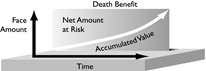 The Death Benefit is designed
to remain level.
The Death Benefit is designed
to remain level.
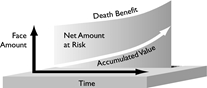 The Death Benefit changes as your Policy’s Accumulated Value changes. The
better your Investment Options perform, the larger the Death Benefit will be, but will never be lower
than Death Benefit Option A.
The Death Benefit changes as your Policy’s Accumulated Value changes. The
better your Investment Options perform, the larger the Death Benefit will be, but will never be lower
than Death Benefit Option A.
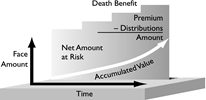 The more premiums you pay and the less you withdraw, the larger the Death Benefit
will be.
The more premiums you pay and the less you withdraw, the larger the Death Benefit
will be.
● Automatically issued on your Policy if eligibility requirements are met.
● Additional one-time cost at exercise of benefit.
● Benefit cannot be exercised during the first 15 Policy years, before the Insured is Age 75, while there is an Alternate Loan in effect, the Policy has entered the Grace Period, or if Death Benefit Option B or C was elected (can change to Option A to exercise benefit).
● Once exercised, no premiums, withdrawals, loan repayments (other than loan interest due), a Policy benefit change or addition at your request, or transfers at your request between Investment Options may occur.
● If the Rider is exercised, all Accumulated Value in the Investment Options and Segment Maturity Value of any Indexed Account at Segment Maturity will be transferred to the Fixed Account.
● If the Rider is exercised, any accelerated death benefit riders (Premier LTC, Premier Living Benefit 2, Premier
●Chronic Illness, and Terminal Illness Riders) will terminate and any increases in Face Amount that are scheduled to take effect after exercise of this Rider will be cancelled.
Overloan Protection 3 Rider
The Rider guarantees that your Policy will not lapse if the Standard Policy Debt is greater than the Policy’s Accumulated Value, resulting in it being overloaned. On or after the earliest exercise effective date, if all Rider Exercise Requirements have been met you may exercise the Rider by submitting a Written Request. This Rider is automatically issued on your Policy if eligibility requirements are met. There is no charge for this Rider unless you exercise it. See below for charge information.
The Rider After Policy Issue
The Rider cannot be exercised during the first 15 Policy Years before the Insured is Age 75, or while there is an Alternate Loan in effect. Please see Rider Termination below for termination conditions of the Rider before and after exercise. You may not pay premiums or take withdrawals from your Policy after exercise of the Rider. The Rider may not be exercised after the Policy has entered the Grace Period.
Rider Exercise Requirements
The exercise effective date will be the Monthly Payment Date on or next following the date we receive your Written Request to exercise the Rider and all exercise requirements have been met. The earliest exercise effective date is shown in the Policy Specifications. To exercise the Rider, each of the following conditions must be true as of the exercise effective date:
● The Death Benefit Option is Option A. If your policy does not meet this prerequisite, you must change your Death Benefit Option to Death Benefit Option A, by Written Request, prior to Rider exercise. Changes to your Death Benefit Option take effect on the Monthly Payment Date next following your Written Request. Such changes will modify your Total Face Amount and, as a result, this Rider may impact your ability to meet all the exercise conditions described below.
● There is no Alternate Loan Value on the Policy.
● There must be sufficient Accumulated Value to cover the rider exercise charge as described below.
● The Standard Policy Debt is greater than the Total Face Amount, but less than 99.9% of the Accumulated Value after the charge for this Rider has been deducted from the Accumulated Value.
● There are no projected forced distributions of Accumulated Value for any Policy Year.
● The Guideline Premium Limit for the Policy will remain greater than zero at all times prior to Insured’s Age 100.
● The Policy must not be a Modified Endowment Contract, and exercising this Rider must not cause the Policy to become a Modified Endowment Contract.
● The Policy must not be in the Grace Period.
Contact us if you have any questions about your eligibility to exercise this Rider. On the exercise effective date, we:
1. Transfer any Accumulated Value in the Investment Options into the Fixed Account. No transfer charge will be assessed for such transfer, nor will it count against, or be subject to, any transfer limitations then in effect.
2. Upon each Index Account Segment's Maturity, reallocate the Segment Maturity Value into the Fixed Account. No transfer charge will be assessed for such transfer, nor will it count against, or be subject to, any transfer limitations then in effect.
3. Deduct the charge for this Rider from your Policy’s Accumulated Value.
There is a one-time charge to exercise this Rider. The charge will not exceed the Accumulated Value multiplied by the overloan protection rate shown for the Insured’s Age at exercise in the Policy Specifications, as of the exercise effective date. The charge ranges from 1.12% to 4.52% of the Policy’s Accumulated Value, and is based on the Insured’s sex, Risk Class and Age as applicable at the time the Rider is exercised. If you never exercise the Rider, there is no charge for it. After you exercise the Rider, and while it continues in effect, the Policy’s lowest Death Benefit will be the Death Benefit percentage multiplied by the greater of the
Accumulated Value or the Standard Policy Debt.
A hypothetical example
For a male standard nonsmoker, Age 85 when the Rider is exercised, the charge will be 2.97% of the Policy’s Accumulated Value on the exercise effective date. If the Policy’s Accumulated Value is $25,000, the charge deducted from the Accumulated Value on the exercise effective date is $742.50. ($25,000 × 2.97% = $742.50).
The Rider After Exercise
After the exercise effective date and as long as the Rider stays in effect, the Policy will not lapse if the Accumulated Value is insufficient to cover Policy charges, even if the insufficiency is caused by overloan.
After the Rider is exercised, the Policy’s Minimum Death Benefit will be the Death Benefit percentage multiplied by the greater of the Accumulated Value or the Standard Policy Debt. Calculation of the Death Benefit, Minimum Death Benefit and Death Benefit Proceeds is described in the DEATH BENEFITS section in this prospectus.
Effect on Other Riders
Other than this Rider and any term insurance rider on the Insured that contributes to the Total Face Amount of the Policy, any Riders in effect with regularly scheduled charges will be terminated. Additionally, any accelerated death benefit rider will terminate upon exercise of this Rider. Any increases in Face Amount that are scheduled to take effect after exercise of the Rider will be cancelled.
Rider Termination
This Rider will terminate on the earliest of the following events:
● The Policy terminates;
● You make a Written Request to terminate the Rider; or
● If, after the exercise effective date:
o Any premium is paid
o Any withdrawal is taken
o Any loan repayment is made, other than for loan interest due
o Any Policy benefit is changed or added at your request
o Any transfer among the Investment Options is done at your request.
If the Rider terminates after the exercise effective date and while the Policy is In Force, any amount by which the Standard Policy Debt exceeds the Accumulated Value is due and payable to us.
Possible Tax Consequences
You should be aware that the tax consequences of this Rider have not been ruled on by the IRS or the courts and it is possible that the IRS could assert that the outstanding loan balance should be treated as a taxable distribution when this Rider is exercised. You should consult a tax advisor as to the tax risks associated with this Rider.
Example
A Policy is issued to an Insured age 55 with a Face Amount of $250,000, Death Benefit Option A and the Guideline Premium Test was elected. This Rider is automatically added to the Policy at issue. There is no charge for this Rider until it is exercised. During the first 17 years of the Policy, the Insured makes additional premium payments, withdrawals and takes out Standard Loans (no Alternative Loans were made). Over the next 3 Policy years, the Insured takes out additional Standard Loans on the Policy. This loan activity increases the total amount of Standard Loans which now exceed the Policy’s Accumulated Value, however, the Accumulated Value is still positive.
The Insured decides to exercise this Rider. Upon exercise, the one-time Rider charge will be assessed. No more loans, premium payments, or withdrawals will be allowed while this Rider is in effect. As long as the Rider stays in effect, the Policy will not lapse even if the Accumulated Value is insufficient to cover any Policy charges.
● Transfers may not be made to or from the Fixed Options or the Indexed Fixed Options.
● Transfers can be scheduled monthly, quarterly, semi-annually, or annually.
● If you make transfers out of the Variable
Investment Options you selected under the service, the service will end. You will have to wait 30 days before you can re-enroll with new allocation instructions.
● May not use this service and the Dollar Cost Averaging, First Year Transfer, or Fixed Option Interest Sweep at the same time.
● Available at Policy issue.
● Satisfactory Evidence of Insurability is required.
● Not available for Policies issued in California.
● Cannot be issued with the Premier Living Benefits Rider 2 or the Premier LTC Rider.
● Available if Insured is at least age 18 and no older than age 75 at Policy issue.
● Subject to the eligibility and other conditions described in the Rider such as certification of having a chronic illness, making a Written Request for benefits, and not exceeding the maximum amount of the Death Benefit that may be utilized for chronic illness benefits.
● When benefits are paid, certain Policy values (the Total Face Amount, Accumulated Value, Policy loans, Policy Debt, Loan Account, Loan Account Value and any Surrender Charges) will be reduced by the Acceleration Percentage. In addition, any Automated Income Option or other Systematic Distribution Program will be discontinued.
● Chronic illness benefits may be requested once every 12-month period.
● Chronic illness must be certified by a licensed
health care practitioner (not the Insured, Owner, or Immediate Family Member).
● During a Benefit Year (as defined in the Premier Chronic Illness Rider section), a Policy Owner can only change from Death Benefit Option B to Option A.
● During a Benefit Year, transfers from the Fixed Account to the Variable Investment Options are not permitted.
● Transfers to the Indexed Fixed Account are not permitted.
● Overloan protection riders will terminate at the time the first Terminal Illness Benefit Proceeds are paid.
Premier Chronic Illness Rider
(This Rider is called “Accelerated Death Benefit Rider for Chronic Conditions” in your Policy)
If you purchase this Rider, you cannot elect the Premier Living Benefits Rider 2. This Rider is not available for a Policy issued with the Premier Living Benefits Rider 2 or the Premier LTC Rider.
The Premier Chronic Illness Rider is a chronic illness rider that provides protection from the financial impacts of becoming chronically ill by providing acceleration of a portion of the Death Benefit. You can only elect the Premier Chronic Illness Rider at Policy issue. This Rider is available for purchase if the Insured is age 75 or younger and is not a juvenile (Insured’s age at Policy issue is at least 18). We assess a monthly charge for the Rider.
If you choose to exercise the Rider, at the time we pay any Benefit Payment, we will reduce certain Policy values. The Face Amount, Accumulated Value, Policy loans, Policy Debt, Loan Account, loan interest charged, Loan Account Value, and any Surrender Charge for each Coverage Layer will be reduced by the Acceleration Percentage as calculated under this Rider. The Death Benefit will indirectly be adjusted as well as certain Policy values above are reduced. See the Rider Effects on Your Policy Values subsection below for additional information.
Rider Charge
We assess the Rider charge on each Monthly Payment Date and deduct it from the Policy’s Accumulated Value. Currently, the charge range is $0.01 - $1.24 per $1,000 of Rider Net Amount at Risk. The maximum monthly charge for this Rider is equal to (a × b), where:
(a) Is the Maximum Monthly Rider Charge Rate as shown in the Policy Specifications adjusted for one dollar of Rider Net Amount at Risk; and
(b) Is the Rider Net Amount at Risk.
See the Lapse Protection subsection below for information on when the Rider charge is not assessed.
Rider Net Amount at Risk (NAR). The Rider NAR is calculated on each Monthly Payment Date as (c x d) ÷ e, where:
(c) Is the Remaining Lifetime Benefit Amount,
(d) Is the Net Amount at Risk of the Policy, and
(e) Is the Death Benefit of the Policy.
Example:
Assumptions:
● Policy Death Benefit is $1,000,000
● Remaining Lifetime Benefit Amount is $750,000
● Policy Net Amount at Risk (NAR) is $948,351
● Maximum Monthly Rider Charge rate per $1000 of Rider NAR is 0.8234
Then:
Rider NAR = [$750,000 x $948,351] ÷ $1,000,000 = $711,263.25
And:
Rider Charge = [0.8234 ÷ 1000] x $711,263.25 = $585.65
Rider Terms
Accelerated Death Benefit – a portion of the Death benefit that is paid if we receive a Written Certification that the Insured is chronically ill and all of the eligibility conditions under this Rider have been met. See the Eligibility Conditions subsection below.
Acceleration Percentage – an amount used to calculate Policy and Rider values after each benefit payment and after the corresponding reduction to the Policy’s Total Face Amount. It is calculated as (a) divided by (b), where:
(a) Is the Benefit Payment prior to any reductions or discounts, and
(b) Is the Death Benefit of the Policy prior to the Benefit Payment.
Activities of Daily Living – generally include the following self-care functions:
● Bathing oneself
● Continence
● Dressing oneself
● Feeding oneself
● Getting oneself to and from the toilet
● Transferring oneself into or out of a bed, chair or wheelchair.
The Rider attached to your Policy contains more detailed information about these self-care functions.
Benefit Payment – is the Maximum Monthly Benefit Payment. If the Maximum Annual Lump Sun Benefit Payment is elected, Benefit Payment is 12 times the Maximum Monthly Benefit Payment. The final Benefit Payment will be adjusted to ensure the total of all Benefit Payments do not exceed the Lifetime Benefit Amount.
Benefit Proceeds – is the Benefit Payment received by the Owner if all eligibility conditions have been satisfied, subject to the following reductions:
● If there is an outstanding loan balance under the Policy, a portion of each Benefit Payment is used to reduce the Policy Debt. The amount of this reduction is the Policy Debt prior to the Benefit Payment multiplied by the Acceleration Percentage,
● If the Policy is in a Grace Period, an amount needed to bring the Policy out of the Grace Period, and
● If the Maximum Annual Lump Sum Benefit Payment is elected, an amount to reflect the discounted sum of the Maximum Monthly Benefit Payments.
Benefit Year – a period of 12 months that begins on the Monthly Payment date on or following the date all eligibility conditions are satisfied and as long as the eligibility conditions continue to be satisfied and this rider has not terminated (see the Rider Termination section below). Subsequent Benefit Years will begin no earlier than the end of the current Benefit Year.
Chronically Ill – an Insured who has been certified In Writing by a Licensed Health Care Practitioner as:
● Being unable to perform, without substantial assistance from another individual, at least two Activities of Daily Living for an expected period of at least 90 days due to a loss of functional capacity; or
● Requiring substantial supervision by another person for protection from threats to the Insured’s health or safety due to a Severe Cognitive Impairment.
Elimination Period – the total number of consecutive days, after which the Owner is eligible to receive Benefit Proceeds, if all other eligibility conditions have been met. This period begins upon the first day that the Insured is Chronically Ill and expires at the end of 90 days. Benefit Proceeds are not paid retroactively after this period has been met. A new Elimination Period does not need to be met for a continuing diagnosis of the same chronic illness.
Immediate Family Member – includes the spouse, parents, brothers, sisters, and children by blood, adoption, or marriage of the Owner and the Insured, and of the spouse of the Owner and Insured.
Internal Revenue Service Per Diem Limitation – is periodically declared by the IRS and is used in the calculation of the Maximum Monthly Benefit Payment.
Licensed Health Care Practitioner – a physician, a registered professional nurse, licensed social worker or other individual who meets such requirements as may be prescribed by the Secretary of the Treasury of the United States. A Licensed Health Care Practitioner must reside in the United States and cannot be the Owner, the Insured or an Immediate Family Member.
Lifetime Benefit Amount – the maximum amount of Death Benefit that can be accelerated under this Rider during the Insured’s lifetime. The initial Lifetime Benefit Amount is shown in the Policy Specifications and may not be the amount used in calculating a Benefit Payment since the Lifetime Benefit Amount is determined at the time the eligibility conditions are met for purposes of the Benefit Payment.
Lifetime Benefit Percentage – a factor used to calculate the initial Lifetime Benefit Amount for the Rider and the percentage is shown in the Policy Specifications at time of issue and will not change. This percentage is also used as a factor to calculate the adjusted Lifetime Benefit Amount after a Policy change to reduce the Death Benefit.
Maximum Monthly Benefit Percentage – this percentage is elected at Policy issue and can be used to calculate the Maximum Monthly Benefit Payment. This percentage cannot be changed once elected and is shown in the Policy Specifications.
Maximum Per Diem Limitation Percentage – this percentage may be used in the Maximum Monthly Benefit Payment and is shown in the Policy Specifications. See Benefit Payment – Maximum Monthly Benefit Payment below to see how this percentage is used.
Severe Cognitive Impairment – means a deficiency or deterioration in the Insured’s intellectual capacity that is:
● Comparable to and includes Alzheimer’s disease and similar forms of dementia, and
● Measured by clinical evidence and standardized tests that reliably measure impairment in the Insured’s short or long-term memory, orientation as to person, place and time, deductive or abstract reasoning, and judgment as it relates to safety awareness.
Remaining Lifetime Benefit Amount – the Lifetime Benefit Amount reduced by any Benefit Proceeds.
Written Certification – a signed written statement completed by a Licensed Health Care Practitioner certifying that the Insured is Chronically Ill that includes proof of the Insured’s chronic illness and must be satisfactory to us. Such certification must be provided before the start of each Benefit Year and will be effective as of the first day of each Benefit Year. We reserve the right to obtain, at any time, an additional opinion of the Insured’s condition which can include a physical examination from a Licensed Health Care Practitioner, at our expense. Should this opinion differ from that of the Written Certification provided by the Insured, eligibility for benefits will be determined by a third Licensed Health Care Practitioner who is mutually acceptable to the Owner and us.
Eligibility Conditions
Benefit Proceeds are payable under this Rider when we verify that all of the following conditions are met:
● The Owner must provide a Request for Benefits and a benefit Form, or the equivalent as required by us,
● We must receive Written Certification that they Insured is Chronically Ill,
● We must receive authorization from the Insured to obtain copies of any relevant medical records required,
● The Owner must provide us with the written consent of any assignee(s) of record named under the Policy, or the irrevocable Beneficiary(ies) named under the Policy, if any, and
● The Elimination Period has been satisfied.
Benefit Proceeds may not be available if the law requires the benefit to meet the claims of creditors, whether in bankruptcy, child support or maintenance or otherwise, or a government agency requires the benefit in order to apply for, obtain, or keep a government benefit or entitlement.
Subject to the above, Benefit Proceeds are payable immediately upon the satisfaction of the eligibility conditions listed above. Benefit Proceeds begin on the Monthly Payment Date, on or following the date the eligibility conditions are met. The first payment upon meeting eligibility conditions includes any Benefit Proceeds that are retroactive to the Monthly Payment Date on or following the date all eligibility conditions are met. If any Benefit Proceeds payment is delayed 31 calendar days, we will pay additional interest beginning on the 31st calendar day to the date the Benefit Proceeds are paid.
Request for Benefits
A request for benefits under this Rider occurs when the eligibility conditions have been met and a written notice requesting an Accelerated Death Benefit has been submitted. Any request given by or on behalf of the Owner to us with information sufficient to identify the Insured, will be deemed an appropriate request to us. Only one request can be approved during any 12-month period. Request should include the desired dollar amount of the Accelerated Death Benefit and your preferred payment option. If the Insured recovers and a subsequent request is submitted, that request is considered to be a new request. We must approve the request before any Benefit Proceeds will be paid.
Within 15 days of our receipt of a request, a benefit form will be provided to the Owner. If we do not provide the form to the Owner or the Owner’s authorized representative within 15 days of your request, it will be considered that you complied with the form requirements. However, you must still submit written proof that the eligibility conditions (see the Eligibility Conditions section above) have been met along with the nature and extend of the chronic illness. Any information provided can be used to determine proof of eligibility.
Within 90 days prior to the end of the current Benefit Year, we will send you a request for Written Certification to recertify that the Insured remains Chronically Ill. Payment of Benefit Proceeds will not automatically continue under this Rider unless Written Certification is provided at least once every Benefit Year. In order for payment to continue, we must receive Written Certification 60 days before the end of the current Benefit Year. If the Written Certification is received on time, the next benefit Year will begin following the end of the current Benefit Year.
If Written Certification is not received 60 days before the end of the current Benefit Year, a new Benefit Year will not automatically begin upon the end of the preceding Benefit Year. In such an event, the following conditions will apply:
● If the Written Certification is received from 59 days prior to the end of the Benefit Year to within 90 days after the end of the preceding Benefit Year, the new Benefit Year will begin on the Monthly Payment Date on or following the date we receive the Written Certification. If monthly Benefit Payments still remain under the current Benefit Year, the monthly Benefit Payments for the new Benefit Year will start when the last payment for the current Benefit Year is made.
● If the Written Certification is received beyond 90 days after the end of the preceding Benefit Year, your request will be treated as a new request and the new Benefit Year will begin on the Monthly Payment Date on or following the date all eligible conditions are met, including the new Elimination Period if required.
You must notify us if the Insured is no longer Chronically Ill. You can cancel payment of Benefit Proceeds under the monthly payment option at any time by written notification to us and any remaining Benefit Proceed payments will cease upon our receipt of the notification. Any subsequent request for payments must satisfy the eligibility conditions.
Lifetime Benefit Amount
The Lifetime Benefit Amount is determined at the time the eligibility conditions are met for purposes of the Benefit Payment. Any Policy changes that reduce the Death Benefit also reduce the Remaining Lifetime Benefit Amount proportionately. The Lifetime Benefit Amount is equal to the Remaining Lifetime Benefit Amount plus the sum of all prior Benefit Payments. Any Policy changes that increase the Death Benefit do not impact or change the Remaining Lifetime Benefit Amount.
If payment of Benefit Proceeds is not in effect and a request for benefits has not been submitted, you can request a decrease in the Lifetime Benefit Amount after the first Policy Year. The effective date of such decrease will be the Monthly Payment Date after we approve your request.
Increases to the Lifetime Benefit Amount are not possible, even if there is an increase to the Death Benefit. However, any Policy changes that reduce the Death Benefit also reduce the Remaining Lifetime Benefit Amount proportionately.
After any Policy change, other than an increase to the Death Benefit, the Lifetime Benefit Amount will be adjusted to ensure that the Lifetime Benefit Amount will never exceed the Policy’s Face Amount.
Example:
Assume the following:
● Remaining Lifetime Benefit Amount at issue is $750,000
● Total Face Amount is $1,000,000
● Benefit Payment processed is $10,000
Then:
Total Face Amount = $1,000,000 - $10,000 = $990,000
Remaining Lifetime Benefit Amount = $750,000 - $10,000 = $740,000
Lifetime Benefit Amount = $750,000 (benefit payment does not reduce the Lifetime Benefit Amount)
End of Example
After any Policy change, the Lifetime Benefit Amount will be adjusted to ensure that:
● The Lifetime Benefit Amount will never exceed the Policy’s Face Amount, and
● The Lifetime Benefit Amount will be at least equal to the greater of:
o The Lifetime Benefit Amount Percentage of the Policy’s Face Amount, and
o The Minimum Lifetime Benefit Amount which is the greater of $50,000 or 50% of the Policy’s Face Amount.
Example:
Assume the following:
● Remaining Lifetime Benefit Amount is $740,000
● Lifetime Benefit Amount is $750,000
● Total Face Amount is $1,000,000
● Accumulated Value is $50,000
● Death Benefit is $1,050,000
● Withdrawal processed for $25,000
Then:
Remaining Lifetime Benefit Amount after Withdrawal = Remaining Lifetime Benefit Amount before Withdrawal x (1 – Withdrawal ÷ Death Benefit) = $722,380.95
This is a reduction of $17,619.05 = ($740,000 – $722,380.95). The same dollar amount reduces the Lifetime Benefit Amount.
Lifetime Benefit Amount = $732,380.95
Example:
Assume the following:
● Remaining Lifetime Benefit Amount is $740,000
● Lifetime Benefit Amount is $750,000
● Total Face Amount is $1,000,000
● Accumulated Value is $50,000
● Death Benefit is $1,050,000
● Face Reduction to $800,000
Then:
Remaining Lifetime Benefit Amount after Face Reduction = Remaining Lifetime Benefit Amount before Face Reduction x (1 – Face Reduction ÷ Death Benefit) = $599,047.62.
This is a reduction of $140,952.38 = ($740,000 – $599,047.62). The same dollar amount reduces the Lifetime Benefit Amount.
Lifetime Benefit Amount = $609,047.62.
End of Example
If no Benefit Payments have been paid, the Remaining Lifetime Benefit Amount is equal to the Lifetime Benefit Amount. Subsequent Benefit Payments paid under this Rider reduce the Remaining Lifetime Benefit Amount as follows:
● If the Maximum Monthly Benefit Payment option is selected, the Remaining Lifetime Benefit is reduced by the Maximum Monthly Benefit Payment.
● If the Maximum Annual Lump Sum Benefit Payment option is selected, the Remaining Lifetime Benefit Amount is reduced by 12 times the Maximum Monthly Benefit Payment.
Benefit Payment
You can elect to receive Benefit Payments monthly (12 payments over a Benefit Year) or elect to receive one annual payment. If no election is made, the default will be monthly Benefit Payments.
Maximum Monthly Benefit Payment. Under a monthly benefit option, you can elect receipt of Benefit Proceeds in 12 monthly payments over a Benefit Year, or until you cancel your request. The Maximum Monthly Benefit Payment is the minimum of these three amounts:
● The Lifetime Benefit Amount multiplied by the Maximum Monthly Benefit Percentage,
● The IRS Per Diem Limitation multiplied by the day in the month factor as shown in the Policy Specifications, multiplied by the Maximum Per Diem Limitation Percentage shown in the Policy Specification, or
● The amount requested by you.
The Maximum Monthly Benefit Payment will not be less than the Minimum Monthly Benefit Payment shown in the Policy Specifications and will not be more than the Remaining Lifetime Benefit Amount.
Maximum Annual Lump Sum Benefit Payment. Under a lump sum benefit option, you can elect receipt of Benefit Proceeds in one annual payment in a Benefit Year. The Maximum Annual Lump Sum Benefit Payment is a discounted sum of the Maximum Monthly Benefit Payments in a Benefit Year. The Maximum Annual Lump Sum Benefit Payment will not exceed the Remaining Lifetime Benefit Amount. If the Maximum Annual Lump Sum Benefit Payment is elected, the Benefit Proceeds will be at least as great as the Acceleration Percentage times the Policy’s Net Cash Surrender Value.
Discount Rate. The discount rate is used to determine the Maximum Annual Lump Sum Benefit Payment and will not exceed the greater of these two amounts:
● The current yield on 90-day Treasury bills, or
● The current maximum statutory adjustable policy loan interest rate based on Moody’s Corporate Bond Yield Average – Monthly Average Corporates published by Moody’s Investors Service, Inc., for the calendar month ending two months before the request for an accelerated payment.
In the event that either of the above amounts are discontinued, an appropriate substitute index will be used subject to approval of any state regulatory agencies.
Example:
Assume the following:
● Total Face Amount is $500,000
● Remaining Lifetime Benefit Amount is $500,000
● Maximum Monthly Benefit is 4%
● IRS Per Diem Limitation is $390
● Month Factor is 30
● Maximum Per Diem Limitation Percentage is 125%
● Discount Rate is 8.00%
● Policy Debt = $0
● Policy is not in Grace Period
● Lump Sum Annual Benefit Payment is selected
And:
● Lifetime Benefit Amount x Maximum Monthly Benefit Percentage = $20,000
● IRS Per Diem Limitation x 30 x 125%=$14,625
● Requested Amount = $10,000
Then:
Maximum Monthly Benefit is $10,000 (minimum of the above three amounts)
Maximum Lump Sum Annual Benefit Payment (Discounted value at 8.00%) is $115,870 (calculated from each monthly benefit) Benefit Payment is $120,000 (12 x Maximum Monthly Benefit)
Benefit Proceeds is $115,870 (Benefit Payment adjusted for Discounting, Debt, and Grace) Remaining Lifetime Benefit Amount = Lifetime Benefit Amount – Benefit Payment = $380,000
End of Example
Who Benefit Proceeds Are Paid To. Unless otherwise assigned or designated by the Owner, all Benefit Proceeds will be payable to the Owner or the Owner’s estate while the Insured is still living, subject to any required acknowledgement from any assignee(s) of record named under the Policy, or the irrevocable Beneficiary(ies) named under the Policy, if applicable. Upon the death of the Owner, we will pay any Benefit Proceeds requested prior to the Owner’s death, to his or her estate. Any payment of Benefit Proceeds that is made in good faith by us is deemed irrevocable.
Death of the Insured. If written notice of the Insured’s death is received by us prior to a payment of Benefit Proceeds, then such proceeds will not be paid. However, any Benefit Proceeds paid by us after the date of death but prior to our receipt of written notice of the Insured’s death, will reduce the Death Benefit Proceeds payable under the Policy.
Example where the Policy is not in the Grace Period:
Assumptions:
● Remaining Lifetime Benefit Amount is $750,000
● Benefit Payment is $20,000
● Policy Debt before the Benefit Payment is $5,000
● Policy Death Benefit before the Benefit Payment is $1,000,000
Acceleration Percentage = $20,000 ÷ $1,000,000 = 2% Benefit Proceeds = $20,000 – ($5,000 x 2%) = $19,900
Example where the Policy is in the Grace Period:
Assumptions:
● Remaining Lifetime Benefit Amount is $750,000
● Benefit Payment is $20,000
● Policy Accumulated Value is $15,000
● Policy Debt before the Benefit Payment is $15,200
● Unpaid Grace Amount is $1,200
● Policy Death Benefit before the Benefit Payment is $1,000,000 Acceleration Percentage = $20,000 ÷ $1,000,000 = 2%
Benefit Proceeds = $20,000 – (2% x $15,200) – $1,200 = $18,496
End of Example
Rider Effects on Your Policy Values
When we pay a Benefit Payment, we will reduce the following Policy values (if applicable) by their current value multiplied by the Acceleration Percentage:
● The Policy’s Total Face Amount,
● The Accumulated Value,
● Any Alternate Accumulated Value of the Policy or any rider;
● Any Policy loans, Policy Debt, Loan interest charged, Loan Account, and the Loan Account Value,
● Any alternate loan values (including Alternate Policy Debt),
● Any Termination Charge applicable for each LTPR Coverage Layer, and
● Any Surrender Charge for each Coverage Layer.
For example, if the Acceleration Percentage is 2%, each of the above values is reduced by 2% as shown below:
Policy Value | Before Benefit Payment | Reduction (2% x Value) | After Benefit Payment |
Basic Face Amount | $1,000,000 | $20,000 | $980,000 |
Accumulated Value | $15,000 | $300 | $14,700 |
Policy Debt | $15,200 | $304 | $14,896 |
Surrender Charge | $1,000 | $20 | $980 |
End of Example
Other Rider Effects on Your Policy
After we make a Benefit Payment under the Rider:
● We will not allow any increase or decrease to the Total Face Amount during a Benefit Year,
● Policy loans may not be requested during a Benefit Year However, when a Benefit Year ends, Policy loans may be requested,
● Death Benefit Option changes are allowed during a Benefit Year, but only from Death Benefit Option B into Death Benefit Option A while this Rider is In Force,
● Policy withdrawals may not be requested during a Benefit Year,
● Any Systematic Distribution Program in effect will be discontinued,
● During a Benefit Year, transfers from the Fixed Options to the Variable Investment Options are not permitted,
● If your Policy has the No-Lapse Guarantee Rider, the no-lapse guarantee premium is reduced on the date of each Benefit Payment by an amount equal to the no-lapse guarantee premium prior to the Benefit Payment, multiplied by the Acceleration Percentage. The no-lapse credit is reduced on the date of each Benefit Payment by an amount equal to the No-Lapse Credit prior to the Benefit Payment multiplied by the Acceleration Percentage, and
● For any no-lapse guarantee rider that is based on a no-lapse guarantee value (Flexible Duration No-Lapse Guarantee Rider), the no-lapse guarantee value will be reduced on each Benefit Payment Date by an amount equal to the no-lapse guarantee value prior to payment of Benefit Proceeds, multiplied by the Acceleration Percentage;
Accelerated Death Benefits may affect your eligibility for, or amount of, other benefits provided by federal, state or local government.
Payments of Accelerated Death Benefits provided by the Rider are intended to qualify as Death Benefits under section 101(g) of the Tax Code. The federal, state, or local tax consequences resulting from payment of Accelerated Death Benefit proceeds will depend on your specific facts and circumstances. You should consult with your personal tax advisor before requesting any Accelerated Death Benefit payments.
Payment of an Accelerated Death Benefit under this Rider will reduce the Policy’s Death Benefit and other values under the Policy. In most circumstances, the cost of insurance charges will also be reduced. In addition, premium limitations and Death Benefits required in order for the Policy to qualify as a life insurance policy or avoid being classified as a Modified Endowment Contract under the Tax Code will also be affected. See the VARIABLE LIFE INSURANCE AND YOUR TAXES - Modified Endowment Contracts and HOW PREMIUMS WORK - Limits on the Premium Payments You Can Make sections in this prospectus for more information on the relation of the Policy’s Death Benefit to premium payments and Modified Endowment Contract status.
Premier Chronic Illness Rider Effects on Other Riders
Generally, optional rider benefits under the Policy will continue to remain In Force subject to the terms and conditions of the Policy and riders, unless otherwise stated. We will calculate charges for optional riders in accordance with the terms of each applicable Rider. The charges may be affected by the reduction in benefits and Policy values. In addition:
o For policies with overloan protection riders (Overloan Protection 3 Rider), the overloan protection riders will terminate at the time the first Benefit Proceeds are paid; and
o The Indexed Termination Credit Accrued provided by the Minimum Indexed Benefit Rider will be reduced on each Benefit Payment Date by an amount equal to the Indexed Termination Credit Accrued prior to the Benefit Payment multiplied by the Acceleration Percentage.
Lapse Protection
During any Benefit Year, the Policy and any rider will not lapse. Currently, this benefit is administered such that the Monthly Deduction under the Policy, and any Rider will not be assessed during a Benefit Year. Policy loans will continue to be processed according to Policy terms and can result in a negative Net Cash Surrender Value.
When Benefit Payments are no longer being made for a Benefit Year, additional premium or a loan repayment may be required to keep the Policy In Force when Monthly Deductions resume.
Rider Termination
This Rider will terminate upon the occurrence of any of the following:
● Your Written Request,
● The acceleration of any part of the Death Benefit of the Policy for reason of terminal illness while the Insured is still living,
● The date the Remaining Lifetime Benefit Amount is zero,
● Exercise of an overloan protection rider (Overloan Protection 3 Rider);
● The date the Policy terminates, or
● The date we receive, at our office, written notice of the death of the Insured.
Rider Reinstatement
If the Policy is reinstated, this Rider may also be reinstated according to the reinstatement provision of the Policy.
● Must be elected at Policy issue.
● Satisfactory Evidence of Insurability is required.
● Additional cost applies.
● Subject to the eligibility and other conditions described in the rider. Some of the conditions include the Insured being certified as a chronically ill individual, meeting the 90-day Elimination Period before benefits are payable, and obtaining written consent for benefit payments by any assignee or irrevocable Beneficiary.
● This Rider will not pay for care or services under certain circumstances as outlined in the Rider.
● Cannot be added to a Policy that was issued with the Premier Living Benefits Rider 2 or the Premier Chronic Illness Rider.
● Payments are made monthly.
● Chronic Illness must be certified by a licensed health care practitioner (not the insured, owner, beneficiary, or relative).
● If the Rider is exercised, certain Policy values including the Total Face Amount, Death Benefit, Accumulated Value, loan amounts, and Cost of Insurance charges (in most cases) will be reduced. In addition, any Automated Income Option or other Systematic Distribution Program will be discontinued.
Premier LTC Rider
(This Rider is called “Accelerated Death Benefit Rider for Long-Term Care” in your Policy)
The Premier LTC Rider (LTC Rider) is a long-term care insurance rider that provides benefits for Covered Services incurred for Adult Day Care, Assisted Living Care, Home Health Care, Hospice Care, and Nursing Home Care. The Rider accelerates all or a portion of the Policy’s Death Benefit if you become Chronically Ill. You can only elect the LTC Rider at Policy issue. The Rider allows the Policy Owner to accelerate the Policy’s death benefit proceeds as a monthly benefit for Covered Services while the Insured is Chronically Ill and receiving Qualified Long-Term Care Services at an approved location as prescribed under a Plan of Care, subject to the limitations, exclusions and eligibility conditions defined in the Rider (see the Limitations, Exclusions and Eligibility Conditions for Benefits subsection below). We assess a monthly charge for the Rider. For more information, please see the APPENDIX: STATE LAW VARIATIONS section in this prospectus. This Rider must be elected at Policy Issue.
This Rider cannot be added to any policy that has the Premier Living Benefit Rider 2 or the Premier Chronic Illness Rider attached. You may elect both the Terminal Illness Rider and the LTC Rider at policy issue, as long as the Insured meets the eligibility requirements for each rider.
If you choose to exercise the Rider, at the time we pay any benefit payment, we will reduce your Policy’s Death Benefit, as described in the Policy and Rider. Other Policy values, including but not limited to Surrender Charge, Accumulated Value and Total Face Amount will be reduced pro rata.
30-Day Right to Examine
The Owner has 30 days from the day this Rider is received to examine and return it to us if the Owner decides not to keep this Rider. The Owner does not have to tell us the reason for returning this Rider. The Rider can be returned to us at our Administrative Office or to the Producer through whom it was bought. If you wish to cancel the Rider without cancelling the Policy, you must return the Policy and this Rider to us so that we can send you back the Policy without this Rider. We will refund, as a credit to the Policy, the full amount of any Rider Charges paid within 30 days of such a Rider return and the Rider will be void from the start.
Rider Charge
We assess the LTC Rider Charge on each Monthly Payment Date and deduct it from the Policy’s Accumulated Value. The current charge for this rider is $0.01-$1.15 per $1,000 of LTC Net Amount at Risk. The maximum monthly charge for this Rider is equal to (a × b) where:
(a) Is the Maximum Monthly LTC Rider Charge Rate as shown in the Policy Specifications divided by 1000; and
(b) Is the LTC Net Amount at Risk.
During any Claim Period, we will waive any LTC Rider Charges that would occur as part of the Policy Monthly Deduction. The charges will resume when the Claim Period is no longer in effect. Rider charges will apply during any Elimination Period.
A hypothetical example of a Maximum Monthly LTC Rider Charge Calculation:
Assume the following:
● Policy Death Benefit is $1,000,000
● LTC Coverage Amount is $750,000
● Policy Net Amount at Risk (NAR) is $948,351
● Maximum Monthly LTC Rider Charge rate per $1000 of LTC NAR is 0.3426
● LTC NAR = $711,263.25. The LTC Net Amount of Risk (NAR) is calculated on each Monthly Payment Date as [a × b] ÷ c where:
a. Is the LTC Coverage Amount;
b. Is the Policy’s Net Amount at Risk; and
c. Is the Policy’s Death Benefit.
LTC Rider Charge = [Maximum Monthly LTC Rider Charge Rate ÷ 1000] x LTC NAR = $243.68
Rider Terms
Acceleration Percentage – an amount used to calculate Policy and Rider values after a benefit payment and after the corresponding reduction to the Policy’s Total Face Amount. It is calculated after each benefit payment as the LTC Benefit Amount divided by the Policy Death Benefit prior to the benefit payment.
Activities of Daily Living – generally include the following self-care functions:
● Bathing oneself
● Continence
● Dressing oneself
● Feeding oneself
● Getting oneself to and from the toilet
● Transferring oneself into or out of a bed, chair or wheelchair.
The Rider attached to your Policy contains more detailed information about these self-care functions.
Adjusted LTC Coverage Amount – the amount used to calculate the Maximum Monthly Benefit Payment Amount. If no benefits have been paid under the Rider, the Adjusted LTC Coverage Amount is equal to the LTC Coverage Amount. Any decrease to LTC Coverage Amount will also decrease the Adjusted LTC Coverage Amount by the same dollar amount, except that the Adjusted LTC Coverage Amount will not be reduced for a benefit payment under this rider. We do not allow increases to the Adjusted LTC Coverage Amount.
Assessment – an evaluation done in the United States by a Licensed Health Care Practitioner to determine or verify that the Insured is a Chronically Ill Individual.
Assisted Living Care – personal/custodial monitoring and assistance with Activities of Daily Living provided in a residential setting in an Assisted Living Facility.
Assisted Living Facility – a facility that is licensed or certified or complies with the state’s facility licensing requirements to engage primarily in providing ongoing Assisted Living Care and related services as described in the Rider.
Chronically Ill Individual – an Insured who has been certified in writing as:
● Being unable to perform at least two Activities of Daily Living without hands-on or standby assistance from another individual for a period of at least 90 days due to a loss of functional capacity; or
● Requiring substantial supervision by another person for protection from threats to the Insured’s health or safety due to a Severe Cognitive Impairment as described in the Rider.
Claim Forms – we will provide Claim Forms for the filing of a Proof of Loss when we receive the notice of claim. If the Owner, Insured or Insured’s Representative does not receive the necessary Claim Forms within 15 days, a Proof of Loss can be filed without them by sending us a letter which describes the occurrence, the character and the extent of the loss for which the claim is made. That letter must be sent to us at our Administrative Office within the time noted below under Proof of Loss.
Claim Period – an uninterrupted period of time during which benefits are being paid under this Rider. The Claim Period for an occurrence begins on the date a benefit payment is made. After the final benefit payment for an occurrence is made, the Claim Period terminates at the end of the day prior to the next Monthly Payment Date.
Confinement or Confined – an Insured who is a resident in a Nursing Home Facility, an Assisted Living Facility or a Hospice Care Facility for a period for which a room and board charge is made.
Covered Services – the types of Qualified Long-Term Care Services the Insured must receive and must be prescribed under a Plan of Care in order to qualify for a benefit to be payable under this Rider.
Elimination Period – the total number of days that the Insured is a Chronically Ill Individual before benefits are payable. The Elimination Period is 90 days for all covered services. The Elimination Period must only be met once; any subsequent claim will not be subject to a new Elimination Period.
Home Health Care – medical and non-medical services, provided to ill, disabled or infirm persons by a Home Health Care Agency in their residences. Such services may include Homemaker Services and assistance with Activities of Daily Living and may be performed by a Home Health Care Agency or by any other skilled or unskilled individuals.
Home Health Care Agency – an entity that is licensed or certified to provide Home Health Care for compensation by the state in which it operates and employs staff who are qualified by training or experience to provide such care.
Hospice Care – services designed to provide palliative care and alleviate the Insured’s physical, emotional and social discomforts if he or she is Terminally Ill and in the last phases of life. Hospice Care includes Home Health Care as well as care received in a Nursing Home Facility, Hospice Care Facility, or Assisted Living Facility.
Hospice Care Facility – a facility that is appropriately licensed or certified to provide Hospice Care in the state in which it operates.
Immediate Family Member – the Insured’s Spouse and the parents, brothers, sisters and children of either the Insured or the Insured’s Spouse by blood, adoption or marriage.
In Good Order – the date the applicable Elimination Period has been completed and all of the requirements under the eligibility conditions for the payment of benefits under this Rider have been met and verified by us.
International Benefit – Benefits are payable under this Rider when the Insured incurs Covered Services outside the United States provided the initial and any annual renewal certifications are completed by a Licensed Health Care Practitioner.
A Plan of Care can be completed remotely provided it is prescribed in the United States. The Insured is not required to return to the United States to be certified as being a Chronically Ill Individual.
Licensed Health Care Practitioner – a physician, a registered professional nurse, licensed social worker or other individual who meets such requirements as may be prescribed by the Secretary of the Treasury of the United States. A Licensed Health Care Practitioner must reside in the United States and cannot be you or an Immediate Family Member.
LTC Coverage Amount – the total benefits payable under the Rider, adjusted for certain policy transactions as further described in
LTC Coverage Amount.
LTC Net Amount at Risk (NAR) – the LTC NAR is calculated on each Monthly Payment Date as (a) multiplied by (b) divided by (c) where:
a. Is the LTC Coverage Amount;
b. Is the Net Amount at Risk of the Policy; and
c. Is the Death Benefit of the Policy.
Maintenance or Personal Care Services – means any care the primary purpose of which is the provision of needed assistance with any of the disabilities as a result of which the Insured is a Chronically Ill Individual. This includes protection from threats to health and safety due to Severe Cognitive Impairment.
Minimum LTC Coverage Amount – the minimum amount of long term care coverage available under the Rider; generally $50,000 but varies by state and is shown in your policy specifications.
Monthly Per Diem Limitation – the Per Diem Limitation declared by the Internal Revenue Service and in effect on the date any LTC Benefit is effective, multiplied by the Maximum Per Diem Limitation Percentage shown in the Policy Specifications then multiplied by 30. The IRS releases updated Per Diem Limitations annually. Current Per Diem Limitations can be found on the IRS’ website at www.irs.gov. You may also contact us at our Life Insurance Operations Center to request a quote for the current Limitations.
Nursing Home Care – nursing care and related services provided on an in-patient basis by a Nursing Home Facility.
Nursing Home Facility – a facility or distinctly separate part of a hospital or other institution that is appropriately licensed or certified or complies with the state’s facility licensing requirements to engage primarily in providing Nursing Home Care to inpatients under a planned program supervised by a Physician.
Option C Amount – if Death Benefit Option C is elected, the Option C Amount is the Policy’s Total Face Amount plus premiums paid, less any withdrawals (WD) or other distributions and is subject to Death Benefit Option C Limit as described in the Policy Specifications.
Physician – a doctor of medicine or osteopathy legally authorized to practice medicine and surgery by the state in which he or she
performs such function or action (as defined in Section 1861(r)(1) of the Social Security Act).
Plan of Care – a written individualized plan of services which is appropriate and consistent with the Health Insurance Portability and Accountability Act of 1996 (“HIPAA”). An approved Plan will be consistent with the care needs that were verified during the process of establishing that the Insured is a Chronically Ill Individual. When we have received all information required to verify the Plan of Care, which will include the proposed provider of long term care services, we will generally complete the verification process within ten business days of the date of the claimant’s benefit eligibility approval.
Proof of Loss – written Proof of Loss is information satisfactory to us that describes and confirms that the Insured has met the eligibility requirements for an occurrence for the payment of benefits. An occurrence is an uninterrupted period of time during which the Insured is claiming benefits under this Rider. If the Insured recovers, but later opens a new claim, the subsequent claim will be considered a new occurrence. You must provide written Proof of Loss within 90 days after the occurrence or commencement of any loss covered for which benefits are claimed. However, we will still consider a claim if it was not possible to secure proof within the 90-day time frame and you provided the Proof of Loss as soon as reasonably possible thereafter. Except in the absence of legal capacity, we will not consider a service to be a Covered Service if Proof of Loss for that service is furnished more than one year after the date the proof is otherwise required.
Qualified Long-Term Care Services – services that meet the requirements of Section 7702B(c)(1) of the Internal Revenue Code of 1986, as amended, as follows: necessary diagnostic, preventative, therapeutic, curing, treating, mitigating and rehabilitative services, and Maintenance or Personal Care Services which are required by a Chronically Ill Individual and are provided pursuant to a Plan of Care prescribed by a Licensed Health Care Practitioner.
Severe Cognitive Impairment – means a deficiency in an individual’s short or long-term memory, orientation as to person, place and time, deductive or abstract reasoning, or judgment as it relates to safety awareness.
Terminally Ill – means the Insured has a life expectancy of 12 months or less, as certified by a Physician.
Limitations, Exclusions and Eligibility Conditions for Benefits
To receive the Rider Benefit, you must satisfy the following conditions:
● A Licensed Health Care Practitioner certifies the Insured as being a Chronically Ill Individual;
● The Insured receives care that is a Covered Service under this Rider and care is provided pursuant to a written Plan of Care;
● Coverage under this Rider is In Force on the date(s) the care is received;
● Any assignee or any irrevocable Beneficiary under the Policy must provide written consent to payment of benefits;
● The applicable Elimination Period has been satisfied.
If the Insured recovers from a Chronic Illness and the LTC Coverage Amount has not been exhausted, a new claim may be initiated, subject to the same eligibility requirements that applied to the initial claim. However, the Elimination Period will already have been satisfied. Benefits for subsequent claims will be calculated in the same manner as they were for the initial claim.
You must elect to accelerate benefits under the Policy by making a claim for benefits under this Rider. If the entire Death Benefit under the Policy is accelerated under the terms of this Rider, the Policy will terminate.
Certain pre-existing condition limitations apply. A pre-existing condition is any condition for which the Insured received medical advice or treatment in the six months preceding the LTC Rider Effective Date. If the Insured is Confined for a pre-existing condition that was disclosed in the application, that condition is considered a Covered Service and the Elimination Period will begin on the Rider Effective Date. We will not pay benefits for a Confinement due wholly or in part to a pre-existing condition which is not disclosed in the application if the need for services begins during the first six months after the Rider Effective Date.
The Rider will not pay benefits for:
● Care or services that result from an attempt at suicide (while sane or insane) or an intentionally self-inflicted injury;
● Care or services that result from alcoholism or drug addiction;
● Care or services that result from committing or attempting to commit or participating in a felony, riot or insurrection;
● Treatment provided in a government facility (unless current or future law requires that this Rider provide coverage);
● Services for which benefits are available under Medicare or other governmental program (except Medicaid), any state or federal workers’ compensation, employer’s liability or occupational disease law, or any motor vehicle no-fault law; or
● Services received while this Rider is not In Force, except as provided in the Extension of Benefits provision. LTC Coverage Amount
The LTC Coverage Amount is the maximum amount of benefits payable under this Rider. The initial LTC Coverage Amount is shown in the Policy Specifications and is adjusted thereafter as described below. The LTC Coverage Amount will never exceed the Policy’s Total Face Amount, or, if Death Benefit Option C is in effect, the lesser of the Total Face Amount or the Option C Amount.
The LTC Coverage Amount will be decreased at the time:
● We receive your Written Request;
● We pay a benefit in accordance with the terms of the Rider;
● A withdrawal from the Policy occurs; or
● The LTC Coverage Amount is greater than the Policy’s Total Face Amount; or, if you selected Death Benefit Option C, the LTC Coverage Amount will be decreased to the lesser of the Policy’s Total Face Amount or the Option C Amount.
Transaction | Reduction to LTC Coverage Amount | LTC Coverage Amount After Transaction |
Benefit Payment | LTC Benefit Amount | A – B where: A is the LTC Coverage Amount before Benefit Payment; and B is the LTC Benefit Amount See Example #1 below |
Withdrawal | Withdrawal /Policy Death Benefit x LTC Coverage Amount | A x (1- B/C) where: A is the LTC Coverage Amount before the withdrawal; B is the Withdrawal; and C is the Policy Death Benefit before the withdrawal See Example #2 below |
Other reduction to the Total Face Amount (Death Benefit Option A or B is in effect) | Maximum of A or (B – C) where: A is 0; B is the LTC Coverage Amount; and C is the Policy Face Amount after the face reduction | Minimum of A or B where: A is the LTC Coverage Amount before the reduction to Total Face Amount; and B is the Total Face Amount after the reduction See Example #3 below |
Other reduction to the Total Face Amount (Death Benefit Option C is in effect) | Maximum of A or (B – C) where: A is 0; B is the LTC Coverage Amount; and C is the lesser of Policy Face Amount after the face reduction or the Option C Amount after the face reduction | Minimum of A, B or C where: A is the LTC Coverage Amount before the reduction to Total Face Amount; B is the Total Face Amount after the reduction; C is the Option C Amount after the reduction to Total Face Amount See Example #4 below |
If no benefits have been paid under the Rider, the Adjusted LTC Coverage Amount is equal to the LTC Coverage Amount. Any decrease to LTC Coverage Amount will also decrease the Adjusted LTC Coverage Amount by the same dollar amount, except that the Adjusted LTC Coverage Amount will not be reduced for a benefit payment under this rider. We do not allow increases to the Adjusted LTC Coverage Amount.
Hypothetical Example #1:
Assume the following:
● LTC Coverage Amount at issue is $750,000 and Total Face Amount is $1,000,000
● LTC Benefit Amount = $10,000
Then:
LTC Coverage Amount - $740,000 ($750,000-$10,000)
Adjusted LTC Coverage Amount = $750,000 (benefit payment does not reduce the Adjusted LTC Coverage Amount)
Hypothetical Example #2:
Assume the following:
● LTC Coverage Amount at issue is $740,000
● Death Benefit Option B
● Adjusted LTC Coverage Amount is $750,000
● Total Face Amount is $1,000,000
● Accumulated Value is $50,000
● Death Benefit is $1,050,000
● Withdrawal processed for $25,000
Then:
LTC Coverage Amount after WD = LTC Coverage Amount before Withdrawal x (1 – WD/DB) = $722,380.95
This is a reduction of $17,619.05 (740,000 – 722,380.95). The same dollar amount reduces the Adjusted LTC Coverage Amount.
Adjusted LTC Coverage Amount = $732,380.95
Hypothetical Example #3:
Assume the following:
● LTC Coverage Amount is $722,380.95
● Adjusted LTC Coverage Amount is $732,380.95
● Total Face Amount is $1,000,000
If there is a policy transaction that reduces the Total Face Amount to $800,000 there is no reduction to the LTC Coverage Amount or the Adjusted LTC Coverage Amount. This is because the LTC Coverage Amount of $722,380.95 is still less than the Total Face Amount after reduction to $800,000.
If there is a policy transaction that reduces the Total Face Amount to $600,000, then the LTC Coverage Amount is reduced to $600,000 so that the LTC Coverage Amount does not exceed the Total Face Amount. This is a reduction of $122,380.95 and this same dollar amount will reduce the Adjusted LTC Coverage Amount. The Adjusted LTC Coverage Amount after this reduction is $610,000.
Hypothetical Example #4: (Option C)
Assume the following:
● LTC Coverage Amount is $950,000
● Adjusted LTC Coverage Amount is $950,000
● Total Face Amount is $1,000,000
● DB Option C is in effect
● Cumulative Premiums = 100,000
● Cumulative Withdrawals = 150,000
The Option C Amount before the face reduction = 950,000 (1,000,000 + 100,000 – 150,000)
The Face Amount is reduced to 975,000
After this reduction to Total Face Amount, the Option C Amount is 925,000 (975,000 + 100,000 – 150,000)
Although the LTC Coverage Amount does not exceed the Total Face Amount after the reduction to the Total Face Amount, the LTC Coverage Amount does exceed the Option C Amount. Therefore, after the reduction to the Total Face Amount, the LTC Coverage Amount is reduced to $925,000. (The Adjusted LTC Coverage Amount is also reduced to $925,000).
The Rider at Exercise
The LTC Benefit Amount is the lesser of the dollar amount you requested or the Maximum Monthly Benefit Payment Amount available under this Rider. Any requested LTC Benefit Amount may not be less than the Minimum Monthly Benefit Payment Amount.
The Maximum Monthly Benefit Payment Amount is the lesser of:
● The Maximum Monthly Percentage multiplied by the Adjusted LTC Coverage Amount; or
● The Monthly Per Diem Limitation; or
● The LTC Coverage Amount
The Maximum Monthly Percentage is the maximum percentage of the Adjusted LTC Coverage Amount that will be paid as a monthly LTC Benefit. You elect the Maximum Monthly Percentage shown in the Policy Specifications at Policy issue and cannot change it thereafter.
Provided the Policy is not in its Grace Period, the amount of the LTC Benefit Proceeds is equal to (a - b) where:
(a) Is the LTC Benefit Amount; and
(b) Is any Total Policy Debt immediately prior to the benefit payment, multiplied by the Acceleration Percentage.
LTC Benefit Proceeds During Policy Grace Period - If benefit payment is made while the Policy is in its Grace Period, we reduce the payment by any unpaid Monthly Deductions. The LTC Benefit Proceeds are equal to: (a – b – c) where:
a. Is the LTC Benefit Amount; and
b. Is any Total Policy Debt immediately prior to the benefit payment, multiplied by the Acceleration Percentage; and
c. Is any Monthly Deductions due and unpaid immediately prior to the benefit payment, multiplied by 1 minus the Acceleration Percentage
If (b + c) is greater than (a), no benefit payment will be made and the Policy will remain In Force.
A hypothetical example where the Policy is not in the Grace Period:
Assume the following:
● LTC Coverage Amount is $750,000
● LTC Benefit Amount is $10,000
● Total Policy Debt before the benefit payment is $5,000
● Policy Death Benefit before the LTC Benefit Amount is $1,000,000
Acceleration percentage = 10,000÷ 1,000,000 = 1%
LTC Benefit Proceeds = 10,000 – (5,000 x 1%) = $9,950.00
A hypothetical example where the Policy is in the Grace Period:
Assume the following:
● LTC Coverage Amount is $750,000
● LTC Benefit Amount is $10,000
● Policy Accumulated Value is $15,000
● Standard Policy Debt before the benefit payment is $10,000
● Alternate Policy Debt before the benefit payment is $5,200
● Total Policy Debt (Standard Policy Debt + Alternate Policy Debt) before the benefit payment is $15,200
● Monthly Deductions due and unpaid is $200
● Policy Death Benefit before the LTC Benefit Amount is $1,000,000
Acceleration Percentage = 10,000 ÷ 1,000,000 = 1%
We will reduce Standard Policy Debt, Accumulated Value and Monthly Deductions due and unpaid each by the Acceleration Percentage (1%). If your Policy has an alternate loan under an alternate loan rider, then any Alternate Policy Debt is also reduced by the Acceleration Percentage (1%).
● Accumulated Value after the benefit payment is $14,850
● Standard Policy Debt after the benefit payment $9,900
● Alternate Policy Debt after the benefit payment $5,148
● Monthly Deductions due and Unpaid after the benefit payment is $198.00
LTC Benefit Proceeds = $10,000 - $152 - $198 = $9,650.00
If a benefit payment is made on the Monthly Payment Date, the benefit payment will be processed before the calculation of the Policy Monthly Deductions.
Your Policy After Exercising the Rider
● When you exercise the Rider and we make a Benefit payment, the following values will be reduced by an amount equal to the value below multiplied by the Acceleration Percentage:
● The Policy’s Total Face Amount;
● The Policy’s Accumulated Value;
● Any Alternate Accumulated Value of the Policy or any rider;
● Any Standard Policy Debt;
● Any alternate loan values (including Alternate Policy Debt),
● Any Surrender Charge applicable for each Coverage Layer unless the Policy has a Maximum Surrender Charge. If your Policy has a Maximum
● Surrender Charge, it will be reduced by the Acceleration Percentage;
● Any Termination Charge applicable for each LTPR Coverage Layer,
● Any Monthly Deduction due and unpaid during a Policy Grace Period;
● For Policies with Death Benefit Option C, the sum of the premiums less withdrawals and other distributions as described in the Policy; and
● For Policies with Death Benefit Option C, the Option C Death Benefit Limit.
For example, if the Acceleration Percentage is 2%, each of the above values is reduced by 2% as shown below:
Policy Value | Before benefit payment | Reduction (2% x Value) | After benefit payment |
Total Face Amount | $500,000 | $10,000 | $490,000 |
Accumulated Value | $50,000 | $1,000 | $49,000 |
Standard Policy Debt | $25,000 | $500 | $24,500 |
Alternate Policy Debt | $25,000 | $500 | $24,500 |
Surrender Charge | $1,000 | $20 | $980 |
Other values reduced by the Acceleration Percentage are reduced in a similar manner as shown in the example above.
The Face Amount of each Coverage Layer of the Policy or any insurance Rider on the Insured will be reduced according to the terms of the Policy and Rider. You may not decrease the Total Face Amount starting on the date a claim is In Good Order and continuing until the end of that Claim Period.
Your Policy’s Cost of Insurance charges will be calculated according to the terms of the Policy, but will be based on the reduced Policy values following a Benefit payment.
After reduction to your Policy’s Accumulated Value and any Total Policy Debt, any amount of Monthly Deductions that are due and unpaid at the time of a benefit payment are reduced by an amount equal to the Acceleration Percentage multiplied by the Monthly Deduction due and unpaid prior to the benefit payment.
Transfers of Accumulated Value during any Claim Period
Transfers from the Fixed Account to the Variable Investment Options are not permitted. You may transfer Accumulated Value from the Variable Investment Options to the Fixed Account, subject to limitations on allocations to the Fixed Option.
Other Effects on the Policy
Beginning on the date a claim is In Good Order under this Rider:
● We will not allow Death Benefit Option Changes, except for changes into Death Benefit Option A;
● We will not allow any requested increases in benefits under the Policy or any Riders; and
● We will discontinue the Automated Income Option or any other systematic distribution program in effect
You may not request a Policy Loan or Policy Withdrawal starting on the date a claim is In Good Order and continuing until the end of that Claim Period. When a Claim Period is no longer in effect, Policy Loans and Policy Withdrawals will be available according to the terms of the Policy.
The Riders After Exercising the Premier LTC Rider
Generally, optional rider benefits under the Policy will remain In Force subject to their terms and conditions, unless otherwise stated. We will calculate charges for optional riders in accordance with the terms of each applicable rider. Charges may be affected by the reduction in benefits and policy values. In addition:
● For any no-lapse guarantee rider using no lapse guarantee premiums (No-Lapse Guarantee Rider), the no-lapse premium and the no-lapse credit will be reduced on the date of each benefit payment;
● For any no-lapse guarantee rider that is based on a no-lapse guarantee value (Flexible Duration No-Lapse Guarantee Rider), the no-lapse guarantee value will be reduced on each Benefit Payment Date by an amount equal to the no-lapse guarantee value prior to payment of Benefit Proceeds, multiplied by the Acceleration Percentage;
● Overloan protection riders (Overloan Protection 3 Rider) cannot be exercised starting on the date a claim is In Good Order and continuing until the end of that Claim Period; The Indexed Termination Credit Accrued provided by the Minimum Indexed Benefit Rider will be reduced on each Benefit Payment Date by an amount equal to the Indexed Termination Credit Accrued prior to the Benefit Payment multiplied by the Acceleration Percentage.
Lapse Protection during Claim Period
During any Claim Period, the Policy and Riders will not lapse. On each Monthly Payment Date during any Claim Period, we will make a determination of the Policy’s Net Accumulated Value. If the Policy’s Net Accumulated Value is greater or equal to zero, the Net Accumulated Value will not be reduced to less than zero, except for any amount attributable to any Standard Loan or Alternate Loan that would otherwise reduce the Net Accumulated Value. If the Policy’s Net Accumulated Value is less than zero, the Net Accumulated Value will not be reduced further, except for any amount attributable to any Standard Loan or Alternate Loan that would otherwise reduce the Net Accumulated Value. Policy Standard Loans and Alternate Loans will continue to be processed according to the Policy and may result in a negative Net Accumulated Value. You may have to pay additional Premium to prevent your Policy and any Riders from lapsing when the Claim Period is no longer in effect. If the Insured dies during the Claim Period, we will pay the Policy’s Death Benefit as defined in the contract. If we receive notification of the Insured’s death before a benefit payment is made, we will not make the benefit payment. If we receive notification of the Insured’s death after a benefit payment is made, the benefit payment will reduce the Death Benefit proceeds payable under the Policy.
A hypothetical example with no Total Policy Debt:
Assume the following:
● Accumulated Value prior to Monthly Deductions or benefit payment is $1,201
● At benefit payment, Acceleration Percentage is 1%
● Accumulated Value after benefit payment, but before Monthly Deductions is $1,189
● Monthly Deductions due is $1,500
We will limit monthly deductions to $1,189 so that after the monthly deductions are assessed, the Accumulated Value is 0. The difference is “offset” and there is no requirement that this offset amount ever be repaid.
A hypothetical example with Total Policy Debt:
Assume the following:
● Accumulated Value prior to Monthly Deductions or benefit payment is $1,201
● Standard Policy Debt prior to benefit payment is $250
● Alternate Policy Debt prior to benefit payment is $250
● Total Policy Debt (Alternate Policy Debt + Standard Policy Debt) prior to benefit payment is $500
● At benefit payment, Acceleration Percentage is 1%
● Accumulated Value after benefit payment, but before Monthly Deductions is $1,189
● Standard Policy Debt after the benefit payment is $247.50
● Alternate Policy Debt after the benefit payment is $247.50
● Total Policy Debt (Alternate Policy Debt + Standard Policy Debt) after the benefit payment is $495
● Net Accumulated Value is $694 ($1,189 - $495)
● Monthly Deductions due is $1,500
We will limit monthly deductions to $694 so that after the monthly deductions are assessed, the Net Accumulated Value is 0. The difference is “offset” and there is no requirement that this offset amount ever be repaid. Note that the Standard Loan interest charge will be added to the Standard Policy Debt and the Alternate Loan interest charge will be added to the Alternate Policy Debt so that the Net Accumulated Value at the end of the month will be negative.
Rider Termination
The Rider is effective on the Rider Effective Date unless otherwise stated. It will terminate on the same date any of the following occur:
● The Insured’s death;
● The Rider is cancelled pursuant to the Owner’s request;
● Exercise of any Policy overloan protection (Overloan Protection 3 Rider);
● Any terminal illness benefit payment resulting in an Adjusted LTC Coverage Amount that is less than the Minimum LTC Coverage Amount;
● The LTC Coverage Amount is zero; or
● The Policy is terminated.
Lapse and Reinstatement
The Policy’s Lapse and Reinstatement section applies to the Rider, except as follows:
● We will provide Notice of pending lapse or termination for non-payment of premium to you and the Insured, any assignee of record and any additional designee;
● To protect the Policy and Rider against unintentional lapse, you must designate at least one additional person to receive the lapse notice or you must waive the designation in writing;
● We will waive any LTC Rider Charges that would occur as part of the Policy Monthly Deduction during any Claim Period;
● The Policy and Riders will not lapse during any Claim Period and the Policy’s Net Accumulated Value will not be reduced to less than zero, except for amounts attributable to Policy loans.
You may have to pay additional Premium to prevent your Policy and any Riders from lapsing when the Claim Period is no longer in effect.
You can reinstate your Rider under the Rider’s Reinstatement provision within six months from the end of the Grace Period and subject to our approval of your reinstatement application. A reinstated Rider will only cover loss resulting from an injury or condition that begins after the date of reinstatement. Otherwise, you will have the same rights under the Rider as you had before it terminated. If the Rider terminates while the Insured is Chronically Ill, we may reinstate coverage subject to conditions described in the Rider.
You cannot reinstate the Rider after six months from the end of the Grace Period, even if your Policy is reinstated.
Extension of Benefits
If this Rider terminates while the Insured is Confined in a Nursing Home Facility, Hospice Care Facility, or an Assisted Living Facility, benefits may be paid for such Confinement if the Confinement began while this Rider was In Force and the Confinement continues without interruption after termination. Extension of benefits stops on the earliest of:
● The date when the Insured no longer meets the eligibility for the payment of benefits requirements;
● The date the Insured is no longer Confined in a Nursing Home Facility, Hospice Care Facility, or an Assisted Living Facility; or
● The date when the LTC Coverage Amount remaining after a monthly benefit payment is zero.
This Extension of Benefits provision is subject to all provision of this rider and all applicable coverage maximums.
If benefits are continued under this Extension of Benefits provision because the Policy has lapsed, no Death Benefit will be payable to the beneficiary under the Policy.
Payment of an Accelerated Death Benefit under this rider will reduce the Policy’s Death Benefit and other values under the Policy. In most circumstances, the cost of insurance charges will also be reduced. In addition, premium limitations and Death Benefits required in order for the Policy to qualify as a life insurance policy or avoid being classified as a Modified Endowment Contract under the Tax Code will also be affected. See the VARIABLE LIFE INSURANCE AND YOUR TAXES - Modified Endowment Contracts and the HOW PREMIUMS WORK - Limits on the Premium Payments You Can Make sections in this prospectus for more information on the relation of the Policy’s Death Benefit to premium payments and Modified Endowment Contract status.
Claims Provisions
We prefer that either you or the Insured notify us as soon as the Insured first becomes eligible and may soon need care covered by this Rider. Notify us even if you or the Insured is unsure, and we can help determine whether the Insured is eligible for benefits. To file a claim, you or the Insured may call us, notify us in writing or submit a completed Claim Form we provide.
When we receive the notice of claim, we will expect the Insured to submit a completed Claim Form. The information needed to establish the Insured’s eligibility for benefits will include:
● Certification by a Licensed Health Care Practitioner that the Insured is a Chronically Ill Individual;
● Confirmation through sufficient Proof of Loss that the Insured has incurred a Qualified Long-Term Care Service to initiate the Elimination Period; and
● A Plan of Care
In order to ensure that the Insured continues to meet the eligibility conditions for Rider Benefits throughout the Claim Period, we reserve the right to have the Insured evaluated by our nurse, to contact the Insured’s Physician(s) or other care provider and to review the Insured’s medical records at any time during the Claim Period.
We will provide Claim Forms for the filing of a Proof of Loss when we receive the notice of claim. If you, the Insured or the Insured’s Representative does not receive the necessary Claim Forms within 15 days, you can file a Proof of Loss without them by sending us a letter describing the occurrence, the character and the extent of the loss for which the claim is made. That letter must be sent to us at our Administrative Office within 90 days following the loss for which benefits are claimed. We will not pay benefits until we verify eligibility for benefits.
Once a claim is In Good Order, benefit payments will start within 30 business days. Benefit payments will be made as long as the Insured continues to meet the eligibility for the payment of benefits and our liability continues. Any periodic benefit payments will be made on a monthly basis as long as the loss and our liability continue. We pay the Benefits to you (or your designee) unless the Policy has been otherwise assigned.
If you or the Insured disagree with our decision regarding a claim, you may submit a Written Request for reconsideration of your claim within 60 days of that decision. Any internal review of claim decisions will be consistent with applicable laws and regulations. You or the Insured should submit any additional information that you or the Insured feel is necessary for our review.
Care Coordination
The Rider provides access to Care Coordination under a national long-term care services referral network via a toll-free telephone number. Care
Coordination helps identify a person’s functional, cognitive, personal and social needs for care and services and can help link the person to a full range of appropriate services. Services include free consultation, Assessments and tailored information to assist in planning and implementing a Plan of Care. There is no additional charge for this service and it has no effect on the LTC Coverage Amount. This service is subject to availability and may be modified, suspended, or discontinued at any time upon thirty days written notice.
● Automatically added at Policy issue if eligible.
● Policy Owner may opt out of this Rider.
● Satisfactory Evidence of Insurability is required.
● Cannot be issued with the Terminal Illness Rider, the Premier Chronic Illness Rider, or the Premier LTC Rider.
● Subject to the eligibility and other conditions described
in the rider such as certification of having a chronic or
terminal illness, making a Written Request
for benefits, and not exceeding the maximum amount of the Death Benefit that may be utilized for chronic
or terminal illness benefits.
● When benefits are paid, the Policy death benefit will be reduced by an amount greater than the benefit payment. Other Policy values will be reduced pro rata.
● Chronically ill benefits may be requested once every 12-month period.
● Chronic illness must be certified by a licensed health care practitioner (not the insured, owner, beneficiary, or relative).
● Terminal illness must be certified by a licensed physician (not the insured, owner, beneficiary, or relative).
● Once the Rider is exercised, we will not allow any requested increases in benefits under the Policy or any Riders.
● If the Rider is exercised, certain Policy values including the Total Face Amount, Death Benefit, Accumulated Value, loan amounts, and Cost of Insurance charges (in most cases) will be reduced. In addition, any Automated Income option or other Systematic Distribution Program will be discontinued.
Rider, or the Premier Chronic Illness Rider.
Premier Living Benefits Rider 2
(This Rider is called “Accelerated Death Benefit Rider for Chronic Illness and Terminal Illness” in your Policy.)
This Rider is only available at Policy issue and is not available for Policies issued with the Terminal Illness Rider, the Premier Chronic Illness Rider, or the Premier LTC Rider.
The Premier Living Benefits Rider is a chronic illness and terminal illness Rider that provides protection from the financial impacts of becoming chronically ill or terminally ill by providing acceleration of a portion of the Death Benefit.
There is no additional cost for the rider. However, if you choose to exercise the Rider, at the time we pay any Benefit payment, we will reduce your Policy’s Death Benefit by an amount greater than the Benefit payment itself, as described in the Rider. Other Policy values, including but not limited to Surrender Charge, Accumulated Value and Total Face Amount will be reduced pro rata.
There is no separate premium requirement for this Rider. However, this Rider does not eliminate the need to pay premiums to keep the Policy In Force. Even when receiving payment benefits under this Rider, the Owner must continue to pay any necessary premiums to avoid policy lapse.
You may opt out of the Rider at any time after the Policy is issued. There is no charge for opting out of the Rider.
Rider Terms
Accelerated Death Benefit – the adjusted death benefit or portion of death benefit that is paid to a Chronically or Terminally Ill Individual.
Activities of Daily Living – generally include the following self-care functions:
● Bathing oneself
● Continence
● Dressing oneself
● Feeding oneself
● Getting oneself to and from the toilet
● Transferring oneself into or out of a bed, chair or wheelchair.
The Rider attached to your Policy contains more detailed information about these self-care functions.
Benefit Payment – the periodic or lump sum payment of the Accelerated Death Benefit proceeds.
Benefit
Payment Date – the date or dates that a Benefit Payment is paid.
Benefits will be paid when we confirm that the Insured has met the required conditions. See the Eligibility Conditions subsection
below.
Certification of Illness – is either of the following:
● A written certification from a Licensed Health Care Practitioner that the insured is a Chronically Ill Individual who meets the conditions of this Rider. Each certification is valid for a 12-month period and must state that the Chronic Illness is expected to be permanent; or
● A written certification from a Licensed Physician that the insured is a Terminally Ill Individual who meets the conditions of this Rider. The certification must include the clinical, radiological or laboratory evidence of the condition that supports the certification
We reserve the right to obtain an additional opinion of the Insured’s conditions at our expense. If this opinion differs from that of the Insured’s Licensed Health Care Practitioner or Licensed Physician, eligibility for Benefits will be determined by a third-party Licensed Health Care Practitioner or Licensed Physician who is mutually acceptable to you and to us.
Chronic Illness - a medical condition where the Chronically Ill Individual has received a certification of illness that states:
● They are permanently unable to perform at least two Activities of Daily Living without hands-on or stand-by assistance from another individual; or
● They require permanent continual supervision by another person for protection from threats to the Insured’s health or safety due to severe cognitive impairment (deficiency in short or long-term memory, orientation as to person, place, and time, deductive or abstract reasoning, or judgment as it related to safety awareness).
Chronically Ill Individual – an Insured who has been certified as having a Chronic Illness.
Initial Eligible Amount – the lesser of the Maximum Lifetime Chronic Illness Benefit or the Death Benefit, when the first Benefit Payment under this Rider is made.
Licensed Health Care Practitioner – a physician, registered nurse, licensed social worker or other individual whom the United States Secretary of the Treasury may prescribe by regulation, and resides in the United States. A Licensed Health Care Practitioner may not be the Insured, the Owner, or the Insured’s or Owner’s spouse, child, stepchild, brother or sister, parent or grandparent, or the spouse, child, stepchild, brother, sister, parent, or grandparent of any of these persons. The Licensed Health Care Practitioner must be independent of us, meaning he or she may not be our employee or be compensated in a manner that is linked to the outcome of the certification.
Licensed Physician –
a physician who is licensed and residing in the United States and the physician is not the Owner, the
Insured, or the Insured’s or
Owner’s
spouse, child, stepchild, brother or sister, parent or grandparent, or the spouse, child, stepchild,
brother, sister, parent, or grandparent of any of these persons.
The Licensed Physician must be independent of us, meaning he or she may not be our employee or be compensated
in a manner that is linked to the outcome of the certification.
Maximum Lifetime Chronic Illness Benefit – the maximum amount of Death Benefit that you can accelerate as a Chronic Illness Benefit during the Insured’s lifetime, as shown in your Policy Specifications. The Chronic Illness Benefit will not exceed the actual death benefit at the time this Rider is exercised.
Per Diem Limitation – used in the calculation of the Chronic Illness Benefit. Either annual or monthly Benefit Payments may be elected and they are determined as follows:
● Annual Per Diem Limitation – the Per Diem Limitation as declared by the Internal Revenue Service on each Benefit Payment Date multiplied by the Maximum Per Diem Limit Percentage, then multiplied by 365.
● Monthly Per Diem Limitation – the Per Diem Limitation as declared by the Internal Revenue Service on each Benefit Payment Date multiplied by the Maximum Per Diem Limit Percentage, then multiplied by 30.
Terminal Illness – A medical condition where the Terminally Ill Individual has been certified to have a life expectancy that is reasonably expected to be 12- months or less from the Benefit Date.
Terminally Ill Individual – an Insured who has been certified as having a Terminal Illness.
Eligibility Conditions – Chronic Illness or Terminal Illness
Eligibility Conditions – To receive an Accelerated Death Benefit, all the following conditions must be satisfied:
● The Policy Owner must provide a written Request for Benefits. If we need additional information, within 15 days of our receipt of the written Request for Benefits, a Benefit Form will be provided to the Insured. You must submit written proof that the Insured is either a Chronically Ill or Terminally Ill Individual.
● The Insured must provide Certification of Illness that they are either a Chronically Ill Individual or a Terminally Ill Individual, whichever applies.
● The Owner must provide us with the written consent of the assignee of record named under the Policy, if any, or the irrevocable beneficiary named under the Policy, if any.
● There is no legal requirement that the benefit be used to meet the claims of creditors, whether in bankruptcy or otherwise, and there shall be no government agency that requires the benefit to apply for, obtain, or keep a government benefit or entitlement.
● The Chronic or Terminal Illness shall not be the result of attempted suicide, or intentionally self-inflicted injury
Request for Benefits – A written request for benefits may be for either one of the following:
● Chronic Illness Benefits – may be made at any time after the date the Insured develops a Chronic Illness as defined in this Rider. Only one request for Chronic Illness Benefits may be submitted during any 12-month period and each request must include a new Certification of Illness. Requests should also include the desired dollar amount and your election of annual or monthly benefit proceeds.
● Terminal Illness Benefits - may be made at any time after the date the Insured develops a Terminal Illness as defined in this Rider. A request should include the desired dollar amount which is paid in one lump sum.
Accelerated Death Benefit Payments and Values – Chronic Illness Benefit
● The Chronic Illness Benefit is the Accelerated Death Benefit payable when the Insured is a Chronically Ill Individual who has met the Eligibility Conditions subsection referenced above.
● Chronic Illness Benefit Proceeds – the amount of Chronic Illness Benefits that is payable on each Benefit Payment Date.
The Chronic Illness Benefit Proceeds are equal to a – (b x c) – (d x c), where:
a = The Chronic Illness Benefit;
b = The Total Policy Debt prior to the payment of the Chronic Illness Benefit;
c = The Chronic Illness Acceleration Percentage; and
d = The sum of any Monthly Deductions that are due and unpaid prior to the payment of the Chronic Illness Benefit, if the Policy is in the Grace Period.
The Chronic Illness Acceleration Percentage is equal to (a ÷ b), where:
a = The Chronic Illness Benefit; and
b = The Chronic Illness Reduction Factor multiplied by the Death Benefit on the Benefit Payment Date.
The Chronic Illness Reduction Factor is equal to (c + d) ÷ e, where:
c = 100% of the Cash Surrender Value immediately prior to the benefit payment;
d = The Chronic Illness Risk Factor (which varies based on the Insured’s attained Age, sec and Risk Class, the Accelerated Death Benefit Interest Rate, and a mortality table for disabled lives declared by us) times the result of the Death Benefit less the greater of
zero or the Accumulated Value immediately prior to the benefit payment; and
e = The Death Benefit.
Election of Proceeds – The Chronic Illness Benefit Proceeds may be paid in one annual payment or in 12-monthly payments. Proceeds will be paid as an annual benefit unless you elect to receive monthly payments.
Annual Benefit Proceeds – Under this option, you may elect to receive one annual payment that will not exceed the Maximum Annual Chronic Illness Benefit Amount. A new Certification of Illness is required before each election date, which is the start of a new 12-month period. The following stipulations apply:
● The amount of Chronic Illness Benefits requested may not be less than the Minimum Annual Chronic Illness Benefit Amount shown in the Policy Specifications; and
● The amount of Chronic Illness Benefits paid will never be greater than the Maximum Annual Chronic Illness Benefit Amount
Monthly Benefit Proceeds – Under this option, you may elect to receive proceeds in 12-monthly payments that will result in payment of the Chronic Illness Benefit Proceeds over a 12-month election period or until you cancel your request. The amount of Monthly Benefit Proceeds may vary from month to month, but will not exceed the Maximum Monthly Chronic Illness Benefit Amount (shown in the Policy Specifications) each Benefit Payment Date. A new Certification of Illness is required before each election date, which is the start of each new 12-month period however a new Request for Benefits will not be required. The following stipulations apply:
● The amount of the Chronic Illness Benefits requested may not be less than the Minimum Monthly Chronic Illness Benefit Amount shown in the Policy Specifications;
● The Chronic Illness Benefit will never be greater than the Maximum Monthly Chronic Illness Benefit Amount on that Benefit Payment Date; and
● You may not change the dollar amount of the Chronic Illness Benefits you requested
You may
cancel an election of Monthly Benefit Proceeds at any time during the 12-month period that the Monthly
Benefit Proceeds are being paid. However, a new Request for Chronic
Illness Benefits may not be made until 12 months after the date the prior Request for Benefits was processed.
Upon canceling
your election, you will
not receive any remaining monthly payments due and unpaid for the current 12-month election period.
Proceeds (annual or monthly) will be paid to you (or your designee) or your estate while the Insured is still living, subject to any required acknowledgment of concurrence for payout. Upon the death of the Owner we will pay the benefit, provided the benefit is requested prior to the Owner’s death, to his or her estate. Any payment of proceeds that is made in good faith by us is deemed irrevocable. Accelerated Death Benefits are paid as described in this Rider.
The Total Accelerated Chronic Illness Benefit is equal to the amount that the Death Benefit has been reduced as a result of paying an Accelerated Death Benefit under this Rider. The Total Accelerated Chronic Illness Benefit is equal to zero at the date of issue of this Rider.
Example
● Assumptions:
● Accumulated Value is $150,000
● Chronic Illness Benefit is $65,000
● Death Benefit is $600,000
● Cash Surrender Value is $100,000
● Chronic Illness Factor is 48.57734%
● Policy Debt is $20,000
The Reduction Factor is 0.5309967 = [$100,000 + 0.4857734 x ($600,000 - $150,000)] ÷ $600,000.
The Acceleration Percentage is 20.40188% = $65,000 ÷ (0.5309967 x $600,000)
The Chronic Illness Benefit Proceeds is $60,919.62 = $65,000 - ($20,000 x 0.2040188)
End of Example
Accelerated Death Benefit Payment and Values – Terminal Illness Benefit
Terminal Illness Benefit Proceeds – Terminal Illness Benefit Proceeds is the amount of Terminal Illness Benefit that is payable on the Benefit Payment Date. Terminal Illness Benefit Proceeds will be paid in one lump sum and are at least equal to the Acceleration Percentage multiplied by the difference between the current Cash Surrender Value and any outstanding Total Policy Debt. More details about the calculation are in the Policy Specifications. We will pay the Terminal Illness Benefit Proceeds only once per Policy.
The Terminal Illness Acceleration Percentage is equal to (a ÷ b), where:
a = The Terminal Illness Benefit; and
b = The Terminal Illness Eligible Coverage on the Benefit Payment Date.
The Terminal Illness Benefit is the Accelerated Death Benefit payable when the Insured is a Terminally Ill Individual who has met the Eligibility Conditions subsection referenced above.
The Terminal Illness Eligible Coverage is the portion of the Policy Death Benefit that will qualify for determining the Terminal Illness Benefit under this Rider. The Terminal Illness Eligible Coverage is listed in the Policy Specifications. The Terminal Illness Eligible Coverage does not include:
● Any insurance under the Policy on the life of someone other than the Eligible Insured; or
● Any rider, on the Insured, that is not explicitly listed as being Terminal Illness Eligible Coverage.
Example
Assumptions:
● Eligible Coverage is $100,000
● Terminal Illness Benefit is $75,000
● Accelerated Death Benefit Interest Rate is 8%
● Cash Surrender Value is $25,000
● Policy Debt is $10,000
● Processing Charge is $0
The Acceleration Percentage is 75% = ($75,000 ÷ $100,000)
The Terminal Illness Reduction Factor is 0.92592593 = 1 ÷ (1 + 0.08)
The Terminal Illness Benefit Proceeds is $63,333.33 = [($100,000 - $25,000) x 0.92592593 + $25,000] x 0.75 - ($10,000 x 0.75) - 0
End of Example
Request for Benefits
Processing the Request for Benefits – Depending on whether a Chronic Illness Benefit or a Terminal Illness Benefit is requested, we will do one of the following on each Benefit Payment Date.
Upon request for Chronic Illness Benefits, we will:
● Calculate the Chronic Illness Benefit Proceeds;
● Verify that the Policy is not in the Grace Period. If it is, the Chronic Illness Benefit will be reduced by the amount needed to pay any portion of the Monthly Deduction due;
● Limit the Chronic Illness Benefit Proceeds to the Maximum Annual Chronic Illness Benefit Amount or Maximum Monthly Chronic Illness Benefit Amount, each shown in the Policy Specifications, as applicable; and
● Reduce Policy and Rider values as described herein. Upon request for Terminal Illness Benefits, we will:
● Calculate the Terminal Illness Benefit Proceeds;
● Limit the Terminal Illness Benefit as shown in Terminal Illness Benefit Limitation shown in the Policy Specifications;
● Reduce Policy and Rider values as described herein; and
● Terminate any Chronic Illness Benefits.
Accelerated Death Benefits are payable immediately beginning on the Benefit Date. If payment of Accelerated Death Benefit proceeds is delayed thirty-one (31) calendar days after the Benefit Date, we will pay Death Benefit Proceeds Additional Interest as described in the Death Benefit Proceeds section of the Policy. Such additional interest rate will be applied to the Accelerated Death Benefit proceeds beginning on the 31st calendar day referenced above to each Benefit Payment Date.
Rider Effects on Your Policy
When you exercise the Rider and we pay Benefit Proceeds, the following values will be reduced by an amount equal to the value below multiplied by the applicable Chronic or Terminal Illness Acceleration Percentage. On each Benefit Payment Date, the following values will be reduced:
● The Total Face Amount;
● The Accumulated Value;
● The Surrender Charge for each Coverage Layer;
● Any Termination Charge applicable for each LTPR Coverage Layer;
● Any Policy Debt;
● Any Alternate Accumulated Value;
● For Policies with Death Benefit Option C, the sum of the premiums less withdrawals; and
● For Policies with Death Benefit Option C, the Option C Death Benefit Limit.
Other Rider Effects on the Policy
After we make the initial Benefit Payment under the Rider:
● You can change your Death Benefit Option, but only to Death Benefit Option A;
● We will not allow any requested increases in benefits under the Policy or any Riders;
● Policy Loan availability will continue according to Policy terms; and
● We may discontinue any systematic distribution program in effect.
Premier Living Benefits Rider 2 Effects on Other Riders
Generally, optional rider benefits under the Policy will remain In Force subject to their terms and conditions, unless otherwise stated. We will calculate charges for optional riders in accordance with the terms of each applicable rider. The charges may be affected by the reduction in benefits and policy values. In addition:
o If the Policy has an alternate loan under an alternate loan rider, then any alternate loan values are reduced by the Acceleration Percentage under this Rider. Alternate Policy Debt, Alternate Loan and Alternate Loan Interest Charged are all reduced on each Benefit Payment Date by an amount equal to their respective values prior to the payment of Accelerated Death Benefit proceeds, multiplied by the Acceleration Percentage.
o Face Amounts for any term insurance rider (S-ARTR, LTPR, and SVER) on the Insured will be reduced as the Policy’s Total Face Amount is reduced;
o For any no-lapse guarantee rider using no lapse guarantee premiums (No-Lapse Guarantee Rider), the no-lapse premium and any no-lapse credit will be reduced on the date of each Benefit Payment by an amount equal to the applicable no-lapse guarantee premium or no-lapse credit prior to the payment of Benefit Proceeds, multiplied by the Acceleration Percentage;
o For any no-lapse guarantee rider that is based on a no-lapse guarantee value (Flexible Duration No-Lapse Guarantee Rider), the no-lapse guarantee value will be reduced on each Benefit Payment Date by an amount equal to the no-lapse guarantee value prior to payment of Benefit Proceeds, multiplied by the Acceleration Percentage;
o For policies with overloan protection riders (Overloan Protection 3 Rider), the overloan protection riders will terminate at the time the first Benefit Proceeds are paid;
o The Indexed Termination Credit Accrued provided by the Minimum Indexed Benefit Rider will be reduced on each Benefit Payment Date by an amount equal to the Indexed Termination Credit Accrued prior to the Benefit Payment multiplied by the Acceleration Percentage.
Accelerated Death Benefits may affect your eligibility for, or amount of, other benefits provided by federal, state or local government. Payments of Accelerated Death Benefits provided by the Rider are intended to qualify as Death Benefits under section 101(g) of the Tax Code. You should consult with your personal tax advisor before requesting any accelerated Death Benefit payments.
Payment of an Accelerated Death Benefit under this rider will reduce the Policy’s Death Benefit and other values under the Policy. In most circumstances, the cost of insurance charges will also be reduced. In addition, premium limitations and Death Benefits required in order for the Policy to qualify as a life insurance policy or avoid being classified as a Modified Endowment Contract under the Tax Code will also be affected. See the VARIABLE LIFE INSURANCE AND YOUR TAXES - Modified Endowment Contracts and HOW PREMIUMS WORK - Limits on the Premium Payments You Can Make sections in this prospectus for more information on the relation of the Policy’s Death Benefit to premium payments and Modified Endowment Contract status.
Rider Termination
The Rider is effective on the Policy Date unless otherwise stated. It will terminate on the earlier of:
o Your Written Request;
o Acceleration of any part of the Policy’s Death Benefit because of the Insured’s terminal illness while the Insured is still living;
o The date Rider benefits equal to the total Death Benefit have been accelerated;
o Exercise of an overloan protection rider (Overloan Protection 3 Rider);
o When the Rider or the Policy terminate; or
o When you notify us of the Insured’s death.
If your Policy lapses and is reinstated, you may reinstate the Rider.
Charge for a representative InsuredMaximum guaranteed charge during Policy Year 1 is $0.80 per $1,000 of Net Amount At Risk for a male standard non tobacco who is Age 45 at Policy issue3 Current charge during Policy Year 1 is $0.00 per $1,000 of Net Amount At Risk for a male standard non tobacco who is Age 45 at Policy issue
Charge for a representative InsuredMaximum guaranteed charge during Policy Year 1 is $0.80 per $1,000 of Rider Coverage Layer for a male standard non- tobacco who is Age 45 at Policy issue with Death Benefit Option A3
Insured at the time of the increase. A decrease in Face Amount will not decrease the applicable Coverage charge for any Coverage Layer (except for the S-ARTR) because the Coverage charge is based on the Coverage Layer at issue and the charge is used to recover the expense of issuing the insurance coverage. A decrease in Face Amount under the S-ARTR will decrease the S-ARTR Coverage charge since that charge is based on the S-ARTR current Face Amount. The Coverage charge for Basic Life Coverage under the Policy applies to the initial Basic Life Coverage Layer only and is not assessed against any additional Basic Life Coverage Layer. Ask your life insurance producer for information regarding this charge for your Policy. The Coverage charge for your Policy and the Coverage charge schedule will be stated in the Policy Specifications. We currently do not deduct the Coverage charge for the S-ARTR.
Riders are described under the OPTIONAL RIDERS AND BENEFITS section in this prospectus.● Must be elected at Policy issue.
● Additional cost applies.
● Does not provide term insurance at Policy issue, only as scheduled on certain Policy Anniversaries.
● Any request for an increase in the amount of future scheduled insurance may be subject to evidence of insurability and is subject to our approval.
● The amount of scheduled insurance under this rider is limited based on age of the insured.
● If you reject a scheduled increase that has been approved, all future increases may be forfeited.
Scheduled Annual Renewable Term Rider (S-ARTR)
The S-ARTR Rider provides for scheduled annual renewable insurance Coverage in Face Amount without future medical underwriting after policy issue. In this Rider, a scheduled increase is referred to as a Term Increase, and is scheduled for a particular Policy Anniversary, as shown in the Policy Specifications. The Face Amount contributes to the Total Face Amount, and consequently to the Death Benefit, of the Policy. This Rider does not have Accumulated Value of its own and does not have any cash value. This Rider must be elected at Policy issue.
A Term Increase is a future increase in the Face Amount of this rider. Each Term Increase will increase the Face Amount of the Rider Coverage Layer. Once a Term Increase goes into effect, it becomes part of the Rider Face Amount.
This Rider provides no term insurance at the time of policy issue and only provides additional insurance coverage as scheduled on certain Policy Anniversaries. If you wish to have additional insurance coverage at the time of policy issue, you must purchase another rider such as the LTPR or the SVER.
The guaranteed monthly cost of insurance rates will be shown in your Policy Specifications. Our current cost of insurance rates for the Rider are lower than the guaranteed rates.
This Rider has a Coverage charge that varies by Coverage year and Rider Face Amount. Any increase or decrease in the Rider’s Face Amount will impact the Coverage charge. The guaranteed monthly Coverage charges will be shown in the Policy Specifications. We currently do not impose the Coverage charge for this Rider.
This Rider also has a Rider Charge that will be shown in your Policy Specifications. See the FEE TABLES section in this prospectus for more information on the costs associated with this Rider.
The Rider is available subject to the following:
● The maximum Term Increase at attained ages 0-79 is 20% of the Total Face Amount before the increase.
● The maximum Term Increase at attained ages 80-94 is 5% of the Total Face Amount before the increase.
● Increases will not be scheduled beyond attained age 94.
● Each increase is an increase to the Coverage Layer at issue, and does not create a new Coverage Layer; the original rates at
Policy issue will apply to the increase.
● The cost of insurance charges will increase as a result of the increase in the Policy’s Net Amount At Risk.
You may request an increase or decrease in the schedule of future Term Increases by providing a written request. Any increase to the Face Amount of the Term Increases may be subject to evidence of insurability and is subject to our approval. If you reject a Term Increase that has been approved, all future Term Increases may be forfeited. For any change in Term Increases, we will send you a Supplemental Schedule of Coverage to reflect the change.
This Rider is effective on the Policy Date unless otherwise stated. It will terminate on the earlier of:
● Your written request
● The date the Rider or the Policy ceases to be In Force
● The death of the Insured.
If the Policy is reinstated, any Term Increases that would have occurred during the time the Policy was lapsed will be forfeited. Term Increases that are scheduled to occur after the reinstatement of the policy and rider will be handled as if the Policy had never lapsed.
This Rider differs from the LTPR and SVER in a number of ways, including:
● You may schedule increases in Face Amount with this Rider without creating a new Rider coverage layer, however, this Rider does not add additional insurance coverage at Policy issue.
● Scheduled increases in Face Amount for this Rider do not require additional medical underwriting after issue however, if there is a requested change in the amount of scheduled increases additional underwriting may be required
● Increases in Face Amount for this Rider may only occur on Policy Anniversaries
● Cost of insurance rates and charges for this Rider currently differ from the cost of insurance rates and charges for the LTPR and SVER.
Example
A Policy is issued to an Insured at age 45, with a Face Amount of $250,000. Prior to Policy issue, the Insured scheduled two future increases to occur over the first ten Policy years which will not require evidence of insurability. The scheduled increases will occur on the third and sixth Policy Anniversary. No term insurance is added to the Policy at issue. No unscheduled insurance increases are allowed under the Rider.
On the third Policy Anniversary, there is a scheduled increase in Face Amount by adding $10,000 of insurance under this Rider. This increases the total Face Amount to $260,000 ($250,000 under the base Policy plus $10,000 under the Rider). A Rider Coverage charge will now be deducted each month for the coverage added.
On the sixth Policy Anniversary, there is a scheduled increase of $15,000 of insurance under this Rider. This increases the total Face Amount to $275,000 ($250,000 under the base Policy plus $25,000 under the Rider – including the previous scheduled increase on the third Policy Anniversary). The Rider Coverage charge will increase due to the additional insurance added.
● Must specify one of the two available methods to make the allocation: the Specified Amount method or the Period Depletion method.
● Allocations from the Fixed Account to new segments of an Indexed Fixed Option will occur on the Transfer Date after any other transfers or premium payments allocations have occurred.
$1,000 of Rider Coverage Layer for a male standard non tobacco who is Age 45 at Policy issue
Insured at the time of the increase. A decrease in Face Amount will not decrease the applicable Coverage charge for any Coverage Layer (except for the S-ARTR) because the Coverage charge is based on the Coverage Layer at issue and the charge is used to recover the expense of issuing the insurance coverage. A decrease in Face Amount under the S-ARTR will decrease the S-ARTR Coverage charge since that charge is based on the S-ARTR current Face Amount. The Coverage charge for Basic Life Coverage under the Policy applies to the initial Basic Life Coverage Layer only and is not assessed against any additional Basic Life Coverage Layer. Ask your life insurance producer for information regarding this charge for your Policy. The Coverage charge for your Policy and the Coverage charge schedule will be stated in the Policy Specifications. We currently do not deduct the Coverage charge for the S-ARTR.
Riders are described under the OPTIONAL RIDERS AND BENEFITS section in this prospectus.● Must be elected at Policy issue.
● Additional cost applies.
● Any increase in Face Amount under the Rider will be subject to satisfactory evidence of insurability.
● Cannot be issued with the LTPR.
Surrender Value Enhancement Rider 3 (SVER)
The SVER provides insurance on the Insured in combination with the Face Amount of the Policy and may also provide higher early cash value. You may purchase the Rider at Policy issue. The Rider modifies the Death Benefit of the Policy to include the
Face Amount of the Rider, so that the Death Benefit equals the greater of the Death Benefit as calculated under 1) the Death Benefit Option you choose on the Policy plus the Face Amount of the Rider, or 2) the Minimum Death Benefit under the Death Benefit Qualification Test you have chosen. This Rider must be elected at Policy issue. This Rider cannot be issued on a Policy with LTPR Coverage.
The guaranteed monthly cost of insurance rate and monthly Coverage charge will be shown in your Policy Specifications. Our current cost of insurance rates for the Rider are lower than the guaranteed rates.
You may request increases or decreases in Face Amount of the Rider. Each increase will be subject to satisfactory evidence of insurability and will have associated cost of insurance and Coverage charges. Unless you request otherwise, the increase will become effective on the first Monthly Payment Date on or following the date we receive and approve your request. We may limit increases of Rider Face Amount to one per Policy Year. We may deduct an administrative charge not to exceed $100 from your Policy’s Accumulated Value on the effective date of any unscheduled increase. Decreases will be effective on the first Monthly Payment Date on or following the date the Written Request is received at our Life Insurance Division. A Face Amount decrease of this Rider will not decrease the Coverage charge. Decreases will first be applied against the most recent increase, if any, and then against successively earlier increases, if any, and finally against the original SVER Face Amount.
The Rider will terminate on the earliest of your Written Request, or on lapse or termination of this Policy.
You should elect this Rider if you desire higher short-term liquidity of your Policy’s Accumulated Value (in exchange for lower long-term performance) than would be provided under Basic Life Coverage alone. This Rider increases the Policy’s early Cash Surrender Value and Net Cash Surrender Value since this Coverage does not increase the Policy’s Surrender Charge and has no Coverage Charge in the first policy year, though there are no additional Policy credits on SVER Coverage. For more information, see the YOUR POLICY’S ACCUMULATED VALUE – Additional Credit section in this prospectus.
Example
A Policy is issued to an Insured at age 45, with a Face Amount of $250,000. The Policy also included $20,000 of insurance under this Rider which increases the Face Amount to $270,000. The Rider charges (Rider Coverage Charge and Rider Cost of Insurance) are added to the Monthly Deductions, though the Rider does not increase the Policy’s total Surrender Charge. At age 50, the Insured requests $15,000 of additional insurance under the Rider and submits evidence of insurability. The increase is approved by us and the additional insurance is added to the Policy increasing the Face Amount to $285,000 ($250,000 under the base Policy plus $35,000 under the Rider).
● Available at Policy issue.
● Not available for Policies issued with the Premier Living Benefits Rider 2.
● You may only exercise this Rider benefit once.
● You may opt out of the Rider at any time.
● Subject to the eligibility and other conditions described in the Rider such as certification of having a terminal illness, making a Written Request for benefits, and not exceeding the maximum amount of the Death Benefit that may be utilized for terminal illness benefits.
● Terminal illness must be certified by a licensed physician (not the Insured, Owner, or Immediate Family Member).
● When benefits are paid, certain Policy values (the Total Face Amount, Accumulated Value, Policy Debt, Loan Account, Loan Account Value, and any Surrender Charges) will be reduced by the Acceleration Percentage. In addition, any Automated Income option or other systematic Distribution Program will be discontinued.
Terminal Illness Rider
(This Rider is called “Accelerated Death Benefit Rider for Terminal Illness” in your Policy.)
Not available for Policies issued with the Premier Living Benefits Rider 2. If you purchased the Premier LTC Rider or the Premier Chronic Illness Rider, this Rider is included in the Policy. If you were not eligible for the Premier Living Benefits Rider 2, the Premier LTC Rider, or the Premier Chronic Illness Rider, this Rider is included in the Policy.
The Terminal Illness Rider provides protection from the financial impacts of having a medical condition that is reasonably expected to result in a life expectancy of 12 months or less by providing acceleration of a portion of the Death Benefit. For more information, please see the APPENDIX: STATE LAW VARIATIONS section in this prospectus. This Rider must be elected at Policy Issue.
There is no additional cost for the rider. However, if you choose to exercise the Rider, at the time we pay the Rider Benefit, we will reduce your Policy’s Death Benefit by an amount greater than the Benefit payment itself, as described in the Rider. Other
Policy values, including but not limited to, Surrender Charge, Accumulated Value and Total Face Amount will be reduced pro rata.
You may opt out of the Rider at any time after the Policy is issued. There is no charge for opting out of the Rider.
Rider Terms
Eligible Coverage – the portion of the Policy Face Amount that will qualify for determining the Terminal Illness Benefit under the Terminal Illness Benefit Rider. Your Policy’s Eligible Coverage is listed in the Policy Specifications under the Terminal Illness Rider. It does not include any insurance on the life of anyone other than the Insured and any other rider on the Insured.
Licensed Physician – a physician licensed and residing in the United States. The Licensed Physician cannot be you or an immediate family member.
Terminally Ill Individual – an Insured who has been certified in writing as having a medical condition that is reasonably expected to result in a life expectancy of 12 months or less.
Eligibility Conditions
To receive the Rider Benefits, you must satisfy the following conditions:
o You must submit a Written Request while the Policy is In Force; we will provide you with a claim form within 15 days of your Written Request. Your completed claim form must contain proof that the Insured is a Terminally Ill Individual;
o Any assignee or any irrevocable Beneficiary under the Policy must provide written consent;
o The Terminally Ill Individual’s illness must not be the result of attempted suicide or intentionally self-inflicted injury;
o If your Policy is a last survivor policy, it will only be eligible for a Terminal Illness Benefit after the death of the first Insured and only if the survivor is a Terminally Ill Individual.
The Terminal Illness Benefit will be payable when we receive written certification from a Licensed Physician that the Insured is a Terminally Ill Individual and meets the conditions described in the Rider. We reserve the right to obtain an additional opinion of the Insured’s conditions at our expense. If this opinion differs from that of the Insured’s Licensed Physician, eligibility for Benefits will be determined by a third Licensed Physician who is mutually acceptable to you and to us.
The Terminal Illness Benefit will not be payable if the law requires the Benefit to meet creditor claims or a government agency requires the Benefit for application or maintenance of a government benefit or entitlement.
The Rider at Exercise
You may submit your Written Request for benefits under the Rider, including the amount of Terminal Illness Benefit requested, when the Insured qualifies as a Terminally Ill Individual and meets the eligibility conditions.
When we make the benefit payment we will:
o Limit the benefit to the lesser of 75% of the Eligible Coverage or $250,000;
o Calculate the Terminal Illness Benefit Proceeds, as described below; and
o Reduce Policy and Rider values.
Calculating the Benefit Under the Rider
The Terminal Illness Benefit Proceeds is the amount payable under the Rider. It is a one-time payment equal to the Terminal Illness Benefit multiplied by (a) and reduced by (b) and (c) where:
(a) The Terminal Illness Reduction Factor;
(b) Total Policy Debt multiplied by the Acceleration Percentage; and
(c) A processing charge, guaranteed not to exceed $100.
If the Insured dies within 30 days of payment of the Terminal Illness Benefit Proceeds, we will refund the amounts defined in (a) and
(c) above.
The Terminal Illness Reduction Factor is equal to (a) ÷ (b) where:
(a) Equals 1; and
(b) Equals 1 plus the Accelerated Death Benefit Interest Rate.
The Accelerated Death Benefit Interest Rate will not exceed the greater of:
o The current yield on the 90-day Treasury Bill; or
o The maximum fixed annual rate of 8% in arrears or a variable rate determined in accordance with the National Association of Insurance Commissioners Policy Loan Interest Rate Model.
Example
Assumptions:
● Eligible Coverage is $100,000
● Terminal Illness Benefit is $75,000
● Accelerated Death Benefit Interest Rate is 8%
● Policy Debt is $10,000
● Processing Charge is $100
The Acceleration Percentage is 75% = $75,000 ÷ $100,000
The Terminal Illness Reduction Factor is 0.92592593 = 1 ÷ (1 + 0.08)
The Terminal Illness Benefit Proceeds is $61,844.44 = ($75,000 x 0.92592593) - ($10,000 x 0.75) - $100
End of Example
We pay the Terminal Illness Benefit as a lump sum. It is guaranteed never to be less than $500 or 25% of your Policy’s Face Amount. We will pay the Terminal Illness Proceeds once per Policy.
If you send us Written Notice that the Insured has died before we have paid the Terminal Illness Benefit, we will not make the payment. However, if we pay the Terminal Illness Benefit before we receive Written Notice of the Insured’s death, the payment will be effective, and we will reduce the Death Benefit Proceeds payable under the Policy.
We pay the Benefits to you (or your designee) or to your estate while the Insured is still living, unless the Policy has been otherwise assigned.
When you exercise the Rider, we will send you a statement demonstrating the effect of exercising the Rider on the Policy’s Accumulated Value, Death Benefit, Premium, Cost of Insurance Charges and Policy Loans.
At the time of each Benefit payment, we will:
o Calculate the amount payable upon request under this Rider (the “Terminal Illness Benefit Proceeds”);
o Reduce the Policy and Rider values as described in the Rider; and
o Send you an endorsement to the Policy, which will include a statement of the effect of the Benefit payment on the Policy’s Accumulated Value, Death Benefit, Premium, cost of insurance Charges and Policy Loans.
If you request another transaction on the same day as a Terminal Illness Benefit is paid, we will process the Terminal Illness Benefit Proceeds after we have processed the other requested transactions.
Your Policy After Exercising the Rider
When you exercise the Rider and we make a Benefit payment, Policy values will be reduced by an amount equal to the value below multiplied by the Acceleration Percentage:
o The Total Face Amount;
o The Accumulated Value;
o The Surrender Charge for each Coverage Layer;
o Any Termination Charge applicable for each LTPR Coverage Layer,
o Any Policy Debt;
o Any Alternate Accumulated Value;
o For Policies with Death Benefit Option C, the sum of the premiums less withdrawals; and
o For Policies with Death Benefit Option C, the Option C Death Benefit Limit. The Acceleration Percentage equals (a ÷ b) where:
(a) The Terminal Illness Benefit; and
(b) The Eligible Coverage on the date of each Benefit payment.
Your Policy’s Total Face Amount will be reduced by an amount equal to the Acceleration Percentage multiplied by the Total Face Amount prior to the benefit payment. The Face Amount of each Coverage Layer of the Policy or any term insurance Rider on the Insured will be reduced according to the terms of the Policy and Rider.
The Policy’s Death Benefit and Accumulated Value will continue to be calculated in accordance with the terms of the Policy.
The Policy’s Investment Options values are reduced on the date of each benefit payment by an amount equal to the Acceleration Percentage multiplied by the Investment Option values prior to the benefit payment. The reduction to the values in each of the Investment Options will be treated as an Account Deduction.
We will reduce your Standard Policy Debt, Standard Loan Account and Standard Loan Account Value on the date of a Benefit payment by an amount equal to their respective values prior to the Benefit payment multiplied by the Acceleration Percentage. If your Policy has an alternate loan under an alternate loan rider, alternate loan values are reduced by benefit payments under this Rider. Alternate Policy Debt, Alternate Loan and Alternate Loan Interest Charged are all reduced on the date of the benefit payment by an amount equal to their respective values prior to the benefit payment multiplied by the Acceleration Percentage.
Your Policy’s Cost of Insurance charges will be calculated according to the terms of the Policy, but will be based on the reduced Policy values following the Benefit payment.
Your Policy’s Cash Surrender Value and Net Cash Surrender Value following the Benefit payment will be calculated according to the terms of the Policy.
The Riders After Exercising the Terminal Illness Rider
Generally, optional rider benefits under the Policy will remain In Force subject to their terms and conditions, unless otherwise stated. We will calculate charges for optional riders in accordance with the terms of each applicable rider. The charges may be affected by the reduction in benefits and policy values. In addition:
● Face Amounts for any insurance rider on the Insured will be reduced as the Policy’s Total Face Amount is reduced;
● For any no-lapse guarantee rider using no lapse guarantee premiums (No-Lapse Guarantee Rider), the no-lapse premium and the no-lapse credit will each be reduced on the date of each Benefit payment;
● For any no-lapse guarantee rider that is based on a no-lapse guarantee value (Flexible Duration No-Lapse Guarantee Rider), the no-lapse guarantee value will be reduced on each Benefit Payment Date by an amount equal to the no-lapse guarantee value prior to payment of Benefit Proceeds, multiplied by the Acceleration Percentage;
● For policies with overloan protection riders (Overloan Protection 3 Rider), the rider will terminate at the time the first Terminal Illness Benefit proceeds are paid;
● The Indexed Termination Credit Accrued provided by the Minimum Indexed Benefit Rider will be reduced on each Benefit payment Date by an amount equal to the Indexed Termination Credit Accrued prior to the Benefit Payment multiplied by the Acceleration Percentage.
Terminal Illness Benefit Accelerated Death Benefits may affect your eligibility for, or amount of, other benefits provided by federal, state or local government. Payments of Accelerated Death Benefits provided by the Rider are intended to qualify as Death Benefits under section 101(g) of the Tax Code.
You should consult with your personal tax advisor before requesting any accelerated Death Benefit payments.
The Rider is effective on the Policy Date unless otherwise stated. It will terminate on the earlier of:
o Your Written Request;
o The date the Benefit under the Rider are paid;
o Exercise of an overloan protection rider;
o When the Rider or the Policy terminate; or
o When you notify us of Insured’s death.
If your Policy lapses and is reinstated, you may reinstate the Rider.
Payment of an Accelerated Death Benefit under this rider will reduce the Policy’s Death Benefit and other values under the Policy. In most circumstances, the cost of insurance charges will also be reduced. In addition, premium limitations and Death Benefits required in order for the Policy to qualify as a life insurance policy or avoid being classified as a Modified Endowment Contract under the Tax Code will also be affected. See the VARIABLE LIFE INSURANCE AND YOUR TAXES - Modified Endowment Contracts and the HOW PREMIUMS WORK - Limits on the Premium Payments You Can Make sections in this prospectus for more information on the relation of the Policy’s Death Benefit to premium payments and Modified Endowment Contract status.
Conversion Rider Allows you to convert certain Eligible Coverages into a new Policy at any time during the conversion Policy year, as shown in the Policy Specifications.
This Rider is automatically added to the Policy. Some life insurance producers may have a financial incentive to offer you a new policy in place of the one you already own. You should only convert your policy if you determine, after comparing features, fees (including surrender charges and premium loads), and risks of both policies, that it is preferable for you to purchase a new policy rather than own the existing policy. Call (800) 347-7787 if you have any questions about this Rider. There is no additional fee for this Rider.
Rider Term:
Eligible Coverage - is Coverage under the Policy that qualifies for conversion, as shown in the Policy Specifications. S-ARTR Coverage is not eligible for conversion.
How the Rider Works:
You may request to have your new policy issued on any other permanent life insurance policy that we make available for conversions at the time of your conversion request. A minimum Base Face Amount under the Policy, as shown in your Policy Specifications, is required for conversion. We will issue your new policy at the same Risk Class as this Policy. However, if you have increased your Policy’s Face Amount, resulting in your Policy having one or more Coverage Layers with Risk Classes that differ from the Risk Class for the Policy’s original Face Amount, the new policy will be issued at the Risk Class of the Policy’s most recent Coverage Layer.
If you exercise the Rider, we will not impose a Surrender Charge on this Policy and we will not require any evidence of insurability for the conversion. However, if you elect riders on the new policy that you do not currently have, you may have to provide evidence of insurability as needed for those riders. Working with your life insurance producer, please read the new policy prospectus for complete information prior to requesting a conversion.
If you exercise the Rider, we will issue the new policy you selected and Coverage under this Policy will terminate. Surrender Charges are waived on any amount of Accumulated Value less Total Policy Debt transferred from this Policy to purchase the new policy. If the new policy is a variable universal life policy, the value transferred to the new policy will not be subject to any premium load. Premium loads will apply on the new policy for additional premium added at issue or after the initial premium paid from this Policy’s Accumulated Value less Total Policy Debt. Any Surrender Charges applicable to the new policy will continue to apply under the terms of the new policy.
The Rider will terminate on the earliest of your Written Request, the death of the Insured, or the date the Policy is no longer In Force.
Example This example assumes that, during Policy Year 8, the Owner elects to convert this Policy and purchase another variable universal life policy issued by us. The existing Policy has a Face Amount of $500,000, premium payments subject to a Surrender Charge, an Accumulated Value of $150,000, and a $20,000 loan outstanding (Policy Debt). The new policy has a premium load and offers the same or similar Risk Class as the existing Policy.
When the transfer occurs, the new policy will be issued with a Face Amount of $500,000, and the Accumulated Value less Policy Debt ($130,000; ($150,000 less $20,000)) will be transferred to the new policy. We will waive the Surrender Charge that would be incurred on the amount transferred from the old policy. The new policy will not assess a premium load on the amount transferred ($130,000) from the old policy and the new policy will also be issued without the owner providing evidence of insurability. Once the new policy is issued, the old policy will terminate and no longer provide any insurance coverage.
● Automatically issued on your Policy if Insureds are Age 79 and younger and Death Benefit Option A or B is chosen at Policy Issue.
● Subject to the above, the guarantee period is based on the age of the Insured when the Policy is issued and ends on the Policy Anniversary when the Insured reaches attained age 90.
● The range a guarantee period may last is 11 years (if the Insured is Age 79) to 90 years (if the Insured is Age 0). Your guarantee period is shown in your Policy specifications.
● Benefit will be provided if a certain amount of premium is paid each Policy month.
● The no-lapse guarantee is in effect as long as the No-Lapse Credit less Policy Debt is equal to or greater than zero. The No-Lapse Credit depends on a number of factors and is affected by Policy loans, premiums, and withdrawals.
● Benefit will terminate if any rider added to the Policy after issue has charges.
Up to Age 90 No-Lapse Guarantee (NLG) Rider
This Rider provides for the continuation of death benefit coverage for a specified guarantee period, if certain minimum premiums under the Rider are paid, even if the Policy’s Net Accumulated Value is less than the Monthly Deduction due on a Monthly Payment Date. There is no additional fee for this Rider.
Rider Eligibility
The Rider is available at Policy issue for Insureds Age 79 and younger and if you choose Death Benefit Option A or B when applying for your Policy. This Rider is automatically added to the Policy if eligibility conditions are met.
Rider Terms
No-Lapse Guarantee Period – the time during which we guarantee the death benefit will remain In Force as long as the guarantee under this Rider is in effect. This period is shown in the Policy Specifications. This period begins on the Policy Date and will not re-start if insurance Coverage is added or increased. The guarantee period is based on the ages of the Insureds when the Policy is issued and the range of the guarantee period may last 11 years (if the Insured is Age 79) to 90 years (if the Insured is Age 0). This period ends when the Insured reaches attained age 90.
No-Lapse Guarantee Premium – is an annual amount used during the No-Lapse Guarantee Period to determine the No-Lapse Credit (defined in the How the Rider Works section below). The No-Lapse Credit is used to determine if the guarantee under this Rider is in effect. The No-Lapse Guarantee Premium in effect as of the Policy Date is shown in the Policy Specifications and is expressed as an annual amount. The No-Lapse Guarantee Premium is calculated such that it covers sufficient future Monthly Deductions under the Policy. The No-Lapse Guarantee Premium may change. Any increase in Face Amount, scheduled or not, or addition or increase in insurance Coverage will cause an increase in the No-Lapse Guarantee Premium. A decrease in Face Amount or in other insurance Coverage will not cause a decrease in the No-Lapse Guarantee Premium. If the No-Lapse Guarantee Premium changes as a result of such a change, we will inform you of the amount of the changed No-Lapse Guarantee Premium.
How the Rider Works
This Rider guarantees that the Policy will continue in effect through the end of the No-Lapse Guarantee Period as long as the No-Lapse Credit less Policy Debt is equal to or greater than zero. The length of the No-Lapse Guarantee period is shown in the Policy Specifications.
The No-Lapse Credit is used to determine if the guarantee under this Rider is in effect. It is calculated at the beginning of each Policy month during the No-Lapse Guarantee Period. The No-Lapse Credit as of the Policy Date, which is also the first Monthly Payment Date, is equal to the premium paid less one-twelfth of the No-Lapse Guarantee Premium. On any other Monthly Payment Date, the No-Lapse Credit is equal to:
● The No-Lapse Credit as of the prior Monthly Payment Date multiplied by (i), where:
- i = no greater than 1.00364439 if the No-Lapse Credit is negative; otherwise,
- i = 1.00000;
● Plus premiums received since the prior Monthly Payment Date;
● Less withdrawals taken since the prior Monthly Payment Date; and
● Less one-twelfth of the then current No-Lapse Guarantee Premium.
Example:
Assumptions
a. No Lapse Premium is $838.61
b. No Lapse Credit on the prior Monthly Payment Date is $1,000
c. Withdrawal Amount taken since prior Monthly Payment Date is $500
d. Premium Payment made on the current Monthly Payment Date is $100
Since the No Lapse Credit is positive, the No Lapse Credit is $530.12 = ($1,000 * (1.00000) + $100 - $500 - $838.61/12).
For the guarantee under this Rider to be in effect, the No-Lapse Credit less Policy Debt must be equal to or greater than zero.
If the No-Lapse Credit less Policy Debt is less than zero, the guarantee under this Rider is not in effect. The guarantee under this Rider may be brought back into effect by paying additional premium equal to the amount of premium necessary after deduction of the premium load so that the No-Lapse Credit less Policy Debt is equal to or greater than zero (the “Catch-Up” premium). If your Policy is in the grace period, you may pay the lesser of the Catch-Up premium (if this Rider is in effect) or the amount due to move the Policy out of the grace period. See the YOUR ACCUMULATED VALUE – Lapsing and Reinstatement section in this prospectus for more information on the Policy grace period.
If the guarantee under this Rider is in effect, the Policy and any attached optional benefits that are currently In Force, will remain In Force, will not enter the grace period and will not lapse during the specified guarantee period. Instead, the Policy will continue under the guarantee provided by this Rider and it will stay In Force as long as the No-Lapse Credit less Policy Debt is equal to or greater than zero.
Accumulated Value Deficit – When the Policy is continued under the No-Lapse Guarantee, the Net Accumulated Value can be less than or equal to zero. If the Policy does not have sufficient Net Accumulated Value from which Monthly Deductions can be collected, then any uncollected Monthly Deductions, or portions thereof, are accumulated without interest as an Accumulated Value Deficit. Any Premium or Loan Repayment that is received while the Net Accumulated Value is less than or equal to zero and the No-Lapse Guarantee is in effect, will be applied as described in the Policy. Beginning on the next Monthly Payment Date following the receipt of the Premium or Loan Repayment and until eliminated, the Accumulated Value Deficit will first be reduced and then Monthly Deductions will be processed according to the terms of the Policy.
Example:
Assumptions:
● Policy is within No-Lapse Guarantee Period
● Accumulated Value of $11,000 before monthly deductions
● Policy Debt of $9,500
● Policyholder has paid a premium at the beginning of each Policy month at least equal to one twelfth of the No-Lapse Guarantee Premium
● Upcoming Monthly deduction = $2,000
Result:
● Policy Net Accumulated Value after monthly deductions will fall below $0 to -$500 ($11,000 - $9,500 - $2,000).
● Policy does not enter the Grace Period since policyholder has paid sufficient premium to meet the minimum No-Lapse Guarantee premium requirement.
Effect on Other Riders
If the Policy is continued under the guarantee provided by this Rider, any attached Riders will continue or end according to their respective terms.
Rider Termination
This Rider will end on the earliest of:
● If you add any Rider that has separate charges after the Policy Date;
● The date when the No-Lapse Credit less Policy Debt is less than or equal to zero and the Net Accumulated Value is less than the Monthly Deduction due on the Monthly Payment Date, unless a Catch-Up premium is made; or
● At the end of the Guarantee Period.
Rider Reinstatement
This Rider may not be reinstated if it was terminated before the date the Policy ceased to be In Force. Otherwise, this Rider will reinstate on the date the Policy is reinstated. Upon Reinstatement, any Catch-Up Amount and any Accumulated Value Deficit, without interest, will be restored. Any Catch-Up Amount existing at the time of Policy lapse must be paid upon Reinstatement for the No-Lapse Guarantee to be in effect.
| [1] | As a percentage of Fund net assets. |
| [2] | We currently do not impose this charge. |
| [3] | Your Policy has a Surrender Charge related to Basic Life Coverage and LTPR Coverage, if applicable. The Surrender Charge for the Basic Life Coverage and any LTPR Coverage is based on the Age and Risk Class of the Insured, the Face Amount of the effected Coverage Layer(s), as well as the Death Benefit Option you choose. If there is a reduction in the Face Amount of a Basic Life or LTPR Coverage Layer, including decreases due to withdrawals, the Surrender Charge for the effected Basic Life or LTPR Coverage Layer will not change. The Surrender Charge assessed on each Coverage Layer reduces to $0 after 10 Policy Years from Policy issue and from the effective date of each additional Coverage Layer. The Surrender Charge shown in the table may not be typical of the Surrender Charge you will pay. Ask your life insurance producer for information on this charge for your Policy. The Surrender Charge for your Policy will be stated in the Policy Specifications. |
| [4] | The at-issue Basic Life and LTPR Coverage layer Face Amount is used in the calculation of the initial Surrender Charge. Each Basic Life or LTPR Face Amount increase will have a corresponding Surrender Charge related to the amount of the increase and will be applied for 10 Policy Years from the Coverage Layer Date. |
| [5] | The charge is not deducted on and after your Policy’s Monthly Deduction End Date |
| [6] | Cost of insurance rates apply uniformly to all members of the same Class and vary based on Age, sex, and Risk Class of the Insured. Cost of insurance rates may also vary based on your Policy’s at-issue Face Amount. The cost of insurance charges shown in the table may not be typical of the charges you will pay. Your Policy Specifications will indicate the guaranteed cost of insurance charge applicable to your Policy, and more detailed information concerning your cost of insurance charges is available on request from your life insurance producer or us. Also, before you purchase the Policy, you may request personalized Illustrations. Cost of insurance rates for your Policy will be stated in the Policy Specifications and calculated using the Net Amount At Risk. |
| [7] | Charges shown for the representative insured may not be typical of the charges you will pay The Coverage charge rate is based on the Age, sex, and Risk Class of the Insured on the Policy Date or date Rider is effective. It also varies with the Death Benefit Option you choose, by Policy duration, and by Coverage type. Generally, the Coverage charge on LTPR Coverage may be lower than the Coverage Charge on Basic Life Coverage. Each Coverage Layer will have a corresponding Coverage charge related to the amount of the increase, based on the Age and Risk Class of the Insured at the time of the increase. A decrease in Face Amount will not decrease the applicable Coverage charge for any Coverage Layer (except for the S-ARTR) because the Coverage charge is based on the Coverage Layer at issue and the charge is used to recover the expense of issuing the insurance coverage. A decrease in Face Amount under the S-ARTR will decrease the S-ARTR Coverage charge since that charge is based on the S-ARTR current Face Amount. The Coverage charge for Basic Life Coverage under the Policy applies to the initial Basic Life Coverage Layer only and is not assessed against any additional Basic Life Coverage Layer. Ask your life insurance producer for information regarding this charge for your Policy. The Coverage charge for your Policy and the Coverage charge schedule will be stated in the Policy Specifications. We currently do not deduct the Coverage charge for the S-ARTR. |
| [8] | To help limit Fund expenses, Fund advisers have contractually agreed to reduce investment advisory fees or otherwise reimburse certain of their Funds which reflect temporary fee reductions. There can be no assurance that Fund expense waivers or reimbursements will be extended beyond their current terms as outlined in each Fund prospectus, and they may not cover certain expenses such as extraordinary expenses. |
| [9] | There is no credited interest on the Alternate Loan Value balance (the amount used to secure the alternate loan); the amount to secure the loan remains in eligible Indexed Accounts (also called Designated Accounts). |
| [10] | If an internal transfer occurs between two variable universal life policies you have with us in connection with a transfer or exchange offer by Pacific Life or Pacific Select Distributors, LLC (our distributor), including pursuant to a conversion or split option rider, the amount transferred will not incur any Premium Load (which includes basic, surplus, and internal premium loads). Premium loads will apply (basic and surplus) on new Policy for additional premium added at issue or after the initial premium paid. In addition, the internal transfer will not incur a surrender charge on any amount transferred from the old policy to purchase the new policy. Any surrender charge applicable to the new policy will continue to apply under the terms of the new policy. |
| [11] | Coverage
charge rate is based on the Age, sex, and Risk Class of the Insured on the Policy Date or date Rider
is effective. It also varies with the Death Benefit Option you choose, by Policy duration, and by Coverage
type. Generally, the Coverage charge on LTPR Coverage may be lower than the Coverage Charge on Basic
Life Coverage. Each Coverage Layer will have a corresponding Coverage charge related to the amount of
the increase, based on the Age and Risk Class of the Insured at the time of the increase. A decrease in Face Amount will not decrease the applicable Coverage charge for any Coverage Layer (except for the S-ARTR) because the Coverage charge is based on the Coverage Layer at issue and the charge is used to recover the expense of issuing the insurance coverage. A decrease in Face Amount under the S-ARTR will decrease the S-ARTR Coverage charge since that charge is based on the S-ARTR current Face Amount. The Coverage charge for Basic Life Coverage under the Policy applies to the initial Basic Life Coverage Layer only and is not assessed against any additional Basic Life Coverage Layer. Ask your life insurance producer for information regarding this charge for your Policy. The Coverage charge for your Policy and the Coverage charge schedule will be stated in the Policy Specifications. We currently do not deduct the Coverage charge for the S-ARTR. |
| [12] | Rider charges are based on the Age, sex, and Risk Class of the person insured under the Rider on the effective date of the Rider. Ask your life insurance producer for information on optional Rider charges for your Policy. The charges for any optional benefit Riders you add to your Policy will be stated in the Policy Specifications. |
| [13] | Any at-issue LTPR Face Amount is used in the calculation of the initial Termination Charge. If you terminate the LTPR while the Policy remains In Force, we will assess the Termination Charge against the Policy’s Accumulated Value and the Policy Surrender Charge will be reduced by and no longer include the surrender charge associated with the LTPR coverage. Each subsequent increase in LTPR Coverage will result in an additional LTPR Coverage Layer that has its own Termination Charge that applies for 10 Policy Years following the Coverage Layer Date. |
| [14] | The charge to exercise the Overloan Protection 3 Rider is shown as a table in your Policy Specifications. The charge varies by the Insured’s sex, Risk Class and Age at the time the Rider is exercised. For more information on this Rider, see the WITHDRAWALS, SURRENDERS AND LOANS – Overloan Protection 3 Rider section in this prospectus. |
| [15] | Riders are described under the OPTIONAL RIDERS AND BENEFITS section in this prospectus |
| [16] | In addition to the Standard Loan interest charge, the Standard Loan Account Value that is used to secure Standard Policy Debt will be credited interest at a minimum of 2.00% to help offset the Standard Loan interest charge of 2.25%. Standard Loan interest on the Standard Loan Account and Standard Policy Debt accrues daily and any Standard Loan interest that has accrued is due on each Policy Anniversary. Any unpaid Standard Loan interest on each Policy Anniversary will be added to the Standard Loan Account. On each Policy Anniversary, we transfer the excess of the Standard Policy Debt over Standard Loan Account Value from the Investment Options to the Standard Loan Account. If the Standard Loan Account Value is greater than Standard Policy Debt, then such excess is transferred from the Standard Loan Account to the Variable Options or the Fixed Account on a proportionate basis according to your most recent allocation instructions. |