
UNITED STATES
SECURITIES AND EXCHANGE COMMISSION
Washington, D.C. 20549
(RULE 14a-101)
SCHEDULE 14A INFORMATION
Proxy Statement Pursuant to Section 14(a)
of the Securities Exchange Act of 1934
| Filed by the Registrant | ☒ | |
| Filed by a party other than the Registrant | ☐ |
Check the appropriate box:
| ☒ | Preliminary Proxy Statement |
| ☐ | Confidential, for Use of the Commission Only (as permitted by Rule 14a-6(e)(2)) |
| ☐ | Definitive Proxy Statement |
| ☐ | Definitive Additional Materials |
| ☐ | Soliciting Material Under §240.14a-12 |
(Name of Registrant as Specified In Its Charter)
(Name of Person(s) Filing Proxy Statement, if other than the Registrant)
Payment of Filing Fee (Check all boxes that apply):
| ☒ | No fee required. |
| ☐ | Fee paid previously with preliminary materials. |
| ☐ | Fee computed on table in exhibit required by Item 25(b) per Exchange Act Rules 14a-6(i)(1) and 0-11. |
NOTICE OF 2026 ANNUAL MEETING OF STOCKHOLDERS
TO BE HELD JUNE 29, 2026
NOTICE IS HEREBY GIVEN that the 2026 Annual Meeting of Stockholders (the “Annual Meeting”) of Kairos Pharma, Ltd., a Delaware corporation (the “Company,” “Kairos,” “we” or “our”), will be held on June 29, 2026, at 9 a.m. PDT / 12:00 p.m. EDT , for the following purposes, as more fully described in the proxy statement accompanying this notice:
| 1. | ELECTION OF DIRECTORS. To elect the four directors named in the attached proxy statement. | |
| 2. | RATIFICATION OF AUDITORS. To ratify the appointment of Weinberg & Company, P.A. as our independent registered public accounting firm for the fiscal year ending December 31, 2026. | |
| 3. | REVERSE STOCK SPLIT. To approve an amendment to our Certificate of Incorporation (the “Certificate of Incorporation” or “Charter”) to effect, at the discretion of our board of directors, a reverse stock split of our common stock at a stock split ratio between 1:3 and 1:250, with the ultimate ratio to be determined by the board of directors in its sole discretion (the “Reverse Stock Split”), which may be implemented on one or more occasions, at the discretion of the board of directors. | |
| 4. | ADVISORY VOTE ON EXECUTIVE COMPENSATION. Advisory approval of our Company’s executive compensation as set forth in the attached proxy statement. | |
| 5. | APPROVAL OF AN AMENDMENT TO THE 2023 EQUITY INCENTIVE PLAN. To approve (i) an increase of an additional 5,000,000 shares of common stock available for awards under the 2023 Equity Incentive Plan and (ii) adopt an evergreen provision providing for an automatic 5% annual increase in the shares of common stock available for issuance under the 2023 Equity Incentive Plan over a period of ten (10) years. | |
| 6. | ANY OTHER BUSINESS that may properly come before the stockholders at the Annual Meeting or any adjournments or postponements thereof. |
Only stockholders of record at the close of business on May 15, 2026 (the “Record Date”), are entitled to receive notice of, and to vote at, the Annual Meeting and any adjournments or postponements thereof. We recommend that stockholders vote “FOR” each of the director nominees identified in Proposal 1 and “FOR” Proposals 2, 3, 4, and 5.
The Annual Meeting will be conducted exclusively via live audio webcast and online stockholder tools. In order to attend, log in to the virtual meeting at www.virtualshareholdermeeting.com/KAPA2026 approximately 10-15 minutes prior to the start of the meeting, which will be held on June 29, 2026 at 9 a.m. PDT / 12:00 p.m. EDT. Stockholders who register will be able to attend and listen to the Annual Meeting live, submit questions and vote their shares electronically at the Annual Meeting from virtually any location around the world. There will be no physical meeting location. Even if you plan on participating in the Annual Meeting via the Internet, to ensure your representation at the Annual Meeting, we encourage you to vote online at www.proxyvote.com, vote by telephone at 1-800-690-6903, or complete, sign, date and promptly return the proxy card to the address on your proxy card. To ensure that all your shares are voted, if your shares are represented by more than one notice or proxy card please vote once for each notice or proxy card you receive. You may revoke your proxy at any time prior to the Annual Meeting.
| i |
If you attend the Annual Meeting and vote via the Internet during the meeting, your proxy will be revoked automatically and only your vote at the Annual Meeting will be counted. Simply attending the Annual Meeting will not, by itself, revoke your proxy. If your shares are held in the name of a bank, broker or other holder of record, you must obtain a legal proxy, executed in your favor, from the holder of record to be able to vote in person at the Annual Meeting.
If you hold your shares in the name of a broker, bank or other nominee, your nominee may determine to vote your shares at its own discretion, absent instructions from you. However, due to voting rules that may prevent your bank or broker from voting your uninstructed shares on a discretionary basis in the election of directors and other non-routine matters, it is important that you cast your vote. Accordingly, please provide appropriate voting instructions to your broker or bank to ensure your vote will count.
YOUR VOTE IS VERY IMPORTANT
IN ORDER TO ENSURE YOUR REPRESENTATION AT THE ANNUAL MEETING, WE URGE YOU TO VOTE BY COMPLETING, SIGNING, DATING AND RETURNING THE ENCLOSED PROXY CARD AS PROMPTLY AS POSSIBLE.
Regardless of whether you plan to attend the live meeting, we encourage you to vote as soon as possible in one of the following ways:
 |
 |
 |
 | |||
| VIA THE INTERNET | BY TELEPHONE | BY MAIL | AT THE MEETING | |||
| Visit the web site listed on your proxy card | Call the telephone number on your proxy card | Sign, date, and return your proxy card in the enclosed envelope | Attend the Annual Meeting online at www.virtualshareholdermeeting.com/KAPA2026 |
Important Notice Regarding the Availability of Proxy Materials for the Annual Meeting of Stockholders to be held on June 29, 2026 at 9 a.m. PDT / 12:00 p.m. EDT: The proxy statement and the Annual Report are available at the Company’s website at kairospharma.com.
| KAIROS PHARMA, LTD. | |
| By Order of the Board of Directors, | |
| /s/ John S. Yu, M.D. | |
| John S. Yu, M.D. | |
| Chief Executive Officer and Chairman of the Board of Directors |
| ii |
May [*], 2026
KAIROS PHARMA, LTD.
2355 Westwood Blvd., #139
Los Angeles, CA 90064
PROXY STATEMENT
SOLICITATION OF PROXIES
The accompanying proxy is solicited on behalf of Kairos Pharma, Ltd., a Delaware corporation, by its Board of Directors (the “Board”) for use at its 2026 Annual Meeting of Stockholders to be held at 9 a.m. PDT / 12:00 p.m. EDT on June 29, 2026, or at any adjournments or postponements thereof (the “Annual Meeting”), for the purposes set forth in this proxy statement and in the accompanying notice. The Annual Meeting will be held exclusively via live audio webcast and online stockholder tools. There will not be any option to attend the meeting in person. If you wish to vote online during the Annual Meeting, you will be required to follow the process set forth below in “Methods of Voting — Voting at the Meeting.”
This proxy statement and accompanying form of proxy are first being mailed to the Company’s stockholders on or about May [●], 2026 along with our annual report on Form 10-K for the year ended December 31, 2025 (the “Annual Report”), as filed with the Securities and Exchange Commission (the “SEC”) on March 31, 2026. This proxy statement and our Annual Report can be accessed directly at www.proxyvote.com using the control number located on your notice or proxy card. Any proxy duly given pursuant to this solicitation may be revoked by the person or entity giving it at any time before it is voted by delivering a written notice of revocation to our Company, by executing a later dated proxy and delivering it to our Company, or by attending and voting at the Annual Meeting (although attendance at the Annual Meeting will not, in and of itself, constitute a revocation of the proxy). If you hold shares through a broker, bank, or other nominee, you must follow the instructions of your broker, bank or other nominee to change or revoke your voting instructions.
OUTSTANDING SHARES AND VOTING RIGHTS
Stockholders who owned Kairos Pharma, Ltd. common stock, par value $0.001 per share (the “Common Stock”), at the close of business on May 15, 2026 (the “Record Date”) are entitled to receive notice of, and virtually attend and vote at, the Annual Meeting.
Each share of Common Stock, voting together as a single class, is entitled to one vote. On the Record Date, there were 21,411,198 shares of Common Stock outstanding.
To constitute a quorum for the conduct of business at the Annual Meeting, a majority of the voting power of all outstanding shares of Common Stock of the Company entitled to vote at the Annual Meeting must be represented, in person or by proxy, at the Annual Meeting. Under Delaware law, shares represented by proxy that reflect abstentions or “broker non-votes” (which are shares held by a broker or nominee that are represented at the Annual Meeting, but with respect to which such broker or nominee is not empowered to vote on a particular proposal) will be counted as shares that are present and entitled to vote for purposes of determining the presence of a quorum. However, broker non-votes will not be voted on proposals on which your broker or other nominee does not have discretionary authority to vote under the rules of the New York Stock Exchange (the “NYSE”), including Proposals 1, 3, 4 and 5. Proposal 2 is considered a routine matter under the rules of the NYSE American and, therefore, discretionary voting by brokers and other nominees will be allowed.
Shares not present virtually or represented by proxy at the Annual Meeting and broker non-votes will have no effect on the determination of any of the proposals. In addition, Proposal 4 is a stockholder advisory vote and will not be binding on the Board.
| iii |
TABLE OF CONTENTS
| iv |
ANNUAL MEETING OF STOCKHOLDERS
We are sending you this statement and the enclosed proxy card because our Board is soliciting your proxy vote for our 2026 Annual Meeting of Stockholders to be held on June 29, 2026 at 9 a.m. PDT / 12:00 p.m. EDT. This year’s Annual Meeting will be held virtually via a live audio webcast. Stockholders will be able to attend and listen to the Annual Meeting live, submit questions and vote their shares electronically at the Annual Meeting from virtually any location around the world. However, we encourage stockholders to vote their shares in advance by following the instructions on the proxy card.
If you wish to attend the Annual Meeting, whether or not you vote your shares in advance, you should log into the meeting at least 10-15 minutes in advance of its commencement at www.virutalshareholdermeeting.com/KAPA2026. If you hold shares through a broker or bank, you must follow the instructions of your broker or bank to change or revoke your voting instructions, and if you wish to vote online during the Annual Meeting you will be required to follow the process set forth below in “Voting and Related Matters — Voting at the Meeting.”
This proxy statement summarizes information about the proposals to be considered for stockholder approval at the Annual Meeting and other information you may find useful in determining how to vote.
The proxy card is how you actually authorize another person to vote your shares in accordance with your instructions. John S. Yu, our Chief Executive Officer, and Doug Samuelson, our Chief Financial Officer, have been designated as the proxies to cast the votes of our stockholders represented by duly submitted proxies at the Annual Meeting.
This proxy statement and form of proxy card are first being sent or given to our stockholders on or about May [*], 2026, along with our Annual Report. This proxy statement and our Annual Report can be accessed directly at www.proxyvote.com using the control number located on your notice or proxy card. We have also posted our Annual Report and proxy statement at kairospharma.com.
Information About the Annual Meeting
Where is the Annual Meeting?
The Annual Meeting will be held virtually at www.virutalshareholdermeeting.com/KAPA2026 and will be conducted exclusively via a live audio webcast. Stockholders will be able to attend and listen to the Annual Meeting live, submit questions and vote their shares electronically at the Annual Meeting from virtually any location around the world. To attend and vote at the Annual Meeting, you must register in at least 10-15 minutes in advance of the meeting at www.virutalshareholdermeeting.com/KAPA2026. We will ensure that all attendings or their proxyholder can participate, submit questions and vote their shares. As always, we encourage you to vote your shares prior to the Annual Meeting to ensure your shares are counted.
When is the Annual Meeting?
The Annual Meeting will be held at 9 a.m. PDT / 12:00 p.m. EDT on June 29, 2026.
What is the purpose of the Annual Meeting?
At the Annual Meeting, stockholders will act upon the matters listed in the Notice of Annual Meeting of Stockholders and any other matters that properly come before the stockholders at the Annual Meeting.
Who can attend the Annual Meeting?
You (or your authorized representative) are entitled to participate in the Annual Meeting if you were a stockholder of record as of the Record Date or hold a legal proxy for the meeting provided by your broker or bank. To attend and vote at the Annual Meeting, you must log into the Annual Meeting approximately 10-15 minutes before the start of the meeting, which will commence at 9 a.m. PDT / 12:00 p.m. EDT on June 29, 2026, at www.virutalshareholdermeeting.com/KAPA2026. You may attend as a stockholder, which will entitle you to vote and ask questions, or you may attend as a guest, in which case you will just be able to listen to the Annual Meeting presentation.
| 1 |
What constitutes a quorum?
A quorum of stockholders is necessary to hold a valid Annual Meeting for the approval of matters submitted for a stockholder vote. The presence at the Annual Meeting, in person or by proxy, of a majority of the voting power of all outstanding shares of Common Stock of the Company entitled to vote at the Annual Meeting will constitute a quorum. Broker non-votes, abstentions and votes withheld count as shares present at the Annual Meeting for purposes of calculating whether a quorum is present. On the Record Date, there were 21,411,198 shares of Common Stock outstanding.
What are the recommendations of the Board?
Unless you instruct otherwise on your proxy card or vote in person at the Annual Meeting, the persons named as proxy holders will vote in accordance with the recommendations of the Board. The Board’s recommendations are set forth below.
| 1. | Proposal No. 1: “FOR” the election of each Board nominee set forth in this proxy statement. |
| 2. | Proposal No. 2: “FOR” the ratification of the appointment of Weinberg & Company, P.A. as our independent registered public accounting firm for the year ending December 31, 2026. |
| 3. | Proposal No. 3: “FOR” the amendment to our Certificate of Incorporation effecting the Reverse Stock Split. |
| 5. | Proposal No. 4: “FOR” the executive compensation set forth in this proxy statement. |
| 6. | Proposal No. 5: “FOR” the amendment to the 2023 Equity Incentive Plan. |
The proxy holders will vote at their own discretion with respect to any other matter that properly comes before the stockholders at the Annual Meeting.
Why are you conducting a virtual-only Annual Meeting?
We are conducting the Annual Meeting in a virtual format because it provides our stockholders with expanded access to our Annual Meeting regardless of physical location and allows stockholders who would not otherwise be able to attend the Annual Meeting the opportunity to do so. We will provide our stockholders who attend with the opportunity to submit questions at the Annual Meeting.
What is the deadline for voting?
The deadline for voting by Internet is 11:59 p.m. Eastern Time on June 28, 2026. Votes cast by mail must be received no later than the start of the Annual Meeting. If you attend the virtual Annual Meeting, you may vote your shares electronically during the Annual Meeting. Any votes submitted after the closing of the polls at the Annual Meeting will not be counted.
VOTING AND RELATED MATTERS
Voting Procedures
The proposals that will be presented at the Annual Meeting and upon which you are being asked to vote are discussed below in the “Proposals” section of this proxy statement. All stockholders of record at the close of business on the Record Date are entitled to vote at the Annual Meeting. Each share of Common Stock you owned as of the Record Date entitles you to one vote on each proposal presented at the Annual Meeting for stockholder approval.
| 2 |
Methods of Voting
You may vote by phone, by mailing in your ballot, or by voting electronically at the Annual Meeting. Proxy cards, ballots and voting tabulations that identify stockholders are kept confidential, except in certain circumstances where it is important to protect the interests of the Company and its stockholders.
Voting by Telephone
You may vote by calling the telephone number on your proxy card prior to 11:59 p.m. Eastern Time on June 28, 2026. Please make sure you have access to your proxy card before making the phone call.
Voting by Mail
You may vote by mail by completing, signing and dating your proxy card and returning it to the address provided on your proxy card prior to 11:59 p.m. Eastern Time on June 28, 2026. Please promptly mail your proxy card to ensure that it is received prior to the closing of the polls at the Annual Meeting.
Voting at the Meeting
To attend the meeting online, you will need to log into our 2026 Annual Meeting approximately 10 - 15 minutes before the start of the meeting, which commences at 9 a.m. PDT / 12:00 p.m. EDT on June 29, 2026 at www.virutalshareholdermeeting.com/KAPA2026. You may attend as a stockholder, which will entitle you to vote and ask questions, or you may attend as a guest.
If your shares are registered directly in your name, you are considered the stockholder of record and you have the right to vote electronically at the Annual Meeting.
If your shares are registered in the name of your broker, bank or other agent, you are the “beneficial owner” of those shares and those shares are considered as held in “street name.” If you are a beneficial owner of shares registered in the name of your broker, bank or other agent, in order to vote in person at the virtual Annual Meeting, you must obtain a valid legal proxy from your broker, bank or other agent and then register to vote at the Annual Meeting. Follow the instructions from your broker or bank included with these proxy materials, or contact your broker or bank, to request a legal proxy form.
Revoking Your Proxy
You may revoke your proxy at any time before it is voted at the Annual Meeting. To do this, you must, before the deadline stated above:
| ● | provide written notice of the revocation addressed to our Corporate Secretary at our principal executive office, 2355 Westwood Blvd., #139, Los Angeles CA 90064; | |
| ● | by submitting another proxy via the Internet or by mail that is dated after your original proxy vote and, if by mail, it is properly signed; or | |
| ● | attend the Annual Meeting and vote electronically. |
The powers of the proxy holders will be suspended if you attend the Annual Meeting in person and request to recast your vote. Attendance at the Annual Meeting will not, by itself, revoke a previously granted proxy.
Quorum and Voting Requirements
Stockholders of record at the close of business on the Record Date are entitled to receive notice and vote at the Annual Meeting. On the Record Date, there were 21,411,198 shares of Common Stock outstanding. Each holder of Common Stock voting at the Annual Meeting, either in person or by proxy, may cast one vote per share of Common Stock held on the Record Date on all matters to be voted on at the Annual Meeting. Stockholders may not cumulate votes in the election of directors.
| 3 |
Votes cast by proxy or electronically at the Annual Meeting will be tabulated by the election inspector appointed for the Annual Meeting and who will determine whether a quorum is present. The election inspector will treat abstentions and broker non-votes (i.e., shares held by a broker or nominee that are represented at the Annual Meeting, but with respect to which such broker or nominee is not instructed to vote on a particular proposal and does not have discretionary voting power) as shares that are present for purposes of determining the presence of a quorum. Regarding Proposals 1, abstentions will not be counted towards the tabulations of votes cast on such proposal presented because they are not considered votes cast. Regarding Proposals 2, 3, 4 and 5, abstentions are considered present and entitled to vote and therefore will have the same effect as votes against under our default voting standard.
A broker non-vote occurs when a broker does not vote on a particular proposal with respect to shares of Common Stock held in a fiduciary capacity (typically referred to as being held in “street name”) because the broker has not received voting instructions from the beneficial owner. Under the rules of the NYSE that govern brokers who are voting with respect to shares held in street name, brokers have the discretion to vote such shares on routine matters, but not on non-routine matters. Routine matters include the ratification of auditors. Non-routine matters include the election of directors, the Reverse Stock Split, the non-binding approval of executive compensation, and the amendment to the 2023 Equity Incentive Plan. Therefore, if you do not give your broker or nominee specific instructions, your shares will not be voted on non-routine matters, including Proposals 1, 3, 4, and 5. A broker, bank or other nominee may generally vote on routine matters, and therefore no broker non-votes are expected to exist in connection with Proposal 2. However, shares represented by such “broker non-votes” will be counted in determining whether there is a quorum present at the Annual Meeting for the purpose of transacting stockholder business.
For Proposal 1, broker non-votes will not be counted towards the tabulations of votes cast on such proposal, will not have the effect of negative votes and will not affect the outcome of the election of the directors. With respect to Proposals 3, 4 and 5, broker non-votes will not be counted for purposes of determining whether such proposal has been approved and will not have the effect of negative votes. A broker, bank or other nominee may generally vote on routine matters, and therefore no broker non-votes are expected to exist in connection with Proposal 2.
Voting of Proxies
When a vote is properly cast via proxy card, the shares it represents will be voted at the Annual Meeting as directed. If no specification is indicated, the shares will be voted:
| (1) | “FOR ALL” regarding the election of each Board nominee set forth in this proxy statement; | |
| (2) | “FOR” the ratification of the Audit Committee’s appointment of Weinberg & Company, P.A. as our independent registered public accounting firm for the year ending December 31, 2026; | |
| (3) | “FOR” the amendment to our Certificate of Incorporation effecting the Reverse Stock Split; | |
| (4) | “FOR” the ratification of the advisory vote on executive compensation set forth in this proxy statement; | |
| (5) | at the discretion of your proxy holder, on any other matter that may be properly brought before the stockholders at the Annual Meeting. |
Voting Results
Voting results will be announced at the Annual Meeting and published in a Current Report on Form 8-K that will be filed with the SEC within four business days after the Annual Meeting.
Proxy Solicitation
We will bear the cost of this solicitation. In addition, we may reimburse brokerage firms and other persons representing beneficial owners of shares for reasonable expenses incurred in forwarding solicitation materials to such beneficial owners. Proxies also may be solicited by our directors, officers or employees, personally, by telephone, facsimile, Internet or other means, without additional compensation. We do not presently intend to solicit proxies other than by e-mail and mail.
Availability of our Filings with the SEC and Additional Information
Through our investor relations website, https://investors.kairospharma.com/, we make available free of charge all of our SEC filings, including our proxy statements, our Annual Reports on Form 10-K, our Quarterly Reports on Form 10-Q, and our Current Reports on Form 8-K, as well as Form 3, Form 4, and Form 5 reports of our directors, officers and principal stockholders, together with amendments to these reports filed or furnished pursuant to Sections 13(a), 15(d), or 16 of the Securities Exchange Act of 1934, as amended (the “Exchange Act”). We will also provide upon written request, without charge to each stockholder of record as of the Record Date, copies of our 2025 Form 10-K. Any exhibits listed in the 2025 Forms 10-K also will be furnished upon request at the actual expense we incur in furnishing such exhibits. Any such requests should be directed to our Chief Executive Officer at investors@kairospharma.com.
This proxy statement and our Annual Report are available on our website at www.kairospharma.com. You can also access all of our SEC filings through the SEC’s website at www.sec.gov. Our Common Stock is listed on the NYSE American (“NYSE American”) under the symbol “KAPA.”
If you have more questions about our Annual Meeting or require assistance in submitting your proxy or registering to attend the virtual Annual Meeting to vote your shares, please contact Louie Toma at our investor relations firm, Core IR, at (774) 291-6000. If your broker, dealer, commercial bank, trust company or other nominee holds your shares, you should call your broker, dealer, commercial bank, trust company or other nominee for additional information.
Important Notice Regarding the Availability of Proxy Materials for the Annual Meeting of Stockholders to be held on June 29, 2026: This proxy statement and our Annual Report are available under the “Financials” at investors.kairospharma.com or https://investors.kairospharma.com/financials/sec-filings/default.aspx.
| 4 |
PROPOSAL NO. 1 — ELECTION OF DIRECTORS
Overview
There are currently four members of our Board. The terms of all our directors are scheduled to expire at the Annual Meeting, at which time the four incumbents will stand for re-election. Director nominees, if elected, will serve a one-year term until the 2027 annual meeting of stockholders and until their successors are duly elected and qualified.
Director Nominees
The Board has nominated the following individuals to serve on the Board:
John S. Yu, M.D.
Hyun W. Bae, M.D.
Hansoo Michael Keyoung, M.D., Ph.D.
Rahul Sighvi, Sci.D., MBA
Set forth below are the name, age, business experience and other qualifications of each of our four director nominees:
| Name | Age | Position(s) | ||
| John S. Yu, M.D. | 61 | Chief Executive Officer and Chairman of the Board | ||
| Hyun W. Bae, M.D. | 56 | Independent Director | ||
| Hansoo Michael Keyoung, M.D., Ph.D. | 51 | Independent Director | ||
| Rahul Sighvi, Sci.D., MBA | 60 | Independent Director |
John S. Yu, M.D., Chief Executive Officer and Chairman of the Board
Dr. Yu, our co-founder, Chairman and Chief Executive Officer, is a medical clinician and investigator. Since 2019, Dr. Yu has also served as the Chief Financial Officer and a director of our wholly owned subsidiary, Enviro. Dr. Yu is committed to advancing Kairos’s pipeline to tackle the most unmet needs in cancer – resistance to cancer therapeutics and the suppressed immune response in cancer. As the Professor of Neurosurgery and Director of Surgical Neuro-Oncology at Cedars-Sinai Medical Center, where he has worked since January 1998 until present, he has dedicated his medical career to the development of immunotherapy for cancer and glioblastoma. Dr. Yu is the co-inventor of the GITR and activated T cell technology. Dr. Yu earned his bachelor’s degree from Stanford University in 1985 and spent a year at the Sorbonne in Paris studying French literature while completing a fellowship in immunology at the Institut Pasteur in Paris, and earned his medical degree from Harvard Medical School in 1990 and a master’s degree from the Harvard University Department of Genetics in 1990, before pursuing a neurosurgical residency at Massachusetts General Hospital in Boston. His portfolio has included 26 research grants, 10 patents, seven FDA-approved investigational drugs and 17 IRB approved clinical trials. We believe Dr. Yu, with his substantial experience in the field, is qualified to serve on our Board.
Hyun W. Bae, M.D., Independent Director
Dr. Hyun W. Bae has served on our Board as an independent director since September 9, 2020. Dr. Bae is an orthopaedic surgeon in private practice in Santa Monica, California, and has been appointed Professor in Orthopaedic Surgery at Cedars-Sinai Medical Center, the Director of Cedars’ Education and Fellowship program, and a clinical partner of the Orthopaedic Stem Cell and Tissue Engineering Laboratory. Since 2010, Dr. Bae has served as the Chief Medical Officer and a director of Prosidyan, a company that develops proprietary fiber-based bioactive glass products. Dr. Bae has served as a Scientific Advisory Board Member of Mesoblast since 2008, Engage Surgical since 2018, and Spine Biopharma since 2019. He also served as a Scientific Advisory Board Member of Tissuegene from 2008 to 2015. Dr. Bae is a 20-year veteran of the drug development industry and is a renowned researcher and inventor. He was principal investigator for four FDA-approved randomized clinical trials and has completed 30 clinical studies throughout his career. Dr. Bae also has authored 60 published scientific papers, written five review articles and holds 30 patents. Dr. Bae obtained a Biomechanics degree from Columbia University and a Doctor of Medicine degree, cum laude, from Yale University and is a former NIH Howard Hughes Research Fellow in Bethesda, Maryland. We believe that Dr. Bae is qualified to serve on our Board because of his industry and technical experience, including his operational experience in drug discovery and development, and service on multiple company boards.
| 5 |
Hansoo Michael Keyoung, M.D., Ph.D., Independent Director
Dr. Hansoo Michael Keyoung has served on our Board as an independent director since our IPO in September 2024. For over 20 years, Dr. Keyoung has led a successful career as a physician, healthcare executive, and investor in the United States, Europe and Asia. Since 2017, Dr. Keyoung has served as the head of North America for CBC Group, a healthcare-dedicated private equity firm with over $4 billion in assets under management. He has served as Board Chair of AffaMed Therapeutics since 2019, a director of Graybug Vision, a Nasdaq-listed company, since 2019, and a director of InxMed since 2019. From 2015 to 2017, Dr. Keyoung also served as the Chief Executive Officer of Genexine, a KOSDAQ-listed biotech company with a $1 billion plus market cap focused on developing innovative biologic drugs for cancer and rare diseases. During his tenure as Chief Executive Officer of Genexine, he successfully helped lead clinical development in Europe and Asia, raised $100 million in equity, and set up partnerships with Merck, Fosun Pharma, Tasly Pharma, and Kalbe Pharma. From 2013 to 2015, he also served as President of Catalyst Biosciences, a Nasdaq-listed company and a clinical-stage hemophilia and ophthalmology company that partnered with Pfizer, MedImmune, and Isu Abxis. Additionally, he has experience advising Eli Lilly, Bausch & Lomb, and Samsung Electronics/Biologics on Asian expansion, global drug development and commercial partnership strategies. Dr. Keyoung has a Doctor of Medicine degree and a Doctor of Philosophy degree in neuroscience and neurology from Cornell University Weill Medical College and Memorial Sloan Kettering. He was also a Biomedical Fellow at Rockefeller University and Memorial Sloan Kettering. We believe that Dr. Keyoung is qualified to serve on our Board because of his extensive experience serving in management and on boards of directors of public company, his experience in private equity investing in healthcare companies, and his extensive advisory work to industry-leading healthcare companies.
Rahul Singhvi, Sc.D., MBA, Independent Director
Dr. Rahul Singhvi has served on our Board as an independent director since December 10, 2024. Dr. Singhvi is a global leader in the Life Sciences industry and is cofounder of the US based biomanufacturing company, Resilience (National Resilience, Inc.). Prior to cofounding Resilience in 2020, from October 2019 to July 2020, Dr. Singhvi was an Operating Partner at Flagship Pioneering, where he founded and operated companies launched from Flagship’s innovation foundry, Flagship Venture Labs. Before joining Flagship, from September 2013 until October 2019, Rahul was the Chief Operating Officer at the Vaccine Business Unit of Takeda Pharmaceutical Co Ltd. (NYSE: TAK) where he led worldwide vaccine manufacturing operations. Before joining Takeda, from August 2005 to April 2011, Dr. Singhvi was President and CEO of Novavax, Inc. (Nasdaq:NVAX) where he led the company’s transformation into a global vaccine player. Dr. Singhvi’s career began at Merck & Co in 1994, where he held several positions in R&D and manufacturing. Dr. Singhvi serves on the Board of Trustees of the Keck Graduate Institute, and on the Board of Directors for Codexis (Nasdaq:CDXS), and Garuda Therapeutics (private). Dr. Singhvi graduated as the top ranked chemical engineer from the Indian Institute of Technology, Kanpur, India and obtained both his M.S. and Sc.D. degrees in chemical engineering from MIT. He received an MBA from the Wharton School of the University of Pennsylvania, where he graduated as a Palmer Scholar. Because of Dr. Signhvi’s experience and knowledge in the operation and leadership of early-stage public healthcare companies, we believe he will be able to provide valuable insights and contributions to our Board.
Family Relationships
There are no family relationships among our directors and executive officers.
Composition of Our Board
Our business and affairs are organized under the direction of our Board, which consists of four members, each of whom are elected to serve for one year terms to hold office until the next annual meeting of our stockholders and until a successor is appointed and qualified, or until their removal, resignation, or death. The primary responsibilities of our Board are to provide oversight, strategic guidance, counselling, and direction to our management. Our Board meets on a regular basis and additionally as required.
| 6 |
Director Independence
Our Board has undertaken a review of the independence of each director. Based on information provided by each director concerning her or his background, employment and affiliations, including family relationships, our Board has determined that three of our four directors, each of Drs. Bae, Keyoung and Singhvi, are “independent” directors in accordance with the rules and regulations of NYSE American.
Involvement in Certain Legal Proceedings
To the best of our knowledge, none of our directors or executive officers has, during the past ten years:
| ● | been convicted in a criminal proceeding or been subject to a pending criminal proceeding (excluding traffic violations and other minor offences); | |
| ● | had any bankruptcy petition filed by or against the business or property of the person, or of any partnership, corporation or business association of which he was a general partner or executive officer, either at the time of the bankruptcy filing or within two years prior to that time; | |
| ● | been subject to any order, judgment, or decree, not subsequently reversed, suspended or vacated, of any court of competent jurisdiction or federal or state authority, permanently or temporarily enjoining, barring, suspending or otherwise limiting, his involvement in any type of business, securities, futures, commodities, investment, banking, savings and loan, or insurance activities, or to be associated with persons engaged in any such activity; | |
| ● | been found by a court of competent jurisdiction in a civil action or by the Securities and Exchange Commission or the Commodity Futures Trading Commission to have violated a federal or state securities or commodities law, and the judgment has not been reversed, suspended, or vacated; | |
| ● | been the subject of, or a party to, any federal or state judicial or administrative order, judgment, decree, or finding, not subsequently reversed, suspended or vacated (not including any settlement of a civil proceeding among private litigants), relating to an alleged violation of any federal or state securities or commodities law or regulation, any law or regulation respecting financial institutions or insurance companies including, but not limited to, a temporary or permanent injunction, order of disgorgement or restitution, civil money penalty or temporary or permanent cease-and-desist order, or removal or prohibition order, or any law or regulation prohibiting mail or wire fraud or fraud in connection with any business entity; or | |
| ● | been the subject of, or a party to, any sanction or order, not subsequently reversed, suspended or vacated, of any self-regulatory organization (as defined in Section 3(a)(26) of the Exchange Act (15 U.S.C. 78c(a)(26))), any registered entity (as defined in Section 1(a)(29) of the Commodity Exchange Act (7 U.S.C. 1(a)(29))), or any equivalent exchange, association, entity or organization that has disciplinary authority over its members or persons associated with a member. |
The Board’s Role in Risk Oversight
The Board oversees that the assets of our Company are properly safeguarded, that the appropriate financial and other controls are maintained, and that our business is conducted wisely and in compliance with applicable laws and regulations and proper governance. Included in these responsibilities is the Board’s oversight of the various risks facing our company. In this regard, our Board seeks to understand and oversee critical business risks. Our Board does not view risk in isolation. Risks are considered in virtually every business decision and as part of our business strategy. Our Board recognizes that it is neither possible nor prudent to eliminate all risk. Indeed, purposeful and appropriate risk-taking is essential for our company to be competitive on a global basis and to achieve its objectives.
| 7 |
While the Board oversees risk management, company management is charged with managing risk. Management communicates routinely with the Board and individual directors on the significant risks identified and how they are being managed. Directors are free to, and indeed often do, communicate directly with senior management.
Our Board administers its risk oversight function as a whole by making risk oversight a matter of collective consideration; however, much of the work is delegated to committees, which will meet regularly and report back to the full Board. We have established a standing audit committee, compensation committee and nominating and corporate governance committee of our Board. The audit committee will oversee risks related to our financial statements, the financial reporting process, accounting and legal matters, the compensation committee will evaluate the risks and rewards associated with our compensation philosophy and programs, and the nominating and corporate governance committee will evaluate risk associated with management decisions and strategic direction.
Committees of Our Board
Our Board has established an audit committee, a compensation committee, and a nominating and corporate governance committee, each of which is made up of independent directors. The composition and responsibilities of each of the committees of our Board are described below. Members serve on these committees until their resignation or until otherwise determined by our Board. Each committee has adopted a written charter that satisfies the application rules and regulation of the SEC and the NYSE American rules and regulations, which have been posted to our website at https://kairospharma.com. Our Board may establish other committees as it deems necessary or appropriate from time to time.
Audit Committee
Our audit committee consists of Dr. Keyoung, Dr. Bae and Dr. Singhvi, each of whom our Board has determined satisfies the independence requirements under the NYSE American rule and regulations and Rule 10A-3(b)(1) of the Exchange Act. The chair of our audit committee is Dr. Keyoung, whom our Board has determined is an “audit committee financial expert” within the meaning of SEC regulations. Each member of our audit committee can read and understand fundamental financial statements in accordance with applicable requirements. In arriving at these determinations, the Board has examined each audit committee member’s scope of experience and the nature of their employment in the corporate finance sector.
The primary purpose of the audit committee is to discharge the responsibilities of our Board with respect to our corporate accounting and financial reporting processes, systems of internal control and financial-statement audits, and to oversee our independent registered accounting firm. Specific responsibilities of our audit committee include:
| ● | helping our Board oversee our corporate accounting and financial reporting processes; | |
| ● | managing the selection, engagement, qualifications, independence and performance of a qualified firm to serve as the independent registered public accounting firm to audit our financial statements; | |
| ● | discussing the scope and results of the audit with the independent registered public accounting firm, and reviewing, with management and the independent accountants, our interim and year-end operating results; | |
| ● | developing procedures for employees to submit concerns anonymously about questionable accounting or audit matters; | |
| ● | reviewing related person transactions; | |
| ● | obtaining and reviewing a report by the independent registered public accounting firm at least annually, that describes our internal quality control procedures, any material issues with such procedures, and any steps taken to deal with such issues when required by applicable law; and | |
| ● | approving or, as permitted, pre-approving, audit and permissible non-audit services to be performed by the independent registered public accounting firm. |
Our audit committee held four meetings and took action by written consent on one occasion during the year ended December 31, 2025.
| 8 |
Compensation Committee
Our compensation committee consists of Dr. Singhvi, Dr. Keyoung and Dr. Bae. The chair of our compensation committee is Dr. Singhvi. Our Board has determined that each member of our compensation committee is independent under the NYSE American rules and regulations and as a “non-employee director” as defined in Rule 16b-3 promulgated under the Exchange Act.
The primary purpose of our compensation committee is to discharge the responsibilities of our Board in overseeing our compensation policies, plans and programs, and to review and determine the compensation to be paid to our executive officers, directors and other senior management, as appropriate. Specific responsibilities of our compensation committee include:
| ● | reviewing and approving the compensation of our chief executive officer, other executive officers, and senior management; | |
| ● | reviewing and recommending to our Board the compensation paid to our directors; | |
| ● | reviewing and approving the compensation arrangements with our executive officers and other senior management; | |
| ● | administering our equity incentive plans and other benefit programs; | |
| ● | reviewing, adopting, amending, and terminating, incentive compensation and equity plans, severance agreements, profit sharing plans, bonus plans, change-of-control protections, and any other compensatory arrangements for our executive officers and other senior management; | |
| ● | reviewing, evaluating, and recommending to our Board succession plans for our executive officers; and | |
| ● | reviewing and establishing general policies relating to compensation and benefits of our employees, including our overall compensation strategy, including base salary, incentive compensation, and equity-based grants, to assure that it promotes stockholder interests and supports our strategic and tactical objectives, and that it provides for appropriate rewards and incentives for our management and employees. |
Our compensation committee took action by written consent on one occasion during the year ended December 31, 2025.
Nominating and Corporate Governance Committee
Our nominating and corporate governance committee consists of Dr. Singhvi, Dr. Bae and Dr. Keyoung. The chair of our nominating and corporate governance committee is Dr. Singhvi. Our Board has determined that each member of the nominating and corporate governance committee is independent under the NYSE American rules and regulations, a non-employee director, and free from any relationship that would interfere with the exercise of his or her independent judgment.
Specific responsibilities of our nominating and corporate governance committee include:
| ● | identifying and evaluating candidates, including the nomination of incumbent directors for reelection and nominees recommended by stockholders, to serve on our Board; | |
| ● | considering and making recommendations to our Board regarding the composition and chairmanship of the committees of our Board; | |
| ● | instituting plans or programs for the continuing education of our Board and orientation of new directors; | |
| ● | developing and making recommendations to our Board regarding corporate governance guidelines and matters; and | |
| ● | overseeing periodic evaluations of the Board’ performance, including committees of the Board and management. |
| 9 |
Stockholders of record may also nominate director candidates for our annual meetings of stockholders by following the procedures set forth in our bylaws.
Our nominating and corporate governance committee held no meetings during the year ended December 31, 2025.
Code of Business Conduct and Ethics
We have adopted a written Code of Business Conduct and Ethics that applies to all our employees, officers, and directors. This includes our principal executive officer, principal financial officer, and principal accounting officer or controller, or persons performing similar functions. The full text of our Code of Business Conduct and Ethics has been posted on our website at www.kairospharma.com. We intend to disclose on our website any future amendments of our Code of Business Conduct and Ethics or waivers that exempt any principal executive officer, principal financial officer, principal accounting officer or controller, persons performing similar functions, or our directors from provisions in the Code of Business Conduct and Ethics. Information contained on, or accessible through, our website is not a part of this proxy statement, and the inclusion of our website address in this proxy statement is only an inactive textual reference.
Insider Trading Policy
We
have
Our insider trading policy restricts trading by directors, officers and certain key employees during blackout periods, which generally begin three weeks prior to the last day of each fiscal quarter and ending three business days following the date the Company’s financial results are publicly disclosed and the Form 10-Q or the Form 10-K is filed. Additional blackout periods may be imposed with or without notice, as the circumstances require.
In addition, directors, officers and employees are expressly prohibited from making certain transactions, including short-term trading, short sales, options trading, trading on margin, and hedging, unless such transaction is specifically approved in advance by the administrator of our insider trading policy.
While we have not adopted a formal policy governing insider trading restrictions on the Company itself, as a matter of practice the Company observes the same procedures and restrictions, including the potential existence of material non-public information, with respect to transactions by the Company in its securities, including repurchases of Common Stock.
Compensation Committee Interlocks and Insider Participation
None of the members of the compensation committee is currently, or has been at any time, one of our executive officers or employees. None of our executive officers currently serves, or has served during the last calendar year, as a member of the Board or compensation committee of any entity that has one or more executive officers serving as a member of our Board or compensation committee.
Board Meetings and Attendance at Stockholder Meetings
The Board held four meetings during 2025 and took action by unanimous written consent on seven occasions. During 2025, all of our directors attended all meetings of the Board. Although we encourage Board members to attend our annual meetings of stockholders, we do not have a formal policy regarding director attendance at annual stockholder meetings.
| 10 |
Stockholder Communications with Directors
We have not adopted a formal process for stockholder communications with the Board. We have tried to ensure that the views of stockholders are heard by the Board or individual directors, as applicable, and that appropriate responses are provided to stockholders in a timely manner. We believe our responsiveness to stockholder communications to the Board has been good. A stockholder may submit any communication with directors to us at our corporate offices at 2355 Westwood Blvd., #139, Los Angeles CA 90064, to the attention of our Chief Financial Officer.
Non-Employee Director Compensation
Compensation for non-employee directors is determined by the Board. Each non-employee director receives an annual cash compensation of $50,000, payable in quarterly instalments in arrears, plus an additional $10,000 cash compensation for the chair of the audit committee. In addition, our policy provides that, upon initial election or appointment to our Board, each new non-employee director will be granted a one-time grant, or Director Initial Grant, of $50,000 of RSUs, with the number of RSUs issued calculated as of the grant date, which will vest in substantially equal annual instalments over a period of three years. The Director Initial Grant is subject to full acceleration of vesting upon the sale of our Company, in accordance with the terms of the Kairos Pharma, Ltd. 2023 Equity Incentive Plan (the “2023 Equity Incentive Plan”). Employee directors receive no additional compensation for their service as a director.
We reimburse our directors for all reasonable out-of-pocket expenses incurred for their attendance at meetings of our Board or any committee thereof.
Our current non-employee directors earned the following compensation for their service during fiscal year ended December 31, 2025:
| Name | Fees Earned or Paid in Cash ($) | Stock Awards ($)(3) | Option Awards ($) | Non-Equity Incentive Plan Compensation ($) | All
Other Compensation ($) | Total ($) | ||||||||||||||||||
| Hyun W. Bae(1) | $ | 50,000 | 12,400 | - | - | - | $ | 62,400 | ||||||||||||||||
| Hansoo Michael Keyoung(1) | $ | 60,000 | 12,400 | - | - | - | $ | 72,400 | ||||||||||||||||
| Rahul Singhvi(2) | $ | 50,000 | 18,750 | - | - | - | $ | 68,750 | ||||||||||||||||
| (1) | We entered into director agreements with Dr. Bae and Dr. Keyoung, effective September 16, 2024, the date of our initial listing on the NYSE American. |
| (2) | We entered into a director agreement with Dr. Singhvi upon his appointment on December 10, 2024. |
| (3) | Each non-employee director received RSUs which vest annually in one-third increments over a period of three years. |
Our certificate of incorporation contains provisions limiting the liability of directors, and our bylaws provide that we will indemnify each of our directors and officers to the fullest extent permitted under Delaware law. Our certificate of incorporation and bylaws also provide our Board with discretion to indemnify our employees and other agents when determined appropriate by the Board. In addition, we have entered into indemnification agreements with each of our directors and executive officers, which will require us to indemnify them.
Vote Sought
Directors shall be elected by a majority vote of stockholders present in person or represented by proxy at the Annual Meeting. Each stockholder entitled to vote may cast one vote per share owned.
Recommendation
The Board recommends that stockholders vote “FOR ALL” in the election of the above-listed nominees.
Unless
marked otherwise, proxies received will be voted “FOR” the election of each
of
these director nominees.
| 11 |
PROPOSAL NO. 2 — RATIFICATION OF APPOINTMENT OF WEINBERG & COMPANY, P.A.
Our audit committee is directly responsible for the appointment, compensation, retention and oversight of our independent registered public accounting firm. The audit committee is also involved in the selection of the lead audit engagement partner whenever a rotational change is required, normally every five years.
The audit committee selected Weinberg & Company, P.A. (“Weinberg”) to serve as our auditor commencing April 23, 2025 and for the fiscal year ended December 31, 2025. The audit committee believes that the retention of Weinberg as our independent registered public accounting firm for fiscal year ending December 31, 2026 is in the best interests of our Company and our stockholders.
As a matter of good corporate governance, we are asking stockholders to ratify the selection of Weinberg as our independent registered public accounting firm for the fiscal year ending December 31, 2026. If the selection is not ratified, the audit committee will consider whether it is appropriate to select another independent registered public accounting firm. Even if the selection is ratified, the audit committee, in its discretion, may select a different registered public accounting firm at any time during the year if it determines that such a change would be in the best interests of us and our stockholders.
Audit Committee Pre-approval Policies
Our policy has been for the audit committee to pre-approve all audit, audit-related and non-audit services performed by our independent auditors and to subsequently review the actual fees and expenses paid to our independent auditors. Accordingly, the audit committee pre-approved all audit, audit-related and non-audit services performed by our independent auditors and subsequently reviewed the actual fees and expenses paid to our former auditor, Marcum LLP, during fiscal year 2024 and to Weinberg during fiscal year 2025. The audit committee has determined that the fees paid to both Marcum LLP and Weinberg for services were compatible with maintaining their independence as our auditors.
Fees Paid to Auditors
The following table represents fees for professional audit services for the audit of the Company’s annual financial statements for the fiscal years ended December 31, 2025 and 2024, rendered by Weinberg and Company, P.A., the Company’s current independent registered public accounting firm, and Marcum LLP, the Company’s prior independent registered public accounting firm.
| Weinberg and Company, P.A. | Marcum LLP | |||||||||||||||
| (in thousands) | Fiscal year ended December 31, | Fiscal year ended December 31 | ||||||||||||||
| 2025 | 2024 | 2025 | 2024 | |||||||||||||
| Audit fees 1 | $ | 50,150 | - | $ | 10,000 | 144,200 | ||||||||||
| Audit-related fees 2 | - | - | 16,000 | 59,740 | ||||||||||||
| Tax fees | - | - | - | - | ||||||||||||
| All other fees | - | - | - | - | ||||||||||||
| Total fees | $ | 50,150 | - | 26,000 | 203,940 | |||||||||||
| (1) | Audit fees consist of fees for the audit of the Company’s annual financial statements for 2024 and 2025 and services in connection with registration statements filed in 2024 and 2025. Audit fees also include fees related to the reviews of interim financial information included in Forms 10-Q and for consent or comfort letter procedures performed in conjunction with registration statements or completing financial transactions during the respective fiscal years. |
Attendance at Annual Meeting
Representatives from Weinberg are not expected to be present at the Annual Meeting, but they may attend virtually if they desire to do so. If they attend, they will have the opportunity to make a statement and respond to any applicable submitted questions if they desire to do so.
Vote Sought
The proposal to ratify the appointment of Weinberg as our independent registered public accounting firm to audit our financial statements for the year ending December 31, 2026, will be approved if a majority of the votes cast by stockholders present in person or represented by proxy at the Annual Meeting and entitled to vote thereon vote in favor of the proposal.
Recommendation
The Board recommends that stockholders vote “FOR” the proposal to ratify the appointment of Weinberg & Company, P.A. as our independent registered public accounting firm to audit our financial statements for the year ending December 31, 2026.
Unless marked otherwise, proxies received will be voted “FOR” the proposal to ratify the appointment of Weinberg & Company, P.A. as the Company’s independent accounting firm for 2026.
| 12 |
REPORT OF THE AUDIT COMMITTEE OF THE BOARD OF DIRECTORS
In accordance with its written charter adopted by the Board, the Audit Committee assists the Board in fulfilling its responsibility of oversight of the quality and integrity of our accounting, auditing and financial reporting practices. Our management has primary responsibility for our financial statements, financial reporting process and internal controls over financial reporting. The independent auditors are responsible for performing an independent audit of our financial statements in accordance with the standards of the Public Company Accounting Oversight Board (“PCAOB”). The Audit Committee’s responsibility is to select the independent auditors and monitor and oversee our accounting and financial reporting processes, including our internal controls over financial reporting, and the audits of our financial statements.
In 2025, the Audit Committee met and held discussions with management and the independent auditors. In the discussions related to our financial statements for fiscal year ended December 31, 2025, management represented to the Audit Committee that such financial statements were prepared in accordance with U.S. generally accepted accounting principles. The Audit Committee reviewed and discussed with management the financial statements for fiscal year ended December 31, 2025. In fulfilling its responsibilities, the Audit Committee discussed with the independent auditors those matters required to be discussed by the applicable requirements of the PCAOB and the Securities and Exchange Commission. In addition, the Audit Committee received from the independent auditors the written disclosures and letter required by applicable requirements of the PCAOB regarding the independent auditor’s communications with the Audit Committee concerning independence, and the Audit Committee discussed with the independent auditors that firm’s independence.
Based upon the Audit Committee’s discussions with management and the independent auditors and the Audit Committee’s review of the representations of management and the written disclosures and letter of the independent auditors provided to the Audit Committee, the Audit Committee recommended to the Board that the audited consolidated financial statements for the year ended December 31, 2025 be included in our 2025 Annual Report on Form 10-K for filing with the SEC.
Hansoo Michael Keyoung, M.D., Ph.D. (Chair)
Rahul Singhvi, Sci.D., MBA
Hyun W. Bae, M.D.
| 13 |
PROPOSAL NO. 3 - AMENDMENT TO THE COMPANY’S CERTIFICATE OF INCORPORATION TO EFFECT THE REVERSE STOCK SPLIT
THE REVERSE STOCK SPLIT
Background and Proposed Amendment
The Certificate of Incorporation currently authorizes the Company to issue a total of 120,000,000 shares of capital stock, consisting of 100,000,000 shares of Common Stock, par value $.001 per share, and 20,000,000 shares of preferred stock, par value $.001 per share (“Preferred Stock”).
On May 7, 2026, the Board approved an amendment to our Certificate of Incorporation to effect, at the discretion of the Board, one or more reverse stock splits that will reduce the number of shares of Common Stock outstanding at ratio of between 1:3 and 1:250, with the ultimate ratio and timing to be determined by the Company’s Board. The amendment must be approved by stockholders for the Board to effect the Reverse Stock Split.
If this proposal is approved by our stockholders and the Board approves effecting a Reverse Stock Split, between every three (3) and every 250 outstanding shares of Common Stock would be combined and reclassified into one share of Common Stock. We will not issue fractional shares in connection with the implementation of the Reverse Stock Split. If a beneficial owner of our Common Stock would be entitled to receive a fractional share upon completion of the Reverse Stock Split, we will instead round up to the nearest whole number of shares. See below “Treatment of Fractional Shares in the Reverse Stock Split.” In addition, any Reverse Stock Split that is ultimately effected would have to be at a Reverse Stock Split ratio so as to ensure compliance with the listing requirements of the NYSE American.
Notwithstanding approval of this proposal by our stockholders, the Board will have the sole authority to elect whether or not and when to amend our Certificate of Incorporation to effect the Reverse Stock Split. As such, the actual timing for implementation of the Reverse Stock Split would be determined by the Board, in its sole discretion. If this proposal is approved by our stockholders, the Board will make a determination as to whether effecting the Reverse Stock Split is in the best interests of the Company and our stockholders in light of, among other things, the per share price of the Common Stock immediately prior to the Reverse Stock Split, and the expected stability of the per share price of the Common Stock following the Reverse Stock Split.
The text of the proposed amendments to the Company’s Certificate of Incorporation to effect the Reverse Stock Split is attached hereto as Annex A (the “Reverse Stock Split Charter Amendment”). If this proposal is approved by the Company’s stockholders, the Company will have the authority to file the Reverse Stock Split Charter Amendment with the Secretary of State of the State of Delaware, which will become effective upon its filing; provided, however, that the Reverse Stock Split Charter Amendment is subject to revision to include such changes as may be required by the office of the Secretary of State of the State of Delaware and as the Board deems necessary and advisable.
Reasons for the Reverse Stock Split
Our Common Stock is currently listed on the NYSE American under the symbol “KAPA.” If the Reverse Stock Split has the intended effect of increasing the market price of our Common Stock, we believe such an increase will improve the marketability and liquidity of our Common Stock and will encourage interest and trading in our Common Stock. The Reverse Stock Split could provide additional benefits, including allowing a broader range of institutions to invest in our Common Stock because of a higher market price, which could increase the trading volume liquidity of our Common Stock. We believe that the Reverse Stock Split could also increase analyst and broker interest in our Common Stock. Because of the trading volatility often associated with low-priced stocks, many brokerage houses and institutional investors have adopted internal policies and practices that either prohibit or discourage them from investing in such stocks or recommending them to their customers. Some of those policies and practices may also function to make the processing of trades in low-priced stocks economically unattractive to brokers. Further, brokers’ commissions on transactions in low-priced stocks generally represent a higher percentage of the stock price than commissions on higher-priced stocks, and because of this, the current average price per share of our Common Stock can result in individual stockholders paying transaction costs representing a higher percentage of their total share value than would be the case if the share price were substantially higher.
| 14 |
Risks Associated with the Reverse Stock Split
The Reverse Stock Split May Not Increase the Price of our Common Stock over the Long-Term. The effect of the Reverse Stock Split, if implemented, on the market price of our Common Stock cannot be predicted with any certainty and we cannot assure you that the Reverse Stock Split will accomplish the objective of increasing the per share price of our Common Stock for any meaningful period of time, or at all. While we expect that the reduction in the number of outstanding shares of Common Stock will proportionally increase the market price of our Common Stock, we cannot assure you that the Reverse Stock Split will increase the market price of our Common Stock by a multiple of the Reverse Stock Split ratio, or result in any permanent or sustained increase in the market price of our Common Stock. The market price of our Common Stock may be affected by other factors which may be unrelated to the number of shares outstanding, including the Company’s business, operational and financial performance, general market conditions, and prospects for future success. Finally, even if the amendments are approved, there is no assurance that the Board will elect to amend the Certificate of Incorporation to effect the Reverse Stock Split.
The Reverse Stock Split May Decrease the Liquidity of our Common Stock. The Board believes that the Reverse Stock Split may result in an increase in the market price of our Common Stock, which could lead to increased interest in our Common Stock and possibly promote greater trading values and liquidity for our stockholders. However, the Reverse Stock Split will also reduce the total number of outstanding shares of Common Stock, which may lead to reduced trading and a smaller number of market makers for our Common Stock, particularly if the price per share of our Common Stock does not increase as a result of the Reverse Stock Split.
The Reverse Stock Split May Result in Some Stockholders Owning “Odd Lots” That May Be More Difficult to Sell or Require Greater Transaction Costs per Share to Sell. If the Reverse Stock Split is implemented, it may increase the number of stockholders who own “odd lots” of less than 100 shares of Common Stock, possibly resulting in incrementally higher trading costs through certain brokers.
The Reverse Stock Split May Lead to a Decrease in our Overall Market Capitalization. The Reverse Stock Split may be viewed negatively by the market and, consequently, could lead to a decrease in our overall market capitalization. If the per share market price of our Common Stock does not increase in proportion to the Reverse Stock Split ratio, then the value of our Company, as measured by our market capitalization, will be reduced. Additionally, any reduction in our market capitalization may be magnified as a result of the smaller number of shares of Common Stock outstanding following the Reverse Stock Split.
Effects of the Reverse Stock Split
Effects of the Reverse Stock Split on Issued and Outstanding Shares. If the Reverse Stock Split is effected, it will reduce the total number of issued and outstanding shares of Common Stock, including shares held by the Company as treasury shares, by a Reverse Stock Split ratio of between 1:3 and 1:250. Accordingly, each of our stockholders will own fewer shares of Common Stock as a result of the Reverse Stock Split. However, the Reverse Stock Split will affect all stockholders uniformly and will not affect any stockholder’s percentage ownership interest in the Company, except to the extent that the Reverse Stock Split would result in an adjustment to a stockholder’s ownership of Common Stock due to the effect of rounding up fractional shares in the Reverse Stock Split, as described in more detail herein. Therefore, voting rights and other rights and preferences of the holders of Common Stock will not be affected by the Reverse Stock Split. Common Stock issued pursuant to the Reverse Stock Split will remain fully paid and non-assessable, and the par value per share of Common Stock will remain $0.001.
As of the Record Date, the Company had 21,411,198 shares of Common Stock outstanding. For purposes of illustration, if the Reverse Stock Split is effected at a ratio of 1:10, after giving effect to such Reverse Stock Split, there would be approximately 2,411,120 shares of Common Stock that would be issued and outstanding.
| 15 |
Effects of the Reverse Stock Split on Outstanding Equity Awards. If the Reverse Stock Split is effected, the total number of shares of Common Stock available for future grants under our 2023 Equity Incentive Plan will be proportionately reduced, and the terms of equity awards under our 2023 Equity Incentive Plan, including the number of shares underlying outstanding awards and the per share exercise price of options, will be equitably adjusted to maintain the approximate economic value of such awards.
As of the Record Date, the Company had an aggregate of 21,411,198 shares of Common Stock authorized for issuance under the 2023 Equity Incentive Plan, with 21,411,198 shares of Common Stock remaining available for issuance under the 2023 Equity Incentive Plan as of the Record Date. For purposes of illustration, if the Reverse Stock Split is effected at a ratio of 1:10, the number of shares of Common Stock authorized for issuance under the 2023 Equity Incentive Plan after the Reverse Stock Split would be approximately 2,131,120. For example, as a result of the Reverse Stock Split, a pre-Reverse Stock Split stock option representing the right to purchase 10,000 shares of Common Stock at an exercise price of $1.00 per share would be converted into post-Reverse Stock Split stock option representing the right to purchase 1,000 shares of Common Stock at an exercise price of $10.00 per share, so that following the Reverse Stock Split the aggregate exercise price required to be paid and the value of shares delivered on exercise of the option will be approximately the same.
Effects of the Reverse Stock Split on Voting Rights. Proportionate voting rights and other rights of the holders of Common Stock would not be affected by the Reverse Stock Split (other than as a result of the treatment of fractional shares). For example, a holder of 1% of the voting power of the outstanding Common Stock immediately prior to the effective time of the Reverse Stock Split would continue to hold 1% of the voting power of the outstanding Common Stock after the Reverse Stock Split.
Effects of the Reverse Stock Split on Regulatory Matters. Our Common Stock is currently registered under Section 12(b) of the Exchange Act and the Company is subject to the periodic reporting and other requirements of the Exchange Act. The Reverse Stock Split will not affect the registration of the Common Stock under the Exchange Act or the Company’s obligation to publicly file financial and other information with the SEC. If the Reverse Stock Split is implemented, the Common Stock will still trade on the NYSE American under the symbol “KAPA,” subject to the Common Stock complying with all of the requirements of the NYSE American.
Notwithstanding the decrease in the number of outstanding shares following the Reverse Stock Split, our Board does not intend for this transaction to be the first step in a “going private transaction” within the meaning of Rule 13e-3 of the Exchange Act.
Treatment of Fractional Shares in the Reverse Stock Split
As noted above, we will not issue fractional shares in connection with the Reverse Stock Split. Instead, stockholders who otherwise would be entitled to receive fractional shares will be automatically entitled to receive an additional fraction of a share of Common Stock to round up to the next whole post-split share. The U.S. federal income tax treatment of the receipt of such a fractional share in a Reverse Stock Split is not clear. It is possible that the receipt of such an additional fraction of a share of common stock may be treated as a distribution taxable as a dividend or as an amount received in exchange for common stock. We intend to treat the issuance of such an additional fraction of a share of Common Stock in the Reverse Stock Split as a non-recognition event, but there can be no assurance that the Internal Revenue Service or a court would not successfully assert otherwise.
Determination of the Reverse Stock Split Ratio
The Board believes that stockholder approval of a range of potential Reverse Stock Split ratios is in the best interests of our Company and stockholders because it is not possible to predict market conditions at the time the Reverse Stock Split would be implemented. We believe that a range of Reverse Stock Split ratios provides us with the most flexibility to achieve the desired results of the Reverse Stock Split. The Reverse Stock Split ratio to be selected by our Board will be not less than 1:3 or more than 1:250.
| 16 |
The selection of the specific Reverse Stock Split ratio to be used on any occasion will be based on several factors, including, among other things:
| ● | the per share price of our Common Stock immediately prior to the Reverse Stock Split; | |
| ● | the expected stability of the per share price of our Common Stock following the Reverse Stock Split; | |
| ● | the likelihood that the Reverse Stock Split will result in increased marketability and liquidity of our Common Stock; | |
| ● | prevailing market conditions; | |
| ● | general economic conditions in our industry; and | |
| ● | our market capitalization before and our expected market capitalization after the Reverse Stock Split. |
We believe that granting our Board the authority to set the ratio for the Reverse Stock Split is essential because it allows us to take these factors into consideration and to react to changing market conditions. If the Board chooses to implement the Reverse Stock Split, the Company will make a public announcement regarding the determination of the Reverse Stock Split ratio.
Board Discretion and Effectiveness of the Reverse Stock Split
If the Reverse Stock Split is approved by our stockholders, the Reverse Stock Split will only be effected upon a determination by the Board, in its sole discretion, that filing the Reverse Stock Split Charter Amendment to effect the Reverse Stock Split is in the best interests of the Company and its stockholders. If the Board decides to implement a Reverse Stock Split, the Reverse Stock Split would become effective when the Reverse Stock Split Charter Amendment is accepted and recorded by the office of the Secretary of State of the State of Delaware.
Exchange of Share Certificates
Holders of Certificated Shares of Common Stock. If the Reverse Stock Split is effected, each certificate representing pre-Reverse Stock Split Common Stock will be deemed for all corporate purposes to evidence ownership of post-Reverse Stock Split Common Stock at the effective time of the Reverse Stock Split. As soon as practicable after the effective time of the Reverse Stock Split, our transfer agent (the “Transfer Agent”) will mail a letter of transmittal to the Company’s stockholders containing instructions on how a stockholder should surrender its, his or her certificate(s) representing pre-Reverse Stock Split Common Stock to the Transfer Agent in exchange for certificate(s) representing post-Reverse Stock Split Common Stock. No certificate(s) representing post-Reverse Stock Split Common Stock will be issued to a stockholder until such stockholder has surrendered all certificate(s) representing pre-Reverse Stock Split Common Stock, together with a properly completed and executed letter of transmittal, to the Transfer Agent. No stockholder will be required to pay a transfer or other fee to exchange its, his or her certificate(s) representing pre-Reverse Stock Split Common Stock for certificate(s) representing post-Reverse Stock Split Common Stock registered in the same name.
Registered “Book-Entry” Holders of Common Stock. Stockholders who hold uncertificated Common Stock electronically in “book-entry” form will have their holdings electronically adjusted by the Transfer Agent (and, for beneficial owners, by their brokers or banks that hold in “street name” for their benefit, as the case may be) to give effect to the Reverse Stock Split. If any certificate(s) or book-entry statement(s) representing pre-Reverse Stock Split Common Stock to be exchanged contain a restrictive legend or notation, as applicable, the certificate(s) or book-entry statement(s) representing post-Reverse Stock Split Common shares will contain the same restrictive legend or notation.
Beneficial Holders of Common Stock. Upon the implementation of the Reverse Stock Split, we intend to treat shares held by stockholders in “street name” (i.e., through a bank, broker, custodian or other nominee), in the same manner as registered stockholders whose shares are registered in their names. Banks, brokers, custodians or other nominees will be instructed to effect the Reverse Stock Split for their beneficial holders holding our Common Stock in street name. However, these banks, brokers, custodians or other nominees may have different procedures than registered stockholders for processing the Reverse Stock Split. If a stockholder holds shares of our Common Stock with a bank, broker, custodian or other nominee and has any questions in this regard, stockholders are encouraged to contact their bank, broker, custodian or other nominee.
| 17 |
Any stockholder whose share certificate(s) representing pre-Reverse Stock Split Common Stock has been lost, stolen or destroyed will only be issued post-Reverse Stock Split Common Stock after complying with the requirements that the Company and the Transfer Agent customarily apply in connection with lost, stolen or destroyed certificates.
Following the effective date of the Reverse Stock Split, our Common Stock will have a new CUSIP number, which number is used to identify our equity securities, and stock certificates with the old CUSIP number will be exchanged for stock certificates with the new CUSIP numbers by following the procedures described above.
STOCKHOLDERS SHOULD NOT DESTROY SHARE CERTIFICATES REPRESENTING PRE-REVERSE STOCK SPLIT COMMON SHARES AND SHOULD NOT SUBMIT ANY SHARE CERTIFICATES REPRESENTING PRE-REVERSE STOCK SPLIT COMMON SHARES UNTIL THEY ARE REQUESTED TO DO SO.
Accounting Treatment of the Reverse Stock Split
If the Reverse Stock Split is effected, the par value per share of our Common Stock will remain unchanged at $0.001. Accordingly, on the effective date of the Reverse Stock Split, the stated capital on the Company’s consolidated balance sheet attributable to our Common Stock will be reduced in proportion to the size of the Reverse Stock Split ratio and the additional paid-in-capital account will be increased by the amount by which the stated capital is reduced. Our stockholders’ equity, in the aggregate, will remain unchanged. Per share net income or loss will be increased because there will be fewer shares of Common Stock outstanding. The Common Stock held in treasury will be reduced in proportion to the Reverse Stock Split ratio. The Company does not anticipate that any other accounting consequences, including changes to the amount of stock-based compensation expense to be recognized in any period, will arise as a result of the Reverse Stock Split.
Certain U.S. Federal Income Tax Consequences of the Reverse Stock Split
The following discussion is a summary of certain material U.S. federal income tax considerations of the Reverse Stock Split applicable to U.S. holders (as defined below). This discussion does not purport to be a complete analysis of all potential tax consequences that may be relevant to a U.S. holder. The effects of U.S. federal tax laws other than U.S. federal income tax laws, such as estate and gift tax laws, and any applicable state, local or non-U.S. tax laws are not discussed. This discussion is based on the U.S. Internal Revenue Code of 1986, as amended (the “Code”), Treasury Regulations promulgated thereunder, judicial decisions, and published rulings and administrative pronouncements of the IRS, in each case in effect as of the date hereof. These authorities may change or be subject to differing interpretations. Any such change or differing interpretation may be applied retroactively in a manner that could adversely affect a U.S. holder. We have not sought and do not intend to seek any rulings from the IRS regarding the matters discussed below. There can be no assurance the IRS or a court will not take a position contrary to that discussed below regarding the tax consequences of the Reverse Stock Split.
This discussion is limited to U.S. holders that hold Common Stock as a “capital asset” within the meaning of Section 1221 of the Code (generally, property held for investment). This discussion does not address all U.S. federal income tax consequences relevant to a U.S. holder’s particular circumstances, including the impact of the alternative minimum tax, the rules related to “qualified small business stock” within the meaning of Section 1202 of the Code or the Medicare contribution tax on net investment income. In addition, it does not address consequences relevant to U.S. holders subject to special rules, including, without limitation:
● U.S. expatriates and former citizens or long-term residents of the United States;
● U.S. holders whose functional currency is not the U.S. dollar;
| 18 |
● Persons holding Common Stock as part of a hedge, straddle or other risk reduction strategy or as part of a conversion transaction or other integrated investment;
● banks, insurance companies, and other financial institutions;
● real estate investment trusts or regulated investment companies;
● brokers, dealers or traders in securities;
● corporations that accumulate earnings to avoid U.S. federal income tax;
● S corporations, partnerships or other entities or arrangements treated as partnerships for U.S. federal income tax purposes (and investors therein);
● tax-exempt organizations or governmental organizations;
● persons deemed to sell Common Stock under the constructive sale provisions of the Code;
● persons who hold or received Common Stock pursuant to the exercise of any employee stock option or otherwise as compensation; and tax-qualified retirement plans.
If an entity treated as a partnership for U.S. federal income tax purposes holds Common Stock, the tax treatment of a partner in the partnership will generally depend on the status of the partner, the activities of the partnership and certain determinations made at the partner level. Accordingly, partnerships holding Common Stock and the partners in such partnerships should consult their tax advisors regarding the U.S. federal income tax consequences to them.
THIS DISCUSSION IS FOR INFORMATIONAL PURPOSES ONLY AND IS NOT TAX ADVICE. HOLDERS SHOULD CONSULT THEIR TAX ADVISORS WITH RESPECT TO THE APPLICATION OF THE U.S. FEDERAL INCOME TAX LAWS TO THEIR PARTICULAR SITUATIONS AS WELL AS ANY TAX CONSEQUENCES OF THE REVERSE STOCK SPLIT ARISING UNDER THE U.S. FEDERAL ESTATE OR GIFT TAX LAWS OR UNDER THE LAWS OF ANY STATE, LOCAL OR NON-U.S. TAXING JURISDICTION OR UNDER ANY APPLICABLE INCOME TAX TREATY.
The Reverse Stock Split constitutes a “recapitalization” for U.S. federal income tax purposes. As a result, a U.S. holder of Common Stock generally would not recognize gain or loss upon the Reverse Stock Split. A U.S. holder’s aggregate tax basis in the shares of Common Stock received pursuant to the Reverse Stock Split should equal the aggregate tax basis of the shares of the Common Stock surrendered, and such U.S. holder’s holding period in the shares Common Stock received should include the holding period in the shares of Common Stock surrendered. Treasury Regulations provide detailed rules for allocating the tax basis and holding period of the shares of Common Stock surrendered to the shares of Common Stock received in a recapitalization pursuant to the Reverse Stock Split. U.S. holders of shares of Common Stock acquired on different dates and at different prices should consult their tax advisors regarding the allocation of the tax basis and holding period of such shares.
As noted above, we will not issue fractional shares in connection with the Reverse Stock Split. Instead, stockholders who otherwise would be entitled to receive fractional shares will be automatically entitled to receive an additional fraction of a share of common stock to round up to the next whole post-split share. The U.S. federal income tax treatment of the receipt of such a fractional share in a Reverse Stock Split is not clear. It is possible that the receipt of such an additional fraction of a share of common stock may be treated as a distribution taxable as a dividend or as an amount received in exchange for common stock. We intend to treat the issuance of such an additional fraction of a share of common stock in the Reverse Stock Split as a non-recognition event, but there can be no assurance that the Internal Revenue Service or a court would not successfully assert otherwise.
No Appraisal Rights
Under Delaware law, holders of our Common Stock will not be entitled to dissenter’s rights or appraisal rights with respect to the Reverse Stock Split Charter Amendment.
Vote Sought
This Proposal 3 will be approved if it receives the affirmative vote of a majority of the shares of Common Stock entitled to vote. Abstentions and broker non-votes will have the same effect as a vote against this proposal.
Recommendation
The Board recommends that stockholders vote “FOR” the amendment to the Company’s Certificate of Incorporation to effect the Reverse Stock Split.
Unless marked otherwise, proxies received will be voted “FOR” the amendment to the Company’s Certificate of Incorporation to effect the Reverse Stock Split.
| 19 |
PROPOSAL NO. 4 — ADVISORY VOTE ON EXECUTIVE COMPENSATION
Pursuant to the Exchange Act, we are requesting stockholder approval of a non-binding advisory resolution approving the compensation of our named executive officers as disclosed in this proxy statement.
The primary objectives of our executive compensation program are to successfully recruit, motivate and retain experienced and talented executives, provide competitive compensation arrangements that are tied to corporate and individual performance, align the financial interests of our executives with those of our stockholders, and drive superior, sustained stockholder value.
As discussed further in this proxy statement, our 2025 compensation decisions focused primarily on the need to hire, motivate, and reward our executive team. To address executive retention and motivation objectives, our executives participate in a long-term incentive plan awarding grants with a three-year vesting period.
See the “Executive Compensation” section of this proxy statement and the related tables and narrative disclosure for additional information regarding our compensation program for the named executive officers.
The Board recommends that stockholders approve the following advisory resolution:
“RESOLVED, that the stockholders hereby approve, on an advisory basis, the compensation of the Company’s named executive officers, as disclosed in this proxy statement including the compensation tables and narrative disclosure.”
Vote Sought
Although this advisory resolution is non-binding, the Board values input from stockholders on our executive compensation program. Our compensation committee will review and consider the voting results for this proposal in making future decisions concerning our executive compensation program. The proposal to approve, on an advisory basis, the compensation of our named executive officers will be approved if a majority of the votes cast by stockholders present in person or represented by proxy at the Annual Meeting and entitled to vote thereon vote in favor of the proposal.
Under the Board’s current policy, stockholders are given an opportunity to cast an advisory vote on this subject annually, with the next opportunity occurring in connection with the Company’s annual meeting of stockholders in 2027.
Recommendation
The Board recommends a vote “FOR” the approval, on an advisory basis, of the compensation of the Company’s named executive officers as set forth in this proxy statement.
Unless marked otherwise, proxies received will be voted “FOR” the approval, on an advisory basis, of the compensation of the Company’s named executive officers as set forth in this proxy statement.
| 20 |
EXECUTIVE COMPENSATION
Executive Officers
The following table sets forth information regarding our executive officers as if the date hereof.
| Name | Age | Position(s) | ||
| John S. Yu, M.D. | 61 | Chief Executive Officer and Chairman of the Board | ||
| Neil Bhowmick, Ph.D. | 55 | Chief Scientific Officer | ||
| Ramachandran Murali. Ph.D. | 66 | Vice President of Research and Development | ||
| Doug Samuelson | 66 | Chief Financial Officer |
There are no arrangements or understandings between any executive officer and any other person pursuant to which such executive officer was or is to be selected as an officer.
John S. Yu, M.D., CEO and Chairman of the Board
Dr. Yu, our co-founder, Chairman and Chief Executive Officer, is a medical clinician and investigator. Since 2019, Dr. Yu has also served as the Chief Financial Officer and a director of our wholly owned subsidiary, Enviro. Dr. Yu is committed to advancing Kairos’s pipeline to tackle the most unmet needs in cancer: resistance to cancer therapeutics and the suppressed immune response in cancer. As the Professor of Neurosurgery and Director of Surgical Neuro-Oncology at Cedars-Sinai Medical Center, where he has worked since January 1998 until present, he has dedicated his medical career to the development of immunotherapy for cancer and glioblastoma. Dr. Yu is the co-inventor of the GITR and activated T cell technology. Dr. Yu earned his bachelor’s degree from Stanford University in 1985 and spent a year at the Sorbonne in Paris studying French literature while completing a fellowship in immunology at the Institut Pasteur in Paris, and earned his medical degree from Harvard Medical School in 1990 and a master’s degree from the Harvard University Department of Genetics in 1990, before pursuing a neurosurgical residency at Massachusetts General Hospital in Boston. His portfolio has included 26 research grants, 10 patents, seven FDA-approved investigational drugs and 17 IRB approved clinical trials.
Neil Bhowmick, Ph.D., Chief Scientific Officer
Dr. Bhowmick, our Chief Scientific Officer, has more than 20 years of broad biochemistry experience filing and prosecuting patents in therapeutics and devices, published in peer-reviewed journals (110 publications) leading foundational and pre-clinical cancer studies, obtaining regulatory approvals, and conducting clinical trials. Dr. Bhowmick discovered the role of fibroblasts in cancer therapy resistance and has used this finding to extend the time of cancer remission in multiple cancer types in preclinical and clinical examples as a founder and CEO of Enviro Therapeutics Inc. He trained at Vanderbilt University and is the Professor of Medicine at Cedars-Sinai Medical Center and Director of the Cancer Biology Program at Cedars-Sinai Cancer. He is on the Editorial Board of four scientific journals and charter member of a NIH grant study section. Dr. Bhowmick was a Consultant at Celgene (currently Bristol Myers Squibb, a New York Stock Exchange-listed company) in 2009, Xencor Inc., a Nasdaq-listed company, from 2019 to 2020 and at Tracon, a Nasdaq-listed company, from 2014 to 2019. He currently serves on the Scientific Advisory Board of FibroBiologics. Dr. Bhowmick has received NCI/NIH funding for over 15 years, has been cited over 15,000 times, and holds six patents for biomarker detection platforms and stromal targeted therapeutics (inclusive of ENV 105 and ENV 205).
Ramachandran Murali, Ph.D., Vice President of Research and Development
Dr. Murali, our Vice President of Research and Development, is an established structural biologist with expertise in macromolecular crystallography, computational biology, drug discovery, immunology, and cancer biology. Using these skills, Dr. Murali advanced a unique technology for creating small peptidomimetics and small molecule drugs that target protein-protein/DNA interactions for diagnostic and therapeutic applications in areas like cancer biology, immunotherapy, and autoimmune pathologies. Dr. Murali co-founded three biotech startup companies, including Xcyte Therapeutics, a cancer immunotherapy company founded in Seattle, WA in 1996, Ception Therapeutics, Inc, an immunotherapeutic pharmaceutical company founded in Philadelphia, PA in 2003 and Nidus, CA, a immunotherapeutic company founded in Los Angeles, CA in 2005. Dr. Murali’s accomplishments also include developing small molecule agonist/antagonists for numerous cell surface receptor complexes, including members of the TNFR super family. Recently, he targeted various transcription factors, such as Onecut-2, for cancer therapy. Dr. Murali has over 10 years of experience in collaborating with several biotech companies and is a co-inventor of more than 10 patents. Dr. Murali obtained his doctoral degree in Biophysics from the University of Madras, one of the pioneering institutes for structural biology in India. Upon graduation, he completed his post-doctoral training at Columbia University and the Wistar Institute (Philadelphia, PA). Later, he joined the University of Pennsylvania as a faculty member and rose to the position of Associate Professor. He is currently a Professor in the Department of Biomedical Sciences, Research Division of Immunology at Cedars-Sinai Medical Center (Los Angeles, CA).
| 21 |
Doug Samuelson, Chief Financial Officer
Mr. Samuelson has served as our external Chief Financial Officer since 2019. Mr. Samuelson is a finance and accounting professional with over 25 years of experience. From 2016 to 2022, Mr. Samuelson served as the Chief Financial Officer of Wellness Center USA, Inc. in Tucson, Arizona. From 2016 to March 2020, Mr. Samuelson served as the Director of Accounting of Second Sight Medical Products, Inc., and in this position, managed all accounting functions, including all general ledger close functions, tax reporting, external audit responsibilities, banking and technical accounting issues. From 2018 to 2019, Mr. Samuelson served as the Chief Financial Officer of AdvaVet, Inc., in Los Angeles, California, the U.S. subsidiary of Swedish pharmaceutical company, Oasmia Pharmaceutical AB (NASDAQ: OASM). From 2016 to 2018, Mr. Samuelson was the Chief Financial Officer of Solis Tek, Inc. (OTC: GNAL), where he handled all financial reporting with the SEC. Mr. Samuelson obtained a Bachelor of Science in Accounting from University of Utah, College of Business, and obtained a Master of Science in Computer Science from California State University, Northridge, School of Engineering. He is also a Certified Public Accountant in the State of California.
Named Executive Officers
Our named executive officers for the year ended December 31, 2025 and 2024 were Dr. Yu, Dr. Bhowmick, Dr. Murali, and Mr. Samuelson.
Compensation Discussion and Analysis
This Compensation Discussion and Analysis reviews the principles underlying our compensation policies and decisions for 2025.
Executive Compensation Principles & Best Practices
| What We Do | What We Do Not Do | |
| ● Our Board has established standing committees in connection with the discharge of its responsibilities. These committees include an audit committee, a compensation committee, and a nominating and corporate governance committee. Our Board has adopted written charters for each of these committees. | ● We do not allow repricing of stock options without stockholder approval.
● We do not provide change of control payments or gross-up of related excise taxes.
● Dividend equivalents will not be paid unless vesting and performance conditions for Restricted Stock Units (RSUs), to which such rights attach, are met.
● We do not provide significant perquisites to our named executive officers. |
Compensation Philosophy
Our compensation program is designed to attract, motivate, and retain highly talented executives, and to provide competitive compensation opportunities that align management’s interests with the short- and long-term interests of our stockholders. Our incentive compensation plans are designed with the objectives of motivating the desired performance and maximizing stockholder value. We believe that our compensation program, supported by our underlying compensation philosophy, serves to motivate management to execute on the strategic and operational plans that will deliver increases in stockholder value over the long-term.
The forms and level of compensation for each named executive officer are determined after considering several factors, including the executive’s position and scope of responsibility, as well as their ability to assume increasing responsibility within the Company, performance results, and, at times, other external market-based factors. The compensation committee uses all of this information when establishing compensation opportunities in order to arrive at a comprehensive package that both emphasizes performance and is competitive in the marketplace.
The compensation committee reviews and considers this philosophy at least annually and may adjust it from time to time as deemed necessary or appropriate.
| 22 |
Evaluation of Stockholder “Say — on — Pay” Vote Results
We value input from our stockholders on our executive compensation programs. Our Board seeks an annual non-binding advisory vote from stockholders to approve our executive compensation. We believe our overall executive compensation program aligned with our philosophy and designed to create long-term value for stockholders.
Roles & Responsibilities in the Compensation Process
The Company’s compensation philosophy drives our decision-making process. Decisions about individual levels of each compensation element involve the participation of multiple parties, following a comprehensive, multi-step process. The key parties and their roles in the process are described below:
Role of the Compensation Committee
The compensation committee is appointed by our Board to assist it in fulfilling its oversight responsibilities by directing all significant aspects of our compensation policies and programs, including:
| ● | Reviews and approves the compensation and annual performance objectives, if any, and goals of our executive officers. | |
| ● | Reviews, approves, and administers cash and equity incentive-based compensation plans in which our executive officers participate. | |
| ● | Evaluates Chief Executive Officer and other named executive officers performance in light of the Company’s goals and objectives and recommends to the Board the salaries and short- and long-term incentives payouts for our Chief Executive Officer and other named executive officers. | |
| ● | Evaluates risks created by our compensation policies and practices and considers any reasonably likely effect of such risk. | |
| ● | Reviews and recommends to our Board new or modified executive compensation programs (if any). |
Role of Management
We did not pay any compensation to our executive officers during the fiscal year ended December 31, 2023 and before we completed our IPO in September 2024. Our Chief Executive Officer made recommendations to the compensation committee regarding the elements of compensation for each of our executive officers. He was assisted, as needed, by other members of management, including our Chief Financial Officer for purposes of administering and implementing the compensation program.
Compensation Elements
Base Salary
Base salary is the fixed element of an executive officer’s annual compensation and is intended to attract and retain highly qualified executives and to compensate for expected day-to-day performance. The compensation committee reviews the base salary for each of our executive officers on an annual basis and considers the following factors in making its determinations:
| ● | the executive officer’s position and associated responsibilities; | |
| ● | experience, expertise, knowledge and qualifications; |
| 23 |
| ● | market factors; | |
| ● | the industry in which we operate and compete; | |
| ● | retention considerations; | |
| ● | the executive officer’s individual compensation history; | |
| ● | internal equity among salary levels of the members of our executive team and similarly situated/comparable executives in our peer group; and | |
| ● | our overall compensation philosophy. |
The Company completed its IPO on September 16, 2024, after which time we commenced paying salaries to our executives. Prior to completion of our IPO, none of our executive officers received any salary, thus no salaries were paid during the fiscal year ended December 31, 2023. In 2024 and 2025, base salaries of our named executive officers as of the calendar year end, which are reflective of the full salary that would have been owed for a full year of employment, were as follows:
| Name | 2025 Base Salary Rate | 2024 Base Salary Rate | ||||||
| John S. Yu | $ | 200,000 | $ | 175,000 | ||||
| Neil Bhowmick | $ | 106,250 | $ | 100,000 | ||||
| Ramachandran Murali | $ | 87,500 | $ | 80,000 | ||||
| Doug Samuelson | $ | 62,500 | $ | 50,000 | ||||
Long-Term (Equity) Incentives (“LTIP”)
Long-term equity incentives are designed to align the interests of management with those of our stockholders and motivating them to achieve sustained long-term performance improvements by linking a significant portion of compensation to stockholder returns. The Company issues awards of long-term equity and/or cash compensation under the LTIP consistent with the objectives and philosophy of our compensation programs. Our LTIP is governed by the 2023 Equity Incentive Plan, which was approved by our stockholders.
The Board also may consider and approve interim or mid-year grants, or grants made on another basis, from time to time based on business needs, changing compensation practices or other factors, at the discretion of the Board. The Board does not consider material nonpublic information in determining the timing and terms of equity-based awards, and we have not timed the disclosure of material nonpublic information for the purpose of affecting the value of executive compensation.
Each of our executive officers has received an initial restricted stock grant of restricted stock units (“RSUs”), calculated on the date of grant, which will vest annually in substantially equal installments over a period of three years. In addition, our executive officers each received an RSU grant in October 2025, which RSUs vest on the anniversary of the grant date. Prior to the Company’s IPO, none of our executive officers received any RSUs during the fiscal year ended December 31, 2023 and before our IPO. The table below sets forth the RSUs received by our executive officers as of the fiscal year ended December 31, 2025.
| Name | RSUs (#)(2) | |||
| John S. Yu | 190,840 | |||
| Neil Bhowmick | 152,672 | |||
| Ramachandran Murali | 171,756 | |||
| Doug Samuelson | 152,762 | |||
| 24 |
Employment Agreements
Each of our executive officers has entered into an employment agreement with us. The executive officers each receive compensation on an annual basis in cash, payable in monthly installments commencing at the completion of our IPO, as well as an initial restricted stock grant of RSUs. As may be decided from time to time by our compensation committee, our executive officers may be entitled to various target bonuses. The terms of the employment agreements are as follows:
Employment Agreement with John Yu, MD
On September 27, 2023, we entered enter into an employment agreement with our Chief Executive Officer and Chairman of the Board, John Yu, M.D. Dr. Yu’s employment agreement became effective upon consummation of our IPO. Under the terms of his employment agreement, Dr. Yu will receive base compensation of $175,000 per year. Dr. Yu also received 14,000 RSUs, which will vest annually in substantially equal installments over a period of three years. In addition, Dr. Yu will be entitled to receive an annual cash or stock bonus, as may be determined by the compensation committee of the Board. Should Dr. Yu terminate his employment for “Good Reason,” as defined in his employment agreement, he will be entitled to his then applicable base salary for period of six months, subject to his continued compliance with certain requirements of his employment agreement. Dr. Yu will also be entitled to standard benefits that may be offered by the Company from time to time, including 30 days’ paid vacation.
Employment Agreement with Doug Samuelson
On September 27, 2023, we entered into an employment agreement with our Chief Financial Officer, Mr. Doug Samuelson, which became effective upon consummation of our IPO. Under the employment agreement, Mr. Samuelson will be entitled to receive (i) a base salary equal to $50,000 per year, payable in monthly installments; (ii) an annual grant of 50,000 RSUs, which RSUs will be issued each year on the anniversary date of our IPO, with each grant becoming fully vested after 12 months; and (iii) such number of RSUs equal to 1.2 times the amount of outstanding invoices then owed to Mr. Samuelson according to his current consulting agreement, with such number of RSUs to be calculated at our IPO per share purchase price. In addition, in the event of “Change of Control,” as such term is defined in his employment agreement, Mr. Samuelson will be entitled to receive 250,000 RSUs, which number shall include all RSUs Mr. Samuelson has received up until the date of the Change of Control, and which shall all vest immediately upon issuance. Mr. Samuelson will also be entitled to receive an annual cash or stock bonus, as may be determined by the compensation committee of the Board and will be entitled to standard benefits that may be offered by the Company from time to time, including 30 days’ paid vacation and six months’ severance in the event his employment is terminated without cause.
Employment Agreement with Neil Bhowmick, MD
On September 27, 2023, we entered into an employment agreement with our Chief Scientific Officer, Neil Bhowmick, M.D., which became effective upon the consummation of our IPO. Under Dr. Bhowmick’s employment agreement, Dr. Bhowmick will receive a base salary equal to $100,000 per year, payable in monthly installments, and 14,000 RSUs, which RSUs will vest annually over a period of three years. In addition, Dr. Bhowmick will be entitled to receive an annual cash or stock bonus, as may be determined by the Board or a committee thereof. Dr. Bhowmick will also be entitled to standard benefits that may be offered by the Company from time to time, including 30 days’ paid vacation and six months’ severance in the event his employment is terminated without “Good Cause” in accordance with the terms of his employment agreement.
Employment Agreement with Ramachandran Murali, MD
On September 27, 2023, we entered into an employment agreement with our Vice President of Research and Development, Ramachandran Murali, MD, which became effective upon consummation of our IPO. Under Dr. Murali’s employment agreement, Dr. Murali will receive base compensation of $80,000 per year and will receive an initial grant of 14,0000 RSUs, which RSUs will vest annually in substantially equal installments over a period of three years. In addition, Dr. Murali will be entitled to receive an annual cash or stock bonus, as may be determined by the Board or a committee thereof. Dr. Murali will also be entitled to standard benefits that may be offered by the Company from time to time, including 30 days’ paid vacation and six months’ severance in the event his employment is terminated without “Good Cause” in accordance with the terms of his employment agreement.
| 25 |
Summary Compensation Table
Set forth below is the summary compensation table for our named executive officers for the years ended December 31, 2024 and 2025. We are currently a “emerging growth company” and a “smaller reporting company” as defined under SEC rules and, as a result, we are required to include only two years of compensation disclosure, rather than three years, in this table.
| Name and principal position | Year | Salary ($) | Bonus ($) | Stock
Awards ($) | Option
Awards ($) | Non-Equity Incentive Plan Compensation ($) | Nonqualified
Deferred Compensation Earnings ($) | All
Other Compensation ($) | Total ($) | |||||||||||||||||||||||||||
| John S. Yu | 2024 | 51,301 | - | 34,440 | - | - | - | - | 85,741 | |||||||||||||||||||||||||||
| 2025 | 200,000 | 87,500 | 75,415 | 362,915 | ||||||||||||||||||||||||||||||||
| Neil Bhowmick | 2024 | 29,315 | - | 34,440 | - | - | - | - | 72,755 | |||||||||||||||||||||||||||
| 2025 | 106,250 | 50,000 | 69,165 | 225,415 | ||||||||||||||||||||||||||||||||
| Ramachandran Murali | 2024 | 23,452 | - | 34,440 | - | - | - | - | 63,892 | |||||||||||||||||||||||||||
| 2025 | 87,500 | 40,000 | 62,915 | 190,415 | ||||||||||||||||||||||||||||||||
| Doug Samuelson | 2024 | 14,657 | 123,000 | - | - | - | - | 137,657 | ||||||||||||||||||||||||||||
| 2025 | 62,500 | 50,000 | 142,250 | 254,750 | ||||||||||||||||||||||||||||||||
Equity-Based Incentive Awards
In July 2023, we adopted our 2023 Equity Incentive Plan, which reserved 1,650,000 shares of common stock for issuance under the 2023 Equity Incentive Plan. The equity-based incentive awards granted under the 2023 Equity Incentive Plan are designed to align our interests and those of our stockholders with those of our employees and consultants, including our executive officers. Our board of directors or an authorized committee thereof is responsible for approving equity grants.
Outstanding Equity Awards at Fiscal Year End
The following table provides information regarding outstanding equity awards held by our named executive officers as of December 31, 2025.
| Options | Restricted Stock Unit Awards | |||||||||||||||||||||||||
| Name | Grant Date | Number of Securities Underlying Options (#) Vested | Number of Securities Underlying Options (#) Unvested | Option Exercise Price ($) | Option Expiration date | Number of Securities Underlying RSUs (#) Vested | Number of Securities Underlying RSUs (#) Unvested | |||||||||||||||||||
| John S. Yu | 10/08/2025 | - | - | - | - | - | 190,840 | |||||||||||||||||||
| 09/16/2024 | - | - | - | - | 7,000 | 7,000 | ||||||||||||||||||||
| Doug Samuelson | 10/08/2025 | - | - | - | - | - | 152,672 | |||||||||||||||||||
| 09/16/2024 | - | - | - | - | 50,000 | - | ||||||||||||||||||||
| Neil Bhowmick | 10/08/2025 | - | - | - | - | - | 171,756 | |||||||||||||||||||
| 09/16/2024 | - | - | - | - | 7,000 | 7,000 | ||||||||||||||||||||
| Ramachandran Murali | 10/08/2025 | - | - | - | - | - | 152,672 | |||||||||||||||||||
| 09/16/2024 | - | - | - | - | 7,000 | 7,000 | ||||||||||||||||||||
| 26 |
Emerging Growth Company Status
We are an “emerging growth company,” as defined in the JOBS Act. As an emerging growth company we will be exempt from certain requirements related to executive compensation, including the requirements to hold a nonbinding advisory vote on executive compensation and to provide information relating to the ratio of total compensation of our chief executive officer to the median of the annual total compensation of all of our employees, each as required by the Investor Protection and Securities Reform Act of 2010, which is part of the Dodd-Frank Wall Street Reform and Consumer Protection Act.
Clawback Policy
Pension Benefits
Our named executive officers did not participate in, or otherwise receive any benefits under, any pension or retirement plan sponsored by us during the fiscal years ended December 31, 2025 and 2024.
Nonqualified Deferred Compensation
Our named executive officers did not participate in, or earn any benefits under, a non-qualified deferred compensation plan sponsored by us during the fiscal years ended December 31, 2025 and 2024.
Potential Payments upon Termination or Change-in-Control
Our employment agreements with our executive officers include a termination clause which includes that, in the event of termination for a good reason, including a change of control, the Company shall pay to the executive severance in an amount equal to the executive’s then applicable base salary for a period equal to the number of months set forth in such executive’s employment agreement (the “Severance Period”), payable in the form of salary continuation for the applicable Severance Period following the executive’s termination, and subject to the Company’s regular payroll practices and required withholdings. Such severance shall be reduced by any cash remuneration paid to the executive because of the executive’s employment or self-employment during the Severance Period. The executive shall continue to receive all benefits (either through the Company or an Affiliate) during the Severance Period. In addition to the above, our Chief Financial Officer will receive five years’ worth of RSU grants in the event of a change of control.
Equity Benefit Plans
We believe that our ability to grant equity-based awards is a valuable and necessary compensation tool that aligns the long-term financial interests of our employees, consultants, and directors with the financial interests of our stockholders. In addition, we believe that our ability to grant options and other equity-based awards helps us to attract, retain, and motivate employees, consultants, and directors, and encourages them to devote their best efforts to our business and financial success. As a result, we adopted the 2023 Equity Incentive Plan in July 2023 in advance of our IPO. The 2023 Equity Incentive Plan includes the features set forth below.
| 27 |
2023 Equity Incentive Plan
Tax Limitations on Options. Each option will be designated in an award agreement as either an Incentive Stock Option (“ISO”) or a Nonstatutory Stock Option (“NSO”). However, notwithstanding such designation, to the extent that the aggregate fair market value of the shares with respect to which ISOs are exercisable for the first time by the participant during any calendar year exceeds $100,000, such options will be treated as NSOs. The fair market value of the shares will be determined as of the time the option with respect to such shares is granted. The administrator will determine the term of each option in its sole discretion; provided, however, that the term will be no more than ten (10) years from the date of grant in the case of ISOs. Moreover, in the event an ISO is granted to a participant who, at the time of grant, owns stock representing more than 10% of the total combined voting power of all classes of stock of the Company, the term of the ISO will be five (5) years from the date of grant or such shorter term as may be provided in the award agreement.
Restricted Stock Unit Awards. Restricted stock units (“RSUs”) may be granted at any time and from time to time as determined by the administrator of the 2023 Equity Incentive Plan. Each RSU grant will be evidenced by an award agreement that will specify such other terms and conditions as the administrator, in its sole discretion, will determine in accordance with the terms and conditions of the 2023 Equity Incentive Plan. The administrator, in its discretion, may accelerate the time at which any restrictions will lapse or be removed, subject to the prohibition on acceleration of the timing of distribution of deferred compensation subject to Section 409A of the Code, to the extent applicable to the award. On the date set forth in the award agreement, all unearned RSUs will be forfeited to the Company.
Restricted Stock Awards. Each restricted stock award will be evidenced by an award agreement that will specify the period of restriction, the number of shares granted, and such other terms and conditions as the administrator will determine. During the period of restriction, service providers holding shares of restricted stocks granted hereunder may exercise full voting rights with respect to those shares, unless the administrator determines otherwise in a manner not prohibited by the award agreement. During the period of restriction, service providers holding shares of restricted stocks will be entitled to receive all dividends and other distributions paid with respect to such shares unless otherwise provided in the award agreement. If any such dividends or distributions are paid in shares, the shares will be subject to the same restrictions on transferability and provisions for forfeiture as the shares of restricted stocks with respect to which they were paid. On the date set forth in the award agreement, the restricted stocks for which restrictions have not lapsed will revert to the Company and again will become available for grant under the 2023 Equity Incentive Plan.
Stock Appreciation Rights. Stock appreciation rights will be granted in accordance with stock appreciation rights agreements, in the form adopted by the administrator. The exercise price of stock appreciation rights will be not less than 100% of the fair market value of a share on the date of grant. Each stock appreciation right grant will be evidenced by an award agreement that will specify the exercise price, the number of shares with respect to which the award is granted, the term of the stock appreciation right, the conditions of exercise, and such other terms and conditions as the administrator, in its sole discretion, will determine. Stock appreciation right granted under the 2023 Equity Incentive Plan will expire upon the date determined by the administrator and set forth in the award agreement; provided, however, that the term will be no more than ten (10) years from the date of grant thereof. Upon exercise of a stock appreciation right, a participant will be entitled to receive payment from the Company in an amount determined by multiplying: (i) the difference between the fair market value of a share on the date of exercise over the “stock appreciation right exercise price,” as defined under Treasury Regulation Section 1.409A-1(b)(i)(B)(2), i.e., the fair market value of a share on the date of grant of the stock appreciation right; times (ii) the number of shares with respect to which the stock appreciation right is exercised. At the discretion of the administrator, the payment upon stock appreciation right exercise may be in cash, in shares of equivalent value, or in some combination thereof.
| 28 |
Performance Awards. Performance units and performance shares may be granted to service providers at any time and from time to time, as will be determined by the administrator, in its sole discretion. Each performance unit will have an initial value that is established by the administrator on or before the date of grant. Each performance share will have an initial value equal to the fair market value of a share on the date of grant. The administrator will set performance objectives or other vesting provisions. The administrator may set vesting criteria based upon the achievement of Company-wide, business unit, or individual goals (including, but not limited to, continued employment), or any other basis determined by the administrator in its discretion. Each award of performance units/shares will be evidenced by an award agreement that will specify the performance period, and such other terms and conditions as the administrator, in its sole discretion, will determine. After the applicable performance period has ended, the holder of performance units/shares will be entitled to receive a payout of the number of performance units/shares earned by the participant over the performance period, to be determined as a function of the extent to which the corresponding performance objectives or other vesting provisions have been achieved. Payment of earned performance units/shares will be made as soon as practicable after the expiration of the applicable performance period or, if earlier, after the date on which a participant’s interest in such performance units/shares is no longer subject to a substantial risk of forfeiture, provided however, that in no event shall such payment be made after the later to occur of (i) December 31 of the year in which such risk of forfeiture lapses or (ii) two and one-half months after such risk of forfeiture lapses. The administrator, in its sole discretion, may pay earned performance units/shares in the form of cash, in shares (which have an aggregate fair market value equal to the value of the earned performance units/shares at the close of the applicable performance period) or in a combination thereof. On the date set forth in the award agreement, all unearned or unvested performance units/shares will be forfeited to the Company, and again will be available for grant under the 2023 Equity Incentive Plan.
Other Stock Awards. The administrator may grant other awards based in whole or in part by reference to our common stock. The administrator will set the number of shares under the stock award (or cash equivalent) and all other terms and conditions of such awards.
Adjustments. In the event that any dividend or other distribution (whether in the form of cash, shares, other securities, or other property), recapitalization, stock split, reverse stock split, reorganization, merger, consolidation, split-up, spin-off, combination, repurchase, or exchange of shares or other securities of the Company, or other change in the corporate structure of the Company affecting the shares occurs, the administrator, in order to prevent diminution or enlargement of the benefits or potential benefits intended to be made available under the 2023 Equity Incentive Plan, will adjust the number and class of shares that may be delivered under the 2023 Equity Incentive Plan and/or the number, class, and price of shares covered by each outstanding award, and the numerical share limits set forth thereof.
Dissolution or Liquidation. In the event of the proposed dissolution or liquidation of the Company, any corporate separation or division, including, but not limited to, a split-up, a split-off or a spin-off; a reverse merger in which the Company is the surviving entity, but the shares of Company stock outstanding immediately preceding the merger are converted by virtue of the merger into other property, whether in the form of securities, cash or otherwise; or the transfer of more than fifty percent (50%) of the then outstanding voting stock of the Company to another person or entity, the administrator will notify each participant as soon as practicable prior to the effective date of such proposed transaction. The Company, to the extent permitted by applicable law but otherwise in its sole discretion may provide for: (i) the continuation awards by the Company (if the Company is surviving entity or its parent; (ii) the assumption of the 2023 Equity Incentive Plan and such outstanding awards by the surviving entity or its parent; (iii) the substitution by the surviving entity or its parent of rights with substantially the same terms for such outstanding awards; or (iv) the cancellation of such outstanding rights without payment of any consideration provided that in the case of this clause (iv), the administrator will provide notice of its intention to cancel award and offer a reasonable opportunity to exercise vested awards.
Change in Control. In the event of a merger or change in control, as defined in the 2023 Equity Incentive Plan, each outstanding award will be treated as the administrator determines, including, without limitation, that each award will be assumed or an equivalent option or right substituted by the successor corporation or a parent or subsidiary of the successor corporation. The administrator will not be required to treat all awards similarly in the transaction.
Plan Amendment or Termination. The administrator may at any time amend, alter, suspend, or terminate the 2023 Equity Incentive Plan. The Company will obtain stockholder approval to any amendment to the 2023 Equity Incentive Plan to the extent necessary or desirable to comply with applicable rules and regulations. No amendment, alteration, suspension, or termination of the 2023 Equity Incentive Plan will impair the rights of any participant, unless mutually agreed otherwise between the participant and the administrator, which agreement must be in writing and signed by the participant and the Company. Termination of the 2023 Equity Incentive Plan will not affect the administrator’s ability to exercise the powers granted to it thereunder with respect to awards granted under the 2023 Equity Incentive Plan prior to the date of such termination.
| 29 |
PROPOSAL NO. 5 — APPROVAL OF AN AMENDMENT TO THE 2023 EQUITY Incentive PLAN
We are seeking the approval of our stockholders for an amendment to our 2023 Equity Incentive Plan to (i) increase the number of shares of Common Stock available for awards under the 2023 Equity Incentive Plan by an additional 5,000,000 shares and (ii) adopt an evergreen provision providing for an automatic annual increase in the shares of Common Stock available for issuance under the 2023 Equity Incentive Plan by an additional 5% per year over a period of ten (10) years (the “2023 Equity Plan Amendment”). The updated 2023 Equity Incentive Plan is attached hereto as Annex B.
In July 2023, we adopted the 2023 Equity Incentive Plan, which reserves 1,650,000 shares of Common Stock for issuance under the 2023 Equity Incentive Plan. Our equity-based incentive awards granted under the 2023 Equity Incentive Plan are designed to align our interests and those of our stockholders with those of our employees and consultants, including our executive officers.
On May 7, 2026, our Board approved, subject to stockholder approval, to (i) increase the number of shares of Common Stock available for awards under the 2023 Equity Incentive Plan by an additional 5,000,000 shares and (ii) adopt an evergreen provision by which the number of reserved shares of Common Stock available for issuance shall automatically increase on January 1, 2027 and on each subsequent January 1 through and including January 1, 2033, in an amount equal to 5% of the total number of shares of Common Stock issued and outstanding on December 31 of the immediately preceding calendar year or an amount as may be decided by the Board, and unanimously recommends its approval by our stockholders.
Reasons for the Proposed Amendment
The Board recommends that stockholders vote “FOR” the adoption of the 2023 Equity Plan Amendment to (i) increase the number of shares of Common Stock available for awards under the 2023 Equity Incentive Plan by an additional 5,000,000 shares and (ii) adopt an evergreen provision providing for an automatic annual 5% increase in the shares of common stock available for issuance under the 2023 Equity Incentive Plan over a period of ten (10) years. In making such recommendation, the Board considered a number of factors, including the following:
| ● | Equity-based compensation awards are a critical element of our overall compensation program. We believe that our long-term incentive compensation program aligns the interests of management, employees, and the Company’s stockholders to create long-term stockholder value. The 2023 Equity Plan Amendment will allow us to continue to attract, motivate and retain our officers, key employees, non-employee directors and consultants. |
| ● | Our Board has determined that there are not sufficient shares of Common Stock available under the 2023 Equity Incentive Plan to support the Company’s intended compensation programs over the coming years. |
| ● | If the amendment to the 2023 Equity Incentive Plan is not approved, we may be compelled to increase significantly the cash component of our employee and director compensation, which approach may not necessarily align employee and director compensation interests with the investment interests of our stockholders. Replacing equity awards with cash would also increase cash compensation expenses and use cash that could be better utilized elsewhere. |
| ● | We believe that the additional 5,000,000 shares and the evergreen clause will provide sufficient authorized shares available under the 2023 Equity Incentive Plan for the grant of awards for the next several years. Future increases pursuant to the proposed evergreen provision will ensure that we continue to have a sufficient number of shares authorized and available for future awards issued under the 2023 Equity Incentive Plan. |
| ● | We believe that the increase in the number of shares of Common Stock available under the 2023 Equity Incentive Plan represents a reasonable amount of potential equity dilution, which will allow us to continue awarding equity incentives, an essential component of our overall compensation program. |
| ● | The automatic increase in the number of shares of Common Stock available under the 2023 Equity Incentive Plan each year will save the Company the time and expense which would otherwise be required to prepare and file a proxy statement and solicit stockholder votes in order to increase the share pool. |
| 30 |
Stockholders are asked to approve the 2023 Equity Incentive Plan Amendment to satisfy NYSE American requirements relating to stockholder approval of equity compensation plans and to qualify certain stock options authorized under the 2023 Equity Incentive Plan for treatment as incentive stock options under Section 422 of the Internal Revenue Code.
Text of the Amendment
The proposed 2023 Equity Incentive Plan Amendment increases the 1,650,000 shares reserved for issuance of awards under the 2023 Equity Incentive Plan by an additional 5,000,000 shares. In addition, the proposed 2023 Equity Plan Amendment establishes an “evergreen” provision pursuant to which the number of shares reserved for issuance under the 2023 Equity Incentive Plan automatically increases by 5% on January 1 of each year, commencing on January 1, 2027. The evergreen provision has been approved by the Board to be in effect for ten years following its adoption and approval by the Company’s stockholders.
The proposed 2023 Equity Plan Amendment is attached hereto as Annex B. In the event that our stockholders do not approve this proposal, the 2023 Equity Plan Amendment will not become effective and awards will continue to be made under the 2023 Equity Incentive Plan to the limited extent that there are available shares of our Common Stock to do so.
This summary of the 2023 Equity Plan Amendment contemplated by Proposal No. 5 is qualified in its entirety by reference to the full text of the current 2023 Equity Incentive Plan, a copy of which is attached to this proxy statement as Annex B. The major features of the current 2023 Equity Incentive Plan are summarized below. This summary is also qualified in its entirety by Annex B.
Summary of the 2023 Equity Incentive Plan
For the general terms of the 2023 Equity Incentive Plan, excluding the new clauses to be adopted pursuant to the 2023 Equity Plan Amendment, see “Executive Compensation—2023 Equity Incentive Plan” above.
Vote Sought
The proposal to approve the 2023 Equity Plan Amendment will be approved if a majority of the votes cast by stockholders present in person or represented by proxy at the Annual Meeting and entitled to vote thereon vote in favor of the proposal.
Recommendation
The Board recommends that stockholders vote “FOR” the proposal to approve the 2023 Equity Plan Amendment.
Unless marked otherwise, proxies received will be voted “FOR” the proposal to approve the 2023 Equity Plan Amendment.
| 31 |
PRINCIPAL STOCKHOLDERS
The following table sets forth information regarding beneficial ownership of our capital stock as of March 31, 2026 by:
| ● | each person, or group of affiliated persons, known by us to beneficially own more than 5% of our common stock; |
| ● | each of our directors and named executive officers; and |
| ● | all of our current executive officers and directors as a group. |
We have determined beneficial ownership in accordance with the rules and regulations of the SEC, and the information is not necessarily indicative of beneficial ownership for any other purpose. Except as indicated by the footnotes below, we believe, based on information furnished to us, that the persons and entities named in the table below have sole voting and sole investment power with respect to all shares that they beneficially own, subject to applicable community property laws.
Applicable percentage ownership is based on 21,411,198 shares of our common stock outstanding as of May 9, 2026.
Unless otherwise indicated, the address for each beneficial owner listed in the table below is 2355 Westwood Blvd. #139, Los Angeles, California 90064.
| Name of Beneficial Owner | Number
of Shares Beneficially Owned (#) (2) | Percentage of Shares Beneficially Owned (%) | ||||||
| Greater than 5% Holders: | ||||||||
| Technomedics Management and Systems, Inc.(1) | 1,139,027 | 5.3 | ||||||
| Directors and Named Executive Officers: | ||||||||
| John S. Yu, M.D. (3) | 5,347,170 | 25.0 | ||||||
| Ramachandran Murali, Ph.D. | 142,191 | ** | ||||||
| Neil Bhowmick, Ph.D. | 1,135,316 | 5.3 | ||||||
| Douglas Samuelson | 140,367 | ** | ||||||
| Hyun W. Bae, M.D | 49,855 | ** | ||||||
| Hansoo Michael Keyoung, M.D. | 5,569 | ** | ||||||
| Rahul Singhvi, Sci.D., MBA | 5,569 | ** | ||||||
| All directors and executive officers as a group (7 persons) | 6,826,037 | 31.9 | ||||||
** Represents beneficial ownership of less than 1%.
(1) Manfred Mosk exercises voting and investment power of all shares held by Technomedics Management and Systems, Inc.
(2) Does not include restricted stock units issued under the Company’s 2023 Equity Incentive Plan which remain subject to vesting.
(3) The Yu Family trust owns 5,316,572 shares and John Yu owns 30,598 shares of our common stock.
CERTAIN RELATIONSHIPS AND RELATED PERSON TRANSACTIONS
The following includes a summary of transactions since January 1, 2022 to which we have been a party in which the amount involved exceeded or will exceed the lesser of $120,000 as of December 31, 2025, and in which any of our directors, executive officers or, to our knowledge, beneficial owners of more than 5% of our capital stock or any member of the immediate family of any of the foregoing persons had or will have a direct or indirect material interest, other than equity and other compensation, termination, change in control and other arrangements, which are described under “Executive Compensation.” We also describe below certain other transactions with our directors, executive officers and stockholders.
| 32 |
Loans and Advances from Related Parties
In August 2024, the Company borrowed $0.04 million from one of its officers. The loans accrue interest at 7.5% interest per annum, are unsecured, and are due in August 2025.
In April and May 2024, the Company borrowed $0.1 million from three of its officers. The loans accrue interest at 7.5% per annum, are unsecured, and are due in April 2025. The officers holding notes payable have since agreed to convert the outstanding loans and principal into shares of common stock of the company, converting at the IPO per share purchase price, following completion of the IPO.
During the year ended December 31, 2021, stockholders of the Company, and a company whose principal stockholder is also a stockholder of the Company, advanced the Company $0.01 million, which was all outstanding at December 31, 2021. The advances accrue no interest, are unsecured and are due on demand. As of December 31, 2021, $0.01 million was owed on the advances. During the year ended December 31, 2022, the Company repaid $0.01 million of the advances, and as of December 31, 2022 and 2023, and June 30, 2024, a total of $0.004 was outstanding.
Policies and Procedures for Transactions with Related Persons
Any request for us to enter into a transaction with an executive officer, director, nominee for election as a director, beneficial owner of more than 5% of any class of our Common Stock, or any member of the immediate family of any of the foregoing persons, in which the amount involved exceeds $120,000 (or, if less, 1% of the average of our total assets in a fiscal year) and such person would have a direct or indirect interest, must be presented to our Board or our audit committee for review, consideration and approval. In approving or rejecting any such proposal, our Board or our audit committee is to consider the material facts of the transaction, including whether the transaction is on terms no less favorable than terms generally available to an unaffiliated third party under the same or similar circumstances and the extent of the related person’s interest in the transaction.
ANNUAL REPORT
On March 31, 2026 we filed with the SEC our Annual Report on Form 10-K for the year ended December 31, 2025. A copy of the Annual Report has been made available with this proxy statement to all stockholders entitled to notice of and to vote at the Annual Meeting.
DELINQUENT SECTION 16(A) REPORTS
Section 16(a) of the Exchange Act requires our executive officers and directors, and persons who own more than 10% of our common stock, to file reports regarding ownership of, and transactions in, our securities with the SEC and to provide us with copies of those filings.
To the Company’s knowledge, based solely on our review of the copies of such forms furnished to us and written representations by our officers and directors regarding their compliance with applicable reporting requirements under Section 16(a) of the Exchange Act, we believe that all Section 16(a) filing requirements for our executive officers, directors and 10% stockholders were met during the year ended December 31, 2025, except for the following:
| Name | Late Reports | Date of Earliest Transaction | Date Filed | |||
| John S Yu | Form 4 | 01/01/2025 | 02/24/2025 | |||
| Form 4 | 10/08/2025 | 11/26/2025 | ||||
| Ramachandran Murali | Form 4 | 01/01/2025 | 02/24/2025 | |||
| Form 4 | 10/08/2025 | 11/26/2025 | ||||
| Neil Bhowmick | Form 4 | 01/01/2025 | 04/07/2025 | |||
| Form 4 | 10/08/2025 | 12/30/2025 | ||||
| Doug Samuelson | Form 4 | 10/08/2025 | 11/26/2025 | |||
| Rahul Singhvi | Form 4 | 10/08/2025 | 11/26/2025 | |||
| Michael Hansoo Keyoung | Form 4 | 09/16/2025 | 11/26/2025 | |||
| Hyun W. Bae | Form 4 | 09/16/2025 | 12/23/2025 |
| 33 |
STOCKHOLDER PROPOSALS
Stockholders may present proposals for action at a future stockholders meeting if they comply with SEC rules, state law and our Bylaws.
Pursuant to Rule 14a-8 under the Exchange Act, some stockholder proposals may be eligible for inclusion in the proxy statement for our 2027 annual meeting of stockholders. In accordance with Rule 14a-8(b)(2), stockholder proposals, along with proof of ownership, must be received by us not later than January 11, 2027, which is 120 calendar days prior to the anniversary date of when this proxy statement was released to stockholders in connection with the Annual Meeting, or a reasonable time before we begin to print and mail our proxy materials if the date of the annual meeting changes by more than 30 days from the date of the Annual Meeting. Stockholders are also advised to review our Bylaws, which contain additional advance notice requirements, including requirements with respect to advance notice of stockholder proposals (other than non-binding proposals presented under Rule 14a-8) and director nominations.
Stockholder proposals must be in writing and should be addressed to c/o Kairos Pharma, Ltd. Attention: Corporate Secretary, 2355 Westwood Blvd., #139, Los Angeles, CA 90064. It is recommended that stockholders submitting proposals direct them to our Corporate Secretary and utilize certified mail, return receipt requested in order to provide proof of timely receipt. The chairperson of the Annual Meeting reserves the right to reject, rule out of order or take other appropriate action with respect to any proposal that does not comply with these and other applicable requirements, including conditions set forth in our Bylaws and conditions established by the SEC.
We have not been notified by any stockholder of his or her intent to present a stockholder proposal at this year’s Annual Meeting. The enclosed proxy grants the proxy holders discretionary authority to vote on any matter properly brought before the stockholders at this year’s Annual Meeting.
HOUSEHOLDING
We may deliver a single copy of the proxy materials to an address shared by two or more of our stockholders. This delivery method, referred to as “householding,” can result in significant cost savings for us. To take advantage of this opportunity, the Company and banks and brokerage firms that hold your shares may deliver only one set of proxy materials to multiple stockholders who share an address unless one or more of the stockholders has provided contrary instructions. The Company will deliver promptly, upon written or oral request, proxy materials to a stockholder at a shared address to which a single copy of the proxy materials was delivered. A stockholder who wishes to receive separate proxy materials, now or in the future, may obtain one, without charge, by addressing a request to Investor Relations, Kairos Pharma, Ltd. 2355 Westwood Blvd., #139, Los Angeles, CA 90064 or by calling (310) 948-2356. Stockholders of record sharing an address who are receiving multiple copies of these materials and wish to receive a single copy of such materials in the future should submit their request by contacting us in the same manner. If you are the beneficial owner, but not the record holder, of the Company’s shares of Common Stock and wish to receive only one copy of the proxy materials in the future, you will need to contact your broker, bank or other nominee to request that only a single copy of each document be mailed to all stockholders at the shared address in the future.
OTHER BUSINESS
We know of no other matters to be submitted to the stockholders at the Annual Meeting. If any other matters properly come before the stockholders at the Annual Meeting, the proxy holders intend to vote the shares of Common Stock they represent as the Board may recommend.
WHERE YOU CAN FIND MORE INFORMATION
This proxy statement is available free of charge on our website at kairospharma.com. On our website, we post our Annual Reports on Form 10-K, Quarterly Reports on Form 10-Q, Current Reports on Form 8-K, proxy statements and other information and any amendments to those reports filed or furnished pursuant to Section 13(a) or 15(d) of the Exchange Act as soon as reasonably practicable after we electronically file such materials with, or furnish them to, the SEC. This reference to our website is for the convenience of investors as required by the SEC and shall not be deemed to incorporate any information on, or accessible through, our website into this proxy statement.
| 34 |
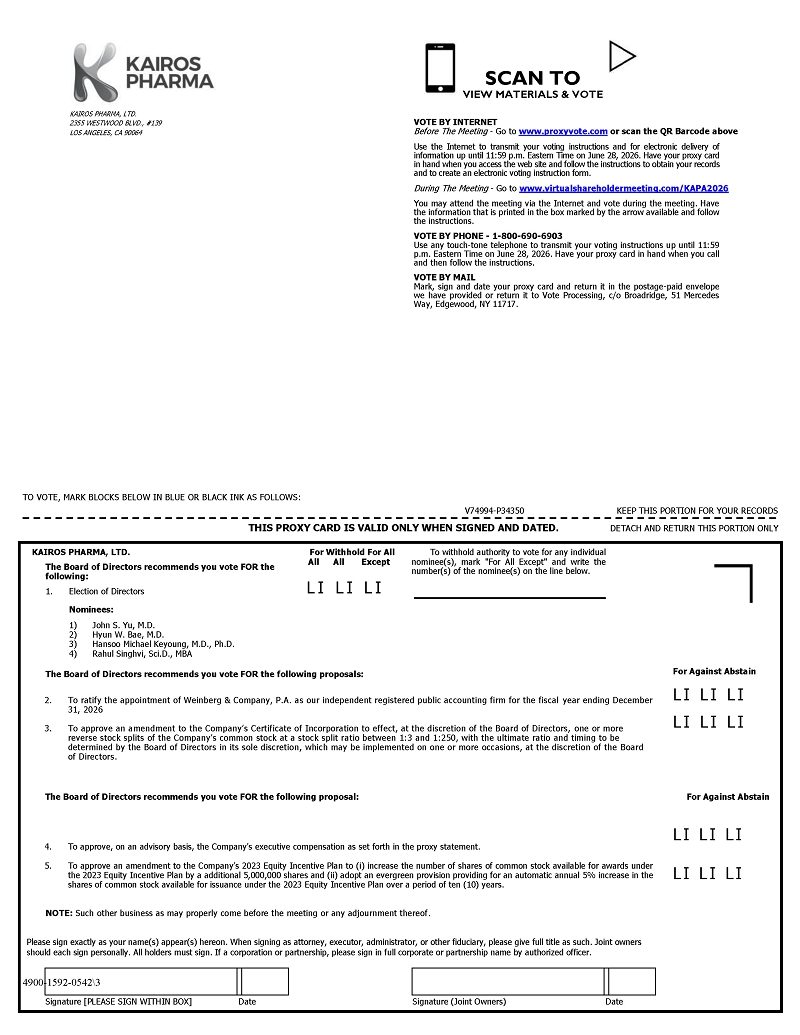

ANNEX A
REVERSE STOCK SPLIT CHARTER AMENDMENT
CERTIFICATE OF AMENDMENT TO
THE CERTIFICATE OF INCORPORATION
OF
KAIROS PHARMA, LTD.
Kairos Pharma, Ltd., a corporation organized and existing under the laws of the State of Delaware (the “Corporation”), does hereby certify as follows:
| A. | The Corporation was originally incorporated, and the original Certificate of Incorporation was filed with the Secretary of State of the State of Delaware on May 10, 2023, under the name “Kairos Pharma, Ltd.” |
| B. | This Certificate of Amendment to the Certificate of Incorporation (the “Certificate of Amendment”) was duly adopted by the Board of Directors of the Corporation in accordance with Sections 141 and 242 of the General Corporation Law of the State of Delaware. |
Article IV, Section 4.1 of the Certificate is hereby amended and restated to read in its entirety as follows:
“ARTICLE IV
Section 4.1. The total number of shares of all classes of stock that the Corporation has authority to issue is 120,000,000 shares, consisting of two classes: 100,000,000 shares of Common Stock, $0.001 par value per share (“Common Stock”), and 20,000,000 shares of Preferred Stock, $0.001 par value per share (“Preferred Stock”).
Effective as of 11:59 p.m. Eastern time, on [ ] (the “Effective Time”), each [ ] shares of the Corporation’s Common Stock, par value $0.001 per share, issued and outstanding shall be combined into one share of Common Stock, par value $0.001 per share, of the Corporation (the “Reverse Stock Split”). No fractional shares shall be issued. Any fractional shares that would otherwise be issuable as a result of the Reverse Stock Split will be rounded up to the nearest whole share; provided, that where shares are held in certificated form, the surrender of a stockholder’s Old Certificates (as defined below) will be required. Each certificate that immediately prior to the Effective Time represented shares of Common Stock (“Old Certificates”) shall thereafter represent that number of shares of Common Stock into which the shares of Common Stock represented by the Old Certificate shall have been combined, subject to the treatment of fractional share interests as described above.”
| C. | This Certificate of Amendment shall be effective as of the Effective Time. |
| D. | This Certificate of Amendment was submitted to the stockholders of the Corporation and was duly adopted and approved in accordance with the provisions of Section 242 of General Corporate Law of the State of Delaware at the annual meeting of the stockholders of the Corporation. |
IN WITNESS WHEREOF, Kairos Pharma, Ltd. has caused this Certificate of Amendment to be signed by a duly authorized officer of the Corporation on [ ].
| Kairos Pharma, Ltd. | ||
| By: | ||
| Name: | John S. Yu | |
| Title: | Chief Executive Officer | |
| 2 |
ANNEX B
2023 EQUITY INCENTIVE PLAN
KAIROS PHARMA, LTD.
2023 EQUITY INCENTIVE PLAN
the “Plan”
1. Purposes of the Plan. The purposes of this Plan are:
| ● | to attract and retain the best available personnel for positions of substantial responsibility, |
| ● | to provide incentives to individuals who perform services for the Company (as defined below), and |
| ● | to promote the success of the Company’s business. |
The Plan permits the grant of Incentive Stock Options, Nonstatutory Stock Options, Stock Appreciation Rights, Restricted Stock, Restricted Stock Units, Performance Units, Performance Shares and other stock or cash awards as the Administrator (as defined below) may determine.
2. Definitions. As used herein, the following definitions will apply:
| a) | “Administrator” means the Board or any of its Committees as will be administering the Plan, in accordance with Section 4 hereof. |
| b) | “Affiliate” means any corporation or any other entity (including, but not limited to, partnerships and joint ventures) controlling, controlled by, or under common control with the Company. |
| c) | “Applicable Laws” means the requirements relating to the administration of equity-based awards under U.S. federal and state corporate laws, U.S. federal and state securities laws, the Code, any stock exchange or quotation system on which the Common Stock is listed or quoted and the applicable laws of any foreign country or jurisdiction where Awards are, or will be, granted under the Plans. |
| d) | “Award” means, individually or collectively, a grant under the Plan of Options, Stock Appreciation Rights, Restricted Stock, Restricted Stock Units, Performance Units, Performance Shares and other stock or cash awards as the Administrator may determine. |
| e) | “Award Agreement” means the written agreement setting forth the terms and provisions applicable to each Award granted under the Plan. The Award Agreement is subject to the terms and conditions of the Plan. |
| f) | “Board” means the Board of Directors of the Company. |
| g) | “Change in Control” means the occurrence of any of the following events after the Effective Date: |
| (i) | A change in the ownership of the Company which occurs on the date that any one person, or more than one person acting as a group (“Person”), acquires ownership of stock in the Company that, together with the stock already held by such Person, constitutes more than 50% of the total voting power of the stock of the Company; provided, however, that for purposes of this subsection (i), the acquisition of additional stock by any Person who is considered to own more than 50% of the total voting power of the stock of the Company before the acquisition will not be considered a Change in Control; or |
| (ii) | The individuals who constitute the members of the Board cease, by reason of a financing, merger, combination, acquisition, takeover or other non-ordinary course transaction affecting the Company, to constitute at least fifty-one percent (51%) of the members of the Board; or |
| (iii) | The consummation of any of the following events: (A) a change in the ownership of a substantial portion of the Company’s assets, which occurs on the date that any Person acquires (or has acquired during the twelve (12) month period ending on the date of the most recent acquisition by such Person) assets from the Company that have a total gross fair market value equal to or more than 50% of the total gross fair market value of all of the assets of the Company immediately prior to such acquisition or acquisitions, or (B) a merger, consolidation or reorganization involving the Company, where either or both of the events described in clauses (i) or (ii) above would be the result. For purposes of this subsection (iii), the following will not constitute a change in the ownership of a substantial portion of the Company’s assets or a Change in Control: (A) a transfer to an entity that is controlled by the Company’s stockholders immediately after the transfer, or (B) a transfer of assets by the Company to: (1) a stockholder of the Company (immediately before the asset transfer) in exchange for or with respect to the Company’s stock, (2) an entity, 50% or more of the total value or voting power of which is owned, directly or indirectly, by the Company, (3) a Person that owns, directly or indirectly, 50% or more of the total value or voting power of all the outstanding stock of the Company, or (4) an entity, at least 50% of the total equity or voting power of which is owned, directly or indirectly, by a Person described in subsection (iii)(B)(3) above. For purposes of this subsection (iii), gross fair market value means the value of the assets of the Company, or the value of the assets being disposed of, determined without regard to any liabilities associated with such assets. |
For purposes of this Section 2(g), persons will be considered to be acting as a group if they are owners of a corporation or other entity that enters into a merger, consolidation, purchase or acquisition of stock, or similar business transaction with the Company.
| -2- |
| h) | “Code” means the Internal Revenue Code of 1986, as amended. Any reference to a section of the Code herein will be a reference to any successor or amended section of the Code. |
| i) | “Committee” means a committee of Directors or of other individuals satisfying Applicable Laws appointed by the Board in accordance with Section 4 hereof. |
| j) | “Common Stock” means the common stock, par value $0.001 per share, of the Company. |
| k) | “Company” means Kairos Pharma, Ltd., a Delaware corporation, or any successor thereto. |
| l) | “Consultant” means any person, including an advisor, other than an Employee engaged by the Company or a Parent, Subsidiary or Affiliate to render services to such entity. |
| m) | “Director” means a member of the Board. |
| n) | “Disability” means permanent and total disability as defined in Section 22(e)(3) of the Code, provided that in the case of Awards other than Incentive Stock Options, the Administrator in its discretion may determine whether a permanent and total disability exists in accordance with uniform and non-discriminatory standards adopted by the Administrator from time to time. |
| o) | “Effective Date” shall have the meaning set forth in Section 17 hereof. |
| p) | “Employee” means any person, including Officers and Directors, other than a Consultant employed by the Company or any Parent, Subsidiary or Affiliate of the Company. Neither service as a Director nor payment of a director’s fee by the Company will be sufficient to constitute “employment” by the Company. |
| q) | “Exchange Act” means the Securities Exchange Act of 1934, as amended. |
| r) | “Exchange Program” means a program under which (i) outstanding Awards are surrendered or cancelled in exchange for Awards of the same type (which may have lower exercise prices and different terms), Awards of a different type, and/or cash, and/or (ii) the exercise price of an outstanding Award is reduced. The Administrator will determine the terms and conditions of any Exchange Program in its sole discretion. |
| s) | “Fair Market Value” means, as of any date, the value of the Common Stock as the Administrator may determine in good faith, by reference to the closing price of such stock on any established stock exchange or on a national market system on the day of determination, if the Common Stock is so listed on any established stock exchange or on a national market system. If the Common Stock is not listed on any established stock exchange or on a national market system, the value of the Common Stock will be determined as the Administrator may determine in good faith using (i) a valuation methodology set forth in Treasury Regulation 1.409A-1(b)(5)(iv)(B) or (ii) with respect to valuations applicable to Awards that are not subject to Code Section 409A, such other valuation methods as the Administrator may select. |
| -3- |
| t) | “Fiscal Year” means the fiscal year of the Company. |
| u) | “Incentive Stock Option” means an Option that by its terms qualifies and is otherwise intended to qualify as an incentive stock option within the meaning of Section 422 of the Code and the regulations promulgated thereunder. |
| v) | “Nonstatutory Stock Option” means an Option that by its terms does not qualify or expressly provides that it is not intended to qualify as an Incentive Stock Option. |
| w) | “Officer” means a person who is an officer of the Company within the meaning of Section 16 of the Exchange Act and the rules and regulations promulgated thereunder. |
| x) | “Option” means a stock option granted pursuant to Section 6 hereof. |
| y) | “Parent” means a “parent corporation,” whether now or hereafter existing, as defined in Section 424(e) of the Code. |
| z) | “Participant” means the holder of an outstanding Award. |
| aa) | “Performance Goals” will have the meaning set forth in Section 11 hereof. |
| bb) | “Performance Period” means any Fiscal Year of the Company or such other period as determined by the Administrator in its sole discretion. |
| cc) | “Performance Share” means an Award denominated in Shares which may be earned in whole or in part upon attainment of Performance Goals or other vesting criteria as the Administrator may determine pursuant to Section 10 hereof. |
| dd) | “Performance Unit” means an Award which may be earned in whole or in part upon attainment of Performance Goals or other vesting criteria as the Administrator may determine and which may be settled for cash, Shares or other securities or a combination of the foregoing pursuant to Section 10 hereof. |
| ee) | “Period of Restriction” means the period during which transfers of Shares of Restricted Stock are subject to restrictions and, therefore, the Shares are subject to a substantial risk of forfeiture. Such restrictions may be based on the passage of time, the achievement of target levels of performance, or the occurrence of other events specified in the applicable Award, as interpreted and construed by the Administrator. |
| ff) | “Plan” means this 2023 Equity Incentive Plan. |
| gg) | “Restricted Stock” means Shares issued pursuant to an Award of Restricted Stock under Section 8 hereof, or issued pursuant to the early exercise of an Option. |
| -4- |
| hh) | “Restricted Stock Unit” means a bookkeeping entry representing an amount equal to the Fair Market Value of one Share, granted pursuant to Section 9 hereof. Each Restricted Stock Unit represents an unfunded and unsecured obligation of the Company. |
| ii) | “Rule 16b-3” means Rule 16b-3 of the Exchange Act or any successor to Rule 16b-3, as in effect when discretion is being exercised with respect to the Plan. |
| jj) | “Section 16(b)” means Section 16(b) of the Exchange Act. |
| kk) | “Service Provider” means an Employee, Director, or Consultant. |
| ll) | “Share” means a share of the Common Stock, as adjusted in accordance with Section 14 hereof. |
| mm) | “Stock Appreciation Right” means an Award, granted alone or in connection with an Option, that pursuant to Section 7 is designated as a Stock Appreciation Right. |
| nn) | “Subsidiary” means a “subsidiary corporation,” whether now or hereafter existing, as defined in Section 424(f) of the Code. |
3. Stock Subject to the Plan.
| a) | Subject to the provisions of Section 14 hereof, the maximum aggregate number of Shares that may be awarded and sold under the Plan is 6.65 million (6,650,000) Shares. The Shares may be authorized, but unissued, or reacquired Common Stock. |
| b) | Lapsed Awards. If an Award expires or becomes unexercisable without having been exercised in full, or, with respect to Restricted Stock, Restricted Stock Units, Performance Shares or Performance Units, is forfeited to or repurchased by the Company, the unpurchased Shares (or for Awards other than Options and Stock Appreciation Rights, the forfeited or repurchased Shares) which were subject thereto will become available for future grant or sale under the Plan (unless the Plan has terminated). Upon exercise of a Stock Appreciation Right settled in Shares, the gross number of Shares covered by the portion of the Award so settled will cease to be available under the Plan. Shares that have actually been issued under the Plan under any Award will not be returned to the Plan and will not become available for future distribution under the Plan; provided, however, that if unvested Shares of Restricted Stock, Restricted Stock Units, Performance Shares or Performance Units are repurchased by the Company or are forfeited to the Company, such Shares will become available for future grant under the Plan. Shares subject to an Award that are transferred to or retained by the Company to pay the tax and/or exercise price of an Award will become available for future grant or sale under the Plan. To the extent an Award under the Plan is paid out in cash rather than Shares, such cash payment will not result in reducing the number of Shares available for issuance under the Plan and, for the elimination of doubt, the number of Shares of equal value to such cash payment shall become available for future grant or sale under the Plan. Notwithstanding the foregoing provisions of this Section 3(b), subject to adjustment provided in Section 14 hereof, the maximum number of Shares that may be issued upon the exercise of Incentive Stock Options will equal the aggregate Share number stated in Section 3(a) above, plus, to the extent allowable under Section 422 of the Code, any Shares that become available for issuance under this Section 3(b). |
| -5- |
| c) | Share Reserve. The Company, during the term of this Plan, will at all times reserve and keep available such number of Shares as will be sufficient to satisfy the requirements of the Plan. | |
| d) | In addition to subpart (a) above, the number of shares of Common Stock in the Share Reserve and available for issuance under the Plan shall automatically increase on January 1st of each year for a period of ten years commencing on January 1, 2027 and ending on (and including) January 1, 2033, in an amount equal to five percent (5%) of the total number of shares of Common Stock outstanding on December 31st of the preceding calendar year. Notwithstanding the foregoing, the Board may act prior to the first day of any calendar year, to provide that there shall be no increase in the Share Reserve for such calendar year or that the increase in the Share Reserve for such calendar year shall be a lesser number of shares of Common Stock than would otherwise occur pursuant to the preceding sentence. For clarity, the Share Reserve in this Section 3(d) is a limitation on the number of shares of Common Stock that may be issued pursuant to the Plan. Accordingly, this Section 3(d) does not limit the granting of Stock Awards outside of the Plan.
|
4. Administration of the Plan.
| a) | Procedure. |
| (i) | Multiple Administrative Bodies. Different Committees may be established with respect to different groups of Service Providers; in that event, the Committee established with respect to a group of Service Providers shall administer the Plan with respect to Awards granted to members of such group. |
| (ii) | Rule 16b-3. To the extent desirable to qualify transactions hereunder as exempt under Rule 16b-3, the transactions contemplated hereunder will be structured to satisfy the requirements for exemption under Rule 16b-3. |
| (iii) | Other Administration. Other than as provided above, the Plan will be administered by (A) the Board or (B) a Committee, which committee will be constituted to satisfy Applicable Laws. |
| b) | Powers of the Administrator. Subject to the provisions of the Plan, and in the case of a Committee, subject to the specific duties delegated by the Board to such Committee, the Administrator will have the authority, in its discretion: |
| (i) | to determine Fair Market Value; |
| (ii) | to select the Service Providers to whom Awards may be granted hereunder; |
| (iii) | to determine the terms and condition, not inconsistent with the terms of the Plan, of any Award granted hereunder; |
| (iv) | to institute an Exchange Program and to determine the terms and conditions, not inconsistent with the terms of the Plan, for (1) the surrender or cancellation of outstanding Awards in exchange for Awards of the same type, Awards of a different type, and/or cash, or (2) the reduction of the exercise price of outstanding Awards; |
| (v) | to construe and interpret the terms of the Plan and Awards granted pursuant to the Plan; |
| -6- |
| (vi) | to prescribe, amend and rescind rules and regulations relating to the Plan, including rules and regulations relating to sub-plans established for the purpose of satisfying applicable foreign laws; |
| (vii) | to modify or amend each Award (subject to Section 19(c) hereof); |
| (viii) | to authorize any person to execute on behalf of the Company any instrument required to reflect or implement the grant of an Award previously granted by the Administrator; |
| (ix) | to allow a Participant to defer the receipt of the payment of cash or the delivery of Shares that would otherwise be due to such Participant under an Award pursuant to such procedures as the Administrator may determine consistent with the requirements for compliance with or exemption from the provisions of Code Section 409A; and |
| (x) | to make all other determinations deemed necessary or advisable for administering the Plan. |
| c) | Effect of Administrator’s Decision. The Administrator’s decisions, determinations, and interpretations will be final and binding on all Participants and any other holders of Awards. |
5. Eligibility. Nonstatutory Stock Options, Restricted Stock, Restricted Stock Units, Stock Appreciation Rights, Performance Units, Performance Shares, and such other cash or stock awards as the Administrator determines may be granted to Service Providers. Incentive Stock Options may be granted only to Employees.
6. Stock Options.
| a) | Limitations. |
| (i) | Each Option will be designated in the Award Agreement as either an Incentive Stock Option or a Nonstatutory Stock Option. However, notwithstanding such designation, to the extent that the aggregate Fair Market Value of the Shares with respect to which Incentive Stock Options are exercisable for the first time by the Participant during any calendar year (under all plans of the Company and any Parent or Subsidiary) exceeds $100,000 (U.S.), such Options will be treated as Nonstatutory Stock Options. For purposes of this Section 6(a), Incentive Stock Options will be taken into account in the order in which they were granted. The Fair Market Value of the Shares will be determined as of the time the Option with respect to such Shares is granted. |
| (ii) | Subject to the limits set forth in Section 3, the Administrator will have complete discretion to determine the number of Shares subject to an Option granted to any Participant. |
| -7- |
| b) | Term of Option. The Administrator will determine the term of each Option in its sole discretion; provided, however, that the term will be no more than ten (10) years from the date of grant thereof in the case of Incentive Stock Options Moreover, in the case of an Incentive Stock Option granted to a Participant who, at the time the Incentive Stock Option is granted, owns stock representing more than 10% of the total combined voting power of all classes of stock of the Company or any Parent or Subsidiary, the term of the Incentive Stock Option will be five (5) years from the date of grant or such shorter term as may be provided in the Award Agreement. |
| c) | Option Exercise Price and Consideration. |
| (i) | Exercise Price. The per share exercise price for the Shares to be issued pursuant to exercise of an Option will be determined by the Administrator, but will be no less than 100% of the Fair Market Value per Share on the date of grant. In addition, in the case of an Incentive Stock Option granted to an Employee who, at the time the Incentive Stock Option is granted, owns stock representing more than 10% of the voting power of all classes of stock of the Company or any Parent or Subsidiary, the per Share exercise price will be no less than 110% of the Fair Market Value per Share on the date of grant. Notwithstanding the foregoing provisions of this Section 6(c), Options may be granted with a per Share exercise price of less than 100% of the Fair Market Value per Share on the date of grant pursuant to the issuance or assumption of an Option in a transaction to which Section 424(a) of the Code applies in a manner consistent with said Section 424(a). |
| (ii) | Waiting Period and Exercise Dates. At the time an Option is granted, the Administrator will fix the period within which the Option may be exercised and will determine any conditions that must be satisfied before the Option may be exercised. |
| (iii) | Form of Consideration. The Administrator will determine the acceptable form(s) of consideration for exercising an Option, including the method of payment, to the extent permitted by Applicable Laws including but not limited to tendering capital stock of the Company owned by a Participant, duly endorsed for transfer to the Company. |
| d) | Exercise of Option. |
| (i) | Procedure for Exercise; Rights as a Stockholder. Any Option granted hereunder will be exercisable according to the terms of the Plan and at such times and under such conditions as determined by the Administrator and set forth in the Award Agreement. An Option may not be exercised for a fraction of a Share. |
An Option will be deemed exercised when the Company receives: (i) notice of exercise (in such form as the Administrator specifies from time to time) from the person entitled to exercise the Option, and (ii) full payment for the Shares with respect to which the Option is exercised (together with any applicable withholding taxes). No adjustment will be made for a dividend or other right for which the record date is prior to the date the Shares are issued, except as provided in Section 14 hereof.
| -8- |
| (ii) | Termination of Relationship as a Service Provider. If a Participant ceases to be a Service Provider, other than upon the Participant’s termination as the result of the Participant’s death or Disability, the Participant may exercise his or her Option within such period of time as is specified in the Award Agreement to the extent that the Option is vested on the date of termination (but in no event later than the expiration of the term of such Option as set forth in the Award Agreement). In the absence of a specified time in the Award Agreement, the Option will remain exercisable for three (3) months following the Participant’s termination. Unless otherwise provided by the Administrator, if on the date of termination the Participant is not vested as to his or her entire Option, the Shares covered by the unvested portion of the Option will revert to the Plan. If after termination the Participant does not exercise his or her Option within the time specified by Award Agreement or by operation of this Section 6(d)(3), the Option will terminate, and the Shares covered by such Option will revert to the Plan. |
| (iii) | Disability of Participant. If a Participant ceases to be a Service Provider as a result of the Participant’s Disability, the Participant may exercise his or her Option within such period of time as is specified in the Award Agreement to the extent the Option is vested on the date of cessation (but in no event later than the expiration of the term of such Option as set forth in the Award Agreement). In the absence of a specified time in the Award Agreement, the Option will remain exercisable for six (6) months following the date the Participant ceases to be a Service Provider. Unless otherwise provided by the Administrator, if on the date of cessation the Participant is not vested as to his or her entire Option, the Shares covered by the unvested portion of the Option will revert to the Plan. If after cessation the Participant does not exercise his or her Option within the time specified herein, the Option will terminate, and the Shares covered by such Option will revert to the Plan. |
| (iv) | Death of Participant. If a Participant dies while a Service Provider, the Option may be exercised within such period of time as is specified in the Award Agreement to the extent that the Option is vested on the date of death (but in no event may the option be exercised later than the expiration of the term of such Option as set forth in the Award Agreement), by the Participant’s beneficiary, provided such beneficiary has been designated prior to Participant’s death in a form acceptable to the Administrator. If no such beneficiary has been designated by the Participant, then such Option may be exercised by the personal representative of the Participant’s estate or by the person(s) to whom the Option is transferred pursuant to the Participant’s will or in accordance with the laws of descent and distribution. In the absence of a specified time in the Award Agreement, the Option will remain exercisable for six (6) months following Participant’s death. Unless otherwise provided by the Administrator, if at the time of death Participant is not vested as to his or her entire Option, the Shares covered by the unvested portion of the Option will continue to vest in accordance with the Award Agreement. If the Option is not so exercised within the time specified herein, the Option will terminate, and the Shares covered by such Option will revert to the Plan. |
| -9- |
7. Stock Appreciation Rights.
| a) | Grant of Stock Appreciation Rights. Subject to the terms and conditions of the Plan, a Stock Appreciation Right may be granted to Service Providers at any time and from time to time as will be determined by the Administrator, in its sole discretion. |
| b) | Number of Shares. The Administrator will have complete discretion to determine the number of Stock Appreciation Rights granted to any Participant. |
| c) | Exercise Price and Other Terms. The Administrator, subject to the provisions of the Plan, will have complete discretion to determine the terms and conditions of Stock Appreciation Rights granted under the Plan; provided, however, that the exercise price will be not less than 100% of the Fair Market Value of a Share on the date of grant. |
| d) | Stock Appreciation Rights Agreement. Each Stock Appreciation Right grant will be evidenced by an Award Agreement that will specify the exercise price, the number of Shares with respect to which the Award is granted, the term of the Stock Appreciation Right, the conditions of exercise, and such other terms and conditions as the Administrator, in its sole discretion, will determine. |
| e) | Expiration of Stock Appreciation Rights. A Stock Appreciation Right granted under the Plan will expire upon the date determined by the Administrator, in its sole discretion, and set forth in the Award Agreement; provided, however, that the term will be no more than ten (10) years from the date of grant thereof. Notwithstanding the foregoing, the rules of Section 6(d) above also will apply to Stock Appreciation Rights. |
| f) | Payment of Stock Appreciation Right Amount. Upon exercise of a Stock Appreciation Right, a Participant will be entitled to receive payment from the Company in an amount determined by multiplying: |
| (i) | The difference between the Fair Market Value of a Share on the date of exercise over the “stock appreciation right exercise price,” as defined under Treasury Regulation Section 1.409A-1(b)(i)(B)(2), i.e., the Fair Market Value of a Share on the date of grant of the Stock Appreciation Right; times |
| (ii) | The number of Shares with respect to which the Stock Appreciation Right is exercised. |
At the discretion of the Administrator, the payment upon Stock Appreciation Right exercise may be in cash, in Shares of equivalent value, or in some combination thereof.
| -10- |
8. Restricted Stock.
| a) | Grant of Restricted Stock. Subject to the terms and provisions of the Plan, the Administrator, at any time and from time to time, may grant Shares of Restricted Stock to Service Providers in such amounts as the Administrator, in its sole discretion, will determine. |
| b) | Restricted Stock Agreement. Each Award of Restricted Stock will be evidenced by an Award Agreement that will specify the Period of Restriction, the number of Shares granted, and such other terms and conditions as the Administrator, in its sole discretion, will determine. |
| c) | Transferability. Except as provided in this Section 8, Shares of Restricted Stock may not be sold, transferred, pledged, assigned, or otherwise alienated or hypothecated until such Shares become non-forfeitable at the end of the applicable Period of Restriction. |
| d) | Other Restrictions. The Administrator, in its sole discretion, may impose such other restrictions on Shares of Restricted Stock as it may deem advisable or appropriate. |
| e) | Removal of Restrictions. Except as otherwise provided in this Section 8, Shares of Restricted Stock covered by each Restricted Stock grant made under the Plan will be released from escrow as soon as practicable after the last day of the Period of Restriction. The Administrator, in its discretion, may accelerate the time at which any restrictions will lapse or be removed. |
| f) | Voting Rights. During the Period of Restriction, Service Providers holding Shares of Restricted Stock granted hereunder may exercise full voting rights with respect to those Shares, unless the Administrator determines otherwise in a manner not prohibited by the Award Agreement. |
| g) | Dividends and Other Distributions. During the Period of Restriction, Service Providers holding Shares of Restricted Stock will be entitled to receive all dividends and other distributions paid with respect to such Shares unless otherwise provided in the Award Agreement. If any such dividends or distributions are paid in Shares, the Shares will be subject to the same restrictions on transferability and provisions for forfeiture as the Shares of Restricted Stock with respect to which they were paid. |
| h) | Return of Restricted Stock to Company. On the date set forth in the Award Agreement, the Restricted Stock for which restrictions have not lapsed will revert to the Company and again will become available for grant under the Plan. |
9. Restricted Stock Units.
| a) | Grant. Restricted Stock Units may be granted at any time and from time to time as determined by the Administrator. Each Restricted Stock Unit grant will be evidenced by an Award Agreement that will specify such other terms and conditions as the Administrator, in its sole discretion, will determine in accordance with the terms and conditions of the Plan, including all terms, conditions, and restrictions related to the grant, the number of Restricted Stock Units and the form of payout, which, subject to Section 9(d) hereof, may be left to the discretion of the Administrator. |
| -11- |
| b) | Vesting Criteria and Other Terms. The Administrator will set vesting criteria in its discretion, which, depending on the extent to which the criteria are met, will determine the number of Restricted Stock Units that will be paid out to the Participant. After the grant of Restricted Stock Units, the Administrator, in its sole discretion, may reduce or waive any restrictions for such Restricted Stock Units. Each Award of Restricted Stock Units will be evidenced by an Award Agreement that will specify the vesting criteria, and such other terms and conditions as the Administrator, in its sole discretion will determine. The Administrator, in its discretion, may accelerate the time at which any restrictions will lapse or be removed, subject to the prohibition on acceleration of the timing of distribution of deferred compensation subject to Section 409A of the Code, to the extent applicable to the Award. |
| c) | Earning Restricted Stock Units. Upon meeting the applicable vesting criteria, the Participant will be entitled to receive a payout as specified in the Award Agreement. |
| d) | Form and Timing of Payment. Payment of earned Restricted Stock Units will be made as soon as practicable after the date(s) set forth in the Award Agreement, which shall satisfy the requirements of Section 409A of the Code, to the extent applicable to such Award. The Administrator, in its sole discretion, may pay earned Restricted Stock Units in cash, Shares, or a combination thereof. Shares represented by Restricted Stock Units that are fully paid in cash again will be available for grant under the Plan. |
| e) | Cancellation. On the date set forth in the Award Agreement, all unearned Restricted Stock Units will be forfeited to the Company. |
10. Performance Units and Performance Shares.
| a) | Grant of Performance Units/Shares. Performance Units and Performance Shares may be granted to Service Providers at any time and from time to time, as will be determined by the Administrator, in its sole discretion. The Administrator will have complete discretion in determining the number of Performance Units/Shares granted to each Participant. |
| b) | Value of Performance Units/Shares. Each Performance Unit will have an initial value that is established by the Administrator on or before the date of grant. Each Performance Share will have an initial value equal to the Fair Market Value of a Share on the date of grant. |
| c) | Performance Objectives and Other Terms. The Administrator will set performance objectives or other vesting provisions. The Administrator may set vesting criteria based upon the achievement of Company-wide, business unit, or individual goals (including, but not limited to, continued employment), or any other basis determined by the Administrator in its discretion. Each Award of Performance Units/Shares will be evidenced by an Award Agreement that will specify the Performance Period, and such other terms and conditions as the Administrator, in its sole discretion, will determine. |
| -12- |
| d) | Earning of Performance Units/Shares. After the applicable Performance Period has ended, the holder of Performance Units/Shares will be entitled to receive a payout of the number of Performance Units/Shares earned by the Participant over the Performance Period, to be determined as a function of the extent to which the corresponding performance objectives or other vesting provisions have been achieved. After the grant of a Performance Unit/Share, the Administrator, in its sole discretion, may reduce or waive any performance objectives or other vesting provisions for such Performance Unit/Share. |
| e) | Form and Timing of Payment of Performance Units/Shares. Payment of earned Performance Units/Shares will be made as soon as practicable after the expiration of the applicable Performance Period or, if earlier, after the date on which a Participant’s interest in such Performance Units/Shares is no longer subject to a substantial risk of forfeiture, provided however, that in no event shall such payment be made after the later to occur of (i) December 31 of the year in which such risk of forfeiture lapses or (ii) two and one-half months after such risk of forfeiture lapses. The Administrator, in its sole discretion, may pay earned Performance Units/Shares in the form of cash, in Shares (which have an aggregate Fair Market Value equal to the value of the earned Performance Units/Shares at the close of the applicable Performance Period) or in a combination thereof. |
| f) | Cancellation of Performance Units/Shares. On the date set forth in the Award Agreement, all unearned or unvested Performance Units/Shares will be forfeited to the Company, and again will be available for grant under the Plan. |
11. Leaves of Absence. Unless the Administrator provides otherwise, vesting of Awards granted hereunder will be suspended during any unpaid leave of absence. A Service Provider will not cease to be an Employee in the case of (i) any leave of absence approved by the Company, or (ii) transfers between locations of the Company or between the Company, its Parent, or any Subsidiary. For purposes of Incentive Stock Options, no such leave may exceed three (3) months, unless reemployment upon expiration of such leave is guaranteed by statute or contract. If reemployment upon expiration of a leave of absence approved by the Company is not so guaranteed, then six (6) months and one day following the commencement of such leave any Incentive Stock Option held by the Participant will cease to be treated as an Incentive Stock Option and will be treated for tax purposes as a Nonstatutory Stock Option.
12. Transferability of Awards. Unless determined otherwise by the Administrator, an Award may not be sold, pledged, assigned, hypothecated, transferred, or disposed of in any manner other than by will or by the laws of descent or distribution and may be exercised, during the lifetime of the Participant, only by the Participant. If the Administrator makes an Award transferable, such Award may only be transferred (i) by will, (ii) by the laws of descent and distribution, (iii) to a revocable trust, or (iv) as permitted by Rule 701 of the Securities Act of 1933, as amended.
| -13- |
13. Adjustments; Dissolution or Liquidation; Merger or Change in Control.
| a) | Adjustments. In the event that any dividend or other distribution (whether in the form of cash, Shares, other securities, or other property), recapitalization, stock split, reverse stock split, reorganization, merger, consolidation, split-up, spin-off, combination, repurchase, or exchange of Shares or other securities of the Company, or other change in the corporate structure of the Company affecting the Shares occurs, the Administrator, in order to prevent diminution or enlargement of the benefits or potential benefits intended to be made available under the Plan, will adjust the number and class of Shares that may be delivered under the Plan and/or the number, class, and price of Shares covered by each outstanding Award, and the numerical Share limits set forth in Sections 3, 6, 7, 8, 9 and 10 hereof. |
| b) | Dissolution or Liquidation. In the event of the proposed dissolution or liquidation of the Company, any corporate separation or division, including, but not limited to, a split-up, a split-off or a spin-off; a reverse merger in which the Company is the surviving entity, but the shares of Company stock outstanding immediately preceding the merger are converted by virtue of the merger into other property, whether in the form of securities, cash or otherwise; or the transfer of more than fifty percent (50%) of the then outstanding voting stock of the Company to another person or entity, the Administrator will notify each Participant as soon as practicable prior to the effective date of such proposed transaction. The Company, to the extent permitted by applicable law but otherwise in its sole discretion may provide for: (i) the continuation Awards by the Company (if the Company is surviving entity or its parent; (ii) the assumption of the Plan and such outstanding Awards by the surviving entity or its parent; (iii) the substitution by the surviving entity or its parent of rights with substantially the same terms for such outstanding Awards; or (iv) the cancellation of such outstanding Rights without payment of any consideration provided that in the case of this clause (iv), the Administrator will provide notice of its intention to cancel Award and offer a reasonable opportunity to exercise vested Awards. |
| c) | Change in Control. In the event of a merger or Change in Control, each outstanding Award will be treated as the Administrator determines, including, without limitation, that each Award will be assumed or an equivalent option or right substituted by the successor corporation or a Parent or Subsidiary of the successor corporation (the “Successor Corporation”). The Administrator will not be required to treat all Awards similarly in the transaction. |
In the event that the Successor Corporation does not assume or substitute for the Award, the Participant will fully vest in and have the right to exercise all of his or her outstanding Options and Stock Appreciation Rights, including Shares as to which such Awards would not otherwise be vested or exercisable, all restrictions on Restricted Stock will lapse, and, with respect to Restricted Stock Units, Performance Shares and Performance Units, all Performance Goals or other vesting criteria will be deemed achieved at target levels and all other terms and conditions met. In addition, if an Option or Stock Appreciation Right is not assumed or substituted for in the event of a Change in Control, the Administrator will notify the Participant in writing or electronically that the Option or Stock Appreciation Right will be fully vested and exercisable for a period of time determined by the Administrator in its sole discretion, and the Option or Stock Appreciation Right will terminate upon the expiration of such period.
| -14- |
For the purposes of this subsection (c), an Award will be considered assumed if, following the Change in Control, the Award confers the right to purchase or receive, for each Share subject to the Award immediately prior to the Change in Control, the consideration (whether stock, cash, or other securities or property) or, in the case of a Stock Appreciation Right upon the exercise of which the Administrator determines to settle in cash or a Performance Share or Performance Unit which the Administrator can determine to settle in cash, the fair market value of the consideration received in the merger or Change in Control by holders of Common Stock for each Share held on the effective date of the transaction (and if holders were offered a choice of consideration, the type of consideration chosen by the holders of a majority of the outstanding Shares); provided, however, that if such consideration received in the Change in Control is not solely common stock of the Successor Corporation, the Administrator may, with the consent of the Successor Corporation, provide for the consideration to be received upon the exercise of an Option or Stock Appreciation Right or upon the payout of a Performance Share or Performance Unit, for each Share subject to such Award (or in the case of Performance Units, the number of implied shares determined by dividing the value of the Performance Units by the per share consideration received by holders of Common Stock in the Change in Control), to be solely common stock of the Successor Corporation equal in fair market value to the per share consideration received by holders of Common Stock in the Change in Control.
Notwithstanding anything in this Section 13(c) to the contrary, an Award that vests, is earned or paid-out upon the satisfaction of one or more Performance Goals will not be considered assumed if the Company or its successor modifies any of such Performance Goals without the Participant’s consent; provided, however, a modification to such Performance Goals only to reflect the Successor Corporation’s post-Change in Control corporate structure will not be deemed to invalidate an otherwise valid Award assumption.
14. Tax Withholding
| a) | Withholding Requirements. At any time prior to or following the delivery of any Shares or cash pursuant to an Award (or exercise thereof), the Company will have the power and the right to deduct or withhold, or require a Participant to remit to the Company, an amount sufficient to satisfy federal, state, local, foreign or other taxes (including the Participant’s FICA obligation) required to be withheld with respect to such Award (or exercise thereof). |
| b) | Withholding Arrangements. The Administrator, in its sole discretion and pursuant to such procedures as it may specify from time to time, may permit a Participant to satisfy such tax withholding obligation, in whole or in part by (without limitation) (i) paying cash, (ii) electing to have the Company withhold otherwise deliverable cash or Shares having a Fair Market Value equal to the minimum amount required to be withheld, (iii) delivering to the Company already-owned Shares having a Fair Market Value equal to the amount required to be withheld, or (iv) selling a sufficient number of Shares otherwise deliverable to the Participant through such means as the Administrator may determine in its sole discretion (whether through a broker or otherwise) equal to the amount required to be withheld. The amount of the withholding requirement will be deemed to include any amount which the Administrator agrees may be withheld at the time the election is made, not to exceed the amount determined by using the maximum federal, state or local marginal income tax rates applicable to the Participant with respect to the Award on the date that the amount of tax to be withheld is to be determined. The Fair Market Value of the Shares to be withheld or delivered will be determined as of the date that the taxes are required to be withheld. |
| -15- |
15. No Effect on Employment or Service. Neither the Plan nor any Award will confer upon a Participant any right with respect to continuing the Participant’s relationship as a Service Provider with the Company, nor will they interfere in any way with the Participant’s right or the Company’s right to terminate such relationship at any time, with or without cause, to the extent permitted by Applicable Laws.
16. Date of Grant. The date of grant of an Award will be, for all purposes, the date on which the Administrator makes the determination granting such Award, or such other later date as is determined by the Administrator. Notice of the determination will be provided to each Participant within a reasonable time after the date of such grant.
17. Term of Plan. Subject to Section 21 hereof, the Plan will become effective upon its adoption by the Board (the “Effective Date”). It will continue in effect for a term of ten (10) years unless terminated earlier under Section 18 hereof; provided, however, that such expiration shall not affect Awards then outstanding, and the terms and conditions of this Plan shall continue to apply to such Awards.
18. Amendment and Termination of the Plan.
| a) | Amendment and Termination. The Administrator may at any time amend, alter, suspend, or terminate the Plan. |
| b) | Stockholder Approval. Subject to Section 21, the Company will obtain stockholder approval of the Plan and any Plan amendment to the extent necessary or desirable to comply with Applicable Laws. |
| c) | Effect of Amendment or Termination. No amendment, alteration, suspension, or termination of the Plan will impair the rights of any Participant, unless mutually agreed otherwise between the Participant and the Administrator, which agreement must be in writing and signed by the Participant and the Company. Termination of the Plan will not affect the Administrator’s ability to exercise the powers granted to it hereunder with respect to Awards granted under the Plan prior to the date of such termination. |
19. Conditions Upon Issuance of Shares.
| a) | Legal Compliance. Shares will not be issued pursuant to the exercise of an Award unless the exercise of such Award and the issuance and delivery of such Shares will comply with Applicable Laws and will be further subject to the approval of counsel for the Company with respect to such compliance. |
| -16- |
| b) | Investment Representations. As a condition to the exercise of an Award, the Company may require the person exercising such Award to represent and warrant at the time of any such exercise that the Shares are being purchased only for investment and without any present intention to sell or distribute such Shares if, in the opinion of counsel for the Company, such a representation is required. |
| c) | Restrictive Legends. All Award Agreements and all securities of the Company issued pursuant thereto shall bear such legends regarding restrictions on transfer and such other legends as the appropriate officer of the Company shall determine to be necessary or advisable to comply with applicable securities and other laws. |
20. Inability to Obtain Authority. The inability of the Company to obtain authority from any regulatory body having jurisdiction, which authority is deemed by the Company’s counsel to be necessary to the lawful issuance and sale of any Shares hereunder, will relieve the Company of any liability in respect of the failure to issue or sell such Shares as to which such requisite authority will not have been obtained.
21. Stockholder Approval. The Plan will be subject to approval by the stockholders of the Company within twelve (12) months after the date the Plan is adopted by the Board. Such stockholder approval will be obtained in the manner and to the degree required under Applicable Laws, including without limitation Section 422 of the Code. In the event that stockholder approval is not obtained within twelve (12) months after the date the Plan is adopted by the Board, all Incentive Stock Options granted hereunder shall be void ab initio and of no effect. Notwithstanding any other provisions of the Plan, no Awards shall be exercisable until the date of such stockholder approval.
22. Notification of Election Under Section 83 of the Code. If any Service Provider shall, in connection with the acquisition of Shares under the Plan, make an election permitted under either Section 83(b) or Section 83(i) of the Code, such Service Provider shall notify the Company of such election within ten (10) days of filing notice of the election with the Internal Revenue Service and provide the Company with a copy thereof, in addition to any filing and a notification required pursuant to regulations issued under the authority of Sections 83(b) or 83(i) of the Code, as applicable. A Service Provider shall not be permitted to make a Section 83(b) election with respect to an Award of a Restricted Stock Unit.
23. Notification Upon Disqualifying Disposition Under Section 421(b) of the Code. Each Service Provider shall notify the Company of any disposition of Shares issued pursuant to the exercise of an Incentive Stock Option under the circumstances described in Section 421(b) of the Code (relating to certain disqualifying dispositions), within ten (10) days of such disposition.
24. 409A Timing Rule for Specified Employees. If at the time of a Service Provider’s separation from service, such individual is considered a “specified employee” within the meaning of Section 409A(a)(2)(B)(i) of the Code, and if any payment that such Service Provider becomes entitled to under the Plan or any Award is deemed payable on account of such individual’s separation from service, then no such payment shall be made prior to the date that is the earlier of (i) six months and one day after the individual’s separation from service, or (ii) the individual’s death.
| -17- |
25. Governing Law. The law of the State of Delaware shall govern all questions concerning the construction, validity, and interpretation of this Plan, without regard to such state’s conflict of laws rules, subject to the Company’s intention that the Plan satisfy the requirements of jurisdictions outside of the United States of America with respect to Awards subject to such jurisdictions.
26. General Provisions.
| a) | No Rights as Stockholder. Except as specifically provided in this Plan, a Participant or a transferee of an Award shall have no rights as a stockholder with respect to any shares covered by the Award until the date of the issuance of such shares to the Participant, and no adjustment shall be made for dividends (ordinary or extraordinary, whether in cash, securities or other property) or distributions of other rights for which the record date is prior to the date such Stock is issued. |
| b) | Other Compensation Arrangements. Nothing contained in this Plan shall prevent the Board from adopting other or additional compensation arrangements, subject to stockholder approval is required; and such arrangements may be either generally applicable or applicable only in specific cases. |
| c) | Disqualifying Dispositions. Any participant who shall make a “disposition” (as defined in Section 424 of the Code) of all or any portion of an Incentive Stock Option within two (2) years from the date of grant of such Incentive Stock Option or within (1) year after the issuance of the shares of Stock acquired upon exercise of such Incentive Stock Option shall be required to immediately advise the Company in writing as to the occurrence of the sale and the price realized upon the sale of such shares of Stock. |
| d) | Regulatory Matters Each Stock Option Agreement and Stock Purchase Agreement shall provide that no shares shall be purchased or sold thereunder unless and until (i) any then applicable requirements of state or federal laws and regulatory agencies shall have been fully complied with to the satisfaction of the Company and its counsel and (ii) if required to do so by the Company, the Optionee or Offeree shall have executed and delivered to the Company a letter of investment intent in such form and containing such provisions as the Board or Committee may require. |
| e) | Delivery. Upon exercise of an Award granted under this Plan, the Company shall issue Stock or pay any amounts due within a reasonable period of time thereafter. Subject to any statutory obligations the Company may otherwise have, for purposes of this Plan, thirty days shall be considered a reasonable period of time. |
| f) | Other Provisions. The Stock Option Agreements and Stock Purchase Agreements authorized under the Plan may contain such other provisions not inconsistent with this Plan, including, without limitation, restrictions upon the exercise of the Rights, as the Administrator may deem advisable. |
| g) | Section 409A. Awards under the Plan are intended either to be exempt from the rules of Section 409A of the Code or to satisfy those rules, and the Plan and such awards shall be construed accordingly. Granted rights may be modified at any time, in the Administrator’s direction, so as to increase the likelihood of exemption from or compliance with the rules of Section 409A of the Code. |
| -18- |