The Fund is an actively-managed exchange-traded fund (“ETF”) that will invest under normal circumstances primarily (at least 80% of its assets) in domestic and foreign equity securities of companies that are relevant to the Fund’s investment theme of disruptive innovation. The Adviser defines “disruptive innovation” as the introduction of a technologically enabled new product or service that potentially changes the way the world works. The Adviser believes that companies relevant to this theme are those that materially rely on or benefit from the development of new products or services, technological improvements and advancements in scientific research relating to the areas of genomics* (“Genomic Revolution Companies”); innovation in automation and manufacturing (“Automation Transformation Companies”), transportation, energy (“Energy Transformation Companies”), artificial intelligence (“Artificial Intelligence Companies”) and materials; the increased use of shared technology, infrastructure and services (“Next Generation Internet Companies”); and technologies that make financial services more efficient (“Blockchain & Fintech Innovation Companies”).
In selecting companies that the Adviser believes are relevant to a particular investment theme, the Adviser seeks to identify, using its own internal research and analysis, companies capitalizing on disruptive innovation or that are enabling the further development of a theme in the markets in which they operate. The Adviser’s internal research and analysis leverages insights from diverse sources, including external research, to develop and refine its investment themes and identify and take advantage of trends that have ramifications for individual companies or entire industries. The types of companies that the Adviser believes are Genomic Revolution Companies, Automation Transformation Companies, Energy Transformation Companies, Artificial Intelligence Companies, Next Generation Internet Companies or Blockchain & Fintech Innovation Companies are described below:
• Genomic Revolution Companies. Companies that the Adviser believes are substantially focused on and are expected to substantially benefit from extending and enhancing the quality of human and other life by incorporating technological and scientific developments, improvements and advancements in genomics into their business, such as by offering new products or services that rely on genomic sequencing,** analysis, synthesis or instrumentation. These companies may include ones across multiple sectors, such as healthcare, information technology, materials, energy and consumer discretionary. These companies may also develop, produce, manufacture or significantly rely on or enable bionic devices, bio-inspired computing, bioinformatics,*** molecular medicine and agricultural biotechnology.
• Automation Transformation Companies. Companies that the Adviser believes are focused on man capitalizing on the productivity of machines, such as through the automation of functions, processes or activities previously performed by human labor, such as transportation through an emphasis on mobility as a service, or the use of robotics to perform other functions, activities or processes.
* The Adviser defines “genomics” as the study of genes and their functions, and related techniques (e.g., genomic sequencing).
** The Adviser uses the term “genomic sequencing” to refer to techniques that allow researchers to read and decipher the genetic information found in the DNA (i.e., the exact sequence of bases A, C, G and T in a DNA molecule), including the DNA of bacteria, plants, animals and human beings.
*** The Adviser defines “bioinformatics” as the science of collecting and analyzing complex biological data such as genetic codes.
• Energy Transformation Companies. Companies that the Adviser believes seek to capitalize on innovations or evolutions in: (i) ways that energy is stored or used; (ii) the discovery, collection and/or implementation of new sources of energy, including unconventional sources of oil or natural gas; and/or (iii) the production or development of new materials for use in commercial applications of energy production, use or storage.
• Artificial Intelligence Companies. Companies that the Adviser considers to be Artificial Intelligence (“AI”) Companies include a company that: (i) designs, creates, integrates, or delivers robotics, autonomous technology, and/or AI in the form of products, software, or systems; (ii) develops the building block components for robotics, autonomous technology, or AI, such as advanced machinery, semiconductors and databases used for machine learning; (iii) provides its own value-added services on top of such building block components, but are not core to the company’s product or service offering; and/or (iv) develops computer systems that are able to perform tasks that normally require human intelligence, such as visual perception, speech recognition, decision-making, and translation between languages.
• Next Generation Internet Companies. Companies that the Adviser believes are focused on and expected to benefit from shifting the bases of technology infrastructure from hardware and software to the cloud, enabling mobile and local services, such as companies that rely on or benefit from the increased use of shared technology, infrastructure and services. These companies may include mail order houses which generate the entirety of their business through websites and which offer internet-based products and services, such as streaming media or cloud storage in addition to traditional physical goods. These companies may also include ones that develop, use or rely on innovative payment methodologies, big data, the “internet of things*,” machine learning, and social distribution and media.
• Blockchain & Fintech Innovation Companies. Companies that the Adviser believes are focused on and expected to benefit from the shifting of the financial sector and economic transactions to technology infrastructure platforms, and technological intermediaries. Blockchain & Fintech Innovation Companies may also develop, use or rely on innovative payment platforms and methodologies, point of sale providers, e-commerce, transactional innovations, business analytics, fraud reduction, frictionless funding platforms, peer-to-peer lending, blockchain technologies,** intermediary exchanges, asset allocation technology, mobile payments, and risk pricing and pooling aggregators.
The Adviser will select investments for the Fund that represent its highest-conviction investment ideas within the theme of disruptive innovation, as described above, in constructing the Fund’s portfolio. The Adviser’s process for identifying Genomic Revolution Companies, Automation Transformation Companies, Energy Transformation Companies, Artificial Intelligence Companies, Next Generation Internet Companies and Blockchain & Fintech Innovation Companies uses both “top down” (thematic research sizing the potential total available market, and surfacing the prime beneficiaries) and “bottom up” (valuation, fundamental and quantitative measures)
* The Adviser defines the “internet of things” as a system of interrelated computing devices, mechanical and digital machines, or physical objects that are provided unique identifiers and the ability to transfer data over a network without requiring human-to-human or human-to-computer interaction.
** The term “blockchain” refers to a peer-to-peer distributed ledger that is secured using cryptography. A distributed ledger is a shared electronic database where information is recorded and stored across multiple computers; a blockchain is one type of distributed ledger. A blockchain may be open and permissionless or private and permissioned. The Bitcoin and Ethereum blockchains are examples of open, public, permissionless blockchains. Blockchain derives its name from the way it stores transaction data in “blocks” that are linked together to form a chain. As the number of transactions grows, so does the blockchain. Blocks record and confirm the time and sequence of transactions, which are then logged into the blockchain network, which is, with respect to public blockchains, governed by rules agreed on by the network participants.
approaches. In both the Adviser’s “top down” and “bottom up” approaches, the Adviser evaluates environmental, social, and governance (“ESG”) considerations. In its “top down” approach, to integrate ESG considerations into its research and investment process, the Adviser assesses the degree to which a company may be progressing towards each of the United Nations Sustainable Development Goals. The Adviser, however, does not use ESG considerations to limit, restrict or otherwise exclude companies or sectors from the Fund’s investment universe. In its “bottom up” approach, the Adviser makes its investment decisions primarily based on its analysis of the potential of individual companies, while integrating ESG considerations into that process. The Adviser’s highest-conviction investment ideas are those that it believes present the best risk-reward opportunities.
Under normal circumstances, substantially all of the Fund’s assets will be invested in equity securities, including common stocks, partnership interests, business trust shares and other equity investments or ownership interests in business enterprises. The Fund’s investments will include micro-, small-, medium- and large-capitalization companies. The Fund’s investments in foreign equity securities will be in both developed and emerging markets. The Fund may invest in foreign securities listed on foreign exchanges as well as American Depositary Receipts (“ADRs”) and Global Depositary Receipts (“GDRs”).
The Fund is permitted to invest, to the extent permitted by the 1940 Act, in other affiliated and unaffiliated funds, such as open-end management investment companies, including other ETFs.
The Fund is classified as a “non-diversified” investment company under the Investment Company Act of 1940, as amended (the “1940 Act”), which means that it may invest a high percentage of its assets in a limited number of issuers.
The Fund is an actively-managed exchange-traded fund (“ETF”) that will invest under normal circumstances primarily (at least 80% of its assets) in domestic and foreign equity securities of companies that are relevant to the Fund’s investment theme of next generation technology.
Next generation technology companies are companies that the Adviser believes are focused on and expected to benefit from shifting the bases of technology infrastructure from hardware and software to the cloud and artificial intelligence, enabling mobile and on-demand services, such as companies that rely on or benefit from the increased use of shared technology, infrastructure and services. These companies may include online retailers and/or mail order houses which generate the entirety of their business through websites and which offer technology-based products and services, such as streaming media or cloud storage in addition to traditional physical goods. These companies may also include ones that develop, use or rely on innovative payment methodologies, artificial intelligence, big data, the “internet of things*,” social distribution and media, and technologies that make financial services more efficient (“Blockchain & Fintech Innovation Companies”).
In selecting companies that the Adviser believes are relevant to a particular investment theme, the Adviser seeks to identify, using its own internal research and analysis, companies capitalizing on disruptive innovation or that are enabling the further development of a theme in the markets in which they operate. The Adviser’s internal research and analysis leverages insights from diverse sources, including external research, to develop and refine its investment themes and identify and take advantage of trends that have ramifications for individual companies or entire industries. The types of companies that the Adviser believes are relevant to this theme are those that are focused on shifting the bases of technology infrastructure from hardware and software to the cloud and artificial intelligence, enabling mobile and on-demand services, among others. The Adviser believes Blockchain & Fintech Innovation Companies are companies that are focused on and expected to benefit from the shifting of the financial sector and economic transactions to technology infrastructure platforms, and technological intermediaries. Blockchain & Fintech Innovation Companies may also develop, use or rely on innovative payment platforms and methodologies, artificial intelligence, point of sale providers, transactional innovations, business analytics, fraud reduction, frictionless funding platforms, peer-to-peer lending, blockchain technologies,** intermediary exchanges, asset allocation technology, cryptocurrency,*** mobile payments, and risk pricing and pooling aggregators. The Fund may have exposure to cryptocurrency, such as bitcoin and Ether, indirectly through an investment in a grantor trust or in other pooled investment vehicles, such as exchange-traded funds.
The Fund gains exposure to cryptocurrency through investments in the ARK Next Generation Technology (Cayman) Fund, a wholly-owned subsidiary of the Fund organized under the laws of the Cayman Islands (the “ARKW Subsidiary”). In order to comply with certain issuer diversification
_______________
* The Adviser defines the “internet of things” as a system of interrelated computing devices, mechanical and digital machines, or physical objects that are provided unique identifiers and the ability to transfer data over a network without requiring human-to-human or human-to-computer interaction.
** The term “blockchain” refers to a peer-to-peer distributed ledger that is secured using cryptography. A distributed ledger is a shared electronic database where information is recorded and stored across multiple computers; a blockchain is one type of distributed ledger. A blockchain may be open and permissionless or private and permissioned. The Bitcoin and Ethereum blockchains are examples of open, public, permissionless blockchains. Blockchain derives its name from the way it stores transaction data in “blocks” that are linked together to form a chain. As the number of transactions grows, so does the blockchain. Blocks record and confirm the time and sequence of transactions, which are then logged into the blockchain network, which is, with respect to public blockchains, governed by rules agreed on by the network participants.
*** Cryptocurrencies (also referred to as “virtual currencies” and “digital currencies”) are digital assets designed to act as a medium of exchange. There are thousands of cryptocurrencies, the most well-known of which is bitcoin.
limits imposed by the Internal Revenue Code, the Fund may invest up to 25% of its total assets in the ARKW Subsidiary. The ARKW Subsidiary is advised by the Adviser, and has the same investment objective as the Fund. The ARKW Subsidiary may invest in pooled investment vehicles and exchange-traded products that invest in cryptocurrencies. Investments in the ARKW Subsidiary are intended to provide the Fund with exposure to cryptocurrency while meeting the federal tax requirements that apply to regulated investment companies, like the Fund.
The Fund’s exposure to cryptocurrency may change over time and, accordingly, such exposure may not always be represented in the Fund’s portfolio.
The Adviser’s process for identifying next generation technology companies uses both “top down” (thematic research sizing the potential total available market, and surfacing the prime beneficiaries) and “bottom up” (valuation, fundamental and quantitative measures) approaches. In both the Adviser’s “top down” and “bottom up” approaches, the Adviser evaluates environmental, social, and governance (“ESG”) considerations. In its “top down” approach, to integrate ESG considerations into its research and investment process, the Adviser assesses the degree to which a company may be progressing towards each of the United Nations Sustainable Development Goals. The Adviser, however, does not use ESG considerations to limit, restrict or otherwise exclude companies or sectors from the Fund’s investment universe. In its “bottom up” approach, the Adviser makes its investment decisions primarily based on its analysis of the potential of individual companies, while integrating ESG considerations into that process. The Adviser’s highest-conviction investment ideas are those that it believes present the best risk-reward opportunities.
Under normal circumstances, substantially all of the Fund’s assets will be invested in equity securities, including common stocks, partnership interests, business trust shares and other equity investments or ownership interests in business enterprises. The Fund’s investments will include micro-, small-, medium- and large-capitalization companies. The Fund’s investments in foreign equity securities will be in both developed and emerging markets.
The Fund will be concentrated (i.e., more than 25% of the value of the Fund’s assets) in securities of issuers having their principal business activities in the Internet information provider and catalog and mail order house industry. This concentration limit does not apply to securities issued or guaranteed by the U.S. Government, its agencies or instrumentalities. The Fund may invest in foreign securities listed on foreign exchanges as well as American Depositary Receipts (“ADRs”) and Global Depositary Receipts (“GDRs”).
The Fund is classified as a “non-diversified” investment company under the Investment Company Act of 1940, as amended (the “1940 Act”), which means that it may invest a high percentage of its assets in a limited number of issuers.
The Fund is an actively-managed exchange-traded fund (“ETF”) that will invest under normal circumstances primarily (at least 80% of its assets) in domestic and foreign equity securities of companies that are relevant to the Fund’s investment theme of next generation technology.
The Fund is an actively-managed exchange-traded fund (“ETF”) that will invest under normal circumstances primarily (at least 80% of its assets) in domestic and foreign equity securities of companies that are engaged in the Fund’s investment theme of Blockchain & Fintech innovation. A company is deemed to be engaged in the theme of Blockchain & Fintech innovation if (i) it derives a significant portion of its revenue or market value from the theme of Blockchain & Fintech innovation or (ii) it has stated its primary business to be in products and services focused on the theme of Blockchain & Fintech innovation. The Adviser defines “Blockchain & Fintech innovation” as the introduction of a technologically enabled new product or service that potentially changes the way the financial sector works.
In selecting companies that the Adviser believes are engaged in the theme of Blockchain & Fintech innovation (“Blockchain & Fintech Innovation Companies”), the Adviser seeks to identify, using its own internal research and analysis, companies capitalizing on disruptive innovation. Disruptive innovation occurs when a new product or service substantially alters the way a market or industry functions. The Adviser’s internal research and analysis leverages insights from diverse sources, including external research, to develop and refine its investment themes and identify and take advantage of trends that have ramifications for individual companies or entire industries.
Blockchain & Fintech Innovation Companies are companies that may develop, use or rely on innovative payment platforms and methodologies, point of sale providers, e-commerce, transactional innovations, business analytics, fraud reduction, frictionless funding platforms, peer-to-peer lending, blockchain* technologies, intermediary exchanges, asset allocation technology, mobile payments, and risk pricing and pooling aggregators (insurance). A Blockchain & Fintech Innovation Company may not currently derive any revenue, and there is no assurance that such company will derive any revenue from innovative technologies in the future.
The Fund may have exposure to cryptocurrency, such as bitcoin and Ether, indirectly through an investment in a grantor trust or in other pooled investment vehicles, such as exchange-traded funds. The Fund gains exposure to cryptocurrency through investments in the ARK Bitcoin ETF Holdco (ARKF), a wholly-owned subsidiary of the Fund organized under the laws of the Cayman Islands (the “ARKF Subsidiary”). In order to comply with certain issuer diversification limits imposed by the Internal Revenue Code, the Fund may invest up to 25% of its total assets in the ARKF Subsidiary. The ARKF Subsidiary is advised by the Adviser, and has the same investment objective as the Fund. The ARKF Subsidiary may invest in pooled investment vehicles and exchange-traded products that invest in cryptocurrencies. Investments in the ARKF Subsidiary are intended to provide the Fund with exposure to cryptocurrency while meeting the federal tax requirements that apply to regulated investment companies, like the Fund. The Fund’s exposure to cryptocurrency may change over time and, accordingly, such exposure may not always be represented in the Fund’s portfolio.
The Adviser will select investments for the Fund that represent the Adviser’s highest-conviction investment ideas within the theme of Blockchain & Fintech innovation, as defined above, in constructing the Fund’s portfolio.
_______________
* The term “blockchain” refers to a peer-to-peer distributed ledger that is secured using cryptography. A distributed ledger is a shared electronic database where information is recorded and stored across multiple computers; a blockchain is one type of distributed ledger. A blockchain may be open and permissionless or private and permissioned. The Bitcoin and Ethereum blockchains are examples of open, public, permissionless blockchains. Blockchain derives its name from the way it stores transaction data in blocks that are linked together to form a chain. As the number of transactions grows, so does the blockchain. Blocks record and confirm the time and sequence of transactions, which are then logged into the blockchain network, which is, with respect to public blockchains, governed by rules agreed on by the network participants.
The Adviser’s process for identifying Blockchain & Fintech Innovation Companies uses both “top down” (thematic research sizing the potential total available market, and surfacing the prime beneficiaries) and “bottom up” (valuation, fundamental and quantitative measures) approaches. In both the Adviser’s “top down” and “bottom up” approaches, the Adviser evaluates environmental, social, and governance (“ESG”) considerations. In its “top down” approach, to integrate ESG considerations into its research and investment process, the Adviser assesses the degree to which a company may be progressing towards each of the United Nations Sustainable Development Goals. The Adviser, however, does not use ESG considerations to limit, restrict or otherwise exclude companies or sectors from the Fund’s investment universe. In its “bottom up” approach, the Adviser makes its investment decisions primarily based on its analysis of the potential of individual companies, while integrating ESG considerations into that process. The Adviser’s highest-conviction investment ideas are those that it believes present the best risk-reward opportunities.
Under normal circumstances, substantially all of the Fund’s assets will be invested in equity securities, including common stocks, partnership interests, business trust shares and other equity investments or ownership interests in business enterprises. The Fund’s investments will include micro-, small-, medium- and large-capitalization companies. The Fund’s investments in foreign equity securities will be in both developed and emerging markets. The Fund may invest in foreign securities listed on foreign exchanges as well as American Depositary Receipts (“ADRs”) and Global Depositary Receipts (“GDRs”).
The Fund is classified as a “non-diversified” investment company under the Investment Company Act of 1940, as amended (the “1940 Act”), which means that it may invest a high percentage of its assets in a limited number of issuers. The Fund’s portfolio is expected to contain 40 to 55 common stocks (including domestic stocks, ADRs and securities listed on foreign exchanges) that are conviction weighted. The Fund will concentrate (i.e., more than 25% of the value of the Fund’s assets) in securities of issuers having their principal business activities in the communication, technology and financials group of industries. This concentration limit does not apply to securities issued or guaranteed by the U.S. Government, its agencies or instrumentalities.
The Fund is an actively-managed exchange-traded fund (“ETF”) that will invest under normal circumstances primarily (at least 80% of its assets) in domestic and foreign equity securities of companies across multiple sectors, including healthcare, information technology, materials, energy and consumer discretionary, that are relevant to the Fund’s investment theme of the genomics* revolution (“Genomics Revolution Companies”), which is described below:
• Genomic Revolution Companies. Companies that the Adviser believes are substantially focused on and are expected to substantially benefit from extending and enhancing the quality of human and other life by incorporating technological and scientific developments, improvements and advancements in genomics into their business, such as by offering new products or services that rely on genomic sequencing,** analysis, synthesis or instrumentation. These companies may include ones across multiple sectors, such as healthcare, information technology, materials, energy and consumer discretionary. These companies may also develop, produce, manufacture or significantly rely on or enable bionic devices, bio-inspired computing, bioinformatics,*** molecular medicine and agricultural biotechnology.
In selecting companies that the Adviser believes are relevant to a particular investment theme, the Adviser seeks to identify, using its own internal research and analysis, companies capitalizing on disruptive innovation or that are enabling the further development of a theme in the markets in which they operate. The Adviser’s internal research and analysis leverages insights from diverse sources, including external research, to develop and refine its investment themes and identify and take advantage of trends that have ramifications for individual companies or entire industries. The Adviser’s process for identifying Genomic Revolution Companies uses both “top down” (thematic research sizing the potential total available market, and surfacing the prime beneficiaries) and “bottom up” (valuation, fundamental and quantitative measures) approaches. In both the Adviser’s “top down” and “bottom up” approaches, the Adviser evaluates environmental, social, and governance (“ESG”) considerations. In its “top down” approach, to integrate ESG considerations into its research and investment process, the Adviser assesses the degree to which a company may be progressing towards each of the United Nations Sustainable Development Goals. The Adviser, however, does not use ESG considerations to limit, restrict or otherwise exclude companies or sectors from the Fund’s investment universe. In its “bottom up” approach, the Adviser makes its investment decisions primarily based on its analysis of the potential of individual companies, while integrating ESG considerations into that process. The Adviser’s highest-conviction investment ideas are those that it believes present the best risk-reward opportunities. The Fund may invest in certain companies that the Adviser believes are well-positioned to capitalize on and expected to devote substantial efforts to business lines enabled by disruptive genomic innovation, even if such companies do not currently derive a substantial portion of their revenues from genomics related activities.
Under normal circumstances, substantially all of the Fund’s assets will be invested in equity securities, including common stocks, partnership interests, business trust shares and other equity investments or ownership interests in business enterprises. The Fund’s investments will include micro-, small-, medium- and large-capitalization companies. The Fund’s investments in foreign equity securities will be in both developed and emerging markets.
* The Adviser defines “genomics” as the study of genes and their functions, and related techniques (e.g., genomic sequencing).
** The Adviser uses the term “genomic sequencing” to refer to techniques that allow researchers to read and decipher the genetic information found in the DNA (i.e., the exact sequence of bases A, C, G and T in a DNA molecule), including the DNA of bacteria, plants, animals and human beings.
*** The Adviser defines “bioinformatics” as the science of collecting and analyzing complex biological data such as genetic codes.
The Fund will be concentrated (i.e., more than 25% of the value of the Fund’s assets) in securities of issuers having their principal business activities in any industry or group of industries in the health care sector, including issuers having their principal business activities in the biotechnology industry. Other industries in the health care sector include medical laboratories and research and drug manufacturers. The Fund may invest in foreign securities listed on foreign exchanges as well as American Depositary Receipts (“ADRs”) and Global Depositary Receipts (“GDRs”).
The Fund is permitted to invest, to the extent permitted by the 1940 Act, in other affiliated and unaffiliated funds, such as open-end management investment companies, including other ETFs.
The Fund is classified as a “non-diversified” investment company under the Investment Company Act of 1940, as amended (the “1940 Act”), which means that it may invest a high percentage of its assets in a limited number of issuers.
The Fund is an actively-managed exchange-traded fund (“ETF”) that will invest under normal circumstances primarily (at least 80% of its assets) in domestic and foreign equity securities of autonomous technology and robotics companies that are relevant to the Fund’s investment theme of disruptive innovation.
Autonomous technology and robotics companies are companies that the Adviser believes are expected to focus on and benefit from the development of new products or services, technological improvements and advancements in scientific research related to, among other things, disruptive innovation in automation and manufacturing (“Automation Transformation Companies”), transportation, energy (“Energy Transformation Companies”), artificial intelligence (“Artificial Intelligence Companies”) and materials. These types of companies are described below:
• Automation Transformation Companies. Companies that the Adviser believes are focused on man capitalizing on the productivity of machines, such as through the automation of functions, processes or activities previously performed by human labor, such as transportation through an emphasis on mobility as a service, or the use of robotics to perform other functions, activities or processes.
• Energy Transformation Companies. Companies that the Adviser believes seek to capitalize on innovations or evolutions in: (i) ways that energy is stored or used; (ii) the discovery, collection and/or implementation of new sources of energy, including unconventional sources of oil or natural gas; and/or (iii) the production or development of new materials for use in commercial applications of energy production, use or storage.
• Artificial Intelligence Companies. Companies that the Adviser considers to be Artificial Intelligence (“AI”) Companies include a company that: (i) designs, creates, integrates, or delivers robotics, autonomous technology, and/or AI in the form of products, software, or systems; (ii) develops the building block components for robotics, autonomous technology, or AI, such as advanced machinery, semiconductors and databases used for machine learning; (iii) provides its own value-added services on top of such building block components, but are not core to the company’s product or service offering; and/or (iv) develops computer systems that are able to perform tasks that normally require human intelligence, such as visual perception, speech recognition, decision-making, and translation between languages.
In selecting companies that the Adviser believes are relevant to a particular investment theme, the Adviser seeks to identify, using its own internal research and analysis, companies capitalizing on disruptive innovation or that are enabling the further development of a theme in the markets in which they operate. The Adviser’s internal research and analysis leverages insights from diverse sources, including external research, to develop and refine its investment themes and identify and take advantage of trends that have ramifications for individual companies or entire industries.
The Adviser’s process for identifying Automation Transformation Companies, Energy Transformation Companies and Artificial Intelligence Companies uses both “top down” (thematic research sizing the potential total available market, and surfacing the prime beneficiaries) and “bottom up” (valuation, fundamental and quantitative measures) approaches. In both the Adviser’s “top down” and “bottom up” approaches, the Adviser evaluates environmental, social, and governance (“ESG”) considerations. In its “top down” approach, to integrate ESG considerations into its research and investment process, the Adviser assesses the degree to which a company may be progressing towards each of the United Nations Sustainable Development Goals. The Adviser, however, does not use ESG considerations to limit, restrict or otherwise exclude companies or sectors from the Fund’s investment universe. In its “bottom up” approach, the Adviser makes its investment decisions primarily based on its analysis of the potential of individual companies, while integrating ESG considerations into that process. The Adviser’s highest-conviction investment ideas are those that it believes present the best risk-reward opportunities.
Under normal circumstances, substantially all of the Fund’s assets will be invested in equity securities, including common stocks, partnership interests, business trust shares and other equity investments or ownership interests in business enterprises. The Fund’s investments will include micro-, small-, medium- and large-capitalization companies. The Fund’s investments in foreign equity securities will be in both developed and emerging markets.
The Fund will be concentrated (i.e., more than 25% of the value of the Fund’s assets) in securities of issuers having their principal business activities in groups of industries in the industrials or information technology sectors, although it will not concentrate in any specific industry. The Fund may invest in foreign securities listed on foreign exchanges as well as American Depositary Receipts (“ADRs”) and Global Depositary Receipts (“GDRs”).
The Fund is classified as a “non-diversified” investment company under the Investment Company Act of 1940, as amended (the “1940 Act”), which means that it may invest a high percentage of its assets in a limited number of issuers.
The Fund is an actively-managed exchange-traded fund (“ETF”) that will invest under normal circumstances primarily (at least 80% of its assets) in domestic and foreign equity securities of companies that are engaged in the Fund’s investment theme of Space & Defense Innovation. The Adviser defines “Space” as leading, enabling, or benefitting from technologically enabled products and/or services that occur beyond the surface of the Earth. The Adviser defines “Defense” as the defense sector and companies involved with the development, manufacture, operation and support of U.S. defense, military, national/homeland security, and government space operations. The Adviser defines Innovation, including the investment theme of “disruptive innovation,” as the introduction of a technologically enabled new product or service that the Adviser expects to change an industry landscape. The Adviser’s internal research and analysis leverages insights from diverse sources, including external research, to develop and refine its investment themes and identify and take advantage of trends that have ramifications for individual companies or entire industries.
In selecting companies that the Adviser believes are engaged in the theme of Space & Defense, the Adviser seeks to identify, using its own internal research and analysis, companies capitalizing on disruptive innovation. The Adviser believes that Space & Defense related companies can be grouped into four overarching categories, each of which contains relevant sub-elements. Orbital Aerospace Companies are companies that launch, make, service, or operate platforms in the orbital space, including satellites and launch vehicles. Suborbital Aerospace Companies are companies that launch, make, service, or operate platforms in the suborbital space, but do not reach a velocity needed to remain in orbit around a planet. Enabling Technologies Companies are companies that develop technologies used by Space & Defense related companies for successful value-add aerospace operations. These operations include artificial intelligence, robotics, 3D printing, materials and energy storage. For example, 3D printing companies create value-add for space and aerospace exploration related companies by accelerating innovation thanks to low-costs and rapid prototyping, and by lowering the weight of low volume, highly complex parts. Aerospace Beneficiary Companies are companies whose operations stand to benefit from aerospace activities, including agriculture, internet access, global positioning system (“GPS”), construction, imaging, drones, air taxis and electric aviation vehicles. For example, agriculture companies utilize technologies advanced by Space & Defense, such as satellite imagery. Space exploration is possible due to the convergence of a number of themes. Many of the companies the Fund invests in may only have an indirect and not a substantial involvement in the space industry. A Space & Defense related company may not currently derive any revenue, and there is no assurance that such company will derive any revenue from innovative technologies in the future.
The Adviser will select investments for the Fund that represent the Adviser’s highest-conviction investment ideas within the theme of Space & Defense, i.e., investment decisions regarded with confidence, in constructing the Fund’s portfolio. The Adviser will analyze potential investments by using both “top down” information (e.g., economy-wide analysis of facts such as rate of growth, cost declines, unit economics, sizing of markets, and price levels as well as business and technology cycle trends) and “bottom up” criteria (e.g., fundamental and quantitative metrics for individual companies such as their revenue growth, profitability and return on invested capital). Based upon its research and analysis, the Adviser will select a portfolio company that it believes presents the best risk-reward opportunities. In both the Adviser’s “top down” and “bottom up” approaches, the Adviser evaluates environmental, social, and governance (“ESG”) considerations. In its “top down” approach, to integrate ESG considerations into its research and investment process, the Adviser assesses the degree to which a company may be progressing towards each of the United Nations Sustainable Development Goals. The Adviser, however, does not use ESG considerations to limit, restrict or otherwise exclude companies or sectors from the Fund’s investment universe. In its “bottom up” approach, the Adviser makes its investment decisions primarily based on its analysis of the potential of individual companies, while integrating ESG considerations into that process. The Adviser’s highest-conviction investment ideas are those that it believes present the best risk-reward opportunities.
Under normal circumstances, substantially all of the Fund’s assets will be invested in equity securities, including common stocks, partnership interests, business trust shares and other equity investments or ownership interests in business enterprises. The Fund’s investments will include micro-, small-, medium- and large-capitalization companies. The Fund’s investments in foreign equity securities will be in both developed and emerging markets. The Fund may invest in foreign securities listed on foreign exchanges as well as American Depositary Receipts (“ADRs”) and Global Depositary Receipts (“GDRs”).
The Fund is classified as a “non-diversified” investment company under the Investment Company Act of 1940, as amended (the “1940 Act”), which means that it may invest a high percentage of its assets in a limited number of issuers. The Fund’s portfolio is expected to contain 40 to 55 common stocks (domestic and foreign) that are conviction weighted. The Fund will concentrate (i.e., invest more than 25% of the value of the Fund’s assets) in securities of issuers having their principal business activities in groups of industries in the information technology and industrials sectors. This concentration limit does not apply to securities issued or guaranteed by the U.S. Government, its agencies or instrumentalities.
In seeking to achieve its investment objective, the Fund may invest, to the extent permissible under applicable law, in privately placed or restricted securities (including in Rule 144A securities, which are privately placed securities purchased by qualified institutional buyers), illiquid securities and securities in which no secondary market is readily available, including those of private companies. Issuers of these securities may not have a class of securities registered, and may not be subject to periodic reporting, pursuant to the Exchange Act.
The ARK Active Autocallable Income ETF (the “Fund”) is an actively-managed exchange-traded fund (“ETF”) that will invest primarily (at least 80% of its assets) in securities and financial instruments that provide income by creating exposure similar to autocallable equity-linked notes referencing individual equity securities.
The Fund seeks to achieve its investment objective by constructing and managing a portfolio of derivatives referencing one or more equity securities that create a synthetic exposure similar to equity-linked notes (“Autocallable Instruments”). The Autocallable Instrument portfolio is designed to systematically monetize volatility from the markets for the equity securities underlying the Autocallable Instruments, converting the volatility (or lack thereof) of the applicable equity security into contingent income streams to the Fund. The Fund seeks to capture the potential value arising from the difference between the theoretical volatility implied by the costs of the Autocallable Instruments and the actual volatility that the Fund expects to be realized for the underlying equity securities. As described further below, with respect to each Autocallable Instrument, the Fund may have to make a payment to the counterparty if the price of the underlying reference security closes below a specified barrier level on the final observation date of the Autocallable Instrument, subjecting the Fund to downside exposure that is similar to that created by a written put option on the reference security of the Autocallable Instrument. The specific reference securities and terms of the Autocallable Instruments may vary over time. The assets referenced by the Fund’s Autocallable Instruments may, from time to time, include shares of foreign issuers, which may include emerging market issuers, or depositary receipts representing shares of foreign issuers.
The Fund does not seek leveraged exposure.
In addition, the Fund expects to invest in money market instruments for cash management and collateral purposes.
Description of the Fund’s Autocallable Instrument Portfolio
The Fund’s strategy seeks to provide income by entering into Autocallable Instruments that reference one or more securities (the security or securities, as applicable, the “Reference Asset”). The Reference Assets are sourced from a universe of equities identified by the Adviser from time to time. The Adviser defines the investable equity universe of companies that are relevant to a theme of disruptive innovation, which includes companies of all market capitalizations. The Adviser defines “disruptive innovation” as the introduction of a technologically enabled new product or service that potentially changes the way the world works (please refer to “Disruptive Innovation” section below).
The Sub-Adviser, SCG Asset Management, LLC, constructs, calibrates, and manages the Fund’s Autocallable Instrument portfolio, including determining barrier levels, observation dates, and payoff structures for each Autocallable Instrument, using Reference Assets drawn from the universe identified by the Adviser.
The Fund will enter into Autocallable Instruments (which may include over-the-counter (“OTC”) instruments structured as a set of options or swaps) to monetize volatility as described above. An Autocallable Instrument will have periodic “observation dates,” a “Periodic Payment Barrier” (e.g., 60% of the initial price of the Reference Asset), an “Autocallable Barrier” (e.g., the price of the Reference Asset at the time the Fund initially enters into the Autocallable Instrument (the “Initial Price”) or another agreed upon price), and a “Final Settlement Barrier” (e.g., 30%-50% below the Autocallable Barrier).
At the close of each observation date prior to the expiration date:
• If the price of the Reference Asset is above the Autocallable Barrier, the Autocallable Instrument counterparty will make a payment for the period to the Fund and the Autocallable Instrument will terminate.
• If the price of the Reference Asset is below the Autocallable Barrier but above the Periodic Payment Barrier, the Autocallable Instrument counterparty will make a payment for the period (the “Periodic Payment”) to the Fund, and the Autocallable Instrument will remain outstanding.
• If the price of the Reference Asset is below the Periodic Payment Barrier, the Autocallable Instrument counterparty will make no Periodic Payment to the Fund for the period and the Autocallable Instrument will remain outstanding.
If the Autocallable Instrument has not terminated prior to the expiration date, then the expiration date will be the final observation date. At the close of the expiration date (the “Final Settlement Time”):
• If the Reference Asset is above the Final Settlement Barrier, the Autocallable Instrument counterparty will make the final Periodic Payment to the Fund and Autocallable Instrument will terminate.
• If the Reference Asset is below the Final Settlement Barrier, then the Fund will pay the Autocallable Instrument counterparty the amount by which the Reference Asset has fallen from the Initial Price multiplied by the notional value of the derivatives contract (the “Final Settlement Payment”).
Autocallable Instruments may incorporate a “memory” feature. In such cases, if any of the Periodic Payments are not paid because the Reference Asset was below the Periodic Payment Barrier on an observation date, the Autocallable Instrument counterparty will pay the Fund such unpaid Periodic Payments if the Reference Asset moves above the Periodic Payment Barrier on a subsequent observation date.
The Fund is classified as a “non-diversified” investment company under the Investment Company Act of 1940, as amended (the “1940 Act”), which means that it may invest a high percentage of its assets in a limited number of issuers.
Disruptive Innovation
The Adviser believes that companies relevant to the disruptive innovation theme are those that materially rely on or benefit from the development of new products or services, technological improvements and advancements in scientific research relating to the areas of genomics1 (“Genomic Revolution Companies”); innovation in automation and manufacturing (“Automation Transformation Companies”), transportation, energy (“Energy Transformation Companies”), artificial intelligence (“Artificial Intelligence Companies”) and materials; the increased use of shared technology, infrastructure and services (“Next Generation Internet Companies”); and technologies that make financial services more efficient (“Blockchain & Fintech Innovation Companies”). A disruptive innovation or technology may constitute a small portion of a company’s overall business.
In selecting companies that the Adviser believes are relevant to a particular investment theme, the Adviser seeks to identify, using its own internal research and analysis, companies capitalizing on disruptive innovation or that are enabling the further development of a theme in the markets in which they operate. The Adviser’s internal research and analysis leverages insights from diverse
1 The Adviser defines “genomics” as the study of genes and their functions, and related techniques (e.g., genomic sequencing).
sources, including external research, to develop and refine its investment themes and identify and take advantage of trends that have ramifications for individual companies or entire industries. The types of companies that the Adviser believes are Genomic Revolution Companies, Automation Transformation Companies, Energy Transformation Companies, Artificial Intelligence Companies, Next Generation Internet Companies or Blockchain & Fintech Innovation Companies are described below:
• Genomic Revolution Companies. Companies that the Adviser believes are substantially focused on and are expected to substantially benefit from extending and enhancing the quality of human and other life by incorporating technological and scientific developments, improvements and advancements in genomics into their business, such as by offering new products or services that rely on genomic sequencing,2 analysis, synthesis or instrumentation. These companies may include ones across multiple sectors, such as healthcare, information technology, materials, energy and consumer discretionary. These companies may also develop, produce, manufacture or significantly rely on or enable bionic devices, bio-inspired computing, bioinformatics,3 molecular medicine and agricultural biotechnology.
• Automation Transformation Companies. Companies that the Adviser believes are focused on capitalizing on the productivity of machines, such as through the automation of functions, processes or activities previously performed by human labor, such as transportation through an emphasis on mobility as a service, or the use of robotics to perform other functions, activities or processes.
• Energy Transformation Companies. Companies that the Adviser believes seek to capitalize on innovations or evolutions in: (i) ways that energy is stored or used; (ii) the discovery, collection and/or implementation of new sources of energy, including unconventional sources of oil or natural gas; and/or (iii) the production or development of new materials for use in commercial applications of energy production, use or storage.
• Artificial Intelligence Companies. Companies that the Adviser considers to be Artificial Intelligence (“AI”) Companies include a company that: (i) designs, creates, integrates, or delivers robotics, autonomous technology, and/or AI in the form of products, software, or systems; (ii) develops the building block components for robotics, autonomous technology, or AI, such as advanced machinery, semiconductors and databases used for machine learning; (iii) provides its own value-added services on top of such building block components, but are not core to the company’s product or service offering; and/or (iv) develops computer systems that are able to perform tasks that normally require human intelligence, such as visual perception, speech recognition, decision-making, and translation between languages.
• Next Generation Internet Companies. Companies that the Adviser believes are focused on and expected to benefit from shifting the bases of technology infrastructure from hardware and software to the cloud, enabling mobile and local services, such as companies that rely on or benefit from the increased use of shared technology, infrastructure and services. These companies may include mail order houses which generate the entirety of their business through websites and which offer internet-based products and services, such as streaming media or cloud storage in addition to traditional physical goods. These companies may also include ones that develop, use or rely on innovative payment methodologies, big data, the “internet of things,4” machine learning, and social distribution and media.
2 The Adviser uses the term “genomic sequencing” to refer to techniques that allow researchers to read and decipher the genetic information found in the DNA (i.e., the exact sequence of bases A, C, G and T in a DNA molecule), including the DNA of bacteria, plants, animals and human beings.
3 The Adviser defines “bioinformatics” as the science of collecting and analyzing complex biological data such as genetic codes.
4 The Adviser defines the “internet of things” as a system of interrelated computing devices, mechanical and digital machines, or physical objects that are provided unique identifiers and the ability to transfer data over a network without requiring human-to-human or human-to-computer interaction.
• Blockchain & Fintech Innovation Companies. Companies that the Adviser believes are focused on and expected to benefit from the shifting of the financial sector and economic transactions to technology infrastructure platforms, and technological intermediaries. Blockchain & Fintech Innovation Companies may also develop, use or rely on innovative payment platforms and methodologies, point of sale providers, e-commerce, transactional innovations, business analytics, fraud reduction, frictionless funding platforms, peer-to-peer lending, blockchain technologies,5 intermediary exchanges, asset allocation technology, mobile payments, and risk pricing and pooling aggregators.
The Adviser will identify Reference Assets for use in the Fund’s Autocallable Instruments that reflect its thematic research views within the theme of disruptive innovation, as described above, rather than directly selecting equity securities for investment, in constructing the Fund’s Reference Asset universe. The Fund will not have investment exposure to the ARK Innovation ETF. The Adviser’s process for identifying Genomic Revolution Companies, Automation Transformation Companies, Energy Transformation Companies, Artificial Intelligence Companies, Next Generation Internet Companies and Blockchain & Fintech Innovation Companies uses both “top down” (thematic research sizing the potential total available market, and surfacing the prime beneficiaries) and “bottom up” (valuation, fundamental and quantitative measures) approaches. In both the Adviser’s “top down” and “bottom up” approaches, the Adviser evaluates environmental, social, and governance (“ESG”) considerations. In its “top down” approach, to integrate ESG considerations into its research and investment process, the Adviser assesses the degree to which a company may be progressing towards each of the United Nations Sustainable Development Goals. The Adviser, however, does not use ESG considerations to limit, restrict or otherwise exclude companies or sectors from the Fund’s investment universe. In its “bottom up” approach, the Adviser conducts company-level analysis to inform Reference Asset identification, while integrating ESG considerations into that process. The Adviser’s thematic research views are those that it believes present the best risk-reward opportunities.
The ARK Active Autocallable Income ETF (the “Fund”) is an actively-managed exchange-traded fund (“ETF”) that will invest primarily (at least 80% of its assets) in securities and financial instruments that provide income by creating exposure similar to autocallable equity-linked notes referencing individual equity securities.
The Fund normally invests at least 80% of its total assets in securities that are included in the Fund’s benchmark Index, depositary receipts representing securities included in the Index or underlying stocks in respect of depositary receipts included in the Index. This 80% investment policy is non-fundamental and may be changed without shareholder approval upon 60 days’ prior written notice to shareholders.
The Index is designed to track the price movements of stocks of companies involved in the 3D printing industry. The Index has been created and licensed to the Fund by ARK’s Index Products Group and is calculated, published and distributed by Solactive AG (“Solactive”). Information regarding the Index is available at http://www.solactive.com. The Index is composed of equity securities and depositary receipts of exchange listed companies from the U.S., non-U.S. developed markets and Taiwan that are engaged in 3D printing related businesses within the following categories:
(i) Additive Manufacturing Producers — companies whose primary business activity is the production of additive manufacturing/3D printing hardware, systems or printed end parts; and
(ii) Additive Manufacturing Users & Enablers — companies that materially use additive manufacturing in their own production processes, or that provide enabling technologies, software, services or inputs to the additive manufacturing value chain. The Index assigns an equal 50% weighting to each category and all companies within each category are equally weighted within the category.
At least 80% of the companies in the Index either (i) derive at least 50% of their earnings or revenues or at least 50% of their assets are devoted to the activities described in the Additive Manufacturing Producers and Additive Manufacturing Users & Enablers sections above, or (ii) the Adviser determines that such company is an acknowledged leader in the Additive Manufacturing industry.
The Fund, using an indexing investment approach, attempts to approximate, before fees and expenses, the investment performance of the Index by investing in a portfolio of securities that generally replicates the Index. The Fund generally will use a replication strategy. A replication strategy is an indexing strategy that involves investing in the securities of the Index in approximately the same proportions as in the Index. However, the Fund may utilize a representative sampling strategy with respect to the Index when it might not be possible or practicable to purchase all of the securities of the Index in approximately the same proportions as in the Index, such as when there are practical difficulties or substantial costs involved in compiling a portfolio of securities to replicate the Index, in instances in which a security in the Index becomes temporarily illiquid, unavailable or less liquid, or as a result of legal restrictions or limitations (such as tax diversification requirements) that apply to the Fund but not the Index. There also may be instances in which the Adviser may choose to underweight or overweight a security in the Index, purchase securities not in the Index that the Adviser believes are appropriate to substitute for certain securities in the Index or utilize various combinations of other available investment techniques in seeking to replicate as closely as possible, before fees and expenses, the performance of the Index. The Fund may sell securities that are represented in the Index in anticipation of their removal from the Index or purchase securities not represented in the Index in anticipation of their addition to the Index. The Fund does not take temporary defensive positions when markets decline or appear overvalued.
If the Fund uses a replication strategy, it can be expected to have greater correlation to the Index than if it uses a representative sampling strategy.
The Fund may concentrate its investments in a particular industry or group of industries to the extent that the Index concentrates in an industry or group of industries. Based on the composition of the Index as of November 13, 2026, the software, machinery, and health care equipment & supplies industries represented a significant portion of the Index. The Fund may invest in foreign securities listed on foreign exchanges as well as American Depositary Receipts (“ADRs”) and Global Depositary Receipts (“GDRs”).
The Fund normally invests at least 80% of its total assets in securities that are included in the Fund’s benchmark Index, depositary receipts representing securities included in the Index or underlying stocks in respect of depositary receipts included in the Index. This 80% investment policy is non-fundamental and may be changed without shareholder approval upon 60 days’ prior written notice to shareholders.
The Index is designed to track the price movements of exchange listed Israeli Companies (as defined herein) whose main business operations are causing disruptive innovation in the areas of genomics, health care, biotechnology, industrials, manufacturing, the Internet or information technology. The Index has been created and licensed to the Fund by ARK’s Index Products Group and is calculated, published and distributed by Solactive AG (“Solactive”). Information regarding the Index is available at http://www.solactive.com. The Index includes equity securities and depositary receipts of exchange listed companies that are incorporated and/or domiciled in Israel (“Israeli Companies”) and are included in one of the following economic sectors as defined by FactSet Research Systems: (i) health technology, (ii) communications, (iii) technology services, (iv) electronic technology, (v) consumer services or (vi) producer manufacturing. Securities in the Index are equally weighted and weightings are rebalanced quarterly. As of November 13, 2026, the Index included 63 securities of companies with a market capitalization range of between approximately $158 million and $52 billion and a weighted average market capitalization of $3.5 billion.
The Fund, using an indexing investment approach, attempts to approximate, before fees and expenses, the investment performance of the Index by investing in a portfolio of securities that generally replicates the Index. The Fund generally will use a replication strategy. A replication strategy is an indexing strategy that involves investing in the securities of the Index in approximately the same proportions as in the Index. However, the Fund may utilize a representative sampling strategy with respect to the Index when it might not be possible or practicable to purchase all of the securities of the Index in approximately the same proportions as in the Index. Such instances may include when there are practical difficulties or substantial costs involved in compiling a portfolio of securities to replicate the Index, in instances in which a security in the Index becomes temporarily illiquid, unavailable or less liquid, or as a result of legal restrictions or limitations (such as tax diversification requirements) that apply to the Fund but not the Index. There also may be instances in which the Adviser may choose to underweight or overweight a security in the Index, purchase securities not in the Index that the Adviser believes are appropriate to substitute for certain securities in the Index or utilize various combinations of other available investment techniques in seeking to replicate as closely as possible, before fees and expenses, the performance of the Index. The Fund may sell securities that are represented in the Index in anticipation of their removal from the Index or purchase securities not represented in the Index in anticipation of their addition to the Index. The Fund does not seek temporary defensive positions when markets decline or appear overvalued.
If the Fund uses a replication strategy, it can be expected to have greater correlation to the Index than if it uses a representative sampling strategy.
The Fund may concentrate its investments in a particular industry or group of industries to the extent that the Index concentrates in an industry or group of industries. Based on the composition of the Index as of November 13, 2026, the information technology and industrials sector represented a significant portion of the Index. The Fund may invest in foreign securities listed on foreign exchanges as well as American Depositary Receipts (“ADRs”) and Global Depositary Receipts (“GDRs”).
The Fund is classified as a “non-diversified” investment company under the Investment Company Act of 1940, as amended (the “1940 Act”), which means that it may invest a high percentage of its assets in a limited number of issuers.
The ARK DIET Q1 Buffer ETF (the “Fund”) is an actively-managed exchange-traded fund (“ETF”) that, for rolling 12-month periods from January 1 to December 31 (each, an “Outcome Period”) seeks to provide investors with a defined risk-return profile, before fees and expenses. Specifically, the Fund is structured to provide, before fees and expenses, 50% downside participation in the share price of the ARK Innovation ETF (the “Underlying ETF”), measured from its value at the beginning of each Outcome Period (the “downside participation offset”). In other words, the strategy reduces downside exposure by half relative to the Underlying ETF. “DIET” in the Fund’s name stands for “defined innovation exposure term.” The term “Buffer” as used in the Fund’s name refers to such intended reduction in downside exposure. At the same time, the Fund is structured to provide maximum participation in the share price return of the Underlying ETF above a predefined 5% hurdle rate (the “Hurdle” and the “upside participation”). The Hurdle is defined as 105% of the Underlying ETF’s share price at the beginning of each Outcome Period, and corresponds to the strike price of the long out-of-the-money call options purchased by the Fund to capture the upside performance beyond that threshold. The rate of the Fund’s participation in the upside share price return of the Underlying ETF (“participation rate”) after the Hurdle is established based on the notional coverage achievable with the remaining amount of option premium budget after the Fund constructs the Hurdle and the downside participation offset.
The Fund’s investment strategy is designed to deliver targeted outcomes that may only be realized if Fund shares are bought by the first day of the Outcome Period and held until the end of the Outcome Period. If an investor purchases or sells shares during the Outcome Period, the returns realized by the investor will not match those that the Fund seeks to achieve.
The Hurdle, participation rate and downside participation offset are established prior to taking into account the Fund’s fees and expenses reflected in the “Fund Fees and Expenses” Table annualized over each Outcome Period. Accordingly, the Fund’s returns will be reduced by Fund fees and expenses as well as any brokerage commissions, trading fees, taxes and non-routine or extraordinary expenses incurred by the Fund throughout an Outcome Period. This means that the Fund’s NAV will only increase to the extent that the Fund’s participation in the Underlying ETF’s share price increase beyond the 5% Hurdle exceeds the Fund’s fees and expenses. This also means
that the Fund’s returns will be further reduced by the Fund’s fees and expenses when the share price of the Underlying ETF declines. The Fund will receive any dividends paid by the Underlying ETF with respect to the shares in the Underlying ETF held by the Fund.
On or about the commencement of an Outcome Period, the Fund will supplement this prospectus and publish on its website (https://www.ark-funds.com) the Fund’s participation rate for the next Outcome Period. Investors considering an investment in the Fund must visit the website for the latest information.
Use of Options
To pursue this objective, the Fund employs a structured options strategy:
1. Delta-One Exposure: The Fund invests substantially all of its assets in the Underlying ETF, creating a delta-one position (meaning that the price of the Fund’s shares moves one-for-one with the share price of the Underlying ETF) that provides full, unhedged exposure to the Underlying ETF throughout the Outcome Period; and,
2. Call Write to Fund Options Budget: On the trading day prior to the start of an Outcome Period (an “Initial Investment Day”), the Fund writes (sells) at-the-money call options on the Underlying ETF, with a notional value equal to 100% of the Fund’s NAV. This written call position caps direct participation in the Underlying ETF’s upside at 100% of its starting value and generates the option premium budget used to construct the Fund’s payoff structure; and,
3. Use of Option Premiums:
a. Downside Participation Offset: The Fund uses part of the call premium to create the downside participation offset by purchasing at-the-money put options on the Underlying ETF with a notional value equal to 50% of the Fund’s NAV. This put position offsets half of the Fund’s delta-one exposure to the Underlying ETF’s downside, resulting in a 50% net downside participation over the Outcome Period. In other words, for every 2% decline in the Underlying ETF, the net asset value of the Fund is expected to decline by approximately 1%; and,
b. Hurdle and Participation Rate: The Fund uses the remaining premium to establish the Hurdle and upside participation rate by purchasing out-of-the-money call options on the Underlying ETF with strike prices equal to 105% of the Underlying ETF’s share price at the beginning of the Outcome Period. This creates a zero payoff region between 100% and 105%, meaning the net asset value of the Fund will not increase until the Underlying ETF’s share price exceeds 105% of the Underlying ETF’s share price at the beginning of the Outcome Period plus the Fund’s fees and expenses, and allows the Fund to provide maximum upside participation above the Hurdle through the long calls, subject to the size of the notional coverage. The participation rate is determined prior to each Outcome Period by the Sub-Adviser.
Participation Rate Above the Hurdle
The Fund’s long out-of-the-money call options provide the right to purchase shares of the Underlying ETF at the Hurdle. To the extent the Underlying ETF’s share price exceeds the Hurdle at the end of the Outcome Period, the Fund is expected to realize those excess returns, before fees and expenses, through the cash settlement of these call options. The level of upside participation rate will reflect the notional exposure of the Fund’s long out-of-the-money call options, which is expected to provide meaningful but less than one-for-one participation in gains above the Hurdle.
Actual participation may vary depending on market conditions and option pricing and will be based on the notional coverage achievable with the remaining amount of option premium budget after the Fund constructs the downside participation offset.
Because the Fund’s strategy relies on options, its performance, even when the Underlying ETF’s share price gains significantly, may underperform a direct investment in the Underlying ETF. This is particularly true when the costs associated with purchasing long call options are high. As such, the Fund’s correlation to the Underlying ETF’s returns above the Hurdle is expected to be lower than a direct investment and could, in some environments, be substantially less.
Options Sourcing and Execution
The Fund will invest in exchange-traded FLexible EXchange Options (“FLEX Options”). FLEX Options are customizable option contracts listed on and available through the Chicago Board Option Exchange (“Cboe”) and guaranteed for settlement by the Options Clearing Corporation (“OCC”). These options allow customization of key terms such as strike price, exercise style, and expiration date, while offering transparent, competitive pricing through auction markets. Importantly, FLEX options eliminate the counterparty risk associated with over-the-counter (“OTC”) derivatives by benefiting from OCC clearing.
The Fund will invest in European-style FLEX Options, which can only be exercised at expiration. These options will be based on the performance of the Underlying ETF and are designed to expire on the last day of the Outcome Period. In general, the Fund intends to maximize its use of FLEX Options, as they provide an optimal blend of OCC guarantees, customization, price discovery, expiration-style consistency — all of which align well with the Fund’s outcome-seeking strategy. However, the Fund may use standardized listed options when the Sub-Adviser believes doing so offers beneficial market exposure or enhanced portfolio efficiency.
Strategy of the Underlying ETF
The Underlying ETF is an actively-managed ETF that will invest under normal circumstances primarily (at least 80% of its assets) in domestic and foreign equity securities of companies that are relevant to the Underlying ETF’s investment theme of disruptive innovation. The Adviser defines “disruptive innovation” as the introduction of a technologically enabled new product or service that potentially changes the way the world works. The Adviser believes that companies relevant to this theme are those that materially rely on or benefit from the development of new products or services, technological improvements and advancements in scientific research relating to the areas of genomics; innovation in automation and manufacturing, transportation, energy, artificial intelligence and materials; the increased use of shared technology, infrastructure and services; and technologies that make financial services more efficient. The Underlying ETF is classified as a “non-diversified” investment company under the Investment Company Act of 1940, which means that it may invest a high percentage of its assets in a limited number of issuers.
Illustration: Potential Scenarios (Before and after Fund Fee and Expense Deductions)
The following chart illustrates the hypothetical returns that the Fund seeks to provide where an investor purchases shares of the Fund by the first day of an Outcome Period and holds those shares for the entire Outcome Period, assuming a participation rate of 70%. The returns shown in the chart are based on a hypothetical Hurdle and downside participation offset and hypothetical
performance of the Underlying ETF in certain illustrative scenarios. There is no guarantee that the Fund will be successful in its attempt to achieve its investment objective or provide any targeted outcome.
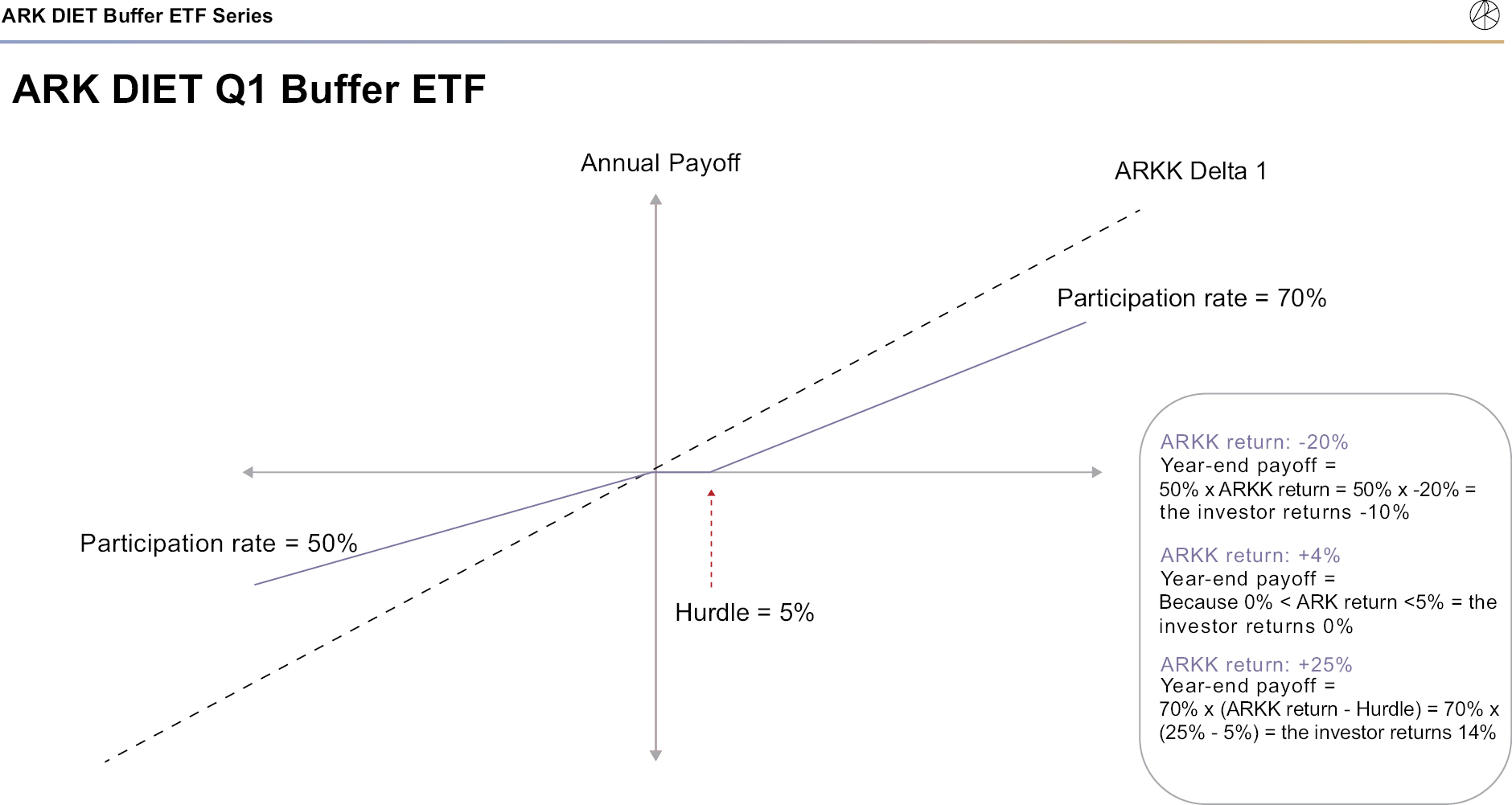
The above chart is not intended to predict or project the performance of the Fund’s options, the Underlying ETF or the Fund. The actual performance of the Underlying ETF may be lower than the hypothetical performance shown in the above table. Investors should not take this information as an assurance of the expected performance of the Fund’s options, the Underlying ETF or the Fund. Please refer to the Fund’s website, which provides the latest information on a daily basis throughout the Outcome Period. Please contact your financial intermediary for more information.
The ARK DIET Q2 Buffer ETF (the “Fund”) is an actively-managed exchange-traded fund (“ETF”) that, for rolling 12-month periods from April 1 to March 31 (each, an “Outcome Period”) seeks to provide investors with a defined risk-return profile, before fees and expenses. Specifically, the Fund is structured to provide, before fees and expenses, 50% downside participation in the share price of the ARK Innovation ETF (the “Underlying ETF”), measured from its value at the beginning of each Outcome Period (the “downside participation offset”). In other words, the strategy reduces downside exposure by half relative to the Underlying ETF. “DIET” in the Fund’s name stands for “defined innovation exposure term.” The term “Buffer” as used in the Fund’s name refers to such intended reduction in downside exposure. At the same time, the Fund is structured to provide maximum participation in the share price return of the Underlying ETF above a predefined 5% hurdle rate (the “Hurdle” and the “upside participation”). The Hurdle is defined as 105% of the Underlying ETF’s share price at the beginning of each Outcome Period, and corresponds to the strike price of the long out-of-the-money call options purchased by the Fund to capture the upside performance beyond that threshold. The rate of the Fund’s participation in the upside share price return of the Underlying ETF (“participation rate”) after the Hurdle is established based on the notional coverage achievable with the remaining amount of option premium budget after the Fund constructs the Hurdle and the downside participation offset.
The Fund’s investment strategy is designed to deliver targeted outcomes that may only be realized if Fund shares are bought by the first day of the Outcome Period and held until the end of the Outcome Period. If an investor purchases or sells shares during the Outcome Period, the returns realized by the investor will not match those that the Fund seeks to achieve.
The Hurdle, participation rate and downside participation offset are established prior to taking into account the Fund’s fees and expenses reflected in the “Fund Fees and Expenses” Table annualized over each Outcome Period. Accordingly, the Fund’s returns will be reduced by Fund fees and expenses as well as any brokerage commissions, trading fees, taxes and non-routine or extraordinary expenses incurred by the Fund throughout an Outcome Period. This means that the Fund’s NAV will only increase to the extent that the Fund’s participation in the Underlying ETF’s share price increase beyond the 5% Hurdle exceeds the Fund’s fees and expenses. This also means
that the Fund’s returns will be further reduced by the Fund’s fees and expenses when the share price of the Underlying ETF declines. The Fund will receive any dividends paid by the Underlying ETF with respect to the shares in the Underlying ETF held by the Fund.
On or about the commencement of an Outcome Period, the Fund will supplement this prospectus and publish on its website (https://www.ark-funds.com) the Fund’s participation rate for the next Outcome Period. Investors considering an investment in the Fund must visit the website for the latest information.
Use of Options
To pursue this objective, the Fund employs a structured options strategy:
1. Delta-One Exposure: The Fund invests substantially all of its assets in the Underlying ETF, creating a delta-one position (meaning that the price of the Fund’s shares moves one-for-one with the share price of the Underlying ETF) that provides full, unhedged exposure to the Underlying ETF throughout the Outcome Period; and,
2. Call Write to Fund Options Budget: On the trading day prior to the start of an Outcome Period (an “Initial Investment Day”), the Fund writes (sells) at-the-money call options on the Underlying ETF, with a notional value equal to 100% of the Fund’s NAV. This written call position caps direct participation in the Underlying ETF’s upside at 100% of its starting value and generates the option premium budget used to construct the Fund’s payoff structure; and,
3. Use of Option Premiums:
a. Downside Participation Offset: The Fund uses part of the call premium to create the downside participation offset by purchasing at-the-money put options on the Underlying ETF with a notional value equal to 50% of the Fund’s NAV. This put position offsets half of the Fund’s delta-one exposure to the Underlying ETF’s downside, resulting in a 50% net downside participation over the Outcome Period. In other words, for every 2% decline in the Underlying ETF, the net asset value of the Fund is expected to decline by approximately 1%; and,
b. Hurdle and Participation Rate: The Fund uses the remaining premium to establish the Hurdle and upside participation rate by purchasing out-of-the-money call options on the Underlying ETF with strike prices equal to 105% of the Underlying ETF’s share price at the beginning of the Outcome Period. This creates a zero payoff region between 100% and 105%, meaning the net asset value of the Fund will not increase until the Underlying ETF’s share price exceeds 105% of the Underlying ETF’s share price at the beginning of the Outcome Period plus the Fund’s fees and expenses, and allows the Fund to provide maximum upside participation above the Hurdle through the long calls, subject to the size of the notional coverage. The participation rate is determined prior to each Outcome Period by the Sub-Adviser.
Participation Rate Above the Hurdle
The Fund’s long out-of-the-money call options provide the right to purchase shares of the Underlying ETF at the Hurdle. To the extent the Underlying ETF’s share price exceeds the Hurdle at the end of the Outcome Period, the Fund is expected to realize those excess returns, before fees and expenses, through the cash settlement of these call options. The level of upside participation rate will reflect the notional exposure of the Fund’s long out-of-the-money call options, which is expected to provide meaningful but less than one-for-one participation in gains above the Hurdle.
Actual participation may vary depending on market conditions and option pricing and will be based on the notional coverage achievable with the remaining amount of option premium budget after the Fund constructs the downside participation offset.
Because the Fund’s strategy relies on options, its performance, even when the Underlying ETF’s share price gains significantly, may underperform a direct investment in the Underlying ETF. This is particularly true when the costs associated with purchasing long call options are high. As such, the Fund’s correlation to the Underlying ETF’s returns above the Hurdle is expected to be lower than a direct investment and could, in some environments, be substantially less.
Options Sourcing and Execution
The Fund will invest in exchange-traded FLexible EXchange Options (“FLEX Options”). FLEX Options are customizable option contracts listed on and available through the Chicago Board Option Exchange (“Cboe”) and guaranteed for settlement by the Options Clearing Corporation (“OCC”). These options allow customization of key terms such as strike price, exercise style, and expiration date, while offering transparent, competitive pricing through auction markets. Importantly, FLEX options eliminate the counterparty risk associated with over-the-counter (“OTC”) derivatives by benefiting from OCC clearing.
The Fund will invest in European-style FLEX Options, which can only be exercised at expiration. These options will be based on the performance of the Underlying ETF and are designed to expire on the last day of the Outcome Period. In general, the Fund intends to maximize its use of FLEX Options, as they provide an optimal blend of OCC guarantees, customization, price discovery, expiration-style consistency — all of which align well with the Fund’s outcome-seeking strategy. However, the Fund may use standardized listed options when the Sub-Adviser believes doing so offers beneficial market exposure or enhanced portfolio efficiency.
Strategy of the Underlying ETF
The Underlying ETF is an actively-managed ETF that will invest under normal circumstances primarily (at least 80% of its assets) in domestic and foreign equity securities of companies that are relevant to the Underlying ETF’s investment theme of disruptive innovation. The Adviser defines “disruptive innovation” as the introduction of a technologically enabled new product or service that potentially changes the way the world works. The Adviser believes that companies relevant to this theme are those that materially rely on or benefit from the development of new products or services, technological improvements and advancements in scientific research relating to the areas of genomics; innovation in automation and manufacturing, transportation, energy, artificial intelligence and materials; the increased use of shared technology, infrastructure and services; and technologies that make financial services more efficient. The Underlying ETF is classified as a “non-diversified” investment company under the Investment Company Act of 1940, which means that it may invest a high percentage of its assets in a limited number of issuers.
Illustration: Potential Scenarios (Before and after Fund Fee and Expense Deductions)
The following chart illustrates the hypothetical returns that the Fund seeks to provide where an investor purchases shares of the Fund by the first day of an Outcome Period and holds those shares for the entire Outcome Period, assuming a participation rate of 70%. The returns shown in the chart are based on a hypothetical Hurdle and downside participation offset and hypothetical
performance of the Underlying ETF in certain illustrative scenarios. There is no guarantee that the Fund will be successful in its attempt to achieve its investment objective or provide any targeted outcome.
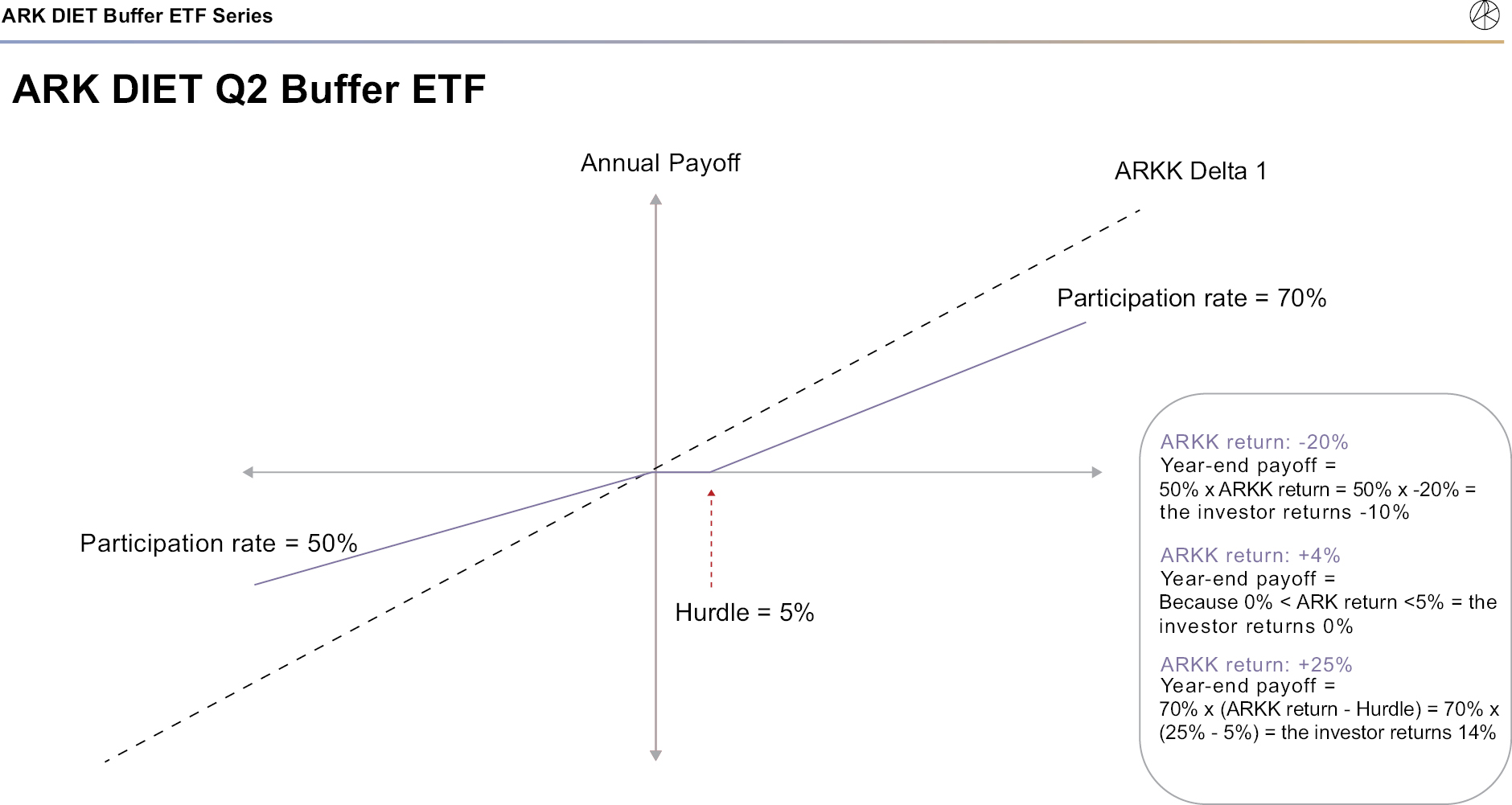
The above chart is not intended to predict or project the performance of the Fund’s options, the Underlying ETF or the Fund. The actual performance of the Underlying ETF may be lower than the hypothetical performance shown in the above table. Investors should not take this information as an assurance of the expected performance of the Fund’s options, the Underlying ETF or the Fund. Please refer to the Fund’s website, which provides the latest information on a daily basis throughout the Outcome Period. Please contact your financial intermediary for more information.
The ARK DIET Q3 Buffer ETF (the “Fund”) is an actively-managed exchange-traded fund (“ETF”) that, for rolling 12-month periods from July 1 to June 30 (each, an “Outcome Period”) seeks to provide investors with a defined risk-return profile, before fees and expenses. Specifically, the Fund is structured to provide, before fees and expenses, 50% downside participation in the share price of the ARK Innovation ETF (the “Underlying ETF”), measured from its value at the beginning of each Outcome Period (the “downside participation offset”). In other words, the strategy reduces downside exposure by half relative to the Underlying ETF. “DIET” in the Fund’s name stands for “defined innovation exposure term.” The term “Buffer” as used in the Fund’s name refers to such intended reduction in downside exposure. At the same time, the Fund is structured to provide maximum participation in the share price return of the Underlying ETF above a predefined 5% hurdle rate (the “Hurdle” and the “upside participation”). The Hurdle is defined as 105% of the Underlying ETF’s share price at the beginning of each Outcome Period, and corresponds to the strike price of the long out-of-the-money call options purchased by the Fund to capture the upside performance beyond that threshold. The rate of the Fund’s participation in the upside share price return of the Underlying ETF (“participation rate”) after the Hurdle is established based on the notional coverage achievable with the remaining amount of option premium budget after the Fund constructs the Hurdle and the downside participation offset.
The Fund’s investment strategy is designed to deliver targeted outcomes that may only be realized if Fund shares are bought by the first day of the Outcome Period and held until the end of the Outcome Period. If an investor purchases or sells shares during the Outcome Period, the returns realized by the investor will not match those that the Fund seeks to achieve.
The Hurdle, participation rate and downside participation offset are established prior to taking into account the Fund’s fees and expenses reflected in the “Fund Fees and Expenses” Table annualized over each Outcome Period. Accordingly, the Fund’s returns will be reduced by Fund fees and expenses as well as any brokerage commissions, trading fees, taxes and non-routine or extraordinary expenses incurred by the Fund throughout an Outcome Period. This means that the Fund’s NAV will only increase to the extent that the Fund’s participation in the Underlying ETF’s share price increase beyond the 5% Hurdle exceeds the Fund’s fees and expenses. This also means that the Fund’s returns will be further reduced by the Fund’s fees and expenses when the share price of the Underlying ETF declines. The Fund will receive any dividends paid by the Underlying ETF with respect to the shares in the Underlying ETF held by the Fund.
On or about the commencement of an Outcome Period, the Fund will supplement this prospectus and publish on its website (https://www.ark-funds.com) the Fund’s participation rate for the next Outcome Period. Investors considering an investment in the Fund must visit the website for the latest information.
Use of Options
To pursue this objective, the Fund employs a structured options strategy:
1. Delta-One Exposure: The Fund invests substantially all of its assets in the Underlying ETF, creating a delta-one position (meaning that the price of the Fund’s shares moves one-for-one with the share price of the Underlying ETF) that provides full, unhedged exposure to the Underlying ETF throughout the Outcome Period; and,
2. Call Write to Fund Options Budget: On the trading day prior to the start of an Outcome Period (an “Initial Investment Day”), the Fund writes (sells) at-the-money call options on the Underlying ETF, with a notional value equal to 100% of the Fund’s NAV. This written call position caps direct participation in the Underlying ETF’s upside at 100% of its starting value and generates the option premium budget used to construct the Fund’s payoff structure; and,
3. Use of Option Premiums:
a. Downside Participation Offset: The Fund uses part of the call premium to create the downside participation offset by purchasing at-the-money put options on the Underlying ETF with a notional value equal to 50% of the Fund’s NAV. This put position offsets half of the Fund’s delta-one exposure to the Underlying ETF’s downside, resulting in a 50% net downside participation over the Outcome Period. In other words, for every 2% decline in the Underlying ETF, the net asset value of the Fund is expected to decline by approximately 1%; and,
b. Hurdle and Participation Rate: The Fund uses the remaining premium to establish the Hurdle and upside participation rate by purchasing out-of-the-money call options on the Underlying ETF with strike prices equal to 105% of the Underlying ETF’s share price at the beginning of the Outcome Period. This creates a zero payoff region between 100% and 105%, meaning the net asset value of the Fund will not increase until the Underlying ETF’s share price exceeds 105% of the Underlying ETF’s share price at the beginning of the Outcome Period plus the Fund’s fees and expenses, and allows the Fund to provide maximum upside participation above the Hurdle through the long calls, subject to the size of the notional coverage. The participation rate is determined prior to each Outcome Period by the Sub-Adviser.
Participation Rate Above the Hurdle
The Fund’s long out-of-the-money call options provide the right to purchase shares of the Underlying ETF at the Hurdle. To the extent the Underlying ETF’s share price exceeds the Hurdle at the end of the Outcome Period, the Fund is expected to realize those excess returns, before fees and expenses, through the cash settlement of these call options. The level of upside participation rate will reflect the notional exposure of the Fund’s long out-of-the-money call options, which is expected to provide meaningful but less than one-for-one participation in gains above the Hurdle. Actual participation may vary depending on market conditions and option pricing and will be based on the notional coverage achievable with the remaining amount of option premium budget after the Fund constructs the downside participation offset.
Because the Fund’s strategy relies on options, its performance, even when the Underlying ETF’s share price gains significantly, may underperform a direct investment in the Underlying ETF. This is particularly true when the costs associated with purchasing long call options are high. As such, the Fund’s correlation to the Underlying ETF’s returns above the Hurdle is expected to be lower than a direct investment and could, in some environments, be substantially less.
Options Sourcing and Execution
The Fund will invest in exchange-traded FLexible EXchange Options (“FLEX Options”). FLEX Options are customizable option contracts listed on and available through the Chicago Board Option Exchange (“Cboe”) and guaranteed for settlement by the Options Clearing Corporation (“OCC”). These options allow customization of key terms such as strike price, exercise style, and expiration date, while offering transparent, competitive pricing through auction markets. Importantly, FLEX options eliminate the counterparty risk associated with over-the-counter (“OTC”) derivatives by benefiting from OCC clearing.
The Fund will invest in European-style FLEX Options, which can only be exercised at expiration. These options will be based on the performance of the Underlying ETF and are designed to expire on the last day of the Outcome Period. In general, the Fund intends to maximize its use of FLEX Options, as they provide an optimal blend of OCC guarantees, customization, price discovery, expiration-style consistency — all of which align well with the Fund’s outcome-seeking strategy. However, the Fund may use standardized listed options when the Sub-Adviser believes doing so offers beneficial market exposure or enhanced portfolio efficiency.
Strategy of the Underlying ETF
The Underlying ETF is an actively-managed ETF that will invest under normal circumstances primarily (at least 80% of its assets) in domestic and foreign equity securities of companies that are relevant to the Underlying ETF’s investment theme of disruptive innovation. The Adviser defines “disruptive innovation” as the introduction of a technologically enabled new product or service that potentially changes the way the world works. The Adviser believes that companies relevant to this theme are those that materially rely on or benefit from the development of new products or services, technological improvements and advancements in scientific research relating to the areas of genomics; innovation in automation and manufacturing, transportation, energy, artificial intelligence and materials; the increased use of shared technology, infrastructure and services; and technologies that make financial services more efficient. The Underlying ETF is classified as a “non-diversified” investment company under the Investment Company Act of 1940, which means that it may invest a high percentage of its assets in a limited number of issuers.
Illustration: Potential Scenarios (Before and after Fund Fee and Expense Deductions)
The following chart illustrates the hypothetical returns that the Fund seeks to provide where an investor purchases shares of the Fund by the first day of an Outcome Period and holds those shares for the entire Outcome Period, assuming a participation rate of 70%. The returns shown in the chart are based on a hypothetical Hurdle and downside participation offset and hypothetical
performance of the Underlying ETF in certain illustrative scenarios. There is no guarantee that the Fund will be successful in its attempt to achieve its investment objective or provide any targeted outcome.
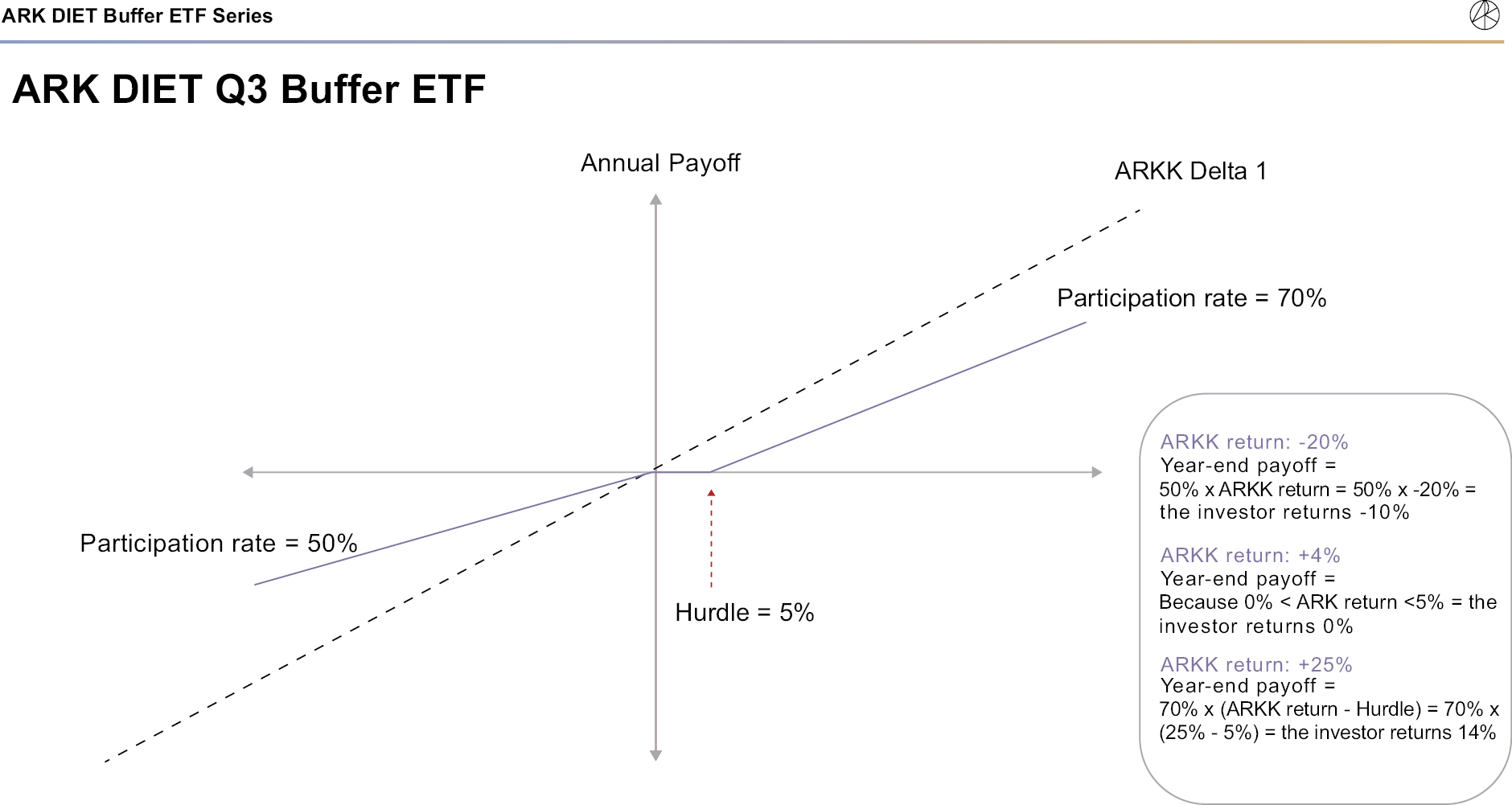
The above chart is not intended to predict or project the performance of the Fund’s options, the Underlying ETF or the Fund. The actual performance of the Underlying ETF may be lower than the hypothetical performance shown in the above table. Investors should not take this information as an assurance of the expected performance of the Fund’s options, the Underlying ETF or the Fund. Please refer to the Fund’s website, which provides the latest information on a daily basis throughout the Outcome Period. Please contact your financial intermediary for more information.
The ARK DIET Q4 Buffer ETF (the “Fund”) is an actively-managed exchange-traded fund (“ETF”) that, for rolling 12-month periods from October 1 to September 30 (each, an “Outcome Period”) seeks to provide investors with a defined risk-return profile, before fees and expenses. Specifically, the Fund is structured to provide, before fees and expenses, 50% downside participation in the share price of the ARK Innovation ETF (the “Underlying ETF”), measured from its value at the beginning of each Outcome Period (the “downside participation offset”). In other words, the strategy reduces downside exposure by half relative to the Underlying ETF. “DIET” in the Fund’s name stands for “defined innovation exposure term.” The term “Buffer” as used in the Fund’s name refers to such intended reduction in downside exposure. At the same time, the Fund is structured to provide maximum participation in the share price return of the Underlying ETF above a predefined 5% hurdle rate (the “Hurdle” and the “upside participation”). The Hurdle is defined as 105% of the Underlying ETF’s share price at the beginning of each Outcome Period, and corresponds to the strike price of the long out-of-the-money call options purchased by the Fund to capture the upside performance beyond that threshold. The rate of the Fund’s participation in the upside share price return of the Underlying ETF (“participation rate”) after the Hurdle is established based on the notional coverage achievable with the remaining amount of option premium budget after the Fund constructs the Hurdle and the downside participation offset.
The Fund’s investment strategy is designed to deliver targeted outcomes that may only be realized if Fund shares are bought by the first day of the Outcome Period and held until the end of the Outcome Period. If an investor purchases or sells shares during the Outcome Period, the returns realized by the investor will not match those that the Fund seeks to achieve.
The Hurdle, participation rate and downside participation offset are established prior to taking into account the Fund’s fees and expenses reflected in the “Fund Fees and Expenses” Table annualized over each Outcome Period. Accordingly, the Fund’s returns will be reduced by Fund fees and expenses as well as any brokerage commissions, trading fees, taxes and non-routine or extraordinary expenses incurred by the Fund throughout an Outcome Period. This means that the Fund’s NAV will only increase to the extent that the Fund’s participation in the Underlying ETF’s share price increase beyond the 5% Hurdle exceeds the Fund’s fees and expenses. This also means that the Fund’s returns will be further reduced by the Fund’s fees and expenses when the share price of the Underlying ETF declines. The Fund will receive any dividends paid by the Underlying ETF with respect to the shares in the Underlying ETF held by the Fund.
On or about the commencement of an Outcome Period, the Fund will supplement this prospectus and publish on its website (https://www.ark-funds.com) the Fund’s participation rate for the next Outcome Period. Investors considering an investment in the Fund must visit the website for the latest information.
Use of Options
To pursue this objective, the Fund employs a structured options strategy:
1. Delta-One Exposure: The Fund invests substantially all of its assets in the Underlying ETF, creating a delta-one position (meaning that the price of the Fund’s shares moves one-for-one with the share price of the Underlying ETF) that provides full, unhedged exposure to the Underlying ETF throughout the Outcome Period; and,
2. Call Write to Fund Options Budget: On the trading day prior to the start of an Outcome Period (an “Initial Investment Day”), the Fund writes (sells) at-the-money call options on the Underlying ETF, with a notional value equal to 100% of the Fund’s NAV. This written call position caps direct participation in the Underlying ETF’s upside at 100% of its starting value and generates the option premium budget used to construct the Fund’s payoff structure; and,
3. Use of Option Premiums:
a. Downside Participation Offset: The Fund uses part of the call premium to create the downside participation offset by purchasing at-the-money put options on the Underlying ETF with a notional value equal to 50% of the Fund’s NAV. This put position offsets half of the Fund’s delta-one exposure to the Underlying ETF’s downside, resulting in a 50% net downside participation over the Outcome Period. In other words, for every 2% decline in the Underlying ETF, the net asset value of the Fund is expected to decline by approximately 1%; and,
b. Hurdle and Participation Rate: The Fund uses the remaining premium to establish the Hurdle and upside participation rate by purchasing out-of-the-money call options on the Underlying ETF with strike prices equal to 105% of the Underlying ETF’s share price at the beginning of the Outcome Period. This creates a zero payoff region between 100% and 105%, meaning the net asset value of the Fund will not increase until the Underlying ETF’s share price exceeds 105% of the Underlying ETF’s share price at the beginning of the Outcome Period plus the Fund’s fees and expenses, and allows the Fund to provide maximum upside participation above the Hurdle through the long calls, subject to the size of the notional coverage. The participation rate is determined prior to each Outcome Period by the Sub-Adviser.
Participation Rate Above the Hurdle
The Fund’s long out-of-the-money call options provide the right to purchase shares of the Underlying ETF at the Hurdle. To the extent the Underlying ETF’s share price exceeds the Hurdle at the end of the Outcome Period, the Fund is expected to realize those excess returns, before fees and expenses, through the cash settlement of these call options. The level of upside participation rate will reflect the notional exposure of the Fund’s long out-of-the-money call options, which is expected to provide meaningful but less than one-for-one participation in gains above the Hurdle. Actual participation may vary depending on market conditions and option pricing and will be based on the notional coverage achievable with the remaining amount of option premium budget after the Fund constructs the downside participation offset.
Because the Fund’s strategy relies on options, its performance, even when the Underlying ETF’s share price gains significantly, may underperform a direct investment in the Underlying ETF. This is particularly true when the costs associated with purchasing long call options are high. As such, the Fund’s correlation to the Underlying ETF’s returns above the Hurdle is expected to be lower than a direct investment and could, in some environments, be substantially less.
Options Sourcing and Execution
The Fund will invest in exchange-traded FLexible EXchange Options (“FLEX Options”). FLEX Options are customizable option contracts listed on and available through the Chicago Board Option Exchange (“Cboe”) and guaranteed for settlement by the Options Clearing Corporation (“OCC”). These options allow customization of key terms such as strike price, exercise style, and expiration date, while offering transparent, competitive pricing through auction markets. Importantly, FLEX options eliminate the counterparty risk associated with over-the-counter (“OTC”) derivatives by benefiting from OCC clearing.
The Fund will invest in European-style FLEX Options, which can only be exercised at expiration. These options will be based on the performance of the Underlying ETF and are designed to expire on the last day of the Outcome Period. In general, the Fund intends to maximize its use of FLEX Options, as they provide an optimal blend of OCC guarantees, customization, price discovery, expiration-style consistency — all of which align well with the Fund’s outcome-seeking strategy. However, the Fund may use standardized listed options when the Sub-Adviser believes doing so offers beneficial market exposure or enhanced portfolio efficiency.
Strategy of the Underlying ETF
The Underlying ETF is an actively-managed ETF that will invest under normal circumstances primarily (at least 80% of its assets) in domestic and foreign equity securities of companies that are relevant to the Underlying ETF’s investment theme of disruptive innovation. The Adviser defines “disruptive innovation” as the introduction of a technologically enabled new product or service that potentially changes the way the world works. The Adviser believes that companies relevant to this theme are those that materially rely on or benefit from the development of new products or services, technological improvements and advancements in scientific research relating to the areas of genomics; innovation in automation and manufacturing, transportation, energy, artificial intelligence and materials; the increased use of shared technology, infrastructure and services; and technologies that make financial services more efficient. The Underlying ETF is classified as a “non-diversified” investment company under the Investment Company Act of 1940, which means that it may invest a high percentage of its assets in a limited number of issuers.
Illustration: Potential Scenarios (Before and after Fund Fee and Expense Deductions)
The following chart illustrates the hypothetical returns that the Fund seeks to provide where an investor purchases shares of the Fund by the first day of an Outcome Period and holds those shares for the entire Outcome Period, assuming a participation rate of 70%. The returns shown in the chart are based on a hypothetical Hurdle and downside participation offset and hypothetical
performance of the Underlying ETF in certain illustrative scenarios. There is no guarantee that the Fund will be successful in its attempt to achieve its investment objective or provide any targeted outcome.
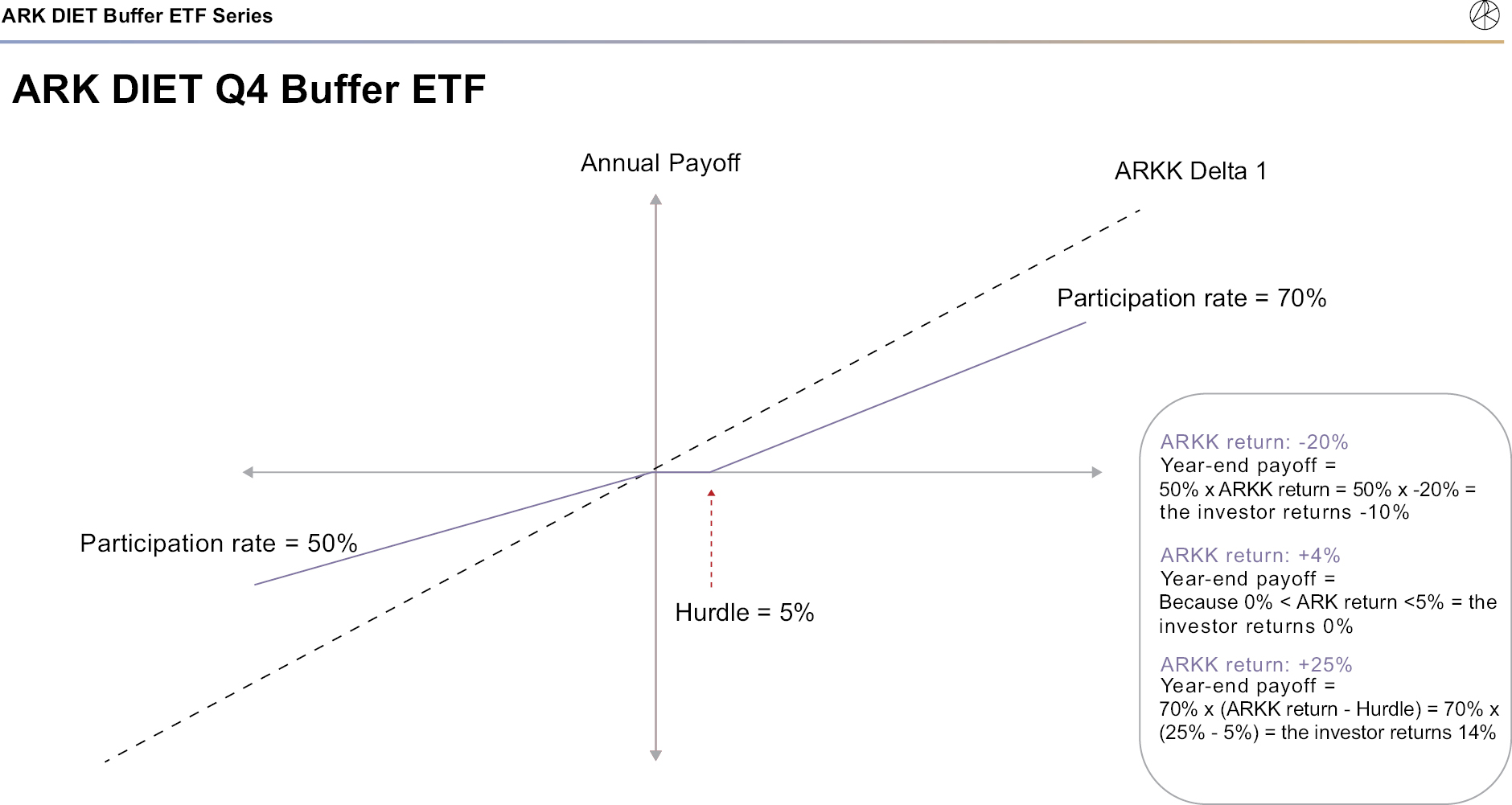
The above chart is not intended to predict or project the performance of the Fund’s options, the Underlying ETF or the Fund. The actual performance of the Underlying ETF may be lower than the hypothetical performance shown in the above table. Investors should not take this information as an assurance of the expected performance of the Fund’s options, the Underlying ETF or the Fund. Please refer to the Fund’s website, which provides the latest information on a daily basis throughout the Outcome Period. Please contact your financial intermediary for more information.