Current income, consistent with reasonable stability of principal.
These tables describe the fees and expenses that you may pay if you buy, hold and sell shares of the fund. You may pay other fees, such as brokerage commissions and other fees to financial intermediaries, which are not reflected in the tables and examples below. Shares of Class P2 are available for purchase on behalf of clients of a fee-based program or certain other advisory programs in which UBS Asset Management (Americas) LLC the fund’s manager and administrator (“UBS AM”), exercises investment discretion and for which clients pay UBS AM a fee, or the clients pay an affiliate of UBS AM a fee and UBS AM receives compensation, to participate in such programs. Shares of Class P2 are also available for purchase on behalf of institutional clients with which UBS AM or its affiliates has signed a separate investment management agreement, pursuant to which such clients pay an advisory fee, and by other registered investment companies managed by UBS AM that pay a management fee at the investing/acquiring fund level.
|
| Class P2 |
| |
Maximum front-end sales charge (load) imposed on purchases |
|
| None |
|
Maximum deferred sales charge (load) |
|
| None |
|
|
| Class P2 | ||
Management fees |
|
| 0.45 | % |
Distribution and/or service (12b‑1) fees |
|
| None |
|
Other expenses (includes administration fee of 0.10%)1 |
|
| 0.42 |
|
Total annual fund operating expenses |
|
| 0.87 |
|
Management fee waiver/expense reimbursements2 |
|
| 0.35 |
|
Total annual fund operating expenses after fee waiver and/or expense reimbursements2 |
|
| 0.52 |
|
1 | “Other expenses” are based on estimated amounts for the current fiscal year. “Other expenses” include “Acquired fund fees and expenses,” which were less than 0.01% of the average net assets of the fund. |
2 | The fund and UBS AM have entered into a written fee waiver/expense reimbursement agreement pursuant to which UBS AM is contractually obligated through November 30, 2027 with respect to Class P2 to waive (i) its management fees in an amount equal to the portion of the management fees UBS AM retains after payment by UBS AM of any subadvisory fees, and (ii) its administrative services fees in an amount equal to the portion of the administrative services fees UBS AM retains after payment by UBS AM of any sub-administration fees and charges paid to third parties. The fee waiver/expense reimbursement agreement may be terminated by the fund’s board at any time and also will terminate automatically upon the expiration or termination of the fund’s advisory contract with UBS AM. |
This example is intended to help you compare the cost of investing in the fund with the cost of investing in other mutual funds. The example assumes that you invest $10,000 in the fund for the time periods indicated and then redeem all of your shares at the end of those periods. The example also assumes that your investment has a 5% return each year and that the fund’s operating expenses remain the same.*
Although your actual costs may be higher or lower, based on these assumptions your costs would be:
1 year |
|
| 3 years |
|
| 5 years |
|
| 10 years |
| ||||||
$53 |
|
|
|
| $243 |
|
|
|
| $448 |
|
|
|
| $1,040 |
|
* | Except that the expenses reflect the effects of the fund’s fee waiver/expense reimbursement agreement for the first year only. |
The fund pays transaction costs, such as commissions or dealer spreads, when it buys and sells securities (or “turns over” its portfolio). A higher portfolio turnover rate may indicate higher transaction costs and may result in higher taxes when fund shares are held in a taxable account. These costs, which are not reflected in annual fund operating expenses or in the example, affect the fund’s performance. During the most recent fiscal year, the fund’s portfolio turnover rate was 47% of the average value of its portfolio.*
* | Portfolio turnover with respect to to-be-announced securities for the fund are not reflected in the fund’s financial statements, and therefore the portfolio turnover listed above differs from that presented in the fund’s financial highlights. |
Principal investments
Under normal circumstances, the fund invests at least 80% of its net assets (plus the amount of any borrowing for investment purposes) in fixed income securities, which may be represented by derivatives or investments in securities of other investment companies that invest primarily in fixed income securities. Fixed income securities are debt instruments issued by a company, government or other entity to borrow money. The issuer typically pays a fixed, variable, or floating rate of interest and must repay the amount borrowed, usually at the maturity of the security. Such investments may include US government and foreign government bonds (including bonds issued by supranational and quasi-governmental entities and mortgage-backed securities), municipal fixed income investments (including tax‑exempt municipal securities), corporate bonds (including mortgage- and asset-backed securities of private issuers, Eurodollar certificates of deposit, Eurodollar bonds and Yankee bonds) and bank loans. There are different types of US government securities, including those issued or guaranteed by the US government, its agencies and its instrumentalities, and they have different types of government support. Some are supported by the full faith and credit of the US, while others are supported by (1) the ability of the issuer to borrow from the US Treasury; (2) the credit of the issuing agency, instrumentality or government-sponsored entity; (3) pools of assets, such as mortgages; or (4) the US government in some other way.
The fund may invest in bonds that are investment grade at the time of purchase. The fund may also invest, in the aggregate, up to 20% of its total assets (measured at the time of purchase) in (1) bonds that are below investment grade at the time of purchase (or unrated bonds of equivalent quality) (commonly known as “junk bonds”), (2) non-US dollar denominated securities, and (3) fixed income securities of issuers located in emerging markets. The fund may also invest in equity securities, such as preferred shares and securities convertible into stocks.
The fund invests in bonds of varying maturities. It normally limits its overall portfolio duration to within +/- 50% of the duration of the Bloomberg US Aggregate Bond Index, which as of July 31, 2026 was approximately 5.84 years and may change over time. Duration is a measure of the fund’s exposure to interest rate risk—a longer duration means that changes in market interest rates are likely to have a larger effect on the value of the fund’s portfolio.
The fund may invest in “to be announced” or “TBA” securities, which are mortgage-backed securities that usually are traded on a forward commitment basis with an approximate principal amount and no defined maturity date, issued or guaranteed by US government agen‐
cies and instrumentalities. The fund also may engage in TBA and Treasury “roll” transactions. A TBA roll transaction is a strategy whereby the fund decides to sell one TBA security and buy another TBA security due at a later date (Treasury roll transactions differ in that the underlying securities are US Treasury securities).
The fund may, but is not required to, use exchange-traded or over-the-counter derivative instruments for risk management purposes or to attempt to increase total returns. The derivatives in which the fund invests include swap agreements (specifically, interest rate swaps) and currency forward agreements. These derivatives may be used for risk management purposes, such as managing the risk profile of the fund. In addition, the derivative instruments listed above may be used to enhance returns or in place of direct investments. Futures, swaps and swaptions also may be used to adjust the fund’s portfolio duration.
The fund engages in frequent trading from time to time and consequently, the fund’s investment strategies can result in high portfolio turnover.
Management process
The fund employs a “manager of managers” structure. UBS AM, the fund’s manager and primary provider of investment advisory services, has the ultimate authority, subject to oversight by the fund’s board, to oversee the fund’s subadvisor(s) and recommend their hiring, termination and replacement, and to allocate assets among the fund’s subadvisor(s). The relative value of each subadvisor’s share of the fund’s assets may change over time.
UBS AM’s investment process begins with subadvisor selection. UBS AM’s portfolio management team constructs a list of potential subadvisors based on information primarily from internal sources and the team’s collective knowledge of the industry, but also supplemented by external sources. The team then focuses its research on that list to identify a small number of the most attractive candidates. This research includes analyzing the portfolio holdings and/or positioning of a subadvisor’s investment strategy to understand whether the allocation of risk and the drivers of alpha are consistent with the subadvisor’s investment philosophy and stated strengths. The most attractive sub-set of those subadvisors is then selected for in-depth, on-site due diligence meetings with representatives from the investment, operations and compliance groups within UBS AM. The due diligence information is then synthesized to select the most attractive candidate(s) for the fund, subject to the board’s approval.
In managing the fund and overseeing the fund’s subadvisor(s), UBS AM views its research process as an ongoing one, as the team continually seeks to confirm a subadvisor’s investment thesis over the appropriate
investment horizon. In general, UBS AM leverages its research and market knowledge to construct funds with exposure to various subadvisors that are expected, in combination, to produce the desired overall fund characteristics. UBS AM’s ongoing monitoring and risk management process incorporates daily, weekly, monthly, quarterly and annual responsibilities designed to monitor the drivers of fund risk and performance at the subadvisor level and at the overall fund level. Through this process, UBS AM may adjust a fund’s positioning by altering its allocation weights across subadvisors within the fund and/or by changing the specific subadvisors within the fund.
The subadvisor utilizes a strategy that seeks to invest in a diversified portfolio of fixed income instruments that are performing, durable, and available at an attractive valuation, including floating or variable rate debt instruments.
Risk/return bar chart and table
The performance information that follows shows the fund’s performance information in a bar chart and an average annual total returns table for Class P shares of the fund, which is not offered in this prospectus. There is no performance information quoted for Class P2 shares of the fund as Class P2 shares have not completed a full calendar year of operations as of the date of this prospectus. Although Class P2 shares are invested in the same portfolio of securities as Class P shares, returns for Class P2 shares will differ from Class P shares to the extent that Class P2 shares are subject to different expenses. The bar chart does not reflect any program fee or similar fee charged by advisory programs through which Class P2 shares of the fund may be held or advisory or management fees paid to UBS AM or its affiliates outside of the fund; if it did, the total returns shown would be lower. The information provides some indication of the risks of investing in the fund by showing changes in the fund’s performance from year to year and by showing how the fund’s average annual total returns compare with those of the Bloomberg US Aggregate Bond Index, which represents a broad measure of market performance, over time. The fund’s past
performance (before and after taxes) is not necessarily an indication of how the fund will perform in the future. This may be particularly true given that another subadvisor was responsible for managing the fund’s assets during previous periods. An affiliated entity under common ownership and control with Brown Brothers Harriman Credit Partners, LLC (“BBH Credit Partners”) assumed day-to-day management of the fund’s assets on August 12, 2022. BBH Credit Partners assumed day‑to‑day management of the fund’s assets on January 1, 2026. Updated performance for the fund is available at www.ubs.com/us/en/assetmanagement/funds/mutual-fund-performance.
After-tax returns are calculated using the historical highest individual federal marginal income tax rates and do not reflect the impact of state and local taxes. Actual after-tax returns depend on an investor’s tax situation and may differ from those shown. In addition, the after-tax returns shown are not relevant to investors who hold fund shares through tax-advantaged arrangements, such as 401(k) plans or individual retirement accounts.
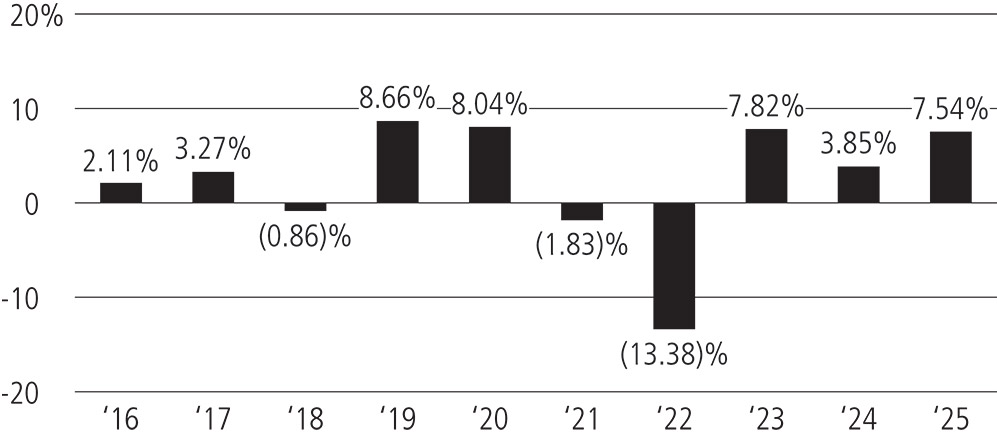
Total return January 1 - September 30, 2026: (2.24)%
Best quarter during calendar years shown—4Q 2023: 7.27%
Worst quarter during calendar years shown—1Q 2022: (6.11)%
Class (inception date) |
|
| 1 year |
|
| 5 years |
|
| 10 years |
| |||
Class P () |
|
| 7.54 | % |
|
| 0.48 | % |
|
| 2.31 | % |
|
Return after taxes on distributions |
|
| 5.15 |
|
|
| (1.31 | ) |
|
| 0.85 |
|
|
Return after taxes on distributions |
|
| 4.43 |
|
|
| (0.40 | ) |
|
| 1.15 |
|
|
Bloomberg US Aggregate |
|
| |
|
|
| | |
|
| |
|
|
|
* | Class P2 shares do not bear initial or contingent deferred sales charges or ongoing 12b‑1 service and distribution fees, but Class P2 shares held through advisory programs may be subject to a program fee, advisory fee or other fees, which, if included, would have reduced performance. |