Investment Strategy
Jul. 31, 2026
The Fund is a fund of funds and seeks to achieve its investment objective by investing primarily in Underlying Funds that themselves seek investment results corresponding to their own respective underlying indexes. The Underlying Funds invest
primarily in distinct asset classes, such as large- or mid-capitalization U.S. or non-U.S. equity, the aggregate bond market (including USD-denominated bonds) or the U.S. Treasury bond market; each such asset class has its own risk profile.
The S&P Target Risk Aggressive Index (the “Underlying Index”) is composed of a portfolio of equity and fixed-income Underlying Funds and measures the performance of the S&P Dow Jones Indices LLC (the “Index Provider” or “SPDJI”) proprietary allocation model that is intended to represent an “aggressive” target risk allocation strategy as defined by SPDJI. The Underlying Index seeks to emphasize exposure to equities, maximizing opportunities for long-term capital accumulation. The Underlying Index may include small allocations in fixed income to enhance portfolio efficiency. SPDJI’s estimation of an aggressive target risk allocation may differ from your own.
The Fund is designed for investors seeking long-term capital appreciation. As of July 31, 2026, the Underlying Index included a fixed allocation of 80% of its assets in Underlying Funds that invest primarily in equity securities and 20% of its assets in Underlying Funds that invest primarily in bonds. As of July 31, 2026, the Fund invested approximately 80.87% of its assets in Underlying Funds that invest primarily in equity securities, 19.04% of its assets in Underlying Funds that invest primarily in bonds and the remainder of its assets in Underlying Funds that invest primarily in money market instruments.
As of July 31, 2026, the Fund invested in the iShares Core International Aggregate Bond ETF, iShares Core MSCI Emerging Markets ETF, iShares Core MSCI International Developed Markets ETF, iShares Core S&P 500 ETF, iShares Core S&P Mid-Cap ETF, iShares Core S&P Small-Cap ETF, iShares Core Universal USD Bond ETF and money market funds advised by BFA or its affiliates (“BlackRock Cash Funds”). BFA may add, eliminate or replace any or all Underlying Funds at any time. As of July 31, 2026, a significant portion of the Underlying Index was represented by companies in the financials and technology industries or sectors. The components of the Underlying Index are likely to change over time.
The Fund seeks to track the investment results of the Underlying Index before fees and expenses of the Fund. BFA uses a representative sampling indexing strategy to manage the Fund. “Representative sampling” is an indexing strategy that involves investing in a representative sample of securities or other instruments intended to collectively have an investment profile similar to that of an applicable underlying index. The instruments selected are expected to have, in the aggregate, investment characteristics (based on factors such as market capitalization and industry weightings), fundamental characteristics (such as return variability and yield) and liquidity measures similar to those of an applicable underlying index. The Fund may or may not hold all of the components of the Underlying Index. The Fund may use derivatives to gain or reduce exposure to the components of the Underlying Index or exposure to one or more market risk factors associated with such components. Subject to the limits described herein, the Fund may purchase and hold cash and cash equivalents, including shares of money market funds advised by BFA or its affiliates, and may also purchase and hold instruments not included in the Underlying Index when BFA believes that such instruments will help the Fund track the performance of the Underlying Index over time, including in light of expected liquidity or trading costs, anticipated additions to or deletions from the Underlying Index, or other reasons as determined by BFA.
In accordance with Rule 35d-1 under the Investment Company Act of 1940, as amended (the “1940 Act”), under normal circumstances, the Fund will not invest less than 80% of the value of its net assets, plus the amount of any borrowings for investment purposes, in components of its Underlying Index. Investments in derivatives and other investments will be counted toward the Fund’s 80% investment policy to the extent that they provide exposure to the components of its Underlying Index or exposure to one or more market risk factors associated with such components. The Fund’s 80% investment policy may be changed by the Trust’s Board of Trustees (the “Board”) upon 60 days’ notice to shareholders.
The Fund may lend securities representing up to one-third of the value of the Fund's total assets (including the value of any collateral received).
The Underlying Index is a product of SPDJI, which is independent of the Fund and BFA. The Index Provider determines the composition and relative weightings of the components of the Underlying Index and publishes information regarding the market value of the Underlying Index.
Industry Concentration Policy. The Fund will concentrate its investments (i.e., hold 25% or more of its total assets) in a particular industry or group of industries to approximately the same extent that the Underlying Index is concentrated. For purposes of this limitation, securities of the U.S. government (including its agencies and instrumentalities) and repurchase agreements collateralized by U.S. government securities are not considered to be issued by members of any industry.
The Fund is a fund of funds and seeks to achieve its investment objective by investing primarily in Underlying Funds that themselves seek investment results corresponding to their own respective underlying indexes. The Underlying Funds invest
primarily in distinct asset classes, such as large- or mid-capitalization U.S. or non-U.S. equity, the aggregate bond market (including USD-denominated bonds) or the U.S. Treasury bond market; each such asset class has its own risk profile.
In accordance with Rule 35d-1 under the Investment Company Act of 1940, as amended (the “1940 Act”), under normal circumstances, the Fund will not invest less than 80% of the value of its net assets, plus the amount of any borrowings for investment purposes, in components of its Underlying Index. Investments in derivatives and other investments will be counted toward the Fund’s 80% investment policy to the extent that they provide exposure to the components of its Underlying Index or exposure to one or more market risk factors associated with such components. The Fund’s 80% investment policy may be changed by the Trust’s Board of Trustees (the “Board”) upon 60 days’ notice to shareholders.
The Fund is a fund of funds and seeks to achieve its investment objective by investing primarily in Underlying Funds that themselves seek investment results corresponding to their own respective underlying indexes. The Underlying Funds invest
primarily in distinct asset classes, such as large- or mid-capitalization U.S. or non-U.S. equity, the aggregate bond market (including allocation to international bonds as well as USD-denominated bonds) or the U.S. Treasury bond market; each such asset class has its own risk profile.
The S&P Target Risk Conservative Index (the “Underlying Index”) is composed of a portfolio of equity and fixed-income Underlying Funds and measures the performance of the S&P Dow Jones Indices LLC (the “Index Provider” or “SPDJI”) proprietary allocation model that is intended to represent a “conservative” target risk allocation strategy as defined by SPDJI. The Underlying Index seeks to emphasize exposure to fixed income to produce a current income stream and avoid excessive volatility of returns. Equities are included in the Underlying Index to seek to protect long-term purchasing power. SPDJI’s estimation of a conservative target risk allocation may differ from your own.
The Fund is designed for investors seeking current income, capital preservation and avoidance of excessive volatility of returns. As of July 31, 2026, the Underlying Index included a fixed allocation of 30% of its assets in Underlying Funds that invest primarily in equity securities and 70% of its assets in Underlying Funds that invest primarily in bonds. As of July 31, 2026, the Fund invested approximately 31.25% of its assets in Underlying Funds that invest primarily in equity securities, 68.66% of its assets in Underlying Funds that invest primarily in bonds and the remainder of its assets in Underlying Funds that invest primarily in money market instruments.
As of July 31, 2026, the Fund invested in the iShares Core International Aggregate Bond ETF, iShares Core MSCI Emerging Markets ETF, iShares Core MSCI International Developed Markets ETF, iShares Core S&P 500 ETF, iShares Core S&P Mid-Cap ETF, iShares Core S&P Small-Cap ETF, iShares Core Universal USD Bond ETF and money market funds advised by BFA or its affiliates (“BlackRock Cash Funds”). BFA may add, eliminate or replace any or all Underlying Funds at any time. As of July 31, 2026, a significant portion of the Underlying Index was represented by U.S. treasury securities. The components of the Underlying Index are likely to change over time.
The Fund seeks to track the investment results of the Underlying Index before fees and expenses of the Fund. BFA uses a representative sampling indexing strategy to manage the Fund. “Representative sampling” is an indexing strategy that involves investing in a representative sample of securities or other instruments intended to collectively have an investment profile similar to that of an applicable underlying index. The instruments selected are expected to have, in the aggregate, investment characteristics (based on factors such as market capitalization and industry weightings), fundamental characteristics (such as return variability and yield) and liquidity measures similar to those of an applicable underlying index. The Fund may or may not hold all of the components of the Underlying Index. The Fund may use derivatives to gain or reduce exposure to the components of the Underlying Index or exposure to one or more market risk factors associated with such components. Subject to the limits described herein, the Fund may purchase and hold cash and cash equivalents, including shares of money market funds advised by BFA or its affiliates, and may also purchase and hold instruments not included in the Underlying Index when BFA believes that such instruments will help the Fund track the performance of the Underlying Index over time, including in light of expected liquidity or trading costs, anticipated additions to or deletions from the Underlying Index, or other reasons as determined by BFA.
In accordance with Rule 35d-1 under the Investment Company Act of 1940, as amended (the “1940 Act”), under normal circumstances, the Fund will not invest less than 80% of the value of its net assets, plus the amount of any borrowings for investment purposes, in components of its Underlying Index. Investments in derivatives and other investments will be counted toward the Fund’s 80% investment policy to the extent that they provide exposure to the components of its Underlying Index or exposure to one or more market risk factors associated with such components. The Fund’s 80% investment policy may be changed by the Trust’s Board of Trustees (the “Board”) upon 60 days’ notice to shareholders.
The Fund may lend securities representing up to one-third of the value of the Fund's total assets (including the value of any collateral received).
The Underlying Index is a product of SPDJI, which is independent of the Fund and BFA. The Index Provider determines the composition and relative weightings of the components of the Underlying Index and publishes information regarding the market value of the Underlying Index.
Industry Concentration Policy. The Fund will concentrate its investments (i.e., hold 25% or more of its total assets) in a particular industry or group of industries to approximately the same extent that the Underlying Index is concentrated. For purposes of this limitation, securities of the U.S. government (including its agencies and instrumentalities) and repurchase agreements collateralized by U.S. government securities are not considered to be issued by members of any industry.
The Fund is a fund of funds and seeks to achieve its investment objective by investing primarily in Underlying Funds that themselves seek investment results corresponding to their own respective underlying indexes. The Underlying Funds invest
primarily in distinct asset classes, such as large- or mid-capitalization U.S. or non-U.S. equity, the aggregate bond market (including allocation to international bonds as well as USD-denominated bonds) or the U.S. Treasury bond market; each such asset class has its own risk profile.
In accordance with Rule 35d-1 under the Investment Company Act of 1940, as amended (the “1940 Act”), under normal circumstances, the Fund will not invest less than 80% of the value of its net assets, plus the amount of any borrowings for investment purposes, in components of its Underlying Index. Investments in derivatives and other investments will be counted toward the Fund’s 80% investment policy to the extent that they provide exposure to the components of its Underlying Index or exposure to one or more market risk factors associated with such components. The Fund’s 80% investment policy may be changed by the Trust’s Board of Trustees (the “Board”) upon 60 days’ notice to shareholders.
The Fund is a fund of funds and seeks to achieve its investment objective by investing primarily in Underlying Funds that themselves seek investment results corresponding to their own respective underlying indexes. The Underlying Funds invest
primarily in distinct asset classes, such as large- or mid-capitalization U.S. or non-U.S. equity, the aggregate bond market (including USD-denominated bonds) or the U.S. Treasury bond market; each such asset class has its own risk profile.
The S&P Target Risk Balanced Index (the “Underlying Index”) is composed of a portfolio of equity and fixed-income Underlying Funds and measures the performance of the S&P Dow Jones Indices LLC (the “Index Provider” or “SPDJI”) proprietary allocation model that is intended to represent a “growth” target risk allocation strategy as defined by SPDJI. The Underlying Index seeks to provide increased exposure to equities, while also using some fixed income exposure to dampen risk. SPDJI’s estimation of a growth target risk allocation may differ from your own.
The Fund is designed for investors seeking moderate capital appreciation and some opportunity for current income and capital preservation. As of July 31, 2026, the Underlying Index included a fixed allocation of 60% of its assets in Underlying Funds that invest primarily in equity securities and 40% of its assets in Underlying Funds that invest primarily in bonds. As of July 31, 2026, the Fund invested approximately 60.76% of its assets in Underlying Funds that invest primarily in equity securities, 38.15% of its assets in Underlying Funds that invest primarily in bonds and the remainder of its assets in Underlying Funds that invest primarily in money market instruments.
As of July 31, 2026, the Fund invested in the iShares Core International Aggregate Bond ETF, iShares Core MSCI Emerging Markets ETF, iShares Core MSCI International Developed Markets ETF, iShares Core S&P 500 ETF, iShares Core S&P Mid-Cap ETF, iShares Core S&P Small-Cap ETF, iShares Core Universal USD Bond ETF and money market funds advised by BFA or its affiliates (“BlackRock Cash Funds”). BFA may add, eliminate or replace any or all Underlying Funds at any time. As of July 31, 2026, a significant portion of the Underlying Index was represented by companies in the financials industry and technology industries or sectors. The components of the Underlying Index are likely to change over time.
The Fund seeks to track the investment results of the Underlying Index before fees and expenses of the Fund. BFA uses a representative sampling indexing strategy to manage the Fund. “Representative sampling” is an indexing strategy that involves investing in a representative sample of securities or other instruments intended to collectively have an investment profile similar to that of an applicable underlying index. The instruments selected are expected to have, in the aggregate, investment characteristics (based on factors such as market capitalization and industry weightings), fundamental characteristics (such as return variability and yield) and liquidity measures similar to those of an applicable underlying index. The Fund may or may not hold all of the components of the Underlying Index. The Fund may use derivatives to gain or reduce exposure to the components of the Underlying Index or exposure to one or more market risk factors associated with such components. Subject to the limits described herein, the Fund may purchase and hold cash and cash equivalents, including shares of money market funds advised by BFA or its affiliates, and may also purchase and hold instruments not included in the Underlying Index when BFA believes that such instruments will help the Fund track the performance of the Underlying Index over time, including in light of expected liquidity or trading costs, anticipated additions to or deletions from the Underlying Index, or other reasons as determined by BFA.
In accordance with Rule 35d-1 under the Investment Company Act of 1940, as amended (the “1940 Act”), under normal circumstances, the Fund will not invest less than 80% of the value of its net assets, plus the amount of any borrowings for investment purposes, in components of its Underlying Index. Investments in derivatives and other investments will be counted toward the Fund’s 80% investment policy to the extent that they provide exposure to the components of its Underlying Index or exposure to one or more market risk factors associated with such components. The Fund’s 80% investment policy may be changed by the Trust’s Board of Trustees (the “Board”) upon 60 days’ notice to shareholders.
The Fund may lend securities representing up to one-third of the value of the Fund's total assets (including the value of any collateral received).
The Underlying Index is a product of SPDJI, which is independent of the Fund and BFA. The Index Provider determines the composition and relative weightings of the components of the Underlying Index and publishes information regarding the market value of the Underlying Index.
Industry Concentration Policy. The Fund will concentrate its investments (i.e., hold 25% or more of its total assets) in a particular industry or group of industries to approximately the same extent that the Underlying Index is concentrated. For purposes of this limitation, securities of the U.S. government (including its agencies and instrumentalities) and repurchase agreements collateralized by U.S. government securities are not considered to be issued by members of any industry.
The Fund is a fund of funds and seeks to achieve its investment objective by investing primarily in Underlying Funds that themselves seek investment results corresponding to their own respective underlying indexes. The Underlying Funds invest
primarily in distinct asset classes, such as large- or mid-capitalization U.S. or non-U.S. equity, the aggregate bond market (including USD-denominated bonds) or the U.S. Treasury bond market; each such asset class has its own risk profile.
In accordance with Rule 35d-1 under the Investment Company Act of 1940, as amended (the “1940 Act”), under normal circumstances, the Fund will not invest less than 80% of the value of its net assets, plus the amount of any borrowings for investment purposes, in components of its Underlying Index. Investments in derivatives and other investments will be counted toward the Fund’s 80% investment policy to the extent that they provide exposure to the components of its Underlying Index or exposure to one or more market risk factors associated with such components. The Fund’s 80% investment policy may be changed by the Trust’s Board of Trustees (the “Board”) upon 60 days’ notice to shareholders.
The Fund is a fund of funds and seeks to achieve its investment objective by investing primarily in Underlying Funds that themselves seek investment results corresponding to their own respective underlying indexes. The Underlying Funds invest
primarily in distinct asset classes, such as large- or mid-capitalization U.S. or non-U.S. equity, the aggregate bond market (including allocation to international bonds as well as USD-denominated bonds) or the U.S. Treasury bond market; each such asset class has its own risk profile.
The S&P Target Risk Moderate Index (the “Underlying Index”) is composed of a portfolio of equity and fixed-income Underlying Funds and measures the performance of the S&P Dow Jones Indices LLC (the “Index Provider” or “SPDJI”) proprietary allocation model that is intended to represent a “moderate” target risk allocation strategy as defined by SPDJI. The Underlying Index seeks to provide significant exposure to fixed income, while also providing increased opportunity for capital growth through equities. SPDJI’s estimation of a moderate target risk allocation may differ from your own.
The Fund is designed for investors seeking current income, some capital preservation and an opportunity for moderate to low capital appreciation. As of July 31, 2026, the Underlying Index included a fixed allocation of 40% of its assets in Underlying Funds that invest primarily in equity securities and 60% of its assets in Underlying Funds that invest primarily in bonds. As of July 31, 2026, the Fund invested approximately 41.42% of its assets in Underlying Funds that invest primarily in equity securities, 58.49% of its assets in Underlying Funds that invest primarily in bonds and the remainder of its assets in Underlying Funds that invest primarily in money market instruments.
As of July 31, 2026, the Fund invested in the iShares Core International Aggregate Bond ETF, iShares Core MSCI Emerging Markets ETF, iShares Core MSCI International Developed Markets ETF, iShares Core S&P 500 ETF, iShares Core S&P Mid-Cap ETF, iShares Core S&P Small-Cap ETF, iShares Core Universal USD Bond ETF and money market funds advised by BFA or its affiliates (“BlackRock Cash Funds”). BFA may add, eliminate or replace any or all Underlying Funds at any time. As of July 31, 2026, a significant portion of the Underlying Index was represented by U.S. treasury securities. The components of the Underlying Index are likely to change over time.
The Fund seeks to track the investment results of the Underlying Index before fees and expenses of the Fund. BFA uses a representative sampling indexing strategy to manage the Fund. “Representative sampling” is an indexing strategy that involves investing in a representative sample of securities or other instruments intended to collectively have an investment profile similar to that of an applicable underlying index. The instruments selected are expected to have, in the aggregate, investment characteristics (based on factors such as market capitalization and industry weightings), fundamental characteristics (such as return variability and yield) and liquidity measures similar to those of an applicable underlying index. The Fund may or may not hold all of the components of the Underlying Index. The Fund may use derivatives to gain or reduce exposure to the components of the Underlying Index or exposure to one or more market risk factors associated with such components. Subject to the limits described herein, the Fund may purchase and hold cash and cash equivalents, including shares of money market funds advised by BFA or its affiliates, and may also purchase and hold instruments not included in the Underlying Index when BFA believes that such instruments will help the Fund track the performance of the Underlying Index over time, including in light of expected liquidity or trading costs, anticipated additions to or deletions from the Underlying Index, or other reasons as determined by BFA.
In accordance with Rule 35d-1 under the Investment Company Act of 1940, as amended (the “1940 Act”), under normal circumstances, the Fund will not invest less than 80% of the value of its net assets, plus the amount of any borrowings for investment purposes, in components of its Underlying Index. Investments in derivatives and other investments will be counted toward the Fund’s 80% investment policy to the extent that they provide exposure to the components of its Underlying Index or exposure to one or more market risk factors associated with such components. The Fund’s 80% investment policy may be changed by the Trust’s Board of Trustees (the “Board”) upon 60 days’ notice to shareholders.
The Fund may lend securities representing up to one-third of the value of the Fund's total assets (including the value of any collateral received).
The Underlying Index is a product of SPDJI, which is independent of the Fund and BFA. The Index Provider determines the composition and relative weightings of the components of the Underlying Index and publishes information regarding the market value of the Underlying Index.
Industry Concentration Policy. The Fund will concentrate its investments (i.e., hold 25% or more of its total assets) in a particular industry or group of industries to approximately the same extent that the Underlying Index is concentrated. For purposes of this limitation, securities of the U.S. government (including its agencies and instrumentalities) and repurchase agreements collateralized by U.S. government securities are not considered to be issued by members of any industry.
The Fund is a fund of funds and seeks to achieve its investment objective by investing primarily in Underlying Funds that themselves seek investment results corresponding to their own respective underlying indexes. The Underlying Funds invest
primarily in distinct asset classes, such as large- or mid-capitalization U.S. or non-U.S. equity, the aggregate bond market (including allocation to international bonds as well as USD-denominated bonds) or the U.S. Treasury bond market; each such asset class has its own risk profile.
In accordance with Rule 35d-1 under the Investment Company Act of 1940, as amended (the “1940 Act”), under normal circumstances, the Fund will not invest less than 80% of the value of its net assets, plus the amount of any borrowings for investment purposes, in components of its Underlying Index. Investments in derivatives and other investments will be counted toward the Fund’s 80% investment policy to the extent that they provide exposure to the components of its Underlying Index or exposure to one or more market risk factors associated with such components. The Fund’s 80% investment policy may be changed by the Trust’s Board of Trustees (the “Board”) upon 60 days’ notice to shareholders.
The Fund is a fund-of-funds and seeks to achieve its investment objective by investing primarily in the securities of the Underlying Funds that themselves seek investment results corresponding to their own underlying indexes. The Fund invests
in a combination of Underlying Funds and may also invest in other exchange-traded funds (“ETFs”) (including other iShares funds), U.S. government securities, short-term paper, futures contracts, options on futures contracts, options, cash and cash equivalents, including shares of money market funds advised by BFA or its affiliates (“BlackRock Cash Funds”).
The Morningstar® Multi-Asset High Income IndexSM (the “Underlying Index”) is broadly diversified and seeks to deliver high current income while maintaining long-term capital appreciation. The goal of the Underlying Index is to represent an allocation strategy to distinct asset classes of 20% equities, 60% fixed-income and 20% in an “alternative income sources” asset class, which consists of Underlying Funds that the index provider, Morningstar, Inc. (“Morningstar” or the “Index Provider”), considers to exhibit both equity and fixed-income-like characteristics. Each asset class has its own risk profile. The Underlying Index is rebalanced and reconstituted quarterly. The Underlying Index is comprised of Underlying Funds within these asset classes that have demonstrated relatively high income on a consistent basis and meet liquidity characteristics as determined by Morningstar's proprietary index methodology.
The 20% equity allocation consists of Underlying Funds that invest primarily in U.S. and non-U.S. equities. The 60% fixed-income allocation consists of Underlying Funds that invest primarily in U.S. and non-U.S. fixed-income securities. The 20% alternative income source allocation generally consists of Underlying Funds that invest primarily in real estate investment trusts (“REITs”) and preferred stocks. When the combined allocation percentages equal less than 100%, the Fund may invest the remainder of its assets in BlackRock Cash Funds. Investments in Underlying Funds that have significant non-U.S. currency exposure will not exceed 25% of the weight of the Underlying Index.
As of July 31, 2026, the Underlying Index included the following Underlying Funds within the equity asset class: iShares Core MSCI Pacific ETF and iShares MSCI EAFE Value ETF; the following Underlying Funds within the fixed-income asset class: iShares Broad USD Investment Grade Corporate Bond ETF, iShares Broad USD High Yield Corporate Bond ETF, iShares Core 1-5 Year USD Bond ETF, iShares Floating Rate Bond ETF, iShares J.P. Morgan EM Corporate Bond ETF and iShares J.P. Morgan EM Local Currency Bond ETF; and the following Underlying Funds within the alternatives asset class: iShares Global REIT ETF and iShares Preferred and Income Securities ETF. The Underlying Index may add, eliminate or replace Underlying Funds at any time. As of July 31, 2026, a significant portion of the Underlying Index was represented by securities of companies in the financials industry or sector. The components of the Underlying Index are likely to change over time.
The Fund seeks to track the investment results of the Underlying Index before fees and expenses of the Fund. BFA uses a representative sampling indexing strategy to manage the Fund. “Representative sampling” is an indexing strategy that involves investing in a representative sample of securities or other instruments intended to collectively have an investment profile similar to that of an applicable underlying index. The instruments selected are expected to have, in the aggregate, investment characteristics (based on factors such as market capitalization and industry weightings), fundamental characteristics (such as return variability and yield) and liquidity measures similar to those of an applicable underlying index. The Fund may or may not hold all of the components of the Underlying Index. The Fund may use derivatives to gain or reduce exposure to the components of the Underlying Index or exposure to one or more market risk factors associated with such components. Subject to the limits described herein, the Fund may purchase and hold cash and cash equivalents, including shares of money market funds advised by BFA or its affiliates, and may also purchase and hold instruments not included in the Underlying Index when BFA believes that such instruments will help the Fund track the performance of the Underlying Index over time, including in light of expected liquidity or trading costs, anticipated additions to or deletions from the Underlying Index, or other reasons as determined by BFA.
In accordance with Rule 35d-1 under the Investment Company Act of 1940, as amended (the “1940 Act”), under normal circumstances, the Fund will not invest less than 80% of the value of its net assets, plus the amount of any borrowings for investment purposes, in components of its Underlying Index. Investments in derivatives and other investments will be counted toward the Fund’s 80% investment policy to the extent that they provide exposure to the components of its Underlying Index or exposure to one or more market risk factors associated with such components. The Fund’s 80% investment policy may be changed by the Trust’s Board of Trustees (the “Board”) upon 60 days’ notice to shareholders.
The Fund may lend securities representing up to one-third of the value of the Fund's total assets (including the value of any collateral received).
The Underlying Index is sponsored by Morningstar, which is independent of the Fund and BFA. The Index Provider determines the composition and relative weightings of the components of the Underlying Index and publishes information regarding the market value of the Underlying Index.
Industry Concentration Policy. The Fund will concentrate its investments (i.e., hold 25% or more of its total assets) in a particular industry or group of industries to approximately the same extent that the Underlying Index is concentrated. For purposes of this limitation, securities of the U.S. government (including its agencies and instrumentalities) and repurchase agreements collateralized by U.S. government securities are not considered to be issued by members of any industry.
The Fund is a fund-of-funds and seeks to achieve its investment objective by investing primarily in the securities of the Underlying Funds that themselves seek investment results corresponding to their own underlying indexes. The Fund invests
in a combination of Underlying Funds and may also invest in other exchange-traded funds (“ETFs”) (including other iShares funds), U.S. government securities, short-term paper, futures contracts, options on futures contracts, options, cash and cash equivalents, including shares of money market funds advised by BFA or its affiliates (“BlackRock Cash Funds”).
In accordance with Rule 35d-1 under the Investment Company Act of 1940, as amended (the “1940 Act”), under normal circumstances, the Fund will not invest less than 80% of the value of its net assets, plus the amount of any borrowings for investment purposes, in components of its Underlying Index. Investments in derivatives and other investments will be counted toward the Fund’s 80% investment policy to the extent that they provide exposure to the components of its Underlying Index or exposure to one or more market risk factors associated with such components. The Fund’s 80% investment policy may be changed by the Trust’s Board of Trustees (the “Board”) upon 60 days’ notice to shareholders.
The Retirement Fund allocates and reallocates its assets among a combination of Underlying Funds in proportions based on its own investment strategy.
The Retirement Fund is an exchange-traded fund (“ETF”) and does not seek to replicate the performance of a specified index and may have a higher degree of portfolio turnover than such index funds.
The Retirement Fund is one of a group of funds referred to as the “LifePath ETFs,” each of which seeks to provide for retirement outcomes based on quantitatively measured risk that investors on average may be willing to accept given a particular time horizon.
BFA employs a multi-dimensional approach to assess risk for the Retirement Fund and to determine the Retirement Fund’s allocation across asset classes. As part of this multi-dimensional approach, BFA aims to quantify risk using proprietary risk measurement tools that, among other things, analyze historical and forward-looking securities market data, including risk, asset class correlations, and expected returns. Under normal circumstances, the Fund intends to invest primarily in affiliated ETFs.
The Retirement Fund will invest, under normal circumstances, at least 80% of its assets in securities or other financial instruments that are components of or have economic characteristics similar to the securities included in its custom model benchmark, the Retirement Custom Benchmark. BFA will not publish the Retirement Custom Benchmark but will apply a proprietary model to monitor performance of the Fund. The Retirement Fund is designed for investors expecting to retire or to begin withdrawing assets in the future. As of July 31, 2026, the Retirement Fund holds approximately 40.06% of its assets in Underlying Funds that seek to track particular equity indexes, approximately 59.74% of its assets in Underlying Funds that seek to track particular fixed-income indexes and the remainder of its assets in Underlying Funds that invest primarily in money market instruments.
As of July 31, 2026, the Fund invests in the iShares 0-5 Year TIPS Bond ETF, iShares 1-5 Year Investment Grade Corporate Bond ETF, iShares 5-10 Year Investment Grade Corporate Bond ETF, iShares 10+ Year Investment Grade Corporate Bond ETF, iShares 10-20 Year Treasury Bond ETF, iShares Core MSCI Emerging Markets ETF, iShares Core MSCI International Developed Markets ETF, iShares Core U.S. REIT ETF, iShares Global Infrastructure ETF, iShares MBS ETF, iShares Russell 1000 ETF, iShares Russell 2000 ETF, iShares U.S. Treasury Bond ETF and money market funds advised by BFA or its affiliates (“BlackRock Cash Funds”). Factors such as fund classifications, historical risk and performance, and the relationship to other Underlying Funds in the Fund are considered when selecting Underlying Funds. The specific Underlying Funds selected for the Fund are determined at BFA’s discretion and may change as deemed appropriate to allow the Fund to meet its investment objective. See the “Information About the Underlying Funds” section of the prospectus for a list of the Underlying Funds, their classification into equity, fixed-income or money market funds and a brief description of their investment objectives and primary investment strategies.
Certain Underlying Funds may invest in real estate investment trusts (“REITs”), foreign securities, emerging market securities, high yield bonds and derivative securities or instruments, such as options and futures, the value of which is derived from another security, a currency or commodity, an interest rate or an index, when seeking to match the performance of a particular market index. The Fund and certain Underlying Funds may also lend securities with a value up to one-third of their respective total assets to financial institutions that provide cash or securities issued or guaranteed by the U.S. Government as collateral.
The Fund’s selection of Underlying Funds that track equity indexes may be further diversified by style (including both value and growth), market capitalization (including large cap, mid cap, small cap and emerging growth), region (including domestic and international (including emerging markets)) or other factors. The Fund’s selection of Underlying Funds that track fixed-income indexes may be further diversified by sector (including government, corporate, agency, and other sectors), duration (a calculation of the average life of a bond which measures its price risk), credit quality (including non-investment grade debt or junk bonds), geographic location (including U.S. and foreign-issued securities), or other factors. Though BFA seeks to diversify the Fund, certain Underlying Funds may concentrate their investments in specific sectors or geographic regions or countries. The percentage allocation to the various styles of equity and fixed-income Underlying Funds is determined at the discretion of the investment team and can be changed to reflect the current market environment. Because the Fund is in its most conservative phase, its allocation generally does not de-risk over time, although its allocation may change to maintain the Fund’s risk profile.
As of July 31, 2026, the Fund invests in the iShares 0-5 Year TIPS Bond ETF, iShares 1-5 Year Investment Grade Corporate Bond ETF, iShares 5-10 Year Investment Grade Corporate Bond ETF, iShares 10+ Year Investment Grade Corporate Bond ETF, iShares 10-20 Year Treasury Bond ETF, iShares Core MSCI Emerging Markets ETF, iShares Core MSCI International Developed Markets ETF, iShares Core U.S. REIT ETF, iShares Global Infrastructure ETF, iShares MBS ETF, iShares Russell 1000 ETF, iShares Russell 2000 ETF, iShares U.S. Treasury Bond ETF and money market funds advised by BFA or its affiliates (“BlackRock Cash Funds”). Factors such as fund classifications, historical risk and performance, and the relationship to other Underlying Funds in the Fund are considered when selecting Underlying Funds. The specific Underlying Funds selected for the Fund are determined at BFA’s discretion and may change as deemed appropriate to allow the Fund to meet its investment objective. See the “Information About the Underlying Funds” section of the prospectus for a list of the Underlying Funds, their classification into equity, fixed-income or money market funds and a brief description of their investment objectives and primary investment strategies.
The 2030 Fund allocates and reallocates its assets among a combination of Underlying Funds in proportions based on its own investment strategy.
The 2030 Fund is an exchange-traded fund (“ETF”) and does not seek to replicate the performance of a specified index and may have a higher degree of portfolio turnover than such index funds.
The 2030 Fund is one of a group of funds referred to as the “LifePath ETFs,” each of which seeks to provide for retirement outcomes based on quantitatively measured risk that investors on average may be willing to accept given a particular time horizon.
BFA employs a multi-dimensional approach to assess risk for the 2030 Fund and to determine its allocation across asset classes. As part of this multi-dimensional approach, BFA aims to quantify risk using proprietary risk measurement tools that, among other things, analyze historical and forward-looking securities market data, including risk, asset class correlations, and expected returns. Under normal circumstances, the 2030 Fund intends to invest primarily in affiliated ETFs.
The 2030 Fund will invest, under normal circumstances, at least 80% of its assets in securities or other financial instruments that are components of or have economic characteristics similar to the securities included in its custom model benchmark, the 2030 Target Date Custom Benchmark. BFA will not publish its custom benchmark but will apply a proprietary model to monitor performance of the 2030 Fund. The 2030 Fund is designed for investors expecting to retire or to begin withdrawing assets around the year 2030. As of July 31, 2026, the 2030 Fund holds approximately 53.35% of its assets in Underlying Funds that seek to track particular underlying indexes of equity securities, approximately 44.45% of its assets in Underlying Funds that seek to track particular fixed-income indexes and the remainder of its assets in Underlying Funds that invest primarily in money market instruments.
As of July 31, 2026, the Fund invests in the iShares 0-5 Year TIPS Bond ETF, iShares 1-5 Year Investment Grade Corporate Bond ETF, iShares 5-10 Year Investment Grade Corporate Bond ETF, iShares 10+ Year Investment Grade Corporate Bond ETF, iShares 10-20 Year Treasury Bond ETF, iShares Core MSCI Emerging Markets ETF, iShares Core MSCI International Developed Markets ETF, iShares Core U.S. REIT ETF, iShares Global Infrastructure ETF, iShares MBS ETF, iShares Russell 1000 ETF, iShares Russell 2000 ETF, iShares U.S. Treasury Bond ETF and money market funds advised by BFA or its affiliates (“BlackRock Cash Funds”). Factors such as fund classifications, historical risk and performance, and the relationship to other Underlying Funds in the Fund are considered when selecting Underlying Funds. The specific Underlying Funds selected for the Fund are determined at BFA’s discretion and may change as deemed appropriate to allow the Fund to meet its investment objective. See the “Information About the Underlying Funds” section of the prospectus for a list of the Underlying Funds, their classification into equity, fixed-income or money market funds and a brief description of their investment objectives and primary investment strategies.
Under normal circumstances, the Fund’s asset allocation will change over time according to a predetermined “glide path” as the Fund approaches its target date. The glide path below represents the shifting of asset classes over time. As the glide path shows, as time elapses prior to retirement, the Fund’s asset allocations become more conservative. This reflects the need for reduced investment risk as retirement approaches and the need for lower volatility of the Fund, which for certain investors may be a primary source of income after retirement. During the year prior to the Fund’s maturity date, its allocation of assets is expected to be similar to that of the Retirement Fund. Further, as retirement approaches, such Fund and the Retirement Fund is expected to, subject to approval by the Trust’s Board of Trustees (the “Board”), merge into a single fund.
The following chart illustrates the glide path — the target allocation among asset classes as the LifePath ETFs approach their target dates:
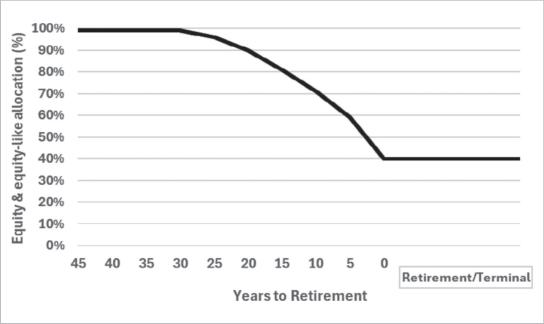
The following table lists the target allocation by years until retirement:
| |
|
|
| Years Until Retirement |
Equity Funds (includes REITs) |
Fixed-Income Funds |
| 45 |
99% |
1% |
| 40 |
99% |
1% |
| 35 |
99% |
1% |
| 30 |
99% |
1% |
| 25 |
96% |
4% |
| 20 |
90% |
10% |
| 15 |
81% |
19% |
| 10 |
71% |
29% |
| 5 |
59% |
41% |
| 0 |
40% |
60% |
BFA's first step in the structuring of the Fund is the establishment of the asset allocation targets by the Fund’s portfolio managers. The investment team, including the portfolio managers, meets regularly to assess market conditions, review the asset allocation targets of the Fund, and determine whether any changes are required to enable the Fund to achieve its investment objective.
Although the asset allocation targets listed for the glide path are general, long-term targets, BFA may periodically adjust the proportion of equity and fixed-income Underlying Funds in the Fund, based on an assessment of the current market conditions, the potential contribution of each asset class to the expected risk and return characteristics of the Fund, reallocations of the Fund’s composition to reflect intra-year movement along the glide path and other factors. In general, such adjustments will be limited; however, BFA may determine that a greater degree of variation is warranted to protect the Fund or achieve its investment objective.
BFA’s second step in the structuring of the Fund is the selection of the Underlying Funds. Factors such as fund classifications, historical risk and performance, and the relationship to other Underlying Funds in the Fund are considered when selecting Underlying Funds. The specific Underlying Funds selected for the Fund are determined at BFA’s discretion and may change as deemed appropriate to allow the Fund to meet its investment objective. See the “Information About the Underlying Funds” section of the prospectus for a list of the Underlying Funds, their classification into equity, fixed-income or money market funds and a brief description of their investment objectives and primary investment strategies.
Within the prescribed percentage allocations to equity and fixed-income index funds, BFA seeks to diversify the Fund. The allocation to Underlying Funds that track equity indexes may be further diversified by style (including both value and growth), market capitalization (including emerging growth, large-, mid-, and small-capitalization), region (i.e., U.S., and international, including emerging markets) or other attributes. The allocation to Underlying Funds that track fixed-income indexes may be further diversified by sector (including government, corporate, U.S. agency MBS or debentures, CMBS, and other sectors), duration (a measurement of interest rate risk), credit quality (including investment grade bonds and high yield bonds), geographic location (including U.S. and non-U.S. securities, including bonds of emerging market issuers), currency (U.S. dollar-denominated or local currency bonds) or other attributes. Though BFA seeks to diversify the Fund, certain Underlying Funds may concentrate their investments in specific sectors or geographic regions or countries. The percentage allocation to the various styles of equity and fixed-income Underlying Funds is determined at the discretion of the investment team and can be changed to reflect the current market environment.
Certain Underlying Funds may invest in real estate investment trusts (“REITs”), foreign securities, emerging market securities, high yield bonds and derivative securities or instruments, such as options and futures, the value of which is derived from another security, a currency or commodity, an interest rate or an index, when seeking to match the performance of a particular market index. The Fund and certain Underlying Funds may also lend securities with a value up to one-third of their respective total assets to financial institutions that provide cash or securities issued or guaranteed by the U.S. Government as collateral.
As of July 31, 2026, the Fund invests in the iShares 0-5 Year TIPS Bond ETF, iShares 1-5 Year Investment Grade Corporate Bond ETF, iShares 5-10 Year Investment Grade Corporate Bond ETF, iShares 10+ Year Investment Grade Corporate Bond ETF, iShares 10-20 Year Treasury Bond ETF, iShares Core MSCI Emerging Markets ETF, iShares Core MSCI International Developed Markets ETF, iShares Core U.S. REIT ETF, iShares Global Infrastructure ETF, iShares MBS ETF, iShares Russell 1000 ETF, iShares Russell 2000 ETF, iShares U.S. Treasury Bond ETF and money market funds advised by BFA or its affiliates (“BlackRock Cash Funds”). Factors such as fund classifications, historical risk and performance, and the relationship to other Underlying Funds in the Fund are considered when selecting Underlying Funds. The specific Underlying Funds selected for the Fund are determined at BFA’s discretion and may change as deemed appropriate to allow the Fund to meet its investment objective. See the “Information About the Underlying Funds” section of the prospectus for a list of the Underlying Funds, their classification into equity, fixed-income or money market funds and a brief description of their investment objectives and primary investment strategies.
The 2035 Fund allocates and reallocates its assets among a combination of Underlying Funds in proportions based on its own investment strategy.
The 2035 Fund is an exchange-traded fund (“ETF”) and does not seek to replicate the performance of a specified index and may have a higher degree of portfolio turnover than such index funds.
The 2035 Fund is one of a group of funds referred to as the “LifePath ETFs,” each of which seeks to provide for retirement outcomes based on quantitatively measured risk that investors on average may be willing to accept given a particular time horizon.
BFA employs a multi-dimensional approach to assess risk for the 2035 Fund and to determine its allocation across asset classes. As part of this multi-dimensional approach, BFA aims to quantify risk using proprietary risk measurement tools that, among other things, analyze historical and forward-looking securities market data, including risk, asset class correlations, and expected returns. Under normal circumstances, the 2035 Fund intends to invest primarily in affiliated ETFs.
The 2035 Fund will invest, under normal circumstances, at least 80% of its assets in securities or other financial instruments that are components of or have economic characteristics similar to the securities included in its custom model benchmark, the 2035 Target Date Custom Benchmark. BFA will not publish its custom benchmark but will apply a proprietary model to monitor performance of the 2035 Fund. The 2035 Fund is designed for investors expecting to retire or to begin withdrawing assets around the year 2035. As of July 31, 2026, the 2035 Fund holds approximately 64.62% of its assets in Underlying Funds that seek to track particular underlying indexes of equity securities, approximately 30.62% of its assets in Underlying Funds that seek to track particular fixed-income indexes and the remainder of its assets in Underlying Funds that invest primarily in money market instruments.
As of July 31, 2026, the Fund invests in the iShares 0-5 Year TIPS Bond ETF, iShares 1-5 Year Investment Grade Corporate Bond ETF, iShares 5-10 Year Investment Grade Corporate Bond ETF, iShares 10+ Year Investment Grade Corporate Bond ETF, iShares 10-20 Year Treasury Bond ETF, iShares Core MSCI Emerging Markets ETF, iShares Core MSCI International Developed Markets ETF, iShares Core U.S. REIT ETF, iShares Global Infrastructure ETF, iShares MBS ETF, iShares Russell 1000 ETF, iShares Russell 2000 ETF, iShares U.S. Treasury Bond ETF and money market funds advised by BFA or its affiliates (“BlackRock Cash Funds”). Factors such as fund classifications, historical risk and performance, and the relationship to other Underlying Funds in the Fund are considered when selecting Underlying Funds. The specific Underlying Funds selected for the Fund are determined at BFA’s discretion and may change as deemed appropriate to allow the Fund to meet its investment objective. See the “Information About the Underlying Funds” section of the prospectus for a list of the Underlying Funds, their classification into equity, fixed-income or money market funds and a brief description of their investment objectives and primary investment strategies.
Under normal circumstances, the Fund’s asset allocation will change over time according to a predetermined “glide path” as the Fund approaches its target date. The glide path below represents the shifting of asset classes over time. As the glide path shows, as time elapses prior to retirement, the Fund’s asset allocations become more conservative. This reflects the need for reduced investment risk as retirement approaches and the need for lower volatility of the Fund, which for certain investors may be a primary source of income after retirement. During the year prior to the Fund’s maturity date, its allocation of assets is expected to be similar to that of the Retirement Fund. Further, as retirement approaches, such Fund and the Retirement Fund is expected to, subject to approval by the Trust’s Board of Trustees (the “Board”), merge into a single fund.
The following chart illustrates the glide path — the target allocation among asset classes as the LifePath ETFs approach their target dates:
The following table lists the target allocation by years until retirement:
| |
|
|
| Years Until Retirement |
Equity Funds (includes REITs) |
Fixed-Income Funds |
| 45 |
99% |
1% |
| 40 |
99% |
1% |
| 35 |
99% |
1% |
| 30 |
99% |
1% |
| 25 |
96% |
4% |
| 20 |
90% |
10% |
| 15 |
81% |
19% |
| 10 |
71% |
29% |
| 5 |
59% |
41% |
| 0 |
40% |
60% |
BFA's first step in the structuring of the Fund is the establishment of the asset allocation targets by the Fund’s portfolio managers. The investment team, including the portfolio managers, meets regularly to assess market conditions, review the asset allocation targets of the Fund, and determine whether any changes are required to enable the Fund to achieve its investment objective.
Although the asset allocation targets listed for the glide path are general, long-term targets, BFA may periodically adjust the proportion of equity and fixed-income Underlying Funds in the Fund, based on an assessment of the current market conditions, the potential contribution of each asset class to the expected risk and return characteristics of the Fund, reallocations of the Fund’s composition to reflect intra-year movement along the glide path and other factors. In general, such adjustments will be limited; however, BFA may determine that a greater degree of variation is warranted to protect the Fund or achieve its investment objective.
BFA’s second step in the structuring of the Fund is the selection of the Underlying Funds. Factors such as fund classifications, historical risk and performance, and the relationship to other Underlying Funds in the Fund are considered when selecting Underlying Funds. The specific Underlying Funds selected for the Fund are determined at BFA’s discretion and may change as deemed appropriate to allow the Fund to meet its investment objective. See the “Information About the Underlying Funds” section of the prospectus for a list of the Underlying Funds, their classification into equity, fixed-income or money market funds and a brief description of their investment objectives and primary investment strategies.
Within the prescribed percentage allocations to equity and fixed-income index funds, BFA seeks to diversify the Fund. The allocation to Underlying Funds that track equity indexes may be further diversified by style (including both value and growth), market capitalization (including emerging growth, large-, mid-, and small-capitalization), region (i.e., U.S., and international, including emerging markets) or other attributes. The allocation to Underlying Funds that track fixed-income indexes may be further diversified by sector (including government, corporate, U.S. agency MBS or debentures, CMBS, and other sectors), duration (a measurement of interest rate risk), credit quality (including investment grade bonds and high yield bonds), geographic location (including U.S. and non-U.S. securities, including bonds of emerging market issuers), currency (U.S. dollar-denominated or local currency bonds) or other attributes. Though BFA seeks to diversify the Fund, certain Underlying Funds may concentrate their investments in specific sectors or geographic regions or countries. The percentage allocation to the various styles of equity and fixed-income Underlying Funds is determined at the discretion of the investment team and can be changed to reflect the current market environment.
Certain Underlying Funds may invest in real estate investment trusts (“REITs”), foreign securities, emerging market securities, high yield bonds and derivative securities or instruments, such as options and futures, the value of which is derived from another security, a currency or commodity, an interest rate or an index, when seeking to match the performance of a particular market index. The Fund and certain Underlying Funds may also lend securities with a value up to one-third of their respective total assets to financial institutions that provide cash or securities issued or guaranteed by the U.S. Government as collateral.
Within the prescribed percentage allocations to equity and fixed-income index funds, BFA seeks to diversify the Fund. The allocation to Underlying Funds that track equity indexes may be further diversified by style (including both value and growth), market capitalization (including emerging growth, large-, mid-, and small-capitalization), region (i.e., U.S., and international, including emerging markets) or other attributes. The allocation to Underlying Funds that track fixed-income indexes may be further diversified by sector (including government, corporate, U.S. agency MBS or debentures, CMBS, and other sectors), duration (a measurement of interest rate risk), credit quality (including investment grade bonds and high yield bonds), geographic location (including U.S. and non-U.S. securities, including bonds of emerging market issuers), currency (U.S. dollar-denominated or local currency bonds) or other attributes. Though BFA seeks to diversify the Fund, certain Underlying Funds may concentrate their investments in specific sectors or geographic regions or countries. The percentage allocation to the various styles of equity and fixed-income Underlying Funds is determined at the discretion of the investment team and can be changed to reflect the current market environment.
Certain Underlying Funds may invest in real estate investment trusts (“REITs”), foreign securities, emerging market securities, high yield bonds and derivative securities or instruments, such as options and futures, the value of which is derived from another security, a currency or commodity, an interest rate or an index, when seeking to match the performance of a particular market index. The Fund and certain Underlying Funds may also lend securities with a value up to one-third of their respective total assets to financial institutions that provide cash or securities issued or guaranteed by the U.S. Government as collateral.
As of July 31, 2026, the Fund invests in the iShares 0-5 Year TIPS Bond ETF, iShares 1-5 Year Investment Grade Corporate Bond ETF, iShares 5-10 Year Investment Grade Corporate Bond ETF, iShares 10+ Year Investment Grade Corporate Bond ETF, iShares 10-20 Year Treasury Bond ETF, iShares Core MSCI Emerging Markets ETF, iShares Core MSCI International Developed Markets ETF, iShares Core U.S. REIT ETF, iShares Global Infrastructure ETF, iShares MBS ETF, iShares Russell 1000 ETF, iShares Russell 2000 ETF, iShares U.S. Treasury Bond ETF and money market funds advised by BFA or its affiliates (“BlackRock Cash Funds”). Factors such as fund classifications, historical risk and performance, and the relationship to other Underlying Funds in the Fund are considered when selecting Underlying Funds. The specific Underlying Funds selected for the Fund are determined at BFA’s discretion and may change as deemed appropriate to allow the Fund to meet its investment objective. See the “Information About the Underlying Funds” section of the prospectus for a list of the Underlying Funds, their classification into equity, fixed-income or money market funds and a brief description of their investment objectives and primary investment strategies.
The 2040 Fund allocates and reallocates its assets among a combination of Underlying Funds in proportions based on its own investment strategy.
The 2040 Fund is an exchange-traded fund (“ETF”) and does not seek to replicate the performance of a specified index and may have a higher degree of portfolio turnover than such index funds.
The 2040 Fund is one of a group of funds referred to as the “LifePath ETFs,” each of which seeks to provide for retirement outcomes based on quantitatively measured risk that investors on average may be willing to accept given a particular time horizon.
BFA employs a multi-dimensional approach to assess risk for the 2040 Fund and to determine its allocation across asset classes. As part of this multi-dimensional approach, BFA aims to quantify risk using proprietary risk measurement tools that, among other things, analyze historical and forward-looking securities market data, including risk, asset class correlations, and expected returns. Under normal circumstances, the 2040 Fund intends to invest primarily in affiliated ETFs.
The 2040 Fund will invest, under normal circumstances, at least 80% of its assets in securities or other financial instruments that are components of or have economic characteristics similar to the securities included in its custom model benchmark, the 2040 Target Date Custom Benchmark. BFA will not publish its custom benchmark but will apply a proprietary model to monitor performance of the 2040 Fund. The 2040 Fund is designed for investors expecting to retire or to begin withdrawing assets around the year 2040. As of July 31, 2026, the 2040 Fund holds approximately 77.96% of its assets in Underlying Funds that seek to track particular underlying indexes of equity securities, approximately 21.67% of its assets in Underlying Funds that seek to track particular fixed-income indexes and the remainder of its assets in Underlying Funds that invest primarily in money market instruments.
As of July 31, 2026, the Fund invests in the iShares 0-5 Year TIPS Bond ETF, iShares 1-5 Year Investment Grade Corporate Bond ETF, iShares 5-10 Year Investment Grade Corporate Bond ETF, iShares 10+ Year Investment Grade Corporate Bond ETF, iShares 10-20 Year Treasury Bond ETF, iShares Core MSCI Emerging Markets ETF, iShares Core MSCI International Developed Markets ETF, iShares Core U.S. REIT ETF, iShares Global Infrastructure ETF, iShares MBS ETF, iShares Russell 1000 ETF, iShares Russell 2000 ETF, iShares U.S. Treasury Bond ETF and money market funds advised by BFA or its affiliates (“BlackRock Cash Funds”). Factors such as fund classifications, historical risk and performance, and the relationship to other Underlying Funds in the Fund are considered when selecting Underlying Funds. The specific Underlying Funds selected for the Fund are determined at BFA’s discretion and may change as deemed appropriate to allow the Fund to meet its investment objective. See the “Information About the Underlying Funds” section of the prospectus for a list of the Underlying Funds, their classification into equity, fixed-income or money market funds and a brief description of their investment objectives and primary investment strategies.
Under normal circumstances, the Fund’s asset allocation will change over time according to a predetermined “glide path” as the Fund approaches its target date. The glide path below represents the shifting of asset classes over time. As the glide path shows, as time elapses prior to retirement, the Fund’s asset allocations become more conservative. This reflects the need for reduced investment risk as retirement approaches and the need for lower volatility of the Fund, which for certain investors may be a primary source of income after retirement. During the year prior to the Fund’s maturity date, its allocation of assets is expected to be similar to that of the Retirement Fund. Further, as retirement approaches, such Fund and the Retirement Fund is expected to, subject to approval by the Trust’s Board of Trustees (the “Board”), merge into a single fund.
The following chart illustrates the glide path — the target allocation among asset classes as the LifePath ETFs approach their target dates:
The following table lists the target allocation by years until retirement:
| |
|
|
| Years Until Retirement |
Equity Funds (includes REITs) |
Fixed-Income Funds |
| 45 |
99% |
1% |
| 40 |
99% |
1% |
| 35 |
99% |
1% |
| 30 |
99% |
1% |
| 25 |
96% |
4% |
| 20 |
90% |
10% |
| 15 |
81% |
19% |
| 10 |
71% |
29% |
| 5 |
59% |
41% |
| 0 |
40% |
60% |
BFA's first step in the structuring of the Fund is the establishment of the asset allocation targets by the Fund’s portfolio managers. The investment team, including the portfolio managers, meets regularly to assess market conditions, review the asset allocation targets of the Fund, and determine whether any changes are required to enable the Fund to achieve its investment objective.
Although the asset allocation targets listed for the glide path are general, long-term targets, BFA may periodically adjust the proportion of equity and fixed-income Underlying Funds in the Fund, based on an assessment of the current market conditions, the potential contribution of each asset class to the expected risk and return characteristics of the Fund, reallocations of the Fund’s composition to reflect intra-year movement along the glide path and other factors. In general, such adjustments will be limited; however, BFA may determine that a greater degree of variation is warranted to protect the Fund or achieve its investment objective.
BFA’s second step in the structuring of the Fund is the selection of the Underlying Funds. Factors such as fund classifications, historical risk and performance, and the relationship to other Underlying Funds in the Fund are considered when selecting Underlying Funds. The specific Underlying Funds selected for the Fund are determined at BFA’s discretion and may change as deemed appropriate to allow the Fund to meet its investment objective. See the “Information About the Underlying Funds” section of the prospectus for a list of the Underlying Funds, their classification into equity, fixed-income or money market funds and a brief description of their investment objectives and primary investment strategies.
Within the prescribed percentage allocations to equity and fixed-income index funds, BFA seeks to diversify the Fund. The allocation to Underlying Funds that track equity indexes may be further diversified by style (including both value and growth), market capitalization (including emerging growth, large-, mid-, and small-capitalization), region (i.e., U.S., and international, including emerging markets) or other attributes. The allocation to Underlying Funds that track fixed-income indexes may be further diversified by sector (including government, corporate, U.S. agency MBS or debentures, CMBS, and other sectors), duration (a measurement of interest rate risk), credit quality (including investment grade bonds and high yield bonds), geographic location (including U.S. and non-U.S. securities, including bonds of emerging market issuers), currency (U.S. dollar-denominated or local currency bonds) or other attributes. Though BFA seeks to diversify the Fund, certain Underlying Funds may concentrate their investments in specific sectors or geographic regions or countries. The percentage allocation to the various styles of equity and fixed-income Underlying Funds is determined at the discretion of the investment team and can be changed to reflect the current market environment.
Certain Underlying Funds may invest in real estate investment trusts (“REITs”), foreign securities, emerging market securities, high yield bonds and derivative securities or instruments, such as options and futures, the value of which is derived from another security, a currency or commodity, an interest rate or an index, when seeking to match the performance of a particular market index. The Fund and certain Underlying Funds may also lend securities with a value up to one-third of their respective total assets to financial institutions that provide cash or securities issued or guaranteed by the U.S. Government as collateral.
Within the prescribed percentage allocations to equity and fixed-income index funds, BFA seeks to diversify the Fund. The allocation to Underlying Funds that track equity indexes may be further diversified by style (including both value and growth), market capitalization (including emerging growth, large-, mid-, and small-capitalization), region (i.e., U.S., and international, including emerging markets) or other attributes. The allocation to Underlying Funds that track fixed-income indexes may be further diversified by sector (including government, corporate, U.S. agency MBS or debentures, CMBS, and other sectors), duration (a measurement of interest rate risk), credit quality (including investment grade bonds and high yield bonds), geographic location (including U.S. and non-U.S. securities, including bonds of emerging market issuers), currency (U.S. dollar-denominated or local currency bonds) or other attributes. Though BFA seeks to diversify the Fund, certain Underlying Funds may concentrate their investments in specific sectors or geographic regions or countries. The percentage allocation to the various styles of equity and fixed-income Underlying Funds is determined at the discretion of the investment team and can be changed to reflect the current market environment.
Certain Underlying Funds may invest in real estate investment trusts (“REITs”), foreign securities, emerging market securities, high yield bonds and derivative securities or instruments, such as options and futures, the value of which is derived from another security, a currency or commodity, an interest rate or an index, when seeking to match the performance of a particular market index. The Fund and certain Underlying Funds may also lend securities with a value up to one-third of their respective total assets to financial institutions that provide cash or securities issued or guaranteed by the U.S. Government as collateral.
As of July 31, 2026, the Fund invests in the iShares 0-5 Year TIPS Bond ETF, iShares 1-5 Year Investment Grade Corporate Bond ETF, iShares 5-10 Year Investment Grade Corporate Bond ETF, iShares 10+ Year Investment Grade Corporate Bond ETF, iShares 10-20 Year Treasury Bond ETF, iShares Core MSCI Emerging Markets ETF, iShares Core MSCI International Developed Markets ETF, iShares Core U.S. REIT ETF, iShares Global Infrastructure ETF, iShares MBS ETF, iShares Russell 1000 ETF, iShares Russell 2000 ETF, iShares U.S. Treasury Bond ETF and money market funds advised by BFA or its affiliates (“BlackRock Cash Funds”). Factors such as fund classifications, historical risk and performance, and the relationship to other Underlying Funds in the Fund are considered when selecting Underlying Funds. The specific Underlying Funds selected for the Fund are determined at BFA’s discretion and may change as deemed appropriate to allow the Fund to meet its investment objective. See the “Information About the Underlying Funds” section of the prospectus for a list of the Underlying Funds, their classification into equity, fixed-income or money market funds and a brief description of their investment objectives and primary investment strategies.
The 2045 Fund allocates and reallocates its assets among a combination of Underlying Funds in proportions based on its own investment strategy.
The 2045 Fund is an exchange-traded fund (“ETF”) and does not seek to replicate the performance of a specified index and may have a higher degree of portfolio turnover than such index funds.
The 2045 Fund is one of a group of funds referred to as the “LifePath ETFs,” each of which seeks to provide for retirement outcomes based on quantitatively measured risk that investors on average may be willing to accept given a particular time horizon.
BFA employs a multi-dimensional approach to assess risk for the 2045 Fund and to determine its allocation across asset classes. As part of this multi-dimensional approach, BFA aims to quantify risk using proprietary risk measurement tools that, among other things, analyze historical and forward-looking securities market data, including risk, asset class correlations, and expected returns. Under normal circumstances, the 2045 Fund intends to invest primarily in affiliated ETFs.
The 2045 Fund will invest, under normal circumstances, at least 80% of its assets in securities or other financial instruments that are components of or have economic characteristics similar to the securities included in its custom model benchmark, the 2045 Target Date Custom Benchmark. BFA will not publish its custom benchmark but will apply a proprietary model to monitor performance of the 2045 Fund. The 2045 Fund is designed for investors expecting to retire or to begin withdrawing assets around the year 2045. As of July 31, 2026, the 2045 Fund holds approximately 84.37% of its assets in Underlying Funds that seek to track particular underlying indexes of equity securities, approximately 12.12% of its assets in Underlying Funds that seek to track particular fixed-income indexes and the remainder of its assets in Underlying Funds that invest primarily in money market instruments.
As of July 31, 2026, the Fund invests in the iShares 1-5 Year Investment Grade Corporate Bond ETF, iShares 5-10 Year Investment Grade Corporate Bond ETF, iShares 10+ Year Investment Grade Corporate Bond ETF, iShares 10-20 Year Treasury Bond ETF, iShares Core MSCI Emerging Markets ETF, iShares Core MSCI International Developed Markets ETF, iShares Core U.S. REIT ETF, iShares Global Infrastructure ETF, iShares MBS ETF, iShares Russell 1000 ETF, iShares Russell 2000 ETF, iShares U.S. Treasury Bond ETF and money market funds advised by BFA or its affiliates (“BlackRock Cash Funds”). Factors such as fund classifications, historical risk and performance, and the relationship to other Underlying Funds in the Fund are considered when selecting Underlying Funds. The specific Underlying Funds selected for the Fund are determined at BFA’s discretion and may change as deemed appropriate to allow the Fund to meet its investment objective. See the “Information About the Underlying Funds” section of the prospectus for a list of the Underlying Funds, their classification into equity, fixed-income or money market funds and a brief description of their investment objectives and primary investment strategies.
Under normal circumstances, the Fund’s asset allocation will change over time according to a predetermined “glide path” as the Fund approaches its target date. The glide path below represents the shifting of asset classes over time. As the glide path shows, as time elapses prior to retirement, the Fund’s asset allocations become more conservative. This reflects the need for reduced investment risk as retirement approaches and the need for lower volatility of the Fund, which for certain investors may be a primary source of income after retirement. During the year prior to the Fund’s maturity date, its allocation of assets is expected to be similar to that of the Retirement Fund. Further, as retirement approaches, such Fund and the Retirement Fund is expected to, subject to approval by the Trust’s Board of Trustees (the “Board”), merge into a single fund.
The following chart illustrates the glide path — the target allocation among asset classes as the LifePath ETFs approach their target dates:
The following table lists the target allocation by years until retirement:
| |
|
|
| Years Until Retirement |
Equity Funds (includes REITs) |
Fixed-Income Funds |
| 45 |
99% |
1% |
| 40 |
99% |
1% |
| 35 |
99% |
1% |
| 30 |
99% |
1% |
| 25 |
96% |
4% |
| 20 |
90% |
10% |
| 15 |
81% |
19% |
| 10 |
71% |
29% |
| 5 |
59% |
41% |
| 0 |
40% |
60% |
BFA's first step in the structuring of the Fund is the establishment of the asset allocation targets by the Fund’s portfolio managers. The investment team, including the portfolio managers, meets regularly to assess market conditions, review the asset allocation targets of the Fund, and determine whether any changes are required to enable the Fund to achieve its investment objective.
Although the asset allocation targets listed for the glide path are general, long-term targets, BFA may periodically adjust the proportion of equity and fixed-income Underlying Funds in the Fund, based on an assessment of the current market conditions, the potential contribution of each asset class to the expected risk and return characteristics of the Fund, reallocations of the Fund’s composition to reflect intra-year movement along the glide path and other factors. In general, such adjustments will be limited; however, BFA may determine that a greater degree of variation is warranted to protect the Fund or achieve its investment objective.
BFA’s second step in the structuring of the Fund is the selection of the Underlying Funds. Factors such as fund classifications, historical risk and performance, and the relationship to other Underlying Funds in the Fund are considered when selecting Underlying Funds. The specific Underlying Funds selected for the Fund are determined at BFA’s discretion and may change as deemed appropriate to allow the Fund to meet its investment objective. See the “Information About the Underlying Funds” section of the prospectus for a list of the Underlying Funds, their classification into equity, fixed-income or money market funds and a brief description of their investment objectives and primary investment strategies.
Within the prescribed percentage allocations to equity and fixed-income index funds, BFA seeks to diversify the Fund. The allocation to Underlying Funds that track equity indexes may be further diversified by style (including both value and growth), market capitalization (including emerging growth, large-, mid-, and small-capitalization), region (i.e., U.S., and international, including emerging markets) or other attributes. The allocation to Underlying Funds that track fixed-income indexes may be further diversified by sector (including government, corporate, U.S. agency MBS or debentures, CMBS, and other sectors), duration (a measurement of interest rate risk), credit quality (including investment grade bonds and high yield bonds), geographic location (including U.S. and non-U.S. securities, including bonds of emerging market issuers), currency (U.S. dollar-denominated or local currency bonds) or other attributes. Though BFA seeks to diversify the Fund, certain Underlying Funds may concentrate their investments in specific sectors or geographic regions or countries. The percentage allocation to the various styles of equity and fixed-income Underlying Funds is determined at the discretion of the investment team and can be changed to reflect the current market environment.
Certain Underlying Funds may invest in real estate investment trusts (“REITs”), foreign securities, emerging market securities, high yield bonds and derivative securities or instruments, such as options and futures, the value of which is derived from another security, a currency or commodity, an interest rate or an index, when seeking to match the performance of a particular market index. The Fund and certain Underlying Funds may also lend securities with a value up to one-third of their respective total assets to financial institutions that provide cash or securities issued or guaranteed by the U.S. Government as collateral.
Within the prescribed percentage allocations to equity and fixed-income index funds, BFA seeks to diversify the Fund. The allocation to Underlying Funds that track equity indexes may be further diversified by style (including both value and growth), market capitalization (including emerging growth, large-, mid-, and small-capitalization), region (i.e., U.S., and international, including emerging markets) or other attributes. The allocation to Underlying Funds that track fixed-income indexes may be further diversified by sector (including government, corporate, U.S. agency MBS or debentures, CMBS, and other sectors), duration (a measurement of interest rate risk), credit quality (including investment grade bonds and high yield bonds), geographic location (including U.S. and non-U.S. securities, including bonds of emerging market issuers), currency (U.S. dollar-denominated or local currency bonds) or other attributes. Though BFA seeks to diversify the Fund, certain Underlying Funds may concentrate their investments in specific sectors or geographic regions or countries. The percentage allocation to the various styles of equity and fixed-income Underlying Funds is determined at the discretion of the investment team and can be changed to reflect the current market environment.
Certain Underlying Funds may invest in real estate investment trusts (“REITs”), foreign securities, emerging market securities, high yield bonds and derivative securities or instruments, such as options and futures, the value of which is derived from another security, a currency or commodity, an interest rate or an index, when seeking to match the performance of a particular market index. The Fund and certain Underlying Funds may also lend securities with a value up to one-third of their respective total assets to financial institutions that provide cash or securities issued or guaranteed by the U.S. Government as collateral.
As of July 31, 2026, the Fund invests in the iShares 1-5 Year Investment Grade Corporate Bond ETF, iShares 5-10 Year Investment Grade Corporate Bond ETF, iShares 10+ Year Investment Grade Corporate Bond ETF, iShares 10-20 Year Treasury Bond ETF, iShares Core MSCI Emerging Markets ETF, iShares Core MSCI International Developed Markets ETF, iShares Core U.S. REIT ETF, iShares Global Infrastructure ETF, iShares MBS ETF, iShares Russell 1000 ETF, iShares Russell 2000 ETF, iShares U.S. Treasury Bond ETF and money market funds advised by BFA or its affiliates (“BlackRock Cash Funds”). Factors such as fund classifications, historical risk and performance, and the relationship to other Underlying Funds in the Fund are considered when selecting Underlying Funds. The specific Underlying Funds selected for the Fund are determined at BFA’s discretion and may change as deemed appropriate to allow the Fund to meet its investment objective. See the “Information About the Underlying Funds” section of the prospectus for a list of the Underlying Funds, their classification into equity, fixed-income or money market funds and a brief description of their investment objectives and primary investment strategies.
The 2050 Fund allocates and reallocates its assets among a combination of Underlying Funds in proportions based on its own investment strategy.
The 2050 Fund is an exchange-traded fund (“ETF”) and does not seek to replicate the performance of a specified index and may have a higher degree of portfolio turnover than such index funds.
The 2050 Fund is one of a group of funds referred to as the “LifePath ETFs,” each of which seeks to provide for retirement outcomes based on quantitatively measured risk that investors on average may be willing to accept given a particular time horizon.
BFA employs a multi-dimensional approach to assess risk for the 2050 Fund and to determine its allocation across asset classes. As part of this multi-dimensional approach, BFA aims to quantify risk using proprietary risk measurement tools that, among other things, analyze historical and forward-looking securities market data, including risk, asset class correlations, and expected returns. Under normal circumstances, the 2050 Fund intends to invest primarily in affiliated ETFs.
The 2050 Fund will invest, under normal circumstances, at least 80% of its assets in securities or other financial instruments that are components of or have economic characteristics similar to the securities included in its custom model benchmark, the 2050 Target Date Custom Benchmark. BFA will not publish its custom benchmark but will apply a proprietary model to monitor performance of the 2050 Fund. The 2050 Fund is designed for investors expecting to retire or to begin withdrawing assets around the year 2050. As of July 31, 2026, the 2050 Fund holds approximately 90.79% of its assets in Underlying Funds that seek to track particular underlying indexes of equity securities, approximately 5.64% of its assets in Underlying Funds that seek to track particular fixed-income indexes and the remainder of its assets in Underlying Funds that invest primarily in money market instruments.
As of July 31, 2026, the Fund invests in the iShares 1-5 Year Investment Grade Corporate Bond ETF, iShares 5-10 Year Investment Grade Corporate Bond ETF, iShares 10+ Year Investment Grade Corporate Bond ETF, iShares 10-20 Year Treasury Bond ETF, iShares Core MSCI Emerging Markets ETF, iShares Core MSCI International Developed Markets ETF, iShares Core U.S. REIT ETF, iShares Russell 1000 ETF, iShares Russell 2000 ETF, iShares U.S. Treasury Bond ETF and money market funds advised by BFA or its affiliates (“BlackRock Cash Funds”). Factors such as fund classifications, historical risk and performance, and the relationship to other Underlying Funds in the Fund are considered when selecting Underlying Funds. The specific Underlying Funds selected for the Fund are determined at BFA’s discretion and may change as deemed appropriate to allow the Fund to meet its investment objective. See the “Information About the Underlying Funds” section of the prospectus for a list of the Underlying Funds, their classification into equity, fixed-income or money market funds and a brief description of their investment objectives and primary investment strategies.
Under normal circumstances, the Fund’s asset allocation will change over time according to a predetermined “glide path” as the Fund approaches its target date. The glide path below represents the shifting of asset classes over time. As the glide path shows, as time elapses prior to retirement, the Fund’s asset allocations become more conservative. This reflects the need for reduced investment risk as retirement approaches and the need for lower volatility of the Fund, which for certain investors may be a primary source of income after retirement. During the year prior to the Fund’s maturity date, its allocation of assets is expected to be similar to that of the Retirement Fund. Further, as retirement approaches, such Fund and the Retirement Fund is expected to, subject to approval by the Trust’s Board of Trustees (the “Board”), merge into a single fund.
The following chart illustrates the glide path — the target allocation among asset classes as the LifePath ETFs approach their target dates:
The following table lists the target allocation by years until retirement:
| |
|
|
| Years Until Retirement |
Equity Funds (includes REITs) |
Fixed-Income Funds |
| 45 |
99% |
1% |
| 40 |
99% |
1% |
| 35 |
99% |
1% |
| 30 |
99% |
1% |
| 25 |
96% |
4% |
| 20 |
90% |
10% |
| 15 |
81% |
19% |
| 10 |
71% |
29% |
| 5 |
59% |
41% |
| 0 |
40% |
60% |
BFA's first step in the structuring of the Fund is the establishment of the asset allocation targets by the Fund’s portfolio managers. The investment team, including the portfolio managers, meets regularly to assess market conditions, review the asset allocation targets of the Fund, and determine whether any changes are required to enable the Fund to achieve its investment objective.
Although the asset allocation targets listed for the glide path are general, long-term targets, BFA may periodically adjust the proportion of equity and fixed-income Underlying Funds in the Fund, based on an assessment of the current market conditions, the potential contribution of each asset class to the expected risk and return characteristics of the Fund, reallocations of the Fund’s composition to reflect intra-year movement along the glide path and other factors. In general, such adjustments will be limited; however, BFA may determine that a greater degree of variation is warranted to protect the Fund or achieve its investment objective.
BFA’s second step in the structuring of the Fund is the selection of the Underlying Funds. Factors such as fund classifications, historical risk and performance, and the relationship to other Underlying Funds in the Fund are considered when selecting Underlying Funds. The specific Underlying Funds selected for the Fund are determined at BFA’s discretion and may change as deemed appropriate to allow the Fund to meet its investment objective. See the “Information About the Underlying Funds” section of the prospectus for a list of the Underlying Funds, their classification into equity, fixed-income or money market funds and a brief description of their investment objectives and primary investment strategies.
Within the prescribed percentage allocations to equity and fixed-income index funds, BFA seeks to diversify the Fund. The allocation to Underlying Funds that track equity indexes may be further diversified by style (including both value and growth), market capitalization (including emerging growth, large-, mid-, and small-capitalization), region (i.e., U.S., and international, including emerging markets) or other attributes. The allocation to Underlying Funds that track fixed-income indexes may be further diversified by sector (including government, corporate, U.S. agency MBS or debentures, CMBS, and other sectors), duration (a measurement of interest rate risk), credit quality (including investment grade bonds and high yield bonds), geographic location (including U.S. and non-U.S. securities, including bonds of emerging market issuers), currency (U.S. dollar-denominated or local currency bonds) or other attributes. Though BFA seeks to diversify the Fund, certain Underlying Funds may concentrate their investments in specific sectors or geographic regions or countries. The percentage allocation to the various styles of equity and fixed-income Underlying Funds is determined at the discretion of the investment team and can be changed to reflect the current market environment.
Certain Underlying Funds may invest in real estate investment trusts (“REITs”), foreign securities, emerging market securities, high yield bonds and derivative securities or instruments, such as options and futures, the value of which is derived from another security, a currency or commodity, an interest rate or an index, when seeking to match the performance of a particular market index. The Fund and certain Underlying Funds may also lend securities with a value up to one-third of their respective total assets to financial institutions that provide cash or securities issued or guaranteed by the U.S. Government as collateral.
Within the prescribed percentage allocations to equity and fixed-income index funds, BFA seeks to diversify the Fund. The allocation to Underlying Funds that track equity indexes may be further diversified by style (including both value and growth), market capitalization (including emerging growth, large-, mid-, and small-capitalization), region (i.e., U.S., and international, including emerging markets) or other attributes. The allocation to Underlying Funds that track fixed-income indexes may be further diversified by sector (including government, corporate, U.S. agency MBS or debentures, CMBS, and other sectors), duration (a measurement of interest rate risk), credit quality (including investment grade bonds and high yield bonds), geographic location (including U.S. and non-U.S. securities, including bonds of emerging market issuers), currency (U.S. dollar-denominated or local currency bonds) or other attributes. Though BFA seeks to diversify the Fund, certain Underlying Funds may concentrate their investments in specific sectors or geographic regions or countries. The percentage allocation to the various styles of equity and fixed-income Underlying Funds is determined at the discretion of the investment team and can be changed to reflect the current market environment.
Certain Underlying Funds may invest in real estate investment trusts (“REITs”), foreign securities, emerging market securities, high yield bonds and derivative securities or instruments, such as options and futures, the value of which is derived from another security, a currency or commodity, an interest rate or an index, when seeking to match the performance of a particular market index. The Fund and certain Underlying Funds may also lend securities with a value up to one-third of their respective total assets to financial institutions that provide cash or securities issued or guaranteed by the U.S. Government as collateral.
As of July 31, 2026, the Fund invests in the iShares 1-5 Year Investment Grade Corporate Bond ETF, iShares 5-10 Year Investment Grade Corporate Bond ETF, iShares 10+ Year Investment Grade Corporate Bond ETF, iShares 10-20 Year Treasury Bond ETF, iShares Core MSCI Emerging Markets ETF, iShares Core MSCI International Developed Markets ETF, iShares Core U.S. REIT ETF, iShares Russell 1000 ETF, iShares Russell 2000 ETF, iShares U.S. Treasury Bond ETF and money market funds advised by BFA or its affiliates (“BlackRock Cash Funds”). Factors such as fund classifications, historical risk and performance, and the relationship to other Underlying Funds in the Fund are considered when selecting Underlying Funds. The specific Underlying Funds selected for the Fund are determined at BFA’s discretion and may change as deemed appropriate to allow the Fund to meet its investment objective. See the “Information About the Underlying Funds” section of the prospectus for a list of the Underlying Funds, their classification into equity, fixed-income or money market funds and a brief description of their investment objectives and primary investment strategies.
The 2055 Fund allocates and reallocates its assets among a combination of Underlying Funds in proportions based on its own investment strategy.
The 2055 Fund is an exchange-traded fund (“ETF”) and does not seek to replicate the performance of a specified index and may have a higher degree of portfolio turnover than such index funds.
The 2055 Fund is one of a group of funds referred to as the “LifePath ETFs,” each of which seeks to provide for retirement outcomes based on quantitatively measured risk that investors on average may be willing to accept given a particular time horizon.
BFA employs a multi-dimensional approach to assess risk for the 2055 Fund and to determine its allocation across asset classes. As part of this multi-dimensional approach, BFA aims to quantify risk using proprietary risk measurement tools that, among other things, analyze historical and forward-looking securities market data, including risk, asset class correlations, and expected returns. Under normal circumstances, the 2055 Fund intends to invest primarily in affiliated ETFs.
The 2055 Fund will invest, under normal circumstances, at least 80% of its assets in securities or other financial instruments that are components of or have economic characteristics similar to the securities included in its custom model benchmark, the 2055 Target Date Custom Benchmark. BFA will not publish its custom benchmark but will apply a proprietary model to monitor performance of the 2055 Fund. The 2055 Fund is designed for investors expecting to retire or to begin withdrawing assets around the year 2055. As of July 31, 2026, the 2055 Fund holds approximately 94.72% of its assets in Underlying Funds that seek to track particular underlying indexes of equity securities, approximately 1.92% of its assets in Underlying Funds that seek to track particular fixed-income indexes and the remainder of its assets in Underlying Funds that invest primarily in money market instruments.
As of July 31, 2026, the Fund invests in the iShares 10+ Year Investment Grade Corporate Bond ETF, iShares Core MSCI Emerging Markets ETF, iShares Core MSCI International Developed Markets ETF, iShares Core U.S. REIT ETF, iShares Russell 1000 ETF, iShares Russell 2000 ETF and BlackRock Cash Funds. Factors such as fund classifications, historical risk and performance, and the relationship to other Underlying Funds in the Fund are considered when selecting Underlying Funds. The specific Underlying Funds selected for the Fund are determined at BFA’s discretion and may change as deemed appropriate to allow the Fund to meet its investment objective. See the “Information About the Underlying Funds” section of the prospectus for a list of the Underlying Funds, their classification into equity, fixed-income or money market funds and a brief description of their investment objectives and primary investment strategies.
Under normal circumstances, the Fund’s asset allocation will change over time according to a predetermined “glide path” as the Fund approaches its target date. The glide path below represents the shifting of asset classes over time. As the glide path shows, as time elapses prior to retirement, the Fund’s asset allocations become more conservative. This reflects the need for reduced investment risk as retirement approaches and the need for lower volatility of the Fund, which for certain investors may be a primary source of income after retirement. During the year prior to the Fund’s maturity date, its allocation of assets is expected to be similar to that of the Retirement Fund. Further, as retirement approaches, such Fund and the Retirement Fund is expected to, subject to approval by the Trust’s Board of Trustees (the “Board”), merge into a single fund.
The following chart illustrates the glide path — the target allocation among asset classes as the LifePath ETFs approach their target dates:
The following table lists the target allocation by years until retirement:
| |
|
|
| Years Until Retirement |
Equity Funds (includes REITs) |
Fixed-Income Funds |
| 45 |
99% |
1% |
| 40 |
99% |
1% |
| 35 |
99% |
1% |
| 30 |
99% |
1% |
| 25 |
96% |
4% |
| 20 |
90% |
10% |
| 15 |
81% |
19% |
| 10 |
71% |
29% |
| 5 |
59% |
41% |
| 0 |
40% |
60% |
BFA's first step in the structuring of the Fund is the establishment of the asset allocation targets by the Fund’s portfolio managers. The investment team, including the portfolio managers, meets regularly to assess market conditions, review the asset allocation targets of the Fund, and determine whether any changes are required to enable the Fund to achieve its investment objective.
Although the asset allocation targets listed for the glide path are general, long-term targets, BFA may periodically adjust the proportion of equity and fixed-income Underlying Funds in the Fund, based on an assessment of the current market conditions, the potential contribution of each asset class to the expected risk and return characteristics of the Fund, reallocations of the Fund’s composition to reflect intra-year movement along the glide path and other factors. In general, such adjustments will be limited; however, BFA may determine that a greater degree of variation is warranted to protect the Fund or achieve its investment objective.
BFA’s second step in the structuring of the Fund is the selection of the Underlying Funds. Factors such as fund classifications, historical risk and performance, and the relationship to other Underlying Funds in the Fund are considered when selecting Underlying Funds. The specific Underlying Funds selected for the Fund are determined at BFA’s discretion and may change as deemed appropriate to allow the Fund to meet its investment objective. See the “Information About the Underlying Funds” section of the prospectus for a list of the Underlying Funds, their classification into equity, fixed-income or money market funds and a brief description of their investment objectives and primary investment strategies.
Within the prescribed percentage allocations to equity and fixed-income index funds, BFA seeks to diversify the Fund. The allocation to Underlying Funds that track equity indexes may be further diversified by style (including both value and growth), market capitalization (including emerging growth, large-, mid-, and small-capitalization), region (i.e., U.S., and international, including emerging markets) or other attributes. The allocation to Underlying Funds that track fixed-income indexes may be further diversified by sector (including government, corporate, U.S. agency MBS or debentures, CMBS, and other sectors), duration (a measurement of interest rate risk), credit quality (including investment grade bonds and high yield bonds), geographic location (including U.S. and non-U.S. securities, including bonds of emerging market issuers), currency (U.S. dollar-denominated or local currency bonds) or other attributes. Though BFA seeks to diversify the Fund, certain Underlying Funds may concentrate their investments in specific sectors or geographic regions or countries. The percentage allocation to the various styles of equity and fixed-income Underlying Funds is determined at the discretion of the investment team and can be changed to reflect the current market environment.
Certain Underlying Funds may invest in real estate investment trusts (“REITs”), foreign securities, emerging market securities, high yield bonds and derivative securities or instruments, such as options and futures, the value of which is derived from another security, a currency or commodity, an interest rate or an index, when seeking to match the performance of a particular market index. The Fund and certain Underlying Funds may also lend securities with a value up to one-third of their respective total assets to financial institutions that provide cash or securities issued or guaranteed by the U.S. Government as collateral.
Within the prescribed percentage allocations to equity and fixed-income index funds, BFA seeks to diversify the Fund. The allocation to Underlying Funds that track equity indexes may be further diversified by style (including both value and growth), market capitalization (including emerging growth, large-, mid-, and small-capitalization), region (i.e., U.S., and international, including emerging markets) or other attributes. The allocation to Underlying Funds that track fixed-income indexes may be further diversified by sector (including government, corporate, U.S. agency MBS or debentures, CMBS, and other sectors), duration (a measurement of interest rate risk), credit quality (including investment grade bonds and high yield bonds), geographic location (including U.S. and non-U.S. securities, including bonds of emerging market issuers), currency (U.S. dollar-denominated or local currency bonds) or other attributes. Though BFA seeks to diversify the Fund, certain Underlying Funds may concentrate their investments in specific sectors or geographic regions or countries. The percentage allocation to the various styles of equity and fixed-income Underlying Funds is determined at the discretion of the investment team and can be changed to reflect the current market environment.
Certain Underlying Funds may invest in real estate investment trusts (“REITs”), foreign securities, emerging market securities, high yield bonds and derivative securities or instruments, such as options and futures, the value of which is derived from another security, a currency or commodity, an interest rate or an index, when seeking to match the performance of a particular market index. The Fund and certain Underlying Funds may also lend securities with a value up to one-third of their respective total assets to financial institutions that provide cash or securities issued or guaranteed by the U.S. Government as collateral.
As of July 31, 2026, the Fund invests in the iShares 10+ Year Investment Grade Corporate Bond ETF, iShares Core MSCI Emerging Markets ETF, iShares Core MSCI International Developed Markets ETF, iShares Core U.S. REIT ETF, iShares Russell 1000 ETF, iShares Russell 2000 ETF and BlackRock Cash Funds. Factors such as fund classifications, historical risk and performance, and the relationship to other Underlying Funds in the Fund are considered when selecting Underlying Funds. The specific Underlying Funds selected for the Fund are determined at BFA’s discretion and may change as deemed appropriate to allow the Fund to meet its investment objective. See the “Information About the Underlying Funds” section of the prospectus for a list of the Underlying Funds, their classification into equity, fixed-income or money market funds and a brief description of their investment objectives and primary investment strategies.
The 2060 Fund allocates and reallocates its assets among a combination of Underlying Funds in proportions based on its own investment strategy.
The 2060 Fund is an exchange-traded fund (“ETF”) and does not seek to replicate the performance of a specified index and may have a higher degree of portfolio turnover than such index funds.
The 2060 Fund is one of a group of funds referred to as the “LifePath ETFs,” each of which seeks to provide for retirement outcomes based on quantitatively measured risk that investors on average may be willing to accept given a particular time horizon.
BFA employs a multi-dimensional approach to assess risk for the 2060 Fund and to determine its allocation across asset classes. As part of this multi-dimensional approach, BFA aims to quantify risk using proprietary risk measurement tools that, among other things, analyze historical and forward-looking securities market data, including risk, asset class correlations, and expected returns. Under normal circumstances, the 2060 Fund intends to invest primarily in affiliated ETFs.
The 2060 Fund will invest, under normal circumstances, at least 80% of its assets in securities or other financial instruments that are components of or have economic characteristics similar to the securities included in its custom model benchmark, the 2060 Target Date Custom Benchmark. BFA will not publish its custom benchmark but will apply a proprietary model to monitor performance of the 2060 Fund. The 2060 Fund is designed for investors expecting to retire or to begin withdrawing assets around the year 2060. As of July 31, 2026, the 2060 Fund holds approximately 97.99% of its assets in Underlying Funds that seek to track particular underlying indexes of equity securities, approximately 0.97% of its assets in Underlying Funds that seek to track particular fixed-income indexes and the remainder of its assets in Underlying Funds that invest primarily in money market instruments.
As of July 31, 2026, the Fund invests in the iShares 10+ Year Investment Grade Corporate Bond ETF, iShares Core MSCI Emerging Markets ETF, iShares Core MSCI International Developed Markets ETF, iShares Core U.S. REIT ETF, iShares Russell 1000 ETF, iShares Russell 2000 ETF and BlackRock Cash Funds. Factors such as fund classifications, historical risk and performance, and the relationship to other Underlying Funds in the Fund are considered when selecting Underlying Funds. The specific Underlying Funds selected for the Fund are determined at BFA’s discretion and may change as deemed appropriate to allow the Fund to meet its investment objective. See the “Information About the Underlying Funds” section of the prospectus for a list of the Underlying Funds, their classification into equity, fixed-income or money market funds and a brief description of their investment objectives and primary investment strategies.
Under normal circumstances, the Fund’s asset allocation will change over time according to a predetermined “glide path” as the Fund approaches its target date. The glide path below represents the shifting of asset classes over time. As the glide path shows, as time elapses prior to retirement, the Fund’s asset allocations become more conservative. This reflects the need for reduced investment risk as retirement approaches and the need for lower volatility of the Fund, which for certain investors may be a primary source of income after retirement. During the year prior to the Fund’s maturity date, its allocation of assets is expected to be similar to that of the Retirement Fund. Further, as retirement approaches, such Fund and the Retirement Fund is expected to, subject to approval by the Trust’s Board of Trustees (the “Board”), merge into a single fund.
The following chart illustrates the glide path — the target allocation among asset classes as the LifePath ETFs approach their target dates:
The following table lists the target allocation by years until retirement:
| Years Until Retirement |
Equity Funds (includes REITs) |
Fixed-Income Funds |
| 45 |
99% |
1% |
| 40 |
99% |
1% |
| 35 |
99% |
1% |
| 30 |
99% |
1% |
| 25 |
96% |
4% |
| 20 |
90% |
10% |
| 15 |
81% |
19% |
| 10 |
71% |
29% |
| 5 |
59% |
41% |
| 0 |
40% |
60% |
| |
|
|
BFA's first step in the structuring of the Fund is the establishment of the asset allocation targets by the Fund’s portfolio managers. The investment team, including the portfolio managers, meets regularly to assess market conditions, review the asset allocation targets of the Fund, and determine whether any changes are required to enable the Fund to achieve its investment objective.
Although the asset allocation targets listed for the glide path are general, long-term targets, BFA may periodically adjust the proportion of equity and fixed-income Underlying Funds in the Fund, based on an assessment of the current market conditions, the potential contribution of each asset class to the expected risk and return characteristics of the Fund, reallocations of the Fund’s composition to reflect intra-year movement along the glide path and other factors. In general, such adjustments will be limited; however, BFA may determine that a greater degree of variation is warranted to protect the Fund or achieve its investment objective.
BFA’s second step in the structuring of the Fund is the selection of the Underlying Funds. Factors such as fund classifications, historical risk and performance, and the relationship to other Underlying Funds in the Fund are considered when selecting Underlying Funds. The specific Underlying Funds selected for the Fund are determined at BFA’s discretion and may change as deemed appropriate to allow the Fund to meet its investment objective. See the “Information About the Underlying Funds” section of the prospectus for a list of the Underlying Funds, their classification into equity, fixed-income or money market funds and a brief description of their investment objectives and primary investment strategies.
Within the prescribed percentage allocations to equity and fixed-income index funds, BFA seeks to diversify the Fund. The allocation to Underlying Funds that track equity indexes may be further diversified by style (including both value and growth), market capitalization (including emerging growth, large-, mid-, and small-capitalization), region (i.e., U.S., and international, including emerging markets) or other attributes. The allocation to Underlying Funds that track fixed-income indexes may be further diversified by sector (including government, corporate, U.S. agency MBS or debentures, CMBS, and other sectors), duration (a measurement of interest rate risk), credit quality (including investment grade bonds and high yield bonds), geographic location (including U.S. and non-U.S. securities, including bonds of emerging market issuers), currency (U.S. dollar-denominated or local currency bonds) or other attributes. Though BFA seeks to diversify the Fund, certain Underlying Funds may concentrate their investments in specific sectors or geographic regions or countries. The percentage allocation to the various styles of equity and fixed-income Underlying Funds is determined at the discretion of the investment team and can be changed to reflect the current market environment.
Certain Underlying Funds may invest in real estate investment trusts (“REITs”), foreign securities, emerging market securities, high yield bonds and derivative securities or instruments, such as options and futures, the value of which is derived from another security, a currency or commodity, an interest rate or an index, when seeking to match the performance of a particular market index. The Fund and certain Underlying Funds may also lend securities with a value up to one-third of their respective total assets to financial institutions that provide cash or securities issued or guaranteed by the U.S. Government as collateral.
The 2060 Fund allocates and reallocates its assets among a combination of Underlying Funds in proportions based on its own investment strategy.
The 2060 Fund will invest, under normal circumstances, at least 80% of its assets in securities or other financial instruments that are components of or have economic characteristics similar to the securities included in its custom model benchmark, the 2060 Target Date Custom Benchmark. BFA will not publish its custom benchmark but will apply a proprietary model to monitor performance of the 2060 Fund. The 2060 Fund is designed for investors expecting to retire or to begin withdrawing assets around the year 2060. As of July 31, 2026, the 2060 Fund holds approximately 97.99% of its assets in Underlying Funds that seek to track particular underlying indexes of equity securities, approximately 0.97% of its assets in Underlying Funds that seek to track particular fixed-income indexes and the remainder of its assets in Underlying Funds that invest primarily in money market instruments.
The 2065 Fund allocates and reallocates its assets among a combination of Underlying Funds in proportions based on its own investment strategy.
The 2065 Fund is an exchange-traded fund (“ETF”) and does not seek to replicate the performance of a specified index and may have a higher degree of portfolio turnover than such index funds.
The 2065 Fund is one of a group of funds referred to as the “LifePath ETFs,” each of which seeks to provide for retirement outcomes based on quantitatively measured risk that investors on average may be willing to accept given a particular time horizon.
BFA employs a multi-dimensional approach to assess risk for the 2065 Fund and to determine its allocation across asset classes. As part of this multi-dimensional approach, BFA aims to quantify risk using proprietary risk measurement tools that, among other things, analyze historical and forward-looking securities market data, including risk, asset class correlations, and expected returns. Under normal circumstances, the 2065 Fund intends to invest primarily in affiliated ETFs.
The 2065 Fund will invest, under normal circumstances, at least 80% of its assets in securities or other financial instruments that are components of or have economic characteristics similar to the securities included in its custom model benchmark, the 2065 Target Date Custom Benchmark. BFA will not publish its custom benchmark but will apply a proprietary model to monitor performance of the 2065 Fund. The 2065 Fund is designed for investors expecting to retire or to begin withdrawing assets around the year 2065. As of July 31, 2026, the 2065 Fund holds approximately 98.00% of its assets in Underlying Funds that seek to track particular underlying indexes of equity securities, approximately 0.98% of its assets in Underlying Funds that seek to track particular fixed-income indexes and the remainder of its assets in Underlying Funds that invest primarily in money market instruments.
As of July 31, 2026, the Fund invests in the iShares 10+ Year Investment Grade Corporate Bond ETF, iShares Core MSCI Emerging Markets ETF, iShares Core MSCI International Developed Markets ETF, iShares Core U.S. REIT ETF, iShares Russell 1000 ETF, iShares Russell 2000 ETF and BlackRock Cash Funds. Factors such as fund classifications, historical risk and performance, and the relationship to other Underlying Funds in the Fund are considered when selecting Underlying Funds. The specific Underlying Funds selected for the Fund are determined at BFA’s discretion and may change as deemed appropriate to allow the Fund to meet its investment objective. See the “Information About the Underlying Funds” section of the prospectus for a list of the Underlying Funds, their classification into equity, fixed-income or money market funds and a brief description of their investment objectives and primary investment strategies.
Under normal circumstances, the Fund’s asset allocation will change over time according to a predetermined “glide path” as the Fund approaches its target date. The glide path below represents the shifting of asset classes over time. As the glide path shows, as time elapses prior to retirement, the Fund’s asset allocations become more conservative. This reflects the need for reduced investment risk as retirement approaches and the need for lower volatility of the Fund, which for certain investors may be a primary source of income after retirement. During the year prior to the Fund’s maturity date, its allocation of assets is expected to be similar to that of the Retirement Fund. Further, as retirement approaches, such Fund and the Retirement Fund is expected to, subject to approval by the Trust’s Board of Trustees (the “Board”), merge into a single fund.
The following chart illustrates the glide path — the target allocation among asset classes as the LifePath ETFs approach their target dates:
The following table lists the target allocation by years until retirement:
| |
|
|
| Years Until Retirement |
Equity Funds (includes REITs) |
Fixed-Income Funds |
| 45 |
99% |
1% |
| 40 |
99% |
1% |
| 35 |
99% |
1% |
| 30 |
99% |
1% |
| 25 |
96% |
4% |
| 20 |
90% |
10% |
| 15 |
81% |
19% |
| 10 |
71% |
29% |
| 5 |
59% |
41% |
| 0 |
40% |
60% |
BFA's first step in the structuring of the Fund is the establishment of the asset allocation targets by the Fund’s portfolio managers. The investment team, including the portfolio managers, meets regularly to assess market conditions, review the asset allocation targets of the Fund, and determine whether any changes are required to enable the Fund to achieve its investment objective.
Although the asset allocation targets listed for the glide path are general, long-term targets, BFA may periodically adjust the proportion of equity and fixed-income Underlying Funds in the Fund, based on an assessment of the current market conditions, the potential contribution of each asset class to the expected risk and return characteristics of the Fund, reallocations of the Fund’s composition to reflect intra-year movement along the glide path and other factors. In general, such adjustments will be limited; however, BFA may determine that a greater degree of variation is warranted to protect the Fund or achieve its investment objective.
BFA’s second step in the structuring of the Fund is the selection of the Underlying Funds. Factors such as fund classifications, historical risk and performance, and the relationship to other Underlying Funds in the Fund are considered when selecting Underlying Funds. The specific Underlying Funds selected for the Fund are determined at BFA’s discretion and may change as deemed appropriate to allow the Fund to meet its investment objective. See the “Information About the Underlying Funds” section of the prospectus for a list of the Underlying Funds, their classification into equity, fixed-income or money market funds and a brief description of their investment objectives and primary investment strategies.
Within the prescribed percentage allocations to equity and fixed-income index funds, BFA seeks to diversify the Fund. The allocation to Underlying Funds that track equity indexes may be further diversified by style (including both value and growth), market capitalization (including emerging growth, large-, mid-, and small-capitalization), region (i.e., U.S., and international, including emerging markets) or other attributes. The allocation to Underlying Funds that track fixed-income indexes may be further diversified by sector (including government, corporate, U.S. agency MBS or debentures, CMBS, and other sectors), duration (a measurement of interest rate risk), credit quality (including investment grade bonds and high yield bonds), geographic location (including U.S. and non-U.S. securities, including bonds of emerging market issuers), currency (U.S. dollar-denominated or local currency bonds) or other attributes. Though BFA seeks to diversify the Fund, certain Underlying Funds may concentrate their investments in specific sectors or geographic regions or countries. The percentage allocation to the various styles of equity and fixed-income Underlying Funds is determined at the discretion of the investment team and can be changed to reflect the current market environment.
Certain Underlying Funds may invest in real estate investment trusts (“REITs”), foreign securities, emerging market securities, high yield bonds and derivative securities or instruments, such as options and futures, the value of which is derived from another security, a currency or commodity, an interest rate or an index, when seeking to match the performance of a particular market index. The Fund and certain Underlying Funds may also lend securities with a value up to one-third of their respective total assets to financial institutions that provide cash or securities issued or guaranteed by the U.S. Government as collateral.
The 2065 Fund allocates and reallocates its assets among a combination of Underlying Funds in proportions based on its own investment strategy.
The 2065 Fund will invest, under normal circumstances, at least 80% of its assets in securities or other financial instruments that are components of or have economic characteristics similar to the securities included in its custom model benchmark, the 2065 Target Date Custom Benchmark. BFA will not publish its custom benchmark but will apply a proprietary model to monitor performance of the 2065 Fund. The 2065 Fund is designed for investors expecting to retire or to begin withdrawing assets around the year 2065. As of July 31, 2026, the 2065 Fund holds approximately 98.00% of its assets in Underlying Funds that seek to track particular underlying indexes of equity securities, approximately 0.98% of its assets in Underlying Funds that seek to track particular fixed-income indexes and the remainder of its assets in Underlying Funds that invest primarily in money market instruments.
The 2070 Fund allocates and reallocates its assets among a combination of Underlying Funds in proportions based on its own investment strategy.
The 2070 Fund is an exchange-traded fund (“ETF”) and does not seek to replicate the performance of a specified index and may have a higher degree of portfolio turnover than such index funds.
The 2070 Fund is one of a group of funds referred to as the “LifePath ETFs,” each of which seeks to provide for retirement outcomes based on quantitatively measured risk that investors on average may be willing to accept given a particular time horizon.
BFA employs a multi-dimensional approach to assess risk for the 2070 Fund and to determine its allocation across asset classes. As part of this multi-dimensional approach, BFA aims to quantify risk using proprietary risk measurement tools that, among other things, analyze historical and forward-looking securities market data, including risk, asset class correlations, and expected returns. Under normal circumstances, the 2070 Fund intends to invest primarily in affiliated ETFs.
The 2070 Fund will invest, under normal circumstances, at least 80% of its assets in securities or other financial instruments that are components of or have economic characteristics similar to the securities included in its custom model benchmark, the 2070 Target Date Custom Benchmark. BFA will not publish its custom benchmark but will apply a proprietary model to monitor performance of the 2070 Fund. The 2070 Fund is designed for investors expecting to retire or to begin withdrawing assets around the year 2070. As of July 31, 2026, the Fund holds approximately 97.97% of its assets in Underlying Funds that seek to track particular underlying indexes of equity securities, approximately 0.97% of its assets in Underlying Funds that seek to track particular fixed-income indexes and the remainder of its assets in Underlying Funds that invest primarily in money market instruments.
As of July 31, 2026, the Fund invests in the iShares 10+ Year Investment Grade Corporate Bond ETF, iShares Core MSCI Emerging Markets ETF, iShares Core MSCI International Developed Markets ETF, iShares Core U.S. REIT ETF, iShares Russell 1000 ETF, iShares Russell 2000 ETF and BlackRock Cash Funds. Factors such as fund classifications, historical risk and performance, and the relationship to other Underlying Funds in the Fund are considered when selecting Underlying Funds. The specific Underlying Funds selected for the Fund are determined at BFA’s discretion and may change as deemed appropriate to allow the Fund to meet its investment objective. See the “Information About the Underlying Funds” section of the prospectus for a list of the Underlying Funds, their classification into equity, fixed-income or money market funds and a brief description of their investment objectives and primary investment strategies.
Under normal circumstances, the Fund’s asset allocation will change over time according to a predetermined “glide path” as the Fund approaches its target date. The glide path below represents the shifting of asset classes over time. As the glide path shows, as time elapses prior to retirement, the Fund’s asset allocations become more conservative. This reflects the need for reduced investment risk as retirement approaches and the need for lower volatility of the Fund, which for certain investors may be a primary source of income after retirement. During the year prior to the Fund’s maturity date, its allocation of assets is expected to be similar to that of the Retirement Fund. Further, as retirement approaches, such Fund and the Retirement Fund is expected to, subject to approval by the Trust’s Board of Trustees (the “Board”), merge into a single fund.
The following chart illustrates the glide path — the target allocation among asset classes as the LifePath ETFs approach their target dates:
The following table lists the target allocation by years until retirement:
| |
|
|
| Years Until Retirement |
Equity Funds (includes REITs) |
Fixed-Income Funds |
| 45 |
99% |
1% |
| 40 |
99% |
1% |
| 35 |
99% |
1% |
| 30 |
99% |
1% |
| 25 |
96% |
4% |
| 20 |
90% |
10% |
| 15 |
81% |
19% |
| 10 |
71% |
29% |
| 5 |
59% |
41% |
| 0 |
40% |
60% |
BFA's first step in the structuring of the Fund is the establishment of the asset allocation targets by the Fund’s portfolio managers. The investment team, including the portfolio managers, meets regularly to assess market conditions, review the asset allocation targets of the Fund, and determine whether any changes are required to enable the Fund to achieve its investment objective.
Although the asset allocation targets listed for the glide path are general, long-term targets, BFA may periodically adjust the proportion of equity and fixed-income Underlying Funds in the Fund, based on an assessment of the current market conditions, the potential contribution of each asset class to the expected risk and return characteristics of the Fund, reallocations of the Fund’s composition to reflect intra-year movement along the glide path and other factors. In general, such adjustments will be limited; however, BFA may determine that a greater degree of variation is warranted to protect the Fund or achieve its investment objective.
BFA’s second step in the structuring of the Fund is the selection of the Underlying Funds. Factors such as fund classifications, historical risk and performance, and the relationship to other Underlying Funds in the Fund are considered when selecting Underlying Funds. The specific Underlying Funds selected for the Fund are determined at BFA’s discretion and may change as deemed appropriate to allow the Fund to meet its investment objective. See the “Information About the Underlying Funds” section of the prospectus for a list of the Underlying Funds, their classification into equity, fixed-income or money market funds and a brief description of their investment objectives and primary investment strategies.
Within the prescribed percentage allocations to equity and fixed-income index funds, BFA seeks to diversify the Fund. The allocation to Underlying Funds that track equity indexes may be further diversified by style (including both value and growth), market capitalization (including emerging growth, large-, mid-, and small-capitalization), region (i.e., U.S., and international, including emerging markets) or other attributes. The allocation to Underlying Funds that track fixed-income indexes may be further diversified by sector (including government, corporate, U.S. agency MBS or debentures, CMBS, and other sectors), duration (a measurement of interest rate risk), credit quality (including investment grade bonds and high yield bonds), geographic location (including U.S. and non-U.S. securities, including bonds of emerging market issuers), currency (U.S. dollar-denominated or local currency bonds) or other attributes. Though BFA seeks to diversify the Fund, certain Underlying Funds may concentrate their investments in specific sectors or geographic regions or countries. The percentage allocation to the various styles of equity and fixed-income Underlying Funds is determined at the discretion of the investment team and can be changed to reflect the current market environment.
Certain Underlying Funds may invest in real estate investment trusts (“REITs”), foreign securities, emerging market securities, high yield bonds and derivative securities or instruments, such as options and futures, the value of which is derived from another security, a currency or commodity, an interest rate or an index, when seeking to match the performance of a particular market index. The Fund and certain Underlying Funds may also lend securities with a value up to one-third of their respective total assets to financial institutions that provide cash or securities issued or guaranteed by the U.S. Government as collateral.
The 2070 Fund allocates and reallocates its assets among a combination of Underlying Funds in proportions based on its own investment strategy.
The 2070 Fund will invest, under normal circumstances, at least 80% of its assets in securities or other financial instruments that are components of or have economic characteristics similar to the securities included in its custom model benchmark, the 2070 Target Date Custom Benchmark. BFA will not publish its custom benchmark but will apply a proprietary model to monitor performance of the 2070 Fund. The 2070 Fund is designed for investors expecting to retire or to begin withdrawing assets around the year 2070. As of July 31, 2026, the Fund holds approximately 97.97% of its assets in Underlying Funds that seek to track particular underlying indexes of equity securities, approximately 0.97% of its assets in Underlying Funds that seek to track particular fixed-income indexes and the remainder of its assets in Underlying Funds that invest primarily in money market instruments.
The Fund seeks to provide certain pre-determined Outcomes based on the performance of the Underlying Fund for investors who hold Fund shares over a 12-month period (the “Outcome Period”). The Outcomes sought by the Fund are:
■
The share price return of the Underlying Fund capped at an approximate upside limit (the “Approximate Cap”), and
■
Protection against approximately the first 10% of the Underlying Fund’s losses (the “Approximate Buffer”) over each Outcome Period.
The Outcomes are intended to be realized only by investors who hold Fund shares at the outset of the Outcome Period and continue to hold the shares through the end of the Outcome Period. Specifically, in order to hold Fund shares for the entirety of an Outcome Period, an investor must buy or continue holding shares at the close on the last trading day of the prior Outcome Period and sell or continue holding the shares at the close on the last trading day of the current Outcome Period.
If investors buy Fund shares after the start of the Outcome Period or sell Fund shares before the Outcome Period concludes, they may experience returns that differ significantly from the Outcomes. These include experiencing little or no gains related to the Underlying Fund and little or no protection against losses of the Underlying Fund. Investors may lose their entire investment, and an investment in the Fund is appropriate only for investors willing to bear those losses.
The Fund will be offered indefinitely and is not intended to terminate after one or more Outcome Periods.
The Current Outcome Period
The current Outcome Period started on April 1, 2026 and ends on March 31, 2027. For the current Outcome Period, the Approximate Cap is 18.89% before taking into account any fees or expenses charged to, or transaction costs incurred by, the Fund or the Underlying Fund. When the Fund’s annualized management fee of 0.50% of its average daily net assets is taken into account, the Approximate Cap for the current Outcome Period is reduced to 18.39%. The returns that the Fund seeks to provide do not take into account the costs associated with buying shares of the Underlying Fund and any other expenses incurred by the Fund. Please visit the Fund’s page on www.iShares.com for more information about the potential outcomes of an investment in the Fund during the current Outcome Period, including the remaining Approximate Cap.
The Underlying Fund
The Underlying Fund is the iShares Core S&P 500 ETF (Ticker: IVV). It is an exchange-traded fund (“ETF”) that seeks to track the investment results of the S&P 500 Index (the “Underlying Fund’s Index”), which measures the performance of the large-capitalization sector of the U.S. equity market, as determined by S&P Dow Jones Indices, LLC. The securities in the Underlying Fund’s Index represent a broad range of industries and are weighted based on the float-adjusted market value of
their outstanding shares. The components of the Underlying Fund’s Index are likely to change over time. BFA is the investment adviser to the Underlying Fund and receives a management fee from the Underlying Fund.
BFA uses a representative sampling indexing strategy to manage the Underlying Fund. “Representative sampling” is an indexing strategy that involves investing in a representative sample of securities or other instruments intended to collectively have an investment profile similar to that of an applicable underlying index. The instruments selected are expected to have, in the aggregate, investment characteristics (based on factors such as market capitalization and industry weightings), fundamental characteristics (such as return variability and yield) and liquidity measures similar to those of an applicable underlying index. The Underlying Fund may or may not hold all of the components of the Underlying Fund's Index, which may cause the performance of the Underlying Fund to diverge from that of the Underlying Fund's Index and produce “tracking error”. Tracking error risk may be heightened during times of increased market volatility or other unusual market conditions. The Underlying Fund may use derivatives to gain or reduce exposure to the components of the Underlying Fund's Index or exposure to one or more market risk factors associated with such components. Subject to the limits described in its prospectus, the Underlying Fund may purchase and hold cash and cash equivalents, including shares of money market funds advised by BFA or its affiliates, and may also purchase and hold instruments not included in the Underlying Fund's Index when BFA believes that such instruments will help the Underlying Fund track the performance of the Underlying Fund's Index over time, including in light of expected liquidity or trading costs, anticipated additions to or deletions from the Underlying Fund's Index, or other reasons as determined by BFA.
The prospectus and other reports of the Underlying Fund are available at www.sec.gov and www.iShares.com. Shares of the Underlying Fund are listed on NYSE Arca, Inc.
The Fund’s Use of Options
The Fund principally buys shares of the Underlying Fund and customized put options thereon and sells call options that reference the Underlying Fund. The options in which the Fund transacts (typically, equity or index exchange-traded options contracts) are referred to generally as Flexible Exchange Options (“FLEX Options”). The Fund may transact in other exchange-traded options that reference the price performance of the Underlying Fund, the Underlying Fund’s Index, or other ETFs that track the Underlying Fund’s Index.
An options contract is an agreement between a buyer and seller that gives the purchaser of the option the right but not the obligation to buy (in the case of a call option) or sell (in the case of a put option) a particular financial instrument at a specified future date for an agreed-upon price, commonly known as the “strike price”. If the Fund buys a call option, it pays a premium and receives the right, but not the obligation, to purchase shares of the Underlying Fund or other reference asset at a strike price by or on the expiration date. When the Fund buys a put option, it pays a premium and receives the right, but not the obligation, to sell shares of the Underlying Fund or other reference asset at a strike price by or on the expiration date. When the Fund writes (sells) a call option, it receives a premium and gives the purchaser of the option the right to purchase from the Fund shares of the Underlying Fund or other reference asset at a strike price by or on the expiration date. If the Fund writes (sells) a put option, it receives a premium and gives the purchaser of the option the right to sell to the Fund shares of the Underlying Fund or other reference asset at a strike price by or on expiration date.
FLEX Options provide the ability to customize key option contract terms such as strike price, style and expiration date. The options in which the Fund invests are European style, meaning they are exercisable at the strike price only on the expiration date. The Fund typically trades options that expire at or around the end of each Outcome Period.
As an in-the-money option held by the Fund approaches its expiration date, its value typically will increasingly move with the value of its reference asset, such as the Underlying Fund. However, the value of the options may change because of factors other than the value of the reference asset, including interest rate changes, dividends, the actual and perceived volatility of the reference asset, the remaining time until the options expire, limitations established by options exchanges, and trading conditions in the options market, among others. Due to these factors, the value of the options typically does not increase or decrease at the same rate as the Underlying Fund’s share price on a day-to-day basis. As a result, the Fund’s net asset value per share (“NAV”) may not increase or decrease at the same rate as the Underlying Fund’s share price.
Options positions are marked to market daily by the Fund. The value of the options traded by the Fund is determined based upon market quotations or other recognized pricing methods. The options traded by the Fund are listed on an exchange, including the Chicago Board Options Exchange. The options are guaranteed for settlement by the Options Clearing Corporation (the “OCC”), a market clearinghouse that guarantees the performance by counterparties to certain derivatives contracts. The OCC may make adjustments to FLEX Options for certain significant events.
Outcomes Targeted by the Fund
For each Outcome Period, the Fund obtains exposure to the share price return of the Underlying Fund by holding shares of the Underlying Fund and futures that reference the price performance of the Underlying Fund’s Index. The Approximate Buffer and Approximate Cap are typically created by trading a combination of put and call options, as described below, at the close of the last trading day of the prior Outcome Period.
Approximate Buffer. The Fund creates the Approximate Buffer by (1) buying a put option with a strike price that is approximately at-the-money relative to the Underlying Fund’s share price and (2) selling a put option with a strike price at approximately 90% of the Underlying Fund’s share price. The Approximate Buffer is against approximately the first 10% of the Underlying Fund’s losses for the applicable Outcome Period; however, there is no guarantee that the Approximate Buffer will succeed in providing the intended protection. The Approximate Buffer is provided prior to taking into account any fees or expenses charged to the Fund. These fees and any expenses will reduce the Approximate Buffer amount for Fund shareholders for an Outcome Period. When the Fund’s annual management fee of 0.50% of the Fund’s daily net assets is taken into account, the net Approximate Buffer for the Outcome Period is 99.5%.
Approximate Cap. The Fund creates the Approximate Cap by selling a call option with a higher strike price relative to the Underlying Fund’s share price (the “Cap Option”). The Cap Option’s higher strike price prevents the Fund from realizing the benefit of any increase in the Underlying Fund’s share price above that strike price. The Approximate Cap for each Outcome Period is based on the strike price of the Cap Option for that Outcome Period. The strike price of the Cap Option depends on the market conditions when the option is sold and likely will be different for each Outcome Period, resulting in a different Approximate Cap for each Outcome Period. The Fund uses the premium collected from selling the Cap Option and the expected dividend distributions from the Underlying Fund to cover the premium that it pays to buy the options that create the Approximate Buffer.
The Fund’s Approximate Buffer and Approximate Cap (net of the management fee) for the current Outcome Period, along with the Fund’s current position relative to the Outcomes, are available and updated daily on the Fund’s page on www.iShares.com.
Approximately one week prior to the end of each Outcome Period, the Fund expects to file a prospectus supplement that discloses an estimated range (as estimated by BFA) for the Approximate Cap for the Fund's next Outcome Period. On the last trading day of each Outcome Period, the Fund will trade a new set of options to create the Approximate Buffer and Approximate Cap for the next Outcome Period. After the close of business on the last trading day of the Outcome Period, the Fund will file a prospectus supplement that discloses the Fund’s Approximate Cap (gross and net of its management fee) for the next Outcome Period.
Outcome Period
The Outcomes for an Outcome Period apply only to Fund shares that are held over the entire Outcome Period. An investor who purchases Fund shares after the beginning of an Outcome Period or who sells Fund shares before the end of an Outcome Period may not fully realize the Outcomes for the Outcome Period and may be exposed to greater risk of loss and less potential gain. This is because, while the Outcomes are fixed levels that are calculated in relation to the Underlying Fund’s price and the Fund’s NAV at the start of each Outcome Period and generally remain constant throughout the Outcome Period, an investor who transacts in Fund shares during the Outcome Period will likely do so at a price that is different from the Fund’s NAV at the start of the Outcome Period.
For example, if an investor purchases Fund shares during an Outcome Period at a time when the Underlying Fund’s share price has increased from its price at the beginning of the Outcome Period, the investor’s upside limit may be lower than the Approximate Cap and the investor may experience losses prior to reaching the downside protection offered by the Approximate Buffer. Conversely, if an investor purchases Fund shares during an Outcome Period at a time when the Underlying Fund’s share price has decreased from its price at the beginning of the Outcome Period, the Fund may require a larger increase in the Underlying Fund’s share price before it reaches the Approximate Cap.
Fund and Underlying Fund Performance
If there are any inflows, or creation transactions, for the Fund during an Outcome Period, the Fund will typically buy Underlying Fund shares and futures on the Underlying Fund’s Index and seek to enter into the combination of options transactions described above. This may occur even in circumstances where the Fund would receive a negligible premium for selling an out-of-the-money call, which may give up more sizable returns to the extent that the option later becomes in the money.
Because the Fund uses distributions from the Underlying Fund to purchase the downside protection, the Fund’s performance is likely to be less than the Underlying Fund’s performance when (1) distributions are considered and (2) the Underlying Fund’s performance is positive. The Fund may also underperform the Underlying Fund if the returns of the Underlying Fund exceed the Approximate Cap net of the distributions.
The Fund’s market value and NAV may not correlate with the Underlying Fund and the Underlying Fund’s Index. In periods of extreme market volatility, the Fund’s return may be subject to an upside limit significantly below the Approximate Cap and to significantly less downside protection than the Approximate Buffer. Investors may lose their entire investment, and an investment in the Fund is appropriate only for investors willing to bear those losses.
In order to obtain economic exposure to the Underlying Fund, in lieu of purchasing Underlying Fund shares and futures on the Underlying Fund’s Index for an Outcome Period, the Fund may instead do one or more of the following, among other things:
■
purchase call options with a strike price that is very low (approximately 1% or less) relative to the Underlying Fund’s share price on the day of purchase (a “zero strike call”);
■
purchase one or more other ETFs that seek to track the Underlying Fund’s Index;
■
purchase equity securities (e.g., component securities of the Underlying Fund or the Underlying Fund’s Index) in seeking to track the share price return of the Underlying Fund; or
■
invest in U.S. Treasuries, money market funds and/or other cash equivalents and purchase or sell a combination of call and put options that seek to synthesize the economic characteristics of the Underlying Fund.
If the Fund invests in equity securities (other than the Underlying Fund), the Fund’s equity security investments will be primarily in common stocks of companies held by the Underlying Fund that BFA believes will provide a risk/return profile similar to that of the Underlying Fund.
Under normal market conditions, the Fund may not invest less than 80% of its net assets (plus any borrowings for investment purposes) in securities or other instruments that provide exposure to securities of large-capitalization companies or that provide for the upside limit on gains or the downside protection against the losses of securities of large-capitalization companies. Investments in derivatives and other investments will be counted toward the Fund's 80% investment policy to the extent that they provide exposure to such large-capitalization companies, such upside limit and/or such downside protection or exposure to one or more market risk factors associated with such large-capitalization companies, such upside limit and/or such downside protection. For purposes of the Fund’s 80% policy, “large-capitalization companies” are those within the range of capitalization of the Underlying Fund’s Index. The Fund's 80% investment policy may be changed by the Trust's Board of Trustees (the “Board”) upon 60 days' notice to shareholders.
The Fund seeks to provide certain pre-determined Outcomes based on the performance of the Underlying Fund for investors who hold Fund shares over a 12-month period (the “Outcome Period”). The Outcomes sought by the Fund are:
■
The share price return of the Underlying Fund capped at an approximate upside limit (the “Approximate Cap”), and
■
Protection against approximately the first 10% of the Underlying Fund’s losses (the “Approximate Buffer”) over each Outcome Period.
Under normal market conditions, the Fund may not invest less than 80% of its net assets (plus any borrowings for investment purposes) in securities or other instruments that provide exposure to securities of large-capitalization companies or that provide for the upside limit on gains or the downside protection against the losses of securities of large-capitalization companies. Investments in derivatives and other investments will be counted toward the Fund's 80% investment policy to the extent that they provide exposure to such large-capitalization companies, such upside limit and/or such downside protection or exposure to one or more market risk factors associated with such large-capitalization companies, such upside limit and/or such downside protection. For purposes of the Fund’s 80% policy, “large-capitalization companies” are those within the range of capitalization of the Underlying Fund’s Index. The Fund's 80% investment policy may be changed by the Trust's Board of Trustees (the “Board”) upon 60 days' notice to shareholders.
Under normal market conditions, the Fund may not invest less than 80% of its net assets (plus any borrowings for investment purposes) in securities or other instruments that provide exposure to securities of large-capitalization companies or that provide for the upside limit on gains or the downside protection against the losses of securities of large-capitalization companies. Investments in derivatives and other investments will be counted toward the Fund's 80% investment policy to the extent that they provide exposure to such large-capitalization companies, such upside limit and/or such downside protection or exposure to one or more market risk factors associated with such large-capitalization companies, such upside limit and/or such downside protection. For purposes of the Fund’s 80% policy, “large-capitalization companies” are those within the range of capitalization of the Underlying Fund’s Index. The Fund's 80% investment policy may be changed by the Trust's Board of Trustees (the “Board”) upon 60 days' notice to shareholders.
The Fund seeks to provide certain pre-determined Outcomes based on the performance of the Underlying Fund for investors who hold Fund shares over a 12-month period (the “Outcome Period”). The Outcomes sought by the Fund are:
■
The share price return of the Underlying Fund capped at an approximate upside limit (the “Approximate Cap”), and
■
Protection against approximately the first 10% of the Underlying Fund’s losses (the “Approximate Buffer”) over each Outcome Period.
The Outcomes are intended to be realized only by investors who hold Fund shares at the outset of the Outcome Period and continue to hold the shares through the end of the Outcome Period. Specifically, in order to hold Fund shares for the entirety of an Outcome Period, an investor must buy or continue holding shares at the close on the last trading day of the prior Outcome Period and sell or continue holding the shares at the close on the last trading day of the current Outcome Period.
If investors buy Fund shares after the start of the Outcome Period or sell Fund shares before the Outcome Period concludes, they may experience returns that differ significantly from the Outcomes. These include experiencing little or no gains related to the Underlying Fund and little or no protection against losses of the Underlying Fund. Investors may lose their entire investment, and an investment in the Fund is appropriate only for investors willing to bear those losses.
The Fund will be offered indefinitely and is not intended to terminate after one or more Outcome Periods.
The Current Outcome Period
The current Outcome Period started on July 1, 2026 and ends on June 30, 2027. For the current Outcome Period, the Approximate Cap is 19.02% before taking into account any fees or expenses charged to, or transaction costs incurred by, the Fund or the Underlying Fund. When the Fund’s annualized management fee of 0.50% of its average daily net assets is taken into account, the Approximate Cap for the current Outcome Period is reduced to 18.52%. The returns that the Fund seeks to provide do not take into account the costs associated with buying shares of the Underlying Fund and any other expenses incurred by the Fund. Please visit the Fund’s page on www.iShares.com for more information about the potential outcomes of an investment in the Fund during the current Outcome Period, including the remaining Approximate Cap.
The Underlying Fund
The Underlying Fund is the iShares Core S&P 500 ETF (Ticker: IVV). It is an exchange-traded fund (“ETF”) that seeks to track the investment results of the S&P 500 Index (the “Underlying Fund’s Index”), which measures the performance of the large-capitalization sector of the U.S. equity market, as determined by S&P Dow Jones Indices, LLC. The securities in the Underlying Fund’s Index represent a broad range of industries and are weighted based on the float-adjusted market value of
their outstanding shares. The components of the Underlying Fund’s Index are likely to change over time. BFA is the investment adviser to the Underlying Fund and receives a management fee from the Underlying Fund.
BFA uses a representative sampling indexing strategy to manage the Underlying Fund. “Representative sampling” is an indexing strategy that involves investing in a representative sample of securities or other instruments intended to collectively have an investment profile similar to that of an applicable underlying index. The instruments selected are expected to have, in the aggregate, investment characteristics (based on factors such as market capitalization and industry weightings), fundamental characteristics (such as return variability and yield) and liquidity measures similar to those of an applicable underlying index. The Underlying Fund may or may not hold all of the components of the Underlying Fund's Index, which may cause the performance of the Underlying Fund to diverge from that of the Underlying Fund's Index and produce “tracking error”. Tracking error risk may be heightened during times of increased market volatility or other unusual market conditions. The Underlying Fund may use derivatives to gain or reduce exposure to the components of the Underlying Fund's Index or exposure to one or more market risk factors associated with such components. Subject to the limits described in its prospectus, the Underlying Fund may purchase and hold cash and cash equivalents, including shares of money market funds advised by BFA or its affiliates, and may also purchase and hold instruments not included in the Underlying Fund's Index when BFA believes that such instruments will help the Underlying Fund track the performance of the Underlying Fund's Index over time, including in light of expected liquidity or trading costs, anticipated additions to or deletions from the Underlying Fund's Index, or other reasons as determined by BFA.
The prospectus and other reports of the Underlying Fund are available at www.sec.gov and www.iShares.com. Shares of the Underlying Fund are listed on NYSE Arca, Inc.
The Fund’s Use of Options
The Fund principally buys shares of the Underlying Fund and customized put options thereon and sells call options that reference the Underlying Fund. The options in which the Fund transacts (typically, equity or index exchange-traded options contracts) are referred to generally as Flexible Exchange Options (“FLEX Options”). The Fund may transact in other exchange-traded options that reference the price performance of the Underlying Fund, the Underlying Fund’s Index, or other ETFs that track the Underlying Fund’s Index.
An options contract is an agreement between a buyer and seller that gives the purchaser of the option the right but not the obligation to buy (in the case of a call option) or sell (in the case of a put option) a particular financial instrument at a specified future date for an agreed-upon price, commonly known as the “strike price”. If the Fund buys a call option, it pays a premium and receives the right, but not the obligation, to purchase shares of the Underlying Fund or other reference asset at a strike price by or on the expiration date. When the Fund buys a put option, it pays a premium and receives the right, but not the obligation, to sell shares of the Underlying Fund or other reference asset at a strike price by or on the expiration date. When the Fund writes (sells) a call option, it receives a premium and gives the purchaser of the option the right to purchase from the Fund shares of the Underlying Fund or other reference asset at a strike price by or on the expiration date. If the Fund writes (sells) a put option, it receives a premium and gives the purchaser of the option the right to sell to the Fund shares of the Underlying Fund or other reference asset at a strike price by or on expiration date.
FLEX Options provide the ability to customize key option contract terms such as strike price, style and expiration date. The options in which the Fund invests are European style, meaning they are exercisable at the strike price only on the expiration date. The Fund typically trades options that expire at or around the end of each Outcome Period.
As an in-the-money option held by the Fund approaches its expiration date, its value typically will increasingly move with the value of its reference asset, such as the Underlying Fund. However, the value of the options may change because of factors other than the value of the reference asset, including interest rate changes, dividends, the actual and perceived volatility of the reference asset, the remaining time until the options expire, limitations established by options exchanges, and trading conditions in the options market, among others. Due to these factors, the value of the options typically does not increase or decrease at the same rate as the Underlying Fund’s share price on a day-to-day basis. As a result, the Fund’s net asset value per share (“NAV”) may not increase or decrease at the same rate as the Underlying Fund’s share price.
Options positions are marked to market daily by the Fund. The value of the options traded by the Fund is determined based upon market quotations or other recognized pricing methods. The options traded by the Fund are listed on an exchange, including the Chicago Board Options Exchange. The options are guaranteed for settlement by the Options Clearing Corporation (the “OCC”), a market clearinghouse that guarantees the performance by counterparties to certain derivatives contracts. The OCC may make adjustments to FLEX Options for certain significant events.
Outcomes Targeted by the Fund
For each Outcome Period, the Fund obtains exposure to the share price return of the Underlying Fund by holding shares of the Underlying Fund and futures that reference the price performance of the Underlying Fund’s Index. The Approximate Buffer and Approximate Cap are typically created by trading a combination of put and call options, as described below, at the close of the last trading day of the prior Outcome Period.
Approximate Buffer. The Fund creates the Approximate Buffer by (1) buying a put option with a strike price that is approximately at-the-money relative to the Underlying Fund’s share price and (2) selling a put option with a strike price at approximately 90% of the Underlying Fund’s share price. The Approximate Buffer is against approximately the first 10% of the Underlying Fund’s losses for the applicable Outcome Period; however, there is no guarantee that the Approximate Buffer will succeed in providing the intended protection. The Approximate Buffer is provided prior to taking into account any fees or expenses charged to the Fund. These fees and any expenses will reduce the Approximate Buffer amount for Fund shareholders for an Outcome Period. When the Fund’s annual management fee of 0.50% of the Fund’s daily net assets is taken into account, the net Approximate Buffer for the Outcome Period is 99.5%.
Approximate Cap. The Fund creates the Approximate Cap by selling a call option with a higher strike price relative to the Underlying Fund’s share price (the “Cap Option”). The Cap Option’s higher strike price prevents the Fund from realizing the benefit of any increase in the Underlying Fund’s share price above that strike price. The Approximate Cap for each Outcome Period is based on the strike price of the Cap Option for that Outcome Period. The strike price of the Cap Option depends on the market conditions when the option is sold and likely will be different for each Outcome Period, resulting in a different Approximate Cap for each Outcome Period. The Fund uses the premium collected from selling the Cap Option and the expected dividend distributions from the Underlying Fund to cover the premium that it pays to buy the options that create the Approximate Buffer.
The Fund’s Approximate Buffer and Approximate Cap (net of the management fee) for the current Outcome Period, along with the Fund’s current position relative to the Outcomes, are available and updated daily on the Fund’s page on www.iShares.com.
Approximately one week prior to the end of each Outcome Period, the Fund expects to file a prospectus supplement that discloses an estimated range (as estimated by BFA) for the Approximate Cap for the Fund's next Outcome Period. On the last trading day of each Outcome Period, the Fund will trade a new set of options to create the Approximate Buffer and Approximate Cap for the next Outcome Period. After the close of business on the last trading day of the Outcome Period, the Fund will file a prospectus supplement that discloses the Fund’s Approximate Cap (gross and net of its management fee) for the next Outcome Period.
Outcome Period
The Outcomes for an Outcome Period apply only to Fund shares that are held over the entire Outcome Period. An investor who purchases Fund shares after the beginning of an Outcome Period or who sells Fund shares before the end of an Outcome Period may not fully realize the Outcomes for the Outcome Period and may be exposed to greater risk of loss and less potential gain. This is because, while the Outcomes are fixed levels that are calculated in relation to the Underlying Fund’s price and the Fund’s NAV at the start of each Outcome Period and generally remain constant throughout the Outcome Period, an investor who transacts in Fund shares during the Outcome Period will likely do so at a price that is different from the Fund’s NAV at the start of the Outcome Period.
For example, if an investor purchases Fund shares during an Outcome Period at a time when the Underlying Fund’s share price has increased from its price at the beginning of the Outcome Period, the investor’s upside limit may be lower than the Approximate Cap and the investor may experience losses prior to reaching the downside protection offered by the Approximate Buffer. Conversely, if an investor purchases Fund shares during an Outcome Period at a time when the Underlying Fund’s share price has decreased from its price at the beginning of the Outcome Period, the Fund may require a larger increase in the Underlying Fund’s share price before it reaches the Approximate Cap.
Fund and Underlying Fund Performance
If there are any inflows, or creation transactions, for the Fund during an Outcome Period, the Fund will typically buy Underlying Fund shares and futures on the Underlying Fund’s Index and seek to enter into the combination of options transactions described above. This may occur even in circumstances where the Fund would receive a negligible premium for selling an out-of-the-money call, which may give up more sizable returns to the extent that the option later becomes in the money.
Because the Fund uses distributions from the Underlying Fund to purchase the downside protection, the Fund’s performance is likely to be less than the Underlying Fund’s performance when (1) distributions are considered and (2) the Underlying Fund’s performance is positive. The Fund may also underperform the Underlying Fund if the returns of the Underlying Fund exceed the Approximate Cap net of the distributions.
The Fund’s market value and NAV may not correlate with the Underlying Fund and the Underlying Fund’s Index. In periods of extreme market volatility, the Fund’s return may be subject to an upside limit significantly below the Approximate Cap and to significantly less downside protection than the Approximate Buffer. Investors may lose their entire investment, and an investment in the Fund is appropriate only for investors willing to bear those losses.
In order to obtain economic exposure to the Underlying Fund, in lieu of purchasing Underlying Fund shares and futures on the Underlying Fund’s Index for an Outcome Period, the Fund may instead do one or more of the following, among other things:
■
purchase call options with a strike price that is very low (approximately 1% or less) relative to the Underlying Fund’s share price on the day of purchase (a “zero strike call”);
■
purchase one or more other ETFs that seek to track the Underlying Fund’s Index;
■
purchase equity securities (e.g., component securities of the Underlying Fund or the Underlying Fund’s Index) in seeking to track the share price return of the Underlying Fund; or
■
invest in U.S. Treasuries, money market funds and/or other cash equivalents and purchase or sell a combination of call and put options that seek to synthesize the economic characteristics of the Underlying Fund.
If the Fund invests in equity securities (other than the Underlying Fund), the Fund’s equity security investments will be primarily in common stocks of companies held by the Underlying Fund that BFA believes will provide a risk/return profile similar to that of the Underlying Fund.
Under normal market conditions, the Fund may not invest less than 80% of its net assets (plus any borrowings for investment purposes) in securities or other instruments that provide exposure to securities of large-capitalization companies or that provide for the upside limit on gains or the downside protection against the losses of securities of large-capitalization companies. Investments in derivatives and other investments will be counted toward the Fund's 80% investment policy to the extent that they provide exposure to such large-capitalization companies, such upside limit and/or such downside protection or exposure to one or more market risk factors associated with such large-capitalization companies, such upside limit and/or such downside protection. For purposes of the Fund’s 80% policy, “large-capitalization companies” are those within the range of capitalization of the Underlying Fund’s Index. The Fund's 80% investment policy may be changed by the Trust's Board of Trustees (the “Board”) upon 60 days' notice to shareholders.
The Fund seeks to provide certain pre-determined Outcomes based on the performance of the Underlying Fund for investors who hold Fund shares over a 12-month period (the “Outcome Period”). The Outcomes sought by the Fund are:
■
The share price return of the Underlying Fund capped at an approximate upside limit (the “Approximate Cap”), and
■
Protection against approximately the first 10% of the Underlying Fund’s losses (the “Approximate Buffer”) over each Outcome Period.
Under normal market conditions, the Fund may not invest less than 80% of its net assets (plus any borrowings for investment purposes) in securities or other instruments that provide exposure to securities of large-capitalization companies or that provide for the upside limit on gains or the downside protection against the losses of securities of large-capitalization companies. Investments in derivatives and other investments will be counted toward the Fund's 80% investment policy to the extent that they provide exposure to such large-capitalization companies, such upside limit and/or such downside protection or exposure to one or more market risk factors associated with such large-capitalization companies, such upside limit and/or such downside protection. For purposes of the Fund’s 80% policy, “large-capitalization companies” are those within the range of capitalization of the Underlying Fund’s Index. The Fund's 80% investment policy may be changed by the Trust's Board of Trustees (the “Board”) upon 60 days' notice to shareholders.
Under normal market conditions, the Fund may not invest less than 80% of its net assets (plus any borrowings for investment purposes) in securities or other instruments that provide exposure to securities of large-capitalization companies or that provide for the upside limit on gains or the downside protection against the losses of securities of large-capitalization companies. Investments in derivatives and other investments will be counted toward the Fund's 80% investment policy to the extent that they provide exposure to such large-capitalization companies, such upside limit and/or such downside protection or exposure to one or more market risk factors associated with such large-capitalization companies, such upside limit and/or such downside protection. For purposes of the Fund’s 80% policy, “large-capitalization companies” are those within the range of capitalization of the Underlying Fund’s Index. The Fund's 80% investment policy may be changed by the Trust's Board of Trustees (the “Board”) upon 60 days' notice to shareholders.
The Fund seeks to provide certain pre-determined Outcomes based on the performance of the Underlying Fund for investors who hold Fund shares over a 12-month period (the “Outcome Period”). The Outcomes sought by the Fund are:
■
The share price return of the Underlying Fund capped at an approximate upside limit (the “Approximate Cap”), and
■
Protection against approximately the first 10% of the Underlying Fund’s losses (the “Approximate Buffer”) over each Outcome Period.
The Outcomes are intended to be realized only by investors who hold Fund shares at the outset of the Outcome Period and continue to hold the shares through the end of the Outcome Period. Specifically, in order to hold Fund shares for the entirety of an Outcome Period, an investor must buy or continue holding shares at the close on the last trading day of the prior Outcome Period and sell or continue holding the shares at the close on the last trading day of the current Outcome Period.
If investors buy Fund shares after the start of the Outcome Period or sell Fund shares before the Outcome Period concludes, they may experience returns that differ significantly from the Outcomes. These include experiencing little or no gains related to the Underlying Fund and little or no protection against losses of the Underlying Fund. Investors may lose their entire investment, and an investment in the Fund is appropriate only for investors willing to bear those losses.
The Fund will be offered indefinitely and is not intended to terminate after one or more Outcome Periods.
The Current Outcome Period
The current Outcome Period started on October 1, 2026 and ends on September 30, 2027. For the current Outcome Period, the Approximate Cap is 19.25% before taking into account any fees or expenses charged to, or transaction costs incurred by, the Fund or the Underlying Fund. When the Fund’s annualized management fee of 0.50% of its average daily net assets is taken into account, the Approximate Cap for the current Outcome Period is reduced to 18.75%. The returns that the Fund seeks to provide do not take into account the costs associated with buying shares of the Underlying Fund and any other expenses incurred by the Fund. Please visit the Fund’s page on www.iShares.com for more information about the potential outcomes of an investment in the Fund during the current Outcome Period, including the remaining Approximate Cap.
The Underlying Fund
The Underlying Fund is the iShares Core S&P 500 ETF (Ticker: IVV). It is an exchange-traded fund (“ETF”) that seeks to track the investment results of the S&P 500 Index (the “Underlying Fund’s Index”), which measures the performance of the large-capitalization sector of the U.S. equity market, as determined by S&P Dow Jones Indices, LLC. The securities in the Underlying Fund’s Index represent a broad range of industries and are weighted based on the float-adjusted market value of
their outstanding shares. The components of the Underlying Fund’s Index are likely to change over time. BFA is the investment adviser to the Underlying Fund and receives a management fee from the Underlying Fund.
BFA uses a representative sampling indexing strategy to manage the Underlying Fund. “Representative sampling” is an indexing strategy that involves investing in a representative sample of securities or other instruments intended to collectively have an investment profile similar to that of an applicable underlying index. The instruments selected are expected to have, in the aggregate, investment characteristics (based on factors such as market capitalization and industry weightings), fundamental characteristics (such as return variability and yield) and liquidity measures similar to those of an applicable underlying index. The Underlying Fund may or may not hold all of the components of the Underlying Fund's Index, which may cause the performance of the Underlying Fund to diverge from that of the Underlying Fund's Index and produce “tracking error”. Tracking error risk may be heightened during times of increased market volatility or other unusual market conditions. The Underlying Fund may use derivatives to gain or reduce exposure to the components of the Underlying Fund's Index or exposure to one or more market risk factors associated with such components. Subject to the limits described in its prospectus, the Underlying Fund may purchase and hold cash and cash equivalents, including shares of money market funds advised by BFA or its affiliates, and may also purchase and hold instruments not included in the Underlying Fund's Index when BFA believes that such instruments will help the Underlying Fund track the performance of the Underlying Fund's Index over time, including in light of expected liquidity or trading costs, anticipated additions to or deletions from the Underlying Fund's Index, or other reasons as determined by BFA.
The prospectus and other reports of the Underlying Fund are available at www.sec.gov and www.iShares.com. Shares of the Underlying Fund are listed on NYSE Arca, Inc.
The Fund’s Use of Options
The Fund principally buys shares of the Underlying Fund and customized put options thereon and sells call options that reference the Underlying Fund. The options in which the Fund transacts (typically, equity or index exchange-traded options contracts) are referred to generally as Flexible Exchange Options (“FLEX Options”). The Fund may transact in other exchange-traded options that reference the price performance of the Underlying Fund, the Underlying Fund’s Index, or other ETFs that track the Underlying Fund’s Index.
An options contract is an agreement between a buyer and seller that gives the purchaser of the option the right but not the obligation to buy (in the case of a call option) or sell (in the case of a put option) a particular financial instrument at a specified future date for an agreed-upon price, commonly known as the “strike price”. If the Fund buys a call option, it pays a premium and receives the right, but not the obligation, to purchase shares of the Underlying Fund or other reference asset at a strike price by or on the expiration date. When the Fund buys a put option, it pays a premium and receives the right, but not the obligation, to sell shares of the Underlying Fund or other reference asset at a strike price by or on the expiration date. When the Fund writes (sells) a call option, it receives a premium and gives the purchaser of the option the right to purchase from the Fund shares of the Underlying Fund or other reference asset at a strike price by or on the expiration date. If the Fund writes (sells) a put option, it receives a premium and gives the purchaser of the option the right to sell to the Fund shares of the Underlying Fund or other reference asset at a strike price by or on expiration date.
FLEX Options provide the ability to customize key option contract terms such as strike price, style and expiration date. The options in which the Fund invests are European style, meaning they are exercisable at the strike price only on the expiration date. The Fund typically trades options that expire at or around the end of each Outcome Period.
As an in-the-money option held by the Fund approaches its expiration date, its value typically will increasingly move with the value of its reference asset, such as the Underlying Fund. However, the value of the options may change because of factors other than the value of the reference asset, including interest rate changes, dividends, the actual and perceived volatility of the reference asset, the remaining time until the options expire, limitations established by options exchanges, and trading conditions in the options market, among others. Due to these factors, the value of the options typically does not increase or decrease at the same rate as the Underlying Fund’s share price on a day-to-day basis. As a result, the Fund’s net asset value per share (“NAV”) may not increase or decrease at the same rate as the Underlying Fund’s share price.
Options positions are marked to market daily by the Fund. The value of the options traded by the Fund is determined based upon market quotations or other recognized pricing methods. The options traded by the Fund are listed on an exchange, including the Chicago Board Options Exchange. The options are guaranteed for settlement by the Options Clearing Corporation (the “OCC”), a market clearinghouse that guarantees the performance by counterparties to certain derivatives contracts. The OCC may make adjustments to FLEX Options for certain significant events.
Outcomes Targeted by the Fund
For each Outcome Period, the Fund obtains exposure to the share price return of the Underlying Fund by holding shares of the Underlying Fund and futures that reference the price performance of the Underlying Fund’s Index. The Approximate Buffer and Approximate Cap are typically created by trading a combination of put and call options, as described below, at the close of the last trading day of the prior Outcome Period.
Approximate Buffer. The Fund creates the Approximate Buffer by (1) buying a put option with a strike price that is approximately at-the-money relative to the Underlying Fund’s share price and (2) selling a put option with a strike price at approximately 90% of the Underlying Fund’s share price. The Approximate Buffer is against approximately the first 10% of the Underlying Fund’s losses for the applicable Outcome Period; however, there is no guarantee that the Approximate Buffer will succeed in providing the intended protection. The Approximate Buffer is provided prior to taking into account any fees or expenses charged to the Fund. These fees and any expenses will reduce the Approximate Buffer amount for Fund shareholders for an Outcome Period. When the Fund’s annual management fee of 0.50% of the Fund’s daily net assets is taken into account, the net Approximate Buffer for the Outcome Period is 99.5%.
Approximate Cap. The Fund creates the Approximate Cap by selling a call option with a higher strike price relative to the Underlying Fund’s share price (the “Cap Option”). The Cap Option’s higher strike price prevents the Fund from realizing the benefit of any increase in the Underlying Fund’s share price above that strike price. The Approximate Cap for each Outcome Period is based on the strike price of the Cap Option for that Outcome Period. The strike price of the Cap Option depends on the market conditions when the option is sold and likely will be different for each Outcome Period, resulting in a different Approximate Cap for each Outcome Period. The Fund uses the premium collected from selling the Cap Option and the expected dividend distributions from the Underlying Fund to cover the premium that it pays to buy the options that create the Approximate Buffer.
The Fund’s Approximate Buffer and Approximate Cap (net of the management fee) for the current Outcome Period, along with the Fund’s current position relative to the Outcomes, are available and updated daily on the Fund’s page on www.iShares.com.
Approximately one week prior to the end of each Outcome Period, the Fund expects to file a prospectus supplement that discloses an estimated range (as estimated by BFA) for the Approximate Cap for the Fund's next Outcome Period. On the last trading day of each Outcome Period, the Fund will trade a new set of options to create the Approximate Buffer and Approximate Cap for the next Outcome Period. After the close of business on the last trading day of the Outcome Period, the Fund will file a prospectus supplement that discloses the Fund’s Approximate Cap (gross and net of its management fee) for the next Outcome Period.
Outcome Period
The Outcomes for an Outcome Period apply only to Fund shares that are held over the entire Outcome Period. An investor who purchases Fund shares after the beginning of an Outcome Period or who sells Fund shares before the end of an Outcome Period may not fully realize the Outcomes for the Outcome Period and may be exposed to greater risk of loss and less potential gain. This is because, while the Outcomes are fixed levels that are calculated in relation to the Underlying Fund’s price and the Fund’s NAV at the start of each Outcome Period and generally remain constant throughout the Outcome Period, an investor who transacts in Fund shares during the Outcome Period will likely do so at a price that is different from the Fund’s NAV at the start of the Outcome Period.
For example, if an investor purchases Fund shares during an Outcome Period at a time when the Underlying Fund’s share price has increased from its price at the beginning of the Outcome Period, the investor’s upside limit may be lower than the Approximate Cap and the investor may experience losses prior to reaching the downside protection offered by the Approximate Buffer. Conversely, if an investor purchases Fund shares during an Outcome Period at a time when the Underlying Fund’s share price has decreased from its price at the beginning of the Outcome Period, the Fund may require a larger increase in the Underlying Fund’s share price before it reaches the Approximate Cap.
Fund and Underlying Fund Performance
If there are any inflows, or creation transactions, for the Fund during an Outcome Period, the Fund will typically buy Underlying Fund shares and futures on the Underlying Fund’s Index and seek to enter into the combination of options transactions described above. This may occur even in circumstances where the Fund would receive a negligible premium for selling an out-of-the-money call, which may give up more sizable returns to the extent that the option later becomes in the money.
Because the Fund uses distributions from the Underlying Fund to purchase the downside protection, the Fund’s performance is likely to be less than the Underlying Fund’s performance when (1) distributions are considered and (2) the Underlying Fund’s performance is positive. The Fund may also underperform the Underlying Fund if the returns of the Underlying Fund exceed the Approximate Cap net of the distributions.
The Fund’s market value and NAV may not correlate with the Underlying Fund and the Underlying Fund’s Index. In periods of extreme market volatility, the Fund’s return may be subject to an upside limit significantly below the Approximate Cap and to significantly less downside protection than the Approximate Buffer. Investors may lose their entire investment, and an investment in the Fund is appropriate only for investors willing to bear those losses.
In order to obtain economic exposure to the Underlying Fund, in lieu of purchasing Underlying Fund shares and futures on the Underlying Fund’s Index for an Outcome Period, the Fund may instead do one or more of the following, among other things:
■
purchase call options with a strike price that is very low (approximately 1% or less) relative to the Underlying Fund’s share price on the day of purchase (a “zero strike call”);
■
purchase one or more other ETFs that seek to track the Underlying Fund’s Index;
■
purchase equity securities (e.g., component securities of the Underlying Fund or the Underlying Fund’s Index) in seeking to track the share price return of the Underlying Fund; or
■
invest in U.S. Treasuries, money market funds and/or other cash equivalents and purchase or sell a combination of call and put options that seek to synthesize the economic characteristics of the Underlying Fund.
If the Fund invests in equity securities (other than the Underlying Fund), the Fund’s equity security investments will be primarily in common stocks of companies held by the Underlying Fund that BFA believes will provide a risk/return profile similar to that of the Underlying Fund.
Under normal market conditions, the Fund may not invest less than 80% of its net assets (plus any borrowings for investment purposes) in securities or other instruments that provide exposure to securities of large-capitalization companies or that provide for the upside limit on gains or the downside protection against the losses of securities of large-capitalization companies. Investments in derivatives and other investments will be counted toward the Fund's 80% investment policy to the extent that they provide exposure to such large-capitalization companies, such upside limit and/or such downside protection or exposure to one or more market risk factors associated with such large-capitalization companies, such upside limit and/or such downside protection. For purposes of the Fund’s 80% policy, “large-capitalization companies” are those within the range of capitalization of the Underlying Fund’s Index. The Fund's 80% investment policy may be changed by the Trust's Board of Trustees (the “Board”) upon 60 days' notice to shareholders.
The Fund seeks to provide certain pre-determined Outcomes based on the performance of the Underlying Fund for investors who hold Fund shares over a 12-month period (the “Outcome Period”). The Outcomes sought by the Fund are:
■
The share price return of the Underlying Fund capped at an approximate upside limit (the “Approximate Cap”), and
■
Protection against approximately the first 10% of the Underlying Fund’s losses (the “Approximate Buffer”) over each Outcome Period.
Under normal market conditions, the Fund may not invest less than 80% of its net assets (plus any borrowings for investment purposes) in securities or other instruments that provide exposure to securities of large-capitalization companies or that provide for the upside limit on gains or the downside protection against the losses of securities of large-capitalization companies. Investments in derivatives and other investments will be counted toward the Fund's 80% investment policy to the extent that they provide exposure to such large-capitalization companies, such upside limit and/or such downside protection or exposure to one or more market risk factors associated with such large-capitalization companies, such upside limit and/or such downside protection. For purposes of the Fund’s 80% policy, “large-capitalization companies” are those within the range of capitalization of the Underlying Fund’s Index. The Fund's 80% investment policy may be changed by the Trust's Board of Trustees (the “Board”) upon 60 days' notice to shareholders.
Under normal market conditions, the Fund may not invest less than 80% of its net assets (plus any borrowings for investment purposes) in securities or other instruments that provide exposure to securities of large-capitalization companies or that provide for the upside limit on gains or the downside protection against the losses of securities of large-capitalization companies. Investments in derivatives and other investments will be counted toward the Fund's 80% investment policy to the extent that they provide exposure to such large-capitalization companies, such upside limit and/or such downside protection or exposure to one or more market risk factors associated with such large-capitalization companies, such upside limit and/or such downside protection. For purposes of the Fund’s 80% policy, “large-capitalization companies” are those within the range of capitalization of the Underlying Fund’s Index. The Fund's 80% investment policy may be changed by the Trust's Board of Trustees (the “Board”) upon 60 days' notice to shareholders.
The Fund seeks to provide certain pre-determined Outcomes based on the performance of the Underlying Fund for investors who hold Fund shares over a 12-month period (the “Outcome Period”). The Outcomes sought by the Fund are:
■
The share price return of the Underlying Fund capped at an approximate upside limit (the “Approximate Cap”), and
■
Protection against approximately the first 10% of the Underlying Fund’s losses (the “Approximate Buffer”) over each Outcome Period.
The Outcomes are intended to be realized only by investors who hold Fund shares at the outset of the Outcome Period and continue to hold the shares through the end of the Outcome Period. Specifically, in order to hold Fund shares for the entirety of an Outcome Period, an investor must buy or continue holding shares at the close on the last trading day of the prior Outcome Period and sell or continue holding the shares at the close on the last trading day of the current Outcome Period.
If investors buy Fund shares after the start of the Outcome Period or sell Fund shares before the Outcome Period concludes, they may experience returns that differ significantly from the Outcomes. These include experiencing little or no gains related to the Underlying Fund and little or no protection against losses of the Underlying Fund. Investors may lose their entire investment, and an investment in the Fund is appropriate only for investors willing to bear those losses.
The Fund will be offered indefinitely and is not intended to terminate after one or more Outcome Periods.
The Current Outcome Period
The current Outcome Period started on January 1, 2026 and ends on December 31, 2026. For the current Outcome Period, the Approximate Cap is 16.65% before taking into account any fees or expenses charged to, or transaction costs incurred by, the Fund or the Underlying Fund. When the Fund’s annualized management fee of 0.50% of its average daily net assets is taken into account, the Approximate Cap for the current Outcome Period is reduced to 16.15%. The returns that the Fund seeks to provide do not take into account the costs associated with buying shares of the Underlying Fund and any other expenses incurred by the Fund. Please visit the Fund’s page on www.iShares.com for more information about the potential outcomes of an investment in the Fund during the current Outcome Period, including the remaining Approximate Cap.
The Underlying Fund
The Underlying Fund is the iShares Core S&P 500 ETF (Ticker: IVV). It is an exchange-traded fund (“ETF”) that seeks to track the investment results of the S&P 500 Index (the “Underlying Fund’s Index”), which measures the performance of the large-capitalization sector of the U.S. equity market, as determined by S&P Dow Jones Indices, LLC. The securities in the Underlying Fund’s Index represent a broad range of industries and are weighted based on the float-adjusted market value of
their outstanding shares. The components of the Underlying Fund’s Index are likely to change over time. BFA is the investment adviser to the Underlying Fund and receives a management fee from the Underlying Fund.
BFA uses a representative sampling indexing strategy to manage the Underlying Fund. “Representative sampling” is an indexing strategy that involves investing in a representative sample of securities or other instruments intended to collectively have an investment profile similar to that of an applicable underlying index. The instruments selected are expected to have, in the aggregate, investment characteristics (based on factors such as market capitalization and industry weightings), fundamental characteristics (such as return variability and yield) and liquidity measures similar to those of an applicable underlying index. The Underlying Fund may or may not hold all of the components of the Underlying Fund's Index, which may cause the performance of the Underlying Fund to diverge from that of the Underlying Fund's Index and produce “tracking error”. Tracking error risk may be heightened during times of increased market volatility or other unusual market conditions. The Underlying Fund may use derivatives to gain or reduce exposure to the components of the Underlying Fund's Index or exposure to one or more market risk factors associated with such components. Subject to the limits described in its prospectus, the Underlying Fund may purchase and hold cash and cash equivalents, including shares of money market funds advised by BFA or its affiliates, and may also purchase and hold instruments not included in the Underlying Fund's Index when BFA believes that such instruments will help the Underlying Fund track the performance of the Underlying Fund's Index over time, including in light of expected liquidity or trading costs, anticipated additions to or deletions from the Underlying Fund's Index, or other reasons as determined by BFA.
The prospectus and other reports of the Underlying Fund are available at www.sec.gov and www.iShares.com. Shares of the Underlying Fund are listed on NYSE Arca, Inc.
The Fund’s Use of Options
The Fund principally buys shares of the Underlying Fund and customized put options thereon and sells call options that reference the Underlying Fund. The options in which the Fund transacts (typically, equity or index exchange-traded options contracts) are referred to generally as Flexible Exchange Options (“FLEX Options”). The Fund may transact in other exchange-traded options that reference the price performance of the Underlying Fund, the Underlying Fund’s Index, or other ETFs that track the Underlying Fund’s Index.
An options contract is an agreement between a buyer and seller that gives the purchaser of the option the right but not the obligation to buy (in the case of a call option) or sell (in the case of a put option) a particular financial instrument at a specified future date for an agreed-upon price, commonly known as the “strike price”. If the Fund buys a call option, it pays a premium and receives the right, but not the obligation, to purchase shares of the Underlying Fund or other reference asset at a strike price by or on the expiration date. When the Fund buys a put option, it pays a premium and receives the right, but not the obligation, to sell shares of the Underlying Fund or other reference asset at a strike price by or on the expiration date. When the Fund writes (sells) a call option, it receives a premium and gives the purchaser of the option the right to purchase from the Fund shares of the Underlying Fund or other reference asset at a strike price by or on the expiration date. If the Fund writes (sells) a put option, it receives a premium and gives the purchaser of the option the right to sell to the Fund shares of the Underlying Fund or other reference asset at a strike price by or on expiration date.
FLEX Options provide the ability to customize key option contract terms such as strike price, style and expiration date. The options in which the Fund invests are European style, meaning they are exercisable at the strike price only on the expiration date. The Fund typically trades options that expire at or around the end of each Outcome Period.
As an in-the-money option held by the Fund approaches its expiration date, its value typically will increasingly move with the value of its reference asset, such as the Underlying Fund. However, the value of the options may change because of factors other than the value of the reference asset, including interest rate changes, dividends, the actual and perceived volatility of the reference asset, the remaining time until the options expire, limitations established by options exchanges, and trading conditions in the options market, among others. Due to these factors, the value of the options typically does not increase or decrease at the same rate as the Underlying Fund’s share price on a day-to-day basis. As a result, the Fund’s net asset value per share (“NAV”) may not increase or decrease at the same rate as the Underlying Fund’s share price.
Options positions are marked to market daily by the Fund. The value of the options traded by the Fund is determined based upon market quotations or other recognized pricing methods. The options traded by the Fund are listed on an exchange, including the Chicago Board Options Exchange. The options are guaranteed for settlement by the Options Clearing Corporation (the “OCC”), a market clearinghouse that guarantees the performance by counterparties to certain derivatives contracts. The OCC may make adjustments to FLEX Options for certain significant events.
Outcomes Targeted by the Fund
For each Outcome Period, the Fund obtains exposure to the share price return of the Underlying Fund by holding shares of the Underlying Fund and futures that reference the price performance of the Underlying Fund’s Index. The Approximate Buffer and Approximate Cap are typically created by trading a combination of put and call options, as described below, at the close of the last trading day of the prior Outcome Period.
Approximate Buffer. The Fund creates the Approximate Buffer by (1) buying a put option with a strike price that is approximately at-the-money relative to the Underlying Fund’s share price and (2) selling a put option with a strike price at approximately 90% of the Underlying Fund’s share price. The Approximate Buffer is against approximately the first 10% of the Underlying Fund’s losses for the applicable Outcome Period; however, there is no guarantee that the Approximate Buffer will succeed in providing the intended protection. The Approximate Buffer is provided prior to taking into account any fees or expenses charged to the Fund. These fees and any expenses will reduce the Approximate Buffer amount for Fund shareholders for an Outcome Period. When the Fund’s annual management fee of 0.50% of the Fund’s daily net assets is taken into account, the net Approximate Buffer for the Outcome Period is 99.5%.
Approximate Cap. The Fund creates the Approximate Cap by selling a call option with a higher strike price relative to the Underlying Fund’s share price (the “Cap Option”). The Cap Option’s higher strike price prevents the Fund from realizing the benefit of any increase in the Underlying Fund’s share price above that strike price. The Approximate Cap for each Outcome Period is based on the strike price of the Cap Option for that Outcome Period. The strike price of the Cap Option depends on the market conditions when the option is sold and likely will be different for each Outcome Period, resulting in a different Approximate Cap for each Outcome Period. The Fund uses the premium collected from selling the Cap Option and the expected dividend distributions from the Underlying Fund to cover the premium that it pays to buy the options that create the Approximate Buffer.
The Fund’s Approximate Buffer and Approximate Cap (net of the management fee) for the current Outcome Period, along with the Fund’s current position relative to the Outcomes, are available and updated daily on the Fund’s page on www.iShares.com.
Approximately one week prior to the end of each Outcome Period, the Fund expects to file a prospectus supplement that discloses an estimated range (as estimated by BFA) for the Approximate Cap for the Fund's next Outcome Period. On the last trading day of each Outcome Period, the Fund will trade a new set of options to create the Approximate Buffer and Approximate Cap for the next Outcome Period. After the close of business on the last trading day of the Outcome Period, the Fund will file a prospectus supplement that discloses the Fund’s Approximate Cap (gross and net of its management fee) for the next Outcome Period.
Outcome Period
The Outcomes for an Outcome Period apply only to Fund shares that are held over the entire Outcome Period. An investor who purchases Fund shares after the beginning of an Outcome Period or who sells Fund shares before the end of an Outcome Period may not fully realize the Outcomes for the Outcome Period and may be exposed to greater risk of loss and less potential gain. This is because, while the Outcomes are fixed levels that are calculated in relation to the Underlying Fund’s price and the Fund’s NAV at the start of each Outcome Period and generally remain constant throughout the Outcome Period, an investor who transacts in Fund shares during the Outcome Period will likely do so at a price that is different from the Fund’s NAV at the start of the Outcome Period.
For example, if an investor purchases Fund shares during an Outcome Period at a time when the Underlying Fund’s share price has increased from its price at the beginning of the Outcome Period, the investor’s upside limit may be lower than the Approximate Cap and the investor may experience losses prior to reaching the downside protection offered by the Approximate Buffer. Conversely, if an investor purchases Fund shares during an Outcome Period at a time when the Underlying Fund’s share price has decreased from its price at the beginning of the Outcome Period, the Fund may require a larger increase in the Underlying Fund’s share price before it reaches the Approximate Cap.
Fund and Underlying Fund Performance
If there are any inflows, or creation transactions, for the Fund during an Outcome Period, the Fund will typically buy Underlying Fund shares and futures on the Underlying Fund’s Index and seek to enter into the combination of options transactions described above. This may occur even in circumstances where the Fund would receive a negligible premium for selling an out-of-the-money call, which may give up more sizable returns to the extent that the option later becomes in the money.
Because the Fund uses distributions from the Underlying Fund to purchase the downside protection, the Fund’s performance is likely to be less than the Underlying Fund’s performance when (1) distributions are considered and (2) the Underlying Fund’s performance is positive. The Fund may also underperform the Underlying Fund if the returns of the Underlying Fund exceed the Approximate Cap net of the distributions.
The Fund’s market value and NAV may not correlate with the Underlying Fund and the Underlying Fund’s Index. In periods of extreme market volatility, the Fund’s return may be subject to an upside limit significantly below the Approximate Cap and to significantly less downside protection than the Approximate Buffer. Investors may lose their entire investment, and an investment in the Fund is appropriate only for investors willing to bear those losses.
In order to obtain economic exposure to the Underlying Fund, in lieu of purchasing Underlying Fund shares and futures on the Underlying Fund’s Index for an Outcome Period, the Fund may instead do one or more of the following, among other things:
■
purchase call options with a strike price that is very low (approximately 1% or less) relative to the Underlying Fund’s share price on the day of purchase (a “zero strike call”);
■
purchase one or more other ETFs that seek to track the Underlying Fund’s Index;
■
purchase equity securities (e.g., component securities of the Underlying Fund or the Underlying Fund’s Index) in seeking to track the share price return of the Underlying Fund; or
■
invest in U.S. Treasuries, money market funds and/or other cash equivalents and purchase or sell a combination of call and put options that seek to synthesize the economic characteristics of the Underlying Fund.
If the Fund invests in equity securities (other than the Underlying Fund), the Fund’s equity security investments will be primarily in common stocks of companies held by the Underlying Fund that BFA believes will provide a risk/return profile similar to that of the Underlying Fund.
Under normal market conditions, the Fund may not invest less than 80% of its net assets (plus any borrowings for investment purposes) in securities or other instruments that provide exposure to securities of large-capitalization companies or that provide for the upside limit on gains or the downside protection against the losses of securities of large-capitalization companies. Investments in derivatives and other investments will be counted toward the Fund's 80% investment policy to the extent that they provide exposure to such large-capitalization companies, such upside limit and/or such downside protection or exposure to one or more market risk factors associated with such large-capitalization companies, such upside limit and/or such downside protection. For purposes of the Fund’s 80% policy, “large-capitalization companies” are those within the range of capitalization of the Underlying Fund’s Index. The Fund's 80% investment policy may be changed by the Trust's Board of Trustees (the “Board”) upon 60 days' notice to shareholders.
Under normal market conditions, the Fund may not invest less than 80% of its net assets (plus any borrowings for investment purposes) in securities or other instruments that provide exposure to securities of large-capitalization companies or that provide for the upside limit on gains or the downside protection against the losses of securities of large-capitalization companies. Investments in derivatives and other investments will be counted toward the Fund's 80% investment policy to the extent that they provide exposure to such large-capitalization companies, such upside limit and/or such downside protection or exposure to one or more market risk factors associated with such large-capitalization companies, such upside limit and/or such downside protection. For purposes of the Fund’s 80% policy, “large-capitalization companies” are those within the range of capitalization of the Underlying Fund’s Index. The Fund's 80% investment policy may be changed by the Trust's Board of Trustees (the “Board”) upon 60 days' notice to shareholders.
The Fund’s market value and NAV may not correlate with the Underlying Fund and the Underlying Fund’s Index. In periods of extreme market volatility, the Fund’s return may be subject to an upside limit significantly below the Approximate Cap and to significantly less downside protection than the Approximate Buffer. Investors may lose their entire investment, and an investment in the Fund is appropriate only for investors willing to bear those losses.
In order to obtain economic exposure to the Underlying Fund, in lieu of purchasing Underlying Fund shares and futures on the Underlying Fund’s Index for an Outcome Period, the Fund may instead do one or more of the following, among other things:
■
purchase call options with a strike price that is very low (approximately 1% or less) relative to the Underlying Fund’s share price on the day of purchase (a “zero strike call”);
■
purchase one or more other ETFs that seek to track the Underlying Fund’s Index;
■
purchase equity securities (e.g., component securities of the Underlying Fund or the Underlying Fund’s Index) in seeking to track the share price return of the Underlying Fund; or
■
invest in U.S. Treasuries, money market funds and/or other cash equivalents and purchase or sell a combination of call and put options that seek to synthesize the economic characteristics of the Underlying Fund.
The Fund seeks to provide certain pre-determined outcomes (the “Outcomes”) based on the performance of the iShares Core S&P 500 ETF (the “Underlying Fund”) for investors who hold Fund shares over a full calendar quarter (the “Outcome Period”). The Outcomes sought by the Fund are:
■
Approximately twice the share price return of the Underlying Fund (the “Accelerated Return”), up to an approximate upside limit (the “Approximate Cap”), and
■
Downside performance that approximately tracks, one for one, the negative share price return of the Underlying Fund.
The Outcomes are intended to be realized only by investors who hold Fund shares at the outset of the Outcome Period and continue to hold the shares through the end of the Outcome Period. Specifically, in order to hold Fund shares for the entirety of an Outcome Period, an investor must buy or continue holding shares at the close on the last trading day of the prior Outcome Period and sell or continue holding the shares at the close on the last trading day of the current Outcome Period.
If investors buy Fund shares after the start of the Outcome Period or sell Fund shares before the Outcome Period concludes, they may experience returns that differ significantly from the Outcomes. These include experiencing little or no gains related to the Accelerated Return or the Underlying Fund and losses that are greater than the Underlying Fund’s losses. The Outcomes may not be achieved, and investors may lose some or all of their money. The Fund does not provide a buffer, floor or other protection against losses.
The Fund will be offered indefinitely and is not intended to terminate after one or more Outcome Periods.
The Current Outcome Period
For the current Outcome Period of October 1, 2026 through December 31, 2026, the Approximate Cap is 6.90%, before taking into account any fees or expenses charged to, or transaction costs incurred by, the Fund or the Underlying Fund. When the Fund’s annualized management fee of 0.50% of its average daily net assets is taken into account, the Approximate Cap for the current Outcome Period is reduced to 6.78%. The returns that the Fund seeks to provide do not take into account the costs associated with buying shares of the Underlying Fund and any other expenses incurred by the Fund. Please visit the Fund’s page on www.iShares.com for more information about the potential outcomes of an investment in the Fund during the current Outcome Period, including the remaining Approximate Cap.
The Underlying Fund
The Underlying Fund is the iShares Core S&P 500 ETF (Ticker: IVV). It is an exchange-traded fund (“ETF”) that seeks to track the investment results of the S&P 500 Index (the “Underlying Fund’s Index”), which measures the performance of the
large-capitalization sector of the U.S. equity market, as determined by S&P Dow Jones Indices, LLC. The securities in the Underlying Fund’s Index represent a broad range of industries and are weighted based on the float-adjusted market value of their outstanding shares. The components of the Underlying Fund’s Index are likely to change over time. BFA is the investment adviser to the Underlying Fund and receives a management fee from the Underlying Fund.
BFA uses a representative sampling indexing strategy to manage the Underlying Fund. “Representative sampling” is an indexing strategy that involves investing in a representative sample of securities or other instruments intended to collectively have an investment profile similar to that of an applicable underlying index. The instruments selected are expected to have, in the aggregate, investment characteristics (based on factors such as market capitalization and industry weightings), fundamental characteristics (such as return variability and yield) and liquidity measures similar to those of an applicable underlying index. The Underlying Fund may or may not hold all of the components of the Underlying Fund's Index, which may cause the performance of the Underlying Fund to diverge from that of the Underlying Fund's Index and produce “tracking error”. Tracking error risk may be heightened during times of increased market volatility or other unusual market conditions. The Underlying Fund may use derivatives to gain or reduce exposure to the components of the Underlying Fund's Index or exposure to one or more market risk factors associated with such components. Subject to the limits described in its prospectus, the Underlying Fund may purchase and hold cash and cash equivalents, including shares of money market funds advised by BFA or its affiliates, and may also purchase and hold instruments not included in the Underlying Fund's Index when BFA believes that such instruments will help the Underlying Fund track the performance of the Underlying Fund's Index over time, including in light of expected liquidity or trading costs, anticipated additions to or deletions from the Underlying Fund's Index, or other reasons as determined by BFA.
The prospectus and other reports of the Underlying Fund are available at www.sec.gov and www.iShares.com. Shares of the Underlying Fund are listed on NYSE Arca, Inc.
The Fund’s Use of Options
The Fund principally buys shares of the Underlying Fund and customized call options thereon and sells call options that reference the Underlying Fund. The options in which the Fund transacts (typically, equity or index exchange-traded options contracts) are referred to generally as Flexible Exchange Options (“FLEX Options”). The Fund may transact in other exchange-traded options that reference the price performance of the Underlying Fund, the Underlying Fund’s Index or other ETFs that track the Underlying Fund’s Index.
An options contract is an agreement between a buyer and seller that gives the purchaser of the option the right but not the obligation to buy (in the case of a call option) or sell (in the case of a put option) a particular financial instrument at a specified future date for an agreed-upon price, commonly known as the “strike price”. When the Fund buys a call option, it pays a premium and receives the right, but not the obligation, to purchase shares of the Underlying Fund or other reference asset at a strike price by or on the expiration date. If the Fund buys a put option, it pays a premium and receives the right, but not the obligation, to sell shares of the Underlying Fund or other reference asset at a strike price by or on the expiration date. When the Fund writes (sells) a call option, it receives a premium and gives the purchaser of the option the right to purchase from the Fund shares of the Underlying Fund or other reference asset at a strike price by or on the expiration date. If the Fund writes (sells) a put option, it receives a premium and gives the purchaser of the option the right to sell to the Fund shares of the Underlying Fund or other reference asset at a strike price by or on expiration date.
FLEX Options provide the ability to customize key option contract terms such as strike price, style and expiration date. The options in which the Fund invests are European style, meaning they are exercisable at the strike price only on the expiration date. The Fund typically trades options that expire at or around the end of each Outcome Period.
As an in-the-money option held by the Fund approaches its expiration date, its value typically will increasingly move with the value of its reference asset, such as the Underlying Fund. However, the value of the options may change because of factors other than the value of the reference asset, including interest rate changes, dividends, the actual and perceived volatility of the reference asset, the remaining time until the options expire, limitations established by options exchanges, and trading conditions in the options market, among others. Due to these factors, the value of the options typically does not increase or decrease at the same rate as the Underlying Fund’s share price on a day-to-day basis. As a result, the Fund’s net asset value per share (“NAV”) may not increase or decrease at the same rate as the Underlying Fund’s share price.
Options positions are marked to market daily by the Fund. The value of the options traded by the Fund is determined based upon market quotations or other recognized pricing methods. The options traded by the Fund are listed on an exchange, including the Chicago Board Options Exchange. The options are guaranteed for settlement by the Options Clearing Corporation (the “OCC”), a market clearinghouse that guarantees the performance by counterparties to certain derivatives contracts. The OCC may make adjustments to FLEX Options for certain significant events.
Outcomes Targeted by the Fund
For each Outcome Period, the Fund obtains exposure to the share price return of the Underlying Fund by holding shares of the Underlying Fund and futures that reference the price performance of the Underlying Fund’s Index. The Accelerated Return
and Approximate Cap are typically created by trading a set of call options, as described below, at the close of the last trading day of the prior Outcome Period.
Accelerated Return. The Fund creates the Accelerated Return by buying a call option with a strike price that is approximately at-the-money relative to the Underlying Fund’s share price (the “ATM Call”). This exposure to the Underlying Fund, combined with the Fund’s investment in shares of the Underlying Fund and futures on the Underlying Fund’s Index, creates the approximately double upside return.
Approximate Cap. The Fund creates the Approximate Cap by selling a call option that is two times the notional value of the ATM Call and that has a higher, out-of-the-money strike price relative to the Underlying Fund’s share price (the “Cap Option”). The Cap Option’s higher strike price prevents the Fund from realizing the benefit of any increase in the Underlying Fund’s share price above that strike price. The Approximate Cap for an Outcome Period is approximately twice the upside return implied by the strike price of the Cap Option for that Outcome Period. The strike price for the Cap Option depends on the market conditions when the option is sold and likely will be different for each Outcome Period, resulting in a different Approximate Cap for each Outcome Period. The Fund uses the premium collected from selling the Cap Option and the expected dividend distributions from the Underlying Fund to cover the premium that it pays to buy the ATM Call.
The Fund’s Accelerated Return and Approximate Cap (net of the management fee) for the current Outcome Period, along with the Fund’s current position relative to the Outcomes, are available and updated daily on the Fund’s page on www.iShares.com.
On the last trading day of each Outcome Period, the Fund will trade a new set of call options to create the Accelerated Return and Approximate Cap for the next Outcome Period. After the close of business on the last trading day of the Outcome Period, the Fund will file a prospectus supplement that discloses the Approximate Cap (gross and net of its management fee) for the next Outcome Period.
Outcome Period
The Outcomes for an Outcome Period apply only to Fund shares that are held over the entire Outcome Period. An investor who purchases Fund shares after the beginning of an Outcome Period or who sells Fund shares before the end of an Outcome Period may not fully realize the Approximate Cap for the Outcome Period and may experience price returns that are different from the Outcomes. This is because, while the Outcomes are fixed levels that are calculated in relation to the Underlying Fund’s price and the Fund’s NAV at the start of that Outcome Period and generally remain constant throughout the Outcome Period, an investor who transacts in Fund shares during the Outcome Period will likely do so at a price that is different from the Fund’s NAV at the start of the Outcome Period.
For example, if an investor purchases Fund shares during an Outcome Period at a time when the Underlying Fund’s share price has increased from its price at the beginning of the Outcome Period, the investor’s upside limit may be lower than the Approximate Cap and the investor may experience losses that exceed the losses of the Underlying Fund for the remainder of the Outcome Period. Conversely, if an investor purchases Fund shares during an Outcome Period at a time when the Underlying Fund’s share price has decreased from its price at the beginning of the Outcome Period, the Fund may require a larger increase in the Underlying Fund’s share price before it reaches the Accelerated Return.
Fund and Underlying Fund Performance
If there are any inflows, or creation transactions, for the Fund during an Outcome Period, the Fund typically will buy Underlying Fund shares and futures on the Underlying Fund’s Index and will seek to trade the same set of call options as described above. This may occur even in circumstances where the Fund would receive a negligible premium for selling an out-of-the-money call, which may give up more sizable returns to the extent that the option later becomes in the money.
Because the Fund uses distributions from the Underlying Fund to purchase the ATM Call, the Fund’s performance is likely to be less than the Underlying Fund’s performance when (1) distributions are considered and (2) the Underlying Fund’s performance is less than half of its distributions or is negative. The Fund may also underperform the Underlying Fund if the returns of the Underlying Fund exceed the Approximate Cap net of the distributions.
The Fund’s market value and NAV may not correlate with the Underlying Fund and the Underlying Fund’s Index. In periods of extreme market volatility, the Fund’s return may be subject to an upside limit significantly below the Approximate Cap and a downside that is significantly greater than the price return of the Underlying Fund. Investors may lose their entire investment, and an investment in the Fund is appropriate only for investors willing to bear those losses.
In order to obtain economic exposure to the Underlying Fund, in lieu of purchasing Underlying Fund shares and futures on the Underlying Fund’s Index for an Outcome Period, the Fund may instead do one or more of the following, among other things:
■
purchase one or more other ETFs that seek to track the Underlying Fund’s Index;
■
purchase equity securities (e.g., component securities of the Underlying Fund or the Underlying Fund’s Index) in seeking to track the share price return of the Underlying Fund; or
■
invest in U.S. treasuries, money market funds and/or other cash equivalents and purchase or sell a combination of call and put options that seek to synthesize the economic characteristics of the Underlying Fund.
If the Fund invests in equity securities (other than the Underlying Fund), the Fund’s equity security investments will be primarily in the common stocks of companies held by the Underlying Fund that BFA believes will provide a risk/return profile similar to that of the Underlying Fund.
Under normal market conditions, the Fund may not invest less than 80% of its net assets (plus any borrowings for investment purposes) in securities or other instruments that provide exposure to securities of large-capitalization companies or that provide for the Accelerated Return or for the Approximate Cap with respect to securities of large-capitalization companies. Investments in derivatives and other investments will be counted toward the Fund's 80% investment policy to the extent that they provide exposure to such large-capitalization companies, the Accelerated Return and/or the Approximate Cap or exposure to one or more market risk factors associated with such large-capitalization companies, the Accelerated Return and/or the Approximate Cap. For purposes of the Fund’s 80% policy, “large-capitalization companies” are those within the range of capitalization of the Underlying Fund’s Index. The Fund's 80% investment policy may be changed by the Trust's Board of Trustees (the “Board”) upon 60 days' notice to shareholders.
Under normal market conditions, the Fund may not invest less than 80% of its net assets (plus any borrowings for investment purposes) in securities or other instruments that provide exposure to securities of large-capitalization companies or that provide for the Accelerated Return or for the Approximate Cap with respect to securities of large-capitalization companies. Investments in derivatives and other investments will be counted toward the Fund's 80% investment policy to the extent that they provide exposure to such large-capitalization companies, the Accelerated Return and/or the Approximate Cap or exposure to one or more market risk factors associated with such large-capitalization companies, the Accelerated Return and/or the Approximate Cap. For purposes of the Fund’s 80% policy, “large-capitalization companies” are those within the range of capitalization of the Underlying Fund’s Index. The Fund's 80% investment policy may be changed by the Trust's Board of Trustees (the “Board”) upon 60 days' notice to shareholders.
In order to obtain economic exposure to the Underlying Fund, in lieu of purchasing Underlying Fund shares and futures on the Underlying Fund’s Index for an Outcome Period, the Fund may instead do one or more of the following, among other things:
■
purchase one or more other ETFs that seek to track the Underlying Fund’s Index;
■
purchase equity securities (e.g., component securities of the Underlying Fund or the Underlying Fund’s Index) in seeking to track the share price return of the Underlying Fund; or
■
invest in U.S. treasuries, money market funds and/or other cash equivalents and purchase or sell a combination of call and put options that seek to synthesize the economic characteristics of the Underlying Fund.
The Fund seeks to provide certain pre-determined Outcomes based on the performance of the Underlying Fund for investors who hold Fund shares over a 12-month period (the “Outcome Period”). The Outcomes sought by the Fund are:
■
The share price return of the Underlying Fund capped at an approximate upside limit (the “Approximate Cap”), and
■
Protection against approximately 100% of the Underlying Fund’s losses (the “Approximate Buffer”) over each Outcome Period.
The Outcomes are intended to be realized only by investors who hold Fund shares at the outset of the Outcome Period and continue to hold the shares through the end of the Outcome Period. Specifically, in order to hold Fund shares for the entirety of an Outcome Period, an investor must buy or continue holding shares at the close on the last trading day of the prior Outcome Period and sell or continue holding the shares at the close on the last trading day of the current Outcome Period. If investors buy Fund shares after the start of the Outcome Period or sell Fund shares before the Outcome Period concludes, they may experience returns that differ significantly from the Outcomes. These include experiencing little or no gains related to the Underlying Fund and little or no protection against losses of the Underlying Fund. Investors may lose their entire investment, and an investment in the Fund is appropriate only for investors willing to bear those losses. The Fund will be offered indefinitely and is not intended to terminate after one or more Outcome Periods.
The Current Outcome Period
The current Outcome Period started on April 1, 2026 and ends on March 31, 2027. For the current Outcome Period, the Approximate Cap is 7.02% before taking into account any fees or expenses charged to, or transaction costs incurred by, the Fund or the Underlying Fund. When the Fund’s annualized management fee of 0.50% of its average daily net assets is taken into account, the Approximate Cap for the current Outcome Period is reduced to 6.52%. The returns that the Fund seeks to provide do not take into account the costs associated with buying shares of the Underlying Fund and any other expenses incurred by the Fund. Please visit the Fund’s page on www.iShares.com for more information about the potential outcomes of an investment in the Fund during the current Outcome Period, including the remaining Approximate Cap.
The Underlying Fund
The Underlying Fund is the iShares Core S&P 500 ETF (Ticker: IVV). It is an exchange-traded fund (“ETF”) that seeks to track the investment results of the S&P 500 Index (the “Underlying Fund’s Index”), which measures the performance of the large-capitalization sector of the U.S. equity market, as determined by S&P Dow Jones Indices, LLC. The securities in the Underlying Fund’s Index represent a broad range of industries and are weighted based on the float-adjusted market value of their outstanding shares. The components of the Underlying Fund’s Index are likely to change over time. BFA is the investment adviser to the Underlying Fund and receives a management fee from the Underlying Fund.
BFA uses a representative sampling indexing strategy to manage the Underlying Fund. “Representative sampling” is an indexing strategy that involves investing in a representative sample of securities or other instruments intended to collectively have an investment profile similar to that of an applicable underlying index. The instruments selected are expected to have, in the aggregate, investment characteristics (based on factors such as market capitalization and industry weightings), fundamental characteristics (such as return variability and yield) and liquidity measures similar to those of an applicable underlying index. The Underlying Fund may or may not hold all of the components of the Underlying Fund's Index, which may cause the performance of the Underlying Fund to diverge from that of the Underlying Fund's Index and produce “tracking error”. Tracking error risk may be heightened during times of increased market volatility or other unusual market conditions. The Underlying Fund may use derivatives to gain or reduce exposure to the components of the Underlying Fund's Index or exposure to one or more market risk factors associated with such components. Subject to the limits described in its prospectus, the Underlying Fund may purchase and hold cash and cash equivalents, including shares of money market funds advised by BFA or its affiliates, and may also purchase and hold instruments not included in the Underlying Fund's Index when BFA believes that such instruments will help the Underlying Fund track the performance of the Underlying Fund's Index over time, including in light of expected liquidity or trading costs, anticipated additions to or deletions from the Underlying Fund's Index, or other reasons as determined by BFA.
The prospectus and other reports of the Underlying Fund are available at www.sec.gov and www.iShares.com. Shares of the Underlying Fund are listed on NYSE Arca, Inc.
The Fund’s Use of Options
The Fund principally buys shares of the Underlying Fund and customized put options thereon and sells call options that reference the Underlying Fund. The options in which the Fund transacts (typically, equity or index exchange-traded options contracts) are referred to generally as Flexible Exchange Options (“FLEX Options”). The Fund may transact in other exchange-traded options that reference the price performance of the Underlying Fund, the Underlying Fund’s Index, or other ETFs that track the Underlying Fund’s Index.
An options contract is an agreement between a buyer and seller that gives the purchaser of the option the right but not the obligation to buy (in the case of a call option) or sell (in the case of a put option) a particular financial instrument at a specified future date for an agreed-upon price, commonly known as the “strike price”. If the Fund buys a call option, it pays a premium and receives the right, but not the obligation, to purchase shares of the Underlying Fund or other reference asset at a strike price by or on the expiration date. When the Fund buys a put option, it pays a premium and receives the right, but not the obligation, to sell shares of the Underlying Fund or other reference asset at a strike price by or on the expiration date. When the Fund writes (sells) a call option, it receives a premium and gives the purchaser of the option the right to purchase from the Fund shares of the Underlying Fund or other reference asset at a strike price by or on the expiration date. If the Fund writes (sells) a put option, it receives a premium and gives the purchaser of the option the right to sell to the Fund shares of the Underlying Fund or other reference asset at a strike price by or on expiration date.
FLEX Options provide the ability to customize key option contract terms such as strike price, style and expiration date. The options in which the Fund invests are European style, meaning they are exercisable at the strike price only on the expiration date. The Fund typically trades options that expire at or around the end of each Outcome Period.
As an in-the-money option held by the Fund approaches its expiration date, its value typically will increasingly move with the value of its reference asset, such as the Underlying Fund. However, the value of the options may change because of factors other than the value of the reference asset, including interest rate changes, dividends, the actual and perceived volatility of the reference asset, the remaining time until the options expire, limitations established by options exchanges, and trading conditions in the options market, among others. Due to these factors, the value of the options typically does not increase or decrease at the same rate as the Underlying Fund’s share price on a day-to-day basis. As a result, the Fund’s net asset value per share (“NAV”) may not increase or decrease at the same rate as the Underlying Fund’s share price.
Options positions are marked to market daily by the Fund. The value of the options traded by the Fund is determined based upon market quotations or other recognized pricing methods. The options traded by the Fund are listed on an exchange, including the Chicago Board Options Exchange. The options are guaranteed for settlement by the Options Clearing Corporation (the “OCC”), a market clearinghouse that guarantees the performance by counterparties to certain derivatives contracts. The OCC may make adjustments to FLEX Options for certain significant events.
Outcomes Targeted by the Fund
For each Outcome Period, the Fund obtains exposure to the share price return of the Underlying Fund by holding shares of the Underlying Fund and futures that reference the price performance of the Underlying Fund’s Index. The Approximate Buffer and Approximate Cap are typically created by trading a combination of put and call options, as described below, at the close of the last trading day of the prior Outcome Period.
Approximate Buffer. The Fund creates the Approximate Buffer by buying a put option with a strike price that is approximately at-the-money relative to the Underlying Fund’s share price. The Approximate Buffer is against approximately 100% of the
Underlying Fund’s losses for the applicable Outcome Period; however, there is no guarantee that the Approximate Buffer will succeed in providing the intended protection. The Approximate Buffer is provided prior to taking into account any fees or expenses charged to the Fund. These fees and any expenses will reduce the Approximate Buffer amount for Fund shareholders for an Outcome Period. When the Fund’s annual management fee of 0.50% of the Fund’s daily net assets is taken into account, the net Approximate Buffer for the Outcome Period is 99.5%.
While the Fund seeks to maximize protection against Underlying Fund losses for the applicable Outcome Period, the Fund will reduce the Approximate Buffer below 100% in order to provide an Approximate Cap of at least 2%. For example, if interest rates are low enough that providing protection against approximately 100% of Underlying Fund losses would result in an Approximate Cap of less than 2%, the Fund would decrease the protection such that the Approximate Cap is at least 2%.
Approximate Cap. The Fund creates the Approximate Cap by selling a call option with a higher strike price relative to the Underlying Fund’s share price (the “Cap Option”). The Cap Option’s higher strike price prevents the Fund from realizing the benefit of any increase in the Underlying Fund’s share price above that strike price. The Approximate Cap for each Outcome Period is based on the strike price of the Cap Option for that Outcome Period. The strike price of the Cap Option depends on the market conditions when the option is sold and likely will be different for each Outcome Period, resulting in a different Approximate Cap for each Outcome Period. The Fund uses the premium collected from selling the Cap Option and the expected dividend distributions from the Underlying Fund to cover the premium that it pays to buy the options that create the Approximate Buffer.
The Fund’s Approximate Buffer and Approximate Cap (net of the management fee) for the current Outcome Period, along with the Fund’s current position relative to the Outcomes, are available and updated daily on the Fund’s page on www.iShares.com.
Approximately one week prior to the end of each Outcome Period, the Fund expects to file a prospectus supplement that discloses an estimated range (as estimated by BFA) for the Approximate Cap for the Fund’s next Outcome Period. On the last trading day of each Outcome Period, the Fund will trade a new set of options to create the Approximate Buffer and Approximate Cap for the next Outcome Period. After the close of business on the last trading day of the Outcome Period, the Fund will file a prospectus supplement that discloses the Fund’s Approximate Cap (gross and net of its management fee) for the next Outcome Period.
Outcome Period
The Outcomes for an Outcome Period apply only to Fund shares that are held over the entire Outcome Period. An investor who purchases Fund shares after the beginning of an Outcome Period or who sells Fund shares before the end of an Outcome Period may not fully realize the Outcomes for the Outcome Period and may be exposed to greater risk of loss and less potential gain. This is because, while the Outcomes are fixed levels that are calculated in relation to the Underlying Fund’s price and the Fund’s NAV at the start of each Outcome Period and generally remain constant throughout the Outcome Period, an investor who transacts in Fund shares during the Outcome Period will likely do so at a price that is different from the Fund’s NAV at the start of the Outcome Period.
For example, if an investor purchases Fund shares during an Outcome Period at a time when the Underlying Fund’s share price has increased from its price at the beginning of the Outcome Period, the investor’s upside limit may be lower than the Approximate Cap and the investor may experience losses prior to reaching the downside protection offered by the Approximate Buffer. Conversely, if an investor purchases Fund shares during an Outcome Period at a time when the Underlying Fund’s share price has decreased from its price at the beginning of the Outcome Period, the Fund may require a larger increase in the Underlying Fund’s share price before it reaches the Approximate Cap.
Fund and Underlying Fund Performance
If there are any inflows, or creation transactions, for the Fund during an Outcome Period, the Fund will typically buy Underlying Fund shares and futures on the Underlying Fund’s Index and seek to enter into the combination of options transactions described above. This may occur even in circumstances where the Fund would receive a negligible premium for selling an out-of-the-money call, which may give up more sizable returns to the extent that the option later becomes in the money.
Because the Fund uses distributions from the Underlying Fund to purchase the downside protection, the Fund’s performance is likely to be less than the Underlying Fund’s performance when (1) distributions are considered and (2) the Underlying Fund’s performance is positive. The Fund may also underperform the Underlying Fund if the returns of the Underlying Fund exceed the Approximate Cap net of the distributions.
The Fund’s market value and NAV may not correlate with the Underlying Fund and the Underlying Fund’s Index. In periods of extreme market volatility, the Fund’s return may be subject to an upside limit significantly below the Approximate Cap and to significantly less downside protection than the Approximate Buffer. Investors may lose their entire investment, and an investment in the Fund is appropriate only for investors willing to bear those losses.
In order to obtain economic exposure to the Underlying Fund, in lieu of purchasing Underlying Fund shares and futures on the Underlying Fund’s Index for an Outcome Period, the Fund may instead do one or more of the following, among other things:
■
purchase call options with a strike price that is very low (approximately 1% or less) relative to the Underlying Fund’s share price on the day of purchase (a “zero strike call”);
■
purchase one or more other ETFs that seek to track the Underlying Fund’s Index;
■
purchase equity securities (e.g., component securities of the Underlying Fund or the Underlying Fund’s Index) in seeking to track the share price return of the Underlying Fund; or
■
invest in U.S. Treasuries, money market funds and/or other cash equivalents and purchase or sell a combination of call and put options that seek to synthesize the economic characteristics of the Underlying Fund.
If the Fund invests in equity securities (other than the Underlying Fund), the Fund’s equity security investments will be primarily in common stocks of companies held by the Underlying Fund that BFA believes will provide a risk/return profile similar to that of the Underlying Fund.
Under normal market conditions, the Fund may not invest less than 80% of its net assets (plus any borrowings for investment purposes) in securities or other instruments that provide exposure to securities of large-capitalization companies or that provide for the upside limit on gains or the downside protection against the losses of securities of large-capitalization companies. Investments in derivatives and other investments will be counted toward the Fund's 80% investment policy to the extent that they provide exposure to such large-capitalization companies, such upside limit and/or such downside protection or exposure to one or more market risk factors associated with such large-capitalization companies, such upside limit and/or such downside protection. For purposes of the Fund’s 80% policy, “large-capitalization companies” are those within the range of capitalization of the Underlying Fund’s Index. The Fund's 80% investment policy may be changed by the Trust's Board of Trustees (the “Board”) upon 60 days' notice to shareholders.
The Fund is classified as non-diversified under the Investment Company Act of 1940, as amended (the “1940 Act”).
Under normal market conditions, the Fund may not invest less than 80% of its net assets (plus any borrowings for investment purposes) in securities or other instruments that provide exposure to securities of large-capitalization companies or that provide for the upside limit on gains or the downside protection against the losses of securities of large-capitalization companies. Investments in derivatives and other investments will be counted toward the Fund's 80% investment policy to the extent that they provide exposure to such large-capitalization companies, such upside limit and/or such downside protection or exposure to one or more market risk factors associated with such large-capitalization companies, such upside limit and/or such downside protection. For purposes of the Fund’s 80% policy, “large-capitalization companies” are those within the range of capitalization of the Underlying Fund’s Index. The Fund's 80% investment policy may be changed by the Trust's Board of Trustees (the “Board”) upon 60 days' notice to shareholders.
The Fund’s market value and NAV may not correlate with the Underlying Fund and the Underlying Fund’s Index. In periods of extreme market volatility, the Fund’s return may be subject to an upside limit significantly below the Approximate Cap and to significantly less downside protection than the Approximate Buffer. Investors may lose their entire investment, and an investment in the Fund is appropriate only for investors willing to bear those losses.
In order to obtain economic exposure to the Underlying Fund, in lieu of purchasing Underlying Fund shares and futures on the Underlying Fund’s Index for an Outcome Period, the Fund may instead do one or more of the following, among other things:
■
purchase call options with a strike price that is very low (approximately 1% or less) relative to the Underlying Fund’s share price on the day of purchase (a “zero strike call”);
■
purchase one or more other ETFs that seek to track the Underlying Fund’s Index;
■
purchase equity securities (e.g., component securities of the Underlying Fund or the Underlying Fund’s Index) in seeking to track the share price return of the Underlying Fund; or
■
invest in U.S. Treasuries, money market funds and/or other cash equivalents and purchase or sell a combination of call and put options that seek to synthesize the economic characteristics of the Underlying Fund.
The Fund seeks to provide certain pre-determined Outcomes based on the performance of the Underlying Fund for investors who hold Fund shares over a 12-month period (the “Outcome Period”). The Outcomes sought by the Fund are:
■
The share price return of the Underlying Fund capped at an approximate upside limit (the “Approximate Cap”), and
■
Protection against approximately 100% of the Underlying Fund’s losses (the “Approximate Buffer”) over each Outcome Period.
The Outcomes are intended to be realized only by investors who hold Fund shares at the outset of the Outcome Period and continue to hold the shares through the end of the Outcome Period. Specifically, in order to hold Fund shares for the entirety of an Outcome Period, an investor must buy or continue holding shares at the close on the last trading day of the prior Outcome Period and sell or continue holding the shares at the close on the last trading day of the current Outcome Period. If investors buy Fund shares after the start of the Outcome Period or sell Fund shares before the Outcome Period concludes, they may experience returns that differ significantly from the Outcomes. These include experiencing little or no gains related to the Underlying Fund and little or no protection against losses of the Underlying Fund. Investors may lose their entire investment, and an investment in the Fund is appropriate only for investors willing to bear those losses. The Fund will be offered indefinitely and is not intended to terminate after one or more Outcome Periods.
The Current Outcome Period
The current Outcome Period started on July 1, 2026 and ends on June 30, 2027. For the current Outcome Period, the Approximate Cap is 8.54% before taking into account any fees or expenses charged to, or transaction costs incurred by, the Fund or the Underlying Fund. When the Fund’s annualized management fee of 0.50% of its average daily net assets is taken into account, the Approximate Cap for the current Outcome Period is reduced to 8.04%. The returns that the Fund seeks to provide do not take into account the costs associated with buying shares of the Underlying Fund and any other expenses incurred by the Fund. Please visit the Fund’s page on www.iShares.com for more information about the potential outcomes of an investment in the Fund during the current Outcome Period, including the remaining Approximate Cap.
The Underlying Fund
The Underlying Fund is the iShares Core S&P 500 ETF (Ticker: IVV). It is an exchange-traded fund (“ETF”) that seeks to track the investment results of the S&P 500 Index (the “Underlying Fund’s Index”), which measures the performance of the large-capitalization sector of the U.S. equity market, as determined by S&P Dow Jones Indices, LLC. The securities in the Underlying Fund’s Index represent a broad range of industries and are weighted based on the float-adjusted market value of their outstanding shares. The components of the Underlying Fund’s Index are likely to change over time. BFA is the investment adviser to the Underlying Fund and receives a management fee from the Underlying Fund.
BFA uses a representative sampling indexing strategy to manage the Underlying Fund. “Representative sampling” is an indexing strategy that involves investing in a representative sample of securities or other instruments intended to collectively have an investment profile similar to that of an applicable underlying index. The instruments selected are expected to have, in the aggregate, investment characteristics (based on factors such as market capitalization and industry weightings), fundamental characteristics (such as return variability and yield) and liquidity measures similar to those of an applicable underlying index. The Underlying Fund may or may not hold all of the components of the Underlying Fund's Index, which may cause the performance of the Underlying Fund to diverge from that of the Underlying Fund's Index and produce “tracking error”. Tracking error risk may be heightened during times of increased market volatility or other unusual market conditions. The Underlying Fund may use derivatives to gain or reduce exposure to the components of the Underlying Fund's Index or exposure to one or more market risk factors associated with such components. Subject to the limits described in its prospectus, the Underlying Fund may purchase and hold cash and cash equivalents, including shares of money market funds advised by BFA or its affiliates, and may also purchase and hold instruments not included in the Underlying Fund's Index when BFA believes that such instruments will help the Underlying Fund track the performance of the Underlying Fund's Index over time, including in light of expected liquidity or trading costs, anticipated additions to or deletions from the Underlying Fund's Index, or other reasons as determined by BFA.
The prospectus and other reports of the Underlying Fund are available at www.sec.gov and www.iShares.com. Shares of the Underlying Fund are listed on NYSE Arca, Inc.
The Fund’s Use of Options
The Fund principally buys shares of the Underlying Fund and customized put options thereon and sells call options that reference the Underlying Fund. The options in which the Fund transacts (typically, equity or index exchange-traded options contracts) are referred to generally as Flexible Exchange Options (“FLEX Options”). The Fund may transact in other exchange-traded options that reference the price performance of the Underlying Fund, the Underlying Fund’s Index, or other ETFs that track the Underlying Fund’s Index.
An options contract is an agreement between a buyer and seller that gives the purchaser of the option the right but not the obligation to buy (in the case of a call option) or sell (in the case of a put option) a particular financial instrument at a specified future date for an agreed-upon price, commonly known as the “strike price”. If the Fund buys a call option, it pays a premium and receives the right, but not the obligation, to purchase shares of the Underlying Fund or other reference asset at a strike price by or on the expiration date. When the Fund buys a put option, it pays a premium and receives the right, but not the obligation, to sell shares of the Underlying Fund or other reference asset at a strike price by or on the expiration date. When the Fund writes (sells) a call option, it receives a premium and gives the purchaser of the option the right to purchase from the Fund shares of the Underlying Fund or other reference asset at a strike price by or on the expiration date. If the Fund writes (sells) a put option, it receives a premium and gives the purchaser of the option the right to sell to the Fund shares of the Underlying Fund or other reference asset at a strike price by or on expiration date.
FLEX Options provide the ability to customize key option contract terms such as strike price, style and expiration date. The options in which the Fund invests are European style, meaning they are exercisable at the strike price only on the expiration date. The Fund typically trades options that expire at or around the end of each Outcome Period.
As an in-the-money option held by the Fund approaches its expiration date, its value typically will increasingly move with the value of its reference asset, such as the Underlying Fund. However, the value of the options may change because of factors other than the value of the reference asset, including interest rate changes, dividends, the actual and perceived volatility of the reference asset, the remaining time until the options expire, limitations established by options exchanges, and trading conditions in the options market, among others. Due to these factors, the value of the options typically does not increase or decrease at the same rate as the Underlying Fund’s share price on a day-to-day basis. As a result, the Fund’s net asset value per share (“NAV”) may not increase or decrease at the same rate as the Underlying Fund’s share price.
Options positions are marked to market daily by the Fund. The value of the options traded by the Fund is determined based upon market quotations or other recognized pricing methods. The options traded by the Fund are listed on an exchange, including the Chicago Board Options Exchange. The options are guaranteed for settlement by the Options Clearing Corporation (the “OCC”), a market clearinghouse that guarantees the performance by counterparties to certain derivatives contracts. The OCC may make adjustments to FLEX Options for certain significant events.
Outcomes Targeted by the Fund
For each Outcome Period, the Fund obtains exposure to the share price return of the Underlying Fund by holding shares of the Underlying Fund and futures that reference the price performance of the Underlying Fund’s Index. The Approximate Buffer and Approximate Cap are typically created by trading a combination of put and call options, as described below, at the close of the last trading day of the prior Outcome Period.
Approximate Buffer. The Fund creates the Approximate Buffer by buying a put option with a strike price that is approximately at-the-money relative to the Underlying Fund’s share price. The Approximate Buffer is against approximately 100% of the
Underlying Fund’s losses for the applicable Outcome Period; however, there is no guarantee that the Approximate Buffer will succeed in providing the intended protection. The Approximate Buffer is provided prior to taking into account any fees or expenses charged to the Fund. These fees and any expenses will reduce the Approximate Buffer amount for Fund shareholders for an Outcome Period. When the Fund’s annual management fee of 0.50% of the Fund’s daily net assets is taken into account, the net Approximate Buffer for the Outcome Period is 99.5%.
While the Fund seeks to maximize protection against Underlying Fund losses for the applicable Outcome Period, the Fund will reduce the Approximate Buffer below 100% in order to provide an Approximate Cap of at least 2%. For example, if interest rates are low enough that providing protection against approximately 100% of Underlying Fund losses would result in an Approximate Cap of less than 2%, the Fund would decrease the protection such that the Approximate Cap is at least 2%.
Approximate Cap. The Fund creates the Approximate Cap by selling a call option with a higher strike price relative to the Underlying Fund’s share price (the “Cap Option”). The Cap Option’s higher strike price prevents the Fund from realizing the benefit of any increase in the Underlying Fund’s share price above that strike price. The Approximate Cap for each Outcome Period is based on the strike price of the Cap Option for that Outcome Period. The strike price of the Cap Option depends on the market conditions when the option is sold and likely will be different for each Outcome Period, resulting in a different Approximate Cap for each Outcome Period. The Fund uses the premium collected from selling the Cap Option and the expected dividend distributions from the Underlying Fund to cover the premium that it pays to buy the options that create the Approximate Buffer.
The Fund’s Approximate Buffer and Approximate Cap (net of the management fee) for the current Outcome Period, along with the Fund’s current position relative to the Outcomes, are available and updated daily on the Fund’s page on www.iShares.com.
Approximately one week prior to the end of each Outcome Period, the Fund expects to file a prospectus supplement that discloses an estimated range (as estimated by BFA) for the Approximate Cap for the Fund’s next Outcome Period. On the last trading day of each Outcome Period, the Fund will trade a new set of options to create the Approximate Buffer and Approximate Cap for the next Outcome Period. After the close of business on the last trading day of the Outcome Period, the Fund will file a prospectus supplement that discloses the Fund’s Approximate Cap (gross and net of its management fee) for the next Outcome Period.
Outcome Period
The Outcomes for an Outcome Period apply only to Fund shares that are held over the entire Outcome Period. An investor who purchases Fund shares after the beginning of an Outcome Period or who sells Fund shares before the end of an Outcome Period may not fully realize the Outcomes for the Outcome Period and may be exposed to greater risk of loss and less potential gain. This is because, while the Outcomes are fixed levels that are calculated in relation to the Underlying Fund’s price and the Fund’s NAV at the start of each Outcome Period and generally remain constant throughout the Outcome Period, an investor who transacts in Fund shares during the Outcome Period will likely do so at a price that is different from the Fund’s NAV at the start of the Outcome Period.
For example, if an investor purchases Fund shares during an Outcome Period at a time when the Underlying Fund’s share price has increased from its price at the beginning of the Outcome Period, the investor’s upside limit may be lower than the Approximate Cap and the investor may experience losses prior to reaching the downside protection offered by the Approximate Buffer. Conversely, if an investor purchases Fund shares during an Outcome Period at a time when the Underlying Fund’s share price has decreased from its price at the beginning of the Outcome Period, the Fund may require a larger increase in the Underlying Fund’s share price before it reaches the Approximate Cap.
Fund and Underlying Fund Performance
If there are any inflows, or creation transactions, for the Fund during an Outcome Period, the Fund will typically buy Underlying Fund shares and futures on the Underlying Fund’s Index and seek to enter into the combination of options transactions described above. This may occur even in circumstances where the Fund would receive a negligible premium for selling an out-of-the-money call, which may give up more sizable returns to the extent that the option later becomes in the money.
Because the Fund uses distributions from the Underlying Fund to purchase the downside protection, the Fund’s performance is likely to be less than the Underlying Fund’s performance when (1) distributions are considered and (2) the Underlying Fund’s performance is positive. The Fund may also underperform the Underlying Fund if the returns of the Underlying Fund exceed the Approximate Cap net of the distributions.
The Fund’s market value and NAV may not correlate with the Underlying Fund and the Underlying Fund’s Index. In periods of extreme market volatility, the Fund’s return may be subject to an upside limit significantly below the Approximate Cap and to significantly less downside protection than the Approximate Buffer. Investors may lose their entire investment, and an investment in the Fund is appropriate only for investors willing to bear those losses.
In order to obtain economic exposure to the Underlying Fund, in lieu of purchasing Underlying Fund shares and futures on the Underlying Fund’s Index for an Outcome Period, the Fund may instead do one or more of the following, among other things:
■
purchase call options with a strike price that is very low (approximately 1% or less) relative to the Underlying Fund’s share price on the day of purchase (a “zero strike call”);
■
purchase one or more other ETFs that seek to track the Underlying Fund’s Index;
■
purchase equity securities (e.g., component securities of the Underlying Fund or the Underlying Fund’s Index) in seeking to track the share price return of the Underlying Fund; or
■
invest in U.S. Treasuries, money market funds and/or other cash equivalents and purchase or sell a combination of call and put options that seek to synthesize the economic characteristics of the Underlying Fund.
If the Fund invests in equity securities (other than the Underlying Fund), the Fund’s equity security investments will be primarily in common stocks of companies held by the Underlying Fund that BFA believes will provide a risk/return profile similar to that of the Underlying Fund.
Under normal market conditions, the Fund may not invest less than 80% of its net assets (plus any borrowings for investment purposes) in securities or other instruments that provide exposure to securities of large-capitalization companies or that provide for the upside limit on gains or the downside protection against the losses of securities of large-capitalization companies. Investments in derivatives and other investments will be counted toward the Fund's 80% investment policy to the extent that they provide exposure to such large-capitalization companies, such upside limit and/or such downside protection or exposure to one or more market risk factors associated with such large-capitalization companies, such upside limit and/or such downside protection. For purposes of the Fund’s 80% policy, “large-capitalization companies” are those within the range of capitalization of the Underlying Fund’s Index. The Fund's 80% investment policy may be changed by the Trust's Board of Trustees (the “Board”) upon 60 days' notice to shareholders.
The Fund is classified as non-diversified under the Investment Company Act of 1940, as amended (the “1940 Act”).
Under normal market conditions, the Fund may not invest less than 80% of its net assets (plus any borrowings for investment purposes) in securities or other instruments that provide exposure to securities of large-capitalization companies or that provide for the upside limit on gains or the downside protection against the losses of securities of large-capitalization companies. Investments in derivatives and other investments will be counted toward the Fund's 80% investment policy to the extent that they provide exposure to such large-capitalization companies, such upside limit and/or such downside protection or exposure to one or more market risk factors associated with such large-capitalization companies, such upside limit and/or such downside protection. For purposes of the Fund’s 80% policy, “large-capitalization companies” are those within the range of capitalization of the Underlying Fund’s Index. The Fund's 80% investment policy may be changed by the Trust's Board of Trustees (the “Board”) upon 60 days' notice to shareholders.
The Fund seeks to provide certain pre-determined Outcomes based on the performance of the Underlying Fund for investors who hold Fund shares over a 12-month period (the “Outcome Period”). The Outcomes sought by the Fund are:
■
The share price return of the Underlying Fund capped at an approximate upside limit (the “Approximate Cap”), and
■
Protection against approximately 100% of the Underlying Fund’s losses (the “Approximate Buffer”) over each Outcome Period.
The Outcomes are intended to be realized only by investors who hold Fund shares at the outset of the Outcome Period and continue to hold the shares through the end of the Outcome Period. Specifically, in order to hold Fund shares for the entirety of an Outcome Period, an investor must buy or continue holding shares at the close on the last trading day of the prior Outcome Period and sell or continue holding the shares at the close on the last trading day of the current Outcome Period. If investors buy Fund shares after the start of the Outcome Period or sell Fund shares before the Outcome Period concludes, they may experience returns that differ significantly from the Outcomes. These include experiencing little or no gains related to the Underlying Fund and little or no protection against losses of the Underlying Fund. Investors may lose their entire investment, and an investment in the Fund is appropriate only for investors willing to bear those losses. The Fund will be offered indefinitely and is not intended to terminate after one or more Outcome Periods.
The Current Outcome Period
The current Outcome Period started on October 1, 2026 and ends on September 30, 2027. For the current Outcome Period, the Approximate Cap is 9.77% before taking into account any fees or expenses charged to, or transaction costs incurred by, the Fund or the Underlying Fund. When the Fund’s annualized management fee of 0.50% of its average daily net assets is taken into account, the Approximate Cap for the current Outcome Period is reduced to 9.27%. The returns that the Fund seeks to provide do not take into account the costs associated with buying shares of the Underlying Fund and any other expenses incurred by the Fund. Please visit the Fund’s page on www.iShares.com for more information about the potential outcomes of an investment in the Fund during the current Outcome Period, including the remaining Approximate Cap.
The Underlying Fund
The Underlying Fund is the iShares Core S&P 500 ETF (Ticker: IVV). It is an exchange-traded fund (“ETF”) that seeks to track the investment results of the S&P 500 Index (the “Underlying Fund’s Index”), which measures the performance of the large-capitalization sector of the U.S. equity market, as determined by S&P Dow Jones Indices, LLC. The securities in the Underlying Fund’s Index represent a broad range of industries and are weighted based on the float-adjusted market value of their outstanding shares. The components of the Underlying Fund’s Index are likely to change over time. BFA is the investment adviser to the Underlying Fund and receives a management fee from the Underlying Fund.
BFA uses a representative sampling indexing strategy to manage the Underlying Fund. “Representative sampling” is an indexing strategy that involves investing in a representative sample of securities or other instruments intended to collectively have an investment profile similar to that of an applicable underlying index. The instruments selected are expected to have, in the aggregate, investment characteristics (based on factors such as market capitalization and industry weightings), fundamental characteristics (such as return variability and yield) and liquidity measures similar to those of an applicable underlying index. The Underlying Fund may or may not hold all of the components of the Underlying Fund's Index, which may cause the performance of the Underlying Fund to diverge from that of the Underlying Fund's Index and produce “tracking error”. Tracking error risk may be heightened during times of increased market volatility or other unusual market conditions. The Underlying Fund may use derivatives to gain or reduce exposure to the components of the Underlying Fund's Index or exposure to one or more market risk factors associated with such components. Subject to the limits described in its prospectus, the Underlying Fund may purchase and hold cash and cash equivalents, including shares of money market funds advised by BFA or its affiliates, and may also purchase and hold instruments not included in the Underlying Fund's Index when BFA believes that such instruments will help the Underlying Fund track the performance of the Underlying Fund's Index over time, including in light of expected liquidity or trading costs, anticipated additions to or deletions from the Underlying Fund's Index, or other reasons as determined by BFA.
The prospectus and other reports of the Underlying Fund are available at www.sec.gov and www.iShares.com. Shares of the Underlying Fund are listed on NYSE Arca, Inc.
The Fund’s Use of Options
The Fund principally buys shares of the Underlying Fund and customized put options thereon and sells call options that reference the Underlying Fund. The options in which the Fund transacts (typically, equity or index exchange-traded options contracts) are referred to generally as Flexible Exchange Options (“FLEX Options”). The Fund may transact in other exchange-traded options that reference the price performance of the Underlying Fund, the Underlying Fund’s Index, or other ETFs that track the Underlying Fund’s Index.
An options contract is an agreement between a buyer and seller that gives the purchaser of the option the right but not the obligation to buy (in the case of a call option) or sell (in the case of a put option) a particular financial instrument at a specified future date for an agreed-upon price, commonly known as the “strike price”. If the Fund buys a call option, it pays a premium and receives the right, but not the obligation, to purchase shares of the Underlying Fund or other reference asset at a strike price by or on the expiration date. When the Fund buys a put option, it pays a premium and receives the right, but not the obligation, to sell shares of the Underlying Fund or other reference asset at a strike price by or on the expiration date. When the Fund writes (sells) a call option, it receives a premium and gives the purchaser of the option the right to purchase from the Fund shares of the Underlying Fund or other reference asset at a strike price by or on the expiration date. If the Fund writes (sells) a put option, it receives a premium and gives the purchaser of the option the right to sell to the Fund shares of the Underlying Fund or other reference asset at a strike price by or on expiration date.
FLEX Options provide the ability to customize key option contract terms such as strike price, style and expiration date. The options in which the Fund invests are European style, meaning they are exercisable at the strike price only on the expiration date. The Fund typically trades options that expire at or around the end of each Outcome Period.
As an in-the-money option held by the Fund approaches its expiration date, its value typically will increasingly move with the value of its reference asset, such as the Underlying Fund. However, the value of the options may change because of factors other than the value of the reference asset, including interest rate changes, dividends, the actual and perceived volatility of the reference asset, the remaining time until the options expire, limitations established by options exchanges, and trading conditions in the options market, among others. Due to these factors, the value of the options typically does not increase or decrease at the same rate as the Underlying Fund’s share price on a day-to-day basis. As a result, the Fund’s net asset value per share (“NAV”) may not increase or decrease at the same rate as the Underlying Fund’s share price.
Options positions are marked to market daily by the Fund. The value of the options traded by the Fund is determined based upon market quotations or other recognized pricing methods. The options traded by the Fund are listed on an exchange, including the Chicago Board Options Exchange. The options are guaranteed for settlement by the Options Clearing Corporation (the “OCC”), a market clearinghouse that guarantees the performance by counterparties to certain derivatives contracts. The OCC may make adjustments to FLEX Options for certain significant events.
Outcomes Targeted by the Fund
For each Outcome Period, the Fund obtains exposure to the share price return of the Underlying Fund by holding shares of the Underlying Fund and futures that reference the price performance of the Underlying Fund’s Index. The Approximate Buffer and Approximate Cap are typically created by trading a combination of put and call options, as described below, at the close of the last trading day of the prior Outcome Period.
Approximate Buffer. The Fund creates the Approximate Buffer by buying a put option with a strike price that is approximately at-the-money relative to the Underlying Fund’s share price. The Approximate Buffer is against approximately 100% of the
Underlying Fund’s losses for the applicable Outcome Period; however, there is no guarantee that the Approximate Buffer will succeed in providing the intended protection. The Approximate Buffer is provided prior to taking into account any fees or expenses charged to the Fund. These fees and any expenses will reduce the Approximate Buffer amount for Fund shareholders for an Outcome Period. When the Fund’s annual management fee of 0.50% of the Fund’s daily net assets is taken into account, the net Approximate Buffer for the Outcome Period is 99.5%.
While the Fund seeks to maximize protection against Underlying Fund losses for the applicable Outcome Period, the Fund will reduce the Approximate Buffer below 100% in order to provide an Approximate Cap of at least 2%. For example, if interest rates are low enough that providing protection against approximately 100% of Underlying Fund losses would result in an Approximate Cap of less than 2%, the Fund would decrease the protection such that the Approximate Cap is at least 2%.
Approximate Cap. The Fund creates the Approximate Cap by selling a call option with a higher strike price relative to the Underlying Fund’s share price (the “Cap Option”). The Cap Option’s higher strike price prevents the Fund from realizing the benefit of any increase in the Underlying Fund’s share price above that strike price. The Approximate Cap for each Outcome Period is based on the strike price of the Cap Option for that Outcome Period. The strike price of the Cap Option depends on the market conditions when the option is sold and likely will be different for each Outcome Period, resulting in a different Approximate Cap for each Outcome Period. The Fund uses the premium collected from selling the Cap Option and the expected dividend distributions from the Underlying Fund to cover the premium that it pays to buy the options that create the Approximate Buffer.
The Fund’s Approximate Buffer and Approximate Cap (net of the management fee) for the current Outcome Period, along with the Fund’s current position relative to the Outcomes, are available and updated daily on the Fund’s page on www.iShares.com.
Approximately one week prior to the end of each Outcome Period, the Fund expects to file a prospectus supplement that discloses an estimated range (as estimated by BFA) for the Approximate Cap for the Fund’s next Outcome Period. On the last trading day of each Outcome Period, the Fund will trade a new set of options to create the Approximate Buffer and Approximate Cap for the next Outcome Period. After the close of business on the last trading day of the Outcome Period, the Fund will file a prospectus supplement that discloses the Fund’s Approximate Cap (gross and net of its management fee) for the next Outcome Period.
Outcome Period
The Outcomes for an Outcome Period apply only to Fund shares that are held over the entire Outcome Period. An investor who purchases Fund shares after the beginning of an Outcome Period or who sells Fund shares before the end of an Outcome Period may not fully realize the Outcomes for the Outcome Period and may be exposed to greater risk of loss and less potential gain. This is because, while the Outcomes are fixed levels that are calculated in relation to the Underlying Fund’s price and the Fund’s NAV at the start of each Outcome Period and generally remain constant throughout the Outcome Period, an investor who transacts in Fund shares during the Outcome Period will likely do so at a price that is different from the Fund’s NAV at the start of the Outcome Period.
For example, if an investor purchases Fund shares during an Outcome Period at a time when the Underlying Fund’s share price has increased from its price at the beginning of the Outcome Period, the investor’s upside limit may be lower than the Approximate Cap and the investor may experience losses prior to reaching the downside protection offered by the Approximate Buffer. Conversely, if an investor purchases Fund shares during an Outcome Period at a time when the Underlying Fund’s share price has decreased from its price at the beginning of the Outcome Period, the Fund may require a larger increase in the Underlying Fund’s share price before it reaches the Approximate Cap.
Fund and Underlying Fund Performance
If there are any inflows, or creation transactions, for the Fund during an Outcome Period, the Fund will typically buy Underlying Fund shares and futures on the Underlying Fund’s Index and seek to enter into the combination of options transactions described above. This may occur even in circumstances where the Fund would receive a negligible premium for selling an out-of-the-money call, which may give up more sizable returns to the extent that the option later becomes in the money.
Because the Fund uses distributions from the Underlying Fund to purchase the downside protection, the Fund’s performance is likely to be less than the Underlying Fund’s performance when (1) distributions are considered and (2) the Underlying Fund’s performance is positive. The Fund may also underperform the Underlying Fund if the returns of the Underlying Fund exceed the Approximate Cap net of the distributions.
The Fund’s market value and NAV may not correlate with the Underlying Fund and the Underlying Fund’s Index. In periods of extreme market volatility, the Fund’s return may be subject to an upside limit significantly below the Approximate Cap and to significantly less downside protection than the Approximate Buffer. Investors may lose their entire investment, and an investment in the Fund is appropriate only for investors willing to bear those losses.
In order to obtain economic exposure to the Underlying Fund, in lieu of purchasing Underlying Fund shares and futures on the Underlying Fund’s Index for an Outcome Period, the Fund may instead do one or more of the following, among other things:
■
purchase call options with a strike price that is very low (approximately 1% or less) relative to the Underlying Fund’s share price on the day of purchase (a “zero strike call”);
■
purchase one or more other ETFs that seek to track the Underlying Fund’s Index;
■
purchase equity securities (e.g., component securities of the Underlying Fund or the Underlying Fund’s Index) in seeking to track the share price return of the Underlying Fund; or
■
invest in U.S. Treasuries, money market funds and/or other cash equivalents and purchase or sell a combination of call and put options that seek to synthesize the economic characteristics of the Underlying Fund.
If the Fund invests in equity securities (other than the Underlying Fund), the Fund’s equity security investments will be primarily in common stocks of companies held by the Underlying Fund that BFA believes will provide a risk/return profile similar to that of the Underlying Fund.
Under normal market conditions, the Fund may not invest less than 80% of its net assets (plus any borrowings for investment purposes) in securities or other instruments that provide exposure to securities of large-capitalization companies or that provide for the upside limit on gains or the downside protection against the losses of securities of large-capitalization companies. Investments in derivatives and other investments will be counted toward the Fund's 80% investment policy to the extent that they provide exposure to such large-capitalization companies, such upside limit and/or such downside protection or exposure to one or more market risk factors associated with such large-capitalization companies, such upside limit and/or such downside protection. For purposes of the Fund’s 80% policy, “large-capitalization companies” are those within the range of capitalization of the Underlying Fund’s Index. The Fund's 80% investment policy may be changed by the Trust's Board of Trustees (the “Board”) upon 60 days' notice to shareholders.
The Fund is classified as non-diversified under the Investment Company Act of 1940, as amended (the “1940 Act”).
Under normal market conditions, the Fund may not invest less than 80% of its net assets (plus any borrowings for investment purposes) in securities or other instruments that provide exposure to securities of large-capitalization companies or that provide for the upside limit on gains or the downside protection against the losses of securities of large-capitalization companies. Investments in derivatives and other investments will be counted toward the Fund's 80% investment policy to the extent that they provide exposure to such large-capitalization companies, such upside limit and/or such downside protection or exposure to one or more market risk factors associated with such large-capitalization companies, such upside limit and/or such downside protection. For purposes of the Fund’s 80% policy, “large-capitalization companies” are those within the range of capitalization of the Underlying Fund’s Index. The Fund's 80% investment policy may be changed by the Trust's Board of Trustees (the “Board”) upon 60 days' notice to shareholders.
The Fund’s market value and NAV may not correlate with the Underlying Fund and the Underlying Fund’s Index. In periods of extreme market volatility, the Fund’s return may be subject to an upside limit significantly below the Approximate Cap and to significantly less downside protection than the Approximate Buffer. Investors may lose their entire investment, and an investment in the Fund is appropriate only for investors willing to bear those losses.
In order to obtain economic exposure to the Underlying Fund, in lieu of purchasing Underlying Fund shares and futures on the Underlying Fund’s Index for an Outcome Period, the Fund may instead do one or more of the following, among other things:
■
purchase call options with a strike price that is very low (approximately 1% or less) relative to the Underlying Fund’s share price on the day of purchase (a “zero strike call”);
■
purchase one or more other ETFs that seek to track the Underlying Fund’s Index;
■
purchase equity securities (e.g., component securities of the Underlying Fund or the Underlying Fund’s Index) in seeking to track the share price return of the Underlying Fund; or
■
invest in U.S. Treasuries, money market funds and/or other cash equivalents and purchase or sell a combination of call and put options that seek to synthesize the economic characteristics of the Underlying Fund.
The Fund seeks to provide certain pre-determined Outcomes based on the performance of the Underlying Fund for investors who hold Fund shares over a 12-month period (the “Outcome Period”). The Outcomes sought by the Fund are:
■
The share price return of the Underlying Fund capped at an approximate upside limit (the “Approximate Cap”), and
■
Protection against approximately 100% of the Underlying Fund’s losses (the “Approximate Buffer”) over each Outcome Period.
The Outcomes are intended to be realized only by investors who hold Fund shares at the outset of the Outcome Period and continue to hold the shares through the end of the Outcome Period. Specifically, in order to hold Fund shares for the entirety of an Outcome Period, an investor must buy or continue holding shares at the close on the last trading day of the prior Outcome Period and sell or continue holding the shares at the close on the last trading day of the current Outcome Period. If investors buy Fund shares after the start of the Outcome Period or sell Fund shares before the Outcome Period concludes, they may experience returns that differ significantly from the Outcomes. These include experiencing little or no gains related to the Underlying Fund and little or no protection against losses of the Underlying Fund. Investors may lose their entire investment, and an investment in the Fund is appropriate only for investors willing to bear those losses. The Fund will be offered indefinitely and is not intended to terminate after one or more Outcome Periods.
The Current Outcome Period
The current Outcome Period started on January 1, 2026 and ends on December 31, 2026. For the current Outcome Period, the Approximate Cap is 6.80% before taking into account any fees or expenses charged to, or transaction costs incurred by, the Fund or the Underlying Fund. When the Fund’s annualized management fee of 0.50% of its average daily net assets is taken into account, the Approximate Cap for the current Outcome Period is reduced to 6.30%. The returns that the Fund seeks to provide do not take into account the costs associated with buying shares of the Underlying Fund and any other expenses incurred by the Fund. Please visit the Fund’s page on www.iShares.com for more information about the potential outcomes of an investment in the Fund during the current Outcome Period, including the remaining Approximate Cap.
The Underlying Fund
The Underlying Fund is the iShares Core S&P 500 ETF (Ticker: IVV). It is an exchange-traded fund (“ETF”) that seeks to track the investment results of the S&P 500 Index (the “Underlying Fund’s Index”), which measures the performance of the large-capitalization sector of the U.S. equity market, as determined by S&P Dow Jones Indices, LLC. The securities in the Underlying Fund’s Index represent a broad range of industries and are weighted based on the float-adjusted market value of their outstanding shares. The components of the Underlying Fund’s Index are likely to change over time. BFA is the investment adviser to the Underlying Fund and receives a management fee from the Underlying Fund.
BFA uses a representative sampling indexing strategy to manage the Underlying Fund. “Representative sampling” is an indexing strategy that involves investing in a representative sample of securities or other instruments intended to collectively have an investment profile similar to that of an applicable underlying index. The instruments selected are expected to have, in the aggregate, investment characteristics (based on factors such as market capitalization and industry weightings), fundamental characteristics (such as return variability and yield) and liquidity measures similar to those of an applicable underlying index. The Underlying Fund may or may not hold all of the components of the Underlying Fund's Index, which may cause the performance of the Underlying Fund to diverge from that of the Underlying Fund's Index and produce “tracking error”. Tracking error risk may be heightened during times of increased market volatility or other unusual market conditions. The Underlying Fund may use derivatives to gain or reduce exposure to the components of the Underlying Fund's Index or exposure to one or more market risk factors associated with such components. Subject to the limits described in its prospectus, the Underlying Fund may purchase and hold cash and cash equivalents, including shares of money market funds advised by BFA or its affiliates, and may also purchase and hold instruments not included in the Underlying Fund's Index when BFA believes that such instruments will help the Underlying Fund track the performance of the Underlying Fund's Index over time, including in light of expected liquidity or trading costs, anticipated additions to or deletions from the Underlying Fund's Index, or other reasons as determined by BFA.
The prospectus and other reports of the Underlying Fund are available at www.sec.gov and www.iShares.com. Shares of the Underlying Fund are listed on NYSE Arca, Inc.
The Fund’s Use of Options
The Fund principally buys shares of the Underlying Fund and customized put options thereon and sells call options that reference the Underlying Fund. The options in which the Fund transacts (typically, equity or index exchange-traded options contracts) are referred to generally as Flexible Exchange Options (“FLEX Options”). The Fund may transact in other exchange-traded options that reference the price performance of the Underlying Fund, the Underlying Fund’s Index, or other ETFs that track the Underlying Fund’s Index.
An options contract is an agreement between a buyer and seller that gives the purchaser of the option the right but not the obligation to buy (in the case of a call option) or sell (in the case of a put option) a particular financial instrument at a specified future date for an agreed-upon price, commonly known as the “strike price”. If the Fund buys a call option, it pays a premium and receives the right, but not the obligation, to purchase shares of the Underlying Fund or other reference asset at a strike price by or on the expiration date. When the Fund buys a put option, it pays a premium and receives the right, but not the obligation, to sell shares of the Underlying Fund or other reference asset at a strike price by or on the expiration date. When the Fund writes (sells) a call option, it receives a premium and gives the purchaser of the option the right to purchase from the Fund shares of the Underlying Fund or other reference asset at a strike price by or on the expiration date. If the Fund writes (sells) a put option, it receives a premium and gives the purchaser of the option the right to sell to the Fund shares of the Underlying Fund or other reference asset at a strike price by or on expiration date.
FLEX Options provide the ability to customize key option contract terms such as strike price, style and expiration date. The options in which the Fund invests are European style, meaning they are exercisable at the strike price only on the expiration date. The Fund typically trades options that expire at or around the end of each Outcome Period.
As an in-the-money option held by the Fund approaches its expiration date, its value typically will increasingly move with the value of its reference asset, such as the Underlying Fund. However, the value of the options may change because of factors other than the value of the reference asset, including interest rate changes, dividends, the actual and perceived volatility of the reference asset, the remaining time until the options expire, limitations established by options exchanges, and trading conditions in the options market, among others. Due to these factors, the value of the options typically does not increase or decrease at the same rate as the Underlying Fund’s share price on a day-to-day basis. As a result, the Fund’s net asset value per share (“NAV”) may not increase or decrease at the same rate as the Underlying Fund’s share price.
Options positions are marked to market daily by the Fund. The value of the options traded by the Fund is determined based upon market quotations or other recognized pricing methods. The options traded by the Fund are listed on an exchange, including the Chicago Board Options Exchange. The options are guaranteed for settlement by the Options Clearing Corporation (the “OCC”), a market clearinghouse that guarantees the performance by counterparties to certain derivatives contracts. The OCC may make adjustments to FLEX Options for certain significant events.
Outcomes Targeted by the Fund
For each Outcome Period, the Fund obtains exposure to the share price return of the Underlying Fund by holding shares of the Underlying Fund and futures that reference the price performance of the Underlying Fund’s Index. The Approximate Buffer and Approximate Cap are typically created by trading a combination of put and call options, as described below, at the close of the last trading day of the prior Outcome Period.
Approximate Buffer. The Fund creates the Approximate Buffer by buying a put option with a strike price that is approximately at-the-money relative to the Underlying Fund’s share price. The Approximate Buffer is against approximately 100% of the
Underlying Fund’s losses for the applicable Outcome Period; however, there is no guarantee that the Approximate Buffer will succeed in providing the intended protection. The Approximate Buffer is provided prior to taking into account any fees or expenses charged to the Fund. These fees and any expenses will reduce the Approximate Buffer amount for Fund shareholders for an Outcome Period. When the Fund’s annual management fee of 0.50% of the Fund’s daily net assets is taken into account, the net Approximate Buffer for the Outcome Period is 99.5%.
While the Fund seeks to maximize protection against Underlying Fund losses for the applicable Outcome Period, the Fund will reduce the Approximate Buffer below 100% in order to provide an Approximate Cap of at least 2%. For example, if interest rates are low enough that providing protection against approximately 100% of Underlying Fund losses would result in an Approximate Cap of less than 2%, the Fund would decrease the protection such that the Approximate Cap is at least 2%.
Approximate Cap. The Fund creates the Approximate Cap by selling a call option with a higher strike price relative to the Underlying Fund’s share price (the “Cap Option”). The Cap Option’s higher strike price prevents the Fund from realizing the benefit of any increase in the Underlying Fund’s share price above that strike price. The Approximate Cap for each Outcome Period is based on the strike price of the Cap Option for that Outcome Period. The strike price of the Cap Option depends on the market conditions when the option is sold and likely will be different for each Outcome Period, resulting in a different Approximate Cap for each Outcome Period. The Fund uses the premium collected from selling the Cap Option and the expected dividend distributions from the Underlying Fund to cover the premium that it pays to buy the options that create the Approximate Buffer.
The Fund’s Approximate Buffer and Approximate Cap (net of the management fee) for the current Outcome Period, along with the Fund’s current position relative to the Outcomes, are available and updated daily on the Fund’s page on www.iShares.com.
Approximately one week prior to the end of each Outcome Period, the Fund expects to file a prospectus supplement that discloses an estimated range (as estimated by BFA) for the Approximate Cap for the Fund’s next Outcome Period. On the last trading day of each Outcome Period, the Fund will trade a new set of options to create the Approximate Buffer and Approximate Cap for the next Outcome Period. After the close of business on the last trading day of the Outcome Period, the Fund will file a prospectus supplement that discloses the Fund’s Approximate Cap (gross and net of its management fee) for the next Outcome Period.
Outcome Period
The Outcomes for an Outcome Period apply only to Fund shares that are held over the entire Outcome Period. An investor who purchases Fund shares after the beginning of an Outcome Period or who sells Fund shares before the end of an Outcome Period may not fully realize the Outcomes for the Outcome Period and may be exposed to greater risk of loss and less potential gain. This is because, while the Outcomes are fixed levels that are calculated in relation to the Underlying Fund’s price and the Fund’s NAV at the start of each Outcome Period and generally remain constant throughout the Outcome Period, an investor who transacts in Fund shares during the Outcome Period will likely do so at a price that is different from the Fund’s NAV at the start of the Outcome Period.
For example, if an investor purchases Fund shares during an Outcome Period at a time when the Underlying Fund’s share price has increased from its price at the beginning of the Outcome Period, the investor’s upside limit may be lower than the Approximate Cap and the investor may experience losses prior to reaching the downside protection offered by the Approximate Buffer. Conversely, if an investor purchases Fund shares during an Outcome Period at a time when the Underlying Fund’s share price has decreased from its price at the beginning of the Outcome Period, the Fund may require a larger increase in the Underlying Fund’s share price before it reaches the Approximate Cap.
Fund and Underlying Fund Performance
If there are any inflows, or creation transactions, for the Fund during an Outcome Period, the Fund will typically buy Underlying Fund shares and futures on the Underlying Fund’s Index and seek to enter into the combination of options transactions described above. This may occur even in circumstances where the Fund would receive a negligible premium for selling an out-of-the-money call, which may give up more sizable returns to the extent that the option later becomes in the money.
Because the Fund uses distributions from the Underlying Fund to purchase the downside protection, the Fund’s performance is likely to be less than the Underlying Fund’s performance when (1) distributions are considered and (2) the Underlying Fund’s performance is positive. The Fund may also underperform the Underlying Fund if the returns of the Underlying Fund exceed the Approximate Cap net of the distributions.
The Fund’s market value and NAV may not correlate with the Underlying Fund and the Underlying Fund’s Index. In periods of extreme market volatility, the Fund’s return may be subject to an upside limit significantly below the Approximate Cap and to significantly less downside protection than the Approximate Buffer. Investors may lose their entire investment, and an investment in the Fund is appropriate only for investors willing to bear those losses.
In order to obtain economic exposure to the Underlying Fund, in lieu of purchasing Underlying Fund shares and futures on the Underlying Fund’s Index for an Outcome Period, the Fund may instead do one or more of the following, among other things:
■
purchase call options with a strike price that is very low (approximately 1% or less) relative to the Underlying Fund’s share price on the day of purchase (a “zero strike call”);
■
purchase one or more other ETFs that seek to track the Underlying Fund’s Index;
■
purchase equity securities (e.g., component securities of the Underlying Fund or the Underlying Fund’s Index) in seeking to track the share price return of the Underlying Fund; or
■
invest in U.S. Treasuries, money market funds and/or other cash equivalents and purchase or sell a combination of call and put options that seek to synthesize the economic characteristics of the Underlying Fund.
If the Fund invests in equity securities (other than the Underlying Fund), the Fund’s equity security investments will be primarily in common stocks of companies held by the Underlying Fund that BFA believes will provide a risk/return profile similar to that of the Underlying Fund.
Under normal market conditions, the Fund may not invest less than 80% of its net assets (plus any borrowings for investment purposes) in securities or other instruments that provide exposure to securities of large-capitalization companies or that provide for the upside limit on gains or the downside protection against the losses of securities of large-capitalization companies. Investments in derivatives and other investments will be counted toward the Fund's 80% investment policy to the extent that they provide exposure to such large-capitalization companies, such upside limit and/or such downside protection or exposure to one or more market risk factors associated with such large-capitalization companies, such upside limit and/or such downside protection. For purposes of the Fund’s 80% policy, “large-capitalization companies” are those within the range of capitalization of the Underlying Fund’s Index. The Fund's 80% investment policy may be changed by the Trust's Board of Trustees (the “Board”) upon 60 days' notice to shareholders.
The Fund is classified as non-diversified under the Investment Company Act of 1940, as amended (the “1940 Act”).
Under normal market conditions, the Fund may not invest less than 80% of its net assets (plus any borrowings for investment purposes) in securities or other instruments that provide exposure to securities of large-capitalization companies or that provide for the upside limit on gains or the downside protection against the losses of securities of large-capitalization companies. Investments in derivatives and other investments will be counted toward the Fund's 80% investment policy to the extent that they provide exposure to such large-capitalization companies, such upside limit and/or such downside protection or exposure to one or more market risk factors associated with such large-capitalization companies, such upside limit and/or such downside protection. For purposes of the Fund’s 80% policy, “large-capitalization companies” are those within the range of capitalization of the Underlying Fund’s Index. The Fund's 80% investment policy may be changed by the Trust's Board of Trustees (the “Board”) upon 60 days' notice to shareholders.
The Fund’s market value and NAV may not correlate with the Underlying Fund and the Underlying Fund’s Index. In periods of extreme market volatility, the Fund’s return may be subject to an upside limit significantly below the Approximate Cap and to significantly less downside protection than the Approximate Buffer. Investors may lose their entire investment, and an investment in the Fund is appropriate only for investors willing to bear those losses.
In order to obtain economic exposure to the Underlying Fund, in lieu of purchasing Underlying Fund shares and futures on the Underlying Fund’s Index for an Outcome Period, the Fund may instead do one or more of the following, among other things:
■
purchase call options with a strike price that is very low (approximately 1% or less) relative to the Underlying Fund’s share price on the day of purchase (a “zero strike call”);
■
purchase one or more other ETFs that seek to track the Underlying Fund’s Index;
■
purchase equity securities (e.g., component securities of the Underlying Fund or the Underlying Fund’s Index) in seeking to track the share price return of the Underlying Fund; or
■
invest in U.S. Treasuries, money market funds and/or other cash equivalents and purchase or sell a combination of call and put options that seek to synthesize the economic characteristics of the Underlying Fund.
The Fund seeks to track the investment results of the FTSE China 50 Index (the “Underlying Index”), which is designed to measure the performance of the largest companies in the Chinese equity market that trade on the Stock Exchange of Hong Kong (SEHK) and are available to international investors, as determined by FTSE International Limited (the “Index Provider” or “FTSE”). The Underlying Index consists of 50 of the largest and most actively traded Chinese companies. H-Shares, P-Chips and Red-Chips are eligible for inclusion in the Underlying Index. Other Chinese share classes are ineligible.
Securities in the Underlying Index are weighted based on the total market value of their shares, so that securities with higher total market values generally have a higher representation in the Underlying Index. Each security in the Underlying Index is a current constituent of the FTSE All-World Index. Individual constituents are capped such that no individual stock represents more than 9% of the Underlying Index and all companies that individually have a weight greater than 4.5% in aggregate represent no more than 38% of the Underlying Index.
As of July 31, 2026, the Underlying Index had approximately 50 constituents, and a significant portion of the Underlying Index was represented by securities of companies in the consumer goods and services, financials and technology industries or sectors. The components of the Underlying Index are likely to change over time.
The Fund seeks to track the investment results of the Underlying Index before fees and expenses of the Fund. BFA uses a representative sampling indexing strategy to manage the Fund. “Representative sampling” is an indexing strategy that
involves investing in a representative sample of securities or other instruments intended to collectively have an investment profile similar to that of an applicable underlying index. The instruments selected are expected to have, in the aggregate, investment characteristics (based on factors such as market capitalization and industry weightings), fundamental characteristics (such as return variability and yield) and liquidity measures similar to those of an applicable underlying index. The Fund may or may not hold all of the components of the Underlying Index. The Fund may use derivatives to gain or reduce exposure to the components of the Underlying Index or exposure to one or more market risk factors associated with such components. Subject to the limits described herein, the Fund may purchase and hold cash and cash equivalents, including shares of money market funds advised by BFA or its affiliates, and may also purchase and hold instruments not included in the Underlying Index when BFA believes that such instruments will help the Fund track the performance of the Underlying Index over time, including in light of expected liquidity or trading costs, anticipated additions to or deletions from the Underlying Index, or other reasons as determined by BFA.
In accordance with Rule 35d-1 under the Investment Company Act of 1940, as amended (the “1940 Act”), under normal circumstances, the Fund will not invest less than 80% of the value of its net assets, plus the amount of any borrowings for investment purposes, in components of its Underlying Index. Investments in derivatives and other investments will be counted toward the Fund's 80% investment policy to the extent that they provide exposure to the components of its Underlying Index or exposure to one or more market risk factors associated with such components. The Fund's 80% investment policy may be changed by the Trust's Board of Trustees (the “Board”) upon 60 days' notice to shareholders.
The Fund may lend securities representing up to one-third of the value of the Fund's total assets (including the value of any collateral received).
The Underlying Index is sponsored by FTSE, which is independent of the Fund and BFA. The Index Provider determines the composition and relative weightings of the components of the Underlying Index and publishes information regarding the market value of the Underlying Index.
Industry Concentration Policy. The Fund will concentrate its investments (i.e., hold 25% or more of its total assets) in a particular industry or group of industries to approximately the same extent that the Underlying Index is concentrated. For purposes of this limitation, securities of the U.S. government (including its agencies and instrumentalities) and repurchase agreements collateralized by U.S. government securities are not considered to be issued by members of any industry.
The Fund seeks to track the investment results of the Underlying Index before fees and expenses of the Fund. BFA uses a representative sampling indexing strategy to manage the Fund. “Representative sampling” is an indexing strategy that
involves investing in a representative sample of securities or other instruments intended to collectively have an investment profile similar to that of an applicable underlying index. The instruments selected are expected to have, in the aggregate, investment characteristics (based on factors such as market capitalization and industry weightings), fundamental characteristics (such as return variability and yield) and liquidity measures similar to those of an applicable underlying index.
In accordance with Rule 35d-1 under the Investment Company Act of 1940, as amended (the “1940 Act”), under normal circumstances, the Fund will not invest less than 80% of the value of its net assets, plus the amount of any borrowings for investment purposes, in components of its Underlying Index. Investments in derivatives and other investments will be counted toward the Fund's 80% investment policy to the extent that they provide exposure to the components of its Underlying Index or exposure to one or more market risk factors associated with such components. The Fund's 80% investment policy may be changed by the Trust's Board of Trustees (the “Board”) upon 60 days' notice to shareholders.
The Fund seeks to track the investment results of the STOXX Global Equity Factor Index (the “Underlying Index”), which is a rules-based equity index provided by STOXX Ltd. (the “Index Provider” or “STOXX”). The Underlying Index is composed of large- and mid-capitalization equity securities from the STOXX World AC Index (the “Parent Index”) that are selected and weighted using an optimization process designed to maximize exposure to five target factors: momentum, quality, value, low
volatility and size. The Underlying Index seeks to control exposure to, among other things, industries and countries, limit turnover and maintain a level of risk similar to that of the Parent Index. The Parent Index is a free float market capitalization-weighted index designed to measure the performance of large- and mid-capitalization companies from developed and emerging markets. Large- and mid-capitalization companies, as calculated by the Index Provider, represent approximately the top 85% of the investable market capitalization of each developed and emerging market country included in the Parent Index, as determined by STOXX.
The momentum score is calculated from the following signals: price momentum, earnings momentum and earnings announcement drift (i.e., the difference between a stock’s performance on and immediately following an earnings announcement date).
The quality score is calculated from the following signals: gross profitability, share dilution, accruals, changes in net operating assets, carbon emissions intensity and greenhouse gas (“GHG”) reduction targets. Carbon emissions intensity is based on the issuer’s Scope 1 and Scope 2 GHG emissions (i.e., direct emissions from sources that an issuer owns or controls and indirect emissions from the issuer’s purchase of energy) relative to peers in its Industry Classification Benchmark (“ICB”) Supersector, as reported by Institutional Shareholder Services (“ISS”). The GHG targets signal is based on the robustness of an issuer’s GHG reduction targets, including whether they are part of the Science Based Targets initiative (“SBTi”) framework; this is assessed by ISS based on its own ESG ratings data and SBTi data.
The value score is calculated from the following signals: current book value-to-price ratio, dividend yield (i.e., 12-month trailing dividend divided by total market capitalization), earnings yield (i.e., 12-month net income divided by total market capitalization), cash flow yield (i.e., 12-month cash flow divided by total market capitalization) and time series normalized cash flow yield over the previous 36 months.
The low volatility score is based on prior 12-month volatility, as calculated by the Index Provider.
The size score seeks to measure an issuer’s market capitalization relative to other companies in the Parent Index.
The maximum weight of a single security is 10%, and the sum of security weights that are individually greater than 4.5% must be less than 22.5% of the Underlying Index. The Index Provider also applies other constraints, such as country and sector exposures relative to the Parent Index, among others. The Underlying Index is reviewed and rebalanced quarterly.
As of July 31, 2026, the Underlying Index consisted of companies in the following countries or regions: Australia, Austria, Belgium, Brazil, Canada, Chile, China, Colombia, Czech Republic, Denmark, Egypt, Finland, France, Germany, Greece, Hong Kong, Hungary, India, Indonesia, Ireland, Israel, Italy, Japan, Kuwait, Malaysia, Mexico, the Netherlands, New Zealand, Norway, Philippines, Poland, Portugal, Qatar, Saudi Arabia, Singapore, South Africa, South Korea, Spain, Sweden, Switzerland, Taiwan, Thailand, Turkey, the United Arab Emirates, the United Kingdom (the “U.K.”) and the U.S.
As of July 31, 2026, the Underlying Index had approximately 661 constituents, and a significant portion of the Underlying Index was represented by securities of companies in the consumer goods and services, financials and technology industries or sectors. The components of the Underlying Index are likely to change over time.
The Fund seeks to track the investment results of the Underlying Index before fees and expenses of the Fund. BFA uses a representative sampling indexing strategy to manage the Fund. “Representative sampling” is an indexing strategy that involves investing in a representative sample of securities or other instruments intended to collectively have an investment profile similar to that of an applicable underlying index. The instruments selected are expected to have, in the aggregate, investment characteristics (based on factors such as market capitalization and industry weightings), fundamental characteristics (such as return variability and yield) and liquidity measures similar to those of an applicable underlying index. The Fund may or may not hold all of the components of the Underlying Index. The Fund may use derivatives to gain or reduce exposure to the components of the Underlying Index or exposure to one or more market risk factors associated with such components. Subject to the limits described herein, the Fund may purchase and hold cash and cash equivalents, including shares of money market funds advised by BFA or its affiliates, and may also purchase and hold instruments not included in the Underlying Index when BFA believes that such instruments will help the Fund track the performance of the Underlying Index over time, including in light of expected liquidity or trading costs, anticipated additions to or deletions from the Underlying Index, or other reasons as determined by BFA.
In accordance with Rule 35d-1 under the Investment Company Act of 1940, as amended (the “1940 Act”), under normal circumstances, the Fund will not invest less than 80% of the value of its net assets, plus the amount of any borrowings for investment purposes, in components of its Underlying Index. Investments in derivatives and other investments will be counted toward the Fund's 80% investment policy to the extent that they provide exposure to the components of its Underlying Index or exposure to one or more market risk factors associated with such components. The Fund's 80% investment policy may be changed by the Trust's Board of Trustees (the “Board”) upon 60 days' notice to shareholders.
The Fund may lend securities representing up to one-third of the value of the Fund's total assets (including the value of any collateral received).
The Underlying Index and Parent Index are sponsored by STOXX, which is independent of the Fund and BFA. The Index Provider determines the composition and relative weightings of the components of the Underlying Index and Parent Index and publishes information regarding the market value of the Underlying Index and Parent Index.
Industry Concentration Policy. The Fund will concentrate its investments (i.e., hold 25% or more of its total assets) in a particular industry or group of industries to approximately the same extent that the Underlying Index is concentrated. For purposes of this limitation, securities of the U.S. government (including its agencies and instrumentalities) and repurchase agreements collateralized by U.S. government securities are not considered to be issued by members of any industry.
In accordance with Rule 35d-1 under the Investment Company Act of 1940, as amended (the “1940 Act”), under normal circumstances, the Fund will not invest less than 80% of the value of its net assets, plus the amount of any borrowings for investment purposes, in components of its Underlying Index. Investments in derivatives and other investments will be counted toward the Fund's 80% investment policy to the extent that they provide exposure to the components of its Underlying Index or exposure to one or more market risk factors associated with such components. The Fund's 80% investment policy may be changed by the Trust's Board of Trustees (the “Board”) upon 60 days' notice to shareholders.
The Fund seeks to track the investment results of the STOXX International Equity Factor Index (the “Underlying Index”), which is a rules-based equity index provided by STOXX Ltd. (the “Index Provider”or “STOXX”). The Underlying Index is composed of large-, mid-, and small-capitalization equity securities from the STOXX Global 1800 ex USA index (the “Parent Index”) that are selected and weighted using an optimization process designed to maximize exposure to five target factors: momentum, quality, value, low volatility and size. The Underlying Index also seeks to mitigate exposure to unintended systematic exposures, limit turnover and maintain a level of risk similar to that of the Parent Index. The Parent Index measures the performance of the largest companies of the developed equity market excluding the U.S., as defined by the Index Provider.
The momentum score is calculated from the following signals: price momentum, earnings momentum and earnings announcement drift (i.e., the difference between a stock’s performance on and immediately following an earnings announcement date).
The quality score is calculated from the following signals: gross profitability, share dilution, accruals, changes in net operating assets, carbon emissions intensity and greenhouse gas (“GHG”) reduction targets. Carbon emissions intensity is based on the issuer’s Scope 1 and Scope 2 GHG emissions (i.e., direct emissions from sources that an issuer owns or controls and indirect emissions from the issuer’s purchase of energy) relative to peers in its Industry Classification Benchmark (“ICB”) Supersector, as reported by Institutional Shareholder Services (“ISS”). The GHG targets signal is based on the robustness of an issuer's
GHG reduction targets, including whether they are part of the Science Based Targets initiative (“SBTi”) framework; this is assessed by ISS based on its own ESG ratings data and SBTi data.
The value score is calculated from the following signals: current book value-to-price ratio, dividend yield (i.e., 12-month trailing dividend divided by total market capitalization), earnings yield (i.e., 12-month net income divided by total market capitalization), cash flow yield (i.e., 12-month cash flow divided by total market capitalization) and time series normalized cash flow yield over the previous 36 months.
The low volatility score is based on prior 12-month volatility, as calculated by the Index Provider. The size score seeks to measure an issuer’s market capitalization relative to other companies in the Parent Index.
The maximum weight of a single security is 10%, and the sum of security weights that are individually greater than 4.5% must be less than 22.5% of the Underlying Index. The Index Provider also applies other constraints, such as country and sector exposures relative to the Parent Index, among others. The Underlying Index is reviewed and rebalanced quarterly.
As of July 31, 2026, the Underlying Index consisted of companies from the following countries or regions: Australia, Austria, Belgium, Canada, Denmark, Finland, France, Germany, Hong Kong, Ireland, Italy, Japan, the Netherlands, New Zealand, Norway, Poland, Portugal, Singapore, Spain, Sweden, Switzerland and the United Kingdom (the “U.K.”). As of July 31, 2026, the Underlying Index had approximately 479 constituents, and a significant portion of the Underlying Index was represented by securities of companies in the consumer goods and services, financials and industrials industries or sectors. The components of the Underlying Index are likely to change over time.
The Fund seeks to track the investment results of the Underlying Index before fees and expenses of the Fund. BFA uses a representative sampling indexing strategy to manage the Fund. “Representative sampling” is an indexing strategy that involves investing in a representative sample of securities or other instruments intended to collectively have an investment profile similar to that of an applicable underlying index. The instruments selected are expected to have, in the aggregate, investment characteristics (based on factors such as market capitalization and industry weightings), fundamental characteristics (such as return variability and yield) and liquidity measures similar to those of an applicable underlying index. The Fund may or may not hold all of the components of the Underlying Index. The Fund may use derivatives to gain or reduce exposure to the components of the Underlying Index or exposure to one or more market risk factors associated with such components. Subject to the limits described herein, the Fund may purchase and hold cash and cash equivalents, including shares of money market funds advised by BFA or its affiliates, and may also purchase and hold instruments not included in the Underlying Index when BFA believes that such instruments will help the Fund track the performance of the Underlying Index over time, including in light of expected liquidity or trading costs, anticipated additions to or deletions from the Underlying Index, or other reasons as determined by BFA.
In accordance with Rule 35d-1 under the Investment Company Act of 1940, as amended (the “1940 Act”), under normal circumstances, the Fund will not invest less than 80% of the value of its net assets, plus the amount of any borrowings for investment purposes, in components of its Underlying Index. Investments in derivatives and other investments will be counted toward the Fund's 80% investment policy to the extent that they provide exposure to the components of its Underlying Index or exposure to one or more market risk factors associated with such components. The Fund's 80% investment policy may be changed by the Trust's Board of Trustees (the “Board”) upon 60 days' notice to shareholders.
The Fund may lend securities representing up to one-third of the value of the Fund's total assets (including the value of any collateral received).
The Underlying Index and Parent Index are sponsored by STOXX, which is independent of the Fund and BFA. The Index Provider determines the composition and relative weightings of the components of the Underlying Index and Parent Index and publishes information regarding the market value of the Underlying Index and Parent Index.
Industry Concentration Policy. The Fund will concentrate its investments (i.e., hold 25% or more of its total assets) in a particular industry or group of industries to approximately the same extent that the Underlying Index is concentrated. For purposes of this limitation, securities of the U.S. government (including its agencies and instrumentalities) and repurchase agreements collateralized by U.S. government securities are not considered to be issued by members of any industry.
In accordance with Rule 35d-1 under the Investment Company Act of 1940, as amended (the “1940 Act”), under normal circumstances, the Fund will not invest less than 80% of the value of its net assets, plus the amount of any borrowings for investment purposes, in components of its Underlying Index. Investments in derivatives and other investments will be counted toward the Fund's 80% investment policy to the extent that they provide exposure to the components of its Underlying Index or exposure to one or more market risk factors associated with such components. The Fund's 80% investment policy may be changed by the Trust's Board of Trustees (the “Board”) upon 60 days' notice to shareholders.
The Fund seeks to track the investment results of the STOXX International Small-Cap Equity Factor Index (the “Underlying Index”), which is a rules-based equity index provided by STOXX Ltd. (the “Index Provider” or “STOXX”). The Underlying Index is composed of small-capitalization equity securities from the STOXX International Developed Markets Small Cap Index (the “Parent Index”) that are selected and weighted using an optimization process designed to maximize exposure to four target factors: momentum, quality, value, and low volatility. The Underlying Index seeks to control exposure to, among other things, industries and countries, limit turnover and maintain a level of risk similar to that of the Parent Index. The Parent Index is a free float market capitalization-weighted index designed to measure the performance of small-capitalization companies from developed market countries excluding the U.S. Small-capitalization companies represent approximately the bottom 15% of the investable market capitalization of each developed market country included in the Parent Index, as determined by STOXX.
The momentum score is calculated from the following signals: price momentum, earnings momentum and earnings announcement drift (i.e., the difference between a stock’s performance on and immediately following an earnings announcement date).
The quality score is calculated from the following signals: gross profitability, share dilution, accruals, changes in net operating assets, carbon emissions intensity and greenhouse gas (“GHG”) reduction targets. Carbon emissions intensity is based on the issuer’s Scope 1 and Scope 2 GHG emissions (i.e., direct emissions from sources that an issuer owns or controls and indirect
emissions from the issuer’s purchase of energy) relative to peers in its Industry Classification Benchmark (“ICB”) Supersector, as reported by Institutional Shareholder Services (“ISS”). The GHG targets signal is based on the robustness of an issuer’s GHG reduction targets, including whether they are part of the Science Based Targets initiative (“SBTi”) framework; this is assessed by ISS based on its own ESG ratings data and SBTi data.
The value score is calculated from the following signals: current book value-to-price ratio, dividend yield (i.e., 12-month trailing dividend divided by total market capitalization), earnings yield (i.e., 12-month net income divided by total market capitalization), cash flow yield (i.e., 12-month cash flow divided by total market capitalization) and time series normalized cash flow yield over the previous 36 months.
The low volatility score is based on prior 12-month volatility, as calculated by the Index Provider.
The maximum weight of a single security is 10%, and the sum of security weights that are individually greater than 4.5% must be less than 22.5% of the Underlying Index. The Index Provider also applies other constraints, such as country and sector exposures relative to the Parent Index, among others. The Underlying Index is reviewed and rebalanced quarterly.
As of July 31, 2026, the Underlying Index consisted of companies in the following countries or regions: Australia, Austria, Belgium, Canada, Denmark, Finland, France, Germany, Hong Kong, Ireland, Israel, Italy, Japan, the Netherlands, New Zealand, Norway, Portugal, Singapore, Spain, Sweden, Switzerland and the United Kingdom (the “U.K.”).
As of July 31, 2026, the Underlying Index had approximately 1,203 constituents, and a significant portion of the Underlying Index was represented by securities of companies in the consumer goods and services and industrials industries or sectors. The components of the Underlying Index are likely to change over time.
The Fund seeks to track the investment results of the Underlying Index before fees and expenses of the Fund. BFA uses a representative sampling indexing strategy to manage the Fund. “Representative sampling” is an indexing strategy that involves investing in a representative sample of securities or other instruments intended to collectively have an investment profile similar to that of an applicable underlying index. The instruments selected are expected to have, in the aggregate, investment characteristics (based on factors such as market capitalization and industry weightings), fundamental characteristics (such as return variability and yield) and liquidity measures similar to those of an applicable underlying index. The Fund may or may not hold all of the components of the Underlying Index. The Fund may use derivatives to gain or reduce exposure to the components of the Underlying Index or exposure to one or more market risk factors associated with such components. Subject to the limits described herein, the Fund may purchase and hold cash and cash equivalents, including shares of money market funds advised by BFA or its affiliates, and may also purchase and hold instruments not included in the Underlying Index when BFA believes that such instruments will help the Fund track the performance of the Underlying Index over time, including in light of expected liquidity or trading costs, anticipated additions to or deletions from the Underlying Index, or other reasons as determined by BFA.
In accordance with Rule 35d-1 under the Investment Company Act of 1940, as amended (the “1940 Act”), under normal circumstances, the Fund will not invest less than 80% of the value of its net assets, plus the amount of any borrowings for investment purposes, in components of its Underlying Index. Investments in derivatives and other investments will be counted toward the Fund's 80% investment policy to the extent that they provide exposure to the components of its Underlying Index or exposure to one or more market risk factors associated with such components. The Fund's 80% investment policy may be changed by the Trust's Board of Trustees (the “Board”) upon 60 days' notice to shareholders.
The Fund may lend securities representing up to one-third of the value of the Fund's total assets (including the value of any collateral received).
The Underlying Index and Parent Index are sponsored by STOXX, which is independent of the Fund and BFA. The Index Provider determines the composition and relative weightings of the components of the Underlying Index and Parent Index and publishes information regarding the market value of the Underlying Index and Parent Index.
Industry Concentration Policy. The Fund will concentrate its investments (i.e., hold 25% or more of its total assets) in a particular industry or group of industries to approximately the same extent that the Underlying Index is concentrated. For purposes of this limitation, securities of the U.S. government (including its agencies and instrumentalities) and repurchase agreements collateralized by U.S. government securities are not considered to be issued by members of any industry.
In accordance with Rule 35d-1 under the Investment Company Act of 1940, as amended (the “1940 Act”), under normal circumstances, the Fund will not invest less than 80% of the value of its net assets, plus the amount of any borrowings for investment purposes, in components of its Underlying Index. Investments in derivatives and other investments will be counted toward the Fund's 80% investment policy to the extent that they provide exposure to the components of its Underlying Index or exposure to one or more market risk factors associated with such components. The Fund's 80% investment policy may be changed by the Trust's Board of Trustees (the “Board”) upon 60 days' notice to shareholders.
The Fund seeks to track the investment results of the MSCI EAFE Growth Index (the “Underlying Index”), which is a subset of the MSCI EAFE Index. The MSCI EAFE Index has been developed by MSCI Inc. (the “Index Provider” or “MSCI”) to measure the equity market performance of developed markets outside of the U.S. and Canada.
Constituents of the Underlying Index include securities of companies located in Europe, Australasia and the Far East. The Underlying Index generally represents approximately 50% of the free float-adjusted market capitalization of the MSCI EAFE Index and consists of those securities classified by MSCI as most representing the growth style. MSCI uses five variables to identify growth style securities: long-term forward earnings per share (“EPS”) growth rate, short-term forward EPS growth rate, current internal growth rate, long-term historical EPS growth trend and long-term historical sales per share growth trend. MSCI uses a specialized framework to attribute both value and growth style characteristics to each security within the MSCI EAFE Index. Each security is evaluated based on certain value factors and growth factors, which are then used to calculate a value score and a growth score. Based upon these two scores, MSCI determines the extent to which each security is assigned to the value or growth style. It is possible for a single security to have representation in both the value and growth style indexes; however, no more than 100% of a security’s float-adjusted market capitalization will be included within the combined style framework. The Underlying Index includes large- and mid-capitalization companies and may change over time.
As of July 31, 2026, the Underlying Index consisted of securities from the following countries or regions: Australia, Austria, Belgium, Denmark, Finland, France, Germany, Hong Kong, Ireland, Israel, Italy, Japan, the Netherlands, New Zealand, Norway, Portugal, Singapore, Spain, Sweden, Switzerland and the United Kingdom (the “U.K.”). As of July 31, 2026, the Underlying Index had approximately 357 constituents, and a significant portion of the Underlying Index was represented by securities of companies in the consumer goods and services, industrials and technology industries or sectors. The components of the Underlying Index are likely to change over time.
The Fund seeks to track the investment results of the Underlying Index before fees and expenses of the Fund. BFA uses a representative sampling indexing strategy to manage the Fund. “Representative sampling” is an indexing strategy that involves investing in a representative sample of securities or other instruments intended to collectively have an investment profile similar to that of an applicable underlying index. The instruments selected are expected to have, in the aggregate, investment characteristics (based on factors such as market capitalization and industry weightings), fundamental characteristics (such as return variability and yield) and liquidity measures similar to those of an applicable underlying index. The Fund may or may not hold all of the components of the Underlying Index. The Fund may use derivatives to gain or reduce exposure to the components of the Underlying Index or exposure to one or more market risk factors associated with such components. Subject to the limits described herein, the Fund may purchase and hold cash and cash equivalents, including shares of money market funds advised by BFA or its affiliates, and may also purchase and hold instruments not included in the Underlying Index when BFA believes that such instruments will help the Fund track the performance of the Underlying Index over time, including in light of expected liquidity or trading costs, anticipated additions to or deletions from the Underlying Index, or other reasons as determined by BFA.
In accordance with Rule 35d-1 under the Investment Company Act of 1940, as amended (the “1940 Act”), under normal circumstances, the Fund will not invest less than 80% of the value of its net assets, plus the amount of any borrowings for investment purposes, in components of its Underlying Index. Investments in derivatives and other investments will be counted toward the Fund's 80% investment policy to the extent that they provide exposure to the components of its Underlying Index or exposure to one or more market risk factors associated with such components. The Fund's 80% investment policy may be changed by the Trust's Board of Trustees (the “Board”) upon 60 days' notice to shareholders.
The Fund may lend securities representing up to one-third of the value of the Fund's total assets (including the value of any collateral received).
The Underlying Index is sponsored by MSCI, which is independent of the Fund and BFA. The Index Provider determines the composition and relative weightings of the components of the Underlying Index and publishes information regarding the market value of the Underlying Index.
Industry Concentration Policy. The Fund will concentrate its investments (i.e., hold 25% or more of its total assets) in a particular industry or group of industries to approximately the same extent that the Underlying Index is concentrated. For purposes of this limitation, securities of the U.S. government (including its agencies and instrumentalities) and repurchase agreements collateralized by U.S. government securities are not considered to be issued by members of any industry.
In accordance with Rule 35d-1 under the Investment Company Act of 1940, as amended (the “1940 Act”), under normal circumstances, the Fund will not invest less than 80% of the value of its net assets, plus the amount of any borrowings for investment purposes, in components of its Underlying Index. Investments in derivatives and other investments will be counted toward the Fund's 80% investment policy to the extent that they provide exposure to the components of its Underlying Index or exposure to one or more market risk factors associated with such components. The Fund's 80% investment policy may be changed by the Trust's Board of Trustees (the “Board”) upon 60 days' notice to shareholders.
The Fund seeks to track the investment results of the MSCI EAFE Minimum Volatility (USD) Index (the “Underlying Index”), which has been developed by MSCI Inc. (the “Index Provider” or “MSCI”) to measure the performance of international equity securities (excluding the U.S. and Canada) that in the aggregate have lower volatility relative to the MSCI EAFE Index (the “Parent Index”), which is a capitalization-weighted index. In constructing the Underlying Index, MSCI uses a rules-based methodology to select securities from the Parent Index and to determine their weightings. In order to determine weightings of securities within the Underlying Index, MSCI seeks to optimize the Parent Index such that the resulting portfolio exhibits the lowest absolute volatility, as measured by MSCI, while applying constraints based on turnover, minimum and maximum weightings of index constituents, sectors, and countries as well as factor constraints (for example, liquidity and financial leverage) as measured by MSCI. The Underlying Index is reconstituted quarterly. At each reconstitution, one-way turnover is capped at 5%.
The Underlying Index includes stocks from Europe, Australasia, the Middle East and the Far East and, as of July 31, 2026, consisted of securities from the following 21 developed market countries or regions: Australia, Austria, Belgium, Denmark, Finland, France, Germany, Hong Kong, Ireland, Israel, Italy, Japan, the Netherlands, New Zealand, Norway, Portugal, Singapore, Spain, Sweden, Switzerland and the United Kingdom (the “U.K.”). The Underlying Index may include large- and mid-capitalization companies. As of July 31, 2026, the Underlying Index had approximately 252 constituents, and a
significant portion of the Underlying Index was represented by securities of companies in the consumer goods and services and financials industries or sectors. The components of the Underlying Index are likely to change over time.
The Fund seeks to track the investment results of the Underlying Index before fees and expenses of the Fund. BFA uses a representative sampling indexing strategy to manage the Fund. “Representative sampling” is an indexing strategy that involves investing in a representative sample of securities or other instruments intended to collectively have an investment profile similar to that of an applicable underlying index. The instruments selected are expected to have, in the aggregate, investment characteristics (based on factors such as market capitalization and industry weightings), fundamental characteristics (such as return variability and yield) and liquidity measures similar to those of an applicable underlying index. The Fund may or may not hold all of the components of the Underlying Index. The Fund may use derivatives to gain or reduce exposure to the components of the Underlying Index or exposure to one or more market risk factors associated with such components. Subject to the limits described herein, the Fund may purchase and hold cash and cash equivalents, including shares of money market funds advised by BFA or its affiliates, and may also purchase and hold instruments not included in the Underlying Index when BFA believes that such instruments will help the Fund track the performance of the Underlying Index over time, including in light of expected liquidity or trading costs, anticipated additions to or deletions from the Underlying Index, or other reasons as determined by BFA.
In accordance with Rule 35d-1 under the Investment Company Act of 1940, as amended (the “1940 Act”), under normal circumstances, the Fund will not invest less than 80% of the value of its net assets, plus the amount of any borrowings for investment purposes, in components of its Underlying Index. Investments in derivatives and other investments will be counted toward the Fund's 80% investment policy to the extent that they provide exposure to the components of its Underlying Index or exposure to one or more market risk factors associated with such components. The Fund's 80% investment policy may be changed by the Trust's Board of Trustees (the “Board”) upon 60 days' notice to shareholders.
The Fund may lend securities representing up to one-third of the value of the Fund's total assets (including the value of any collateral received).
The Underlying Index and Parent Index are sponsored by MSCI, which is independent of the Fund and BFA. The Index Provider determines the composition and relative weightings of the components of the Underlying Index and Parent Index and publishes information regarding the market value of the Underlying Index and Parent Index.
Industry Concentration Policy. The Fund will concentrate its investments (i.e., hold 25% or more of its total assets) in a particular industry or group of industries to approximately the same extent that the Underlying Index is concentrated. For purposes of this limitation, securities of the U.S. government (including its agencies and instrumentalities) and repurchase agreements collateralized by U.S. government securities are not considered to be issued by members of any industry.
In accordance with Rule 35d-1 under the Investment Company Act of 1940, as amended (the “1940 Act”), under normal circumstances, the Fund will not invest less than 80% of the value of its net assets, plus the amount of any borrowings for investment purposes, in components of its Underlying Index. Investments in derivatives and other investments will be counted toward the Fund's 80% investment policy to the extent that they provide exposure to the components of its Underlying Index or exposure to one or more market risk factors associated with such components. The Fund's 80% investment policy may be changed by the Trust's Board of Trustees (the “Board”) upon 60 days' notice to shareholders.
The Fund seeks to track the investment results of the MSCI EAFE Small Cap Index (the “Underlying Index”), which represents the small-capitalization segment of the MSCI EAFE IMI Index. The MSCI EAFE IMI Index is an equity index developed by MSCI Inc. (the “Index Provider” or “MSCI”) that captures large-, mid- and small-capitalization representation across developed markets outside of the U.S. and Canada. Constituents of the Underlying Index include securities from Europe, Australasia and the Far East. Under MSCI’s Global Investable Market Index (IMI) methodology, the small-capitalization universe consists of securities of those companies not included in the large-capitalization or mid-capitalization segments of a particular market, which together comprise approximately 85% of each market’s free float-adjusted market capitalization. The small-cap segment covers the 85%-99% range of each market’s free float-adjusted market capitalization.
As of July 31, 2026, the Underlying Index consisted of securities from the following 21 developed market countries or regions: Australia, Austria, Belgium, Denmark, Finland, France, Germany, Hong Kong, Ireland, Israel, Italy, Japan, the Netherlands, New Zealand, Norway, Portugal, Singapore, Spain, Sweden, Switzerland and the United Kingdom (the “U.K.”). As of July 31, 2026, the Underlying Index had approximately 2,046 constituents, and a significant portion of the Underlying Index was represented by securities of companies in the consumer goods and services and industrials industries or sectors. The components of the Underlying Index are likely to change over time.
The Fund seeks to track the investment results of the Underlying Index before fees and expenses of the Fund. BFA uses a representative sampling indexing strategy to manage the Fund. “Representative sampling” is an indexing strategy that
involves investing in a representative sample of securities or other instruments intended to collectively have an investment profile similar to that of an applicable underlying index. The instruments selected are expected to have, in the aggregate, investment characteristics (based on factors such as market capitalization and industry weightings), fundamental characteristics (such as return variability and yield) and liquidity measures similar to those of an applicable underlying index. The Fund may or may not hold all of the components of the Underlying Index. The Fund may use derivatives to gain or reduce exposure to the components of the Underlying Index or exposure to one or more market risk factors associated with such components. Subject to the limits described herein, the Fund may purchase and hold cash and cash equivalents, including shares of money market funds advised by BFA or its affiliates, and may also purchase and hold instruments not included in the Underlying Index when BFA believes that such instruments will help the Fund track the performance of the Underlying Index over time, including in light of expected liquidity or trading costs, anticipated additions to or deletions from the Underlying Index, or other reasons as determined by BFA.
In accordance with Rule 35d-1 under the Investment Company Act of 1940, as amended (the “1940 Act”), under normal circumstances, the Fund will not invest less than 80% of the value of its net assets, plus the amount of any borrowings for investment purposes, in components of its Underlying Index. Investments in derivatives and other investments will be counted toward the Fund's 80% investment policy to the extent that they provide exposure to the components of its Underlying Index or exposure to one or more market risk factors associated with such components. The Fund's 80% investment policy may be changed by the Trust's Board of Trustees (the “Board”) upon 60 days' notice to shareholders.
The Fund may lend securities representing up to one-third of the value of the Fund's total assets (including the value of any collateral received).
The Underlying Index is sponsored by MSCI, which is independent of the Fund and BFA. The Index Provider determines the composition and relative weightings of the components of the Underlying Index and publishes information regarding the market value of the Underlying Index.
Industry Concentration Policy. The Fund will concentrate its investments (i.e., hold 25% or more of its total assets) in a particular industry or group of industries to approximately the same extent that the Underlying Index is concentrated. For purposes of this limitation, securities of the U.S. government (including its agencies and instrumentalities) and repurchase agreements collateralized by U.S. government securities are not considered to be issued by members of any industry.
The Fund seeks to track the investment results of the Underlying Index before fees and expenses of the Fund. BFA uses a representative sampling indexing strategy to manage the Fund. “Representative sampling” is an indexing strategy that
involves investing in a representative sample of securities or other instruments intended to collectively have an investment profile similar to that of an applicable underlying index. The instruments selected are expected to have, in the aggregate, investment characteristics (based on factors such as market capitalization and industry weightings), fundamental characteristics (such as return variability and yield) and liquidity measures similar to those of an applicable underlying index.
In accordance with Rule 35d-1 under the Investment Company Act of 1940, as amended (the “1940 Act”), under normal circumstances, the Fund will not invest less than 80% of the value of its net assets, plus the amount of any borrowings for investment purposes, in components of its Underlying Index. Investments in derivatives and other investments will be counted toward the Fund's 80% investment policy to the extent that they provide exposure to the components of its Underlying Index or exposure to one or more market risk factors associated with such components. The Fund's 80% investment policy may be changed by the Trust's Board of Trustees (the “Board”) upon 60 days' notice to shareholders.
The Fund seeks to track the investment results of the MSCI EAFE Value Index (the “Underlying Index”), which is a subset of the MSCI EAFE Index. The MSCI EAFE Index has been developed by MSCI Inc. (the “Index Provider” or “MSCI”) to measure the equity market performance of developed markets outside of the U.S. and Canada.
Constituents of the Underlying Index include securities from Europe, Australasia and the Far East. The Underlying Index targets approximately 50% coverage of the free float-adjusted market capitalization of the MSCI EAFE Index and consists of those securities classified by MSCI as most representing the value style of investing. Securities classified in this style generally tend to have higher value characteristics (i.e., higher book value to price, 12-month forward earnings to price and dividend yield). MSCI uses a specialized framework to attribute both value and growth style characteristics to each security within the MSCI EAFE Index. Each security is evaluated based on certain value factors and growth factors, which are then used to calculate a value score and growth score. Based upon these two scores, MSCI determines the extent to which each security is assigned to the value or growth style. It is possible for a single security to have representation in both the value and growth style indexes; however, no more than 100% of a security’s float-adjusted market capitalization will be included within the combined style framework. The Underlying Index may include large- and mid-capitalization companies.
As of July 31, 2026, the Underlying Index consisted of securities from the following countries or regions: Australia, Austria, Belgium, Denmark, Finland, France, Germany, Hong Kong, Ireland, Israel, Italy, Japan, the Netherlands, New Zealand, Norway, Portugal, Singapore, Spain, Sweden, Switzerland and the United Kingdom (the “U.K.”). As of July 31, 2026, the Underlying
Index had approximately 404 constituents, and a significant portion of the Underlying Index was represented by securities of companies in the consumer goods and services and financials industries or sectors. The components of the Underlying Index are likely to change over time.
The Fund seeks to track the investment results of the Underlying Index before fees and expenses of the Fund. BFA uses a representative sampling indexing strategy to manage the Fund. “Representative sampling” is an indexing strategy that involves investing in a representative sample of securities or other instruments intended to collectively have an investment profile similar to that of an applicable underlying index. The instruments selected are expected to have, in the aggregate, investment characteristics (based on factors such as market capitalization and industry weightings), fundamental characteristics (such as return variability and yield) and liquidity measures similar to those of an applicable underlying index. The Fund may or may not hold all of the components of the Underlying Index. The Fund may use derivatives to gain or reduce exposure to the components of the Underlying Index or exposure to one or more market risk factors associated with such components. Subject to the limits described herein, the Fund may purchase and hold cash and cash equivalents, including shares of money market funds advised by BFA or its affiliates, and may also purchase and hold instruments not included in the Underlying Index when BFA believes that such instruments will help the Fund track the performance of the Underlying Index over time, including in light of expected liquidity or trading costs, anticipated additions to or deletions from the Underlying Index, or other reasons as determined by BFA.
In accordance with Rule 35d-1 under the Investment Company Act of 1940, as amended (the “1940 Act”), under normal circumstances, the Fund will not invest less than 80% of the value of its net assets, plus the amount of any borrowings for investment purposes, in components of its Underlying Index. Investments in derivatives and other investments will be counted toward the Fund's 80% investment policy to the extent that they provide exposure to the components of its Underlying Index or exposure to one or more market risk factors associated with such components. The Fund's 80% investment policy may be changed by the Trust's Board of Trustees (the “Board”) upon 60 days' notice to shareholders.
The Fund may lend securities representing up to one-third of the value of the Fund's total assets (including the value of any collateral received).
The Underlying Index is sponsored by MSCI, which is independent of the Fund and BFA. The Index Provider determines the composition and relative weightings of the components of the Underlying Index and publishes information regarding the market value of the Underlying Index.
Industry Concentration Policy. The Fund will concentrate its investments (i.e., hold 25% or more of its total assets) in a particular industry or group of industries to approximately the same extent that the Underlying Index is concentrated. For purposes of this limitation, securities of the U.S. government (including its agencies and instrumentalities) and repurchase agreements collateralized by U.S. government securities are not considered to be issued by members of any industry.
The Fund seeks to track the investment results of the MSCI EAFE Value Index (the “Underlying Index”), which is a subset of the MSCI EAFE Index. The MSCI EAFE Index has been developed by MSCI Inc. (the “Index Provider” or “MSCI”) to measure the equity market performance of developed markets outside of the U.S. and Canada.
In accordance with Rule 35d-1 under the Investment Company Act of 1940, as amended (the “1940 Act”), under normal circumstances, the Fund will not invest less than 80% of the value of its net assets, plus the amount of any borrowings for investment purposes, in components of its Underlying Index. Investments in derivatives and other investments will be counted toward the Fund's 80% investment policy to the extent that they provide exposure to the components of its Underlying Index or exposure to one or more market risk factors associated with such components. The Fund's 80% investment policy may be changed by the Trust's Board of Trustees (the “Board”) upon 60 days' notice to shareholders.
The Fund seeks to track the investment results of the MSCI Europe Small Cap Index (the “Underlying Index”), which is a free float-adjusted, market capitalization-weighted index that captures small-capitalization representation across the 15 developed market countries in Europe, as defined by MSCI Inc. (the “Index Provider” or “MSCI”). The Underlying Index covers approximately 14% of the free float-adjusted market capitalization in the European equity markets. As of July 31, 2026, the Underlying Index consisted of securities from the following countries or regions: Austria, Belgium, Denmark, Finland, France, Germany, Ireland, Italy, the Netherlands, Norway, Portugal, Spain, Sweden, Switzerland and the United Kingdom (the “U.K.”). As of July 31, 2026, the Underlying Index had approximately 837 constituents, and a significant portion of the Underlying Index was represented by securities of companies in the consumer goods and services, financials and industrials industries or sectors. The components of the Underlying Index are likely to change over time.
The Fund seeks to track the investment results of the Underlying Index before fees and expenses of the Fund. BFA uses a representative sampling indexing strategy to manage the Fund. “Representative sampling” is an indexing strategy that involves investing in a representative sample of securities or other instruments intended to collectively have an investment profile similar to that of an applicable underlying index. The instruments selected are expected to have, in the aggregate, investment characteristics (based on factors such as market capitalization and industry weightings), fundamental characteristics (such as return variability and yield) and liquidity measures similar to those of an applicable underlying index. The Fund may or may not hold all of the components of the Underlying Index. The Fund may use derivatives to gain or reduce
exposure to the components of the Underlying Index or exposure to one or more market risk factors associated with such components. Subject to the limits described herein, the Fund may purchase and hold cash and cash equivalents, including shares of money market funds advised by BFA or its affiliates, and may also purchase and hold instruments not included in the Underlying Index when BFA believes that such instruments will help the Fund track the performance of the Underlying Index over time, including in light of expected liquidity or trading costs, anticipated additions to or deletions from the Underlying Index, or other reasons as determined by BFA.
In accordance with Rule 35d-1 under the Investment Company Act of 1940, as amended (the “1940 Act”), under normal circumstances, the Fund will not invest less than 80% of the value of its net assets, plus the amount of any borrowings for investment purposes, in components of its Underlying Index. Investments in derivatives and other investments will be counted toward the Fund's 80% investment policy to the extent that they provide exposure to the components of its Underlying Index or exposure to one or more market risk factors associated with such components. The Fund's 80% investment policy may be changed by the Trust's Board of Trustees (the “Board”) upon 60 days' notice to shareholders.
The Fund may lend securities representing up to one-third of the value of the Fund's total assets (including the value of any collateral received).
The Underlying Index is sponsored by MSCI, which is independent of the Fund and BFA. The Index Provider determines the composition and relative weightings of the components of the Underlying Index and publishes information regarding the market value of the Underlying Index.
Industry Concentration Policy. The Fund will concentrate its investments (i.e., hold 25% or more of its total assets) in a particular industry or group of industries to approximately the same extent that the Underlying Index is concentrated. For purposes of this limitation, securities of the U.S. government (including its agencies and instrumentalities) and repurchase agreements collateralized by U.S. government securities are not considered to be issued by members of any industry.
In accordance with Rule 35d-1 under the Investment Company Act of 1940, as amended (the “1940 Act”), under normal circumstances, the Fund will not invest less than 80% of the value of its net assets, plus the amount of any borrowings for investment purposes, in components of its Underlying Index. Investments in derivatives and other investments will be counted toward the Fund's 80% investment policy to the extent that they provide exposure to the components of its Underlying Index or exposure to one or more market risk factors associated with such components. The Fund's 80% investment policy may be changed by the Trust's Board of Trustees (the “Board”) upon 60 days' notice to shareholders.
The Fund seeks to track the investment results of the MSCI World ex USA Momentum Index (the “Underlying Index”), which consists of stocks exhibiting relatively higher momentum characteristics than the traditional market capitalization-weighted parent index, the MSCI World ex USA Index (the “Parent Index”), as determined by MSCI Inc. (the “Index Provider” or “MSCI”). The Parent Index includes equity securities in approximately the top 85% of equity market capitalization in developed market countries, as defined by the Index Provider, excluding the U.S. The Underlying Index is designed to reflect the performance of an equity momentum strategy that emphasizes stocks with high price momentum, while maintaining reasonably high trading liquidity, investment capacity and moderate index turnover.
A risk-adjusted price momentum score, defined by MSCI as the excess return over the risk-free rate divided by the annualized standard deviation of weekly returns over the past three years, is calculated for each security in the Parent Index over 6- and 12-month time periods. The 6- and 12-month risk-adjusted price momentum calculations are then standardized at +/- 3 standard deviations and translated into an average momentum score.
The Underlying Index is reconstituted and rebalanced quarterly. At each reconstitution, MSCI uses an algorithm to determine the number of components in the Underlying Index based on the number of constituents in the Parent Index, momentum score and market capitalization coverage. The weight of each Underlying Index constituent is initially determined by multiplying the security's momentum score by its market capitalization weight in the Parent Index, subject to a 5% cap on
each issuer. A 50% turnover buffer is then applied to each constituent security that has a change in weight based on the previous reconstitution steps. With this buffer, each relevant security receives only half of its designated weight change. The buffer is not applied to deletions. After the buffer is applied, the constituents' weights are normalized to 100%, subject to a 5% cap on each issuer.
As of July 31, 2026, the Underlying Index consisted of securities from the following 21 countries or regions: Australia, Austria, Belgium, Canada, Denmark, Finland, France, Germany, Hong Kong, Ireland, Israel, Italy, Japan, the Netherlands, Norway, Portugal, Singapore, Spain, Sweden, Switzerland and the United Kingdom (the “U.K.”). The Underlying Index may include large- and mid-capitalization companies. As of July 31, 2026, the Underlying Index had approximately 300 constituents, and a significant portion of the Underlying Index was represented by securities of companies in the financials industries or sectors. The components of the Underlying Index are likely to change over time.
The Fund seeks to track the investment results of the Underlying Index before fees and expenses of the Fund. BFA uses a representative sampling indexing strategy to manage the Fund. “Representative sampling” is an indexing strategy that involves investing in a representative sample of securities or other instruments intended to collectively have an investment profile similar to that of an applicable underlying index. The instruments selected are expected to have, in the aggregate, investment characteristics (based on factors such as market capitalization and industry weightings), fundamental characteristics (such as return variability and yield) and liquidity measures similar to those of an applicable underlying index. The Fund may or may not hold all of the components of the Underlying Index. The Fund may use derivatives to gain or reduce exposure to the components of the Underlying Index or exposure to one or more market risk factors associated with such components. Subject to the limits described herein, the Fund may purchase and hold cash and cash equivalents, including shares of money market funds advised by BFA or its affiliates, and may also purchase and hold instruments not included in the Underlying Index when BFA believes that such instruments will help the Fund track the performance of the Underlying Index over time, including in light of expected liquidity or trading costs, anticipated additions to or deletions from the Underlying Index, or other reasons as determined by BFA.
In accordance with Rule 35d-1 under the Investment Company Act of 1940, as amended (the “1940 Act”), under normal circumstances, the Fund will not invest less than 80% of the value of its net assets, plus the amount of any borrowings for investment purposes, in components of its Underlying Index. Investments in derivatives and other investments will be counted toward the Fund's 80% investment policy to the extent that they provide exposure to the components of its Underlying Index or exposure to one or more market risk factors associated with such components. The Fund's 80% investment policy may be changed by the Trust's Board of Trustees (the “Board”) upon 60 days' notice to shareholders.
The Fund may lend securities representing up to one-third of the value of the Fund's total assets (including the value of any collateral received).
The Underlying Index and Parent Index are sponsored by MSCI, which is independent of the Fund and BFA. The Index Provider determines the composition and relative weightings of the components of the Underlying Index and Parent Index and publishes information regarding the market value of the Underlying Index and Parent Index.
Industry Concentration Policy. The Fund will concentrate its investments (i.e., hold 25% or more of its total assets) in a particular industry or group of industries to approximately the same extent that the Underlying Index is concentrated. For purposes of this limitation, securities of the U.S. government (including its agencies and instrumentalities) and repurchase agreements collateralized by U.S. government securities are not considered to be issued by members of any industry.
In accordance with Rule 35d-1 under the Investment Company Act of 1940, as amended (the “1940 Act”), under normal circumstances, the Fund will not invest less than 80% of the value of its net assets, plus the amount of any borrowings for investment purposes, in components of its Underlying Index. Investments in derivatives and other investments will be counted toward the Fund's 80% investment policy to the extent that they provide exposure to the components of its Underlying Index or exposure to one or more market risk factors associated with such components. The Fund's 80% investment policy may be changed by the Trust's Board of Trustees (the “Board”) upon 60 days' notice to shareholders.
The Fund seeks to track the investment results of the MSCI World ex USA Sector Neutral Quality Index (the “Underlying Index”), which is based on a traditional market capitalization-weighted parent index, the MSCI World ex USA Index (the “Parent Index”). The Parent Index includes equity securities in approximately the top 85% of equity market capitalization in developed market countries, as defined by MSCI Inc. (the “Index Provider” or “MSCI”), excluding the U.S. The Underlying Index seeks to measure the performance of securities in the Parent Index that exhibit higher quality characteristics relative to their peers within the corresponding Global Industry Classification Standard (GICS®) sector. To construct the Underlying Index, the Index Provider determines the “quality score” of each security in the Parent Index based on three fundamental variables: high return on equity, stable year-over-year earnings growth and low financial leverage. The Underlying Index is weighted based on a component's quality score multiplied by its weight in the Parent Index. Weights in the Underlying Index are next normalized so that sectors in the Underlying Index represent approximately the same weight as in the Parent Index. Additionally, each individual issuer is capped at 5%. The Underlying Index is rebalanced semi-annually.
As of July 31, 2026, the Underlying Index consisted of companies in the following 22 countries or regions: Australia, Austria, Belgium, Canada, Denmark, Finland, France, Germany, Hong Kong, Ireland, Israel, Italy, Japan, the Netherlands, New Zealand, Norway, Portugal, Singapore, Spain, Sweden, Switzerland and the United Kingdom (the “U.K.”). The Underlying Index may include large- and mid-capitalization companies. As of July 31, 2026, the Underlying Index had approximately 300
constituents, and a significant portion of the Underlying Index was represented by securities of companies in the financials and industrials industries or sectors. The components of the Underlying Index are likely to change over time.
The Fund seeks to track the investment results of the Underlying Index before fees and expenses of the Fund. BFA uses a representative sampling indexing strategy to manage the Fund. “Representative sampling” is an indexing strategy that involves investing in a representative sample of securities or other instruments intended to collectively have an investment profile similar to that of an applicable underlying index. The instruments selected are expected to have, in the aggregate, investment characteristics (based on factors such as market capitalization and industry weightings), fundamental characteristics (such as return variability and yield) and liquidity measures similar to those of an applicable underlying index. The Fund may or may not hold all of the components of the Underlying Index. The Fund may use derivatives to gain or reduce exposure to the components of the Underlying Index or exposure to one or more market risk factors associated with such components. Subject to the limits described herein, the Fund may purchase and hold cash and cash equivalents, including shares of money market funds advised by BFA or its affiliates, and may also purchase and hold instruments not included in the Underlying Index when BFA believes that such instruments will help the Fund track the performance of the Underlying Index over time, including in light of expected liquidity or trading costs, anticipated additions to or deletions from the Underlying Index, or other reasons as determined by BFA.
In accordance with Rule 35d-1 under the Investment Company Act of 1940, as amended (the “1940 Act”), under normal circumstances, the Fund will not invest less than 80% of the value of its net assets, plus the amount of any borrowings for investment purposes, in components of its Underlying Index. Investments in derivatives and other investments will be counted toward the Fund's 80% investment policy to the extent that they provide exposure to the components of its Underlying Index or exposure to one or more market risk factors associated with such components. The Fund's 80% investment policy may be changed by the Trust's Board of Trustees (the “Board”) upon 60 days' notice to shareholders.
The Fund may lend securities representing up to one-third of the value of the Fund's total assets (including the value of any collateral received).
The Underlying Index and Parent Index are sponsored by MSCI, which is independent of the Fund and BFA. The Index Provider determines the composition and relative weightings of the components of the Underlying Index and Parent Index and publishes information regarding the market value of the Underlying Index and Parent Index.
Industry Concentration Policy. The Fund will concentrate its investments (i.e., hold 25% or more of its total assets) in a particular industry or group of industries to approximately the same extent that the Underlying Index is concentrated. For purposes of this limitation, securities of the U.S. government (including its agencies and instrumentalities) and repurchase agreements collateralized by U.S. government securities are not considered to be issued by members of any industry.
The Fund seeks to track the investment results of the MSCI World ex USA Sector Neutral Quality Index (the “Underlying Index”), which is based on a traditional market capitalization-weighted parent index, the MSCI World ex USA Index (the “Parent Index”). The Parent Index includes equity securities in approximately the top 85% of equity market capitalization in developed market countries, as defined by MSCI Inc. (the “Index Provider” or “MSCI”), excluding the U.S. The Underlying Index seeks to measure the performance of securities in the Parent Index that exhibit higher quality characteristics relative to their peers within the corresponding Global Industry Classification Standard (GICS®) sector. To construct the Underlying Index, the Index Provider determines the “quality score” of each security in the Parent Index based on three fundamental variables: high return on equity, stable year-over-year earnings growth and low financial leverage. The Underlying Index is weighted based on a component's quality score multiplied by its weight in the Parent Index. Weights in the Underlying Index are next normalized so that sectors in the Underlying Index represent approximately the same weight as in the Parent Index. Additionally, each individual issuer is capped at 5%. The Underlying Index is rebalanced semi-annually.
In accordance with Rule 35d-1 under the Investment Company Act of 1940, as amended (the “1940 Act”), under normal circumstances, the Fund will not invest less than 80% of the value of its net assets, plus the amount of any borrowings for investment purposes, in components of its Underlying Index. Investments in derivatives and other investments will be counted toward the Fund's 80% investment policy to the extent that they provide exposure to the components of its Underlying Index or exposure to one or more market risk factors associated with such components. The Fund's 80% investment policy may be changed by the Trust's Board of Trustees (the “Board”) upon 60 days' notice to shareholders.
The Fund seeks to track the investment results of the MSCI World ex USA Enhanced Value Index (the “Underlying Index”), which is based on a traditional market capitalization-weighted parent index, the MSCI World ex USA Index (the “Parent Index”). The Parent Index includes equity securities in approximately the top 85% of equity market capitalization in developed market countries, as defined by MSCI Inc. (the “Index Provider” or “MSCI”), excluding the U.S. The Underlying Index is designed to represent the performance of securities that exhibit higher value style characteristics relative to their peers within the corresponding Global Industry Classification Standard (GICS®) sector.
The value style characteristics for index construction are defined by the Index Provider using three accounting variables based on publicly reported financial data: price-to-book value, price-to-forward earnings and enterprise value-to-cash flow from operations. The Index Provider calculates a “value score” based on these three variables and assigns weights by multiplying a component's value score by its market capitalization. Weights in the Underlying Index are next normalized so that sectors in the Underlying Index represent approximately the same weight as in the Parent Index.
MSCI uses an algorithm to determine the number of components in the Underlying Index based on the number of constituents in the Parent Index. The number of components is evaluated semi-annually.
As of July 31, 2026, the Underlying Index consisted of companies in the following 21 countries or regions: Australia, Austria, Belgium, Canada, Denmark, Finland, France, Germany, Hong Kong, Ireland, Israel, Italy, Japan, the Netherlands, Norway,
Portugal, Singapore, Spain, Sweden, Switzerland and the United Kingdom (the “U.K.”). The Underlying Index may include large- and mid-capitalization companies. As of July 31, 2026, the Underlying Index had approximately 349 constituents, and a significant portion of the Underlying Index was represented by securities of companies in the financials and industrials industries or sectors. The components of the Underlying Index are likely to change over time.
The Fund seeks to track the investment results of the Underlying Index before fees and expenses of the Fund. BFA uses a representative sampling indexing strategy to manage the Fund. “Representative sampling” is an indexing strategy that involves investing in a representative sample of securities or other instruments intended to collectively have an investment profile similar to that of an applicable underlying index. The instruments selected are expected to have, in the aggregate, investment characteristics (based on factors such as market capitalization and industry weightings), fundamental characteristics (such as return variability and yield) and liquidity measures similar to those of an applicable underlying index. The Fund may or may not hold all of the components of the Underlying Index. The Fund may use derivatives to gain or reduce exposure to the components of the Underlying Index or exposure to one or more market risk factors associated with such components. Subject to the limits described herein, the Fund may purchase and hold cash and cash equivalents, including shares of money market funds advised by BFA or its affiliates, and may also purchase and hold instruments not included in the Underlying Index when BFA believes that such instruments will help the Fund track the performance of the Underlying Index over time, including in light of expected liquidity or trading costs, anticipated additions to or deletions from the Underlying Index, or other reasons as determined by BFA.
In accordance with Rule 35d-1 under the Investment Company Act of 1940, as amended (the “1940 Act”), under normal circumstances, the Fund will not invest less than 80% of the value of its net assets, plus the amount of any borrowings for investment purposes, in components of its Underlying Index. Investments in derivatives and other investments will be counted toward the Fund's 80% investment policy to the extent that they provide exposure to the components of its Underlying Index or exposure to one or more market risk factors associated with such components. The Fund's 80% investment policy may be changed by the Trust's Board of Trustees (the “Board”) upon 60 days' notice to shareholders.
The Fund may lend securities representing up to one-third of the value of the Fund's total assets (including the value of any collateral received).
The Underlying Index and Parent Index are sponsored by MSCI, which is independent of the Fund and BFA. The Index Provider determines the composition and relative weightings of the components of the Underlying Index and Parent Index and publishes information regarding the market value of the Underlying Index and Parent Index.
Industry Concentration Policy. The Fund will concentrate its investments (i.e., hold 25% or more of its total assets) in a particular industry or group of industries to approximately the same extent that the Underlying Index is concentrated. For purposes of this limitation, securities of the U.S. government (including its agencies and instrumentalities) and repurchase agreements collateralized by U.S. government securities are not considered to be issued by members of any industry.
In accordance with Rule 35d-1 under the Investment Company Act of 1940, as amended (the “1940 Act”), under normal circumstances, the Fund will not invest less than 80% of the value of its net assets, plus the amount of any borrowings for investment purposes, in components of its Underlying Index. Investments in derivatives and other investments will be counted toward the Fund's 80% investment policy to the extent that they provide exposure to the components of its Underlying Index or exposure to one or more market risk factors associated with such components. The Fund's 80% investment policy may be changed by the Trust's Board of Trustees (the “Board”) upon 60 days' notice to shareholders.
The Fund seeks to track the investment results of the MSCI EAFE IMI Index (the “Underlying Index”), which has been developed by MSCI Inc. (the “Index Provider” or “MSCI”). The Underlying Index is a free float-adjusted, market capitalization-weighted index designed to measure large-, mid- and small-capitalization equity market performance and includes stocks from Europe, Australasia and the Far East.
As of July 31, 2026, the Underlying Index consisted of securities from the following 21 developed market countries or regions: Australia, Austria, Belgium, Denmark, Finland, France, Germany, Hong Kong, Ireland, Israel, Italy, Japan, the Netherlands, New Zealand, Norway, Portugal, Singapore, Spain, Sweden, Switzerland and the United Kingdom (the “U.K.”). As of July 31, 2026, the Underlying Index had approximately 2,718 constituents, and a significant portion of the Underlying Index was represented by securities of companies in the consumer goods and services, financials and industrials industries or sectors. The components of the Underlying Index are likely to change over time.
The Fund seeks to track the investment results of the Underlying Index before fees and expenses of the Fund. BFA uses a representative sampling indexing strategy to manage the Fund. “Representative sampling” is an indexing strategy that involves investing in a representative sample of securities or other instruments intended to collectively have an investment profile similar to that of an applicable underlying index. The instruments selected are expected to have, in the aggregate, investment characteristics (based on factors such as market capitalization and industry weightings), fundamental characteristics (such as return variability and yield) and liquidity measures similar to those of an applicable underlying index.
The Fund may or may not hold all of the components of the Underlying Index. The Fund may use derivatives to gain or reduce exposure to the components of the Underlying Index or exposure to one or more market risk factors associated with such components. Subject to the limits described herein, the Fund may purchase and hold cash and cash equivalents, including shares of money market funds advised by BFA or its affiliates, and may also purchase and hold instruments not included in the Underlying Index when BFA believes that such instruments will help the Fund track the performance of the Underlying Index over time, including in light of expected liquidity or trading costs, anticipated additions to or deletions from the Underlying Index, or other reasons as determined by BFA.
In accordance with Rule 35d-1 under the Investment Company Act of 1940, as amended (the “1940 Act”), under normal circumstances, the Fund will not invest less than 80% of the value of its net assets, plus the amount of any borrowings for investment purposes, in components of its Underlying Index. Investments in derivatives and other investments will be counted toward the Fund's 80% investment policy to the extent that they provide exposure to the components of its Underlying Index or exposure to one or more market risk factors associated with such components. The Fund's 80% investment policy may be changed by the Trust's Board of Trustees (the “Board”) upon 60 days' notice to shareholders.
The Fund may lend securities representing up to one-third of the value of the Fund's total assets (including the value of any collateral received).
The Underlying Index is sponsored by MSCI, which is independent of the Fund and BFA. The Index Provider determines the composition and relative weightings of the components of the Underlying Index and publishes information regarding the market value of the Underlying Index.
Industry Concentration Policy. The Fund will concentrate its investments (i.e., hold 25% or more of its total assets) in a particular industry or group of industries to approximately the same extent that the Underlying Index is concentrated. For purposes of this limitation, securities of the U.S. government (including its agencies and instrumentalities) and repurchase agreements collateralized by U.S. government securities are not considered to be issued by members of any industry.
The Fund seeks to track the investment results of the MSCI EAFE IMI Index (the “Underlying Index”), which has been developed by MSCI Inc. (the “Index Provider” or “MSCI”). The Underlying Index is a free float-adjusted, market capitalization-weighted index designed to measure large-, mid- and small-capitalization equity market performance and includes stocks from Europe, Australasia and the Far East.
In accordance with Rule 35d-1 under the Investment Company Act of 1940, as amended (the “1940 Act”), under normal circumstances, the Fund will not invest less than 80% of the value of its net assets, plus the amount of any borrowings for investment purposes, in components of its Underlying Index. Investments in derivatives and other investments will be counted toward the Fund's 80% investment policy to the extent that they provide exposure to the components of its Underlying Index or exposure to one or more market risk factors associated with such components. The Fund's 80% investment policy may be changed by the Trust's Board of Trustees (the “Board”) upon 60 days' notice to shareholders.
The Fund seeks to track the investment results of the MSCI Europe IMI (the “Underlying Index”), a free float-adjusted market capitalization-weighted index which consists of securities from the following 15 developed market countries or regions: Austria, Belgium, Denmark, Finland, France, Germany, Ireland, Italy, the Netherlands, Norway, Portugal, Spain, Sweden, Switzerland and the United Kingdom (the “U.K.”). The Underlying Index may include large-, mid- and small-capitalization companies.
As of July 31, 2026, the Underlying Index had approximately 1,233 constituents, and a significant portion of the Underlying Index was represented by securities of companies in the consumer goods and services, financials and industrials industries or sectors. The components of the Underlying Index are likely to change over time.
The Fund seeks to track the investment results of the Underlying Index before fees and expenses of the Fund. BFA uses a representative sampling indexing strategy to manage the Fund. “Representative sampling” is an indexing strategy that involves investing in a representative sample of securities or other instruments intended to collectively have an investment profile similar to that of an applicable underlying index. The instruments selected are expected to have, in the aggregate, investment characteristics (based on factors such as market capitalization and industry weightings), fundamental characteristics (such as return variability and yield) and liquidity measures similar to those of an applicable underlying index. The Fund may or may not hold all of the components of the Underlying Index. The Fund may use derivatives to gain or reduce exposure to the components of the Underlying Index or exposure to one or more market risk factors associated with such
components. Subject to the limits described herein, the Fund may purchase and hold cash and cash equivalents, including shares of money market funds advised by BFA or its affiliates, and may also purchase and hold instruments not included in the Underlying Index when BFA believes that such instruments will help the Fund track the performance of the Underlying Index over time, including in light of expected liquidity or trading costs, anticipated additions to or deletions from the Underlying Index, or other reasons as determined by BFA.
In accordance with Rule 35d-1 under the Investment Company Act of 1940, as amended (the “1940 Act”), under normal circumstances, the Fund will not invest less than 80% of the value of its net assets, plus the amount of any borrowings for investment purposes, in components of its Underlying Index. Investments in derivatives and other investments will be counted toward the Fund's 80% investment policy to the extent that they provide exposure to the components of its Underlying Index or exposure to one or more market risk factors associated with such components. The Fund's 80% investment policy may be changed by the Trust's Board of Trustees (the “Board”) upon 60 days' notice to shareholders.
The Fund may lend securities representing up to one-third of the value of the Fund's total assets (including the value of any collateral received).
The Underlying Index is sponsored by MSCI Inc. (the “Index Provider” or “MSCI”), which is independent of the Fund and BFA. The Index Provider determines the composition and relative weightings of the components of the Underlying Index and publishes information regarding the market value of the Underlying Index.
Industry Concentration Policy. The Fund will concentrate its investments (i.e., hold 25% or more of its total assets) in a particular industry or group of industries to approximately the same extent that the Underlying Index is concentrated. For purposes of this limitation, securities of the U.S. government (including its agencies and instrumentalities) and repurchase agreements collateralized by U.S. government securities are not considered to be issued by members of any industry.
The Fund seeks to track the investment results of the MSCI Europe IMI (the “Underlying Index”), a free float-adjusted market capitalization-weighted index which consists of securities from the following 15 developed market countries or regions: Austria, Belgium, Denmark, Finland, France, Germany, Ireland, Italy, the Netherlands, Norway, Portugal, Spain, Sweden, Switzerland and the United Kingdom (the “U.K.”). The Underlying Index may include large-, mid- and small-capitalization companies.
In accordance with Rule 35d-1 under the Investment Company Act of 1940, as amended (the “1940 Act”), under normal circumstances, the Fund will not invest less than 80% of the value of its net assets, plus the amount of any borrowings for investment purposes, in components of its Underlying Index. Investments in derivatives and other investments will be counted toward the Fund's 80% investment policy to the extent that they provide exposure to the components of its Underlying Index or exposure to one or more market risk factors associated with such components. The Fund's 80% investment policy may be changed by the Trust's Board of Trustees (the “Board”) upon 60 days' notice to shareholders.
The Fund seeks to track the investment results of the MSCI World ex USA Investable Market Index (the “Underlying Index”), which has been developed by MSCI Inc. (the “Index Provider” or “MSCI”) as an equity benchmark for international stock performance in non-U.S. developed markets. The Underlying Index is free float-adjusted, market cap-weighted and is designed to measure large-, mid- and small-capitalization equity market performance. It includes stocks from North America, Europe, Australasia and the Far East.
As of July 31, 2026, the Underlying Index consisted of securities from the following 22 developed market countries or regions: Australia, Austria, Belgium, Canada, Denmark, Finland, France, Germany, Hong Kong, Ireland, Israel, Italy, Japan, the Netherlands, New Zealand, Norway, Portugal, Singapore, Spain, Sweden, Switzerland and the United Kingdom (the “U.K.”). As of July 31, 2026, the Underlying Index had approximately 2,993 constituents, and a significant portion of the Underlying Index was represented by securities of companies in the financials and industrials industries or sectors. The components of the Underlying Index are likely to change over time.
The Fund seeks to track the investment results of the Underlying Index before fees and expenses of the Fund. BFA uses a representative sampling indexing strategy to manage the Fund. “Representative sampling” is an indexing strategy that involves investing in a representative sample of securities or other instruments intended to collectively have an investment
profile similar to that of an applicable underlying index. The instruments selected are expected to have, in the aggregate, investment characteristics (based on factors such as market capitalization and industry weightings), fundamental characteristics (such as return variability and yield) and liquidity measures similar to those of an applicable underlying index. The Fund may or may not hold all of the components of the Underlying Index. The Fund may use derivatives to gain or reduce exposure to the components of the Underlying Index or exposure to one or more market risk factors associated with such components. Subject to the limits described herein, the Fund may purchase and hold cash and cash equivalents, including shares of money market funds advised by BFA or its affiliates, and may also purchase and hold instruments not included in the Underlying Index when BFA believes that such instruments will help the Fund track the performance of the Underlying Index over time, including in light of expected liquidity or trading costs, anticipated additions to or deletions from the Underlying Index, or other reasons as determined by BFA.
In accordance with Rule 35d-1 under the Investment Company Act of 1940, as amended (the “1940 Act”), under normal circumstances, the Fund will not invest less than 80% of the value of its net assets, plus the amount of any borrowings for investment purposes, in components of its Underlying Index. Investments in derivatives and other investments will be counted toward the Fund's 80% investment policy to the extent that they provide exposure to the components of its Underlying Index or exposure to one or more market risk factors associated with such components. The Fund's 80% investment policy may be changed by the Trust's Board of Trustees (the “Board”) upon 60 days' notice to shareholders.
The Fund may lend securities representing up to one-third of the value of the Fund's total assets (including the value of any collateral received).
The Underlying Index is sponsored by MSCI, which is independent of the Fund and BFA. The Index Provider determines the composition and relative weightings of the components of the Underlying Index and publishes information regarding the market value of the Underlying Index.
Industry Concentration Policy. The Fund will concentrate its investments (i.e., hold 25% or more of its total assets) in a particular industry or group of industries to approximately the same extent that the Underlying Index is concentrated. For purposes of this limitation, securities of the U.S. government (including its agencies and instrumentalities) and repurchase agreements collateralized by U.S. government securities are not considered to be issued by members of any industry.
The Fund seeks to track the investment results of the MSCI World ex USA Investable Market Index (the “Underlying Index”), which has been developed by MSCI Inc. (the “Index Provider” or “MSCI”) as an equity benchmark for international stock performance in non-U.S. developed markets. The Underlying Index is free float-adjusted, market cap-weighted and is designed to measure large-, mid- and small-capitalization equity market performance. It includes stocks from North America, Europe, Australasia and the Far East.
The Fund seeks to track the investment results of the Underlying Index before fees and expenses of the Fund. BFA uses a representative sampling indexing strategy to manage the Fund. “Representative sampling” is an indexing strategy that involves investing in a representative sample of securities or other instruments intended to collectively have an investment
profile similar to that of an applicable underlying index.
In accordance with Rule 35d-1 under the Investment Company Act of 1940, as amended (the “1940 Act”), under normal circumstances, the Fund will not invest less than 80% of the value of its net assets, plus the amount of any borrowings for investment purposes, in components of its Underlying Index. Investments in derivatives and other investments will be counted toward the Fund's 80% investment policy to the extent that they provide exposure to the components of its Underlying Index or exposure to one or more market risk factors associated with such components. The Fund's 80% investment policy may be changed by the Trust's Board of Trustees (the “Board”) upon 60 days' notice to shareholders.
The Fund seeks to track the investment results of the MSCI Pacific IMI (the “Underlying Index”), a free float-adjusted market capitalization-weighted index which consists of securities from the following five countries or regions: Australia, Hong Kong, Japan, New Zealand and Singapore. The Underlying Index may include large-, mid- and small-capitalization companies. As of July 31, 2026, the Underlying Index had approximately 1,366 constituents, and a significant portion of the Underlying Index was represented by securities of companies in the consumer goods and services, financials and industrials industries or sectors. The components of the Underlying Index are likely to change over time.
The Fund seeks to track the investment results of the Underlying Index before fees and expenses of the Fund. BFA uses a representative sampling indexing strategy to manage the Fund. “Representative sampling” is an indexing strategy that involves investing in a representative sample of securities or other instruments intended to collectively have an investment profile similar to that of an applicable underlying index. The instruments selected are expected to have, in the aggregate, investment characteristics (based on factors such as market capitalization and industry weightings), fundamental characteristics (such as return variability and yield) and liquidity measures similar to those of an applicable underlying index. The Fund may or may not hold all of the components of the Underlying Index. The Fund may use derivatives to gain or reduce exposure to the components of the Underlying Index or exposure to one or more market risk factors associated with such components. Subject to the limits described herein, the Fund may purchase and hold cash and cash equivalents, including shares of money market funds advised by BFA or its affiliates, and may also purchase and hold instruments not included in
the Underlying Index when BFA believes that such instruments will help the Fund track the performance of the Underlying Index over time, including in light of expected liquidity or trading costs, anticipated additions to or deletions from the Underlying Index, or other reasons as determined by BFA.
In accordance with Rule 35d-1 under the Investment Company Act of 1940, as amended (the “1940 Act”), under normal circumstances, the Fund will not invest less than 80% of the value of its net assets, plus the amount of any borrowings for investment purposes, in components of its Underlying Index. Investments in derivatives and other investments will be counted toward the Fund's 80% investment policy to the extent that they provide exposure to the components of its Underlying Index or exposure to one or more market risk factors associated with such components. The Fund's 80% investment policy may be changed by the Trust's Board of Trustees (the “Board”) upon 60 days' notice to shareholders.
The Fund may lend securities representing up to one-third of the value of the Fund's total assets (including the value of any collateral received).
The Underlying Index is sponsored by MSCI Inc. (the “Index Provider” or “MSCI”), which is independent of the Fund and BFA. The Index Provider determines the composition and relative weightings of the components of the Underlying Index and publishes information regarding the market value of the Underlying Index.
Industry Concentration Policy. The Fund will concentrate its investments (i.e., hold 25% or more of its total assets) in a particular industry or group of industries to approximately the same extent that the Underlying Index is concentrated. For purposes of this limitation, securities of the U.S. government (including its agencies and instrumentalities) and repurchase agreements collateralized by U.S. government securities are not considered to be issued by members of any industry.
The Fund seeks to track the investment results of the MSCI Pacific IMI (the “Underlying Index”), a free float-adjusted market capitalization-weighted index which consists of securities from the following five countries or regions: Australia, Hong Kong, Japan, New Zealand and Singapore. The Underlying Index may include large-, mid- and small-capitalization companies. As of July 31, 2026, the Underlying Index had approximately 1,366 constituents, and a significant portion of the Underlying Index was represented by securities of companies in the consumer goods and services, financials and industrials industries or sectors. The components of the Underlying Index are likely to change over time.
In accordance with Rule 35d-1 under the Investment Company Act of 1940, as amended (the “1940 Act”), under normal circumstances, the Fund will not invest less than 80% of the value of its net assets, plus the amount of any borrowings for investment purposes, in components of its Underlying Index. Investments in derivatives and other investments will be counted toward the Fund's 80% investment policy to the extent that they provide exposure to the components of its Underlying Index or exposure to one or more market risk factors associated with such components. The Fund's 80% investment policy may be changed by the Trust's Board of Trustees (the “Board”) upon 60 days' notice to shareholders.
The Fund seeks to track the investment results of the MSCI ACWI ex USA IMI (the “Underlying Index”), which is a free float-adjusted market capitalization-weighted index designed to measure the combined equity market performance of developed and emerging markets countries, excluding the U.S.
The Underlying Index may include large-, mid- and small-capitalization companies. As of July 31, 2026, the Underlying Index had approximately 6,010 constituents, and a significant portion of the Underlying Index was represented by securities of companies in the financials, industrials, and technology industries or sectors. The components of the Underlying Index are likely to change over time.
The Fund seeks to track the investment results of the Underlying Index before fees and expenses of the Fund. BFA uses a representative sampling indexing strategy to manage the Fund. “Representative sampling” is an indexing strategy that involves investing in a representative sample of securities or other instruments intended to collectively have an investment profile similar to that of an applicable underlying index. The instruments selected are expected to have, in the aggregate, investment characteristics (based on factors such as market capitalization and industry weightings), fundamental characteristics (such as return variability and yield) and liquidity measures similar to those of an applicable underlying index. The Fund may or may not hold all of the components of the Underlying Index. The Fund may use derivatives to gain or reduce exposure to the components of the Underlying Index or exposure to one or more market risk factors associated with such components. Subject to the limits described herein, the Fund may purchase and hold cash and cash equivalents, including shares of money market funds advised by BFA or its affiliates, and may also purchase and hold instruments not included in the Underlying Index when BFA believes that such instruments will help the Fund track the performance of the Underlying Index over time, including in light of expected liquidity or trading costs, anticipated additions to or deletions from the Underlying Index, or other reasons as determined by BFA.
In accordance with Rule 35d-1 under the Investment Company Act of 1940, as amended (the “1940 Act”), under normal circumstances, the Fund will not invest less than 80% of the value of its net assets, plus the amount of any borrowings for investment purposes, in components of its Underlying Index. Investments in derivatives and other investments will be counted toward the Fund's 80% investment policy to the extent that they provide exposure to the components of its Underlying Index or exposure to one or more market risk factors associated with such components. The Fund's 80% investment policy may be changed by the Trust's Board of Trustees (the “Board”) upon 60 days' notice to shareholders.
The Fund may lend securities representing up to one-third of the value of the Fund's total assets (including the value of any collateral received).
The Underlying Index is sponsored by MSCI Inc. (the “Index Provider” or “MSCI”), which is independent of the Fund and BFA. The Index Provider determines the composition and relative weightings of the components of the Underlying Index and publishes information regarding the market value of the Underlying Index.
Industry Concentration Policy. The Fund will concentrate its investments (i.e., hold 25% or more of its total assets) in a particular industry or group of industries to approximately the same extent that the Underlying Index is concentrated. For purposes of this limitation, securities of the U.S. government (including its agencies and instrumentalities) and repurchase agreements collateralized by U.S. government securities are not considered to be issued by members of any industry.
The Fund seeks to track the investment results of the MSCI ACWI ex USA IMI (the “Underlying Index”), which is a free float-adjusted market capitalization-weighted index designed to measure the combined equity market performance of developed and emerging markets countries, excluding the U.S.
The Underlying Index may include large-, mid- and small-capitalization companies. As of July 31, 2026, the Underlying Index had approximately 6,010 constituents, and a significant portion of the Underlying Index was represented by securities of companies in the financials, industrials, and technology industries or sectors. The components of the Underlying Index are likely to change over time.
In accordance with Rule 35d-1 under the Investment Company Act of 1940, as amended (the “1940 Act”), under normal circumstances, the Fund will not invest less than 80% of the value of its net assets, plus the amount of any borrowings for investment purposes, in components of its Underlying Index. Investments in derivatives and other investments will be counted toward the Fund's 80% investment policy to the extent that they provide exposure to the components of its Underlying Index or exposure to one or more market risk factors associated with such components. The Fund's 80% investment policy may be changed by the Trust's Board of Trustees (the “Board”) upon 60 days' notice to shareholders.
The Fund seeks to track the investment results of the MSCI ACWI Low Carbon Target Index (the “Underlying Index”), which has been developed by MSCI Inc. (the “Index Provider” or “MSCI”). The Underlying Index is designed to address two dimensions of carbon exposure – carbon emissions and potential carbon emissions from fossil fuel reserves. By overweighting companies with low carbon emissions relative to enterprise value including cash (“EVIC”) and those with low potential carbon emissions from fossil fuel reserves relative to market capitalization, the Underlying Index aims to reflect a lower carbon exposure than that of the broad market. Carbon emissions and potential carbon emissions from fossil fuel reserves are measured based on an issuer’s reported data from annual reports, corporate social responsibility reports, the Carbon Disclosure Project, oil and gas industry bodies, and other relevant third-party sources. If an issuer does not report carbon emissions or potential carbon emissions from fossil fuel reserves, the data are estimated by MSCI using a proprietary model.
The Underlying Index is designed to achieve a target level of tracking relative to the MSCI ACWI Index (the “Parent Index”) while minimizing carbon exposure. The Underlying Index is a subset of the Parent Index that measures the combined equity market performance of developed and emerging market countries. The Parent Index serves as the universe of eligible securities for the Underlying Index.
The Index Provider begins with the Parent Index and excludes securities of companies involved with controversial weapons, companies involved in very severe environmental, social and governance (“ESG”) controversies and companies involved in the business of thermal coal mining and extraction of oil sands, based on percentage of revenue thresholds for certain categories (e.g., 1% or 5%) and categorical exclusions for others (e.g., controversial weapons) (in each case as determined by the Index Provider).
Remaining securities included in the Parent Index are assigned a “carbon exposure” measured in terms of the issuer’s greenhouse gas emissions (relative to the issuer’s EVIC) and potential carbon emissions from fossil fuel reserves held by the issuer (per dollar of such issuer’s market capitalization, as measured during the semi-annual index review). Greenhouse gas emissions of the issuer includes direct greenhouse gas emissions by the issuer, indirect greenhouse gas emissions associated with the issuer’s purchase of energy, and indirect emissions occurring in the value chain of the issuer (in each case, as determined by the Index Provider).
The Underlying Index is then constructed using a process that aims to achieve replicability and investability, subject to the following objective and constraints: (i) minimize carbon exposure by at least 30% subject to a tracking error constraint of 50 basis points relative to the Parent Index; (ii) the maximum weight of an Underlying Index constituent may not be greater than 20 times its weight in the Parent Index; (iii) country weights in the Underlying Index may not deviate more than 2% from the country weights in the Parent Index; and (iv) sector weights in the Underlying Index may not deviate more than 2% from the sector weights in the Parent Index, with the exception of the energy sector, where there is no weight constraint applied.
The Underlying Index may still include significant exposure to large companies that have proportionately greater carbon exposure relative to smaller companies with lower carbon exposure due to the Underlying Index’s constraints on deviating from the market capitalization of Parent Index constituents.
The Underlying Index may include large- and mid-capitalization companies. As of July 31, 2026, the Underlying Index had approximately 1,102 constituents, and a significant portion of the Underlying Index was represented by securities of companies in the financials and technology industries or sectors. The components of the Underlying Index are likely to change over time.
The Fund seeks to track the investment results of the Underlying Index before fees and expenses of the Fund. BFA uses a representative sampling indexing strategy to manage the Fund. “Representative sampling” is an indexing strategy that involves investing in a representative sample of securities or other instruments intended to collectively have an investment profile similar to that of an applicable underlying index. The instruments selected are expected to have, in the aggregate, investment characteristics (based on factors such as market capitalization and industry weightings), fundamental characteristics (such as return variability and yield) and liquidity measures similar to those of an applicable underlying index. The Fund may or may not hold all of the components of the Underlying Index. The Fund may use derivatives to gain or reduce exposure to the components of the Underlying Index or exposure to one or more market risk factors associated with such components. Subject to the limits described herein, the Fund may purchase and hold cash and cash equivalents, including shares of money market funds advised by BFA or its affiliates, and may also purchase and hold instruments not included in the Underlying Index when BFA believes that such instruments will help the Fund track the performance of the Underlying Index over time, including in light of expected liquidity or trading costs, anticipated additions to or deletions from the Underlying Index, or other reasons as determined by BFA.
In accordance with Rule 35d-1 under the Investment Company Act of 1940, as amended (the “1940 Act”), under normal circumstances, the Fund will not invest less than 80% of the value of its net assets, plus the amount of any borrowings for investment purposes, in components of its Underlying Index. Investments in derivatives and other investments will be counted toward the Fund's 80% investment policy to the extent that they provide exposure to the components of its Underlying Index or exposure to one or more market risk factors associated with such components. The Fund's 80% investment policy may be changed by the Trust's Board of Trustees (the “Board”) upon 60 days' notice to shareholders.
The Fund may lend securities representing up to one-third of the value of the Fund's total assets (including the value of any collateral received).
The Underlying Index and Parent Index are sponsored by MSCI, which is independent of the Fund and BFA. The Index Provider determines the composition and relative weightings of the components of the Underlying Index and Parent Index and publishes information regarding the market value of the Underlying Index and Parent Index.
Industry Concentration Policy. The Fund will concentrate its investments (i.e., hold 25% or more of its total assets) in a particular industry or group of industries to approximately the same extent that the Underlying Index is concentrated. For purposes of this limitation, securities of the U.S. government (including its agencies and instrumentalities) and repurchase agreements collateralized by U.S. government securities are not considered to be issued by members of any industry.
The Fund seeks to track the investment results of the MSCI ACWI Low Carbon Target Index (the “Underlying Index”), which has been developed by MSCI Inc. (the “Index Provider” or “MSCI”). The Underlying Index is designed to address two dimensions of carbon exposure – carbon emissions and potential carbon emissions from fossil fuel reserves. By overweighting companies with low carbon emissions relative to enterprise value including cash (“EVIC”) and those with low potential carbon emissions from fossil fuel reserves relative to market capitalization, the Underlying Index aims to reflect a lower carbon exposure than that of the broad market. Carbon emissions and potential carbon emissions from fossil fuel reserves are measured based on an issuer’s reported data from annual reports, corporate social responsibility reports, the Carbon Disclosure Project, oil and gas industry bodies, and other relevant third-party sources. If an issuer does not report carbon emissions or potential carbon emissions from fossil fuel reserves, the data are estimated by MSCI using a proprietary model.
In accordance with Rule 35d-1 under the Investment Company Act of 1940, as amended (the “1940 Act”), under normal circumstances, the Fund will not invest less than 80% of the value of its net assets, plus the amount of any borrowings for investment purposes, in components of its Underlying Index. Investments in derivatives and other investments will be counted toward the Fund's 80% investment policy to the extent that they provide exposure to the components of its Underlying Index or exposure to one or more market risk factors associated with such components. The Fund's 80% investment policy may be changed by the Trust's Board of Trustees (the “Board”) upon 60 days' notice to shareholders.
The Fund seeks to track the investment results of the MSCI ACWI (the “Underlying Index”), which is a free float-adjusted market capitalization-weighted index designed to measure the combined equity market performance of developed and emerging markets countries. The Underlying Index may include large- and mid-capitalization companies.
As of July 31, 2026, the Underlying Index had approximately 2,460 constituents, and a significant portion of the Underlying Index was represented by securities of companies in the financials and technology industries or sectors. The components of the Underlying Index are likely to change over time.
The Fund seeks to track the investment results of the Underlying Index before fees and expenses of the Fund. BFA uses a representative sampling indexing strategy to manage the Fund. “Representative sampling” is an indexing strategy that involves investing in a representative sample of securities or other instruments intended to collectively have an investment profile similar to that of an applicable underlying index. The instruments selected are expected to have, in the aggregate, investment characteristics (based on factors such as market capitalization and industry weightings), fundamental characteristics (such as return variability and yield) and liquidity measures similar to those of an applicable underlying index. The Fund may or may not hold all of the components of the Underlying Index. The Fund may use derivatives to gain or reduce exposure to the components of the Underlying Index or exposure to one or more market risk factors associated with such components. Subject to the limits described herein, the Fund may purchase and hold cash and cash equivalents, including shares of money market funds advised by BFA or its affiliates, and may also purchase and hold instruments not included in the Underlying Index when BFA believes that such instruments will help the Fund track the performance of the Underlying Index over time, including in light of expected liquidity or trading costs, anticipated additions to or deletions from the Underlying Index, or other reasons as determined by BFA.
In accordance with Rule 35d-1 under the Investment Company Act of 1940, as amended (the “1940 Act”), under normal circumstances, the Fund will not invest less than 80% of the value of its net assets, plus the amount of any borrowings for investment purposes, in components of its Underlying Index. Investments in derivatives and other investments will be counted toward the Fund's 80% investment policy to the extent that they provide exposure to the components of its Underlying Index or exposure to one or more market risk factors associated with such components. The Fund's 80% investment policy may be changed by the Trust's Board of Trustees (the “Board”) upon 60 days' notice to shareholders.
The Fund may lend securities representing up to one-third of the value of the Fund's total assets (including the value of any collateral received).
The Underlying Index is sponsored by MSCI Inc. (the “Index Provider” or “MSCI”), which is independent of the Fund and BFA. The Index Provider determines the composition and relative weightings of the components of the Underlying Index and publishes information regarding the market value of the Underlying Index.
Industry Concentration Policy. The Fund will concentrate its investments (i.e., hold 25% or more of its total assets) in a particular industry or group of industries to approximately the same extent that the Underlying Index is concentrated. For purposes of this limitation, securities of the U.S. government (including its agencies and instrumentalities) and repurchase agreements collateralized by U.S. government securities are not considered to be issued by members of any industry.
The Fund seeks to track the investment results of the MSCI ACWI (the “Underlying Index”), which is a free float-adjusted market capitalization-weighted index designed to measure the combined equity market performance of developed and emerging markets countries. The Underlying Index may include large- and mid-capitalization companies.
As of July 31, 2026, the Underlying Index had approximately 2,460 constituents, and a significant portion of the Underlying Index was represented by securities of companies in the financials and technology industries or sectors. The components of the Underlying Index are likely to change over time.
In accordance with Rule 35d-1 under the Investment Company Act of 1940, as amended (the “1940 Act”), under normal circumstances, the Fund will not invest less than 80% of the value of its net assets, plus the amount of any borrowings for investment purposes, in components of its Underlying Index. Investments in derivatives and other investments will be counted toward the Fund's 80% investment policy to the extent that they provide exposure to the components of its Underlying Index or exposure to one or more market risk factors associated with such components. The Fund's 80% investment policy may be changed by the Trust's Board of Trustees (the “Board”) upon 60 days' notice to shareholders.
The Fund seeks to track the investment results of the MSCI ACWI ex USA Index (the “Underlying Index”), which is a free float-adjusted market capitalization-weighted index designed to measure the combined equity market performance of developed and emerging markets countries, excluding the U.S. The Underlying Index may include large- and mid-capitalization companies.
As of July 31, 2026, the Underlying Index had approximately 1,933 constituents, and a significant portion of the Underlying Index was represented by securities of companies in the financials and technology industries or sectors. The components of the Underlying Index are likely to change over time.
The Fund seeks to track the investment results of the Underlying Index before fees and expenses of the Fund. BFA uses a representative sampling indexing strategy to manage the Fund. “Representative sampling” is an indexing strategy that involves investing in a representative sample of securities or other instruments intended to collectively have an investment profile similar to that of an applicable underlying index. The instruments selected are expected to have, in the aggregate, investment characteristics (based on factors such as market capitalization and industry weightings), fundamental characteristics (such as return variability and yield) and liquidity measures similar to those of an applicable underlying index. The Fund may or may not hold all of the components of the Underlying Index. The Fund may use derivatives to gain or reduce exposure to the components of the Underlying Index or exposure to one or more market risk factors associated with such components. Subject to the limits described herein, the Fund may purchase and hold cash and cash equivalents, including shares of money market funds advised by BFA or its affiliates, and may also purchase and hold instruments not included in the Underlying Index when BFA believes that such instruments will help the Fund track the performance of the Underlying Index over time, including in light of expected liquidity or trading costs, anticipated additions to or deletions from the Underlying Index, or other reasons as determined by BFA.
In accordance with Rule 35d-1 under the Investment Company Act of 1940, as amended (the “1940 Act”), under normal circumstances, the Fund will not invest less than 80% of the value of its net assets, plus the amount of any borrowings for investment purposes, in components of its Underlying Index. Investments in derivatives and other investments will be counted toward the Fund's 80% investment policy to the extent that they provide exposure to the components of its Underlying Index or exposure to one or more market risk factors associated with such components. The Fund's 80% investment policy may be changed by the Trust's Board of Trustees (the “Board”) upon 60 days' notice to shareholders.
The Fund may lend securities representing up to one-third of the value of the Fund's total assets (including the value of any collateral received).
The Underlying Index is sponsored by MSCI Inc. (the “Index Provider” or “MSCI”), which is independent of the Fund and BFA. The Index Provider determines the composition and relative weightings of the components of the Underlying Index and publishes information regarding the market value of the Underlying Index.
Industry Concentration Policy. The Fund will concentrate its investments (i.e., hold 25% or more of its total assets) in a particular industry or group of industries to approximately the same extent that the Underlying Index is concentrated. For purposes of this limitation, securities of the U.S. government (including its agencies and instrumentalities) and repurchase agreements collateralized by U.S. government securities are not considered to be issued by members of any industry.
The Fund seeks to track the investment results of the MSCI ACWI ex USA Index (the “Underlying Index”), which is a free float-adjusted market capitalization-weighted index designed to measure the combined equity market performance of developed and emerging markets countries, excluding the U.S. The Underlying Index may include large- and mid-capitalization companies.
As of July 31, 2026, the Underlying Index had approximately 1,933 constituents, and a significant portion of the Underlying Index was represented by securities of companies in the financials and technology industries or sectors. The components of the Underlying Index are likely to change over time.
In accordance with Rule 35d-1 under the Investment Company Act of 1940, as amended (the “1940 Act”), under normal circumstances, the Fund will not invest less than 80% of the value of its net assets, plus the amount of any borrowings for investment purposes, in components of its Underlying Index. Investments in derivatives and other investments will be counted toward the Fund's 80% investment policy to the extent that they provide exposure to the components of its Underlying Index or exposure to one or more market risk factors associated with such components. The Fund's 80% investment policy may be changed by the Trust's Board of Trustees (the “Board”) upon 60 days' notice to shareholders.
The Fund seeks to track the investment results of the MSCI AC Asia ex Japan Index (the “Underlying Index”), which, as of July 31, 2026, is a free float-adjusted market capitalization-weighted index designed to measure equity market performance of securities from the following 10 developed and emerging market countries or regions: China, Hong Kong, India, Indonesia, Malaysia, the Philippines, Singapore, South Korea, Taiwan and Thailand. The Underlying Index may include large- and mid-capitalization companies.
As of July 31, 2026, the Underlying Index had approximately 996 constituents, and a significant portion of the Underlying Index was represented by securities of companies in the financials and technology industries or sectors. The components of the Underlying Index are likely to change over time.
The Fund seeks to track the investment results of the Underlying Index before fees and expenses of the Fund. BFA uses a representative sampling indexing strategy to manage the Fund. “Representative sampling” is an indexing strategy that involves investing in a representative sample of securities or other instruments intended to collectively have an investment profile similar to that of an applicable underlying index. The instruments selected are expected to have, in the aggregate, investment characteristics (based on factors such as market capitalization and industry weightings), fundamental characteristics (such as return variability and yield) and liquidity measures similar to those of an applicable underlying index. The Fund may or may not hold all of the components of the Underlying Index. The Fund may use derivatives to gain or reduce exposure to the components of the Underlying Index or exposure to one or more market risk factors associated with such components. Subject to the limits described herein, the Fund may purchase and hold cash and cash equivalents, including shares of money market funds advised by BFA or its affiliates, and may also purchase and hold instruments not included in the Underlying Index when BFA believes that such instruments will help the Fund track the performance of the Underlying Index over time, including in light of expected liquidity or trading costs, anticipated additions to or deletions from the Underlying Index, or other reasons as determined by BFA.
In accordance with Rule 35d-1 under the Investment Company Act of 1940, as amended (the “1940 Act”), under normal circumstances, the Fund will not invest less than 80% of the value of its net assets, plus the amount of any borrowings for investment purposes, in components of its Underlying Index. Investments in derivatives and other investments will be counted toward the Fund's 80% investment policy to the extent that they provide exposure to the components of its Underlying Index or exposure to one or more market risk factors associated with such components. The Fund's 80% investment policy may be changed by the Trust's Board of Trustees (the “Board”) upon 60 days' notice to shareholders.
The Fund may lend securities representing up to one-third of the value of the Fund's total assets (including the value of any collateral received).
The Underlying Index is sponsored by MSCI Inc. (the “Index Provider” or “MSCI”), which is independent of the Fund and BFA. The Index Provider determines the composition and relative weightings of the components of the Underlying Index and publishes information regarding the market value of the Underlying Index.
Industry Concentration Policy. The Fund will concentrate its investments (i.e., hold 25% or more of its total assets) in a particular industry or group of industries to approximately the same extent that the Underlying Index is concentrated. For purposes of this limitation, securities of the U.S. government (including its agencies and instrumentalities) and repurchase agreements collateralized by U.S. government securities are not considered to be issued by members of any industry.
Diversification Policy. The Fund intends to be diversified in approximately the same proportion as the Underlying Index is diversified and to invest all or substantially all of its assets in components of the Underlying Index in approximately the same proportion as each component’s weighting in the Underlying Index. This diversification policy may limit the Fund’s ability to use representative sampling. The Fund may become “non-diversified,” as defined in the 1940 Act, solely as a result of a change in relative market capitalization or index weighting of one or more components of the Underlying Index. Shareholder approval will not be sought if the Fund becomes “non-diversified” due solely to a change in the relative market capitalization or index weighting of one or more components of the Underlying Index. The Fund discloses its portfolio holdings and weightings at www.iShares.com.
The Fund seeks to track the investment results of the MSCI AC Asia ex Japan Index (the “Underlying Index”), which, as of July 31, 2026, is a free float-adjusted market capitalization-weighted index designed to measure equity market performance of securities from the following 10 developed and emerging market countries or regions: China, Hong Kong, India, Indonesia, Malaysia, the Philippines, Singapore, South Korea, Taiwan and Thailand. The Underlying Index may include large- and mid-capitalization companies.
As of July 31, 2026, the Underlying Index had approximately 996 constituents, and a significant portion of the Underlying Index was represented by securities of companies in the financials and technology industries or sectors. The components of the Underlying Index are likely to change over time.
In accordance with Rule 35d-1 under the Investment Company Act of 1940, as amended (the “1940 Act”), under normal circumstances, the Fund will not invest less than 80% of the value of its net assets, plus the amount of any borrowings for investment purposes, in components of its Underlying Index. Investments in derivatives and other investments will be counted toward the Fund's 80% investment policy to the extent that they provide exposure to the components of its Underlying Index or exposure to one or more market risk factors associated with such components. The Fund's 80% investment policy may be changed by the Trust's Board of Trustees (the “Board”) upon 60 days' notice to shareholders.
The Fund seeks to track the investment results of the MSCI China A Inclusion Index (the “Underlying Index”), which is designed to measure the equity market performance in the People’s Republic of China (“China” or the “PRC”), as represented by “A-shares” (as defined below) that are accessible through the Shanghai-Hong Kong Stock Connect program (“Shanghai Connect”) or the Shenzhen-Hong Kong Stock Connect program (“Shenzhen Connect,” and together with Shanghai Connect, “Stock Connect”). “A-shares” are equity securities of companies based in China that trade on the Shanghai Stock Exchange (“SSE”) and the Shenzhen Stock Exchange (“SZSE”).
The Underlying Index is designed to track the inclusion of A-shares in the MSCI Emerging Markets Index over time and is constructed by MSCI, Inc. (the “Index Provider” or “MSCI”) by applying eligibility criteria for the MSCI Global Investable Market Indexes (“GIMI”), and then excluding A-shares suspended for trading for more than 50 days in the past 12 months and A-shares that are not accessible through Stock Connect. The Underlying Index is weighted by each issuer’s free float-adjusted market capitalization available to foreign investors. As of July 31, 2026, the Underlying Index had approximately 410 constituents, and a significant portion of the Underlying Index was represented by securities of companies in the financials, industrials, and technology industries or sectors. The components of the Underlying Index are likely to change over time.
The Fund intends to invest in A-shares included in the Underlying Index primarily through Stock Connect. Stock Connect is a securities trading and clearing program with an aim to achieve mutual stock market access between the PRC and Hong Kong. Stock Connect was developed by Hong Kong Exchanges and Clearing Limited, the SSE (in the case of Shanghai Connect) or
the SZSE (in the case of Shenzhen Connect), and China Securities Depository and Clearing Corporation Limited (“CSDCC”). Under Stock Connect, the Fund’s trading of eligible A-shares listed on the SSE or the SZSE, as applicable, would be effectuated through its Hong Kong brokers. Trading through Stock Connect is subject to a daily quota (the “Daily Quota”), which limits the maximum net purchases under Stock Connect each day, and as such, buy orders for A-shares would be rejected once the Daily Quota is exceeded (although the Fund will be permitted to sell A-shares regardless of the Daily Quota balance). The Daily Quota is not specific to the Fund. From time to time, other stock exchanges in China may participate in Stock Connect, and A-shares listed and traded on such other stock exchanges and accessible through Stock Connect may be added to the Underlying Index, as determined by MSCI.
While the Fund seeks to invest in A-shares, the Fund occasionally may invest in other assets consistent with its investment strategies if it is not possible to acquire A-shares.
The Fund seeks to track the investment results of the Underlying Index before fees and expenses of the Fund. BFA uses a representative sampling indexing strategy to manage the Fund. “Representative sampling” is an indexing strategy that involves investing in a representative sample of securities or other instruments intended to collectively have an investment profile similar to that of an applicable underlying index. The instruments selected are expected to have, in the aggregate, investment characteristics (based on factors such as market capitalization and industry weightings), fundamental characteristics (such as return variability and yield) and liquidity measures similar to those of an applicable underlying index. The Fund may or may not hold all of the components of the Underlying Index. The Fund may use derivatives to gain or reduce exposure to the components of the Underlying Index or exposure to one or more market risk factors associated with such components. Subject to the limits described herein, the Fund may purchase and hold cash and cash equivalents, including shares of money market funds advised by BFA or its affiliates, and may also purchase and hold instruments not included in the Underlying Index when BFA believes that such instruments will help the Fund track the performance of the Underlying Index over time, including in light of expected liquidity or trading costs, anticipated additions to or deletions from the Underlying Index, or other reasons as determined by BFA.
In accordance with Rule 35d-1 under the Investment Company Act of 1940, as amended (the “1940 Act”), under normal circumstances, the Fund will not invest less than 80% of the value of its net assets, plus the amount of any borrowings for investment purposes, in components of its Underlying Index. Investments in derivatives and other investments will be counted toward the Fund's 80% investment policy to the extent that they provide exposure to the components of its Underlying Index or exposure to one or more market risk factors associated with such components. The Fund's 80% investment policy may be changed by the Trust's Board of Trustees (the “Board”) upon 60 days' notice to shareholders.
The Underlying Index is sponsored by MSCI, which is independent of the Fund and BFA. The Index Provider determines the composition and relative weightings of the components of the Underlying Index and publishes information regarding the market value of the Underlying Index.
Industry Concentration Policy. The Fund will concentrate its investments (i.e., hold 25% or more of its total assets) in a particular industry or group of industries to approximately the same extent that the Underlying Index is concentrated. For purposes of this limitation, securities of the U.S. government (including its agencies and instrumentalities) and repurchase agreements collateralized by U.S. government securities are not considered to be issued by members of any industry.
The Fund seeks to track the investment results of the MSCI China A Inclusion Index (the “Underlying Index”), which is designed to measure the equity market performance in the People’s Republic of China (“China” or the “PRC”), as represented by “A-shares” (as defined below) that are accessible through the Shanghai-Hong Kong Stock Connect program (“Shanghai Connect”) or the Shenzhen-Hong Kong Stock Connect program (“Shenzhen Connect,” and together with Shanghai Connect, “Stock Connect”). “A-shares” are equity securities of companies based in China that trade on the Shanghai Stock Exchange (“SSE”) and the Shenzhen Stock Exchange (“SZSE”).
In accordance with Rule 35d-1 under the Investment Company Act of 1940, as amended (the “1940 Act”), under normal circumstances, the Fund will not invest less than 80% of the value of its net assets, plus the amount of any borrowings for investment purposes, in components of its Underlying Index. Investments in derivatives and other investments will be counted toward the Fund's 80% investment policy to the extent that they provide exposure to the components of its Underlying Index or exposure to one or more market risk factors associated with such components. The Fund's 80% investment policy may be changed by the Trust's Board of Trustees (the “Board”) upon 60 days' notice to shareholders.
The Fund seeks to track the investment results of the MSCI EAFE Index (the “Underlying Index”), which has been developed by MSCI Inc. (the “Index Provider” or “MSCI”). The Underlying Index is a free float-adjusted, market capitalization-weighted index designed to measure large- and mid-capitalization equity market performance of developed markets outside of the U.S. and Canada. The Underlying Index includes stocks from Europe, Australasia and the Far East.
As of July 31, 2026, the Underlying Index consisted of securities from the following 21 developed market countries or regions: Australia, Austria, Belgium, Denmark, Finland, France, Germany, Hong Kong, Ireland, Israel, Italy, Japan, the Netherlands, New Zealand, Norway, Portugal, Singapore, Spain, Sweden, Switzerland and the United Kingdom (the “U.K.”). As of July 31, 2026, the Underlying Index had approximately 672 constituents, and a significant portion of the Underlying Index was represented by securities of companies in the consumer goods and services, financials and industrials industries or sectors. The components of the Underlying Index are likely to change over time.
The Fund seeks to track the investment results of the Underlying Index before fees and expenses of the Fund. BFA uses a representative sampling indexing strategy to manage the Fund. “Representative sampling” is an indexing strategy that involves investing in a representative sample of securities or other instruments intended to collectively have an investment profile similar to that of an applicable underlying index. The instruments selected are expected to have, in the aggregate, investment characteristics (based on factors such as market capitalization and industry weightings), fundamental characteristics (such as return variability and yield) and liquidity measures similar to those of an applicable underlying index.
The Fund may or may not hold all of the components of the Underlying Index. The Fund may use derivatives to gain or reduce exposure to the components of the Underlying Index or exposure to one or more market risk factors associated with such components. Subject to the limits described herein, the Fund may purchase and hold cash and cash equivalents, including shares of money market funds advised by BFA or its affiliates, and may also purchase and hold instruments not included in the Underlying Index when BFA believes that such instruments will help the Fund track the performance of the Underlying Index over time, including in light of expected liquidity or trading costs, anticipated additions to or deletions from the Underlying Index, or other reasons as determined by BFA.
In accordance with Rule 35d-1 under the Investment Company Act of 1940, as amended (the “1940 Act”), under normal circumstances, the Fund will not invest less than 80% of the value of its net assets, plus the amount of any borrowings for investment purposes, in components of its Underlying Index. Investments in derivatives and other investments will be counted toward the Fund's 80% investment policy to the extent that they provide exposure to the components of its Underlying Index or exposure to one or more market risk factors associated with such components. The Fund's 80% investment policy may be changed by the Trust's Board of Trustees (the “Board”) upon 60 days' notice to shareholders.
The Fund may lend securities representing up to one-third of the value of the Fund's total assets (including the value of any collateral received).
The Underlying Index is sponsored by MSCI, which is independent of the Fund and BFA. The Index Provider determines the composition and relative weightings of the components of the Underlying Index and publishes information regarding the market value of the Underlying Index.
Industry Concentration Policy. The Fund will concentrate its investments (i.e., hold 25% or more of its total assets) in a particular industry or group of industries to approximately the same extent that the Underlying Index is concentrated. For purposes of this limitation, securities of the U.S. government (including its agencies and instrumentalities) and repurchase agreements collateralized by U.S. government securities are not considered to be issued by members of any industry.
The Fund seeks to track the investment results of the MSCI EAFE Index (the “Underlying Index”), which has been developed by MSCI Inc. (the “Index Provider” or “MSCI”). The Underlying Index is a free float-adjusted, market capitalization-weighted index designed to measure large- and mid-capitalization equity market performance of developed markets outside of the U.S. and Canada. The Underlying Index includes stocks from Europe, Australasia and the Far East.
In accordance with Rule 35d-1 under the Investment Company Act of 1940, as amended (the “1940 Act”), under normal circumstances, the Fund will not invest less than 80% of the value of its net assets, plus the amount of any borrowings for investment purposes, in components of its Underlying Index. Investments in derivatives and other investments will be counted toward the Fund's 80% investment policy to the extent that they provide exposure to the components of its Underlying Index or exposure to one or more market risk factors associated with such components. The Fund's 80% investment policy may be changed by the Trust's Board of Trustees (the “Board”) upon 60 days' notice to shareholders.
The Fund seeks to track the investment results of the MSCI Europe Financials Index (the “Underlying Index”), which is a free float-adjusted market capitalization-weighted index designed to measure the combined equity market performance of the financials sector of developed market countries in Europe, as defined by MSCI Inc. (the “Index Provider” or “MSCI”). The Underlying Index may include large- and mid-capitalization companies.
As of July 31, 2026, the Underlying Index consisted of securities from the following countries or regions: Austria, Belgium, Denmark, Finland, France, Germany, Ireland, Italy, the Netherlands, Norway, Portugal, Spain, Sweden, Switzerland and the United Kingdom (the “U.K.”). As of July 31, 2026, the Underlying Index had approximately 84 constituents, and a significant portion of the Underlying Index was represented by securities of companies in the financials industry or sector. The components of the Underlying Index are likely to change over time.
The Fund seeks to track the investment results of the Underlying Index before fees and expenses of the Fund. BFA uses a representative sampling indexing strategy to manage the Fund. “Representative sampling” is an indexing strategy that involves investing in a representative sample of securities or other instruments intended to collectively have an investment profile similar to that of an applicable underlying index. The instruments selected are expected to have, in the aggregate, investment characteristics (based on factors such as market capitalization and industry weightings), fundamental characteristics (such as return variability and yield) and liquidity measures similar to those of an applicable underlying index. The Fund may or may not hold all of the components of the Underlying Index. The Fund may use derivatives to gain or reduce
exposure to the components of the Underlying Index or exposure to one or more market risk factors associated with such components. Subject to the limits described herein, the Fund may purchase and hold cash and cash equivalents, including shares of money market funds advised by BFA or its affiliates, and may also purchase and hold instruments not included in the Underlying Index when BFA believes that such instruments will help the Fund track the performance of the Underlying Index over time, including in light of expected liquidity or trading costs, anticipated additions to or deletions from the Underlying Index, or other reasons as determined by BFA.
In accordance with Rule 35d-1 under the Investment Company Act of 1940, as amended (the “1940 Act”), under normal circumstances, the Fund will not invest less than 80% of the value of its net assets, plus the amount of any borrowings for investment purposes, in components of its Underlying Index. Investments in derivatives and other investments will be counted toward the Fund's 80% investment policy to the extent that they provide exposure to the components of its Underlying Index or exposure to one or more market risk factors associated with such components. The Fund's 80% investment policy may be changed by the Trust's Board of Trustees (the “Board”) upon 60 days' notice to shareholders.
The Fund may lend securities representing up to one-third of the value of the Fund's total assets (including the value of any collateral received).
The Underlying Index is sponsored by MSCI, which is independent of the Fund and BFA. The Index Provider determines the composition and relative weightings of the components of the Underlying Index and publishes information regarding the market value of the Underlying Index.
Industry Concentration Policy. The Fund will concentrate its investments (i.e., hold 25% or more of its total assets) in a particular industry or group of industries to approximately the same extent that the Underlying Index is concentrated. For purposes of this limitation, securities of the U.S. government (including its agencies and instrumentalities) and repurchase agreements collateralized by U.S. government securities are not considered to be issued by members of any industry.
The Fund seeks to track the investment results of the MSCI Europe Financials Index (the “Underlying Index”), which is a free float-adjusted market capitalization-weighted index designed to measure the combined equity market performance of the financials sector of developed market countries in Europe, as defined by MSCI Inc. (the “Index Provider” or “MSCI”). The Underlying Index may include large- and mid-capitalization companies.
In accordance with Rule 35d-1 under the Investment Company Act of 1940, as amended (the “1940 Act”), under normal circumstances, the Fund will not invest less than 80% of the value of its net assets, plus the amount of any borrowings for investment purposes, in components of its Underlying Index. Investments in derivatives and other investments will be counted toward the Fund's 80% investment policy to the extent that they provide exposure to the components of its Underlying Index or exposure to one or more market risk factors associated with such components. The Fund's 80% investment policy may be changed by the Trust's Board of Trustees (the “Board”) upon 60 days' notice to shareholders.
The Fund seeks to track the investment results of the MSCI Kokusai Index (the “Underlying Index”), which is designed to measure equity market performance in those countries that MSCI Inc. (the “Index Provider” or “MSCI”) has classified as having developed economies, excluding Japan.
As of July 31, 2026, the Underlying Index consisted of securities from the following countries or regions: Australia, Austria, Belgium, Canada, Denmark, Finland, France, Germany, Hong Kong, Ireland, Israel, Italy, the Netherlands, New Zealand, Norway, Portugal, Singapore, Spain, Sweden, Switzerland, the United Kingdom (the “U.K.”) and the U.S. The Underlying Index may include large- and mid-capitalization companies. As of July 31, 2026, the Underlying Index had approximately 1,114 constituents, and a significant portion of the Underlying Index was represented by securities of companies in the financials and technology industries or sectors. The components of the Underlying Index are likely to change over time.
The Fund seeks to track the investment results of the Underlying Index before fees and expenses of the Fund. BFA uses a representative sampling indexing strategy to manage the Fund. “Representative sampling” is an indexing strategy that involves investing in a representative sample of securities or other instruments intended to collectively have an investment profile similar to that of an applicable underlying index. The instruments selected are expected to have, in the aggregate, investment characteristics (based on factors such as market capitalization and industry weightings), fundamental characteristics (such as return variability and yield) and liquidity measures similar to those of an applicable underlying index. The Fund may or may not hold all of the components of the Underlying Index. The Fund may use derivatives to gain or reduce
exposure to the components of the Underlying Index or exposure to one or more market risk factors associated with such components. Subject to the limits described herein, the Fund may purchase and hold cash and cash equivalents, including shares of money market funds advised by BFA or its affiliates, and may also purchase and hold instruments not included in the Underlying Index when BFA believes that such instruments will help the Fund track the performance of the Underlying Index over time, including in light of expected liquidity or trading costs, anticipated additions to or deletions from the Underlying Index, or other reasons as determined by BFA.
In accordance with Rule 35d-1 under the Investment Company Act of 1940, as amended (the “1940 Act”), under normal circumstances, the Fund will not invest less than 80% of the value of its net assets, plus the amount of any borrowings for investment purposes, in components of its Underlying Index. Investments in derivatives and other investments will be counted toward the Fund's 80% investment policy to the extent that they provide exposure to the components of its Underlying Index or exposure to one or more market risk factors associated with such components. The Fund's 80% investment policy may be changed by the Trust's Board of Trustees (the “Board”) upon 60 days' notice to shareholders.
The Fund may lend securities representing up to one-third of the value of the Fund's total assets (including the value of any collateral received).
The Underlying Index is sponsored by MSCI, which is independent of the Fund and BFA. The Index Provider determines the composition and relative weightings of the components of the Underlying Index and publishes information regarding the market value of the Underlying Index.
Industry Concentration Policy. The Fund will concentrate its investments (i.e., hold 25% or more of its total assets) in a particular industry or group of industries to approximately the same extent that the Underlying Index is concentrated. For purposes of this limitation, securities of the U.S. government (including its agencies and instrumentalities) and repurchase agreements collateralized by U.S. government securities are not considered to be issued by members of any industry.
The Fund seeks to track the investment results of the MSCI Kokusai Index (the “Underlying Index”), which is designed to measure equity market performance in those countries that MSCI Inc. (the “Index Provider” or “MSCI”) has classified as having developed economies, excluding Japan.
In accordance with Rule 35d-1 under the Investment Company Act of 1940, as amended (the “1940 Act”), under normal circumstances, the Fund will not invest less than 80% of the value of its net assets, plus the amount of any borrowings for investment purposes, in components of its Underlying Index. Investments in derivatives and other investments will be counted toward the Fund's 80% investment policy to the extent that they provide exposure to the components of its Underlying Index or exposure to one or more market risk factors associated with such components. The Fund's 80% investment policy may be changed by the Trust's Board of Trustees (the “Board”) upon 60 days' notice to shareholders.
The Fund seeks to track the investment results of the MSCI ACWI ex USA 100% Hedged to USD Index (the “Underlying Index”), an equity benchmark for developed and emerging markets equity stock market performance, excluding the U.S., which attempts to mitigate exposure to the currency risk inherent in certain securities included in the Underlying Index by hedging to the U.S. dollar. The Underlying Fund seeks investment results that correspond generally to the price and yield performance, before fees and expenses, of the MSCI ACWI ex USA Index.
The Underlying Index may include large- and mid-capitalization companies. As of July 31, 2026, the Underlying Index had approximately 1,933 constituents, and a significant portion of the Underlying Index was represented by securities of companies in the financials and technology industries or sectors. The components of the Underlying Index are likely to change over time.
The Fund seeks to achieve its investment objective by investing a substantial portion of its assets in the Underlying Fund. As a result, the Fund’s investment performance is likely to be directly related to the performance of the Underlying Fund. The Fund’s NAV will change with changes in the value of the Underlying Fund and other instruments in which the Fund invests, subject to the impact of currency hedges, which may cause the Fund to outperform or underperform the return of the Underlying Fund. An investment in the Fund will entail more direct and indirect costs and expenses than a direct investment in the Underlying Fund and in currency hedges. The Underlying Fund invests in non-U.S. securities without implementing a hedge of the local currency risk. This strategy is subject to additional risks, as described in this Prospectus and the Fund’s SAI.
BFA is not required to invest the Fund’s assets in, or allocate any particular percentage of the Fund’s assets to, any particular underlying fund, including the Underlying Fund.
Components of the Underlying Index include equity securities and currency forward contracts both deliverable and nondeliverable designed to hedge non-U.S. currency fluctuations against the U.S. dollar. The notional exposure to currency forward contracts (both deliverable and nondeliverable) generally will be a short position that hedges the currency risk of the equity portfolio.
The index is 100% hedged to the U.S. dollar by selling each foreign non-U.S. dollar currency forward at the one-month forward weight in order to create a “hedge” against fluctuations in the relative value of the non-U.S. dollar component currencies in relation to the U.S. dollar. A currency forward contract is an over-the-counter (“OTC”) contract between two parties to buy or sell a specified amount of a specific currency in the future at an agreed-upon exchange rate. The hedge is reset monthly by MSCI and is not adjusted intra-month based on movement in the value of the component equity securities and/or currencies. The Underlying Index may therefore be slightly “over-hedged” (if equity values decline) or “under-hedged” (if the equity values increase) between the month-end rebalances. The Underlying Index is designed to have higher returns than an equivalent unhedged investment when the non-U.S. dollar component currencies are weakening relative to the U.S. dollar and appreciation in some of the non-U.S. dollar component currencies does not exceed the aggregate depreciation of the others. Conversely, the Underlying Index is designed to have lower returns than an equivalent unhedged investment when the non-U.S. dollar component currencies are rising relative to the U.S. dollar.
In order to track the “hedging” component of the Underlying Index, the Fund enters into currency forward contracts as described above. While this approach is designed to minimize the impact of currency fluctuations on Fund returns, it does not necessarily eliminate the Fund’s exposure to the non-U.S. dollar component currencies. The return of the currency forward contracts may not perfectly offset the actual fluctuations in value between the non-U.S. dollar component currencies and the U.S. dollar.
The Fund may also use non-deliverable forward (“NDF”) contracts to execute its hedging transactions. An NDF contract is a contract where there is no physical settlement of two currencies at maturity. Rather, based on the movement of the currencies and the contractually agreed-upon exchange rate, a net cash settlement will be made by one party to the other in U.S. dollars.
The Fund seeks to track the investment results of the Underlying Index before fees and expenses of the Fund. BFA uses a representative sampling indexing strategy to manage the Fund. “Representative sampling” is an indexing strategy that involves investing in a representative sample of securities or other instruments intended to collectively have an investment profile similar to that of an applicable underlying index. The instruments selected are expected to have, in the aggregate, investment characteristics (based on factors such as market capitalization and industry weightings), fundamental characteristics (such as return variability and yield) and liquidity measures similar to those of an applicable underlying index. The Fund may or may not hold all of the components of the Underlying Index. The Fund may use derivatives to gain or reduce exposure to the components of the Underlying Index or exposure to one or more market risk factors associated with such components. Subject to the limits described herein, the Fund may purchase and hold cash and cash equivalents, including shares of money market funds advised by BFA or its affiliates, and may also purchase and hold instruments not included in the Underlying Index when BFA believes that such instruments will help the Fund track the performance of the Underlying Index over time, including in light of expected liquidity or trading costs, anticipated additions to or deletions from the Underlying Index, or other reasons as determined by BFA.
In accordance with Rule 35d-1 under the Investment Company Act of 1940, as amended (the “1940 Act”), under normal circumstances, the Fund will not invest less than 80% of the value of its net assets, plus the amount of any borrowings for investment purposes, in components of its Underlying Index. Investments in derivatives and other investments will be counted toward the Fund’s 80% investment policy to the extent that they provide exposure to the components of its Underlying Index or exposure to one or more market risk factors associated with such components. The Fund’s 80% investment policy may be changed by the Trust’s Board of Trustees (the “Board”) upon 60 days’ notice to shareholders.
The Fund may lend securities representing up to one-third of the value of the Fund's total assets (including the value of any collateral received).
The Underlying Index is sponsored by MSCI Inc. (the “Index Provider” or “MSCI”), which is independent of the Fund and BFA. The Index Provider determines the composition and relative weightings of the components of the Underlying Index and publishes information regarding the market value of the Underlying Index.
Industry Concentration Policy. The Fund will concentrate its investments (i.e., hold 25% or more of its total assets) in a particular industry or group of industries to approximately the same extent that the Underlying Index is concentrated. For purposes of this limitation, securities of the U.S. government (including its agencies and instrumentalities) and repurchase agreements collateralized by U.S. government securities are not considered to be issued by members of any industry.
The Fund seeks to track the investment results of the MSCI ACWI ex USA 100% Hedged to USD Index (the “Underlying Index”), an equity benchmark for developed and emerging markets equity stock market performance, excluding the U.S., which attempts to mitigate exposure to the currency risk inherent in certain securities included in the Underlying Index by hedging to the U.S. dollar. The Underlying Fund seeks investment results that correspond generally to the price and yield performance, before fees and expenses, of the MSCI ACWI ex USA Index.
In accordance with Rule 35d-1 under the Investment Company Act of 1940, as amended (the “1940 Act”), under normal circumstances, the Fund will not invest less than 80% of the value of its net assets, plus the amount of any borrowings for investment purposes, in components of its Underlying Index. Investments in derivatives and other investments will be counted toward the Fund’s 80% investment policy to the extent that they provide exposure to the components of its Underlying Index or exposure to one or more market risk factors associated with such components. The Fund’s 80% investment policy may be changed by the Trust’s Board of Trustees (the “Board”) upon 60 days’ notice to shareholders.
The Fund seeks to track the investment results of the MSCI EAFE® 100% Hedged to USD Index (the “Underlying Index”), which has been developed by MSCI Inc. (the “Index Provider” or “MSCI”) as an equity benchmark for international stock performance, which attempts to mitigate exposure to the currency risk inherent in certain securities included in the Underlying Index by hedging to the U.S. dollar. The Underlying Fund seeks investment results that correspond generally to the price and yield performance, before fees and expenses, of the MSCI EAFE Index.
The Underlying Index includes stocks from Europe, Australasia and the Far East and securities from the following developed market countries or regions: Australia, Austria, Belgium, Denmark, Finland, France, Germany, Hong Kong, Ireland, Israel, Italy, Japan, the Netherlands, New Zealand, Norway, Portugal, Singapore, Spain, Sweden, Switzerland and the United Kingdom (the “U.K.”). The Underlying Index may include large- and mid- capitalization companies. As of July 31, 2026, the Underlying Index had approximately 672 constituents, and a significant portion of the Underlying Index was represented by securities of companies in the consumer goods and services, financials and industrials industries or sectors. The components of the Underlying Index are likely to change over time.
The Fund seeks to achieve its investment objective by investing a substantial portion of its assets in the Underlying Fund. As a result, the Fund’s investment performance is likely to be directly related to the performance of the Underlying Fund. The Fund’s NAV will change with changes in the value of the Underlying Fund and other instruments in which the Fund invests, subject to the impact of currency hedges, which may cause the Fund to outperform or underperform the return of the Underlying Fund. An investment in the Fund will entail more direct and indirect costs and expenses than a direct investment in the Underlying Fund and in currency hedges. The Underlying Fund invests in non-U.S. securities without implementing a hedge of the local currency risk. This strategy is subject to additional risks, as described in this Prospectus and the Fund’s SAI.
BFA is not required to invest the Fund’s assets in, or allocate any particular percentage of the Fund’s assets to, any particular underlying fund, including the Underlying Fund.
Components of the Underlying Index include equity securities and currency forward contracts both deliverable and nondeliverable designed to hedge non-U.S. currency fluctuations against the U.S. dollar. The notional exposure to currency forward contracts (both deliverable and nondeliverable) generally will be a short position that hedges the currency risk of the equity portfolio.
The index is 100% hedged to the U.S. dollar by selling each foreign non-U.S. dollar currency forward at the one-month forward weight in order to create a “hedge” against fluctuations in the relative value of the non-U.S. dollar component currencies in relation to the U.S. dollar. A currency forward contract is an over-the-counter (“OTC”) contract between two parties to buy or sell a specified amount of a specific currency in the future at an agreed-upon exchange rate. The hedge is reset monthly by MSCI and is not adjusted intra-month based on movement in the value of the component equity securities and/or currencies. The Underlying Index may therefore be slightly “over-hedged” (if equity values decline) or “under-hedged” (if the equity values increase) between the month-end rebalances. The Underlying Index is designed to have higher returns than an equivalent unhedged investment when the non-U.S. dollar component currencies are weakening relative to the U.S. dollar and appreciation in some of the non-U.S. dollar component currencies does not exceed the aggregate depreciation of the others. Conversely, the Underlying Index is designed to have lower returns than an equivalent unhedged investment when the non-U.S. dollar component currencies are rising relative to the U.S. dollar.
In order to track the “hedging” component of the Underlying Index, the Fund enters into currency forward contracts as described above. While this approach is designed to minimize the impact of currency fluctuations on Fund returns, it does not necessarily eliminate the Fund’s exposure to the non-U.S. dollar component currencies. The return of the currency forward contracts may not perfectly offset the actual fluctuations in value between the non-U.S. dollar component currencies and the U.S. dollar.
The Fund may also use non-deliverable forward (“NDF”) contracts to execute its hedging transactions. An NDF contract is a contract where there is no physical settlement of two currencies at maturity. Rather, based on the movements of the currencies and the contractually agreed-upon exchange rate, a net cash settlement will be made by one party to the other in U.S. dollars.
The Fund seeks to track the investment results of the Underlying Index before fees and expenses of the Fund. BFA uses a representative sampling indexing strategy to manage the Fund. “Representative sampling” is an indexing strategy that involves investing in a representative sample of securities or other instruments intended to collectively have an investment profile similar to that of an applicable underlying index. The instruments selected are expected to have, in the aggregate, investment characteristics (based on factors such as market capitalization and industry weightings), fundamental characteristics (such as return variability and yield) and liquidity measures similar to those of an applicable underlying index. The Fund may or may not hold all of the components of the Underlying Index. The Fund may use derivatives to gain or reduce exposure to the components of the Underlying Index or exposure to one or more market risk factors associated with such components. Subject to the limits described herein, the Fund may purchase and hold cash and cash equivalents, including shares of money market funds advised by BFA or its affiliates, and may also purchase and hold instruments not included in
the Underlying Index when BFA believes that such instruments will help the Fund track the performance of the Underlying Index over time, including in light of expected liquidity or trading costs, anticipated additions to or deletions from the Underlying Index, or other reasons as determined by BFA.
In accordance with Rule 35d-1 under the Investment Company Act of 1940, as amended (the “1940 Act”), under normal circumstances, the Fund will not invest less than 80% of the value of its net assets, plus the amount of any borrowings for investment purposes, in components of its Underlying Index. Investments in derivatives and other investments will be counted toward the Fund’s 80% investment policy to the extent that they provide exposure to the components of its Underlying Index or exposure to one or more market risk factors associated with such components. The Fund’s 80% investment policy may be changed by the Trust’s Board of Trustees (the “Board”) upon 60 days’ notice to shareholders.
The Fund may lend securities representing up to one-third of the value of the Fund's total assets (including the value of any collateral received).
The Underlying Index is sponsored by MSCI, which is independent of the Fund and BFA. The Index Provider determines the composition and relative weightings of the components of the Underlying Index and publishes information regarding the market value of the Underlying Index.
Industry Concentration Policy. The Fund will concentrate its investments (i.e., hold 25% or more of its total assets) in a particular industry or group of industries to approximately the same extent that the Underlying Index is concentrated. For purposes of this limitation, securities of the U.S. government (including its agencies and instrumentalities) and repurchase agreements collateralized by U.S. government securities are not considered to be issued by members of any industry.
The Fund seeks to track the investment results of the MSCI EAFE® 100% Hedged to USD Index (the “Underlying Index”), which has been developed by MSCI Inc. (the “Index Provider” or “MSCI”) as an equity benchmark for international stock performance, which attempts to mitigate exposure to the currency risk inherent in certain securities included in the Underlying Index by hedging to the U.S. dollar. The Underlying Fund seeks investment results that correspond generally to the price and yield performance, before fees and expenses, of the MSCI EAFE Index.
In accordance with Rule 35d-1 under the Investment Company Act of 1940, as amended (the “1940 Act”), under normal circumstances, the Fund will not invest less than 80% of the value of its net assets, plus the amount of any borrowings for investment purposes, in components of its Underlying Index. Investments in derivatives and other investments will be counted toward the Fund’s 80% investment policy to the extent that they provide exposure to the components of its Underlying Index or exposure to one or more market risk factors associated with such components. The Fund’s 80% investment policy may be changed by the Trust’s Board of Trustees (the “Board”) upon 60 days’ notice to shareholders.
The Fund seeks to track the investment results of the MSCI EAFE Small Cap 100% Hedged to USD Index (the “Underlying Index”), an equity benchmark which represents the performance of international small-cap stocks, which attempts to mitigate exposure to the currency risk inherent in certain securities included in the Underlying Index by hedging to the U.S. dollar. The Underlying Fund seeks investment results that correspond generally to the price and yield performance, before fees and expenses, of the MSCI EAFE Small Cap Index.
As of July 31, 2026, the Underlying Index consisted of securities from the following developed market countries or regions: Australia, Austria, Belgium, Denmark, Finland, France, Germany, Hong Kong, Ireland, Israel, Italy, Japan, the Netherlands, New Zealand, Norway, Portugal, Singapore, Spain, Sweden, Switzerland and the United Kingdom (the “U.K.”). Under MSCI’s Global Investable Market Index Methodology, the small-cap universe consists of securities of those companies not included in the large-cap or mid-cap segments of a particular market, which together comprise approximately 85% of each market’s free float-adjusted market capitalization. The small-cap segment covers approximately the 85%-99% range of each market’s free float-adjusted market capitalization. As of July 31, 2026, the Underlying Index had approximately 2,046 constituents, and a significant portion of the Underlying Index was represented by securities of companies in the consumer goods and services and industrials industries or sectors. The components of the Underlying Index are likely to change over time.
The Fund seeks to achieve its investment objective by investing a substantial portion of its assets in the Underlying Fund. As a result, the Fund’s investment performance is likely to be directly related to the performance of the Underlying Fund. The Fund’s NAV will change with changes in the value of the Underlying Fund and other instruments in which the Fund invests, subject to the impact of currency hedges, which may cause the Fund to outperform or underperform the return of the Underlying Fund. An investment in the Fund will entail more direct and indirect costs and expenses than a direct investment in the Underlying Fund and in currency hedges. The Underlying Fund invests in non-U.S. securities without implementing a hedge of the local currency risk. This strategy is subject to additional risks, as described in this Prospectus and the Fund’s SAI.
BFA is not required to invest the Fund’s assets in, or allocate any particular percentage of the Fund’s assets to, any particular underlying fund, including the Underlying Fund.
Components of the Underlying Index include equity securities and currency forward contracts both deliverable and nondeliverable designed to hedge non-U.S. currency fluctuations against the U.S. dollar. The notional exposure to currency forward contracts (both deliverable and nondeliverable) generally will be a short position that hedges the currency risk of the equity portfolio.
The index is 100% hedged to the U.S. dollar by selling each foreign non-U.S. dollar currency forward at the one-month forward weight in order to create a “hedge” against fluctuations in the relative value of the non-U.S. dollar component currencies in relation to the U.S. dollar. A currency forward contract is an over-the-counter (“OTC”) contract between two parties to buy or sell a specified amount of a specific currency in the future at an agreed-upon exchange rate. The hedge is reset monthly by MSCI and is not adjusted intra-month based on movement in the value of the component equity securities and/or currencies. The Underlying Index may therefore be slightly “over-hedged” (if equity values decline) or “under-hedged” (if the equity values increase) between the month-end rebalances. The Underlying Index is designed to have higher returns than an equivalent unhedged investment when the non-U.S. dollar component currencies are weakening relative to the U.S. dollar and appreciation in some of the non-U.S. dollar component currencies does not exceed the aggregate depreciation of the others. Conversely, the Underlying Index is designed to have lower returns than an equivalent unhedged investment when the non-U.S. dollar component currencies are rising relative to the U.S. dollar.
In order to track the “hedging” component of the Underlying Index, the Fund enters into currency forward contracts as described above. While this approach is designed to minimize the impact of currency fluctuations on Fund returns, it does not necessarily eliminate the Fund’s exposure to the non-U.S. dollar component currencies. The return of the currency forward contracts may not perfectly offset the actual fluctuations in value between the non-U.S. dollar component currencies and the U.S. dollar.
The Fund may also use non-deliverable forward (“NDF”) contracts to execute its hedging transactions. An NDF contract is a contract where there is no physical settlement of two currencies at maturity. Rather, based on the movement of the currencies and the contractually agreed-upon exchange rate, a net cash settlement will be made by one party to the other in U.S. dollars.
The Fund seeks to track the investment results of the Underlying Index before fees and expenses of the Fund. BFA uses a representative sampling indexing strategy to manage the Fund. “Representative sampling” is an indexing strategy that involves investing in a representative sample of securities or other instruments intended to collectively have an investment profile similar to that of an applicable underlying index. The instruments selected are expected to have, in the aggregate, investment characteristics (based on factors such as market capitalization and industry weightings), fundamental characteristics (such as return variability and yield) and liquidity measures similar to those of an applicable underlying index. The Fund may or may not hold all of the components of the Underlying Index. The Fund may use derivatives to gain or reduce exposure to the components of the Underlying Index or exposure to one or more market risk factors associated with such components. Subject to the limits described herein, the Fund may purchase and hold cash and cash equivalents, including
shares of money market funds advised by BFA or its affiliates, and may also purchase and hold instruments not included in the Underlying Index when BFA believes that such instruments will help the Fund track the performance of the Underlying Index over time, including in light of expected liquidity or trading costs, anticipated additions to or deletions from the Underlying Index, or other reasons as determined by BFA.
In accordance with Rule 35d-1 under the Investment Company Act of 1940, as amended (the “1940 Act”), under normal circumstances, the Fund will not invest less than 80% of the value of its net assets, plus the amount of any borrowings for investment purposes, in components of its Underlying Index. Investments in derivatives and other investments will be counted toward the Fund’s 80% investment policy to the extent that they provide exposure to the components of its Underlying Index or exposure to one or more market risk factors associated with such components. The Fund’s 80% investment policy may be changed by the Trust’s Board of Trustees (the “Board”) upon 60 days’ notice to shareholders.
The Fund may lend securities representing up to one-third of the value of the Fund's total assets (including the value of any collateral received).
The Underlying Index is sponsored by MSCI Inc. (the “Index Provider” or “MSCI”), which is independent of the Fund and BFA. The Index Provider determines the composition and relative weightings of the components of the Underlying Index and publishes information regarding the market value of the Underlying Index.
Industry Concentration Policy. The Fund will concentrate its investments (i.e., hold 25% or more of its total assets) in a particular industry or group of industries to approximately the same extent that the Underlying Index is concentrated. For purposes of this limitation, securities of the U.S. government (including its agencies and instrumentalities) and repurchase agreements collateralized by U.S. government securities are not considered to be issued by members of any industry.
The Fund seeks to track the investment results of the MSCI EAFE Small Cap 100% Hedged to USD Index (the “Underlying Index”), an equity benchmark which represents the performance of international small-cap stocks, which attempts to mitigate exposure to the currency risk inherent in certain securities included in the Underlying Index by hedging to the U.S. dollar. The Underlying Fund seeks investment results that correspond generally to the price and yield performance, before fees and expenses, of the MSCI EAFE Small Cap Index.
In accordance with Rule 35d-1 under the Investment Company Act of 1940, as amended (the “1940 Act”), under normal circumstances, the Fund will not invest less than 80% of the value of its net assets, plus the amount of any borrowings for investment purposes, in components of its Underlying Index. Investments in derivatives and other investments will be counted toward the Fund’s 80% investment policy to the extent that they provide exposure to the components of its Underlying Index or exposure to one or more market risk factors associated with such components. The Fund’s 80% investment policy may be changed by the Trust’s Board of Trustees (the “Board”) upon 60 days’ notice to shareholders.
The Fund seeks to track the investment results of the Morningstar® Global Emerging Green Technologies Select IndexSM (the “Underlying Index”), which measures the performance of equity securities issued by U.S. and non-U.S. companies involved in breakthrough innovations and new technologies that seek to promote sustainability, as determined by Morningstar or its affiliates (“Morningstar” or the “Index Provider”).
To construct the Underlying Index, the Index Provider begins with securities from the Morningstar Global Markets ex India Index (the “Parent Index”) and applies a number of exclusions. The Index Provider excludes constituents with an average three-month trailing daily trading volume of less than $2 million or a free float market capitalization of less than $300 million. The Index Provider also excludes the securities of companies that it identifies as being involved in the business of tobacco, companies involved with controversial weapons, producers and retailers of civilian firearms, and companies involved in thermal coal mining, thermal coal-based power generation or the extraction of oil sands. Certain exclusions (e.g., controversial and nuclear weapons or the production of tobacco products) are categorical, and other exclusions are based on percentage of revenue or ownership thresholds. Additionally, the Index Provider excludes companies that it determines are involved in controversies related to the ten United Nations Global Compact (“UNGC”) principles, which are classified into four categories: human rights, labor, environment and anti-corruption, as well as companies for which
Morningstar Sustainalytics, has assigned a controversy score of 5 (indicating the company experienced an event with a severe impact on the environment and society), or for which the Index Provider has not assigned a controversy score. The Index Provider will apply a series of revenue screens on the resulting eligible constituents.
First, Morningstar equity analysts evaluate each company’s revenue that is derived from “sustainable activities involvement,” as calculated by the Index Provider. Sustainable activities involvement could include the distribution and management of energy efficient materials or products, or pollution remediation services. The Index Provider determines whether a company has sustainable activities involvement revenue by breaking down the companywide revenue into the following eight sustainable themes: Energy Efficiency, Green Buildings, Green Transportation, Pollution Prevention & Reduction, Renewable Energy, Resource Efficiency Technologies & Services, Sustainable Agriculture, Food & Forestry, and Water.
The Index Provider applies the first revenue screen, excluding companies with a total sustainable activities involvement revenue of less than 25% from the Underlying Index. Following the first revenue screen, Morningstar equity analysts research the products or services identified within the eight sustainable themes to determine whether the products or services fall within the following categories, as defined by Morningstar: “green technologies”, “green services” or “green certifications.” Green technologies are products and services that are highly innovative toward sustainability. Green services are services which rely on innovative technologies developed by other companies. Green certified means that an industry regulator or other third party has certified the product or service as sustainable or has certified the elements within the supply chain of the product or service as sustainable. Morningstar equity analysts consider various metrics to make this determination (e.g., research and development as a percentage of revenue and company-level patent application data). Morningstar excludes all revenue tied to products and services classified as “green services” or “green certified.” Morningstar reviews the green technologies and assesses whether each qualifies as an “emerging green technology.”
The products and services classified as “green technologies” are assessed by Morningstar equity analysts and distributed within the Rogers Innovation Adoption Curve (“Adoption Curve”). The Adoption Curve is a theory created by Professor Everett Rogers that explains the rate at which the population adopts a new product, service, or technology over time, and which labels each product or service as one of five adoption stages: Innovators, Early Adopters, Early Majority, Late Majority, and Laggards. Morningstar assesses a product or service’s total addressable market and current market share to determine the adoption stage. Morningstar Equity Research classifies the products and services that are labeled Innovators, Early Adopters, and Early Majority as “emerging green technologies”. Once Morningstar identifies the emerging green technologies, Morningstar applies a second revenue screen: companies with 25% or more of their revenue represented by emerging green technologies are eligible for inclusion in the Underlying Index.
Following the second revenue screen, the resulting constituents receive an innovation score based on their products’ and/or services’ adoption stage, as follows:
■
Innovation Score of 1: Early Majority
■
Innovation Score of 2: Early Adopters
■
Innovation Score of 3: Innovators
The Index Provider calculates a company-level aggregate score by multiplying the company’s revenue percentage of each product and/or service identified as an emerging green technology within each of the eight sustainable themes, and the product and/or service’s innovation score, creating a “product score”. Each product score is summed across the company’s products and/or services, resulting in the company’s aggregate score.
For example, suppose Morningstar analyzed Company A’s products and services across the eight sustainable themes, and found that 71.7% of Company A’s revenue is allocated to the Energy Efficiency theme from Product X, and 28.3% of its revenue is allocated to the Green Transportation theme from Product Y. Morningstar has determined both products are emerging green technologies and that Product X is an “innovator” on the Adoption Curve, earning an innovation score of 3, and Product Y is an “early adopter,” earning an innovation score of 2. Each product’s revenues are multiplied by its respective innovation scores to determine its product score. Product X’s resulting product score is 2.15 (71.7% times 3), and Product Y’s resulting product score is 0.57 (28.3% times 2). Company A’s resulting aggregate score is 2.72, resulting in a Tier 1 designation.
Once Morningstar calculates each constituent’s aggregate score, Morningstar designates each constituent as either Tier 1 or Tier 2 based on their aggregate score. Tier 1 issuers are those with an aggregate score of 1.5 or higher. Tier 2 issuers are those with an aggregate score of less than 1.5. All Tier 1 constituents are selected for the Underlying Index. Morningstar ranks Tier 2 issuers with preference given to issuers with a higher aggregate score over a lower aggregate score, then a smaller market capitalization over a larger market capitalization. If there are fewer than 50 Tier 1 constituents, the shortfall is filled with Tier 2 constituents, and the Underlying Index is capped at 50 constituents.
Constituents are float market capitalization-weighted with a 6% cap for individual stocks and each industry is capped at 15%. Additionally, individual constituents with weights of 4.5% or greater in aggregate cannot compose more than 45% of
the Underlying Index. The Underlying Index is reconstituted annually each December and rebalanced quarterly. The Index Provider does not require that each of the eight sustainable themes be included in the Underlying Index, nor does it require the inclusion of a minimum number of Tier 1 constituents. In addition, constituents may operate business lines that generate revenues in industries in addition to those related to breakthrough innovations and new technologies and may be associated with multiple industries or sectors.
The Underlying Index may include small-, mid- and large-capitalization companies. As of July 31, 2026, the Underlying Index had approximately 47 constituents, and a significant portion of the Underlying Index was represented by securities of companies in the consumer goods and services, industrials and technology industries or sectors. As of July 31, 2026, the Underlying Index consisted of securities from the following countries: China, Denmark, Finland, Germany, Japan, South Korea, Taiwan, and the U.S.
The Fund seeks to track the investment results of the Underlying Index before fees and expenses of the Fund. BFA uses a representative sampling indexing strategy to manage the Fund. “Representative sampling” is an indexing strategy that involves investing in a representative sample of securities or other instruments intended to collectively have an investment profile similar to that of an applicable underlying index. The instruments selected are expected to have, in the aggregate, investment characteristics (based on factors such as market capitalization and industry weightings), fundamental characteristics (such as return variability and yield) and liquidity measures similar to those of an applicable underlying index. The Fund may or may not hold all of the components of the Underlying Index. The Fund may use derivatives to gain or reduce exposure to the components of the Underlying Index or exposure to one or more market risk factors associated with such components. Subject to the limits described herein, the Fund may purchase and hold cash and cash equivalents, including shares of money market funds advised by BFA or its affiliates, and may also purchase and hold instruments not included in the Underlying Index when BFA believes that such instruments will help the Fund track the performance of the Underlying Index over time, including in light of expected liquidity or trading costs, anticipated additions to or deletions from the Underlying Index, or other reasons as determined by BFA.
In accordance with Rule 35d-1 under the Investment Company Act of 1940, as amended (the “1940 Act”), under normal circumstances, the Fund will not invest less than 80% of the value of its net assets, plus the amount of any borrowings for investment purposes, in components of its Underlying Index. Investments in derivatives and other investments will be counted toward the Fund's 80% investment policy to the extent that they provide exposure to the components of its Underlying Index or exposure to one or more market risk factors associated with such components. The Fund's 80% investment policy may be changed by the Trust's Board of Trustees (the “Board”) upon 60 days' notice to shareholders.
In addition, the Fund generally will invest at least 90% of its assets in the components of the Underlying Index.
The Fund may lend securities representing up to one-third of the value of the Fund's total assets (including the value of any collateral received).
The Underlying Index is sponsored by Morningstar, which is independent of the Fund and BFA. The Index Provider determines the composition and relative weightings of the components of the Underlying Index and publishes information regarding the market value of the Underlying Index.
Industry Concentration Policy. The Fund will concentrate its investments (i.e., hold 25% or more of its total assets) in a particular industry or group of industries to approximately the same extent that the Underlying Index is concentrated. For purposes of this limitation, securities of the U.S. government (including its agencies and instrumentalities) and repurchase agreements collateralized by U.S. government securities are not considered to be issued by members of any industry.
The Fund seeks to track the investment results of the Morningstar® Global Emerging Green Technologies Select IndexSM (the “Underlying Index”), which measures the performance of equity securities issued by U.S. and non-U.S. companies involved in breakthrough innovations and new technologies that seek to promote sustainability, as determined by Morningstar or its affiliates (“Morningstar” or the “Index Provider”).
In accordance with Rule 35d-1 under the Investment Company Act of 1940, as amended (the “1940 Act”), under normal circumstances, the Fund will not invest less than 80% of the value of its net assets, plus the amount of any borrowings for investment purposes, in components of its Underlying Index. Investments in derivatives and other investments will be counted toward the Fund's 80% investment policy to the extent that they provide exposure to the components of its Underlying Index or exposure to one or more market risk factors associated with such components. The Fund's 80% investment policy may be changed by the Trust's Board of Trustees (the “Board”) upon 60 days' notice to shareholders.
The Fund seeks to track the investment results of the NYSE® FactSet® Global Cyber Security Index (the “Underlying Index”), which measures the performance of equity securities issued by companies involved in cyber security and technology, including cyber security hardware, software, products, and services (as determined by ICE Data Indices, LLC (the “Index Provider” or “IDI”)). The Underlying Index is composed of equity securities of companies primarily listed in one of 43 developed or emerging market countries that are the most involved in, or exposed to, (as determined by the Index Provider) a cyber hardware or cyber software and services FactSet® Revere Business Industry Classification systems (“RBICS”) sub-industry. As of July 31, 2026, there were 34 companies included in the Underlying Index. 13 of these companies are located in foreign countries, with 10 in non-U.S. developed markets and 3 in emerging markets.
The Index Provider first conducts fundamental research to establish a universe of RBICS sectors that participate in providing cyber hardware or cyber software and services, and that universe is further refined to include only the most relevant RBICS sub-sectors (as determined by the Index Provider) related to cyber hardware or cyber software activities (e.g., customer premises network security equipment producers, network security software providers, and aerospace and defense IT service providers). In constructing the Underlying Index, the Index Provider maps a universe of the most liquid and publicly-traded companies based on their primary lines of business. The Index Provider uses revenues as the key factor in determining a company’s primary line of business, by mapping a company to the sub-industry from which it derives 50% or more of its
revenues. The companies within these sub-sectors are then ranked based on the data and information in their public filings and disclosures (e.g., regulatory filings, investor reports, etc.) to arrive at a group of the most relevant RBICS sub-industries (as determined by the Index Provider) related to cyber hardware or cyber software activities, and the Underlying Index includes the companies that derive 50% or more of their revenue from a RBICS sub-industry with exposure to the cyber hardware or cyber software and services theme, as determined by the Index Provider.
The Index Provider’s methodology does not require that at least one company from each of the sub-industries be included in the Underlying Index. In addition, companies included in the Underlying Index may also operate business lines that generate revenue in other industries.
To be included in the Underlying Index, companies must also have a float-adjusted market capitalization of $300 million or greater, but existing constituents could remain in the Underlying Index if the company's float-adjusted market capitalization is at least $225 million. In addition, companies must have a three month average daily trading value (“ADTV”) of $2 million or greater, but existing constituents could remain in the Underlying Index if the company’s three-month ADTV is at least $1.5 million.
The Underlying Index is reconstituted annually, rebalanced semi-annually and weighted by float-adjusted market capitalization with individual constituents capped at 4% of the index. The Underlying Index may include large-, mid- and small-capitalization companies.
As of July 31, 2026, the Underlying Index had approximately 34 constituents, and a significant portion of the Underlying Index was represented by securities of companies in the technology industry or sector. The components of the Underlying Index are likely to change over time.
The Fund seeks to track the investment results of the Underlying Index before fees and expenses of the Fund. BFA uses a representative sampling indexing strategy to manage the Fund. “Representative sampling” is an indexing strategy that involves investing in a representative sample of securities or other instruments intended to collectively have an investment profile similar to that of an applicable underlying index. The instruments selected are expected to have, in the aggregate, investment characteristics (based on factors such as market capitalization and industry weightings), fundamental characteristics (such as return variability and yield) and liquidity measures similar to those of an applicable underlying index. The Fund may or may not hold all of the components of the Underlying Index. The Fund may use derivatives to gain or reduce exposure to the components of the Underlying Index or exposure to one or more market risk factors associated with such components. Subject to the limits described herein, the Fund may purchase and hold cash and cash equivalents, including shares of money market funds advised by BFA or its affiliates, and may also purchase and hold instruments not included in the Underlying Index when BFA believes that such instruments will help the Fund track the performance of the Underlying Index over time, including in light of expected liquidity or trading costs, anticipated additions to or deletions from the Underlying Index, or other reasons as determined by BFA.
In accordance with Rule 35d-1 under the Investment Company Act of 1940, as amended (the “1940 Act”), under normal circumstances, the Fund will not invest less than 80% of the value of its net assets, plus the amount of any borrowings for investment purposes, in components of its Underlying Index. Investments in derivatives and other investments will be counted toward the Fund's 80% investment policy to the extent that they provide exposure to the components of its Underlying Index or exposure to one or more market risk factors associated with such components. The Fund's 80% investment policy may be changed by the Trust's Board of Trustees (the “Board”) upon 60 days' notice to shareholders.
The Fund may lend securities representing up to one-third of the value of the Fund's total assets (including the value of any collateral received).
The Underlying Index is owned, maintained and administered by the Index Provider, which is independent of the Fund and BFA. The Index Provider determines the composition and relative weightings of the components of the Underlying Index and publishes information regarding the market value of the Underlying Index.
Industry Concentration Policy. The Fund will concentrate its investments (i.e., hold 25% or more of its total assets) in a particular industry or group of industries to approximately the same extent that the Underlying Index is concentrated. For purposes of this limitation, securities of the U.S. government (including its agencies and instrumentalities) and repurchase agreements collateralized by U.S. government securities are not considered to be issued by members of any industry.
The Fund seeks to track the investment results of the NYSE® FactSet® Global Cyber Security Index (the “Underlying Index”), which measures the performance of equity securities issued by companies involved in cyber security and technology, including cyber security hardware, software, products, and services (as determined by ICE Data Indices, LLC (the “Index Provider” or “IDI”)). The Underlying Index is composed of equity securities of companies primarily listed in one of 43 developed or emerging market countries that are the most involved in, or exposed to, (as determined by the Index Provider) a cyber hardware or cyber software and services FactSet® Revere Business Industry Classification systems (“RBICS”) sub-industry. As of July 31, 2026, there were 34 companies included in the Underlying Index. 13 of these companies are located in foreign countries, with 10 in non-U.S. developed markets and 3 in emerging markets.
In accordance with Rule 35d-1 under the Investment Company Act of 1940, as amended (the “1940 Act”), under normal circumstances, the Fund will not invest less than 80% of the value of its net assets, plus the amount of any borrowings for investment purposes, in components of its Underlying Index. Investments in derivatives and other investments will be counted toward the Fund's 80% investment policy to the extent that they provide exposure to the components of its Underlying Index or exposure to one or more market risk factors associated with such components. The Fund's 80% investment policy may be changed by the Trust's Board of Trustees (the “Board”) upon 60 days' notice to shareholders.
The Fund seeks to track the investment results of the STOXX Global Energy Storage and Materials Index (the “Underlying Index”), which measures the performance of equity securities of companies involved in energy storage solutions aiming to support the transition to a low carbon economy, including hydrogen, fuel cells, and batteries as determined by STOXX Ltd. (the “Index Provider” or “STOXX”). The Underlying Index is composed of U.S. and non-U.S. equity securities selected from the STOXX World AC All Cap Index (the “Parent Index”). The Parent Index is composed of large-, mid- and small capitalization stocks from developed and emerging markets.
To construct the Underlying Index, the Index Provider begins with common equity securities (including depositary receipts) from the Parent Index and selects stocks belonging to the eligible country list which have an adjusted free-float market capitalization of greater than $200 million and a 3-month median daily traded value greater than $1 million. The Index Provider selects companies involved in the energy storage solutions theme using a combination of revenue exposure as defined by the FactSet Revere Business and Industry Classification System (“RBICS”), and patent exposure as assessed using EconSight’s patent data. The patent dataset provides a taxonomy that classifies patent filings around the world into specific technology categories.
The Index Provider defines two lists of eligible RBICS Level 6 sectors: Extended RBICS and Core RBICS. Extended RBICS Level 6 sectors are areas of operation which: have a direct link to the theme; are well positioned for the theme evolution, with
existing infrastructure and expertise in place; are expected to drive the innovation and viability of energy storage and hydrogen economy solutions; and/or manufacture specialty materials and chemicals for the end products, such as batteries and fuel cells. Core RBICS are a subset of Extended RBICS Level 6 sectors with a direct link to the theme. The patent exposure selection involves using EconSight’s patent data to assess a company’s patent holdings for involvement in the energy storage solutions and hydrogen economy technologies theme.
The Index Provider first selects companies with 25% or more revenue exposure from the Extended RBICS sectors to create the pre-selection list. The Index Provider further assesses the companies for their exposure to Core RBICS Level 6 sectors and their patent exposure in the areas related to energy storage and hydrogen economy technologies.
For patent exposure-based selection, the active patents for each technology are captured according to specialized patent-based analysis. The patent metrics used to assess a company's involvement in the theme are High Quality Patents and Patent Specialization. High Quality Patents is defined as the number of active patents that a company holds that fall in the top 10% in terms of patent quality within a defined technology. Patent quality is the product of citations (a measure of technology relevance) and countries covered within the patent (market coverage). Citations can be viewed as an external assessment of how competitors assessed the importance of a patent. Market coverage is seen as an internal assessment of how patent owners assessed the importance of their own invention. Both indicators are weighted so that newer citations or larger countries are more relevant. The High-Quality Patents metric allows for comparisons of patent strength between individual companies. Patent Specialization is defined as the total number of a company's active patents associated with the technologies in the theme divided by the total number of the company's active patents. It provides an indication of the importance of the technologies to the overall patent activities of the company and is a measure of technological innovation.
The Index Provider selects index constituents from the pre-selection list using a tiered approach, consisting of Tier 1a, Tier 1b and Tier 2. STOXX classifies Tier 1a companies as those that have 25% or more aggregated revenue exposure from the Core RBICS list. The Index Provider then uses High Quality Patents and Patent Specialization metrics to select securities for inclusion in Tier 1b and Tier 2. Only companies that have 50% or more revenue exposure from the Extended RBICS list are assessed for inclusion in Tier 1b. Companies included in Tier 1b must rank in the top 10% in terms of High-Quality Patent ownership and/or have Patent Specialization greater than or equal to 25%. The Index Provider then assesses all remaining companies in the pre-selection list for inclusion in Tier 2. Tier 2 includes companies ranked in the top 30% in terms of High-Quality Patent ownership and/or companies with Patent Specialization greater than or equal to 25%.
In addition, the Index Provider excludes all companies that Sustainalytics, a provider of business intelligence on environmental, social, and governance risks, identifies as: violating or being at risk of violating commonly accepted international norms and standards or other exclusion guidelines based on a company’s compliance with the United Nations Global Compact Principles, the Organisation for Economic Co-operation and Development Guidelines for Multinational Enterprises and the UN Guiding Principles on Business and Human Rights, and their underlying conventions (collectively, “Global Standards Screening”); being involved with certain controversial weapons, small arms, oil sands, thermal coal and tobacco products; or having a Sustainalytics Controversy Rating of “Category 5 (Severe).”
After the index constituents’ initial weighting, the Index Provider applies weights against their tier group level, company level and concentration capping limits. The Index Provider applies a maximum of 20% weighting to Tier 2 companies. The component securities in the Underlying Index are weighted by float-adjusted market capitalization with individual securities capped at 8%, 6% and 4% for Tier 1a, 1b, and 2, respectively. Securities with weights greater than 4.5% will not in aggregate exceed 45% of the Underlying Index weight at rebalance. The Underlying Index is reviewed annually in June and rebalanced quarterly in September, December and March.
As of July 31, 2026, the Underlying Index consisted of securities of companies in the following countries or regions: Belgium, China, Finland, France, Germany, Japan, the Netherlands, Norway, South Korea, Taiwan, United Kingdom and the United States. The Underlying Index may include large-, mid- or small capitalization companies. As of July 31, 2026, the Underlying Index had approximately 82 constituents, and a significant portion of the Underlying Index was represented by securities of companies in the industrials and materials industries or sectors. The components of the Underlying Index are likely to change over time.
The Fund seeks to track the investment results of the Underlying Index before fees and expenses of the Fund. BFA uses a representative sampling indexing strategy to manage the Fund. “Representative sampling” is an indexing strategy that involves investing in a representative sample of securities or other instruments intended to collectively have an investment profile similar to that of an applicable underlying index. The instruments selected are expected to have, in the aggregate, investment characteristics (based on factors such as market capitalization and industry weightings), fundamental characteristics (such as return variability and yield) and liquidity measures similar to those of an applicable underlying index. The Fund may or may not hold all of the components of the Underlying Index. The Fund may use derivatives to gain or reduce exposure to the components of the Underlying Index or exposure to one or more market risk factors associated with such components. Subject to the limits described herein, the Fund may purchase and hold cash and cash equivalents, including shares of money market funds advised by BFA or its affiliates, and may also purchase and hold instruments not included in the Underlying Index when BFA believes that such instruments will help the Fund track the performance of the Underlying
Index over time, including in light of expected liquidity or trading costs, anticipated additions to or deletions from the Underlying Index, or other reasons as determined by BFA.
In accordance with Rule 35d-1 under the Investment Company Act of 1940, as amended (the “1940 Act”), under normal circumstances, the Fund will not invest less than 80% of the value of its net assets, plus the amount of any borrowings for investment purposes, in components of its Underlying Index. Investments in derivatives and other investments will be counted toward the Fund's 80% investment policy to the extent that they provide exposure to the components of its Underlying Index or exposure to one or more market risk factors associated with such components. The Fund's 80% investment policy may be changed by the Trust's Board of Trustees (the “Board”) upon 60 days' notice to shareholders.
In addition, the Fund generally will invest at least 90% of its assets in the components of the Underlying Index.
The Fund may lend securities representing up to one-third of the value of the Fund's total assets (including the value of any collateral received).
The Underlying Index is sponsored by STOXX, which is independent of the Fund and BFA. The Index Provider determines the composition and relative weightings of the components of the Underlying Index and publishes information regarding the market value of the Underlying Index.
Industry Concentration Policy. The Fund will concentrate its investments (i.e., hold 25% or more of its total assets) in a particular industry or group of industries to approximately the same extent that the Underlying Index is concentrated. For purposes of this limitation, securities of the U.S. government (including its agencies and instrumentalities) and repurchase agreements collateralized by U.S. government securities are not considered to be issued by members of any industry.
The Fund seeks to track the investment results of the STOXX Global Energy Storage and Materials Index (the “Underlying Index”), which measures the performance of equity securities of companies involved in energy storage solutions aiming to support the transition to a low carbon economy, including hydrogen, fuel cells, and batteries as determined by STOXX Ltd. (the “Index Provider” or “STOXX”). The Underlying Index is composed of U.S. and non-U.S. equity securities selected from the STOXX World AC All Cap Index (the “Parent Index”). The Parent Index is composed of large-, mid- and small capitalization stocks from developed and emerging markets.
In accordance with Rule 35d-1 under the Investment Company Act of 1940, as amended (the “1940 Act”), under normal circumstances, the Fund will not invest less than 80% of the value of its net assets, plus the amount of any borrowings for investment purposes, in components of its Underlying Index. Investments in derivatives and other investments will be counted toward the Fund's 80% investment policy to the extent that they provide exposure to the components of its Underlying Index or exposure to one or more market risk factors associated with such components. The Fund's 80% investment policy may be changed by the Trust's Board of Trustees (the “Board”) upon 60 days' notice to shareholders.
The Fund seeks to track the investment results of the Morningstar® Exponential Technologies IndexSM (the “Underlying Index”), which measures the performance of equity securities issued by companies that Morningstar, Inc. (the “Index Provider” or “Morningstar”) has determined are positioned to experience meaningful economic benefits as a supplier or producer of promising technologies. Exponential technologies displace older technologies, create new markets, and have the potential to affect significant economic impacts.
The Underlying Index is a subset of the Morningstar Global Markets Index (the “Parent Index”). To be eligible for inclusion in the Underlying Index, constituents must be (1) companies that have an average three-month trailing daily trading volume of $2 million or greater and float market capitalization greater than $300 million and (2) companies that received a thematic exposure score of 1 or higher on at least one of the targeted themes as determined by Morningstar’s Global Equity Research team and its analysts. The Morningstar analysts perform fundamental research to assign companies within the eligible universe thematic exposure scores of 0, 1, 2, 3, or 4 based on exponential technology themes. Analysts assess whether exposure to a theme will drive a material net profit increase and then project the percentage of revenue a company will derive from exposure to each theme or subtheme over the next five years.
The Underlying Index is weighted by float-adjusted market capitalization with individual constituent weight capped at 4% and core exposure to each theme capped at 25%, where the aggregate weight of the stocks that receive a score of 2 or higher
count toward core exposure to that theme. Current constituents must have an average three-month trading volume not less than $1.5 million or free-float market capitalization greater than $200 million for continued inclusion in the Underlying Index.
To ensure representation across each theme, Morningstar prioritizes theme leaders for inclusion in the Underlying Index. Morningstar identifies “Theme Leaders” by prioritizing up to the top 10 scoring companies within each theme based on the following criteria listed in descending order of preference: highest thematic score, existing constituents over new constituents and smaller market capitalization over larger market capitalization. Theme Leaders are prioritized for inclusion in the Underlying Index, and remaining constituents are then ranked in descending order based on the number of themes in which a company scores a “4,” the number of themes in which a company scores a “3,” the number of themes in which a company scores a “2,” and the number of themes in which a company scores a “1,” followed by existing constituents over new constituents, and lastly, smaller market capitalization over larger market capitalization. From this prioritization, companies are added to the list of constituents until the Underlying Index hits the targeted 200 constituents, but the Underlying Index can have more or fewer than the targeted 200. After selection and weighting of the portfolio, 90% of index weight at the time of reconstitution must have a score of 2 in at least one theme. The Underlying Index is reconstituted annually and rebalanced quarterly.
As of June 2025, Morningstar has identified seven exponential technology themes: artificial intelligence, energy innovation, fintech innovation, healthcare innovation, cybersecurity and defense tech, next gen transportation, and robotics. The themes are reviewed on an annual basis and may change over time. Morningstar’s sector strategists, directors and selection committee review the scores assigned by the Morningstar analysts and may calibrate or revise the scores to ensure consistency in scoring across analysts, sectors, geographies and themes. As a general matter, these themes focus on issuers that are either developing resources for others or are advanced in their own applications in the following areas: using artificial intelligence and its surrounding ecosystem to create new and original content; protecting organizations against cyberthreats; revolutionizing how military conflict is conducted; working to abate global climate change, reduce greenhouse gases, and develop novel energy sources; searching for and acknowledging nontraditional emerging funding sources, platforms, currency, and stored and transferred value; unlocking the human genome and developing novel therapies, devices, and diagnostics to address unmet medical needs; replacing traditional human-operated, internal combustion engine-based vehicles; and engaging with the design, construction, operation, and application of robots.
The Underlying Index may include large-, mid- and small-capitalization companies. As of July 31, 2026, the Underlying Index had approximately 194 constituents, and a significant portion of the Underlying Index was represented by securities of companies in the healthcare and technology industries or sectors. The components of the Underlying Index are likely to change over time. As of July 31, 2026, the Underlying Index consisted of securities from the following countries or regions: Australia, Belgium, Canada, Chile, China, Denmark, France, Germany, Indonesia, Italy, Japan, the Netherlands, Norway, Portugal, Singapore, South Korea, Spain, Sweden, Switzerland, Taiwan, the United Kingdom (the “U.K.”) and the U.S.
The Fund seeks to track the investment results of the Underlying Index before fees and expenses of the Fund. BFA uses a representative sampling indexing strategy to manage the Fund. “Representative sampling” is an indexing strategy that involves investing in a representative sample of securities or other instruments intended to collectively have an investment profile similar to that of an applicable underlying index. The instruments selected are expected to have, in the aggregate, investment characteristics (based on factors such as market capitalization and industry weightings), fundamental characteristics (such as return variability and yield) and liquidity measures similar to those of an applicable underlying index. The Fund may or may not hold all of the components of the Underlying Index. The Fund may use derivatives to gain or reduce exposure to the components of the Underlying Index or exposure to one or more market risk factors associated with such components. Subject to the limits described herein, the Fund may purchase and hold cash and cash equivalents, including shares of money market funds advised by BFA or its affiliates, and may also purchase and hold instruments not included in the Underlying Index when BFA believes that such instruments will help the Fund track the performance of the Underlying Index over time, including in light of expected liquidity or trading costs, anticipated additions to or deletions from the Underlying Index, or other reasons as determined by BFA.
In accordance with Rule 35d-1 under the Investment Company Act of 1940, as amended (the “1940 Act”), under normal circumstances, the Fund will not invest less than 80% of the value of its net assets, plus the amount of any borrowings for investment purposes, in components of its Underlying Index. Investments in derivatives and other investments will be counted toward the Fund's 80% investment policy to the extent that they provide exposure to the components of its Underlying Index or exposure to one or more market risk factors associated with such components. The Fund's 80% investment policy may be changed by the Trust's Board of Trustees (the “Board”) upon 60 days' notice to shareholders.
The Fund may lend securities representing up to one-third of the value of the Fund's total assets (including the value of any collateral received).
The Underlying Index and the Parent Index are sponsored by Morningstar, which is independent of the Fund and BFA. The Index Provider determines the composition and relative weightings of the components of the Underlying Index and the Parent Index and publishes information regarding the market value of the Underlying Index and the Parent Index.
Industry Concentration Policy. The Fund will concentrate its investments (i.e., hold 25% or more of its total assets) in a particular industry or group of industries to approximately the same extent that the Underlying Index is concentrated. For purposes of this limitation, securities of the U.S. government (including its agencies and instrumentalities) and repurchase agreements collateralized by U.S. government securities are not considered to be issued by members of any industry.
The Fund seeks to track the investment results of the Morningstar® Exponential Technologies IndexSM (the “Underlying Index”), which measures the performance of equity securities issued by companies that Morningstar, Inc. (the “Index Provider” or “Morningstar”) has determined are positioned to experience meaningful economic benefits as a supplier or producer of promising technologies. Exponential technologies displace older technologies, create new markets, and have the potential to affect significant economic impacts.
In accordance with Rule 35d-1 under the Investment Company Act of 1940, as amended (the “1940 Act”), under normal circumstances, the Fund will not invest less than 80% of the value of its net assets, plus the amount of any borrowings for investment purposes, in components of its Underlying Index. Investments in derivatives and other investments will be counted toward the Fund's 80% investment policy to the extent that they provide exposure to the components of its Underlying Index or exposure to one or more market risk factors associated with such components. The Fund's 80% investment policy may be changed by the Trust's Board of Trustees (the “Board”) upon 60 days' notice to shareholders.
The Fund seeks to track the investment results of the NYSE® FactSet® Global Genomics and Immuno Biopharma Index (the “Underlying Index”), which measures the performance of equity securities issued by companies in the biopharmaceutical and healthcare equipment and services industries that could benefit from the long-term growth and innovation in genomics, immunology and bioengineering, as determined by ICE Data Indices, LLC or its affiliates (the “Index Provider” or “IDI”).
The Underlying Index is composed of equity securities primarily listed in one of 43 developed and emerging market countries. Companies must have equal to or greater than 50% of their revenue from one or more selected Level 6 industries, as defined by the FactSet Revere Business Industry Classification System (“RBICS”), which includes biopharmaceutical industries, healthcare equipment industries, and healthcare services industries. Companies selected from these industries are assigned a Genomics and Immuno Biopharma Composite Relationship Keyword score (a “Score”).
To compute a Score for a company, the Index Provider searches the FactSet Supply Chain Relationships database for keywords related to genomics and immunology products and technologies. A Score is assigned to each company identified in the database search based on the number of relationships a company has to genomics and immunology products. The top 50 companies with the highest Scores are selected for inclusion in the Underlying Index.
The Underlying Index is reviewed and reconstituted annually in December. Constituent weights of the Underlying Index are determined according to float-adjusted market capitalization and are rebalanced semi-annually. Individual constituents are capped at 4% of the Underlying Index. The aggregate weight of component securities classified in the RBICS Level 6 industry Diversified Biopharmaceuticals is capped at 25%, with excess weight redistributed proportionately among remaining constituents.
The Underlying Index may include large-, mid- and small-capitalization companies. As of July 31, 2026, the Underlying Index had approximately 47 constituents, and a significant portion of the Underlying Index was represented by securities of companies in the healthcare industry or sector. The components of the Underlying Index are likely to change over time.
The Fund seeks to track the investment results of the Underlying Index before fees and expenses of the Fund. BFA uses a representative sampling indexing strategy to manage the Fund. “Representative sampling” is an indexing strategy that involves investing in a representative sample of securities or other instruments intended to collectively have an investment profile similar to that of an applicable underlying index. The instruments selected are expected to have, in the aggregate, investment characteristics (based on factors such as market capitalization and industry weightings), fundamental characteristics (such as return variability and yield) and liquidity measures similar to those of an applicable underlying index. The Fund may or may not hold all of the components of the Underlying Index. The Fund may use derivatives to gain or reduce exposure to the components of the Underlying Index or exposure to one or more market risk factors associated with such components. Subject to the limits described herein, the Fund may purchase and hold cash and cash equivalents, including shares of money market funds advised by BFA or its affiliates, and may also purchase and hold instruments not included in the Underlying Index when BFA believes that such instruments will help the Fund track the performance of the Underlying Index over time, including in light of expected liquidity or trading costs, anticipated additions to or deletions from the Underlying Index, or other reasons as determined by BFA.
In accordance with Rule 35d-1 under the Investment Company Act of 1940, as amended (the “1940 Act”), under normal circumstances, the Fund will not invest less than 80% of the value of its net assets, plus the amount of any borrowings for investment purposes, in components of its Underlying Index. Investments in derivatives and other investments will be counted toward the Fund's 80% investment policy to the extent that they provide exposure to the components of its Underlying Index or exposure to one or more market risk factors associated with such components. The Fund's 80% investment policy may be changed by the Trust's Board of Trustees (the “Board”) upon 60 days' notice to shareholders.
The Fund may lend securities representing up to one-third of the value of the Fund's total assets (including the value of any collateral received).
The Underlying Index is owned, maintained and administered by the Index Provider, which is independent of the Fund and BFA. The Index Provider determines the composition and relative weightings of the components of the Underlying Index and publishes information regarding the market value of the Underlying Index.
Industry Concentration Policy. The Fund will concentrate its investments (i.e., hold 25% or more of its total assets) in a particular industry or group of industries to approximately the same extent that the Underlying Index is concentrated. For purposes of this limitation, securities of the U.S. government (including its agencies and instrumentalities) and repurchase agreements collateralized by U.S. government securities are not considered to be issued by members of any industry.
The Fund seeks to track the investment results of the NYSE® FactSet® Global Genomics and Immuno Biopharma Index (the “Underlying Index”), which measures the performance of equity securities issued by companies in the biopharmaceutical and healthcare equipment and services industries that could benefit from the long-term growth and innovation in genomics, immunology and bioengineering, as determined by ICE Data Indices, LLC or its affiliates (the “Index Provider” or “IDI”).
In accordance with Rule 35d-1 under the Investment Company Act of 1940, as amended (the “1940 Act”), under normal circumstances, the Fund will not invest less than 80% of the value of its net assets, plus the amount of any borrowings for investment purposes, in components of its Underlying Index. Investments in derivatives and other investments will be counted toward the Fund's 80% investment policy to the extent that they provide exposure to the components of its Underlying Index or exposure to one or more market risk factors associated with such components. The Fund's 80% investment policy may be changed by the Trust's Board of Trustees (the “Board”) upon 60 days' notice to shareholders.
The Fund seeks to track the investment results of the NYSE® FactSet® Global Neuro Biopharma and MedTech Index (the “Underlying Index”), which measures the performance of equity securities of companies that are involved in the research, development or manufacturing of neurology biopharmaceuticals or neurological devices, as determined by ICE Data Indices, LLC or its affiliates (the “Index Provider” or “IDI”).
To be eligible for the Underlying Index, an equity security must (i) be listed in one of 44 developed and emerging market countries or regions, (ii) have a float-adjusted market capitalization of at least $100 million and (iii) have a three-month average daily trading value (“ADTV”) of at least $1 million. Existing constituents may remain in the Underlying Index with a float-adjusted market capitalization of at least $75 million and a three-month ADTV of at least $750,000 at each index reconstitution and rebalance.
The Underlying Index is composed of securities that are classified within one of two sub-industries defined by the FactSet Revere Business Industry Classification System (“RBICS”): Neurology Biopharmaceuticals and Neurology Devices. For a company to be included in either sub-industry, the sub-industry must represent at least 50% of the company’s annual revenues or, for pre-revenue companies, the company’s primary business as indicated by its product pipeline, each as determined by the Index Provider.
The methodology does not require that at least one company from each of the sub-industries be included in the Underlying Index. Constituents may also operate business lines that generate revenue in other industries. The Index Provider seeks to exclude companies whose business description, trade names or supply chain relationships indicate an involvement with psychedelics or cannabis, as determined by the Index Provider based on an analysis using FactSet keyword data.
The Underlying Index is reviewed and reconstituted in March and September and rebalanced quarterly. Constituent weights of the Underlying Index are determined according to float-adjusted market capitalization, and individual constituents are capped at 4% of the Underlying Index at each index reconstitution and rebalance.
As of July 31, 2026, the Underlying Index had approximately 68 constituents, and a significant portion of the Underlying Index was represented by securities of companies in the healthcare, neurology biopharmaceuticals and neurology devices industries or sectors. As of July 31, 2026, the Underlying Index consisted of securities from the following countries or regions: Australia, Canada, Denmark, France, Hong Kong, Ireland, Israel, Italy, Japan, the Netherlands, New Zealand, South Korea, Sweden, Switzerland, and the U.S. The Underlying Index may include large-, mid- and small-capitalization companies.
The Fund seeks to track the investment results of the Underlying Index before fees and expenses of the Fund. BFA uses a representative sampling indexing strategy to manage the Fund. “Representative sampling” is an indexing strategy that involves investing in a representative sample of securities or other instruments intended to collectively have an investment profile similar to that of an applicable underlying index. The instruments selected are expected to have, in the aggregate, investment characteristics (based on factors such as market capitalization and industry weightings), fundamental characteristics (such as return variability and yield) and liquidity measures similar to those of an applicable underlying index. The Fund may or may not hold all of the components of the Underlying Index. The Fund may use derivatives to gain or reduce exposure to the components of the Underlying Index or exposure to one or more market risk factors associated with such components. Subject to the limits described herein, the Fund may purchase and hold cash and cash equivalents, including shares of money market funds advised by BFA or its affiliates, and may also purchase and hold instruments not included in the Underlying Index when BFA believes that such instruments will help the Fund track the performance of the Underlying Index over time, including in light of expected liquidity or trading costs, anticipated additions to or deletions from the Underlying Index, or other reasons as determined by BFA.
In accordance with Rule 35d-1 under the Investment Company Act of 1940, as amended (the “1940 Act”), under normal circumstances, the Fund will not invest less than 80% of the value of its net assets, plus the amount of any borrowings for investment purposes, in components of its Underlying Index. Investments in derivatives and other investments will be counted toward the Fund's 80% investment policy to the extent that they provide exposure to the components of its Underlying Index or exposure to one or more market risk factors associated with such components. The Fund's 80% investment policy may be changed by the Trust's Board of Trustees (the “Board”) upon 60 days' notice to shareholders.
The Fund may lend securities representing up to one-third of the value of the Fund's total assets (including the value of any collateral received).
The Underlying Index is owned, maintained and administered by the Index Provider, which is independent of the Fund and BFA. The Index Provider determines the composition and relative weightings of the components of the Underlying Index and publishes information regarding the market value of the Underlying Index.
Industry Concentration Policy. The Fund will concentrate its investments (i.e., hold 25% or more of its total assets) in a particular industry or group of industries to approximately the same extent that the Underlying Index is concentrated. For purposes of this limitation, securities of the U.S. government (including its agencies and instrumentalities) and repurchase agreements collateralized by U.S. government securities are not considered to be issued by members of any industry.
The Fund seeks to track the investment results of the NYSE® FactSet® Global Neuro Biopharma and MedTech Index (the “Underlying Index”), which measures the performance of equity securities of companies that are involved in the research, development or manufacturing of neurology biopharmaceuticals or neurological devices, as determined by ICE Data Indices, LLC or its affiliates (the “Index Provider” or “IDI”).
In accordance with Rule 35d-1 under the Investment Company Act of 1940, as amended (the “1940 Act”), under normal circumstances, the Fund will not invest less than 80% of the value of its net assets, plus the amount of any borrowings for investment purposes, in components of its Underlying Index. Investments in derivatives and other investments will be counted toward the Fund's 80% investment policy to the extent that they provide exposure to the components of its Underlying Index or exposure to one or more market risk factors associated with such components. The Fund's 80% investment policy may be changed by the Trust's Board of Trustees (the “Board”) upon 60 days' notice to shareholders.
The Fund seeks to track the investment results of the NYSE® FactSet® Global Autonomous Driving and Electric Vehicle Index (the “Underlying Index”), which measures the performance of equity securities issued by companies that produce autonomous driving vehicles, electric vehicles, batteries for electric vehicles, or technologies related to such products. The determination of inclusion in the Underlying Index is made by ICE Data Indices, LLC, or its affiliates (the “Index Provider” or “IDI”).
The Underlying Index is composed of equity securities of companies listed in one of 43 developed or emerging market countries that derive a certain specified percentage of their revenue from selected autonomous or electric vehicle-related industries, as defined by IDI. Companies are selected using a combination of revenue exposure and supply-chain relationship data, as defined by the FactSet Revere Business Industry Classification System (“RBICS”). Companies in these autonomous or electric vehicle related industries include (i) autonomous and electric vehicle manufacturers, (ii) autonomous software and electronics companies, (iii) autonomous and electric driving technology companies, (iv) electric vehicle battery producers, (v) electric vehicle battery materials producers, and (vi) electric vehicle charging companies.
Based on the Index Provider’s methodology and as determined by the Index Provider, companies included in the Underlying Index include:
(1) companies that generate 50% or more of their revenue from the manufacturing of autonomous or electric vehicles;
(2) companies that generate 50% or more of their revenue from electric vehicle battery manufacturing or companies that generate 50% or more of their revenue from heavy-duty and high-end battery manufacturing or traditional vehicle batteries and have products in electric vehicle batteries;
(3) companies that generate 50% or more of their revenue in aggregate from lithium mining or manufacturing and supply to car manufacturers or companies that have revenue generated from electric vehicle battery manufacturing;
(4) companies that generate 50% or more of their revenue from electric vehicle charging stations or battery charging equipment manufacturing and have a business description which includes “electric vehicle”;
(5) companies that generate 50% or more of their revenue from autonomous software or electronics (“autonomous software and electronics companies”); and
(6) companies that in aggregate generate 50% or more of their revenue from 8 selected automotive value chain industries and are a supplier to at least one autonomous or electric vehicle manufacturing company (“autonomous and electric driving technology companies”).
The component securities of the Underlying Index are weighted by float adjusted market capitalization with individual securities capped at 4%.
The weight of autonomous software and electronics companies and autonomous and electric driving technology companies are in aggregate capped at 25%.
The Underlying Index is reviewed and reconstituted annually in December each year. Constituent weights of the Underlying Index are rebalanced semi-annually. The Underlying Index includes large-, mid- and small-capitalization companies and may change over time.
The Underlying Index includes technology companies that are involved in or exposed to, self-driving or electric vehicle-related industries. These companies may not be exclusively or substantially exposed to the information technology industry and may be classified in the consumer goods and services, industrials or materials industries or sectors. As of July 31, 2026, the Underlying Index had approximately 53 constituents, and a significant portion of the Underlying Index was represented by securities of companies in the automotive, consumer goods and services, industrials and technology industries or sectors. The components of the Underlying Index are likely to change over time.
The Fund seeks to track the investment results of the Underlying Index before fees and expenses of the Fund. BFA uses a representative sampling indexing strategy to manage the Fund. “Representative sampling” is an indexing strategy that involves investing in a representative sample of securities or other instruments intended to collectively have an investment profile similar to that of an applicable underlying index. The instruments selected are expected to have, in the aggregate, investment characteristics (based on factors such as market capitalization and industry weightings), fundamental characteristics (such as return variability and yield) and liquidity measures similar to those of an applicable underlying index. The Fund may or may not hold all of the components of the Underlying Index. The Fund may use derivatives to gain or reduce exposure to the components of the Underlying Index or exposure to one or more market risk factors associated with such components. Subject to the limits described herein, the Fund may purchase and hold cash and cash equivalents, including shares of money market funds advised by BFA or its affiliates, and may also purchase and hold instruments not included in the Underlying Index when BFA believes that such instruments will help the Fund track the performance of the Underlying Index over time, including in light of expected liquidity or trading costs, anticipated additions to or deletions from the Underlying Index, or other reasons as determined by BFA.
In accordance with Rule 35d-1 under the Investment Company Act of 1940, as amended (the “1940 Act”), under normal circumstances, the Fund will not invest less than 80% of the value of its net assets, plus the amount of any borrowings for investment purposes, in components of its Underlying Index. Investments in derivatives and other investments will be counted toward the Fund's 80% investment policy to the extent that they provide exposure to the components of its Underlying Index or exposure to one or more market risk factors associated with such components. The Fund's 80% investment policy may be changed by the Trust's Board of Trustees (the “Board”) upon 60 days' notice to shareholders.
The Fund may lend securities representing up to one-third of the value of the Fund's total assets (including the value of any collateral received).
The Underlying Index is owned, maintained and administered by the Index Provider, which is independent of the Fund and BFA. The Index Provider determines the composition and relative weightings of the components of the Underlying Index and publishes information regarding the market value of the Underlying Index.
Industry Concentration Policy. The Fund will concentrate its investments (i.e., hold 25% or more of its total assets) in a particular industry or group of industries to approximately the same extent that the Underlying Index is concentrated. For
purposes of this limitation, securities of the U.S. government (including its agencies and instrumentalities) and repurchase agreements collateralized by U.S. government securities are not considered to be issued by members of any industry.
The Fund seeks to track the investment results of the NYSE® FactSet® Global Autonomous Driving and Electric Vehicle Index (the “Underlying Index”), which measures the performance of equity securities issued by companies that produce autonomous driving vehicles, electric vehicles, batteries for electric vehicles, or technologies related to such products. The determination of inclusion in the Underlying Index is made by ICE Data Indices, LLC, or its affiliates (the “Index Provider” or “IDI”).
In accordance with Rule 35d-1 under the Investment Company Act of 1940, as amended (the “1940 Act”), under normal circumstances, the Fund will not invest less than 80% of the value of its net assets, plus the amount of any borrowings for investment purposes, in components of its Underlying Index. Investments in derivatives and other investments will be counted toward the Fund's 80% investment policy to the extent that they provide exposure to the components of its Underlying Index or exposure to one or more market risk factors associated with such components. The Fund's 80% investment policy may be changed by the Trust's Board of Trustees (the “Board”) upon 60 days' notice to shareholders.
The Fund seeks to track the investment results of the NYSE® FactSet® U.S. Tech Breakthrough Index (the “Underlying Index”), which measures the performance of U.S. listed companies engaged in cutting edge research and development of products and services in the areas of robotics and artificial intelligence, cyber security, cloud and data tech, financial technology, and genomics and immunology (as determined by ICE Data Indices, LLC or its affiliates) (the “Index Provider” or “IDI”). Companies selected must belong to one of the five aforementioned thematic segments and must meet the eligibility requirements of that segment to which the company is classified as defined by the FactSet Revere Business Industry Classification Systems (“RBICS”).
The eligibility requirements for the Robotics and Artificial Intelligence theme are securities with a minimum float-adjusted market capitalization of $500 million or greater, and a three-month average daily trading value (“ADTV”) of $2 million or greater on the Reference Date. “Reference Date” means the date on which data is used to reconstitute the Underlying Index, which is as of the close of business on the first Friday in December, and the date on which data is used to rebalance the Underlying Index, which is as of the close of business on the first Friday in June and December. Companies must also be classified as (1) deriving 50% or more revenues from one of 22 RBICS Focus Level 6 industries related to Robotics and Artificial Intelligence, or (2) have a 20% or more market share or generate $1 billion or more in absolute annual revenues from one of the 22 aforementioned RBICS Level 6 industry classifications.
The eligibility requirements for the Cyber Security theme are securities with a minimum float-adjusted market capitalization of $300 million or greater, and a three-month ADTV of $2 million or greater on the Reference Date. Companies must also be classified as deriving 50% or more revenues from one of 12 RBICS Focus Level 6 industries related to Cyber Security, with additional screens applied to companies classified to “Multi-Type Home and Office Software.”
The eligibility requirements for the Cloud and Data Tech theme are securities with a minimum float-adjusted market capitalization of $300 million or greater, and a three-month ADTV of $2 million or greater on the Reference Date. Companies must also be classified as deriving 50% or more revenues from one of 20 RBICS Focus Level 6 industries related to Cloud and Data Tech, with additional screens applied to companies classified to 4 RBICS Focus Level 6 industries: “Industrial and Warehouse Equity REITs”, “Multi-Type Equity REITs”, “General and Mixed-Type Software” or “General Information Technology (IT) Consulting.”
The eligibility requirements for the Financial Technology theme are securities with a minimum float-adjusted market capitalization of $300 million or greater, and a three-month ADTV of $2 million or greater on the Reference Date. Companies must also be classified as deriving 50% or more revenues from one of 17 RBICS Focus Level 6 industries related to Financial Technology.
The eligibility requirements for the Genomics and Immunology theme are securities with a minimum float-adjusted market capitalization of $300 million or greater, and a three-month ADTV of $2 million or greater on the Reference Date. Companies must also be classified as deriving 50% or more revenues from one of 60 RBICS Focus Level 6 industries related to Genomics and Immunology. A Genomics and Immuno Biopharmaceutical composite relationship keyword score is then calculated for each selected company based on the number of relationships mentioning keywords related to Genomics and Immuno Biopharmaceutical products and technologies. Companies are ranked in descending order and the top 50 ranked companies are selected for the Genomics and Immunology theme.
All eligible securities that have been assigned to one of the five aforementioned themes must also be primarily listed on one of the four U.S. exchanges: NYSE, NYSE American, Nasdaq or CBOE. All eligible issuers must also be incorporated in the U.S. Finally, all remaining securities must also have a minimum float-adjusted market capitalization of $500 million or greater, and a three-month ADTV of $2 million or greater on the Reference Date.
The Underlying Index is weighted according to the component stocks’ float-adjusted market capitalization by dividing their individual float-adjusted market capitalization by the total float-adjusted market capitalization of all constituents, with individual security weights capped at 4% and individual thematic segment weights maintained at a minimum of 10%. The Underlying Index is reviewed and reconstituted annually in December. Constituent weights of the Underlying Index are rebalanced semiannually.
The Underlying Index may include large-, mid- and small-capitalization companies. In addition, certain companies included in the Underlying Index may also operate in business lines other than the theme to which they are assigned that also generate revenue in other industries. As of July 31, 2026, the Underlying Index had approximately 170 constituents, and a significant portion of the Underlying Index was represented by securities of companies in the technology industry or sector. The components of the Underlying Index are likely to change over time.
The Fund seeks to track the investment results of the Underlying Index before fees and expenses of the Fund. BFA uses a representative sampling indexing strategy to manage the Fund. “Representative sampling” is an indexing strategy that involves investing in a representative sample of securities or other instruments intended to collectively have an investment profile similar to that of an applicable underlying index. The instruments selected are expected to have, in the aggregate, investment characteristics (based on factors such as market capitalization and industry weightings), fundamental characteristics (such as return variability and yield) and liquidity measures similar to those of an applicable underlying index. The Fund may or may not hold all of the components of the Underlying Index. The Fund may use derivatives to gain or reduce exposure to the components of the Underlying Index or exposure to one or more market risk factors associated with such components. Subject to the limits described herein, the Fund may purchase and hold cash and cash equivalents, including shares of money market funds advised by BFA or its affiliates, and may also purchase and hold instruments not included in the Underlying Index when BFA believes that such instruments will help the Fund track the performance of the Underlying Index over time, including in light of expected liquidity or trading costs, anticipated additions to or deletions from the Underlying Index, or other reasons as determined by BFA.
In accordance with Rule 35d-1 under the Investment Company Act of 1940, as amended (the “1940 Act”), under normal circumstances, the Fund will not invest less than 80% of the value of its net assets, plus the amount of any borrowings for investment purposes, in components of its Underlying Index. Investments in derivatives and other investments will be counted toward the Fund's 80% investment policy to the extent that they provide exposure to the components of its Underlying Index or exposure to one or more market risk factors associated with such components. The Fund's 80% investment policy may be changed by the Trust's Board of Trustees (the “Board”) upon 60 days' notice to shareholders.
The Fund may lend securities representing up to one-third of the value of the Fund's total assets (including the value of any collateral received).
The Underlying Index is owned, maintained and administered by the Index Provider, which is independent of the Fund and BFA. The Index Provider determines the composition and relative weightings of the components of the Underlying Index and publishes information regarding the market value of the Underlying Index.
Industry Concentration Policy. The Fund will concentrate its investments (i.e., hold 25% or more of its total assets) in a particular industry or group of industries to approximately the same extent that the Underlying Index is concentrated. For purposes of this limitation, securities of the U.S. government (including its agencies and instrumentalities) and repurchase agreements collateralized by U.S. government securities are not considered to be issued by members of any industry.
The Fund seeks to track the investment results of the NYSE® FactSet® U.S. Tech Breakthrough Index (the “Underlying Index”), which measures the performance of U.S. listed companies engaged in cutting edge research and development of products and services in the areas of robotics and artificial intelligence, cyber security, cloud and data tech, financial technology, and genomics and immunology (as determined by ICE Data Indices, LLC or its affiliates) (the “Index Provider” or “IDI”). Companies selected must belong to one of the five aforementioned thematic segments and must meet the eligibility requirements of that segment to which the company is classified as defined by the FactSet Revere Business Industry Classification Systems (“RBICS”).
In accordance with Rule 35d-1 under the Investment Company Act of 1940, as amended (the “1940 Act”), under normal circumstances, the Fund will not invest less than 80% of the value of its net assets, plus the amount of any borrowings for investment purposes, in components of its Underlying Index. Investments in derivatives and other investments will be counted toward the Fund's 80% investment policy to the extent that they provide exposure to the components of its Underlying Index or exposure to one or more market risk factors associated with such components. The Fund's 80% investment policy may be changed by the Trust's Board of Trustees (the “Board”) upon 60 days' notice to shareholders.
The Fund seeks to track the investment results of the MSCI USA Minimum Volatility Extended ESG Reduced Carbon Target Index (the “Underlying Index”), which has been developed by MSCI Inc. (the “Index Provider” or “MSCI”). The Underlying Index is designed to measure the performance of large- and mid-capitalization U.S. equity securities that, in the aggregate, reflect the performance of a minimum volatility strategy and, relative to the MSCI USA Index (“Parent Index”), have higher favorable environmental, social, and governance (“ESG”) characteristics (as defined by the Index Provider) and lower carbon exposure.
The Index Provider begins with the Parent Index and excludes securities of companies involved in the business of tobacco, companies involved with controversial weapons, producers and retailers of civilian firearms, and companies involved in certain climate change-related activity such as the production of thermal coal and extraction of oil sands, based on revenue or percentage of revenue thresholds for certain categories (e.g., $20 million or 5%) and categorical exclusions for others (e.g., controversial weapons). The Index Provider also excludes companies involved in very severe business controversies, defined as an instance or ongoing situation in which company operations and/or products allegedly have a negative ESG impact, including alleged violations of laws, regulations, or accepted international norms (e.g., human rights violations or toxic emissions and waste). In each case, severe business controversies are determined by the Index Provider based on an MSCI
ESG Controversy Score. The Index Provider also excludes companies that are not assessed by the Index Provider regarding severe business controversies or their management of ESG risks and opportunities (“ESG Score,” in each case determined by the Index Provider).
For ESG scoring, the Index Provider identifies, for each industry, key ESG issues that may generate unanticipated costs for a given company or industry (as determined by the Index Provider). The Index Provider has identified 35 key ESG issues across the following 10 themes: climate change, natural capital, pollution and waste, environmental opportunities, human capital, product liability, stakeholder opposition, social opportunities, corporate governance and corporate behavior. The Index Provider then calculates the size of each company’s exposure to each key issue based on the company’s business segment and geographic risk and analyzes the extent to which the company has developed robust strategies and programs to manage ESG risks and opportunities. Using a sector-specific weighting model, companies are rated and ranked in comparison to their industry peers. A higher rating indicates that a company exhibits more favorable ESG characteristics and greater resilience to long-term, material ESG risks specific to that industry. The Index Provider then follows a quantitative process that is designed to determine the carbon exposure of a security in terms of the issuer’s greenhouse gas emissions and its potential carbon emissions from fossil fuel reserves.
The Index Provider further refines the Underlying Index through an optimization process that aims to achieve (1) the lowest volatility in light of certain replicability and investability constraints as defined by the Index Provider; (2) at least a 20% improvement in its weighted-average, industry-adjusted ESG Score relative to the Parent Index at each rebalancing; and (3) a reduction in carbon exposure as represented by at least a 30% reduction, relative to the Parent Index at each rebalancing, in (a) carbon emissions relative to the overall size of a company and (b) potential carbon emissions from fossil fuel reserves used for potential energy production per dollar of market capitalization. The weight of any single security is capped at the lower of 1.5% and 20 times the weight of the security in the Parent Index. The Underlying Index is reconstituted quarterly. At each reconstitution, one-way turnover is capped at 5%.
As of July 31, 2026, the Underlying Index had approximately 154 constituents, and a significant portion of the Underlying Index was represented by securities of companies in the technology industry or sector. The components of the Underlying Index are likely to change over time.
The Fund seeks to track the investment results of the Underlying Index before fees and expenses of the Fund. BFA uses a representative sampling indexing strategy to manage the Fund. “Representative sampling” is an indexing strategy that involves investing in a representative sample of securities or other instruments intended to collectively have an investment profile similar to that of an applicable underlying index. The instruments selected are expected to have, in the aggregate, investment characteristics (based on factors such as market capitalization and industry weightings), fundamental characteristics (such as return variability and yield) and liquidity measures similar to those of an applicable underlying index. The Fund may or may not hold all of the components of the Underlying Index. The Fund may use derivatives to gain or reduce exposure to the components of the Underlying Index or exposure to one or more market risk factors associated with such components. Subject to the limits described herein, the Fund may purchase and hold cash and cash equivalents, including shares of money market funds advised by BFA or its affiliates, and may also purchase and hold instruments not included in the Underlying Index when BFA believes that such instruments will help the Fund track the performance of the Underlying Index over time, including in light of expected liquidity or trading costs, anticipated additions to or deletions from the Underlying Index, or other reasons as determined by BFA.
In accordance with Rule 35d-1 under the Investment Company Act of 1940, as amended (the “1940 Act”), under normal circumstances, the Fund will not invest less than 80% of the value of its net assets, plus the amount of any borrowings for investment purposes, in components of its Underlying Index. Investments in derivatives and other investments will be counted toward the Fund's 80% investment policy to the extent that they provide exposure to the components of its Underlying Index or exposure to one or more market risk factors associated with such components. The Fund's 80% investment policy may be changed by the Trust's Board of Trustees (the “Board”) upon 60 days' notice to shareholders.
In addition, the Fund generally will invest at least 90% of its assets in the components of the Underlying Index.
The Fund may lend securities representing up to one-third of the value of the Fund's total assets (including the value of any collateral received).
The Underlying Index and Parent Index are sponsored by MSCI, which is independent of the Fund and BFA. The Index Provider determines the composition and relative weightings of the components of the Underlying Index and Parent Index and publishes information regarding the market value of the Underlying Index and Parent Index.
Industry Concentration Policy. The Fund will concentrate its investments (i.e., hold 25% or more of its total assets) in a particular industry or group of industries to approximately the same extent that the Underlying Index is concentrated. For purposes of this limitation, securities of the U.S. government (including its agencies and instrumentalities) and repurchase agreements collateralized by U.S. government securities are not considered to be issued by members of any industry.
The Fund seeks to track the investment results of the MSCI USA Minimum Volatility Extended ESG Reduced Carbon Target Index (the “Underlying Index”), which has been developed by MSCI Inc. (the “Index Provider” or “MSCI”). The Underlying Index is designed to measure the performance of large- and mid-capitalization U.S. equity securities that, in the aggregate, reflect the performance of a minimum volatility strategy and, relative to the MSCI USA Index (“Parent Index”), have higher favorable environmental, social, and governance (“ESG”) characteristics (as defined by the Index Provider) and lower carbon exposure.
In accordance with Rule 35d-1 under the Investment Company Act of 1940, as amended (the “1940 Act”), under normal circumstances, the Fund will not invest less than 80% of the value of its net assets, plus the amount of any borrowings for investment purposes, in components of its Underlying Index. Investments in derivatives and other investments will be counted toward the Fund's 80% investment policy to the extent that they provide exposure to the components of its Underlying Index or exposure to one or more market risk factors associated with such components. The Fund's 80% investment policy may be changed by the Trust's Board of Trustees (the “Board”) upon 60 days' notice to shareholders.
The Fund seeks to track the investment results of the MSCI USA Minimum Volatility (USD) Index (the “Underlying Index”), which has been developed by MSCI Inc. (the “Index Provider” or “MSCI”) to measure the performance of large- and mid-capitalization equity securities listed on stock exchanges in the U.S. that, in the aggregate, have lower volatility relative to the large- and mid-cap U.S. equity market. In constructing the Underlying Index, MSCI uses a rules-based methodology to select securities from the MSCI USA Index (the “Parent Index”), which is a capitalization-weighted index, and to determine the weightings of such securities. In order to determine weightings of securities within the Underlying Index, MSCI seeks to optimize the Parent Index such that the resulting portfolio exhibits the lowest absolute volatility, as measured by MSCI, while applying constraints based on turnover, minimum and maximum weightings of index constituents, sectors and countries, as well as factor constraints (for example, liquidity and financial leverage) as measured by MSCI. The Underlying Index is reconstituted quarterly. At each reconstitution, one-way turnover is capped at 5%.
The Underlying Index may include large- and mid-capitalization companies. As of July 31, 2026, the Underlying Index had approximately 165 constituents, and a significant portion of the Underlying Index was represented by securities of companies in the consumer goods and services and technology industries or sectors. The components of the Underlying Index are likely to change over time.
The Fund seeks to track the investment results of the Underlying Index before fees and expenses of the Fund. BFA uses a representative sampling indexing strategy to manage the Fund. “Representative sampling” is an indexing strategy that
involves investing in a representative sample of securities or other instruments intended to collectively have an investment profile similar to that of an applicable underlying index. The instruments selected are expected to have, in the aggregate, investment characteristics (based on factors such as market capitalization and industry weightings), fundamental characteristics (such as return variability and yield) and liquidity measures similar to those of an applicable underlying index. The Fund may or may not hold all of the components of the Underlying Index. The Fund may use derivatives to gain or reduce exposure to the components of the Underlying Index or exposure to one or more market risk factors associated with such components. Subject to the limits described herein, the Fund may purchase and hold cash and cash equivalents, including shares of money market funds advised by BFA or its affiliates, and may also purchase and hold instruments not included in the Underlying Index when BFA believes that such instruments will help the Fund track the performance of the Underlying Index over time, including in light of expected liquidity or trading costs, anticipated additions to or deletions from the Underlying Index, or other reasons as determined by BFA.
In accordance with Rule 35d-1 under the Investment Company Act of 1940, as amended (the “1940 Act”), under normal circumstances, the Fund will not invest less than 80% of the value of its net assets, plus the amount of any borrowings for investment purposes, in components of its Underlying Index. Investments in derivatives and other investments will be counted toward the Fund's 80% investment policy to the extent that they provide exposure to the components of its Underlying Index or exposure to one or more market risk factors associated with such components. The Fund's 80% investment policy may be changed by the Trust's Board of Trustees (the “Board”) upon 60 days' notice to shareholders.
The Fund may lend securities representing up to one-third of the value of the Fund's total assets (including the value of any collateral received).
The Underlying Index and Parent Index are sponsored by MSCI, which is independent of the Fund and BFA. The Index Provider determines the composition and relative weightings of the components of the Underlying Index and Parent Index and publishes information regarding the market value of the Underlying Index and Parent Index.
Industry Concentration Policy. The Fund will concentrate its investments (i.e., hold 25% or more of its total assets) in a particular industry or group of industries to approximately the same extent that the Underlying Index is concentrated. For purposes of this limitation, securities of the U.S. government (including its agencies and instrumentalities) and repurchase agreements collateralized by U.S. government securities are not considered to be issued by members of any industry.
The Fund seeks to track the investment results of the MSCI USA Minimum Volatility (USD) Index (the “Underlying Index”), which has been developed by MSCI Inc. (the “Index Provider” or “MSCI”) to measure the performance of large- and mid-capitalization equity securities listed on stock exchanges in the U.S. that, in the aggregate, have lower volatility relative to the large- and mid-cap U.S. equity market. In constructing the Underlying Index, MSCI uses a rules-based methodology to select securities from the MSCI USA Index (the “Parent Index”), which is a capitalization-weighted index, and to determine the weightings of such securities. In order to determine weightings of securities within the Underlying Index, MSCI seeks to optimize the Parent Index such that the resulting portfolio exhibits the lowest absolute volatility, as measured by MSCI, while applying constraints based on turnover, minimum and maximum weightings of index constituents, sectors and countries, as well as factor constraints (for example, liquidity and financial leverage) as measured by MSCI. The Underlying Index is reconstituted quarterly. At each reconstitution, one-way turnover is capped at 5%.
In accordance with Rule 35d-1 under the Investment Company Act of 1940, as amended (the “1940 Act”), under normal circumstances, the Fund will not invest less than 80% of the value of its net assets, plus the amount of any borrowings for investment purposes, in components of its Underlying Index. Investments in derivatives and other investments will be counted toward the Fund's 80% investment policy to the extent that they provide exposure to the components of its Underlying Index or exposure to one or more market risk factors associated with such components. The Fund's 80% investment policy may be changed by the Trust's Board of Trustees (the “Board”) upon 60 days' notice to shareholders.
The Fund seeks to track the investment results of the MSCI USA Momentum SR Variant Index (the “Underlying Index”), which consists of stocks exhibiting relatively higher momentum characteristics than the traditional market capitalization-weighted parent index, the MSCI USA Index (the “Parent Index”), as determined by MSCI Inc. (the “Index Provider” or “MSCI”). The Parent Index includes U.S. large- and mid-capitalization stocks, as defined by MSCI. The Underlying Index is designed to measure the performance of an equity momentum strategy by emphasizing stocks with high price momentum, while maintaining reasonably high trading liquidity, investment capacity and moderate index turnover, each as determined by the Index Provider.
MSCI uses an algorithm to determine the components in the Underlying Index based on the number of constituents in the Parent Index. A risk-adjusted price momentum metric, defined by MSCI as the excess return over the risk-free rate (i.e., the 3 Month Treasury Bill Rate) divided by the annualized standard deviation of weekly returns over the past three years, is calculated for each security in the Parent Index over 6- and 12-month time periods. The 6- and 12-month risk-adjusted price momentum calculations are then standardized at +/- 3 standard deviations and translated into an average momentum score. MSCI selects the 125 securities with the highest positive momentum scores for inclusion in the Underlying Index. The weight of each Underlying Index constituent is determined by multiplying the security’s momentum score by its market capitalization weight in the Parent Index. Additionally, a capping methodology is applied so that each individual issuer is capped at 5% weight at reconstitution.
The Index Provider also takes into account certain diversification rules. At reconstitution, if the aggregate weight of stocks representing more than 4.5% weight is greater than 22.5% of the Underlying Index weight, the Underlying Index is rebalanced such that the aggregate weight of stocks greater than 4.5% does not exceed 22.5% of the Underlying Index weight. Between reconstitution dates, if the aggregate weight of stocks representing more than 5% weight is greater than 25% of the Underlying Index weight, the Underlying Index is rebalanced such that the aggregate weight of stocks greater than 4.5% does not exceed 22.5% of the Underlying Index weight.
The Underlying Index is reconstituted quarterly. To determine the constituent changes at each quarterly reconstitution, the Index Provider applies an iterative algorithm to cap the one-way turnover per reconstitution at 30%.
As of July 31, 2026, the Underlying Index had approximately 126 constituents, and a significant portion of the Underlying Index was represented by securities of companies in the industrials and technology industries or sectors. The components of the Underlying Index are likely to change over time.
The Fund seeks to track the investment results of the Underlying Index before fees and expenses of the Fund. BFA uses a representative sampling indexing strategy to manage the Fund. “Representative sampling” is an indexing strategy that involves investing in a representative sample of securities or other instruments intended to collectively have an investment profile similar to that of an applicable underlying index. The instruments selected are expected to have, in the aggregate, investment characteristics (based on factors such as market capitalization and industry weightings), fundamental characteristics (such as return variability and yield) and liquidity measures similar to those of an applicable underlying index. The Fund may or may not hold all of the components of the Underlying Index. The Fund may use derivatives to gain or reduce exposure to the components of the Underlying Index or exposure to one or more market risk factors associated with such components. Subject to the limits described herein, the Fund may purchase and hold cash and cash equivalents, including shares of money market funds advised by BFA or its affiliates, and may also purchase and hold instruments not included in the Underlying Index when BFA believes that such instruments will help the Fund track the performance of the Underlying Index over time, including in light of expected liquidity or trading costs, anticipated additions to or deletions from the Underlying Index, or other reasons as determined by BFA.
In accordance with Rule 35d-1 under the Investment Company Act of 1940, as amended (the “1940 Act”), under normal circumstances, the Fund will not invest less than 80% of the value of its net assets, plus the amount of any borrowings for investment purposes, in components of its Underlying Index. Investments in derivatives and other investments will be counted toward the Fund's 80% investment policy to the extent that they provide exposure to the components of its Underlying Index or exposure to one or more market risk factors associated with such components. The Fund's 80% investment policy may be changed by the Trust's Board of Trustees (the “Board”) upon 60 days' notice to shareholders.
The Fund may lend securities representing up to one-third of the value of the Fund's total assets (including the value of any collateral received).
The Underlying Index and Parent Index are sponsored by MSCI, which is independent of the Fund and BFA. The Index Provider determines the composition and relative weightings of the components of the Underlying Index and Parent Index and publishes information regarding the market value of the Underlying Index and Parent Index.
Industry Concentration Policy. The Fund will concentrate its investments (i.e., hold 25% or more of its total assets) in a particular industry or group of industries to approximately the same extent that the Underlying Index is concentrated. For purposes of this limitation, securities of the U.S. government (including its agencies and instrumentalities) and repurchase agreements collateralized by U.S. government securities are not considered to be issued by members of any industry.
The Fund seeks to track the investment results of the MSCI USA Momentum SR Variant Index (the “Underlying Index”), which consists of stocks exhibiting relatively higher momentum characteristics than the traditional market capitalization-weighted parent index, the MSCI USA Index (the “Parent Index”), as determined by MSCI Inc. (the “Index Provider” or “MSCI”). The Parent Index includes U.S. large- and mid-capitalization stocks, as defined by MSCI. The Underlying Index is designed to measure the performance of an equity momentum strategy by emphasizing stocks with high price momentum, while maintaining reasonably high trading liquidity, investment capacity and moderate index turnover, each as determined by the Index Provider.
In accordance with Rule 35d-1 under the Investment Company Act of 1940, as amended (the “1940 Act”), under normal circumstances, the Fund will not invest less than 80% of the value of its net assets, plus the amount of any borrowings for investment purposes, in components of its Underlying Index. Investments in derivatives and other investments will be counted toward the Fund's 80% investment policy to the extent that they provide exposure to the components of its Underlying Index or exposure to one or more market risk factors associated with such components. The Fund's 80% investment policy may be changed by the Trust's Board of Trustees (the “Board”) upon 60 days' notice to shareholders.
The Fund seeks to track the investment results of the MSCI USA Sector Neutral Quality Index (the “Underlying Index”), which is based on a traditional market capitalization-weighted parent index, the MSCI USA Index (the “Parent Index”). The Parent Index includes U.S. large- and mid-capitalization stocks, as defined by MSCI Inc. (the “Index Provider” or “MSCI”). The Underlying Index seeks to measure the performance of securities in the Parent Index that exhibit higher quality characteristics relative to their peers within the corresponding Global Industry Classification Standard (GICS®) sector.
To construct the Underlying Index, the Index Provider determines the quality score of each security in the Parent Index based on three fundamental variables: high return on equity, low earnings variability and low leverage. The Index Provider selects a certain number of securities with the highest quality scores for the Underlying Index. Each component is weighted based on its quality score multiplied by its weight in the Parent Index. Weights in the Underlying Index are next normalized so that sectors in the Underlying Index represent the same weight as in the Parent Index. Additionally, each individual issuer is capped at 5%. The Underlying Index is rebalanced on a semi-annual basis.
As of July 31, 2026, the Underlying Index had approximately 125 constituents, and a significant portion of the Underlying Index was represented by securities of companies in the consumer goods and services and technology industries or sectors. The components of the Underlying Index are likely to change over time.
The Fund seeks to track the investment results of the Underlying Index before fees and expenses of the Fund. BFA uses a representative sampling indexing strategy to manage the Fund. “Representative sampling” is an indexing strategy that involves investing in a representative sample of securities or other instruments intended to collectively have an investment profile similar to that of an applicable underlying index. The instruments selected are expected to have, in the aggregate, investment characteristics (based on factors such as market capitalization and industry weightings), fundamental characteristics (such as return variability and yield) and liquidity measures similar to those of an applicable underlying index. The Fund may or may not hold all of the components of the Underlying Index. The Fund may use derivatives to gain or reduce exposure to the components of the Underlying Index or exposure to one or more market risk factors associated with such components. Subject to the limits described herein, the Fund may purchase and hold cash and cash equivalents, including shares of money market funds advised by BFA or its affiliates, and may also purchase and hold instruments not included in the Underlying Index when BFA believes that such instruments will help the Fund track the performance of the Underlying Index over time, including in light of expected liquidity or trading costs, anticipated additions to or deletions from the Underlying Index, or other reasons as determined by BFA.
In accordance with Rule 35d-1 under the Investment Company Act of 1940, as amended (the “1940 Act”), under normal circumstances, the Fund will not invest less than 80% of the value of its net assets, plus the amount of any borrowings for investment purposes, in components of its Underlying Index. Investments in derivatives and other investments will be counted toward the Fund's 80% investment policy to the extent that they provide exposure to the components of its Underlying Index or exposure to one or more market risk factors associated with such components. The Fund's 80% investment policy may be changed by the Trust's Board of Trustees (the “Board”) upon 60 days' notice to shareholders.
The Fund may lend securities representing up to one-third of the value of the Fund's total assets (including the value of any collateral received).
The Underlying Index and Parent Index are sponsored by MSCI, which is independent of the Fund and BFA. The Index Provider determines the composition and relative weightings of the components of the Underlying Index and Parent Index and publishes information regarding the market value of the Underlying Index and Parent Index.
Industry Concentration Policy. The Fund will concentrate its investments (i.e., hold 25% or more of its total assets) in a particular industry or group of industries to approximately the same extent that the Underlying Index is concentrated. For purposes of this limitation, securities of the U.S. government (including its agencies and instrumentalities) and repurchase agreements collateralized by U.S. government securities are not considered to be issued by members of any industry.
Diversification Policy. The Fund intends to be diversified in approximately the same proportion as the Underlying Index is diversified and to invest all or substantially all of its assets in components of the Underlying Index in approximately the same proportion as each component’s weighting in the Underlying Index. This diversification policy may limit the Fund’s ability to use representative sampling. The Fund may become “non-diversified,” as defined in the 1940 Act, solely as a result of a change in relative market capitalization or index weighting of one or more components of the Underlying Index. Shareholder approval will not be sought if the Fund becomes “non-diversified” due solely to a change in the relative market capitalization or index weighting of one or more components of the Underlying Index. The Fund discloses its portfolio holdings and weightings at www.iShares.com.
The Fund seeks to track the investment results of the MSCI USA Sector Neutral Quality Index (the “Underlying Index”), which is based on a traditional market capitalization-weighted parent index, the MSCI USA Index (the “Parent Index”). The Parent Index includes U.S. large- and mid-capitalization stocks, as defined by MSCI Inc. (the “Index Provider” or “MSCI”). The Underlying Index seeks to measure the performance of securities in the Parent Index that exhibit higher quality characteristics relative to their peers within the corresponding Global Industry Classification Standard (GICS®) sector.
In accordance with Rule 35d-1 under the Investment Company Act of 1940, as amended (the “1940 Act”), under normal circumstances, the Fund will not invest less than 80% of the value of its net assets, plus the amount of any borrowings for investment purposes, in components of its Underlying Index. Investments in derivatives and other investments will be counted toward the Fund's 80% investment policy to the extent that they provide exposure to the components of its Underlying Index or exposure to one or more market risk factors associated with such components. The Fund's 80% investment policy may be changed by the Trust's Board of Trustees (the “Board”) upon 60 days' notice to shareholders.
The Fund seeks to track the investment results of the MSCI USA Low Size Index (the “Underlying Index”), which is based on a traditional market capitalization-weighted parent index, the MSCI USA Index (the “Parent Index”). The Parent Index includes U.S. large- and mid-capitalization stocks, as defined by MSCI Inc. (the “Index Provider” or “MSCI”). The Underlying Index seeks to achieve a low size exposure, where “low size” refers to a relatively smaller capitalization within the market capitalization range of the Parent Index.
The Underlying Index is constructed by applying a mathematical formula at each rebalancing that reweights the components of the Parent Index, such that the representation of smaller capitalization companies is increased relative to larger capitalization companies.
In addition, at each rebalancing, the Index Provider calculates a “constraint factor” for each component.The constraint factor is the ratio of the component’s weight in the Underlying Index to that component’s weight in the Parent Index. The constraint factor is held constant between each rebalancing, except in the case of corporate events (as defined by the Index Provider). Changes in the relative weight of an individual component in the Parent Index due to market appreciation/depreciation result in that component increasing/decreasing in weight in the Underlying Index to hold the constraint factor for that component constant between each rebalancing. The Underlying Index is rebalanced semi-annually.
As of July 31, 2026, the Underlying Index had approximately 527 constituents, and a significant portion of the Underlying Index was represented by securities of companies in the consumer goods and services, financials, industrials and technology industries or sectors. The components of the Underlying Index are likely to change over time.
The Fund seeks to track the investment results of the Underlying Index before fees and expenses of the Fund. BFA uses a representative sampling indexing strategy to manage the Fund. “Representative sampling” is an indexing strategy that involves investing in a representative sample of securities or other instruments intended to collectively have an investment profile similar to that of an applicable underlying index. The instruments selected are expected to have, in the aggregate, investment characteristics (based on factors such as market capitalization and industry weightings), fundamental characteristics (such as return variability and yield) and liquidity measures similar to those of an applicable underlying index. The Fund may or may not hold all of the components of the Underlying Index. The Fund may use derivatives to gain or reduce exposure to the components of the Underlying Index or exposure to one or more market risk factors associated with such components. Subject to the limits described herein, the Fund may purchase and hold cash and cash equivalents, including shares of money market funds advised by BFA or its affiliates, and may also purchase and hold instruments not included in the Underlying Index when BFA believes that such instruments will help the Fund track the performance of the Underlying Index over time, including in light of expected liquidity or trading costs, anticipated additions to or deletions from the Underlying Index, or other reasons as determined by BFA.
In accordance with Rule 35d-1 under the Investment Company Act of 1940, as amended (the “1940 Act”), under normal circumstances, the Fund will not invest less than 80% of the value of its net assets, plus the amount of any borrowings for investment purposes, in components of its Underlying Index. Investments in derivatives and other investments will be counted toward the Fund's 80% investment policy to the extent that they provide exposure to the components of its Underlying Index or exposure to one or more market risk factors associated with such components. The Fund's 80% investment policy may be changed by the Trust's Board of Trustees (the “Board”) upon 60 days' notice to shareholders.
The Fund may lend securities representing up to one-third of the value of the Fund's total assets (including the value of any collateral received).
The Underlying Index and Parent Index are sponsored by MSCI, which is independent of the Fund and BFA. The Index Provider determines the composition and relative weightings of the components of the Underlying Index and Parent Index and publishes information regarding the market value of the Underlying Index and Parent Index.
Industry Concentration Policy. The Fund will concentrate its investments (i.e., hold 25% or more of its total assets) in a particular industry or group of industries to approximately the same extent that the Underlying Index is concentrated. For purposes of this limitation, securities of the U.S. government (including its agencies and instrumentalities) and repurchase agreements collateralized by U.S. government securities are not considered to be issued by members of any industry.
The Fund seeks to track the investment results of the MSCI USA Low Size Index (the “Underlying Index”), which is based on a traditional market capitalization-weighted parent index, the MSCI USA Index (the “Parent Index”). The Parent Index includes U.S. large- and mid-capitalization stocks, as defined by MSCI Inc. (the “Index Provider” or “MSCI”). The Underlying Index seeks to achieve a low size exposure, where “low size” refers to a relatively smaller capitalization within the market capitalization range of the Parent Index.
In accordance with Rule 35d-1 under the Investment Company Act of 1940, as amended (the “1940 Act”), under normal circumstances, the Fund will not invest less than 80% of the value of its net assets, plus the amount of any borrowings for investment purposes, in components of its Underlying Index. Investments in derivatives and other investments will be counted toward the Fund's 80% investment policy to the extent that they provide exposure to the components of its Underlying Index or exposure to one or more market risk factors associated with such components. The Fund's 80% investment policy may be changed by the Trust's Board of Trustees (the “Board”) upon 60 days' notice to shareholders.
The Fund seeks to track the investment results of the MSCI USA Small Cap Minimum Volatility (USD) Index (the “Underlying Index”), which has been developed by MSCI Inc. (the “Index Provider” or “MSCI”) to measure the performance of small-capitalization U.S. equities that in the aggregate are expected to have lower volatility characteristics relative to the small-capitalization U.S. equity market. In constructing the Underlying Index, MSCI uses a rules-based methodology to select securities from the MSCI USA Small Cap Index (the “Parent Index”), which is a capitalization-weighted index that represents approximately 14% of the free float-adjusted market capitalization in the U.S., and to determine the weightings of such securities in the Underlying Index.
MSCI seeks to optimize the Parent Index such that the resulting portfolio exhibits the lowest absolute volatility, as measured by MSCI, while applying constraints based on turnover, established minimum and maximum weightings of index constituents and sectors, as well as factor constraints (for example, liquidity and financial leverage) as measured by MSCI. The Underlying Index is reconstituted quarterly. At each reconstitution, one-way turnover is capped at 5%.
As of July 31, 2026, the Underlying Index had approximately 348 constituents, and a significant portion of the Underlying Index was represented by securities of companies in the healthcare industry or sector. The components of the Underlying Index are likely to change over time.
The Fund seeks to track the investment results of the Underlying Index before fees and expenses of the Fund. BFA uses a representative sampling indexing strategy to manage the Fund. “Representative sampling” is an indexing strategy that involves investing in a representative sample of securities or other instruments intended to collectively have an investment profile similar to that of an applicable underlying index. The instruments selected are expected to have, in the aggregate, investment characteristics (based on factors such as market capitalization and industry weightings), fundamental characteristics (such as return variability and yield) and liquidity measures similar to those of an applicable underlying index. The Fund may or may not hold all of the components of the Underlying Index. The Fund may use derivatives to gain or reduce exposure to the components of the Underlying Index or exposure to one or more market risk factors associated with such components. Subject to the limits described herein, the Fund may purchase and hold cash and cash equivalents, including shares of money market funds advised by BFA or its affiliates, and may also purchase and hold instruments not included in the Underlying Index when BFA believes that such instruments will help the Fund track the performance of the Underlying Index over time, including in light of expected liquidity or trading costs, anticipated additions to or deletions from the Underlying Index, or other reasons as determined by BFA.
In accordance with Rule 35d-1 under the Investment Company Act of 1940, as amended (the “1940 Act”), under normal circumstances, the Fund will not invest less than 80% of the value of its net assets, plus the amount of any borrowings for investment purposes, in components of its Underlying Index. Investments in derivatives and other investments will be counted toward the Fund's 80% investment policy to the extent that they provide exposure to the components of its Underlying Index or exposure to one or more market risk factors associated with such components. The Fund's 80% investment policy may be changed by the Trust's Board of Trustees (the “Board”) upon 60 days' notice to shareholders.
The Fund may lend securities representing up to one-third of the value of the Fund's total assets (including the value of any collateral received).
The Underlying Index and Parent Index are sponsored by MSCI, which is independent of the Fund and BFA. The Index Provider determines the composition and relative weightings of the components of the Underlying Index and Parent Index and publishes information regarding the market value of the Underlying Index and Parent Index.
Industry Concentration Policy. The Fund will concentrate its investments (i.e., hold 25% or more of its total assets) in a particular industry or group of industries to approximately the same extent that the Underlying Index is concentrated. For purposes of this limitation, securities of the U.S. government (including its agencies and instrumentalities) and repurchase agreements collateralized by U.S. government securities are not considered to be issued by members of any industry.
The Fund seeks to track the investment results of the MSCI USA Small Cap Minimum Volatility (USD) Index (the “Underlying Index”), which has been developed by MSCI Inc. (the “Index Provider” or “MSCI”) to measure the performance of small-capitalization U.S. equities that in the aggregate are expected to have lower volatility characteristics relative to the small-capitalization U.S. equity market. In constructing the Underlying Index, MSCI uses a rules-based methodology to select securities from the MSCI USA Small Cap Index (the “Parent Index”), which is a capitalization-weighted index that represents approximately 14% of the free float-adjusted market capitalization in the U.S., and to determine the weightings of such securities in the Underlying Index.
In accordance with Rule 35d-1 under the Investment Company Act of 1940, as amended (the “1940 Act”), under normal circumstances, the Fund will not invest less than 80% of the value of its net assets, plus the amount of any borrowings for investment purposes, in components of its Underlying Index. Investments in derivatives and other investments will be counted toward the Fund's 80% investment policy to the extent that they provide exposure to the components of its Underlying Index or exposure to one or more market risk factors associated with such components. The Fund's 80% investment policy may be changed by the Trust's Board of Trustees (the “Board”) upon 60 days' notice to shareholders.
The Fund seeks to track the investment results of the MSCI USA Enhanced Value Index (the “Underlying Index”), which is based on a traditional market capitalization-weighted parent index, the MSCI USA Index (the “Parent Index”). The Parent Index includes U.S. large- and mid-capitalization stocks, as defined by MSCI Inc. (the “Index Provider” or “MSCI”). The Underlying Index is designed to measure the performance of securities in the Parent Index that exhibit higher value characteristics relative to their peers within the corresponding Global Industry Classification Standard (GICS®) sector.
To construct the Underlying Index, the Index Provider calculates a “value score” for each security in the Parent Index using three variables: price-to-book value, price-to-forward earnings and enterprise value-to-cash flow from operations. MSCI assigns weights by multiplying a component’s value score by its market capitalization. Weights in the Underlying Index are next normalized so that sectors in the Underlying Index represent the same weight as in the Parent Index. On a month-end basis, the Index Provider applies a 25% cap to the weight of any single issuer. If an issuer’s weight on the monitoring date is greater than 25%, it will be reduced to 20%, with the excess weight redistributed proportionately among the other index constituents, effective the following trading day.
MSCI uses an algorithm to determine the number of components in the Underlying Index based on the number of constituents in the Parent Index. The number of components is evaluated semi-annually.
As of July 31, 2026, the Underlying Index had approximately 151 constituents, and a significant portion of the Underlying Index was represented by securities of companies in the consumer goods and services and technology industries or sectors. The components of the Underlying Index are likely to change over time.
The Fund seeks to track the investment results of the Underlying Index before fees and expenses of the Fund. BFA uses a representative sampling indexing strategy to manage the Fund. “Representative sampling” is an indexing strategy that involves investing in a representative sample of securities or other instruments intended to collectively have an investment profile similar to that of an applicable underlying index. The instruments selected are expected to have, in the aggregate, investment characteristics (based on factors such as market capitalization and industry weightings), fundamental characteristics (such as return variability and yield) and liquidity measures similar to those of an applicable underlying index. The Fund may or may not hold all of the components of the Underlying Index. The Fund may use derivatives to gain or reduce exposure to the components of the Underlying Index or exposure to one or more market risk factors associated with such components. Subject to the limits described herein, the Fund may purchase and hold cash and cash equivalents, including shares of money market funds advised by BFA or its affiliates, and may also purchase and hold instruments not included in the Underlying Index when BFA believes that such instruments will help the Fund track the performance of the Underlying Index over time, including in light of expected liquidity or trading costs, anticipated additions to or deletions from the Underlying Index, or other reasons as determined by BFA.
In accordance with Rule 35d-1 under the Investment Company Act of 1940, as amended (the “1940 Act”), under normal circumstances, the Fund will not invest less than 80% of the value of its net assets, plus the amount of any borrowings for investment purposes, in components of its Underlying Index. Investments in derivatives and other investments will be counted toward the Fund's 80% investment policy to the extent that they provide exposure to the components of its Underlying Index or exposure to one or more market risk factors associated with such components. The Fund's 80% investment policy may be changed by the Trust's Board of Trustees (the “Board”) upon 60 days' notice to shareholders.
The Fund may lend securities representing up to one-third of the value of the Fund's total assets (including the value of any collateral received).
The Underlying Index and Parent Index are sponsored by MSCI, which is independent of the Fund and BFA. The Index Provider determines the composition and relative weightings of the components of the Underlying Index and Parent Index and publishes information regarding the market value of the Underlying Index and Parent Index.
Industry Concentration Policy. The Fund will concentrate its investments (i.e., hold 25% or more of its total assets) in a particular industry or group of industries to approximately the same extent that the Underlying Index is concentrated. For purposes of this limitation, securities of the U.S. government (including its agencies and instrumentalities) and repurchase agreements collateralized by U.S. government securities are not considered to be issued by members of any industry.
Diversification Policy. The Fund intends to be diversified in approximately the same proportion as the Underlying Index is diversified and to invest all or substantially all of its assets in components of the Underlying Index in approximately the same proportion as each component’s weighting in the Underlying Index. This diversification policy may limit the Fund’s ability to use representative sampling. The Fund may become “non-diversified,” as defined in the 1940 Act, solely as a result of a change in relative market capitalization or index weighting of one or more components of the Underlying Index. Shareholder approval will not be sought if the Fund becomes “non-diversified” due solely to a change in the relative market capitalization or index weighting of one or more components of the Underlying Index. The Fund discloses its portfolio holdings and weightings at www.iShares.com.
The Fund seeks to track the investment results of the MSCI USA Enhanced Value Index (the “Underlying Index”), which is based on a traditional market capitalization-weighted parent index, the MSCI USA Index (the “Parent Index”). The Parent Index includes U.S. large- and mid-capitalization stocks, as defined by MSCI Inc. (the “Index Provider” or “MSCI”). The Underlying Index is designed to measure the performance of securities in the Parent Index that exhibit higher value characteristics relative to their peers within the corresponding Global Industry Classification Standard (GICS®) sector.
In accordance with Rule 35d-1 under the Investment Company Act of 1940, as amended (the “1940 Act”), under normal circumstances, the Fund will not invest less than 80% of the value of its net assets, plus the amount of any borrowings for investment purposes, in components of its Underlying Index. Investments in derivatives and other investments will be counted toward the Fund's 80% investment policy to the extent that they provide exposure to the components of its Underlying Index or exposure to one or more market risk factors associated with such components. The Fund's 80% investment policy may be changed by the Trust's Board of Trustees (the “Board”) upon 60 days' notice to shareholders.
The Fund seeks to track the investment results of the STOXX U.S. Equity Factor Index (the “Underlying Index”), which is a rules-based equity index provided by STOXX Ltd. (the “Index Provider” or “STOXX”). The Underlying Index is composed of large- and mid-capitalization equity securities from the STOXX USA 900 index (the “Parent Index”) that are selected and weighted using an optimization process designed to maximize exposure to five target factors: momentum, quality, value, low volatility and size. The Underlying Index also seeks to mitigate exposure to unintended systematic exposures, limit turnover and maintain a level of risk similar to that of the Parent Index. The Parent Index measures the performance of the largest 900 companies of the U.S. equity market, as defined by the Index Provider.
The momentum score is calculated from the following signals: price momentum, earnings momentum and earnings announcement drift (i.e., the difference between a stock’s performance on and immediately following an earnings announcement date).
The quality score is calculated from the following signals: gross profitability, share dilution, accruals, changes in net operating assets, carbon emissions intensity and greenhouse gas (“GHG”) reduction targets. Carbon emissions intensity is based on the issuer’s Scope 1 and Scope 2 GHG emissions (i.e., direct emissions from sources that an issuer owns or controls and indirect emissions from the issuer’s purchase of energy) relative to peers in its Industry Classification Benchmark (“ICB”) Supersector, as reported by Institutional Shareholder Services (“ISS”). The GHG targets signal is based on the robustness of an issuer's
GHG reduction targets, including whether they are part of the Science Based Targets initiative (“SBTi”) framework; this is assessed by ISS based on its own ESG ratings data and SBTi data.
The value score is calculated from the following signals: current book value-to-price ratio, dividend yield (i.e., 12-month trailing dividend divided by total market capitalization), earnings yield (i.e., 12-month net income divided by total market capitalization), cash flow yield (i.e., 12-month cash flow divided by total market capitalization) and time series normalized cash flow yield over the previous 36 months.
The low volatility score is based on prior 12-month volatility, as calculated by the Index Provider. The size score seeks to measure an issuer’s market capitalization relative to other companies in the Parent Index.
The maximum weight of a single security is 10%, and the sum of security weights that are individually greater than 4.5% must be less than 22.5% of the Underlying Index. The Index Provider also applies other constraints, such as sector exposures relative to the Parent Index, among others. The Underlying Index is reviewed and rebalanced quarterly.
As of July 31, 2026, the Underlying Index had approximately 293 constituents, and a significant portion of the Underlying Index was represented by securities of companies in the consumer goods and services and technology industries or sectors. The components of the Underlying Index are likely to change over time.
The Fund seeks to track the investment results of the Underlying Index before fees and expenses of the Fund. BFA uses a representative sampling indexing strategy to manage the Fund. “Representative sampling” is an indexing strategy that involves investing in a representative sample of securities or other instruments intended to collectively have an investment profile similar to that of an applicable underlying index. The instruments selected are expected to have, in the aggregate, investment characteristics (based on factors such as market capitalization and industry weightings), fundamental characteristics (such as return variability and yield) and liquidity measures similar to those of an applicable underlying index. The Fund may or may not hold all of the components of the Underlying Index. The Fund may use derivatives to gain or reduce exposure to the components of the Underlying Index or exposure to one or more market risk factors associated with such components. Subject to the limits described herein, the Fund may purchase and hold cash and cash equivalents, including shares of money market funds advised by BFA or its affiliates, and may also purchase and hold instruments not included in the Underlying Index when BFA believes that such instruments will help the Fund track the performance of the Underlying Index over time, including in light of expected liquidity or trading costs, anticipated additions to or deletions from the Underlying Index, or other reasons as determined by BFA.
In accordance with Rule 35d-1 under the Investment Company Act of 1940, as amended (the “1940 Act”), under normal circumstances, the Fund will not invest less than 80% of the value of its net assets, plus the amount of any borrowings for investment purposes, in components of its Underlying Index. Investments in derivatives and other investments will be counted toward the Fund's 80% investment policy to the extent that they provide exposure to the components of its Underlying Index or exposure to one or more market risk factors associated with such components. The Fund's 80% investment policy may be changed by the Trust's Board of Trustees (the “Board”) upon 60 days' notice to shareholders.
The Fund may lend securities representing up to one-third of the value of the Fund's total assets (including the value of any collateral received).
The Underlying Index and Parent Index are sponsored by STOXX, which is independent of the Fund and BFA. The Index Provider determines the composition and relative weightings of the components of the Underlying Index and Parent Index and publishes information regarding the market value of the Underlying Index and Parent Index.
Industry Concentration Policy. The Fund will concentrate its investments (i.e., hold 25% or more of its total assets) in a particular industry or group of industries to approximately the same extent that the Underlying Index is concentrated. For purposes of this limitation, securities of the U.S. government (including its agencies and instrumentalities) and repurchase agreements collateralized by U.S. government securities are not considered to be issued by members of any industry.
The Fund seeks to track the investment results of the STOXX U.S. Equity Factor Index (the “Underlying Index”), which is a rules-based equity index provided by STOXX Ltd. (the “Index Provider” or “STOXX”). The Underlying Index is composed of large- and mid-capitalization equity securities from the STOXX USA 900 index (the “Parent Index”) that are selected and weighted using an optimization process designed to maximize exposure to five target factors: momentum, quality, value, low volatility and size. The Underlying Index also seeks to mitigate exposure to unintended systematic exposures, limit turnover and maintain a level of risk similar to that of the Parent Index. The Parent Index measures the performance of the largest 900 companies of the U.S. equity market, as defined by the Index Provider.
In accordance with Rule 35d-1 under the Investment Company Act of 1940, as amended (the “1940 Act”), under normal circumstances, the Fund will not invest less than 80% of the value of its net assets, plus the amount of any borrowings for investment purposes, in components of its Underlying Index. Investments in derivatives and other investments will be counted toward the Fund's 80% investment policy to the extent that they provide exposure to the components of its Underlying Index or exposure to one or more market risk factors associated with such components. The Fund's 80% investment policy may be changed by the Trust's Board of Trustees (the “Board”) upon 60 days' notice to shareholders.
The Fund seeks to track the investment results of the STOXX U.S. Small-Cap Equity Factor Index (the “Underlying Index”), which is a rules-based equity index provided by STOXX Ltd. (the “Index Provider” or “STOXX”). The Underlying Index is composed of small-capitalization equity securities from the STOXX US Small Cap Index (the “Parent Index”) that are selected and weighted using an optimization process designed to maximize exposure to four target factors: momentum, quality, value, and low volatility. The Underlying Index seeks to control exposure to, among other things, industries, limit turnover and maintain a level of risk similar to that of the Parent Index. The Parent Index is a free float market capitalization-weighted index designed to measure the performance of small-capitalization companies in the U.S. Small-capitalization companies, as calculated by the Index Provider, represent approximately the bottom 15% of the investable market capitalization in the U.S. securities market, as determined by STOXX.
The momentum score is calculated from the following signals: price momentum, earnings momentum and earnings announcement drift (i.e., the difference between a stock’s performance on and immediately following an earnings announcement date).
The quality score is calculated from the following signals: gross profitability, share dilution, accruals, changes in net operating assets, carbon emissions intensity and greenhouse gas (“GHG”) reduction targets. Carbon emissions intensity is based on the issuer’s Scope 1 and Scope 2 GHG emissions (i.e., direct emissions from sources that an issuer owns or controls and indirect emissions from the issuer’s purchase of energy) relative to peers in its Industry Classification Benchmark (“ICB”) Supersector,
as reported by Institutional Shareholder Services (“ISS”). The GHG targets signal is based on the robustness of an issuer’s GHG reduction targets, including whether they are part of the Science Based Targets initiative (“SBTi”) framework; this is assessed by ISS based on its own ESG ratings data and SBTi data.
The value score is calculated from the following signals: current book value-to-price ratio, dividend yield (i.e., 12-month trailing dividend divided by total market capitalization), earnings yield (i.e., 12-month net income divided by total market capitalization), cash flow yield (i.e., 12-month cash flow divided by total market capitalization) and time series normalized cash flow yield over the previous 36 months.
The low volatility score is based on prior 12 month volatility, as calculated by the Index Provider.
The maximum weight of a single security is 10%, and the sum of security weights that are individually greater than 4.5% must be less than 22.5% of the Underlying Index. The Index Provider also applies other constraints, such as country and sector exposures relative to the Parent Index, among others. The Underlying Index is reviewed and rebalanced quarterly.
As of July 31, 2026, the Underlying Index had approximately 889 constituents, and a significant portion of the Underlying Index was represented by securities of companies in the consumer goods and services, financials, industrials and technology industries or sectors. The components of the Underlying Index are likely to change over time.
The Fund seeks to track the investment results of the Underlying Index before fees and expenses of the Fund. BFA uses a representative sampling indexing strategy to manage the Fund. “Representative sampling” is an indexing strategy that involves investing in a representative sample of securities or other instruments intended to collectively have an investment profile similar to that of an applicable underlying index. The instruments selected are expected to have, in the aggregate, investment characteristics (based on factors such as market capitalization and industry weightings), fundamental characteristics (such as return variability and yield) and liquidity measures similar to those of an applicable underlying index. The Fund may or may not hold all of the components of the Underlying Index. The Fund may use derivatives to gain or reduce exposure to the components of the Underlying Index or exposure to one or more market risk factors associated with such components. Subject to the limits described herein, the Fund may purchase and hold cash and cash equivalents, including shares of money market funds advised by BFA or its affiliates, and may also purchase and hold instruments not included in the Underlying Index when BFA believes that such instruments will help the Fund track the performance of the Underlying Index over time, including in light of expected liquidity or trading costs, anticipated additions to or deletions from the Underlying Index, or other reasons as determined by BFA.
In accordance with Rule 35d-1 under the Investment Company Act of 1940, as amended (the “1940 Act”), under normal circumstances, the Fund will not invest less than 80% of the value of its net assets, plus the amount of any borrowings for investment purposes, in components of its Underlying Index. Investments in derivatives and other investments will be counted toward the Fund's 80% investment policy to the extent that they provide exposure to the components of its Underlying Index or exposure to one or more market risk factors associated with such components. The Fund's 80% investment policy may be changed by the Trust's Board of Trustees (the “Board”) upon 60 days' notice to shareholders.
The Fund may lend securities representing up to one-third of the value of the Fund's total assets (including the value of any collateral received).
The Underlying Index and Parent Index are sponsored by STOXX, which is independent of the Fund and BFA. The Index Provider determines the composition and relative weightings of the components of the Underlying Index and Parent Index and publishes information regarding the market value of the Underlying Index and Parent Index.
Industry Concentration Policy. The Fund will concentrate its investments (i.e., hold 25% or more of its total assets) in a particular industry or group of industries to approximately the same extent that the Underlying Index is concentrated. For purposes of this limitation, securities of the U.S. government (including its agencies and instrumentalities) and repurchase agreements collateralized by U.S. government securities are not considered to be issued by members of any industry.
The Fund seeks to track the investment results of the STOXX U.S. Small-Cap Equity Factor Index (the “Underlying Index”), which is a rules-based equity index provided by STOXX Ltd. (the “Index Provider” or “STOXX”). The Underlying Index is composed of small-capitalization equity securities from the STOXX US Small Cap Index (the “Parent Index”) that are selected and weighted using an optimization process designed to maximize exposure to four target factors: momentum, quality, value, and low volatility. The Underlying Index seeks to control exposure to, among other things, industries, limit turnover and maintain a level of risk similar to that of the Parent Index. The Parent Index is a free float market capitalization-weighted index designed to measure the performance of small-capitalization companies in the U.S. Small-capitalization companies, as calculated by the Index Provider, represent approximately the bottom 15% of the investable market capitalization in the U.S. securities market, as determined by STOXX.
In accordance with Rule 35d-1 under the Investment Company Act of 1940, as amended (the “1940 Act”), under normal circumstances, the Fund will not invest less than 80% of the value of its net assets, plus the amount of any borrowings for investment purposes, in components of its Underlying Index. Investments in derivatives and other investments will be counted toward the Fund's 80% investment policy to the extent that they provide exposure to the components of its Underlying Index or exposure to one or more market risk factors associated with such components. The Fund's 80% investment policy may be changed by the Trust's Board of Trustees (the “Board”) upon 60 days' notice to shareholders.