PART II: INFORMATION REQUIRED IN OFFERING CIRCULAR
An Offering Statement pursuant to Regulation A (17 CFR 230.251, et seq.) relating to these securities has been filed with the Securities and Exchange Commission. Information contained in this Preliminary Offering Circular is subject to completion or amendment. These securities may not be sold nor may offers to buy be accepted before the Offering Statement filed with the Commission is qualified. This Preliminary Offering Circular shall not constitute an offer to sell or the solicitation of an offer to buy nor may there be any sales of these securities in any state in which such offer, solicitation or sale would be unlawful before registration or qualification under the laws of any such state. We may elect to satisfy our obligation to deliver a Final Offering Circular by sending you a notice within two business days after the completion of our sale to you that contains the URL where the Final Offering Circular or the Offering Statement in which such Final Offering Circular was filed may be obtained.
SOCIAL INVESTMENT HOLDINGS, INC
7,500,000 SHARES OF COMMON STOCK AT $10.00 PER SHARE
$75,000,000
This is the initial offering of common stock (the “Shares”) of Social Investment Holdings, Inc., a Florida corporation (hereinafter sometimes referred to as “SIH”, the “Company”, “we”, “us” and “our”). We are offering for sale a total of 7,500,000 Shares of our common stock at a fixed price of $10.00 per share (the “Selling Price”) for the duration of this offering (hereafter, the “Offering”). The Offering is being conducted on a web platform offering, self-underwritten basis, by Silicon Prairie Capital Partners LLC (“SPCP”), a nationally licensed broker dealer with a platform for the sale of Company shares. SPCP will not be obligated to purchase or sell any number of shares in the Offering (See Silicon Prairie Portal Agreement, Exhibit 1 – Part III.) If successful in the Offering, the Company anticipates the broker dealer will be paid a commission for Shares sold ranging from 5% (on the 1st 5 million), 4% (on the next 1 million), 3% (up to $10 million) and 1% thereafter. Company officers will not receive commissions or any other remuneration from any such sales. Unless terminated earlier, the initial offering period will be up to twelve (12) months from the date hereof. In the sole discretion of the Company, the Offering can be extended (with appropriate amendments, if applicable, to the Company’s Offering Statement filed with the SEC).
At the present time, there is no public market for the Company’s securities, and none is expected to develop until concurrent with (or following) the closing of this Offering. (See “Risk Factors - The Company intends to list Shares for trading on the highest secondary market for which it qualifies.”)
Generally, no sale may be made to you in this Offering if the aggregate purchase price you pay is more than 10% of the greater of your annual income or net worth. Before making any representation that your investment does not exceed applicable thresholds, we encourage you to review Rule 251(d)(2)(i)(C) of Regulation A. For general information on investing, we encourage you to refer to www.investor.gov.
An investment in the Shares offered for sale under this Offering involves a high degree of risk. You should purchase Company securities only if you can afford losing your entire investment. (See “Risk Factors” beginning on page 5 of this Offering.) For example, prior to the Offering, individual officers, directors, advisors and more than 5% shareholders (the “Principal Stockholders”) owned in the aggregate approximately 80% of the Shares. (See “Security Ownership of Certain Beneficial Owners and Management.”) Upon completion of the Offering, the Principal Stockholders’ and their affiliates aggregate ownership Shares in the Company will permit them to retain approximately 50% of the Shares, assuming the $75,000,000 maximum is raised. Consequently, the Principal Stockholders may be able to effectively control the outcome on all matters submitted for a vote to the Company's stockholders (particularly if significantly less than the $75,000,000 maximum is raised).
The minimum purchase for a given investor is $100; additional purchases by existing Shareholders in this Offering may be made in increments of $100.
| 1 |
|
|
| Price to the Public |
|
| Underwriting Discount and Commissions |
|
| Proceeds to Issuer (2) |
|
| Proceeds to Other Persons |
| ||||
| Per Share (2) |
| $ | 10.00 |
|
|
| (1 | ) |
| $ | 10.00 |
|
|
| (1 | ) |
| Assumed Amount (3) |
| $ | 2,000,000 |
|
|
| (1 | ) |
| $ | 2,000,000 |
|
|
| (1 | ) |
| Total Maximum: |
| $ | 75,000,000 |
|
|
| (1 | ) |
| $ | 75,000,000 |
|
|
| (1 | ) |
(1) The Shares are being offered pursuant to Regulation A (Section 3(b) of the Securities Act of 1933, as amended, for Tier 2 offerings) The Shares will only be issued to purchasers who satisfy the requirements set forth in Regulation A. (See "Plan of Distribution."). The Shares may be offered through broker-dealers who are registered with the Financial Industry Regulatory Authority ("FINRA") or through other independent referral sources to the extent permitted by applicable law. As of the date of this Offering Circular, we will be using SPCP as outlined above. Selling commissions may be paid to broker-dealers who are members of FINRA with respect to sales of Shares made by them and, to the extent legally permitted, compensation may be paid to consultants and finders in connection with the offering of Shares. We will indemnify participating broker-dealers and possibly other parties with respect to disclosures made in the Offering Circular. We may enter into administrative and escrow agreements with FINRA member broker-dealers or other firms in connection with the Offering, for which we may pay fees and issue warrants as compensation.
(2) The amounts shown are before deducting organization and offering costs to us which include legal, accounting, printing, due diligence, marketing, consulting, referral fees, selling and other costs incurred in the Offering of the Shares. (See "Use of Proceeds" and "Plan of Distribution.")
(3) As described in this Offering Circular, this Offering has no minimum offering or escrow. However, for purposes of disclosures relating to applicable calculations (dilution, for example), we believe we will raise at least $2MM (and therefore characterize as an “Assumed Amount” Offering).
We are providing the disclosure in the format prescribed by Part II of Form 1-A.
Social Investment Holdings, 5727 NW 17 Ave., Miami, Florida 33142 (305) 351-2407)
The date of this Offering Circular is November [__], 2026
THIS OFFERING CIRCULAR IS NOT KNOWN TO CONTAIN AN UNTRUE STATEMENT OF A MATERIAL FACT, NOR TO OMIT MATERIAL FACTS WHICH, IF OMITTED, WOULD MAKE THE STATEMENTS HEREIN MISLEADING. IT CONTAINS A FAIR SUMMARY OF THE MATERIAL TERMS OF DOCUMENTS PURPORTED TO BE SUMMARIZED HEREIN. HOWEVER, THIS IS A SUMMARY ONLY AND DOES NOT PURPORT TO BE COMPLETE. ACCORDINGLY, REFERENCE SHOULD BE MADE TO THE CERTIFICATION OF RIGHTS, PREFERENCES AND PRIVILEGES AND OTHER DOCUMENTS REFERRED TO HEREIN, COPIES OF WHICH ARE ATTACHED HERETO OR WILL BE SUPPLIED UPON REQUEST, FOR THE EXACT TERMS OF SUCH AGREEMENTS AND DOCUMENTS.
THIS OFFERING CIRCULAR DOES NOT CONSTITUTE AN OFFER OR SOLICITATION IN ANY JURISDICTION IN WHICH SUCH AN OFFER OR SOLICITATION WOULD BE UNLAWFUL. NO PERSON HAS BEEN AUTHORIZED TO GIVE ANY INFORMATION OR TO MAKE ANY REPRESENTATIONS CONCERNING THE COMPANY OTHER THAN THOSE CONTAINED IN THIS OFFERING CIRCULAR AND, IF GIVEN OR MADE, SUCH OTHER INFORMATION OR REPRESENTATION MUST NOT BE RELIED UPON.
PROSPECTIVE INVESTORS ARE NOT TO CONSTRUE THE CONTENTS OF THIS OFFERING CIRCULAR, OR OF ANY PRIOR OR SUBSEQUENT COMMUNICATIONS FROM THE COMPANY OR ANY OF ITS EMPLOYEES, AGENTS, OR AFFILIATES, AS INVESTMENT, LEGAL, FINANCIAL OR TAX ADVICE. EACH INVESTOR SHOULD CONSULT HIS OWN COUNSEL, ACCOUNTANT AND OTHER PROFESSIONAL ADVISORS AS TO LEGAL, TAX AND OTHER RELATED MATTERS CONCERNING HIS INVESTMENT.
THESE SECURITIES ARE OFFERED PURSUANT TO AN EXEMPTION FROM REGISTRATION WITH THE SECURITIES AND EXCHANGE COMMISSION; HOWEVER, THE COMMISSION HAS NOT MADE AN INDEPENDENT DETERMINATION THAT THE SECURITIES BEING OFFERED ARE EXEMPT FROM REGISTRATION. THE SECURITIES AND EXCHANGE COMMISSION DOES NOT PASS UPON THE MERITS OF OR GIVE ITS APPROVAL TO ANY SECURITIES OFFERED OR THE TERMS OF THE OFFERING, NOR DOES IT PASS UPON THE ACCURACY OR COMPLETENESS OF ANY OFFERING CIRCULAR OR OTHER SELLING LITERATURE.
| 2 |
THIS OFFERING CIRCULAR MAY NOT BE REPRODUCED IN WHOLE OR IN PART. THE USE OF THIS OFFERING CIRCULAR FOR ANY PURPOSE OTHER THAN AN INVESTMENT IN SECURITIES DESCRIBED HEREIN IS NOT AUTHORIZED AND IS PROHIBITED.
THIS OFFERING IS SUBJECT TO WITHDRAWAL OR CANCELLATION BY THE COMPANY AT ANY TIME AND WITHOUT NOTICE. THE COMPANY RESERVES THE RIGHT IN ITS SOLE DISCRETION TO REJECT ANY SUBSCRIPTION IN WHOLE OR IN PART NOTWITHSTANDING TENDER OF PAYMENT OR TO ALLOT TO ANY PROSPECTIVE INVESTOR LESS THAN THE NUMBER OF SECURITIES SUBSCRIBED FOR BY SUCH INVESTOR.
THE OFFERING PRICE OF THE SECURITIES IN WHICH THIS OFFERING CIRCULAR RELATES HAS BEEN DETERMINED BY THE COMPANY AND DOES NOT NECESSARILY BEAR ANY SPECIFIC RELATION TO THE ASSETS, BOOK VALUE OR POTENTIAL EARNINGS OF THE COMPANY OR ANY OTHER RECOGNIZED CRITERIA OF VALUE.
NASAA UNIFORM LEGEND:
IN MAKING AN INVESTMENT DECISION, INVESTORS MUST RELY ON THEIR OWN EXAMINATION OF THE ISSUER AND THE TERMS OF THE OFFERING, INCLUDING THE MERITS AND RISKS INVOLVED. THESE SECURITIES HAVE NOT BEEN RECOMMENDED BY FEDERAL OR STATE SECURITIES COMMISSION OR REGULATORY AUTHORITY. FURTHERMORE, THE FOREGOING AUTHORITIES HAVE NOT CONFIRMED THE ACCURACY OR DETERMINED THE ADEQUACY OF THIS DOCUMENT. ANY REPRESENTATION TO THE CONTRARY IS A CRIMINAL OFFENSE. THESE SECURITIES ARE SUBJECT TO RESTRICTIONS ON TRANSFERABILITY AND RESALE AND MAY NOT BE TRANSFERRED OR RESOLD EXCEPT AS PERMITTED UNDER THE SECURITIES ACT OF 1933, AS AMENDED, AND THE APPLICABLE STATE SECURITIES LAWS, PURSUANT TO REGISTRATION OR EXEMPTION THEREFROM. INVESTORS SHOULD BE AWARE THAT THEY WILL BE REQUIRED TO BEAR THE FINANCIAL RISKS OF THIS INVESTMENT FOR AN INDEFINITE PERIOD OF TIME.
FOR ALL RESIDENTS OF ALL STATES:
THE SHARES OFFERED HEREBY HAVE NOT BEEN REGISTERED UNDER THE SECURITIES ACT OF 1933, AS AMENDED, OR THE SECURITIES LAWS OF CERTAIN STATES AND ARE BEING OFFERED AND SOLD IN RELIANCE ON EXEMPTIONS FROM THE REGISTRATION REQUIREMENTS OF SAID ACT AND SUCH LAWS. THE INTERESTS ARE SUBJECT IN VARIOUS STATES TO RESTRICTION ON TRANSFERABILITY AND RESALE AND MAY NOT BE TRANSFERRED OR RESOLD EXCEPT AS PERMITTED UNDER SAID ACT AND SUCH LAWS PURSUANT TO REGISTRATION OR EXEMPTION THEREFROM. THE SECURITIES HAVE NOT BEEN APPROVED OR DISAPPROVED BY THE SECURITIES AND EXCHANGE COMMISSION, ANY STATE SECURITIES COMMISSION OR OTHER REGULATORY AUTHORITY, NOR HAVE ANY OF THE FOREGOING AUTHORITIES PASSED UPON OR ENDORSED THE MERITS OF THIS OFFERING OR THE ACCURACY, OR ADEQUACY OF THE OFFERING CIRCULAR. ANY REPRESENTATION TO THE CONTRARY IS UNLAWFUL.
[Balance of Page Intentionally Left Blank.]
| 3 |
|
| 5 |
| |
|
|
|
|
|
|
| 5 |
| |
|
|
|
|
|
|
| 7 |
| |
|
|
|
|
|
|
| 7 |
| |
|
|
|
|
|
|
| 16 |
| |
|
|
|
|
|
|
| 17 |
| |
|
|
|
|
|
|
| 17 |
| |
|
|
|
|
|
|
| 19 |
| |
|
|
|
|
|
|
| 21 |
| |
|
|
|
|
|
|
| 22 |
| |
|
|
|
|
|
|
| 23 |
| |
|
|
|
|
|
|
| 25 |
| |
|
|
|
|
|
|
| 30 |
| |
|
|
|
|
|
| MANAGEMENT’S DISCUSSION AND ANALYSIS OF FINANCIAL CONDITION AND RESULTS OF OPERATIONS |
| 30 |
|
|
|
|
|
|
|
| 31 |
| |
|
|
|
|
|
|
| 32 |
| |
|
|
|
|
|
|
| 34 |
| |
|
|
|
|
|
|
| 34 |
| |
|
|
|
|
|
|
| 39 |
| |
|
| 40 |
| |
|
| 40 |
| |
|
| 41 |
| |
|
|
|
|
|
|
| 43 |
| |
|
|
|
|
|
|
| 44 |
| |
|
|
|
|
|
|
| 44 |
| |
|
|
|
|
|
|
| 46 |
| |
|
|
|
|
|
|
| F-1 |
|
| 4 |
| Table of Contents |
OFFERING SUMMARY AND RISK FACTORS
The following summary is qualified in its entirety by the more detailed information and the financial statements and notes thereto appearing elsewhere in this Offering Circular. Prospective investors should consider carefully the information discussed under "Summary of Offering and Risk Factors.” An investment in our securities presents substantial risks, and you could lose all or substantially all your investment.
Advice of Forward-Looking Statements
There are various sections of this Offering Circular that contain "forward-looking statements" within the meaning of Section 27A of the Securities Act of 1933, as amended, and Section 21E of the Securities Exchange Act of 1934, as amended. We use words such as "believe", "intend", "expect", "anticipate", "plan", "may", "will", and similar expressions (in either their singular or plural forms) to identify forward-looking statements. All forward-looking statements, including, but not limited to, projections or estimates concerning any former business or plan of operations, including demand for our products and services, mix of revenue streams, ability to control and/or reduce operating expenses, anticipated operating results, cost savings, product development efforts, general outlook of our business and industry, our business, competitive position, adequate liquidity to fund our operations and meet our other cash requirements, are inherently uncertain as they are based on our management's expectations and assumptions concerning such future events. These forward-looking statements are subject to numerous known and unknown risks and uncertainties. You should not place undue reliance on these forward-looking statements. Our actual results could differ materially from those we anticipate and convey using such forward-looking statements, and, for many reasons, are subject to certain risks. All forward-looking statements in this Offering Circular are made as of the date hereof, based on information available to us (taking into consideration that certain information is unknown or not available to us) as of the date hereof, and we assume no obligation to update any forward-looking statement or information contained in this Offering Circular.
This Summary highlights material information contained elsewhere in this Offering Circular. This Summary does not contain all the information you should consider before investing in our common stock. Before making an investment decision, you should read the entire Offering Circular carefully, including the "Summary and Risk Factors" section, the "Management’s Discussion and Analysis of Financial Condition and Results of Operations" section, the financial statements, and the notes to the financial statements.
THE COMPANY OFFERING TERMS OVERVIEW
The Company was incorporated in Florida on January 27, 2017, primarily to seek to provide a method of unifying the investment of funds within minority communities in the United States of America (U.S.) and underserved communities in Africa, the Caribbean and Latin America. The Company expanded its focus after riots erupted in cities around the U.S., after a series of killings of Black men in police custody in May 2020 and continuing to date. This focus extends to the economic benefits of business ownership to previously disadvantaged people in a socially responsible manner and to providing investment capital to companies and individuals of primarily, previously disadvantaged organizations. The Company believes those businesses and individuals suffered the highest negative impact. The Company’s expanded strategy, after recognizing the limited capital available to its target population, led to the strategy of issuing shares of its common stock (the “Shares”).
| 5 |
| Table of Contents |
| Securities
| 7,500,000 Shares having an aggregate offering price of $75,000,000 are being offered at $10.00 per Share (the “Selling Price”) during this offering period. (See "Plan of Distribution" and Cover Page, respectively.) |
|
|
|
| Offering Period
| As described in greater detail in "Plan of Distribution" and on the Cover Page, the Offering begins on the date of this Offering Circular and may continue for up to twelve (12) months thereafter, unless terminated earlier. Subject to pertinent securities requirements (including periodic amendments with the SEC), the Company expects to update this Offering after its initial 0ffering period if the $75,000,000 maximum is not achieved. |
|
|
|
| Minimum Subscription
| The minimum purchase during this Offering for a given investor is $100 and multiples thereof. Unless there is a material change in the terms of the Offering, which is permitted only by amendment to this Offering Circular and associated Offering Statement, subscriptions are irrevocable. (See “Investment Requirements”, “Plan of Distribution–Subscriptions” and the “Subscription Agreement.”) |
|
|
|
| Risks and Conflicts of Interest
| An investment in the Company involves substantial risks due in part to the costs the Company will incur and given the highly speculative nature of the Company’s initial business sectors of operation through joint ventures. Risks inherent in investing in the Company are discussed under “Risk Factors” below. |
|
|
|
| Plan of Distribution
| The Shares are being offered during this Offering on a best-efforts basis respectively by the Company through (i) Julius V. Jackson Sr., President of the Company, and Kenneth Timbrook, Secretary of the Company and (ii) the Silicon Prairie crowdfunding platform. Mr. Jackson and Mr. Timbrook will drive interested parties to the SPCP portal for share purchases. The Company has enlisted the broker dealer/selling agent (SPCP) as outlined above, using a securities portal platform. A negotiated commission (on a sliding scale of 5% on the 1st 5 million, 4% (on the next 1 million), 3% (on up to $10 million) and 1% thereafter will be paid on the Shares sold through the Silicon Prairie platform. (See Silicon Prairie Portal Agreement, Exhibit 1 to the Form 1-A Offering Statement – Part III). |
|
|
|
| Use of Proceeds
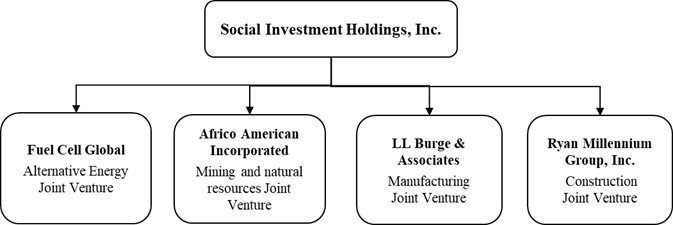
| The proceeds of this Offering will be applied to joint venture businesses and/or start-ups, which will be majority-owned by the Company, as outlined herein and for working capital purposes. More specifically, the Company intends to allocate proceeds to the following revenue generating ventures: a) construction (see Ryan Millennium Group joint venture) which includes construction management activities, and development projects from real estate, in America and sub-Saharan Africa; b) manufacturing of semi-conductors and other products in the USA by L.L. Burge and Associates (see LL Burge & Associates Joint Venture) in collaboration with Historically Black Colleges and Universities, (“HBCU’s”) capitalizing on the Chips Act and other U. S. Government funded programs designed to increase jobs and manufacturing in the USA rather than overseas; c) d) mining and natural resources (see Africo American Joint Venture) to serve as the foundation for significant Black and Hispanic natural resource ownership in the USA and sub-Saharan Africa; e) construction (see Ryan Millenium Group) which includes construction management activities, and development projects from real estate located in the United States. The Company will seek to meet the expanding needs of ethnic communities for financial literacy, employment, business creation and ownership, as well as services tailored to those specific communities. The Company plans to expand the products and services contemplated in its business plan as revenue is earned. If the Company reaches the maximum offering, all the projects are expected to be executed. Management believes that revenues and asset growth, as well as “market reach,” will accrue to the Company and the joint venture partners for reinvestment within the first two years of implementation of the projects. The Company also expects to guide each of the joint ventures to the sixty-billion-dollars Build Act funding for developing countries, which could, within an 18-month period, provide leverage funding which could provide income to the Company. Additionally, as the Company increases its revenues in the Americas, partnerships in business opportunities in Africa (where the indigenous population can participate in sub-contracting opportunities provided by the Company) will serve as the foundation for the creation of indigenous African-owned businesses. (See “Application of Proceeds” and “The Company.”) |
|
|
|
| Post-Offering Securities Outstanding | If the $75,000,000 Offering is fully subscribed, the number of Shares outstanding will increase from 7,500,000 to 15,000,000. If the assumed $2,000,000 (200,000 Shares) is achieved, the number of Shares outstanding would be increased to 7,700,000. (See “Capitalization.”) |
| 6 |
| Table of Contents |
The Summary Financial Information, all of which has been derived from audited financial statements included elsewhere in this Offering, reflects the operations of the Company for its operating history as of and for the year ended March 31, 2026. This information should be read in conjunction with the financial statements) and “Management’s Discussion and Analysis of Financial Condition and Results of Operation”.
| Current Assets |
|
| 65,774 |
|
| Non-current Assets |
|
| 266,971 |
|
| Current liabilities |
|
| 4,684,655 |
|
| Long Term Liabilities |
|
| 161,385 |
|
| Gross Profit |
|
| 0 |
|
| Net Loss |
|
| (471,681 | ) |
Since its inception the Company has not generated any revenue and has incurred losses. The independent auditors have included a going concern paragraph in their opinion and the Company has included a going concern footnote to its financial statements, both of which conclude that there is substantial doubt about the Company’s ability to continue as a going concern.
Prospective investors should consider carefully, in addition to the other information contained in this Offering, the following factors before purchasing the Shares offered hereby. Purchase of the Shares offered hereby should be made only by those persons who can afford to bear the risk of a total loss of their investment. The Company reserves the right to reject any subscription in whole or in part.
|
| 1) | THE COMPANY, IN THE EARLY STAGES OF DEVELOPMENT, HAS A LIMITED HISTORY OF OPERATIONS AND MINIMAL CAPITAL RESOURCES, WHICH ARE INADEQUATE TO FULLY IMPLEMENT ITS BUSINESS PLAN. IN ADDITION, UNFORESEEN MARKET FLUCTUATIONS CAN ADD TO THE VOLATILITY OF THE COMPANY’S JOINT VENTURES PRODUCTION PLANS, WHICH COULD ADVERSELY AFFECT THE COMPANY’S CAPABILITY TO PERFORM. IF ADDITIONAL FINANCING IS REQUIRED BUT NOT OBTAINED, OR MARKET CONDITIONS DO NOT IMPROVE, THE INVESTOR RISKS LOSING ALL OR PART OF THEIR INVESTMENT. The Company is in the early stage of development and has only a limited history of operations. (See "The Company -- General" and "Conflicts of Interest.") To the extent that the Company implements its Joint Venture production plans, a possible change of management within the Joint Venture partners or key personnel could cause delays in the execution of the business plan. The Company's business could be subject to lack of materials or additional financing, should an order larger than the Company’s ability to finance, extend the time it takes for the Company to produce product as well as encountering all of the problems, expenses, delays and risks inherent in a new business enterprise (including limited capital, delays in program development, possible cost overruns, uncertain market acceptance and a limited operating history). (See also below "Risk Factors -- Reliance on Management.") In addition, the Company's future success will depend upon factors which may be beyond its control, or which cannot be predicted at this time and could cause investors to lose all their investment. The Company might not achieve profitability in the future. If the Company fails to achieve profitability, its growth strategies could be materially adversely affected. (See "Management's Discussion and Analysis of Financial Conditions and Results of Operations.") Moreover, the Company's minimal capital resources are not adequate to fully implement its business plan. If the Company achieves only the assumed $2,000,000 associated with this Offering, the Company is expected to be sustainable for approximately 12-18 months without additional financing. Thereafter, if additional financing is required but not obtained, the investor risks losing all or part of his/her investment. Conversely, if the Company achieves the $75,000,000 maximum offering associated with this Offering, there will be no additional financing required for the foreseeable future to implement the Company’s current business plan. If additional financing in fact, is required, it might not be available to the Company when required, or on terms acceptable to the Company. If such additional financing is not available, the Company might have to sell additional stock which might result in substantial dilution of the equity interests of existing shareholders. |
| 7 |
| Table of Contents |
|
| 2) | GOING CONCERN REPORT OF INDEPENDENT CERTIFIED PUBLIC ACCOUNTANTS RAISE DOUBT AS TO THE COMPANY’S ABILITY TO CONTINUE OPERATION WITHOUT FUNDS FROM THE OFFERING AND THEREFORE THE INVESTORS COULD LOSE THEIR INVESTMENT. The factors described above in “Limited History of Operations: Historical Net Losses . . .” raise substantial doubt about the Company’s ability to continue as a going concern. In this regard, see the Report of Independent Certified Public Accountants accompanying the Company’s audited financial statements appearing elsewhere herein which cites substantial doubt about the Company’s ability to continue as a going concern. There can be no assurance that the Company will achieve profitability in the future, if at all. As a result of these and other factors, there can be no assurance that the Company’s proposed activities and/or acquisition of majority ownership in the businesses of other companies will be successful or that the Company will be able to achieve or maintain profitable operations. If the Company fails to achieve profitability, its growth strategies could be materially adversely affected. (See “Management’s Discussion and Analysis of Financial Condition and Prospective Results of Operations.”) |
|
|
|
|
|
| 3) | THE RISK OF RELYING ON A MANAGEMENT TEAM WHICH HAS NOT PREVIOUSLY WORKED TOGETHER COULD CREATE INTERNAL CONFLICTS DUE TO DIFFERENT OPERATING STYLES AND PHILOSOPHIES. THE RESULT MAY STALL IMPORTANT BUSINESS DECISIONS AND CREATE POOR WORKING CONDITIONS, SUBSEQUENTLY COSTING THE COMPANY TIME AND MONEY AND RESULTING IN THE INVESTORS LOSING THEIR INVESTMENT. Although members of management have significant cumulative experience and expertise in the identification, acquisition, and operation of various businesses, only one of its members has previously operated such an extensive array of operations as those the Company contemplates. Investors will have no right or power to take part in or direct the management of the Company. Accordingly, no investor should purchase shares unless such investor is willing to entrust all aspects of management of the Company, including the selection of businesses and/or controlling interests in companies it may acquire, to the Company's management. This potential risk is even more important in this Offering since the Company's business is dependent to a significant degree upon the performance of certain key individuals, the departure or disabling of any of whom could have a material adverse effect on the Company's performance and none of whom, until the assumed amount is achieved, is required to devote their services exclusively to the Company except for Julius Jackson, Sr. The loss of the services of any such key personnel could have a material adverse effect upon the Company. The Company will maintain key man life insurance of $1,000,000 on Mr. Jackson, application for which will be made after the Company has raised $2,000,000 in this Offering. The key employees could leave the Company and may compete with the Company if satisfactory agreements are not developed. Therefore, the investors are at risk of losing some or all their investment if the key employees leave the Company before the management team develops redundancy for those employees. |
|
|
|
|
|
| 4) | BASED ON THE BROAD DISCRETION OF MANAGEMENT, THERE IS ASSOCIATED RISK REGARDING THE USE OF PROCEEDS, SUBSEQUENTLY CREATING AN OPPORTUNITY FOR MANAGEMENT TO DEPLETE THE OPERATING CAPITAL IN VENTURES THAT DO NOT RETURN ENOUGH PROFITS TO FUND OPERATIONS, WHICH IN TURN COULD CAUSE THE INVESTORS TO LOSE THEIR INVESTMENT. A significant portion of the net proceeds of this Company have been allocated to working capital and, among other things, to expand its contemplated construction management/real estate-related business development activities and/or acquisition of majority interest in joint ventures between the Company and other companies. While the Company expects to use the proceeds of this Offering as outlined in "Use of Proceeds," the management of the Company retains broad discretion as to the specific use of such funds. That discretion could cause the investor to lose all or part of their investment. |
| 8 |
| Table of Contents |
|
| 5) | FUTURE EXPANSION MIGHT NOT BE POSSIBLE OR PROFITABLE DUE TO A POTENTIAL LACK OF DIVERSIFICATION OR FINANCIAL OVER-EXTENSION OF THE COMPANY WITH NO PROFITS TO REINVEST FOR SUSTAINABILITY. IN THE EVENT OF EITHER, INVESTORS COULD LOSE THEIR INVESTMENT. As a result of this Offering, the Company is expected to expand into activities in which management has not previously operated and generally experience significant expansion. With no experience by the current management in other areas, the Company could have difficulty in finding management personnel that could effectively operate the associated activities and therefore could cause the loss of the investment into those sectors. To reduce that potential risk, and to tap into pre-existing expertise, the Company will typically enter into joint ventures (having an interest of no less than 50% + 1 share) with established or start-up firms. Considering the Company's pursuit of additional projects, activities and funding in this and future offerings, management believes the Company will experience significant expansion in the future. It is possible (because of these recent preliminary activities -- and potential future projects and joint ventures) that the Company's management will be required to manage larger business operations than is historically typical. It is possible that the Company will fail at its attempts to effectively implement the organizational and operational systems necessary for optimal management integration of its expanded activities which could cause a loss of the investor’s money. |
|
|
|
|
|
| 6) | FUTURE ACQUISITIONS WITHOUT THOROUGH DUE DILIGENCE MAY RESULT IN FINANCIAL LOSSES THAT DEPLETE THE WORKING CAPITAL TO THE POINT THAT THE COMPANY CANNOT RECOVER AND SUBSEQUENTLY CAUSE INVESTORS TO LOSE THEIR INVESTMENT. To expand its market and diversify its business mix, the Company's business strategy includes growth through acquisitions and joint ventures (again in all cases, except for the one instance reflected in this Offering, having an interest of not less than 50% + 1 share). If there are no future joint ventures or acquisitions, if there are future acquisitions that are consummated on terms unfavorable to the Company or if any newly acquired companies are unsuccessfully integrated into the Company's operations, the investor could lose all their money. As the Company may use equity or incur long-term indebtedness or a combination thereof for all or a portion of the consideration to be paid in conjunction with any future expansion, acquisitions or joint ventures, the Company could lose its ability to continue operations, and the investor could lose their investment. |
|
|
|
|
|
| 7) | THERE IS RISK ASSOCIATED WITH INCREASED COMPETITION FROM EXISTING AND FUTURE COMPETITORS THAT MAY MATERIALLY AND ADVERSELY AFFECT THE COMPANY’S ABILITY TO ACHIEVE PROFITABILITY AND CAUSE INVESTORS TO LOSE THEIR INVESTMENT. The Company's business plan spans construction, real estate development, alternative energy and manufacturing, which in some cases overlap and are highly competitive. The Company faces substantial competition from a number of companies which may have greater resources and are more established than the Company. Increased competition from existing and future competitors in the real estate, construction, manufacturing, and financial services sectors could materially and adversely affect the Company's ability to achieve profitability. One example of this risk is the existence of established development and construction companies which are entrenched in the marketplace. To the extent that the management of those companies decide to commit significant financial resources into developing projects for the Company’s potential targets, those contemplated projects could be done by the Company’s competitors. |
|
|
|
|
|
| 8) | NO MARKET STUDIES HAVE BEEN COMPLETED TO SUBSTANTIATE THE PROBABILITY OF SUCCESS, AND WITHOUT PREPARATION OF A FEASIBILITY STUDY, THE COMPANY COULD EXHAUST ALL ITS CAPITAL TRYING TO MAKE THE BUSINESS WORK AND THE INVESTORS WOULD LOSE THEIR INVESTMENT. In formulating its business plan, the Company has relied on the judgment of its management. No formal, independent market studies concerning the demand for the Company's proposed products and services have been conducted; however, market studies are expected to be employed in the future. Directly or indirectly, the Company will use a significant portion of the proceeds of this Offering to validate the legal and economic feasibility of its business plan. To the extent that the Company determines any or a part of its business plan is not feasible, or to the extent the Company is unable to determine feasibility and/or to modify its business plan, the Company will be unable to proceed to develop in accordance with its business plan and investors may lose their entire investment in the Company. |
| 9 |
| Table of Contents |
|
| 9) | THE COMPANY’S PRODUCTS AND SERVICES WILL EXTEND TO BOTH INTERNATIONAL AND DOMESTIC AREAS, WHICH CARRY SUBSTANTIAL RISK ASSOCIATED WITH THE RESPECTIVE MARKET AND ECONOMIC CONDITIONS. DECLINING MARKET CONDITIONS MAY RESULT IN POTENTIAL DECREASED CASH FLOW AND PROFITABILITY WITH LITTLE TO NO WARNING AND MAY BE IMPOSSIBLE TO OVERCOME, WHICH WOULD CAUSE THE INVESTORS TO LOSE THEIR INVESTMENT. There is no prior proof of the acceptance of the Company's contemplated products and services. The Company intends to commence operations at a time when the industries affected by consumer products and services are rapidly evolving. As is typical of new and rapidly evolving industries, demand, and market acceptance for recently introduced products and services is subject to a high level of uncertainty and risk. Because the market for certain of the Company's products and services is new and evolving, it is difficult to predict the future growth rate, if any, and size of this market. While it is known that consumer products and services, including those offered in ethnic markets, constitute a large and growing aggregate market for the Company's products and services, the market may not continue to develop and may not become sustainable, particularly in view of the Company's emphasis toward minority communities. If the market for its products and services fails to grow, the Company's ability to establish and expand its brand identity would be materially and adversely affected. |
|
|
|
|
|
| 10) | BRAND DEVELOPMENT AND BRAND ACCEPTANCE IS DIFFICULT TO CREATE AND, IF NEGATIVE BRANDING OCCURS, IT CAN BE DIFFICULT TO OVERCOME, NEGATIVELY IMPACTING FUTURE SALES AND PUTTING THE INVESTORS AT RISK OF LOSING THEIR INVESTMENT. The Company believes that establishing and maintaining a brand identity is a critical aspect for attracting and expanding its targeted audience and that the importance of brand recognition will increase due to the growing number of competitive products and services. Promotion and enhancement of the Company's brand will depend largely on its success in continuing to provide high quality products and services. If African American and Hispanic and/or African-centric and Caribbean-centric customers do not perceive the Company's existing products and services to be of high quality, or if the Company introduces products and services or enters into new business ventures that are not favorably received, the Company will risk diluting its brand and decreasing the attractiveness of its line of products and services. If the Company is unable to provide high quality products and services, or otherwise fails to promote and maintain its brand to its intended customer base, incurs excessive expenses to improve or promote and maintain its brand, the Company's business, results of operations and financial condition could be materially and adversely affected, and investors could lose their investment. |
|
|
|
|
|
| 11) | THE COMPANY IS SUBJECT TO DIRECT GOVERNMENT REGULATIONS APPLICABLE TO ITS ACTIVITIES AS WELL AS GENERAL BUSINESS PRACTICES IN ANY COUNTRY IN WHICH IT WILL OPERATE. THESE RULES AND REGULATIONS ARE SUBJECT TO CHANGE. GOVERNMENTAL REGULATION AND LEGAL UNCERTAINTIES POSE A CERTAIN RISK WHICH MAY IMPACT THE PRODUCTS AND/OR SERVICES OFFERED BY THE COMPANY, INCREASE ITS COST OF DOING BUSINESS AND SUBSEQUENTLY CAUSE THE INVESTOR TO LOSE THEIR INVESTMENT. In light of laws and regulations currently applicable directly to consumer products and services, the Company is subject to direct government regulation in certain portions of its contemplated activities as well as regulations applicable generally to business. With the many rules, regulations, or laws of various countries in which the Company and its joint venture partners may operate, this risk factor can only reference the material risks known at this time. The Company will continue to monitor all applicable laws and regulations that may impact the Company. The Company will initially be subject mainly to those regulations generally applicable to businesses. Based on the contemplated joint ventures referenced in this offering, the Company would be required to adhere to the following: |
| 10 |
| Table of Contents |
|
| a. | For the construction business, the Company must meet the regulations for having a licensed general contractor as a qualifier for the Company. Additionally, the construction company must have workers compensation insurance for injury on the job or while operating company vehicles, if the company has any. The construction company must also maintain general liability insurance, comply with the Federal Unemployment Tax Act and OSHA regulations. |
|
|
|
|
|
| b. | Indigenous Business Development in the various countries in which the Company will work is at varying stages of development. For example, in South Africa, the Black Economic Empowerment Law is a regulation that must be met by all companies operating in South Africa. If the Company does not meet the requirements of that regulation, the Company could lose the investors’ money. In other countries, such as Angola, there is no strict requirement to follow any regulation for Black Economic Empowerment. However, the Company, without coercion, practices Black Economic Empowerment and indigenous business development. The South African government requires, under its Black Economic Empowerment Act, that indigenous South Africans must be given the opportunity to own a 26% stake in businesses operated within the country and, in addition, there must be an integration of Black South Africans within the management structure of businesses operating in that country. Continuing that exemplar, Black South African employees must be given additional time off, more than regular vacation time, for family emergencies beyond what is generally given within the U.S. Consequently, even though the Company will identify specific rules and regulations in any country in which it will operate, those rules and regulations could change, and the Company will have to conform. |
|
|
| Moreover, several laws or regulations may be adopted in the future that will have an impact on the Company’s business model and operations. The adoption of new laws or the adaptation of existing laws which impact the products and/or services offered by the Company, which could decrease the demand for the Company’s products and services and businesses in African and Caribbean communities. Such a decrease in demand could increase the cost of the Company doing business and therefore could cause the investors to lose their investment. |
|
|
|
|
|
| 12) | THE COMPANY MAY NOT GENERATE SUFFICIENT REVENUES TO BE PROFITABLE AND PAYMENT OF DIVIDENDS TO SHAREHOLDERS, IF ANY, IS ENTIRELY AT THE DISCRETION OF MANAGEMENT. DIVIDENDS MAY BE FURTHER RESTRICTED UNDER FUTURE CREDIT OR OTHER FINANCING AGREEMENTS, AND SHAREHOLDERS MAY NOT RECEIVE DIVIDENDS AND/OR COULD LOSE THEIR INVESTMENT. Payment of dividends, if any, to shareholders is entirely at the discretion of management. Were the Company’s services and products not accepted in the marketplace, there could subsequently be insufficient revenues generated for the Company to be profitable. Not only is the Company not currently profitable (a requisite to pay out dividends), but it also anticipates that, for the foreseeable future, the Company will retain any earnings for use in the operation and future expansion of its business activities. Moreover, even if profitable going forward, the Company may be restricted from paying dividends to its shareholders under future credit or other financing agreements. (See "Certain Related Party Transactions" and "Absence of Public Market and Associated Illiquidity of Shares.") |
| 11 |
| Table of Contents |
|
| 13) | THE COMPANY INTENDS TO LIST SHARES FOR TRADING ON THE HIGHEST AVAILABLE SECONDARY MARKET FOR WHICH IT QUALIFIES. HOWEVER, THE COMPANY DOES NOT EXPECT TO MAKE THE NEEDED FILINGS UNTIL JUST BEFORE THE OFFERING IS CLOSED AND UNTIL A MARKET DEVELOPS. A PURCHASER MAY BE UNABLE TO LIQUIDATE ITS INVESTMENT IN THE EVENT OF AN EMERGENCY OR FOR ANY OTHER REASON AND THE SHARES MAY NOT BE READILY ACCEPTED AS COLLATERAL FOR A LOAN. LIQUIDITY OF THE TRADING MARKET FOR THE SHARES AND AN ACTIVE ONGOING PUBLIC MARKET CANNOT BE GUARANTEED. IF AN ACTIVE PUBLIC MARKET DOES NOT DEVELOP OR IS NOT MAINTAINED, THE MARKET PRICE AND LIQUIDITY OF THE SHARES MAY BE ADVERSELY AFFECTED CAUSING INVESTORS TO LOSE THEIR INVESTMENT. The Company's Shares are not publicly traded and are not likely to be traded initially. In fact, to better assure the Company attains the highest “up market” listing on an exchange or proprietary trading system, the Company will not make needed filings to create a secondary market for Shares of the Company until at least the latter stages of the Offering. While that may mean that investors may have no liquidity for some 12 months after the date of this Offering Circular, management believes the numbers of shares, investors and funds will have increased, thereby improving the Company’s “up market” listing prospects. Not coincidentally, the Offering is expected to continue at the $10.00 per Share offering price for the duration of this current $75,000,000 Offering up to 12 months (unless earlier terminated). Moreover, such a publicly traded status requires the Company to enlist broker-dealers to serve as market makers. Even if found, any market maker of the Company's Shares may discontinue such activities at any time without notice. The Company intends to list its Shares for trading on any available secondary market or quotation system essentially concurrent with when the offering is concluded. However, until a market for its Shares develops, a purchaser may be unable to liquidate his or her investment. The liquidity of the trading market for the Shares and an active ongoing public market cannot be guaranteed. If an active public market does not develop or is not maintained, the market price and liquidity of the Shares may be adversely affected. Consequently, holders of Shares acquired pursuant to this Offering may not be able to liquidate their investment in the event of an emergency or for any other reason, and the Shares may not be readily accepted as collateral for a loan. (See "Investment Requirements.") |
|
|
|
|
|
| 14) | THE COMPANY INTENDS TO OPERATE IN DOMESTIC AND INTERNATIONAL REGIONS. THE CYCLICALITY OF BUSINESS AND REVENUES IN THESE SECTORS COULD BE SUBJECT TO SEVERE DOWNTURNS BASED ON MARKET AND ECONOMIC FLUCTUATIONS OUT OF THE COMPANY’S CONTROL THAT COULD RESULT IN INVESTORS LOSING ALL OR PART OF THEIR INVESTMENT. Domestic revenues of the Company, as well as those of the services business generally, could be cyclical. Despite problems in the real estate market affordable housing shortage and limited mortgage availability to minorities in the U.S., there are potential offsets in the Sub-Sahara African markets. However, the ease of developing and construction in the U.S. might not be replicated in the Sub-Sahara African market and therefore could cause the investor to lose all his or her investment. Similarly, the new rounds of inflation could cause a slowdown of sales globally. Nevertheless, for the foregoing reasons, an investor could lose all their investment. |
|
|
|
|
|
| 15) | ABSENCE OF CERTAIN STATUTORY REGISTRATION; NEITHER THE INVESTMENT COMPANY ACT OF 1940 NOR THE INVESTMENT ADVISERS ACT OF 1940 APPLY TO THE COMPANY; INVESTORS EXPECTING PROTECTION UNDER THOSE ACTS WILL NOT HAVE SUCH PROTECTION AND THEREFORE COULD LOSE THEIR INVESTMENTS. Neither the management nor the Company is (nor does management believe it is required to be) registered under the Investment Company Act of 1940 (the “Investment Company Act”) or the Investment Advisers Act of 1940 (the “Investment Advisers Act”), each as amended. Therefore, purchasers of the Shares will not be afforded any protection provided by those Acts. The Company intends to examine opportunities that, if pursued, may become wholly-owned subsidiaries of the Company; alternatively, those pursued activities may take the form of providing, directly or indirectly, financing and/or providing business management services to affiliated or non-affiliated companies. The Company does not intend to make any acquisitions or undertake any transactions that would require the Company to be regulated by either the Investment Company Act or the Investment Advisors Act. Under pertinent operating criteria, the Company intends to conduct its operations so that it does not come under the regulation of the Investment Company Act or the Investment Advisers Act. |
|
|
|
|
|
| 16) | THERE IS NO DIRECT CORRELATION BETWEEN THE OFFERING PRICE OF THE SHARES AND THE COMPANY’S ASSET VALUE, NET WORTH, EARNINGS OR ANY OTHER ESTABLISHED CRITERIA OF VALUE. THE PRICE OF THE SHARES IS NOT NECESSARILY INDICATIVE OF THE PRICE AT WHICH THE SHARES MAY BE TRADED. INVESTORS PURCHASING SHARES UNDER THE INCORRECT ASSUMPTION OF A DIRECT CORRELATION BETWEEN SHARE PRICE AND COMPANY VALUE COULD LOSE ALL OR PART OF THEIR INVESTMENT. The offering price of the Shares offered hereby has been determined by the management of the Company and bears no direct relationship to the Company's asset value, net worth, earnings, or any other established criteria of value. Therefore, the price of the Shares is not necessarily indicative of the price at which the Shares may be traded following the consummation of this Offering. (See “Capitalization” and “Dilution.”) |
| 12 |
| Table of Contents |
|
| 17) | IMMEDIATE DILUTION WILL OCCUR; COMPANY SHARES ARE SUBJECT TO DIMINUTION OF VALUE THAT MAY EXCEED 100% OF THE PURCHASE PRICE PER SHARE SINCE THE OFFERING PRICE IS NOT BASED ON THE COMPANY’S ASSET VALUE. THEREFORE, THE INVESTORS MAY IMMEDIATELY LOSE MOST OR ALL OF THEIR INVESTMENT PRIOR TO COMMENCEMENT OF ACTIVE OPERATIONS. This Offering will result in immediate and substantial dilution of the net tangible book value per common share. Investors who purchase Shares offered hereby will experience immediate dilution based on the difference between the subscription price and the pro forma net tangible book value per common share. As of March 31, 2026, the Company’s net tangible book value was approximately $(4,513,295), or approx. $(0.60) per share, based on 7,500,000 shares outstanding. Purchasers of Shares during at least the initial offering period will pay $10.00 per Share. After giving effect to this Offering (based on the Company’s balance sheet as of March 31, 2026), the Company’s pro forma net tangible book value would be approximately $(2,513,295), or $(0.33) per share, if the $2,000,000 assumed amount is achieved, and approximately $70,486,705, or $4.70 per share, if the $75,000,000 maximum offering is achieved. That represents an increase in net tangible book value of $0.28 per share and $5.30 per share to existing shareholders, and dilution to new investors of $10.00 per share (or approximately 100%) at the $2,000,000 assumed amount and $5.30 per share (or approximately 53.0%) at the $75,000,000 level. Because there is no minimum offering amount, if less than approximately $4.5 million is raised, the pro forma net tangible book value per share will remain negative, and dilution to new investors will exceed the $10.00 purchase price. Net tangible book value excludes deferred offering costs of $15,000. These amounts are based on gross offering proceeds before broker-dealer commissions and other offering costs, and do not reflect the conversion of the Company’s outstanding convertible notes, convertible lines of credit, or the settlement of the consulting liability in shares, any of which would increase dilution to new investors. (See “Capitalization” and “Dilution.”) |
|
|
|
|
|
| 18) | PRINCIPAL STOCKHOLDERS AND AFFILIATES RETAINING APPROXIMATELY 50% OF THE SHARES MAY BE ABLE TO CONTROL THE OUTCOME OF ALL MATTERS SUBMITTED FOR A VOTE AND WILL BE ABLE TO ELECT ALL OF THE COMPANY’S DIRECTORS. SUCH CONTROL BY THE PRINCIPAL STOCKHOLDERS’ MAY POSITIVELY OR NEGATIVELY INFLUENCE CERTAIN TRANSACTIONS REGARDING ACTUAL OR POTENTIAL CHANGE OF CONTROL OF THE COMPANY AND SHARE PREMIUMS, AND INVESTORS MAY NOT HAVE THE ABILITY TO EFFECTIVELY CONTROL THEIR INVESTMENT Prior to the Offering, individual officers, directors, advisors and more than 5% shareholders (the "Principal Stockholders") owned in the aggregate approximately 82% of the Shares. (See "Security Ownership of Certain Beneficial Owners and Management.") Upon completion of the Offering, the Principal Stockholders' and their affiliates aggregate ownership Shares in the Company will permit them to retain approximately 50% of the Shares, assuming the $75,000,000 maximum is raised. Consequently, the Principal Stockholders may be able to effectively control the outcome on all matters submitted for a vote to the Company's stockholders (particularly if significantly less than the $75,000,000 maximum is raised). Specifically, at least initially, the Principal Stockholders will be able to elect all the Company's directors. Such control by the Principal Stockholders may have the effect of discouraging certain types of transactions involving an actual or potential change of control of the Company, including transactions in which holders of Shares might otherwise receive a premium for their Shares over then current market prices. |
|
|
|
|
|
| 19) | ONCE A TRADING MARKET IS CREATED, ANY SUBSTANTIAL SALE OF STOCK BY EXISTING SHAREHOLDERS COULD DEPRESS THE MARKET VALUE OF THE STOCK, THEREBY DEVALUING THE MARKET PRICE AND CAUSING INVESTORS TO RISK LOSING ALL OR PART OF THEIR INVESTMENT. The Principal Stockholders, including directors and officers (among whom are Julius Jackson, Sr. and Kenneth Timbrook) may vote the Shares with beneficial ownership as of the date of this Offering, directly or indirectly, 6,175,955 (82%) of the outstanding Shares of the Company. All such Shares held by the Principal Stockholders are "restricted" and/or “control” shares as defined in Rule 144 under the Securities Act ("Rule 144"). This Rule also extends to non-affiliates of the Company with regard to restricted shares, that is, those not freely tradable. The Company can make no prediction as to the effect, if any, that sales of shares, or the availability of shares for future sale, will have on the market price of the Shares prevailing from time to time. Sales of substantial amounts of shares in the public market, or the perception that such sales could occur, could depress prevailing market prices for the Shares. Such sales may also make it more difficult for the Company to sell equity securities or equity-related securities in the future at a time and price which it deems appropriate. |
|
|
|
|
|
| 20) | CIVIL UNREST IN OTHER COUNTRIES WHERE THE COMPANY PLANS TO DO BUSINESS COULD CAUSE PROJECT DELAYS, COST OVERRUNS AND CHANGING PROJECT DELIVERABLES COULD IMPACT PROFIT MARGINS UP TO AND INCLUDING LOSS OF THE INVESTOR’S MONEY. There is no guarantee that political issues will not cause problems with the Company’s execution of its international projects. These may include timber, mining, construction or the like. By way of example, the Company (when it has adequate funding) expects to explore opportunities in the Democratic Republic of the Congo. On any overseas projects, the Company intends to implement appropriate risk mitigation strategies, including political risk insurance, to insure against nationalization, inconvertibility of currency, war or other related strategies implemented, the investors could lose their investment due to other unforeseen problems in Africa. |
| 13 |
| Table of Contents |
|
| 21) | THE COMPANY’S OBJECTIVE TO BRING ABOUT BETTER RACE, POLICE AND COMMUNITY RELATIONS THROUGH FREE MARKET STRATEGIES IS RELIANT ON MAKING ADEQUATE PROFIT TO GIVE BOTH A RETURN TO INVESTORS AND ADDRESS SOCIAL NEEDS. ADEQUATE PROFITS MAY NOT BE MADE TO PROVIDE FOR BOTH, WHICH COULD CAUSE THE INVESTORS TO LOSE THEIR INVESTMENT. Management intends to first preserve the Company’s capital and secondly to provide support to social activities per its social impact objective. If there is not enough profit to provide both a return to investors and address the social impact needs, capital will be preserved. The Company believes pressing race, police and community relations issues facing our country today must be addressed through the private sector. Therefore, the Company may not generate enough revenue to cover both a return to investors and address social needs. Further, the Company may use some of the proceeds of this Offering on non-revenue generating activities. Therefore, the Company’s management has a conflict of interest between generating a return for investors and addressing social needs. The conflict may be decided in favor, in certain instances, of meeting social needs in catastrophic situations such as floods, hurricanes, etc. In the case of the anticipated joint ventures, the Company directors intend to follow yet to be written policies and procedures before deploying any funds towards social non-profitable activities (See “OUR BUSINESS STRUCTURE - JOINT VENTURES - Social Investments”). The Company has not set a definitive amount, or percentage of its profits, to be used for non-revenue producing activities. The foregoing risk could cause the investors to lose their money. The Company has expressed its mission to address police, race, and community relations through this Offering. Therefore, the Company intends to negotiate a policy with the joint ventures which will guide how management will address a shortfall in adequate profit to cover both profitability and social impact activities. If the Company does not follow the procedures referenced above pertaining to social investments, the investors could lose all their investment. |
|
|
|
|
|
| 22) | THE COMPANY HAS ENTERED INTO MULTIPLE RELATED PARTY TRANSACTIONS WITH RISKS THAT CAN INCLUDE CONFLICTS OF INTEREST AND FIDUCIARY DUTY, TRANSACTIONS THAT ARE ON LESS THAN FAVORABLE TERMS FOR THE COMPANY THAN OTHERWISE COULD HAVE BEEN OBTAINED, AND IMPAIRMENT OF INVESTOR CONFIDENCE, ALL OF WHICH COULD CAUSE A MATERIAL EFFECT ON THE COMPANY AND ITS INVESTORS. As disclosed in this Offering Circular, there are multiple instances of related party transactions with the Company and between other parties having an interest in the Company. As examples, Robert Curbelo, a member of the Company’s Board of Directors, may be requested to oversee construction activities; and William Ryan, the majority owner of Ryan Millennium Group, owns 5% of the founder shares of the Company. (See “Interest of Management and Others in Certain Transactions,” including “Related Party” disclosures.) Related party transactions are generally any commercial relations other than in the ordinary course of business (such as compensation for services, reasonable expense allowances and the like). These related party transactions carry risks that can include conflicts of interest, breach of fiduciary duty, and transactions that are on less than favorable terms for the Company, which in return, can have negative financial impacts for the investors. Such information is volunteered to assist prospective investors in a necessary understanding of the effects of the transactions on the financial statements. Transactions involving related parties cannot be presumed to be carried on an arms-length basis as the requisite conditions of competitive, free market dealings or consummated on terms that prevail in arm’s-length transactions. Indeed, such disclosure is required where there is common ownership or management control where operating results could be significantly different from those that would have been obtained if the entities were autonomous. Such disclosure is required even if there are no transactions between the entities. In the event such potential conflict was to result in generating less revenue than would otherwise be the case, the foregoing risk could cause the investors to not do as well as without such related party transactions or even to lose their money. Noting that related party disclosure constitutes only possible conflict, the Company has pursued (and, in future, intends to continue following a policy with the joint venture partners and/or directors and officers whereby transactions will be undertaken with related parties only on terms comparable to those available with unrelated parties. Given the multiple relationships outlined above, the actions by the Company should be viewed in other than an arms-length manner. In the future, subsequent to funding per this Offering, all our contracts will be let on terms and prices readily available in the marketplace. Any contracts on which a Board member of any other related party might enter a bid will be awarded on the basis of the lowest credible bid and the related party will not have any decision-making authority in such an award. |
| 14 |
| Table of Contents |
|
|
| We have a material settlement obligation that may adversely affect our liquidity and use of offering proceeds. In October 2025, we entered into a settlement agreement to resolve disputed claims related to a prior collaboration agreement between Center for Social Change Inc. (“CSC”) and People Helping Each Other Inc. (“PHEO”), a related party non-profit under common control with SIH. The dispute involved a proposed carbon conservation project in the Democratic Republic of Congo and a housing development project in Namibia. Under the settlement agreement, we agreed to pay $1,000,000 from the first $2,000,000 raised in this offering. The obligation does not bear interest. As a result, a substantial portion of proceeds raised in this offering may be required to satisfy this obligation, which could materially reduce the funds available for operations, business development, and execution of our business plan. |
|
|
|
|
|
| 23) | THE COMPANY HAS A PAST RECORD OF NOT FILING PERIODIC REPORTS IN A TIMELY FASHION AND BEING A DELINQUENT FILER, WHICH RESULTED IN A LACK OF PUBLIC INFORMATION ABOUT THE COMPANY. THE COMPANY ALSO FAILED IN PREVIOUS ATTEMPTS TO CONDUCT SIMILAR OFFERINGS AND ENTER INTO JOINT VENTURES. The Company previously filed an offering circular with the Securities and Exchange Commission and had its offering qualified but failed to raise the funds required to break escrow. Additionally, the Company had attempted to raise funds for potential joint ventures in more than eight different sectors, without clearly identifying governmental and/or public agency resources that might have enhanced the Company’s potential for raising the funds contemplated through the previously submitted offering circular. The Company was delinquent in its follow-on filings for a variety of reasons, in part at least because it did not have a successful offering. Therefore, the risk associated with not being compliant with the SEC’s reporting requirements and the risk of not executing on the current joint ventures in this offering creates substantial risk to the investor that could cause him/her to lose their investment in this offering. The Company intends to remain current in its required filings, but there is no guarantee that it will be able to do so without the completion of a successful offering, because without such it does not have the funds necessary to prepare these filings. |
|
|
|
|
|
| 24) | THE COMPANY HAS MATERIAL SETTLEMENT OBLIGATION THAT MAY ADVERSELY AFFECT OUR LIQUIDITY AND USE OF OFFERING PROCEEDS. In October 2025, we entered into a settlement agreement to resolve disputed claims related to a prior collaboration agreement between CSC and People Helping Each Other Inc. (“PHEO”), a related party non-profit under common control with SIH. The dispute involved a proposed carbon conservation project in the Democratic Republic of Congo and housing development project in Namibia. Under the settlement agreement, we agreed to pay $1,000,000 from the first $2,000,000 raised in this offering. The obligation is not contingent upon the successful completion of this offering, does not bear interest, and any unpaid amount will remain outstanding until paid. As a result, a substantial portion of proceeds raised in this offering may be required to satisfy this obligation, which could materially reduce the funds available for operations, business development, and execution of our business plan. |
| 15 |
| Table of Contents |
The following table illustrates the dilution to investors purchasing shares in this Offering at an assumed public offering price of $10.00 per share. Dilution results from the difference between the public offering price per share paid by investors and the pro forma net tangible book value per share of the Company immediately after completion of the Offering.
As of March 31, 2026, the Company had 7,500,000 shares of common stock issued and outstanding, of which approximately 6,175,955 shares were owned or controlled by officers and directors. In addition, the Company has outstanding convertible notes, convertible lines of credit, accrued interest obligations, and certain liabilities that may be settled in shares of common stock, which could result in substantial additional dilution to investors in this Offering. The table below includes estimated dilution associated with these obligations on a fully diluted basis.
The foregoing dilution calculations include estimated dilution associated with the Company's outstanding Convertible Redeemable Promissory Notes, convertible lines of credit, accrued interest obligations, and other potentially dilutive securities. Certain of these instruments permit conversion into shares of the Company's Common Stock at substantial discounts to the market price of the Common Stock or pursuant to alternative conversion formulas. The actual number of shares issuable upon conversion may be materially greater than the estimates reflected herein depending upon the timing of conversion, the market price of the Company's Common Stock at the time of conversion, and the specific terms of the applicable instruments. Accordingly, actual dilution to investors participating in this Offering may be substantially greater than reflected in the table below.
The following table assumes completion of this Offering at the assumed public offering price of $10.00 per share under three separate offering scenarios:
|
|
| $2,000,000 Raise |
|
| $35,000,000 Raise |
|
| $75,000,000 Raise |
| |||
| Offering Price Per Share |
| $ | 10.00 |
|
| $ | 10.00 |
|
| $ | 10.00 |
|
| Shares Issued in this Offering |
|
| 200,000 |
|
|
| 3,500,000 |
|
|
| 7,500,000 |
|
| Common Shares Outstanding Prior to Offering |
|
| 7,500,000 |
|
|
| 7,500,000 |
|
|
| 7,500,000 |
|
| Total Shares Outstanding After Offering |
|
| 8,224,179 |
|
|
| 11,524,179 |
|
|
| 15,524,179 |
|
| Percentage Owned by Existing Shareholders |
|
| 97.4 | % |
|
| 68.18 | % |
|
| 50 | % |
| Percentage Owned by New Investors |
|
| 2.6 | % |
|
| 31.82 | % |
|
| 50 | % |
| Net Tangible Book Value Per Share After Offering (1) |
| $ | (0.33 | ) |
| $ | 2.88 |
|
| $ | 4.70 |
|
| Dilution Per Share to New Investors (2) |
| $ | 10.33 |
|
| $ | 7.13 |
|
| $ | 5.30 |
|
Notes:
(1) Net tangible book value per share after the Offering is determined by dividing the Company’s adjusted net tangible book value after giving effect to the Offering by the estimated total number of shares outstanding after the Offering.
(2) Dilution per share represents the difference between the assumed public offering price per share and the pro forma net tangible book value per share immediately after completion of the Offering.
As described elsewhere in this Offering Circular, this Offering is being conducted on a “best efforts” basis with no minimum offering amount and no escrow arrangement. Because there is no minimum offering amount, investors may be exposed to greater dilution and increased investment risk if substantially less than the maximum offering amount is raised.
| 16 |
| Table of Contents |
The Shares will be offered on a best-efforts basis by the Company on the securities platform of SPCP (see Silicon Prairie Portal Agreement, Exhibit 1 – Part III to the Offering Statement), SPCP being a broker-dealer registered nationally with FINRA. This Offering will be open a maximum of twelve (12) months and offer a maximum number of 7,500,000 Shares in this Offering at $10.00 per share.. The Company has engaged SPCP, an SEC registered broker-dealer and a member firm of FINRA (the “Selling Agent”) to sell the Shares of this Offering in all fifty states. (The broker-dealer will be paid out of Shares sold a negotiated sliding scale--starting at 5% on the first $1,000,000 and declining to 1% any amounts raised above $5M, of the amount sold by the Company. During this Offering, so long as a secondary market for the Company’s Shares has not developed, Shares will continue to be sold at the original $10.00 per share selling price.
If additional selling agents (other SEC-registered, FINRA member broker-dealer firms) are engaged to offer Shares, they will be paid a negotiated portion of the maximum 6-8% selling commission. (In addition, any Managing Selling Agent would be reimbursed for its expenses, the lesser of actual expenses or 5% of the proceeds of the Offering and may be issued a negotiated number of Shares for its services to the Company.) In connection with this Offering, the Managing Selling Agent, and any Additional Selling Agent(s), if so engaged, are underwriters as defined by the Securities Act of 1933, as amended, and the rules promulgated there under.
The Offering will be open for up to twelve (12) months from the date of this Offering Circular unless earlier terminated. Shares having an aggregate selling price of $75,000,000 are being offered pursuant to this Offering Circular. In addition, the Offering (with appropriate amendments for additional up to twelve (12) months.). The Company is offering a maximum of 7,500,000 Shares ($75,000,000) of Shares at $10.00 per Share. This Offering being made pursuant to this Offering Circular may be extended (again, with appropriate amendments) for additional periods once this initial offering is concluded.
The minimum purchase per investor during this Offering is $100; additional purchases by existing Shareholders may be made in multiples of $100. The Offering is expected to continue at the Company's $10.00 per Share Selling Price. Subject to pertinent securities requirements, the Company expects to update periodically this Offering after its twelve (12) month initial offering period from the date this Offering was originally declared qualified. The Company will continue the Offering with appropriate amendments if, as expected, the $75,000,000 maximum offering is not achieved pursuant to this Offering Circular. In no case will this current Offering Circular be used to raise more than $75,000,000.
The Company, once this Offering is qualified by the SEC, intends to use social media, published ads and personal presentations such as by attending gatherings (like annual meetings of faith groups) and appear on radio and television programs to drive traffic to the Company’s website, namely www.SocialInvestmentHoldings.com.
This Offering Circular and a subscription agreement will be furnished to prospective investors via download 24 hours per day, 7 days per week at www.SocialInvestmentHoldings.com. Also, prospective investors may obtain a copy of the most recent version of the Offering Circular by contacting Julius Jackson or Kenneth (Tad) Timbrook by phone at (305) 351-2407 or by mail at 5727 NW 17th Ave., Miami, FL 33142 or via email at invest@soinholdings.com.
The Company’s website will also include marketing materials and Company information in the form of videos (including officers and directors giving interviews to journalists representing community newspapers) and written information on the Company’s contemplated joint venture partners (contingent on this Offering raising the required level of funding).
| 17 |
| Table of Contents |
|
| ■ | In order to subscribe to purchase the Shares: A prospective investor can complete a Subscription Agreement and payment online or by mailing a hard copy and sending payment by check (see mailing instructions below). Online payment methods include wire or ACH transfer to the Company, or by Credit Card on Debit Card through a secure payment link. NOTE: SPCP sets up a bank escrow account for the benefit of the Company. |
|
|
|
|
|
| ■ | Investors must answer certain questions to determine compliance with the investment limitation set forth in Rule 251(d)(2)(i)(C) under the Securities Act of 1933, which states that in offerings such as this one, where the securities will not be listed on a registered national securities exchange upon qualification, the aggregate purchase price to be paid by the investor for the securities cannot exceed 10% of the greater of the investor's annual income or net worth. In the case of an investor who is not a natural person, revenues or net assets for the Investor's most recently completed fiscal year are used instead. |
|
|
|
|
|
| ■ | For mail in subscriptions of stock purchases, print off the Subscription Agreement and complete as a hard copy. Checks (which should be at least $100 and in increments thereof) should be made payable to: Social Investment Holdings during this up to 12-month Offering Period. The completed Subscription Agreements and Checks should be mailed or delivered to Social Investment Holdings, Inc., 5727 NW 17th Ave., Miami, Florida 33142, Phone (305) 351-2407. |
|
|
|
|
|
| ■ | Colonial Stock Transfer Company, Inc. [(https://www.colonialstock.com), 66 Exchange Place, 1st Floor, Salt Lake City, Utah 84111, Phone (801) 355-5740] is the stock transfer agent for Shares sold in this Offering. |
The 10% investment limitation in the 2nd bullet above does not apply to accredited investors as that term is defined in Rule 501 under the Securities Act of 1933. An individual is an accredited investor if he/she meets any one of the following criteria:
|
| · | a natural person whose individual net worth, or joint net worth with the undersigned’s spouse, excluding the “net value” of his or her primary residence, at the time of this purchase exceeds $1,000,000 and has no reason to believe that the associate net worth will not exceed $1,000,000 for the foreseeable future, with “net value” for such purposes being the value of the residence less any mortgage indebtedness or other obligation secured by the residence, subtracting such indebtedness or obligation only if it is a liability already considered in calculating net worth; or |
|
|
|
|
|
| · | a natural person who has individual annual income in excess of $200,000 in each of 2024 and 2025 or a joint annual income with that person’s spouse in excess of $300,000 in each of those years and who reasonably expects an income in excess of those levels in the current year, 2025. |
An entity other than a natural person is an accredited investor if it falls within any one of the following categories:
|
| · | an employee benefit plan within the meaning of Title I of the Employee Retirement Income Security Act of 1974, as amended, (i) if the decision to invest is made by a plan fiduciary which is either a bank, savings and loan association, insurance company, or registered investment adviser; (ii) if such employee benefit plan has total assets in excess of $5,000,000; or (iii) if it is a self-directed plan whose investment decisions are made solely by accredited investors; |
|
|
|
|
|
| · | a tax-exempt organization described in Section 501c(3) of the Internal Revenue Code, a corporation, a Massachusetts or similar business trust or a partnership, which was not formed for the specific purpose of acquiring the securities offered and which has total assets in excess of $5,000,000; |
|
|
|
|
|
| · | a trust, with total assets in excess of $5,000,000 which was not formed for the specific purpose of acquiring the securities offered, whose decision to purchase such securities is directed by a "sophisticated person" as described in Rule under Regulation D; or |
|
|
|
|
|
| · | certain financial institutions such as banks and savings and loan associations, registered broker-dealers, insurance companies and registered investment companies. |
Company management must have reasonable grounds to believe (on the basis of information obtained from the shareholder concerning his investments, financial situation and needs, and any other information known by the undersigned) that: (i) by meeting the suitability standards outlined above, the purchaser is or will be in a financial position appropriate to enable him to realize to a significant extent the benefits described in the Offering; (ii) the purchaser has a liquid net worth or net worth sufficient to sustain the risks inherent to the Company, including losses of investment and lack of liquidity; and (iii) the Company is otherwise a suitable investment for the purchaser.
| 18 |
| Table of Contents |
The proceeds to the Company from the sale of the Shares of common stock offered hereby (before associated organization and offering expenses) are estimated to be approximately $75,000,000 if the maximum offering is achieved. (See also “Capitalization” below.) The following illustrates the Company’s estimated application of proceeds.
On October 1, 2025, the Company entered into a settlement agreement with Center for Social Change Inc. (“CSC”) to resolve disputed claims arising from a prior collaboration agreement between CSC and People Helping Each Other Inc. (“PHEO”), a related party non-profit under common control with SIH. The dispute involved a proposed carbon conservation concession project in the Democratic Republic of Congo and a housing development project in Namibia. Pursuant to the settlement agreement, the Company agreed to pay CSC $1,000,000 from the first $2,000,000 raised in the Company’s planned public offering. The settlement obligation does not accrue interest. The Company recognized a $1,000,000 loss and related settlement liability in its financial statements but has not funded any project-related expenditures associated with the proposed projects, does not currently intend to do so, and has not capitalized any related assets nor recorded any expenses in its financial statements.
|
|
| $2,000,000 |
|
| $35,000,000 |
|
| $75,000,000 |
| |||||||||||||||
|
|
| Dollar |
|
| % |
|
| Dollar |
|
| % |
|
| Dollar |
|
| % |
| ||||||
| SIH Americas |
|
|
|
|
|
|
|
|
|
|
|
|
|
|
|
|
|
| ||||||
| Construction and Real Estate |
| $ | 0 |
|
|
| 0 | % |
| $ | 5,000,000 |
|
|
| 14 | % |
| $ | 20,000,000 |
|
|
| 27 | % |
| Alternative Energy |
| $ | 300,000 |
|
|
| 15 | % |
| $ | 15,000,000 |
|
|
| 43 | % |
| $ | 35,000,000 |
|
|
| 47 | % |
| Project Management & Manufacturing |
| $ | 0 |
|
|
| 0 | % |
| $ | 2,200,000 |
|
|
| 6 | % |
| $ | 3,000,000 |
|
|
| 4 | % |
| Sub-Totals |
| $ | 300,000 |
|
|
| 15 | % |
| $ | 22,200,000 |
|
|
| 63 | % |
| $ | 58,000,000 |
|
|
| 77 | % |
| SIH International |
|
|
|
|
|
|
|
|
|
|
|
|
|
|
|
|
|
|
|
|
|
|
|
|
| Minning & Natural Resources |
| $ | 0 |
|
|
| 0 | % |
| $ | 8,000,000 |
|
|
| 23 | % |
| $ | 10,000,000 |
|
|
| 13 | % |
| Sub-Totals |
| $ | 0 |
|
|
| 0 | % |
| $ | 8,000,000 |
|
|
| 23 | % |
| $ | 10,000,000 |
|
|
| 13 | % |
| General & Administrative |
|
|
|
|
|
|
|
|
|
|
|
|
|
|
|
|
|
|
|
|
|
|
|
|
| Personnel * |
| $ | 300,000 |
|
|
| 15 | % |
| $ | 1,000,000 |
|
|
| 3 | % |
| $ | 1,000,000 |
|
|
| 1.3 | % |
| Legal Fees |
| $ | 67,000 |
|
|
| 3 | % |
| $ | 150,000 |
|
|
| 0.4 | % |
| $ | 175,000 |
|
|
| 0.2 | % |
| Accounting |
| $ | 20,000 |
|
|
| 1 | % |
| $ | 50,000 |
|
|
| 0.1 | % |
| $ | 100,000 |
|
|
| 0.13 | % |
| Printing |
| $ | 5,000 |
|
|
| 0 | % |
| $ | 5,000 |
|
|
| 0.0 | % |
| $ | 10,000 |
|
|
| 0.01 | % |
| Office |
| $ | 10,000 |
|
|
| 1 | % |
| $ | 25,000 |
|
|
| 0.07 | % |
| $ | 25,000 |
|
|
| 0.03 | % |
| Sub-Totals |
| $ | 402,000 |
|
|
| 20 | % |
| $ | 1,230,000 |
|
|
| 4 | % |
| $ | 1,310,000 |
|
|
| 1.7 | % |
| Fees & Liabilities |
|
|
|
|
|
|
|
|
|
|
|
|
|
|
|
|
|
|
|
|
|
|
|
|
| Broker Dealer Commission |
| $ | 100,000 |
|
|
| 5 | % |
| $ | 660,000 |
|
|
| 1.0 | % |
| $ | 1,060,000 |
|
|
| 1.4 | % |
| Settlement Agreement Liability |
| $ | 1,000,000 |
|
|
| 50 | % |
| $ | 0 |
|
|
| 0.0 | % |
| $ | 0 |
|
|
| 0.0 | % |
| Sub-Totals |
| $ | 1,100,000 |
|
|
| 55 | % |
| $ | 660,000 |
|
|
| 1.0 | % |
| $ | 1,060,000 |
|
|
| 1.4 | % |
| Investment Total |
| $ | 300,000 |
|
|
| 15 | % |
| $ | 30,200,000 |
|
|
| 86 | % |
| $ | 69,310,000 |
|
|
| 92 | % |
| Working Capital |
| $ | 198,000 |
|
|
| 10 | % |
| $ | 2,910,000 |
|
|
| 8 | % |
| $ | 4,630,000 |
|
|
| 6 | % |
| Totals |
| $ | 2,000,000 |
|
|
| 100 | % |
| $ | 35,000,000 |
|
|
| 100 | % |
| $ | 75,000,000 |
|
|
| 100 | % |
* There will be no compensation to officers, directors or any subsidiaries associated with the sales of shares in this Offering. As stated in the Use of Proceeds, the Company intends to expand its activities which will require operational staff who will be compensated. The initial staff, which includes three of the existing officers and directors, Messrs. Oxendine, Timbrook, and Jackson, will become salaried employees.
**As described in this Offering Circular, this Offering has no minimum or escrow. However, for purposes of disclosures relating to applicable calculations (dilution, for example), we believe we will raise at least $2MM (and therefore characterize as an “Assumed Amount” Offering.)
| 19 |
| Table of Contents |
The anticipated application of the above proceeds does not, however, include expected cash flow from, very specifically, any joint venture agreement described in the Offering Circular, each of which is expressly conditioned on the raising of adequate funding. The Company has chosen to focus on short-term potential revenue generators in the real estate development and construction sectors. The Company believes that the revenue and leverage funds from international and national development agencies, such as the International Finance Corporation and the US International Development Finance Corporation (DFC) for additional projects and listed joint ventures after initial capitalization of the sector, should generate adequate cash-flow to sustain operations of all sectors and joint ventures listed in this offering after the first year of operations. Proceeds from this offering, if $2M is raised, should be adequate to leverage a loan against property in the real estate joint venture, adequate to continue operation of that joint venture for a two-year period in which, adequate funding could be generated to sustain the construction and real estate joint venture. There is no guarantee a loan, if applied for, would be granted. The potential joint venture partners may choose to identify other companies with a stronger balance sheet or with organic resources that could be made available under more favorable conditions. If the potential joint venture partners decide to disengage with the Company, there could be an adverse material effect on the Company’s ability to sustain operations without the proceeds contemplated from this Offering.
The Company believes that the financial resources made available through the U.S. Government, approximately sixty-billion-dollars for developing countries, has set the stage for new opportunities for Black and Hispanic owned businesses with a track record and capacity.
| 20 |
| Table of Contents |
Mission:
To Utilize Business Strategies for Social Change
Vision:
Creating safe, economically thriving communities that will view the world as a place of equal opportunity and endless possibilities by providing the tools, including capital to Black and Hispanic owned companies with little to no access to adequate capital, through a public company model.
In today’s world, we are privileged to have access to a wide array of information due to our technological advances throughout the decades. With these tools, Blacks and Hispanics have been able to learn, grow and develop with the knowledge that can be easily accessed. Nonetheless, even in this age of progress, Blacks and Hispanics still have economic and social tolls that hinder development in their communities. Socially, those communities have shown signs of progress.
Indeed, diversity rarely equates to economic equality, the consequence being that low-income minority communities have yet to bridge the gap. Blacks, Hispanics, and other various minority groups seem stifled by the endeavors of their social environment. Even though most people have the tools for success, this does not mean one knows how to utilize the full potential of what they know.
The overall strategy of the Company grows out of various affirmative action experiences of the 1970s and 1980s, as well as, most recently, less than healthy attractive relationships between police, race, and community. Historically, the Company’s management has observed that ideas for improving disadvantaged minority neighborhoods have come from outside those communities and the organizations participating in these efforts do their best to help, in most instances, from perspectives that have not necessarily included the views of the most affected segments of the most affected communities. In the wake of the string of tragedies of police killings, minority community members being shot, and racial overtones being associated with the recent live streamed treatment of George Floyd, much more needs to be done. The impact of the police killing of George Floyd along with the disturbances including looting that followed, received unparalleled attention from the media. Publicity associated with the disturbances has been vast. The backlash from the buildup of tension in these communities created a new focus on the nation’s unresolved political and socioeconomic issues. Our business seeks to preserve many of the economic gains accomplished through a historic set-a-side program created during the Nixon administration. There are Black owned companies that have served the communities for more than thirty years but could disappear due to lack of available capital to help them survive after the pandemic. There are even stable Black and Hispanic owned companies that could help create more Black and Hispanic owned businesses with the investment of additional patient capital.
Our plan of action brings together community leaders and stakeholders to create a strategic and comprehensive solution to address the root of the issues that have arisen that could subsequently heal our communities at the core. In December 2019, members of the Fellowship of Christian Police Officers, Miami Youth for Christ, newspaper publishers, members of the Coconut Grove Ministerial Alliance, Business Owners, private equity fund managers and members of a family of a victim of a police killing of an unarmed Black man held a summit hosted by Williamson Automotive Group, and its majority owner, to seek solutions to the police, race and community relations problems we are facing today.
| 21 |
| Table of Contents |
The goal of the summit was to identify and plan for the implementation of strategies that could lead to better police, community and race relations. Since there were participants from multiple disciplines, including the social services sectors, strategies for changing attitudes included recognition for the need of a revenue stream to implement any strategy. Subsequent to that summit, the Alliance of Blacks and Jews Inc. (“ABJ”) was formed and has joined and expanded the fight against inequality and anti-Semitism. As an aside, ABJ has brought additional expertise, investment capital, and relationships to the Company, which facilitated the purchase of a memorial site to honor Blacks and Jews who participated in the Civil Rights struggle who are not well known. The Rosewood Property (as defined hereinafter), purchased and owned by the Company, was home to the Rosewood Massacre of 1923, a Black settlement whose inhabitants were murdered by Ku Klux Klan members. The site is scheduled to ultimately have an economic development focus targeting sustainability of the memorial.
As a part of an economic stability focus, the Company’s founders, who attended the summit, recognized an opportunity to utilize some of the tools from the JOBS Act of 2012 to address some of the economic problems, including but not limited to difficulty for small businesses to get loans or equity to maintain, create and expand. Additionally, the Build Act, a 60-billion-dollar program of the U. S. government to assist developing countries and U. S. businesses willing to use their capabilities in those countries, serves as a patient capital pool that can also be used to grow U. S. businesses. Small Businesses, which are typically viewed as the backbone of developed economies, now have access to funding for generating profits both domestically and internationally. The summit participants concluded that there needed to be a company with a goal of showing measurable high social impact results while concurrently making a profit, to accomplish the mission of building better race, police, and community relations. Management believes Social Investment Holdings, Inc. is the vehicle through which that goal can be achieved.
The Company believes that a business model that creates partnerships aligns with its mission statement – “To Utilize Business Strategies for Social Change”– coupled with willing partners who are experts in their respective fields, allows the Company to have a broader impact and a more diverse and expansive footprint. The Company believes these broad-based ownership opportunities, coupled with examples of highly visible social impact activities that could retain or create jobs and build community relations, provide the maximum opportunity to maintain and expand small businesses in and around neighborhoods with a shortage of economic opportunities.
The Company also seeks businesses that may have benefited from opportunities set aside for minorities that have no succession or current joint venture plans. The Company will provide the funds to develop the joint ventures once the funding is secured…the purpose of this Offering. After operating the joint venture to a point where the joint venture company is operating profitably, the Company may create a buy-in strategy which could allow for minority ownership participation by indigenous Africans and Black and Brown Americans or other previously or currently disadvantaged groups. During the first 12 months of operating the joint venture, the Company intends to maximize the potential for teaching partners of the various joint ventures and those that could enter joint ventures with others, how to access the tools necessary to participate in the Build Act or other patient capital pools.
Our commitment to business opportunities, discussed below, are not limited to the U.S. Indeed, our mission and vision will continue to be driven by the following insight of Chris Coons March 7, 2013, while he was in the Senate (representing Delaware and was Chairman of the Senate Foreign Relations committee): “America is losing ground and ceding economic opportunities in Africa to competitors. China, which has made dramatic inroads across the continent in recent years, may undermine or even counter value-driven U.S. goals in the region, and should serve as a wake-up call for enhanced American trade and investment. This is truly a critical moment, as our Chinese competitors are securing long-term contracts that could lock American companies and interests out of fast-growing African markets for decades to come. Engagement with Africa is critical to America’s economic interests in the years ahead.”
| 22 |
| Table of Contents |
JOINT VENTURES
The Company contemplates utilizing joint ventures to develop various business divisions for the Company. Thus far, we have entered into four (4) joint venture agreements that are contingent on the success of this Offering. While some of the granular terms remain to be negotiated, each of the four (4) joint venture agreements are intended to be implemented once the Company raises adequate funds in this Offering, as outlined in Use of Proceeds. The following terms and conditions are contemplated by the Company for the prospective joint ventures.
|
| · | Structure – The Company contemplates providing the liquidity needed to develop new joint venture subsidiary companies, comprised of the Company, with at least 50% + one (1) share in most instances and companies or individuals who have the resources or intellectual property that could contribute to revenue once the needed liquidity is provided. |
|
|
|
|
|
| · | Operations - The Company will be the majority shareholder of the new joint venture companies, with the services and product delivery carried out by the minority joint venture partners with the internal capability and technical expertise. The Company would bring the business knowledge and relationships to expand the capability of the minority joint venture partner. |
|
|
|
|
|
| · | Oversight - The Company (acting as the joint venture parent company and partner, providing the funding to facilitate the joint venture relationship, as well as management oversight) would maintain board seats on the joint venture companies, control of hiring and firing of upper management, weekly reporting and direct involvement by the Company’s officers and regular reviews by our CEO. This degree of oversight would continue until the joint venture company is deemed by the Company CEO and business development committee to be financially stable. From that point forward, unless otherwise required, the oversight frequency is expected to be reduced to a quarterly review. |
|
|
|
|
|
| · | Revenue – The Company expects to receive monthly administrative and development fees from these joint ventures, based on an amount to be negotiated during the finalization of each joint venture company. The amount of this fee would be determined based on each individual joint venture’s growth rate and potential and would also be carefully assessed to make sure there is no negative impact on the joint venture’s growth. This fee will continue for a five-year period, unless mutually renegotiated by both parties to the joint venture. The Company believes this model allows for more reinvestment back into the joint venture companies. At the end of the five-year period, the Company will decide, at its own discretion, if dividends or other forms of profit sharing are warranted. |
|
|
|
|
|
| · | Social Investments - Although the majority of the operations and activities of both the Company and joint ventures will seek to be revenue producing, there are causes like community, police and race relations that will have elements that are non–revenue producing. While the detailed terms of the joint ventures have not been negotiated, the Company will require that each joint venture company will, as a part of its agreement with the Company, allocate a minimum of 2.5% of its pre-tax revenue, to socially oriented activities. Such a requirement must be finalized before the Company funds the new joint venture companies. Any such funding will occur only from those individual joint venture companies that have at least 4% pre-tax revenue. As the joint venture entity’s primary owners, (the Company and the joint venture partners), are expected to have ownership in the joint venture and the Company’s management will be the majority manager of the joint venture, we believe potential conflicts should be eliminated by both parties signing an operating agreement which will stipulate conditions under which non-revenue generating activities will be funded, before any funding is provided by the Company to the joint venture. The joint venture partner operating agreements will include an annual review of the social impact activities to be the focus of the joint venture, to determine if funding from the 2.5% pre-tax revenue would be adequate. The Company anticipates having all joint venture partners meet annually, as a part of their operating agreements, to discuss their unique perspectives on areas of social focus. Those contributing the minimum from their pre-tax revenue will be able to present and vote on social activities. However, those not meeting the 2.5% threshold will only be able to participate in those discussions, but not vote. |
| 23 |
| Table of Contents |
There are excellent opportunities for the Company to provide a bridge to companies that are not able to get bank loans but have revenue that can be maintained and increased. Therefore, the faith community (through churches) and social groups, will be sought as collaborators for this initiative which will include, utilizing joint ventures and acquisitions for, maintaining, and expanding businesses that may have reached their sunset without a succession plan.
The Company’s principal founders believe that it is possible to provide services and develop businesses that build both self-esteem and entrepreneurial knowledge within minority communities and villages, while concurrently bringing economic and social benefits into those neighborhoods and villages, creating socially responsible profits for the Company.
The Company has not yet determined a set percentage of its profits earned directly and outside of its ownership of joint venture profits but is currently expecting to utilize the same percentages as it will require the joint ventures to agree to as a starting point.
Proposed Structuring Example*
| 24 |
| Table of Contents |
PROPOSED BUSINESS SECTORS & VENTURES
The following is a list of four (4) prospective new joint venture companies the Company intends to establish, having executed joint venture agreements with various joint venture partners. Each joint venture company to be established is anticipated to be a majority-owned subsidiary companies and shall be “operating companies” – none of the companies will be an investment company. The Company shall be developing businesses in varied sectors, which shall include real estate, construction, manufacturing, alternative energy, as well as mining and natural resources.
1. Energy and Alternative Energy Infrastructure
The Company is contemplating the formation of a joint venture with Fuel Cells Global (“FCG”), an energy technology platform focused on proprietary energy generation, and storage systems designed for distributed and infrastructure-scale applications. Through this contemplated joint venture, the Company intends to pursue opportunities in alternative energy generation, energy storage, and integrated power systems that may support residential developments, mixed-use projects, commercial facilities, municipal initiatives, and other infrastructure deployments in both domestic and international markets.
Fuel Cells Global Joint Venture - The contemplated joint venture will focus on scalable power solutions intended to address markets where grid expansion is delayed, capacity is constrained, or reliability concerns impact economic activity. Management believes that advancements in distributed generation and storage technologies create opportunities for localized energy systems that can be deployed alongside real estate, industrial, and public-sector developments. If adequately funded, the contemplated joint venture may pursue pilot projects, infrastructure partnerships, and long-term deployment strategies that align with the Company’s broader mission of economic empowerment through ownership participation. In addition to potential project deployment, the Company believes the energy sector presents opportunities for workforce development, technical training, and participation in high-growth infrastructure segments. The contemplated joint venture may explore relationships with governmental entities, development authorities, and private-sector partners to expand access to energy infrastructure while facilitating broader community participation in ownership and management structures. Subject to the successful qualification of this Offering and the availability of sufficient capital, the Company intends to advance the development of this energy and alternative energy initiative through its contemplated joint venture, with the objective of participating in sectors historically limited in minority ownership while addressing infrastructure needs in targeted markets.
The Company intends to contribute from $25 million up to $35 million to the prospective joint venture in exchange for a 51% ownership interest, subject to the successful completion of this Offering and the execution of definitive agreements. The Company expects to actively participate in the management and operation of the joint venture through its Chief Operating Officer, who is expected to oversee operations, and through representation on the joint venture's governing board, where the Company intends to hold no fewer than two board seats. The Company's participation is intended to be operational in nature and not as a passive investment. All other material terms remain subject to negotiation and execution of definitive agreements. There can be no assurance that the parties will reach agreement on final terms or that the joint venture will ultimately be formed. (See Joint Venture Agreements included in the Exhibits to this Offering Statement.)
2. Construction:
In the USA, the Company will target areas where gentrification is occurring and work with members of the groups being displaced to help them secure a piece of the future for the area they have called home for decades. In several areas of the U.S., new residential and commercial development projects have caused values and taxes to surge. Often, long-time residents of the areas are priced out or cannot pay the taxes. Many Blacks and Hispanics who have lived in the redeveloping areas for many years, move out, due to non-viable economic conditions. We believe the Company’s strategy for broad-based business ownership through pooling of resources, such as with this Offering, will maximize the potential for benefits of the gentrification process flowing to the people who would ordinarily be displaced. The Company will also focus on affordable housing and construction skills development for Blacks and Hispanics as a foundation for entrepreneurial development, beginning in Florida where the Company and the contemplated joint venture partner operates and have potential projects.
| 25 |
| Table of Contents |
|
| · | Ryan Millennium GroupJoint Venture- On July 25, 2025, the Company entered into a new agreement with Ryan Millennium Group, Inc. (RMG) to form a new entity designed to provide construction and construction management services. This proposed joint venture will be qualified as a construction company by the qualifiers of RMG. RMG intends to bring new construction and land development projects to the joint venture. Whilst RMG will provide guidance and support on account of their construction experience, the business operations will be managed by SIH Chief Operations Officer, Gordon Murdock. Additionally, the Company intends to develop the property located at 6590 SW 98th Ter., Cedar Key, FL 32625 (the “Rosewood Property”) in concert with the existing surrounding community. The development will include but will not be limited to a bed-and-breakfast, historic landmark designation and a memorial dedicated to Blacks and Jews from the Civil Rights era who have gotten little or no recognition for their sacrifices and high-risk contributions. Robert Curbelo, a director of the Company and project manager for multiple well publicized projects in south Florida, may serve as project administrator if the Company raises the funds contemplated in this Offering (See “Interest of Management and Others in Certain Transaction”). |
|
|
|
|
|
|
| The Company will focus on both new developments and housing programs in the U.S. that are designed to upgrade blighted communities utilizing Community Reinvestment Act funds, Community Redevelopment Initiatives, and other available incentive programs in the U.S. The Company plans to utilize empowerment zones, tax credits, tax-exempt bond financing, community second mortgages and down payment assistance programs in its efforts to be more responsive to the financial needs of previously underserved communities. Through this Offering, the Company, through its construction joint venture, intends to construct affordable housing in sub-Saharan Africa for government employees as well as the affordable non-government related housing sector. The Company’s management believes members of the community will ultimately have opportunities to both own stock in the Company and utilize this joint venture services to acquire affordable homes. Currently, the Company’s management is exploring potential opportunities for housing through the United Nations World Food Program (UNWFP) in sub-Saharan Africa associated with a recently signed Memorandum of Understanding the Company signed with the UNWFP. (See UNWFP agreement in the exhibits). Although there are no definitive agreements currently signed, the Company, through its contemplated construction joint venture, expects to consider providing housing associated with the market areas supported by the UNWFP. The Company’s contemplated construction joint venture will primarily focus on affordable single and multi-family housing, where there is a need for funding and management that could be addressed through the Company’s construction joint venture. Subject to adequate funding of this offering, the Company’s joint venture could pursue both existing and potential affordable housing needs in sub-Saharan Africa and the United States.
The Company will also rely on the construction expertise and development experience of some of the Company’s investors who have been involved in the construction and real estate development sectors for more than 30 years. The Company intends to contribute $1 million for 51%, up to $40 million to the prospective joint venture in exchange for up to a 90% ownership interest, subject to the successful completion of this Offering and the execution of definitive agreements. The Company expects to actively participate in the management and operation of the joint venture through its Chief Operating Officer, who is expected to oversee operations, and through representation on the joint venture's governing board, where the Company intends to hold no fewer than two board seats. The Company's participation is intended to be operational in nature and not as a passive investment. All other material terms remain subject to negotiation and execution of definitive agreements. There can be no assurance that the parties will reach agreement on final terms or that the joint venture will ultimately be formed. (See Joint Venture Agreements included in the Exhibits to this Offering Statement.) |
| 26 |
| Table of Contents |
3. Manufacturing:
Historically, new opportunities in the manufacturing sector have not been actively pursued by Black and Hispanic owned companies due to a host of factors, including but not limited to access to capital. The Company is looking to help bridge that gap. On August 9, 2022, President Biden signed the chip bill into law to encourage the manufacturing of semiconductor chips in the U.S. The law provides more than 52 billion dollars to assist companies in the manufacturing of semiconductor chips in the USA.
|
| ■ | LL Burge & Associates Joint Venture - In response to the Chips Act signed by President Biden, the Company plans to pursue domestic semi-conductor production framework with LL Burge & Associates LLC with approximately seven Historically Black Colleges and Universities (HBCU’s). Legand Burge, President of LL Burge and Associates LLC (“LBA”) is a former Dean of the School of Engineering at Tuskegee Institute, one of the well-known Historically Black Colleges and Universities (“HBCUs”) in America. Mr. Burge has also served in additional HBCUs and other institutions of higher learning, making an impact on many young Black lives, in the opinion of the Company’s management. LL Burge and Associates LBA is a growing leader of information technology (“IT”), advisory and consulting, engineering, and professional services. With a proven record of service delivery excellence, LBA has proudly supported and performed for government agencies and commercial customers located throughout the U.S. Therefore, if this Offering is successful, the Company intends to enter into a joint venture with LBA, as well as leverage the relationships currently existing with at least seven HBCUs with and through LL Burge. Additionally, LBA has the requisite knowledge and experience to lead and execute the formation of, or partner with, a consortium of entities to ultimately produce semiconductors in the USA. (See joint venture agreements in Exhibits to the Company’s Offering Statement.) The Company intends to contribute $500,000 to the prospective joint venture in exchange for 51% ownership interest (with a potential contribution up to $3M), subject to the successful completion of this Offering and the execution of definitive agreements. The Company expects to actively participate in the management and operation of the joint venture through its Chief Operating Officer, who is expected to oversee operations, and through representation on the joint venture's governing board, where the Company intends to hold no fewer than two board seats. The Company's participation is intended to be operational in nature and not as a passive investment. All other material terms remain subject to negotiation and execution of definitive agreements. There can be no assurance that the parties will reach agreement on final terms or that the joint venture will ultimately be formed. (See Joint Venture Agreements included in the Exhibits to this Offering Statement.) |
4. Mining and Natural Resources:
The Company believes there are very few mines owned and operated at the management level by Black or Hispanic citizens globally. It is believed, two of the major contributing factors to the dearth of involvement by Blacks and Hispanics in the mining and natural resources management sector can be addressed. Those two factors are financing and expertise. The Company and joint venture partner for this sector believe their mining, education, and willingness to help bring new Blacks and Hispanics into the mining and natural resources sector, can be mutually beneficial. Therefore, the agreement to create a joint venture is an attempt to involve more Blacks and Hispanics in the sector, while concurrently, bringing potential revenue from sectors historically monopolized by others. (The two paragraphs following are provided as examples of why the Company seeks to pursue mining and natural resources (including timber) and why, with funding, this area of emphasis is one of our objectives why, at least initially, the Company will concentrate its efforts in two African countries.)
The 2021-2022 CIA World Factbook overview provides a summary of what African countries are the most promising in mining and natural resources. The focus of the Factbook was on two countries only in sub-Saharan Africa, namely Angola and the Democratic Republic of the Congo. These two countries provide a picture of where the population is, a median age of approximately sixteen-years-old and the natural resources that can contribute to a better quality of life for citizens of sub-Saharan Africa. Angola is endowed with petroleum, diamonds, iron ore, phosphates, feldspar, bauxite, uranium, and gold. The Democratic Republic of the Congo is endowed with cobalt, copper, niobium, tantalum, petroleum, industrial and gem diamonds, gold, silver, zinc, manganese, tin, uranium, coal, hydropower, and timber.
| 27 |
| Table of Contents |
|
| · | Africo American Joint Venture – With a joint venture agreement executed on March 22, 2023, the Company has explored engaging predominantly white owned businesses interested in participating in the mission of the Company in both the U.S. and sub-Saharan Africa. A mining company, Africo American Incorporated of Kellogg Idaho, majority owned by white South Africans, has agreed to create a joint venture with the Company to economically contribute to racial harmony. The joint venture is expected to serve as the foundation for significant Black and Hispanic ownership, in the USA and sub-Saharan Africa of the abundant mining and other natural resources that in the past, have not contributed significantly to a better quality of life for the previously disadvantaged. The joint venture is expected to include Canyon Silver mine in Kellogg, Idaho. The joint venture partners currently operate Klipwal Gold Mine in South Africa with twenty-six percent Black South African ownership. Ownership and expertise development of, and on behalf of, previously disadvantaged citizens at all levels of the natural resource chain have been negligible. The planned joint venture is expected to address this long-term shortcoming. Peter Major, president of Africo American Incorporated, the contemplated joint venture partner, is uniquely qualified to assist in the implementation of the Company’s mission. Peter graduated from Montana School of Mines in 1981 and moved to South Africa in January 1982 to work for Harmony Gold Mine. He completed his South African Mine Manager's Certificate, earned an MBA from the University of Cape Town, and worked as a consultant. He began his investment career with Allan Gray in 1989 as a Gold Mine Analyst. He then spent 10 years as Head of Mining & later Senior Fund Manager at Nedcor Investment Bank where he won 2 Raging Bull Awards. In 2001 he set up HBD Asset Management as CIO with Mark Shuttleworth, with assets of $530m and managed an average return of 30%. In 2006 Peter joined Cadiz where he was Director of mining, focusing on Private Equity, Capital Raising and M & A activity in the Mining & Resources sector. This contemplated mining and natural resources joint venture, will pursue business sectors such as tree and forest assets, water from the atmosphere for villagers and military personnel, sun and water energy, as well as other natural resources. The forest assets, if secured through the joint venture, could be assessed for potential value for carbon sequestration projects, which could provide villagers with food, shelter, health care and more, if the feasibility is determined. The Company intends to contribute up to $2 million to the prospective joint venture in exchange for a 60% ownership interest (with a potential contribution up to $10M), subject to the successful completion of this Offering and the execution of definitive agreements. The Company expects to actively participate in the management and operation of the joint venture through its Chief Operating Officer, who is expected to oversee operations, and through representation on the joint venture's governing board, where the Company intends to hold no fewer than two board seats. The Company's participation is intended to be operational in nature and not as a passive investment. All other material terms remain subject to negotiation and execution of definitive agreements. There can be no assurance that the parties will reach agreement on final terms or that the joint venture will ultimately be formed. (See Joint Venture Agreements included in the Exhibits to this Offering Statement.) |
DISCLAIMER: PROJECTS AND BUSINESS ACTIVITIES AS SUGGESTED HEREIN ARE INHERENTLY RISKY, AND THERE CAN BE NO ASSURANCE THAT THESE RISKS CAN BE MITIGATED TO THE EXTENT THAT LOSSES WILL NOT OCCUR, AND THERE CAN BE NO ASSURANCE THAT INVESTORS IN THIS OFFERING WILL NOT LOSE ALL OF THEIR INVESTMENT. POTENTIAL INVESTORS ARE ADVISED TO CONSULT THEIR OWN LEGAL AND ACCOUNTING COUNSEL AS TO THEIR SUITABILITY FOR INVESTMENT IN THE COMPANY. (SEE ‘RISK FACTORS.’)
Other Disclosures
Employees
Initially, after $1MM has been raised in this Offering, only John E. Oxendine, Julius V. Jackson and Kenneth W. Timbrook will work full time for the Company. The remaining executive staff will be hired at the beginning of the second month of operations post-raise, assuming at least $3,000,000 is raised. As additional funds become available and plans are scaled up, additional staff will be hired.
| 28 |
| Table of Contents |
Property
The Company has one office location at 5727 N.W. 17 Ave., Miami, Florida 33142. The space is provided in-kind by Patrick Range.
Litigation
There has not been any material civil, administrative, or criminal proceedings concluded, pending or on appeal against the Company or its affiliates.
INVESTMENT COMPANY ACT STATUS
The Company does not believe that it is, or that it proposes to become, an investment company within the meaning of the Investment Company Act of 1940, as amended (the “Investment Company Act”), and does not believe that it is required to register as an investment company under the Investment Company Act. The Company's business strategy is to establish, finance, develop, own, and actively participate in the management and operation of revenue-generating businesses through majority-owned subsidiaries and joint ventures, rather than to engage primarily in the business of investing, reinvesting, or trading in securities.
Business Operations and Majority-Owned Subsidiaries
The Company intends to use the proceeds from this Offering to establish and provide startup capital to newly formed joint ventures engaged in active commercial and operating businesses. The Company intends to maintain a majority voting ownership interest, consisting of at least 50% plus one share of the outstanding voting shares, in each of these joint ventures. The Company does not intend for these entities to function as passive investment vehicles or investment companies, but rather as operating businesses engaged in the development, production, provision, or sale of products and services.
The Company's role in these businesses is intended to extend beyond the provision of capital. The Company expects to employ the operating managers responsible for the day-to-day management and operations of the respective joint ventures. In addition, members of the Company's board of directors are expected to serve on the boards of these entities, providing governance, strategic direction, and oversight. Through its majority voting ownership, management involvement, and board participation, the Company expects to exercise control over the development, management, and strategic direction of these businesses.
The Company's contemplated operating businesses include, among other things, real estate and construction, manufacturing, alternative energy, mining, and natural resource-related activities. The Company intends to participate in the development and growth of these businesses and to derive its revenues from its ownership and participation in operating enterprises, rather than primarily from passive investment returns, interest, dividends, or gains from the purchase and sale of securities.
Offering Proceeds and Deployment of Capital
Following the completion of this Offering, the Company expects to retain and deploy the proceeds in accordance with the Company's disclosed Plan of Operation and the anticipated development schedules of its proposed joint ventures. The Company recognizes that the establishment and commencement of operations of these businesses may occur over a period of time and that, during the interim period, a portion of the Offering proceeds may be held by the Company pending their deployment. Any such funds are intended to be held for the purpose of satisfying the Company's anticipated business expenditures, funding its planned joint ventures, and supporting the development and commencement of operations of its operating subsidiaries and joint ventures. The Company does not intend to use the Offering proceeds to establish or operate an investment portfolio or to engage in the business of purchasing and holding securities for investment returns. The Company intends to deploy the proceeds as soon as reasonably practicable in accordance with its business plan and to monitor its financial position and activities during the period in which such proceeds are awaiting deployment.
Investment Company Act Analysis
Section 3(a)(1)(A) of the Investment Company Act generally defines an investment company as an issuer that is, or holds itself out as being, engaged primarily in the business of investing, reinvesting, or trading in securities. The Company does not believe that this definition describes its intended business activities. The Company's business plan is centered on establishing and actively participating in the operation of commercial businesses through majority-owned operating subsidiaries and joint ventures, with management personnel and board oversight provided by the Company.
Section 3(a)(1)(C) of the Investment Company Act also contains an asset-based test under which an issuer may be deemed to be an investment company if it is engaged or proposes to engage in the business of investing, reinvesting, owning, holding, or trading in securities and its investment securities exceed 40% of the value of its total assets, exclusive of Government securities and cash items, on an unconsolidated basis.
In connection with this test, Section 3(a)(2) of the Investment Company Act excludes certain securities issued by majority-owned subsidiaries from the definition of “investment securities,” provided that such subsidiaries are not themselves investment companies and are not relying on the exclusions from the definition of investment company under Sections 3(c)(1) or 3(c)(7) of the Investment Company Act. The Company intends to structure and operate its majority-owned subsidiaries and joint ventures in a manner consistent with these statutory requirements. Accordingly, the Company expects that its qualifying majority-owned operating subsidiaries will be treated in accordance with the applicable statutory provisions when determining the Company's investment securities for purposes of the 40% asset test.
| 29 |
| Table of Contents |
Ongoing Monitoring and Compliance
The Company intends to monitor the composition of its assets, the nature and activities of its subsidiaries and joint ventures, and its overall business operations in evaluating and maintaining its status under the Investment Company Act. This assessment will include consideration of the Company's direct holdings, the nature of its ownership interests in its subsidiaries and joint ventures, and whether the applicable statutory conditions for treating securities issued by majority-owned subsidiaries as other than investment securities continue to be satisfied.
The Company does not intend to conduct its business as an investment fund or to operate primarily for the purpose of acquiring and holding securities for investment returns. Rather, its objective is to establish, develop, control, and participate in operating businesses that generate revenues through their respective commercial activities.
Notwithstanding the foregoing, the determination of whether an issuer is an investment company under the Investment Company Act depends on the facts and circumstances of its business, assets, income, activities, and organizational structure. There can be no assurance that the Securities and Exchange Commission will agree with the Company's assessment of its status under the Investment Company Act. If the Company or any of its subsidiaries were determined to be an investment company and no exemption or exclusion were available, the Company or such subsidiary could become subject to significant regulatory requirements and restrictions, which could materially adversely affect the Company's business, financial condition, results of operations, and ability to implement its business plan.
Matrix of Contracts and Agreements
(Contracts and Agreements in Existence)
Contracts will be extended as necessary, consistent with the funding raised in this Offering. As of the date of the Offering, the following being the agreements the Company has in place as of the date of this Offering Circular:
| Agreement Description | Effective Date | Current Status |
| LL Burge & Associates Joint Venture Agreement | May 17, 2022 | Pending Extension & Funding |
| Fuel Cell Global Joint Venture Agreement | February 25, 2026 | Pending Extension & Funding |
| Africo American Joint Venture Agreement | March 22, 2023 | Pending Extension & Funding |
| Ryan Millenium Group Joint Venture Agreement* | July 25, 2025 | Pending Extension & Funding |
* This Agreement is a related party transaction (See INTEREST OF MANAGEMENT AND OTHERS IN CERTAIN TRANSACTIONS).
MANAGEMENT’S DISCUSSION AND ANALYSIS OF FINANCIAL CONDITION AND RESULTS OF OPERATIONS
The following management’s discussion and analysis (“MD&A”) should be read in conjunction with Social Investment Holdings, Inc. (“SIH”) financial statements for the years ended March 31, 2026, and 2025, and the notes thereto.
Overview
Social Investment Holdings, Inc. (“our”, “us”, “we”, “SIH” or the “Company”) was incorporated on January 27, 2017, in Florida.
| 30 |
| Table of Contents |
Year Ended March 31, 2026, compared to the Year ended March 31, 2025
Revenue:
The Company has not generated any revenue since inception.
Operating Expenses:
General and administrative expenses for the year ended March 31, 2026, were $28,695 compared to $24,952 for the year ended March 31, 2025. Professional fees were $25,101 compared to $33,744. The increase was principally the result of the Company increasing its expenditures pending this contemplated offering.
Interest Income and Interest Expense:
For the year ended March 31, 2026, we earned $61,080 interest income and $223,940 of interest expense compared to $46,512 and $193,096 for the year ended March 31, 2025. The Company established a 100% reserve for the accrued interest income in both years.
Net Loss:
Net loss for the year ended March 31, 2026, was $471,681 compared to a net loss of $353,650 for the year ended March 31, 2025. In the fiscal year ended March 31, 2026, the increase of our operating cost is due to an increase of professional fees, $75,000 joint venture deposit reserve, $30,844 interest expense and $9,676 of impairment.
LIQUIDITY AND CAPITAL RESOURCES
Cash Flow Activities:
Our cash balance was $45,337 as of March 31, 2026, which was a increase from $1,985 as of March 31, 2025. This approximate $43,352 increase was principally a result of an increase in financing activities
Financing Activities:
During the year ended March 31, 2026, we received total proceeds from third-party debt of $270,000.
Liquidity and Going Concern:
For the years ended March 31, 2026, and 2025, we incurred a net loss of $471,681 and $353,650, respectively, have an accumulated deficit of $5,648,165 and $5,176,484, respectively, and negative working capital of $4,618,881 and $4,162,085, respectively. These factors caused our auditors to include a going concern paragraph in their report.
Our negative working capital is composed of our 30 short-term Convertible Redeemable Promissory Notes and short term and long term Lines of Credit from third parties and accrued expenses.
Related Party Financial Transactions
Tim Pappas (Former Director) and Wills Ryan (Shareholder) have made loans to the Company (see Financials – Related Party Transactions) and were granted founder shares in Social Investment Holdings prior to this Offering. African Business Holdings and People Helping Each Other have received loans from SIH and SIH has received a loan from People Helping Each Other, which was repaid during Fiscal 2026. The following financial agreements may be considered related party transactions:
Short Term Loans and Line of Credit – Related Parties
African Business Holdings, Inc. (“ABH”):
ABH is a company that is majority controlled by Kenneth Timbrook and Julius Jackson, also principals of the Company. These are the transactions between the cited parties:
Since inception of SIH, through March 31, 2026, ABH has received $499,525 on a Line of Credit which carries a 10% rate of interest and a maturity date of December 31, 2026.
| 31 |
| Table of Contents |
People Helping Each Other (“PHEO”):
PHEO and the Company formerly had certain common director(s) (Messrs. Jackson and Oxendine) and Loans to PHEO are for fees and expenses associated with timber holdings development in the DRC (“DRC: These are the transactions between the cited parties:
Since inception of SIH, through March 31, 2024, PHEO has received $162,500 in four short-term loans and repaid $24,165 of these loans, leaving a remaining balance of $138,335. These loans carry a 10% rate of interest and a maturity date of December 31, 2026.
In April 2023 the Company issued a convertible redeemable promissory note to PHEO in the amount of $16,000 which carries a 10% interest rate and a maturity of December 31, 2024. The Company paid $2,193 of this note in June 2023 and $3,907 during the fiscal year ended March 31, 2025. The remaining principal and interest were repaid during the fiscal year ended March 31, 2026.
Recent Accounting Pronouncements
Management has reviewed recently issued accounting pronouncements and determined that there are no recently issued accounting standards that are expected to have a material effect on the Company's financial position, results of operations, cash flows, or disclosures. The Company will continue to evaluate newly issued accounting standards and adopt those applicable to its operations as required.
Off-Balance-Sheet Arrangements
As of March 31, 2026 and the date of this Offering Circular, the Company did not have any off-balance-sheet arrangements, as defined by applicable SEC rules, that are reasonably likely to have a current or future material effect on the Company's financial condition, changes in financial condition, revenues, expenses, results of operations, liquidity, capital expenditures, or capital resources.
Critical Accounting Estimates
The preparation of financial statements in conformity with U.S. GAAP requires management to make estimates and assumptions that affect the amounts reported in the financial statements and accompanying notes. Significant estimates include the valuation of convertible debt and related discount amortization, the collectability of related-party loans and receivables, the valuation of accrued liabilities, the accounting treatment of settlement obligations, and the assessment of contingencies. Actual results could differ materially from those estimates.
The Company is a development-stage holding company that seeks to acquire, develop, and manage interests in businesses and projects operating within the Company's targeted sectors, including construction and real estate, alternative energy, project management and manufacturing, and mining and natural resources. Since inception, the Company has focused on organizational activities, business development, strategic partnerships, and capital formation. The Company has not generated revenues and has financed operations primarily through debt financing and advances from related parties and third parties.
The anticipated allocation of Offering proceeds is described in greater detail under "Use of Proceeds." The discussion below describes the operational milestones management expects to achieve at various funding levels.
The Company's ability to execute its business plan depends substantially upon the amount of capital raised through this Offering.
| 32 |
| Table of Contents |
Operations if Less Than $2,000,000 is Raised
Because this Offering is being conducted on a "best efforts" basis with no minimum offering amount, the Company may receive proceeds substantially below $2,000,000. In that event, management expects to prioritize expenditures for corporate compliance, working capital, and the settlement obligation described elsewhere in this Offering Circular. Investments in strategic initiatives, acquisitions, and joint venture opportunities would likely be deferred until additional capital becomes available.
Operations Assuming $2,000,000 of Gross Offering Proceeds
If the Company raises approximately $2,000,000 in gross proceeds, management expects to allocate approximately $1,000,000 toward satisfaction of the Company's settlement agreement liability, approximately $300,000 toward alternative energy initiatives, approximately $402,000 toward personnel, legal, accounting, office, printing, and other administrative expenses, approximately $80,000 toward broker-dealer commissions and offering expenses, and approximately $218,000 toward working capital and general corporate purposes.
Operations Assuming $35,000,000 of Gross Offering Proceeds
If the Company raises approximately $35,000,000 in gross proceeds, management intends to allocate approximately $5,000,000 toward construction and real estate opportunities, $15,000,000 toward alternative energy projects, $2,200,000 toward project management and manufacturing initiatives, $8,000,000 toward mining and natural resource opportunities, $1,230,000 toward personnel and administrative expenses, $350,000 toward broker-dealer commissions and offering expenses, and $3,220,000 toward working capital and corporate reserves.
Operations Assuming $75,000,000 of Gross Offering Proceeds
If the Company raises approximately $75,000,000 in gross proceeds, management intends to allocate approximately, $20,000,000 toward construction and real estate opportunities, $35,000,000 toward alternative energy projects, $3,000,000 toward project management and manufacturing initiatives, $10,000,000 toward mining and natural resource opportunities, $1,310,000 toward personnel and administrative expenses, $750,000 toward broker-dealer commissions and offering expenses, and $4,940,000 toward working capital and corporate reserves.
Funding Sources
The Company presently does not have sufficient operating cash flow to fund its planned operations. Unless otherwise indicated, the operational milestones described above are expected to be funded from the net proceeds of this Offering. If the Company raises less than the amounts described above, management expects to defer or reduce certain projects and prioritize expenditures necessary to maintain operations, satisfy existing obligations, and comply with applicable reporting requirements.
Government Regulations
Due to the variety of different business sectors that the Company is contemplating, management understands that there are different governmental regulations that could be applicable to the Company and/or its respective joint ventures. Inasmuch as the joint ventures will be phased in, we would also expect compliance with the respective set of joint venture regulations would be phased in as well. The following are some of the types of regulations the Company will have to operate under in these different sectors:
For example:
|
| ■ | If the Company enters the construction sector, the Company must meet the regulations for having a licensed general contractor for the joint venture. Additionally, the construction company must have workers compensation insurance for injury on the job or while operating company vehicles, if any. The construction company must also maintain general liability insurance and comply with the Federal Unemployment Tax Act and OSHA Regulations. |
|
|
|
|
|
| ■ | Indigenous Business Development could cause the Company to comply with rules in the various countries where joint ventures are created at varying stages of development. For example, in South Africa, a Black Economic Empowerment Law is a regulation that must be met by all companies operating in South Africa. In other countries, such as Angola, where there is no strict requirement to follow any regulation for Black Economic Empowerment, the Company, without coercion, will still practice Black Economic Empowerment and indigenous business development in countries where there are no rules requiring that practice. |
| 33 |
| Table of Contents |
The following table sets forth certain financial data for the Company. The selected financial data should be read in conjunction with the Company's "Management's Discussion and Analysis of Financial Condition and Results of Operations" and the Financial Statements of the Company and Notes thereto. (See Appendix I.) The selected financial data for the years ended March 31, 2026, and 2025, have been derived from the Company's financial statements.
|
|
| For the year ended March 31, 2026 |
|
| For the year ended March 31, 2025 |
| ||
| Income Statement Data: |
|
|
|
|
|
| ||
| Revenue |
| $ | 0 |
|
| $ | 0 |
|
| Costs and Expenses |
| $ | 53,796 |
|
| $ | 58,696 |
|
| Loss From Operations |
| $ | (53,796 | ) |
| $ | (58,696 | ) |
| Interest Expense |
| $ | 223,940 |
|
| $ | 193,096 |
|
| Net Loss |
| $ | (471,681 | ) |
| $ | (353,650 | ) |
| Net Loss per Share (1) |
| $ | (0.06 | ) |
| $ | (0.05 | ) |
| Common and Common Equivalent Shares Outstanding |
|
| 7,500,000 |
|
|
| 7,500,000 |
|
| Balance Sheet Data: |
|
|
|
|
|
|
|
|
| Working Capital |
| $ | (4,618,881 | ) |
| $ | (4,162,085 | ) |
| Total Assets |
| $ | 332,745 |
|
| $ | 283,141 |
|
| Accumulated Deficit |
| $ | (5,648,165 | ) |
| $ | (5,176,484 | ) |
| Stockholders' Equity |
| $ | (4,513,295 | ) |
| $ | (4,053,614 | ) |
(1) Common and common equivalent Shares outstanding is based on the weighted average number of Shares of common stock equivalents outstanding. Consequently, 7,500,000 Shares are the common and common equivalent Shares outstanding for purposes of computing net loss per share.
(2) The financial statements from which the above information has been derived have been prepared assuming the Company will continue as a going concern. However, the Company has incurred losses since inception and has negative working capital. Such factors, among others, raise substantial doubt about the Company's ability to continue as a going concern. The Company may not achieve profitability or adequate financing in the future. If the Company fails to achieve profitability and/or adequate financing, its growth strategies could be materially adversely affected.
(3) There have been no, nor are there expected to be, cash dividends for the foreseeable future.
DIRECTORS, EXECUTIVE OFFICERS, AND SIGNIFICANT EMPLOYEES
The following table reflects the names, ages and positions of the Company's executive officers and directors.
Due to health reasons, Mr. Daughtrey is no longer able to serve as Chief Financial Officer. On or about January 1, 2025, Kenneth Timbrook accepted the request of John Oxendine and Julius V. Jackson to serve as interim Chief Financial Officer, Principal Financial Officer and Principal Accounting Officer.
| 34 |
| Table of Contents |
| Name | Position | Age | 1st Elected | Term Expiration |
| Julius V. Jackson | President | 78 | Founder | Founder |
| John E. Oxendine | Chief Executive Officer and Chairman | 81 | 2/05/2017 | 6/05/2027 |
| N. Patrick Range Jr. | Director | 46 | 2/05/2017 | 6/05/2027 |
| Rhodes Robinson | Director | 76 | 2/05/2017 | 6/05/2027 |
| Timothy M. Lane | Director | 76 | 2/05/2017 | 6/05/2027 |
| Gordon G. Murdock | Director/Chief Operations Officer | 71 | 2/05/2017 | 6/05/2027 |
| Patricia J. Braynon | Director | 71 | 2/05/2017 | 6/05/2027 |
| Robert Curbelo | Director | 61 | 2/05/2017 | 6/05/2027 |
| Kenneth W. Timbrook | Sec./Interim Chief Financial Officer | 59 | Founder | Founder |
JULIUS JACKSON, SR.– PRESIDENT
Mr. Jackson has been President of People Helping Each Other, Inc. since May 2010. He has been the Company’s key business development person since inception in January 2017. Mr. Jackson became an activist in 1964 as a 17-year-old, including marching with Dr. King in Saint Augustine, Florida. As an activist with vision, Mr. Jackson has parlayed the benefits of a non-profit enterprise with the free market philosophy of a for-profit business. His activism led to his co-founding Ryan Millennium Group Inc. in November of 2014. Ryan Millennium Group, Inc. has multi-racial ownership and was created to bring about racial harmony in North America and Africa through multiple economic strategies. The histories of Millennium Group Worldwide, Inc., www.mgroupww.com and Ryan Inc., www.ryanfl.com, were perceived by their owners to be a perfect match for the task, and thus Ryan Millennium Group, Inc. was formed. Most recently, Mr. Jackson encouraged a group of like-minded individuals to establish a new business, Social Investment Holdings, Inc., to capitalize on one of the newest tools for helping small businesses raise funds from the Securities and Exchange Commission, namely Regulation A.
Mr. Jackson’s professional career began at General Motors Corporation in 1968 as assistant to the plant chemist for two years. Between 1971 and 1974, he served with the Metro Dade Police Department. He earned a degree in criminal justice administration at Florida International University. After the Police Department, he worked in the County Manager’s office. Mr. Jackson left Miami-Dade County in 1976 to join a private Washington D.C. consulting firm, providing technical support to Florida, Mississippi, and Alabama, under a contract with the National Institute on Drug Abuse. Thereafter, Mr. Jackson founded a consulting firm that ultimately had offices in London: Kinshasa (Zaire) and Washington D.C., New Haven (Connecticut), and Miami, Florida. The firm procured national and international contracts with various U.S. government agencies, including the National Institute on Drug Abuse and the Department of Defense. He managed the development of over 10 training courses and course revisions published by the U.S. Government Printing Office (GPO). From 1985 to 1989, Mr. Jackson served on the Miami Dade County Housing Finance Authority, with emphasis on financing affordable housing. He left the authority and ultimately built housing for agencies as well as his own account.
Mr. Jackson has developed sub-divisions in Atlanta, Georgia and Miami, Florida. Mr. Jackson’s International exposure led him to conduct housing development and business development workshops, to assist Black Businesses in South Africa in planning for collaboration to expand their capacity. He was engaged by the Archbishop of Cape Town to bring Blacks in America to sub-Saharan Africa, to join forces and mutually benefit from the combined intellectual property and natural resource assets possessed by the two groups. This led to the establishment of the “Winds of Change” initiative, launched in 2012 in Addis Ababa at the World Economic Forum. He created a Solar Water Heater project to reduce the consumption of electricity in South Africa, a country currently experiencing a shortage of electricity. Today, Mr. Jackson is focused on providing leadership for the establishment of a faith-based economic initiative, Interfaith Americans for a Better America and Social Investment Holdings, Inc., to support the creation and establishment of businesses majority owned by previously disadvantaged groups and individuals in America, sub-Saharan Africa, and Brazil. He is also serving as a vice president of the Alliance of Blacks and Jews, Inc.
While ultimately unsuccessful in raising funds contemplated, under Mr. Jackson’s leadership, Millennium Group Worldwide, Inc. registered in 2009 a public offering under the Securities Act of 1933 with the Securities and Exchange Commission. He managed a contract for the world’s fourth largest diamond mine in Angola and is currently managing, for a non-profit organization, People Helping Each Other, Inc., www.pheoglobal.org, more than 2,000,000 acres of timber for harvesting in Africa and more than 1,000,000 acres for conservation.
| 35 |
| Table of Contents |
Mr. Jackson has been a board member of the Greater Miami Chamber of Commerce, Miami-Dade Chamber of Commerce, Salvation Army and many civic and business organizations. He also served as President of the Northeast Florida Chapter of the National Association of Minority Contractors.
JOHN E. OXENDINE – PRINCIPAL EXECUTIVE OFFICER AND CHAIRMAN
Mr. Oxendine has been an entrepreneur, operator, investor, and lender in the communications industry for over 30 years. In these positions, Mr. Oxendine has been responsible for selecting, investigating, performing due diligence, analyzing, structuring, negotiating, and closing on potential investments for the companies he has owned, operated, and served. He has provided portfolio management and administrative services to these companies, including monitoring the performance of their respective portfolio companies, developing exit strategies and advising them regarding the disposition of investments. He is currently Chairman, President and CEO of Blackstar, LLC and Blackstar LP, both management companies which provide consulting and management services to the communications industry. Mr. Oxendine served as interim CEO and a member of the Board of Directors of Equity Media Holdings Corporation (“EM”) from June 2008 through January 2009. EM was a publicly held media company that divested its assets in April 2009. Mr. Oxendine served as Chairman, President and CEO of Blackstar Communications, Inc. (“BCI”), a company he formed in 1987 that acquired, owned, and successfully operated commercial television stations in the U.S. Mr. Oxendine formed BCI with an original investment of $100,000 in common equity and $5 million in preferred equity, and eventually bought 5 television stations at a cost of nearly $30 million.
When the sale of all the stations was completed to USA Broadcasting, Inc., in 1998, the total sale value was $96 million, yielding a significant return on investment to the investment group which included Fox Television Stations Inc. (“FOX”) and Home Shopping Network, Inc. (“HSN”). From 1981-1995, Mr. Oxendine served as President and Chairman of the Board of Directors of Broadcap Capital, Inc. (“Broadcap”) and its then parent company, Broadcast Capital Fund, Inc. (“BCFI”). Broadcap and BCFI were companies that were mandated by their investors, large publicly held broadcast companies, to invest in minority-controlled communications businesses. Broadcap was essentially a lender of last resort to new minority entrepreneurs in the media industry. Additionally, as part of the mandate, Broadcap and BCFI provided managerial and financial training to over 3,000 radio and television industry professionals. As Chairman and President of Broadcap and BCFI, Mr. Oxendine oversaw the companies’ strategic development, management, capital raising efforts, portfolio-company monitoring and all investment decisions. Under his leadership, Broadcap and BCFI committed approximately $17 million to over 47 companies to acquire or construct broadcast properties, leveraging total capitalization in these companies to an amount of nearly $80 million. Included in the companies receiving funding and other support from Broadcap were eight Hispanic owned and operated entities, several of which were seeded by Broadcap’s investments and subsequently became significant companies in the Hispanic media industry. Mr. Oxendine served on the boards of directors of Paxson Communications Corporation, a large publicly held media company and Lockhart Companies Incorporated, primarily a real estate company.
He served in the U.S. Marine Corps on active duty from July 1967 to December 1968 and in the active reserve from December 1968 to July 1973. Mr. Oxendine earned an M.B.A. from Harvard University, Graduate School of Business in 1971. He received a B.A. in Political Science and Sociology from Hunter College in 1965. He has a working knowledge of Spanish and French as well as some familiarity with Russian. Mr. Oxendine has written several articles on venture capital and media investing that have been published in the Bar Association Law Journal, Duke University Law Review, Journal of Minority Business Finance and Sound Management.
KENNETH W. TIMBROOK – INTERIM CHIEF FINANCIAL OFFICER AND CORPORATE SECRETARY
Mr. Kenneth Timbrook is a founder, investor, and shareholder of Social Investment Holdings and currently serves as the Company's Corporate Secretary. He is responsible for business development, strategic planning, and corporate administration. In January 2025, Mr. Timbrook was appointed Interim Chief Financial Officer following the inability of the Company's previous CFO to continue serving in that capacity due to health-related issues.
| 36 |
| Table of Contents |
Mr. Timbrook has extensive experience in business development, corporate governance, project management, and public company compliance. He previously served as President of African Business Development Group, Inc. and as Corporate Secretary and Vice President of Business Development for Millennium Group Worldwide, Inc. ("MGW"). During his tenure with MGW, Mr. Timbrook played a key role in the preparation and completion of the Company's S-1 registration process and assisted in establishing the company as a reporting issuer. He also served as project manager for a fuel distribution project in Angola, Africa, supporting operations associated with Catoca Mines, one of the world's largest diamond mining operations.
Since 2005, Mr. Timbrook has traveled extensively throughout Sub-Saharan Africa, developing relationships and identifying business opportunities focused on economic development and sustainability. He currently leads the Company's efforts related to strategic joint ventures, corporate development initiatives, and the preparation of the Company's Regulation A Offering Statement and planned public market listing activities.
Mr. Timbrook also serves as Corporate Secretary for People Helping Each Other, a nonprofit organization organized under Section 501(c)(3) of the Internal Revenue Code.
TIMOTHY M. LANE - DIRECTOR
Mr. Lane is the CEO of Everest Advisors, Inc. He is also Co-Founder of The Afghanistan Reconstruction Company, LLC. In this capacity, he established the first privately owned bank in Afghanistan in partnership with Asian Development Bank and ING. In Afghanistan, Mr. Lane was also responsible for: rebuilding a significant portion of the Kabul-Kandahar road for USAID; successfully completing the new US Embassy complex in Kabul; and forming a successful partnership to build, own and operate the first 4-star hotel in the region, Hyatt Regency Kabul. He is an experienced private equity investor having made early-stage investments in a number of companies that have enjoyed successful IPOs: iManage, Inc., CyberSource Corporation, Beyond Corporation, Radcom Ltd. and Media-Metric Inc. Starting in 1981, Mr. Lane was on a fast-track career path with PepsiCo, Inc. where he spent 16 years in various senior management positions. These included CFO, Frito Lay International; CFO, Pepsi-Cola International; and CFO, Kentucky Fried Chicken Worldwide. Lastly, as CEO, PepsiCo Restaurants International, he led KFC and Pizza Hut to positions of dominance throughout China, Asia as well as the Middle East. Later Mr. Lane was recruited by Bass PLC to become Chairman and CEO of Holiday Inn Worldwide.
N. PATRICK RANGE II - DIRECTOR
Mr. Range is currently a sole practitioner in the areas of land-use, environmental, estate planning and probate law. He has been a member of the Virginia Key Beach Park Trust Board since 2007. Mr. Range is the grandson of the late Mrs. M. Athalie Range, the founding chair of the Virginia Key Beach Park Trust and the first African American Commissioner in the City of Miami. He has been a practicing attorney in the State of Florida since October 2002. From August 2004 to late 2007, Mr. Range practiced environmental law at Greenberg Traurig, P.A., a multi-national law firm with over 1,700 attorneys. From October 2002 to August 2004, Mr. Range practiced government and land-use law as a legislative aide for then Commissioner Johnny L. Winton of the City of Miami. During this span of time, the City of Miami and Miami-Dade County experienced an unprecedented real estate and construction boom. He remains an integral part of the development of Miami-Dade County. During his career as an attorney, Mr. Range has represented numerous developers and development entities before various municipalities in Miami-Dade County. He has also represented clients before (among others) Miami-Dade County, City of Miami, City of Sunny Isles Beach, City of Miami Beach, and the City of Opa-locka. Mr. Range is also a third-generation operator/manager of Range Funeral Home since 2008. He received an Associate of Arts degree in Mortuary Science from Miami-Dade College in 2009. Mr. Range received a Bachelor of Arts degree in Political Science cum laude from Morehouse College in 1999. He also received both a Juris Doctorate degree (2002) and a Master of Laws degree in Real Property Development from the University of Miami School of Law in 2004. Mr. Range is a proud member of The Florida Bar and Alpha Phi Alpha Fraternity, Inc., among many other affiliations.
| 37 |
| Table of Contents |
PATRICIA J. BRAYNON - DIRECTOR
Ms. Braynon was the executive director of the Miami-Dade Housing Finance Authority for more than 30 Years. She was responsible for the overall administration of the Authority’s bond issuance activities as well as management of a $1.5 billion loan portfolio, responsible for staff supervision, budget preparation, fiscal management and implementing policy directives. Under Ms. Braynon’s guidance, the Authority created a Deep Subsidy program that pools sources of financing and blends interest rates to reduce overall costs for borrowers. Until the recent hire of its own Chief Executive, Ms. Braynon acted as CEO of the Miami-Dade Affordable Housing Foundation, Inc. where she continues to serve on the Board of Directors. For two years, in 1996 to 1997, she served as one of five assistant county managers with the Miami-Dade County Municipal Government. Ms. Braynon’s areas of responsibility included the management and oversight of eleven departments with a combined budget of more than $200 million and approximately 3,300 employees. million. In addition, she has over 30 years’ experience in private and public sector housing finance and mortgage lending. In retirement, Ms. Braynon maintains her commitment to the community in her capacity as Chairperson of the Black Archives and Historic Lyric Theater in Miami, Florida. She earned a Bachelor of Science in Business Administration from Tuskegee University, Tuskegee, Alabama.
ROBERT CURBELO, JR.- DIRECTOR
In 1985, Mr. Curbelo Jr. started his professional construction management career working for one of the largest construction management companies in the U.S., Morse Diesel International Inc. (which was later acquired in 2000 by AMEC Construction Management Inc., a $1 billion U.K. company). He has over thirty years of real estate development and construction management experience in the South Florida market, having worked for preeminent real estate developers such as the Codina Group, aka Codina Bush Klein, the DACRA Companies, BHI LLC (a subsidiary of Breakstone Homes Inc.) and a construction company, OHL/Tower Group. During his career, Mr. Curbelo managed the construction of the Dolphin Mall site, the Miami Children’s Museum, CAC Medical Office Building, Midtown Garage & Retail Block and Telephonica USA, among other projects in Miami Dade County. He has built projects in all construction sectors, i.e., restaurants, industrial (warehouses), infrastructure, office, commercial interiors, residential, commercial renovation, historic remodeling, retail, and hospitality. Mr. Curbelo was also Vice President of Design and Construction and the licensed qualifier for Cohen Brothers Construction Company from 2008 to 2013 where he managed $20M of interior remodeling in an operating high end show room and office environment.
Mr. Curbelo holds a Bachelor of Science Degree in Civil Engineering, a Bachelor of Science Degree in Architectural Engineering from the University of Miami, and a Master’s in Business Administration (MBA) from the University of Florida. He is a State of Florida certified general contractor since 1986 and a Florida Real Estate Broker since 1987.
Presently, Mr. Curbelo is working as Senior Project Manager of Design/Construction for Flagler Real Estate Development Inc., a subsidiary of Florida East Coast Industries, wholly-owned by Fortress Investment Group, developing Class A warehouse facilities in corporate park settings.
GORDON G. MURDOCK - DIRECTOR
Mr. Murdock has experience in manufacturing, international business and experience working for a publicly traded company. Mr. Murdock previously worked at Goodyear Tire & Rubber Holdings (Pty) Limited where he was the Managing Director responsible for all Goodyear’s operations in sub-Saharan Africa. He held this position from 2001 until his retirement in 2006, during which time he was responsible for a budget of over $500 million and 5,000 employees. From 1999 to 2001, Mr. Murdock was also the Director of Manufacturing Operations for Eastern Europe, the Middle East and Africa. He has integrally been responsible for the complete manufacturing procedures in five countries for Goodyear. Mr. Murdock’s responsibilities extended to Product Planning and the finished quality of Goodyear products. Additionally, he was responsible for identifying and developing new manufacturing opportunities in Russia. Before that, from 1994 through 1999, he was the Plant Manager of Goodyear’s tire manufacturing plant in Lawton, Oklahoma. At the time, the plant was Goodyear’s largest and most productive manufacturing facility and Mr. Murdock supervised over 2,400 employees. Between 1979 and 1994, he worked in increasingly responsible positions at Goodyear, holding various positions in Quality Assurance, Technical Service and Manufacturing. He graduated from the U.S. Military Academy in 1973 with a B.Sc. in Engineering and was a Commissioned Officer of the U.S. Army from 1974 until 1979. He is fluent in Italian, German, Spanish, French, Russian and Afrikaans. Subsequent to receiving his degree in engineering, and while working for Goodyear, Mr. Murdock achieved a M.S. in Applied Mathematics at Case Western Reserve University in 1982 and he gained an MBA from the University of Akron in Corporate Finance in 1983.
| 38 |
| Table of Contents |
ISAAC RHODES ROBINSON, JR. - DIRECTOR
Mr. Robinson is the former founder, President and CEO of Environmental Services, Inc. located in Jacksonville, Florida. He is a Certified Environmental Professional and a Professional Wetland Scientist with academic experience and training in wildlife management, wildlife field studies, wetland ecology, coastal ecology, mitigation banking, vertebrate biology, vertebrate taxonomy, botany, and ecosystem ecology. As CEO of a 70-person firm, Mr. Robinson is involved with large-scale planning and permitting and is recognized for implementing innovative approaches and solutions to environmental issues and resolution of disputes. He also has had significant training in systematic botany including taxonomy of the grasses, rushes and sedges, and general ecology with emphasis on coastal ecology. Mr. Robinson has been involved with wetland studies on several million acres of land and has extensive experience in coordination with regulatory agencies, site analysis, development planning and as an expert witness.
In addition, Mr. Robinson provides corporate quality control supervision, project management, and technical support for all company resource analysis projects. He is particularly experienced in wetlands and endangered species ecology. Mr. Robinson has prepared text for numerous projects. His responsibilities extend to literature review and synthesis, biotic community mapping, aerial photograph interpretation, editing and public agency contacts. Mr. Robinson has performed field and writing tasks and has served in various leadership roles for numerous impact assessments of airport, highway, commercial and residential development; evaluation and mitigation of impacts of various activities in wetland areas; natural resource inventory; projects as large as 125,000 acres; time-critical field water quality surveys; analysis of water quality data; environmental impact assessment of operation of military installations; master planning for water resources projects; environmental assessment for major industrial development; wetland mitigation banks in Florida, Georgia, South Carolina and North Carolina; hazardous and toxic materials audits; and analysis for numerous Developments of Regional Impact (DRI's) in Florida. Mr. Robinson has a M. S. in Wildlife Biology from North Carolina State University (1977), B. S. in Wildlife Biology North Carolina State University (1970) and a B. S. in Textile Technology North Carolina State University (1970). He has also served as Chairman of Society of Wetland Scientists Ways and Means Committee, Past President and Committee Chair for the Society of Wetland Scientists Professional Certification Program and past member of the Board of Director for the Northeast Florida Builders Association.
COMPENSATION OF DIRECTORS AND EXECUTIVE OFFICERS
| Name |
| Employment Date |
| Previous Salary |
|
| Proposed Annual Salary ($) |
|
| Other Annual Compensation |
| |||
| Julius Jackson, Sr. |
| At Month 2 after $1MM funding |
| $ | 0.0 |
|
|
| 130,000 |
|
|
| N/A |
|
| Kenneth Timbrook |
| At $1MM Funding |
| $ | 0.0 |
|
|
| 130,000 |
|
|
| N/A |
|
| John Oxendine |
| At $1MM Funding |
| $ | 0.0 |
|
|
| 150,000 |
|
|
| N/A |
|
To date, no compensation (salaries or any bonus) has been provided to any of the named executives, listed in the table immediately above, except for the securities provided for under the section “Security Ownership of Certain Beneficial Owners and Management” below. All discussions in this table and section refer to compensation that will begin only if $1MM is achieved in this Offering. All salary increases for executives will be voted on by the Board based on the operational success of the Company.
Compensation to outside board members will be $1,000 per meeting, plus travel and incidental expenses. There will be no compensation to board members employed by the Company or any of its affiliates unless serving as an officer or in a consulting capacity. The Company intends to secure directors and officers insurance (also referred to as “D&O Insurance”) if the assumed $2,000,000 is achieved from this Offering.
Messrs. Jackson, Timbrook, and Oxendine along with accountants and legal consultants have contributed time and expertise to the development of the Company with limited, or no compensation. If only the assumed funding is subscribed for in this Offering and no other funds are available, there will be no financial reimbursements for the development period of this Offering. However, once cash flow is available to adequately cover any accrued amounts (the difference between the full compensation level and what has been paid to date), they will be paid the accrued amounts.
| 39 |
| Table of Contents |
SECURITY OWNERSHIP BY BENEFICIAL OWNERS AND MANAGEMENT
The following table summarizes certain information with respect to the beneficial ownership of the Company's Shares, immediately prior to and after this Offering:
| Directors, Officers & Founders (1)(2) |
| No. Shares Prior to Offering |
|
| % at $2MM |
|
| % at $35MM |
|
| % at $75MM |
|
| Current Ownership (%) |
| |||||
| Son Spirit Holdings, Inc. |
|
| 5,618,438 |
|
|
| 72.97 |
|
|
| 51.08 |
|
|
| 37.46 |
|
|
| 74.91 |
|
| Julius Jackson |
|
| 136,267 |
|
|
| 1.77 |
|
|
| 1.24 |
|
|
| 0.91 |
|
|
| 1.82 |
|
| Patrick Range |
|
| 10,417 |
|
|
| 0.14 |
|
|
| 0.09 |
|
|
| 0.07 |
|
|
| 0.14 |
|
| Gordon Murdock |
|
| 31,250 |
|
|
| 0.41 |
|
|
| 0.28 |
|
|
| 0.21 |
|
|
| 0.42 |
|
| Robert Curbelo |
|
| 4,167 |
|
|
| 0.05 |
|
|
| 0.04 |
|
|
| 0.03 |
|
|
| 0.06 |
|
| Patricia J. Brainon |
|
| 833 |
|
|
| 0.011 |
|
|
| 0.008 |
|
|
| 0.006 |
|
|
| 0.011 |
|
| Kenneth Timbrook |
|
| 191,083 |
|
|
| 2.48 |
|
|
| 1.74 |
|
|
| 1.27 |
|
|
| 2.55 |
|
| John Oxendine |
|
| 35,000 |
|
|
| 0.45 |
|
|
| 0.32 |
|
|
| 0.23 |
|
|
| 0.47 |
|
| Rhodes Robinson |
|
| 148,500 |
|
|
| 1.93 |
|
|
| 1.35 |
|
|
| 0.99 |
|
|
| 1.98 |
|
| Sub-Total |
|
| 6,175,955 |
|
|
| 80.21 |
|
|
| 56.15 |
|
|
| 41.17 |
|
|
| 82.35 |
|
| Other Shareholders |
|
| 1,324,045 |
|
|
| 17.20 |
|
|
| 12.04 |
|
|
| 8.83 |
|
|
| 17.65 |
|
| Total Shares |
|
| 7,500,000 |
|
|
| 7,700,000 |
|
|
| 11,000,000 |
|
|
| 15,000,000 |
|
|
| 7,500,000 |
|
|
| (1) | The address of such enumerated beneficial owners and management is that of the Company, 5727 N.W. 17th Avenue, Miami, Florida 33142. |
|
|
|
|
|
| (2) | Reflects only persons in the indicated categories who own shares in the Company. |
|
|
|
|
|
| (3) | Julius Jackson., President of the Company, has voting authority for Son Spirit Holdings, Inc., 5727 N.W. 17th Ave. Miami, Florida 33142. Son Spirits Holdings owns 5,618,438 Shares or 74.91% of the Company. Accordingly, he is deemed to have “beneficial ownership” of these shares. |
INTEREST OF MANAGEMENT AND OTHERS IN CERTAIN TRANSACTIONS
The following inherent or potential conflicts of interest should be considered by prospective investors before subscribing for Shares.
Robert Curbelo, currently a director of the Company, is being considered for the position of project manager for a real estate development and construction contracts contemplated by the Company construction joint ventures. Mr. Curbelo will be paid at market rates for his services to and for the Company. Mr. Curbelo is also an investor with .05% ownership in the Company. The Company does not currently have any legally binding agreement with Robert Curbelo”
William H. Ryan is the majority owner of Ryan Millennium Group which owns 5% of the founder shares of the Company and Mr. Ryan has made loans to the Company. The amount currently outstanding is $495,750 as of March 31, 2026. (See “Related Party Financial Transactions” below.) Julius Jackson and Kenneth Timbrook are owners of African Business Holdings which has a minority ownership stake in Ryan Millennium Group.
Kenneth Timbrook had voting authority for T3 Business Solutions, Inc. (“T3”) which previously owned a majority of the founder shares of the Company and Mr. Timbrook serves as Corporate Secretary, Treasurer and V.P. of Business Development for the Company. Due to possible tax implications to the owners of T3, the stock in the Company originally owned by T3 was sold to Son Spirit Holdings, Inc. for consideration, effective February 16, 2018, in a privately negotiated transaction. Such private sale did not (and does not) have any material effect on the Company or its operations, among other reasons because the same 3 family trusts were the beneficial owner of the former T3 and are now the beneficial owners of Son Spirits Holdings, Inc. As footnoted in the ownership table above, Son Spirit Holdings, Inc. owns 76% of the Company’s currently outstanding shares, an amount to be reduced dramatically if the $75,000,000 maximum raise is achieved.
| 40 |
| Table of Contents |
John Oxendine and Tina Jonas (the former Executive Chairman) were gifted 35,000 shares each as officers, from T3’s original founder shares (now owned by Son Spirit Holdings), for their services to the Company. These shares reduced Son Spirit Holdings’ ownership in the Company by 70,000 shares, to 5,748,833 shares. Mr. Oxendine continues to currently perform officer duties for SIH without compensation.
John Oxendine serves as the president and chief executive officer of the company and is also the president and chief executive officer of Blackstar management LLC. The company previously entered into a joint venture agreement with Blackstar management LLC; however, that agreement has been terminated and is no longer in effect. As of the date of this offering circular, the company has no obligation to fund, invest in, or pursue any transaction with Blackstar management LLC, and no offering proceeds have been allocated for such purpose.
RELATED PARTY FINANCIAL TRANSACTIONS
Current and former related parties, including former director Tim Pappas, shareholder William Ryan, African Business Holdings, Inc., and People Helping Each Other, Inc., have engaged in financing transactions with the Company. The following financing arrangements constitute or may be considered related-party transactions:
Short Term Loans
African Business Holdings, Inc. (“ABH”):
ABH is a company that is majority controlled by Kenneth Timbrook and Julius Jackson, also principals of the Company. These are the transactions between the cited parties:
On March 10, 2017, African Business Holdings, Inc. ("ABH"), an entity under common control, executed a Line of Credit Promissory Note in favor of the Company with a maximum principal amount of $100,000. The line of credit bears interest at a rate of ten percent (10%) per annum and originally matured on December 31, 2017. The line of credit has subsequently been amended on multiple occasions to increase the authorized borrowing amount and extend the maturity date. Pursuant to the most recent amendment, dated October 17, 2025, the authorized borrowing limit was increased to $375,000 and the maturity date was extended to December 31, 2026. The line of credit is non-convertible. As of March 31, 2026, amounts remained outstanding under the line of credit. The original maturity date under the line of credit has expired; however, the parties subsequently entered into written amendments extending the maturity date and increasing the authorized borrowing limit. Although the note is due, neither party has asserted a default under the agreement, and the line of credit remains outstanding and in effect.
People Helping Each Other (“PHEO”):
PHEO and the Company formerly had a common director Messrs. Oxendine. The Company has made loans to PHEO are for fees and expenses associated with timber holdings development in the Democratic Republic of the Congo. These are the transactions between the cited parties:
In March, May, June and September 2017, the Company entered into a four Promissory Notes with People Helping Each Other, Incorporated ("PHEO"), an entity under common control, loaning $60,000; $22,500; $62,000 and $18,000 to PHEO. The notes bear interest at the rate of 10% and originally matured on December 31, 2017; April 30, 2018; May 31, 2018 and May 31, 2018. During 2017 and 2020, PHEO repaid $24,165 of the first note. The maturities of the notes have been extended four times and now all four notes mature on December 31, 2026. Neither party has asserted a default under the agreement, and the note remains outstanding and in effect.
| 41 |
| Table of Contents |
Redeemable Convertible Promissory Notes
The Company, in privately negotiated exempt transactions, issued promissory notes that are convertible into Company common stock at a 60% discount to the then current market price of the Company common stock (the date a function of when the Company receives a conversion notice from the lender) and each carries an interest rate of 10%. In the event of default, the default interest rate becomes 15% and the default conversion rate becomes a 65% discount to the then current market price (again, when the Company receives a conversion notice from the lender) of Company common stock. (See “Financials - Convertible Redeemable Promissory Notes.”) All of the transactions involving convertible promissory notes were exempt from registration under Section 4(a)(2) the Securities Act of 1933, as amended, inasmuch as, in each case: (1) the investors (note-holders) are sophisticated and knowledgeable about the investment and able to bear its economic risk; (1) there are a very small number of investors; (3) there was no general advertising or solicitation to the public; (4) substantial information was provided to the investors prior to the investment; and (5) the investors each have investment intent, i.e. the investors intend to hold (and have done so) their investment for a reasonably long time. Below are the transactions between the cited parties, each on the foregoing terms:
Tim Pappas, former Director:
Tim Pappas, a former director of the Company, provided financing to the Company through a series of Convertible Redeemable Promissory Notes issued between March 2017 and April 2019. The notes consisted of original principal amounts of $35,000, $8,000, $32,000, $32,700, $56,000, $5,000, $5,000, $5,000, $8,300, $7,500, $7,500, $15,000 and $10,000, respectively, for an aggregate original principal amount of $227,000.
The notes bear interest at ten percent (10%) per annum and are convertible into shares of the Company's common stock pursuant to the terms of the applicable note agreements. The notes were originally scheduled to mature on December 31, 2024. As of the date of this Offering Circular, the maturity date has passed and the notes have not been formally extended. Although the note is due, the holder has not declared a default, demanded repayment, commenced collection proceedings, or otherwise sought to enforce the notes. The notes remain outstanding and subject to the terms of the applicable agreements. As of the date of this Offering Circular, no conversion notices have been received from Mr. Pappas.
Wills Ryan – Founding Shareholder/Ryan Millennium Joint Venture
William Ryan, a founding shareholder of the Company and principal of Ryan Millennium Group, LLC, a joint venture partner of the Company, has provided financing to the Company through a series of Convertible Redeemable Promissory Notes and a Line of Credit.
The first series consists of four notes bearing interest at ten percent (10%) per annum with original principal amounts of $35,000, $50,000, $15,000 and $10,000, respectively, for an aggregate principal amount of $110,000. Pursuant to a Combined Convertible Note Extension dated September 30, 2025, the maturity dates of these notes were extended to December 31, 2026. These notes remain outstanding and continue to accrue interest at the contractual rate. The notes have been extended pursuant to written extension agreements, and neither party has asserted a default under the notes.
The second series consists of four notes bearing interest at eighteen percent (18%) per annum with original principal amounts of $125,000, $125,000, $11,750 and $14,000, respectively, for an aggregate principal amount of $275,750. Pursuant to a Combined Convertible Note Extension dated November 20, 2025, the maturity dates of these notes were extended to December 31, 2026. These notes remain outstanding and continue to accrue interest at the contractual rate. The notes have been extended pursuant to written extension agreements, and neither party has asserted a default under the notes.
On January 14, 2026, SIH entered into a 9th note bearing interest of eighteen percent (18%) per annum with original principal amount of $110,000 and a maturity date of December 31, 2026.
In February 2025, SIH entered into a Line of Credit with Ryan Millenium with a maximum face amount of $200,000 and maturity of February 28, 2030 and carries an interest rate of 5%.
The Ryan notes contain conversion rights permitting the holder to convert outstanding indebtedness into shares of the Company's common stock pursuant to the terms of the applicable note agreements. As of the date of this Offering Circular, no conversion notices have been received from Mr. Ryan.
| 42 |
| Table of Contents |
Certain of the Company's related-party financing arrangements, including obligations owed to William Ryan, contain conversion features that permit the holder to acquire shares of the Company's common stock at prices that may be below the offering price in this Offering. Conversion of such indebtedness could result in the issuance of additional shares of common stock and dilution to investors participating in this Offering. The Company may also seek to amend, extend, refinance, repay, or convert such obligations in the future.
Given the multiple relationships outlined above, the actions by the Company should be viewed in other than an arms-length manner. In the future, subsequent to funding, all contracts will be put out for competitive bid. Any contracts on which a Board member of any other related party might enter a bid will be awarded on the basis of the lowest credible bid and the related party will not have any decision-making authority in such an award.
The Company may enter into transactions with its affiliates in the future. In that context, the Company will require any director or officer who has a pecuniary interest in a matter being considered to excuse himself or herself from any negotiations. In any event, subsequent to funding, any debt instruments of the Company in the future are expected generally to prohibit the Company from entering into any such affiliate transaction on other than arm’s-length terms. In addition, a majority of the Board is (and must continue to be) independent of the Company. In turn, commencing immediately, a majority of the independent Board of Directors members (defined as having no pecuniary interest in the transaction under consideration) will be required to approve all such matters. Moreover, subsequent to funding under this Offering the Company intends to seek additional independent directors to be added to the Board.
The following table sets forth (i) the capitalization of the Company as of March 31, 2026 (the date of the audited financials contained in the Offering) and (ii) the pro forma capitalization of the Company on the same date, reflecting:
|
| A. | The sale of 200,000 Shares of common stock offered by the Company hereby for the estimated net proceeds of $10.00 per share (the Assumed Minimum Offering). |
|
|
|
|
|
| B. | The sale of 7,500,000 Shares of common stock offered by the Company for estimated net proceeds of $10.00 per share (the “Maximum Offering”). (See “Application of Proceeds,” “Description of Capital Stock” and “Securities Ownership by Beneficial Owners and Management.”) |
|
|
|
|
|
| C. | There has been no change in the number of Shares outstanding through the date of this Offering. |
As of March 31, 2026
SHAREHOLDERS EQUITY
Common Stock, $0.0001 par value; Authorized 100,000,000 Shares;
Issued and outstanding (Actual) 7,500,000 Shares,
200,000 (Assumed) and 7,500,000 (Maximum)
|
|
| Actual Adjusted |
|
| Assumed |
|
| Maximum |
| |||
| Common Stock Par Value |
| $ | 750 |
|
| $ | 770 |
|
| $ | 1,500 |
|
| Paid-In Capital |
| $ | 1,134,120 |
|
| $ | 3,134,100 |
|
| $ | 76,133,370 |
|
| Accumulated Deficit |
| $ | (5,648,165 | ) |
| $ | (5,648,165 | ) |
| $ | (5,648,165 | ) |
| Total Shareholders’ Equity and Capitalization |
| $ | (4,513,295 | ) |
| $ | (2,513,295 | ) |
| $ | 70,486,705 |
|
| 43 |
| Table of Contents |
The Company is a Florida corporation. The Company's authorized capital stock consists of 100,000,000 shares of common stock, par value $0.0001 per share (the "Common Stock"). Holders of Common Stock are entitled to one vote per share on all matters submitted to a vote of stockholders and, upon issuance against full payment therefor, the shares are fully paid and non-assessable. In the event of liquidation, dissolution, or winding up of the Company, holders of Common Stock are entitled to share ratably in all assets remaining after payment of the Company's liabilities. Holders of Common Stock do not have cumulative voting rights in the election of directors. Accordingly, holders of a majority of the outstanding shares of Common Stock may elect all directors standing for election. See "Risk Factors – Control by Principal Stockholders."
Additional Rights and Restrictions of Common Stock
The Company's Articles of Incorporation authorize the issuance of 100,000,000 shares of capital stock and do not authorize the issuance of any class or series of preferred stock. The Company's Articles of Incorporation and Bylaws do not provide for any class of capital stock other than the Company's Common Stock.
Holders of Common Stock do not possess preemptive rights to acquire additional shares of Common Stock or other securities issued by the Company.
The Common Stock is not subject to any anti-dilution provisions, and holders of Common Stock do not possess any contractual or statutory anti-dilution rights under the Company's Articles of Incorporation or Bylaws.
The Common Stock is not convertible into any other class or series of the Company's securities.
The Common Stock is not redeemable and does not provide holders with any right to require the Company to repurchase or redeem their shares.
Except as otherwise required by applicable law, holders of Common Stock possess no special conversion, redemption, exchange, subscription, preemptive, or anti-dilution rights.
The Company has issued outstanding Convertible Redeemable Promissory Notes that are convertible into shares of the Company's Common Stock pursuant to the terms of the applicable note agreements. Certain of these notes permit conversion at substantial discounts to the market price of the Company's Common Stock or contain other conversion formulas that may result in the issuance of shares at prices below the price paid by investors in this Offering. As a result, conversion of such indebtedness may result in substantial dilution to existing stockholders and investors participating in this Offering. See "Dilution" and "Related Party Financial Transactions."
Each Share is entitled to dividends if, as and when dividends are declared by the Company's Board of Directors. It is not the current expectation of the Company to pay dividends.
Anti-Takeover Statute
Section 607.0902 of the Florida Business Corporation Act (the “FBCL”) prohibits the voting of shares in a publicly-held Florida corporation that are reacquired in a "control share acquisition: unless the holders of a majority of the corporation's voting shares (exclusive of shares held by officers of the corporation, inside directors or the acquiring party) approve the granting of voting rights as to the shares acquired in the control share acquisition or unless the acquisition is approved by the corporation's board of directors, unless the corporation's articles of incorporation or by-laws specifically state that this section does not apply. A "control share acquisition" is defined as an acquisition that immediately thereafter entitles the acquiring party to vote in the election of directors within each of the following ranges of voting power: (i) one-fifth or more, but less than one-third of such voting power: (ii) one-third or more, but less than a majority of such voting power; and (iii) more than a majority of such voting power. Since the Company's articles of incorporation, as amended, specifically state that Section 607.0902 does not apply to control share acquisitions of Shares of the Company, the protections contemplated under this provision will not be available to the Company.
| 44 |
| Table of Contents |
Directors' Liability
As authorized by the FBCL, each director or officer of the Company will be indemnified by the Company against expenses (including attorneys’ fees), judgments, fines and amounts paid in settlement actually and reasonably incurred by him in connection with the defense or settlement of any threatened, pending or completed action, suit or proceeding whether civil, criminal, administrative or investigative in which he is involved by reason of the fact that he is or was a director or officer of the Company; such indemnification, of course, is conditioned upon such officer or director having acted in good faith and in a manner that he reasonably believed to be in the best interests of the Company and, with respect to any criminal action or proceeding, if he had no reasonable cause to believe that his conduct was unlawful. The articles of incorporation, as amended, provides that no director of the Company shall be personally liable to the Company or any of its Shareholders for monetary damages for any breach of fiduciary duty as a director, except with respect to: (i) any breach of the director's duty of loyalty to the Company or its Shareholders; (ii) for acts or omissions that are not in good faith or involve intentional misconduct or a knowing violation of the law; (iii) violation of the FBCL; or (iv) for any transaction from which the director derived an improper personal benefit. In effect, such articles authorize the Company to indemnify any person to the fullest extent permitted by the FBCL.
On the basis of federal and/or state statutes, (a) shareholders in a corporation have the right, subject to the provisions of the Federal Rules of Civil Procedure and jurisdictional requirements, to bring class actions in federal court to enforce their rights under federal securities laws; and (b) Shareholders who have suffered losses in connection with the purchase or sale of their shares may be able to recover such losses from a corporation's management where the losses result from a violation by the management of SEC Rule 10b-5, promulgated under the Securities Exchange Act of 1934, as amended. It should be noted, however, that in endeavoring to recover damages in such actions, it would be generally difficult to establish as a basis for liability that the Company's management has not met such a standard. This is due to the broad discretion given the directors and officers of a corporation to act in its best interest. The SEC has stated that, to the extent any exculpatory or indemnification provision purports to include indemnification for liabilities arising under the Securities Act of 1933, as amended, it is the opinion of the SEC that such indemnification is contrary to public policy and, therefore, unenforceable. Shareholders who may, in the future, believe that the Company's management may have violated applicable law regarding fiduciary duties should consult with their own counsel as to their evaluation of the status of the law at such time.
The Company expects to obtain Director and Officer Liability coverage ($2,000,000 minimum) concurrent with the Offering being declared qualified by the Securities and Exchange Commission.
Preferred Stock
The Company's articles of incorporation do not authorize the issuance of preferred stock.
Transfer Agent
Colonial Stock Transfer Company, Inc. (https://www.colonialstock.com), 66 Exchange Place, 1st Floor, Salt Lake City, Utah 84111, Phone (801) 355-5740.
| 45 |
| Table of Contents |
ABSENCE OF PUBLIC MARKET AND DIVIDEND POLICY
TRADING MARKET
The Company, which currently has approximately 76 shareholders, will become an alternative reporting company under Regulation A, Tier 2 of the Securities Exchange Act of 1933 concurrent with the date of this Offering. There is no public trading market for the Shares of the Company. The Company expects, as a Regulation A reporting company, to qualify its Shares for quotation on the OTCQB or OTCQX or other secondary market for which the Company’s common Shares may then qualify. (See “Risk Factors.”)
Dividend Policy
Short-term or long-term operations prospects may not generate a profit. Therefore, the Company is not likely to pay immediate dividends and an investment in the Company is thus not suitable for investors seeking current income for financial or tax planning purposes. Future dividends will be paid at the sole discretion of the Board of Directors of the Company.
Legal Matters
The validity of Shares being offered by this Offering will be passed upon for the Company by Gary L. Blum, Esq., 3278 Wilshire Boulevard, Suite 603, Los Angeles, California 90010.
Experts
The financial statements included in this Offering Circular and in the Offering Statement have been audited by Integritat Audit, Accounting & Advisory, LLC (“Integritat CPA”), independent certified public accountants, , to the extent and for the periods set forth in their Report, which contains an explanatory paragraph regarding the Company’s ability to continue as a going concern, appearing as Appendix I to this Offering, and are included in reliance upon such Report given upon the authority of said firm as experts in auditing and accounting.
| 46 |
| Table of Contents |
| F-1 |
| Table of Contents |

REPORT OF INDEPENDENT REGISTERED PUBLIC ACCOUNTING FIRM
To the Board of Directors and Stockholders
Social Investment Holdings, Inc.
Opinion on the Financial Statements
We have audited the accompanying balance sheets of Social Investment Holdings, Inc. (the “Company”) as of March 31, 2026, and 2025, and the related statements of operations, changes in stockholders’ equity (deficit), and cash flows for each of the fiscal years audited, and the related notes and schedules (collectively referred to as the “financial statements”).
In our opinion, the financial statements present fairly, in all material respects, the financial position of the Company as of March 31, 2026, and 2025, and the results of its operations and its cash flows for each of the fiscal years audited, in conformity with accounting principles generally accepted in the United States of America.
Restatement of Previously Issued Financial Statements
As discussed in Note 2 to the financial statements, the Company’s previously issued financial statements have been restated to correct misstatements.
Going Concern Uncertainty
The accompanying financial statements have been prepared assuming that the Company will continue as a going concern. As discussed in Note 3 to the financial statements, the Company has incurred recurring losses, has negative cash flows from operations, and has not generated revenues. These conditions raise substantial doubt about the Company’s ability to continue as a going concern. Management’s plans in regard to these matters are also described in Note 3. The financial statements do not include any adjustments that might result from the outcome of this uncertainty.
Basis for Opinion
These financial statements are the responsibility of the Company’s management. Our responsibility is to express an opinion on the Company’s financial statements based on our audits. We are a public accounting firm registered with the Public Company Accounting Oversight Board (United States) (PCAOB) and are required to be independent with respect to the Company in accordance with the U.S. federal securities laws and the applicable rules and regulations of the Securities and Exchange Commission and the PCAOB.
We conducted our audits in accordance with the standards of the PCAOB and in accordance with auditing standards generally accepted in the United States of America (GAAS). Those standards require that we plan and perform the audit to obtain reasonable assurance about whether the financial statements are free of material misstatement, whether due to error or fraud. The Company is not required to have, nor were we engaged to perform, an audit of its internal control over financial reporting. As part of our audit, we are required to obtain an understanding of internal control over financial reporting, but not for the purpose of expressing an opinion on the effectiveness of the Company’s internal control over financial reporting. Accordingly, we express no such opinion.
Our audit included performing procedures to assess the risks of material misstatement of the financial statements, whether due to error or fraud, and performing procedures that respond to those risks. Such procedures included examining, on a test basis, evidence regarding the amounts and disclosures in the financial statements. Our audits also included evaluating the accounting principles used and significant estimates made by management, as well as evaluating the overall presentation of the financial statements. We believe that our audits provide a reasonable basis for our opinion.
Critical Audit Matters
The critical audit matters are matters arising from the current period audit of the financial statements that were communicated or required to be communicated to the audit committee and that: (1) relate to accounts or disclosures that are material to the financial statements and (2) involved our especially challenging, subjective, or complex judgements. We determined that there are no critical audit matters.
/S/ INTEGRITAT CPA (PCAOB ID 6624)
We have served as the Company’s auditor since 2024.
Boca Raton, Florida
October 21, 2026
| F-2 |
SOCIAL INVESTMENT HOLDINGS, INC.
Balance Sheets
At March 31,
|
|
| 2026 |
|
| 2025 |
| ||
| ASSETS |
|
|
| (Restated) |
| |||
| CURRENT ASSETS |
|
|
|
|
|
| ||
| Cash |
| $ | 45,337 |
|
| $ | 1,985 |
|
| Mortgage escrow |
|
| 3,611 |
|
|
| 3,738 |
|
| Prepaid expenses |
|
| 1,826 |
|
|
| 1,002 |
|
| Short-term loan and accrued interest |
|
| - |
|
|
| - |
|
| Deposits |
|
| - |
|
|
| - |
|
| Deferred offering costs |
|
| 15,000 |
|
|
| 5,000 |
|
|
|
|
|
|
|
|
|
|
|
| Total current assets |
|
| 65,774 |
|
|
| 11,725 |
|
|
|
|
|
|
|
|
|
|
|
| FIXED ASSETS |
|
|
|
|
|
|
|
|
| Building |
|
| 40,000 |
|
|
| 40,000 |
|
| Land |
|
| 248,950 |
|
|
| 248,950 |
|
| Accumulated depreciation |
|
| (21,979 | ) |
|
| (17,534 | ) |
|
|
|
|
|
|
|
|
|
|
| Total fixed assets, net |
|
| 266,971 |
|
|
| 271,416 |
|
|
|
|
|
|
|
|
|
|
|
| Total Assets |
| $ | 332,745 |
|
| $ | 283,141 |
|
|
|
|
|
|
|
|
|
|
|
| LIABILITIES AND STOCKHOLDERS’ EQUITY (DEFICIT) |
|
|
|
|
|
|
|
|
| CURRENT LIABILITIES |
|
|
|
|
|
|
|
|
| Accounts payable and accrued expenses |
| $ | 1,258,000 |
|
| $ | 1,222,500 |
|
| Settlement payable |
|
| 1,000,000 |
|
|
| 1,000,000 |
|
| Current portion of mortgage payable |
|
| 1,579 |
|
|
| 1,479 |
|
| Convertible notes payable and accrued interest, related party |
|
| - |
|
|
| 10,890 |
|
| Convertible notes payable and accrued interest |
|
| 1,698,656 |
|
|
| 1,432,449 |
|
| Convertible line of credit and accrued interest, related party |
|
| 12,670 |
|
|
| 9,177 |
|
| Convertible line of credit and accrued interest |
|
| 553,750 |
|
|
| 497,315 |
|
|
|
|
|
|
|
|
|
|
|
| Total current liabilities |
|
| 4,524,655 |
|
|
| 4,173,810 |
|
|
|
|
|
|
|
|
|
|
|
| LONG-TERM LIABILITIES |
|
|
|
|
|
|
|
|
|
|
|
|
|
|
|
|
|
|
| Convertible notes payable and accrued interest |
|
| 160,000 |
|
|
| - |
|
| Mortgage payable |
|
| 161,385 |
|
|
| 162,945 |
|
|
|
|
|
|
|
|
|
|
|
| Total long term liabilities |
|
| 321,385 |
|
|
| 162,945 |
|
|
|
|
|
|
|
|
|
|
|
| Total Liabilities |
|
| 4,846,040 |
|
|
| 4,336,755 |
|
|
|
|
|
|
|
|
|
|
|
| Commitments and contingencies |
|
|
|
|
|
|
|
|
|
|
|
|
|
|
|
|
|
|
| STOCKHOLDERS’ EQUITY (DEFICIT) |
|
|
|
|
|
|
|
|
| Common stock, $0.0001 par value, authorized 100,000,000 shares; 7,500,000 issued and outstanding |
|
| 750 |
|
|
| 750 |
|
| Additional paid-in capital |
|
| 1,134,120 |
|
|
| 1,122,120 |
|
| Accumulated deficit |
|
| (5,648,165 | ) |
|
| (5,176,484 | ) |
|
|
|
|
|
|
|
|
|
|
| Total stockholders’ equity (deficit) |
|
| (4,513,295 | ) |
|
| (4,053,614 | ) |
|
|
|
|
|
|
|
|
|
|
| Total Liabilities and Stockholders’ Equity (Deficit) |
| $ | 332,745 |
|
| $ | 283,141 |
|
The accompanying notes are an integral part of these financial statements.
| F-3 |
SOCIAL INVESTMENT HOLDINGS, INC.
Statements of Operations
For the Years Ended March 31,
|
|
| 2026 |
|
| 2025 |
| ||
|
|
|
|
|
| (Restated) |
| ||
| REVENUES |
| $ | - |
|
| $ | - |
|
|
|
|
|
|
|
|
|
|
|
| OPERATING EXPENSES: |
|
|
|
|
|
|
|
|
| General and administrative expenses |
|
| 28,695 |
|
|
| 24,952 |
|
| Professional fees |
|
| 25,101 |
|
|
| 33,744 |
|
|
|
|
|
|
|
|
|
|
|
| Total operating expenses |
|
| 53,796 |
|
|
| 58,696 |
|
|
|
|
|
|
|
|
|
|
|
| Net loss from operations |
|
| (53,796 | ) |
|
| (58,696 | ) |
|
|
|
|
|
|
|
|
|
|
| OTHER INCOME (EXPENSE) |
|
|
|
|
|
|
|
|
| Interest income |
|
| 61,080 |
|
|
| 46,512 |
|
| Interest income reserve |
|
| (61,080 | ) |
|
| (46,512 | ) |
| Interest income reserve recoupment |
|
| - |
|
|
| 7,411 |
|
| Interest expense |
|
| (223,940 | ) |
|
| (193,096 | ) |
| Depreciation expense |
|
| (4,444 | ) |
|
| (4,444 | ) |
| Reserve for JV deposit impairment |
|
| (75,000 | ) |
|
| - |
|
| Reserve for asset impairment loss |
|
| (114,501 | ) |
|
| (104,825 | ) |
|
|
|
|
|
|
|
|
|
|
| Total other expense, net |
|
| (417,885 | ) |
|
| (294,954 | ) |
|
|
|
|
|
|
|
|
|
|
| Net loss before income taxes |
|
| (471,681 | ) |
|
| (353,650 | ) |
| Income taxes |
|
| - |
|
|
| - |
|
|
|
|
|
|
|
|
|
|
|
| Net loss |
| $ | (471,681 | ) |
| $ | (353,650 | ) |
|
|
|
|
|
|
|
|
|
|
| Net loss per weighted average common share, basic and fully diluted |
| $ | (0.06 | ) |
| $ | (0.05 | ) |
|
|
|
|
|
|
|
|
|
|
| Number of weighted average common shares outstanding |
|
| 7,500,000 |
|
|
| 7,500,000 |
|
The accompanying notes are an integral part of these financial statements.
| F-4 |
SOCIAL INVESTMENT HOLDINGS, INC.
Statements of Stockholders’ Equity (Deficit)
|
|
| Number of Common Shares |
|
| Common Stock |
|
| Additional Paid-in Capital |
|
| Accumulated Deficit |
|
| Total Stockholders’ Equity (Deficit) |
| |||||
|
|
|
|
|
|
|
|
|
|
|
|
|
|
|
|
| |||||
| Balance, April 1, 2024 |
|
| 7,500,000 |
|
| $ | 750 |
|
| $ | 1,122,120 |
|
| $ | (4,822,834 | ) |
| $ | (3,699,964 | ) |
| Net loss |
|
| - |
|
|
| - |
|
|
| - |
|
|
| (353,650 | ) |
|
| (353,650 | ) |
|
|
|
|
|
|
|
|
|
|
|
|
|
|
|
|
|
|
|
|
|
|
| Balance, March 31, 2025 (Restated) |
|
| 7,500,000 |
|
|
| 750 |
|
|
| 1,122,120 |
|
|
| (5,176,484 | ) |
|
| (4,053,614 | ) |
|
|
|
|
|
|
|
|
|
|
|
|
|
|
|
|
|
|
|
|
|
|
| Contributed capital |
|
| - |
|
|
| - |
|
|
| 12,000 |
|
|
| - |
|
|
| 12,000 |
|
| Net loss |
|
| - |
|
|
| - |
|
|
| - |
|
|
| (471,681 | ) |
|
| (471,681 | ) |
|
|
|
|
|
|
|
|
|
|
|
|
|
|
|
|
|
|
|
|
|
|
| Balance, March 31, 2026 |
|
| 7,500,000 |
|
| $ | 750 |
|
| $ | 1,134,120 |
|
| $ | (5,648,165 | ) |
| $ | (4,513,295 | ) |
The accompanying notes are an integral part of these financial statements.
| F-5 |
SOCIAL INVESTMENT HOLDINGS, INC.
Statements of Cash Flows
For the Years Ended March 31,
|
|
| 2026 |
|
| 2025 |
| ||
| CASH FLOWS FROM OPERATING ACTIVITIES: |
|
|
| (Restated) |
| |||
| Net loss |
| $ | (471,681 | ) |
| $ | (353,650 | ) |
| Adjustments to reconcile net loss to net cash used in operating activities: |
|
|
|
|
|
|
|
|
| Depreciation expense |
|
| 4,444 |
|
|
| 4,444 |
|
| Reserve for bad debt expense |
|
| 175,581 |
|
|
| 151,337 |
|
| Recoupment of bad debt expense reserve |
|
| - |
|
|
| (7,411 | ) |
| Reserve for JV deposit impairment |
|
| 75,000 |
|
|
| - |
|
| Changes in operating assets and liabilities |
|
|
|
|
|
|
|
|
| (Increase) decrease in assets |
|
|
|
|
|
|
|
|
| Mortgage escrow |
|
| 127 |
|
|
| (3,738 | ) |
| Deferred offering costs |
|
| (10,000 | ) |
|
| (5,000 | ) |
| Prepaid assets |
|
| (824 | ) |
|
| (1,002 | ) |
| Accrued interest receivable |
|
| (61,080 | ) |
|
| (39,101 | ) |
| Deposits |
|
| (75,000 | ) |
|
| - |
|
| Increase (decrease) in liabilities |
|
|
|
|
|
|
|
|
| Accounts payable and accrued expenses |
|
| 47,500 |
|
|
| - |
|
| Accrued interest payable |
|
| 211,043 |
|
|
| 191,093 |
|
|
|
|
|
|
|
|
|
|
|
| Net cash used in operating activities |
|
| (104,890 | ) |
|
| (63,028 | ) |
|
|
|
|
|
|
|
|
|
|
| CASH FLOWS FROM INVESTING ACTIVITIES: |
|
|
|
|
|
|
|
|
| Short-term loan |
|
| (28,606 | ) |
|
| - |
|
| Advances on line of credit to related party |
|
| (85,895 | ) |
|
| (104,825 | ) |
|
|
|
|
|
|
|
|
|
|
| Net cash used in investing activities |
|
| (114,501 | ) |
|
| (104,825 | ) |
|
|
|
|
|
|
|
|
|
|
| CASH FLOWS FROM FINANCING ACTIVITIES: |
|
|
|
|
|
|
|
|
| Repayment on loan from related party |
|
| (11,187 | ) |
|
| (3,907 | ) |
| Proceeds from convertible debt |
|
| 270,000 |
|
|
| - |
|
| Proceeds from mortgage |
|
| - |
|
|
| 165,000 |
|
| Repayments of mortgage |
|
| (1,460 | ) |
|
| (576 | ) |
| Proceeds from line of credit |
|
| 14,390 |
|
|
| 9,150 |
|
| Repayments on line of credit |
|
| (9,000 | ) |
|
| - |
|
|
|
|
|
|
|
|
|
|
|
| Net cash provided by financing activities |
|
| 262,743 |
|
|
| 169,667 |
|
|
|
|
|
|
|
|
|
|
|
| Net (decrease) increase in cash |
|
| 43,352 |
|
|
| 1,814 |
|
|
|
|
|
|
|
|
|
|
|
| CASH, beginning of period |
|
| 1,985 |
|
|
| 171 |
|
|
|
|
|
|
|
|
|
|
|
| CASH, end of period |
| $ | 45,337 |
|
| $ | 1,985 |
|
|
|
|
|
|
|
|
|
|
|
| SUPPLEMENTAL DISCLOSURE OF CASH FLOW INFORMATION: |
|
|
|
|
|
|
|
|
| Cash paid for: |
|
|
|
|
|
|
|
|
| Interest |
| $ | 12,897 |
|
| $ | 5,911 |
|
| Taxes |
| $ | - |
|
| $ | - |
|
| Non-Cash Financing Activities: |
|
|
|
|
|
|
|
|
| Contributed capital exchanged for Accounts payable |
| $ | 12,000 |
|
| $ | - |
|
The accompanying notes are an integral part of these financial statements.
| F-6 |
SOCIAL INVESTMENT HOLDINGS, INC.
NOTES TO FINANCIAL STATEMENTS
NOTE 1 - NATURE OF OPERATIONS
Social Investment Holdings, Inc. (“SIH” or “the Company”) is a Florida chartered corporation which conducts business from its headquarters in Miami, Florida. SIH was formed to pursue business opportunities through entering into joint ventures other strategic collaborative arrangements and development of opportunities in-house, principally with minority owned businesses. We were incorporated on January 27, 2017, and have elected March 31 as our fiscal year end.
NOTE 2 - SIGNIFICANT ACCOUNTING POLICIES
(a) Basis of Presentation The accompanying condensed financial statements have been prepared in accordance with Generally Accepted Accounting Principles ("GAAP") in the United States of America ("U.S.") as promulgated by the Financial Accounting Standards Board ("FASB") Accounting Standards Codification ("ASC") and the U.S. Securities and Exchange Commission (SEC).
(b) Reclassification Certain reclassifications have been made to prior periods to conform with the current reporting period. These reclassifications did not affect net income, total assets, liabilities or equity reported.
(c) Restatement The financial statements for Fiscal Year 2025 have been restated to reflect adjustments to certain balances of debt payable. This matter resulted in revisions to amounts previously reported in the financial statements as of March 31, 2025.
(d) Business Segments In November 2023, the FASB issued ASU 2023‑07, Segment Reporting (Topic 280): Improvements to Reportable Segment Disclosures, which enhances the transparency of expenses and other information presented for each reportable segment. The Company adopted this standard for the fiscal year ended March 31, 2025.
The Company has determined that it has one reportable segment, which encompasses all activities of the Company. The Company operates as a holding company and is currently in a developmental stage. Activities within this segment include evaluating potential joint venture opportunities, managing financing arrangements, and performing corporate‑level administrative functions. The Company does not yet generate operating revenues, and all expenditures are incurred in support of these developmental and strategic activities.
The single segment was identified based on how the Chief Operating Decision Maker, whom the Company has determined to be its Chief Executive Officer, manages the business, evaluates financial performance, and allocates resources.
The Company will continue to monitor its operational developments and strategic initiatives. If future business activities expand or joint venture arrangements become operational, management will reassess the segment structure in accordance with Topic 280.
(e) Use of Estimates The preparation of financial statements in conformity with accounting principles generally accepted in the United States requires management to make estimates and assumptions that affect the reported amounts of assets and liabilities and disclosure of contingent assets and liabilities at the date of the financial statements and the reported amounts of revenues and expenses during the reporting period. Actual results could differ from these estimates.
(f) Cash and Cash Equivalents For purposes of the statement of cash flows, the Company considers all highly liquid investments with maturity of three months or less when purchased to be cash equivalents. We had no financial instruments that qualified as cash equivalents at March 31, 2026 or 2025.
| F-7 |
SOCIAL INVESTMENT HOLDINGS, INC.
NOTES TO FINANCIAL STATEMENTS
NOTE 2 - SIGNIFICANT ACCOUNTING POLICIES, continued
(g) Receivables and Allowance for Doubtful Accounts The company evaluates the collectability of our loans and line of credit receivables based on a combination of factors. Collection risks are mitigated by ongoing credit evaluation of the debtors; and the frequent contact by us with our debtors enables us to monitor changes in business operations and to respond accordingly. Allowances for doubtful accounts are recognized based on the length of time the receivables are outstanding, the current business environment and historical experience.
(h) Property, Plant & Equipment Property, plant, and equipment are recorded at cost and presented net of accumulated depreciation and impairment in accordance with ASC 360. Cost includes expenditures directly attributable to the acquisition and preparation of assets for their intended use. Expenditures that materially extend the useful life, increase capacity, or improve efficiency are capitalized, while routine maintenance and repairs are expensed as incurred. Upon sale or retirement, the cost and related accumulated depreciation are eliminated from their respective accounts, and the resulting gain or loss is included in the results of operations.
Depreciation is recognized using the straight‑line method over the estimated useful lives of the respective assets. Land is recorded at cost and is not depreciated due to its indefinite useful life. Buildings are recorded at cost and depreciated over their estimated useful lives based on management’s estimate of the period over which the asset is expected to provide economic benefit.
When land and buildings are acquired as part of a single purchase, the total purchase price is allocated between land and building based on their relative fair values at the acquisition date. Management determines the fair values using available market data, independent appraisals, or other valuation techniques considered appropriate under the circumstances. The portion allocated to land is not depreciated, while the portion allocated to the building is depreciated over its estimated useful life.
The Company evaluates long‑lived assets, including land and buildings, for impairment whenever events or changes in circumstances indicate that the carrying amount may not be recoverable. Any impairment loss is recognized for the amount by which the carrying value exceeds fair value in accordance with ASC 360. Fair value measurements, when required, are determined in accordance with ASC 820.
(i) Financial Instruments and Fair Value Measurements ASC 825‑10 “Financial Instruments”, allows entities to voluntarily choose to measure certain financial assets and liabilities at fair value (fair value option). The fair value option may be elected on an instrument‑by‑instrument basis and is irrevocable, unless a new election date occurs. If the fair value option is elected for an instrument, unrealized gains and losses for that instrument should be reported in earnings at each subsequent reporting date. The Company did not elect to apply the fair value option to any outstanding instruments.
ASC 825 also requires disclosures of the fair value of financial instruments. The carrying value of the Company’s current financial instruments, which include cash and cash equivalents, notes and line of credit receivable, accounts payable, accrued liabilities, convertible notes and line of credit payable approximate their fair values because of the short‑term maturities of these instruments.
| F-8 |
SOCIAL INVESTMENT HOLDINGS, INC.
NOTES TO FINANCIAL STATEMENTS
NOTE 2 - SIGNIFICANT ACCOUNTING POLICIES, continued
(i) Financial Instruments and Fair Value Measurements, continued
FASB ASC 820 “Fair Value Measurement” clarifies that fair value is an exit price, representing the amount that would be received to sell an asset or paid to transfer a liability in an orderly transaction between market participants. It also requires disclosure about how fair value is determined for assets and liabilities and establishes a hierarchy for which these assets and liabilities must be grouped, based on significant levels of inputs as follows:
Level 1: Quoted prices in active markets for identical assets or liabilities.
Level 2: Quoted prices in active markets for similar assets and liabilities and inputs that are observable for the asset or liability.
Level 3: Unobservable inputs in which there is little or no market data, which require the reporting entity to develop its own assumptions.
The determination of where assets and liabilities fall within this hierarchy is based upon the lowest level of input that is significant to the fair value measurement. The carrying value of the Company’s current financial instruments, which include cash and cash equivalents, notes and line of credit receivable, accounts payable, accrued liabilities, convertible notes and line of credit payable approximate their fair values because of the short‑term maturities of these instruments.
(j) Joint Ventures The Company enters into joint venture arrangements with third parties to pursue specific business objectives. The Company evaluates each arrangement under the consolidation guidance of ASC 810 to determine whether the entity should be consolidated. Consolidation is required if the Company has a controlling financial interest, including where it is deemed the primary beneficiary of a variable interest entity.
If the Company does not have a controlling financial interest but exercises significant influence over the operating and financial policies of the joint venture, the investment is accounted for under the equity method in accordance with ASC 323. Under the equity method, the investment is initially recorded at cost and subsequently adjusted for the Company’s proportionate share of the joint venture’s earnings or losses and distributions received.
Joint venture arrangements that have been terminated or for which no assets, liabilities, or operating activity exist are not recognized in the financial statements but may be disclosed, as appropriate. The Company reassesses the status and accounting treatment of its joint venture arrangements at each reporting date.
(k) Related Party Transactions ASC 850 “Related Party Transactions” refers to an entity or person that is considered to be a “related party” if they have control, significant influence or is a key member of management. A transaction is considered to be a “related party transaction” when there is a transfer of resources between related parties. The Company, in accordance with ASC 850, presents disclosures about related party transactions and outstanding balances with related parties. All transactions with related parties are in the normal course of operations and are measured at the exchange amount. (See Notes 4, 5, 6, 11 and 14)
(l) Notes Receivable Notes receivable represent written promissory obligations under which the Company has the contractual right to receive principal and, when applicable, interest from borrowers. Notes receivable are recognized in accordance with ASC 310 when the Company becomes a party to the contractual arrangement and are initially recorded at the principal amount advanced, adjusted for any unamortized premium, discount, or deferred origination fees and costs, as applicable.
Interest income is recognized over the term of the note using the effective interest method in accordance with ASC 835‑30. If a note does not bear interest at a market rate, the Company imputes interest based on an appropriate market rate at inception, unless the transaction qualifies for a scope exception under applicable guidance.
The Company evaluates notes receivable for collectability in accordance with ASC 326. An allowance for expected credit losses is established at the time the note is recognized and is updated at each reporting date to reflect management’s estimate of lifetime expected credit losses. The estimate incorporates historical credit loss experience, current borrower‑specific information, collateral value, payment history, and reasonable and supportable forecasts of future economic conditions.
| F-9 |
SOCIAL INVESTMENT HOLDINGS, INC.
NOTES TO FINANCIAL STATEMENTS
NOTE 2 - SIGNIFICANT ACCOUNTING POLICIES, continued
(l) Notes Receivable, continued Notes receivable are assessed individually when unique risk characteristics exist and collectively when similar risk characteristics are present. If collectability of principal or interest is not probable, the note is placed on non-accrual status, and interest income recognition is suspended until collectability is reasonably assured. Notes are written off when management determines that recovery is not expected, and any subsequent recoveries are recorded as adjustments to credit loss expense in the period received.
(m) Notes Payable Notes payable represent written debt instruments evidencing amounts owed to lenders. Notes payable are recognized when the Company becomes obligated under a contractual borrowing arrangement and are recorded in accordance with ASC 470 at the principal amount received, net of any unamortized discount, premium, or debt issuance costs, as applicable.
Interest expense is recognized over the contractual term of the borrowing using the effective interest method in accordance with ASC 835‑30. If a note does not bear interest at a stated market rate, the Company evaluates whether interest should be imputed at an appropriate market rate at inception.
Notes payable are classified as current or noncurrent based on contractual maturity as of the balance sheet date. The Company evaluates modifications, extensions, or extinguishment of debt in accordance with ASC 470 and recognizes any resulting gain or loss in the period of settlement. Compliance with debt covenants is assessed at each reporting date, and amounts are reclassified as current if a covenant violation results in the obligation becoming callable and no waiver has been obtained.
(n) Revenue Recognition The Company recognizes revenue under ASC 606, Revenue from Contracts with Customers. The core principle of the new revenue standard is that a company should recognize revenue to depict the transfer of promised goods or services to customers in an amount that reflects the consideration to which the company expects to be entitled in exchange for those goods or services. The following five steps are applied to achieve that core principle:
Step 1: Identify the contract with the customer
Step 2: Identify the performance obligations in the contract
Step 3: Determine the transaction price
Step 4: Allocate the transaction price to the performance obligations in the contract
Step 5: Recognize revenue when the Company satisfies a performance obligation
The transaction price is the amount of consideration to which an entity expects to be entitled in exchange for transferring promised goods or services to a customer. The consideration promised in a contract with a customer may include fixed amounts, variable amounts, or both.
When determining the transaction price, an entity must consider the effects of all of the following:
- Variable consideration
- Constraining estimates of variable consideration
- The existence of a significant financing component in the contract
- Noncash consideration
- Consideration payable to a customer
The Company had no revenues in the fiscal years March 31, 2026, and 2025.
| F-10 |
SOCIAL INVESTMENT HOLDINGS, INC.
NOTES TO FINANCIAL STATEMENTS
NOTE 2 - SIGNIFICANT ACCOUNTING POLICIES, continued
(o) Income Taxes Provisions for income taxes are based on taxes payable or refundable for the current year and deferred taxes on temporary differences between the amount of taxable income and pretax financial income, and between the tax bases of assets and liabilities and their reported amounts in the financial statements. Deferred tax assets and liabilities are included in the financial statements at currently enacted income tax rates applicable to the period in which the deferred tax assets and liabilities are expected to be realized or settled as prescribed in FASB ASC 740. As changes in tax laws or rates are enacted, deferred tax assets and liabilities are adjusted through the provision for income taxes. Tax positions initially need to be recognized in the financial statements when it is more‑likely‑than‑not the positions will be sustained upon examination by the tax authorities.
As of March 31, 2026, the tax years 2025, 2024, and 2023 for the Company remain open for IRS audit. The Company has not filed any tax returns as it has incurred losses since inception and does not anticipate taxes or fees would be due. The Company has not received any notice from the Internal Revenue Service, (IRS), for unpaid taxes nor fees. Tax amounts disclosed in these financial statements pertain to estimated net operating loss carry forwards, deferred tax assets, and valuations allowance reducing the deferred tax assets to zero, as the Company is not able to estimate when it expects to generate profits to utilize net operating carry forward losses. Tax amounts are internally generated and were not reviewed by any taxing authority.
(p) Earnings (Loss) Per Share The Company computes earnings (loss) per share (“EPS”) in accordance with ASC 260. Basic EPS is calculated by dividing net income (loss) attributable to common shareholders by the weighted‑average number of common shares outstanding during the period.
Basic loss per share is computed by dividing the net loss by the weighted average number of common shares outstanding during the period. Diluted loss per share reflects the potential dilution that could occur if securities or other contracts to issue common stock were exercised or converted into common stock or resulted in the issuance of common stock that shared in the earnings of the Company. Diluted loss per share is computed by dividing the loss available to stockholders by the weighted average number of shares outstanding for the period and dilutive potential shares outstanding unless consideration of such dilutive potential shares would result in anti-dilution. There were no dilutive common stock equivalents for the years ended March 31, 2026 and 2025.
Diluted EPS reflects the potential dilution that could occur if securities or other contracts to issue common stock were exercised or converted into common stock. Accordingly, basic and diluted earnings (loss) per share are the same for all periods presented.
(q) Commitment and Contingencies The Company accounts for commitments and contingencies in accordance with ASC 450. Loss contingencies are accrued when it is probable that a liability has been incurred, and the amount of loss can be reasonably estimated. If a loss is reasonably possible but not probable, or if probable but not reasonably estimable, the Company discloses the nature of the contingency and, when practicable, an estimate of the possible loss or range of loss. No accrual or disclosure is made for contingencies considered remote unless otherwise required by U.S. GAAP.
From time to time, the Company may be subject to legal proceedings, claims, and settlement arrangements arising in the ordinary course of business. When a settlement agreement is executed, or a loss becomes both probable and reasonably estimable, the Company records a liability for its best estimate of the obligation in the period such determination is made.
Commitments represent contractual obligations that may require future cash outflows and include, among others, obligations under loan agreements, contractual commitments with third parties, arrangements related to joint ventures, and transactions with related parties. Borrowings are recognized and measured in accordance with ASC 470. Investments in and obligations related to joint ventures are evaluated under ASC 323, as applicable. Transactions and balances with related parties are disclosed in accordance with ASC 850. Guarantees and similar arrangements are evaluated under ASC 460.
| F-11 |
SOCIAL INVESTMENT HOLDINGS, INC.
NOTES TO FINANCIAL STATEMENTS
NOTE 2 - SIGNIFICANT ACCOUNTING POLICIES, continued
(q) Commitment and Contingencies, continued The Company evaluates contingencies and related obligations through the date the financial statements are issued issued in accordance with ASC 855, Subsequent Events. Events occurring after the balance sheet date that provide additional evidence about conditions existing at the balance sheet date, such as the resolution of litigation, are recognized in the financial statements under ASC 450 Contingencies, while events arising solely after the balance sheet date are disclosed if material.
(r) Recent Accounting Pronouncements The Company has considered recent accounting pronouncements during the preparation of these financial statements and determined that although some may become applicable for the Company in the future, none were determined to have an impact on the Company’s current financial statements.
NOTE 3 - LIQUIDITY AND GOING CONCERN CONSIDERATIONS
The accompanying financial statements have been prepared assuming that the Company will continue as a going concern. The Company’s financial position and operating results raise substantial doubt about the Company’s ability to continue as a going concern, as reflected by the net loss of $471,681 for the fiscal year ended March 31, 2026, cash used in operations of $104,890; zero revenues; accumulated deficit of $5,648,165 and negative working capital of $4,618,881 on March 31, 2026. The Company has sustained losses every year since inception. These factors, among others, raise substantial doubt about the ability of the Company to continue as a going concern. The ability of the Company to continue as a going concern for one year from the date of these financial statements are issued is dependent upon obtaining additional capital and financing to allow for the Company to commence operations and develop revenues. The Company is currently seeking additional capital to allow it to implement its business plan. However, there can be no assurance that these efforts will be successful. The financial statements do not include any adjustments that might be necessary if the Company is unable to continue as a going concern.
NOTE 4 - SHORT TERM ADVANCES TO RELATED PARTY
During the year ended March 31, 2026 the Company did not advance any funds to a related party. $5,472 was advanced with no stated interest rate and are due upon demand in 2017, which remains outstanding at March 31, 2026. The Company has determined that this balance may not be collectible and has established a100% reserve for potential uncollectability has been established.
NOTE 5 - LINE OF CREDIT RECEIVABLE TO RELATED PARTY
Since inception, March 10, 2017, SIH has provided a short term line of credit facility (“Line”) to African Business Holdings, Inc., (ABH), a related party under common control. This line carries a 10% interest rate on amounts drawn and has an extended maturity of December 31, 2026. Since inception, the maturity date of the Line has been extended multiple times from its original maturity of December 31, 2017. The maturity date of the line was extended in May 2024, to December 31, 2024. The maturity date was further extended in September 2025, to December 31, 2026. The original maximum credit limit was $100,000, which has been increased two times to the current $375,000. In October 2025, both parties formally agreed to increase the maximum credit limit from $200,000 to $375,000. The line of credit agreement does not contain any penalty or default provisions.
As of March 31, 2026, and 2025, the outstanding principal balance under the Line was $499,525 and $413,630, respectively, therefore ABH was in technical default of the terms of this line at March 31, 2026 and 2025. During the fiscal year ended March 31, 2026, the Company advanced $85,895 under this line. Accrued interest receivable related to the Line totaled $183,803 and $138,524 as of March 31, 2026, and 2025, respectively. For the years ended March 31, 2026, and 2025, interest income earned from the Line totaled $45,278 and $34,874, respectively. A reserve for interest income due to potential non‑collectability was recorded at $45,278 and $34,874, respectively, resulting in net interest income of $0 and $0 for the respective periods.
| F-12 |
SOCIAL INVESTMENT HOLDINGS, INC.
NOTES TO FINANCIAL STATEMENTS
NOTE 5 - LINE OF CREDIT RECEIVABLE TO RELATED PARTY, continued
The Company evaluated the collectability of the Line in accordance with ASC 326. Based on management’s assessment of the related party’s financial condition and repayment history, the Company determined that the outstanding principal and accrued interest may not be collectable. Accordingly, a 100% allowance for credit losses has been established against the Line balance and related accrued interest as of March 31, 2026, and 2025. In the fiscal year ended March 31 2025, SIH received $7,411 of accrued interest, therefore a recoupment of the reserve was recorded in the amount of $7,411.
NOTE 6 - SHORT TERM LOANS TO RELATED PARTY
The Company has four notes receivable outstanding with a single related party under common control, People Helping Each Other Inc, (PHEO). The notes were executed in 2017, with original principal amounts of $60,000; 22,500; $62,000 and $18,000. These notes each carry a 10% interest rate and the maturities have been extended four times to December 31, 2026, from their original maturity dates of December 31, 2017; April 30, 2018; May 31, 2018 and May 31, 2018, respectively.. The maturity date of these notes was extended in July 2023 to December 31, 2023; January 2024, to June 30, 2024; May 2024, to December 31, 2024 and in September 2025, to December 31, 2026. At March 31, 2026, the principal amounts outstanding are $35,835, $22,500, $62,000 and $18,000, with accrued interest of $21,510, $20,053, $54,526 and $15,327, respectively. At March 31, 2025, the principal amounts outstanding are $35,835, $22,500, $62,000 and $18,000, with accrued interest of $17,927, $17,802, $48,326 and $13,527, respectively. For the years ended March 31, 2026 and 2025, no principal or interest was received .
The Company evaluated the collectability of these notes in accordance with ASC 326. Based on management’s assessment of the related party’s financial condition and repayment history, the Company determined that the outstanding principal and accrued interest may not be collectable. Accordingly, a 100% allowance for credit losses has been established against the outstanding balances and related accrued interest as of March 31, 2026, and 2025.
NOTE 7 - SHORT TERM LOAN
In June 2025, the Company orally entered into a short-term loan with a third party. In December 2025, this note was documented in a written promissory note. In July 2026, the note was amended to increase the principal amount to $29, 341 and interest of $2,934 for a total of $32,275 due January 31, 2027. At March 31, 2026, the principal and accrued interest outstanding was $28,606 and $1,968. SIH has established a 100% for the principal and accrued interest due to management’s concerns regarding collectability of this note under ASC 326.
NOTE 8 - FIXED ASSETS
|
|
| Estimated Life in Years |
|
| March 31, 2026 |
|
| March 31, 2025 |
| |||
| Land |
|
| N/A |
|
| $ | 248,950 |
|
| $ | 248,950 |
|
| Building |
|
| 9 |
|
|
| 40,000 |
|
|
| 40,000 |
|
| Subtotal |
|
|
|
|
|
| 288,950 |
|
|
| 288,950 |
|
| Less: accumulated depreciation |
|
|
|
|
|
| (21,979 | ) |
|
| (17,534 | ) |
| Fixed Assets, net |
|
|
|
|
| $ | 266,971 |
|
| $ | 271,416 |
|
| F-13 |
SOCIAL INVESTMENT HOLDINGS, INC.
NOTES TO FINANCIAL STATEMENTS
NOTE 8 - FIXED ASSETS, continued
On June 6, 2017, SIH entered into an agreement to acquire a property located in Cedar Key, FL. SIH intends to apply for a specific historic landmark designation for this property in due course. The Company intends to form a new wholly-owned entity to establish and operate a “bed and breakfast” on this property, subject to obtaining any necessary zoning and building approvals. On April 21, 2021, the Company closed on the purchase of this property for $288,950. The purchase price was allocated based on their relative fair values at acquisition date as $40,000 for the building and $248,950 for the land. The building is depreciated using straight line method over its remaining useful life of 9 years. Depreciation expense was $4,444 and $4,444 for the years ended March 31, 2026 and 2025, respectively.
NOTE 9 - ACCOUNTS PAYABLE AND ACCRUED LIABILITIES
| March 31, |
| 2026 |
|
| 2025 |
| ||
| Accounts payable |
| $ | 8,000 |
|
| $ | 22,500 |
|
| JV deposit liability |
|
| 50,000 |
|
|
| - |
|
| Consulting contract liability |
|
| 1,200,000 |
|
|
| 1,200,000 |
|
| Total accounts payable and accrued liabilities |
| $ | 1,258,000 |
|
| $ | 1,222,500 |
|
The Company’s trade payables are generally short term, due on demand or with an obligation to pay within less than 365 days. All trade payables are outstanding for more than 90 days.
On August 11, 2021, SIH entered into an agreement with an unrelated third party for consulting services to identify potential investors and to assist in raising equity for the Company for a fee of $1,200,000. According to the terms of the agreement the Company recorded an accrued liability of $1,200,000 because it is deemed earned upon the execution of the agreement. At the discretion of the consultant, this balance can be settled in the form of cash or issuances of the Company’s restricted stock at the capital raise offering price per share upon a capital raise. Services started on August 11, 2021, and this consultant continuously assists in introducing potential investors. As of March 31, 2025, $370,000 capital was raised by the issuance of convertible redeemable notes payables as a result of these services. The liability is outstanding at March 31, 2026 and 2025.
On February 25, 2026, the Company entered into a Joint Venture, (JV), agreement with Fuel Cells Global Ltd. This JV agreement requires SIH to advance $75,000 to the JV partner, such funds are to be utilized only for the development of the actual joint venture. SIH has advanced $25,000 of the required amount.
NOTE 10 - ACCRUED SETTLEMENT LIABILITY
On May 24, 2024, the Company entered into a collaboration agreement with Center for Social Change Inc., (CSC), Social Impact Alliance, Inc. (“SIA”), and People Helping Each Other, Inc., (“PHEO”) related to proposed carbon conservation concession projects in the Democratic Republic of Congo and housing development projects in Namibia, whereby the Company agreed to reimburse CSC-SIA for certain due diligence costs related to the proposed carbon conservation concession projects, estimated to be approximately $30,000 to $60,000.
| F-14 |
SOCIAL INVESTMENT HOLDINGS, INC.
NOTES TO FINANCIAL STATEMENTS
NOTE 10 - ACCRUED SETTLEMENT LIABILITY, continued
During the year ended March 31, 2025, CSC asserted that it had incurred approximately $4,000,000 of project‑related expenditures on behalf of the initiative and sought reimbursement from future capital raised by the Company. The Company disputed the asserted expenditures, requested verification, and disputed the timing of the required repayment, which it considered to be upon generation of future project proceeds. On October 1, 2025, the Company entered into an agreement to settle this dispute in the interests of moving the Company forward with its business plan. SIH has never expended any funds related to these proposed projects, and currently has no intention to do so. Therefore nothing has been capitalized in the Company’s financial statements related to these proposed projects. The agreement calls for SIH to pay this third party $1,000,000 from the first $2,000,000 raised in SIH’s currently planned public offering. It is not contingent upon raising funds in the offering and any amount not paid remains outstanding. The agreement does not carry any interest. The liability is outstanding at March 31, 2026.
NOTE 11 - CONVERTIBLE REDEEMABLE PROMISSORY NOTE FROM RELATED PARTY
In April 2023, the Company issued a Convertible Redeemable Note to a related party in the amount of $16,000 to PHEO, a related party under common control. The note carries an interest rate of 10% per annum with an initial maturity of December 31, 2024. In June 2023, and April 2024, the Company repaid $2,500 and $5,000 of this note, respectively, of which $2,193 and $3,907 was applied to principal and $307 and $1,093 to interest. In September 2025 the maturity was extended to December 31, 2026. This note and accrued interest was repaid in full during the fiscal year ended March 31 2026. At March 31, 2026 and 2025, the principal balance owed was $0 and $9,900, respectively and accrued interest was $0 and $990, respectively.
NOTE 12 - CONVERTIBLE REDEEMABLE PROMISSORY NOTES
The Company has issued 30 Convertible Redeemable Notes with eight separate third parties for a total of $1,111,250.
In 2017, 2018 and 2019, the Company issued 13 convertible redeemable notes to a single third party for a total of $227,000, with original maturity dates ranging from 62 to 365 days at the respective inception dates. These notes carry a 10% interest rate and a maturity date of December 31, 2024, which have been extended multiple times, including in January 2024 to June 30, 2024 and May 2024 to December 31, 2024. These notes are currently in technical default. The notes are convertible into shares of the Company's common stock at a 60% discount to the trading price of the then quoted market price of the common stock at the time of conversion. In the event of default, the interest rate becomes 15% and the conversion rate becomes a 65% discount to the trading price of the quoted market price of the common stock. At March 31, 2026 and 2025, the principal balance was $227,000 and accrued interest was $206,660 and $172,408, respectively.
In 2017, 2019, 2021, 2023 and 2026, the Company issued 9 convertible redeemable notes to a single third party for a total of $495,750, with original maturity dates ranging from 257 to 420 days at the respective inception dates.. Four of the notes carry a 10% interest rate and five carry an 18% interest rate and all have a maturity date of December 31, 2026, which has been extended multiple times, including in January 2024 to June 30, 2024; May 2024 to December 31, 2024 and September 2025 to December 31, 2026.The notes are convertible into shares of the Company's common stock at a 60% discount to the trading price of the then quoted market price of the common stock at the time of conversion. In the event of default, the interest rate becomes 15% and the conversion rate becomes a 65% and 75% discount to the trading price of the quoted market price of the common stock. At March 31, 2026 and 2025, the principal balance owed was $495,750 and $385,750, respectively and accrued interest was $323,474 and $258,649, respectively.
In 2017, the Company issued two convertible redeemable notes to a single third party for a total of $23,000 which carry a 10% rate of interest and original maturity dates of November 25, 2017 and March 25, 2018. Both notes havea maturity date of December 31, 2026, which have been extended multiple times, including in January 2024 to June 30, 2024; May 2024 to December 31, 2024 and September 2025 to December 31, 2026. The notes are convertible into shares of the Company's common stock at a 60% discount to the trading price of the then quoted market price of the common stock at the time of conversion. In the event of default, the interest rate becomes 15% and the conversion rate becomes a 65% discount to the trading price of the quoted market price of the common stock. At March 31, 2026 and 2025, the principal balance owed was $23,000 and accrued interest was $19,835 and $17,517, respectively.
| F-15 |
SOCIAL INVESTMENT HOLDINGS, INC.
NOTES TO FINANCIAL STATEMENTS
NOTE 12 - CONVERTIBLE REDEEMABLE PROMISSORY NOTES, continued
In June 2017, the Company issued two convertible redeemable notes to a single third party for a total of $70,500 which carry a 10% rate of interest and both had an original maturity of February 28, 2018. Both notes have a maturity date of December 31, 2026, which have been extended multiple times, including January 2024 to June 30, 2024; May 2024 and October 2025 to December 31, 2026. The notes are convertible into shares of the Company's common stock at a 60% discount to the trading price of the then quoted market price of the common stock at the time of conversion. In the event of default, the interest rate becomes 15% and the conversion rate becomes a 65% discount to the trading price of the quoted market price of the common stock. At March 31, 2026 and 2025, the principal balance owed was $70,500 and accrued interest was $62,185 and $54,881, respectively.
In November 2018, the Company issued a convertible redeemable note to a third party for a total of $60,000 which carries a 10% rate of interest and an original maturity of June 1, 2019. The note has a maturity date of December 31, 2026, which has been extended multiple times, including January 2024 to June 30, 2024; May 2024 to December 31, 2024. At March 31, 2025, this note is in default. The note is convertible into shares of the Company's common stock at a 60% discount to the trading price of the then quoted market price of the common stock at the time of conversion. In the event of default, the interest rate becomes 15% and the conversion rate becomes a 65% discount to the trading price of the quoted market price of the common stock. At March 31, 2026 and 2025, the principal balance owed was $60,000 and accrued interest was $48,107 and $38,318, respectively.
In June 2021, the Company issued a convertible redeemable note to a third party for a total of $25,000 which carries an 18% rate of interest and an original maturity of May 3, 2023. The note has a maturity date of December 31, 2026, which has been extended multiple times, including July 2023 to June 30, 2024; May 2024 to December 31, 2024 and September 2025 to December 2026. The note is convertible into shares of the Company's common stock at a 75% discount to the trading price of the then quoted market price of the common stock at the time of conversion. In the event of default, the interest rate becomes 15% and the conversion rate becomes a 75% discount to the trading price of the quoted market price of the common stock. At March 31, 2026 and 2025, the principal balance owed was $25,000 and accrued interest was $21,403 and $16,878, respectively.
In August 2021, the Company issued a convertible redeemable note to a third party for a total of $50,000 which carries an 18% rate of interest and original maturity of September 3, 2023. The note has a maturity date of December 31, 2026, which has been extended multiple times, including January 2024 to June 30, 2024; May 2024 to December 31, 2024 and September 2025 to December 31, 2026. The note is convertible into shares of the Company's common stock at a 75% discount to the trading price of the then quoted market price of the common stock at the time of conversion. In the event of default, the interest rate becomes 15% and the conversion rate becomes a 75% discount to the trading price of the quoted market price of the common stock. At March 31, 2026 and 2025, the principal balance owed was $50,000 and accrued interest was $41,597 and $32,548, respectively.
In May 2025, the Company issued a convertible redeemable note to a third party for a total of $160,000 which carries an 18% rate of interest and original maturity of May 29, 2028.The note is convertible into shares of the Company's common stock at a 60% discount to the trading price of the then quoted market price of the common stock at the time of conversion. In the event of default, the interest rate becomes 15% and the conversion rate becomes a 65% discount to the trading price of the quoted market price of the common stock. At March 31, 2026 and 2025, the principal balance owed was $160,000 and $0 and accrued interest was $24,145 and $0, respectively.
| F-16 |
SOCIAL INVESTMENT HOLDINGS, INC.
NOTES TO FINANCIAL STATEMENTS
NOTE 13 - CONVERTIBLE REDEEMABLE LINE OF CREDIT
During February 2021, SIH entered into a Convertible Redeemable Line of Credit (LOC or line) from a third party with a maximum limit of $330,000 and original maturity of February 28, 2023. The line of credit carries an 18% interest rate and a maturity of December 31, 2026, which has been extended multiple times, including January 2024 to June 10, 2024; May 2024 to December 31, 2024 and September 2025 to December 2026. The Line is convertible into shares of the Company’s common stock at a price equal to 25% of the closing price of the common stock on the trading day immediately prior to the notice of conversion (representing a 75% discount). Upon an event of default, interest accrues at a default rate of 15% per annum, and the Line becomes convertible at a price equal to 25% of the average of the two lowest closing prices of the common stock during the applicable look‑back period (representing a 75% discount). As of March 31, 2026 and 2025, SIH had drawn $302,360 and $299,870 on this line of credit and $251,390 and $197,445 interest was accrued, respectively.
NOTE 14 - LINE OF CREDIT PAYABLE RELATED PARTY
During February 2025, SIH entered into a Line of Credit from a related party under common control with a maximum face amount of $200,000. The line of credit carries a 5% interest rate and matures on February 28, 2030. As of March 31, 2026 and 2025 SIH had drawn $21,050 and $9,150 and repaid $9,000 on this line, leaving a principal balance of $12,050 and $9150 at March 31, 2026 and 2025, respectively and $620 and $27 interest was accrued.
NOTE 15 - MORTGAGE PAYABLE
On September 17, 2024, the Company entered into a mortgage agreement that places a lien on the property located at Cedar Key, Florida (see Note 8 – Fixed Assets). The mortgage bears interest at a rate of 7.875% per annum and matures on October 1, 2054. The agreement includes a 5% prepayment premium, which represents a penalty if the mortgage is prepaid within 60 months of the inception date, or prior to September 17, 2029. The original principal amount of the mortgage was $165,000. Under the terms of the agreement, the Company is required to make monthly payments of $1,794, which include principal, interest, and escrow amounts for taxes and insurance. As of March 31, 2026 and 2025, the outstanding principal balance of the mortgage was $162,964 and $164,424.
NOTE 16 - RELATED PARTY TRANSACTIONS
A related party allows the Company to utilize office space for general business use, including mail delivery at no charge. The fair value of this has been determined to be de minimus and is not recognized. The Company has provided loans, advances and a credit facility and issued a convertible redeemable promissory note to related parties. (See Notes 4, 5, 6, 11 and 14)
NOTE 17 - INCOME TAXES
We recognize deferred tax assets and liabilities for the tax effects of differences between the financial statements and tax basis of our assets and liabilities. A valuation allowance is established to reduce the deferred tax assets if it is more likely than not that a deferred tax asset will not be realized.
The Company's effective income tax (benefit) expense differs from the statutory federal income tax rate of 21% at March 31 due to the deductibility of state income tax. We record a valuation allowance to reduce deferred tax assets if, based on the weight of the available evidence, it is more likely than not that some portion or all of the deferred tax assets will not be realized. In determining the need for a valuation allowance, an assessment of all available evidence both positive and negative was required. In accordance with the provisions of ASC 740: Income Taxes, we record a liability for uncertain tax positions when it is probable that a loss has been incurred and the amount can be reasonably estimated. At March 31, 2026 and 2025, we have no liabilities for uncertain tax positions. We continually evaluate expiring statutes of limitations, audits, proposed settlements, changes in tax law and new authoritative rulings.
| F-17 |
SOCIAL INVESTMENT HOLDINGS, INC.
NOTES TO FINANCIAL STATEMENTS
NOTE 17 - INCOME TAXES, continued
| Year ended March 31, |
| 2026 |
|
| 2025 |
| ||
| Net loss before tax |
| $ | (471,681 | ) |
| $ | (353,650 | ) |
| Adjustments to determine taxable income/(loss): |
|
|
|
|
|
|
|
|
| Permanent difference |
|
| - |
|
|
| - |
|
| Temporary difference |
|
| - |
|
|
| - |
|
| Taxable loss |
|
| (471,681 | ) |
|
| (353,650 | ) |
|
|
|
|
|
|
|
|
|
|
| NOL carry-forward - prior years |
|
| (4,072,935 | ) |
|
| (3,719,285 | ) |
| NOL carry-forward - end of year |
|
| (4,544,616 | ) |
|
| (4,072,935 | ) |
|
|
|
|
|
|
|
|
|
|
| Deferred tax asset - Federal rate (19.85% - adjusted for deductibility of state taxes) |
|
| 901,879 |
|
|
| 808,274 |
|
| Deferred tax asset - State rate (5.5%) |
|
| 249,954 |
|
|
| 224,011 |
|
| Total deferred tax asset |
|
| 1,151,833 |
|
|
| 1,032,285 |
|
|
|
|
|
|
|
|
|
|
|
| Valuation allowance |
| $ | (1,151,833 | ) |
| $ | (1,032,285 | ) |
| Deferred tax per books |
|
| - |
|
|
| - |
|
NOTE 18 - STOCKHOLDERS EQUITY (DEFICIT)
At March 31, 2026 and 2025, we have 100,000,000 shares of par value $0.0001 common stock authorized and 7,500,000 issued and outstanding. Of the 7,500,000 issued and outstanding shares, 6,175,955 shares are owned or controlled by officers and directors.
NOTE 19 - FINANCIAL INSTRUMENTS
(a) Currency Risk We expect to be exposed to currency risk on joint venture investments denominated in currencies other than the U.S. dollar. We expect to actively manage these risks by adjusting its pricing to reflect currency fluctuations and purchasing foreign currency at advantageous rates.
(b) Liquidity Risk Liquidity risk is the risk that we will not be able to meet our obligations associated with financial liabilities. We rely on cash flows generated from operations, as well as injections of capital through the issuance of the Company's capital stock to settle its liabilities when they become due.
(c) Interest Rate Risk We are not exposed to significant interest rate risk due to the short‑term maturities of our financial assets and liabilities.
| F-18 |
SOCIAL INVESTMENT HOLDINGS, INC.
NOTES TO FINANCIAL STATEMENTS
NOTE 20 - CONCENTRATIONS OF CREDIT RISK
a) Cash SIH maintains its cash in high quality financial institution bank checking accounts. Accounts at these banks are insured by Federal Deposit Insurance Corporation (FDIC) up to $250,000 per depositor per bank. SIH did not have cash balances in excess of FDIC insured limits at March 31, 2026 or 2025.
b) Loans Receivable The Company’s loan receivables consist of notes receivable and a line of credit with two related parties under common control and one note receivable from a third party. As of March 31, 2026, these two related parties accounted for 96.8% of the Company’s total loan receivables, representing concentrations of credit risk of approximately 70.5% and 26.3%, or approximately $683,328 and $255,223, respectively. As of March 31, 2025,these two borrowers accounted for 100% of the Company’s total loan receivables, representing concentrations of credit risk of approximately 69.6% and 30.4%, or approximately $552,154 and $241,389, respectively. Due to potential non‑collection, a 100% reserve was applied against these balances.
c) Accounts Payable and Accrued Expenses The Company also evaluates concentrations in its accounts payable and accrued expenses. As of March 31, 2026 and 2025, accrued expenses include a consulting contract liability of $1.2 million, which represents a significant portion of total accounts payable and accrued expenses. As of March 31, 2026, one vendor accounted for 100% of total accounts payable (excluding the contract liability) and 2025, three vendors accounted for more than 10% of total accounts payable (excluding the contract liability), with such concentrations of approximately 11%, 36%, 53% of total accounts payable, or $2,500, $8,000, and $12,000, respectively.
d) Loans Payable The Company’s borrowings consist of convertible notes payable and lines of credit with multiple counter-parties. As of March 31, 2026, three lenders each accounted for more than 10% of the Company’s total outstanding borrowings, with such concentrations of approximately 33.8%, 22.8% and 17.9% of total borrowings, or $819,224; $553,750 and $433,660, respectively. As of March 31, 2025, three lenders each accounted for more than 10% of the Company’s total outstanding borrowings, with such concentrations of approximately 33.0%, 25.5% and 20.5% of total borrowings, or $644,399, $497,315 and $399,408, respectively. These concentrations arise from multiple financing arrangements with such counter-parties.
NOTE 21 - COMMITMENTS AND CONTINGENCIES
a) Material Contracts The Company entered into various joint venture (“JV”) agreements with third parties between 2017 and 2026 to pursue potential business opportunities across a range of industries. These agreements generally contemplated the formation of a new legal entity upon the successful raising of capital, which has not occurred, and generally included provisions for automatic termination within 180 days from the date of execution if the agreements were not renewed or extended. The Company entered into JV agreements during this time with the following entities, which have been terminated: PHEO; Alternate Energy Technologies; Eurena’s Fashions International, Inc; Range Funeral Home Inc.; National Black Network Radio and TV; 3N Business Group; Madison Lilly, LLC; Iona Management Group; Dunns-Josephine LLC; TMT Auto Clinic; Fedwel LLC; Sovereign Asset Management LLC; Blackstar Management LLC; Land America Holdings Investment Group LLC and Ryan Millennium Group Inc.
| F-19 |
SOCIAL INVESTMENT HOLDINGS, INC.
NOTES TO FINANCIAL STATEMENTS
NOTE 21 - COMMITMENTS AND CONTINGENCIES, continued
SIH entered into the following agreements, the formation all of the joint venture entities described below, in addition to our satisfying our funding commitments, are conditioned upon us obtaining sufficient funding from a contemplated initial public offering of securities of up to $75,000,000 pursuant to a Regulation A offering filing with the US Securities and Exchange Commission. No entities have been formed nor any activities were conducted for any JV that SIH has entered into from 2017 through the date of issuance of these financial statements:
In March 2023, SIH entered into an agreement with Africo American Inc, (AAI), to form a joint venture majority owned by SIH (60%) with minority ownership by AAI (40%) to economically contribute. The joint venture is expected to serve as the foundation for significant Black and Hispanic ownership in the USA and sub‑Saharan Africa of the abundant mining and other natural resources that in the past, have not contributed significantly to the population at large with the specific countries affected.. The JV agreement contemplates SIH contributing $2 million from a successful capital raise and AAI to contribute industry expertise, operational resources and management expertise. The JV agreement provides for automatic termination after 180 days, if not extended or renewed. In March 2026 it was extended to August 30, 2026. SIH is negotiating an extension to the termination date.
In May 2022, SIH entered into an agreement with LL Burge & Associates, LLC, (LBA), to form a joint venture majority owned by SIH (51%) with minority ownership by LBA (49%) to pursue domestic semi‑conductor production framework as a result of the CHIPS Act. The JV agreement contemplates SIH contributing $500,000 from a successful capital raise and LBA to contribute business model, program management, engineering, cyber security and manufacturing expertise. The JV agreement provides for automatic termination after 180 days, if not extended or renewed. In October 2025, this agreement was extended to October 15, 2026. SIH is negotiating an extension to the termination date.
In October 2025, SIH entered into a new agreement with Ryan Millennium Group, Inc., (RMG), to form a joint venture majority owned by SIH (51%) with minority ownership by RMG (49%) to pursue opportunities in construction and construction management services. This JV agreement contemplates SIH contributing $1 million from a successful capital raise and RMG contributing expertise in the field. In October 2025, this agreement was extended to October 12, 2026. SIH is negotiating an extension to the termination date.
In February 2026, SIH entered into an agreement with Fuel Cells Global, Ltd, (FCG), to form a joint venture majority owned by SIH (51%) with minority ownership by FCG (49%) to pursue opportunities in alternative energy generation, energy storage, and integrated power systems. This JV agreement contemplates SIH contributing $25 million from a successful capital raise and FCG contributing expertise and operational resources in the field and provides for automatic termination after 120 days, unless renewed or extended. SIH is negotiating an extension to the termination date. This agreement required a $75,000 non-refundable deposit by SIH, of which SIH has paid $25,000 and recorded the $50,000 balance as a liability. As of March 31, 2026, The Company recorded a $75,000 deposit and a 100% reserve against this deposit.
Formation of the joint venture entities and initiating any operations is contingent upon the successful raising of capital. As of March 31, 2026, and 2025, none of the joint venture entities had been formed, no capital contributions had been made, no venture activities or projects had commenced, and nothing other than the agreement to enter into a joint venture had occurred. Accordingly, no equity investments had been recognized under ASC 323, Investments—Equity Method and Joint Ventures. Accordingly, nothing beyond the drafting and signing these JV agreements has occurred, no equity interests had been issued, no capital contributions had been made, and ownership interests and governance rights had not been finalized, therefore nothing requiring consolidation under ASC 810 had occurred. The Company reassesses the accounting treatment of these agreements at each reporting period.
b) Other From time to time we may be subject to asserted claims and liabilities that arise in the ordinary course of business. Management is not aware of any threatened, pending or asserted claims.
NOTE 22 - SUBSEQUENT EVENTS
Management has evaluated all events that have occurred subsequent to the Balance Sheet date through October 21, 2026, the date that these financial statements were issued. Based on this evaluation management determined that the following subsequent events were material and required disclosure in these financial statements.
a) Other SIH is not aware of any other material subsequent events requiring disclosure or adjustment to the financial statements.
| F-20 |
SOCIAL INVESTMENT HOLDINGS, INC.
FORM 1-A — PART III
INDEX TO EXHIBITS
CIK No. 0001697831
The exhibits identified below as incorporated by reference are linked to the corresponding previously filed SEC exhibits. Exhibits identified as “Filed herewith” are intended to be included as exhibits to the current Form 1-A filing.
| Exhibit No. |
| Description |
| Filing Treatment / SEC Reference |
|
|
| Filed herewith | ||
|
|
| Incorporated by reference to Exhibit 2.1(A) to the Company's Form 1-A filed December 1, 2022. SEC EDGAR — Exhibit 2.1(A) | ||
|
|
| Incorporated by reference to Exhibit 2.1(B) to the Company's Form 1-A filed December 1, 2022. SEC EDGAR — Exhibit 2.1(B) | ||
|
|
| Incorporated by reference to Exhibit 2.2 to the Company's Form 1-A filed December 1, 2022. SEC EDGAR — Exhibit 2.2 | ||
|
|
| Filed herewith | ||
|
|
| Filed herewith | ||
|
|
| Incorporated by reference to Exhibit 6.7 to the Company's Form 1-A/A filed December 14, 2023. SEC EDGAR — Exhibit 6.7 | ||
|
|
| Incorporated by reference to Exhibit 6.4 to the Company's Form 1-A filed December 1, 2022. SEC EDGAR — Exhibit 6.4 | ||
|
|
| Filed herewith | ||
|
|
| Incorporated by reference to Exhibit 6.6 to the Company's Form 1-A/A filed May 26, 2023. SEC EDGAR — Exhibit 6.6 | ||
|
|
| Filed herewith | ||
|
|
| Filed herewith | ||
|
|
| Incorporated by reference to Exhibit 8.1 to the Company's Form 1-A filed July 24, 2017. SEC EDGAR — Exhibit 8.1 | ||
|
|
| Filed herewith | ||
|
|
| Filed herewith | ||
|
|
| Filed herewith | ||
|
|
| Filed herewith | ||
|
| EXAMPLE OF 10% CONVERTIBLE REDEEMABLE NOTE HELD BY WILLIAM RYAN |
| Filed herewith | |
|
| COMBINED EXTENSION AGREEMENT FOR 10% CONVERTIBLE REDEEMABLE NOTES (WILLIAM RYAN) |
| Filed herewith | |
|
| EXAMPLE OF 18% CONVERTIBLE REDEEMABLE NOTE HELD BY WILLIAM RYAN |
| Filed herewith | |
|
| COMBINED EXTENSION AGREEMENT FOR 18% CONVERTIBLE REDEEMABLE NOTES (WILLIAM RYAN) |
| Filed herewith | |
|
|
| Incorporated by reference to Exhibit 6.8 to the Company's Form 1-A/A filed December 14, 2023. SEC EDGAR — Exhibit 6.8 | ||
|
|
| Filed herewith | ||
|
|
| Filed herewith |
| 47 |
SIGNATURES
Pursuant to the requirements of Regulation A under the Securities Act of 1933, as amended, the Issuer certifies that it has reasonable grounds to believe that it meets all of the requirements for filing on Form 1-A and has duly caused this Offering Statement to be signed on its behalf by the undersigned, thereunto duly authorized, in the City of Miami, State of Florida, on November 16, 2026.
SOCIAL INVESTMENT HOLDINGS, INC.
| By: | /s/ John E. Oxendine |
|
|
| John E. Oxendine Chief Executive Officer |
|
Pursuant to the requirements of Regulation A, this Offering Statement has been signed by the following persons in the capacities and on the dates indicated.
| Signature |
| Title |
| Date |
|
|
|
|
|
|
| /s/ John E. Oxendine |
| Chief Executive Officer and Chairman (Principal Executive Officer) |
| November 16, 2026 |
|
|
|
|
|
|
| /s/ Kenneth W. Timbrook |
| Interim Chief Financial Officer (Principal Financial and Accounting Officer) |
| November 16, 2026 |
|
|
|
|
|
|
| /s/ Julius V. Jackson |
| President and Director |
| November 16, 2026 |
|
|
|
|
|
|
| /s/ N. Patrick Range Jr. |
| Director |
| November 16, 2026 |
|
|
|
|
|
|
| /s/ Tim Lane |
| Director |
| November 16, 2026 |
|
|
|
|
|
|
| /s/ Gordon G. Murdock |
| Director |
| November 16, 2026 |
|
|
|
|
|
|
| /s/ Patricia J. Braynon |
| Director |
| November 16, 2026 |
|
|
|
|
|
|
| /s/ Robert Curbelo |
| Director |
| November 16, 2026 |
| 48 |