EXHIBIT 99.5


  Note:

This document has been translated from a part of the Japanese original for reference purposes only. In the event of any discrepancy between this translated document and the Japanese original, the original shall prevail.

(Securities Code: 8337)

December 2, 2026

To Shareholders With Voting Rights:

Hitoshi Umeda            

President (CEO) and Representative  

Director              

The Chiba Kogyo Bank, Ltd.     

1-2, Saiwaicho 2-chome, Mihama-ku,

Chiba, Japan          

NOTICE OF CONVOCATION OF THE EXTRAORDINARY GENERAL MEETING OF SHAREHOLDERS AND THE GENERAL MEETING OF CLASS SHAREHOLDERS BY COMMON SHAREHOLDERS

This is to notify you that the Extraordinary General Meeting of Shareholders and the General Meeting of Class Shareholders by Common Shareholders of The Chiba Kogyo Bank, Ltd. (the “Bank”) will be held for the purposes as described below.

In convening the General Meetings of Shareholders, the Bank has taken measures for providing information that constitutes the content of reference documents for the general meeting of shareholders, etc. (matters subject to measures for electronic provision) in electronic format, and has posted the information on each of the following websites, titled “Notice of Convocation of the Extraordinary General Meeting of Shareholders and the General Meeting of Class Shareholders by Common Shareholders.” Please access either of the websites to view the information.

The Bank’s website:

https://www.chibakogyo-bank.co.jp/ir/stock/shareholder-meeting.html (in Japanese)

In addition to posting matters subject to measures for electronic provision on the website above, the Bank also posts this information on the website of Tokyo Stock Exchange, Inc. (TSE). To access this information from the latter website, access the TSE website (Listed Company Search) by using the Internet address shown below, enter the issue name (The Chiba Kogyo Bank) or securities code (8337), and click “Search,” and then click “Basic information” and select “Documents for public inspection/PR information.”

TSE website (Listed Company Search):

https://www2.jpx.co.jp/tseHpFront/JJK010010Action.do?Show=Show (in Japanese)

If you are unable to attend the Meetings in person, you may exercise your voting rights via the Internet, etc. or in writing. Please review the Reference Documents for the Extraordinary General Meeting of Shareholders and the Reference Documents for the General Meeting of Class Shareholders by Common Shareholders and exercise your voting rights by no later than 5:00 p.m., Tuesday, December 22, 2026 (JST).

[Exercise of voting rights via the Internet]

Please access the Bank’s designated voting website (https://soukai.mizuho-tb.co.jp/; in Japanese) using the “Voting Rights Exercise Code” and “Password” printed on the Voting Rights Exercise Form, follow the instructions on the screen, and indicate your vote for or against the proposals.

To exercise your voting rights via the Internet, please refer to “Exercise of voting rights via the Internet” on page 3.

[Exercise of voting rights via post]

Please indicate your vote for or against the proposals on the Voting Rights Exercise Form and return it so that it is received by the deadline set forth above.


1


1.  Date and Time:

   Wednesday, December 23, 2026, at 10:00 a.m. (JST)

2.  Place:

   7th Floor, Conference Hall, Head Office of the Bank, 1-2, Saiwaicho 2-chome, Mihama-ku, Chiba, Japan

3.  Purpose of the Meeting


[Extraordinary General Meeting of Shareholders]

Proposals to be resolved:


Proposal No. 1:

   Approval of the Share Transfer Plan with The Chiba Bank, Ltd.

Proposal No. 2:

   Partial Amendments to the Articles of Incorporation

[General Meeting of Class Shareholders by Common Shareholders]

Proposal to be resolved:

Proposal:

   Approval of the Share Transfer Plan with The Chiba Bank, Ltd.

4.  Matters to Be Determined Upon Convocation


  1.

Of the matters subject to measures for electronic provision, the following matters are posted on the Bank’s website and the TSE website included on page 1 of this notice of convocation, in accordance with laws and regulations as well as the Articles of Incorporation of the Bank, and are therefore not included with this notice of convocation.


  -

Proposal No. 1: Approval of the Share Transfer Plan with The Chiba Bank, Ltd.


  (i)

Financial statements, etc. for the last fiscal year ended March 31, 2026 of Chiba Bank


  (ii)

Attachment 2 (Details of Stock Acquisition Rights), “Share Transfer Plan (Copy)”


  2.

If you vote in duplicate via a Voting Rights Exercise Form and the Internet, only your vote placed via the Internet will be valid. In addition, if you submit your vote multiple times via the Internet, only the last vote will be valid.


  3.

If your vote for or against proposals is not clearly indicated on a returned Voting Rights Exercise Form, it will be treated as if you had voted for the proposals.


  4.

If you exercise your voting rights by proxy, you are allowed to appoint one other shareholder with voting rights as your proxy. Please note that your proxy is required to submit a document evidencing the authority as proxy.


  5.

If you exercise your voting rights inconsistently, you are required to provide notice in writing or by electromagnetic means specifying your intention to do so and reasons therefor in writing at least three days prior to the date of the General Meeting of Shareholders.


LOGO

When attending the Meetings, please submit the Voting Rights Exercise Form at the reception desk.

LOGO

If revisions to the matters subject to measures for electronic provision arise, a notice of the revisions and the details of the matters before and after the revisions will be posted on the Internet on the aforementioned websites.

LOGO

The final tally report of the exercise of voting rights at the Meetings, the results of resolutions, and audio recordings of the Meetings, etc. will be posted on the Bank’s website at a later date.

(https://www.chibakogyo-bank.co.jp/) (in Japanese)


2


Instructions on How to Exercise Voting Rights in Advance

If you are unable to attend the Meetings in person, you may exercise your voting rights by the following methods. Please review the Reference Documents for the General Meeting of Shareholders and the Reference Documents for the General Meeting of Class Shareholders by Common Shareholders and exercise your voting rights by the deadlines set forth below.

[Exercise of voting rights via post]

Deadline for exercise: No later than 5:00 p.m., Tuesday, December 22, 2026 (JST)

Please indicate your vote for or against the proposals on the Voting Rights Exercise Form and return it so that it is received by the deadline set forth above.

[Exercise of voting rights via the Internet]

Deadline for exercise: No later than 5:00 p.m., Tuesday, December 22, 2026 (JST)

Please follow the instructions described below and enter your vote for or against the proposals by the deadline set forth above.

[How to Enter your Voting Rights Exercise Code and Password]

Please access the Bank’s designated voting website (https://soukai.mizuho-tb.co.jp/; in Japanese), follow the instructions on the voting website, and enter your vote for or against the proposals.

[How to read the log-in QR Code for Smart SR]

Through Smart SR, you can log in to the Bank’s designated voting website without entering your Voting Rights Exercise Code and Password.


1.

Please read the QR Code printed on the lower right of the Voting Rights Exercise Form with your device.

* QR Code is a registered trademark of DENSO WAVE INCORPORATED.


2.

Please tap the button “Go to the Voting Website” on the upper part of the “Smart SR” page, and then follow the instructions on the screen and enter your vote for or against the proposals.

You may exercise your voting rights only once through Smart SR. If you would like to change your vote after you have exercised your voting rights through Smart SR, please access the Bank’s designated voting website for PCs, log in by entering your Voting Rights Exercise Code and Password printed on the Voting Rights Exercise Form, and exercise your voting rights again on the website.

*You can go to the Bank’s designated voting website for PCs by reading the QR Code again.

If you are not certain about how to exercise your voting rights via the Internet by using your PC, smartphone or feature phone or about any other related matters, please contact below:

Internet Support Desk, Stock Transfer Agent Service Department, Mizuho Trust & Banking Co., Ltd.

Phone: 0120-768-524 (available from 9:00 to 21:00, except on the year-end and new year holidays)

Institutional investors may use the Voting Rights Electronic Exercise Platform operated by ICJ, Inc.


3


Instructions on the Extraordinary General Meeting of Shareholders and the General Meeting of Class Shareholders

When attending the Meetings, please submit your Voting Rights Exercise Form at the reception desk.

Date and Time: Wednesday, December 23, 2026, at 10:00 a.m. (JST) (Reception will begin at 9:00 a.m.)

Instructions on Acceptance of Questions in Advance

The Bank will accept shareholders’ questions in advance concerning the matters described in the “Purpose of the Meeting.”

Reception deadline: No later than 5:00 p.m., Thursday, December 17, 2026 (JST)

Please enter your question as follows by the deadline set forth above.

[How to enter your question by using your smartphone, tablet, etc.]


1.

Please read the QR Code printed on the lower right of the Voting Rights Exercise Form.


2.

Please tap the button “Go to the Ask Questions in Advance Page” on the “Smart SR” page.


3.

Please follow the instructions on the “Ask Questions in Advance” page and enter your question.

To enter your question via your PC etc., please access the following website and log in to Smart SR by entering your Voting Rights Exercise Code and Password printed on the reverse side of the right-hand section of the Voting Rights Exercise Form.

Smart SR website: https://smart-sr.m041.mizuho-tb.co.jp/SA

Notes:


LOGO

Each shareholder may ask only one question in advance (with a maximum length of 200 characters in Japanese).

LOGO

Questions are limited to ones concerning the matters described in the “Purpose of the Meeting.” The Bank plans to address questions on matters of particular interest to shareholders. Please note that the Bank may be unable to answer all of the questions asked in advance and that the Bank may address several similar questions together as one.


4


Reference Documents for the Extraordinary General Meeting of Shareholders

Proposal No. 1: Approval of the Share Transfer Plan with The Chiba Bank, Ltd.

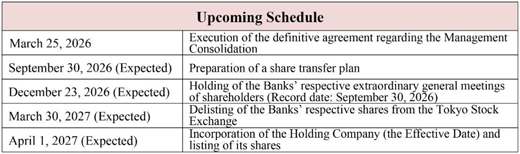
The Bank and The Chiba Bank, Ltd. (“Chiba Bank”; the Bank and Chiba Bank are hereinafter collectively referred to as the “Banks”), based on the Management Consolidation Agreement entered into between the Banks dated as of March 25, 2026 (the “Management Consolidation Agreement”), have agreed to establish a company named “Chiba Financial Group, Inc.” (the “Joint Holding Company”) as the wholly owning parent company of the Banks through a joint share transfer (the “Share Transfer”) on April 1, 2027 (the “Effective Date”), subject to obtaining approval at the respective shareholders meetings of the Banks and authorizations and other permissions by relevant authorities, and the Banks passed a resolution regarding their share transfer plan pertaining to the Share Transfer (the “Share Transfer Plan”), including candidates for Directors of the Joint Holding Company at the time of the establishment, at their respective Board of Directors meeting held on September 30, 2026.

The Bank hereby requests its shareholders to approve the Share Transfer Plan.

Reasons for implementing the share transfer, the contents of the Share Transfer Plan, and other matters concerning this proposal are as follows.

Reasons for implementing the share transfer

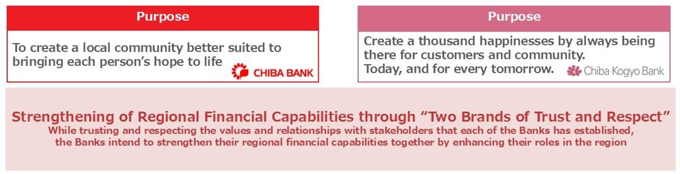
The Banks, as regional financial institutions both headquartered in Chiba Prefecture, consider their value to lie in contributing to solving regional challenges and fostering the sustainable growth of the region. The Bank has defined its purpose as “Create a thousand happinesses by always being there for our customers and community. Today, and for every tomorrow.”, and Chiba Bank has defined its purpose as “Create a local community better suited to bringing each person’s hope to life,” and the Banks have been working on various regional initiatives, either individually or occasionally in collaboration with each other.

Chiba Prefecture is located in the Tokyo metropolitan area and offers excellent access to the city center and abundant employment opportunities. The urban development around Narita Airport has established it as an international business hub, while the expansion of transportation networks such as the Metropolitan Inter-City Expressway (Ken-O Expressway) has further enhanced the flow of people and goods. Furthermore, Chiba Prefecture boasts premier national rankings in terms of prefectural gross domestic product, commerce, industry, agriculture, and even fisheries. It is also actively leveraging its tourism resources, capitalizing on its rich natural environment and warm climate.

On the other hand, customer values have become increasingly complex and diverse, their behavioral patterns have significantly changed, and social structure is undergoing major changes—including advances in digital technology, growing interest in sustainability, the impact of soaring raw material prices and worsening labor shortages. As a result, the needs of the regional community and the challenges that need to be addressed are becoming increasingly diverse and complex.

Furthermore, the long-standing policy of monetary easing undergoes significant review and competition in the financial sector is expected to intensify with the arrival of a “world with positive interest rates.” Additionally, the pace of technological innovation, including generative AI, is accelerating, and companies from other industries are increasingly entering the financial sector to pursue business opportunities, resulting in a rapidly changing business environment.

In light of these changes in the business environment, the Banks have deepened their shared understanding that further strengthening their management foundations is essential in order to continue providing stable and sophisticated financial services to the regional economy and their customers over the long term.

At a meeting of the preparatory committee on management consolidation, which consists of Directors of the Banks, the Banks determined that, in order to further contribute to the sustainable growth of their customers and the region and to help address the increasingly complex regional challenges, management consolidation between the Banks (the “Management Consolidation”), both of which have their respective regional bases in Chiba Prefecture, will contribute to the further development of Chiba Prefecture’s economy, the realization of the purposes of the Banks, and the enhancement of their corporate value. Accordingly, on March 25, 2026, the Banks reached a definitive agreement on the implementation of the management consolidation through the establishment of the Joint Holding Company.

The aim of the Management Consolidation is for the Banks, both of which already possess customer bases in Chiba Prefecture and the Tokyo metropolitan area, to “step up” to a new banking group for the region.


5


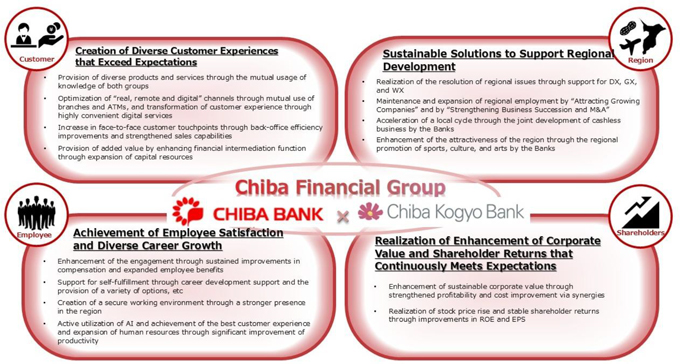
In the Management Consolidation, the Banks will work to respect each other’s operational autonomy and self-reliance to the maximum extent, and to engage in discussions and deliberations aimed at “strengthening regional financial capabilities through two brands built on mutual trust and respect.” In today’s business environment, where customer needs and challenges to be addressed are diversifying and becoming more complex, the Banks will enhance and diversify the solutions offered to customers while pursuing productivity and efficiency through deepening of collaborative relationships that leverage the Banks’ customer relationships and the Banks’ autonomy, mutual utilization of the Banks’ respective strengths in products, services, and expertise, and by leveraging each other’s management resources as their customer bases expand. Through these measures, the Banks will provide customers and the community with a better customer experience and greater added value.

In addition, amid intensifying competition in the financial sector to enhance service convenience driven by technological innovation in financial services and cross-industry expansion, the Banks believe it is essential to secure diverse personnel that enable to handle issues in value creation fields and specialized fields. Through sharing management resources of the Banks, and fostering talent by sharing knowledge, experience, and expertise in accordance with mutual trust and respect, the Banks will create new growth opportunities for employees and build a system where each employee can maximize their abilities and shine in their own way in addition to secure professional personnel.

Furthermore, as strengthening resilience—including measures against financial crimes and cybersecurity—becomes increasingly vital to ensure that customers can use our services safely and securely, the Banks strongly recognize that their responsibility to provide financial infrastructure is now more significant than ever before and they consider it their social mission to contribute to the maintenance and development of a stable and sound regional financial system. By leveraging the complementary strengths and networks of the Banks within Chiba Prefecture and ensuring the stability of the regional economy through the continued operation and further strengthening of a sound regional financial system, the Banks will contribute to the sustainable development of the regional community.

Contents of the Share Transfer Plan

See Appendix B of the prospectus which is part of the registration statement.

Regarding the Share Transfer Plan, it is required to explain the appropriateness of the provisions for the share transfer ratio, the amounts of capital stock, legal capital surplus, and legal retained earnings of the Joint Holding Company, the outline of stock acquisition rights, etc. pursuant to the provisions of Article 773 of the Companies Act and other related laws and regulations. Therefore, the outline of the provisions is described below.

Matters Concerning the Appropriateness of Provisions for the Matters Stated in Article 773, Paragraph 1, Items 5 and 6 of the Companies Act


(1)

Matters concerning the shares of the Joint Holding Company to be allocated and delivered to the shareholders of the Banks by the Joint Holding Company in the Share Transfer and the allocation of the shares of the Joint Holding Company

The Banks have determined the ratio at which shares of common stock of the Joint Holding Company will be allocated and delivered to their respective shareholders as the Joint Holding Company is established through the Share Transfer (the “Share Transfer Ratio”), as follows.

(i) Details of allotment in the Share Transfer (Share Transfer Ratio)

(a) Common stock


Company Name

   The Bank    Chiba Bank

Share Transfer Ratio

   1    1

(Note 1) Details of allotment of shares pertaining to the Share Transfer


6


One share of common stock of the Joint Holding Company will be allocated and delivered for each share of common stock of the Bank, and 1 share of common stock of the Joint Holding Company will be allocated and delivered for each share of common stock of Chiba Bank. If the number of shares of common stock of the Joint Holding Company which will be delivered to a shareholder of the Banks through the Share Transfer includes a fraction of less than one share, the Joint Holding Company will, pursuant to Article 234 of the Companies Act of Japan and other applicable laws and regulations, pay the relevant shareholder a cash amount corresponding to such fractional share. The above share transfer ratio may be changed upon discussions between the Banks in the event that significant changes occur in the terms and conditions on which the calculation is based.


(Note 2)

Number of shares unit of the Joint Holding Company and handling of shares constituting less than one unit

The number of shares unit of the Joint Holding Company shall be 100 shares.

The Banks’ shareholders who receive an allocation of shares of common stock constituting less than one unit (100 shares) of the Joint Holding Company (“Shares Constituting Less than One Unit”) through the Share Transfer may not sell their Shares Constituting Less than One Unit on the Tokyo Stock Exchange or any other securities exchange. Shareholders who hold the Shares Constituting Less than One Unit may request the Joint Holding Company to purchase their Shares Constituting Less than One Unit pursuant to the provisions of Article 192, Paragraph 1 of the Companies Act. In addition, it is expected that such shareholders may request the Joint Holding Company to sell the number of shares needed, together with the number of Shares Constituting Less than One Unit held by them, to constitute one unit pursuant to the provisions of Article 194, Paragraph 1 of the Companies Act and the provisions to be stipulated in the Articles of Incorporation of the Joint Holding Company.


(Note 3)

Number of new shares to be delivered by the Joint Holding Company through the Share Transfer (Expected)

Common stock: 837,743,132 shares

The number of shares specified above is calculated based on the total number of issued common shares of the Bank (62,222,045 shares as of September 30, 2026) and the total number of issued common shares of Chiba Bank (775,521,087 shares as of September 30, 2026). However, prior to the Effective Date of the Share Transfer, the Banks may cancel the treasury shares which are currently held or may thereafter be newly acquired by them, within the range of such treasury shares that can be canceled in practice, and the number of new shares to be issued by the Joint Holding Company is subject to change. The number of new shares specified above does not include the number of shares of common stock of the Joint Holding Company to be issued to the shareholders of the Bank’s 2nd Series of Class 6 Preferred Stock and 2nd Series of Class 7 Preferred Stock.

(b) 2nd Series of Class 6 Preferred Stock

In the share transfer of the Bank’s 2nd Series of Class 6 Preferred Stock, the variable share transfer ratio method has been adopted. Under the variable share transfer ratio method, the value of the Bank’s 2nd Series of Class 6 Preferred Stock will be determined on the date when the Board of Directors of the Banks resolved to conclude the Management Consolidation Agreement (the “Share Transfer Decision Time”), and the number of shares of common stock of the Joint Holding Company to be allotted as consideration for each share of the Bank’s 2nd Series of Class 6 Preferred Stock will be determined based on the average stock price of Chiba Bank’s common stock for a certain period of time immediately preceding the Effective Date.

In the share transfer of the Bank’s 2nd Series of Class 6 Preferred Stock, the Joint Holding Company shall allocate to shareholders of the Bank’s 2nd Series of Class 6 Preferred Stock as of the time immediately preceding the acquisition of all issued shares of the Banks (the “Record Time”), in lieu of the Bank’s 2nd Series of Class 6 Preferred Stock, the number of shares of its common stock obtained by multiplying the number of the Bank’s 2nd Series of Class 6 Preferred Stock owned by those shareholders, by the share transfer ratio calculated by the following formula:

Share transfer ratio = 20,000 yen / Average stock price of Chiba Bank’s common stock


(Note 1)

Method of calculating the share transfer ratio

The share transfer ratio is calculated to the third decimal place and rounded to the second decimal place. The average stock price of Chiba Bank’s common stock will be the simple average (calculated to the first decimal place and rounded to the nearest whole number) of the closing price per share of Chiba Bank common stock of each trading day (however, excluding days on which no trading has taken place) during the ten (10) trading days from March 5, 2027 (inclusive) to March 18, 2027 (inclusive), on the Prime Market of the Tokyo Stock Exchange, with the period required for taking administrative measures being set.


7


(Note 2)

Number of new shares to be delivered by the Joint Holding Company through the Share Transfer (Expected)

The Joint Holding Company will deliver the number of shares of its common stock obtained by multiplying the total number of the Bank’s 2nd Series of Class 6 Preferred Stock owned by shareholders of the Bank’s 2nd Series of Class 6 Preferred Stock, by the above-stated share transfer ratio. In the event that the number of shares of common stock of the Joint Holding Company to be delivered to shareholders of the Bank’s 2nd Series of Class 6 Preferred Stock is less than one share as a result of the Share Transfer, the relevant shareholders will be paid an amount corresponding to the fractional portion of less than one share in accordance with the provisions of Article 234 of the Companies Act and other relevant laws and regulations.


(Note 3)

Handling of shares that are less than one unit

Shareholders of the Banks who will be allotted shares that are less than one unit as a result of the Share Transfer may not sell these shares on the Tokyo Stock Exchange or other financial instruments exchanges; however, those shareholders who will hold such shares may request the Joint Holding Company to purchase them pursuant to Article 192, Paragraph 1 of the Companies Act. In addition, pursuant to Article 194, Paragraph 1 of the Companies Act and the provisions to be set forth in the Articles of Incorporation of the Joint Holding Company, it will also be possible for them to request the Joint Holding Company to sell the number of shares that amount to one unit together with the number of their shares that are less than one unit.

In the case of ordinary share transfers, the share transfer ratio and the number of shares of the relevant wholly owning parent company established by the share transfer to be delivered to shareholders of the relevant wholly owned subsidiary in the share transfer as consideration, are determined at the time of concluding and publicly announcing the share transfer plan (the “Announcement Time”). Therefore, at the Announcement Time, the value of the shares of the wholly owning parent company established by the share transfer that the shareholders of the wholly owned subsidiary in the share transfer will eventually own on the effective date of the share transfer will not be determined, and will fluctuate depending on the stock price trend of the shares of the wholly owned subsidiary in the share transfer between the Announcement Time and the effective date of the share transfer. Conversely, under the variable share transfer ratio method, the fair value of the shares of the wholly owned subsidiary in the share transfer will be determined at the Announcement Time, and the number of shares of the wholly owning parent company established in the share transfer to be delivered as consideration for each share of the wholly owned subsidiary will be determined by dividing the said fair value by the average stock price of the wholly owned subsidiary during a certain period immediately before the effective date of the share transfer. As a result, shareholders of the wholly owned subsidiary in the share transfer will be able to receive common stock of the wholly owning parent company established in the share transfer equivalent to the fair value of shares of that subsidiary, based on the market price immediately preceding the effective date of the share transfer. Therefore, compared to an ordinary share transfer, in which the number of shares of the wholly owning parent company to be received by shareholders of the wholly owned subsidiary based on the market price immediately preceding the date of execution of the share transfer plan, the period during which the value of the shares of the wholly owning parent company to be owned by shareholders of the wholly owned subsidiary on the effective date of the share transfer will fluctuate due to stock price trends up to the effective date of the share transfer will be shortened, and it is expected to approximate the value of the shares of the wholly owned subsidiary in the share transfer. After verifying these characteristics, the Banks carefully discussed which method is the most appropriate method to adopt, taking into consideration the fact that the Bank’s 2nd Series of Class 6 Preferred Stock is unlisted stock, to which a provision it attached that allows the Bank to acquire an amount equivalent to the amount paid (20,000 yen) for each share of the 2nd Series of Class 6 Preferred Stock after a certain period of time. As a result, the Banks determined it appropriate to have the value of common stock of the Joint Holding Company which shareholders of the Bank’s 2nd Series of Class 6 Preferred Stock will finally come to own as of the Effective Date to be approximate to the above-stated value of the Bank’s 2nd Series of Class 6 Preferred Stock (20,000 yen per share) and finally decided to adopt the variable share transfer ratio method.

(c) 2nd Series of Class 7 Preferred Stock


8


In the share transfer of the Bank’s 2nd Series of Class 7 Preferred Stock, the variable share transfer ratio method has been adopted. Under the variable share transfer ratio method, the value of the Bank’s 2nd Series of Class 7 Preferred Stock will be determined at the Share Transfer Decision Time, and the number of shares of common stock of the Joint Holding Company to be allotted as consideration for each share of the Bank’s 2nd Series of Class 7 Preferred Stock will be determined based on the average stock price of Chiba Bank’s common stock for a certain period of time immediately preceding the Effective Date.

In the share transfer of the Bank’s 2nd Series of Class 7 Preferred Stock, the Joint Holding Company shall allocate to shareholders of the Bank’s 2nd Series of Class 7 Preferred Stock as of the Record Time, in lieu of the Bank’s 2nd Series of Class 7 Preferred Stock, the number of shares of its common stock obtained by multiplying the number of the Bank’s 2nd Series of Class 7 Preferred Stock owned by those shareholders, by the share transfer ratio calculated by the following formula:

Share transfer ratio = 500,000 yen / Average stock price of Chiba Bank’s common stock


(Note 1)

Method of calculating the share transfer ratio

The share transfer ratio is calculated to the third decimal place and rounded to the second decimal place. The average stock price of Chiba Bank’s common stock will be the simple average (calculated to the first decimal place and rounded to the nearest whole number) of the closing price per share of Chiba Bank common stock of each trading day (however, excluding days on which no trading has taken place) during the ten (10) trading days from March 5, 2027 (inclusive) to March 18, 2027 (inclusive), on the Prime Market of the Tokyo Stock Exchange, with the period required for taking administrative measures being set.


(Note 2)

Number of new shares to be delivered by the Joint Holding Company through the Share Transfer (Expected)

The Joint Holding Company will deliver the number of shares of its common stock obtained by multiplying the total number of the Bank’s 2nd Series of Class 7 Preferred Stock owned by shareholders of the Bank’s 2nd Series of Class 7 Preferred Stock, by the above-stated share transfer ratio. In the event that the number of shares of common stock of the Joint Holding Company to be delivered to shareholders of the Bank’s 2nd Series of Class 7 Preferred Stock is less than one share as a result of the Share Transfer, the relevant shareholders will be paid an amount corresponding to the fractional portion of less than one share in accordance with the provisions of Article 234 of the Companies Act and other relevant laws and regulations.


(Note 3)

Handling of shares that are less than one unit

Shareholders of the Banks who will be allotted shares that are less than one unit as a result of the Share Transfer may not sell these shares on the Tokyo Stock Exchange or other financial instruments exchanges; however, those shareholders who will hold such shares may request the Joint Holding Company to purchase them pursuant to Article 192, Paragraph 1 of the Companies Act. In addition, pursuant to Article 194, Paragraph 1 of the Companies Act and the provisions to be set forth in the Articles of Incorporation of the Joint Holding Company, it will also be possible for them to request the Joint Holding Company to sell the number of shares that amount to one unit together with the number of their shares that are less than one unit.

In the case of ordinary share transfers, the share transfer ratio and the number of shares of the relevant wholly owning parent company established by the share transfer to be delivered to shareholders of the relevant wholly owned subsidiary in the share transfer as consideration, are determined at the Announcement Time. Therefore, at the Announcement Time, the value of the shares of the wholly owning parent company established by the share transfer that the shareholders of the wholly owned subsidiary in the share transfer will eventually own on the effective date of the share transfer will not be determined, and will fluctuate depending on the stock price trend of the shares of the wholly owned subsidiary in the share transfer between the Announcement Time and the effective date of the share transfer. Conversely, under the variable share transfer ratio method, the fair value of the shares of the wholly owned subsidiary in the share transfer will be determined at the Announcement Time, and the number of shares of the wholly owning parent company established in the share transfer to be delivered as consideration for each share of the wholly owned subsidiary will be determined by dividing the said fair value by the average stock price of the wholly owned subsidiary during a certain period immediately before the effective date of the share transfer. As a result, shareholders of the wholly owned subsidiary in the share transfer will be able to receive common stock of the wholly owning parent company established in the share transfer equivalent to the fair value of shares of that subsidiary, based on the market price immediately preceding the effective date of the share transfer. Therefore, compared to an ordinary share transfer, in which the number of shares of the wholly owning parent company to be received by shareholders of the wholly owned subsidiary based on the market price immediately preceding the date of execution of the share transfer plan, the period during which the value of the shares of the wholly owning parent company to be owned by shareholders of the wholly owned subsidiary on the effective date of the share transfer will fluctuate due to stock price trends up to the effective date of the share transfer will be shortened, and it is expected to approximate the value of the shares of the wholly owned subsidiary in the share transfer. After verifying these characteristics, the Banks carefully discussed which method is the most appropriate method to adopt, taking into consideration the fact that the Bank’s 2nd Series of Class 7 Preferred Stock is unlisted stock, to which a provision it attached that allows the Bank to acquire an amount equivalent to the amount paid (500,000 yen) for each share of the 2nd Series of Class 7 Preferred Stock after a certain period of time. As a result, the Banks determined it appropriate to have the value of common stock of the Joint Holding Company which shareholders of the Bank’s 2nd Series of Class 7 Preferred Stock will finally come to own as of the Effective Date to be approximate to the above-stated value of the Bank’s 2nd Series of Class 7 Preferred Stock (500,000 yen per share) and finally decided to adopt the variable share transfer ratio method.


9


(ii) Basis and reasons for the details of allotment

Based on the Memorandum of Understanding concerning deliberations of the Management Consolidation entered into on September 29, 2025 between the Banks, the Banks established the preparatory committee on the management consolidation and have been discussing and deliberating consummation of the management consolidation through the incorporation of the Joint Holding Company under a share transfer on or around April 1, 2027.

As described in (iv) “Measures to ensure fairness” below, Chiba Bank appointed Mitsubishi UFJ Morgan Stanley Securities Co., Ltd. (“Mitsubishi UFJ Morgan Stanley Securities”) as an independent third-party appraiser and Nagashima Ohno & Tsunematsu as a legal advisor in order to ensure the fairness of the consideration for the Share Transfer and of other aspects of the Share Transfer, and commenced deliberations with respect to the Share Transfer. After careful discussions and deliberations with reference to the analysis prepared by Mitsubishi UFJ Morgan Stanley Securities and the advice provided by Nagashima Ohno & Tsunematsu, Chiba Bank concluded that it is appropriate to implement the Share Transfer based on the share transfer ratio indicated in (i) “Details of allotment in the Share Transfer (share transfer ratio)” above.

On the other hand, as described in (iv) “Measures to ensure fairness” below, the Bank appointed Mizuho Securities Co., Ltd. (“Mizuho Securities”) as an independent third-party appraiser and Nishimura & Asahi as a legal advisor in order to ensure the fairness of the consideration for the Share Transfer and of other aspects of the Share Transfer, and commenced deliberations with respect to the Share Transfer. After careful discussions and deliberations with reference to the analysis prepared by Mizuho Securities and the advice provided by Nishimura & Asahi, the Bank concluded that it is appropriate to implement the Share Transfer with the share transfer ratio indicated in (i) “Details of allotment in the Share Transfer (share transfer ratio)” above.

As described above, the Banks carefully negotiated and discussed the share transfer ratio, comprehensively taking into account factors such as the market share price, financial position, and future prospects of the Banks, based on the results of the due diligence conducted by each of the Banks on the other, with each of the Banks making reference to the calculation and analysis by its third-party appraiser, and the legal advice of its legal advisor. As a result of such negotiations and discussions, the Banks concluded that the share transfer ratio is appropriate, and at their respective boards of directors’ meetings held on March 25, 2026, the Banks resolved to determine and agreed on the share transfer ratio for the Share Transfer.

(iii) Matters concerning calculation

(a) Common stock

(i) Names of the appraisers and relationship with the Banks

Mitsubishi UFJ Morgan Stanley Securities, a financial advisor (third-party appraiser) of Chiba Bank, is not a related party of the Banks and it does not have any material interest requiring disclosure in regard to the Share Transfer.

The remuneration to be paid to Mitsubishi UFJ Morgan Stanley Securities in connection with the Share Transfer includes a contingency fee that is to be paid subject to conditions that include the successful completion of the Share Transfer. However, Chiba Bank has determined that the inclusion of this contingency fee does not prevent independence, taking into account the general practice in similar cases.


10


Thus, Chiba Bank appointed Mitsubishi UFJ Morgan Stanley Securities as a third-party appraiser based on the aforementioned remuneration system.

Mizuho Securities, a financial advisor (third-party appraiser) of the Bank, is not a related party of Chiba Bank. Mizuho Securities, Mizuho Bank, Ltd. (“Mizuho Bank”), and Mizuho Trust & Banking Co., Ltd. (“Mizuho Trust Bank”), which are group companies of Mizuho Securities, have the status of shareholders of the Bank; however, they do not have any material interest that will constitute a conflict of interest in the Share Transfer. According to Mizuho Securities, pursuant to Article 36 of the Financial Instruments and Exchange Act (Act No. 25 of 1948; as amended) and Article 70-4 of the Cabinet Office Order on Financial Instruments Business (Cabinet Office Order No. 52 of 2007; as amended), Mizuho Securities has an appropriate conflict of interest management system in place, which includes information barrier measures between Mizuho Securities’ financial advisory services department and another department of Mizuho Securities that holds shares in the Bank, as well as between Mizuho Securities on one side and Mizuho Bank and Mizuho Trust Bank on the other side. Through these measures, Mizuho Securities calculated the share transfer ratio from a standpoint independent of Mizuho Securities, Mizuho Bank, and Mizuho Trust Bank in their respective capacities as shareholders of the Bank. The Bank appointed Mizuho Securities as a third-party appraiser independent of the Banks, as appropriate measures to prevent harmful effects have been implemented within Mizuho Securities and between Mizuho Securities on one side, and Mizuho Bank and Mizuho Trust Bank on the other side.

The remuneration to be paid to Mizuho Securities in connection with the Share Transfer includes a contingency fee that is to be paid subject to conditions that include the successful completion of the Share Transfer. However, the Bank has determined that the inclusion of this contingency fee does not prevent independence, taking into account the general practice in similar cases. Thus, the Bank appointed Mizuho Securities as a third-party appraiser based on the aforementioned remuneration system.

(ii) Outline of the calculation

In order to ensure fairness in calculating the share transfer ratio used for the Share Transfer, Chiba Bank appointed Mitsubishi UFJ Morgan Stanley Securities and the Bank appointed Mizuho Securities as their respective third-party appraisers for calculating and analyzing the share transfer ratio.

Mitsubishi UFJ Morgan Stanley Securities conducted the market share price analysis, because the shares of the Banks are listed on a financial instruments exchange and market prices are available for their shares, as well as the comparable peer company multiple analysis, because there exist multiple listed peer companies that are comparable to each of the Banks and Mitsubishi UFJ Morgan Stanley Securities was able to estimate share value of each of the Banks using the comparable peer company multiple analysis. Furthermore, in order to reflect the status of future business activities in the valuation, Mitsubishi UFJ Morgan Stanley Securities conducted the dividend discount model analysis (the “DDM Analysis”).

In the market share price analysis, Mitsubishi UFJ Morgan Stanley Securities used March 24, 2026 as the reference date, and used the closing price on the reference date on the Tokyo Stock Exchange and the simple average of the closing prices on each trading day for the past 1 month, 3 months and 6 months prior to the reference date.

The calculation of share value in the DDM Analysis is based on various factors, including the profits in the financial projections and investment plans presented by the management of the Banks, which the Banks agreed to use for the calculation purpose; the results of due diligence conducted on the Banks; and other publicly available information and material.

The financial projections of the Bank used by Mitsubishi UFJ Morgan Stanley Securities as a basis for the DDM Analysis include a fiscal year in which significant increases or decreases in profit are expected. Specifically, an increase in interest income from loans is expected for the fiscal year ending March 2028, which is expected to result in a significant increase in profit attributable to owners of parent. The financial projections of Chiba Bank do not include any fiscal years in which significant increases or decreases in profit are expected.

The results of the calculations under each analysis above are indicated below. The results of the calculations of the share transfer ratio below represent the number of common shares of the Joint Holding Company to be allotted for one common share of the Bank, assuming that one common share of the Joint Holding Company is allotted for one common share of Chiba Bank.


11


Approach


Calculation results of share transfer ratio

1

   Market share price analysis    0.98 - 1.02

2

   Comparable peer company multiple analysis    0.73 - 1.18

3

   DDM Analysis    0.74 - 1.29


(Note)

The analysis by Mitsubishi UFJ Morgan Stanley Securities and the analysis of the underlying share transfer ratio were provided to Chiba Bank for its reference. Such analysis does not constitute a financial opinion or recommendation of Mitsubishi UFJ Morgan Stanley Securities or its affiliates, nor does it constitute an approval of the Share Transfer, or an opinion or recommendation to the shareholders of Chiba Bank or the Bank or any other person regarding the transfer and acquisition of shares or the exercise of shareholder rights, including the exercise of voting rights, or consent to the Share Transfer or any other related matters. Mitsubishi UFJ Morgan Stanley Securities relied on information that was already publicly disclosed or provided or otherwise made available to it by Chiba Bank or the Bank for the analysis and calculation of the share transfer ratio on the assumption that such information is accurate and complete, and Mitsubishi UFJ Morgan Stanley Securities has not independently verified the accuracy or completeness thereof. Also, Mitsubishi UFJ Morgan Stanley Securities assumed that the financial projections were reasonably prepared by the management of the Banks to reflect the best estimates and judgments available at the time they were provided with respect to the future financial condition of the Banks. Mitsubishi UFJ Morgan Stanley Securities is not a legal, accounting or tax adviser. Mitsubishi UFJ Morgan Stanley Securities acted as financial adviser to Chiba Bank in connection with the Share Transfer and relied on the determinations of Chiba Bank and Chiba Bank’s legal, accounting and tax advisers for issues relating to legal, accounting, and tax matters without independently verifying them. Mitsubishi UFJ Morgan Stanley Securities has not made or obtained any independent assessment or appraisal of the assets and liabilities (including off-balance sheet assets and liabilities and other contingent liabilities) of Chiba Bank, the Bank or their affiliates, nor has it requested any third-party institution to value or appraise them. Mitsubishi UFJ Morgan Stanley Securities’ analysis is based on economic, financial, market, and other conditions as of the reference date of the share transfer ratio calculation report and on information made available to Mitsubishi UFJ Morgan Stanley Securities as of such reference date. Although there is a possibility that an event occurring on or after the reference date may affect the basis on which the Mitsubishi UFJ Morgan Stanley Securities’ analysis and the share transfer ratio calculation report have been prepared, Mitsubishi UFJ Morgan Stanley Securities is not obligated to update, revise or reconfirm the share transfer ratio calculation report or its analysis. In addition, the preparation of the share transfer ratio calculation report and the underlying analysis therefor was a complex process and is not necessarily suitable for partial analysis or summary description. The valuation ranges based on the specific analysis described herein may not be considered as Mitsubishi UFJ Morgan Stanley Securities’ assessment of the actual value of Chiba Bank or the Bank.

In calculating the share transfer ratio, Mizuho Securities conducted the average market price method, because the shares of the Banks are listed on the Prime Market of the Tokyo Stock Exchange and market prices are available for their shares, as well as the comparable company analysis, because there exist multiple listed companies that are comparable to each of the Banks and Mizuho Securities was able to estimate share value of each of the Banks using the comparable multiple valuation method. Furthermore, in order to reflect the status of future business activities in the valuation, Mizuho Securities conducted the dividend discount model method (the “DDM Method”), which is a method used to analyze the share value by discounting to its present value the cash flows attributable to the shareholders after taking into account retained earnings and other factors necessary to maintain a certain capital structure, using cost of capital, and is a method used generally for the analysis of financial institutions. The results of the calculations under each method above are indicated below. The calculated ranges for the share transfer ratio below represent the number of common shares of the Joint Holding Company to be allotted for one common share of the Bank, assuming that one common share of the Joint Holding Company is allotted for one common share of Chiba Bank.


12


Approach


Calculated range of share transfer ratio

1

   Average market price method    0.98 - 1.02

2

   Comparable company analysis    0.81 - 1.25

3

   DDM Method    0.74 - 1.57

Under the average market price method, Mizuho Securities used March 24, 2026 as the reference date and calculated the share transfer ratio based on (i) the closing price of the shares on the Tokyo Stock Exchange on that date, and (ii) the simple average of the closing prices over the 1 month, 3 months and 6 months periods preceding the reference date.

The future profit plans of the Bank used by Mizuho Securities as a basis for the DDM Method include a fiscal year in which significant increases or decreases in profit are expected. Specifically, an increase in interest income from loans is expected for the fiscal year ending March 2028, which is expected to result in a significant increase in profit attributable to owners of parent. Furthermore, the future profit plans of Chiba Bank do not include any fiscal years in which significant increases or decreases in profit are expected.

In calculating the share transfer ratio, Mizuho Securities in principle used as-is material and information provided by the Banks as well as publicly available information and other data. Mizuho Securities assumed and relied on the accuracy and completeness of all material, information and other data that Mizuho Securities reviewed or analyzed, and did not independently verify or assume any obligation to independently verify the accuracy or completeness of such material and information. Mizuho Securities did not undertake an independent evaluation, appraisal or assessment of any of the assets or liabilities (including, but not limited to, financial derivative products, off-balance-sheet assets and liabilities, and other contingent liabilities), on an aggregate or individual basis, of the Banks or any of their respective affiliates, nor did Mizuho Securities make any request to a third party for any such valuation, appraisal or assessment. Mizuho Securities assumed that the business plans, financial projections, and other forward-looking information provided by each of the Banks were reasonably prepared based on the best possible forecasts and judgments currently available to the respective management of the Banks.

(b) 2nd Series of Class 6 Preferred Stock

The Bank determined the share transfer ratio of the 2nd Series of Class 6 Preferred Stock based on the following details of the 2nd Series of Class 6 Preferred Stock, and through careful negotiation and consultations with Chiba Bank, with the advice of Mizuho Securities, and it has not obtained a valuation report from any third-party appraiser.

It is stipulated that, after October 1, 2027, if a date separately determined by the Board of Directors of the Bank comes, the Bank may acquire all or part of the 2nd Series of Class 6 Preferred Stock in accordance with the transaction term under which money will be paid in consideration. It is stipulated that, in such case, the Bank shall deliver, in exchange for the acquisition of the 2nd Series of Class 6 Preferred Stock, for each share of the 2nd Series of Class 6 Preferred Dividends: the total of (i) a monetary equivalent to the amount paid for the 2nd Series of Class 6 Preferred Stock (20,000 yen) (However, in the event of a share split, the allotment of share without contribution, share consolidation, or similar reasons concerning the 2nd Series of Class 6 Preferred Stock, appropriate adjustments shall be made) plus (ii) the amount equivalent to the accrued 2nd Series of Class 6 Preferred Dividends. In addition, the year-end dividend of the 2nd Series of Class 6 Preferred Stock (300 yen per share), with the Record Date set on March 31, 2027, shall be separately paid as the year-end dividend in late June 2027, which is after the Effective Date of the Share Transfer, to the ultimate shareholders of the 2nd Series of Class 6 Preferred Stock stated or recorded in the shareholder register as of that Record Date, or to the trust trustees or registered pledgees of the 2nd Series of Class 6 Preferred Stock.

(c) 2nd Series of Class 7 Preferred Stock

The Bank determined the share transfer ratio of the 2nd Series of Class 7 Preferred Stock based on the following details of the 2nd Series of Class 7 Preferred Stock, and through careful negotiation and consultations with Chiba Bank, with the advice of Mizuho Securities, and it has not obtained a valuation report from any third-party appraiser.

It is stipulated that, after October 1, 2027, if a date separately determined by the Board of Directors of the Bank comes, the Bank may acquire all or part of the 2nd Series of Class 7 Preferred Stock in accordance with the transaction term under which money will be paid in consideration. It is stipulated that, in such case, the Bank shall deliver, in exchange for the acquisition of the 2nd Series of Class 7 Preferred Stock, for each share of the 2nd Series of Class 7 Preferred Dividends: the total of (i) a monetary equivalent to the amount paid for the 2nd Series of Class 7 Preferred Stock (500,000 yen) (However, in the event of a share split, the allotment of share without contribution, share consolidation, or similar reasons concerning the 2nd Series of Class 7 Preferred Stock, appropriate adjustments shall be made) plus (ii) the amount equivalent to the accrued 2nd Series of Class 7 Preferred Dividends. In addition, the year-end dividend of the 2nd Series of Class 7 Preferred Stock (9,000 yen per share), with the Record Date set on March 31, 2027, shall be separately paid as the year-end dividend in late June 2027, which is after the Effective Date of the Share Transfer, to the ultimate shareholders of the 2nd Series of Class 7 Preferred Stock stated or recorded in the shareholder register as of that Record Date, or to the trust trustees or registered pledgees of the 2nd Series of Class 7 Preferred Stock.


13


(iv) Measures to ensure fairness

In order to ensure the fairness of the Share Transfer, Chiba Bank has taken the following measures.

(a) Obtaining a share transfer ratio analysis report from an independent third-party appraiser

In order to ensure the fairness of the Share Transfer, Chiba Bank appointed Mitsubishi UFJ Morgan Stanley Securities as a financial advisor and third-party appraiser independent of the Banks as described in (ii) “Basis and reasons for the details of allotment” above, and obtained a share transfer ratio analysis report in order to use it as a basis for the agreement on the share transfer ratio for the Share Transfer. In addition, Chiba Bank conducted negotiations and discussions with the Bank with reference to the analyses and advice of Mitsubishi UFJ Morgan Stanley Securities, its financial advisor and third-party appraiser, and resolved at its board of directors held on March 25, 2026 that Chiba Bank will implement the Share Transfer with the share transfer ratio as described in (i) “Details of allotment in the Share Transfer (Share Transfer Ratio)” above.

(b) Advice from independent law firm

In order to ensure the fairness and adequacy of the decision making of the board of directors, Chiba Bank obtained legal advice on the method and process of its decision making and other procedures relating to the Share Transfer (including legal advice regarding fiduciary duties of directors) from Nagashima Ohno & Tsunematsu as a legal advisor independent of the Banks. Nagashima Ohno & Tsunematsu is not a related party of the Banks and has no material interests requiring disclosure in regard to the Management Consolidation.

Meanwhile, in order to ensure the fairness of the Share Transfer, the Bank has taken the following measures.

(a) Obtaining a share transfer ratio analysis report from an independent third-party appraiser

In order to ensure the fairness of the Share Transfer, the Bank appointed Mizuho Securities as a financial adviser and third-party appraiser independent of the Banks as described in (ii) “Basis and reasons for the details of allotment” above, and Mizuho Securities conducted the financial analysis and calculation of the share transfer ratio for the Share Transfer to be used in the negotiations and discussions. The Bank conducted negotiations and discussions with Chiba Bank with reference to the analysis and advice of Mizuho Securities, its financial advisor and third-party appraiser, and resolved at its board of directors held on March 25, 2026 that the Bank will implement the Share Transfer with the share transfer ratio as described in (i) “Details of allotment in the Share Transfer (Share Transfer Ratio)” above.

(b) Advice from independent law firm

In order to ensure the fairness and adequacy of the decision making of the board of directors, the Bank obtained legal advice on the method and process of its decision making and other procedures relating to the Share Transfer (including legal advice regarding fiduciary duties of directors) from Nishimura & Asahi as a legal advisor independent of the Banks.

(2) Matters concerning the amounts of capital stock, legal capital surplus, and legal retained earnings of the Joint Holding Company

For the establishment of the Joint Holding Company through the Share Transfer, the Bank and Chiba Bank have determined the amounts of capital stock, legal capital surplus, and legal retained earnings of the Joint Holding Company as follows.


14


(i) Amount of capital stock

     150.0 billion yen  

(ii)  Amount of legal capital surplus

     37.5 billion yen  

(iii)  Amount of legal retained earnings

     0 yen  

The Bank and Chiba Bank have, after discussions, determined the amounts of capital stock, legal capital surplus, and legal retained earnings, pursuant to the provisions of Article 52 of the Regulation on Corporate Accounting and comprehensively taking into account and considering the size of the Joint Holding Company and other factors.


15


Matters Concerning the Appropriateness of Provisions for the Matters Stated in Article 773, Paragraph 1, Items 9 and 10 of the Companies Act

In connection with the Share Transfer, the Joint Holding Company will allocate and deliver its stock acquisition rights described in Column 2 of the table below to the holders of those stock acquisition rights issued by the Bank and outstanding as of the record time that are described in Column 1, items (1) to (13), of the table below, in substitute for those stock acquisition rights of the Bank they each hold, based on the terms of those stock acquisition rights and the Share Transfer Ratio. The number of those Joint Holding Company stock acquisition rights to be allocated and delivered will be equal to the total number of those stock acquisition rights of the Bank.


Column 1


Column 2


Stock acquisition rights issued by Chiba Kogyo


Stock acquisition rights of the Joint Holding Company to be delivered


Name


Terms


Name


Terms

(1)   

The Chiba Kogyo Bank, Ltd.

1st Series of Stock Acquisition Rights

   Described in Attachment
2-(i)-1 of Share Transfer Plan
  

Chiba Financial Group, Inc.

1st Series of Stock Acquisition Rights

   Described in Attachment
2-(i)-2 of Share Transfer Plan
(2)   

The Chiba Kogyo Bank, Ltd.

2nd Series of Stock Acquisition Rights

   Described in Attachment
2-(ii)-1 of Share Transfer Plan
  

Chiba Financial Group, Inc.

2nd Series of Stock Acquisition Rights

   Described in Attachment
2-(ii)-2 of Share Transfer Plan
(3)   

The Chiba Kogyo Bank, Ltd.

3rd Series of Stock Acquisition Rights

   Described in Attachment
2-(iii)-1 of Share Transfer Plan
  

Chiba Financial Group, Inc.

3rd Series of Stock Acquisition Rights

   Described in Attachment
2-(iii)-2 of Share Transfer Plan
(4)   

The Chiba Kogyo Bank, Ltd.

4th Series of Stock Acquisition Rights

   Described in Attachment
2-(iv)-1 of Share Transfer Plan
  

Chiba Financial Group, Inc.

4th Series of Stock Acquisition Rights

   Described in Attachment
2-(iv)-2 of Share Transfer Plan
(5)   

The Chiba Kogyo Bank, Ltd.

5th Series of Stock Acquisition Rights

   Described in Attachment
2-(v)-1 of Share Transfer Plan
  

Chiba Financial Group, Inc.

5th Series of Stock Acquisition Rights

   Described in Attachment
2-(v)-2 of Share Transfer Plan
(6)   

The Chiba Kogyo Bank, Ltd.

6th Series of Stock Acquisition Rights

   Described in Attachment
2-(vi)-1 of Share Transfer Plan
  

Chiba Financial Group, Inc.

6th Series of Stock Acquisition Rights

   Described in Attachment
2-(vi)-2 of Share Transfer Plan
(7)   

The Chiba Kogyo Bank, Ltd.

8th Series of Stock Acquisition Rights

   Described in Attachment
2-(vii)-1 of Share Transfer Plan
  

Chiba Financial Group, Inc.

8th Series of Stock Acquisition Rights

   Described in Attachment
2-(vii)-2 of Share Transfer Plan
(8)   

The Chiba Kogyo Bank, Ltd.

9th Series of Stock Acquisition Rights

   Described in Attachment
2-(viii)-1 of Share Transfer Plan
  

Chiba Financial Group, Inc.

9th Series of Stock Acquisition Rights

   Described in Attachment
2-(viii)-2 of Share Transfer Plan
(9)   

The Chiba Kogyo Bank, Ltd.

10th Series of Stock Acquisition Rights

   Described in Attachment
2-(ix)-1 of Share Transfer Plan
  

Chiba Financial Group, Inc.

10th Series of Stock Acquisition Rights

   Described in Attachment
2-(ix)-2 of Share Transfer Plan
(10)   

The Chiba Kogyo Bank, Ltd.

11th Series of Stock Acquisition Rights

   Described in Attachment
2-(x)-1 of Share Transfer Plan
  

Chiba Financial Group, Inc.

11th Series of Stock Acquisition Rights

   Described in Attachment
2-(x)-2 of Share Transfer Plan
(11)   

The Chiba Kogyo Bank, Ltd.

12th Series of Stock Acquisition Rights

   Described in Attachment
2-(xi)-1 of Share Transfer Plan
  

Chiba Financial Group, Inc.

12th Series of Stock Acquisition Rights

   Described in Attachment
2-(xi)-2 of Share Transfer Plan
(12)   

The Chiba Kogyo Bank, Ltd.

13th Series of Stock Acquisition Rights

   Described in Attachment
2-(xii)-1 of Share Transfer Plan
  

Chiba Financial Group, Inc.

13th Series of Stock Acquisition Rights

   Described in Attachment
2-(xii)-2 of Share Transfer Plan
(13)   

The Chiba Kogyo Bank, Ltd.

14th Series of Stock Acquisition Rights

   Described in Attachment
2-(xiii)-1 of Share Transfer Plan
  

Chiba Financial Group, Inc.

14th Series of Stock Acquisition Rights

   Described in Attachment
2-(xiii)-2 of Share Transfer Plan


16


(Note)

The Attachments referred to in the column “Terms” are the attachments of the Share Transfer Plan. See Appendix B of the prospectus which is part of the registration statement.

Matters Concerning Chiba Bank

(1) Financial statements, etc. for the last fiscal year ended March 31, 2026

The details of the financial statements, etc. of Chiba Bank for the last fiscal year ended March 31, 2026 (from April 1, 2025 to March 31, 2026) are not presented in these Reference Documents for the Extraordinary General Meeting of Shareholders pursuant to the provisions of laws and regulations and the Bank’s Articles of Incorporation and are posted on the Bank’s website and the website of the Tokyo Stock Exchange.

(2) Details of events that occurred to Chiba Bank after the last day of the last fiscal year and have a material impact on the status of its assets

Not applicable.

Details of Events That Occurred to the Bank After the Last Day of the Last Fiscal Year and Have a Material Impact on the Status of Its Assets

(1) The Bank acquired all of the shares of its 1st Series of Class 7 Preferred Stock (481,500 shares) for a total of 24,076,189,305 yen on April 1, 2026, and cancelled them on the same date.

(2) The Bank acquired some of the shares of its 2nd Series of Class 7 Preferred Stock (4,198 shares) for a total of 2,113,388,093 yen on August 17, 2026.


17


Matters Set Forth in Article 74 of the Regulations for Enforcement of the Companies Act Concerning Persons Who Will Become Directors (Excluding Directors Concurrently Serving as Audit and Supervisory Committee Members) of the Joint Holding Company

The persons who will become Directors (excluding Directors concurrently serving as Audit and Supervisory Committee members) of the Joint Holding Company are as follows.


Name
(Date of birth)
   Past experience (positions, responsibilities, and significant concurrent positions)   

•

Number of shares of Chiba Bank held


•

Number of shares of the Bank held


•

Number of shares of the Joint Holding Company to be allocated

LOGO


Tsutomu Yonemoto

(Jul. 9, 1964)

(Male)


Past experience, positions, responsibilities and status of significant concurrent positions:


•

Number of shares of Chiba Bank held:
237,018 shares


•

Number of shares of the Bank held:
0 shares


•

Number of shares of the Joint Holding Company to be allocated:
237,018 shares


Apr.  1987

   Joined Chiba Bank
  

Jun.   2016

   Executive Officer, General Manager, Business Promotion Division
  

Jun.   2017

   Director and Managing Executive Officer
  

Jun.   2018

   Director and Managing Executive Officer, General Manager in charge of Business Promotion, Group Chief Business Officer
  

Jun.   2019

   Director and Senior Executive Officer, General Manager in charge of Corporate Planning, Group Chief Strategy Officer
  

Apr.  2020

   Director and Senior Executive Officer, General Manager in charge of Corporate Planning, Group Chief Strategy Officer, Group Chief Digital Transformation Officer
  

Apr.  2021

   Director and Senior Executive Officer
  

Jun.   2021

   President, Group Chief Operating Officer
  

Apr.  2023

   President, Group Chief Executive Officer (current position)


•

Reasons for nomination as a candidate for Director


Tsutomu Yonemoto has served in various important positions within Chiba Bank, including General Manager, Corporate Planning Division, and General Manager, Business Promotion Division, and he has been a Director of Chiba Bank since June 2017 and has also been President of Chiba Bank since June 2021. He has a wealth of experience and extensive expertise regarding banking business management and group management.


The Bank has determined that by leveraging the experience and expertise, he can contribute to the enhancement of the Joint Holding Company’s corporate value and the company’s sustained growth while also contributing to increasing the effectiveness of decision-making and supervisory functions of the Board of Directors. Accordingly, the Bank has nominated him as a candidate for Director.


18


Name
(Date of birth)
   Past experience (positions, responsibilities, and significant concurrent positions)   

•

Number of shares of Chiba Bank held


•

Number of shares of the Bank held


•

Number of shares of the Joint Holding Company to be allocated

LOGO


Hitoshi Umeda

(Dec. 24, 1962)

(Male)

   Past experience, positions, responsibilities and status of significant concurrent positions:   

•

Number of shares of Chiba Bank held:
0 shares


•

Number of shares of the Bank held:
4,800 shares


•

Number of shares of the Joint Holding Company to be allocated:
4,800 shares


Apr.  1986

   Joined Chiba Kogyo Bank
  

Jun.   2014

   Executive Officer, General Manager of Management Planning Division
  

Apr.  2016

   Executive Officer, General Manager of Sales Division of Head Office
  

May  2016

   Managing Executive Officer, General Manager of Sales Division of Head Office
  

Apr.  2017

   Managing Executive Officer
  

Jun.   2018

   Managing Director, Managing Executive Officer
  

Apr.  2019

   President, Chief Executive Officer (CEO) (current position)


•

Reasons for nomination as a candidate for Director


Hitoshi Umeda has served in various important positions within Chiba Kogyo Bank, including General Manager of Management Planning Division and General Manager of Sales Division of Head Office, and he has been a Director of the Bank since June 2018 and has also been President of the Bank since April 2019.


He has a wealth of experience and extensive expertise regarding banking business management and group management. The Bank has determined that by leveraging this experience and expertise, he can contribute to the enhancement of the Joint Holding Company’s corporate value and the company’s sustained growth while also contributing to increasing the effectiveness of decision-making and supervisory functions of the Board of Directors. Accordingly, the Bank has nominated him as a candidate for Director.


19


Name
(Date of birth)
   Past experience (positions, responsibilities, and significant concurrent positions)   

•

Number of shares of Chiba Bank held


•

Number of shares of the Bank held


•

Number of shares of the Joint Holding Company to be allocated

LOGO


Shinichi Ito

(Nov. 25, 1971)

(Male)


Past experience, positions, responsibilities and status of significant concurrent positions:


•

Number of shares of Chiba Bank held:
36,840 shares


•

Number of shares of the Bank held:
0 shares


•

Number of shares of the Joint Holding Company to be allocated:
36,840 shares


Apr.  1994

   Joined Chiba Bank
  

Apr.  2021

   General Manager, Inage Branch, and General Manager, Ayamedai Sub Branch, Inage Branch
  

Apr.  2022

   General Manager, Asset Management and Consultation Division
  

Apr.  2023

   Executive Officer and General Manager, Asset Management and Consultation Division
  

Apr.  2024

   Executive Officer and General Manager, Corporate Business Division
  

Apr.  2025

   Managing Executive Officer and General Manager, Corporate Planning Division (current position)


•

Reasons for nomination as a candidate for Director


Shinichi Ito has served in various important positions within Chiba Bank, including General Manager of four branches as well as General Manager, Asset Management and Consultation Division, General Manager, Corporate Business Division, and General Manager, Corporate Planning Division, and has extensive business experience and expertise.


The Bank has determined that by leveraging this experience and expertise, he can contribute to the enhancement of the Joint Holding Company’s corporate value and the company’s sustained growth while also contributing to increasing the effectiveness of decision-making and supervisory functions of the Board of Directors. Accordingly, the Bank has nominated him as a candidate for Director.


20


Name
(Date of birth)
   Past experience (positions, responsibilities, and significant concurrent positions)   

•

Number of shares of Chiba Bank held


•

Number of shares of the Bank held


•

Number of shares of the Joint Holding Company to be allocated

LOGO


Taro Kanzawa

(May 25, 1971)

(Male)

   Past experience, positions, responsibilities and status of significant concurrent positions:   

•

Number of shares of Chiba Bank held:
16,659 shares


•

Number of shares of the Bank held:
0 shares


•

Number of shares of the Joint Holding Company to be allocated:
16,659 shares


Apr.  1995

   Joined Chiba Bank
  

Jun.   2017

   General Manager, Hong Kong Branch
  

Apr.  2019

   General Manager, Compliance Division
  

Apr.  2020

   General Manager, Compliance and Risk Management Division
  

Nov. 2021

   General Manager, Corporate Planning Division
  

Apr.  2024

   Executive Officer in charge of Special Appointment
  

Apr.  2026

   Managing Executive Officer in charge of Special Appointment (current position)


•

Reasons for nomination as a candidate for Director


Taro Kanzawa has served as head of two overseas branches of Chiba Bank, as well as General Manager of the Compliance Division, General Manager of the Compliance and Risk Management Division, General Manager of the Corporate Planning Division, and in charge of Special Appointment, possessing extensive business experience and expertise.


The Bank has determined that by leveraging this experience and expertise, he can contribute to the enhancement of the Joint Holding Company’s corporate value and the company’s sustained growth while also contributing to increasing the effectiveness of decision-making and supervisory functions of the Board of Directors. Accordingly, the Bank has nominated him as a candidate for Director.


21


Name
(Date of birth)
   Past experience (positions, responsibilities, and significant concurrent positions)   

•

Number of shares of Chiba Bank held


•

Number of shares of the Bank held


•

Number of shares of the Joint Holding Company to be allocated

LOGO


Takahide Kiuchi

(Nov. 29, 1963)

(Male)

   Past experience, positions, responsibilities and status of significant concurrent positions:   

•

Number of shares of Chiba Bank held:
0 shares


•

Number of shares of the Bank held:
0 shares


•

Number of shares of the Joint Holding Company to be allocated:
0 shares


Apr.  1987

   Joined Nomura Research Institute, Ltd.
  

Jun.   2002

   Head, Japanese Economic Research Unit, Economic Research Department, Nomura Research Institute, Ltd.
  

Jun.   2004

   Deputy Head, Economic Research Department and Head, Japanese Economic Research Section, Financial & Economic Research Center, Nomura Securities Co., Ltd.
  

Jun.   2007

   Managing Director, Head, Economic Research Department and Chief Economist, Financial & Economic Research Center, Nomura Securities Co., Ltd.
  

Jul.  2012

   Member of the Policy Board, Bank of Japan
  

Jul.  2017

   Executive Economist, Nomura Research Institute, Ltd. (current position)
  

Jun.   2020

   Outside Director, Chiba Bank (current position)


•

Reasons for nomination as a candidate for Outside Director and overview of expected role


Takahide Kiuchi has a high level of expertise and a wealth of experience regarding economy and finance of Japan and other countries gained through his career as an economist at Nomura Research Institute, Ltd. and Nomura Securities Co., Ltd. and by serving as a member of the Policy Board of Bank of Japan.


He has also served as Outside Director of Chiba Bank since June 2020 and has deepened his understanding of Chiba Bank’s business and management.


The Bank has determined that by leveraging this experience and expertise and supervising the management of the Joint Holding Company and providing advice for the management from an independent standpoint, he can contribute to the enhancement of the Joint Holding Company’s corporate value and the company’s sustained growth while also contributing to increasing the effectiveness of decision-making and supervisory functions of the Board of Directors. Accordingly, the Bank has nominated him as a candidate for Outside Director.


He does not have experience of engaging in the business management of a company in other ways than serving as an outside officer; however, for the reasons above, the Bank believes that he will appropriately perform his duties as an Outside Director of the Joint Holding Company.


•

Matters Concerning Independence


Although there are transactional relationships between Nomura Research Institute, Ltd., to which Takahide Kiuchi belongs, and Chiba Bank as well as Chiba Kogyo Bank , considering the scale and nature of these transactions, we have determined that they do not affect his independence.


22


Name
(Date of birth)
   Past experience (positions, responsibilities, and significant concurrent positions)   

•

Number of shares of Chiba Bank held


•

Number of shares of the Bank held


•

Number of shares of the Joint Holding Company to be allocated

LOGO


Akira Takai

(Jun. 19, 1963)

(Male)


Past experience, positions, responsibilities and status of significant concurrent positions:


   Apr.  1987   

Joined Daiwa Securities Co. Ltd.


   Sep.  1987   

Seconded to Daiwa Securities Research Institute Ltd. (current
Daiwa Institute of Research Ltd.)


•

Number of
shares of
Chiba Bank
held:
0 shares


•

Number of
shares of the
Bank held:
0 shares


•

Number of
shares of the
Joint Holding
Company to
be allocated:
0 shares

   Apr.  1993   

Seconded to Daiwa Institute of Research America


   Feb.  1994   

Seconded to Daiwa Institute of Research Ltd.


   Apr.  1995   

Transferred to Daiwa Institute of Research Ltd.


   Apr.  2005   

Chief Analyst, Equity Research Dept. (I), Daiwa Institute of
Research Ltd.


   Jun.   2008   

Chair, the Bank Subcommittee, the Corporate Disclosure Study
Group, the Securities Analysts Association of Japan


   Aug. 2009   

Chief Analyst, Equity Research Dept. (I), Daiwa Securities SMBC
Co. Ltd.


   Apr.  2012   

Chief Analyst, Equity Research Dept., Daiwa Securities Co. Ltd.


   Oct.   2017   

Chief Analyst, Equity Research Dept., Daiwa Securities Co. Ltd.
(Japanese name changed, English name unchanged)


     Oct.   2026    Retired from Daiwa Securities Co. Ltd.


•

Reasons for nomination as a candidate for Outside Director and overview of expected role


Akira Takai has a high level of expertise and a wealth of experience regarding the banking industry and the financial market gained by engaging in the research and analysis of the banking industry at Daiwa Institute of Research Ltd. and Daiwa Securities Co. Ltd.


The Bank has determined that by leveraging this experience and expertise, he can supervise the management of the Joint Holding Company and provide advice for the management from an independent standpoint, thereby contributing to the enhancement of the Joint Holding Company’s corporate value and the company’s sustained growth, while also contributing to increasing the effectiveness of decision-making and supervisory functions of the Board of Directors. Accordingly, the Bank has nominated him as a candidate for Outside Director.


He does not have experience of engaging in the business management of a company; however, for the reasons above, the Bank believes that he will appropriately perform his duties as an Outside Director of the Joint Holding Company.


•

Matters concerning independence


Akira Takai was employed by Daiwa Securities Co. Ltd. until October 2026. Although there are transactional relationships between the company and its holding company, Daiwa Securities Group Inc., and Chiba Bank as well as Chiba Kogyo Bank, considering the scale and nature of these transactions, we have determined that they do not affect his independence.


(Notes)    1.    The number of shares of the Bank held and the number of shares of Chiba Bank held are stated based on the holding status as of September 30, 2026, and the number of shares of the Joint Holding Company to be allocated is stated based on those numbers of shares held and by taking the Share Transfer Ratio into account. If, as of immediately before the date of incorporation of the Joint Holding Company, there is any change in those numbers of shares held, the actual number of shares of the Joint Holding Company to be allocated may change accordingly.
   2.    There are no relationships of special interest between the candidate, on one side, and the Bank and Chiba Bank, on the other. In addition, no relationships of special interest are expected to arise between the candidates and the Joint Holding Company.
   3.    Takahide Kiuchi and Akira Takai are candidates for Outside Directors of the Joint Holding Company.If this Proposal is approved and resolved and the Share Transfer becomes effective, the Joint Holding Company plans to designate both individuals as independent officers who could have no conflicts of interest with general shareholders and file the notification of the designation with the Tokyo Stock Exchange.


23


   4.    If this Proposal is approved and resolved and the Share Transfer becomes effective, the Joint Holding Company plans to enter into a liability limitation agreement with Takahide Kiuchi and Akira Takai concerning their liability for damages under Article 423, Paragraph 1 of the Companies Act. Under this agreement, as long as they have acted in good faith and without gross negligence in performing their duties, their liability for damages will be limited to the minimum liability amount set forth in Article 425, Paragraph 1 of the Companies Act.
   5.    If this Proposal is approved and resolved and the Share Transfer becomes effective, the Joint Holding Company plans to enter into a directors and officers liability insurance agreement as set forth in Article 430-3, Paragraph 1 of the Companies Act, with an insurance company. The insured under the agreement will include the Joint Holding Company, as well as its subsidiaries, the Bank and its subsidiaries (which are subsidiaries of the Joint Holding Company), and Chiba Bank. and its subsidiaries, covering their directors, audit and supervisory committee members, auditors, and executive officers. The Joint Holding Company plans to bear the full amount of the insurance premiums, including premiums for special clauses. The insurance agreement is intended to cover damages and litigation expenses legally borne by the insured. However, to ensure the proper execution of the insured’s duties, exclusions will be established such that damages arising from intentional acts or gross negligence will not be covered.


24


Matters Set Forth in Article 74-3 of the Regulations for Enforcement of the Companies Act Concerning Persons Who Will Become Directors Concurrently Serving as Audit and Supervisory Committee Members of the Joint Holding Company

The persons who will become Directors concurrently serving as Audit and Supervisory Committee members of the Joint Holding Company are as follows.


Name
(Date of birth)
   Past experience (positions, responsibilities, and significant concurrent positions)   

•

Number of shares of Chiba Bank held


•

Number of shares of the Bank held


•

Number of shares of the Joint Holding Company to be allocated

LOGO


Masayasu Ono

(Feb. 22, 1967)

(Male)

   Past experience, positions, responsibilities and status of significant concurrent positions:   

•

Number of shares of Chiba Bank held: 62,497 shares


•

Number of shares of the Bank held:
0 shares


•

Number of shares of the Joint Holding Company to be allocated:
62,497 shares


Apr. 1990


Joined Chiba Bank


Dec. 2018


General Manager, Compliance Division


Jun. 2019


Executive Officer, General Manager, Corporate Planning Division


Oct. 2020


Executive Officer in charge of New Businesses


Apr. 2021


Corporate Planning Division and Human Resources Division (Supervisor of regional trading company business)


May 2021


President and Representative Director, Chibagin Market Co., Ltd.


Apr. 2023


Managing Executive Officer, Group Chief Risk Officer, Chiba Bank


Jun. 2023


Director and Managing Executive Officer, Group Chief Risk Officer


Oct. 2023


Director and Managing Executive Officer, General Manager in charge of Corporate Management, Group Chief Risk Officer


Apr. 2026


Director and Senior Managing Executive Officer, General Manager in charge of Corporate Management, Group Chief Risk Officer (current position)

•

Reasons for nomination as a candidate for Director


Masayasu Ono has served in various important positions, including General Manager of the Compliance Division and General Manager of the Corporate Planning Division within Chiba Bank, President and Representative Director of a subsidiary in the Chiba Bank Group, and Group Chief Risk Officer of Chiba Bank, and has a wealth of experience and extensive expertise regarding compliance, risk management, corporate planning, and group management.


The Bank has determined that by leveraging this experience and expertise, he can audit and supervise the execution of duties by Directors in an appropriate, fair and efficient manner and also contribute to the Joint Holding Company’s sound and sustained growth and the medium- to long-term enhancement of the company’s corporate value. Accordingly, the Bank has nominated him as a candidate for Director concurrently serving as an Audit and Supervisory Committee member.


25


Name
(Date of birth)
   Past experience (positions, responsibilities, and significant concurrent positions)   

•

Number of shares of Chiba Bank held


•

Number of shares of the Bank held


•

Number of shares of the Joint Holding Company to be allocated

LOGO


Mana Nabeshima

Name in family register: Mana Tokoi

(Jul. 4, 1966)

(Female)

   Past experience, positions, responsibilities and status of significant concurrent positions:   


•

Number of shares of Chiba Bank held:
0 shares


•

Number of shares of the Bank held:
0 shares


•

Number of shares of the Joint Holding Company to be allocated:
0 shares


Aug. 1991

   Joined Citibank, N.A., Tokyo Branch
  

Oct.   2000

   Joined Goldman Sachs Japan Co., Ltd.
  

Jan.   2015

   Joined DBS Bank Ltd.
  

Aug. 2016

   Representative Director and CEO, DBS Securities (Japan) Co., Ltd.
  

Sep.  2016

   Country Head of Japan, DBS Bank Ltd.
  

Jan.   2020

   Executive Officer, Head of Sales, HiJoJo Partners Inc.
  

Jul.  2020

   Vice Chairman, DIGITAL GRID Corporation
  

Dec.  2020

   Representative Director, Wakiaiai Co., Ltd. (current position)
  

Jun.   2021

   Outside Director, Nichirei Corporation (current position)
  

Jun.   2025

   Outside Director, Chiba Bank (current position)


•

Significant concurrent positions


Representative Director, Wakiaiai Co., Ltd.

Outside Director, Nichirei Corporation


•

Reasons for nomination as a candidate for Outside Director and overview of expected role


Mana Nabeshima has experience working at an investment bank in the United States and served as the Representative Director and CEO of a Japanese subsidiary of a major foreign securities company. She has also served as an officer of several businesses, and has a wealth of experience and a high level of expertise regarding finance overall and corporate management and a global perspective.


She has also served as Outside Director of Chiba Bank since June 2025 and has deepened her understanding of Chiba Bank’s business and management.


The Bank has determined that by leveraging this experience and expertise, she can, from a standpoint independent of management and objective, audit and supervise the management of the Joint Holding Company and provide advice for the management in an appropriate manner and also contribute to the Joint Holding Company’s sound and sustained growth and the medium- to long-term enhancement of the company’s corporate value. Accordingly, the Bank has nominated her as a candidate for Outside Director concurrently serving as an Audit and Supervisory Committee member.


26


Name
(Date of birth)
   Past experience (positions, responsibilities, and significant concurrent positions)   

•

Number of shares of Chiba Bank held


•

Number of shares of the Bank held


•

Number of shares of the Joint Holding Company to be allocated


Past experience, positions, responsibilities and status of significant concurrent positions:


LOGO


Naoko Mizukoshi

Name in family register: Naoko Suzuki

(Sep. 23, 1967)

(Female)


Apr.  1995


Registered at Osaka Bar Association

Joined Miyazaki Law Firm


•

Number of shares of Chiba Bank held:
0 shares


•

Number of shares of the Bank held:
0 shares


•

Number of shares of the Joint Holding Company to be allocated: 0
shares


Apr.  1998


Registered at Yokohama Bar Association (current Kanagawa Bar Association)

Joined Nomura Research Institute, Ltd.


Sep.  1999


Registered at Dai-ni Tokyo Bar Association

Joined Autodesk, Ltd.


Sep.  2002


Admitted to the State Bar of California

Joined Microsoft Co., Ltd. (current Microsoft Japan Co., Ltd.)


Nov. 2006


Joined TMI Associates


Jan.   2008


Partner, TMI Associates


Mar. 2010


Partner, Endeavour Law Office


Jun.   2018


Outside Director, TIS Inc.


Dec.  2018


Partner, Leftright Law & IP (current position)


Mar. 2020


Outside Director, Nabtesco Corporation (current position)


Jun.   2021


Established polisee Inc. as Co-founder, Chief Strategy Officer


Apr.  2025


Co-founder, Director and Chief Strategy Officer, polisee Inc. (current position)


Jun.   2026


Outside Director, Chiba Bank (current position)


•

Significant concurrent positions


Partner, Leftright Law & IP

Outside Director, Nabtesco Corporation

Director and Chief Strategy Officer, polisee Inc.


•

Reasons for nomination as a candidate for Outside Director and overview of expected role


Naoko Mizukoshi has engaged in corporate legal affairs as an attorney and served as an outside director of several business companies, and has a high level of expertise and a wealth of experience regarding corporate legal affairs and AI.


She has also served as Outside Director of Chiba Bank since June 2026 and is expected to deepen her understanding of Chiba Bank’s business and management.


The Bank has determined that by leveraging this experience and expertise, she can, from a standpoint independent of management and objective, audit and supervise the management of the Joint Holding Company and provide advice for the management in an appropriate manner and also contribute to the Joint Holding Company’s sound and sustained growth and the medium- to long-term enhancement of the company’s corporate value. Accordingly, the Bank has nominated her as a candidate for Outside Director concurrently serving as an Audit and Supervisory Committee member.


27


Name
(Date of birth)
   Past experience (positions, responsibilities, and significant concurrent positions)   

•

Number of shares of Chiba Bank held


•

Number of shares of the Bank held


•

Number of shares of the Joint Holding Company to be allocated


Past experience, positions, responsibilities and status of significant concurrent positions:


LOGO


Yumiko Kinoshita

(Jul. 13, 1961)

(Female)


Apr.  1984

   Joined the Bank of Japan   

•

Number of shares of Chiba Bank held:
0 shares


•

Number of shares of the Bank held:
100 shares


•

Number of shares of the Joint Holding Company to be allocated:
100 shares


Sep.  1991


Joined McKinsey & Company


Apr.  2004


Joined The National Museum of Emerging Science and Innovation of Japan Science and Technology Agency (current National Research and Development Agency; Japan Science and Technology Agency)


Jun.   2011


General Manager of Corporate Planning Department of KCJ GROUP INC.


Feb.  2016


Full-time Director of JAPAN PROFESSIONAL FOOTBALL LEAGUE


Mar. 2018


Senior Adviser to Chairman, International Outreach of JAPAN PROFESSIONAL FOOTBALL LEAGUE


Jul.  2020


Director of Tokyo Football Association


Mar. 2021


External Director of Tokyo Tatemono Co., Ltd. (current position)


Apr.  2022


Member of Administrative Council of Hitotsubashi University


Jun.   2024


Vice President of Tokyo Football Association (current position)


Jun.   2024


Outside Director of Chiba Kogyo Bank (current position)


•

Significant concurrent position


External Director of Tokyo Tatemono Co., Ltd.

Vice President of Tokyo Football Association


•

Reasons for nomination as a candidate for Outside Director and overview of expected role


Yumiko Kinoshita has experience working at the Bank of Japan and a global consulting company and served as a general manager of corporate planning department of a business company and a full-time director of a public-interest corporation. She has also served as an external director of another business company, and has a wealth of experience and extensive expertise regarding finance and economy, corporate planning, and the management of a public-interest corporation.


She has also served as Outside Director of Chiba Kogyo Bank since June 2024 and has deepened her understanding of the Bank’s business and management.


The Bank has determined that by leveraging this experience and expertise, she can, from a standpoint independent of management and objective, audit and supervise the management of the Joint Holding Company and provide advice for the management in an appropriate manner and also contribute to the Joint Holding Company’s sound and sustained growth and the medium- to long-term enhancement of the company’s corporate value. Accordingly, the Bank has nominated her as a candidate for Outside Director concurrently serving as an Audit and Supervisory Committee member.


She does not have experience of engaging in the business management of a company in other ways than serving as an outside officer; however, for the reasons above, the Bank believes that she will appropriately perform her duties as an Outside Director concurrently serving as an Audit and Supervisory Committee member of the Joint Holding Company.


(Notes)    1.    The number of shares of the Bank held and the number of shares of Chiba Bank held are stated based on the holding status as of September 30, 2026, and the number of shares of the Joint Holding Company to be allocated is stated based on those numbers of shares held and by taking the Share Transfer Ratio into account. If, as of immediately before the date of incorporation of the Joint Holding Company, there is any change in those numbers of shares held, the actual number of shares of the Joint Holding Company to be allocated may change accordingly.


28


   2.    There are no relationships of special interest between the candidate, on one side, and the Bank and Chiba Bank, on the other. In addition, no relationships of special interest are expected to arise between the candidates and the Joint Holding Company.
   3.    Mana Nabeshima, Naoko Mizukoshi, and Yumiko Kinoshita are candidates for Outside Directors who will serve as Audit and Supervisory Committee Members.
   4.    If this Proposal is approved and resolved and the Share Transfer becomes effective, the Joint Holding Company plans to enter into liability limitation agreements with Mana Nabeshima, Naoko Mizukoshi, and Yumiko Kinoshita concerning their liability for damages under Article 423, Paragraph 1 of the Companies Act. Under these agreements, as long as they have acted in good faith and without gross negligence in performing their duties, their liability for damages will be limited to the minimum liability amount set forth in Article 425, Paragraph 1 of the Companies Act.
   5.    If this Proposal is approved and resolved and the Share Transfer becomes effective, the Joint Holding Company plans to enter into a directors and officers liability insurance agreement as set forth in Article 430-3, Paragraph 1 of the Companies Act, with an insurance company. The insured under the agreement will include the Joint Holding Company, as well as its subsidiaries, the Bank and its subsidiaries (which are subsidiaries of the Joint Holding Company), and Chiba Bank, Ltd. and its subsidiaries, covering their directors, audit and supervisory committee members, auditors, and executive officers. The Joint Holding Company plans to bear the full amount of the insurance premiums, including premiums for special clauses. The insurance agreement is intended to cover damages and litigation expenses legally borne by the insured. However, to ensure the proper execution of the insured’s duties, exclusions will be established such that damages arising from intentional acts or gross negligence will not be covered.


29


Matters Set Forth in Article 77 of the Regulations for Enforcement of the Companies Act Concerning the Person Who Will Become the Accounting Auditor of the Joint Holding Company

The person who will become the Accounting Auditor of the Joint Holding Company is as follows.


Name    Ernst & Young ShinNihon LLC


Major office    Hibiya Mitsui Tower, Tokyo Midtown Hibiya, 1-1-2 Yuraku-cho, Chiyoda-ku, Tokyo
History    April 1, 2000    Ota Showa and Corporation (established in October 1985 through the merger of Audit Corporation Ota Tetsuzo Office, established in January 1967, and Showa Audit Corporation, established in December 1969) and Century Audit Corporation (established in January 1986) merged to incorporate Century Ota Showa and Corporation.
   July 1, 2001    Audit Corporation Ota Showa Century was renamed ShinNihon and Corporation.
   August 1, 2003    Concluded an agreement concerning membership with Ernst & Young Global Limited.
   July 1, 2008    ShinNihon and Corporation transitioned to a limited liability company and was renamed Ernst & Young ShinNihon LLC.
   July 1, 2018    Ernst & Young ShinNihon LLC was renamed Ernst & Young ShinNihon LLC. (Japanese name changed, English name unchanged)
Capital stock    1,186 million yen (as of June 30, 2026)         
Summary    Number of the members (as of June 30, 2026)         
  

Certified public accountants (CPAs)

        3,073     
  

Members who have passed the CPA examination

        1,522     
  

Other staff members

        2,250     
  

Total

        6,845     
   Number of clients (as of June 30, 2026)         
  

Audit certification service

   3,867 entities


Other services

   1,971 entities


30


Proposal No. 2: Partial Amendments to the Articles of Incorporation

Reason for the amendments

If Proposal No. 1 above regarding the approval of the Share Transfer Plan is approved at this Extraordinary General Meeting of Shareholders and the Share Transfer becomes effective, the Joint Holding Company is expected to become the sole shareholder of the Bank. Accordingly, the provision of the Bank’s Articles of Incorporation concerning the record date for the annual shareholders’ meeting will no longer be necessary. Therefore, the Bank proposes to delete Article 25 (Date of Record for the Annual General Meeting of Shareholders) of the current Articles of Incorporation in its entirety and renumber the subsequent articles accordingly on condition that Proposal No. 1 above is approved at this Extraordinary General Meeting of Shareholders as originally proposed and neither the Share Transfer Plan has ceased to be effective nor the Share Transfer has been canceled by the day immediately preceding March 31, 2027.

Details of the amendments

The details of the amendments are as follows.

(Amended portions are underlined.)


Current Articles of Incorporation


Proposed amendment

Article 1 to Article 10 (Omitted)    Article 1 to Article 10 (Unchanged)

(Preferred Stock Dividends, Maximum Amounts, etc.)


Article 11 As for the year-end dividends of surplus set forth in Article 52, the Bank shall pay dividends to the holders of Preferred Stock (“Preferred Stock Holders”) or to the trust trustees of Preferred Stock (“Preferred Stock Trustees”) or registered pledgees of Preferred Stock (“Registered Preferred Stock Pledgees”) with priority over the holders of Common Stock (“Common Stock Holders”) or over the trust trustees of Common Stock (“Common Stock Trustees”) or registered pledgees of Common Stock (“Registered Common Stock Pledgees”) (“Preferred Stock Dividends”). The amounts of Preferred Stock Dividends shall be determined for each class of Preferred Stock at the time of issuance by resolution of the Board of Directors and shall be not more than the amounts set as below for each class of Preferred Stock:


Class 2 Preferred Stock: 320 yen per annum for each share;


Class 4 Preferred Stock: The amount calculated by multiplying the amount equivalent to the subscription price per share by 8% per annum for each share;


Class 5 Preferred Stock: The amount calculated by multiplying the amount equivalent to the subscription price per share by 8% per annum for each share;


(Preferred Stock Dividends, Maximum Amounts, etc.)


Article 11 As for the year-end dividends of surplus set forth in Article 51, the Bank shall pay dividends to the holders of Preferred Stock (“Preferred Stock Holders”) or to the trust trustees of Preferred Stock (“Preferred Stock Trustees”) or registered pledgees of Preferred Stock (“Registered Preferred Stock Pledgees”) with priority over the holders of Common Stock (“Common Stock Holders”) or over the trust trustees of Common Stock (“Common Stock Trustees”) or registered pledgees of Common Stock (“Registered Common Stock Pledgees”) (“Preferred Stock Dividends”). The amounts of Preferred Stock Dividends shall be determined for each class of Preferred Stock at the time of issuance by resolution of the Board of Directors and shall be not more than the amounts set as below for each class of Preferred Stock:


Class 2 Preferred Stock: 320 yen per annum for each share;


Class 4 Preferred Stock: The amount calculated by multiplying the amount equivalent to the subscription price per share by 8% per annum for each share;


Class 5 Preferred Stock: The amount calculated by multiplying the amount equivalent to the subscription price per share by 8% per annum for each share;


31


Current Articles of Incorporation


Proposed amendment

Class 6 Preferred Stock: The amount calculated by multiplying the amount equivalent to the subscription price per share by 8% per annum for each share; and


Class 7 Preferred Stock: The amount calculated by multiplying the amount equivalent to the subscription price per share by 8% per annum for each share;


provided, however, that if all or part of Preferred Stock Interim Dividends set forth in Article 12 were paid in the fiscal year, the amounts of Preferred Stock Dividends shall be the amounts set forth above less such Preferred Stock Interim Dividends.


If, in a fiscal year, all or part of Preferred Stock Dividends are not paid to Preferred Stock Holders or to Preferred Stock Trustees or Registered Preferred Stock Pledgees, the unpaid amount shall not be carried over to or be cumulated in subsequent fiscal years.


The Bank shall not distribute dividends of surplus to any Preferred Stock Holder, Preferred Stock Trustee, or Registered Preferred Stock Pledgee in excess of Preferred Stock Dividends.


(Preferred Stock Interim Dividends, Maximum Amounts, etc.)


Article 12 When distributing Interim Dividends set forth in Article 53, the Bank shall pay cash dividends for each share of Preferred Stock to Preferred Stock Holders or to Preferred Stock Trustees or Registered Preferred Stock Pledgees with priority over Common Stock Holders or over Common Stock Trustees or Registered Common Stock Pledgees (herein “Preferred Stock Interim Dividends”). The amounts of Preferred Stock Interim Dividends shall be determined at the time of issuance of Preferred Stock by resolution of the Board of Directors and shall be not more than half of Preferred Stock Dividends per Preferred Stock.


Class 6 Preferred Stock: The amount calculated by multiplying the amount equivalent to the subscription price per share by 8% per annum for each share; and


Class 7 Preferred Stock: The amount calculated by multiplying the amount equivalent to the subscription price per share by 8% per annum for each share;


provided, however, that if all or part of Preferred Stock Interim Dividends set forth in Article 12 were paid in the fiscal year, the amounts of Preferred Stock Dividends shall be the amounts set forth above less such Preferred Stock Interim Dividends.


If, in a fiscal year, all or part of Preferred Stock Dividends are not paid to Preferred Stock Holders or to Preferred Stock Trustees or Registered Preferred Stock Pledgees, the unpaid amount shall not be carried over to or be cumulated in subsequent fiscal years.


The Bank shall not distribute dividends of surplus to any Preferred Stock Holder, Preferred Stock Trustee, or Registered Preferred Stock Pledgee in excess of Preferred Stock Dividends.


(Preferred Stock Interim Dividends, Maximum Amounts, etc.)


Article 12 When distributing Interim Dividends set forth in Article 52, the Bank shall pay cash dividends for each share of Preferred Stock to Preferred Stock Holders or to Preferred Stock Trustees or Registered Preferred Stock Pledgees with priority over Common Stock Holders or over Common Stock Trustees or Registered Common Stock Pledgees (herein “Preferred Stock Interim Dividends”). The amounts of Preferred Stock Interim Dividends shall be determined at the time of issuance of Preferred Stock by resolution of the Board of Directors and shall be not more than half of Preferred Stock Dividends per Preferred Stock.

Article 13 to Article 22 (Omitted)    Article 13 to Article 22 (Unchanged)

(Statute of Limitation Period)


Article 23 The provisions of Article 54 shall apply to the payment of Preferred Stock Dividends and Preferred Stock Interim Dividends.


(Statute of Limitation Period)


Article 23 The provisions of Article 53 shall apply to the payment of Preferred Stock Dividends and Preferred Stock Interim Dividends.


32


Current Articles of Incorporation


Proposed amendment

Article 24 (Omitted)    Article 24 (Unchanged)

(Date of Record for the Annual General Meeting of Shareholders)


Article 25 The date of record for voting rights at the Bank’s annual general meeting of shareholders shall be March 31 of each year.

   (Deleted)
Article 26 to Article 29 (Omitted)    Article 25 to Article 28 (Unchanged)
(Class Meeting of Shareholders)    (Class Meeting of Shareholders)

Article 30 The provisions of Articles 25, 26, 27, and 29 shall apply mutatis mutandis to class meetings of shareholders. The provisions of Article 28 shall also apply mutatis mutandis to class meetings of shareholders, provided that the phrase “resolutions stipulated in Article 309, Paragraph 2 of the Companies Act” in said Article shall be deemed to be replaced with “resolutions of class meetings of shareholders stipulated in Article 324, Paragraph 2 of the Companies Act.”


2, 3 (Omitted)


Article 29 The provisions of Articles 25, 26, and 28 shall apply mutatis mutandis to class meetings of shareholders. The provisions of Article 27 shall also apply mutatis mutandis to class meetings of shareholders, provided that the phrase “resolutions stipulated in Article 309, Paragraph 2 of the Companies Act” in said Article shall be deemed to be replaced with “resolutions of class meetings of shareholders stipulated in Article 324, Paragraph 2 of the Companies Act.”


2, 3 (Unchanged)

Article 31 to Article 54 (Omitted)    Article 30 to Article 53 (Unchanged)

(Reference)

The Bank plans to pay dividends of surplus (year-end dividends) for the fiscal year ending March 31, 2027 (from April 1, 2026 to March 31, 2027) to those shareholders or registered pledgees who are stated or recorded in the final shareholder register as of March 31, 2027, pursuant to Article 52 of its current Articles of Incorporation (Article 51 of its Articles of Incorporation after the proposed amendment).

End

Reference Documents for the General Meeting of Class Shareholders by Common Shareholders

Proposal: Approval of the Share Transfer Plan with The Chiba Bank, Ltd.

The details of this proposal are as described in Proposal No. 1 “Approval of the Share Transfer Plan with The Chiba Bank, Ltd.” in the Reference Documents for the Extraordinary General Meeting of Shareholders.


33


 Note:

This document has been translated from the Japanese original for reference purposes only. In the event of any discrepancy between this translated document and the Japanese original, the original shall prevail.

REFERENCE DOCUMENTS FOR THE EXTRAORDINARY GENERAL MEETING OF

SHAREHOLDERS AND THE GENERAL MEETING OF CLASS SHAREHOLDERS BY

COMMON SHAREHOLDERS (SUPPLEMENT)

(MATTERS OMITTED FROM DOCUMENTS DELIVERED WITH THE NOTICE OF

CONVOCATION OF THE EXTRAORDINARY GENERAL MEETING OF

SHAREHOLDERS AND

THE GENERAL MEETING OF CLASS SHAREHOLDERS BY COMMON

SHAREHOLDERS)


Proposal No. 1:  

Approval of the Share Transfer Plan with The Chiba Bank, Ltd.


1.


Details of the Financial Statements, etc. of Chiba Bank for the Last Fiscal Year Ended March 31, 2026

     1  
 

2.


“‘Share Transfer Plan (Copy)’ Attachment 2 (Details of Stock Acquisition Rights)”


See Appendix B of the prospectus which is part of the registration statement.


The Chiba Kogyo Bank, Ltd.


In accordance with laws and regulations and the Bank’s Articles of Incorporation, the above matters are omitted from the documents delivered to shareholders who have requested delivery of paper documents.


Business Report for the 120th Fiscal Year

(April 1, 2025 - March 31, 2026)


1.

Current Status of the Bank


(1)

Business Progress and Results, etc.


(i)

Principal Business Activities

The Bank, as a regional financial institution with its primary operating base in Chiba Prefecture, provides a broad range of financial products and services to customers in the region. In addition to deposit-taking, lending, and exchange services, the Bank engages in agency services for financial institutions such as the Bank of Japan, as well as over-the-counter sales of Japanese government bonds and other public bonds, investment trusts, and insurance products, and trust services.


(ii)

Financial and Economic Environment

Domestic Economy:

Looking back on the Japanese economy during the fiscal year under review, the economy recovered moderately, supported by improvements in the employment and income environment driven by the effects of various policies. However, the outlook remains uncertain due to the impact of the situation in the Middle East, as well as fluctuations in financial and capital markets and developments in U.S. trade policies.

Prefectural Economy:

The economy of Chiba Prefecture continued to recover moderately, despite being affected by rising prices and labor shortages. The recovery was led mainly by the service sector, including tourism and dining, while production in the manufacturing sector showed an increasing trend. Looking ahead, the prefectural economy is expected to remain firm, supported by construction demand associated with increases in transportation infrastructure development and other factors.

Financial Conditions:

In the financial markets, the uncollateralized overnight call rate rose from the high 0.40% range to above 0.72% at the end of the fiscal year, reflecting the Bank of Japan’s policy rate hikes. Yields on long-term Japanese government bonds increased from around 1.50% to above 2.30% at the end of the fiscal year. Meanwhile, the Nikkei Stock Average rose from approximately 36,000 yen, temporarily reaching a peak in the upper 58,000 yen range, marking a record high, before settling at around 51,000 yen toward the end of the fiscal year.


35


(iii)

Business Progress and Results

Purpose and Vision

The Bank Group aims to realize its Purpose, “To create a local community better suited to bringing each person’s hope to life,” and its Vision, “An Engagement Bank Group that works closely with the community.” To this end, in addition to providing functional value through financial services and other means, the Bank Group is working as one to create social value, including “contributing to the resolution of regional social issues,” “supporting prosperous lifestyles,” and “offering empathetic set of values.”


LOGO

Mid-Term Plan

With a view to realizing its Purpose and Vision, the Bank Group has been implementing the 15th Mid-term Plan, “Engagement Bank Group – Phase 1 – ,” covering the three-year period from April 2023 to March 2026. Under this plan, the “Evolution of the customer-focused business model” is positioned as the operational guideline, and the following three Basic Policies have been established: “creating the optimal customer experience,” “enhancing the quality of existing business,” and “providing new value.” In addition, as five Value Creation Bases supporting these initiatives, the Bank Group has worked to strengthen and expand “Digital Transformation (DX),” “Green Transformation (GX),” “Alliances,” “Human Capital,” and “Group Governance.”

As management KPIs, five targets were set: consolidated ROE (shareholders’ equity basis) in the low 7% range, profit attributable to owners of parent of ¥75.0 billion, consolidated net business income of ¥120.0 billion, consolidated Tier 1 capital ratio of 10.5% to 11.5%, and consolidated OHR of approximately 45%. As a result of implementing various measures, these targets were generally achieved, and in particular, consolidated ROE (shareholders’ equity basis) reached the mid-8% range and profit attributable to owners of parent reached ¥94.0 billion, both significantly exceeding the targets.


36


LOGO

Basic Policy I: Creating the optimal customer experience

Under the policy of creating the optimal customer experience, the Bank has implemented “one-to-one marketing” to deliver optimal information and proposals to each individual customer at the optimal timing, and accelerated initiatives to address customers’ latent needs. In addition, the Bank built a new analytical and marketing infrastructure in March last year. By utilizing a platform that centrally integrates customer data, including deposit account information as well as customers’ behavioral data obtained through the apps, e-mails, and other sources, the Bank further enhanced its marketing strategy. Furthermore, the Bank has developed its respective in-person, remote, and digital channels and worked to further improve customer experience.

[In-person Channels]

In Chiba Prefecture, as a “Regional Leading Bank,” the Bank strengthened its branch network and worked to establish an optimal sales structure tailored to the characteristics of each region. In May last year, the Bank relocated and newly opened the Sekiyado Branch, which features high energy efficiency and is equipped with private consultation booths to accommodate diverse consultation needs. In addition, in areas outside the prefecture designated as growth regions, the Bank promoted active branch expansion and increased personnel, while making preparations for the establishment of the Akasaka Corporation Sales Office, thereby working to enhance its presence as a “Super regional.”

[Remote Channels]

In response to growing customer demand for non-face-to-face transactions, the Bank strengthened its remote consulting functions, including services centered on inheritance procedures, and worked to establish optimal customer touchpoints that combine service quality comparable to that of in-person channels with the high convenience of digital channels. Furthermore, the Bank made preparations for the establishment of the Remote Channel Strategy Division as a specialized unit to implement these initiatives with greater speed.

[Digital Channels]

For the Chibagin app, which serves as the starting point for customer transactions, the Bank responded to a wide range of customer needs, resulting in the cumulative number of registered accounts reaching 1.46 million. In addition, to further enhance the customer experience, the Bank introduced various new functions, including a “Life Plan Simulation” and a “Family Account Inquiry” to support personalized future planning and household financial management, as well as a “Switch to Digital Passbook” function, which contributes to reducing environmental impact through paperless operations.


37


For the Chibagin Business Portal, which aims to serve as a hub for all services connecting business operators with the Bank, the Bank enhanced core functions and added a new “Changing Registered Information” function, thereby working to improve customer convenience.

Basic Policy II: Enhancing the quality of existing business

Amid the diversification of values and behavioral patterns among individual customers and the increasing complexity of management issues faced by corporate customers, the Bank worked to enhance the quality of solutions by further deepening its existing businesses. In addition, the Bank established the “Committee for Creating the Optimal Customer Experience,” chaired by the President, within each of the retail and corporate business areas, and worked to further refine its customer-centric business model.

[Retail Business]

For individual customers, the Bank, acting as a “comprehensive individual consultant,” worked to provide optimal services tailored to diverse needs and life events through cross-organizational discussions. In addition, by analyzing various types of data and enhancing its understanding of each customer, the Bank focused on delivering personalized proposals. Furthermore, the Bank strengthened efforts to acquire deposits that lead to ongoing transactions by improving convenience and activating accounts through the expansion of app-based transactions.

[Corporate Business]

For corporate customers, the Bank aims to serve as a “management support partner” and to be a trusted presence across all areas while working closely with each company, and has worked to provide smooth financing in response to changes in interest rate conditions and to support customers’ core businesses. In addition, the Bank advanced the sophistication of various consulting services to contribute to solving management issues such as DX, GX, labor shortages, and business succession, as well as to improving productivity. Furthermore, the Bank made preparations for the establishment of the Corporate Advisory Division to build a framework for maximizing value provision to customers from a long-term perspective.

[Regional Revitalization]

In March this year, the Bank held a special event titled the “Chiba Everyone’s Sports Festival,” in collaboration with local governments and businesses, with the aim of revitalizing the Chiba-minato area, where its Head Office is located, by creating new vibrancy through events such as sports viewing. In addition, in November last year, to further contribute to regional economic development and the resolution of regional issues, the Bank and other regional financial institutions entered into comprehensive partnership agreements with the cities of Matsudo and Kimitsu. Furthermore, to support further revitalization of the surrounding area, the Bank acquired the naming rights to the Chiba Port Arena, a facility owned and operated by Chiba City as a hub for sports, culture, and community activities, and decided to name it “CHIBAGIN ARENA.”

Basic Policy III: Providing new value

With a view to the future, the Bank advanced the development of new services and the exploration of new business areas without being bound by existing frameworks. In addition, in July last year, the Bank established the New Business Strategy Office within the Corporate Planning Division to further strengthen new business initiatives.

[Retail services: Chibagin Market]

Chibagin Market Co., Ltd., which aims to create new value in Chiba as a regional trading company, worked to expand its e-commerce site operations and crowdfunding business. In addition, for customers considering purchasing a home, the Bank advanced preparations for full-scale development of the “Chibagin Housing Concierge,” a housing-related service that provides support from the home selection stage, including collaboration with local real estate-related companies.

[Corporate services: Advertising, real estate fund, buyout fund, academia fund]

In the advertising business, which connects regional businesses and consumers and supports the revitalization of the local economy, the Bank worked to further expand its advertising media service through initiatives such as the installation of large-scale signage. For the advertising consulting service, the Bank addressed customers’ marketing challenges through support for the development of websites and other initiatives.


38


In the real estate fund business, which responds to advanced real estate-related needs, the Bank worked to provide high value-added solutions through investments and loans to private real estate funds backed by rental housing in Chiba Prefecture developed and managed by customers.

In the buyout fund business, which meets financing needs related to business succession and growth support for regional companies, the Bank focused on executing investments and providing hands-on support through the Chiba Engagement Fund No. 1. In addition, with the aim of creating innovation through support for regional startups, the Bank undertook its first investment in September last year and its second investment in March this year through the “Chiba Growth Academia Fund,” which was jointly established with National University Corporation Chiba University.

[Initiatives to solve regional issues: Himawari Green Energy, Fresh Farm Chiba]

Himawari Green Energy Co., Ltd., which operates in the electric power business, commenced operations of a new solar power plant in Choshi City in June last year as part of efforts to achieve carbon neutrality for the Bank Group and the local community. In addition, in March this year, it launched an initiative in paddy fields for agrivoltaic projects using film-type perovskite solar cells. Fresh Farm Chiba Co., Ltd., which operates in the agricultural business, advanced studies aimed at expanding into new business areas such as open-field cultivation and fisheries, in order to contribute to solving challenges facing primary industries in the region.

Base I: DX

Amid the rapid advancement of digital technologies, including AI, the Bank placed greater emphasis on expanding the functionality of customer-facing services and digitizing internal operations, and accelerated various DX and AI-related initiatives in order to contribute to improving productivity across the region.

[Utilization of AI]

Through collaboration with EDGE Technology, Inc., which operates an AI solutions business, the Bank worked to enhance “digital contact points with customers,” “the Bank Group’s operational activities,” and “customers’ operational activities” through the utilization of AI, thereby improving the customer experience. In addition, with a view to further improving productivity, the Bank advanced the development of AI models in areas such as sales and human resources.

[DX Personnel]

With the aim of becoming an “AI-native company,” the Bank enhanced the training framework by expanding educational programs to further improve AI literacy among all employees. In addition, the Bank strengthened the development of DX personnel by promoting the acquisition of specialized skills through the dispatch of “DX trainees” both within and outside the Bank.

[Operational Reform]

To fundamentally improve its operational infrastructure, the Bank introduced Microsoft 365 and actively promoted reductions in workload through the review of business processes utilizing AI. Furthermore, positioning AI as a base for augmenting human capital, the Bank advanced studies toward operational reform across all areas.

Base II: GX

With the goal of achieving carbon neutrality by FY2030, the Bank Group, acting as one, advanced initiatives aimed at “realizing a decarbonized society” in the region.

To provide comprehensive support for customers’ decarbonization management, the Bank launched a new product, the “Chibagin Smart Loan,” thereby expanding its product lineup. In addition, the Bank revised upward its target for the cumulative amount of sustainable finance to be executed by FY2030 from ¥2 trillion to ¥4 trillion, thereby accelerating initiatives that contribute to GX for regional companies. The Bank also actively engaged in carbon neutrality initiatives in collaboration with local governments and other entities, participating in the establishment of regional new power companies led by Ichikawa City in February last year and by Kashiwa City in April. Furthermore, in February this year, with the aim of contributing to the local production and consumption of renewable energy, the Bank jointly submitted a proposal with Choshi City and other parties, which was selected as a “Leading Decarbonization Area” by the Ministry of the Environment.


39


Base III: Alliances

In order to provide high-quality products and services to customers in the region, the Bank promoted collaboration with other banks and companies in different industries, aiming to further enhance management efficiency and create new value.

[TSUBASA Alliance]

The TSUBASA Alliance, which marked its 10th anniversary in October last year, comprises ten leading regional banks with strong management foundations. Leveraging the scale merits of this wide-area and large-scale alliance, the participating banks worked to further deepen various collaborative and joint initiatives.

In November last year, discussions were initiated among some TSUBASA participating banks on the “TSUBASA Joint Administrative Center Concept,” with the aim of reducing operational costs and addressing labor shortages at each participating bank through the joint operation of back-office functions. In addition, in January this year, some of the participating banks commenced the development of a next-generation core system with the aim of further advancing the “TSUBASA Alliance core systems,” and reached a basic agreement for The Gunma Bank, Ltd. to newly participate in the joint use of this system. Furthermore, as part of the “TSUBASA/JUUDANKAI Joint Research Group,” Tsukuba Bank, Ltd. began system development in December last year for use of the common platform utilized by TSUBASA participating banks and the introduction of app services.


[TSUBASA Alliance 10th Anniversary Video (Japanese only)]

URL: https://youtu.be/WzYPOfn-SFc

   LOGO

[Chiba-Musashino Alliance]

The alliance implemented various collaborative initiatives, including sharing expertise through active personnel exchanges, improving top-line performance through mutual client referrals and co-financing, and reducing costs through the standardization and joint operation of back-office functions. In March this year, the alliance marked its 10th anniversary and formulated a new five-year plan positioned as Phase 3.


[Chiba-Musashino Alliance 10th Anniversary Video (Japanese only)]

URL: https://youtu.be/SlYnHNj46hk

   LOGO

[Chiba-Yokohama Partnership]

Both Banks further strengthened its efforts to provide solutions to both corporate and individual customers through initiatives such as mutual client referrals and the co-hosting of seminars. In addition, the partnership deepened collaboration across a wide range of areas, including digital and sustainability fields, and worked to further strengthen the management foundations of both banks.

[Sony Bank]

In April last year, for a special project titled the “Boso Cross Railway Tasuki Project,” which was implemented to revitalize areas along the Kominato Railway and Isumi Railway lines, the Bank distributed a “vehicle-type 3D model NFT” as part of its collaborative initiatives. In addition, the Bank further deepened collaboration with Sony Bank through joint research on the use of technology and initiatives aimed at creating new products and services.


40


Base IV: Human Capital

Recognizing that human resources, which support the sustainable growth of the Bank Group, are its most important management capital, the Bank Group worked to enhance its human capital management in alignment with its management strategy. In this context, with the aim of building an optimal human resources portfolio for the realization of its management strategy, the Bank focused on “enhancing personnel allocation” through cross-organizational discussions, “expanding investment in human capital” to strengthen human resources development, and “improving employee engagement” through various initiatives and revisions to compensation aimed at enhancing job satisfaction for each employee.

To strengthen human resources development, the Bank developed training and development systems to accelerate growth strategies in each business area, promoted the active dispatch of trainees to external organizations, and further expanded the learning content of the in-house university, “Chibagin Academy.” Through these initiatives, the Bank strengthened its “career step support” initiative to support each employee in realizing their desired career paths.

To enhance employee engagement, the Bank implemented wage increases, including base salary raises, in order to appropriately reward employees’ contributions, and raised starting salaries for three consecutive years to secure talented personnel. In addition, in July last year, the Bank significantly expanded its employee stock ownership incentive plan and also implemented improved treatment for employees continuing to work after the age of 60 and for non-regular employees. Furthermore, through engagement surveys and various questionnaires, the Bank widely gathered “employee feedback” and promoted initiatives to improve the working environment. By embracing the diversity of each employee and further strengthening its approach to diversity and inclusion, the Bank worked to create an attractive workplace where all employees can continue to work with high motivation.

Base V: Group Governance

The Board of Directors, consisting of nine Directors including four Outside Directors, made decisions on management policies and other important matters and appropriately supervised the execution of business. In addition, based on the results of the evaluation of the effectiveness of the Board of Directors, the Bank allocated sufficient time for deliberation of important agenda items and worked to invigorate discussions. The Bank also sought to enhance the operation of the Board of Directors by conducting free discussions on medium- to long-term key issues and holding Board of Directors’ retreats. Furthermore, in order to share a common understanding of the roles and behaviors expected of executives and to further enhance the overall effectiveness of the Board of Directors, the Bank newly introduced a multi-faceted evaluation for executives responsible for group management. This evaluation includes not only self-assessments but also feedback from perspectives that take an overarching view of management as well as from those who are in positions to regularly monitor the execution of duties by the relevant executives.

Under the overall supervision of the Group CEO, the Bank appointed Group Chief Officers as those responsible for their respective areas and established a group-wide integrated management framework. In this context, to promote sustainability management across the Group—aimed at achieving both economic and social value from a long-term perspective—the Bank appointed a Group CSuO (Chief Sustainability Officer) in April last year. In addition, in order to systematically organize the Bank Group’s sustainability initiatives and further enhance information disclosure, the Bank newly issued a Sustainability Report. Furthermore, in order to further deepen engagement with shareholders, the Bank established an Investor Relations Office within the Corporate Planning Division in November last year and worked to enhance IR activities and other related efforts and proactively disclose information.


41


Initiatives for Business Improvement and Prevention of Recurrence in Response to Administrative Actions Issued by the Kanto Local Finance Bureau

On June 23, 2023, the Bank was the subject of administrative actions (Business Improvement Order) for situations where a problem related to investor protection is recognized by the Kanto Local Finance Bureau, pursuant to Article 51-2 of the Financial Instruments and Exchange Act, regarding the financial instruments intermediary business related to the solicitation and sales of structured bonds. Also, in accordance with Article 51 of the Financial Instruments and Exchange Act, Chibagin Securities Co., Ltd. was the subject of administrative actions (Business Improvement Order) from the Kanto Local Finance Bureau regarding business operations that violated the suitability principle for solicitation and sales of structured bonds. The Bank and Chibagin Securities Co., Ltd. take this matter very seriously and, based on root cause analyses conducted by each company, formulated a business improvement plan that includes recurrence prevention measures.

Since the formulation of the business improvement plan, the entire organization has worked to implement improvement and recurrence prevention measures. As a result, all initiatives set forth in the plan—with the penetration of the Purpose and Vision at their core —have been completed, and the results of customer and employee surveys indicate that the effects of these initiatives have been steadily taking hold and becoming embedded within the organization.

The Bank Group will continue its various business improvement initiatives and efforts to ensure that the incident that gave rise to the administrative action (Business Improvement Order) is not forgotten. Through these efforts, all officers and employees will work together to become a financial institution group that is trusted by customers and the local community.


LOGO


42


As a result of these efforts, the Bank achieved the following results for the fiscal year under review. The Bank would like to express its sincere appreciation to its customers and shareholders for their continued support.


Deposits, etc.

With regard to deposits, the balance at the end of the fiscal year increased by ¥582.6 billion compared with the end of the previous fiscal year to ¥16,851.4 billion, mainly due to an increase of ¥188.0 billion in individual deposits. In addition, the balance of investment trusts held in custody increased by ¥66.1 billion from the end of the previous fiscal year to ¥493.4 billion.

Loans and Bills Discounted

With regard to loans and bills discounted, the balance at the end of the fiscal year increased by ¥914.4 billion compared with the end of the previous fiscal year to ¥14,147.7 billion, reflecting proactive efforts to meet customers’ borrowing needs.

Trading Assets and Liabilities

With regard to trading assets, the balance at the end of the fiscal year increased by ¥6.6 billion compared with the end of the previous fiscal year to ¥22.0 billion. Trading liabilities increased by ¥9.9 billion to ¥19.3 billion.

Securities

With regard to securities, the balance at the end of the fiscal year increased by ¥308.1 billion compared with the end of the previous fiscal year to ¥3,470.1 billion.

Results of Operations

With regard to profit and loss, the Bank worked to improve earnings capacity through increases in deposits and loans. As a result, ordinary profit amounted to ¥134,548 million, and net income amounted to ¥92,342 million. On a consolidated basis, ordinary profit amounted to ¥138,815 million and profit attributable to owners of parent amounted to ¥94,063 million.


LOGO


LOGO


LOGO


Branches

With regard to the branches, the Bank reviewed its network structure based on the characteristics of each area. As of the end of the fiscal year, the Bank had a total of 187 offices, consisting of the Head Office, 167 branches (including 3 virtual branches), 14 sub branches, and 5 special sub branches. The number of off-branch ATM locations totaled 52,329, including 227 Bank-operated off-branch ATM locations, 26,641 ATM locations jointly with Seven Bank, Ltd., 11,445 E-net ATM locations at convenience stores, and 14,016 ATM locations jointly with Lawson Bank, Inc. In addition, the Bank operated 3 money exchange counters and 2 overseas representative offices.


43


(iv)

Issues to Be Addressed by the Bank

In addition to changes in customers’ values and behavioral patterns, the social structure is undergoing significant transformation due to factors such as rising prices, the worsening labor shortage, advances in digital technologies including AI, and growing interest in sustainability. Furthermore, with the full-fledged shift to a rising interest rate environment and the entry of companies from other industries, competition in the financial sector has intensified further. At the same time, the importance of strengthening resilience—such as measures against financial crime and cybersecurity—has continued to increase, and the environment surrounding the Bank Group is changing rapidly. Amid these environmental changes, the needs of customers and local communities, as well as the issues to be addressed, are becoming increasingly diverse and complex. The Bank Group recognizes that, as a regional financial institution, its role to be fulfilled is becoming more important than ever.

Value Creation Story

In order to steadily fulfill the social mission expected of the Bank Group, the Bank Group has formulated a value creation story of “continuing sustainable growth by contributing to the resolution of social issues and realizing our purpose.”

With the Purpose as the starting point for all activities, the Bank Group will evolve its business model with a focus on “AI” and the “regional ecosystem.” At the same time, by positioning “human resources” as the source of value creation and advancing human capital management aligned with its management strategy, the Bank Group aims to maximize the productivity of each and every officer and employee of the Group. In addressing social issues, the Bank Group will place “Region-wide DX, GX and WX (Work Transformation)” at the core and promote transformation in digitalization, decarbonization, work styles, and succession-related challenges, thereby aiming to achieve regional transformation.

Through these initiatives, the Bank Group will further contribute to improving regional productivity and revitalizing the regional economy, while maximizing its corporate value.


LOGO


44


The 16th Mid-Term Plan

The Bank Group launched the 16th Mid-term Plan, “Engagement Bank Group – Phase 2 –,” in April 2026, with a three-year plan period through March 2029.

Under the new mid-term plan, while further deepening the strategies set forth in the previous mid-term plan, the Bank Group has adopted “Increase our fan base by deepening engagement” as its operational guideline. The plan sets out three Basic Policies: “creating the optimal customer experience,” “enhancing the quality of existing businesses,” and “providing new value.” In addition, the five Value Creation Bases supporting these initiatives are defined as “DX,” “GX,” “WX,” “Alliances,” and “Group Governance.”

As management KPIs*, the Bank Group has established the following four targets: consolidated ROE (net assets basis) of approximately 11%, profit attributable to owners of parent of ¥140.0 billion or more, consolidated Common Equity Tier 1 capital ratio of 10.5% to 11.5%, and consolidated OHR of approximately 40%. Together with the achievement of its Purpose and Vision, the Bank Group aims to enhance its corporate value through sustainable growth.


*

These figures are based on the combined results of the new financial group following the management consolidation with The Chiba Kogyo Bank, Ltd.


LOGO

Going forward, the Bank Group will continue to strive to realize a future in which the hopes of all stakeholders, including customers, shareholders, and employees, can be brought to life.

The Bank Group respectfully requests the continued strong support of its shareholders.


45


(Reference)

Definitive Agreement on the Management Consolidation Between The Chiba Bank, Ltd. and The Chiba Kogyo Bank, Ltd.

The Bank and The Chiba Kogyo Bank, Ltd. (the Bank and The Chiba Kogyo Bank, Ltd. are hereinafter collectively referred to as the “Banks”) entered into a management consolidation agreement on March 25, 2026, with the aim of establishing a joint holding company, “Chiba Financial Group, Inc.,” on April 1, 2027, subject to obtaining the approval of the extraordinary general meetings of shareholders of each bank scheduled to be held on December 23, 2026, and the authorizations and other permissions from the relevant authorities.

As the vision to be pursued through this management consolidation, the Banks have set forth “Strengthening of Regional Financial Capabilities through Two Brands of Trust and Respect,” and will aim to further contribute to the sustainable growth of customers and local communities, while also seeking to realize the purposes of the Banks. While trusting and respecting the values and relationships with stakeholders that each of the Banks has established, the Banks will strive to maximize the value provided to all stakeholders by enhancing each other’s strengths.


LOGO


LOGO


LOGO


46


(2)

Financial Position and Results of Operations

(Millions of yen)

     Fiscal year ended
March 31, 2023
     Fiscal year ended
March 31, 2024
     Fiscal year ended
March 31, 2025
     Fiscal year ended
March 31, 2026
 

Deposits

     15,424,491        15,951,614        16,268,796        16,851,456  

Time deposits

     3,466,664        3,350,125        3,427,353        3,905,108  

Other

     11,957,826        12,601,488        12,841,443        12,946,347  

Bonds

     110,038        120,792        44,831        47,955  

Loans and bills discounted

     12,153,618        12,768,009        13,233,344        14,147,744  

Loans to individuals

     4,089,597        4,213,987        4,312,341        4,569,386  

Loans to SMEs

     5,781,563        6,115,109        6,381,581        6,761,197  

Other

     2,282,456        2,438,911        2,539,421        2,817,160  

Trading assets

     151,783        11,345        15,414        22,027  

Trading liabilities

     8,740        6,276        9,435        19,347  

Securities

     2,554,340        2,876,803        3,162,013        3,470,156  

Government bonds

     284,858        420,373        688,891        915,975  

Other

     2,269,482        2,456,429        2,473,121        2,554,180  


Total assets

     19,680,697        21,212,100        21,530,580        21,111,793  


Domestic exchange transactions

     79,589,527        81,004,571        84,500,432        91,807,805  

Foreign exchange transactions

   US$
 
million
5,912
 
 
   US$
 
million
5,194
 
 
   US$
 
million
5,595
 
 
   US$
 
million
6,032


Ordinary profit

     81,753        86,081        105,025        134,548  

Profit

     58,127        60,571        74,231        92,342  

Profit per share

     79.58 yen        83.94 yen        104.13 yen        131.30 yen  

Trust assets

     13,577        15,688        17,011        18,057  

Trust fees

     122        93        84        81  

(Note)  Amounts are rounded down to the nearest unit indicated.

(Reference) Financial Position and Results of Operations of the Group

(Millions of yen)

     Fiscal year ended
March 31, 2023
     Fiscal year ended
March 31, 2024
     Fiscal year ended
March 31, 2025
     Fiscal year ended
March 31, 2026
 

Ordinary income

     278,377        310,742        362,179        445,037  

Ordinary profit

     86,983        90,262        107,506        138,815  

Profit attributable to owners of parent

     60,276        62,440        74,259        94,063  

Net assets

     1,061,115        1,181,503        1,145,190        1,257,300  


Total assets

     19,778,005        21,308,721        21,631,292        21,211,781  


(Note)  Amounts are rounded down to the nearest unit indicated.


47


(3)

Employees


     As of March 31, 2026  

Number of employees

     4,202  

Average age

     38 years 10 months  

Average length of service

     14 years 9 months  

Average monthly salary

     482 thousand yen  


  (Notes) 1.

Average age, average length of service, and average monthly salary are each rounded down to the nearest unit indicated.

   2.

The number of employees does not include 18 Executive Officers, temporary employees, or contract employees.

   3.

Average monthly salary represents the average monthly salary for March, excluding bonuses.


(4)

Status of Offices and Other Facilities


(a)

Number of Offices


     As of March 31, 2026
     Offices      (Of which,
sub branches)

Chiba

     158      (17)

Tokyo

     17      (2)

Saitama

     3      (–)

Ibaraki

     4      (–)

Osaka

     1      (–)

Domestic total

     183      (19)

Americas

     1      (–)

Europe

     1      (–)

Asia

     2      (–)

Overseas total

     4      (–)


Total

     187      (19)


  (Note)

In addition to the above, money exchange counters, overseas representative offices, and off-branch ATM locations are established as follows.


     As of
March 31, 2026
 

Money exchange counters (Narita Airport)

     3  

Overseas representative offices

     2  

Off-branch ATM locations

     52,329  


48


(b)

Offices Newly Established During the Fiscal Year

No new offices were established during the fiscal year.


  (Note)

In addition, off-branch ATM locations were newly established and closed as follows.

Newly established off-branch ATM locations


ATM locations of the Bank:

     4        locations  

ATM locations jointly with Seven Bank, Ltd.:

     1,003        locations  

E-net ATM locations at convenience stores:

     213        locations  

ATM locations jointly with Lawson Bank, Inc.:

     414        locations  

Closed off-branch ATM locations


ATM locations of the Bank:

     11        locations  

ATM locations jointly with Seven Bank, Ltd.:

     451        locations  

E-net ATM locations at convenience stores:

     228        locations  

ATM locations jointly with Lawson Bank, Inc.:

     244        locations  


(c)

List of Banking Agents


Name

   Location of
principal business office or office
   Principal business other than
banking agency services

The Musashino Bank, Ltd.

   Musashino Bank, Ikebukuro Branch

1-24-1 Higashi-Ikebukuro, Toshima-ku,
Tokyo

(Nissay Ikebukuro Building 11F)

   Commercial banking


(d)

Status of Banking Agency Services Conducted by the Bank


Name of Principal Bank
The Musashino Bank, Ltd.


(5)

Status of Capital Expenditures


(a)

Total Amount of Capital Expenditures

(Millions of yen)


Total Amount of Capital Expenditures

     15,774  


  (Notes) 1.

Amounts are rounded down to the nearest million yen.

   2.

The above amounts do not include consumption taxes or local consumption taxes.


(b)

Major Additions to Property and Equipment

(Millions of yen)


Description    Amount  

Software

     7,586  

Office equipment

     822  

Branch facilities

     1,439  


  (Notes) 1.

Amounts are rounded down to the nearest million yen.

   2.

The above amounts do not include consumption taxes or local consumption taxes.


49


(6)

Status of Material Parent Company and Subsidiaries, etc.


(a)

Status of the Parent Company

Not applicable.


(b)

Status of Subsidiaries and Affiliates

(As of March 31, 2026)


Name

   Location    Principal business   Capital
(Millions
of yen)
  Voting
Rights Held
by the Bank
(%)
   Other

Sobu Co., Ltd.

   1-10-2, Nakase,
Mihama-ku,
Chiba-shi
   Rental and
maintenance of the
Chiba Bank’s office
buildings and welfare
facilities, and
purchase and sale of
supplies and
consumer goods, etc.
  20   100.00    — 

Chibagin Career Service Co., Ltd.

   1-10-2, Nakase,
Mihama-ku,
Chiba-shi
   Accounting and
general
administration-
related business,
staffing
service business
  20   100.00    — 

Chiba Servicer Co., Ltd.

   1-10-2, Nakase,
Mihama-ku,
Chiba-shi
   Management and
collection of claims
  500   100.00    — 

Chibagin Heartful Co., Ltd.

   4-1-10, Masago,
Mihama-ku,
Chiba-shi
   Outsourcing of the
Chiba Bank’s
operational business
  10   100.00    — 

Chibagin Securities Co., Ltd.

   2-5-1, Chuo,
Chuo-ku, Chiba-
shi
   Securities business   4,374   100.00    — 

EDGE Technology, Inc.

   7-1,
Kandamikuracho,
Chiyoda-ku,
Tokyo
   AI algorithm business   98   100.00    — 

Chibagin Guarantee Co., Ltd.

   3-17-5, Inage-
higashi, Inage-
ku, Chiba-shi
   Credit guarantee
business related to
housing loans, etc.
  54   45.63    — 

Chibagin Card Co., Ltd.

   2-6-1, Nakase,
Mihama-ku,
Chiba-shi
   Credit card and credit
guarantee business
  100   48.49    — 

Chibagin Leasing Co., Ltd.

   1-10-2, Nakase,
Mihama-ku,
Chiba-shi
   Leasing business   100   49.00    — 


  (Notes) 1.

Capital amounts are rounded down to the nearest million yen.

   2.

Percentages of voting rights held by the Bank are rounded down to the second decimal place.

   3.

The above nine companies are consolidated subsidiaries and subsidiary entities. In addition, there are six affiliated companies accounted for by the equity method.


50


Overview of Material Business Alliances

1.    The Bank provides cash withdrawal and other services through mutual use of ATMs under the service known as All Japan Card Service (“ACS”) together with 61 regional banks.
2.    The Bank provides cash withdrawal and other services through mutual use of ATMs under the service known as Multi Integrated Cash Service (“MICS”) in alliance with 61 regional banks, city banks, trust banks, member banks of The Second Association of Regional Banks, shinkin banks, credit cooperatives, agricultural and fishery cooperative financial institutions (including The Norinchukin Bank and Credit Federations of Agricultural Cooperatives), and labor banks.
3.    Through Chigin Network Service Co., Ltd. (“CNS”), a jointly funded company established by 61 regional banks, the Bank provides services for the transmission and receipt of various data, including bulk remittance data, account transfer data, and transaction statements, with corporate customers via data transmission systems.
4.    Through an alliance among the Bank, The Chiba Kogyo Bank, Ltd., The Keiyo Bank, Ltd., six shinkin banks, The Norinchukin Bank, 17 agricultural cooperatives in Chiba Prefecture, Chuo Labour Bank, and three credit cooperatives in Chiba Prefecture, the Bank provides the C-NET collection service through mutual use of the C-NET system (joint settlement system).
5.    Through an alliance with E-net Co., Ltd. (a company jointly funded by 50 banks and 13 other companies, totaling 63 companies), the Bank provides cash withdrawal, cash deposit, and other services through jointly installed ATMs located in convenience stores and other locations.
6.    Through an alliance with Seven Bank, Ltd., the Bank provides cash withdrawal, cash deposit, and other services through jointly installed ATMs located in convenience stores and other locations.
7.    Through an alliance with JAPAN POST BANK Co., Ltd., the Bank provides cash withdrawal services through mutual use of ATMs.
8.    Through an alliance with Lawson Bank, Inc., the Bank provides cash withdrawal, cash deposit, and other services through jointly installed ATMs located in convenience stores and other locations.
9.    The Bank has entered into a basic agreement regarding the coalition of core systems with Daishi Hokuetsu Bank, Ltd., The Chugoku Bank, Ltd., North Pacific Bank, Ltd., The Toho Bank, Ltd., The Gunma Bank, Ltd., IBM Japan, Ltd., and Kyndryl Japan KK.
10.    The Bank has entered into a basic agreement on the TSUBASA Alliance with Daishi Hokuetsu Bank, Ltd., The Chugoku Bank, Ltd., The Iyo Bank, Ltd., The Toho Bank, Ltd., North Pacific Bank, Ltd., The Musashino Bank, Ltd., The Shiga Bank, Ltd., Bank of the Ryukyus, Limited, and The Gunma Bank, Ltd.
11.    The Bank has entered into a comprehensive alliance agreement (Chiba-Musashino Alliance) regarding a business and capital alliance with The Musashino Bank, Ltd.
12.    The Bank has entered into a basic agreement regarding a business alliance with The Bank of Yokohama, Ltd. (Chiba–Yokohama Partnership).
13.    The Bank has entered into a basic agreement regarding a business alliance with Sony Bank Incorporated.

(7)  Status of Business Transfers, etc.

Not applicable.

(8)  Other Important Matters Concerning the Current Status of the Bank

Not applicable.


51


O2.

Company Officers (Directors and Audit & Supervisory Board Members)


(1)

Status of Company Officers

(As of March 31, 2026)


Name


Position and responsibilities


Significant concurrent positions


Other

Tsutomu Yonemoto


President (Representative Director, Group Chief Executive Officer)

In charge of Audit and Inspection Division and Group Improvement Office


Kiyomi Yamazaki


Director and Senior Executive Officer (Representative Director, Group Chief Business Officer)

General Manager in charge of Business Promotion

In charge of Business Coordination Division, Corporate Business Division, Business Succession Consulting Division, Trust Business Division, Consumer Loan Business Division, Asset Management and Consultation Division, Payment Card Business Division, Treasury Division, and Treasury Operation Division


Mutsumi Awaji


Director and Senior Executive Officer (Representative Director, Group Chief Sustainability Officer)

In charge of Sustainability Promotion Division, Public Relations Division, Corporate Administration Division, and Regional Revitalization Division

   Exective Director (Outside Director), Narita International Airport Corporation   

Takashi Makinose


Director and Managing Executive Officer (Group Chief Strategy Officer)

Corporate Planning Division and Group Strategy Division


Masayasu Ono


Director and Managing Executive Officer (Group Chief Risk Officer)

General Manager in charge of Corporate Management

In charge of Compliance and Risk Management Division


Yasuko Takayama

   Director (Outside Director, Chairperson of the Board of Directors)    Audit and Supervisory Committee Member (Outside Director), Cosmo Energy Holdings Co., Ltd.   

Takahide Kiuchi

   Director (Outside Director, Chairperson of Nomination, Remuneration and Corporate Advisory Committee)      

Ryoji Yoshizawa

   Director (Outside Director)      

Mana Nabeshima

   Director (Outside Director)   

Representative Director, Wakiaiai Co., Ltd.

Director (Outside Director), Nichirei Corporation


Hironaga Fukuo

   Standing Audit & Supervisory Board Member      

Chigusa Saito

   Standing Audit & Supervisory Board Member      


52


Name


Position and responsibilities


Significant concurrent positions


Other

Norikazu Takahashi


Standing Audit & Supervisory Board Member

(Outside Audit & Supervisory Board Member)


Yukio Anazawa


Audit & Supervisory Board Member

(Outside Audit & Supervisory Board Member)


Yukiko Matsuoka


Audit & Supervisory Board Member

(Outside Audit & Supervisory Board Member)


Certified Public Accountant, Yukiko Matsuoka Certified Public Accountant Office

Director (Outside Director), ARTNATURE INC.


(Notes) 1.    Director Yuko Tashima and Audit & Supervisory Board Members Kazuhiro Kikuchi and Wataru Takahashi retired from office upon the expiration of their terms of office at the conclusion of the 119th Annual General Meeting of Shareholders held on June 27, 2025.
2.    The Bank has submitted to the Tokyo Stock Exchange, Inc. notifications designating Directors Yasuko Takayama, Takahide Kiuchi, Ryoji Yoshizawa, and Mana Nabeshima, and Audit & Supervisory Board Members Norikazu Takahashi, Yukio Anazawa, and Yukiko Matsuoka as independent officers.
3.    Director Mana Nabeshima’s name in the family register is Mana Tokoi.


53


  (Reference)

The Bank has adopted an executive officer system. The names, positions, and responsibilities of Executive Officers (excluding Executive Officers concurrently serving as Directors) are as follows.

(As of March 31, 2026)


Name


Position and responsibilities

Nobukazu Odaka

   Managing Executive Officer, In charge of Market and International Business, In charge of Treasury Division and Treasury Operation Division

Yoichi Mataki

   Managing Executive Officer, In charge of Chiba Prefecture Business, In charge of Business Coordination Division, Corporate Business Division, Business Succession Consulting Division, Trust Business Division, Consumer Loan Business Division, Asset Management and Consultation Division, and Payment Card Business Division

Kyota Izumi

   Managing Executive Officer, In charge of Credit Review, In charge of Business Support Division and Loan Support Division

Kazunari Tanaka

   Managing Executive Officer (Group Chief Information Officer), In charge of Operation Planning Division, EDP System Division, Business Operation Division, and Operation Division

Yukio Mikami

   Managing Executive Officer, In charge of Business Outside Chiba Prefecture, In charge of Business Coordination Division, Corporate Business Division, Business Succession Consulting Division, Trust Business Division, Consumer Loan Business Division, Asset Management and Consultation Division, and Payment Card Business Division

Masaki Miyauchi

   Managing Executive Officer, General Manager of Head Office and Saiwaicho Sub Branch

Atsushi Imai

   Managing Executive Officer (Group Chief Human Resources Officer), In charge of Human Resources Division and General Secretariat

Hideki Shibata

   Managing Executive Officer (Group Chief Digital Transformation Officer), In charge of Digital Strategy Division

Shinichi Ito

   Managing Executive Officer, General Manager of Corporate Planning Division

Yumiko Mitsuoka

   Executive Officer, General Manager of Operation Division

Yoshitaka Furumoto

   Executive Officer, General Manager of Narita Branch

Ryosuke Terauchi

   Executive Officer, General Manager of Chuo Branch and Keiseiekimae Branch

Tatsuya Onishi

   Executive Officer, General Manager of Group Strategy Division

Taro Kanzawa

   Executive Officer (In charge of Special Appointment)

Shigeru Saito

   Executive Officer, General Manager of Tokyo Head Office

Makoto Ito

   Executive Officer, General Manager of Human Resources Division

Yoshinori Nishisaka

   Executive Officer, General Manager of EDP System Division

Hiroaki Matsuoka

   Executive Officer, General Manager of Operation Planning Division

Hiroki Matsumoto

   Executive Officer (President and Representative Director of Chibagin Capital Co., Ltd.)

Makoto Sakamoto

   Executive Officer, General Manager of Corporate Business Division

(Note) Managing Executive Officers Yoichi Mataki and Yukio Mikami resigned as of March 31, 2026.


54


(2)

Remuneration, etc. for Company Officers


  (i)

Policy on determination of individual remuneration, etc. for Directors

At the Board of Directors held on March 22, 2024, the Bank resolved to adopt a policy for determining the content of individual remuneration for Directors. At the time of the resolution of the Board of Directors, the Bank consulted with the Nomination, Remuneration and Corporate Advisory Committee regarding the content of the resolution in advance, and receives reports. In addition, the Board of Directors has confirmed that the method for determining the contents of remuneration, etc. and the contents of remuneration, etc. determined for the relevant fiscal year are consistent with the decision policy decided by the Board of Directors, and that the reports from the Nomination, Remuneration and Corporate Advisory Committee are respected. Therefore, the Board of Directors has determined that the remuneration, etc. is in accordance with the said decision policy.

The details of the decision-making policy concerning the content of individual remuneration, etc. for directors are as follows.


  1.

Basic Policy

The basic policy is that the remuneration for Directors of the Bank shall, in order to ensure transparency, fairness, and rationality, be determined by the Board of Directors in accordance with the remuneration rules determined by the Board of Directors after the deliberation by the Nomination, Remuneration and Corporate Advisory Committee, of which an independent Outside Directors have the majority. Specifically, the remuneration of Directors consists of fixed basic remuneration and performance-linked remuneration paid as monetary remuneration and fixed stock remuneration and performance-linked stock remuneration paid as stock remuneration, while the remuneration of the Outside Directors who commit to supervisory function is fixed basic remuneration paid as monetary remuneration only.


  2.

The Policy for Determination of Amount of Individual Remuneration, etc. of Basic Remuneration (Monetary Remuneration), Including the Policy for Determination of Timing and Conditions of Granting Remunerations, etc.

The basic remuneration of Directors of the Bank shall be a fixed monthly remuneration by position, and such fixed remuneration by position shall be paid in accordance with the weight of the responsibilities of each position.


  3.

The Policy for Determination of Contents, Amount, and the Method of Calculating Number of Performance-Linked Remuneration and Non-Monetary Remuneration, etc., Including the Policy for Determination of Timing and Conditions of Granting Remunerations, etc.

Focusing on soundness as a financial institution, the Bank shall have the Nomination, Remuneration and Corporate Advisory Committee appropriately consider management enhancement by shareholders’ point of view and executive remuneration plan for performance improvement.

The performance-linked remuneration, etc. paid as monetary remuneration shall, to raise awareness of performance improvement per fiscal year, the amount calculated by considering current profit attributable to owners of parent, etc. of every fiscal year as a bonus, be paid as monetary remuneration at a fixed time every year.

The fixed stock remuneration and performance-linked stock remuneration paid as non-monetary remuneration shall, with the introduction of the restricted stock remuneration plan with the objectives of more clearly linking the remuneration for Directors with the Bank’s performance and share value, granting incentives aimed at sustainable improvement of the corporate value of the Bank through the achievement of the performance targets set forth in the Mid-term Plan and the medium- to long-term improvement of the Bank’s performance, as well as further sharing value with shareholders, be paid at a fixed time every year. The number of shares granted as fixed stock remuneration shall be determined in accordance with the weight of the responsibilities of each position and the number of shares granted as performance-linked remuneration shall be determined in accordance with the degree of achievement of the performance targets.


55


  4.

The Policy for Determination of the Ratio of the Amount of Monetary Remuneration, the Amount of Performance-Linked Remuneration, etc., and the Amount of Non-Monetary Remuneration in the Amount of Individual Remuneration, etc. for Directors.

Referring to companies of similar size to the Bank and in related industries and business categories, in accordance with changes in the business environment as appropriate, the executive remuneration plan for Directors and the remuneration ratio by kinds shall be considered by the Nomination, Remuneration and Corporate Advisory Committee, of which independent Outside Directors have the majority. Representing the Board of Directors, the President, as described in item 5 below, shall determine the contents of individual remuneration, etc. of Directors to the extent of remuneration ratio by kinds, paying respect to the deliberations of the Nomination, Remuneration and Corporate Advisory Committee. The guide ratio for each kind of remuneration, etc. shall be “basic remuneration : bonus : fixed stock remuneration : performance-linked stock remuneration = 70 : 10 : 10 : 10.”


  5.

Matters Related to the Determination of the Contents of Individual Remuneration, etc. of Directors

With regard to the amount of individual remuneration, based on the resolution of the Board of Directors, the President, being authorized for detailed contents, shall evaluate and allocate. In order to ensure that such right is to be appropriately exercised by the President, the Board of Directors, based on the deliberation by the Nomination, Remuneration and Corporate Advisory Committee, of which independent Outside Directors have the majority, must respect the contents of the deliberation and decide. With regard to the stock remuneration, based on the deliberation by the Nomination, Remuneration and Corporate Advisory Committee, the amount of individual allotted shares for Directors shall be determined by the Board of Directors.

In addition, in the event of serious misconduct or violation by a Director, the system is established whereby the beneficial interest in remuneration can be forfeited (malus) or demanded to be returned (clawback) to the Director, either wholly or in part.

(Reference) Partial Revision to the Executive Remuneration Plan for Directors

At the meeting of the Board of Directors held on March 23, 2026, the Bank resolved certain revisions to the executive remuneration plan for Directors, etc. to be effective from June 2026. The principal revisions are as follows:


  •  

In order to strengthen the linkage between executive remuneration and the Bank’s performance, the ratio of performance-linked remuneration will be increased, thereby further strengthening value sharing with shareholders.


  •  

In order to enhance awareness toward improving performance for each fiscal year, performance-linked remuneration shall be paid annually as monetary remuneration at a certain time each year in the form of bonuses, with the amount calculated based on factors including profit attributable to owners of parent for each fiscal year as well as individual evaluations designed to enhance awareness toward achieving the performance targets set forth in the Bank’s Mid-term Plan.


  •  

Taking into consideration the level of responsibilities, the Bank will adopt a remuneration ratio by kinds for Directors and Executive Officers according to their positions. The guide ratio for each kind of remuneration, etc. for Directors shall be “basic remuneration : bonus : fixed stock remuneration : performance-linked stock remuneration = 60 : 20 : 10 : 10.” The guide ratio for each kind of remuneration, etc. for Executive Officers shall be “basic remuneration : bonus : fixed stock remuneration : performance-linked stock remuneration = 65 : 15 : 10 : 10.”


56


  (ii)

Total Amount of Remuneration, etc. for the Fiscal Year Under Review

(Millions of yen)


Category

   Number of
persons
     Total
remuneration,
etc.
     Basic
remuneration
(Non-performance-
linked)
     Bonuses
(Performance-
linked)
     Non-monetary
remuneration
(Non-performance-
linked)
     Non-monetary
remuneration
(Performance-
linked)
 

Directors

     10        391        295        33        33        29  

Audit & Supervisory Board Members

     7        113        113        —         —         —   


Total

     17        504        408        33        33        29  


(Notes) 1.    Amounts are rounded down to the nearest million yen.
2.    The above table includes one Director and two Audit & Supervisory Board Members who retired from office upon the conclusion of the 119th Annual General Meeting of Shareholders held on June 27, 2025.
3.    As performance-linked remuneration, bonuses are paid to Directors excluding Outside Directors. Bonuses are paid annually at a certain time each year in the form of cash remuneration, with the amount calculated based on factors including profit attributable to owners of parent for each fiscal year. Profit attributable to owners of parent for the fiscal year under review amounted to ¥94.0 billion.
4.    As non-monetary remuneration, restricted stock is granted to Directors excluding Outside Directors in the form of fixed stock remuneration and performance-linked stock remuneration. The conditions for the allotment of restricted stock, etc. are as described in “(i) Policy on determination of individual remuneration, etc. for Directors.”
5.    The amount of monetary remuneration for Directors was resolved at the 104th Annual General Meeting of Shareholders held on June 29, 2010, to be within ¥560 million per year. The number of Directors as of the conclusion of such shareholders’ meeting was nine. In addition to such monetary remuneration, at the 118th Annual General Meeting of Shareholders held on June 26, 2024, the Bank resolved that the amount of restricted stock remuneration shall be within ¥140 million per year and that the total number of common stock of the Bank to be issued or disposed of shall be within 500,000 shares per year. The number of Directors as of the conclusion of such shareholders’ meeting was nine (including four Outside Directors).
6.    The amount of monetary remuneration for Audit & Supervisory Board Members was resolved at the 104th Annual General Meeting of Shareholders held on June 29, 2010, to be within ¥150 million per year. The number of Audit & Supervisory Board Members as of the conclusion of such shareholders’ meeting was five. In order to ensure independence, remuneration for Audit & Supervisory Board Members consists entirely of fixed remuneration, and the amount thereof is determined through consultation among the Audit & Supervisory Board Members.
7.    The Board of Directors has delegated to Tsutomu Yonemoto, President (Representative Director, Group Chief Executive Officer), authority to determine the allocation of basic remuneration, bonuses, and non-monetary remuneration, etc. for each Director based on performance evaluations for each Director. The reason for such delegation is that the Board determined that the President is the most appropriate person to evaluate each Director, taking into consideration the Bank’s overall performance. In determining the details of matters so delegated, the Nomination, Remuneration and Corporate Advisory Committee confirms the appropriateness thereof in advance.
8.    With respect to performance-linked stock remuneration, FY2025 marked the first grant of stock remuneration reflecting performance evaluations since the introduction of the system. In making such a grant, the Nomination, Remuneration and Corporate Advisory Committee confirmed, in light of consistency with the performance targets set forth in the Mid-term Plan and the purpose of the system, whether the system was functioning appropriately as an incentive aimed at enhancing medium- to long-term corporate value. Specifically, in addition to financial indicators such as profitability, initiatives related to “customer engagement,” “employee engagement,” “ratio of women in managerial positions and above,” “carbon neutrality,” and “support for regional decarbonization” are included as evaluation criteria. Based on the degree of achievement of these initiatives, an overall performance evaluation coefficient is calculated. As a result of the evaluation for the fiscal year under review, the performance evaluation coefficient was 100%. The performance evaluation coefficient is determined by comprehensively taking into account the achievement status of each performance indicator, based on deliberations by the Nomination, Remuneration and Corporate Advisory Committee.


57


(iii)

Liability Limitation Agreement


Name


Overview of the liability limitation agreement

Yasuko Takayama    Pursuant to Article 423, Paragraph 1 of the Companies Act, liability for damages shall, where such person has acted in good faith and without gross negligence in the performance of his or her duties, be limited to the minimum liability amount provided for in Article 425, Paragraph 1 of the Companies Act.
Takahide Kiuchi
Ryoji Yoshizawa
Mana Nabeshima
Norikazu Takahashi    
Yukio Anazawa
Yukiko Matsuoka


(iv)

Indemnification Agreements

Not applicable.


(v)

Directors and Officers Liability Insurance Agreement

The Bank has entered into a directors and officers liability insurance agreement, as set forth in Article 430-3, Paragraph 1 of the Companies Act, with an insurance company, naming Directors, Audit & Supervisory Board Members, and Executive Officers of the Bank as insured parties. The Bank bears the full amount of the insurance premiums, including those for special coverage. Under such insurance agreement, losses to be borne by the insured persons, including compensation for damages and litigation expenses, are covered. However, in order to ensure that the appropriateness of the execution of duties by the insured persons is not impaired, certain exemptions apply, including that damages arising from willful misconduct or gross negligence are not covered.


3.

Outside Officers


(1)

Concurrent Positions and Other Status of Outside Officers


Name


Concurrent positions and other status


Relationship between the Bank and the relevant organization

Yasuko Takayama    Audit and Supervisory Committee Member (Outside Director), Cosmo Energy Holdings Co., Ltd.    The Bank and the company have ordinary business relationships.
Mana Nabeshima    Representative Director, Wakiaiai Co., Ltd.    There is no relationship requiring disclosure.


Director (Outside Director), Nichirei Corporation


The Bank and the company have ordinary business relationships.

Yukiko Matsuoka    Certified Public Accountant, Yukiko Matsuoka Certified Public Accountant Office    There is no relationship requiring disclosure.


Director (Outside Director), ARTNATURE INC.


There is no relationship requiring disclosure.


58


(2)

Principal Activities of Outside Officers


Name


Term of

office


Attendance at meetings of the

Board of Directors, etc.


Statements at meetings of the Board of Directors, etc. and
other activities

Yasuko Takayama    10 years and
9 months
   Attended all 16 meetings of the Board of Directors held during the fiscal year.    Leveraging her extensive knowledge and experience in overall corporate management, she has made appropriate comments as necessary. In particular, based on her broad expertise in sustainability management, she has provided comments as appropriate, and at meetings of the Nomination, Remuneration and Corporate Advisory Committee, she has expressed appropriate opinions from the perspective of corporate governance.
Takahide Kiuchi    5 years and
9 months
   Attended all 16 meetings of the Board of Directors held during the fiscal year.    Leveraging his extensive knowledge and experience in finance, economics, and overall corporate management, he has made appropriate comments as necessary. In particular, based on his broad expertise as an economist, he has provided comments as appropriate regarding trends in the Japanese economy and has expressed appropriate opinions regarding business strategies in light of such trends.
Ryoji Yoshizawa    1 year and
9 months
   Attended all 16 meetings of the Board of Directors held during the fiscal year.    Leveraging his extensive knowledge and experience in finance and economics, he has made appropriate comments as necessary. In particular, based on his broad expertise as a rating analyst, he has provided comments as appropriate regarding capital strategy and risk management and has expressed appropriate opinions regarding such matters.
Mana Nabeshima    9 months    Attended all 13 meetings of the Board of Directors held after her appointment as Outside Director.    Leveraging her extensive knowledge and experience in finance, economics, and overall corporate management, she has made appropriate comments as necessary. In particular, based on her broad expertise in the management of global financial institutions, she has provided comments as appropriate regarding business strategies focused on customer experience and has expressed appropriate opinions regarding such matters.
Norikazu Takahashi    4 years and
9 months
   Attended all 16 meetings of the Board of Directors and all 15 meetings of the Audit & Supervisory Board held during the fiscal year.    Leveraging his extensive knowledge and experience in financial services, including finance and accounting, and overall corporate management, he has made appropriate comments as necessary.


59


Name


Term of

office


Attendance at meetings of the

Board of Directors, etc.


Statements at meetings of the Board of Directors, etc. and
other activities

Yukio Anazawa    9 months    Attended all 13 meetings of the Board of Directors and all 12 meetings of the Audit & Supervisory Board held after his appointment as Outside Audit & Supervisory Board Member.    Leveraging his extensive knowledge and experience in the administration of Chiba Prefecture, he has made appropriate comments as necessary.
Yukiko Matsuoka    9 months    Attended all 13 meetings of the Board of Directors and all 12 meetings of the Audit & Supervisory Board held after her appointment as Outside Audit & Supervisory Board Member.    Leveraging her extensive knowledge and experience in finance and accounting as a Certified Public Accountant, she has made appropriate comments as necessary.


(Note)

In addition to the meetings of the Board of Directors stated above, there were four written resolutions deemed to have been adopted by the Board of Directors pursuant to Article 370 of the Companies Act and Article 28 of the Articles of Incorporation.


(3)

Remuneration, etc. for Outside Officers

(Millions of yen)


     Number of
persons
     Remuneration, etc. from the Bank      Remuneration, etc. from the
Bank’s parent company, etc.
 
Total amount of remuneration, etc.      10        120        —   


(Notes) 1.

Amounts are rounded down to the nearest million yen.

   2.

The above table includes one Director and two Audit & Supervisory Board Members who retired from office upon the conclusion of the 119th Annual General Meeting of Shareholders held on June 27, 2025.


(4)

Opinions of Outside Officers

Not applicable.


4.

Shares of the Bank


(1)

Number of Shares


Number of authorized shares:    2,500,000 thousand shares
Number of issued shares:    775,521 thousand shares


(Note)

Numbers of shares are rounded down to the nearest thousand shares.


(2)   Number of Shareholders at the End of the Fiscal Year


50,496


60


(3)

Principal Shareholders


Name of shareholder    Investment in the Bank  
   Number of shares
held
     Shareholding
ratio
 
     (in thousands)      %  

The Master Trust Bank of Japan, Ltd. (Trust Account)

     98,636        14.13  

Custody Bank of Japan, Ltd. (Trust Account)

     33,670        4.82  

Nippon Life Insurance Company

     26,870        3.85  

STATE STREET BANK AND TRUST COMPANY 505001

     23,154        3.31  

STATE STREET BANK AND TRUST COMPANY 505223

     20,384        2.92  

SUMITOMO LIFE INSURANCE COMPANY

     18,302        2.62  

Meiji Yasuda Life Insurance Company

     17,842        2.55  

Daiichi Life Insurance Co., Ltd.

     14,404        2.06  

JP MORGAN CHASE BANK 385781

     12,869        1.84  

Sompo Japan Insurance Inc.

     11,937        1.71  


(Notes) 1.

Numbers of shares are rounded down to the nearest thousand shares.

   2.

Shareholding ratios are calculated after deducting treasury shares (77,676 thousand shares) from the total number of shares issued, and are rounded down to the second decimal place.


(4)

Shares Held by Officers


     Number of persons receiving
shares
     Number of restricted shares
granted
 

Directors (excluding Outside Directors)

     5        413,209  

Outside Directors

     —         —   

Audit & Supervisory Board Members

     —         —   


(Note)

The above number of shares includes 148,200 restricted shares granted on July 21, 2021 as a transitional measure following the migration from the equity-based remuneration plan in the form of stock options.


5.

Share Subscription Rights of the Bank

Not applicable.


61


6.

Accounting Auditor


(1)

Status of the Accounting Auditor

(Millions of yen)


Name


Fees
for the fiscal year


Other

Ernst & Young ShinNihon LLC    598    (Note 2) (Note 3) (Note 4) (Note 5)

Designated Limited Liability Partner

Engagement Partner


Certified Public Accountant:

Motoki Nagao


Designated Limited Liability Partner

Engagement Partner


Certified Public Accountant:

Hiroshi Miyagawa


Designated Limited Liability Partner

Engagement Partner


Certified Public Accountant:

Shinichi Kusumoto


(Notes) 1.

Amounts are rounded down to the nearest million yen.

   2.

Reasons for the Audit & Supervisory Board’s consent to the Accounting Auditor’s fees

The Audit & Supervisory Board, based on the “Practical Guidelines for Cooperation with Accounting Auditors” published by the Japan Audit & Supervisory Board Members Association, conducted an analysis and evaluation of the audit results for the previous fiscal year and reviewed matters including the audit hours, staffing plan, and appropriateness of the fee estimates in the audit plan for the fiscal year under review. Based on the results of such review, the Audit & Supervisory Board gave its consent to the Accounting Auditor’s fees pursuant to Article 399, Paragraph 1 of the Companies Act.

  3.

Services other than those set forth in Article 2, Paragraph 1 of the Certified Public Accountants Act consist of financial advisory services and other services.

Fees related to such services amounted to ¥13 million.

  4.

Fees for the fiscal year under review include audit fees of ¥500 million related to consolidated financial statements included in a registration statement on Form F-4 filed under the U.S. Securities Act in connection with the business integration with The Chiba Kogyo Bank, Ltd.

  5.

The total amount of fees payable by the Bank, its subsidiaries, and its subsidiary entities to the Accounting Auditor amounted to ¥631 million.

  6.

In addition to the above fees, the Bank paid ¥10 million during the fiscal year as additional fees relating to the previous fiscal year.

  7.

The above amounts do not include consumption taxes or local consumption taxes.


(2)

Liability Limitation Agreement

Not applicable.


(3)

Indemnification Agreements

Not applicable.


(4)

Other Matters Concerning the Accounting Auditor


(a)

Policy for Determining the Dismissal or Non-reappointment of the Accounting Auditor

In addition to the dismissal of the Accounting Auditor by the Audit & Supervisory Board as provided for in Article 340 of the Companies Act, where it is deemed difficult for the Accounting Auditor to properly perform its duties, the Bank shall, in accordance with a resolution of the Audit & Supervisory Board, submit to the General Meeting of Shareholders a proposal concerning the dismissal or non-reappointment of the Accounting Auditor.


(b)

Where the Bank Is a Large Company as Prescribed in Article 444, Paragraph 3 of the Companies Act, the Fact, if Certified Public Accountants (including Foreign Certified Public Accountants as prescribed in Article 16-2, Paragraph 5 of the Certified Public Accountants Act) or Audit Firms (including persons holding equivalent foreign qualifications) Other Than the Bank’s Accounting Auditor Are Conducting Audits (limited to audits conducted pursuant to the Companies Act or the Financial Instruments and Exchange Act (including equivalent foreign laws and regulations)) of the Financial Documents (including equivalent documents) of the Bank’s Important Subsidiaries and Subsidiary Entities, etc.

Not applicable.


7.

Basic Policy on the Control of Decisions on Financial and Business Policies

Not applicable.


62


8.

Systems for Ensuring Proper Operations


(1)

Details of the resolution on the development of systems for ensuring proper operations

The Bank has resolved the basic policies regarding the development of systems for ensuring proper operations at the Board of Directors as follows.


  (i)

Systems for ensuring that business execution by Directors and employees comply with laws and regulations, as well as the Articles of Incorporation


  (a)

The Bank has established the Compliance Regulations including The Chiba Bank Group’s Corporate Code of Conduct and Action Guidelines for Executives and Employees to clarify the guidelines for executives and employees, ensure implementation through the “Compliance Manual” which is a concrete guide.


  (b)

The Bank firmly opposes antisocial forces that threaten the order and safety of society and that undermine healthy economic and social development. In addition, in order to prevent money laundering, etc., the Bank establishes the “Basic Rules for the Prevention of Money Laundering, Terrorist Financing, Proliferation Finance and Other Violations of Economic Sanctions” and operates and manages in accordance with these rules.


  (c)

The Bank reinforces a compliance structure by measures including setting up the Compliance Committee that deliberates on important matters concerning compliance and by defining a division responsible for compliance.


  (d)

The Bank formulates a compliance program on a regular basis to provide a specific action plan for achieving improvements in compliance and implements it.


  (e)

The Board of Directors decides on important matters concerning compliance and receives regular reports on compliance.


  (f)

The Bank establishes “Basic Rules for Protection of Customers and Improvement of Convenience” to prevent customers benefits from being unjustly impaired, and establishes a system to appropriately manage conflicts of benefits.


  (g)

Audit & Supervisory Board Members and internal audit units, which are independent from business operating units, conduct audits on compliance regarding the effectiveness and appropriateness of the compliance structure, etc.


  (h)

The Bank has a whistle-blowing system to receive reports directly from employees, etc., concerning violations of laws committed by officers and employees, and the employees who made reports based on the system are not treated disadvantageously. In this manner, the Bank is operating the system properly.


  (ii)

Systems concerning storage and control of information related to the execution of duties by Directors

Concerning information related to the execution of duties by Directors, important documents such as minutes of meetings and requests for approval are stored and controlled properly in accordance with relevant laws, regulations, and internal rules, and are kept in an accessible condition as necessary.


  (iii)

Rules and other systems for managing risk of losses


  (a)

The Bank has set forth the Basic Policy on Risk Management and other risk management rules and clearly defines the divisions responsible for the management of each risk as well as the division in charge of the overall management of risks faced by the Bank Group, thereby developing the Bank Group’s risk management system.


  (b)

The Board of Directors decides on important matters concerning risk management and receives regular reports on the Bank Group’s risk management.


  (c)

Audit & Supervisory Board Members and internal audit units conduct audits on risk management regarding the effectiveness and appropriateness of the risk management structure, etc.


  (d)

The Bank has set forth a contingency plan that anticipates unforeseen circumstances such as large-scale disasters and large-scale system failures, and conducts drills as necessary.


  (iv)

Systems for ensuring the efficient execution of duties by Directors


  (a)

The Board of Directors decides on the execution of important business matters such as the Mid-term Plan for the Bank Group and business measures and receives reports on their progress, etc.


  (b)

The Board of Designated Directors, consisting of Directors and Executive Officers who are appointed by resolution of the Board of Directors, discusses a wide range of matters concerning the execution of duties by Directors.


  (c)

Adopting an executive officer system, the Bank has separated decision-making and the Directors’ supervisory functions from executive functions, thereby expediting and streamlining decision-making and business execution.


63


  (d)

Concerning Directors’ execution of business, the Bank sets forth executive authorities and execution procedures, etc., in the Organizational Regulations, the Administrative Authorities Regulations, the Division of Duties Regulations, etc. to ensure efficient operations.


  (v)

Systems for ensuring the proper operations at the corporate group consisting of the Bank and its subsidiaries


  (a)

To ensure the proper operations at a corporate group consisting of the Bank and its subsidiaries (the “Bank Group”), the Bank has established “Group Companies Management Regulations” that describe the basic framework for group management, including management methods for our group companies, and the Bank dispatches Directors and Audit & Supervisory Board Members to its subsidiaries as necessary, thereby developing an integrated management system.


  (b)

The Group Strategy Division supervises each company, the departments in charge of group company operations are responsible for planning, promotion, support, and risk management of matters related to each company under its jurisdiction, and the management departments for group company manage the operations under its jurisdiction across each company. In addition, the Bank’s internal audit units conduct internal audits of each subsidiary to ensure the proper operations of the Bank Group as a whole.


  (c)

The Bank has a system in which important business operations of subsidiaries are discussed with and reported to the Bank in a timely and appropriate manner through Group Strategy Division based on “prior consultation and reporting system.” In addition, officers of the Bank and subsidiaries exchange opinions regularly to share information through the Group Supervision Committee and the Group Promotion Committee etc., and strengthen the understanding, management and supervision of each company’s business situation.


  (d)

The Bank and its subsidiaries comply with the arm’s length rule set forth by the Banking Act not to cause disadvantages to each other.


  (e)

The Bank and its subsidiaries set forth the Internal Control Regulations concerning financial reporting and define the divisions responsible for internal control, thereby developing a system for ensuring the reliability of financial reporting.


  (vi)

Matters concerning employees who support the duties of Audit & Supervisory Board Members and matters concerning the independence of such employees from Directors


  (a)

Audit & Supervisory Support Office shall be as an organization independent of the executive officers.


  (b)

The Bank assigns assistants to Audit & Supervisory Board Members to Audit & Supervisory Support Office as employees to support the duties of Audit & Supervisory Board Members under the direction by Audit & Supervisory Board Members.


  (c)

Assistants to Audit & Supervisory Board Members do not concurrently serve in positions involved in business execution, and their personnel changes, etc., require the consent of Audit & Supervisory Board Members. Their independence from Directors is ensured in this manner.


  (vii)

Systems for reporting from Directors and employees to Audit & Supervisory Board Members and other systems for reporting to Audit & Supervisory Board Members


  (a)

Executives and employees of the Bank and each company immediately report to the Audit & Supervisory Board or Audit & Supervisory Board Members if they find or are informed any facts that may cause severe damage to the Bank or each company, such as any violation of laws and regulations, etc.


  (b)

Notwithstanding the preceding paragraph, the Audit & Supervisory Board may request Directors and employees of the Bank and each company to make reports as necessary.


  (c)

No disadvantageous treatment is accorded to any executive or employee of the Bank or any other company who reports to the Audit & Supervisory Board in accordance with paragraphs (a) and (b).


  (viii)

Other systems for ensuring the effective audit by Audit & Supervisory Board Members


  (a)

The Bank ensures effective audits by Audit & Supervisory Board Members by having them attend Board of Directors’ meetings and other important meetings while coordinating with internal audit units and the Accounting Auditor.


  (b)

Representative Directors exchange opinions with Audit & Supervisory Board Members regularly to maintain mutual understanding and relationship of trust.


64


  (c)

Expenses necessary for the execution of duties by Audit & Supervisory Board Members are borne by the Bank upon request by the Audit & Supervisory Board Members.


(2)

Overview of the implementation status of the systems for ensuring proper operations

An overview of the implementation status of the systems for ensuring proper operations at the Bank in the fiscal year under review is as follows.


  (i)

Execution of duties by Directors

In order to realize sustainable growth and improvement of medium- to long-term corporate value, the Bank Group established and published the Policy on Corporate Governance. The Group has introduced the Group Chief Officer (CxO) system, and has established an integrated group management system by assigning a CxO as the person in charge of the area under his/her jurisdiction under the overall supervision of the Group Chief Executive Officer. The Bank held a Regular Meeting of the Board of Directors 12 times and an Extraordinary Meeting of the Board of Directors 8 times, whereby reports were made on important business execution such as formulation of the Mid-term Plan, management consolidation, digital strategy including AI, and human resource strategies, and the progress of the business improvement plan based on the Business Improvement Order. Through these efforts, the Bank properly supervises the execution of duties by Directors. In operating the Board of Directors, based on the evaluation of the effectiveness of the Board of Directors, the Bank allocated sufficient time for deliberation on important agenda items in order to promote active discussions. Furthermore, the Bank conducted free discussions and board retreats on important medium- to long-term themes other than agenda items formally submitted to the Board of Directors. In addition, the Board of Designated Directors, consisting of Directors and Executive Officers appointed by the Board of Directors, met 48 times in total to discuss a wide range of matters concerning the execution of duties by Directors. The Bank continues to operate under a structure in which an Outside Director serves as chairperson, thereby ensuring transparent and objective management while striving to deepen discussions regarding management issues and further improve decision-making processes. The Board of Directors deliberates on and determines important matters, including growth strategies and the appropriate allocation of management resources, toward the realization of the Bank Group’s medium- to long-term corporate value improvement and the value creation story, and supervises the execution of duties by Directors. In addition, the Bank positions human resources as one of its important management resources and continuously engages in discussions and supervision at meetings of the Board of Directors regarding human resources strategies, while confirming consistency with management strategies and the direction of related initiatives. (Basic Policies (i), (ii), (iii), and (iv))


  (ii)

Compliance structure

The compliance program was established by the Board of Directors for each year and the Compliance Committee met 12 times to deliberate as needed on matters such as the status of the execution of the program, measures to prevent recurrence of compliance violations based on root cause analysis, and efforts for further enhancement of countermeasures against money laundering, terrorist financing, proliferation financing, and other violations of economic sanctions, and reported important matters to the Board of Directors. In addition, based on “Chibagin Group Compliance Hotline Rules,” the whistleblower protection rules are being appropriately applied by, for example, improving the system of the whistleblower reporting hotlines established inside and outside the Group and continuously informing about the prohibition of disadvantageous treatment to whistleblowers. Furthermore, in order to firmly penetrate and embed the Purpose and Vision in the organization, the Bank conducted an “Engagement Survey” and a “Compliance Questionnaire” twice each to verify the degree of penetration and establishment among employees, to discover issues, and to continuously implement improvement measures. The Bank also continues to conduct cross-organizational verification of the degree of penetration and establishment in audits. Moreover, the Bank continues to make semi-annual reports to the Board of Designated Directors and the Board of Directors on the activities of the Audit & Inspection Division to strengthen its compliance audits. (Basic Policies (i) (a) to (f), and (h))


65


  (iii)

Risk management system

Based on current risk recognition, the Bank Group annually reviews the “Risk Map” and other information to select top risks. For FY2025, 13 top risks were selected, and each Group CxO, acting as the risk owner for the respective top risks, appropriately managed such risks by setting alarm points and creating action plans. In addition, the ALM Committee, the Risk Management Committee and other committees discussed policies for each risk. Furthermore, the Bank has worked to enhance risk recognition and strengthen its framework by continuously reporting to the Board of Designated Directors and the Board of Directors the results of analyses of customer feedback, such as “complaints, requests, and inquiries,” together with related improvement measures. At the same time, the Bank established the “Chiba Bank AI Policy” and the “AI Risk Management Regulations,” and built an AI risk management system. The Audit and Inspection Division, which is independent from the audited divisions, conducts internal audits of the headquarters, branches, Group companies, etc., and reports the results of internal audits, matters pointed out, etc., to the “Internal Audit Committee” and the Board of Directors on a monthly basis. The General Manager of the Audit and Inspection Division participates as an observer in the Board of Designated Directors and other important committees, and conducts effective audits to collect information on risk management and reflect it in audit plans. The state of cyber-attack occurrence and strengthening of countermeasures thereto, and management systems for cyber-attacks, etc., were regularly reported to the Board of Directors. The Bank newly established the “Cyber Security Management Office” within the EDP System Division, formulated a roadmap for responding to the “Financial Services Agency Guidelines on Cybersecurity” and other related matters, and worked to strengthen its cyber risk management framework. The Bank conducted drills to set up an emergency headquarters in anticipation of the occurrence of critical situations and to handle important businesses and communications drills for the initial response in the event of a complete ATM failure on a holiday and storm and flood damage drills in anticipation of a major typhoon. (Basic Policies (iii) (a), (b), and (d))


  (iv)

Ensuring proper operations at the Bank Group

CxOs are assigned responsibility for their areas of supervision, thereby establishing a group-wide corporate management system. Pursuant to the “Group Companies Management Regulations,” the Bank strives to ensure proper operations at the Bank Group through measures including the assignment of responsible Directors to supervise each Group company, the dispatch of Audit & Supervisory Board Members, audits conducted by the Bank’s Audit and Inspection Division, and discussions with and reports to the Bank on important operational matters in accordance with the “prior consultation and reporting system” of the Group companies. With respect to basic policies and rules to be applied commonly throughout the Group, the Bank is promoting initiatives to transition to “Group Common Rules” established uniformly across the Group by the Bank, and is working to further strengthen group governance. In addition, the Board of Directors conducted integrated discussions regarding the allocation of management resources and risk management across the entire Group, and promoted the enhancement of group management through discussions on the appropriate governance framework in anticipation of the management consolidation. In addition, the Bank continued during FY2025 the audits initiated in FY2024 under which the Bank’s Audit and Inspection Division focuses on examining the specific operations of each company, and has established a system for further in-depth examinations of risks specific to each company in cooperation with the Audit & Supervisory Board Members of each company. Furthermore, Standing Audit & Supervisory Board Members of the Bank concurrently serve as Audit & Supervisory Board Members of each company and conduct operational audits, while also seeking to enhance the effectiveness of group governance through measures including providing feedback as necessary through interviews with officers and employees of Group companies. The “Group Supervision Committee” was held twice for the purpose of grasping the business conditions and various issues of each group company, and the “Group Promotion Committee,” in order to realize synergistic effects through further cooperation among the Bank and group companies, was held twice. In addition, each CxO attended meetings of the boards of directors of Group companies as an observer and worked to enhance management quality and strengthen integrated group management from a group-wide optimization perspective by understanding the status of business execution and issues at each company. Moreover, the Group Strategy Division oversees the business divisions that plan, promote, and support matters related to Group companies under its jurisdiction, as well as the framework, which manages risk, allocation of management resources, and other matters across the Group under its jurisdiction, to promote advanced group governance. (Basic Policy (v))


66


  (v)

Ensuring the effective audit by Audit & Supervisory Board Members

The Bank has adopted an Audit & Supervisory Board system. Audit & Supervisory Board Members conducted objective and reasonable audits, including from the perspective of group governance, through means such as attendance at meetings of the Board of Directors and other important meetings, checks on important documents, individual opinion exchange meetings with CxOs, onsite audits at headquarters, branches (including overseas branches), and Group companies, and Group Audit & Supervisory Board Members Meetings. Audit & Supervisory Board Members, including Outside Audit & Supervisory Board Members, actively conduct onsite audits to further strengthen their understanding of the actual business operations and risks, thereby enhancing the effectiveness of audits. In addition, Audit & Supervisory Board Members regularly exchange opinions with Representative Directors and Outside Directors, and the system has been established for receiving direct monthly reports from Audit and Inspection Division on the results of audits, etc. through the Internal Audit Committee. The Audit & Supervisory Board Members hold three-way audit liaison meetings, etc. Through close cooperation, the Audit & Supervisory Board Members strive to improve the effectiveness of their auditing functions. In order to facilitate the smooth operation of audits and other operations by Audit & Supervisory Board Members, the Bank has established the Audit & Supervisory Support Office, which is independent from the business executives, and the General Manager of the Audit & Supervisory Board Member’s Office is responsible for these roles and for prompt reporting to, communication with, and close cooperation with the Audit & Supervisory Board Members. (Basic Policies (i) (g), (iii) (c), (vi), (vii), and (viii))


9.

Matters Concerning Specified Wholly Owned Subsidiaries

Not applicable.


10.

Matters Concerning Transactions with Parent Company, etc.

Not applicable.


11.

Matters Concerning Accounting Advisors


(1)

Liability Limitation Agreement

Not applicable.


(2)

Indemnification Agreements

Not applicable.


12.

Other Matters

Not applicable.


67


Financial Statements

Non-Consolidated Balance Sheet for the 120th Fiscal Year

(As of March 31, 2026)

(Millions of yen)


Item

   Amount    

Item

   Amount  

Assets

     Liabilities   

Cash and due from banks

     2,674,547    

Deposits

     16,851,456  

Cash

     98,804    

Current deposits

     324,053  

Due from banks

     2,575,743    

Ordinary deposits

     11,992,620  

Call loans

     306,014    

Saving deposits

     302,363  

Receivables under securities borrowing transactions

     3,782    

Deposits at notice

     3,364  

Monetary claims bought

     19,033    

Time deposits

     3,905,108  

Trading assets

     22,027    

Other deposits

     323,945  

Trading account securities

     4,037    

Negotiable certificates of deposit

     242,316  

Derivatives of trading securities -assets

     1    

Call money

     415,244  

Trading-related financial derivatives

     17,989    

Payables under repurchase agreements

     63,045  

Securities

     3,470,156    

Payables under securities lending transactions

     192,214  

Government bonds

     915,975    

Trading liabilities

     19,347  

Local government bonds

     213,457    

Sale of commodity bonds

     3,733  

Corporate bonds

     324,018    

Securities and derivatives related to trading transactions

     15  

Stocks

     382,138    

Trading-related financial derivatives

     15,598  

Other securities

     1,634,565    

Borrowed money

     1,687,953  

Loans and bills discounted

     14,147,744    

Borrowings from other banks

     1,687,953  

Bills discounted

     3,518    

Foreign exchanges

     882  

Loans on bills

     87,253    

Foreign bills sold

     54  

Loans on deeds

     12,908,096    

Foreign bills payable

     827  

Overdrafts

     1,148,876    

Bonds payable

     47,955  

Foreign exchanges

     6,781    

Borrowed money from trust account

     17,970  

Due from foreign banks (our accounts)

     5,622    

Other liabilities

     339,054  

Foreign bills receivable

     1,158    

Domestic exchange settlement account, credit

     22  

Other assets

     301,368    

Income taxes payable

     23,468  

Prepaid expenses

     735    

Accrued expenses

     23,489  

Accrued income

     25,050    

Unearned revenue

     4,187  

Initial margins of futures markets

     8,228    

Derivatives other than for trading - liabilities

     168,888  

Variation margins of futures markets

     14    

Cash collateral received for financial instruments

     64,938  

Derivatives other than for trading - assets

     187,338    

Asset retirement obligations

     5  

Cash collateral paid for financial instruments

     25,824    

Other

     54,054  

Other

     54,176    

Provision for reimbursement of deposits

     213  

Tangible fixed assets

     120,352    

Provision for loyalty point programs

     674  

Buildings, net

     49,798    

Deferred tax liabilities

     47,275  

Land

     56,444    

Deferred tax liabilities for land revaluation

     10,420  

Construction in progress

     4,998    

Acceptances and guarantees

     20,627  


Other tangible fixed assets

     9,111    

Total liabilities

     19,956,651  


Intangible fixed assets

     20,053    

Net assets


Software

     13,394    

Capital stock

     145,069  

Other intangible fixed assets

     6,659    

Capital surplus

     122,134  

Prepaid pension cost

     29,171    

Legal capital surplus

     122,134  

Customers’ liabilities for acceptances and guarantees

     20,627    

Retained earnings

     802,000  

Allowance for loan losses

     (29,867 )   

Legal retained earnings

     50,930  
    

Other retained earnings

     751,070  
    

Reserve for advanced depreciation of non-current assets

     347  
    

General reserve

     680,971  
    

Retained earnings brought forward

     69,752  
    

Treasury shares

     (64,921 ) 
    

Total shareholders’ equity

     1,004,282  
    

Valuation difference on available-for-sale securities

     86,088  
    

Deferred gains or losses on hedges

     55,087  
    

Revaluation reserve for land

     9,683  
    

Total valuation and translation adjustments

     150,859  


Total net assets

     1,155,141  


Total assets

     21,111,793    

Total liabilities and net assets

     21,111,793  


68


Non-Consolidated Statement of Income for the 120th Fiscal Year

(April 1, 2025 - March 31, 2026)

(Millions of yen)


Item

   Amount  

Ordinary income

       407,149  

Interest income

     308,790    

Interest on loans and discounts

     194,141    

Interest and dividends on securities

     86,484    

Interest on call loans

     7,740    

Interest on receivables under securities borrowing transactions

     85    

Interest on deposits with banks

     16,281    

Other interest income

     4,056    

Trust fees

     81    

Fees and commissions income

     60,226    

Fees and commissions on domestic and foreign exchanges

     8,264    

Other fees and commissions

     51,962    

Trading income

     631    

Gains on trading account securities transactions

     148    

Income from trading-related financial derivatives transactions

     482    

Other ordinary income

     6,119    

Gains on foreign exchange transactions

     3,891    

Gains on sales of bonds

     750    

Income from trading-related financial derivatives transactions

     1,477    

Other income

     31,301    

Recoveries of written off claims

     1,930    

Gain on sales of stocks and other securities

     28,033    

Other

     1,336    


Ordinary expenses

       272,601  

Interest expenses

     110,781    

Interest on deposits

     52,227    

Interest on negotiable certificates of deposit

     9,228    

Interest on call money

     4,791    

Interest on payables under repurchase agreements

     2,264    

Interest on payables under securities lending transactions

     8,588    

Interest on borrowings and rediscounts

     3,111    

Interest on bonds

     642    

Interest on interest swaps

     25,306    

Other interest expenses

     4,619    

Fees and commissions payments

     28,078    

Fees and commissions on domestic and foreign exchanges

     1,487    

Other fees and commissions

     26,590    

Trading expenses

     35    

Expenses on securities and derivatives related to trading transactions

     35    

Other ordinary expenses

     20,736    

Loss on sales of bonds

     19,288    

Loss on devaluation of bonds

     1,447    

General and administrative expenses

     97,791    

Other expenses

     15,177    

Provision of allowance for loan losses

     4,379    

Written-off of loans

     7,078    

Losses on sales of stocks and other securities

     567    

Losses on devaluation of stocks and other securities

     465    

Other

     2,686    


Ordinary profit

       134,548  

Extraordinary gains

       4  

Gain on disposal of non-current assets

     4    


Extraordinary losses

       2,903  

Loss on disposal of non-current assets

     371    

Impairment loss

     2,531    


Profit before income taxes

       131,649  

Income taxes - current

     39,818    

Income taxes - deferred

     (511 )   


Total income taxes

       39,307  


Net income

       92,342  


69


Consolidated Balance Sheet for the 120th Fiscal Year

(As of March 31, 2026)

(Millions of yen)


Item

   Amount    

Item

   Amount  

Assets


  Liabilities


Cash and due from banks

     2,680,390     Deposits      16,830,424  

Call loans and bills bought

     306,014     Negotiable certificates of deposit      180,766  

Receivables under securities borrowing transactions

     3,782     Call money and bills sold      415,244  

Monetary claims bought

     21,019     Payable under repurchase agreements      63,045  

Trading assets

     22,998     Payables under securities lending transactions      192,214  

Money held in trust

     5,900     Trading liabilities      19,347  

Securities

     3,491,819     Borrowed money      1,694,463  

Loans and bills discounted

     14,082,336     Foreign exchanges      882  

Foreign exchanges

     6,781     Bonds payable      47,955  

Other assets

     396,141     Borrowed money from trust account      17,970  

Tangible fixed assets

     127,123     Other liabilities      397,378  

Buildings, net

     52,256     Net defined benefit liability      577  

Land

     59,413     Provision for directors’ retirement benefits      206  

Construction in progress

     4,998     Provision for reimbursement of deposits      213  

Other tangible fixed assets

     10,454     Provision for loyalty point programs      708  

Intangible fixed assets

     28,001     Reserves under special laws      23  

Software

     13,506     Deferred tax liabilities      59,277  

Goodwill

     7,839     Deferred tax liabilities for land revaluation      10,420  

Other intangible fixed assets

     6,655     Acceptances and guarantees      23,361  


Net defined benefit asset

     49,139    

Total liabilities

     19,954,480  


Deferred tax assets

     2,470    

Net assets


Customers’ liabilities for acceptances and guarantees

     23,361    

Capital stock

     145,069  

Allowance for loan losses

     (35,498 )   

Capital surplus

     122,134  
 

Retained earnings

     874,340  
     Treasury shares      (64,921 ) 
    

Total shareholders’ equity

     1,076,621  
     Valuation difference on available-for-sale securities      102,209  
     Deferred gains or losses on hedges      55,087  
     Revaluation reserve for land      9,683  
     Remeasurements of defined benefit plans      13,698  
    

Total accumulated other comprehensive income

     180,678  


     Total net assets      1,257,300  


Total assets      21,211,781     Total liabilities and net assets      21,211,781  


70


Consolidated Statement of Income for the 120th Fiscal Year

(April 1, 2025 - March 31, 2026)

(Millions of yen)


Item

   Amount  

Ordinary income

       445,037  

Interest income

     305,457    

Interest on loans and discounts

     193,700    

Interest and dividends on securities

     83,489    

Interest on call loans and bills bought

     7,740    

Interest on receivables under securities borrowing transactions

     85    

Interest on deposits with banks

     16,324    

Other interest income

     4,117    

Trust fees

     81    

Fees and commissions income

     68,688    

Trading income

     626    

Other ordinary income

     6,156    

Other income

     64,027    

Recoveries of written off claims

     1,984    

Other

     62,043    


Ordinary expenses

       306,222  

Interest expenses

     110,699    

Interest on deposits

     52,213    

Interest on negotiable certificates of deposit

     9,102    

Interest on call money and bills sold

     4,791    

Interest on payables under repurchase agreements

     2,264    

Interest on payables under securities lending transactions

     8,588    

Interest on borrowings and rediscounts

     3,158    

Interest on bonds

     642    

Other interest expenses

     29,938    

Fees and commissions payments

     26,263    

Trading expenses

     35    

Other ordinary expenses

     20,736    

General and administrative expenses

     104,888    

Other expenses

     43,598    

Provision of allowance for loan losses

     4,618    

Other

     38,980    


Ordinary profit

       138,815  

Extraordinary gains

       400  

Gain on disposal of non-current assets

     400    


Extraordinary losses

       3,104  

Loss on disposal of non-current assets

     570    

Impairment loss

     2,534    


Profit before income taxes

       136,111  

Income taxes - current

     42,342    

Income taxes - deferred

     (295 )   


Total income taxes

       42,047  


Net income

       94,063  


Profit attributable to owners of parent

       94,063  


71


Accounting Auditor’s Audit Report on the Non-Consolidated Financial Statements (duplicated copy)

Independent Auditor’s Report

(English Translation)

May 14, 2026

To the Board of Directors

The Chiba Bank, Ltd.


  Ernst & Young ShinNihon LLC
  Tokyo Office
 

Motoki Nagao

Designated Limited Liability Partner

Engagement Partner

Certified Public Accountant


Hiroshi Miyagawa

Designated Limited Liability Partner

Engagement Partner

Certified Public Accountant


Shinichi Kusumoto

Designated Limited Liability Partner

Engagement Partner

Certified Public Accountant


Opinion

Pursuant to Article 436, Paragraph 2, Item 1 of the Companies Act of Japan, we have audited the non-consolidated financial statements of The Chiba Bank, Ltd. (the “Bank”), namely, the balance sheet, the statement of income, the statement of changes in net assets, the notes to the non-consolidated financial statements, and the related supplementary schedules (collectively, the “financial statements and supplementary schedules”) for the 120th fiscal year from April 1, 2025 to March 31, 2026.

In our opinion, the accompanying financial statements and supplementary schedules present fairly, in all material respects, the financial position and results of operations for the period covered by the financial statements and supplementary schedules in accordance with accounting principles generally accepted in Japan.

Basis for Opinion

We conducted our audit in accordance with auditing standards generally accepted in Japan. Our responsibilities under those standards are further described in the Auditor’s Responsibilities for the Audit of the Financial Statements and Supplementary Schedules section of our report. We are independent of the Bank in accordance with the ethical requirements that are relevant to our audit in Japan, including those applicable to audits of financial statements of public interest entities, and we have fulfilled our other ethical responsibilities in accordance with these requirements. We believe that the audit evidence we have obtained is sufficient and appropriate to provide a basis for our opinion.

Emphasis of Matter

As described in the Notes to the Non-consolidated Financial Statements (Business Combinations, etc.), at the meeting of the Board of Directors held on March 25, 2026, the Bank resolved to establish a jointly owned holding company with The Chiba Kogyo Bank, Ltd. through a joint share transfer, and approved the outline of the jointly owned holding company and the terms and conditions of the share transfer. On the same date, the Bank entered into a management consolidation agreement.

Our opinion is not modified in respect of this matter.


72


Other Information

The other information comprises the business report and its supplementary schedules. Management is responsible for the preparation and disclosure of the other information. The Corporate Auditor and the Board of Corporate Auditors are responsible for overseeing the directors’ performance of their duties with regard to the design and operation of the reporting process for the other information.

Our opinion on the financial statements and supplementary schedules does not cover the other information, and we do not express any form of assurance conclusion thereon.

In connection with our audit of the financial statements and supplementary schedules, our responsibility is to read the other information and, in doing so, consider whether the other information is materially inconsistent with the financial statements and supplementary schedules or our knowledge obtained in the audit, or otherwise appears to be materially misstated.

If, based on the work we have performed, we conclude that there is a material misstatement of the other information, we are required to report that fact.

We have nothing to report in this regard.

Responsibilities of Management, the Corporate Auditor and the Board of Corporate Auditors for the Financial Statements and Supplementary Schedules

Management is responsible for the preparation and fair presentation of the financial statements and supplementary schedules in accordance with accounting principles generally accepted in Japan, and for such internal control as management determines is necessary to enable the preparation of financial statements and supplementary schedules that are free from material misstatement, whether due to fraud or error.

In preparing the financial statements and supplementary schedules, management is responsible for assessing the Bank’s ability to continue as a going concern and disclosing, as required by accounting principles generally accepted in Japan, matters related to going concern.

The Corporate Auditor and the Board of Corporate Auditors are responsible for overseeing the directors’ performance of duties relating to the design and operation of the financial reporting process.

Auditor’s Responsibilities for the Audit of the Financial Statements and Supplementary Schedules

Our objectives are to obtain reasonable assurance about whether the financial statements and supplementary schedules as a whole are free from material misstatement, whether due to fraud or error, and to issue an auditor’s report that includes our opinion from an independent standpoint. Misstatements can arise from fraud or error and are considered material if, individually or in the aggregate, they could reasonably be expected to influence the economic decisions of users taken on the basis of these financial statements and supplementary schedules.

As part of an audit in accordance with auditing standards generally accepted in Japan, we exercise professional judgment and maintain professional skepticism throughout the audit. We also:


  •  

Identify and assess the risks of material misstatement of the financial statements and supplementary schedules, whether due to fraud or error, design and perform audit procedures responsive to those risks, and obtain audit evidence that is sufficient and appropriate to provide a basis for our opinion. The selection and application of audit procedures depend on the auditor’s judgment.


  •  

Consider internal control relevant to the audit in order to design audit procedures that are appropriate in the circumstances, while the purpose of the audit of the financial statements and supplementary schedules is not to express an opinion on the effectiveness of the Bank’s internal control.


  •  

Evaluate the appropriateness of accounting policies used and the reasonableness of accounting estimates and related disclosures made by management.


  •  

Conclude on the appropriateness of management’s use of the going concern basis of accounting and, based on the audit evidence obtained, whether a material uncertainty exists related to events or conditions that may cast significant doubt on the Bank’s ability to continue as a going concern. If we conclude that a material uncertainty exists, we are required to draw attention in our auditor’s report to the related disclosures in the financial statements and supplementary schedules or, if such disclosures are inadequate, to modify our opinion. Our conclusions are based on the audit evidence obtained up to the date of our auditor’s report. However, future events or conditions may cause the Bank to cease to continue as a going concern.


  •  

Evaluate whether the presentation and disclosures of the financial statements and supplementary schedules are in accordance with accounting principles generally accepted in Japan, and whether the financial statements and supplementary schedules represent the underlying transactions and events in a manner that achieves fair presentation.


73


We communicate with the Corporate Auditor and the Board of Corporate Auditors regarding, among other matters, the planned scope and timing of the audit, significant audit findings including any significant deficiencies in internal control identified during our audit, and other matters required by auditing standards.

We also provide the Corporate Auditor and the Board of Corporate Auditors with a statement that we have complied with the ethical requirements regarding independence that are relevant to our audit in Japan, and communicate with them all relationships and other matters that may reasonably be thought to bear on our independence, and where applicable, actions taken to eliminate threats or safeguards applied to reduce threats to an acceptable level.

Interest Required to Be Disclosed

Neither our firm nor the designated engagement partners have any interest in the Bank which is required to be disclosed pursuant to the provisions of the Certified Public Accountants Act of Japan.


74


Accounting Auditor’s Audit Report on the Consolidated Financial Statements (duplicated copy)

Independent Auditor’s Report

(English Translation)

May 14, 2026

To the Board of Directors

The Chiba Bank, Ltd.


  Ernst & Young ShinNihon LLC
  Tokyo Office
 

Motoki Nagao

Designated Limited Liability Partner

Engagement Partner

Certified Public Accountant


Hiroshi Miyagawa

Designated Limited Liability Partner

Engagement Partner

Certified Public Accountant


Shinichi Kusumoto

Designated Limited Liability Partner

Engagement Partner

Certified Public Accountant


Opinion

Pursuant to Article 444, Paragraph 4 of the Companies Act of Japan, we have audited the consolidated financial statements of The Chiba Bank, Ltd. (the “Bank”) and its consolidated subsidiaries for the consolidated fiscal year from April 1, 2025 to March 31, 2026, namely, the consolidated balance sheet, the consolidated statement of income, the consolidated statement of changes in net assets, and the notes to the consolidated financial statements.

In our opinion, the accompanying consolidated financial statements present fairly, in all material respects, the financial position and results of operations of the corporate group, which consists of the Bank and its consolidated subsidiaries, for the period covered by the consolidated financial statements in accordance with accounting principles generally accepted in Japan.

Basis for Opinion

We conducted our audit in accordance with auditing standards generally accepted in Japan. Our responsibilities under those standards are further described in the Auditor’s Responsibilities for the Audit of the Consolidated Financial Statements section of our report. We are independent of the Bank and its consolidated subsidiaries in accordance with the ethical requirements that are relevant to our audit in Japan, including those applicable to audits of financial statements of public interest entities, and we have fulfilled our other ethical responsibilities in accordance with these requirements. We believe that the audit evidence we have obtained is sufficient and appropriate to provide a basis for our opinion.

Emphasis of Matter

As described in the Notes to the Consolidated Financial Statements (Business Combinations, etc.), at the meeting of the Board of Directors held on March 25, 2026, the Bank resolved to establish a jointly owned holding company with The Chiba Kogyo Bank, Ltd. through a joint share transfer, and approved the outline of the jointly owned holding company and the terms and conditions of the share transfer. On the same date, the Bank entered into a management consolidation agreement.

Our opinion is not modified in respect of this matter.


75


Other Information

The other information comprises the business report and its supplementary schedules. Management is responsible for the preparation and disclosure of the other information. The Corporate Auditor and the Board of Corporate Auditors are responsible for overseeing the directors’ performance of their duties with regard to the design and operation of the reporting process for the other information.

Our opinion on the consolidated financial statements does not cover the other information, and we do not express any form of assurance conclusion thereon.

In connection with our audit of the consolidated financial statements, our responsibility is to read the other information and, in doing so, consider whether the other information is materially inconsistent with the consolidated financial statements or our knowledge obtained in the audit, or otherwise appears to be materially misstated.

If, based on the work we have performed, we conclude that there is a material misstatement of the other information, we are required to report that fact.

We have nothing to report in this regard.

Responsibilities of Management, the Corporate Auditor and the Board of Corporate Auditors for the Consolidated Financial Statements

Management is responsible for the preparation and fair presentation of the consolidated financial statements in accordance with accounting principles generally accepted in Japan, and for such internal control as management determines is necessary to enable the preparation of consolidated financial statements that are free from material misstatement, whether due to fraud or error.

In preparing the consolidated financial statements, management is responsible for assessing the Bank’s ability to continue as a going concern and disclosing, as required by accounting principles generally accepted in Japan, matters related to going concern.

The Corporate Auditor and the Board of Corporate Auditors are responsible for overseeing the directors’ performance of duties relating to the design and operation of the financial reporting process.

Auditor’s Responsibilities for the Audit of the Consolidated Financial Statements

Our objectives are to obtain reasonable assurance about whether the consolidated financial statements as a whole are free from material misstatement, whether due to fraud or error, and to issue an auditor’s report that includes our opinion from an independent standpoint. Misstatements can arise from fraud or error and are considered material if, individually or in the aggregate, they could reasonably be expected to influence the economic decisions of users taken on the basis of these consolidated financial statements.

As part of an audit in accordance with auditing standards generally accepted in Japan, we exercise professional judgment and maintain professional skepticism throughout the audit. We also:


  •  

Identify and assess the risks of material misstatement of the consolidated financial statements, whether due to fraud or error, design and perform audit procedures responsive to those risks, and obtain audit evidence that is sufficient and appropriate to provide a basis for our opinion. The selection and application of audit procedures depend on the auditor’s judgment.


  •  

Consider internal control relevant to the audit in order to design audit procedures that are appropriate in the circumstances, while the purpose of the audit of the consolidated financial statements is not to express an opinion on the effectiveness of the Bank’s internal control.


  •  

Evaluate the appropriateness of accounting policies used and the reasonableness of accounting estimates and related disclosures made by management.


  •  

Conclude on the appropriateness of management’s use of the going concern basis of accounting and, based on the audit evidence obtained, whether a material uncertainty exists related to events or conditions that may cast significant doubt on the Bank’s ability to continue as a going concern. If we conclude that a material uncertainty exists, we are required to draw attention in our auditor’s report to the related disclosures in the consolidated financial statements or, if such disclosures are inadequate, to modify our opinion. Our conclusions are based on the audit evidence obtained up to the date of our auditor’s report. However, future events or conditions may cause the Bank to cease to continue as a going concern.


  •  

Evaluate whether the presentation and disclosures of the consolidated financial statements are in accordance with accounting principles generally accepted in Japan, and whether the consolidated financial statements represent the underlying transactions and events in a manner that achieves fair presentation.


76


  •  

Plan and perform the audit of the consolidated financial statements to obtain sufficient appropriate audit evidence regarding the financial information of the Bank and its consolidated subsidiaries as a basis for forming an opinion on the consolidated financial statements. We are responsible for the direction, supervision and review of the audit of the consolidated financial statements. We remain solely responsible for our audit opinion.

We communicate with the Corporate Auditor and the Board of Corporate Auditors regarding, among other matters, the planned scope and timing of the audit, significant audit findings including any significant deficiencies in internal control identified during our audit, and other matters required by auditing standards.

We also provide the Corporate Auditor and the Board of Corporate Auditors with a statement that we have complied with the ethical requirements regarding independence that are relevant to our audit in Japan, and communicate with them all relationships and other matters that may reasonably be thought to bear on our independence, and where applicable, actions taken to eliminate threats or safeguards applied to reduce threats to an acceptable level.

Interest Required to Be Disclosed

Neither our firm nor the designated engagement partners have any interest in the Bank or its consolidated subsidiaries which is required to be disclosed pursuant to the provisions of the Certified Public Accountants Act of Japan.


77


Audit & Supervisory Board’s Audit Report (duplicated copy)

Audit Report

(English Translation)

The Audit & Supervisory Board, based on the audit reports prepared by each Audit & Supervisory Board Member concerning the performance of duties by the Directors during the 120th fiscal year from April 1, 2025 to March 31, 2026, has prepared this Audit Report following deliberations and hereby reports as follows:


1.

Summary of Auditing Methods


  (1)

The Audit & Supervisory Board established the audit policies, audit plans and other relevant matters for the fiscal year, received reports from each Audit & Supervisory Board Member regarding the status and results of audits conducted, and received reports from Directors and the Accounting Auditor concerning the execution of their duties, requesting explanations as necessary.


  (2)

The Audit & Supervisory Board Members, in accordance with the auditing standards established by the Audit & Supervisory Board and pursuant to the audit policies and audit plans, endeavored to facilitate communication with Directors, the internal audit division and other employees, and to collect information and establish an appropriate audit environment, and conducted audits by the following methods:


  (i)

The Audit & Supervisory Board Members attended meetings of the Board of Directors and other important meetings, received reports from Directors and employees regarding the execution of their duties, requested explanations as necessary, reviewed important approval documents and related materials, and examined the status of operations and assets at the head office and principal branches and offices. With respect to subsidiaries, the Audit & Supervisory Board Members maintained communication and exchanged information with Directors and Audit & Supervisory Board Members of subsidiaries and received business reports from subsidiaries as necessary.


  (ii)

The Audit & Supervisory Board Members received reports from Directors and employees regarding the establishment and operation of the systems described in the business report that are necessary to ensure that the execution of duties by Directors complies with laws and regulations and the Articles of Incorporation, as well as systems necessary to ensure the appropriateness of operations of the corporate group consisting of the Bank and its subsidiaries, as provided for in Article 100, Paragraphs 1 and 3 of the Ordinance for Enforcement of the Companies Act (internal control systems). The Audit & Supervisory Board Members requested explanations as necessary and expressed their opinions thereon.


  (iii)

The Audit & Supervisory Board Members monitored and verified whether the Accounting Auditor maintained its independence and conducted appropriate audits, received reports from the Accounting Auditor regarding the execution of its duties, and requested explanations as necessary. In addition, the Audit & Supervisory Board Members received notice from the Accounting Auditor that it had established systems necessary to ensure the proper execution of its duties (matters listed in each item of Article 131 of the Regulation on Corporate Accounting) in accordance with the “Quality Control Standards for Auditing” established by the Business Accounting Council and other relevant standards, and requested explanations as necessary.

Based on the foregoing methods, the Audit & Supervisory Board examined the business report and its supplementary schedules, the non-consolidated financial statements (the balance sheet, the statement of income, the statement of changes in net assets and the notes to the non-consolidated financial statements) and their supplementary schedules, as well as the consolidated financial statements (the consolidated balance sheet, the consolidated statement of income, the consolidated statement of changes in net assets and the notes to the consolidated financial statements) for the fiscal year under review.


2.

Results of Audit


  (1)

Results of Audit of the Business Report and Related Documents


  (i)

In our opinion, the business report, including the status of initiatives under the business improvement plan, and its supplementary schedules fairly present the condition of the Bank in accordance with applicable laws and regulations and the Articles of Incorporation.


  (ii)

We found no evidence of wrongful acts or material violations of laws and regulations or the Articles of Incorporation with respect to the execution of duties by Directors.


  (iii)

We find the resolutions of the Board of Directors regarding the internal control systems to be appropriate. In addition, we found nothing requiring comment with respect to the descriptions in the business report concerning such internal control systems or the execution of duties by Directors.


78


  (2)

Results of Audit of the Non-consolidated Financial Statements and Supplementary Schedules

In our opinion, the methods and results of the audit conducted by the Accounting Auditor, Ernst & Young ShinNihon LLC, are appropriate.


  (3)

Results of Audit of the Consolidated Financial Statements

In our opinion, the methods and results of the audit conducted by the Accounting Auditor, Ernst & Young ShinNihon LLC, are appropriate.

May 14, 2026

Audit & Supervisory Board, The Chiba Bank, Ltd.


    Standing Audit & Supervisory
Board Member
   Hironaga Fukuo
    Standing Audit & Supervisory
Board Member
   Chigusa Saito
    Standing Outside Audit &
Supervisory Board Member
   Norikazu Takahashi
    Outside Audit & Supervisory
Board Member
   Yukio Anazawa
    Outside Audit & Supervisory
Board Member
   Yukiko Matsuoka


79


(Reference) Matters Concerning Cross-Shareholdings


1.

Basic Policy on Holdings of Cross-Shareholdings

The Bank’s basic policy is to maintain cross-shareholdings on a limited basis if a meaningful rationale for holding the shares is recognized, such as contributing to the development of the regional economy and the enhancement of the Bank’s corporate value through the maintenance and strengthening of favorable relationships with business counterparties as a regional financial institution. From the perspectives of controlling risks associated with shareholdings and improving capital efficiency, the Bank also promotes the reduction of such holdings after engaging in sufficient dialogue with business counterparties.

With respect to the quantitative effects of holdings of listed shares, the Bank evaluates such holdings using indicators including Return on Risk-weighted Assets (RORA) and Risk Adjusted Return on Assets (RAROA). The Board of Directors annually verifies the validity of the rationale for cross-shareholdings for each individual issue, based on the economic rationale and future prospects for the value of the shares, taking into consideration the financial and performance details of each company.


2.

Changes in Shares Held by the Bank for Cross-Shareholding Purposes and Ratio to Consolidated Net Assets

As a result of continuing reduction initiatives during the fiscal year, the carrying amount (market value) of cross-shareholdings on the balance sheet as of March 31, 2026 amounted to ¥224.2 billion, representing 17.83% of total capital (consolidated net assets).

Until the previous fiscal year, the Bank disclosed cross-shareholdings including shares of affiliated companies.* However, under applicable laws and regulations, shares of affiliated companies do not constitute investment shares, and it is considered appropriate not to include such shares in cross-shareholdings. In addition, if shares that became shares of affiliated companies through the acquisition of 20% or more of voting rights pursuant to investments based on the Bank’s growth strategy (including M&A transactions) were included in cross-shareholdings, there was concern that the Bank’s initiatives based on its policy to reduce cross-shareholdings could become less clear. Accordingly, from the fiscal year under review, disclosures are based on figures excluding shares of affiliated companies.

Past fiscal year figures restated based on the standards applied in the fiscal year under review (with the ratio of cross-shareholdings recalculated) are shown on the following page.

As a specific reduction target for cross-shareholdings, the Bank’s policy is to reduce the ratio of cross-shareholdings (non-consolidated, market value) to consolidated net assets to below 15% by the end of the Mid-term Plan period (March 31, 2029), while also closely monitoring fluctuations in market value resulting from changes in share prices.


  *

The Bank classifies shares of companies in which the Bank holds 20% or more of voting rights as shares of affiliated companies. In addition, on March 25, 2026, the Bank entered into a definitive agreement regarding the management consolidation with The Chiba Kogyo Bank, Ltd., and, subject to approval at the shareholders’ meetings of both banks and approvals and other authorizations from the relevant authorities, plans to establish “Chiba Financial Group, Inc.” as the wholly owning parent company of both banks through a joint share transfer effective April 1, 2027. However, as of the end of the fiscal year under review, the Bank’s voting rights holding in The Chiba Kogyo Bank, Ltd. was less than 20%, and therefore such shares do not constitute shares of an affiliated company.


80


Status of Cross-shareholdings


     As of
March 31, 2021
     As of
March 31, 2022
     As of
March 31, 2023
     As of
March 31, 2024
     As of
March 31, 2025
     As of
March 31, 2026
 
   Number
of
holdings
     Balance
(billion
yen)
     Number
of
holdings
     Balance
(billion
yen)
     Number
of
holdings
     Balance
(billion
yen)
     Number
of
holdings
     Balance
(billion
yen)
     Number
of
holdings
     Balance
(billion
yen)
     Number
of
holdings
     Balance
(billion
yen)
 

Total shareholdings

     291        244.0        268        221.2        248        199.9        221        190.1        213        178.8        195        224.2  

Of which, listed shares

     167        239.4        147        216.7        126        195.2        100        185.4        93        174.1        78        217.6  

Of which, unlisted shares

     124        4.5        121        4.5        122        4.6        121        4.6        120        4.6        117        6.5  

Ratio of cross-shareholdings

     23.42%        20.89%        18.84%        16.09%        15.61%        17.83%  

Shares of affiliated companies (for reference)

     15        10.6        17        11.2        17        11.2        20        11.4        21        20.9        21        20.5  

Ratio of cross-shareholdings including shares of affiliated companies (for reference)

     24.45%        21.95%        19.90%        17.06%        17.45%        19.46%  


LOGO


81


Non-Consolidated Statement of Changes in Equity

The 120th Fiscal Year (April 1, 2025 – March 31, 2026)

(Millions of yen)


     Shareholders’ equity  
   Capital
stock
     Capital surplus     Retained earnings  
   Legal
capital
surplus
     Other
capital
surplus
    Total
capital
surplus
    Legal
retained
earnings
     Other
retained
earnings
    Total
retained
earnings
 

Balance as of April 1, 2025

     145,069        122,134        —        122,134       50,930        716,350       767,280  

Changes in items during period


Dividends of surplus

                  (32,543 )      (32,543 ) 

Profit

                  92,342       92,342  

Purchase of treasury shares


Disposal of treasury shares

           83       83         

Cancellation of treasury shares

           (83 )      (83 )         (24,989 )      (24,989 ) 

Reversal of revaluation reserve for land

                  (88 )      (88 ) 

Net changes in items other than shareholders’ equity


Total changes in items during period

     —         —         —        —        —         34,720       34,720  


Balance as of March 31, 2026

     145,069        122,134        —        122,134       50,930        751,070       802,000  


     Shareholders’ equity     Valuation and translation adjustments      Total net
assets
 
   Treasury
shares
    Total
shareholders’
equity
    Valuation
difference on
available-for-sale
securities
     Deferred
gains or
losses
on
hedges
     Revaluation
reserve for
land
     Total
valuation
and
translation
adjustments
 

Balance as of April 1, 2025

     (75,104 )      959,379       66,197        17,650        9,594        93,442        1,052,821  

Changes in items during period


Dividends of surplus

       (32,543 )                  (32,543 ) 

Profit

       92,342                   92,342  

Purchase of treasury shares

     (15,006 )      (15,006 )                  (15,006 ) 

Disposal of treasury shares

     115       199                   199  

Cancellation of treasury shares

     25,073                  

Reversal of revaluation reserve for land

       (88 )                  (88 ) 

Net changes in items other than shareholders’ equity

         19,891        37,436        88        57,417        57,417  

Total changes in items during period

     10,182       44,902       19,891        37,436        88        57,417        102,319  


Balance as of March 31, 2026

     (64,921 )      1,004,282       86,088        55,087        9,683        150,859        1,155,141  


82


Notes to the Non-Consolidated Financial Statements

Amounts less than one million yen are rounded down.

Significant accounting policies


1.

Valuation standards and accounting standards for trading assets and liabilities and trading income and expenses

Trading transactions intended to take advantage of short-term fluctuations and arbitrage opportunities in interest rates, currency exchange rates, market prices of securities and related indices are recognized on a trade date basis and recorded in trading assets or trading liabilities on the non-consolidated balance sheet. Income or expenses generated on the relevant trading transactions are recorded in trading income or trading expenses on the non-consolidated statement of income.

Securities and other monetary claims held for trading purposes are stated at fair value at the non-consolidated balance sheet date. Derivative financial products, such as swaps, futures and option transactions, are stated at fair value, assuming that such transactions are terminated and settled at the non-consolidated balance sheet date. Trading income and trading expenses include the interest received and the interest paid during the fiscal year under review, the gains or losses resulting from any change in the value of securities and other monetary claims between the beginning and the end of the fiscal year under review, and the gains or losses resulting from any change in the value of financial derivatives between the beginning and the end of the fiscal year under review, assuming they were settled at the end of the fiscal year under review.


2.

Valuation standards and methods for securities


  (1)

Bonds held to maturity are stated at amortized cost (straight-line method) and determined by the moving average method. Shares of subsidiaries and affiliates, etc. and shares of related companies etc. are stated at acquisition cost and determined by the moving average method. Other securities are stated at market price (cost of securities sold is calculated primarily by the moving average method). Stocks and others without a quoted market price are stated at acquisition cost and determined by the moving average method. Valuation difference on available-for-sale securities are included directly in net assets.


  (2)

Securities which are held as trust assets in money held in trust accounts are valued in the same way as described in 1. and 2. (1) above.


3.

Valuation standards and methods for derivative transactions

Derivative transactions (other than transactions for trading purposes) are valued at fair value.


4.

Depreciation and amortization of fixed assets


(1)

Tangible fixed assets

Depreciation of buildings is computed by the straight-line method, and that of others is computed by the declining-balance method. The lives of major tangible fixed assets are as follows:

Buildings: 6 years to 50 years

Others: 2 years to 20 years


(2)

Intangible fixed assets

Amortization of intangible fixed assets is computed by the straight-line method. Internally-used software applications are amortized over their useful lives (mainly five years) as determined by the Bank.


5.

Accounting method for deferred assets

Bond issuance costs are wholly expensed when dispersed.


6.

Standards for translation of assets and liabilities denominated in foreign currencies into the Japanese yen

Assets and liabilities denominated in foreign currencies and accounts of the Bank’s overseas branches are stated at their amounts translated into the Japanese yen primarily at the exchange rates in effect at the non-consolidated balance sheet date.


7.

Accounting standards for allowances and provisions


  (1)

Allowance for loan losses

Allowance for loan losses are recorded in accordance with internally established standards for write-offs and reserve provisions.

For claims extended to obligors that are legally bankrupt or under special liquidation (“Bankrupt Obligors”), and to obligors that are effectively in similar conditions (“Substantially Bankrupt Obligors”), allowances are recorded at the amounts of claims net of direct write-offs described below and the expected amounts recoverable from the disposition of collateral and the amounts recoverable under guarantees. For claims extended to obligors that are not yet legally or formally bankrupt but are likely to be bankrupt (“Potentially Bankrupt Obligors”), allowances are recorded at the amounts deemed necessary based on overall solvency analyses of the amounts of claims net of expected amounts recoverable from the disposition of collateral and the amounts recoverable under guarantees. For claims extended to Potentially Bankrupt Obligors and obligors with restructured loans and others, if the exposure to an obligor exceeds a certain specific amount, and if future cash flows of the principal and interest can be reasonably estimated, allowances are recorded at the amount equal to the difference between the book value of the loan and the present value of the future cash flows that is computed by discounting the future cash flows at the contractual interest rate before the loan was classified as a restructured loan (the cash flow estimate method). For claims extended to other obligors, in general, allowances are recorded at the amount of estimated losses for the next one year or three years. The amount of estimated losses is computed by using a loss rate calculated based on the average of historical credit loss rates derived on the basis of historical credit loss experiences for one or three years and by making necessary adjustments such as those for future prospects and others.


83


All claims are assessed by business departments in accordance with the internally established self-assessment standard, and the results of the assessments are verified and examined by the asset audit departments independent of those business departments.

In the case of claims to Bankrupt Obligors and Substantially Bankrupt Obligors, which are collateralized or guaranteed by a third party, the amounts deemed uncollectible, which are calculated by deducting the anticipated proceeds from the sale of collateral pledged against the claims and amounts that are expected to be recovered from guarantors of the claims, are written off against the respective claims balances. The total directly written-off amount was ¥24,086 million.


(2)

Provision for employee retirement benefits

Provision for employee retirement benefits is recognized to prepare for future retirement benefit payments to employees and recorded at the amount deemed necessary based on the projected benefit obligation and the estimated plan asset amounts at the end of the fiscal year. In calculating retirement benefit obligations, a benefit formula basis is used as a method of attributing expected retirement benefits to the period up to the end of the fiscal year under review. Past service cost and actuarial differences are recognized as follows:

Past service cost: Recognized as income or expenses in the period of occurrence under the straight-line method over a certain term (ten years) within the average remaining service period of the employees of the respective fiscal years.

Actuarial differences: Recognized as income or expenses from the following fiscal year at an amount computed by dividing the differences under the straight-line method over a certain term (ten years) within the average remaining service period of the employees of the respective fiscal years.


(3)

Provision for reimbursement of deposits

Provision for reimbursement of deposits is recognized to prepare for claims from depositors for reimbursement of the deposits derecognized from liabilities and recorded at an amount deemed necessary based on the estimated amount of future claims for withdrawal by depositors.


(4)

Provision for royalty point programs

Provision for royalty point programs is recognized to prepare for losses arising from the future use of royalty points granted for the use of the credit cards issued by the Bank, etc. and recorded at an amount deemed necessary based on the reasonably estimated amount of the future use of royalty points.


8.

Hedge accounting


(1)

Interest rate risk hedge

To hedge the interest rate risk associated financial assets and liabilities, the Bank applies the deferred hedge method stipulated in the “Accounting and Auditing Treatment relating to Adoption of Accounting Standards for Financial Instruments for Banks” (JICPA Industry Committee Practical Guideline No. 24, March 17, 2022). As for a method for assessing the effectiveness of hedging activities, the effectiveness of hedging activities to offset market fluctuation risks is assessed by bracketing both the hedged instruments, such as deposits and loans, and the hedging instruments, such as interest-rate swaps, in the same remaining maturity bucket.


(2)

Foreign exchange risk hedge

To hedge the foreign exchange risk associated with financial assets and liabilities denominated in foreign currencies, the Bank applies the deferred hedge method stipulated in the “Accounting and Auditing Treatment relating to Adoption of Accounting Standards for Foreign Currency Transactions for Banks” (JICPA Industry Committee Practical Guideline No. 25, October 8, 2020). The effectiveness of the hedge is assessed by confirming that the amount of the foreign currency position of the hedged monetary claims and liabilities is equal to or larger than that of currency-swap transactions and exchange swap transactions designated as the hedging instruments of the foreign exchange risk associated with the monetary claims and liabilities.

In addition, the fair-value hedge method is applied to portfolio hedges of the foreign currency risk associated with other securities denominated in foreign currencies (except for bonds) identified as hedged items in advance, as long as the amount of foreign currency payables of spot and forward foreign exchange contracts exceeds the amount of acquisition cost of the hedged foreign securities in the foreign currency. In addition to the hedge methods stated in items (1) and (2) above, the Bank applies the deferred hedge method or interest rate swap transactions to some assets and liabilities as special measures.


84


Significant accounting estimates

Allowance for loan losses is an item recorded in the non-consolidated financial statements for the fiscal year under review at an amount based on accounting estimates and could have a material impact on the non-consolidated financial statements for the next fiscal year.

1.

Amount recorded in the non-consolidated financial statements for the fiscal year under review

Allowance for loan losses ¥29,867 million


2.

Information useful for understanding the contents of the significant accounting estimates for the identified item

(1) Calculation method

The calculation method is stated in “Significant accounting policies 7. Accounting standards for allowances and provisions (1) Allowance for loan losses.”

(2) Major assumptions

Major assumptions for allowance for loan losses are the “projections of the borrowers’ results of operations for debtor classification.” Allowance for loan losses is recorded based on judgement made by assessing the borrower’s past results of operations, financial position, solvency and other factors while also considering industry characteristics and reginal economic trends.

(3) Impact on the non-consolidated financial statements for the next fiscal year

The accounting estimates could be affected by unpredictable uncertainties, such as economic trends in and outside of Chiba Prefecture, real estate prices and interest rates, changes in stock prices and the financial and economic environment, and changes in customers’ business conditions, and if the assumptions used for an initial estimate change, it could have a material impact on the amount of allowance for loan losses in the non-consolidated financial statements for the next fiscal year.


85


Notes

(Notes to the non-consolidated balance sheet)


1.

Shares of subsidiaries and affiliates and the total amount of


investments in subsidiaries and affiliates    ¥35,866 million
2.

Claims based on Banking Act and the Act on Emergency Measures for the Revitalization of Financial Functions are as follows. The claims consist of those included in the accounts of bonds included in “Securities” (its principal’s redemption and interest payments are guaranteed, in whole or in part, and the corporate bonds issue is limited to a private placement of the securities (Article 2, Paragraph 3 of the Financial Instruments and Exchange Act. )), loans and bills discounted, foreign exchanges, accrued interest and suspense payment in “Other assets” and “Customers’ liabilities for acceptances and guarantees” in the non-consolidated balance sheet, and securities as set forth in the notes in case they are loaned (limited to those under a loan for use or lease agreement).


Claims against bankrupt and substantially bankrupt obligors    ¥ 17,045 million  
Claims with collection risk    ¥ 43,675 million  
Loans past due for 3 months or more    ¥ 941 million  
Restructured loans    ¥ 58,830 million  
Total    ¥ 120,493 million  

Claims against bankrupt and substantially bankrupt obligors are claims against debtors in bankruptcy due to the commencement of bankruptcy procedures, the commencement of reorganization proceedings, the petition for the commencement of rehabilitation proceedings, and claims equivalent to these.

Claims with collection risk are claims of which the debtor is not yet in a state of bankruptcy, but its financial position and business performance have deteriorated, and it is highly probable that principal’s collection and interest on claims in accordance with the terms of the contract will not be received. These claims exclude those that fall under the category of claims against bankrupt and substantially bankrupt obligors.

Loans past due for 3 months or more are loans on which payments of principal and/or interest have not been made for a period of three months or more since the next day following the first due date and which are not included in claims against bankrupt and substantially bankrupt obligors, or claims with collection risk.

Restructured loans represent loans whose contracts were amended in favor of obligors (e.g., reduction of, or exemption from, stated interest, deferral of interest payments, extension of maturity dates and renunciation of claims) in order to assist or facilitate the restructuring of the obligors. Claims against bankrupt and substantially bankrupt obligors, claims with Collection risk and loans past due for 3 months or more are not included.

The amounts given in the above table are gross amounts before deduction of allowance for loan losses.


3.

Bills discounted are accounted for as financing transactions in accordance with the “Accounting and Auditing Treatment relating to Adoption of Accounting Standards for Financial Instruments for Banks” (JICPA Industry Committee Practical Guideline No. 24, March 17, 2022). The Bank has rights to sell, or pledge or repledge, these commercial bills, foreign exchange bills purchased and others. The face value of these bills amounted to ¥3,518 million.


4.

The following assets were pledged as collateral.


Pledged assets   

Securities

   ¥ 1,405,238 million  

Loans and bills discounted

   ¥ 1,231,348 million  
Liabilities collateralized by the above assets   

Deposits

   ¥ 45,686 million  

Payables under repurchase agreements

   ¥ 63,045 million  

Payables under securities lending

   ¥ 192,214 million  

Borrowed money

   ¥ 1,687,668 million  

In addition to the above, the settlement accounts of foreign and domestic exchange transactions and others were collateralized by, and margins for futures transactions were substituted by, securities of ¥65,394 million.

Other assets include cash collateral pledged for repurchase agreements of ¥11,033 million and guarantee deposits of ¥6,288 million.


5.

Overdraft contracts and contracts of the commitment line for loans are contracts which bound the Bank to extend loans up to a prearranged amount, at the request of customers, unless the customer is in breach of contract conditions. The unutilized balance of these contracts amounted to ¥2,747,089 million. Of this amount, ¥2,374,224 million relates to contracts the original term of which is one year or less, or contracts that are unconditionally cancellable at any time.


86


Since many of these contracts expire without loans being extended, the unutilized balance itself does not necessarily affect the Bank’s future cash flows. Many of these contracts has a provision that entitles the Bank to refuse the execution of requested loans, or to reduce the maximum amount under contracts, when there is a change in the financial situation, necessity to preserve a claim, or other similar reasons. The Bank requires collateral such as real estate and securities when deemed necessary at the time the contract is entered into. In addition, the Bank periodically monitors customers’ business conditions in accordance with internally established standards and, when deemed necessary, take measures such as credit risk management measures and amendments to contracts.

In addition, the balance of unutilized saving account overdrafts was ¥751,044 million.


6. 

   In accordance with Act on Revaluation of Land (Proclamation No. 34 dated March 31, 1998), land used for the Bank’s business operations was revalued. Of the excess of revaluation, the applicable income taxes on the excess of revaluation are included in “Deferred tax liabilities for land revaluation” under liabilities, and the remainder, net of the applicable income taxes, is stated as “Revaluation reserve for land” under net assets.
   Revaluation date:    March 31, 1998
   Revaluation method as stated in Article 3, Paragraph 3 of the above law:    Calculated based on the value calculated by the method that was established and announced by the Commissioner of the National Tax Agency for calculating the land value that serves as the basis of calculation of a land price for the calculation of a land price tax stipulated in Article 16 of the Land-holding Tax Act (Act No. 69 of 1991) set forth in Article 2, Item 4 of the Enforcement Ordinance Relating to the Act on Revaluation of Land (Government Ordinance No. 119 promulgated on March 31, 1998), with reasonable adjustments, such as for long sites, sites facing roads on multiple sides, and sites with narrow frontage.
   Difference between the total amount of the fair value of the land used for the Bank’s operations as of the end of the fiscal year under review and the total amount of the carrying amount of the land after revaluation stipulated in Article 10 of the Act on Revaluation of Land:    ¥15,183 million

7.

   Accumulated depreciation of tangible fixed assets    ¥98,534 million

8.


Carrying amount of tangible fixed assets adjusted for gains

on sales of replaced assets and others

   ¥10,845 million
9.    The amount of liabilities for guarantees on bonds included in “Securities,” which were issued by private placement (Article 2, Paragraph 3 of the Financial Instruments and Exchange Act), was ¥30,962 million.
10.    In addition to the fixed assets recorded in the non-consolidated balance sheet, the Bank uses fixed assets at some of the Bank’s branches under finance lease agreements under which ownership of the assets is not transferred.
11.    The total amount of monetary claims against subsidiaries and affiliates    ¥86,078 million
12.    The total amount of monetary liabilities to subsidiaries and affiliates    ¥95,760 million
13.    The amount of principal of monetary trusts with principal compensation contracts was ¥18,005 million


87


(Notes to the non-consolidated statement of income)

1.

Income from transactions with subsidiaries and affiliates


Total amount of interest income

   ¥ 4,408 million  

Total amount of fees and commissions income

   ¥ 518 million  

Total amount of other ordinary income and other income

   ¥ 1,073 million  
Expenses for transactions with subsidiaries and affiliates   

Total amount of interest expenses

   ¥ 166 million  

Total amount of fees and commissions payments

   ¥ 3,323 million  

Total amount of other ordinary expenses and other expenses

   ¥ 609 million  

Total amount of general and administrative expenses

   ¥ 3,882 million  


2.

Matters concerning transactions with related parties


Type


Name


Voting

rights

held


Relationship


Transaction


Amount

(Millions of yen)


Item


Balance

as of the

end of the

period

(Millions of yen)

Subsidiary, etc.   Chibagin Guarantee Co., Ltd.   

Share of voting rights in the company directly held by the Bank:

45.63%


Debt guarantee transactions for various loans

Interlocking directorates

  Loan debt guarantee for the Bank’s loan claims   4,353,817   —    — 
Company in which a relative of an officer of the Bank holds a majority of voting rights  

DAIICHI KYOSO CORPORATION


Share of voting rights in the Bank directly held by the company:

0.00%

  —    Loans of funds  

(Average balance)

212

  Loans and bills discounted   205


(Notes)

  Terms and conditions for transactions, the policy for determining the terms and conditions for transactions, etc.

  1.

Terms and conditions for guarantee are determined by considering credit risk and other factors associated with various loans that are guaranteed on a product-by-product basis.

  2.

Loans of funds are extended on terms and conditions similar to those for general transactions.


88


(Notes to the non-consolidated statement of changes in equity)


1.

Matters concerning the type and number of treasury shares

(Thousands of shares)

     Number of
shares as of
April 1, 2025
     Increase
during
the period
     Decrease
during
the period
     Number of
shares as of
March 31, 2026
     Note  

Treasury shares


Common stock

     98,132        9,694        30,151        77,676        (Note ) 

Classified stock

     —         —         —         —      


Total

     98,132        9,694        30,151        77,676     


  (Note)

The number of treasury shares increased by 9,694 thousand shares during the period due to an increase of 9,690 thousand shares because of the purchase of treasury shares based on a resolution of the Board of Directors, an increase of 1 thousand shares because of acquisition of restricted stock without compensation, and an increase of 2 thousand shares because of claims for purchase of shares constituting less than one unit. The number of treasury shares decreased by 30,151 thousand shares during the period due to a decrease of 30,000 thousand shares because of the cancellation of treasury shares based on a resolution of the Board of Directors, a decrease of 151 thousand shares because of the allotment of restricted stock, and a decrease of 0 thousand shares because of claims for additional purchase of shares constituting less than one unit.


2.

Other retained earnings are stated at its total amount and its breakdown is as follows.

(Millions of yen)      


Balance as of

April 1, 2025


Change during

the period

     Balance as of
March 31, 2026
 

Reserve for advanced depreciation of non-current assets

     347        —         347  

General reserve

     645,971        35,000        680,971  

Retained earnings brought forward

     70,032        (279 )       69,752  


89


(Notes on securities)

Securities include “Trading account securities,” short-term corporate bonds in “Other trading assets,” negotiable certificates of deposits in “Due from banks,” and beneficial interests in trust in “Monetary claims bought” in addition to “Government bonds,” “Local government bonds,” “Corporate bonds,” “Stocks,” and “Other securities” in the non-consolidated balance sheet.


1.

Trading securities (as of March 31, 2026)


     Valuation difference including in income and expenses for the
fiscal year under review (Millions of yen)
 

Trading securities

     (107 ) 
2.

Bonds held to maturity (as of March 31, 2026)

The Bank has no bonds held to maturity.


3.

Shares of subsidiaries and affiliates and shares of related companies etc. (as of March 31, 2026)

The Bank has no shares of subsidiaries and affiliates or shares of related companies etc. with quoted market prices.

(Note) Amounts of shares etc. without quoted market prices recorded in the non-consolidated balance sheet


     Amount recorded in the non-consolidated balance sheet
(Millions of yen)
 

Shares of subsidiaries and affiliates

     34,188  

Shares of related companies etc.

     1,677  

Total

     35,866  


90


4.

Available-for-sale securities (as of March 31, 2026)


Type

   Amount
recorded in
the non-
consolidated
balance sheet
(Millions of
yen)
     Acquisition cost
(Millions of
yen)
     Difference
(Millions
of yen)
 

Available-for-sale securities recorded in the non-consolidated balance sheet at an amount higher than acquisition cost

   Stocks      331,036        63,730        267,305  
   Bonds      2,234        2,220        14  
  

Government bonds

     —         —         —   
  

Local government bonds

     —         —         —   
  

Corporate bonds

     2,234        2,220        14  
   Other      721,498        650,170        71,327  
  

Of which, foreign bonds

     316,690        312,970        3,720  


Subtotal

     1,054,769        716,121        338,647  


Available-for-sale securities recorded in the non-consolidated balance sheet at an amount not higher than acquisition cost

   Stocks      23,998        25,515        (1,516 ) 
   Bonds      1,451,217        1,619,215        (167,997 ) 
  

Government bonds

     915,975        1,013,912        (97,937 ) 
  

Local government bonds

     213,457        220,121        (6,663 ) 
  

Corporate bonds

     321,784        385,181        (63,396 ) 
   Other      846,064        890,156        (44,091 ) 
  

Of which, foreign bonds

     598,161        627,288        (29,126 ) 


   Subtotal      2,321,281        2,534,888        (213,606 ) 


Total

     3,376,050        3,251,009        125,041  


  (Note)

Amounts recorded in the non-consolidated balance sheet of stocks etc. without quoted prices not included in the table above and of investments in partnerships


     Amount recorded in the non-consolidated balance sheet
(Millions of yen)
 

Unlisted shares

     6,574  

Investments in partnerships

     56,461  

Total

     63,035  

Investments in partnerships are not subject to disclosure of fair value in accordance with Paragraph 24-16 of “Implementation Guidance on Accounting Standard for Fair Value Measurement” (ASBJ Guidance No. 31, June 17, 2021).


5.

Available-for-sale securities sold during the fiscal year under review (from April 1, 2025 to March 31, 2026)


     Proceeds of sales
(Millions of yen)
     Total amount of gains
on sales
(Millions of yen)
     Total amount of losses
on sales
(Millions of yen)
 

Stocks

     36,097        27,737        28  

Bonds

     199,263        62        7,013  

Government bonds

     99,330        62        1,319  

Local government bonds

     85,451        —         4,915  

Corporate bonds

     14,481        —         779  

Other

     239,441        1,230        10,878  

Of which, foreign bonds

     149,989        636        2,151  

Total

     474,802        29,030        17,921  


6.

Securities for which impairment losses were recognized

Of the securities other than trading securities (excluding stock etc. without quoted market prices and investments in partnerships), those securities whose fair value (in principle, the market price quoted on the closing date of each fiscal year; the same applies hereinafter) has significantly declined from the acquisition cost and is not expected to recover to the level of the acquisition cost is stated in the non-consolidated balance sheet at fair value, and the evaluation difference is recognized as a loss in the fiscal year (hereinafter “impairment loss”).

In the fiscal year under review, impairment loss of ¥0 million was recognized for corporate bonds.

The criteria for judging that “the fair value has significantly declined” are set in the Bank’s internally established asset self-assessment standard for each category of issuing companies of securities as follows.


91


Bankrupt issuers, substantially bankrupt issuers, and potentially bankrupt issuers    The fair value has declined from the acquisition cost.
Issuers whose bankruptcy risk requires close monitoring    The fair value has declined from the acquisition cost by 30% or more.
Issuers in normal business conditions    The fair value has declined from the acquisition cost by 50% or more, or the fair value has declined from the acquisition cost by 30% or more and less than 50% and the market price remains below a certain level, and other criteria

Bankrupt issuers are issuing companies to which legally and formally an event of bankruptcy has occurred, such as bankruptcy, special liquidation, corporate reorganization, civil rehabilitation, and disposition to suspend transactions with a clearinghouse. Substantially bankrupt issuers are issuing companies that are substantially in bankruptcy. Potentially bankrupt issuers are issuing companies that are deemed likely to be bankrupt. Issuers whose bankruptcy risk requires close monitoring are issuing companies whose issued securities require careful management going forward. Issuers in normal business conditions are issuing companies other than the above bankrupt issuers, substantially bankrupt issuers, potentially bankrupt issuers, and issuers whose bankruptcy risk requires close monitoring.


92


(Notes on money held in trust)

Not applicable.

(Notes on tax effect accounting)

The breakdowns of deferred tax assets and deferred tax liabilities by major causes are as follows.


     (Millions of yen)  

Deferred tax assets


Allowance for loan losses

     13,536  

Employee retirement benefits

     5,218  

Amortization of securities

     1,562  

Other

     6,310  


Subtotal of deferred tax assets

     26,626  

Valuation allowance

     (1,427 ) 


Total of deferred tax assets

     25,199  

Deferred tax liabilities


Valuation difference on available-for-sale securities

     38,856  

Prepaid pension cost

     8,089  

Other

     25,529  


Total of deferred tax liabilities

     72,475  


Net deferred tax liabilities

     47,275  


(Per-share information)

Net assets per share

   ¥ 1,655.29  

Earnings per share

   ¥ 131.30  

(Notes on business combinations etc.)

(Management consolidation between the Bank and Chiba Kogyo Bank)

The Bank and The Chiba Kogyo Bank, Ltd. (Director, President (CEO) and Representative Director: Hitoshi Umeda; “Chiba Kogyo Bank”; the Bank and Chiba Kogyo Bank are hereinafter collectively referred to as the “Banks”) proceeded with discussions toward the management consolidation between the Banks based on the Memorandum of Understanding agreed upon between the Banks on September 29, 2025. At the Banks’ respective boards of directors meetings held on March 25, 2026, the Banks resolved to establish a company named “Chiba Financial Group, Inc.” as the wholly owning parent company of the Banks (the “Joint Holding Company”) through a joint share transfer on April 1, 2027 (the “Share Transfer”), subject to obtaining approval at the respective shareholders meetings of the Banks and authorizations and other permissions by relevant authorities and approved the outline of the Joint Holding Company and the terms and the terms and other details of the Share Transfer, and the Banks entered into the Management Consolidation Agreement on March 25, 2026. The details are as described in the notes to the consolidated financial statements (Notes to business combinations etc.).


93


Consolidated Statement of Changes in Equity

The 120th Fiscal Year (April 1, 2025 – March 31, 2026)

(Millions of yen)


     Shareholders’ equity  
   Capital
stock
     Capital
surplus
    Retained
earnings
    Treasury
shares
    Total
shareholders’
equity
 

Balance as of April 1, 2025

     145,069        122,134       837,898       (75,104 )      1,029,997  

Changes in items during period


Dividends of surplus

          (32,543 )        (32,543 ) 

Profit attributable to owners of parent

          94,063         94,063  

Purchase of treasury shares

            (15,006 )      (15,006 ) 

Disposal of treasury shares

        83         115       199  

Cancellation of treasury shares

        (83 )      (24,989 )      25,073    

Reversal of revaluation reserve for land

          (88 )        (88 ) 

Net changes in items other than shareholders’ equity


Total changes in items during period

     —         —        36,441       10,182       46,624  

Balance as of March 31, 2026

     145,069        122,134       874,340       (64,921 )      1,076,621  


     Accumulated other comprehensive income      Total net
assets
 
   Valuation
difference on
available-for-sale
securities
     Deferred gains
or losses on
hedges
     Revaluation
reserve for
land
     Remeasurements
of defined
benefit plans
     Total
accumulated
other
comprehensive
income
 

Balance as of April 1, 2025

     80,195        17,650        9,594        7,752        115,193        1,145,190  

Changes in items during period


Dividends of surplus

                    (32,543 ) 

Profit attributable to owners of parent

                    94,063  

Purchase of treasury shares

                    (15,006 ) 

Disposal of treasury shares

                    199  

Cancellation of treasury shares


Reversal of revaluation reserve for land

                    (88 ) 

Net changes in items other than shareholders’ equity

     22,014        37,436        88        5,946        65,485        65,485  

Total changes in items during period

     22,014        37,436        88        5,946        65,485        112,110  

Balance as of March 31, 2026

     102,209        55,087        9,683        13,698        180,678        1,257,300  


94


Notes to the Consolidated Financial Statements

Policies for preparation of the consolidated financial statements


1.

Scope of consolidation


(1)

Consolidated subsidiaries and affiliates, etc.: 9 companies

Names of the companies


  •  

Sobu Co., Ltd.


  •  

Chibagin Career Service Co., Ltd.


  •  

Chiba Servicer Co., Ltd.


  •  

Chibagin Heartful Co., Ltd.


  •  

Chibagin Securities Co., Ltd.


  •  

Chibagin Guarantee Co., Ltd.


  •  

Chibagin Card Co., Ltd.


  •  

Chibagin Leasing Co., Ltd.


  •  

EDGE Technology, Inc.


(2)

Non-consolidated subsidiaries and affiliates, etc.

Name of a major one of the companies


  •  

Chibagin Computer Service Co., Ltd.

Non-consolidated subsidiaries and affiliates, etc. are excluded from the scope of consolidation because, in view of their assets, ordinary income, profit (the Bank’s share of the amount based on the Bank’s equity ownership), retained earnings (the Bank’s share of the amount based on the Bank’s equity ownership), total accumulated other comprehensive income (the Bank’s share of the amount based on the Bank’s equity ownership), and other factors, the exclusion is so immaterial that it does not prevent reasonable judgment regarding the Bank Group’s financial position and results of operations.


2.

Application of the equity method


(1)

Non-consolidated subsidiaries and affiliates, etc. to which the equity method is applied: 6 companies

Name of a major one of the companies


  •  

Chibagin Computer Service Co., Ltd.


(2)

Non-consolidated subsidiaries and affiliates, etc. to which the equity method is not applied: 24 companies

Name of a major one of the companies


  •  

Himawari G3 Investment Limited Partnership

Non-consolidated subsidiaries and affiliates, etc. to which the equity method is not applied are excluded from the scope of the companies to which the equity method is applied because, in view of their profit (the Bank’s share of the amount based on the Bank’s equity ownership), retained earnings (the Bank’s share of the amount based on the Bank’s equity ownership), total accumulated other comprehensive income (the Bank’s share of the amount based on the Bank’s equity ownership), and other factors, the exclusion does not have a material impact on the consolidated financial statements. In the fiscal year under review, Chiba Growth Academia Investment Limited Partnership and Himawari G6 Investment Limited Partnership were established, the Bank invested in SF4 LLC (anonymous association), an employee of the Bank became Fujishoku Co., Ltd.’s representative director, Chiba Engagement 1 Investment Limited Partnership invested in Engage 1 Co., Ltd., Nittoh Holdings Co., Ltd., and Nittoh Zohki Co., Ltd.


(3)

Related companies etc. to which the equity method is not applied: 8 companies

Name of a major one of the companies


  •  

Chiba-Musashino Alliance Co., Ltd.

Related companies etc. to which the equity method is not applied are excluded from the scope of the companies to which the equity method is applied because, in view of their profit (the Bank’s share of the amount based on the Bank’s equity ownership), retained earnings (the Bank’s share of the amount based on the Bank’s equity ownership), total accumulated other comprehensive income (the Bank’s share of the amount based on the Bank’s equity ownership), and other factors, the exclusion does not have a material impact on the consolidated financial statements. In the fiscal year under review, Chiba Yokohama Partnership 1 Investment Limited Partnership, an affiliate to which the equity method is not applied, invested in CYP3 Co., Ltd.


3.

Fiscal years of consolidated subsidiaries and affiliates, etc.

The closing date of the fiscal year of consolidated subsidiaries and affiliates, etc. is as follows.

March 31: 9 companies


4.

Amortization of goodwill

Goodwill is amortized over the period that it impacts and not more than 20 years, using the straight-line method, provided, however, that goodwill that has no material impact in terms of value is expensed in its full amount in the fiscal year when it arises.


95


Amounts less than one million yen are rounded down.

The terms subsidiaries and affiliates, etc. and related companies etc. are defined pursuant to Article 2, Paragraph 8 of the Banking Act and Article 4-2 of the Order for Enforcement of the Banking Act.

Accounting policies


1.

Valuation standards and accounting standards for trading assets and liabilities and trading income and expenses

Trading transactions intended to take advantage of short-term fluctuations and arbitrage opportunities in interest rates, currency exchange rates, market prices of securities and related indices are recognized on a trade date basis and recorded in trading assets or trading liabilities on the consolidated balance sheet. Income or expenses generated on the relevant trading transactions are recorded in trading income or trading expenses on the consolidated statement of income.

Securities and other monetary claims held for trading purposes are stated at fair value at the consolidated balance sheet date. Derivative financial products, such as swaps, futures and option transactions, are stated at fair value, assuming that such transactions are terminated and settled at the consolidated balance sheet date. Trading income and trading expenses include the interest received and the interest paid during the fiscal year under review, the gains or losses resulting from any change in the value of securities and other monetary claims between the beginning and the end of the fiscal year under review, and the gains or losses resulting from any change in the value of financial derivatives between the beginning and the end of the fiscal year under review, assuming they were settled at the end of the fiscal year under review.


2.

Valuation standards and methods for securities

(1) Bonds held to maturity are stated at amortized cost (straight-line method) and determined by the moving average method. Shares of subsidiaries and affiliates, etc. to which the equity method is not applied and shares of related companies etc. to which the equity method is not applied are stated at acquisition cost and determined by the moving average method. Other securities are stated at market price (cost of securities sold is calculated primarily by the moving average method). Stocks and others without a quoted market price are stated at acquisition cost and determined by the moving average method. Valuation difference on available-for-sale securities are included directly in net assets.

(2) Securities which are held as trust assets in money held in trust accounts are valued in the same way as described in 1. and 2. (1) above.


3.

Valuation standards and methods for derivative transactions

Derivative transactions (other than transactions for trading purposes) are valued at fair value.


4.

Depreciation and amortization of fixed assets

(1) Tangible fixed assets

Depreciation of buildings of the Bank and consolidated subsidiaries and affiliates, etc. is computed by the straight-line method, and that of others is computed by the declining-balance method. The lives of major tangible fixed assets are as follows:

Buildings: 6 years to 50 years

Others: 2 years to 20 years


(2)

Intangible fixed assets

Amortization of intangible fixed assets is computed by the straight-line method. Internally-used software applications are amortized over their useful lives (mainly five years) as determined by the Bank and consolidated subsidiaries and affiliates, etc.


5.

Accounting standards for allowance for loan losses

Allowances for loan losses of the Bank are recorded in accordance with internally established standards for write-offs and reserve provisions.

For claims extended to obligors that are legally bankrupt or under special liquidation (“Bankrupt Obligors”), and to obligors that are effectively in similar conditions (“Substantially Bankrupt Obligors”), allowances are recorded at the amounts of claims net of direct write-offs described below and the expected amounts recoverable from the disposition of collateral and the amounts recoverable under guarantees. For claims extended to obligors that are not yet legally or formally bankrupt but are likely to be bankrupt (“Potentially Bankrupt Obligors”), allowances are recorded at the amounts deemed necessary based on overall solvency analyses of the amounts of claims net of expected amounts recoverable from the disposition of collateral and the amounts recoverable under guarantees. For claims extended to Potentially Bankrupt Obligors and obligors with restructured loans and others, if the exposure to an obligor exceeds a certain specific amount, and if future cash flows of the principal and interest can be reasonably estimated, allowances are recorded at the amount equal to the difference between the book value of the loan and the present value of the future cash flows that is computed by discounting the future cash flows at the contractual interest rate before the loan


96


was classified as a restructured loan (the cash flow estimate method). For claims extended to other obligors, in general, allowances are recorded at the amount of estimated losses for the next one year or three years. The amount of estimated losses is computed by using a loss rate calculated based on the average of historical credit loss rates derived on the basis of historical credit loss experiences for one or three years and by making necessary adjustments such as those for future prospects and others.

All claims are assessed by business departments in accordance with the internally established self-assessment standard, and the results of the assessments are verified and examined by the asset audit departments independent of those business departments.

In the case of claims to Bankrupt Obligors and Substantially Bankrupt Obligors, which are collateralized or guaranteed by a third party, the amounts deemed uncollectible, which are calculated by deducting the anticipated proceeds from the sale of collateral pledged against the claims and amounts that are expected to be recovered from guarantors of the claims, are written off against the respective claims balances. The total directly written-off amount was ¥31,327 million.

Consolidated subsidiaries and affiliates, etc. record allowances for loan losses for general claims at the amounts deemed necessary by considering historical credit loss rates, and for particular claims, such as doubtful loan receivables, at the expected amounts unrecoverable by considering the recoverability of the respective claims.


6.

Accounting standards for provision for officers’ retirement benefits

Provision for officers’ retirement benefits is recognized to prepare for future retirement benefit payments to directors of consolidated subsidiaries and affiliates, etc. and recorded at the amount expected to have arisen by the end of the fiscal year.


7.

Accounting standards for provision for reimbursement of deposits

Provision for reimbursement of deposits is recognized to prepare for claims from depositors for reimbursement of the deposits derecognized from liabilities and recorded at an amount deemed necessary based on the estimated amount of future claims for withdrawal by depositors.


8.

Accounting standards for provision for royalty point programs

Provision for royalty point programs is recognized to prepare for losses arising from the future use of royalty points granted for the use of the credit cards issued by the Bank and consolidated subsidiaries and affiliates, etc. and recorded at an amount deemed necessary based on the reasonably estimated amount of the future use of royalty points.


9.

Accounting standards for reserves under special law

Reserves under special laws are reserve for financial instruments transaction liabilities and recorded at the amount calculated pursuant to Article 46-5, Paragraph 1 of the Financial Instruments and Exchange Act and Article 175 of the Cabinet Office Order on Financial Instruments Business to prepare for losses incurred from accidents associated with securities.


10.

Accounting method for employee retirement benefits

In calculating retirement benefit obligations, a benefit formula basis is used as a method of attributing expected retirement benefits to the period up to the end of the fiscal year under review. Past service cost and actuarial differences are recognized as follows:

Past service cost: Recognized as income or expenses in the period of occurrence under the straight-line method over a certain term (ten years) within the average remaining service period of the employees of the respective fiscal years.

Actuarial differences: Recognized as income or expenses from the following fiscal year at an amount computed by dividing the differences under the straight-line method over a certain term (ten years) within the average remaining service period of the employees of the respective fiscal years.

Consolidated subsidiaries and affiliates, etc. apply the simplified method that assumes the amount required for voluntary resignation at the end of the period to be retirement benefit obligations in computing net defined benefit liability and retirement benefit expenses.


11.

Standards for translation of assets and liabilities denominated in foreign currencies into the Japanese yen

The Bank states its assets and liabilities denominated in foreign currencies and the accounts of the Bank’s overseas branches at their amounts translated into the Japanese yen primarily at the exchange rates in effect on the consolidated balance sheet date.

Consolidated subsidiaries and affiliates, etc. translate their assets and liabilities denominated in foreign currencies into the Japanese yen at the exchanges rates in effect at their respective balance sheet dates.


12.

Accounting method for lease transactions

Consolidated subsidiaries and affiliates, etc. record income from finance lease transactions in which they are lessors by recognizing net sales and cost of sales when lease fees receivable are due.


13.

Significant hedge accounting

(1) Interest rate risk hedge


97


To hedge the interest rate risk associated financial assets and liabilities, the Bank applies the deferred hedge method stipulated in the “Accounting and Auditing Treatment relating to Adoption of Accounting Standards for Financial Instruments for Banks” (JICPA Industry Committee Practical Guideline No. 24, March 17, 2022). As for a method for assessing the effectiveness of hedging activities, the effectiveness of hedging activities to offset market fluctuation risks is assessed by bracketing both the hedged instruments, such as deposits and loans, and the hedging instruments, such as interest-rate swaps, in the same remaining maturity bucket.


(2)

Foreign exchange risk hedge

To hedge the foreign exchange risk associated with financial assets and liabilities denominated in foreign currencies, the Bank applies the deferred hedge method stipulated in the “Accounting and Auditing Treatment relating to Adoption of Accounting Standards for Foreign Currency Transactions for Banks” (JICPA Industry Committee Practical Guideline No. 25, October 8, 2020). The effectiveness of the hedge is assessed by confirming that the amount of the foreign currency position of the hedged monetary claims and liabilities is equal to or larger than that of currency-swap transactions and exchange swap transactions designated as the hedging instruments of the foreign exchange risk associated with the monetary claims and liabilities.

In addition, the fair-value hedge method is applied to portfolio hedges of the foreign currency risk associated with other securities denominated in foreign currencies (except for bonds) identified as hedged items in advance, as long as the amount of foreign currency payables of spot and forward foreign exchange contracts exceeds the amount of acquisition cost of the hedged foreign securities in the foreign currency.

In addition to the hedge methods stated in items (1) and (2) above, the Bank applies the deferred hedge method or interest rate swap transactions to some assets and liabilities as special measures.


98


Notes

(Accounting standards etc. to be applied)

(Accounting standards etc. for leases)


  -

“Accounting Standard for Leases” (ASBJ Statement No. 34, September 13, 2024)


  -

“Implementation Guidance on Accounting Standard for Leases” (ASBJ Guidance No. 33, September 13, 2024) and others


1.

Overview

As part of its effort to ensure international consistency of Japan’s accounting standards, the Accounting Standards Board of Japan (ASBJ) conducted reviews based on international accounting standards to develop an accounting standard for lease that require a lessee to recognize assets and liabilities for all leases. In developing the accounting standard, the ASBJ made it a basic policy to adopt only major specifications, rather than all specifications, of IFRS 16 while using the single accounting model of IFRS 16 as the basis. As a result, the ASBJ announced accounting standard, etc. for lease, which are concise and highly useful and also designed to make modification basically unnecessary even when specifications of IFRS 16 are applied to non-consolidated financial statements.

For the method for a lessee to allocate costs of leases, the accounting standard, etc. apply the single accounting model, requiring a lessee to record depreciation charge for the right-of-use asset and amounts of interest expenses on lease liabilities for all leases, whether they are finance leases or operating leases, the same way as IFRS 16.


2.

Effective date

The Bank plans to apply the accounting standards, etc. at the beginning of the fiscal year ending March 31, 2028.


3.

Impact of the application of the accounting standards etc.

The Bank is currently evaluating the amount of the impact of the application of “Accounting Standard for Leases” on the consolidated financial statements.


99


(Significant accounting estimates)

Allowance for loan losses is an item recorded in the consolidated financial statements for the fiscal year under review at an amount based on accounting estimates and could have a material impact on the consolidated financial statements for the next fiscal year.


1.

Amount recorded in the consolidated financial statements for the fiscal year under review

Allowance for loan losses ¥35,498 million


2.

Information useful for understanding the contents of the significant accounting estimates for the identified item


  (1)

Calculation method

The calculation method is stated in “Accounting policies 5. Accounting standards for allowance for loan losses.”


  (2)

Major assumptions

Major assumptions for allowance for loan losses are the “projections of the borrowers’ results of operations for debtor classification.” Allowance for loan losses is recorded based on judgement made by assessing the borrower’s past results of operations, financial position, solvency and other factors while also considering industry characteristics and reginal economic trends.


  (3)

Impact on the consolidated financial statements for the next fiscal year

The accounting estimates could be affected by unpredictable uncertainties, such as economic trends in and outside of Chiba Prefecture, real estate prices and interest rates, changes in stock prices and the financial and economic environment, and changes in customers’ business conditions, and if the assumptions used for an initial estimate change, it could have a material impact on the amount of allowance for loan losses in the consolidated financial statements for the next fiscal year.

(Notes to the consolidated balance sheet)


1.  Shares of subsidiaries and affiliates and the total amount of investments in subsidiaries and affiliates (excluding shares of consolidated subsidiaries and affiliates)

     ¥27,915 million  


2.

Claims based on Banking Act and the Act on Emergency Measures for the Revitalization of Financial Functions are as follows. The claims consist of those included in the accounts of bonds included in “Securities” (its principal’s redemption and interest payments are guaranteed, in whole or in part, and the corporate bonds issue is limited to a private placement of the securities (Article 2, Paragraph 3 of the Financial Instruments and Exchange Act. )), loans and bills discounted, foreign exchanges, accrued interest and suspense payment in “Other assets” and “Customers’ liabilities for acceptances and guarantees” in the consolidated balance sheet, and securities as set forth in the notes in case they are loaned (limited to those under a loan for use or lease agreement).


Claims against bankrupt and substantially bankrupt obligors

   ¥ 16,019 million  

Claims with collection risk

   ¥ 43,794 million  

Loans past due for 3 months or more

   ¥ 941 million  

Restructured loans

   ¥ 58,836 million  

Total

   ¥ 119,591 million  

Claims against bankrupt and substantially bankrupt obligors are claims against debtors in bankruptcy due to the commencement of bankruptcy procedures, the commencement of reorganization proceedings, the petition for the commencement of rehabilitation proceedings, and claims equivalent to these.

Claims with collection risk are claims of which the debtor is not yet in a state of bankruptcy, but its financial position and business performance have deteriorated, and it is highly probable that principal’s collection and interest on claims in accordance with the terms of the contract will not be received. These claims exclude those that fall under the category of claims against bankrupt and substantially bankrupt obligors.

Loans past due for 3 months or more are loans on which payments of principal and/or interest have not been made for a period of three months or more since the next day following the first due date and which are not included in claims against bankrupt and substantially bankrupt obligors, or claims with collection risk.

Restructured loans represent loans whose contracts were amended in favor of obligors (e.g., reduction of, or exemption from, stated interest, deferral of interest payments, extension of maturity dates and renunciation of claims) in order to assist or facilitate the restructuring of the obligors. Claims against bankrupt and substantially bankrupt obligors, claims with Collection risk and loans past due for 3 months or more are not included.

The amounts given in the above table are gross amounts before deduction of allowance for loan losses.


3.

Bills discounted are accounted for as financing transactions in accordance with the “Accounting and Auditing Treatment relating to Adoption of Accounting Standards for Financial Instruments for Banks” (JICPA Industry Committee Practical Guideline No. 24, March 17, 2022). The Bank has rights to sell, or pledge or repledge, these commercial bills, foreign exchange bills purchased and others. The face value of these bills amounted to ¥3,518 million.


100


4.

The following assets were pledged as collateral.


Pledged assets


Securities

   ¥ 1,406,141 million  

Loans and bills discounted

   ¥ 1,231,348 million  

Liabilities collateralized by the above assets


Deposits

   ¥ 45,686 million  

Payables under repurchase agreements

   ¥ 63,045 million  

Payables under securities lending

   ¥ 192,214 million  

Borrowed money

   ¥ 1,688,178 million  

In addition to the above, the settlement accounts of foreign and domestic exchange transactions and others were collateralized by, and margins for futures transactions were substituted by, securities of ¥66,615 million.

Other assets include Initial margins of futures markets of ¥8,228 million, cash collateral paid for financial instruments of ¥25,824 million, cash collateral pledged for repurchase agreements of ¥11,033 million, and guarantee deposits of ¥6,409 million.


5.

Overdraft contracts and contracts of the commitment line for loans are contracts which bound the Bank to extend loans up to a prearranged amount, at the request of customers, unless the customer is in breach of contract conditions. The unutilized balance of these contracts amounted to ¥2,729,906 million. Of this amount, ¥2,357,041 million relates to contracts the original term of which is one year or less, or contracts that are unconditionally cancellable at any time.

Since many of these contracts expire without loans being extended, the unutilized balance itself does not necessarily affect the future cash flows of the Bank and consolidated subsidiaries and affiliates, etc. Many of these contracts has a provision that entitles the Bank to refuse the execution of requested loans, or to reduce the maximum amount under contracts, when there is a change in the financial situation, necessity to preserve a claim, or other similar reasons. The Bank requires collateral such as real estate and securities when deemed necessary at the time the contract is entered into. In addition, the Bank periodically monitors customers’ business conditions in accordance with internally established standards and, when deemed necessary, take measures such as credit risk management measures and amendments to contracts.

In addition, the balance of unutilized saving account overdrafts was ¥751,044 million.


6.     In accordance with the Act on Revaluation of Land (Proclamation No. 34 dated March 31, 1998), the Bank revalued land used for its business operations. Of the excess of revaluation, the applicable income taxes on the excess of revaluation are included in “Deferred tax liabilities for land revaluation” under liabilities, and the remainder, net of the applicable income taxes, is stated as “Revaluation reserve for land” under net assets.
   Revaluation date:    March 31, 1998
  

Revaluation method as stated

in Article 3, Paragraph 3

of the above law:


Calculated based on the value calculated by the method that was established and announced by the Commissioner of the National Tax Agency for calculating the land value that serves as the basis of calculation of a land price for the calculation of a land price tax stipulated in Article 16 of the Land-holding Tax Act (Act No. 69 of 1991) set forth in Article 2, Item 4 of the Enforcement Ordinance Relating to the Act on Revaluation of Land (Government Ordinance No. 119 promulgated on March 31, 1998), with reasonable adjustments, such as for long sites, sites facing roads on multiple sides, and sites with narrow frontage.

   Difference between the total amount of the fair valueof the land used for the Bank’s operations as of the endof the fiscal year under review and the total amount ofthe carrying amount of the land after revaluation stipulated in Article 10 of the Act on Revaluation of Land    ¥15,183 million

7. 

   Accumulated depreciation of tangible fixed assets    ¥102,362 million

8. 

   Carrying amount of tangible fixed assets adjusted for gains on sales of replaced assets and others     ¥10,962 million


9.

The amount of liabilities for guarantees on bonds included in “Securities,” which were issued by private placement (Article 2, Paragraph 3 of the Financial Instruments and Exchange Act), was ¥30,962 million.


10.

In addition to the fixed assets recorded in the consolidated balance sheet, the Bank uses fixed assets at some of the Bank’s branches under finance lease agreements under which ownership of the assets is not transferred.


101


11.

The amount of principal of monetary trusts with principal compensation contracts was ¥18,005 million

(Notes to the consolidated statement of income)


1.

“Other income” includes gain on sales of stocks and other securities of ¥28,670 million and lease fees received related to a leasing subsidiary of ¥19,729 million


2.

“Other expenses” includes written-off of loans of ¥7,122 million and lease cost related to a leasing subsidiary of ¥18,029 million.


102


(Notes to the consolidated statement of changes in equity)


1.

Matters concerning the type and number of issued shares and the type and number of treasury shares

(Thousands of shares)


     Number of
shares as
of April 1,
2025
     Increase
during
the
period
     Decrease
during
the
period
     Number of
shares as
of
March 31,
2026
     Note  

Issued stock


Common stock

     805,521        –         30,000        775,521     

Classified stock

     –         –         –         –      


Total

     805,521        –         30,000        775,521     


Treasury shares


Common stock

     98,132        9,694        30,151        77,676        (Note ) 

Classified stock

     –         –         –         –      


Total

     98,132        9,694        30,151        77,676     


(Note) The number of treasury shares increased by 9,694 thousand during the period due to an increase of 9,690 thousand shares because of the purchase of treasury shares based on a resolution of the Board of Directors, an increase of 1 thousand shares because of acquisition of restricted stock without compensation, and an increase of 2 thousand shares because of claims for purchase of shares constituting less than one unit. The number of treasury shares decreased by 30,151 thousand shares during the period due to a decrease of 30,000 thousand shares because of the cancellation of treasury shares based on a resolution of the Board of Directors, a decrease of 151 thousand shares because of the allotment of restricted stock, and a decrease of 0 thousand shares because of claims for additional purchase of shares constituting less than one unit.


2.

Dividends


  (1)

Dividends paid in the fiscal year


(Resolution)    Type of stock      Total amount of
dividends
(Millions of yen)
     Dividend
per share
(yen)
     Record date      Effective date  

Annual General Meeting of Shareholders, June 27, 2025

     Common stock        15,562        22.00        March 31, 2025        June 30, 2025  

Board of Directors meeting, November 7, 2025

     Common stock        16,980        24.00        September 30, 2025        December 5, 2025  

Total

        32,543           


  (2)

Of the dividends whose record date falls in the fiscal year under review, those whose effective date falls after the end of the fiscal year under review


(Planned resolution)    Type of stock      Total amount of
dividends
(Millions of yen)
     Source of
dividends
     Dividend
per share
(yen)
     Record date      Effective date  

Annual General Meeting of Shareholders, June 26, 2026

     Common stock        19,539       
Retained
earnings
 
 
     28.00        March 31, 2026        June 29, 2026  

The Bank plans to propose the above contents as a proposal for the 120th Annual General Meeting of Shareholders to be held on June 26, 2026.


103


(Notes on financial instruments)


1.

Matters concerning the conditions of financial instruments


  (1)

Policy on financial instruments

The Bank Group, as a regional financial institution with its primary operating base in Chiba Prefecture, engages in deposit-taking and lending operations as well as market operations, such as investment in securities.

The Bank Group manages the funds secured mainly from deposits by providing loans for business entities in Chiba Prefecture and personal housing loans and also by investing the funds in securities. To manage these assets and liabilities comprehensively and help establish strategic objectives etc. that respond to changes in the market environment and other factors, the Bank Group has in place an asset and liability management (ALM) system led by the ALM Committee.


  (2)

Contents and risk of financial instruments

The major financial assets held by the Bank are loans for business entities in Chiba Prefecture and personal housing loans, and these are subject to the credit risk arising from the deterioration of the customers’ financial positions and other factors.

The major securities held by the Bank are bonds, stocks, and investment trusts, and these securities are held purely for investment purposes or for cross-holding investment. These are subject to the credit risk of the issuers and the market risk associated with market fluctuations (in interest rates, prices, and foreign exchanges).

The major financial liabilities held by the Bank Group are personal deposits of the customers in Chiba Prefecture, which consist of liquid deposits and time deposits, and these are subject to the liquidity risk, such as the risk that the funds flow out unexpectedly under certain circumstances.

There are interest rate mismatches or maturity mismatches between the financial assets, such as loans, and the financial liabilities, such as deposits, and these financial assets and liabilities are subject to the interest rate fluctuation risk. For some of these financial assets and liabilities, the Bank Group conducts currency swap transactions to avoid the risk.

There are position mismatches between the financial assets denominated in financial assets and the financial liabilities denominated in foreign currencies, and these financial assets and liabilities are subject to the foreign exchange fluctuation risk. For some of these financial assets and liabilities, the Bank Group conducts currency swap transactions to avoid the risk.

The Bank Group utilizes derivative transactions mainly for meeting customers’ various fund management and financing needs and controlling risks associated financial assets and liabilities as well as for trading purposes (earning short-term trading gains). As a means for controlling risks associated with financial assets and liabilities, the Bank Group conducts interest rate risk hedging transactions and foreign exchange risk hedging transactions and applies hedge accounting to these transactions. In the interest rate risk hedging, mostly loans and bills discounted is designated as the hedged instrument and interest swap transactions etc. are designated as the hedging instrument. In the foreign exchange risk hedging, monetary claims and liabilities etc. are designated as the hedged instrument and currency swap transactions and foreign exchange swap transactions are designated as the hedging instrument. The derivative transactions are subject to the market risk and the credit risk, as with other financial market transactions.

Some of the consolidated subsidiaries and affiliates, etc. hold lease receivables, installment receivables, etc. These financial instruments are subject to the interest rate risk and the credit risk.


  (3)

Financial instrument risk management system


  (i)

Credit risk management

To manage the credit risk of financial instruments, the Bank Group conducts write-off and record allowances appropriately under its asset self-assessment system, and it also has in place a rigorous credit risk management system with an in-house rating system at the center and performs individual credit management and credit portfolio management. In terms of organization, Compliance and Risk Management Division, an organization independent of, and operating independently of, the credit review and management divisions (Business Support Division, etc.) and the divisions granting credits (branches, etc.), serves as the credit risk management division and manages the total credit risk comprehensively, and thus, a system is in place that ensures the organizations concerned check each other. In addition, the Risk Management Committee is responsible for, among others, reviewing the Bank Group’s credit risk management policies and works to ensure soundness of loan assets. The Bank Group manages the credit risk specifically as follows.

[Individual credit management]

For each credit transaction, vigorous review is conducted mainly by branches and Business Support Division in accordance the Bank Group’s credit review standard, based on the basic principles of credit management (safety, profitability, liquidity, growth potential, and public interest). The Bank Group also provides support for customers who need to improve their business and restructures and collects debts from bankrupt obligators and others. Through such credit review before transactions and credit management after transactions, the Bank Group works to build up quality loan assets and minimize losses.


104


[Credit portfolio management]

Credit portfolio management aims to manage the risk of suddenly suffering a significant loss that may arise as credits granted in individual transactions concentrate in a particular country or industry, or under other circumstances. Compliance and Risk Management Division works to improve the soundness of the Bank Group’s credit portfolio by closely watching the status of the credit risk from various perspectives, including country, industry, and credit rating, and taking necessary actions, such as setting credit limits.


  (ii)

Market risk management

To manage the market risk of financial instruments, the Bank Group has in place a rigorous market risk management system, which is centered on risk limit management. In terms of organization, Compliance and Risk Management Division, the division responsible for market risk management, is an organization independent of Market and International Business Division and overseas branches, which execute transactions, and Treasury Operation Division, which manages treasury operations, and thus, a system is in place that ensures the organizations concerned check each other. The ALM Committee is responsible for reviewing various measures related to the overall management of the Bank’s assets and liabilities based on the market risk. The Bank Group manages the market risk as follows.

[Risk limit management]

For securities, deposits, loans and bills discounted, and other financial instruments, the Bank Group has set risk limits to control the market risk within a certain range. As more specific management metrics, the Bank Group has set limits on balances under management, average durations, 10 basis point value (10BPV), gains or losses on valuation, etc. in view of risk characteristics of transactions and financial instruments, in order to prevent an increase in the market risk. For trading transactions, the Bank Group manages the market risk vigorously by setting limits to positions and losses.


  (iii)

Liquidity risk management

To manage the liquidity risk of financial instruments, the Bank Group has in place a vigorous liquidity risk management system, which is centered on limit management. In terms of organization, Compliance and Risk Management Division, the division responsible for liquidity risk management, is an organization independent of Market and International Business Division, the division responsible for cash management, and thus, a system is in place that ensures the organizations concerned check each other. The ALM Committee is responsible for reviewing various measures related to the overall management of the Bank’s assets and liabilities based on the liquidity risk. If an event should occur that has a material impact on cash management, a meeting chaired by President of the Bank will be convened immediately to discuss a policy for future actions. The Bank Group manages the liquidity risk as follows.

[Limit management]

For government bonds and other highly liquid assets, the Bank Group manages the liquidity risk by setting lower limits on the amounts held to prepare for unexpected outflows of funds. For financing from the interbank market and other markets, the Bank Group manages the liquidity risk by setting upper limits on the amounts of funds secured, in order to ensure stable cash management within the Bank’s financing capacity.


  (iv)

Comprehensive risk management

The Bank Group has in place a vigorous comprehensive risk management system with a risk capital allocation system at the center. Compliance and Risk Management Division, the division responsible for comprehensive risk management, closely watches credit risk, market risk and other risks in an centralized way and also verifies the level of the Bank Group’s capital adequacy relative to the risks by conducting a stress test. The Bank’s Board of Directors regularly monitors the results and discusses actions as needed. The Bank Group manages the comprehensive risk with the risk capital allocation system as follows.

[Risk capital allocation system]

In the risk capital allocation system, the Bank Group allocates risk capital (the amount of allowable risk) in advance to each division, such as domestic business divisions and market and international business divisions, within the range of its capital, which represents the Bank’s ability to continue its business, and manages and controls risk within the range. The Bank Group thus secures the soundness of the Bank as a whole and also ensures each division operates with a focus on risk and return, seeking to improve profitability and utilizing capital more efficiently.


  (4)

Supplementary explanation on matters concerning the fair value of financial instruments, etc.


105


Fair values of financial instruments are measured by adopting certain assumptions and others and, therefore, may differ when different assumptions and others are adopted.


2.

Matters concerning the fair values of financial instruments, etc.

The following are the consolidated balance sheet amounts and fair values of financial instruments and differences between them as of March 31, 2026. Stocks and others without quoted market prices and investments in partnerships are excluded from the table below (see (Note 1)). In addition, notes on cash and due from banks, call loans and bills bought, receivables under resale agreements, receivables under securities borrowing transactions, trading assets and liabilities (excluding derivative transactions), foreign exchanges (assets and liabilities), call money and bills sold, payables under repurchase agreements, and payables under securities lending transactions are omitted since these instruments are mostly settled in the short term (within one year) and the fair values approximate the book values. Notes on other items whose consolidated balance sheet amounts are immaterial are also omitted.


     (Unit: Millions of yen)  
     Balance sheet
amount
     Fair value      Difference (*1)  

(1) Securities


Bonds held to maturity

     —         —         —   

Available-for-sale securities

     3,400,736        3,400,736        —   

(2) Loans and bills discounted

     14,082,336        

Allowance for loan losses (*2)

     (33,359 )       


     14,048,977        13,995,866        (53,110 ) 


Total of assets

     17,449,713        17,396,602        (53,110 ) 


(1) Deposits

     16,830,424        16,824,898        5,525  

(2) Negotiable certificates of deposit

     180,766        180,766        —   

(3) Borrowed money

     1,694,463        1,672,097        22,365  


Total of liabilities

     18,705,653        18,677,762        27,891  


Derivative transactions (*3)


to which the hedge accounting is not applied

     3,600        3,600        —   

to which the hedge accounting is applied

     74,666        74,666        —   


Total of derivative transactions

     78,266        78,266        —   


  (*1)

The difference represents gains or losses on valuation.

  (*2)

General and specific allowances for loan losses relevant to loans and bills discounted are excluded.

  (*3)

Derivative transactions recorded in trading assets and liabilities and other assets and liabilities are presented in a lump sum. Net claims and liabilities that arose from derivative transaction are presented in net amounts, and items that are net liabilities in total are presented in brackets.


  (Note 1)

The consolidated balance sheet amounts of stocks and others without quoted market prices and investments in partnerships are as follows and are excluded from “Available-for-sale securities” of the information on the fair values of financial instruments above.


     (Unit: Millions of yen)  

Category

   Consolidated balance sheet amount  

Unlisted stocks (*1) (*2)

     19,284  

Investments in partnerships (*3) (*4)

     71,798  

Total

     91,083  


  (*1)

The fair value of unlisted stocks are not disclosed, pursuant to Article 5 of “Implementation Guidance on Disclosures about Fair Value of Financial Instruments” (ASBJ Guidance No. 19, March 31, 2020).

  (*2)

In the fiscal year under review, an impairment loss of ¥465 million was recorded on unlisted stocks.

  (*3)

The fair value of investments in partnerships are not disclosed, Article 24-16 of “Implementation Guidance on Accounting Standard for Fair Value Measurement” (ASBJ Guidance No. 31, June 17, 2021).

  (*4)

In the fiscal year under review, an impairment loss of ¥1,447 million was recorded on investments in partnerships.


3.

Matters concerning the breakdown of the fair values of financial statements by level


106


The fair values of financial instruments are categorized into the following three levels, based on the observability and materiality of the inputs used in fair value measurement.


Level 1 fair value:    A fair value measured by, among observable inputs for fair value measurement, market prices of the assets or liabilities subject to the fair value measurement that are quoted in active markets
Level 2 fair value:    A fair value measured by, among observable inputs for fair value measurement, inputs other than the inputs of Level 1
Level 3 fair value:    A fair value measured by unobservable inputs

If a fair value is measured by using several inputs that have material impacts on the measurement, the fair value is categorized into, among the levels that those inputs each belong to, the level of the lowest priority in fair value measurement.

(1) Financial instruments recorded at fair value in the consolidated balance sheet


     (Unit: Millions of yen)  
     Fair value  
   Level 1      Level 2      Level 3      Total  

Securities (*1)


Available-for-sale securities


Government bonds

     915,975        —         —         915,975  

Local government bonds

     —         213,457        —         213,457  

Corporate bonds

     —         292,826        31,192        324,018  

Stocks

     378,289        —         —         378,289  

Foreign bonds

     237,800        677,052        —         914,852  

Other

     83,985        532,794        —         616,780  


Total of assets

     1,616,050        1,716,130        31,192        3,363,373  


Derivative transactions (*2)


Interest rate-related

     —         85,319        —         85,319  

Currency-related

     —         (8,157 )       1,119        (7,037 ) 

Stock-related

     —         —         —         —   

Bond-related

     (14 )       —         —         (14 ) 

Commodity-related

     —         —         —         —   

Credit derivative transactions

     —         —         —         —   


Total of derivative transactions

     (14 )       77,161        1,119        78,266  


  (*1)

The investment trusts accounted for pursuant to Paragraph 24-9 of “Implementation Guidance on Accounting Standard for Fair Value Measurement” (ASBJ Guidance No. 31, June 17, 2021), which are deemed to have fair value equal to their net asset value, are not included in “Securities” above. The amount of such investment trusts recorded in the consolidated balance sheet is ¥37,362 million.

  (*2)

Derivative transactions recorded in trading assets and liabilities and other assets and liabilities are presented in a lump sum. Net claims and liabilities that arose from derivative transaction are presented in net amounts, and items that are net liabilities in total are presented in brackets.


107


  (2)

Financial instruments other than the financial instruments recorded at fair value in the consolidated balance sheet


     (Unit: Millions of yen)  
     Fair value  
   Level 1      Level 2      Level 3      Total  

Securities


Bonds held to maturity


Government bonds

     —         —         —         —   

Local government bonds

     —         —         —         —   

Other

     —         —         —         —   

Loans and bills discounted

     —         —         13,995,866        13,995,866  


Total of assets

     —         —         13,995,866        13,995,866  


Deposits

     —         16,824,898        —         16,824,898  

Negotiable certificates of deposit

     —         180,766        —         180,766  

Borrowed money

     —         1,665,714        6,382        1,672,097  


Total of liabilities

     —         18,671,379        6,382        18,677,762  


  (Note 1)

Explanation of valuation techniques used in fair value measurement and inputs for fair value measurement

Assets

Securities

Fair values of securities for which unadjusted quoted market prices in active markets are available are categorized as Level 1, which includes mainly stocks and government bonds. Fair values of securities whose fair values are measured by using quoted market prices but the market is inactive are categorized as Level 2, which includes mainly local government bonds and corporate bonds. Fair values of investment trusts for which there are no transaction prices in markets are net asset values of investment trusts and are categorized as Level 2, if there are no significant limitations from market participants to demand compensation for risk.

Fair values of private placement bonds are measured by discounting the total amount of principal and others at a discount rate that takes credit risk and other risk factors into account for each of the categories based on internal ratings and terms, and are categorized as Level 3 because the discount rate is unobservable.

Loans and bills discounted

Fair values of loans and bills discounted are measured by discounting the total amount of principal and interest at a discount rate that takes credit risk and other risk factors into account for each of the categories based on types of loans and bills discounted, internal ratings and terms, and are categorized as Level 3 because the discount rate is unobservable.

In addition, fair values of claims etc. against bankrupt obligors, substantially bankrupt obligors, and potentially bankrupt obligors are the amount of claims and others less the amount of allowance for loan losses in the consolidated balance sheet as of the consolidated balance sheet date, which the fair values approximate because the amount of bad debts is calculated based on the present value of expected future cash flows or the estimated amount recoverable from collaterals and guarantees. The fair values are categorized as Level 3.

Fair values of those loans and bills discounted that do not have fixed maturity dates due to their characteristics, such as limiting loans to within the value of pledged assets, are book values, which the fair values are expected to approximate in view of estimated loan terms, interest rates, and other conditions. The fair values are categorized as Level 3.

Liabilities

Deposits and negotiable certificates of deposits

Fair values of demand deposits are considered to be the payment amounts required on the consolidated balance sheet date (book values). In addition, fair values of time deposits and negotiable certificates of deposit are the net present value of discounted future cash flows calculated after categorizing them based on their terms. The discount rates used for the calculation are market interest rates. Fair values of those whose deposit terms are short (within one year) are book values, which the fair values approximate. The fair values are categorized as Level 2.

Borrowed money


108


Fair values of borrowed money with fixed interest rates are the net present value of discounted future cash flows calculated using interest rates that take the remaining terms and credit risk into account. Fair values of the borrowed money whose remaining terms are short (within one year) are book values, which the fair values are considered to approximate. Fair values of the borrowed money with variable interest rates are book values, which the fair values are considered to approximate because the borrowed money with variable interest rates reflects market interest rates in a short term and there has been no significant change in the credit conditions of the Bank and consolidated subsidiaries and affiliates, etc. since execution. The fair values of borrowed money calculated by using significant unobservable inputs are categorized as Level 3 and those calculated not by using significant unobservable inputs are categorized as Level 2.

Derivative transactions

Fair values of derivative transaction that can be measured at unadjusted quoted market prices in active markets are categorized as Level 1, which includes bond futures transactions and interest rate futures transactions.

However, because most derivative transactions are over-the-counter transactions and do not have quoted market prices, fair values of derivative transactions are measured by using valuation techniques such as the discounted cash flow method and the Black-Scholes model, depending on the type of transaction and the maturity period. The main inputs used in those valuation techniques are interest rates, currency rates, volatility, and others. In addition, price adjustments are made based on credit risk of the counterparty and the credit of the Bank itself. When unobservable inputs are not used or the impact of unobservable inputs used is not material, the fair values of derivative transactions are categorized as Level 2, which includes such transactions as plain vanilla interest rate swaps and foreign exchange forwards. When significant unobservable inputs are used, the fair values of derivative transactions are categorized as Level 3, which includes transactions such as long-term currency-related transactions.

(Note 2) Information on Level 3 fair values of financial instruments recorded at fair value in the consolidated balance sheet


  (1)

Quantitative information on significant unobservable inputs


Category


Valuation technique


Significant
unobservable input


Range of the input

   Weighted
average of the
input
 

Securities


Available-for-sale securities


Corporate bonds


Private placement bonds

   Discounted cash flow method    Discount rate    0.01%–1.43%      0.10 % 

Derivative transactions


Currency-related transactions

   Option valuation model    Volatility    9.28%–10.36%      —   


  (2)

Reconciliation from beginning balance to ending balance and gains or losses on valuation recognized in income and expenses for the fiscal year under review


     (Unit: Millions of yen)  
     Beginning
balance
     Income and loss or other
comprehensive income
     Net amount of
purchase, sale,
issuance,
and settlement
 
   Recorded in
income and
expenses (*)
     Recorded in other
comprehensive
income
 

Securities


Available-for-sale securities


Corporate bonds


Private placement bonds

     38,425        1        (138 )       (7,096 ) 

Derivative transactions


Currency-related transactions

     458        661        —         —   


109


Transferred to

Level 3


Transferred from

Level 3


Ending balance

   Gains or losses on
valuation of
financial assets and
financial liabilities
held as of the
consolidate
balance sheet date
that are included in
the amount
recorded in income
and expenses for
the fiscal year (*)
 

Securities


Available-for-sale securities


Corporate bonds


Private placement bonds

   —     —     31,192      —   

Derivative transactions


Currency-related transactions

   —     —     1,119      661  


  (*)

Included in “Interest income,” “Other ordinary income,” and “Other ordinary expenses” in the consolidated statement of income.


  (3)

Explanation of the fair value valuation process

The Bank Group has established fair value measurement policies and procedures and procedures for the use of fair value valuation models at the middle office divisions and the back office divisions. For measured fair values and the classification of the levels of the fair values, the appropriateness of valuation techniques and inputs used for fair value measurement is verified.

In fair value measurement, the Bank Group adopts a valuation model that can reflect the nature, characteristics, and risks of each asset most appropriately. In addition, when using a market price obtained from a third party, the Bank Group verifies the appropriateness of the price by appropriate methods, such as identifying the valuation technique and inputs used for the price and comparing the price with the fair value of a similar financial instrument.

  (4)

Explanation of the impact of a change in significant unobservable inputs on fair value


  Discount

rate

A discount rate is an adjustment rate for benchmark market rates, such as Tokyo Overnight Average Rate (TONA) and swap rates, and mainly comprises risk premiums, which are returns demanded by market participants for uncertainty of the cash flows of financial instruments arising from credit risk. Generally, a significant increase (decrease) in a discount rate leads to a significant decrease (increase) in fair value.


  Volatility

Volatility is a yardstick for expected change in variables in a certain period of time. Some financial instruments generate income from an increase in volatility, while other financial instruments generate income from a decrease in volatility. Generally, a significant increase (decrease) in volatility leads to a significant increase (decrease) in an option price and, when in a long position in options, a significant increase (decrease) in fair value.

(Notes on securities)

Securities include trading account securities and short-term corporate bonds in “Trading assets,” negotiable certificates of deposits in “Due from banks,” and beneficial interests in trust in “Monetary claims bought” in addition to “Securities” in the consolidated balance sheet.


1.

Trading securities (as of March 31, 2026)


     Valuation difference including in income and expenses for the
fiscal year under review (Millions of yen)
 

Trading securities

     (119 ) 


2.

Bonds held to maturity (as of March 31, 2026)

Not applicable.


110


3.

Available-for-sale securities (as of March 31, 2026)


Type

   Amount
recorded in
the consolidated
balance sheet
(Millions of
yen)
     Acquisition cost
(Millions of
yen)
     Difference
(Millions
of yen)
 

Available-for-sale securities recorded in the consolidated balance sheet at an amount higher than acquisition cost

   Stocks      354,257        65,421        288,835  
   Bonds      2,234        2,220        14  
  

Government bonds

     —         —         —   
  

Local government bonds

     —         —         —   
  

Corporate bonds

     2,234        2,220        14  
   Other      727,726        655,175        72,551  
  

Of which, foreign bonds

     316,690        312,970        3,720  


Subtotal

     1,084,218        722,816        361,401  


Available-for-sale securities recorded in the consolidated balance sheet at an amount not higher than acquisition cost

   Stocks      24,031        25,549        (1,518 ) 
   Bonds      1,451,217        1,619,215        (167,997 ) 
  

Government bonds

     915,975        1,013,912        (97,937 ) 
  

Local government bonds

     213,457        220,121        (6,663 ) 
  

Corporate bonds

     321,784        385,181        (63,396 ) 
   Other      846,064        890,156        (44,091 ) 
  

Of which, foreign bonds

     598,161        627,288        (29,126 ) 


   Subtotal      2,321,314        2,534,922        (213,608 ) 


Total

     3,405,532        3,257,739        147,793  


4.

Available-for-sale securities sold during the fiscal year under review (from April 1, 2025 to March 31, 2026)


     Proceeds of sales
(Millions of yen)
     Total amount of gains
on sales
(Millions of yen)
     Total amount of losses
on sales
(Millions of yen)
 

Stocks

     36,735        28,373        28  

Bonds

     199,263        62        7,013  

Government bonds

     99,330        62        1,319  

Local government bonds

     85,451        —         4,915  

Corporate bonds

     14,481        —         779  

Other

     239,441        1,230        10,878  

Of which, foreign bonds

     149,989        636        2,151  


Total

     475,440        29,666        17,921  


5.

Securities for which impairment losses were recognized

Of the securities other than trading securities (excluding stock etc. without quoted market prices and investments in partnerships), those securities whose fair value (in principle, the market price quoted on the closing date of each fiscal year; the same applies hereinafter) has significantly declined from the acquisition cost and is not expected to recover to the level of the acquisition cost is stated in the consolidated balance sheet at fair value, and the evaluation difference is recognized as a loss in the fiscal year (hereinafter “impairment loss”).

In the fiscal year under review, impairment loss of ¥0 million was recognized for corporate bonds.

The criteria for judging that “the fair value has significantly declined” are set in the Bank’s internally established asset self-assessment standard for each category of issuing companies of securities as follows.


Bankrupt issuers, substantially bankrupt issuers, and potentially bankrupt issuers    The fair value has declined from the acquisition cost.
Issuers whose bankruptcy risk requires close monitoring    The fair value has declined from the acquisition cost by 30% or more.
Issuers in normal business conditions    The fair value has declined from the acquisition cost by 50% or more, or the fair value has declined from the acquisition cost by 30% or more and less than 50% and the market price remains below a certain level, and other criteria

Bankrupt issuers are issuing companies to which legally and formally an event of bankruptcy has occurred, such as bankruptcy, special liquidation, corporate reorganization, civil rehabilitation, and disposition to suspend transactions with a clearinghouse. Substantially bankrupt issuers are issuing companies that are substantially in bankruptcy. Potentially bankrupt issuers are issuing companies that are deemed likely to be bankrupt. Issuers whose bankruptcy risk requires close monitoring are issuing companies whose issued


111


securities require careful management going forward. Issuers in normal business conditions are issuing companies other than the above bankrupt issuers, substantially bankrupt issuers, potentially bankrupt issuers, and issuers whose bankruptcy risk requires close monitoring.

(Notes on money held in trust)

Other money held in trust (excluding other money held in trust for trading purposes and held to maturity) (as of March 31, 2026)


     Amount
recorded in
the
consolidated
balance
sheet
(Millions of
yen)
     Acquisition
cost
(Millions
of yen)
     Difference
(Millions
of yen)
     Other
money held
in trust
recorded in
the
consolidated
balance
sheet at an
amount
higher than
acquisition
cost
(Millions of
yen)
     Other
money held
in trust
recorded in
the
consolidated
balance
sheet at an
amount not
higher than
acquisition
cost
(Millions of
yen)
 

Other money held in trust

     5,900        5,900        —         —         —   


(Note)

“Other money held in trust recorded in the consolidated balance sheet at an amount higher than acquisition cost” and “Other money held in trust recorded in the consolidated balance sheet at an amount not higher than acquisition cost” each represent the breakdown of “Difference.”

(Per-share information)


Net assets per share

   ¥ 1,801.69  

Profit attributable to owners of parent per share

   ¥ 133.75  

(Notes on business combinations etc.)

(Management consolidation between the Bank and Chiba Kogyo Bank)

The Bank and The Chiba Kogyo Bank, Ltd. (Director, President (CEO) and Representative Director: Hitoshi Umeda; “Chiba Kogyo Bank”; the Bank and Chiba Kogyo Bank are hereinafter collectively referred to as the “Banks”) proceeded with discussions toward the management consolidation between the Banks based on the Memorandum of Understanding agreed upon between the Banks on September 29, 2025 (the “Management Consolidation”). At the Banks’ respective boards of directors meetings held on March 25, 2026, the Banks resolved to establish a company named “Chiba Financial Group, Inc.” as the wholly owning parent company of the Banks (the “Joint Holding Company”) through a joint share transfer (the “Share Transfer”) on April 1, 2027 (“Effective Date”), subject to obtaining approval at the respective shareholders meetings of the Banks and authorizations and other permissions by relevant authorities and approved the outline of the Joint Holding Company and the terms and other details of the Share Transfer, and the Banks entered into the Management Consolidation Agreement on March 25, 2026.

1. Outline of the management consolidation


(1)

Name and business of the acquired company

Chiba Kogyo Bank Banking business

(2) Major reasons for implementing the management consolidation

The Banks, as regional financial institutions both headquartered in Chiba Prefecture, consider their value to lie in contributing to solving regional challenges and fostering the sustainable growth of the region. the Bank has defined its purpose as “Create a local community better suited to bringing each person’s hope to life” and Chiba Kogyo Bank has defined its purpose as “Create a thousand happinesses by always being there for our customers and community. Today, and for every tomorrow.”, and the Banks have been working on various regional initiatives, either individually or occasionally in collaboration with each other.

Chiba Prefecture is located in the Tokyo metropolitan area and offers excellent access to the city center and abundant employment opportunities. The urban development around Narita Airport has established it as an international business hub, while the expansion of transportation networks such as the Metropolitan Inter-City Expressway (Ken-O Expressway) has further enhanced the flow of people and goods. Furthermore, Chiba Prefecture boasts premier national rankings in terms of prefectural gross domestic product, commerce, industry, agriculture, and even fisheries. It is also actively leveraging its tourism resources, capitalizing on its rich natural environment and warm climate.


112


On the other hand, customer values have become increasingly complex and diverse, their behavioral patterns have significantly changed, and social structure is undergoing major changes—including advances in digital technology, growing interest in sustainability, the impact of soaring raw material prices and worsening labor shortages. As a result, the needs of the regional community and the challenges that need to be addressed are becoming increasingly diverse and complex.

Furthermore, the long-standing policy of monetary easing undergoes significant review and competition in the financial sector is expected to intensify with the arrival of a “world with positive interest rates.” Additionally, the pace of technological innovation, including generative AI, is accelerating, and companies from other industries are increasingly entering the financial sector to pursue business opportunities, resulting in a rapidly changing business environment.

In light of these changes in the business environment, the Banks have deepened their shared understanding that further strengthening their management foundations is essential in order to continue providing stable and sophisticated financial services to the regional economy and their customers over the long term.

The Banks determined that, in order to further contribute to the sustainable growth of their customers and the region and to help address the increasingly complex regional challenges, the Management Consolidation between the Banks, both of which have their respective regional bases in Chiba Prefecture, will contribute to the further development of Chiba Prefecture’s economy, the realization of the purposes of the Banks, and the enhancement of their corporate value. Accordingly, on March 25, 2026, the Banks reached a definitive agreement on the implementation of the management consolidation through the establishment of the Joint Holding Company.


(3)

Date of management combination

April 1, 2027 (expected)


(4)

Legal form of the management consolidation

Establishment of a joint holding company through a share transfer


(5)

Name of the company after management consolidation

Chiba Financial Group, Inc.


(6)

Percentage of voting rights to be acquired

100%


(7)

Major grounds for the determination of the acquired company

Determined based on the factors to consider to determine acquisition under the Accounting Standard for Business Combination.

2.

Share transfer ratio by class of stock, the calculation method for the share transfer ratio, and the number of shares to be delivered


(1)

Share transfer ratio by class of stock

  (i)

One share of the Joint Holding Company’s common stock per share of the Bank’s common stock

  (ii)

One share of the Joint Holding Company’s common stock per share of Chiba Kogyo Bank’s common stock

  (iii)

The number of shares of the Joint Holding Company’s common stock obtained by multiplying the number of shares of Chiba Kogyo Bank’s 2nd Series of Class 6 Preferred Stock by the share transfer ratio calculated by the following formula per share of Chiba Kogyo Bank’s 2nd Series of Class 6 Preferred Stock:

Share transfer ratio = 20,000 yen / Average stock price of the Bank’s common stock

  (iv)

The number of shares of the Joint Holding Company’s common stock obtained by multiplying the number of shares of Chiba Kogyo Bank’s 2nd Series of Class 7 Preferred Stock by the share transfer ratio calculated by the following formula per share of Chiba Kogyo Bank’s 2nd Series of Class 7 Preferred Stock::

Share transfer ratio = 500,000 yen / Average stock price of the Bank’s common stock


(2)

Calculation method

  (i)

Common stock

The Bank appointed Mitsubishi UFJ Morgan Stanley Securities Co., Ltd., and Chiba Kogyo Bank appointed Mizuho Securities Co., Ltd., as independent third-party appraisers.

The Banks determined and agreed on the share transfer ratio after careful discussions and deliberations based on the results of the calculation and analysis made by these third-party appraisers.

  (ii)

Chiba Kogyo Bank’s 2nd Series of Class 6 Preferred Stock

The Banks determined the share transfer ratio after careful discussions and deliberations with reference to the advice from Mizuho Securities, and Chiba Kogyo Bank did not obtain a valuation report from a third-party appraiser.


113


  (iii)

Chiba Kogyo Bank’s 2nd Series of Class 7 Preferred Stock

The Banks determined the share transfer ratio after careful discussions and deliberations with reference to the advice from Mizuho Securities, and Chiba Kogyo Bank did not obtain a valuation report from a third-party appraiser.


(3)

Number of shares to be delivered

  (i)

Common stock

Common stock 867,743,132 shares

The number of shares specified above is calculated based on the total number of issued common shares of the Bank (805,521,087 shares as of December 31, 2025) and the total number of issued common shares of Chiba Kogyo Bank (62,222,045 shares as of December 31, 2025). However, prior to the Effective Date of the Share Transfer, the Banks may cancel the treasury shares that they currently hold or may thereafter newly acquire, within the range of such treasury shares that can be canceled in practice, and the number of new shares to be issued by the Joint Holding Company is subject to change. The number of new shares specified above does not include the number of shares of common stock of the Joint Holding Company to be issued to the shareholders of Chiba Kogyo Bank’s 2nd Series of Class 6 Preferred Stock and 2nd Series of Class 7 Preferred Stock.

  (ii)

Chiba Kogyo Bank’s 2nd Series of Class 6 Preferred Stock

The Joint Holding Company will deliver the number of shares of its common stock obtained by multiplying the total number of Chiba Kogyo Bank’s 2nd Series of Class 6 Preferred Stock owned by shareholders of Chiba Kogyo Bank’s 2nd Series of Class 6 Preferred Stock, by the above-stated share transfer ratio.

  (iii)

Chiba Kogyo Bank’s 2nd Series of Class 7 Preferred Stock

The Joint Holding Company will deliver the number of shares of its common stock obtained by multiplying the total number of Chiba Kogyo Bank’s 2nd Series of Class 7 Preferred Stock owned by shareholders of Chiba Kogyo Bank’s 2nd Series of Class 7 Preferred Stock, by the above-stated share transfer ratio.


114