EXHIBIT 99.3
These documents are partial translations of the Japanese originals for reference purposes only. In the event of any discrepancy between these translated documents and the Japanese originals, the originals shall prevail. The Bank assumes no responsibility for this translation or for direct, indirect or any other forms of damages arising from the translations.
(Securities Code: 8331)
December 2, 2026
To Shareholders with Voting Rights:
Tsutomu Yonemoto
President
The Chiba Bank, Ltd.
1-2, Chiba-minato, Chuo-ku,
Chiba City, Chiba, Japan
NOTICE OF CONVOCATION OF
THE EXTRAORDINARY GENERAL MEETING OF SHAREHOLDERS
You are hereby notified that the Extraordinary General Meeting of Shareholders of The Chiba Bank, Ltd. (the “Bank”) will be held for the purposes described below.
When convening this General Meeting of Shareholders, the Bank has taken measures for providing information in an electronic format (the “electronic provision measures”) and has posted matters subject to the electronic provision measures on the following Bank website.
The Bank’s website:
https://www.chibabank.co.jp/english/ir/market/meeting/
In addition to the website listed above, the Bank has also posted this information on the website of the Tokyo Stock Exchange (TSE). To view this information, please access the TSE website below, enter “Chiba Bank” in the “Issue name (company name)” field or the stock exchange code “8331” in the “Code” field, click “Search,” and then click “Basic information” and select “Documents for public inspection/PR information.”
The TSE website (Listed Company Search):
https://www2.jpx.co.jp/tseHpFront/JJK020010Action.do?Show=Show
If you are unable to attend the meeting, you can exercise your voting rights in writing or electronically (via the internet, etc.). Please review the following Reference Documents for the General Meeting of Shareholders before exercising your voting rights.
| 1. Date and Time: |
Wednesday, December 23, 2026 at 10:00 a.m. Japan time (Reception is scheduled to begin at 9:00 a.m.) | |
| 2. Place: |
3F Main Hall, Head Office of the Bank 1-2, Chiba-minato, Chuo-ku, Chiba City, Chiba, Japan | |
| 3. Meeting Agenda: |
||
| Proposals to be resolved: | ||
| Proposal No. 1: |
Approval of the Share Transfer Plan with The Chiba Kogyo Bank, Ltd. | |
| Proposal No. 2: |
Partial Amendments to the Articles of Incorporation | |
| Proposal No. 3: |
Partial Amendments to the Restricted Stock Remuneration Plans for Directors (excluding Outside Directors) | |
| Exercise of Voting Rights: | ||
Exercise of Voting Rights Electronically (via the internet, etc.)
Please access the Bank’s designated voting website (https://www.web54.net) using the “Voting Rights Exercise Code” and “Password” printed on the enclosed Voting Rights Exercise Form, follow the instructions on the voting website, and cast your vote for or against the proposals by the deadline.
Deadline for exercise: Tuesday, December 22, 2026 at 6:00 p.m. Japan time
Exercise of Voting Rights in Writing
Please cast your vote for or against the proposals on the enclosed Voting Rights Exercise Form and return it so that it is received by the deadline. If there is no indication of approval or disapproval for a proposal on the Voting Rights Exercise Form, it will be treated as an indication of approval.
Deadline for exercise: Tuesday, December 22, 2026 at 6:00 p.m. Japan time
Exercise of Voting Rights by Attending the Meeting in Person
When attending the meeting in person, please submit the enclosed Voting Rights Exercise Form at the reception desk on the day of the meeting.
Date and time of the meeting: Wednesday, December 23, 2026 at 10:00 a.m. Japan time (reception will start at 9:00 a.m.)
Handling of Duplicate Voting
If you vote both in writing on the Voting Rights Exercise Form and via the Bank’s designated voting website on the internet, only your vote cast via the internet will be valid. In addition, if you submit your vote multiple times via the internet or submit in duplicate via a personal computer as well as a smartphone, only the latest vote will be considered valid.
For this General Meeting of Shareholders, the Bank will send paper copies of the matters subject to electronic provision measures to all shareholders regardless of whether or not they made a request for delivery of the documents. However, “Details of the Financial Statements, etc. of Chiba Kogyo Bank for the Last Fiscal Year Ended March 31, 2026” related to Proposal No. 1 and “‘Share Transfer Plan (Copy)’ Attachment 2 (Details of Stock Acquisition Rights)” are not presented in the documents mailed to shareholders pursuant to the provisions of laws and regulations and the Article 16 of the Bank’s Articles of Incorporation.
| | If any amendments are made to matters subject to the electronic provision measures, the amendments will be posted on the respective websites where such matters are posted. |
<The Use of the Voting Rights Electronic Exercise Platform for Institutional Investors>
Institutional investors may use the Voting Rights Electronic Exercise Platform for Institutional Investors operated by ICJ, Inc. to exercise voting rights if they apply to use the platform in advance.
Acceptance of Questions in Advance
The Bank will accept questions concerning the matters described in this Notice of Convocation of the General Meeting of Shareholders through a dedicated website, limited to shareholders themselves with voting rights.
Among the questions received, those that are considered to be of particular interest to shareholders are scheduled to be answered on the day of the General Meeting of Shareholders.
Reception period: To Thursday, December 17, 2026 at 6:00 p.m. Japan time
How to submit: Please log in to the website below and enter your question.
https://chibabank-dg-kaikaku.spiral-site.com/sokai
<Points to Note>
| | Questions are limited to matters related to the purposes of the General Meeting of Shareholders. |
| | Questions are limited to those submitted by shareholders themselves. |
| | On the day of the General Meeting of Shareholders, the Bank plans to answer questions on matters considered to be of particular interest to shareholders. Please note that not all questions will be answered, and we ask for your understanding. |
| | Please note that the Bank is unable to provide individual responses or follow-ups. |
| | Questions are limited to 200 characters or less (in Japanese). |
Reference Documents for the General Meeting of Shareholders
Proposals and References
Proposal No. 1: Approval of the Share Transfer Plan with The Chiba Kogyo Bank, Ltd.
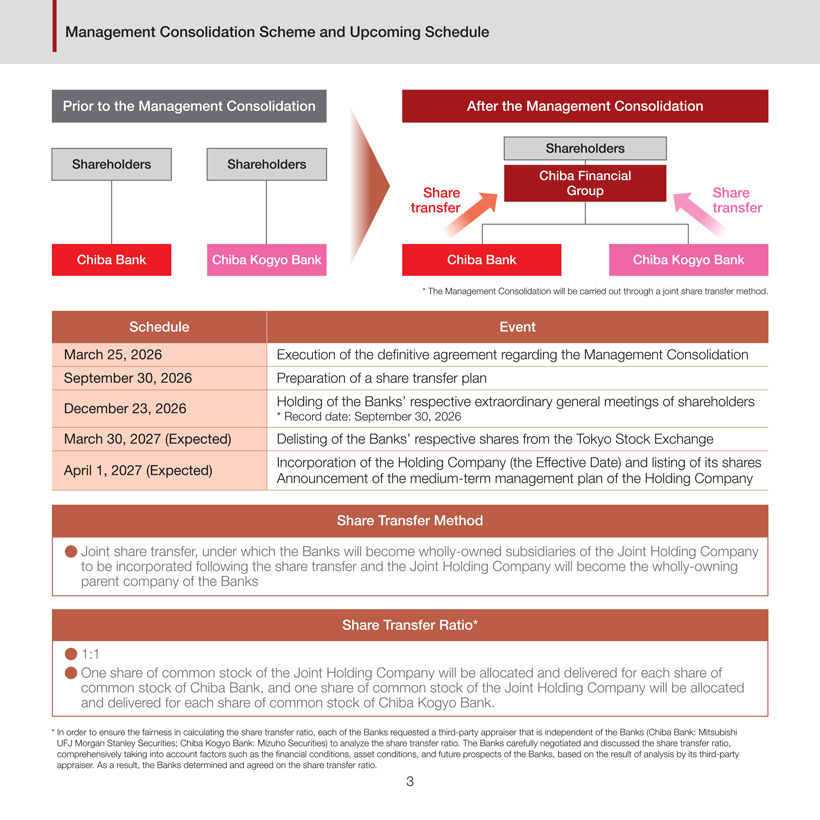
The Bank and The Chiba Kogyo Bank, Ltd. (“Chiba Kogyo Bank”; the Bank and Chiba Kogyo Bank are hereinafter collectively referred to as the “Banks”), based on the Management Consolidation Agreement entered into between the Banks dated as of March 25, 2026 (the “Management Consolidation Agreement”), have agreed to establish a company named “Chiba Financial Group, Inc.” (the “Joint Holding Company”) as the wholly owning parent company of the Banks through a joint share transfer (the “Share Transfer”) on April 1, 2027 (the “Effective Date”), subject to obtaining approval at the respective shareholders meetings of the Banks and authorizations and other permissions by relevant authorities, and the Banks passed a resolution regarding their share transfer plan pertaining to the Share Transfer (the “Share Transfer Plan”), including candidates for Directors of the Joint Holding Company at the time of establishment, at their respective Board of Directors meetings held on September 30, 2026.
The Bank hereby requests its shareholders to approve the Share Transfer Plan.
Reasons for implementing the share transfer, the details of the Share Transfer Plan, and other matters concerning this proposal are as follows.
Reasons for implementing the share transfer
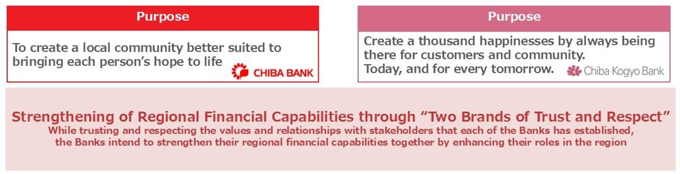
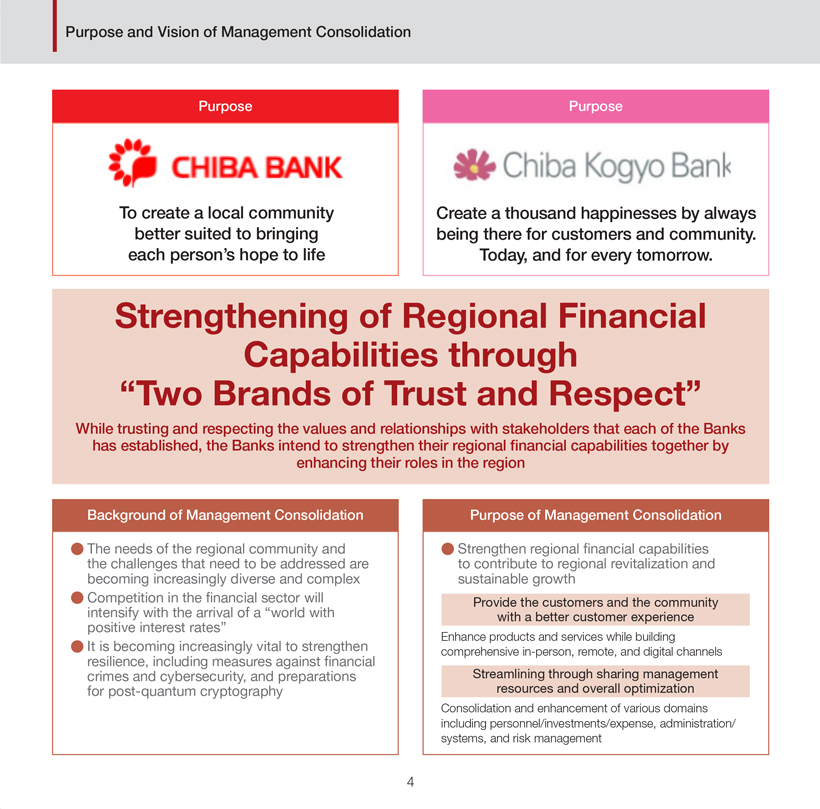
The Banks, as regional financial institutions both headquartered in Chiba Prefecture, consider their value to lie in contributing to solving regional challenges and fostering the sustainable growth of the region. The Bank has defined its purpose as “Create a local community better suited to bringing each person’s hope to life” and Chiba Kogyo Bank has defined its purpose as “Create a thousand happinesses by always being there for our customers and community. Today, and for every tomorrow.”, and the Banks have been working on various regional initiatives, either individually or occasionally in collaboration with each other.
Chiba Prefecture is located in the Tokyo metropolitan area and offers excellent access to the city center and abundant employment opportunities. The urban development around Narita Airport has established it as an international business hub, while the expansion of transportation networks such as the Metropolitan Inter-City Expressway (Ken-O Expressway) has further enhanced the flow of people and goods. Furthermore, Chiba Prefecture boasts premier national rankings in terms of prefectural gross domestic product, commerce, industry, agriculture, and even fisheries. It is also actively leveraging its tourism resources, capitalizing on its rich natural environment and warm climate.
On the other hand, customer values have become increasingly complex and diverse, their behavioral patterns have significantly changed, and social structure is undergoing major changes—including advances in digital technology, growing interest in sustainability, the impact of soaring raw material prices and worsening labor shortages. As a result, the needs of the regional community and the challenges that need to be addressed are becoming increasingly diverse and complex.
Furthermore, the long-standing policy of monetary easing undergoes significant review and competition in the financial sector is expected to intensify with the arrival of a “world with positive interest rates.” Additionally, the pace of technological innovation, including generative AI, is accelerating, and companies from other industries are increasingly entering the financial sector to pursue business opportunities, resulting in a rapidly changing business environment.
In light of these changes in the business environment, the Banks have deepened their shared understanding that further strengthening their management foundations is essential in order to continue providing stable and sophisticated financial services to the regional economy and their customers over the long term.
At a meeting of the preparatory committee on management consolidation, which consists of Directors of the Banks, the Banks determined that, in order to further contribute to the sustainable growth of their customers and the region and to help address the increasingly complex regional challenges, management consolidation between the Banks (the “Management Consolidation”), both of which have their respective regional bases in Chiba Prefecture, will contribute to the further development of Chiba Prefecture’s economy, the realization of the purposes of the Banks, and the enhancement of their corporate value. Accordingly, on March 25, 2026, the Banks reached a definitive agreement on the implementation of the management consolidation through the establishment of the Joint Holding Company.
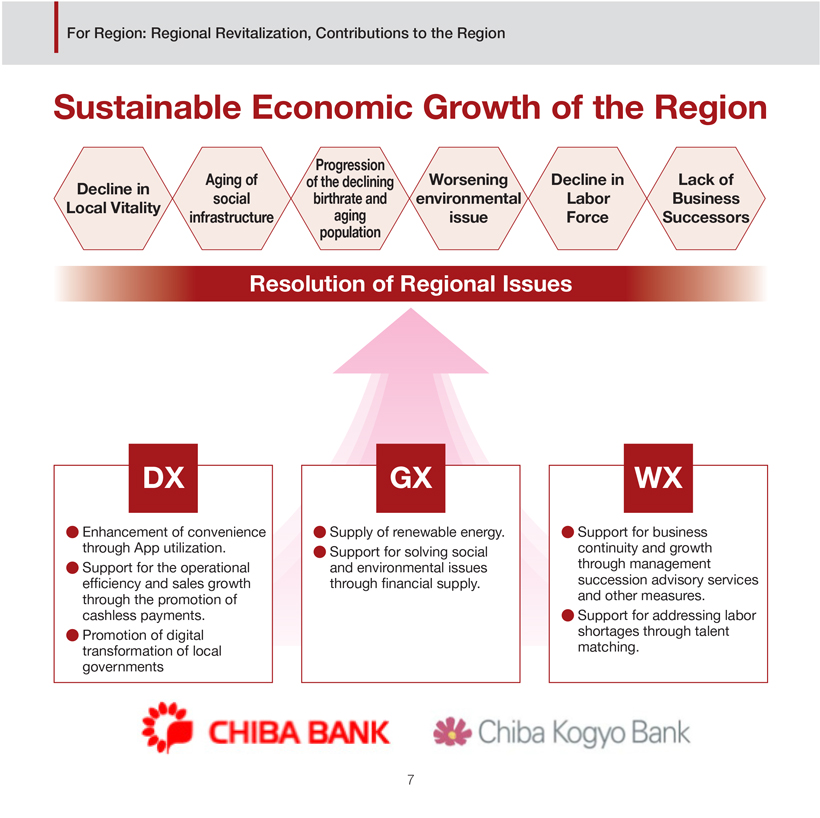
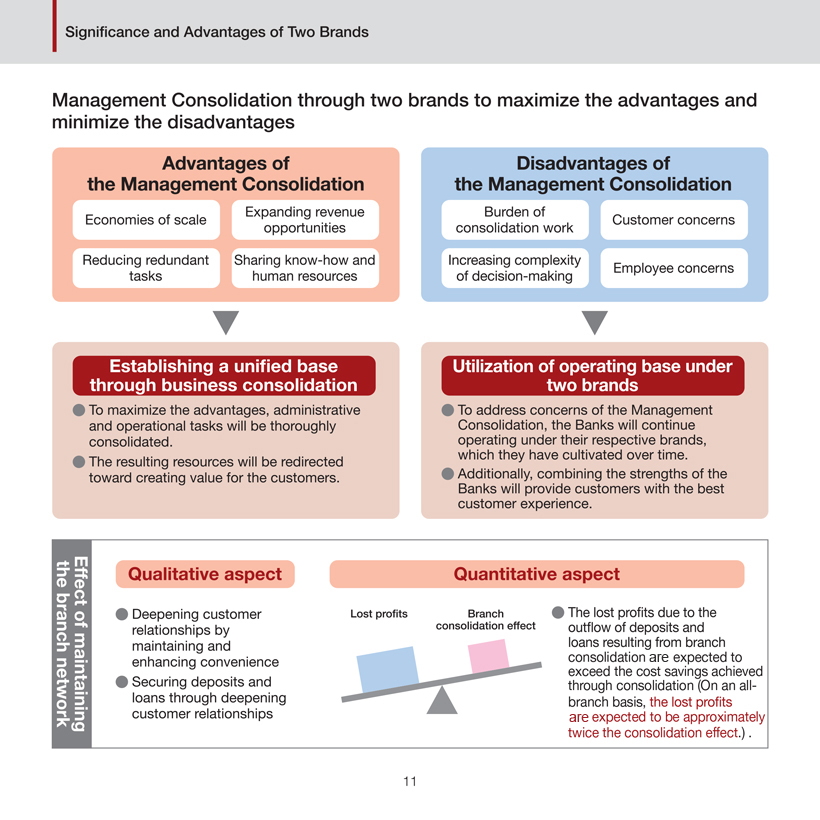
The aim of the Management Consolidation is for the Banks, both of which already possess customer bases in Chiba Prefecture and the Tokyo metropolitan area, to “step up” to a new banking group for the region.
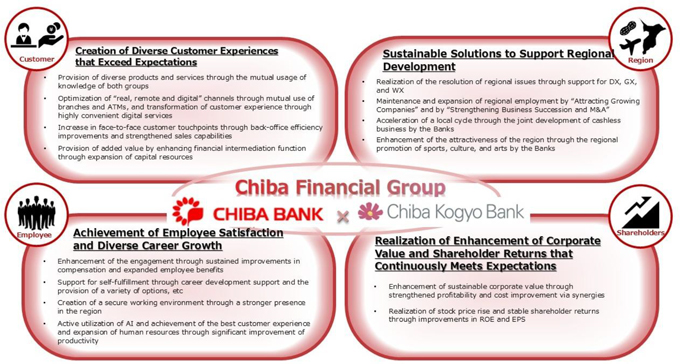
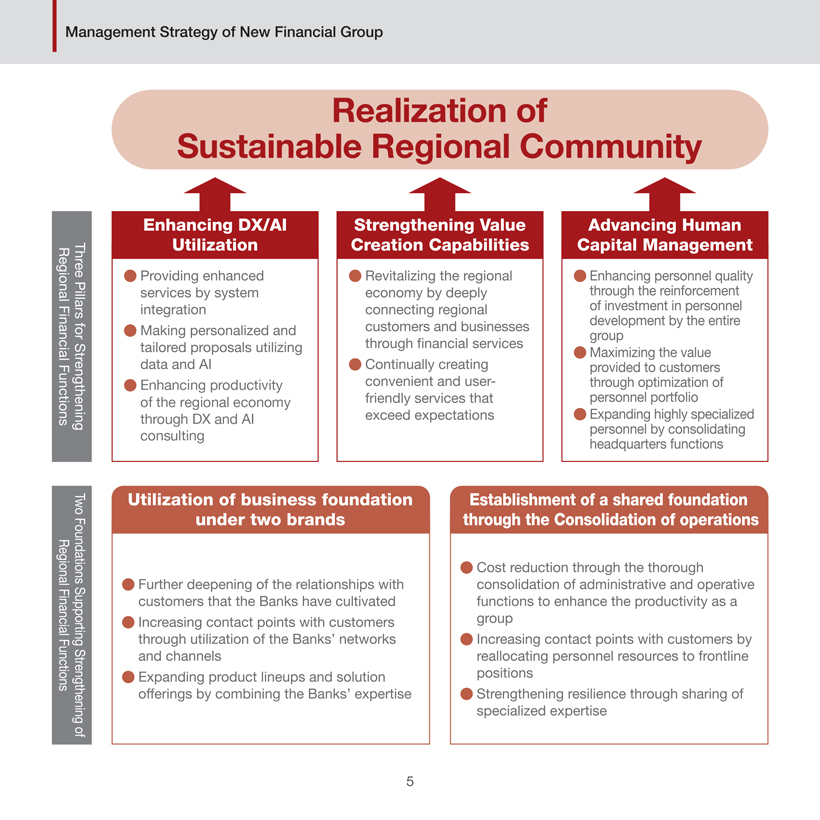
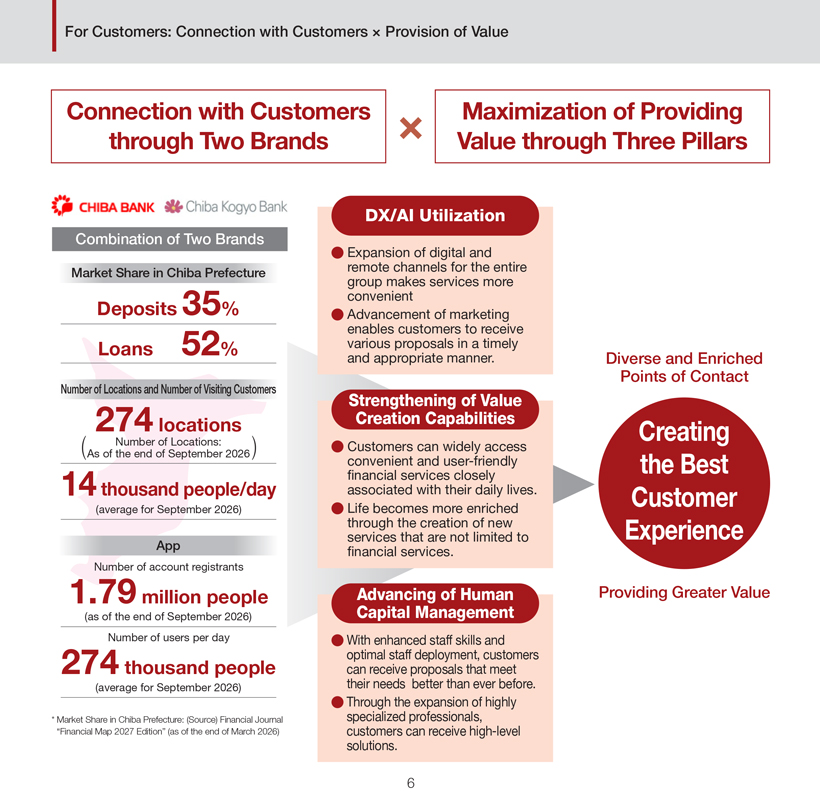
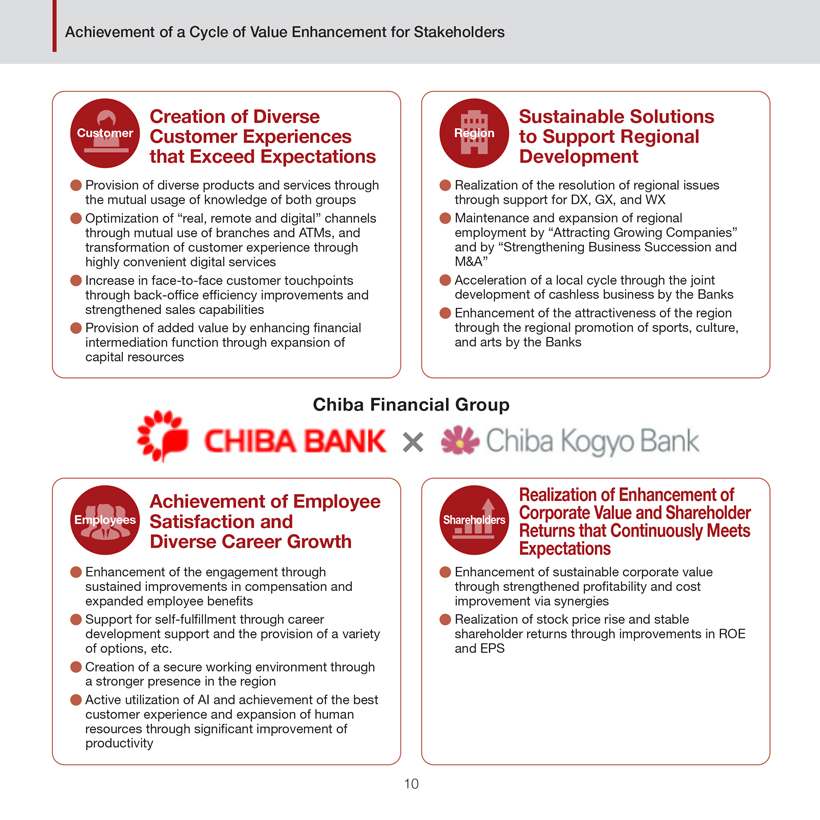
In the Management Consolidation, the Banks will work to respect each other’s operational autonomy and self-reliance to the maximum extent, and to engage in discussions and deliberations aimed at “strengthening regional financial capabilities through two brands built on mutual trust and respect.” In today’s business environment, where customer needs and challenges to be addressed are diversifying and becoming more complex, the Banks will enhance and diversify the solutions offered to customers while pursuing productivity and efficiency through deepening of collaborative relationships that leverage the Banks’ customer relationships and the Banks’ autonomy, mutual utilization of the Banks’ respective strengths in products, services, and expertise, and by leveraging each other’s management resources as their customer bases expand. Through these measures, the Banks will provide customers and the community with a better customer experience and greater added value.
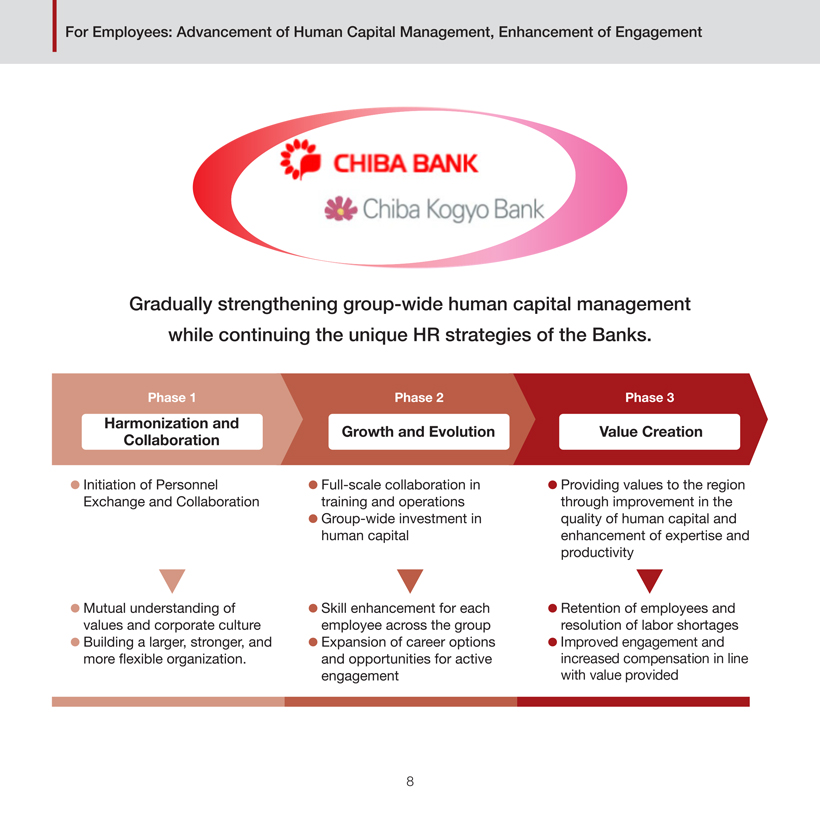
In addition, amid intensifying competition in the financial sector to enhance service convenience driven by technological innovation in financial services and cross-industry expansion, the Banks believe it is essential to secure diverse personnel that enable the Banks to handle issues in value creation fields and specialized fields. Through sharing management resources of the Banks, and fostering talent by sharing knowledge, experience, and expertise in accordance with mutual trust and respect, the Banks will create new growth opportunities for employees and build a system where each employee can maximize their abilities and shine in their own way in addition to securing professional personnel.
Furthermore, as strengthening resilience—including measures against financial crimes and cybersecurity—becomes increasingly vital to ensure that customers can use our services safely and securely, the Banks strongly recognize that their responsibility to provide financial infrastructure is now more significant than ever before and they consider it their social mission to contribute to the maintenance and development of a stable and sound regional financial system. By leveraging the complementary strengths and networks of the Banks within Chiba Prefecture and ensuring the stability of the regional economy through the continued operation and further strengthening of a sound regional financial system, the Banks will contribute to the sustainable development of the regional community.
Details of the Share Transfer Plan
See Appendix B of the prospectus which is part of the registration statement.
Regarding the Share Transfer Plan, it is required to explain the appropriateness of the provisions for the share transfer ratio, the amounts of capital stock, legal capital surplus, and legal retained earnings of the Joint Holding Company, the outline of stock acquisition rights, etc. pursuant to the provisions of Article 773 of the Companies Act and other related laws and regulations. Therefore, the outline of the provisions is described below.
Matters Concerning the Appropriateness of Provisions for the Matters Stated in Article 773, Paragraph 1, Items 5 and 6 of the Companies Act
| (1) | Matters concerning the shares of the Joint Holding Company to be allocated and delivered to the shareholders of the Banks by the Joint Holding Company in the Share Transfer and the allocation of the shares of the Joint Holding Company |
The Banks have determined the ratio at which shares of common stock of the Joint Holding Company will be allocated and delivered to their respective shareholders as the Joint Holding Company is established through the Share Transfer (the “Share Transfer Ratio”), as follows.
(i) Details of allotment in the Share Transfer (Share Transfer Ratio)
(a) Common stock
| Company Name |
The Bank |
Chiba Kogyo Bank | ||
| Share Transfer Ratio | 1 | 1 |
| (Note 1) | Details of allotment of shares pertaining to the Share Transfer |
One share of common stock of the Joint Holding Company will be allocated and delivered for each share of common stock of the Bank, and 1 share of common stock of the Joint Holding Company will be allocated and delivered for each share of common stock of Chiba Kogyo Bank. If the number of shares of common stock of the Joint Holding Company which will be delivered to a shareholder of the Banks through the Share Transfer includes a fraction of less than one share, the Joint Holding Company will, pursuant to Article 234 of the Companies Act and other applicable laws and regulations, pay the relevant shareholder a cash amount corresponding to such fractional share. The above Share Transfer Ratio may be changed upon discussions between the Banks in the event that significant changes occur in the terms and conditions on which the calculation is based.
| (Note 2) | Number of shares unit of the Joint Holding Company and handling of shares constituting less than one unit |
The number of shares unit of the Joint Holding Company shall be 100 shares. The Banks’ shareholders who receive an allocation of shares of common stock constituting less than one unit (100 shares) of the Joint Holding Company (“Shares Constituting Less than One Unit”) through the Share Transfer may not sell their Shares Constituting Less than One Unit on the Tokyo Stock Exchange or any other securities exchange. Shareholders who hold the Shares Constituting Less than One Unit may request the Joint Holding Company to purchase their Shares Constituting Less than One Unit pursuant to the provisions of Article 192, paragraph 1 of the Companies Act. In addition, it is expected that such shareholders may request the Joint Holding Company to sell the number of shares needed, together with the number of Shares Constituting Less than One Unit held by them, to constitute one unit pursuant to the provisions of Article 194, paragraph 1 of the Companies Act and the provisions to be stipulated in the Articles of Incorporation of the Joint Holding Company.
| (Note 3) | Number of new shares to be delivered by the Joint Holding Company through the Share Transfer (Expected) |
Common stock: 837,743,132 shares
The number of shares specified above is calculated based on the total number of issued common shares of the Bank (775,521,087 shares as of September 30, 2026) and the total number of issued common shares of Chiba Kogyo Bank (62,222,045 shares as of September 30, 2026). However, prior to the Effective Date of the Share Transfer, the Banks may cancel the treasury shares which are currently held or may thereafter be newly acquired by them, within the range of such treasury shares that can be canceled in practice, and the number of new shares to be issued by the Joint Holding Company is subject to change. The number of new shares specified above does not include the number of shares of common stock of the Joint Holding Company to be issued to the shareholders of Chiba Kogyo Bank’s 2nd Series of Class 6 Preferred Stock and 2nd Series of Class 7 Preferred Stock.
(b) 2nd Series of Class 6 Preferred Stock
In the share transfer of Chiba Kogyo Bank’s 2nd Series of Class 6 Preferred Stock, the variable share transfer ratio method has been adopted. Under the variable share transfer ratio method, the value of Chiba Kogyo Bank’s 2nd Series of Class 6 Preferred Stock will be determined on the date when the Board of Directors of the Banks resolved to conclude the Management Consolidation Agreement (the “Share Transfer Decision Time”), and the number of shares of common stock of the Joint Holding Company to be allotted as consideration for each share of Chiba Kogyo Bank’s 2nd Series of Class 6 Preferred Stock will be determined based on the average stock price of the Bank’s common stock for a certain period of time immediately preceding the Effective Date.
In the share transfer of Chiba Kogyo Bank’s 2nd Series of Class 6 Preferred Stock, the Joint Holding Company shall allocate to shareholders of Chiba Kogyo Bank’s 2nd Series of Class 6 Preferred Stock as of the time immediately preceding the acquisition of all issued shares of the Banks (the “Record Time”), in lieu of Chiba Kogyo Bank’s 2nd Series of Class 6 Preferred Stock, the number of shares of its common stock obtained by multiplying the number of Chiba Kogyo Bank’s 2nd Series of Class 6 Preferred Stock owned by those shareholders, by the share transfer ratio calculated by the following formula:
Share transfer ratio = 20,000 yen / Average stock price of the Bank’s common stock
| (Note 1) | Method of calculating the share transfer ratio |
The share transfer ratio is calculated to the third decimal place and rounded to the second decimal place. The average stock price of the Bank’s common stock will be the simple average (calculated to the first decimal place and rounded to the nearest whole number) of the closing price per share of the Bank common stock of each trading day (however, excluding days on which no trading has taken place) during the ten (10) trading days from March 5, 2027 (inclusive) to March 18, 2027 (inclusive), on the Prime Market of the Tokyo Stock Exchange, with the period required for taking administrative measures being set.
| (Note 2) | Number of shares to be delivered by the Joint Holding Company through the Share Transfer |
The Joint Holding Company will deliver the number of shares of its common stock obtained by multiplying the total number of Chiba Kogyo Bank’s 2nd Series of Class 6 Preferred Stock owned by shareholders of Chiba Kogyo Bank’s 2nd Series of Class 6 Preferred Stock, by the above-stated share transfer ratio. In the event that the number of shares of common stock of the Joint Holding Company to be delivered to shareholders of Chiba Kogyo Bank’s 2nd Series of Class 6 Preferred Stock includes a fraction of less than one share as a result of the Share Transfer, the relevant shareholders will be paid an amount corresponding to the fractional portion of less than one share in accordance with the provisions of Article 234 of the Companies Act and other relevant laws and regulations.
| (Note 3) | Handling of shares that are less than one unit |
Shareholders of the Banks who will be allotted shares that are less than one unit as a result of the Share Transfer may not sell these shares on the Tokyo Stock Exchange or other financial instruments exchanges; however, those shareholders who will hold such shares may request the Joint Holding Company to purchase them pursuant to Article 192, Paragraph 1 of the Companies Act. In addition, pursuant to Article 194, Paragraph 1 of the Companies Act and the provisions to be set forth in the Articles of Incorporation of the Joint Holding Company, it will also be possible for them to request the Joint Holding Company to sell the number of shares that amount to one unit together with the number of their shares that are less than one unit.
In the case of ordinary share transfers, the share transfer ratio and the number of shares of the relevant wholly owning parent company established by the share transfer to be delivered to shareholders of the relevant wholly owned subsidiary in the share transfer as consideration, are determined at the time of concluding and publicly announcing the share transfer plan (the “Announcement Time”). Therefore, at the Announcement Time, the value of the shares of the wholly owning parent company established by the share transfer that the shareholders of the wholly owned subsidiary in the share transfer will eventually own on the effective date of the share transfer will not be determined, and will fluctuate depending on the stock price trend of the shares of the wholly owned subsidiary in the share transfer between the Announcement Time and the effective date of the share transfer. Conversely, under the variable share transfer ratio method, the fair value of the shares of the wholly owned subsidiary in the share transfer will be determined at the Announcement Time, and the number of shares of the wholly owning parent company established in the share transfer to be delivered as consideration for each share of the wholly owned subsidiary will be determined by dividing the said fair value by the average stock price of the wholly owned subsidiary during a certain period immediately before the effective date of the share transfer. As a result, shareholders of the wholly owned subsidiary in the share transfer will be able to receive common stock of the wholly owning parent company established in the share transfer equivalent to the fair value of shares of that subsidiary, based on the market price immediately preceding the effective date of the share transfer. Therefore, compared to an ordinary share transfer, in which the number of shares of the wholly owning parent company to be received by shareholders of the wholly owned subsidiary is determined based on the market price immediately preceding the date of execution of the share transfer plan, the period during which the value of the shares of the wholly owning parent company to be owned by shareholders of the wholly owned subsidiary on the effective date of the share transfer will fluctuate due to stock price trends up to the effective date of the share transfer will be shortened, and it is expected to approximate the value of the shares of the wholly owned subsidiary in the share transfer. After verifying these characteristics, the Banks carefully discussed which method is the most appropriate method to adopt, taking into consideration the fact that Chiba Kogyo Bank’s 2nd Series of Class 6 Preferred Stock is unlisted stock with a call provision that allows Chiba Kogyo Bank, after a certain period of time, to acquire each share of the 2nd Series of Class 6 Preferred Stock in exchange for the cash equivalent to the amount paid for each share (20,000 yen). As a result, the Banks determined it appropriate to have the value of common stock of the Joint Holding Company which shareholders of Chiba Kogyo Bank’s 2nd Series of Class 6 Preferred Stock will finally come to own as of the Effective Date to be approximate to the above-stated value of Chiba Kogyo Bank’s 2nd Series of Class 6 Preferred Stock (20,000 yen per share) and finally decided to adopt the variable share transfer ratio method.
(c) 2nd Series of Class 7 Preferred Stock
In the share transfer of Chiba Kogyo Bank’s 2nd Series of Class 7 Preferred Stock, the variable share transfer ratio method has been adopted. Under the variable share transfer ratio method, the value of Chiba Kogyo Bank’s 2nd Series of Class 7 Preferred Stock will be determined at the Share Transfer Decision Time, and the number of shares of common stock of the Joint Holding Company to be allotted as consideration for each share of Chiba Kogyo Bank’s 2nd Series of Class 7 Preferred Stock will be determined based on the average stock price of the Bank’s common stock for a certain period of time immediately preceding the Effective Date.
In the share transfer of Chiba Kogyo Bank’s 2nd Series of Class 7 Preferred Stock, the Joint Holding Company shall allocate to shareholders of Chiba Kogyo Bank’s 2nd Series of Class 7 Preferred Stock as of the Record Time, in lieu of Chiba Kogyo Bank’s 2nd Series of Class 7 Preferred Stock, the number of shares of its common stock obtained by multiplying the number of Chiba Kogyo Bank’s 2nd Series of Class 7 Preferred Stock owned by those shareholders, by the share transfer ratio calculated by the following formula:
Share transfer ratio = 500,000 yen / Average stock price of the Bank’s common stock
| (Note 1) | Method of calculating the share transfer ratio |
| The share transfer ratio is calculated to the third decimal place and rounded to the second decimal place. The average stock price of the Bank’s common stock will be the simple average (calculated to the first decimal place and rounded to the nearest whole number) of the closing price per share of the Bank common stock of each trading day (however, excluding days on which no trading has taken place) during the ten (10) trading days from March 5, 2027 (inclusive) to March 18, 2027 (inclusive), on the Prime Market of the Tokyo Stock Exchange, with the period required for taking administrative measures being set. |
| (Note 2) | Number of shares to be delivered by the Joint Holding Company through the Share Transfer |
| The Joint Holding Company will deliver the number of shares of its common stock obtained by multiplying the total number of Chiba Kogyo Bank’s 2nd Series of Class 7 Preferred Stock owned by shareholders of Chiba Kogyo Bank’s 2nd Series of Class 7 Preferred Stock, by the above-stated share transfer ratio. In the event that the number of shares of common stock of the Joint Holding Company to be delivered to shareholders of Chiba Kogyo Bank’s 2nd Series of Class 7 Preferred Stock includes a fraction of less than one share as a result of the Share Transfer, the relevant shareholders will be paid an amount corresponding to the fractional portion of less than one share in accordance with the provisions of Article 234 of the Companies Act and other relevant laws and regulations. |
| (Note 3) | Handling of shares that are less than one unit |
| Shareholders of the Banks who will be allotted shares that are less than one unit as a result of the Share Transfer may not sell these shares on the Tokyo Stock Exchange or other financial instruments exchanges; however, those shareholders who will hold such shares may request the Joint Holding Company to purchase them pursuant to Article 192, Paragraph 1 of the Companies Act. In addition, pursuant to Article 194, Paragraph 1 of the Companies Act and the provisions to be set forth in the Articles of Incorporation of the Joint Holding Company, it will also be possible for them to request the Joint Holding Company to sell the number of shares that amount to one unit together with the number of their shares that are less than one unit. |
In the case of ordinary share transfers, the share transfer ratio and the number of shares of the relevant wholly owning parent company established by the share transfer to be delivered to shareholders of the relevant wholly owned subsidiary in the share transfer as consideration, are determined at the Announcement Time. Therefore, at the Announcement Time, the value of the shares of the wholly owning parent company established by the share transfer that the shareholders of the wholly owned subsidiary in the share transfer will eventually own on the effective date of the share transfer will not be determined, and will fluctuate depending on the stock price trend of the shares of the wholly owned subsidiary in the share transfer between the Announcement Time and the effective date of the share transfer. Conversely, under the variable share transfer ratio method, the fair value of the shares of the wholly owned subsidiary in the share transfer will be determined at the Announcement Time, and the number of shares of the wholly owning parent company established in the share transfer to be delivered as consideration for each share of the wholly owned subsidiary will be determined by dividing the said fair value by the average stock price of the wholly owned subsidiary during a certain period immediately before the effective date of the share transfer. As a result, shareholders of the wholly owned subsidiary in the share transfer will be able to receive common stock of the wholly owning parent company established in the share transfer equivalent to the fair value of shares of that subsidiary, based on the market price immediately preceding the effective date of the share transfer. Therefore, compared to an ordinary share transfer, in which the number of shares of the wholly owning parent company to be received by shareholders of the wholly owned subsidiary is determined based on the market price immediately preceding the date of execution of the share transfer plan, the period during which the value of the shares of the wholly owning parent company to be owned by shareholders of the wholly owned subsidiary on the effective date of the share transfer will fluctuate due to stock price trends up to the effective date of the share transfer will be shortened, and it is expected to approximate the value of the shares of the wholly owned subsidiary in the share transfer. After verifying these characteristics, the Banks carefully discussed which method is the most appropriate method to adopt, taking into consideration the fact that Chiba Kogyo Bank’s 2nd Series of Class 7 Preferred Stock is unlisted stock with a call provision that allows Chiba Kogyo Bank, after a certain period of time, to acquire each share of the 2nd Series of Class 7 Preferred Stock in exchange for the cash equivalent to the amount paid for each share (500,000 yen). As a result, the Banks determined it appropriate to have the value of common stock of the Joint Holding Company which shareholders of Chiba Kogyo Bank’s 2nd Series of Class 7 Preferred Stock will finally come to own as of the Effective Date to be approximate to the above-stated value of Chiba Kogyo Bank’s 2nd Series of Class 7 Preferred Stock (500,000 yen per share) and finally decided to adopt the variable share transfer ratio method.
(ii) Basis and reasons for the details of allotment
Based on the Memorandum of Understanding concerning deliberations of the Management Consolidation entered into on September 29, 2025 between the Banks, the Banks established the preparatory committee on the management consolidation and have been discussing and deliberating consummation of the management consolidation through the incorporation of the Joint Holding Company under a share transfer on or around April 1, 2027.
As described in (iv) “Measures to ensure fairness” below, the Bank appointed Mitsubishi UFJ Morgan Stanley Securities Co., Ltd. (“Mitsubishi UFJ Morgan Stanley Securities”) as an independent third-party appraiser and Nagashima Ohno & Tsunematsu as a legal advisor in order to ensure the fairness of the consideration for the Share Transfer and of other aspects of the Share Transfer, and commenced deliberations with respect to the Share Transfer. After careful discussions and deliberations with reference to the analysis prepared by Mitsubishi UFJ Morgan Stanley Securities and the advice provided by Nagashima Ohno & Tsunematsu, the Bank concluded that it is appropriate to implement the Share Transfer based on the share transfer ratio indicated in (i) “Details of allotment in the Share Transfer (share transfer ratio)” above.
On the other hand, as described in (iv) “Measures to ensure fairness” below, Chiba Kogyo Bank appointed Mizuho Securities Co., Ltd. (“Mizuho Securities”) as an independent third-party appraiser and Nishimura & Asahi as a legal advisor in order to ensure the fairness of the consideration for the Share Transfer and of other aspects of the Share Transfer, and commenced deliberations with respect to the Share Transfer. After careful discussions and deliberations with reference to the analysis prepared by Mizuho Securities and the advice provided by Nishimura & Asahi, Chiba Kogyo Bank concluded that it is appropriate to implement the Share Transfer with the share transfer ratio indicated in (i) “Details of allotment in the Share Transfer (share transfer ratio)” above.
As described above, the Banks carefully negotiated and discussed the share transfer ratio, comprehensively taking into account factors such as the market share price, financial position, and future prospects of the Banks, based on the results of the due diligence conducted by each of the Banks on the other, with each of the Banks making reference to the calculation and analysis by its third-party appraiser, and the legal advice of its legal advisor. As a result of such negotiations and discussions, the Banks concluded that the share transfer ratio is appropriate, and at their respective boards of directors’ meetings held on March 25, 2026, the Banks resolved to determine and agreed on the share transfer ratio for the Share Transfer.
(iii) Matters concerning calculation
(a) Common stock
(i) Names of the appraisers and relationship with the Banks
Mitsubishi UFJ Morgan Stanley Securities, a financial advisor (third-party appraiser) of the Bank, is not a related party of the Banks and it does not have any material interest requiring disclosure in regard to the Share Transfer.
The remuneration to be paid to Mitsubishi UFJ Morgan Stanley Securities in connection with the Share Transfer includes a contingency fee that is to be paid subject to conditions that include the successful completion of the Share Transfer. However, the Bank has determined that the inclusion of this contingency fee does not prevent independence, taking into account the general practice in similar cases. Thus, the Bank appointed Mitsubishi UFJ Morgan Stanley Securities as a third-party appraiser based on the aforementioned remuneration system.
Mizuho Securities, a financial advisor (third party appraiser) of Chiba Kogyo Bank, is not a related party of the Bank. Mizuho Securities, Mizuho Bank, Ltd. (“Mizuho Bank”), and Mizuho Trust & Banking Co., Ltd. (“Mizuho Trust Bank”), which are group companies of Mizuho Securities, have the status of shareholders of Chiba Kogyo Bank; however, they do not have any material interest that will constitute a conflict of interest in the Share Transfer. According to Mizuho Securities, pursuant to Article 36 of the Financial Instruments and Exchange Act (Act No. 25 of 1948; as amended) and Article 70-4 of the Cabinet Office Order on Financial Instruments Business (Cabinet Office Order No. 52 of 2007; as amended), Mizuho Securities has an appropriate conflict of interest management system in place, which includes information barrier measures between Mizuho Securities’ financial advisory services department and another department of Mizuho Securities that holds shares in Chiba Kogyo Bank, as well as between Mizuho Securities on one side and Mizuho Bank and Mizuho Trust Bank on the other side. Through these measures, Mizuho Securities calculated the share transfer ratio from a standpoint independent of Mizuho Securities, Mizuho Bank, and Mizuho Trust Bank in their respective capacities as shareholders of Chiba Kogyo Bank. Chiba Kogyo Bank appointed Mizuho Securities as a third-party appraiser independent of the Banks, as appropriate measures to prevent harmful effects have been implemented within Mizuho Securities and between Mizuho Securities on one side, and Mizuho Bank and Mizuho Trust Bank on the other side.
The remuneration to be paid to Mizuho Securities in connection with the Share Transfer includes a contingency fee that is to be paid subject to conditions that include the successful completion of the Share Transfer. However, Chiba Kogyo Bank has determined that the inclusion of this contingency fee does not prevent independence, taking into account the general practice in similar cases. Thus, Chiba Kogyo Bank appointed Mizuho Securities as a third-party appraiser based on the aforementioned remuneration system.
(ii) Outline of the calculation
In order to ensure fairness in calculating the share transfer ratio used for the Share Transfer, the Bank appointed Mitsubishi UFJ Morgan Stanley Securities and Chiba Kogyo Bank appointed Mizuho Securities as their respective third-party appraisers for calculating and analyzing the share transfer ratio.
Mitsubishi UFJ Morgan Stanley Securities conducted the market share price analysis, because the shares of the Banks are listed on a financial instruments exchange and market prices are available for their shares, as well as the comparable peer company multiple analysis, because there exist multiple listed peer companies that are comparable to each of the Banks and Mitsubishi UFJ Morgan Stanley Securities was able to estimate share value of each of the Banks using the comparable peer company multiple analysis. Furthermore, in order to reflect the status of future business activities in the valuation, Mitsubishi UFJ Morgan Stanley Securities conducted the dividend discount model analysis (the “DDM Analysis”).
In the market share price analysis, Mitsubishi UFJ Morgan Stanley Securities used March 24, 2026 as the reference date, and used the closing price on the reference date on the Tokyo Stock Exchange and the simple average of the closing prices on each trading day for the past 1 month, 3 months and 6 months prior to the reference date.
The calculation of share value in the DDM Analysis is based on various factors, including the profits in the financial projections and investment plans presented by the management of the Banks, which the Banks agreed to use for the calculation purpose; the results of due diligence conducted on the Banks; and other publicly available information and material.
The financial projections of Chiba Kogyo Bank used by Mitsubishi UFJ Morgan Stanley Securities as a basis for the DDM Analysis include a fiscal year in which significant increases or decreases in profit are expected. Specifically, an increase in interest income from loans is expected for the fiscal year ending March 2028, which is expected to result in a significant increase in profit attributable to owners of parent. The financial projections of the Bank do not include any fiscal years in which significant increases or decreases in profit are expected.
The results of the calculations under each analysis above are indicated below. The results of the calculations of the share transfer ratio below represent the number of common shares of the Joint Holding Company to be allotted for one common share of Chiba Kogyo Bank, assuming that one common share of the Joint Holding Company is allotted for one common share of the Bank.
| Approach | Calculation results of share transfer ratio | |||
| 1 | Market share price analysis | 0.98 - 1.02 | ||
| 2 | Comparable peer company multiple analysis | 0.73 - 1.18 | ||
| 3 | DDM Analysis | 0.74 - 1.29 |
| (Note) | The analysis by Mitsubishi UFJ Morgan Stanley Securities and the analysis of the underlying share transfer ratio were provided to the Bank for its reference. Such analysis does not constitute a financial opinion or recommendation of Mitsubishi UFJ Morgan Stanley Securities or its affiliates, nor does it constitute an approval of the Share Transfer, or an opinion or recommendation to the shareholders of the Bank or Chiba Kogyo Bank or any other person regarding the transfer and acquisition of shares or the exercise of shareholder rights, including the exercise of voting rights, or consent to the Share Transfer or any other related matters. Mitsubishi UFJ Morgan Stanley Securities relied on information that was already publicly disclosed or provided or otherwise made available to it by the Bank or Chiba Kogyo Bank for the analysis and calculation of the share transfer ratio on the assumption that such information is accurate and complete, and Mitsubishi UFJ Morgan Stanley Securities has not independently verified the accuracy or completeness thereof. Also, Mitsubishi UFJ Morgan Stanley Securities assumed that the financial projections were reasonably prepared by the management of the Banks to reflect the best estimates and judgments available at the time they were provided with respect to the future financial condition of the Banks. Mitsubishi UFJ Morgan Stanley Securities is not a legal, accounting or tax adviser. Mitsubishi UFJ Morgan Stanley Securities acted as financial adviser to the Bank in connection with the Share Transfer and relied on the determinations of the Bank and the Bank’s legal, accounting and tax advisers for issues relating to legal, accounting, and tax matters without independently verifying them. Mitsubishi UFJ Morgan Stanley Securities has not made or obtained any independent assessment or appraisal of the assets and liabilities (including off-balance sheet assets and liabilities and other contingent liabilities) of the Bank, Chiba Kogyo Bank or their affiliates, nor has it requested any third-party institution to value or appraise them. Mitsubishi UFJ Morgan Stanley Securities’ analysis is based on economic, financial, market, and other conditions as of the reference date of the share transfer ratio calculation report and on information made available to Mitsubishi UFJ Morgan Stanley Securities as of such reference date. Although there is a possibility that an event occurring on or after the reference date may affect the basis on which the Mitsubishi UFJ Morgan Stanley Securities’ analysis and the share transfer ratio calculation report have been prepared, Mitsubishi UFJ Morgan Stanley Securities is not obligated to update, revise or reconfirm the share transfer ratio calculation report or its analysis. In addition, the preparation of the share transfer ratio calculation report and the underlying analysis therefor was a complex process and is not necessarily suitable for partial analysis or summary description. The valuation ranges based on the specific analysis described herein may not be considered as Mitsubishi UFJ Morgan Stanley Securities’ assessment of the actual value of the Bank or Chiba Kogyo Bank. |
In calculating the share transfer ratio, Mizuho Securities conducted the average market price method, because the shares of the Banks are listed on the Prime Market of the Tokyo Stock Exchange and market prices are available for their shares, as well as the comparable company analysis, because there exist multiple listed companies that are comparable to each of the Banks and Mizuho Securities was able to estimate share value of each of the Banks using the comparable multiple valuation method. Furthermore, in order to reflect the status of future business activities in the valuation, Mizuho Securities conducted the dividend discount model method (the “DDM Method”), which is a method used to analyze the share value by discounting to its present value the cash flows attributable to the shareholders after taking into account retained earnings and other factors necessary to maintain a certain capital structure, using cost of capital, and is a method used generally for the analysis of financial institutions. The results of the calculations under each method above are indicated below. The calculated ranges for the share transfer ratio below represent the number of common shares of the Joint Holding Company to be allotted for one common share of Chiba Kogyo Bank, assuming that one common share of the Joint Holding Company is allotted for one common share of the Bank.
| Approach | Calculated range of share transfer ratio | |||
| 1 | Average market price method | 0.98 - 1.02 | ||
| 2 | Comparable company analysis | 0.81 - 1.25 | ||
| 3 | DDM Method | 0.74 - 1.57 |
Under the average market price method, Mizuho Securities used March 24, 2026 as the reference date and calculated the share transfer ratio based on (i) the closing price of the shares on the Tokyo Stock Exchange on that date, and (ii) the simple average of the closing prices over the 1 month, 3 months and 6 months periods preceding the reference date.
The future profit plans of Chiba Kogyo Bank used by Mizuho Securities as a basis for the DDM Method include a fiscal year in which significant increases or decreases in profit are expected. Specifically, an increase in interest income from loans is expected for the fiscal year ending March 2028, which is expected to result in a significant increase in profit attributable to owners of parent. Furthermore, the future profit plans of the Bank do not include any fiscal years in which significant increases or decreases in profit are expected.
In calculating the share transfer ratio, Mizuho Securities in principle used as-is material and information provided by the Banks as well as publicly available information and other data. Mizuho Securities assumed and relied on the accuracy and completeness of all material, information and other data that Mizuho Securities reviewed or analyzed, and did not independently verify or assume any obligation to independently verify the accuracy or completeness of such material and information. Mizuho Securities did not undertake an independent evaluation, appraisal or assessment of any of the assets or liabilities (including, but not limited to, financial derivative products, off-balance-sheet assets and liabilities, and other contingent liabilities), on an aggregate or individual basis, of the Banks or any of their respective affiliates, nor did Mizuho Securities make any request to a third party for any such valuation, appraisal or assessment. Mizuho Securities assumed that the business plans, financial projections, and other forward-looking information provided by each of the Banks were reasonably prepared based on the best possible forecasts and judgments currently available to the respective management of the Banks.
(b) 2nd Series of Class 6 Preferred Stock
Chiba Kogyo Bank determined the share transfer ratio of the 2nd Series of Class 6 Preferred Stock based on the following details of the 2nd Series of Class 6 Preferred Stock, and through careful negotiation and consultations with the Bank, with the advice of Mizuho Securities, and it has not obtained a valuation report from any third-party appraiser.
It is stipulated that, on or after October 1, 2027, if a date separately determined by the Board of Directors of Chiba Kogyo Bank comes, Chiba Kogyo Bank may acquire all or part of the 2nd Series of Class 6 Preferred Stock in accordance with the transaction term under which money will be paid in consideration. It is stipulated that, in such case, Chiba Kogyo Bank shall deliver, in exchange for the acquisition of the 2nd Series of Class 6 Preferred Stock, for each share of the 2nd Series of Class 6 Preferred Stock: the total of (i) a monetary equivalent to the amount paid for the 2nd Series of Class 6 Preferred Stock (20,000 yen) (However, in the event of a share split, the allotment of share without contribution, share consolidation, or similar reasons concerning the 2nd Series of Class 6 Preferred Stock, appropriate adjustments shall be made) plus (ii) the amount equivalent to the accrued 2nd Series of Class 6 Preferred Dividends. In addition, the year-end dividend of the 2nd Series of Class 6 Preferred Stock (300 yen per share), with the Record Date set on March 31, 2027, shall be separately paid as the year-end dividend in late June 2027, which is after the Effective Date of the Share Transfer, to the ultimate shareholders of the 2nd Series of Class 6 Preferred Stock stated or recorded in the shareholder register as of that Record Date, or to the trust trustees or registered pledgees of the 2nd Series of Class 6 Preferred Stock.
(c) 2nd Series of Class 7 Preferred Stock
Chiba Kogyo Bank determined the share transfer ratio of the 2nd Series of Class 7 Preferred Stock based on the following details of the 2nd Series of Class 7 Preferred Stock, and through careful negotiation and consultations with the Bank, with the advice of Mizuho Securities, and it has not obtained a valuation report from any third-party appraiser.
It is stipulated that, on or after October 1, 2027, if a date separately determined by the Board of Directors of Chiba Kogyo Bank comes, Chiba Kogyo Bank may acquire all or part of the 2nd Series of Class 7 Preferred Stock in accordance with the transaction term under which money will be paid in consideration. It is stipulated that, in such case, Chiba Kogyo Bank shall deliver, in exchange for the acquisition of the 2nd Series of Class 7 Preferred Stock, for each share of the 2nd Series of Class 7 Preferred Stock: the total of (i) a monetary equivalent to the amount paid for the 2nd Series of Class 7 Preferred Stock (500,000 yen) (However, in the event of a share split, the allotment of share without contribution, share consolidation, or similar reasons concerning the 2nd Series of Class 7 Preferred Stock, appropriate adjustments shall be made) plus (ii) the amount equivalent to the accrued 2nd Series of Class 7 Preferred Dividends. In addition, the year-end dividend of the 2nd Series of Class 7 Preferred Stock (9,000 yen per share), with the Record Date set on March 31, 2027, shall be separately paid as the year-end dividend in late June 2027, which is after the Effective Date of the Share Transfer, to the ultimate shareholders of the 2nd Series of Class 7 Preferred Stock stated or recorded in the shareholder register as of that Record Date, or to the trust trustees or registered pledgees of the 2nd Series of Class 7 Preferred Stock.
(iv) Measures to ensure fairness
In order to ensure the fairness of the Share Transfer, the Bank has taken the following measures.
(a) Obtaining a share transfer ratio analysis report from an independent third-party appraiser
In order to ensure the fairness of the Share Transfer, the Bank appointed Mitsubishi UFJ Morgan Stanley Securities as a financial advisor and third-party appraiser independent of the Banks as described in (ii) “Basis and reasons for the details of allotment” above, and obtained a share transfer ratio analysis report in order to use it as a basis for the agreement on the share transfer ratio for the Share Transfer. In addition, the Bank conducted negotiations and discussions with Chiba Kogyo Bank with reference to the analyses and advice of Mitsubishi UFJ Morgan Stanley Securities, its financial advisor and third-party appraiser, and resolved at the meeting of its board of directors held on March 25, 2026 that the Bank will implement the Share Transfer with the share transfer ratio as described in (i) “Details of allotment in the Share Transfer (Share Transfer Ratio)” above.
(b) Advice from independent law firm
In order to ensure the fairness and adequacy of the decision making of the board of directors, the Bank obtained legal advice on the method and process of its decision making and other procedures relating to the Share Transfer (including legal advice regarding fiduciary duties of directors) from Nagashima Ohno & Tsunematsu as a legal advisor independent of the Banks. Nagashima Ohno & Tsunematsu is not a related party of the Banks and has no material interests requiring disclosure in regard to the Management Consolidation.
Meanwhile, in order to ensure the fairness of the Share Transfer, Chiba Kogyo Bank has taken the following measures.
(a) Obtaining a share transfer ratio analysis report from an independent third-party appraiser
In order to ensure the fairness of the Share Transfer, Chiba Kogyo Bank appointed Mizuho Securities as a financial adviser and third-party appraiser independent of the Banks as described in (ii) “Basis and reasons for the details of allotment” above, and Mizuho Securities conducted the financial analysis and calculation of the share transfer ratio for the Share Transfer to be used in the negotiations and discussions. Chiba Kogyo Bank conducted negotiations and discussions with the Bank with reference to the analysis and advice of Mizuho Securities, its financial advisor and third-party appraiser, and resolved at the meeting of its board of directors held on March 25, 2026 that Chiba Kogyo Bank will implement the Share Transfer with the share transfer ratio as described in (i) “Details of allotment in the Share Transfer (Share Transfer Ratio)” above.
(b) Advice from independent law firm
In order to ensure the fairness and adequacy of the decision making of the board of directors, Chiba Kogyo Bank obtained legal advice on the method and process of its decision making and other procedures relating to the Share Transfer (including legal advice regarding fiduciary duties of directors) from Nishimura & Asahi as a legal advisor independent of the Banks.
| (2) | Matters concerning the amounts of capital stock, legal capital surplus, and legal retained earnings of the Joint Holding Company |
For the establishment of the Joint Holding Company through the Share Transfer, the Bank and Chiba Kogyo Bank have determined the amounts of capital stock, legal capital surplus, and legal retained earnings of the Joint Holding Company as follows.
| (i) |
Amount of capital stock | 150.0 billion yen | ||||
| (ii) |
Amount of legal capital surplus | 37.5 billion yen | ||||
| (iii) |
Amount of legal retained earnings | 0 yen |
The Bank and Chiba Kogyo Bank have, after discussions, determined the amounts of capital stock, legal capital surplus, and legal retained earnings, pursuant to the provisions of Article 52 of the Regulation on Corporate Accounting and comprehensively taking into account and considering the size of the Joint Holding Company and other factors.
Matters Concerning the Appropriateness of Provisions for the Matters Stated in Article 773, Paragraph 1, Items 9 and 10 of the Companies Act
In connection with the Share Transfer, the Joint Holding Company will allocate and deliver its stock acquisition rights described in Column 2 of the table below to the holders of those stock acquisition rights issued by Chiba Kogyo Bank and outstanding as of the record time that are described in Column 1, items (1) to (13), of the table below, in substitution for those Chiba Kogyo Bank stock acquisition rights they each hold, based on the terms of those stock acquisition rights and the Share Transfer Ratio. The number of those Joint Holding Company stock acquisition rights to be allocated and delivered will be equal to the total number of those Chiba Kogyo Bank stock acquisition rights.
| Column 1 |
Column 2 | |||||||
| Stock acquisition rights issued by Chiba Kogyo Bank |
Stock acquisition rights of the Joint Holding Company to be delivered | |||||||
| Name |
Terms |
Name |
Terms | |||||
| (1) | The Chiba Kogyo Bank, Ltd. 1st Series of Stock Acquisition Rights |
Described in Attachment 2-(i)-1 of Share Transfer Plan |
Chiba Financial Group, Inc. 1st Series of Stock Acquisition Rights |
Described in Attachment 2-(i)-2 of Share Transfer Plan | ||||
| (2) | The Chiba Kogyo Bank, Ltd. 2nd Series of Stock Acquisition Rights |
Described in Attachment 2-(ii)-1 of Share Transfer Plan |
Chiba Financial Group, Inc. 2nd Series of Stock Acquisition Rights |
Described in Attachment 2-(ii)-2 of Share Transfer Plan | ||||
| (3) | The Chiba Kogyo Bank, Ltd. 3rd Series of Stock Acquisition Rights |
Described in Attachment 2-(iii)-1 of Share Transfer Plan |
Chiba Financial Group, Inc. 3rd Series of Stock Acquisition Rights |
Described in Attachment 2-(iii)-2 of Share Transfer Plan | ||||
| (4) | The Chiba Kogyo Bank, Ltd. 4th Series of Stock Acquisition Rights |
Described in Attachment 2-(iv)-1 of Share Transfer Plan |
Chiba Financial Group, Inc. 4th Series of Stock Acquisition Rights |
Described in Attachment 2-(iv)-2 of Share Transfer Plan | ||||
| (5) | The Chiba Kogyo Bank, Ltd. 5th Series of Stock Acquisition Rights |
Described in Attachment 2-(v)-1 of Share Transfer Plan |
Chiba Financial Group, Inc. 5th Series of Stock Acquisition Rights |
Described in Attachment 2-(v)-2 of Share Transfer Plan | ||||
| (6) | The Chiba Kogyo Bank, Ltd. 6th Series of Stock Acquisition Rights |
Described in Attachment 2-(vi)-1 of Share Transfer Plan |
Chiba Financial Group, Inc. 6th Series of Stock Acquisition Rights |
Described in Attachment 2-(vi)-2 of Share Transfer Plan | ||||
| (7) | The Chiba Kogyo Bank, Ltd. 8th Series of Stock Acquisition Rights |
Described in Attachment 2-(vii)-1 of Share Transfer Plan |
Chiba Financial Group, Inc. 8th Series of Stock Acquisition Rights |
Described in Attachment 2-(vii)-2 of Share Transfer Plan | ||||
| (8) | The Chiba Kogyo Bank, Ltd. 9th Series of Stock Acquisition Rights |
Described in Attachment 2-(viii)-1 of Share Transfer Plan |
Chiba Financial Group, Inc. 9th Series of Stock Acquisition Rights |
Described in Attachment 2-(viii)-2 of Share Transfer Plan | ||||
| (9) | The Chiba Kogyo Bank, Ltd. 10th Series of Stock Acquisition Rights |
Described in Attachment 2-(ix)-1 of Share Transfer Plan |
Chiba Financial Group, Inc. 10th Series of Stock Acquisition Rights |
Described in Attachment 2-(ix)-2 of Share Transfer Plan | ||||
| (10) | The Chiba Kogyo Bank, Ltd. 11th Series of Stock Acquisition Rights |
Described in Attachment 2-(x)-1 of Share Transfer Plan |
Chiba Financial Group, Inc. 11th Series of Stock Acquisition Rights |
Described in Attachment 2-(x)-2 of Share Transfer Plan | ||||
| (11) | The Chiba Kogyo Bank, Ltd. 12th Series of Stock Acquisition Rights |
Described in Attachment 2-(xi)-1 of Share Transfer Plan |
Chiba Financial Group, Inc. 12th Series of Stock Acquisition Rights |
Described in Attachment 2-(xi)-2 of Share Transfer Plan | ||||
| (12) | The Chiba Kogyo Bank, Ltd. 13th Series of Stock Acquisition Rights |
Described in Attachment 2-(xii)-1 of Share Transfer Plan |
Chiba Financial Group, Inc. 13th Series of Stock Acquisition Rights |
Described in Attachment 2-(xii)-2 of Share Transfer Plan | ||||
| (13) | The Chiba Kogyo Bank, Ltd. 14th Series of Stock Acquisition Rights |
Described in Attachment 2-(xiii)-1 of Share Transfer Plan |
Chiba Financial Group, Inc. 14th Series of Stock Acquisition Rights |
Described in Attachment 2-(xiii)-2 of Share Transfer Plan | ||||
| (Note) | The Attachments referred to in the column “Terms” are the attachments of the Share Transfer Plan. See Appendix B of the prospectus which is part of the registration statement. |
Matters Concerning Chiba Kogyo Bank
(1) Financial statements, etc. for the last fiscal year ended March 31, 2026
The details of the financial statements, etc. of Chiba Kogyo Bank for the last fiscal year ended March 31, 2026 are not presented pursuant to the provisions of laws and regulations and Article 16 of the Bank’s Articles of Incorporation and are posted on the Bank’s website and the Tokyo Stock Exchange’s website.
(2) Details of events that occurred to Chiba Kogyo Bank after the last day of the last fiscal year and have a material impact on the status of its assets
| (i) | Chiba Kogyo Bank acquired all of the shares of its 1st Series of Class 7 Preferred Stock (481,500 shares) for a total of 24,076,189,305 yen on April 1, 2026, and cancelled them on the same date. |
| (ii) | Chiba Kogyo Bank acquired some of the shares of its 2nd Series of Class 7 Preferred Stock (4,198 shares) for a total of 2,113,388,093 yen on August 17, 2026. |
Details of Events That Occurred to the Bank After the Last Day of the Last Fiscal Year and Have a Material Impact on the Status of Its Assets
Not applicable.
Matters Set Forth in Article 74 of the Regulations for Enforcement of the Companies Act Concerning Persons Who Will Become Directors (Excluding Directors Concurrently Serving as Audit and Supervisory Committee Members) of the Joint Holding Company
The persons who will become Directors (excluding Directors concurrently serving as Audit and Supervisory Committee members) of the Joint Holding Company are as follows.
| Name (Date of birth) |
Past experience, positions, responsibilities, and significant concurrent positions | Number of shares of the Bank held
Number of shares of Chiba Kogyo Bank held
Number of shares of the Joint Holding Company to be allocated | ||||
|
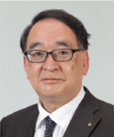
Tsutomu Yonemoto (Jul. 9, 1964) (Male) |
Apr. 1987 |
Joined the Bank | Number of shares of the Bank held:
Number of shares of Chiba Kogyo Bank held:
Number of shares of the Joint Holding Company to be allocated: | |||
| Jun. 2016 |
Executive Officer, General Manager, Business Promotion Division | |||||
| Jun. 2017 |
Director and Managing Executive Officer | |||||
| Jun. 2018 |
Director and Managing Executive Officer, General Manager in charge of Business Promotion, Group Chief Business Officer | |||||
| Jun. 2019 |
Director and Senior Executive Officer, General Manager in charge of Corporate Planning, Group Chief Strategy Officer | |||||
| Apr. 2020 |
Director and Senior Executive Officer, General Manager in charge of Corporate Planning, Group Chief Strategy Officer, Group Chief Digital Transformation Officer | |||||
| Apr. 2021 |
Director and Senior Executive Officer | |||||
| Jun. 2021 |
President, Group Chief Operating Officer | |||||
| Apr. 2023 |
President, Group Chief Executive Officer (current position) | |||||
|
Reasons for nomination as a candidate for Director
Tsutomu Yonemoto has served in various important positions within the Bank, including General Manager, Corporate Planning Division, and General Manager, Business Promotion Division, and he has been a Director of the Bank since June 2017 and has also been President of the Bank since June 2021. He has a wealth of experience and extensive expertise regarding banking business management and group management. The Bank has determined that by leveraging the experience and expertise, he can contribute to the enhancement of the Joint Holding Company’s corporate value and the company’s sustained growth while also contributing to increasing the effectiveness of decision-making and supervisory functions of the Board of Directors. Accordingly, the Bank has nominated him as a candidate for Director. | ||||||

| Name (Date of birth) |
Past experience, positions, responsibilities, and significant concurrent positions | Number of shares of the Bank held
Number of shares of Chiba Kogyo Bank held
Number of shares of the Joint Holding Company to be allocated | ||||
|
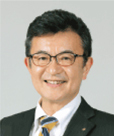
Hitoshi Umeda (Dec. 24, 1962) (Male) |
Apr. 1986 |
Joined Chiba Kogyo Bank | Number of shares of the Bank held: 0 shares
Number of shares of Chiba Kogyo Bank held: 4,800 shares
Number of shares of the Joint Holding Company to be allocated: 4,800 shares | |||
| Jun. 2014 |
Executive Officer, General Manager of Management Planning Division | |||||
| Apr. 2016 |
Executive Officer, General Manager of Sales Division of Head Office | |||||
| May 2016 |
Managing Executive Officer, General Manager of Sales Division of Head Office | |||||
| Apr. 2017 |
Managing Executive Officer | |||||
| Jun. 2018 |
Managing Director, Managing Executive Officer | |||||
| Apr. 2019 |
President, Chief Executive Officer (CEO) (current position) | |||||
|
Reasons for nomination as a candidate for Director
Hitoshi Umeda has served in various important positions within Chiba Kogyo Bank, including General Manager of Management Planning Division and General Manager of Sales Division of Head Office, and he has been a Director of Chiba Kogyo Bank since June 2018 and has also been President of Chiba Kogyo Bank since April 2019. He has a wealth of experience and extensive expertise regarding banking business management and group management. The Bank has determined that by leveraging this experience and expertise, he can contribute to the enhancement of the Joint Holding Company’s corporate value and the company’s sustained growth while also contributing to increasing the effectiveness of decision-making and supervisory functions of the Board of Directors. Accordingly, the Bank has nominated him as a candidate for Director. | ||||||

| Name (Date of birth) |
Past experience, positions, responsibilities, and significant concurrent positions | Number of shares of the Bank held
Number of shares of Chiba Kogyo Bank held
Number of shares of the Joint Holding Company to be allocated | ||||
|
Shinichi Ito (Nov. 25, 1971) (Male) |
Apr. 1994 |
Joined the Bank | Number of shares of the Bank held: 36,840 shares
Number of shares of Chiba Kogyo Bank held:
Number of shares of the Joint Holding Company to be allocated: | |||
| Apr. 2021 |
General Manager, Inage Branch, and General Manager, Ayamedai Sub Branch, Inage Branch | |||||
| Apr. 2022 |
General Manager, Asset Management and Consultation Division | |||||
| Apr. 2023 |
Executive Officer and General Manager, Asset Management and Consultation Division | |||||
| Apr. 2024 |
Executive Officer and General Manager, Corporate Business Division | |||||
| Apr. 2025 |
Managing Executive Officer and General Manager, Corporate Planning Division (current position) | |||||
|
Reasons for nomination as a candidate for Director
Shinichi Ito has served in various important positions within the Bank, including General Manager of four branches as well as General Manager, Asset Management and Consultation Division, General Manager, Corporate Business Division, and General Manager, Corporate Planning Division, and has extensive business experience and expertise. The Bank has determined that by leveraging this experience and expertise, he can contribute to the enhancement of the Joint Holding Company’s corporate value and the company’s sustained growth while also contributing to increasing the effectiveness of decision-making and supervisory functions of the Board of Directors. Accordingly, the Bank has nominated him as a candidate for Director. | ||||||

| Name (Date of birth) |
Past experience, positions, responsibilities, and significant concurrent positions | Number of shares of the Bank held
Number of shares of Chiba Kogyo Bank held
Number of shares of the Joint Holding Company to be allocated | ||||
|
Taro Kanzawa (May 25, 1971) (Male) |
Apr. 1995 |
Joined the Bank | Number of shares of the Bank held: 16,659 shares
Number of shares of Chiba Kogyo Bank held:
Number of shares of the Joint Holding Company to be allocated: 16,659 shares | |||
| Jun. 2017 |
General Manager, Hong Kong Branch | |||||
| Apr. 2019 |
General Manager, Compliance Division | |||||
| Apr. 2020 |
General Manager, Compliance and Risk Management Division | |||||
| Nov. 2021 |
General Manager, Corporate Planning Division | |||||
| Apr. 2024 |
Executive Officer in charge of Special Appointment | |||||
| Apr. 2026 |
Managing Executive Officer in charge of Special Appointment (current position) | |||||
|
Reasons for nomination as a candidate for Director
Taro Kanzawa has served in various important positions within the Bank, including General Manager of two overseas bases, General Manager, Compliance Division, General Manager, Compliance and Risk Management Division, General Manager, Corporate Planning Division, and has also been in charge of Special Appointment, and has extensive business experience and expertise. The Bank has determined that by leveraging this experience and expertise, he can contribute to the enhancement of the Joint Holding Company’s corporate value and the company’s sustained growth while also contributing to increasing the effectiveness of decision-making and supervisory functions of the Board of Directors. Accordingly, the Bank has nominated him as a candidate for Director. | ||||||

| Name (Date of birth) |
Past experience, positions, responsibilities, and significant concurrent positions | Number of shares of the Bank held
Number of shares of Chiba Kogyo Bank held
Number of shares of the Joint Holding Company to be allocated | ||||
|
Takahide Kiuchi (Nov. 29, 1963) (Male) |
Apr. 1987 |
Joined Nomura Research Institute, Ltd. | Number of shares of the Bank held:
Number of shares of Chiba Kogyo Bank held:
Number of shares of the Joint Holding Company to be allocated: | |||
| Jun. 2002 |
Head, Japanese Economic Research Unit, Economic Research Department, Nomura Research Institute, Ltd. | |||||
| Jun. 2004 |
Deputy Head, Economic Research Department and Head, Japanese Economic Research Section, Financial & Economic Research Center, Nomura Securities Co., Ltd. | |||||
| Jun. 2007 |
Managing Director, Head, Economic Research Department and Chief Economist, Financial & Economic Research Center, Nomura Securities Co., Ltd. | |||||
| Jul. 2012 |
Member of the Policy Board, Bank of Japan | |||||
| Jul. 2017 |
Executive Economist, Nomura Research Institute, Ltd. (current position) | |||||
| Jun. 2020 |
Outside Director, the Bank (current position) | |||||
|
Reasons for nomination as a candidate for Outside Director and overview of expected role
Takahide Kiuchi has a high level of expertise and a wealth of experience regarding economy and finance of Japan and other countries gained through his career as an economist at Nomura Research Institute, Ltd. and Nomura Securities Co., Ltd. and by serving as a member of the Policy Board of Bank of Japan.
He has also served as Outside Director of the Bank since June 2020 and has deepened his understanding of the Bank’s business and management.
The Bank has determined that by leveraging this experience and expertise and supervising the management of the Joint Holding Company and providing advice for the management from an independent standpoint, he can contribute to the enhancement of the Joint Holding Company’s corporate value and the company’s sustained growth while also contributing to increasing the effectiveness of decision-making and supervisory functions of the Board of Directors. Accordingly, the Bank has nominated him as a candidate for Outside Director.
He does not have experience of engaging in the business management of a company in other ways than serving as an outside officer; however, for the reasons above, the Bank believes that he will appropriately perform his duties as an Outside Director of the Joint Holding Company.
Matters regarding independence
While Nomura Research Institute, Ltd., which Takahide Kiuchi works for, is engaged in transactions with the Bank and Chiba Kogyo Bank, the Bank has determined that in view of scale, nature, and other factors, these transactions do not affect his independence. | ||||||
| Name (Date of birth) |
Past experience, positions, responsibilities, and significant concurrent positions | Number of shares of the Bank held
Number of shares of Chiba Kogyo Bank held
Number of shares of the Joint Holding Company to be allocated | ||||
|
Akira Takai (Jun. 19, 1963) (Male) |
Apr. 1987 |
Joined Daiwa Securities Co. Ltd. | Number of shares of the Bank held:
Number of shares of Chiba Kogyo Bank held:
Number of shares of the Joint Holding Company to be allocated: | |||
| Sep. 1987 |
Seconded to Daiwa Securities Research Institute Ltd. (current Daiwa Institute of Research Ltd.) | |||||
| Apr. 1993 |
Seconded to Daiwa Institute of Research America | |||||
| Feb. 1994 |
Seconded to Daiwa Institute of Research Ltd. | |||||
| Apr. 1995 |
Transferred to Daiwa Institute of Research Ltd. | |||||
| Apr. 2005 |
Chief Analyst, Equity Research Dept. (I), Daiwa Institute of Research Ltd. | |||||
| Jun. 2008 |
Chair, the Bank Subcommittee, the Corporate Disclosure Study Group, the Securities Analysts Association of Japan | |||||
| Aug. 2009 |
Chief Analyst, Equity Research Dept. (I), Daiwa Securities SMBC Co. Ltd. | |||||
| Apr. 2012 |
Chief Analyst, Equity Research Dept., Daiwa Securities Co. Ltd. | |||||
| Oct. 2017 |
Chief Analyst, Equity Research Dept., Daiwa Securities Co. Ltd. (Japanese name changed, English name unchanged) | |||||
| Oct. 2026 |
Retired from Daiwa Securities Co. Ltd. | |||||
|
Reasons for nomination as a candidate for Outside Director and overview of expected role
Akira Takai has a high level of expertise and a wealth of experience regarding the banking industry and the financial market gained by engaging in the research and analysis of the banking industry at Daiwa Institute of Research Ltd. and Daiwa Securities Co. Ltd. The Bank has determined that by leveraging this experience and expertise, he can supervise the management of the Joint Holding Company and provide advice for the management from an independent standpoint, thereby contributing to the enhancement of the Joint Holding Company’s corporate value and the company’s sustained growth, while also contributing to increasing the effectiveness of decision-making and supervisory functions of the Board of Directors. Accordingly, the Bank has nominated him as a candidate for Outside Director.
He does not have experience of engaging in the business management of a company; however, for the reasons above, the Bank believes that he will appropriately perform his duties as an Outside Director of the Joint Holding Company.
Matters concerning independence
Akira Takai worked for Daiwa Securities Co. Ltd. until October 2026. While the company and its holding company, Daiwa Securities Group Inc., are engaged in transactions with the Bank and Chiba Kogyo Bank, the Bank has determined that in view of scale, nature, and other factors, these transactions do not affect his independence. | ||||||
| (Notes) | 1. | The number of shares of the Bank held and the number of shares of Chiba Kogyo Bank held are stated based on the holding status as of September 30, 2026, and the number of shares of the Joint Holding Company to be allocated is stated based on those numbers of shares held and by taking the Share Transfer Ratio into account. If, as of immediately before the date of incorporation of the Joint Holding Company, there is any change in those numbers of shares held, the actual number of shares of the Joint Holding Company to be allocated may change accordingly. | ||
| 2. | There are no relationships of special interest between the candidate, on one side, and the Bank and Chiba Kogyo Bank, on the other. In addition, no relationships of special interest are expected to arise between the candidates and the Joint Holding Company. | |||
| 3. | Takahide Kiuchi and Akira Takai are candidates for Outside Directors of the Joint Holding Company. If this Proposal is approved and resolved and the Share Transfer becomes effective, the Joint Holding Company plans to designate them as independent officers who could have no conflicts of interest with general shareholders and file the notification of the designation with the Tokyo Stock Exchange Inc. |
| 4. | If this Proposal is approved and resolved and the Share Transfer becomes effective, the Joint Holding Company plans to enter into a liability limitation agreement with Takahide Kiuchi and Akira Takai under which their liability for damages pursuant to Article 423, Paragraph 1 of the Companies Act will be limited to the minimum liability amount set forth in Article 425, Paragraph 1 of the Companies Act, provided that they have acted in good faith and without gross negligence in performing their duties. | |||
| 5. | If this Proposal is approved and resolved and the Share Transfer becomes effective, the Joint Holding Company plans to enter into a directors and officers liability insurance agreement as set forth in Article 430-3, Paragraph 1 of the Companies Act, with an insurance company, under which the insured shall be directors, directors concurrently serving as audit and supervisory committee members, audit and supervisory board members, and executive officers of the Joint Holding Company, the Bank, which is a subsidiary of the Joint Holding Company, and its subsidiaries, and Chiba Kogyo Bank and its subsidiaries. These companies plan to bear the full amount of the insurance premiums for the insurance agreement, including premiums for riders. | |||
| The insurance agreement will cover damages for which the insured are legally liable, litigation expenses, and other losses that may be incurred by the insured, provided, however, that the Joint Holding Company will include in the insurance agreement exemption clauses, such as a provision that excludes the damages arising from a willful act or gross negligence by the insured from the insurance coverage, in order to ensure that the insured duly perform their duties. |
Matters Set Forth in Article 74-3 of the Regulations for Enforcement of the Companies Act Concerning Persons Who Will Become Directors Concurrently Serving as Audit and Supervisory Committee Members of the Joint Holding Company
The persons who will become Directors concurrently serving as Audit and Supervisory Committee members of the Joint Holding Company are as follows.
| Name (Date of birth) |
Past experience, positions, responsibilities, and significant concurrent positions | Number of shares of the Bank held
Number of shares of Chiba Kogyo Bank held
Number of shares of the Joint Holding Company to be allocated | ||||
|
Masayasu Ono (Feb. 22, 1967) (Male) |
Apr. 1990 |
Joined the Bank | Number of shares of the Bank held: 62,497 shares
Number of shares of Chiba Kogyo Bank held:
Number of shares of the Joint Holding Company to be allocated: 62,497 shares | |||
|
Dec. 2018 |
General Manager, Compliance Division | |||||
|
Jun. 2019 |
Executive Officer, General Manager, Corporate Planning Division | |||||
|
Oct. 2020 |
Executive Officer in charge of New Businesses | |||||
|
Apr. 2021 |
Corporate Planning Division and Human Resources Division (Supervisor of regional trading company business) | |||||
|
May 2021 |
President and Representative Director, Chibagin Market Co., Ltd. | |||||
|
Apr. 2023 |
Managing Executive Officer, Group Chief Risk Officer, the Bank | |||||
|
Jun. 2023 |
Director and Managing Executive Officer, Group Chief Risk Officer | |||||
|
Oct. 2023 |
Director and Managing Executive Officer, General Manager in charge of Corporate Management, Group Chief Risk Officer | |||||
|
Apr. 2026 |
Director and Senior Managing Executive Officer, General Manager in charge of Corporate Management, Group Chief Risk Officer (current position) | |||||
|
Reasons for nomination as a candidate for Director
Masayasu Ono has served in various important positions, including General Manager of the Compliance Division and General Manager of the Corporate Planning Division within the Bank, President and Representative Director of a subsidiary in the Group, and Group Chief Risk Officer, and has a wealth of experience and extensive expertise regarding compliance, risk management, corporate planning, and group management. The Bank has determined that by leveraging this experience and expertise, he can audit and supervise the execution of duties by Directors in an appropriate, fair and efficient manner and also contribute to the Joint Holding Company’s sound and sustained growth and the medium- to long-term enhancement of the company’s corporate value. Accordingly, the Bank has nominated him as a candidate for Director concurrently serving as an Audit and Supervisory Committee member. | ||||||
| Name (Date of birth) |
Past experience, positions, responsibilities, and significant concurrent positions |
Number of shares of the Bank held
Number of shares of Chiba Kogyo Bank held
Number of shares of the Joint Holding Company to be allocated | ||||
|
Mana Nabeshima Name in family register: Mana Tokoi (Jul. 4, 1966) (Female) |
Aug. 1991 |
Joined Citibank, N.A., Tokyo Branch | Number of shares of the Bank held:
Number of shares of Chiba Kogyo Bank held:
Number of shares of the Joint Holding Company to be allocated: | |||
| Oct. 2000 |
Joined Goldman Sachs Japan Co., Ltd. | |||||
| Jan. 2015 |
Joined DBS Bank Ltd. | |||||
| Aug. 2016 |
Representative Director and CEO, DBS Securities (Japan) Co., Ltd. | |||||
| Sep. 2016 |
Country Head of Japan, DBS Bank Ltd. | |||||
| Jan. 2020 |
Executive Officer, Head of Sales, HiJoJo Partners Inc. | |||||
| Jul. 2020 |
Vice Chairman, DIGITAL GRID Corporation | |||||
| Dec. 2020 |
Representative Director, Wakiaiai Co., Ltd. (current position) | |||||
| Jun. 2021 |
Outside Director, Nichirei Corporation (current position) | |||||
| Jun. 2025 |
Outside Director, the Bank (current position) | |||||
|
Significant concurrent position
Representative Director, Wakiaiai Co., Ltd. Outside Director, Nichirei Corporation
Reasons for nomination as a candidate for Outside Director and overview of expected role
Mana Nabeshima has experience working at an investment bank in the United States and served as the Representative Director and CEO of a Japanese subsidiary of a major foreign securities company. She has also served as an officer of several businesses, and has a wealth of experience and a high level of expertise regarding finance overall and corporate management and a global perspective.
She has also served as Outside Director of the Bank since June 2025 and has deepened her understanding of the Bank’s business and management.
The Bank has determined that by leveraging this experience and expertise, she can, from a standpoint independent of management and objective, audit and supervise the management of the Joint Holding Company and provide advice for the management in an appropriate manner and also contribute to the Joint Holding Company’s sound and sustained growth and the medium- to long-term enhancement of the company’s corporate value. Accordingly, the Bank has nominated her as a candidate for Outside Director concurrently serving as an Audit and Supervisory Committee member. | ||||||
| Name (Date of birth) |
Past experience, positions, responsibilities, and significant concurrent positions |
Number of shares of the Bank held
Number of shares of Chiba Kogyo Bank held
Number of shares of the Joint Holding Company to be allocated | ||||
|
Naoko Mizukoshi Name in family register: Naoko Suzuki (Sep. 23, 1967) (Female) |
Apr. 1995 |
Registered at Osaka Bar Association Joined Miyazaki Law Firm |
Number of shares of the Bank held:
Number of shares of Chiba Kogyo Bank held:
Number of shares of the Joint Holding Company to be allocated: | |||
|
Apr. 1998 |
Registered at Yokohama Bar Association (current Kanagawa Bar Association) Joined Nomura Research Institute, Ltd. | |||||
|
Sep. 1999 |
Registered at Dai-ni Tokyo Bar Association Joined Autodesk, Ltd. | |||||
|
Sep. 2002 |
Admitted to the State Bar of California Joined Microsoft Co., Ltd. (current Microsoft Japan Co., Ltd.) | |||||
|
Nov. 2006 |
Joined TMI Associates | |||||
|
Jan. 2008 |
Partner, TMI Associates | |||||
|
Mar. 2010 |
Partner, Endeavour Law Office | |||||
|
Jun. 2018 |
Outside Director, TIS Inc. | |||||
|
Dec. 2018 |
Partner, Leftright Law & IP (current position) | |||||
|
Mar. 2020 |
Outside Director, Nabtesco Corporation (current position) | |||||
|
Jun. 2021 |
Established polisee Inc. as Co-founder, Chief Strategy Officer | |||||
|
Apr. 2025 |
Co-founder, Director and Chief Strategy Officer, polisee Inc. (current position) | |||||
|
Jun. 2026 |
Outside Director, the Bank (current position) | |||||
|
Significant concurrent positions
Partner, Leftright Law & IP Outside Director, Nabtesco Corporation Director and Chief Strategy Officer, polisee Inc.
Reasons for nomination as a candidate for Outside Director and overview of expected role
Naoko Mizukoshi has engaged in corporate legal affairs as an attorney and served as an outside director of several business companies, and has a high level of expertise and a wealth of experience regarding corporate legal affairs and AI.
She has also served as Outside Director of the Bank since June 2026 and is expected to deepen her understanding of the Bank’s business and management.
The Bank has determined that by leveraging this experience and expertise, she can, from a standpoint independent of management and objective, audit and supervise the management of the Joint Holding Company and provide advice for the management in an appropriate manner and also contribute to the Joint Holding Company’s sound and sustained growth and the medium- to long-term enhancement of the company’s corporate value. Accordingly, the Bank has nominated her as a candidate for Outside Director concurrently serving as an Audit and Supervisory Committee member. | ||||||
| Name (Date of birth) |
Past experience, positions, responsibilities, and significant concurrent positions |
Number of shares of the Bank held
Number of shares of Chiba Kogyo Bank held
Number of shares of the Joint Holding Company to be allocated | ||||
|
Yumiko Kinoshita (Jul. 13, 1961) (Female) |
Apr. 1984 |
Joined the Bank of Japan | Number of shares of the Bank held:
Number of shares of Chiba Kogyo Bank held:
Number of shares of the Joint Holding Company to be allocated: | |||
|
Sep. 1991 |
Joined McKinsey & Company | |||||
|
Apr. 2004 |
Joined The National Museum of Emerging Science and Innovation of Japan Science and Technology Agency (current National Research and Development Agency; Japan Science and Technology Agency) | |||||
|
Jun. 2011 |
General Manager of Corporate Planning Department of KCJ GROUP INC. | |||||
|
Feb. 2016 |
Full-time Director of JAPAN PROFESSIONAL FOOTBALL LEAGUE | |||||
|
Mar. 2018 |
Senior Adviser to Chairman, International Outreach of JAPAN PROFESSIONAL FOOTBALL LEAGUE | |||||
|
Jul. 2020 |
Director of Tokyo Football Association | |||||
|
Mar. 2021 |
External Director of Tokyo Tatemono Co., Ltd. (current position) | |||||
|
Apr. 2022 |
Member of Administrative Council of Hitotsubashi University | |||||
|
Jun. 2024 |
Vice President of Tokyo Football Association (current position) | |||||
|
Jun. 2024 |
Outside Director of Chiba Kogyo Bank (current position) | |||||
|
Significant concurrent position
External Director of Tokyo Tatemono Co., Ltd. Vice President of Tokyo Football Association
Reasons for nomination as a candidate for Outside Director and overview of expected role
Yumiko Kinoshita has experience working at the Bank of Japan and a global consulting company and served as a general manager of corporate planning department of a business company and a full-time director of a public-interest corporation. She has also served as an external director of another business company, and has a wealth of experience and extensive expertise regarding finance and economy, corporate planning, and the management of a public-interest corporation.
She has also served as Outside Director of Chiba Kogyo Bank since June 2024 and has deepened her understanding of the bank’s business and management.
The Bank has determined that by leveraging this experience and expertise, she can, from a standpoint independent of management and objective, audit and supervise the management of the Joint Holding Company and provide advice for the management in an appropriate manner and also contribute to the Joint Holding Company’s sound and sustained growth and the medium- to long-term enhancement of the company’s corporate value. Accordingly, the Bank has nominated her as a candidate for Outside Director concurrently serving as an Audit and Supervisory Committee member.
She does not have experience of engaging in the business management of a company in other ways than serving as an outside officer; however, for the reasons above, the Bank believes that she will appropriately perform her duties as an Outside Director concurrently serving as an Audit and Supervisory Committee member of the Joint Holding Company. | ||||||
| (Notes) | 1. | The number of shares of the Bank held and the number of shares of Chiba Kogyo Bank held are stated based on the holding status as of September 30, 2026, and the number of shares of the Joint Holding Company to be allocated is stated based on those numbers of shares held and by taking the Share Transfer Ratio into account. If, as of immediately before the date of incorporation of the Joint Holding Company, there is any change in those numbers of shares held, the actual number of shares of the Joint Holding Company to be allocated may change accordingly. |
| 2. | There are no relationships of special interest between the candidate, on one side, and the Bank and Chiba Kogyo Bank, on the other. In addition, no relationships of special interest are expected to arise between the candidates and the Joint Holding Company. | |||
| 3. | Mana Nabeshima, Naoko Mizukoshi, and Yumiko Kinoshita are candidates for Outside Directors concurrently serving as Audit and Supervisory Committee members. If this Proposal is approved and resolved and the Share Transfer becomes effective, the Joint Holding Company plans to designate Mana Nabeshima, Naoko Mizukoshi, and Yumiko Kinoshita as independent officers who could have no conflicts of interest with general shareholders and file the notification of the designation with the Tokyo Stock Exchange Inc. | |||
| 4. | If this Proposal is approved and resolved and the Share Transfer becomes effective, the Joint Holding Company plans to enter into a liability limitation agreement with Mana Nabeshima, Naoko Mizukoshi, and Yumiko Kinoshita under which their liability for damages pursuant to Article 423, Paragraph 1 of the Companies Act will be limited to the minimum liability amount set forth in Article 425, Paragraph 1 of the Companies Act, provided that they have acted in good faith and without gross negligence in performing their duties. | |||
| 5. | If this Proposal is approved and resolved and the Share Transfer becomes effective, the Joint Holding Company plans to enter into a directors and officers liability insurance agreement as set forth in Article 430-3, Paragraph 1 of the Companies Act, with an insurance company, under which the insured shall be directors, directors concurrently serving as audit and supervisory committee members, audit and supervisory board members, and executive officers of the Joint Holding Company, the Bank, which is a subsidiary of the Joint Holding Company, and its subsidiaries, and Chiba Kogyo Bank and its subsidiaries. These companies plan to bear the full amount of the insurance premiums for the insurance agreement, including premiums for riders. The insurance agreement will cover damages for which the insured are legally liable, litigation expenses, and other losses that may be incurred by the insured, provided, however, that the Joint Holding Company will include in the insurance agreement exemption clauses, such as a provision that excludes the damages arising from a willful act or gross negligence by the insured from the insurance coverage, in order to ensure that the insured duly perform their duties. | |||
Matters Set Forth in Article 77 of the Regulations for Enforcement of the Companies Act Concerning the Person Who Will Become the Accounting Auditor of the Joint Holding Company
The person who will become the Accounting Auditor of the Joint Holding Company is as follows.
| Name | Ernst & Young ShinNihon LLC |
|
||||||||||
| Major office | Hibiya Mitsui Tower, Tokyo Midtown Hibiya, 1-1-2 Yuraku-cho, Chiyoda-ku, Tokyo | |||||||||||
| History | April 1, 2000 | Ota Showa and Corporation (established in October 1985 through the merger of Audit Corporation Ota Tetsuzo Office, established in January 1967, and Showa Audit Corporation, established in December 1969) and Century Audit Corporation (established in January 1986) merged to incorporate Century Ota Showa and Corporation. | ||||||||||
| July 1, 2001 | Audit Corporation Ota Showa Century was renamed ShinNihon and Corporation. | |||||||||||
| August 1, 2003 | Concluded an agreement concerning membership with Ernst & Young Global Limited. | |||||||||||
| July 1, 2008 | ShinNihon and Corporation transitioned to a limited liability company and was renamed Ernst & Young ShinNihon LLC. | |||||||||||
| July 1, 2018 | Ernst & Young ShinNihon LLC was renamed Ernst & Young ShinNihon LLC. (Japanese name changed, English name unchanged) | |||||||||||
| Capital stock | 1,186 million yen (as of June 30, 2026) | |||||||||||
| Summary | Number of the members (as of June 30, 2026) | |||||||||||
| Certified public accountants (CPAs) |
3,073 | |||||||||||
| Members who have passed the CPA examination |
1,522 | |||||||||||
| Other staff members |
2,250 | |||||||||||
| Total |
6,845 | |||||||||||
| Number of clients (as of June 30, 2026) | ||||||||||||
| Audit certification service |
3,867 entities |
|
||||||||||
| Other services |
1,971 entities |
|
||||||||||
Proposal No. 2: Partial Amendments to the Articles of Incorporation
1. Reason for the amendments
If Proposal No. 1 regarding the approval of the Share Transfer Plan is approved at this Extraordinary General Meeting of Shareholders and the Share Transfer becomes effective, the Joint Holding Company is expected to become the sole shareholder of the Bank. Accordingly, the provision of the Bank’s Articles of Incorporation concerning the record date for the annual shareholders’ meeting will no longer be necessary. Therefore, the Bank proposes to delete Article 14 (Date of Record for the Annual General Meeting of Shareholders) of the current Articles of Incorporation in its entirety and renumber the subsequent articles accordingly on condition that Proposal No. 1 is approved at this Extraordinary General Meeting of Shareholders as originally proposed and neither the Share Transfer Plan has ceased to be effective nor the Share Transfer has been canceled by the day immediately preceding March 31, 2027.
2. Details of the amendments
The details of the amendments are as follows.
<Comparison of Current and Proposed Articles of Incorporation>
(The amendments are underlined.)
| Current Articles of Incorporation |
Proposed amendment | |
| (Date of Record for the Annual General Meeting of Shareholders) | ||
| Article 14 The date of record for voting rights at the Bank’s Annual General Meeting of Shareholders shall be March 31 of each year. | (Deleted) | |
| Article 15 to Article 41 (Omitted) | Article 14 to Article 40 (Unchanged) | |
(Reference)
The Bank plans to pay dividends of surplus (year-end dividends) for the fiscal year ending March 31, 2027 (from April 1, 2026 to March 31, 2027) to those shareholders or registered pledgees who are stated or recorded in the final shareholder register as of March 31, 2027, pursuant to Article 39, Paragraph 1, of its current Articles of Incorporation (Article 38, Paragraph 1, of its Articles of Incorporation after the proposed amendment).
Proposal No. 3: Partial Amendments to the Restricted Stock Remuneration Plans for Directors (excluding Outside Directors)
At the Bank’s 115th Annual General Meeting of Shareholders held on June 25, 2021, the establishment of a remuneration limit and other matters associated with the introduction of its restricted stock remuneration plan for Directors excluding Outside Directors (those Directors are hereinafter referred to as the “Eligible Directors”) (“Plan I”) were approved. In addition, at the Bank’s 118th Annual General Meeting of Shareholders held on June 26, 2024, partial revision of Plan I as well as the establishment of a remuneration limit and other matters associated with the introduction of its performance-linked stock remuneration plan for the Eligible Directors (“Plan II”; Plan I and Plan II are hereinafter collectively referred to as the “Plans”) were approved.
Under the Plans, in light of the substantial change in the incentive structure between a corporation and its Eligible Directors in the event of a merger or other organizational restructuring, etc., the Bank has obtained shareholders’ approval of the inclusion of the following provisions in the restricted stock allotment agreements: (i) for Plan I, “during the transfer restriction period, in the event that a merger agreement whereby the Bank will be the non-surviving party to the merger, or a share exchange agreement or share transfer plan whereby the Bank will become a wholly owned subsidiary of another party, or otherwise any matter concerning organizational restructuring, etc. is approved at the General Meeting of Shareholders of the Bank, or by the Board of Directors of the Bank if such organizational restructuring, etc. does not require any approval at the General Meeting of Shareholders of the Bank, under the resolution of the Board of Directors of the Bank, the Bank shall, prior to the effective date of such organizational restructuring, etc., remove the transfer restriction from the shares of restricted stock which number shall be determined reasonably in keeping with the period from the beginning date of the transfer restriction period to the date of approval of such organizational restructuring, etc. In the event provided above, the Bank shall rightfully, without compensation, acquire the shares of restricted stock for which the transfer restriction has not yet been removed at the point in time immediately after the removal of the transfer restriction”; and (ii) for Plan II, “during the transfer restriction period, in the event that a merger agreement whereby the Bank will be the non-surviving party to the merger, or a share exchange agreement or share transfer plan whereby the Bank will become a wholly owned subsidiary of another party, or otherwise any matter concerning organizational restructuring, etc. is approved at the General Meeting of Shareholders of the Bank, or by the Board of Directors of the Bank if such organizational restructuring, etc. does not require any approval at the General Meeting of Shareholders of the Bank, under the resolution of the Board of Directors of the Bank, the Bank shall, prior to the effective date of such organizational restructuring, etc., remove the transfer restriction from the shares of restricted stock in whole.”
The Bank has determined that continuing to impose transfer restrictions on the shares to be allocated in substitution for the shares of restricted stock that have previously been granted to the Eligible Directors under the Plans even after Proposal No. 1 “Approval of the Share Transfer Plan with The Chiba Kogyo Bank, Ltd.” is approved as originally proposed at this Extraordinary General Meeting of Shareholders and the Bank becomes a wholly owned subsidiary of the Joint Holding Company should incentivize the Eligible Directors to strive to achieve the sustainable improvement of the Joint Holding Company’s corporate value and should also further promote value sharing between the Eligible Directors and shareholders.
Accordingly, the Bank proposes amending the Plans as described below, provided that except for the proposed amendments, the contents of the Plans will remain unchanged and be maintained as previously approved.
The contents of this Proposal follow the Bank’s Policy for Determination of the Contents of Individual Remuneration, etc. of Directors, and the Bank had this Proposal deliberated by the Nomination, Remuneration and Corporate Advisory Committee, a majority of whose members are independent Outside Directors, and received the committee’s report to ensure fairness and transparency in the procedure. Therefore, the Bank considers the contents of this Proposal reasonable.
The contents of the amendments are as follows.
(1) Plan I
(Amended portions are underlined.)
| Before amendment |
Proposed amendment | |
| (iv) Treatment in the Event of Organizational Restructuring, etc.
Notwithstanding the provision in (i) above, during the Transfer Restriction Period I, in the event that a merger agreement whereby the Bank will be the non-surviving party to the merger, or a share exchange agreement or share transfer plan whereby the Bank will become a wholly owned subsidiary of another party, or otherwise any matter concerning organizational restructuring, etc. is approved at the General Meeting of Shareholders of the Bank, or by the Board of Directors of the Bank if such organizational restructuring, etc. does not require any approval at the General Meeting of Shareholders of the Bank, under the resolution of the Board of Directors of the Bank, the Bank shall, prior to the effective date of such organizational restructuring, etc., remove the Transfer Restriction I from the Allotted Shares I which number shall be determined reasonably in keeping with the period from the beginning date of the Transfer Restriction Period I to the date of approval of such organizational restructuring, etc. In addition, in the event provided above, the Bank shall rightfully, without compensation, acquire the Allotted Shares I for which the Transfer Restriction I has not yet been removed at the point in time immediately after the removal of the Transfer Restriction I. |
(iv) Treatment in the Event of Organizational Restructuring, etc.
Notwithstanding the provision in (i) above, during the Transfer Restriction Period I, in the event that a merger agreement whereby the Bank will be the non-surviving party to the merger, or a share exchange agreement or share transfer plan whereby the Bank will become a wholly owned subsidiary of another party, or otherwise any matter concerning organizational restructuring, etc. (“Organizational Restructuring, etc.”) is approved at the General Meeting of Shareholders of the Bank, or by the Board of Directors of the Bank if such organizational restructuring, etc. does not require any approval at the General Meeting of Shareholders of the Bank, under the resolution of the Board of Directors of the Bank, the Bank shall, prior to the effective date of such organizational restructuring, etc., remove the Transfer Restriction I from the Allotted Shares I which number shall be determined reasonably in keeping with the period from the beginning date of the Transfer Restriction Period I to the date of approval of such organizational restructuring, etc. In addition, in the event provided above, the Bank shall rightfully, without compensation, acquire the Allotted Shares I for which the Transfer Restriction I has not yet been removed at the point in time immediately after the removal of the Transfer Restriction I, provided, however, that the foregoing shall not apply when an entity engaged in the Organizational Restructuring, etc. other than the Bank delivers its shares (limited to shares of restricted stock) to the Eligible Directors. |
(2) Plan II
(Amended portions are underlined.)
| Before amendment |
Proposed amendment | |
| (iv) Treatment in the Event of Organizational Restructuring, etc.
Notwithstanding the provision in (i) above, during the Transfer Restriction Period II, in the event that a merger agreement whereby the Bank will be the non-surviving party to the merger, or a share exchange agreement or share transfer plan whereby the Bank will become a wholly owned subsidiary of another party, or otherwise any matter concerning organizational restructuring, etc. is approved at the General Meeting of Shareholders of the Bank, or by the Board of Directors of the Bank if such organizational restructuring, etc. does not require any approval at the General Meeting of Shareholders of the Bank, under the resolution of the Board of Directors of the Bank, the Bank shall, prior to the effective date of such organizational restructuring, etc., remove the Transfer Restriction II from the Allotted Shares II in whole. |
(iv) Treatment in the Event of Organizational Restructuring, etc.
Notwithstanding the provision in (i) above, during the Transfer Restriction Period II, in the event that a merger agreement whereby the Bank will be the non-surviving party to the merger, or a share exchange agreement or share transfer plan whereby the Bank will become a wholly owned subsidiary of another party, or otherwise any matter concerning organizational restructuring, etc. (“Organizational Restructuring, etc.”) is approved at the General Meeting of Shareholders of the Bank, or by the Board of Directors of the Bank if such organizational restructuring, etc. does not require any approval at the General Meeting of Shareholders of the Bank, under the resolution of the Board of Directors of the Bank, the Bank shall, prior to the effective date of such organizational restructuring, etc., remove the Transfer Restriction II from the Allotted Shares II in whole, provided, however, that the foregoing shall not apply when an entity engaged in the Organizational Restructuring, etc. other than the Bank delivers its shares (limited to shares of restricted stock) to the Eligible Directors. |
If this Proposal is approved, the Bank plans to take the prescribed procedures in accordance with the methods stipulated in the restricted stock allotment agreements relating to the restricted stock previously granted to Directors, so that the contents of the amendments to the Plans set out in this Proposal will also be reflected in those agreements. In addition, if Proposal No. 1 “Approval of the Share Transfer Plan with The Chiba Kogyo Bank, Ltd.” is approved as originally proposed at this Extraordinary General Meeting of Shareholders, the Bank’s contractual status and its rights and obligations under those restricted stock allotment agreements will, as of April 1, 2027, be transferred to and assumed by the Joint Holding Company to be established upon the share transfer plan for the Share Transfer becoming effective.
At present, the number of Directors eligible for the Plans is five.
This Proposal shall become effective on condition that Proposal No. 1 “Approval of the Share Transfer Plan with The Chiba Kogyo Bank, Ltd.” is approved and resolved as originally proposed.
| (Reference) | Original resolution (1) (at the 115th Annual General Meeting of Shareholders held on June 25, 2021) |
| Proposal No. 4: | Determination of Remuneration to Grant Directors (Excluding Outside Directors) restricted stock |
In regards to the amount of remuneration for Directors of the Bank, at the 104th Annual General Meeting of Shareholders held on June 29, 2010, it was approved that the maximum amount shall not exceed ¥560 million per annum, in which employee salaries for Directors who concurrently serve as employees are to be excluded, and that, separately from the above remuneration limit, the remuneration for Directors regarding stock acquisition rights as stock options shall not exceed ¥140 million per annum.
As a part of the reconsideration of the executive remuneration system, the Bank proposes paying new remuneration, separately from the above remuneration limits, for granting the Bank’s Directors (excluding Outside Directors; hereinafter the “Eligible Directors”) restricted stock, in substitution for the current remuneration plan regarding stock acquisition rights as stock options, for the purpose of incentivizing the Eligible Directors to strive to achieve sustainable improvement of the Bank’s corporate value and further promoting value sharing with shareholders.
The remuneration to be paid to the Eligible Directors for granting restricted stock based on this Proposal shall be monetary claims, and the total amount of the monetary claims shall not exceed ¥140 million per annum, an amount considered reasonable for the above purpose. The specific timing and details of allocations to Eligible Directors will be separately decided by the Board of Directors.
Subject to the approval and resolution of this Proposal, the current remuneration plan regarding stock acquisition rights as stock options shall be abolished, and stock acquisition rights as stock options shall not be issued. In addition, the Eligible Directors shall waive the stock acquisition rights as stock options that they have been granted and have yet to exercise, on condition that this new plan is introduced.
Accordingly, for this fiscal year, as a measure for the transition from stock acquisition rights as stock options, the remuneration for granting the same number of shares of restricted stock as the shares for which the Eligible Directors waive their stock acquisition rights (694,300 shares) shall be ¥959 million or less per annum, separately from the above remuneration limit to grant restricted stock, making the total amount of the remuneration limit for this fiscal year ¥1,099 million or less. This is a remuneration previously granted in the past fiscal years, and is essentially not new additional remuneration.
The number of Directors is currently eight (including three Outside Directors), and if Proposal No. 2 “Election of Six (6) Directors” is approved and resolved as originally proposed, the number of Directors will be nine (including three Outside Directors).
The Eligible Directors shall, based on a resolution by the Board of Directors, pay in as in-kind contribution assets all the monetary claims paid in accordance with this Proposal and receive shares of the Bank’s common stock issued or disposed of by the Bank, and the number of shares of the Bank’s common stock issued or disposed of therefor shall not exceed 500,000 shares per annum, provided that, as described above, for this fiscal year, the limit shall separately be set at 694,300 shares, as a measure for the transition from stock acquisition rights as stock options. If a stock split (including allotment of the Bank’s common stock without contribution) or a reverse stock split is conducted or any other circumstance in which the total number of shares of the Bank’s common stock to be issued or disposed of as restricted stock needs to be adjusted arises on or after the day this Proposal is approved and resolved, the total number shall be reasonably adjusted. The amount to be paid per share of the common stock shall be determined by the Board of Directors based on the closing price of the Bank’s common stock on the Tokyo Stock Exchange on the business day immediately preceding the date of each resolution by the Board of Directors (or, if no transaction is made on such business day, the closing price on the transaction day immediately prior thereto) and within an extent that the amount is not particularly favorable to the Eligible Directors who receive the shares of common stock. The issuance or disposal of the Bank’s common stock and the granting of monetary claims as contribution in kind assets therefor shall be conditional on the conclusion of a restricted stock allotment agreement between the Bank and the Eligible Directors (the “Allotment Agreement”).
(1) Transfer Restriction Period
The Eligible Directors shall not transfer, create a security interest in, or otherwise dispose of the shares of common stock of the Bank allotted under the Allotment Agreement (the “Allotted Shares”) from the payment date of the Allotted Shares to the point in time immediately after Directors of the Bank have resigned from any position which has been determined beforehand by the Board of Directors of the Bank (the “Transfer Restriction Period”). (Hereinafter collectively as a whole referred to as the “Transfer Restriction.”)
(2) Treatment in the Event of Resignation
In the event of resignation of the Eligible Directors from any position which has been determined by the Board of Directors of the Bank beforehand prior to the expiration of the period determined by the Board of Directors of the Bank beforehand (the “Service Period”), the Bank shall rightfully acquire the Allotted Shares without compensation for any reason other than the event of expiration of term of office, death, or any other legitimate reason.
(3) Removal of the Transfer Restriction
Notwithstanding the provision in (1) above, the Bank shall remove the Transfer Restriction with respect to the Allotted Shares in whole at the point of the timing of expiration of the Transfer Restriction Period, provided that, during the Service Period, the Eligible Directors continuously served in the position determined by the Board of Directors of the Bank beforehand. However, in the event (a) that the Eligible Directors leave any position determined by the Board of Directors of the Bank before the expiration of the Service Period for any reason, such as the expiration of term of office, death, or any other legitimate reason, or (b) that the Eligible Directors leave any position determined by the Board of Directors of the Bank beforehand for any reason other than any legitimate reason after the expiration of the Service Period and prior to the expiration of the Transfer Restriction Period, the number of the Allotted Shares subject to removal of the Transfer Restriction and the timing of removal of the Transfer Restriction shall be reasonably adjusted, as necessary. In addition, based on the provisions set above, the Bank shall rightfully, without compensation, acquire the Allotted Shares for which the Transfer Restriction has not yet been removed at the point in time immediately after the removal of the Transfer Restriction.
(4) Treatment in the Event of Organizational Restructuring, etc.
Notwithstanding the provision in (1) above, during the Transfer Restriction Period, in the event that a merger agreement whereby the Bank will be the non-surviving party to the merger, or a share exchange agreement or share transfer plan whereby the Bank will become a wholly owned subsidiary of another party, or otherwise any matter concerning organizational restructuring, etc. is approved at the General Meeting of Shareholders of the Bank, or by the Board of Directors of the Bank if such organizational restructuring, etc. does not require any approval at the General Meeting of Shareholders of the Bank, under the resolution of the Board of Directors of the Bank, the Bank shall, prior to the effective date of such organizational restructuring, etc., remove the Transfer Restriction from the Allotted Shares which number shall be determined reasonably in keeping with the period from the beginning date of the Transfer Restriction Period to the date of approval of such organizational restructuring, etc. In addition, in the event provided above, the Bank shall rightfully, without compensation, acquire the Allotted Shares for which the Transfer Restriction has not yet been removed at the point in time immediately after the removal of the Transfer Restriction.
(5) Other Matters
Other matters concerning the Allotment Agreement shall be determined by the Board of Directors of the Bank.
(Reference) Original resolution (2) (at the 118th Annual General Meeting of Shareholders held on June 26, 2024)
| Proposal | No. 4: Revision of Restricted Stock Remuneration Plan to Directors (Excluding Outside Directors) |
In regards to the amount of remuneration for Directors of the Bank, at the 104th Annual General Meeting of Shareholders held on June 29, 2010, it was approved that the maximum amount shall not exceed ¥560 million per annum, in which employee salaries for Directors who concurrently serve as employees are to be excluded. Further, at the 115th Annual General Meeting of Shareholders held on June 25, 2021, it was approved that the total amount of monetary claims paid to Directors of the Bank (excluding Outside Directors; hereinafter the “Eligible Directors”) to grant restricted stocks shall, separately from the above remuneration limit, not exceed ¥140 million per annum, and that the total number of shares of common stock of the Bank to be issued or disposed shall not exceed 500,000 shares per year.
As a part of the reconsideration of the executive remuneration system, the Bank proposes to make partial revisions to the current restricted stock plan (“Plan I”), in which the removal of the transfer restriction is conditional on a certain period of continuous service at the Bank. With the objectives of more clearly linking Directors’ remuneration with corporate performance and the Bank’s share value and granting incentives aimed at sustainable improvement of the corporate value of the Bank through the achievement of the performance targets set forth in the Mid-term Plan and the medium- to long-term improvement of the Bank’s performance, as well as further sharing of value with our shareholders, the Bank proposes the introduction of a new plan (“Plan II”; Plan I and Plan II are collectively referred to as the “Plans”) for the delivery of restricted stock in numbers in accordance with the degree of achievement of performance targets determined beforehand by the Bank.
An outline of the Plans overall is provided below. The specific timing and details of allocations to Eligible Directors will be separately decided by the Board of Directors.
| Plan I |
Plan II | |||
| Total amount of monetary claims and money to be paid for the granting of restricted stocks | No more than ¥140 million per annum (this shall be the total amount for Plans I and II combined) (*1) | |||
| Total number of shares of common stock of the Bank to be issued or disposed | No more than 500,000 shares (this shall be the total number for Plans I and II combined) (*1) (*2) | |||
| Amount to be paid per share | The amount determined by the Board of Directors based on the closing price of the Bank’s common stock on the Tokyo Stock Exchange on the business day previous to the day of resolution of Board of Directors on issue or disposal of the Bank’s common stock (the closing price on the most recent and previous trading day if a transaction has not been completed on the same day; the same shall apply hereinafter) to the extent that the amount will not be particularly favorable for the Eligible Directors | |||
| (*1) | The total amount of monetary claims and money to be paid for the granting of restricted stocks under Plans I and II shall not exceed ¥140 million per annum, and the total number of shares of restricted stock allotted to Eligible Directors each fiscal year shall not exceed 500,000 shares per year. Neither of these limits have changed from the remuneration limits approved on June 25, 2021. |
| (*2) | In the event of a stock split, including the allotment of the Bank’s common stock without contribution, or the consolidation of shares of the Bank’s common stock after the day this proposal is approved and passed, or if any other event arises that requires the total number of the Bank’s common stock that are to be issued or disposed based on the Plans to be adjusted, such total number shall be adjusted within a reasonable amount. The same shall apply hereinafter. |
The maximum remuneration amount and total number of shares of common stock of the Bank to be issued or disposed under this proposal and other conditions of granting of common stock of the Bank to Eligible Directors under this proposal have been determined in consideration of the aforementioned objectives, the condition of the Bank’s business, the Policy for Determination of the Contents of Individual Remuneration, etc. of Directors (if this proposal is approved and passed, the Bank plans to amend the contents of this Policy to align it with the approved details; see [Reference] below), and other various circumstances, and the Bank believes them to be reasonable.
Currently the number of Directors is Nine (9), including Three (3) Outside Directors. Provided that the Proposal No. 3, “Election of Nine (9) Directors,” is approved and passed as the original form, the number of Directors shall be Nine (9), including Four (4) Outside Directors.
Further, if this proposal is approved and passed as originally proposed, in addition to the Eligible Directors, the Bank plans to introduce a similar plan to the plan for Eligible Directors for Executive Officers of the Bank who do not concurrently serve as Directors of the Bank, by the resolution of the Bank’s Board of Directors.
1. Outline of Plan I
| (1) | Partial Revision of Contents of Plan I |
As described above, with the adoption of Plan II, in addition to the consistent implementation of the content of the restricted stock remuneration, including the transfer restriction period, the Bank proposes the partial revision of the contents of the Transfer Restricted Stock Allotment Agreement in Plan I (the “Allotment Agreement I”), as described below, so that the malus and clawback provisions adopted in Plan II may also be applied to Plan I.
| (2) | Overview of the Allotment Agreement I |
| (i) | Transfer Restriction Period |
The Eligible Directors shall not transfer, create a security interest in, or otherwise dispose of the shares of common stock of the Bank allotted under the Allotment Agreement I (the “Allotted Shares I”) from the payment date of the Allotted Shares I to the point in time immediately after Directors of the Bank have resigned from any position which has been determined beforehand by the Board of Directors of the Bank (the “Transfer Restriction Period I”). (Hereinafter collectively as a whole referred to as the “Transfer Restriction I.”) However, if the point in time immediately after such resignation is a point in time prior to the date on which three (3) months have elapsed since the fiscal year to which the date of receipt of the allotment of the Allotted Shares I belongs, the end of the Transfer Restriction Period I may be adjusted to a reasonable extent.
| (ii) | Treatment in the Event of Resignation |
In the event of resignation of the Eligible Directors from any position which has been determined by the Board of Directors of the Bank beforehand prior to the expiration of the period determined by the Board of Directors of the Bank beforehand (the “Service Period”), the Bank shall rightfully acquire the Allotted Shares I without compensation for any reason other than the event of expiration of term of office, death, or any other legitimate reason.
| (iii) | Removal of the Transfer Restriction |
Notwithstanding the provision in (i) above, the Bank shall remove the Transfer Restriction I with respect to the Allotted Shares I in whole at the point of the timing of expiration of the Transfer Restriction Period I, provided that, during the Service Period, the Eligible Directors continuously served in the position determined by the Board of Directors of the Bank beforehand. However, in the event (a) that the Eligible Directors leave any position determined by the Board of Directors of the Bank before the expiration of the Service Period for any reason, such as the expiration of term of office, death, or any other legitimate reason, or (b) that the Eligible Directors leave any position determined by the Board of Directors of the Bank beforehand for any reason other than any legitimate reason after the expiration of the Service Period and prior to the expiration of the Transfer Restriction Period I, the number of the Allotted Shares I subject to removal of the Transfer Restriction I and the timing of removal of the Transfer Restriction I shall be reasonably adjusted, as necessary. In addition, based on the provisions set above, the Bank shall rightfully, without compensation, acquire the Allotted Shares I for which the Transfer Restriction I has not yet been removed at the point in time immediately after the removal of the Transfer Restriction I.
| (iv) | Treatment in the Event of Organizational Restructuring, etc. |
Notwithstanding the provision in (i) above, during the Transfer Restriction Period I, in the event that a merger agreement whereby the Bank will be the non-surviving party to the merger, or a share exchange agreement or share transfer plan whereby the Bank will become a wholly owned subsidiary of another party, or otherwise any matter concerning organizational restructuring, etc. is approved at the General Meeting of Shareholders of the Bank, or by the Board of Directors of the Bank if such organizational restructuring, etc. does not require any approval at the General Meeting of Shareholders of the Bank, under the resolution of the Board of Directors of the Bank, the Bank shall, prior to the effective date of such organizational restructuring, etc., remove the Transfer Restriction I from the Allotted Shares I which number shall be determined
reasonably in keeping with the period from the beginning date of the Transfer Restriction Period I to the date of approval of such organizational restructuring, etc. In addition, in the event provided above, the Bank shall rightfully, without compensation, acquire the Allotted Shares I for which the Transfer Restriction I has not yet been removed at the point in time immediately after the removal of the Transfer Restriction I.
| (v) | Malus/Clawback Clause |
The Bank shall set forth provisions under which, if, during the Transfer Restriction Period I and after the removal of the Transfer Restriction I, the Board of Directors of the Bank recognizes that any Eligible Directors have committed a material violation of laws and regulations or the Bank’s internal rules, and if certain circumstances determined by the Board of Directors of the Bank, including serious fraudulent accounting or large-scale losses, arise, the Bank may acquire, without compensation, all or part of the Allotted Shares I allotted to the Eligible Directors or the shares of common stock of the Bank for which the Transfer Restriction I has been removed, or demand the payment of an amount equivalent to the Allotted Shares I or the shares of common stock of the Bank for which the Transfer Restriction I has been removed.
| (vi) | Other Matters |
Other matters concerning the Allotment Agreement I shall be determined by the Board of Directors of the Bank.
2. Outline of Plan II
Plan II is a plan in which, after the close of the performance evaluation period, the Bank will issue or dispose of shares of common stock of the Bank to Eligible Directors according to the performance during the performance evaluation period. The specific performance evaluation period shall be one (1) fiscal year from April 1 every year to March 31 of the following year, and the performance evaluation indicators shall be determined beforehand by the Board of Directors of the Bank.
| (1) | Method of Calculating the Amount of Monetary Claims |
The Bank will calculate the number of shares of common stock of the Bank to be delivered to each Eligible Director using the formula in (i) below and calculate the amount of monetary claims to be paid to each Eligible Director using the formula in (ii) below.
| (i) | Number of shares of common stock of the Bank to be issued or disposed to each Eligible Director (*1) |
Position-based standard amount (*2) / share price at time of delivery (*3) x performance evaluation coefficient (*4)
| (ii) | Amount of monetary claims to be paid to each Eligible Director |
Number of shares of common stock of the Bank calculated in (i) above x share price at time of delivery (*3)
| (*1) | Any fractions of less than one share resulting from the calculation shall be rounded down. |
| (*2) | The position-based standard amount for Eligible Directors shall be determined beforehand by the Board of Directors of the Bank. |
| (*3) | The share price at time of delivery shall be determined by the Board of Directors based on the closing price of the Bank’s common stock on the Tokyo Stock Exchange on the business day previous to the day on which a resolution of the Board of Directors of the Bank concerning the issue or disposal of shares of common stock of the Bank is made after the close of the performance evaluation period, to the extent that the amount will not be particularly favorable for the Eligible Directors underwriting the common stock of the Bank. |
| (*4) | The performance evaluation coefficient shall be determined by the Board of Directors of the Bank beforehand within a range of 0% to 150% according to the degree of achievement of each performance evaluation indicator during the performance evaluation period. |
| (2) | Conditions of Payment to Eligible Directors |
The Bank shall, in principle, issue or dispose of shares of common stock of the Bank to Eligible Directors in the number calculated based on (1) above after the close of the performance evaluation period if the Eligible Directors have satisfied the following requirements:
| (i) | the Eligible Directors continuously occupied the position of Director or Executive Officer of the Bank during the performance evaluation period; |
| (ii) | there were no acts of misconduct as determined by the Board of Directors of the Bank; and |
| (iii) | they satisfy any other requirements that the Board of Directors of the Bank recognizes as necessary for achieving the intent of the Plan II. |
In the event that the Eligible Directors leave both positions of Director and Executive Officer of the Bank due to the expiration of term of office, death, or any other legitimate reason during the performance evaluation period or after the close of the performance evaluation period but before the issue or disposal of shares of common stock of the Bank, and in the event that a merger agreement whereby the Bank will be the non-surviving party to the merger, or a share exchange agreement or share transfer plan whereby the Bank will become a wholly owned subsidiary of another party, or otherwise any matter concerning organizational restructuring, etc. is approved at the General Meeting of Shareholders of the Bank, or by the Board of Directors of the Bank if such organizational restructuring, etc. does not require any approval at the General Meeting of Shareholders of the Bank (however, only when the effective date of such organizational restructuring, etc. is scheduled to arrive before the date of the issue or disposal of shares of common stock of the Bank based on the Plan II), the Bank shall pay cash in place of the shares of common stock of the Bank. The amount of such cash to be paid to the Eligible Directors shall be the amount obtained by reasonable adjustment of the position-based standard amount according to the performance evaluation coefficient, etc. The issuance or disposal of the Bank’s common stock and the granting of monetary claims as contribution in kind assets based on the Plan II, shall be conditional on the conclusion of a Transfer Restricted Stock Allotment Agreement (the “Allotment Agreement II”), which includes the following contents, between the Bank and the Eligible Directors. However, this shall not apply if the Eligible Directors are not occupying the position of either Director or Executive Officer of the Bank at the point in time when they are to receive the issue or disposal of the common stock and the granting of monetary claims as contribution in kind assets.
| (3) | Overview of the Allotment Agreement II |
| (i) | Transfer Restriction Period |
The Eligible Directors shall not transfer, create a security interest in, or otherwise dispose of the shares of common stock of the Bank allotted under the Allotment Agreement II (the “Allotted Shares II”) from the payment date of the Allotted Shares II to the point in time immediately after Directors of the Bank have resigned from any position which has been determined beforehand by the Board of Directors of the Bank (the “Transfer Restriction Period II”). (Hereinafter collectively as a whole referred to as the “Transfer Restriction II.”) However, if the point in time immediately after such resignation is a point in time prior to the date on which three (3) months have elapsed since the fiscal year to which the date of receipt of the allotment of the Allotted Shares II belongs, the end of the Transfer Restriction Period II may be adjusted to a reasonable extent.
| (ii) | Treatment in the Event of Resignation |
In the event of resignation of the Eligible Directors from any position which has been determined by the Board of Directors of the Bank beforehand prior to the expiration of the Transfer Restriction Period II, the Bank shall rightfully acquire the Allotted Shares II without compensation for any reason other than the event of expiration of term of office, death, or any other legitimate reason.
| (iii) | Removal of the Transfer Restriction |
In the event that the Eligible Directors leave their position determined by the Board of Directors of the Bank beforehand due to expiration of term of office, death, or any other legitimate reason, the Bank shall remove the Transfer Restriction II with respect to the Allotted Shares II in whole at the point of time of the expiration of the Transfer Restriction Period II.
| (iv) | Treatment in the Event of Organizational Restructuring, etc. |
Notwithstanding the provision in (i) above, during the Transfer Restriction Period II, in the event that a merger agreement whereby the Bank will be the non-surviving party to the merger, or a share exchange agreement or share transfer plan whereby the Bank will become a wholly owned subsidiary of another party, or otherwise any matter concerning organizational restructuring, etc. is approved at the General Meeting of Shareholders of the Bank, or by the Board of Directors of the Bank if such organizational restructuring, etc. does not require any approval at the General Meeting of Shareholders of the Bank, under the resolution of the Board of Directors of the Bank, the Bank shall, prior to the effective date of such organizational restructuring, etc., remove the Transfer Restriction II from the Allotted Shares II in whole.
| (v) | Malus/Clawback Clause |
The Bank shall set forth provisions under which, if, during the Transfer Restriction Period II and after the removal of the Transfer Restriction II, the Board of Directors of the Bank recognizes that any Eligible Directors have committed a material violation of laws and regulations or the Bank’s internal rules, and if certain circumstances determined by the Board of Directors of the Bank, including serious fraudulent accounting or large-scale losses, arise, the Bank may acquire, without compensation, all or part of the Allotted Shares II allotted to the Eligible Directors or the shares of common stock of the Bank for which the Transfer Restriction II has been removed, or demand the payment of an amount equivalent to the Allotted Shares II or the shares of common stock of the Bank for which the Transfer Restriction II has been removed.
| (vi) | Other Matters |
Other matters concerning the Allotment Agreement II shall be determined by the Board of Directors of the Bank.
| These documents are partial translations of the Japanese originals for reference purposes only.
In the event of any discrepancy between these translated documents and the Japanese originals, the originals shall prevail. The Bank assumes no responsibility for this translation or for direct, indirect or any other forms of damages arising from the translations. |
THE EXTRAORDINARY GENERAL MEETING OF SHAREHOLDERS
REFERENCE DOCUMENTS FOR THE EXTRAORDINARY GENERAL MEETING OF SHAREHOLDERS (SUPPLEMENT)
| Proposal No. 1: Approval of the Share Transfer Plan with The Chiba Kogyo Bank, Ltd. | ||
| 1. |
Details of the Financial Statements, etc. of Chiba Kogyo Bank for the Last Fiscal Year Ended March 31, 2026 | |
| (“Matters Concerning Chiba Kogyo Bank” on page 41 of the Notice of Convocation of the Extraordinary General Meeting of Shareholders) | ||
| 2. |
Details of Stock Acquisition Rights | |
| See Appendix B of the prospectus which is part of the registration statement. | ||
The Chiba Bank, Ltd.
Securities Code: 8331
Business Report for the 104th Fiscal Year (April 1, 2025 - March 31, 2026)
1. Current Status of the Bank
| (1) | Business Progress and Results |
| a. | Principal business activities |
The Bank engages in banking operations, including deposit services, lending business services, domestic exchange services, and foreign exchange services, primarily through its head office and branches in Chiba Prefecture. In addition, the Bank conducts ancillary operations, including agency business operations such as serving as a revenue agency for the Bank of Japan, etc., safe-deposit box services, and over-the-counter sales of government bonds and other public bonds, investment trusts, and insurance products. Through the provision of a wide range of financial products and services, the Bank conducts business activities closely rooted in the local community.
| b. | Financial and economic environment |
During FY2025, the Japanese economy remained on a modest recovery trend. While the economy faced headwinds from labor shortages and higher prices, wage gains and the pass-through of higher costs supported by strong corporate performance underpinned the recovery.
In Chiba Prefecture, which constitutes our principal operating region, housing investment and corporate capital expenditure showed some weakness; however, personal consumption has been recovering, and the overall economy is gradually improving. Nevertheless, uncertainty surrounding the economic outlook has increased due to factors such as escalating tensions in the Middle East.
With respect to financial conditions, since the Bank of Japan lifted its negative interest rate policy in March 2024, policy rates have been raised in stages. The policy rate has reached a level not seen since 1995—approximately 30 years—and the normalization of monetary policy is progressing steadily.
| c. | Business progress and results |
Initiatives in FY2025
Guided by our Long-Term Management Vision, “Continue to design everyone’s happiness together as a reliable partner,” we have endeavored to be a group that continues to be chosen, with an absolute presence indispensable to the area and our customers. Acting as a considerate and trusted advisor, we seek to identify customers’ diverse latent needs and to support them in realizing those needs through sustained engagement.
In March 2025, we established our Group Purpose, “Create a thousand happinesses by always being there for our customers and community. Today, and for every tomorrow.” In April 2025, we launched our new Medium-Term Management Plan, “Happiness Design, KIZUNA Project 2028 – Path to Evolution,” as a concrete strategy for realizing our Purpose and Long-Term Management Vision. We have been actively implementing various initiatives under this plan. As a result, our target management indicators and financial performance for FY2025 were as follows.
Targets and actual results for management indicators
| Management indicators |
Calculation methods and definitions |
Target level for FY2027 |
Results for FY2025 | |||
| Consolidated profit | Annual net profit | ¥11.0 bn or higher |
¥8.6 bn | |||
| Consolidated ROE (common stock) | Net profit per share excluding preferred shares / Net assets per share excluding preferred shares | 7% or higher | 5.1% | |||
| Consolidated RORA (common stock) | Net profit excluding preferred share dividends / Total risk-weighted assets | 0.5% or higher | 0.4% | |||
| Non-consolidated core OHR | G&A expenses / Gross business profit (excluding gains or losses on government bonds and other securities) | Under 65% | 65.9% | |||
| Consolidated capital adequacy ratio | Capital / Total risk-weighted assets | 8.5% or higher | 9.14% | |||
| Ratio of issued preferred share | Outstanding preferred shares / Capital | Under 20% | 23.6% |
| I. | Promote Active Engagement of Talent |
HR development strategy and HR utilization strategy
To realize our management strategy, we place great importance on creating an environment in which our people can fully demonstrate their capabilities. In human resource development, we have defined our target profile as individuals who “continue learning, show empathy, and act autonomously and collaboratively.” We promote capability development that values autonomy, diversity and fairness, and are strengthening mechanisms that support continuous learning and challenge, so that each employee can grow proactively and create value together with colleagues. In human resource utilization, we are building an organizational foundation in which diverse talent can thrive, irrespective of attributes such as age, gender or employment type.
People management
We regard people as the source of value creation and are promoting initiatives centered on “people management” that support each employee’s growth and willingness to take on challenges. We are moving away from traditional management that focuses mainly on one-way teaching of knowledge and skills, and evolving toward an approach that draws out individual thinking and potential through coaching and dialogue. In doing so, we aim to develop employees who learn and challenge themselves autonomously, foster a corporate culture that always anticipates change and takes swift, bold action, and enhance the human capital that is indispensable for sustainable corporate growth.
In addition, we support not only employees’ career development, but also the realization of their personal dreams and goals outside of work. Employees are encouraged to think proactively about “what they need to do to achieve their dreams,” while the Bank and colleagues in the workplace back these challenges. This promotes a tangible sense of personal growth, strengthens trust in the organization, and enhances engagement. We do not position these initiatives merely as part of our welfare program. Rather, we view them as efforts that invigorate internal and external relationship building and communication through employees’ challenges, thereby ultimately strengthening the organization’s overall ability to collaborate and to generate innovation.
Securing diverse talent and creating an environment where employees can thrive
In response to the declining labor force caused by a shrinking and aging population, we are expanding our talent pool regardless of gender, age or disability. Securing a diverse workforce capable of driving new value creation and responding to specialized fields is essential to enhancing our corporate value and achieving sustainable growth. We are committed to building a workplace where people from diverse backgrounds can fully leverage their strengths and work in a physically and mentally secure environment.
| II. | Reform Sales Processes Through Digital Transformation |
Framework for promoting business transformation
We convene the Digital Strategy Committee, chaired by the President, on a quarterly basis. The Committee deliberates on the formulation of execution plans to realize the operating policy for business transformation, monitors the progress of our digital strategy, and evaluates the effectiveness of related investments. In addition, the status of the Digital Strategy Committee’s activities, overall progress on the digital strategy, and the implementation status of execution plans are reported to the Board of Directors on a semiannual basis.
The Next-Generation Growth Engines
The Next-Generation Growth Engines refer to a framework designed to expand the “CKB Community” by fostering stronger connections among stakeholders online. We have been expanding the functions that constitute the Next-Generation Growth Engines through the provision of services such as “Chiba CoLabo,” a community platform where managers and frontline staff of small and medium-sized enterprises (SMEs) can connect with one another, share know-how and consider their next steps while addressing their respective challenges, and “Chiba Kogin App - Lifestyle Services,” which offers non-financial services more closely aligned with customers’ daily lives, including support for life planning through simulations. By combining data obtained from both financial services and non-financial services, we aim to gain a more granular understanding of our customers than ever before, thereby advancing our consulting capabilities and increasing the value we deliver.
Developing DX talent
In a rapidly changing business environment, we aim to establish a corporate culture in which each employee consistently anticipates change and takes swift, bold action, thereby creating sustainable corporate value. As a foundation for this, our management strategy promotes the formulation of “My Purpose,” through which every employee articulates their own reason for being and the value they provide, ensuring alignment with the organization’s direction. By combining the people management initiatives with the development of DX literacy, we seek to evolve into an organization that delivers higher added value to our stakeholders. For DX personnel, we administer a “DX Literacy Assessment” to all employees, based on the “DX Literacy Standard” formulated by the Ministry of Economy, Trade and Industry (METI) and the Innovation Platform Agency, Japan (IPA). Based on the assessment results, we classify employees into “DX base personnel” and “DX core personnel” and provide training tailored to each category.
| III. | Advance the Consulting-Driven Approach (Consulting Kodo) |
¨Support for corporate customers¨
Value Support Operation
At the core of our consulting services is the Value Support Operation, an initiative aimed at enhancing corporate value through ongoing dialogue with our customers. By deepening our understanding of each customer’s business and its surrounding environment, we work to share their vision for the future and provide in-depth, effective solutions based on business feasibility assessments. We also offer continuous, side-by-side support throughout the implementation process, acting as a trusted partner every step of the way.
Consulting services
We position the key challenges faced by many local SMEs as five major categories of demand: Strengthening top-line growth and financial foundations; Enhancing human resources and organizational capabilities; Supporting business succession and M&A strategies; Improving operational efficiency through digital transformation (DX); and Advancing sustainability initiatives, including decarbonization. To address these five major categories of demand, we operate a Consulting Support Desk staffed with certified SME management consultants. In addition, by collaborating with Bank Group companies engaged in regional trading, fund business, leasing and IT services, as well as with external specialist firms, we provide “multifaceted, integrated and continuous” support tailored to each customer’s specific circumstances and goals.
Strengthening business support through enhanced credit capabilities
In the operating environment surrounding businesses, a growing number of companies are unable to absorb rising costs driven by escalating global tensions, high prices, and soaring personnel expenses due to labor shortages, and bankruptcies and business closures are increasing nationwide. Moreover, with concerns growing over the impact of rising interest rates on the Bank’s business customers, early-stage side-by-side support, such as assistance with business plans and management improvement plans, has become increasingly important. Accordingly, we will further enhance our credit capabilities.
¨Support for individual customers¨
Life plan proposals
To help our customers lead fulfilling lives, we are committed to getting to know them well, sharing their dreams and hopes for the future, and creating life plans together with them. We carefully listen to the various concerns and issues that arise at different life stages, and by understanding and sharing customers’ intentions, we continue to provide optimal financial services tailored to their needs. Through this ongoing dialogue, we aim to build relationships that truly stand alongside our customers throughout their lives and to increase the number of core customers who choose the Bank as their main bank over the long term, as well as to increase deposits and assets under custody.
Establishment of a Wealth Management Team
As our customers’ needs become more diverse and sophisticated, specialized consulting is essential to building long-term relationships of trust. In response, we have established a dedicated Wealth Management Team within the head office. By providing comprehensive, goal-based proposals on issues such as inheritance, real estate and asset succession, we aim to further enhance our ability to deliver value-added solutions.
Expanding and deepening customer relationships through the integration of digital channels and face-to-face services
By combining digital channels that allow customers to conduct everyday transactions easily with face-to-face consultations that carefully support important decisions such as life planning and asset formation, the Bank is expanding points of contact that are closely aligned with the needs of customers across all generations. By enhancing the functions of the Chiba Kogin App to provide an environment where transactions can be completed without visiting a branch, and by offering face-to-face support through specialized consultation sessions and seminars, we deliver services that balance convenience with reliability. These efforts are helping us to build and deepen long-term relationships with our customers.
| IV. | Energize the CKB Community |
The CKB Community represents a network of connections among all stakeholders. We aim for sustainable growth by co-creating value with our stakeholders. By fostering relationships based on shared goals and interests, we encourage active participation in collaborative initiatives—enhancing engagement, loyalty, and the overall value of the community. The deeper stakeholders become involved as members of the CKB Community, the more they resonate with the experiences and values it offers. This resonance naturally spreads as organic information throughout the broader network, generating new circles of connection.
Information dissemination through social media
Through social media platforms such as X (formerly Twitter) and Instagram, we actively share not only information on the Bank’s products and services, but also local content, including game schedules for regional sports teams supported by the community and information on attractive local events. By communicating this kind of multifaceted information, we strengthen our ties with local communities and promote greater awareness and penetration of our corporate brand.
Provision of “Chiba Kogin App - Lifestyle Services,” a non-financial service for individual customers
The “Chiba Kogin App - Lifestyle Services” provides non-financial functions in addition to financial functions, delivering useful information and services for daily life. These include life-plan simulation tools to support household financial planning, coupons and event information from the regional information site “Chibatoku!” and columns on everyday life and money-related topics. The service also provides information tailored to customers’ interests and attributes.
Operation of “Chiba CoLabo”: Supporting problem-solving and growth for regional companies
Although our corporate customers recognize the importance of corporate transformation, DX and human resource development, they face challenges, typified by comments such as “We don’t know who to consult” and “We want more opportunities to learn about other companies’ cases.” In response to these voices, the Bank launched “Chiba CoLabo” as a framework that goes beyond financial support to provide a starting point for solving such challenges. The platform offers information and consultation functions related to corporate transformation and DX, and by supporting practical initiatives grounded in on-the-ground needs, we aim to contribute to regional revitalization. In addition, the three management seminars and networking events held to date—featuring presentations by leaders of local companies—have attracted a cumulative total of 300 participants.
Co-hosted community events with partner businesses
We actively organize a variety of experiential events in collaboration with our corporate customers. We aim to provide valuable opportunities for participants to build connections and share common experiences, while helping participants discover new perspectives and values that enrich their daily lives. In FY2025, we held “Mamoru Festa” in collaboration with Meiji Yasuda Life Insurance Company and the Chiba Prefectural Police, offering activities such as health checks and ride-along experiences in police patrol cars.
Local environmental conservation in partnership with municipalities
The Bank promotes community-based environmental conservation activities through close cooperation with local governments. To raise public awareness of environmental issues and decarbonization, we produce educational videos, and we carry out initiatives such as tree-planting activities and surveys of aquatic ecosystems aimed at improving the local environment. In FY2025, in partnership with Kankyo Partnership Chiba, NPO Inba and the Inba Civil Engineering Office, we supported environmental activities including helping to return aquatic plants originating from Lake Inbanuma—cultivated at Manodai Elementary School in Sakura City—back to Lake Inbanuma, and removing certain perennial invasive alien plant species.
| V. | Drive Sustainability |
Sustainability initiatives
Under its three Key Sustainability Priorities (Materiality), the Bank Group conducts its business activities in fulfillment of its social responsibility as a regional financial institution rooted in the community, growing and evolving alongside it. The Bank Group actively pursues initiatives to contribute to the sustainable development and prosperity of the regional economy, industries and society by achieving management that takes into account value creation for a wide range of stakeholders and enhancing corporate value through the Bank’s sustainable and stable growth.
For details of initiatives under each sustainability-related materiality, please refer to “Chiba Kogyo Bank’s Sustainability Initiatives” on page 68. As a result of these initiatives, the Bank received an “A” score, the highest rating in the Climate Change category, in the 2025 Climate Change assessment conducted by CDP, an international environmental non-governmental organization, in recognition of its outstanding climate change initiatives and disclosure. This represents an improvement of one grade from the “A-” score received in the previous year.
Business performance for FY2025
Deposits, etc.
The balance of deposits at the end of the fiscal year under review increased by 166.3 billion yen from March 31, 2025, to 3,045.9 billion yen. Of this amount, deposits from individual customers, which account for the majority of total deposits, increased by 77.3 billion yen to 2,225.2 billion yen. The balance of assets under custody, including investment trusts and pension insurance products, increased by 63.6 billion yen to 528.5 billion yen, reflecting steady growth in transactions driven by proposals for asset building through long-term investment and efforts to address customers’ inheritance planning needs.
Loans and bills discounted
The balance of loans at the end of the fiscal year under review increased by 94.9 billion yen from March 31, 2025, to 2,515.2 billion yen, reflecting our efforts to identify financing demand through our consulting-driven sales activities and proactively responding to the financing needs of customers in the region. Of this amount, the balance of loans to SMEs increased by 55.2 billion yen to 1,391.2 billion yen.
Securities
The balance of securities at the end of the fiscal year under review increased by 69.8 billion yen from March 31, 2025, to 590.7 billion yen, mainly reflecting flexible portfolio rebalancing in a rising interest rate environment, including increased investment in short-term bonds.
Profit and loss
Regarding earnings, net interest income increased mainly due to higher interest on loans and discounts and interest and dividends on securities. Expenses increased due to higher personnel expenses and property-related expenses, including system-related costs. Although gains and losses related to stocks and other securities increased, net non-recurring gains and losses decreased due to higher credit-related costs, including expenses associated with the disposal of non-performing loans. As a result, ordinary profit increased by 1,627 million yen year on year to 12,295 million yen, and profit increased by 125 million yen to 8,605 million yen.
| d. | Issues to be addressed |
Chiba Prefecture, which serves as the Bank’s primary business base, has a population of over 6.2 million and offers significant potential for the expansion of the Bank’s business. Transportation infrastructure development is progressing steadily, including the construction of the Ken-O Expressway, which was planned to alleviate traffic congestion in the Tokyo metropolitan area and promote regional revitalization. However, over the medium to long term, the prefecture is expected to experience a shift toward population decline and further population aging with a falling birthrate, as reflected in the rising proportion of elderly residents.
With regard to the economic environment surrounding the Bank, the economy is expected to continue recovering moderately. Meanwhile, management challenges faced by SMEs in Chiba Prefecture and the needs of individual customers are becoming increasingly diverse and sophisticated, reflecting rising prices, labor shortages, and the need to respond to DX and decarbonization. Against this backdrop, competition in the financial services sector is expected to intensify, including competition from other industries, driven in part by advances in financial technology.
In financial markets, following the termination of its negative interest rate policy in March 2024, the Bank of Japan raised its policy rate in July 2024, January 2025, and December 2025, and has indicated its intention to continue raising rates. As a result, uncertainty surrounding the interest rate outlook and economic conditions has increased, particularly regarding the timing of further rate hikes and the terminal rate.
Against this backdrop, the Bank reconsidered the purpose of the Bank Group and engaged all officers and employees in discussions on how to deliver value to customers in the region. As a result, the Bank Group established a new Purpose: “Create a thousand happinesses by always being there for our customers and community. Today, and for every tomorrow.” In April 2025, the Bank also launched its new Medium-Term Management Plan, “Happiness Design, KIZUNA Project 2028 – Path to Evolution,” as a concrete strategy for realizing its Purpose and Long-Term Management Vision. The three-year period covered by the Plan is positioned as the “stage for building up a posture” toward realizing the Long-Term Management Strategy, “Realization of the CKB Community (*1),” formulated in April 2022. The Bank is currently working diligently to implement the Plan.
The Plan sets out two major themes: “Growing into an organization in which every individual plays a leading role and advances the consulting-driven approach (Consulting Kodo) through enhanced engagement” and “Establishing mechanisms that contribute to enhancing the corporate value of the Bank Group by leveraging the Next-Generation Growth Engines (*2) to deliver outstanding value to customers.” In addition, five strategic priorities have been established as core themes. Through these initiatives, the Bank aims to enhance corporate value while improving the effectiveness of its strategies by strengthening engagement among its officers and employees.
The five strategic priorities are as follows:
I. Promote Active Engagement of Talent
II. Reform Sales Processes Through Digital Transformation
III. Advance the Consulting-Driven Approach (Consulting Kodo)
IV. Energize the CKB Community
V. Drive Sustainability
With all employees working together to implement the Medium-Term Management Plan, we will strive to realize the Long-Term Management Vision of “Continue to design everyone’s happiness together as a reliable partner,” thereby promoting the sustainable growth of both the Bank and its stakeholders and enhancing the Bank’s corporate value.
| *1: | The CKB Community refers to the connections formed by designing happiness for many people in a wide range of situations beyond conventional financial services, leveraging the expertise the Bank has developed primarily through its consulting-driven approach (Consulting Kodo), as well as the trust, information, and networks uniquely available to regional financial institutions. |
| *2: | The Next-Generation Growth Engines refer to a digital platform that enables stakeholders to connect through initiatives such as consulting, with the aim of expanding community engagement. |
| e. | Definitive agreement regarding management consolidation with The Chiba Bank, Ltd. |
The Bank and The Chiba Bank, Ltd. (hereinafter collectively referred to as the “Banks”) executed a management consolidation agreement on March 25, 2026, with the aim of establishing a joint holding company, “Chiba Financial Group, Inc.,” on April 1, 2027, subject to approval at their respective extraordinary general meetings of shareholders scheduled for December 23, 2026, and the receipt of necessary approvals from the relevant authorities.
Through this management consolidation, the Banks will achieve “Strengthening of Regional Financial Capabilities through ‘Two Brands of Trust and Respect.’” We will contribute to the sustainable development of the regional economy while accelerating initiatives to fulfill the purposes of the Banks.
| Upcoming schedule | ||
| March 25, 2026 | Execution of the definitive agreement regarding the management consolidation | |
| September 30, 2026 (Expected) | Preparation of a share transfer plan | |
| December 23, 2026 (Expected) | Holding of the Banks’ respective extraordinary general meetings of shareholders (Record date: September 30, 2026) | |
| March 30, 2027 (Expected) | Delisting of the Banks’ respective shares from the Tokyo Stock Exchange | |
| April 1, 2027 (Expected) | Incorporation of the Holding Company (the effective date) and listing of its shares | |
| (2) | Financial Position and Results of Operations |
| (Millions of yen) | ||||||||||||||||
| Fiscal year ended March 31, 2023 |
Fiscal year ended March 31, 2024 |
Fiscal year ended March 31, 2025 |
Fiscal year ended March 31, 2026 |
|||||||||||||
| Deposits |
2,834,230 | 2,884,617 | 2,879,557 | 3,045,939 | ||||||||||||
| Time deposits |
836,656 | 799,245 | 780,384 | 939,215 | ||||||||||||
| Other |
1,997,573 | 2,085,371 | 2,099,173 | 2,106,723 | ||||||||||||
| Loans and bills discounted |
2,356,768 | 2,380,939 | 2,420,331 | 2,515,253 | ||||||||||||
| Individual customers |
843,226 | 822,971 | 805,506 | 796,737 | ||||||||||||
| Small and medium-sized enterprises |
1,245,688 | 1,292,475 | 1,336,085 | 1,391,290 | ||||||||||||
| Other |
267,854 | 265,493 | 278,739 | 327,226 | ||||||||||||
| Trading securities |
89 | 136 | 115 | 125 | ||||||||||||
| Securities |
499,207 | 524,397 | 520,862 | 590,740 | ||||||||||||
| Government bonds |
40,997 | 99,050 | 112,179 | 156,863 | ||||||||||||
| Other |
458,210 | 425,346 | 408,683 | 433,876 | ||||||||||||
| Total assets |
3,160,827 | 3,208,586 | 3,227,014 | 3,370,447 | ||||||||||||
| Domestic exchange transactions |
9,574,040 | 9,792,248 | 10,063,506 | 10,577,506 | ||||||||||||
| Foreign exchange transactions |
|
(Millions of U.S. dollars 1,140 |
)
|
|
(Millions of U.S. dollars 1,207 |
)
|
|
(Millions of U.S. dollars 1,053 |
)
|
|
(Millions of U.S. dollars 1,081 |
)
| ||||
| Ordinary profit |
8,945 | 13,222 | 10,667 | 12,295 | ||||||||||||
| Profit |
6,447 | 11,339 | 8,480 | 8,605 | ||||||||||||
| Basic earnings per share |
|
(Yen 91.57 |
)
|
|
(Yen 180.94 |
)
|
|
(Yen 134.30 |
)
|
|
(Yen 137.40 |
)
| ||||
| Notes: | 1. | Amounts are rounded down to the nearest unit. | ||
| 2. | Basic earnings per share is calculated using the following formula. | |||
| Basic earnings per share = (Profit as reported in the statement of income – Preferred dividends) / (Average number of issued common shares during the period – Average number of treasury shares of common stock during the period) |
| (3) | Employees |
| As of March 31, 2026 | ||||
| Number of employees |
1,235 | |||
| Average age |
40 years 0 months | |||
| Average length of service |
15 years 11 months | |||
| Average monthly salary |
420 thousand yen | |||
| Notes: | 1. | Average age, average length of service, and average monthly salary are rounded down to the nearest respective unit. | ||
| 2. | The number of employees excludes temporary and contract employees. | |||
| 3. | Average monthly salary represents the average monthly salary for March, excluding bonuses. |
| (4) | Status of Branches and Other Offices |
| a. | Number of branches |
| As of March 31, 2026 | ||
| Chiba City | 16 (including 1 sub-branch) | |
| Other areas within Chiba Prefecture | 62 (including 5 sub-branches) | |
| Tokyo | 2 (sub-branches: —) | |
| Total | 80 (including 6 sub-branches) |
Note: In addition to the above, the Bank had installed 117 off-site ATMs as of March 31, 2026.
| b. | Branches newly established during the fiscal year |
No new branches were established during the fiscal year.
| Notes: | 1. During the fiscal year under review, the Bank installed a new off-site ATM at JOYFUL HONDA Ichihara Store (Ichihara City). |
| 2. | During the fiscal year under review, the Bank discontinued the off-site ATM at Yawatajuku (Ichihara City). |
| c. | List of banking agents |
Not applicable.
| d. | Status of banking agency services conducted by the Bank |
Not applicable.
| (5) | Status of Capital Expenditures |
| a. | Total amount of capital expenditures |
| (Millions of yen) | ||||
| Total amount of capital expenditure |
1,271 | |||
| Note: | Amounts are rounded down to the nearest million yen. |
| b. | Major additions to property and equipment |
| (Millions of yen) | ||||
| Description |
Amount | |||
| Installation and replacement of office equipment |
637 | |||
| Note: | Amounts are rounded down to the nearest million yen. |
| (6) | Status of Major Parent Company, Subsidiaries, and Other Affiliates |
| a. | Status of the parent company |
The Bank has no parent company.
| b. | Status of subsidiaries and other affiliates |
| Name |
Location |
Principal business |
Capital (Millions of yen) |
Percentage of voting rights held by the Bank (%) |
Other | |||||
| Chiba General Lease Co., Ltd. | 1-17, Fujimi 1-chome, Chuo-ku, Chiba City | General leasing business | 90 | 100.00 | — | |||||
| Chiba Kogin Computer Soft Co., Ltd. | 2-2, Saiwaicho 2-chome, Mihama-ku, Chiba City | Development, sales, maintenance and management of computer systems, and outsourced data processing services | 30 | 100.00 | — | |||||
| CHIBACOOL CO., LTD. | 1-2, Saiwaicho 2-chome, Mihama-ku, Chiba City | Agricultural operations, consulting services, and trading business | 100 | 100.00 | — | |||||
| CHIBAKOGIN CAPITAL PARTNERS CO., LTD. | 2-2, Saiwaicho 2-chome, Mihama-ku, Chiba City | Formation, operation, and management of investment limited partnerships (funds), and related activities | 50 | 100.00 | — | |||||
| Notes: | 1. Capital amounts are rounded down to the nearest unit. | |||
| 2. Percentages of voting rights in subsidiaries and other affiliates held by the Bank are rounded down to two decimal places. | ||||
| 3. The Bank acquired additional shares of Chiba Kogin Computer Soft Co., Ltd. on January 16, 2026, and Chiba General Lease Co., Ltd. on January 16 and February 6, 2026, making both companies wholly owned subsidiaries. | ||||
Overview of major business alliances
| 1. | The Bank provides cash withdrawal and other services through mutual use of ATMs under the service known as All Japan Card Service (“ACS”) together with member banks of the Regional Banks Association of Japan. |
| 2. | The Bank provides cash withdrawal and other services through mutual use of ATMs under the service known as Multi Integrated Cash Service (“MICS”) in alliance with member banks of the Regional Banks Association of Japan, city banks, trust banks, member banks of The Second Association of Regional Banks, shinkin banks, credit cooperatives, agricultural and fishery cooperative financial institutions (including The Norinchukin Bank and Credit Federations of Agricultural Cooperatives), and labor banks. |
| 3. | Through Chigin Network Service Co., Ltd. (“CNS”), a jointly funded company established by member banks of the Regional Banks Association of Japan, the Bank provides services for the transmission and receipt of various data, including bulk remittance data, account transfer data, and transaction statements, with corporate customers via data transmission systems. |
| 4. | Through an alliance among the Bank, The Chiba Bank, Ltd., The Keiyo Bank, Ltd., six shinkin banks, the Chiba Branch of The Norinchukin Bank, Chuo Labour Bank, and three credit cooperatives in Chiba Prefecture, the Bank provides the C-NET collection service through mutual use of the C-NET system (joint settlement system). |
| 5. | Through an alliance with JAPAN POST BANK Co., Ltd., the Bank provides cash withdrawal and cash deposit services through mutual use of ATMs. |
| 6. | Through an alliance with Seven Bank, Ltd., the Bank provides cash withdrawal and cash deposit services through ATMs. |
| 7. | Through an alliance with AEON Bank, Ltd., the Bank provides cash withdrawal and cash deposit services through ATMs. |
| 8. | Through an alliance with E-net Co., Ltd., the Bank provides cash withdrawal and cash deposit services through jointly installed ATMs located in convenience stores and other locations. |
| 9. | Through an alliance with Lawson Bank, Inc., the Bank provides cash withdrawal, cash deposit, and charging services for payment apps, electronic money, and other services through ATMs. |
| 10. | The Bank joined the “Fincross Partnership” with The Senshu Ikeda Bank, Ltd., Kiraboshi Bank, Ltd., The Gunma Bank, Ltd., The San-in Godo Bank, Ltd., The Shikoku Bank, Ltd., Tsukuba Bank, Ltd., and The Fukui Bank, Ltd., a partnership agreement to promote digitalization at the participating banks through cooperation and collaboration. |
| (7) | Other Significant Matters Concerning the Current Status of the Corporate Group |
At a meeting of the Board of Directors held on March 25, 2026, the Bank resolved to proceed with a management consolidation with The Chiba Bank, Ltd. through the establishment of a joint holding company on April 1, 2027. In connection with the establishment of the joint holding company, the Bank plans to submit a proposal for the establishment of a wholly owning parent company through a share transfer at its extraordinary general meeting of shareholders scheduled for December 23, 2026.
2. Company Officers (Directors and Audit & Supervisory Board Members)
| (1) | Status of Company Officers |
| (As of March 31, 2026) | ||||||
| Name |
Position and responsibilities |
Significant concurrent positions |
Other | |||
| Shunichi Aoyagi | Chairman of the Board; Audit Division | — | — | |||
| Hitoshi Umeda | President (CEO), Representative Director; Secretarial Office | — | — | |||
| Ryuichi Matsumaru | Vice President (COO), Representative Director; Vice President and Executive Officer; Personnel Division, Financial Markets Division | — | — | |||
| Katsumi Shirai | Director, Senior Managing Executive Officer; Sales Unit (consisting of Sales Planning Division, Sales Support Division, and Sales Promotion Division) | — | — | |||
| Hiroshi Tanaka | Director, Managing Executive Officer; Risk Management Division, and Business Procedures and Operations Unit (consisting of Business Procedures and Operations Division, Intensive Operation Division), Financial Markets Division, and Management Planning Division (Deputy) | — | — | |||
| Hisako Toya | Director (Outside Director) | — | — | |||
| Eiji Yamada | Director (Outside Director) | External Director of Kyokuyo Co., Ltd.; External Director of Heiwa Real Estate Co., Ltd. |
— | |||
| Tetsuro Sugiura | Director (Outside Director) | — | — | |||
| Yumiko Kinoshita | Director (Outside Director) | External Director of Tokyo Tatemono Co., Ltd. | — | |||
| Tsuyoshi Kanasugi | Standing Audit & Supervisory Board Member | — | — | |||
| Akira Miyamoto | Standing Audit & Supervisory Board Member | — | — | |||
| Takashi Kikugawa | Audit & Supervisory Board Member (Outside Audit & Supervisory Board Member) | Representative Director and Chairman, Meiji Yasuda Research Institute, Inc. | — | |||
| Tatsuya Toyoshima | Audit & Supervisory Board Member (Outside Audit & Supervisory Board Member) | — | — | |||
| Note: | Directors Hisako Toya, Eiji Yamada, Tetsuro Sugiura, and Yumiko Kinoshita, and Audit & Supervisory Board Members Takashi Kikugawa and Tatsuya Toyoshima are independent officers as stipulated in Article 436-2 of the Securities Listing Regulations of the Tokyo Stock Exchange. |
| (2) | Remuneration, etc. for Company Officers |
| a. | Policy for determining the details of remuneration, etc. for individual Directors |
Method of determining the policy
Under the basic policy described below, the Nomination and Compensation Advisory Committee, an advisory body to the Board of Directors, deliberated on the policy. Based on the deliberation, the Board of Directors approved the policy at its meeting held on March 28, 2024.
Summary of the policy
Basic policy
The basic policy is designed to promote management practices that contribute to value creation for a broad range of stakeholders, enhance officers’ motivation to improve corporate value, and reinforce a strong awareness of shareholder-oriented governance among Directors.
Specifically, remuneration for Directors (excluding Outside Directors) consists of basic remuneration—which includes fixed and performance-linked components—and stock options provided as share-based compensation. To ensure neutrality and independence, remuneration for Outside Directors is limited to fixed remuneration only.
Policy for determining the amount of fixed remuneration for individual Directors
Fixed remuneration for Directors is paid monthly and is determined comprehensively based on factors such as position, responsibilities, length of service, market benchmarks, the Bank’s performance and employee salary levels.
Policy for determining the details of performance-linked remuneration and non-monetary remuneration and the methods for calculating their amounts
Performance-linked remuneration is determined based on three indicators: achievement of the Bank’s profit plan, progress in sustainability initiatives, and the individual execution of duties during the fiscal year. It is paid once a year in June.
Non-monetary remuneration consists of share remuneration-type stock options, which are granted as described below. The amount of remuneration in the form of stock options is calculated by multiplying the fair value per stock acquisition right, determined as of the allotment date, by the number of stock acquisition rights allotted.
| | Eligible recipients of stock acquisition rights |
Directors of the Bank (excluding Outside Directors)
| | Type and number of shares underlying stock acquisition rights |
The shares underlying the stock acquisition rights shall be common shares of the Bank, and the number of shares underlying each stock acquisition right shall be 100 shares (hereinafter referred to as the “Number of Shares Granted”).
If the Bank conducts a share split, allotment of shares without contribution, or share consolidation involving its common shares after the allotment date, the Number of Shares Granted shall be adjusted using the following formula. Any fraction of less than one share resulting from such adjustment shall be rounded down.
Adjusted Number of Shares Granted = Number of Shares Granted before adjustment × Ratio of share split, allotment of shares without contribution, or share consolidation
In addition, if the Bank conducts an absorption-type merger or consolidation-type merger and the stock acquisition rights are succeeded to, or if the Bank conducts a share exchange or share transfer whereby the Bank becomes a wholly owned subsidiary and the stock acquisition rights are succeeded to, the Bank may make adjustments to the number of shares as deemed necessary based on the merger ratio or other factors.
| | Total number of stock acquisition rights |
The maximum number of stock acquisition rights to be issued within one year from the date of the annual general meeting of shareholders for each fiscal year shall be 1,200.
| | Amount to be paid for stock acquisition rights |
The amount to be paid for each stock acquisition right shall be its fair value calculated using the Black-Scholes model (*) or other methods as of the allotment date. This amount shall be offset against an equivalent amount of remuneration receivable from the Bank by each Director.
| | Value of property to be contributed upon exercise of stock acquisition rights |
The property to be contributed upon exercise of each stock acquisition right shall be cash, and its value shall be the amount obtained by multiplying the Number of Shares Granted upon exercise of the relevant stock acquisition right by one yen per share.
| | Exercise period of stock acquisition rights |
The exercise period shall be determined by the Board of Directors of the Bank within a period of 30 years from the day following the allotment date of the stock acquisition rights. If the last day of the exercise period falls on a non-business day of the Bank, the immediately preceding business day shall be the last day of the exercise period.
| | Conditions for exercise of stock acquisition rights |
Persons who have been allotted stock acquisition rights (hereinafter referred to as “Stock Acquisition Right Holders”) may exercise all of their stock acquisition rights in a single transaction only during the 10-day period following the date on which they cease to hold both the positions of Director and Executive Officer of the Bank.
| | Restrictions on transfer of stock acquisition rights |
Acquisition of stock acquisition rights by transfer shall require the approval of the Board of Directors of the Bank.
| | Treatment of fractional shares to be delivered upon exercise |
If the number of shares to be delivered to a Stock Acquisition Right Holder includes a fraction of less than one share, such fraction shall be rounded down.
| | Provisions for acquisition of stock acquisition rights |
a. If any of the proposals set forth in (i) through (v) below is approved at a general meeting of shareholders of the Bank (or, if approval at a general meeting of shareholders is not required, a resolution is adopted by the Board of Directors of the Bank), the Bank may acquire the stock acquisition rights without consideration on a date separately determined by the Board of Directors.
| (i) | A proposal to approve a merger agreement under which the Bank will be the absorbed company. |
| (ii) | A proposal to approve an absorption-type company split agreement or an incorporation-type company split plan under which the Bank will be the splitting company. |
| (iii) | A proposal to approve a share exchange agreement or share transfer plan under which the Bank will become a wholly owned subsidiary. |
| (iv) | A proposal to approve an amendment to the Articles of Incorporation to establish a provision requiring the approval of the Bank for the acquisition by transfer of any shares issued by the Bank. |
| (v) | A proposal to approve an amendment to the Articles of Incorporation to establish a provision requiring the approval of the Bank for the acquisition by transfer of shares of the class underlying the stock acquisition rights, or a provision allowing the Bank to acquire all shares of that class by resolution of a general meeting of shareholders. |
b. In addition to the preceding paragraph, if any event specified in the stock acquisition rights allotment agreement entered into between the Bank and the persons allotted stock acquisition rights occurs, the Bank may acquire and cancel the stock acquisition rights without consideration by resolution of the Board of Directors.
| | Other terms and conditions |
Other terms and conditions relating to the stock acquisition rights shall be determined by the Board of Directors when it determines the terms of the offering of the stock acquisition rights.
Policy for determining the proportions of monetary remuneration, performance-linked remuneration, and non-monetary remuneration in the total remuneration of individual Directors
The remuneration structure is designed so that the proportion of performance-linked remuneration increases with the seniority of the position, taking into account remuneration levels at companies of comparable business size and in related industries and business sectors.
* The Black-Scholes model is a model for calculating the theoretical price of an option using factors such as the current value of the underlying asset, exercise price, and exercise period.
Reasons why the Board of Directors determined that the remuneration of individual Directors for the fiscal year under review was consistent with the policy
In determining the remuneration of individual Directors for the fiscal year under review, the Nomination and Compensation Advisory Committee conducted a comprehensive review from multiple perspectives, including consistency with the policy. Accordingly, the Board of Directors respected the Committee’s recommendations and determined that the remuneration was consistent with the policy.
| b. | Total amount of remuneration, etc. of Directors and Audit & Supervisory Board Members |
| (Millions of yen) | ||||||||||||||||||||
| Classification |
Number of recipients (Number of eligible officers) |
Total remuneration |
Total remuneration by type | |||||||||||||||||
| Base remuneration | Non-monetary remuneration, etc. |
|||||||||||||||||||
| Fixed remuneration |
Performance- linked remuneration |
|||||||||||||||||||
| Directors |
10 | 204 | 146 | 43 | 14 | |||||||||||||||
| (of which, Outside Directors) |
(4 | ) | (40 | ) | (40 | ) | (— | ) | (— | ) | ||||||||||
| Audit & Supervisory Board Members |
5 | 48 | 48 | — | — | |||||||||||||||
| (Of which, Outside Audit & Supervisory Board Members) |
(2 | ) | (14 | ) | (14 | ) | (— | ) | (— | ) | ||||||||||
| Total |
15 | 252 | 194 | 43 | 14 | |||||||||||||||
| Notes: | 1. | The above table includes one Director and one Audit & Supervisory Board Member who retired at the conclusion of the 103rd Annual General Meeting of Shareholders held on June 26, 2025. | ||
| 2. | The total remuneration of Directors does not include salaries paid to Directors who concurrently serve as employees in their capacity as employees. | |||
| 3. | The performance indicators used to determine performance-linked remuneration are achievement of the Bank’s profit plan and progress in sustainability initiatives for the Chairman of the Board, President and Vice President, and achievement of the Bank’s profit plan and the individual execution of duties during the fiscal year for other Directors. These indicators were selected to enhance Directors’ motivation to contribute to the Bank’s financial performance and corporate value. Performance-linked remuneration ranges from 0% to 145% of the base amount depending on the achievement of targets and the execution of duties, with the proportion of performance-linked remuneration increasing with the seniority of the position. Regarding the achievement of indicators related to performance-linked remuneration for the fiscal year under review, profit was 8.6 billion yen against the planned 8.5 billion yen, representing an achievement rate of 101%. Results for sustainability initiatives also exceeded the targets. Each Director generally met or exceeded their performance targets. | |||
| 4. | Non-monetary remuneration consists of stock acquisition rights issued by the Bank as share remuneration-type stock options. The conditions for allotment and other details are as described in “a. Policy for determining the details of remuneration, etc. for individual Directors.” | |||
| 5. | The maximum amount of monetary remuneration for Directors was resolved to be 300 million yen per year at the 102nd Annual General Meeting of Shareholders held on June 26, 2024 (excluding salaries paid to Directors who concurrently serve as employees in their capacity as employees). At the conclusion of the general meeting of shareholders, there were nine Directors, including four Outside Directors. | |||
| Separately from monetary remuneration, at the 102nd Annual General Meeting of Shareholders held on June 26, 2024, the maximum amount of share remuneration-type stock options was resolved to be 70 million yen per year. In addition, at the 98th Annual General Meeting of Shareholders held on June 25, 2020, the maximum number of stock acquisition rights to be issued was resolved to be 1,200 per year (Outside Directors are not eligible for allotment). At the conclusion of the general meeting of shareholders, there were five Directors (excluding Outside Directors). | ||||
| 6. | The maximum amount of monetary remuneration for Audit & Supervisory Board Members was resolved to be 80 million yen per year at the 102nd Annual General Meeting of Shareholders held on June 26, 2024. At the conclusion of the general meeting of shareholders, there were four Audit & Supervisory Board Members. | |||
| 7. | The maximum total remuneration for Directors and Audit & Supervisory Board Members of the Bank is approved by resolution at a general meeting of shareholders. Within the approved limits, the remuneration of individual Directors is determined by the Board of Directors based on the recommendations of the Nomination and Compensation Advisory Committee, while the remuneration of individual Audit & Supervisory Board Members is determined through consultation among the Audit & Supervisory Board Members. | |||
| 8. | Amounts are rounded down to the nearest million yen. |
| (3) | Limited Liability Agreement |
| Name |
Overview of the limited liability agreement | |
| Hisako Toya | Liability for damages as specified in Article 423, Paragraph 1 of the Companies Act is limited to the minimum liability amount stipulated in Article 425, Paragraph 1 of the Companies Act, provided that the individual has acted in good faith and without gross negligence in performing their duties. | |
| Eiji Yamada | ||
| Tetsuro Sugiura | ||
| Yumiko Kinoshita | ||
| Takashi Kikugawa | ||
| Tatsuya Toyoshima |
| (4) | Matters regarding Directors and Officers Liability Insurance Policy |
| Scope of insured persons |
Overview of the directors and officers liability insurance policy | |
| Directors, Audit & Supervisory Board Members and Executive Officers of the Bank | The Bank has entered into a directors and officers liability insurance (D&O insurance) policy as specified in Article 430-3 of the Companies Act with Sompo Japan Insurance Inc. The insurance premiums, including those for special clauses, are fully borne by the Bank, and there are no insurance premiums actually borne by the insureds.
The policy covers losses that may arise from insured Directors’, Audit & Supervisory Board Members’ and Executive Officers’ assumption of liability incurred in the course of the performance of their duties, or receipt of claims pertaining to the pursuit of such liability. However, the policy specifies a limit of indemnity per insured and an aggregate limit of indemnity.
In addition, there are certain reasons for coverage exclusion, such as not covering losses arising from performance of an illegal act with full knowledge of its illegality. |
| * | Although the Bank does not plan to enter into a new directors and officers liability insurance policy between March 1, 2026 and the scheduled publication date of the annual securities report (the end of June), it has entered into a directors and officers liability insurance policy with an insurance period from October 1, 2025 to October 1, 2026, on the terms described above. The policy is scheduled to be renewed upon expiration. |
3. Outside Officers
| (1) | Concurrent Positions and Other Status of Outside Officers |
| Name |
Concurrent positions and other status | |
| Hisako Toya | — | |
| Eiji Yamada | External Director of Kyokuyo Co., Ltd., External Director of Heiwa Real Estate Co., Ltd. | |
| Tetsuro Sugiura | — | |
| Yumiko Kinoshita | External Director of Tokyo Tatemono Co., Ltd. | |
| Takashi Kikugawa | Representative Director and Chairman, Meiji Yasuda Research Institute, Inc. | |
| Tatsuya Toyoshima | — |
| Notes: | 1. | There are no relationships requiring disclosure between the Bank and Kyokuyo Co., Ltd. or Heiwa Real Estate Co., Ltd. | ||
| 2. | Tokyo Tatemono Co., Ltd. is a shareholder of the Bank and has ordinary business transactions with the Bank, including deposit and lending transactions. | |||
| 3. | Meiji Yasuda Life Insurance Company, the parent company of Meiji Yasuda Research Institute, Inc., is a shareholder of the Bank and has ordinary business transactions with the Bank, including deposit transactions. The Bank also handles its insurance products at its branches. |
| (2) | Principal Activities of Outside Officers |
| Name |
Term of office |
Attendance at meetings of the Board of Directors and the Audit & Supervisory Board |
Statements at meetings of the Board of Directors
and the | |||
| Hisako Toya | 10 years and 9 months |
Attended all 15 meetings of the Board of Directors held during the fiscal year (Attendance rate: 100%) |
She attended meetings of the Board of Directors and contributed to maintaining the soundness and transparency of the Bank’s management by offering opinions based on extensive knowledge and experience from an independent, outside perspective. Drawing on extensive experience and a proven track record in local government administration in Chiba Prefecture, she appropriately fulfilled the expected role of overseeing management by helping strengthen the Bank’s corporate governance framework and providing advice on regional revitalization and the promotion of sustainability at meetings of the Board of Directors and other forums. | |||
| Eiji Yamada | 8 years and 9 months |
Attended all 15 meetings of the Board of Directors held during the fiscal year (Attendance rate: 100%) |
He attended meetings of the Board of Directors and contributed to maintaining the soundness and transparency of the Bank’s management by offering opinions based on extensive knowledge and experience from an independent, outside perspective. Drawing on extensive experience and a proven track record as an executive of an IT-related company, he appropriately fulfilled the expected role of overseeing management by helping strengthen the Bank’s corporate governance framework and providing advice on IT and DX at meetings of the Board of Directors and other forums. | |||
| Tetsuro Sugiura | 6 years and 9 months |
Attended all 15 meetings of the Board of Directors held during the fiscal year (Attendance rate: 100%) |
He attended meetings of the Board of Directors and contributed to maintaining the soundness and transparency of the Bank’s management by offering opinions based on extensive knowledge and experience from an independent, outside perspective. Drawing on expertise and experience as an economist, including service as Vice-chairman of Mizuho Research Institute Ltd. (current Mizuho Research & Technologies, Ltd.), he appropriately fulfilled the expected role of overseeing management by helping strengthen the Bank’s corporate governance framework and providing advice on financial and economic trends at meetings of the Board of Directors and other forums. | |||
| Yumiko Kinoshita | 1 year and 9 months |
Attended all 15 meetings of the Board of Directors held during the fiscal year (Attendance rate: 100%) |
She attended meetings of the Board of Directors and contributed to maintaining the soundness and transparency of the Bank’s management by offering opinions based on extensive knowledge and experience from an independent, outside perspective. Drawing on an international viewpoint developed from working overseas, etc. and wide-ranging business experience at public interest corporations, she appropriately fulfilled the expected role of overseeing management by helping strengthen the Bank’s corporate governance framework and providing advice on risk management and sustainability at meetings of the Board of Directors and other forums. | |||
| Takashi Kikugawa | 4 years and 9 months |
Attended all 15 meetings of the Board of Directors held during the fiscal year (Attendance rate: 100%) Attended all 14 meetings of the Audit & Supervisory Board held during the fiscal year (Attendance rate: 100%) |
He attended meetings of the Board of Directors and the Audit & Supervisory Board and contributed to maintaining the soundness and transparency of the Bank’s management by offering opinions based on extensive knowledge and experience from an independent, outside perspective. Drawing on extensive experience and a proven track record in management, including involvement in the management of Meiji Yasuda Life Insurance Company and other organizations, he appropriately fulfilled the expected role of overseeing management by providing advice based on management expertise at meetings of the Audit & Supervisory Board and other forums. | |||
| Tatsuya Toyoshima | 3 years and 9 months |
Attended all 15 meetings of the Board of Directors held during the fiscal year (Attendance rate: 100%) Attended all 14 meetings of the Audit & Supervisory Board held during the fiscal year (Attendance rate: 100%) |
He attended meetings of the Board of Directors and the Audit & Supervisory Board and contributed to maintaining the soundness and transparency of the Bank’s management by offering opinions based on extensive knowledge and experience from an independent, outside perspective. Drawing on extensive experience and a proven track record in management, including involvement in the management of group companies of Sompo Holdings, he appropriately fulfilled the expected role of overseeing management by providing advice based on management expertise at meetings of the Audit & Supervisory Board and other forums. |
| (3) | Remuneration, etc. for Outside Officers |
| (Millions of yen) | ||||||||||||
| Number of persons |
Remuneration, etc. from the Bank |
Remuneration, etc. from the Bank’s subsidiaries |
||||||||||
| Total amount of remuneration, etc. |
6 | 55 | — | |||||||||
| (4) | Opinions of Outside Officers |
Not applicable.
| 4. | Shares of the Bank |
| (1) | Number of Shares |
| Total number of shares authorized to be issued | ||||||||||
| Common Stock |
296,000,000 | Class 2 Preferred Stock | 5,000,000 | |||||||
| Class 4 Preferred Stock |
7,500,000 | |||||||||
| 1st Series of Class 5 Preferred Stock |
700,000 | 2nd Series of Class 5 Preferred Stock | 700,000 | |||||||
| 3rd Series of Class 5 Preferred Stock |
700,000 | 4th Series of Class 5 Preferred Stock | 700,000 | |||||||
| 5th Series of Class 5 Preferred Stock |
700,000 | 6th Series of Class 5 Preferred Stock | 700,000 | |||||||
| 7th Series of Class 5 Preferred Stock |
700,000 | 8th Series of Class 5 Preferred Stock | 700,000 | |||||||
| 9th Series of Class 5 Preferred Stock |
700,000 | 10th Series of Class 5 Preferred Stock | 700,000 | |||||||
| 1st Series of Class 6 Preferred Stock |
700,000 | 2nd Series of Class 6 Preferred Stock | 700,000 | |||||||
| 3rd Series of Class 6 Preferred Stock |
700,000 | 4th Series of Class 6 Preferred Stock | 700,000 | |||||||
| 5th Series of Class 6 Preferred Stock |
700,000 | 6th Series of Class 6 Preferred Stock | 700,000 | |||||||
| 7th Series of Class 6 Preferred Stock |
700,000 | 8th Series of Class 6 Preferred Stock | 700,000 | |||||||
| 9th Series of Class 6 Preferred Stock |
700,000 | 10th Series of Class 6 Preferred Stock | 700,000 | |||||||
| 1st Series of Class 7 Preferred Stock |
700,000 | 2nd Series of Class 7 Preferred Stock | 700,000 | |||||||
| 3rd Series of Class 7 Preferred Stock |
700,000 | 4th Series of Class 7 Preferred Stock | 700,000 | |||||||
| 5th Series of Class 7 Preferred Stock |
700,000 | |||||||||
| Note: | The total number of Class 5 Preferred Stocks that can be issued for the 1st to 10th Series shall not exceed 2,500,000 shares. The total number of Class 6 Preferred Stocks that can be issued for the 1st to 10th Series shall not exceed 2,500,000 shares. The total number of Class 7 Preferred Stocks that can be issued for the 1st to 5th Series shall not exceed 2,500,000 shares. |
| Total number of issued shares | ||||||||||
| Common Stock |
62,222,000 | Class 2 Preferred Stock | 1,500,000 | |||||||
| 2nd Series of Class 6 Preferred Stock |
301,000 | 1st Series of Class 7 Preferred Stock | 481,000 | |||||||
| 2nd Series of Class 7 Preferred Stock |
4,000 | |||||||||
| Note: | The number of shares is rounded down to the nearest thousand shares. |
| (2) | Number of Shareholders at the End of the Fiscal Year |
| Common Stock |
9,301 | Class 2 Preferred Stock | 1 | |||||||
| 2nd Series of Class 6 Preferred Stock |
13 | 1st Series of Class 7 Preferred Stock | 109 | |||||||
| 2nd Series of Class 7 Preferred Stock |
380 |
| (3) | Major Shareholders |
| a. | Common Stock |
| Investment in the Bank | ||||||||
| Name |
Number of shares held (Thousand shares) |
Proportion of total shares (%) |
||||||
| The Chiba Bank, Ltd. |
11,812 | 19.86 | ||||||
| Mizuho Bank, Ltd. |
7,483 | 12.58 | ||||||
| The Master Trust Bank of Japan, Ltd. (trust account) |
4,460 | 7.50 | ||||||
| Custody Bank of Japan, Ltd. (trust account-E) |
2,045 | 3.43 | ||||||
| GOLDMAN SACHS INTERNATIONAL |
1,502 | 2.52 | ||||||
| Sakamoto Feeds Co., Ltd. |
1,249 | 2.10 | ||||||
| BNY GCM CLIENT ACCOUNT JPRD AC ISG (FE-AC) |
1,247 | 2.09 | ||||||
| Meiji Yasuda Life Insurance Company |
1,158 | 1.94 | ||||||
| Chiba Kogyo Bank Employee Ownership |
1,134 | 1.90 | ||||||
| Custody Bank of Japan, Ltd. (trust account) |
1,106 | 1.86 | ||||||
| Notes: | 1. | The number of shares held is displayed rounded down to the nearest thousand. | ||
| 2. | The proportion of total shares is shown rounded down to two decimal places. | |||
| 3. | The proportion of total shares is calculated after deducting treasury shares (2,763,127 shares). | |||
| 4. | The number of treasury shares in the proportion of total shares does not include the Bank’s shares held by Custody Bank of Japan, Ltd. (trust account-E) as trust assets in the Employee Stock Benefit Trust (2,045,235 shares). | |||
| b. | Class 2 Preferred Stock |
| Investment in the Bank | ||||||||
| Name |
Number of shares held (Thousand shares) |
Proportion of total shares (%) |
||||||
| Mizuho Bank, Ltd. |
1,500 | 100.00 | ||||||
| Notes: | 1. | The number of shares held is displayed rounded down to the nearest thousand. | ||||||||
| 2. | The proportion of total shares is shown rounded down to two decimal places. | |||||||||
| 3. | The Bank plans to acquire treasury shares of Class 2 Preferred Stock as follows: | |||||||||
| (1) Class of shares to be acquired: Class 2 Preferred Stock | ||||||||||
| (2) Total number of shares to be acquired: 1,500,000 shares (maximum) | ||||||||||
| (3) Consideration for acquisition: Cash | ||||||||||
| (4) Acquisition price per share: 4,000 yen | ||||||||||
| (5) Total acquisition price: 6,000,000,000 yen (maximum) | ||||||||||
| (6) Method of acquisition: |
Acquisition for consideration by agreement with holders of Class 2 Preferred Stock, following notice or public announcement to all holders of Class 2 Preferred Stock | |||||||||
| (7) Acquisition period: July 1, 2026 to January 31, 2027 | ||||||||||
| c. | 2nd Series of Class 6 Preferred Stock |
| Investment in the Bank | ||||||||
| Name |
Number of shares held (Thousand shares) |
Proportion of total shares (%) |
||||||
| Tokyo Tatemono Co., Ltd. |
50 | 16.61 | ||||||
| Fuyo General Lease Co., Ltd. |
50 | 16.61 | ||||||
| Mizuho Leasing Company, Limited |
50 | 16.61 | ||||||
| Yasuda Real Estate Co., Ltd. |
50 | 16.61 | ||||||
| CLEX CO., LTD. |
30 | 9.96 | ||||||
| FUKUOKAHIBIKI SHINKIN BANK |
25 | 8.30 | ||||||
| Naritasan Shinshoji Temple |
15 | 4.98 | ||||||
| Tokyo Seitoku Gakuen Educational Foundation |
10 | 3.32 | ||||||
| Oriental Land Co., Ltd. |
5 | 1.66 | ||||||
| NISSAN GLOBAL FOUNDATION |
5 | 1.66 | ||||||
| Heiwa Paper Co., Ltd. |
5 | 1.66 | ||||||
| Moka Credit Union |
5 | 1.66 | ||||||
| Notes: | 1. | The number of shares held is displayed rounded down to the nearest thousand. | ||||
| 2. | The proportion of total shares is shown rounded down to two decimal places. | |||||
| 3. | The Bank plans to acquire treasury shares of the 2nd Series of Class 6 Preferred Stock as follows: | |||||
| (1) Class of shares to be acquired: 2nd Series of Class 6 Preferred Stock | ||||||
| (2) Total number of shares to be acquired: 301,000 shares (maximum) | ||||||
| (3) Consideration for acquisition: Cash | ||||||
| (4) Acquisition price per share: |
The sum of 20,000 yen, equivalent to the amount paid in per share of the 2nd Series of Class 6 Preferred Stock, and an amount equivalent to accrued preferred year-end dividends on the 2nd Series of Class 6 Preferred Stock (calculated by multiplying the preferred year-end dividend of 300 yen per share by the number of days from April 1, 2026 (inclusive) to the acquisition date (inclusive), dividing the result by 365, and calculating the amount to three decimal places in yen, with the third decimal place rounded up). | |||||
| (5) Total acquisition price: 6,095,704,510 yen (maximum) | ||||||
| (6) Method of acquisition: |
Acquisition for consideration by agreement with holders of the 2nd Series of Class 6 Preferred Stock, following notice or public announcement to all holders of the 2nd Series of Class 6 Preferred Stock | |||||
| (7) Acquisition period: July 1, 2026 to January 31, 2027 | ||||||
| d. | 1st Series of Class 7 Preferred Stock |
| Investment in the Bank | ||||||||
| Name |
Number of shares held (Thousand shares) |
Proportion of total shares (%) |
||||||
| CLEX CO., LTD. |
20 | 4.15 | ||||||
| Sumitomo Realty & Development Co., Ltd. |
20 | 4.15 | ||||||
| TAISEI CORPORATION |
20 | 4.15 | ||||||
| Meiji Yasuda Life Insurance Company |
20 | 4.15 | ||||||
| Yakult Honsha Co., Ltd. |
18 | 3.73 | ||||||
| Sapporo Holdings Limited |
12 | 2.49 | ||||||
| AEON Co., Ltd. |
10 | 2.07 | ||||||
| Oki Electric Industry Co., Ltd. |
10 | 2.07 | ||||||
| Kakuta Co., Ltd. |
10 | 2.07 | ||||||
| Kikkoman Corporation |
10 | 2.07 | ||||||
| Sakamoto Feeds Co., Ltd. |
10 | 2.07 | ||||||
| Sompo Japan Insurance Inc. |
10 | 2.07 | ||||||
| Tokyo Tatemono Co., Ltd. |
10 | 2.07 | ||||||
| Naritasan Shinshoji Temple |
10 | 2.07 | ||||||
| Hirayama Kosan Co., Ltd. |
10 | 2.07 | ||||||
| Fukuda Denshi Co., Ltd. |
10 | 2.07 | ||||||
| Notes: | 1. | The number of shares held is displayed rounded down to the nearest thousand. | ||
| 2. | The proportion of total shares is shown rounded down to two decimal places. | |||
| 3. | On April 1, 2026, following the end of the fiscal year under review, the Bank completed procedures for the acquisition and cancellation of all shares of the 1st Series of Class 7 Preferred Stock. | |||
| e. | 2nd Series of Class 7 Preferred Stock |
| Investment in the Bank | ||||||||
| Name |
Number of shares held (Thousand shares) |
Proportion of total shares (%) |
||||||
| Sakamoto Feeds Co., Ltd. |
0 | (300) | 6.35 | |||||
| Naritasan Shinshoji Temple |
0 | (300) | 6.35 | |||||
| AWA Express Co., Ltd. |
0 | (255) | 5.39 | |||||
| Horie Shoten Co., Ltd. |
0 | (200) | 4.23 | |||||
| TAENAKA KOGYO CO., LTD. |
0 | (200) | 4.23 | |||||
| Chiba Mazda Co., Ltd. |
0 | (200) | 4.23 | |||||
| Tokyo Seitoku Gakuen Educational Foundation |
0 | (200) | 4.23 | |||||
| CLEX CO., LTD. |
0 | (200) | 4.23 | |||||
| Tsuyoshi Asakawa |
0 | (157) | 3.32 | |||||
| Tsukukatsu Co., Ltd. |
0 | (100) | 2.11 | |||||
| Yamaichi Kousan Co., Ltd. |
0 | (100) | 2.11 | |||||
| KAMAGAYA KOGYO Co., Ltd. |
0 | (100) | 2.11 | |||||
| OHNISHI NETSUGAKU Co., Ltd. |
0 | (100) | 2.11 | |||||
| Rissho Ankoku Kai |
0 | (100) | 2.11 | |||||
| UCHIYAMA ADVANCE Co., Ltd. |
0 | (100) | 2.11 | |||||
| Notes: | 1. | The number of shares held is displayed rounded down to the nearest thousand. The number of shares held in units of one share is also shown in parentheses. | ||||
| 2. | The proportion of total shares is shown rounded down to two decimal places. | |||||
| 3. | The proportion of total shares is calculated excluding treasury shares (10 shares). | |||||
| 4. | The Bank plans to acquire treasury shares of the 2nd Series of Class 7 Preferred Stock as follows: | |||||
| (1) Class of shares to be acquired: 2nd Series of Class 7 Preferred Stock | ||||||
| (2) Total number of shares to be acquired: 4,723 shares (maximum) | ||||||
| (3) Consideration for acquisition: Cash | ||||||
| (4) Acquisition price per share: |
The sum of 500,000 yen, equivalent to the amount paid in per share of the 2nd Series of Class 7 Preferred Stock, and an amount equivalent to accrued preferred year-end dividends on the 2nd Series of Class 7 Preferred Stock (calculated by multiplying the preferred year-end dividend of 9,000 yen per share by the number of days from April 1, 2026 (inclusive) to the acquisition date (inclusive), dividing the result by 365, and calculating the amount to three decimal places in yen, with the third decimal place rounded up). | |||||
| (5) Total acquisition price: 2,397,136,027 yen (maximum) | ||||||
| (6) Method of acquisition: |
Acquisition for consideration by agreement with holders of the 2nd Series of Class 7 Preferred Stock, following notice or public announcement to all holders of the 2nd Series of Class 7 Preferred Stock | |||||
| (7) Acquisition period: July 1, 2026 to January 31, 2027 | ||||||
| 5. | Accounting Auditor |
| (1) | Status of the Accounting Auditor |
(Millions of yen)
| Name |
Fees for the |
Other | ||||
| Ernst & Young ShinNihon LLC | 515 | The Bank has engaged its Accounting Auditor to provide advisory services regarding the application of accounting standards for leases and revisions to accounting standards for financial instruments, which constitute non-audit services outside the scope of services prescribed in Article 2, Paragraph 1 of the Certified Public Accountants Act, and has paid fees for these services. | ||||
| Designated Limited Liability Partner; Engagement Partner |
Certified Public Accountant: Toshihiro Kondo | |||||
| Designated Limited Liability Partner; Engagement Partner |
Certified Public Accountant: Toru Nakagiri | |||||
| Notes: | 1. | The amount is rounded down to the nearest million yen. | ||
| 2. | The total amount of monetary and other economic benefits payable to the Accounting Auditor by the Bank, its subsidiaries and subsidiary corporations (excluding non-consolidated subsidiaries and subsidiary corporations) is 536 million yen. | |||
| 3. | The audit agreement between the Bank and the Accounting Auditor does not separately specify the audit fees for audits conducted under the Companies Act and those conducted under the Financial Instruments and Exchange Act. In addition, audit fees were incurred during the fiscal year for the audit of consolidated financial statements included in registration statements and other documents filed under U.S. Securities Act. Accordingly, the amount presented under “Fees for the fiscal year” above represents the total of these audit fees. | |||
| 4. | The Audit & Supervisory Board of the Bank has consented to the fees of the Accounting Auditor after reviewing the audit plan, the status of the Accounting Auditor’s execution of duties, and the appropriateness of the estimated audit fees, among other matters. | |||
| (2) | Limited Liability Agreement and Indemnification Agreement |
The Bank has not entered into any limited liability agreement or indemnification agreement with the Accounting Auditor.
| (3) | Other Matters Concerning the Accounting Auditor |
Policy for determining the dismissal or non-reappointment of Accounting Auditor
In the event that the Audit & Supervisory Board determines that it is necessary to dismiss or not reappoint the Accounting Auditor, such as when there are impediments to the execution of the Accounting Auditor’s duties, it will decide the details of the proposal for the dismissal or non-reappointment of the Accounting Auditor to be submitted to a general meeting of shareholders, and the Board of Directors will submit the said proposal to the general meeting of shareholders based on the said decision.
In addition, in the event that the Accounting Auditor is deemed to have met any of the grounds set forth in each item of Article 340, Paragraph 1 of the Companies Act, the Audit & Supervisory Board will dismiss the Accounting Auditor with the unanimous consent of all Audit & Supervisory Board Members. In this case, an Audit & Supervisory Board Member selected by the Audit & Supervisory Board will report the dismissal and the reasons therefor at the first general meeting of shareholders to be convened after the dismissal.
| 6. | Basic Policy on the Control of Decisions on Financial and Business Policies |
The Bank has not established any specific basic policy regarding who should control decisions on financial and business policies.
| 7. | Framework for Ensuring Proper Business Operations |
The Bank has established the following 11 systems to ensure the execution of duties by Directors and employees complies with applicable laws and regulations and with the Bank’s Articles of Incorporation, and that operations across the Bank Group are sound and appropriate.
| 1. | Systems to ensure that Directors and employees execute their duties in compliance with laws, regulations, and the Articles of Incorporation |
| (i) | The Bank has established a Compliance Committee chaired by the Vice President (Representative Director) to develop a bank-wide compliance framework and identify compliance-related issues. |
| (ii) | The Bank promotes compliance by establishing the Basic Compliance Policy, detailed rules for the Basic Compliance Policy, and a division responsible for overseeing compliance. |
| (iii) | The Bank has appointed compliance managers in each division to monitor compliance with applicable laws, regulations and internal rules. |
| (iv) | The Bank has established a Compliance Manual that provides guidelines for compliance activities and has formulated a compliance program to implement specific compliance initiatives. |
| (v) | The Board of Directors appropriately supervises the execution of duties by Directors and other officers by receiving regular reports on the status of business operations, including compliance-related matters. |
| (vi) | The Bank regards measures against anti-social forces as an integral part of compliance and has designated the Risk Management Division as the department responsible for overseeing these measures. The Bank has also established regulations, including The Chiba Kogyo Bank Group’s Code of Conduct and the Compliance Manual, and maintains a firm stance against anti-social forces that threaten the order and safety of civil society, ensuring that all relationships with such forces are severed. |
| (vii) | The Bank has designated the Audit Division as its internal audit department, independent of business operations, to assess the appropriateness and effectiveness of its internal control framework, including the reliability of financial reporting. |
| (viii) | The Bank has established an internal whistleblowing hotline to facilitate the early detection and correction of violations of laws, regulations and other applicable rules. |
| 2. | Systems for storing and managing information related to the execution of duties by Directors |
| (i) | The Bank has established a system for the appropriate retention and management of information relating to the execution of duties by Directors in accordance with information management regulations, including the Information Security Policy. |
| (ii) | Minutes and materials of Board of Directors meetings, internal approval documents and reports are managed as important information. |
| (iii) | The Bank has established the Disclosure Policy and strives to enhance its public relations and investor relations activities, based on the principle of communicating information more clearly to shareholders and customers about the Bank’s business performance, management policies and other matters to promote their understanding of the Bank. |
| 3. | Policies and systems for managing potential risks of loss |
| (i) | The Bank has established risk management policies and regulations for the major risks associated with its business operations. |
| (ii) | To appropriately manage risks in accordance with these policies and regulations, the Bank has designated departments responsible for managing each type of risk and has established an overall risk management department and a cross-functional Risk Management Committee. |
| (iii) | The Bank has established a framework in which risk management functions are separated from revenue-generating functions to ensure mutual checks and balances. |
| (iv) | In the event of an emergency that could threaten human lives, the Bank’s assets or its reputation, the Bank implements emergency measures before and after such events, beyond the scope of its normal business operations. |
| 4. | Systems to ensure the efficient execution of duties by Directors |
| (i) | In conjunction with the introduction of the executive officer system, the Bank has established a Management Liaison Committee and various other committees to ensure the efficient performance of duties. |
| (ii) | The Board of Directors formulates management plans, makes decisions on important matters concerning the Bank’s business operations, and supervises the execution of duties by Directors and Executive Officers. |
| (iii) | The Board of Directors has established the allocation of duties and the scope of authority to ensure efficient operations and mutual checks and balances. |
| 5. | Systems to ensure the appropriateness of operations across the Bank Group, including subsidiaries |
| (1) | System for reporting to the Bank on matters concerning the execution of duties by Directors and other officers of the Bank’s subsidiaries |
The Bank has established management regulations for its consolidated subsidiaries and a framework to ensure that they conduct their operations appropriately in the areas of management, compliance and various risks, in the same manner as the Bank. The Bank may also require its consolidated subsidiaries to consult with or report to the Bank on important matters or other matters deemed necessary.
| (2) | Regulations and other systems for managing the risk of loss at the Bank’s subsidiaries |
In managing risks at its consolidated subsidiaries, the Bank provides support and guidance to help them establish risk management frameworks and manages the various risks associated with their operations on an integrated basis, to the extent permitted by laws and regulations.
| (3) | System for ensuring the efficient performance of duties by Directors and other officers of the Bank’s subsidiaries |
The Bank has established a framework to ensure efficient business operations at its consolidated subsidiaries by defining the allocation of duties and the scope of authority. The departments responsible for overseeing the subsidiaries also provide guidance and support as necessary.
| (4) | System for ensuring that the execution of duties by Directors, other officers and employees of the Bank’s subsidiaries complies with laws, regulations and the Articles of Incorporation |
| (i) | To centrally monitor and manage compliance at its consolidated subsidiaries and ensure that they establish appropriate compliance frameworks, the Bank receives reports and prior consultations from its consolidated subsidiaries on their compliance status and other matters regularly and as necessary. The Bank also takes appropriate action based on reports and other information received from its consolidated subsidiaries. |
| (ii) | Each consolidated subsidiary has established an internal whistleblowing system to facilitate the early detection and correction of violations of laws, regulations and other applicable rules. |
| 6. | Matters concerning employees assigned to assist the Bank’s Audit & Supervisory Board Members in the execution of their duties at their request |
The Bank has established the Audit & Supervisory Board Office under its internal regulations and has defined the duties assigned to the Office.
| 7. | Matters concerning the independence of the employees referred to in the preceding item from the Bank’s Directors and ensuring the effectiveness of instructions given to such employees by the Bank’s Audit & Supervisory Board Members |
| (i) | The Audit & Supervisory Board Members strive to ensure the independence of employees assigned to assist them from those responsible for business execution, with a view to ensuring the effectiveness of audits. |
| (ii) | Personnel transfers and evaluations of employees assigned to the Audit & Supervisory Board Office, as well as organizational changes to the Office, require the consent of the Standing Audit & Supervisory Board Member. |
| 8. | System for reporting to the Bank’s Audit & Supervisory Board Members |
| (1) | System for reporting to the Bank’s Audit & Supervisory Board Members by Directors, other officers and employees of the Bank |
| (i) | The Bank has established a framework to ensure that important matters are promptly reported to the Audit & Supervisory Board Members through their attendance at meetings of the Board of Directors and other committees, circulation to the Audit & Supervisory Board Members of internal approval documents submitted to Directors, reports on activities including audit results, and the establishment of the Regulations on Reporting to Audit & Supervisory Board Members. |
| (ii) | In addition, the officers responsible promptly report to the Audit & Supervisory Board Members any matters that could cause significant damage to the Bank. |
| (iii) | Notwithstanding the above, the Audit & Supervisory Board Members may request reports from Directors and employees as necessary. |
| (2) | System for reporting to the Bank’s Audit & Supervisory Board Members by Directors, other officers and employees of the Bank’s subsidiaries or persons who have received reports from them |
| (i) | The Bank has established the Affiliated Business Office within the Management Planning Division as the department responsible for overseeing the management of consolidated subsidiaries. The Office reports on the status of management of consolidated subsidiaries to the Audit & Supervisory Board Members regularly or as necessary. |
| (ii) | Each consolidated subsidiary has established an internal whistleblowing system, and reports received through these systems are submitted to the Bank’s Audit & Supervisory Board Members via the Affiliated Business Office of the Management Planning Division. |
| 9. | System for ensuring that persons who have made reports referred to in the preceding item are not subjected to disadvantageous treatment as a result of making such reports |
The Bank’s Basic Compliance Policy stipulates that the privacy of whistleblowers must be respected when using the internal whistleblowing system and prohibits any disadvantageous treatment of whistleblowers in personnel matters or any other respect.
| 10. | Matters concerning procedure policies for advance payment or reimbursement of expenses incurred by the Bank’s Audit & Supervisory Board Members in the execution of their duties and the handling of other expenses or liabilities arising from the execution of such duties |
The Bank allocates funds in advance in its budget for expenses and other costs that the Audit & Supervisory Board has resolved as necessary for the execution of duties by the Audit & Supervisory Board Members. The Bank also promptly bears any additional expenses or costs incurred.
| 11. | Other systems for ensuring the effectiveness of audits by the Bank’s Audit & Supervisory Board Members |
| (i) | The Bank has implemented measures to ensure the effectiveness of audits by the Audit & Supervisory Board Members, including reporting and coordination by the internal audit department. |
| (ii) | The Representative Directors hold regular meetings with the Audit & Supervisory Board Members to exchange opinions. |
| (iii) | The Bank has established arrangements that allow the Audit & Supervisory Board Members to attend important meetings, including Management Liaison Committee meetings, and express their opinions. |
To assess the appropriateness and effectiveness of internal controls in terms of operational effectiveness and efficiency, the reliability of financial statements, and compliance with laws and regulations, the Bank strives to enhance and strengthen its audit functions through internal audits conducted by the Audit Division, audits by the Audit & Supervisory Board Members, and audits by the Accounting Auditor.
An overview of the operational status of these systems during the fiscal year under review is as follows.
| 1. | Systems to ensure that Directors and employees execute their duties in compliance with laws, regulations, and the Articles of Incorporation |
| | The results and achievements of compliance-related initiatives during the fiscal year, including measures against anti-social forces, were reported to the Board of Directors. The Compliance Committee also met five times during the fiscal year to hold cross-organizational discussions on compliance matters. |
| | Regarding internal audits, audit activities, including audit results, as well as the results of quality assessments were reported to the Board of Directors. |
| | The operational status of the internal whistleblowing system was semiannually reported to the Board of Directors. |
| 2. | Systems for storing and managing information related to the execution of duties by Directors |
| | The Bank appropriately retained and managed the minutes of meetings of the Board of Directors, Management Liaison Committee and other committees. |
| | As part of its public relations activities, the Bank held financial results briefings for institutional investors in addition to publishing its disclosure report twice a year. The Bank also made presentation videos and materials available on its website in a video-on-demand format. The Bank issued press releases as appropriate to promote broader understanding of its activities. |
| 3. | Policies and systems for managing potential risks of loss |
| | The Risk Management Committee met 14 times during the fiscal year to share information and hold cross-organizational discussions on important risk management matters. |
| | The Crisis Management Committee met twice during the fiscal year to formulate priority measures for crisis management and preventive measures to be implemented during normal operations. |
| 4. | Systems to ensure the efficient execution of duties by Directors |
| | The Bank monitored progress under the Medium-Term Management Plan on a quarterly basis. |
| | The Bank delegated part of the authority of the Board of Directors to the Management Liaison Committee and individual Executive Officers to ensure efficient business execution. |
| 5. | Systems to ensure the appropriateness of operations across the Bank Group, including subsidiaries |
Information on each group company’s management plans, performance results, and the outcomes of compliance and risk management initiatives was shared within the Bank Group.
| 6. | Systems to support audits conducted by Audit & Supervisory Board Members |
The Audit & Supervisory Board Members sought to gain an understanding of the management and business execution status of the Bank Group as a whole by attending meetings of the Board of Directors and other committees and holding regular meetings with the Representative Directors of the Bank and each group company. In addition, the Audit & Supervisory Board Members assessed the legality and effectiveness of business execution at each group company by receiving reports on audit activities, including audit results, from the Bank’s internal audit department and the Audit & Supervisory Board Members of each group company.
| 8. | Other Matters |
Policy on the Exercise of Authority Granted to the Board of Directors under the Articles of Incorporation Pursuant to Article 459, Paragraph 1 of the Companies Act
The Bank’s Articles of Incorporation stipulate that the acquisition of treasury shares of preferred stock (Class 2 Preferred Stock, 2nd Series of Class 6 Preferred Stock, 1st Series of Class 7 Preferred Stock, and 2nd Series of Class 7 Preferred Stock) may be determined by resolution of the Board of Directors pursuant to Article 459, Paragraph 1, Item 1 of the Companies Act. This enables the Bank to implement capital policies flexibly and promptly in response to changes in its financial position and market conditions, thereby enhancing the flexibility and agility of its capital policies. The Bank will make appropriate decisions regarding the acquisition of treasury shares based on a comprehensive assessment of its financial position, share price trends and other factors.
Non-Consolidated Balance Sheet for the 104th Fiscal Year (As of March 31, 2026)
(Millions of yen)
| Item |
Amount | Item |
Amount | |||||||
| (Assets) |
|
(Liabilities) |
| |||||||
| Cash and due from banks |
225,688 | Deposits | 3,045,939 | |||||||
| Cash |
20,323 | Current deposits |
85,134 | |||||||
| Due from banks |
205,365 | Ordinary deposits |
1,982,846 | |||||||
| Monetary claims bought |
97 | Savings deposits |
27,784 | |||||||
| Trading securities |
125 | Deposits at notice |
933 | |||||||
| Trading local government bonds |
125 | Time deposits |
939,215 | |||||||
| Securities |
590,740 | Installment savings |
0 | |||||||
| Government bonds |
156,863 | Other deposits |
10,024 | |||||||
| Local government bonds |
110,934 | Negotiable certificates of deposit | 75,000 | |||||||
| Corporate bonds |
107,398 | Borrowed money | 27,000 | |||||||
| Stocks |
51,070 | Borrowings from other banks |
27,000 | |||||||
| Other securities |
164,473 | Foreign exchanges | 264 | |||||||
| Loans and bills discounted |
2,515,253 | Due to foreign banks (their accounts) |
224 | |||||||
| Bills discounted |
1,908 | Foreign bills sold |
40 | |||||||
| Loans on bills |
33,474 | Other liabilities | 27,183 | |||||||
| Loans on deeds |
2,274,235 | Income taxes payable |
3,224 | |||||||
| Overdrafts |
205,634 | Accrued expenses |
5,127 | |||||||
| Foreign exchanges |
4,014 | Unearned revenue |
1,127 | |||||||
| Due from foreign banks (our accounts) |
3,178 | Reserve for interest on installment savings |
0 | |||||||
| Foreign bills bought |
25 | Financial derivatives |
1,446 | |||||||
| Foreign bills receivable |
810 | Cash collateral received for financial instruments |
1,548 | |||||||
| Other assets |
12,807 | Lease liabilities |
152 | |||||||
| Prepaid expenses |
10 | Other |
14,558 | |||||||
| Accrued revenue |
3,143 | Provision for retirement benefits |
2,016 | |||||||
| Margin deposits for futures transactions |
9 | Provision for share awards |
415 | |||||||
| Financial derivatives |
1,645 | Provision for reimbursement of deposits |
14 | |||||||
| Cash collateral paid for financial instruments |
74 | Deferred tax liabilities | 4,449 | |||||||
| Other |
7,924 | Acceptances and guarantees | 5,576 | |||||||
|
|
|
|||||||||
| Tangible fixed assets | 18,629 | Total liabilities |
3,187,859 | |||||||
|
|
|
|||||||||
| Buildings, net |
5,921 | (Net assets) |
||||||||
| Land |
10,741 | Share capital | 62,120 | |||||||
| Leased assets, net |
152 | Capital surplus | 6,971 | |||||||
| Other tangible fixed assets |
1,814 | Legal capital surplus |
6,971 | |||||||
| Intangible fixed assets |
2,820 | Retained earnings | 97,093 | |||||||
| Software |
2,575 | Legal retained earnings |
7,687 | |||||||
| Other intangible fixed assets |
245 | Other retained earnings |
89,405 | |||||||
| Customers’ liabilities for acceptances and guarantees |
5,576 | Retained earnings brought forward |
89,405 | |||||||
| Allowance for loan losses |
(5,307 | ) | Treasury shares |
(2,273 | ) | |||||
| Total shareholders’ equity |
163,911 | |||||||||
| Valuation difference on available-for-sale securities |
18,495 | |||||||||
| Total valuation and translation adjustments |
18,495 | |||||||||
| Share acquisition rights |
181 | |||||||||
|
|
|
|||||||||
| Total net assets |
182,587 | |||||||||
|
|
|
|
|
|||||||
| Total assets |
3,370,447 | Total liabilities and net assets |
3,370,447 | |||||||
|
|
|
|
|
|||||||
Non-Consolidated Statement of Income for the 104th Fiscal Year
(April 1, 2025 - March 31, 2026)
(Millions of yen)
| Item |
Amount | |||||||
| Ordinary income |
60,197 | |||||||
| Interest income |
39,762 | |||||||
| Interest on loans and discounts |
30,521 | |||||||
| Interest and dividends on securities |
7,463 | |||||||
| Interest on call loans |
656 | |||||||
| Interest on deposits with banks |
1,027 | |||||||
| Other interest income |
93 | |||||||
| Fees and commissions |
12,701 | |||||||
| Fees and commissions on domestic and foreign exchanges |
1,412 | |||||||
| Other fees and commissions |
11,289 | |||||||
| Other ordinary income |
2,078 | |||||||
| Gain on foreign exchange transactions |
126 | |||||||
| Gain on sale of bonds |
1,893 | |||||||
| Gain on financial derivatives |
59 | |||||||
| Other |
0 | |||||||
| Other income |
5,655 | |||||||
| Recoveries of written off receivables |
207 | |||||||
| Gain on sale of equity securities |
5,185 | |||||||
| Other |
262 | |||||||
|
|
|
|||||||
| Ordinary expenses |
47,902 | |||||||
| Interest expenses |
7,280 | |||||||
| Interest on deposits |
6,326 | |||||||
| Interest on negotiable certificates of deposit |
410 | |||||||
| Interest on call money |
0 | |||||||
| Interest expenses on cash collateral received for securities lent |
230 | |||||||
| Interest on borrowings and rediscounts |
128 | |||||||
| Interest expenses on interest rate swaps |
3 | |||||||
| Other interest expenses |
179 | |||||||
| Fees and commissions payments |
5,052 | |||||||
| Fees and commissions on domestic and foreign exchanges |
182 | |||||||
| Other fees and commissions |
4,869 | |||||||
| Other ordinary expenses |
6,373 | |||||||
| Net loss on trading securities transactions |
1 | |||||||
| Loss on sale of bonds |
5,128 | |||||||
| Loss on redemption of bonds |
1,243 | |||||||
| General and administrative expenses |
26,603 | |||||||
| Other expenses |
2,592 | |||||||
| Provision of allowance for loan losses |
375 | |||||||
| Write-off of loans |
851 | |||||||
| Loss on sale of equity securities |
227 | |||||||
| Loss on devaluation of equity securities |
0 | |||||||
| Other |
1,138 | |||||||
|
|
|
|
|
|||||
| Ordinary profit |
12,295 | |||||||
| Extraordinary income |
14 | |||||||
| Gain on disposal of non-current assets |
14 | |||||||
| Extraordinary losses |
13 | |||||||
| Loss on disposal of non-current assets |
13 | |||||||
| Impairment losses |
0 | |||||||
| Profit before income taxes |
12,296 | |||||||
|
|
|
|||||||
| Income taxes - current |
3,830 | |||||||
| Income taxes - deferred |
(140 | ) | ||||||
| Total income taxes |
3,690 | |||||||
|
|
|
|||||||
| Profit |
8,605 | |||||||
|
|
|
|||||||
Consolidated Balance Sheet for the 104th Fiscal Year (As of March 31, 2026)
(Millions of yen)
| Item |
Amount | Item |
Amount | |||||||
| (Assets) |
(Liabilities) | |||||||||
| Cash and due from banks |
225,696 | Deposits | 3,043,848 | |||||||
| Monetary claims bought |
97 | Negotiable certificates of deposit | 75,000 | |||||||
| Trading securities |
125 | Borrowed money | 41,622 | |||||||
| Securities |
591,813 | Foreign exchanges | 264 | |||||||
| Loans and bills discounted |
2,511,632 | Other liabilities | 29,704 | |||||||
| Foreign exchanges |
4,014 | Retirement benefit liability | 124 | |||||||
| Other assets |
36,248 | Provision for retirement benefits for directors (and other officers) | 29 | |||||||
| Tangible fixed assets |
18,901 | Provision for share awards | 415 | |||||||
| Buildings, net |
6,010 | Provision for reimbursement of deposits | 14 | |||||||
| Land |
10,741 | Deferred tax liabilities | 7,198 | |||||||
| Leased assets, net |
128 | Acceptances and guarantees | 5,576 | |||||||
|
|
|
|||||||||
| Other tangible fixed assets |
2,020 | Total liabilities | 3,203,798 | |||||||
|
|
|
|||||||||
| Intangible fixed assets |
2,905 | (Net assets) | ||||||||
| Software |
2,657 | Share capital | 62,120 | |||||||
| Leased assets |
1 | Capital surplus | 10,824 | |||||||
| Other intangible fixed assets |
246 | Retained earnings | 97,419 | |||||||
| Retirement benefit asset |
5,327 | Treasury shares | (2,273 | ) | ||||||
| Deferred tax assets |
69 | Total shareholders’ equity | 168,090 | |||||||
| Customers’ liabilities for acceptances and guarantees |
5,576 | Valuation difference on available-for-sale securities | 19,499 | |||||||
| Allowance for loan losses |
(5,796 | ) | Remeasurements of defined benefit plans | 5,041 | ||||||
| Total accumulated other comprehensive income | 24,540 | |||||||||
| Share acquisition rights | 181 | |||||||||
|
|
|
|||||||||
| Total net assets | 192,812 | |||||||||
|
|
|
|
|
|||||||
| Total assets |
3,396,610 | Total liabilities and net assets | 3,396,610 | |||||||
|
|
|
|
|
|||||||
Consolidated Statement of Income for the 104th Fiscal Year
(April 1, 2025 - March 31, 2026)
(Millions of yen)
| Item |
Amount | |||||||
| Ordinary income |
68,872 | |||||||
| Interest income |
39,786 | |||||||
| Interest on loans and discounts |
30,486 | |||||||
| Interest and dividends on securities |
7,523 | |||||||
| Interest on call loans and bills bought |
656 | |||||||
| Interest on deposits with banks |
1,027 | |||||||
| Other interest income |
93 | |||||||
| Fees and commissions |
12,784 | |||||||
| Other ordinary income |
2,081 | |||||||
| Other income |
14,220 | |||||||
| Recoveries of written off receivables |
207 | |||||||
| Other |
14,013 | |||||||
|
|
|
|||||||
| Ordinary expenses |
56,161 | |||||||
| Interest expenses |
7,447 | |||||||
| Interest on deposits |
6,322 | |||||||
| Interest on negotiable certificates of deposit |
410 | |||||||
| Interest on call money and bills sold |
0 | |||||||
| Interest expenses on cash collateral received for securities lent |
230 | |||||||
| Interest on borrowings and rediscounts |
300 | |||||||
| Other interest expenses |
183 | |||||||
| Fees and commissions payments |
5,052 | |||||||
| Other ordinary expenses |
6,373 | |||||||
| General and administrative expenses |
26,198 | |||||||
| Other expenses |
11,089 | |||||||
| Provision of allowance for loan losses |
257 | |||||||
|
|
|
|
|
|||||
| Other |
10,832 | |||||||
|
|
|
|
|
|||||
| Ordinary profit |
12,711 | |||||||
| Extraordinary income |
14 | |||||||
| Gain on disposal of non-current assets |
14 | |||||||
| Extraordinary losses |
13 | |||||||
| Loss on disposal of non-current assets |
13 | |||||||
| Impairment losses |
0 | |||||||
|
|
|
|||||||
| Profit before income taxes |
12,712 | |||||||
| Income taxes - current |
3,952 | |||||||
| Income taxes - deferred |
(172 | ) | ||||||
| Total income taxes |
3,779 | |||||||
| Profit |
8,933 | |||||||
|
|
|
|||||||
| Profit attributable to non-controlling interests |
320 | |||||||
|
|
|
|||||||
| Profit attributable to owners of parent |
8,612 | |||||||
|
|
|
|||||||
Accounting Auditor’s Audit Report on the Non-Consolidated Financial Statements (duplicated copy)
Independent Auditor’s Report
(English Translation)
May 12, 2026
To the Board of Directors
The Chiba Kogyo Bank, Ltd.
| Ernst & Young ShinNihon LLC | ||||
| Tokyo Office | ||||
| Toshihiro Kondo Designated Limited Liability Partner Engagement Partner Certified Public Accountant |
||||
| Toru Nakagiri Designated Limited Liability Partner Engagement Partner Certified Public Accountant |
||||
Audit Opinion
Pursuant to Article 436, Paragraph 2, Item 1 of the Companies Act, we have audited the non-consolidated financial statements of The Chiba Kogyo Bank, Ltd. (the “Bank”), namely, the balance sheet, the statement of income, the statement of changes in equity, the notes to the non-consolidated financial statements, and the related supplementary schedules (collectively, the “financial statements and supplementary schedules”) for the 104th fiscal year from April 1, 2025 to March 31, 2026.
In our opinion, the accompanying financial statements and supplementary schedules present fairly, in all material respects, the financial position and results of operation for the period covered by the financial statements and supplementary schedules in accordance with accounting principles generally accepted in Japan.
Basis for Opinion
We conducted our audit in accordance with auditing standards generally accepted in Japan. Our responsibilities under those standards are further described in the Auditor’s Responsibilities for the Audit of the Financial Statements and Supplementary Schedules section of our report. We are independent of the Bank in accordance with the ethical requirements that are relevant to our audit in Japan, including those applicable to audits of financial statements of public interest entities, and we have fulfilled our other ethical responsibilities as auditors. We believe that the audit evidence we have obtained is sufficient and appropriate to provide a basis for our opinion.
Emphasis of Matter
As described in the Notes (Notes on Business Combinations), at the meeting of the Board of Directors held on March 25, 2026, the Bank resolved to establish a joint holding company with The Chiba Bank, Ltd. through a joint share transfer, and approved the outline of the joint holding company and the terms and conditions of the share transfer. On the same date, the Bank executed a management consolidation agreement.
Our opinion is not modified in respect of this matter.
Other Information
Other information comprises the business report and its supplementary schedules. The responsibility of management is to compile and disclose the other information. Furthermore, the responsibility of Audit & Supervisory Board Members and the Audit & Supervisory Board is to monitor Directors’ execution of their duties in the development and operation of reporting processes relating to the other information.
Our opinion on the financial statements and supplementary schedules does not cover the other information, and we do not express any form of assurance conclusion thereon.
Our responsibility in the auditing of the financial statements and supplementary schedules is to read the other information and, in doing so, consider whether the other information is materially inconsistent with the financial statements and supplementary schedules or the knowledge we have gained in the course of the audit, and to pay attention to whether there are any indications of further material error, apart from any above material discrepancies, in the other information.
Based on the work completed, in the event that we conclude that material error exists in the other information, we are required to report the facts of the matter.
We found no matters requiring reporting with regard to the other information.
Responsibilities of Management, Audit & Supervisory Board Members and the Audit & Supervisory Board for the Financial Statements and Supplementary Schedules
Management is responsible for preparing and fairly presenting the financial statements and supplementary schedules in accordance with accounting principles generally accepted in Japan, and for such internal control as management determines is necessary to enable the preparation of financial statements and supplementary schedules that are free from material misstatement, whether due to fraud or error.
In preparing the financial statements and supplementary schedules, the responsibility of management is to assess the Bank’s ability to continue as a going concern and disclose, as required by accounting principles generally accepted in Japan, matters related to going concern.
The responsibility of Audit & Supervisory Board Members and the Audit & Supervisory Board is to monitor Directors’ execution of their duties in the development and operation of the financial reporting process.
Auditor’s Responsibilities for the Audit of the Financial Statements and Supplementary Schedules
Our objectives are to obtain reasonable assurance about whether the financial statements and supplementary schedules as a whole are free from material misstatement, whether due to fraud or error, and to issue an auditor’s report that includes our opinion on the financial statements and supplementary schedules from an independent standpoint. Misstatements can arise from fraud or error and are considered material if, individually or in the aggregate, they could reasonably be expected to influence the economic decisions of users taken on the basis of these financial statements and supplementary schedules.
As part of an audit in accordance with auditing standards generally accepted in Japan, we exercise professional judgment and maintain professional skepticism throughout the audit. We also:
| | Identify and assess the risks of material misstatement of the financial statements and supplementary schedules, whether due to fraud or error, design and perform audit procedures responsive to those risks, and obtain audit evidence that is sufficient and appropriate to provide a basis for our opinion. The selection and application of audit procedures depend on the auditor’s judgment. |
| | Consider internal control relevant to the audit in order to design audit procedures that are appropriate in the circumstances, while the purpose of the audit of the financial statements and supplementary schedules is not to express an opinion on the effectiveness of the Bank’s internal control. |
| | Evaluate the appropriateness of accounting policies used and the reasonableness of accounting estimates and related disclosures made by management. |
| | Conclude on the appropriateness of management’s use of the going concern basis of accounting and, based on the audit evidence obtained, whether a material uncertainty exists related to events or conditions that may cast significant doubt on the Bank’s ability to continue as a going concern. If we conclude that a material uncertainty exists, we are required to draw attention in our auditor’s report to the related disclosures in the financial statements and supplementary schedules or, if such disclosures are inadequate, to modify our opinion. Our conclusions are based on the audit evidence obtained up to the date of our auditor’s report. However, future events or conditions may cause the Bank to cease to continue as a going concern. |
| | Evaluate whether the presentation and disclosures of the financial statements and supplementary schedules are in accordance with accounting principles generally accepted in Japan, and whether the financial statements and supplementary schedules represent the underlying transactions and events in a manner that achieves fair presentation. |
We communicate with Audit & Supervisory Board Members and the Audit & Supervisory Board regarding, among other matters, the planned scope and timing of the audit, significant audit findings including any significant deficiencies in internal control identified during our audit, and other matters required by auditing standards.
We also provide Audit & Supervisory Board Members and the Audit & Supervisory Board with a statement that we have complied with the ethical requirements regarding independence that are relevant to our audit in Japan, and communicate with them all relationships and other matters that may reasonably be thought to bear on our independence, and where applicable, actions taken to eliminate threats or safeguards applied to reduce threats to an acceptable level.
Interest Required to Be Disclosed
Neither our firm nor the designated engagement partners have any interest in the Bank that is required to be disclosed pursuant to the provisions of the Certified Public Accountants Act.
Accounting Auditor’s Audit Report on the Consolidated Financial Statements (duplicated copy)
Independent Auditor’s Report
(English Translation)
May 12, 2026
To the Board of Directors
The Chiba Kogyo Bank, Ltd.
| Ernst & Young ShinNihon LLC | ||
| Tokyo Office | ||
| Toshihiro Kondo Designated Limited Liability Partner Engagement Partner Certified Public Accountant | ||
| Toru Nakagiri Designated Limited Liability Partner Engagement Partner Certified Public Accountant | ||
Audit Opinion
Pursuant to Article 444, Paragraph 4 of the Companies Act, we have audited the consolidated financial statements of The Chiba Kogyo Bank, Ltd. (the “Bank”) and its consolidated subsidiaries for the fiscal year from April 1, 2025 to March 31, 2026, namely, the consolidated balance sheet, the consolidated statement of income, the consolidated statement of changes in equity, and the notes to the consolidated financial statements.
In our opinion, the accompanying consolidated financial statements present fairly, in all material respects, the financial position and results of operation of the corporate group, which consists of the Bank and its consolidated subsidiaries, for the period covered by the consolidated financial statements in accordance with accounting principles generally accepted in Japan.
Basis for Opinion
We conducted our audit in accordance with auditing standards generally accepted in Japan. Our responsibilities under those standards are further described in the Auditor’s Responsibilities for the Audit of the Consolidated Financial Statements section of our report. We are independent of the Bank and its consolidated subsidiaries in accordance with the ethical requirements that are relevant to our audit in Japan, including those applicable to audits of financial statements of public interest entities, and we have fulfilled our other ethical responsibilities as auditors. We believe that the audit evidence we have obtained is sufficient and appropriate to provide a basis for our opinion.
Emphasis of Matter
As described in the Notes (Notes on Business Combinations), at the meeting of the Board of Directors held on March 25, 2026, the Bank resolved to establish a joint holding company with The Chiba Bank, Ltd. through a joint share transfer, and approved the outline of the joint holding company and the terms and conditions of the share transfer. On the same date, the Bank executed a management consolidation agreement.
Our opinion is not modified in respect of this matter.
Other Information
Other information comprises the business report and its supplementary schedules. The responsibility of management is to compile and disclose the other information. Furthermore, the responsibility of Audit & Supervisory Board Members and the Audit & Supervisory Board is to monitor Directors’ execution of their duties in the development and operation of reporting processes relating to the other information.
Our opinion on the consolidated financial statements does not cover the other information, and we do not express any form of assurance conclusion thereon.
Our responsibility in the auditing of the consolidated financial statements is to read the other information and, in doing so, consider whether the other information is materially inconsistent with the consolidated financial statements or the knowledge we have gained in the course of the audit, and to pay attention to whether there are any indications of further material error, apart from any above material discrepancies, in the other information.
Based on the work completed, in the event that we conclude that material error exists in the other information, we are required to report the facts of the matter.
We found no matters requiring reporting with regard to the other information.
Responsibilities of Management, Audit & Supervisory Board Members and the Audit & Supervisory Board for the Consolidated Financial Statements
Management is responsible for preparing and fairly presenting the consolidated financial statements in accordance with accounting principles generally accepted in Japan, and for such internal control as management determines is necessary to enable the preparation of consolidated financial statements that are free from material misstatement, whether due to fraud or error.
In preparing the consolidated financial statements, the responsibility of management is to assess the Bank’s ability to continue as a going concern and disclose, as required by accounting principles generally accepted in Japan, matters related to going concern.
The responsibility of Audit & Supervisory Board Members and the Audit & Supervisory Board is to monitor Directors’ execution of their duties in the development and operation of the financial reporting process.
Auditor’s Responsibilities for the Audit of the Consolidated Financial Statements
Our objectives are to obtain reasonable assurance about whether the consolidated financial statements as a whole are free from material misstatement, whether due to fraud or error, and to issue an auditor’s report that includes our opinion on the consolidated financial statements from an independent standpoint. Misstatements can arise from fraud or error and are considered material if, individually or in the aggregate, they could reasonably be expected to influence the economic decisions of users taken on the basis of these consolidated financial statements.
As part of an audit in accordance with auditing standards generally accepted in Japan, we exercise professional judgment and maintain professional skepticism throughout the audit. We also:
| | Identify and assess the risks of material misstatement of the consolidated financial statements, whether due to fraud or error, design and perform audit procedures responsive to those risks, and obtain audit evidence that is sufficient and appropriate to provide a basis for our opinion. The selection and application of audit procedures depend on the auditor’s judgment. |
| | Consider internal control relevant to the audit in order to design audit procedures that are appropriate in the circumstances, while the purpose of the audit of the consolidated financial statements is not to express an opinion on the effectiveness of the Bank’s internal control. |
| | Evaluate the appropriateness of accounting policies used and the reasonableness of accounting estimates and related disclosures made by management. |
| | Conclude on the appropriateness of management’s use of the going concern basis of accounting and, based on the audit evidence obtained, whether a material uncertainty exists related to events or conditions that may cast significant doubt on the Bank’s ability to continue as a going concern. If we conclude that a material uncertainty exists, we are required to draw attention in our auditor’s report to the related disclosures in the consolidated financial statements or, if such disclosures are inadequate, to modify our opinion. Our conclusions are based on the audit evidence obtained up to the date of our auditor’s report. However, future events or conditions may cause the Bank to cease to continue as a going concern. |
| | Evaluate whether the presentation and disclosures of the consolidated financial statements are in accordance with accounting principles generally accepted in Japan, and whether the consolidated financial statements represent the underlying transactions and events in a manner that achieves fair presentation. |
| | Plan and perform the audit of the consolidated financial statements to obtain sufficient appropriate audit evidence regarding the financial information of the Bank and its consolidated subsidiaries as a basis for our opinion on the consolidated financial statements. The auditor is responsible for the direction, supervision, and review of the audit of the consolidated financial statements. The auditor remains solely responsible for the audit opinion. |
We communicate with Audit & Supervisory Board Members and the Audit & Supervisory Board regarding, among other matters, the planned scope and timing of the audit, significant audit findings including any significant deficiencies in internal control identified during our audit, and other matters required by auditing standards.
We also provide Audit & Supervisory Board Members and the Audit & Supervisory Board with a statement that we have complied with the ethical requirements regarding independence that are relevant to our audit in Japan, and communicate with them all relationships and other matters that may reasonably be thought to bear on our independence, and where applicable, actions taken to eliminate threats or safeguards applied to reduce threats to an acceptable level.
Interest Required to Be Disclosed
Neither our firm nor the designated engagement partners have any interest in the Bank or its consolidated subsidiaries that is required to be disclosed pursuant to the provisions of the Certified Public Accountants Act.
Audit & Supervisory Board’s Audit Report (duplicated copy)
Audit Report
(English Translation)
The Audit & Supervisory Board, based on the audit reports prepared by each Audit & Supervisory Board Member concerning the execution of duties by the Directors for the 104th fiscal year from April 1, 2025 to March 31, 2026, has prepared this Audit Report following deliberations and hereby reports as follows:
| 1. | Summary of Auditing Methods |
| (1) | The Audit & Supervisory Board established the audit policy, audit plans and other relevant matters, received reports from each Audit & Supervisory Board Member on the status and results of audits conducted, and received reports from Directors and other officers, as well as the Accounting Auditor, on the execution of their duties, requesting explanations as necessary. |
| (2) | Each Audit & Supervisory Board Member, in accordance with the auditing standards established by the Audit & Supervisory Board and pursuant to the audit policy and audit plans, endeavored to facilitate communication with Directors, the internal audit department and other employees, and to collect information and establish an appropriate audit environment, and conducted audits by the following methods: |
| (i) | Audit & Supervisory Board Members attended meetings of the Board of Directors and Management Liaison Committee, and other important meetings, received reports from Directors and employees on the execution of their duties, requested explanations as necessary, reviewed important approval documents and related materials, and examined business operations and financial conditions at the head office and principal business locations. With respect to subsidiaries, the Audit & Supervisory Board Members communicated and exchanged information with directors and corporate auditors and other relevant personnel of subsidiaries as well as received reports from subsidiaries on their business as necessary. |
| (ii) | Each Audit & Supervisory Board Member regularly received reports from Directors and employees on the establishment and operation of the systems described in the business report that are necessary to ensure that Directors execute their duties in compliance with laws, regulations, and the Articles of Incorporation as well as systems necessary to ensure the appropriateness of operations of the corporate group consisting of the Bank and its subsidiaries, as provided for in Article 100, Paragraphs 1 and 3 of the Ordinance for Enforcement of the Companies Act (internal control systems). The Audit & Supervisory Board Members requested explanations as necessary and expressed their opinions thereon. Regarding internal control over financial reporting, the Audit & Supervisory Board received reports from Directors and other officers, as well as Ernst & Young ShinNihon LLC, on the status of the evaluation and audit of such internal control and requested explanations as necessary. |
| (iii) | Audit & Supervisory Board Members monitored and verified whether the Accounting Auditor maintained its independence and implemented appropriate audits, as well as received reports from the Accounting Auditor regarding the execution of its duties and requested explanations as necessary. In addition, the Audit & Supervisory Board Members received notice from the Accounting Auditor that “systems for ensuring that the performance of the duties is being carried out correctly” (matters set forth in each item of Article 131 of the Regulation on Corporate Accounting) had been prepared in accordance with the “Standards on Quality Control for Audits” (issued by the Business Accounting Council) and other relevant standards, and requested explanations as necessary. |
Based on the above methods, the Audit & Supervisory Board examined the business report and its supplementary schedules, the non-consolidated financial statements (the balance sheet, the statement of income, the statement of changes in equity, and notes to the non-consolidated financial statements) and their supplementary schedules, as well as the consolidated financial statements (the consolidated balance sheet, the consolidated statement of income, the consolidated statement of changes in equity and notes to the consolidated financial statements) for the relevant fiscal year.
| 2. | Results of Audit |
| (1) | Results of Audit of Business Report and Other Relevant Documents |
| (i) | In our opinion, the business report and its supplementary schedules are in accordance with laws, regulations and the Articles of Incorporation, and fairly represent the Bank’s condition. |
| (ii) | We have found no material facts of wrongful action or violation of laws, regulations or the Articles of Incorporation in the execution of duties by Directors. |
| (iii) | In our opinion, the contents of the resolutions of the Board of Directors related to the internal control system are appropriate. In addition, we have found no matters to be reported regarding the description in the business report and the execution of duties by the Directors related to such internal control system. |
| (2) | Results of Audit of the Non-Consolidated Financial Statements and Supplementary Schedules |
In our opinion, the methods and results employed and rendered by the Accounting Auditor, Ernst & Young ShinNihon LLC, are appropriate.
| (3) | Results of Audit of the Consolidated Financial Statements |
In our opinion, the methods and results employed and rendered by the Accounting Auditor, Ernst & Young ShinNihon LLC, are appropriate.
May 12, 2026
Audit & Supervisory Board, The Chiba Kogyo Bank, Ltd.
| Standing Audit & Supervisory Board Member |
Tsuyoshi Kanasugi | |||||
| Standing Audit & Supervisory Board Member |
Akira Miyamoto | |||||
| Outside Audit & Supervisory Board Member |
Takashi Kikugawa | |||||
| Outside Audit & Supervisory Board Member |
Tatsuya Toyoshima |
| Note: This document has been translated from the Japanese original for reference purposes only. In the event of any discrepancy between this translated document and the Japanese original, the original shall prevail. |
THE 104TH ANNUAL GENERAL MEETING OF SHAREHOLDERS
OTHER MATTERS PROVIDED ELECTRONICALLY
(MATTERS EXCLUDED FROM PAPER-BASED DOCUMENTS DELIVERED TO SHAREHOLDERS)
| (i) | Business Report | |||
| Matters Concerning Stock Acquisition Rights, etc. of the Bank | 45 | |||
| (ii) | Non-Consolidated Financial Statements | |||
| Statement of Changes in Equity | 50 | |||
| Notes to the Non-Consolidated Financial Statements | 51 | |||
| (iii) | Consolidated Financial Statements | |||
| Consolidated Statement of Changes in Equity | 62 | |||
| Notes to the Consolidated Financial Statements | 63 |
(From April 1, 2025, to March 31, 2026)
The Chiba Kogyo Bank, Ltd.
| In accordance with laws and regulations and the Bank’s Articles of Incorporation, the above matters are omitted from the documents delivered to shareholders who have requested delivery of documents in paper form. |
Matters Concerning Stock Acquisition Rights, etc. of the Bank
| (1) | Stock Acquisition Rights, etc. of the Bank Held by Its Company Officers as of the End of the Fiscal Year |
| Overview of stock acquisition rights, etc. |
Number of holders of stock acquisition rights, etc. | |||
| Directors (excluding outside officers) |
(i) Name: The Chiba Kogyo Bank, Ltd. 1st Series of Stock Acquisition Rights (ii) Number of stock acquisition rights: 53 (iii) Class and number of underlying shares: 5,300 shares of common stock (iv) Exercise period of stock acquisition rights: July 15, 2014 to July 14, 2044 (v) Exercise price (per share): 1 yen |
2 | ||
| Outside Directors | — | — | ||
| Audit & Supervisory Board Members | — | — |
| Overview of stock acquisition rights, etc. |
Number of holders of stock acquisition rights, etc. | |||
| Directors (excluding outside officers) |
(i) Name: The Chiba Kogyo Bank, Ltd. 2nd Series of Stock Acquisition Rights (ii) Number of stock acquisition rights: 55 (iii) Class and number of underlying shares: 5,500 shares of common stock (iv) Exercise period of stock acquisition rights: August 5, 2015 to August 4, 2045 (v) Exercise price (per share): 1 yen |
3 | ||
| Outside Directors | — | — | ||
| Audit & Supervisory Board Members | — | — |
| Overview of stock acquisition rights, etc. |
Number of holders of stock acquisition rights, etc. | |||
| Directors (excluding outside officers) |
(i) Name: The Chiba Kogyo Bank, Ltd. 3rd Series of Stock Acquisition Rights (ii) Number of stock acquisition rights: 176 (iii) Class and number of underlying shares: 17,600 shares of common stock (iv) Exercise period of stock acquisition rights: July 22, 2016 to July 21, 2046 (v) Exercise price (per share): 1 yen |
4 | ||
| Outside Directors | — | — | ||
| Audit & Supervisory Board Members | — | — |
| Overview of stock acquisition rights, etc. |
Number of holders of stock acquisition rights, etc. | |||
| Directors (excluding outside officers) |
(i) Name: The Chiba Kogyo Bank, Ltd. 4th Series of Stock Acquisition Rights (ii) Number of stock acquisition rights: 170 (iii) Class and number of underlying shares: 17,000 shares of common stock (iv) Exercise period of stock acquisition rights: July 22, 2017 to July 21, 2047 (v) Exercise price (per share): 1 yen |
5 | ||
| Outside Directors | — | — | ||
| Audit & Supervisory Board Members | — | — |
| Overview of stock acquisition rights, etc. |
Number of holders of stock acquisition rights, etc. | |||
| Directors (excluding outside officers) |
(i) Name: The Chiba Kogyo Bank, Ltd. 5th Series of Stock Acquisition Rights (ii) Number of stock acquisition rights: 194 (iii) Class and number of underlying shares: 19,400 shares of common stock (iv) Exercise period of stock acquisition rights: July 21, 2018 to July 20, 2048 (v) Exercise price (per share): 1 yen |
5 | ||
| Outside Directors | — | — | ||
| Audit & Supervisory Board Members | — | — |
| Overview of stock acquisition rights, etc. |
Number of holders of stock acquisition rights, etc. | |||
| Directors (excluding outside officers) |
(i) Name: The Chiba Kogyo Bank, Ltd. 6th Series of Stock Acquisition Rights (ii) Number of stock acquisition rights: 467 (iii) Class and number of underlying shares: 46,700 shares of common stock (iv) Exercise period of stock acquisition rights: July 25, 2019 to July 24, 2049 (v) Exercise price (per share): 1 yen |
5 | ||
| Outside Directors | — | — | ||
| Audit & Supervisory Board Members | — | — |
| Overview of stock acquisition rights, etc. |
Number of holders of stock acquisition rights, etc. | |||
| Directors (excluding outside officers) |
(i) Name: The Chiba Kogyo Bank, Ltd. 8th Series of Stock Acquisition Rights (ii) Number of stock acquisition rights: 549 (iii) Class and number of underlying shares: 54,900 shares of common stock (iv) Exercise period of stock acquisition rights: July 23, 2020 to July 22, 2050 (v) Exercise price (per share): 1 yen |
5 | ||
| Outside Directors | — | — | ||
| Audit & Supervisory Board Members | — | — |
| Overview of stock acquisition rights, etc. |
Number of holders of stock acquisition rights, etc. | |||
| Directors (excluding outside officers) |
(i) Name: The Chiba Kogyo Bank, Ltd. 9th Series of Stock Acquisition Rights (ii) Number of stock acquisition rights: 508 (iii) Class and number of underlying shares: 50,800 shares of common stock (iv) Exercise period of stock acquisition rights: July 21, 2021 to July 20, 2051 (v) Exercise price (per share): 1 yen |
5 | ||
| Outside Directors | — | — | ||
| Audit & Supervisory Board Members | — | — |
| Overview of stock acquisition rights, etc. |
Number of holders of stock acquisition rights, etc. | |||
| Directors (excluding outside officers) |
(i) Name: The Chiba Kogyo Bank, Ltd. 10th Series of Stock Acquisition Rights (ii) Number of stock acquisition rights: 549 (iii) Class and number of underlying shares: 54,900 shares of common stock (iv) Exercise period of stock acquisition rights: July 22, 2022 to July 21, 2052 (v) Exercise price (per share): 1 yen |
5 | ||
| Outside Directors | — | — | ||
| Audit & Supervisory Board Members | — | — |
| Overview of stock acquisition rights, etc. |
Number of holders of stock acquisition rights, etc. | |||
| Directors (excluding outside officers) |
(i) Name: The Chiba Kogyo Bank, Ltd. 11th Series of Stock Acquisition Rights (ii) Number of stock acquisition rights: 217 (iii) Class and number of underlying shares: 21,700 shares of common stock (iv) Exercise period of stock acquisition rights: July 25, 2023 to July 24, 2053 (v) Exercise price (per share): 1 yen |
5 | ||
| Outside Directors | — | — | ||
| Audit & Supervisory Board Members | — | — |
| Overview of stock acquisition rights, etc. |
Number of holders of stock acquisition rights, etc. | |||
| Directors (excluding outside officers) |
(i) Name: The Chiba Kogyo Bank, Ltd. 12th Series of Stock Acquisition Rights (ii) Number of stock acquisition rights: 124 (iii) Class and number of underlying shares: 12,400 shares of common stock (iv) Exercise period of stock acquisition rights: July 25, 2024 to July 24, 2054 (v) Exercise price (per share): 1 yen |
5 | ||
| Outside Directors | — | — | ||
| Audit & Supervisory Board Members | — | — |
| Overview of stock acquisition rights, etc. |
Number of holders of stock acquisition rights, etc. | |||
| Directors (excluding outside officers) |
(i) Name: The Chiba Kogyo Bank, Ltd. 13th Series of Stock Acquisition Rights (ii) Number of stock acquisition rights: 108 (iii) Class and number of underlying shares: 10,800 shares of common stock (iv) Exercise period of stock acquisition rights: July 25, 2025 to July 24, 2055 (v) Exercise price (per share): 1 yen |
5 | ||
| Outside Directors | — | — | ||
| Audit & Supervisory Board Members | — | — |
| (2) | Stock Acquisition Rights, etc. of the Bank Granted to Employees and Others During the Fiscal Year |
| Overview of stock acquisition rights, etc. |
Number of persons granted stock acquisition rights, etc. | |||
| Executive Officers | (i) Name: The Chiba Kogyo Bank, Ltd. 13th Series of Stock Acquisition Rights (ii) Number of stock acquisition rights: 179 (iii) Class and number of underlying shares: 17,900 shares of common stock (iv) Exercise period of stock acquisition rights: July 25, 2025 to July 24, 2055 (v) Exercise price (per share): 1 yen |
16 | ||
| Employees | — | — | ||
| Directors, officers and employees of subsidiaries and other subsidiary corporations | — | — |
Statement of Changes in Equity for the 104th Fiscal Year
(April 1, 2025 – March 31, 2026)
(Millions of yen)
| Shareholders’ equity | ||||||||||||||||||||||||||||||||||||
| Share capital |
Capital surplus | Retained earnings | Treasury shares |
Total shareholders’ equity |
||||||||||||||||||||||||||||||||
| Legal capital surplus |
Other capital surplus |
Total capital surplus |
Legal retained earnings |
Other retained earnings |
Total retained earnings |
|||||||||||||||||||||||||||||||
| Retained earnings brought forward |
||||||||||||||||||||||||||||||||||||
| Balance at beginning of period |
62,120 | 6,971 | — | 6,971 | 7,414 | 84,449 | 91,863 | (2,326 | ) | 158,628 | ||||||||||||||||||||||||||
| Changes during period |
||||||||||||||||||||||||||||||||||||
| Dividends of surplus |
273 | (1,641 | ) | (1,367 | ) | (1,367 | ) | |||||||||||||||||||||||||||||
| Profit |
8,605 | 8,605 | 8,605 | |||||||||||||||||||||||||||||||||
| Purchase of treasury shares |
(2,003 | ) | (2,003 | ) | ||||||||||||||||||||||||||||||||
| Disposal of treasury shares |
(8 | ) | (8 | ) | 57 | 48 | ||||||||||||||||||||||||||||||
| Cancellation of treasury shares |
(2,000 | ) | (2,000 | ) | 2,000 | — | ||||||||||||||||||||||||||||||
| Transfer from retained earnings to capital surplus |
2,008 | 2,008 | (2,008 | ) | (2,008 | ) | — | |||||||||||||||||||||||||||||
| Net changes in items other than shareholders’ equity |
||||||||||||||||||||||||||||||||||||
|
|
|
|
|
|
|
|
|
|
|
|
|
|
|
|
|
|
|
|||||||||||||||||||
| Total changes during period |
— | — | — | — | 273 | 4,955 | 5,229 | 53 | 5,282 | |||||||||||||||||||||||||||
|
|
|
|
|
|
|
|
|
|
|
|
|
|
|
|
|
|
|
|||||||||||||||||||
| Balance at end of period |
62,120 | 6,971 | — | 6,971 | 7,687 | 89,405 | 97,093 | (2,273 | ) | 163,911 | ||||||||||||||||||||||||||
|
|
|
|
|
|
|
|
|
|
|
|
|
|
|
|
|
|
|
|||||||||||||||||||
| Valuation and translation adjustments |
Share acquisition rights |
Total net assets |
||||||||||||||||||||||||||||||||||
| Valuation difference on available- for-sale securities |
Deferred gains or losses on hedges |
Total valuation and translation adjustments |
||||||||||||||||||||||||||||||||||
| Balance at beginning of period |
8,284 | 578 | 8,862 | 173 | 167,665 | |||||||||||||||||||||||||||||||
| Changes during period |
||||||||||||||||||||||||||||||||||||
| Dividends of surplus |
(1,367 | ) | ||||||||||||||||||||||||||||||||||
| Profit |
8,605 | |||||||||||||||||||||||||||||||||||
| Purchase of treasury shares |
(2,003 | ) | ||||||||||||||||||||||||||||||||||
| Disposal of treasury shares |
48 | |||||||||||||||||||||||||||||||||||
| Cancellation of treasury shares |
— | |||||||||||||||||||||||||||||||||||
| Transfer from retained earnings to capital surplus |
— | |||||||||||||||||||||||||||||||||||
| Net changes in items other than shareholders’ equity |
10,211 | (578 | ) | 9,632 | 7 | 9,640 | ||||||||||||||||||||||||||||||
|
|
|
|
|
|
|
|
|
|
|
|||||||||||||||||||||||||||
| Total changes during period |
10,211 | (578 | ) | 9,632 | 7 | 14,922 | ||||||||||||||||||||||||||||||
|
|
|
|
|
|
|
|
|
|
|
|||||||||||||||||||||||||||
| Balance at end of period |
18,495 | — | 18,495 | 181 | 182,587 | |||||||||||||||||||||||||||||||
|
|
|
|
|
|
|
|
|
|
|
|||||||||||||||||||||||||||
Notes to the Non-Consolidated Financial Statements
Amounts are rounded down to the nearest million yen.
Significant Accounting Policies
| 1. | Valuation standards and methods for trading securities |
Trading securities are stated at fair value, with the cost of securities sold determined using the moving average method.
| 2. | Valuation standards and methods for securities |
Held-to-maturity bonds are stated at amortized cost using the straight-line method based on the moving average method. Investments in shares of subsidiaries, subsidiary corporations and affiliated corporations are stated at cost using the moving-average method. Available-for-sale securities are stated at fair value, with the cost of securities sold determined using the moving-average method. However, stocks and other securities with no market price are stated at cost using the moving average method.
Valuation differences on available-for-sale securities are recognized directly in net assets.
| 3. | Valuation standards and methods for derivative transactions |
Derivative transactions are stated at fair value.
| 4. | Depreciation and amortization methods for fixed assets |
| (1) | Tangible fixed assets (excluding leased assets) |
Tangible fixed assets are depreciated using the declining-balance method, except for buildings (excluding facilities attached to buildings) acquired on or after April 1, 1998, and facilities attached to buildings and structures acquired on or after April 1, 2016, which are depreciated using the straight-line method.
The principal useful lives are as follows:
| Buildings | 15-50 years | |
| Other | 3-20 years |
| (2) | Intangible fixed assets (excluding leased assets) |
Intangible fixed assets are amortized using the straight-line method. Software for internal use is amortized over its estimated useful life within the Bank (primarily five years).
(Change in accounting estimates)
(Change in useful lives)
Software held by the Bank has been amortized over its estimated useful life (primarily five years).
However, following the decision to replace certain systems, the Bank has shortened the useful lives of the software concerned and applied this change prospectively.
As a result, ordinary profit and profit before income taxes for the fiscal year under review each decreased by 19 million yen.
| (3) | Leased assets |
Leased assets included in “Tangible fixed assets” under finance leases under which ownership is not transferred are depreciated using the straight-line method over the lease term as their useful life. The residual value is the guaranteed residual value if stipulated in the lease agreement, and zero otherwise.
| 5. | Standards for translation of foreign currency-denominated assets and liabilities into Japanese yen |
Foreign currency-denominated assets and liabilities are translated into Japanese yen at the exchange rates prevailing at the balance sheet date.
| 6. | Standards for recognition of allowances and provisions |
| (1) | Allowance for loan losses |
Allowance for loan losses is recognized in accordance with the predetermined standards for write-offs and provisions, as described below.
For claims against borrowers that have legally entered into bankruptcy, special liquidation or similar proceedings (hereinafter referred to as “bankrupt borrowers”) and claims against borrowers in substantially similar circumstances (hereinafter referred to as “effectively bankrupt borrowers”), the allowance is recognized at the amount remaining after deducting the estimated recoverable amounts from the disposal of collateral and guarantees from the carrying amount of the claims after direct write-downs, as described in the note below. For claims against borrowers that are not currently bankrupt but are considered highly likely to become bankrupt in the future (hereinafter referred to as “potentially bankrupt borrowers”), the allowance is recognized at the amount deemed necessary based on a comprehensive assessment of the borrowers’ ability to pay, out of the amount remaining after deducting the estimated recoverable amounts from the disposal of collateral and guarantees from the amount of the claims.
For claims against potentially bankrupt borrowers and borrowers requiring special attention in future monitoring, where the amount remaining after deducting the estimated recoverable amounts from the disposal of collateral and guarantees from the amount of the claims exceeds a certain threshold, and for which cash flows from the collection of principal and receipt of interest can be reasonably estimated, the allowance is recognized using the discounted cash flow method (DCF method). Under this method, the allowance is calculated as the difference between the carrying amount of the claims and the present value of estimated cash flows discounted at the original contractual interest rate.
For claims other than those described above, the allowance is recognized primarily based on expected losses over the next one year or three years. Expected losses are calculated by determining loss rates based on the average historical loan loss rates over a certain period, derived from actual loan losses over one-year or three-year periods, and making necessary adjustments to reflect future forecasts and other relevant factors.
All claims are assessed by the relevant business departments in accordance with the Bank’s internal standards for self-assessment of assets, and the assessment results are audited by an asset audit department independent of those departments.
For claims against bankrupt borrowers and effectively bankrupt borrowers that are secured by collateral or guarantees, the amount deemed uncollectible, calculated by deducting the appraised value of collateral and the estimated recoverable amounts under guarantees from the amount of the claims, is written off directly against the claims. The amount of such direct write-offs was 6,132 million yen.
| (2) | Provision for retirement benefits |
The provision for retirement benefits is recognized at the amount deemed necessary based on the estimated retirement benefit obligations and pension plan assets as of the end of the fiscal year under review to provide for retirement benefits to employees.
In calculating retirement benefit obligations, the benefit formula basis is used to attribute estimated retirement benefits to periods of service up to the end of the fiscal year under review.
Actuarial gains and losses are recognized in profit or loss as follows:
| Actuarial gains and losses: | Amortized using the straight-line method over a certain number of years (primarily 10 years) within the average remaining service period of employees at the time they arise, beginning in the fiscal year following the year in which they arise. |
| (3) | Provision for share awards |
The provision for share awards is recognized at the estimated amount of obligations for share awards as of the end of the fiscal year under review to provide for the delivery of the Bank’s shares and other benefits to employees in accordance with the Regulations for Share Awards.
| (4) | Provision for reimbursement of deposits |
The provision for reimbursement of deposits is recognized at the amount deemed necessary based on estimated losses arising from future refund requests by depositors for deposits that are no longer recognized as liabilities.
| 7. | Methods for revenue recognition |
Revenue recognition standards for revenue from contracts with customers
The principal performance obligations in the Bank’s major businesses that generate revenue from contracts with customers are the provision of financial services. Revenue is recognized primarily when control of the promised goods or services is transferred to the customer, at the amount of consideration the Bank expects to receive in exchange for those goods or services.
| 8. | Methods for hedge accounting |
| (1) | Interest rate risk hedges |
The Bank applies deferred hedge accounting on an individual hedge basis to hedge interest rate risk arising from financial assets and liabilities. Hedge effectiveness is assessed by managing the hedging instruments and hedged items together and verifying whether the hedging instruments effectively reduce the interest rate risk associated with the hedged items.
| (2) | Foreign exchange risk hedges |
The Bank applies deferred hedge accounting to hedge foreign exchange risk arising from foreign currency-denominated financial assets and liabilities, in accordance with the “Treatment of Accounting and Auditing Concerning Accounting for Foreign Currency Transactions in the Banking Industry” (Japanese Institute of Certified Public Accountants (JICPA) Industry-Specific Committee Practical Guidelines No. 25, October 8, 2020). Hedge effectiveness is assessed by confirming that foreign currency positions corresponding to the hedging instruments, such as currency swaps and foreign exchange swaps entered into to reduce foreign exchange risk associated with foreign currency-denominated monetary claims and obligations, exist in amounts corresponding to the hedged foreign currency-denominated monetary claims and obligations.
| 9. | Accounting treatment of consumption taxes |
Non-deductible consumption taxes related to tangible fixed assets are recognized as expenses in the fiscal year under review.
| 10. | Accounting principles and procedures adopted when relevant accounting standards do not provide clear guidance |
Gains and losses arising from the cancellation and redemption of investment trusts are recognized on a transaction-by-transaction basis. Gains are recorded as “Interest and dividends on securities,” while losses are recorded as “Loss on redemption of bonds.”
Significant Accounting Estimates
The following item was recognized in the non-consolidated financial statements for the fiscal year under review based on accounting estimates and may have a material impact on the non-consolidated financial statements for the following fiscal year.
Allowance for loan losses
| 1. | Amount recognized in the non-consolidated financial statements for the fiscal year under review |
Allowance for loan losses: 5,307 million yen
| 2. | Information relevant to understanding the significant accounting estimates for the identified item |
| (1) | Calculation method |
The method used to calculate the allowance for loan losses is described in “6. Standards for recognition of allowances and provisions,” under “(1) Allowance for Loan Losses” in “Significant Accounting Policies.”
| (2) | Key assumptions |
The key assumptions are “outlook for the future performance of the borrowers in determining borrower classification” and “future cash flows used in the discounted cash flow method (DCF method).”
The outlook for the future performance of the borrowers in determining borrower classification is determined based on an individual assessment of each borrower’s earnings capacity. Future cash flows used in the DCF method are determined based on an individual assessment of each borrower’s debt repayment capacity and other relevant factors.
| (3) | Impact on the non-consolidated financial statements for the following fiscal year |
Changes in the assumptions used in the original estimates due to changes in the business performance of individual borrowers or other factors may have a material impact on the allowance for loan losses in the non-consolidated financial statements for the following fiscal year.
Additional Information
(Transactions Involving the Delivery of the Bank’s Shares to Employees and Others through a Trust)
The Bank has introduced the “stock benefit trust system,” an incentive plan under which employees receive shares of the Bank.
| 1. | Overview of the transaction |
Under this system, shares of the Bank are delivered to employees who meet certain requirements in accordance with the Regulations for Share Awards established by the Bank.
The Bank grants points to employees based on their individual contributions and other factors. When employees become entitled to receive benefits upon satisfying certain conditions, they receive shares of the Bank corresponding to the points granted. In principle, employees receive these shares upon retirement. Shares to be delivered to employees, including those to be delivered in the future, are acquired using funds placed in trust in advance and are separately managed as trust assets.
| 2. | The Bank’s shares remaining in the trust |
Shares of the Bank remaining in the trust are recorded as treasury shares in the net assets section of the balance sheet at their carrying amount in the trust (excluding incidental expenses). The carrying amount and number of these treasury shares are 1,108 million yen and 2,045 thousand shares, respectively.
(Acquisition of Treasury Shares of Class 2 Preferred Stock, 2nd Series of Class 6 Preferred Stock, and 2nd Series of Class 7 Preferred Stock)
At a meeting of the Board of Directors held on March 25, 2026, the Bank resolved matters concerning the acquisition of treasury shares of Class 2 Preferred Stock, the 2nd Series of Class 6 Preferred Stock, and the 2nd Series of Class 7 Preferred Stock pursuant to Article 459, Paragraph 1 of the Companies Act and Article 16, Paragraph 2 of the Bank’s Articles of Incorporation.
| 1. | Reasons for the acquisition of treasury shares |
At a meeting of the Board of Directors held on March 25, 2026, the Bank resolved to establish a joint holding company, Chiba Financial Group, Inc., on April 1, 2027, through a joint share transfer with The Chiba Bank, Ltd., and executed a definitive agreement.
To streamline its capital structure in preparation for the share transfer, the Bank decided to acquire treasury shares of its remaining classes of preferred stock, in addition to the 1st Series of Class 7 Preferred Stock acquired and canceled on April 1, 2026, before the effective date of the share transfer.
Following the share transfer, the Bank and The Chiba Bank, Ltd. plan to consider the provision of capital support through the joint holding company, including capital increases and other measures. The Bank will strive to maintain a capital adequacy ratio of 8% or higher, which it considers necessary for the appropriate conduct of its business operations.
| 2. | Details of the share acquisition |
| (1) | Class 2 Preferred Stock |
| (i) Class of shares to be acquired | Class 2 Preferred Stock | |
| (ii) Total number of shares to be acquired | 1,500,000 shares (maximum) | |
| (iii) Consideration for the acquisition | Cash | |
| (iv) Acquisition price per share | 4,000 yen | |
| (v) Total acquisition price | 6,000,000,000 yen (maximum) | |
| (vi) Method of acquisition | Acquisition for consideration by agreement with holders of Class 2 Preferred Stock, following notice or public announcement to all holders of Class 2 Preferred Stock | |
| (vii) Acquisition period | July 1, 2026 to January 31, 2027 | |
| (2) | 2nd Series of Class 6 Preferred Stock |
| (i) Class of shares to be acquired | 2nd Series of Class 6 Preferred Stock | |
| (ii) Total number of shares to be acquired | 301,000 shares (maximum) | |
| (iii) Consideration for the acquisition | Cash | |
| (iv) Acquisition price per share | The sum of 20,000 yen, equivalent to the amount paid in per share of the 2nd Series of Class 6 Preferred Stock, and an amount equivalent to accrued preferred year-end dividends on the 2nd Series of Class 6 Preferred Stock (calculated by multiplying the preferred year-end dividend of 300 yen per share by the number of days from April 1, 2026 (inclusive) to the acquisition date (inclusive), dividing the result by 365, and calculating the amount to three decimal places in yen, with the third decimal place rounded up). | |
| (v) Total acquisition price | 6,095,704,510 yen (maximum) | |
| (vi) Method of acquisition | Acquisition for consideration by agreement with holders of the 2nd Series of Class 6 Preferred Stock, following notice or public announcement to all holders of the 2nd Series of Class 6 Preferred Stock | |
| (vii) Acquisition period | July 1, 2026 to January 31, 2027 | |
| (3) | 2nd Series of Class 7 Preferred Stock |
| (i) Class of shares to be acquired | 2nd Series of Class 7 Preferred Stock | |
| (ii) Total number of shares to be acquired | 4,723 shares (maximum) | |
| (iii) Consideration for the acquisition | Cash | |
| (iv) Acquisition price per share | The sum of 500,000 yen, equivalent to the amount paid in per share of the 2nd Series of Class 7 Preferred Stock, and an amount equivalent to accrued preferred year-end dividends on the 2nd Series of Class 7 Preferred Stock (calculated by multiplying the preferred year-end dividend of 9,000 yen per share by the number of days from April 1, 2026 (inclusive) to the acquisition date (inclusive), dividing the result by 365, and calculating the amount to three decimal places in yen, with the third decimal place rounded up). | |
| (v) Total acquisition price | 2,397,136,027 yen (maximum) | |
| (vi) Method of acquisition | Acquisition for consideration by agreement with holders of the 2nd Series of Class 7 Preferred Stock, following notice or public announcement to all holders of the 2nd Series of Class 7 Preferred Stock | |
| (vii) Acquisition period | July 1, 2026 to January 31, 2027 | |
Notes
(Notes to the Non-Consolidated Balance Sheet)
| 1. | Total amount of shares of and investments in affiliates: 755 million yen |
| 2. | Claims pursuant to the Banking Act and the Act on Emergency Measures for the Revitalization of the Financial Functions are as follows. These claims comprise corporate bonds included in “Securities” on the balance sheet (limited to those for which all or part of the repayment of principal and payment of interest is guaranteed and which are issued through private placements of securities as defined in Article 2, Paragraph 3 of the Financial Instruments and Exchange Act), loans and bills discounted, foreign exchange, accrued interest and suspense payments included in “Other assets,” and customers’ liabilities for acceptances and guarantees, as well as securities lent under loan-for-use or lease agreements, if any, that are disclosed in the notes to the financial statements. |
| Claims in bankruptcy, reorganization and similar proceedings | 3,523 million yen | |||
| Doubtful claims | 26,046 million yen | |||
| Loans past due for three months or more | — million yen | |||
| Restructured loans | 5,320 million yen | |||
| Total | 34,891 million yen |
Claims in bankruptcy, reorganization and similar proceedings are claims against borrowers that have become bankrupt due to the filing of petitions for the commencement of bankruptcy, corporate reorganization or civil rehabilitation proceedings, or other similar circumstances, as well as claims equivalent thereto.
Doubtful claims are claims against borrowers that have not yet become bankrupt but whose financial condition and operating results have deteriorated to the extent that collection of principal and receipt of interest in accordance with contractual terms are highly unlikely. These claims exclude claims in bankruptcy, reorganization and similar proceedings.
Loans past due for three months or more are loans for which payment of principal or interest has been delayed for three months or more from the day following the contractual payment date, excluding claims in bankruptcy, reorganization and similar proceedings and doubtful claims.
Restructured loans are loans for which terms favorable to borrowers have been granted to facilitate their business rehabilitation or provide financial support, including reductions or exemptions of interest rates, deferrals of interest payments, extensions of principal repayment deadlines, debt forgiveness and other concessions. These loans exclude claims in bankruptcy, reorganization and similar proceedings, doubtful claims, and loans past due for three months or more.
The above amounts are stated before deduction of the allowance for loan losses.
| 3. | Bills discounted are accounted for as financial transactions in accordance with the “Treatment of Accounting and Auditing relating to Adoption of Accounting Standards for Financial Instruments for Banks” (Japanese Institute of Certified Public Accountants (JICPA) Industry-Specific Committee Practical Guidelines No. 24, March 17, 2022). The Bank has the right to dispose of commercial bills, documentary bills and foreign exchange bills purchased and other instruments received through these transactions by sale or (re)pledging as collateral. The total face value of these instruments was 1,934 million yen. |
| 4. | Assets pledged as collateral and the corresponding liabilities are as follows: |
Assets pledged as collateral
| Securities | 90,006 million yen |
Liabilities corresponding to assets pledged as collateral
| Deposits | 356 million yen | |||
| Borrowed money | 27,000 million yen |
In addition to the above, securities of 10,645 million yen and other assets of 6 million yen were pledged as collateral for foreign exchange settlement transactions and other transactions.
Other assets also included guarantee deposits of 1,071 million yen.
| 5. | Overdraft agreements and commitment line agreements for loans are agreements under which the Bank commits to lend funds up to a specified limit upon receiving a request for a loan from a customer, provided that the customer has not violated any of the conditions stipulated in the agreement. The outstanding balance of undrawn commitments under these agreements was 479,937 million yen, of which 420,707 million yen related to agreements with remaining contractual terms of one year or less. |
Since many of these agreements expire without being drawn upon, the outstanding balance of undrawn commitments does not necessarily affect the Bank’s future cash flows. Many of these agreements contain provisions allowing the Bank to refuse loan requests or reduce the commitment limits in the event of changes in financial conditions, the need to protect its claims, or other reasonable grounds. In addition, the Bank obtains collateral, such as real estate and securities, when necessary, at the time of entering into these agreements. After entering into the agreements, the Bank regularly monitors customers’ business conditions and other factors in accordance with predetermined internal procedures and, when necessary, reviews the agreements and takes measures to protect its claims.
| 6. | Accumulated depreciation of tangible fixed assets: 23,372 million yen |
| 7. | The amount of the Bank’s guarantee obligations for corporate bonds included in “Securities” that were issued through private placements of securities (as defined in Article 2, Paragraph 3 of the Financial Instruments and Exchange Act) was 17,211 million yen. |
| 8. | Total monetary claims against affiliates: 3,623 million yen |
| 9. | Total monetary obligations to affiliates: 2,184 million yen |
| 10. | The Bank is subject to restrictions on dividends of surplus pursuant to Article 18 of the Banking Act. |
When paying dividends of surplus, notwithstanding the provisions of Article 445, Paragraph 4 of the Companies Act (Amounts of Stated Capital and Amounts of Reserves), the Bank records an amount equivalent to one-fifth of the amount by which surplus is reduced as a result of the dividends as legal capital surplus or legal retained earnings.
The amount recorded as legal retained earnings in connection with dividends of surplus during the fiscal year under review was 273 million yen.
(Notes to the Non-Consolidated Statement of Income)
| 1. | Income from transactions with affiliates |
| Total interest income |
35 million yen | |||
| Total fees and commissions |
9 million yen | |||
| Total other ordinary income and other income |
24 million yen | |||
| Total income from other transactions |
— million yen | |||
| Expenses from transactions with affiliates |
||||
| Total interest expenses |
4 million yen | |||
| Total fees and commissions payments |
— million yen | |||
| Total other ordinary expenses and other expenses |
— million yen | |||
| Total expenses from other transactions |
1,297 million yen | |||
| 2. | Related party transactions |
Directors, officers and major individual shareholders, etc.
| Category |
Name of company or individual |
Ownership (owned) ratio of voting rights (%) |
Relationship with the related party |
Nature of transaction |
Transaction amount (Millions of yen) |
Item | Balance at the end of the fiscal year (Millions of yen) | |||||||
| Directors, officers and their close relatives | Hiroshi Tanaka |
Owned: 0.0 |
Director of the Bank |
Loans (Note 1) |
126 (Note 2) |
Loans and bills discounted |
122 |
| Notes: 1. | Transaction terms and policies for determining transaction terms, etc. |
Transaction terms are determined in the same manner as those for ordinary customers.
| 2. | The transaction amount represents the average balance. |
(Notes to the Non-Consolidated Statement of Changes in Equity)
Class and number of treasury shares
(Thousands of shares)
| Number of shares at the beginning of the fiscal year |
Increase in number of shares during the fiscal year |
Decrease in number of shares during the fiscal year |
Number of shares at the end of the fiscal year |
Remarks | ||||||||||||||||
| Treasury shares |
||||||||||||||||||||
| Common stock |
4,932 | 1 | 125 | 4,808 | (Notes 1, 2) | |||||||||||||||
| Class 2 Preferred Stock |
— | 500 | 500 | — | (Note 3) | |||||||||||||||
| 2nd Series of Class 7 Preferred Stock |
0 | 0 | — | 0 | (Note 4) | |||||||||||||||
|
|
|
|
|
|
|
|
|
|||||||||||||
| Total |
4,932 | 501 | 625 | 4,808 | ||||||||||||||||
|
|
|
|
|
|
|
|
|
|||||||||||||
| Notes: 1. | The number of treasury shares of common stock includes shares of the Bank held by the Employee Stock Benefit Trust (2,081 thousand shares at the beginning of the fiscal year and 2,045 thousand shares at the end of the fiscal year). |
| 2. | The increase in the number of treasury shares of common stock was due to the purchase of shares constituting less than one unit. The decrease in the number of treasury shares of common stock was due to the exercise of stock options (89 thousand shares) and the delivery of shares under the Employee Stock Benefit Trust (36 thousand shares). |
| 3. | The increase and decrease in the number of treasury shares of Class 2 Preferred Stock were due to the acquisition and cancellation of treasury shares in October 2025. |
| 4. | The increase in the number of treasury shares of the 2nd Series of Class 7 Preferred Stock was due to the purchase of shares constituting less than one unit. |
(Notes on Securities)
Securities include “trading securities” in addition to “government bonds,” “local government bonds,” “corporate bonds,” “stocks,” and “other securities” presented on the balance sheet.
| 1. | Securities held for trading (as of March 31, 2026) |
(Millions of yen)
| Valuation differences included in profit or loss for the fiscal year | ||
| Securities held for trading |
(1) |
| 2. | Held-to-maturity bonds (as of March 31, 2026) |
(Millions of yen)
| Type |
Carrying amount on the balance sheet |
Fair value | Difference | |||||||||||
| Bonds whose fair value exceeds carrying amount on the balance sheet | Government bonds | — | — | — | ||||||||||
| Local government bonds | — | — | — | |||||||||||
| Corporate bonds | 1,188 | 1,194 | 6 | |||||||||||
| Other | — | — | — | |||||||||||
| Subtotal |
1,188 | 1,194 | 6 | |||||||||||
|
|
|
|
|
|
|
|||||||||
| Bonds whose fair value does not exceed carrying amount on the balance sheet | Government bonds | 96,429 | 81,590 | (14,839 | ) | |||||||||
| Local government bonds | — | — | — | |||||||||||
| Corporate bonds | 16,023 | 15,799 | (223 | ) | ||||||||||
| Other | — | — | — | |||||||||||
| Subtotal |
112,453 | 97,390 | (15,063 | ) | ||||||||||
|
|
|
|
|
|
|
|||||||||
| Total |
113,641 | 98,585 | (15,056 | ) | ||||||||||
|
|
|
|
|
|
|
|||||||||
| 3. | Shares in subsidiaries, subsidiary corporations and affiliated corporations (as of March 31, 2026) |
(Millions of yen)
| Carrying amount on the balance sheet |
Fair value | Difference | ||||||||||
| Shares in subsidiaries and subsidiary corporations |
— | — | — | |||||||||
| Shares in affiliated corporations |
— | — | — | |||||||||
|
|
|
|
|
|
|
|||||||
| Total |
— | — | — | |||||||||
|
|
|
|
|
|
|
|||||||
Note: The carrying amounts on the balance sheet without market prices are not included in the above table.
(Millions of yen)
| Carrying amount on the balance sheet |
||||
| Shares in subsidiaries and subsidiary corporations |
563 | |||
| Shares in affiliated corporations |
— | |||
| 4. | Available-for-sale securities (as of March 31, 2026) |
(Millions of yen)
| Type |
Carrying amount on the balance sheet |
Acquisition cost | Difference | |||||||||||
| Securities whose carrying amount on the balance sheet exceeds acquisition cost | Stocks | 47,189 | 11,179 | 36,010 | ||||||||||
| Bonds | 907 | 907 | 0 | |||||||||||
| Government bonds |
— | — | — | |||||||||||
| Local government bonds |
— | — | — | |||||||||||
| Corporate bonds |
907 | 907 | 0 | |||||||||||
| Other | 60,534 | 55,319 | 5,214 | |||||||||||
| Subtotal |
108,631 | 67,406 | 41,225 | |||||||||||
|
|
|
|
|
|
|
|||||||||
| Securities whose carrying amount on the balance sheet does not exceed acquisition cost | Stocks | 825 | 878 | (52 | ) | |||||||||
| Bonds | 260,647 | 270,794 | (10,147 | ) | ||||||||||
| Government bonds |
60,433 | 61,318 | (885 | ) | ||||||||||
| Local government bonds |
110,934 | 117,985 | (7,051 | ) | ||||||||||
| Corporate bonds |
89,279 | 91,489 | (2,210 | ) | ||||||||||
| Other | 102,296 | 107,080 | (4,784 | ) | ||||||||||
| Subtotal |
363,769 | 378,753 | (14,983 | ) | ||||||||||
|
|
|
|
|
|
|
|||||||||
| Total |
472,401 | 446,159 | 26,241 | |||||||||||
|
|
|
|
|
|
|
|||||||||
| Note: | The carrying amounts on the balance sheet of shares without market prices and investment in partnerships are not included in the above table. |
(Millions of yen)
| Carrying amount on the balance sheet |
||||
| Unlisted shares |
2,493 | |||
| Investments in partnerships |
1,640 | |||
Investments in partnerships are excluded from fair value disclosures pursuant to Paragraph 24-16 of the “Implementation Guidance on Accounting Standard for Fair Value Measurement” (Accounting Standards Board of Japan (ASBJ) Guidance No. 31, June 17, 2021).
| 5. | Available-for-sale securities sold during the fiscal year (April 1, 2025 – March 31, 2026) |
(Millions of yen)
| Sales proceeds | Total gains on sales | Total losses on sales | ||||||||||
| Stocks |
5,650 | 2,532 | 227 | |||||||||
| Bonds |
24,576 | 1,009 | 5,016 | |||||||||
| Government bonds |
7,151 | 1,009 | 1,872 | |||||||||
| Local government bonds |
17,424 | — | 3,144 | |||||||||
| Corporate bonds |
— | — | — | |||||||||
| Other |
63,233 | 3,535 | 111 | |||||||||
|
|
|
|
|
|
|
|||||||
| Total |
93,461 | 7,078 | 5,355 | |||||||||
|
|
|
|
|
|
|
|||||||
(Notes on Tax Effect Accounting)
The principal components of deferred tax assets and deferred tax liabilities are as follows.
| Deferred tax assets |
||||
| Allowance for loan losses |
2,909 | million yen | ||
| Loss on valuation of securities |
770 | |||
| Provision for retirement benefits |
632 | |||
| Depreciation |
135 | |||
| Other |
1,563 | |||
|
|
|
|||
| Gross deferred tax assets |
6,011 | |||
| Valuation allowance |
(2,714 | ) | ||
|
|
|
|||
| Total deferred tax assets |
3,297 | |||
| Deferred tax liabilities |
||||
| Valuation difference on available-for-sale securities |
7,746 | |||
|
|
|
|||
| Total deferred tax liabilities |
7,746 | |||
| Deferred tax liabilities, net |
4,449 | million yen | ||
|
|
|
|||
| (Per Share Information) | ||||
| Net assets per share |
2,494.66 | yen | ||
| Basic earnings per share |
137.40 | yen | ||
| Diluted earnings per share |
105.44 | yen | ||
| Note: | Shares of the Bank held by the trust under the stock remuneration plan and recorded as treasury shares in shareholders’ equity are included in treasury shares deducted from the total number of issued shares at the end of the fiscal year in calculating net assets per share. These shares are also included in treasury shares deducted in calculating the average number of shares outstanding during the fiscal year in calculating basic earnings per share and diluted earnings per share. |
The number of such treasury shares deducted in calculating net assets per share was 2,045 thousand shares at the end of the fiscal year, and the average number of such treasury shares deducted in calculating basic earnings per share and diluted earnings per share was 2,059 thousand shares.
(Notes on Business Combinations)
(Management Consolidation between the Bank and The Chiba Bank, Ltd.)
The Bank and The Chiba Bank, Ltd. (President and Group Chief Executive Officer (CEO): Tsutomu Yonemoto; hereinafter referred to as “Chiba Bank”; collectively with the Bank, hereinafter referred to as the “Banks”) have proceeded with discussions toward management consolidation between the Banks based on the Memorandum of Understanding agreed upon between the Banks on September 29, 2025. At meetings of their respective boards of directors held on March 25, 2026, the Banks resolved (i) to establish a company named “Chiba Financial Group, Inc.” (hereinafter referred to as the “Joint Holding Company”) as the wholly owning parent company of the Banks through a joint share transfer (hereinafter referred to as the “Share Transfer”) on April 1, 2027, subject to obtaining approval at the respective shareholders meetings of the Banks and authorizations and other permissions by relevant authorities and (ii) to approve the outline of the Joint Holding Company and the terms and other details of the Share Transfer, and the Banks entered into the management consolidation agreement on March 25, 2026.
The details are omitted here, as the same information is provided in “Notes to the Consolidated Financial Statements (Notes on Business Combinations).”
(Common Control Transactions)
Additional acquisition of shares of subsidiaries
The details are omitted here, as the same information is provided in “Notes to the Consolidated Financial Statements (Notes on Business Combinations).”
(Significant Subsequent Events)
(Acquisition and Cancellation of 1st Series of Class 7 Preferred Stock)
At a meeting of the Board of Directors held on February 10, 2026, the Bank resolved to exercise its acquisition rights in exchange for cash consideration to acquire all shares of the 1st Series of Class 7 Preferred Stock and to cancel all such treasury shares pursuant to Article 178 of the Companies Act. The acquisition and cancellation were completed on April 1, 2026.
| 1. | Reasons for the acquisition and cancellation of the 1st Series of Class 7 Preferred Stock |
In its Long-Term Financial Foundation Strategy announced in January 2022, the Bank stated its intention to reduce the ratio of issued preferred stock to less than 30% by the end of fiscal 2026. The Bank achieved this target ahead of schedule by steadily reducing the outstanding balance of preferred stock. Given its favorable recent business performance and the fact that its capital adequacy ratio exceeds the 8% range, which the Bank considers necessary to maintain a stable capital position, the Bank aims to further reduce its preferred stock and lower the ratio of issued preferred stock to less than 20% by the end of fiscal 2027.
At a meeting of the Board of Directors held on March 25, 2026, the Bank resolved to establish a company named “Chiba Financial Group, Inc.” as the wholly owning parent company of the Bank and The Chiba Bank, Ltd. through a joint share transfer (the “Share Transfer”) on April 1, 2027, subject to obtaining approval at the respective shareholders meetings of the Banks and authorizations and other permissions by relevant authorities and to approve the outline of the joint holding company and the terms and other details of the Share Transfer. To achieve the above target ahead of schedule, the Bank acquired all shares of the 1st Series of Class 7 Preferred Stock.
| 2. | Class of shares acquired and canceled | 1st Series of Class 7 Preferred Stock | ||
| 3. | Total number of shares acquired and canceled | 481,500 shares | ||
| 4. | Total acquisition price | 24,076,189,305 yen | ||
| 5. | Acquisition method | Acquisition through the exercise of the acquisition clause in exchange for cash consideration, following notification to all holders of the 1st Series of Class 7 Preferred Stock | ||
| 6. | Date of acquisition and cancellation | April 1, 2026 | ||
Consolidated Statement of Changes in Equity for the 104th Fiscal Year
(April 1, 2025 – March 31, 2026)
(Millions of yen)
| Shareholders’ equity | ||||||||||||||||||||||||||||
| Share capital |
Capital surplus |
Retained earnings |
Treasury shares |
Total Shareholders’ equity |
||||||||||||||||||||||||
| Balance at beginning of period |
62,120 | 6,971 | 92,183 | (2,326 | ) | 158,948 | ||||||||||||||||||||||
| Changes during period |
||||||||||||||||||||||||||||
| Dividends of surplus |
(1,367 | ) | (1,367 | ) | ||||||||||||||||||||||||
| Profit attributable to owners of parent |
8,612 | 8,612 | ||||||||||||||||||||||||||
| Purchase of treasury shares |
(2,003 | ) | (2,003 | ) | ||||||||||||||||||||||||
| Disposal of treasury shares |
(8 | ) | 57 | 48 | ||||||||||||||||||||||||
| Cancellation of treasury shares |
(2,000 | ) | 2,000 | — | ||||||||||||||||||||||||
| Changes in ownership interests resulting from the acquisitions of shares of consolidated subsidiaries |
3,852 | 3,852 | ||||||||||||||||||||||||||
| Transfer from retained earnings to capital surplus |
2,008 | (2,008 | ) | — | ||||||||||||||||||||||||
| Net changes in items other than shareholders’ equity |
||||||||||||||||||||||||||||
|
|
|
|
|
|
|
|
|
|
|
|||||||||||||||||||
| Total changes during period |
— | 3,852 | 5,236 | 53 | 9,141 | |||||||||||||||||||||||
|
|
|
|
|
|
|
|
|
|
|
|||||||||||||||||||
| Balance at end of period |
62,120 | 10,824 | 97,419 | (2,273 | ) | 168,090 | ||||||||||||||||||||||
|
|
|
|
|
|
|
|
|
|
|
|||||||||||||||||||
| Accumulated other comprehensive income | Share acquisition rights |
Non- controlling interests |
Total net assets |
|||||||||||||||||||||||||
| Valuation difference on available-for- sale securities |
Deferred gains or losses on hedges |
Remeasurements of defined benefit plans |
Total accumulated other comprehensive income |
|||||||||||||||||||||||||
| Balance at beginning of period |
8,345 | 578 | 2,107 | 11,031 | 173 | 4,636 | 174,790 | |||||||||||||||||||||
| Changes during period |
||||||||||||||||||||||||||||
| Dividends of surplus |
(1,367 | ) | ||||||||||||||||||||||||||
| Profit attributable to owners of parent |
8,612 | |||||||||||||||||||||||||||
| Purchase of treasury shares |
(2,003 | ) | ||||||||||||||||||||||||||
| Disposal of treasury shares |
48 | |||||||||||||||||||||||||||
| Cancellation of treasury shares |
— | |||||||||||||||||||||||||||
| Changes in ownership interests resulting from the acquisitions of shares of consolidated subsidiaries |
3,852 | |||||||||||||||||||||||||||
| Transfer from retained earnings to capital surplus |
— | |||||||||||||||||||||||||||
| Net changes in items other than shareholders’ equity |
11,154 | (578 | ) | 2,934 | 13,509 | 7 | (4,636 | ) | 8,880 | |||||||||||||||||||
|
|
|
|
|
|
|
|
|
|
|
|
|
|
|
|||||||||||||||
| Total changes during period |
11,154 | (578 | ) | 2,934 | 13,509 | 7 | (4,636 | ) | 18,022 | |||||||||||||||||||
|
|
|
|
|
|
|
|
|
|
|
|
|
|
|
|||||||||||||||
| Balance at end of period |
19,499 | — | 5,041 | 24,540 | 181 | — | 192,812 | |||||||||||||||||||||
|
|
|
|
|
|
|
|
|
|
|
|
|
|
|
|||||||||||||||
Notes to the Consolidated Financial Statements
Amounts are rounded down to the nearest million yen. In addition, subsidiaries, subsidiary corporations and affiliated corporations are defined in accordance with Article 2, Paragraph 8 of the Banking Act and Article 4-2 of the Order for Enforcement of the Banking Act.
Policies for Preparation of Consolidated Financial Statements
| 1. | Scope of consolidation |
| (1) | Consolidated subsidiaries and subsidiary corporations: 4 companies |
Company names: Chiba General Lease Co., Ltd., Chiba Kogin Computer Soft Co., Ltd., CHIBACOOL CO., LTD., CHIBAKOGIN CAPITAL PARTNERS CO., LTD.
| (2) | Non-consolidated subsidiaries and subsidiary corporations: 1 company |
Company name: CHIBAKOGIN CAPITAL PARTNERS No. 1 INVESTMENT LIMITED PARTNERSHIP
Non-consolidated subsidiaries and subsidiary corporations are excluded from the scope of consolidation because they are immaterial in terms of their assets, ordinary income, net income or loss (amount proportionate to the equity share), retained earnings (amount proportionate to the equity share), accumulated other comprehensive income (amount proportionate to the equity share), and other factors; as such, their exclusion does not impair a rational judgment of the Bank Group’s financial position and results of operations.
| 2. | Application of the equity method |
| (1) | Non-consolidated subsidiaries and subsidiary corporations accounted for using the equity method |
None applicable.
| (2) | Affiliated corporations accounted for using the equity method |
None applicable.
| (3) | Non-consolidated subsidiaries and subsidiary corporations not accounted for using the equity method: 1 company |
Company name: CHIBAKOGIN CAPITAL PARTNERS NO. 1 INVESTMENT LIMITED PARTNERSHIP
Non-consolidated subsidiaries and subsidiary corporations not accounted for using the equity method are excluded from the scope of application of the equity method because they are immaterial in terms of net income or loss (amount proportionate to the equity share), retained earnings (amount proportionate to the equity share), accumulated other comprehensive income (amount proportionate to the equity share), and other factors, and their exclusion does not have a material impact on the consolidated financial statements.
| (4) | Affiliated corporations not accounted for using the equity method |
None applicable.
| (5) | Entities not treated as affiliates even though the Bank owns 20 percent or more but not exceeding 50 percent of voting rights for its own account: 2 companies |
Company names: Sanyo Media Co., Ltd., Forum Shoji Co., Ltd.
These companies are not treated as affiliates because the investments were made by the Bank’s non-consolidated subsidiary engaged in investment activities and other businesses as part of its ordinary business transactions, with the aim of fostering the growth of the investee companies and realizing capital gains, rather than obtaining control of them.
| 3. | Fiscal year of consolidated subsidiaries and subsidiary corporations |
The closing date of all four consolidated subsidiaries and subsidiary corporations is the same as that of the parent company.
Accounting Policies
| 1. | Valuation standards and methods for trading securities |
Trading securities are stated at fair value, with the cost of securities sold determined using the moving average method.
| 2. | Valuation standards and methods for securities |
Held-to-maturity bonds are stated at amortized cost using the straight-line method based on the moving average method. Available-for-sale securities are stated at fair value, with the cost of securities sold determined using the moving-average method. However, stocks and other securities with no market price are stated at cost using the moving average method.
Valuation differences on available-for-sale securities are recognized directly in net assets.
| 3. | Valuation standards and methods for derivative transactions |
Derivative transactions are stated at fair value.
| 4. | Depreciation and amortization methods for fixed assets |
| (1) | Tangible fixed assets (excluding leased assets) |
Tangible fixed assets of the Bank are depreciated using the declining-balance method, except for buildings (excluding facilities attached to buildings) acquired on or after April 1, 1998, and facilities attached to buildings and structures acquired on or after April 1, 2016, which are depreciated using the straight-line method.
The principal useful lives are as follows:
| Buildings |
15-50 years | |||
| Other |
3-20 years |
Tangible fixed assets of consolidated subsidiaries and subsidiary corporations are depreciated primarily using the declining-balance method over their estimated useful lives.
| (2) | Intangible fixed assets (excluding leased assets) |
Intangible fixed assets are amortized using the straight-line method. Software for internal use is amortized over its estimated useful life (primarily five years) as determined by the Bank and its consolidated subsidiaries and subsidiary corporations.
(Change in accounting estimates)
(Change in useful lives)
Software held by the Bank has been amortized over its estimated useful life (primarily five years). However, following the decision to replace certain systems, the Bank has shortened the useful lives of the software concerned and applied this change prospectively.
As a result, ordinary profit and profit before income taxes for the fiscal year under review each decreased by 19 million yen.
| (3) | Leased assets |
Leased assets included in “Tangible fixed assets” and “Intangible fixed assets” under finance leases under which ownership is not transferred are depreciated using the straight-line method over the lease term as their useful life. The residual value is the guaranteed residual value if stipulated in the lease agreement, and zero otherwise.
| 5. | Standards for recognition of allowance for loan losses |
Allowance for loan losses of the Bank is recognized in accordance with the predetermined standards for write-offs and provisions, as described below.
For claims against borrowers that have legally entered into bankruptcy, special liquidation or similar proceedings (hereinafter referred to as “bankrupt borrowers”) and claims against borrowers in substantially similar circumstances (hereinafter referred to as “effectively bankrupt borrowers”), the allowance is recognized at the amount remaining after deducting the estimated recoverable amounts from the disposal of collateral and guarantees from the carrying amount of the claims after direct write-downs, as described in the note below. For claims against borrowers that are not currently bankrupt but are considered highly likely to become bankrupt in the future (hereinafter referred to as “potentially bankrupt borrowers”), the allowance is recognized at the amount deemed necessary based on a comprehensive assessment of the borrowers’ ability to pay, out of the amount remaining after deducting the estimated recoverable amounts from the disposal of collateral and guarantees from the amount of the claims.
For claims against potentially bankrupt borrowers and borrowers requiring special attention in future monitoring, where the amount remaining after deducting the estimated recoverable amounts from the disposal of collateral and guarantees from the amount of the claims exceeds a certain threshold, and for which cash flows from the collection of principal and receipt of interest can be reasonably estimated, the allowance is recognized using the discounted cash flow method (DCF method). Under this method, the allowance is calculated as the difference between the carrying amount of the claims and the present value of estimated cash flows discounted at the original contractual interest rate.
For claims other than those described above, the allowance is recognized primarily based on expected losses over the next one year or three years. Expected losses are calculated by determining loss rates based on the average historical loan loss rates over a certain period, derived from actual loan losses over one-year or three-year periods, and making necessary adjustments to reflect future forecasts and other relevant factors.
All claims are assessed by the relevant business departments in accordance with the Bank’s internal standards for self-assessment of assets, and the assessment results are audited by an asset audit department independent of those departments.
For claims against bankrupt borrowers and effectively bankrupt borrowers that are secured by collateral or guarantees, the amount deemed uncollectible, calculated by deducting the appraised value of collateral and the estimated recoverable amounts under guarantees from the amount of the claims, is written off directly against the claims. The amount of such direct write-offs was 6,132 million yen.
Allowance for loan losses of consolidated subsidiaries and subsidiary corporations is recognized at the amount deemed necessary for general claims based on historical loan loss rates and other factors, and at the estimated uncollectible amount for specific claims, such as claims with collection concerns, based on an individual assessment of their recoverability.
| 6. | Standards for recognition of provision for retirement benefits for directors (and other officers) |
The provision for retirement benefits for directors (and other officers) of consolidated subsidiaries and subsidiary corporations is recognized at the portion of the estimated retirement benefits payable to directors and officers that is deemed to have accrued as of the end of the fiscal year under review.
| 7. | Provision for share awards |
The provision for share awards is recognized at the estimated amount of obligations for share awards as of the end of the fiscal year under review to provide for the delivery of the Bank’s shares and other benefits to employees in accordance with the Regulations for Share Awards.
| 8. | Provision for reimbursement of deposits |
The provision for reimbursement of deposits is recognized at the amount deemed necessary based on estimated losses arising from future refund requests by depositors for deposits that are no longer recognized as liabilities.
| 9. | Accounting treatment of retirement benefits |
In calculating retirement benefit obligations, the benefit formula basis is used to attribute estimated retirement benefits to periods of service up to the end of the fiscal year under review.
Actuarial gains and losses are recognized in profit or loss as follows:
| Actuarial gains and losses: | Amortized using the straight-line method over a certain number of years (primarily 10 years) within the average remaining service period of employees at the time they arise, beginning in the fiscal year following the year in which they arise. |
Consolidated subsidiaries and subsidiary corporations apply the simplified method for calculating liabilities for retirement benefits and retirement benefit expenses, under which the amount payable upon voluntary retirement at the end of the fiscal year is used as the retirement benefit obligation.
| 10. | Standards for translation of foreign currency-denominated assets and liabilities into Japanese yen |
The foreign currency-denominated assets and liabilities of the Bank are translated into Japanese yen at the exchange rates prevailing at the consolidated closing date.
| 11. | Methods for revenue recognition |
| (1) | Revenue recognition standards for finance lease transactions |
Sales and cost of sales are recognized upon receipt of lease payments.
| (2) | Revenue recognition standards for revenue from contracts with customers |
The principal performance obligations in the Bank’s major businesses that generate revenue from contracts with customers are the provision of financial services. Revenue is recognized primarily when control of the promised goods or services is transferred to the customer, at the amount of consideration the Bank expects to receive in exchange for those goods or services.
| 12. | Methods for significant hedge accounting |
| (1) | Interest rate risk hedges |
The Bank applies deferred hedge accounting on an individual hedge basis to hedge interest rate risk arising from its financial assets and liabilities. Hedge effectiveness is assessed by managing the hedging instruments and hedged items together and verifying whether the hedging instruments effectively reduce the interest rate risk associated with the hedged items.
| (2) | Foreign exchange risk hedges |
The Bank applies deferred hedge accounting to hedge foreign exchange risk arising from its foreign currency-denominated financial assets and liabilities, in accordance with the “Treatment of Accounting and Auditing Concerning Accounting for Foreign Currency Transactions in the Banking Industry” (Japanese Institute of Certified Public Accountants (JICPA) Industry-Specific Committee Practical Guidelines No. 25, October 8, 2020). Hedge effectiveness is assessed by confirming that foreign currency positions corresponding to the hedging instruments, such as currency swaps and foreign exchange swaps entered into to reduce foreign exchange risk associated with foreign currency-denominated monetary claims and obligations, exist in amounts corresponding to the hedged foreign currency-denominated monetary claims and obligations.
| 13. | Accounting principles and procedures adopted when relevant accounting standards do not provide clear guidance |
Gains and losses arising from the cancellation and redemption of investment trusts are recognized on a transaction-by-transaction basis. Gains are recorded as “Interest and dividends on securities,” while losses are recorded as “Loss on redemption of bonds” under “Other ordinary expenses.”
Accounting Standards and Guidance Not Yet Applied
“Accounting Standard for Leases” (ASBJ Statement No. 34, September 13, 2024, Accounting Standards Board of Japan)
“Implementation Guidance on Accounting Standard for Leases” (ASBJ Guidance No. 33, September 13, 2024, Accounting Standards Board of Japan), etc.
| 1. | Overview |
As part of efforts by the Accounting Standards Board of Japan (ASBJ) to bring Japanese standards into alignment with international standards, deliberations were conducted based on international accounting standards to develop a new accounting standard for leases under which lessees recognize assets and liabilities for all leases. As a result, ASBJ issued a new lease accounting standard, etc., which is based on the single accounting model of IFRS 16 as a basic policy, but adopts only the principal provisions rather than all provisions of IFRS 16, with the aim of providing a simplified, user-friendly standard under which the application of IFRS 16 in preparing non-consolidated financial statements would generally require no modifications.
Under this new standard, for lessee accounting, the method for allocating lease expenses is the same as in IFRS 16. Specifically, regardless of whether a lease is classified as a finance lease or an operating lease, the lessee applies a single accounting model that recognizes depreciation expense on right-of-use assets and interest expense on lease liabilities for all leases.
| 2. | Scheduled date of adoption |
The Bank plans to apply the accounting standards, etc. from the beginning of the fiscal year ending March 31, 2028.
| 3. | Impact of adoption of the accounting standards, etc. |
The impact of adoption of the accounting standards, etc. on the consolidated financial statements is currently under evaluation.
“Practical Guidelines on Accounting Standards for Financial Instruments” (ASBJ Transferred Guidance No. 9 (revised), March 11, 2025, Accounting Standards Board of Japan)
| 1. | Overview |
ASBJ developed amendments to accounting guidance with the aim of revising the accounting treatment of investments in venture capital funds held by listed companies and other entities, limiting the scope of the revisions primarily to equity securities without market prices held as constituent assets by partnerships and similar entities equivalent to venture capital funds. As a result, ASBJ issued the revised Transferred Guidance No. 9, “Practical Guidelines on Accounting Standards for Financial Instruments.”
Under the revised practical guidance, investors in certain qualifying partnerships and similar entities are allowed to measure all equity securities without market prices (excluding shares of subsidiaries, subsidiary corporations and affiliated corporations of the investing company) included in the constituent assets of such partnerships and entities at fair value, and to use the resulting measurements as the basis of their accounting treatment. In such cases, the amount corresponding to the investor’s ownership interest in the valuation differences is recognized in net assets. In addition, impairment losses on these equity securities without market prices are recognized in accordance with the provisions governing impairment of securities with market prices, and the resulting amounts are used as the basis for the investor’s accounting treatment of its investments in such partnerships and entities.
| 2. | Scheduled date of adoption |
The Bank plans to apply the accounting standards, etc. from the beginning of the fiscal year ending March 31, 2027.
| 3. | Impact of adoption of the accounting standards, etc. |
The impact of adoption the accounting standards, etc. on the consolidated financial statements is currently under evaluation.
Significant Accounting Estimates
The following item was recognized in the consolidated financial statements for the fiscal year under review based on accounting estimates and may have a material impact on the consolidated financial statements for the following fiscal year.
Allowance for loan losses
| 1. | Amount recognized in the consolidated financial statements for the fiscal year under review |
Allowance for loan losses: 5,796 million yen
| 2. | Information relevant to understanding the significant accounting estimates for the identified item |
| (1) | Calculation method |
The method used to calculate the allowance for loan losses is described in “5. Standards for recognition of allowance for loan losses” in “Accounting Policies.”
| (2) | Key assumptions |
The key assumptions are “outlook for the future performance of the borrowers in determining borrower classification” and “future cash flows used in the discounted cash flow method (DCF method).”
The outlook for the future performance of the borrowers in determining borrower classification is determined based on an individual assessment of each borrower’s earnings capacity. Future cash flows used in the DCF method are determined based on an individual assessment of each borrower’s debt repayment capacity and other relevant factors.
| (3) | Impact on the consolidated financial statements for the following fiscal year |
Changes in the assumptions used in the original estimates due to changes in the business performance of individual borrowers or other factors may have a material impact on the allowance for loan losses in the consolidated financial statements for the following fiscal year.
Additional Information
(Transactions Involving the Delivery of the Bank’s Shares to Employees and Others through a Trust)
The Bank has introduced the “stock benefit trust system,” an incentive plan under which employees receive shares of the Bank.
| 1. | Overview of the transaction |
Under this plan, shares of the Bank are delivered to employees who meet certain requirements in accordance with the Regulations for Share Awards established by the Bank.
The Bank grants points to employees based on their individual contributions and other factors. When employees become entitled to receive benefits upon satisfying certain conditions, they receive shares of the Bank corresponding to the points granted. In principle, employees receive these shares upon retirement. Shares to be delivered to employees, including those to be delivered in the future, are acquired using funds placed in trust in advance and are separately managed as trust assets.
| 2. | The Bank’s shares remaining in the trust |
Shares of the Bank remaining in the trust are recorded as treasury shares in the net assets section of the balance sheet at their carrying amount in the trust (excluding incidental expenses). The carrying amount and number of these treasury shares are 1,108 million yen and 2,045 thousand shares, respectively.
(Acquisition of Treasury Shares of Class 2 Preferred Stock, 2nd Series of Class 6 Preferred Stock, and 2nd Series of Class 7 Preferred Stock)
At a meeting of the Board of Directors held on March 25, 2026, the Bank resolved matters concerning the acquisition of treasury shares of Class 2 Preferred Stock, the 2nd Series of Class 6 Preferred Stock, and the 2nd Series of Class 7 Preferred Stock pursuant to Article 459, Paragraph 1 of the Companies Act and Article 16, Paragraph 2 of the Bank’s Articles of Incorporation.
| 1. | Reasons for the acquisition of treasury shares |
At a meeting of the Board of Directors held on March 25, 2026, the Bank resolved to establish a joint holding company, Chiba Financial Group, Inc., on April 1, 2027, through a joint share transfer with The Chiba Bank, Ltd., and executed a definitive agreement.
To streamline its capital structure in preparation for the share transfer, the Bank decided to acquire treasury shares of its remaining classes of preferred stock, in addition to the 1st Series of Class 7 Preferred Stock acquired and canceled on April 1, 2026, before the effective date of the share transfer.
Following the share transfer, the Bank and The Chiba Bank, Ltd. plan to consider the provision of capital support through the joint holding company, including capital increases and other measures. The Bank will strive to maintain a capital adequacy ratio of 8% or higher, which it considers necessary for the appropriate conduct of its business operations.
| 2. | Details of the share acquisition |
| (1) | Class 2 Preferred Stock |
| (i) Class of shares to be acquired |
Class 2 Preferred Stock | |
| (ii) Total number of shares to be acquired |
1,500,000 shares (maximum) | |
| (iii) Consideration for the acquisition |
Cash | |
| (iv) Acquisition price per share |
4,000 yen | |
| (v) Total acquisition price |
6,000,000,000 yen (maximum) | |
| (vi) Method of acquisition |
Acquisition for consideration by agreement with holders of Class 2 Preferred Stock, following notice or public announcement to all holders of Class 2 Preferred Stock | |
| (vii) Acquisition period |
July 1, 2026 to January 31, 2027 | |
| (2) | 2nd Series of Class 6 Preferred Stock |
| (i) Class of shares to be acquired |
2nd Series of Class 6 Preferred Stock | |
| (ii) Total number of shares to be acquired |
301,000 shares (maximum) | |
| (iii) Consideration for the acquisition |
Cash | |
| (iv) Acquisition price per share |
The sum of 20,000 yen, equivalent to the amount paid in per share of the 2nd Series of Class 6 Preferred Stock, and an amount equivalent to accrued preferred year-end dividends on the 2nd Series of Class 6 Preferred Stock (calculated by multiplying the preferred year-end dividend of 300 yen per share by the number of days from April 1, 2026 (inclusive) to the acquisition date (inclusive), dividing the result by 365, and calculating the amount to three decimal places in yen, with the third decimal place rounded up). | |
| (v) Total acquisition price |
6,095,704,510 yen (maximum) | |
| (vi) Method of acquisition |
Acquisition for consideration by agreement with holders of the 2nd Series of Class 6 Preferred Stock, following notice or public announcement to all holders of the 2nd Series of Class 6 Preferred Stock | |
| (vii) Acquisition period |
July 1, 2026 to January 31, 2027 | |
| (3) | 2nd Series of Class 7 Preferred Stock |
| (i) Class of shares to be acquired |
2nd Series of Class 7 Preferred Stock | |
| (ii) Total number of shares to be acquired |
4,723 shares (maximum) | |
| (iii) Consideration for the acquisition |
Cash | |
| (iv) Acquisition price per share |
The sum of 500,000 yen, equivalent to the amount paid in per share of the 2nd Series of Class 7 Preferred Stock, and an amount equivalent to accrued preferred year-end dividends on the 2nd Series of Class 7 Preferred Stock (calculated by multiplying the preferred year-end dividend of 9,000 yen per share by the number of days from April 1, 2026 (inclusive) to the acquisition date (inclusive), dividing the result by 365, and calculating the amount to three decimal places in yen, with the third decimal place rounded up). | |
| (v) Total acquisition price |
2,397,136,027 yen (maximum) | |
| (vi) Method of acquisition |
Acquisition for consideration by agreement with holders of the 2nd Series of Class 7 Preferred Stock, following notice or public announcement to all holders of the 2nd Series of Class 7 Preferred Stock | |
| (vii) Acquisition period |
July 1, 2026 to January 31, 2027 | |
Notes
(Notes to the Consolidated Balance Sheet)
| 1. | Total amount of shares of and investments in affiliates (excluding shares of and investments in consolidated subsidiaries and consolidated subsidiary corporations): 193 million yen |
| 2. | Claims pursuant to the Banking Act and the Act on Emergency Measures for the Revitalization of the Financial Functions are as follows. These claims comprise corporate bonds included in “Securities” on the consolidated balance sheet (limited to those for which all or part of the repayment of principal and payment of interest is guaranteed and which are issued through private placements of securities as defined in Article 2, Paragraph 3 of the Financial Instruments and Exchange Act), loans and bills discounted, foreign exchange, accrued interest and suspense payments included in “Other assets,” and customers’ liabilities for acceptances and guarantees, as well as securities lent under loan-for-use or lease agreements, if any, that are disclosed in the notes to the consolidated financial statements. |
| Claims in bankruptcy, reorganization and similar proceedings |
3,523 million yen | |||
| Doubtful claims |
26,046 million yen | |||
| Loans past due for three months or more |
— million yen | |||
| Restructured loans |
5,320 million yen | |||
| Total |
34,891 million yen |
Claims in bankruptcy, reorganization and similar proceedings are claims against borrowers that have become bankrupt due to the filing of petitions for the commencement of bankruptcy, corporate reorganization or civil rehabilitation proceedings, or other similar circumstances, as well as claims equivalent thereto.
Doubtful claims are claims against borrowers that have not yet become bankrupt but whose financial condition and operating results have deteriorated to the extent that collection of principal and receipt of interest in accordance with contractual terms are highly unlikely. These claims exclude claims in bankruptcy, reorganization and similar proceedings.
Loans past due for three months or more are loans for which payment of principal or interest has been delayed for three months or more from the day following the contractual payment date, excluding claims in bankruptcy, reorganization and similar proceedings and doubtful claims.
Restructured loans are loans for which terms favorable to borrowers have been granted to facilitate their business rehabilitation or provide financial support, including reductions or exemptions of interest rates, deferrals of interest payments, extensions of principal repayment deadlines, debt forgiveness and other concessions. These loans exclude claims in bankruptcy, reorganization and similar proceedings, doubtful claims, and loans past due for three months or more.
The above amounts are stated before deduction of the allowance for loan losses.
| 3. | Bills discounted are accounted for as financial transactions in accordance with the “Accounting and Auditing Treatment of the Application of Accounting Standards for Financial Instruments in the Banking Industry” (Japanese Institute of Certified Public Accountants (JICPA) Industry-Specific Committee Practical Guidelines No. 24, March 17, 2022). The Bank has the right to dispose of commercial bills, documentary bills and foreign exchange bills purchased and other instruments received through these transactions by sale or (re)pledging as collateral. The total face value of these instruments was 1,934 million yen. |
| 4. | Assets pledged as collateral and the corresponding liabilities are as follows: |
Assets pledged as collateral
| Securities |
90,006 million yen |
Liabilities corresponding to assets pledged as collateral
| Deposits |
356 million yen | |||
| Borrowed money |
27,000 million yen |
In addition to the above, securities of 10,645 million yen and other assets of 6 million yen were pledged as collateral for foreign exchange settlement transactions and other transactions.
Other assets also included margin deposits for futures transactions of 9 million yen and guarantee deposits of 1,101 million yen.
| 5. | Overdraft agreements and commitment line agreements for loans are agreements under which the Bank commits to lend funds up to a specified limit upon receiving a request for a loan from a customer, provided that the customer has not violated any of the conditions stipulated in the agreement. The outstanding balance of undrawn commitments under these agreements was 479,937 million yen, of which 420,707 million yen related to agreements with remaining contractual terms of one year or less. |
Since many of these agreements expire without being drawn upon, the outstanding balance of undrawn commitments does not necessarily affect the future cash flows of the Bank and its consolidated subsidiaries and subsidiary corporations. Many of these agreements contain provisions allowing the Bank and its consolidated subsidiaries and subsidiary corporations to refuse loan requests or reduce the commitment limits in the event of changes in financial conditions, the need to protect its claims, or other reasonable grounds. In addition, the Bank and its consolidated subsidiaries and subsidiary corporations obtain collateral, such as real estate and securities, when necessary, at the time of entering into these agreements. After entering into the agreements, the Bank and its consolidated subsidiaries and subsidiary corporations regularly monitor customers’ business conditions and other factors in accordance with predetermined internal procedures and, when necessary, review the agreements and take measures to protect its claims.
| 6. | Accumulated depreciation of tangible fixed assets: 23,945 million yen |
| 7. | The amount of guarantee obligations for corporate bonds included in “Securities” that were issued through private placements of securities (as defined in Article 2, Paragraph 3 of the Financial Instruments and Exchange Act) was 17,211 million yen. |
(Notes to the Consolidated Statement of Income)
“Other expenses” includes write-offs of loans amounting to 851 million yen.
(Notes to the Consolidated Statement of Changes in Equity)
| 1. | Class and total number of issued shares, and class and number of treasury shares |
(Thousands of shares)
| Number of shares at the beginning of the fiscal year |
Increase in number of shares during the fiscal year |
Decrease in number of shares during the fiscal year |
Number of shares at the end of the fiscal year |
Remarks | ||||||||||||||
| Issued shares |
||||||||||||||||||
| Common stock |
62,222 | — | — | 62,222 | ||||||||||||||
| Class 2 Preferred Stock |
2,000 | — | 500 | 1,500 | (Note 1) | |||||||||||||
| 2nd Series of Class 6 Preferred Stock |
301 | — | — | 301 | ||||||||||||||
| 1st Series of Class 7 Preferred Stock |
481 | — | — | 481 | ||||||||||||||
| 2nd Series of Class 7 Preferred Stock |
4 | — | — | 4 | ||||||||||||||
|
|
|
|
|
|
|
|
|
|||||||||||
| Total |
65,009 | — | 500 | 64,509 | ||||||||||||||
|
|
|
|
|
|
|
|
|
|||||||||||
| Treasury shares |
||||||||||||||||||
| Common stock |
4,932 | 1 | 125 | 4,808 | (Notes 2, 3) | |||||||||||||
| Class 2 Preferred Stock |
— | 500 | 500 | — | (Note 4) | |||||||||||||
| 2nd Series of Class 7 Preferred Stock |
0 | 0 | — | 0 | (Note 5) | |||||||||||||
|
|
|
|
|
|
|
|
|
|||||||||||
| Total |
4,932 | 501 | 625 | 4,808 | ||||||||||||||
|
|
|
|
|
|
|
|
|
|||||||||||
| Notes: 1. | The decrease in the number of issued shares of Class 2 Preferred Stock was due to the cancellation of treasury shares in October 2025. |
| 2. | The number of treasury shares of common stock includes shares of the Bank held by the Employee Stock Benefit Trust (2,081 thousand shares at the beginning of the fiscal year and 2,045 thousand shares at the end of the fiscal year). |
| 3. | The increase in the number of treasury shares of common stock was due to the purchase of shares constituting less than one unit. The decrease in the number of treasury shares of common stock was due to the exercise of stock options (89 thousand shares) and the delivery of shares under the Employee Stock Benefit Trust (36 thousand shares). |
| 4. | The increase and decrease in the number of treasury shares of Class 2 Preferred Stock were due to the acquisition and cancellation of treasury shares in October 2025. |
| 5. | The increase in the number of treasury shares of the 2nd Series of Class 7 Preferred Stock was due to the purchase of shares constituting less than one unit. |
| 2. | Stock acquisition rights and treasury share acquisition rights |
| Classification |
Description |
Class of shares underlying stock acquisition rights |
Number of shares underlying stock acquisition rights (Shares) |
Balance at the end of the fiscal year (Millions of yen) |
Remarks | |||||||||||||||
| Beginning of the fiscal year |
Increase during the fiscal year |
Decrease during the fiscal year |
End of the fiscal year | |||||||||||||||||
| The Bank |
Stock acquisition rights as stock options | — | 181 | |||||||||||||||||
|
|
|
|
||||||||||||||||||
| Total |
— | 181 | ||||||||||||||||||
|
|
|
|
||||||||||||||||||
| 3. | Dividends |
| (1) | Dividends paid during the fiscal year under review |
| (Resolution) |
Type of shares |
Total amount of dividends (Millions of yen) |
Dividends per share (Yen) |
Record |
Effective | |||||||||
| Annual General Meeting of Shareholders on June 26, 2025 |
Common stock | 593 | 10 | March 31, 2025 | June 27, 2025 | |||||||||
| Class 2 Preferred Stock | 208 | 104 | March 31, 2025 | June 27, 2025 | ||||||||||
| 2nd Series of Class 6 Preferred Stock | 90 | 300 | March 31, 2025 | June 27, 2025 | ||||||||||
| 1st Series of Class 7 Preferred Stock | 433 | 900 | March 31, 2025 | June 27, 2025 | ||||||||||
| 2nd Series of Class 7 Preferred Stock | 42 | 9,000 | March 31, 2025 | June 27, 2025 | ||||||||||
|
|
|
|||||||||||||
| Total |
1,367 | |||||||||||||
|
|
|
|||||||||||||
| Note: | The total amount of dividends on common stock includes dividends of 20 million yen on shares of the Bank held by the Employee Stock Benefit Trust. |
| (2) | Dividends with a record date in the fiscal year under review and an effective date after the end of the fiscal year |
| (Resolution) |
Type of shares |
Total amount of dividends (Millions of yen) |
Dividend resource |
Dividends (Yen) |
Record |
Effective | ||||||||||
| Annual General Meeting of Shareholders on June 23, 2026 |
Common stock | 594 | |
Retained earnings |
|
10 | March 31, 2026 | June 24, 2026 | ||||||||
| Class 2 Preferred Stock | 156 | |
Retained earnings |
|
104 | March 31, 2026 | June 24, 2026 | |||||||||
| 2nd Series of Class 6 Preferred Stock | 90 | |
Retained earnings |
|
300 | March 31, 2026 | June 24, 2026 | |||||||||
| 1st Series of Class 7 Preferred Stock | 433 | |
Retained earnings |
|
900 | March 31, 2026 | June 24, 2026 | |||||||||
| 2nd Series of Class 7 Preferred Stock | 42 | |
Retained earnings |
|
9,000 | March 31, 2026 | June 24, 2026 | |||||||||
| Note: | The proposal is scheduled to be submitted to the Annual General Meeting of Shareholders to be held on June 23, 2026. The total amount of dividends on common stock includes dividends of 20 million yen on shares of the Bank held by the Employee Stock Benefit Trust. |
(Notes on Financial Instruments)
| 1. | Status of financial instruments |
| (1) | Policy on financial instruments |
The Bank Group considers deposit services, lending business services to local SMEs, and various types of loans, including housing loans, to be its principal businesses, and provides financial services as a regional financial institution. The Bank Group also invests in securities as part of its asset management activities.
As the Bank Group holds financial assets and liabilities that are exposed to various risks, including interest rate fluctuations and loss of principal, it regards risk management as a key management priority and has established a risk management framework. To control these risks, the Bank Group has formulated the Risk Management Regulations under its Risk Management Policy, established the Risk Management Division as the department responsible for integrated risk management, and set up a cross-functional Risk Management Committee. The Bank Group manages risks in accordance with these regulations.
| (2) | Nature and risks of financial instruments |
The financial assets held by the Bank Group consist primarily of loans and bills discounted to corporate and individual customers in Chiba Prefecture and are exposed to credit risk arising from customers’ failure to fulfill their contractual obligations. In addition, long-term loans and bills discounted with fixed interest rates are exposed to interest rate risk.
The Bank Group’s securities consist mainly of bonds, stocks and investment trusts, which are held for purposes including holding to maturity, investment for financial returns and sale to customers. These securities are exposed to issuer credit risk, interest rate risk and market price fluctuation risk.
Deposits constitute the principal financial liabilities of the Bank Group, and long-term time deposits are exposed to interest rate risk.
Derivative transactions consist primarily of interest rate swaps, currency swaps and forward foreign exchange contracts. These transactions are undertaken to meet customers’ financial needs and to mitigate the Bank’s exposure to interest rate and foreign exchange fluctuations. Hedge accounting is applied to derivative transactions undertaken for hedging purposes that meet the relevant requirements, in accordance with the Bank’s internal regulations.
| (3) | Risk management framework for financial instruments |
| 1. | Credit risk management |
The Bank Group has established and operates a credit risk management framework in accordance with its various credit risk management regulations. This framework covers credit screening of individual transactions, credit limits, credit information management, internal credit ratings, the establishment of guarantees and collateral, and the handling of problem loans.
As part of its credit portfolio management, the Risk Management Division manages large credit exposures and reports the status of major borrowers and other relevant matters to management on a quarterly basis in accordance with the Regulations on Management of Large Credit Exposures. Furthermore, as part of its efforts to prevent credit concentration, the Credit Supervision Division holds discussions with management regarding credit policies for borrowers whose unsecured credit exposures exceed the limits stipulated in the Unsecured Credit Exposure Limit Guidelines. For borrowers deemed to require further consideration, the division convenes meetings to review credit policy for individual borrowers.
The Risk Management Division, which is independent of the business departments (including branches) and the credit supervision department (Credit Supervision Division), oversees credit risk management as a whole, thereby ensuring effective checks and balances.
Credit risk associated with securities issuers and call loan counterparties, as well as counterparty risk associated with derivative transactions, is managed by the Risk Management Division through regular monitoring of credit information and fair values.
| 2. | Market risk management |
| (i) | Interest rate risk management |
The Bank has established the Asset-Liability Management (ALM) Committee as a cross-functional body to manage interest rate risk.
To appropriately control interest rate risk, the risk management department (Risk Management Division) regularly conducts monitoring through gap analysis, interest rate sensitivity analysis and other methods in accordance with the Detailed Rules for Market Risk Management Regulations and the Market Risk Measurement Standards. The results of this monitoring are reported to and discussed by the ALM Committee. Based on these results, the ALM Committee discusses measures to ensure effective risk control and regularly reports the status of interest rate risk to the Board of Directors.
| (ii) | Foreign exchange risk management |
The Bank manages foreign exchange risk by establishing position limits for each currency and conducting daily monitoring and control to maintain an overall square position across all currencies.
| (iii) | Price fluctuation risk management |
Holdings of investment products, including securities, are appropriately controlled in accordance with the Bank’s various market risk management regulations. Specifically, the Management Liaison Committee and other bodies establish and manage risk capital allocations and loss limits by division and risk category on a semiannual basis, within the Bank’s capital capacity, including its capital adequacy.
Many of the stocks held by the Bank Group are held for business development purposes, including business and capital alliances. The Bank Group monitors the market environment and financial condition of the companies in which it invests and regularly reports the results to management.
| (iv) | Derivative transaction management |
With respect to derivative transactions, the Bank has established internal checks and balances by separating the functions responsible for transaction execution, hedge effectiveness assessment, and administrative management. These transactions are conducted and managed in accordance with the Bank’s various market risk management regulations.
| (v) | Quantitative information on market risk |
The Bank’s Risk Management Division measures market risk using Value at Risk (VaR) for its principal financial instruments held for non-trading purposes, including “Loans and bills discounted,” “Securities” (excluding stocks and other securities without market prices), “Deposits,” “Foreign exchanges,” and “Derivative transactions.”
VaR is calculated using the historical method under the following conditions:
Confidence level: 99%; Observation period: 5 years; Holding period: 240 days for “Loans and bills discounted,” “Deposits,” and “Derivative transactions (excluding transactions hedging securities),” 120 days for shares held for cross-shareholdings purposes, and 60 days for all other financial instruments.
As of March 31, 2026 (the consolidated closing date of the fiscal year under review), the Bank Group’s total market risk exposure (estimated loss) was 27,089 million yen.
The Bank Group also conducts backtesting by comparing the VaR calculated by its model with actual gains and losses, and considers that the measurement model used captures market risk with sufficient accuracy. However, VaR measures market risk at a specified probability level based on statistical calculations using historical market fluctuations. Accordingly, it may not capture risks arising under circumstances where market conditions change drastically to an extent that would not normally be anticipated.
| 3. | Liquidity risk management |
Liquidity risk consists of funding liquidity risk and market liquidity risk. Funding liquidity risk refers to the risk of incurring losses due to difficulty in securing necessary funds or being forced to raise funds at interest rates significantly higher than normal, as a result of mismatches between the maturities of assets and liabilities or unexpected outflows of funds. Market liquidity risk refers to the risk of incurring losses due to an inability to execute transactions in the market or being forced to execute transactions at prices significantly less favorable than normal as a result of market disruptions or other factors.
Through the ALM Committee, the Bank conducts appropriate fund management, taking into account the business environment, funding conditions, and the availability of liquidity. In its daily funding operations, the Bank adheres to a basic policy of maintaining a net lending position and manages funding liquidity risk by striving to secure sufficient liquidity, including through holdings of marketable securities. The Bank also controls market liquidity risk by establishing position limits for transactions in each market.
| (4) | Supplementary explanation of fair value, etc. of financial instruments |
The fair values of financial instruments are determined based on certain assumptions and other factors. Accordingly, these values may differ if different assumptions or other factors are applied.
| 2. | Fair value, etc. of financial instruments |
The carrying amounts on the consolidated balance sheet, fair values, and differences between these amounts as of March 31, 2026 are as follows. Stocks and other securities without market prices and investments in partnerships are not included in the table below (see Note 1). In addition, cash and due from banks and negotiable certificates of deposit are omitted from the disclosure because they are settled within a short period and their fair values approximate their carrying amounts. Items of immaterial significance are also omitted.
(Millions of yen)
| Carrying amount on the consolidated balance sheet |
Fair value | Difference | ||||||||||
| (1) Trading securities |
||||||||||||
| Securities held for trading |
125 | 125 | — | |||||||||
| (2) Securities |
||||||||||||
| Held-to-maturity bonds |
113,641 | 98,585 | (15,056 | ) | ||||||||
| Available-for-sale securities (*1) |
474,036 | 474,036 | — | |||||||||
| (3) Loans and bills discounted |
2,511,632 | |||||||||||
| Allowance for loan losses (*2) |
(4,952 | ) | ||||||||||
|
|
|
|
|
|
|
|||||||
| 2,506,679 | 2,448,897 | (57,782 | ) | |||||||||
|
|
|
|
|
|
|
|||||||
| Total assets |
3,094,482 | 3,021,644 | (72,838 | ) | ||||||||
|
|
|
|
|
|
|
|||||||
| (1) Deposits |
3,043,848 | 3,044,455 | 607 | |||||||||
| (2) Borrowed money |
41,622 | 41,473 | (149 | ) | ||||||||
|
|
|
|
|
|
|
|||||||
| Total liabilities |
3,085,470 | 3,085,928 | 458 | |||||||||
|
|
|
|
|
|
|
|||||||
| Derivative transactions (*3) |
||||||||||||
| Transactions not subject to hedge accounting |
201 | 201 | — | |||||||||
|
|
|
|
|
|
|
|||||||
| Total derivative transactions |
201 | 201 | — | |||||||||
|
|
|
|
|
|
|
|||||||
| (*1) | Available-for-sale securities include investment trusts for which the accounting treatment under which net asset values are deemed to represent fair values under Paragraph 24-9 of the “Implementation Guidance on Accounting Standard for Fair Value Measurement” (ASBJ Guidance No. 31, June 17, 2021) has been applied. |
| (*2) | The general allowance for loan losses and specific allowance for loan losses corresponding to loans and bills discounted have been deducted. |
| (*3) | Derivative transactions recorded under other assets and liabilities are presented collectively. Net receivables and payables arising from derivative transactions are presented on a net basis. |
| Notes: 1. | The carrying amounts on the consolidated balance sheet of stocks and other securities without market prices and investments in partnerships are as follows. These amounts are not included in “Available-for-sale securities” in the fair value information on financial instruments. |
(Millions of yen)
| Category |
Carrying amount on the consolidated balance sheet |
|||
| Unlisted shares (*1) (*2) |
2,493 | |||
| Investments in partnerships (*3) |
1,642 | |||
| (*1) | Unlisted shares are excluded from fair value disclosure in accordance with Paragraph 5 of the “Implementation Guidance on Disclosures about Fair Value of Financial Instruments” (ASBJ Guidance No. 19, March 31, 2020). |
| (*2) | During the fiscal year under review, impairment losses of 0 million yen were recognized on unlisted shares. |
| (*3) | Investments in partnerships are excluded from fair value disclosure in accordance with Paragraph 24-16 of the “Implementation Guidance on Accounting Standard for Fair Value Measurement” (ASBJ Guidance No. 31, June 17, 2021). |
| 2. | Scheduled redemptions of monetary claims and securities with maturities after the consolidated closing date |
(Millions of yen)
| Within 1 year |
Due after 1 year through 3 years |
Due after 3 years through 5 years |
Due after 5 years through 7 years |
Due after 7 years through 10 years |
Due after 10 years |
|||||||||||||||||||
| Securities |
||||||||||||||||||||||||
| Held-to-maturity bonds |
6,159 | 7,188 | 3,574 | 8,499 | 24,391 | 63,828 | ||||||||||||||||||
| Available-for-sale securities with maturities |
57,205 | 137,221 | 86,456 | 19,572 | 53,224 | 11,095 | ||||||||||||||||||
| Loans and bills discounted (*) |
486,402 | 377,104 | 321,833 | 214,518 | 257,456 | 820,656 | ||||||||||||||||||
|
|
|
|
|
|
|
|
|
|
|
|
|
|||||||||||||
| Total |
549,767 | 521,514 | 411,864 | 242,590 | 335,072 | 895,580 | ||||||||||||||||||
|
|
|
|
|
|
|
|
|
|
|
|
|
|||||||||||||
| (*) | Loans and bills discounted exclude 29,466 million yen in claims for which scheduled redemption cannot be estimated, including claims against bankrupt borrowers, effectively bankrupt borrowers, and potentially bankrupt borrowers, as well as 4,193 million yen in loans and bills discounted with no specified maturity. |
| 3. | Scheduled repayments of corporate bonds, borrowed money, and other interest-bearing liabilities after the consolidated closing date |
(Millions of yen)
| Within 1 year |
Due after 1 year through 3 years |
Due after 3 years through 5 years |
Due after 5 years through 7 years |
Due after 7 years through 10 years |
Due after 10 years |
|||||||||||||||||||
| Deposits (*) |
2,910,837 | 119,296 | 13,713 | — | — | — | ||||||||||||||||||
| Borrowed money |
33,344 | 6,576 | 1,701 | — | — | — | ||||||||||||||||||
|
|
|
|
|
|
|
|
|
|
|
|
|
|||||||||||||
| Total |
2,944,182 | 125,872 | 15,415 | — | — | — | ||||||||||||||||||
|
|
|
|
|
|
|
|
|
|
|
|
|
|||||||||||||
| (*) | Demand deposits are included in “Within 1 year” in the above disclosure. |
| 3. | Breakdown of the fair value of financial instruments by level |
The fair values of financial instruments are classified into the following three levels according to the observability and significance of the inputs used in their measurement.
| Level 1 Fair Values: | Fair values using observable inputs that are quoted prices in active markets for identical assets or liabilities | |
| Level 2 Fair Values: | Fair values measured using observable inputs other than those included within Level 1 | |
| Level 3 Fair Values: | Fair values measured using unobservable inputs |
In a case where multiple inputs with a significant effect on fair value measurement are used, fair value is classified at the level to which the input with the lowest priority in fair value measurement belongs.
| (1) | Financial instruments recorded at fair value on the consolidated balance sheets |
| Fiscal year ended March 31, 2026 |
(Millions of yen)
| Classification |
Fair value | |||||||||||||||
| Level 1 | Level 2 | Level 3 | Total | |||||||||||||
| Trading securities and securities (*) |
||||||||||||||||
| Securities for trading |
||||||||||||||||
| Government bonds and local government bonds |
— | 125 | — | 125 | ||||||||||||
| Available-for-sale securities |
||||||||||||||||
| Government bonds and local government bonds |
60,433 | 110,934 | — | 171,367 | ||||||||||||
| Corporate bonds |
— | 90,187 | — | 90,187 | ||||||||||||
| Stocks |
49,650 | — | — | 49,650 | ||||||||||||
| Other securities |
49,302 | 105,159 | 6,231 | 160,693 | ||||||||||||
| Derivative transactions |
||||||||||||||||
| Interest rate-related derivatives |
— | 996 | — | 996 | ||||||||||||
| Currency-related derivatives |
— | 651 | — | 651 | ||||||||||||
|
|
|
|
|
|
|
|
|
|||||||||
| Total assets |
159,386 | 308,053 | 6,231 | 473,672 | ||||||||||||
|
|
|
|
|
|
|
|
|
|||||||||
| Derivative transactions |
||||||||||||||||
| Interest rate-related derivatives |
— | 866 | — | 866 | ||||||||||||
| Currency-related derivatives |
— | 580 | — | 580 | ||||||||||||
|
|
|
|
|
|
|
|
|
|||||||||
| Total liabilities |
— | 1,446 | — | 1,446 | ||||||||||||
|
|
|
|
|
|
|
|
|
|||||||||
| (*) | Securities do not include investment trusts for which the accounting treatment under which net asset values are deemed to represent fair values under Paragraph 24-9 of the “Implementation Guidance on Accounting Standard for Fair Value Measurement” (ASBJ Guidance No. 31, June 17, 2021) has been applied. The carrying amount on the consolidated balance sheet of investment trusts to which the treatment under Paragraph 24-9 has been applied is 2,137 million yen. |
Reconciliation of beginning and ending balances of investment trusts to which the treatment under Paragraph 24-9 has been applied
(Millions of yen)
| Profit or loss or other |
Net purchases, |
Amount for |
Amount for |
Ending balance |
Unrealized | |||||||||
| Beginning balance |
Recorded in |
Adjustment | ||||||||||||
| 2,087 |
— | 49 | — | — | — | 2,137 | — | |||||||
| (*) | A consolidated statement of comprehensive income has not been prepared. |
| (2) | Financial instruments other than financial instruments recorded at fair value on the consolidated balance sheet |
Fiscal year ended March 31, 2026
(Millions of yen)
| Classification |
Fair value | |||||||||||||||
| Level 1 | Level 2 | Level 3 | Total | |||||||||||||
| Securities |
||||||||||||||||
| Held-to-maturity bonds |
||||||||||||||||
| Government bonds and local government bonds |
81,590 | — | — | 81,590 | ||||||||||||
| Corporate bonds |
— | — | 16,994 | 16,994 | ||||||||||||
| Loans and bills discounted |
— | — | 2,448,897 | 2,448,897 | ||||||||||||
|
|
|
|
|
|
|
|
|
|||||||||
| Total assets |
81,590 | — | 2,465,891 | 2,547,482 | ||||||||||||
|
|
|
|
|
|
|
|
|
|||||||||
| Deposits |
— | 3,044,455 | — | 3,044,455 | ||||||||||||
| Borrowed money |
— | 41,473 | — | 41,473 | ||||||||||||
|
|
|
|
|
|
|
|
|
|||||||||
| Total liabilities |
— | 3,085,928 | — | 3,085,928 | ||||||||||||
|
|
|
|
|
|
|
|
|
|||||||||
Notes: 1. Explanation of valuation techniques and inputs used in fair value measurement
Assets
Trading securities and securities
Fair values of trading securities and securities for which unadjusted quoted prices in active markets are available are classified as Level 1, which mainly include listed stocks and government bonds.
Even when quoted market prices are available, if the market is inactive, fair values of those securities are classified as Level 2. These securities mainly include local government bonds and corporate bonds. For investment trusts for which no market trading prices exist, unit prices are used as fair values and classified as Level 2 fair values if there are no significant restrictions for which market participants would demand compensation for risk with respect to cancellation or repurchase requests.
When quoted prices are not available, fair values are measured using valuation prices obtained from third parties, such as external vendors, or valuation techniques such as the present value of future cash flows. Observable inputs are used to the maximum extent possible in these valuations. Inputs include TIBOR, credit spreads, and probabilities of default. When significant unobservable inputs are used in fair value measurement, the resulting fair values are classified as Level 3.
Loans and bills discounted
For loans and bills discounted with floating interest rates or short-term maturities (within one year), fair values are stated at their carrying amounts because these amounts approximate fair values, as market interest rates are reflected within a short period, unless there are significant changes to the borrowers’ credit conditions. For fixed-rate business loans, fair values are calculated by discounting future cash flows, estimated using expected default rates that take into account credit protection, at market interest rates close to risk-free rates. These calculations are performed for each category based on borrowers’ internal credit ratings and loan terms. For fixed-rate housing loans and consumer loans, fair values are calculated by discounting the total principal and interest payments at interest rates that would be applicable to similar new loans, for each category based on loan terms. For claims against bankrupt borrowers, effectively bankrupt borrowers, and potentially bankrupt borrowers, among others, estimated loan losses are calculated based on the present value of estimated future cash flows or estimated recoverable amounts from collateral and guarantees. Accordingly, their fair values approximate the carrying amounts of the claims and other receivables on the consolidated balance sheet as of the consolidated closing date, less the allowance for loan losses. Their fair values are therefore stated at these amounts and classified as Level 3 fair values.
Liabilities
Deposits
For demand deposits that are payable immediately upon request as of the consolidated closing date, fair values are stated at the amounts payable. For time deposits, fair values are calculated by discounting future cash flows to their present values for each category based on deposit terms. The discount rates used are the quoted interest rates applicable to newly accepted deposits. For deposits with short-term maturities (within one year), fair values are stated at their carrying amounts because these amounts approximate fair values. These fair values are classified as Level 2 fair values.
Borrowed money
For borrowings with floating interest rates or short-term contractual periods (within one year), fair values are stated at their carrying amounts because these amounts are considered to approximate fair values, as market interest rates are reflected within a short period and there have been no significant changes to the credit conditions of the Bank and its consolidated subsidiaries and subsidiary corporations since the borrowed money was obtained. For fixed-rate borrowings, fair values are calculated by discounting the total principal and interest payments to their present values at interest rates that would be applicable to similar borrowings, for each category based on borrowing terms. These fair values are classified as Level 2 fair values.
Derivative transactions
As quoted market prices are not available for over-the-counter derivative transactions, fair values are calculated using valuation techniques such as present value techniques and the Black-Scholes model, depending on the type of transaction and the period to maturity. The principal inputs used in these valuation techniques include interest rates, foreign exchange rates, and volatility. Valuation adjustments are also made to reflect counterparty credit risk and the Bank’s own credit risk. When unobservable inputs are not used or their effects are not significant, fair values are classified as Level 2 fair values. These include plain-vanilla interest rate swaps and forward foreign exchange contracts.
| 2. | Information on Level 3 fair values of financial instruments recorded at fair value on the consolidated balance sheets |
| (1) | Reconciliation of beginning and ending balances, and valuation gains or losses recognized in profit or loss for the fiscal year (March 31, 2026) |
(Millions of yen)
| Beginning balance |
Profit or loss or other comprehensive income for the fiscal year |
Net purchases, sales, issuance and settlements |
Transfer to Level 3 fair values |
Transfer from Level 3 fair values |
Ending balance |
Unrealized profit or loss on financial assets and liabilities held as of the consolidated balance sheet date out of the amount recorded in profit or loss for the fiscal year |
||||||||||||||||||||||||||
| Recorded in profit or loss |
Adjustment through other comprehensive income (*) |
|||||||||||||||||||||||||||||||
| Securities |
||||||||||||||||||||||||||||||||
| Available-for-sale securities |
||||||||||||||||||||||||||||||||
| Other securities |
2,563 | — | (331 | ) | 4,000 | — | — | 6,231 | — | |||||||||||||||||||||||
| (*) | A consolidated statement of comprehensive income has not been prepared. |
| (2) | Explanation of the fair value valuation process |
The Bank Group has established policies and procedures regarding fair value measurement within its Finance Division and Market Back-office Division and measures fair values in accordance with these policies and procedures. The Risk Management Division verifies the appropriateness of the valuation techniques and inputs used to measure fair values. The Finance Division also verifies the appropriateness of the classification of fair values into levels.
In measuring fair values, the Bank Group uses valuation models that most appropriately reflect the nature, characteristics, and risks of individual assets. When quoted prices obtained from third parties are used, the Bank Group verifies the validity of these prices through appropriate methods, such as confirmation of valuation techniques and inputs used and analysis of historical trends in fair values.
(Notes on Securities)
Securities include “securities” and “trading securities” presented on the consolidated balance sheet.
| 1. | Trading securities (as of March 31, 2026) |
(Millions of yen)
| Valuation differences included in profit or loss for the fiscal year |
||||
| Trading securities |
(1 | ) | ||
| 2. | Held-to-maturity bonds (as of March 31, 2026) |
(Millions of yen)
| Type |
Carrying amount |
Fair value |
Difference | |||||
| Bonds whose fair value exceeds carrying amount on the consolidated balance sheet | Government bonds | — | — | — | ||||
| Local government bonds | — | — | — | |||||
| Corporate bonds | 1,188 | 1,194 | 6 | |||||
| Other | — | — | — | |||||
| Subtotal |
1,188 | 1,194 | 6 | |||||
|
|
|
| ||||||
| Bonds whose fair value does not exceed carrying amount on the consolidated balance sheet | Government bonds | 96,429 | 81,590 | (14,839) | ||||
| Local government bonds | — | — | — | |||||
| Corporate bonds | 16,023 | 15,799 | (223) | |||||
| Other | — | — | — | |||||
| Subtotal |
112,453 | 97,390 | (15,063) | |||||
|
|
|
| ||||||
| Total |
113,641 | 98,585 | (15,056) | |||||
|
|
|
| ||||||
| 3. | Available-for-sale securities (as of March 31, 2026) |
(Millions of yen)
| Type |
Carrying amount on the consolidated balance sheet |
Acquisition cost |
Difference | |||||||||||
| Securities whose carrying amount on the consolidated balance sheet exceeds acquisition cost |
Stocks | 48,825 | 11,279 | 37,545 | ||||||||||
| Bonds | 907 | 907 | 0 | |||||||||||
| Government bonds | — | — | — | |||||||||||
| Local government bonds | — | — | — | |||||||||||
| Corporate bonds | 907 | 907 | 0 | |||||||||||
| Other | 60,534 | 55,319 | 5,214 | |||||||||||
| Subtotal | 110,266 | 67,506 | 42,760 | |||||||||||
|
|
|
|
|
|
|
|||||||||
| Securities whose carrying amount on the consolidated balance sheet does not exceed acquisition cost |
Stocks | 825 | 878 | (52 | ) | |||||||||
| Bonds | 260,647 | 270,794 | (10,147 | ) | ||||||||||
| Government bonds | 60,433 | 61,318 | (885 | ) | ||||||||||
| Local government bonds | 110,934 | 117,985 | (7,051 | ) | ||||||||||
| Corporate bonds | 89,279 | 91,489 | (2,210 | ) | ||||||||||
| Other | 102,296 | 107,080 | (4,784 | ) | ||||||||||
| Subtotal | 363,769 | 378,753 | (14,983 | ) | ||||||||||
|
|
|
|
|
|
|
|||||||||
| Total |
474,036 | 446,259 | 27,776 | |||||||||||
|
|
|
|
|
|
|
|||||||||
| 4. | Available-for-sale securities sold during the fiscal year (April 1, 2025 – March 31, 2026) |
(Millions of yen)
| Sales proceeds | Total gains on sales | Total losses on sales | ||||||||||
| Stocks |
5,650 | 2,532 | 227 | |||||||||
| Bonds |
24,576 | 1,009 | 5,016 | |||||||||
| Government bonds |
7,151 | 1,009 | 1,872 | |||||||||
| Local government bonds |
17,424 | — | 3,144 | |||||||||
| Corporate bonds |
— | — | — | |||||||||
| Other |
63,233 | 3,535 | 111 | |||||||||
|
|
|
|
|
|
|
|||||||
| Total |
93,461 | 7,078 | 5,355 | |||||||||
|
|
|
|
|
|
|
|||||||
(Notes on Revenue Recognition)
Breakdown of revenue from contracts with customers (March 31, 2026)
(Millions of yen)
| Reportable segments | Other | Adjustment | Total | |||||||||||||||||||||
| Banking business |
Leasing business |
Total | ||||||||||||||||||||||
| Deposit, lending business services |
885 | — | 885 | — | — | 885 | ||||||||||||||||||
| Domestic and foreign exchange services |
1,411 | — | 1,411 | — | — | 1,411 | ||||||||||||||||||
| Securities-related services |
111 | — | 111 | — | — | 111 | ||||||||||||||||||
| Agency business operations |
919 | — | 919 | — | — | 919 | ||||||||||||||||||
| Secure custody and safe-deposit box services |
131 | — | 131 | — | — | 131 | ||||||||||||||||||
| Other services |
5,335 | — | 5,335 | 383 | — | 5,718 | ||||||||||||||||||
|
|
|
|
|
|
|
|
|
|
|
|
|
|||||||||||||
| Ordinary income from contracts with customers |
8,794 | — | 8,794 | 383 | — | 9,177 | ||||||||||||||||||
|
|
|
|
|
|
|
|
|
|
|
|
|
|||||||||||||
| Ordinary income other than the above |
51,330 | 8,482 | 59,813 | 0 | (118 | ) | 59,694 | |||||||||||||||||
|
|
|
|
|
|
|
|
|
|
|
|
|
|||||||||||||
| Ordinary income from external customers |
60,125 | 8,482 | 68,608 | 383 | (118 | ) | 68,872 | |||||||||||||||||
|
|
|
|
|
|
|
|
|
|
|
|
|
|||||||||||||
| Notes: 1. | “Other” consists of business segments not included in the reportable segments and includes the development, sale, maintenance and management of computer systems; regional trading company operations, agricultural operations and consulting services; and the operation and management of investment partnerships and investment limited partnerships. |
| 2. | The adjustment of (118) million yen to ordinary income other than the above represents an adjustment to the reversal of the allowance for loan losses. |
| (Per Share Information) | ||||
| Net assets per share |
2,672.75 yen | |||
| Profit attributable to owners of parent per share |
137.52 yen | |||
| Diluted profit attributable to owners of parent per share |
105.53 yen | |||
| Note: | Shares of the Bank held by the trust under the stock remuneration plan and recorded as treasury shares in shareholders’ equity are included in treasury shares deducted from the total number of issued shares at the end of the fiscal year in calculating net assets per share. These shares are also included in treasury shares deducted in calculating the average number of shares outstanding during the fiscal year in calculating profit attributable to owners of parent per share and diluted profit attributable to owners of parent per share. |
The number of such treasury shares deducted in calculating net assets per share was 2,045 thousand shares at the end of the fiscal year, and the average number of such treasury shares deducted in calculating profit attributable to owners of parent per share and diluted profit attributable to owners of parent per share was 2,059 thousand shares.
(Notes on Stock Options)
| 1. | Amount of expenses recognized for stock options during the fiscal year under review and related account item |
| General and administrative expenses | 37 million yen |
| 2. | Description, number and changes in stock options |
| (1) | Description of stock options |
| 1st Series of Stock Acquisition Rights |
2nd Series of Stock Acquisition Rights |
3rd Series of Stock Acquisition Rights | ||||
| Category and number of grantees | 4 Directors and 11 Executive Officers of the Bank | 4 Directors and 11 Executive Officers of the Bank | 4 Directors and 11 Executive Officers of the Bank | |||
| Number of stock options by class of shares (Note) | Common stock: 28,700 shares | Common stock: 23,400 shares | Common stock: 59,700 shares | |||
| Grant date | July 14, 2014 | August 4, 2015 | July 21, 2016 | |||
| Vesting condition | No vesting conditions specified | No vesting conditions specified | No vesting conditions specified | |||
| Required service period | No required service period specified | No required service period specified | No required service period specified | |||
| Exercise period | July 15, 2014 to July 14, 2044 | August 5, 2015 to August 4, 2045 | July 22, 2016 to July 21, 2046 | |||
| 4th Series of Stock Acquisition Rights |
5th Series of Stock Acquisition Rights |
6th Series of Stock Acquisition Rights | ||||
| Category and number of grantees | 4 Directors and 11 Executive Officers of the Bank | 4 Directors and 12 Executive Officers of the Bank | 5 Directors and 10 Executive Officers of the Bank | |||
| Number of stock options by class of shares (Note) | Common stock: 42,200 shares | Common stock: 51,300 shares | Common stock: 102,600 shares | |||
| Grant date | July 21, 2017 | July 20, 2018 | July 24, 2019 | |||
| Vesting condition | No vesting conditions specified | No vesting conditions specified | No vesting conditions specified | |||
| Required service period | No required service period specified | No required service period specified | No required service period specified | |||
| Exercise period | July 22, 2017 to July 21, 2047 | July 21, 2018 to July 20, 2048 | July 25, 2019 to July 24, 2049 | |||
| 8th Series of Stock Acquisition Rights |
9th Series of Stock Acquisition Rights |
10th Series of Stock Acquisition Rights | ||||
| Category and number of grantees | 6 Directors and 10 Executive Officers of the Bank | 6 Directors and 12 Executive Officers of the Bank | 5 Directors and 14 Executive Officers of the Bank | |||
| Number of stock options by class of shares (Note) | Common stock: 127,000 shares | Common stock: 127,100 shares | Common stock: 138,100 shares | |||
| Grant date | July 22, 2020 | July 20, 2021 | July 21, 2022 | |||
| Vesting condition | No vesting conditions specified | No vesting conditions specified | No vesting conditions specified | |||
| Required service period | No required service period specified | No required service period specified | No required service period specified | |||
| Exercise period | July 23, 2020 to July 22, 2050 | July 21, 2021 to July 20, 2051 | July 22, 2022 to July 21, 2052 |
| 11th Series of Stock Acquisition Rights |
12th Series of Stock Acquisition Rights |
13th Series of Stock Acquisition Rights | ||||
| Category and number of grantees | 5 Directors and 15 Executive Officers of the Bank | 5 Directors and 17 Executive Officers of the Bank | 5 Directors and 16 Executive Officers of the Bank | |||
| Number of stock options by class of shares (Note) | Common stock: 56,000 shares | Common stock: 35,400 shares | Common stock: 28,700 shares | |||
| Grant date | July 24, 2023 | July 24, 2024 | July 24, 2025 | |||
| Vesting condition | No vesting conditions specified | No vesting conditions specified | No vesting conditions specified | |||
| Required service period | No required service period specified | No required service period specified | No required service period specified | |||
| Exercise period | July 25, 2023 to July 24, 2053 | July 25, 2024 to July 24, 2054 | July 25, 2025 to July 24, 2055 |
Note: The numbers are presented in terms of the number of shares.
| (2) | Number and changes in stock options |
The following information covers stock options outstanding during the fiscal year ended March 31, 2026. The numbers of stock options are presented in terms of the number of shares.
| (i) | Number of stock options |
(Shares)
| 1st Series of Stock Acquisition Rights |
2nd Series of Stock Acquisition Rights |
3rd Series of Stock Acquisition Rights |
||||||||||
| Before vesting |
||||||||||||
| End of previous fiscal year |
— | — | — | |||||||||
| Granted |
— | — | — | |||||||||
| Forfeited or canceled |
— | — | — | |||||||||
| Vested |
— | — | — | |||||||||
| Outstanding unvested |
— | — | — | |||||||||
| After vesting |
||||||||||||
| End of previous fiscal year |
5,300 | 5,500 | 20,400 | |||||||||
| Vested |
— | — | — | |||||||||
| Exercised |
— | — | 2,800 | |||||||||
| Forfeited or canceled |
— | — | — | |||||||||
| Outstanding unexercised |
5,300 | 5,500 | 17,600 | |||||||||
(Shares)
| 4th Series of Stock Acquisition Rights |
5th Series of Stock Acquisition Rights |
6th Series of Stock Acquisition Rights |
||||||||||
| Before vesting |
||||||||||||
| End of previous fiscal year |
— | — | — | |||||||||
| Granted |
— | — | — | |||||||||
| Forfeited or canceled |
— | — | — | |||||||||
| Vested |
— | — | — | |||||||||
| Outstanding unvested |
— | — | — | |||||||||
| After vesting |
||||||||||||
| End of previous fiscal year |
19,800 | 28,100 | 66,700 | |||||||||
| Vested |
— | — | — | |||||||||
| Exercised |
2,800 | 5,900 | 10,300 | |||||||||
| Forfeited or canceled |
— | — | — | |||||||||
| Outstanding unexercised |
17,000 | 22,200 | 56,400 | |||||||||
(Shares)
| 8th Series of Stock Acquisition Rights |
9th Series of Stock Acquisition Rights |
10th Series of Stock Acquisition Rights |
||||||||||
| Before vesting |
||||||||||||
| End of previous fiscal year |
— | — | — | |||||||||
| Granted |
— | — | — | |||||||||
| Forfeited or canceled |
— | — | — | |||||||||
| Vested |
— | — | — | |||||||||
| Outstanding unvested |
— | — | — | |||||||||
| After vesting |
||||||||||||
| End of previous fiscal year |
92,300 | 96,500 | 126,200 | |||||||||
| Vested |
— | — | — | |||||||||
| Exercised |
12,700 | 20,000 | 19,700 | |||||||||
| Forfeited or canceled |
— | — | — | |||||||||
| Outstanding unexercised |
79,600 | 76,500 | 106,500 | |||||||||
(Shares)
| 11th Series of Stock Acquisition Rights |
12th Series of Stock Acquisition Rights |
13th Series of Stock Acquisition Rights |
||||||||||
| Before vesting |
||||||||||||
| End of previous fiscal year |
— | — | — | |||||||||
| Granted |
— | — | 28,700 | |||||||||
| Forfeited or canceled |
— | — | — | |||||||||
| Vested |
— | — | 28,700 | |||||||||
| Outstanding unvested |
— | — | — | |||||||||
| After vesting |
||||||||||||
| End of previous fiscal year |
54,100 | 35,400 | — | |||||||||
| Vested |
— | — | 28,700 | |||||||||
| Exercised |
10,400 | 4,500 | 300 | |||||||||
| Forfeited or canceled |
— | 1,100 | 600 | |||||||||
| Outstanding unexercised |
43,700 | 29,800 | 27,800 | |||||||||
| (ii) | Unit price information |
(Yen)
| 1st Series of Stock Acquisition Rights |
2nd Series of Stock Acquisition Rights |
3rd Series of Stock Acquisition Rights |
||||||||||
| Exercise price (Note) |
1 | 1 | 1 | |||||||||
| Average share price at exercise |
— | — | 1,193 | |||||||||
| Fair value per unit on the grant date (Note) |
734 | 700 | 377 | |||||||||
(Yen)
| 4th Series of Stock Acquisition Rights |
5th Series of Stock Acquisition Rights |
6th Series of Stock Acquisition Rights |
||||||||||
| Exercise price (Note) |
1 | 1 | 1 | |||||||||
| Average share price at exercise |
1,193 | 1,193 | 1,193 | |||||||||
| Fair value per unit on the grant date (Note) |
540 | 425 | 258 | |||||||||
(Yen)
| 8th Series of Stock Acquisition Rights |
9th Series of Stock Acquisition Rights |
10th Series of Stock Acquisition Rights |
||||||||||
| Exercise price (Note) |
1 | 1 | 1 | |||||||||
| Average share price at exercise |
1,193 | 1,171 | 1,171 | |||||||||
| Fair value per unit on the grant date (Note) |
196 | 208 | 202 | |||||||||
(Yen)
| 11th Series of Stock Acquisition Rights |
12th Series of Stock Acquisition Rights |
13th Series of Stock Acquisition Rights |
||||||||||
| Exercise price (Note) |
1 | 1 | 1 | |||||||||
| Average share price at exercise |
1,311 | 1,391 | 1,590 | |||||||||
| Fair value per unit on the grant date (Note) |
555 | 930 | 1,378 | |||||||||
Notes: The amounts are presented on a per-share basis.
| 3. | Method of estimating the fair value per unit of stock options |
The method used to estimate the fair value of stock options for the 13th Series of Stock Acquisition Rights granted during the fiscal year under review is as follows.
| (1) | Valuation technique used |
Black-Scholes model
| (2) | Principal parameters and estimation methods |
| 13th Series of Stock Acquisition Rights |
||||
| Share price volatility (Note 1) |
38.21 | % | ||
| Expected remaining life (Note 2) |
15 years | |||
| Expected dividends (Note 3) |
10 yen /share | |||
| Risk-free interest rate (Note 4) |
2.19 | % | ||
| Notes: 1. | Calculated based on historical share price data for a period corresponding to the expected remaining life of 15 years. |
| 2. | The expected remaining life is estimated on the assumption that the stock options will be exercised at the midpoint of the exercise period as sufficient historical data are not available and a reasonable estimate is difficult to make. |
| 3. | Based on the simple average of actual dividends paid over the most recent two fiscal years. |
| 4. | Based on the yield on government bonds corresponding to the expected remaining life. |
| 4. | Method of estimating the number of stock options vested |
The estimate basically reflects only the actual number of the forfeited stock options because it is difficult to reasonably estimate the actual number of stock options that will be forfeited in the future.
(Notes on Business Combinations)
(Management Consolidation between the Bank and The Chiba Bank, Ltd.)
The Bank and The Chiba Bank, Ltd. (President and Group Chief Executive Officer (CEO): Tsutomu Yonemoto; hereinafter referred to as “Chiba Bank”; collectively with the Bank, referred to as the “Banks”) have proceeded with discussions toward management consolidation between the Banks (hereinafter referred to as the “Management Consolidation”) based on the Memorandum of Understanding agreed upon between the Banks on September 29, 2025. At meetings of their respective boards of directors held on March 25, 2026, the Banks resolved (i) to establish a company named “Chiba Financial Group, Inc.” (hereinafter referred to as the “Joint Holding Company”) as the wholly owning parent company of the Banks through a joint share transfer (hereinafter referred to as the “Share Transfer”) on April 1, 2027 (hereinafter referred to as the “Effective Date”), subject to obtaining approval at the respective shareholders meetings of the Banks and authorizations and other permissions by relevant authorities and (ii) to approve the outline of the Joint Holding Company and the terms and other details of the Share Transfer, and the Banks entered into the management consolidation agreement on March 25, 2026.
| 1. | Overview of the business combination |
| (1) | Name and business of the acquired company |
The Chiba Kogyo Bank, Ltd.: Banking Business
| (2) | Main reasons for the business combination |
The Banks, as regional financial institutions both headquartered in Chiba Prefecture, consider their value to lie in contributing to solving regional challenges and fostering the sustainable growth of the region. Chiba Bank has defined its purpose as “Create a local community better suited to bringing each person’s hope to life” and Chiba Kogyo Bank has defined its purpose as “Create a thousand happinesses by always being there for our customers and community. Today, and for every tomorrow,” and the Banks have been working on various regional initiatives, either individually or occasionally in collaboration with each other.
Chiba Prefecture is located in the Tokyo metropolitan area and offers excellent access to the city center and abundant employment opportunities. The urban development around Narita Airport has established it as an international business hub, while the expansion of transportation networks such as the Metropolitan Inter-City Expressway (Ken-O Expressway) has further enhanced the flow of people and goods. Furthermore, Chiba Prefecture boasts premier national rankings in terms of prefectural gross domestic product, commerce, industry, agriculture, and even fisheries. It is also actively leveraging its tourism resources, capitalizing on its rich natural environment and warm climate.
On the other hand, customer values have become increasingly complex and diverse, their behavioral patterns have significantly changed, and social structure is undergoing major changes—including advances in digital technology, growing interest in sustainability, the impact of soaring raw material prices and worsening labor shortages. As a result, the needs of the regional community and the challenges that need to be addressed are becoming increasingly diverse and complex.
Furthermore, the long-standing policy of monetary easing undergoes significant review and competition in the financial sector is expected to intensify with the arrival of a “world with positive interest rates.” Additionally, the pace of technological innovation, including generative AI, is accelerating, and companies from other industries are increasingly entering the financial sector to pursue business opportunities, resulting in a rapidly changing business environment.
In light of these changes in the business environment, the Banks have deepened their shared understanding that further strengthening their management foundations is essential in order to continue providing stable and sophisticated financial services to the regional economy and their customers over the long term.
The Banks determined that, in order to further contribute to the sustainable growth of their customers and the region and to help address the increasingly complex regional challenges, the Management Consolidation between the Banks, both of which have their respective regional bases in Chiba Prefecture, will contribute to the further development of Chiba Prefecture’s economy, the realization of the purposes of the Banks, and the enhancement of their corporate value. Accordingly, on March 25, 2026, the Banks reached a definitive agreement on the implementation of the management consolidation through the establishment of the Joint Holding Company.
| (3) | Date of business combination |
April 1, 2027 (expected)
| (4) | Legal form of business combination |
Establishment of the Joint Holding Company through the Share Transfer
| (5) | Name of the company after business combination |
Chiba Financial Group, Inc.
| (6) | Percentage of voting rights to be acquired |
100%
| (7) | Main Basis for determining the acquiring company |
The determination is based on the factors for identifying the acquirer stipulated in the Accounting Standard for Business Combinations.
| 2. | Share transfer ratio by class of shares, calculation methods, and number of shares expected to be issued |
| (1) | Share transfer ratio by class of shares |
| (i) | For each share of common stock of The Chiba Bank, one share of common stock of the Joint Holding Company |
| (ii) | For each share of common stock of The Chiba Kogyo Bank, one share of common stock of the Joint Holding Company |
| (iii) | For each share of the 2nd Series of Class 6 Preferred Stock of The Chiba Kogyo Bank, the number of shares of common stock of the Joint Holding Company is calculated by multiplying one by the share transfer ratio calculated by the following formula: |
Share transfer ratio = 20,000 yen / Average stock price of The Chiba Bank’s common stock
| (iv) | For each share of the 2nd Series of Class 7 Preferred Stock of The Chiba Kogyo Bank, the number of shares of common stock of the Joint Holding Company is calculated by multiplying one by the share transfer ratio calculated by the following formula: |
Share transfer ratio = 500,000 yen / Average stock price of The Chiba Bank’s common stock
| (2) | Calculation methods |
| (i) | Common stock |
The Chiba Bank appointed Mitsubishi UFJ Morgan Stanley Securities Co., Ltd. and The Chiba Kogyo Bank appointed Mizuho Securities Co., Ltd. (“Mizuho Securities”) as their independent third-party appraisers.
The Banks carefully negotiated and discussed the share transfer ratio based on the calculation and analysis by their third-party appraisers. As a result, the Banks determined and agreed on the share transfer ratio for the Share Transfer.
| (ii) | 2nd Series of Class 6 Preferred Stock |
The Banks determined the share transfer ratio after careful discussions and deliberations with reference to the advice from Mizuho Securities, and Chiba Kogyo Bank did not obtain a valuation report from any third-party appraiser.
| (iii) | 2nd Series of Class 7 Preferred Stock |
The Banks determined the share transfer ratio after careful discussions and deliberations with reference to the advice from Mizuho Securities, and Chiba Kogyo Bank did not obtain a valuation report from any third-party appraiser.
| (3) | Number of shares expected to be issued |
| (i) | Common stock |
Common stock: 867,743,132 shares
The number of shares specified above is calculated based on the total number of issued common shares of The Chiba Bank (805,521,087 shares as of December 31, 2025) and the total number of issued common shares of The Chiba Kogyo Bank (62,222,045 shares as of December 31, 2025). However, prior to the effective date of the Share Transfer, the Banks may cancel the treasury shares which are currently held or may thereafter be newly acquired by them, within the range of such treasury shares that can be canceled in practice, and the number of new shares to be issued by the Joint Holding Company is subject to change. The number of new shares specified above does not include the number of shares of common stock of the Joint Holding Company to be issued to the shareholders of The Chiba Kogyo Bank’s 2nd Series of Class 6 Preferred Stock and 2nd Series of Class 7 Preferred Stock.
| (ii) | 2nd Series of Class 6 Preferred Stock |
The Joint Holding Company will deliver the number of shares of its common stock obtained by multiplying the total number of The Chiba Kogyo Bank’s 2nd Series of Class 6 Preferred Stock owned by shareholders of The Chiba Kogyo Bank’s 2nd Series of Class 6 Preferred Stock, by the above-stated share transfer ratio.
| (iii) | 2nd Series of Class 7 Preferred Stock |
The Joint Holding Company will deliver the number of shares of its common stock obtained by multiplying the total number of The Chiba Kogyo Bank’s 2nd Series of Class 7 Preferred Stock owned by shareholders of The Chiba Kogyo Bank’s 2nd Series of Class 7 Preferred Stock, by the above-stated share transfer ratio.
(Common Control Transactions)
Additional acquisition of shares of subsidiaries
| 1. | Overview of the transaction |
| (1) | Names and businesses of the companies involved in the business combination |
| Names of the companies involved in the business combination |
Nature of business | |
| Chiba General Lease Co., Ltd. | Leasing business | |
| Chiba Kogin Computer Soft Co., Ltd. | Development, sale, maintenance and management of computer systems |
| (2) | Date and legal form of the business combination |
| Names of the companies involved in the business combination |
Legal form |
Date of business combination (Note) | ||
| Chiba General Lease Co., Ltd. | Acquisition of shares from non-controlling shareholders | January 16, 2026 | ||
| Dividend in kind from a consolidated subsidiary | February 6, 2026 | |||
| Chiba Kogin Computer Soft Co., Ltd. | Acquisition of shares from non-controlling shareholders | January 16, 2026 |
Note: March 31, 2026 is deemed to be the acquisition date.
| (3) | Name of the company after the business combination |
There is no change in the name of the company after the business combination.
| (4) | Other matters concerning the overview of the transaction |
For the purpose of strengthening governance across the Bank Group and establishing a framework for the swift and effective implementation of integrated group management, the Bank acquired additional shares in each of its consolidated subsidiaries, making them wholly owned subsidiaries.
| 2. | Overview of the accounting treatment applied |
The transactions were accounted for as transactions under common control in accordance with the “Accounting Standard for Business Combinations” (ASBJ Statement No. 21, January 16, 2019) and the “Implementation Guidance on Accounting Standard for Business Combinations and Accounting Standard for Business Divestitures” (ASBJ Guidance No. 10, January 16, 2019).
| 3. | Matters concerning the additional acquisition of shares of subsidiaries |
Acquisition cost and breakdown by type of consideration
| Consideration for acquisition | Cash and due from banks | 307 million yen | ||
| Acquisition cost | 307 million yen | |||
| 4. | Matters concerning changes in the Bank’s ownership interest arising from transactions with non-controlling shareholders |
| (1) | Principal factor for the change in capital surplus |
Additional acquisition of shares of subsidiaries
| (2) | Amount of increase in capital surplus resulting from transactions with non-controlling shareholders 3,852 million yen |
(Significant Subsequent Events)
(Acquisition and Cancellation of the 1st Series of Class 7 Preferred Stock)
At a meeting of the Board of Directors held on February 10, 2026, the Bank resolved to exercise its acquisition clause in exchange for cash consideration to acquire all shares of the 1st Series of Class 7 Preferred Stock and to cancel all such treasury shares pursuant to Article 178 of the Companies Act. The acquisition and cancellation were completed on April 1, 2026.
| 1. | Reasons for the acquisition and cancellation of the 1st Series of Class 7 Preferred Stock |
In its Long-Term Financial Foundation Strategy announced in January 2022, the Bank stated its intention to reduce the ratio of issued preferred stock to less than 30% by the end of fiscal 2026. The Bank achieved this target ahead of schedule by steadily reducing the outstanding balance of preferred stock. Given its favorable recent business performance and the fact that its capital adequacy ratio exceeds the 8% range, which the Bank considers necessary to maintain a stable capital position, the Bank aims to further reduce its preferred stock and lower the ratio of issued preferred stock to less than 20% by the end of fiscal 2027.
At a meeting of the Board of Directors held on March 25, 2026, the Bank resolved to establish a company named “Chiba Financial Group, Inc.” as the wholly owning parent company of the Bank and The Chiba Bank, Ltd. through a joint share transfer (the “Share Transfer”) on April 1, 2027, subject to obtaining approval at the respective shareholders meetings of the Banks and authorizations and other permissions by relevant authorities and to approve the outline of the joint holding company and the terms and other details of the Share Transfer. To achieve the above target ahead of schedule, the Bank acquired all shares of the 1st Series of Class 7 Preferred Stock.
| 2. | Class of shares acquired and canceled | 1st Series of Class 7 Preferred Stock | ||
| 3. | Total number of shares acquired and canceled | 481,500 shares | ||
| 4. | Total acquisition price | 24,076,189,305 yen | ||
| 5. | Acquisition method | Acquisition through the exercise of the acquisition clause in exchange for cash consideration, following notification to all holders of the 1st Series of Class 7 Preferred Stock | ||
| 6. | Date of acquisition and cancellation | April 1, 2026 | ||
Supplementary Materials for the Extraordinary General Meeting of Shareholders Securities Code: 8331 To Shareholders with Voting Rights: About the Management Consolidation with The Chiba Kogyo Bank, Ltd. Overview of Holding Company 01 Organization and Operating Structure of Chiba Financial Group 02 Management Consolidation Scheme and Upcoming Schedule 03 Purpose and Vision of Management Consolidation 04 Management Strategy of New Financial Group 05 For Customers: Connection with Customers × Provision of Value 06 For Region: Regional Revitalization, Contributions to the Region 07 For Employees: Advancement of Human Capital Management, Enhancement of Engagement 08 Expected Impact of Synergy Measures 09 Achievement of a Cycle of Value Enhancement for Stakeholders 10 Significance and Advantages of Two Brands 11 Initiatives for Harmonization and Collaboration 12 Q&A on Management Consolidation 13 The Chiba Bank, Ltd.
Overview of Holding Company
Chiba Financial Group, Inc.
| Address of head office | 1-2, Chiba-minato, Chuo-ku, Chiba City, Chiba Prefecture | |||||
| Representatives and directors (prospective) | Director and President (Representative Director) | : Tsutomu Yonemoto | (currently Director, President, and Group Chief Executive Officer (CEO) of Chiba Bank) | |||
| Director and Vice President (Representative Director) | : Hitoshi Umeda | (currently Director, President (CEO), and Representative Director of Chiba Kogyo Bank) | ||||
| Director | : Shinichi Ito | (currently Managing Executive Officer, Chiba Bank) | ||||
| Director | : Taro Kanzawa | (currently Managing Executive Officer, Chiba Bank) | ||||
| Outside Director (Chairperson of the Board of Directors) |
: Takahide Kiuchi | (currently Outside Director, Chiba Bank) | ||||
| Outside Director (Chairperson of the Nomination, Remuneration and Corporate Advisory Committee) |
: Akira Takai | (retired from Daiwa Securities Co. Ltd. in October 2026 (formerly Chief Analyst, Equity Research Department, Daiwa Securities Co., Ltd.)) | ||||
| Director (Chairperson of the Audit and Supervisory Committee) (full-time) | : Masayasu Ono | (currently Director, Senior Managing Executive Officer, Chiba Bank) | ||||
| Outside Director (Audit and Supervisory Committee Member) |
: Mana Nabeshima | (currently Outside Director, Chiba Bank) | ||||
| Outside Director (Audit and Supervisory Committee Member) |
: Naoko Mizukoshi | (currently Outside Director, Chiba Bank) | ||||
| Outside Director (Audit and Supervisory Committee Member) |
: Yumiko Kinoshita | (currently Outside Director, Chiba Kogyo Bank) | ||||
| Corporate governance structure | Company with an audit and supervisory committee | |||||
| Description of business | (1) Management and control of banks and companies that may be made subsidiaries under the Banking Act (2) All businesses incidental or related to the business listed in the preceding item; and (3) In addition to the businesses listed in the preceding two items, any business that a bank holding company may conduct under the Banking Act | |||||
| Capital | 150 billion yen | |||||
| Date of incorporation | April 1, 2027 (Expected) | |||||
| Fiscal year end | March 31 | |||||
| Stock exchange | Tokyo Stock Exchange, Prime Market (Expected) | |||||
| Number of constituting one unit | 100 shares | |||||
| Accounting auditor | Ernst & Young ShinNihon LLC | |||||
| Administrator of shareholder registry | Mizuho Trust & Banking Co., Ltd. | |||||
1
Organization and Operating Structure of Chiba Financial Group Chiba Financial Group Chiba Bank Chiba Bank Group Companies Chiba Kogyo Bank Chiba Kogyo Bank Group Companies General Meeting of Shareholders Board of Directors Nomination, Remuneration and Corporate Advisory Committee Consolidation Promotion Committee Board of Designated Directors Audit and Supervisory Committee Audit and Supervisory Committee Office Audit and Inspection Division Human Resources Strategy Division Corporate Planning Division Operation and System Management Division General Secretariat Digital Strategy Division Sustainability Strategy Division Compliance and Risk Management Division Treasury Coordination Division Sustainability Committee Digital Committee ALM Committee Risk Management Committee Compliance Committee Management Structure of Chiba Financial Group Streamlining through sharing management resources and overall optimization Provide the customers and the community with a better customer experience Strategic deployment and advanced development of human resources Efficient investment allocation and expenditures (Expansion of DX and AI investments and marketing enhancement) Consolidation of second- and third-line operations, as well as administration and system operations (Risk management enhancement, including AML and cybersecurity measures, and strengthening of resilience) Creation of new businesses Promotion of sustainability management Enhancement of products and services offered Expansion of in-person, remote, and digital channels Holding Company Subsidiaries Functions of the Holding Company Key Points of Role Allocation with Subsidiary Banks 2
Management Consolidation Scheme and Upcoming Schedule Prior to the Management Consolidation After the Management Consolidation Chiba Bank Chiba Bank Shareholders Chiba Kogyo Bank Chiba Kogyo Bank Shareholders Shareholders Chiba Financial Share Group transfer Share transfer Schedule Event March 25, 2026 Execution of the definitive agreement regarding the Management Consolidation September 30, 2026 Preparation of a share transfer plan December 23, 2026 Holding of the Banks’ respective extraordinary general meetings of shareholders * Record date: September 30, 2026 March 30, 2027 (Expected) Delisting of the Banks’ respective shares from the Tokyo Stock Exchange April 1, 2027 (Expected) Incorporation of the Holding Company (the Effective Date) and listing of its shares Announcement of the medium-term management plan of the Holding Company Share Transfer Method Share Transfer Ratio* Joint share transfer, under which the Banks will become wholly-owned subsidiaries of the Joint Holding Company to be incorporated following the share transfer and the Joint Holding Company will become the wholly-owning parent company of the Banks 1:1 One share of common stock of the Joint Holding Company will be allocated and delivered for each share of common stock of Chiba Bank, and one share of common stock of the Joint Holding Company will be allocated and delivered for each share of common stock of Chiba Kogyo Bank. * The Management Consolidation will be carried out through a joint share transfer method. * In order to ensure the fairness in calculating the share transfer ratio, each of the Banks requested a third-party appraiser that is independent of the Banks (Chiba Bank: Mitsubishi UFJ Morgan Stanley Securities; Chiba Kogyo Bank: Mizuho Securities) to analyze the share transfer ratio. The Banks carefully negotiated and discussed the share transfer ratio, comprehensively taking into account factors such as the financial conditions, asset conditions, and future prospects of the Banks, based on the result of analysis by its third-party appraiser. As a result, the Banks determined and agreed on the share transfer ratio. 3
Purpose To create a local community better suited to bringing each person’s hope to life Purpose and Vision of Management Consolidation Purpose Background of Management Consolidation Purpose of Management Consolidation The needs of the regional community and the challenges that need to be addressed are becoming increasingly diverse and complex Competition in the financial sector will intensify with the arrival of a “world with positive interest rates” It is becoming increasingly vital to strengthen resilience, including measures against financial crimes and cybersecurity, and preparations for post-quantum cryptography Strengthen regional financial capabilities to contribute to regional revitalization and sustainable growth Create a thousand happinesses by always being there for customers and community. Today, and for every tomorrow. Strengthening of Regional Financial Capabilities through “Two Brands of Trust and Respect” While trusting and respecting the values and relationships with stakeholders that each of the Banks has established, the Banks intend to strengthen their regional financial capabilities together by enhancing their roles in the region Provide the customers and the community with a better customer experience Streamlining through sharing management resources and overall optimization Enhance products and services while building comprehensive in-person, remote, and digital channels Consolidation and enhancement of various domains including personnel/investments/expense, administration/ systems, and risk management 4
Management Strategy of New Financial Group Realization of Sustainable Regional Community Three Pillars for Strengthening Regional Financial Functions Two Foundations Supporting Strengthening of Regional Financial Functions Enhancing DX/AI Utilization Providing enhanced services by system integration Making personalized and tailored proposals utilizing data and AI Enhancing regional productivity through DX and AI consulting Utilization of business foundation under two brands Establishment of a shared foundation through the Consolidation of operations Further deepening of the relationships with customers that the Banks have cultivated Increasing contact points with customers through utilization of the Banks’ networks and channels Expanding product lineups and solution offerings by combining the Banks’ expertise Cost reduction through the thorough consolidation of administrative and operative functions to enhance the productivity as a group Increasing contact points with customers by reallocating personnel resources to frontline positions Strengthening resilience through sharing of specialized expertise Strengthening Value Creation Capabilities Revitalizing the regional economy by deeply connecting regional customers and businesses through financial services Continually creating convenient and userfriendly services that exceed expectations Advancing Human Capital Management Enhancing personnel quality through the reinforcement of investment in personnel development by the entire group Maximizing the value provided to customers through optimization of personnel portfolio Expanding highly specialized personnel by consolidating headquarters functions 5
For Customers: Connection with Customers × Provision of Value Connection with Customers through Two Brands Combination of Two Brands Maximization of Providing Value through Three Pillars DX/AI Utilization Advancing of Human Capital Management Strengthening of Value Creation Capabilities Expansion of digital and remote channels for the entire group makes services more convenient Advancement of marketing enables customers to receive various proposals in a timely and appropriate manner. With enhanced staff skills and optimal staff deployment, customers can receive proposals that meet their needs better than ever before. Through the expansion of highly specialized professionals, customers can receive high-level solutions. Customers can widely access convenient and user-friendly financial services closely associated with their daily lives. Life becomes more enriched through the creation of new services that are not limited to financial services. * Market Share in Chiba Prefecture: (Source) Financial Journal “Financial Map 2027 Edition” (as of the end of March 2026) Creating the Best Customer Experience Diverse and Enriched Points of Contact Providing Greater Value Deposits 35% Loans 52% Market Share in Chiba Prefecture 274 locations 1.79 million people 274 thousand people 14 thousand people/day Number of Locations and Number of Visiting Customers (as of the end of September 2026) (average for September 2026) App Number of account registrants Number of users per day (average for September 2026) Number of Locations: As of the end of September 2026 6
For Region: Regional Revitalization, Contributions to the Region Sustainable Economic Growth of the Region Resolution of Regional Issues Enhancement of convenience through App utilization. Support for the operational efficiency and sales growth through the promotion of cashless payments. Promotion of digital transformation of local governments Supply of renewable energy. Support for solving social and environmental issues through financial supply. Support for business continuity and growth through management succession advisory services and other measures. Support for addressing labor shortages through talent matching. Decline in Local Vitality Progression of the declining birthrate and aging population Decline in the Labor Force Aging of social infrastructure Worsening environmental issue Lack of Business Successors DX GX WX 7
Phase 3 Value Creation Phase 2 Growth and Evolution For Employees: Advancement of Human Capital Management, Enhancement of Engagement Gradually strengthening group-wide human capital management while continuing the unique HR strategies of the Banks. Initiation of Personnel Exchange and Collaboration Mutual understanding of values and corporate culture Building a larger, stronger, and more flexible organization. Full-scale collaboration in training and operations Group-wide investment in human capital Skill enhancement for each employee across the group Expansion of career options and opportunities for active engagement Providing values to the region through improvement in the quality of human capital and enhancement of expertise and productivity Retention of employees and resolution of labor shortages Increase in compensation in line with improving engagement and providing value Phase 1 Harmonization and Collaboration 8
Targeted Synergy Impact (Total of 2 cycles over 16 years) + ¥90 billion Expected Impact of Synergy Measures Aiming at creating annual synergy of ¥4-6 billion in two years and ¥12-16 billion in five years after the Management Consolidation on a net business income basis * The medium-term management plan of Chiba Financial Group is scheduled to be announced in April 2027, and the details on the synergy measures and other information will be disclosed within that plan. * Fully implemented Basel III basis (excluding valuation difference on available-for-sale securities) Management Indicators Targeted for FY2028 Level Consolidated ROE (Net asset basis) Approx. 11% Profit attributable to owners of parent ¥140 billion or more Consolidated CET1 ratio* 10.5–11.5% Consolidated OHR Approx. 40% Utilization of operating base under two brands +System Integration Effect Currently considering the integration of core banking systems The direction to be determined by the effective date of the Management Consolidation Top-line Synergy Cost Synergy FY2031 Synergy Impact ¥12-16 billion FY2028 Synergy Impact ¥4-6 billion Major Synergy Measures Collaboration on large-scale development projects within Chiba Prefecture. Expansion of loan balances through joint activities in highly specialized areas such as structured finance. Joint initiatives in new business areas. Enhancement of non-financial revenue through joint product development and the sharing of expertise. Reallocation of personnel to growth areas through the streamlining of head office operations. Reduction in costs through the expansion of joint operations and joint procurement. Top-line Synergy Measures Cost Synergy Measures Establishment of a unified base through business consolidation 9
Achievement of a Cycle of Value Enhancement for Stakeholders Provision of diverse products and services through the mutual usage of knowledge of both groups Optimization of “real, remote and digital” channels through mutual use of branches and ATMs, and transformation of customer experience through highly convenient digital services Increase in face-to-face customer touchpoints through back-office efficiency improvements and strengthened sales capabilities Provision of added value by enhancing financial intermediation function through expansion of capital resources Enhancement of the engagement through sustained improvements in compensation and expanded employee benefits Support for self-fulfillment through career development support and the provision of a variety of options, etc. Creation of a secure working environment through a stronger presence in the region Active utilization of AI and achievement of the best customer experience and expansion of human resources through significant improvement of productivity Realization of the resolution of regional issues through support for DX, GX, and WX Maintenance and expansion of regional employment by “Attracting Growing Companies” and by “Strengthening Business Succession and M&A” Acceleration of a local cycle through the joint development of cashless business by the Banks Enhancement of the attractiveness of the region through the regional promotion of sports, culture, and arts by the Banks Enhancement of sustainable corporate value through strengthened profitability and cost improvement via synergies Realization of stock price rise and stable shareholder returns through improvements in ROE and EPS Creation of Diverse Customer Experiences that Exceed Expectations Achievement of Employee Satisfaction and Diverse Career Growth Realization of Enhancement of Corporate Value and Shareholder Returns that Continuously Meets Expectations Sustainable Solutions to Support Regional Development Customer Employees Shareholders Region Chiba Financial Group 10
Significance and Advantages of Two Brands Management Consolidation through two brands to maximize the advantages and minimize the disadvantages Advantages of the Management Consolidation Disadvantages of the Management Consolidation To maximize the advantages, administrative and operational tasks will be thoroughly consolidated. The resulting resources will be redirected toward creating value for the customers. To address concerns of the Management Consolidation, the Banks will continue operating under their respective brands, which they have cultivated over time. Additionally, combining the strengths of the Banks will provide customers with the best customer experience. Deepening customer relationships by maintaining and enhancing convenience Securing deposits and loans through deepening customer relationships The lost profits due to the outflow of deposits and loans resulting from branch consolidation is expected to exceed the cost savings achieved through consolidation (On an allbranch basis, the lost profits is expected to be approximately twice the consolidation effect.) . Economies of scale Establishing a unified base through business consolidation Utilization of operating base under two brands Qualitative aspect Quantitative aspect Burden of consolidation work Reducing redundant tasks Increasing complexity of decision-making Expanding revenue opportunities Customer concerns Sharing know-how and human resources Employee concerns Effect of maintaining the branch network Lost profits Branch consolidation effect 11
Initiatives for Harmonization and Collaboration The Banks have commenced initiatives related to harmonization and collaboration to prepare for the unification of the Banks into one organization after the Management Consolidation. Management Organizational Consolidation Leader Employees Management, including the presidents of the Banks, will convey strong messages about contributions to the customers and the community, as well as the harmonization of the Banks, through the Management Consolidation. The Organizational Consolidation Leader, who will be appointed at each of the Banks, will serve as liaisons between staff and management to drive the Management Consolidation process forward. Employees of the Banks will proactively propose initiatives for harmonization and collaboration between the Banks, taking into account the specific circumstances at their respective workplaces. Various initiatives to consider Discussions among Organizational Consolidation Leader Watching sports events in local communities together Participating in volunteering activities together Working together at a fair held in front of Chiba Bank’s Head Office 12
Q&A on Management Consolidation
| Q1 | What is a share transfer? |
A share transfer is a transaction in which one or more companies have all of their issued shares acquired by a newly established company. In the Management Consolidation, Chiba Bank and Chiba Kogyo Bank will jointly establish a holding company named “Chiba Financial Group, Inc.” All shares of Chiba Bank’s and Chiba Kogyo Bank’s stocks held by their respective shareholders will be transferred to Chiba Financial Group, and one share of Chiba Financial Group’s stock will be delivered for each share of Chiba Bank’s and Chiba Kogyo Bank’s stocks.
| Q2 | What will happen to the shares I hold? Do I need to take any action? |
The Management Consolidation will be carried out through a joint share transfer method, and a holding company will be established. After the holding company is established, Chiba Bank and Chiba Kogyo Bank will become wholly owned subsidiaries of the holding company. Accordingly, the Banks will be delisted from the Tokyo Stock Exchange on March 30, 2027, and the holding company is scheduled to be listed on the stock exchange on April 1, 2027. Shares of the holding company’s stock will be automatically allocated and delivered to the Banks’ current shareholders on April 1, 2027 according to the share transfer ratio. If you continue to hold the holding company’s shares, no particular action is required on your part.
| Q3 | What will happen to dividends for the fiscal year ending March 31, 2027? |
Dividends will be paid to shareholders holding common stock and registered pledgees who are stated or recorded in the shareholder register as of the end of March 31, 2027.
| Q4 | What will happen to my deposits or loans with the Banks? |
Customers’ deposits or loans will not be affected by the Management Consolidation. No change is planned to the bank name, branch name or account number of Chiba Bank and Chiba Kogyo Bank, and you will continue to be able to make transactions with the Banks at the branch that you currently use.
| Q5 | What will happen to the shareholder benefits program? |
Chiba Bank plans to provide its shareholder benefits with a record date of March 31, 2027 with the same contents as for the previous fiscal year. The holding company’s shareholder benefits program will be discussed between Chiba Bank and Chiba Kogyo Bank, and its contents and other details will be announced as soon as determined.
13
The Chiba Bank, Ltd.