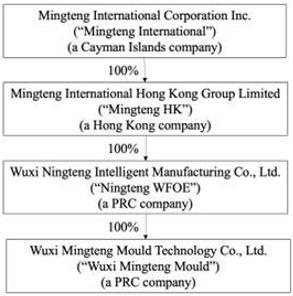
The accompanying notes are an integral part of these unaudited interim condensed consolidated financial statements.
The accompanying notes are an integral part of these unaudited interim condensed consolidated financial statements.
The accompanying notes are an integral part of these unaudited interim condensed consolidated financial Statements.
The accompanying notes are an integral part of these unaudited interim condensed consolidated financial statements.
NOTE 2 - SUMMARY OF SIGNIFICANT ACCOUNTING POLICIES
Basis of presentation
The accompanying unaudited interim condensed consolidated financial statements have been prepared in accordance with accounting principles generally accepted in the United States of America (“U.S. GAAP”) pursuant to the rules and regulations of the Securities Exchange Commission (“SEC”). The interim results of operations are not necessarily indicative of results to be expected for any other interim period or for a full year. In the opinion of management, all adjustments, consisting only of normal recurring adjustments, considered necessary for a fair presentation of its financial position and operating results have been included. These unaudited interim condensed consolidated financial statements should be read in conjunction with the Mingteng International’s audited consolidated financial statements and the related notes thereto for the fiscal year ended December 31, 2025, included in Form 20-F filed on April 30, 2026.
Principles of consolidation
The unaudited consolidated financial statements include the financial statements of the Company and its subsidiaries. All transactions and balances between the Company and its subsidiaries have been eliminated upon consolidation.
A subsidiary is an entity in which the Company, directly or indirectly, controls more than one half of the voting power, has the power to appoint or remove the majority of the members of the board of directors, to cast a majority of votes at the meeting of the board of directors or to govern the financial and operating policies of the investee under a statute or agreement among the shareholders or equity holders.
Use of estimates
In preparing the unaudited consolidated financial statements in conformity with U.S. GAAP, management makes estimates and assumptions that affect the reported amounts of assets and liabilities and disclosures of contingent assets and liabilities at the dates of the consolidated financial statements, as well as the reported amounts of revenue and expenses during the reporting periods. Significant items subject to such estimates and assumptions include, but are not limited to, the assessment of the allowance for credit losses, the allowance for inventory and contract costs provision, useful lives of property and equipment, the recoverability of long-lived assets and long-term investments, provision necessary for contingent liabilities. Actual results could differ from those estimates.
Cash and cash equivalents
Cash includes cash on hand and demand deposits in accounts maintained with commercial banks. The Company considers all highly liquid investments that are readily convertible to known amounts of cash and with original maturities from the date of purchase of three months or less to be cash equivalents. The Company maintains its bank accounts in Mainland China, Hong Kong and Cayman Islands. On May 1, 2015, China’s new Deposit Insurance Regulation became effective, pursuant to which banking financial institutions, such as commercial banks, established in the PRC are required to purchase deposit insurance for deposits in RMB and in foreign currency placed with them. The insurance limit is RMB 500,000 (approximately $73,411) for each bank account.
Accounts receivable, net
Accounts receivables are stated at the original amount less an allowance for credit loss. Accounts receivables are recognized in the period when the Company has provided services to its customers and when its right to consideration is unconditional. The Company reviews the accounts receivable on a periodic basis and makes general and specific allowances when there is doubt as to the collectability of individual balances. The Company has developed a current expected credit loss (“CECL”) model based on historical experience, the age of the accounts receivable balances, credit quality of its customers, current economic conditions, reasonable and supportable forecasts of future economic conditions, and other factors that may affect its ability to collect from customers. The Company considers historical collection rates, current financial status, macroeconomic factors, and other industry-specific factors when evaluating current expected credit losses. Accounts receivable balances are written off after all collection efforts have been exhausted.
Current expected credit losses
On January 1, 2023, the Company adopted ASC 326, Financial Instruments-Credit Losses, which requires recognition of allowances upon origination or acquisition of financial assets at an estimate of expected credit losses over the contractual term of the financial assets (the current expected credit loss or the “CECL” model) using the modified retrospective transition method.
The Company’s financial assets subject to the CECL model mainly include accounts receivable, bank acceptance notes and other receivables and deposits in other assets, non-current.
For accounts receivable and bank acceptance notes, the Company estimates the loss rate based on historical experience, the age of the receivable balances, credit quality of its customers, current economic conditions, reasonable and supportable forecasts of future economic conditions, and other factors that may affect its ability to collect from customers. For other receivables and other assets, non-current, the Company reviews other receivables and other assets, non-current on a periodic basis and makes allowances on an individual basis when there is doubt as to the collectability. Receivables are written off after all collection efforts have been exhausted.
For the six months ended June 30, 2026 and 2025, allowance of credit losses made by the Company were mainly generated from accounts receivable.
Bank acceptance notes
Bank acceptance notes generally due within six months and with specific payment terms and definitive due dates, are comprised of the notes issued by some customers to pay certain outstanding receivable balances to the Company. Bank acceptance notes do not bear interest. From time to time, the Company endorses bank acceptance notes receivable to its suppliers as payment of material purchase. The bank acceptance notes receivable is considered sold and derecognized from balance sheets when they are transferred beyond the reach of the Company and its creditors, the purchaser has the right to pledge or exchange the note receivables, and the Company has surrendered control over the transferred note receivable. If the Company does not surrender control, the cash received from the purchaser is accounted for as a secured borrowing.
Advances to suppliers
Advances to suppliers consist of balances paid to suppliers for goods and services that have not been provided or received. The Company reviews its advances to suppliers on a periodic basis and makes general and specific allowances when there is doubt as to the ability of a supplier to provide goods or services to the Company or refund an advance. For the six months ended June 30, 2026 and 2025, there was no allowance of advances to suppliers.
Short-term investments
Short-term investments include the wealth management products, which are issued by commercial banks. For wealth management products with a variable interest rate indexed to the performance of underlying assets or principal not guaranteed, the Company elected the fair value method at the date of initial recognition and carried these investments subsequently at fair value. Fair value is estimated primarily based on quoted prices of similar financial products provided by commercial bank at the end of each period. Changes in the fair value are reflected in the consolidated statements of operations and comprehensive income as “Other income, net”.
Inventories, net
Inventories consist of raw materials, work in process and finished goods, and are stated at the lower of cost or net realizable value. Cost is determined using the weighted average method. The Company periodically evaluates its inventories and will record an allowance for inventories that are either slow-moving, may not be saleable or whose cost exceeds its net realizable value. For the six months ended June 30, 2026 and 2025 the Company made provision for inventory obsolescence of $82,031 and nil.
Property and equipment, net
Property and equipment are carried at cost and are depreciated on the straight-line basis over the estimated useful lives of the underlying assets. Repair and maintenance costs are charged to expense as incurred, whereas the cost of renewals and betterments that extend the useful life of fixed assets are capitalized as additions to the related assets. When assets are retired or disposed of, the cost and accumulated depreciation are removed from the accounts, and any resulting gains or losses are included in income in the year of disposition. The Company examines the possibility of decreases in the value of its property and equipment, when events or changes in circumstances reflect the fact that their recorded value may not be recoverable.
Estimated useful lives are as follows, taking into account the assets’ estimated residual value of 5%:
| Category | | Estimated useful lives |
| Electronic equipment | | 3-5 years |
| Vehicles | | 5 years |
| Machinery and equipment | | 5-10 years |
| Leasehold improvements | | Over the shorter of lease term or the estimated useful lives of the assets |
Intangible assets
Intangible asset is software license, which are purchased from third parties and initially recorded at cost and amortized on a straight-line basis over the service term of 3-10 years. The amortization for intangible assets amounts to $14,967 and $12,319 for the six months ended June 30, 2026 and 2025, respectively.
Impairment of long-lived assets
Long-lived assets of the Company are reviewed for impairment in accordance with ASC 360, “Property, Plant and Equipment” whenever events or changes in circumstances indicate that the carrying amount of an asset may not be recoverable.
Recoverability of assets to be held and used is measured by a comparison of the carrying amount of an asset to the future undiscounted cash flows expected to be generated by the assets. If such assets are considered to be impaired, the impairment to be recognized is measured by the amount by which the carrying amount of the assets exceeds the fair value of the assets.
For the six months ended June 30, 2026 and 2025, no impairment charges were recognized.
Long-term investment
The Company’s equity investments without readily determinable fair value are a long-term investment in an unlisted company. For equity securities without readily determinable fair value and do not qualify for the existing practical expedient in ASC Topic 820, Fair Value Measurements and Disclosures (“ASC 820”) to estimate fair value using the net asset value per share (or its equivalent) of the investment, the Company elected to use the measurement alternative under ASC 321, Investments — Equity Securities (“ASC 321”) to measure those investments at cost, less any impairment, plus or minus changes resulting from observable price changes in orderly transactions for identical or similar investments of the same issuer, if any. These investments are measured at fair value on a nonrecurring basis when an orderly transaction for identical or similar investments of the same issuer was identified or when there are events or changes in circumstances that may have a significant adverse effect. The non-recurring fair value measurements to the carrying amount of an investment usually requires management to estimate a price adjustment for the different rights and obligations between a similar instrument of the same issuer with an observable price change in an orderly transaction and the investment held by the Company. The valuation methodologies involved require management to use the observable transaction price at the transaction date and other unobservable inputs (level 3).
The Company makes a qualitative assessment of whether the equity investments are impaired at each reporting date. If a qualitative assessment indicates that the investment is impaired, the Company estimates the investment’s fair value in accordance with the principles of ASC 820. If the fair value is less than the investment’s carrying value, the Company recognizes an impairment loss in the statements of operations and comprehensive income (loss) equal to the difference between the carrying value and fair value.
The Company’s long-term investment balance was nil as of both June 30, 2026 and December 31, 2025, due to an impairment of the long-term investment recorded as of December 31, 2025. For the six months ended June 30, 2026 and 2025, impairment losses of long-term investment were nil and $1,356,618, respectively.
Fair value of financial instruments
Fair value is the price that would be received from selling an asset or paid to transfer a liability in an orderly transaction between market participants at the measurement date. When determining the fair value measurements for assets and liabilities required or permitted to be recorded at fair value, the Company considers the principal or most advantageous market in which it would transact, and it considers assumptions that market participants would use when pricing the asset or liability.
Authoritative literature provides a fair value hierarchy that requires an entity to maximize the use of observable inputs and minimize the use of unobservable inputs when measuring fair value. A financial instrument’s categorization within the fair value hierarchy is based upon the lowest level of input that is significant to the fair value measurement. The Company follows ASC subtopic 820-10, Fair Value Measurements and Disclosures, which establishes a three-tier fair value hierarchy, and prioritizes the inputs used in measuring fair value as follows:
| ● | Level 1 - inputs to the valuation methodology are quoted prices (unadjusted) for identical assets or liabilities in active markets. |
| ● | Level 2 - inputs to the valuation methodology include quoted prices for similar assets and liabilities in active markets, quoted market prices for identical or similar assets in markets that are not active, inputs other than quoted prices that are observable, and inputs derived from or corroborated by observable market data. |
| ● | Level 3 - inputs to the valuation methodology are unobservable. |
ASC 820 describes three main approaches to measuring the fair value of assets and liabilities: (1) market approach; (2) income approach and (3) cost approach. The market approach uses prices and other relevant information generated from market transactions involving identical or comparable assets or liabilities. The income approach uses valuation techniques to convert future amounts to a single present value amount. The measurement is based on the value indicated by current market expectations about those future amounts. The cost approach is based on the amount that would currently be required to replace an asset.
Unless otherwise disclosed, the fair value of the Company’s financial instruments including cash and cash equivalents, accounts receivable, bank acceptance notes, other receivables, short-term loans, accounts payable, other payables, and amounts due to related parties approximate their recorded values due to their short-term maturities. The fair value of longer-term leases approximates their recorded values as their stated interest rates approximate the rates currently available.
The Company’s non-financial assets, such as property, plant and equipment and intangible assets would be measured at fair value only if they were determined to be impaired. When there is impairment of equity investments accounted for under the measurement alternative, the non-recurring fair value measurements are measured at the date of impairment. Estimating the fair value of the equity investment without observable market prices is highly judgmental due to the subjectivity of the unobservable inputs (level 3) used in the valuation methodologies used to determine fair value.
Leases
The Company accounts for leases following FASB ASC 842, Leases (“Topic 842”). The Company leases properties from property owners. In evaluating whether an agreement constitutes a lease. The Company reviews the contractual terms to determine which party obtains both the economic benefits and control of the assets at the inception of the contract. The Company categorizes leases with contractual terms longer than twelve months as either operating or finance lease at the commencement date of a lease.
The Company recognizes a lease liability for future fixed lease payments and a right-of-use (“ROU”) asset representing the right to use the underlying asset for the lease term. The lease term is based on the non-cancellable term of the lease and may contain options to extend the lease when it is reasonably certain that the Company will exercise the option. Lease liabilities are recognized at commencement date based on the present value of fixed lease payments over the lease term using the rate implicit in the lease, if available, or the Company’s incremental borrowing rate. As its leases do not provide an implicit borrowing rate, the Company uses an incremental borrowing rate based on the estimated rate of interest for collateralized borrowing over a similar term of the lease payments at the commencement date. Current maturities of operating lease liabilities are classified as operating lease liabilities, current in the Company’s consolidated balance sheets. Most leases have initial terms ranging from 1 to 3 years. Besides, the Company’s lease payments are fixed. Lease expense for fixed lease payments is recognized on a straight-line basis over the lease term. The Company’s lease agreements do not contain any significant residual value guarantees or restricted covenants. The ROU assets are measured at the amount of the lease liabilities with adjustments, if applicable, for lease prepayments made prior to or at lease commencement, initial direct costs incurred by the Company, deferred rent and lease incentives. The Company evaluates the carrying value of ROU assets if there are indicators of impairment and reviews the recoverability of the related asset group.
The Company reassesses whether a contract is or contains a lease arrangement and re-measures ROU assets and liabilities upon modification of the contract. The Company will derecognize ROU assets and liabilities, with a difference recognized in the income statement on the contract termination.
Operating leases are included in operating lease right-of-use (“ROU”) assets, current portion of lease liabilities, and non-current portion of lease liabilities, on the Company’s consolidated balance sheets.
Revenue recognition
The Company accounts for revenue recognition under FASB ASC 606, Revenue from Contracts with Customers (“ASC 606”). In accordance with ASC 606, Revenue from Contracts with Customers, the Company recognizes revenue to represent the transfer of products or services to customers in an amount that reflects the consideration to which the Company expects to be entitled in such exchange. This will require the Company to identify contractual performance obligations and determine whether revenue should be recognized at a point in time or over time, based on when control of the product or the benefit of the services transfers to the customer. Under the guidance of ASC 606, the Company is required to (a) identify the contract with a customer, (b) identify the performance obligations in the contract, (c) determine the transaction price, (d) allocate the transaction price to the performance obligations in the contract and (e) recognize revenue when (or as) the Company satisfies its performance obligations.
The Company’s main business income is divided into three categories, one is mold production, that is, contracts are signed to sell molds widely used in automobiles, valves, water pump and other industries according to the customer’s needs. Second is mold repair, which provides customers with mold repair service, or provides sales of mold components. Last is providing customers with machining services, using the Company’s remaining capacity to provide customers with external processing services. Revenues represent the amount of consideration that the Company is entitled to in exchange for the transfer of promised goods or services in the ordinary course of the Company’s activities and is recorded net of value-added tax (“VAT”). Consistent with the criteria of ASC 606, the Company recognizes revenue when the performance obligation in a contract is satisfied by transferring the control of promised goods or services to the customer. The company elect to account for shipping and handling activities as a fulfillment cost rather than as a separate performance obligation, of which was expensed as incurred and amounted to $58,850 and $37,430 for the six months ended June 30, 2026 and 2025, respectively.
Mold production:
The Company signs contracts with customers and provides products according to the sales contract or sales list. The clients check the quantity and quality of products received and then issue confirmation as proof of payment. Certain clients may also test the finished products as part of the confirmation process. Revenue is recognized when the Company receives the confirmation of product acceptance.
The Company provides design and production services according to the sales contract or lists. The Company then transports and installs the finished products when clients give their order.
The design services are inseparable from project sales. A mold production contract may include two or more machine components, but all components are customized according to customer requirements. These components need to be combined under the guidance of design plans to produce qualified products to meet the needs of clients. Therefore, these services are highly interdependent and are never transferred to the customer on their own. Customers do not have the option to purchase these services separately principally due to the customization of each project. Accordingly, these services are not considered separate performance obligations, and no revenue is associated with these services under ASC 606 until the point in time when the project is completed and delivered, and client confirmation is received.
The Company provides maintenance services and according to the contracts the clients do not have the option to purchase these services separately. The promised warranty does not provide the clients with a service in addition to the assurance that the product complies with agreed-upon contract specifications and is considered an assurance warranty. The maintenance services and the warranty are not considered separate performance obligations, and no revenue is associated with these services under ASC 606. Historically, the Company has not experienced material costs for quality assurance and, therefore, does not believe an accrual for these costs is necessary.
Mold repair:
The Company signs contracts with customers and provides repair services according to the contract or list and charges a certain fee. Revenue is recognized only after the repair service has passed the customer’s inspection.
Machining services:
The Company signs contracts with customers and provides machining services, supplies raw materials, and charges a certain fee. The Company identifies the fulfillment of its obligation when transferring the product and getting confirmation from customers to issue the VAT invoice at which time revenue is recognized.
The following table presents revenues by major revenue type for the six months ended June 30, 2026 and 2025, respectively:
| | | For the six months ended
June 30, | |
| | | 2026 | | | 2025 | |
| | | (Unaudited) | | | (Unaudited) | |
| Mold production | | $ | 3,543,601 | | | $ | 3,634,475 | |
| Mold repair | | | 296,763 | | | | 491,454 | |
| Machining services | | | 1,667,767 | | | | 1,135,540 | |
| Total | | $ | 5,508,131 | | | $ | 5,261,469 | |
Contract Balances
The Company classifies its right to consideration in exchange for services or products transferred to a customer as either a receivable or a contract asset. A receivable is a right to consideration that is unconditional as compared to a contract asset which is a right to consideration that is conditional upon factors other than the passage of time. The Company recognizes accounts receivable in its consolidated balance sheets when it performs a service in advance of receiving consideration and it has the unconditional right to receive consideration. A contract asset is recorded when the Company has transferred services or products to the customer before payment is received or is due, and the right to consideration is conditional on future performance or other factors in the contract. As of June 30, 2026 and December 31, 2025, the Company had no contract assets.
The Company capitalizes incremental costs incurred to fulfill contracts that (1) relate directly to the contract, (2) are expected to generate resources that will be used to satisfy the performance obligation under the contract, and (3) are expected to be recovered through revenue generated under the contract. The compensation expenses of the workforce hired and depreciation of certain equipment and overheads for the purpose of providing certain machining services are considered incremental costs to fulfill the contracts. These contract costs are recorded as cost of revenues upon the recognition of the related revenues. Provisions for estimated losses, if any, on uncompleted contracts are recorded in the period in which such losses become probable based on the current contract estimates. As of June 30, 2026 and December 31, 2025, the Company had deferred contract costs of $90,722 and $49,763, respectively. Impairment for contract costs amounted to $7,465 and $13,165 for the six months ended June 30, 2026 and 2025, respectively
Contract liabilities are recognized if the Company receives consideration prior to satisfying the performance obligations, which are customer advances. The consideration received from customers related to the remaining arrangements are included in advance from customer balance.
As of June 30, 2026 and December 31, 2025, advance from customers amounted to $95,882 and $108,356, respectively. During the six months ended June 30, 2026 and 2025, the Company recognized revenue that were previously deferred as contract liabilities amounted to $91,629, and $501,285, respectively.
Cost of revenues
Cost of revenues consists of the cost of raw material, direct labor and manufacturing costs. During the production process, the production department records the material consumption quantity and production hours of each order. Raw material cost is allocated according to the consumption of the material. Direct labor and manufacturing costs are allocated according to the production hours.
Selling expenses
Selling expenses primarily consist of (i) marketing promotion expenses to attract or retain consumers and increase company’s visibility, and labor costs and expenses for the salesman; and(ii) traveling expenses for the staffs.
General and administrative expenses
General and administrative expenses consist primarily of costs of salary, welfare and share-based payment for the Company general administrative and management staff, consulting fee, depreciation expenses, professional fees, meals and entertainment, office expenses, business travel expenses, additional expenses for public offering, and other miscellaneous expenses incurred in connection with general operations.
Research and development expenses
Research and development (“R&D”) expenses consist primarily of costs directly attributable to the conduct of R&D projects, including salaries, raw materials and outsourced R&D costs for projects entrusted to third-party companies. Such projects include the research and development of adjustable casting molds for automotive parts. All costs associated with research and development are expensed as incurred.
Government subsidies
Government subsidies refer to the monetary assets that a company obtains from the government for free. The government subsidies received by Wuxi Mingteng Mould mainly include high-tech enterprise recognition bonuses. The Company believes that these government subsidies are not related to daily business activities and are treated as other income.
Government subsidies for the six months ended June 30, 2026 and 2025, were $57,595 and $64,728, respectively.
Income taxes
Mingteng International’s subsidiaries in the PRC and Hong Kong are subject to the income laws of the PRC and Hong Kong. No taxable income was generated outside the PRC for the six months ended June 30, 2026 and 2025. Current income taxes are provided on the basis of net loss for financial reporting purposes and adjusted for income and expense items which are not assessable or deductible for income tax purposes, in accordance with the regulations of the relevant tax jurisdictions. Deferred income taxes are provided using the asset and liability method. Under this method, deferred income tax assets and liabilities are recognized for the tax effects of temporary differences and are determined by applying enacted statutory tax rates that will be in effect in the period in which the temporary differences are expected to reverse to the temporary differences between the financial statements’ carrying amounts and the tax bases of assets and liabilities. Deferred tax assets and liabilities are offset if there is a legally enforceable right to offset deferred tax liabilities and assets, and they relate to income taxes levied by the same tax authority on the same taxable entity.
A valuation allowance is provided to reduce the amount of deferred tax assets if based on the weight of available evidence, it is more-likely-than-not that some portion, or all, of the deferred income tax assets will not be realized. The effect on deferred income taxes arising from a change in tax rates is recognized in the consolidated statements of comprehensive loss in the period of change.
The Company applies a “more likely than not” recognition threshold in the evaluation of uncertain tax positions. The Company recognizes the benefit of a tax position in its consolidated financial statements if the tax position is “more likely than not” to prevail based on the facts and technical merits of the position. Tax positions that meet the “more likely than not” recognition threshold are measured at the largest amount of tax benefit that has a greater than fifty percent likelihood of being realized upon settlement. Unrecognized tax benefits may be affected by changes in interpretation of laws, rulings of tax authorities, tax audits, and expiry of statutory limitations. In addition, changes in facts, circumstances and new information may require the Company to adjust the recognition and measurement estimates with regard to individual tax positions. Accordingly, unrecognized tax benefits are periodically reviewed and reassessed. Adjustments, if required, are recorded in the Company’s consolidated financial statements in the period in which the change that necessities the adjustments occur. The ultimate outcome for a particular tax position may not be determined with certainty prior to the conclusion of a tax audit and, in certain circumstances, a tax appeal or litigation process. The Company records interest and penalties related to unrecognized tax benefits (if any) in interest expenses and general and administrative expenses, respectively. As of June 30, 2026 and December 31, 2025, the Company did not have any significant unrecognized uncertain tax positions.
Value added tax
Sales revenue represents the invoiced value of goods, net of VAT. The VAT is based on gross sales price and the VAT rate is 13%. The VAT may be offset by VAT paid by the Company on raw materials and other materials included in the cost of producing or acquiring its finished products. The Company recorded a VAT payable or receivable net of payments in the accompanying consolidated financial statements. All of the VAT returns filed by Mingteng International’s subsidiaries in the PRC have been and remain subject to examination by the tax authorities for five years from the date of filing.
Losses per share
Mingteng International computes losses per share (“EPS”) in accordance with ASC 260, “Earnings per Share” (“ASC 260”). ASC 260 requires companies with complex capital structures to present basic and diluted EPS. Basic EPS is computed by dividing the losses available to ordinary shareholders of Mingteng International by the weighted average ordinary shares outstanding during the period. Class B shares were excluded from the calculation of earnings per share because they do not possess any economic interests. Diluted net losses per share is computed using the weighted average number of ordinary shares and potential ordinary shares outstanding during the period under the treasury stock method. Potential ordinary shares include warrants, unless they were anti-dilutive. The computation of diluted net losses per share does not assume conversion, exercise, or contingent issuance of securities that would have an anti-dilutive effect (i.e. a decrease in loss per share amounts or an increase in earnings per share amounts) on net losses per share.
Warrants
The accounting treatment of warrants issued is determined pursuant to the guidance provided by ASC 470, Debt (“ASC 470”), ASC 480, Distinguishing Liabilities from Equity (“ASC 480”), and ASC 815, Derivatives and Hedging (“ASC 815”), as applicable. Each feature of freestanding financial instruments including, without limitation, any rights relating to subsequent dilutive issuances, equity sales, rights offerings, conversions, optional redemptions and dividends are assessed with determinations made regarding the proper classification in the Company’s consolidated financial statements. The Company evaluates whether such instruments are indexed to its own stock and whether they meet the conditions for equity classification, including the absence of mandatory cash settlement requirements outside the Company’s control.
Share-based compensation
Share based awards granted to employees are accounted for under ASC 718, “Compensation—Stock Compensation”, which requires that such equity awards granted to employees be measured based on the grant date fair value and recognized as compensation expense immediately at grant date if no vesting conditions are required.
Comprehensive loss
Comprehensive loss consists of two components, net loss and other comprehensive loss. Other comprehensive loss refers to revenue, expenses, gains, and losses that under U.S. GAAP are recorded as an element of stockholders’ equity but are excluded from net income. Other comprehensive loss consists of foreign currency translation adjustments from the Company’s PRC subsidiaries not using U.S. dollar as its functional currency.
Foreign currency translation
The functional currency of Mingteng International’s operations in the PRC is the Chinese Yuan or Renminbi (“RMB”). The consolidated financial statements are translated to U.S. dollars using the period end rates of exchange for assets and liabilities, equity is translated at historical exchange rates, and average rates of exchange (for the period) are used for revenues and expenses and cash flows. As a result, amounts relating to assets and liabilities reported on the statements of cash flows may not necessarily agree with the changes in the corresponding balances on the balance sheets. Translation adjustments resulting from the process of translating the local currency financial statements into U.S. dollars are included in determining comprehensive income/loss. Transactions denominated in foreign currencies are translated into the functional currency at the exchange rates prevailing on the transaction dates. Assets and liabilities denominated in foreign currencies are translated into the functional currency at the exchange rates prevailing at the balance sheet date with any transaction gains and losses that arise from exchange rate fluctuations on transactions denominated in a currency other than the functional currency are included in the results of operations as incurred.
All of the Company’s revenue transactions are transacted in its functional currency. The Company does not enter into any material transaction in foreign currencies. Transaction gains or losses have not had, and are not expected to have, a material effect on the results of the operations of the Company.
The following table outlines the currency exchange rates that were used in preparing the consolidated financial statements, representing exchange rate of the People’s Bank of China (PBOC):
| | | June 30, | | | December 31, | | | Six months ended
June 30, | |
| | | 2026 | | | 2025 | | | 2026 | | | 2025 | |
| Foreign currency | | | | | | | | | | | | |
| RMB:1USD | | | 6.8109 | | | | 7.0288 | | | | 6.8932 | | | | 7.1839 | |
Statement of cash flows
In accordance with ASC 230, Statement of Cash Flows, cash flows from the Company’s operations are formulated based upon the local currencies, and then translated at average translation rates for the periods. As a result, amounts related to assets and liabilities reported on the statements of cash flows will not necessarily agree with changes in the corresponding balances on the balance sheets.
Significant risks
Currency risk
A majority of the Company’s expense transactions are denominated in RMB and a significant portion of Mingteng International and its subsidiaries’ assets and liabilities are denominated in RMB. RMB is not freely convertible into foreign currencies. In the PRC, certain foreign exchange transactions are required by law to be transacted only by authorized financial institutions at exchange rates set by the People’s Bank of China (“PBOC”). Remittances in currencies other than RMB by the Company in China must be processed through the PBOC or other Company foreign exchange regulatory bodies which require certain supporting documentation in order to affect the remittance.
The Company maintains certain bank accounts in the PRC. On May 1, 2015, China’s new Deposit Insurance Regulation came into effect, pursuant to which banking financial institutions, such as commercial banks, established in the PRC are required to purchase deposit insurance for deposits in RMB and in foreign currency placed with them. Such Deposit Insurance Regulation would not be effective in providing complete protection for the Company’s accounts, as its aggregate deposits are much higher than the compensation limit, which is RMB500,000 (approximately $73,411) for one bank. However, the Company believes that the risk of failure of any of these Chinese banks is remote. Bank failure is uncommon in the PRC and the Company believes that those Chinese banks that hold the Company’s cash and cash equivalents and short-term investments are financially sound based on public available information.
The Company also maintains certain bank deposits in Hong Kong, which are covered by the Hong Kong Deposit Protection Scheme, subject to the applicable eligibility requirements and coverage limits. The maximum protection limit is HK$800,000 (approximately $102,019) per depositor per Scheme member bank. Accordingly, the Company’s deposits in Hong Kong exceeding the applicable protection limit may not be fully protected in the event of a bank failure.
The total bank deposit balance was $6,289,189, and the bank balance of Mingteng International amounted to $5,281,512 as of June 30, 2026. The total bank deposit balance was $1,450,516, and the bank deposit balance of Mingteng International amounted to $27,014 as of December 31, 2025. Total amounts in excess of the insurance coverage were $5,938,376 and $1,256,549 as of June 30, 2026 and December 31, 2025, respectively.
The functional currency and the reporting currency of the Company is USD, while the functional currency of the Company’s PRC subsidiaries is RMB. Since July 21, 2005, RMB has been permitted by the PRC government to fluctuate within a managed band against a basket of certain foreign currencies. The depreciation of the USD against the RMB was 3.10% for the six months ended June 30, 2026 and the depreciation of the USD against the RMB was 2.22%, for the year ended December 31, 2025. Any significant revaluation of the RMB may materially and adversely affect the cash flows, operating results and financial position of the Company. As a result, the depreciation of the USD against RMB would result in foreign currency translation gain when translating the net assets of the Company from RMB into USD.
Concentration and credit risk
Currently, all the Company’s operations are carried out in the PRC. Accordingly, the Company’s business, financial condition and results of operations may be influenced by the political, economic, and legal environment in the PRC, and by the general state of the PRC’s economy. The Company’s operations in the PRC are subject to specific considerations and significant risks not typically associated with companies in North America. The Company’s results may be adversely affected by changes in governmental policies with respect to laws and regulations, anti-inflationary measures, currency conversion and remittance abroad, and rates and methods of taxation, among other things.
Financial instruments which potentially subject the Company to concentrations of credit risk consist principally of cash and cash equivalents, accounts receivable, other receivables-bank acceptance notes. A portion of the Company’s sales are credit sales which are to the customers whose ability to pay is dependent upon the industry economics prevailing in these areas; however, concentrations of credit risk with respect to trade accounts receivables is limited due to generally short payment terms. The Company conducts credit evaluations of its customers and generally does not require collateral or other security from such customers. The Company periodically evaluates the creditworthiness of the existing customers in determining an allowance for credit losses primarily based upon the age of the receivables and factors surrounding the credit risk of specific customers.
Interest rate risk
Fluctuations in market interest rates may negatively affect the Company’s financial condition and results of operations. The Company is exposed to floating interest rate risk on cash deposit and the risks due to changes in interest rates are not material. The Company has not used any derivative financial instruments to manage the Company interest rate risk exposure.
Other uncertainty risk
The Company’s major operations are conducted in the PRC. Accordingly, the political, economic, and legal environments in the PRC, as well as the general state of the PRC’s economy may influence the Company’s business, financial condition, and results of operations.
Employee benefits
Pursuant to the relevant laws and regulations of the PRC, the Company’s subsidiaries in mainland China participate in a defined contribution of basic pension insurance in the social insurance system established and managed by government organizations. The Company makes contributions to basic pension insurance plans based on the applicable benchmarks and rates stipulated by the government. Basic pension insurance contributions are charged to costs of revenues and operating expenses as the related services are rendered by the employees. Employee social benefits included as costs of revenues and operating expenses were $269,822 and $142,373 for the six months ended June 30, 2026 and 2025, respectively.
Recent accounting pronouncements
The Company is an “emerging growth company” (“EGC”) as defined in the Jumpstart Our Business Startups Act of 2012 (the “JOBS Act”). Under the JOBS Act, EGC can delay adopting new or revised accounting standards issued subsequent to the enactment of the JOBS Act until such time as those standards apply to private companies. The financial statements may therefore not be comparable to those of companies that comply with such new or revised accounting standards.
Recent Accounting Pronouncements Adopted
In July 2025, the FASB issued ASU 2025-05, “Financial Instruments — Credit Losses (Topic 326)”. Measurement of Credit Losses for Accounts Receivables and Contract Assets, which provides all entities with practical expedient of developing reasonable and supportable forecasts as part of estimating excepted credit losses, that assumes that current conditions as of the balance sheet date do not change for the remaining life of the asset. ASU 2025-05 is effective for annual reporting periods beginning after December 15, 2025, and interim reporting periods within those annual reporting periods. Early adoption is permitted in both interim and annual reporting periods in which financial statements have not yet been issued or made available for issuance. The Company adopted this ASU on a prospective basis effective January 1, 2026 and did not elect the practical expedient permitted under this ASU. Therefore, the adoption has no material impact on our unaudited consolidated financial.
Recent Accounting Pronouncements Issued but not yet Adopted
In December 2023, the FASB issued ASU 2023-09 “Income Taxes (Topics 740): Improvements to Income Tax Disclosures” ASU 2023-09 expands existing income tax disclosures for rate reconciliations by requiring disclosure of certain specific categories and additional reconciling items that meet quantitative thresholds and expands disclosures for income taxes paid by requiring disaggregation by certain jurisdictions. For public business entities, the amendments in this update are effective for annual periods beginning after December 15, 2024. For entities other than public business entities, the amendments are effective for annual periods beginning after December 15, 2025. Early adoption is permitted for annual financial statements that have not yet been issued or made available for issuance. The Company is currently evaluating the impact of adopting the standard and does not expect that the adoption of this guidance will have a material impact on its financial position, results of operations and cash flows.
In November 2024, the FASB issued ASU 2024-03, “Reporting Comprehensive Income — Expense Disaggregation Disclosures”, which focuses on improving the disclosures about a public business entity’s expenses and addresses requests from investors for more detailed information about the types of expenses (including purchases of inventory, employee compensation, depreciation, amortization, and depletion) in commonly presented expense captions (such as cost of sales, SG&A, and research and development). The amendments in this update should be applied either (1) prospectively to financial statements issued for reporting periods after the effective date of this update or (2) retrospectively to any or all prior periods presented in the financial statements. In January 2025, the FASB issued ASU 2025-01, “Income Statement — Reporting Comprehensive Income—Expense Disaggregation Disclosures”. The amendment in ASU 2025-01 amends the effective date of ASC 2024-03 to clarify that all public business entities are required to adopt the guidance in annual reporting periods beginning after December 15, 2026, and interim periods within annual reporting periods beginning after December 15, 2027. Early adoption is permitted. The Company is currently evaluating the impact of this amendment and does not expect that the adoption of this guidance will have a material impact on its financial position, results of operations and cash flows.
The Company does not believe other recently issued but not yet effective accounting standards, if currently adopted, would have a material effect on the Company’s unaudited consolidated financial position, statements of operations and comprehensive (loss) income and cash flows.
NOTE 13 - SHAREHOLDERS’ EQUITY
(a) Reverse share split
The Company effected reverse share splits of its ordinary shares at ratios of 1-for-200 on January 26, 2026 (“2026 Reverse Share Split”). Share numbers and per-share data presented in this unaudited consolidated financial statements and related notes have been retroactively adjusted to reflect the cumulative effect of these reverse share splits.
As a result of the Reverse Stock Split, the par value of the Class A Ordinary shares and Class B Ordinary shares was increased to $0.002 per share with the number of authorized shares reduced to 24,989,545 Class A Ordinary shares and 10,455 Class B Ordinary shares, respectively, and the number of outstanding ordinary shares as of December 31, 2025 was reduced to 101,275 Class A Ordinary shares and 10,455 Class B Ordinary shares. All share and per share amounts for all periods presented have been retroactively adjusted to reflect the Reverse Stock Split.
(b) Ordinary shares
On December 4, 2025, the Company entered into a Sales Agreement with AC Sunshine Securities LLC pursuant to which the Company may offer and sell from time to time Class A Ordinary Shares having an aggregate offering of up to $100,000,000 through an “at-the-market” offering (“ATM offering”) program under the Company’s shelf registration statement on Form F-3. Under the Sales Agreement, shares may be sold from time to time through AC Sunshine Securities LLC acting as the Company’s sales agent at prevailing market prices on the Nasdaq Capital Market or otherwise in accordance with applicable law. As of June 30, 2026, the Company had sold an aggregate of 1,129,576 Class A Ordinary Shares under the ATM program for gross proceeds of approximately $20.6 million, resulting in net proceeds of approximately $18.0 million after deducting commissions and offering expenses.
On April 13, 2026, the Company entered into securities purchase agreements with certain investors, including Mr. Yingkai Xu, the Company’s Chief Executive Officer, relating to the issuance and sale of an aggregate of 3,800,000 Class A ordinary shares (the “Purchased Shares”), par value $0.002 per share of the Company, at $0.25 per share, for a total purchase price of $950,000, payable in cash. Of the Purchased Shares, 1,520,000 Class A Ordinary Shares were purchased by Mr. Yingkai Xu, and 2,280,000 Class A Ordinary Shares were purchased by the remaining investors.
The purchase price was below the market price on the issuance date. Such discount which represents the difference between the share price on the issuance date and the issuance price, represents a share-based compensation to Mr. Yingkai Xu for past services incurred in accordance with ASC 718, Compensation-Stock Compensation. Since the equity incentive plan agreement does not impose any vesting conditions or restrictions related to employee termination, the total compensation cost associated with the equity awards amount to $1,459,200 had been fully recognized in the unaudited consolidated statements of operations and comprehensive loss for the six months ended June 30, 2026.
On May 29, 2026, the Annual General Meeting of Shareholders (the “AGM”) approved: (i) the reduction of the par value per share from $0.002 to $0.00005 (the “Par Value Reduction”), which took effect immediately upon approval; and (ii) the increase of the Company’s authorized share capital by way of ordinary resolution, which shall take effect immediately upon the effectiveness of the Par Value Reduction: raising the authorized share capital from $1,250 (comprising 24,989,545 Class A Ordinary Shares and 10,455 Class B Ordinary Shares, each with a par value of US$0.00005) to $50,000 (comprising 998,000,000 Class A Ordinary Shares and 2,000,000 Class B Ordinary Shares, each with a par value of $0.00005).
On June 9, 2026, the Company entered into a securities purchase agreement with certain individual investors, pursuant to which the Company agreed to issue and sell, in a registered direct offering (the “2026 Direct Registered Offering”): (i) 501,834 Class A ordinary shares of the Company, par value $0.00005 per share, at a purchase price of $2.00 per Share; and (ii) pre-funded warrants to purchase up to 629,170 Class A ordinary shares, at a purchase price of $1.99995 per pre-funded warrant (equal to the $2.00 purchase price per Share, less the $0.00005 per share exercise price of the pre-funded warrants), which were fully exercised at the closing on June 10, 2026, resulting in the issuance and sale of an aggregate of 1,131,004 Class A ordinary shares in the 2026 Direct Registered Offering.
On June 17, 2026, the Company entered into a securities purchase agreement with certain individual investors, pursuant to which the Company agreed to issue and sell in a registered direct offering: (i) 457,355 Class A ordinary shares at a purchase price of $2.00 per share; and (ii) pre-funded warrants to purchase up to 1,022,645 Class A ordinary shares at a purchase price of $1.99995 per pre-funded warrant (equal to the $2.00 purchase price per share, less the $0.00005 exercise price per share), which had been fully exercised as of July 22, 2026.
In a concurrent private placement, the Company also agreed to issue and sell to the same investors unregistered warrants to purchase up to an aggregate of 1,480,000 Class A ordinary share, at an exercise price of $2.00 per share. The Private Warrants are exercisable from the closing of the private placement and will expire eighteen (18) months from the date of issuance.
On June 17, 2026, the Company entered into a placement agency agreement (the “Placement Agency Agreement”) with FT Global Capital, Inc. (“FT Global” or the “Placement Agent”), pursuant to which the Company engaged FT Global as the exclusive placement agent in connection with the Offerings. The Placement Agent agreed to use its reasonable best efforts to arrange for the sale of the Shares, the pre-funded warrants and the private warrants under the Placement Agency Agreement, the Company agreed to pay the Placement Agent a cash placement agent fee equal to 7.0% of the aggregate gross proceeds raised in the Offerings, and to reimburse the Placement Agent for certain of its Offerings related expenses in an amount not to exceed $110,000.
As additional compensation, the Company also agreed to issue to the Placement Agent or its designees, at the closing of the Offerings, warrants (the “Placement Agent Warrants”) to purchase up to 111,000 Class A Ordinary Shares, representing 7.5% of the aggregate number of Class A Ordinary Shares (including the Class A Ordinary Shares underlying the pre-funded warrants) sold in the Offering, at an exercise price of $2.40 per Class A Ordinary Share (equal to 120% of the public offering price per Share). The Placement Agent Warrants are exercisable, in whole or in part, at any time from the date of the Offering and will expire on the eighteen (18) month anniversary of the date of issuance.
The summary of warrant activities for the six months ended June 30, 2026 and 2025 were as follows:
| | | Ordinary
Shares
Number
Outstanding* | | | Weighted
Average
Exercise
Price* | | | Remaining
Life in
Years | |
| Warrants Outstanding as of December 31, 2025 | | | 20 | | | $ | 960 | | | | 3.30 | |
| Warrants Exercisable as of December 31, 2025 | | | 20 | | | | 960 | | | | 3.30 | |
| Warrants Granted | | | 3,242,815 | | | | 0.99 | | | | - | |
| Warrants Exercised | | | 767,170 | | | | 0.00005 | | | | - | |
| Warrants Expired | | | - | | | | - | | | | - | |
| | | | | | | | | | | | | |
| Warrants Outstanding as of June 30, 2026 | | | 2,475,665 | | | | 1.31 | | | | 1.46 | |
| Warrants Exercisable as of June 30, 2026 (unaudited) | | | 2,475,665 | | | $ | 1.31 | | | | 1.46 | |
| | | Ordinary
Shares
Number
Outstanding* | | | Weighted
Average
Exercise
Price* | | | Remaining
Life in
Years | |
| Warrants Outstanding as of December 31, 2024 | | | 171 | | | $ | 960 | | | | 4.30 | |
| Warrants Exercisable as of December 31, 2024 | | | - | | | | - | | | | - | |
| Warrants Granted | | | - | | | | - | | | | - | |
| Warrants Exercised | | | 151 | | | | 960 | | | | - | |
| Warrants Expired | | | - | | | | - | | | | - | |
| | | | | | | | | | | | | |
| Warrants Outstanding as of June 30, 2025* | | | 20 | | | | 960 | | | | 3.80 | |
| Warrants Exercisable as of June 30, 2025* (unaudited) | | | 20 | | | $ | 960 | | | | 3.80 | |
| * | Giving retroactive effect to the 200 to 1 reverse share split on January 26, 2026. |