BY-LAWS OF
(“By-Laws”) HUBSTER, INC.
f/k/a Hubster, Inc.
(the “Corporation” or “Company”)
1.Offices.
a.Incorporation. The Corporation was incorporated in the state of Delaware, as Hubster, Inc. (“Hubster”), by filing of its Certificate of Incorporation (“Certificate of Incorporation”) on November 1, 2018.
b.Registered Office and Agent. The registered office of the Company shall be located in the City of Lewes, County of Sussex, at 16192 Coastal Highway, Lewes, Delaware 19958. The registered agent at such address shall be Gust Delaware, Inc.
c.Other Offices. The Corporation may also have offices at such other places both within and without the State of Delaware as the Board of Directors may from time to time determine or the business of the Corporation may require, including but not limited to its domicile at 6780 Sabal Palm Drive, St. Augustine, FL 32086.
2.Stockholders.
a.Annual Meeting. The annual meeting (“Annual Meeting”) of stockholders (“Stockholders” or “Shareholders”) shall be held for the election of directors (“Directors”) each year at such place, date and time as shall be designated by the Board of Directors (“Board of Directors” or “Board”). Any other proper business may be transacted at the Annual Meeting. If no date for the Annual Meeting is established or said meeting is not held on the date established as provided above, a special meeting (“Special Meeting”) in lieu thereof may be held or there may be action by written consent of the Stockholders on matters to be voted on at the Annual Meeting, and such Special Meeting or written consent shall have for the purposes of these By-Laws or otherwise all the force and effect of an Annual Meeting.
b.Special Meetings. Special Meetings of Stockholders, as above defined, may be called by the Chairman of the Board (“Chairman”) (or if no person is then serving as the Chairman of the Board, then by the Chief Executive Officer, or, if there is no Chief Executive Officer, a President), or by the Board of Directors, or by Stockholders holding capital stock of the Corporation entitling the holders thereof to cast at least 25% of all of the votes that may be cast by the then-issued capital stock of the Corporation (as defined in Section 5, below) if voting as a single class, but such Special Meetings may not be called by any other person or persons. The call for the Special Meeting shall state the place, date, hour, and
1
purposes of the meeting. Only the purposes specified in the notice of Special Meeting shall be considered or dealt with at such Special Meeting.
c.Notice of Meetings. Whenever Stockholders are required or permitted to take any action at a meeting, a notice stating the place, if any, date and hour of the meeting, the means of remote communications, if any, by which Stockholders and proxyholders may be deemed to be present and vote at such meeting, and, in the case of a special meeting, the purpose or purposes of the meeting, shall be given by the Secretary (or other person authorized by these By-Laws or by law) not fewer than ten (10) nor more than sixty (60) days before the meeting to each Stockholder entitled to vote thereat and to each Stockholder who, under the Certificate of Incorporation or under these By-Laws or the then-effective Shareholder Agreement (“Shareholder Agreement”) is entitled to such notice. If mailed, notice is given when deposited in the mail, postage prepaid, directed to such Stockholder at such Stockholder’s address as it appears in the records of the Corporation. Without limiting the manner by which notice otherwise may be effectively given to Stockholders, any notice to Stockholders may be given by electronic transmission in the manner provided in Section 232 of the Delaware General Corporation Law (the “DGCL”). If sent by e-mail, notice is given when sent, provided no transmission failure message is received by the sender.
d.Adjournment. If a meeting is adjourned to another time or place, notice need not be given of the adjourned meeting if the time and place, if any, and the means of remote communications, if any, by which Stockholders and proxyholders may be deemed to be present in person and vote at such adjourned meeting are announced at the meeting at which the adjournment is taken, except that if the adjournment is for more than thirty (30) days, or if after the adjournment a new record date is fixed for the adjourned meeting, notice of the adjourned meeting shall be given to each Stockholder of record entitled to vote at the meeting.
e.Quorum. The holders of at least a 33 1/3 % (Thirty-Three and One-Third percent) voting interest(s) of all stock issued and entitled to vote at a meeting, present in person or represented by proxy, shall constitute a quorum. Any meeting may be adjourned from time to time by a majority of the votes properly cast upon the question, whether or not a quorum is present. The Stockholders present at a duly constituted meeting may continue to transact business until adjournment notwithstanding the withdrawal of enough stockholders to reduce the voting shares below a quorum.
f.Voting and Proxies. Except as otherwise provided by the Section 5, below, as well as the Certificate of Incorporation, the Shareholder Agreement, or by law, each Stockholder entitled to vote at any meeting of Stockholders shall be entitled to one (1) vote for each share of stock held by such Stockholder which has voting power upon the matter in question. Each Stockholder entitled to vote at a meeting of Stockholders or to express consent or dissent to corporate action in writing without a meeting may authorize another person or persons to act for such
2
Stockholder by either written proxy or by a transmission permitted by Section 212(c) of the DGCL, but no proxy shall be voted or acted upon after three (3) years from its date, unless the proxy provides for a longer period or is irrevocable and coupled with an interest. Proxies shall be filed with the Company Secretary (as below defined) of the meeting, or of any adjournment thereof. Except as otherwise limited therein, proxies shall entitle the persons authorized thereby to vote at any adjournment of such meeting.
g.Action at Meeting. When a quorum is present, any matter before the meeting shall be decided by vote of the holders of stock entitled to cast a majority of the total votes entitled to be cast by the shares of stock that are being voted on such matter except where a super-majority vote is required by law, by the Certificate of Incorporation, these By-Laws, or the Shareholder Agreement. Designation of Directors by Stockholders shall as set forth in the Certificate of Incorporation, these By-Laws, or the Shareholder Agreement. The Corporation shall not directly or indirectly vote any share of its own stock; provided, however, that the Corporation may vote shares which it holds in a fiduciary capacity to the extent permitted by law.
h.Presiding Officer. Meetings of Stockholders shall be presided over by the Chairman, if one is elected, or in his or her absence, the Vice Chairman of the Board (“Vice Chairman”), if one is elected, or if neither is elected or in their absence, the Chief Executive Officer, as below defined. The Board of Directors shall have the authority to appoint a temporary presiding officer to serve at any meeting of the stockholders if the Chairman of the Board, the Vice Chairman of the Board or the Chief Executive Officer is unable or unwilling to do so for any reason.
i.Conduct of Meetings. The Board of Directors may adopt by resolution such rules and regulations for the conduct of the meeting of Stockholders as it shall deem appropriate. Except to the extent inconsistent with such rules and regulations as adopted by the Board of Directors, the presiding officer of any meeting of Stockholders shall have the right and authority to prescribe such rules, regulations and procedures and to do all such acts as, in the judgment of such presiding officer (i.e. Chairman, Vice Chairman or otherwise), are appropriate for the proper conduct of the meeting. Such rules, regulations or procedures, whether adopted by the Board of Directors or prescribed by the presiding officer of the meeting, may include, without limitation, the following: (i) the establishment of an agenda or order of business for the meeting; (ii) rules and procedures for maintaining order at the meeting and the safety of those present; (iii) limitations on attendance at or participation in the meeting to Stockholders of record of the Corporation, their duly authorized and constituted proxies or such other persons as the chairman of the meeting shall determine; (iv) restrictions on entry to the meeting after the time fixed for the commencement thereof; and (v) limitations on the time allotted to questions or comments by participants. Unless and to the extent determined by the Board of Directors or the presiding officer of the
3
meeting, meetings of Stockholders shall not be required to be held in accordance with the rules of parliamentary procedure.
j.Action Without a Meeting. Unless otherwise provided in the Certificate of Incorporation, and as otherwise set forth in Section 228 of the DGCL, any action required or permitted by law to be taken at any Annual or Special Meeting of Stockholders, may be taken without a meeting, without prior notice and without a vote, if a consent or consents (“Consent(s”) in writing, setting forth the action so taken, shall be signed by the holders of issued or outstanding stock having not less than the minimum number of votes that would be necessary to authorize or take such action at a meeting at which all Shareholders entitled to vote thereon were present and voted and shall be delivered to the Corporation by delivery to its registered office, by hand or by certified mail, return receipt requested, or to the Corporation's principal place of business/domicile or to the officer of the Corporation having custody of the minute book. Every written Consent shall bear the date of signature and no written consent shall be effective unless, within sixty
(60) days of the earliest dated Consent delivered pursuant to these By-Laws, written Consents signed by a sufficient number of Stockholders entitled to take action are delivered to the Corporation in the manner set forth in these By-Laws. Prompt notice of the taking of the corporate action without a meeting by less than unanimous written consent shall be given to those Stockholders who have not consented in writing.
k.Stockholder Lists. The officer who has charge of the stock ledger of the Corporation shall prepare and make, at least ten (10) days before every meeting of Stockholders, a complete list of the Stockholders entitled to vote at the meeting, arranged in alphabetical order, and showing the address of each Stockholder and the number of shares registered in the name of each Stockholder. Nothing contained in this Section 2(k) shall require the Corporation to include electronic mail addresses or other electronic contact information on such list. Such list shall be open to the examination of any Stockholder, for any purpose germane to the meeting, for a period of at least ten (10) days prior to the meeting in the manner provided by law. The list shall also be open to the examination of any Stockholder during the whole time of the meeting as provided by law.
3.Directors.
a.Powers. The business of the Corporation shall be managed by or under the direction of a Board of Directors who may exercise all the powers of the Corporation except as otherwise provided by law, by the Certificate of Incorporation, these By-Laws or the Shareholder Agreement. In the event of a vacancy in the Board of Directors, the remaining Directors, except as otherwise provided by law, may exercise the powers of the full Board until the vacancy is filled.
4
b.Number and Qualification. Unless otherwise provided in the Certificate of Incorporation or in these By-Laws, the number of Directors which shall constitute the whole board shall be determined from time to time by resolution of the Board of Directors, but in no event shall such number be less than one (1) or greater than twelve (12). Directors need not be Stockholders.
c.Vacancies; Reduction of Board. Subject to Section 3(b) above, as more fully set forth in the Shareholder Agreement, a majority of the Directors then in office, or certain Stockholders who’ve been granted authority by virtue of their respective investment in the Company to designate certain Directors (“Voting Group”), may increase or decrease the size of the Board and/or fill vacancies on the Board of Directors occurring for any reason including newly created directorships resulting from any increase in the authorized number of Directors. In lieu of filling any vacancy, the Board of Directors may reduce the number of Directors. If a departing Director designated by a Voting Group, such Voting Group shall have the sole and exclusive right to designate a replacement Director, absent amendment of these By-Laws or amendment of the Shareholder Agreement.
d.Tenure. Except as otherwise provided by law, by the Certificate of Incorporation, these By-Laws, or the Shareholder Agreement, Directors shall hold office for a term of two (2) years (“Term”) or until their successors are elected and qualified or until their earlier resignation or removal. There shall be no restriction on the number of Terms a Director may serve, consecutive or otherwise. Any Director may resign at any time upon notice given in writing or by electronic transmission to the Corporation. Such resignation shall be effective upon receipt unless it is specified to be effective at some other time or upon the happening of some other event.
e.Removal. To the extent permitted by law, these By-Laws, or the Shareholder Agreement, a Director may be removed from office with or without cause by action by (i) designation for removal by the respective Voting Group, in which instance such vacancy shall be filled by the respective Voting Group consistent with the provisions of Section 2(c), above, or (ii) at a meeting of the holders of a majority of the shares of stock entitled to vote in the election of Directors in accordance with Section 2(c) above, whereupon the vacancy may be filled by the Board consistent with Section 2(c), above.
f.Meetings. Regular meetings of the Board of Directors may be held without notice at such time, date and place as the Board of Directors may from time to time determine. Special meetings of the Board of Directors may be called, orally or in writing, by the Chairman of the Board, or by two (2) or more Directors, designating the time, date and place thereof. Directors may participate in meetings of the Board of Directors by means of conference telephone or other communications equipment by means of which all directors participating in the meeting can hear each other, and participation in a meeting in accordance herewith shall constitute presence in person at such meeting.
5
g.Notice of Meetings. Notice of the time, date and place of all special meetings of the Board of Directors shall be given to each Director by the Secretary, or Assistant Secretary, or in case of the death, absence, incapacity or refusal of such persons, by the officer or one of the Directors calling the meeting. Notice shall be given to each Director by electronic mail sent to such Director’s business or home e-mail address at least twenty-four (24) hours in advance of the meeting. In addition to notice by e-mail, notice may also be given in person, by telephone, or by facsimile at least twenty-four (24) hours in advance of the meeting, or by written notice mailed to such Director’s business or home address at least ten (10) days in advance of the meeting; provided that, in all such cases, notice shall have also been sent via e-mail.
h.Quorum. At any meeting of the Board of Directors, a majority of the total number of Directors shall constitute a quorum for the transaction of business. Less than a quorum may adjourn any meeting from time to time and the meeting may be held as adjourned without further notice.
i.Action at Meeting. At any meeting of the Board of Directors at which a quorum is present, unless otherwise provided in the following sentence, a majority of the directors present may take any action on behalf of the Board of Directors, unless a larger number is required by law, by the Certificate of Incorporation, these By-Laws, or the Shareholder Agreement. So long as there are two (2) or fewer Directors, any action to be taken by the Board of Directors shall require the approval of all Directors.
j.Action by Consent. Any action required or permitted to be taken at any meeting of the Board of Directors may be taken without a meeting if all members of the Board of Directors consent thereto in writing or by electronic transmission, and the writing or writings or electronic transmission or transmissions are filed with the records of the meetings of the Board of Directors. Such filing shall be in paper form if the minutes are maintained in paper form and shall be in electronic form if the minutes are maintained in electronic form.
k.Committees. The Board of Directors may, by resolution passed by a majority of the whole Board of Directors, establish one or more committees (“Committee(s)”), each Committee to consist of one or more Directors. The Board of Directors may designate one or more Directors as alternate members of any Committee, who may replace any absent or disqualified member at any meeting of the Committee. In the absence or disqualification of a member of a Committee, the member or members thereof present at any meeting and not disqualified from voting, whether or not such member or members constitute a quorum, may unanimously appoint another member of the Board of Directors to act at the meeting in the place of any such absent or disqualified member.
6
l.Committee Authority. Any such Committee, to the extent permitted by law and to the extent expressly provided in the resolution approved by the full Board of Directors, shall have and may exercise all the powers and authority of the Board of Directors in the management of the business and affairs of the Corporation to which it is assigned, and may authorize the seal of the Corporation to be affixed to all papers which may require it; but no such Committee shall have the power or authority in reference to the following: (i) approving or adopting, or recommending to the Stockholders, any action or matter expressly required by the DGCL, these By-Laws or the Shareholder Agreement to be submitted to Stockholders for approval or (ii) adopting, amending or repealing any provision of these By-Laws. Except as the Board of Directors may otherwise determine, any such Committee may make rules for the conduct of its business, but in the absence of such rules, to the extent possible, its business shall be conducted in the same manner as is provided in these By-Laws for the Board of Directors. All members of such Committees shall hold their Committee offices at the pleasure of the Board of Directors, and the Board may abolish any Committee at any time.
4.Officers.
a.Enumeration. The officers of the Corporation shall consist of an Executive Chairman of the Board (“Chairman”), a Chief Executive Officer (“CEO”), a Chief Financial Officer (“CFO”), a Secretary (“Secretary”) (collectively, “C-Suite Officers”), and such other officers, as the Board of Directors may determine. The Board of Directors shall elect from among its members the Chairman of the Board. In addition, the Board of Directors may elect from among its members a Vice Chairman of the Board.
b.Selection. The C-Suite Officers, and such other officers as the Board of Directors may designate, shall be selected annually by the Board of Directors at its first meeting following the Annual Meeting of Stockholders. Alternatively, the C-Suite Officers may be chosen by the Board of Directors at any other meeting.
c.Qualification. No officer need be a Stockholder or Director. Any two or more offices may be held by the same person.
d.Tenure. Except as otherwise provided by the Certificate of Incorporation or by these By-Laws, each of the C-Suite Officers shall hold office until the first meeting of the Board of Directors following the next Annual Meeting of Stockholders and until such C-Suite Officer’s successor is elected and qualified or until such C-Suite Officer’s earlier resignation or removal. Other officers so designated by the Board of Directors shall serve at the pleasure of their respective supervisors, as designated by the Board of Directors, or removed by the Board of Directors pursuant to Section 4(e), below. Any C-Suite Officer or other officer may resign by delivering his or her written resignation to the Corporation, and such resignation shall be effective upon receipt unless it is specified to be effective at some other time or upon the happening of some other event.
7
e.Removal. The Board of Directors may remove any officer with or without cause by a vote of a majority of the Directors then in office.
f.Vacancies. Any vacancy in any office of C-Suite Officers, or any officer so designated by the Board of Directors, may be filled for the unexpired portion of the term by the Board of Directors. Absent creation of, and provision for, appointment or removal of any officer by the Board of Directors (i.e. non-C-Suite Officers), vacancies associated therewith shall be filled by such officer’s respective supervisor.
g.Chairs. Unless otherwise provided by the Board of Directors, the Chairman shall preside, when present, at all meetings of the Stockholders and the Board of Directors; shall have oversight authority over the CEO; and shall have the authority to bind the Corporation as an officer, but shall not be responsible for any day-to-day operations of the Corporation; and shall have such other powers and shall perform such duties as the Board of Directors may from time to time designate. Unless otherwise provided by the Board of Directors, in the absence of the Chairman of the Board, the Vice Chairman of the Board, if one is elected, shall preside, when present, at all meetings of the Stockholders and the Board of Directors. The Vice Chairman of the Board shall have such other powers and shall perform such duties as the Board of Directors may from time to time designate.
h.Chief Executive Officer. The Chief Executive Officer, shall, subject to the direction of the Board of Directors, have general charge and supervision of the ordinary operations of the Corporation and over the other officers of the Corporation except the Chairman; shall have the authority to bind the Corporation as an officer; and have such powers and shall perform such duties as the Board of Directors may from time to time designate.
i.Officers: Vice Presidents and Assistant Vice Presidents. Any Vice President (including any Executive Vice President or Senior Vice President) and any Assistant Vice President shall have such powers and shall perform such duties as the Board of Directors or the CEO may from time to time designate.
j.Chief Financial Officer. The Chief Financial Officer shall, subject to the direction of the Board of Directors, have general charge of the financial affairs of the Corporation and shall cause to be kept accurate books of account. The Chief Financial Officer shall have custody of all funds, securities, and valuable documents of the Corporation, except as the Board of Directors may otherwise provide. The Chief Financial Officer shall have such other powers and shall perform such duties as the Board of Directors may from time to time designate.
k.Secretary and Assistant Secretaries. The Secretary shall record the proceedings of all meetings of the Stockholders and the Board of Directors (including committees of the Board) in books kept for that purpose. In the absence of the
8
Secretary from any such meeting an Assistant Secretary, or if such person is absent, a temporary secretary chosen at the meeting, shall record the proceedings thereof. The Secretary shall have charge of the stock ledger (which may, however, be kept by any transfer or other agent of the Corporation) and shall have such other duties and powers as may be designated from time to time by the Board of Directors. Any Assistant Secretary shall have such powers and perform such duties as the Board of Directors, CEO, or Secretary may from time to time designate.
l.Other Officers. Intentionally left blank for provision of other C-Suite Officers (i.e. Chief Technology Officer, Chief Marketing Officer, etc.).
m.Other Powers and Duties. Subject to these By-Laws, each officer of the Corporation shall have in addition to the duties and powers specifically set forth in these By-Laws, such duties and powers as are customarily incident to such officer’s office, and such duties and powers as may be designated from time to time by the Board of Directors or such officer’s respective supervisor, as set forth herein above.
5.Capital Stock.
a.Capital Stock. As provided for in its Certificate of Incorporation, the Company is authorized to issue 10,000,000 (Ten Million) common Shares of stock (“Stock” or “Common Shares” (or “Shares,” as above defined)), at a par value of $0.00001 per Share.
b.Classes of Stock. The aforementioned Common Shares shall be issued in their entirety as Class B (“Class B” or “Founder Shares”) to William Adams and Linda Adams, the Company’s founders (“Founders”). Notwithstanding the foregoing, the Founders have set aside up to 65% (Sixty-Five Percent) of the Founders Shares (“Founder Set Aside”) for subsequent grant to early-stage investors in the Company (“Early-Stage Capitalization”), Directors designated and appointed by the Founders, strategic business partners, and/or other designees (collectively, “Founder Grantees”). Unless otherwise so designated by the respective Founder(s) in writing, upon each respective grant, the subject Shares shall convert to Class A Stock (“Class A”), notwithstanding which any Founder Grantee in receipt of a seat on the Board of Directors, shall be deemed appointed thereto by the Founder Voting Group.
c.Voting Rights. As to voting rights, Class A Shares shall entitle the holder thereof to One (1) vote per Share. Founder Shares or Class B Stock shall entitle the holder thereof to Three (3) votes per Share. For the sole purposes of exercising rights as a “Voting Group” in designating Directors, as more fully detailed in Section 3, above, each Shareholder of any designated Voting Group shall be entitled to One (1) vote per Share (regardless of Class), with approval constituting a majority of all Shares of members of such Voting Group, “Majority” herein
9
defined as a minimum of fifty percent 50% plus One (1) vote of eligible Shares entitled to vote being cast in the affirmative.
d.Dilution. Class A Stockholders shall experience no dilution (“Dilution”) through Founder’s completion of Early-Stage Capitalization by and through grant of the Founder Set Aside to Founder Grantees, whereupon Class A and Class B Shares shall be subject to pro rata Dilution upon admission of new Stockholders.
e.No Certificated Shares. Ownership of the Shares of capital will not be represented by certificates. The Corporation shall maintain and update an accurate record of all capital Stock owners.
f.Transfers. Subject to any restrictions on transfer, shares of Stock may be transferred on the books of the Corporation by a written assignment or power of attorney properly executed, with transfer stamps (if necessary) affixed, and with such proof of the authenticity of signature as the Corporation or its transfer agent may reasonably require.
g.Record Holders. Except as may otherwise be required by law, by the Certificate of Incorporation, these By-Laws, or the Shareholder Agreement, the Corporation shall be entitled to treat the record holder of Stock as shown on its books as the owner of such Stock for all purposes, including the payment of dividends and the right to vote with respect thereto, regardless of any transfer, pledge or other disposition of such Stock, until the Shares have been transferred on the books of the Corporation in accordance with the requirements of these By-Laws and the Shareholder Agreement. It shall be the duty of each Stockholder to notify the Corporation of such Stockholder’s post office address.
h.Record Date. In order that the Corporation may determine the Stockholders entitled to notice of or to vote at any meeting of Stockholders or any adjournment thereof, or to consent to corporate action in writing without a meeting, or to be entitled to receive payment of any dividend or other distribution or allotment of any rights, or entitled to exercise any rights in respect of any change, conversion or exchange of Stock or for the purpose of any other lawful action, the Board of Directors may fix, in advance, a record date, which shall not precede the date on which it is established, and which shall not be more than sixty (60) nor less than ten (10) days before the date of such meeting, more than ten (10) days after the date on which the record date for Stockholder consent without a meeting is established, nor more than sixty (60) days prior to any other action. In such case only Stockholders of record on such record date shall be so entitled notwithstanding any transfer of Stock on the books of the Corporation after the record date.
i.Absence of Record Date. If no record date is fixed, (i) the record date for determining Stockholders entitled to notice of or to vote at a meeting of Stockholders shall be at the close of business on the day next preceding the day
10
on which notice is given, or, if notice is waived, at the close of business on the day next preceding the day on which the meeting is held, (ii) the record date for determining Stockholders entitled to consent to corporate action in writing without a meeting, when no prior action by the Board of Directors is necessary, shall be the first date on which a signed written consent setting forth the action taken or proposed to be taken is delivered to the Corporation by delivery to its registered office in Delaware, or to its principal place of business/domicile, or to an officer or agent of the Corporation having custody of the book in which proceedings of meetings of Stockholders are recorded, and (iii) the record date for determining Stockholders for any other purpose shall be at the close of business on the day on which the Board of Directors adopts the resolution relating thereto.
6.Indemnification.
a.Definitions.
For purposes of this Section 6:
i.“Corporate Status” describes the status of a person who is serving or has served (A) as a Director of the Corporation, (B) as an Officer (as below defined) of the Corporation, (B) as a Non-Officer Employee of the Corporation (as below defined), or (D) as a director, partner, trustee, officer, employee or agent of any other corporation, partnership, limited liability company, joint venture, trust, employee benefit plan, foundation, association, organization or other legal entity for which such person is or was serving at the request of the Corporation. For purposes of this Section 6(a)(i), a Director, officer or Non-Officer Employee of the Corporation who is serving or has served as a director, partner, trustee, officer, employee or agent of a Subsidiary, as below defined, shall be deemed to be serving at the request of the Corporation. Notwithstanding the foregoing, “Corporate Status” shall not include the status of a person who is serving or has served as a director, officer, employee or agent of a constituent corporation absorbed in a merger or consolidation transaction with the Corporation with respect to such person’s activities prior to said transaction, unless specifically authorized by the Board of Directors or the Stockholders of the Corporation;
ii.“Director” means any person who serves or has served the Corporation as a Director on the Board of Directors of the Corporation;
iii.“Disinterested Director” means, with respect to each claim or Proceeding (as below defined) in respect of which indemnification is sought hereunder, a Director of the Corporation who is not and was not a party to such Proceeding;
11
iv.“Expenses” means all reasonable attorneys’ fees, retainers, court costs, transcript costs, fees of expert witnesses, private investigators and professional advisors (including, without limitation, accountants and investment bankers), travel expenses, duplicating costs, printing and binding costs, costs of preparation of demonstrative evidence and other courtroom presentation aids and devices, costs incurred in connection with document review, organization, imaging and computerization, telephone charges, postage, delivery service fees, and all other disbursements, costs or expenses of the type customarily incurred in connection with prosecuting, defending, preparing to prosecute or defend, investigating, being or preparing to be a witness in, settling or otherwise participating in, a Proceeding;
v.“Liabilities” means judgments, damages, liabilities, losses, penalties, excise taxes, fines and amounts paid in settlement;
vi.“Non-Officer Employee” means any person who serves or has served as an employee or agent of the Corporation, but who is not or was not a Director or Officer;
vii.“Officer” means any person who serves or has served the Corporation as an officer of the Corporation appointed by the Board of Directors of the Corporation;
viii.“Proceeding” means any threatened, pending or completed action, suit, arbitration, alternate dispute resolution mechanism, inquiry, investigation, administrative hearing or other proceeding, whether civil, criminal, administrative, arbitrative or investigative; and,
ix.“Subsidiary” shall mean any corporation, partnership, limited liability company, joint venture, trust or other entity of which the Corporation owns (either directly or through or together with another Subsidiary of the Corporation) either (i) a general partner, managing member or other similar interest or (ii) (A) 50% or more of the voting power of the voting capital equity interests of such corporation, partnership, limited liability company, joint venture or other entity, or (B) 50% or more of the outstanding voting capital stock or other voting equity interests of such corporation, partnership, limited liability company, joint venture or other entity.
b.Indemnification of Directors and Officers. Subject to the operation of Section 6(d) of these By-Laws, each Director and Officer shall be indemnified and held harmless by the Corporation to the fullest extent authorized by the DGCL, as the same exists or may hereafter be amended (but, in the case of any such amendment, only to the extent that such amendment permits the Corporation to
12
provide broader indemnification rights than such law permitted the Corporation to provide prior to such amendment), and to the extent authorized in this Section 6.
c.Actions, Suits and Proceedings Other than By or In the Right of the Corporation. Each Director and Officer shall be indemnified and held harmless by the Corporation against any and all Expenses and Liabilities that are incurred or paid by such Director or Officer or on such Director’s or Officer’s behalf in connection with any Proceeding or any claim, issue or matter therein (other than an action by or in the right of the Corporation), which such Director or Officer is, or is threatened to be made, a party to or participant in by reason of such Director’s or Officer’s Corporate Status, if such Director or Officer acted in good faith and in a manner such Director or Officer reasonably believed to be in or not opposed to the best interests of the Corporation and, with respect to any criminal proceeding, had no reasonable cause to believe his or her conduct was unlawful.
d.Actions, Suits and Proceedings By or In the Right of the Corporation. Each Director and Officer shall be indemnified and held harmless by the Corporation against any and all Expenses that are incurred by such Director or Officer or on such Director’s or Officer’s behalf in connection with any Proceeding or any claim, issue or matter therein by or in the right of the Corporation, which such Director or Officer is, or is threatened to be made, a party to or participant in by reason of such Director’s or Officer’s Corporate Status, if such Director or Officer acted in good faith and in a manner such Director or Officer reasonably believed to be in or not opposed to the best interests of the Corporation; provided, however, that no indemnification shall be made under this Section 6 in respect of any claim, issue or matter as to which such Director or Officer shall have been finally adjudged by a court of competent jurisdiction to be liable to the Corporation, unless, and only to the extent that, the Court of Chancery or another court in which such Proceeding was brought shall determine upon application that, despite adjudication of liability, but in view of all the circumstances of the case, such Director or Officer is fairly and reasonably entitled to indemnification for such Expenses that such court deems proper.
e.Survival of Rights. The rights of indemnification provided by this Section 6 shall continue as to a Director or Officer the later of the Proceeding being fully resolved or after he or she has ceased to be a Director or Officer and shall inure to the benefit of his or her heirs, executors, administrators and personal representatives.
f.Actions by Directors or Officers. Notwithstanding the foregoing, the Corporation shall indemnify any Director or Officer seeking indemnification in connection with a Proceeding initiated by such Director or Officer only if such Proceeding (including any parts of such Proceeding not initiated by such Director or Officer) was authorized in advance by the Board of Directors of the Corporation, unless such Proceeding was brought to enforce such Officer’s or Director’s rights to
13
indemnification or, in the case of Directors, advancement of Expenses under these By-Laws in accordance with the provisions set forth herein.
g.Indemnification of Non-Officer Employees. Subject to the operation of this Section 6 of these By-Laws, each Non-Officer Employee may, in the discretion of the Board of Directors of the Corporation, shall be indemnified by the Corporation to the fullest extent authorized by the DGCL, as the same exists or may hereafter be amended, against any or all Expenses and Liabilities that are incurred by such Non-Officer Employee or on such Non-Officer Employee’s behalf in connection with any threatened, pending or completed Proceeding, or any claim, issue or matter therein, which such Non-Officer Employee is, or is threatened to be made, a party to or participant in by reason of such Non-Officer Employee’s Corporate Status, if such Non-Officer Employee acted in good faith and in a manner such Non-Officer Employee reasonably believed to be in or not opposed to the best interests of the Corporation and, with respect to any criminal proceeding, had no reasonable cause to believe his or her conduct was unlawful. The rights of indemnification provided herein shall exist as to a Non-Officer Employee after he or she has ceased to be a Non-Officer Employee and shall inure to the benefit of his or her heirs, personal representatives, executors and administrators. Notwithstanding the foregoing, the Corporation may indemnify any Non-Officer Employee seeking indemnification in connection with a Proceeding initiated by such Non-Officer Employee only if such Proceeding was authorized in advance by the Board of Directors of the Corporation.
h.Determination. Unless ordered by a court, no indemnification shall be provided pursuant to this Section 6 to a Director, to an Officer or to a Non-Officer Employee unless a determination shall have been made that such person acted in good faith and in a manner such person reasonably believed to be in or not opposed to the best interests of the Corporation and, with respect to any criminal Proceeding, such person had no reasonable cause to believe his or her conduct was unlawful. Such determination shall be made by (i) a majority vote of the Disinterested Directors, even though less than a quorum of the Board of Directors,
(ii) a committee comprised of Disinterested Directors, such committee having been designated by a majority vote of the Disinterested Directors (even though less than a quorum), (iii) if there are no such Disinterested Directors, or if a majority of Disinterested Directors so directs, by independent legal counsel in a written opinion, or (iv) by the Stockholders of the Corporation.
i.Advancement of Expenses to Directors Prior to Final Disposition. The Corporation shall advance all Expenses incurred by or on behalf of any Director in connection with any Proceeding in which such Director is involved by reason of such Director’s Corporate Status within thirty (30) days after the receipt by the Corporation of a written statement from such Director requesting such advance or advances from time to time, whether prior to or after final disposition of such Proceeding. Such statement or statements shall reasonably evidence the Expenses incurred by such Director and shall be preceded or accompanied by an
14
undertaking by or on behalf of such Director to repay any Expenses so advanced if it shall ultimately be determined that such Director is not entitled to be indemnified against such Expenses. Notwithstanding the foregoing, the Corporation shall advance all Expenses incurred by or on behalf of any Director seeking advancement of expenses hereunder in connection with a Proceeding initiated by such Director only if such Proceeding (including any parts of such Proceeding not initiated by such Director) was (A) authorized by the Board of Directors of the Corporation, or (B) brought to enforce such Director’s rights to indemnification or advancement of Expenses under these By-Laws.
j.Failure to Advance Expenses. If a claim for advancement of Expenses hereunder by a Director is not paid in full by the Corporation within thirty (30) days after receipt by the Corporation of documentation of Expenses and the required undertaking, such Director may at any time thereafter bring suit against the Corporation to recover the unpaid amount of the claim and if successful in whole or in part, such Director shall also be entitled to be paid the expenses of prosecuting such claim. The failure of the Corporation (including its Board of Directors or any committee thereof, independent legal counsel, or stockholders) to make a determination concerning the permissibility of such advancement of Expenses under this Section 6 shall not be a defense to an action brought by a Director for recovery of the unpaid amount of an advancement claim and shall not create a presumption that such advancement is not permissible. The burden of proving that a Director is not entitled to an advancement of expenses shall be on the Corporation. In any suit brought by the Corporation to recover an advancement of expenses pursuant to the terms of an undertaking, the Corporation shall be entitled to recover such expenses upon a final adjudication that the Director has not met any applicable standard for indemnification set forth in the DGCL.
k.Advancement of Expenses to Officers and Non-Officer Employees Prior to Final Disposition. The Corporation may, at the discretion of the Board of Directors of the Corporation, advance any or all Expenses incurred by or on behalf of any Officer or any Non-Officer Employee in connection with any Proceeding in which such person is involved by reason of his or her Corporate Status as an Officer or Non-Officer Employee upon the receipt by the Corporation of a statement or statements from such Officer or Non-Officer Employee requesting such advance or advances from time to time, whether prior to or after final disposition of such Proceeding. Such statement or statements shall reasonably evidence the Expenses incurred by such Officer or Non-Officer Employee and shall be preceded or accompanied by an undertaking by or on behalf of such person to repay any Expenses so advanced if it shall ultimately be determined that such Officer or Non-Officer Employee is not entitled to be indemnified against such Expenses.
l.Recoup of Advances. In any suit brought by the Corporation to recover an advancement of expenses pursuant to the terms of an undertaking, the Corporation
15
shall be entitled to recover such expenses upon a final adjudication that the Director, Officer or Non-Officer Employee has not met any applicable standard for indemnification set forth in the DGCL.
m.Contractual Nature of Rights. The provisions of this Section 6 shall be deemed to be a contract between the Corporation and each Director and Officer entitled to the benefits hereof at any time while this Section 6 is in effect, in consideration of such person’s past or current and any future performance of services for the Corporation. Neither amendment, repeal or modification of any provision of this Section 6 nor the adoption of any provision of the Certificate of Incorporation inconsistent with this Section 6 shall eliminate or reduce any right conferred by this Section 6 in respect of any act or omission occurring, or any cause of action or claim that accrues or arises or any state of facts existing, at the time of or before such amendment, repeal, modification or adoption of an inconsistent provision (even in the case of a proceeding based on such a state of facts that is commenced after such time), and all rights to indemnification and advancement of Expenses granted herein or arising out of any act or omission shall vest at the time of the act or omission in question, regardless of when or if any proceeding with respect to such act or omission is commenced. The rights to indemnification and to advancement of expenses provided by, or granted pursuant to, this Section 6 shall continue notwithstanding that the person has ceased to be a director or officer of the Corporation and shall inure to the benefit of the estate, heirs, executors, administrators, legatees and distributees of such person.
n.Claim for Indemnification. If a claim for indemnification hereunder by a Director or Officer is not paid in full by the Corporation within sixty (60) days after receipt by the Corporation of a written claim for indemnification, such Director or Officer may at any time thereafter bring suit against the Corporation to recover the unpaid amount of the claim, and if successful in whole or in part, such Director or Officer shall also be entitled to be paid the expenses of prosecuting such claim. The failure of the Corporation (including its Board of Directors or any committee thereof, independent legal counsel, or Stockholders) to make a determination concerning the permissibility of such indemnification under this Section 6 shall not be a defense to an action brought by a Director or Officer for recovery of the unpaid amount of an indemnification claim and shall not create a presumption that such indemnification is not permissible. The burden of proving that a Director or Officer is not entitled to indemnification shall be on the Corporation.
o.Corporation Defense. In any suit brought by a Director or Officer to enforce a right to indemnification hereunder, it shall be a defense that such Director or Officer has not met any applicable standard for indemnification set forth in the DGCL.
p.Non-Exclusivity of Rights. The rights to indemnification and advancement of Expenses set forth in this Section 6 shall not be exclusive of any other right which
16
any Director, Officer, or Non-Officer Employee may have or hereafter acquire under any statute, provision of the Certificate or these By-Laws, agreement, vote of stockholders or Disinterested Directors or otherwise.
q.Insurance. The Corporation may maintain insurance, at its expense, to protect itself and any Director, Officer or Non-Officer Employee against any liability of any character asserted against or incurred by the Corporation or any such Director, Officer or Non-Officer Employee, or arising out of any such person’s Corporate Status, whether or not the Corporation would have the power to indemnify such person against such liability under the DGCL or the provisions of this Section 6.
r.Other Indemnification. The Corporation’s obligation, if any, to indemnify or provide advancement of Expenses to any person under this Section 6 as a result of such person serving, at the request of the Corporation, as a director, partner, trustee, officer, employee or agent of another corporation, partnership, joint venture, trust, employee benefit plan or other enterprise shall be reduced by any amount such person may collect as indemnification or advancement of Expenses from such other corporation, partnership, joint venture, trust, employee benefit plan or enterprise (the “Primary Indemnitor”). Any indemnification or advancement of Expenses under this Section 6 owed by the Corporation as a result of a person’s serving, at the request of the Corporation, as a director, partner, trustee, officer, employee or agent of another corporation, partnership, joint venture, trust, employee benefit plan or other enterprise shall only be in excess of, and shall be secondary to, the indemnification or advancement of Expenses available from the applicable Primary Indemnitor(s) and any applicable insurance policies.
7.Miscellaneous Provisions.
a.Fiscal Year. Except as otherwise determined by the Board of Directors, the fiscal year of the Corporation shall end on December 31 of each year.
b.Seal. The Board of Directors shall have power to adopt and alter the seal of the Corporation.
c.Execution of Instruments. Subject to any limitations which may be set forth in a resolution of the Board of Directors, all deeds, leases, transfers, contracts, bonds, notes and other obligations to be entered into by the Corporation in the ordinary course of its business without Director action may be executed on behalf of the Corporation by any officer, employee or agent of the Corporation as the Board of Directors may authorize.
d.Voting of Securities. Unless the Board of Directors otherwise provides, subject to authorization conferred upon such proxy or otherwise required in these By-Laws or by the Board of Directors, a Chief Executive Officer or any Vice President may
17
waive notice of and act on behalf of this Corporation at, or appoint another person or persons to act as proxy or attorney in fact for this Corporation with or without discretionary power and/or power of substitution at, any meeting of stockholders of any other corporation or organization, any of whose securities are held by this Corporation.
e.Resident Agent. The Board of Directors may appoint a resident agent upon whom legal process may be served in any action or proceeding against the Corporation.
f.Corporate Records. The original or attested copies of the Certificate of Incorporation, By-Laws, Shareholder Agreement and records of all meetings of the incorporators, stockholders and the Board of Directors and the Stock and transfer records, which shall contain the names of all Stockholders, and the amount of Stock held by each, shall be kept at the principal office of the Corporation, at the office of its counsel, or at an office of its transfer agent.
g.Certificate of Incorporation. All references in these By-Laws to the Certificate of Incorporation shall be deemed to refer to the Certificate of Incorporation of the Corporation, as amended and in effect from time to time.
h.Amendments. These By-Laws may be altered, amended or repealed, and new By-Laws may be adopted, only by a majority vote (“Majority Vote”) of the Stockholder Shares then recorded with the Company, as of the date of such vote, a Majority Vote being defined as 50% (Fifty Percent) plus One (1) of such Shares.
i.Waiver of Notice. Whenever notice is required to be given under any provision of these By-Laws, a written waiver, signed by the person entitled to notice, or a waiver by electronic transmission by the person entitled to notice, whether before or after the time of the event for which notice is to be given, shall be deemed equivalent to notice. Attendance of a person at a meeting shall constitute a waiver of notice of such meeting, except when the person attends a meeting for the express purpose of objecting at the beginning of the meeting to the transaction of any business because the meeting is not lawfully called or convened. Neither the business to be transacted at, nor the purpose of, any meeting needs to be specified in any written waiver or any waiver by electronic transmission.
j.Headings. Headings in these By-Laws are for convenience purposes only and should have no substantive meaning attributed thereto.
k.Venue and Choice of Law. Venue for the interpretation of, or any dispute arising under, these By-Laws shall be in any court of competent jurisdiction in St. Augustine, St. Johns County, Florida, pursuant to Delaware law.
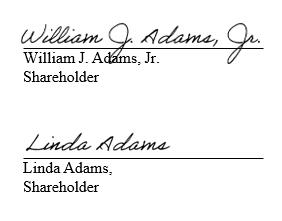
l.Effective Date. Effective November 1, 2018 (“Effective Date”), as approved and adopted as of the Effective Date hereof by a unanimous Vote of the Stockholders,
18
William J. Adams and Linda Adams, and affirmed this 6th day of June 2023, by the execution hereof, at 6780 Sabal Palm Drive, St. Augustine, FL 32086.
19