Exhibit 3
| Part III: Manner of Operation * * * * * Item 7: Order Types and Attributes a. Identify and explain each order type offered by the NMS Stock ATS. In your explanation, include the following: i. priority, including the order type’s priority upon order entry and any subsequent change to priority (if applicable); whether and when the order type can receive a new time stamp; the order type’s priority vis-à-vis other orders on the book due to changes in the NBBO or other reference price; and any instance in which the order type could lose execution priority to a later arriving order at the same price; ii. conditions, including any price conditions (e.g., how price conditions affect the rank and price at which it can be executed; conditions on the display or non- display of an order; or conditions on executability and routability); iii. order types designed not to remove liquidity (e.g., post-only orders), including what occurs when such order is marketable against trading interest on the NMS Stock ATS when received; iv. order types that adjust their price as changes to the order book occur (e.g., price sliding orders or pegged orders) or have a discretionary range, including an order’s rank and price upon order entry and whether such prices or rank may change based on the NBBO or other market conditions when using such order type; when the order type is executable and at what price the execution would occur; whether the price at which the order type can be executed ever changes; and if the order type can operate in different ways, the default operation of the order type; v. whether an order type is eligible for routing to other Trading Centers; vi. the time-in-force instructions that can be used or not used with each order type; vii. the circumstances under which order types may be combined with another order type, modified, replaced, canceled, rejected, or removed from the NMS Stock ATS; and viii. the availability of order types across all forms of connectivity to the NMS Stock ATS and differences, if any, in the availability of an order type across those forms of connectivity. |
| Firm Orders,Conditionals, and Actionable IOIs The BIDS ATS accepts (i) Firm orders (ii) Conditionals and (iii) AIOIs. Firm orders are executable according to the order specifications. Conditionals, which are described in Part III, Item 9, are trading interests that have the same general attributes of a Firm order except that they are not executable. A Trader must always replace (“firm-up”) its Conditional with a Firm order before it can be executed. If an invitation interaction, as described in Part III, Item 9, ends with Firm orders on both sides that satisfy each other’s terms and the trade meets applicable regulatory requirements, then a trade will occur. Traders may modify, replace, or cancel a Firm order at any time before execution. Conditionals are discussed in Part III, Item 9; however, unless otherwise noted, the order types and attributes described below apply to both Firm orders and Conditionals. A Trader may modify, replace, or cancel a Conditional at any time prior to an invitation. Once an invitation is received, the Trader may either “firm-up” the Conditional or cancel or ignore the invitation as described in Part III, Item 9. AIOIs, which are described in Part III, Item 9, may be sent through the BIDS ATS as a firm AIOI or a conditional AIOI by Sponsors to their designated Sponsored Firms that use BIDS Trader under terms agreed to by the parties (e.g., BIDS Trader Users can choose whether or not to receive AIOIs from Sponsors). All AIOIs and AIOI messaging pass through the BIDS ATS; however, neither the AIOI message nor the response interact with other Firm orders or Conditionals in the BIDS ATS order book. The Sponsor submitting an AIOI does not know what symbols exist on any BIDS Trader User’s blotter. Once an AIOI is received by the BIDS Trader User, the BIDS Trader User may send a message to the BIDS ATS accepting the AIOI on its terms, accepting the AIOI with modified terms (e.g., price terms, quantity, minimum), or declining it, or the BIDS Trader User can ignore the AIOI. If the BIDS Trader User responds to an AIOI by accepting it and the terms on both sides match, a firm AIOI is executed immediately by the BIDS ATS. If the originating AIOI was conditional and the BIDS Trader User responds to the AIOI by accepting it, the BIDS ATS sends the Sponsor a notification to firm-up. Once the Sponsor firms-up the AIOI, the BIDS ATS executes the trade. Any resulting trades may execute at, within, or outside the NBBO as agreed to by both parties to the trade. Executions outside the NBBO would initiate an intermarket sweep order (“ISO”) as described in Part III, Item 9. Firm Order and Conditional Order Types The following Firm order and Conditional order types are accepted by the BIDS ATS: (i) limit order, a Firm order or Conditional with a limit price and a peg defaulted using the Trader’s default preference for Price Protection as described below; (ii) market order, a Firm order or Conditional with no limit price and a peg defaulted using the Trader’s default preference for Price Protection as described below; (iii) midpoint peg order, which is a priced or unpriced Firm order or Conditional that is pegged to the midpoint of the NBBO; (iv) market peg order, which is a priced or unpriced Firm order or Conditional pegged to the opposite side of the market, either at the inside quote or with an offset amount to |
| make the resulting price more or less aggressive; or (v) primary peg order, which is a priced or unpriced Firm order or Conditional pegged to the same side of the market, either at the inside quote or with an offset amount to make the resulting price more or less aggressive. All Firm orders and Conditionals in the BIDS ATS are peg orders in nature and therefore each Firm order and Conditional entered into the BIDS ATS has an explicit order term referred to as “Price Protection” for capturing the type of pegging (i.e., Midpoint, Market, or Primary) for that particular Firm order or Conditional. A Firm order or Conditional entered into the BIDS ATS as a market or limit order may be set to any of the three peg types. The peg type may be explicitly specified for a particular Firm order or Conditional using a custom FIX tag, or otherwise determined by the Trader’s default preference for Price Protection (defaults allowed are Midpoint and Market) set by the Trader. All Firm orders or Conditionals submitted by a BIDS Trader User will always have the peg type specifically set by the BIDS Trader User or his or her default for Price Protection (Midpoint or Market). Consequently, a Firm order or Conditional submitted simply as a “limit order” or a “market order” without an explicit peg type will be accepted and default to the Trader’s default preference for Price Protection. The BIDS ATS determines trade and invitation prices based on NBBOs calculated as described in Part III, Item 23. See Part III, Item 11 for more information on how tradeable prices are determined for different Price Protection terms. AIOI Order Types The following AIOI order types are accepted by the BIDS ATS: (i) peg (i.e., Midpoint, Market, or Primary) with or without an offset. If the offset is zero or no offset is provided, the execution can only occur at or between the NBBO. If the offset is non-zero, the execution may occur outside the NBBO depending on the peg instruction and the offset value; (ii) peg with a limit, same as (i), but the execution price will not exceed the limit price; (iii) limit only, the execution price will not exceed limit price, but may be outside the NBBO. If no pricing or pegging information is provided on the AIOI, the pegging instructions are determined by the Trader’s default preference for Price Protection (defaults allowed are Midpoint and Market) set by the Trader. AIOI Acceptance If a BIDS Trader User accepts an AIOI from a Sponsor, the acceptance may include a limit price, and BIDS Trader will always set a default AIOI Price Protection based on the BIDS Trader User’s AIOI Price Protection setting (i.e., allow outside NBBO, or do not allow outside NBBO). |
| Minimum Attributes for Firm Orders All Firm orders submitted to the BIDS ATS must include the following minimum order attributes or the Firm order will be rejected by the BIDS ATS: 1. Symbol 2. Price (discussed above in this item) 3. Side (buy, sell or sell short) 4. Size 5. Capacity (agency or principal) a. Subscribers are responsible for assigning the appropriate capacity to their Firm orders and Conditionals b. All Firm orders and Conditionals submitted by a Sponsored Firm are designated as agency Minimum attributes for Conditionals and AIOIs are described in Part III, Item 9. Additional Order Attributes Participants may include a variety of additional attributes on an order-by-order basis or as a default setting. The use of additional attributes is limited to specific types of Participants (e.g., Traders or Subscribers) as stated in each description, and the additional attributes are applicable to all orders unless specifically restricted in the description. These additional attributes include: Time-in-Force The BIDS ATS supports the following time-in-force (“TIF”) types: (i) Good-til-day (“Day”) (ii) Good-til-time (“GTT”) (time designation must be within the same trading day that the Firm order or Conditional is entered) (iii) Execute-and-cancel (“ENC”) (iv) Immediate-or-cancel (“IOC”) (Firm order) Firm orders, Conditionals, and AIOIs may be designated with a specified TIF for resting in the BIDS ATS matching book. Firm orders, Conditionals, and AIOIs entered without a specified TIF will be designated with the Trader’s default TIF preference (Day, GTT, ENC); if the Trader has not changed the default TIF preference, the Firm order, Conditional, or AIOI will initially default to a Day TIF. Regardless of TIF, any Firm order, Conditional, or AIOI remaining in the BIDS ATS will be cancelled at the end of the trading day. Firm orders, Conditionals, and AIOIs designated as ENC may specify an optional expiry time. If a Firm order or a firm AIOI has an ENC TIF and does not trade its total available volume after the initial execution, the remaining quantity is cancelled. If a Firm order or a firm AIOI has an ENC TIF and an expiry time and does not trade at all, it will terminate at the expiry time. Because Conditionals or conditional AIOIs are not executable, the ENC TIF has no practical application for Conditionals or conditional AIOIs. The BIDS ATS will not reject Conditionals or conditional AIOIs entered with an ENC TIF designation; rather, the ENC TIF designation on |
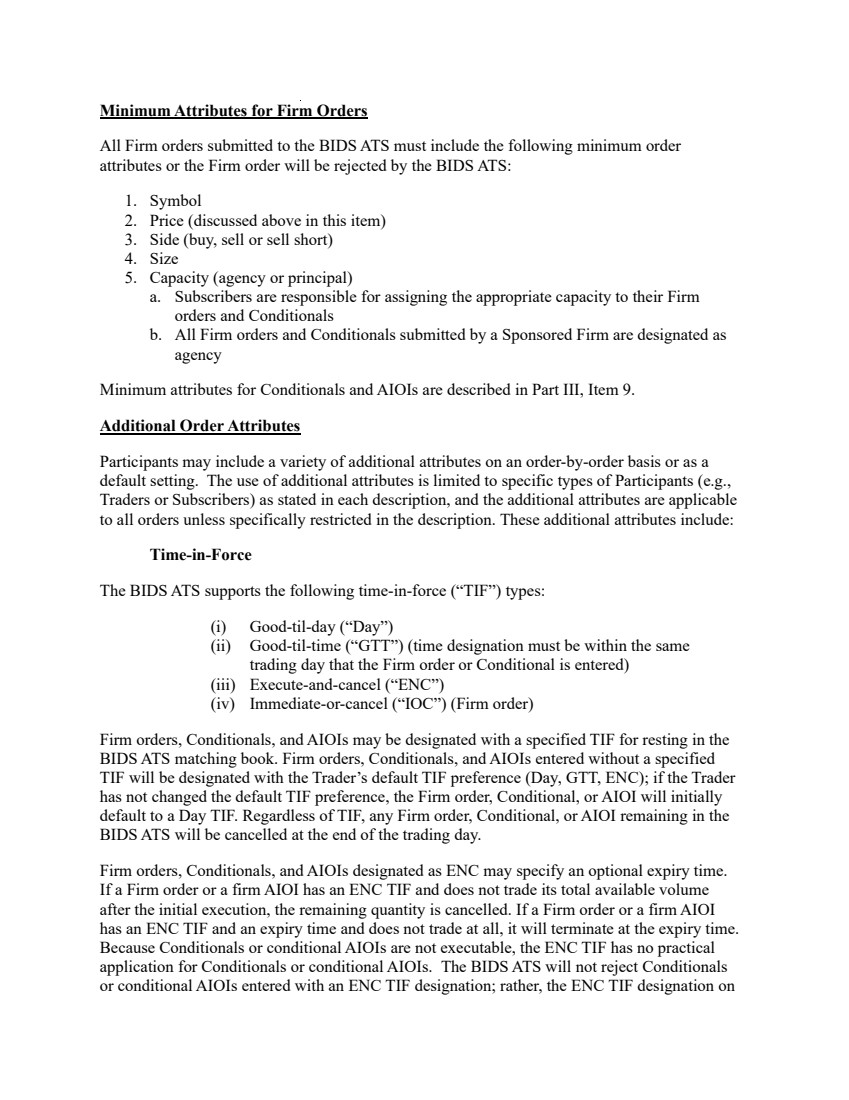
| the Conditional or conditional AIOI will be treated as a Day TIF or, if an expiry time is specified, a GTT TIF. All open Firm orders, Conditionals, and AIOIs are cancelled at the market close. The BIDS ATS will reject Conditionals and conditional AIOIs with an IOC TIF. Minimum Volume Automatch Minimum Volume Any Firm order submitted to the BIDS ATS may set a minimum volume that specifies the quantity every trade involving the Firm order must meet. Where two Traders have each set a minimum volume, any resulting transaction between those two Firm orders must have a volume greater than or equal to the highest minimum volume between the two Firm orders (note: the BIDS ATS trades are at least one round lot). Invitation Minimum Volume Traders may also specify a minimum quantity that every invitation related to a Firm order or Conditional must meet. A Firm order using this minimum will only issue an invitation to a contra-party Conditional that is greater than or equal to the required amount. A Conditional using this minimum will only issue or receive an invitation to or from a contra-party Conditional that is greater than or equal to the required amount. See Part III, Item 9 for a discussion of Conditionals and invitations (note: the BIDS ATS invitations are at least one round lot).. Automatch and Invitation Minimum Volume designations may be specified on AIOIs. Additional Volume Preferences Traders may supplement minimum volume requirements with the following preferences: 1. Volume Aggregation A Trader may permit trade aggregation for the purpose of meeting its automatch minimum volume requirement. If a Trader enables aggregation, a Firm order from this Trader may trade when it has the aggressive-order status (see Continuous Matching in Part III, Item 11 for definition of aggressive status), with more than one passive Firm order each of which includes volume below the automatch minimum, but the total of which is greater than or equal to the automatch minimum. Each such trade must meet the contra-party’s automatch minimum volume, if any. Volume aggregation is not available on AIOIs 2. Minimum Volume for Principal Flow A Sponsored Firm’s individual trader may also set a preference called “Minimum Volume for Principal Flow”. With this preference, the Sponsored Firm’s Firm order or Conditional will only |
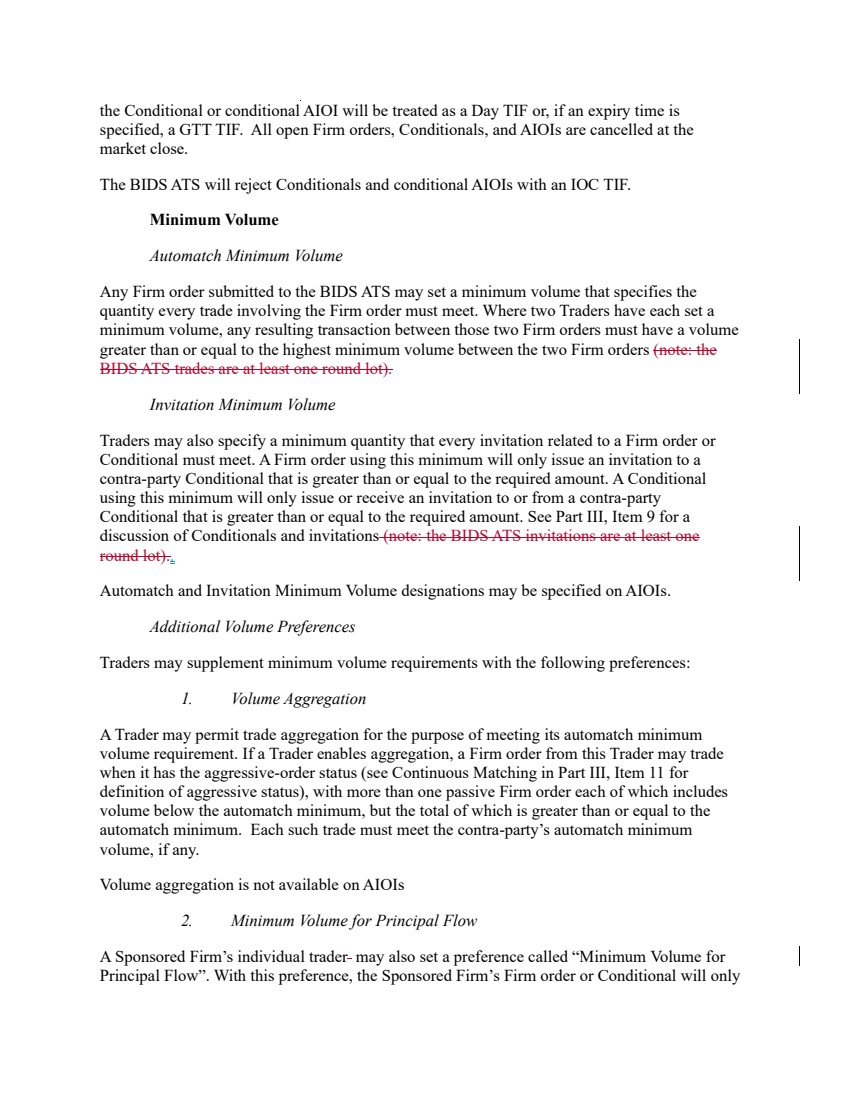
| trade/interact with principal capacity Firm orders or Conditionals that have the required minimum quantity. Minimum Volume for Principal Flow may also be set for AIOIs. Contra-party Capacity A Sponsored Firm’s individual trader may designate whether his or her Firm order or Conditional may interact with Firm orders or Conditionals that indicate principal capacity. By default, all Sponsored Firm’s individual trader’s Firm orders and Conditionals only interact with agency capacity Firm orders or Conditionals; however, this default can be overridden at the order level or the Sponsored Firm level at the direction of the Sponsored Firm. This designation is not available on AIOIs. Filter Level A Trader can specify a BIDS Scorecard level that a potential contra-party must achieve in order to interact with a particular Firm order or Conditional. As discussed more fully in Part III, Item 9, BIDS scores Traders submitting Conditionals based on their performance in responding to invitations to firm-up. A Trader may set a filter (“Filter”) to prevent invitations from being sent to contra-parties that have BIDS Scorecard levels below the Filter. A Trader sets the Filter level to one of three levels (the “benchmark settings” refer to a variety of proprietary metrics that are calculated for each Trader based on his or her long-term and short-term behavior): (i) Aggressive - allowing invitation to any potential contra-party, regardless of that contra-party’s Scorecard score (ii) Normal – permitting interaction with all contra-parties except for poor performing contra-parties (no invitations sent to Traders with scores worse than Normal benchmark settings); and (iii) Conservative – invitations not sent to Traders with scores worse than the Conservative benchmark settings BIDS cannot override a Trader’s Filter settings. BIDS, at its discretion, may change the benchmark settings for the different Filter levels. Filter settings do not apply to AIOIs. Invite Mode A Trader may specify which type(s) of contra Conditionals a Firm order or Conditional may invite. The available Invite Mode options include: 1. ON – no restriction, the Firm order or Conditional can interact with any type of contra Conditionals 2. OFF – do not interact with contra Conditionals at all a. A Firm order using “OFF” will only trade with contra Firm orders b. This Invite Mode is only available for Firm orders c. A Conditional using “OFF” will be rejected |
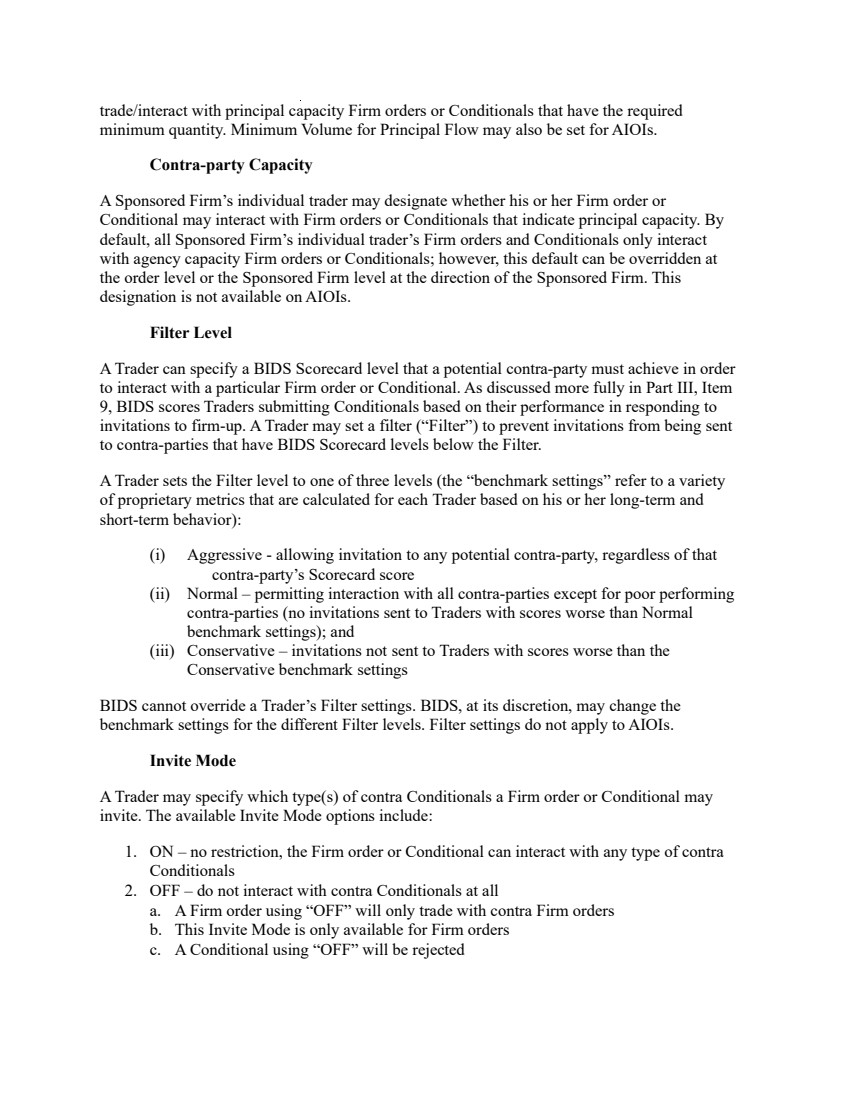
| 3. Auto-only – the Firm order or Conditional will only interact with contra Conditionals that do not involve a human trader seeing an invitation and deciding whether to firm up or not. A Trader may elect to receive a notification from BIDS when the Trader’s Firm order invites a Conditional. Invite Mode does not apply to AIOIs. Intra-firm Priority A Subscriber may designate that Firm orders and Conditionals have a priority for interacting with contra Firm orders and Conditionals that are from the same order source. This order preference applies to both invitations and trades. See Part III, Item 11 for a discussion of Intra-firm Priority. Intra-firm Priority designation does not apply to AIOIs. Hosted Pools A Subscriber may designate that Firm orders and Conditionals interact only with others from the same group by setting up a Hosted Pool. See Part III, Item 14 for a discussion of Hosted Pools. AIOIs are not available for use in Hosted Pools. Attributes of Conditionals Only Traders may use certain attributes related to firming-up that are only applicable to Conditionals (e.g., Regular FirmUp Conditional, Auto FirmUp Conditional, Dual Conditional). These attributes affect a Trader’s interaction with Conditionals and invitations to firm-up and are discussed in Part III, Item 9 under the Conditional Types and Firm-Up Mode section. These attributes are not available on AIOIs. Routing Instruction The BIDS ATS only routes Firm orders (it does not route Conditionals), and only at the explicit direction of a BIDS Trader User. See Part III, Item 16 for a discussion of order routing. Routing instructions are not available on AIOIs. Buyback Instructions A Subscriber may include buyback instructions on a Conditional or Firm order for execution consistent with the price conditions of Rule 10b-18 under the Securities Exchange Act of 1934. Other than as described below, Conditionals and Firm orders with buyback instructions will be executed consistent with the descriptions above of Conditionals and Firm orders. Rule 10b-18 provides issuers with a safe harbor from manipulation under Section 9(a)(2) of the Exchange Act and Rule 10b-5 under the Exchange Act solely by reason of the manner, timing, price, and volume of their repurchases when they repurchase the issuer’s common stock in the |
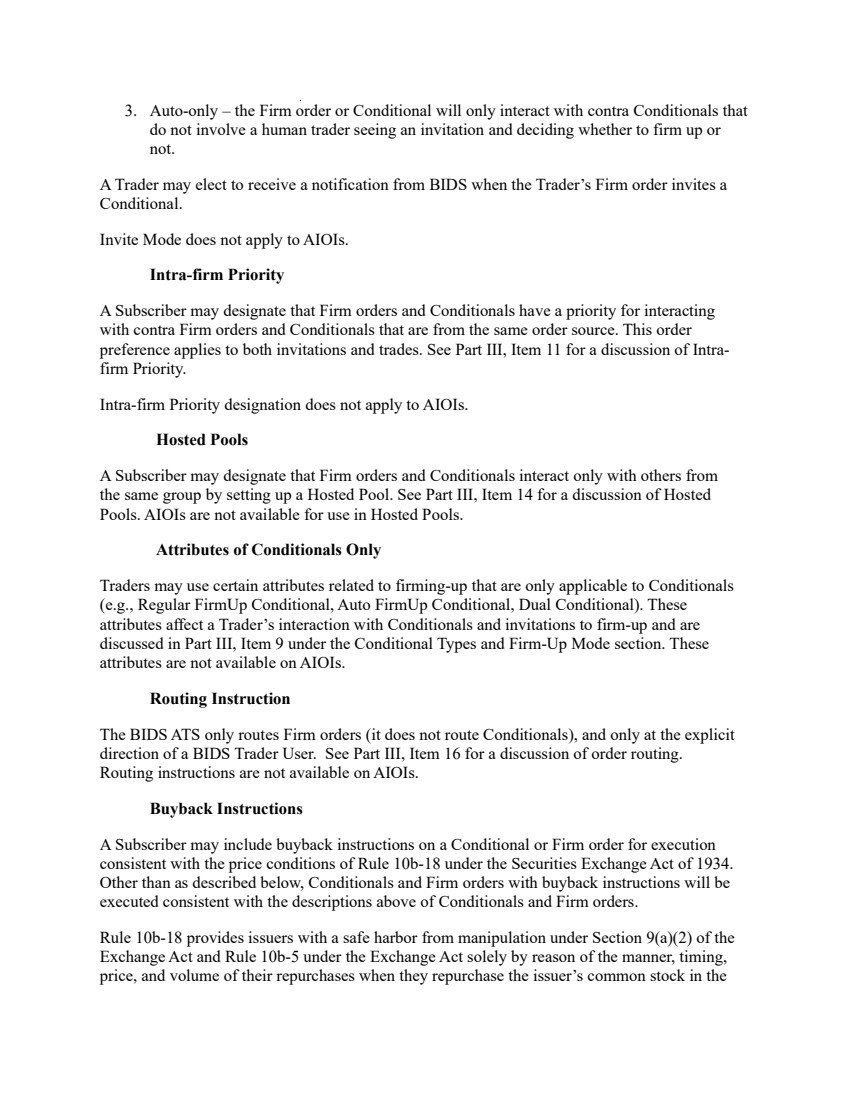
| market in accordance with the rule’s manner, timing, price, and volume conditions. The buyback instructions that the BIDS ATS offers address only the price conditions of Rule 10b-18, not the manner, timing, or volume conditions. A Subscriber may designate a buy Conditional or Firm order with buyback instructions, in which case the buy Conditional or Firm order will be restricted from receiving invitations or from execution in the BIDS ATS, respectively, as follows: A Firm order with buyback instructions will not be executed in the BIDS ATS if the trade price for the security would exceed the higher of: (a) the national best bid; or (b) the consolidated last sale price. A Conditional with buyback instructions will not receive an invitation if the price terms would exceed the higher of: (a) the national best bid; or (b) the consolidated last sale price All Conditionals and Firm orders with buyback instructions will be canceled either: (a) 10 minutes prior to the market close if the Subscriber specifies that the symbol satisfies the requirements of Rule 10b-18(b)(2)(ii) by having an average daily trading value of $1 million or more and a public float value of $150 million or more; or (b) 30 minutes prior to the market close for all other symbols. In order to specify that a symbol satisfies the requirements of Rule 10b-18(b)(2)(ii), the Subscriber must include, in addition to the buyback instructions, a GTT designation expiring between 3:30 p.m. ET and 3:50 p.m. ET (or between 12:30 p.m. ET and 12:50 p.m. ET on a day with an early close). If a Subscriber does not include such a GTT designation, in addition to the buyback instructions, then the Conditional or Firm order will be canceled 30 minutes prior to the market close. Conditionals and Firm orders with buyback instructions will either be executed consistent with the restrictions stated above or remain in effect in accordance with any TIF designation (e.g., a GTT designation that expires before the mandatory cancellation times described above) until they can be executed consistent with those restrictions. Oddlots By default, Participants are enabled to submit odd-lots to the BIDS ATS. All of the orders or trading interest submitted by a Participant will interact with odd-lots on the BIDS ATS, regardless of whether the Participant’s submitted order or trading interest is an odd-lot. A Participant may opt out of submitting odd-lots to the BIDS ATS by contacting BIDS sales or operations staff (contact information is available on the BIDS ATS website provided in Part I, Item 6). The orders or trading interest of a Participant that opts out of submitting odd-lots to the BIDS ATS will not interact with odd-lots on the BIDS ATS. Are the terms and conditions for each order type and attribute the same for all Subscribers and the Broker-Dealer Operator? Yes X No If no, identify and explain any differences. |
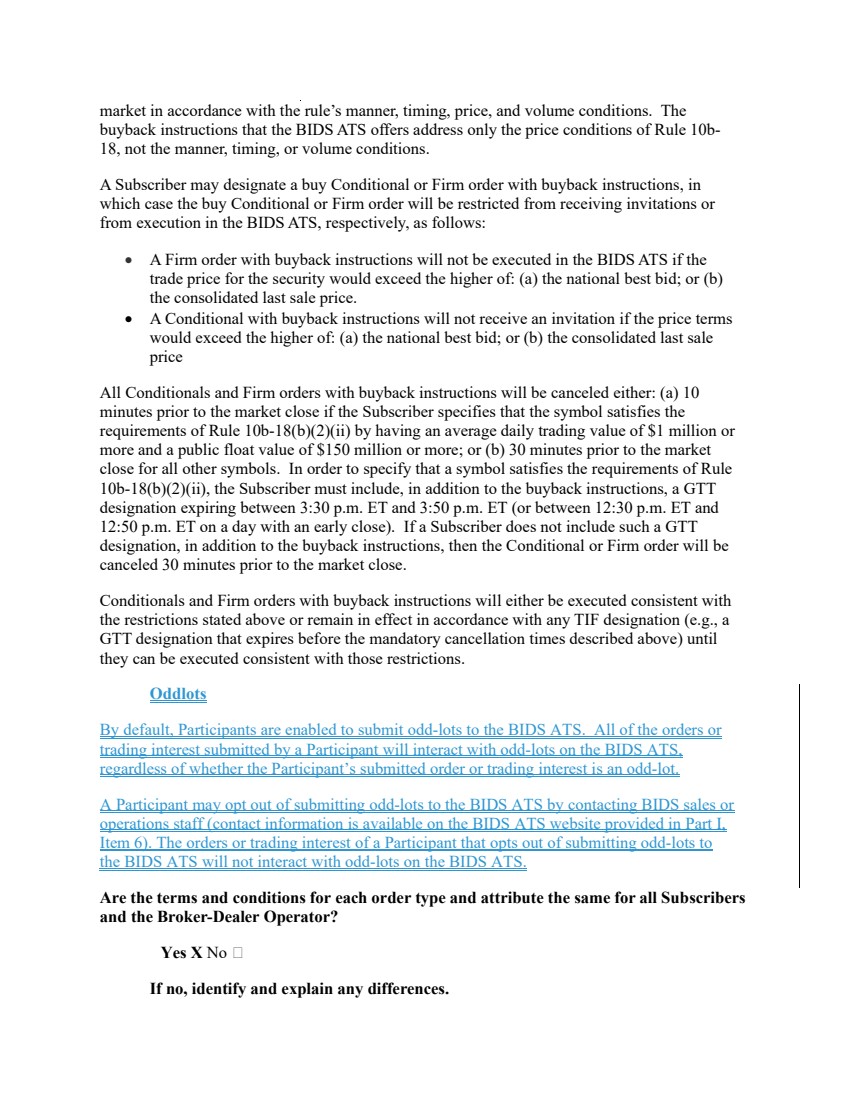
| Item 8: Order Sizes a. Does the NMS Stock ATS require minimum or maximum sizes for orders or trading interest? Yes X No No X If yes, specify any minimum or maximum order or trading interest size requirements and any related handling procedures. All Firm orders, Conditionals, and AIOIs submitted to the BIDS ATS must be greater than or equal to a round lot for the security. The BIDS ATS will reject any Firm orders, Conditionals, or AIOIs that do not meet this minimum requirement. As an exception to this minimum requirement, the BIDS ATS accepts odd-lot Firm orders under the specific circumstances described in Item 8(c). The minimum unit of trading for NMS stocks on the BIDS ATS is one share. BIDS does not place restrictions on the maximum size of an order, but BIDS does effectuate maximum size or value constraints established by a Subscriber (acting for itself or as Sponsor for a Sponsored Firm). The BIDS ATS will reject any Firm orders that exceed the maximum size or value restriction established by a Subscriber. b. If yes to Item 8(a), are the requirements and procedures required to be identified in Item 8(a) the same for all Subscribers and the Broker-Dealer Operator? Yes X No If no, identify and explain any differences. c. Does the NMS Stock ATS accept or execute odd-lot orders? Yes X No If yes, specify any odd-lot order requirements and related handling procedures (e.g., odd lot treated the same as round lot). AThe BIDS ATS supports odd-lot quantities on Firm orders, Conditionals, and AIOIs. Odd-lots entered into the BIDS ATS participate in the matching process with the same order interaction priorities as round lots, except that the orders or trading interest of a Participant that opts out of submitting odd-lots to the BIDS ATS will not interact with odd-lots in the BIDS ATS. Any BIDS Trader User, including those that have opted out of submitting odd-lots to the BIDS ATS, may submit an odd-lot Firm order for approval to execute the odd-lot balance of an OMS/EMS parent order (same symbol and same side) that has traded in the BIDS ATS on the current trading day on Firm orders submitted by that BIDS Trader User. The BIDS ATS will, |
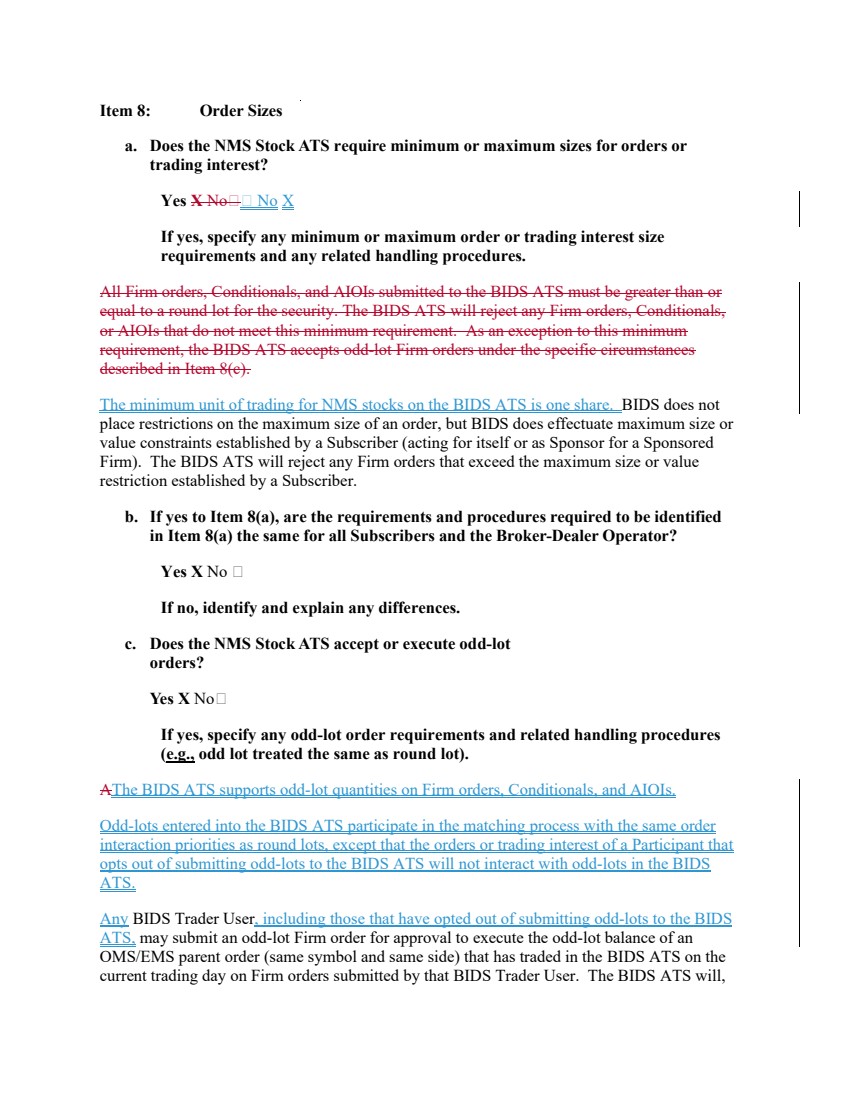
| in its discretion, either approve and execute this odd-lot Firm order for that symbol and side or reject it. The BIDS ATS may not approve an odd-lot Firm order if, for example, there was not a previous execution for the BIDS Trader User on the BIDS ATS in that symbol on the same side on the same day or may reject an odd-lot Firm order based on its consideration of the number or frequency of requests to execute odd lots. If the odd-lot Firm order is approved, BIDS takes the contra side of the order in a principal capacity and fills the trade on the BIDS ATS at the last trade price by the BIDS Trader User. Because execution of an odd-lot Firm order in this circumstance does not involve two Subscribers (i.e., there is not an offsetting Firm order from another Subscriber against which the odd-lot Firm order crossed), this creates a position for BIDS within its facilitation account at BOFA because the BIDS ATS executed the odd-lot with only one Subscriber. BIDS then sends out a market order to trade out of this position through the BOFA FIX connection. BOFA will report this fill to the clearing arm which will then flatten out the position that had been created. d. If yes to Item 8(c), are the requirements and procedures required to be identified in Item 8(c) the same for all Subscribers and the Broker-Dealer Operator? Yes X No If no, identify and explain any differences. e. Does the NMS Stock ATS accept or execute mixed-lot orders? Yes X No If yes, specify any mixed lot order requirements and related handling procedures (e.g., mixed lot treated the same as round lot). Mixed lots entered into the BIDS ATS participate in the matching process with the same order interaction priorities as round lots. The BIDS ATS will match a mixed lot with a round-lot, a mixed lot, or another mixed lot. For an odd-lot. A mixed lot will not match with an odd-lot if a Participant that submits a mixed lot has opted out of submitting odd-lots to the BIDS Trader Users,ATS. For Sponsored Firms (excluding trading algorithms of Sponsored Firms), any remaining odd -lot (the “tag-end”) associated with a mixed lot execution will be auto-filled if the Trader’sSponsored Firm’s order fully fills the contra-party’s available shares. A Sponsored Firm’s tag-ends will be auto-filled even if the Sponsored Firm has opted out of submitting odd lots to the BIDS ATS. If the tag-end is auto-filled, BIDS takes the contra side position of the order in a principal capacity and fills the trade on the BIDS ATS at the execution price of the associated order. Because execution of the tag-end in this circumstance does not involve two Subscribers (i.e., there is not an offsetting Firm order from another Subscriber against which the odd-lot Firm order can cross), this creates a position for BIDS within its facilitation account at BOFA because the BIDS ATS executed the odd-lot with only one Subscriber. Accordingly, BIDS then sends out a market order to trade out of this position through the BOFA Securities FIX connection. BOFA |
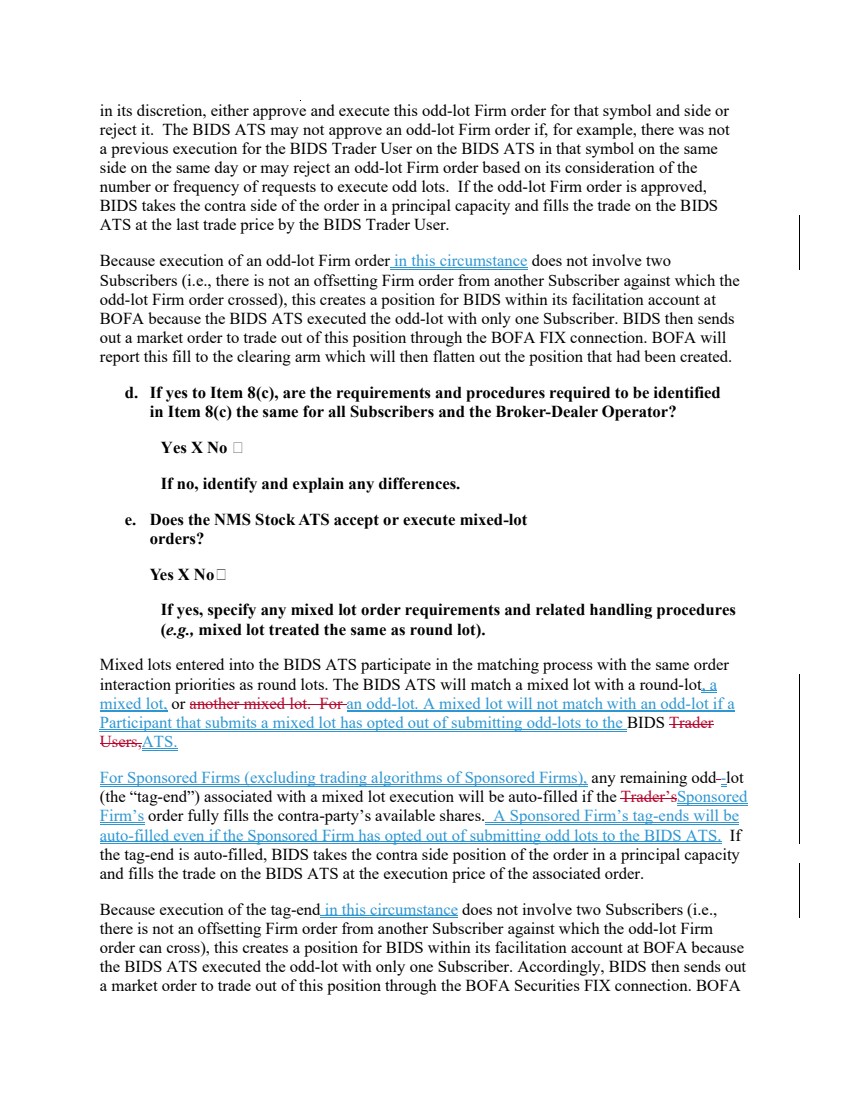
| will report this fill to the clearing arm which will then flatten out the position that had been created. The rules involving mixed-lot orders apply equally to all Sponsored Firms. Only BIDS Trader Users with Sponsored Firms may elect to auto-fill a tag-end. The auto-fill functionality is not available to Subscribers or trading algorithms of Sponsored Firms, and BIDS cancels or to Subscribers. By default, tag-ends remaining after executions for Subscribersassociated with a Subscriber or the trading algorithmsalgorithm of Sponsored Firmsa Sponsored Firm, will be returned to the BIDS order book and will be eligible to execute against other round lots, mixed lots, or odd-lots. Tag-ends associated with a Subscriber or the trading algorithm of a Sponsored Firm that has opted out of submitting odd-lots to the BIDS ATS will be canceled by BIDS. f. If yes, to Item 8(e), are the requirements and procedures required to be identified in 8(e) the same for all Subscribers and the Broker-Dealer Operator? Yes X No If no, identify and explain any differences. * * * * * Item 11: Trading Services, Facilities and Rules a. Provide a summary of the structure of the NMS Stock ATS marketplace (e.g., crossing system, auction market, limit order matching book) and explain the means and facilities for bringing together the orders of multiple buyers and sellers on the NMS Stock ATS. The BIDS ATS operates a single limit order matching book during regular market hours (9:30 a.m. ET to 4:00 p.m. ET unless there is an early close due to a holiday, in which case the close is 1:00 p.m. ET) (see Part III, Item 4 Hours of Operation). The BIDS ATS generally trades all NMS stocks listed on a national securities exchange that are eligible for trading on the BIDS ATS on that day. BIDS may, in its sole discretion, stop trading certain symbols from time to time for, among other reasons, the purpose of remaining below the volume thresholds for (i) classification as an “SCI Entity” under Regulation SCI and (ii) certain regulatory requirements as set forth in Rules 301(b)(3) and (5) of Regulation ATS. The BIDS ATS matching engine anonymously identifies potential counterparties based on the Firm orders and Conditionals that have been submitted by Participants into the BIDS ATS. The interaction of the Firm orders and Conditionals in the BIDS ATS matching engine is determined according to the rules discussed in Item 11(c) below. The BIDS ATS establishes all execution prices using the NBBO (see Part III, Item 23 for a discussion of the NBBO) at the time of the execution. Neither the AIOI message nor the response interact with other Firm orders or Conditionals in the BIDS ATS order book. AIOI acceptances only interact with the initiating AIOI message. |
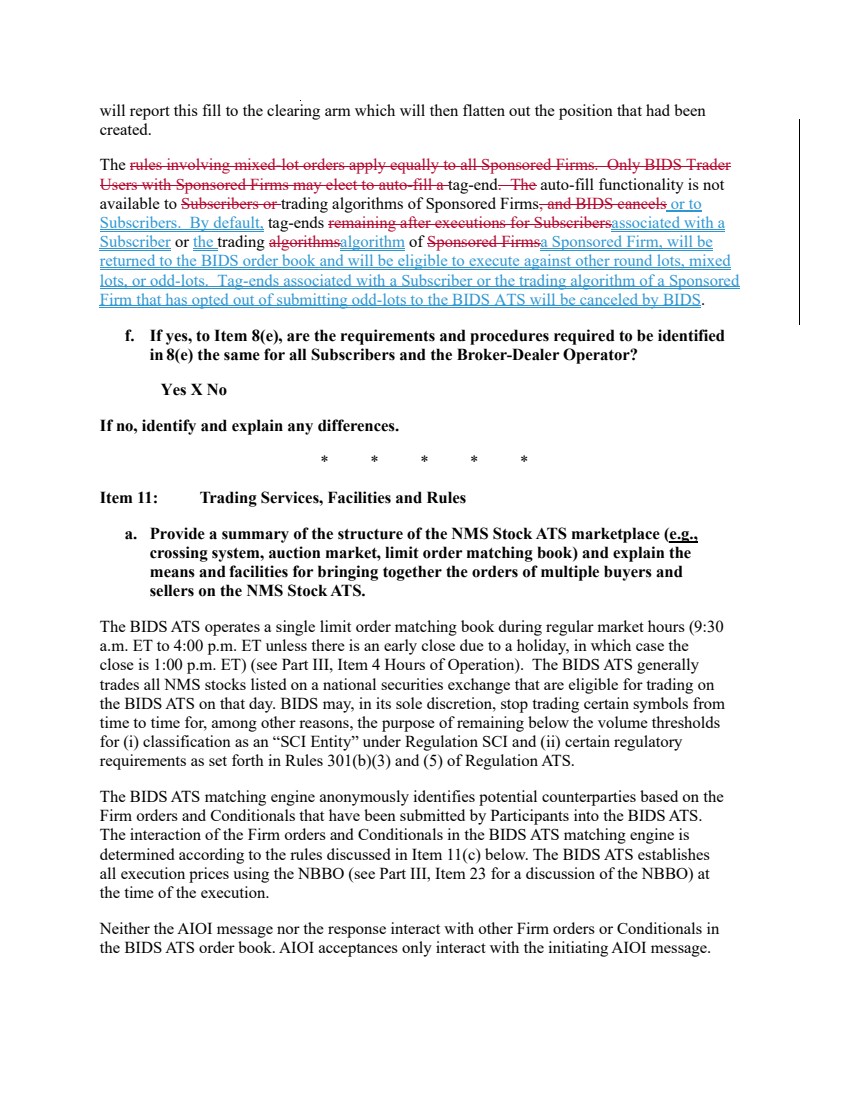
| Participants may submit Firm orders and Conditionals to the BIDS ATS using various methods of access as discussed in Part III, Item 5. Firm orders and Conditionals may be submitted beginning 6:15 a.m. ET on trading days through 4:00 p.m. ET on trading days. b. Are the means and facilities required to be identified in Item 11(a) the same for all Subscribers and the Broker-Dealer Operator? Yes X No If no, identify and explain any differences. c. Explain the established, non-discretionary rules and procedures of the NMS Stock ATS, including order interaction rules for the priority, pricing methodologies, allocation, matching, and execution of orders and trading interest, and other procedures governing trading, such as price improvement functionality, price protection mechanisms, short sales, locked-crossed markets, the handling of execution errors, and the time-stamping of orders and executions. The BIDS ATS matches Firm orders and Conditionals based on the pricing methodologies, Firm order and Conditional attributes, and priority rules set forth below. AIOIs are bi-laterally negotiated and neither the AIOI message nor the response interact with other Firm orders or Conditionals in the BIDS ATS order book. AIOI acceptances only interact with the initiating AIOI message. Continuous Matching Open Firm orders and Conditionals that are already entered into the BIDS ATS are referred to as “passive.” A new Firm order or Conditional entering the BIDS ATS book that is matchable against one or more of those passive Firm orders or Conditionals is called “aggressive.” The fill priority in the BIDS ATS is determined by the aggressive Firm order or Conditional. Traders may select “price/volume/time” or “volume/price/time” fill priorities with the default as price/volume/time. Where the fill priority of the aggressive Firm order or Conditional is “price/volume/time”, the matching sequence is the best price, and then volume and then time, except that a Sponsored Firm’s passive Firm order or Conditional will have priority in the matching sequence over Subscribers’ passive Firm orders or Conditionals at the same price. If the fill priority of the aggressive Firm order or Conditional is “volume/price/time”, then the matching sequence is highest volume, and then price and then time. In all cases, the fill priorities of the passive Firm orders or Conditionals are not taken into consideration. As discussed below and in Part III, Item 7, certain Firm orders and Conditionals may use Intra-firm Priority to designate a specified source as part of its priority designation. Aggressive Firm orders and Conditionals engage in the following matching sequences: |
| 1. A Firm order goes through: (i) the automatching cycle, then (ii) the invitation cycle. a. The automatching cycle compares the aggressive Firm order with passive Firm orders. b. The invitation cycle compares the Firm order with passive Conditionals, which require an invitation and firm-up for execution. 2. A Conditional only goes through the invitation cycle. a. The invitation cycle compares the Conditional with passive Firm orders as well as Conditionals. Following an automatch, a Firm order that has remaining unexecuted volume that is greater than the Firm order’s minimum volume setting will remain eligible for execution at that remaining volume with the original minimum volume. Otherwise, the BIDS ATS will set the minimum volume to the unexecuted volume or cancel the Firm order, based on the default setting established by the Trader. At any time that a Firm order or Conditional (or the portion of its volume) is tied to an invitation, the volume tied to the invitation is committed to the intended contra. As a result, that Firm order or Conditional (or the portion of its volume that is committed) is not eligible to trade/interact with other contras while the invitation is active. For example, a Firm order that has an outstanding invitation to a Conditional cannot automatch with another contra Firm order that is placed in the BIDS ATS while the invitation is pending. Any Firm orders or Conditionals not subject to an outstanding invitation continue to be available for the matching and trading process. Invitations and trades can also occur between two resting Firm orders or Conditionals. For example, a Firm order to buy and a Firm order to sell can be resting on the BIDS ATS order book with pricing terms that would match at a price outside of the current NBBO, but these two Firm orders are not permitted to match on the BIDS ATS because they are outside the NBBO. If the NBBO subsequently moves to a level that would permit the two Firm orders to match, then a trade can occur. In this case, there was no “aggressive” Firm order, and the BIDS ATS performs the same trading and invitation process as for Opening and Re-opening. Dual Conditional Treatment As discussed in Part III, Item 9, the BIDS ATS supports “Dual Conditionals” in its matching process. Where a Dual Conditional has aggressive status, it goes through the invitation cycle once using its AFU terms. If it is not involved in an invitation, the Dual Conditional will go through the cycles a second time, using its RFU terms. If a Dual Conditional is passive, its priority relative to other passive Firm orders and Conditionals is dictated by its AFU terms. Once it is selected to interact with the aggressive Firm order or Conditional but fails to create an invitation, it is re-prioritized against the remaining passive Firm orders and Conditionals using its RFU terms and has the chance to interact with the same aggressive Firm order or Conditional a second time. |
| NBBO Validation The BIDS ATS screens the NBBO immediately prior to allowing the trading and/or invitation cycles to proceed for the following: 1. Crossed market - if the NBBO is crossed, then the BIDS ATS does not permit executions or invitations in the symbol. 2. Locked market - if the NBBO is locked, then the BIDS ATS will not (i) execute a trade if a Trader on either side of the potential trade has disabled trading at locked markets or (ii) create invitations. Traders have the option of setting their trading preference to prohibit trading in locked markets. 3. Wide spread - if the spread of the SIP NBBO exceeds the pre-set maximum spread permitted by the BIDS ATS, no trading nor invitation will occur. BIDS establishes a maximum spread that applies to all securities eligible to trade on the BIDS ATS. BIDS may adjust the permitted maximum spread at any time at its discretion without notifying the Participants. As described in Part III, Item 9, BIDS Trader provides messaging capabilities that allow for bi-lateral negotiation and executions resulting from AIOI messaging. Any resulting trades may execute at, within, or outside the NBBO as agreed to by both parties to the trade. Executions outside the NBBO would initiate an ISO. (See Part III, Items 9 and 23.) Tradeable Price The BIDS ATS makes all pricing determinations with reference to the NBBO calculated in accordance with the description in Part III, Item 23 below. In a single transaction, using the NBBO at the time and the Firm order and Conditional requirements, Firm orders and Conditionals considered for automatching and/or invitation are affixed a “tradeable price” for the scope of that transaction. To establish the tradeable price, the BIDS ATS reviews the pricing terms (limit price, if present, Price Protection (i.e., peg type), and peg offset) of the Firm order or Conditional and determines the most aggressive price (i.e., the highest price for buy Firm orders and Conditionals and the lowest price for sell Firm orders and Conditionals) at which it would trade. The resulting price is the tradeable price in the BIDS ATS. Price Determination and Price Improvement The BIDS ATS determines the trade price during the trading and invitation cycles as follows: 1. Calculate the two tradeable prices 2. Determine the candidate trade price (see below for “candidate trade price” discussion) 3. Validate the candidate trade price The BIDS ATS establishes the candidate trade price by determining the price at which two Firm orders or Conditionals can interact at that time. The candidate trade price is the price equal or closest to the NBBO midpoint that does not exceed the tradeable prices of the Firm orders, |
| Conditionals, or AIOI involved. Once the candidate trade price is determined, the BIDS ATS then validates if this candidate trade price can be used at that time. To validate the candidate trade price, the BIDS ATS reviews for any restrictions, including regulatory restrictions, that would prevent a trade at that candidate trade price at that time. Pursuant to the validation process, the candidate trade price is unusable (and thus no trading/invitation will occur) if: 1. it is outside the current limit-up/limit-down (LULD) restriction – not applicable to AIOIs. 2. the sell Firm order, Conditional, or AIOI is a non-exempted short, a regulatory short sale restriction is in effect, and the candidate trade price is equal to the national best bid (NBB). 3. it is outside the current SIP NBBO, which can happen if the candidate trade price is calculated using the synthetic NBBO rather than the SIP NBBO. This check is not performed for an AIOI that can execute outside the NBBO. a. As discussed in Part III, Item 23 Market Data, the BIDS ATS uses a synthetic NBBO (so long as the data is available), but always validates the transaction price using the SIP NBBO. Effective Time for Prioritization A Firm order or Conditional in the BIDS ATS is assigned an effective time by the BIDS ATS when it is accepted in the BIDS ATS. The BIDS ATS updates this effective time to the time of any cancel-and-replace action if the action involves a material change to the Firm order or Conditional. Material changes causing a new time stamp include changes to any price, volume, and short sale terms. Changes in short sale terms refers to short sale restrictions imposed by regulators pursuant to applicable rules and regulations. All timestamps are assigned by the BIDS ATS matching engine, using the system time when the events take place. Delaying Cancellation of IOCs As discussed in Part III, Item 7, Traders can designate a TIF on Firm orders, Conditionals, and AIOIs, and Firm orders and firm AIOIs can be designated as immediate or cancel (“IOC”). Automated Firm orders often are designated as IOC, which is effective for automatching but not meaningful in invitation interactions because an IOC Firm order needs to rest in the order book for at least a very brief time period (at least 1 millisecond) to allow any invited contra Conditional time to respond. Without this time period, an IOC Firm order would be limited to interacting only with Firm orders. To facilitate interactions with Conditionals, instead of requiring automated Traders to change their implementations and give up using IOCs on Firm orders, an automated Trader may opt in and allow the BIDS ATS to delay canceling its IOC Firm orders for a duration specified by the Trader. BIDS does not restrict the duration of any delay specified by a Trader; however, the duration is typically tens to hundreds of milliseconds. By opting in for this delay, the IOC Firm order has the rest-on-book time for an invited contra-party to firm-up. The automated Trader may choose to apply such a delay only to firm-up IOCs in |
| response to invitations, or to all its IOC Firm orders. BIDS Trader has no function allowing submission of IOCs or delayed IOCs. The option to delay cancellation is not available for firm AIOIs designated with an IOC TIF. Optional Rejection of IOCs By default, IOCs enter the BIDS ATS order book and are immediately canceled if there is no matchable trading interest (unless they are delayed as described above). Participants have the option to have IOCs rejected before reaching the BIDS ATS order book for matching (i.e., at the gateway or at the matching engine) if there is no matchable contra trading interest in the BIDS ATS order book. If a Participant opts into IOC rejection, the BIDS ATS system determines whether there is matchable contra trading interest to the IOC in the order book, first at the gateway described above in Part III, Item 5, and then at the matching engine before the IOC enters the BIDS ATS order book for matching. If the gateway or the matching engine determines that there is no matchable contra trading interest in the order book, the gateway or the matching engine rejects the IOC. The matching engine uses real-time information on the order book, including symbol, side, size, and price to identify potential matchable contra trading interest. In addition, the matching engine provides the gateway real-time information, only on the symbols resting in the order book, which allows the gateway to identify whether there is matchable contra trading interest to the IOC in the order book. Intra-firm Priority The BIDS ATS allows Subscribers to give priority to contra-parties from that Subscriber, subject to the BIDS ATS restrictions preventing wash trades. If enabled and the aggressive Firm order or Conditional is from such a Participant, then the passive Firm orders and Conditionals will be sorted in a way preferencing those from the same source: first by tradeable price, then those from the identified source over others, then by volume, then by effective time (i.e., price/source/volume/time priority). Intra-firm Priority can be set up for Firm orders or Conditionals sent to the general BIDS ATS, or for orders sent to a Hosted Pool. Hosted Pools Hosted Pools, discussed in Part III, Item 14, can be set up as a business arrangement with certain Subscribers and are only available to the Subscribers that set them up. Firm orders and Conditionals from this group of one or more Subscribers can be designated to belong to the Hosted Pool and only interact with Firm orders and Conditionals in the same pool. The matching and trading rules and logic in a Hosted Pool are the same as in the BIDS ATS. Subscriber Risk Management and Controls All Subscribers to the BIDS ATS are registered broker-dealers and are subject to the SEC’s Market Access Rule (Rule 15c3-5 under the Securities Exchange Act of 1934). The BIDS ATS provides Sponsors with tools and functionality that they may use to assist them in complying with these obligations. This includes providing administrative access to Sponsors to allow them to set and manage risk limits for their Sponsored Firms, as well as the ability to suspend sponsorship for specific or all customers or restrict certain types of trades (e.g., short sales). The BIDS ATS will not allow a trade by a Sponsored Firm if it would breach the limit imposed by |
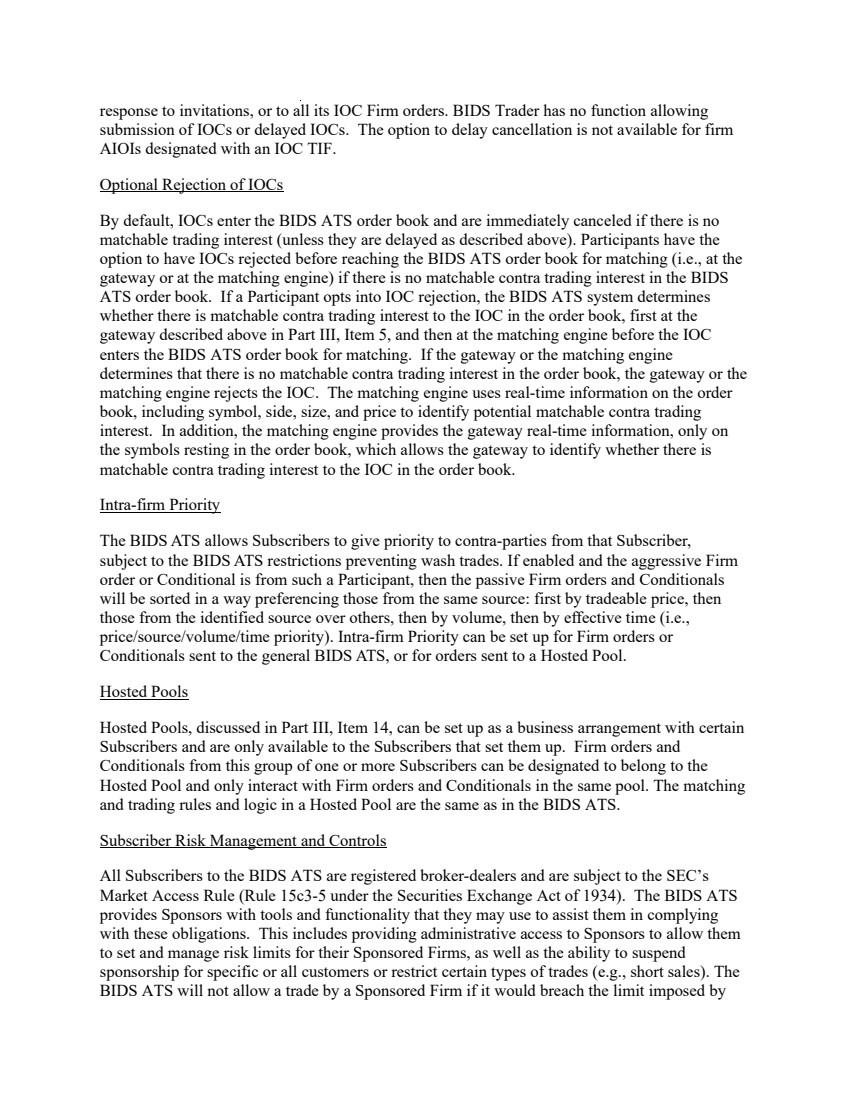
| the Sponsor. Upon request of a Sponsor, the BIDS ATS can configure email alerts to the Sponsor to be sent when risk limits or some high watermarks are exceeded by a Sponsored Firm. If a Firm order or Conditional from a BIDS Trader User exceeds the Sponsor’s risk limit, the BIDS Trader server facility will reduce the size of the Firm order or Conditional to within the permitted limit (so long as the amount is above any minimum volume requirements from the Trader). Treatment of Partially Traded Orders Pursuant to voluntary preference settings, a Trader may direct the BIDS ATS on how to handle any remaining volume that is below its minimum volume requirement but not down to an odd-lot.. The remaining volume may be cancelled back, left in the BIDS ATS as an All-or-None order, or processed through the Overtime function. Where the remaining volume is an odd-lot: 1. For BIDS Trader Users,all Sponsored Firms, including Sponsored Firms that have opted out of submitting odd-lots to the BIDS ATS (but excluding trading algorithms of Sponsored Firms), BIDS fills the remaining odd-lot volume automatically at the execution price byof the Sponsored Firm. 1.2.If the Participant is either a Subscriber or the trading algorithm of a Sponsored Firm, then BIDS Trader User.will return the remaining odd-lot volume to the BIDS order book, and it will be eligible to execute against other round lots, mixed lots, or odd-lots. 2.3.ForIf the Participant is either a Subscriber or the trading algorithm of a Sponsored Firms not using BIDS Trader, they can choose between having BIDS fill the odd-lot automatically as for Sponsored Firms using BIDS Trader, or haveFirm and has opted out of submitting odd-lots to the BIDS ATS, then BIDS will cancel back the remaining odd-lot. For Subscribers, their odd-lots are always cancelled back volume. Overtime Pursuant to voluntary preference settings, a BIDS Trader User may elect the Overtime function on Firm orders, on an order-by-order basis, upon receipt of an invitation and before firming up. If a BIDS Trader User executes a trade from a Firm order for which it has elected the Overtime function, and the quantity executed on the trade is less than the quantity on the Firm order (an “Overtime Trade”), then the remaining quantity (an “Overtime Order”) may execute against orders in the BIDS ATS in amounts less than the BIDS Trader User’s minimum volume. An Overtime Order retains the time stamp of the corresponding Overtime Trade, and it will remain in effect pursuant to voluntary preference settings for limit price, minimum volume, and time-in-force made by the BIDS Trader User in electing the Overtime function. Clean Up BIDS Trader Users also have the option of using “clean up” to work remaining volumes, which involves directing BIDS to route the remaining volume to a specified third party trading venue with which the BIDS ATS has connected. |
| Self-crossing Rules The BIDS ATS prevents certain Firm orders or Conditionals from interacting with Firm orders and Conditionals submitted by the same Participant (“self-crossing”). For example, a Sponsored Firm is prevented from matching with itself as a counterparty. In addition, a Subscriber cannot interact with itself if either of the opposing Firm orders or Conditionals are entered with a principal capacity. At the request of a Participant, the BIDS ATS can also prevent a Participant from “self-crossing” with an affiliated Participant, by setting up an explicit block for the pair. The block may apply to all Firm orders and Conditionals of the affiliated Participant, or limited to a specific capacity (i.e., principal or agency). Execution Errors BIDS may, at the request of a Participant or on its own initiative, determine to review any transaction on the BIDS ATS to assess whether it was “clearly erroneous” (i.e., there is an obvious error in any term, such as price, quantity, or identification of the security or a technical issue is identified). If BIDS determines a transaction was clearly erroneous, it may cancel (bust) the cross trade or cancel one side of the cross trade. If BIDS cancels one side of a cross trade, it takes the contra side position of the order in a principal capacity and fills the trade on the BIDS ATS at the execution price of the cross trade. BIDS then covers that position in its error account as soon as is practicable by submitting via FIX Protocol an offsetting order to BOFA, BIDS’ clearing agent. Therefore, the trades to cover the position will both be executed and cleared by BOFA. Allocations The BIDS ATS does not perform any trade allocations. d. Are the established, non-discretionary rules and procedures required to be identified in Item 11(c) the same for all Subscribers and the Broker-Dealer Operator? Yes X No If no, identify and explain any differences. * * * * * Item 19: Fees a. Identify and describe any fees or charges for use of the NMS Stock ATS services, including the type of fees (e.g., subscription, connectivity), the structure of the fees (e.g., fixed, volume-based, transaction-based), variables that impact the fees (e.g., types of securities traded, block orders, form of connectivity to the ATS), differentiation among types of Subscribers (e.g., broker-dealers, institutional investors, retail) and range of fees (e.g., high and low). |
| BIDS offers Subscribers a structured transaction-based fee model that sets forth the fee for each share executed on the BIDS ATS. BIDS charges fees to Subscribers only (including when acting as a Sponsor); fees are not directly billed to Sponsored Firms. The specific fees for a particular Subscriber are determined based on disclosed, objective criteria: (i) means of access; (ii) the type of order; and (iii) the total volume of executions during the calendar month. Within this fee structure, BIDS distinguishes fees between direct access by a Subscriber and sponsored access provided by a Subscriber on behalf of a customer (Sponsored Firm). BIDS applies its access fee model to all Subscribers and charges the same rate to all similarly situated Subscribers. As a result, any Subscriber that meets the criteria for a specified fee rate will be charged the same fee as another Subscriber that also meets the same criteria. BIDS makes its rates and corresponding qualifications for the rates available to all Subscribers. Any changes to these rates are provided to Subscribers in advance of the effective date of the change. BIDS’ application of its fee rates is governed by its Subscriber Agreement, the terms of which are materially the same for every Subscriber. The fees for the BIDS ATS range from $0.0003 to $0.005 per share executed on the BIDS ATS or filled from odd-lots or routed Firm orders. BIDS charges Subscribers a monthly fee for order entry ports of $100 per port, subject to a monthly cap of $1,000 per Subscriber. BIDS does not offer rebates or other forms of credit against the applicable fees. Executions resulting from AIOIs are charged to the Sponsor at regular Subscriber rates unless the AIOI message has a “principal” capacity, in which case the Sponsor leg of the execution is not charged a fee. BIDS does not charge fees for executions on orders that the Subscriber has categorized as originating from retail flow. BIDS does not charge fees for trades executed on the BIDS ATS resulting from Firm orders or Conditionals submitted by a Subscriber that originate from an RFQ platform recognized by BIDS, subject to the conditions set forth below. Firm orders or Conditionals that originate from an RFQ platform are Firm orders or Conditionals that a participant of an RFQ platform has designated as being sent to BIDS by a Subscriber prior to initiating the RFQ process through the RFQ platform. At the time of submission to the BIDS ATS, the Firm order or Conditional is designated by the Subscriber as originating from an RFQ platform with which that Subscriber has a recognized relationship (i.e., the Subscriber is an affiliated broker-dealer to an RFQ platform). The Subscriber and BIDS will determine a mutually acceptable manner to designate the Firm order or Conditional as originating from an RFQ platform, which may include the Subscriber providing a unique tag identifying the Firm order or Conditional as originating from the RFQ platform or the Subscriber identifying one or more connections to the BIDS ATS as solely transmitting Firm orders or Conditionals from the RFQ platform. |
| The RFQ platform from which the Firm order or Conditional is designated as originating must be an RFQ platform recognized by BIDS. BIDS applies uniform criteria in determining whether an RFQ platform is recognized for purposes of not charging a fee. BIDS passes through certain regulatory fees and connectivity fees, including applicable tax billed to BIDS for Subscribers connecting through third party providers. For trades executed on the BIDS ATS, BIDS and the selling Subscriber are the CAT Executing Brokers and are charged CAT fees accordingly. For non odd lot trades on the ATS, BIDS passes its CAT fee through to the buying Subscriber., except that BIDS does not pass CAT fees through to Subscribers on odd lot trades executed on the BIDS ATS where BIDS takes the contra side of the order in a principal capacity, as described in Part III, Item 8. The fee structures for the BIDS ATS and the Cboe U.S. Securities Exchanges are independently determined. Fees, charges, rebates, or discounts for the BIDS ATS are not based on participation in the Cboe U.S. Securities Exchanges, and vice versa. b. Identify and describe any fees or charges for use of the NMS Stock ATS services that are bundled with the Subscriber’s use of non-ATS services or products offered by the Broker-Dealer Operator or its Affiliates, including a summary of the bundled services and products, the structure of the fee, variables that impact the fee, differentiation among types of Subscribers, and range of fees. Not applicable. c. Identify and describe any rebate or discount of fees or charges required to be identified in Items 19(a) and 19(b), including the type of rebate or discount, structure of the rebate or discount, variables that impact the rebate or discount, differentiation among types of Subscribers, and range of rebate or discount. BIDS does not offer fee rebates. In addition, BIDS adheres to its fee structure by charging each similarly situated Subscriber the same fees and does not offer discounts to these fees. * * * * * Item 22: Clearance and Settlement a. Describe any procedures and material arrangements undertaken to facilitate the clearance and settlement of transactions on the NMS Stock ATS (e.g., whether the ATS becomes a counterparty, whether it submits trades to a registered clearing agency, or whether it requires Subscribers to have arrangements with a clearing firm). BIDS has entered into a clearing agreement with BOFA to provide for BIDS’ clearance and settlement of transactions executed on the BIDS ATS. BOFA is a wholly owned subsidiary of Bank of America Corporation. BIDS requires all Subscribers either to be members of NSCC or to enter into a clearing arrangement with an NSCC member. |
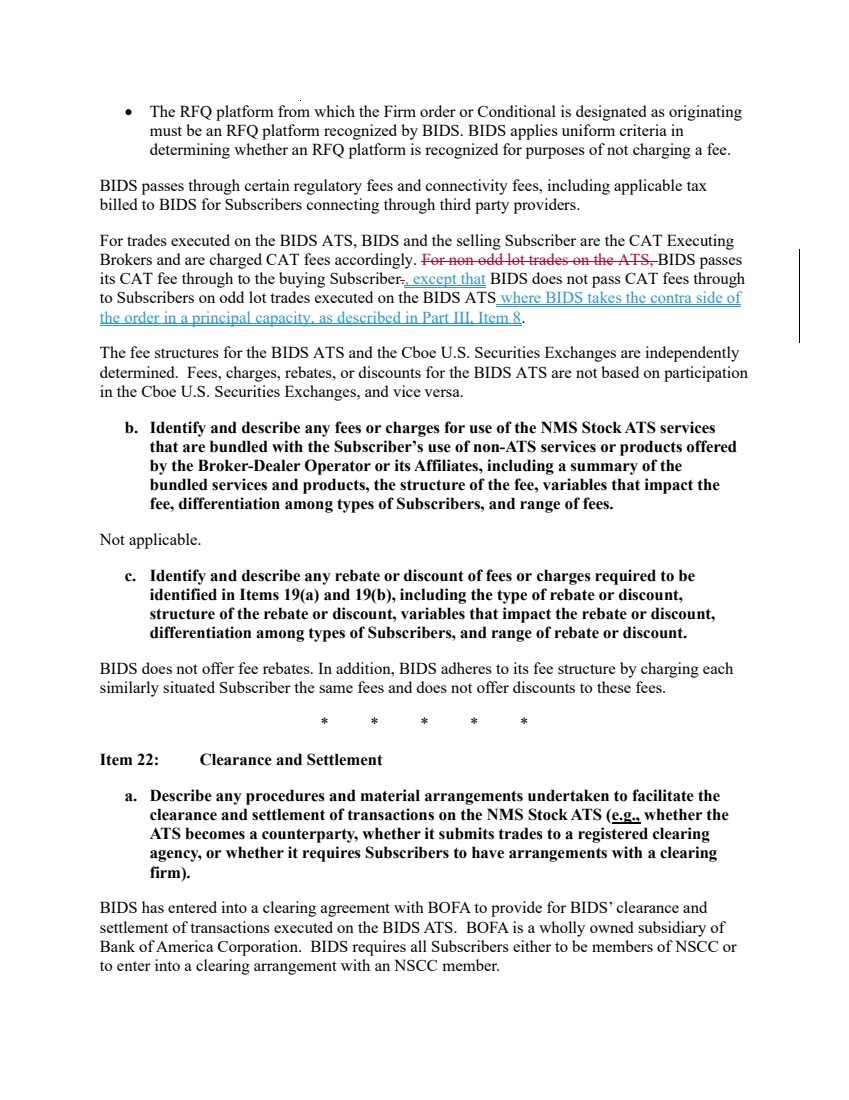
| All BIDS ATS trades with Subscribers that clear through BOFA (DTC No. 161) are cleared and settled by BOFA. All BIDS ATS trades with Subscribers that do not clear through BOFA (DTC No. 161) are submitted by BOFA on behalf of both BIDS and its Subscribers to NSCC via an NSCC Qualified Service Representative Agreement (“QSR”) or in limited circumstances via a Nasdaq Act Give Up Agreement (“AGU”) with BIDS as the executing broker and the Subscriber as the introducing broker. All routed trades, odd lot trades, and error trades executed by BOFA are also cleared and settled by BOFA. All trades for execution and/or clearing and settlement are submitted to BOFA via FIX Protocol. Standard Cross Trades BIDS sends BOFA two trades for clearance and settlement for each cross trade executed on the BIDS ATS. Settlement occurs with BIDS as the executing broker and the Subscriber as the introducing broker, resulting in BIDS as the counter-party to all transactions for clearance and settlement purposes. Error Positions As described in Part III, Item 11(c) (Execution Errors), when BIDS determines it is required to take over one side of a cross trade as the result of an error, BIDS cancels the applicable leg of the BIDS ATS cross trade in the BIDS ATS. The lack of an offsetting trade because of the cancellation creates a position in the agency pass through account maintained with BIDS’ clearing agent (BOFA). BIDS then journals the position from its agency pass through account to its error account that is also maintained with BOFA. BIDS creates the offsetting trade to flatten out the error account position that was created by the cancelation of the single leg by sending limit orders routed via FIX to BOFA. BOFA provides the fills back to BIDS and BIDS books the offsetting trades to the error account to flatten the position. Odd-lots TheWhen the BIDS ATS fills odd lots with a single Sponsor only and therefore, as described in Part III, Item 8, BIDS incurs an odd-lot position in its odd-lot account with BOFA when the odd lot is filled. To flatten out the odd-lot position, BIDS automatically sends a market order to BOFA via FIX to execute an offsetting trade. Routed Trades As described in Part III, Item 16(b), BIDS Trader Users may direct a Firm order to be routed by the BIDS ATS to BOFA for execution. The BIDS ATS will then route the Firm order to BOFA under BIDS’ MPID. If the routed trade is executed, BOFA provides a fill back to the BIDS ATS. The BIDS ATS then provides that fill to the Sponsor of the initial routed Firm order and sends that fill to BOFA for clearance and settlement. ISOs As described in Part III, Item 9, the BIDS ATS may route an ISO order type to BOFA to provide the necessary executions to meet the ISO exception in Regulation NMS for executions outside the NBBO resulting from AIOI messaging. The BIDS ATS will route the Firm order to BOFA |
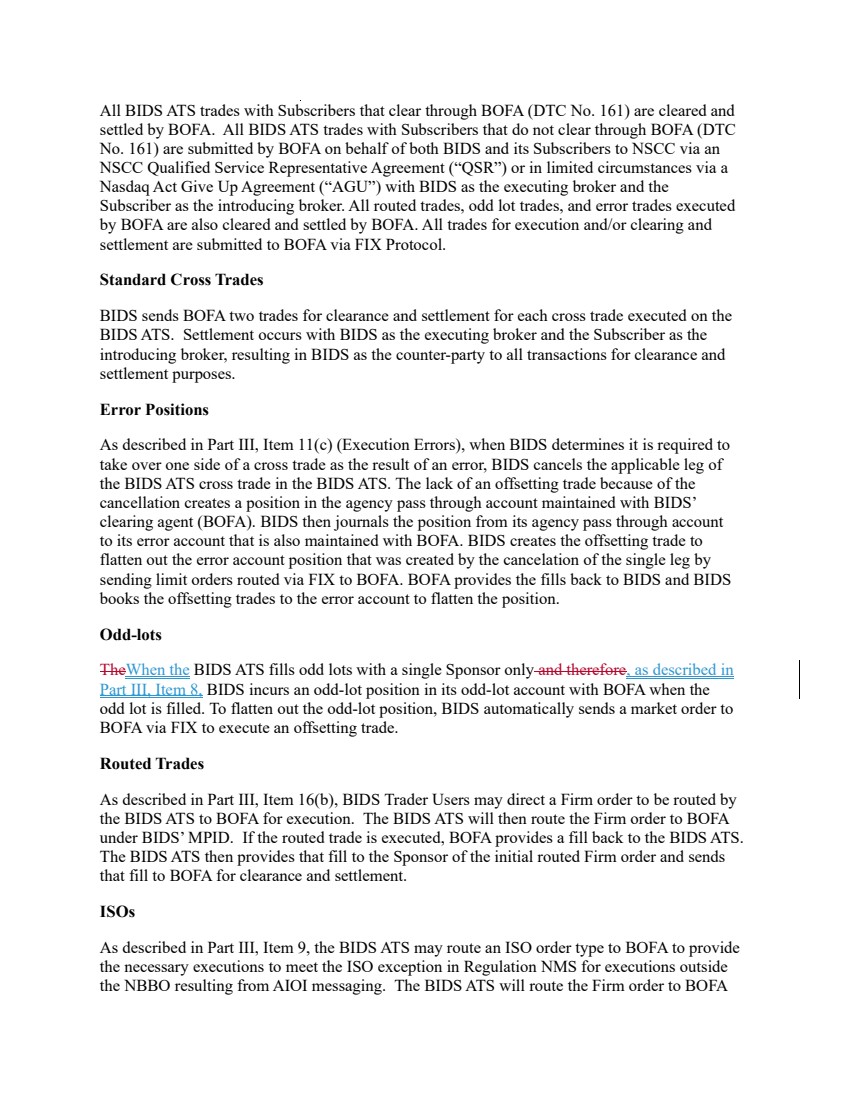
| under BIDS’ MPID. If the routed order is executed, BOFA provides a fill back to the BIDS ATS. The BIDS ATS then provides that fill to the Sponsor of the initial routed Firm order and sends that fill to BOFA for clearance and settlement. For Error Positions, Odd-Lots executed by BIDS in a principal capacity, as described in Part III, Item 8, and Routed Trades, BOFA itself chooses the execution venue, which may be a Cboe U.S. Securities Exchange; the BIDS ATS does not direct the venue to which those orders are routed. For ISOs, as described above, the BIDS ATS directs BOFA to send the orders to Nasdaq with the Nasdaq MOPB order type. b. Are the procedures and material arrangements undertaken to facilitate the clearance and settlement of transactions on the NMS Stock ATS the same for all Subscribers and the Broker-Dealer Operator? Yes X No If no, identify and explain any differences. |