
An offering statement pursuant to Regulation A relating to these securities has been filed with the Securities and Exchange Commission. Information contained in this Preliminary Offering Circular is subject to completion or amendment. These securities may not be sold nor may offers to buy be accepted before the offering statement filed with the Commission is qualified. This Preliminary Offering Circular shall not constitute an offer to sell or the solicitation of an offer to buy nor may there be any sales of these securities in any state in which such offer, solicitation or sale would be unlawful before registration or qualification under the laws of any such state. We may elect to satisfy our obligation to deliver a Final Offering Circular by sending you a notice within two business days after the completion of our sale to you that contains the URL where the Final Offering Circular or the offering statement in which such Final Offering Circular was filed may be obtained.
| Preliminary Offering Circular | Subject to Completion Dated: October 30, 2026
|
WUND Healing BioPharmaceuticals, Inc.
8683 W. Sahara Avenue, Suite 280
Las Vegas, NV 89117
(702) 800-0030
www.wundbio.com
$10,000,000
$10.00 per Share
1,000,000 Shares,
Minimum Investment 500 Shares ($5,000)
This is a Regulation A Tier 2 offering of securities of WUND Healing BioPharmaceuticals, Inc., a Nevada Corporation. We are offering up to 1,000,000 shares of our common stock, par value $0.001 (“Common Stock”), at an offering price of $10.00 per share (the “Offered Shares” or “Shares”) by the Company, pursuant to Tier 2 of Regulation A of the United States Securities and Exchange Commission (the “SEC”).
This offering is being conducted on a “best-efforts” basis, which means that there is no minimum number of Shares that must be sold by us for this offering to close; thus, we may receive no or minimal proceeds from this offering. None of the proceeds received will be placed in an escrow or trust account. All proceeds from this offering will become immediately available to us and may be used as they are accepted. Purchasers of the Shares will not be entitled to a refund and could lose their entire investments.
We estimate that this offering will commence within two days of SEC qualification; this offering will terminate at the earliest of (a) the date on which the maximum offering has been sold, (b) one year from the date of SEC qualification, or (c) the date on which this offering is earlier terminated by us, in our sole discretion. See “Plan of Distribution”.
There is no minimum target for this offering and the Company may accept investor subscriptions on a rolling basis. After each acceptance of subscriptions, funds tendered by investors will be available to the Company for its use.
There is no public market for the Shares, provided that following the closing of this offering, the Company currently plans to apply for quotation on the OTCQB Market maintained by OTC Markets; however, there can be no assurance that we will obtain such quotation, or as to the level of trading that might occur if we do.
These securities are speculative securities. Investment in the Company’s stock involves significant risk. You should purchase these securities only if you can afford a complete loss of your investment. See the “Risk Factors” section on page 16 of this Offering Circular.
Subscriptions are irrevocable and the purchase price is non-refundable as expressly stated in this offering circular. The Company, by determination of the Board of Directors, in its sole discretion, may issue the Shares under this offering for cash, promissory notes, services, and/or other consideration without notice to subscribers. Any of the foregoing non-cash consideration received by the Company shall be valued according to the Note to Rule 251(a)(1) of Regulation A.
|
|
| Price to public |
|
| Commissions(1)(2) |
|
| Proceeds to issuer(3) |
| |||
| Per share |
| $ | 10.00 |
|
| $ | 0.65 |
|
| $ | 9.35 |
|
| Total |
| $ | 10,000,000.00 |
|
| $ | 650,000.00 |
|
| $ | 9,350,000.00 |
|
| (1) | We have engaged Benjamin Securities, Inc. (“Benjamin Securities”) and D. Boral (collectively, the “Placement Agents”) to act as placement agents for this offering, in exchange for a fee of 6.5% of the aggregate offering price of the Shares sold in this offering. We refer you to “Plan of Distribution”, below for additional information regarding Placement Agents compensation. |
| (2) | Does not include a non-accountable expense allowance equal to 1.75% of the gross proceeds of this offering, payable to the Placement Agents, nor does it include the reimbursement of up to $160,000 in expenses incurred by the Placement Agents in connection with this offering. We have agreed to issue to Benjamin Securities, Inc., one of the Placement Agents, and/or its affiliates, warrants to purchase 7% of the number of shares of common stock sold in this offering (up to 70,000 warrants), issuable following each closing of Shares, and to grant the Placement Agents certain indemnification and advancement rights. We refer you to “Plan of Distribution”, below for additional information regarding Placement Agents compensation. |
| (3) | Before expenses of the offering, including the non-accountable expense allowance and reimbursement of expenses of the Placement Agents as discussed in footnote (2) above. |
While we have no current plans to become a reporting company, if in the future we become a reporting company under the Securities Exchange Act of 1934, as amended, we intend to take advantage of the provisions that relate to “Emerging Growth Companies” under the JOBS Act of 2012. See “Offering Circular Summary–Implications of Being an Emerging Growth Company.”
You should carefully consider the risk factors set forth under “Risk Factors”, beginning on page 16 of this offering circular before you make your decision to invest in our common stock.
The United States Securities and Exchange Commission does not pass upon the merits of or give its approval to any securities offered or the terms of the offering, nor does it pass upon the accuracy or completeness of any offering circular or other solicitation materials. These securities are offered pursuant to an exemption from registration with the Commission; however, the Commission has not made an independent determination that the securities offered are exempt from registration.
Generally, no sale may be made to you in this offering if the aggregate purchase price you pay is more than 10% of the greater of your annual income or net worth. Different rules apply to accredited investors and non-natural persons. Before making any representation that your investment does not exceed applicable thresholds, we encourage you to review Rule 251(d)(2)(i)(C) of Regulation A. For general information on investing, we encourage you to refer to www.investor.gov.
We are offering to sell, and seeking offers to buy, our shares only in jurisdictions where such offers and sales are permitted. You should rely only on the information contained in this offering circular. We have not authorized anyone to provide you with any information other than the information contained in this offering circular. The information contained in this offering circular is accurate only as of its date, regardless of the time of its delivery or of any sale or delivery of our Shares. Neither the delivery of this offering circular nor any sale or delivery of our Shares shall, under any circumstances, imply that there has been no change in our affairs since the date of this offering circular. This offering circular will be updated and made available for delivery to the extent required by the federal securities laws.
This offering circular follows the disclosure format of Form S-1, pursuant to the General Instructions of Part II(a)(1)(ii) of Form 1-A.
| Table of Contents |
No dealer, salesperson or other individual has been authorized to give any information or to make any representation other than those contained in this offering circular in connection with the offer made by this offering circular and, if given or made, such information or representations must not be relied upon as having been authorized by us. This offering circular does not constitute an offer to sell or a solicitation of an offer to buy any securities in any jurisdiction in which such an offer or solicitation is not authorized or in which the person making such offer or solicitation is not qualified to do so, or to any person to whom it is unlawful to make such offer or solicitation. Neither the delivery of this offering circular nor any sale made hereunder shall, under any circumstances, create any implication that there has been no change in our affairs or that information contained herein is correct as of any time subsequent to the date hereof.
For investors outside the United States: We and the Placement Agents have not done anything that would permit this offering or possession or distribution of this offering circular in any jurisdiction where action for that purpose is required, other than in the United States. Persons outside the United States who come into possession of this offering circular must inform themselves, and observe any restrictions relating to, the offering of the Shares of our common stock and the distribution of this offering circular outside the United States.
Our logo and some of our trademarks and tradenames are used in this offering circular. This offering circular also includes trademarks, tradenames and service marks that are the property of others. Solely for convenience, trademarks, tradenames, and service marks referred to in this offering circular may appear without the ®, ™ and SM symbols. References to our trademarks, tradenames and service marks are not intended to indicate in any way that we will not assert to the fullest extent under applicable law our rights or the rights of the applicable licensors if any, nor that respective owners to other intellectual property rights will not assert, to the fullest extent under applicable law, their rights thereto. We do not intend the use or display of other companies’ trademarks and trade names to imply a relationship with, or endorsement or sponsorship of us by, any other companies.
The market data and certain other statistical information used throughout this offering circular are based on independent industry publications, reports by market research firms or other independent sources that we believe to be reliable sources; however, we have not commissioned any of the market or survey data that is presented in this offering circular. Industry publications and third-party research, surveys and studies generally indicate that their information has been obtained from sources believed to be reliable, although they do not guarantee the accuracy or completeness of such information. We are responsible for all of the disclosures contained in this offering circular, and we believe these industry publications and third-party research, surveys and studies are reliable. While we are not aware of any misstatements regarding any third-party information presented in this offering circular, their estimates, in particular, as they relate to projections, involve numerous assumptions, are subject to risks and uncertainties, and are subject to change based on various factors, including those discussed under the section entitled “Risk Factors” beginning on page 16 of this offering circular. These and other factors could cause our future performance to differ materially from our assumptions and estimates. Some market and other data included herein, as well as the data of competitors as they relate to WUND Healing BioPharmaceuticals, Inc., is also based on our good faith estimates.
The timelines, expected dates, and milestones discussed in this document, including anticipated investigational new drug filings, clinical studies, and other future events, are preliminary and subject to change. These timelines may be affected by numerous factors, including, without limitation, costs, economic conditions, outcomes of prior studies, feedback from regulatory authorities, and other factors outside our control and the control of Zhittya Genesis Medicine, Inc., who we have contracted with as discussed below. All information regarding such timelines, filings, and studies has been provided to us by Zhittya Genesis Medicine, Inc. and we have no control over such timelines or whether or not Zhittya Genesis Medicine, Inc. moves forward with any such currently planned filings, activities or studies. To the extent circumstances change, the projected timelines and expected dates described herein may not be met and may change significantly. Expected filings, including investigational new drug filings and other regulatory submissions, as well as clinical studies, may not occur as anticipated, and Zhittya Genesis Medicine, Inc. may experience delays or may be unable to obtain regulatory approval for its drug candidates. Such changes could have a material adverse effect on our business, financial condition, cash flows, prospects, and operations. Investors should not place undue reliance on any forward-looking information regarding expected timelines or future events described in this document.
| 1 |
| Table of Contents |
Unless the context otherwise requires, references in this offering circular to “we,” “us,” “our,” the “Registrant”, the “Company,” “WUND” and “WUND Healing BioPharmaceuticals, Inc.” refer to WUND Healing BioPharmaceuticals, Inc.
In addition, unless the context otherwise requires and for the purposes of this offering circular:
|
| · | “Exchange Act” refers to the Securities Exchange Act of 1934, as amended; |
|
| · | “SEC” or the “Commission” refers to the United States Securities and Exchange Commission; and |
|
| · | “Securities Act” refers to the Securities Act of 1933, as amended. |
INFORMATION REGARDING FORWARD-LOOKING STATEMENTS
We make forward-looking statements under the “Offering Circular Summary,” “Risk Factors,” “Business,” “Management’s Discussion and Analysis of Financial Condition and Results of Operations” and in other sections of this offering circular. In some cases, you can identify these statements by forward-looking words such as “may,” “might,” “should,” “would,” “could,” “expect,” “plan,” “anticipate,” “intend,” “believe,” “estimate,” “predict,” “potential” or “continue,” and the negative of these terms and other comparable terminology. These forward-looking statements, which are subject to known and unknown risks, uncertainties and assumptions about us, may include projections of our future financial performance based on our growth strategies and anticipated trends in our business. These statements are only predictions based on our current expectations and projections about future events. There are important factors that could cause our actual results, level of activity, performance or achievements to differ materially from the results, level of activity, performance or achievements expressed or implied by the forward-looking statements. In particular, you should consider the numerous risks and uncertainties described under “Risk Factors.”
While we believe we have identified material risks, these risks and uncertainties are not exhaustive. Other sections of this offering circular describe additional factors that could adversely impact our business and financial performance. Moreover, we operate in a very competitive and rapidly changing environment. New risks and uncertainties emerge from time to time, and it is not possible to predict all risks and uncertainties, nor can we assess the impact of all factors on our business or the extent to which any factor, or combination of factors, may cause actual results to differ materially from those contained in any forward-looking statements.
Although we believe the expectations reflected in the forward-looking statements are reasonable, we cannot guarantee future results, level of activity, performance or achievements. Moreover, neither we nor any other person assumes responsibility for the accuracy or completeness of any of these forward-looking statements. You should not rely upon forward-looking statements as predictions of future events. Except as required by U.S. federal securities law, we are under no duty to update any of these forward-looking statements after the date of this offering circular to conform our prior statements to actual results or revised expectations, and we do not intend to do so.
Forward-looking statements include, but are not limited to, statements about:
|
| · | Our ability to raise capital and the availability of future financing; |
|
|
|
|
|
| · | Our ability to implement a sound business plan; |
|
|
|
|
|
| · | Our ability to comply with the provisions of our License Agreement (as defined below) with Zhittya Genesis Medicine, Inc. (“Zhittya”); |
|
|
|
|
|
| · | Zhittya’s ability to obtain regulatory approval for the products covered by the License Agreement; |
|
|
|
|
|
| · | Our ability to obtain market acceptance of the products we market; |
|
|
|
|
|
| · | Zhittya’s and our ability to protect our intellectual property and to develop, maintain and enhance a strong brand; |
| 2 |
| Table of Contents |
|
| · | Zhittya’s ability to successfully develop and clinically test product candidates; |
|
|
|
|
|
| · | Zhittya’s ability to file for, and obtain, United States Food and Drug Administration (“FDA”) approval of its product candidates through the biologics license application (“ BLA ”) regulatory pathway; |
|
|
|
|
|
| · | Our ability to compete and succeed in a highly competitive and evolving industry; |
|
|
|
|
|
| · | Our intentions, expectations and beliefs regarding anticipated growth, market penetration and trends in our business; |
|
|
|
|
|
| · | Our lack of operating history on which to judge our business prospects and management; |
|
|
|
|
|
| · | Our future financial and operating results; |
|
|
|
|
|
| · | Zhittya’s ability to manage its research and development expenses; |
|
|
|
|
|
| · | Our ability to manage our growth and operating expenses; |
|
|
|
|
|
| · | Zhittya’s reliance on third parties to conduct its research and expected clinical trials; |
|
|
|
|
|
| · | Anticipated timing, costs and success of Zhittya’s plan of commercialization; |
|
|
|
|
|
| · | Our ability to react to general economic conditions and events and the impact they may have on us and our potential customers; |
|
|
|
|
|
| · | Our ability to use the proceeds from this offering as discussed in the section entitled “Use of Proceeds;” |
|
|
|
|
|
| · | Our ability to achieve quotation, and maintain compliance with the quotation requirements of the OTCQB Market maintained by OTC Markets; and |
|
|
|
|
|
| · | Other factors discussed in this offering circular. |
These forward-looking statements are subject to a number of risks, uncertainties and assumptions, including those described in “Risk Factors.” Moreover, we operate in a very competitive and rapidly changing environment. New risks emerge from time to time. It is not possible for our management to predict all risks, nor can we assess the impact of all factors on our business or the extent to which any factor, or combination of factors, may cause actual results to differ materially from those contained in any forward-looking statements we may make. In light of these risks, uncertainties and assumptions, the forward-looking events and circumstances discussed in this offering circular may not occur and actual results could differ materially and adversely from those anticipated or implied in the forward-looking statements.
You should not rely upon forward-looking statements as predictions of future events. Although we believe that the expectations reflected in the forward-looking statements are reasonable, we cannot guarantee that the future results, levels of activity, performance or events and circumstances reflected in the forward-looking statements will be achieved or occur. Moreover, except as required by law, neither we nor any other person assumes responsibility for the accuracy and completeness of the forward-looking statements. We undertake no obligation to update publicly any forward-looking statements for any reason after the date of this offering circular to conform these statements to actual results or to changes in our expectations.
You should read this offering circular and the documents that we reference in this offering circular and have filed with the Securities and Exchange Commission as exhibits to this offering circular with the understanding that our actual future results, levels of activity, performance and events and circumstances may be materially different from what we expect.
| 3 |
| Table of Contents |
|
The following summary highlights selected information contained elsewhere in this offering circular and is qualified in its entirety by the more detailed information and financial statements included elsewhere in this offering circular. It does not contain all the information that may be important to you and your investment decision. You should carefully read this entire offering circular, including the matters set forth under “Risk Factors,” “Management’s Discussion and Analysis of Financial Condition,” and our financial statements and related notes included elsewhere in this offering circular.
Overview
We are a sales and marketing company . We hold exclusive rights to sell, in the United States and Canada, drug candidates developed by Zhittya Genesis Medicine, Inc. (“Zhittya”), under a product licensing and commercialization agreement described below. Zhittya holds seven million shares of our Preferred Stock . Those shares are convertible into our common stock on a one-for-one basis, subject to time-based and event-based restrictions, a 4.99% beneficial-ownership limitation, certain anti-dilution rights, and have pari passu liquidation rights with our common stock on an as-converted basis . As a result, Zhittya is a related party and has significant influence over the Company. Zhittya’s current sole drug candidate is fibroblast growth factor-1 (“FGF-1”). Zhittya is studying FGF-1 as a potential treatment for Parkinson’s disease, coronary artery disease, type 2 diabetes, diabetic foot ulcers, and other conditions . FGF-1 remains in early development and Zhittya has not obtained FDA approval (or approval from any comparable foreign regulator) to market FGF-1 for any indication. Zhittya will need to initiate and complete clinical trials , and regulators will need to determine whether FGF-1 is safe and effective for any use, before any licensed product can be sold. These trials may not be completed, results may not support approval, and we may never sell a Zhittya product. Published laboratory and clinical research has described observations relating to blood-vessel growth and blood flow in various experimental and clinical settings involving FGF-1 or related growth-factor approaches. These reports are preliminary, were conducted in limited populations or non-human systems, and may not be predictive of future clinical outcomes in humans. We do not claim that FGF-1 caused any particular outcome in those studies. A discussion of the research and clinical work Zhittya considers relevant appears under “Business”, below. Investors should not rely on historical observations as evidence that FGF-1 will be safe or effective, or that we will generate product revenue. We were incorporated in Nevada on May 16, 2016 . Our headquarters are in Las Vegas, Nevada.
Our Business
We entered into a product license and commercialization agreement with Zhittya on May 17, 2016, which was amended and restated on December 21, 2022, which grants us the exclusive right to market and sell drugs from Zhittya’s portfolio in the United States and Canada (as amended and restated from time to time, the “License Agreement”).
Our right to market and sell Zhittya’s drugs is subject to Zhittya’s drug candidates first being granted regulatory approval for sale by the FDA or Health Canada, and we believe that the earliest possible timeframe in which FDA approval could be obtained, if at all, is approximately three to seven years. Health Canada approval is not expected to be sought until after FDA approval is received, if at all, and the timeline for such future approval, if any, cannot be estimated at this time. This estimate for FDA approval reflects a minimum projected period based on current assumptions and is subject to substantial uncertainty and numerous factors beyond the Company’s control, including the scope and outcomes of clinical trials, regulatory review timelines, requests for additional data, and changes in regulatory requirements. The actual time required to obtain FDA approval, if ever obtained, may be significantly longer than three to seven years or may not occur at all. The Company is planning its operations and capital needs accordingly, recognizing that FDA approval may be delayed for an extended period or may never be achieved.
In discussions with Zhittya, Zhittya expects to initiate its first animal studies for diabetic foot ulcers in the first quarter of 2027. Zhittya also plans to submit one or more investigational new drug applications (“INDs”) to the FDA for multiple potential indications, when the timing and resources are appropriate, including type 2 diabetes, coronary artery disease, venous ulcers and several neurodegenerative diseases. Zhittya expects to file an IND for diabetic foot ulcers in the first quarter of 2028 and to conduct animal studies for the other indications in 2028, followed by the filings of INDs for those indications, assuming favorable results of the studies, which timing may change in the future for numerous reasons.
|
| 4 |
| Table of Contents |
|
Zhittya’s portfolio is divided into two groups: (1) injectable/infusion/intranasal candidate drugs and (2) wound healing candidate drugs. The injectable/infusion/intranasal candidate drugs are being developed for use in the potential treatment of Parkinson’s disease, stroke, multi-infarct dementia (a type of vascular dementia, is caused by a series of small strokes or transient ischemic attacks (TIAs), leading to brain damage and cognitive decline), coronary heart disease, peripheral artery disease, chronic traumatic encephalopathy (CTE, a progressive, degenerative brain disease linked to repeated head trauma, often seen in athletes and military veterans, characterized by symptoms like memory loss, behavioral changes, and dementia), traumatic brain injury, Alzheimer’s disease, amyotrophic lateral sclerosis (“ALS”), type 2 diabetes, chronic depression, post-traumatic stress disorder, multiple sclerosis, and multiple systems atrophy. The wound healing candidate drugs are being developed for use in the potential treatment of diabetic foot ulcers (“DFUs”), venous ulcers, burns, male pattern baldness, topical surgical wounds (C-sections, cosmetic surgeries), pressure wounds (or bedsores), internal surgical wounds (or anastomoses), and punctures/deep lacerations (for trauma/military).
The Company’s sole source of income is other income received from Zhittya under our License Agreement and related arrangements. This includes payments arising from Zhittya’s cross-border operations in the British Virgin Islands and the Bahamas, where patients from the United States and Canada receive drugs covered by our License Agreement . We do not conduct sales or marketing activities for those operations.
Beginning in September 2025, Zhittya also began administering FGF-1 to human participants in Nevada in Type 2 diabetes research studies reviewed by an institutional review board (“IRB”). In January 2026, Zhittya also began patient-funded Parkinson’s studies in Nevada which were reviewed by an IRB and conducted by a Nevada-licensed physician. The type 2 diabetes studies are funded by Zhittya investors and conducted in Las Vegas, Nevada, by a Nevada licensed physician. Zhittya has advised us that these studies are intended to help it identify potential doses and dosing schedules for future clinical trials conducted under an Investigational New Drug application. Under a Letter Agreement dated October 13, 2025, Zhittya agreed to pay us $15,000 for each patient treated with FGF-1 in the type 2 diabetes studies. As of December 31, 2025, we had received $300,000 from Zhittya for these studies , and during the six months ended June 30, 2026, we earned an additional $615,000 .
Zhittya’s Las Vegas studies are conducted with a Nevada-licensed physician investigator, have independent IRB review and approval, and Zhittya has obtained written informed consent from participants. Zhittya has advised us that it voluntarily adheres to the Declaration of Helsinki and to the Common Rule as its human-subjects framework; provided that Zhittya does not represent that such regulations apply to the Las Vegas studies as a matter of law.
The Nevada studies are not conducted under an IND in effect with the FDA and have not been authorized by the FDA. IRB review does not substitute for an IND when one is required. We do not believe these studies qualify for an exemption from the IND requirements under 21 CFR 312.2(b). In particular, the exemption under 21 CFR 312.2(b)(1) applies to certain studies of drug products lawfully marketed in the United States, subject to additional conditions and the FGF-1 product used in these studies is not lawfully marketed in the United States.
The Company does not discover, develop, manufacture, or seek regulatory approval for FGF-1 or any other drug candidate. Under the product licensing and commercialization agreement, the Company’s role is limited to marketing and sales in the United States and Canada of products that Zhittya may develop and that may be lawfully commercialized.
Zhittya has advised us that its position is that the finished FGF-1 used in the Nevada studies has not been introduced into interstate commerce because it is manufactured and administered entirely within Nevada. Zhittya has represented to us that the production organism and FGF-1 active ingredient are produced at its Reno, Nevada laboratory and that the finished product is transferred and administered solely within Nevada. However, Zhittya has also represented that reagents, media, resins, filters and other laboratory consumables used in manufacturing are purchased from suppliers outside Nevada. It has not represented that all raw materials or ingredients originate in Nevada, and we have not independently verified Zhittya’s supply chain. Zhittya’s position does not establish that its activities fall outside federal regulatory jurisdiction. Federal authorities could reject that position and determine that the manufacture, distribution or administration of FGF-1 in these studies violates applicable federal requirements, including requirements under the Federal Food, Drug, and Cosmetic Act.
Nevada law presents a separate risk. Subject to specified exemptions, Nevada Revised Statutes (NRS) Section 454.351(1) makes it a misdemeanor to manufacture, possess, sell or otherwise furnish within Nevada, a drug that may not lawfully be introduced into interstate commerce under the Federal Food, Drug, and Cosmetic Act. The statute does not require that the drug actually be transported outside Nevada. Zhittya has advised us that it does not currently rely on any exemption under NRS 454.351(2). Accordingly, manufacturing, possessing or furnishing FGF-1 for the Nevada studies could be determined to violate NRS 454.351(1), even if the finished product remains entirely within Nevada. Federal or state enforcement action could require Zhittya to suspend or discontinue the studies and could reduce or eliminate the payments we receive from those activities. See “Risk Factors .”
The Nevada studies are open-label and are not well-controlled clinical trials. Their observations do not establish that FGF-1 is safe or effective. Neither we nor Zhittya expects the FDA to accept these studies as a substitute for the studies required to support an IND or an application for marketing approval. Although Zhittya believes the observations may inform the design of future clinical trials, there can be no assurance that the FDA will consider the resulting information useful or adequate for any regulatory purpose. We do not conduct these studies. FGF-1 is not approved by FDA, and commercial sale in the United States would require applicable FDA marketing approval and compliance with other applicable requirements .
Pursuant to the License Agreement, Zhittya undertakes all of the drug development risk and is responsible for 100% of the cost of all clinical trials, general drug development and application for regulatory approval. Our primary business responsibility under the License Agreement is to market and sell the drugs in Zhittya’s portfolio, assuming they receive requisite regulatory approvals. Zhittya is developing treatment candidates for over 22 diseases that are caused from the lack of blood flow to an organ or tissue. Through the License Agreement, we hope to achieve commercial success from generating other income under the License Agreement, by marketing and selling Zhittya’s drugs, subject to such drugs receiving regulatory approvals, while committing proportionately small amounts of capital toward drug development and regulatory approvals, as compared to the development expenses that would be necessary if we were to develop such drugs ourselves.
The idea for Zhittya licensing the rights to its drugs was first discussed in 2010, when John Laub, now President of the Company, and Daniel Montano, President of Zhittya, discussed the idea of a publicly traded sales and marketing company that was separate from the privately held research and development company, Zhittya. The parties discussed that the public company would raise awareness of the drugs but would not be tied to the cost of the research, and would only pay on royalties based on milestones on the success of the research. Zhittya could remain a private company and focus on developing and obtaining the approval of the drugs. Zhittya would also raise its own funds to support its research. This was an outgrowth of similar discussions that Mr. Montano had with other pharmaceutical companies, in which the public pharmaceutical company would pay upfront capital to acquire the marketing rights and pay milestone payments tied to the regulatory progress, with a royalty back to the developer for the right to market and sell the drugs. In 2016, Mr. Laub approached Mr. Montano about obtaining the sales and marketing rights to the drugs developed by Zhittya. They reached an agreement in principle pursuant to which the Company would pay an upfront payment and issue preferred shares to Zhittya for the sales and marketing rights to Zhittya’s drugs and also pay Zhittya milestone payments on progress toward FDA approval of its drugs, which was later documented by the original May 2016 license agreement entered into with Zhittya. The agreement kept the two companies independent, and the terms of the preferred stock stipulated that if Zhittya converted its preferred shares into shares of common stock, the conversion could not result in Zhittya holding more than 4.99% of the outstanding shares upon such conversion. In 2016, Mr. Laub founded the Company.
We do not currently plan to use any of the funds raised in this offering to pay clinical progress and regulatory milestone payments to Zhittya under the License Agreement. No milestones are expected in the next year. If clinical progress and regulatory milestone payments are required to be made to Zhittya under the License Agreement, such milestone payments would be made in stock of the Company or from the Company’s cash flow, at our option, following this offering. Milestone payments made in the Company’s stock would be calculated using the average closing price over the prior 20 trading days prior to issuance, provided that in the event the issuance of any shares of common stock to Zhittya would result in Zhittya owning 5% or more of the Company’s outstanding common stock, we are required to defer the stock payment until such time as the issuance of such shares will result in Zhittya’s ownership of the Company not exceeding 4.99% of the Company’s common stock. We will only make milestone payments to Zhittya upon Zhittya’s achievement of the applicable clinical progress and regulatory milestones, which are based on certain recognizable achievements in the development and approval of the injectable/infusion/intranasal drugs and wound healing drugs with the following applications: coronary heart disease, Parkinson’s disease, stroke, diabetic foot ulcers and venous ulcers, as discussed in greater detail below under “Business—License Agreement with Zhittya”. The milestone payments for wound healing drugs range from $100,000 to $10,000,000 and will not exceed $75,000,000 in total for the entire class of wound healing drugs. The milestone payments for injectable/infusion/intranasal drugs range from $100,000 to $25,000,000 and will not exceed $300,000,000 in total for the entire class of injectable/infusion/intranasal drugs.
In the next few years, the Company will need to start making these milestone payments to Zhittya as set forth in the License Agreement. The milestone payments are progressively larger as, and if, the drugs near and achieve FDA approval. We expect to make annual payments starting in 2027 as Zhittya begins to meet its milestones. Zhittya’s first milestone will be animal trials, which take six to eight months. The first trial is expected to be diabetic foot ulcers and is likely to be completed in the fourth quarter of 2027. The Company expects to be required to start making payments to Zhittya in the fourth quarter of 2027 of approximately $2.0 million, depending on the timing of the closing of an initial public offering and/or public sale of shares (as discussed below), which could change when such payments are due. In 2028, Zhittya will likely be preparing INDs with the FDA, and approval is expected to take six to eight months. If the IND is approved, Phase 1 trials can start. We expect these milestone payments will start slowly for the next few years. Because clinical initiation across target indications will be staggered, milestone obligations are not expected to exceed $2.0 million in the aggregate across fiscal years 2027 and 2028. At our discretion, such clinical progress and regulatory milestone payments may be paid in the form of cash or shares of our common stock, calculated using the average closing price over the prior 20 trading days prior to issuance, provided that in the event the issuance of any shares of common stock to Zhittya would result in Zhittya owning 5% or more of the Company’s outstanding common stock, we are required to defer the stock payment until such time as the issuance of such shares will result in Zhittya’s ownership of the Company not exceeding 4.99% of the Company’s common stock.
Additionally, these clinical progress and regulatory milestone payments obligations will not begin to accrue until 90 days after the closing of our initial public offering or public sale of shares, which will not be triggered by the offering described in this offering circular. To date, no clinical progress and regulatory milestone payments are due.
The License Agreement contemplates the different availability of products in various licensed territories because of the timing of, or differences in, government approvals and that there may be the opportunity for study participation or treatment elsewhere, for patients who otherwise would be accommodated in licensed territories or vice-versa (“cross-border operation”). |
| 5 |
| Table of Contents |
|
As a result, the net revenues generated from Zhittya patients who live in a Company licensed territory, who receive treatment outside that territory by Zhittya relating to the licensed products, will be shared 50/50 between Zhittya and the Company (or the Company and any other licensees who are due a portion of such amount). These net revenues do not count toward milestone payments set forth in the agreements.
Fees from cross-border and United States operations are based on “Operating Profit”, which is defined net revenue (gross revenues less returns) less direct costs associated with commercialization of the product. Direct costs include but are not limited to direct product costs, product support costs, processing costs, and referral fees. Direct costs specifically exclude executive salaries and corporate overhead that do not directly relate to commercialization, and sales and marketing costs. Certain advertising and marketing costs incurred by Zhittya, pertaining to the sourcing of patients, are charged against the payments due to the Company, and accordingly, the Company recognizes only the net payments received .
Under the License Agreement, Zhittya’s net revenues from such cross-border operations are shared equally between all licensees (currently just the Company) and Zhittya. Under the License Agreement, the Company receives 100% of Zhittya’s net revenues from U.S. operations. The Company’s share of Zhittya’s net revenues are excluded from the milestone payments, and are subject to a tiered fee structure under which (a) no fee is due on the first $3 million of Operating Profit; (b) a fee equal to 50% of the Company’s portion of Operating Profit is due on Operating Profit from $3 million to $10 million; and (c) a fee equal to 80% of the Company’s portion of Operating Profit above $10 million is due.
All cross-border and U.S. treatments will be organized and coordinated by Zhittya, with participation subject to product availability and patient capacity. Zhittya is responsible for the operating expenses relating to the cross-border and U.S. operations and servicing the patients seeking to participate in the clinical studies.
As such, the Company is currently receiving Operating Profit generated by U.S. and Canadian patients in the Company’s licensed territories that enroll in clinical study participation or treatment in other Zhittya licensed territories (British Virgin Islands and the Bahamas). Additionally, as discussed above, beginning in September 2025, the Company began receiving consideration in connection with Zhittya’s investor-funded research studies into FGF-1 which are taking place in Las Vegas, Nevada.
During the six months ended June 30, 2026, the Company recognized $1,336,500 of other income, offset by $492,865 of advertising, promotion and other expenses, for a net of $843,635 as other income from participation in future revenues. During 2025, the Company recognized $1,192,000 of other income, offset by $473,250 of advertising and promotion expenses, for a net of $718,750 as other income from participation in future revenues. During 2024, the Company recognized $1,266,000 of other income, offset by $825,000 of advertising and promotion expenses for a net of $441,000, as other income from participation in future revenues. At June 30, 2026, December 31, 2025 and 2024, the Company had a related net receivable from Zhittya of $74,940, $0 and $31,750, respectively, recorded in other receivables on the accompanying balance sheets, with payment terms of due upon receipt. As of June 30, 2026, and December 31, 2025, and 2024, all other income from participation in future revenues was generated from Zhittya.
See also “Business—License Agreement with Zhittya”, for more information regarding our License Agreement and amounts due thereunder.
In connection with its injection/infusion/intranasal drug candidates and wound healing drug candidates, Zhittya is currently conducting studies with FGF-1.
Zhittya is currently the only company with which we have a licensing and sales agreement. Our viability is directly tied to the development, regulatory approval, and market adoption of the candidate drugs in Zhittya’s portfolio. Though we are optimistic for Zhittya’s success of its drug candidates, there is considerable risk that Zhittya will not meet expectations (including, but not limited to, the risk that Zhittya will not obtain regulatory approvals for its drug candidates) and, consequently, we may fail to meet expectations absent new licensing and sales agreements with other companies, and/or the termination of our Licensing Agreement with Zhittya. We recognize that even strong drug candidates face long odds of being approved by the FDA, as required for their marketing and sale in the United States and Canada, provided that Zhittya currently anticipates seeking Canadian approval only after it obtains U.S. approval, and as such, the process, timing, costs and steps to seek Canadian approval are not discussed in detail throughout this offering circular, as we do not anticipate Zhittya obtaining Canadian regulatory approval for some time, and we do not expect FDA approval for a minimum of three to seven years, if at all, as discussed above. Despite these challenges, we remain optimistic about Zhittya’s ability to develop successful products and our ability to deliver those products to the market. |
| 6 |
| Table of Contents |
|
Zhittya was approved in the British Virgin Islands in 2022 to conduct human research studies for Parkinson’s disease and has treated over 270 patients without any severe adverse events being reported by such patients. The studies were open-label unblinded studies in which the participants and researchers know which treatment is administered. The Parkinson’s disease studies are “patient supported,” in which the patients pay a fee to be in the studies. Zhittya does not know if the data from the open-label studies could be replicated or could have material differences from well-controlled clinical trials of the Parkinson’s disease patient population in the U.S. or Canada.
Zhittya has reported that as of October 17, 2026, more than 270 people with Parkinson’s disease received FGF-1 in open-label human research that started in the British Virgin Islands. In January 2026, Zhittya moved its human studies of Parkinson’s disease to Las Vegas, Nevada. In May of 2025, Zhittya reported an average 53% improvement on the Unified Parkinson’s Disease Rating Scale (UPDRS). UPDRS is a standard scale used to record Parkinson’s symptoms (mentation, daily activities, motor function, and treatment complications). That work was not an FDA-authorized, randomized, blinded, or well-controlled trial. There was no concurrent placebo arm of the kind required for a U.S. approval study. Zhittya has advised us that the activity was intended to gather information for later trial design. Results may not be reproduced and may differ materially from well-controlled trials in the United States or Canada. We do not claim that FGF-1 caused the reported UPDRS changes, and those figures are not evidence that a licensed product is safe or effective or that we will have a product to sell.
Zhittya has also received two study approvals by The Bahamas National Medical Ethics Committee. The first one is for the “Intranasal FGF-1 for Parkinson’s Disease Clinical Trial”. The second study approved was for the “Open Label, Two Dose Escalation Study to Evaluate the Safety, Tolerability and Effectiveness of Recombinant Human Fibroblast Growth Factor 1 (FGF-1) Administered by Intramyocardial Injection For the Treatment of Coronary Heart Disease.” These studies are seeking additional data on the use of FGF-1 and are expected to have 100 patients each, but currently are waiting for patient enrollment. Zhittya is developing a patient recruitment plan and expects to have the first patients in the fourth quarter of 2026. Zhittya has also filed applications for research studies in Mexico and Panama and is waiting to hear back regarding the potential approval.
Under the License Agreement we receive income generated from patients from the United States and Canada who are treated with Zhittya’s drugs covered by the License Agreement in other countries where such drugs are approved (cross-border operations), as well as income from patients treated in the United States, which are set forth under other income in our statement of operations included in the financial statements contained in this offering circular.
Going Concern Analysis
The Company was incorporated on May 16, 2016 and has generated $2,407,135 in income from participation in future revenues through June 30, 2026 (which relate solely to other income from our relationship with Zhittya, as discussed above). As of June 30, 2026, we had a total stockholders’ deficit of $(575,826), an accumulated deficit of $124,909,055, and negative working capital of $876,115. As of December 31, 2025, we had a total stockholders’ deficit of $(1,125,680), an accumulated deficit of $125,452,659, and negative working capital of $1,272,377. The large accumulated deficit is mainly the result of the original 2016 license agreement with Zhittya valued at $76.5 million, as discussed in greater detail below under “Business—License Agreement with Zhittya”, that was fully written off by 2022 under a revised valuation. Another $46.5 million in expenses related to the value of the preferred stock issued to Zhittya pursuant to the terms of the License Agreement. These two items, combined, equal $123 million of the accumulated deficit and do not reflect the results of ongoing operations. From 2023 to 2025, the Company has generated net income every year, with cumulative income of $251,597 over these three years, and net income for the six months ended June 30, 2026 of $543,605. The Company will require significant additional capital in order to operate in the normal course of business and fund clinical progress and regulatory milestone payments. In February 2023, the Company began receiving other income from Zhittya’s clinic in the British Virgin Islands, which is treating U.S. and Canadian patients pursuant to the cross-border provisions of the License Agreement as discussed above. In October 2025, the Company began receiving income from Zhittya’s treatments in the United States. The Company expects that those funds should cover the Company’s operating expenses for the foreseeable future. While we believe in the viability of management’s strategy to generate sufficient other income, control costs, and the ability to raise additional funds, if necessary, additional funding may not be available on favorable terms, if at all. Our ability to continue as a going concern is dependent upon Zhittya’s ability to continue to conduct patient-supported research studies in the United States or the British Virgin Islands and the Bahamas, to complete clinical studies, and obtain regulatory approvals for its drug candidates, and our ability to implement our business plan, to generate sufficient other income/revenues, and to control operating expenses. |
| 7 |
| Table of Contents |
|
|
|
|
| Competitive Strengths | ||
|
|
|
|
|
| · | We have the exclusive contractual right, under the License Agreement, to market and sell Zhittya’s licensed product candidates in the United States and Canada, if they are approved, provided that approval may never occur. |
|
|
|
|
|
| · | Our commercial model is a license, not an in-house research and development (R&D) budget. Zhittya pays for development. We pay specified clinical and regulatory milestones if those events occur, and we pay a contractual share of operating profit and, if there are product sales (i.e., a percentage of operating profit from sales (50% wound healing; and 80% injectable / infusion/intranasal)). Those payments may be large relative to our cash. |
|
|
|
|
|
| · | If a licensed candidate were approved as a BLA reference biologic, federal law currently provides a period of reference-product exclusivity. That exclusivity is not guaranteed, can be shortened or litigated, and does not exist until approval. |
|
|
|
|
|
| · | Zhittya is studying more than one indication. That is a development plan, not evidence that FGF-1 works in any of them. |
|
|
|
|
| Market Opportunity | ||
|
|
|
|
|
| · | Published estimates of U.S. disease burden for coronary disease, Parkinson’s disease , type 2 diabetes, stroke, and diabetic foot ulcers are discussed under “Business.” Those figures describe how common the conditions are. They are not patients we can treat, not an approved label, and not a forecast of our other income or product sales. We have no FDA approved product. |
|
|
|
|
| Growth Strategy
| ||
|
|
|
|
|
| · | If FGF-1 is approved for use in the United States, which we do not expect for at least three to seven years, if ever , we may seek a distribution arrangement with a national wholesaler, provided we have no agreements in place with a national wholesaler to date and may never enter into such an agreement. We cannot assure you that any of them will work with us, or that we would have a product to distribute. |
|
| ||
| Summary Risk Factors
Our business and our ability to execute our business strategy are subject to a number of risks as more fully described in the section titled “Risk Factors” beginning on page 16. These risks include, among others:
Risks Related to our Business | ||
|
|
|
|
|
| · | We depend on Zhittya for substantially all of our other income and for any future product we might sell. If Zhittya does not pay us, stops its studies, or cannot continue as a going concern, we may have no other customer. |
|
|
|
|
|
| ·
| We will need to raise substantial additional investment capital, which may be unavailable to us or, if raised, will cause dilution of our existing investors and could place significant restrictions on our ability to operate. Our financial situation creates doubt about whether we will continue as a going concern. |
|
|
|
|
|
| · | Our business is dependent on Zhittya’s success in developing the drug candidates which we plan to sell, and we are restricted from undertaking any other business activities other than the marketing, and distribution of Zhittya’s products during the term of the License Agreement, and Zhittya’s failure to develop those drug candidates would materially and adversely affect our business. We depend entirely on the successful and timely regulatory approval and development of Zhittya’s product candidates, and if Zhittya’s product candidates are unable to be successfully developed and/or fail to obtain regulatory approval, it would significantly harm our business. |
|
|
|
|
|
| · | The regulatory history of the Chief Executive Officer of Zhittya, Daniel Montano, with whom we rely substantially for our income and prospects, may adversely affect our business, reputation, and ability to execute our business plan. |
| 8 |
| Table of Contents |
|
| · | Our business is dependent on our License Agreement with Zhittya, which provides us with the exclusive rights to commercialize and market Zhittya’s product candidates in the United States and Canada. Any breach, including non-payment of milestone payments when due, could lead to termination of the License Agreement. Any termination or loss of significant rights under the License Agreement would materially and adversely affect our business. The License Agreement is not assignable by us without Zhittya’s consent. We are currently dependent on income derived from U.S. and Canadian patients traveling to foreign clinics to be treated with Zhittya’s drugs and in the event the number of such patients declines in the future or stops, our other income and revenues will be materially affected. Amounts payable to us through Zhittya operations may decline over time due in part to the contractual obligations of the License Agreement. |
|
|
|
|
|
| · | We may not be able to satisfy certain contractual clinical progress and regulatory milestone obligations and the satisfaction of such milestone obligations may have a material adverse effect on our cash flows and ability to support our operations. Our results of operations will be affected by the level of milestone payments that we are required to pay to Zhittya or other royalty payments to third parties. |
|
|
|
|
|
| · | Having only recently commenced operations, we are a development stage business and subject to the many risks associated with new businesses. |
|
|
|
|
|
| · | Zhittya faces substantial competition, which may result in others discovering, developing or commercializing products before or more successfully than Zhittya does. |
|
|
|
|
|
| · | There are no substantial barriers to entry into the industry and Zhittya has not obtained intellectual property protection for its product candidates. There is no guarantee someone else will not duplicate its ideas and bring them to market before Zhittya does, which could severely limit our anticipated sales and other income/revenues. If we cannot generate sales and other income/revenues, it could result in the loss of your investment. |
|
|
|
|
|
| · | We will need to license new modifications to the products and treatments that Zhittya develops under substantially the same terms as the License Agreement. |
|
|
|
|
|
| · | If Zhittya’s product candidates or any of our future product candidates are approved for marketing, and we are found to have improperly promoted off-label uses, or if physicians misuse the products we sell or use the products off-label, we may become subject to prohibitions on the sale or marketing of products, significant fines, penalties, sanctions, or product liability claims, and our image and reputation within the industry and marketplace could be harmed. |
|
|
|
|
|
| · | The significant level of competition for the product candidates that we market may result in pricing pressure, reduced margins, or the inability of our future product to achieve market acceptance. |
|
|
|
|
|
| · | The loss of our management team or other key personnel would have an adverse impact on our future development and impair our ability to succeed. |
|
|
|
|
|
| · | We plan to rely on third-party distribution partners for the distribution of Zhittya’s products, product candidates, and services, which could delay or limit our ability to generate other income/revenue. |
|
|
|
|
|
| · | Security breaches, loss of data and other disruptions could compromise sensitive information related to our business, prevent us from accessing critical information or expose us to liability, which could adversely affect our business and our reputation. |
|
|
|
|
| 9 |
| Table of Contents |
|
|
|
|
| Risks Related to Government Regulation | ||
|
|
|
|
|
| · | Communications about this offering by Zhittya and Mr. Montano, and Mr. Montano’s regulatory history, could create issues under Rule 262 of the Securities Act, and could negatively affect the offering or our ability to undertake this offering as currently contemplated. |
|
|
|
|
|
| · | Zhittya’s administration of FGF-1 in Nevada to human participants may be found to be in violation of Nevada law and/or may be unsuitable for evidence for a future IND. The use of the product candidates we market may be limited by regulations, and we may be exposed to product liability and remediation claims. |
|
|
|
|
|
| · | We may be held liable for, or incur costs to settle, liability and remediation claims if any products we market cause injury or are found unsuitable during product testing, manufacturing, sale, or use. These risks exist even with respect to product candidates that have received, or may in the future receive, regulatory approval, registration, or clearance for commercial use. We cannot guarantee that we will be able to avoid product liability exposure. Third parties may initiate legal proceedings alleging that we are infringing their intellectual property rights, the outcome of which would be uncertain. |
|
|
|
|
|
| · | The regulatory approval processes of the FDA and other comparable foreign regulatory authorities are lengthy, time-consuming and inherently unpredictable, and if Zhittya is unable to obtain timely regulatory approval for its product candidates, our business will be substantially harmed. |
|
|
|
|
|
| · | We may be involved in lawsuits related to Zhittya’s efforts to protect or enforce its intellectual property rights, which could be expensive, time-consuming, and ultimately unsuccessful. |
|
|
|
|
| Risks Related to Our Securities and this Offering | ||
|
|
|
|
|
| · | There is no assurance that a market in our common stock will develop. If a market does develop and our stock price fluctuates after the offering, you could lose a significant part of your investment. Our common stock prices may be volatile and could decline substantially following this offering, and purchasers in this offering will experience immediate and substantial dilution in net tangible book value. In the event no market develops for our common stock you may be required to hold our common stock indefinitely. |
|
|
|
|
|
| · | We have broad discretion in how we use the proceeds of this offering and may not use these proceeds effectively, which could affect our results of operations and cause our common stock price to decline. |
|
|
|
|
|
| · | Certain recent initial public offerings of companies with public floats comparable to the anticipated public float of the Company have experienced extreme volatility that was seemingly unrelated to the underlying performance of the respective company. We may experience similar volatility, which may make it difficult for prospective investors to assess the value of our common stock. |
|
|
|
|
|
| · | The issuance of common stock upon conversion of our outstanding Series A-1 Convertible Preferred Stock and Series A-2 Convertible Preferred Stock will cause immediate and substantial dilution to existing stockholders and the sale of common stock upon conversion of our outstanding Series A-1 Convertible Preferred Stock and Series A-2 Convertible Preferred Stock may depress the market price of our common stock. |
|
|
|
|
|
| · | There is no guarantee that our common stock will be approved for quotation on the OTCQB Market or any market or that we will be able to comply with the OTCQB’s continued listing standards in the future. |
|
|
|
|
|
| · | Stockholders may be diluted significantly through our efforts to obtain financing and satisfy obligations through the issuance of securities. |
|
|
|
|
| Going Concern
Our financial statements have been prepared assuming we will continue as a going concern, which contemplates the realization of assets and the satisfaction of liabilities in the normal course of business. Our future viability is largely dependent upon our ability to raise additional capital to finance our operations. Our management expects that future sources of funding may include sales of equity, obtaining loans, or other strategic transactions. Disruptions in the financial markets may make equity and debt financing more difficult to obtain and may have a material adverse effect on our ability to meet our fundraising needs. Although our management continues to pursue these plans, there is no assurance that we will be successful with this offering or in obtaining sufficient financing on terms acceptable to us to continue to finance our operations, if at all. These circumstances raise substantial doubt on our ability to continue as a going concern, and our financial statements do not include any adjustments that might result from the outcome of these uncertainties. | ||
|
|
|
|
| 10 |
| Table of Contents |
|
Corporate Information
Our principal executive offices are located at 8683 W. Sahara Avenue, Suite 280, Las Vegas, NV 89117, and our telephone number is (702) 800-0030. Our website address is www.wundbio.com. The information contained on our website is not incorporated by reference into this offering circular, and you should not consider any information contained on, or that can be accessed through, our website as part of this offering circular or in deciding whether to purchase our common stock.
Implications of Being an Emerging Growth Company
We are not subject to, and will not be subject to, the ongoing reporting requirements of the Securities Exchange Act of 1934, as amended (the “Exchange Act”) because we are not registering our securities under the Exchange Act. Rather, if our offering statement is qualified by the SEC, we will be subject to the more limited reporting requirements under Regulation A, including the obligation to electronically file: annual reports (including disclosure relating to our business operations for the preceding two fiscal years, or, if in existence for less than two years, since inception, related party transactions, beneficial ownership of the issuer’s securities, executive officers and directors and certain executive compensation information, management’s discussion and analysis (“MD&A”) of the issuer’s liquidity, capital resources, and results of operations, and two years of audited financial statements), semi-annual reports (including disclosure primarily relating to the issuer’s interim financial statements and MD&A), and current reports for certain material events.
In addition, at any time after completing reporting for the fiscal year in which our offering statement was qualified, if the securities of each class to which this offering statement relates are held of record by fewer than 300 persons and offers or sales are not ongoing, we may immediately suspend our ongoing reporting obligations under Regulation A.
While we have no current plans to, in the future we may become subject to the reporting requirements of the Exchange Act, and we expect to qualify as an “emerging growth company” under the Jumpstart Our Business Startups Act of 2012 (the “JOBS Act”) at that time, provided we continue to satisfy the applicable eligibility requirements. As an emerging growth company, we may take advantage of certain reduced reporting and disclosure requirements, including: (i) exemption from the auditor attestation requirement for internal control over financial reporting under Section 404(b) of the Sarbanes-Oxley Act; (ii) reduced executive compensation disclosure requirements; (iii) exemption from advisory shareholder votes on executive compensation; (iv) exemption from certain pay-versus-performance and CEO pay ratio disclosures; (v) the ability to provide only two years of audited financial statements and related MD&A; and (vi) extended transition periods for complying with new or revised accounting standards. We intend to take advantage of these accommodations to the extent available. In addition, if we qualify as a “smaller reporting company” under SEC rules, we may be eligible for certain additional scaled disclosure requirements, many of which overlap with the accommodations available to emerging growth companies.
|
| 11 |
| Table of Contents |
|
| ||
| Issuer |
| WUND Healing BioPharmaceuticals, Inc. |
|
|
|
|
| Common stock offered by us |
| 1,000,000 Shares |
|
|
|
|
| Common stock outstanding prior to this offering |
| 2,632,000 shares |
|
|
|
|
| Public offering price |
| $10.00 per share |
|
|
|
|
| Common stock expected to be outstanding immediately after this offering |
| 3,632,000 shares |
|
|
|
|
| Use of proceeds |
| We estimate that the net proceeds from the sale of Shares of our common stock in this offering will be approximately $8,635,000, assuming that all Shares of common stock offered herein are sold, after deducting estimated commissions, and estimated offering expenses payable by us.
The principal purposes of this offering are to strengthen our capitalization, enhance our financial flexibility, establish a public market for our common stock, and provide us and our stockholders with future access to the public equity markets. We believe that becoming a Tier 2 issuer filing periodic reports under Regulation A at this time will allow us to develop the operational infrastructure, internal controls, governance processes, and management experience necessary to operate effectively. In addition, we believe that in the event we are able to successfully obtain the quotation of our common stock on the OTC Markets, that it will increase transparency for investors and provide greater potential liquidity for our existing stockholders over time. While we do not currently intend to use the net proceeds of this offering to fund significant clinical milestone payments, we believe that establishing our presence in the public markets now will better position us to raise additional capital in future periods, if needed, to support milestone payments and other development-related expenditures as Zhittya hopefully advances through its clinical trials and achieves key regulatory and clinical milestones.
We intend to use the net proceeds from this offering for general corporate purposes, which may include, but are not limited to, funding our working capital needs, supporting ongoing operations, and paying certain accrued expenses, including amounts owed to former officers and consultants for prior services rendered (see “Use of Proceeds”, below). The actual allocation of proceeds will be determined at our discretion and will depend on various factors, including our operational requirements and the timing and availability of other sources of capital. |
|
|
|
|
| Benjamin Securities’ warrants |
| We have agreed to issue to Benjamin Securities, Inc., one of the Placement Agents, and/or its affiliates, warrants to purchase 7% of the number of shares of common stock sold in this offering (up to 70,000 warrants), issuable following each closing of Shares. Benjamin Securities’ warrants will be exercisable at any time, and from time to time, in whole or in part, commencing six months from the grant date of such warrants, will have a cashless exercise provision, and will expire five years from the grant date of such warrants, at an exercise price of $12.50 (125% of the public offering price of the common stock). Benjamin Securities’ warrants will also provide for customary anti-dilution provisions and registration rights (including a one-time demand registration right and unlimited “piggyback” registration rights) with respect to the registration of the shares of our common stock underlying Benjamin Securities’ warrants, which registration rights shall terminate on the fifth anniversary of the commencement date of sales in this offering. For additional information regarding our arrangement with Benjamin Securities, please see “Plan of Distribution.”
|
| 12 |
| Table of Contents |
|
|
|
|
|
|
| Risk factors |
| The Shares of our common stock issued hereby are speculative securities. Investing in Shares of our common stock involves significant risks. You should invest in them only if you can afford a complete loss of your investment. See “Risk Factors” starting on page 16 for a discussion of factors you should carefully consider before deciding whether to invest. | ||
|
|
|
| ||
| No Liquidity |
| There is no current public market for the Shares being offered by the Company pursuant to this offering circular. See “Risk Factors” below for a further discussion. While we plan to apply for quotation on the OTCQB Market maintained by OTC Markets following this offering, there can be no assurance that we will obtain such quotation, or as to the level of trading that might occur if we do. The Company may facilitate or otherwise participate in the secondary transfer of any Shares on a limited basis at its discretion. Prospective Investors are urged to consult their own legal advisors with respect to secondary trading of the Shares. | ||
|
|
|
| ||
| Lock-ups |
| We, all of our directors and officers, and holders of greater than 5% of our outstanding securities (or securities convertible into our common stock) have agreed not to offer for sale, issue, sell, contract to sell, pledge or otherwise dispose of any of our common shares or securities convertible into common stock without the prior written consent of Benjamin Securities for a period of 180 days from the final closing date of the offering described in this offering circular, subject to certain limited exceptions. See “Plan of Distribution—Lock-Up Agreements.” | ||
|
|
|
|
|
|
| Except as otherwise indicated herein, all information in this offering circular: | ||||
|
|
|
|
|
|
|
| · | is based on 2,632,000 shares of common stock outstanding as of October 30, 2026; | ||
|
|
|
|
|
|
|
| · | excludes up to a maximum of 70,000 shares of common stock underlying warrants which may be issued to Benjamin Securities and/or its affiliates in connection with this offering; and | ||
|
|
|
|
|
|
|
| · | assumes no vesting of 50,000 outstanding restricted stock units. | ||
|
|
|
| ||
| 13 |
| Table of Contents |
|
The following table sets forth our selected financial data as of the dates and for the periods indicated. We have derived the statement of operations data for the years ending December 31, 2025 and 2024, from our audited financial statements and for the six months ended June 30, 2026 and 2025, from our unaudited financial statements, each included elsewhere in this offering circular. The financial statements, and the related notes thereto, have been prepared in accordance with generally accepted accounting principles in the United States (“U.S. GAAP”).
The following summary financial data should be read with “Management’s Discussion and Analysis of Financial Condition and Results of Operations” and our financial statements and related notes and other information included elsewhere in this offering circular. Our historical results are not necessarily indicative of the results to be expected in future periods. | ||||||||
|
|
|
|
| |||||
|
|
| Six Months Ended June 30, |
| |||||
|
|
| 2026 |
|
| 2025 |
| ||
| Operating expenses: |
|
|
|
| ||||
| Professional fees |
| $ | 74,881 |
|
| $ | 129,979 |
|
| Consulting fees |
|
| 198,250 |
|
|
| 166,229 |
|
| Lease expense |
|
| 16,021 |
|
|
| 22,592 |
|
| General and administrative expenses |
|
| 7,714 |
|
|
| 5,793 |
|
| Total operating expenses |
|
| 296,866 |
|
|
| 324,593 |
|
| Loss from operations |
|
| (296,866 | ) |
|
| (324,593 | ) |
| Other income (expense): |
|
|
|
|
|
|
|
|
| Income from participation in future revenues – related party |
|
| 843,635 |
|
|
| 206,750 |
|
| Interest expense- related party loans |
|
| (2,334 | ) |
|
| (3,198 | ) |
| Other expense |
|
| (830 | ) |
|
| - |
|
| Net income (loss) |
| $ | 543,605 |
|
| $ | (121,041 | ) |
| Basic and diluted net income (loss) per common share |
| $ | 0.21 |
|
| $ | (0.05 | ) |
|
|
|
|
|
|
|
|
|
|
| Weighted average number of common shares outstanding, basic and diluted |
|
| 2,632,000 |
|
|
| 2,632,000 |
|
|
|
|
|
|
|
|
|
|
|
| 14 |
| Table of Contents |
|
|
| Year Ended December 31, |
| |||||
|
|
| 2025 |
|
| 2024 |
| ||
| Operating Expenses: |
|
|
|
|
|
| ||
| Professional fees |
| $ | 220,852 |
|
| $ | 114,256 |
|
| Consulting |
|
| 352,479 |
|
|
| 127,000 |
|
| Lease expense |
|
| 36,013 |
|
|
| 89,888 |
|
| Marketing expense |
|
| 995 |
|
|
| - |
|
| General and administrative expenses |
|
| 10,227 |
|
|
| 10,475 |
|
| Total operating expenses |
|
| 620,566 |
|
|
| 341,619 |
|
| Loss from operations |
|
| (620,566 | ) |
|
| (341,619 | ) |
|
|
|
|
|
|
|
|
|
|
| Other income (expense): |
|
|
|
|
|
|
|
|
| Income from participation in future revenues – related party |
|
| 718,750 |
|
|
| 441,000 |
|
| Interest expense- related party loans |
|
| (6,674 | ) |
|
| (2,342 | ) |
| Net income |
| $ | 91,510 |
|
| $ | 97,039 |
|
| Basic and diluted net income per common share |
| $ | 0.04 |
|
| $ | 0.04 |
|
|
|
|
|
|
|
|
|
|
|
| Weighted average number of common shares outstanding, basic and diluted |
|
| 2,632,000 |
|
|
| 2,632,000 |
|
|
|
|
|
|
|
|
|
|
|
|
|
| June 30, 2026 |
|
| December 31, 2025 |
| ||
| Balance Sheet Data: |
|
|
|
|
|
|
|
|
| Cash and cash equivalents |
| $ | 61,606 |
|
| $ | 176,337 |
|
| Working capital deficit (1) |
|
| (876,115 | ) |
|
| (1,272,377 | ) |
| Total assets |
|
| 453,296 |
|
|
| 356,699 |
|
| Additional paid-in capital |
|
| 124,323,597 |
|
|
| 124,317,347 |
|
| Preferred stock |
|
| 7,000 |
|
|
| 7,000 |
|
| Accumulated deficit |
|
| (124,909,055 | ) |
|
| (125,452,659 | ) |
| Total stockholders’ deficit |
| $ | (575,826 | ) |
| $ | (1,125,680 | ) |
|
|
|
|
|
|
|
|
|
|
| (1) We define working capital as current assets, less current liabilities. See our financial statements for further details regarding our current assets and current liabilities. | ||||||||
|
| ||||||||
| 15 |
| Table of Contents |
An investment in our common stock involves a high degree of risk. Before making an investment decision, you should give careful consideration to the following risk factors, in addition to the other information included in this offering circular, including our financial statements and related notes, before deciding whether to invest in our securities. The occurrence of any of the adverse developments described in the following risk factors could materially and adversely harm our business, financial condition, results of operations or prospects. You may lose all or part of your investment.
Risks Related to our Business
We depend on Zhittya for substantially all of our other income and for any future product we might sell. If Zhittya does not pay us, stops its studies, or cannot continue as a going concern, we may have no other customer.
Zhittya is a related party. It holds 7,000,000 shares of our preferred stock and is the counterparty to our only material operating contract, the License Agreement. We do not sell an FDA-approved product. Our other income is amounts Zhittya pays us under the License Agreement and related letter agreements when Zhittya treats or enrolls patients in Zhittya-run research or foreign-clinic activity. We do not control how many patients Zhittya enrolls, whether Zhittya’s own funders pay Zhittya, or whether Zhittya remits the per-patient or shared “Operating Profit” amount to us when due. If Zhittya reduces or ends its British Virgin Islands, Bahamas, or Nevada activity, cannot manufacture FGF-1, loses host-country or investigator permission, or cannot raise money for its own operations, the payments that now support our results would fall or stop. We have no substitute licensee, no other product, no rights to licenses FGF-1 directly, and no right under the License Agreement to run those studies ourselves. Amounts due from Zhittya are related-party receivables. They may not be collected on the same timetable or with the same remedies as receivables from an unrelated customer. We have in the past offset amounts due from Zhittya against amounts we owed Zhittya. We may not be able to do that when we need cash. If Zhittya becomes insolvent, delays payment, or disputes the calculation of operating profit, advertising offsets, or per-patient fees, we may be an unsecured creditor with limited practical recovery. Any of those events would harm our cash, our ability to stay in business, and the value of the common stock offered herein. Zhittya’s Nevada manufacturing and Las Vegas, Nevada studies use components purchased outside Nevada, are not conducted under an IND, and, Zhittya has advised us, do not currently qualify for an exemption under NRS 454.351(2). If that activity is paused or stopped, we may lose a material part of our other income.
We will need to raise substantial additional investment capital, which may be unavailable to us or, if raised, will cause dilution of our existing investors and could place significant restrictions on our ability to operate.
Even upon the completion of this offering, we will still need to raise substantial additional equity or debt financing to provide sufficient capital required to fully execute our business plan and expand our operations. Disruptions in the financial markets in general and more recently due to trade wars and tariffs may make equity and debt financing more difficult to obtain and may have a material adverse effect on our ability to meet our fundraising needs. We do not currently have any arrangements or credit facilities in place as a source of funds, and there can be no assurance that we will be able to raise sufficient capital in this offering or additional capital on acceptable terms, if at all. If such financing is not available on satisfactory terms, or is not available, we may be required to delay, scale back, or eliminate the development of business opportunities and our operations and financial condition may be materially adversely affected. If we raise additional capital by issuing equity securities, the percentage ownership of our existing stockholders will be reduced, and these stockholders may experience substantial dilution. We may also issue equity securities that provide for rights, preferences, and privileges senior to those of our common stock. Debt financing, if obtained, may involve agreements that include liens on our assets and covenants limiting or restricting our ability to take specific actions, such as incurring additional debt, would increase our expenses and could require that our assets be provided as security for such debt. Debt financing would also be required to be repaid regardless of our operating results. There are no assurances that we will have sufficient funds to pay the debt off, or that we will not default on its debt. If we raise additional funds through collaborations and licensing arrangements, we may be required to relinquish some rights to our technologies or product candidates, or to grant licenses on terms that are not favorable to us. Funding from any source may be unavailable to us on acceptable terms, if at all. If we do not have sufficient capital to fund our operations and expenses, this could lead to the failure of our business and the loss of your investment.
Our business is completely dependent on Zhittya’s success in developing the drug candidates which we plan to sell, and we are restricted from undertaking any other business activities other than the marketing, and distribution of Zhittya’s products in the United States and Canada during the term of the License Agreement, and Zhittya’s failure to develop those drug candidates would materially and adversely affect our business.
Pursuant to the License Agreement with Zhittya, we may not engage in any business other than the promotion, marketing, and distribution of Zhittya’s products in the United States and Canada from the date of FDA approval of Zhittya’s first product through the end of the term of the License Agreement (through January 1, 2053, along with an additional automatic 30 year renewal term), subject to certain early termination rights in the License Agreement. In addition, we may not thereafter commercialize, promote, or support any third-party drug, treatment, or device that competes with any licensed use of Zhittya’s drugs. As a result, we will be solely dependent on Zhittya and Zhittya’s efforts to obtain FDA approval of its drug candidates for our other income/revenues and operations, and we will not have any control over such efforts.
We are entirely dependent on the success of Zhittya’s drug candidates, which are still under clinical development, and if any such drug candidates do not receive regulatory approval for any reason (including Zhittya’s inability to obtain the funding necessary for clinical trials or otherwise), our business may be materially adversely affected. Zhittya does not have any products that have gained regulatory approval in the U.S. and Canada. Zhittya plans to seek approval of its drug candidates with the U.S. FDA before pursuing approval in Canada. We cannot market and sell any of Zhittya’s products in the United States or Canada without Zhittya first obtaining regulatory approval from the FDA and Health Canada. The Company believes that the earliest possible timeframe in which FDA approval could be obtained, if at all, is approximately three to seven years. This estimate reflects a minimum projected period based on current assumptions and is subject to substantial uncertainty and numerous factors beyond the Company’s control, including the scope and outcomes of clinical trials, regulatory review timelines, requests for additional data, and changes in regulatory requirements. The actual time required to obtain FDA approval, if ever obtained, may be significantly longer than three to seven years or may not occur at all. As a result, our business is dependent on Zhittya’s ability to successfully complete clinical development of and obtain regulatory approval in a timely manner and we are planning our operations and capital needs accordingly, recognizing that FDA approval may be delayed for an extended period or may never be achieved. Before obtaining regulatory approvals for the commercial sale of Zhittya’s drug candidates for a target indication, Zhittya must demonstrate with substantial evidence gathered in clinical trials, generally including adequate and well-controlled clinical trials, and, with respect to approval in the United States, to the satisfaction of the FDA, that Zhittya’s drug candidates are safe and effective for use for that target indication and that the manufacturing facilities, processes and controls are adequate. Even if Zhittya’s drug candidates were to successfully obtain approval from the FDA and comparable foreign regulatory authorities, any approval might contain significant limitations related to use restrictions for specified age groups, warnings, precautions or contraindications, or may be subject to burdensome post-approval study or risk management requirements, which may further materially adversely affect our business and other income/revenues, and may cause any investment in the Company to become worthless.
| 16 |
| Table of Contents |
Zhittya has conducted, and may continue to conduct, human studies relating to neurological indications without first obtaining an IND authorization from the FDA.
Although Zhittya obtained Institutional Review Board approval, physician approval of the study protocol, and informed consent from participating patients, the FDA may determine that such studies that Zhittya has conducted without first obtaining an IND authorization from the FDA, should not have been conducted without an effective IND.
If the FDA were to conclude that Zhittya’s prior or future human studies violated applicable regulatory requirements, the FDA could refuse to accept, place a clinical hold on, delay, limit, or otherwise adversely affect one or more of Zhittya’s future IND applications. Any such action could significantly delay or prevent the development, regulatory approval, or commercialization of products based on Zhittya’s technology. In addition, the FDA could require additional preclinical or clinical studies, impose other regulatory sanctions, or take enforcement action against Zhittya.
If Zhittya is unable to obtain or maintain the regulatory approvals necessary to continue development of its products, the Company may be required to modify its business strategy, including seeking alternative development, licensing, marketing, or commercialization partners. Suitable alternative partners may not be available on acceptable terms, or at all, which could materially and adversely affect the Company's business, prospects, financial condition, and results of operations.
We are dependent on Zhittya’s ability to conduct clinical trials, which could delay or prevent development of certain licensed product candidates.
Our License Agreement with Zhittya provides that Zhittya is responsible for conducting development activities, including filing investigational new drug applications and conducting clinical trials for certain licensed product candidates.
However, the FDA has broad discretion in determining whether the data submitted in support of an IND are sufficient to permit a sponsor to proceed directly to a particular phase of clinical development. Zhittya may not have the right to reference all relevant third-party data, and publicly available information may be insufficient for FDA purposes. The FDA may require Zhittya to conduct additional Phase I clinical trials before permitting Phase II trials to begin, even if Zhittya believes such studies are unnecessary.
If the FDA requires additional studies, or if Zhittya is unable to successfully navigate the regulatory process, development of these product candidates could be significantly delayed, incur substantial additional costs, or be abandoned. Any such outcomes could materially and adversely affect our business, financial condition, results of operations, and prospects, including our ability to realize the potential value of our License Agreement with Zhittya.
| 17 |
| Table of Contents |
Clinical development timelines are uncertain, and regulatory requirements could delay or prevent approval of licensed product candidates.
The timelines, expected dates, and milestones discussed in this offering circular, including anticipated IND filings, clinical studies, and other future events, are preliminary and subject to change. These timelines may be affected by numerous factors, including, without limitation, costs, economic conditions, outcomes of prior studies, feedback from regulatory authorities, and other factors outside our control and the control of Zhittya, who we have contracted with as discussed below. All information regarding such timelines, filings, and studies has been provided to us by Zhittya and we have no control over such timelines or whether or not Zhittya moves forward with any such currently planned filings, activities or studies. To the extent circumstances change, the projected timelines and expected dates described herein may not be met and may change significantly. Expected filings, including IND filings and other regulatory submissions, as well as clinical studies, may not occur as anticipated, and Zhittya may experience delays or may be unable to obtain regulatory approval for its drug candidates. Such changes could have a material adverse effect on our business, financial condition, cash flows, prospects, and operations. Investors should not place undue reliance on any forward-looking information regarding expected timelines or future events described in this offering circular.
Even if Zhittya successfully files INDs, the FDA may require additional data, including Phase I clinical trials, before allowing Phase II trials to commence. Regulatory review processes are inherently unpredictable, and the timing and outcome of FDA decisions cannot be assured. Any delays or additional requirements imposed by the FDA could increase development costs, slow the progress of clinical programs, or prevent the commercialization of certain licensed product candidates. Such delays or failures could materially and adversely affect our business, financial condition, results of operations, and prospects.
We depend entirely on the successful and timely production by Zhittya of its drug candidates.
We rely exclusively on Zhittya for the manufacture of its drug candidates, and our ability to generate other income/revenues depends on Zhittya’s ability to produce these drugs in sufficient quantities, on a timely basis, and in compliance with regulatory requirements. Zhittya currently manufactures its drug candidates through both a contract manufacturing organization (“CMO”) and its laboratory facilities in Reno, Nevada. The manufacture of biologics is inherently complex and involves specialized processes, including fermentation and purification steps, that are difficult to scale consistently and are subject to variability, contamination, and other technical challenges. Even minor deviations in the manufacturing process can result in production failures, batch losses, delays, or increased costs.
Furthermore, all facilities engaged in the manufacture of drug products must adhere to current good manufacturing practices (“cGMP”) and are subject to ongoing inspection and approval by the FDA and comparable foreign regulatory authorities. If Zhittya or its CMO fails to maintain compliance with cGMP requirements, experiences regulatory enforcement actions, or is unable to pass inspections, drug supply could be delayed, interrupted, or halted entirely. In addition, Zhittya’s reliance on a CMO exposes it to risks outside of its direct control, including the potential for supply chain disruptions, capacity constraints, quality failures, or termination of the manufacturing relationship.
Any further delay or inability by Zhittya to manufacture its drug candidates to appropriate quality standards, at sufficient scale, or in compliance with regulatory requirements could prevent or delay preclinical or clinical studies, regulatory submissions, and commercialization efforts, and would negatively affect our ability to generate other income/revenue through the sale of Zhittya’s products. If Zhittya cannot produce its drug candidates in the quantities required and on acceptable terms, our business, financial condition, and results of operations could be materially and adversely affected.
We depend entirely on the successful and timely regulatory approval and development of Zhittya’s product candidates, and if Zhittya’s product candidates are unable to be successfully developed and/or fail to obtain regulatory approval, it would significantly harm our business.
We are currently dependent on Zhittya’s success in developing its product candidates and receiving regulatory approval. We have no control over the development of Zhittya’s product candidates or its ability to obtain regulatory approval. We entered into the License Agreement with Zhittya in 2016, knowing that it would take Zhittya some time to put its manufacturing capabilities in place, to submit INDs and hopefully obtain FDA approval of its drugs in development. However, since 2016, Zhittya has faced numerous unavoidable delays due to failures of its contracted manufacturers of FGF-1, and later in order to set up its own manufacturing facility, and, after much work, successfully producing its own FGF-1. In addition, COVID-19 slowed Zhittya’s development progress as well. We have no products currently approved for sale, and if Zhittya’s product candidates are unable to be successfully developed and/or fail to obtain regulatory approval or experience significant delays in doing so, we will not have available products to commercialize, which will significantly harm our business and other income/revenues, and may cause any investment in the Company to become worthless. Additionally, in the event Zhittya is further delayed in producing FGF-1, performing studies, submitting INDs, obtaining approval from the FDA of such INDs, and/or otherwise delayed further from obtaining FDA approval for FGF-1, which it anticipates will take at least three to seven years, our ability to generate cash flow and support our operations will be negatively affected, we may need to raise additional funds, and we may never be able to generate sufficient funds to support our operations.
| 18 |
| Table of Contents |
Our future other income/revenue from operations may be lower than expected due to the tiered payment structure and other factors.
Under our License Agreement with Zhittya, revenues from certain clinical study or treatment operations are shared according to a tiered “waterfall” of Operating Profits. Operating Profit is defined as net revenue (gross revenues less returns) less direct costs associated with commercialization of the product. Direct costs include but are not limited to direct product costs, product support costs, processing costs, and referral fees. Direct costs specifically exclude executive salaries and corporate overhead that do not directly relate to commercialization, and sales and marketing costs. Certain advertising and marketing costs incurred by Zhittya, pertaining to the sourcing of patients , are charged against the payments due to the Company, and accordingly, the Company recognizes only the net payments received. The Company receives all of the revenue generated on the first $3 million of Operating Profit (which totaled $2,407,135 as of June 30, 2026), 50% of Operating Profit between $3 million and $10 million, and only 20% of Operating Profit above $10 million. As operations grow and Operating Profit increases, the Company’s share of revenue decreases, which may result in lower-than-expected revenue over time, even if total activity increases.
In addition, the amount of other income/revenue the Company receives depends on factors outside its control, including Zhittya’s management of operations, product availability, patient demand, and the timing and volume of participation from patients outside licensed territories. Any reductions in payments, whether due to the tiered structure or other factors, could materially and adversely affect the Company’s business, financial condition, results of operations, and prospects.
We will be required to purchase certain minimum quantities of drugs from Zhittya under the License Agreement. Zhittya may set certain minimum prices for products which we will not be able to exceed.
The License Agreement requires us to purchase certain minimum quantities of drugs from Zhittya and provides Zhittya the right to set the minimum sales price of products we sell under the License Agreement. In the event such minimum quantities are greater than the demand for the products purchased, or such minimum prices are greater than the amount customers are willing to pay, we may be unable to sell such products, such products may expire or become worthless, and we may not have sufficient funds to pay Zhittya for such purchased products. The occurrence of any of the above may have a material adverse effect on our operations and stock price.
Our business is dependent on our License Agreement with Zhittya, which provides us with the exclusive rights to commercialize and market Zhittya’s product candidates in the United States and Canada. Any breach, including non-payment of clinical progress and regulatory milestone payments when due, could lead to termination of the License Agreement. Any termination or loss of significant rights under the License Agreement would materially and adversely affect our business.
On May 17, 2016, we entered into the License Agreement with Zhittya which was amended on February 24, 2022 and amended and restated on December 21, 2022. Pursuant to the License Agreement, we obtained the exclusive right to market and sell drugs from Zhittya’s portfolio in the United States and Canada if the requisite regulatory approval is obtained, if ever. Zhittya plans to seek approval of its drug candidates with the U.S. FDA before pursuing approval in Canada. The Company believes that the earliest possible timeframe in which FDA approval could be obtained, if at all, is approximately three to seven years. This estimate reflects a minimum projected period based on current assumptions and is subject to substantial uncertainty and numerous factors beyond the Company’s control, including the scope and outcomes of clinical trials, regulatory review timelines, requests for additional data, and changes in regulatory requirements. The actual time required to obtain FDA approval, if ever obtained, may be significantly longer than three to seven years or may not occur at all. The Company is planning its operations and capital needs accordingly, recognizing that FDA approval may be delayed for an extended period or may never be achieved. The License Agreement may be terminated by Zhittya in the event a breach by us, including non-payment of clinical progress and regulatory milestone payments when due, is not cured within thirty days, and/or if we seek bankruptcy protection or are brought into involuntary bankruptcy proceedings, subject to certain limited cure rights. If the License Agreement were to be terminated by Zhittya upon a breach by us, we would lose our most significant asset and would no longer be able to commercialize and market Zhittya’s product candidates, which would have a material adverse effect on our operations as we do not anticipate having any additional method of generating other income/revenue at that time, and would likely force us to cease operations and possibly seek bankruptcy protection. The termination of the License Agreement could also cause the value of our common stock to become worthless.
| 19 |
| Table of Contents |
The License Agreement is not assignable by us without Zhittya’s consent.
The License Agreement provides that it is not assignable without Zhittya’s written consent. Such prohibition on assignment may prohibit our ability to monetize the license provided by the License Agreement, prevent a change of control or business combination which would otherwise be favorable to stockholders.
We are currently dependent on other income derived from U.S. and Canadian patients traveling to foreign clinics to be treated with Zhittya’s drug candidates and on patient sponsored studies relating to Type 2 Diabetes taking place in the United States and in the event the number of such patients declines in the future or stops, our other income/revenues will be materially affected.
Currently, and until such time, if ever, as Zhittya’s drug candidates obtain FDA and/or Health Canada approval in the United States and Canada, respectively, our sole income comes from, and is expected to come from, U.S. and Canadian patients traveling to foreign clinics to be treated with Zhittya’s drug candidates and on a patient sponsored study relating to Type 2 diabetes taking place in Las Vegas, Nevada. Any decline in the number U.S. or Canadian patients willing or able to travel to other jurisdictions to be treated with Zhittya’s drug candidates, whether due to (1) increases in the cost of travel; (2) travel restrictions, including as a result of pandemics or epidemics, terrorism or immigration policies; (3) inflation; (4) trade wars; (5) reduction in the volume of, or effectiveness of, Zhittya’s marketing efforts; (6) alternative and more widely available drugs, or other events, or any declines in the number of patients in the U.S. who are willing to pay to participate in Zhittya’s Type 2 diabetes study, whether due to the cost of such study, alternative available drugs or otherwise, could cause our other income/revenues to decline significantly. Currently, Zhittya primarily uses Google to market its services to patients and in the event Google prohibited the use of its services by Zhittya, raised its pricing significantly or ceased or modified such services, it could have a material adverse effect on the number of U.S. and Canadian citizens travelling to other jurisdictions to be treated with Zhittya’s drug candidates and/or who are willing to pay to participate in Zhittya’s Type 2 diabetes study taking place in Las Vegas, Nevada, and in turn our other income/revenues. Additionally, we and Zhittya are reliant on such alternative jurisdictions continuing to allow Zhittya to treat patients using its drug candidates, and in the future such jurisdictions could limit or prevent Zhittya’s ability to treat patients, which in turn would reduce our other income/revenues and ability to generate other income/revenues. We have no control over Zhittya’s marketing efforts or expenditures.
We may not be able to satisfy certain contractual clinical progress and regulatory milestone obligations and the satisfaction of such milestone obligations may have a material adverse effect on our cash flows and ability to support our operations.
Pursuant to the License Agreement with Zhittya, we are contractually obligated to remit certain clinical progress and regulatory milestone payments to Zhittya upon the occurrence of various events during clinical development and the FDA approval process of Zhittya’s products. The milestone payments for wound healing drugs range from $100,000 to $10,000,000 and will not exceed $75,000,000 in total for the entire class of wound healing drugs. The milestone payments for injectable and infusion drugs range from $100,000 to $25,000,000 and will not exceed $300,000,000 in total for the entire class of injectable/infusion/intranasal drugs. No milestone payments are currently due, and it is anticipated that it will be over 18 months before a milestone is reached and it will be paid out of profits or we will need to raise significant additional capital to make such milestone payments. There can be no assurance that we will raise sufficient capital to pay the milestone payments, or complete the offering at all, thus potentially causing a material adverse effect on our business.
| 20 |
| Table of Contents |
Our results of operations will be affected by the level of clinical progress and regulatory milestone payments that we are required to pay to Zhittya, the royalty and other payments we are required to pay to Zhittya or other royalty payments to third parties.
We are a party to the License Agreement which requires us to remit milestone payments related to certain Zhittya product candidates that we may decide to market and sell. The milestone payments for wound healing drug candidates range from $100,000 to $10,000,000 and will not exceed $75,000,000 in aggregate for the entire class of wound healing drugs. The clinical progress and regulatory milestone payments for injectable and infusion drug candidates range from $100,000 to $25,000,000 and will not exceed $300,000,000 in aggregate for the entire class of injectable/infusion/intranasal drugs. Any Zhittya operations are also subject to the payment of the following fees for such use of the products; (a) no fee on the first $3 million of Operating Profit; (b) A fee equal to 50% of the Company’s portion of Operating Profit from $3 million to $10 million; and (c) a fee equal to 80% of the Company’s fee on Operating Profit above $10 million. We have also agreed to pay Zhittya royalties based on the future sale of licensed products of 50% for wound healing drugs and 80% for injection/infusion/intranasal drugs. Any failure on our part to pay milestone payments, of which none are currently due, or other amounts due to Zhittya could lead to us losing rights under our license and could thereby adversely affect our business. If product sales increase, we may, from time-to-time, disagree with Zhittya as to the appropriate royalties owed and the resolution of such disputes may be costly and may consume management’s time. Furthermore, we may enter into additional license agreements in the future once the term of the License Agreement has expired, which may also include royalty payments.
The regulatory history of the Chief Executive Officer of Zhittya, with whom we rely substantially for our income and prospects, may adversely affect our business, reputation, and ability to execute our business plan.
From 1981 until 2004, Mr. Daniel C. Montano, the Chief Executive Officer of Zhittya, was a member of the Board of Directors of Helen of Troy, Ltd, a corporation whose shares are publicly traded. Mr. Montano also ran Montano Securities and was its president from 1985 to 1995. In 1992, Mr. Montano agreed to the SEC issuing an order against him and Gold Properties Restoration Co., a company which he served as Chairman of the Board and Chief Executive Officer of (“Gold Properties”), providing for Mr. Montano and the entity to cease-and-desist from violating Sections 5(b)(1) and 17(a)(2) and (3) of the Securities Act. The order contained findings that Gold Properties and Mr. Montano violated Section 17(a)(2) and (3) by disseminating materially false and misleading statements contained in promotional materials that were used in connection with Gold Properties' private placement during the fall of 1990 through the spring of 1991 and an initial public offering of securities filed with the Commission on February 1, 1991. The Order also contained findings that Gold Properties and Montano violated Section 5(b) (1) of the Securities Act by engaging in various activities, which constituted offers to sell Gold Properties common stock, that were undertaken in connection with Gold Properties’ initial public offering. Mr. Montano was also sanctioned by the Massachusetts Securities Division in 1993 and the Missouri Secretary of State in 1996. In connection with matters that occurred in 1994, Mr. Montano agreed in 1997 to a settlement with the National Association of Securities Dealers, Inc. (NASD) pursuant to which he was fined $102,500 and suspended by the NASD from associating with any NASD members for a period of two years. Mr. Montano consented to the findings that he had engaged in a course of conduct that resulted in the mishandling or misuse by his firm, Montano Securities Corporation, of funds entrusted to it by applicants to the company. Montano Securities Corporation was also found to have carried out securities transactions without maintaining sufficient net capital. In May 1998, the NASD suspended Mr. Montano’s registration as a registered securities broker for an unspecified time due to his failure to pay an arbitration award. In July 1998, the SEC entered an order affirming a decision by the NASD that Mr. Montano was found to have violated certain rules of the NASD, including not accurately and sufficiently discussing the mechanism of short-selling or the risks associated with implementing the strategy using a particular stock, making improper references to prior recommendations, making exaggerated and inappropriate presentations of prior recommendations and making improper projections.
Although the enforcement actions did not involve Zhittya or our Company and occurred prior to our relationship with Zhittya, investors, business partners, regulators, prospective customers, and other stakeholders may nevertheless view these matters negatively. Such perceptions could adversely affect the reputation and credibility of Zhittya and, by extension, our Company, impair our ability to attract investors, strategic partners, customers, or financing, increase regulatory scrutiny, and negatively impact the market's perception of our business. Because we are substantially dependent on the License Agreement and Zhittya, any adverse impact on Zhittya or its management could materially and adversely affect our business, financial condition, results of operations, and prospects.
| 21 |
| Table of Contents |
Having only recently commenced operations, we are a development stage business and subject to the many risks associated with new businesses.
The Company was incorporated in May 2016. Accordingly, we have only a limited history by which you can assess our prospects. Consequently, any predictions about our future success, performance or viability may not be as accurate as they could be if we had a longer operating history or an approved product on the market. In addition, we have limited experience and have not yet demonstrated an ability to successfully overcome many of the risks and uncertainties frequently encountered by companies in the drug development and marketing field. We are, and expect for the foreseeable future to be, subject to all the same risks and uncertainties inherent in a new business enterprise and in the further development of our technology. No assurances can be given as to our ability to operate profitably. If we do not generate positive cash flow in the future and hence become profitable, we may not be able to remain in business.
Having only recently commenced operations, our ability to operate successfully is materially uncertain and our operations and prospects are subject to all risks inherent in a developing business enterprise. In investing in this offering, potential investors should be aware of the difficulties normally encountered by early-revenue, development stage companies and the high rate of failure of such enterprises. The likelihood of our viability and potential for revenue and profit generation must be considered in light of the significant problems, expenses, difficulties, complications, and delays that may be encountered. These potential problems and uncertainties include, but are not limited to:
|
| · | we may have difficulty implementing a sound business plan; |
|
|
|
|
|
| · | customers may not adopt the products we sell quickly, or at all; |
|
|
|
|
|
| · | operating costs may exceed our expectations; |
|
|
|
|
|
| · | we may not be able to adequately protect our intellectual property, trademarks, and trade secrets; |
|
|
|
|
|
| · | we may be exposed to product liability and remediation claims; |
|
|
|
|
|
| · | we may not be able to generate significant sales; |
|
|
|
|
|
| · | we may not attract and retain high quality personnel for management, executive, and board positions; |
|
|
|
|
|
| · | more established and better capitalized companies may compete with us and be more successful than us; |
|
|
|
|
|
| · | we may not be able to raise capital when needed to advance our business plans; and |
|
|
|
|
|
| · | we may be exposed to economic downturns, political and economic events, and technological developments. |
There can be no assurance that we will be able to successfully address these and other challenges with which we may be confronted. If our efforts are unsuccessful, our business, financial condition, and operating results could be materially and adversely affected, in which case our value could be negatively impacted and you could lose all or a part of your investment.
| 22 |
| Table of Contents |
Our financial situation creates doubt about whether we will continue as a going concern.
The Company was incorporated on May 16, 2016. The Company’s sole source of income is the other income received from Zhittya. As of June 30, 2026, we had a total stockholders’ deficit of $575,826, an accumulated deficit of $124,909,055, and negative working capital of $876,115. As of December 31, 2025, we had a total stockholders’ deficit of $1,125,680, an accumulated deficit of $125,452,659, and negative working capital of $1,272,378. The large accumulated deficit is mainly the result of the original 2016 license agreement with Zhittya valued at $76.5 million, as discussed in greater detail below under “Business—License Agreement with Zhittya”, that was fully written off by 2022 under a revised valuation. Another $46.5 million in expenses is related to the value of the preferred stock issued to Zhittya pursuant to the terms of the License Agreement. These two items, combined, equal $123 million of the accumulated deficit and do not reflect the results of ongoing operations. Although from 2023 to 2025, the Company has generated net income every year, with cumulative income of $251,597 over these three years, and generated net income of $543,605 for the six months ended June 30, 2026, there is still a going concern risk.
There can be no assurance that we will be able to achieve a level of income adequate to generate sufficient cash flow from operations or obtain funding from this offering or additional financing through private placements, public offerings, and/or bank financing necessary to support our working capital requirements. To the extent that funds generated from any private placements, public offerings, and/or bank financing are insufficient, we will have to raise additional working capital. No assurance can be given that additional financing will be available, or if available, will be on acceptable terms. These conditions raise substantial doubt about our ability to continue as a going concern. If adequate working capital is not available, we may be forced to discontinue operations, which would cause investors to lose their entire investment. These conditions raise substantial doubt about our ability to continue as a going concern.
Zhittya faces substantial competition, which may result in others discovering, developing or commercializing products before or more successfully than Zhittya does.
The commercialization of drugs is highly competitive. More established companies may have a competitive advantage over Zhittya due to their greater size, cash flows, and institutional experience. Compared to Zhittya, many of Zhittya’s competitors may have significantly greater financial, technical, and human resources. As a result of these factors, Zhittya’s competitors may have an advantage in marketing their approved products and may obtain regulatory approval of their product candidates before Zhittya is able to, which may limit Zhittya’s ability to develop or commercialize product candidates, and in turn limit our ability to sell such products under the License Agreement. Our competitors may also be more successful than us in marketing their products.
Mergers and acquisitions in the pharmaceutical and biotechnology industries may result in even more resources being concentrated among a smaller number of Zhittya’s and our competitors. Smaller and other early-stage companies may also prove to be significant competitors, particularly through collaborative arrangements with large and established companies. These companies compete with Zhittya in recruiting and retaining qualified scientific, management, and commercial personnel, complementary to, or necessary for, Zhittya’s operations.
Zhittya’s product candidates for which it intends to seek approval may face competition sooner than anticipated.
The enactment of the Biologics Price Competition and Innovation Act of 2009 (“BPCIA”) created an abbreviated regulatory pathway for the approval of products demonstrated to be biosimilar, or “highly similar,” to or “interchangeable” with an FDA-approved innovator (original) biologic product. The abbreviated regulatory pathway establishes legal authority for the FDA to review and approve biosimilar biologics, including the possible designation of a biosimilar as “interchangeable” based on its similarity to an existing reference product. Under the BPCIA, an application for a biosimilar product cannot be approved by the FDA until 12 years after the original branded product is approved under a biologics license application. Although the FDA has approved 90 biosimilar products as of October 5, 2026 (according to fda.gov), complex provisions of the law are still being interpreted and implemented by the FDA. As a result, the ultimate impact, implementation, and meaning of the BPCIA are still subject to some uncertainty and FDA actions and court decisions concerning the law could have a material adverse effect on the future commercial prospects for Zhittya’s biological products.
| 23 |
| Table of Contents |
We believe that, if any of Zhittya’s product candidates are approved as a biological product under a BLA, it should qualify for the 12-year period of exclusivity. However, there is a risk that the FDA could approve biosimilar applicants for other reference products that no longer have such exclusivity, thus potentially creating the opportunity for greater competition sooner than anticipated. Moreover, the extent to which a biosimilar, if approved, will be substituted for any one of Zhittya’s referenced product candidates in a way that is similar to traditional generic substitution for non-biological products is not yet clear and will depend on a number of marketplace and regulatory factors that are still developing.
There are no substantial barriers to entry into the industry and Zhittya has not obtained any registered intellectual property protection for its product candidates. There is no guarantee someone else will not duplicate its ideas and bring them to market before Zhittya does, which could severely limit our anticipated sales and other income/revenues. If we cannot generate sales and other income/revenues, it could result in the loss of your investment.
Since Zhittya’s product candidates have no registered intellectual property protection, unauthorized persons may attempt to copy aspects of its business, including its product design, functionality or marketing materials. Any encroachment upon Zhittya’s corporate information, including the unauthorized use of its brand name, the use of a similar name by a competing company or a lawsuit initiated against it for infringement upon another company’s proprietary information or improper use of their copyright, may affect its ability to create brand name recognition, cause customer confusion, and/or have a detrimental effect on its business. Litigation or proceedings before the U.S. or international patent and trademark offices may be necessary in the future to enforce Zhittya’s registered intellectual property rights, to protect its trade secrets and domain name and/or to determine the validity and scope of the proprietary rights of others. Any such infringement, litigation, or adverse proceeding could result in substantial costs and diversion of resources and could seriously harm its and our business operations and/or results of operations. As a result, an investor could lose his or her entire investment.
Our ability to sell and market licensed product candidates depends on Zhittya’s intellectual property, which is currently limited to provisional patents and has not been registered with any governmental authority.
Zhittya initially filed five provisional patent applications with the U.S. Patent and Trademark Office in 2025 relating to the use of FGF-1 to treat various diseases, including Parkinson’s disease, neurodegenerative diseases of the brain, Type 2 diabetes, lung damage, and neuropathy. Zhittya subsequently filed corresponding non-provisional patent applications based on those provisional filings. The patent applications are intended to protect Zhittya’s intellectual property relating to the therapeutic use of FGF-1 and, if issued as patents, may provide the Company with exclusive rights to the claimed inventions for the applicable patent term, subject to the requirements and limitations of U.S. patent law.
Because we rely on our license from Zhittya to sell and market these products, our ability to protect the licensed products from competition depends entirely on Zhittya’s decisions regarding patent filings and prosecution. If Zhittya does not file non-provisional patent applications, or if such applications are not granted, competitors could make, use, sell, or market the same or similar products, which could materially and adversely affect our business, financial condition, results of operations, and prospects.
| 24 |
| Table of Contents |
The product candidates that we plan to market may fail if Zhittya is not able to successfully commercialize them and we may not ultimately generate significant other income/revenues as a result.
Difficulties often encountered in scaling up production include problems involving production yields, quality control and assurance, shortage of qualified personnel, production costs, and process controls. In addition, the drugs we plan to market under the License Agreement will be subject to inherent risks associated with new technologies and products. These risks include the possibility that any of the product candidates we market may:
|
| · | be found unsafe; |
|
|
|
|
|
| · | be ineffective or less effective than anticipated; |
|
|
|
|
|
| · | fail to receive necessary regulatory approvals; |
|
|
|
|
|
| · | be difficult to competitively price relative to alternative solutions; |
|
|
|
|
|
| · | be harmful to consumers or the environment; |
|
|
|
|
|
| · | fail to be developed and accepted by the market prior to the successful marketing of alternative products by competitors; |
|
|
|
|
|
| · | be difficult or impossible to market because of infringement on the proprietary rights of third parties; or |
|
|
|
|
|
| · | be too expensive for commercial use. |
We will need to license new modifications to the products and treatments that Zhittya develops under substantially the same terms as the License Agreement.
Published laboratory and clinical research involving FGF-1, Zhittya’s drug candidate, or related growth-factor approaches has reported observations concerning blood-vessel growth and blood flow in various experimental and clinical settings. These findings are preliminary and were derived from studies involving limited human populations or non-human systems. They may not predict outcomes in future human clinical trials. We do not assert that FGF-1 caused any particular outcome reported in those studies. Updates to the formulation of the products that are licensed to us, such modifications will be the sole and exclusive property of Zhittya. The License Agreement grants us the right to become Zhittya’s exclusive licensee in the United States and Canada for such modifications under a new license agreement, which is expected to have substantially the same terms as the current License Agreement. There can be no assurance that those terms will be favorable to us under the circumstances. We estimate that with respect to any future modifications to the FGF-1 molecule it will take Zhittya at least seven years, if not longer, to develop and acquire all necessary regulatory approval to go to market, which regulatory approvals may not be received, and as such, we do not anticipate a new product release to overlap with the term of the License Agreement during which substantially same terms are required for modifications. However, our estimation may not be accurate and we may need to enter into such additional license agreements sooner.
We are generating income, but it may not be sustainable or enough to cover operating losses and may not be at the volume that we expect in the future.
We are generating other income from patients who live in our licensed territory (the United States and Canada ) and are traveling to other territories to be treated by Zhittya and from a patient supported study on Type 2 diabetes taking place in Las Vegas, Nevada; however, that other income may not be sustainable in the long term. Zhittya’s efforts to find patients might become ineffective or the governments where the clinics reside might revoke their approval. We are a sales and marketing company with a limited operating history. To date, we have invested substantially all of our efforts in the commercial planning for Zhittya’s drug candidates. We have not generated any other income/revenue from sales in the U.S. and Canadian markets to date, as Zhittya’s drug candidates are still in development. We have a limited operating history upon which to evaluate our business and prospects. Consequently, any predictions about our future success, performance, or viability may not be as accurate as they could be if we had a longer operating history or approved products on the market. Because of the various risks and uncertainties associated with developing, obtaining regulatory approvals for, and marketing new products, we are unable to predict with any certainty the extent of any future other income/revenues, cash flows, profits, or losses.
We hope to continue generating enough other income to cover our operating expenses, as our activities have consisted primarily of developing our marketing strategies. As a result, for the years ended December 31, 2025, and 2024, we recorded net income of $91,510 and $97,039, respectively, and for six months ended June 30, 2026, we generated net income of $543,605. To date, we have financed our operations primarily through preferred stock financings, loans from related parties, sales of common stock and other income generated through our agreement with Zhittya. We have devoted substantially all of our financial resources to general and administrative expenses associated with our operations.
| 25 |
| Table of Contents |
Following this offering, we expect that our operating expenses will continue to increase as we (i) build our commercial infrastructure, (ii) develop, enhance, and begin to commercialize, if FDA approved, Zhittya’s product candidates in the United States and Canada thereafter, (iii) make clinical progress and regulatory milestone payments to Zhittya, and (iv) incur additional operational costs associated with being a Tier 2 issuer filing periodic reports under Regulation A. For example, in anticipation of Zhittya potentially receiving FDA approval to support the commercial launch of its product candidates in the United States (not expected for three to seven years) and later in Canada as Zhittya uses the data from the U.S. approval to seek approval in that market, we might need to grow our sales force over time and the number of our sales representatives at commercial launch will vary and may be higher depending on the duration of the pre-market approval review process. If Zhittya is delayed in obtaining approval of its product candidates by the FDA, we may be required to offer increased compensation to our U.S. sales team to retain them, which would further increase our operational costs. As a result, we expect to continue to incur operating losses for the foreseeable future. Our expected future operating losses, combined with our prior operating losses, may adversely affect the market price of our common stock and our ability to raise capital and continue operations.
If approved by the FDA, we expect that sales of Zhittya’s product candidates will account for the substantial majority of our future other income/revenue. If Zhittya’s product candidates do not achieve an adequate level of acceptance by physicians, health care payors, and patients, and does not receive adequate reimbursement from third party payors, we may not generate sufficient other income/revenue and we may not be able to achieve profitability. Even if we do achieve profitability, we may not be able to sustain or increase profitability in subsequent periods or on an ongoing basis. If we do not achieve or sustain profitability, it will be more difficult for us to finance our business and accomplish our strategic objectives, either of which would have a material and adverse effect on our business, financial condition, and results of operations and cause the market price of our common stock to decline.
Customers may not adopt the products we market quickly or at all.
Customers in the sector in which we operate can be generally cautious in their adoption of new products. In addition, given the relative novelty of our future planned products to be marketed, customers of those products may require education regarding their utility and use, which may delay their adoption. There can be no assurance that customers will adopt the products we sell in the future quickly, or at all.
If Zhittya’s product candidates or any of our future product candidates are approved for marketing, and we are found to have improperly promoted off-label uses, or if physicians misuse the products we sell or use the products off-label, we may become subject to prohibitions on the sale or marketing of its products, significant fines, penalties, sanctions, or product liability claims, and our image and reputation within the industry and marketplace could be harmed.
The FDA and other regulatory agencies strictly regulate the marketing and promotional claims that are made about pharmaceutical products, such as Zhittya’s product candidates, if approved. In particular, a product may not be promoted for uses or indications that are not approved by the FDA or other similar regulatory authorities as reflected in the product’s approved labeling. If Zhittya receives marketing approval for Zhittya’s product candidates such as for the treatment of foot ulcers, which is one indication that Zhittya is pursuing, physicians could use Zhittya’s product candidates on their patients in a manner that is inconsistent with the approved label, potentially including for the treatment of other aesthetic or therapeutic indications. If we are found to have promoted such off-label uses, we may receive warning letters and be subject to other enforcement actions from the FDA, Health Canada and other regulatory agencies, and become subject to significant liability, which would materially harm our business. The federal government has levied large civil and criminal fines against companies for alleged improper promotion and has enjoined several companies from engaging in off-label promotion. If we become the target of such an investigation or prosecution based on our marketing and promotional practices, we could face similar sanctions, which would materially harm our business. In addition, management’s attention could be diverted from our business operations, significant legal expenses could be incurred, and our reputation could be damaged. The FDA has also required that companies enter into consent decrees or permanent injunctions under which specified promotional conduct is changed or curtailed in order to resolve FDA enforcement actions. If we are deemed by the FDA to have engaged in the promotion of products for off-label use, we could be subject to FDA prohibitions or other restrictions on the sale or marketing of products and other operations or significant fines and penalties, and the imposition of these sanctions could also affect our reputation and position within the industry.
| 26 |
| Table of Contents |
Physicians may also misuse Zhittya’s product candidates or any future product candidates, if approved, or use improper techniques, potentially leading to adverse results, side effects or injury, which may lead to product liability claims. If Zhittya’s product candidates or any future product candidates, if approved, are misused or used with improper techniques or are determined to cause or contribute to consumer harm, we may become subject to costly litigation by our customers or their patients. Product liability claims could divert management’s attention from our core business, be expensive to defend, result in sizable damage awards against us that may not be covered by insurance and subject us to negative publicity resulting in reduced sales of our marketed products. Furthermore, the use of Zhittya’s product candidates or any future product candidates, if approved, for indications other than those cleared by the FDA may not effectively treat such conditions, which could harm our reputation in the marketplace among physicians and consumers. Any of these events could harm our business and results of operations and cause our stock price to decline.
Zhittya’s FGF-1 , Parkinson’s disease and Type 2 diabetes studies currently being conducted in Nevada may not comply with FDA regulations governing investigational new drug exemptions, which could result in enforcement action, loss of study data, and harm to our business.
We believe that Zhittya’s FGF-1, Parkinson’s disease and Type 2 diabetes studies in Nevada do not qualify for exemption from the Investigational New Drug (IND) application requirement under 21 CFR 312.2. This exemption is available only if all the following conditions are met: (i) the drug is lawfully marketed in the United States; (ii) the study is not intended to be reported to the FDA as a well-controlled study in support of a new indication or to support any other significant change in the drug's labeling; (iii) if the drug is a prescription drug, the study is not intended to support a significant change in the drug’s advertising; (iv) the study does not involve a route of administration, dosage level, patient population, or other factor that significantly increases the risks (or decreases the acceptability of the risks) associated with use of the drug; (v) the study is conducted in compliance with the institutional review board (IRB) and informed consent requirements of 21 CFR Parts 56 and 50; and (vi) the study is conducted in compliance with 21 CFR 312.7, including the prohibition on promoting or commercializing the drug in connection with the investigation.
The Company does not discover, develop, manufacture, or seek regulatory approval for FGF-1 or any other drug candidate. Under the product licensing and commercialization agreement, the Company’s role is limited to marketing and sales in the United States and Canada of products that Zhittya may develop and that may be lawfully commercialized.
However, because the drug was manufactured, transferred, distributed and administered entirely within the State of Nevada and was not introduced into interstate commerce in connection with these studies, Zhittya believes that the federal interstate-commerce provisions that an IND is intended to address were not implicated and, accordingly, that an IND was not required for these studies. If this position is incorrect, there is a risk that regulators, including the FDA, could determine that one or more of Zhittya’s studies do not meet these exemption criteria and therefore should have been, but were not, conducted under an approved IND. If FDA or another regulatory authority makes such a determination, we could be subject to a range of adverse consequences, including but not limited to:
|
| · | imposition of a clinical hold or a requirement that Zhittya immediately halt the affected study or studies; |
|
|
|
|
|
| · | issuance of a Warning Letter, Untitled Letter, or other notice of noncompliance; |
|
|
|
|
|
| · | disqualification of investigators or institutions involved in the study from participating in future FDA-regulated research; |
|
|
|
|
|
| · | civil monetary penalties or other enforcement action, and, in cases of alleged willful or reckless conduct, potential criminal liability; |
|
|
|
|
|
| · | a determination that data generated from the non-compliant study cannot be relied upon or submitted in support of any future marketing application, requiring Zhittya to repeat the study at additional cost and with additional delay; |
|
|
|
|
|
| · | increased scrutiny of any of Zhittya’s other clinical programs, regulatory submissions, or quality systems by FDA or other regulators; |
|
|
|
|
|
| · | civil claims by study participants or third parties, including claims that Zhittya’s disregard of applicable regulatory requirements contributed to harm; and |
|
|
|
|
|
| · | reputational harm that could adversely affect Zhittya’s relationships with regulators, investigators, partners, or investors. |
We cannot provide assurance that Zhittya’s studies conducted in Nevada, or any similar studies Zhittya may conduct in the future, will be found to comply with 21 CFR 312.2 or any other applicable FDA requirement. Any adverse finding could have a material adverse effect on Zhittya’s and consequently, our business, financial condition, results of operations, and prospects.
Zhittya’s product candidates or any of its future product candidates may cause serious or undesirable side effects or possess other unexpected properties that could delay or prevent their regulatory approval, limit the commercial profile of approved labeling, or result in post-approval regulatory action.
Unforeseen side effects from Zhittya’s product candidates or future product candidates marketed by us could arise either during clinical development or, if approved, after marketing such product. Undesirable side effects caused by product candidates could cause us or regulatory authorities to interrupt, modify, delay, or halt clinical trials and could result in a more restrictive label or the delay or denial of regulatory approval by the FDA, Health Canada, or similar regulatory authorities. Results of clinical trials could reveal a high and unacceptable severity and prevalence of side effects. In such an event, trials could be suspended or terminated and the FDA, Health Canada, or similar regulatory authorities could order us to cease further development of or deny approval of product candidates for any or all targeted indications. The drug-related side effects could affect patient recruitment or the ability of enrolled patients to complete the trial or result in product liability claims. Any of these occurrences may harm our business, financial condition, operating results, and prospects.
Additionally, if we or others identify undesirable side effects, or other previously unknown problems, caused by Zhittya’s product candidates, or any of our future product candidates, after obtaining regulatory approval in the United States, Canada or other jurisdictions, a number of potentially negative consequences could result, including:
|
| · | regulatory authorities may withdraw their approval of the product candidate; |
|
|
|
|
|
| · | regulatory authorities may require a recall of the product candidate or a product candidate may be voluntarily recalled; |
|
|
|
|
|
| · | regulatory authorities may require the addition of warnings or contraindications in the product labeling, narrowing of the indication in the product label or issuance of field alerts to physicians and pharmacies; |
|
|
|
|
|
| · | regulatory authorities may require the creation of a medication guide outlining the risks of such side effects for distribution to patients or institute risk evaluation and mitigation strategies; |
|
|
|
|
|
| · | we may be subject to limitations as to how we market or promote the product; |
|
|
|
|
|
| · | the way the product is administered may be required to be changed or modified in some way; |
|
|
|
|
|
| · | regulatory authorities may require additional clinical trials or costly post-marketing testing and surveillance to monitor the safety or efficacy of the product; |
|
|
|
|
|
| · | sales of the product may decrease significantly; |
|
|
|
|
|
| · | we could be sued and held liable for harm caused to patients; and |
|
|
|
|
|
| · | Zhittya’s or our brand and reputation may suffer. |
| 27 |
| Table of Contents |
Any of the above events could prevent us from achieving or maintaining market acceptance of the affected product and could substantially increase the costs of commercializing such products. The demand for any such product candidates could also be negatively impacted by any adverse effects of a competitor’s product or treatment.
The significant level of competition for the product candidates that we market may result in pricing pressure, reduced margins, or the inability of our future product to achieve market acceptance.
The industry for the products we plan to market and sell is intensely competitive and rapidly changing. We may be unable to compete successfully, which may result in price reductions, reduced margins, and the inability to achieve market acceptance for the Zhittya’s products that we sell.
Our competitors may have longer operating histories, significantly greater resources, greater brand recognition than we do, and large customer bases. As a result, they may be able to devote greater resources to the manufacture, promotion, or sale of their products, receive greater resources and support from market partners and independent distributors, initiate or withstand substantial price competition, or more readily take advantage of acquisition or other opportunities.
Unsuccessful pre-clinical development and future Clinical Phase I/II studies for the product candidates for which we plan to market will have a material adverse effect on our business.
The successful completion of pre-clinical development and multiple clinical trials is critical to the success of the product candidates we plan to market and sell. If the pre-clinical development and clinical trials are unsuccessful or produce inconsistent results or unanticipated adverse side effects, such product candidates could be delayed and as a result Zhittya may be unable to successfully commercialize them.
The loss of our management team or other key personnel would have an adverse impact on our future development and impair our ability to succeed.
In the early stages of development, our business will be significantly dependent on our management team and other key personnel. Our success will be particularly dependent upon John Laub, our Chief Executive Officer. The loss of Mr. Laub or any other future key personnel could have a material adverse effect on us and our ability to further execute our intended business. The replacement of any of our key personnel would likely involve significant time and costs and may significantly delay or prevent the achievement of our business objectives, which could have an adverse effect on our business. In addition, we do not carry any “key person” insurance policies that could offset potential loss of service under applicable circumstances.
Our independent contractors, consultants, commercial collaborators, principal investigators, vendors, and other agents may engage in misconduct or other improper activities, including non-compliance with regulatory standards and requirements.
We are exposed to the risk that our independent contractors, consultants, commercial collaborators, principal investigators, vendors, and other agents may engage in fraudulent conduct or other illegal activity. Misconduct by these parties could include intentional, reckless, and/or negligent conduct or disclosure of unauthorized activities to us that violates applicable regulations, including those laws requiring the reporting of true, complete, and accurate information to regulatory agencies, manufacturing standards, and federal and state healthcare laws and regulations. In particular, sales, marketing, and business arrangements in the healthcare industry are subject to extensive laws and regulations intended to prevent fraud, kickbacks, self-dealing, and other abusive practices. These laws and regulations may restrict or prohibit a wide range of pricing, discounting, marketing, and promotion, sales commissions, referrals, customer incentive programs, and other business arrangements. Misconduct by these parties could also involve the improper use of individually identifiable information, including, without limitation, information obtained in the course of clinical trials, which could result in regulatory sanctions and serious harm to our reputation. The precautions we take to detect and prevent misconduct may not be effective in controlling unknown or unmanaged risks or losses or in protecting us from governmental investigations or other actions or lawsuits stemming from a failure to be in compliance with such laws or regulations. If any such actions are instituted against us, and we are not successful in defending ourselves or asserting our rights, those actions could have a significant impact on our business, including the imposition of significant civil, criminal, and administrative penalties, including, without limitation, damages, fines, disgorgement, imprisonment, and the curtailment or restructuring of our operations.
| 28 |
| Table of Contents |
We plan to rely on third-party distribution partners for the distribution of Zhittya’s products, product candidates, and services, which could delay or limit our ability to generate other income/revenue.
With respect to certain markets for Zhittya’s product candidates and services, we plan to retain third-party service providers to perform functions related to the marketing, distribution, and sale of Zhittya’s product candidates and any future product candidates. Key aspects of those functions may be out of our direct control, including regulatory compliance, warehousing, and inventory management, distribution, contract administration, accounts receivable management, and call center management. Any future distribution partners may hold significant control over important aspects of the commercialization of Zhittya’s product candidates, including market identification, regulatory compliance, marketing methods, pricing, composition of sales force, and promotional activities.
We may not be able to control the amount and timing of resources that any future third-party distribution partners may devote to Zhittya’s product candidates, or prevent any third-party from pursuing the development of alternative technologies or products that compete with Zhittya’s products, except to the extent our contractual arrangements protect us against such activities. Also, we may not be able to prevent any other third-party from withdrawing its support of Zhittya’s products.
If third-party service providers fail to comply with applicable laws and regulations, fail to meet expected deadlines, encounter natural or other disasters at their facilities, or otherwise fail to perform their services to us in a satisfactory or predicted manner, or at all, our ability to deliver products to meet commercial demand could be significantly impaired. In addition, we may use third parties to perform various other services for us relating to sample accountability and regulatory monitoring, including adverse event reporting, safety database management, and other product maintenance services. If the quality or accuracy of the data maintained by these service providers is insufficient, our ability to continue to market Zhittya’s products could be jeopardized or we could be subject to regulatory sanctions, and any indemnity we may receive from such third-party service providers could be limited by such provider’s ability to pay and otherwise may not be sufficient to cover all losses we may experience.
We will need to increase the size of our organization, and we may experience difficulties in managing this growth.
As of June 1, 2026, we had no employees. Our chief executive officer (CEO) and chief financial officer (CFO) are independent contractors, who work approximately 40 hours per week for us. We will need to expand our managerial, operational, finance, and other resources to manage our operations and to commercialize Zhittya’s product candidates. Our management and personnel, systems, and facilities currently in place may not be adequate to support this future growth. Our need to effectively execute our growth strategy requires that we:
|
| · | identify, recruit, retain, incentivize, and integrate employees, once we begin hiring employees; |
|
|
|
|
|
| · | manage our internal development efforts effectively while carrying out our contractual obligations to third parties; and |
|
|
|
|
|
| · | continue to improve our operational, financial, and management controls, reporting systems, and procedures. |
Due to our limited financial resources and our limited experience in managing a company with such anticipated growth, we may not be able to effectively manage the expansion of our operations or recruit and train additional qualified personnel. The physical expansion of our operations may lead to significant costs and may divert our management and business development resources. Any inability to manage growth could delay the execution of our development and strategic objectives or disrupt our operations.
| 29 |
| Table of Contents |
If we are not able to attract and retain highly skilled employees and contractors, we may not be able to implement our business model successfully.
We will rely upon consultants/contractors to effectively establish, manage, and grow our business, until such time as we begin hiring employees. We currently rely upon our management team, who work for us as independent contractors. Consequently, we believe that our future viability will depend largely on our ability to attract and retain highly skilled personnel. In order to do so, we may need to pay higher compensation, fees, and/or other incentives to our employees or consultants than we currently expect and such higher compensation payments would have a negative effect on our operating results. Competition for experienced, high-quality employees, consultants, and contractors is intense and we cannot assure that we will be able to recruit and retain such personnel. We may not be able to hire or retain the necessary personnel to implement our business strategy. Our failure to hire and retain such personnel could impair our ability to develop new products and manage our business effectively.
Security breaches, loss of data and other disruptions could compromise sensitive information related to our business, prevent us from accessing critical information or expose us to liability, which could adversely affect our business and our reputation.
In the ordinary course of business, we expect to collect and store sensitive data, including legally protected patient health information, credit card information, personally identifiable information about our employees, intellectual property, and proprietary business information. The secure processing, storage, maintenance and transmission of this critical information is vital to our operations and business strategy, and we devote significant resources to protecting such information. Although we plan to take measures to protect sensitive information from unauthorized access or disclosure, our information technology and infrastructure may be vulnerable to attacks by hackers, or viruses, breaches or interruptions due to employee error, malfeasance or other disruptions, or lapses in compliance with privacy and security mandates. Any such virus, breach or interruption could compromise our networks and the information stored there could be accessed by unauthorized parties, publicly disclosed, lost or stolen. We have measures in place that are designed to prevent, and if necessary, to detect and respond to such security incidents and breaches of privacy and security mandates. However, in the future, any such access, disclosure or other loss of information could result in legal claims or proceedings, liability under laws that protect the privacy of personal information, such as the Health Insurance Portability and Accountability Act (“HIPAA”) and European Union General Data Protection Regulation (“GDPR”), government enforcement actions and regulatory penalties. Unauthorized access, loss or dissemination could also disrupt our operations, including our ability to process samples, provide test results, share and monitor safety data, bill payors or patients, provide customer support services, conduct research and development activities, process and prepare company financial information, manage various general and administrative aspects of our business and may damage our reputation, any of which could adversely affect our business, financial condition and results of operations.
Risks Related to Government Regulation
Communications concerning this offering by Zhittya and Mr. Montano, together with his regulatory history, could delay or prevent completion of the offering, affect our eligibility to rely on Regulation A and expose us to liability.
Daniel C. Montano is Chief Executive Officer of Zhittya, our related-party licensor. Although he is not our officer or employee and did not receive our common stock as a founder, we depend on Zhittya for the product we hope to commercialize and for our current other income. As described elsewhere in this offering circular, Mr. Montano’s regulatory history includes SEC, state securities regulatory and National Association of Securities Dealers (“NASD”) matters from the 1990s, including a 1992 SEC cease-and-desist order, state sanctions, NASD fines and suspensions, and proceedings in 1998–1999 involving his former broker-dealer. Those matters did not name the Company or Zhittya, but could nevertheless affect investors’ willingness to invest in us and regulators’ assessment of this offering.
After we filed our offering statement on Form 1-A, Mr. Montano sent an email to Zhittya’s newsletter subscribers describing this offering, including the proposed offering of 1,000,000 shares at $10.00 per share, and linking to the preliminary offering circular. The email also included statements concerning the limitations on accepting investments before qualification. Separate text messages were sent in July 2026 to an opt-in list that included people interested in investing in Zhittya-related companies, including us, and/or in certain medical conditions, as well as contacts associated with a radio program. An earlier text message described the offering as an “IPO” and as “registered,” terminology that did not accurately describe the status of our Regulation A offering. A later message identified Zhittya, stated that a Form 1-A had been filed, explained that the drug candidates are investigational and not FDA-approved, and linked to the offering circular. Drafts of the messages were circulated to Mr. Montano and our Chief Executive Officer. Neither Zhittya nor Mr. Montano was paid by us for these communications.
Mr. Montano could be deemed to be subject disqualification pursuant to Rule 262 of the Securities Act, which outlines the “bad actor” disqualification provisions for Regulation A offerings. However, those determinations depend on the relevant facts, including their roles in founding and organizing our business, their relationships with us, their offering activities and any direct or indirect remuneration for soliciting purchasers. The absence of an officer title, founder shares or a direct payment from us does not, by itself, resolve every category of covered-person status under Rule 262.
Rule 262 can prevent reliance on Regulation A when a covered person is subject to a specified disqualifying event. Not every historical sanction is disqualifying: the result depends on the nature, date, terms and continuing effect of the sanction, as well as applicable transition provisions and exceptions. However, an outstanding qualifying self-regulatory organization (SRO) suspension, expulsion or association bar could remain relevant even if imposed many years ago. If Mr. Montano or Zhittya is determined to be a covered person and an applicable disqualifying event exists, we could be unable to complete this offering in reliance on Regulation A unless an applicable exception or waiver is available. We cannot assure you that a waiver would be obtained or obtained in time to complete the offering.
These communications also present risks separate from Rule 262. Regulators could question whether they complied with Rule 255 of the Securities Act and applicable antifraud requirements, accurately described the offering, or involved activity requiring broker-dealer registration. The fact that the communications did not themselves complete a sale or result in the issuance of our shares does not establish compliance with the requirements governing offers and solicitations. Similarly, later communications using more accurate terminology may not cure deficiencies in earlier communications.
We intend that further offering communications be made only by the Company or its Placement Agents, but we cannot assure you that Mr. Montano or Zhittya will not make additional statements about the offering. Regulatory scrutiny or adverse determinations could delay qualification (both from the SEC and in any states in which we choose to sell shares offered by this offering circular), require additional disclosures or changes to our offering practices, prevent completion of the offering, or result in enforcement proceedings and claims against us, including potential rescission claims if securities are sold without an available exemption. Adverse publicity or restrictions affecting Mr. Montano or Zhittya could also impair Zhittya’s ability to raise funds and make payments to us. These outcomes could materially adversely affect our financing, cash resources and ability to pursue our business plan.
Zhittya’s manufacture and administration of FGF-1 entirely within Nevada may not avoid federal regulation, and its Nevada studies could be suspended or discontinued.
Zhittya manufactures the FGF-1 used in its Nevada studies; we do not. Zhittya has represented to us that the production organism and FGF-1 active ingredient are produced at its Reno, Nevada laboratory and that the finished product is transferred and administered only within Nevada. However, it has also represented that reagents, media, resins, filters and other laboratory consumables used in manufacturing are purchased from suppliers outside Nevada. Zhittya has not represented that every raw material or ingredient originates in Nevada, and we have not independently verified its supply chain.
Zhittya believes that an IND is not required because the finished FGF-1 used in these studies has not been introduced into interstate commerce. We do not believe the studies qualify for an exemption under 21 CFR 312.2(b), and conducting manufacturing and administration within one state does not establish that the activities fall outside federal regulatory jurisdiction. Courts have applied provisions of the Federal Food, Drug, and Cosmetic Act to drugs manufactured and used within a single state when ingredients or components moved in interstate commerce. The legal significance of Zhittya’s particular manufacturing inputs and activities may depend on facts that we have not independently verified.
FDA or a court could reject Zhittya’s position and determine that its manufacture, distribution or administration of FGF-1 violates applicable federal requirements. Federal authorities could investigate or inspect the operations, pursue enforcement action, seek an injunction or seizure, or require that further studies be conducted under an effective IND and comply with other applicable requirements. The studies could be suspended or discontinued, and FDA could decline to rely on their data in evaluating future submissions. These outcomes could interrupt Zhittya’s development activities and reduce or eliminate payments to us. We do not control Zhittya and cannot assure you that it will obtain the authorizations or make the changes necessary to continue these activities lawfully.
Zhittya’s Nevada studies may violate NRS 454.351, exposing Zhittya to misdemeanor liability and threatening the continuation of the studies and requiring us to refund amounts paid by Zhittya to us in connection with such studies.
Subject to specified exemptions, NRS 454.351(1) makes it a misdemeanor to manufacture, possess, procure, sell, give away or otherwise furnish within Nevada, a drug that may not lawfully be introduced into interstate commerce under the FDCA. The statute does not require that the finished drug actually be transported outside Nevada. Accordingly, Zhittya’s position that FGF-1 is manufactured and administered entirely within Nevada does not, by itself, resolve the risk under this statute.
The Nevada studies are not conducted under an effective IND and have not been authorized by the FDA. Zhittya has advised us that it has reviewed the exemptions in NRS 454.351(2) and does not currently claim that any applies. Specifically, it has advised us that the studies lack the FDA authorization contemplated by subsection (2)(a), that it does not hold the substance-specific State Board of Health manufacturing license contemplated by subsection (2)(b), and that the applicable requirements for the exemptions under subsections (2)(c) and (2)(d) are not satisfied.
Zhittya has stated that it uses a Nevada-licensed physician, independent IRB review and written informed consent, and voluntarily follows Declaration of Helsinki and Common Rule procedures. These measures do not, standing alone, establish an exemption under NRS 454.351(2) or replace an IND when one is required. Likewise, communications with state officials or the absence of known enforcement action do not establish that the operations are lawful.
Nevada authorities could determine that manufacturing, possessing or furnishing FGF-1 for these studies violates NRS 454.351 and could pursue misdemeanor charges or other available enforcement measures. The studies could be halted or discontinued. A future effective IND could be relevant to the exemption for certain FDA-authorized physician research, but would not automatically establish that every participant or activity satisfies applicable Nevada requirements or resolve potential liability for earlier conduct. There can be no assurance that an IND will become effective or that an applicable Nevada exemption will be established.
Suspension or discontinuation of the studies could reduce or eliminate the other income we receive from those activities. We have no alternative manufacturer and no right to conduct the studies ourselves. See also the risk factor concerning our dependence on Zhittya.
If Zhittya’s Nevada activities are determined to violate NRS 454.351, we could face claims seeking the return of amounts previously received from Zhittya in connection with those activities, including payments under our October 13, 2025 Letter Agreement. Depending on the circumstances and the outcome of any resulting proceedings, we could be required to repay some or all of those amounts and incur substantial costs defending against such claims. Any repayment obligation, together with the potential loss of future payments from Zhittya, could materially adversely affect our liquidity, financial condition and ability to continue operations. See also the risk factor below.
Payments arising from Zhittya’s Nevada studies may cease, become uncollectible or be subject to repayment claims, materially adversely affecting our financial condition.
A portion of our other income consists of payments from Zhittya relating to patients treated in its Nevada studies, including payments of $15,000 per patient under our October 13, 2025 Letter Agreement. Our ability to continue receiving these payments depends on Zhittya’s ability to conduct and fund the studies and satisfy its payment obligations.
If the studies are suspended, discontinued or determined to violate federal or Nevada law, future payments could decline or cease. Zhittya could also be unable or unwilling to pay outstanding amounts. The circumstances could give rise to disputes concerning the enforceability of our payment arrangements or claims seeking repayment of amounts previously received. Depending on the facts and applicable accounting requirements, we could be required to record losses on outstanding receivables, recognize repayment obligations or make other adjustments affecting our reported results and financial condition.
Our association with these activities could also cause investors, financial institutions and other counterparties to decline to invest in or do business with us. Because Zhittya is our sole current source of income, an interruption in its payments, significant repayment obligation or adverse accounting adjustment could materially impair our liquidity, ability to complete this offering and ability to continue operations. If we cannot obtain sufficient alternative financing, we may be forced to curtail or discontinue our business.
The use of the product candidates we market may be limited by regulations, and we may be exposed to product liability and remediation claims.
The use of the product candidates we market may be regulated by various local, state, federal, and foreign regulators. Even if we are able to comply with all such regulations and obtain all necessary registrations, we cannot provide assurance that our future products will not cause injury to the environment, people or animals, and/or otherwise have unintended adverse consequences, under all circumstances. For example, the product candidates may be improperly combined with other chemicals or, even when properly combined, Zhittya’s product candidates may be blamed for damage caused by those other chemicals. The costs of remediation or products liability could materially adversely affect our results, financial condition, and operations.
| 30 |
| Table of Contents |
We may be held liable for, or incur costs to settle, liability and remediation claims if any products we market cause injury or are found unsuitable during product testing, manufacturing, sale, or use. These risks exist even with respect to product candidates that have received, or may in the future receive, regulatory approval, registration, or clearance for commercial use. We cannot guarantee that we will be able to avoid product liability exposure.
When at the stage customary to do so, we expect to maintain product liability insurance at levels we believe are sufficient and consistent with industry standards for like companies and products. However, we cannot guarantee that our product liability insurance will be sufficient to help us avoid product liability-related losses. In the future, it is possible that meaningful insurance coverage may not be available on commercially reasonable terms or at all. In addition, a product liability claim could result in liability to us greater than our assets or insurance coverage. Moreover, even if we have adequate insurance coverage, product liability claims or recalls could result in negative publicity or force us to devote significant time and attention to these matters, which could harm our business.
Product liability claims may be brought against us by patients, healthcare providers, or others selling or otherwise coming into contact with the products we market and commercialize. If we cannot successfully defend ourselves against product liability claims, we will incur substantial liabilities and reputational harm. In addition, regardless of merit or eventual outcome, product liability claims may result in:
|
| · | costs of litigation; |
|
|
|
|
|
| · | distraction of management’s attention from our primary business; |
|
|
|
|
|
| · | the inability to commercialize certain products; |
|
|
|
|
|
| · | decreased demand for certain products; |
|
|
|
|
|
| · | damage to our business reputation; |
|
|
|
|
|
| · | product recalls or withdrawals from the market; |
|
|
|
|
|
| · | withdrawal of clinical study participants; |
|
|
|
|
|
| · | substantial monetary awards to patients or other claimants; or |
|
|
|
|
|
| · | loss of sales. |
While we may attempt to manage our product liability exposure by proactively recalling or withdrawing from the market any defective products, any recall or market withdrawal of Zhittya’s products may delay the supply to our customers and may impact our reputation. We may not be successful in initiating appropriate market recall or market withdrawal efforts that may be required in the future and these efforts may not have the intended effect of preventing product malfunctions and the accompanying product liability that may result. Such recalls and withdrawals may also be used by our competitors to harm our reputation for safety or be perceived by patients as a safety risk when considering the use of the products we market, either of which could have a material adverse effect on our business, financial condition, and results of operations.
Although we plan to have product liability insurance that we believe is appropriate, this insurance is subject to deductibles and coverage limitations. Product liability insurance may not be available to us on acceptable terms, if at all, and, if available, coverage may not be adequate to protect us against any future product liability claims. If we are unable to obtain insurance at an acceptable cost or on acceptable terms or otherwise protect against potential product liability claims, we could be exposed to significant liabilities. A product liability claim, recall, or other claim with respect to uninsured liabilities or for amounts in excess of insured liabilities could have a material adverse effect on our business, financial condition, and results of operations.
| 31 |
| Table of Contents |
Our inability to comply with ongoing and changing regulatory requirements could delay or prevent sales of the product candidates we are marketing.
The testing, manufacture, sale, and use of the product candidates we market will be regulated by government agencies in the United States, and abroad. In addition, FDA regulations and guidance are often revised or reinterpreted by the FDA in ways that may significantly affect our business and the products we plan to market. Any new statutes, regulations, or revisions or reinterpretations of existing regulations may impose additional costs or lengthen review times of or make it more difficult to obtain approval to, manufacture, market, or distribute products we plan to market. We cannot determine what effect changes in regulations, statutes, legal interpretation or policies, when and if promulgated, enacted or adopted may have on our business in the future. Such changes could, among other things, require additional testing prior to obtaining clearance or approval for future product candidates, changes to manufacturing methods, recall, replacement, or discontinuance of future product candidates, or additional record keeping. These regulations substantially increase the time and cost associated with bringing future products to market. If the third-party manufacturers who develop the products that we market do not receive the necessary governmental approvals to test, or manufacture the products we plan to market, or if regulatory authorities revoke their approvals, do not grant approvals in a timely manner or grant approvals subject to restrictions on their use, we may be unable to sell these products in the United States or other jurisdictions, which could adversely affect our results and operations.
There can be no assurance that Zhittya will be able to obtain regulatory approval for marketing technologies, products, and applications it may develop. Because many of the products that may be sold by us must be registered with one or more government agencies, the registration process can be time consuming and expensive, and there is no guarantee that the product will obtain all needed registrations.
Even if Zhittya obtains all necessary regulatory approvals to market and sell products we license, they will be subject to continuing review and extensive regulatory requirements, including periodic re-registrations. Regulatory authorities could withdraw a previously approved product from the market upon receipt of newly discovered information, including an inability to comply with regulatory requirements or the occurrence of unanticipated problems with Zhittya’s products, or for other reasons.
The regulatory approval process is expensive, time-consuming, and uncertain and may prevent us from obtaining approvals for the commercialization of our future product candidates, if any.
The labeling, approval, selling, marketing and distribution of health and life-science related product candidates are subject to extensive regulation, which regulations differ from country to country.
In connection with the development of any marketing and distribution for product candidates that qualify as biopharmaceuticals, we will not be permitted to market them in the United States or other regions until Zhittya receives approval to do so by the appropriate regulatory agencies in the United States (which we don’t expect for 3-7 years) and later in Canada, of which Zhittya is under no obligation to have products approved in the United States or Canada. We have not submitted an application or premarket notification for or received marketing clearance or approval for any of Zhittya’s product candidates. Obtaining approval of any premarket approval can be a lengthy, expensive, and uncertain process. There is no guarantee that Zhittya’s products will receive regulatory approval for marketing and distribution. If the FDA or other relevant regulatory agencies do not approve our applications for marketing our biopharmaceutical product(s), then we cannot market the product(s). The regulatory agencies may seek additional information or additional data, which would further delay our ability to market the product. Furthermore, failure to comply with FDA, non-U.S. regulatory authorities, or other applicable U.S. and non-U.S. regulatory requirements may, either before or after product clearance or approval, if any, subject us to administrative or judicially imposed sanctions, including:
|
| · | civil and criminal penalties; |
|
|
|
|
|
| · | injunctions; |
|
|
|
|
|
| · | suspension or withdrawal of regulatory clearances or approvals; |
|
|
|
|
|
| · | voluntary or mandatory product recalls and publicity requirements; |
|
|
|
|
|
| · | total or partial suspension of production; |
|
|
|
|
|
| · | imposition of restrictions on operations; and |
|
|
|
|
|
| · | refusal to clear or approve pending applications or premarket notifications. |
| 32 |
| Table of Contents |
The FDA and/or other regulatory agencies can delay, limit, or deny clearance or approval of a biopharmaceutical product candidate for many reasons, including:
|
| · | a biopharmaceutical product may not be deemed safe or effective; |
|
|
|
|
|
| · | regulatory officials may not find the data from pre-clinical studies and clinical trials sufficient; |
|
|
|
|
|
| · | the regulatory agency may not approve our third-party manufacturer’s processes or facilities; or |
|
|
|
|
|
| · | the regulatory may change its clearance or approval policies or adopt new regulations. |
Our future other income/revenue from the sale of Zhittya’s licensed drugs in the U.S. and Canada depends on Zhittya obtaining regulatory approval in the United States and Canada, which may never occur.
We currently receive other income from the Zhittya’s sales of its drugs to U.S. and Canadian residents who travel to certain countries outside the United States and Canada in order to use Zhittya’s drugs, and which we record as other income. Under our License Agreement, if and when the Zhittya’s drugs are approved for use by the FDA or Health Canada, we will be obligated to pay Zhittya 50% of our operating profits derived from such sales of wound healing drugs and 80% of our operating profits derived from such sales of injection/infusion/intranasal drugs. However, Zhittya is under no obligation to seek, obtain, or maintain FDA or Health Canada approval for its drugs and the process of obtaining such regulatory approvals is time-consuming, expensive, and uncertain.
As a result, Zhittya may choose not to pursue FDA or Health Canada approval, may delay such approval for extended periods, or may abandon the approval process entirely because of costs, regulatory challenges, or strategic business considerations. If Zhittya does not obtain regulatory approval in the United States or Canada for its drugs, we may never generate other income/revenue from sales of the drugs in these markets, which could have a material adverse effect on our financial condition and results of operations.
The regulatory approval processes of the FDA and other comparable foreign regulatory authorities are lengthy, time-consuming and inherently unpredictable, and if Zhittya is unable to obtain timely regulatory approval for its product candidates, our business will be substantially harmed.
We will not be permitted to market product candidates in the United States until Zhittya is able to receive approval of a biologics license application, or BLA , from the FDA, or in any foreign countries until Zhittya receives the requisite approval from such countries. Prior to submitting a BLA to the FDA for approval of Zhittya’s product candidates, Zhittya will be required to have its product candidates complete initiate and complete clinical trials. Successfully completing its clinical program and obtaining approval of a BLA is a complex, lengthy, expensive, and uncertain process, and the FDA may delay, limit, or deny approval of product candidates for many reasons. This could increase costs and jeopardize Zhittya’s ability to obtain regulatory approval for and successfully market product candidates, which would in turn jeopardize our ability to generate product other income/revenue.
Zhittya’s clinical studies are subject to numerous risks.
Zhittya is in the process of conducting, and may in the future conduct, studies evaluating our licensed product candidates, and we do not control their design, conduct, timing or interpretation. Certain studies conducted by Zhittya have been, or may be, patient-supported, open-label or otherwise not randomized, double-blind or well-controlled, which may limit the reliability, interpretability and regulatory acceptability of the resulting data.
Pre-clinical data generated by Zhittya may not be predictive of safety or efficacy in humans, and any positive signals observed in non-clinical models may not translate to clinical studies. Similarly, open-label or patient-supported clinical studies may lack appropriate control arms and blinding, increasing the risk of bias (including selection bias) and making it difficult to determine whether observed outcomes are attributable to the investigational product rather than placebo effects, disease variability or other confounding factors. Patients in such studies may also self-select for participation, resulting in study populations that are not representative of the broader disease population (Parkinson’s disease or otherwise) in the United States or Canada.
| 33 |
| Table of Contents |
Results from Zhittya’s studies may not be replicated in future randomized, double-blind, well-controlled clinical trials, and future trials could produce materially different or less favorable results. Regulatory authorities, including the FDA and Health Canada, may determine that data from studies or from patient-supported or open-label clinical studies are insufficient, unreliable or biased, and may require additional, more rigorous studies, resulting in increased costs, delays or uncertainty regarding regulatory approval. Any such outcomes could materially adversely affect our ability to develop, obtain approval for or commercialize Zhittya’s product candidates.
We expect the product candidates Zhittya develops will be regulated as biological products, or biologics, and therefore they may be subject to competition sooner than anticipated.
The Biologics Price Competition and Innovation Act (the “BPCI Act”) was enacted as part of the Affordable Care Act to establish an abbreviated pathway for the approval of biosimilar and interchangeable biological products. The regulatory pathway establishes legal authority for the FDA to review and approve biosimilar biologics, including the possible designation of a biosimilar as “interchangeable” based on its similarity to an approved biologic. Under the BPCI Act, an application for a biosimilar product cannot be approved by the FDA until 12 years after the reference product was approved under a BLA. The law is complex and is still being interpreted and implemented by the FDA. As a result, its ultimate impact, implementation, and meaning are subject to uncertainty. While it is uncertain whether such processes intended to implement the BPCI Act may be fully adopted by the FDA, any such processes could have a material adverse effect on the future commercial prospects for Zhittya’s biological products.
Notwithstanding the above, we believe that any of the product candidates Zhittya develops that are approved in the United States as a biological product under a BLA should qualify for the 12-year period of exclusivity. However, there is a risk that this 12-year period of exclusivity could be shortened due to congressional action or otherwise, or that the FDA will not consider the subject product candidates to be reference products for competing products, potentially creating the opportunity for generic competition sooner than anticipated. Moreover, the extent to which a biosimilar, if approved, will be substituted for any one of the reference products in a way that is similar to traditional generic substitution for non-biological products is not yet clear, and will depend on a number of marketplace and regulatory factors that are still developing.
Zhittya will be subject to ongoing regulatory obligations and continued regulatory review, which may result in significant additional expense to us, and we may be subject to penalties if Zhittya fails to comply with regulatory requirements or experience unanticipated problems with its product candidates.
Any regulatory approvals that Zhittya’s product candidates receive will require surveillance to monitor the safety and efficacy of such product candidate. The FDA may also require a risk evaluation and mitigation strategy in order to approve Zhittya’s product candidates, which could entail requirements for a medication guide, physician communication plans or additional elements to ensure safe use, such as restricted distribution methods, patient registries and other risk minimization tools. In addition, if the FDA or a comparable foreign regulatory authority approves Zhittya’s product candidates, the manufacturing processes, labeling, packaging, distribution, adverse event reporting, storage, advertising, promotion, import, export and recordkeeping for the product candidates will be subject to extensive and ongoing regulatory requirements, some of which are expected to be undertaken by us. These requirements include submissions of safety and other post-marketing information and reports, registration, as well as continued compliance with CGMPs and GCPs for any clinical trials that Zhittya conducts post-approval. As such, Zhittya and we will be subject to continual review and inspections to assess compliance with cGMP and adherence to commitments made in any BLA, other marketing application and previous responses to inspectional observations. Accordingly, Zhittya must continue to expend time, money and effort in all areas of regulatory compliance, including manufacturing, production and quality control. In addition, the FDA could require Zhittya to conduct another study to obtain additional safety or biomarker information. Further, we will be required to comply with FDA promotion and advertising rules, which include, among others, standards for direct-to-consumer advertising, restrictions on promoting products for uses or in patient populations that are not described in the product’s approved uses (known as “off-label use”), limitations on industry-sponsored scientific and educational activities and requirements for promotional activities involving the internet and social media. Later discovery of previously unknown problems with Zhittya’s product candidates, including adverse events of unanticipated severity or frequency, or with third-party suppliers or manufacturing processes, or failure to comply with regulatory requirements, may result in revisions to the approved labeling to add new safety information; imposition of post-market studies or clinical studies to assess new safety risks; or imposition of distribution restrictions or other restrictions under a risk evaluation and mitigation strategy program. Other potential consequences include, among other things:
| 34 |
| Table of Contents |
|
| · | restrictions on the marketing or manufacturing of product candidates, withdrawal of the product from the market or voluntary or mandatory product recalls; |
|
|
|
|
|
| · | fines, warning letters or holds on clinical trials; |
|
|
|
|
|
| · | refusal by the FDA to approve pending applications or supplements to approved applications filed by us or suspension or revocation of license approvals; |
|
|
|
|
|
| · | product seizure or detention, or refusal to permit the import or export of Zhittya’s product candidates; and |
|
|
|
|
|
| · | injunctions or the imposition of civil or criminal penalties. |
The FDA’s and other regulatory authorities’ policies may change and additional government regulations may be enacted that could prevent, limit or delay regulatory approval of Zhittya’s product candidates. We cannot predict the likelihood, nature or extent of government regulation that may arise from future legislation or administrative or executive action, either in the United States or abroad. For example, certain policies of the current U.S. President’s administration may impact Zhittya’s and our business and industry. Namely, the current U.S. President’s administration has taken several executive actions, including the issuance of a number of Executive Orders, that could impose significant burdens on, or otherwise materially delay, the FDA’s ability to engage in routine oversight activities such as implementing statutes through rulemaking, issuance of guidance, and review and approval of marketing applications. It is difficult to predict how these orders will be implemented, and the extent to which they will impact the FDA’s ability to exercise its regulatory authority. If these executive actions impose restrictions on the FDA’s ability to engage in oversight and implementation activities in the normal course, our business may be negatively impacted. If we or Zhittya are slow or unable to adapt to changes in existing requirements or the adoption of new requirements or policies, or if we or Zhittya are not able to maintain regulatory compliance, we may lose any marketing approval that we may have obtained and we may not achieve or sustain profitability.
Negative public opinion and increased regulatory scrutiny of Zhittya’s product candidates and treatments may damage public perception of such product candidates or adversely affect our ability to conduct our business or Zhittya’s ability to obtain regulatory approvals for its product candidates.
The technologies that Zhittya uses are novel. Public perception may be influenced by claims that such technology is unsafe, and Zhittya’s products may not gain the acceptance of the public or the medical community. In particular, our success will depend upon physicians specializing in targeted diseases prescribing the product candidates we license from Zhittya as treatments in lieu of, or in addition to, existing, more familiar, treatments for which greater clinical data may be available. Any increase in negative perceptions of the products we sell and/or Zhittya’s product candidates may result in fewer physicians prescribing such treatments or may reduce the willingness of patients to utilize such treatments or participate in clinical trials for Zhittya’s product candidates. Increased negative public opinion or more restrictive government regulations in response thereto, would have a negative effect on our business or financial condition and may delay or impair the development and commercialization of Zhittya’s product candidates or demand for such product candidates.
| 35 |
| Table of Contents |
Even if Zhittya obtains regulatory approval of its product candidates, the products may not gain market acceptance among physicians, patients, hospitals, treatment centers and others in the medical community.
Zhittya and its technologies may not become broadly accepted by physicians, patients, hospitals, and others in the medical community. It is possible that the product candidates may result in unforeseen and unintended outcomes, which may result in unacceptable side effects, including death. Additional factors will influence whether the product candidates are accepted in the market, including:
|
| · | the clinical indications for which the product candidates are approved; |
|
|
|
|
|
| · | physicians, hospitals, treatment centers and patients considering Zhittya’s product candidates as a safe and effective treatment; |
|
|
|
|
|
| · | the potential and perceived advantages of Zhittya’s product candidates over alternative treatments; |
|
|
|
|
|
| · | the prevalence and severity of any side effects; |
|
|
|
|
|
| · | product labeling or product insert requirements of the FDA or other regulatory authorities; |
|
|
|
|
|
| · | limitations or warnings contained in the labeling approved by the FDA; |
|
|
|
|
|
| · | the timing of market introduction of Zhittya’s product candidates as well as competitive products; |
|
|
|
|
|
| · | the cost of treatment in relation to alternative treatments; |
|
|
|
|
|
| · | the availability of coverage and adequate reimbursement by third-party payors and government authorities; |
|
|
|
|
|
| · | the willingness of patients to pay out-of-pocket in the absence of coverage and adequate reimbursement by third-party payors and government authorities; |
|
|
|
|
|
| · | relative convenience and ease of administration, including as compared to alternative treatments and competitive therapies; and |
|
|
|
|
|
| · | the effectiveness of our sales and marketing efforts. |
If Zhittya’s product candidates are approved but fail to achieve market acceptance among physicians, patients, hospitals, treatment centers or others in the medical community, we will not be able to generate significant other income/revenue. Even if the products achieve market acceptance, they may not be able to maintain that market acceptance over time if new products or technologies are introduced that are more favorably received than Zhittya’s products, are more cost effective or render Zhittya’s products obsolete.
Pre-clinical data is uncertain and may not be replicated in future clinical studies.
We discuss the results of certain pre-clinical and clinical studies in this offering circular, all of which are inherently preliminary and may not be predictive of the results of future clinical trials. Findings from pre-clinical studies, including observations of biological activity, tissue response, or other potential therapeutic effects, are subject to significant limitations, including small sample sizes, limited controls, differences in study design, and the absence of the statistical rigor typically associated with well-designed randomized clinical trials. In addition, certain prior studies may not have reported adverse events, statistical analyses, or p-values, which further limits the ability to assess the significance, reproducibility, and clinical relevance of the reported findings. As a result, there can be no assurance that any positive pre-clinical observations will be replicated in future human studies or larger, controlled clinical trials, or that such trials will demonstrate comparable safety, efficacy, biological activity, or therapeutic benefit. Failure to reproduce favorable pre-clinical results in subsequent clinical development could materially harm our business, prospects, financial condition, and the market price of our securities.
| 36 |
| Table of Contents |
Risks Related to Intellectual Property
We may be involved in lawsuits related to Zhittya’s efforts to protect or enforce its intellectual property rights, which could be expensive, time-consuming, and ultimately unsuccessful.
Zhittya does not have any patents, trademarks, or registered intellectual property. Any encroachment upon its proprietary information, including the unauthorized use of its brand name, the use of a similar name by a competing company or a lawsuit initiated either by Zhittya or against Zhittya for infringement upon proprietary information or improper use of a trademark, may affect its ability to create brand name recognition, cause customer confusion, and/or have a detrimental effect on its business due to the cost of defending any potential litigation related to infringement. If Zhittya, in the future, obtains any of such intellectual property, litigation, or proceedings before the U.S. or international patent and trademark offices may be necessary to enforce its intellectual property rights, to protect its trade secrets and domain name, and/or to determine the validity and scope of the proprietary rights of others. Any such litigation or adverse proceeding could result in substantial costs and diversion of resources and could seriously harm our business, operations, and/or results of operations.
Third parties may initiate legal proceedings alleging that we are infringing their intellectual property rights, the outcome of which would be uncertain.
Our commercial success depends upon our ability to market and sell Zhittya’s products without infringing the proprietary rights of third parties. There is considerable intellectual property litigation in the life sciences industry. We cannot guarantee that Zhittya’s product candidates will not infringe third-party patents or other proprietary rights. We may become party to, or threatened with, future adversarial proceedings or litigation regarding intellectual property rights with respect to Zhittya’s products and technology, including inter partes review, interference, or derivation proceedings before the United States Patent and Trademark Office (“USPTO”) and similar bodies in other countries. Third parties may assert infringement claims against us based on existing intellectual property rights and intellectual property rights that may be granted in the future.
If we are found to infringe on a third party’s intellectual property rights, we or Zhittya could be required to obtain a license from such a third party to continue developing and marketing such products. However, neither Zhittya nor we may be able to obtain any required license on commercially reasonable terms or at all. Even if Zhittya or we were able to obtain a license, it could be non-exclusive, thereby giving our competitors access to the same technologies licensed to us. We or Zhittya could be forced, including by court order, to cease commercializing the infringing technology or product. In addition, Zhittya or we could be found liable for monetary damages, including treble damages and attorneys’ fees if we are found to have willfully infringed a patent. A finding of infringement could prevent Zhittya from commercializing its product candidates or force us to cease some of our business operations, which could materially harm our business. Claims that we have misappropriated the confidential information or trade secrets of third parties could have a similar negative impact on our business.
Risks Related to Our Securities and this Offering
There is no existing public market for our common stock, and an active trading market may never develop or be sustained.
Prior to this offering, there has been no public market for our common stock. We cannot predict whether investor interest in our Company generated by this offering will lead to the development of a trading market, or how liquid any such market might become. Even if a trading market develops following this offering, it may not be maintained, and investors may find it difficult or impossible to sell their Shares at any price. If an active trading market does not develop or is not sustained, the value of your investment could be adversely affected, and you may be required to hold your Shares for an indefinite period of time.
| 37 |
| Table of Contents |
This is a “best efforts” offering; no minimum number of Securities is required to be sold, and we may not raise the amount of capital we believe is required for our business.
There is no required minimum number of Securities that must be sold as a condition to completion of this offering. Because there is no minimum offering amount required as a condition to each closing of this offering, the actual offering amount, and proceeds to us are not presently determinable and may be substantially less than the maximum amounts set forth in this offering circular. We may sell fewer than all of the Shares offered hereby, which may significantly reduce the amount of proceeds received by us, and investors in this offering will not receive a refund in the event that we do not sell an number of Shares sufficient to pursue the business goals outlined in this offering circular. Thus, we may not raise the amount of capital we believe is required for our business and may need to raise additional funds, which may not be available or available on terms acceptable to us. Despite this, any proceeds from the sale of the Shares offered by us will be available for our immediate use, and because there is no escrow account and no minimum offering amount in this offering, investors could be in a position where they have invested in us, but we are unable to fulfill our objectives due to a lack of interest in this offering.
There can be no assurance that our common stock will be approved for quotation on the OTCQB Market or that we will maintain such quotation.
Following this offering, we intend to apply for quotation of our common stock on the OTCQB Market operated by OTC Markets Group Inc. However, quotation on the OTCQB is subject to a number of eligibility requirements, including, among others, a minimum bid price requirement, current SEC reporting obligations, payment of applicable fees, and compliance with OTC Markets Group’s corporate governance standards. We cannot assure you that we will satisfy all applicable requirements, that our application will be approved, or that we will be able to locate a broker-dealer willing to sponsor our quotation application. Even if our common stock is quoted on the OTCQB, we may fail to maintain continued eligibility, in which case our shares may be downgraded to the OTC Pink Market or may not be quoted on any public market at all. Any failure to obtain or maintain OTCQB quotation could significantly impair the liquidity of our common stock and your ability to sell your Shares.
We will need a broker-dealer to sponsor our application for quotation on the OTC Markets, and there is no assurance that we will secure such a sponsor.
In order to have our common stock quoted on the OTCQB or any other tier of the OTC Markets, we must have a registered broker-dealer submit an application on our behalf through the Financial Industry Regulatory Authority (FINRA). We have not yet secured a broker-dealer sponsorship commitment, and there can be no assurance that we will be able to do so on acceptable terms, or at all. If we are unable to find a broker-dealer willing to sponsor our quotation application, our common stock may not be quoted on any public market following this offering, which could render your investment illiquid.
Our common stock may be subject to the SEC’S penny stock rules, which could make transactions in our common stock more difficult and reduce the trading market for our shares.
Our common stock may be subject to the SEC’s “penny stock” rules if it trades below $5.00 per share and we do not qualify for an applicable exemption. Under these rules, broker-dealers effecting transactions in penny stocks are subject to heightened disclosure obligations and customer suitability requirements, including the delivery of standardized risk disclosure documents and the preparation of suitability determinations prior to any transaction. These requirements may discourage broker-dealers from recommending or handling our common stock, reduce the trading market for our shares, and make it significantly more difficult for investors to purchase or sell our common stock in the secondary market.
The offering price has been determined arbitrarily by us and may not reflect the market value of our common stock.
The offering price of our common stock has been determined by us and does not necessarily bear any relationship to our assets, net tangible book value, earnings, financial condition, prospects, or any other established criterion of value. The offering price should not be regarded as an indicator of the future market price of our common stock. The market price of our common stock following this offering, if a trading market develops at all, may be substantially lower than the offering price, and investors purchasing Shares in this offering may lose some or all of their investment.
| 38 |
| Table of Contents |
We intend to become a reporting company under Tier 2 of Regulation A, and there can be no assurance that we will successfully complete or maintain that status.
Following the qualification of this offering, we will become subject to the periodic and current reporting requirements of Regulation A. We cannot assure you that we will be able to satisfy our ongoing reporting obligations if this offering is qualified. As discussed herein, there is no public market for the Shares, provided that following the closing of this offering, the Company currently plans to apply for quotation on the OTCQB Market maintained by OTC Markets; however, there can be no assurance that we will obtain such quotation, or as to the level of trading that might occur if we do. Failure to timely file required reports with the SEC could result in the loss of our ability to quote our common stock on the OTCQB (if such quotation is approved in the future), which could adversely affect the liquidity and marketability of our common stock and the ability of holders of restricted shares to rely on resale exemptions under the securities laws.
The market price of our common stock may be volatile, and you could lose all or a significant portion of your investment.
If a trading market for our common stock develops following this offering, the market price of our common stock may be subject to wide fluctuations in response to numerous factors, many of which are beyond our control. These factors may include, among others, our actual or anticipated operating results, changes in our business or prospects, developments in our industry, market conditions generally, investor perceptions, trading volume, and broad economic, political, or market conditions such as recessions or changes in interest rates. Volatility in our stock price could cause you to lose all or a significant part of the value of your investment. In addition, companies with publicly traded securities that experience significant stock price volatility are sometimes subject to securities class action litigation. Even if such litigation is without merit, it could result in substantial costs and divert management’s attention and resources from our business.
Becoming a Tier 2 issuer filing periodic reports under Regulation A will significantly increase our operating costs and place demands on our management.
Upon the qualification of this offering, we will become subject to the reporting, disclosure, and governance requirements applicable to Tier 2 issuers under Regulation A. We expect to incur significant additional costs related to legal counsel, independent audit services, financial reporting systems, investor relations, and directors’ and officers’ liability insurance that we did not incur as a private non-reporting company. In addition, our management team will be required to devote substantial time and attention to our SEC reporting obligations, which may divert their focus from the operation and growth of our business. These increased costs and demands on management may adversely affect our financial condition and results of operations.
| 39 |
| Table of Contents |
We do not expect to pay dividends in the foreseeable future.
We do not intend to declare dividends for the foreseeable future, as we anticipate that we will reinvest any and all future earnings in the development and growth of our business. Therefore, investors will not receive any funds unless they sell their securities, and holders may be unable to sell their securities on favorable terms or at all. We cannot assure you of a positive return on your investment or that you will not lose the entire amount of your investment.
Upon our dissolution, you may not recoup all or any portion of your investment.
In the event of our liquidation, dissolution or winding-up, whether voluntary or involuntary, our assets would be used to pay all of our debts and liabilities, and only thereafter would any remaining assets be distributed to our stockholders, subject to rights of the holders of our preferred stock, if any, on a pro rata basis. There can be no assurance that we will have assets available from which to pay any amounts to our stockholders upon such a liquidation, dissolution or winding-up. In such an event, you would lose all of your investment.
Purchasers in this offering will experience immediate and substantial dilution in net tangible book value.
Because the price per share of our common stock being offered is higher than the book value per share of our common stock, you will suffer substantial dilution in the net tangible book value of the common stock you purchase in this offering. Based on the public offering price of $10.00 per share, if you purchase common stock in this offering, you will suffer dilution per share in the net tangible book value of the common stock. See “Dilution” below for a more detailed discussion of the dilution you will incur if you purchase our common stock in the offering.
We have broad discretion in how we use the proceeds of this offering and may not use these proceeds effectively, which could affect our results of operations and cause our common stock price to decline.
We will have considerable discretion in the application of the net proceeds of this offering. We intend to use the net proceeds from this offering to fund our business strategy, including without limitation, new and ongoing research and development expenses, offering expenses, working capital and other general corporate purposes, which may include funding for the hiring of additional personnel. As a result, investors will be relying upon management’s judgment with only limited information about our specific intentions for the use of the balance of the net proceeds of this offering. We may use the net proceeds for purposes that do not yield a significant return or any return at all for our stockholders. In addition, pending their use, we may invest the net proceeds from this offering in a manner that does not produce income or that loses value.
A significant number of our outstanding shares will not be subject to lock-up agreements in connection with this offering. The sale of a significant number of our shares may cause the market price of our common stock to drop significantly.
Upon completion of this offering all of our directors and officers and the holders of 5% our capital stock or more will have signed lock-up agreements that prevent them from selling any shares of our common stock or any securities convertible into or exercisable or exchangeable for shares of our common stock, subject to certain exceptions, for a period of not less 180 days from the date of this offering circular without the prior written consent of Benjamin Securities. Benjamin Securities may in its sole discretion and at any time without notice release some or all of the shares subject to lock-up agreements prior to the expiration of the period. When determining whether or not to release shares from the lock-up agreements, Benjamin Securities will consider, among other factors, the stockholder’s reasons for requesting the release, the number of shares for which the release is being requested and market conditions at the time.
| 40 |
| Table of Contents |
If a public market exists for our securities and our stockholders sell substantial amounts of our common stock in the public market, the market price of our common stock could decrease significantly. The perception in the public market that our stockholders might sell shares of our common stock could also depress the market price of our common stock. We cannot predict the effect, if any, of future sales of our common stock on the value of our common stock. Sales of substantial amounts of our common stock by large stockholders, or the perception that such sales could occur, may adversely affect the market price of our common stock.
The market price for shares of our common stock may drop significantly when such securities are sold in the public markets. A decline in the price of shares of our common stock might impede our ability to raise capital through the issuance of additional shares of our common stock or other equity securities.
If a public market exists for our common stock in the future, our common stock price may be volatile and could decline substantially following this offering.
If a public market exists for our common stock in the future, our common stock may be highly volatile and subject to wide fluctuations. Our financial performance, government regulatory action, tariffs, tax laws, interest rates, and market conditions in general could have a significant impact on the future market price of our common stock.
Some of the factors that could negatively affect or result in fluctuations in the future market price of our common stock include:
|
| · | actual or anticipated variations in our quarterly operating results; |
|
|
|
|
|
| · | changes in market valuations of similar companies; |
|
|
|
|
|
| · | adverse market reaction to the level of our indebtedness; |
|
|
|
|
|
| · | additions or departures of key personnel; |
|
|
|
|
|
| · | actions by stockholders; |
|
|
|
|
|
| · | Prices of, and the supply and demand for, pharmaceutical products; |
|
|
|
|
|
| · | speculation in the press or investment community; |
|
|
|
|
|
| · | general market, economic, and political conditions, including an economic slowdown or dislocation in the global credit markets; |
|
|
|
|
|
| · | our operating performance and the performance of other similar companies; |
|
|
|
|
|
| · | changes in accounting principles; and |
|
|
|
|
|
| · | passage of legislation or other regulatory developments that adversely affect us or the pharmaceutical industry. |
| 41 |
| Table of Contents |
Other factors unrelated to our performance that may affect the price of the Company’s securities include the following: (i) the extent of analytical coverage available to investors concerning our business may be limited if investment banks with research capabilities do not follow the Company; (ii) lessening in trading volume and general market interest in the Company’s securities may affect an investor’s ability to trade significant numbers of the Company’s securities; (iii) the size of our public float may limit the ability of some institutions to invest in the Company’s securities; and (iv) a substantial decline in the price of the Company’s securities that persists for a significant period of time could cause the Company’s securities, if listed on an exchange, to be delisted from such exchange further reducing market liquidity. As a result of any of these factors, the market price of the Company’s securities at any given point in time may not accurately reflect our long-term value. Class action litigation often has been brought against companies following periods of volatility in the market price of their securities. We may in the future be the target of similar litigation. Securities litigation could result in substantial costs and damages and divert management’s attention and resources.
The fact that no market currently exists for the Company’s securities may affect the pricing of the Company’s securities in the secondary market, the transparency and availability of trading prices and the liquidity of the Company’s securities. The market price of the Company’s securities is affected by many other variables which are not directly related to our success and are therefore not within our control. These include other developments that affect the market for pharmaceutical products, the breadth of the public market for our Company’s securities and the attractiveness of alternative investments. The effect of these and other factors on the market price of the Company’s securities is expected to make the price of the Company’s securities volatile in the future, which may result in losses to investors.
The offering price per share of common stock offered under this offering circular may not accurately reflect the value of your investment.
The offering price per common stock share offered by this offering circular was negotiated between us and the Placement Agents. Factors considered in determining the price of our common stock include:
|
| · | the information set forth in this offering circular and otherwise available to the Placement Agents; |
|
| · | the prospects for our Company and the industry in which we operate; |
|
| · | an assessment of our management; |
|
| · | our past and present financial and operating performance; |
|
| · | our prospects for future earnings; |
|
| · | financial and operating information and market valuations of publicly-traded companies engaged in activities similar to ours; |
|
| · | the prevailing conditions of United States securities markets at the time of this offering; and |
|
| · | other factors deemed relevant. |
The offering price may not accurately reflect the value of our common stock and may not be realized upon any subsequent disposition of the common stock.
After the completion of this offering, we may be at an increased risk of securities class action litigation.
Historically, securities class action litigation has often been brought against a company following a decline in the market price of its securities. This risk is especially relevant for us because biotechnology and pharmaceutical companies have experienced significant stock price volatility in recent years. If we were to be sued, it could result in substantial costs and a diversion of management’s attention and resources, which could harm our business.
We could issue “blank check” preferred stock without stockholder approval with the effect of diluting the interests of then-current stockholders and impairing their voting rights, and provisions in our charter documents and under Nevada law could discourage a takeover that stockholders may consider favorable.
Our Amended and Restated Articles of Incorporation provides for the authorization to issue up to 25,000,000 shares of “blank check” preferred stock with designations, rights, and preferences as may be determined from time to time by our Board of Directors (the “Board”), of which 3,500,000 shares have been designated as Series A-1 Convertible Preferred Stock and 3,500,000 shares have been designated as Series A-2 Convertible Preferred Stock.
| 42 |
| Table of Contents |
Our Board is empowered, without stockholder approval, to issue one or more series of preferred stock with dividend, liquidation, conversion, voting or other rights which could dilute the interest of, or impair the voting power of, our common stockholders. The issuance of a series of preferred stock could be used as a method of discouraging, delaying, or preventing a change in control. For example, it would be possible for our Board to issue preferred stock with voting or other rights or preferences that could impede the success of any attempt to change control of our company. In addition, advance notice is required prior to stockholder proposals, which might further delay a change of control.
The issuance of common stock upon conversion of our outstanding Series A-1 Convertible Preferred Stock and Series A-2 Convertible Preferred Stock will cause immediate and substantial dilution to existing stockholders and the sale of common stock upon conversion of our outstanding Series A-1 Convertible Preferred Stock and Series A-2 Convertible Preferred Stock may depress the market price of our common stock.
As of the date of this offering circular, there are 3,500,000 shares designated and 3,500,000 outstanding shares of Series A-1 Convertible Preferred Stock (“Series A-1 preferred stock”)and 3,500,000 shares designated and 3,500,000 outstanding shares of Series A-2 Convertible Preferred Stock (“Series A-2 preferred stock”)(each as discussed and with certain terms related thereto), defined below under “Description of Capital Stock—Preferred Stock— Series A-1 Convertible Preferred Stock and Series A-2 Convertible Preferred Stock”.
Each share of Series A-1 preferred stock is convertible at the option of the holders of Series A-1 preferred stock into one share of our common stock, subject to anti-dilution protections and other adjustments upon certain events. Until twenty-four (24) months have elapsed from the first underwritten public offering (which start date will not be triggered by the offering discussed in this offering circular) of the Company’s common stock, holders of our Series A-1 preferred stock are prohibited from effecting a conversion. Holders of our Series A-1 preferred stock are also prohibited from effecting a conversion that would result in a holder beneficially owning more than 4.99% of the number of shares of our common stock outstanding immediately after giving effect to the issuance of shares of common stock upon a conversion of Series A-1 preferred stock. Upon a sale of the Company, if not converted earlier, all shares of Series A-1 preferred stock will automatically convert into shares of our common stock.
Each share of Series A-2 preferred stock is convertible at the option of the holders of Series A-2 preferred stock into one share of our common stock, subject to anti-dilution protections and other adjustments upon certain events. Holders of our Series A-2 preferred stock are prohibited from effecting a conversion until (a) twenty-four (24) months have elapsed from the first underwritten public offering (which start date will not be triggered by the offering discussed in this offering circular) of the Company’s common stock and (b) the 30-day volume-weighted average price for our common stock exceeds $20.00. Holders of our Series A-2 preferred stock are also prohibited from effecting a conversion that would result in a holder beneficially owning more than 4.99% of the number of shares of our common stock outstanding immediately after giving effect to the issuance of shares of common stock upon a conversion of Series A-2 preferred stock which includes their holding of Series A-1 preferred stock together the conversion could not result in the holder of the Series A-1 and A-2 together owning more than 4.99% of the shares of our common stock outstanding immediately after giving effect to the issuance of shares of the common stock outstanding. Upon a sale of the Company, if not converted earlier, all shares of Series A-2 preferred stock will automatically convert into shares of our common stock if the sales price exceeds $20 per share.
The conversion of the Series A-1 and Series A-2 preferred stock into common stock of the Company will cause significant dilution to the then holders of our common stock.
Additionally, if conversions of our outstanding Series A-1 and Series A-2 preferred stock and sales of such converted shares take place, the price of our common stock may decline. In addition, the common stock issuable upon conversion of our outstanding Series A-1 and Series A-2 preferred stock may represent overhang that may also adversely affect the market price of our common stock. Overhang occurs when there is a greater supply of a company’s stock in the market than there is demand for that stock. When this happens the price of the Company’s stock will decrease, and any additional shares which stockholders attempt to sell in the market will only further decrease the share price. If the share volume of our common stock cannot absorb converted shares sold by the holder of the Series A Preferred Stock, then the value of our common stock will likely decrease.
| 43 |
| Table of Contents |
Because of the speculative nature of investment risk, you may lose your entire investment.
An investment in the Company’s securities carries a high degree of risk and should be considered as a speculative investment. The Company has limited, sporadic, related-party other income, limited cash reserves, a limited operating history, has not paid dividends and is highly unlikely to pay dividends in the immediate or near future. The likelihood of success of the Company must be considered in light of the problems, expenses, difficulties, complications and delays frequently encountered in connection with the establishment of any business. An investment in the Company’s securities may result in the loss of an investor’s entire investment. Only potential investors who are experienced in high-risk investments and who can afford to lose their entire investment should consider an investment in the Company.
If paid in shares of our common stock, in our discretion, the clinical progress and regulatory milestone payments owed to Zhittya will cause significant dilution to existing stockholders.
Pursuant to our License Agreement with Zhittya, we are required to make certain milestone payments to Zhittya, upon Zhittya’s achievement of applicable clinical progress and regulatory milestones, which are based on certain recognizable achievements in the development and approval of the injectable/infusion/intranasal drug candidates and wound healing drug candidates with the following applications: coronary heart disease, Parkinson’s disease, stroke, diabetic foot ulcers and venous ulcers, as discussed in greater detail below under “Business—License Agreement with Zhittya”.
The clinical progress and regulatory milestone payments for wound healing drug candidates range from $100,000 to $10,000,000 and will not exceed $75,000,000 in total for the entire class of wound healing drugs. The milestone payments for injectable and infusion drug candidates range from $100,000 to $25,000,000 and will not exceed $300,000,000 in total for the entire class of injectable/infusion/intranasal drugs.
At our discretion, such clinical progress and regulatory milestone payments may be paid in the form of cash or shares of our common stock, calculated using the average closing price over the prior 20 trading days prior to issuance, provided that in the event the issuance of any shares of common stock to Zhittya would result in Zhittya owning 5% or more of the Company’s outstanding common stock, we are required to defer the stock payment until such time as the issuance of such shares will result in Zhittya’s ownership of the Company not exceeding 4.99% of the Company’s common stock.
Additionally, these clinical progress and regulatory milestone payments obligations will not begin to accrue until 90 days after the closing of our initial public offering or public sale of shares (neither of which will be triggered by the offering discussed in this offering circular). To date, no clinical progress and regulatory milestone payments are due.
The issuance of shares of common stock in satisfaction of clinical progress and regulatory milestone payments due pursuant to the terms of the License Agreement will cause significant dilution to existing stockholders.
Future sales of our common stock, other securities convertible into our common stock, or preferred stock could cause the market value of our common stock to decline and could result in dilution of your shares.
Our Board of Directors is authorized, without your approval, to cause us to issue additional shares of our common stock or to raise capital through the creation and issuance of preferred stock, other debt securities convertible into common stock, options, warrants and other rights, on terms and for consideration as our Board of Directors in its sole discretion may determine.
If our stockholders sell substantial amounts of our common stock in the public market, the market price of our common stock could decrease significantly. The perception in the public market that our stockholders might sell shares of our common stock could also depress the market price of our common stock. If our existing stockholders sell, or indicate an intention to sell, substantial amounts of our common stock in the public market, the trading price of our common stock could decline significantly. Benjamin Securities may waive the lock-up agreements entered into in connection with this offering. If the lock-up agreements entered into in connection with this offering are waived, shares of our common stock will become available for sale into the market, subject to applicable law, which could reduce the market price for our common stock.
| 44 |
| Table of Contents |
We cannot predict the effect, if any, of future sales of our common stock, or the availability of our common stock for future sales, on the value of our common stock. Sales of substantial amounts of our common stock by large stockholders, or the perception that such sales could occur, may adversely affect the market price of our common stock.
The market price for shares of our common stock may drop significantly when such securities are sold in the public markets. A decline in the price of shares of our common stock might impede our ability to raise capital through the issuance of additional shares of our common stock or other equity securities.
We have no intention of declaring dividends in the foreseeable future.
The decision to pay cash dividends on our common stock rests with our Board of Directors and will depend on our earnings, unencumbered cash, capital requirements and financial condition. We do not anticipate declaring any dividends in the foreseeable future, as we intend to use any excess cash to fund our operations. Investors in our common stock should not expect to receive dividend income on their investment, and investors will be dependent on the appreciation of our common stock to earn a return on their investment.
Risk Factors Relating to Our Organizational Documents
Your investment in us may be adversely affected by the limitation of liability and indemnification of management under the Nevada Revised Statutes and our Amended and Restated Articles of Incorporation.
The Nevada Revised Statutes and our Amended and Restated Articles of Incorporation provide for the limitation of the liability of directors for monetary damages. Such provisions may discourage stockholders from bringing a lawsuit against directors for breaches of fiduciary duty and may also have the effect of reducing the likelihood of derivative litigation against directors and officers even though such action, if successful, might otherwise be a benefit to our stockholders. In addition, a stockholder’s investment in us may be adversely affected to the extent that costs of settlement and damage awards against our officers or directors are paid by us pursuant to such provisions. Additionally, in accordance with Nevada Revised Statutes, our Amended and Restated Articles of Incorporation and our Bylaws, we will indemnify, hold harmless and provide advancement of expenses, to the fullest extent permitted by applicable law, directors, officers, employees, and agents that are made a party or threatened to be made a party to legal proceedings by reason of the fact that such parties were working at our request. We direct you to our Amended and Restated Articles of Incorporation and our Bylaws for more information.
Our Bylaws provide that the Eighth Judicial District Court of Clark County, Nevada, will be the sole and exclusive forum for certain disputes which could limit stockholders’ ability to obtain a favorable judicial forum for disputes with us or our directors, officers, future employees or agents.
Our Bylaws, to be effective immediately prior to the start of this offering, provide that unless we consent in writing to the selection of an alternative forum, the Eighth Judicial District Court of Clark County, Nevada shall be the sole and exclusive forum for state law claims with respect to: (i) any derivative action or proceeding brought in our name or right or on our behalf, (ii) any action asserting a claim for breach of any fiduciary duty owed by any of our directors, officers, future employees, or agents to us or our stockholders, (iii) any action arising or asserting a claim arising pursuant to any provision of Nevada Revised Statutes Chapters 78 or 92A or any provision of our Amended and Restated Articles of Incorporation or Bylaws, or (iv) any action asserting a claim governed by the internal affairs doctrine, including, without limitation, any action to interpret, apply, enforce, or determine the validity of our Amended and Restated Articles of Incorporation or Bylaws.
This exclusive forum provision would not apply to suits brought to enforce any liability or duty created by the Securities Act, or the Exchange Act, or any other claim for which the federal courts have exclusive jurisdiction. To the extent that any such claims may be based upon federal law claims, Section 27 of the Exchange Act creates exclusive federal jurisdiction over all suits brought to enforce any duty or liability created by the Exchange Act or the rules and regulations thereunder. Furthermore, Section 22 of the Securities Act creates concurrent jurisdiction for federal and state courts over all suits brought to enforce any duty or liability created by the Securities Act or the rules and regulations thereunder.
| 45 |
| Table of Contents |
This choice of forum provision may limit a stockholder’s ability to bring a claim in a judicial forum that it finds favorable for disputes with us or our or its directors, officers, other future employees, or agents, which may discourage such lawsuits against us and our directors, officers, other future employees, and agents. Alternatively, if a court were to find the choice of forum provision contained in our Bylaws to be inapplicable or unenforceable in an action, that we may incur additional costs associated with resolving such action in other jurisdictions, which could have a material adverse effect on our business, results of operations, and financial condition.
General Risk Factors
We have a short operating history in an evolving industry and, as a result, our past results may not be indicative of future operating performance.
We have a short operating history in a rapidly evolving industry that may not develop in a manner favorable to our business. Our relatively short operating history makes it difficult to assess our future performance. You should consider our business and prospects in light of the risks and difficulties we may encounter.
Our future success will depend in large part upon our ability to, among other things:
|
| · | increase our market share; |
|
|
|
|
|
| · | increase consumer awareness of our brand and maintain our reputation; |
|
|
|
|
|
| · | anticipate and respond to macroeconomic changes; |
|
|
|
|
|
| · | compete effectively; |
|
|
|
|
|
| · | avoid interruptions in our business from information technology downtime, cybersecurity breaches, or labor stoppages; |
|
|
|
|
|
| · | effectively manage our growth; and |
|
|
|
|
|
| · | hire, integrate, and retain talented people at all levels of our organization. |
If we fail to address the risks and difficulties that we face, including those associated with the challenges listed above as well as those described elsewhere in this “Risk Factors” section, our business and our operating results will be adversely affected.
Failure to adequately manage our planned aggressive growth strategy may harm our business or increase our risk of failure.
For the foreseeable future, we intend to pursue an aggressive growth strategy for the expansion of our operations. Our ability to rapidly expand our operations will depend upon many factors, including our ability to work in a regulated environment, establish and maintain strategic relationships with suppliers, and obtain adequate capital resources on acceptable terms. Any restrictions on our ability to expand may have a materially adverse effect on our business, results of operations, and financial condition. Accordingly, we may be unable to achieve our targets for growth, and our operations may not be successful or achieve anticipated operating results.
| 46 |
| Table of Contents |
Additionally, our growth may place a significant strain on our managerial, administrative, operational, and financial resources and our infrastructure. Our future success will depend, in part, upon the ability of our senior management to manage growth effectively. This will require us to, among other things:
|
| · | implement additional management information systems; |
|
|
|
|
|
| · | further develop our operating, administrative, legal, financial, and accounting systems and controls; |
|
|
|
|
|
| · | hire additional personnel; |
|
|
|
|
|
| · | develop additional levels of management within our company; |
|
|
|
|
|
| · | locate additional office space; and |
|
|
|
|
|
| · | maintain close coordination among our operations, legal, finance, sales and marketing, and client service and support personnel. |
As a result, we may lack the resources to deploy our services on a timely and cost-effective basis. Failure to accomplish any of these requirements could have an adverse effect on future operating results.
If we make any acquisitions, they may disrupt or have a negative impact on our business.
If we make acquisitions in the future, we could have difficulty integrating the acquired company’s assets, personnel and operations with our own. We do not anticipate that any acquisitions or mergers we may enter into in the future would result in a change of control of the Company. In addition, the key personnel of the acquired business may not be willing to work for us. We cannot predict the effect expansion may have on our core business. Regardless of whether we are successful in making an acquisition, the negotiations could disrupt our ongoing business, distract our management and employees and increase our expenses. In addition to the risks described above, acquisitions are accompanied by a number of inherent risks, including, without limitation, the following:
|
| · | the difficulty of integrating acquired assets or operations; |
|
|
|
|
|
| · | the potential disruption of the ongoing businesses and distraction of our management and the management of acquired companies; |
|
|
|
|
|
| · | difficulties in maintaining uniform standards, controls, procedures and policies; |
|
|
|
|
|
| · | the potential impairment of relationships with employees and members and customers as a result of any integration of new management personnel; |
|
|
|
|
|
| · | liability associated with acquired assets; |
|
|
|
|
|
| · | the effect of any government regulations which relate to the business acquired; |
|
|
|
|
|
| · | potential unknown liabilities associated with acquired businesses, or the defense of any litigation, whether or not successful, resulting from actions of the acquired company prior to our acquisition; and |
|
|
|
|
|
| · | potential expenses under the labor, environmental and other laws of various jurisdictions. |
Our business could be severely impaired if and to the extent that we are unable to succeed in addressing any of these risks or other problems encountered in connection with an acquisition, many of which cannot be presently identified. These risks and problems could disrupt our ongoing business, distract our management and employees, increase our expenses and adversely affect our results of operations.
| 47 |
| Table of Contents |
We may apply working capital and future funding to uses that ultimately do not improve our operating results or increase the value of our securities.
In general, we have complete discretion over the use of our working capital and any new investment capital we may obtain in the future. Because of the number and variety of factors that could determine our use of funds, our ultimate expenditure of funds (and their uses) may vary substantially from our current intended operating plan for such funds. Our management has broad discretion to use any or all of our available capital reserves. Our capital could be applied in ways that do not improve our operating results or otherwise increase the value of a stockholder’s investment.
Claims, litigation, government investigations, and other proceedings may adversely affect our business and results of operations.
We may be subject to actual and threatened claims, litigation, reviews, investigations, and other proceedings, including proceedings relating to our operations or those of third parties, and other matters. Any of these types of proceedings, may have an adverse effect on us because of legal costs, disruption of our operations, diversion of management resources, negative publicity, and other factors. The outcomes of these matters are inherently unpredictable and subject to significant uncertainties. Determining legal reserves and possible losses from such matters involves judgment and may not reflect the full range of uncertainties and unpredictable outcomes. Until the final resolution of such matters, we may be exposed to losses in excess of the amount recorded, and such amounts could be material. Should any of our estimates and assumptions change or prove to have been incorrect, it could have a material effect on our business, financial position, results of operations, or cash flows. In addition, it is possible that a resolution of one or more such proceedings, including as a result of a settlement, could require us to make substantial future payments, prevent us from offering certain products or services, require us to change our business practices in a manner materially adverse to our business, requiring development of non-infringing or otherwise altered technologies, damaging our reputation, or otherwise having a material effect on our operations.
We may incur indebtedness in the future which could reduce our financial flexibility, increase interest expense and adversely impact our operations and our costs.
As of June 30, 2026, we had $1,029,122 of liabilities. However, we may incur significant amounts of indebtedness in the future. Our level of indebtedness could affect our operations in several ways, including the following:
|
| · | a significant portion of our cash flows is required to be used to service our indebtedness; |
|
|
|
|
|
| · | a high level of debt increases our vulnerability to general adverse economic and industry conditions; |
|
|
|
|
|
| · | covenants contained in the agreements governing our outstanding indebtedness limit our ability to borrow additional funds and provide additional security interests, dispose of assets, pay dividends and make certain investments; |
|
|
|
|
|
| · | a high level of debt may place us at a competitive disadvantage compared to our competitors that are less leveraged and, therefore, may be able to take advantage of opportunities that our indebtedness may prevent us from pursuing; and |
|
|
|
|
|
| · | debt covenants may affect our flexibility in planning for, and reacting to, changes in the economy and in our industry. |
A high level of indebtedness increases the risk that we may default on our debt obligations. We may not be able to generate sufficient cash flows to pay the principal or interest on our debt, and future working capital, borrowings or equity financing may not be available to pay or refinance such debt. If we do not have sufficient funds and are otherwise unable to arrange financing, we may have to sell significant assets or have a portion of our assets foreclosed upon which could have a material adverse effect on our business, financial condition and results of operations.
| 48 |
| Table of Contents |
Our business could be adversely affected by security threats, including cybersecurity threats.
We face various security threats, including cybersecurity threats to gain unauthorized access to our sensitive information, to seek initiation of unauthorized fund transfers, or to render our information or systems unusable . The potential for such security threats subjects our operations to increased risks that could have a material adverse effect on our business, financial condition and results of operations.
Our implementation of various procedures and controls to monitor and mitigate such security threats and to increase security for our information systems may result in increased capital and operating costs. Moreover, there can be no assurance that such procedures and controls will be sufficient to prevent security breaches from occurring. If any of these security breaches were to occur, they could lead to losses of, or damage to systems essential to our business and operations, as well as data corruption, reputational damage, communication interruptions or other disruptions to our operations, which, in turn, could have a material adverse effect on our business, financial position and results of operations.
We may have difficulty managing growth in our business, which could have a material adverse effect on our business, financial condition and results of operations and our ability to execute our business plan in a timely fashion.
Because of our small size, growth in accordance with our business plans, if achieved, will place a significant strain on our financial, technical, operational and management resources. As we expand our activities, including our planned pharmaceutical marketing efforts, there will be additional demands on our financial, technical and management resources. The failure to continue to upgrade our technical, administrative, operating and financial control systems or the occurrence of unexpected expansion difficulties could have a material adverse effect on our business, financial condition and results of operations and our ability to execute our business plan in a timely fashion.
Failure to adequately protect critical data and technology systems could materially affect our operations.
Information technology solution failures, network disruptions and breaches of data security could disrupt our operations by causing delays or cancellation of customer orders, impeding processing of transactions and reporting financial results, resulting in the unintentional disclosure of customer, employee or our information, or damage to our reputation. There can be no assurance that a system failure or data security breach will not have a material adverse effect on our financial condition, results of operations or cash flows.
Stockholders may be diluted significantly through our efforts to obtain financing and satisfy obligations through the issuance of securities.
Wherever possible, our board of directors will attempt to use non-cash consideration to satisfy obligations. In many instances, we believe that the non-cash consideration will consist of shares of our common stock, preferred stock (which may be similar to or different than the Series A-1 and A-2 preferred stock) or warrants to purchase shares of our common stock. Our board of directors has authority, without action or vote of the stockholders, subject to the requirements of any national exchange on which our common stock is eventually traded, if any (which generally require stockholder approval for any transactions which would result in the issuance of more than 20% of our then outstanding shares of common stock or voting rights representing over 20% of our then outstanding shares of stock, subject to certain exceptions, including sales in a public offering and/or sales which are undertaken at or above the lower of the closing price immediately preceding the signing of the binding agreement or the average closing price for the five trading days immediately preceding the signing of the binding agreement), to issue all or part of the authorized but unissued shares of common stock, preferred stock or warrants to purchase such shares of common stock. In addition, we may attempt to raise capital by selling shares of our common stock, possibly at a discount to market in the future. These actions will result in dilution of the ownership interests of existing stockholders and may further dilute common stock book value, and that dilution may be material. Such issuances may also serve to enhance existing management’s ability to maintain control of us, because the shares may be issued to parties or entities committed to supporting existing management.
| 49 |
| Table of Contents |
Securities analysts may not cover, or continue to cover, our common stock and this may have a negative impact on the market price of our securities.
The trading market for our common stock will depend, in part, on the research and reports that securities or industry analysts publish about us or our business. We do not have any control over independent analysts (provided that we have engaged various non-independent analysts). We do not have any independent analysts that cover our common stock, and any future analysts which cover our common stock may discontinue coverage of our common stock at any time. If no independent securities or industry analysts cover us, the trading price for our common stock could be negatively impacted. If one or more of the future analysts who cover us, if any, downgrades our common stock, changes their opinion of our shares or publishes inaccurate or unfavorable research about our business, our stock price could decline. If one or more of these analysts ceases coverage of us or fails to publish reports on us regularly, demand for our common stock could decrease and we could lose visibility in the financial markets, which could cause our stock price and trading volume to decline.
There may be limitations on the effectiveness of our internal controls, and a failure of our control systems to prevent error or fraud may materially harm us.
We do not expect that internal control over financial accounting and disclosure, even if timely and well-established, will prevent all errors and all fraud. A control system, no matter how well designed and operated, can provide only reasonable, not absolute, assurance that the control system’s objectives will be met. Further, the design of a control system must reflect the fact that there are resource constraints, and the benefits of controls must be considered relative to their costs. Because of the inherent limitations in all control systems, no evaluation of controls can provide absolute assurance that all control issues and instances of fraud, if any, have been detected. Failure of our control systems to prevent error or fraud could materially adversely affect our business.
Failure to develop our internal controls over financial reporting as we grow could have an adverse impact on us.
As we mature, we will need to develop our current internal control systems and procedures to manage our growth. We are required to establish and maintain appropriate internal controls over financial reporting. Failure to establish appropriate controls, or any failure of those controls once established, could adversely impact our public disclosures regarding our business, financial condition, or results of operations. In addition, management’s assessment of internal controls over financial reporting may identify weaknesses and conditions that need to be addressed in our internal controls over financial reporting or other matters that may raise concerns for investors. Any actual or perceived weaknesses and conditions that need to be addressed in our internal control over financial reporting, disclosure of management’s assessment of our internal controls over financial reporting, or disclosure of our public accounting firm’s attestation to or report on management’s assessment of our internal controls over financial reporting may have an adverse impact on the price of our common stock.
The Company does not insure against all potential losses, which could result in significant financial exposure.
The Company does not have commercial insurance or third-party indemnities to fully cover all operational risks or potential liability in the event of a significant incident or series of incidents causing catastrophic loss. As a result, the Company is, to a substantial extent, self-insured for such events. The Company relies on existing liquidity, financial resources and borrowing capacity to meet short-term obligations that would arise from such an event or series of events. The occurrence of a significant incident, series of events, or unforeseen liability for which the Company is self-insured, not fully insured or for which insurance recovery is significantly delayed could have a material adverse effect on the Company’s results of operations or financial condition.
| 50 |
| Table of Contents |
Global economic conditions could materially adversely affect our business, results of operations, financial condition and growth.
Adverse macroeconomic conditions, including inflation, slower growth or recession, new or increased tariffs, changes to fiscal and monetary policy, tighter credit, higher interest rates, high unemployment and currency fluctuations could materially adversely affect our operations, expenses, access to capital and the market for pharmaceutical products. In addition, uncertainty about, or a decline in, global or regional economic conditions could have a significant impact on our expected funding sources, suppliers and partners. A downturn in the economic environment could also lead to limitations on our ability to issue new debt; reduced liquidity; and declines in the fair value of our financial instruments. These and other economic factors could materially adversely affect our business, results of operations, financial condition and growth.
We may be adversely affected by climate change or by legal, regulatory or market responses to such change.
The long-term effects of climate change are difficult to predict; however, such effects may be widespread. Impacts from climate change may include physical risks (such as rising sea levels or frequency and severity of extreme weather conditions), social and human effects (such as population dislocations or harm to health and well-being), compliance costs and transition risks (such as regulatory or technology changes) and other adverse effects. The effects of climate change could increase the cost of certain products, commodities and energy (including utilities), which in turn may impact our ability to procure goods or services required for the operation of our business. Climate change could also lead to increased costs as a result of physical damage to or destruction of our facilities, equipment and business interruption due to weather events that may be attributable to climate change. These events and impacts could materially adversely affect our business operations, financial position or results of operation.
We might be adversely impacted by changes in accounting standards.
Our financial statements are subject to the application of U.S. GAAP, which periodically is revised or reinterpreted. From time to time, we are required to adopt new or revised accounting standards issued by recognized authoritative bodies, including the Financial Accounting Standards Board (“FASB”) and the SEC. It is possible that future accounting standards may require changes to the accounting treatment in our financial statements and may require us to make significant changes to our financial systems. Such changes might have a materially adverse impact on our financial position or results of operations.
* * * * *
For all of the foregoing reasons and others set forth herein, an investment in our securities involves a high degree of risk.
| 51 |
| Table of Contents |
If we sell all of the Shares being offered, our net proceeds (after our estimated offering expenses of $1, 365 ,000) will be $8, 635 ,000. We will use these net proceeds for the following:
| Shares Offered (% Sold) |
| Shares Sold (100%) |
|
| Shares Sold (75%) |
|
| Shares Sold (50%) |
|
| Shares Sold (25%) |
| ||||
| Gross Offering Proceeds |
| $ | 10,000,000 |
|
| $ | 7,500,000 |
|
| $ | 5,000,000 |
|
| $ | 2,500,000 |
|
|
|
|
|
|
|
|
|
|
|
|
|
|
|
|
|
|
|
| Approximate Offering Expenses |
|
|
|
|
|
|
|
|
|
|
|
|
|
|
|
|
| Misc. Expenses |
|
| 50,000 |
|
|
| 50,000 |
|
|
| 50,000 |
|
|
| 50,000 |
|
| Legal and Accounting |
|
| 330,000 |
|
|
| 330,000 |
|
|
| 330,000 |
|
|
| 330,000 |
|
| Placement Agents Commissions (1) |
|
| 650,000 |
|
|
| 487,500 |
|
|
| 325,000 |
|
|
| 162,500 |
|
| Placement Agents Expenses (2) |
|
| 335,000 |
|
|
| 291,250 |
|
|
| 247,500 |
|
|
| 203,750 |
|
| Total Offering Expenses |
|
| 1,365,000 |
|
|
| 1,158,750 |
|
|
| 952,500 |
|
|
| 746,250 |
|
| Total Net Offering Proceeds |
|
| 8,635,000 |
|
|
| 6,341,250 |
|
|
| 4,047,500 |
|
|
| 1,753,750 |
|
|
|
|
|
|
|
|
|
|
|
|
|
|
|
|
|
|
|
| Principal Uses of Net Proceeds (3) |
|
|
|
|
|
|
|
|
|
|
|
|
|
|
|
|
| Payment of Accrued Compensation (4) |
|
| 485,836 |
|
|
| 485,836 |
|
|
| 485,836 |
|
|
| 485,836 |
|
| Accounts Payable |
|
| 443,766 |
|
|
| 443,766 |
|
|
| 443,766 |
|
|
| 443,766 |
|
| Working Capital |
|
| 7,705,398 |
|
|
| 5,411,648 |
|
|
| 3,117,898 |
|
|
| 824,148 |
|
|
|
|
|
|
|
|
|
|
|
|
|
|
|
|
|
|
|
| Total Principal Uses of Net Proceeds |
|
| 8,635,000 |
|
|
| 6,341,250 |
|
|
| 4,047,500 |
|
|
| 1,753,750 |
|
________________
|
| (1) | Placement Agents commissions is 6.5% of the gross proceeds of the securities sold in the offering. |
|
| (2) | Includes a non-accountable expense allowance equal to 1.75% of the gross proceeds of this offering, payable to the Placement Agents, plus the reimbursement of up to $160,000 in expenses incurred by the Placement Agents in connection with this offering. Does not include warrants to purchase 7% of the number of shares of common stock sold in this offering (up to 70,000 warrants), issuable following each closing of Shares which we have agreed to grant to Benjamin Securities, Inc., one of the Placement Agents, and/or its affiliates. |
|
| (3) | Any line item amounts not expended completely shall be held in reserve as working capital and subject to reallocation to other line-item expenditures as required for ongoing operations. |
|
| (4) | Accrued amounts owed to our former chief financial officer of $262,198, accounting consultant of $148,637 and former vice president of $75,000, total $485,836. Such amounts do not accrue interest. |
The precise amounts that we will devote to each of the foregoing items, and the timing of expenditures, will vary depending on numerous factors.
The expected use of net proceeds from this offering represents our intentions based upon our current plans and business conditions, which could change in the future as our plans and business conditions evolve and change. The amounts and timing of our actual expenditures, specifically with respect to working capital, may vary significantly depending on numerous factors. The precise amounts that we will devote to each of the foregoing items, and the timing of expenditures, will vary depending on numerous factors. As a result, our management will retain broad discretion over the allocation of the net proceeds from this offering.
In the event we do not sell all of the Shares being offered, we may seek additional financing from other sources in order to support the intended use of proceeds indicated above. If we secure additional equity funding, investors in this offering would be diluted. In all events, there can be no assurance that additional financing would be available to us when wanted or needed and, if available, on terms acceptable to us.
We intend to pay our early regulatory milestone payments, such as completing animal toxicity studies and filing an IND from the cash flow from operations and not from these proceeds. The actual allocation of proceeds will be determined at our discretion and will depend on various factors, including our operational requirements and the timing and availability of other sources of capital.
The principal purposes of this offering are to strengthen our capitalization, enhance our financial flexibility, establish a public market for our common stock, and provide us and our stockholders with future access to the public equity markets. We believe that becoming a Tier 2 issuer filing periodic reports under Regulation A at this time will allow us to develop the operational infrastructure, internal controls, governance processes, and management experience necessary to operate effectively. In addition, we believe that in the event we are able to obtain the quotation of our common stock on the OTC Markets, that will increase transparency for investors and provide greater potential liquidity for our existing stockholders over time. While we do not currently intend to use the net proceeds of this offering to fund significant clinical milestone payments, we believe that establishing our presence in the public markets now will better position us to raise additional capital in future periods, if needed, to support milestone payments and other development-related expenditures as Zhittya hopefully advances through its clinical trials and achieves key regulatory and clinical milestones.
We have based this estimate on assumptions that may prove to be wrong, and we could use our available capital resources sooner than we currently expect. Additionally, our management will retain broad discretion over the allocation of the net proceeds from this offering and our existing cash and cash equivalents.
In the ordinary course of our business, we expect to from time to time evaluate the acquisition of, investment in, or in-license of complementary products, technologies, or businesses, and we could use a portion of the net proceeds from this offering for such activities. We currently do not have any agreements, arrangements, or commitments with respect to any potential acquisition, investment, or license.
Pending our use of the net proceeds from this offering, we intend to invest the net proceeds in a variety of capital preservation investments, including short-term, investment-grade, interest-bearing instruments and government securities.
| 52 |
| Table of Contents |
We plan to retain any earnings for the foreseeable future for our operations. We have never paid any dividends on our common stock and do not anticipate paying any cash dividends in the foreseeable future. Any future determination to pay cash dividends will be at the sole discretion of our Board and will depend on our financial condition, operating results, capital requirements and such other factors as our Board deems relevant.
The following table sets forth our cash and cash equivalents and capitalization as of June 30, 2026:
|
| · | on an actual basis; |
|
|
|
|
|
| · | on a pro forma as adjusted basis to give further effect to our issuance and sale of 1,000,000 Shares of our common stock being offered as part of this offering at a public offering price of $10.00 per share, after deducting the estimated Placement Agents fees and commissions and our estimated offering expenses. |
You should read this capitalization table together with “Use of Proceeds,” “Management’s Discussion and Analysis of Financial Condition and Results of Operations,” and our financial statements and the related notes appearing elsewhere in this offering circular.
|
|
| June 30, 2026 |
| |||||
|
|
| Actual |
|
| Pro Forma As Adjusted |
| ||
| Cash |
| $ | 61,606 |
|
| $ | 7,767,044 |
|
| Shareholders’ equity |
|
|
|
|
|
|
|
|
| Series A-1 Preferred Stock, par value $0.001, 3,500,000 shares designated; 3,500,000 shares issued and outstanding, actual and as adjusted |
|
| 3,500 |
|
|
| 3,500 |
|
| Series A-2 Preferred Stock par value $0.001, 3,500,000 shares designated; 3,500,000 shares issued and outstanding, actual and as adjusted |
|
| 3,500 |
|
|
| 3,500 |
|
| Common Stock, par value $0.001 per share, 50,000,000 shares authorized; 2,632,000 shares issued and outstanding, actual; 3,632,000 shares issued and outstanding, as adjusted |
|
| 2,632 |
|
|
| 3,632 |
|
| Additional paid-in capital |
|
| 124,323,597 |
|
|
| 132,788,667 |
|
| Accumulated deficit |
|
| (124,909,055 | ) |
|
| (124,909,055 | ) |
| Total stockholders’ equity (deficit) |
|
| (575,826 | ) |
|
| 7,890,244 |
|
Each increase (decrease) of 0.25 million Shares in the number of Shares of common stock offered by us would increase (decrease) each of our pro forma, as adjusted cash, additional paid-in capital, total stockholders’ equity and total capitalization by approximately $2.5 million, after deducting estimated Placement Agents discounts and commissions.
The number of shares of common stock to be outstanding after this offering is based on 2,632,000 shares outstanding as of June 30, 2026 and 3,632,000 shares outstanding on a pro forma, as adjusted basis, including the 1,000,000 maximum number of Shares of common stock offered in the offering, and does not give effect to:
|
| · | the conversion of any Series A-1 Preferred Stock or Series A-2 Preferred Stock into common stock pursuant to the terms thereof; |
|
|
| |
|
| · | the exercise of Benjamin Securities’ warrants; and |
|
|
|
|
|
| · | no vesting of 50,000 outstanding restricted stock units. |
| 53 |
| Table of Contents |
If you invest in our common stock, your ownership interest will be diluted to the extent of the difference between the initial public offering price per share of our common stock and the pro forma as adjusted net tangible book value per share of our common stock immediately after this offering.
An early-stage company typically sells its shares (or grants options over its shares) to its founders and early employees at a very low cash cost, because they are, in effect, putting their “sweat equity” into the company. When the company seeks cash investments from outside investors, like you, the new investors typically pay a much larger sum for their shares than the founders or earlier investors, which means that the cash value of your stake is diluted because all the shares are worth the same amount, and you paid more than earlier investors for your shares.
As of June 30, 2026, we had a net tangible book value of $(882,533), or $(0.34) per share of common stock, based on shares of common stock outstanding at June 30, 2026. Our net tangible book value per share is the amount of our total tangible assets less our total liabilities at June 30, 2026, divided by the number of shares of common stock outstanding at June 30, 2026.
The following table illustrates dilution to new investors assuming the sale of 25%, 50%, 75% and 100% of the maximum number of Shares offered in this offering. This table is solely for illustration. Actual dilution will depend on the final number of Shares sold.
The following table illustrates this dilution on a per share basis based on the net tangible book value.
| Percentage of Shares offered that are sold |
|
| 100% |
|
| 75% |
|
| 50% |
|
| 25% | ||||
| Public offering price per share |
| $ | 10.00 |
|
| $ | 10.00 |
|
| $ | 10.00 |
|
| $ | 10.00 |
|
| Historical net tangible book value per share as of June 30, 2026 |
|
| (0.34 | ) |
|
| (0.34 | ) |
|
| (0.34 | ) |
|
| (0.34 | ) |
| Increase in as adjusted net tangible book value per share attributable to new investors in this offering |
|
| 2.47 |
|
|
| 1.95 |
|
|
| 1.35 |
|
|
| 0.64 |
|
| As adjusted net tangible book value per share immediately after this offering |
|
| 2.13 |
|
|
| 1.61 |
|
|
| 1.01 |
|
|
| 0.30 |
|
| Dilution per share to new investors in this offering |
| $ | 7.87 |
|
| $ | 8.39 |
|
| $ | 8.99 |
|
| $ | 9.70 |
|
Future dilution
Another important way of looking at dilution is the dilution that happens due to future actions by the company. The investor’s stake in a company could be diluted due to the company issuing additional shares. In other words, when the company issues more shares, the percentage of the company that you own will go down, even though the value of the company may go up. You will own a smaller piece of a larger company. This increase in number of shares outstanding could result from a stock offering (such as an initial public offering, another crowdfunding round, a venture capital round, angel investment), employees exercising stock options, or by conversion of certain instruments (e.g. convertible bonds, preferred shares or warrants) into stock.
| 54 |
| Table of Contents |
If the Company decides to issue more shares, an investor could experience value dilution, with each share being worth less than before, and control dilution, with the total percentage an investor owns being less than before. There may also be earnings dilution, with a reduction in the amount earned per share (though this typically occurs only if a company offers dividends, and most early-stage companies are unlikely to offer dividends, preferring to invest any earnings into the company).
If you are making an investment expecting to own a certain percentage of the company or expecting each share to hold a certain amount of value, it’s important to realize how the value of those shares can decrease by actions taken by the company. Dilution can make drastic changes to the value of each share, ownership percentage, voting control, and earnings per share.
MANAGEMENT’S DISCUSSION AND ANALYSIS
OF FINANCIAL CONDITION AND RESULTS OF OPERATIONS
The following discussion and analysis summarizes the significant factors affecting our operating results, financial condition, liquidity and cash flows as of and for the periods presented below. The following discussion and analysis should be read in conjunction with the financial statements and the related notes thereto included elsewhere in this offering circular. The discussion contains forward-looking statements that are based on the beliefs of management, as well as assumptions made by, and information currently available to, management. Actual results could differ materially from those discussed in or implied by forward-looking statements as a result of various factors, including those discussed below and elsewhere in this offering circular, particularly in the sections titled “Risk Factors” and “Information Regarding Forward-Looking Statements.
Going Concern Analysis
Our ability to become profitable depends on our ability to generate other income and revenue. We are currently generating other income as Zhittya Genesis Medicine, Inc. (Zittya) treats patients in its foreign clinics. We do not expect to generate significant other income/revenue until our strategic partner, Zhittya, obtains FDA approval for its drug candidates and we successfully commercialize one of the product candidates in the U.S. and Canada. We expect to receive ongoing other income from Zhittya in the future, which will be offset by royalties due to Zhittya. We are not required to pay royalites on the first $3 million of other income from Zhittya. For the next $3 million to $10 million of other income, the Company will pay 50% in royalties, and above $10 million, the Company will pay up to 80% in royalties. As of June 30, 2026, total other income from Zhittya is $2,407,135.
The Company’s sole source of income is the other income received from Zhittya pursuant to our License Agreement with Zhittya. As of June 30, 2026, we had a total stockholders’ deficit of $575,826, an accumulated deficit of $124,909,055, and negative working capital of $876,115. The large accumulated deficit is mainly the result of the original 2016 license agreement with Zhittya valued at $76.5 million, as discussed in greater detail under “Business—License Agreement with Zhittya”, that was fully written off by 2022 under a revised valuation. Another $46.5 million in expenses related to the value of the preferred stock issued to Zhittya pursuant to the terms of the License Agreement. These two items, combined, equal $123 million of the accumulated deficit and do not reflect the results of ongoing operations. From 2023 to 2025, the Company has generated net income every year, with cumulative income of $251,597 over these three years, and net income for the six months ended June 30, 2026 of $543,605.
In the event Zhittya is further delayed in producing FGF-1, performing studies, submitting INDs, obtaining approval from the FDA of such INDs, and/or otherwise delayed further from obtaining FDA approval for FGF-1, which it anticipates will take at least three to seven years, our ability to generate cash flow and support our operations will be negatively affected, we may need to raise additional funds, and we may never be able to generate sufficient funds to support our operations.
We expect to incur significant expenses for the foreseeable future. We expect our expenses to increase in connection with our ongoing activities. Further, we expect to incur additional costs associated with operating as a Tier 2 issuer filing periodic reports under Regulation A. Accordingly, we will need additional financing to support our continuing operations. We plan to seek to fund our operations through public or private equity, debt financings, or other sources. Adequate additional financing may not be available to us on acceptable terms, or at all, or if such funding comes through the form of equity, may cause significant dilution to existing stockholders. Our failure to raise capital as and when needed would have a negative impact on our financial condition and our ability to pursue our business strategy. We will need to generate significant revenue to achieve profitability, and we may never do so.
| 55 |
| Table of Contents |
The Company was incorporated on May 16, 2016 and will require significant additional capital in order to operate in the normal course of business and fund clinical progress and regulatory milestone payments related to approvals and clinical studies. As a result, these conditions have raised substantial doubt regarding our ability to continue as a going concern beyond one year. While we believe in the viability of management’s strategy to generate sufficient other income and revenue, control costs, and the ability to raise additional funds, if necessary, there can be no assurances to that effect. Our ability to continue as a going concern is dependent upon the ability to complete clinical studies and implement the business plan, raise additional capital, generate sufficient other income and revenues, and to control operating expenses. The Company’s ability to realize its assets and discharge its liabilities is dependent upon the Company obtaining the necessary financing and ultimately upon its ability to achieve profitable operations. These material uncertainties may cast significant doubt on the Company’s ability to continue as a going concern. Failure to arrange adequate financing on acceptable terms and/or achieve profitability may have an adverse effect on the financial position, results of operations, cash flows and prospects of the Company. The financial statements do not give effect to adjustments to assets or liabilities that would be necessary should the Company be unable to continue as a going concern. These adjustments could be material.
Results of Operations
We have a limited operating history. Therefore, there is limited historical financial information upon which to base an evaluation of our performance. Our prospects must be considered in light of the uncertainties, risks, expenses, and difficulties frequently encountered by companies in their early stages of operations. We have incurred significant net losses since inception. We have, however, generated net income of $91,510 and $97,039 for the years ended December 31, 2025 and 2024, respectively and net income for the six months ended June 30, 2026 of $543,605. As of June 30, 2026, we had a total stockholders’ deficit of $575,826, an accumulated deficit of $124,909,055, and negative working capital of $876,115. In the next few years, the Company will need to start making milestone payments of up to an aggregate of $375,000,000 for wound healing drugs and injectable/infusion/intranasal drugs on agreed-upon steps toward FDA approval.
The Company expects to be required to start making payments annually in the fourth quarter of 2027 to Zhittya of approximately $2 million, depending on the closing of an initial public offering and/or public sale of shares (as discussed below), which could change when such payments are due. Zhittya’s first milestone will be animal trials, which take six to eight months. The first one is expected to be diabetic foot ulcers and is likely to be finished in the fourth quarter of 2027. In 2028, Zhittya would likely be preparing INDs with the FDA, and approval is expected to take six to eight months. If the IND is approved, Phase 1 trials can start. These milestone payments will start slowly for the next few years. Because clinical initiation across target indications will be staggered, milestone obligations are not expected to exceed $2.0 million in the aggregate across fiscal years 2027 and 2028. At our discretion, such clinical progress and regulatory milestone payments may be paid in the form of cash or shares of our common stock, calculated using the average closing price over the prior 20 trading days prior to issuance, provided that in the event the issuance of any shares of common stock to Zhittya would result in Zhittya owning 5% or more of the Company’s outstanding common stock, we are required to defer the stock payment until such time as the issuance of such shares will result in Zhittya’s ownership of the Company not exceeding 4.99% of the Company’s common stock.
As of December 31, 2025, we had a total stockholders’ deficit of $1,125,680, an accumulated deficit of $125,452,659, and negative working capital of $1,272,378. The large accumulated deficit is mainly the result of the original 2016 license agreement with Zhittya valued at $76.5 million, as discussed in greater detail under “Business—License Agreement with Zhittya”, that was fully written off by 2022 under a revised valuation. Another $46.5 million in expenses related to the value of the preferred stock issued to Zhittya pursuant to the terms of the License Agreement. These two items, combined, equal $123 million of the accumulated deficit and do not reflect the results of ongoing operations. From 2023 to 2025, the Company has generated net income every year, with cumulative income of $251,597 over these three years, and net income for the six months ended June 30, 2026 of $543,604. We expect to incur additional net expenses over the next several years as we continue to maintain and expand our existing operations. The amount of future income we will achieve is uncertain.
Financial Overview
Other Income
We are generating other income from Zhittya’s operations and from a patient sponsored Type 2 diabetes research study taking place in Las Vegas, Nevada, and we expect the operations to continue and to grow. However, for the Company to make significant other income/revenue, Zhittya, our strategic partner, needs to complete the development of its product candidates in a timely manner and obtain regulatory approval for them; otherwise, our ability to generate future other income/revenue, and our results of operations and financial position, would be materially and adversely affected.
If our development efforts for Zhittya’s current or future product candidates are successful and result in regulatory approval, we may generate other income/revenue in the future from product sales of such licensed products. Because of the numerous risks and uncertainties associated with product development, regulatory approval, and market acceptance, we are unable to predict the amount or timing of product other income/revenue.
Operating Expenses
Operating expenses consist primarily of professional fees, consulting fees, office lease expenses, marketing costs, and general and administrative expenses. Operating expenses are expensed when incurred.
| 56 |
| Table of Contents |
Professional fees include audit, legal, and outside accounting costs. Consulting fees primarily include the outsourced CEO and CFO, as well as general and business development consulting. General and administrative expenses include insurance, technology, banking, and other administrative costs.
We anticipate that our operating expenses will increase in the future to support our efforts to promote and raise awareness of the Company and to operate as a Tier 2 issuer filing periodic reports under Regulation A. These expenses will likely include costs related to the fees to outside consultants, lawyers, accountants, and investor relations firms.
Other income (expense)
Other income (expense) primarily consists of Income from participation in future revenues from a related party.
Income Taxes
As of December 31, 2025, and 2024 we had net operating loss (NOL) carry forwards of approximately $2,100,000. Net operating loss carry forwards of $32, and $35,310 will expire in 2036 and 2037, respectively. The remaining $2.07 million of the Company’s net operating losses have an indefinite carry forward period, but utilization for any tax year is limited to 80% of taxable income. After weighing all available and positive and negative evidence for the period, the Company determined a full valuation allowance is necessary against all net operating losses. As of June 30, 2026, the Company’s net operating loss carry forwards and related valuation allowance were not materially changed from December 31, 2025. The Company recorded no income tax expense for the six months ended June 30 2026.
We have not recorded any net tax benefit due to uncertainty around utilizing these tax attributes within their respective carry forward periods.
Utilization of the net operating losses may be subject to a substantial annual limitation due to ownership change limitations provided by the Internal Revenue Code of 1986, as amended (the “Internal Revenue Code”).
RESULTS OF OPERATIONS
|
|
| For the Three Months Ended June 30 |
|
| For the Six Months Ended June 30 |
| ||||||||||
|
|
| 2026 |
|
| 2025 |
|
| 2026 |
|
| 2025 |
| ||||
| Operating expenses: |
|
|
|
|
|
|
|
|
|
|
|
| ||||
| Professional fees |
| $ | 12,109 |
| $ | 67,434 |
| $ | 74,881 |
| $ | 129,979 | ||||
| Consulting |
| 99,125 |
| 87,125 |
| 198,250 |
| 166,229 | ||||||||
| Lease expense |
| 7,977 |
| 7,601 |
| 16,021 |
| 22,592 | ||||||||
| General and administrative expenses |
| 3,150 |
| 3,163 |
| 7,714 |
| 5,793 | ||||||||
| Total operating expenses |
| 122,361 |
| 165,323 |
| 296,866 |
| 324,593 | ||||||||
| Loss from operations |
| (122,361 | ) |
| (165,323 | ) |
| (296,866 | ) |
| (324,593 | ) | ||||
| Other income (expense): |
|
|
|
|
|
|
|
|
|
|
|
|
|
|
|
|
| Income from participation in future revenues – related party |
| 359,341 |
| 121,000 |
| 843,635 |
| 206,750 | ||||||||
| Interest expense- related party |
| (1,220 | ) |
| (1,603 | ) |
| (2,334 | ) |
| (3,198 | ) | ||||
| Other expense |
|
|
|
|
|
|
|
|
| (830 | ) |
| - | |||
| Net (loss) income |
| $ | 235,760 |
| $ | (45,926 | ) |
| $ | 543,605 |
| $ | (121,041 | ) | ||
| Basic and diluted net (loss) income per common share |
| $ | 0.09 |
| $ | (0.02 | ) |
| $ | 0.21 |
| $ | (0.05 | ) | ||
|
|
|
|
|
|
|
|
|
|
|
|
|
|
|
|
|
|
| Weighted average number of common shares outstanding, basic and diluted |
| 2,632,000 |
| 2,632,000 |
| 2,632,000 |
| 2,632,000 | ||||||||
| 57 |
| Table of Contents |
Professional fees
Professional fees decreased $55,325 for the three months ended June 30, 2026, compared to the prior period, due to $30,000 saved by moving accounting over to our outsourced CFO (part of consulting expense), $21,929 in lower audit fees (in 2025 audit fees were higher as the auditors had not previously audited our financial statements), and $3,434 less in legal fees, offset by $37 in other accounting fees. Professional fees decreased $55,098 for the six months ended June 30, 2026, compared to the prior period, due to $60,000 saved by moving accounting over to our outsourced CFO (part of consulting expense) and $2,355 less in legal fees, offset by $6,222 in higher audit fees from the year-end 2026 audit and $1,035 in tax accounting fees.
Consulting fees
Consulting fees increased $12,000 for the three months ended June 30, 2026, compared to the prior period, from using an outside business development consultant. Consulting fees increased $32,021 for the six months ended June 30, 2026, compared to the prior period, due to using an outside business development consultant costing $24,000 and the CFO costing $8,021 more working a full six months in 2026 after starting in mid-January, 2025.
Lease expense
Lease expense increased $376 in the three months ended June 30, 2026, compared to the prior period, due to an annual rent increase. Lease expense decreased $6,571 in the six months ended June 30, 2026, compared to the prior period, as the Company relocated to a less expensive office lease in mid- January 2025.
General and administrative expenses
General and administrative expenses were level for the three months ended June 30, 2026 and 2025. General and administrative expenses were $7,714 for the six months ended June 30, 2026 and $5,793 for the three months ended June 30, 2025, which increase was due to higher insurance and automobile costs.
Income from participation in future revenues
Income from participation in future revenues increased $238,341 for the three months ended June 30, 2026, compared to the prior period, due to $135,000 in type 2 diabetes study fees which began in late 2025 and $197,750 shared with Zhittya for cross-border earnings in 2025 (all 2026 patients were treated in the U.S.) offset by $40,000 less in Parkinson’s patient fees and $67,909 more in advertising costs and $13,500 in processing and referral fees. Income from participation in future revenues increased $636,885 for the six months ended June 30, 2026, compared to the prior period, due to $615,000 in type 2 diabetes fees which began in late 2025, $415,500 shared with Zhittya for cross-border earnings in 2025 (all 2026 patients were treated in the U.S.) and $22,500 less in processing and referral fees, offset by $160,000 less in Parkinson’s patients fees and $255,115 more in advertising cost.
Interest expense- related party loans
Interest expense decreased $383 to $1,220 for the three months ended June 30, 2026, compared to $1,603 for the three months ended June 30, 2025, and decreased $864, to $2,334 for the six months ended June 30, 2026, compared to $3,198 for the six months ended June 30, 2025, due to $20,446 in related party loans that were repaid after June 30, 2025.
Other expense
The Company incurred $830 in other miscellaneous expenses in the six months ended June 30, 2026.
Net Income (Loss)
The Company had net income of $235,760 for the three months ended June 30,2026 compared to a net loss of $45,926 in the three months ended June 30, 2025, primarily due to $238,341 in additional income from participation in future revenues and a $42,962 decrease in operating expenses, as discussed above. The Company had net income of $543,605 in the six months ended June 30, 2026 compared to a net loss of $121,041 for the six months ended June 30, 2025, primarily due to $636,885 in additional income from participation in future revenues and a $27,727 decrease in operating expenses, as discussed above.
| 58 |
| Table of Contents |
Comparison of the years ended December 31, 2025, and 2024:
|
|
| For the Years Ended, |
| |||||||||
|
|
| 2025 |
|
| 2024 |
|
| Change |
| |||
| Operating expenses: |
|
|
|
|
|
|
|
|
| |||
| Professional fees |
| $ | 220,852 |
|
| $ | 114,256 |
|
| $ | 106,596 |
|
| Consulting fees |
|
| 352,479 |
|
|
| 127,000 |
|
|
| 225,479 |
|
| Lease expense |
|
| 36,013 |
|
|
| 89,888 |
|
|
| (53,875 | ) |
| Marketing expense |
|
| 995 |
|
|
|
|
|
|
| 995 |
|
| General and administrative expenses |
|
| 10,227 |
|
|
| 10,475 |
|
|
| (247 | ) |
| Total operating expenses |
|
| 620,566 |
|
|
| 341,619 |
|
|
| 278,948 |
|
| Loss from operations |
|
| (620,566 | ) |
|
| (341,619 | ) |
|
| (278,948 | ) |
| Other income (expense): |
|
|
|
|
|
|
|
|
|
|
|
|
| Income from participation in future revenues – related party |
|
| 718,750 |
|
|
| 441,000 |
|
|
| 277,750 |
|
| Interest expense- related party loans |
|
| (6,674 | ) |
|
| (2,342 | ) |
|
| (4,332 | ) |
| Net income |
| $ | 91,510 |
|
| $ | 97,039 |
|
| $ | (5,530 | ) |
Professional fees
These fees increased by $106,596 for the year ended 2025 versus the year ended 2024, driven by $107,133 in additional audit expenses and $16,806 in extra legal fees incurred in preparation for the anticipated public offering, offset by $(17,343) in lower accounting fees due to more efficient external support.
Consulting fees
The increase of $225,479 for the year ended December 31, 2025 versus the year ended December 31, 2024, is due to the engagement of an outsourced CFO for $184,479 in the year ended 2025, and a $41,000 increase in the remuneration of other consultants.
Lease expense
The Company relocated to a less expensive office lease in mid-January 2025. The year ended December 31, 2025 included $6,775 in final costs on the old lease in January 2025 and $29,238 in costs on the new lease. The year ended December 31, 2024 consists of twelve months on the old lease at $22,472 per quarter.
Income from participation in future revenues – related party
For the year ended December 31, 2025, this income increased over the year ended December 31, 2024, due to $300,000 in income from diabetes studies launched by Zhittya in September 2025, offset by $22,250 less income from ongoing studies.
Interest expense-related party loans
Interest expense was $6,674 for the year ended December 31, 2025, versus $2,342 for the year ended December 31, 2024, was due to related party loans that averaged nearly $30,000 higher during the current year.
Net income
For the year ended December 31, 2025, the Company generated $5,530 less net income than in the year ended December 31, 2024. Higher other income of $277,750 was offset by $278,948 more in operating expenses, largely in preparation for an anticipated public offering in 2026.
| 59 |
| Table of Contents |
LIQUIDITY, FINANCING, AND CAPITAL RESOURCES
As of June 30, 2026, we had approximately $61,606 in unrestricted cash. We believe our current unrestricted cash will not be sufficient to fund our currently anticipated operating expenses. We plan on funding this shortfall through additional borrowings from related parties, and if necessary, the sale of additional common shares of stock, including through the offering contemplated by this offering circular.
As of June 30, 2026 and December 31, 2025, we had cash and cash equivalents of $61,606 and $176,337, respectively. For the six months ended June 30, 2026, our net income was $543,605 and our net cash provided by operating activities was $212,705. As of December 31, 2025 and December 31, 2024, we had cash of $176,337 and $67,434, respectively. For the years ended December 31, 2025 and 2024, our net income was $91,510 and $97,039, respectively, and our net cash provided by operating activities was $176,477 and $66,149, respectively.
We believe that funds from this offering, as well as other income that the Company expects to receive from the ongoing Parkinson’s disease and Type 2 diabetes studies, will support our operations until such time as Zhittya obtains FDA approval for one or more of its drug candidates, and milestone payments are due. We believe that the earliest possible timeframe in which FDA approval could be obtained, if at all, is approximately three to seven years. Health Canada approval is not expected to be sought until after FDA approval is received, if at all, and the timeline for such future approval, if any, cannot be estimated at this time.
Our future liquidity and capital funding requirements are expected to depend on numerous factors, including:
|
| · | our need to make clinical progress and regulatory milestone payments to Zhittya; |
|
| · | our ability to handle any delays in approval of the drug candidates that the Company is planning to sell; |
|
| · | the costs of commercialization activities, including product sales, marketing, manufacturing, and distribution; |
|
| · | our need to implement additional infrastructure and internal systems; |
|
| · | our ability to hire additional personnel to support our operations as a Tier 2 issuer filing periodic reports under Regulation A; and |
|
| · | the emergence of competing drugs, technologies, or other adverse market developments. |
We do not currently plan to use any of the funds raised in this offering to pay clinical progress and regulatory milestone payments to Zhittya under the License Agreement. No milestones are expected in the next year. If clinical progress and regulatory milestone payments are required to be made to Zhittya under the License Agreement, such milestone payments would be made in stock of the Company or from the Company’s cash flow, at our option, following this offering. Milestone payments made in the Company’s stock would be calculated using the average closing price over the prior 20 trading days prior to issuance, provided that in the event the issuance of any shares of common stock to Zhittya would result in Zhittya owning 5% or more of the Company’s outstanding common stock, we are required to defer the stock payment until such time as the issuance of such shares will result in Zhittya’s ownership of the Company not exceeding 4.99% of the Company’s common stock. We will only make milestone payments to Zhittya upon Zhittya’s achievement of the applicable clinical progress and regulatory milestones, which are based on certain recognizable achievements in the development and approval of the injectable/infusion/intranasal drugs and wound healing drugs with the following applications: coronary heart disease, Parkinson’s disease, stroke, diabetic foot ulcers and venous ulcers, as discussed in greater detail under “Business—License Agreement with Zhittya”. The milestone payments for wound healing drugs range from $100,000 to $10,000,000 and will not exceed $75,000,000 in total for the entire class of wound healing drugs. The milestone payments for injectable/infusion/intranasal drugs range from $100,000 to $25,000,000 and will not exceed $300,000,000 in total for the entire class of injectable/infusion/intranasal drugs.
In the next few years, the Company will need to start making these milestone payments to Zhittya as set forth in the License Agreement. The milestone payments are progressively larger as, and if, the drugs near and achieve FDA approval. We expect to make annual payments starting in 2027 as Zhittya begins to meet its milestones. Zhittya’s first milestone will be animal trials, which take six to eight months. The first trial is expected to be diabetic foot ulcers and is likely to be completed in the fourth quarter of 2027. The Company expects to be required to start making payments to Zhittya in the fourth quarter of 2027 of approximately $2.0 million, depending on the closing of an initial public offering and/or public sale of shares (as discussed below), which could change when such payments are due. In 2028, Zhittya will likely be preparing INDs with the FDA, and approval is expected to take six to eight months. If the IND is approved, Phase 1 trials can start. We expect these milestone payments will start slowly for the next few years. Because clinical initiation across target indications will be staggered, milestone obligations are not expected to exceed $2.0 million in the aggregate across fiscal years 2027 and 2028. At our discretion, such clinical progress and regulatory milestone payments may be paid in the form of cash or shares of our common stock, calculated using the average closing price over the prior 20 trading days prior to issuance, provided that in the event the issuance of any shares of common stock to Zhittya would result in Zhittya owning 5% or more of the Company’s outstanding common stock, we are required to defer the stock payment until such time as the issuance of such shares will result in Zhittya’s ownership of the Company not exceeding 4.99% of the Company’s common stock.
Additionally, these clinical progress and regulatory milestone payments obligations will not begin to accrue until 90 days after the closing of our initial public offering or public sale of shares, which will not be triggered by the offering described in this offering circular. To date, no clinical progress and regulatory milestone payments are due.
We believe that our existing cash resources will not be sufficient to meet our forecasted requirements for operating liquidity, capital expenditures, and debt services for at least the next 12 months. We expect that over the next 12 months, our liquidity needs could range from none to $3 million, and could be $11.5 million in the subsequent 12 months. The Company does not currently have, and does not expect to have during the next 12 months, any capital expenditures or any debt service. The Company plans to address its financing requirements relating to the financial challenges as follows:
|
| · | plans to raise capital of up to $10 million through the offering described in this offering circular, |
|
| · | receive funds from Zhittya’s U.S. operations, |
|
| · | borrowing additional funds, and |
|
| · | manage cash outlays. |
There is no certainty that the Company will be successful in raising capital and the Company currently has no committed source for borrowings. If we raise additional funds by issuing equity securities, our shareholders will experience dilution. Debt financing, if available, may involve covenants further restricting our operations or our ability to incur additional debt. Any debt financing or additional equity that we raise may contain terms that are not favorable to us or our stockholders. Additional financing may not be available at all, or in amounts or on terms that we do not deem to be favorable. If we are unable to obtain additional financing when needed to satisfy our liquidity requirements, we may be required to delay the marketing of Zhittya’s drugs.
The following table provides detailed information about our net cash flows from continuing operations for the periods indicated:
| 60 |
| Table of Contents |
CASH FLOWS
For the six months ended June 30, 2026 and 2025
|
|
| For the Six Months Ended June 30, |
| |||||
|
|
| 2026 |
|
| 2025 |
| ||
|
|
|
|
|
|
|
| ||
| Net cash provided by operating activities |
|
| 212,706 |
|
|
| 20,223 |
|
| Net cash used in investing activities |
|
| - |
|
|
| (5,336 | ) |
| Net cash provided by (used in) financing activities |
|
| (327,435 | ) |
|
| (17,112 | ) |
|
|
|
|
|
|
|
|
|
|
| Net increase (decrease) in cash and cash equivalents |
|
| (114,730 | ) |
|
| (2,225 | ) |
Net Cash used in operating activities
During the six months ended June 30, 2026, the Company had net income of $543,605, incurred $6,250 in non-cash stock-based compensation expenses, increased accounts payable by $186,216, reduced prepaid expenses by $4,636, and accrued $2,334 in accrued interest on related party loans, which was offset by $530,000 in related party receivables offset against related party loans, and reduced $335 in non-cash lease expenses. During the six months ended June 30, 2025, the Company had a net loss of $121,040 and incurred $5,729 in non-cash stock-based compensation expenses, increased accounts payable by $69,357, accrued $2,105 in accrued interest on related party loans, incurred $1,279 in non-cash lease expenses, applied $7,723 in lease payments against a security deposit and reduced in other receivables from related parties by $31,750.
Net Cash used in investing activities
The Company paid a security deposit on a less expensive new office lease entered in January 2025 of $5,336, which made up the entire net cash used in investing activities for the six months ended June 2025.
Net Cash provided by financing activities
In the six months ending June 30, 2026, the Company paid off loans payable to related parties by $176,750 and had $151,745 in deferred offering costs, while borrowing $1,060 in related party loans. In the six months ending June 30, 2025, the Company borrowed $58,804 from related parties, repaid a $916 outside loan, incurred $50,000 in deferred offering costs, and repaid $25,000 in loans from related parties.
For the years ended December 31, 2025 and 2024
|
|
| Year Ended December 31, |
| |||||
|
|
| 2025 |
|
| 2024 |
| ||
|
|
|
|
|
|
|
| ||
| Net cash provided by operating activities |
| $ | 176,477 |
|
| $ | 66,150 |
|
| Net cash (used in) investing activities |
|
| (5,336 | ) |
|
|
|
|
| Net cash (used in) financing activities |
|
| (62,238 | ) |
|
| (21,665 | ) |
| Net increase in cash |
| $ | 108,903 |
|
| $ | 44,485 |
|
Net cash provided by operating activities
For the year ended December 31, 2025, the Company had $176,477 of cash provided by operating activities, which mainly consisted of net income of $91,510, $1,360 in non-cash lease expenses, $7,722 in lease payments applied against a security deposit, and $11,979 in stock consulting expenses. The Company also collected the remaining $31,750 related party receivable, and increased accounts payable/accrued expenses by $37,776 to conserve cash, offset slightly by prepaid insurance for $5,620 for the year ended December 31, 2025. For the year ended December 31, 2024, net cash provided by operating activities was due to net income of $97,039, offset by $9,027 in non-cash lease expenses, together $37,909 in lease payments applied against a security deposit, collected $24,000 in related party receivables, and used this cash flow to reduce accounts payable/accrued expenses by $83,771.
Net Cash used in investing activities
Net cash used in investing activities for the year ended December 31, 2025 was solely due to $5,336 paid on a security deposit for a less expensive new office lease deposit.
| 61 |
| Table of Contents |
Net Cash used in financing activities
For the year ended December 31, 2025, net cash used in financing activities was $62,238 and related to $86,126 in deferred offering costs, $916 in external loans and a net of $24,804 received from related parties to fund operating needs. For the year ended December 31, 2024, net cash used in financing activities was $21,665 and related to $35,000 incurred in deferred offering costs, a net of $13,390 received from related-party loans, and $55 repaid on an external loan.
Plan of Opera tions
Below is our plan of operations during the 12 months following the qualification of this offering. It is not a forecast of results of operations. Actual amounts will differ. Zhittya controls product development, studies, and its own funding. We have not received revenue from operations.
The Company’s plan is to continue as Zhittya’s U.S./Canada sales-and-marketing licensee. No FDA-approved product is expected in this 12-month plan of operations period. We do not conduct trials. Any other income described below is shared receipts from Zhittya-run studies under the License Agreement, not product sales.
Cash need
Working capital available to the Company is expected to be $7,755,398 if the offering is fully subscribed, and less depending on how many investors participate in the offering. Fixed uses of cash in the next 12 months are estimated at approximately $1,218,000 (selling, general and administrative expenses of $635,000, advertising expenses of $300,000, and debt of $60,000). In our opinion, proceeds of a fully subscribed offering will satisfy our cash requirements for the next 12 months. We do not anticipate that we will need to raise additional funds in the next six months. If we do not raise at least $1,218,000 in this offering, we expect that we will need to raise additional funding from alternative sources in the next 12 months, which may come from the sale of debt or equity, and which may cause dilution to existing shareholders.
Expected other income, assumptions and trends
The Company estimates other income of between $3.4 million and $4.9 million over the 12 months following the qualification of this offering. These estimates assume that Zhittya continues funding its studies, with enrollment of 70 to 100 Parkinson’s patients and 60 to 90 Type 2 Diabetes patients, and that the Company continues to receive $40,000 per Parkinson’s patient and $10,000 per Type 2 Diabetes patient, with the latter amount expected to apply in 2027. The Company has no product revenue, and its historical gross other income of $2.3 million in 2025 reflected participation by 50 Parkinson’s patients and 20 Type 2 Diabetes patients in Zhittya’s studies. The projected range depends on Zhittya’s enrollment and funding decisions rather than a trend controlled by the Company. If enrollment remains flat or Zhittya stops funding the studies, other income could be $0.
Under the License Agreement, a 50% royalty applies to cumulative other income/net sales exceeding $3 million, with that threshold expected to be exceeded in the fourth quarter of 2026. We expect to incur royalty payments of approximately $1.25 million to $2.0 million during the next 12 months, which reflects historical other income, less applicable advertising and fees, plus net amounts from prior periods after including estimated additional other income of between $3.1 million and $4.6 million during the next 12 months. Those estimates are based on the assumptions discussed above. Because the plan assumes no product sales, there is no product gross margin, and royalty obligations substantially reduce the cash contribution from additional other income.
The License Agreement also provides for milestone payments totaling up to $2 million for specified events that Zhittya might complete in 2027: $400,000 upon completion of animal toxicity studies for diabetic foot ulcers and venous ulcers; $400,000 upon acceptance of a Phase I protocol for those indications; and $1.2 million upon treatment of the final patient under that protocol. Depending on which milestones are achieved, all or a portion of the $2 million could become payable. Achievement depends on actions by Zhittya and the FDA, and is outside the Company’s control. Management does not consider achievement of these milestones probable within the 12 months following qualification of the offering statement, and the Company has not accrued the associated payments. If the milestones are achieved later in 2027, the resulting payments could require additional cash outflows, provided that the Company has the right to pay these milestone payments in stock. Milestone payments made in the Company’s stock would be calculated using the average closing price over the prior 20 trading days prior to issuance, provided that in the event the issuance of any shares of common stock to Zhittya would result in Zhittya owning 5% or more of the Company’s outstanding common stock, we are required to defer the stock payment until such time as the issuance of such shares will result in Zhittya’s ownership of the Company not exceeding 4.99% of the Company’s common stock.
Research and development expenses
Research and development expenses are borne by Zhittya. The Company has no employees, and its Chief Executive Officer and Chief Financial Officer provide services as contractors.
| 62 |
| Table of Contents |
OFF-BALANCE SHEET ARRANGEMENTS
We did not have any off-balance sheet arrangements during the periods presented, and we do not currently have any off-balance sheet arrangements, as defined by applicable regulations of the SEC, which are reasonably likely to have a current or future material effect on our financial condition, results of operations, liquidity, capital expenditures, or capital resources.
CRITICAL ACCOUNTING POLICIES AND ESTIMATES
Our discussion and analysis of our financial condition and results of operations is based upon our financial statements, which have been prepared in accordance with generally accepted accounting principles in the United States, or US GAAP. The preparation of these financial statements requires us to make estimates and judgments that affect the reported amounts of assets, liabilities and expenses. Actual results may differ from these estimates.
The estimates and underlying assumptions are reviewed on an ongoing basis. Revisions to accounting estimates are recognized in the period in which the estimate is revised, if the revision affects only that period, or in the period of the revision and future periods, if the revision affects both current and future periods.
Significant judgments, estimates and assumptions that have the most significant effect on the amounts recognized in the financial statements relate to the stock-based compensation, other receivables, and income from participation in future revenues. By their nature, estimates are subject to an inherent degree of uncertainty and, as such, actual results may differ from management’s estimates.
Accounting for past equity issuances has been based on the estimated fair value at the time of issuance. Share-based compensation was based on the value of equity transactions over the past three years prior to the issuance of the Restricted Stock Units.
Recently Issued Accounting Pronouncements
In July 2025, the Financial Accounting Standards Board (FASB) issued Accounting Standards Update (ASU) 2025-05, Measurement of Credit Losses for Accounts Receivable and Contract Assets (ASU 2025-05). The ASU 2025-05 relates to estimating credit losses under the calculation of current expected credit losses (CECL) for current accounts receivable and current contract assets arising from revenue transactions accounted for under ASC 606, Revenue from Contracts with Customers. The provisions of ASU 2025-05 are effective for annual reporting periods beginning after December 15, 2025, and interim reporting periods within those annual reporting periods. The Company early adopted ASU 2025-05 on January 1, 2025 on a prospective basis and elected to apply the practical expedient for accounts receivable, however, since the Company does not have any accounts receivable at December 31, 2025, there was no impact of this adoption on the accompanying financial statements or operations.
In November 2024, the FASB issued ASU 2024-03, “Income Statement—Reporting Comprehensive Income—Expense Disaggregation Disclosures” to require more detailed information about specified categories of expenses (purchases of inventory, employee compensation, depreciation, amortization, and depletion) included in certain expense captions presented on the face of the income statement. ASU 2024-03 is effective for fiscal years beginning after December 15, 2026 and for interim periods within fiscal years beginning after December 15, 2027. Early adoption is permitted. The amendments may be applied either (1) prospectively to financial statements issued for reporting periods after the effective date of this ASU or (2) retrospectively to all prior periods presented in the financial statements. The Company is currently evaluating the impact of adopting this guidance on its financial statements and related disclosures. The adoption of this pronouncement is not expected to have a material impact on the Company’s financial statements.
In December 2023, the FASB issued ASU No. 2023-09, Income Taxes (Topic 740): Improvements to Income Tax Disclosures related to improvements to income tax disclosures. The amendments in this update require enhanced jurisdictional and other disaggregated disclosures for the effective tax rate reconciliation and income taxes paid. The amendments in this update are effective for fiscal years beginning after December 15, 2024. The adoption of this pronouncement had no impact on the Company’s financial statements.
In November 2023, the FASB issued ASU 2023-07 “Segment Reporting: Improvements to Reportable Segment Disclosures”. This guidance expands public entities’ segment disclosures primarily by requiring disclosure of significant segment expenses that are regularly provided to the chief operating decision maker and included within each reported measure of segment profit or loss, an amount and description of its composition for other segment items, and interim disclosures of a reportable segment’s profit or loss and assets. The guidance is effective for fiscal years beginning after December 15, 2023, and interim periods within fiscal years beginning after December 15, 2024. The amendments are required to be applied retrospectively to all prior periods presented in an entity’s financial statements. The Company adopted the ASU on January 1, 2024 and has expanded its disclosure.
In October 2023, the FASB issued ASU 2023-06 “Disclosure Improvements: Codification Amendments in Response to the SEC’s Disclosure Update and Simplification Initiative,” which incorporates certain SEC disclosure requirements into the FASB Accounting Standards Codification (“Codification”). The amendments in the ASU are expected to clarify or improve disclosure and presentation requirements of a variety of Codification topics, allow investors to more easily compare entities subject to the SEC’s existing disclosures with those entities that were not previously subject to the requirements, and align the requirements in the Codification with the SEC’s regulations. The effective date for each amendment will be the date on which the SEC’s removal of that related disclosure from Regulation S-X or Regulation S-K becomes effective, with early adoption prohibited. The amendments in this ASU should be applied prospectively. The Company does not expect ASU 2023-06 will have a material impact to its financial statements or related disclosures.
Simplified Reporting Requirements as an Emerging Growth Company
We are not, and will not be, subject to the ongoing reporting requirements of the Exchange Act because we are not registering our securities under the Exchange Act. Rather, if our offering statement is qualified by the SEC, we will be subject to the more limited reporting requirements under Regulation A, including the obligation to electronically file:
|
| · | annual reports (including disclosure relating to our business operations for the preceding two fiscal years, or, if in existence for less than two years, since inception, related party transactions, beneficial ownership of the issuer’s securities, executive officers and directors and certain executive compensation information, MD&A of the issuer’s liquidity, capital resources, and results of operations, and two years of audited financial statements), |
|
|
|
|
|
| · | semi-annual reports (including disclosure primarily relating to the issuer’s interim financial statements and MD&A) and |
|
|
|
|
|
| · | current reports for certain material events. |
In addition, at any time after completing reporting for the fiscal year in which our offering statement was qualified, if the securities of each class to which this offering statement relates are held of record by fewer than 300 persons and offers or sales are not ongoing, we may immediately suspend our ongoing reporting obligations under Regulation A.
| 63 |
| Table of Contents |
If we become subject to the ongoing reporting requirements of the Exchange Act in the future, as an issuer with less than $1.235 billion in total annual gross revenues during our last fiscal year, we will qualify as an “emerging growth company” under the Jumpstart Our Business Startups Act of 2012 (the “JOBS Act”) and this status will be significant. An emerging growth company may take advantage of certain reduced reporting requirements and is relieved of certain other significant requirements that are otherwise generally applicable to public companies. In particular, as an emerging growth company we:
|
| · | will not be required to obtain an auditor attestation on our internal controls over financial reporting pursuant to the Sarbanes-Oxley Act of 2002; |
|
|
|
|
|
| · | will not be required to provide a detailed narrative disclosure discussing our compensation principles, objectives and elements and analyzing how those elements fit with our principles and objectives (commonly referred to as “compensation discussion and analysis”); |
|
|
|
|
|
| · | will not be required to obtain a non-binding advisory vote from our shareholders on executive compensation or golden parachute arrangements (commonly referred to as the “say-on-pay,” “say-on-frequency” and “say-on-golden-parachute” votes); |
|
|
|
|
|
| · | will be exempt from certain executive compensation disclosure provisions requiring a pay-for-performance graph and CEO pay ratio disclosure; |
|
|
|
|
|
| · | may present only two years of audited financial statements and only two years of related Management’s Discussion and Analysis of Financial Condition and Results of Operations, or MD&A; and |
|
|
|
|
|
| · | will be eligible to claim longer phase-in periods for the adoption of new or revised financial accounting standards. |
To the extent we register our common stock under the Exchange Act in the future, we intend to take advantage of all of these reduced reporting requirements and exemptions, including the longer phase-in periods for the adoption of new or revised financial accounting standards under Section 107 of the JOBS Act. Our election to use the phase-in periods may make it difficult to compare our financial statements to those of non-emerging growth companies and other emerging growth companies that have opted out of the phase-in periods under Section 107 of the JOBS Act.
Under the JOBS Act, we may take advantage of the above-described reduced reporting requirements and exemptions for up to five years after our initial sale of common equity pursuant to a registration statement declared effective under the Securities Act, or such earlier time that we no longer meet the definition of an emerging growth company. Note that this offering, while a public offering, is not a sale of common equity pursuant to a registration statement, since the offering is conducted pursuant to an exemption from the registration requirements. In this regard, the JOBS Act provides that we would cease to be an “emerging growth company” if we have more than $1.235 billion in annual revenues, have more than $700 million in market value of our common stock held by non-affiliates, or issue more than $1 billion in principal amount of non-convertible debt over a three-year period.
Certain of these reduced reporting requirements and exemptions are also available to us due to the fact that we may also qualify, if listed, as a “smaller reporting company” under the Commission’s rules. For instance, smaller reporting companies are not generally required to obtain an auditor attestation on their assessment of internal control over financial reporting; are not required to provide a compensation discussion and analysis; are not required to provide a pay-for-performance graph or CEO pay ratio disclosure; and may present only two years of audited financial statements and related MD&A disclosure.
| 64 |
| Table of Contents |
Overview
We are a sales and marketing company . We hold exclusive rights to sell , in the United States and Canada, drug candidates developed by Zhittya, under a product licensing and commercialization agreement described below. Zhittya holds seven million shares of our Preferred Stock. Those shares are convertible into our common stock on a one-for-one basis, subject to time-based and event-based restrictions, a 4.99% beneficial- ownership limitation, certain anti-dilution rights , and have pari passu liquidation rights with our common stock on an as - converted basis . As a result, Zhittya is a related party and has significant influence over the Company. Zhittya’s current sole drug candidate is FGF-1 . Zhittya is studying FGF-1 as a potential treatment for Parkinson’s disease, coronary artery disease, type 2 diabetes, diabetic foot ulcers , and other conditions . FGF-1 remains in early development and Zhittya has not obtained FDA approval (or approval from any comparable foreign regulator) to market FGF-1 for any indication. Zhittya will need to initiate and complete clinical trials , and regulators will need to determine whether FGF-1 is safe and effective for any use, before any licensed product can be sold. These trials may not be completed, results may not support approval, and we may never sell a Zhittya product. Published laboratory and clinical research has described observations relating to blood-vessel growth and blood flow in various experimental and clinical settings involving FGF-1 or related growth-factor approaches. These reports are preliminary, were conducted in limited populations or non-human systems, and may not be predictive of future clinical outcomes in humans. We do not claim that FGF-1 caused any particular outcome in those studies. Investors should not rely on historical observations as evidence that FGF-1 will be safe or effective, or that we will generate product revenue. We were incorporated in Nevada on May 16, 2016 . Our headquarters are in Las Vegas, Nevada.
Our Business
We have entered into a License Agreement with Zhittya (described in greater detail below) which grants us the exclusive right to market and sell drugs from Zhittya’s portfolio in the United States and Canada. Our right to market and sell Zhittya’s drugs is subject to Zhittya’s drug candidates first being granted regulatory approval for sale by the FDA or Health Canada, and we believe that the earliest possible timeframe in which FDA approval could be obtained, if at all, is approximately three to seven years. Health Canada approval is not expected to be sought until after FDA approval is received, if at all, and the timeline for such future approval, if any, cannot be estimated at this time. This estimate for FDA approval reflects a minimum projected period based on current assumptions and is subject to substantial uncertainty and numerous factors beyond the Company’s control, including the scope and outcomes of clinical trials, regulatory review timelines, requests for additional data, and changes in regulatory requirements. The actual time required to obtain FDA approval, if ever obtained, may be significantly longer than three to seven years or may not occur at all. The Company is planning its operations and capital needs accordingly, recognizing that FDA approval may be delayed for an extended period or may never be achieved.
Zhittya expects to initiate its first animal studies in the first quarter of 2027. Zhittya expects to file an IND for diabetic foot ulcers and venous ulcers in the first quarter of 2028. Zhittya plans to focus on diabetic foot ulcers and venous ulcers as its first indication for FDA approval for a number of reasons. Merck & Co., Inc. (“Merck”) began work on FGF-1 for diabetic foot ulcers in the late 1980s and advanced to a Phase II study before the then new Merck management closed all biological-drug activities in 1997. Venturis Therapeutics Inc., then Cardiovascular Biotherapeutics, Inc. (“Cardiovascular Biotherapeutics”) acquired all of that data, and certain of the personnel who had managed the Merck program joined Cardiovascular Biotherapeutics. Cardiovascular Biotherapeutics also advanced the indication for diabetic foot ulcers and venous ulcers. Daniel C. Montano, CEO of Zhittya and Jack Jacobs, PhD, have access to this data. Other reasons that Zhittya plans to focus on diabetic foot ulcers and venous ulcers include that the medicine is topical, and wound closure can be observed and measured by conventional clinical means. We have been advised that Zhittya believes that the treatment of diabetic foot ulcers and venous ulcers is the easiest and fastest path to market and plans to conduct animal studies for the other indications in 2028, followed by the filings of INDs for those indications, in the event the outcome of the studies are favorable.
We entered into the License Agreement with Zhittya in 2016, knowing that it would take Zhittya some time to put its manufacturing capabilities in place, to submit INDs and hopefully obtain FDA approval of its drugs in development. However, since 2016, Zhittya has faced numerous unavoidable delays due to failures of its contracted manufacturers of FGF-1, and later in order to set up its own manufacturing facility, and, after much work, successfully producing its own FGF-1. The Company does not discover, develop, manufacture, or seek regulatory approval for FGF-1 or any other drug candidate. Under the product licensing and commercialization agreement, the Company’s role is limited to marketing and sales in the United States and Canada of products that Zhittya may develop and that may be lawfully commercialized. In addition, COVID-19 slowed Zhittya’s development progress as well. In the event Zhittya is further delayed in producing FGF-1, performing studies, submitting INDs, obtaining approval from the FDA of such INDs, and/or otherwise delayed further from obtaining FDA approval for FGF-1, which it anticipates will take at least three to seven years, our ability to generate cash flow and support our operations will be negatively affected, we may need to raise additional funds, and we may never be able to generate sufficient funds to support our operations.
Zhittya has also received two study approvals by The Bahamas National Medical Ethics Committee. The first one is for the “Intranasal FGF-1 for Parkinson’s Disease Clinical Trial”. The second study approved was for the “Open Label, Two Dose Escalation Study to Evaluate the Safety, Tolerability and Effectiveness of Recombinant Human Fibroblast Growth Factor 1 (FGF-1) Administered by Intramyocardial Injection For the Treatment of Coronary Heart Disease.” These studies are seeking additional data on the use of FGF-1 and are expected to have 100 patients each but currently are waiting for patient enrollment. Zhittya is developing a patient recruitment plan and expects to have the first patients in the fourth quarter of 2026. Zhittya has also filed applications for research studies in Mexico and Panama and is waiting to hear back regarding this potential approval.
Zhittya’s portfolio is divided into two groups: (1) injectable/infusion/intranasal candidate drugs and (2) wound healing candidate drugs. The injectable/infusion/intranasal candidate drugs are being developed for use in the potential treatment of Parkinson’s disease, stroke, multi-infarct dementia (a type of vascular dementia, is caused by a series of small strokes or transient ischemic attacks (TIAs), leading to brain damage and cognitive decline), coronary heart disease, peripheral artery disease, chronic traumatic encephalopathy (CTE, a progressive, degenerative brain disease linked to repeated head trauma, often seen in athletes and military veterans, characterized by symptoms like memory loss, behavioral changes, and dementia), traumatic brain injury, Alzheimer’s disease, amyotrophic lateral sclerosis (“ALS”), type 2 diabetes, chronic depression, post-traumatic stress disorder, multiple sclerosis, and multiple systems atrophy. The wound healing candidate drugs are being developed for use in the potential treatment of diabetic foot ulcers (“DFUs”), venous ulcers, burns, male pattern baldness, topical surgical wounds (C-sections, cosmetic surgeries), pressure wounds (or bedsores), internal surgical wounds (or anastomoses), and punctures/deep lacerations (for trauma/military).
The Company’s sole source of income is other income received from Zhittya under our License Agreement and related arrangements. This includes payments arising from Zhittya’s cross-border operations in the British Virgin Islands and the Bahamas, where patients from the United States and Canada receive drugs covered by our License Agreement . We do not conduct sales or marketing activities for those operations.
Beginning in September 2025, Zhittya also began administering FGF-1 to human participants in Nevada in Type 2 diabetes research studies reviewed by an institutional review board (“IRB”). In January 2026, Zhittya also began patient-funded Parkinson’s studies in Nevada which were reviewed by an IRB and conducted by a Nevada licensed physician. The type 2 diabetes studies are funded by Zhittya investors and conducted in Las Vegas, Nevada, by a Nevada licensed physician. Zhittya has advised us that these studies are intended to help it identify potential doses and dosing schedules for future clinical trials conducted under an Investigational New Drug application. Under a Letter Agreement dated October 13, 2025, Zhittya agreed to pay us $15,000 for each patient treated with FGF-1 in the type 2 diabetes studies. As of December 31, 2025, we had received $300,000 from Zhittya for these studies, and during the six months ended June 30, 2026, we earned an additional $615,000.
Zhittya’s Las Vegas studies are conducted with a Nevada-licensed physician investigator, have independent IRB review and approval, and Zhittya has obtained written informed consent from participants . Zhittya has advised us that it voluntarily adheres to the Declaration of Helsinki and to the Common Rule as its human-subjects framework; provided that Zhittya does not represent that such regulations apply to the Las Vegas studies as a matter of law .
The Nevada studies are not conducted under an IND in effect with the FDA and have not been authorized by the FDA. IRB review does not substitute for an IND when one is required. We do not believe these studies qualify for an exemption from the IND requirements under 21 CFR 312.2(b). In particular, the exemption under 21 CFR 312.2(b)(1) applies to certain studies of drug products lawfully marketed in the United States, subject to additional conditions and the FGF-1 product used in these studies is not lawfully marketed in the United States.
The Company does not discover, develop, manufacture, or seek regulatory approval for FGF-1 or any other drug candidate. Under the product licensing and commercialization agreement, the Company’s role is limited to marketing and sales in the United States and Canada of products that Zhittya may develop and that may be lawfully commercialized.
| 65 |
| Table of Contents |
Zhittya has advised us that its position is that the finished FGF-1 used in the Nevada studies has not been introduced into interstate commerce because it is manufactured and administered entirely within Nevada. Zhittya has represented to us that the production organism and FGF-1 active ingredient are produced at its Reno, Nevada laboratory and that the finished product is transferred and administered solely within Nevada. However, Zhittya has also represented that reagents, media, resins, filters and other laboratory consumables used in manufacturing are purchased from suppliers outside Nevada. It has not represented that all raw materials or ingredients originate in Nevada, and we have not independently verified Zhittya’s supply chain. Zhittya’s position does not establish that its activities fall outside federal regulatory jurisdiction. Federal authorities could reject that position and determine that the manufacture, distribution or administration of FGF-1 in these studies violates applicable federal requirements, including requirements under the Federal Food, Drug, and Cosmetic Act.
Nevada law presents a separate risk. Subject to specified exemptions, NRS Section 454.351(1) makes it a misdemeanor to manufacture, possess, sell or otherwise furnish within Nevada, a drug that may not lawfully be introduced into interstate commerce under the Federal Food, Drug, and Cosmetic Act. The statute does not require that the drug actually be transported outside Nevada. Zhittya has advised us that it does not currently rely on any exemption under NRS 454.351(2). Accordingly, manufacturing, possessing or furnishing FGF-1 for the Nevada studies could be determined to violate NRS 454.351(1), even if the finished product remains entirely within Nevada. Federal or state enforcement action could require Zhittya to suspend or discontinue the studies and could reduce or eliminate the payments we receive from those activities. See “Risk Factors .”
The Nevada studies are open-label and are not well-controlled clinical trials. Their observations do not establish that FGF-1 is safe or effective. Neither we nor Zhittya expects the FDA to accept these studies as a substitute for the studies required to support an IND or an application for marketing approval. Although Zhittya believes the observations may inform the design of future clinical trials, there can be no assurance that FDA will consider the resulting information useful or adequate for any regulatory purpose. We do not conduct these studies. FGF-1 is not approved by FDA, and commercial sale in the United States would require applicable FDA marketing approval and compliance with other applicable requirements .
Pursuant to the License Agreement, Zhittya undertakes all of the drug development risk and is responsible for 100% of the cost of all clinical trials, general drug development and application for regulatory approval. Our primary business responsibility under the License Agreement is to market and sell the drugs in Zhittya’s portfolio, assuming they receive requisite regulatory approvals. Zhittya is developing treatment candidates for over 22 diseases that are caused from the lack of blood flow to an organ or tissue. Through the License Agreement, we hope to achieve commercial success from generating other income/revenues under the License Agreement, by marketing and selling Zhittya’s drugs, subject to such drugs receiving regulatory approvals, while committing proportionately small amounts of capital toward drug development and regulatory approvals, as compared to the development expenses that would be necessary if we were to develop such drugs ourselves.
The idea for Zhittya licensing the rights to its drugs was first discussed in 2010, when John Laub, now President of the Company and Daniel Montano, President of Zhittya, discussed the idea of a publicly traded sales and marketing company that was separate from the privately held research and development company, Zhittya. The parties discussed that the public company would raise awareness of the drugs but would not be tied to the cost of the research, and would only pay on royalties based on milestones on the success of the research. Zhittya could remain a private company and focus on developing and obtaining the approval of the drugs. Zhittya would also raise its own funds to support its research. This was an outgrowth of similar discussions that Mr. Montano had with other pharmaceutical companies, in which the public pharmaceutical company would pay upfront capital to acquire the marketing rights and pay milestone payments tied to the regulatory progress, with a royalty back to the developer for the right to market and sell the drugs. In 2016, Mr. Laub approached Mr. Montano about obtaining the sales and marketing rights to the drugs developed by Zhittya. They reached an agreement in principle pursuant to which the Company would pay an upfront payment and issue preferred shares to Zhittya for the sales and marketing rights to Zhittya’s drugs and also pay Zhittya milestone payments on progress toward FDA approval of its drugs, which was later documented by the original May 2016 license agreement entered into with Zhittya. The agreement kept the two companies independent, and the terms of the preferred stock stipulated that if Zhittya converted its preferred shares into shares of common stock, the conversion could not result in Zhittya holding more than 4.99% of the outstanding shares upon such conversion. In 2016, Mr. Laub founded the Company.
The Company believes that the current structure (Zhittya developing the drugs and the Company selling those drugs and paying milestone payments) provides several strategic advantages: (1) the structure is intended to provide the Company with access to the public capital markets while allowing Zhittya to continue funding and conducting research, clinical development and related regulatory activities. The Company believes that separating the capital-raising and commercialization functions from the substantial costs and risks associated with clinical development may provide greater flexibility in accessing capital and may reduce the Company’s direct exposure to the costs and financing requirements of clinical studies; (2) the structure permits each company to focus on its respective areas of expertise. Zhittya can focus on scientific research, drug development, clinical studies and regulatory compliance, while the Company can focus on capital formation, public-company requirements, business development and commercialization of the licensed products; and (3) the structure permits the underlying intellectual property to remain with Zhittya while providing the Company with contractual rights to develop and commercialize the licensed products. The Company believes that this arrangement facilitates the continued development and protection of the intellectual property while allowing the Company to pursue the commercial opportunities associated with the licensed products.
We do not currently plan to use any of the funds raised in this offering to pay clinical progress and regulatory milestone payments to Zhittya under the License Agreement. The Company does not plan on using the proceeds to make milestone payments. No milestones are expected in the next year. If clinical progress and regulatory milestone payments are required to be made to Zhittya under the License Agreement, such milestone payments would be made in stock of the Company or from the Company’s cash flow, at our option, following this offering. Milestone payments made in the Company’s stock would be calculated using the average closing price over the prior 20 trading days prior to issuance, provided that in the event the issuance of any shares of common stock to Zhittya would result in Zhittya owning 5% or more of the Company’s outstanding common stock, we are required to defer the stock payment until such time as the issuance of such shares will result in Zhittya’s ownership of the Company not exceeding 4.99% of the Company’s common stock. We will only make milestone payments to Zhittya upon Zhittya’s achievement of the applicable clinical progress and regulatory milestones, which are based on certain recognizable achievements in the development and approval of the injectable/infusion/intranasal drugs and wound healing drugs with the following applications: coronary heart disease, Parkinson’s disease, stroke, diabetic foot ulcers and venous ulcers, as discussed in greater detail below under “Business—License Agreement with Zhittya”. The milestone payments for wound healing drugs range from $100,000 to $10,000,000 and will not exceed $75,000,000 in total for the entire class of wound healing drugs. The milestone payments for injectable/infusion/intranasal drugs range from $100,000 to $25,000,000 and will not exceed $300,000,000 in total for the entire class of injectable/infusion/intranasal drugs.
| 66 |
| Table of Contents |
In the next few years, the Company will need to start making these milestone payments to Zhittya as set forth in the License Agreement. The milestone payments are progressively larger as, and if, the drugs near and achieve FDA approval. We expect to make annual payments starting in 2027 as Zhittya begins to meet its milestones. Zhittya’s first milestone will be animal trials, which take six to eight months. The first trial is expected to be diabetic foot ulcers and is likely to be finished in the fourth quarter of 2027. The Company expects to be required to start making payments to Zhittya annually in the fourth quarter of 2027 not to exceed $2 million for payments made in each of the two first years, depending on the closing of an initial public offering and/or public sale of shares (as discussed below), which could change when such payments are due. In 2028, Zhittya will likely be preparing INDs with the FDA, and approval is expected to take six to eight months. If the IND is approved, Phase 1 trials can start. We expect these milestone payments will start slowly for the next few years. Because clinical initiation across target indications will be staggered, milestone obligations are not expected to exceed $2.0 million in the aggregate across fiscal years 2027 and 2028.
At our discretion, such clinical progress and regulatory milestone payments may be paid in the form of cash or shares of our common stock, calculated using the average closing price over the prior 20 trading days prior to issuance, provided that in the event the issuance of any shares of common stock to Zhittya would result in Zhittya owning 5% or more of the Company’s outstanding common stock, we are required to defer the stock payment until such time as the issuance of such shares will result in Zhittya’s ownership of the Company not exceeding 4.99% of the Company’s common stock.
Additionally, these clinical progress and regulatory milestone payments obligations will not begin to accrue until 90 days after the closing of our initial public offering or public sale of shares, which will not be triggered by the offering described in this offering circular. To date, no clinical progress and regulatory milestone payments are due.
The License Agreement contemplates the different availability of products in various licensed territories because of the timing of, or differences in, government approvals and that there may be the opportunity for study participation or treatment elsewhere, for patients who otherwise would be accommodated in licensed territories or vice-versa.
As a result, the net revenues generated from Zhittya patients who live in a Company licensed territory, who receive treatment outside that territory by Zhittya relating to the licensed products, will be shared 50/50 between Zhittya and the Company (or the Company and any other licensees who are due a portion of such amount). These net revenues do not count toward milestone payments set forth in the agreements.
Fees from Zhittya’s operations are based on “Operating Profit”, which is defined as net revenue (gross revenues less returns) less direct costs associated with commercialization of the product. Direct costs include but are not limited to direct product costs, product support costs, processing costs, and referral fees. Direct costs specifically exclude executive salaries and corporate overhead that do not directly relate to commercialization, and sales and marketing costs. Certain advertising and marketing costs incurred by Zhittya , pertaining to the sourcing of patients, are charged against the payments due the Company, and accordingly, the Company recognizes only the net payments received.
Under the License Agreement, Zhittya’s net revenues from such cross-border operations are shared equally between all licensees (currently just us) and Zhittya. The Company receives 100% of such net revenues from U.S. operations. All of these net revenues are excluded from the milestone payments and are subject to a tiered fee structure under which (a) no fee is due on the first $3 million of Operating Profit; (b) a fee equal to 50% of the Company’s portion of Operating Profit is due on Operating Profit from $3 million to $10 million; and (c) a fee equal to 80% of the Company’s portion of Operating Profit above $10 million is due.
All cross-border and U.S. treatments will be organized and coordinated by Zhittya, with participation subject to product availability and patient capacity. Zhittya is responsible for the operating expenses relating to the cross-border and U.S. operations and servicing the patients seeking to participate in the clinical studies.
As such, the Company is currently receiving Operating Profit generated by U.S. and Canadian patients in the Company’s licensed territories that enroll in clinical study participation or treatment in other Zhittya licensed territories (British Virgin Islands and the Bahamas). Additionally, as discussed above, beginning in September 2025, the Company began receiving consideration in connection with Zhittya’s investor-funded research studies into FGF-1 which are taking place in Las Vegas, Nevada.
During the year ended December 31, 2025 the Company recognized $1,192,000 of other income and $473,250 of advertising and promotion expenses for $718,750 as other income from participation in future revenues. During the year ended 2024, the Company recognized $1,266,000 of other income and $825,000 of advertising and promotion expenses for a net of $441,000, as other income from participation in future revenues. At December 31, 2025 and December 31, 2024, the Company had a related net receivable from Zhittya of $0 and $31,750, recorded in other receivables on the accompanying balance sheets, with payment terms of due upon receipt. As of December 31, 2025 and December 31, 2024, all of its other income from participation in future revenues was generated from Zhittya.
During the six months ended June 30, 2026, the Company recognized $1,336,500 of other income and $492,865 of advertising and promotion expenses and referral fees for a net of $843,635 as income from participation in future revenues. During the six months ended June 30, 2025, the Company recognized $415,500 of other income and $207,750 of advertising and promotion expenses for a net of $206,750 as income from participation in future revenues. At June 30, 2026 and June 30, 2025, the Company had a related net receivable from Zhittya of $74,940 and $0. During the six months ended June 30, 2026, the Company offset $455,060 of related net receivables against a related party loan from Zhittya. As of June 30, 2026 and June 30, 2025, all of the Company’s other income from participation in future revenues was generated from Zhittya.
See also “—License Agreement with Zhittya”, for more information regarding our License Agreement and amounts due thereunder.
| 67 |
| Table of Contents |
Zhittya’s Management History With FGF-1
Zhittya’s management, Daniel C. Montano, Chief Executive Officer and Dr. Jack Jacobs, President and Chief Science Officer, were previously the Chief Executive Officer and Chief Science Officer, respectively, of Cardiovascular Biotherapeutics from 1998 and 2000, respectively, to 2014. At Cardiovascular Biotherapeutics they oversaw four FDA authorized clinical trials:
|
| Drug Candidate | Indication | ||
|
| ||||
|
| 1 | CVBT-141A | Severe Coronary Heart Disease (CHD) surgical delivery | |
|
| ||||
|
| 2 | CVBT-141B | Dermal Ulcers (Wound Healing) | |
|
| ||||
|
| 3 | CVBT-141C | Peripheral Arterial Disease (PAD) | |
|
| ||||
|
| 4 | CVBT-141H | Severe Coronary Heart Disease (CHD) injection catheter delivery | |
According to Cardiovascular Biotherapeutics’ filings with the SEC:
|
| · | The Phase I Severe Coronary Heart Disease trial was completed and the surgically delivered FGF-1 resulted in statistically significant improvement (p < 0.05) in three clinical parameters, including angina class, angina scores and time on treadmill until angina started. No serious adverse events could be directly attributable to FGF-1. Tumor markers remained within normal limits and there were no significant changes in eye exams. For the Phase II heart trial, it was decided in consultation with the FDA, to switch to a cardiac catheter delivery system. |
|
|
|
|
|
| · | The Phase I Dermal Ulcer trial was completed and the following safety data was obtained: Topically applied FGF-1 was well tolerated with no adverse events seen. Utilizing a sensitive FGF-1 ELISA assay, FGF-1 was undetectable in the circulation after topical application. The Phase I trial was not powered to detect efficacy. A Phase Ib/II Clinical Protocol to examine safety and efficacy was prepared, but not submitted to the FDA. |
|
|
|
|
|
| · | The Phase I Peripheral Arterial Disease trial was allowed by the FDA, but it was not started and no patients were enrolled. |
|
|
|
|
|
| · | The Phase II Severe Coronary Heart Disease trial was started utilizing the Johnson & Johnson Myostar cardiac injection catheter. Nine patients were enrolled before the trial was halted due to a change in internal resource allocations at Cardiovascular Biotherapeutics. No adverse events were seen in the first nine patients treated. The trial was not unblinded after it was halted, so efficacy data was not obtained. |
To our knowledge, (a) Cardiovascular Biotherapeutics began interacting with the FDA in 1999; and (b) since 2007, has had no publicly unresolved issues with the FDA. However, in 2003, while preparing a Phase II trial using mini-thoracotomy (surgical) access, the FDA raised an issue regarding the requirement for a placebo control group. In clinical trials, a placebo control typically requires one arm of the study to receive an inactive treatment (or sham procedure) to properly isolate the drug’s true biological effects from placebo effects or other variables. For an invasive surgical delivery method like mini-thoracotomy, this would have necessitated performing sham surgery on control patients, which raises significant ethical and practical concerns and is generally not permissible due to the unnecessary risk to participants. This issue was resolved by switching to a less invasive percutaneous injection catheter delivery system, which allowed for proper blinding and placebo controls without sham surgery. The change was made in consultation with the FDA. However, by 2010, no suitable injection catheter was commercially available (Johnson & Johnson had discontinued support for its catheter system), which caused the placebo-control challenge to re-emerge if the company were to revert to a surgical approach. Zhittya plans to work with the FDA to resolve this issue when it begins applying for its IND for Severe Coronary Heart Disease.
| 68 |
| Table of Contents |
Daniel Montano and Dr. Jack Jacobs resigned from Cardiovascular Biotherapeutics in 2014. Cardiovascular Biotherapeutics fell out of compliance with its SEC filing requirements beginning in 2007, because it lacked the funds to pay the personnel and service providers required to prepare and file its periodic reports. In May of 2012, the SEC issued an order pursuant to Section 12(j) of the Exchange Act, revoking the registration of Cardiovascular Biotherapeutics’ securities under the Exchange Act. The SEC noted in the filing that Cardio Biotherapeutics had not filed any periodic reports since the period ended September 30, 2008. In September 2018, a group of Cardio Biotherapeutic’s creditors filed an involuntary bankruptcy petition under Chapter 7 of the Bankruptcy code, against Cardio Biotherapeutics, but it was later dismissed voluntarily by the creditors in June 2019.
The Company’s President, John Laub, met Daniel Montano, president of Zhittya in the early 2000s, when Mr. Montano was the president of Cardiovascular Biotherapeutics. Mr. Laub was the former President of the Regenerative Medicine Organization, and had worked with Cardiovascular Biotherapeutics. In 2010, Mr. Laub and Mr. Montano first discussed the idea of a sales and marketing company that was separate from Zhittya’s research and development activities. This was an outgrowth of similar discussions that Mr. Montano had with other pharmaceutical companies, in which the pharmaceutical company would pay upfront capital to acquire the marketing rights and pay milestones tied to the regulatory progress, with a royalty back to the developer. The discussions with pharmaceutical companies had not advanced because the pharmaceutical companies noted that the native FGF-1 was not patentable. Merck, the original developer of FGF-1, had held the composition-of-matter patent, which expired in 1997. When Mr. Montano resigned as CEO of Cardiovascular Biotherapeutics, in late 2014, he started Zhittya. In 2016, Mr. Laub approached Mr. Montano about obtaining the sales and marketing rights to the drugs developed by Zhittya. They reached an agreement in principle pursuant to which the Company would pay an upfront payment and issue preferred shares to Zhittya for the sales and marketing rights to Zhittya’s drugs and also pay Zhittya milestone payments on progress toward FDA approval of its drugs, which was later documented by the original May 2016 license agreement entered into with Zhittya. The agreement kept the two companies independent, and the terms of the preferred stock stipulated that if Zhittya converted its preferred shares into shares of common stock, the conversion could not result in Zhittya holding more than 4.99% of the outstanding shares upon such conversion. In 2016, Mr. Laub founded the Company.
Market Opportunity
I. Cardiovascular Disease
Heart disease is the number one cause of death in the U.S., according to the Centers for Disease Control and Prevention (CDC) and according to the National Heart, Lung, and Blood Institute, one in every three deaths in the U.S. are attributable to cardiovascular disease, or CVD, each year. According to a 2025 fact sheet by the National Heart, Lung, and Blood Institute, more than 900,000 people die of cardiovascular disease every year in the United States. Heart disease and stroke claim more lives each year in the United States than all forms of cancer and Chronic Lower Respiratory Disease (CLRD) combined. Between 2017 and 2020, 127.9 million US adults had some form of cardiovascular disease.
Cardiovascular disease is the term for all types of diseases that affect the heart or blood vessels, including coronary heart disease, stroke, heart failure and peripheral artery disease. Coronary artery disease (CAD) is primarily caused by a lack of blood flow to the heart due to atherosclerosis, a buildup of plaque in the arteries that can reduce the blood flow to the heart. Atherosclerosis can also rupture and form blood clots which then can obstruct blood flow and result in a heart attack.
Current treatments for CAD include angioplasty, stents, lithotripsy, and open-heart surgery, also known as coronary artery bypass graft (CABG) surgery. These procedures focus on the large coronary arteries where a catheter can be inserted. The blood vessels below the large arteries can also become blocked due to atherosclerosis but are too small to insert a catheter. The blockages in these small vessels can lead to ischemic areas which can lead to heart failure due to lack of blood to the heart muscle. It can also lead to a painful condition called refractory angina (RA), which is a chronic and persistent form of angina caused by reduced blood flow to the heart, which a combination of medical therapy, angioplasty, or coronary artery bypass grafting cannot adequately control. RA patients are often referred to as "no option" patients because they have exhausted conventional revascularization options and continue to experience debilitating symptoms.
| 69 |
| Table of Contents |
Zhittya’s proposed coronary program
Zhittya believes that FGF-1 may be of possible benefit to treating to ischemic heart disease. It has not received FDA approval for that use however and the summaries below describe what third-party authors and a predecessor company reported. They are not Zhittya’s current FDA program and are not evidence that any licensed product is safe or effective.
In a small randomized, controlled study undertaken at Philipps University, Marburg, forty patients undergoing elective bypass for multivessel coronary disease were assigned to FGF-1 (0.01 mg/kg injected during the operation; n=20) or denatured FGF-1 as a control (n=20). Patients were described as having no prior infarction or cardiac surgery (14 men and six women; minimum age 50). The authors reported angiographic appearance of new vessel formation near the injection site and a p-value of less than 0.005 (discussed below). A p-value is not the probability that a drug works. The authors also did not report any adverse events in the paper; however, that does not mean that none occurred. Every treated patient also had bypass surgery, so this study does not establish effectiveness when administered independently of bypass surgery. The series was small and does not, by itself, establish safety and effectiveness sufficient for FDA approval. The authors’ observations are preliminary and may not be predictive of future clinical outcomes in humans. We do not claim that FGF-1 caused the angiographic findings or that the same results would appear in Zhittya’s candidates, which use a different manufacturing method. Schumacher et al. (1998) “Induction of Neoangiogenesis in Ischemic Myocardium by Human Growth Factors. First Clinical Results of a New Treatment of Coronary Heart Disease”, Circulation 97:645-650. The Schumacher paper’s reported p-value is not substantial evidence of effectiveness under the FDCA and is not a finding that FGF-1 will be approved. These reported results were preliminary and may not be predictive of future clinical outcomes.
This study involved a limited number of cases, and the observed findings should be interpreted cautiously. These results are preliminary, are not subject to the same controls and statistical rigor as well-designed randomized clinical trials, and may not be predictive of future clinical outcomes in humans. Accordingly, there can be no assurance that these results will be replicated in larger, controlled clinical studies, or that any future trial will demonstrate similar safety, biological activity, or therapeutic benefit.
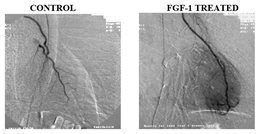
Figure 1: Coronary angiograms published by Schumacher et al., described by the authors as before and 12 weeks after local administration of human FGF-1 during bypass, and a control image. The authors reported a “blush” near the injection site on the treated image and not on the control image. The images are historical illustrations from that paper. They do not establish that FGF-1 caused new capillaries, that the endpoint would be met in another study , or that any Zhittya product will work in patients .
Clinical trials routinely use “p-values” to report statistical probability. A p-value is a statistical measure that helps determine whether an observed result in a study is likely due to chance. The p-value is not however to be confused with the probability that the drug works, instead it is the probability that the observed difference in the study (typically between those using the applicable drug and placebo) could occur by random variation alone. A p-value < 0.05 is conventionally used to indicate statistical significance. This means there is less than a 5% probability that the observed result occurred by chance assuming no true effect exists. P-value is important because under the Federal Food, Drug, and Cosmetic Act, the FDA generally requires: “substantial evidence” of effectiveness, demonstrated by adequate and well-controlled investigations, for drug approval. Typically, statistical significance is a key component of, but not the sole determinant of, “substantial evidence.” The FDA also looks for clinical significance when determining whether to approve a drug. That is, even if there is “substantial evidence” of effectiveness, if the drug’s effects are minimal the FDA may not approve the drug candidate.
Cardiovascular BioTherapeutics Phase I Open-Label Study
Cardiovascular BioTherapeutics sponsored an open-label, dose-escalation Phase I study of its investigational FGF-1 product in 21 patients with coronary artery disease who were not eligible for percutaneous coronary intervention (“PCI”) or coronary artery bypass grafting. Cardiovascular BioTherapeutics reported that patients were treated at six U.S. medical centers, including the University of Cincinnati Medical Center and Penn State University Medical Center in Hershey, Pennsylvania. Results were presented in a 2007 conference abstract cited as Circulation 116:II-443 . The study had no placebo group . The primary endpoints were a) safety and tolerability of FGF-1, b) pharmacokinetics of FGF-1, c) efficacy of the product as assessed by changes in the treadmill walking times. Additional efficacy parameters were measured including, i) improved perfusion via SPECT SCAN, Stress Echo and Angiography, ii) change in Canadian Cardiovascular Society (CCS) and angina score, and iii) and change in Seattle Angina Questionnaire (SAQ). The secondary endpoints were the change in ophthalmologic exam and the change in laboratory values.
The reported findings included changes from baseline in angina symptoms, patient-reported health status, and exercise tolerance. According to information provided by Zhittya concerning the historical study, the treadmill exercise-time comparison at 12 weeks yielded a p-value of 0.035. This result reflects a comparison within the treated cohort, rather than a comparison against a placebo or untreated control group, and does not establish that FGF-1 caused the observed change. The study was small, open-label, and uncontrolled, and its findings do not establish efficacy or predict results in future Zhittya trials. These reported results were preliminary and may not be predictive of future clinical outcomes.
Zhittya has advised us that it obtained access to CVBT’s study data in 2014. Zhittya has further advised us that its FGF-1 candidate is manufactured using a different method and that it has not established comparability between its candidate and the product administered in the CVBT study. Accordingly, Zhittya has advised us that it cannot rely on that study to establish the safety or efficacy of its candidate. We present the study solely as historical research involving CVBT’s product.
| 70 |
| Table of Contents |
Effectiveness was assessed by measuring the impact of FGF-1 treatment on myocardial perfusion, exercise tolerance, CCS angina class, and Seattle Angina Questionnaire scores (Figure 8 below). Cardiovascular BioTherapeutics reported changes from baseline at 12 weeks in angina classification, certain SAQ domains, and treadmill exercise time, as described below. The SAQ is a patient-reported questionnaire assessing angina symptoms and their effects on functional status and quality of life.
Efficacy results from that trial done 12 weeks after the FGF-1 injections showed statistically significant improvement in three clinical parameters, including angina pain class (see Figure 8 below), Seattle Angina Score (a second assay of angina pain) and the treadmill test. Cardiovascular BioTherapeutics reported changes from baseline, including a p-value of 0.035 on treadmill time in that small open-label cohort.
Cardiovascular BioTherapeutics reported that the Single Photon Emission Computed Tomography (SPECT) scans and angiograms showed indications of improved myocardial perfusion in dose groups 2 and 3. Mean treadmill exercise time improved from 4.64 ± 2.37(SD) minutes at baseline to 5.80 ± 2.74(SD) minutes at 12 weeks. Based on the SAQ, all groups had a decrease in anginal frequency and improvement in anginal stability.
These observations arose from a small, open-label study without a placebo or untreated control group. They do not establish that FGF-1 caused the observed changes, demonstrate efficacy, or predict outcomes with Zhittya’s differently manufactured FGF-1 candidate.
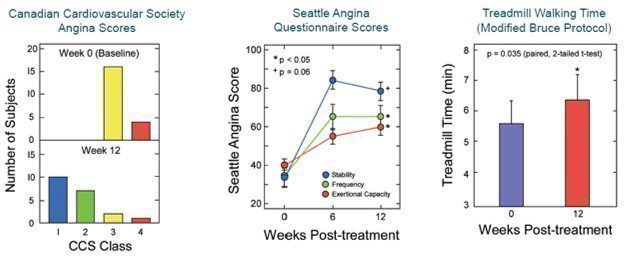
Figure 8. Canadian Cardiovascular Society Angina Scores (CCSAS), SAQ and Treadmill Waling Time show improvements after treatment with FGF-1.
With the CCSAS, Class IV angina is the most severe form with angina at rest. Class I is the mildest with angina only with strenuous exercise. The SAQ Scores were *p<0.05 and +p=0.06. These symbols indicate the threshold of significance for different data points. The Asterisk which is for Frequency and Exertional Capacity is *P < 0.05 which is statistically significant. The Plus Sign was for stability +P = 0.06. This is referred to as “Trend Toward Significance” or the result did not quite meet the strict 0.05 cutoff, but it came very close. Exercise performance as determined by time on the treadmill before a patient has to stop due to angina or evidence on an electrocardiogram that ischemia is occurring. The improvement in patients had a p=0.035 (paired 2 tailed, t-test), indicating that improvement rather than random chance, is statistically significant. A paired test means the researchers compared the same group of people to themselves at two different times. Point A: Baseline (before the FGF-1 injection). Point B: Follow-up (6 or 12 weeks after the injection). This is the most accurate way to measure the effect of a treatment in a small group because it accounts for individual variations in health. The two-tailed test is a more rigorous "conservative" approach. It tests for a change in either direction. By using a two-tailed test and still achieving p=0.035, the evidence for the treatment's positive effect is considered stronger.
Pharmacokinetic data is presented in Figure 9 below which looks at plots of circulating levels of FGF-1 at different time points for individual patients. It can be seen that FGF-1 concentrations reach peak levels very rapidly within minutes of injection and then decrease rapidly within the first hour post-injection. FGF-1 levels reach near pre-treatment baseline concentrations within 12-24 hours. No patients in any of the dosing groups demonstrated any detectable increase in levels of FGF-1 specific antibodies at either six or twelve weeks.
.
| 71 |
| Table of Contents |
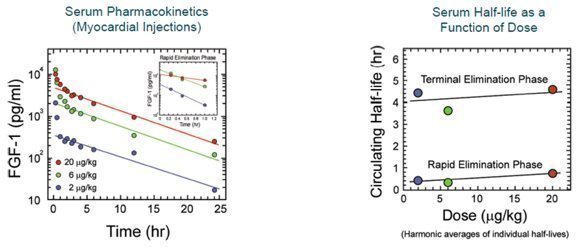
Figure 9: Pharmacokinetics of FGF-1141 in Patients with Severe Coronary Heart Disease Following Intramyocardial Injections of FGF-1. On the left-hand panel the serum levels of FGF-1 are plotted versus time after injection into the heart. On the right-hand panel the two elimination phases of FGF-1 from the circulation are apparent and include a rapid and a slower (terminal) elimination phase seen for each dose of FGF-1 administered.
On July 10, 2007, Cardiovascular Biotherapeutics was authorized for a Phase II Clinical Protocol for its protein drug candidate, human fibroblast growth factor-1 (FGF-1) for the treatment of severe coronary heart disease. Per discussions with Daniel C. Montano who was president of Cardiovascular Biotherapeutics at the time, Cardiovascular Biotherapeutics advanced the FGF-1 candidate into a Phase II trial, which was in progress when Cardiovascular Biotherapeutics lost its funding during the Great Recession (December 2007 to June 2009). In addition, Cardiovascular Biotherapeutics was hit by the closure of its injection catheter manufacturer (a Johnson & Johnson subsidiary) in 2010, and the bankruptcy of Phage Biotechnology Corporation (its FGF-1 manufacturer) in 2010. Collectively, the three events halted further enrollment.
Per discussion with the President and Chief Science Officer of Zhittya, Jack Jacobs, PhD, Dr. Jacobs stated Zhittya will not be able to reference Cardiovascular Biotherapeutics Phase 1 trial data because Zhittya would have to prove that the FGF-1 used in the Cardiovascular Biotherapeutics trial is the same FGF-1 to be used in Zhittya’s trials. Zhittya cannot prove this because Zhittya is using a different method to make FGF-1.
Per a discussion with Zhittya’s chief science officer, Jack Jacobs, PhD, Zhittya plans to use a mini-thoracotomy for the Phase I trial. Zhittya plans to have a discussion with the FDA on modifying the Phase II trial to not have a blinded trial but expand the number of patients in the study. In the meantime, Zhittya also plans to find or contract with a catheter company to build an injection catheter. In this regard, we have been made aware that Zhittya has identified a French company, CellProtheria, that has developed a cardiac injection catheter to introduce cell therapies into the heart. If Zhittya is not able to gain access to the use of this catheter, it has indicated to us that it plans to attempt to develop its own injection catheter. The process to develop a new injection catheter will require considerable financial resources with an estimated development time of three to four years.
Possible delivery approach (not approved)
Zhittya has described a possible delivery approach for a future coronary program: identify ischemic regions on cardiac MRI, then inject FGF-1 into those regions through a mini-thoracotomy . That procedure is not an FDA-approved therapy. Zhittya has not shown that this method is safe or effective, that it can be blinded or placebo-controlled to the FDA’s satisfaction, or that Zhittya will have a usable injection catheter if the FDA requires a less invasive route. A mini-thoracotomy is surgery. It carries procedural risk apart from any drug effect.
CMD literature vs Zhittya’s belief
In the paper, Coronary Microvascular Dysfunction Across the Spectrum of Cardiovascular Diseases: JACC State-of-the-Art Review”, published in the Journal of the American College of Cardiology in 2021, the authors state that these conditions are collectively called Coronary Microvascular Dysfunction (CMD), which encompasses several pathogenetic mechanisms involving coronary microcirculation and plays a major role in determining myocardial ischemia in patients with angina without obstructive coronary artery disease, as well as in several other conditions, including obstructive coronary artery disease, nonischemic cardiomyopathies, takotsubo syndrome, and heart failure, especially the phenotype associated with preserved ejection fraction. Unfortunately, despite the identified pathophysiological and prognostic role of CMD in several conditions, to date, there is no specific treatment for CMD. The paper does not study Zhittya’s product and does not conclude that FGF-1 treats CMD .
Zhittya has advised us that it believes FGF-1 might be studied as an approach to ischemia related to small-vessel disease. That is a development hypothesis. There is no assurance Zhittya will run such a trial, that regulators will allow it, that any candidate will treat CMD or grow vessels in ischemic myocardium, or that the FDA will approve that use in the United States or Canada.
Market
Published estimates of U.S. refractory angina (RA) vary. The FDA in an Executive Summary prepared for the October 27, 2020 Meeting of the Cardiovascular Devies Panel, acknowledge that the true prevalence of RA is difficult to determine but that as many as one million people in the U.S. are affected. RA includes chronic ischemic chest pain that persists despite medical, interventional, and surgical care. Those numbers are only an estimate and do not refer to Zhittya’s patients and are not a forecast of our potential market. Zhittya has no approved coronary product. We cannot sell a heart drug in the United States or Canada unless a licensed candidate is approved. The number of people with RA or “no-option” CAD does not mean they would be eligible for a Zhittya study or commercial product, that payors would cover it, or that we would capture any of that population.
| 72 |
| Table of Contents |
II. Brain Disorders
Stroke
A stroke is a serious medical condition that occurs when the blood supply to part of the brain is interrupted or reduced, depriving brain tissue of oxygen and nutrients. When a stroke occurs, the brain is suddenly deprived of its normal blood supply—either because a blood vessel is blocked (ischemic stroke) or bursts (hemorrhagic stroke). This interruption prevents oxygen and glucose from reaching brain cells, which are highly sensitive to even brief shortages in blood supply. This leads to the rapid death of brain cells and can cause lasting brain damage, disability, or even death if not treated promptly. This is background on the disease. It is not a description of what FGF-1 does.
What Zhittya has reported (not an FDA trial)
Zhittya has reported that, as of December 2025, five people with stroke received FGF-1 by nasal inhaler in the British Virgin Islands (two doses daily for six days). Zhittya reported that it saw improvement in walking, cognition, or memory, and it noted no adverse events, and that it follows up with patients about every three months by video and a motor-skills review. Zhittya described the intended observations as safety and those functional measures. The activity was open-label and unblinded: patients and investigators knew FGF-1 was given. There was no control group. The work was not conducted under an FDA IND and was not a well-controlled U.S. or Canadian trial. Zhittya has advised us it does not know whether these reports would be reproduced in a controlled study. We do not claim that FGF-1 caused the reported changes, that the five cases predict future human outcomes, or that a nasal FGF-1 product will be approved for stroke. Zhittya’s reported results were preliminary and may not be predictive of future clinical outcomes.
Market
The Centers for Disease Control and Prevention in 2024 noted that each year more than 795,000 people have a stroke in the U.S. According to the Stroke Awareness Foundation, stroke is the leading cause of serious long-term disability. There are over seven million stroke survivors that live in the United States, and two-thirds of them are currently disabled. Approximately 25% of people who recover from their first stroke will have another within five years. Those numbers are the disease burden. If a licensed product were approved for a stroke indication—which may never occur—the commercial opportunity would depend on label, eligibility, competition, and reimbursement, none of which exist today.
Parkinson’s Disease
Parkinson's disease is a progressive neurological disorder characterized by a gradual loss of nerve cells in the brain, specifically those that produce dopamine. This loss of dopamine leads to a variety of symptoms, primarily affecting movement but also impacting other areas like cognition, mood, and sleep. This is disease background, not a claim about FGF-1.
| 73 |
| Table of Contents |
BVI human activity ( Zhittya reports)
Zhittya has reported that in 2022 it was cleared to conduct human research in the British Virgin Islands and that, as of October 17, 2026, it had administered intranasal FGF-1 to more than 270 people with Parkinson’s disease. In a February 27, 2025, press release, Zhittya reported an average 53% improvement on the Unified Parkinson’s Disease Rating Scale within six months of treatment in a multi-year British Virgin Island (BVI) program. Zhittya has stated the work was intended to inform dosing and trial design. These activities were not FDA-authorized adequate and well-controlled trials. They were open research/observational programs outside the United States. There was no requirement of a concurrent placebo control comparable to a U.S. pivotal study. Press-release percentages are not peer-reviewed primary data in this offering circular. Results may not be reproduced, may not predict future clinical outcomes in humans, and may not be usable to support an IND or approval. We do not claim that FGF-1 crossed the blood-brain barrier in a proven therapeutic amount, or that FGF-1 caused the reported UPDRS changes.
Perfusion paper
Zhang et al. reported an imaging study in Parkinsonism & Related Disorders in 2020 (under the title, Vascular, flow and perfusion abnormalities in Parkinson’s disease), comparing 85 patients with Parkinson’s disease and 85 healthy controls. The authors reported vascular abnormalities, lower total arterial blood flow to the brain, and lower perfusion in the Parkinson’s disease group, with lower perfusion correlated with increased iron content in the substantia nigra. These observational findings do not establish that reduced blood flow causes Parkinson’s disease or that increasing blood flow would improve its symptoms or alter its progression. The study did not evaluate FGF-1 or Zhittya’s product candidate. These reported results may not be predictive of future clinical outcomes.
Animal papers (attribute to authors; animals ≠ patients)
Third-party groups have published work in toxin models of parkinsonism , including peer-reviewed publications in rodent and primate models of Parkinson’s disease, as described below. In the publication Neurotoxicity Research, the article by McLay et.al, “Administration of FGF-1 Through Transfected Cells Alleviates MPTP Toxicity in Mice”, demonstrated that the implantation of fibroblasts genetically modified to secrete fibroblast growth factor-1 (FGF-1) increased striatal dopamine concentrations in a 1-methyl-4-phenyl-1,2,3,6-tetrahydropyridine (MPTP)-treated mouse model of Parkinson's disease. In addition, in the American Journal of Translational Research, the article by Wei et. al., “Fibroblast Growth Factor 1 Attenuates 6-Hydroxydopamine-Induced Neurotoxicity: An In Vitro and In Vivo Investigation in Experimental Models of Parkinson’s Disease”, demonstrated that FGF-1 administration improved the motor function recovery, increased the tyrosine hydroxylase-positive neurons (TH) survival and up-regulated the levels of neurotransmitters in rats with experimental Parkinson’s disease. In another peer-reviewed publication by deYebenes et. al., appearing in the journal Parkinsonism and Related Disorders, human fibroblast growth factors (FGF-1 and FGF-2) were able to reverse the motor skill decline seen in monkeys with experimentally induced Parkinson’s disease. Placebo-treated animals continued to see a decline in their motor skills scores. Of particular importance was the finding that in the FGF-1 treated monkeys, there was a regeneration of new dopamine-secreting neurons in the brains of those animals. In addition, a reduction of toxic plaque was noted in the brain and no serious adverse events were reported. The authors concluded that these two human FGFs, by stimulating the growth of new dopamine neurons, led to the reversal of the classical Parkinson’s disease motor skill deficits (such as tremors, jerkiness, and gait disturbances) seen in this primate model.
These studies used experimental interventions and toxin-induced models that reproduce certain features of parkinsonism but do not reproduce the full biology or clinical course of human Parkinson’s disease. They did not evaluate Zhittya’s product candidate or its proposed intranasal administration method. In particular, the monkey study used direct intracerebral infusion over six months. The reported findings may not translate to humans and do not establish that Zhittya’s product candidate is safe or effective, reaches the relevant brain regions following intranasal administration, or improves symptoms or alters disease progression in patients with Parkinson’s disease.
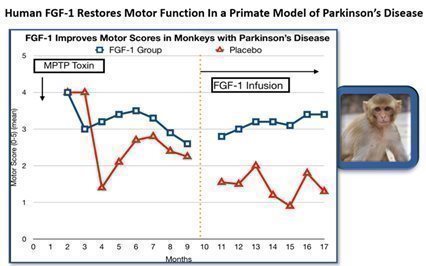
The above graph is from data from “Long-term intracerebral infusion of fibroblast growth factors restores motility and enhances F-DOPA uptake in parkinsonian monkeys” by deYebenes, et.al, that appeared in the journal, Parkinsonism and Related Disorders. The graph shows two groups of monkeys. Both groups were given MPTP toxin which induces Parkinson’s-like symptoms in animals. After nine months, one group (blue boxes) were given FGF-1, which showed steady improvement in motor skills over the next seven months, whereas the placebo group (red triangles) continued to decline in motor skills.
| 74 |
| Table of Contents |
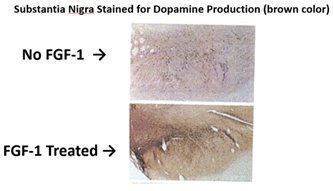
The above image is from “Long-term intracerebral infusion of fibroblast growth factors restores motility and enhances F-DOPA uptake in parkinsonian monkeys” by deYebenes, et.al, that appeared in the journal, Parkinsonism and Related Disorders and shows more dopamine in the brains of monkeys with FGF-1. The above image shows slices of brains from monkeys given FGF-1, and a placebo. The FGF-1 treated monkeys show increased dopamine which is shown by the brown color. Graph/brain slices from de Yébenes et al. and Wei et al.: images published by those authors in animal models. They illustrate what the papers reported. They are not images of Zhittya patients and do not show that a nasal FGF-1 product works in humans.
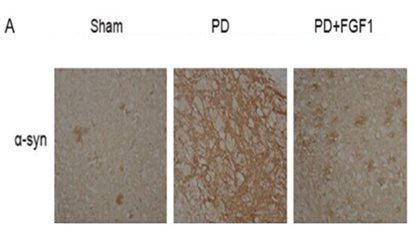
The above image is from “Fibroblast Growth Factor 1 Attenuates 6-Hydroxydopamine-Induced Neurotoxicity: An In Vitro and In Vivo Investigation in Experimental Models of Parkinson’s Disease,” by Wei et al., which appeared in the American Journal of Translational Research, shows the reduction of alpha synuclein plaques with FGF-1. The above image shows comparative images of brain slices, including (1) a sham (an inactive control), as compared to (2) an image with Parkinson’s (PD), as compared to (3) an animal with Parkinson’s disease treated with FGF-1, which shows less alpha synuclein in the animals treated with FGF-1. Graph / brain slices from de Yébenes et al. and Wei et al.: images published by those authors in animal models. They illustrate what the papers reported. They are not images of Zhittya patients and do not show that a nasal FGF-1 product works in humans.
Zhittya’s Treatment
Zhittya has described a possible regimen of twice-daily nasal FGF-1 for six days, then redosing about every three months for two years. That is a development plan. It is not an approved treatment and is not assured to be the protocol FDA would allow.
| 75 |
| Table of Contents |
Size of the Market
Pursuant to a July 2018 press release from the Parkinson's Foundation, it is estimated that as of 2020, at least 930,000 people in the United States suffer from Parkinson’s disease, and according to a December 2022 press release from the Parkinson’s Foundation, an estimated 90,000 people are diagnosed with Parkinson’s disease each year in the U.S. Parkinson’s Foundation estimates cited for U.S. prevalence and annual diagnoses describe how common the disease is. They are not a forecast that we will sell a product to those people. Existing drugs (for example levodopa/carbidopa) address some motor symptoms; none of that means FGF-1 will reverse the disease or reach the market.
Vascular Dementia
Vascular dementia is a common type of dementia caused by reduced or blocked blood flow to the brain, which deprives brain cells of oxygen and nutrients and leads to their damage or death. This disruption in blood supply is most often the result of conditions such as strokes (both major and "silent" strokes), small vessel disease, or a series of mini-strokes (transient ischemic attacks, or TIAs). According to the U.S. Centers for Disease Control and Prevention, vascular dementia is the second most common form of dementia after Alzheimer’s disease. Symptoms of vascular dementia can vary depending on the part of the brain affected and the extent of blood vessel damage. Generally, symptoms of vascular dementia can affect memory, thinking, language, problem-solving, and behavior to a degree that interferes with daily life and activities . That is disease background. It does not mean FGF-1 treats vascular dementia.
Zhittya’s Proposed Treatment
Zhittya’s planned treatment is to treat vascular dementia patients with FGF-1 via a nasal inhaler for six days and then re-dose those patients every three months for two years. Every three months the patients will be given memory and cognition tests. Zhittya anticipates that it will see improvement in their short-term memory and cognition, depending on the severity of the condition, within 18 months to two years, although there can be no assurance that such results will be achieved.
Zhittya has not treated vascular dementia patients. There is no completed Zhittya trial in this indication, no FDA-approved product, and no assurance that Zhittya will start a study, that regulators will allow the planned regimen, or that any result would be achieved. Anticipated improvement is a hope, not data.
Size of the Market
According to the article “Epidemiology of Vascular Dementia: Nosology in a Time of Epiomics” published in July 2019 journal of Arteriosclerosis, Thrombosis and Vascular Biology, the estimates indicate that vascular dementia accounts for approximately 15% to 20% of all dementia cases in the United States. The overall prevalence of dementia among adults age 65 and older in the U.S. is about 10%, according to the Columbia University Irving Medical Center. Applying these proportions, it is estimated that vascular dementia affects roughly 1.5% to 2% of adults age 65 and older in the U.S. Given that according to the U.S. Census Bureau, the U.S. population age 65 and older is approximately 55.8 million as of 2020, this suggests that between 837,000 and 1.1 million older Americans are living with vascular dementia.
The persons described above are not Zhittya’s patients and the above is not a sales forecast. We would have nothing to sell for this indication unless a licensed product were approved for it, which may never occur.
Alzheimer’s Disease as a Vascular Disorder
Alzheimer disease (“AD”) is an insidious disorder that progressively ravages the brain, destroying its memory and intellect. According to the Alzheimer’s Associate, Alzheimer’s disease is a progressive brain disorder and the most common cause of dementia, accounting for 60–80% of dementia cases. It slowly destroys memory, thinking skills, and eventually the ability to carry out even simple daily tasks. The disease is characterized by the buildup of abnormal proteins in the brain—amyloid plaques and tau tangles—which disrupt communication between nerve cells and ultimately lead to their death. Early symptoms often include memory loss, especially of recent events, difficulty finding words, confusion, poor judgment, and changes in mood or behavior. As the disease progresses, individuals may experience severe memory loss, disorientation, difficulty speaking or swallowing, and a loss of independence. Standard care still treats AD as a neurodegenerative disease; some researchers also study vascular and perfusion changes. The cause of AD is not settled. This offering circular does not resolve that debate .
| 76 |
| Table of Contents |
Literature Zhittya considers relevant (not Zhittya trials)
Third-party publications have examined microvascular abnormalities and cerebral perfusion in Alzheimer’s disease or experimental AD models. These include Iturria-Medina et al., “Early role of vascular dysregulation on late-onset Alzheimer’s disease based on multifactorial data-driven analysis” (Nature Communications, 2016), which analyzed imaging and biomarker data from the Alzheimer’s Disease Neuroimaging Initiative and suggested that vascular dysregulation may occur early in disease development; and Nortley et al., “Amyloid β oligomers constrict human capillaries in Alzheimer’s disease via signaling to pericytes” (Science, 2019), which reported capillary constriction associated with pericytes, cells that surround capillaries, using human brain tissue and rodent experiments. Additional publications include Korte, Nortley and Attwell’s review, “Cerebral blood flow decrease as an early pathological mechanism in Alzheimer’s disease” (Acta Neuropathologica, 2020), which discusses mechanisms potentially linking reduced cerebral blood flow with AD pathology; Ambrose’s “Neuroangiogenesis: A Vascular Basis for Alzheimer’s Disease and Cognitive Decline During Aging” (Journal of Alzheimer’s Disease, 2012), which reviewed capillary-density findings and proposed a vascular hypothesis of age-related cognitive impairment and some forms of AD; and Fisher, Miners and Love’s review, “Pathological changes within the cerebral vasculature in Alzheimer’s disease: New perspectives” (Brain Pathology, 2022), which discusses vascular structural changes, blood-brain barrier dysfunction, impaired blood-flow regulation and amyloid clearance. These publications provide observational findings, experimental evidence and proposed mechanisms concerning vascular involvement in AD; they do not establish that increasing cerebral blood flow or promoting new blood-vessel growth would improve symptoms or alter disease progression in patients with AD. These publications did not test Zhittya’s FGF-1 product. Mouse or microscopy studies of neutrophils, pericytes, or endothelin are not human trials of a nasal growth factor. Observations in that literature are not predictive of clinical outcomes in people treated with FGF-1.
Proposed program
Zhittya has described a possible nasal FGF-1 regimen (once a day for six days, then about once every three months for two years) with periodic memory and cognition testing. Zhittya has advised us that it hopes to see changes over 18 months to two years. Zhittya has not treated any Alzheimer’s patients to date. There is no assurance of a trial, an approvable protocol, or any clinical benefit of FGF-1 to treat Alzheimer’s.
Market
According to the Alzheimer’s Association’s 2026 Alzheimer’s Disease Facts and Figures report, an estimated 7.4 million Americans age 65 and older are living with clinical Alzheimer’s dementia. This estimate describes disease burden and does not represent the number of patients eligible for our product candidate or a forecast of sales or revenue. Zhittya does not have an approved product to treat for Alzheimer’s disease.
| 77 |
| Table of Contents |
III. Type 2 Diabetes Mellitus
Type 2 diabetes mellitus, commonly known as type 2 diabetes, is a chronic condition in which the body either does not use insulin properly (insulin resistance) or does not produce enough insulin, in each case leading to persistently high levels of glucose (sugar) in the blood. Insulin is a hormone produced by the pancreas that helps move glucose from the bloodstream into the body’s cells, where it is used for energy. In type 2 diabetes, the cells in muscles, fat, and the liver become less responsive to insulin, and over time, the pancreas may not be able to produce enough insulin to keep blood sugar levels normal. If left untreated or poorly managed, type 2 diabetes can lead to serious health problems, including heart disease and stroke, kidney damage, nerve damage (neuropathy), eye damage (retinopathy), and foot problems, sometimes leading to amputation and increased risk of infections.
Animal studies (Not human proof)
In 2014, the Salk Institute conducted an animal study by injecting FGF-1 in the brains of rodents with type 2 diabetes. The rodents’ blood glucose levels dropped to a normal level. In 2017, another study was conducted in association with the Howard Hughes Medical Institute to explore why the rodent’s blood glucose levels were returned to normal. And in 2022, another study using mice injected with FGF-1 with the Salk Institute and in collaboration with the National Institute of Health (NIH), to try to better understand how FGF-1 works with animal models of type 2 diabetes. Animal glucose curves are not predictive of human outcomes and are not Zhittya’s product label. Additionally, these reported results were preliminary and may not be predictive of future clinical outcomes in humans .
| 78 |
| Table of Contents |
Size of the Market
More than 38 million Americans have diabetes (about 1 in 10), and about 90% to 95% of them have type 2 diabetes, according to the CDC as of May 2025, which would mean that there are about 35.2 million in the U.S. with type 2. CDC counts of U.S. diabetes and type 2 diabetes describe disease burden. They are not our potential market. There is no approved FGF-1 diabetes product.
Zhittya’s Planned Regimen
Zhittya has described a possible protocol of a nasal FGF-1 dose once per day for six days , with the goal of potentially lowering fasting glucose by the end of that period. That is a plan, not a result, and not an approved therapy.
| 79 |
| Table of Contents |
IV. Diabetic Foot Ulcers
Diabetic foot ulcers, or DFUs, are a serious and common complication of diabetes, presenting significant medical, personal, and societal problems. Diabetic foot ulcers are slow to heal, prone to severe infection, frequently lead to amputation, cause high rates of disability and death, and impose a major economic and healthcare burden. Early detection, prevention, and aggressive treatment are critical to improving outcomes for people with diabetic foot ulcers.
Diabetic foot ulcers are associated with a high risk of death—the five-year mortality rate after a foot ulcer can be as high as 50–70%, which is comparable to many cancers. Mortality is even higher after amputation. Even after healing, foot ulcers often recur; up to 65% of patients experience another ulcer within three to five years. Chronic ulcers and repeated infections can lead to ongoing pain, immobility, and further complications. DFUs are a serious public-health problem. There is no current evidence that FGF-1 heals DFUs.
Zhittya’s Proposed Program
Zhittya has advised us that it is targeting plans to prepare and file an IND for a Phase I trial of topical human FGF-1 in DFU in 2028. That date is an assumption. Filing, FDA allowance, enrollment, and any later approval, may be later or may not occur. Historical work by Merck and Cardiovascular Biotherapeutics on topical FGF-1, will not be included in Zhittya’s IND and is not proof that the drug works or that the FDA can rely on to grant the IND. Zhittya has not described a completed, adequate, well-controlled DFU trial of its current product in this offering circular. There is no approved topical FGF-1 for DFU.
Size of the Market
According to an article in the Journal of the American Medical Association published in 2023, titled “What Are Diabetic Foot Ulcers?” Diabetic foot ulcers affect about 1.6 million in the US annually. One-third of people with diabetes will develop a foot ulcer during their lifetime. These are burden figures and they are not an estimate of the potential market for a DFU drug in the United States. We cannot market a DFU drug in the United States or Canada unless Zhittya receives approval for a licensed product.
| 80 |
| Table of Contents |
V. Venous Ulcers
Venous ulcers, also known as venous leg ulcers or venous stasis ulcers, are open sores that most commonly develop on the lower legs, especially around the ankles, due to problems with blood flow in the leg veins. They are the most common type of chronic leg ulcer. Venous ulcers occur when the valves in the leg veins become damaged or do not work properly, a condition known as chronic venous insufficiency. Normally, these valves help blood flow back up to the heart. When they fail, blood pools in the lower legs, increasing pressure inside the veins (venous hypertension). Over time, this high pressure and pooling of blood can damage the skin and underlying tissue, eventually causing an open sore to form.
Venous ulcers can be slow to heal and are prone to infection. Without proper treatment, they may persist for weeks, months, or even longer, and can recur after healing. Infections can become serious, sometimes spreading to deeper tissues or the bloodstream. That is disease background, not a description of FGF-1.
Market Size
Venous leg ulcers are extremely common in the United States and affect between 500,000 to 2 million people annually as noted in the “Chronic Venous Ulcers: A Comparative Effectiveness Review of Treatment Modalities, published by the Agency for Health Research and Quality in 2014. According to a 2013 article published in Cureus entitled, “Venous, Arterial, and Neuropathic Leg Ulcers With Emphasis on the Geriatric Population”, in individuals 65 years and older, venous leg ulcers affect up to 5% of the 65 or older population in the United States. If a licensed product were approved—which may never happen—sales would depend on label, competition, price, and coverage, none of which exist today.
Zhittya’s Proposed Treatment
Zhittya plans to submit an IND application to the FDA for a Phase I clinical trial to treat patients suffering from venous leg ulcers with FGF-1 in 2028. Filing, timing, FDA allowance, and any later approval are uncertain and may never occur. There is no approved FGF-1 product for this use and no completed adequate trial of Zhittya’s current product described here.
| 81 |
| Table of Contents |
VII. Multiple Sclerosis
Multiple sclerosis (MS) is a chronic, unpredictable disease of the central nervous system—specifically the brain, spinal cord, and optic nerves. It is considered an autoimmune disorder, meaning the body’s immune system mistakenly attacks its own tissues. With MS, the immune system targets and damages myelin, the protective sheath that surrounds nerve fibers. The immune system attack leads to inflammation and destruction of myelin, resulting in scar tissue (sclerosis or plaques) in multiple areas of the central nervous system. Damaged myelin and nerve fibers disrupt the transmission of electrical impulses between the brain and the rest of the body, causing a wide range of symptoms.
Zhittya’s Proposed Treatment
In a paper written for the Columbia University Irving Medical Center in 2017 titled, “Fixing Leaky Blood-Brain Barrier May Help Treat Multiple Sclerosis” the author noted that in the healthy central nervous system, the blood-brain barrier is constructed from a tightly packed layer of endothelial cells that line blood vessels, keeping viruses and toxins that are circulating in the bloodstream from slipping into the brain and/or spinal cord. However, in people with MS, this barrier becomes more porous, and immune cells slip past and attack the myelin that surrounds nerve cells. As noted, multiple sclerosis could be the result of leaky blood vessels that suffer from a process known as “endothelial cell dysfunction.” In this process, the endothelial cells that line blood vessels in the body become dysfunctional and disordered and permit the leakage of immune cells and toxic proteins from the vasculature. Zhittya’s proposed treatment would be FGF-1 delivered by nasal inhaler twice a day for six days and a follow-up dosing every three months for two years. Zhittya believes endothelial or barrier biology is a reason to consider a study. That is a hypothesis. Zhittya has not shown that FGF-1 repairs vessels in people with MS and no patients have been treated to date. There is no approved MS product and no assurance of a trial or of any benefit to MS from FGF-1.
Market Size
According to the U.S. Department of Veterans Affairs , nearly one million people in the United States are living with Multiple Sclerosis (MS ) according to a 2019 prevalence study. MS is more common in women than men (about two to three times higher in women ). This is the disease burden and not a market for an unapproved drug.
| 82 |
| Table of Contents |
VIII. Peripheral Artery Disease & Critical Leg Ischemia
Peripheral arterial disease (PAD) is typically caused by diminished perfusion of the muscles involved in walking, a result of atherosclerosis leading to decreased patency of one or more arteries supplying the legs. This disease results from blockages in the major arteries involved in perfusing the legs with blood. Approximately 60% of individuals with PAD are symptomatic, typically exhibiting either pain on walking (but not rest) or pain that persists even during rest, denoted intermittent claudication (IC) and critical limb ischemia (CLI), respectively.
Hypothesis (not a finding)
Zhittya believes that if collateral or microvascular growth occurred in an ischemic leg, flow and function might improve, and that FGF-1 is a candidate to study for that reason. Animal ischemia models are not human PAD. There is no assurance that FGF-1 can successfully treat PAD in humans, or that even if successful, that the FDA will approve its treatment, side effects will not outweigh its benefit, or that there is any market for such drugs in the United States or Canada, even if such treatment receives regulatory approval.
Zhittya’s Proposed Treatment
Induction of collateral arteriogenesis and microvascular angiogenesis would improve leg blood inflow and perfusion. As FGF-1 has been shown to induce arteriogenesis and angiogenesis in animal models of leg ischemia and Zhittya believes that this potent endothelial cell mitogen offers the prospect of improving flow and function in the ischemic legs of patients with PAD, although there can be no assurance that such results will be achieved.
Zhittya sponsored a preclinical animal study at Comparative Bioscience in Sunnyvale, California in 2016 to evaluate effects of intramuscular injection of FGF-1 on collateral vessel formation, blood perfusion and microvascular density in the ischemic hindlimb of rabbits. The study was similar in design to a study previously published by Hershey et al.20. In the Zhittya study, 30 animals received FGF-1 every other day over an approximately two-week period, with each dose given as a series of six injections into the ischemic leg muscle.
| 83 |
| Table of Contents |
FGF-1 was well tolerated by animals in both the low and high dose groups. Both FGF-1 low and high doses increased the density of angiographically visible collateral vessels compared to control-treated animals at the final evaluation (see image below).
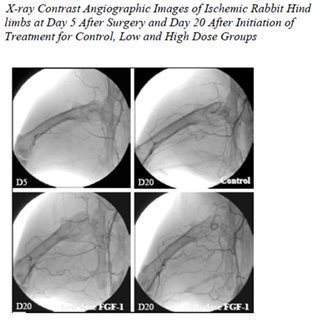
This image shows X-rays of rabbits’ hind legs in which an ischemic condition is induced. The placebo-controlled animals are on the top and the FGF-1 treated animals are on the bottom. The FGF-1 treated animals showed an increased collateral vessel density after 20 days. These images are animal radiographs, not patient angiograms.
| 84 |
| Table of Contents |
The increase in collateral vessel density in response to FGF-1 treatment was greater than in control-treated animals at day 20 as shown in the image above. This effect was statistically significant (p = 0.04). The low dose group had significantly more collateral vessels in the ischemic hind limb than the control (p = 0.049); there was also a tendency for the high dose group to have more collateral vessels than controls (p = 0.098). In animal research studies, unexpected events or deviations from the protocol are reported. This study reported that there were a number of minor deviations from the protocol during the course of the study, none of which were judged to have any substantial impact on study integrity. In animal studies, the scientific endpoint is the pre-defined moment the data collection stops; the conclusion is the final interpretation of what that data actually means. This study’s conclusion stated that, compared to a sham control injection, treatment with FGF-1 at both high and low doses improved indices and correlates of blood perfusion and collateral blood flow in the affected hindlimb, including angiographic score index and blood flow in the common iliac artery. Administration of FGF-1 also enhanced microvascular density in the hindlimb musculature in a dose-dependent fashion. These reported results were preliminary and may not be predictive of future clinical outcomes in humans.
Zhittya intends to initiate a research and development effort to test FGF-1 in a patient population with PAD and intermittent claudication. If this effort is successful, additional medical indications are expected to be pursued, including clinical studies in patients with both critical limb ischemia and Berger’s disease, because all three conditions result in significantly diminished blood flow to the legs, causing symptoms such as pain, tissue damage, sores, ulcers, and—in severe cases—gangrene.
Market Size – Peripheral Artery Disease
The most current and comprehensive estimates indicate that between 21 million and 26 million people in the United States have peripheral artery disease (“PAD”) as of 2025, as noted in the Journal of Vascular Disease Management in an article titled, “The Current U.S. Prevalence of Peripheral Arterial Disease.” This range reflects updated analyses that account for the aging U.S. population and the rising prevalence of diabetes—both major risk factors for PAD. These numbers are disease burdens. They are not an addressable market for an unapproved drug.
Market Size – Critical Leg Ischemia
According to an article in the journal “Circulation” titled “Contemporary Trends in Hospital Admissions and Outcomes in Patients with Critical Limb Ischemia”, published in February 2021, approximately two million people in the United States suffer from an advanced form of PAD, known as critical limb ischemia. These patients are at a much higher risk of suffering a lower limb amputation from their disease. This number is the disease burden and not the addressable market for an unapproved drug.
Intellectual Property
We currently have no registered intellectual property with any governmental authority. Zhittya has granted us permission under the License Agreement to use its trademarks in our business activities. Our commercial success is currently dependent on Zhittya maintaining control of the intellectual property of its drug candidates.
Zhittya initially filed five provisional patent applications with the U.S. Patent and Trademark Office in 2025 relating to the use of FGF-1 to treat various diseases, including Parkinson’s disease, neurodegenerative diseases of the brain, Type 2 diabetes, lung damage, and neuropathy. Zhittya subsequently filed corresponding non-provisional patent applications based on those provisional filings. The patent applications are intended to protect Zhittya’s intellectual property relating to the therapeutic use of FGF-1 and, if issued as patents, may provide the Company with exclusive rights to the claimed inventions for the applicable patent term, subject to the requirements and limitations of U.S. patent law. Zhittya’s patent applications do not conflict with previous patents filed by Cardiovascular Biotherapeutics because Cardiovascular Biotherapeutics filed its patents based on using phage technology to make proteins, whereas Zhittya’s patents are based on drug delivery. A provisional patent application gives a filer one full year to assess an invention's commercial potential before committing to the higher cost of filing and prosecuting a non-provisional application for a patent. Zhittya made its full patent applications before the one-year deadline. Currently, Zhittya does not have any registered intellectual property with any governmental authority.
| 85 |
| Table of Contents |
License Agreement with Zhittya
On May 17, 2016, we entered into a License Agreement with Zhittya (the “Original License Agreement”). Pursuant to the Original License Agreement, we obtained the exclusive right to market and sell drugs from Zhittya’s portfolio in the United States and Canada. Our right to market and sell Zhittya’s drugs is subject to Zhittya’s drug candidates first being granted regulatory approval for sale by the FDA or Health Canada. The Company believes that the earliest possible timeframe in which FDA approval could be obtained, if at all, is approximately three to seven years. This estimate reflects a minimum projected period based on current assumptions and is subject to substantial uncertainty and numerous factors beyond the Company’s control, including the scope and outcomes of clinical trials, regulatory review timelines, requests for additional data, and changes in regulatory requirements. The actual time required to obtain FDA approval, if ever obtained, may be significantly longer than three to seven years or may not occur at all. The Company is planning its operations and capital needs accordingly, recognizing that FDA approval may be delayed for an extended period or may never be achieved. Zhittya plans to apply for approval in Canada after the FDA has approved the use of Zhittya’s drug candidates in the U.S., if ever. The License Agreement includes our marketing and sale of Zhittya’s wound healing drug candidates and injection/infusion/intranasal drug candidates for a term of 30 years. We also acquired the right to use Zhittya’s trademarks to identify products in Zhittya’s portfolio in connection with our marketing and commercialization efforts. In addition, Zhittya has also granted the Company full information rights with respect to the status of Zhittya’s development of FGF-1, including access to all development data (pre-clinical and clinical trial results, regulatory communications and chemistry, manufacturing, and controls), has agreed to provide the Company regular written progress reports, and to grant the Company rights to inspect Zhittya’s facilities and records, and is required to provide the Company 48 hours’ notice of any material development.
In exchange for the exclusive license from Zhittya, we agreed to pay $1,500,000 in cash (of which $890,000 has been paid to date) and granted Zhittya $75,500,000 worth of our dividend participating, non-voting convertible preferred stock (the preferred stock, our Series A-1 and Series A-2 preferred stock, together with the cash payment, the “License Payment”). Each share of Zhittya’s preferred stock is convertible into one share of our common stock. On October 19, 2019, we and Zhittya amended the Original License Agreement and revised the consideration payable to Zhittya to consist of 3,500,000 shares of our Series A-1 preferred stock and 3,500,000 shares of our Series A-2 preferred stock. We refer you to “Description of Capital Stock—Preferred Stock” for a summary of the preferred stock issued to Zhittya in connection with the License Agreement.
On February 24, 2022, the Company entered into a second amendment to the Original License Agreement. This amendment primarily clarified the fee due to Zhittya on the sale or distribution of injectable, and infusion treatments licensed pursuant to the Original License Agreement. The amendment also clarified the net revenue sharing arrangement with licensees in different geographic regions.
On December 21, 2022, the Company entered into a restated and amended product license and commercialization agreement with Zhittya, which replaced the Original License Agreement, as amended, as described above. Pursuant to the License Agreement, the Company acquired the rights to sell the injectable/infusion/intranasal drugs for an additional $500,000 cash payment, up to $300 million in clinical progress and regulatory milestone payments and an 80% royalty.
The rights to the License Agreement were originally recorded at $75.0 million, and revised to $75.6 million, and were being amortized over the sixteen-year life of the original License Agreement; however, an updated valuation for December 31, 2022, valued the rights at zero and the rights were written off at that time.
Pursuant to the License Agreement, Zhittya will undertake all of the drug candidate development risk and will be responsible for 100% of the cost of all clinical trials, general drug candidate development and application for regulatory approval. Our primary business responsibility under the License Agreement is to market and sell the drugs in Zhittya’s portfolio in our exclusive territory (the United States and Canada). Zhittya is developing treatment candidates for over 22 diseases that are caused from the lack of blood flow to an organ or tissue. Through the License Agreement, we hope to achieve commercial success by marketing and selling Zhittya’s drugs while committing proportionately small amounts of capital toward drug development and regulatory approvals as compared to the development expenses that would be necessary if we were to develop such drugs ourselves.
| 86 |
| Table of Contents |
We expect to keep a majority of the proceeds from this offering in the form of cash until clinical progress and regulatory milestone payments are required to be made to Zhittya under the License Agreement. No clinical progress and regulatory milestone payments are expected until 12 months after the date of this offering circular. We will only make milestone payments to Zhittya upon Zhittya’s achievement of the applicable clinical progress and regulatory milestones, which are based on recognizable achievements in the development and approval of eight wound healing drug candidates, i.e., drugs to treat (1) diabetic foot ulcers; (2) venous ulcers; (3) burns; (4) male pattern baldness; (5) topical surgical wounds; (6) pressure wounds; (7) internal surgical wounds; and (8) second generation FGFs.
The clinical progress and regulatory milestones for the wound healing drug candidates are as follows:
| Clinical Progress and Regulatory Milestones – Wound Healing Drugs |
| Payment |
| |
| Complete animal toxicity studies |
| $ | 200,000 |
|
| Submit Phase I clinical protocol to the regulatory body (RB) |
|
| 100,000 |
|
| Phase I protocol accepted by RB |
|
| 100,000 |
|
| First patient treated in Phase I clinical trial |
|
| 100,000 |
|
| Final patient treated in Phase I clinical trial |
|
| 500,000 |
|
| Phase I study safety endpoints met |
|
| 1,000,000 |
|
| Submit Phase II clinical protocol to RB |
|
| 100,000 |
|
| Phase II protocol accepted by RB |
|
| 250,000 |
|
| First patient treated in Phase II clinical trial |
|
| 500,000 |
|
| 1/3 patients treated in Phase II clinical trial |
|
| 1,000,000 |
|
| 2/3 patients treated in Phase II clinical trial |
|
| 1,000,000 |
|
| Submit “Breakthrough Drug Designation” application to RB |
|
| 500,000 |
|
| Final patient treated in Phase II clinical trial |
|
| 2,000,000 |
|
| Phase II study unblinded and efficacy endpoints met |
|
| 5,000,000 |
|
|
|
| $ | 12,350,000 |
|
| (If Breakthrough Drug Designation Obtained) |
|
|
|
|
| “Breakthrough Drug Designation” approved by RB |
|
| 5,000,000 |
|
| Submit Biologics License Application to RB |
|
| 10,000,000 |
|
| FDA approval |
|
| 10,000,000 |
|
|
|
| $ | 25,000,000 |
|
| (If Breakthrough Drug Designation Not Obtained) |
|
|
|
|
| End of Phase II meeting with RB |
|
| 500,000 |
|
| Submit Phase III clinical protocol to RB |
|
| 250,000 |
|
| Phase III protocol accepted by RB |
|
| 500,000 |
|
| 1/3 patients treated in Phase III clinical trial |
|
| 2,000,000 |
|
| 2/3 patients treated in Phase III clinical trial |
|
| 2,000,000 |
|
| Final patient treated in Phase III clinical trial |
|
| 2,000,000 |
|
| Phase III study unblinded and efficacy endpoints met |
|
| 5,000,000 |
|
| Submit BLA to RB |
|
| 10,000,000 |
|
| RB approval |
|
| 10,000,000 |
|
|
|
| $ | 32,250,000 |
|
| 87 |
| Table of Contents |
The Company will pay the above clinical progress and regulatory milestone payments on the progress of each wound healing drug candidate not to exceed $75,000,000 in aggregate, payable in installments, in cash or shares of our stock (at our discretion), calculated using the average closing price over the prior 20 trading days prior to issuance, provided that in the event the issuance of any shares of common stock to Zhittya would result in Zhittya owning 5% or more of the Company’s outstanding common stock, we are required to defer the stock payment until such time as the issuance of such shares will result in Zhittya’s ownership of the Company not exceeding 4.99% of the Company’s common stock. If the milestone payments reach an aggregate of $75,000,000, no additional clinical progress and regulatory milestone payments for wound healing drug candidates would be required. As of the date of this offering circular, the Company has made no milestone payments relating to wound healing drug candidates, as none have become due. Additionally, the Company’s obligation to pay clinical progress and regulatory milestone payments to Zhittya are not required to begin until the earliest, 90 days after our initial public offering or public sale of shares (neither of which will be triggered by the offering discussed in this offering circular).
The Company will pay Zhittya 50% of the Company’s operating profits from the sale of the wound healing drugs when the Company begins selling its drugs in the U.S.
We also have the exclusive marketing rights to Zhittya’s injection/infusion/intranasal drug candidates in the United States and Canada, which may include drugs for the treatment of (1) Parkinson’s disease; (2) stroke; (3) multi-infarct dementia; (4) coronary heart disease; (5) peripheral artery disease; (6) lumbar ischemia; (7) chronic traumatic encephalopathy (CTE); (8) traumatic brain injury (TBI); (9) Alzheimer’s disease; (10) Huntington’s disease; (11) amyotrophic lateral sclerosis (ALS); (12) chronic depression; (13) post-traumatic stress disorder (PTSD); (14) multiple sclerosis (MS); and (15) multiple systems atrophy (MSA).
| 88 |
| Table of Contents |
The Company will pay clinical progress and regulatory milestone payments to Zhittya in connection with the infusion/injection/intranasal drug candidates in an amount not to exceed $300 million in the aggregate, payable in installments, in cash or shares of our stock (at our discretion), calculated using the average closing price over the prior 20 trading days prior to issuance, provided that in the event the issuance of any shares of common stock to Zhittya would result in Zhittya owning 5% or more of the Company’s outstanding common stock, we are required to defer the stock payment until such time as the issuance of such shares will result in Zhittya’s ownership of the Company not exceeding 4.99% of the Company’s common stock. The royalty for injection/infusion/intranasal drug candidates will be 80% of the Company’s operating profits from the sale of such drugs. In addition, the clinical progress and regulatory milestone payments listed below for each injection/ infusion/intranasal drug candidate, in an amount not to exceed $300,000,000 in the aggregate. If the clinical progress and regulatory milestone payments reach an aggregate of $300,000,000, no additional clinical milestone payments for injection/infusion/intranasal drugs would be required.
| Clinical Progress and Regulatory Milestones – Injectable and Infusion Drugs |
| Payment |
| |
| Complete animal toxicity studies |
| $ | 200,000 |
|
| Submit Phase I clinical protocol to RB |
|
| 100,000 |
|
| Phase I protocol accepted by RB |
|
| 500,000 |
|
| First patient treated in Phase I clinical trial |
|
| 500,000 |
|
| Final patient treated in Phase I clinical trial |
|
| 1,000,000 |
|
| Phase I study safety endpoints met |
|
| 2,000,000 |
|
| Submit Phase II clinical protocol to RB |
|
| 200,000 |
|
| Phase II protocol accepted by RB |
|
| 500,000 |
|
| First patient treated in Phase II clinical trial |
|
| 1,000,000 |
|
| 1/3 patients treated in Phase II clinical trial |
|
| 1,000,000 |
|
| 2/3 patients treated in Phase II clinical trial |
|
| 1,000,000 |
|
| Submit “Breakthrough Drug Designation” application to RB |
|
| 500,000 |
|
| Final patient treated in Phase II clinical trial |
|
| 4,000,000 |
|
| Phase II study unblinded and efficacy endpoints met |
|
| 15,000,000 |
|
|
|
| $ | 27,500,000 |
|
| (If Breakthrough Drug Designation Obtained) |
|
|
|
|
| “Breakthrough Drug Designation” approved by RB |
|
| 25,000,000 |
|
| Submit Biologics License Application to RB |
|
| 5,000,000 |
|
| FDA approval |
|
| 25,000,000 |
|
|
|
| $ | 55,000,000 |
|
| (If Breakthrough Drug Designation Not Obtained) |
|
|
|
|
| End of Phase II meeting with RB |
|
| 500,000 |
|
| Submit Phase III clinical protocol to RB |
|
| 500,000 |
|
| Phase III protocol accepted by RB |
|
| 1,000,000 |
|
| 1/3 patients treated in Phase III clinical trial |
|
| 2,000,000 |
|
| 2/3 patients treated in Phase III clinical trial |
|
| 2,000,000 |
|
| Final patient treated in Phase III clinical trial |
|
| 2,000,000 |
|
| Phase III study unblinded and efficacy endpoints met |
|
| 25,000,000 |
|
| Submit BLA to RB |
|
| 5,000,000 |
|
| RB approval |
|
| 25,000,000 |
|
|
|
| $ | 63,000,000 |
|
| 89 |
| Table of Contents |
As of the date of this offering circular the Company has made no clinical progress and regulatory milestone payments relating to injection/infusion/intranasal drug candidates, as none have become due. Additionally, the Company’s obligation to pay clinical progress and regulatory milestone payments to Zhittya are not required to begin until, at the earliest, 90 days following our initial public offering or public sale of shares (neither of which will be triggered by the offering discussed in this offering circular).
Zhittya is currently the only company with which we have a licensing and sales agreement. Pursuant to the License Agreement, beginning on the date of the first governmental approval of a product covered by the License Agreement, we are restricted from engaging in any business other than the promotion, marketing, and distribution of Zhittya’s products under the License Agreement in the United States and Canada. As a result, our viability is directly tied to the development, regulatory approval, and market adoption of the candidate drugs in Zhittya’s portfolio. Though we are optimistic about Zhittya’s success with its drug candidates, there is considerable risk that Zhittya will not meet expectations and, consequently, we may fail to meet expectations absent new agreements with other companies. Currently, there are no such agreements. We recognize that even strong drug candidates face long odds of being approved by the FDA, as required for their marketing and sale in the United States. Despite these challenges, we remain optimistic about Zhittya’s ability to develop successful products and our ability to deliver them to the market.
Our License Agreement with Zhittya is structured to incentivize Zhittya to meet the goals of obtaining drug approval. We are only required to make clinical milestone payments to Zhittya when progress has been made as measured by the achievement of certain clinical progress and regulatory milestones. Our cost of drug development is capped at the amount of the clinical progress and regulatory milestone payments.
Zhittya has signed territorial license agreements in five areas of the world: United States/Canada, Europe, Middle East, Latin America and Southeast Asia. There will be different availability of products for treatment in various territories for which Zhittya licenses its drug candidates because of the timing of or differences in government approvals. Thus, there may be an opportunity for treatment of patients elsewhere who otherwise would be treated in our exclusive territory (United States and Canada) or vice-versa. In such event our patients may receive approved treatment outside of our territory or we may treat patients from outside of our territory. In such event the other income/net revenues of any such operations will be divided equally between the two licensees involved or with Zhittya if only one licensee is involved.
In addition, the License Agreement states that the net revenues of any such joint cross-border operations shall be divided equally between the two licensees that are involved or with Zhittya if only one licensee is involved for clinical study or testing of the product in the territory. The License Agreement states that the net revenues of U.S. operations are to be paid 100% to the Company. The other income from these operations shall not apply towards the clinical progress and regulatory milestone requirements. Any operations shall also be subject to the payment of the following fees for such use of the product:
|
| a) | There shall be no fee payable by us as licensee from the first $3 million of our operating profits (revenues less marketing costs, referral fees and processing costs), which total $2,407,135 as of June 30, 2026. |
|
|
|
|
|
| b) | We are required to pay Zhittya a fee of 50% of our operating profits from $3 million to $10 million. |
|
|
|
|
|
| c) | We are required to pay Zhittya a fee of 80% of our operating profits after operating profits of $10 million have been reached. |
| 90 |
| Table of Contents |
Under the License Agreement, at no point prior to three years from the date of this offering shall Zhittya own more than 4.99% of our issued and outstanding common stock and for the first two years after this offering, Zhittya cannot convert any of its shares of convertible preferred stock into our common stock. Additionally, following two years from the date of this offering but prior to three years from the date of this offering, Zhittya may not convert preferred stock if and to the extent that such conversion would result in Zhittya holding more than 4.99% of our common stock.
If the drug candidates produced by Zhittya receive FDA approval and we begin selling them, we will be responsible for collecting the proceeds from all sales. In such circumstances, we will then remit a portion of our operating profits (gross sales less direct costs) to Zhittya on a monthly basis. Direct costs include costs associated with direct sales and marketing costs, and exclude costs such as salaries and corporate overhead. We will pay Zhittya 50% of our operating profits from the sale of wound healing drugs and 80% of our operating profits from the sale of injectable/infusion/intranasal drugs.
We currently receive other income from Zhittya’s cross-border operations in the British Virgin Islands and the Bahamas, in which Zhittya’s patients from the United States and Canada are treated in another territory using drugs covered by our License Agreement. Starting in September 2025, Zhittya began treating patients in the United States. Additionally, starting in September 2025, the Company began receiving other income from Zhittya’s use of licensed drugs in the United States for Type 2 diabetes research studies. These research studies are investor funded and are taking place in Las Vegas, Nevada. The Company and Zhittya agreed, pursuant to the terms of a Letter Agreement dated October 13, 2025, that Zhittya would pay the Company the price of $15,000 per patient treated in these studies for the use of FGF-1. As of December 31, 2025, the Company had received $300,000 from Zhittya for these research studies. For the six months ended June 30, 2026, the Company received $615,000 from Zhittya for these research studies. This income is part of the cross-border operations discussed below. The Company is not conducting the sales and marketing for the sales in any countries.
The cross-border revenue sharing applies throughout the world, to the extent that patients from the United States and Canada are treated using drugs covered by the License Agreement in a territory other than the United States and Canada.
Although the License Agreement does not specify payment terms or timing, to date Zhittya has been providing the Company a monthly statement and has been paying the amounts owed to the Company on a monthly basis.
Clinical Progress and Regulatory Milestone Payments for Wound Healing Drugs
In addition to the License Payment, we are also obligated to make payments to Zhittya if its wound healing drug candidates meet certain clinical progress and regulatory milestones as discussed above. As shown in the tables above, the milestone payments range from $100,000 to $10,000,000 and will not exceed $75,000,000 in total for the entire class of wound healing drugs. At our discretion, such milestone payments may be paid in the form of cash or shares of our common stock, calculated using the average closing price over the prior 20 trading days, provided that in the event the issuance of any shares of common stock to Zhittya would result in Zhittya owning 5% or more of the Company’s outstanding common stock, we are required to defer the stock payment until such time as the issuance of such shares will result in Zhittya’s ownership of the Company not exceeding 4.99% of the Company’s common stock. Additionally, these milestone payment obligations will not begin to accrue until 90 days after our initial public offering or public sale of shares (neither of which will be triggered by the offering discussed in this offering circular). To date, no milestone payments are due to Zhittya in connection with wound healing drug candidates.
Clinical Progress and Regulatory Milestone Payments for Injectable and Infusion Drugs
We are also obligated to make payments to Zhittya if its injection/infusion/intranasal drug candidates meet certain clinical progress and regulatory milestones. These milestone payments range from $100,000 to $25,000,000 and will not exceed $300,000,000 in total for the entire class of injectable/infusion/intranasal drugs. At our discretion, such milestone payments may be paid in the form of cash or shares of our common stock, calculated using the average closing price over the prior 20 trading days, provided that in the event the issuance of any shares of common stock to Zhittya would result in Zhittya owning 5% or more of the Company’s outstanding common stock, we are required to defer the stock payment until such time as the issuance of such shares will result in Zhittya’s ownership of the Company not exceeding 4.99% of the Company’s common stock. Additionally, these milestone payment obligations will not begin to accrue until 90 days after our initial public offering or public sale of shares (neither of which will be triggered by the offering discussed in this offering circular). To date, no milestone payments are due to Zhittya in connection with injection/infusion/intranasal drug candidates.
| 91 |
| Table of Contents |
Indemnification Obligations Under License Agreement
Pursuant to the License Agreement, each party has agreed to indemnify and hold the other party harmless from and against certain third-party claims. Specifically:
|
| · | Zhittya has agreed to defend, indemnify, and hold the Company harmless from any losses or claims arising out of third-party actions relating to the product or the performance of the agreement, to the extent caused by Zhittya’s negligence, willful misconduct, or breach of any representation or warranty set forth in the License Agreement. |
|
|
|
|
|
| · | We have also similarly agreed to defend, indemnify, and hold Zhittya harmless from third-party claims arising from our negligence, willful misconduct, or breach of any representation or warranty set forth in the License Agreement. |
In each case, the indemnifying party must be given prompt notice of the claim and retains the right to control the defense and settlement of such claims.
Termination Rights Under the License Agreement
The License Agreement includes provisions for termination under the following circumstances:
|
| · | Either party may terminate the License Agreement upon a material breach by the other party, following written notice and a 30-day cure period. |
|
|
|
|
|
| · | The License Agreement may be terminated by either party with 30 days’ notice if the other party becomes subject to bankruptcy, insolvency, or similar financial proceedings. |
Upon termination or expiration of the License Agreement:
|
| · | All rights and licenses revert to Zhittya; |
|
|
|
|
|
| · | We must cease all use and distribution of the products and associated technology or trademarks; and |
|
|
|
|
|
| · | We are required to return or destroy relevant materials and pay any outstanding amounts due to Zhittya. |
The License Agreement also provides that certain provisions, including those relating to indemnification, confidentiality, and post-termination obligations, survive the expiration or termination of the License Agreement.
About Zhittya
Zhittya (which means “life” in Ukrainian) is advancing a group of drug candidates intended to trigger the human body’s natural regeneration process. Zhittya’s regenerative drug candidates act by specifically stimulating the growth of new blood vessels (a biological process termed angiogenesis) in tissues or organs that have perfusion defects. Zhittya describes the physiological actions of its drug candidates as stimulating “therapeutic angiogenesis.” According to the website of the Angiogenesis Foundation in Cambridge, MA, over 70 human diseases have been linked to a lack of angiogenesis and blood perfusion. The American Heart Association, in its 2023 “Disease Statistics” annual report, states that lack of blood perfusion to the heart (or coronary artery disease) and lack of blood perfusion to the brain (or stroke) are responsible for close to 41% and 17% of cardiovascular diseases in the United States, respectively. Zhittya has clinical development programs planned for 22 separate medical conditions, most of which are believed to be caused by a lack of blood perfusion. Zhittya’s scientific management is led by Jack Jacobs, Ph.D., who is the president and chief science officer of Zhittya. Dr. Jacobs had previously worked for Merck & Co. and has twenty years of experience in overseeing the manufacturing of FGF-1 and supervising U.S. clinical trials.
| 92 |
| Table of Contents |
The biological drug candidates being developed by Zhittya can be broadly categorized into two groups: (1) “injectable/infusion/intranasal drugs” and (2) “ wound healing drugs.”
Injectable/Infusion/Intranasal Drug candidates
Zhittya is also developing a portfolio of drug candidates that are intended to be either infused or injected or inhaled into the human body. Zhittya is developing the protein growth factor, human fibroblast growth factor-1, or FGF-1, which is a potent stimulator of new blood vessels growth (or angiogenesis). As reviewed in “The FGF family: biology, pathophysiology and therapy” published in Nature Reviews of Drug Discovery, the mechanism of action of FGF-1 in the medical indications listed below is primarily through the growth factor’s activity in stimulating new blood vessel growth in damaged tissues or organs.
Zhittya is using a nasal inhaler device to deliver human FGF-1 directly into the brain in human research studies. Zhittya is using an off the shelf, third party nasal device. Similar devices have been approved by the FDA for use in humans. At a March 2024 inhalation conference, Bing Li of the FDA’s Division of Bioequivalence in the Office of Generic Drugs of the Center for Drug Evaluation and Research (CDER) noted that in 2014 (the last publicly available data) 27 nasal sprays had been approved and 22 nasal sprays were still awaiting review.
As of June 2026, Zhittya is developing injectable/infusion/intranasal drug candidates for the treatment of the following medical indications: Parkinson’s disease, stroke, type 2 diabetes, multi-infarct dementia, coronary heart disease, peripheral artery disease, chronic traumatic encephalopathy, traumatic brain injury, Alzheimer’s disease, amyotrophic lateral sclerosis, or ALS, post-traumatic stress disorder, multiple sclerosis, and multiple systems atrophy.
Wound Healing Drug Candidates
In addition to the injectable/infusion/intranasal drug candidates discussed above, FGF-1 is also a potent mitogen for all of the principal cell types that make up skin, including dermal fibroblasts and keratinocytes. These combined biological activities of FGF-1 make it an attractive candidate to develop as a new agent for a number of wound healing indications.
As of June 2026, Zhittya is developing wound healing drug candidates for the following medical indications: diabetic foot ulcers, or DFUs, venous ulcers; burns, male pattern baldness, topical surgical wounds (c-sections, cosmetic surgeries), pressure wounds (or bedsores), internal surgical wounds (or anastomoses), and punctures/deep lacerations (from trauma/military). All the drug candidates being developed for the indications listed in the previous sentence contain human FGF-1 as their active pharmaceutical ingredient. The actual formulations for each indication may differ slightly, as well as their mode of application.
There are published reports on structurally altering the FGF-1 molecule. Zhittya is also contemplating generating a second generation of FGF-1 related drug candidates with the goal of creating drugs that have enhanced stability, biological activity, or a better side effect profile. In some cases, these second-generation products may afford Zhittya patent protection which could potentially provide a competitive marketplace advantage for these products. We may enter into subsequent agreements, in our discretion, to have the right to become Zhittya’s exclusive licensee in the territory (the United States and Canada) with respect to those modifications, under substantially the same terms under the License Agreement.
Goals
Zhittya’s goal (and, by extension, ours) is gaining FDA approval in the U.S. and Health Canada approval in Canada (Zhittya plans to apply for Health Canada approval in Canada after approval is obtained from the FDA in the U.S.) for all of its drug candidates, which can be expedited or enhanced by obtaining certain regulatory designations from the FDA. As explained in further detail in “Government Regulation and Product Approval” below, the following FDA designations are designed to expedite the review process, each as described below: (i) unmet medical need, (ii) disease-modifying agent, and (iii) breakthrough therapy.
| 93 |
| Table of Contents |
Progress
According to Zhittya, as of October 17, 2026, it has treated over 270 Parkinson’s disease patients in the British Virgin Islands, where FGF-1 has been approved for use in research studies , and later in Las Vegas, Nevada. The patients have reported on average, as of May 2025, an improvement of 53% in their symptoms. This study involved a limited number of cases, and the observed findings should be interpreted cautiously. Study results are inherently preliminary, are not subject to the same controls and statistical rigor as well-designed randomized clinical trials, and may not be predictive of future clinical outcomes in humans. Accordingly, there can be no assurance that these results will be replicated in larger, controlled clinical studies, or that any future trial will demonstrate similar safety, biological activity, or therapeutic benefit. Zhittya is using this information to design the appropriate dosing and the timing of the dosing of the patients for expected future clinical trials.
Zhittya expects to start its first animal studies in the first quarter of 2027 for diabetic foot ulcers (“DFUs”). In addition, the Company has no control over which INDs, if any, are submitted and/or the timing of such submissions, and the approval of such INDs will be in the sole discretion of the FDA. Zhittya expects to file an IND for DFUs in 2028 and in that same year to start additional animal studies for the other indications in order to file additional INDs, which timing may change in the future for numerous reasons.
We believe that type 2 diabetes, severe coronary artery disease, Parkinson's disease, diabetic foot ulcers, and venous ulcers are Zhittya’s leading "therapeutic angiogenesis" drug candidates that are the farthest along in drug development. Based on our discussions with Zhittya, we believe the animal trials could start in the fourth quarter of 2026, and subsequent trials could start thereafter.
We believe that many of the diseases that Zhittya is targeting are considered to be unmet medical needs by the FDA. In addition, we believe that Zhittya’s drug would be considered a “disease-modifying agent,” which is an agent that corrects the underlying root cause of a disease.
Zhittya manufactures its own FGF-1. Zhittya had previously utilized several commercial cGMP contract manufacturers; however, Zhittya advised us that it had experienced production delays with one manufacturer and the other underwent foreclosure and liquidation of its assets. Zhittya manufactures FGF-1 from E.coli bacteria using a plasmid-based recombinant expression method. The gene coding for the human FGF-1 protein is chemically synthesized in Zhittya’s lab and then placed into an E. Coli DNA plasmid which is introduced into E. Coli cells. The human FGF-1 protein is then made in the bacterial cells and purified. The FGF-1 produced is the same molecule used across all applications, including both nasal and topical drug candidates. Zhittya’s in-house laboratory began producing FGF-1 for both the nasal and topical drug candidates in the first quarter of 2026. Zhittya has utilized several commercial cGMP contract manufacturers and is currently in the process of bringing manufacturing in-house. Zhittya has set up its lab on the campus of the University of Reno and in the first quarter of 2026, began producing FGF-1 for research studies.
The Company does not discover, develop, manufacture, or seek regulatory approval for FGF-1 or any other drug candidate. Under the product licensing and commercialization agreement, the Company’s role is limited to marketing and sales in the United States and Canada of products that Zhittya may develop and that may be lawfully commercialized.
It is difficult to estimate the exact amount of time a drug will need to move through the clinical development process (see “U.S. Government Regulation of Drug Products” below for a more detailed explanation of this process). Many factors can affect this timeline, including the rate of patient enrollment into the clinical trials and any adverse events that may have to be addressed, as the patients undergo treatment. In addition, receiving certain designations from the FDA, such as “fast-track” or “breakthrough therapy”, can significantly speed up the clinical development process. Taking a conservative approach, we estimate that once an IND is submitted and approval is given to initiate treatment of patients the following timetable will follow:
|
| · | Phase I clinical trials: Primarily safety study with efficacy readouts monitored that may take 9-12 months to complete in addition to time required to file reports with the FDA. |
|
|
|
|
|
| · | Phase II clinical trials: Dose-ranging studies looking for the best dose of drug to treat the patients with the lowest side effect profile that may take 12-24 months to complete in addition to time required to file reports with the FDA. |
|
|
|
|
|
| · | Phase III clinical trials: Taking a single dose of the drug and testing it in a large and diverse patient population that may take 2-4 years to complete in addition to time required to file reports with the FDA. |
| 94 |
| Table of Contents |
Many of Zhittya’s drug candidates seek to address diseases with no current treatments that can reverse or stop the disease process (an “unmet medical need”), and thus it is conceivable that a number of Zhittya’s drug candidates could obtain an FDA designation that would expedite the development and/or approval process. For example, if the FDA gave Zhittya’s Parkinson’s disease drug the designation of “breakthrough therapy”, it is conceivable that this drug could be approved after successful completion of a Phase II clinical trial.
Growth Strategy
Many companies that intend to sell biological drugs such as Zhittya’s need to raise large amounts of capital and have difficulty surviving the time-consuming and expensive process of developing their drugs. Our business is structured not to require large sums of capital. Instead, the Company only pays clinical progress and regulatory milestone payments which are fixed and are only payable upon Zhittya achieving steps toward drug approval (as discussed above). We also owe certain royalty payments to Zhittya as discussed above, which are payable out of revenues generated through the sale of products, and other income from net revenues of cross-border and United States operations. Additionally, we expect to continue receiving other income from Zhittya’s foreign clinics, where patients from the United States and Canada are treated. Zhittya will continue to work towards approval for its drug candidates in the United States and later in Canada. Before the FDA approves its drug candidates in the U.S., which we don’t expect to occur for three to seven years, if at all, we plan to discuss Zhittya’s progress in pre-clinical and clinical trials in press releases, interviews, and articles. We believe that this awareness will encourage patients and investors to follow our progress.
While official marketing and sales of Zhittya’s drug candidates by us cannot commence until the drug candidates receive FDA approval, which we do not expect to occur for at least three to seven years, if at all, our work is expected to begin when Zhittya’s drug candidates are in Phase III studies. At that point, we plan to identify a drug distribution company. The Company hopes to partner with one of the three major U.S. pharmaceutical distribution companies in the future, though there is no assurance that such a partnership will be obtained: McKesson, Cardinal Health, or Cencora (formerly AmerisourceBergen) to:
|
| · | Leverage their distribution network for market penetration; |
|
| · | Drive physician and patient adoption through their system; |
|
| · | Optimize supply chain and logistics; and |
|
| · | Monitor and optimize performance. |
When Zhittya is close to filing its BLA, we plan to prepare an overall marketing plan to raise awareness with potential patients, doctors, and medical community.
Research
In addition to our existing research into the market for Zhittya’s drug candidates, we plan to conduct targeted research and outreach within communities affected by the diseases and conditions for which Zhittya’s drug candidates are designed. We anticipate that this will provide us with valuable insights into how to engage with these communities, if the drug candidates become commercially available, in addition to gaining name recognition and goodwill.
Awareness Campaigns
Subject to the progression of Zhittya’s various drug candidates and applications, we intend to conduct several awareness campaigns while the drug candidates are in their developmental and approval stages, targeting diseases and conditions with unmet medical needs. We plan to raise awareness of the drug candidates’ progress with patients, the medical community, the public and investors through press releases, social media, influencers, newsletters, conferences and presentations over the next several years, subject to applicable laws. Our objective through this process will be to educate the medical and patient community about the possible applications of these drug candidates and the current status of their regulatory approval.
| 95 |
| Table of Contents |
Competition
The drug discovery and development industries are characterized by rapidly advancing technologies, intense competition and a strong emphasis on proprietary products. We face potential competition from many different sources, including pharmaceutical and biotechnology companies, academic institutions, governmental agencies, and public and private research institutions. Any product candidates that we license and which are successfully developed and commercialized, as we intend for FGF-1, may compete with existing therapies and new therapies that may become available in the future.
Our competitors may have significantly greater financial resources, an established presence in the market, greater expertise in research and development, manufacturing, preclinical and clinical testing, and may already be in the process of obtaining regulatory approvals and marketing of approved products. Smaller or early-stage companies may also prove to be significant competitors, particularly through collaborative arrangements with large and established companies. Assuming Zhittya’s drug candidates are approved by the FDA, of which there is no assurance, and are commercially marketed, we expect there to be competition from other drug companies for drugs addressing the unmet medical needs they treat, and some competition for drugs addressing other diseases and conditions.
Pursuant to the License Agreement, we will have the exclusive license to sell Zhittya’s product candidates in the United States and Canada.
U.S. Government Regulation of Drug Products
In the United States, the FDA regulates drugs under the Federal Food, Drug, and Cosmetic Act and its implementing regulations. The procedure for obtaining regulatory approvals and the subsequent compliance with applicable federal, state, local, and foreign statutes and regulations requires the expenditure of substantial time and financial resources. Failure to comply with the applicable U.S. requirements at any time during the product development process, approval process or after approval, may subject an applicant to a variety of administrative or judicial sanctions, such as the FDA’s refusal to approve a pending Biological License Application (“BLA”) , withdrawal of an approval, imposition of a clinical hold, issuance of warning letters, product recalls, product seizures, total or partial suspension of production or distribution, injunctions, fines, refusals of government contracts, restitution, disgorgement, or civil or criminal penalties.
The process required by the FDA before biological product candidates may be marketed in the United States generally involves the following:
|
| · | submission to the FDA of an IND application which must become effective before human clinical trials may begin and which must be updated annually; |
|
|
|
|
|
| · | completion of extensive preclinical laboratory tests and preclinical animal studies, all performed in accordance with the FDA’s Good Laboratory Practice regulations. Preclinical testing generally includes evaluation of products in the laboratory or in animals to characterize the product and determine safety and efficacy; |
|
|
|
|
|
| · | approval by an independent institutional review board (“IRB”) at each clinical site before each trial may be initiated; |
|
|
|
|
|
| · | performance of adequate and well-controlled human clinical trials in accordance with good clinical practice (“GCP”) requirements to establish the safety and efficacy of the product candidate for each proposed indication; |
| 96 |
| Table of Contents |
|
| · | submission to the FDA of an BLA after completion of all pivotal clinical trials; |
|
|
|
|
|
| · | a determination by the FDA within 60 days of its receipt of a BLA to accept the filing for review; |
|
|
|
|
|
| · | satisfactory completion of an FDA advisory committee review, if applicable; |
|
|
|
|
|
| · | satisfactory completion of an FDA pre-approval inspection of the manufacturing facilities at which the active pharmaceutical ingredient (“API”), and finished drug product are produced and tested to assess compliance with cGMP regulations and to assure that the facilities, methods and controls are adequate to preserve the drug’s identity, strength, quality and purity; |
|
|
|
|
|
| · | satisfactory completion of FDA audits of clinical trial sites to assure compliance with GCPs and the integrity of the clinical data; |
|
|
|
|
|
| · | payment of user fees and securing FDA approval of the BLA; and |
|
|
|
|
|
| · | compliance with any post-approval requirements, including the potential requirement to implement Risk Evaluation and Mitigation Strategies (“REMS”) and the potential requirement to conduct post-approval studies. |
Preclinical studies include laboratory evaluation of product chemistry, toxicity and formulation, as well as animal studies to assess potential safety and efficacy. An IND is a request for authorization from the FDA to administer an investigational drug product to humans. The central focus of an IND submission is on the general investigational plan and the protocol(s) for human studies. The IND also includes results of other human studies, as appropriate, as well as manufacturing information, analytical data and any available clinical data or literature to support the use of the investigational new drug. An IND must become effective before human clinical trials may begin. An IND will automatically become effective 30 days after receipt by the FDA, unless before that time the FDA raises concerns or questions related to the proposed clinical trials. In such a case, the IND may be placed on clinical hold and the IND sponsor and the FDA must resolve any outstanding concerns or questions before clinical trials can begin. Accordingly, submission of an IND may or may not result in the FDA allowing clinical trials to commence.
Clinical trials involve the administration of the new investigational drug to human subjects under the supervision of qualified investigators in accordance with GCPs, which include the requirement that all research subjects provide their informed consent for their participation in any clinical trial. Clinical trials are conducted under protocols detailing, among other things, the objectives of the study, the parameters to be used in monitoring safety, and the efficacy criteria to be evaluated. A protocol for each clinical trial and any subsequent protocol amendments must be submitted to the FDA as part of the IND.
Additionally, approval must also be obtained from each clinical trial site’s IRB before the trials may be initiated, and the IRB must monitor the study until completed. There are also requirements governing the reporting of ongoing clinical trials and clinical trial results to public registries.
The clinical investigation of a drug is generally divided into three phases. Although the phases are usually conducted sequentially, they may overlap or be combined. The three phases of an investigation are as follows:
|
| · | Phase 1. Phase 1 includes the initial introduction of an investigational new drug into humans. Phase 1 clinical trials are typically closely monitored and may be conducted in patients with the target disease or condition or in healthy volunteers. These studies are designed to evaluate the safety, dosage tolerance, metabolism, and pharmacologic actions of the investigational drug in humans, and the side effects associated with increasing doses, and if possible, to gain early evidence on effectiveness. During Phase 1 clinical trials, sufficient information about the investigational drug’s pharmacokinetics and pharmacological effects may be obtained to permit the design of well-controlled and scientifically valid Phase 2 clinical trials. |
| 97 |
| Table of Contents |
|
| · | Phase 2. Phase 2 includes controlled clinical trials conducted to preliminarily or further evaluate the effectiveness of the investigational drug for a particular indication(s) in patients with the disease or condition under study, to determine dosage tolerance and optimal dosage, and to identify possible adverse side effects and safety risks associated with the drug. Phase 2 clinical trials are typically well-controlled, closely monitored, and conducted in a limited patient population. |
|
|
|
|
|
| · | Phase 3. Phase 3 clinical trials are generally controlled clinical trials conducted in an expanded patient population generally at geographically dispersed clinical trial sites. They are performed after preliminary evidence suggesting effectiveness of the drug has been obtained, and are intended to further evaluate dosage, clinical effectiveness and safety, to establish the overall benefit-risk relationship of the investigational drug product, and to provide an adequate basis for product approval. |
A registration study is any clinical study that adequately meets regulatory agency requirements for the evaluation of a product candidate’s efficacy and safety such that it can be used to justify the approval of the product. Generally, pivotal studies are Phase 3 studies but may also be Phase 2 studies if the trial design provides a well-controlled and reliable assessment of clinical benefit, particularly in situations where there is an unmet medical need.
Progress reports detailing the results of the clinical trials must be submitted at least annually to the FDA and more frequently if serious adverse events occur. Phase 1, Phase 2, and Phase 3 clinical trials may not be completed successfully within any specified period, or at all. The FDA, the IRB, or the clinical trial sponsor may suspend or terminate a clinical trial at any time on various grounds, including a finding that the research subjects are being exposed to an unacceptable health risk. Additionally, some clinical trials are overseen by an independent group of qualified experts organized by the clinical trial sponsor, known as a data safety monitoring board or committee. This group provides authorization for whether or not a trial may move forward at designated check points based on access to certain data from the study. We may also suspend or terminate a clinical trial based on evolving business objectives and/or competitive climate.
Assuming successful completion of all required testing in accordance with all applicable regulatory requirements, detailed investigational drug product information is submitted to the FDA in the form of a BLA requesting approval to market the product for one or more indications.
The application includes all relevant data available from pertinent preclinical and clinical trials, including negative or ambiguous results as well as positive findings, together with detailed information relating to the product’s chemistry, manufacturing, controls, and proposed labeling, among other things. Data can come from company-sponsored clinical trials intended to test the safety and effectiveness of a use of a product, or from a number of alternative sources, including studies initiated by investigators. To support marketing approval, the data submitted must be sufficient in quality and quantity to establish the safety and effectiveness of the investigational drug product to the satisfaction of the FDA.
In most cases, the submission of a BLA is subject to a substantial application user fee , unless an exemption, waiver or reduction applies. Under the currently applicable Prescription Drug User Fee Act (“PDUFA”) performance goals , the FDA aims to review and act on 90% of original BLAs within ten months of the 60-day filing date for standard-review applications and within six months of that date for applications granted priority review. These periods correspond to approximately twelve months and eight months , respectively, after the FDA receives the application; however,a major amendment submitted during review can extend the goal date by three months, and current PDUFA guidelines on timing expire September 30, 2027, so the goals could change on reauthorization. Priority review generally is available for products that treat serious conditions and, if approved, would provide a significant improvement in safety or effectiveness compared with available therapies. These timelines are performance goals, may be extended and do not guarantee approval .
In addition, under the Pediatric Research Equity Act of 2003, as amended (“PREA”), BLAs and supplements seeking approval for a new active ingredient, new indication, new dosage form, new dosing regimen or new route of administration generally must contain data adequate to assess the safety and effectiveness of the biological product for the claimed indications in all relevant pediatric subpopulations and to support dosing and administration for each pediatric subpopulation for which the product is safe and effective , unless the requirements are waived, deferred or otherwise inapplicable. Subject to the applicable statutory criteria, the FDA may , on its own initiative or at the applicant’s request , defer submission of some or all required pediatric assessments until after approval for use in adults or grant full or partial waivers of the pediatric assessment requirements.
| 98 |
| Table of Contents |
The FDA also may require submission of a REMS plan to ensure that the benefits of the drug outweigh its risks. The REMS plan could include medication guides, physician communication plans, assessment plans, and/or elements to assure safe use, such as restricted distribution methods, patient registries, or other risk minimization tools.
The FDA conducts a preliminary review of all BLAs within the first 60 days after submission, before accepting them for filing, to determine whether they are sufficiently complete to permit substantive review. The FDA may request additional information rather than accept a BLA for filing. In this event, the application must be resubmitted with the additional information. The resubmitted application is also subject to review before the FDA accepts it for filing. If the BLA submission has been accepted for filing, the FDA’s goal is to review applications within ten months from filing or, if the application relates to an unmet medical need in a serious or life-threatening indication, six months from filing. The review process is often significantly extended by FDA requests for additional information or clarification. The FDA may refer the application to an advisory committee for review, evaluation and recommendation as to whether the application should be approved. The FDA is not bound by the recommendation of an advisory committee but it typically follows such recommendations.
The FDA will not approve an application unless it determines that the manufacturing processes and facilities are in compliance with cGMP requirements and adequate to assure consistent production of the product within required specifications. Additionally, before approving an BLA, the FDA may inspect one or more clinical trial sites to assure compliance with GCP requirements.
After the FDA evaluates the BLA and conducts inspections of manufacturing facilities where the drug product and/or its active pharmaceutical ingredient, or API, will be produced, it may issue an approval letter or a “Complete Response Letter.” An approval letter authorizes commercial marketing of the drug with specific prescribing information for specific indications. A Complete Response Letter indicates that the review cycle of the application is complete and the application is not ready for approval. A Complete Response Letter may require additional clinical data and/or an additional pivotal Phase 3 clinical trial(s), and/or other significant, expensive and time-consuming requirements related to clinical trials or manufacturing. Even if such additional information is submitted, the FDA may ultimately decide that the BLA does not satisfy the criteria for approval. The FDA could also approve the BLA with a REMS plan to mitigate risks, which could include medication guides, physician communication plans, or elements to assure safe use, such as restricted distribution methods, patient registries, and other risk minimization tools. The FDA also may condition approval on, among other things, changes to proposed labeling, development of adequate controls and specifications, or a commitment to conduct one or more post-market studies or clinical trials. Such post-market testing may include Phase 4 clinical trials and surveillance to further assess and monitor the product’s safety and effectiveness after commercialization. Regulatory approval of oncology products often requires that patients in clinical trials be followed for long periods to determine the overall survival benefit of the drug. The FDA may prevent or limit further marketing of a product based on the results of post-marketing studies or surveillance programs. After approval, some types of changes to the approved product, such as adding new indications, manufacturing changes, and additional labeling claims, are subject to further testing requirements and FDA review and approval.
Newly discovered or developed safety or effectiveness data may require changes to a product’s approved labeling, including the addition of new warnings and contraindications, and also may require the implementation of other risk management measures. The FDA strictly regulates marketing, labeling, advertising, and promotion of products that are placed on the market. Drugs or devices may be promoted only for the approved indications and in accordance with the provisions of the approved label. The FDA and other agencies actively enforce the laws and regulations prohibiting the promotion of off-label uses, and a company that is found to have improperly promoted off-label uses may be subject to significant liability. Also, from time to time, legislation is drafted, introduced and passed in the United States Congress that could significantly change the statutory provisions governing the approval, manufacturing, and marketing of products regulated by the FDA. In addition, FDA regulations and guidance are often revised or reinterpreted by the agency in ways that may significantly affect our business and Zhittya’s products. It is impossible to predict whether legislative changes will be enacted, or FDA regulations, guidance or interpretations changed or what the impact of such changes, if any, may be.
| 99 |
| Table of Contents |
Available Special Regulatory Procedures
The FDA has various programs, including fast track designation, accelerated approval, priority review, and breakthrough therapy designation, which are intended to expedite or simplify the process for the development and FDA review of drug candidates that are intended for the treatment of serious or life-threatening diseases or conditions and demonstrate the potential to address unmet medical needs. The purpose of these programs is to provide important new drug candidates to patients earlier than under standard FDA review procedures.
Fast Track Designation
To be eligible for a fast track designation, the FDA must determine, based on the request of a sponsor, that a product is intended to treat a serious or life-threatening disease or condition and demonstrates the potential to address an unmet medical need. The FDA will determine that a product will fill an unmet medical need if it will provide a therapy where none exists or provide a therapy that may be potentially superior to existing therapy based on efficacy or safety factors. The FDA may review sections of the BLA for a fast track product on a rolling basis before the complete application is submitted, if the sponsor provides a schedule for the submission of the sections of the BLA, the FDA agrees to accept sections of the BLA and determines that the schedule is acceptable, and the sponsor pays any required user fees upon submission of the first section of the BLA.
Priority Review
The FDA may give a priority review designation to drug candidates that offer major advances in treatment, or provide a treatment where no adequate therapy exists. A priority review means that the goal for the FDA to review an application is six-months , rather than the standard review of ten-months under current PDUFA guidelines. Under the PDUFA guidelines, these six - and ten - month review periods are measured from the “filing” date rather than the receipt date for original BLAs , which typically adds approximately two months to the timeline for review and decision from the date of submission. Most products that are eligible for fast track designation are also likely to be considered appropriate to receive a priority review.
Breakthrough Therapy Designation
Under the provisions of the Food and Drug Administration Safety and Innovation Act passed in July 2012, a sponsor can request designation of a product candidate as a “breakthrough therapy.” A breakthrough therapy is defined as a drug that is intended, alone or in combination with one or more other drug candidates, to treat a serious or life-threatening disease or condition, and preliminary clinical evidence indicates that the drug may demonstrate substantial improvement over existing therapies on one or more clinically significant endpoints, such as substantial treatment effects observed early in clinical development. Drug candidates designated as breakthrough therapies are also eligible for accelerated approval. The FDA must take certain actions, such as holding timely meetings and providing advice, intended to expedite the development and review of an application for approval of a breakthrough therapy.
Accelerated Approval Pathway
The FDA may grant accelerated approval to a drug for a serious or life-threatening condition that provides meaningful therapeutic advantage to patients over existing treatments based upon a determination that the drug has an effect on a surrogate endpoint that is reasonably likely to predict clinical benefit. The FDA may also grant accelerated approval for such a condition when the product has an effect on an intermediate clinical endpoint that can be measured earlier than an effect on irreversible morbidity or mortality (“IMM”), and that is reasonably likely to predict an effect on irreversible morbidity or mortality or other clinical benefit, taking into account the severity, rarity, or prevalence of the condition and the availability or lack of alternative treatments. Drug candidates granted accelerated approval must meet the same statutory standards for safety and effectiveness as those granted traditional approval.
For the purposes of accelerated approval, a surrogate endpoint is a marker, such as a laboratory measurement, radiographic image, physical sign, or other measure that is thought to predict clinical benefit, but is not itself a measure of clinical benefit. Surrogate endpoints can often be measured more easily or more rapidly than clinical endpoints. An intermediate clinical endpoint is a measurement of a therapeutic effect that is considered reasonably likely to predict the clinical benefit of a drug, such as an effect on IMM. The FDA has limited experience with accelerated approvals based on intermediate clinical endpoints, but has indicated that such endpoints generally may support accelerated approval where the therapeutic effect measured by the endpoint is not itself a clinical benefit and basis for traditional approval, if there is a basis for concluding that the therapeutic effect is reasonably likely to predict the ultimate clinical benefit of a drug.
| 100 |
| Table of Contents |
The accelerated approval pathway is most often used in settings in which the course of a disease is long and an extended period of time is required to measure the intended clinical benefit of a drug, even if the effect on the surrogate or intermediate clinical endpoint occurs rapidly. Thus, accelerated approval has been used extensively in the development and approval of drug candidates for treatment of a variety of cancers in which the goal of therapy is generally to improve survival or decrease morbidity and the duration of the typical disease course requires lengthy and sometimes large trials to demonstrate a clinical or survival benefit.
The accelerated approval pathway is usually contingent on a sponsor’s agreement to conduct, in a diligent manner, additional post-approval confirmatory studies to verify and describe the drug’s clinical benefit. As a result, a product candidate approved on this basis is subject to rigorous post-marketing compliance requirements, including the completion of Phase 4 or post-approval clinical trials to confirm the effect on the clinical endpoint. Failure to conduct required post-approval studies, or confirm a clinical benefit during post-marketing studies, would allow the FDA to withdraw the drug from the market on an expedited basis. All promotional materials for product candidates approved under accelerated regulations are subject to prior review by the FDA.
Even if a product qualifies for one or more of the foregoing programs which are intended to expedite or simplify the FDA process, the FDA may later decide that the product no longer meets the conditions for qualification or decide that the time period for FDA review or approval will not be shortened. Zhittya may explore some of these opportunities for its product candidates as appropriate.
Properties and Facilities
Our corporate headquarters and executive offices are located in Las Vegas, Nevada. We believe that our existing facilities are suitable and adequate to meet our current needs. We intend to add new facilities or expand existing facilities as we add employees, and we believe that suitable additional or substitute space will be available as needed to accommodate any such expansion of our operations.
On January 10, 2025, the Company entered into a 37-month lease agreement (from February 1, 2025 through February 29, 2028) for office space at 8683 W. Sahara Avenue, Suite 280, Las Vegas, NV 89117, which serves as the Company’s headquarters. Under the terms of the lease, the Company leases 1,160 square feet of office space for $2,146 per month, plus operating expenses, subject to scheduled annual rent increases.
We believe our facilities are sufficient to meet our current needs and that suitable additional space will be available as and when needed.
Legal Proceedings
We may be involved from time to time in ordinary litigation, negotiation, and settlement matters that will not have a material effect on our operations or finances. We are not currently party to any material legal proceedings, and we are not aware of any pending or threatened litigation against us that we believe could have a material adverse effect on our business, operating results, or financial condition.
Employees
We do not have any employees, and we are not a party to any collective bargaining agreements. At this time we have engaged our management team as independent contractors only. Following the completion of this offering, we anticipate having five employees.
| 101 |
| Table of Contents |
Executive Officers and Directors
The following table sets forth the name, age, and position of each of our executive officers, key employees, and directors as of the date of this offering circular.
| Name |
| Age | Position(s) | |
| Executive Officers | ||||
| John Laub | 68 | President, Chief Executive Officer, Chairman of the Board of Directors | ||
| Jon Paul |
| 73 |
| Chief Financial Officer |
|
|
|
| ||
| Non-Employee Directors |
| |||
| Gregory Fey |
| 82 |
| Director |
| James Lamb | 75 | Director |
Business Experience
The following is a brief description of the education and business experience of directors and executive officers.
John Laub – President, Chief Executive Officer, Treasurer and Chairman of the Board of Directors
John Laub has been President, Chief Executive Officer and Chairman of the Board since the Company’s inception in May 2016. With over 30 years of business experience and 15 years in the biotechnology field, Mr. Laub brings leadership and deep industry knowledge to the executive team. Since 2005, Mr. Laub has served as President of the Nevada Biotechnology & Health Sciences Consortium, a non-profit, membership organization promoting biotechnology, health sciences and whole-plant medicine. He has also served as the representative from Nevada for the national Biotechnology Innovation Organization (or BIO) since 2008. From June 2010 to September 2019, Mr. Laub was the Chairman of the Board of Advisors for the University of Nevada, Las Vegas College of Sciences. From September 2010 to December 2016, Mr. Laub was a partner of Mr. Lamb as principals of the consulting firm Laub & Lamb. On February 1, 2024, he joined the Board of Advisors for Touro University Nevada, a non-profit medical school. Previously, from April 2005 to June 2012, Mr. Laub served as Chief Executive Officer of the Regenerative Medicine Organization. Mr. Laub received a B.S. in Accounting from Oregon State University and has been a Certified Public Accountant in good standing with the Nevada State Board of Accountancy since 1992. We believe that Mr. Laub is qualified to serve as a member and Chairman of our Board due to his extensive leadership and deep industry knowledge and his experience as our President and Chief Executive Officer.
Jon Paul – Chief Financial Officer
Jon Paul is the Chief Financial Officer. Mr. Paul has approximately 40 years of senior financial experience with both public and private companies. He has built a strong track record in leading hypergrowth in fast-paced businesses, including the cannabis, consumer goods, wireless telecom, and generic pharmaceutical industries. Mr. Paul joined the Company as the Chief Financial Officer (CFO) in January 2025. Prior to joining WUND, Mr. Paul worked as a business consultant from August 2023 to December 2024. Previously, Mr. Paul served as Chief Financial Officer of Australis Capital Inc. (AUSA:CNX; AUSAF:OTCQB), a publicly traded global cannabis company from January 2021 to July 2023.
Mr. Paul was also previously CFO at PLUS Products, a CSE-listed hemp and cannabis edibles company operating in California and Nevada. While at PLUS, Mr. Paul oversaw the company's successful IPO and was a key member of the team responsible for its significant increase in revenues. Previously, Mr. Paul held several senior financial roles, helping companies in a variety of sectors achieve strong growth, profitability, as well as effected several successful transactions and exits. Mr. Paul holds an MBA from the Harvard Business School and a BSc in accounting from the University of Illinois, and holds or earned several financial and non-financial certificates and designations, including CPA (accounting), CMC (consulting), CM&AA (M&A) and Black Belt (sales).
| 102 |
| Table of Contents |
Gregory Fey – Director
Gregory Fey has served as a member of the Board since May 2016. Mr. Fey spent over 30 years in orthopedic sales and management. The next 10 years he worked with tech and biotech startups. He was also a consultant to Fortune 500 pharma and biotech companies. He received a Bachelor of Arts degree from Long Island University. He is retired and lives in Gainesville, Florida. We believe that Mr. Fey is qualified to serve as a member of our Board due to his knowledge, understanding and belief in the underlying science and his extensive experience in most aspects of healthcare and biotechnology.
James Lamb – Director
James Lamb has served as a member of the Board since our inception in May 2016. Mr. Lamb has over 45 years of experience in politics as well as public relations and marketing. Since May 2014, Mr. Lamb has served as a director of the Nevada Biotechnology & Health Sciences Consortium with Mr. Laub. From September 2010 to December 2016, Mr. Lamb was a partner of Mr. Laub as principals of the consulting firm Laub & Lamb. Mr. Lamb has taught courses on public relations and marketing at the undergraduate and graduate levels. Mr. Lamb received a B.S. in International Studies from Bradley University, an M.B.A. from National University and an M.S. in Computer Information Management from Webster University. We believe that Mr. Lamb’s experience in politics, public relations, and marketing as well as his director experience at the Nevada Biotechnology & Health Science Consortium directly apply to the business needs of the Company and that he will provide significant benefit to the Board and is qualified to serve as a director of the Company.
Each of Mr. Laub and Mr. Paul are independent contractors who work approximately 40 hours per week for the Company.
Involvement in Certain Legal Proceedings
To the best of our knowledge, during the past ten years, none of our directors, director nominee or executive officers were involved in any of the following: (1) any bankruptcy petition filed by or against any business of which such person was a general partner or executive officer either at the time of the bankruptcy or within two years prior to that time; (2) any conviction in a criminal proceeding or being a named subject to a pending criminal proceeding (excluding traffic violations and other minor offenses); (3) being subject to any order, judgment, or decree, not subsequently reversed, suspended or vacated, of any court of competent jurisdiction, permanently or temporarily enjoining, barring, suspending or otherwise limiting his involvement in any type of business, securities or banking activities; (4) being found by a court of competent jurisdiction (in a civil action), the SEC or the Commodities Futures Trading Commission to have violated a federal or state securities or commodities law; (5) being the subject of, or a party to, any Federal or State judicial or administrative order, judgment, decree, or finding, not subsequently reversed, suspended or vacated, relating to an alleged violation of (i) any Federal or State securities or commodities law or regulation; (ii) any law or regulation respecting financial institutions or insurance companies including, but not limited to, a temporary or permanent injunction, order of disgorgement or restitution, civil money penalty or temporary or permanent cease-and-desist order, or removal or prohibition order; or (iii) any law or regulation prohibiting mail or wire fraud or fraud in connection with any business entity; or (6) being the subject of, or a party to, any sanction or order, not subsequently reversed, suspended or vacated, of any self-regulatory organization (as defined in Section 3(a)(26) of the Exchange Act), any registered entity (as defined in Section 1(a)(29) of the Commodity Exchange Act), or any equivalent exchange, association, entity or organization that has disciplinary authority over its members or persons associated with a member.
| 103 |
| Table of Contents |
Board Leadership Structure and Risk Oversight
Our Board of Directors has the responsibility for selecting the appropriate leadership structure for the Company. In making leadership structure determinations, the Board of Directors considers many factors, including the specific needs of the business and what is in the best interests of the Company’s stockholders. Our current leadership structure is comprised of a combined Chairman of the Board and Chief Executive Officer, Mr. John Laub. The Board of Directors believes that this leadership structure is the most effective and efficient for the Company at this time. Mr. Laub possesses detailed and in-depth knowledge of the issues, opportunities, and challenges facing the Company, and is thus best positioned to develop agendas that ensure that the Board of Directors’ time and attention are focused on the most critical matters. Combining the Chairman of the Board and CEO roles promotes decisive leadership, fosters clear accountability and enhances the Company’s ability to communicate its message and strategy clearly and consistently to our stockholders, particularly during periods of turbulent economic and industry conditions. The Board of Directors believes that its programs for overseeing risk, as described below, would be effective under a variety of leadership frameworks and therefore do not materially affect its choice of structure.
Effective risk oversight is an important priority of the Board of Directors. Because risks are considered in virtually every business decision, the Board of Directors discusses risk throughout the year, generally or in connection with specific proposed actions. The Board of Directors’ approach to risk oversight includes understanding the critical risks in the Company’s business and strategy, evaluating the Company’s risk management processes, allocating responsibilities for risk oversight, and fostering an appropriate culture of integrity and compliance with legal responsibilities. The directors exercise direct oversight of strategic risks to the Company.
Board of Directors is tasked with reviewing and assessing the Company’s processes to manage business and financial risk and financial reporting risk. It also reviews from time to time, the Company’s policies for risk assessment and assess the steps management has taken to control significant risks.
Term of Office
Officers hold office until his or her successor is elected and qualified. The term of office of our directors will expire at the next annual meeting of stockholders, subject to re-nomination and reappointment to the board by our stockholders.
Director Independence
We use the definition of “independence” of the OTCQB listing rules to make this determination. The OTCQB listing rules provide that a director cannot be considered independent if: they are not an executive officer or employee of the Company or have a relationship which, in the opinion of the Company's board of directors, would interfere with the exercise of independent judgment in carrying out their responsibilities as a director. The following persons are not considered independent: (A) a director who is, or at any time during the past three years was, employed by the Company; (B) a director who accepted or has a family member who accepted any compensation from the Company in excess of $120,000 during any fiscal year within the three years preceding the determination of independence, other than compensation for board or board committee service; compensation paid to a family member who is an employee (other than an executive officer) of the Company; or benefits under a tax-qualified retirement plan, or nondiscretionary compensation; or (C) A director who is the family member of a person who is, or at any time during the past three years was, employed by the Company as an executive officer.
| 104 |
| Table of Contents |
Under such definitions, we consider Messrs. Fey and Lamb to be “independent.”
Committees of the Board
Our Company currently does not have nominating, compensation or audit committees or committees performing similar functions, nor does our Company have a written nominating, compensation or audit committee charter. Our directors believe that it is not necessary to have such committees, at this time, because the functions of such committees can be adequately performed by our Board of Directors.
Our Company does not have any defined policy or procedural requirements for stockholders to submit recommendations or nominations for directors. Our directors believe that, given the stage of our development, a specific nominating policy would be premature and of little assistance until our business operations develop to a more advanced level. Our Company does not currently have any specific or minimum criteria for the election of nominees to the Board of Directors and we do not have any specific process or procedure for evaluating such nominees. The Board of Directors will assess all candidates, whether submitted by management or stockholders, and make recommendations for election or appointment.
Code of Ethics
We have adopted a written code of ethical business conduct, which applies to our directors, officers and employees, including our principal executive officer, principal financial officer, principal accounting officer or controller, or persons performing similar functions. We intend to disclose any amendments to our Code of Ethical Business Conduct and any waivers with respect to our Code of Ethical Business Conduct granted to our principal executive officer, our principal financial officer, or any of our other employees performing similar functions on our corporate website within four business days after the amendment or waiver. In such case, the disclosure regarding the amendment or waiver will remain available on our website for at least 12 months after the initial disclosure. There have been no waivers granted with respect to our Code of Ethical Business Conduct to any such officers or employees to date.
Conflicts of Interest
We comply with applicable state law with respect to transactions (including business opportunities) involving potential conflicts. Applicable state corporate law requires that all transactions involving our company and any director or executive officer (or other entities with which they are affiliated) are subject to full disclosure and approval of the majority of the disinterested independent members of our Board, approval of the majority of our stockholders or the determination that the contract or transaction is intrinsically fair to us. More particularly, our policy is to have any related party transactions (i.e., transactions involving a director, an officer or an affiliate of our company) be approved solely by a majority of the disinterested independent directors serving on the Board.
Family Relationships
There are no family relationships among any of the directors or executive officers.
Arrangements between Officers and Directors
To our knowledge, there is no arrangement or understanding between any of our officers or directors and any other person, including directors, pursuant to which the officer was selected to serve as an officer or director.
Other Directorships
No director of the Company is also a director of an issuer with a class of securities registered under Section 12 of the Exchange Act (or which otherwise are required to file periodic reports under the Exchange Act).
| 105 |
| Table of Contents |
Stockholder Communications with the Board
A stockholder who wishes to communicate with our Board of Directors may do so by directing a written request addressed to our Secretary, Yvonne Luell, who, upon receipt of any communication other than one that is clearly marked “Confidential,” will note the date the communication was received, open the communication, make a copy of it for our files and promptly forward the communication to the director(s) to whom it is addressed. Upon receipt of any communication that is clearly marked “Confidential,” our Secretary will not open the communication, but will note the date the communication was received and promptly forward the communication to the director(s) to whom it is addressed.
Policy on Equity Ownership
The Company does not have a policy on equity ownership at this time.
Policy Against Hedging
The Company recognizes that hedging against losses in Company shares may disturb the alignment between stockholders and executives that equity awards are intended to build; however, while ‘short sales’ are discouraged by the Company, the Company does not currently have a policy prohibiting such transactions. We plan to implement a policy prohibiting such transactions in the future.
Compensation Recovery and Clawback Policy
Under the Sarbanes-Oxley Act of 2002 (the “Sarbanes-Oxley Act”), in the event of misconduct that results in a financial restatement that would have reduced a previously paid incentive amount, we can recoup those improper payments from our Chief Executive Officer and Chief Financial Officer (if any). The SEC also recently adopted rules which direct national stock exchanges to require listed companies to implement policies intended to recoup bonuses paid to executives if the Company is found to have misstated its financial results.
On August 25, 2025, and effective on August 25, 2025, the Board of Directors of the Company adopted a Policy for the Recovery of Erroneously Awarded Incentive-Based Compensation (the “Clawback Policy”), to comply with the final clawback rules adopted by the U.S. Securities and Exchange Commission under Section 10D and Rule 10D-1 of the Exchange Act (“Rule 10D-1”)(the “Final Clawback Rules”). The Clawback Policy provides for the mandatory recovery of erroneously awarded incentive compensation from current and former officers of the Company as defined in Rule 10D-1 (“Covered Officers”) in the event the Company is required to prepare an accounting restatement as specified in the Clawback Policy. Under the Clawback Policy, the Board may recoup from the Covered Officers erroneously awarded incentive compensation received within a lookback period of the three completed fiscal years preceding the date on which the Company is required to prepare an accounting restatement.
Indemnification
In accordance with the Nevada Revised Statutes and our Amended and Restated Articles of Incorporation, we will indemnify, hold harmless and provide advancement of expenses, to the fullest extent permitted by applicable law, directors, officers, employees, and agents that are made a party or threatened to be made a party to legal proceedings by reason of the fact that such parties were working at our request. For more information see the section of this offering circular titled “Risk Factors.”
Insofar as indemnification for liabilities arising under the Securities Act, may be permitted to directors, officers or persons controlling the registrant pursuant to the foregoing provisions, we have been informed that in the opinion of the Securities and Exchange Commission such indemnification is against public policy as expressed in the Securities Act, and is therefore unenforceable.
| 106 |
| Table of Contents |
EXECUTIVE AND DIRECTOR COMPENSATION
Summary Compensation Table
The following table sets forth information concerning the compensation of (i) all individuals serving as our principal executive officer or acting in a similar capacity for the period from January 1, 2024 to December 31, 2025 (“PEO”), regardless of compensation level; (ii) our two most highly compensated executive officers other than the PEO who were serving as executive officers for the periods ended December 31, 2025 and 2024, if any (subject to the limitations below); and (iii) up to two additional individuals for whom disclosure would have been provided pursuant to paragraph (ii) but for the fact that the individual was not serving as an executive officer at December 31, 2025 or 2024 (collectively, the “Named Executive Officers”). Except as set forth below, we had no other executive officers from January 1, 2024 to December 31, 2025.
|
|
|
| Salary |
|
| Bonus |
|
| Option Awards |
|
| Stock Awards |
|
| All Other Compensation |
|
| Total |
| |||||||
| Name and Principal Position |
| Year |
| ($) |
|
| ($) |
|
| ($) |
|
| ($)* |
|
| ($) |
|
| ($) |
| ||||||
| John Laub |
| 2025 |
|
| 120,000 |
|
|
| - |
|
|
| - |
|
|
| - |
|
|
| - |
|
|
| 120,000 |
|
| President, Chief Executive Officer |
| 2024 |
|
| 110,000 |
|
|
| - |
|
|
| - |
|
|
|
|
|
|
| - |
|
|
| 110,000 |
|
|
|
|
|
|
|
|
|
|
|
|
|
|
|
|
|
|
|
|
|
|
|
|
|
|
|
|
|
| Jon Paul** |
| 2025 |
|
| 172,500 |
|
|
| - |
|
|
| - |
|
|
| 11,979 | (1) |
|
| - |
|
|
| 184,479 |
|
| Chief Financial Officer |
|
|
|
|
|
|
|
|
|
|
|
|
|
|
|
|
|
|
|
|
|
|
|
|
|
|
*Stock Awards represent the aggregate grant date fair value of awards computed in accordance with Financial Accounting Standards Board Accounting Standard Codification Topic 718. These amounts do not correspond to the actual value that will be recognized by the named individuals from these awards. No executive officer serving as a director received any compensation for services on the Board of Directors separate from the compensation paid as an executive for the periods above.
** Mr. Paul became an officer of the Company on January 15, 2025.
(1) Represents the value of 50,000 restricted stock units granted on August 26, 2025, and effective on January 15, 2025, which vest 40% after two years; 30% after three years; and 30% after four years, subject in each case to the terms of the WUND Healing BioPharmaceuticals, Inc. Restricted Stock Unit Plan, the award agreement evidencing such grant, and Mr. Paul’s continued service to the Company on such vesting dates.
Does not include perquisites and other personal benefits or property, unless the aggregate amount of such compensation is more than $10,000. No executive officer earned non-equity incentive plan compensation or nonqualified deferred compensation during the periods reported above. No executive officer serving as a director received any compensation for services on the Board of Directors separate from the compensation paid as an executive for the periods above.
As of June 1, 2026, we had no employees. Our CEO and CFO are independent contractors, who work approximately 40 hours per week for us.
Outstanding Equity Awards at Fiscal Year-End
The Company: (i) did not grant any stock options to its executive officers or directors during the two years ended December 31, 2025; (ii) did not have any outstanding equity awards as of December 31, 2025, except for the RSUs discussed above; and (iii) had no options exercised by its Named Executive Officers during the two years ended December 31, 2025.
There are no outstanding options as of the date of this offering circular.
| 107 |
| Table of Contents |
Restricted Stock Unit Plan
On August 26, 2025, the Board of Directors of the Company adopted the WUND Healing BioPharmaceuticals, Inc. Restricted Stock Unit Plan (the “RSU Plan”). Pursuant to the RSU Plan, employees, consultants and directors of the Company are eligible to receive restricted stock units. A total of 50,000 restricted stock units are authorized under the RSU Plan, of which all 50,000 have been granted as of the date of this offering circular.
On August 26, 2025, and effective on January 15, 2025, the Board of Directors approved the grant for Mr. Jon Paul for 50,000 restricted stock units that 40% after two years; 30% after three years; and 30% after four years, subject in each case to the terms of the RSU Plan, the award agreement evidencing such grant, and Mr. Paul’s continued service to the Company on such vesting dates
Director Compensation
During the fiscal years ended December 31, 2025 and 2024, we did not pay cash or equity-based compensation to any of our non-executive directors for service on our Board. We have reimbursed and will continue to reimburse all of our non-executive directors for their reasonable out-of-pocket expenses incurred in attending Board and committee meetings.
John Laub, our President and Chief Executive Officer, did not receive any additional compensation for his service on the Board. His compensation as a named executive officer is set forth above under “Summary Compensation Table.”
Under the non-executive director compensation policy, our non-executive directors will be eligible to receive the following compensation for service on our Board and committees of our Board following the completion of this offering: The Company will pay its independent Board members $48,000 for their annual service as Board members. Each Board member will receive $10,000 for each Board meeting attended. In addition, on an annual basis, the Audit Committee chair will earn an additional $20,000.
Board compensation will be reviewed annually, and changes will be recommended by the Compensation Committee and approved by our Board.
Consulting Agreements
On July 22, 2025, and effective January 1, 2025, the Company entered into a Consulting Agreement with John Laub, its Chief Executive Officer, to provide services to the Company as Chief Executive Officer. Pursuant to the Consulting Agreement, Mr. Laub is responsible for fulfilling duties as assigned by the Board of Directors and is prohibited from working with competitors during the term of the agreement. Mr. Laub will receive an annual base salary of $120,000, payable bi-weekly, with the potential for performance-based bonuses and eligibility for equity awards under the Company’s equity incentive plans. The base salary began accruing on January 1, 2025 (such accrued amounts from time to time, the “Accrued Base”), and shall be payable, together with Accrued Base, beginning on such date as the Company has the cash flow to make the monthly payments and/or pay the Accrued Base, as determined in the sole discretion of the Board of Directors.
The Compensation Committee of the Board of Directors shall review the base annually and the Compensation Committee or the Board may adjust the base compensation at their discretion, provided any decrease requires the consent of Mr. Laub unless part of a company-wide reduction. Additionally, the Board of Directors or Compensation Committee of the Board of Directors may also pay bonuses to Mr. Laub from time to time in cash or equity in its discretion.
Under the agreement, Mr. Laub is entitled to standard employee benefits, including health insurance and retirement plans, and will be reimbursed for reasonable business expenses. The agreement is at-will, allowing either party to terminate it at any time, with or without cause. In the event of the termination of the Consulting Agreement without Cause or resignation by Mr. Laub for Good Reason (each as defined below), Mr. Laub will be entitled to severance pay equal to (i) one year of his base salary, (ii) any earned but unpaid bonus, (iii) accelerated vesting of 50% of his equity awards, and (iv) continuation of health benefits for six months. If a Change in Control (as defined below) occurs, Mr. Laub is entitled to (x) severance pay for 12 months, (y) full accelerated vesting of equity awards, and (z) continued health benefits for six months. No severance shall be payable if Mr. Laub is terminated for Cause or resigns without Good Reason or upon the death or disability of Mr. Laub. The agreement includes customary indemnification and dispute resolution provisions, requires that disputes will be resolved through binding arbitration, and includes a clawback provision to comply with applicable laws and Company policies.
| 108 |
| Table of Contents |
For purposes of the Consulting Agreement, (1) “Cause” is defined as: (i) willful misconduct or gross negligence; (ii) fraud, embezzlement, or theft; (iii) material violation of Company policies or the terms of the Consulting Agreement; (iv) conviction of a felony or crime involving moral turpitude; (v) willful failure to perform duties after written notice and a reasonable opportunity to cure (if curable); or (vi) beach of any provision of the Consulting Agreement and failure to cure with 20 days prior notice; (2) “Good Reason” is defined as: (i) a material reduction in base compensation or targeted bonus opportunity without consent; (ii) a material diminution in duties or authority; or (iii) relocation of Mr. Laub’s primary workplace by more than 50 miles without consent, provided he gives written notice within 30 days of the event, the Company fails to cure within 30 days, and he resigns within 60 days of the notice; and (c) a “Change in Control” occurs if, subject to certain customary exceptions, after the effective date of the Consulting Agreement, any of the following events take place: (a) the Company merges or consolidates with another entity and more than 50% of the voting power of the surviving entity is held by new stockholders; (b) the Company sells or otherwise disposes of all or substantially all of its assets or undergoes complete liquidation or dissolution; (c) the composition of the Board of Directors changes within a two-year period such that fewer than a majority are incumbent directors (defined as directors serving as of the effective date of the Consulting Agreement or elected with the support of a majority of such directors, excluding directors elected in connection with a proxy contest); or (d) any person or group acquires beneficial ownership of at least 30% of the Company’s outstanding voting securities, subject to certain exclusions for employee benefit plan trustees or acquisitions that do not increase post-transaction ownership above 30%.
Also on August 11, 2025, and effective January 15, 2025, the Company formalized the engagement of its Chief Financial Officer, and entered into a Consulting Agreement with Jon Paul, its Chief Financial Officer. Mr. Paul’s Consulting Agreement has substantially similar terms as Mr. Laub’s, discussed above, except that:
|
| (a) | As additional consideration for entering into the agreement, the Company agreed to award Mr. Paul 50,000 RSUs that will vest at two years at 40%, three years at 30% and at four years at 30%, subject in each case to the terms of the equity plan pursuant to which they were awarded, the award agreement evidencing such award, and Mr. Paul’s continued service to the Company on such vesting dates, which award was formally granted on August 26, 2025, to be effective January 15, 2025. |
|
|
|
|
|
| (b) | Mr. Paul’s agreement provides for base compensation of $180,000 per year; and |
|
|
|
|
|
| (c) | Mr. Paul’s agreement provides in the event of termination of the agreement without Cause or resignation for Good Reason (each as defined above), Mr. Paul will be entitled to severance pay equal to two months of his base salary, any earned but unpaid bonus, and continuation of health benefits for three months. If a Change in Control occurs, Mr. Paul is entitled to severance pay for three months, full accelerated vesting of equity awards, and continued health benefits for six months. |
Key Man Insurance
We have no key man insurance on any of our executive officers, nor does the Company plan to obtain any keyman insurance on any of its executive officers.
| 109 |
| Table of Contents |
CERTAIN RELATIONSHIPS AND RELATED PERSON TRANSACTIONS
Transactions with Related Persons
Except as discussed below or otherwise disclosed above under “Executive and Director Compensation”, which information is incorporated by reference where applicable in this “Certain Relationships and Related Transactions” section, the following sets forth a summary of all transactions since January 1, 2024, or any currently proposed transaction, in which the Company was to be a participant and the amount involved exceeded or exceeds the lesser of $120,000 or one percent of the average of the Company’s total assets at December 31, 2025 or 2024, and in which any officer, director, or any stockholder owning greater than five percent (5%) of our outstanding voting shares, nor any member of the above referenced individual’s immediate family, had or will have a direct or indirect material interest. We believe the terms obtained or consideration that we paid or received, as applicable, in connection with the transactions described below were comparable to terms available or the amounts that would be paid or received, as applicable, in arm’s-length transactions.
During the years ended December 31, 2025, 2024 and 2023, the Company received $24,750, $41,962 and $25,016, respectively as loans from companies under common ownership and management (related party loans). As of June 30, 2026, the Company had a balance of $47,960, plus accrued interest payable of $12,029.
Zhittya is a strategic partner to the Company and owns seven million shares of the Company’s preferred stock, giving Zhittya significant influence over the Company. The Company has a product license and commercialization agreement in place with the Company, discussed in greater detail above under “Business—License Agreement with Zhittya”, which description is incorporated by reference herein.
In exchange for the exclusive license from Zhittya, we agreed to pay Zhittya, among other amounts, $1,500,000 in cash. The Company from 2016 to 2022 made payments against the payable totaling $890,000. The Company had made no payments to Zhittya for the years ended December 31, 2025 and 2024. The balance owed was not converted to a loan and has no interest rate or due date .
At December 31, 2025, 2024 and 2023, the Company had a remaining $610,000 payable to Zhittya relating to the acquisition of territorial rights under the License Agreement which is included in the related party loans and payables in the balance sheets included in the Company’s financial statements as included herein. The Company paid off the balance during the six months ended June 30, 2026.
The Company, until December 2022, had a consulting agreement in place with an individual for his services as the Company’s Chief Financial Officer, Michael J. Rugen. At June 30, 2026, December 31, 2025, and December 31, 2024, the Company has a payable of $262,198 towards the agreement. These amounts are recorded in accrued expenses on the accompanying balance sheets.
The Company, until December 2022, had a consulting agreement in place with an individual who was serving as its Vice President of Marketing, Scott Laub. At June 30, 2026, December 31, 2025, and December 31, 2024, the Company has a payable of $75,000 payable towards the agreement. These amounts are recorded in accrued expenses on the accompanying balance sheets.
During the three months ended March 31, 2025, the Company received $3,250 from Zhittya and as of December 31, 2025, had a balance of $618,750 due to Zhittya. During the six months ended June 30, 2026, the Company borrowed $1,060 under this loan, offset $455,060 in other receivable from Zhittya against this loan and made payments of $164,750 on this loan, bringing the balance at June 30, 2026 to $0.
During the year ended December 31, 2025, the Company received $55,554 and repaid $34,000, and during the year ended December 31, 2024, the Company received $25,000 and repaid $11,610, on loans from companies under common ownership and management (related party loans), resulting in a total balance of $68,960 as of December 31, 2025. During the six months ended June 30, 2026, the Company repaid $12,000, resulting in a total balance of $47,960 as of June 30, 2026.
During the six months ended June 30, 2025, the Company received a $3,250 advance from Zhittya, included in the $8,750 payable above, and as of June 30, 2025, had a balance due to Zhittya of $618,750 on this loan. During the six months ended June 30, 2026, the Company offset $455,060 in other receivables from Zhittya against this loan, made payments of $164,750 and borrowed $1,060, resulting in a balance of $nil on this loan. As of June 30, 2026 and December 31, 2025, the Company had other receivables of $74,940 and $nil from Zhittya.
| 110 |
| Table of Contents |
As of June 30, 2026, December 31, 2025 and 2024, the Company has the following related party loan balances on its balance sheet:
|
|
| June 30, 2026 |
|
| December 31, 2025 |
|
| December 31, 2024 |
| |||
| Zhittya Genesis Medicine |
| $ | - |
|
| $ | 618,750 |
|
| $ | 615,500 |
|
| Companies under common ownership and management |
|
| 47,960 |
|
|
| 59,960 |
|
|
| 38,406 |
|
| Related Party Loan Balance |
| $ | 47,960 |
|
| $ | 678,710 |
|
| $ | 653,906 |
|
At June 30, 2026, December 31, 2025 and 2024, the Company had $74,940, $0 and $31,750 in other receivables relating to income from participation in future revenues due from Zhittya.
Review, Approval and Ratification of Related Party Transactions
Given our small size and limited financial resources, we have not adopted formal policies and procedures for the review, approval, or ratification of transactions, such as those described above, with our executive officers, directors and significant stockholders. However, all of the transactions described above were approved and ratified by our directors. In connection with the approval of the transactions described above, our directors took into account various factors, including their fiduciary duties to the Company; the relationships of the related parties described above to the Company; the material facts underlying each transaction; the anticipated benefits to the Company and related costs associated with such benefits; whether comparable products or services were available; and the terms the Company could receive from an unrelated third party.
We intend to establish formal policies and procedures in the future, once we have sufficient resources and have appointed additional directors. On a moving forward basis, our directors will continue to approve any related party transaction based on the criteria set forth above.
In addition, our Code of Ethical Business Conduct (described above under “Management—Code of Ethics”), which is applicable to all of our employees, officers and directors, requires that all employees, officers and directors avoid any conflict, or the appearance of a conflict, between an individual’s personal interests and our interests.
INDEMNIFICATION OF DIRECTORS AND OFFICERS
Section 78.7502(1) of the Nevada Revised Statutes provides that a corporation may indemnify any person who was or is a party, or is threatened to be made a party, to any threatened, pending or completed action, suit or proceeding, whether civil, criminal, administrative or investigative (except in an action brought by or on behalf of the corporation) if that person is or was a director, officer, employee or agent of the corporation, or is or was serving at the request of the corporation as a director, officer, employee or agent of another corporation or enterprise, against expenses, including attorneys’ fees, judgments, fines and amounts paid in settlement actually and reasonably incurred by that person in connection with such action, suit or proceeding, if that person acted in good faith and in a manner which that person reasonably believed to be in, or not opposed to, the best interests of the corporation, and, with respect to any criminal action or proceedings, had no reasonable cause to believe his conduct was unlawful. The termination of any action, suit or proceeding by judgment, order, settlement, conviction or upon a plea of nolo contendere or its equivalent, alone, does not create a presumption that the person did not act in good faith or in a manner which the person reasonably believed to be in, or not opposed to, the best interests of the corporation, and that, with respect to any criminal action or proceeding, the person had reasonable cause to believe his action was unlawful.
Section 78.7502(2) of the Nevada Revised Statutes provides that a corporation may indemnify any person who was or is a party or is threatened to be made a party to any threatened, pending or completed action or suit brought by or on behalf of the corporation to procure a judgment in its favor because the person acted in any of the capacities set forth above, against expenses, including amounts paid in settlement and attorneys’ fees, actually and reasonably incurred by that person in connection with the defense or settlement of such action or suit, if the person acted in accordance with the standard set forth above, except that no indemnification may be made in respect of any claim, issue or matter as to which such person shall have been adjudged liable by a court of competent jurisdiction after exhaustion of all appeals therefrom to be liable to the corporation or for amounts paid in settlement to the corporation unless and only to the extent that the court in which such action or suit was brought or other court of competent jurisdiction determines that, in view of all the circumstances of the case, such person is fairly and reasonably entitled to indemnity for such expenses as the court deems proper.
| 111 |
| Table of Contents |
Section 78.7502(3) of the Nevada Revised Statutes further provides that, to the extent a director or officer of a corporation has been successful on the merits or otherwise in the defense of any action, suit or proceeding referred to in subsections 1 and 2 thereof, or in the defense of any claim, issue or matter therein, that person shall be indemnified by the corporation against expenses (including attorneys’ fees) actually and reasonably incurred by that person in connection therewith.
Section 78.751 of the Nevada Revised Statutes provides that unless indemnification is ordered by a court, the determination to provide indemnification must be made by the stockholders, by a majority vote of a quorum of the Board who were not parties to the action, suit or proceeding, or in specified circumstances by independent legal counsel in a written opinion. In addition, the articles of incorporation, bylaws or an agreement made by the corporation may provide for the payment of the expenses of a director or officer of the expenses of defending an action as incurred upon receipt of an undertaking to repay the amount if it is ultimately determined by a court of competent jurisdiction that the person is not entitled to indemnification. Section 78.751 of the Nevada Revised Statutes further provides that the indemnification provided for therein shall not be deemed exclusive of any other rights to which the indemnified party may be entitled and that the scope of indemnification shall continue as to directors, officers, employees or agents who have ceased to hold such positions, and to their heirs, executors and administrators.
Section 78.752 of the Nevada Revised Statutes provides that a corporation may purchase and maintain insurance on behalf of a director, officer, employee or agent of the corporation against any liability asserted against him or incurred by him in any such capacity or arising out of his status as such whether or not the corporation would have the authority to indemnify him against such liabilities and expenses.
The Company’s Amended and Restated Articles of Incorporation limits the liability of the Company’s directors and officers for monetary damages for breach of fiduciary duty as a director, save and except for acts or omissions which involve intentional misconduct, fraud or a knowing violation of law, to the fullest extent permitted by law. Consequently, the Company’s directors and officers are not personally liable to the Company or the Company’s stockholders for monetary damages for any breach of fiduciary duties as directors or officers, except liability for acts or omissions which involve intentional misconduct, fraud or a knowing violation of law. Any repeal or modification of these provisions will be prospective only and will not adversely affect any limitation on the personal liability of a director or officer of the Company for acts or omissions prior to that repeal or modification. If the Nevada Revised Statutes are amended to provide for further limitations on the personal liability of directors and officers of corporations, then the personal liability of the Company’s directors and officers will be further limited to the greatest extent permitted by the Nevada Revised Statutes.
The Company’s Amended and Restated Articles of Incorporation and Bylaws provide that the Company will, under certain circumstances, indemnify any director, officer, employee, fiduciary or agent of the Company or a person who is or was serving at the Company’s request as a director, officer, employee, fiduciary or agent of another corporation, partnership, joint venture, trust or other enterprise, to the fullest extent permitted by applicable law, if such person is made a party or threatened to be made a party to legal proceedings by reason of the fact that such person was working at the Company’s request, against expenses (including attorney fees), judgments, fines and amounts paid in settlement actually and reasonably incurred by these persons in connection with the legal proceedings, subject to certain conditions.
In addition, the Company’s Amended and Restated Articles of Incorporation and Bylaws provide that the Company must advance expenses incurred by or on behalf of a director, officer, employee, fiduciary or agent in advance of the final disposition of any action or proceeding, subject to certain exceptions.
The Company plans to enter into indemnification agreements with each of its directors and executive officers that may be broader than the specific indemnification provisions contained in the Nevada Revised Statutes. These indemnification agreements require the Company, among other things, to indemnify its directors and executive officers against liabilities that may arise by reason of their status or service. These indemnification agreements also require the Company to advance all expenses incurred by the directors and executive officers in investigating or defending any such action, suit or proceeding, subject to certain exceptions. The Company believes that these agreements are necessary to attract and retain qualified individuals to serve as directors and executive officers.
| 112 |
| Table of Contents |
The limitation of liability and indemnification provisions that are included in the Company’s Amended and Restated Articles of Incorporation, Bylaws and future indemnification agreements with its directors and executive officers may discourage stockholders from bringing a lawsuit against the Company’s directors and executive officers for breach of their fiduciary duties. They may also reduce the likelihood of derivative litigation against the Company’s directors and executive officers even though an action, if successful, might benefit the Company and other stockholders. Further, a stockholder’s investment may be adversely affected to the extent that the Company pays the costs of settlement and damage awards against directors and executive officers as required by these indemnification provisions. At present, the Company is not aware of any pending litigation or proceeding involving any person who is or was one of its directors, officers, employees, fiduciaries or other agents or is or was serving at its request as a director, officer, employee, fiduciary or agent of another corporation, partnership, joint venture, trust or other enterprise, for which indemnification is sought, and the Company is not aware of any threatened litigation that may result in claims for indemnification.
The Company’s Bylaws provide that the Company may purchase and maintain insurance, at its expense, on behalf of any person who is or was a director or officer of the Company, or is or was a director or officer of the Company serving at the request of the Company as a director, officer, employee or agent of another corporation, partnership, joint venture, trust or other enterprise against any liability asserted against such person and incurred by such person in any such capacity, or arising out of such person’s status as such, whether or not the Company would have the power or the obligation to indemnify such person against such liability under the provisions of the Company’s Bylaws. The Company maintains insurance under which, subject to the limitations of the insurance policies, coverage is provided to its directors and executive officers against loss arising from claims made by reason of breach of fiduciary duty or other wrongful acts as a director or executive officer, including claims relating to public securities matters, and to the Company with respect to payments that may be made by the Company to these directors and executive officers pursuant to the Company’s indemnification obligations or otherwise as a matter of law.
The following table sets forth certain information regarding the beneficial ownership of our common stock as of October 30, 2026 (the “Date of Determination”) by (i) each Named Executive Officer, as such term is defined above under “Executive and Director Compensation”, (ii) each member of our Board of Directors and director nominee, (iii) each person deemed to be the beneficial owner of more than five percent (5%) of our common stock, and (iv) all of our executive officers and directors as a group. Unless otherwise indicated, each person named in the following table is assumed to have sole voting power and investment power with respect to all shares of our common stock listed as owned by such person.
The column titled “Beneficial Ownership- Common Stock Percent Prior to Offering” is based on a total of 2,632,000 shares of our common stock outstanding as of the Date of Determination. The column titled “Beneficial Ownership- Common Stock Percent After Offering” is based on 3,632,000 shares of our common stock to be outstanding after this offering, which assumes that the Company sells all 1,000,000 shares of common stock included in this offering.
Beneficial ownership is determined in accordance with the rules of the SEC and includes voting and/or investing power with respect to securities. These rules generally provide that shares of common stock subject to options, warrants or other convertible securities that are currently exercisable or convertible, or exercisable or convertible within 60 days of the Date of Determination, are deemed to be outstanding and to be beneficially owned by the person or group holding such options, warrants or other convertible securities for the purpose of computing the percentage ownership of such person or group, but are not treated as outstanding for the purpose of computing the percentage ownership of any other person or group.
| 113 |
| Table of Contents |
To our knowledge, except as indicated in the footnotes to this table and pursuant to applicable community property laws, as of the Date of Determination, (a) the persons named in the table have sole voting and investment power with respect to all shares of common stock shown as beneficially owned by them, subject to applicable community property laws; and (b) no person owns more than 5% of our common stock. Unless otherwise indicated, the address for each of the officers or directors listed in the table below is: c/o WUND Healing BioPharmaceuticals, Inc., 8683 W. Sahara Avenue, Suite 280, Las Vegas, NV 89117.
|
|
|
|
| Number of |
|
| Beneficial Ownership |
| ||||||
| Class of Stock |
| Name of Beneficial Owner |
| Common Stock Shares Beneficially Owned |
|
| Common Stock Percent Prior to Offering |
|
| Common Stock Percent After Offering |
| |||
| Directors, Executive Officers, and Director Nominees |
|
|
|
|
|
|
| |||||||
| Common Stock |
| John Laub |
| 360,000 | (1) |
|
| 13.9 | % |
|
| 9.9 | % | |
| Common Stock |
| Jon Paul |
|
| — | (2) |
|
| — |
|
|
| — | % |
| Common Stock |
| Gregory Fey |
|
| 25,000 |
|
|
| 1.0 | % |
|
| * | % |
| Common Stock |
| James Lamb |
|
| 25,000 |
|
|
| 1.0 | % |
|
| * | % |
| Common Stock |
| All executive officers, directors and director nominees, as a group (four persons) |
|
| 410,000 |
|
|
| 15.9 | % |
|
| 12.0 | % |
|
|
|
|
|
|
|
|
|
|
|
|
|
|
|
|
|
|
| 5% Stockholders |
|
|
|
|
|
|
|
|
|
|
|
|
| Common Stock |
| Wolfgang Rueck(2) |
|
| 150,000 |
|
| 5.8 | % |
|
| 4.1 | % | |
* Less than 1%.
| (1) | Shares held in the name of the Laub Family Trust, dated 08/28/18, which shares Mr. Laub is deemed to beneficially own due to his status as Trustee of the Trust. |
|
|
|
| (2) | Does not include 50,000 shares of common stock issuable upon the vesting of 50,000 restricted stock units that will vest to Mr. Paul, if at all, 40% on January 15, 2027; 30% on January 15, 2028; and 30% on January 15, 2029, subject to his continued services with the Company |
|
|
|
| (3) | Address Kappel bergstr.9, 71394 Kernen Stetten, Germany. |
Pursuant to Rule 13d-3, of the Securities Exchange Act of 1934, as amended, a beneficial owner of a security includes any person who, directly or indirectly, through any contract, arrangement, understanding, relationship, or otherwise has or shares: (1) voting power which includes the power to vote, or to direct the voting of, such security; and/or, (2) investment power which includes the power to dispose, or to direct the disposition of, such security. A person is deemed to be the beneficial owner of a security, if that person has the right to acquire beneficial ownership of such security, within sixty days from the date of determination.
Note that as described in greater detail under “Description of Capital Stock”, each share of Series A-1 preferred stock is convertible at the option of the holders of Series A-1 preferred stock into one share of our common stock, subject to anti-dilution protections and other adjustments upon certain events, beginning twenty-four (24) months from the consummation of the offering. Holders of our Series A-1 preferred stock are also prohibited from effecting a conversion that would result in a holder beneficially owning more than 4.99% of the number of shares of our common stock outstanding immediately after giving effect to the issuance of shares of common stock upon a conversion of Series A-1 preferred stock; and each share of Series A-2 preferred stock is convertible at the option of the holders of Series A-2 preferred stock into one share of our common stock, subject to anti-dilution protections and other adjustments upon certain events, provided that holders of our Series A-2 preferred stock are prohibited from effecting a conversion until (a) twenty-four (24) months from the consummation of the offering have elapsed and (b) the 30-day volume-weighted average price for the common stock prior to such conversion exceeds $20.00. Holders of our Series A-2 preferred stock are also prohibited from effecting a conversion that would result in a holder beneficially owning more than 4.99% of the number of shares of our common stock outstanding immediately after giving effect to the issuance of shares of common stock upon a conversion of Series A-2 preferred stock which includes their holding of Series A-1 preferred stock together the conversion could not result in the holder of the Series A-1 and A-2 together owning more than 4.99% of the shares of our common stock outstanding immediately after giving effect to the issuance of shares of the common stock outstanding.
| 114 |
| Table of Contents |
As a result, Zhittya, the holder of our outstanding Series A-1 and Series A-2 preferred stock, convertible into an aggregate of 7,000,000 shares of our common stock, subject to the conversion restrictions discussed above, is not included in the table above, as Zhittya does not have (1) the power to vote, or to direct the voting of, such common stock issuable upon conversion of the Series A-1 and A-2 preferred stock; and/or, (2) the power to dispose, or to direct the disposition of, such common stock issuable upon conversion of the Series A-1 and A-2 preferred stock as of the date of this offering circular, or within sixty days from such date, and is not deemed to beneficially own the common stock issuable upon conversion of the Series A-1 and A-2 preferred stock as of the date of this offering circular.
Change of Control
The Company is not aware of any arrangements which may at a subsequent date result in a change of control of the Company.
The following summary is a description of the material terms of our capital stock and is not complete. You should also refer to the Amended and Restated Articles of Incorporation and Bylaws, which are included as exhibits to this offering circular, and the applicable provisions of the Nevada Revised Statutes (NRS).
Authorized Capitalization
We are authorized to issue a total of 75,000,000 shares of capital stock, consisting of 50,000,000 shares of common stock and 25,000,000 shares of preferred stock. As of the date of this offering circular, we have outstanding (a) 2,632,000 shares of common stock; (b) 3,500,000 shares of Series A-1 preferred stock; and (c) 3,500,000 shares of Series A-2 preferred stock.
Common Stock
Voting
Each share of our common stock is entitled to one vote on all stockholder matters. Shares of our common stock do not possess any cumulative voting rights.
Except for the election of directors, if a quorum is present (i.e., a majority of the voting stock), an action on a matter is approved if it receives the affirmative vote of the holders of a majority of the voting power of the shares of capital stock present in person or represented by proxy at the meeting and entitled to vote on the matter, unless otherwise required by applicable law. The election of directors will be determined by a plurality of the votes cast in respect of the shares present in person or represented by proxy at the meeting and entitled to vote, meaning that the nominees with the greatest number of votes cast, even if less than a majority, will be elected. The rights, preferences and privileges of holders of common stock are subject to, and may be impacted by, the rights of the holders of shares of any series of preferred stock that we have designated, or may designate and issue in the future.
Dividends
The holders of shares of our common stock are entitled to dividends when and as declared by the Board from funds legally available therefore if, as and when determined by our Board in their sole discretion, subject to provisions of law, and any provision of our Amended and Restated Articles of Incorporation, as amended from time to time. There are no preemptive, conversion or redemption privileges, nor sinking fund provisions with respect to the common stock.
Liquidation
In the event of any voluntary or involuntary liquidation, dissolution or winding up of our affairs, the holders of our common stock will be entitled to share ratably in the net assets legally available for distribution to stockholders after the payment of or provision for all of our debts and other liabilities.
| 115 |
| Table of Contents |
Fully Paid and Non-assessable
All outstanding shares of common stock are, and the common stock to be outstanding upon completion of this offering will be, duly authorized, validly issued, fully paid and non-assessable.
No Preemptive, Conversion, or Redemption Rights.
Holders of our outstanding common stock have no preemptive, conversion, or redemption rights. Shares of our common stock are not assessable. To the extent that additional shares of our common stock may be issued in the future, the relative interests of the then existing stockholders may be diluted.
Changes in Authorized Number
The number of authorized shares of common stock may be increased or decreased subject to our legal commitments at any time and from time to time to issue them, by the affirmative vote of the holders of a majority of our stock entitled to vote.
Preferred Stock
We are authorized to issue up to 25,000,000 shares of preferred stock. This preferred stock may be issued in one or more series, the terms of which may be determined at the time of issuance by our Board without further action by stockholders. The terms of any series of preferred stock may include voting rights (including the right to vote as a series on particular matters), preferences as to dividend, liquidation, conversion and redemption rights, and sinking fund provisions. The issuance of any preferred stock could materially adversely affect the rights of the holders of our common stock, and therefore, reduce the value of our common stock. In particular, specific rights granted to future holders of preferred stock could be used to restrict our ability to merge with, or sell our assets to, a third party and thereby preserve control by the present management. The following summaries describe the classes and series of our preferred stock currently outstanding.
Pursuant to the License Agreement with Zhittya, the Company issued to Zhittya preferred stock convertible into 7,000,000 shares of Company common stock.
On December 1, 2019, the Board, through unanimous written consent designated 7,000,000 shares of preferred stock as Series A-1 and Series A-2 in the amount of 3,500,000 shares for each Series, each convertible into our common stock on a one to one basis, for a total of 7,000,000 shares of common stock. However, these preferred shares were not authorized to be issued until March 2020, as described below.
In March 2020, the Company solicited its stockholders and received written votes from holders representing 55% of the common stock to approve articles of incorporation that authorized 25,000,000 shares of preferred stock. The written vote representing approval of over 50% was received on March 21, 2020. The articles also stated that the Board could designate the shares in the manner they saw fit. This stockholder approval coupled with the December 2019 designation resulted in the Series A-1 and the Series A-2 preferred stock being authorized and issuable.
Series A-1 Preferred Stock
The holders of shares of Series A-1 preferred stock are entitled to receive dividends on shares of Series A-1 preferred stock equal (on an as-if-converted-to-common-stock basis) to and in the same form as dividends actually paid on shares of our common stock when, as and if such dividends are declared by our Board and paid on shares of the common stock.
Liquidation Rights
In the event of any liquidation, dissolution or winding up of the Company either voluntary or involuntary, the holders of Series A-1 preferred stock will be entitled to receive out of our assets, whether capital or surplus, the same amount that a holder of common stock would receive if the Series A-1 preferred stock were fully converted to common stock which amounts will be paid pari passu with all holders of our common stock.
| 116 |
| Table of Contents |
Conversion
Each share of Series A-1 preferred stock is convertible at the option of the holders of Series A-1 preferred stock into one share of our common stock, subject to anti-dilution protections and other adjustments upon certain events. For a period of twenty-four (24) months after the first underwritten public offering (which start date will not be triggered by the offering discussed in this offering circular) of the Company’s common stock, holders of our Series A-1 preferred stock are prohibited from effecting a conversion. Holders of our Series A-1 preferred stock are also prohibited from effecting a conversion that would result in a holder beneficially owning more than 4.99% of the number of shares of our common stock outstanding immediately after giving effect to the issuance of shares of common stock upon a conversion of Series A-1 preferred stock. Upon a sale of the Company, if not converted earlier, all shares of Series A-1 preferred stock will automatically convert into shares of our common stock , if the sale price is at least $20 per share of common stock and our stockholders of record immediately before the transaction or series of related transactions would hold less than 50% of the voting power of the resulting or surviving corporation immediately afterward through securities issued in the transaction. Transactions effected exclusively to change our domicile are excluded .
Voting Rights
Holders of the Series A-1 preferred stock have no voting rights except as required by law. While shares of a series remain outstanding, the affirmative vote of holders of a majority of the outstanding shares of Series A-1 preferred stock is required for us to adversely alter their powers, preferences or rights; alter or amend the applicable certificate of designation; amend our articles of incorporation or other charter documents in a manner that adversely affects holders’ rights; increase the authorized number of shares of Series A-1 preferred stock; or enter into an agreement to take any of those actions.
Series A-2 Preferred Stock
The holders of shares of Series A-2 preferred stock are entitled to receive dividends on shares of Series A-2 preferred stock equal (on an as-if-converted-to-common-stock basis) to and in the same form as dividends actually paid on shares of our common stock when, as and if such dividends are declared by our Board and paid on shares of the common stock.
Liquidation Rights
In the event of any liquidation, dissolution or winding up of the Company either voluntary or involuntary, the holders of Series A-2 preferred stock will be entitled to receive out of our assets, whether capital or surplus, the same amount that a holder of common stock would receive if the Series A-2 preferred stock were fully converted to common stock which amounts will be paid pari passu with all holders of our common stock.
Conversion
Each share of Series A-2 preferred stock is convertible at the option of the holders of Series A-2 preferred stock into one share of our common stock, subject to anti-dilution protections and other adjustments upon certain events. Holders of our Series A-2 preferred stock are prohibited from effecting a conversion until (a) twenty-four (24) months after the first underwritten public offering (which start date will not be triggered by the offering discussed in this offering circular) of the Company’s common stock have elapsed and (b) the 30-day volume-weighted average price for our common stock exceeds $20.00. Holders of our Series A-2 preferred stock are also prohibited from effecting a conversion that would result in a holder beneficially owning more than 4.99% of the number of shares of our common stock outstanding immediately after giving effect to the issuance of shares of common stock upon a conversion of Series A-2 preferred stock which includes their holding of Series A-1 preferred stock. Together the conversion cannot result in the holder of the Series A-1 and A-2 together owning more than 4.99% of the shares of our common stock outstanding immediately after giving effect to the issuance of shares of the common stock outstanding.
Voting Rights
Holders of the Series A-2 preferred stock have no voting rights except as required by law. While shares of a series remain outstanding, the affirmative vote of holders of a majority of the outstanding shares of Series A-2 preferred stock is required for us to adversely alter their powers, preferences or rights; alter or amend the applicable certificate of designation; amend our articles of incorporation or other charter documents in a manner that adversely affects holders’ rights; increase the authorized number of shares of Series A-2 preferred stock; or enter into an agreement to take any of those actions.
| 117 |
| Table of Contents |
Anti-Takeover Provisions our Bylaws
Board of Directors Vacancies
Our Bylaws authorize only our Board to fill vacant directorships. In addition, the number of directors constituting our Board may be set only by resolution of the majority of the incumbent directors.
Special Meeting of Stockholders
Our Bylaws provide that special meetings of our stockholders may be called by our president, the Board or a committee of the Board that has been duly designated by the Board and whose powers and authority include the power to call such meetings.
Advance Notice Requirements for Stockholder Proposals and Director Nominations
Our Bylaws provide that a stockholder seeking to bring business before our annual meeting of stockholders, or to nominate candidates for election as directors at our annual meeting of stockholders, must provide timely notice of their intent in writing. To be timely, a stockholder’s notice must be delivered to the secretary at our principal executive offices not later than the close of business on the 90th day nor earlier than the close of business on the 120th day prior to the first anniversary of the preceding year’s annual meeting; provided, however, that in the event the date of the annual meeting is not within 25 days before or after such anniversary date, notice by the stockholder to be timely must be so delivered not later than the close of business on the 10th day following the day on which such notice of the date of annual meeting was mailed or public disclosure of the date of the annual meeting was made, whichever occurs first. These provisions may preclude our stockholders from bringing matters before our annual meeting of stockholders or from making nominations for directors at our annual meeting of stockholders.
Exclusive Forum
Our Bylaws provide that unless we consent in writing to the selection of an alternative forum, the Eighth Judicial District Court of Clark County, Nevada shall be the sole and exclusive forum for state law claims with respect to: (i) any derivative action or proceeding brought in our name or right or on our behalf, (ii) any action asserting a claim for breach of any fiduciary duty owed by any of our directors, officers, employees or agents to us or our stockholders, (iii) any action arising or asserting a claim arising pursuant to any provision of Nevada Revised Statutes Chapters 78 or 92A or any provision of our Amended and Restated Articles of Incorporation or Bylaws or (iv) any action asserting a claim governed by the internal affairs doctrine, including, without limitation, any action to interpret, apply, enforce or determine the validity of our Amended and Restated Articles of Incorporation or Bylaws. This exclusive forum provision would not apply to suits brought to enforce any liability or duty created by the Securities Act or the Exchange Act or any other claim for which the federal courts have exclusive jurisdiction. To the extent that any such claims may be based upon federal law claims, Section 27 of the Exchange Act creates exclusive federal jurisdiction over all suits brought to enforce any duty or liability created by the Exchange Act or the rules and regulations thereunder. Furthermore, Section 22 of the Securities Act creates concurrent jurisdiction for federal and state courts over all suits brought to enforce any duty or liability created by the Securities Act or the rules and regulations thereunder. The enforceability of similar exclusive forum provisions in other corporations’ bylaws has been challenged in legal proceedings, and it is possible that a court could rule that this provision in our Bylaws is inapplicable or unenforceable.
Anti-Takeover Provisions Under the Nevada Revised Statutes
Business Combinations
Sections 78.411 to 78.444 of the NRS prohibit a Nevada corporation from engaging in a “combination” with an “interested stockholder” for three years following the date that such person becomes an interested stockholder and place certain restrictions on such combinations even after the expiration of the three-year period. With certain exceptions, an interested stockholder is a person or group that owns 10% or more of the corporation’s outstanding voting power (including stock with respect to which the person has voting rights and any rights to acquire stock pursuant to an option, warrant, agreement, arrangement, or understanding or upon the exercise of conversion or exchange rights) or is an affiliate or associate of the corporation and was the owner of 10% or more of such voting stock at any time within the previous three years.
| 118 |
| Table of Contents |
A Nevada corporation may elect not to be governed by Sections 78.411 to 78.444 by a provision in its articles of incorporation. We have such a provision in our Articles of Incorporation, as amended, pursuant to which we have elected to opt out of Sections 78.411 to 78.444; therefore, these sections do not apply to us.
Control Shares
Nevada law also seeks to impede “unfriendly” corporate takeovers by providing in Sections 78.378 to 78.3793 of the NRS, commonly referred to as the “Control Share Act”, that an “acquiring person” shall only obtain voting rights in the “control shares” purchased by such person to the extent approved by the other stockholders at a meeting. With certain exceptions, an acquiring person is one who acquires or offers to acquire a “controlling interest” in the corporation, defined as one-fifth or more of the voting power. Control shares include not only shares acquired or offered to be acquired in connection with the acquisition of a controlling interest, but also all shares acquired by the acquiring person within the preceding 90 days. The statute covers not only the acquiring person but also any persons acting in association with the acquiring person. The NRS control share statutes only apply to issuers that have 200 or more stockholders of record, at least 100 of whom have had addresses in Nevada appearing on the stock ledger of the corporation at all times during the 90 days immediately preceding such date; and whom do business in Nevada directly or through an affiliated corporation. At this time, we do not believe we have 100 stockholders of record who have addresses in Nevada and we do not conduct business in Nevada directly or through an affiliated corporation. Therefore, the provisions of the Control Share Act are believed not to apply to acquisitions of our shares and will not until such time as these requirements have been met. At such time as they may apply, the provisions of the Control Share Act may discourage companies or persons interested in acquiring a significant interest in or control of us, regardless of whether such acquisition may be in the interest of our stockholders.
A Nevada corporation may elect to opt out of the provisions of Sections 78.378 to 78.3793 of the NRS. We have a provision in our Articles of Incorporation pursuant to which we have elected to opt out of Sections 78.378 to 78.3793; therefore, these sections do not apply to us.
Removal of Directors
Section 78.335 of the NRS provides that 2/3rds of the voting power of the issued and outstanding shares of the Company are required to remove a Director from office. As such, it may be more difficult for stockholders to remove Directors due to the fact the NRS requires greater than majority approval of the stockholders for such removal.
Warrants and Options
As of the date of this offering circular, we have no outstanding warrants or options.
Transfer Agent
The transfer agent and registrar for our common stock is V Stock Transfer, LLC, 18 Lafayette Place, Woodmere, NY 11598.
Quotation/Listing
There is no public market for the Shares, provided that following the closing of this offering, the Company currently plans to apply for quotation on the OTCQB Market maintained by OTC Markets; however, there can be no assurance that we will obtain such quotation, or as to the level of trading that might occur if we do.
SHARES ELIGIBLE FOR FUTURE SALE
Prior to this offering, there has been no active market for our common stock. Future sales of substantial amounts of our common stock including shares issued upon the conversion of convertible notes, the exercise of outstanding options and warrants, in the public market after this offering, or the possibility of these sales occurring, could adversely affect market prices prevailing from time to time and could impair our ability to raise capital through the sale of our equity securities. We are unable to estimate the number of shares of our common stock that may be sold in the future.
| 119 |
| Table of Contents |
Upon completion of this offering, assuming an offering size of 1,000,000 shares of common stock, we will have an aggregate of 3,632,000 shares of common stock outstanding . The Shares of common stock sold in this offering will be freely transferable without restriction or registration under the Securities Act, except for any Shares purchased by any of our existing “affiliates,” as that term is defined in Rule 144 under the Securities Act.
Previously issued shares of common stock that were not offered and sold in this offering, as well as shares issuable upon the exercise of warrants and subject to employee stock options, are or will be upon issuance, “restricted securities” as defined in Rule 144. Restricted securities may be sold in the public market only if registered or if they qualify for an exemption from registration under Rules 144 or 701 of the Securities Act, as described below.
Rule 144
In general, a person who has beneficially owned restricted common shares of our Company for at least twelve months, or at least six months in the event we have been a reporting company under the Exchange Act for at least ninety (90) days before the sale, would be entitled to sell such securities, provided that such person is not deemed to be an affiliate of ours at the time of sale or to have been an affiliate of ours at any time during the ninety (90) days preceding the sale. A person who is an affiliate of ours at such time would be subject to additional restrictions, by which such person would be entitled to sell within any three-month period only a number of shares that does not exceed the greater of the following:
|
| · | 1% of the number of shares of our common stock then outstanding; which will equal approximately 363,200 shares of common stock immediately after this offering assuming all Shares offered herein are sold; or |
|
|
|
|
|
| · | 1% of the average weekly trading volume of our common stock on any national exchange during the four calendar weeks preceding the filing by such person of a notice on Form 144 with respect to the sale; |
provided that, in each case, we are subject to the periodic reporting requirements of the Exchange Act for at least 90 days before the sale and we do not currently plan to become an Exchange Act reporting company following this offering. Rule 144 trades must also comply with the manner of sale, notice and other provisions of Rule 144, to the extent applicable.
Affiliate resales under Rule 144 are also subject to the availability of current public information about us. In addition, if the number of shares being sold under Rule 144 by an affiliate during any three-month period exceeds 5,000 shares or has an aggregate sale price in excess of $50,000 the seller must file a notice on Form 144 with the SEC with either the placing of a sale order with the broker or the execution directly with a market maker.
Under Rule 144, a person who is not an affiliate of ours at the time of sale, and has not been an affiliate at any time during the 90 days preceding a sale, and who has beneficially owned our common shares for at least six months but less than a year, is entitled to sell such shares subject only to the availability of current public information about us. If such person has held our shares for at least one year, such person can resell without regard to any Rule 144 restrictions, including the 90-day public company requirement and the current public information requirement. Non-affiliate resales are not subject to the manner of sale, volume limitation or notice filing provisions of Rule 144.
Rule 701
In general, Rule 701 allows a stockholder who purchased our common stock pursuant to a written compensatory stock or option plan or other written agreement and who is not deemed to be an affiliate of ours during the immediately preceding 90 days, to sell those shares in reliance upon Rule 144, but without being required to comply with the public information, holding period, volume limitation or notice provisions of Rule 144. All holders of Rule 701 shares, however, are required to wait until ninety (90) days after the date of this offering circular before selling shares pursuant to Rule 701.
| 120 |
| Table of Contents |
Lock-Up Agreements
Upon completion of this offering all of our directors and officers and the holders of 5% or more of our capital stock will have signed lock-up agreements that prevent them from selling any shares of our common stock or any securities convertible into or exercisable or exchangeable for shares of our common stock, subject to certain exceptions, for a period of not less 180 days from the date of this offering circular without the prior written consent of Benjamin Securities. Benjamin Securities may, in its sole discretion and at any time without notice, release some or all of the shares subject to lock-up agreements prior to the expiration of the period. When determining whether or not to release shares from the lock-up agreements, Benjamin Securities will consider, among other factors, the stockholder’s reasons for requesting the release, the number of shares for which the release is being requested and market conditions at the time.
In General
We are offering 1,000,000 Shares on a “best-efforts” basis, at price of $10.00 per share. There is no minimum purchase requirement for investors in this offering. This offering will terminate at the earliest of (a) the date on which the maximum offering has been sold, (b) the date which is one year from this offering being qualified by the SEC or (c) the date on which this offering is earlier terminated by us, in our sole discretion. This offering could terminate without a closing in the event that there is no market or interest for the Shares.
There is no minimum number of Shares that we are required to sell in this offering. All funds derived by us from this offering will be immediately available for use by us, in accordance with the uses set forth in the section entitled “Use of Proceeds” of this offering circular. No funds will be placed in an escrow account during the offering period and no funds will be returned once an investor’s order has been accepted by us.
The Shares will be offered by Benjamin Securities, Inc. (“Benjamin Securities”) and D. Boral (collectively, the “Placement Agents”), on a “best efforts” basis pursuant to a placement agent agreement to be entered into between us and the Placement Agents, which we refer to as the “Placement Agent Agreement.” Pursuant to the Placement Agent Agreement, we will pay the Placement Agents, concurrently with each closing of this offering, a cash placement fee equal to 6.5% of the gross proceeds of such closing. In addition, we will also pay Benjamin Securities for its out-of-pocket expenses actually incurred up to a maximum of $160,000, including, but not limited to “road show”, due diligence and reasonable legal fees. We have also agreed to pay a non-accountable expense allowance to the Placement Agents equal to 1.75% of the gross proceeds from the offering and have paid a total of $50,000 as an advance to be applied towards reasonable out-of-pocket accountable expenses. Any advances will be returned to us to the extent Benjamin Securities’ out-of-pocket accountable expenses are not actually incurred or are less than the advances paid. Any advances will be returned to us to the extent the Placement Agents’ out-of-pocket accountable expenses are not actually incurred or are less than the advances paid in accordance with FINRA Rule 5110(g)(4).
We or the Placement Agents may also ask other FINRA member broker-dealers that are registered with the SEC to participate as soliciting dealers for this offering.
The following table shows the total discounts and commissions payable (variable depending on the total amount raised) to the Placement Agents in connection with the Shares offered in this offering:
|
|
| Price to public |
|
| Commission(1) |
|
| Proceeds to issuer |
| |||
| Per share |
| $ | 10.00 |
|
| $ | 0.65 |
|
| $ | 9.35 |
|
| Total |
| $ | 10,000,000.00 |
|
| $ | 650,000.00 |
|
| $ | 9,350,000.00 |
|
| (1) | Does not include a non-accountable expense allowance equal to 1.75% of the gross proceeds of this offering, payable to the Placement Agents, nor does it include the reimbursement of up to $160,000 in expenses incurred by the Placement Agents in connection with this offering. We have agreed to issue to Benjamin Securities, Inc., one of the Placement Agents, and/or its affiliates, warrants to purchase 7% of the number of shares of common stock sold in this offering (up to 70,000 warrants), issuable following each closing of Shares. |
Any participation of our officers and directors in selling efforts for the Shares in this offering will be conducted in accordance with Rule 3a4-1 under the Exchange Act. None of our officers or directors are subject to any statutory disqualification, as that term is defined in Section 3(a)(39) of the Exchange Act. None of our officers or directors will be compensated in connection with their participation in the offering by the payment of commissions or other remuneration based either directly or indirectly on transactions in our securities. None of our officers or directors are, or have been within the past 12 months, a broker or dealer, and none of them are, or have been within the past 12 months, an associated person of a broker or dealer. At the end of the offering, our officers and directors will continue to primarily perform substantial duties for the Company or on its behalf otherwise than in connection with transactions in securities.
| 121 |
| Table of Contents |
Selling Security holders
No securities are being sold for the account of security holders. All net proceeds of this offering will go to the Company.
Procedures for Subscribing Through the Placement Agents
Investors will acquire Shares through Benjamin Securities, Inc., as one of the Placement Agents, by opening an account with the Placement Agent or by utilizing an existing account maintained with the Placement Agent. The account will be owned by the investor and carried by the Placement Agent or its clearing firm for the exclusive benefit of such investor. The Placement Agent may submit indications of interest or orders for Shares on behalf of its customers and shall coordinate settlement of accepted orders through the facilities of The Depository Trust Company (“DTC”) at the applicable closing.
Each investor will be required to provide such information, representations, and confirmations as the Company, the Placement Agent, or the Placement Agent’s clearing firm may require in connection with the investor’s purchase, including confirmations regarding the investor’s status as a “qualified purchaser” under Regulation A and compliance with the applicable investment limitations under Regulation A.
Orders for Shares submitted through the Placement Agent will be effective only upon our acceptance. We reserve the right to accept or reject any order, in whole or in part, for any reason or for no reason. Upon acceptance of an order and receipt of payment through the Placement Agent or its clearing firm, the Shares will be delivered in book-entry form through DTC or through our transfer agent, as applicable, at the applicable closing.
No Escrow Agent
None of the proceeds received will be placed in an escrow or trust account. All proceeds from this offering will become immediately available to us and may be used as they are accepted. Purchasers of the Shares will not be entitled to a refund and could lose their entire investment.
Right to Reject Orders
The Shares will be issued in a continuous offering which will commence within two calendar days after the qualification of this offering. After we receive your order submitted through the Placement Agent and the funds required for your purchase have been transferred to us, we have the right to review and accept or reject your order in whole or in part, for any reason or for no reason. We will attempt to accept or reject orders within 10 calendar days of receipt. If we accept your order , we or the Placement Agents will email you a confirmation. We anticipate that, once such order is accepted, we will settle such transaction on a T+1 basis. If we reject your order , we or the Placement Agents will return all monies from rejected orders immediately to you, without interest or deduction. No funds from the offering will be placed in an escrow account and all funds will be available to us upon our acceptance of your order .
| 122 |
| Table of Contents |
State Law Exemption and Offerings to “Qualified Purchasers”
The Shares are being offered and sold to “qualified purchasers” (as defined in Regulation A under the Securities Act). As a Tier 2 offering pursuant to Regulation A under the Securities Act, this offering will be exempt from state “Blue Sky” law review, subject to certain state filing requirements and anti-fraud provisions, to the extent that the Shares offered hereby are offered and sold only to “qualified purchasers.”
“Qualified purchasers” include any person to whom securities are offered or sold in a Tier 2 offering pursuant to Regulation A under the Securities Act. We reserve the right to reject any investor’s order in whole or in part for any reason, including if we determine, in our sole and absolute discretion, that such investor is not a “qualified purchaser” for purposes of Regulation A. We intend to offer and sell the Shares to qualified purchasers in every state of the United States.
Issuance of Securities
Upon settlement, that is, at such time as an investor’s funds have cleared and we have accepted an investor’s order, we will either issue such investor’s purchased common Shares and warrants in book-entry form or issue a certificate or certificates representing such investor’s purchased common shares and warrants.
Transferability of the Securities
The Shares will be generally freely transferable, subject to any restrictions imposed by applicable securities laws or regulations.
Listing of Common Shares
There is no public market for the Shares, provided that following the closing of this offering, the Company currently plans to apply for quotation on the OTCQB Market maintained by OTC Markets; however, there can be no assurance that we will obtain such quotation, or as to the level of trading that might occur if we do.
Ongoing Reporting and Supplements to This Offering Circular
We will be required to make annual and semi-annual filings with the Commission. We will make annual filings on Form 1-K, which will be due by the end of April each year and will include audited financial statements for the previous fiscal year. We will make semi-annual filings on Form 1-SA, which will be due by September 28 each year, which will include unaudited financial statements for the six months to June 30. We will also file a Form 1-U to announce important events such as the loss of a senior officer, a change in auditors or certain types of capital-raising. We will be required to keep making these reports unless we file a Form 1-Z to exit the reporting system, which we will only be able to do if we have less than 300 shareholders of record and have filed at least one Form 1-K.
At least every 12 months, we will file a post-qualification amendment to the offering statement of which this offering circular forms a part to include the Company’s recent financial statements.
We may supplement the information in this offering circular by filing a supplement with the Commission.
All these filings will be available on the Commission’s EDGAR filing system. You should read all the available information before investing.
Notwithstanding the above, in the future, we may register a class of our equity securities under the Exchange Act, which will subject us to the periodic and current reporting requirements of Sections 13 and 15(d) of the Exchange Act. If we become subject to the reporting requirements of Sections 13 and 15(d) in the future, we will become subject to the information and periodic reporting requirements of the Exchange Act, and, accordingly, will be required to file annual reports containing financial statements audited by an independent public accounting firm, quarterly reports containing unaudited financial data, current reports, proxy statements (to the extent our securities are registered pursuant to Section 12 of the Exchange Act) and other information with the SEC.
| 123 |
| Table of Contents |
Failure to timely file required reports with the SEC could result in the loss of our Regulation A reporting status, which could adversely affect the liquidity and marketability of our common stock and the ability of holders of restricted shares to rely on resale exemptions under the securities laws.
Benjamin Securities’ Warrants
We have agreed to issue to Benjamin Securities, Inc., one of the Placement Agents, and/or its affiliates, warrants to purchase 7% of the number of shares of common stock sold in this offering, issuable following each closing of Shares. Benjamin Securities’ warrants will be exercisable at any time, and from time to time, in whole or in part, commencing six months from the grant date of such warrants, will have a cashless exercise provision, and will expire five years from the grant date of such warrants, at an exercise price of $12.50 (125% of the public offering price of the common stock). Benjamin Securities’ warrants will also provide for customary anti-dilution provisions and registration rights (including a one-time demand registration right and unlimited “piggyback” registration rights) with respect to the registration of the shares of our common stock underlying Benjamin Securities’ warrants, which registration rights shall terminate on the fifth anniversary of the commencement date of sales in this offering.
Benjamin Securities’s warrant and the underlying shares of common stock may be deemed to be compensation by FINRA and therefore will be subject to FINRA Rule 5110(e)(1). In accordance with FINRA Rule 5110(e)(1), neither Benjamin Securities’s warrant nor any of our shares of our common stock issued upon exercise of Benjamin Securities’ warrant shall be sold, transferred, assigned, pledged, or hypothecated, or be the subject of any hedging, short sale, derivative, put, or call transaction that would result in the effective economic disposition of the securities by any person for a period of 180 days immediately following the date of the public offering in accordance with FINRA Rule 5110(e)(1).
Indemnification
We have agreed to indemnify the Placement Agents against certain liabilities, including liabilities under the Securities Act, or to contribute to payments the Placement Agents may be required to make because of any of those liabilities.
Lock-up Agreements
Our officers and directors and holders of our common stock have agreed to enter into lock-up agreements in connection with this offering. Under the lock-up agreements, subject to certain exceptions, each of these persons may not, without the prior written approval of Benjamin Securities, sell, grant any option, right or warrant to purchase, lend, or otherwise transfer or dispose of, directly or indirectly, any shares of our capital stock or any securities convertible into or exercisable or exchangeable for shares of our capital stock for a period of 180 days from final closing date of the offering described in this offering circular, subject to certain exceptions.
The Company agreed that we will not: (i) offer, pledge, sell, contract to sell, sell any option or contract to purchase, purchase any option or contract to sell, grant any option, right or warrant to purchase, lend, or otherwise transfer or dispose of, directly or indirectly, any shares of our capital stock or any securities convertible into or exercisable or exchangeable for shares of our capital stock; (ii) file or cause to be filed any Registration Statement with the SEC relating to the offering of any shares of our capital stock or any securities convertible into or exercisable or exchangeable for shares of our capital stock; (iii) complete any offering of debt securities of the Company, other than entering into a line of credit with a traditional bank; or (iv) enter into any swap or other arrangement that transfers to another, in whole or in part, any of the economic consequences of ownership of our capital stock, whether any such transaction described in clause (i), (ii), (iii) or (iv) above is to be settled by delivery of shares of our capital stock or such other securities, in cash or otherwise, in each case without the prior consent of Benjamin Securities for a period of 180 days from final closing date of the offering described in this offering circular, subject to certain exceptions.
| 124 |
| Table of Contents |
Tail Fees
Pursuant to the Placement Agent Agreement, Benjamin Securities will be entitled to a cash fee equal to 6.5% of the gross proceeds received by the Company from the sale of any equity, debt and/or equity derivative instruments to any investor introduced to the Company by Benjamin Securities if such financing is consummated at any time during the 18 months following the expiration or termination of the Placement Agent Agreement.
Offering Price Determination
Prior to this offering, there has been no public market for our common stock. The initial public offering price was negotiated between Benjamin Securities and us. In determining the initial public offering price of our common stock, Benjamin Securities considered:
|
| • | the history and prospects for the industry in which we compete; |
|
| • | our financial information; |
|
| • | the ability of our management and our business potential and earning prospects; |
|
| • | the prevailing securities markets at the time of this offering; and |
|
| • | the recent market prices of, and the demand for, publicly traded shares of generally comparable companies. |
Other Relationships
Benjamin Securities and certain of its affiliates are full service financial institutions engaged in various activities, which may include securities trading, commercial and investment banking, financial advisory, investment management, investment research, principal investment, hedging, financing and brokerage activities. Benjamin Securities and certain of their affiliates have, from time to time, performed, and may in the future perform, various commercial and investment banking and financial advisory services for the issuer and its affiliates, for which they received or may in the future receive customary fees and expenses.
In the ordinary course of their various business activities, Benjamin Securities and certain of its affiliates may make or hold a broad array of investments and actively trade debt and equity securities (or related derivative securities) and financial instruments (including bank loans) for their own account and for the accounts of their customers, and such investment and securities activities may involve securities and/or instruments of the issuer or its affiliates. If Benjamin Securities or its affiliates have a lending relationship with us, they routinely hedge their credit exposure to us consistent with their customary risk management policies. Benjamin Securities and its affiliates may hedge such exposure by entering into transactions which consist of either the purchase of credit default swaps or the creation of short positions in our securities or the securities of our affiliates, including potentially the shares of common stock offered hereby. Any such credit default swaps or short positions could adversely affect future trading prices of the shares of common stock offered hereby. Benjamin Securities and certain of its affiliates may also communicate independent investment recommendations, market color or trading ideas and/or publish or express independent research views in respect of such securities or instruments and may at any time hold, or recommend to clients that they acquire, long and/or short positions in such securities and instruments.
| 125 |
| Table of Contents |
Selling Restrictions
No action may be taken in any jurisdiction other than the United States that would permit a public offering of the shares or the possession, circulation or distribution of this offering circular in any jurisdiction where action for that purpose is required. Accordingly, this offering circular does not constitute an offer to sell to, or a solicitation of an offer to buy from, anyone in any country or jurisdiction (i) in which such an offer or solicitation is not authorized, (ii) in which any person making such offer or solicitation is not qualified to do so or (iii) in which any such offer or solicitation would otherwise be unlawful. No action has been taken that would, or is intended to, permit a public offer of the shares of common stock or possession or distribution of this offering circular or any other offering or publicity material relating to the shares of common stock in any country or jurisdiction (other than the United States) where any such action for that purpose is required. Accordingly, Benjamin Securities has undertaken that it will not, directly or indirectly, offer or sell any shares of common stock or have in its possession, distribute or publish any offering circular, form of application, advertisement or other document or information in any country or jurisdiction except under circumstances that will, to the best of its knowledge and belief, result in compliance with any applicable laws and regulations and all offers and sales of shares of common stock by it will be made on the same terms.
Set forth below is an itemization of the total expenses, excluding commissions, which are expected to be incurred in connection with our sale of Shares in this offering. With the exception of the filing fee payable to FINRA, all amounts are estimates.
| Itemized expenses |
| Amount |
| |
| FINRA filing fee |
| $ | 650 |
|
| Printing expenses |
| $ | 1,000 |
|
| Legal fees and expenses |
| $ | 295,000 |
|
| Accounting fees and expenses |
| $ | 35,000 |
|
| Miscellaneous fees and expenses |
| $ | 48,350 |
|
| Total |
| $ | 380,000 |
|
No expert or counsel named in this offering circular as having prepared or certified any part of this offering circular or having given an opinion upon the validity of the securities being registered or upon other legal matters in connection with the registration or offering of the securities was employed on a contingency basis or had, or is to receive, in connection with the offering, a substantial interest, directly or indirectly, in the Company or its subsidiaries. Nor was any such person connected with the Company or any of its subsidiaries as a promoter, managing or principal placement agents , voting trustee, director, officer or employee.
The financial statements of WUND Healing BioPharmaceuticals, Inc. for the years ended December 31, 2025 and 2024, included in this offering circular have been audited by Salberg & Company, P.A., an independent registered public accounting firm, as stated in their report dated appearing herein, and has been so included in reliance upon the report of such firm given upon their authority as experts in accounting and auditing.
The validity of the securities offered by this offering circular will be passed upon for us by The Loev Law Firm, PC, Bellaire, Texas. The Placement Agents are being represented by Bevilacqua PLLC, Washington, D.C.
| 126 |
| Table of Contents |
WHERE YOU CAN FIND MORE INFORMATION
We have filed with the SEC an offering circular (including amendments and exhibits to the offering circular) on Form 1-A. This offering circular does not contain all of the information set forth in the registration statement. For further information, we refer you to the exhibits and schedules filed as part of this offering circular. If a document has been filed as an exhibit to this offering circular, we refer you to the copy of the document that has been filed. Each statement in this offering circular relating to a document filed as an exhibit is qualified in all respects by the filed exhibit. You should read this offering circular and the documents that we have filed as exhibits to this offering circular completely. The SEC maintains an internet site at www.sec.gov, from which you can electronically access the offering circular and its exhibits.
If you do not have internet access, requests for copies of such documents should be directed to John Laub, the Company’s Chief Executive Officer, at WUND Healing BioPharmaceuticals, Inc., 8683 W. Sahara Avenue, Suite 280, Las Vegas, NV 89117.
Information contained in, or that can be accessed through, our website does not constitute a part of this offering circular. We have included our website address in this offering circular solely as an inactive textual reference. We will post on our website any materials required to be so posted on such website under applicable corporate or securities laws and regulations.
| 127 |
| Table of Contents |
WUND Healing BioPharmaceuticals, Inc.
FOR THE YEARS ENDED DECEMBER 31, 2025, AND 2024
(AUDITED)
|
|
| Page |
|
|
|
|
|
|
| Report of Independent Registered Public Accounting Firm (PCAOB ID 106) |
| F-1 |
|
|
|
|
|
|
|
| F-2 |
| |
|
|
|
|
|
|
| F-3 |
| |
|
|
|
|
|
|
| F-4 |
| |
|
|
|
|
|
|
| F-5 |
| |
|
|
|
|
|
|
| F-6 |
|
FOR THE SIX MONTHS ENDED JUNE 30, 2026, AND 2025
(UNAUDITED)
| 128 |
| Table of Contents |

Report of Independent Registered Public Accounting Firm
To the Stockholders and the Board of Directors of:
WUND Healing Biopharmaceuticals, Inc.
Opinion on the Financial Statements
We have audited the accompanying balance sheets of WUND Healing Biopharmaceuticals, Inc. (the “Company”) as of December 31, 2025, and 2024, the related statements of operations, changes in shareholders’ deficit and cash flows for each of the two years in the period ended December 31, 2025, and the related notes (collectively referred to as the “financial statements”). In our opinion, the financial statements present fairly, in all material respects, the financial position of the Company as of December 31, 2025, and 2024, and the results of its operations and its cash flows for each of the two years in the period ended December 31, 2025, in conformity with accounting principles generally accepted in the United States of America.
Going Concern
The accompanying financial statements have been prepared assuming that the Company will continue as a going concern. As discussed in Note 2 to the financial statements, the Company had a working capital deficit, accumulated deficit, and shareholder’s deficit of approximately $1.27 million, $125 million and $1.13 million, respectively, at December 31, 2025. The Company had no revenues, but had other income during 2025 and 2024. These matters raise substantial doubt about the Company’s ability to continue as a going concern. Management’s Plan in regard to these matters is also described in Note 2. The financial statements do not include any adjustments that might result from the outcome of this uncertainty.
Basis for Opinion
These financial statements are the responsibility of the Company’s management. Our responsibility is to express an opinion on the Company’s financial statements based on our audits. We are a public accounting firm registered with the Public Company Accounting Oversight Board (United States) (“PCAOB”) and are required to be independent with respect to the Company in accordance with the U.S. federal securities laws and the applicable rules and regulations of the Securities and Exchange Commission and the PCAOB.
We conducted our audits in accordance with the standards of the PCAOB. Those standards require that we plan and perform the audits to obtain reasonable assurance about whether the financial statements are free of material misstatement, whether due to error or fraud. The Company is not required to have, nor were we engaged to perform, an audit of internal control over financial reporting. As part of our audits, we are required to obtain an understanding of internal control over financial reporting but not for the purpose of expressing an opinion on the effectiveness of the Company’s internal control over financial reporting. Accordingly, we express no such opinion.
Our audits included performing procedures to assess the risks of material misstatement of the financial statements, whether due to error or fraud, and performing procedures that respond to those risks. Such procedures included examining, on a test basis, evidence regarding the amounts and disclosures in the financial statements. Our audits also included evaluating the accounting principles used and significant estimates made by management, as well as evaluating the overall presentation of the financial statements. We believe that our audits provide a reasonable basis for our opinion.
/s/ Salberg & Company, P.A.
SALBERG & COMPANY, P.A.
We have served as the Company’s auditor since 2025.
Boca Raton, Florida
June 4, 2026
2295 NW Corporate Blvd., Suite 240 • Boca Raton, FL 33431-7326
Phone: (561) 995-8270 • Toll Free: (866) CPA-8500 • Fax: (561) 995-1920
www.salbergco.com • info@salbergco.com
Member National Association of Certified Valuation Analysts • Registered with the PCAOB
| F-1 |
| Table of Contents |
WUND Healing BioPharmaceuticals, Inc.
|
|
| December 31, |
|
| December 31, |
| ||
|
|
| 2025 |
|
| 2024 |
| ||
|
|
|
|
|
|
|
| ||
| ASSETS |
|
|
|
|
|
| ||
| Current assets: |
|
|
|
|
|
| ||
| Cash |
| $ | 176,337 |
|
| $ | 67,434 |
|
| Other Receivables-related party |
|
| - |
|
|
| 31,750 |
|
| Prepaid Expenses |
|
| 5,620 |
|
|
| - |
|
| Total current assets |
|
| 181,957 |
|
|
| 99,184 |
|
| Non-Current Assets: |
|
|
|
|
|
|
|
|
| Right of use assets |
|
| 48,280 |
|
|
| 6,711 |
|
| Deferred offering costs |
|
| 121,126 |
|
|
| 35,000 |
|
| Security deposit |
|
| 5,336 |
|
|
| 7,723 |
|
| Total assets |
| $ | 356,699 |
|
| $ | 148,617 |
|
|
|
|
|
|
|
|
|
|
|
| LIABILITIES AND SHAREHOLDERS’ DEFICIT |
|
|
|
|
|
|
|
|
| Current liabilities: |
|
|
|
|
|
|
|
|
| Accounts payable |
| $ | 406,188 |
|
| $ | 363,315 |
|
| Accrued expenses |
|
| 262,198 |
|
|
| 273,793 |
|
| Accrued expenses, related party |
|
| 75,000 |
|
|
| 75,000 |
|
| Related party loans and payables |
|
| 678,710 |
|
|
| 653,906 |
|
| Accrued interest, related party loans |
|
| 9,695 |
|
|
| 4,114 |
|
| Lease liability, current portion |
|
| 22,543 |
|
|
| 7,659 |
|
| Total current liabilities |
|
| 1,454,334 |
|
|
| 1,377,787 |
|
|
|
|
|
|
|
|
|
|
|
| Lease liability, less current portion |
|
| 28,045 |
|
|
| - |
|
| Total liabilities |
| $ | 1,482,379 |
|
| $ | 1,377,787 |
|
|
|
|
|
|
|
|
|
|
|
| Commitments and contingencies (Note 9) |
|
|
|
|
|
|
|
|
| SHAREHOLDERS’ DEFICIT |
|
|
|
|
|
|
|
|
| Preferred stock, $0.001 par value, 25,000,000 authorized |
|
|
|
|
|
|
|
|
| Series A-1 Convertible preferred stock, $0.001 par value; 3,500,000 shares designated; 3,500,000 shares issued and outstanding at December 31, 2025, and December 31, 2024; Non-voting; No liquidation preference |
|
| 3,500 |
|
|
| 3,500 |
|
| Series A-2 Convertible preferred stock, $0.001 par value; 3,500,000 shares designated; 3,500,000 shares issued and outstanding at December 31, 2025, and December 31, 2024; Non-voting; No liquidation preference |
|
| 3,500 |
|
|
| 3,500 |
|
|
|
|
|
|
|
|
|
|
|
| Common stock, $0.001 par value; 50,000,000 shares authorized at December 31, 2025, and December 31, 2024; 2,632,000 shares and 2,632,000 shares issued and outstanding at December 31, 2025, and December 31, 2024, respectively |
|
| 2,632 |
|
|
| 2,632 |
|
| Additional paid in capital |
|
| 124,317,347 |
|
|
| 124,305,368 |
|
| Accumulated deficit |
|
| (125,452,659 | ) |
|
| (125,544,169 | ) |
| Total shareholders’ deficit |
|
| (1,125,680 | ) |
|
| (1,229,169 | ) |
| Total liabilities and shareholders’ deficit |
| $ | 356,699 |
|
| $ | 148,617 |
|
The accompanying notes are an integral part of these financial statements.
| F-2 |
| Table of Contents |
WUND Healing BioPharmaceuticals, Inc.
For the Years Ended December 31, 2025 and 2024
|
|
| Year Ended December 31, |
| |||||
|
|
| 2025 |
|
| 2024 |
| ||
| Operating expenses: |
|
|
|
|
|
| ||
| Professional fees |
| $ | 220,852 |
|
| $ | 114,256 |
|
| Consulting |
|
| 352,479 |
|
|
| 127,000 |
|
| Lease expense |
|
| 36,013 |
|
|
| 89,888 |
|
| Marketing expense |
|
| 995 |
|
|
| - |
|
| General and administrative expenses |
|
| 10,227 |
|
|
| 10,475 |
|
| Total operating expenses |
|
| 620,566 |
|
|
| 341,619 |
|
| Loss from operations |
|
| (620,566 | ) |
|
| (341,619 | ) |
| Other income (expense): |
|
|
|
|
|
|
|
|
| Income from participation in future revenues – related party |
|
| 718,750 |
|
|
| 441,000 |
|
| Interest expense- related party loans |
|
| (6,674 | ) |
|
| (2,342 | ) |
| Net income |
| $ | 91,510 |
|
| $ | 97,039 |
|
| Basic and diluted net income per common share |
| $ | 0.04 |
|
| $ | 0.04 |
|
|
|
|
|
|
|
|
|
|
|
| Weighted average number of common shares outstanding, basic and diluted |
|
| 2,632,000 |
|
|
| 2,632,000 |
|
The accompanying notes are an integral part of these financial statements.
| F-3 |
| Table of Contents |
WUND Healing BioPharmaceuticals, Inc.
Statement of Changes in Shareholders’ Deficit
For the Years Ended December 31, 2025 and 2024
|
|
| Series A-1 Preferred Stock |
|
| Series A-2 Preferred Stock |
|
| Common Stock |
|
| Additional Paid-in |
|
| Accumulated |
|
| Total Shareholders’ |
| ||||||||||||||||||
|
|
| Shares |
|
| Amount |
|
| Shares |
|
| Amount |
|
| Shares |
|
| Amount |
|
| Capital |
|
| Deficit |
|
| Deficit |
| |||||||||
| Balance at December 31, 2023 |
|
| 3,500,000 |
|
| $ | 3,500 |
|
|
| 3,500,000 |
|
| $ | 3,500 |
|
|
| 2,632,000 |
|
| $ | 2,632 |
|
| $ | 124,305,368 |
|
| $ | (125,641,209 | ) |
| $ | (1,326,209 | ) |
| Net income |
|
| - |
|
|
| - |
|
|
| - |
|
|
| - |
|
|
| - |
|
|
| - |
|
|
| - |
|
|
| 97,039 |
|
|
| 97,039 |
|
| Balance at December 31, 2024 |
|
| 3,500,000 |
|
| $ | 3,500 |
|
|
| 3,500,000 |
|
| $ | 3,500 |
|
|
| 2,632,000 |
|
| $ | 2,632 |
|
| $ | 124,305,368 |
|
| $ | (125,544,169 | ) |
| $ | (1,229,169 | ) |
| Stock Based Compensation Expense |
|
| - |
|
|
| - |
|
|
| - |
|
|
| - |
|
|
| - |
|
|
| - |
|
|
| 11,979 |
|
|
| - |
|
|
| 11,979 |
|
| Net Income |
|
| - |
|
|
| - |
|
|
| - |
|
|
| - |
|
|
| - |
|
|
| - |
|
|
| - |
|
|
| 91,510 |
|
|
| 91,510 |
|
| Balance at December 31, 2025 |
|
| 3,500,000 |
|
| $ | 3,500 |
|
|
| 3,500,000 |
|
| $ | 3,500 |
|
|
| 2,632,000 |
|
| $ | 2,632 |
|
| $ | 124,317,347 |
|
| $ | (125,452,659 | ) |
| $ | (1,125,680 | ) |
The accompanying notes are an integral part of these financial statements.
| F-4 |
| Table of Contents |
WUND Healing BioPharmaceuticals, Inc.
For the Years Ended December 31, 2025 and 2024
| Year Ended December 31, | ||||||||
| 2025 | 2024 | |||||||
| Cash flows from operating activities | ||||||||
| Net income | $ | 91,510 | $ | 97,039 | ||||
| Adjustments to reconcile net income to net cash provided by operating activities: | ||||||||
| Lease payments adjusted against security deposit | 7,722 | 37,909 | ||||||
| Stock based compensation expense | 11,979 | - | ||||||
| Non cash lease expense (income) | 1,360 | (9,027 | ) | |||||
| Changes in operating assets and liabilities: | ||||||||
| Other receivables – related party | 31,750 | 24,000 | ||||||
| Prepaid expenses | (5,620 | ) | - | |||||
| Accounts payable | 42,874 | (36,792 | ) | |||||
| Accrued expenses | (5,098 | ) | (46,979 | ) | ||||
| Net cash provided by operating activities | 176,477 | 66,150 | ||||||
| Cash flows from investing activities | ||||||||
| Security deposit paid | (5,336 | ) | - | |||||
| Net cash used in investing activities | (5,336 | ) | - | |||||
| Cash flows from financing activities | ||||||||
| Loans received from related parties | 58,804 | 25,000 | ||||||
| Loans received repaid to related parties | (34,000 | ) | (11,610 | ) | ||||
| Deferred offering costs | (86,126 | ) | (35,000 | ) | ||||
| Loan repayment- other parties | (916 | ) | (55 | ) | ||||
| Net cash used in financing activities | (62,238 | ) | (21,665 | ) | ||||
| Net increase in cash | 108,903 | 44,485 | ||||||
| Cash | ||||||||
| Beginning of year | 67,434 | 22,949 | ||||||
| End of year | $ | 176,337 | $ | 67,434 | ||||
| Supplemental disclosure of cashflow information: | ||||||||
| Cash paid for: | ||||||||
| Interest | $ | - | 554 | |||||
| Income Taxes | $ | - | $ | - | ||||
| Non-Cash Investing and Financing Activities: | ||||||||
| Lease Right of Use asset and lease liability | $ | 68,092 | $ | - | ||||
The accompanying notes are an integral part of these financial statements.
| F-5 |
| Table of Contents |
WUND Healing BioPharmaceuticals, Inc.
December 31, 2025, and 2024
1. Operation and Business Overview
WUND Healing BioPharmaceuticals, Inc. (“WUND” or the “Company”) is a sales and marketing company that has the exclusive rights to market and sell in the United States and Canada, all of the drugs being developed by Zhittya Genesis Medicine, Inc. (“Zhittya”) (a related party, see Note 9). Zhittya is the only company with which WUND has signed a sales and marketing agreement. As part of the agreement, Zhittya owns seven million shares of the Company’s preferred stock. Zhittya is developing a portfolio of drugs that can be divided into two groups. The first group is topical and wound healing therapies for treatments such as diabetic foot ulcers and venous ulcers. The second group is the injectable, infusion and intranasal drugs, which are treatments for Parkinson’s disease, stroke, type 2 diabetes, cardiovascular disease, and other conditions. The Company was incorporated in the State of Nevada on May 16, 2016.
On May 17, 2016, WUND entered into a product license and commercialization agreement (the “License Agreement”) with Zhittya, a company developing a group of drugs designed to trigger the human body’s natural regeneration process by stimulating the growth of new blood vessels in tissues and organs. On October 19, 2019, the Company and Zhittya amended the License Agreement and revised the consideration payable to Zhittya to consist of 3,500,000 shares of the Company’s Series A-1 preferred stock and 3,500,000 shares of the Company’s Series A-2 preferred stock.
On February 24, 2022, the Company entered into a second amendment to the License Agreement, clarifying the fee due to Zhittya on the sale or distribution of injectable and infusion drug treatments licensed pursuant to the License Agreement and clarifying the net revenue sharing arrangement with licensees in different geographic regions. On December 21, 2022, the Company entered into a third amendment to the License Agreement. This amendment allowed the Company access to all of the injectable, infusion and intranasal drugs and also clarified the net revenue sharing arrangement with licensees in different geographic regions for patients traveling to those regions to be treated.
The License Agreement gives WUND the exclusive rights to market, sell and distribute all of the drugs, devices and products, developed by Zhittya, for the United States and Canada. The Company is required to pay up to an aggregate of $375,000,000 in milestone payments upon achieving certain milestones during the process of clinical development and obtaining regulatory body approval for its wound healing drugs and injectable/infusion/intranasal drugs. WUND will pay Zhittya a 50% royalty on Operating Profits (as defined in the License Agreement) on the topical and wound healing drugs. On the injectable, infusion and intranasal drugs, the Company will have to pay an 80% royalty on Operating Profits. There shall be no fee payable by the Company as licensee from the first $3 million of the Company’s operating profits (revenues less marketing costs, referral fees and processing costs), which total $1,563,500 from 2023 to December 31, 2025.
On October 13, 2025, Zhittya agreed to pay WUND $15,000 for each research study done on type 2 diabetes patient conducted in the United States. As of December 31, 2025, the Company has received $300,000 for such studies.
The License Agreement also states if either party believes the other has breached the agreement, they must send a written notice detailing the breach, and the breaching party has 30 days to fix it before the agreement can be terminated with 10 days' notice. Either party can terminate the agreement with 30 days' notice if the other party experiences financial distress, including bankruptcy, insolvency, or appointment of a receiver. Upon termination or expiration, all rights, licenses, and use of technology or trademarks revert to Zhittya, and WUND must return or destroy related materials and pay any outstanding amounts. Termination does not affect any rights accrued prior or obligations intended to survive, which includes certain provisions in the agreement. Failure to act on a termination right does not waive the right to act in future similar situations.
2. Going Concern
As of December 31, 2025, the Company had a working capital deficit, an accumulated deficit, and a shareholders’ deficit of approximately $1.27 million, $125 million, and $1.13 million, respectively. The Company has experienced significant losses since its inception. The Company has no revenue to date, but has other income. The net losses have principally occurred as a result of office lease expenses and expenses required for developing the administrative and sales and marketing infrastructure of the Company, which includes consulting, marketing, business development, and office expenses. The Company’s currently licensed products are undergoing pre-clinical, patient-supported studies which provide other income to the company. The Company believes that these patients supported studies should provide enough funds to meet most of the company’s obligations and expects to break even when its products are approved by the regulatory body (“RB”) and sold in the United States and Canada. The Company may not generate a recurring source of revenues and does not anticipate doing so for the next several years. Accordingly, there is substantial doubt about the Company’s ability to continue as a going concern for a period of 12 months from the issue date of these financial statements.
| F-6 |
| Table of Contents |
WUND Healing BioPharmaceuticals, Inc.
Notes to Financial Statements
December 31, 2025, and 2024
The Company’s plans to address its financing requirements relating to the financial challenges are as follows:
|
| 1) | plans to raise capital through the public markets in the near future, |
|
|
|
|
|
| 2) | expects to receive funds from Zhittya’s operations, |
|
|
|
|
|
| 3) | borrowing additional funds, and |
|
|
|
|
|
| 4) | manage cash outlays. |
There is no certainty that the Company will be successful in raising capital and the Company currently has no committed source for borrowings.
The accompanying financial statements have been prepared on a going concern basis, which contemplates the realization of assets and satisfaction of liabilities in the ordinary course of business. The financial statements do not include any adjustments relating to the recoverability and classification of recorded asset amounts or the amounts and classification of liabilities that might result from the outcome of this uncertainty.
3. Summary of Significant Accounting Policies
Basis of Presentation
The Company’s financial statements included in this report have been prepared in accordance with accounting principles generally accepted in the United States of America (“US GAAP”) and pursuant to the rules and regulations of the U.S. Securities and Exchange Commission (“SEC”). Any references in these notes to applicable guidance is meant to refer to authoritative US GAAP as found in the Accounting Standards Codification (“ASC”) and Accounting Standards Update (“ASU”) of the Financial Accounting Standards Board (“FASB”).
Use of Estimates
The preparation of financial statements in conformity with US GAAP requires the Company’s management to make estimates and assumptions that affect the amounts reported in the financial statements and accompanying notes. On an ongoing basis, the Company’s management evaluates its estimates and judgments, which are based on historical and anticipated results and trends and on various other assumptions that management believes to be reasonable under the circumstances. Management’s significant estimates in the accompanying financial statements include the lease liability and related right of use asset, stock-based compensation and deferred tax asset valuation allowance. By their nature, estimates are subject to an inherent degree of uncertainty and, as such, actual results may differ from management’s estimates.
Cash and Cash Equivalents
Cash and cash equivalents consist of cash on hand and at banks, and short-term deposits with an original maturity of three months or less with financial institutions. At December 31, 2025 and December 31, 2024, there were no cash equivalents.
Concentration of Credit Risk
Financial instruments that potentially subject the Company to concentration of credit risk consist primarily of other receivables and cash deposits. The Company maintains its cash in bank deposits accounts at Chase Bank and Western Alliance Bank. The Company’s accounts at these institutions are insured by the Federal Deposit Insurance Corporation (“FDIC”) up to $250,000 at each location. At December 31, 2025 and 2024, the Company held cash in various accounts, none of which exceeded Federally insured limits. The Company has not experienced any losses in such accounts through December 31, 2025.
| F-7 |
| Table of Contents |
WUND Healing BioPharmaceuticals, Inc.
Notes to Financial Statements
December 31, 2025, and 2024
Concentration of Other Receivables
The Company’s other receivable, related party, is with one party, Zhittya.
Other Receivables, Related Party, Net
Other receivables are recorded at the invoiced amount and are non-interest bearing. Other receivables are recorded net of allowances for credit losses. The collectability of these receivables is evaluated periodically based on the actual credit terms with the entity. The Company recorded no allowance for credit losses at December 31, 2025 and December 31, 2024 as the collectability of other receivables was deemed probable based on management’s assessment.
Fair Value of Financial Instruments and Fair Value Measurements
The Company measures its financial assets and liabilities in accordance with US GAAP using ASC 820, “Fair Value Measurements”. For certain financial instruments, including cash, other receivables, accounts payable and accrued liabilities, the carrying amounts approximate fair value due to their short maturities.
The Company follows accounting guidance for financial assets and liabilities. ASC 820 defines fair value, provides guidance for measuring fair value and requires certain disclosures. This standard does not require any new fair value measurements, but rather applies to all other accounting pronouncements that require or permit fair value measurements. This guidance discusses valuation techniques, such as the market approach (comparable market prices), the income approach (present value of future income or cash flow), and the cost approach (cost to replace the service capacity of an asset or replacement cost).
The guidance utilizes a fair value hierarchy that prioritizes the inputs to valuation techniques used to measure fair value into three broad levels. The following is a brief description of those three levels:
Level 1: Observable inputs such as quoted prices (unadjusted) in active markets for identical assets or liabilities.
Level 2: Inputs, other than quoted prices that are observable, either directly or indirectly. These include quoted prices for similar assets or liabilities in active markets and quoted prices for identical or similar assets or liabilities in markets that are not active.
Level 3: Unobservable inputs in which little or no market data exists, therefore developed using estimates and assumptions developed by us, which reflect those that a market participant would use.
Leases
The Company has entered into operating leases for real estate. The Company determines if an arrangement is a lease at inception and evaluates each lease agreement to determine whether the lease is an operating or finance lease. For leases where the Company is the lessee, right of use (“ROU”) assets represent the Company’s right to use an underlying asset for the lease term and lease liabilities represent an obligation to make lease payments arising from the lease. ROU assets and lease liabilities are recognized at the lease commencement date based on the present value of lease payments over the lease term. As the Company’s leases do not provide an implicit interest rate, the Company uses its incremental borrowing rate based on the information available at the commencement date in determining the present value of lease payments. The operating lease ROU asset also includes any prepaid lease payments, lease incentives received, and costs which will be incurred in exiting a lease. The Company’s leases may include options to extend or terminate the lease. These options are included in the lease term when it is reasonably certain that the Company will exercise the option at the commencement date. It is reasonably certain that these options will not be exercised and therefore are not included within the lease term. Short-term leases with an initial term of 12 months or less are not recorded on the balance sheet. Lease expense is recognized on a straight-line basis over the lease term. The Company may have lease agreements with lease and non-lease components, in which case the components are accounted for separately.
Advertising and Marketing Expenses
Advertising and marketing expenses are recorded as incurred as a reduction to other income. Major components of the costs include advertising costs that are charged by Zhittya (a related party, see Note 9) for the expenditure it incurs to attract and enroll patients in ongoing clinical studies .
| F-8 |
| Table of Contents |
WUND Healing BioPharmaceuticals, Inc.
Notes to Financial Statements
December 31, 2025, and 2024
Restricted Stock Units
The Company recognizes compensation expense for all share-based payments based on their grant-date fair value, net of estimated forfeitures. The compensation expense is recognized over the requisite service period, which is typically the vesting period, using the straight-line attribution method.
Share-Based Compensation
The Company maintains equity incentive plans for employees and directors. The Company recognizes compensation expense for all equity-classified awards (stock options, Restricted Stock Units (RSUs)) based on their fair value at the grant date, as calculated using the Black-Scholes option-pricing model. This expense is recognized on a straight-line basis over the requisite service period (vesting period), net of forfeitures as they occur. For awards with performance conditions, expense is recognized when it is probable that the performance condition will be achieved.
Income Taxes
The Company follows the asset and liability method of accounting for income taxes. Under the asset and liability method, deferred tax assets and liabilities are recognized for the future tax consequences attributable to differences between the financial carrying amounts of existing assets and liabilities and their respective tax bases and operating loss and tax credit carryforwards. Deferred tax assets and liabilities are measured using enacted tax rates applicable to taxable income in the years in which those temporary differences are expected to be recovered or settled. The effect on deferred tax assets and liabilities of a change in tax rates is recognized in the period that includes the enactment date. A valuation allowance against deferred tax assets is recorded if, based upon the weight of all available evidence, it is more likely than not that some or all of the deferred tax assets will not be realized.
The Company accounts for income taxes in accordance with ASC Topic 740, Income Taxes (ASC 740) which states the impact of an uncertain income tax position is recognized at the largest amount that is “more likely than not” to be sustained upon audit by the relevant taxing authority. Management analyzed the tax positions taken by the Company, and has concluded that as of December 31, 2025 and 2024, there are no uncertain positions taken or expected to be taken that would require recognition of a liability (or asset) or disclosure in the financial statements. The Company is subject to routine audits by taxing jurisdictions; however, there are currently no audits for any tax periods in progress. The Company’s policy is to recognize interest and penalties related to income tax matters in income tax expense. The Company has not recognized any interest or penalties in its statements of operations since inception.
Income from Participation in Future Revenues
Through 2017, the Company paid and accrued to Zhittya Genesis Medicine (a related party, see Notes 8 and 9) a total of $1.5 million which provided the company with the right to receive revenue share payments equal to 50% of the net operating profit from the future patient revenue of Zhittya from cross-border operations and 100% of the net operating profits of Zhittya from U.S. operations. On October 13, 2025, Zhittya agreed to pay WUND $15,000 for each research study done on type 2 diabetes patient conducted in the United States, which are included in the right to receive revenue share payments arrangements. There are no specific payment terms for the revenue share payments and payments may be perpetual with no maximum. Zhittya is not a customer since there is no performance obligation that the company must meet to receive its revenue share payments, and therefore this arrangement is not considered revenues under ASC 606 “Revenues from Contracts with Customers. This arrangement meets the criteria for treatment as a debt transaction under ASC 470-10-25-2 “Sale of Future Revenues” with the Company as the lender. The Company originally recorded the $1.5 million as a loan receivable on its balance sheet but impaired that loan receivable prior to year 2023. Accordingly, all cash receipts received by the Company from Zhittya relating to this arrangement since year 2023 are recorded as income from participation in future revenues, a component of other income.
Net operating profit of Zhittya is defined as net revenue (gross revenues less returns) less direct costs associated with commercialization of the product. Direct costs include but are not limited to direct product costs, product support costs, processing costs, and referral fees. Direct costs specifically exclude executive salaries and corporate overhead that do not directly relate to commercialization, and sales and marketing costs. Certain advertising and marketing costs incurred by Zhittya, pertaining to the sourcing of patients, are charged against the payments due the Company, and accordingly, the Company recognizes only the net payments received.
| F-9 |
| Table of Contents |
WUND Healing BioPharmaceuticals, Inc.
Notes to Financial Statements
December 31, 2025, and 2024
Earnings (Loss) per Share
Basic earnings (loss) per common share (“EPS”) is computed by dividing the net income or loss applicable to common shares of the Company by the weighted average number of common shares outstanding for the relevant period. Diluted earnings (loss) per common share (“Diluted EPS”) is computed by dividing the net income or loss applicable to common shares by the sum of the weighted average number of common shares issued and outstanding and all additional common shares that would have been outstanding, if potentially dilutive instruments were converted. If the conversion of potentially dilutive instruments into common share is anti-dilutive, then diluted EPS is not presented separately from EPS.
The Company has issued Series A-1 preferred stock and Series A-2 preferred stock. The diluted EPS calculation excludes 7,000,000 common shares that may be issued pursuant to the conversion of the currently outstanding Series A-1 preferred stock and Series A-2 preferred stock due to the conversion contingencies noted below. These conversion shares will be included in the diluted EPS calculation as of the beginning of the period in which the contingent conditions are satisfied.
Series A-1 and A-2 preferred stock is convertible into common shares at the option of the holder, two years after the Company has completed an underwritten initial public offering, and conversion of Series A-2 preferred stock is also conditional on the 30-day VWAP of the Company being greater than $20 per share. Each share of Series A-1 preferred stock and Series A-2 preferred stock is convertible into one share of common stock for $1 per share. Zhittya, the holder of all the Series A-1 preferred stock and the Series A-2 preferred stock, is permitted to convert preferred stock up to an ownership percentage of 4.99% of the number of shares of common stock outstanding immediately after the conversion of the preferred stock. In addition, upon a sale of the Company, a change of control, or another fundamental transaction as defined in the Certificate of Designation, if not converted earlier, Series A-1 shares shall automatically convert into common stock.
Segment Information
The Company operates as a single operating and reportable segment. The Company’s chief executive officer (CEO) is the Company’s chief operating decision maker (CODM). The CEO reviews the operating results of the Company as a whole to make decisions about allocating resources and assessing financial performance.
The CODM assesses performance for a single segment and decides how to allocate resources based on the net income or loss that is also reported on the statement of operations as Net income or loss. The measure of segment assets is reported on the accompanying balance sheet as total assets.
When evaluating the Company’s performance and making key decisions regarding resource allocation the CODM reviews several key metrics which include the following:
|
|
| For the Year Ended December 31, |
| |||||
|
|
| 2025 |
|
| 2024 |
| ||
|
|
|
|
|
| ||||
| Income from participation in future revenues- related party |
| $ | 718,750 |
|
| $ | 441,000 |
|
The CODM reviews the income from participation in future revenues and advertising and marketing expenses to measure and monitor cash. The CODM also reviews general and administrative expenses such as professional fees and consulting expenses to manage, maintain and enforce all contractual agreements to ensure costs are aligned with agreements and budget. General and administrative costs, as reported on the accompanying statements of operations, are the significant segment expenses provided to the CODM on a regular basis.
All other segment items included in net income or loss are reported on the accompanying statements of operations and described within their respective disclosures.
Currently, all of the Company’s operations are conducted in the United States and its assets are held in the United States.
Recently Issued Accounting Pronouncements
In December 2023, the FASB issued ASU No. 2023-09, Improvements to Income Tax Disclosures, which requires disaggregated information about a reporting entity’s effective tax rate reconciliation as well as information on income taxes paid. The standard is intended to benefit investors by providing more detailed income tax disclosures that would be useful in making capital allocation decisions. The amendments in this ASU are effective for annual periods beginning on January 1, 2025, and should be applied on a prospective basis with the option to apply the standard retrospectively. Early adoption is permitted. On January 1, 2025, the Company adopted the new accounting pronouncement ASU No. 2023-09 in the current period and retrospectively. The adoption of ASU No. 2023-09 did not have any impact on the financial statements or results of operations.
| F-10 |
| Table of Contents |
WUND Healing BioPharmaceuticals, Inc.
Notes to Financial Statements
December 31, 2025, and 2024
In July 2025, the FASB issued ASU 2025-05, Measurement of Credit Losses for Accounts Receivable and Contract Assets (ASU 2025-05). The ASU 2025-05 relates to estimating credit losses under the calculation of current expected credit losses (CECL) for current accounts receivable and current contract assets arising from revenue transactions accounted for under ASC 606, Revenue from Contracts with Customers. The provisions of ASU 2025-05 are effective for annual reporting periods beginning after December 15, 2025, and interim reporting periods within those annual reporting periods. The Company has early adopted ASU 2025-05 on January 1, 2025 on a prospective basis and elected to apply the practical expedient for accounts receivable, however, since the Company does not have any accounts receivable at December 31, 2025, there was no impact of this adoption on the accompanying financial statements or operations.
In November 2024, the FASB issued ASU 2024-03, “Income Statement—Reporting Comprehensive Income—Expense Disaggregation Disclosures” to require more detailed information about specified categories of expenses (purchases of inventory, employee compensation, depreciation, amortization, and depletion) included in certain expense captions presented on the face of the income statement. ASU 2024-03 is effective for fiscal years beginning after December 15, 2026 and for interim periods within fiscal years beginning after December 15, 2027. Early adoption is permitted. The amendments may be applied either (1) prospectively to financial statements issued for reporting periods after the effective date of this ASU or (2) retrospectively to all prior periods presented in the financial statements. The Company is currently evaluating the impact of adopting this guidance on its financial statements and related disclosures. The adoption of this pronouncement is not expected to have a material impact on the Company’s financial statements.
In October 2023, the FASB issued ASU 2023-06 “Disclosure Improvements: Codification Amendments in Response to the SEC’s Disclosure Update and Simplification Initiative,” which incorporates certain SEC disclosure requirements into the FASB Accounting Standards Codification (“Codification”). The amendments in the ASU are expected to clarify or improve disclosure and presentation requirements of a variety of Codification topics, allowing investors to more easily compare entities subject to the SEC’s existing disclosures with those entities that were not previously subject to the requirements, and align the requirements in the Codification with the SEC’s regulations. The effective date for each amendment will be the date on which the SEC’s removal of that related disclosure from Regulation S-X or Regulation S-K becomes effective, with early adoption prohibited. The amendments in this ASU should be applied prospectively. The Company does not expect ASU 2023-06 will have a material impact to its financial statements or related disclosures.
4. Other Receivables – Related Party
At December 31, 2025 and December 31, 2024, the Company had $- and $31,750 in other receivables relating to income from participation in future revenues (See Note 8), of which 100% was due from a single related party.
5. Right of Use Assets and Lease Liabilities
On January 10th 2025, the Company entered into a new 37-month lease with lease agreement for office space which will serve as the Company’s headquarters. Under the terms of the lease, the Company leased 1160 square feet for $2,146 of monthly base rent plus operating expenses, subject to scheduled annual rent increases.
On commencement of the lease in 2025 for the Company’s office premises the Company recognized a right of use asset and lease liability of $68,092. During the year ended December 31, 2025, cash paid relating to operating lease payments was $23,606 and the remaining operating lease term is 25 months.
On October 9, 2019, the Company entered into a 63-month lease agreement for office space, which served as the Company’s corporate headquarters. Under the terms of the lease, the Company leases 2,609 square feet at $30.60 per square foot per year or $79,835 annual base rent which was subject to scheduled annual rent increases. On commencement of the lease for the Company’s office premises the Company recognized a right of use asset and lease liability of $326,223. The lease terminated on January 9, 2025.
The discount rate on both operating leases was 10%.
| F-11 |
| Table of Contents |
WUND Healing BioPharmaceuticals, Inc.
Notes to Financial Statements
December 31, 2025, and 2024
The right of use asset has been stated on the balance sheet net of amortization as stated in the table below.
|
|
| December 31, |
| |||||
|
|
| 2025 |
|
| 2024 |
| ||
|
|
|
|
|
| ||||
| Right of use asset |
| $ | 68,092 |
|
| $ | 326,223 |
|
| Less: accumulated amortization |
|
| (19,812 | ) |
|
| (319,512 | ) |
| Balance at end of the year |
| $ | 48,280 |
|
| $ | 6,711 |
|
Approximate maturities of lease liabilities as of December 31, 2025 are as follows:
|
|
| Payment amount |
| |
| 2026 |
|
| 26,587 |
|
| 2027 |
|
| 27,422 |
|
| 2028 |
|
| 2,285 |
|
| Total undiscounted lease payments |
|
| 56,294 |
|
| Less: Imputed interest |
|
| (5,706 | ) |
| Total lease liability |
| $ | 50,588 |
|
| Less: current portion |
|
| 22,543 |
|
| Lease liability, net of current portion |
| $ | 28,045 |
|
6. Income Taxes
During the years ended December 31, 2025 and 2024, the Company recorded net income of $91,510 and $97,039, respectively. Since the Company maintains a full valuation allowance on its deferred tax assets, the Company did not record an income tax benefit for the years ended December 31, 2025 and 2024.
| F-12 |
| Table of Contents |
WUND Healing BioPharmaceuticals, Inc.
Notes to Financial Statements
December 31, 2025, and 2024
The Company’s provision for income taxes differs from the expected tax benefit amount computed by applying the statutory federal income tax rate of 21% to income before income taxes as a result of non-deductible differences. A reconciliation of the provision for income taxes computed at the statutory federal income tax rate to the provision for income taxes as reflected in financial statements is as follows:
|
|
| December 31, |
| December 31, |
| |||||||||
|
|
| 2025 |
|
| 2025 |
| 2024 |
|
| 2024 |
| |||
| Income tax expense computed at federal statutory tax rate |
|
| 19,217 |
|
| 21.00% |
|
| 20,378 |
|
| 21.00% |
| |
| Non-deductible expenses |
|
| 60 |
|
| 0.06% |
|
| - |
|
|
| - |
|
| Change in valuation allowance |
|
| (19,277 | ) |
| -21.06% |
|
| (20,378 | ) |
| -21.00% |
| |
| Balance at end of the year |
|
| - |
|
| 0.00% |
|
| - |
|
| 0.00% |
| |
Deferred income taxes reflect the net tax effect of temporary differences between the carrying amounts of assets and liabilities for financial reporting purposes and the amounts used for income tax purposes. Significant components of the Company’s deferred taxes as of December 31, 2025 and 2024 are as follows:
|
|
| December 31, |
|
| December 31, |
| ||
|
|
| 2025 |
|
| 2024 |
| ||
| Deferred tax assets: |
|
|
|
| ||||
| Net operating loss |
|
| 430,494 |
|
|
| 442,722 |
|
| Accrued expenses |
|
| 158,147 |
|
|
| 150,214 |
|
| Intangible assets |
|
| 76,195 |
|
|
| 90,261 |
|
| Lease liability |
|
| 10,623 |
|
|
| 1,608 |
|
| Gross deferred tax assets |
|
| 675,459 |
|
|
| 684,805 |
|
| Less: Valuation allowance |
|
| (664,119 | ) |
|
| (683,396 | ) |
| Net Deferred tax assets |
|
| 11,340 |
|
|
| 1,409 |
|
| Deferred tax liabilities: |
|
|
|
|
|
| ||
| Right of use asset |
|
| (11,340 | ) |
|
| (1,409 | ) |
| Non-current net deferred tax assets (liabilities) |
|
| - |
|
|
| - |
|
In assessing the realization of deferred tax assets, management considers whether it is more likely than not that some portion or all of the deferred tax assets will be realized. The ultimate realization of deferred tax assets is dependent upon the Company attaining future taxable income during periods in which those temporary differences become deductible. Due to the uncertainty surrounding the realization of the benefits of its deferred assets, including net operating loss carry forwards, the Company has provided a 100% valuation allowance on its deferred tax assets at December 31, 2025 and 2024.
| F-13 |
| Table of Contents |
WUND Healing BioPharmaceuticals, Inc.
Notes to Financial Statements
December 31, 2025, and 2024
As of December 31, 2025, and 2024 the net operating loss carry forwards are approximately $2,100,000. The net operating loss carry forwards of $32, and $35,310 will expire in 2036 and 2037, respectively. The remaining $2.07 million of the Company’s net operating losses have an indefinite carry forward period, but utilization for any tax year is limited to 80% of taxable income. After weighing all available and positive and negative evidence for the period, the Company determined a full valuation allowance is necessary against all net operating losses.
7. Shareholders’ Deficit
Preferred Stock
The Series A-1 preferred stock and Series A-2 preferred stock are convertible into common shares at the option of the holder, two years after the Company completes an underwritten initial public offering. Further Series A-2 preferred stock conversion is conditional upon the 30 -day volume - weighted average price exceeding $20/share. The holder is permitted to convert preferred stock up to an ownership percentage of 4.99% of the number of shares of common stock outstanding immediately after the conversion of preferred stock.
Each share of Series A-1 preferred stock and Series A-2 preferred stock is convertible into one share of common stock based upon a $1.00 conversion price divided into the $1.00 stated value.
Upon sale of the Company or change of control or other fundamental transaction as defined in the Certificate of Designation , if not converted earlier, Series A-1 shares shall automatically convert into common stock .
The conversion price is subject to standard anti-dilution provisions. There are no voting rights.
In the event of any liquidation, dissolution or winding up of the Company either voluntary or involuntary, the holders of Series A-1 preferred stock and Series A-2 preferred stock will be entitled to receive out of the Company’s assets, whether capital or surplus, the same amount that a holder of common stock would receive if the Series A-1 preferred stock and Series A-2 preferred stock were fully converted to common stock which amounts will be paid pari passu with all holders of our common stock.
Common Stock
The Company is authorized to issue up to 50,000,000 shares of common stock at par value $0.001 per share. The Company had no stock issuances for the years ended December 31, 2025 and 2024.
Restricted Stock Units
On January 15, 2025, the Company awarded its Chief Financial Officer (CFO) 50,000 restricted stock units (“RSUs”), which cliff vest as 40% at year two, 30% at year three, and 30% at year four from the grant date. The Company valued the RSUs at $1 per share based on the most recent stock transaction in 2023. The total value of $50,000 will be amortized straight-line over the four - year period. The Company recognized $11,979 in stock - based consulting expense in 2025, with $38,021 remaining to be amortized from 2026 to 2029.
| F-14 |
| Table of Contents |
WUND Healing BioPharmaceuticals, Inc.
Notes to Financial Statements
December 31, 2025, and 2024
A summary of the status of RSUs outstanding follows:
|
|
| RSUs |
|
| Weighted average grant-date fair value |
| ||
|
|
| Qty |
|
| $ |
| ||
| Non-vested balance December 31, 2024 |
|
| - |
|
|
| - |
|
| Granted |
|
| 50,000 |
|
|
| 1.00 |
|
| Non-vested balance December 31, 2025 |
|
| 50,000 |
|
|
| 1.00 |
|
The following table summarizes the RSUs that remain outstanding at December 31, 2025:
| Issue price |
|
| RSUs outstanding |
|
| Vesting date(1) | |||
| $ |
|
| Qty |
|
| January 15, 2029 | |||
|
| 1.00 |
|
|
| 50,000 |
|
|
| |
|
|
|
|
| 50,000 |
|
|
| ||
(1) RSUs vest over a period of four years. Vesting dates listed above, represent the end of the four-year term.
8. Income from Participation in Future Revenues
The Company has a net operating revenue sharing arrangement with Zhittya (a related party, see Note 9), and see Note 3 policy for Income from participation in future revenues, for U.S. and Canadian patients in the Company’s licensed territories that enroll in clinical study participation or treatment in various other Zhittya licensed territories (British Virgin Islands and the Bahamas) because of timing of or differences in government approvals (cross-border operation). Zhittya is responsible for the operating expenses relating to the cross-border operation and servicing the patients seeking to participate in the clinical studies. The Company is entitled to 50% of the net operating profit in the cross-border operations and 100% of the net operating profit in the United States operations. The Company records the amount it is entitled to as Income from participation in future revenues in its statement of operations under other income (expense). Net operating profit of Zhittya is defined as net revenue (gross revenues less returns) less direct costs associated with commercialization of the product. Direct costs include but are not limited to direct product costs, product support costs, processing costs and referral fees. Direct costs specifically exclude executive salaries and corporate overhead that do not directly related to commercialization, and sales and marketing costs. Certain advertising and marketing costs incurred by Zhittya, pertaining to the sourcing of patients, are charged against the payments due the Company, and accordingly, the Company recognizes only the net payments received. In addition, Zhittya, as of October 2025 began conducting Investor-Funded research studies in Las Vegas, Nevada. The Company and Zhittya agreed that Zhittya would pay the Company the price of $15,000 per patient treated in these Zhittya Investor-Funded research studies for the use of FGF-1. During the year ended December 31, 2025, the Company received $300,000 from Zhittya for these Investor-Funded research studies. This income is part of the net revenue sharing arrangement with Zhittya mentioned above.
During the years ended December 31, 2025 and 2024, the Company earned income from participation in future revenues as follows:
|
|
| 2025 |
|
| 2024 |
| ||
| Parkinsons- Overseas |
|
| 2,000,000 |
|
|
| 2,800,000 |
|
| Processing Fees |
|
| (100,000 | ) |
|
| (140,000 | ) |
| Referral Fees |
|
| (116,000 | ) |
|
| (128,000 | ) |
| Overseas Income Before Zhittya Share |
|
| 1,784,000 |
|
|
| 2,532,000 |
|
| Zhittya Share- Overseas |
|
| (892,000 | ) |
|
| (1,266,000 | ) |
| Type 2 Diabetes- US |
|
| 300,000 |
|
|
| - |
|
| Income Before Advertising Expense |
|
| 1,192,000 |
|
|
| 1,266,000 |
|
| Advertising Expense |
|
| (473,250 | ) |
|
| (825,000 | ) |
| Total Income From Participation in Future Revenues |
|
| 718,750 |
|
|
| 441,000 |
|
| F-15 |
| Table of Contents |
WUND Healing BioPharmaceuticals, Inc.
Notes to Financial Statements
December 31, 2025, and 2024
At December 31, 2025, and December 31, 2024, the Company had a related net receivable from Zhittya of $- and $31,750, recorded in other receivables on the accompanying balance sheets, with payment terms of due upon receipt. As of December 31, 2025, and 2024, all of the Company’s other income from participation in future revenues was generated from a single related party.
9. Related Party Transactions
Zhittya is a strategic partner to the Company and owns seven million shares of the Company’s Preferred Stock, giving Zhittya significant influence over the Company. The Company has a product license and commercialization agreement (the “License Agreement”). Per the License agreement, the Company cannot engage in any business other than the promotion, marketing, and distribution of Zhittya’s Products from the date of the first Government Approval of Product for public sale or distribution in the Territory. The Company is inherently interdependent on the operational performance of and any funding decisions of Zhittya. The Company purchased the License Agreement and the right to receive payments derived from the future revenues of Zhittya from Zhittya in 2016 (subsequently amended in December 2022), for consideration of $1,500,000 in cash, which was recorded as payable to Zhittya and 7,000,000 shares of convertible preferred stock. This agreement was subsequently amended in October 2019 to revise the stock consideration to consist of 3,500,000 shares of our Series A-1 preferred stock and 3,500,000 shares of our Series A-2 preferred stock. The Company from 2016 to 2022 has made payments against the payable totaling $890,000. The Company had made no payments to Zhittya for the years ended December 31, 2025 and 2024. At December 31, 2025 and December 31, 2024, the Company had a remaining $610,000 and $610,000 respectively, payable to Zhittya relating to the acquisition of territorial rights under the License Agreement which is included in the related party loans and payables on the accompanying balance sheets. As of December 31, 2025 and December 31, 2024, the Company had 7,000,000 outstanding shares of preferred stock as Series A-1 and Series A-2 in the amount of 3,500,000 shares for each Series. The Company has executed an income sharing agreement (net of certain expenses) (see note 8) with Zhittya relating to clinical studies conducted within or outside the Company’s licensed territories. The Company also receives income from Zhittya when it uses FGF-1 in Investor-Funded research studies (See Note 8). The Company has $8,750 payable to Zhittya relating to that agreement, included in related party loans and payables as of December 31, 2025 and $5,500 as of December 31, 2024.
The Company currently has a consulting agreement in place with its Chief Executive Officer (CEO), for services as its CEO and Chairman of the Board. During the year ended December 31, 2025, and 2024, the Company incurred $120,000 and $100,000 towards the agreement. As of December 31, 2025, there is $10,000 owed under this agreement, included in Accounts Payable.
The Company currently has a consulting agreement in place with its Chief Financial Officer (CFO), for services as its CFO effective January 15, 2025. During the year ended December 31, 2025, the Company incurred $172,500 towards the agreement. As of December 31, 2025, there is $7,500 owed under this agreement, included in Accounts Payable.
The Company, until December 2022, had a consulting agreement in place with an individual for his services as its CFO. At December 31, 2025, and December 31, 2024, the Company has a payable of $262,197 towards the agreement. These amounts are recorded in accrued expenses on the accompanying balance sheets.
The Company, until December 2022, had a consulting agreement in place with an individual, its Vice President of Marketing. At December 31, 2025, and December 31, 2024, the Company has a payable of $75,000 payable towards the agreement. These amounts are recorded in accrued expenses on the accompanying balance sheets.
During the years ended December 31, 2025 and 2024, the Company had the following receivable and loan activity with Zhittya:
|
|
| Year Ended |
| |||||
|
|
| 2025 |
|
| 2024 |
| ||
| Other Receivable |
|
|
|
|
|
| ||
| Beginning Balance |
|
| 31,750 |
|
|
| 55,750 |
|
| Income Invoiced |
|
| 1,192,000 |
|
|
| 1,266,000 |
|
| Payments Received |
|
| (1,223,750 | ) |
|
| (1,290,000 | ) |
| Ending Balance |
|
| - |
|
|
| 31,750 |
|
|
|
|
|
|
|
|
|
|
|
| Loan Payable |
|
|
|
|
|
|
|
|
| Beginning Balance |
|
| 615,500 |
|
|
| 615,500 |
|
| New Loans |
|
| 3,250 |
|
|
|
|
|
| Ending Balance |
|
| 618,750 |
|
|
| 615,500 |
|
| F-16 |
| Table of Contents |
WUND Healing BioPharmaceuticals, Inc.
Notes to Financial Statements
December 31, 2025, and 2024
As of December 31, 2025 and December 31, 2024, the Company has the following related party loan balances on its balance sheet:
|
|
| December 31, |
|
| December 31, |
| ||
|
|
| 2025 |
|
| 2024 |
| ||
|
|
|
|
|
|
|
| ||
| Zhittya Genesis Medicine |
| $ | 618,750 |
|
| $ | 615,500 |
|
| Companies under common ownership and management |
|
| 59,960 |
|
|
| 38,406 |
|
| Balance at end of the year |
| $ | 678,710 |
|
| $ | 653,906 |
|
10. Commitments and Contingencies
The License Agreement with Zhittya requires the Company to make milestone and royalty payments to Zhittya contingent upon the occurrence of certain future events linked to the success of the licensed product’s development. Milestone payments are contingent upon the successful achievement of an important point in the development lifecycle of the licensed product (e.g. various Phase protocols accepted by the regulatory body (RB); breakthrough drug designation obtained). Based on the License Agreement, the Company will also have to make payments based on a percentage of the operating profits of the sale of licensed products when regulatory approval of the marketing of the licensed product is obtained. The obligations for milestone and royalty payments are differentiated by the type of drugs, either wound healing drugs or injectable/infusion/intranasal drugs per the license agreement.
Milestone Payments for Wound Healing Drugs
The wound healing drugs listed in the license agreement include 1) diabetic foot ulcers, 2) venous ulcers, 3) burns, 4) male pattern baldness, 5) topical surgical wounds (C-sections, cosmetic surgeries), 6) pressure wounds (bedsores), 7) internal surgical wounds (anastomoses), and 8) second generation FGF-1 drugs. Since the license agreement was signed, Zhittya has expanded this list to all wound healing drugs it develops. The Company is obligated to make payments to Zhittya if any of its Wound Healing Drugs meet certain clinical progress and regulatory milestones, as stated below, not to exceed $75,000,000 in total.
Under the License Agreement, the Company will pay Zhittya 50% of the Company’s Operating Profits from the sale of the wound healing drugs.
| F-17 |
| Table of Contents |
WUND Healing BioPharmaceuticals, Inc.
Notes to Financial Statements
December 31, 2025, and 2024
| Milestones – Wound Healing Drugs |
| Payment |
| |
| Complete animal toxicity studies |
| $ | 200,000 |
|
| Submit Phase I clinical protocol to RB |
|
| 100,000 |
|
| Phase I protocol accepted by RB |
|
| 100,000 |
|
| First patient treated in Phase I clinical trial |
|
| 100,000 |
|
| Final patient treated in Phase I clinical trial |
|
| 500,000 |
|
| Phase I study safety endpoints met |
|
| 1,000,000 |
|
| Submit Phase II clinical protocol to RB |
|
| 100,000 |
|
| Phase II protocol accepted by RB |
|
| 250,000 |
|
| First patient treated in Phase II clinical trial |
|
| 500,000 |
|
| 1/3 patients treated in Phase II clinical trial |
|
| 1,000,000 |
|
| 2/3 patients treated in Phase II clinical trial |
|
| 1,000,000 |
|
| Submit “Breakthrough Drug Designation” application to RB |
|
| 500,000 |
|
| Final patient treated in Phase II clinical trial |
|
| 2,000,000 |
|
| Phase II study unblinded and efficacy endpoints met |
|
| 5,000,000 |
|
| (If Breakthrough Drug Designation Obtained) |
|
|
| |
| “Breakthrough Drug Designation” approved by RB |
|
| 5,000,000 |
|
| Submit New Drug Application (NDA) to RB for commercial sale of drug |
|
| 10,000,000 |
|
| RB approval |
|
| 10,000,000 |
|
| (If Breakthrough Drug Designation Not Obtained) |
|
|
| |
| End of Phase II meeting with RB |
|
| 500,000 |
|
| Submit Phase III clinical protocol to RB |
|
| 250,000 |
|
| Phase III protocol accepted by RB |
|
| 500,000 |
|
| 1/3 patients treated in Phase III clinical trial |
|
| 2,000,000 |
|
| 2/3 patients treated in Phase III clinical trial |
|
| 2,000,000 |
|
| Final patient treated in Phase III clinical trial |
|
| 2,000,000 |
|
| Phase III study unblinded and efficacy endpoints met |
|
| 5,000,000 |
|
| Submit NDA to RB for commercial sale of drug |
|
| 10,000,000 |
|
| RB approval |
|
| 10,000,000 |
|
| F-18 |
| Table of Contents |
WUND Healing BioPharmaceuticals, Inc.
Notes to Financial Statements
December 31, 2025, and 2024
The Company’s obligation per the license agreement to pay milestone payments to Zhittya cannot begin until at least ninety (90) days following the closing of the Company’s initial public offering or public sale of shares. Such milestone payments may be made in stock, at the Company’s option, following this offering, calculated using the average closing price over the prior 20 trading days prior to issuance, provided that in the event the issuance of any shares of common stock to Zhittya would result in Zhittya owning 5% or more of the Company’s outstanding common stock, the Company is required to defer the stock payment until such time as the issuance of such shares will result in Zhittya’s ownership of the Company not exceeding 4.99% of the Company’s common stock. As of December 31, 2025, the Company has no obligations to make milestone payments relating to its Wound Healing Drugs.
Milestone Payments for Injectable/Infusion/Intranasal Drugs
The Injectable/Infusion/Intranasal Drugs listed in the license agreement included 1) Parkinson’s disease, 2) stroke, 3) multi-infarct dementia, 4) coronary heart disease, 5) peripheral artery disease 6) lumbar ischemia, 7) chronic traumatic encephalopathy (CTE), 8) traumatic brain injury (TBI), 9) Alzheimer’s disease, 10) Huntington’s disease, 11) amyotrophic lateral sclerosis (ALS), 12) chronic depression, 13) post-traumatic stress disorder (PTSD), 14) multiple sclerosis (MS), and 15) multiple systems atrophy. Since the agreement was signed, Zhittya has expanded this list to include all injectable/infusion/intranasal drugs. The Company is obligated to make payments to Zhittya if any of its Injectable/Infusion/Intranasal drugs meet certain clinical progress and regulatory milestones as noted below and the payments will not exceed $300,000,000 in total.
When Zhittya’s Injectable/Infusion/Intranasal drugs are approved by the RB, the Company will begin selling the drugs. Under the License Agreement, the Company will remit 80% of the Operating Profits to Zhittya on a monthly basis. The License Agreement defines Operating Profits as net revenues less all direct costs. Direct costs include costs associated with direct sales and marketing costs, and exclude costs such as salaries and corporate overhead.
| F-19 |
| Table of Contents |
WUND Healing BioPharmaceuticals, Inc.
Notes to Financial Statements
December 31, 2025, and 2024
The schedule of milestone payments for Zhittya’s Injectable/Infusion/Intranasal drugs is as follows:
| Milestones – Injectable/Infusion/Intranasal Drugs |
| Payment |
| |
| Complete animal toxicity studies |
| $ | 200,000 |
|
| Submit Phase I clinical protocol to RB |
|
| 100,000 |
|
| Phase I protocol accepted by RB |
|
| 500,000 |
|
| First patient treated in Phase I clinical trial |
|
| 500,000 |
|
| Final patient treated in Phase I clinical trial |
|
| 1,000,000 |
|
| Phase I study safety endpoints met |
|
| 2,000,000 |
|
| Submit Phase II clinical protocol to RB |
|
| 200,000 |
|
| Phase II protocol accepted by RB |
|
| 500,000 |
|
| First patient treated in Phase II clinical trial |
|
| 1,000,000 |
|
| 1/3 patients treated in Phase II clinical trial |
|
| 1,000,000 |
|
| 2/3 patients treated in Phase II clinical trial |
|
| 1,000,000 |
|
| Submit “Breakthrough Drug Designation” application to RB |
|
| 500,000 |
|
| Final patient treated in Phase II clinical trial |
|
| 4,000,000 |
|
| Phase II study unblinded and efficacy endpoints met |
|
| 15,000,000 |
|
| (If Breakthrough Drug Designation Obtained) |
|
|
|
|
| “Breakthrough Drug Designation” approved by RB |
|
| 25,000,000 |
|
| Submit NDA application to RB |
|
| 5,000,000 |
|
| “Breakthrough Drug Designation” approved by RB |
|
| 25,000,000 |
|
| (If Breakthrough Drug Designation Not Obtained) |
|
|
|
|
| End of Phase II meeting with RB |
|
| 500,000 |
|
| Submit Phase III clinical protocol to RB |
|
| 500,000 |
|
| Phase III protocol accepted by RB |
|
| 1,000,000 |
|
| 1/3 patients treated in Phase III clinical trial |
|
| 2,000,000 |
|
| 2/3 patients treated in Phase III clinical trial |
|
| 2,000,000 |
|
| Final patient treated in Phase III clinical trial |
|
| 2,000,000 |
|
| Phase III study unblinded and efficacy endpoints met |
|
| 25,000,000 |
|
| Submit NDA application to RB |
|
| 5,000,000 |
|
| RB approval |
|
| 25,000,000 |
|
| F-20 |
| Table of Contents |
WUND Healing BioPharmaceuticals, Inc.
Notes to Financial Statements
December 31, 2025, and 2024
The Company’s obligation to pay milestone payments to Zhittya would not begin until at least ninety (90) days following the closing of the Company’s initial public offering or public sale of shares. As of December 31, 2025, the Company has no obligations to make milestone payments.
11. Subsequent Events
The Company has evaluated all events or transactions that occurred after December 31, 2025, through June 4, 2026, the date these financial statements were available to be issued and determined that there were no events which required disclosure.
| F-21 |
| Table of Contents |
WUND Healing BioPharmaceuticals, Inc.
|
|
| June 30, 2026 |
|
| December 31, 2025 |
| ||
|
|
| (Unaudited) |
|
|
| |||
| ASSETS |
|
|
|
|
|
| ||
| Current assets: |
|
|
|
|
|
| ||
| Cash |
| $ | 61,606 |
|
| $ | 176,337 |
|
| Other Receivables, related party |
|
| 74,940 |
|
|
| - |
|
| Prepaid Expenses |
|
| 985 |
|
|
| 5,620 |
|
| Total current assets |
|
| 137,531 |
|
|
| 181,957 |
|
| Non-Current Assets: |
|
|
|
|
|
|
|
|
| Right of use asset - operating lease |
|
| 37,558 |
|
|
| 48,280 |
|
| Deferred Offering Costs |
|
| 272,871 |
|
|
| 121,126 |
|
| Security Deposit |
|
| 5,336 |
|
|
| 5,336 |
|
| Total assets |
| $ | 453,296 |
|
| $ | 356,699 |
|
|
|
|
|
|
|
|
|
|
|
| LIABILITIES AND SHAREHOLDERS’ DEFICIT |
|
|
|
|
|
|
|
|
| Current liabilities: |
|
|
|
|
|
|
|
|
| Accounts payable |
| $ | 592,404 |
|
| $ | 406,188 |
|
| Accrued expenses |
|
| 262,198 |
|
|
| 262,198 |
|
| Accrued expenses, related party |
|
| 75,000 |
|
|
| 75,000 |
|
| Related party loans and payables |
|
| 47,960 |
|
|
| 678,710 |
|
| Accrued interest, related party loans |
|
| 12,029 |
|
|
| 9,695 |
|
| Lease liability, current portion |
|
| 24,055 |
|
|
| 22,543 |
|
| Total current liabilities |
|
| 1,013,646 |
|
|
| 1,454,334 |
|
|
|
|
|
|
|
|
|
|
|
| Lease liability, less current portion |
|
| 15,476 |
|
|
| 28,045 |
|
| Total liabilities |
|
| 1,029,122 |
|
|
| 1,482,379 |
|
| Commitments and contingencies (Note 8) |
|
|
|
|
|
| ||
| SHAREHOLDERS’ DEFICIT |
|
|
|
|
|
| ||
| Preferred stock, $0.001 par value, 25,000,000 authorized |
|
|
|
|
|
| ||
| Series A-1 Convertible preferred stock, $0.001 par value; 3,500,000 shares designated; 3,500,000 shares issued and outstanding at June 30, 2026, and December 31, 2025; Non-voting; No liquidation preference |
|
| 3,500 |
|
|
| 3,500 |
|
| Series A-2 Convertible preferred stock, $0.001 par value; 3,500,000 shares designated; 3,500,000 shares issued and outstanding at June 30, 2026, and December 31, 2025; Non-voting; No liquidation preference |
|
| 3,500 |
|
|
| 3,500 |
|
| Common stock, $0.001 par value; 50,000,000 shares authorized at June 30, 2026, and December 31, 2025; 2,632,000 shares and 2,632,000 shares issued and outstanding at June 30, 2026, and December 31, 2025, respectively |
|
| 2,632 |
|
|
| 2,632 |
|
| Additional paid in capital |
|
| 124,323,597 |
|
|
| 124,317,347 |
|
| Accumulated deficit |
|
| (124,909,055 | ) |
|
| (125,452,659 | ) |
| Total shareholders’ deficit |
|
| (575,826 | ) |
|
| (1,125,680 | ) |
| Total liabilities and shareholders’ deficit |
| $ | 453,296 |
|
| $ | 356,699 |
|
The accompanying unaudited notes are an integral part of these unaudited financial statements.
| F-22 |
| Table of Contents |
WUND Healing BioPharmaceuticals, Inc.
For the Three and Six Months Ended June 30, 2026 and 2025
(Unaudited)
|
|
| For the Three Months Ended June 30 |
|
| For the Six Months Ended June 30 |
| ||||||||||
|
|
| 2026 |
|
| 2025 |
|
| 2026 |
|
| 2025 |
| ||||
| Operating expenses: |
|
|
|
|
|
|
|
|
|
|
|
| ||||
| Professional fees |
| $ | 12,109 |
| $ | 67,434 |
| $ | 74,881 |
| $ | 129,979 | ||||
| Consulting |
| 99,125 |
| 87,125 |
| 198,250 |
| 166,229 | ||||||||
| Lease expense |
| 7,977 |
| 7,601 |
| 16,021 |
| 22,592 | ||||||||
| General and administrative expenses |
| 3,150 |
| 3,163 |
| 7,714 |
| 5,793 | ||||||||
| Total operating expenses |
| 122,361 |
| 165,323 |
| 296,866 |
| 324,593 | ||||||||
| Loss from operations |
| (122,361 | ) |
| (165,323 | ) |
| (296,866 | ) |
| (324,593 | ) | ||||
| Other income (expense): |
|
|
|
|
|
|
|
|
|
|
|
|
|
|
|
|
| Income from participation in future revenues – related party |
| 359,341 |
| 121,000 |
| 843,635 |
| 206,750 | ||||||||
| Interest expense- related party loans |
| (1,220 | ) |
| (1,603 | ) |
| (2,334 | ) |
| (3,198 | ) | ||||
| Other expense |
|
| - |
|
|
| - |
|
| (830 | ) |
| - | |||
| Net (loss) income |
| $ | 235,760 |
| $ | (45,926 | ) |
| $ | 543,605 |
| $ | (121,041 | ) | ||
| Basic and diluted net (loss) income per common share |
| $ | 0.09 |
| $ | (0.02 | ) |
| $ | 0.21 |
| $ | (0.05 | ) | ||
|
|
|
|
|
|
|
|
|
|
|
|
|
|
|
|
|
|
| Weighted average number of common shares outstanding, basic and diluted |
| 2,632,000 |
| 2,632,000 |
| 2,632,000 |
| 2,632,000 | ||||||||
The accompanying unaudited notes are an integral part of these unaudited financial statements.
| F-23 |
| Table of Contents |
WUND Healing BioPharmaceuticals, Inc.
Statement of Changes in Shareholders’ Deficit
For the Three and Six Months Ended June 30, 2026 and 2025
(unaudited)
|
|
| Series A-1 Preferred Stock |
|
| Series A-2 Preferred Stock |
|
| Common Stock |
|
| Additional |
|
| Accumulated |
|
| Total Shareholders’ |
| ||||||||||||||||||
|
|
| Shares |
|
| Amount |
|
| Shares |
|
| Amount |
|
| Shares |
|
| Amount |
|
| Capital |
|
| Deficit |
|
| Deficit |
| |||||||||
| Balance at December 31, 2024 |
|
| 3,500,000 |
|
| $ | 3,500 |
|
|
| 3,500,000 |
|
| $ | 3,500 |
|
|
| 2,632,000 |
|
| $ | 2,632 |
|
| $ | 124,305,368 |
|
| $ | (125,544,169 | ) |
| $ | (1,229,169 | ) |
| Restricted Stock Unit Expense |
|
| - |
|
|
| - |
|
|
| - |
|
|
| - |
|
|
| - |
|
|
| - |
|
|
| 2,604 |
|
|
| - |
|
|
| 2,604 |
|
| Net loss |
|
| - |
|
|
| - |
|
|
| - |
|
|
| - |
|
|
| - |
|
|
|
|
|
|
| - |
|
|
| (75,115 | ) |
|
| (75,115 | ) |
| Balance at March 31, 2025 |
|
| 3,500,000 |
|
| $ | 3,500 |
|
|
| 3,500,000 |
|
| $ | 3,500 |
|
|
| 2,632,000 |
|
| $ | 2,632 |
|
| $ | 124,307,792 |
|
| $ | (125,619,284 | ) |
| $ | (1,301,680 | ) |
| Restricted Stock Unit Expense |
|
| - |
|
|
| - |
|
|
| - |
|
|
| - |
|
|
| - |
|
|
| - |
|
|
| 3,125 |
|
|
| - |
|
|
| 3,125 |
|
| Net loss |
|
| - |
|
|
| - |
|
|
| - |
|
|
| - |
|
|
| - |
|
|
| - |
|
|
| - |
|
|
| (45,925 | ) |
|
| (45,925 | ) |
| Balance at June 30, 2025 |
|
| 3,500,000 |
|
| $ | 3,500 |
|
|
| 3,500,000 |
|
| $ | 3,500 |
|
|
| 2,632,000 |
|
| $ | 2,632 |
|
| $ | 124,311,097 |
|
| $ | (125,665,209 | ) |
| $ | (1,344,480 | ) |
|
|
|
|
|
|
|
|
|
|
|
|
|
|
|
|
|
|
|
|
|
|
|
|
|
|
|
|
|
|
|
|
|
|
|
|
|
|
| Balance at December 31, 2025 |
|
| 3,500,000 |
|
| $ | 3,500 |
|
|
| 3,500,000 |
|
| $ | 3,500 |
|
|
| 2,632,000 |
|
| $ | 2,632 |
|
| $ | 124,317,347 |
|
| $ | (125,452,659 | ) |
| $ | (1,125,680 | ) |
| Restricted Stock Unit Expense |
|
| - |
|
|
| - |
|
|
|
|
|
|
|
|
|
|
|
|
|
|
|
|
|
|
| 3,125 |
|
|
| - |
|
|
| 3,125 |
|
| Net income |
|
| - |
|
|
| - |
|
|
|
|
|
|
|
|
|
|
|
|
|
|
|
|
|
|
| - |
|
|
| 307,844 |
|
|
| 307,844 |
|
| Balance at March 31, 2026 |
|
| 3,500,000 |
|
| $ | 3,500 |
|
|
| 3,500,000 |
|
| $ | 3,500 |
|
|
| 2,632,000 |
|
| $ | 2,632 |
|
| $ | 124,320,472 |
|
| $ | (125,144,815 | ) |
| $ | (814,711 | ) |
| Restricted Stock Unit Expense |
|
| - |
|
|
| - |
|
|
| - |
|
|
| - |
|
|
| - |
|
|
| - |
|
|
| 3,125 |
|
|
| - |
|
|
| 3,125 |
|
| Net income |
|
| - |
|
|
| - |
|
|
| - |
|
|
| - |
|
|
| - |
|
|
| - |
|
|
| - |
|
|
| 235,760 |
|
|
| 235,760 |
|
| Balance at June 30, 2026 |
|
| 3,500,000 |
|
| $ | 3,500 |
|
|
| 3,500,000 |
|
| $ | 3,500 |
|
|
| 2,632,000 |
|
| $ | 2,632 |
|
| $ | 124,323,597 |
|
| $ | (124,909,055 | ) |
| $ | (575,826 | ) |
The accompanying unaudited notes are an integral part of these unaudited financial statements.
| F-24 |
| Table of Contents |
WUND Healing BioPharmaceuticals, Inc.
For the Six Months Ended June 30, 2026 and 2025
(unaudited)
|
|
| For the Six Months Ended June 30 |
| |||||
|
|
| 2026 |
|
| 2025 |
| ||
| Cash flows from operating activities |
|
|
|
|
|
| ||
| Net income (loss) |
| $ | 543,605 |
| $ | (121,040 | ) | |
| Adjustments to reconcile net income (loss) to net cash provided by operating activities: |
|
|
|
|
|
|
|
|
| Lease payments applied against security deposit |
| - |
| 7,723 | ||||
| Stock based consulting expense |
| 6,250 |
| 5,729 | ||||
| Non cash lease expense |
| (335 | ) |
| 1,279 | |||
| Changes in operating assets and liabilities: |
|
|
|
|
|
|
|
|
| Other receivables – related party |
| (530,000 | ) |
| 31,750 | |||
| Prepaid expenses |
| 4,636 |
| - | ||||
| Accounts payable |
| 186,216 |
| 69,357 | ||||
| Accrued Interest Related Party Loans |
| 2,334 |
| 2,105 | ||||
| Accrued expenses |
| - |
| 23,320 | ||||
| Net cash provided by operating activities |
| 212,705 |
| 20,223 | ||||
|
|
|
|
|
|
|
|
|
|
| Cash flows used by investing activities |
|
|
|
|
|
|
|
|
| Security deposit paid |
| - |
| (5,336 | ) | |||
| Net cash used in investing activities |
| - |
| (5,336 | ) | |||
|
|
|
|
|
|
|
|
|
|
| Cash flows from financing activities |
|
|
|
|
|
|
|
|
| Loans received from related parties |
| 1,060 |
| 58,804 | ||||
| Loans received repaid to related parties |
| (176,750 | ) |
| (25,000 | ) | ||
| Deferred Offering Costs |
| (151,745 | ) |
| (50,000 | ) | ||
| Loan repayment |
| - |
| (916 | ) | |||
| Net cash used in financing activities |
| (327,435 | ) |
| (17,112 | ) | ||
| Net increase (decrease) in cash |
| (114,730 | ) |
| (2,225 | ) | ||
|
|
|
|
|
|
|
|
|
|
| Cash beginning of the period |
| 176,337 |
| 67,434 | ||||
| Cash end of the period |
| $ | 61,606 |
| $ | 65,209 | ||
|
|
|
|
|
|
|
|
|
|
| Supplemental disclosure of cashflow information: |
|
|
|
|
|
|
|
|
| Cash paid for: |
|
|
|
|
|
|
|
|
| Interest |
| $ | - |
| $ | - | ||
| Income Taxes |
| $ | - |
| $ | - | ||
| Non-Cash Investing and Financing Activities: |
|
|
|
|
|
|
|
|
| Loans received offset against other receivables |
| $ | (455,060 | ) |
| $ | - | |
| Lease Right of Use asset and liability recorded |
| $ | - |
| $ | 68,902 | ||
The accompanying unaudited notes are an integral part of these unaudited financial statements.
| F-25 |
| Table of Contents |
WUND Healing BioPharmaceuticals, Inc.
June 30, 2026, and 2025
(Unaudited)
1. Operation and Business Overview
WUND Healing BioPharmaceuticals, Inc. (“WUND” or the “Company”) is a sales and marketing company that has the exclusive rights to market and sell in the United States and Canada, all of the drugs being developed by Zhittya Genesis Medicine, Inc. (“Zhittya”) (a related party, see Note 7). Zhittya is the only company with which WUND has signed a sales and marketing agreement. As part of the agreement, Zhittya owns seven million shares of the Company’s preferred stock. Zhittya is developing a portfolio of drugs that can be divided into two groups. The first group is topical and wound healing therapies for treatments such as diabetic foot ulcers and venous ulcers. The second group is the injectable, infusion and intranasal drugs, which are treatments for Parkinson’s disease, stroke, type 2 diabetes, cardiovascular disease, and other conditions. The Company was incorporated in the State of Nevada on May 16, 2016.
On May 17, 2016 WUND entered into a product license and commercialization agreement (the “License Agreement”) with Zhittya, a company developing a group of drugs designed to trigger the human body’s natural regeneration process by stimulating the growth of new blood vessels in tissues and organs. On October 19, 2019, the Company and Zhittya amended the License Agreement and revised the consideration payable to Zhittya to consist of 3,500,000 shares of the Company’s Series A-1 preferred stock and 3,500,000 shares of the Company’s Series A-2 preferred stock.
On February 24, 2022, the Company entered into a second amendment to the License Agreement, clarifying the fee due to Zhittya on the sale or distribution of injectable and infusion drug treatments licensed pursuant to the License Agreement and clarifying the net revenue sharing arrangement with licensees in different geographic regions. On December 21, 2022, the Company entered into a third amendment to the License Agreement. This amendment allowed the Company access to all of the injectable, infusion and intranasal drugs and also clarified the net revenue sharing arrangement with licensees in different geographic regions for patients traveling to those regions to be treated.
The License Agreement gives WUND the exclusive rights to market, sell and distribute all of the drugs, devices and products, developed by Zhittya, for the United States and Canada. The Company is required to pay up to an aggregate of $375,000,000 in milestone payments upon achieving certain milestones during the process of clinical development and obtaining regulatory body approval for its wound healing drugs and injectable/infusion/intranasal drugs. WUND will pay Zhittya a 50% royalty on Operating Profits (as defined in the License Agreement) on the topical and wound healing drugs. On the injectable, infusion and intranasal drugs, the Company will have to pay an 80% royalty on Operating Profits. There shall be no fee payable by the Company as licensee from the first $3 million of the Company’s operating profits, (revenues less marketing costs, referral fees and processing costs), which total $2,407,135 from 2023 to 2026 as of the date of June 30, 2026.
On October 13, 2025, Zhittya agreed to pay WUND $15,000 for each research study done on type 2 diabetes patient conducted in the United States. This income is part of the net revenue sharing arrangement with Zhittya mentioned above.
| F-26 |
| Table of Contents |
WUND Healing BioPharmaceuticals, Inc.
Notes to Financial Statements
June 30, 2026, and 2025
(Unaudited)
2. Going Concern
As of June 30, 2026, the Company had a working capital deficit, an accumulated deficit, and a shareholders’ deficit of approximately $0.87 million, $125 million, and $0.57 million, respectively. The Company has experienced significant losses since its inception. The Company has no revenue to date, but has other income. The net losses have principally occurred as a result of office lease expenses and expenses required for developing the administrative and sales and marketing infrastructure of the Company, which includes consulting, marketing, business development, and office expenses. The Company’s currently licensed products are undergoing pre-clinical, patient-supported studies which provide other income to the company. The Company believes that these patients supported studies should provide enough funds to meet most of the company’s obligations and expects to break even when its products are approved by the regulatory body (“RB”) and sold in the United States and Canada. The Company may not generate a recurring source of revenues and does not anticipate doing so for the next several years. Accordingly, there is substantial doubt about the Company’s ability to continue as a going concern for a period of 12 months from the issue date of these financial statements.
The Company’s plans to address its financing requirements relating to the financial challenges are as follows:
|
| 1) | plans to raise capital through the public markets in the near future, |
|
|
|
|
|
| 2) | expects to receive funds from Zhittya’s US operations, |
|
|
|
|
|
| 3) | borrowing additional funds, and |
|
|
|
|
|
| 4) | manage cash outlays. |
There is no certainty that the Company will be successful in raising capital and the Company currently has no committed source for borrowings.
The accompanying financial statements have been prepared on a going concern basis, which contemplates the realization of assets and satisfaction of liabilities in the ordinary course of business. The financial statements do not include any adjustments relating to the recoverability and classification of recorded asset amounts or the amounts and classification of liabilities that might result from the outcome of this uncertainty.
3. Summary of Significant Accounting Policies
Basis of Presentation
The Company’s financial statements included in this report have been prepared in accordance with accounting principles generally accepted in the United States of America (“US GAAP”) and pursuant to the rules and regulations of the U.S. Securities and Exchange Commission (“SEC”). Any references in these notes to applicable guidance is meant to refer to authoritative US GAAP as found in the Accounting Standards Codification (“ASC”) and Accounting Standards Update (“ASU”) of the Financial Accounting Standards Board (“FASB”).
Use of Estimates
The preparation of financial statements in conformity with US GAAP requires the Company’s management to make estimates and assumptions that affect the amounts reported in the financial statements and accompanying notes. On an ongoing basis, the Company’s management evaluates its estimates and judgments, which are based on historical and anticipated results and trends and on various other assumptions that management believes to be reasonable under the circumstances. Management’s significant estimates in the accompanying financial statements include the lease liability and related right of use asset, stock-based compensation and deferred tax asset valuation allowance. By their nature, estimates are subject to an inherent degree of uncertainty and, as such, actual results may differ from management’s estimates.
Cash and Cash Equivalents
Cash and cash equivalents consist of cash on hand and at banks, and short-term deposits with an original maturity of three months or less with financial institutions. At June 30, 2026 and December 31, 2025, there were no cash equivalents.
| F-27 |
| Table of Contents |
WUND Healing BioPharmaceuticals, Inc.
Notes to Financial Statements
June 30, 2026, and 2025
(Unaudited)
Concentration of Credit Risk
Financial instruments that potentially subject the Company to concentration of credit risk consist primarily of other receivables and cash deposits. The Company maintains its cash in bank deposits accounts at Chase Bank and Western Alliance Bank. The Company’s accounts at these institutions are insured by the Federal Deposit Insurance Corporation (“FDIC”) up to $250,000 at each location. At June 30, 2026 and December 31, 2025, the Company held cash in various accounts, none of which exceeded Federally insured limits. The Company has not experienced any losses in such accounts through June 30, 2026.
Concentration of Other Receivables, Related Party, Net
The Company’s other receivable , related party, is with one party, Zhittya.
Other Receivables, Related Party, Net
Other receivables are recorded at the invoiced amount and are non-interest bearing. Other receivables are recorded net of allowances for credit losses. The collectability of these receivables is evaluated periodically based on the actual credit terms with the entity. The Company recorded no allowance for credit losses at June 30, 2026 and December 31, 2025 as the collectability of other receivables was deemed probable based on management’s assessment.
The Company accounts for its other receivables and loan obligations with Zhittya in accordance with ASC 210-20-45-1 and the Securities and Exchange Commission’s Rule 5-02. On May 18, 2026, the Company and Zhittya signed an agreement permitting such offsetting. Because the four criteria of ASC 210-20-45-1 are satisfied, the Company presents these balances on a net basis on the Balance Sheet and has offset $455,060 in loans payable against the other receivable in 2026.
Fair Value of Financial Instruments and Fair Value Measurements
The Company measures its financial assets and liabilities in accordance with US GAAP using ASC 820, “Fair Value Measurements”. For certain financial instruments, including cash, other receivables, accounts payable and accrued liabilities, the carrying amounts approximate fair value due to their short maturities.
The Company follows accounting guidance for financial assets and liabilities. ASC 820 defines fair value, provides guidance for measuring fair value and requires certain disclosures. This standard does not require any new fair value measurements, but rather applies to all other accounting pronouncements that require or permit fair value measurements. This guidance discusses valuation techniques, such as the market approach (comparable market prices), the income approach (present value of future income or cash flow), and the cost approach (cost to replace the service capacity of an asset or replacement cost).
The guidance utilizes a fair value hierarchy that prioritizes the inputs to valuation techniques used to measure fair value into three broad levels. The following is a brief description of those three levels:
Level 1: Observable inputs such as quoted prices (unadjusted) in active markets for identical assets or liabilities.
Level 2: Inputs, other than quoted prices that are observable, either directly or indirectly. These include quoted prices for similar assets or liabilities in active markets and quoted prices for identical or similar assets or liabilities in markets that are not active.
Level 3: Unobservable inputs in which little or no market data exists, therefore developed using estimates and assumptions developed by us, which reflect those that a market participant would use.
Leases
The Company has entered into operating leases for real estate. The Company determines if an arrangement is a lease at inception and evaluates each lease agreement to determine whether the lease is an operating or finance lease. For leases where the Company is the lessee, right of use (“ROU”) assets represent the Company’s right to use an underlying asset for the lease term and lease liabilities represent an obligation to make lease payments arising from the lease. ROU assets and lease liabilities are recognized at the lease commencement date based on the present value of lease payments over the lease term. As the Company’s leases do not provide an implicit interest rate, the Company uses its incremental borrowing rate based on the information available at the commencement date in determining the present value of lease payments. The operating lease ROU asset also includes any prepaid lease payments, lease incentives received, and costs which will be incurred in exiting a lease. The Company’s leases may include options to extend or terminate the lease. These options are included in the lease term when it is reasonably certain that the Company will exercise the option at the commencement date. It is reasonably certain that these options will not be exercised and therefore are not included within the lease term. Short-term leases with an initial term of 12 months or less are not recorded on the balance sheet. Lease expense is recognized on a straight-line basis over the lease term. The Company may have lease agreements with lease and non-lease components, in which case the components are accounted for separately.
| F-28 |
| Table of Contents |
WUND Healing BioPharmaceuticals, Inc.
Notes to Financial Statements
June 30, 2026, and 2025
(Unaudited)
Advertising and Marketing Expenses
Advertising and marketing expenses are recorded as incurred as a reduction to other income. Major components of the costs include advertising costs that are charged by Zhittya (a related party, see Note 7) for the expenditure it incurs to attract and enroll patients in ongoing clinical studies.
Restricted Stock Units
The Company recognizes compensation expense for all share payments based on their grant-date fair value, net of estimated forfeitures. The compensation expense is recognized over the requisite service period, which is typically the vesting period, using the straight-line attribution method.
Share-Based Compensation
The Company maintains equity incentive plans for employees and directors. The Company recognizes compensation expense for all equity-classified awards (stock options, Restricted Stock Units (RSUs)) based on their fair value at the grant date. Fair value for stock options is calculated using the Black-Scholes option-pricing model. This expense is recognized on a straight-line basis over the requisite service period (vesting period), net of forfeitures as they occur. For awards with performance conditions, expense is recognized when it is probable that the performance condition will be achieved.
Income Taxes
The Company follows the asset and liability method of accounting for income taxes. Under the asset and liability method, deferred tax assets and liabilities are recognized for the future tax consequences attributable to differences between the financial carrying amounts of existing assets and liabilities and their respective tax bases and operating loss and tax credit carryforwards. Deferred tax assets and liabilities are measured using enacted tax rates applicable to taxable income in the years in which those temporary differences are expected to be recovered or settled. The effect on deferred tax assets and liabilities of a change in tax rates is recognized in the period that includes the enactment date. A valuation allowance against deferred tax assets is recorded if, based upon the weight of all available evidence, it is more likely than not that some or all of the deferred tax assets will not be realized.
The Company accounts for income taxes in accordance with ASC Topic 740, Income Taxes (ASC 740) which states the impact of an uncertain income tax position is recognized at the largest amount that is “more likely than not” to be sustained upon audit by the relevant taxing authority. Management analyzed the tax positions taken by the Company, and has concluded that as of June 30, 2026 and December 31, 2025, there are no uncertain positions taken or expected to be taken that would require recognition of a liability (or asset) or disclosure in the financial statements. The Company is subject to routine audits by taxing jurisdictions; however, there are currently no audits for any tax periods in progress. The Company’s policy is to recognize interest and penalties related to income tax matters in income tax expense. The Company has not recognized any interest or penalties in its statements of operations since inception.
Income from Participation in Future Revenues
Through year 2017 the Company paid and accrued to Zhittya Genesis Medicine (a related party, see Notes 6 and 7) a total of $1.5 million which provided the company with the right to receive revenue share payments equal to 50% of the net operating profits from the future patient revenue of Zhittya from cross-border operations and 100% of the net operating profits of Zhittya from U.S. operations. On October 13, 2025, Zhittya agreed to pay WUND $15,000 for each research study done on type 2 diabetes patient conducted in the United States, which are included in the right to receive revenue share payments arrangements. There are no specific payment terms for the revenue share payments and payments may be perpetual with no maximum. Zhittya is not a customer since there is no performance obligation that the company must meet to receive its revenue share payments, and therefore this arrangement is not considered revenues under ASC 606 “Revenues from Contracts with Customers. This arrangement meets the criteria for treatment as a debt transaction under ASC 470-10-25-2 “Sale of Future Revenues” with the Company as the lender. The Company originally recorded the $1.5 million as a loan receivable on its balance sheet but impaired that loan receivable prior to year 2023. Accordingly, all cash receipts received by the Company from Zhittya relating to this arrangement since year 2023 are recorded as income from participation in future revenues, a component of other income.
| F-29 |
| Table of Contents |
WUND Healing BioPharmaceuticals, Inc.
Notes to Financial Statements
June 30, 2026, and 2025
(Unaudited)
Net operating profit of Zhittya is defined as net revenue (gross revenues less returns) less direct costs associated with commercialization of the product. Direct costs include but are not limited to direct product costs, product support costs, processing costs and referral fees. Direct costs specifically exclude executive salaries and corporate overhead that do not directly relate to commercialization, and sales and marketing costs. Certain advertising and marketing costs incurred by Zhittya , pertaining to the sourcing of patients, are charged against the payments due the Company, and accordingly, the Company recognizes only the net payments received.
Earnings (Loss) per Share
Basic earnings (loss) per common share (“EPS”) is computed by dividing the net income or loss applicable to common shares of the Company by the weighted average number of common shares outstanding for the relevant period. Diluted earnings (loss) per common share (“Diluted EPS”) is computed by dividing the net income or loss applicable to common shares by the sum of the weighted average number of common shares issued and outstanding and all additional common shares that would have been outstanding, if potentially dilutive instruments were converted. If the conversion of potentially dilutive instruments into common share is anti-dilutive, then diluted EPS is not presented separately from EPS.
The Company has issued Series A-1 preferred stock and Series A-2 preferred stock. The diluted EPS calculation excludes 7,000,000 common shares that may be issued pursuant to the conversion of the currently outstanding Series A-1 preferred stock and Series A-2 preferred stock due to the conversion contingencies noted below. These conversion shares will be included in the diluted EPS calculation as of the beginning of the period in which the contingent conditions are satisfied.
Series A-1 and A-2 preferred stock is convertible into common shares at the option of the holder, two years after the Company has completed an underwritten initial public offering, and conversion of Series A-2 preferred stock is also conditional on the 30-day VWAP of the Company being greater than $20 per share. Each share of Series A-1 preferred stock and Series A-2 preferred stock is convertible into one share of common stock for $1 per share. Zhittya, the holder of all the Series A-1 preferred stock and the Series A-2 preferred stock, is permitted to convert preferred stock up to an ownership percentage of 4.99% of the number of shares of common stock outstanding immediately after the conversion of the preferred stock. In addition, upon a sale of the Company, a change of control, or another fundamental transaction as defined in the Certificate of Designation, if not converted earlier, Series A-1 shares shall automatically convert into common stock.
Segment Information
The Company operates as a single operating and reportable segment. The Company’s chief executive officer (CEO) is the Company’s chief operating decision maker (CODM). The CEO reviews the operating results of the Company as a whole to make decisions about allocating resources and assessing financial performance.
The CODM assesses performance for a single segment and decides how to allocate resources based on the net income or loss that is also reported on the statement of operations as Net income or loss. The measure of segment assets is reported on the accompanying balance sheet as total assets.
When evaluating the Company’s performance and making key decisions regarding resource allocation the CODM reviews several key metrics which include the following:
|
|
| For the Three Months Ended June 30, |
|
| For the Six Months Ended June 30, |
| ||||||||||
|
|
| 2026 |
|
| 2025 |
|
| 2026 |
|
| 2025 |
| ||||
|
|
|
|
|
|
|
|
|
|
|
|
|
| ||||
| Income from participation in future revenues-related party |
| $ | 359,341 |
|
| $ | 121,000 |
|
| $ | 843,635 |
|
| $ | 206,750 |
|
The CODM reviews the income from participation in future revenues and advertising and marketing expenses to measure and monitor cash. The CODM also reviews general and administrative expenses such as professional fees and consulting expenses to manage, maintain and enforce all contractual agreements to ensure costs are aligned with agreements and budget. General and administrative costs, as reported on the accompanying statements of operations, are the significant segment expenses provided to the CODM on a regular basis.
All other segment items included in net income or loss are reported on the accompanying statements of operations and described within their respective disclosures.
| F-30 |
| Table of Contents |
WUND Healing BioPharmaceuticals, Inc.
Notes to Financial Statements
June 30, 2026, and 2025
(Unaudited)
Currently, all of the Company’s operations are conducted in the United States and its assets are held in the United States.
Recently Issued Accounting Pronouncements
In July 2025, the FASB issued ASU 2025-05, Measurement of Credit Losses for Accounts Receivable and Contract Assets (ASU 2025-05). The ASU 2025 -05 relates to estimating credit losses under the calculation of current expected credit losses (CECL) for current accounts receivable and current contract assets arising from revenue transactions accounted for under ASC 606, Revenue from Contracts with Customers. The provisions of ASU 2025-05 are effective for annual reporting periods beginning after December 15, 2025, and interim reporting periods within those annual reporting periods. The Company has early adopted ASU 2025-05 on January 1, 2025 on a prospective basis and elected to apply the practical expedient for accounts receivable, however, since the Company does not have any accounts receivable at December 31, 2025 and June 30, 2026, there was no impact of this adoption on the accompanying financial statements or operations.
In November 2024, the FASB issued ASU 2024-03, “Income Statement—Reporting Comprehensive Income—Expense Disaggregation Disclosures” to require more detailed information about specified categories of expenses (purchases of inventory, employee compensation, depreciation, amortization, and depletion) included in certain expense captions presented on the face of the income statement. ASU 2024-03 is effective for fiscal years beginning after December 15, 2026 and for interim periods within fiscal years beginning after December 15, 2027. Early adoption is permitted. The amendments may be applied either (1) prospectively to financial statements issued for reporting periods after the effective date of this ASU or (2) retrospectively to all prior periods presented in the financial statements. The Company is currently evaluating the impact of adopting this guidance on its financial statements and related disclosures. The adoption of this pronouncement is not expected to have a material impact on the Company’s financial statements.
In October 2023, the FASB issued ASU 2023-06 “Disclosure Improvements: Codification Amendments in Response to the SEC’s Disclosure Update and Simplification Initiative,” which incorporates certain SEC disclosure requirements into the FASB Accounting Standards Codification (“Codification”). The amendments in the ASU are expected to clarify or improve disclosure and presentation requirements of a variety of Codification topics, allowing investors to more easily compare entities subject to the SEC’s existing disclosures with those entities that were not previously subject to the requirements, and align the requirements in the Codification with the SEC’s regulations. The effective date for each amendment will be the date on which the SEC’s removal of that related disclosure from Regulation S-X or Regulation S-K becomes effective, with early adoption prohibited. The amendments in this ASU should be applied prospectively. The Company does not expect ASU 2023-06 will have a material impact to its financial statements or related disclosures.
4. Right of Use Assets and Lease Liabilities
On January 10th, 2025, the Company entered into a new 37-month lease with lease agreement for office space which will serve as the Company’s headquarters. Under the terms of the lease, the Company leased 1160 square feet for $2,146 of monthly base rent plus operating expenses, subject to scheduled annual rent increases.
On commencement of the lease in 2025 for the Company’s office premises the Company recognized a right of use asset and lease liability of $68,092. During the six months ended June 30, 2026, cash paid relating to operating lease payments was $13,224 and the remaining operating lease term is 22 months.
| F-31 |
| Table of Contents |
WUND Healing BioPharmaceuticals, Inc.
Notes to Financial Statements
June 30, 2026, and 2025
(Unaudited)
The discount rate on this operating lease is 10%.
The right of use asset has been stated on the balance sheet net of amortization as stated in the table below.
|
|
| June 30, 2026 |
|
| December 31, 2025 |
| ||
|
|
|
|
|
|
|
| ||
| Right of use asset |
| $ | 68,092 |
|
| $ | 68,092 |
|
| Less: accumulated amortization |
|
| (30,534 | ) |
|
| (19,812 | ) |
| Balance at end of the period |
| $ | 37,558 |
|
| $ | 48,280 |
|
Approximate maturities of lease liabilities as of June 30, 2026 are as follows:
|
|
| Payment amount |
| |
| 2026 |
|
| 13,294 |
|
| 2027 |
|
| 27,353 |
|
| 2028 |
|
| 2,285 |
|
| Total undiscounted lease payments |
|
| 42,932 |
|
| Less: Imputed interest |
|
| (3,401 | ) |
| Total lease liability |
| $ | 39,531 |
|
| Less: current portion |
|
| 24,055 |
|
| Lease liability, net of current portion |
| $ | 15,476 |
|
5. Shareholders’ Deficit
Preferred Stock
The Series A-1 preferred stock and Series A-2 preferred stock are convertible into common shares at the option of the holder, two years after the Company completes an underwritten initial public offering. Further Series A-2 preferred stock conversion is conditional upon the 30 -day volume - weighted average price exceeding $20/share. The holder is permitted to convert preferred stock up to an ownership percentage of 4.99% of the number of shares of common stock outstanding immediately after the conversion of preferred stock.
Each share of Series A-1 preferred stock and Series A-2 preferred stock is convertible into one share of common stock based upon a $1.00 conversion price divided into the $1.00 stated value.
Upon sale of the Company or change of control or other fundamental transaction as defined in the Certificate of Designation , if not converted earlier, Series A-1 shares shall automatically convert into common stock .
The conversion price is subject to standard anti-dilution provisions. There are no voting rights.
In the event of any liquidation, dissolution or winding up of the Company either voluntary or involuntary, the holders of Series A-1 preferred stock and Series A-2 preferred stock will be entitled to receive out of the Company’s assets, whether capital or surplus, the same amount that a holder of common stock would receive if the Series A-1 preferred stock and Series A-2 preferred stock were fully converted to common stock which amounts will be paid pari passu with all holders of our common stock.
Common Stock
The Company is authorized to issue up to 50,000,000 shares of common stock at par value $0.001 per share. The Company had no stock issuances for the six month periods ended June 30, 2026 and 2025.
| F-32 |
| Table of Contents |
WUND Healing BioPharmaceuticals, Inc.
Notes to Financial Statements
June 30, 2026, and 2025
(Unaudited)
Restricted Stock Units
On January 15, 2025, the Company awarded its Chief Financial Officer (CFO) 50,000 restricted stock units (“RSUs”), which cliff vest as 40% at year two, 30% at year three, and 30% at year four from the grant date. The Company valued the RSUs at $1 per share based on the most recent stock transaction in 2023. The total value of $50,000 will be amortized straight-line over the four year period. The Company recognized $6,250 and $5,279 in the six months ended June 30, 2026 and 2025 in stock-based consulting expense, with $31,771 remaining to be amortized from April 1, 2026 to 2029.
A summary of the status of RSUs outstanding follows:
|
|
| RSUs |
|
| Weighted average grant-date fair value |
| ||
|
|
| Qty |
|
| $ |
| ||
| Non-vested balance December 31, 2024 |
|
| - |
|
|
| - |
|
| Granted |
|
| 50,000 |
|
|
| 1.00 |
|
| Non-vested balance on June 30, 2025 and 2026 |
|
| 50,000 |
|
|
| 1.00 |
|
The following table summarizes the RSUs that remain outstanding at June 30, 2026:
| Issue price |
|
| RSUs outstanding |
|
| Vesting date(1) | |||
| $ |
|
| Qty |
|
| ||||
|
| 1.00 |
|
|
| 50,000 |
|
| January 15, 2029 | |
|
|
|
|
|
| 50,000 |
|
|
| |
(1) RSUs vest over a period of four years. Vesting dates listed above, represent the end of the four-year term.
6. Income from Participation in Future Revenues
The Company has a net operating revenue sharing arrangement with Zhittya (a related party, see Note 7 and 8), and see Note 3 policy for Income from participation in future revenues, for U.S. and Canadian patients in the Company’s licensed territories that enroll in clinical study participation or treatment in various other Zhittya licensed territories (British Virgin Islands and the Bahamas) because of timing of or differences in government approvals (cross-border operation). Zhittya is responsible for the operating expenses relating to the cross-border and United States operations and servicing the patients seeking to participate in the clinical studies. The Company is entitled to 50% of the net operating profit from cross-border operations and 100% of the net operating profit of the United States operations. The Company records the amount it is entitled to as Income from participation in future revenues in its statement of operations under other income (expense). Net operating profit of Zhittya is defined as net revenue (gross revenues less returns) less direct costs associated with commercialization of the product. Direct costs include but are not limited to direct product costs, product support costs, processing costs and referral fees. Direct costs specifically exclude executive salaries and corporate overhead that do not directly related to commercialization, and sales and marketing costs. Certain advertising and marketing costs incurred by Zhittya, pertaining to the sourcing of patients, are charged against the payments due to the Company, and accordingly, the Company recognizes only the net payments received. In addition, Zhittya, as of October 2025 began conducting Type 2 diabetes research studies in Las Vegas, Nevada. The Company and Zhittya agreed that Zhittya would pay the Company the price of $15,000 per patient treated in these Zhittya Investor-Funded research studies for the use of FGF-1. In January 2026, Zhittya began conducting Parkinson’s research studies in Las Vegas, Nevada.
For the three months and six months ended June 30, 2026 and 2025, the Company earned income from participation in future revenues as follows:
|
|
| Unaudited |
| |||||||||||||
|
|
| 3 Months Ended June |
|
| 6 Months Ended June |
| ||||||||||
|
|
| 2026 |
|
| 2025 |
|
| 2026 |
|
| 2025 |
| ||||
| Parkinsons Overseas |
|
| - |
|
|
| 440,000 |
|
|
| - |
|
|
| 920,000 |
|
| Parkinsons US |
|
| 400,000 |
|
|
| - |
|
|
| 760,000 |
|
|
| - |
|
| Processing Fees |
|
| (18,500 | ) |
|
| (22,000 | ) |
|
| (38,500 | ) |
|
| (46,000 | ) |
| Referral Fees |
|
| (12,500 | ) |
|
| (22,500 | ) |
|
| (30,000 | ) |
|
| (45,000 | ) |
| Overseas Income Before Zhittya Share |
|
| 369,000 |
|
|
| 395,500 |
|
|
| 691,500 |
|
|
| 829,000 |
|
| Zhittya Share- Overseas |
|
| - |
|
|
| (197,750 | ) |
|
| - |
|
|
| (414,500 | ) |
| Type 2 Diabetes US |
|
| 135,000 |
|
|
| - |
|
|
| 615,000 |
|
|
| - |
|
| Income Before Advertising |
|
| 504,000 |
|
|
| 197,750 |
|
|
| 1,306,500 |
|
|
| 414,500 |
|
| Advertising Expense |
|
| (144,659 | ) |
|
| (76,750 | ) |
|
| (462,865 | ) |
|
| (207,750 | ) |
| Total Income From Participation in Future Revenues |
|
| 359,341 |
|
|
| 121,000 |
|
|
| 843,635 |
|
|
| 206,750 |
|
As of June 30, 2026, and 2025, all of the Company’s other income from participation in future revenues was generated from a single related party, Zhittya.
| F-33 |
| Table of Contents |
WUND Healing BioPharmaceuticals, Inc.
Notes to Financial Statements
June 30, 2026, and 2025
(Unaudited)
7. Related Party Transactions
Zhittya is a strategic partner to the Company and owns seven million shares of the Company’s Preferred Stock, giving Zhittya significant influence over the Company. The Company has a product license and commercialization agreement (the “License Agreement”). Per the License agreement, the Company cannot engage in any business other than the promotion, marketing, and distribution of Zhittya’s Products from the date of the first Government Approval of Product for public sale or distribution in the Territory. The Company is inherently interdependent on the operational performance of and any funding decisions of Zhittya. The Company purchased the License and the right to receive payments derived from the future revenues of Zhittya from Zhittya in 2016 pursuant to the License Agreement (subsequently amended in December 2022), for consideration of $1,500,000 in cash, which was recorded as payable to Zhittya and 7,000,000 shares of convertible preferred stock. This agreement was subsequently amended in October 2019 to revise the stock consideration to consist of 3,500,000 shares of our Series A-1 preferred stock and 3,500,000 shares of our Series A-2 preferred stock. The Company from 2016 to 2022 has made payments against the payable totaling $890,000. The Company made payments to Zhittya of $455,060 through an offset of other receivables for the for the six months ended June 30, 2026. At June 30, 2026 and December 31, 2025, the Company had a remaining $nil and $610,000 respectively, payable to Zhittya relating to the acquisition of territorial rights under the License Agreement which is included in the related party loans and payables on the accompanying balance sheets. As of June 30, 2026 and December 31, 2025, the Company had 7,000,000 outstanding shares of preferred stock as Series A-1 and Series A-2 in the amount of 3,500,000 shares for each Series. The Company has executed an income sharing agreement (net of certain expenses) (see Note 6) with Zhittya relating to clinical studies conducted within or outside the Company’s licensed territories. The Company also receives income from Zhittya when it uses FGF-1 in Zhittya Investor-Funded research studies (See Note 8). The Company has a payable to Zhittya relating to that agreement, included in related party loans and payables at $nil and $8,750, respectively, as of June 30, 2026 and December 31, 2025.
The Company currently has a consulting agreement in place with its Chief Executive Officer (CEO), for services as its CEO and Chairman of the Board. During the six months ended June 30, 2026, and 2025, the Company incurred $60,000 and $60,000 towards the agreement. As of June 30, 2026 and December 31, 2025, there are $60,000 and $10,000, respectively, owed under this agreement, included in Accounts Payable.
The Company currently has a consulting agreement in place with its Chief Financial Officer (CFO), for services as its CFO effective January 15, 2025. During the six months ended June 30, 2026, and 2025, the Company incurred $90,000 and $82,500 towards the agreement. As of June 30, 2026 and December 31, 2025, there are $52,500 and $7,500, respectively, owed under this agreement, included in Accounts Payable.
The Company, until December 2022, had a consulting agreement in place with an individual for his services as its CFO. At June 30, 2026, and December 31, 2025, the Company has a payable of $262,198 towards the agreement. These amounts are recorded in accrued expenses on the accompanying balance sheets.
The Company, until December 2022, had a consulting agreement in place with an individual, its Vice President of Marketing. At June 30, 2026, and December 31, 2025, the Company has a payable of $75,000 payable towards the agreement. These amounts are recorded in accrued expenses, related party on the accompanying balance sheets.
During the six months ended June 30, 2026 and year ended December 31, 2025, the Company had the following receivable and loan payable activity with Zhittya.
|
|
| Unaudited 6 Months Ended |
|
| Year Ended |
| ||
|
|
| June 2026 |
|
| 2025 |
| ||
| Other Receivable |
|
|
|
|
|
| ||
| Beginning Balance |
|
| - |
|
|
| 31,750 |
|
| Income Invoiced |
|
| 1,306,500 |
|
|
| 1,192,000 |
|
| Expenses Invoiced |
|
| 30,000 |
|
|
| - |
|
| Payments |
|
| (806,500 | ) |
|
| (1,223,750 | ) |
| Setoff against Payable |
|
| (455,060 | ) |
|
| - |
|
| Ending Balance |
|
| 74,940 |
|
|
| - |
|
|
|
|
|
|
|
|
|
|
|
| Loan Payable |
|
|
|
|
|
|
|
|
| Beginning Balance |
|
| 618,750 |
|
|
| 615,500 |
|
| New Loans |
|
| 1,060 |
|
|
| 3,250 |
|
| Payments |
|
| (164,750 | ) |
|
| - |
|
| Setoff against Receivable |
|
| (455,060 | ) |
|
| - |
|
| Ending Balance |
|
| - |
|
|
| 618,750 |
|
During the six months ended June 30, 2026, the Company repaid $12,000, and during the six months ended June 30, 2025, the Company received $55,000 and repaid $25,000, on loans from companies under common ownership and management (related party loans), resulting in a total balance of $47,960 as of June 30, 2026 and $59,960 as of December 31, 2025.
As of June 30, 2026 and December 31, 2025 the Company has the following related party loan balances on its balance sheet:
|
|
| June 30, 2026 |
|
| December 31, 2025 |
| ||
|
|
|
|
|
|
|
| ||
| Zhittya Genesis Medicine |
| $ | - |
|
| $ | 618,750 |
|
| Companies under common ownership and management |
|
| 47,960 |
|
|
| 59,960 |
|
| Related Party Loan Balance |
| $ | 47,960 |
|
| $ | 678,710 |
|
| F-34 |
| Table of Contents |
WUND Healing BioPharmaceuticals, Inc.
Notes to Financial Statements
June 30, 2026, and 2025
(Unaudited)
8. Commitments and Contingencies
The License Agreement with Zhittya requires the Company to make milestone and royalty payments to Zhittya contingent upon the occurrence of certain future events linked to the success of the licensed product’s development. Milestone payments are contingent upon the successful achievement of an important point in the development lifecycle of the licensed product (e.g. various Phase protocols accepted by the regulatory body (RB); breakthrough drug designation obtained). Based on the License Agreement, the Company will also have to make payments based on a percentage of the operating profits of the sale of licensed products when regulatory approval of the marketing of the licensed product is obtained. The obligations for milestone and royalty payments are differentiated by the type of drugs, either wound healing drugs or injectable/infusion/intranasal drugs per the license agreement.
Milestone Payments for Wound Healing Drugs
The wound healing drugs listed in the license agreement include 1) diabetic foot ulcers, 2) venous ulcers, 3) burns, 4) male pattern baldness, 5) topical surgical wounds (C-sections, cosmetic surgeries), 6) pressure wounds (bedsores), 7) internal surgical wounds (anastomoses), and 8) second generation FGF-1 drugs. Since the license agreement was signed, Zhittya has expanded this list to all topical drugs it develops. The Company is obligated to make payments to Zhittya if any of its Topical Drugs meet certain clinical progress and regulatory milestones, as stated below, not to exceed $75,000,000 in total.
Under the License Agreement, the Company will pay Zhittya 50% of the Company’s Operating Profits from the sale of the topical drugs.
| Milestones – Wound Healing Drugs |
| Payment |
| |
| Complete animal toxicity studies |
| $ | 200,000 |
|
| Submit Phase I clinical protocol to RB |
|
| 100,000 |
|
| Phase I protocol accepted by RB |
|
| 100,000 |
|
| First patient treated in Phase I clinical trial |
|
| 100,000 |
|
| Final patient treated in Phase I clinical trial |
|
| 500,000 |
|
| Phase I study safety endpoints met |
|
| 1,000,000 |
|
| Submit Phase II clinical protocol to RB |
|
| 100,000 |
|
| Phase II protocol accepted by RB |
|
| 250,000 |
|
| First patient treated in Phase II clinical trial |
|
| 500,000 |
|
| 1/3 patients treated in Phase II clinical trial |
|
| 1,000,000 |
|
| 2/3 patients treated in Phase II clinical trial |
|
| 1,000,000 |
|
| Submit “Breakthrough Drug Designation” application to RB |
|
| 500,000 |
|
| Final patient treated in Phase II clinical trial |
|
| 2,000,000 |
|
| Phase II study unblinded and efficacy endpoints met |
|
| 5,000,000 |
|
| (If Breakthrough Drug Designation Obtained) |
|
|
|
|
| “Breakthrough Drug Designation” approved by RB |
|
| 5,000,000 |
|
| Submit New Drug Application (NDA) to RB for commercial sale of drug |
|
| 10,000,000 |
|
| RB approval |
|
| 10,000,000 |
|
| (If Breakthrough Drug Designation Not Obtained) |
|
|
|
|
| End of Phase II meeting with RB |
|
| 500,000 |
|
| Submit Phase III clinical protocol to RB |
|
| 250,000 |
|
| Phase III protocol accepted by RB |
|
| 500,000 |
|
| 1/3 patients treated in Phase III clinical trial |
|
| 2,000,000 |
|
| 2/3 patients treated in Phase III clinical trial |
|
| 2,000,000 |
|
| Final patient treated in Phase III clinical trial |
|
| 2,000,000 |
|
| Phase III study unblinded and efficacy endpoints met |
|
| 5,000,000 |
|
| Submit NDA to RB for commercial sale of drug |
|
| 10,000,000 |
|
| RB approval |
|
| 10,000,000 |
|
| F-35 |
| Table of Contents |
WUND Healing BioPharmaceuticals, Inc.
Notes to Financial Statements
June 30, 2026, and 2025
(Unaudited)
The Company’s obligation per the license agreement to pay milestone payments to Zhittya cannot begin until at least ninety (90) days following a successful closing of the Company’s IPO or public sale of shares. Such milestone payments may be made in stock, at the Company’s option, following this offering, calculated using the average closing price over the prior 20 trading days prior to issuance, provided that in the event the issuance of any shares of common stock to Zhittya would result in Zhittya owning 5% or more of the Company’s outstanding common stock, the Company is required to defer the stock payment until such time as the issuance of such shares will result in Zhittya’s ownership of the Company not exceeding 4.99% of the Company’s common stock. As of June 30, 2026, the Company has no obligations to make milestone payments relating to its Wound Healing Drugs.
Milestone Payments for Injectable/Infusion/Intranasal Drugs
The Injectable/Infusion/Intranasal Drugs listed in the license agreement included 1) Parkinson’s disease, 2) stroke, 3) multi-infarct dementia, 4) coronary heart disease, 5) peripheral artery disease 6) lumbar ischemia, 7) chronic traumatic encephalopathy (CTE), 8) traumatic brain injury (TBI), 9) Alzheimer’s disease, 10) Huntington’s disease, 11) amyotrophic lateral sclerosis (ALS), 12) chronic depression, 13) post-traumatic stress disorder (PTSD), 14) multiple sclerosis (MS), and 15) multiple systems atrophy. Since the agreement was signed, Zhittya has expanded this list to include all injectable/infusion/intranasal drugs. The Company is obligated to make payments to Zhittya if any of its Injectable/Infusion/Intranasal drugs meet certain clinical progress and regulatory milestones as noted below and the payments will not exceed $300,000,000 in total.
When Zhittya’s Injectable/Infusion/Intranasal drugs are approved by the RB, the Company will begin selling the drugs. Under the License Agreement, the Company will remit 80% of the Operating Profits to Zhittya on a monthly basis. The License Agreement defines Operating Profits as net revenues less all direct costs. Direct costs include costs associated with direct sales and marketing costs, and exclude costs such as salaries and corporate overhead.
The schedule of milestone payments for Zhittya’s Injectable/Infusion/Intranasal drugs is as follows:
| Milestones – Injectable/Infusion/Intranasal Drugs |
| Payment |
| |
| Complete animal toxicity studies |
| $ | 200,000 |
|
| Submit Phase I clinical protocol to RB |
|
| 100,000 |
|
| Phase I protocol accepted by RB |
|
| 500,000 |
|
| First patient treated in Phase I clinical trial |
|
| 500,000 |
|
| Final patient treated in Phase I clinical trial |
|
| 1,000,000 |
|
| Phase I study safety endpoints met |
|
| 2,000,000 |
|
| Submit Phase II clinical protocol to RB |
|
| 200,000 |
|
| Phase II protocol accepted by RB |
|
| 500,000 |
|
| First patient treated in Phase II clinical trial |
|
| 1,000,000 |
|
| 1/3 patients treated in Phase II clinical trial |
|
| 1,000,000 |
|
| 2/3 patients treated in Phase II clinical trial |
|
| 1,000,000 |
|
| Submit “Breakthrough Drug Designation” application to RB |
|
| 500,000 |
|
| Final patient treated in Phase II clinical trial |
|
| 4,000,000 |
|
| Phase II study unblinded and efficacy endpoints met |
|
| 15,000,000 |
|
| (If Breakthrough Drug Designation Obtained) |
|
|
|
|
| “Breakthrough Drug Designation” approved by RB |
|
| 25,000,000 |
|
| Submit NDA application to RB |
|
| 5,000,000 |
|
| “Breakthrough Drug Designation” approved by RB |
|
| 25,000,000 |
|
| (If Breakthrough Drug Designation Not Obtained) |
|
|
|
|
| End of Phase II meeting with RB |
|
| 500,000 |
|
| Submit Phase III clinical protocol to RB |
|
| 500,000 |
|
| Phase III protocol accepted by RB |
|
| 1,000,000 |
|
| 1/3 patients treated in Phase III clinical trial |
|
| 2,000,000 |
|
| 2/3 patients treated in Phase III clinical trial |
|
| 2,000,000 |
|
| Final patient treated in Phase III clinical trial |
|
| 2,000,000 |
|
| Phase III study unblinded and efficacy endpoints met |
|
| 25,000,000 |
|
| Submit NDA application to RB |
|
| 5,000,000 |
|
| RB approval |
|
| 25,000,000 |
|
The Company’s obligation to pay milestone payments to Zhittya would not begin until at least ninety (90) days following a successful closing of the Company’s IPO or public sale of shares. As of June 30, 2026, the Company has no obligations to make milestone payments.
9. Subsequent Events
The Company has evaluated all events or transactions that occurred after June 30, 2026, through September 2, 2026 and determined that there were no events which required disclosure.
| F-36 |
| Table of Contents |
Shares of Common Stock

WUND Healing BioPharmaceuticals, Inc.
______________________
OFFERING CIRCULAR
______________________
Benjamin Securities, Inc.
, 2026
PART III
EXHIBITS
The documents listed in the Exhibit Index of this report are incorporated by reference or are filed with this Offering Statement, in each case as indicated below.
| Exhibit No. |
| Description |
| 1.1** |
| Form of Placement Agent Agreement between WUND Healing BioPharmaceuticals, Inc. and Benjamin Securities, Inc. |
|
| ||
|
| Certificate of Designations, Preferences and Rights of the Series A-1 Convertible Preferred Stock | |
|
| Certificate of Designations, Preferences and Rights of the Series A-2 Convertible Preferred Stock | |
|
| ||
|
| ||
|
| ||
| 3.1** |
| Form of Placement Agent Warrant |
|
| ||
|
| ||
|
| ||
|
| ||
|
| ||
|
| WUND Healing BioPharmaceuticals, Inc. Restricted Stock Unit Plan | |
|
| WUND Healing BioPharmaceuticals, Inc. Form of Restricted Stock Unit Plan Award Agreement | |
|
| ||
| 6.9 (2) |
| Letter Agreement between WUND Healing BioPharmaceuticals, Inc. and Zhittya Genesis Medicine Inc. |
|
| Powers of Attorney (included in the signature page to the original offering circular) | |
|
| ||
| 12.1** |
| Opinion of The Loev Law Firm, PC re: the legality of the securities being registered |
|
|
# Portions of this exhibit have been omitted in accordance with Item 601(b)(10) of Regulation S-K.
(1) Filed as exhibits to the Form A-1 filed by the Company with the Securities and Exchange Commission on June 29, 2026.
(2) Filed as exhibits to the Form A-1 (Amendment No. 1) filed by the Company with the Securities and Exchange Commission on September 3, 2026.
* Filed herein.
** To be filed by amendment.
≠ management contract or any compensatory plan.
SIGNATURES
Pursuant to the requirements of the Regulation A, the issuer certifies that it has reasonable grounds to believe that it meets all of the requirements for filing on Form 1-A and has duly caused this offering statement be signed on its behalf by the undersigned, thereunto duly authorized in the City of Las Vegas, State of Nevada, on the day of October 30, 2026.
|
| WUND Healing BioPharmaceuticals, Inc. |
| |
|
|
|
| |
|
| By: | /s/ John Laub |
|
|
|
| Name: John Laub |
|
|
|
| Title: President, Chief Executive Officer and Treasurer |
|
This offering statement has been signed by the following persons in the capacities and on the dates indicated.
| Signature | Title | Date | ||
|
|
|
|
|
|
| /s/ John Laub |
|
|
| |
| John Laub |
| President, Chief Executive Officer, Treasurer, and Chairman of the Board of Directors (Principal Executive Officer) |
| October 30, 2026 |
| /s/ Jon Paul |
|
|
|
|
| Jon Paul |
| Chief Financial Officer (Principal Financial and Accounting Officer) |
| October 30, 2026 |
|
|
|
|
|
|
| * |
|
|
|
|
| James Lamb |
| Director |
| October 30, 2026 |
|
|
|
|
|
|
| * |
|
|
|
|
| Gregory Fey |
| Director |
| October 30, 2026 |
|
|
|
|
|
|
| * By: | John Laub |
|
|
| John Laub |
|
|
| Attorney-In-Fact |
|