APEX CRITICAL METALS CORP.
400-570 Granville Street,
Vancouver, British Columbia,
V6C 3P1
ANNUAL INFORMATION FORM
FOR THE FINANCIAL YEAR ENDED JULY 31, 2026
DATED AS OF OCTOBER 29, 2026
TABLE OF CONTENTS
i
PRELIMINARY NOTES
In this Annual Information Form ("AIF"), references to the "Company", "Apex", "APXC", "its", "we", "us", "our", or related terms in this AIF refer to Apex Critical Metals Corp. and, where the context requires, its wholly-owned subsidiary, Elk Creek Rare Earth Corp. ("Elk Creek").
Unless otherwise stated or indicated, all information in this AIF is as at July 31, 2026, being the end of the Company's most recently completed financial year, and information regarding events subsequent to July 31, 2026 is presented as at the date of this AIF.
Common shares without par value in the authorized capital of the Company are referred to as the "Common Shares", American depositary shares, each representing six Common Shares, are referred to as "ADSs", Common Share purchase warrants are referred to as "Warrants", incentive stock options exercisable to acquire Common Shares are referred to as "Options", and restricted share units are referred to as "RSUs". The numbers of Common Shares, Warrants, Options and Units (as defined herein) set forth in this AIF have been adjusted to reflect the Capital Adjustments (as defined herein).
Financial Statements and Management's Discussion and Analysis
This AIF should be read in conjunction with the Company's audited consolidated annual financial statements for the financial years ended July 31, 2026 and July 31, 2025 (the "Financial Statements"), as well as the accompanying management's discussion and analysis ("MD&A") for such periods. The Financial Statements and MD&A are accessible online under the Company's profile on the System for Electronic Data Analysis and Retrieval Plus ("SEDAR+") at www.sedarplus.ca and, as applicable, on the United States of America (the “US” or “United States”) Securities and Exchange Commission's (the "SEC") Electronic Data Gathering, Analysis and Retrieval system ("EDGAR") at www.sec.gov.
Currency
Unless otherwise stated or indicated, references to "$", "C$" or "dollars" in this AIF are to Canadian dollars, references to "US$" are to United States dollars and references to "€" are to euros.
Documents Incorporated by Reference
Incorporated by reference into this AIF are the following documents of the Company:
1. the technical report entitled "NI 43-101 Technical Report on the Cap Property, BC, Canada" with an effective date of July 31, 2026, prepared by Jeremy Hanson, P.Geo., filed by the Company on SEDAR+ on August 6, 2026 (the "CAP Technical Report");
2. the technical report entitled "NI 43-101 Technical Report on the Rift Project, Johnson and Pawnee Counties, Nebraska, USA" with an effective date of May 15, 2026, prepared by Robin J. Wilson, B.Sc. (Hons) Geology, MAusIMM, MAIG, filed by the Company on SEDAR+ on June 16, 2026 (the "Rift Technical Report");
3. the information contained under the headings "Business of the Meeting - Approval of the Omnibus Plan" and "Omnibus Equity Incentive Plan" on pages 10-11 and 22-28 in the Company's management information circular dated June 8, 2026 and filed by the Company on SEDAR+ on June 18, 2026 (the "2026 Circular"); and
4. the Company's Audit Committee Charter attached as Appendix 1 to Schedule "A" to the 2026 Circular.
Copies of the above documents and excerpts thereof, as applicable, have been filed by the Company with the applicable Canadian securities regulatory authorities and may be obtained online under the Company's profile on SEDAR+ at www.sedarplus.ca and, as applicable, on EDGAR at www.sec.gov.
Scientific and Technical Information
As at the date of this AIF, the Company holds interests in several mineral properties. The Company's material mineral properties are: (i) the Rift Project (as defined herein), which is the subject of the Rift Technical Report and comprises exploration rights and options to purchase certain mineral rights covering approximately 4,390 acres (approximately 3,958 acres as at July 31, 2026) within the Elk Creek Carbonatite Complex in southeastern Nebraska, US; and (ii) the CAP property, which is the subject of the CAP Technical Report and comprises six contiguous mineral claims covering approximately 2,824.3 hectares located approximately 80 km northeast of the community of Prince George, British Columbia, together with the adjacent Carbo property, which comprises 17 claims covering approximately 2,048 hectares (collectively, the "CAP Project"). See "Material Mineral Projects" below.
The scientific and technical information contained in this AIF has been reviewed and approved by Nathan Schmidt, P.Geo., Senior Geologist for Dahrouge Geological Consulting Ltd. ("DGC") and a "qualified person" as such term is defined under National Instrument 43-101 - Standards of Disclosure for Mineral Projects ("NI 43-101"). Certain scientific and technical information with respect to the Rift Project and the CAP Project contained in this AIF has been derived from or is based on the Rift Technical Report prepared by Robin J. Wilson, B.Sc. (Hons) Geology, MAusIMM, MAIG, and the CAP Technical Report prepared by Jeremy Hanson, P.Geo., respectively, each in accordance with the requirements of NI 43-101, copies of which have been filed by the Company with the applicable Canadian securities regulatory authorities and are available for review on the Company's SEDAR+ profile at www.sedarplus.ca. Each of Mr. Wilson and Mr. Hanson is a "qualified person" for the purposes of NI 43-101.
References in this AIF to "REO" (rare earth oxide) mean the sum of Ce₂O₃, La₂O₃, Pr₂O₃, Nd₂O₃, Eu₂O₃, Sm₂O₃, Gd₂O₃, Tb₂O₃, Dy₂O₃, Ho₂O₃, Er₂O₃, Tm₂O₃, Yb₂O₃, Lu₂O₃ and Y₂O₃, and references to "NdPr" distribution mean (Nd₂O₃ + Pr₂O₃) / REO x 100. REO values reported in this AIF are calculated as the sum of individual rare earth oxide components and are not directly measured assay results. Individual rare earth elements are reported by the analytical laboratory in parts per million (ppm) on an elemental basis, and each element is converted to its corresponding oxide using a fixed gravimetric conversion factor based on the ratio of the molecular weight of the oxide to the atomic weight of the corresponding element, calculated as: Oxide (ppm) = Element (ppm) x Conversion Factor. The REO value reported for a given sample or interval is the arithmetic sum of the fifteen individual oxide values (ppm), converted to a percentage as: REO (%) = Σ (individual oxides, ppm) ÷ 10,000. The element-to-oxide conversion factors used by the Company are: Ce to Ce₂O₃ (1.1713); Dy to Dy₂O₃ (1.1477); Er to Er₂O₃ (1.1435); Eu to Eu₂O₃ (1.1579); Gd to Gd₂O₃ (1.1526); Ho to Ho₂O₃ (1.1455); La to La₂O₃ (1.1728); Lu to Lu₂O₃ (1.1371); Nd to Nd₂O₃ (1.1664); Pr to Pr₂O₃ (1.1703); Sm to Sm₂O₃ (1.1596); Tb to Tb₂O₃ (1.1510); Tm to Tm₂O₃ (1.1421); Y to Y₂O₃ (1.2699); and Yb to Yb₂O₃ (1.1387). These factors are consistent with those commonly applied across the rare earth exploration industry. REO values do not imply any metallurgical recovery, as recoveries have not yet been established for the Company's properties.
The individual rare earth oxide values underlying each REO grade reported by the Company for the Rift Project, including REO calculations and conversions, are available on the Company's website at www.apexcriticalmetals.com/projects/rift-rare-earth-project/#reo_disclosure. Further information regarding the drill results referred to in this AIF, including the sampling, analytical and QA/QC procedures applicable to such results, is contained in the Company's news releases in which such results were first announced, being: (i) with respect to historical drill results at the Rift Project, the news release dated October 1, 2025; (ii) with respect to the 2026 drill program at the Rift Project, the news releases dated April 7, 2026, April 28, 2026, May 6, 2026, May 15, 2026, June 22, 2026, August 12, 2026, September 8, 2026 and October 5, 2026; and (iii) with respect to the 2025 drill program at the CAP Project, the news releases dated August 27, 2025 and December 31, 2025, each of which is available under the Company's profile on SEDAR+ at www.sedarplus.ca. Unless otherwise noted, all reported drill intercepts represent core length (apparent width), and true widths have not yet been determined.
CAUTIONARY NOTES REGARDING FORWARD-LOOKING INFORMATION
This AIF, including the documents incorporated by reference herein (see "Documents Incorporated by Reference" above), contains "forward-looking information" within the meaning of applicable Canadian securities legislation and "forward-looking statements" within the meaning of the applicable United States securities legislation (collectively referred to herein as "forward-looking information"). All statements, other than statements of historical fact, are forward-looking information. Forward-looking information relates to future events or the Company's future performance and reflects management's current expectations, estimates, projections and beliefs. Generally, forward-looking information can be identified by the use of forward-looking terminology such as "plans", "expects", "is expected", "budget", "scheduled", "estimates", "forecasts", "intends", "anticipates", "believes", "targets", "potential" or variations of such words and phrases (including negative and grammatical variations), or statements that certain actions, events or results "may", "could", "would", "might" or "will" be taken, occur or be achieved. Forward-looking information in this AIF includes, but is not limited to, statements relating to: the Company's strategy, business plans and objectives, including building a robust portfolio of high-quality projects; the planned scope, timing and results of exploration and drilling at the Rift Project, including the continuation of the 2026 drill program, the release of pending assay results, and the extent and continuity of the Trinity Zone and the Neo Zone; the timing and completion of an inaugural mineral resource estimate on the Rift Project, currently targeted by the end of the first quarter of 2027; planned mineralogical and metallurgical test work; future exploration plans at the CAP Project, the Lac Le Moyne Project, the Bianco Project, the West James Bay Properties and the Iron Hills Property; the Company's ability to exercise the options under, and to maintain, the Rift Project exploration lease and option agreements and to meet other property payment, royalty and work commitments; the receipt, timing and maintenance of permits and approvals; the intended use of the net proceeds of the US Offering and other financings; the Company's working capital and its ability to fund its operations and to obtain additional financing; the qualification of expenditures as "Canadian exploration expenses" and "flow-through mining expenditures" and the renunciation thereof; the continued listing and trading of the Company's securities on the CSE, Nasdaq, the EAP and the OTCQX and the Company's compliance with applicable securities laws and exchange requirements; the Company's status as a foreign private issuer and as an emerging growth company and its potential classification as a passive foreign investment company ("PFIC"); the impact of tariffs, trade policy and global market conditions; future prices of and demand for critical minerals, including niobium and rare earth elements ("REEs"); that environmental laws and regulations will not have a material adverse effect upon the Company's current operations, capital expenditures, earnings or competitive position; the Company's ability to attract and retain qualified personnel, consultants and contractors; future capital expenditures; and the anticipated success of exploration and development activities. Statements relating to mineralization and any future mineral resource estimates are also forward-looking information, as they involve an implied assessment, based on estimates and assumptions, that the mineralization described exists in the quantities predicted or estimated and may be profitably developed in the future.
Material Risks and Assumptions
The forward-looking information in this AIF reflects management's current views with respect to future events and is necessarily based upon a number of material factors and assumptions that, while considered reasonable by management as of the date of this AIF, are inherently subject to significant business, economic, competitive, political and social uncertainties and contingencies. Material assumptions underlying the forward-looking information contained in this AIF include, among others: that no significant event will occur outside the ordinary course of business of the Company; that the legislative and regulatory environment, including trade and tariff policy, will not change in a manner materially adverse to the Company; that exploration and drilling results, including pending assay results, will be consistent with management's expectations and that geological interpretations will not change materially; that the Company will be able to complete its planned drilling and test work at the Rift Project and deliver an inaugural mineral resource estimate within the anticipated timeframe; that drilling contractors, assay laboratories, consultants and equipment will be available on reasonable terms and on a timely basis; that the costs of exploration and advancement will not exceed those expected by management; that the Company will be able to exercise the options under the Rift Project agreements and meet its other property payment and work commitments; that the price of and demand for critical minerals, including niobium and REEs, will not fluctuate outside of levels anticipated by management; that the impact of increasing competition will not be outside that expected by management; that current technological trends and advancements will continue; that the Company will continue to have the ability to, among other things, operate in a safe and effective manner, complete its existing contractual obligations, comply with applicable governmental regulations and standards, comply with the requirements of applicable securities laws and the CSE, Nasdaq, the EAP and the OTCQX, obtain and maintain regulatory and third-party approvals (including with respect to the receipt of required licences, permits and third-party consents, if any), maintain good relationships with local communities, Indigenous groups and other stakeholders, attract and retain key personnel, successfully implement its strategies, achieve its business objectives, and raise sufficient funds from financings in the future to support its operations on terms favourable to the Company; that the Company will use the net proceeds of its financings as disclosed; that expenditures funded by flow-through financings will qualify as "Canadian exploration expenses"; that currency exchange rates will not fluctuate materially from current levels; and that general business, financial market and global economic conditions will not deviate significantly from those anticipated by management. The foregoing list of assumptions is not exhaustive. Many factors, both known and unknown, could cause actual results, performance or achievements to differ, perhaps materially, from the results, performance or achievements that are or may be expressed or implied by such forward-looking information contained in this AIF and documents incorporated by reference, and we have made assumptions based on or related to many of these factors. Such factors include, without limitation:
fluctuations in spot and forward markets for critical minerals, including niobium and REEs, and other base or precious metals and certain other commodities (such as natural gas, fuel oil and electricity);
our ability to successfully explore mineral properties to achieve profitable commercial mining operations;
risks and hazards associated with the business of mineral exploration, development and mining (including environmental hazards, potential unintended releases of contaminants, industrial accidents, unusual or unexpected geological or structural formations, pressures, cave-ins and flooding);
the uncertainty attributable to the calculation and estimates of mineral reserves and mineral resources and metal grades;
our ability to secure the additional financing necessary to continue exploration activities;
our ability to meet the specialized skill and knowledge requirements that the Company's business demands;
increased competition in the mining industry for properties, personnel and equipment;
our ability to meet various property commitments related to land payments, royalties and/or work commitments;
environmental regulations and legislation;
the effects of climate change, extreme weather events, water scarcity, and seismic events, and the effectiveness of strategies to deal with these issues;
restrictions on mining in the jurisdictions in which we operate;
laws and regulations governing our operation, exploration and development activities;
our ability to obtain or renew regulatory approval and the licences and permits necessary for the operation and expansion of our existing operations and for the development, construction and commencement of new operations;
disputes as to the validity of mining or exploration titles or claims or rights, which constitute most of our property holdings;
risks related to the Company's mineral properties being subject to prior unregistered agreements, transfers or claims and other defects in title;
our ability to recruit and retain qualified personnel;
employee relations;
claims and legal proceedings arising in the ordinary course of business activities;
the availability of insurance to cover the risks to which the Company's activities are subject;
the limited business history and absence of history of earnings of the Company, including risks related to the Company's history of losses, which may continue in the future;
the difficulties for investors located in the US or outside of Canada to bring an action against directors, officers or experts who are not resident in the US;
the speculative nature of mineral exploration and development;
the impact of fluctuations in currency markets (such as the US dollar versus the Canadian dollar);
volatility of the price and volume of the securities markets in the US and Canada;
volatility of the metals markets, and their potential to impact our ability to meet our financial obligations;
our inability to pay dividends;
risks relating to the Rift Project exploration lease and option agreements, including the Company's ability to fund the exercise of the options before their expiry and the performance of the underlying landowners;
the absence of any current mineral resource estimate on the Company's properties and the inability to determine, with certainty, the timing, cost and results of an inaugural mineral resource estimate and of future metallurgical test work;
relations with and claims by local communities and non-governmental organizations;
relations with and claims by Indigenous populations;
inadequate or unreliable infrastructure (such as roads, bridges, power sources and water supplies);
our ability to complete and successfully integrate acquisitions and to obtain shareholder and regulatory approvals, to the extent required, of such acquisitions;
access restrictions, limited supply of materials, and lack of infrastructure on the Company's mineral properties or those it has an interest in;
the effectiveness of our internal control over financial reporting;
delays or cost increases relating to drilling contractors, assay laboratory backlogs and the Company's reliance on third-party consultants and service providers;
the imposition of tariffs and other trade measures, and global financial market volatility, geopolitical conflicts and public health crises;
the potential disallowance of flow-through expenditures and changes to tax laws or their interpretation;
risks relating to the listing and trading of the ADSs on Nasdaq and of the Common Shares on multiple markets, compliance with US securities laws, the European Union Market Abuse Regulation and other applicable disclosure requirements, the Company's foreign private issuer status, and the Company's potential classification as a PFIC;
dilution resulting from future financings or the exercise of outstanding convertible securities, and fluctuations in the value of marketable securities held by the Company;
cybersecurity threats and other disruptions to the Company's information technology systems, and damage to the Company's reputation, including through social media; and
those factors identified under the caption "Risk Factors" in this AIF.
Other risks and uncertainties related to the prospects, properties and business strategy of the Company are identified in the "Risk Factors" section of the Company's MD&A for the financial year ended July 31, 2026, which is available under the Company's profile on SEDAR+ at www.sedarplus.ca. Although the Company has attempted to identify important factors and risks that could cause actual actions, events or results to differ materially from those described in forward-looking information, there may be other factors and risks not identified herein that cause actions, events or results not to occur as anticipated, estimated or intended. Forward-looking information is based on management's reasonable beliefs, estimates and opinions as of the date of this AIF (or, in the case of documents incorporated by reference, as of the date of such documents) and is provided for the purpose of assisting readers in understanding the Company's current expectations and plans relating to the future; readers are cautioned that such information may not be appropriate for other purposes. There can be no assurance that forward-looking information will prove to be accurate, as actual results and future events could differ materially from those anticipated in such information. Accordingly, readers should not place undue reliance on forward-looking information. The forward-looking information contained in this AIF is expressly qualified in its entirety by this cautionary statement. The Company does not undertake any obligation to update or revise any forward-looking information, whether as a result of new information, future events or otherwise, except as required by applicable securities laws.
CAUTIONARY NOTE TO UNITED STATES INVESTORS REGARDING CLASSIFICATION OF MINERAL RESOURCE ESTIMATES
The Company is a "foreign private issuer" and is permitted to prepare this AIF, and the technical and scientific information contained and incorporated by reference herein (see "Documents Incorporated by Reference" above), in accordance with Canadian disclosure requirements under the multijurisdictional disclosure system adopted by the United States and Canada, which differ from the requirements of US securities laws. In particular, the scientific and technical information in this AIF has been prepared in accordance with NI 43-101 and the Canadian Institute of Mining, Metallurgy and Petroleum Definition Standards for Mineral Resources and Mineral Reserves, which differ from the disclosure requirements of the SEC applicable to domestic US registrants under subpart 1300 of Regulation S-K under the United States Securities Act of 1933, as amended ("S-K 1300"). Accordingly, information contained or incorporated by reference in this AIF concerning the Company's mineral properties, including descriptions of mineralization and any future estimates of mineral resources, may not be comparable to similar information made public by US companies subject to the reporting and disclosure requirements of the SEC.
No mineral resources or mineral reserves have been estimated on any of the Company's properties as of the date of this AIF. If the Company reports mineral resources in the future, investors are cautioned that mineral resources that are not mineral reserves do not have demonstrated economic viability, and that "inferred mineral resources" have a great amount of uncertainty as to their existence and as to their economic and legal feasibility. It cannot be assumed that all or any part of an inferred mineral resource will ever be upgraded to a higher category, and investors should not assume that any part or all of the mineral deposits in these categories will ever be converted into mineral reserves. In addition, drill results and intercepts reported in this AIF represent core lengths and are not necessarily indicative of true widths or of the presence of an economic deposit.
CORPORATE STRUCTURE
Name, Address and Incorporation
The Company was incorporated on August 2, 2018 pursuant to the provisions of the Business Corporations Act (British Columbia) ("BCBCA") under the name "Eagle Bay Resources Corp." The Company changed its name from "Eagle Bay Resources Corp." to "Apex Critical Metals Corp." on May 1, 2024.
The head office and principal business address of the Company is located at Suite 400 - 570 Granville Street, Vancouver, British Columbia, V6C 3P1, and its registered and records office is located at Suite 2501 - 550 Burrard Street, Vancouver, British Columbia, Canada, V6C 2B5. As of the date of this AIF, the Company is a reporting issuer in each of the provinces and territories of Canada, other than Québec, with the British Columbia Securities Commission as its principal regulator.
Effective March 15, 2023, the Common Shares commenced trading on the Canadian Securities Exchange (the "CSE") under the trading symbol "EBR". The Company changed its trading symbol to "APXC" on May 1, 2024 following its name change to "Apex Critical Metals Corp." The Common Shares also trade on the OTCQX Best Market (the "OTCQX") under the trading symbol "APXCF", on Euronext Access Paris ("EAP") under the trading symbol "MLAPX", and on the Frankfurt Stock Exchange ("FSE") under the trading symbol "KL9". On October 23, 2026, the ADSs were listed and posted for trading on the Nasdaq Capital Market ("Nasdaq") under the symbol "APXC".
Inter-Corporate Relationships
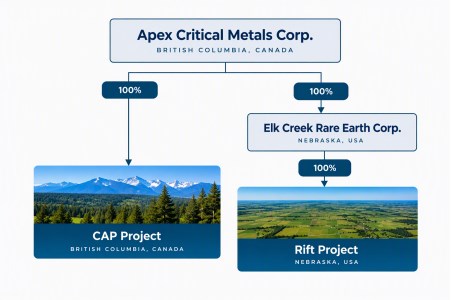
As at July 31, 2026 and the date of this AIF, the Company had one wholly-owned subsidiary, Elk Creek, which was incorporated under the laws of the State of Nebraska on May 12, 2025. Elk Creek holds the mineral and exploration interests that comprise the Rift Project. The organizational chart of the Company setting forth its interests in its material subsidiary and its material mineral properties is set forth below:
GENERAL DEVELOPMENT OF THE BUSINESS
Three-Year History
During the Year Ended July 31, 2024
On August 24, 2023, the Company announced that, effective August 24, 2023, Mr. Sean Charland was appointed as President, Chief Executive Officer and a director of the Company, Mr. David Hodge resigned from his positions as Chief Executive Officer and a director of the Company, and Mr. Michael Schuss resigned from his position as a director of the Company.
On October 11, 2023, the Company announced that it will be seeking CSE approval to consolidate all of its issued and outstanding Common Shares on the basis of 10:1, with each ten (10) pre-consolidated Common Shares being consolidated into one post-consolidated Common Share (the "Consolidation").
On October 18, 2023, the Company announced that, further to its news release dated October 11, 2023: (i) it set October 25, 2023 as the record date for the Consolidation; and (ii) Odyssey Trust Company ("Odyssey") will mail out a Letter of Transmittal to the shareholders of record on October 25, 2023 providing instructions on exchanging pre-Consolidation share certificates for post-Consolidation share certificates.
On October 24, 2023, the Company announced its intention to undertake a non-brokered private placement consisting of the issuance of up to 15,000,000 units of the Company ("Units") at a price of $0.05 per Unit to raise aggregate gross proceeds of up to $750,000 (the "October 2023 Placement"), with each Unit consisting of one Common Share and one Warrant, and each Warrant entitling the holder to purchase one Common Share at a price of $0.067 per Common Share for a period of two years from the closing of the October 2023 Placement. The Company further announced that: (i) it anticipated that a majority of the net proceeds of the October 2023 Placement will be used for property exploration and any remaining funds will be allocated to general working capital; and (ii) that any participation by insiders of the Company in the October 2023 Placement will constitute a "related party transaction" under Multilateral Instrument 61-101 - Protection of Minority Security Holders in Special Transactions ("MI 61-101") but any such participation is expected to be exempt from the formal valuation and minority shareholder approval requirements of MI 61-101.
On November 22, 2023, the Company announced its intention to undertake a non-brokered private placement offering of up to 3,409,091 flow-through units of the Company ("FT Units") at a price of $0.073 per FT Unit to raise aggregate gross proceeds of up to $250,000 (the "November 2023 FT Placement"), with each FT Unit consisting of one Common Share issued as a "flow-through share" within the meaning of the Income Tax Act (Canada) (each, an "FT Share") and one Warrant, and each Warrant entitling the holder to purchase one Common Share at a price of $0.195 per Common Share for a period of two years from closing of the November 2023 FT Placement. The Company further announced that: (i) it will use the gross proceeds from the sale of the FT Units to incur eligible "Canadian exploration expenses" ("CEE") that will qualify as "flow-through mining expenditures" as such terms are defined in the Income Tax Act (Canada) related to the Company's CAP Project; and (ii) that any participation by insiders of the Company in the November 2023 FT Placement will constitute a "related party transaction" under MI 61-101 but any such participation is expected to be exempt from the formal valuation and minority shareholder approval requirements of MI 61-101. The Company did not complete the November 2023 FT Placement.
On December 15, 2023, the Company announced that it has completed the October 2023 Placement and issued a total of 14,999,850 Units at a price of $0.05 per Unit, raising aggregate proceeds of $749,993. The Company further announced that: (i) proceeds of the October 2023 Placement will be used for property exploration and general working capital; (ii) certain directors and officers of the Company and Zimtu Capital Corp. (TSX-V:ZC) ("Zimtu"), which shares common directors and officers with the Company, being Sean Charland and Jody Bellefleur, participated in the October 2023 Placement and purchased a total of 5,899,950 Units and, accordingly, the October 2023 Placement constituted a "related party transaction" under MI 61-101 but is exempt from the formal valuation and minority shareholder approval requirements pursuant to sections 5.5(c) and 5.7(1)(b) of MI 61-101; (iii) the Company did not file a material change report 21 days before closing as the details of the insider participation were not known at that time; (iv) immediately prior to the acquisition of the Units pursuant to the October 2023 Placement, Zimtu beneficially owned 3,171,750 Common Shares representing 40.01% of the issued and outstanding Common Shares of the Company, and that as a result of the October 2023 Placement and the acquisition of the Units thereunder, Zimtu beneficially owned 5,571,750 Common Shares, representing 24.3% of the issued and outstanding shares of the Company; and (v) Zimtu acquired the Units and the underlying securities for investment purposes and in the future, it may discuss with management and/or the board of directors of the Company (the "Board") any of the transactions listed in clauses (a) to (k) of Item 5 of Form F1 of National Instrument 62-103 - The Early Warning System and Related Take-over Bid and Insider Reporting Issues and it may further purchase, hold, vote, trade, dispose or otherwise deal in the securities of the Company, in such manner as it deems advisable to benefit from changes in market prices of the Company's securities, publicly disclosed changes in the operations of the Company, its business strategy or prospects, or from a material transaction of the Company, and it will also consider the availability of funds, evaluation of alternative investments and other factors.
On February 28, 2024, the Company announced its intention to undertake a non-brokered private placement consisting of the issuance of 11,250,000 Units at a price of $0.067 per Unit to raise aggregate gross proceeds of $750,000 (the "February 2024 Placement"), with each Unit consisting of one Common Share and one Warrant, and each Warrant entitling the holder to purchase one Common Share at a price of $0.10 per Common Share for a period of two years from the closing of the February 2024 Placement. The Company further announced that: (i) it anticipated that a majority of the net proceeds of the February 2024 Placement will be used for property exploration and any remaining funds will be allocated to general working capital; and (ii) that any participation by insiders of the Company in the February 2024 Placement will constitute a "related party transaction" under MI 61-101 but any such participation is expected to be exempt from the formal valuation and minority shareholder approval requirements of MI 61-101.
On April 15, 2024, the Company announced that it completed the February 2024 Placement and issued a total of 11,325,000 Units at a price of $0.067 per Unit, raising aggregate proceeds of $755,000. The Company further announced that: (i) proceeds of the February 2024 Placement will be used for property exploration and general working capital; (ii) certain directors and officers of the Company and Zimtu participated in the February 2024 Placement and purchased a total of 1,125,000 Units and, accordingly, the February 2024 Placement constituted a "related party transaction" under MI 61-101 but is exempt from the formal valuation and minority shareholder approval requirements pursuant to sections 5.5(c) and 5.7(1)(b) of MI 61-101; and (iii) the Company did not file a material change report 21 days before closing as the details of the insider participation were not known at that time.
On April 26, 2024, the Company announced that Jason Birmingham, a founding director of the Company, resigned from the Company's Board to pursue other interests. The Company further announced that: (i) it granted an aggregate of 1,950,000 Options to purchase up to 1,950,000 Common Shares to certain directors, officers and consultants of the Company under its Equity Incentive Plan (as defined herein); (ii) the Options are exercisable for a period of five years from the date of the grant, expiring on April 26, 2029, at a price of $0.13 per Common Share; and (iii) the Options will vest as to 33% on the date that is three months from the date of the grant, 33% on the date that is twelve months from the date of the grant, and the final 34% on the date that is 24 months from the date of the grant.
On May 1, 2024, the Company changed its name to "Apex Critical Metals Corp." from "Eagle Bay Resources Corp." and began trading on the CSE under the new name and stock symbol "APXC".
On May 15, 2024, the Company announced it appointed Joness Lang as an independent director of the Company. The Company further announced that: (i) it granted Mr. Lang 300,000 Options to purchase up to 300,000 Common Shares under its Equity Incentive Plan; (ii) the Options are exercisable for a period of five years from the date of the grant, expiring on May 8, 2029, at a price of $0.167 per Common Share; and (iii) the Options will vest as to 33% on the date that is three months from the date of the grant, 33% on the date that is twelve months from the date of the grant, and the final 34% on the date that is 24 months from the date of the grant.
On May 24, 2024, the Company announced that it has entered into an agreement (the "James Bay Agreement") with DG Resource Management Ltd. ("DG Resource") to acquire a 50% interest in a group of mineral claims (the "James Bay Property Portfolio") located in the James Bay region of Québec, Canada (which includes the Mantle, Cirrus East, Cirrus West, Neptune, Alto, Opus and Bruce Lake projects) for consideration of $125,000 in cash, and the acquisition is a "related party transaction" within the meaning of MI 61-101 as Jody Dahrouge, a director of the Company, is also a director and officer of DG Resource, but the transaction is exempt from the formal valuation and minority shareholder approval requirements of MI 61-101 based on the exemptions set out in subsections 5.5(a) and 5.7(1)(a) of MI 61-101.
On May 29, 2024, the Company announced that: (i) its Common Shares were approved for trading under the symbol "APXCF" on the OTCQB Venture Market ("OTCQB") effective May 29, 2024; and (ii) the Common Shares will also be eligible for electronic clearing and settlement in the US through the Depository Trust Company ("DTC"). DTC eligibility is expected to simplify the process of trading and to enhance liquidity of the Common Shares in the US.
On June 6, 2024, the Company announced that it entered into an earn-in option agreement dated June 6, 2024 (the "Earn-In Option Agreement") among the Company, Discovery Energy Metals Corp. (CSE: DEMC) ("DEMC") and DG Resource, on the James Bay Property Portfolio, which includes the Mantle, Cirrus East, Cirrus West, Neptune, Alto, Opus and Bruce Lake projects located within the James Bay Region, Québec. Upon and subject to the terms of the Earn-In Option Agreement, Apex and DG Resource agreed to grant DEMC the sole and exclusive right and option (the "DL Option") to acquire, as to 40% from DG Resource and as to 40% from Apex, an undivided 80% earned interest in the Mantle, Cirrus East, Cirrus West, Neptune, Alto, Opus and Bruce Lake projects, free and clear of any encumbrance, subject only to a 2% gross overriding net smelter return ("NSR") royalty payable as to 1% to each of DG Resource and the Company. To maintain the DL Option in good standing, DEMC agreed to issue 5,000,000 common shares of DEMC (2,500,000 to Apex and 2,500,000 to DG Resource) within five days of signing the Earn-In Option Agreement and incur a minimum expenditure of $1,000,000 on or before the date that is six months from the effective date of the Earn-In Option Agreement. The Company further announced it renewed, for an additional one-year term, its agreement dated May 1, 2023 with Zimtu (the "Zimtu Advantage Agreement"), pursuant to which Zimtu provides the Company services under the Zimtu ADVANTAGE program, a comprehensive marketing service designed for public companies.
On June 12, 2024, the Company announced its intention to undertake a non-brokered private placement consisting of the issuance of up to 7,500,000 Units at a price of $0.267 per Unit to raise aggregate gross proceeds of up to $2,000,000 (the "June 2024 Placement"), with each Unit consisting of one Common Share and one Warrant, and each Warrant entitling the holder to purchase one Common Share at a price of $0.40 per Common Share for a period of one year from the closing of the June 2024 Placement. The Company further announced that: (i) it anticipated that a majority of the net proceeds of the June 2024 Placement will be used for property exploration and any remaining funds will be allocated to general working capital; and (ii) that any participation by insiders of the Company in the June 2024 Placement will constitute a "related party transaction" under MI 61-101 but any such participation is expected to be exempt from the formal valuation and minority shareholder approval requirements of MI 61-101.
On July 5, 2024, the Company announced that it has completed the first tranche of the June 2024 Placement and issued a total of 3,750,000 Units at a price of $0.267 per Unit, raising aggregate proceeds under the first tranche of $1,000,000.
On July 5, 2024, the Company announced its intention to undertake a non-brokered private placement offering of up to 2,307,692 FT Units at a price of $0.43 per FT Unit to raise aggregate gross proceeds of up to $1,000,000 (the "July 2024 FT Placement"), with each FT Unit consisting of one FT Share and one Warrant, and each Warrant entitling the holder to purchase one Common Share at a price of $0.67 per Common Share for a period of two years from closing of the July 2024 FT Placement.
On July 8 and 9, 2024, the Company announced that it entered into an investor relations agreement dated June 25, 2024 (the "Rumble IR Agreement") with Rumble Strip Media Inc. ("Rumble") to enhance its investor awareness. Pursuant to the Rumble IR Agreement, Rumble agreed to provide certain social media, marketing and consulting services to Apex for an initial term of three months, from August 1, 2024 to October 31, 2024.
On July 17, 2024, the Company announced that: (i) it commenced a field exploration program at its CAP Project (the "2024 Exploration Program"); (ii) the activities entail prospecting, geological mapping, rock and soil sampling to confirm previously identified niobium mineralization in both historical surface samples and drilling; (iii) the exploration work was anticipated to outline areas prospective for follow-up drill testing; (iv) the field exploration will be completed by DGC of Edmonton, Alberta, a private company controlled by Jody Dahrouge, a director of Apex; (v) exploration activities are anticipated to expand upon a pre-existing soil grid that demonstrated niobium anomalies which correlated with the eastern margin of the known magnetic and radiometric anomaly; (vi) field crews will continue to prospect near the previously identified carbonatite boulders and outcrops; and (vii) previously identified outcrop exposure was limited to drainage systems, with much of the CAP Project area covered by thick soil profiles and/or glacial till.
During the Year Ended July 31, 2025
On August 19, 2024, the Company announced that it completed the second and final tranche of the June 2024 Placement and issued a total of 3,750,000 Units at a price of $0.267 per Unit, raising aggregate proceeds under the second tranche of $1,000,000. The Company further announced that: (i) proceeds of the June 2024 Placement will be used for property exploration and general working capital; and (ii) an insider of the Company subscribed for a total of 93,750 Units under the second tranche, which is a "related party transaction" within the meaning of MI 61-101 but is exempt from the valuation requirement of MI 61-101 by virtue of the exemptions contained in sections 5.5(a) and 5.7(1)(b) of MI 61-101.
On September 24, 2024, the Company announced that it completed the July 2024 FT Placement by issuing 906,346 FT Units at a price of $0.43 per FT Unit to raise aggregate gross proceeds of $392,749.50.
On October 31, 2024, the Company announced: (i) it is undertaking a forward split of all of its issued and outstanding Common Shares on the basis of one and one-half (1.5) new Common Shares for one (1) old Common Share (1.5:1) (the "Forward Split", and together with the Consolidation, the "Capital Adjustments"); and (ii) all shareholders of record on November 7, 2024 will be entitled to receive one-half of one (0.5) additional Common Share pursuant to the Forward Split.
On November 12, 2024, the Company announced the results of its 2024 Exploration Program at the CAP Project. The 2024 Exploration Program was completed during July 2024, with a total of 32 rock samples, 373 soil samples and 26 stream concentrate samples collected. The objectives were to validate and expand upon previously identified niobium mineralization from historical surface samples and drilling in 2017. All assay results from the 2024 Exploration Program were received and the exploration work proved highly successful, with significant results returned from all sampling approaches. The analytical data will be utilized to generate targets for a planned 2025 drill program.
On November 26, 2024, the Company announced the acquisition of the Bianco Carbonatite Project (the "Bianco Project"), located in northwestern Ontario near the community of Big Beaver House, situated approximately 12.5 km southwest of the Kingfisher Lake First Nation and 156 km north of Pickle Lake, Ontario, pursuant to a sale agreement dated November 26, 2024 (the "Bianco Agreement"), between the Company and DG Resource. The Bianco Project comprises 85 single-cell mining claims, encompassing approximately 9,229.3 acres (~3,735 hectares). The Bianco Project covers a large carbonatite complex which has seen little to no historical exploration. The Company has agreed to acquire a 100% interest in the claims comprising the Bianco Project for cash consideration of $30,000. In addition, the Company will grant to DG Resource a 2% NSR royalty interest in the future minerals produced from the Bianco Project upon achieving commercial production. The acquisition of the Bianco Project is a "related party transaction" within the meaning of MI 61-101 as Jody Dahrouge, a director of the Company, is also a director and officer of DG Resource. The transaction is exempt from the formal valuation and minority shareholder approval requirements of MI 61-101 based on the exemptions set out in subsections 5.5(a) and 5.7(1)(a) of MI 61-101.
On December 18, 2024, the Company announced that it extended the term of the Rumble IR Agreement, pursuant to which Rumble will continue to provide certain social media, marketing and consulting services to Apex for a three-month term commencing December 11, 2024 and ending March 11, 2025.
On December 19, 2024, the Company announced its intention to undertake a non-brokered private placement offering of up to 4,200,000 Units at a price of $0.60 per Unit, for aggregate proceeds of up to $2,520,000 (the "December 2024 Placement"), with each Unit consisting of one Common Share and one Warrant, and each Warrant entitling the holder to purchase one Common Share at a price of $0.75 per Common Share for a period of two years from the closing of the December 2024 Placement.
On December 30, 2024, the Company announced that it completed the December 2024 Placement and issued a total of 4,200,000 Units at a price of $0.60 per Unit, for aggregate proceeds of $2,520,000. The Company further announced that: (i) proceeds of the December 2024 Placement will be used for property exploration and general working capital; and (ii) certain insiders of the Company subscribed for a total of 303,336 Units, which constitutes a "related party transaction" within the meaning of MI 61-101, but is exempt from the valuation and minority shareholder approval requirements of MI 61-101 by virtue of the exemptions contained in section 5.5(a) and section 5.7(1)(b) of MI 61-101.
On February 5, 2025, the Company announced that it acquired the Lac Le Moyne Carbonatite Project (the "Lac Le Moyne Project") as part of its strategic goal to investigate potential high-value opportunities to meet the growing demand for strategic metals across a variety of critical domestic industries. Located in northeastern Québec near the community of Kuujjuaq, the Lac Le Moyne Project consists of 86 map-staked claims totalling approximately 9,946 acres (~4,025 hectares). The Lac Le Moyne Project was acquired for its potential to host carbonatite-related mineralization. The Lac Le Moyne Project was acquired pursuant to a sale agreement dated January 24, 2025 (the "Lac Le Moyne Agreement"), among the Company and SCD Investment Corp. (Simon Dahrouge) and Robin Day (the "Lac Le Moyne Vendors"), pursuant to which the Company has agreed to acquire a 100% undivided interest in the claims comprising the Lac Le Moyne Project for total consideration of $100,000 in cash payable over a three-year period and the issuance to the Lac Le Moyne Vendors of a total of 200,000 Common Shares. In the event a material drill intersection of niobium mineralization is identified on the Lac Le Moyne Project, an additional 500,000 "bonus" Common Shares are payable to the Lac Le Moyne Vendors by the Company. In addition, the Company granted the Lac Le Moyne Vendors a 2% NSR royalty interest in the future minerals produced from the claims comprising the Lac Le Moyne Project upon achieving commercial production.
On February 14, 2025, the Company announced its intention to undertake a non-brokered private placement offering of up to 1,530,612 FT Shares at a price of $0.98 per FT Share for aggregate gross proceeds of up to $1,500,000 (the "February 2025 FT Placement").
On February 21, 2025, the Company announced that it has completed the February 2025 FT Placement by issuing a total of 1,530,612 FT Shares at a price of $0.98 per FT Share for gross proceeds of $1,499,999.76.
On February 21, 2025, the Company announced that it extended the Rumble IR Agreement, pursuant to which Rumble will continue to provide certain social media, marketing and consulting services to Apex for a three-month term commencing March 11, 2025 and ending June 11, 2025.
On March 14, 2025, the Company announced that it granted an aggregate of 5,000,000 Options exercisable to purchase up to 5,000,000 Common Shares to certain directors, officers and consultants of the Company under its Equity Incentive Plan. The Options are exercisable for a period of five years from the date of grant, expiring on March 14, 2030, at a price of $0.85 per Common Share. The Options will vest as to 33% on the date that is four months from the date of the grant, 33% on the date that is eight months from the date of the grant and the final 34% on the date that is twelve months from the date of the grant.
On June 9, 2025, the Company announced that: (i) the 2025 field exploration programs at the newly acquired Bianco Project and Lac Le Moyne Project will commence; and (ii) Apex engaged DGC to undertake the field work for the two projects. The Company further announced that it renewed the Zimtu Advantage Agreement for an additional one-year term. Zimtu is a Non-Arm's Length Party to the Company (as that term is defined in the policies of the TSX Venture Exchange) by virtue of the Company and Zimtu sharing common directors and officers (Mr. Charland and Ms. Bellefleur). The Company's entry into the Zimtu Advantage Agreement was approved by the Company's Board, absent Mr. Charland and Ms. Bellefleur, who disclosed their relationship with Zimtu and recused themselves.
On June 19, 2025, the Company announced it received a five-year Multi-Year Area-Based Exploration Permit ("MYAB") and has advanced plans for a 2025 summer diamond drill program at its CAP Project (the "CAP 2025 Drill Program"). Apex received a MYAB Exploration Permit (Permit Number MX-11-251, the "MYAB Permit"), which is valid until December 5, 2029 and encompasses most of the CAP Project. The MYAB Permit allows Apex to conduct up to 60 diamond drill holes and perform targeted drilling along the niobium trend to determine its continuity and width.
On July 10, 2025, the Company announced it finalized a drill contract with Quesnel Bros. Diamond Drilling Ltd. for its fully funded CAP 2025 Drill Program. The planned heli-supported diamond drill program will comprise up to 1,500 metres of NQ core drilling and was scheduled to commence in mid-July 2025, with crews operating on a 24-hour rotation from a helicopter-supported camp. The CAP 2025 Drill Program will be fully supported by DGC, Apex's long-term technical partner. The CAP 2025 Drill Program will test high-priority niobium and REE targets defined by the Company's 2024 Exploration Program.
On July 22, 2025, the Company announced the arrival at the CAP Project of a Hydracore 2000 heli-portable drill rig, with crews mobilizing, in preparation for the CAP 2025 Drill Program.
On July 30, 2025, the Company announced that it has commenced the CAP 2025 Drill Program, focusing initially on its highest-priority targets from the Company's 2024 Exploration Program.
During the Year Ended July 31, 2026
On August 1, 2025, the Company announced it had qualified to uplist from the OTCQB to the OTCQX and began trading on the OTCQX under the symbol "APXCF".
On August 12, 2025, the Company provided an update on its CAP 2025 Drill Program and announced that four drill holes (CAP25-005, 006, 007 and 008) were completed, for a total of 1,097 m, near the eastern extremity of the coincident soil geochemical and geophysical anomaly identified in prior exploration. All drill holes intersected various intervals of carbonatite, fenite, and/or syenite that range from a few metres to more than 300 m drilled thickness (i.e., core length).
On August 21, 2025, the Company announced that it extended the Rumble IR Agreement, pursuant to which Rumble will continue to provide certain social media, marketing and consulting services to Apex for a three-month term commencing August 20, 2025 and ending November 20, 2025.
On August 27, 2025, the Company provided an update on its CAP 2025 Drill Program and announced that preliminary visual results from drillhole CAP25-006 motivated the Company to request a rush order for the results from the upper 72.5 m from the assay lab. The results confirmed strong niobium mineralization starting at 33.5 m downhole with 36 m at 0.59% Nb₂O₅, including a higher-grade zone of 10 m averaging 1.08% Nb₂O₅. Six drillholes totalling 1,763 m have been completed, with drilling ongoing. The analytical results disclosed correspond to the first 72.5 m of drillhole CAP25-006 only, with assays for the remaining 1,691 m of drilling yet to be reported. Reported downhole intervals are not necessarily indicative of true thickness, as the true thickness of the mineralized zones has not yet been determined.
On September 3, 2025, the Company provided an update on a corporate initiative to expand its holdings within the US as part of a broader positioning within the North American critical minerals sector. The Company, via its local agent Key Landmark LLC, acquired rights to explore and options to purchase a ~2,407-acre midwestern US-based property package consisting of certain mineral rights within the Elk Creek Carbonatite Complex located in southeastern Nebraska, US (the "Rift Project"), which it considers highly prospective for REE and critical mineral mineralization based on a historical exploration dataset available to the Company. The Rift Project covers a large portion of a rare metal complex which has been known for more than 50 years but remains largely underexplored. DGC has been retained to review the historical exploration data and provide recommendations going forward. The Company acquired the rights to explore, as well as an option to purchase mineral interests in respect of the Rift Project, for an aggregate purchase price of $567,472.84. The Company has the option to purchase mineral interests in respect of the Rift Project by paying the sum of US$10,000 per acre. If the option is exercised by the Company, an aggregate 2.5% NSR royalty is payable, with Apex retaining the right to repurchase 0.25% of the NSR royalty for US$500,000, thereby reducing it to 2.25%.
On September 8, 2025, the Company announced the establishment of its Technical Advisory Board and welcomed the appointment of its inaugural member, Alex Knox, M.Sc., P.Geo. The Technical Advisory Board will provide strategic guidance and technical expertise to support the advancement of the Company's growing portfolio of high-potential projects. The Company further announced that: (i) it granted an aggregate of 1,760,000 Options to purchase up to 1,760,000 Common Shares to certain directors, officers and consultants of the Company under its Equity Incentive Plan; (ii) the Options are exercisable for a period of five years from the date of grant, expiring on September 8, 2030, at a price of $1.97 per Common Share; and (iii) the Options will vest as to 33% on the date that is four months from the date of the grant, 33% on the date that is eight months from the date of the grant and the final 34% on the date that is twelve months from the date of the grant. Additionally, the Company announced that it granted an aggregate of 1,660,000 RSUs which will vest on the date that is four months from the date of grant, provided that the holder may, upon written notice to the Company on or before the vesting date, elect to defer vesting of certain of the RSUs such that the RSUs shall vest as to one quarter (1/4) every four months with the initial vesting date being the date that is four months from the date of grant. Each RSU represents the right to receive, once vested, one Common Share. Finally, the Company also announced its intention to undertake a non-brokered private placement offering of up to 800,000 FT Units at a price of $2.00 per FT Unit to raise aggregate gross proceeds of up to $1,600,000 (the "September 2025 FT Placement"), with each FT Unit consisting of one FT Share and one Warrant, and each Warrant entitling the holder to purchase one Common Share at a price of $2.50 per Common Share for a period of two years from closing of the September 2025 FT Placement.
On October 1, 2025, the Company provided an update regarding the acquisition of certain mineral rights with respect to the Rift Project located in the Elk Creek Carbonatite Complex in southeastern Nebraska, US. The Company has secured highly prospective REE mineral rights to key underexplored areas of the Rift Project, consisting of two target areas of known REE mineralization (East Zone and West Zone). Apex's Rift Project area (~2,784 acres) now represents the largest position in the Elk Creek Carbonatite Complex. The State of Nebraska is considered a favourable jurisdiction for development with private land ownership facilitating a streamlined permitting path. The Company is continuing to compile historically available data and is actively planning an inaugural exploration program in the fourth quarter of 2025, including drilling. The Rift Project includes exploration rights and purchase options for approximately 2,784 acres (~1,127 hectares) within the Elk Creek Carbonatite Complex. The Company's property position is considered highly prospective for REE mineralization based on extensive historical exploration data.
On October 7, 2025, the Company announced its intention to undertake a non-brokered private placement offering of up to 2,000,000 Units at a price of $2.50 per Unit, for aggregate proceeds of up to $5,000,000 (the "October 2025 Placement"), with each Unit consisting of one Common Share and one Warrant, and each Warrant entitling the holder to purchase one Common Share at a price of $3.00 per Common Share for a period of two years from the closing of the October 2025 Placement.
On October 8, 2025, the Company announced that it upsized the October 2025 Placement due to strong investor demand, from 2,000,000 Units for gross proceeds of up to $5,000,000 to 4,000,000 Units for gross proceeds of $10,000,000. All other terms of the October 2025 Placement remain unchanged.
On October 14, 2025, the Company announced that it acquired additional REE exploration rights within a high-priority target area at the Rift Project, which post-acquisition includes exploration rights and purchase options for an increased total of approximately 3,024 acres (1,224 hectares), encompassing highly prospective portions of the Elk Creek Carbonatite Complex. The Company further announced it is in the process of modelling all historical information for targeted drilling to expand upon the historical REE findings, with an initial focus on the EC-93 and NEC11-004 area, where high grades of REE mineralization from historical drilling remain open in all directions.
On October 22, 2025, the Company announced that: (i) it initiated the permitting process with the Nebraska Department of Water, Energy and Environment to conduct exploration activities at the Company's Rift Project; (ii) it completed the September 2025 FT Placement by issuing a total of 800,000 FT Units at a price of $2.00 per FT Unit for gross proceeds of $1,600,000; and (iii) it granted an aggregate of 50,000 Options exercisable to purchase up to 50,000 Common Shares and 50,000 RSUs to a consultant of the Company under its Equity Incentive Plan. The Options are exercisable for a period of two years from the date of grant, expiring on October 22, 2027, at a price of $3.82 per Common Share. The Options and the RSUs will vest upon the successful listing by the Company on the EAP.
On October 30, 2025, the Company announced that it completed the October 2025 Placement by issuing a total of 4,000,000 Units at a price of $2.50 per Unit for gross proceeds of $10,000,000. In connection with the October 2025 Placement, the Company paid an aggregate of $255,500 in cash and issued an aggregate of 102,200 non-transferable finder's warrants (each, a "Finder's Warrant") to certain finders. Each Finder's Warrant entitles the holder thereof to purchase one Common Share at a price of $3.00 per Common Share for a period of two years.
On November 12, 2025, the Company announced the completion and results from a high-resolution airborne geophysical survey completed at the Company's 100%-owned CAP Project in central British Columbia. Highlights included: (i) a strong magnetic high measuring approximately 2.2 km x 1.8 km with a northwest offshoot; (ii) a magnetic anomaly that roughly correlates with the 1.8 km niobium-in-soil trend identified in 2024 and confirmed in 2025 drilling; (iii) a helicopter-borne magnetic and radiometric survey completed by Precision GeoSurveys Inc.; (iv) 781 line-km flown at 40 m spacing; and (v) assays remain pending for 2,251 m of core, with results expected shortly.
On November 24, 2025, the Company announced that it has commenced an extensive 2025 re-sampling and re-logging program of historical drill core from the Rift Project. The historical drill programs were completed during the 1970s and 1980s by Molycorp Inc., and a substantial portion of the drill core and sample material has been preserved and is available for modern analysis. The Company has retained DGC to oversee the program.
On December 5, 2025, the Company extended the Rumble IR Agreement, pursuant to which Rumble will continue to provide certain social media, marketing and consulting services to Apex for a three-month term commencing December 5, 2025 and ending March 5, 2026.
On December 8, 2025, the Company announced that it completed its 2025 re-logging and re-sampling program of preserved historical drill core from the Rift Project. The program was designed to establish a modern analytical baseline for the Rift Project carbonatite system by applying modern advanced geochemical and geological methods to drill core originally drilled by Molycorp Inc. during the 1970s and 1980s. A substantial portion of this core was preserved through the Conservation and Survey Division, School of Natural Resources at the University of Nebraska-Lincoln, enabling a rare opportunity for modern re-evaluation by the Company. The Company also announced that it has granted an aggregate of 75,000 Options to purchase up to 75,000 Common Shares to a consultant under its Equity Incentive Plan. The Options are exercisable for a period of four years from the date of grant, expiring on December 5, 2029, at a price of $2.50 per Common Share. Additionally, the Company announced that it granted an aggregate of 25,000 RSUs under the Equity Incentive Plan. The Options and RSUs will vest six months from the date of grant. Each vested RSU entitles the holder thereof to receive one Common Share, or the equivalent cash value thereof, in accordance with the terms of the Equity Incentive Plan. All Options, RSUs and the Common Shares underlying such Options and RSUs are subject to a statutory resale restriction of four months and one day from the date of issuance.
On December 15, 2025, the Company announced updates with respect to its 2025 sampling program at the Lac Le Moyne Project located in Nunavik, Québec, including the results from a new carbonatite discovery and the staking of an additional 77 mineral claims, totalling approximately 3,609 hectares, on the eastern margin of the Lac Le Moyne Project to cover geophysical anomalies and the interpreted up-ice area, to the south/southeast, of the niobium-enriched boulders identified during the 2025 sampling program.
On December 31, 2025, the Company provided a summary of all analytical results from its 2025 regional exploration drilling program at the CAP Project, which consisted of nine helicopter-supported diamond drill holes totalling 2,323 metres, and provided a 2026 outlook at its CAP Project. Highlights included: (i) expanded mineralization in drillhole CAP25-006, which returned 124.5 m of 0.27% Nb₂O₅, encompassing the previously announced 36 m of 0.59% Nb₂O₅, including 10 m at 1.08% Nb₂O₅; (ii) multiple REE-enriched intervals, including two zones grading between 1.08% and 1.33% REO over 3.0 m and 3.4 m in CAP25-005 and CAP25-006, respectively; and (iii) phosphate mineralization with P₂O₅ grades of up to 16.2% over 3.8 m (CAP25-007), 6.2% P₂O₅ over 45 m (CAP25-007) and 4.5% P₂O₅ over 97.2 m (CAP25-012).
On January 5, 2026, the Company announced that it received approval from the Nebraska Department of Water, Energy and Environment for its mineral exploration permit at the Rift Project and provided updates with respect to its pre-drilling activities at the Rift Project.
On January 12, 2026, the Company announced that it secured Boart Longyear as the drilling contractor at the Company's Rift Project, with Boart Longyear contracted to complete approximately 8,000 metres of drilling across 10-15 drill holes.
On January 19, 2026, the Company provided a year-end summary of its 2025 activities and milestones at the Rift Project, along with a 2026 outlook including a more detailed summary of the Company's 2026 Phase I drill program at the Rift Project.
On January 26, 2026, the Company announced that the first drill rig arrived onsite for the Company's inaugural 2026 Phase I drill program at the Rift Project. The Company also announced that it granted an aggregate of 750,000 RSUs to a director of the Company under the Equity Incentive Plan. The RSUs were granted on January 23, 2026 and will vest as follows: (i) 375,000 RSUs will vest 12 months from the date of the grant; and (ii) 375,000 RSUs will vest 24 months from the date of the grant. Each vested RSU entitles the holder thereof to receive one Common Share, or the equivalent cash value thereof, in accordance with the terms of the Equity Incentive Plan. The RSUs and Common Shares underlying the RSUs are subject to a statutory resale restriction of four months and one day from the date of issuance.
On February 2, 2026, the Company announced that it granted an aggregate of 200,000 Options exercisable to acquire up to 200,000 Common Shares at a price of $2.75 per Common Share for a period of two years expiring on January 30, 2028. The Options were granted to a consultant of the Company under the Equity Incentive Plan. The Options and the Common Shares underlying such Options are subject to a statutory resale restriction of four months and one day from the date of issuance.
On February 10, 2026, the Company announced that its 2026 Phase I drill program at the Rift Project was fully mobilized, with two drill rigs active at the Rift Project, and provided an update with respect to drilling and core processing.
On February 18, 2026, the Company announced updates to its management team, including: (i) the appointment of Mr. Nathan Steinke as Chief Financial Officer ("CFO") of the Company; (ii) the appointment of Mr. Joness Lang as Executive Vice President, Growth Strategy; and (iii) the resignation of Ms. Jody Bellefleur as CFO of the Company, who remains a director and acting Corporate Secretary of the Company.
On February 23, 2026, the Company announced that it has been accepted into the US Defense Industrial Base Consortium, a US Department of Defense-supported initiative focused on accelerating collaboration between industry, academia, and government to advance technologies and supply chains critical to US national security.
On March 18, 2026, the Company announced an update with respect to six drill holes completed and an additional two drill holes in progress under its 2026 Phase I drill program at the Rift Project.
On March 25, 2026, the Company announced the appointment of Mr. Zayn Kalyan as a director of the Company.
On April 7, 2026, the Company reported assay results from drill hole RIFT26-002, representing the first assay results received from the Company's 2026 Phase I drill program at the Rift Project.
On April 9, 2026, the Company announced it is attending the "Critical Materials Conference: Aerospace & Defence 2026" in Washington, DC, and provided additional corporate updates, including the filing of its previous technical report on the CAP Project on SEDAR+.
On April 17, 2026, the Company announced that it has been included in the recently launched exchange-traded fund (ETF) known as Sprott Rare Earths Ex-China ETF (Nasdaq: REXC). This new ETF is focused on companies engaged in the exploration, development, mining, separation, refining, and production of rare earth elements outside of China.
On April 28, 2026, the Company reported assay results from drill hole RIFT26-001A, and partial assay results from RIFT26-003. These assay results are the second batch of results received from the Company's 2026 Phase I drill program at the Rift Project.
In April 2026, the Company acquired the Iron Hills property, consisting of 76 lode mining claims (IH001-IH076) totalling approximately 1,570 acres (~635 hectares) in Gunnison County, Colorado, US, for cash consideration of $80,091, pursuant to a mineral property purchase agreement among the Company, DG Resource Management (US) Ltd. ("DG Resource US") (as registered holder of the claims), and SCD Investment Corp. and SYD Investment Corp. (each as the beneficial holder of a 50% interest in the claims) (collectively, the "Iron Hills Vendors"). In addition, the Company granted to SCD Investment Corp. and SYD Investment Corp. an aggregate 3% NSR royalty (1.5% to each) on future production from the Iron Hills property.
On May 1, 2026, the Company announced that it has extended its marketing and investor awareness agreement with Rumble to support ongoing investor outreach initiatives, for a two-month term commencing May 1, 2026 and ending June 30, 2026.
On May 6, 2026, the Company reported the remaining assay results from drill hole RIFT26-003 and provided updates on its next steps for the Rift Project.
On May 7, 2026, the Company announced that it granted an aggregate of 1,250,000 Options to acquire up to 1,250,000 Common Shares and 350,000 RSUs to certain directors, officers and consultants of the Company under the Equity Incentive Plan. The Options are exercisable at a price of $2.18 per Common Share. Of the 1,250,000 Options granted, 750,000 Options are exercisable for a period of five years from the date of grant, expiring on May 7, 2031, and 33% of such Options will vest on the date that is four months from the date of grant, 33% on the date that is eight months from the date of grant, and 34% will vest on the date that is 12 months from the date of grant. The remaining 500,000 Options are exercisable for a period of two years from the date of grant, expiring on May 7, 2028, and vest in full on October 7, 2026. The 350,000 RSUs will vest in four equal 25% tranches, with 87,500 RSUs vesting every four months from the date of grant. Each vested RSU entitles the holder thereof to receive one Common Share, or the equivalent cash value thereof, in accordance with the terms of the Equity Incentive Plan. All Options, RSUs and the Common Shares underlying such Options and RSUs are subject to a statutory resale restriction of four months and one day from the date of issuance.
On May 15, 2026, the Company reported assay results from drillholes RIFT26-004, RIFT26-005A and partial results from RIFT26-006 and provided further updates and next steps on the 2026 Phase I drill program at the Rift Project.
On May 18, 2026, the Company announced it entered into an agreement with Canaccord Genuity Corp. to act as lead agent and sole bookrunner along with a syndicate of agents to be formed (the "Agents") in connection with a "best efforts" private placement (the "LIFE Offering") of up to 5,264,000 units of the Company (each, a "LIFE Unit") at a price of $1.90 per LIFE Unit for aggregate gross proceeds of up to $10,001,600 under the Listed Issuer Financing Exemption (as defined below). Each LIFE Unit consisted of one Common Share and one Warrant (each, a "LIFE Warrant"). Each LIFE Warrant is exercisable to acquire one Common Share at a price of $2.60 per Common Share for a period of 24 months from the closing date. The LIFE Warrants are not listed for trading on any securities exchange. The Company agreed to grant the Agents an option to sell up to 789,600 additional LIFE Units for $1.90 per LIFE Unit for additional gross proceeds of up to $1,500,240. The LIFE Offering was being made to purchasers resident in all provinces and territories of Canada, except Québec, pursuant to the listed issuer financing exemption under Part 5A of National Instrument 45-106 - Prospectus Exemptions, as modified by Coordinated Blanket Order 45-935 - Exemptions from Certain Conditions of the Listed Issuer Financing Exemption (collectively, the "Listed Issuer Financing Exemption"), and to investors outside of Canada on a prospectus-exempt basis. As consideration for their services in connection with the LIFE Offering, the Company agreed to pay the Agents a cash commission equal to 6% of the gross proceeds of the LIFE Offering and compensation warrants exercisable to acquire Common Shares equal to 3% of the aggregate number of LIFE Units sold under the LIFE Offering (the "LIFE Compensation Warrants"), with each LIFE Compensation Warrant exercisable to purchase one Common Share for $1.90 per Common Share for a period of 24 months from the closing date. In each case, the consideration was to be reduced to 3% in the case of investors on the president's list. The Company intends to use the gross proceeds of the LIFE Offering to fund exploration of the Rift Project, the CAP Project and the Lac Le Moyne Project, and for general working capital purposes as further set out in the Company's offering document dated May 18, 2026 on Form 45-106F19 - Listed Issuer Financing Document.
On May 19, 2026, the Company announced an upsize to the LIFE Offering, pursuant to which the Company may offer up to 7,895,000 LIFE Units for $1.90 per LIFE Unit for aggregate gross proceeds of up to $15,000,500, in accordance with an amended agreement entered into by the Company with the Agents and the amended and restated LIFE Offering document dated May 19, 2026. All other terms and conditions of the LIFE Offering remained unchanged.
On June 2, 2026, the Company announced that it closed the upsized LIFE Offering, pursuant to which the Company issued 7,895,000 LIFE Units for $1.90 per LIFE Unit for aggregate gross proceeds of $15,000,500. In consideration for their services, the Agents received aggregate cash fees equal to 6% of the gross proceeds of the LIFE Offering (reduced to 3% in respect of investors on the president's list) and 394,740 non-transferable LIFE Compensation Warrants. The LIFE Compensation Warrants and Common Shares issuable upon their exercise are subject to a statutory hold period of four months and one day from the closing date of the LIFE Offering. Certain insiders of the Company participated in the LIFE Offering, which constituted a "related party transaction" within the meaning of MI 61-101. The issuance of LIFE Units to insiders was exempt from the valuation requirements of section 5.4 of MI 61-101 pursuant to subsection 5.5(a) of MI 61-101, and exempt from the minority shareholder approval requirements of section 5.6 of MI 61-101 pursuant to subsection 5.7(1)(a) of MI 61-101.
On June 3, 2026, the Company announced updates regarding expanded drilling and exploration plans at the Rift Project (including a Phase II drill plan), its objective to complete an inaugural mineral resource estimate on the Rift Project in the first half of the 2027 calendar year, updates on received and pending assay results from the 2026 Phase I drill program at the Rift Project, and updates on preliminary mineralogy and metallurgical work for the Rift Project.
On June 16, 2026, the Company announced that it filed the Rift Technical Report on SEDAR+.
On June 22, 2026, the Company reported assay results from drill holes RIFT26-007, RIFT26-008, RIFT26-009, and RIFT26-010, that it has merged its originally planned two-phase drilling program (2026 Phase I drill program and Phase II drill plan), and provided further program updates and next steps for the Rift Project.
On June 30, 2026, the Company announced that it commenced its 2026 exploration program at the CAP Project, with a drill rig mobilized and drilling underway. The 2026 exploration program at the CAP Project is expected to include four drillholes totalling approximately 1,200 metres and is designed around two principal objectives: testing the large buried geophysical anomaly to the southeast of the 2025 drill corridor and following up on the Company's 2025 niobium discovery at CAP25-006. The Company ultimately completed three drillholes totalling 1,072 metres under the 2026 exploration program at the CAP Project, with assay results pending as of the date of this AIF.
On July 9, 2026, the Company announced that Euronext Paris approved the admission of the Common Shares for trading on the EAP effective as of July 9, 2026 under the symbol "MLAPX". The EAP is a market operated by Euronext Paris designed to provide companies with access to European capital markets and increased exposure to international investors.
Subsequent to the Year Ended July 31, 2026
On August 5, 2026, the Company announced the appointment of Mr. Trevor Hall as a director of the Company.
On August 6, 2026, the Company filed the CAP Technical Report on SEDAR+.
On August 12, 2026, the Company reported assay results from drillholes RIFT26-011, RIFT26-012, RIFT26-013 and RIFT26-014 at the Rift Project. Highlights included: (i) RIFT26-012, which extended Trinity Zone mineralization 100 m to the west, returning 2.42% REO over 151.4 m, including 4.48% REO over 8.0 m; and (ii) RIFT26-014, which returned 148.5 m at 2.09% REO, including 10.2 m at 5.27% REO, confirming further continuity of the Trinity Zone to the south. The Company further announced that the Trinity Zone was then defined over an approximate 400 m north-south strike length and 200 m down-dip, remaining open in all directions, and that a total of 32 drillholes had been completed with assays pending for 18 completed holes.
On August 14, 2026, the Company announced that it filed and obtained a receipt for its final short form base shelf prospectus dated August 10, 2026 (the "Shelf Prospectus") with the securities commissions in each of the provinces and territories of Canada, except Québec, and that a corresponding registration statement on Form F-10 filed with the SEC under the US/Canada Multijurisdictional Disclosure System became effective on August 13, 2026. The Shelf Prospectus allows the Company to offer and issue up to $100,000,000 of Common Shares, Warrants, subscription receipts, units, debt securities, Common Shares represented by depositary shares and share purchase contracts, or any combination thereof, during the 25-month period that the Shelf Prospectus remains effective.
On August 20, 2026, the Company reported quantitative X-ray diffraction (QXRD) results from drillholes RIFT26-001A, RIFT26-002, RIFT26-003 and RIFT26-005A at the Rift Project, confirming monazite and bastnaesite as the dominant REE-bearing minerals within the Trinity and Neo zones, and announced that it engaged SGS Geochemistry to complete TIMA analysis on select samples to inform preliminary metallurgical test work. The Company also announced that it: (i) renewed its marketing and investor awareness agreement with Rumble for a three-month term commencing on or about August 18, 2026, for aggregate consideration of $1,000,000 payable in two instalments of $500,000 each; and (ii) renewed its agreement with Zimtu under the Zimtu ADVANTAGE program for an initial term of 12 months effective August 18, 2026, at a cost of $15,000 per month. Zimtu is a Non-Arm's Length Party to the Company (as that term is defined in the policies of the TSX Venture Exchange) by virtue of the Company and Zimtu sharing common directors and officers (Mr. Charland and Ms. Bellefleur), and the Company's entry into the agreement with Zimtu was approved by the Board, absent Mr. Charland and Ms. Bellefleur, who disclosed their relationship with Zimtu and recused themselves.
On September 8, 2026, the Company reported assay results from drillholes RIFT26-015 through RIFT26-019 at the Rift Project. Highlights included RIFT26-019, which returned 2.12% REO over 197.5 m, including 3.15% REO over 12.9 m, and extended Trinity Zone mineralization approximately 120 m further down-dip to the west, and drillholes RIFT26-016, RIFT26-017 and RIFT26-018, which comprise the southernmost drill fence and returned 1.74% REO over 46.1 m, 1.38% REO over 77.3 m and 2.00% REO over 33.7 m, respectively. The Company further announced that the Trinity Zone was then defined over an approximate 500 m north-south strike length and 300 m down-dip, remaining open in all directions.
In September 2026, the Company completed a 10-day soil sampling program at the Lac Le Moyne Project to follow up on the 2025 carbonatite discovery, collecting a total of 249 soil samples and 36 rock samples in the up-ice direction from the niobium-enriched boulders identified in 2025. Assay results are pending as of the date of this AIF.
On October 5, 2026, the Company reported assay results from drillholes RIFT26-020 through RIFT26-024 at the Rift Project. Highlights included RIFT26-024, which returned 3.55% REO over 116.0 m, including 4.75% REO over 22.9 m, and RIFT26-022, which returned 2.35% REO over 171.5 m, including 4.07% REO over 37.0 m, extending the Trinity Zone approximately 200 m down-dip to the west. The Company further announced that approximately 37 holes (24,000 m) had been completed, with assay results for 13 holes (approximately 8,000 m) pending and drilling ongoing, and that it is targeting an inaugural mineral resource estimate on the Rift Project by the end of the first quarter of 2027.
On October 22, 2026, the Company announced that it had been approved to list its ADSs on Nasdaq under the symbol "APXC" and the pricing of an underwritten public offering in the United States (the "US Offering") of 400,000 ADSs at a price of US$4.65 per ADS, with each ADS representing six Common Shares, for gross proceeds of US$1.86 million, before deducting underwriting discounts, commissions and offering expenses. The Company granted the underwriter a 45-day option to purchase up to an additional 60,000 ADSs at the public offering price, less underwriting discounts and commissions. Maxim Group LLC acted as sole book-running manager for the US Offering. The US Offering was made pursuant to the Company's effective registration statement on Form F-10 and a prospectus supplement to the Shelf Prospectus dated October 22, 2026, and no securities were offered or sold to Canadian purchasers. The Company intends to use the net proceeds of the US Offering for working capital and general corporate purposes, including advancing its ongoing drill program at the Rift Project.
The Company does not anticipate any changes in its business which would be inconsistent with the development of the business discussed under the heading "Subsequent to the Year Ended July 31, 2026" above.
Significant Acquisitions
The Company did not complete any "significant acquisitions" during the year ended July 31, 2026 for which disclosure is required under Part 8 of National Instrument 51-102 - Continuous Disclosure Obligations ("NI 51-102").
BUSINESS DESCRIPTION
General
Apex is a Canadian exploration company specializing in the acquisition and development of properties prospective for carbonatites and alkaline rocks with potential to host economic concentrations of REEs, niobium, gold and copper mineralization. As at the financial year ended July 31, 2026, the Company's flagship asset was the Rift Project located in Nebraska, US, and the Company's other material mineral property was the CAP Project located in British Columbia, Canada.
None of the Company's mineral properties are at the commercial development or production stage. The Company is committed to building a robust portfolio of high-quality projects. A general description of the material and non-material mineral projects of the Company is included below under the headings "Material Mineral Projects" and "Non-Material Mineral Projects".
Specialized Skill and Knowledge
Various aspects of the Company's business require specialized skills and knowledge. Such skills and knowledge include the areas of exploration and development, geology, drilling, permitting, metallurgy, logistical planning, and accommodation and implementation of exploration programs, as well as legal compliance, finance and accounting. The Company expects to rely upon consultants and others for exploration and development expertise. The Company does not anticipate any difficulties in locating competent employees and consultants in such fields.
Competitive Conditions
The mineral exploration and mining industry is competitive in all phases of exploration, development and production. The Company competes with a number of other entities and individuals in the search for and the acquisition of attractive mineral properties, suitable equipment and service providers, as well as the recruitment and retention of suitably qualified individuals. As a result of this competition, the majority of which is with entities with greater financial resources than the Company, the Company may not be able to acquire attractive properties in the future on terms it considers acceptable, or recruit and retain suitably qualified individuals. Finally, the Company competes for investment capital with other resource companies, many of whom have greater financial resources and/or more advanced properties that are better able to attract equity investment and other capital. The ability of the Company to acquire attractive mineral properties in the future depends not only on its success in exploring and developing its present properties, but also on its ability to select, acquire and bring to production suitable properties or prospects for exploration, mining and development. Factors beyond the control of the Company may affect the marketability of minerals mined or discovered by the Company. Inability to compete may have a materially adverse effect on the financial position and business operations of the Company. See "Risk Factors" below.
Components
All of the raw materials the Company requires to carry on its business are available through normal supply or business contracting channels in British Columbia, Ontario, Québec and Nebraska. The Company has secured personnel to conduct its currently contemplated programs. It is possible that delays or increased costs may be experienced in order to proceed with drilling activities during the current period. Such delays could significantly affect the Company if, for example, commodity prices fall significantly, thereby reducing the opportunity the Company may have had to develop a particular project had such tests been completed in a timely manner before the fall of such prices. In addition, assay labs are often significantly backlogged, thus significantly increasing the time that the Company waits for assay results. Such delays can slow down work programs, thus increasing field expenses or other costs (such as property payments which may have to be made before all information to assess the desirability of making such payment is known, or causing the Company to not make such a payment and terminate its interest in a property rather than make a significant property payment before all information is available).
Cycles
The Company's mineral exploration activities may be subject to seasonality due to adverse weather conditions including, without limitation, inclement weather, snow covering the ground, frozen ground and restricted access due to rain, snow, ice or other weather-related factors.
In addition, the mining business is subject to global economic cycles which affect the marketability of products derived from mining.
Intangible Properties
The Company's business will not be substantially dependent on the protection of any proprietary rights or technologies.
Economic Dependence
The Company's business is not substantially dependent on a contract to sell a major part of its products or services or to purchase a major part of its requirements for goods, services or raw materials, or on any franchise or licence or other agreement to use a patent, formula, trade secret, process or trade name upon which its business depends.
Changes to Contracts
It is not expected that the Company's business will be affected in the current financial year by the renegotiation or termination of contracts or sub-contracts.
Environmental Protection
Environmental risk is inherent with mining operations. The current or future operations of the Company require permits from various governmental authorities. Such operations are governed by laws and regulations that govern prospecting, mining, development, production, taxes, labour standards, occupational health, waste disposal, toxic substances, land use, environmental protection, mine safety, and other matters. There can be no assurance that all permits that the Company requires for future exploration and development of mining facilities will be obtainable on reasonable terms or that such laws and regulations would not have an adverse effect on the financial condition or operations of the Company. Should any of the Company's projects advance to the production stage, then more time and money would be involved in satisfying environmental protection requirements.
The legal framework governing mining operations is constantly developing; therefore, the Company is unable to fully ascertain any future liability that may arise from the implementation of any new laws or regulations, although such laws and regulations are typically strict and may impose severe penalties (financial or otherwise). The proposed activities of the Company, as with any exploration, may have an environmental impact which may result in unbudgeted delays, damage, loss and other costs and obligations including, without limitation, rehabilitation and/or compensation. There is also a risk that the operations of the Company and financial position may be adversely affected by the actions of environmental groups or any other group or person opposed in general to the activities of the Company.
To address these challenges, the Company actively assesses environmental risks and fosters strong relationships with land stakeholders, including Indigenous communities. By doing so, the Company aligns with applicable regulatory frameworks established by Canadian federal, provincial and municipal authorities and by US federal and state authorities, including the Nebraska Department of Water, Energy and Environment, which support responsible resource development. The regular granting of operating licences and permits in British Columbia, Ontario, Québec and Nebraska reflects a structured and predictable regulatory environment, enabling the Company to progress its projects while upholding its environmental and community commitments. Environmental protection requirements did not have a material effect on the Company's capital expenditures, profit or loss or competitive position during the financial year ended July 31, 2026, and the Company does not currently expect them to have a material effect in future years while its projects remain at the exploration stage.
Employees and Contractors
As at July 31, 2026, the Company had (i) two employees, being Sean Charland, President and Chief Executive Officer, pursuant to an executive employment agreement dated November 25, 2025, and Nathan Steinke, Chief Financial Officer, pursuant to an executive employment agreement dated February 1, 2026; (ii) one executive consultant, being Joness Lang, Executive Vice President, Growth Strategy, engaged through EBC Consulting Group Ltd. pursuant to an executive services agreement dated February 15, 2026; and (iii) one principal contractor, being DGC (Edmonton, Alberta), the Company's long-term technical partner. As of the date of this AIF, the Company has two employees and has a small management team.
The Company utilizes consultants and/or contractors to carry on most of its activities and, in particular, to supervise certain work programs on its mineral properties. As the Company continues to expand its activities, it is probable that it will hire employees or additional consultants. Due to a limited exploration season in its British Columbia, Ontario, Québec and Nebraska operations, the Company anticipates its number of contractors will increase from April to October of each year. In addition, contractors and employees may move between locations from time to time as conditions and business opportunities warrant. The loss of any key individual on the management team could negatively affect the business of the Company. Any inability to secure and/or retain appropriate personnel may have a materially adverse effect on the business and operations of the Company. See "Risk Factors" below.
Bankruptcy and Similar Procedures
There are no bankruptcies, receiverships or similar proceedings against the Company, nor is the Company aware of any such pending or threatened proceedings. There have not been any voluntary bankruptcies, receiverships or similar proceedings by the Company since its incorporation.
Social or Environmental Policies
The Company has not adopted any specific social or environmental policies that are fundamental to its operations (such as policies regarding its relationship with the environment, with the communities in the vicinity of its mineral exploration projects or human rights policies). However, the Company's management, with the assistance of its contractors and advisors, ensures its ongoing compliance with local environmental laws in the jurisdictions in which it does business.
Material Mineral Projects
Rift Project, Nebraska, US
To satisfy the AIF reporting requirements under Form 51-102F2 with respect to the Company's material mineral projects as at the financial year ended July 31, 2026, being the Rift Project and the CAP Project, the Company has opted, as allowed by Form 51-102F2, to reproduce the summaries from the Rift Technical Report and the CAP Technical Report and to incorporate the detailed disclosure into this AIF by reference. Appendix "A" to this AIF contains a summary description of the Rift Project. The information set forth in Appendix "A" is an extract from the Rift Technical Report, which is incorporated into this AIF by reference, and is qualified in its entirety by the Rift Technical Report. See "Documents Incorporated by Reference" above. Defined terms and abbreviations used in Appendix "A" and not otherwise defined have the meanings attributed to them in the Rift Technical Report.
The Rift Project is located within the Elk Creek Carbonatite Complex in Johnson and Pawnee Counties, southeastern Nebraska, US, and is held through Elk Creek. As at the effective date of the Rift Technical Report, the Rift Project comprised 31 exploration lease agreements and options to purchase totalling approximately 3,957.5 acres, each with a 60-month exploration term. Subsequent to July 31, 2026, the Company optioned a further approximately 432 acres, bringing its total holdings to approximately 4,390 acres. The agreements were facilitated by Key Landmark LLC, acting as landman on behalf of the Company, which retains a 0.5% NSR royalty on certain properties, with the underlying landowners retaining a 2.0% NSR royalty, for an aggregate 2.5% NSR royalty upon exercise of the options, with the Company retaining the right to repurchase 0.25% of the NSR royalty for US$500,000. The Company's 2026 drill program has confirmed near-surface REE mineralization (the "Trinity Zone") and a deeper NdPr-enriched horizon (the "Neo Zone"), both of which remain open along strike and at depth. As of the date of this AIF, the Company has completed 39 drillholes totalling approximately 25,000 m at the Rift Project, with assay results released for 24 drillholes and pending for 15 drillholes, and drilling is planned to continue with a single rig into the fourth quarter of 2026. No mineral resources or mineral reserves have been estimated on the Rift Project as of the date of this AIF. The Rift Project is an early-stage exploration project requiring further work to determine the extent and economic viability of the REE mineralization it hosts.
CAP Project, British Columbia, Canada
The CAP Project consists of the CAP property and the Carbo property. Appendix "B" to this AIF contains a summary description of the CAP Project. The information set forth in Appendix "B" is an extract from the CAP Technical Report, which is incorporated into this AIF by reference, and is qualified in its entirety by the CAP Technical Report. See "Documents Incorporated by Reference" above. Defined terms and abbreviations used in Appendix "B" and not otherwise defined have the meanings attributed to them in the CAP Technical Report. The CAP Project is an early-stage exploration project requiring further work to determine the extent and economic viability of the REE and niobium mineralization it hosts.
The Carbo property, which forms part of the CAP Project and located 8 km northwest of the CAP property, consolidates multiple historical claim blocks previously known as the Gambier Gold, Wicheeda and Prince properties, forming a 17-claim package totalling approximately 2,048 hectares. The Company has reorganized and consolidated its mineral properties for more effective exploration and management. In June 2026, the Company completed a soil sampling program on the central portion of the Carbo property, collecting a total of 76 soil samples to identify potential geochemical anomalies to guide future exploration. Assay results are pending as of the date of this AIF.
Non-Material Mineral Projects
West James Bay Properties, Québec
Apex acquired a 50% interest in the James Bay Property Portfolio pursuant to the James Bay Agreement between the Company and DG Resource for a cash payment of $125,000. The James Bay Property Portfolio includes Mantle, Cirrus East, Cirrus West, Neptune, Alto, Opus, and Bruce Lake projects located within the James Bay Region, Québec. Pursuant to the Earn-In Option Agreement, the Company and DG Resource granted the DL Option to DEMC, pursuant to which DEMC could acquire an 80% interest in the James Bay Property Portfolio by issuing shares and meeting minimum exploration expenditures. DEMC has exercised the DL Option by incurring the required expenditures and issuing the required shares to the Company. As at July 31, 2026, the Company retains a 10% interest in the James Bay Property Portfolio and a 1% gross overriding royalty on any future production from the interest sold. The James Bay Property Portfolio collectively targets lithium and pegmatite-hosted mineralization, with claims variably proximal to recent potential discoveries, active pegmatite explorers, and established geological trends.
Bianco Project, Ontario, Canada
In November 2024, Apex acquired 100% of the Bianco Project, located in northwestern Ontario approximately 12.5 km southwest of Kingfisher Lake First Nation and 156 km north of Pickle Lake, pursuant to the Bianco Agreement. The Bianco Project comprises 85 single-cell mining claims totalling approximately 9,229 acres (3,735 hectares) and covers a large carbonatite complex first identified and mapped by the Ontario Geological Survey in the 1970s. The Bianco Project is marked by a prominent magnetic anomaly consistent with other regional carbonatite complexes. From June 13 to June 23, 2025, the Company completed a field program on the property consisting of the collection of 36 rock samples and 161 soil samples; no significant results were returned, although the Company considers the property to remain underexplored. No drilling has taken place on the property to date. The Bianco Project is an early-stage exploration project requiring further work to determine the extent and economic viability of the REE and niobium mineralization it hosts.
Lac Le Moyne Project, Québec, Canada
In February 2025, Apex acquired 100% of the Lac Le Moyne Project, located in northeastern Québec near Kuujjuaq, pursuant to the Lac Le Moyne Agreement. The Lac Le Moyne Project originally comprised 86 map-staked claims over approximately 9,946 acres (~4,025 hectares). In December 2025, the Company staked an additional 77 mineral claims, totalling approximately 3,609 hectares, on the eastern margin of the Lac Le Moyne Project, and the Lac Le Moyne Project now consists of 163 mineral claims totalling approximately 7,634 hectares. As at July 31, 2026, the Company had paid $50,000 of the $100,000 cash consideration and issued all 200,000 Common Shares payable under the Lac Le Moyne Agreement (100,000 in February 2025 and 100,000 in January 2026). Regional government mapping and radiometric surveys in the 1970s identified several carbonatite outcrops and coincident radiometric anomalies on the Lac Le Moyne Project, and the Company's 2025 sampling program resulted in a new carbonatite discovery and the identification of niobium-enriched boulders. In September 2026, the Company completed a follow-up soil sampling program, with assay results pending. The Lac Le Moyne Project is an early-stage exploration project requiring further work to determine the extent and economic viability of the REE and niobium mineralization it hosts.
Iron Hills Property, Colorado, US
The Iron Hills property consists of 76 lode mining claims (IH001-IH076) totalling approximately 1,570 acres (~635 hectares) in Gunnison County, Colorado, US, in three geographically separate blocks targeting REE, niobium and tantalum potential within the Iron Hill carbonatite-alkaline complex. The Company acquired the claims from the Iron Hills Vendors in April 2026 for $80,091, and the property is subject to an aggregate 3% NSR royalty on future production, of which 1.5% is payable to each of SCD Investment Corp. and SYD Investment Corp. The Iron Hills property is an early-stage exploration project requiring further work to determine the extent and economic viability of any mineralization it may host.
RISK FACTORS
An investment in securities of the Company involves significant risks, which should be carefully considered by prospective investors before purchasing such securities. Management of the Company considers the following risks to be most significant for potential investors in the Company, but such risks do not necessarily comprise all those associated with an investment in the Company. Additional risks and uncertainties not currently known to management of the Company may also have an adverse effect on the Company. If any of these risks actually occur, the Company's business, financial condition, capital resources, results of operations and/or future operations could be materially adversely affected.
In addition to the other information set forth elsewhere in this AIF, the following risk factors should be carefully considered when assessing risks related to the Company's business.
No Operating Cash Flows or History of Earnings
The Company has not yet generated operating cash flows or achieved profitable operations and has incurred accumulated losses since inception. There is no assurance that sufficient financing will be available on acceptable terms, which raises material uncertainty regarding the Company's ability to continue as a going concern. However, based on its current cost structure and planned exploration activities, the Company believes that its existing working capital is sufficient to fund its operations for a period of more than a year. In addition, the Company has continued to access external financing through equity issuances, supported by sustained investor interest in companies focused on REEs, including from institutional investors, as well as by increased attention from the United States government to the sector. In this context, the Company has actively conducted investor roadshows and financing initiatives during the period. Nevertheless, there can be no assurance that additional financing will be available in the future on acceptable terms, or at all. The Company has a limited operating history and no record of operating earnings, and its activities are subject to the inherent risks and uncertainties associated with early-stage mineral exploration.
In addition, the Company's activities are focused primarily on opportunities in the provinces of British Columbia, Ontario and Québec, Canada, as well as the United States. In particular, any adverse changes or developments affecting the Rift Project or the CAP Project would have a material and adverse effect on the Company's business, financial condition, results of operations and prospects.
Risks of the Mining Sector
The business of mining and exploration involves a high degree of risk and there can be no assurance that current exploration programs will result in profitable mining operations. The Company has no source of revenue and has significant cash requirements to meet its administrative overhead and maintain its mineral interests. Exploration activities are highly uncertain. The identification of mineral deposits of sufficient size, grade, continuity and economic potential depends on numerous factors that are largely outside the Company's control, including geological complexity, drilling results, variations in mineralization, and the interpretation of technical data. In practice, only a small proportion of early-stage exploration projects progress to development and eventually to commercial mining operations, and there is no assurance that the Company's current or future exploration work will result in the definition of economically recoverable mineral resources. The Company is also exposed to the risks typically associated with mineral exploration and development, including unexpected geological conditions, equipment failure, ground instability, adverse weather, seismic events, and potential environmental liabilities. These factors may lead to increased operating costs, delays, suspension of exploration programs, or the abandonment of certain properties. The Company may also be required to record impairments to the carrying value of its exploration and evaluation assets should technical results or market conditions indicate that such assets may not be fully recoverable.
Competitive Conditions
The Company competes against other companies to identify suitable exploration properties. Competition in the mineral exploration business is intense, and there is a high degree of competition for desirable mineral leases, suitable prospects for drilling operations and necessary exploration equipment, as well as for access to funds. The Company is competing with many other exploration companies possessing greater financial resources and technical facilities than those currently held by the Company.
Components Shortage and Reliance on Third-Party Consultants and Contractors
The Company's exploration and development activities are subject to operational risks inherent in early-stage mineral exploration. All raw materials, equipment and services required to carry out its programs are generally available through normal supply and contracting channels in British Columbia, Ontario, Québec and Nebraska, and the Company has secured the personnel required to conduct its currently contemplated programs. However, the Company may experience delays or cost increases in connection with drilling and other field activities due to factors such as contractor availability, logistical constraints, weather conditions, or increased demand for exploration services.
In addition, assay laboratories frequently experience significant backlogs, which may result in extended turnaround times for assay results. Such delays can slow the progression of exploration programs, potentially increasing field costs or other expenditures, including property-related payments that may become due before sufficient technical information is available to fully assess the merits of continuing exploration on a given property. In certain circumstances, such delays could also affect the Company's ability to complete work programs within optimal market or commodity price conditions.
The Company conducts substantially all of its operational, technical, geological, corporate development and investor relations activities through external consultants and service providers. This decentralized, contractor-based operating model exposes the Company to certain risks, including reduced direct oversight, variability in service quality, potential delays in execution, capacity constraints among service providers, and dependency on counterparties whose internal controls and compliance practices are outside the Company's direct supervision, including in areas subject to regulatory scrutiny such as investor relations and market communications. Continued reliance on third-party consultants may also limit the Company's ability to retain institutional knowledge and ensure continuity of technical and managerial expertise.
Weather Conditions and Climate Change
The Company's mineral exploration activities may be adversely affected by seasonal and weather-related constraints, which can limit or delay field operations. Exploration work may be subject to disruption as a result of inclement weather, including but not limited to snow cover, frozen ground, heavy rainfall, ice formation and generally restricted access to project areas. Such conditions may reduce the length of the effective field season, impede ground access for personnel and equipment, delay drilling or sampling programs, increase operational costs, and constrain the Company's ability to complete planned work programs within anticipated timeframes.
Over the longer term, the physical risks of climate change may also have an adverse effect on the Company's operations. These physical risks include changes in rainfall rates, rising sea levels, reduced water availability, higher temperatures, increased snowpack and extreme weather events. Such events could materially disrupt the Company's operations if they affect the sites of properties, impact local infrastructure or threaten the health and safety of the Company's employees and/or contractors, and there can be no assurances that the Company will be able to predict, respond to, measure, monitor or manage the physical risks posed as a result of climate change factors. The Company's own operations are exposed to climate-related risks as a result of geographical location. Climate-related risks could also result in shifts in demand for certain commodities, including critical metals.
In addition, governments are moving to introduce climate change legislation and treaties at the international, national, state/provincial and local levels. Regulations relating to greenhouse gas emission levels (such as carbon taxes) and energy efficiency are becoming more stringent. If the current regulatory trend continues, and the increased transitional risks evolve as society and industry work to reduce their reliance on carbon, the Company's operating costs could increase. While some of these costs may be offset by increased energy efficiency and technological innovation, the occurrence of any climate change violation or enforcement action may have an adverse impact on the Company's operations and reputation and could adversely affect the Company's results of operations.
Environmental Regulatory Risks
Environmental risk is inherent with mining operations. The current or future operations of the Company require permits from various governmental authorities. Such operations are governed by laws and regulations that govern prospecting, mining, development, production, taxes, labour standards, occupational health, waste disposal, toxic substances, land use, environmental protection, mine safety, and other matters. There can be no assurance that all permits that the Company requires for future exploration and development of mining facilities will be obtainable on reasonable terms or that such laws and regulations would not have an adverse effect on the financial condition or operations of the Company. Should any of the Company's projects advance to the production stage, then more time and money would be involved in satisfying environmental protection requirements.
The legal framework governing mining operations is constantly developing; therefore, the Company is unable to fully ascertain any future liability that may arise from the implementation of any new laws or regulations, although such laws and regulations are typically strict and may impose severe penalties (financial or otherwise). The proposed activities of the Company, as with any exploration, may have an environmental impact which may result in unbudgeted delays, damage, loss and other costs and obligations including, without limitation, rehabilitation and/or compensation. There is also a risk that the operations of the Company and financial position may be adversely affected by the actions of environmental groups or any other group or person opposed in general to the activities of the Company.
The Company's operations are subject to environmental regulations promulgated by government agencies from time to time, in particular those in Nebraska, Colorado, British Columbia, Ontario and Québec, where the Company's operations take place. Environmental legislation and regulation provides for restrictions and prohibitions on spills, releases or emissions of various substances produced in association with certain exploration industry operations, such as from tailings disposal areas, which would result in environmental pollution. A breach of such legislation may result in the imposition of fines and penalties. In addition, certain types of operations require the submission and approval of environmental impact assessments. Environmental legislation is evolving in a manner which means stricter standards, and enforcement, fines and penalties for non-compliance are more stringent. Future legislation and regulations could cause additional expenses, capital expenditures, restrictions, liabilities and delays in exploration of any of the Company's properties, the extent of which cannot be predicted. Future legislation and regulations may be dictated by election results or other unpredictable political factors. Environmental assessments of proposed projects carry a heightened degree of responsibility for companies and directors, officers and employees. The cost of compliance with changes in governmental regulations has a potential to reduce the profitability of operations. It is anticipated that, absent the occurrence of an extraordinary event, compliance with existing laws and regulations governing the release of materials in the environment or otherwise relating to the protection of the environment will not have a material effect upon the Company's current operations, capital expenditures, earnings or competitive position, but there can be no assurance that such laws and regulations will not have a material adverse effect on the Company.
Recent anti-mining sentiment in communities around the world has resulted in protests at certain mining projects and multiple mining projects being paralyzed due to opposition and legal action. Any growth of anti-mining sentiment in Canada or the United States could have a material adverse effect on the Company and its operations.
Dependence on Key Personnel
The Company's senior officers are critical to its success. In the event of the departure of a senior officer, the Company believes that it will be successful in attracting and retaining qualified successors but there can be no assurance of such success. Recruiting qualified personnel as the Company grows is critical to its success. The number of persons skilled in the acquisition and exploration of mining properties is limited and competition for such persons is intense. As the Company's business activity grows, it will require additional key financial, administrative, mining and exploration personnel, and potentially additional operations staff. If the Company is not successful in attracting and training qualified personnel, the efficiency of its operations could be affected, which could have an adverse impact on future cash flows, earnings, results of operations and the financial condition of the Company. The loss of any key individual on the management team could negatively affect the business of the Company. Any inability to secure and/or retain appropriate personnel may have a materially adverse effect on the business and operations of the Company.
The mining industry has been impacted by increased worldwide demand for critical resources including industry consultants, engineering firms and technical experts. These shortages have caused increased costs and delays in planned activities. The Company is also dependent upon a number of key personnel, including the services of certain key employees and consultants/contractors. The Company's ability to manage its activities, and hence its success, will depend in large part on the efforts of these individuals. The Company faces intense competition for qualified personnel, and there can be no assurance that the Company will be able to attract and retain such personnel. If the Company is unable to attract or retain qualified personnel as required, it may not be able to adequately manage and implement its business plan.
Also, various aspects of the Company's business require specialized skills and knowledge. Such skills and knowledge include the areas of permitting, geology, drilling, metallurgy, logistical planning and implementation of exploration programs as well as finance and accounting. The Company's management team and Board provide much of the specialized skill and knowledge. The Company also retains outside consultants as additional specialized skills and knowledge are required. However, it is possible that delays and increased costs may be experienced by the Company in locating and/or retaining skilled and knowledgeable employees and consultants in order to proceed with its planned exploration and development at its mineral properties.
Commodity Price Fluctuations and Cycles
Resource exploration is significantly linked to the outlook for commodities. When the price of commodities being explored declines, investor interest subsides and capital markets become very difficult. The price of commodities varies on a daily basis and there is no proven methodology for determining future prices. Price volatility could have dramatic effects on the results of operations and the ability of the Company to execute its business plan. The mining business is subject to mineral price cycles. The marketability of minerals and mineral concentrates is also affected by worldwide economic cycles. Fluctuations in supply and demand in various regions throughout the world are common. In recent years, mineral prices have fluctuated widely. Moreover, it is difficult to predict future mineral prices with any certainty. As the Company's business is in the exploration stage and as the Company does not carry on production activities, its ability to fund ongoing exploration is affected by the availability of financing which is, in turn, affected by the strength of the economy and other general economic factors.
The market price of critical minerals, including niobium and REEs, and other base or precious metals is affected by numerous factors beyond the Company's control. Factors that affect the price of critical minerals, including niobium and REEs, and other base or precious metals include: industrial supply and demand of critical, base or other precious metals; forward or short sales of critical, base or other precious metals by producers and speculators; future levels of production; rapid short-term changes in supply and demand due to speculative or hedging activities by producers, individuals or funds; and central bank lending or purchases or sales of critical, base or other precious metals. The price of critical, base or other precious metals is also affected by macroeconomic factors including: confidence in the global monetary system and global economy; expectations of the future rate of inflation; the availability and attractiveness of alternative investment vehicles; general level of interest rates; the strength of, and confidence in, the US dollar, the currency in which the price of critical, base or other precious metals is generally quoted, and other major currencies; global political or economic events, including but not limited to international and geopolitical conflicts and the economic sanctions imposed in relation thereto; and costs of production of other critical mineral producing companies. All of the above factors can, through their interaction, affect the price of critical, base or other precious metals by increasing or decreasing the demand for or supply of critical, base or other precious metals.
Critical minerals, including niobium and REEs, have a number of different applications, including being used in an array of modern technologies (e.g., electric vehicles, magnets, motors, battery alloys, defence systems, etc.). The projected medium- to long-term demand for critical minerals, including niobium and REEs, is expected to be driven significantly by, among other factors, the currently anticipated global energy transition to renewable energy, electrification and the transition to electric vehicles, vessels and aircraft. Alternative technologies are continually being investigated and developed with a view to reducing production costs or for other reasons, such as minimizing environmental or social impact. If competitive technologies emerge that use other materials in place of critical minerals, including niobium and REEs, demand and price for such critical minerals might fall, which could have a material adverse effect on the Company's business, financial condition, results of operations, cash flows or prospects.
Exploration Activities May Not Be Successful
Exploration for, and development of, mineral properties involve significant financial risks, which even a combination of careful evaluation, experience and knowledge may not eliminate. While the discovery of an ore body may result in substantial rewards, few properties that are explored are ultimately developed into producing mines. Major expenditures may be required to establish reserves by drilling, to complete a feasibility study and to construct mining and processing facilities at a site for extracting critical minerals, including niobium and REEs, and other base or precious metals. The Company cannot ensure that its future exploration programs will result in profitable commercial mining operations.
Also, substantial expenses may be incurred on exploration projects that are subsequently abandoned due to poor exploration results or the inability to define reserves that can be mined economically. Development projects have no operating history upon which to base estimates of future cash flow. Estimates of proven and probable reserves and cash operating costs are, to a large extent, based upon detailed geological and engineering analysis. There have been no feasibility studies conducted in order to derive estimates of capital and operating costs including, among others, anticipated tonnage and grades of ore to be mined and processed, the configuration of the ore body, ground and mining conditions, expected recovery rates of critical minerals, including niobium and REEs, and other base or precious metals, and anticipated environmental and regulatory compliance costs.
It is possible that actual costs and economic returns of future mining operations may differ materially from the Company's best estimates. It is not unusual in the mining industry for new mining operations to experience unexpected problems during the start-up phase and to require more capital than anticipated. These additional costs could have an adverse impact on the Company's future cash flows, earnings, results of operations and financial condition.
Exploration Stage Operations
The mineral exploration business is very speculative. All of the Company's properties are at an early stage of exploration. Mineral exploration involves a high degree of risk, which even a combination of experience, knowledge and careful evaluation may not be able to avoid. Few properties that are explored are ultimately developed into producing mines. Unusual or unexpected formations, formation pressures, fires, power outages, labour disruptions, flooding, explosions, cave-ins, landslides and the inability to obtain adequate machinery, equipment and/or labour are some of the risks involved in mineral exploration activities. The Company has relied on and may continue to rely on consultants and others for mineral exploration expertise. Substantial expenditures are required to establish mineral reserves and resources through drilling, to develop metallurgical processes to extract the metal from the material processed and to develop the mining and processing facilities and infrastructure at any site chosen for mining. There can be no assurance that commercial or any quantities of ore will be discovered. There is also no assurance that even if commercial quantities of ore are discovered that the properties will be brought into commercial production or that the funds required to exploit any mineral reserves and resources discovered by the Company will be obtained on a timely basis or at all. The commercial viability of a mineral deposit once discovered is also dependent on a number of factors, some of which are the particular attributes of the deposit, such as size, grade and proximity to infrastructure, as well as prices for critical minerals, including niobium and REEs, and other base or precious metals. Most of the above factors are beyond the control of the Company. There can be no assurance that the Company's mineral exploration activities will be successful. In the event that such commercial viability is never attained, the Company may seek to transfer its property interests or otherwise realize value or may even be required to abandon its business and fail as a "going concern".
Calculation of Reserves, Resources and Metal Recoveries
There is a degree of uncertainty attributable to the calculation and estimation of mineral reserves and mineral resources, including the corresponding metal grades expected to be mined and recovered. Until reserves or resources are actually mined and processed, the quantities of mineralization and metal grades must be regarded as estimates only. Any material change in the quantity of mineral reserves or mineral resources, grades, recoveries, or geological interpretation may affect the economic viability of the Company's properties. Mineral resources that are not mineral reserves do not have demonstrated economic viability, and due to the uncertainty inherent in inferred or indicated mineral resources, there is no assurance that such resources will be upgraded to proven or probable reserves as a result of continued exploration. Further, no assurance can be given that anticipated tonnages, grades or recovery levels will be achieved. Numerous uncertainties exist in estimating mineral resources, many of which are beyond the Company's control. Mineral resource estimation is a subjective process, and its accuracy depends on the quantity and quality of available data, as well as the assumptions applied and geological interpretations adopted.
Additional Funding Requirements
As the Company's business is in the exploration stage and as the Company does not carry on production activities, it will require additional financing to continue its operations. Its ability to secure additional financing and fund ongoing exploration is affected by the strength of the economy and other general economic factors. There can be no assurance that the Company will be able to obtain adequate financing in the future, or that the terms of such financing will be favourable for further exploration and development of its projects. Failure to obtain such additional financing could result in delay or indefinite postponement of further exploration. Further, revenues, financings and profits, if any, will depend upon various factors, including the success, if any, of exploration programs and general market conditions for natural resources. These conditions indicate the existence of material uncertainties that may cast significant doubt about the Company's ability to continue as a going concern.
Properties May Be Subject to Defects in Title
The Company has investigated its rights to explore and exploit its projects and, to the best of its knowledge, its rights are in good standing. However, no assurance can be given that such rights will not be revoked, or significantly altered, to the Company's detriment. There can also be no assurance that the Company's rights will not be challenged or impugned by third parties. In addition, the Company's mineral properties and/or interests are and may be subject to various land payments, royalties and/or work commitments. Failure by the Company to meet its payment obligations or otherwise fulfil its commitments under these agreements could result in the loss of related property interests.
Although the Company is not aware of any existing title uncertainties with respect to any of its projects, there is no assurance that such uncertainties will not result in future losses or additional expenditures, which could have an adverse impact on the Company's future cash flows, earnings, results of operations and financial condition.
Changes in Government Regulation
Changes in government regulations or the application thereof and the presence of unknown environmental hazards on any of the Company's mineral properties may result in significant unanticipated compliance and reclamation costs. Government regulations relating to mineral rights tenure, permission to disturb areas and the right to operate can adversely affect the Company. Existing and possible future laws, regulations and permits, or more stringent implementation thereof, could cause increases in capital expenditures or require abandonment or delays in exploration. Failure to comply with applicable laws, regulations and permits may result in enforcement actions thereunder, including the forfeiture of claims, orders issued by regulatory or judicial authorities requiring operations to cease or be curtailed, and corrective measures requiring capital expenditures, installation of additional equipment or costly remedial actions. The Company may also be required to compensate those suffering loss or damage by reason of its mineral exploration activities and may have civil or criminal fines or penalties imposed for violations of such laws, regulations and permits.
The Company has received all necessary permits for the exploration work it is presently conducting; however, the Company may not be able to obtain all necessary licences and permits that may be required to carry out future exploration on any of its projects. Obtaining the necessary governmental permits is a complex, time-consuming and costly process. The duration and success of efforts to obtain permits are contingent upon many variables not within the Company's control. Obtaining environmental permits may increase costs and cause delays depending on the nature of the activity to be permitted and the interpretation of applicable requirements implemented by the permitting authority. There can be no assurance that all necessary approvals and permits will be obtained on a timely basis or at all and, if obtained, that the costs involved will not exceed those previously estimated by the Company. It is possible that the costs and delays associated with the compliance with such standards and regulations could become such that the Company would not proceed with the development or operation.
Insurance Risk
The Company is subject to a number of operational risks and may not be adequately insured for certain risks, including: accidents or spills, industrial and transportation accidents, which may involve hazardous materials, labour disputes, catastrophic accidents, fires, blockades or other acts of social activism, changes in the regulatory environment, impact of non-compliance with laws and regulations, natural phenomena such as inclement weather conditions, floods, earthquakes, ground movements, cave-ins, and encountering unusual or unexpected geological conditions and technological failure of exploration methods.
There is no assurance that the foregoing risks and hazards will not result in damage to, or destruction of, the properties of the Company, personal injury or death, environmental damage or, regarding the exploration activities of the Company, increased costs, monetary losses and potential legal liability and adverse governmental action, all of which could have an adverse impact on the Company's future cash flows, earnings, results of operations and financial condition. The payment of any such liabilities would reduce the funds available to the Company. If the Company is unable to fully fund the cost of remedying an environmental problem, it might be required to suspend operations or enter into costly interim compliance measures pending completion of a permanent remedy.
No assurance can be given that insurance to cover the risks to which the Company's activities are subject will be available at all or at commercially reasonable premiums. The Company is not currently covered by any form of environmental liability insurance, since insurance against environmental risks (including liability for pollution) or other hazards resulting from exploration activities is unavailable or prohibitively expensive. This lack of environmental liability insurance coverage could have an adverse impact on the Company's future cash flows, earnings, results of operations and financial condition.
Tax Risks
The Company was partly financed by the issuance of "flow-through" Common Shares; however, there is no guarantee that the funds spent by the Company will qualify as "Canadian exploration expenses" or "flow-through mining expenditures" (as such terms are defined in the Income Tax Act (Canada)), even if the Company has committed to take all the necessary measures for this purpose. Refusals of certain expenses by tax authorities could have negative tax consequences for investors and, in such an event, the Company may have to indemnify each flow-through Common Share subscriber for any additional taxes. In addition, the Company was partly financed by eligible subscribers residing in the province of Québec; however, there is no guarantee that: (i) funds spent by the Company with respect to any of its mineral properties in Québec will qualify as CEE that qualifies as "exploration base relating to certain Québec exploration expenses" incurred in Québec, within the meaning of section 726.4.10 of the Taxation Act (Québec); and (ii) that certain surface mining CEE incurred in Québec, if any, qualifies as "exploration base relating to certain Québec surface mining exploration expenses" within the meaning of section 726.4.17.2 of the Taxation Act (Québec).
In the Province of British Columbia, the Company's mineral interests may also be subject to taxation under either the Mineral Tax Act (British Columbia) (the "MTA") or the Mineral Land Tax Act (British Columbia) (the "MLTA"). Under the MLTA, tax may be payable by owners of freehold mineral rights, which applies to the Company. Under the MTA, a 13% tax on net revenue is imposed on mine operators once a mine is in production; this tax is not currently applicable to the Company as it has no producing mines. Failure to pay any applicable mineral taxes under either statute could adversely affect title to the mineral claims under the Mineral Tenure Act (British Columbia).
Flow-through financing, combined with provincial tax credits that may be available from time to time, is an important source of capital for financing exploration programs. Any material changes in these programs, or the inability or failure by the Company to utilize these programs, could adversely affect the Company's operations.
Equipment Shortages, Access Restrictions and a Lack of Infrastructure
Certain of the Company's interests in mineral properties are located in remote and relatively uninhabited areas. Such mineral properties will require adequate infrastructure, such as roads, bridges and sources of power and water, for future exploration and development activities. The lack of availability of these items on terms acceptable to the Company, or the delay in availability of these items, could prevent or delay exploitation or development of the Company's mineral property interests. In addition, unusual weather phenomena, sabotage, government or other interference in the maintenance or provision of such infrastructure could adversely affect the Company's operations and profitability. Natural resource exploration, development, processing and mining activities are dependent on the availability of mining, drilling and related equipment in the particular areas where such activities are conducted. A limited supply of such equipment or access restrictions may affect the availability of such equipment to the Company and may delay exploration, development or extraction activities. Certain equipment may not be immediately available or may require long lead-time orders. A delay in obtaining necessary equipment could have a material adverse effect on the Company's operations and financial results.
Difficulties Managing and Integrating Acquisitions
The Company undertakes evaluations from time to time of opportunities to acquire additional mining assets and businesses. Any such acquisitions may be significant in size, may change the scale of the Company's business, may require additional capital, and/or may expose the Company to new geographic, political, operating, financial and geological risks. The Company's success in its acquisition activities depends on its ability to identify suitable acquisition candidates, acquire them on acceptable terms, and integrate their operations successfully. Any acquisitions would be accompanied by risks such as: (i) a significant decline in the relevant metal price after the Company commits to complete an acquisition on certain terms; (ii) the quality of the mineral deposit acquired proving to be lower than expected; (iii) the difficulty of assimilating the operations and personnel of any acquired companies; (iv) the potential disruption of the Company's ongoing business; (v) the inability of management to realize anticipated synergies and maximize the financial and strategic position of the Company; (vi) the failure to maintain uniform standards, controls, procedures and policies; (vii) the impairment of relationships with employees, customers and contractors as a result of any integration of new management personnel; and (viii) the potential unknown liabilities associated with acquired assets and businesses.
Imposition of US and Import Tariffs and Current Global Market Conditions
If high US tariffs are imposed on Canadian products, such as critical minerals (including niobium and REEs), and the Canadian government retaliates with import tariffs on US products, the consequences on the capital markets could adversely impact the Company's ability to raise funds and the cost of the supplies the Company relies on to perform its work programs. The President of the US has repeatedly stated that he intends to impose and/or maintain tariffs on Canadian exports to the US. The eventuality, timing and rates of existing or potential tariffs are difficult to predict at this time. The Company does not currently export products to the US and would not be directly impacted by the imposition of new tariffs on goods imported into the US. However, the economic impact of tariffs on the Canadian economy and the US economy could negatively impact capital markets and the Company's ability to raise funds to undertake its work programs. In addition, the Canadian government has demonstrated its willingness to respond to the imposition of US tariffs by imposing tariffs on US goods imported into Canada. Canadian tariffs on supplies needed for exploration work at the Company's mineral projects that are imported from the US would increase their cost and might impact their availability, which could impair the Company's ability to complete its exploration work at the Company's mineral projects. The indirect effects of tariffs imposed by the US or by both the US and Canada are difficult to assess, but the potential for tariffs represents a risk to the Company's ability to fulfil some of its key objectives.
More broadly, in recent years, global financial markets have experienced increased volatility, and global financial conditions have been subject to increased instability. In addition to trade wars and import tariffs, public protests, rising consumer debt levels, epidemics, pandemics, or outbreaks of new infectious disease or viruses (including, most recently, the COVID-19 pandemic), wars and global conflicts, including but not limited to Russia and Ukraine, Israel and Hamas, and Israel and Iran, and the risk of sovereign debt defaults in many countries have caused and continue to cause significant uncertainties in the markets. Some of the key impacts of financial market turmoil include contraction in credit markets resulting in a widening of credit risk, devaluations and high volatility in global equity, commodity, foreign exchange and critical metal markets and a lack of market liquidity. Public health crises in particular can also lead to travel restrictions, quarantines, supply chain disruptions and labour shortages, which could delay or disrupt the Company's exploration programs and the operations of its contractors and service providers. Access to financing for mining companies continues to be negatively impacted by liquidity constraints. These factors may impact the ability of the Company to obtain equity or debt financing and, if available, to obtain such financing on terms favourable to the Company. If these increased levels of volatility and market turmoil continue, the Company's operations and planned growth could be adversely impacted and the trading price of the securities of the Company may be adversely affected.
Marketable Securities
The Company holds securities issued by another public company, including common shares of DEMC received under the Earn-In Option Agreement, and is exposed to fluctuations in the market value of those securities. A material decline in the share price of such securities would result in a corresponding reduction in the value of the Company's holdings, potentially generating a significant loss.
Foreign Exchange Risk
The Company's functional and reporting currency is the Canadian dollar. However, the Company conducts transactions and business operations in more than one currency, notably in Canadian dollars, US dollars and euros, and is therefore exposed to foreign exchange risk arising from fluctuations in exchange rates between these currencies. Variations in these exchange rates may affect, among other things, the Company's operating costs, assets, liabilities, cash flows and reported financial results when translated into Canadian dollars. In addition, the quotation of the Common Shares in euros on the EAP and of the ADSs in US dollars on Nasdaq may create currency exposure for investors whose reference currency differs, and movements in exchange rates could result in volatility in the market price of the Company's securities independently of its operating performance or financial condition.
Internal Controls
Internal controls over financial reporting are procedures designed to provide reasonable assurance that transactions are properly authorized, assets are safeguarded against unauthorized or improper use, and transactions are properly recorded and reported. A control system, no matter how well designed and operated, can provide only reasonable, not absolute, assurance with respect to the reliability of reporting, including financial reporting and financial statement preparation.
The Company may fail to achieve and maintain the adequacy of its internal controls over financial reporting as such standards are modified, supplemented, or amended from time to time, and the Company may not be able to ensure that it can conclude on an ongoing basis that its internal controls over financial reporting are effective. The Company's failure to maintain effective internal controls over financial reporting could result in the loss of investor confidence in the reliability of its financial statements, which in turn could harm the Company's business and negatively impact the trading price of the Common Shares and the ADSs. No evaluation can provide complete assurance that the Company's internal control over financial reporting will detect or uncover all failures of persons within the Company to disclose material information otherwise required to be reported. The effectiveness of the Company's controls and procedures could also be limited by simple errors or faulty judgment. The challenges involved in implementing appropriate internal controls over financial reporting will likely increase with the Company's plans for ongoing development of its business and this will require that the Company continues to improve its internal controls over financial reporting.
Legal and Litigation Risks
All industries, including the exploration industry, are subject to legal claims, with and without merit. Defence and settlement costs of legal claims can be substantial, even with respect to claims that have no merit. Due to the inherent uncertainty of the litigation process, the resolution of any particular legal proceeding to which the Company may become subject could have a material adverse effect on the Company's business, prospects, financial condition, and operating results.
Relationships with Local Communities and Indigenous Organizations
Negative relationships with Indigenous and local communities resident near the Company's mineral properties could result in opposition to the Company's projects. Such opposition could result in material delays in attaining key operating permits or make certain projects inaccessible to the Company's personnel. The Company respects and engages meaningfully with Indigenous and local communities at all of its projects. The Company is committed to working constructively with local communities, government agencies and Indigenous groups to ensure that exploration work is conducted in a culturally and environmentally sensitive manner.
Operations in the United States and Reliance on the Rift Project Agreements
The Company carries on its business with respect to the Rift Project through its wholly-owned subsidiary, Elk Creek, which holds all or substantially all of the Company's US assets. The Company's interest in the Rift Project consists of exploration lease agreements and options to purchase entered into with private landowners in Nebraska, each with a defined 60-month term. To acquire the underlying mineral interests, the Company must exercise the applicable options and pay the purchase price (generally US$10,000 per acre for the majority of the agreements), and the mineral interests will be subject to an aggregate 2.5% NSR royalty upon exercise. There can be no assurance that the Company will have sufficient funds to exercise the options before their expiry, that the landowners will comply with their obligations, or that disputes will not arise. Exploration activities at the Rift Project are subject to US federal and Nebraska state laws and permitting requirements, including permits issued by the Nebraska Department of Water, Energy and Environment, and changes to such laws or the failure to obtain or maintain required permits could delay or prevent exploration and development. In addition, the Company's operations in the United States expose it to US tax laws, cross-border currency fluctuations and the need to repatriate funds from Elk Creek, which may be subject to statutory or contractual restrictions.
Changes in the Market Price of Common Shares and ADSs May Be Unrelated to the Company's Results of Operations and Could Have an Adverse Impact on the Company
The Common Shares are listed on the CSE and quoted or traded on the OTCQX, the EAP and the FSE, and the ADSs are listed on Nasdaq. The price of the Common Shares and the ADSs is likely to be significantly affected by short-term changes in the price of critical minerals, including niobium and REEs, and other base or precious metals, or in the Company's financial condition or results of operations as reflected in its quarterly financial statements. Other factors unrelated to the Company's performance that may have an effect on the price of the Common Shares and the ADSs and may adversely affect an investor's ability to liquidate an investment and consequently an investor's interest in acquiring a significant stake in the Company include: a reduction in analytical coverage by investment banks with research capabilities; a drop in trading volume and general market interest in the Company's securities; and a failure to meet the reporting and other obligations under relevant securities laws or imposed by applicable stock exchanges, which could result in a delisting of the Common Shares or the ADSs and a substantial decline in the price of the Common Shares and the ADSs that persists for a significant period of time.
As a result of any of these factors, the market price of the Common Shares and the ADSs at any given point in time may not accurately reflect their long-term value. Securities class action litigation often has been brought against companies following periods of volatility in the market price of their securities, particularly in the United States. The Company may in the future be the target of similar litigation. Securities litigation could result in substantial costs and damages and divert management's attention and resources.
In recent years, the securities markets have experienced a high level of price and volume volatility, and the market prices of securities of many companies have experienced wide fluctuations in price which have not necessarily been related to the operating performance, underlying asset values or prospects of such companies. There can be no assurance that continuing fluctuations in price will not occur and, consequently, impact the Company's ability to meet its financial obligations.
Future Sales May Affect the Market Price of the Common Shares and the ADSs
In order to finance future operations, the Company may raise funds through the issuance of additional Common Shares, including Common Shares represented by ADSs, or the issuance of debt instruments or other securities convertible into Common Shares or ADSs. The Company cannot predict the size of future issuances of Common Shares or ADSs or the issuance of debt instruments or other securities convertible into Common Shares or ADSs or the dilutive effect, if any, that future issuances and sales of the Company's securities will have on the market price of the Common Shares and the ADSs. In addition, a decision by a significant shareholder to sell all or part of its stake in the Company, or even the perception that such a sale is imminent, could have a materially adverse effect on the market price of the Common Shares and the ADSs.
Exercise of Convertible Securities Will Result in Dilution of Shareholders' Ownership
As at the date of this AIF, the Company has outstanding Options, RSUs and Warrants, including Representative's Warrants exercisable for ADSs. The Company's Equity Incentive Plan permits the Company to issue other convertible securities, such as DSUs and PSUs (as such terms are defined herein). If all these convertible securities are exercised and converted into Common Shares or ADSs, such issuance will cause ownership dilution to shareholders of the Company, including holders of ADSs. Dilution may result in a decline in the market price of the Common Shares and the ADSs.
Public Company Obligations Create Certain Regulatory Risks for the Company
The Company is subject to evolving corporate governance and public disclosure regulations that have increased both the Company's compliance costs and the risk of non-compliance, which could adversely impact the market price of the Common Shares and the ADSs. The Company is subject to changing rules and regulations promulgated by a number of governmental and self-regulatory organizations, including without limitation the Canadian Securities Administrators, the CSE, Euronext Paris, Nasdaq, the SEC and the International Accounting Standards Board. These rules and regulations continue to evolve in scope and complexity, creating many new requirements. In order to remain compliant, the Company may need to establish certain procedures and adopt certain policies, which may result in significant compliance costs. Such increased costs may adversely affect the Company's business, financial and economic positions and results of operations.
Following the admission of the Common Shares to trading on the EAP on July 9, 2026, the Company is subject to the European Union Market Abuse Regulation ("MAR") and the Rulebooks applicable to the EAP, in addition to its disclosure obligations under applicable Canadian and US securities laws and the rules of the CSE and Nasdaq. The Company continues to enhance its internal procedures and control mechanisms governing the identification, escalation, approval and dissemination of corporate information, with the aim of ensuring that material information is communicated to each market on which its securities trade accurately, consistently and within the prescribed regulatory timelines. Any delay or deficiency in market communication, or any failure to comply with MAR or other applicable disclosure requirements, could result in regulatory sanctions, reputational harm and a decline in the market price of the Company's securities.
Nasdaq Listing and Trading in Multiple Markets
The ADSs are listed on Nasdaq and the Common Shares are listed on the CSE and quoted or traded on the OTCQX, the EAP and the FSE. There can be no assurance that an active trading market for the ADSs will be sustained in the United States, or that the Company will continue to meet the listing requirements of Nasdaq or any other exchange on which its securities are listed. Trading in two markets, in two different forms of securities and in two currencies, may result in less liquidity on each market, increased price volatility and different prevailing trading prices for the Common Shares and the ADSs. A delisting of the ADSs from Nasdaq could materially reduce the liquidity and market price of the Company's securities.
Holders of ADSs Exercise Shareholder Rights Indirectly through the Depositary
Holders of ADSs are not registered shareholders of the Company and may exercise voting and other shareholder rights only indirectly through The Bank of New York Mellon, as depositary, in accordance with the Deposit Agreement (as defined herein). ADS holders may not receive voting materials in time to instruct the depositary, and their instructions may not be carried out. ADS holders may also be unable to participate in rights offerings or other distributions if the Company does not register the relevant securities in the United States or if the depositary determines that a distribution is not practicable. In addition, ADS holders bear depositary fees and expenses, may experience delays in cancelling ADSs and withdrawing the underlying Common Shares, and are subject to the terms of the Deposit Agreement, which may be amended or terminated without their consent. Any of these factors could reduce the value of the ADSs relative to the underlying Common Shares.
US Public Company Compliance Costs and Internal Controls
As a result of the listing of the ADSs on Nasdaq, the Company is subject to certain requirements of the Sarbanes-Oxley Act of 2002, as amended ("SOX"), including Section 404, which requires management to assess and report on the effectiveness of the Company's internal controls over financial reporting. Although the Company expects to qualify as an "emerging growth company" and to be exempt from the auditor attestation requirement of Section 404(b) during a transition period, complying with SOX and Nasdaq rules is complicated and time-consuming and will increase the Company's legal, accounting and other costs. If management identifies material weaknesses that cannot be remedied in a timely manner, investor confidence in the Company's financial results may weaken and the market price of its securities may suffer.
Foreign Private Issuer Status
The Company is a "foreign private issuer" under applicable US federal securities laws and is therefore not required to comply with all of the periodic disclosure and current reporting requirements of the United States Securities Exchange Act of 1934, as amended (the "Exchange Act"). The Company is also eligible to use, and has used, the multijurisdictional disclosure system adopted by the United States and Canada. As a result, the Company does not file the same reports that a US domestic issuer would file with the SEC. In addition, the Company's officers, directors and principal shareholders are exempt from the reporting and "short swing" profit recovery provisions of Section 16 of the Exchange Act, and the Company is exempt from the proxy rules under the Exchange Act. Accordingly, shareholders may not know on as timely a basis when the Company's officers, directors and principal shareholders purchase or sell securities of the Company. If the Company were to lose its foreign private issuer status, it would be required to comply with US domestic reporting requirements, which would significantly increase its regulatory and compliance costs.
Passive Foreign Investment Company Status
The Company will be a PFIC if, in any taxable year, either (a) 75% or more of its gross income consists of certain types of "passive" income, or (b) 50% or more of the average quarterly value of its assets produce or are held for the production of passive income. Depending on the composition of its income and assets, how quickly it uses its liquid assets and the market price of its securities, the Company may be a PFIC for the current year and possibly later years. If the Company is a PFIC in any taxable year, a US holder of Common Shares or ADSs may incur significantly increased US federal income tax on gains and on certain distributions and may be subject to burdensome reporting requirements. US holders should consult their tax advisors regarding the potential application of the PFIC rules.
Enforcement of Civil Liabilities
The Company is incorporated under the laws of British Columbia, its head office is located in Vancouver, British Columbia, and it is governed by the laws of British Columbia and the federal laws of Canada applicable therein. While certain of the Company's directors are residents of the United States, the majority of its directors and officers, and some of the experts named herein, reside in Canada, and a portion of the assets of the Company and such persons are located outside the United States. As a result, it may be difficult for investors in the United States or outside of Canada to effect service of process upon or bring an action against the Company or such persons, or to enforce judgments obtained in US courts or courts of other jurisdictions outside of Canada against them under US federal or state securities laws or the equivalent laws of such other jurisdictions. There is uncertainty as to whether a judgment of a US court based solely upon the civil liability provisions of US securities laws would be enforceable in Canada, or whether an original action could be brought successfully in Canada to enforce such liabilities.
Information Technology Systems
The efficient operation of the Company's businesses is dependent on computer hardware and software systems. Information systems are vulnerable to security breaches by computer hackers and cyber terrorists. The Company relies on industry-accepted security measures and technology to securely maintain confidential and proprietary information maintained on its information systems and continues to invest in maintaining and upgrading these systems and applications to ensure risk is controlled. Regardless of the Company's efforts to maintain and upgrade its cybersecurity systems, there can be no assurance that it will not suffer an intrusion, that unauthorized parties will not gain access to confidential or personal information, or that any such incident will be discovered promptly. The techniques used by criminals to obtain unauthorized access to sensitive data change frequently and often are not recognized until launched against a target, and the Company may be unable to anticipate these techniques or implement adequate preventative measures. The failure to promptly detect, determine the extent of and appropriately respond to a significant data security breach could have a material adverse impact on its business, financial condition and results of operations. In addition, the unavailability of the information systems or failure of these systems to perform as anticipated for any reason, including a major disaster or business interruption resulting in an inability to access data stored in these systems or sustain the data centre systems necessary to support functions to meet its needs, and any inability to respond to, or recover from, such an event, could disrupt its business and could result in decreased performance and increased overhead costs, causing its business and results of operations to suffer.
Social Media and Reputational Risks
As a result of the increased usage and the speed and global reach of social media and other web-based tools, including artificial intelligence (AI), used to generate, publish and discuss user- or AI-generated content and to connect with other users, companies today are at much greater risk of losing control over how they are perceived in the marketplace. Damage to the Company's reputation can be the result of the actual or perceived occurrence of any number of events, and could include any negative publicity (for example, with respect to the Company's handling of environmental matters or the Company's dealings with community groups), whether true or not. The Company places a great emphasis on protecting its image and reputation, but the Company does not ultimately have direct control over how it is perceived by others. Reputation loss may lead to increased challenges in developing and maintaining community relations, decreased investor confidence and an impediment to the Company's overall ability to advance its projects, thereby having a material adverse impact on financial performance, cash flows and growth prospects of the Company.
Dividend Policy
No dividends on the Common Shares have been paid by the Company to date. Payment of any future dividends, if any, will be at the discretion of the Board after taking into account many factors, including the Company's operating results, financial condition, and current and anticipated cash needs. Any dividends paid on Common Shares represented by ADSs would be paid to the depositary and distributed to ADS holders in accordance with the Deposit Agreement, net of applicable fees, expenses and withholding taxes, and would be subject to currency conversion.
Conflicts of Interest
Some of the directors and officers of the Company are or may be engaged in the search for additional business opportunities on behalf of other entities, and situations may arise where these directors and officers will be in direct competition with the Company. Conflicts, if any, will be dealt with in accordance with the relevant provisions of the BCBCA. Some of the directors and officers of the Company are or may become directors or officers of other companies engaged in business ventures in the mineral acquisition and exploration industry.
Labour and Employment
To the extent applicable, relations between the Company and its employees may be affected by changes in the scheme of labour relations that may be introduced by the relevant governmental authorities in whose jurisdictions the Company carries on business. Changes in such legislation or in the relationship between the Company and its employees may have a material adverse effect on the Company's business, results of operations and financial condition. As the Company's business grows, it will require additional key financial, administrative, mining, marketing and public relations personnel as well as additional staff for operations.
Readers are cautioned that the foregoing list of risks, uncertainties and other factors is not exhaustive.
DESCRIPTION OF CAPITAL STRUCTURE
The Company's authorized capital consists of an unlimited number of Common Shares without par value, of which there were 96,455,541 Common Shares issued and outstanding as at the financial year ended July 31, 2026. As of the date of this AIF, there were 100,016,887 Common Shares issued and outstanding as fully paid and non-assessable shares of the Company. Certain of the Common Shares are represented by ADSs, with each ADS representing six Common Shares.
Common Shares
The following is a summary of the material provisions that are attached to the Common Shares:
(a) Voting. The holders of the Common Shares shall be entitled to receive notice of and to attend all meetings of the shareholders of the Company and shall have one vote for each Common Share held at all meetings of the shareholders of the Company, except meetings at which only holders of another specified class or series of shares of the Company are entitled to vote separately as a class or series.
(b) Dividends. Subject to the prior rights of the holders of other shares ranking senior to the Common Shares with respect to priority in payment of dividends, the holders of Common Shares shall be entitled to receive dividends and the Company shall pay dividends thereon, as and when declared by the directors of the Company out of moneys properly applicable to the payment of dividends, in such amount and in such form as the directors of the Company may from time to time determine and all dividends which the directors of the Company may declare on the Common Shares shall be declared and paid in equal amounts per Common Share on all Common Shares at the time outstanding.
(c) Participation in Liquidation. In the event of the liquidation, dissolution or winding-up of the Company or any other distribution of assets of the Company among its shareholders for the purpose of winding-up its affairs or upon a reduction of capital, the holders of the Common Shares shall, subject to the prior rights of the holders of other shares ranking senior to the Common Shares in respect of priority in the distribution of assets upon liquidation, dissolution, winding-up or any other distribution of assets for the purpose of winding-up or a reduction of capital, be entitled to share equally, share for share, in the remaining assets and property of the Company.
American Depositary Shares
The ADSs are issued by The Bank of New York Mellon, as depositary, pursuant to a deposit agreement dated as of October 22, 2026 among the Company, the depositary and the owners and holders of ADSs from time to time (the "Deposit Agreement"). Each ADS represents six Common Shares deposited with CIBC Mellon Trust Company, as custodian for the depositary. ADS holders are entitled, through the depositary and subject to the terms of the Deposit Agreement, to the economic and voting rights attaching to the underlying Common Shares, including the right to instruct the depositary as to the voting of the underlying Common Shares and to receive dividends and other distributions, net of applicable fees, expenses and taxes. ADS holders may surrender their ADSs to the depositary for cancellation and withdraw the underlying Common Shares, subject to payment of applicable fees and compliance with the Deposit Agreement. As of the date of this AIF, 460,000 ADSs representing 2,760,000 Common Shares were outstanding. A copy of the Deposit Agreement is available on SEDAR+ at www.sedarplus.ca and on EDGAR at www.sec.gov.
The Equity Incentive Plan
The Company has a 20% "rolling" or "evergreen" omnibus equity incentive plan (the "Equity Incentive Plan"), which was approved by the Board on June 8, 2026 and approved by shareholders at the Company's annual general and special meeting held on July 10, 2026. All Options, RSUs and other awards granted pursuant to the Company's predecessor plan are governed by the Equity Incentive Plan. Pursuant to the Equity Incentive Plan, the Company may grant Options, RSUs, deferred share units ("DSUs"), performance share units ("PSUs") and other share-based awards to participants of the Equity Incentive Plan. Additional information about the Equity Incentive Plan can be found on pages 10-11 and 22-28 under the headings "Business of the Meeting - Approval of the Omnibus Plan" and "Omnibus Equity Incentive Plan" in the 2026 Circular, which is incorporated herein by reference.
Options
As at the date of this AIF, the following Options are outstanding under the Equity Incentive Plan:
| Grant Date | Number of Options | Exercise Price | Expiry Date |
| April 26, 2024 | 1,950,000 | $0.133 | April 26, 2029 |
| May 8, 2024 | 300,000 | $0.167 | May 8, 2029 |
| March 14, 2025 | 4,826,000 | $0.85 | March 14, 2030 |
| September 8, 2025 | 1,760,000 | $1.97 | September 8, 2030 |
| October 22, 2025 | 50,000 | $3.82 | October 22, 2027 |
| December 5, 2025 | 75,000 | $2.50 | December 5, 2029 |
| January 30, 2026 | 200,000 | $2.75 | January 30, 2028 |
| May 7, 2026 | 750,000 | $2.18 | May 7, 2031 |
| May 7, 2026 | 500,000 | $2.18 | May 7, 2028 |
| TOTAL: | 10,411,000 | - | - |
RSUs
As at the date of this AIF, the following RSUs are outstanding under the Equity Incentive Plan:
| Grant Date | Number of RSUs(1) | Vesting Date | Additional Details |
| September 8, 2025 | 1,645,000 | 25% of the grant vested or vests, as applicable, on each of September 8, 2026, January 8, 2027, May 8, 2027 and September 8, 2027. | The Company amended the vesting schedule of such RSUs, such that the RSUs will vest as to one quarter (1/4) on each of September 8, 2026, January 8, 2027, May 8, 2027 and September 8, 2027. |
| December 5, 2025 | 25,000 | Each RSU vested six months from the date of grant on June 5, 2026. | Nil. |
| January 23, 2026 | 750,000 | 50% of the grant vests on January 23, 2027 and 50% vests on January 23, 2028. | Nil. |
| May 7, 2026 | 350,000 | 25% vested on September 7, 2026, and 25% vests on each of January 7, 2027, May 7, 2027 and September 7, 2027. | Nil. |
| TOTAL: | 2,770,000 | - | - |
Notes:
(1) Each RSU represents the right to receive, once vested, one Common Share.
PSUs
As at the date of this AIF, there are no PSUs outstanding under the Equity Incentive Plan.
DSUs
As at the date of this AIF, there are no DSUs outstanding under the Equity Incentive Plan.
Warrants
The Company may issue Warrants from time to time entitling the holder thereof to purchase Common Shares, including Warrants issued to finders and brokers. Each Warrant entitles the holder to purchase one Common Share of the Company, other than the Representative's Warrants, each of which entitles the holder to purchase one ADS representing six Common Shares. As of the date of this AIF, the following Warrants are outstanding:
| Issue Date | Number of Warrants | Number of Common Shares Issuable on Exercise |
Exercise Price per Security |
Expiry Date |
| December 30, 2024(1) | 3,198,335 | 3,198,335 | $0.75 | December 30, 2026 |
| October 22, 2025(2) | 800,000 | 800,000 | $2.50 | October 22, 2027 |
| October 30, 2025(3) | 4,000,000 | 4,000,000 | $3.00 | October 30, 2027 |
| October 30, 2025(4) | 102,200 | 102,200 | $3.00 | October 30, 2027 |
| June 2, 2026(5) | 7,895,000 | 7,895,000 | $2.60 | June 2, 2028 |
| June 2, 2026(6) | 394,740 | 394,740 | $1.90 | June 2, 2028 |
| October 23, 2026(7) | 20,000 | 120,000 | US$5.81 | October 23, 2030 |
| October 27, 2026(8) | 3,000 | 18,000 | US$5.81 | October 27, 2030 |
| TOTAL: | 16,413,275 | 16,528,275 |
Notes:
(1) Warrants forming part of the Units issued under the December 2024 Placement.
(2) Warrants forming part of the FT Units issued under the September 2025 FT Placement.
(3) Warrants forming part of the Units issued under the October 2025 Placement.
(4) Finder's Warrants issued in connection with the October 2025 Placement.
(5) Warrants forming part of the LIFE Units issued under the LIFE Offering.
(6) LIFE Compensation Warrants issued to the Agents in connection with the LIFE Offering.
(7) Representative's Warrants issued to Maxim Group LLC in connection with the closing of the US Offering, each exercisable for one ADS representing six Common Shares. The 20,000 Representative’s Warrants are exercisable for an aggregate of 20,000 ADSs representing 120,000 Common Shares.
(8) Additional Representative’s Warrants issued to Maxim Group LLC on October 27, 2026 in connection with the full exercise of the underwriter’s over-allotment option under the US Offering, on the same terms as the Representative’s Warrants described in note (7) above, each exercisable for one ADS representing six Common Shares. The 3,000 Representative’s Warrants are exercisable for an aggregate of 3,000 ADSs representing 18,000 Common Shares.
MARKET FOR SECURITIES
Trading Price and Volume
The Common Shares are listed and posted for trading on the CSE under the trading symbol "APXC", on the OTCQX under the trading symbol "APXCF", on the EAP under the trading symbol "MLAPX", and on the FSE under the trading symbol "KL9". Since October 23, 2026, the ADSs have been listed and posted for trading on Nasdaq under the symbol "APXC".
The following table sets out the high and low sale prices and the aggregate volume of trading of the Common Shares on the CSE on a monthly basis for the financial year ended July 31, 2026:
| Month | High ($) | Low ($) | Volume |
| July 2026 | 1.65 | 1.27 | 629,424 |
| June 2026 | 1.76 | 1.21 | 2,380,383 |
| May 2026 | 2.30 | 1.64 | 1,480,417 |
| April 2026 | 2.44 | 1.97 | 1,095,057 |
| March 2026 | 2.44 | 1.88 | 941,116 |
| February 2026 | 3.15 | 2.065 | 1,466,781 |
| January 2026 | 3.63 | 2.22 | 2,539,900 |
| December 2025 | 2.68 | 1.77 | 1,592,790 |
| November 2025 | 3.34 | 1.96 | 3,021,209 |
| October 2025 | 4.95 | 1.79 | 9,810,673 |
| September 2025 | 2.22 | 1.18 | 3,352,035 |
| August 2025 | 1.60 | 0.85 | 2,428,395 |
Prior Sales
During the financial year ended July 31, 2026 and up to the date of this AIF, the Company issued the following securities that were not listed or quoted on any stock exchange:
| Issue Date | Number of Securities Issued | Issue/Exercise Price |
| Options | ||
| September 8, 2025 | 1,760,000 | $1.97 |
| October 22, 2025 | 50,000 | $3.82 |
| December 5, 2025 | 75,000 | $2.50 |
| January 30, 2026 | 200,000 | $2.75 |
| May 7, 2026 | 1,250,000 | $2.18 |
| RSUs | ||
| September 8, 2025 | 1,660,000 | N/A |
| October 22, 2025 | 50,000 | N/A |
| December 5, 2025 | 25,000 | N/A |
| January 23, 2026 | 750,000 | N/A |
| May 7, 2026 | 350,000 | N/A |
| Warrants | ||
| October 22, 2025(1) | 800,000 | $2.50 |
| October 30, 2025(2) | 4,000,000 | $3.00 |
| October 30, 2025(3) | 102,200 | $3.00 |
| June 2, 2026(4) | 7,895,000 | $2.60 |
| June 2, 2026(5) | 394,740 | $1.90 |
| October 23, 2026(6) | 20,000 | US$5.81 |
| October 27, 2026(7) | 3,000 | US$5.81 |
Notes:
(1) Warrants forming part of the FT Units issued under the September 2025 FT Placement.
(2) Warrants forming part of the Units issued under the October 2025 Placement.
(3) Finder's Warrants issued in connection with the October 2025 Placement.
(4) Warrants forming part of the LIFE Units issued under the LIFE Offering.
(5) LIFE Compensation Warrants issued to the Agents in connection with the LIFE Offering.
(6) Representative's Warrants issued to Maxim Group LLC on October 23, 2026 in connection with the closing of the US Offering, each exercisable for one ADS representing six Common Shares at US$5.81 per ADS until October 23, 2030.
(7) Additional Representative’s Warrants issued to Maxim Group LLC on October 27, 2026 in connection with the full exercise of the underwriter’s over-allotment option under the US Offering, on the same terms as the Representative’s Warrants described in note (6) above.
DIVIDENDS AND DISTRIBUTIONS
The Company has not paid dividends to its shareholders to date and does not anticipate paying cash dividends on the Common Shares in the foreseeable future. The Company's current policy is to retain cash flows to finance the exploration and development of its mineral properties and to otherwise invest in the Company's business. The future payment of dividends will be dependent upon the financial requirements of the Company to fund further growth, the financial condition of the Company and other factors, which the Board may consider in the circumstances. It is not contemplated that any dividends will be paid in the immediate or foreseeable future, if at all.
ESCROWED SECURITIES AND SECURITIES SUBJECT TO CONTRACTUAL RESTRICTION ON TRANSFER
As at July 31, 2026, the Company had no Common Shares held in escrow. All Common Shares previously deposited with Odyssey pursuant to the escrow agreement dated February 28, 2023 among the Company, Odyssey and certain securityholders of the Company were released in accordance with its terms, with the final release occurring on March 15, 2026.
DIRECTORS AND EXECUTIVE OFFICERS
Name, Occupation and Security Holdings
The following table sets out the names, province or state and country of residence, positions with or offices held with the Company, and principal occupation for the past five years of each of the Company's directors and executive officers, as well as the period during which each has been a director of the Company. The term of office of each director of the Company expires at the annual general meeting of shareholders each year. The number of Common Shares and percentage interest in the total issued and outstanding Common Shares of the Company held by each director and officer, noted in the table below, is stated as at the date of this AIF. As of the date of this AIF, the directors and officers of the Company, as a group, beneficially own, or control or direct, directly or indirectly, 8,287,146 Common Shares, representing approximately 8.29% of the current issued and outstanding Common Shares.
| Name, Position and Province/State and Country of Residence |
Principal Occupation During the Past Five Years(1) |
Director/Officer Since |
Number and Percentage of Common Shares(2) |
|
| Sean Charland Chief Executive Officer, President and Director British Columbia, Canada |
Mr. Charland is a seasoned communications professional with experience in raising capital and marketing resource exploration companies. He has helped raise a significant amount of capital for a variety of venture-listed and private companies in mineral exploration and mining, technological and health sectors, with the majority of the focus on mineral exploration and mining. His large network of contacts within the financial community extends across North America and Europe. Mr. Charland acts as a director and/or officer for a number of public companies, including CEO, President and Director of Zimtu Capital Corp., Director at Core Silver Corp., CEO, President, and Director at Rainy Mountain Royalty Corp., former Corporate Secretary and Director at Alpha Lithium Corporation (which was acquired in 2023 for over $300 million), former Director at Maple Gold Mines Ltd., and former Director at Abound Energy Inc. | August 24, 2023 | 3,948,700 | 3.95% |
| Nathan Steinke Chief Financial Officer British Columbia, Canada |
Mr. Steinke brings over 20 years of finance experience in the international resource sector. He served as CFO of Alpha Lithium Corporation from 2020 to 2023, when it was acquired by Tecpetrol, and has served in Chief Financial Officer and other senior finance roles with seven ventures, overseeing debt and equity financings, corporate structuring, cash flow management, regulatory compliance and stakeholder engagement. | February 18, 2026 | 27,050 | 0.03% |
| Joness Lang Executive Vice President, Growth Strategy and Director British Columbia, Canada |
Mr. Lang is an experienced executive leader with 17 years of corporate growth strategy and capital markets experience within the natural resource sector. Mr. Lang is the CEO of Canter Resources Corp., a critical metals exploration company focused on lithium and boron in the western US. He also serves as President for American Pacific Mining Corp., which was nominated for deal of the year twice by S&P Global Platts. Prior to that, he was the Executive Vice President of Maple Gold Mines Ltd. where he secured Agnico Eagle Mines Ltd. as a strategic partner. Mr. Lang holds a BCom degree (honours) from Royal Roads University and Marketing Management Entrepreneurship diploma (honours) from BCIT. | May 15, 2024 | 546,000(6) | 0.55% |
| Jody Bellefleur Corporate Secretary and Director British Columbia, Canada |
Ms. Bellefleur, CPA, CGA, is Corporate Secretary and a director of the Company, and served as CFO of the Company from March 1, 2021 until February 18, 2026. Ms. Bellefleur works exclusively with public companies and is responsible for all aspects of regulatory public company financial reporting. Ms. Bellefleur has served as the CFO of Zimtu Capital Corp. since 2013, and also acts as CFO for a number of Zimtu's equity holdings. Ms. Bellefleur is also CFO and director of Q2 Metals Corp. | March 1, 2021 | 213,742 | 0.21% |
| Jody Dahrouge Director Alberta, Canada |
Mr. Dahrouge is a graduate of the University of Alberta with a Bachelor's degree in Science (Geology) and with a Special Certificate in Computing Science. Since 1998, he has been the President of Dahrouge Geological Consulting Ltd. His experience, insight and energy combine to provide the Company with a real resource in the management of resource projects. | August 2, 2018 | 2,289,002(4) | 2.29% |
| Name, Position and Province/State and Country of Residence |
Principal Occupation During the Past Five Years(1) |
Director/Officer Since |
Number and Percentage of Common Shares(2) |
|
| Darren L. Smith(3) Director Alberta, Canada |
Mr. Smith specializes in high-level project management including program design and implementation, technical reporting, land management, community engagement, and corporate technical disclosure. He has provided technical oversight for PEA, PFS, and FS level projects as well as complex metallurgical programs. Mr. Smith holds positions as Executive VP Exploration of PMET Resources Inc., Director of Ophir Metals Corp., and works as Mentor and Senior Technical Advisor REEs and niobium at Dahrouge Geological Consulting Ltd. | October 20, 2021 | 1,258,652(5) | 1.26% |
| Zayn Kalyan(3) Director British Columbia, Canada |
Mr. Kalyan is an experienced business development executive and software engineer with a strong background in capital markets, fintech and corporate growth. He currently serves as CEO and Director of Scorpio Gold Corporation, where he has led the strategic restructuring and transformation of the company, repositioning it from a distressed junior mining issuer into a growing gold exploration company. Since 2014, he has served in senior management and board roles for multiple public companies, with expertise in corporate strategy, capital formation and scaling early-stage businesses into publicly traded growth platforms. | March 25, 2026 | 4,000(7) | 0.004% |
| Trevor Hall(3) Director Colorado, United States |
Mr. Hall is an experienced mining and commodities communications executive and currently serves as Chief Executive Officer of Clear Commodity Network and host of Mining Stock Daily. He previously led a communications consultancy focused on helping mining and exploration companies strengthen stakeholder engagement, community outreach and corporate communications. Mr. Hall is a Nebraska native and earned both bachelor's and master's degrees from the College of Journalism and Mass Communications at the University of Nebraska-Lincoln. | August 5, 2026 | Nil | Nil |
Notes:
(1) Information as to principal occupation, not being within the knowledge of the Company, has been furnished by the respective directors and officers individually.
(2) Based on 100,016,887 Common Shares issued and outstanding, on a non-diluted basis, as of the date of this AIF. Information as to number of Common Shares held, not being within the knowledge of the Company, has been furnished by the respective directors and officers individually.
(3) Member of the Audit Committee. Mr. Smith is the Chair of the Audit Committee.
(4) 2,250,000 Common Shares are held through DG Resource, a private company controlled by Mr. Dahrouge, and 39,002 Common Shares are held in a joint broker account with Mr. Dahrouge's wife.
(5) 999,900 Common Shares are held through Kaiben Geological Ltd., a private company controlled by Mr. Smith.
(6) These Common Shares are held through EBC Consulting Group Ltd., a private company controlled by Mr. Lang.
(7) These Common Shares are held through Pacrim Capital Corp., a private company controlled by Mr. Kalyan.
Committees of the Board
As of the date of this AIF, the Board has two standing committees fully comprised of its members: the Audit Committee and the Compensation and Corporate Governance Committee. The Audit Committee operates under the Audit Committee Charter attached as Appendix 1 to Schedule "A" to the 2026 Circular, which is incorporated by reference into this AIF. For further information regarding the Audit Committee, including its composition and the relevant education and experience of its members, see "Audit Committee Information" below.
The Compensation and Corporate Governance Committee is currently composed of Jody Dahrouge (Chair), Darren Smith and Joness Lang. The Compensation and Corporate Governance Committee operates under a written charter approved and adopted by the Board, a copy of which is available on the Company's website at www.apexcriticalmetals.com.
The Board has also constituted a Technical Advisory Board which is to be composed of directors and qualified experts and which currently consists of Darren Smith (Director) and Alex Knox, M.Sc., P.Geo.
Cease Trade Orders and Bankruptcies
Except as set out below, to the best of management of the Company's knowledge, no director or executive officer of the Company (including any personal holding company of any such person), as of the date of this AIF, is or has been, within the past 10 years, a director, chief executive officer or chief financial officer of any company (including the Company) that, while the person was acting in that capacity:
(a) was subject to an order that was issued while the person was acting in the capacity as director, chief executive officer or chief financial officer; or
(b) was subject to an order that was issued after the person ceased to be a director, chief executive officer or chief financial officer and which resulted from an event that occurred while that person was acting in the capacity as director, chief executive officer or chief financial officer.
For the purposes of the above, "order" means (a) a cease trade order; (b) an order similar to a cease trade order; or (c) an order that denied the relevant company access to any exemption under securities legislation, that was in effect for a period of more than 30 consecutive days.
Mr. Kalyan was a director of Infinity Stone Ventures Corp. (previously Contakt World Technologies Inc.) ("ISV") when the British Columbia Securities Commission (the "BCSC") issued a management cease trade order ("MCTO") in respect of ISV, which was in effect from December 31, 2021 to March 18, 2022, for ISV's failure to file its audited annual financial statements, management's discussion and analysis and related certifications for the year ended August 31, 2021. The BCSC revoked the MCTO by a revocation order dated March 18, 2022. Mr. Kalyan resigned from ISV on December 22, 2023.
Mr. Kalyan is a director of Nexco Resources Inc. ("Nexco"). On January 2, 2025, the BCSC issued an MCTO in respect of Nexco for its failure to file its audited annual financial statements for the year ended August 31, 2024 and the related management's discussion and analysis within the time required by applicable securities laws. On March 4, 2025, the BCSC issued a failure-to-file cease trade order (the "FFCTO") in respect of the securities of Nexco for its failure to file its annual audited financial statements for the year ended August 31, 2024, its interim financial report for the period ended November 30, 2024, its management's discussion and analysis for the periods ended August 31, 2024 and November 30, 2024, and the certification of its annual and interim filings for those periods (the "Outstanding Filings"), and the CSE suspended trading in Nexco's securities. On March 26, 2026, the BCSC granted a partial revocation order of the FFCTO to allow Nexco to complete a private placement to raise sufficient funds to prepare, complete and file the Outstanding Filings. As of the date of this AIF, the FFCTO remains in effect.
Except as set out below, to the best of management of the Company's knowledge, no director or executive officer of the Company, or shareholder holding a sufficient number of securities of the Company to affect materially the control of the Company (including any personal holding company of any such person): (a) is, as of the date of this AIF, or has been within the 10 years before the date of this AIF, a director or executive officer of any company (including the Company) that, while that person was acting in that capacity, or within a year of that person ceasing to act in that capacity, became bankrupt, made a proposal under any legislation relating to bankruptcy or insolvency or was subject to or instituted any proceedings, arrangement or compromise with creditors or had a receiver, receiver manager or trustee appointed to hold its assets; or (b) has, within the 10 years before the date of this AIF, become bankrupt, made a proposal under any legislation relating to bankruptcy or insolvency, or become subject to or instituted any proceedings, arrangement or compromise with creditors, or had a receiver, receiver manager or trustee appointed to hold the assets of such person.
Mr. Steinke was the Chief Financial Officer of Beta Energy Corp. (“Beta”) when, on March 6, 2024, Kaden Energy Ltd. (“Kaden”), a wholly-owned subsidiary of Beta, filed a notice of intention to make a proposal pursuant to the Bankruptcy and Insolvency Act (Canada) (the “BIA”) and BDO Canada Limited was appointed as proposal trustee (the “Proposal Trustee”). On August 16, 2024, Kaden filed its proposal to creditors pursuant to the BIA (the “Proposal”), and additional materials relevant to the creditors’ vote on the Proposal were distributed by the Proposal Trustee on August 26, 2024. The Proposal was approved by the requisite majority of affected creditors on September 6, 2024 and by the Court of King’s Bench of Alberta on October 3, 2024. On February 13, 2025, FTI Consulting Canada Inc. was appointed as receiver of all of the assets, undertakings and property of Kaden and Beta pursuant to an order of the Court of King’s Bench of Alberta.
Penalties or Sanctions
To the best of management of the Company's knowledge, no director or executive officer of the Company, or any shareholder holding a sufficient number of securities of the Company to affect materially the control of the Company (including any personal holding company of any such person), has been subject to: (i) any penalties or sanctions imposed by a court relating to securities legislation or by a securities regulatory authority or has entered into a settlement agreement with a securities regulatory authority; or (ii) any other penalties or sanctions imposed by a court or regulatory body that would likely be considered important to a reasonable investor in making an investment decision.
Conflicts of Interest
Conflicts of interest may arise as a result of the directors and officers of the Company also holding positions as directors or officers of other companies. Some of the individuals who are directors and officers of the Company have been and will continue to be engaged in the identification and evaluation of assets, businesses and companies on their own behalf and on behalf of other companies, and situations may arise where the directors and officers of the Company will be in direct competition with the Company. Conflicts, if any, will be subject to the procedures and remedies provided under British Columbia corporate law. Directors who are in a position of conflict will abstain from voting on any matters relating to the conflicting company.
PROMOTERS
No person has been a "promoter" (as such term is defined in the Securities Act (British Columbia)) of the Company within the two most recently completed financial years or during the current financial year.
LEGAL PROCEEDINGS AND REGULATORY ACTIONS
To the best knowledge of the Company's management, there are no legal proceedings involving the Company or its properties as of the date of this AIF and the Company knows of no such proceedings currently contemplated.
No penalties or sanctions have been imposed against the Company by a court relating to securities legislation or by a securities regulatory authority during the Company's financial year, no penalties or sanctions have been imposed by a court or regulatory body against the Company that would likely be considered important to a reasonable investor in making an investment decision and no settlement agreements have been entered into by the Company before a court relating to securities legislation or with a securities regulatory authority during the financial year.
INTEREST OF MANAGEMENT AND OTHERS IN MATERIAL TRANSACTIONS
Except as otherwise disclosed herein, to the knowledge of the directors and executive officers of the Company, there were no material interests, direct or indirect, of directors or executive officers of the Company, any shareholder of the Company who beneficially owns, directly or indirectly, or exercises control or direction over, Common Shares carrying more than 10% of the voting rights attached to all outstanding Common Shares, or any known associate or affiliate of such persons, in any transaction during the three most recently completed financial years of the Company or during the current financial year that has materially affected or is reasonably expected to materially affect the Company. See "General Development of the Business" above.
AUDITOR, TRANSFER AGENT AND REGISTRAR
The Company's auditor is DeVisser Gray LLP, of 401-905 West Pender St., Vancouver, British Columbia, V6C 1L6, Canada.
The Company's registrar and transfer agent for its Common Shares is Odyssey Trust Company, of 350-409 Granville St., Vancouver, British Columbia, V6C 1T2, Canada.
The depositary for the ADSs is The Bank of New York Mellon, 240 Greenwich Street, New York, New York 10286, United States.
MATERIAL CONTRACTS
The only material contracts that have been entered into by the Company during the financial year ended July 31, 2026 or more recently, or before the financial year ended July 31, 2026 but that are still in effect, except for contracts entered into in the ordinary course of business, are: (i) the Lac Le Moyne Agreement; (ii) the underwriting agreement dated October 22, 2026 between the Company and Maxim Group LLC, as representative of the underwriters, in connection with the US Offering; and (iii) the Deposit Agreement. See "General Development of the Business" above.
INTERESTS OF EXPERTS
The following persons or companies whose profession or business gives authority to the report, valuation, statement or opinion made by the person or company are named in this AIF as having prepared or certified a report, valuation, statement or opinion described or included in a filing, or referred to in a filing, made under NI 51-102 by the Company during, or relating to, the Company's most recently completed financial year:
1. DeVisser Gray LLP has prepared the auditor's report with respect to the Financial Statements. DeVisser Gray LLP is independent of the Company within the meaning of the relevant rules and related interpretations prescribed by the relevant professional bodies in Canada and any applicable legislation or regulation.
2. The Rift Technical Report was prepared by Robin J. Wilson, B.Sc. (Hons) Geology, MAusIMM, MAIG. Mr. Wilson is a "qualified person" for the purposes of NI 43-101. To the best of the Company's knowledge, Mr. Wilson has not received and will not receive a direct or indirect interest in the property of the Company or of any associate or affiliate of the Company, and does not own, directly or indirectly, any securities of the Company.
3. The CAP Technical Report was prepared by Jeremy Hanson, P.Geo. Mr. Hanson is a "qualified person" for the purposes of NI 43-101. To the best of the Company's knowledge, Mr. Hanson has not received and will not receive a direct or indirect interest in the property of the Company or of any associate or affiliate of the Company, and does not own, directly or indirectly, any securities of the Company.
4. Nathan Schmidt, P.Geo., Senior Geologist for DGC, has reviewed and approved the scientific and technical information contained in this AIF. Mr. Schmidt is a “qualified person” for the purposes of NI 43-101. As at the date of this AIF, Mr. Schmidt holds 175,000 Options and 25,000 RSUs (of which 18,750 have not yet vested), representing in the aggregate less than 1% of the outstanding Common Shares, and does not hold any Common Shares. From October 14, 2025 to October 16, 2025, Mr. Schmidt also held 25,000 Common Shares acquired on the exercise of Options. To the best of the Company’s knowledge, other than the options and RSUs described above, Mr. Schmidt has not received and will not receive a direct or indirect interest in the property of the Company or of any associate or affiliate of the Company, and does not own, directly or indirectly, any securities of the Company.
Other than as disclosed herein, none of the foregoing experts has held, received or is to receive any registered or beneficial interests, direct or indirect, in any securities or other property of the Company or of its associates or affiliates when such person prepared the report, valuation, statement or opinion aforementioned or thereafter.
AUDIT COMMITTEE INFORMATION
The Company's Audit Committee is responsible for oversight of the financial reporting process on behalf of the Board. This includes oversight responsibility for financial reporting and continuous disclosure, oversight of external audit activities, oversight of financial risk and financial management control, and oversight responsibility for compliance with tax and securities laws and regulations as well as whistleblowing procedures. The following information is provided in accordance with Form 52-110F1 - Audit Committee Information Required in an AIF.
Audit Committee Charter
The text of the Audit Committee's charter, as approved and adopted by the Board on August 25, 2025, is attached as Appendix 1 to Schedule "A" to the 2026 Circular, which is incorporated by reference into this AIF. See "Documents Incorporated by Reference" above.
Composition of the Audit Committee
As of the date of this AIF, the Audit Committee is composed of Darren L. Smith (Chair), Trevor Hall and Zayn Kalyan. Each member of the Audit Committee is considered to be "independent" and "financially literate" within the meaning of National Instrument 52-110 - Audit Committees ("NI 52-110"). Under NI 52-110, a member of an audit committee is independent if the member has no direct or indirect material relationship with the Company which could, in the view of the Board, reasonably interfere with the exercise of the member's independent judgment, and an individual is financially literate if he or she has the ability to read and understand a set of financial statements that present a breadth and level of complexity of accounting issues that are generally comparable to the breadth and complexity of the issues that can reasonably be expected to be raised by the Company's financial statements.
Relevant Education and Experience
The following sets out the education and experience of each Audit Committee member that is relevant to the performance of his responsibilities as an Audit Committee member and, in particular, any education or experience that provides the member with: (a) an understanding of the accounting principles used by the Company to prepare its financial statements; (b) the ability to assess the general application of such accounting principles in connection with the accounting for estimates, accruals and provisions; (c) experience preparing, auditing, analyzing or evaluating financial statements that present a breadth and level of complexity of accounting issues that are generally comparable to the breadth and complexity of issues that can reasonably be expected to be raised by the Company's financial statements, or experience actively supervising one or more individuals engaged in such activities; and (d) an understanding of internal controls and procedures for financial reporting.
Darren L. Smith (Chair) - Mr. Smith obtained a Bachelor of Science in Earth Sciences in 2003 and a Master of Science in Earth Sciences in 2005, both from Carleton University. Mr. Smith holds positions as Executive Vice President, Exploration of PMET Resources Inc. and as a director of Ophir Metals Corp., and works as a mentor and Senior Technical Advisor, REEs and Nb, for DGC. Through his senior management and board roles with public companies, Mr. Smith has gained experience in reviewing and evaluating financial statements, and is able to evaluate and understand the Company's financial statements at their current level of complexity.
Zayn Kalyan - Mr. Kalyan is an experienced business development executive with a strong background in capital markets, fintech and corporate growth. He currently serves as Chief Executive Officer and a director of Scorpio Gold Corporation and, since 2014, has served in senior management and board roles for multiple public companies, with expertise in corporate strategy and capital formation. Through these roles, Mr. Kalyan has gained experience in overseeing, analyzing and evaluating financial statements and an understanding of internal controls and procedures for financial reporting.
Trevor Hall - Mr. Hall is an experienced mining and commodities communications executive and currently serves as Chief Executive Officer of Clear Commodity Network. Mr. Hall earned both bachelor's and master's degrees from the College of Journalism and Mass Communications at the University of Nebraska-Lincoln. Through his role as Chief Executive Officer of Clear Commodity Network and his prior experience leading a communications consultancy, Mr. Hall has gained experience in reviewing and analyzing financial statements and an understanding of internal controls and procedures for financial reporting.
Audit Committee Oversight
At no time since the commencement of the Company's most recently completed financial year was a recommendation of the Audit Committee to nominate or compensate an external auditor not adopted by the Board.
Reliance on Certain Exemptions
At no time since the commencement of the Company's most recently completed financial year has the Company relied on the exemption in section 2.4 (De Minimis Non-audit Services), section 3.2 (Initial Public Offerings), subsection 3.3(2) (Controlled Companies), section 3.4 (Events Outside Control of Member), section 3.5 (Death, Disability or Resignation of Audit Committee Member), section 3.6 (Temporary Exemption for Limited and Exceptional Circumstances) or section 3.8 (Acquisition of Financial Literacy) of NI 52-110, or an exemption from NI 52-110, in whole or in part, granted under Part 8 (Exemptions) of NI 52-110.
Pre-Approval Policies and Procedures
The Audit Committee has not adopted specific policies and procedures for the engagement of non-audit services. Pursuant to the Audit Committee Charter, the Audit Committee is responsible for pre-approving all non-audit services to be provided by the Company's external auditor, and such services are considered by the Audit Committee on a case-by-case basis.
External Auditor Service Fees (By Category)
The following table sets out, by category, the aggregate fees billed by the Company's external auditor, DeVisser Gray LLP, in each of the last two financial years:
| Financial Year Ended |
Audit Fees⁽¹⁾ | Audit-Related Fees⁽²⁾ |
Tax Fees⁽³⁾ |
All Other Fees⁽⁴⁾ |
Total Fees |
| July 31, 2026 | $18,000 | $2,500 | $2,000 | Nil | $22,500 |
| July 31, 2025 | $17,250 | Nil | Nil | Nil | $17,250 |
Notes:
(1) "Audit fees" include fees billed for the audit of the Company's annual financial statements.
(2) "Audit-related fees" include fees billed for assurance and related services that are reasonably related to the performance of the audit or review of the Company's financial statements and are not reported as audit fees.
(3) "Tax fees" include fees billed for tax compliance, tax advice and tax planning.
(4) "All other fees" include fees billed for products and services other than those reported in the foregoing categories.
ADDITIONAL INFORMATION
Additional information relating to the Company, including directors' and officers' remuneration and indebtedness, principal holders of the Company's securities, and securities authorized for issuance under equity compensation plans, is contained in the 2026 Circular and is available under the Company's profile on SEDAR+ at www.sedarplus.ca. Additional financial information about the Company is provided in the Financial Statements as well as the accompanying MD&A for such periods.
***
APPENDIX "A" - SUMMARY OF RIFT TECHNICAL REPORT
The executive summary of the Rift Technical Report is reproduced below:
1 EXECUTIVE SUMMARY
Apex Critical Metals Corp. ("Apex") has retained Robin J. Wilson, a consulting geologist for Orex Pty Ltd. to prepare an independent Technical Report on the Rift Project (the "Property" or "Rift Project"), located in Nebraska, USA. This report (the "Technical Report") has been prepared in compliance with regulatory disclosure and reporting requirements as outlined in Canadian National Instrument 43-101 - Standards of Disclosure for Mineral Projects ("NI 43-101"), companion policy NI 43-101CP and Form 43-101F1 - Technical Report. This report summarizes known geology, mineralization, historical exploration and recent work completed by Apex on the Property and provides interpretations of the exploration results and recommendations for future exploration work.
1.1 Property Description
The Property is located in the southeastern portion of the State of Nebraska, in the Johnson and Pawnee Counties. It is approximately 75 km southeast of Lincoln (capital of Nebraska) and 110 km south of Omaha, Nebraska. It is also adjacent to the mineral property held by NioCorp Developments Ltd. ("NioCorp") known as the Elk Creek Project (for more information please see Section 23: Adjacent Properties).
1.2 Mineral Tenure
The Rift Project comprises thirty-one (31) Exploration Lease Agreements and Options to Purchase entered into by Apex as of May 1, 2026 (the "Agreements"), covering approximately 3,957.50 acres located in Johnson and Pawnee Counties, Nebraska. The Agreements are held by Apex's wholly owned subsidiary Elk Creek Rare Earth Corp. and provide Apex with the exclusive right to explore the Property and the option to acquire the underlying mineral interests from the private landowners. The Agreements have a defined 60-month term and, upon exercise, the mineral interests will be subject to an aggregate 2.5% net smelter return royalty, with Apex retaining rights to repurchase a portion of the royalty as described in Section 4.2.
1.3 Geology and Mineralization
The Property is underlain by the Elk Creek carbonatite complex, an elliptical carbonatite and associated mafic intrusive rocks emplaced into older Precambrian basement rocks and overlain by approximately 200 m of flat-lying Pennsylvanian marine sediments. The complex consists predominantly of dolomite, calcite, and ankerite carbonatite with lesser chlorite, barite, apatite, phlogopite, pyrochlore, serpentine, fluorite, sulphides, and quartz. REE mineralization is principally associated with barite-bearing beforsite and related carbonatite units and is hosted by bastnasite, parisite, synchysite, and monazite. Niobium mineralization is primarily associated with pyrochlore-bearing and magnetite-bearing dolomite carbonatite. Recent drilling has identified broad intervals of REE mineralization associated with carbonatite and hematite-altered dolomite carbonatite, including the near-surface Trinity Zone and the deeper NdPr-enriched Neo Zone.
1.4 Exploration
Exploration in the project area began with regional geophysical surveys in the 1960s and 1970s that outlined the Elk Creek gravity and magnetic anomaly and led to the discovery of the Elk Creek carbonatite. Historical work by Cominco American Inc. ("Cominco"), Molycorp Inc. ("Molycorp"), and NioCorp (formerly called Quantum Rare Earth Developments Corp.) included drilling, geophysical surveys, and resampling of historical material, with several historical drillholes within the current Property returning significant REE and niobium intercepts.
In 2025, Apex completed a relogging and resampling program on selected historical Molycorp drill core to establish a modern analytical baseline and support geological modelling. In 2026, Apex commenced an initial diamond drilling program to confirm and expand historical mineralization, evaluate continuity along strike and down dip, and improve understanding of the geometry and structural controls of REE mineralization. Assay results received to date confirm broad Trinity Zone REE mineralization and the presence of a deeper NdPr-enriched Neo Zone.
1.5 Mineral Resource & Mineral Reserve Estimates
No Mineral Resource Estimate has been completed on the Property.
1.6 Development & Operations
There are no development activities or mining operations on the Property.
1.7 Conclusions & Recommendations
The Rift Project is an early-stage exploration property underlain by the Elk Creek carbonatite complex in Johnson and Pawnee Counties, Nebraska, and is consistent with a carbonatite-hosted REE deposit model. Historical drilling by Molycorp, Cominco, and NioCorp confirmed significant REE and niobium mineralization within the Property, with key intercepts including 155.5 m at 2.70% REO (EC-093) and 236.2 m at 2.10% REO (NEC11-004).
The 2026 diamond drill program has confirmed and expanded upon these results, intersecting significant REE mineralization in all six reported drillholes. Drilling has defined a near-surface high-grade horizon (the "Trinity Zone"), with best intercepts of 137.2 m at 2.01% REO (RIFT26-005A) and 80.0 m at 2.29% REO (RIFT26-003), as well as a deeper NdPr-enriched horizon (the "Neo Zone") with NdPr distributions of 31-52%. Both zones remain open along strike and at depth.
The Author has concluded that, based on available information, the Property warrants further exploration by Apex, and recommends a Phase II exploration to advance the Property toward an initial NI 43-101 Mineral Resource Estimate, including approximately 10,000 to 12,000 m of infill and step-out diamond drilling targeting the Trinity and Neo Zones, refinement of geological and mineralization models, and preliminary metallurgical characterization of representative composites from both zones. The estimated budget for Phase II is approximately USD $5,845,000. Advancement to resource estimation is contingent on positive drilling and metallurgical results.
1.8 Risks
Key risks include the early-stage nature of the Property, pending assay results from the 2026 program, the need for additional drilling, uncertainty regarding metallurgical recovery, and the absence of resource, mining, processing, environmental, and economic studies. Continued phased exploration is recommended, with further advancement dependent on positive drilling, metallurgical, and geological results. As with all early-stage exploration projects, there is no assurance that ongoing or future exploration activities will result in the discovery or delineation of an economically viable mineral deposit. Risks can somewhat be mitigated by adhering to a multi-phase exploration program as outlined in Section 1.7.
APPENDIX "B" - SUMMARY OF CAP TECHNICAL REPORT
The executive summary of the CAP Technical Report is reproduced below:
1 EXECUTIVE SUMMARY
Apex Critical Metals Corp. ("Apex" or the "Company") has retained Jeremy Hanson, P.Geo. (the "Author"), to prepare an independent Technical Report on the Cap Property (the "Cap Property" or "Property"), located in BC, Canada. This report (the "Report" or "Technical Report") has been prepared in compliance with regulatory disclosure and reporting requirements as outlined in Canadian National Instrument 43-101 - Standards for Disclosure for Mineral Projects ("NI 43-101"), companion policy NI 43-101CP and Form 43-101F1 - Technical Report.
The purpose of this Report is to provide an updated and compliant technical summary of the Cap Property, British Columbia, including geology, exploration history, exploration results, and mineralization
1.1 Property Description
The Cap Property is located approximately 80 km northeast of Prince George, British Columbia, centered on 54°23'40"N, 121°44'17"W within NTS map sheet 93I/05. The Property is accessible via provincial highways and forestry roads to its southern portion, with helicopter support required for access to the primary exploration area due to rugged alpine terrain.
1.2 Mineral Tenure
The Cap Property consists of six contiguous mineral claims (CAP 1 through CAP06) covering 2,824.3 ha. All claims are in good standing until October 24, 2031, and are 100% registered to Apex Critical Metals Corp.
A 2% Net Smelter Return (NSR) royalty applies to five of the six claims (CAP 1-CAP 5); CAP06 is royalty-free. The Property is covered by an active Mines Act Permit (MX-11-251) authorizing multi-year exploration, including up to 60 drill sites, 20 helipads, and two laydown areas and valid until December 5, 2029.
1.3 Geology and Mineralization
The Cap Property hosts a carbonatite-related intrusive system referred to as the Cap Carbonatite Complex. Mineralization is associated with carbonatite and fenite-altered intrusive rocks and is characterized by niobium enrichment, locally accompanied by phosphate and rare earth elements (REE). Historical drilling in 2017 confirmed subsurface carbonatite-hosted mineralization, and recent drilling in 2025 and 2026 demonstrated lateral continuity of the system.
1.4 Exploration
Exploration on the Cap Property and surrounding area dates back to 2010, when early reconnaissance sampling and airborne geophysical surveys identified magnetic and radiometric anomalies coincident with the current property. Follow-up work by Arctic Star Exploration Corp. in 2011 refined a strong central magnetic anomaly and returned surface samples grading up to 0.27% Nb₂O₅. In 2017, Arctic Star completed prospecting and a four-hole diamond drill program totaling 647.5 m, confirming subsurface carbonatite-hosted mineralization in drillhole CAP17-004, which intersected intervals up to 10.42 m averaging 0.35% Nb₂O₅.
These results established the presence of a carbonatite system and guided subsequent exploration by Apex Critical Metals Corp.
Between 2023 and 2026, Apex advanced the Property through systematic exploration programs, including geological mapping, geochemical sampling, drone LiDAR and photogrammetry, airborne magnetic and radiometric surveys, and diamond drilling. Surface sampling in 2024 returned rock assays up to 3.33% Nb₂O₅, with associated phosphate and rare earth element enrichment, and outlined a 1.8 km niobium soil anomaly coincident with historical geophysical anomalies.
In 2025, Apex completed nine (9) NQ diamond drillholes totaling 2,323 m. The most significant intersection returned was from CAP25-006, which returned 124.5 m averaging 0.27% Nb₂O₅, including 10.0 m at 1.08% Nb₂O₅. Additional drillholes confirmed phosphate enrichment and localized REE mineralization, demonstrating lateral continuity of the Cap Carbonatite Complex and identifying new targets for follow-up drilling.
In 2026, Apex completed a follow-up program comprising three NQ drillholes totalling 1,072 m. CAP26-014 and CAP26-015, collared from the same pad as CAP25-006, intersected carbonatite and fenite from near surface to end of hole. CAP26-016 targeted the prominent magnetic anomaly at depth and intersected predominantly metasedimentary lithologies; the source of the anomaly was not identified. Assay results from the 2026 program are pending as of the effective date of this Report.
1.5 Mineral Resource & Mineral Reserve Estimates
No mineral resource or reserve estimates have been completed for the Property.
1.6 Development & Operations
No significant development of the Property or significant operations have been conducted on the Cap Property.
1.7 Conclusions & Recommendations
Exploration results confirm the presence of a multi-phase carbonatite system with potential for niobium and REE mineralization. Integration of geochemical, drilling, and geophysical data suggests the Cap Carbonatite Complex has potential to be part of a broader intrusive system. The prominent magnetic anomaly remains underexplored, with the source yet to be identified. Recommendations include more detailed investigation of existing geophysical datasets to further refine drill targets. Further exploration is warranted, including:
• Receipt and interpretation of 2026 assay results as the immediate priority, to evaluate grade and continuity of mineralization intersected in CAP26-014 and CAP26-015.
• Reprocessing and 3D inversion of existing airborne and ground geophysical datasets to constrain the geometry and source of the magnetic anomaly prior to further drilling.
• A follow-up targeted diamond drill program of approximately 1,000 to 1,500 m, with drillhole placement to be refined following receipt of 2026 assay results and completion of geophysical reprocessing.
• Continued soil sampling, geological mapping, and petrographic studies to refine the geological model.
1.8 Risks
The Cap Property is an early-stage exploration project. There is no guarantee that current or future exploration will result in an economic orebody. In addition to technical and economic uncertainties, exploration activities are subject to environmental and regulatory constraints, including seasonal work restrictions related to Mountain Caribou habitat and other wildlife mitigation measures. These factors may influence scheduling and costs but can be managed through compliance with permit conditions and proactive planning.