The Fund is a non-diversified, actively managed exchange-traded fund (“ETF”). The Fund, under normal market conditions, will invest at least 80% of its net assets (plus any borrowings for investment purposes) in financial instruments that provide exposure to the Autocallable Index. For purposes of compliance with this investment policy, derivative instruments will be valued at their notional value.
The Autocallable Index is designed to reflect the performance of a theoretical diversified portfolio of synthetic autocallable notes (each an “Autocallable” and the theoretical portfolio of Autocallables, the “Index Portfolio”). The Fund will not attempt to replicate the Autocallable Index, but will instead use financial instruments such as total return swaps to gain exposure to the level of the Autocallable Index. The Fund intends to make periodic distributions to investors in amounts that are determined in part by reference to the Autocallable Index.
At a high level, an Autocallable can be thought of as a financial instrument that has interest payments, maturity, and payment at maturity linked to a reference index. If on a monthly observation date, the Autocallable’s reference index is below the “Coupon Barrier” (i.e., in the “Barrier Zone”) then the Autocallable receives no coupon and the Autocallable is not called. If the reference index is above the “Coupon Barrier” but below the “Autocallable Barrier” (i.e., in the “Non-Call Zone”) then the Autocallable receives a coupon and the Autocallable is not called. If the reference index is above the “Autocallable Barrier” (i.e., in the “Autocall Zone”) then the Autocallable is called, and the principal and coupon are returned. At maturity of the Autocallable, if the reference index is below the “Maturity Barrier” then only a partial amount of the principal is returned. If the reference index is above the “Maturity Barrier” then the full principal is returned with a final coupon payment.
The reference index for the Autocallables included in the Autocallable Index is the Solactive Wedbush Artificial Intelligence Target Volatility Index (the “Underlying Reference Index”) which provides volatility adjusted exposure to the Solactive Dan Ives Wedbush AI Revolution Index (the “IVES Index”) by targeting an implied volatility of 35%, subject to a 4% decrement per annum. The IVES Index is comprised exclusively of equity securities (or corresponding American Depositary Receipts (“ADRs”)) of companies included in the Dan Ives AI 30 Research Report (the “AI Report”), which is a publicly available research report compiled by Dan Ives, Partner and Senior Managing Director, Tech Analyst at Yorkville Ives & Co., LLC.
The Fund expects to invest substantially all of its assets in unfunded total return swaps that provide exposure to the Autocallable Index (the “Swap Agreements”) with one or more financial institutions (“Swap Counterparties”). These Swap Agreements reference the Autocallable Index, which is designed to reflect the aggregate performance of the entire Index Portfolio. Through this approach, the Fund obtains comprehensive exposure to the diversified portfolio of Autocallables via one or more derivative instruments. In order to meet its margin requirements on the Swap Agreements, the Fund may allocate all or a significant portion of its cash to investments in eligible collateral instruments such as: investment-grade fixed income and floating rate bonds; notes with variable interest rates tied to benchmarks issued by governments and European or U.S. investment-grade corporate issuers; commercial paper and money market funds. An unfunded total return swap is a financial derivative contract where one party (the payer) agrees to make payments to the other party (the receiver) based on the total return of an underlying asset, such as a stock, bond, or index, without the payer needing to own the underlying asset. In return, the receiver pays a fixed or floating interest rate, often tied to a reference rate such as SOFR, to the payer.
Because the Fund’s investments in Swap Agreements may not consume all of its assets, the Fund may also invest in money market instruments, including U.S. Treasury Securities and repurchase agreements as well as cash and cash equivalents. The Fund will also utilize “box spreads” that consist of a synthetic long position coupled with an offsetting synthetic short position through a combination of options contracts (“Box Spreads”).
The Fund is considered to be non-diversified, which means that it may invest more of its assets in the securities of a single issuer or a smaller number of issuers than if it were a diversified fund.
The Autocallable Index Constituents
The Autocallable Index is designed to reflect the collective performance of a theoretical portfolio of approximately 52 to 260 synthetic Autocallables arranged in a laddered structure with staggered entry points with similar fixed key characteristics. Each synthetic Autocallable in the Index Portfolio will have the following characteristics:
|
Characteristic |
Description |
Specific Feature |
||
|
Reference Index |
The reference index that determines interest payments, maturity, and payment at maturity of the Autocallable |
Solactive Wedbush Artificial Intelligence Target Volatility Index (the “Underlying Reference Index”) |
||
|
Face (Par) Value |
Principal value |
100 |
||
|
Maturity (Tenor) |
Date on which the Autocallable expires, and amounts are paid out by the parties |
260 weeks from the Strike Date (as defined below) |
||
|
Non-call Period |
Period during which an Autocallable cannot be called, regardless of the performance of the Underlying Reference Index |
52 weeks from the Strike Date |
|
Characteristic |
Description |
Specific Feature |
||
|
Strike Date |
The date the Autocallable Contract is added to the Autocallable Index. |
|||
|
Interest Coupon Payment |
Frequency of coupon payments, if any payments are made. |
Every four weeks from the issue date, up to and including the maturity date |
||
|
Autocallable Barrier |
The predetermined level of the Underlying Reference Index, which if reached or exceeded on specified observation dates will cause the Autocallable to automatically mature. |
100% of the value of the Underlying Reference Index as at the date the Autocallable was included in the Portfolio. |
||
|
Maturity Barrier |
The predetermined level of the Underlying Reference Index above which on the maturity date of the Autocallable will result in the full repayment of principal. |
60% of the value of the Underlying Reference Index as at the date the Autocallable was included in the Index Portfolio. |
||
|
Coupon Barrier |
The predetermined level of the Underlying Reference Index which if reached or exceeded on specified observation dates will cause a fixed amount to be paid (the “Coupon”). |
60% of the value of the Underlying Reference Index as at the date it is included in the Index Portfolio |
The Autocallable Index is managed through a systematic process led by the index provider (Solactive AG (“Solactive”)) pursuant to the index methodology for the Autocallable Index. This systematic approach seeks to benefit from (i) diversification of entry points across market cycles; (ii) minimization of timing risk associated with single-entry investments and (iii) maintaining a consistent exposure to a theoretical portfolio of approximately 52 to 260 synthetic Autocallables. Furthermore, by gaining exposure, via the Autocallable Index, to the total return of approximately 52 to 260 Autocallables with staggered entry points, the Fund creates a theoretical diversified portfolio that seeks to (i) smooth income generation over time; (ii) reduce concentration risk in any single market entry point; and (iii) potentially lower overall portfolio volatility. The underlying Index Portfolio will be rebalanced weekly, employing a weekly roll mechanism whereby Autocallables that have auto called or matured are replaced with new Autocallables and any Coupons paid are reinvested in Autocallables.
Once an Autocallable has been included in the Index Portfolio, the payout and return characteristics for such Autocallable can no longer be changed. Therefore, there is no discretion involved in the payout process for each Autocallable as such payout depends on the performance of the Underlying Reference Index on the specific observation dates. Additionally, each Autocallable’s return profile will be linked to the Underlying Reference Index as a whole and does not look through to the individual constituents of such index.
Autocallable Illustration
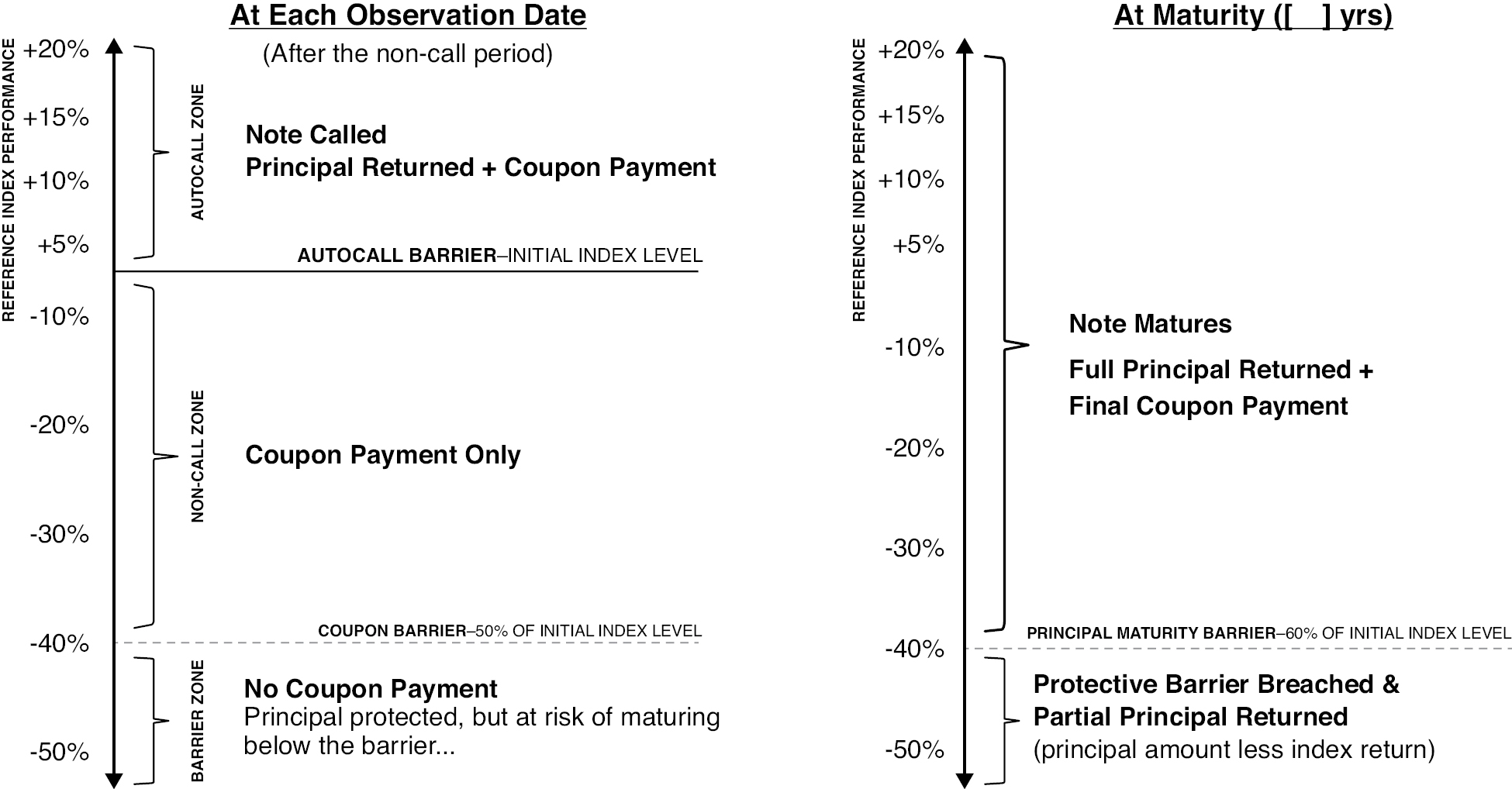
The chart below illustrates the “zones” each Autocallable may fall into at each observation date (after the non-call period) as well as at maturity (assuming the Autocallable is not called prior to maturity).
AT MONTHLY OBSERVATION DATE: As illustrated below, at each monthly observation date, the Autocallables in the Index Portfolio will fall within one of three zones, based on the performance of the Underlying Reference Index.
1. AUTOCALLABLE ZONE — Autocallables in this zone are called and the Autocallable’s principal + coupon are returned.
2. NON-CALL ZONE — Autocallables in this zone receive a coupon, but the Autocallable is not called.
3. BARRIER ZONE — Autocallables in this zone receive no coupon, but the Autocallable is not called. For Autocallables below the barrier, principal is still preserved, but is at risk if the Autocallable matures below the barrier.
AT MATURITY: It is anticipated that a majority of the Autocallables will be called prior to maturity. If the Underlying Reference Index is below the barrier at this point, some loss of principal may occur only on those Autocallables that are maturing. The laddered nature of the Autocallables helps diversify the risk of the entire Index Portfolio being tied to a single expiration date.
Additional Information Regarding the Fund’s Investments
The Fund’s investment approach centers on gaining exposure to a theoretical diversified portfolio of approximately 52 to 260 synthetic Autocallables using one or more Swap Agreements that reference the Autocallable Index. Each of these Autocallables is linked to the performance of the Underlying Reference Index, which dynamically adjusts its exposure to the IVES Index based on market volatility conditions. To efficiently implement this strategy, the Fund enters into one or more Swap Agreements with Swap Counterparties. These Swap Agreements reference the Autocallable Index, which is designed to reflect the aggregate performance of the entire Index Portfolio, allowing the Fund to gain comprehensive exposure to a theoretical portfolio of synthetic Autocallables through a single instrument. The returns on the Swap Agreements will be based on coupon payments and principal outcomes of the synthetic autocallables within the Autocallable Index. While the Autocallable Index follows systematic rules for maintenance and replacement, the Adviser actively oversees the Swap Counterparty exposure and creditworthiness, collateral management and optimization, the Fund’s overall portfolio risk characteristics as well as the execution quality and management of Swap Agreements.
Unfunded Total Return Swaps — A total return swap is a financial agreement between two parties where one party agrees to make a single payment or periodic payments to the other party based on a fixed or variable interest rate in exchange for a single payment or periodic payments based on the total return of an underlying asset, which includes both the income it generates and any capital gains or losses. Total return swaps also may be used as a means of obtaining exposure in markets where the reference asset is unavailable or it may otherwise be impossible or impracticable for the Fund to own that asset. “Total return” refers to the payment (or receipt) of the total return on the underlying reference asset, which is then exchanged for the receipt (or payment) of an interest rate. To the extent the total return of the underlying asset exceeds or falls short of the offsetting interest rate obligation, one party will receive a payment from or make a payment to the other party, as applicable. Total return swaps provide the Fund with the additional flexibility of gaining exposure to a market or sector index in a potentially more economical way. The use of total return swaps may add leverage to the Fund’s portfolio. An unfunded total return swap is a financial derivative contract where one party (the payer) agrees to make payments to the other party (the receiver) based on the total return of an underlying asset, such as a stock, bond, or index, without the payer needing to own the underlying asset. In return, the receiver pays a fixed or floating interest rate, often tied to a reference rate such as SOFR, to the payer. What makes it “unfunded” is that neither party initially posts the full value of the underlying asset, which reduces the need for upfront capital.
Instead, the swap is typically collateralized with the exchange of variation margin (and in some cases, initial margin) to mitigate counterparty risk. Essentially, the total return swap allows one party to gain exposure to the underlying asset’s economic performance (price appreciation and income) while the other party benefits from the interest payments and price depreciation of the underlying asset.
Box Spreads — A Box Spread is an offsetting set of options, which may include Flexible Exchange Options (“FLEX Options”). Box Spreads consist of a synthetic long position coupled with an offsetting synthetic short position through a combination of options contracts on a reference asset at the same expiration date. The synthetic long position consists of (i) buying a call option and (ii) selling a put option, each on the same reference asset and each with the same strike price and expiration date. The synthetic short position consists of (i) buying a put option and (ii) selling a call option, each on the same reference asset and each with the same expiration date as the synthetic long but with a different strike price from the synthetic long position. The difference between the strike prices of the synthetic long position and the synthetic short position determines the expiration value (or value at maturity) of the Box Spread. An important feature of the Box Spread construction process is that it seeks to eliminate market risk tied to price movements associated with the underlying options’ reference asset. Once the Box Spread is initiated, its return from the initiation date through expiration will not change due to price movements in the underlying options’ reference assets. The underlying reference asset for the options that make up the Box Spread is expected to be a broad based securities market index or an ETF that tracks such broad based securities market index.