The Fund’s investment objective is to produce capital appreciation with less risk than would be present in a portfolio of only common stocks.
This table describes the fees and expenses that you may pay if you buy, hold, and sell Fund shares. You may pay other fees, such as brokerage commissions and other fees to financial intermediaries, which are not reflected in this table and examples below.
(expenses that you pay each year as a percentage of the value of your investment) | |||||
Management Fees | 0.00% | ||||
Distribution (12b‑1) Fees | None | ||||
Other Expenses | 0.21% | ||||
Acquired Fund Fees and Expenses (AFFE) | 0.72% | ||||
Total Annual Fund Operating Expenses | 0.93%† | ||||
† The operating expenses in this fee table will not correlate to the expense ratio in the Fund’s financial statements (or the “Financial Highlights” section in the Prospectus) because the financial statements include only the direct operating expenses incurred by the Fund, not the indirect costs of investing in underlying funds.
This Example is intended to help you compare the cost of investing in the Fund with the cost of investing in other mutual funds. The Example assumes that you invest $10,000 in the Fund for the time periods indicated and then redeem or hold all of your shares at the end of those periods. The Example also assumes that your investment has a 5% return each year and that the Fund’s operating expenses remain the same.
1 Year | 3 Years | 5 Years | 10 Years | |
New Covenant Balanced Growth Fund | $95 | $296 | $515 | $1,143 |
1 Year | 3 Years | 5 Years | 10 Years | |
New Covenant Balanced Growth Fund | $95 | $296 | $515 | $1,143 |
The Fund pays transaction costs, such as commissions, when it buys and sells securities (or “turns over” its portfolio). A higher portfolio turnover rate may indicate higher transaction costs and may result in higher taxes when Fund shares are held in a taxable account. These costs, which are not reflected in annual Fund operating expenses or in the Example, affect the Fund’s performance. During the most recent fiscal year, the Fund’s portfolio turnover rate was 8% of the average value of its portfolio.
To pursue its objective, the Fund invests primarily in shares of the New Covenant Equity Fund (the “Equity Fund”) and the New Covenant Income Fund (the “Income Fund”), with a majority of its assets generally invested in shares of the Equity Fund.
Between 45% and 75% of the Fund’s net assets (with a “neutral” position of approximately 60% of the Fund’s net assets) are invested in shares of the Equity Fund, with the balance of its net assets invested in shares of the Income Fund or cash or cash equivalents.
The Fund will periodically rebalance its investments in the Equity Fund and the Income Fund, within the limits described above. In implementing this rebalancing strategy, past and anticipated future performance of both the Equity Fund and the Income Fund are taken into account. The allocation of investments made in the Equity Fund and the Income Fund varies in response to market conditions, investment outlooks, and risk/reward characteristics of equity and fixed income securities. Because the Fund is a fund-of-funds, you will indirectly bear your proportionate share of any fees and expenses charged by the Equity Fund and the Income Fund.
The Equity Fund invests in common stocks and other equity securities. The Equity Fund invests primarily in a diversified portfolio of equity securities of U.S. companies that are components of an index that represents broad exposure to the U.S. large cap equity market. The Equity Fund seeks generally to replicate the performance of the index, subject to such variation as may arise as a result of implementation of the social-witness principles established by the General Assembly of the Presbyterian Church (U.S.A.), as reflected in Guidelines put forth by the Committee on Mission Responsibility Through Investment (the “Presbyterian Principles”) discussed below.
The Income Fund invests in corporate bonds. The Income Fund also invests in securities issued or guaranteed by the U.S. Government or one of its agencies or instrumentalities, such as the Government National Mortgage Association (GNMA), which are supported by the full faith and credit of the U.S. Government, and the Federal National Mortgage Association (FNMA) and the Federal Home Loan Mortgage Corporation (FHLMC), which are supported by the right of the issuer to borrow from the U.S. Treasury. The Income Fund may also invest, to a lesser extent, in bonds of international corporations or foreign governments. In addition, the Income Fund invests in mortgage-backed and asset-backed securities and may enter into fully-collateralized repurchase agreements. The Income Fund may also invest up to 20% of its net assets in commercial paper and up to 40% of its net assets in fixed income securities of foreign issuers in any country, including developed or emerging markets. The remainder of the Income Fund’s assets may be held in cash or cash equivalents.
At least 65% of the Income Fund’s net assets will be invested in bonds that are rated within the four highest credit rating categories assigned by independent rating agencies, and the Income Fund will attempt to maintain an overall credit quality rating of AA or higher based on ratings assigned by nationally recognized statistical rating organizations, calculated on a weighted basis. The Income Fund may invest in unrated equivalents that may be considered to be investment grade, as determined by the Fund’s Sub-Advisers. The Income Fund may invest up to 20% of its net assets in bonds that are rated below investment grade (junk bonds).
The Equity Fund and the Income Fund, in which the Fund invests, seeks to invest consistent with the Presbyterian Principles. The Fund seeks to avoid investing in companies involved in tobacco, for-profit prisons, and some companies related to weapons production, antipersonnel land mines, handguns and assault weapons, or for environmental reasons. In addition, at times a company involved in serious human rights
violations may also be screened out of the Fund. The Fund may also screen out other issuers when deemed appropriate to implement the Presbyterian Principles.
The bar chart and the performance table below provide some indication of the risks of investing in the Fund by showing changes in the Fund’s performance from year to year for the past ten calendar years and by showing how the Fund’s average annual returns for 1, 5 and 10 years compared with those of broad measures of market performance. The Fund’s past performance (before and after taxes) is not necessarily an indication of how the Fund will perform in the future. Updated performance information is available on the Fund’s website at www.NewCovenantFunds.com or by calling the Fund toll-free at 877‑835‑4531.
Best Quarter: 14.51% (06/30/20) Worst Quarter: ‑12.25% (03/31/20) The Fund’s total return (pre-tax) from January 1, 2026 to September 30, 2026 was 5.87%. |
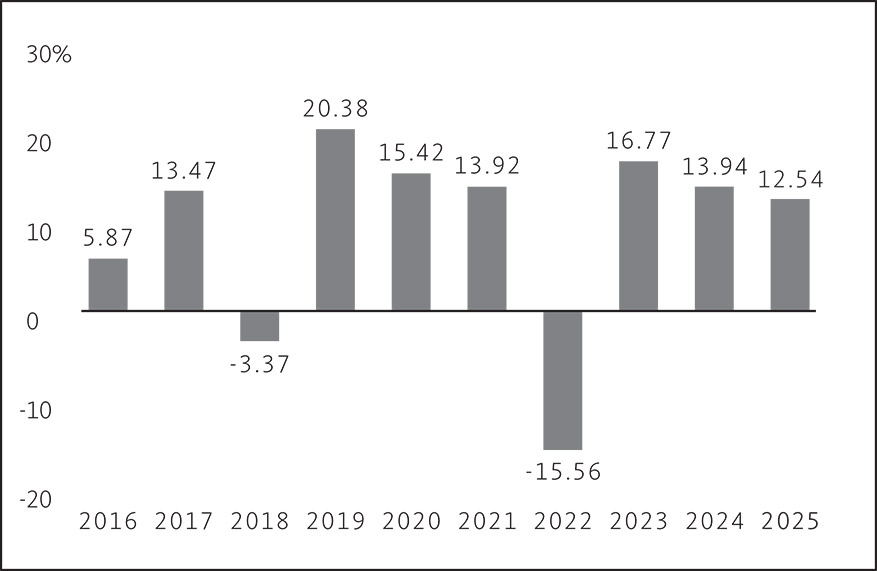
Best Quarter: 14.51% (06/30/20)
Worst Quarter: ‑12.25% (03/31/20)
The Fund’s total return (pre-tax) from January 1, 2026 to September 30, 2026 was 5.87%.
This table compares the Fund’s average annual total returns to those of the Russell 3000 Index Return (a broad-based securities market index), and two additional indexes with characteristics relevant to the Fund’s investment strategy. The Fund’s additional indexes are the Bloomberg Intermediate U.S. Aggregate Bond Index and the Fund’s blended benchmark that is composed of the Russell 3000 Index and the Bloomberg Intermediate U.S. Aggregate Bond Index weighted 60%/40%.
After-tax returns are calculated using the historical highest individual federal marginal income tax rates and do not reflect the impact of state and local taxes. Your actual after-tax returns will depend on your tax situation and may differ from those shown. After-tax returns shown are not relevant to investors who hold their Fund shares through tax-deferred arrangements, such as 401(k) plans or individual retirement accounts.
New Covenant Balanced Growth Fund | 1 Year | 5 Years | 10 Years | |||||
Fund Return Before Taxes | 12.54 | % | 7.57 | % | 8.79 | % | ||
Fund Return After Taxes on Distributions | 9.98 | % | 6.04 | % | 7.33 | % | ||
Fund Return After Taxes on Distributions and Sale of Fund Shares | 8.72 | % | 5.61 | % | 6.72 | % | ||
Russell 3000 Index Return (reflects no deduction for fees, expenses or taxes) | 17.15 | % | 13.15 | % | 14.29 | % | ||
Bloomberg Intermediate U.S. Aggregate Bond Index (reflects no deduction for fees, | 7.45 | % | 0.68 | % | 2.06 | % | ||
Blended 60% Russell 3000 Index/ 40% Bloomberg Intermediate U.S. Aggregate Bond Index | 13.35 | % | 8.22 | % | 9.53 | % | ||