The Fund’s investment objective is a high level of current income with preservation of capital.
This table describes the fees and expenses that you may pay if you buy, hold, and sell Fund shares. You may pay other fees, such as brokerage commissions and other fees to financial intermediaries, which are not reflected in this table and examples below.
(expenses that you pay each year as a percentage of the value of your investment) | ||||
Management Fees | 0.42% | |||
Distribution (12b‑1) Fees | None | |||
Other Expenses | 0.55% | |||
Total Annual Fund Operating Expenses | 0.97% | |||
This Example is intended to help you compare the cost of investing in the Fund with the cost of investing in other mutual funds. The Example assumes that you invest $10,000 in the Fund for the time periods indicated and then redeem or hold all of your shares at the end of those periods. The Example also assumes that your investment has a 5% return each year and that the Fund’s operating expenses remain the same.
1 Year | 3 Years | 5 Years | 10 Years | |
New Covenant Income Fund | $99 | $309 | $536 | $1,190 |
1 Year | 3 Years | 5 Years | 10 Years | |
New Covenant Income Fund | $99 | $309 | $536 | $1,190 |
The Fund pays transaction costs, such as commissions, when it buys and sells securities (or “turns over” its portfolio). A higher portfolio turnover rate may indicate higher transaction costs and may result in higher taxes when Fund shares are held in a taxable account. These costs, which are not reflected in annual Fund operating expenses or in the Example, affect the Fund’s performance. During the most recent fiscal year, the Fund’s portfolio turnover rate was 285% of the average value of its portfolio.
Under normal market conditions, at least 80% of the Fund’s net assets will be invested in a diversified portfolio of bonds and other debt obligations of varying maturities. Due to its investment strategy, the Fund may buy and sell securities and other instruments frequently.
The Fund seeks to invest consistent with social-witness principles established by the General Assembly of the Presbyterian Church (U.S.A.), as reflected in Guidelines put forth by the Committee on Mission Responsibility Through Investment (the “Presbyterian Principles”). The Fund seeks to avoid investing in companies involved in tobacco, for-profit prisons, and some companies related to weapons production, antipersonnel land mines, handguns and assault weapons, or for environmental reasons. In addition, at times a company involved in serious human rights violations may also be screened out of the Fund. The Fund may also screen out other issuers when deemed appropriate to implement the Presbyterian Principles.
The Fund invests in corporate bonds. The Fund also invests in securities issued or guaranteed by the U.S. Government or one of its agencies or instrumentalities, such as the Government National Mortgage Association (GNMA), which are supported by the full faith and credit of the U.S. Government, and the Federal National Mortgage Association (FNMA) and the Federal Home Loan Mortgage Corporation (FHLMC), which are supported by the right of the issuer to borrow from the U.S. Treasury. The Fund may also invest in bonds of international corporations or foreign governments. In addition, the Fund invests in mortgage-backed securities (including To Be Announced Securities and Dollar Rolls) and asset-backed securities and may enter into fully-collateralized repurchase agreements.
At least 65% of the Fund’s net assets will be invested in bonds that are rated within the four highest credit rating categories assigned by independent rating agencies, and the Fund will attempt to maintain an overall credit quality rating of AA or higher based on ratings assigned by nationally recognized statistical rating organizations, calculated on a weighted basis. The Fund may invest in unrated equivalents that may be considered to be investment grade, as determined by the Fund’s Sub-Advisers. The Fund may invest up to 20% of its net assets in bonds that are rated below investment grade (junk bonds).
Up to 20% of the Fund’s net assets may be invested in commercial paper within the two highest rating categories of independent rating agencies. The Fund may also invest up to 40% of its net assets in the fixed income securities of foreign issuers in any country, including developed or emerging markets. Foreign securities are selected on an individual basis without regard to any defined allocation among countries or geographic regions.
SEI Investments Management Corporation (“SIMC” or the “Adviser”) seeks to enhance performance and reduce market risk by strategically allocating the Fund’s assets among multiple sub-advisers (each, a “Sub-Adviser” and collectively, the “Sub-Advisers”). Sub-Advisers are selected for their experience in managing various kinds of fixed income securities, and each Sub-Adviser makes investment decisions based on an analysis of yield trends, credit ratings and other factors in its area of emphasis.
The Fund may invest in securities of any maturity, but expects its average maturity to range from four years to twelve years and its average duration to be between three and six years. Duration reflects the change in the value of a fixed income security that will result from a 1% change in interest rates. For example, a five year duration means a bond will decrease in value by 5% if interest rates rise 1% and increase in value by 5% if interest rates fall 1%.
The Fund may also invest in futures contracts (including futures on U.S. Treasury obligations and Eurodollar instruments), put and call options (including options on futures contracts), and swaps (including credit default swaps) for speculative or hedging purposes. Futures, options and swaps are used to synthetically obtain exposure to securities or baskets of securities and to manage the Fund’s interest rate duration and yield curve exposure. These derivatives are also used to mitigate the Fund’s overall level of risk and/or the Fund’s risk to particular types of securities, currencies or market segments.
Investments for the Fund, both foreign and domestic, are selected based on the following criteria:
— the use of interest-rate and yield-curve analyses;
— the use of credit analyses, which indicate a security’s rating and potential for appreciation; and
— use of the above disciplines to invest in high-yield bonds and fixed income securities issued by foreign and domestic governments and companies.
The remainder of the Fund’s assets may be held in cash or cash equivalents.
A Sub-Adviser may sell a security when it becomes substantially overvalued, is experiencing deteriorating fundamentals, or as a result of changes in portfolio strategy. A security may also be sold and replaced with one that presents a better value.
Subject to the Presbyterian Principles and the investment criteria detailed above, the Fund’s Sub-Advisers will also consider environmental, social, and governance (ESG) criteria in the selection of securities for the Fund’s portfolio, which may include (among other items) consideration of issuers’ business models, corporate governance policies, stakeholder relationships and history of controversies. Each Sub-Adviser has the ability to consider its own ESG criteria based on its own ESG methodologies and assessments or those of third-party providers. The consideration of such ESG criteria as part of the decision-making process may result in the selection of individual securities that are not in the Fund’s benchmark, or the overweighting or underweight of individual securities relative to the benchmark.
The bar chart and the performance table below provide some indication of the risks of investing in the Fund by showing changes in the Fund’s performance from year to year for the past ten calendar years and by showing how the Fund’s average annual returns for 1, 5 and 10 years compared with those of a broad measure of market performance. The Fund’s past performance (before and after taxes) is not necessarily an indication of how the Fund will perform in the future. Updated performance information is available on the Fund’s website at www.NewCovenantFunds.com or by calling the Fund toll-free at 877‑835‑4531.
Best Quarter: 5.46% (12/31/23) Worst Quarter: ‑5.26% (03/31/22) The Fund’s total return (pre-tax) from January 1, 2026 to September 30, 2026 was -2.56%. |
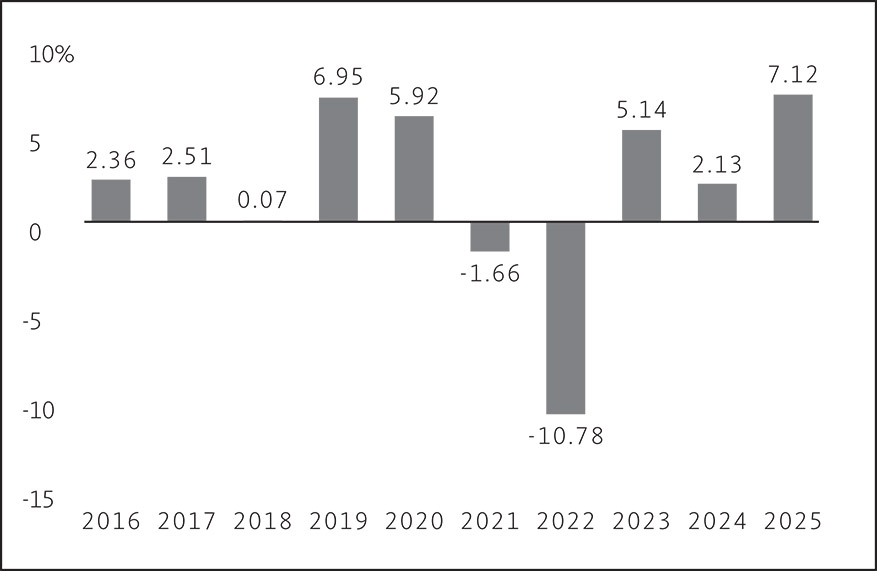
Best Quarter: 5.46% (12/31/23)
Worst Quarter: ‑5.26% (03/31/22)
The Fund’s total return (pre-tax) from January 1, 2026 to September 30, 2026 was -2.56%.
This table compares the Fund’s average annual total returns to those of a broad-based securities market index and an additional index with characteristics relevant to the Fund’s investment strategy.
After-tax returns are calculated using the historical highest individual federal marginal income tax rates and do not reflect the impact of state and local taxes. Your actual after-tax returns will depend on your tax
situation and may differ from those shown. After-tax returns shown are not relevant to investors who hold their Fund shares through tax-deferred arrangements, such as 401(k) plans or individual retirement accounts.
New Covenant Income Fund | 1 Year | 5 Years | 10 Years | |||||
Fund Return Before Taxes | 7.12 | % | 0.18 | % | 1.84 | % | ||
Fund Return After Taxes on Distributions | 5.70 | % | ‑0.88 | % | 0.81 | % | ||
Fund Return After Taxes on Distributions and Sale of Fund Shares | 4.19 | % | ‑0.32 | % | 0.97 | % | ||
Bloomberg U.S. Aggregate Bond Index (reflects no deduction for fees, expenses or taxes) | 7.30 | % | ‑0.36 | % | 2.01 | % | ||
Bloomberg Intermediate U.S. Aggregate Bond Index (reflects no deduction | 7.45 | % | 0.68 | % | 2.06 | % | ||