Exhibit 99.1
ANNUAL INFORMATION FORM
For the Fiscal Year Ended July 31, 2026
October 28, 2026
Table of Contents
| ITEM 1. | CORPORATE STRUCTURE | 13 |
| ITEM 2. | GENERAL DEVELOPMENT OF THE BUSINESS | 14 |
| ITEM 3. | DESCRIPTION OF THE BUSINESS | 20 |
| ITEM 4. | RISK FACTORS | 32 |
| ITEM 5. | DIVIDENDS or Distributions | 51 |
| ITEM 6. | DESCRIPTION OF CAPITAL STRUCTURE | 52 |
| ITEM 7. | MARKET FOR SECURITIES | 56 |
| ITEM 8. | ESCROWED SECURITIES AND SECURITIES SUBJECT TO CONTRACTUAL RESTRICTIONS ON TRANSFER | 58 |
| ITEM 9. | DIRECTORS AND OFFICERS | 60 |
| ITEM 10. | PROMOTERS | 64 |
| ITEM 11. | LEGAL PROCEEDINGS AND REGULATORY ACTIONS | 65 |
| ITEM 12. | INTEREST OF MANAGEMENT AND OTHERS IN MATERIAL TRANSACTIONS | 65 |
| ITEM 13. | TRANSFER AGENTS AND REGISTRARS | 65 |
| ITEM 14. | MATERIAL CONTRACTS | 65 |
| ITEM 15. | INTERESTS OF EXPERTS | 66 |
| ITEM 16. | ADDITIONAL INFORMATION | 66 |
| SCHEDULE A | 69 |
| AUDIT COMMITTEE CHARTER | 69 |
GLOSSARY
Unless otherwise indicated, whenever used in this AIF, the following words and terms have the indicated meanings. Words importing the singular, where the context requires, include the plural and vice versa and words importing any gender includes all genders.
“AcquireCo” means Cizzle Brands Acquisition Inc., a corporation incorporated under the CBCA and an indirect wholly owned subsidiary of the Company.
“Acquisition” means the indirect acquisition by the Company, through AcquireCo, of all of the issued and outstanding shares of Flow Water Inc. (now CBMI) from the Vendor, which was completed on the Acquisition Date pursuant to the Share Purchase Agreement.
“Acquisition Date” means December 23, 2025, being the date on which the Acquisition was completed.
“AIF” means this annual information form of the Company for the fiscal year ended July 31, 2026.
“Annual Financial Statements” means the audited consolidated financial statements of the Company as at and for the fiscal year ended July 31, 2026, together with the notes thereto and the independent auditor’s report thereon.
“Ascent” means Ascent Partners Fund LLC.
“Ascent Note” means the senior secured convertible promissory note in the principal amount of US$6,720,867.21 issued by the Company to Ascent on May 5, 2026.
“Base Shelf Prospectus” means the short form base shelf prospectus of the Company dated October 7, 2025, qualifying the distribution of up to $150,000,000 of securities of the Company during the 25-month period following the date of that prospectus.
“BCBCA” means the Business Corporations Act (British Columbia), as amended from time to time.
“Board” means the board of directors of the Company.
“BrandCo” means Flow Canada LLC, an affiliate of the Vendor to which the Excluded Assets were transferred under the Pre-Closing Reorganization, and which continues to operate the Flow brand.
“CBCA” means the Canada Business Corporations Act, as amended from time to time.
“CBI” means Cizzle Brands Inc., a corporation incorporated under the laws of Canada.
“CBMI” means Cizzle Brands Manufacturing Inc., a corporation incorporated under the CBCA and an indirect wholly owned subsidiary of the Company, formerly named Flow Water Inc.
“Cboe Canada” means Cboe Canada Inc.
“CEO” means Chief Executive Officer.
“CFO” means Chief Financial Officer.
“Cizzle” or the “Company” means Cizzle Brands Corporation, formerly 1348512 B.C. Ltd., a company existing under the laws of the Province of British Columbia.
“Common Shares” means common shares in the authorized share structure of the Company, and each a “Common Share”.
Page 1
“Contracted Minimum Revenue” means the minimum payments that customers of the Manufacturing Business will be required to make under the take-or-pay provisions of their manufacturing agreements, whether or not they purchase their contracted volumes.
“Credit Agreement” means the credit agreement dated December 23, 2025 among AcquireCo, as borrower, 17550154 Canada Inc., as parent guarantor, the other guarantors party thereto, OIC, as administrative agent and collateral agent, and the lenders party thereto.
“Credit Facility” means the senior secured term loan credit facility established under the Credit Agreement.
“eCapital” means eCapital Asset Based Lending Corp.
“eCapital Facility” means the secured revolving credit facility, with borrowing limits of $4,000,000 and US$850,000, established in favour of the Company by eCapital in August 2025.
“Escrow Agent” means Odyssey Trust Company, in its capacity as escrow agent under the Escrow Agreement.
“Escrow Agreement” means the escrow agreement among the Company, the Principals and Odyssey Trust Company.
“Excluded Assets” means the assets relating to the marketing and distribution business of Flow Water Inc. and the associated branding and intellectual property, including the Flow brand and related trademarks, each of which was transferred to the Vendor or its affiliates under the Pre-Closing Reorganization and none of which was acquired by the Company.
“Facility” means the two adjacent leased industrial properties in Aurora, Ontario at which the Manufacturing Business is carried on, now known as The CWENCH Hydration Factory.
“Fattore Glen” means Fattore Glen Investments Ltd.
“Flow Agreement” means the non-exclusive manufacturing agreement between Flow Water Inc. (now CBMI) and CBI dated March 13, 2024, which became an intercompany arrangement on completion of the Acquisition.
“Flow Beverage” means Flow Beverage Corp.
“GAAP” means generally accepted accounting principles.
“IFRS” means IFRS Accounting Standards as issued by the International Accounting Standards Board.
“Interim Financial Statements” means the unaudited condensed consolidated interim financial statements of the Company as at and for the three and nine months ended April 30, 2026, together with the notes thereto.
“K2” means The K2 Principal Fund L.P.
“Legacy Option Plan” means the stock option plan of Target, as may be amended from time to time.
“LIFE Offering” means the sale, as part of the US Offering, of up to 902,527 Common Shares on a post-Share Consolidation basis by the Company to purchasers in Canada, other than Québec, at an assumed price of US$5.54 per Common Share, with the final price to be the price set under the US Offering, for aggregate gross proceeds of up to US$5,000,000 pursuant to the listed issuer financing exemption from Canadian prospectus requirements under Part 5A of National Instrument 45-106 – Prospectus Exemptions, as modified by Coordinated Blanket Order 45-935.
Page 2
“LIFE Offering Document” means the offering document of the Company dated October 23, 2026 filed under Part 5A of National Instrument 45-106 – Prospectus Exemptions in respect of the LIFE Offering.
“Manufacturing Business” means the Tetra Pak beverage co-manufacturing and production services business carried on by CBMI at the Facility, which the Company acquired under the Acquisition.
“MD&A” means management’s discussion and analysis.
“Nasdaq” means The Nasdaq Stock Market LLC.
“NI 51-102” means National Instrument 51-102 – Continuous Disclosure Obligations.
“NI 52-110” means National Instrument 52-110 – Audit Committees.
“NFS” means NFS Leasing Canada Ltd., an affiliate of the Vendor.
“NFS Promissory Note” means the promissory note of a subsidiary of the Company held by NFS.
“Nutrablend Agreement” means the non-exclusive manufacturing agreement dated February 22, 2024 between NBF Holdings Canada Inc. and CBI.
“OBCA” means the Business Corporations Act (Ontario) as amended from time to time.
“Offering” means the US Offering, including the LIFE Offering.
“OIC” means OIC Investment Agent, LLC, in its capacity as administrative agent and collateral agent under the Credit Agreement, and the lenders from time to time party to the Credit Agreement, as the context requires.
“Omnibus Plan” means the equity incentive compensation plan of the Company adopted by the Board on December 19, 2024, as amended from time to time.
“Pre-Closing Reorganization” means the series of transactions completed by Flow Water Inc. immediately before the Acquisition Date under which the Excluded Assets were transferred to the Vendor or its affiliates, including BrandCo.
“Prospectus Supplement” means the preliminary prospectus supplement to the Base Shelf Prospectus dated October 26, 2026, as amended or supplemented, relating to the distribution of Common Shares under the US Offering.
“Receiver” means Richter Inc., in its capacity as receiver of Flow Beverage and certain of its subsidiaries, including Flow Water Inc.
“Registration Statement” means the registration statement of the Company on Form F-10 (File No. 333-298427) filed with the SEC on August 19, 2026 under the multijurisdictional disclosure system adopted by the SEC and the Canadian securities regulatory authorities.
“RVO” means the reverse vesting order of the Ontario Superior Court of Justice (Commercial List) granted on October 7, 2025, under which the Vendor indirectly acquired all of the issued and outstanding shares of Flow Water Inc.
“SEC” means the United States Securities and Exchange Commission.
Page 3
“Share Consolidation” means the proposed consolidation of the Common Shares on the basis of one post-consolidation Common Share for every 25 pre-consolidation Common Shares, to be effected in connection with the closing of the Offering.
“Share Purchase Agreement” means the share purchase agreement dated December 23, 2025 among AcquireCo, the Vendor and the Company, under which the Company indirectly acquired all of the issued and outstanding shares of Flow Water Inc.
“Spun-Out Business” means the marketing and distribution business associated with the Excluded Assets, which BrandCo carries on under the Flow brand.
“Subco” means 1001070471 Ontario Inc.
“Target” means Harbour Mission Co. Ltd.
“Transition Services Agreement” means the transition services agreement dated December 23, 2025 among the Company, AcquireCo and BrandCo.
“Underwriters” means Joseph Gunnar & Co., LLC, as lead underwriter, and D. Boral Capital LLC.
“US Offering” means the proposed initial underwritten public offering of between 2,439,024 and 3,048,780 Common Shares on a post-Share Consolidation basis by the Company at a price of between US$4.92 and US$6.15 per Common Share for aggregate gross proceeds of not less than US$15,000,000, including the LIFE Offering, under the Prospectus Supplement and the Registration Statement.
“Offering Closing Date” means the date on which the Offering is completed, which is expected to be on or about October 30, 2026.
“Vendor” means RI Flow Sub LLC, a Delaware limited liability company.
“VHCS” means Van Houtte Coffee Services, a subsidiary of Keurig Dr Pepper.
“VTB Note” means the secured promissory note in the principal amount of C$22,250,000 issued by AcquireCo to the Vendor on the Acquisition Date in partial satisfaction of the purchase price payable under the Share Purchase Agreement, as amended.
“Warrants” means warrants to purchase Common Shares of the Company.
Page 4
ABOUT THIS ANNUAL INFORMATION FORM
All dollar amounts referred to in this AIF are stated in Canadian dollars, unless otherwise indicated. The Company prepares its financial statements in accordance with IFRS. References to “C$” are to Canadian dollars and references to “US$” are to United States dollars.
The information in this AIF is presented as at October 28, 2026 unless otherwise indicated.
In this AIF, unless the context otherwise requires, the “Company” refers to Cizzle Brands Corporation and its subsidiaries.
The Share Consolidation had not been effected as at the date of this AIF. Unless otherwise indicated, all references in this AIF to numbers of Common Shares, to securities convertible into or exercisable for Common Shares and to per share amounts are stated on a pre-Share Consolidation basis. See “Description of Capital Structure – Share Consolidation”.
Market Data
Unless otherwise indicated, market data and certain industry data and forecasts included in this AIF concerning the industry of the Company and the markets in which it operates including its general expectations, legislative regime and market opportunity, is based on information from industry publications and reports generated by several third parties and management estimates. Unless otherwise indicated, management estimates are derived from publicly available information released by independent industry analysts and third-party sources, as well as data from the Company’s internal research, and are based on assumptions made by the Company based on such data and its knowledge of such industry and markets, which the Company believes to be reasonable. These industry publications and reports generally indicate that the information contained therein was obtained from sources believed to be reliable, but do not guarantee the accuracy and completeness of such information. The Company has not independently verified the data in such publications, reports or resources, and such information is inherently imprecise. In addition, projections, assumptions and estimates of the Company’s future performance and the future performance of the industry in which the Company operates are necessarily subject to a high degree of uncertainty and risk due to a variety of factors, including those described under “Forward-Looking Statements” and “Risk Factors” in this AIF. While the Company believes its internal business research is reliable and market definitions are appropriate, neither such research nor definitions have been verified by any independent source. While the Company is not aware of any misstatement regarding any industry or government data presented herein, the industry involves risks and uncertainties that are subject to change based on various factors.
FORWARD-LOOKING STATEMENTS
This AIF includes “forward-looking information” and “forward-looking statements” within the meaning of applicable Canadian securities laws. All information, other than statements of historical facts, included in this AIF that addresses activities, events or developments that the Company expects or anticipates will or may occur in the future is forward-looking information. Forward-looking information is often identified by the words “may”, “would”, “could”, “should”, “will”, “intend”, “plan”, “anticipate”, “believe”, “estimate”, “expect” or similar expressions and includes, among others, information regarding:
| · | future products and services; |
| · | expansion to product distribution; |
| · | the Company’s growth; |
| · | marketing and business plans and short-term objectives; |
| · | the intention to grow the business, operations and potential activities of the Company; |
Page 5
| · | revenue; |
| · | use of available funds; |
| · | business milestones and objectives; |
| · | the protection of intellectual property; |
| · | exploration of new products and opportunities; |
| · | future risks to operations; |
| · | the Company’s business objectives; |
| · | the Company’s expectations regarding its business, financial condition and results of operations |
| · | future market share; |
| · | intent to build or acquire manufacturing facilities; |
| · | the expected contribution, ramp-up and profitability of the Manufacturing Business and of the Company’s combined branded and manufacturing operating model; |
| · | the approximately C$184 million of remaining contracted customer production volume at the Acquisition Date and the related Contracted Minimum Revenue, and the timing and amount of revenue the Company expects to realize from co-manufacturing and toll manufacturing; |
| · | production capacity, capacity utilization, production efficiency, overhead absorption and unit cost at the Facility; |
| · | the realization of integration benefits, synergies and operating leverage from the Acquisition; |
| · | the retention and performance of the customers of the Manufacturing Business and the renewal or extension of their agreements; |
| · | the completion of the Offering, the use of its net proceeds, the completion of the Share Consolidation and the listing of the Common Shares on Nasdaq; |
| · | the repayment, amendment, conversion, extension or refinancing of the Company’s indebtedness, including the VTB Note, the Credit Facility and the Ascent Note; |
| · | the Company’s anticipated operating cash requirements and future financing needs; |
| · | the outcome of legal proceedings and regulatory matters involving the Company; |
| · | the effects of tariffs implemented between Canada, the United States and other countries; |
| · | strategic plans; and |
| · | strategic relationships with third parties. |
Page 6
These statements reflect the Company’s current views with respect to future events and are based on assumptions and subject to a number of risks and uncertainties, some of which are unknown at this time. Certain assumptions made in preparing the forward-looking statements contained in this AIF include:
| · | the Company’s ability to meet its obligations as they become due; |
| · | the Company’s ability to implement its growth strategies; |
| · | the Company’s competitive advantages; |
| · | the development of new products and product formats for the Company’s products; |
| · | the Company’s ability to manage any indebtedness as required; |
| · | the Company’s ability to obtain and maintain financing or to re-finance existing indebtedness on acceptable terms, as necessary; |
| · | the impact of competition; |
| · | changes and trends in the beverage industry and markets; |
| · | changes in laws, rules and regulations; |
| · | the Company’s ability to maintain and renew required licences; |
| · | the Company’s ability to maintain good business relationships with its customers, distributors and other strategic partners; |
| · | the Company’s ability to keep pace with changing consumer preferences; |
| · | the Company’s ability to protect intellectual property; |
| · | the Company’s ability to retain key personnel; |
| · | the Company’s ability to integrate the Manufacturing Business and to operate the Facility at planned levels of capacity and cost; |
| · | performance by the customers of the Manufacturing Business of their take-or-pay and other contractual obligations; |
| · | the Company’s ability to repay, extend, convert or refinance the VTB Note and its other indebtedness as it becomes due; |
| · | the receipt of all regulatory and stock exchange approvals required for the Offering, the Share Consolidation and the Nasdaq listing; |
| · | the continued availability of the Credit Facility and the eCapital Facility on their existing terms; |
| · | The absence of material adverse changes in the industry and in Canadian, US or global economies including respect of tariffs and trade; |
| · | The Company’s future business performance; |
| · | The demand for the Company’s products; and |
| · | The conditions of the markets that the Company’s serves. |
Although the Company believes that the assumptions underlying its statements are reasonable, they may prove to be incorrect. Given these risks, uncertainties and assumptions, investors should not place undue reliance on the forward-looking information.
Page 7
The purpose of forward-looking information is to provide the reader with a description of management’s expectations, and such forward-looking information may not be appropriate for any other purpose. In particular, but without limiting the foregoing, disclosure in this AIF under “Description of the Business” as well as statements regarding the Company’s objectives, plans and goals, including future operating results and economic performance may make reference to or involve forward-looking information. Although the Company believes that the expectations reflected in such forward-looking information are reasonable, it can give no assurance that such expectations will prove to have been correct.
While the Company believes its plans, intentions and expectations reflected in the forward-looking information are reasonable, it cannot assure you that these plans, intentions or expectations will be achieved. The Company’s actual results, performance or achievements could differ materially from those contemplated, expressed or implied by the forward-looking information relating to the Company contained in this AIF as a result of various factors, including the risks, uncertainties and assumptions discussed under “Risk Factors”, which include, but are not limited to, the following:
| · | Ability to achieve and manage growth; |
| · | Failure to effectively expand sales capabilities could harm the Company’s ability to increase distribution and achieve broader market acceptance of its products; |
| · | The Company may need additional financing in the future, which may not be available when needed or may be costly and dilutive; |
| · | Changes in consumer preferences may reduce demand for some of the Company’s products; |
| · | The Company’s brand and image are keys to its business and any inability to maintain a positive brand image could have a material adverse effect on its results of operations; |
| · | The Company may be adversely impacted by the effects of high or prolonged inflation; |
| · | Competition from traditional and large, well-financed non-alcoholic beverage manufacturers may adversely affect the Company’s distribution relationships and may hinder development of its existing markets, as well as prevent the Company from expanding its markets; |
| · | The Company competes in an industry characterized by rapid changes in consumer preferences and public perception, so its ability to continue developing new products to satisfy the changing preferences of consumers will determine its long-term success; |
| · | The Company’s reliance on distributors, retailers and brokers could affect its ability to efficiently and profitably distribute and market its products, maintain its existing markets and expand its business into other geographic markets; |
| · | The Company incurs significant time and expense in attracting and maintaining key distributors; |
| · | If the Company loses any of its key distributors or national retail accounts, its financial condition and results of operations could be adversely affected; |
| · | It is difficult to predict the timing and amount of sales because most distributors and retailers are not required to place minimum orders with the Company; |
| · | If the Company does not adequately manage its inventory levels, its operating results could be adversely affected; |
Page 8
| · | If the Company fails to maintain relationships with its independent contract manufacturers, its business could be harmed; |
| · | The Company’s dependence on independent contract manufacturers could make management of its manufacturing and distribution efforts inefficient or unprofitable; |
| · | The Company relies upon its ongoing relationships with its key flavour suppliers. If the Company is unable to source its flavours on acceptable terms from its key suppliers, the Company could suffer disruptions in its business; |
| · | Criticism of the packaged beverage market generally could adversely affect the Company’s operating results; |
| · | If the Company is unable to maintain brand image or product quality, its business could suffer; |
| · | Increased competition could hurt the Company’s business; |
| · | Consolidation of retailers, wholesalers and distributors and the dominant position of a limited number of key players in the industry may result in downward pressure on sales prices; |
| · | The Company’s failure to accurately estimate demand for its products could adversely affect its business and financial results; |
| · | If the Company fails to obtain and retain high-visibility sponsorship or endorsement arrangements with celebrities, or if the reputation of any of the celebrities that the Company partners with is impaired, the business of the Company may suffer; |
| · | The Company’s distributors and vendors are material to the Company’s success. If the Company is unable to maintain good relationships with its existing distributors and vendors, its business could suffer; |
| · | Changing retail landscape could hurt the Company’s business; |
| · | Incorrect product design or development could hurt the Company’s business; |
| · | Product information misrepresentations could happen and may adversely affect the Company’s business; |
| · | The Company relies on third party distributors and other logistics providers; |
| · | The Company relies on key inputs; |
| · | The Company’s success relies on its quality control systems; |
| · | The Company is subject to risks and uncertainty regarding future product development; |
| · | Risks related to the Company’s human capital; |
| · | Increases in costs and/or shortages of raw materials and/or ingredients and/or fuel could harm the Company’s business; |
| · | Fluctuation of quarterly operating results; |
| · | No assurance of profitability; |
| · | Fluctuations in foreign currency exchange rates may adversely affect the Company’s operating results; |
| · | Significant changes in government regulation may hinder sales; |
Page 9
| · | Contamination or recalls of the Company’s ingredients or end products could adversely affect its business; |
| · | The Company’s intellectual property rights are critical to the Company’s success, and the loss of such rights could materially adversely affect its business; |
| · | Litigation or legal proceedings could expose the Company to significant liabilities and thus negatively affect its financial results; |
| · | Future effective tax rates could be subject to volatility or adversely affected by a number of factors; |
| · | Catastrophic events could impact the Company’s operations and affect the Company’s ability to grow its business; |
| · | Climate change may negatively affect the Company’s business; |
| · | The Company’s business is seasonal and adverse weather conditions could negatively affect its business; |
| · | The Company depends on key information systems and third-party service providers; |
| · | If the Company is unable to securely maintain its customers’ confidential or credit card information, or other private data relating to the Company or its employees, the Company could be subject to negative publicity, costly government enforcement actions or private litigation, which could damage its business reputation and negatively affect its results of operations; |
| · | The Company must continually maintain and/or upgrade its information technology systems; |
| · | Conflicts of interest; |
| · | Potential volatility of share price; |
| · | No assurance of active market for shares; |
| · | Dividends; |
| · | A return on the Company’s securities is not guaranteed; |
| · | Global financial conditions; |
| · | Future sales of common shares by existing shareholders; |
| · | Additional issuances and dilution; |
| · | Publication of inaccurate or unfavourable research and reports; |
| · | There are costs associated with maintaining a public listing; |
| · | The Company has a history of losses and negative operating cash flow, and there is a material uncertainty that may cast significant doubt on its ability to continue as a going concern; |
Page 10
| · | The Company has substantial indebtedness, and the agreements governing that indebtedness contain restrictive covenants and events of default; |
| · | The Company may not be able to repay, extend or refinance the VTB Note at maturity; |
| · | Risks relating to the Acquisition, including undisclosed liabilities, the incomplete historical financial records of the Manufacturing Business, integration risk and the failure to realize the anticipated benefits of the Acquisition; |
| · | Revenue of the Manufacturing Business is concentrated in a small number of customers; |
| · | The Manufacturing Business is carried on at a single leased facility; |
| · | The Manufacturing Business depends on the maintenance of licences, registrations and certifications; |
| · | The Company may not complete the Offering or obtain or maintain a listing of the Common Shares on Nasdaq; |
| · | The Share Consolidation may not have the intended effect on the market price of the Common Shares; |
| · | The Company is a foreign private issuer and may cease to qualify as such; |
| · | The conversion or exercise of the Company’s outstanding convertible securities will dilute existing shareholders; |
| · | The Company is exposed to interest rate risk; |
| · | The Company may fail to maintain effective internal control over financial reporting; |
| · | The Company’s insurance may be insufficient; |
| · | A product recall or food safety incident at the Facility could expose the Company to liability; and |
| · | The Company’s relationship with the Vendor gives rise to potential conflicts. |
These risks, uncertainties, assumptions and other factors could cause the Company’s actual results, performance, achievements and experience to differ materially from its expectations, future results, performances or achievements expressed or implied by the forward-looking information.
The forward-looking information made in this AIF relates only to events or information as of the date on which the statements are made in this AIF. In addition, even if results and developments are consistent with the forward- looking information contained in this AIF, those results and developments may not be indicative of results or developments in subsequent periods. The Company undertakes no obligation to update or revise publicly any forward-looking information, whether as a result of new information, future events or otherwise, after the date on which the statements are made or to reflect the occurrence of unanticipated events unless required under applicable securities laws. The Company’s forward-looking information is expressly qualified in their entirety by this cautionary statement.
An investor should read this AIF with the understanding that the Company’s actual future results may be materially different from what is expected.
Page 11
Future Oriented Financial Information
This AIF contains, and the Company has previously disclosed, future oriented financial information and financial outlook within the meaning of applicable Canadian securities laws, including the multi-year expectations the Company disclosed on February 5, 2026. In that disclosure the Company stated that it expected revenue of its manufacturing segment to grow at a compound annual rate of approximately 25% to between $85 million and $95 million annually by fiscal 2030, revenue of its branded segment to grow at a compound annual rate of approximately 45% to between $75 million and $85 million annually by fiscal 2030, consolidated net sales of between $160 million and $180 million annually by fiscal 2030, and consolidated adjusted EBITDA of approximately $15 million in fiscal 2027 growing at a compound annual rate of approximately 55% to approximately $59 million in fiscal 2030. That information was prepared by management using the assumptions described in the disclosure in which it appeared and was presented to assist readers in understanding management’s expectations for the Company’s combined branded and manufacturing operations based on information available to management at that time. It is not a forecast of actual results, and actual results will vary from it, possibly materially. Readers are cautioned that future oriented financial information and financial outlook may not be appropriate for any other purpose.
Page 12
| ITEM 1. | CORPORATE STRUCTURE |
1.1 Name, Address and Incorporation
The Company was incorporated on February 16, 2022, pursuant to the provisions of the BCBCA under the name “1348512 B.C. Ltd.” for the purposes of investigating and evaluating business opportunities to acquire or participate in.
On December 19, 2024, the Company completed a business combination with Cizzle Brands Ltd. by way of a three-cornered amalgamation (the “RTO Transaction”). In connection with the RTO Transaction, prior to the closing of the RTO Transaction, the Company changed its name to “Cizzle Brands Corporation”.
Our head office is located at 35 McCleary Ct, Unit 21, Concord, ON L4K 3Y9, Canada. Our registered and records office is located at 550 Burrard Street, Suite 2300, Vancouver, British Columbia V6C 2B5, Canada.
The Company is a reporting issuer in each of the provinces and territories of Canada.
The Common Shares are listed and posted for trading on Cboe Canada under the symbol “CZZL” and trade in the United States on the OTCQB Venture Market under the symbol “CZZLF”. The Common Shares are also quoted on the Frankfurt Stock Exchange under the symbol “8YF”. On August 19, 2026 the Company filed the Registration Statement with the SEC, and the Company has applied to list the Common Shares on Nasdaq under the symbol “CZZL”. The Company intends to effect the Share Consolidation, and the Common Shares are expected to be listed on Nasdaq, in connection with the closing of the Offering. Listing on Nasdaq will remain subject to the Company satisfying all of the applicable Nasdaq listing requirements, and no assurance can be given that the Common Shares will be approved for listing. See “Risk Factors”.
1.2 Intercorporate Relationships
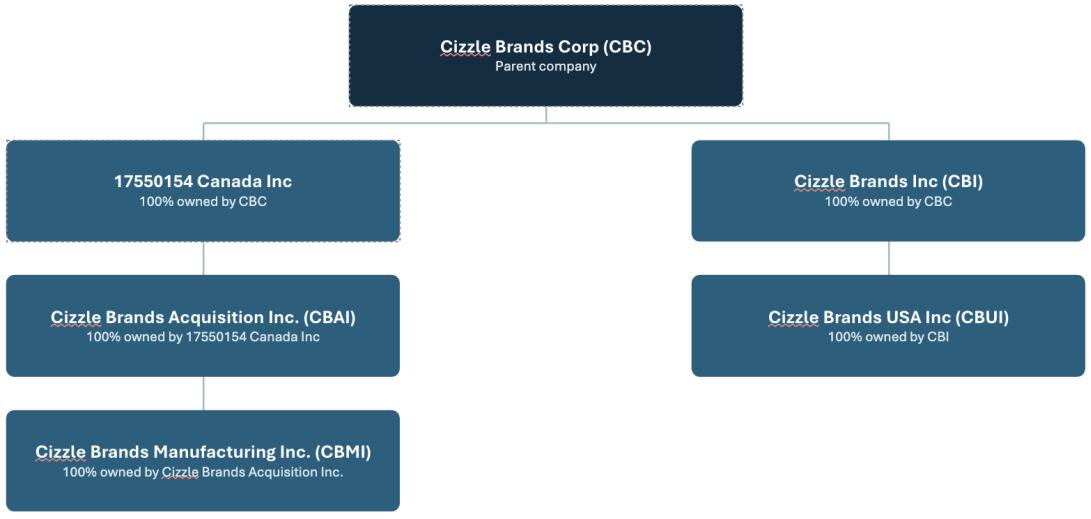
The following diagram presents the intercorporate relationships among the Company and its subsidiaries as at the date of this AIF.
Page 13
The Company’s material subsidiaries as at the date of this AIF are as follows:
| 1. | CBI, a wholly owned subsidiary of the Company, which is the Company’s principal branded sales and commercial contracting entity; |
| 2. | 17550154 Canada Inc., a corporation incorporated under the CBCA and a wholly owned subsidiary of the Company, which holds all of the issued and outstanding shares of AcquireCo and the shares of which are pledged to the Vendor as security for the VTB Note; |
| 3. | AcquireCo, a corporation incorporated under the CBCA and a wholly owned subsidiary of 17550154 Canada Inc., which is the borrower under the Credit Agreement and the issuer of the VTB Note; and |
| 4. | CBMI, a corporation incorporated under the CBCA and a wholly owned subsidiary of AcquireCo, which carries on the Manufacturing Business at the Facility. CBMI is registered extra-provincially in Quebec, where it is declared under the name “Fabrication Marques Cizzle Inc.”. |
| ITEM 2. | GENERAL DEVELOPMENT OF THE BUSINESS |
The Company was created as a result of a spin out of Larose Ventures Ltd. pursuant to an order of the Supreme Court of British Columbia dated March 24, 2022. Prior to the completion of the RTO Transaction, the Company’s business was to identify and evaluate businesses with a view to completing a reverse takeover with one or more private companies.
Prior to the RTO Transaction, the Company also conducted two non-brokered private placements, namely (a) 937,500 common shares for gross proceeds of $100,000 on September 27, 2024; and (b) 312,500 common shares for gross proceeds of $60,000 on December 13, 2024. The proceeds of these placements were used to fund the RTO Transaction and for general corporate purposes.
Pre-RTO Business of the Target
The Target had acquired and built its business, in part, through the acquisition of Cizzle Brands Inc. (“CBI”) for a purchase price of $5,000,000. The Target changed its name to “Cizzle Brands Ltd.” on February 6, 2024 and completed the acquisition of CBI on February 8, 2024.
CBI was incorporated on August 8, 2023 as a company focused on discovering and commercializing novel ingredients. As the time of the acquisition, CBI was a holding company which owned the formulation of active ingredients which was further developed by the Company to become CWENCH Hydration, and trademark applications for CWENCH Hydration. CWENCH Hydration and Spoken. Total expenses of CBI prior to acquisition by Cizzle Brands Ltd. were de minimis and consisted of mainly incorporation/legal costs and trademark application costs. The Company’s product was only developed after CBI was acquired by the Target and such development was facilitated by CBI’s founder leveraging his experience with contract manufacturers and retail channels. Related expenses are recorded in the financial statements of “Cizzle Brands Ltd.”
The Target had also completed several private placements prior to the RTO Transaction.
| · | Between February and August 2024, a placement of units comprising one common share of the Target and one-half of one share purchase warrant exercisable into one common share of the Target at a price of $0.40 per share. A total of 77,223,270 Target Units were issued for gross proceeds of $15,444,654. In connection with the financing, the Target issued an additional 966,000 units to finders and paid $73,440 in cash as commission to arm’s length finders, along with $60,700 in cash and 303,500 Broker Warrants, each convertible into one unit at an exercise price of $0.20 per Target Unit, as commission to arm’s length agents in connection with the financing. The proceeds of the offering were used for the purchase of CBI and general corporate purposes. |
Page 14
| · | In November 2024, a placement of common shares of the Target pursuant to which 10,185,513 common shares of the Target were issued at a price of $0.30 per share for aggregate gross proceeds of $3,055,655. In connection with the financing, the Target also issued 332,876 common shares and $36,750 in cash as commission to arm’s length finders. |
RTO Transaction
On October 7, 2024, the Company entered into a business combination agreement with Cizzle Brands Ltd. (formerly, Harbour Mission Co, the “Target”), setting forth the terms pursuant to which the RTO Transaction would be completed. The Target was incorporated on January 10, 2024 under the laws of the Province of Ontario and its purpose on incorporation was to facilitate a transaction with one or more food and beverage companies.
On November 21, 2024, the Company incorporated 1001070471 Ontario Inc. (“Subco”) under the OBCA for the purposes of completing the RTO Transaction. Subco was incorporated for the purposes of the RTO Transaction; it had no material assets and did not conduct any operations or active business prior to the completion of the RTO Transaction.
On November 12, 2024, in connection with the RTO Transaction, the Target also completed a private placement of 3,458,940 subscription receipts for aggregate gross proceeds of $1,037,682. On the closing date of the subscription receipt financing, the proceeds were deposited in escrow pending the occurrence of the escrow release conditions. In connection with the financing, the Target issued 239,781 warrants to finders, each convertible into one common share of the Target at an exercise price of $0.30 per share, and $71,934 in cash to arm’s length finders.
On December 10, 2024, Cboe Canada conditionally approved the listing of the Common Shares of the Company under the symbol “CZZL” and the Common Shares were listed and posted for trading on Cboe Canada on December 30, 2024.
On December 19, 2024, the Company completed the RTO Transaction, acquiring the Target and taking over its principal business. In connection with the completion of the RTO Transaction, the following transactions were completed:
| · | Each subscription receipt outstanding was automatically converted into one common share of the Target. |
| · | Each common share of the Target outstanding was exchanged for one Common Share. |
| · | Each common share purchase warrant of the Target outstanding was exchanged for one common share purchase warrant of the Company on commensurate terms. |
| · | Each stock option of the Target outstanding was exchanged for one stock option of the Company on commensurate terms. |
| · | The Target amalgamated with Subco, and the amalgamated corporation became a wholly owned subsidiary of the Company. |
Page 15
In connection with the RTO Transaction, the Company was renamed “Cizzle Brands Corporation.” Upon completion of the RTO Transaction, the Company assumed the business of Target as described in “Description of the Business”.
2.1 Fiscal 2025
The Common Shares were listed and posted for trading on Cboe Canada on December 30, 2024. On February 25, 2025 the Common Shares began trading in the United States on the OTCQB Venture Market under the symbol “CZZLF” and became eligible for electronic clearing and settlement through the Depository Trust Company.
During fiscal 2025 the Company extended the distribution of CWENCH Hydration across Canadian grocery, pharmacy, specialty and gas and convenience channels, launched its Spoken Nutrition product line in January 2025 and entered into the distribution arrangement with VHCS described under “Description of the Business – Principal Markets”. The Company also became the official hydration partner of USA Hockey in April 2025 and entered into sponsorship arrangements with Massachusetts Hockey, Minnesota Hockey and the Michigan Amateur Hockey Association in May 2025.
On July 10 and July 15, 2025 the Company closed, in two tranches, a non-brokered private placement of 12,504,671 units at a price of $0.36 per unit for aggregate gross proceeds of $4,501,682. Each unit was comprised of one Common Share and one Warrant exercisable to acquire one Common Share at a price of $0.44 per Common Share for a period of 36 months from closing. The Company paid finders’ and referral fees of $20,088 in cash and issued 70,611 units. Insiders of the Company subscribed for 258,905 units and employees of the Company subscribed for 1,255,556 units. The participation of insiders constituted a “related party transaction” within the meaning of Multilateral Instrument 61-101 – Protection of Minority Security Holders in Special Transactions, and the Company relied on the exemptions from the formal valuation and minority approval requirements in sections 5.5(a) and 5.7(1)(b) thereof on the basis that the fair market value of the insider participation did not exceed 25% of the Company’s market capitalization.
For the fiscal year ended July 31, 2025 the Company recorded net sales of $13,184,554, gross profit of $7,545,891 and a net loss and comprehensive loss of $13,858,831, and held cash of $3,137,254 at year end.
2.2 Fiscal 2026
On August 7, 2025 the Company appointed Ndamukong Suh, Michael Doolan and Geoff Bedford to the Board.
On August 19, 2025 the Company established the eCapital Facility, being a three-year secured revolving credit facility with borrowing limits of $4,000,000 and US$850,000, to provide non-dilutive working capital to support the growth of its branded business.
On September 9, 2025 the Company launched HappiEats Sport Pasta, the first product under its HappiEats brand. During the first half of fiscal 2026 the Company also secured retail listings for CWENCH Hydration across Circle K locations in Ontario, 149 Loblaws, Zehrs, Real Canadian Superstore and Atlantic Superstore locations, more than 500 Petro-Canada locations, all 84 Pure Hockey locations in the United States and 91 Popeye’s Supplements Canada locations, and became the official sport drink of the National Hockey League’s Ottawa Senators.
On October 7, 2025 the Company filed the Base Shelf Prospectus, qualifying the distribution of up to $150,000,000 of Common Shares, preferred shares, warrants, debt securities, subscription receipts and units during the 25-month period following the date of that prospectus.
Page 16
Acquisition of the Manufacturing Business
On the Acquisition Date the Company, through AcquireCo, indirectly acquired all of the issued and outstanding shares of Flow Water Inc. from the Vendor pursuant to the Share Purchase Agreement, and thereby acquired the Manufacturing Business. Immediately before closing, Flow Water Inc. completed the Pre-Closing Reorganization, under which the Excluded Assets were transferred to the Vendor or its affiliates, including BrandCo. The Company did not acquire the Flow brand or the Spun-Out Business. On December 30, 2025 Flow Water Inc. filed articles of amendment changing its name to “Cizzle Brands Manufacturing Inc.”, and the Facility was renamed The CWENCH Hydration Factory.
The total consideration payable to the Vendor under the Share Purchase Agreement was US$32,823,789.89, plus C$38,548,358.94, plus an amount equal to the aggregate cash balances of Flow Water Inc. at the financial adjustment time, less an amount equal to the indebtedness of Flow Water Inc. at that time, and adjusted for any inventory deficit or surplus. The purchase price was satisfied at closing by the issuance of the VTB Note and by a cash payment of the balance. For accounting purposes under IFRS 3, the consideration transferred for the Manufacturing Business was approximately $35.8 million, consisting of cash of approximately $13.6 million and the VTB Note, and the Company also repaid indebtedness of Flow Water Inc. of approximately $45.2 million on the Acquisition Date. See note 6 to the Annual Financial Statements. The Acquisition constituted a “significant acquisition” for the purposes of Part 8 of NI 51-102, and the Company filed a business acquisition report in respect of the Acquisition on September 18, 2026. See “Description of the Business – The Manufacturing Business” and “Material Contracts”.
The Company financed the cash component of the purchase price through the Credit Facility, a senior secured term loan credit facility provided by OIC. The Credit Facility has a five-year term and bears interest at 12% per annum, payable quarterly in arrears in cash or, subject to certain conditions and for a limited period, in kind. The Credit Facility is secured by a first lien on all of the assets of CBMI and is guaranteed by the Company and its manufacturing-related subsidiaries. The aggregate committed amount under the Credit Facility is C$68,855,000, comprising an initial term loan of C$55,084,000 and an additional commitment of C$13,771,000, being US$40,000,000 and US$10,000,000 respectively at the applicable rate of exchange. The initial term loan of C$55,084,000 was advanced at closing, of which US$32,823,789.89 funded the United States dollar component of the cash consideration, and the Company issued 7,500,000 Warrants to OIC exercisable at $0.40 per Common Share until December 23, 2030. As at July 31, 2026 the fair value of the initial term loan was C$57,654,795, and as at October 1, 2026 approximately US$42,577,083 of principal and accrued interest was outstanding under the Credit Facility.
AcquireCo satisfied the balance of the purchase price in part through the issuance of the VTB Note to the Vendor in the principal amount of C$22,250,000. The VTB Note bears interest at 12% per annum compounding monthly, with principal and accrued interest due at maturity, and is secured by a pledge of the shares of 17550154 Canada Inc. The VTB Note was originally scheduled to mature on December 23, 2026 but was extended pursuant to an amendment to the VTB Note dated October 7, 2026 subject to certain conditions. See “Developments Subsequent to the End of Fiscal 2026”.
Concurrently with the Acquisition, and as required under the Credit Agreement, the Company completed non-brokered private placements for aggregate gross proceeds in excess of C$10,000,000, consisting of (i) an offering of 11,892,500 units at a price of $0.40 per unit, with each unit comprised of one Common Share and one-half of one Warrant exercisable at $0.60 per Common Share for 24 months from closing, subject to acceleration, and (ii) convertible notes issued to K2 in the principal amount of C$5,000,000 and to Fattore Glen in the principal amount of C$2,500,000. Those notes bear interest at 7.2% per annum payable monthly, are convertible at the option of the holder at a price, at present, of $0.32 per Common Share and mature on December 23, 2028. The Company issued 500,000 Common Shares and 71,250 units as finders’ fees and 53,750 units for services.
Other Fiscal 2026 Developments
On January 21, 2026 the Company held its annual general meeting of shareholders, at which each of John Celenza, Geoff Bedford, Michael Doolan, Nunziato Fattore, Lauri Holomis and Ndamukong Suh was elected a director and MNP LLP was reappointed as auditor of the Company.
Page 17
During fiscal 2026 the Company continued to expand its brand partnerships and retail distribution. CWENCH Hydration became the official sports drink of USA Lacrosse in January 2026 and of the New York State Amateur Hockey Association in February 2026. The Company launched two new CWENCH Hydration flavours in January 2026, being Miracle On Ice, in partnership with USA Hockey and under a trademark licence from Miracle On Ice, LLC, and Golden Berry, in partnership with Nathan MacKinnon, and launched a limited edition Draft Day Blue flavour in June 2026. In February 2026 the Company launched SnakStars Sport Bites under its HappiEats brand.
The Company secured its first national retail listing in the United States in February 2026, at 109 Target locations and on Target.com, and in Canada secured listings at 197 Walmart Canada locations and more than 170 Save-On-Foods locations, expanded its Loblaws and Real Canadian Superstore distribution to approximately 400 locations and launched at approximately 180 Canadian Tire Gas+ locations. In April 2026 UNFI Canada recognized CWENCH Hydration as one of the fastest-growing brands in its network.
On April 30, 2026 the Company announced the appointment of David Giancoulos to the Board effective May 1, 2026.
On May 5, 2026 the Company completed a senior secured convertible note financing with Ascent for gross proceeds of US$6,200,000, issuing the Ascent Note, 21,460,534 Warrants exercisable at US$0.23488 (approximately C$0.32) per Common Share until May 5, 2031 and 429,210 Common Shares as a one-time closing fee. The Ascent Note bears interest at 9.5% per annum payable monthly, matures on November 5, 2027 and is convertible into Common Shares at the United States dollar equivalent of C$0.32 per Common Share. The Ascent Note is secured by a second-priority lien over substantially all of the assets of the Company and certain of its subsidiaries and is guaranteed by certain subsidiaries, in each case subject to intercreditor and standstill arrangements with OIC, the Vendor and eCapital.
In May 2026 the Company also completed a C$1,000,000 unsecured convertible note financing with a single accredited investor, which was converted in full and cancelled. In connection with that financing the Company issued 476,190 Common Shares, 2,857,143 Common Shares on conversion at a price of C$0.35 per Common Share and 1,428,571 Warrants exercisable at C$0.35 per Common Share. The Company also issued 1,552,595 Common Shares at a deemed price of C$0.32 per Common Share in settlement of approximately C$497,000 of indebtedness.
For the fiscal year ended July 31, 2026 the Company recorded net sales of $33,366,433, gross profit of $13,104,221 and a net loss and comprehensive loss of $42,399,147, and held cash of $5,959,920 at year end.
2.3 Developments Subsequent to the End of Fiscal 2026
On August 13, 2026 CWENCH Hydration was named the official hydration drink of the esports organization Luminosity Gaming.
On August 19, 2026 the Company filed the Registration Statement with the SEC under the multijurisdictional disclosure system, announced its intention to list the Common Shares on a national securities exchange in the United States and appointed Dominic Scarangella to the Board and to the Audit Committee.
On August 26, 2026 the Board approved an extension of the expiry time of the Warrants issued in connection with the Company’s unit private placement completed between February and August 2024, from August 28, 2026 to November 28, 2026, and the Company entered into a first supplemental warrant indenture to give effect to that extension.
On September 18, 2026 the Company filed a business acquisition report in respect of the Acquisition. In connection with that filing the Company obtained an order from the Ontario Securities Commission exempting it from the requirement in section 8.4 of NI 51-102 to include certain historical financial statements of the Manufacturing Business, on the condition that the business acquisition report and any prospectus of the Company include abbreviated financial statements of the acquired business. Full carve-out financial statements of the Manufacturing Business were impracticable because Flow Beverage did not maintain distinct accounts for that business, which was not accounted for as a separate entity, subsidiary, division or reporting segment.
Page 18
On September 29, 2026 the Company announced a multi-year agreement with Maple Leaf Sports & Entertainment under which CWENCH Hydration will become the official sports drink of the Toronto Maple Leafs and the Toronto Marlies. See “Description of the Business – Marketing Plan and Strategies”.
On October 7, 2026 the Company and the Vendor entered into an amending agreement in respect of the VTB Note. Under that agreement, on closing of the Offering the Company will pay the Vendor US$10,000,000 in repayment of principal and in satisfaction of interest, fees and expenses, the maturity date of the VTB Note will be extended from December 23, 2026 to December 31, 2027 and the Company will issue 2,000,000 Warrants to the Vendor, being 80,000 Warrants after giving effect to the Share Consolidation, exercisable for a period of two years at the price at which Common Shares are issued under the Offering. The extension of the maturity date is conditional on, among other things, the repayment being made by the date specified in the amending agreement and the amendment of a related agreement with OIC. OIC has agreed to consent to the Offering, the repayment and extension of the VTB Note and the related transactions. Also on October 7, 2026, the NFS Promissory Note, in the principal amount of US$2,951,200 and maturing in January 2027, was amended so that its maturity date will be extended to January 2028 if, on or before January 2027, the Company prepays US$1,475,600 of principal and pays an amendment fee of US$147,560.
On October 13, 2026 the Company filed a preliminary prospectus supplement to the Base Shelf Prospectus qualifying the distribution in the United States of Common Shares, and on October 26, 2026 it filed the Prospectus Supplement. The Company proposes to complete the US Offering for aggregate gross proceeds of not less than US$15,000,000, at a price of between US$4.92 and US$6.15 per Common Share on a post-Share Consolidation basis, including up to US$5,000,000 under the LIFE Offering. Joseph Gunnar & Co., LLC will act as lead underwriter and D. Boral Capital LLC as underwriter, and the Underwriters will be paid a commission of 6.5% of the gross proceeds of the Offering (3.75% on Common Shares sold to purchasers on the Company’s president’s list, and nil on Common Shares issued on the rollover or conversion of existing indebtedness), will receive a warrant to purchase that number of Common Shares equal to 5.0% of the Common Shares sold under the Offering (2.5% for president’s list purchasers), exercisable from six months until three years after closing at 120% of the offering price, and will receive a non-accountable expense allowance equal to 1.0% of the gross proceeds and reimbursement of their reasonable expenses up to an agreed maximum.
On October 23, 2026 the Company filed the LIFE Offering Document under Part 5A of National Instrument 45-106 – Prospectus Exemptions in respect of the proposed LIFE Offering of up to 902,527 Common Shares on a post-Share Consolidation basis at an assumed price of US$5.54 per Common Share, with the final price to be the price set under the US Offering, for aggregate gross proceeds of up to US$5,000,000. The LIFE Offering forms part of the US Offering and will be completed only on the concurrent completion of the US Offering. Common Shares issued under the LIFE Offering will not be subject to a hold period under Canadian securities laws. The LIFE Offering Document is available under the Company’s profile on SEDAR+ at www.sedarplus.ca and on the Company’s website. The Offering is expected to raise aggregate gross proceeds of not less than US$15,000,000.
On closing of the Offering the Company expects to: (i) pay the Vendor US$10,000,000 in repayment of principal of, and in satisfaction of interest, fees and expenses under, the VTB Note, extend the maturity date of the VTB Note to December 31, 2027 and issue 2,000,000 Warrants to the Vendor; (ii) issue 7,812,500 Common Shares to K2 on the conversion of C$2,500,000, being 50% of the principal amount of the K2 Note, and 7,812,500 Common Shares to Fattore Glen on the conversion of C$2,500,000, being the full principal amount of the Fattore Glen Note, in each case at a conversion price of $0.32 per Common Share; (iii) repay US$413,333.33 under the Ascent Note and issue 7,153,511 Common Shares to Ascent on the conversion of US$1,680,216.80, being approximately 25% of the principal amount of the Ascent Note; and (iv) effect the Share Consolidation and list the Common Shares on Nasdaq. Each of Ascent, K2 and Fattore Glen has agreed, subject to conditions, to enter into a standstill and lock-up agreement for a period of 90 days from closing, and the directors and executive officers of the Company are expected to enter into lock-up agreements with the Underwriters.
Page 19
Completion of the Offering, the Share Consolidation and the Nasdaq listing remains subject to a number of conditions, including market conditions, the satisfaction of the conditions in the underwriting agreement and the receipt of all required regulatory and stock exchange approvals, and no assurance can be given that any of them will be completed. Conversion share numbers are stated on a pre-Share Consolidation basis and assume conversion of the Ascent Note at US$0.23488, being the United States dollar equivalent of C$0.32 fixed at the closing of the Ascent financing. See “Risk Factors”.
As at October 1, 2026 the Company had indebtedness outstanding of approximately C$107,306,008 in the aggregate, consisting of approximately US$42,577,083 under the Credit Facility, C$24,406,539 under the VTB Note, US$6,720,867 under the Ascent Note, US$2,951,200 under the NFS Promissory Note, C$7,500,000 of principal under the convertible notes held by K2 and Fattore Glen and approximately C$981,004 under the eCapital Facility. Assuming completion of the Offering and the repayments and conversions made on the Offering Closing Date, the Company expects indebtedness outstanding of approximately C$84.0 million in the aggregate, consisting of approximately US$42,577,083 under the Credit Facility, C$10.4 million under the VTB Note, US$4.6 million under the Ascent Note, US$2,951,200 under the NFS Promissory Note, C$2,500,000 of principal under the K2 Note and approximately C$981,004 under the eCapital Facility, in each case before interest accruing after October 1, 2026 and translating United States dollar amounts at the Bank of Canada daily average exchange rate on October 23, 2026 of US$1.00 = C$1.3993. See “Risk Factors”.
| ITEM 3. | DESCRIPTION OF THE BUSINESS |
3.1 General
Cizzle is a consumer-packaged goods company, operating under the emerging “better-for-you” category of food and hydration. Cizzle exists to provide consumers with high-performing alternatives that are healthy, taste great, and meet their needs.
Following the Acquisition, the Company conducts its operations through two principal businesses. Its branded business develops, markets, sells and distributes products under the Company’s own brands, being CWENCH Hydration, Spoken Nutrition and HappiEats. Its manufacturing business comprises the Manufacturing Business, being the Tetra Pak beverage co-manufacturing and production services business that CBMI carries on at the Facility for both the Company’s own brands and third-party brands. Management believes that ownership of the Manufacturing Business may provide the Company with greater control over the supply and scaling of its ready-to-drink products, the opportunity to retain a greater portion of the economics associated with their manufacture, and an additional platform for revenue and potential cash flow generation. The extent and timing of those benefits will depend on, among other factors, production volumes, capacity utilization, operating efficiency, customer performance and successful integration of the Manufacturing Business.
Principal Products
The Company has launched three brands to market: (i) CWENCH Hydration, in the sports hydration category; (ii) Spoken™ Nutrition, its line of athlete-grade nutritional supplements; and (iii) HappiEats™, its line of food products.
CWENCH Hydration
Containing no sugar, all-natural ingredients, only 10 calories and 6+ performing electrolytes, CWENCH Hydration is a next generation sports hydration drink developed by strength coach, Andy O’Brien, and the Company’s management team. CWENCH Hydration is currently offered in two formats: (i) hydration powder mix; and (ii) 500ml ready-to-drink Tetra Paks, and is offered in five flavours: Berry Crush, Blue Raspberry, Cherry Lime, Rainbow Swirl and Tropical Flow, along with limited time flavour offerings Celly Freeze, Pink Lemon Flow, Rocket Berry Blast, PowerPlay Punch, Miracle On Ice™, Golden Berry and Draft Day Blue. The Miracle On Ice™ flavour is offered under a trademark licence from Miracle On Ice, LLC and in partnership with USA Hockey, and the Golden Berry and Draft Day Blue flavours were developed in partnership with Nathan MacKinnon and Gavin McKenna respectively. The hydration powder mix comes in two sizes, a 10-serving pack of individual sachets (70 grams in total) or a 45-serving container (315 grams).
Page 20
On October 15, 2026 the Company launched CWENCHIE™, a formulation and format of CWENCH Hydration developed specifically for children.
CWENCH Hydration is endorsed by world-class athletes, including 2024 National Hockey League (“NHL”) MVP and Colorado Avalanche forward, Nathan MacKinnon, Montreal Canadiens forward, Cole Caufield, National Basketball Association (“NBA”) All-Star and Miami Heat forward, Andrew Wiggins, Canadian Olympic soccer player, Adriana Leon, and Toronto Maple Leafs forward and first overall selection in the 2026 NHL Draft, Gavin McKenna, and up-and-coming professional hockey players Chloe Primerano and Jade Iginla.
To date, Cizzle Brands products have been ordered by more than 21 NHL teams, 21 Major League Baseball teams, 5 NFL teams and 4 NBA teams. Cizzle Brands products are currently available in more than 6,900 points of distribution across Canada, the United States and Europe, including SportChek, Canadian Tire, LifeTime, Metro, Longos, Sobeys, Fortinos, Loblaws, Circle K, Petro Canada, United Supermarkets, Pure Hockey, Pro Hockey Life, London Drugs, Golf Town, Healthy Planet, Farm Boy, INS Markets, MacEwen Gas, Source for Sports, Walmart Canada, Target, Save-On-Foods, Zehrs, Real Canadian Superstore, Atlantic Superstore, Canadian Tire Gas+ and Popeye’s Supplements Canada. CWENCH Hydration is also being distributed by a number of major distributors.
Spoken NutritionTM
Spoken NutritionTM is a premium line of nutritional supplements, designed to bring elite athletes into the Cizzle ecosystem. All Spoken Nutrition™ products carry the NSF Certified for Sport® designation, a certification program that confirms sports supplements and sports nutritional products do not contain substances banned by many major athletic organizations.
The team that formulated Spoken Nutrition’s™ products includes Dr. Matt Frakes (New York Giants Dietician), Brianne Brown (University of Miami Strength & Conditioning Coach), Alan Bishop (University of Houston Director of Men’s Basketball Sports Performance), David Lawrence (Strength Coach to Six NFL Super Bowl Winners), Ben Prentiss (Experienced NHL Strength Coach), Dr. Jordan Shallow (Doctor of Chiropractic and Strength Coach to Elite Athletes), Dr. Sachin Patel (Functional Medicine Doctor), and Cizzle’s Chief Performance Officer, Andy O’Brien.
Spoken Nutrition’s™ product line includes:
| · | Spoken™ Sleep Builder: containing only amino acids (such as l-theanine, glycine and glutamine), inositol and three forms of magnesium (orotate, glycerophosphate and glycinate), Spoken™ Sleep Builder is formulated to help people get more restorative sleep without the use of melatonin, 5-HTP and other herbal supplements. |
| · | Spoken™ Greens: Spoken™ Greens contains 20 high-impact, nutrient-rich ingredients in quantities that aims to assist in a healthy lifestyle. |
| · | Spoken™ Aminos + ATP: formulated to have a high dose of leucine, added tyrosine and Peak ATP to assist with increased muscle protein synthesis, increased dopamine and help with cellular energy. |
| · | Spoken™ Creatine: aims to increase body/lean muscle when used in conjunction with a resistance training regimen. It also aims to improve strength, power and performance. |
Page 21
| · | Spoken™ High EPA Fish Oil + D: made from sustainable wild-caught anchovy, sardine, and mackerel low in heavy metals, was intentionally formulated to contain 700mg of EPA (eicosapentaenoic acid) along with 300 mg of DHA (docosahexaenoic acid), Spoken’s™ High EPA Fish Oil + D is a high dose Omega-3 supplement, supplemented with lipase to enhance absorption. |
| · | Spoken™ MAG 3: formulated to be a beneficial source of magnesium for cardiovascular, cognitive, muscular, and brain health. Spoken™ MAG 3 not only aims to increase magnesium levels in the brain but also to raise blood serum magnesium levels. Each serving contains 225 mg of elemental magnesium from three highly bioavailable forms: Magnesium Glycinate, Magnesium Malate, and ATA Mg®, a patented acetyl taurinate magnesium salt. |
| · | Spoken™ Pro Resolving Mediators + EPA/DHA: formulated to manage pain, help our bodies avoid the ravages of injury and promote a natural, balanced recovery process. Each capsule of Spoken™ Pro Resolving Mediators + EPA/DHA contains 14-HDHA, 17-HDHA, and 18-HEPE, along with their source materials, eicosapentaenoic acid (EPA) and docosahexaenoic acid (DHA). |
| · | Spoken™ Vitamin D3 + K1/K2: each capsule of Spoken™ Vitamin D3 + K1/K2 provides 2000 IUs of Vitamin D, along with 120 mcg of K1 and 90 mcg of K2. |
| · | Spoken™ Essential Daily Packs: formulated to be the essential, all-in-one foundational vitamin and nutritional supplement for athletes and people living an active lifestyle, Spoken™ Essential Daily Packs are convenient all-in-one packs designed to fill the critical nutritional gaps that can impact performance. |
| · | Spoken™ Grass Fed Whey Protein: a protein supplement that contains 25 grams of grassfed whey protein, Tendoforte® collagen and 3 grams of fat from olive oil or cocoa. |
| · | Spoken™ Grass Fed Beef Protein: features 25 grams of complete protein from grass-fed beef bone broth |
HappiEats™ Sport Pasta™
Sport Pasta™ is handmade in Italy using a unique four-ingredient recipe including red lentil, white quinoa, and white bean flour, while maintaining the taste of traditional Italian pasta. It is slowly dried at low temperatures to preserve its nutritional qualities, and its formulation offers athletes easy digestion and sustained energy. Sport Pasta™ is higher in protein and fibre than conventional pasta, with a single serving (85 grams) of Sport Pasta containing 18 grams of protein and 10 grams of fibre.
Product Roadmap
The Company maintains a product roadmap and continues to develop further products and formats with its manufacturing partners. Management will evaluate market conditions to determine when and if to launch any further product, and no further launch has been announced as at the date of this AIF. The products most recently brought to market under this roadmap were SnakStars™ Sport Bites, launched in February 2026, and CWENCHIE™, launched in October 2026, neither of which required the Company to incur material development costs. Please refer to “Business Objectives and Milestones” for the timing and status of those launches.
A key feature of the Company’s strategy is to develop a distribution channel platform that would support many different “better-for-you” products as well as potential insourcing of key business functions, such as manufacturing. We are continually evaluating potential opportunities for both new products that fit our mission to elevate health and wellness, as well as manufacturing.
Page 22
3.2 The Manufacturing Business
The Manufacturing Business consists of the Tetra Pak beverage co-manufacturing and production services business that CBMI carries on at the Facility for both the Company’s own brands and third-party brands. Before the Acquisition, Flow Water Inc. was the outsourced manufacturer of CWENCH Hydration in ready-to-drink format. By acquiring the Manufacturing Business the Company secured its supply of ready-to-drink product, removed third-party manufacturing margin and obtained control over the scaling of its ready-to-drink production.
The operations of the Manufacturing Business are carried on at two adjacent leased industrial properties in Aurora, Ontario, which house the Tetra Pak manufacturing equipment and the related inventories necessary for continuous beverage production. The Facility holds the food production licences, registrations and certifications necessary to serve Canadian and United States customers, including a licence under the Safe Food for Canadians Act, a United States Food and Drug Administration registration, NSF International GMP and HACCP certification, OU Kosher certification and licences issued by the Canada Revenue Agency in respect of the production of alcoholic beverages. Certain of those certifications and permits are scheduled to expire within the next 12 to 18 months and will require renewal. See “Risk Factors”.
Take-or-Pay Contracts
At the Acquisition Date the Manufacturing Business had approximately C$184 million of remaining contracted customer production volume under existing customer agreements. Those agreements contain take-or-pay provisions under which customers will be required to make minimum payments of approximately C$158 million in the aggregate over the remaining terms of the agreements, whether or not they purchase any of their contracted volumes. Contracted Minimum Revenue is neither a forecast nor a guarantee of revenue. It depends on customers performing their obligations and is subject to the termination and other provisions of the underlying agreements. As at October 1, 2026, approximately C$160 million of contracted volume and C$136 million of Contracted Minimum Revenue remained.
In the aggregate, these agreements contain minimum annual volume commitments with commitment periods extending through 2027 for non-alcoholic products and through 2030 for alcoholic products. If a customer fails to purchase its minimum annual volume in a contract year, the customer will be required to pay a shortfall amount calculated by reference to the unpurchased volume and the applicable co-packing fee.
The current third-party customers of the Manufacturing Business are BeatBox, in which Anheuser-Busch acquired an 85% interest in 2026, Joyburst and the Spun-Out Business. CBMI also manufactures Flow-branded products for BrandCo at the Facility under a manufacturing services agreement dated the Acquisition Date. A substantial majority of the revenue of the Manufacturing Business is derived from BeatBox and the Spun-Out Business. See “Economic Dependence” and “Risk Factors”.
3.3 Principal Markets
In Canada, Cizzle has national distribution coverage with a strong focus in three geographic markets: (i) the Greater Toronto Area; (ii) the Montreal and Ottawa corridor; and (iii) the Greater Vancouver Area.
On January 29, 2025, the Company announced it had entered into a distribution agreement with Van Houtte Coffee Services (“VHCS”), a subsidiary of Keurig Dr Pepper, pursuant to which VHCS will distribute the Company’s CWENCH Hydration product lineup across Canada. As part of its agreement, VHCS will also take over distributorship for many of the Company’s existing accounts in various categories including sporting goods retailers and stadiums.
The Company’s distribution strategy in Canada was initially focused on a combination of: (i) direct sales to sports and specialty retailers, as well as “points of sweat” such as hockey arenas, fitness centres and training facilities; and (ii) broker/distributors in the sports and natural/organic channels. However, as brand awareness has grown, the Company has started distributing through major Canadian grocery and gas & convenience stores, including Loblaws, Metro, Longos, Sobeys, Fortinos, Circle K, PetroCanada, MacEwen Gas and others. As brand awareness continues to grow, we anticipate that Canadian distribution will expand further to mass merchandise and club channels.
Page 23
As with Canada, our distribution strategy in the United States involves a combination of: (i) direct sales to sports and specialty retailers, as well as "points of sweat" such as hockey arenas, fitness centres, training facilities; and (ii) broker/distributors in the sports and natural/organic channels. In the United States, our focus is on hockey-centric markets, including Connecticut, Minnesota and Colorado.
In addition to sales through retail channels, the Company maintains a solid online presence through its own website www.cwenchhydration.com as well as online retailers such as Amazon. Part of the Company's strategy is to continue its online marketing efforts in order to increase sales through e-commerce channels in a more aggressive and efficient manner.
3.4 Sales
In fiscal 2026 the Company’s manufacturing segment accounted for $21,541,535, or 64.6%, of the Company’s revenues and its branded business accounted for $11,824,898, or 35.4%, comprising its retail/wholesale segment, which accounted for $9,937,654, or 29.8%, and its consumer segment, which accounted for $1,887,244, or 5.7%. By brand, CWENCH Hydration accounted for approximately $9.1 million, or 27.3%, of the Company’s revenues, Spoken Nutrition for approximately $2.3 million, or 6.9%, and HappiEats for approximately $0.4 million, or 1.2%. In fiscal 2025, CWENCH Hydration delivered 92% of the Company’s revenues and Spoken Nutrition delivered 8%, and the Company had no manufacturing segment. As the Company brings new brands to market, the proportionate contribution of CWENCH Hydration will naturally adjust to reflect its share of revenue over the entire portfolio of brands.
3.5 Production
Since the Acquisition the Company has manufactured CWENCH Hydration in ready-to-drink format in-house, at the Facility. The Company continues to outsource the manufacture of its other products. CWENCH Hydration’s hydration powder mix is manufactured by JW Nutritionals, AN Labz and Invapharm. Spoken is manufactured by various manufacturers depending on the product, including Nutrablend, JW Nutritionals, WIN Nutrition, Pharmaline and RFI, LLC. Sport Pasta is presently manufactured by Federico Export SRL.
3.6 Components
The main ingredient in the CWENCH Hydration ready-to-drink is primarily a combination of water, flavours, and electrolytes. The CWENCH Hydration powder mix is primarily a combination of amino acids, electrolytes and vitamins and minerals.
The Company purchases raw materials (i.e., ingredients for its products) from various suppliers at fair market prices.
3.7 Specialized skills and knowledge
The Company’s branded business requires knowledge of the consumer packaged goods and sports nutrition industries. Since the Acquisition the Company also requires specialized skills and knowledge in aseptic beverage manufacturing, including the operation and maintenance of Tetra Pak filling and packaging equipment, food safety and quality assurance, and regulatory compliance in both Canada and the United States. The Company employs qualified plant, quality assurance and engineering personnel at the Facility, and competition for that personnel may be significant. See “Risk Factors”.
3.8 Research
The Company is continually exploring new product opportunities as well as piloting new flavours and ingredients. These efforts are a result of both in-house development work as well as in conjunction with third party researchers, facilities and manufacturers.
Page 24
3.9 Operations
The Company’s activities consist of developing, marketing, selling and distributing foods and beverages in the "better for you" category under a variety of brand names. The Company also carries on the Manufacturing Business, and outsources the manufacture of its remaining products to established third party manufacturers. The Company occupies its head office at 35 McCleary Court, Unit 21, Concord, Ontario under lease. CBMI occupies the Facility, being the premises at 145 and 155 Industrial Parkway South, Aurora, Ontario, under leases from Aurora Investments Inc., and owns the Tetra Pak manufacturing equipment and related plant located there. Under the Credit Agreement the Company agreed to use commercially reasonable efforts to register a notice of lease in respect of the Facility on title and to obtain a subordination, non-disturbance and attornment agreement from the landlord’s mortgagee in favour of the collateral agent.
The Company’s intellectual property and goodwill play an important role in the success of the business. However, the Company is not subject to any franchise, license, software or subscription list.
3.10 Business Objectives and Milestones
The table below outlines the key milestones and the estimated timing for the 16 months following the date of this AIF. These milestones and estimates are based on the Company’s reasonable expectations and reasonable courses of action and current assumptions and judgment. The Company expects that the milestones outlined in the chart will be achieved under the normalized scenario.
Many of these milestones are already underway. To align with projected revenues and cash usage, certain supporting resources will be scaled appropriately, focusing on efficient execution and on managing cash burn in line with the normalized operating plan.
| Description | Status | Estimated/Announced Timing |
Type of Expense |
| Expand the foundational account distribution of CWENCH Hydration and secure retail listings | The Company had more than 6,900 points of distribution as at August 19, 2026, up from over 5,300 as at October 2025. | Ongoing | Selling, General and Administrative Expenses |
| Expansion of marketing campaigns and advertising for CWENCH Hydration | During fiscal 2026 the Company executed marketing campaigns in support of the Miracle On Ice, Golden Berry and Draft Day Blue flavour launches, the Ottawa Senators, USA Lacrosse, New York State Amateur Hockey Association and Luminosity Gaming designations and the Maple Leaf Sports & Entertainment agreement. | Ongoing | Marketing |
| Launch of “Spoken Nutrition” product line through distribution in the fitness and sports communities | Launched in January 2025. Complete. | Complete | Selling, General and Administrative Expenses |
| Launch of “Sport Pasta” product line in conventional retailers and grocers | HappiEats Sport Pasta launched on September 9, 2025. Complete. | Complete | Selling, General and Administrative Expenses |
| Launch of CWENCHIE Hydration drinks designed specifically for children | CWENCHIE launched on October 15, 2026. Complete. | Complete | Selling, General and Administrative Expenses |
Page 25
| Launch of SnakStars snack products fortified with protein designed for the youth market | SnakStars Sport Bites launched on February 19, 2026. Complete. | Complete | Selling, General and Administrative Expenses |
| Integrate the Manufacturing Business and internalize the functions provided under the Transition Services Agreement | Complete. The Company has established stand-alone administrative, finance and quality functions at the Facility. | Complete | Selling, General and Administrative Expenses |
| Expand production capacity at The CWENCH Hydration Factory, including additional Tetra Pak aseptic filling and packaging capacity | In progress. Additional production line equipment is to be installed and commissioned at the cost of BrandCo under the Transition Services Agreement. | Ongoing | Capital Expenditures |
| Complete the Offering, effect the Share Consolidation and list the Common Shares on Nasdaq | The Registration Statement was filed on August 19, 2026, preliminary prospectus supplements were filed on October 13, 2026 and October 26, 2026 and the LIFE Offering Document was filed on October 23, 2026. An application to list the Common Shares on Nasdaq has been made. Completion remains subject to market conditions and to regulatory and stock exchange approval. | Ongoing | Selling, General and Administrative Expenses |
| Repay, extend or refinance the VTB Note and reduce the Company’s indebtedness | US$10,000,000 of the VTB Note is to be repaid on closing of the Offering and the maturity date is to be extended to December 31, 2027 under the amending agreement dated October 7, 2026. The balance will have to be repaid, extended or refinanced before maturity. | On closing of the Offering and thereafter to December 31, 2027 | Debt Service |
The Company also anticipates potential financings for growth purposes, such as inventory build for new customer volume requirements, marketing and sponsorship initiatives, or hiring to support growth and new initiatives, are expected to be of a size that would not materially impact the Company’s capitalization ($5,000,000 - $10,000,000 at a time). The Company may use a mix of common shares, debt, or hybrid securities (such as warrants) depending on market conditions.
The achievement of the foregoing milestones will depend on the ability of the Company to obtain additional financing, and there is no guarantee that such financing will be secured or that it will be available on a timely basis or on acceptable terms. Notwithstanding the receipt of the net proceeds of the Offering, the Company will require additional financing to fund its operations and to satisfy its obligations as they become due. See “Risk Factors”.
Page 26
3.11 Marketing Plan and Strategies
Brand Purpose, Core Beliefs and Value Proposition
The Company's mission is to elevate the game in health & wellness by positioning itself at the forefront of an emerging secular shift happening in consumer markets. Specifically, consumers are becoming increasingly aware of how unhealthy foods continue to have a significantly negative impact on health and quality of life. Globally, obesity rates have tripled since 1975 and increased nearly 33% since 2018. In the US 42.4% of adults and 19.7% of children are classified as obese.1 As a result, the number of people with Type 2 diabetes has increased 5x since 19802, with 34.2 million Americans now having Type 2 diabetes2 and rates climbing more steeply in children and young adults.3
The Company views the primary driver of the changes noted above to be diet, with ultra-processed foods often being rich in added sugars, unhealthy fats, and artificial ingredients. Sugar has become the new “bad word” in the world of health & wellness.
While some consumers attempt to eat healthier, their choices are often unappetizing, uninspired or expensive. This has created an opportunity for companies with strong brands, high quality ingredients and premium products to thrive.
The Company seeks to provide consumers with high-performing alternatives that are healthy, taste great, and meet their needs.
Marketing Strategies
The Company undertakes a number of marketing strategies to increase brand awareness, expand distribution into new channels and drive purchases of the Company’s products. All marketing activities, including channels and partners, are chosen and conducted with the brand as top of mind.
Our strategy involves trying to drive bottom-up distribution along with top-down demand to drive velocity. To achieve this, the Company is focused on direct sales to locations frequented by target consumers, followed by in- store demonstrations, product sampling and retail activations in specific retail channels. At the same time, the Company is actively investing in athlete and creator partnerships and sponsorship programs to create top-of-funnel awareness, including with 2024 NHL MVP and Colorado Avalanche forward, Nathan MacKinnon, Montreal Canadiens forward, Cole Caufield, NBA All-Star and Miami Heat forward, Andrew Wiggins, Canadian Olympic soccer player, Adriana Leon, and Toronto Maple Leafs forward and first overall selection in the 2026 NHL Draft, Gavin McKenna, and up-and-coming professional hockey players Chloe Primerano and Jade Iginla. These efforts are supported by active investment in digital and social media awareness initiatives.
3.12 Competitive Conditions
The global functional beverage market is estimated to be a $97 billion dollar industry4, of which $13 billion is comprised of the sports drink market5. Within the sports drink market, premium products are the fastest growing price category (51%) and zero sugar products are the fastest growing category in sugar content (46%).
1 https://www.who.int/news-room/fact-sheets/detail/obesity-and-overweight
2 https://diabetesatlas.org/
3 https://www.cdc.gov/diabetes/php/data-research/methods.html
4 https://grandviewresearch.com/industry-analysis/functional-drinks-market
5 https://www.alliedmarketresearch.com/sports-drink-market-A06554
Page 27
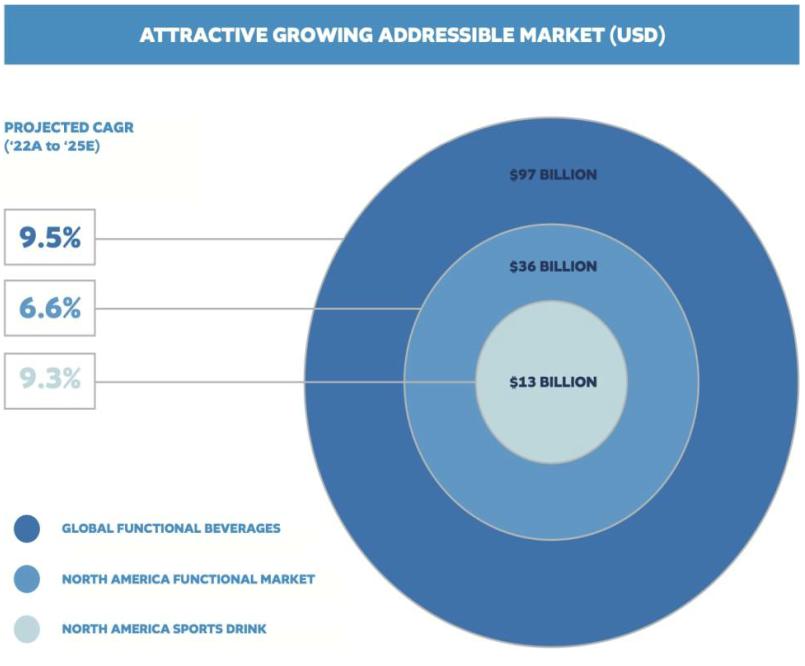
Although the sports drink market is dominated by a few key players, by positioning CWENCH Hydration as a premium, all-natural and sugar-free sports drink, the Company believes it is well-situated to capture a growing share of the sports drink market, and the functional beverage market more broadly.
The Manufacturing Business competes with other co-packers and contract manufacturers of beverages in Canada and the United States, including the in-house manufacturing capacity of its own customers and of their affiliates. Competition in that market is based principally on available and suitable capacity, format capability, price, quality, food safety accreditation, service levels and proximity to the customer’s markets. Management believes that the Facility is well positioned on each of those bases. The number of facilities in North America capable of filling beverages in aseptic Tetra Pak format is limited, and management believes that installed capacity for the 500ml Tetra Pak format in the United States is particularly limited relative to demand. The Company has uncommitted capacity available at the Facility and the ability to add further filling lines there, which management believes positions the Manufacturing Business to compete for United States volumes in that format. The Company’s ability to realize that opportunity depends on, among other things, securing customers for the available capacity and funding and commissioning additional lines. See “Risk Factors”.
The tables below highlight some of the key players and how CWENCH Hydration is differentiated from other products in the category.
Page 28
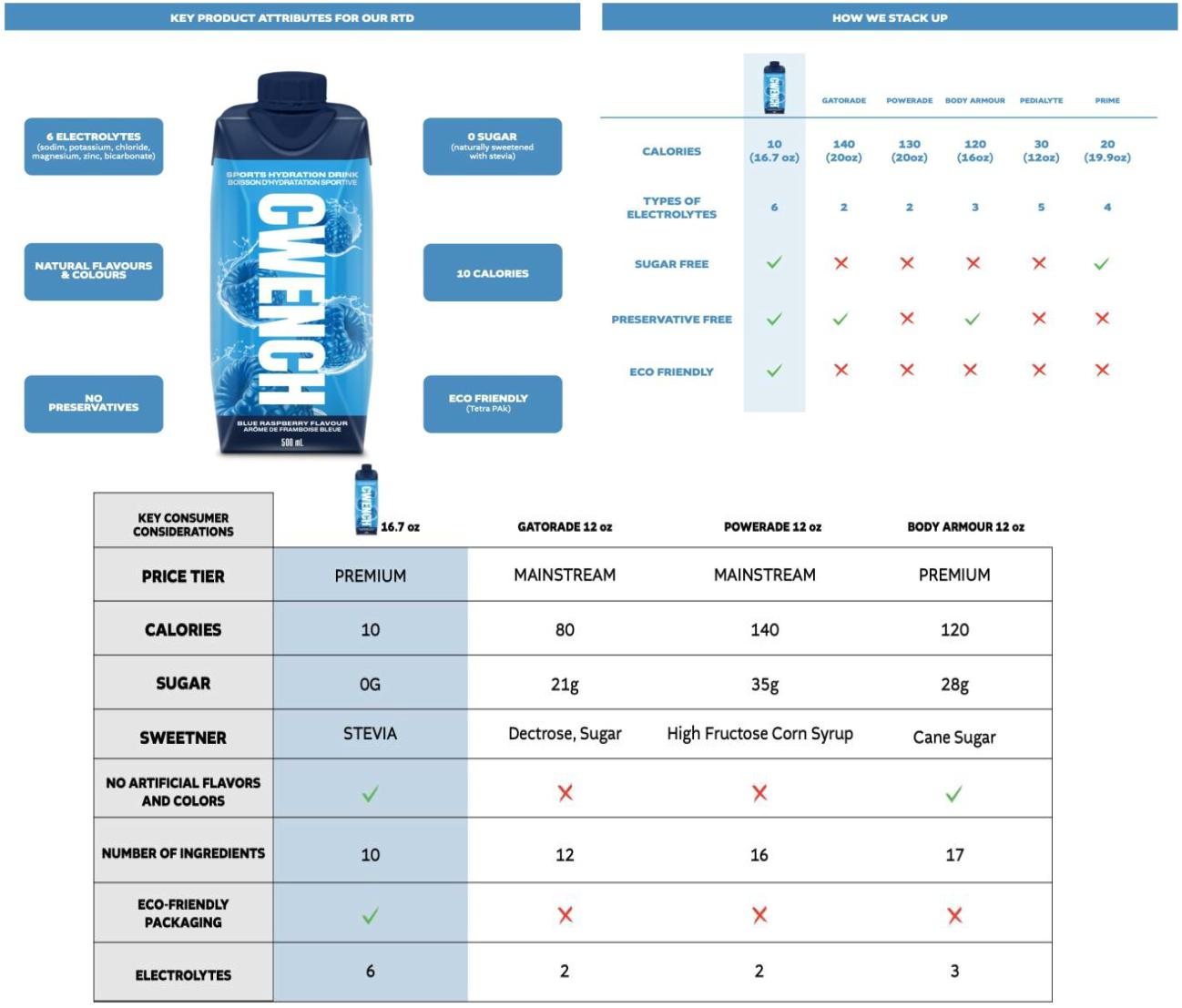
3.13 Intangible Properties
The Company invests heavily in building brand awareness for its products in key markets. Accordingly, the Company looks to proactively protect its products and brands through trademarks and contractual provisions. The enforcement of the Company’s intellectual property rights depends on any legal actions against any infringers being successful. These actions may not be successful or may be prohibitively expensive. The Company’s trademarks are registered, and its applications are filed, in the name of CBI, a wholly owned subsidiary of the Company, and not in the name of the Company itself. As at the date of this AIF CBI held 16 trademark files in Canada, of which 8 are registered, and 10 live files in the United States, of which 6 are registered. Two further United States applications have been abandoned, as described below. Marks are shown as they appear on the relevant register, so the presentation of a mark may differ between the two countries.
Page 29
The following marks are registered with the Canadian Intellectual Property Office:
| (1) | CIZZLE BRANDS – registration no. TMA1394347 (application no. 2364892) |
| (2) | HAPPiEATS & Design – registration no. TMA1409807 (application no. 2382122) |
| (3) | HAPPIEATS – registration no. TMA1409808 (application no. 2382123) |
| (4) | S Star Logo – registration no. TMA1351518 (application no. 2316637) |
| (5) | SPOKEN – registration no. TMA1363428 (application no. 2307224) |
| (6) | SPOKEN SLEEP BUILDER – registration no. TMA1394346 (application no. 2364891) |
| (7) | SPORT BITES – registration no. TMA1450178 (application no. 2429006) |
| (8) | SPORT PASTA – registration no. TMA1363705 (application no. 2325757) |
The following Canadian applications remain pending:
| (9) | CELLY FREEZE – application no. 2390468 (approved) |
| (10) | CELLY FREEZE & Design – application no. 2390467 (approved) |
| (11) | CWENCH – application no. 2294798 (under examination) |
| (12) | CWENCH HYDRATION – application no. 2294810 (under examination) |
| (13) | CWENCHIES – application no. 2308920 (advertised) |
| (14) | PR*TEIN BITES & Design – application no. 2429007 (under examination) |
| (15) | SNAKSTARS – application no. 2316638 (advertised) |
| (16) | SNAKSTARS PROTEIN BITES – application no. 2429008 (under examination) |
The following marks are registered on the Principal Register of the United States Patent and Trademark Office:
| (17) | CIZZLE BRANDS – registration no. 8056012, registered December 9, 2025 (serial no. 98878332) |
| (18) | CWENCH HYDRATION – registration no. 8357390, registered July 21, 2026 (serial no. 98743910) |
| (19) | S & Design – registration no. 8156057, registered March 3, 2026 (serial no. 98483939) |
| (20) | SPOKEN – registration no. 8408141, registered August 25, 2026 (serial no. 98631141) |
| (21) | SPOKEN SLEEP BUILDER – registration no. 8320589, registered June 30, 2026 (serial no. 98878318) |
| (22) | SPORT PASTA – registration no. 8182771, registered March 24, 2026 (serial no. 98540470) |
The following United States applications remain pending and have been suspended by the examining attorney:
| (23) | HAPPIEATS – serial no. 99081961 |
| (24) | HAPPIEATS & Design – serial no. 99082090 |
| (25) | SNAKSTARS – serial no. 98483875 |
| (26) | SPORT BITES – serial no. 99444059 |
Page 30
United States applications for SNAKSTARS PROTEIN BITES (serial no. 99444024) and PR*TEIN BITES & Design (serial no. 99444048) were abandoned in June 2026 for failure to respond to office actions, and the period within which CBI could petition to revive those applications has expired. CBI may file fresh applications for those marks, which would take new filing dates and would be subject to examination and to any intervening third-party rights. The Company does not consider either mark to be material to its business.
3.14 Cycles
Cizzle's business is not cyclical, however it is slightly seasonal for CWENCH Hydration with slightly increased sales during warm weather months. The Company produces and sells products throughout the entire year.
3.15 Economic Dependence
Since the Acquisition the Company has manufactured its CWENCH Hydration ready-to-drink products at the Facility, and the Flow Agreement has become an intercompany arrangement. The Manufacturing Business is carried on at a single facility, and a significant disruption or delay in production at the Facility could significantly reduce the Company’s revenues, because alternative manufacturing capacity in Canada and the United States may not be available at commercially reasonable rates, within a reasonably short period of time, or at all.
In addition, two customers each represented over 10% of the Company’s total revenues. Specifically, for fiscal 2026, Customer 1 and Customer 2, each a customer of the Manufacturing Business, generated 38.3% and 11.6%, respectively, of total revenues. In fiscal 2025, the two customers that each represented over 10% of total revenues generated 20.4% and 12.7%, respectively. A decline in orders from either could have a significant impact on revenues.
The customer concentration of the Manufacturing Business is more pronounced. A substantial majority of the revenue of that segment is derived from BeatBox, Joyburst and from the Spun-Out Business. The loss of any of those customers, a material reduction in the volumes they order, or a failure by either of them to perform its take-or-pay obligations would have a material adverse effect on the Company. BeatBox is majority owned by Anheuser-Busch, which has its own manufacturing capacity and may elect not to renew or extend its agreement on expiry or may seek to assign, terminate or renegotiate it. The Company’s agreement with the Spun-Out Business is with an affiliate of the Vendor, and that commercial relationship may be affected by any dispute under the Share Purchase Agreement, the VTB Note or the Transition Services Agreement. See “Risk Factors”.
3.16 Changes to Contracts
Other than as described below and under “General Development of the Business”, the Company does not expect any changes in the current financial year as a result of the renegotiation or termination of contracts.
On the Acquisition Date the Company acquired Flow Water Inc., which was then renamed CBMI, and the Flow Agreement became an intercompany arrangement. In connection with the Acquisition, CBMI entered into a manufacturing services agreement with BrandCo and the Company, AcquireCo and BrandCo entered into the Transition Services Agreement. On October 7, 2026 the Company and the Vendor entered into an amending agreement in respect of the VTB Note. See “General Development of the Business” and “Material Contracts”.
Page 31
3.17 Social or Environmental Policies
The packaging chosen by the Company for CWENCH Hydration is integral to the CWENCH Hydration story and brand. CWENCH Hydration's ready-to-drink products are offered in Tetra Pak cartons, a format the Company selected for product differentiation and consistency with its brand positioning. Tetra Pak cartons are made primarily from paperboard and are shelf-stable without refrigeration.
Since the Acquisition the Company has operated a beverage manufacturing facility and is accordingly subject to environmental laws and regulations governing, among other things, water use and discharge, wastewater and solid waste, air emissions and the handling and storage of regulated substances. As at the date of this AIF, management does not expect environmental protection requirements to have a material effect on the capital expenditures, earnings or competitive position of the Company.
3.18 Employees
As at the date of this AIF the Company has 135 employees, of whom 28 are employed in the Company’s branded business and 107 are employed at the Facility in the Manufacturing Business. All employees are located in Canada. None of the Company’s employees is represented by a trade union or subject to a collective agreement.
3.19 Foreign Operations
The Company manufactures its ready-to-drink products at the Facility in Canada. Manufacturing of the Company’s powder and supplement products currently takes place in the United States. The Sport Pasta is manufactured in Italy. Branded products (e.g., shaker bottles, towels) are manufactured in China. Management assessed the Company’s non-Canadian assets to be immaterial. The Company does not foresee any risks associated with foreign operations or any dependence of the segments upon the foreign operations, other than those noted under the heading “Risk Factors” in this AIF.
3.20 Lending
As of the date hereof, the Company does not conduct any lending operations, nor does it have in place any investment policies and/or investment restrictions.
| ITEM 4. | RISK FACTORS |
There are certain risks associated with owning securities of the Company that holders should carefully consider. The risks and uncertainties below are not the only risks and uncertainties facing the Company. Additional risks and uncertainties not presently known to the Company or that the Company currently considers immaterial may also impair the business, operations and future prospects of the Company and cause the price of its securities to decline. If any of the following risks actually occur, the business of the Company may be harmed and its financial condition and results of operations may suffer significantly. In that event, the trading price of the Company’s securities could decline, and holders may lose all or part of their investment. In addition to the risks described elsewhere in the Company’s filings on SEDAR+ at www.sedarplus.ca, holders of securities should carefully consider each of, and the cumulative effect of all of, the following risk factors.
4.1 Risks Relating to the Company’s Business, Industry and Operations
Ability to achieve and manage growth
The growth of the Company’s operations may place a strain on managerial, financial and human resources and the Company’s ability to continue its rate of growth will depend on a number of factors, including the availability of working capital, existing and emerging competition, the ability to maintain sufficient profit margins and to recruit and train additional qualified personnel, both with respect to sales and product development, the ability to expand its product offering and the ability to identify and successfully integrate acquisitions of other companies or products.
Page 32
Failure to effectively expand sales capabilities could harm the Company’s ability to increase distribution and achieve broader market acceptance of its products
Increasing the Company’s customer base and achieving broader market acceptance of its products platforms will depend, in part, on its ability to effectively expand its sales and effectively conduct marketing operations to drive new sales. The Company is substantially dependent on distribution partners, its online marketing efforts and on its direct sales force to obtain new customers. The bulk of the Company’s sales have historically come from a small number of key distributors that focus on the natural channel. In order to achieve its expansion goals, the Company must become less reliant on current key distributors and expand into conventional grocery/food, mass merchandise and club, and gas/convenience channels. If the Company is unable to expand its distribution, it may not be able to deliver sufficient volume for the Company to meet its internal targets. The Company’s ability to achieve significant revenue growth in the future will depend, in part, on its success in recruiting, training and retaining a sufficient number of distribution partners and experienced sales professionals. Our recent and planned distribution partners may not become productive as quickly as expected. If sales expansion efforts do not generate a significant increase in revenue, business and future growth prospects could be harmed.
The Company may need additional financing in the future, which may not be available when needed or may be costly and dilutive
The Company may require additional financing to support working capital needs in the future. The amount of additional capital required, the timing of capital needs and the availability of financing to fund those needs will depend on a number of factors, including the Company’s strategic initiatives and operating plans, the performance of its business and the market conditions for debt or equity financing. Additionally, the amount of capital required will depend on the Company’s ability to meet its sales goals and otherwise successfully execute its operating plan. The Company believes it is imperative that it meet these sales objectives in order to lessen its reliance on external financing in the future. The Company intends to continually monitor and adjust its operating plan as necessary to respond to developments in its business, its markets and the broader economy. Although the Company believes various debt and equity financing alternatives will be available to it to support its working capital needs, financing arrangements on acceptable terms may not be available to the Company when needed. Moreover, these alternatives may require significant cash payments for interest and other costs or could be highly dilutive to the Company’s existing shareholders. Any such financing alternatives may not provide the Company with sufficient funds to meet its long-term capital requirements. If necessary, the Company may explore strategic transactions that it considers to be in the best interest of the company and its shareholders, which may include, without limitation, public or private offerings of debt or equity securities, a rights offering, and other strategic alternatives; however, these options may not ultimately be available or feasible when needed.
Changes in consumer preferences may reduce demand for some of the Company’s products
Consumer demand and appetite for premium hydration products and beverages in general, and industry trends, may change over time. The Company’s future success will depend, in part, upon the Company’s continued ability to maintain customer loyalty to the Company’s existing product offering and develop and introduce new and innovative products over time. The Company’s ability to compete, grow and differentiate itself requires it to be competitive in the areas of taste, quality, innovation and wellness. There can be no assurance of the Company’s ability to do so. In addition, product lifecycles for some premium hydration brands and/or products and/or packages may be limited before consumers’ preferences change. While the Company’s main product profile has resonated positively in the market, and many of the Company’s consumers are becoming loyal to the Company’s brands and their taste profiles, there can be no assurance that such preferences will continue into the future. The Company may be unable to achieve volume growth through product and packaging differentiation in the markets in which the Company competes.
Page 33
The Company’s brand and image are keys to its business and any inability to maintain a positive brand image could have a material adverse effect on its results of operations.
The Company’s success depends maintaining brand image for its existing products and building brand image for new products and brand extensions. The Company cannot predict whether its advertising, marketing and promotional programs will have the desired impact on its products’ branding and on consumer preferences. In addition, negative public relations and product quality issues, whether real or imagined, could tarnish its reputation and image of the affected brands and could cause consumers to choose other products. The Company’s brand image can also be adversely affected by unfavourable reports, studies, articles, litigation, or regulatory or other governmental action, whether involving the Company’s products or those of its competitors.
The Company may be adversely impacted by the effects of high or prolonged inflation
Inflation increases the cost of goods and services the Company procures, the cost of capital projects and wages and benefits for the Company’s workforce. Although the Company may take measures to mitigate the impact of inflation through pricing actions or cost reduction measures, if the Company is not able to offset inflationary costs, its results of operations will be negatively impacted and possibly in a material manner. As a result, the impact of high and prolonged inflation could have a material adverse effect on the Company’s business, financial condition, or results of operations. Inflationary pressures also increase the cost of living, which decreases consumers’ disposable income and could impact the Company’s customers’ discretionary spending habits, which could reduce customer demand for the Company’s products and negatively impact the Company’s revenues and operating cash flow.
Competition from traditional and large, well-financed non-alcoholic beverage manufacturers may adversely affect the Company’s distribution relationships and may hinder development of its existing markets, as well as prevent the Company from expanding its markets.
The beverage industry is highly competitive. The Company competes with other beverage companies not only for consumer acceptance but also for shelf space in retail outlets and for marketing focus by its distributors, all of whom also distribute other beverage brands. The Company’s products compete with all non-alcoholic beverages, most of which are marketed by companies with substantially greater financial resources than the Company. Some of these competitors are placing severe pressure on independent distributors not to carry competitive brands such as the Company. The Company also competes with regional beverage producers and “private label” beverage suppliers. The Company’s direct competitors in the sports hydration category include traditional large beverage companies and distributors, and regional premium beverage companies. These national and international competitors have advantages such as lower production costs, larger marketing budgets, greater financial and other resources and more developed and extensive distribution networks than the Company. The Company may not be able to grow its volumes or maintain its selling prices, whether in existing markets or as it enters new markets. Increased competitor consolidations, market-place competition, particularly among branded beverage products, and competitive product and pricing pressures could impact the Company’s earnings, market share and volume growth. If, due to such pressure or other competitive threats, the Company is unable to sufficiently maintain or develop its distribution channels, the Company may be unable to achieve its current revenue and financial targets. As a means of maintaining and expanding its distribution network, the Company intends to introduce product extensions and additional brands. The Company may not be successful in doing this, or it may take the Company longer than anticipated to achieve market acceptance of these new products and brands, if at all. Other companies may be more successful in this regard over the long term. Competition, particularly from companies with greater financial and marketing resources than the Company, could have a material adverse effect on the Company’s existing markets, as well as on its ability to expand the market for its products.
Page 34
The Company competes in an industry characterized by rapid changes in consumer preferences and public perception, so developing new products to satisfy the changing preferences of consumers will determine its long-term success.
Failure to introduce new brands, products or product extensions into the marketplace as current ones mature or meet the changing preferences of consumers could prevent the Company from gaining market share and achieving long-term profitability. Product lifecycles vary and consumer preferences and loyalties change over time. Although the Company tries to anticipate these shifts and innovate new products, the Company may not succeed. Consumer preferences also are affected by factors other than taste, such as health, nutrition, and obesity concerns, shifting consumer needs, changes in consumer lifestyles, increased consumer information and competitive product and pricing pressures. Sales of the Company’s products may be adversely affected by the negative publicity associated with these issues. If the Company does not adequately anticipate or adjust to respond to these and other changes in consumer preferences, the company may not be able to maintain and grow its brand image and its sales may be adversely affected.
The Company’s reliance on distributors, retailers and brokers could affect its ability to efficiently and profitably distribute and market its products, maintain its existing markets and expand its business into other geographic markets.
The Company’s ability to maintain and expand its existing markets for its products, and to establish markets in new geographic distribution areas, is dependent on its ability to establish and maintain successful relationships with reliable distributors, retailers and brokers strategically positioned to serve those areas. Most of the Company’s distributors, retailers and brokers sell and distribute competing products, including non-alcoholic and alcoholic beverages, and its products may represent a small portion of their businesses. The success of this network will depend on the performance of the distributors, retailers and brokers of this network. There is a risk that the mentioned entities may not adequately perform their functions within the network by, without limitation, failing to distribute to sufficient retailers or positioning the Company’s products in localities that may not be receptive to such products. The Company’s ability to incentivize and motivate distributors to manage and sell its products is affected by competition from other beverage companies who have greater resources than the Company does. To the extent that the Company’s distributors, retailers and brokers are distracted from selling its products or do not employ sufficient efforts in managing and selling its products, including re-stocking the retail shelves with its products, the Company’s sales and results of operations could be adversely affected. Furthermore, such third-parties’ financial position or market share may deteriorate, which could adversely affect the Company’s distribution, marketing and sales activities.
The Company’s ability to maintain and expand its distribution network and attract additional distributors, retailers and brokers will depend on a number of factors, some of which are outside of the Company’s control. Some of these factors include:
| · | the level of demand for the Company’s brands and products in a particular distribution area; |
| · | the Company’s ability to price its products at levels competitive with those of competing products; and |
| · | the Company’s ability to deliver products in the quantity and at the time ordered by distributors, retailers and brokers. |
The Company may not be able to successfully manage all or any of these factors in any of its current or prospective geographic areas of distribution. The Company’s inability to achieve success with regards to any of these factors in a geographic distribution area will have a material adverse effect on its relationships in that particular geographic area, thus limiting the Company’s ability to maintain or expand its market, which will likely adversely affect its revenues and financial results.
Page 35
The Company incurs significant time and expense in attracting and maintaining key distributors.
The Company’s marketing and sales strategy depends in large part on the availability and performance of its independent distributors. The Company currently does not have, nor does it anticipate in the future that it will be able to establish, long-term contractual commitments from some of its current distributors. The Company may not be able to maintain its current distribution relationships or establish and maintain successful relationships with distributors in new geographic distribution areas. Moreover, there is the additional possibility that the Company may have to incur additional expenditures to attract and maintain key distributors in one or more of its geographic distribution areas in order to profitably exploit our geographic markets.
If the Company loses any of its key distributors or national retail accounts, its financial condition and results of operations could be adversely affected.
The Company may not be able to maintain its key distributor base. The loss of any of the Company’s key distributors or national accounts would have a material adverse effect on the Company’s revenues, liquidity and financial results, could negatively impact its ability to retain its relationships with its other distributors and its ability to expand its market, and would place increased dependence on its other independent distributors and national accounts.
It is difficult to predict the timing and amount of sales because most distributors and retailers are not required to place minimum orders with the Company.
The Company’s independent distributors and national accounts are not required to place minimum monthly or annual orders for the Company’s products. In order to reduce their inventory costs, independent distributors typically order products from the Company on a “just in time” basis in quantities and at such times based on the demand for the products in a particular distribution area. Accordingly, the Company cannot predict the timing or quantity of purchases by any of its independent distributors or whether any of its distributors will continue to purchase products from the Company in the same frequencies and volumes as they may have done in the past. Additionally, the Company’s larger distributors and national partners, may make orders that are larger than the Company historically has been required to fill. Shortages in inventory levels, supply of raw materials or other key supplies could negatively affect the Company.
If the Company does not adequately manage its inventory levels, its operating results could be adversely affected
The Company needs to maintain adequate inventory levels to be able to deliver products to distributors on a timely basis. The Company’s inventory supply depends on its ability to correctly estimate demand for its products. The Company’s ability to estimate demand for its products is imprecise, particularly for new products, seasonal promotions and new markets. If the Company materially underestimates demand for its products or are unable to maintain sufficient inventory of raw materials, the Company might not be able to satisfy demand on a short-term basis. If the Company overestimates distributor or retailer demand for its products, the Company may end up with too much inventory, resulting in higher storage costs, increased trade spend and the risk of inventory spoilage. If the Company fails to manage its inventory to meet demand, the Company could damage its relationships with its distributors and retailers and could delay or lose sales opportunities, which would unfavorably impact the Company’s future sales and adversely affect its operating results. In addition, if the inventory of the Company’s products held by its distributors and retailers is too high, they will not place orders for additional products, which would also unfavorably impact the Company’s sales and adversely affect its operating results.
Page 36
If the Company fails to maintain relationships with its independent contract manufacturers, its business could be harmed.
Other than its ready-to-drink products, which it manufactures at the Facility, the Company outsources the manufacture of its products, including its powder, supplement and food products, to third-party packagers and independent contract manufacturers (co-packers). The Company’s ability to maintain effective relationships with contract manufacturers and other third parties for the production and delivery of its beverage products in a particular geographic distribution area is important to the success of its operations within each distribution area. Competition for contract manufacturers’ business is intense, and this could make it more difficult for the Company to obtain new or replacement manufacturers, or to locate back-up manufacturers, in our various distribution areas, and could also affect the economic terms of the Company’s agreements with its existing manufacturers. The Company may not be able to maintain its relationships with current contract manufacturers or establish satisfactory relationships with new or replacement contract manufacturers, whether in existing or new geographic distribution areas. The failure to establish and maintain effective relationships with contract manufacturers for a distribution area could increase the Company’s manufacturing costs and thereby materially reduce gross profits from the sale of the Company’s products in that area. Poor relations with any of the Company’s contract manufacturers could adversely affect the amount and timing of product delivered to the Company’s distributors for resale, which would in turn adversely affect the Company’s revenues and financial condition. In addition, the Company’s agreements with our contract manufacturers are terminable at any time, and any such termination could disrupt the Company’s ability to deliver products to our customers.
The Company’s dependence on independent contract manufacturers could make management of its manufacturing and distribution efforts inefficient or unprofitable.
The Company is expected to arrange for its contract manufacturing needs sufficiently in advance of anticipated requirements, which is customary in the contract manufacturing industry for comparably sized companies. Based on the cost structure and forecasted demand for the particular geographic area where the Company’s contract manufacturers are located, the Company continually evaluates which of its contract manufacturers to use. To the extent demand for the Company’s products exceeds available inventory or the production capacity of its contract manufacturing arrangements, or orders are not submitted on a timely basis, the Company will be unable to fulfill distributor orders on demand. Conversely, the Company may produce more product inventory than warranted by the actual demand for it, resulting in higher storage costs and the potential risk of inventory spoilage. The Company’s failure to accurately predict and manage its contract manufacturing requirements and its inventory levels may impair relationships with its independent distributors and key accounts, which, in turn, would likely have a material adverse effect on the Company’s ability to maintain effective relationships with those distributors and key accounts.
The Company relies upon its ongoing relationships with its key flavour suppliers. If the Company is unable to source its flavours on acceptable terms from its key suppliers, the Company could suffer disruptions in its business.
The Company currently purchases its flavour concentrate from various flavour concentrate suppliers, and continually develops other sources of flavour concentrate for each of its products. Generally, flavour suppliers hold the proprietary rights to their flavours. Although the Company has the exclusive rights to flavour concentrates developed with its current flavour concentrate suppliers, the Company does not have the list of ingredients or formulas for its flavours and concentrates. Consequently, the Company may be unable to obtain these same flavours or concentrates from alternative suppliers on short notice. If the Company has to replace a flavour supplier, the company could experience disruptions in its ability to deliver products to its customers, which could have a material adverse effect on its results of operations.
Criticism of the packaged beverage market generally could adversely affect the Company’s operating results
Public criticism of single-use packaged products, including criticism by environmental organizations, could affect consumer opinions of packaged beverage products in general and/or the Company’s products and result in decreased demand. Because the Company’s ready-to-drink products are packaged in Tetra Pak cartons that are non-PET (polyethylene terephthalate), as well as BPA (bisphenol A) and BHA (butylated hydroxyanisole) free, the Company has generally benefited from public criticism of packaged beverages because the Company’s products are generally perceived as an environmentally friendly alternative to competing products. However, there can be no assurance that some environmental organizations and consumers will not consider all packaged beverage products to be similar, regardless of their inherent differences. Such indiscriminate consideration could result in decreased demand and profitability for the Company’s products. In addition, competitors are constantly innovating sustainable packaging alternatives, and the Company’s current perceived sustainability advantages may be reduced if competitors are able develop packaging that the consumers prefer.
Page 37
If the Company is unable to maintain brand image or product quality, its business could suffer
The Company’s success depends on the Company’s ability to build and maintain brand image for its existing products, new products and brand extensions. The Company has no assurance that the Company’s advertising, marketing and promotional programs will have the desired impact on the Company’s products’ brand image, consumer preferences and demand.
Increased competition could hurt the Company’s business
The beverage industry is highly competitive, and there can be no assurance that the Company will not encounter difficulties in maintaining its current revenues or market share or position due to competition in the beverage industry. The principal areas of competition are promotional pricing, packaging, development of new products and flavours and marketing campaigns. The Company’s products primarily compete with other isotonic products and also with a wide range of beverages produced by a relatively large number of manufacturers, most of which have substantially greater financial, marketing and distribution resources than the Company does. Important factors affecting the Company’s ability to compete successfully include the taste and flavour of the Company’s products, the Company’s commitment to sustainability, attractive and differentiated packaging, trade and consumer promotions, rapid and effective commercialization of new products, branded product advertising and pricing. The Company’s products compete with all beverage products and with products of much larger and substantially better- financed competitors, including the products of numerous nationally and internationally known producers. The Company also competes with companies that are smaller or primarily national or local in operations. The Company’s products also compete with private label brands such as those carried by grocery store chains, convenience store chains, and club stores.
Consolidation of retailers, wholesalers and distributors and the dominant position of a limited number of key players in the industry may result in downward pressure on sales prices
A significant portion of the Company’s products are distributed through retailers, wholesalers and distributors. A consolidation of retailers, wholesalers and distributors and the dominant position of certain key players in the industry could allow them to impose less favourable commercial terms to the Company, which could result in significant downward pricing pressure on the Company’s products and additional costs on the Company. If the Company is unable to successfully manage the potential impact of such less-favourable commercial terms, the Company’s financial results may be materially and adversely affected.
The Company’s failure to accurately estimate demand for its products could adversely affect its business and financial results
The Company may not correctly estimate demand for its products. The Company’s ability to estimate demand for its products is imprecise and may be less precise during periods of rapid growth, particularly in new markets. If the Company materially underestimates demand for its products or is unable to secure sufficient ingredients or raw materials including, but not limited to, TETRA Pak packaging, flavours, or functional ingredients, the Company might not be able to satisfy demand on a short-term basis. Moreover, industry-wide shortages of certain components of the Company’s products have been and could, from time to time in the future, be experienced. Such shortages could interfere with and/or delay production of certain of the Company’s products and could have a material adverse effect on the Company’s inventory as well as business and financial results. The Company generally does not use hedging agreements or alternative instruments to manage this risk.
Page 38
If the Company fails to obtain and retain high-visibility sponsorship or endorsement arrangements with celebrities, or if the reputation of any of the celebrities that the Company partners with is impaired, the business of the Company may suffer.
A principal component of the Company’s marketing program is to partner with well-known celebrities and professional and amateur athletes. Although we have partnered with several well-known athletes in this manner, some of these persons may not continue their endorsements, may not continue to succeed in their fields or may engage in activities which could bring disrepute on themselves and, in turn, on us and our brand image and products.
We also may not be able to attract and partner with new celebrities that may emerge in the future. Competition for endorsers is significant and adverse publicity regarding us or our industry could make it more difficult to attract and retain endorsers. Any of these failures by us or the celebrities that we partner with could adversely affect our business and revenues.
The Company’s distributors and vendors are material to the Company’s success. If the Company is unable to maintain good relationships with its existing distributors and vendors, its business could suffer
There can be no assurance of continued business relationships with distributors and vendors of the Company’s products. Unilateral decisions could be taken by the Company’s distributors, convenience chains, grocery chains, specialty chain stores, club stores and other customers to discontinue carrying all or any of the Company’s products that they are carrying at any time, which could cause the Company’s business to suffer materially.
Changing retail landscape could hurt the Company’s business
The rapid growth in sales through e-commerce retailers, e-commerce websites, mobile commerce applications and subscription services, and closures of physical retail operations, may result in a shift away from physical retail operations to digital channels and a reduction in impulse purchases. As the Company builds its e-commerce capabilities, the Company may not be able to develop and maintain successful relationships with existing and new e- commerce retailers without experiencing a deterioration of the Company’s relationships with key customers operating physical retail channels. Further, the ability of consumers to compare prices on a real-time basis using digital technology puts additional pressure on it to maintain competitive prices.
Sales in gas chains may also be affected by improvements in fuel efficiency and increased consumer preferences for electric or alternative fuel-powered vehicles, which may result in fewer trips by consumers to gas stations and a corresponding reduction in purchases by consumers at convenience gas retailers. If the Company is unable to successfully adapt to the rapidly changing retail landscape, its share of sales, volume growth, and overall financial results could be negatively affected.
Incorrect product design or development could hurt the Company’s business
The Company is actively innovating by releasing new products to remain competitive with other brands and to take advantage of market trends. Creating new products is not a risk-free process. Newly introduced products may be too early or too late for the market and may result in lower earnings than expected. Substantial costs may be incurred to develop these products which may never be recovered. Supply chain disruptions may cause delays in the release of the new products or the fulfillment of purchase orders related to these new products.
Page 39
Product information misrepresentations could happen and may adversely affect the Company’s business
While the Company actively works on compliance with applicable regulatory requirements, misrepresentations could happen, and they may induce the Company’s customers to purchase its products. The Company may omit, innocently, unintentionally, or on the basis that the information was not available at the time of the representation, to warn consumers of the risks of using a product, to overemphasize what the product could do, to overstate what the product is used for, or simply fail to list an ingredient. That misrepresentation could be the basis for a product liability action against the Company if a misrepresentation or omission were to occur, which could adversely affect the Company’s brand reputation, the demand for the Company’s products and the Company’s profitability.
The Company relies on third party distributors and other logistics providers
The Company relies on third party distributors, certain logistics providers and other courier services and may in the future rely on other third parties, to distribute its products or provide other services. If these distributors and service providers do not successfully carry out their contractual duties, if there is a delay or interruption in the distribution of the Company’s products, or if these third parties damage the Company’s products or reputation, it could have a material adverse effect on the Company’s business, financial condition, results of operations or prospects. Any damage to the Company’s products, such as product spoilage, could expose the Company to potential product liability, damage its reputation and the reputation of its brands or otherwise harm its business.
The Company relies on key inputs
The Company’s business is dependent on a number of key inputs and their related costs including raw materials and supplies related to its growing operations, as well as electricity, water and other local utilities. Any significant interruption or negative change in the availability or economics of the supply chain for key inputs could materially impact the business, financial condition and operating results of the Company. Some of these inputs may only be available from a single supplier or a limited group of suppliers. If a sole source supplier was to go out of business, the Company might be unable to find a replacement for such source in a timely manner or at all. If a sole source supplier were to be acquired by a competitor, that competitor may elect not to sell to the Company in the future. Any inability to secure required supplies and services or to do so on appropriate terms could have a materially adverse impact on the business, financial condition and operating results of the Company.
The Company’s success relies on its quality control systems
The quality and safety of the Company’s products are critical to the success of the Company’s business and operations. As such, it is imperative that the Company’s (and its service providers’) quality control systems operate effectively and successfully. Quality control systems can be negatively impacted by the design of the quality control systems, the quality training program, and adherence by employees to quality control guidelines. Although the Company strives to ensure that all of its service providers have implemented and adhere to high calibre quality control systems, the Company could experience a significant failure or deterioration of such quality control systems. If, as a result of a failure in the Company (or the Company’s service providers’) quality control systems, contamination of, or damage to, the Company’s inventory or packaged products occurs, the Company may incur significant costs in replacing the inventory and recalling products. The Company may be unable to meet customer demand and may lose customers who have to purchase alternative brands or products. In addition, consumers may lose confidence in the affected products. A loss of sales volume from a contamination event may occur, and such a loss may affect the Company’s ability to supply its current customers and to recapture their business in the event they are forced to switch products or brands, even if on a temporary basis. The Company may also be subject to legal action as a result of a contamination, which could result in negative publicity and affect the Company’s sales. During this time, the Company’s competitors may benefit from an increased market share that could be difficult and costly to regain.
Page 40
The Company is subject to risks and uncertainty regarding future product development
The Company expects to derive a portion of our future revenues from the sale of new products, some of which are still being actively developed and put into production. If the Company fails to adequately meet market demand for such products in a timely fashion, it may adversely impact the Company’s profitability.
Risks Related to the Company’s Human Capital
The Company’s business is dependent, to a large extent, upon the services of its senior management. The Company does not maintain key person life insurance for any members of its senior management. The loss of services of the Company’s Executive Chairman, Chief Executive Officer, Chief Financial Officer, Chief Operating Officer or any other key members of its senior management team could adversely affect the Company’s business until suitable replacements can be found. There may be a limited number of personnel with the requisite skills and industry experience to serve in these positions and the Company may be unable to locate or employ such qualified personnel on acceptable terms.
4.2 Risks Relating to the Acquisition and the Manufacturing Business
The Company may have assumed undisclosed liabilities in the Acquisition
In connection with the Acquisition there may be liabilities that the Company failed to discover or was unable to quantify in its due diligence. The historical financial records of the Manufacturing Business are incomplete and could not be audited to produce full carve-out financial statements, and the Company obtained exemptive relief from the Ontario Securities Commission permitting it to file abbreviated financial statements of the acquired business in place of the financial statements that section 8.4 of NI 51-102 would otherwise require. While the Vendor has provided representations and indemnities in respect of pre-closing matters, those indemnities are subject to a threshold of C$400,000, an aggregate cap of C$15,000,000 and time limits, and the Vendor’s representations relating to periods before the RVO are generally qualified by the Vendor’s knowledge. The indemnities may not be sufficient to compensate the Company for all undisclosed liabilities, and any such liabilities could have a material adverse effect on the Company.
The Company may fail to integrate the Manufacturing Business successfully
The Company’s ability to realize the anticipated benefits of the Acquisition will depend in part on integrating the Manufacturing Business into its existing operations in a timely and efficient manner. Integration presents challenges, including the harmonization of production processes, the integration of administrative and financial systems and the retention of key customer, supplier and employee relationships. The Manufacturing Business previously operated within the broader structure of Flow Beverage and did not maintain its own administrative support functions, and the Company must therefore establish and operate those functions on a stand-alone basis. There can be no assurance that the Company will integrate the Manufacturing Business successfully, and a failure to do so could have a material adverse effect on the Company.
The Company may not realize the anticipated benefits of the Acquisition
The Company completed the Acquisition expecting benefits that included expanded production capabilities, the commissioning of additional production line equipment and the revenue associated with take-or-pay contractual commitments. Some or all of those expected benefits may fail to materialize or may not be realized within the anticipated time periods. Their realization may be affected by factors beyond the Company’s control, including the willingness of counterparties to perform their contractual obligations, general economic conditions, changes in demand for co-manufactured products, the Company’s ability to operate the Facility at projected levels and the successful commissioning of new production line equipment. No assurance can be given that the revenue projections or cost estimates underpinning the purchase price for the Manufacturing Business will prove accurate.
Page 41
Revenue of the Manufacturing Business is concentrated in a small number of customers
A substantial majority of the revenue of the Manufacturing Business is derived from three customers, being BeatBox, Joyburst and the Spun-Out Business. The loss of either of those customers, a material reduction in the volumes they order, or a failure by either of them to perform its take-or-pay obligations, would have a material adverse effect on the Company. BeatBox is majority owned by Anheuser-Busch, which has its own manufacturing capacity and may elect not to renew or extend its agreement on expiry, or may seek to assign, terminate or renegotiate that agreement. The Company’s agreement with the Spun-Out Business is with an affiliate of the Vendor, and that commercial relationship may be affected by any dispute under the Share Purchase Agreement, the VTB Note or the Transition Services Agreement. Contracted Minimum Revenue is neither a forecast nor a guarantee of revenue, and the Company’s ability to recover shortfall amounts will depend on the solvency of the relevant customer and on the enforceability of the relevant agreement.
The Manufacturing Business is carried on at a single leased facility
All of the operations of the Manufacturing Business are carried on at the Facility, which CBMI occupies under lease. Any damage to, or interruption in the operation of, the Facility, whether caused by equipment failure, loss of utilities, fire, flood, severe weather, labour disruption, contamination or any other cause, would interrupt the Company’s manufacturing revenue and its supply of CWENCH Hydration in ready-to-drink format. The Company does not maintain an alternative aseptic Tetra Pak filling facility, and the number of facilities in Canada capable of filling beverages in that format is limited. In addition, the Company’s rights to occupy the Facility depend on its leases, which may not be renewed on acceptable terms on expiry, and on the landlord’s performance of its obligations and the conduct of the landlord’s mortgagee.
The Manufacturing Business depends on the maintenance of licences, registrations and certifications
The Manufacturing Business requires a licence under the Safe Food for Canadians Act, a United States Food and Drug Administration registration, NSF International GMP and HACCP certification, OU Kosher certification and licences issued by the Canada Revenue Agency in respect of the production of alcoholic beverages, among others. Certain of those certifications and permits are scheduled to expire within the next 12 to 18 months. A failure to maintain or renew any required licence, registration or certification could result in the Company being unable to produce products for some or all of its customers, in the loss of customer agreements, or in regulatory enforcement action, any of which could have a material adverse effect on the Company.
A product recall or food safety incident at the Facility could expose the Company to liability
As the manufacturer of beverages for its own brands and for third parties, the Company is exposed to the risk of product contamination, spoilage, tampering, mislabelling and other product defects, and to the resulting risk of product recalls, product liability claims, regulatory action and damage to its reputation and to the reputations of its customers’ brands. The Company’s manufacturing agreements may require it to indemnify its customers in respect of losses arising from such events. A recall of a product manufactured at the Facility, whether that product is one of the Company’s own or one it manufactures for a third party, could result in significant costs, in the loss of the affected customer and in liabilities that exceed the Company’s insurance coverage.
The Company’s relationship with the Vendor gives rise to potential conflicts
The Vendor is the Company’s principal lender under the VTB Note, the holder of a pledge over the shares of 17550154 Canada Inc., the counterparty to the indemnities given under the Share Purchase Agreement and, through BrandCo, both a customer of the Manufacturing Business and the Company’s counterparty under the Transition Services Agreement. An affiliate of the Vendor is also the holder of a promissory note of, and the lessor of equipment to, the Company’s subsidiaries. Those overlapping relationships may give rise to conflicts, and a dispute under any one of them could affect the others. If the Vendor were to enforce its security over the shares of 17550154 Canada Inc., the Company would lose the Manufacturing Business.
Page 42
4.3 Financial, Credit and Liquidity Risks
The Company has a history of losses and there is a material uncertainty about its ability to continue as a going concern
The Company has incurred losses and negative cash flows from operating activities in each financial period since its inception. For the fiscal year ended July 31, 2026 the Company recorded a net loss and comprehensive loss of $42,399,147 and negative cash flows from operating activities of $8,975,274 (fiscal 2025 – $13,858,831 and $8,900,360, respectively). As at July 31, 2026 the Company had cash of $5,959,920, a working capital deficiency of $52,110,837, total liabilities of $147,092,737 exceeding total assets of $122,833,446, a shareholders’ deficiency of $24,259,291 and short-term loans of $50,612,507. The Company’s ability to continue as a going concern will depend on its ability to generate positive cash flows from operations, to complete other financings and to repay, extend, convert or refinance its indebtedness as it becomes due. If the Company is unable to do so, it may be required to curtail or cease operations, and holders of Common Shares could lose all of their investment.
The Company has substantial indebtedness and is subject to restrictive covenants
The Company incurred significant indebtedness to finance the Acquisition, including the Credit Facility and the VTB Note, and has since incurred further indebtedness under the Ascent Note. As at October 1, 2026 the Company had indebtedness outstanding of approximately C$107,306,008 in the aggregate, as set out under “General Development of the Business – Developments Subsequent to the End of Fiscal 2026”, against total assets of $122,833,446 at July 31, 2026. That indebtedness could limit the Company’s ability to obtain additional financing, require a substantial portion of its cash flow to be dedicated to debt service, make the Company more vulnerable to a downturn in its business or in general economic conditions and restrict its operations through the covenants to which it is subject. The Credit Agreement contains restrictive covenants and events of default customary for a facility of its nature, and the Ascent Note contains a cross-default triggered by a default in respect of material indebtedness. A default under any one of the Company’s financing agreements could permit the acceleration of indebtedness under the others and could trigger enforcement proceedings resulting in the loss of all or part of the Company’s business, including the Manufacturing Business.
The Company may be unable to repay, extend or refinance the VTB Note at maturity
Under the amending agreement dated October 7, 2026, US$10,000,000 of the principal amount of the VTB Note will be repaid on closing of the Offering and the maturity date of the VTB Note will be extended to December 31, 2027. The Company does not expect the net proceeds of the Offering to be sufficient to repay the VTB Note in full, and it is currently generating negative operating cash flow. The Company will therefore need to extend or refinance the VTB Note, or raise additional debt or equity financing, before maturity. The Company has no commitment for any such extension or financing, and there is no assurance that one will be available on acceptable terms or at all. Additional equity financing would dilute existing shareholders, and additional debt financing may require the consent of the Company’s existing lenders.
The Company is exposed to interest rate risk
The Credit Facility bears interest at 12% per annum and the VTB Note and the Ascent Note bear interest at fixed rates. The Company’s interest expense is accordingly substantial in relation to its revenues and its cash flow from operations, and will remain so unless and until that indebtedness is repaid or refinanced. Any refinancing may be at higher rates, and the availability and cost of refinancing will depend on conditions in the credit markets, which are beyond the Company’s control.
Page 43
The Company may fail to maintain effective internal control over financial reporting
The Company’s internal control over financial reporting and its disclosure controls and procedures must now address the operations of the Manufacturing Business, which previously operated within the broader structure of Flow Beverage, which did not maintain distinct accounts or separate administrative support functions for it, and whose historical financial records are incomplete. Integrating that business into the Company’s control environment will require the design and implementation of new controls over inventory, costing, revenue recognition and plant operations. If the Company fails to maintain effective internal control over financial reporting, it may be unable to report its results accurately or on a timely basis, which could cause investors to lose confidence in its financial reporting, expose it to regulatory action and adversely affect the market price of the Common Shares.
The Company’s insurance may be insufficient
The Company maintains insurance of the types and in the amounts that it considers customary for its business, including property, liability, product recall and directors’ and officers’ liability insurance. That insurance is subject to deductibles, exclusions and policy limits, and it may not cover, or may not fully cover, a particular loss. The pre-acquisition insurance program of Flow Water Inc. did not transfer to the Company on the Acquisition, and the Company arranged its own coverage for the Manufacturing Business. Insurance may not continue to be available to the Company on commercially reasonable terms, and an uninsured or underinsured loss could have a material adverse effect on the Company.
Increases in costs and/or shortages of raw materials and/or ingredients and/or fuel could harm the Company’s business
The principal raw materials used by the Company, are the added flavours and electrolytes, TETRA Pak packaging and the corrugate outer packaging it’s shipped in, the costs of which are subject to fluctuations. Fluctuations in prices of raw materials for the Company’s products could have a material impact on the Company’s cost structure, margins and financial results. The Company generally does not use hedging agreements or alternative instruments to manage the risks associated with securing sufficient ingredients or raw materials. In addition, some of these raw materials are available from a limited number of suppliers, and the TETRA Pak packaging is only available from the Tetra Pak Group. With the careful use of multiple suppliers for most raw materials, as well as maintaining a close working relationship with the Tetra Pak Group, the Company has been able to maintain relatively stable sources and prices for its raw materials and production costs. There is no guarantee that this will continue in the future.
Fluctuation of quarterly operating results
Revenue is difficult to forecast and may fluctuate significantly from quarter to quarter. Delays, reduction in scope or cancellation of orders could have a material adverse effect on the Company’s business, financial condition and results of operations. Quarter-to-quarter comparisons of the Company’s operating results are not necessarily meaningful and should not be relied upon as indications of likely future performance. Reductions in revenue or net income between quarters or the Company’s failure to achieve expected quarterly earnings could cause the market price of the Company’s tradable securities to decline or have a material impact on their value.
No assurance of profitability
The Company has not achieved profitability in the past, and there can be no assurance that the achievement of such results will be achieved in the future. The future development of the Company’s interests may require additional financing. There are no assurances that such financing will be available, or if available, available upon terms acceptable to the Company. The Company may issue additional equity or debt securities in subsequent offerings to finance its operations or expansion which may cause dilution to shareholders. Debt and equity financing, if available, may involve agreements that include covenants limiting or restricting The Company’s ability to take specific actions, such as redeeming shares, making investments, incurring additional debt, making capital expenditures, declaring dividends or placing limitations on the Company’s ability to acquire, sell or license intellectual property rights or make strategic acquisitions.
Page 44
Fluctuations in foreign currency exchange rates may adversely affect the Company’s operating results
The Company is exposed to foreign currency exchange rate risk with respect to its sales, expenses, profits, assets and liabilities. While many of these risks offset each other within the Company’s operations, the Company still has net exposure to foreign currency fluctuations, particularly in regard to the U.S. dollar. The Company generally does not use instruments to hedge certain foreign currency risks and is not protected against foreign currency fluctuations.
As a result, the Company’s reported earnings may be affected by changes in foreign currency exchange rates. Moreover, any favourable impacts on profit margins or financial results from fluctuations in foreign currency exchange rates are likely to be unsustainable over time.
4.4 Legal, Regulatory and Tax Risks
Significant changes in government regulation may hinder sales
The production, distribution and sale of the Company’s products are subject to various federal, provincial and state regulations, including, but not limited to food and drug regulation; health and safety laws, various environmental statutes; and various other federal, provincial state and local statutes and regulations applicable to the production, transportation, sale, safety, advertising, labelling and ingredients of such products. New statutes and regulations may also be instituted in the future. If a regulatory authority finds that a current or future product or production run is not in compliance with certain of these regulations, the Company may be fined, or such products may have to be recalled and/or reformulated and/or have the packaging changed, adversely affecting the Company’s financial condition and operations. In particular, regulations that apply to functional ingredients may change and become more stringent over time, and the Company cannot predict how such developments may impact the costs or sales of its products.
Contamination or recalls of the Company’s ingredients or end products could adversely affect its business
While the Company has robust processes in place to avoid these situations, product contamination events or recalls may occur. The Company’s ingredients or end products could be subject to product liability claims or recalls due to contamination, poisoning or other factors. Product quality and/or ingredient content issues, efficacy or lack thereof, real or imagined, or allegations of product contamination, even if false or unfounded, could tarnish the image of the affected brands and may cause consumers to choose other products. In certain instances, the Company may be required to recall products from specific markets or batches. Product recalls could adversely affect the Company’s profitability and the Company’s brand image. While the Company has not experienced any material product liability litigation to date, there is no assurance that the Company will not experience such litigation in the future. In the event the Company were to be subject product liability claims or a product recall, its financial condition and business operations could be materially adversely affected.
Page 45
Litigation or legal proceedings could expose the Company to significant liabilities and thus negatively affect its financial results
The Company may become party, from time to time, to various litigation claims and legal proceedings, including, but not limited to, intellectual property, unfair business practices and false advertising, breach of contract claims and product liability. Defending any such proceedings could result in significant ongoing expenditures and the continued diversion of the Company’s management’s time and attention from the operation of the Company’s business, which could harm its business operations. The Company’s failure to successfully defend or settle any litigation or legal proceedings could result in liability that, to the extent not covered by the Company’s insurance, could have a material adverse effect on the Company’s financial condition, revenue and profitability, and could cause the market value of its tradable securities to decline.
Future effective tax rates could be subject to volatility or adversely affected by a number of factors
The Company’s future effective tax rates could be subject to volatility or adversely affected by a number of factors, including:
| · | changes in the valuation of our deferred tax assets and liabilities; |
| · | expected timing and amount of the release of any tax valuation allowances; |
| · | tax effects of stock-based compensation; |
| · | costs related to intercompany restructurings; |
| · | changes in tax laws, regulations or interpretations thereof; or |
| · | future earnings being lower than anticipated in countries where we have lower statutory tax rates and higher than anticipated earnings in countries where we have higher statutory tax rates. |
The Company currently conducts activities in Canada and the United States through its subsidiaries pursuant to transfer pricing arrangements and may in the future conduct operations in other jurisdictions pursuant to similar arrangements. If two or more affiliated companies are located in different countries, the tax laws or regulations of each country generally will require that transfer prices be the same as those between unrelated companies dealing at arms’ length. While the Company believes that it operates in compliance with applicable transfer pricing laws and intends to continue to do so, its transfer pricing procedures are not binding on applicable tax authorities. If tax authorities were to successfully challenge the Company’s transfer pricing methodology as not reflecting arm’s length transactions, they could require the Company to adjust its transfer prices and thereby reallocate its income to reflect these revised transfer prices, which could result in a higher tax liability.
4.5 Environmental Risks
Catastrophic events could impact the Company’s operations and affect the Company’s ability to grow its business
Because of the Company’s increasing geographical presence, the Company’s business could be affected by unstable political conditions, civil unrest, large-scale terrorist acts, the outbreak or escalation of armed hostilities, major natural disasters or widespread outbreaks of infectious diseases. Such events could impact the production and distribution of the Company’s products. In addition, such events could disrupt global or regional economic activity, which could affect consumer purchasing power, thereby reducing demand for the Company’s products. The Company’s growth rate could decline as a result of these factors.
Page 46
Climate change may negatively affect the Company’s business
There is concern that a gradual increase in global average temperatures could cause significant changes in weather patterns around the globe and an increase in the frequency and severity of natural disasters. While warmer weather has historically been associated with increased sales of the Company’s products, changing weather patterns could result in decreased agricultural productivity in certain regions, which may limit availability or increase the cost of certain key ingredients used in the Company’s products. Increased frequency or duration of extreme weather conditions could also impair production capabilities, and disrupt the Company’s supply chain including, without limitation, the availability of and/or result in higher prices for functional ingredients and natural flavours, or impact demand for the Company’s products. In addition, public expectations with respect to environmental impact could result in increased energy, transportation and raw material costs and may require the Company to make additional investments in facilities and equipment. Climate change related natural disasters could negatively affect the economy as a whole, and thereby impact consumers’ ability to purchase the Company products. As a result, the effects of climate change could have a long-term adverse impact on the Company’s business and results of operations.
The Company’s business is seasonal and adverse weather conditions could negatively affect its business
The sales of the Company’s products are influenced to some extent by weather conditions in the markets in which the Company operates. Unusually cold or rainy weather during the summer months may reduce the demand for the Company’s packaged beverages and other products and contribute to lower revenues, which could negatively affect the Company’s profitability.
4.6 Risks Related to the Company’s Information Technology, Cyber Security and Data Protection
The Company depends on key information systems and third-party service providers
The Company depends on key information systems to accurately and efficiently transact its business, provide information to management and prepare financial reports. The Company relies on third-party providers for various networking, application hosting and related business process services which support its key information systems. Issues with performance by these third-parties may disrupt the Company’s operations and as a result, its operating expenses could increase, which could negatively affect its results of operations.
In addition, these systems and services are vulnerable to interruptions or other failures resulting from, among other things, natural disasters, terrorist attacks, software, equipment or telecommunications failures, processing errors, computer viruses, hackers, other security issues or supplier defaults. Security, backup and disaster recovery measures may not be adequate or implemented properly to avoid such disruptions or failures. Any disruption or failure of these systems or services could cause substantial errors, processing inefficiencies, security breaches, inability to use the systems or process transactions, loss of customers or other business disruptions, all of which could negatively affect the Company’s business and results of operations.
The Company’s intellectual property rights are critical to its success, and loss of such rights could materially affect its business
CBI has registered trademarks that are important to the Company’s business, and the Company depends on CBI’s rights in those marks. The Company regards trademarks, copyrights, trade secrets, and similar intellectual property as critical to its success and attempt to protect such intellectual property with registered and common law trademarks and copyrights, restrictions on disclosure and other actions to prevent infringement. However, there can be no assurance that other third parties will not infringe or misappropriate the Company’s trademarks and similar proprietary rights. If the Company loses some or all of its intellectual property rights, its business may be materially adversely affected.
Page 47
If the Company is unable to securely maintain its customers’ confidential or credit card information, or other private data relating to the Company or its employees, the Company could be subject to negative publicity, costly government enforcement actions or private litigation, which could damage its business reputation and negatively affect its results of operations
The protection of the Company’s customer, employee and company data is critical. The Company has procedures and technology in place to safeguard its customers’ debit card, credit card and other personal information, the Company’s employees’ private data and corporate records and intellectual property. However, if the Company experiences a data security breach of any kind, it could be exposed to negative publicity, government enforcement actions, private litigation or costly response measures. In addition, the Company’s reputation within the business community and with its customers may be affected, which could result in the Company’s customers discontinuing their purchases of its products and services or their use of the debit or credit card payment option. Any loss of the Company’s ability to securely offer its customers a credit card payment option would make its products less attractive by negatively affecting the Company’s customer experience and significantly increasing the administrative costs related to customer payment processing. This could cause the Company to lose customers and could have a negative effect on its results of operations.
In addition, the regulatory environment surrounding information security and privacy is increasingly demanding, with the frequent imposition of new and changing requirements. Compliance with changes in privacy and information security laws and standards may result in significant expenses due to increased investment in technology and the development of new operational processes.
The Company must continually maintain and/or upgrade its information technology systems
Information technology helps the Company operate efficiently, interface with customers, maintain financial accuracy and efficiency, and accurately produce its financial statements. If the Company does not allocate and effectively manage the resources necessary to build and sustain the proper technology infrastructure, the Company could be subject to transaction errors, processing inefficiencies, the loss of customers, business disruptions, or the loss of or damage to intellectual property through security breach. If the Company’s data management systems, including the Company’s enterprise resource planning system, do not effectively collect, store, process and report relevant data for the operation of the Company’s business, whether due to equipment malfunction or constraints, software deficiencies, or human error, the Company’s ability to effectively plan, forecast and execute its business plan and comply with applicable laws and regulations will be impaired, perhaps materially. Any such impairment could materially and adversely affect the Company’s financial condition, results of operations, the Company’s cash and the timeliness with which the Company reports its internal and external operating results.
Conflicts of Interest
Certain directors and officers of the Company are or will be, and may continue to be, involved in other business ventures through their direct and indirect participation in corporations, partnerships, joint ventures, etc. that may become potential competitors of the products the Company intends to provide. Situations may arise where the other interests of these directors and officers conflict with or diverge from the Company’s interests. Certain conflicts may be required to be disclosed in accordance with internal policies or procedures as well as remedies available under applicable corporate law, although such policies, procedures and remedies may not fully protect the Company. In addition, in conflict-of-interest situations, the directors and officers of the Company may owe the same duty to another company and will need to balance their competing interests. Circumstances (including with respect to future corporate opportunities) may arise that may be resolved in a manner that is unfavourable to the Company.
Page 48
4.7 Risks Relating to the Ownership of the Common Shares
The Company may not complete the Offering or obtain or maintain a Nasdaq listing
The Company has applied to list the Common Shares on Nasdaq and intends to complete the Offering. Listing on Nasdaq will remain subject to the Company satisfying all of the applicable Nasdaq listing requirements, including requirements as to minimum bid price, publicly held shares, round lot holders, market value of publicly held shares and stockholders’ equity, and to the approval of Nasdaq. The Company had a shareholders’ deficiency of $24,259,291 at July 31, 2026 and has a history of losses. Completion of the Offering will remain subject to market conditions and to the satisfaction of the conditions in the underwriting agreement. There is no assurance that the Company will complete the Offering, that Nasdaq will approve the listing of the Common Shares or that, if listed, the Company will continue to satisfy the Nasdaq continued listing requirements. A failure to complete the Offering would adversely affect the Company’s liquidity and its ability to repay its indebtedness, and a failure to obtain or maintain a Nasdaq listing could adversely affect the market price and the liquidity of the Common Shares, could impair the Company’s ability to raise capital in the United States and could affect the Company’s eligibility to use the multijurisdictional disclosure system.
The Share Consolidation may not have the intended effect
The Company intends to effect the Share Consolidation in connection with the closing of the Offering in order to satisfy the Nasdaq minimum bid price requirement for its initial listing. The market price of the Common Shares following the Share Consolidation may not rise or remain in proportion to the reduction in the number of Common Shares outstanding, and may decline. The Share Consolidation will also reduce the number of Common Shares outstanding, which may reduce the liquidity of the Common Shares and increase the number of shareholders who hold odd lots.
The Company is a foreign private issuer and may cease to qualify as such
The Company is a “foreign private issuer” within the meaning of the rules under the United States Securities Exchange Act of 1934 and, on a listing of the Common Shares on Nasdaq, will be entitled to rely on exemptions from certain Nasdaq corporate governance requirements and from certain rules under that Act, including the rules prescribing the furnishing and content of proxy statements and the reporting and short swing profit recovery provisions of section 16. Holders of Common Shares will accordingly receive less information, and different information, than they would receive from a United States domestic issuer. The Company may lose its status as a foreign private issuer, in which case it would be required to comply with those rules and would incur significant additional costs.
A substantial number of Common Shares may be issued on the exercise or conversion of outstanding securities
As at the date of this AIF the Company has outstanding Warrants, Options, RSUs and convertible notes exercisable for or convertible into a substantial number of Common Shares. In addition, on closing of the Offering the Company will issue Common Shares to Ascent, K2 and Fattore Glen on the conversion of a portion of their convertible indebtedness, 2,000,000 Warrants to the Vendor and a warrant to the Underwriters over 5.0% of the Common Shares sold under the Offering. The exercise or conversion of those securities, and the subsequent sale of the underlying Common Shares, will dilute existing holders of Common Shares and may adversely affect the market price of the Common Shares. The conversion price of certain of the Company’s convertible notes is subject to adjustment on a dilutive issuance, which may result in the issuance of more Common Shares than is presently anticipated. See “Description of Capital Structure”.
Potential Volatility of Share Price
The market price for Common Shares may be volatile and subject to wide fluctuations in response to numerous factors, many of which are beyond the Company’s control, including, but not limited to, the following: (i) actual or anticipated fluctuations in the Company’s quarterly results of operations; (ii) recommendations by securities research analysts; (iii) changes in the economic performance or market valuations of other issuers that investors deem comparable to the Company; (iv) addition or departure of the Company’s executive officers and other key personnel; (v) sales or anticipated sales of additional Common Shares; (vi) significant acquisitions or amalgamations, strategic partnerships, joint ventures or capital commitments by or involving the Company or its competitors; and (vii) news reports relating to trends, concerns, technological or competitive developments, regulatory changes and other related issues in the Company’s industry or target markets. Financial markets have historically experienced significant price and volume fluctuations that have particularly affected the market prices of equity securities of public entities and that have, in many cases, been unrelated to the operating performance, underlying asset values or prospects of such entities. Accordingly, the market price of the Common Shares may decline even if the Company’s operating results, underlying asset values or prospects have not changed. Additionally, these factors, as well as other related factors, may cause decreases in asset values that are deemed to be other than temporary, which may result in impairment losses. There can be no assurance that continuing fluctuations in price and volume will not occur. If such increased levels of volatility and market turmoil continue for a protracted period of time, the trading price of the Common Shares may be materially adversely affected.
Page 49
No Assurance of Active Market for Shares
There can be no assurance that an active and liquid market for the Common Shares will develop or be maintained. If an active public market does not develop or is not maintained, shareholders of the Company may have difficulty selling the Common Shares. The market price of the Common Shares may materially decline below the initial trading price.
Dividends
It is not anticipated that the Company will pay any dividends in the foreseeable future. The declaration of dividends will be at the discretion of Company’s board of directors, even if Company has sufficient funds, net of its liabilities, to pay such dividends, and the declaration of any dividend will depend on Company’s financial results, cash requirements, future prospects and other factors deemed relevant by its board of directors. In addition, the Company’s ability to pay a cash dividend is restricted by the covenants in the agreements governing its indebtedness, and is prohibited outright while the Ascent Note remains outstanding. See “Dividends and Distributions – Restrictions on Dividends”.
A return on the Company’s securities is not guaranteed
There is no guarantee that the Company’s securities will earn any positive return in the short term or long term. A holding of the Company’s securities is speculative and involves a high degree of risk and should be undertaken only by holders whose financial resources are sufficient to enable them to assume such risks and who have no need for immediate liquidity in their investment. A holding of the Company’s securities is appropriate only for holders who have the capacity to absorb a loss of some or all of their investment.
Global Financial Conditions
Global financial conditions have always been subject to volatility. This volatility may impact the ability of the Company to obtain equity or debt financing in the future and, if obtained, on terms favourable to the Company. Increased levels of volatility and market turmoil can adversely impact the Company’s operations and the value, and the price of the Common Shares could be adversely affected.
Future Sales of Common Shares by Existing Shareholders
If the Common Shares become listed on a stock exchange, sales of a substantial number of Common Shares in the public market could occur at any time. These sales, or the market perception that the holders of a large number of Common Shares intend to sell Common Shares, could reduce the market price of the Common Shares. Ascent, K2 and Fattore Glen have agreed, subject to certain conditions, not to sell securities of the Company for 90 days following the closing of the Offering, and the directors and executive officers of the Company are expected to enter into lock-up agreements with the Underwriters. When those restrictions expire or if they are waived, additional Common Shares will be available for sale in the public market, subject to applicable securities laws and stock exchange requirements, which could reduce the market price for the Common Shares.
Page 50
Additional Issuances and Dilution
The Company may issue and sell additional securities to finance its operations. The Company cannot predict the size or type of future issuances of securities or the effect, if any, that future issuances and sales of securities will have on the market price of the Company’s issued and outstanding securities from time to time. Sales or issuances of substantial amounts of the Company’s securities, or the perception that such sales could occur, may adversely affect prevailing market prices for the Company’s issued and outstanding securities from time to time. With any additional sale or issuance of the Company’s securities, holders will suffer dilution with respect to voting power and may experience dilution in the Company’s earnings per share.
Publication of Inaccurate or Unfavourable Research and Reports
The trading market for the Common Shares will rely in part on the research and reports that securities analysts and other third parties choose to publish about the Company. The Company will not control these analysts or other third parties. The price of the Common Shares could decline if one or more securities analysts downgrade the Common Shares or if one or more securities analysts or other third parties publish inaccurate or unfavourable research about the Company or cease publishing reports about the Company. If one or more analysts cease coverage of the Company or fail to regularly publish reports on the Company, the Company could lose visibility in the financial markets, which in turn could reduce the market price for the Common Shares or trading volume to decline.
There are costs associated with maintaining a public listing
As the Common Shares are listed on the CBOE and Frankfurt exchanges, and are quoted on the OTCQB, the Company is subject to the reporting requirements, rules and regulations under the applicable Canadian securities laws and rules of stock exchange(s) on which the Company’s securities may be listed. There are increased costs associated with legal, accounting and other expenses related to such regulatory compliance. Securities legislation and the rules and policies of the Canadian Securities Administrators and stock exchanges require listed companies to, among other things, adopt corporate governance and related practices, and to continuously prepare and disclose material information, all of which add to a company’s legal and financial compliance costs. The Company may also elect to devote greater resources than it otherwise would have on communication and other activities typically considered important by publicly traded companies.
| ITEM 5. | DIVIDENDS or Distributions |
The Company has not declared or paid any cash dividends on its Common Shares since the date of its incorporation. The Company intends to retain its earnings, if any, to finance the growth and development of its business and does not expect to pay dividends or to make any other distributions in the near future. The Board will review this policy from time to time having regard to the Company’s financing requirements, financial condition and other factors considered to be relevant, subject at all times to the contractual restrictions described below.
5.1 Restrictions on Dividends
The Company’s ability to declare or pay dividends or make other distributions is restricted by the covenants in the agreements governing its indebtedness. Under section 4(a) of the Ascent Note, for so long as the Ascent Note is outstanding the Company may not declare or make any Restricted Payment — which for that purpose includes any dividend or other distribution on, and any redemption or purchase of, the Common Shares — other than a Restricted Payment of Common Shares or securities convertible into or exercisable for Common Shares made to a person that is not a related party or an affiliate of the Company, and other than Restricted Payments of Common Shares or such securities made under employment and compensation arrangements with related parties or affiliates of the Company, including any management incentive plan or executive compensation plan. The Ascent Note therefore prohibits the Company from paying a cash dividend on the Common Shares while it remains outstanding. There is no financial test and no lender consent mechanic that would permit a cash dividend; the restriction is absolute while the Ascent Note is outstanding.
Page 51
| ITEM 6. | DESCRIPTION OF CAPITAL STRUCTURE |
6.1 General Description of Share Capital
The Company is authorized to issue an unlimited number of Common Shares and an unlimited number of preferred shares issuable in series on terms to be fixed by the Board. No preferred shares are issued or outstanding.
The following types of awards are also issuable under the Omnibus Plan: stock options to purchase Common Shares (“Options”), deferred share units (“DSUs”), performance share units (“PSUs”), restricted share units (“RSUs”) and share appreciation rights (“SARs” and, together with Options, DSUs, PSUs, and RSUs, collectively, “Awards”).
As at the date of this AIF the Company has issued and outstanding: (i) 230,434,141 Common Shares; (ii) 32,125,333 Options with exercise prices ranging from $0.20 to $0.45 per Common Share; (iii) 85,763,692 Warrants with exercise prices ranging from $0.30 to $0.60 per Common Share; (iv) 413,907 RSUs exercisable into Common Shares at a deemed price of $0.345; and (v) convertible notes in the aggregate principal amount of C$7,500,000 and US$6,720,867.21. There are no PSUs, DSUs or SARs outstanding as at the date of this AIF.
6.2 Common Shares
Each holder of Common Shares is entitled to one vote per Common Share held on all matters submitted to a vote of the shareholders, including the election of directors.
Holders of Common Shares are entitled to receive dividends, if any, as may be declared from time to time by the Board. In the event of the liquidation, dissolution or winding up of the Company, holders of Common Shares will be entitled to receive a proportionate share, on a per-share basis, of the assets legally available for distribution to shareholders after the payment of all of the Company’s debts and other liabilities.
Holders of the Common Shares have no pre-emptive, conversion or subscription rights, and there are no redemption or sinking fund provisions applicable to the Common Shares.
6.3 Warrants
The Company has multiple series of Warrants outstanding. Each Warrant entitles the holder thereof to purchase one Common Share at a fixed exercise price, ranging from $0.30 to $0.60 per Common Share (other than the Warrants issued to Ascent, which are exercisable at US$0.23488 per Common Share). The Warrants are subject to adjustment in certain customary events, subject to a de minimis amount, including (i) reclassifications of the Common Shares or a capital reorganization of the Company; (ii) consolidations, amalgamations, arrangements or mergers of the Company with or into any other corporation or other entity (other than consolidations, amalgamations, arrangements or mergers which do not result in any reclassification of the outstanding Common Shares or a change of the Common Shares into other shares); (iii) the sale, conveyance or transfer of the undertaking or assets of the Company as an entirety or substantially as an entirety to another corporation or other entity; (iv) the subdivision, re-division or change of the Common Shares into a greater number of Common Shares; or (v) the consolidation, reduction or combination of the Common Shares into a lesser number of Common Shares.
Page 52
The Warrants outstanding as at the date of this AIF consist of the following series: (i) 36,621,385 Warrants issued on the exchange of warrants of the Target that had been issued under the Target’s unit private placement completed between February and August 2024, exercisable at $0.40 per Common Share until November 2026; (ii) 239,781 Warrants issued to finders in connection with the Target’s November 2024 subscription receipt financing, exercisable at $0.30 per Common Share; (iii) 12,504,671 Warrants issued under the July 2025 private placement, exercisable at $0.44 per Common Share until July 2028; (iv) 5,946,250 Warrants issued under the December 2025 unit private placement, 35,625 Warrants comprised in the units issued to finders in connection with that placement and 26,875 Warrants comprised in the units issued for services, in each case exercisable at $0.60 per Common Share until December 2027; (v) 7,500,000 Warrants issued to OIC on the Acquisition Date, exercisable at $0.40 per Common Share until December 23, 2030; (vi) 21,460,534 Warrants issued to Ascent on May 5, 2026, exercisable at US$0.23488 (approximately C$0.32) per Common Share until May 5, 2031 and subject to forced exercise if the ten-day volume weighted average price of the Common Shares is C$0.96 or more, subject to volume conditions; and (vii) 1,428,571 Warrants issued in May 2026 in connection with the C$1,000,000 convertible note, exercisable at C$0.35 per Common Share.
On August 26, 2026 the Board approved an extension of the expiry time of the Warrants described in clause (i) above from August 28, 2026 to November 28, 2026, and the Company entered into a first supplemental warrant indenture with Odyssey Trust Company to give effect to that extension, conditional on prior receipt of applicable regulatory approvals, including the approval of Cboe Canada.
In connection with the amending agreement in respect of the VTB Note dated October 7, 2026, the Company agreed to issue 2,000,000 Warrants to the Vendor on closing of the Offering, being 80,000 Warrants after giving effect to the Share Consolidation, exercisable for a period of two years at the price at which Common Shares are issued under the Offering. On closing of the Offering the Company will also issue to the Underwriters a warrant to purchase that number of Common Shares equal to 5.0% of the Common Shares sold under the Offering, exercisable for three years from closing at 120% of the offering price.
6.4 Convertible Notes
On the Acquisition Date the Company issued convertible notes to K2 in the principal amount of C$5,000,000 (the “K2 Note”) and to Fattore Glen in the principal amount of C$2,500,000 (the “Fattore Glen Note”). Those notes bear interest at 7.2% per annum payable monthly, are convertible currently at the option of the holder at a price of $0.32 per Common Share, are unsecured and rank equally with the Company’s other unsecured and unsubordinated indebtedness, and mature on December 23, 2028. The conversion price of each of those notes was $0.50 per Common Share on issue. See “Risk Factors – A substantial number of Common Shares may be issued on the exercise or conversion of outstanding securities”. In connection with the Offering, K2 has delivered a notice electing to convert 50% of the principal amount of the K2 Note pending completion of the Offering, and Fattore Glen has agreed to convert the full principal amount of the Fattore Glen Note into Common Shares.
On May 5, 2026 the Company issued the Ascent Note in the principal amount of US$6,720,867.21. The Ascent Note bears interest at 9.5% per annum payable monthly in arrears, with a guaranteed minimum interest amount in respect of the first 18 months, matures on November 5, 2027 and is convertible at the holder’s option into Common Shares at a conversion price equal to the United States dollar equivalent of C$0.32 per Common Share, subject to adjustment, including on a dilutive issuance. Principal amortization payments are scheduled to commence on December 1, 2026, subject to the deferral described below. The Ascent Note is subject to a beneficial ownership limitation of 9.99% and is secured by a second-priority lien over substantially all of the assets of the Company and certain of its subsidiaries. In connection with the Offering, the Company has agreed to repay US$413,333.33 under the Ascent Note on closing, and Ascent has agreed to convert approximately 25% of the principal amount of the Ascent Note into Common Shares, to waive the mandatory prepayment provisions of the Ascent Note and to defer the commencement of principal amortization payments by six months. The conversion price applicable to the unconverted balance of the Ascent Note will be reset once, at the expiry of the 90-day standstill period, to the lower of the then-current market price of the Common Shares and the conversion price then in effect.
Page 53
6.5 Share Consolidation
In connection with the Offering, and in order to satisfy the minimum bid price requirement for a Nasdaq listing, the Company intends to consolidate the Common Shares on the basis of one post-consolidation Common Share for every 25 pre-consolidation Common Shares. No fractional Common Shares will be issued on the Share Consolidation, and a shareholder who would otherwise be entitled to a fractional Common Share will have that fractional share cancelled. The number of Common Shares issuable on the exercise or conversion of the Company’s outstanding Options, Warrants, RSUs and convertible notes, and the exercise or conversion price of each of them, will be adjusted in accordance with their terms. Unless otherwise indicated, all references in this AIF to numbers of Common Shares, to securities convertible into or exercisable for Common Shares and to per share amounts are stated on a pre-Share Consolidation basis. The Share Consolidation will remain subject to the approval of the Board and of Cboe Canada and to the filing of articles of amendment, and no assurance can be given that it will be effected. See “Risk Factors”.
6.6 Awards under the Omnibus Plan
The Company has in place an Omnibus Plan to attract and retain employees, directors and consultants, and to ensure that interests of key persons are aligned with the success of the Company and its affiliates. The Omnibus Plan is a “rolling” plan which provides that the aggregate maximum number of Common Shares reserved for issuance under the Omnibus Plan (and all equity compensation plans) shall not exceed fifteen percent (15%) of the Company’s issued and outstanding Common Shares from time to time on a non-diluted basis and is inclusive of any stock options issued under the Legacy Option Plan that was in place at Target prior to the RTO Transaction.
Subject to adjustment pursuant to provisions of the Omnibus Plan, the aggregate number of Common Shares: (i) issued to insiders of the Company under the Omnibus Plan or any other proposed or established security based compensation arrangement of the Company within any one (1) year period; and (ii) issuable to insiders at any time under the Omnibus Plan or any other proposed or established security based compensation arrangement of the Company, shall in each case not exceed ten percent (10%) of the total issued and outstanding Common Shares (on a non-diluted basis). Other than by will or under the law of succession or as otherwise set forth in the Omnibus Plan, Awards are not assignable or transferable. Every three (3) years after the effective date of the Omnibus Plan, all unallocated Awards under the Omnibus Plan shall be submitted for approval to the Board and the shareholders of the Company.
Options
Subject to the terms and conditions of the Omnibus Plan and any shareholder or regulatory approval which may be required, the Board may, from time to time by resolution, in its sole discretion: (i) designate the eligible participants who may receive Options under the Omnibus Plan; (ii) fix the number of Options, if any, to be granted to each eligible participant and the date or dates on which such Options shall be granted; (iii) determine the price per Common Share to be payable upon the exercise of each such Option (the “Option Price”); and (iv) determine the relevant vesting provisions, including criteria established by the Board which, without limitation, may include criteria based on the eligible participant’s personal performance and the financial performance of the Company or of its subsidiaries, and that may be used to determine the vesting of the Awards, when applicable, if applicable, and the expiry of the Options, which shall be no later than ten (10) years from the date the Option is granted.
DSUs
Under the Omnibus Plan, the Company may grant DSUs to a participant, entitling such participant to receive payment based on the value of one (1) Common Share once such Award has vested, subject to restrictions and conditions as the Board may determine at the time of grant. Conditions may be based on such factors as may be determined by the Board from time to time, including the achievement of preestablished performance criteria. As of the date of this AIF, there were no DSUs outstanding.
Page 54
Subject to the terms and conditions of Omnibus Plan and any shareholder or regulatory approval which may be required, the Board may, from time to time by resolution, in its sole discretion: (i) designate the participants who may receive DSUs under the Omnibus Plan; (ii) fix the number of DSUs, if any, to be granted to each eligible director and the date or dates on which such DSUs shall be granted; and (iii) determine the relevant conditions and vesting provisions of such DSUs.
Subject to the vesting and other conditions and provisions set forth in the Omnibus Plan and in any agreement relating to a grant of DSUs, each DSU will entitle a participant to receive: one (1) Common Share issued from treasury or purchased on the open market; (ii) to receive the cash equivalent of one (1) Common Share; or (iii) a combination of (i) and (ii), as determined by the Board in its sole discretion, on the date when the DSU is fully vested.
A participant who: (i) ceases to be a director; (ii) ceases to be employed by the Company or its subsidiaries; or (iii) ceases to provide services to the Company or its subsidiaries, as applicable, (of, if deceased, their estate, successors, heirs or legal representatives) may request the settlement of all (but not less than all) of their vested DSUs at any time during the period between the date on which they (i) cease to be a director of the Company; (ii) cease to be employed by the Company or its Subsidiaries; or (iii) cease to provide services to the Company or its Subsidiaries, as applicable, and the expiry date of the DSU, in such manner as the Board may determine from time to time and in accordance with such rules and regulations as the Board may prescribe from time to time. Any DSU which has not been settled prior to the expiry date of the DSU shall be automatically settled on the expiry date of the DSU.
RSUs
Under the Omnibus Plan, the Company may grant RSUs to a participant, entitling such participant to receive payment based on the value of one (1) Common Share once such Award has vested, subject to restrictions and conditions as the Board may determine at the time of grant. Conditions may be based on continuing employment (or engagement) with the Company or a subsidiary.
Subject to the terms and conditions of Omnibus Plan and any shareholder or regulatory approval which may be required, the Board may, from time to time by resolution, in its sole discretion: (i) designate the eligible participants who may receive RSUs under the Omnibus Plan for services rendered in a particular year; (ii) fix the number of RSUs, if any, to be granted to each eligible participant and the date or dates on which such RSUs shall be granted; and (iii) determine the relevant conditions and vesting provisions and the settlement date of such RSUs.
Subject to the vesting and other conditions and provisions set forth in the Omnibus Plan and in any agreement relating to a grant of RSUs, each RSU will entitle a participant to receive: one (1) Common Share issued from treasury or purchased on the open market; (ii) to receive the cash equivalent of one (1) Common Share; or (iii) a combination of (i) and (ii), as determined by the Board in its sole discretion, on the date when the RSU is fully vested.
PSUs
Under the Omnibus Plan, the Company may grant PSUs to a participant, entitling such eligible participant to receive payment based on the value of one (1) Common Share once such Award has vested, subject to restrictions and conditions as the Board may determine at the time of grant. Conditions may be based on continuing employment (or engagement) with the Company or a subsidiary and performance criteria.
Subject to the terms and conditions of Omnibus Plan and any shareholder or regulatory approval which may be required, the Board may, from time to time by resolution, in its sole discretion: (i) designate the eligible participants who may receive PSUs under the Omnibus Plan for services rendered in a particular year; (ii) fix the number of PSUs, if any, to be granted to each eligible participant and the date or dates on which such PSUs shall be granted; and (iii) determine the relevant conditions, performance criteria and vesting provisions and the settlement date of such PSUs.
Page 55
Subject to the vesting and other conditions and provisions set forth in the Omnibus Plan and in any agreement relating to a grant of PSUs, each PSU will entitle a participant to receive: one (1) Common Share issued from treasury or purchased on the open market; (ii) to receive the cash equivalent of one (1) Common Share; or (iii) a combination of (i) and (ii), as determined by the Board in its sole discretion, on the date when the PSU is fully vested.
SARs
Under the Omnibus Plan, the Company may grant SARs to a participant. A SAR is an Award entitling the recipient to receive a cash payment having a value equal to the excess of the Market Value of the Common Shares on the date of exercise over the determined initial price of the SAR, which price shall not be less than 100% of the Market Value of the Common Share on the date of grant.
Subject to the terms and conditions of the Omnibus Plan and any shareholder or regulatory approval which may be required, the Board may, from time to time by resolution, in its sole discretion: (i) designate the eligible participants who may receive SARs under the Omnibus Plan; (ii) fix the number of SARs, if any, to be granted to each eligible participant and the date or dates on which such SARs shall be granted; (iii) determine the initial price per SAR (the “SAR Price”); and (iv) determine the relevant conditions and vesting provisions, including the Performance Criteria, and the expiry of the SARs.
The SAR Price will be fixed by the Board when such SAR is granted but will not be less than the Market Value of such Common Shares on the at the time of the grant.
In no event shall a SAR be exercisable on a date which is later than five (5) years from the date the SAR is granted. Each SAR shall be exercisable at such time or times and pursuant to the achievement of such performance criteria or other vesting conditions as the Board at the time of granting of the particular SAR, may determine in its sole discretion.
6.7 Ratings
The Company has neither asked for, nor received, a credit rating from a credit rating agency.
| ITEM 7. | MARKET FOR SECURITIES |
7.1 Trading Price and Volume
The Common Shares are listed and posted for trading on Cboe Canada under the symbol “CZZL” and trade in the United States on the OTCQB Venture Market under the symbol “CZZLF”. The following table sets out the price range, being the monthly high and low trading prices, and the consolidated monthly volume traded, of the Common Shares on Cboe Canada for the periods indicated. Prices and volumes are stated on a pre-Share Consolidation basis, as traded.
| Month | High ($)(1)(2) | Low ($)(1)(2) | Volume(3) |
| August 2025 | $0.45 | $0.38 | 1,583,009 |
| September 2025 | $0.48 | $0.41 | 1,201,118 |
| October 2025 | $0.47 | $0.38 | 1,486,324 |
| November 2025 | $0.435 | $0.37 | 1,890,825 |
| December 2025 | $0.41 | $0.325 | 1,909,083 |
| January 2026 | $0.435 | $0.33 | 1,343,407 |
| February 2026 | $0.39 | $0.30 | 1,179,745 |
| March 2026 | $0.365 | $0.27 | 796,355 |
| April 2026 | $0.385 | $0.26 | 1,087,863 |
| May 2026 | $0.385 | $0.315 | 915,449 |
| June 2026 | $0.37 | $0.275 | 1,933,133 |
| July 2026 | $0.51 | $0.26 | 2,220,941 |
| August 2026 | $0.435 | $0.31 | 1,143,266 |
| September 2026 | $0.365 | $0.33 | 262,042 |
| October 1 to 23, 2026 | $0.40 | $0.27 | 1,913,136 |
Notes:
| (1) | Data source: Bloomberg; trading on Cboe Canada Lit, Dark and Speedbump markets. | |
| (2) | High and low daily trading prices in the month. | |
| (3) | Total volume traded in the month. | |
| (4) | Monthly trading data for September 2025 onward is sourced from the Prospectus Supplement. |
Page 56
7.2 Prior Sales
The following table summarizes the issuances of Common Shares or securities convertible into Common Shares during the fiscal year ended July 31, 2026 and the period from August 1, 2026 to the date of this AIF.
| Type of Securities | Date of Issue / Grant | Number of Securities | Issuance/Exercise Price Per Security |
Reason for Issuance |
| Options | August 1, 2025 | 50,000 | $0.425 | Grant under the Omnibus Plan |
| RSUs | August 1, 2025 | 440,725 | n/a | Grant under the Omnibus Plan |
| Options | August 8, 2025 | 1,410,000 | $0.42 | Grant under the Omnibus Plan |
| Options | August 26, 2025 | 75,000 | $0.45 | Grant under the Omnibus Plan |
| Common Shares | October 9, 2025 | 75,985 | $0.20 | Exercise of Options |
| Common Shares | December 23, 2025 | 11,892,500 | $0.40 | Non-brokered private placement of units (“2025 Unit Placement”) |
| Warrants | December 23, 2025 | 5,946,250 | $0.60 | 2025 Unit Placement |
| Convertible notes | December 23, 2025 | $7,500,000 principal amount | n/a | Non-brokered private placement to K2 and Fattore Glen |
| Common Shares | December 23, 2025 | 500,000 | $0.40 | Finders’ fees for the 2025 Unit Placement |
| Common Shares | December 23, 2025 | 71,250 | $0.40 | Finders’ fees for the 2025 Unit Placement |
| Warrants | December 23, 2025 | 35,625 | $0.60 | Finders’ fees for the 2025 Unit Placement |
| Warrants | December 23, 2025 | 7,500,000 | $0.40 | Issued to OIC under the Credit Agreement |
| Common Shares | December 23, 2025 | 53,750 | $0.40 | Units issued for services |
| Warrants | December 23, 2025 | 26,875 | $0.60 | Units issued for services |
| Options | February 2, 2026 | 200,000 | $0.385 | Grant under the Omnibus Plan |
| Options | February 9, 2026 | 25,000 | $0.37 | Grant under the Omnibus Plan |
| Options | February 24, 2026 | 100,000 | $0.36 | Grant under the Omnibus Plan |
| Options | March 2, 2026 | 250,000 | $0.34 | Grant under the Omnibus Plan |
| Options | March 5, 2026 | 170,000 | $0.34 | Grant under the Omnibus Plan |
| Options | March 26, 2026 | 475,000 | $0.34 | Grant under the Omnibus Plan |
| Options | March 30, 2026 | 125,000 | $0.33 | Grant under the Omnibus Plan |
| Common Shares | April 1, 2026 | 140,369 | $0.20 | Exercise of Options |
| Options | April 7, 2026 | 1,000,000 | $0.29 | Grant under the Omnibus Plan |
| Convertible note | May 5, 2026 | US$6,720,867.21 principal amount | n/a | Issuance of the Ascent Note |
| Warrants | May 5, 2026 | 21,460,534 | US$0.23488 | Issued to Ascent |
| Common Shares | May 5, 2026 | 429,210 | C$0.34 | Closing fee payable to Ascent |
| Common Shares | May 5, 2026 | 476,190 | C$0.35 | Closing shares on the $1,000,000 convertible note |
| Warrants | May 5, 2026 | 1,428,571 | C$0.35 | Issued with the $1,000,000 convertible note |
| Common Shares | May 5, 2026 | 2,857,143 | C$0.35 | Conversion of the $1,000,000 convertible note |
| Common Shares | June 1, 2026 | 22,004 | $0.33 | Vesting of RSUs |
| Options | June 11, 2026 | 1,200,000 | $0.32 | Grant under the Omnibus Plan |
| Common Shares | June 15, 2026 | 203,500 | $0.20 | Exercise of broker warrants |
| Common Shares | June 16, 2026 | 32,828 | $0.20 | Exercise of Options |
| Common Shares | June 18, 2026 | 15,767 | $0.20 | Exercise of Options |
| Options | July 14, 2026 | 25,000 | $0.30 | Grant under the Omnibus Plan |
| Common Shares | July 15, 2026 | 1,552,595 | $0.32 | Settlement of indebtedness |
| Options | July 23, 2026 | 250,000 | $0.30 | Grant under the Omnibus Plan |
| Options | August 19, 2026 | 470,000 | $0.335 | Grant under the Omnibus Plan |
| RSUs | August 20, 2026 | 413,907 | $0.345 | Grant under the Omnibus Plan |
| Common Shares | September 4, 2026 | 181,859 | $0.35 | Vesting of RSUs |
Notes:
| (1) | Each unit issued in the 2025 Unit Placement, and each unit issued as a finders’ fee or for services in connection with it, comprised one Common Share and one-half of one Warrant entitling the holder thereof to purchase one additional Common Share at a price of $0.60 for a period of twenty-four months from the date of issuance. The Common Share and Warrant components are shown separately above. | |
| (2) | The exercise of Options on October 9, 2025 was a cashless exercise satisfied by the surrender of 57,348 Options having the same terms as those exercised. | |
| (3) | The issuances on and after August 1, 2026 took place after the end of the most recently completed financial year. |
Page 57
| ITEM 8. | ESCROWED SECURITIES AND SECURITIES SUBJECT TO CONTRACTUAL RESTRICTIONS ON TRANSFER |
8.1 Escrowed Securities and Securities Subject to Contractual Restriction on Transfer
CBOE Escrow
In connection with the RTO Transaction, Cboe Canada has discretion, in certain circumstances, to impose escrow provisions on the Common Shares being issued to certain shareholders of Target. All Common Shares held by the Principals of the Company following the completion of the RTO Transaction were subject to the Escrow Agreement entered into with the Escrow Agent. “Principals” of the Company include all directors, all senior officers and any shareholder who held 20% or more of the Common Shares following the completion of the RTO Transaction. It also includes any shareholder of the Company who held, following the completion of the RTO Transaction, 10% or more of the Common Shares and who has elected or appointed, or has the right to elect or appoint, one or more directors or officers of the Company. Any spouse or relative of a Principal who resided with a Principal were also subject to the escrow requirements of Cboe Canada.
At the closing of the RTO Transaction, an aggregate of 41,223,327 common shares, 9,175,000 options to purchase Common Shares, and 750,000 warrants to purchase Common Shares were subject to escrow. One-quarter of these securities was released from escrow on each of the listing of the Common Shares on December 30, 2024 (the “Listing Date”) and the 6, 12 and 18 month anniversaries of the Listing Date. The final tranche was released on June 30, 2026, and accordingly no securities of the Company remain subject to escrow under the Escrow Agreement as at the date of this AIF.
| Designation of Class | Number of Securities Held in Escrow | Percentage of Class |
| Common Shares | Nil | Nil |
| Options to purchase Common Shares | Nil | Nil |
| Warrants to purchase Common Shares | Nil | Nil |
Page 58
The securities formerly held in escrow under the Escrow Agreement were released in accordance with the following schedule:
| Amount of Escrowed Securities | Release Date | |
| 1/4 of the Escrowed Securities | Released on the Listing Date | |
| 1/4 of the Escrowed Securities | Released on June 30, 2025 (6-month anniversary of the Listing Date) | |
| 1/4 of the Escrowed Securities | Released on December 30, 2025 (12-month anniversary of the Listing Date) | |
| 1/4 of the Escrowed Securities | Released on June 30, 2026 (18-month anniversary of the Listing Date) |
Notes:
As these Common Shares are no longer in escrow, they are not reflected in the table above titled “CBOE Escrow”
Contractual Restriction on Transfer
The contractual lock-up agreements entered into in connection with the RTO Transaction have expired in accordance with their terms. As at the date of this AIF, no Common Shares are subject to contractual restrictions on transfer. In addition, in connection with the Offering each of Ascent, K2 and Fattore Glen entered into a standstill and lock-up agreement under which it will not sell any securities of the Company for a period of 90 days from the closing of the Offering, and the directors and executive officers of the Company are expected to enter into lock-up agreements with the Underwriters.
| Designation of Class |
Number of Securities Subject to Restriction |
Release Date |
| Common Shares | Nil | Released in accordance with the schedule described above |
| Common Shares | Nil | Released in accordance with the schedule described above |
Page 59
| ITEM 9. | DIRECTORS AND OFFICERS |
9.1 Name, Occupation and Security Holding
The following table sets out the name, province or state, and country of residence, positions and offices held with the Company, the period during which each director has served as a director and the principal occupations of each of the directors and executive officers of the Company. Directors of the Company hold office until the next annual meeting of shareholders or until their successors are duly elected or appointed.
|
Name, Municipality of Residence and Position |
Principal Occupation for Past Five Years | Appointed As Of |
Number and of Securities4 Beneficially Owned Controlled |
|
John Celenza3 King City, Ontario Director, CEO and Corporate Secretary |
CEO of the Company Previously CEO of BioSteel Sports Nutrition Inc. (“BioSteel”) |
December 19, 2024 | 15,723,327 (6.82%)5 |
|
Steven Tschirhart Toronto, Ontario CFO |
CFO of the Company Previously Head of Coffee, Canada for Kraft Heinz |
December 19, 2024 | 123,435 (less than 1%)6 |
|
Anthony Mila King City, Ontario Co-President & Chief Marketing Officer |
Chief Marketing Officer of the Company; CEO of HighRise Marketing Inc.; Previously, Vice President, Sales of Otherlife; Chief Marketing Officer of BioSteel |
December 19, 2024 | 10,000,000 (4.34%)7 |
|
Blane Kaufman Toronto, Ontario Chief Operating Officer |
Chief Operating Officer of the Company; President, Midnight Investments; Previously, Head of Operations, BioSteel |
December 19, 2024 | 136,470 (less than 1%)8 |
|
Lauri Holomis Toronto, Ontario Director |
VP, Marketing, The Gretzky Foundation | December 19, 2024 | Nil (0%)9 |
|
Nunziato Fattore2,3 Toronto, Ontario Director |
Manager, Dendrite Inc. | December 19, 2024 | 3,554,946 (1.54%)10 |
|
Ndamukong Suh Portland, Oregon Director |
Managing Partner, House of Spears Management Previously Professional Football Player with Tampa Bay Buccaneers (2019–2021) Philadelphia Eagles (2022) |
August 7, 2025 | Nil (0%)11 |
|
Michael Doolan1,3 Toronto, Ontario Director |
Retired; Independent corporate director for the Company and Fredonia Mining Inc. (FRED.V) Previously, Director and Chair of the Audit Committee of Route1 Inc. (ROI.V) |
August 7, 2025 | 375,000 (less than 1%)12 |
|
Geoff Bedford1,2 Toronto, Ontario Director |
Retired; Independent corporate director for the Company Previously, Director, President & CEO of Neo Performance Materials |
August 7, 2025 | 385,000 (less than 1%)13 |
|
David Giancoulos2 Toronto, Ontario Director |
General Manager, Liquid Refreshment Beverages, Mark Anthony Group Inc. Previously, Commercial Development, Flow Water Inc.; Head of RTD, BioSteel | May 1, 2026 | Nil (0%)14 |
|
Dominic Scarangella1 Toronto, Ontario Director |
Corporate director. Previously, Chief Operating Officer of Artisan Complete; senior financial executive of Leon’s Furniture Limited | August 19, 2026 | Nil (0%)15 |
Notes:
| (1) | Member of the Audit Committee. | |
| (2) | Member of the Compensation Committee. | |
| (3) | Member of the Nominating & Corporate Governance Committee. | |
| (4) | For the purposes of this table, “Securities” means Common Shares | |
| (5) | Mr. Celenza also owns or controls 1,500,000 Options. | |
| (6) | Mr. Tschirhart also owns or controls 123,435 Warrants and 1,025,000 Options. | |
| (7) | Mr. Mila also owns or controls 1,000,000 Options. | |
| (8) | Mr. Kaufman also owns or controls 135,470 Warrants and 1,500,000 Options. | |
| (9) | Ms. Holomis owns or controls 350,000 Options. | |
| (10) | Mr. Fattore also owns or controls 750,000 Warrants and 250,000 Options. | |
| (11) | Mr. Suh owns or controls 770,000 Options held indirectly through Kinder HOS LLC, together with 470,000 Options granted on his appointment as a director. | |
| (12) | Mr. Doolan also owns or controls 275,000 Warrants and 470,000 Options. | |
| (13) | Mr. Bedford also owns or controls 275,000 Warrants and 470,000 Options. | |
| (14) | Mr. Giancoulos owns or controls 1,000,000 Options. | |
| (15) | Mr. Scarangella owns or controls 470,000 Options. |
Page 60
The directors of the Company are elected by the shareholders at each annual general meeting and typically hold office until the next annual general meeting at which time they may be re-elected or replaced.
As at the date of this AIF the directors and executive officers of the Company as a group, being 11 persons, beneficially own, or control or direct, directly or indirectly, 30,298,178 Common Shares, representing approximately 13.1% of the outstanding Common Shares. Assuming the exercise of the 9,275,000 Options and 1,558,905 Warrants held by them, they would beneficially own, or control or direct, directly or indirectly, 41,132,083 Common Shares, representing approximately 17.0% of the outstanding Common Shares on a partially diluted basis and 11.8% on a fully diluted basis. The information as to Common Shares beneficially owned, or over which control or direction is exercised, not being within the knowledge of the Company, has been furnished by the respective directors and executive officers.
The following are brief biographical descriptions of the officers and directors of the Company:
John Celenza is a pioneer in the sports nutrition and hydration industries. Prior to Cizzle, Mr. Celenza co-founded and served as CEO of BioSteel Sports Nutrition Inc., which was acquired by Canopy Growth Corporation in 2019. Under his leadership, BioSteel partnered with world-class athletes including Connor McDavid, Andrew Wiggins, Brooke Henderson, Genie Bouchard and Wayne Gretzky.
Steven Tschirhart is a strategic leader with extensive experience in the Consumer-Packaged Goods industry through progressive leadership positions in marketing, finance, and sales. Mr. Tschirhart held several roles at Kraft Foods and Kraft Heinz over the course of more than 17 years, including Head of Coffee, Canada; Finance Director, Grocery Division; Finance Lead, Meal Solutions; Finance Manager, Trade Analytics; and other Finance Manager roles.
Anthony Mila is a senior marketing professional. He currently serves as Chief Marketing Officer for the Company. Mr. Mila started his career at BioSteel Sports Nutrition Inc., where he held a variety of positions, culminating in the role of Chief Marketing Officer & Chief Creative Officer. While at BioSteel, Anthony was instrumental in building the BioSteel brand and worked with top athletes. He also created key Canadian sports properties, including BioSteel #CAMP and the All-Canadian Basketball Game. Subsequent to BioSteel, Mr. Mila founded a successful marketing agency, HighRise Marketing, which partnered with publicly traded companies, advanced the web3 space, and led the digital launch of Gretzky Whisky. Mr. Mila holds a Graduate Program Certificate from Columbia Business School.
Blane Kaufman is Chief Operating Officer of the Company. Mr. Kaufman is also President of Midnight Investments and has more than 10 years of experience in leading and managing operations in the consumer goods and sports nutrition industries. He formerly worked as Head of Operations at Biosteel Sports Nutrition, Inc., Director of Operations of Dream Water, and Biosteel Sports. Throughout his career, Mr. Kaufman has successfully scaled the operations, increasing production capacity, efficiency, and quality, while reducing the costs and risks. Mr. Kaufman holds a Bachelor of Arts from the University of Guelph.
Lauri Holomis has been an entrepreneur for nearly a decade as owner of Ryla Marketing & Consulting, a strategic marketing firm. She has also served in senior roles at various organizations, including The Gretzky Foundation where she served VP, Events and Marketing.
Nunziato Fattore has been a business owner for his entire career. He is the Manager at Dendrite Inc., a real estate portfolio company with significant assets in the Greater Toronto Area. He has also been the owner and operator of a number of Bruno's Fine Foods grocery store locations across the Greater Toronto Area for more than a decade.
Page 61
Ndamukong Suh is a Super Bowl winning, three-time First-Team All-Pro and five-time Pro Bowler who spent 13 seasons in the National Football League with the Detroit Lions, Miami Dolphins, Los Angeles Rams, Tampa Bay Buccaneers, and Philadelphia Eagles. A graduate of the University of Nebraska-Lincoln with a degree in construction management, Mr. Suh is the managing partner of House of Spears Management, a family office that has invested in more than 30 companies and operates a growing real-estate development portfolio. In July 2025, Mr. Suh launched the “No Free Lunch” podcast, sharing insights on wealth building and financial literacy for athletes and entrepreneurs.
Michael Doolan has over 35 years of experience in all aspects of financial management, with specific expertise in international mergers and acquisitions, offshore financing structures, and international treasury management. He has extensive experience as both a board member and an executive for private and public companies in several industries, including Route1 Inc. (ROI:TSXV), UGE International Inc. (UGE:TSXV), and Fredonia Mining Inc. (FRED:TSXV). Doolan most recently retired as Executive Vice President, Finance and Chief Financial Officer of Neo Performance Materials Inc. (CBOE:CA). Prior to that, he served as Senior Vice President and Chief Financial Officer of Falconbridge Limited (TSX: FAL; NYSE:FAL) of Toronto before its merger with Noranda.
Geoff Bedford has held several C-suite positions for publicly traded companies over the last 20 years, including President and CEO of Neo Performance Materials Inc. (NEO:TSX), President and CEO of Molycorp, Inc. (MCP:NYSE), EVP, Chief Operating Officer and previously Chief Financial Officer at Neo Material Technologies Inc. (NEM:TSX). He presently serves as Non-Executive Chairman at B.E.S.T Venture Opportunities Fund (BVOF:CSE). He has led innovation in high-growth sectors navigating complex regulatory environments across North America, Europe, and Asia, leveraging his expertise in strategic planning, global operations, and capital markets. Mr. Bedford is a Canadian Chartered Accountant who has completed Harvard Business School’s Making Corporate Boards More Effective program. Mr. Bedford holds a Bachelor of Science from the University of Western Ontario, and an MBA from Kellogg School of Management.
David Giancoulos has more than 25 years of experience in the consumer packaged goods industry. He served most recently as General Manager, Liquid Refreshment Beverages at Mark Anthony Group, and has previously held senior commercial roles at BioSteel Sports Nutrition Inc., Rockstar Energy, Red Bull and Flow Water Inc.
Dominic Scarangella is a Chartered Professional Accountant and holds the ICD.D designation. He began his career at Price Waterhouse and spent approximately 30 years at Leon’s Furniture Limited as a senior financial executive, retiring in 2018. He subsequently served as Chief Operating Officer of Artisan Complete through to the completion of its sale in January 2020.
9.2 Cease Trade Orders, Bankruptcies, Penalties or Sanctions
Cease Trade Orders
To the Company’s knowledge, except as disclosed herein, no director or executive officer of the Company is, as of the date hereof, or was within ten years before the date hereof, a director, chief executive officer or chief financial officer of any company (including the Company), that:
| · | was subject to a cease trade order, an order similar to a cease trade order, or an order that denied the relevant company access to any exemption under securities legislation, that was in effect for a period of more than 30 consecutive days that was issued while the director or executive officer was acting in the capacity as director, chief executive officer or chief financial officer; or |
| · | was subject to a cease trade order, an order similar to a cease trade order, or an order that denied the relevant company access to any exemption under securities legislation, that was in effect for a period of more than 30 consecutive days, that was issued after the director or executive officer ceased to be a director, chief executive officer or chief financial officer and which resulted from an event that occurred while that person was acting in the capacity as director, chief executive officer or chief financial officer. |
Page 62
Bankruptcies
Except as disclosed immediately below, to the Company’s knowledge, no director or executive officer of the Company, or a shareholder holding a sufficient number of securities of the Company to affect materially the control of the Company:
| · | is, as of the date hereof, or has been within the ten years before the date hereof, a director or executive officer of any company (including the Company) that, while that person was acting in that capacity, or within a year of that person ceasing to act in that capacity, became bankrupt, made a proposal under any legislation relating to bankruptcy or insolvency or was subject to or instituted any proceedings, arrangement or compromise with creditors or had a receiver, receiver manager or trustee appointed to hold its assets; or |
| · | has, within the ten years before the date hereof, become bankrupt, made a proposal under any legislation relating to bankruptcy or insolvency, or become subject to or instituted any proceedings, arrangement or compromise with creditors, or had a receiver, receiver manager or trustee appointed to hold the assets of the director, executive officer or shareholder. |
John Celenza, the Company's CEO, served as the CEO of BioSteel Sports Nutrition Inc. from 2009 to March 2023. Canopy Growth Corporation, majority shareholder of BioSteel Sports Nutrition Inc., elected to initiate creditor protection under the Companies' Creditors Arrangement Act (Canada) (“CCAA”) for the company, which occurred on September 14, 2023, over 6-months after Celenza ceased to be the CEO thereof.
Penalties or Sanctions
To the Company’s knowledge, no director or executive officer of the Company, or a shareholder holding a sufficient number of securities of the Company to affect materially the control of the Company, has been subject to:
| · | any penalties or sanctions imposed by a court relating to securities legislation or by a securities regulatory authority or has entered into a settlement agreement with a securities regulatory authority; or |
| · | any other penalties or sanctions imposed by a court or regulatory body that would likely be considered important to a reasonable investor in making an investment decision. |
9.3 Conflicts of Interest
Certain directors and officers of the Company are or may become directors or officers of other companies, or may hold interests in other businesses, with the result that conflicts may arise. In addition, the Vendor is the Company’s lender under the VTB Note, the holder of a pledge of the shares of 17550154 Canada Inc., the indemnitor under the Share Purchase Agreement and, through BrandCo, both a customer of the Manufacturing Business and the Company’s counterparty under the Transition Services Agreement, and an affiliate of the Vendor holds a promissory note of, and leases equipment to, the Company’s subsidiaries. Those overlapping relationships may give rise to conflicts. See “Risk Factors” and “Interest of Management and Others in Material Transactions”. Other than as disclosed in this AIF, to the knowledge of the Company there are no existing or potential material conflicts of interest among the Company, its subsidiaries and its directors and officers.
Page 63
The directors of the Company are required by law to act honestly and in good faith with a view to the best interests of the Company and to disclose any interests, which they may have in any project or opportunity of the Company. If a conflict of interest arises at a meeting of the Board, any director in a conflict is required to disclose his or her interest and abstain from voting on such matter. Conflicts, if any, will be subject to the procedures and remedies provided under the BCBCA.
9.4 Interest of Management and Others in Material Transactions
Prior to the RTO Transaction, Target acquired CBI in February 2024. The acquisition of CBI was not conducted at arm's length as the sole shareholder and director of CBI was John Celenza, who was also a director of the Target. This conflict of interest was disclosed and Mr. Celenza recused himself from any approvals or discussions related to the transaction in accordance with applicable corporate laws. The valuation process and the negotiation of the transaction was conducted by the Company's then independent arm's length directors.
| ITEM 10. | PROMOTERS |
John Celenza, CEO of the Company, may be considered a promoter of the Company in that he took the initiative in organizing the current business of the Company. Mr. Celenza beneficially owns, or controls or directs, 15,723,327 Common Shares and holds 1,500,000 Options.
Other than as disclosed in this AIF, no person who was a promoter of the Company:
| · | received anything of value directly or indirectly from the Company; |
| · | sold or otherwise transferred any asset to the Company within the last 2 years; |
| · | is as at the date hereof, or was within 10 years before the date hereof, a director, CEO or CFO of any person or company that was the subject of a cease trade order or similar order or an order that denied the relevant person or company access to any statutory exemptions for a period of more than 30 consecutive days while that person was acting in the capacity as director, CEO or CFO; |
| · | is as at the date hereof, or was within 10 years before the date hereof, a director, CEO or CFO of any person or company that was the subject of a cease trade order or similar order or an order that denied the relevant person or company access to any statutory exemptions for a period of more than 30 consecutive days that was issued after the person ceased to be a director, CEO or CFO and which resulted from an event that occurred while the person was acting in the capacity as director, CEO or CFO; |
| · | is as at the date hereof, or was within 10 years before the date hereof, a director or executive officer of any person or company that, while the person was acting in that capacity, or within a year of that person ceasing to act in the capacity, became bankrupt, made a proposal under any legislation relating to bankruptcy or insolvency or was subject to or instituted any proceedings, arrangement or compromise with creditors or had a receiver or receiver manager or trustee appointed to hold its assets; |
| · | has, within 10 years before the date hereof, become bankrupt, made a proposal under any legislation relating to bankruptcy or insolvency, or become subject to or instituted any proceedings, arrangement or compromise with creditors, or had a receiver, receiver-manager or trustee appointed to hold the assets of the person; |
| · | has been subject to any penalties or sanctions imposed by a court relating to Canadian securities legislation or by a Canadian securities regulatory authority or has entered into a settlement agreement with a Canadian securities regulatory authority; or |
Page 64
| · | has been subject to any other penalties or sanctions imposed by a court or regulatory body that would be likely to be considered important to a reasonable investor making an investment decision. |
| ITEM 11. | LEGAL PROCEEDINGS AND REGULATORY ACTIONS |
To the Company’s knowledge, there are no legal proceedings or regulatory actions material to the Company to which it is or has been a party, or of which any of its property is or was the subject matter, and no such proceedings or actions are known by the Company to be contemplated.
| ITEM 12. | INTEREST OF MANAGEMENT AND OTHERS IN MATERIAL TRANSACTIONS |
Other than as disclosed elsewhere in this AIF and in the Company’s financial statements, none of the directors or executive officers of the Company, nor any shareholder directly or indirectly beneficially owning, or exercising control or direction over, shares carrying more than ten (10%) percent of the voting rights attached to Common Shares, nor an associate or affiliate of any of the foregoing persons has any material interest, direct or indirect, in any transactions involving the Company that materially affected or would materially affect the Company or any of its subsidiaries. On the Acquisition Date the Company issued the Fattore Glen Note in the principal amount of C$2,500,000 to Fattore Glen, an entity associated with a family member of Nunziato Fattore, a director of the Company, on the same terms as the K2 Note, and Fattore Glen has agreed to convert the full principal amount of the Fattore Glen Note into 7,812,500 Common Shares in connection with the Offering. In May 2025 a family member of a director of the Company advanced an unsecured loan of $1,000,000 to the Company, which bore interest at 20% per annum after the first 90 days and in respect of which the Company paid an arrangement fee of $55,000. The loan was repaid in full in August 2025.
| ITEM 13. | TRANSFER AGENTS AND REGISTRARS |
13.1 Transfer Agents and Registrars
The Company’s registrar and transfer agent is Odyssey Trust Company, at its principal office in Toronto, Ontario.
| ITEM 14. | MATERIAL CONTRACTS |
14.1 Material Contracts
The only material contracts entered into by the Company, other than in the ordinary course of business, within the most recently completed financial year, or entered into before the most recently completed financial year and still in effect, are the following:
| 1. | the Share Purchase Agreement; |
| 2. | the Credit Agreement, together with the related guarantees, security documents and the warrant agreement under which the 7,500,000 Warrants were issued to OIC; |
| 3. | the VTB Note, the related share pledge agreement in respect of the shares of 17550154 Canada Inc., the limited recourse guarantee delivered in connection therewith and the amending agreement dated October 7, 2026; |
| 4. | the warrant indenture dated February 7, 2025 between the Company and Odyssey Trust Company, as supplemented by the first supplemental warrant indenture referred to under “Description of Capital Structure – Warrants”;; and |
| 5. | the Flow Agreement, which became an intercompany arrangement on completion of the Acquisition. |
Page 65
Cizzle Brands Inc. entered into a manufacturing agreement with Flow Water Inc. (“FWI”) dated March 13, 2024 (the “Flow Agreement”). Pursuant to the Flow Agreement, FWI processes CWENCH in Tetra Pak format from materials supplied by Cizzle Brands Inc. (the “Raw Materials”) in accordance with good manufacturing practices and Cizzle Brands Inc.'s specifications, and tests, labels, packages and stores the finished CWENCH products. FWI provides all labour, supervision, equipment, facilities, utilities, supplies and materials for its performance under the Flow Agreement. FWI provides the foregoing services at its facility in Aurora, Ontario. Cizzle Brands Inc. is responsible for providing FWI with Raw Materials specifications, allergen information, the Material Safety Data sheet, letters of guarantee, certificates of insurance, and any applicable Organic or Kosher certificates, as well as the quality and condition of the Raw Materials delivered to FWI. The Flow Agreement has an initial term of three years, with successive one-year renewal periods. The Flow Agreement is non-exclusive and the Company could obtain similar services from other suppliers.
Copies of the Company’s material contracts have been filed under the Company’s profile on SEDAR+ at www.sedarplus.ca.
A summary of the principal terms of the Share Purchase Agreement, the Credit Agreement, the VTB Note and the Ascent Note is set out under “General Development of the Business”, “Description of the Business – The Manufacturing Business” and “Description of Capital Structure”. Those summaries are qualified in their entirety by reference to the full text of the relevant agreement.
| ITEM 15. | INTERESTS OF EXPERTS |
15.1 Names of Experts
The Company’s independent auditor is MNP LLP, located at 1 Adelaide Street East, Suite 1900, Toronto, Ontario, M5C 2V9. MNP LLP is independent with respect to the Company within the meaning of the Rules of Professional Conduct of Chartered Professional Accountants of Ontario (registered name of The Institute of Chartered Accountants of Ontario).
15.2 Interests of Experts
No person or corporation whose profession or business gives authority to a statement made by the person or corporation and who is named as having prepared or certified a part of this AIF or as having prepared or certified a report or valuation described or included in this AIF holds any beneficial interest, direct or indirect, in any securities or property of the Company or of an Associate or affiliate of the Company and no such person is expected to be elected, appointed or employed as a director, senior officer or employee of the Company or of an Associate or affiliate of the Company and no such person is a promoter of the Company or an Associate or affiliate of the Company.
| ITEM 16. | ADDITIONAL INFORMATION |
16.1 Additional Information
Additional information relating to the Company may be found on SEDAR+ at www.sedarplus.ca.
Additional information, including directors’ and officers’ remuneration and indebtedness, principal holders of the Company’s securities and securities authorized for issuance under equity compensation plans is contained in the Company’s management information circular dated December 10, 2025 prepared in connection with the annual general meeting of shareholders held on January 21, 2026, which is available on SEDAR+ at www.sedarplus.ca.
Additional information is also provided in the Company’s financial statements and MD&A for its most recently completed financial year.
Page 66
16.2 Audit Committee
The Audit Committee is comprised of Michael Doolan, Geoff Bedford, and Dominic Scarangella. Each member of the Audit Committee is “independent” and “financially literate” as those terms are defined in NI 52-110. The Company has adopted a charter of the Audit Committee in the form set out at Schedule A. The chair of the Audit Committee is Michael Doolan.
The mandate of the Audit Committee is to assist the Board in fulfilling its oversight responsibilities relating to financial accounting, reporting and internal controls. The Audit Committee is responsible for conducting reviews and discussions with management and the external auditors relating to the audit and financial reporting; assessing the integrity of internal controls and financial reporting procedures; overseeing the implementation of internal controls and procedures; reviewing the quarterly and annual financial statements and MD&A of the Company; selecting and monitoring the independence, performance and remuneration of the external auditors; overseeing all disclosure relating to financial information; and pre-approving any non-audit services to be provided to the Company by the external auditors and the fees for those services. The Audit Committee is also responsible for reviewing and following the procedures established in the Company’s codes, policies and guidelines as may be established from time to time.
Relevant Education and Experience
Each member of the Audit Committee is able to read and understand a set of financial statements that present a breadth and level of complexity of accounting issues that are generally comparable to the breadth and complexity of the issues that can reasonably be expected to be raised by the Company’s financial statements. In addition to each member’s general business experience, the education and experience of each member of the Audit Committee that is relevant to the performance of his responsibilities as a member of the Audit Committee is set out below.
Michael Doolan. Mr. Doolan has over 35 years of experience in all aspects of financial management, with specific expertise in international mergers and acquisitions, offshore financing structures and international treasury management. He retired most recently as Executive Vice President, Finance and Chief Financial Officer of Neo Performance Materials Inc., and he previously served as Senior Vice President and Chief Financial Officer of Falconbridge Limited. He has served as a director and audit committee chair of other reporting issuers.
Geoff Bedford. Mr. Bedford is a Canadian Chartered Accountant and has held several C-suite positions with publicly traded companies over the last 20 years, including President and Chief Executive Officer of Neo Performance Materials Inc., President and Chief Executive Officer of Molycorp, Inc. and Executive Vice President, Chief Operating Officer and, previously, Chief Financial Officer of Neo Material Technologies Inc.
Dominic Scarangella. Mr. Scarangella is a Chartered Professional Accountant and holds the ICD.D designation. He began his career at Price Waterhouse and spent approximately 30 years at Leon’s Furniture Limited as a senior financial executive, retiring in 2018.
Audit Committee Oversight
At no time since the commencement of the Company’s most recently completed financial year was a recommendation of the Audit Committee to nominate or compensate an external auditor not adopted by the Board.
Reliance on Certain Exemptions
Since the commencement of the Company’s most recently completed financial year, the Company has not relied on the exemptions in section 2.4, section 3.2, subsection 3.3(2), section 3.4, section 3.6 or section 3.8 of NI 52-110, or on an exemption from NI 52-110 in whole or in part granted under Part 8 thereof.
Page 67
Pre-Approval Policies and Procedures
The Audit Committee has not adopted specific policies and procedures for the engagement of non-audit services. Subject to the requirements of NI 52-110, the engagement of non-audit services is considered by the Board and the Audit Committee on a case-by-case basis.
External Auditor Service Fees
In the table below, “audit fees” are fees billed by the Company’s external auditor for services provided in auditing the Company’s annual financial statements for the subject year. “Audit-related fees” are fees not included in audit fees that are billed by the auditor for assurance and related services that are reasonably related to the performance of the audit or review of the Company’s financial statements. “Tax fees” are fees billed by the auditor for professional services rendered for tax compliance, tax advice and tax planning. “All other fees” are fees billed by the auditor for products and services not included in the foregoing categories.
The aggregate fees billed by the Company’s external auditor in the last two fiscal years, by category, were as follows: for the year ended July 31, 2026, audit fees of $415,160, audit-related fees of $363,800, tax fees of $40,703 and all other fees of nil; and for the year ended July 31, 2025, audit fees of $243,960, audit-related fees of $32,100, tax fees of $3,210 and all other fees of nil.
Page 68
SCHEDULE A
AUDIT COMMITTEE CHARTER
CIZZLE BRANDS CORPORATION
This charter (“Charter”) sets out the purpose, composition, member qualification, roles and responsibilities, manner of reporting to the board of directors (the “Board”) of Cizzle Brands Corporation (“Cizzle”), and the general objectives and operation of Cizzle’s audit committee (the “Committee”).
Mandate of the Committee
The primary mandate of the Committee is oversight of Cizzle’s external auditors (“Auditors”), financial reporting and continuous disclosure, financial risk management, Cizzle’s whistleblower and fraud function, and compliance with tax and securities laws.
Roles & Responsibilities
In executing its mandate, the Committee shall have the following roles and responsibilities:
External Auditor
The Committee will: (a) select, evaluate and recommend to the Board, for shareholder approval, the Auditors and, if necessary, the replacement of the Auditor; (b) prior to the annual audit, evaluate the scope of the Auditor’s review, including the Auditor’s engagement letter and the annual audit plan, fee schedule and any related services proposals; (c) recommend to the Board the Auditors’ compensation; (d) pre-approve all nonaudit services to be provided by the Auditors; (e) directly oversee the work of the Auditor; (g) assist with resolving any disputes between Cizzle’s management and the Auditors regarding financial reporting; (h) ensuring that the Auditor is in good standing with the Canadian Public Accountability Board by receiving, at least annually, a report by the external auditor on the audit firm’s internal quality control processes and procedures; and (i) performing other audit, review or attestation services.
Financial Reporting
The Committee will: (a) review the audited consolidated financial statements of Cizzle, discuss those statements with management and with the Auditor, and recommend their approval to the Board; (b) review and discuss with management the quarterly consolidated financial statements, and if appropriate, recommend their approval by the Board; (c) review Cizzle’s management discussion and analysis, interim and annual press releases, and audit committee reports before Cizzle publicly discloses this information; (d) review and consider any significant reports and recommendations issued by the Auditor, together with management’s response, and the extent to which recommendations made by the Auditor have been implemented; and (e) reviewing and approving Cizzle’s hiring policies with respect to partners or employees (or former partners or employees) of a current or former auditor.
Financial Risk Management
The Committee will: (a) review with the Auditors and with management, the general policies and procedures used by Cizzle with respect to internal accounting and financial controls and remain informed of any weaknesses in internal control that could cause errors or deficiencies in financial reporting or deviations from the accounting policies of Cizzle or from applicable laws or regulations; (b) periodically review activities, organizational structure, and qualifications of the CFO and the staff in the financial reporting area, circumstances surrounding the departure of any officers in charge of financial reporting, and the appointment of individuals in these functions, and ensure that matters related to succession planning within Cizzle are raised for consideration at the Board; (c) review management plans regarding any changes in accounting practices or policies and the financial impact thereof; and (d) establishing procedures for: reviewing the adequacy of Cizzle’s insurance coverage, including the Directors’ and Officers’ insurance coverage. Fraud & Whistleblower Program
Page 69
The Committee will: (a) establish procedures for the confidential, anonymous submission by employees of Cizzle of complaints regarding questionable accounting or auditing matters and the receipt, retention and treatment of any such complaints; and (b) review fraud prevention policies and programs, and monitor their implementation.
Compliance with Laws
The Committee will: review regular reports from management and others (e.g., external auditors, legal counsel) with respect to Cizzle’s compliance with laws and regulations relating to financial controls, records and reporting including: (a) tax and financial reporting laws and regulations; (b) legal withholding requirements; (c) laws and regulations which expose directors to liability; and (d) orientation of new members and continuous education of all members.
The Committee is also responsible for the other matters as set out in this Charter and/or such other matters as may be directed by the Board from time to time.
Composition
The Committee must be comprised of a minimum of three directors of Cizzle. All members of the Committee must be financially literate as defined in NI 52-110. If upon appointment a member of the Committee is not financially literate, the person will be given a reasonable period of time to acquire the required level of financial literacy.
The Board will appoint a chair of the Committee (the Chair) to serve for a term of one (1) year on an annual basis. The Chair may serve as the chair of the Committee for any number of consecutive terms. The Chair shall be responsible for leadership of the Committee, including scheduling and chairing meetings, preparing agendas and briefing documents, and making regular reports to the Board. The Committee may form and delegate authority to subcommittees where appropriate.
The members of the Committee will be appointed by the Board annually, and from time to time to fill vacancies, as required. A Committee member may be removed or replaced at any time at the discretion of the Board and will cease to be a member of the Committee on ceasing to be an independent director.
Meetings & Minutes
The Committee shall meet as necessary, at a minimum of at least four (4) times per year, to enable it to fulfill its responsibilities and duties as set forth herein.
The quorum required to constitute a meeting of the Committee is set at a majority of members. The Chair will set the agenda for each meeting, after consulting with management and the external auditor. Agenda materials such as draft financial statements must be circulated to all Committee members prior to the meeting for members to have a reasonable amount of time to review the materials.
The external auditors (Auditors), will be provided with notice as necessary of any Committee meeting, will be invited to attend each such meeting and will receive an opportunity to be heard at those meetings on matters related to the Auditor’s duties.
The Committee will meet in camera separately with each of the Chief Executive Officer (“CEO”) and the Chief Financial Officer (“CFO”) at least annually to review the financial affairs of Cizzle. The Committee will meet with the Auditor in camera at least once each year, at such time(s) as it deems appropriate, to review the external auditor’s examination and report. Each of the Chair of the Committee, members of the Committee, Chair of the Board, external auditor, CEO, CFO or secretary shall be entitled to request that the Chair of the Committee call a meeting which shall be held within 48 hours of receipt of such request to consider any matter that such individual believes should be brought to the attention of the Board or the shareholders.
Page 70
The Committee will keep minutes of its meetings which accurately record the decisions reached by the Committee, and which minutes are filed with the minutes of the meetings of the Board.
Reporting
The Committee will report, at least annually, to the Board regarding the Committee’s examinations and recommendations.
Express Authority
The Committee shall have unrestricted access to Cizzle’s officers and employees. The Committee may conduct or authorize investigations into or studies of matters within the Committee’s scope of responsibilities and duties. In addition to all authority required to carry out the duties and responsibilities included in this Charter, the Committee has specific authority to: (a) engage, set and pay the compensation for independent counsel and other advisors as it determines necessary to carry out its duties and responsibilities, and any such consultants or professional advisors so retained by the Committee will report directly to the Committee; (b) communicate directly with management and any internal auditor, and with the Auditors without management involvement; and (c) incur ordinary administrative expenses that are necessary or appropriate in carrying out its duties, which expenses will be paid for by Cizzle.
Annual Review
The Committee shall review and assess the adequacy of this Charter periodically as conditions dictate, but at least annually, to ensure compliance with any rules or regulations and recommend any modifications to this Charter if and when appropriate to the Board for its approval.
The Board will conduct an annual performance evaluation of the Committee, taking into account the Charter, to determine the effectiveness of the Committee.
Page 71