The investment objective of The Institutional International Equity Portfolio is to maximize total return.
The fee and expense tables below describe the fees and expenses that you may pay if you buy and hold shares of the Portfolio.
Maximum Sales Charges | None |
Maximum Redemption Fee | None |
Management Fees (based on asset allocations | 0.12% |
Other Expenses | 0.08% |
Acquired Fund Fees and Expenses | 0.24% |
Total Annual Portfolio Operating Expenses* | 0.44% |
* | Total Annual Fund Operating Expenses have been restated to reflect current expenses as of June 30, 2026. |
This Example is intended to help you compare the cost of investing in the Portfolio with the cost of investing in other mutual funds. The Example assumes that you invest $10,000 in the Portfolio for the time periods indicated and then redeem all of your shares at the end of those periods. The Example also assumes that your investment has a 5% return each year and that the Portfolio’s Total Annual Operating Expenses remain the same. Although your actual cost may be higher or lower, based on these assumptions, your cost would be:
1 Year | $45 |
3 Years | $141 |
5 Years | $246 |
10 Years | $555 |
The Portfolio pays transaction costs, such as commissions, when it buys and sells securities (or “turns over” investments in its portfolio). A higher portfolio turnover rate may indicate higher transaction costs and may result in higher taxes when Portfolio shares are held in a taxable account. These costs, which are not reflected in the Total Annual Operating Expenses or in the Example, affect the Portfolio’s performance. During the most recent fiscal year, the Portfolio’s turnover was 54% of the average value of its portfolio.
Under normal circumstances, the Portfolio invests primarily (i.e., at least 80% of its net assets) in equity securities. In the unlikely event that a change in this investment policy is adopted by the Board of Trustees, shareholders will receive at least 60 days prior written notice before such change is implemented. Under normal circumstances, the Portfolio will provide exposure to investments that are economically tied to at least three different countries, including the U.S., and at least 40% of the Portfolio’s net assets will provide exposure to investments that are economically tied to non-U.S. countries. Although the Portfolio, a diversified investment company, may invest anywhere in the world, the Portfolio is expected to invest primarily in the equity markets included in the MSCI EAFE Index. The Portfolio may also invest in companies of any market capitalization. The Portfolio may invest in securities issued by other investment companies, including ETFs and closed-end funds, that invest in equity securities of issuers located in non-U.S. countries.
The Portfolio may be managed using an “active” investment approach and/or a “passive” investment approach designed to approximate as closely as practicable, before expenses, the performance of either the Portfolio’s benchmark index or, from time to time, one or more identifiable subsets or other portions of that index. The relative weighting of these two approaches may vary anywhere from 0% to 100% of the Portfolio’s assets at any given time.
The Portfolio is authorized to operate on a multi-manager basis. This means that a single Portfolio may be managed by more than one Specialist Manager. The multi-manager structure is generally designed to provide investors access to broadly diversified investment styles. The Trust seeks to engage skilled Specialist Managers to provide a broad exposure to the relevant asset class and returns in excess of the Portfolio’s benchmark over time.
Consistent with their respective investment styles, the Portfolio’s Specialist Managers may use instruments such as option or futures contracts in order to hedge against investment risks, seek to efficiently obtain or adjust exposure to certain securities or groups of securities, or otherwise to increase returns. The Portfolio may also write (sell) call options and put options, in order to receive premiums, on individual securities, stock market indexes, and/or on substitutes for such indexes, which may include futures contracts or ETFs. The Portfolio normally writes covered call and put options which have an initial maturity of up to nine months and that are “out of the money” at the time of initiation such that the call options sold generally will be above the current price level of the index when written and the exercise price of put options sold generally will be below the current price level of the index when written. The Portfolio may also use currency forwards in connection with the purchase and sale of securities denominated in a foreign currency and to hedge against fluctuations in the relative value of the currencies in which securities held by the Portfolio are denominated. In accordance with applicable interpretations of the SEC, certain derivative instruments may be counted as equity securities for purposes of the Portfolio’s policies regarding investments in equity securities, to the extent that such derivative instruments have economic characteristics similar to those of equity securities.
Performance. The chart and table below show how The Institutional International Equity Portfolio has performed, and how its performance has varied, from year to year. The bar chart shows returns on a before-tax basis and gives some indication of risk by showing changes in the Portfolio’s yearly performance for each of the last ten full calendar years. The table accompanying the bar chart compares the Portfolio’s performance over time on a before and after-tax basis to that of a broad based market index. Of course, past performance, before and after taxes, does not indicate how the Portfolio will perform in the future.
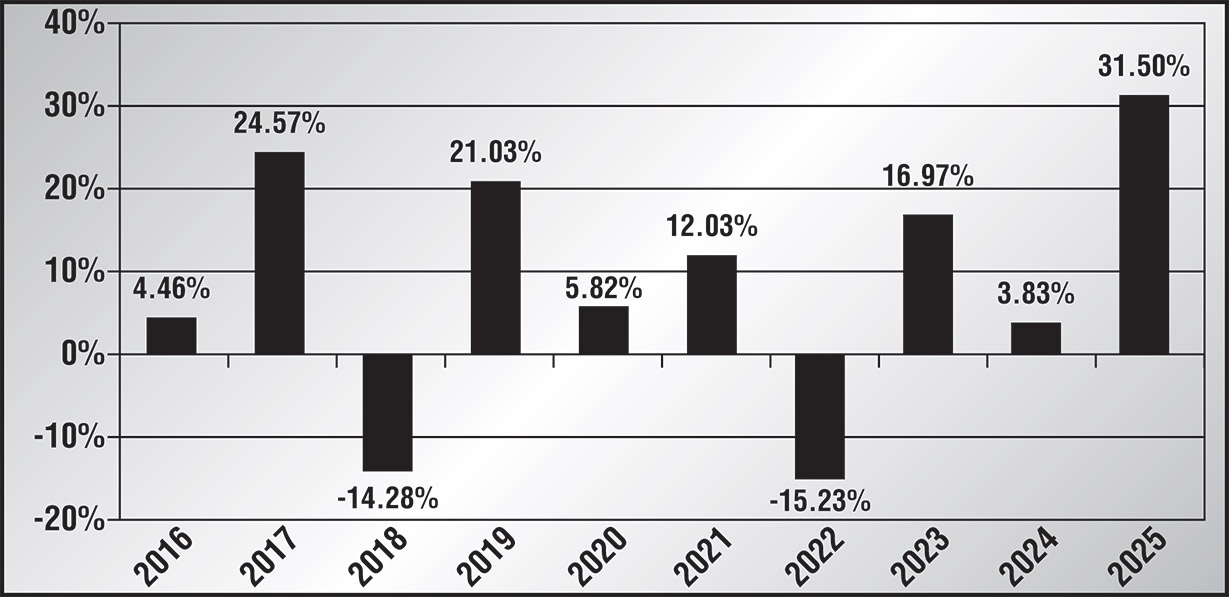
* Results shown on a calendar year basis; the Portfolio’s fiscal year, however, is June 30. |
The Portfolio’s before-tax return for the period from January 1, 2026 through September 30, 2026 (non-annualized) was 6.72%.
| Best quarter: |
| 4th Qtr. 2022 | 18.31% |
|
| Worst quarter: |
| 1st Qtr. 2020 | ‑25.17% |
|
|
| One Year |
|
| Five Year |
| Ten Year | ||
The Institutional International Equity Portfolio |
|
|
|
|
|
|
|
|
|
– Before Taxes |
| 31.50 | % |
| 8.69 | % |
| 8.04 | % |
– After Taxes on Distributions |
| 26.19 | % |
| 6.70 | % |
| 6.54 | % |
– After Taxes on Distributions and Sale of Portfolio Shares |
| 19.89 | % |
| 6.25 | % |
| 6.06 | % |
MSCI EAFE Index (reflects no deduction for fees, expenses or taxes) |
| 31.89 | % |
| 9.47 | % |
| 8.72 | % |
After-tax returns are calculated using the historical highest individual Federal marginal income tax rates and do not reflect the impact of state and local taxes. Actual after-tax returns depend on an investor’s tax situation and may differ from those shown, and after-tax returns shown are not relevant to investors who hold Portfolio shares through tax-advantaged arrangements, such as qualified retirement plans.