P12M
http://fasb.org/us-gaap/2026#UsefulLifeTermOfLeaseMember
Unlimited
Unlimited
Exhibit 99.1
OPERATING AND FINANCIAL REVIEW FOR THE SIX MONTHS ENDED JUNE 30, 2026
This section should be read in conjunction with our unaudited condensed consolidated financial statements and the related notes included elsewhere in this interim report.
Unless otherwise indicated or the context otherwise requires, all references to “the Company,” “our company,” “we,” “our,” “ours,” “us” or similar terms refer to NewGenIvf Group Limited and its subsidiaries.
Overview
Financial Highlights for the Six Months Ended June 30, 2026
| ● | Sales revenue slightly dropped from $2,019,628 for the six months ended June 30, 2025 to $1,924,881in the same period of 2026. |
| ● | Gross profit ratio had been improved from 15.5% for the six months ended June 30, 2025 to 24.1% in the same period of 2026. This was primarily due to the reduction of clinic costs as a result of change of business model from IVF clinic to fertility referral service in Kyrgyzstan. |
| ● | Selling & distribution expenses increased from $307,176 for the six months ended June 30, 2025 to $416,238 in the same period of 2026. This was primarily due to the real estate development project in Dubai. |
| ● | General and administrative expenses increased from $3,247,004 for the six months ended June 30, 2025 to $3,595,662 in the same period of 2026. |
| ● | Net Other Expenses in the amount of $3,990,911 were recorded in the six months ended June 30, 2026, which was mainly due to a one-off loss of $3,421,643 on Repurchase and Forbearance Agreement with JAK Opportunities VI LLC while there was a Net Other Income of $4,062,303 in the six months ended June 30, 2025, which was mainly due to the gain on acquisition of the Microsort trademarks in the amount $4,276,500. |
| ● | Interest expense increased from $125,489 for the six months ended June 30, 2025 to $541,133 in the same period of 2026. This was due to additional convertible bonds issued for the six months ended June 30, 2026. |
| ● | Net loss attributable to the shareholders of the Company was $8.04 million for the six months ended June 30, 2026 while there was a net profit attributable to the shareholders of the Company of $724,975 in the same period of 2025. Excluding the non-cash gain on acquisition of Microsort trademarks in 2025 and the one-off loss on the Repurchase and Forbearance Agreement in 2026, net loss attributable to the shareholders of the Company would be increased by 29.91% from $3,551,525 for the six months ended June 30, 2025 to 4,613,663 in the same period of 2026. |
| ● | Net book value was improved from $9,276,833 as of June 30, 2025 to $26,428,942 as of June 30, 2026, representing a significant balance sheet transformation driven by strategic acquisitions of high-value intellectual property assets as well as investment in Prediction market and well-received fundraising that both reinforced the balance sheet and widen the shareholder base. |
| ● | Subsequent to June 30, 2026, there was an unrealized gain of about $3m on the Company’s 2% equity investment in K25.ai based on updated valuation of K25.ai shares. Upon completion of the other 11% share investment in K25.ai by the end of December 2026, unrealized gain on the Company’s equity investment in K25.ai might be increased to $15m. |
Business Highlights for the Six Months Ended June 30, 2026
The Company has continued to make progress in executing its strategic pivot and diversification strategy throughout the six months ended June 30, 2026. Key initiatives and achievements demonstrating this progress include:
| ● | Transformative Investment in Prediction market: |
| ○ | On May 15, 2026, NewGenIvf signed a strategic investment agreement with PredicXion Group Limited, and Kong Yiu Cheung, PredicXion’s sole shareholder (the “Seller”), for the acquisition of up to a 10% equity interest in PredicXion (the “PredicXion Acquisition”) at a pre-money valuation of US$100,000,000. |
| ○ | On May 28, 2026, NewGenIvf signed a share purchase agreement with PredicXion, and the Seller for the acquisition of a 2% equity interest in PredicXion. This investment transaction was completed on the same date. |
| ○ | On June 2, 2026, NewGenIvf exercised its Top-up Option to acquire an additional 4% equity interest in PredicXion. On June 18, 2026, NewGenIvf further exercised its Top-up Option to acquire an additional 4% equity interest in PredicXion. |
| ○ | On July 27, 2026, NewGenIvf signed a share purchase agreement with PredicXion for the acquisition of an additional 3% equity interest in PredicXion at a pre-money valuation of US$250,000,000. |
| ● | 2026 Debt Financing: For the six months period ended June 30, 2026, the Company entered into securities purchase agreements with various parties for the issuance of convertible notes with an aggregate principal amount of $2.13 million, which provided capital to fund our strategic initiatives. |
Key Components of Results of Operations
NewGenIvf’s revenues were derived from two types of services: IVF treatment services and fertility referral services.
Revenue
The following table sets forth NewGenIvf’s revenue for the periods indicated.
| | | For the Six Months ended
June 30, | |
| | | 2026 | | | 2025 | |
| | | US$ | | | US$ | |
| Revenue | | $ | 1,924,881 | | | $ | 2,019,628 | |
The following table sets forth a breakdown of NewGenIvf’s revenue by the types of services, in absolute amounts and as percentages of total revenue, for the periods indicated.
| | | For the Six Months ended June 30, | |
| | | 2026 | | | 2025 | |
| | | US$ | | | % | | | US$ | | | % | |
| IVF treatment services(1) | | | 1,574,320 | | | | 81.8 | | | | 2,019,628 | | | | 100.0 | |
| Fertility referral services | | | 350,561 | | | | 18.2 | | | | - | | | | - | |
| Total revenues | | | 1,924,881 | | | | 100.0 | | | | 2,019,628 | | | | 100.0 | |
| (1) | Include an insignificant amount of revenue derived from consultation customers who used NewGenIvf’s non-IVF treatment and insignificant services, such as check-ups services, blood test services and other minor services. |
NewGenIvf generated revenue from facilities located in various geographic regions. The following table sets forth a breakdown of NewGenIvf’s revenue based on the locations where the revenue originated, in absolute amounts and as percentages of total revenue, for the periods indicated.
| | | For the Six Months ended June 30, | |
| | | 2026 | | | 2025 | |
| | | US$ | | | % | | | US$ | | | % | |
| HK SAR | | | - | | | | - | | | | - | | | | - | |
| Thailand | | | 905,033 | | | | 47.1 | | | | 573,025 | | | | 28.4 | |
| Cambodia | | | 243,153 | | | | 12.6 | | | | 354,933 | | | | 17.6 | |
| Kyrgyzstan | | | 728,054 | | | | 37.8 | | | | 1,053,907 | | | | 52.2 | |
| Other third party clinics | | | 48,641 | | | | 2.5 | | | | 37,763 | | | | 1.9 | |
| Total Revenue | | | 1,924,881 | | | | 100.0 | | | | 2,019,628 | | | | 100.0 | |
NewGenIvf’s revenue results are affected by, among others, changes in sales price and the fluctuation of foreign currency rates with US dollars. Based on the breakdown of the revenue contribution in terms of currencies used by customers for 2026, a 10% change in foreign currency rates with US dollars would cause approximately 10% change in NewGenIvf’s revenue.
IVF treatment services
NewGenIvf generated revenue from IVF treatment services provided at facilities that NewGenIvf operated in Thailand and Cambodia. In addition, NewGenIvf’s revenue from IVF treatment service amounted to $1,574,320 and $2,019,628, representing approximately 81.8% and 100% of its total revenues in the six months ended June 30, 2026 and 2025, respectively. This was primarily due to the change of business model in Kyrgyzstan from IVF clinic service to fertility referral service.
IVF treatment involves the performance of a series of medical treatment and procedures and eventually brings benefits to clients when embryo is successfully implanted. Revenue from IVF treatment is recognized at a point in time when different treatment and/or procedure completed in clinic. The completion of the respective treatments and/or procedures are evidenced by treatment cards and reports maintained in the patient files indicating successful completion of respective promised obligations.
Fertility Referral services
NewGenIvf also generated revenue of $350,561 from fertility referral services, approximately 18.2% of its total revenue in the six months ended on June 30, 2026. Fertility referral service revenue is recognized at a point in time when the customers are referred to our agents and commission is received from the agents.
Cost of revenue
The following table sets forth a breakdown of NewGenIvf’s cost of revenue by the nature of the cost, in absolute amounts and as percentages of total cost of revenues, for the periods indicated.
| | | For the Six Months ended June 30, | |
| | | 2026 | | | 2025 | |
| | | US$ | | | % | | | US$ | | | % | |
| Cost of revenues | | | | | | | | | | | | |
| Cost of goods sold | | | 214,012 | | | | 14.7 | | | | 278,839 | | | | 16.3 | |
| Clinic costs | | | 1,246,381 | | | | 85.3 | | | | 1,426,985 | | | | 83.7 | |
| Total cost of revenues | | | 1,460,393 | | | | 100.0 | | | | 1,705,824 | | | | 100.0 | |
Cost of goods sold. Cost of goods sold primarily consisted of purchase and direct cost for IVF treatment services and ancillary caring services. NewGenIvf’s cost of goods was mostly recognized during the provision of IVF treatment services.
Clinic costs. Clinic costs primarily consisted of sub-contracting charges, office supplies and staff salaries and bonus of NewGenIvf’s clinics. Sub-contracting charges represented fees paid to agents who supervised and managed the whole IVF services for customers who utilized third party independent clinics, recruited surrogate mothers and assisted in the documentation, consulting and medical treatment arrangement throughout treatment procedure of surrogacy service.
Gross profit and gross margin
The following table sets forth NewGenIvf’s gross profit in absolute amounts for the periods indicated.
| | | For the Six Months ended
June 30, | |
| | | 2026 | | | 2025 | |
| | | US$ | | | US$ | |
| Gross profit | | $ | 464,488 | | | $ | 313,804 | |
The following table sets forth NewGenIvf’s gross profit in absolute amounts and its gross margin as percentages of total revenues, for the periods indicated.
| | | For the Six Months ended June 30, | |
| | | 2026 | | | 2025 | |
| | | US$ | | | % | | | US$ | | | % | |
| Gross profit | | | 464,488 | | | | 24.1 | | | | 313,804 | | | | 15.5 | |
| Revenues | | | 1,924,881 | | | | — | | | | 2,019,628 | | | | — | |
NewGenIvf expects that gross profit and gross margin will continue to be affected by various factors including the geographic locations where treatments are performed, as well as the pricing with its clients, agent subcontracting charges and the costs of the supplies provided by major pharmaceutical companies, all of which are negotiated separately. The improvement in the gross margin of the 6 months ended June 30, 2026 compared with the same period of June 30, 2025 was mainly due to the reduction of clinic costs as a result of business model changed from IVF Clinic to fertility referral service in Kyrgyzstan.
Operating expenses
NewGenIvf’s operating expenses consist of selling and marketing expenses and general and administrative expenses. NewGenIvf’s selling and marketing expenses are primarily social media expenses. NewGenIvf’s general and administrative expenses mainly include depreciation in operating lease ROU assets, consultant and legal fees, embedded derivative fair value expense, write off of certain receivables and staff salaries.
Other income (expense)
For the six months ended June 30, 2026, NewGenIvf’s other income (expense) consists primarily of a loss on repurchase and forbearance agreement of $3,421,643 and losses of $562,877 arising from investment in digital assets and financial assets.
Interest expense
NewGenIvf’s interest expense is incurred mainly in relation to its interest-bearing convertible bonds.
Taxation
British Virgin Islands
NewGenIvf is incorporated in the British Virgin Islands and is not subject to tax on income or capital gains under current British Virgin Islands law. In addition, upon payment of dividends to shareholders, no British Virgin Islands withholding tax will be imposed.
Hong Kong
Under the two-tiered profits tax rates regime, Hong Kong tax residents are subject to Hong Kong profits tax in respect of profits arising in or derived from Hong Kong at 8.25% for the first HK$2 million of profits of the qualifying group entity, and profits above HK$2 million will be taxed at 16.5%. The profits of group entities not qualifying for the two-tiered profits tax rates regime will continue to be taxed at a flat rate of 16.5%.
Accordingly, the Hong Kong profits tax is calculated at 8.25% on the first HK$2 million of the estimated assessable profits and at 16.5% on the remaining estimated assessable profits.
Thailand
The companies incorporated in Thailand are taxed on worldwide income. A company incorporated outside of Thailand is taxed on its profits arising from or in consequence of the business carried on in Thailand. The Thailand corporate income tax rate is 20%. A foreign company not carrying on business in Thailand is subject to a final withholding tax on certain types of assessable income (e.g., interest, dividends, royalties, rentals, and service fees) paid from or in Thailand. The rate of withholding tax is generally 15%, except for dividends, which is 10%, while other rates may apply under the provisions of a double tax treaty.
Cambodia
The standard rate of corporate income tax for companies and permanent establishments in Cambodia who are classified as medium and large taxpayers is 20%. For companies and permanent establishments who are classified as small taxpayers, the corporate income tax rates are progressive rates from 0% to 20%. In view of the annual turnover of the company, which ranges from KHR1 billion to KHR6 billion for service and commercial sectors, the company is considered a medium-sized company.
Kyrgyzstan
NewGenIvf is subject to a corporate income tax on its aggregate annual income earned worldwide. Non-resident legal entities carrying out business activities through a permanent establishment in Kyrgyzstan are subject to profit tax on the income attributed to the activities of that permanent establishments. Profit tax is calculated at a rate of 10% of aggregate annual income less allowed deductions.
U.S.A.
NewGenIvf is subject to a corporate income tax on its aggregate annual income earned worldwide from its U.S. operations at a flat 21% on net income. In addition to federal obligations, there is a graduated state income tax rate that applies to corporate income, with a top rate of 6.6% on income over $60,000. Moreover, when the Company’s US operation pays a dividend to its offshore parent company, the payment is generally subject to a US federal withholding tax, typically at a statutory rate of 30% on the gross amount.
Results of Operations
Six Months period ended June 30, 2025 compared with Six Months period ended June 30, 2026
| | | Six Months Ended June 30, 2025 | | | Six Months Ended June 30, 2026 | |
| | | US$ | | | US$ | |
| Revenues | | | 2,019,628 | | | | 1,924,881 | |
| Cost of revenues | | | (1,705,824 | ) | | | (1,460,393 | ) |
| Gross profit | | | 313,804 | | | | 464,488 | |
| | | | | | | | | |
| Operating expenses | | | | | | | | |
| Selling and marketing expenses | | | (307,176 | ) | | | (416,238 | ) |
| General and administrative expenses | | | (3,247,004 | ) | | | (3,595,662 | ) |
| | | | | | | | | |
| Total operating expenses | | | (3,554,180 | ) | | | (4,011,900 | ) |
| | | | | | | | | |
| Operating (loss) income | | | (3,240,376 | ) | | | (3,547,412 | ) |
| | | | | | | | | |
| Other income (expenses), net | | | | | | | | |
| Other income (expense), net | | | 4,062,303 | | | | (3,990,911 | ) |
| Interest income | | | 1,594 | | | | 64 | |
| Interest expense | | | (125,489 | ) | | | (541,133 | ) |
| Total other income (expenses), net | | | 3,938,408 | | | | (4,531,980 | ) |
| | | | | | | | | |
| Income (Loss) before taxes | | | 698,032 | | | | (8,079,392 | ) |
| Tax income (expense) | | | - | | | | - | |
| Net income (loss) | | | 698,032 | | | | (8,079,392 | ) |
| Less: net loss attributable to non-controlling interests | | | (26,943 | ) | | | (44,086 | ) |
| Net income (loss) attributable to the shareholders of the Company | | | 724,975 | | | | (8,035,306 | ) |
| Other comprehensive income (loss) | | | | | | | | |
| Foreign currency translation adjustment | | | (66,526 | ) | | | (99,506 | ) |
| Total comprehensive income (loss) | | | 631,506 | | | | (8,178,898 | ) |
| Less: Total comprehensive income (loss) attributable to non-controlling interests | | | (54,536 | ) | | | (70,754 | ) |
| Total comprehensive income (loss) attributable to the shareholders of the Company | | | 686,042 | | | | (8,108,144 | ) |
| | | | | | | | | |
| Earnings per share – basic | | | 45,310.94 | | | | (852.55 | ) |
| Weighted average shares outstanding * – basic | | | 16 | | | | 9,425 | |
| * | Subsequent to 2024 year end, the Company carried out a 1-for-20 reverse stock split, a 1-for-10 reverse stock split, a 1-for-5 reverse stock split, a 1-for-5 reverse stock split, a 1-for-3 reverse stock split, a 1-for-4 reverse stock split, a 1-for-3 reverse stock split, a 1-for-3 reverse stock split, and a 1-for-4 reverse stock split of its issued and unissued shares which was effected on February 11, 2025, May 5, 2025, August 4, 2025, December 1, 2025, January 26, 2026, March 16, 2026, July 6, 2026, September 1, 2026, October 12, 2026 and October 23 respectively. The shares above have been adjusted retrospectively for these reverse stock splits. |
Year Ended December 31, 2024 Compared with Year Ended December 31, 2025
| | | For the Year ended
December 31, | |
| | | 2024 | | | 2025 | |
| | | US$ | |
| Revenues | | | 5,433,375 | | | | 4,726,433 | |
| Cost of revenues | | | (3,606,481 | ) | | | (3,770,587 | ) |
| Gross profit | | | 1,826,894 | | | | 955,846 | |
| | | | | | | | | |
| Operating expenses | | | | | | | | |
| Selling and marketing expenses | | | (206,314 | ) | | | (1,188,711 | ) |
| General and administrative expenses | | | (2,781,075 | ) | | | (10,493,596 | ) |
| | | | | | | | | |
| Total operating expenses | | | (2,987,389 | ) | | | (11,682,306 | ) |
| | | | | | | | | |
| Operating (loss) income | | | (1,160,495 | ) | | | (10,726,461 | ) |
| | | | | | | | | |
| Other income (expenses), net | | | | | | | | |
| Other income (expense), net | | | 971,391 | | | | (8,099 | ) |
| Bargain purchase gain | | | - | | | | 21,653,835 | |
| Loss on digital assets, net | | | - | | | | (332,480 | ) |
| Loss on financial assets, net | | | - | | | | (700,631 | ) |
| Gain on embedded derivative | | | - | | | | 456,731 | |
| Interest income | | | 6,953 | | | | 2,251 | |
| Finance costs | | | (778,656 | ) | | | (616,423 | ) |
| Total other income (expenses), net | | | 199,688 | | | | 20,455,184 | |
| | | | | | | | | |
| (Loss) Income before taxes | | | (960,807 | ) | | | 9,728,723 | |
| Tax income (expense) | | | 486,706 | | | | - | |
| Net (loss) income | | | (474,101 | ) | | | 9,728,723 | |
| Less: net income attributable to non-controlling interests | | | 50,542 | | | | (150,685 | ) |
| Net (loss) income attributable to the shareholders of the Company | | | (524,643 | ) | | | 9,879,408 | |
| Other comprehensive income (loss) | | | | | | | | |
| Foreign currency translation adjustment | | | 32,529 | | | | (222,944 | ) |
| Total comprehensive (loss) income | | | (441,572 | ) | | | 9,505,779 | |
| Less: Total comprehensive income (loss) attributable to non-controlling interests | | | 56,908 | | | | (211,683 | ) |
| Total comprehensive (loss) income attributable to the shareholders of the Company | | | (498,480 | ) | | | 9,717,462 | |
| | | | | | | | | |
| Earnings per share – basic | | | (1,292,224 | ) | | | 61,842.93 | |
| Weighted average shares outstanding * – basic | | | 0.406 | | | | 159.75 | |
| * | Subsequent to 2024 year end, the Company carried out a 1-for-20 reverse stock split, a 1-for-10 reverse stock split, a 1-for-5 reverse stock split, a 1-for-5 reverse stock split, a 1-for-3 reverse stock split, a 1-for-4 reverse stock split and a 1-for-3 reverse stock split of its issued and unissued shares which was effected on February 11, 2025, May 5, 2025, August 4, 2025, December 1, 2025, January 26, 2026, March 16, 2026, July 6, 2026, September 1, 2026, October 12, 2026 and October 23, 2026 respectively. The shares above have been adjusted retrospectively for these reverse stock splits. |
Revenue
NewGenIvf’s revenue decreased by approximately 4.69% from US$2,019,628 for the six months ended June 30, 2025 to $1,924,881 for the six months ended June 30, 2026.
NewGenIvf’s revenue decreased by approximately 13.01% from US$5,433,375 in the year ended December 31, 2024 to US$4,726,433 in the year ended December 31, 2025.
IVF treatment services
NewGenIvf’s IVF treatment service revenue decreased by approximately 22.05% from US$2,019,628 for the six months ended June 30, 2025 to US$1,574,320 for the six months ended June 30, 2026. This decrease was primarily the result of change of business model in Kyrgyzstan from an IVF clinic to a referral agency business.
NewGenIvf’s IVF treatment service revenue decreased by approximately 28.11% from US$5,433,375 in the year ended December 31, 2024 to US$3,905,863 in the year ended December 31, 2025. This decrease was primarily the result of change of management in Thailand clinic and new clinic set-up in Kyrgyzstan focusing on IVF services in late 2024.
Fertility Referral services
For the six months ended June 30, 2026, NewGenIvf’s derived fertility referral services of US$350,561 revenue from referring customers to outside agents for IVF and surrogacy services while no such revenue was recorded in the six months ended June 30, 2025.
In the year ended December 31, 2025, NewGenIvf’s derived fertility referral services of US$820,570 revenue from referring customers to outside agents for IVF and surrogacy services while no such revenue was recorded in December 31, 2024.
Cost of revenue
NewGenIvf’s cost of revenue decreased by approximately 14.39% from US$1,705,824 for the six months ended June 30, 2025 to US$1,460,393 for the six months ended June 30, 2026. This decrease was primarily the result of downsizing the IVF clinic in Kyrgyzstan.
NewGenIvf’s cost of revenue increased by approximately 4.55% from US$3,606,481 in the year ended December 31, 2024 to US$3,770,587 in the year ended December 31, 2025.
Cost of goods sold
NewGenIvf’s cost of goods sold decreased by approximately 23.25% from US$278,839 for the six months ended June 30, 2025 to US$214,012 for the six months ended June 30, 2026, primarily attributed to some revenue shifted from IVF services to fertility referral services.
NewGenIvf’s cost of goods sold decreased by approximately 1.15% from US$629,620 in the year ended December 31, 2024 to US$622,386 in the year ended December 31, 2025, primarily attributed to the decrease on procurement costs.
Clinic costs
NewGenIvf’s clinic costs decreased by approximately 12.66% from US$1,426,985 for the six months ended June 30, 2025 to US$1,246,381 for the six months ended June 30, 2026. This decrease was primarily the result of downsizing the IVF clinic in Kyrgyzstan.
NewGenIvf’s clinic costs increased by approximately 5.76% from US$2,976,861 in the year ended December 31, 2024 to US$3,148,201 in the year ended December 31, 2025, primarily due to clinic staff turnover in Thailand.
Gross profit
NewGenIvf’s gross profit increased by approximately 48.02% from US$313,804 for the six months ended June 30, 2025 to US$464,488 for the six months ended June 30, 2026. Gross margin improved from 15.5% in the six months ended June 30, 2025 to 24.1% in the six months ended June 30, 2026. This increase was primarily the result of change of business model in Kyrgyzstan from an IVF clinic to a referral agency business.
NewGenIvf’s gross profit decreased by approximately 47.68% from US$1,826,894 in the year ended December 31, 2024 to US$955,846 in the year ended December 31, 2025, primarily attributable to a reorganizing of our cooperation model with subcontractors and the decreased efficiency of our marketing services, resulting in a increase in unit service costs per customer, directly leading to decreases in gross profit margins.
NewGenIvf’s gross margin decreased from 33.6% in the year ended December 31, 2024 to 20.2% in the year ended December 31, 2025. This is primarily due to the drop of sales revenue while the overhead costs of clinic was not reduced accordingly.
Operating expenses
NewGenIvf’s operating expenses increased by approximately 12.88% from US$3,554,180 for the six months ended June 30, 2025 to US$4,011,900 for the six months ended June 30, 2026. This was primarily due to additional business activities in diversifying our businesses.
NewGenIvf’s operating expenses increased by approximately 291.05% from US$2,987,389 in the year ended December 31, 2024 to US$11,682,306 in the year ended December 31, 2025, primarily attributable to (i) professional fees of US$1,861,572 incurred in year ended December 31, 2025 being related to real estate development project in United Arab of Emirates, valuation fees on acquisition of Nodexus (ii) staff and director salary and personnel cost of US$2,910,173 in the year ended December 31, 2025 due to enlargement of sales/marketing force and administrative staff to implement our business expansion pan and bonus related to maintaining listing status in Nasdaq and increasing share capitalization; and (iii) write-off of certain agency deposit and artwork of US$1,105,370.
Other income
NewGenIvf’s other income decreased from a net other income of $4,062,303 to a net expense of $3,990,911 from the six months period ended June 30, 2025 to the six months period ended June 30, 2026. This is due to a non cash gain on bargain purchase of Microsort business of $4,276,500 in the six months period ended June 30, 2025 while there was a loss of $3,421,643 on repurchase and forbearance agreement in the six months period ended June 30, 2026. Such repurchase and forbearance agreement loss was due to the consideration paid to an investor for the extinguishment of additional closings under the existing securities purchase agreements as well as forbearance on conversion of existing notes and exercise of warrants.
NewGenIvf’s other income increased from US$971,391 in the year ended December 31, 2024 to US$21,069,356 in the year ended December 31, 2025, primarily attributable to a non-cash, bargain purchase gain recognized on the acquisition of Nodexus and Microsort businesses of $21,653,835, gain on embedded derivative of $456,731, loss on investment in digital assets, net of $332,480 and loss on investment on financial assets, net of $700,631.
Finance Costs
NewGenIvf’s finance costs increased by approximately 331.22% from US$125,489 for the six months ended June 30, 2025 to US$541,132 for the six months ended June 30, 2026. This is primarily due to the increase of newly issued convertible bond in the six months ended June 30, 2026.
NewGenIvf’s finance costs decreased by approximately 20.84% from US$778,656 in the year ended December 31, 2024 to US$616,423 in the year ended December 31, 2025 as a result of securing a lower interest rate on convertible notes issued during the year and some convertible notes being issued second half of 2025 for financing new business initiatives including real estate development project in United Arab of Emirates, supplement business and tokenization project.
Tax income (expense)
NewGenIvf made no provision for income taxes in the years ended December 31, 2024 and December 31, 2025. There was no assessable income generated from Hong Kong, Thailand and Cambodia.
During the year ended December 31, 2024 excess provision of US$486,706 was reversed as they are no longer deemed to be payable.
Net income
NewGenIvf generated a net loss of US$(8,079,392) for the six months ended June 30, 2026 while there was a net income of US$698,032 for the six months ended June 30, 2025. This is due to a non cash gain on bargain purchase of Microsort business of $4,276,500 in the six months period ended June 30, 2025 while there was a loss of $3,421,643 on repurchase and forbearance agreement in the six months period ended June 30, 2026.
NewGenIvf generated a net income of US$9,728,723 in 2025 while there was a net loss of US$(474,101) in 2024.
Liquidity and Capital Resources
Cash flows and working capital
NewGenIvf’s principal sources of liquidity have been cash flows generated from its business operations and external financing via various instruments. As of June 30, 2026 NewGenIvf had US$1,023,789 in cash and cash equivalents. As of December 31, 2024 and 2025, NewGenIvf had US$457,740 and US$758,621, respectively, in cash and cash equivalents. NewGenIvf had working capital (defined as total current assets deducted by total current liabilities) of a surplus of US$618,325 as of June 30, 2026. NewGenIvf had working capital (defined as total current assets deducted by total current liabilities) of a surplus of $452,391 and US$5,017,221 respectively, as of December 31, 2024 and 2025.
As of December 31, 2025, NewGenIvf owed US$6,421 to related parties. Nevertheless, NewGenIvf is able to generate sufficient cash flow from its business operations and financing activities to operate and grow its business.
NewGenIvf continually seeks to monetize from positive cash flow contracts and increase revenue from its operating activities. NewGenIvf monitors its current and expected liquidity requirements to help ensure that it maintains sufficient cash balances to meet its existing and reasonably likely long-term liquidity needs.
NewGenIvf intends to finance its future working capital requirements and capital expenditures from cash generated from operating activities, in addition to funds raised from financing activities. NewGenIvf may, however, require additional cash due to changing business conditions or other future developments, including any investments or acquisitions it may decide to pursue. If its existing cash is insufficient to meet its requirements, NewGenIvf may seek to issue debt or equity securities or obtain additional credit facilities. Financing may be unavailable in the amounts NewGenIvf needs or on terms acceptable to it, if at all. Issuance of additional equity securities, including convertible debt securities, would dilute NewGenIvf’s earnings per share. The incurrence of debt would divert cash for working capital and capital expenditures to service debt obligations and could result in operating and financial covenants that restrict NewGenIvf’s operations and its ability to pay dividends to its shareholders. If NewGenIvf is unable to obtain additional equity or debt financing as required, its business operations and prospects may suffer. Please see “Risk Factors — Risks Relating to NewGenIvf’s Business and Industry — NewGenIvf requires a significant amount of capital to fund its operations and growth. If NewGenIvf cannot obtain sufficient capital on acceptable terms, its business, financial condition, and prospects may be materially and adversely affected.”
The following table presents NewGenIvf’s selected consolidated cash flow data for the periods indicated.
| | | For Six Months ended
June 30, | |
| | | 2025 | | | 2026 | |
| | | US$ | |
| Net cash used in operating activities | | | (895,065 | ) | | | (4,607,447 | ) |
| Net cash used in investing activities | | | (7,542,785 | ) | | | (55,358 | ) |
| Net cash provided by financing activities | | | 9,963,297 | | | | 5,027,478 | |
| | | | | | | | | |
| Net increase in cash and cash equivalents | | | 1,525,447 | | | | 364,673 | |
| Effect of foreign currency translation on cash and cash equivalents | | | (374,711 | ) | | | (99,505 | ) |
| Cash and cash equivalents, beginning of 6 months period | | | 457,740 | | | | 758,621 | |
| Cash and cash equivalents, end of 6 months period | | | 1,608,476 | | | | 1,023,789 | |
| | | For the Year ended
December 31, | |
| | | 2024 | | | 2025 | |
| | | US$ | |
| Net cash used in operating activities | | | (8,264,074 | ) | | | (10,926,056 | ) |
| Net cash used in investing activities | | | (53,045 | ) | | | (7,559,774 | ) |
| Net cash provided by financing activities | | | 8,675,790 | | | | 18,992,758 | |
| | | | | | | | | |
| Net increase in cash and cash equivalents | | | 358,671 | | | | 506,928 | |
| Effect of foreign currency translation on cash and cash equivalents | | | 44,965 | | | | (206,047 | ) |
| Cash and cash equivalents, beginning of year | | | 54,104 | | | | 457,740 | |
| Cash and cash equivalents, end of year | | | 457,740 | | | | 758,621 | |
Operating activities
Net cash used in operating activities was US$4,607,447 for the six months period ended June 30, 2026, primarily representing deposit in investment in K25.ai, and repurchase forbearance.
Net cash used in operating activities was US$10,926,056 for the year ended December 31, 2025. The difference between NewGenIvf’s net profit of US$9,728,723 for the year ended December 31, 2025 and the net cash used in operating activities was primarily attributable to bargain purchase gain of US$21.7m on acquisition of Nodexus and Microsort businesses.
Net cash used in operating activities was US$8,264,074 for the year ended December 31, 2024. The difference between NewGenIvf’s net loss of US$474,101 for the year ended December 31, 2024 and the net cash used in operating activities was primarily attributable to (i) an increase of agent’s receivable of US$1,191,795, (ii) a cash deposit of US$1,000,000 with a digital trading platform and settlement of charges in relation to the de-spac and business reorganisation.
Investing activities
Net cash used in investing activities in the six months period ending on June 30, 2026 was US$55,358, primarily representing NewGenIvf’s investment in K25.ai, and disposal of derivates instruments.
Net cash used in investing activities in 2025 was US$7,559,774, primarily representing reservation money of US$4.6m paid for the real estate development project in United Arab of Emirates, as well as cash paid for investment in digital assets of $1,000,000, amounts held in custody for investments of $760,000 and cash paid for acquisition of businesses in 2025 of $1,050,000.
Net cash used in investing activities in 2024 was US$53,045, primarily representing purchase of plant and equipment.
Financing activities
Net cash used provided by financing activities in the six months period ending on June 30, 2026 was US$5,027,478, primarily representing issuance of share capital utilizing equity line of credit, convertible note issuance, and acquisition issuance.
Net cash provided by financing activities in 2025 was US$18,992,758, primarily representing issuance of share capital of US$12.6m utilizing equity line of credit, convertible note issuance of US$6.8m and settlement of $500,000 for a promissory note.
Net cash provided by financing activities in 2024 was US$8,675,790, primarily representing issuance of share capital utilizing equity line of credit, convertible note issuance and proceeds from issuance of promissory notes all totaling to an amount of $8,583,597.
Contractual Obligations
The following table sets forth NewGenIvf’s main contractual obligations and commitments as of June 30, 2025 and June 30, 2026.
| | | June 30, | |
| | | 2025 | | | 2026 | |
| | | US$ | |
| Operating lease | | | |
| - Payable less than 1 years | | | 263,532 | | | | 219,635 | |
| - Payable 1 – 2 years | | | 66,775 | | | | 77,753 | |
| - Payable 2.- 5 years | | | 148,313 | | | | - | |
| Total | | | 478,620 | | | | 297,388 | |
| | | | | | | | | |
Convertible bonds-
2026 | | | 414,000 | | | | 157,000 | |
| 2027 | | | - | | | | 1,970,112 | |
| 2028 | | | 3,200,000 | | | | - | |
| Total | | | 3,614,000 | | | | 2,127,112 | |
The following table sets forth NewGenIvf’s main contractual obligations and commitments as of December 31, 2024 and December 31, 2025.
| | | December 31, | |
| | | 2024 | | | 2025 | |
| | | US$ | |
| Operating lease | | | |
| - Payable less than 1 years | | | 111,321 | | | | 262,244 | |
| - Payable 1 – 2 years | | | 10,300 | | | | 184,041 | |
| - Payable 2.- 5 years | | | — | | | | 118,800 | |
| Total | | | 121,621 | | | | 565,085 | |
| | | | | | | | | |
| Convertible bonds- | | | | | | | - | |
| 2025 | | | 516,250 | | | | - | |
| 2026 | | | 457,250 | | | | 664,000 | |
| 2027 | | | 457,250 | | | | - | |
| 2028 | | | 507,250 | | | | 3,150,000 | |
| 2029 | | | 3,269,625 | | | | - | |
| 2030 | | | - | | | | 1,475,000 | |
| Total | | | 5,207,625 | | | | 5,289,000 | |
The convertible bonds have the option of being converted to Class A ordinary shares at the discretion of the holder, any time after issuance. The conversion, however, is subject to certain terms and conditions, including the requirement of the shareholdings not to exceed 4.99 % or 9.99% of the Company’s shares based on the noteholder. As of December 31, 2025, this criterion has been met.
Off-Balance Sheet Commitments and Arrangements
NewGenIvf has not entered into any financial guarantees or other commitments to guarantee the payment obligations of any third parties, nor any derivative contracts that are indexed to its shares and classified as shareholder’s equity or that are not reflected in its consolidated financial statements. Furthermore, NewGenIvf does not have any retained or contingent interest in assets transferred to an unconsolidated entity that serves as credit, liquidity or market risk support to such entity. NewGenIvf does not have any variable interest in any unconsolidated entity that provides financing, liquidity, market risk or credit support to it or engages in leasing, hedging or product development services with it.
Critical Accounting Estimates
NewGenIvf prepares its financial statements in conformity with U.S. GAAP, which requires NewGenIvf to make judgments, estimates and assumptions. NewGenIvf continually evaluates these estimates and assumptions based on the most recently available information, its historical experience and various other assumptions that NewGenIvf’s management believes to be reasonable under the circumstances. Since the use of estimates is an integral component of the financial reporting process, actual results could differ from its expectations as a result of changes in NewGenIvf’s estimates.
The selection of critical accounting estimates, the judgments and other uncertainties affecting application of those policies and the sensitivity of reported results to changes in conditions and assumptions are factors that should be considered when reviewing NewGenIvf’s financial statements. NewGenIvf’s management believes the following accounting estimates involve the most significant judgments and estimates used in the preparation of their financial statements.
Recent accounting pronouncements
The FASB has introduced expanded income tax disclosure requirements under ASU 2023-09 to improve transparency. Companies will now need to provide a detailed reconciliation of their effective tax rate, breaking down federal, state, and foreign taxes, as well as specific categories like tax credits and foreign earnings. Additionally, businesses must disclose income taxes paid by jurisdiction, offering investors greater clarity on tax obligations. These changes apply to both public and private companies, with annual reporting periods beginning after December 15, 2024 (2025 for calendar-year entities). This update aims to reduce ambiguity in tax reporting and align disclosures with investor needs.
A major shift in digital asset accounting, ASU 2023-08 requires companies to measure certain crypto assets (e.g., Bitcoin, Ethereum) at fair value rather than applying the previous impairment-only model. This means entities must recognize quarterly fair value adjustments in their financial statements, increasing volatility in reported earnings but improving transparency. The standard applies to fiscal years beginning after December 15, 2024, and impacts both corporate treasuries and investment firms holding cryptocurrencies. This change aligns GAAP closer to fair value accounting seen in other investment holdings, addressing criticisms of the old impairment approach.
In November 2024, the FASB issued ASU 2024-03, *Income Statement—Reporting Comprehensive Income—Expense Disaggregation Disclosures (Subtopic 220-40): Disaggregation of Income Statement Expenses*, which requires public entities to disclose, in a tabular format in the notes to the financial statements, specific information about certain costs included in common expense captions. This standard mandates the disaggregation of natural expenses—such as employee compensation, depreciation, and inventory costs—from broader captions like “cost of services” or “selling, general and administrative expenses.” Although this ASU is effective for annual reporting periods beginning after December 15, 2026, and interim periods thereafter, with early adoption permitted, the Company is currently evaluating the potential impact of this new guidance on its financial statement disclosures.
In July 2025, the FASB issued ASU 2025-05, Financial Instruments—Credit Losses (Topic 326): Measurement of Credit Losses for Accounts Receivable and Contract Assets, which introduces a practical expedient to simplify the application of the current expected credit loss (CECL) model for current accounts receivable and contract assets arising from ASC 606 revenue transactions. Such practical expedient permits entities to assume that current economic conditions as of the balance sheet date will remain unchanged for the remaining life of these short-term assets, eliminating the need to develop and document forward-looking macroeconomic forecasts. For healthcare entities with significant patient accounts receivable, third-party payor contract assets, or government reimbursement receivables, this simplification reduces compliance costs and complexity while continuing to require consideration of historical loss experience and current conditions such as customer-specific financial distress or changes in credit policies. The guidance is effective for annual periods beginning after December 15, 2025, applied prospectively, and early adoption is permitted. The Company plans to adopt this practical expedient and will update its credit loss estimation policies and related disclosures accordingly.
Save for elsewhere disclosed, the Company does not believe other recently issued but not yet effective accounting standards, if currently adopted, would have a material effect on the Company’s consolidated balance sheet, statement of operations and comprehensive income (loss) and statement of cash flows.
NEWGENIVF GROUP LIMITED
INDEX TO UNAUDITED CONDENSED CONSOLIDATED FINANCIAL STATEMENTS
NEWGENIVF GROUP LIMITED
UNAUDITED CONDENSED CONSOLIDATED BALANCE SHEETS
AS OF JUNE 30, 2026 AND AUDITED CONSOLIDATED BALANCE SHEET AS OF DECEMBER 31, 2025
(Stated in US Dollars)
| |
|
June 30, |
|
|
December 31, |
|
| |
|
2026 |
|
|
2025 |
|
| ASSETS |
|
(Unaudited) |
|
|
(Audited) |
|
| Current assets |
|
|
|
|
|
|
| Cash and cash equivalents | | $ | 1,023,789 | | | $ | 758,621 | |
| Accounts receivable, net | | | 115,970 | | | | 166,531 | |
| Inventories | | | 351,366 | | | | 335,360 | |
| Deposits, prepayments and other receivables, net | | | 4,482,625 | | | | 503,588 | |
| Deposit for land acquisition | | | 4,714,749 | | | | 4,614,749 | |
| Deposit with a digital asset custodian | | | 4,717 | | | | 34,987 | |
| Deposit with futures broker, net | | | — | | | | 59,369 | |
| Receivable from agents, net | | | 392,876 | | | | 794,116 | |
| Deferred offering costs | | | 40,754 | | | | 116,250 | |
| |
|
|
|
|
|
|
|
|
| Total current assets | | | 11,126,846 | | | | 7,383,571 | |
| |
|
|
|
|
|
|
|
|
| Non-current assets |
|
|
|
|
|
|
|
|
| Plant and equipment, net | | | 1,733,832 | | | | 1,789,110 | |
| Right-of-use assets, net | | | 473,732 | | | | 504,192 | |
| Intangible assets | | | 21,415,893 | | | | 21,415,069 | |
| Digital asset, at fair value | | | — | | | | 1,630,827 | |
| Investment in equity securities | | | 1,686,667 | | | | — | |
| Total non-current assets | | | 25,310,124 | | | | 25,339,198 | |
| TOTAL ASSETS | | $ | 36,436,970 | | | $ | 32,722,769 | |
| |
|
|
|
|
|
|
|
|
| LIABILITIES AND SHAREHOLDERS’ EQUITY |
|
|
|
|
|
|
|
|
| Current liabilities |
|
|
|
|
|
|
|
|
| Accounts payable | | $ | 878,108 | | | $ | 779,280 | |
| Accrued liabilities and other payables | | | 500,236 | | | | 711,892 | |
| Contract liabilities | | | 105,835 | | | | 111,981 | |
| Due to related parties | | | 64,481 | | | | 6,421 | |
| Operating lease liabilities, current | | | 263,532 | | | | 238,105 | |
| Convertible notes | | | 1,104,543 | | | | 256,056 | |
| Embedded derivative liability | | | 710,536 | | | | 262,616 | |
| Repurchase Forbearance liability | | | 6,881,250 | | | | — | |
| Total current liabilities | | | 10,508,521 | | | | 2,366,351 | |
| |
|
|
|
|
|
|
|
|
| Non-current liabilities |
|
|
|
|
|
|
|
|
| Operating lease liabilities, non-current | | | 215,087 | | | | 272,359 | |
| Convertible notes, non-current | | | — | | | | 4,097,366 | |
| |
|
|
|
|
|
|
|
|
| Total non-current liabilities | | | 215,087 | | | | 4,369,725 | |
| |
|
|
|
|
|
|
|
|
| Total liabilities | | $ | 10,723,608 | | | $ | 6,736,076 | |
| |
|
|
|
|
|
|
|
|
| Shareholders’ equity |
|
|
|
|
|
|
|
|
| Ordinary shares, no par value, unlimited authorized shares and 36,019 and 836* shares issued and outstanding as of June 30, 2026 and December 31, 2025 respectively | | $ | — | | | $ | — | |
| Subscription receivable | | | — | | | | — | |
| Additional paid-in capital | | | 25,786,740 | | | | 17,881,176 | |
| Retained earnings / (Accumulated deficit) | | | 857,860 | | | | 8,893,414 | |
| Accumulated other comprehensive (loss) income | | | (215,658 | ) | | | (143,071 | ) |
| Equity attributable to the shareholders of the Company | | | 26,428,942 | | | | 26,631,519 | ) |
| Non-controlling interests | | | (715,580 | ) | | | (644,826 | ) |
| Total shareholders’ equity | | | 25,713,362 | | | | 25,986,693 | |
| |
|
|
|
|
|
|
|
|
| TOTAL LIABILITIES AND SHAREHOLDERS’ EQUITY | | $ | 36,436,970 | | | $ | 32,722,769 | |
The accompanying notes are an integral part of these unaudited condensed consolidated financial statements.
| * | The shares as presented have been adjusted retrospectively for Reverse Share Splits effected in January 2026 of 1 share for every 3 existing shares issued, in March 2026 of 1 share for every 4 existing share issued, in July 2026 of 1 share for every 3 shares issued, in September 2026 of 1 share for every 3 shares issued, on October 12, 2026 of 1 share for every 4 shares issued and on October 23, 2026 of 1 share for every 8 shares issued respectively. |
NEWGENIVF GROUP LIMITED
UNAUDITED CONDENSED CONSOLIDATED STATEMENTS OF OPERATIONS AND
COMPREHENSIVE INCOME (LOSS)
FOR THE SIX MONTHS ENDED JUNE 30, 2026 AND 2025
(Stated in US Dollars)
| |
|
2026 |
|
|
2025 |
|
| |
|
US$ |
|
|
US$ |
|
| Revenues | | | 1,924,881 | | | | 2,019,628 | |
| Cost of revenues | | | (1,460,393 | ) | | | (1,705,824 | ) |
| Gross profit | | | 464,488 | | | | 313,804 | |
| |
|
|
|
|
|
|
|
|
| Operating expenses |
|
|
|
|
|
|
|
|
| Selling and marketing expenses | | | (416,238 | ) | | | (307,176 | ) |
| General and administrative expenses | | | (3,595,662 | ) | | | (3,247,004 | ) |
| |
|
|
|
|
|
|
|
|
| Total operating expenses | | | (4,011,900 | ) | | | (3,554,180 | ) |
| |
|
|
|
|
|
|
|
|
| Operating (loss) income | | | (3,547,412 | ) | | | (3,240,376 | ) |
| |
|
|
|
|
|
|
|
|
| Other income (expenses), net |
|
|
|
|
|
|
|
|
| Other income (expense), net | | | (3,990,911 | ) | | | 4,062,303 | |
| Interest income | | | 64 | | | | 1,594 | |
| Interest expense | | | (541,133 | ) | | | (125,489 | ) |
| Total other income (expenses), net | | | (4,531,980 | ) | | | 3,938,408 | |
| |
|
|
|
|
|
|
|
|
| Income (Loss) before taxes | | | (8,079,392 | ) | | | 698,032 | |
| Tax income (expense) | | | - | | | | - | |
| Net income (loss) | | | (8,079,392 | ) | | | 698,032 | |
| Less: net loss attributable to non-controlling interests | | | (44,086 | ) | | | (26,943 | ) |
| Net income (loss) attributable to the shareholders of the Company | | | (8,035,306 | ) | | | 724,975 | |
| Other comprehensive income (loss) |
|
|
|
|
|
|
|
|
| Foreign currency translation adjustment | | | (99,506 | ) | | | (66,526 | ) |
| Total comprehensive income (loss) | | | (8,178,898 | ) | | | 631,506 | |
| Less: Total comprehensive income (loss) attributable to non-controlling interests | | | (70,754 | ) | | | (54,536 | ) |
| Total comprehensive income (loss) attributable to the shareholders of the Company | | | (8,108,144 | ) | | | 686,042 | |
| |
|
|
|
|
|
|
|
|
| Earnings per share – basic* | | | (852.55 | ) | | | 45,310.94 | |
| – diluted | | | (852.55 | ) | | | 7,397.70 | |
| Weighted average shares outstanding * – basic | | | 9,425 | | | | 16 | |
| – diluted | | | 9,425 | | | | 98 | |
The accompanying notes are an integral part of these unaudited condensed consolidated financial statements.
| * | The shares as presented have been adjusted retrospectively for Reverse Share Splits effected in January 2026 of 1 share for every 3 existing shares issued, in March 2026 of 1 share for every 4 existing share issued, in July 2026 of 1 share for every 3 shares issued, in September 2026 of 1 share for every 3 shares issued, on October 12, 2026 of 1 share for every 4 shares issued and on October 23, 2026 of 1 share for every 8 shares issued respectively. |
NEWGENIVF GROUP LIMITED
UNAUDITED CONDENSED CONSOLIDATED STATEMENTS OF CHANGES IN SHAREHOLDERS’ EQUITY
FOR THE SIX MONTHS ENDED JUNE 30, 2026 AND AUDITED CONSOLIDATED STATEMENTS OF CHANGES IN SHAREHOLDERS’ EQUITY FOR THE YEAR ENDED DECEMBER 31, 2025
(Stated in US Dollars)
| | | Number of
shares* | | | Subscription receivable | | | Additional
paid-in
capital | | | Accumulated
deficit | | | Accumulated
other
comprehensive
income/(loss) | | | Total
attributable
to the
shareholders
of the
Company | | | Non- controlling
interests | | | Total | |
| Balance, December 31, 2024 | | | 1 | | | $ | (204,000 | ) | | $ | 122,505 | | | $ | (985,994 | ) | | $ | 18,875 | | | $ | (1,048,614 | ) | | $ | (433,143 | ) | | $ | (1,481,757 | ) |
| Net Profit | | | — | | | | — | | | | — | | | | 724,975 | | | | — | | | | 724,975 | | | | (26,943 | ) | | | 698,032 | |
| Foreign currency translation adjustment | | | — | | | | — | | | | 20,035 | | | | — | | | | (58,968 | ) | | | (38,933 | ) | | | (27,593 | ) | | | (66,526 | ) |
| Issuance of shares under ELOC | | | 14 | | | | — | | | | 9,177,905 | | | | — | | | | — | | | | 9,381,905 | | | | — | | | | 9,381,905 | |
| Issuance of shares under conversion | | | 20 | | | | 204,000 | | | | — | | | | — | | | | — | | | | — | | | | — | | | | — | |
| | | | | | | | | | | | | | | | | | | | | | | | | | | | | | | | | |
| Issuance of share for warrant exercise | | | 25 | | | | — | | | | — | | | | — | | | | — | | | | — | | | | — | | | | — | |
| Issuance of share for business acquisition | | | 1 | | | | — | | | | 257,500 | | | | — | | | | — | | | | 257,500 | | | | — | | | | 257,500 | |
| Balance, June 30, 2025 | | | 61 | | | $ | — | | | $ | 9,577,945 | | | $ | (261,019 | ) | | $ | (40,093 | ) | | $ | 9,276,833 | | | $ | (487,679 | ) | | $ | 8,789,154 | |
| | | | | | | | | | | | | | | | | | | | | | | | | | | | | | | | | |
| Balance, December 31, 2025 | | | 836 | | | | — | | | $ | 17,881,176 | | | $ | 8,893,414 | | | $ | (143,071 | ) | | $ | 26,631,519 | | | $ | (644,826 | ) | | $ | 25,986,693 | |
| Net Loss | | | — | | | | — | | | | — | | | | (8,035,306 | ) | | | — | | | | (8,035,306 | ) | | | (44,086 | ) | | | (8,079,392 | ) |
| Foreign currency translation adjustment | | | — | | | | — | | | | — | | | | -251 | | | | (72,587 | ) | | | (72,838 | ) | | | (26,668 | ) | | | (99,506 | ) |
| Issuance of shares under ELOC | | | 16,102 | | | | — | | | | 3,778,393 | | | | — | | | | — | | | | 3,778,393 | | | | — | | | | 3,778,393 | |
| Issuance of shares under conversion | | | 5,955 | | | | — | | | | 1,664,645 | | | | — | | | | — | | | | 1,664,645 | | | | — | | | | 1,664,645 | |
| Issuance of shares for investment in equity securities | | | 12,731 | | | | — | | | | 2,851,167 | | | | — | | | | — | | | | 2,851,166 | | | | — | | | | 2,851,166 | |
| Issuance of shares for share Incentive Plan of directors | | | 395 | | | | — | | | | 211,360 | | | | — | | | | — | | | | 211,360 | | | | — | | | | 211,360 | |
| Settlement of repurchase Forbearance liability | | | — | | | | — | | | | (600,000 | ) | | | — | | | | — | | | | (600,000 | ) | | | — | | | | (600,000 | ) |
| Rounding Adjustment | | | — | | | | — | | | | — | | | | 3 | | | | — | | | | 3 | | | | — | | | | 3 | |
| | | | | | | | | | | | | | | | | | | | | | | | | | | | | | | | | |
| Balance, June 30, 2026 | | | 36,019 | | | $ | — | | | $ | 25,786,740 | | | $ | 857,860 | | | $ | (215,658 | ) | | $ | 26,428,942 | | | $ | (715,580 | ) | | $ | 25,713,362 | |
The accompanying notes are an integral part of these unaudited condensed consolidated financial statements.
| * | The shares as presented have been adjusted retrospectively for Reverse Share Splits effected in January 2026 of 1 share for every 3 existing shares issued, in March 2026 of 1 share for every 4 existing share issued, in July 2026 of 1 share for every 3 shares issued, in September 2026 of 1 share for every 3 shares issued, on October 12, 2026 of 1 share for every 4 shares issued and on October 23, 2026 of 1 share for every 8 shares issued respectively. |
NEWGENIVF GROUP LIMITED
UNAUDITED CONDENSED CONSOLIDATED STATEMENTS OF CASH FLOWS
FOR THE SIX MONTHS ENDED JUNE 30, 2026 AND AUDITED CONDENSED CONSOLIDATED STATEMENTS OF CASHFLOWS FOR THE YEAR ENEDED DECEMBER 31,2025
(Stated in US Dollars)
| | | For the Six Months Ended
June 30, | |
| | | 2026 | | | 2025 | |
| CASH FLOWS FROM OPERATING ACTIVITIES | | | | | | |
| Net income (loss) | | $ | (8,079,392 | ) | | $ | 698,032 | |
| Adjustments to reconcile net (loss) income to net cash provided by operating activities: | | | | | | | | |
| Depreciation of plant and equipment | | | 164,811 | | | | (12,224 | ) |
| Amortization of right-of-use assets | | | 155,638 | | | | (88,135 | ) |
| Interest expense | | | 527,749 | | | | 120,335 | |
| Loss on digital assets, fair value | | | 562,877 | | | | — | |
| Loss on financial assets | | | 2,590 | | | | — | |
| Embedded derivative loss | | | 4,520 | | | | — | |
| Director share based expense | | | 211,360 | | | | | |
| Loss on debt restructure Cost | | | 3,421,643 | | | | — | |
| Changes in operating assets and liabilities: | | | | | | | | |
| Accounts receivable | | | 50,561 | | | | (14,322 | ) |
| Inventories | | | (16,006 | ) | | | (15,281 | ) |
| Deposit, prepayment and other receivables, net | | | (1,814,537 | ) | | | (1,759,823 | ) |
| Amount due from agency | | | 401,240 | | | | — | |
| Deferred offering cost | | | 75,496 | | | | — | |
| Accounts payable | | | 98,828 | | | | (422,710 | ) |
| Accrued liabilities and other payables | | | (211,656 | ) | | | (256,780 | ) |
| Contract liabilities | | | (6,146 | ) | | | 3,287 | |
| Operating lease liabilities | | | (157,023 | ) | | | 860,564 | |
| Taxes payable | | | — | | | | (8,008 | ) |
| Net cash used in operating activities | | | (4,607,447 | ) | | | (895,065 | ) |
| | | | | | | | | |
| CASH FLOWS FROM INVESTING ACTIVITIES | | | | | | | | |
| Purchase of plant and equipment | | | (110,357 | ) | | | (63,540 | ) |
| Purchase of intangible assets | | | — | | | | (5,723,683 | ) |
| Purchase of Right of Use | | | — | | | | (819,692 | ) |
| Investment in Artwork | | | — | | | | (270,000 | ) |
| Investment in Financial assets | | | — | | | | (665,870 | ) |
| Disposal in Financial assets | | | 1,154,999 | | | | — | |
| Investment in equity securities | | | (1,000,000 | ) | | | — | |
| Deposit paid for acquisition of land | | | (100,000 | ) | | | | |
| Net cash used in investing activities | | | (55,358 | ) | | | (7,542,785 | ) |
| | | | | | | | | |
| CASH FLOWS FROM FINANCING ACTIVITIES | | | | | | | | |
| Issuance of convertible notes, net | | | 1,853,523 | | | | 847,049 | |
| Settlement of Forbearance liability | | | (662,500 | ) | | | — | |
| Amount with related parties | | | 58,060 | | | | (269,025 | ) |
| Subscription receivables | | | — | | | | 204,000 | |
| Equity line of Credit | | | 3,778,395 | | | | 9,181,273 | |
| Net cash provided by financing activities | | | 5,027,478 | | | | 9,963,297 | |
| | | | | | | | | |
| Net increase in cash and cash equivalents | | | 364,673 | | | | 1,525,447 | |
| Effect of foreign currency translation on cash and cash equivalents | | | (99,505 | ) | | | (374,711 | ) |
| Cash and cash equivalents, beginning of period | | | 758,621 | | | | 457,740 | |
| Cash and cash equivalents, end of period | | $ | 1,023,789 | | | $ | 1,608,476 | |
The accompanying notes are an integral part of these unaudited condensed consolidated financial statements.
NEWGENIVF GROUP LIMITED
NOTES TO THE CONSOLIDATED FINANCIAL STATEMENTS
FOR THE SIX MONTHS ENDED JUNE 30, 2026 AND DECEMBER 31, 2025
(Stated in US Dollars)
NOTE 1 — ORGANIZATION AND PRINCIPAL ACTIVITIES
Prior to the Business Combination, on April 29, 2021, A SPAC I Acquisition Corp. (“ASCA”), was incorporated as a British Virgin Islands business company, specifically a blank check company formed for the purpose of effecting a merger, share exchange, asset acquisition, share purchase, recapitalization, reorganization or similar business combination with one or more target businesses.
The Business Combination
On February 15, 2023, ASCA entered into the Merger Agreement (as amended on June 12, 2023 and December 6, 2023, the “Merger Agreement,” and the transactions contemplated thereunder, the “Business Combination”) with A SPAC I Mini Acquisition Corp., Merger Sub, NewGenIvf Limited, a Cayman Islands exempted company (“Legacy NewGenIvf”) and certain shareholders of Legacy NewGenIvf. Pursuant to the Merger Agreement, the Business Combination was effected in two steps: (i) ASCA was reincorporated to the British Virgin Islands by merging with and into A SPAC I Mini Acquisition Corp. (such transaction, the “Reincorporation Merger”) and then the listed company was renamed as NewGenIvf Group Limited; and (ii) Merger Sub merged with and into Legacy NewGenIvf, resulting in Legacy NewGenIvf being a wholly-owned subsidiary of the Company (such second step in isolation, the “Acquisition Merger”). The surviving entity of the Business Combination, together with its subsidiaries is referred to in this prospectus as “NewGenIvf,” the “Company,” “we,” “our,” or “us,” unless the context otherwise requires.
On June 12, 2023, the parties to the Merger Agreement entered into the First Amendment to Merger Agreement (the “First Amendment”), pursuant to which Legacy NewGenIvf agreed to provide non-interest bearing loans in an aggregate principal amount of up to $560,000 (the “Loan”) to ASCA to fund any amount that would be required in order to further extend the period of time available for ASCA to consummate a business combination and for ASCA’s working capital, payment of professional, administrative and operational fees and expenses, and other purposes as mutually agreed by ASCA and Legacy NewGenIvf. Such loans were to become repayable upon the closing of the Acquisition Merger. In addition, pursuant to the First Amendment, subject to receipt of at least $140,000 as part of the Loan from Legacy NewGenIvf, ASCA agreed to waive its termination rights and the right to receive any break-up fee due to Legacy NewGenIvf’s failure to deliver audited financial statements by no later than February 28, 2023.
On December 6, 2023, the parties to the Merger Agreement entered into the Second Amendment to the Merger Agreement (the “Second Amendment”) which amended and modified the Merger Agreement to, among other things, (i) reduce the size of NewGenIvf’s board of directors following the consummation of the Business Combination to five (5) directors, two (2) of whom would be executive directors designated by NewGenIvf and three (3) of whom will be designated by NewGenIvf to serve as independent directors in accordance with Nasdaq requirements, (ii) provide for the conversion of NewGenIvf shares issued by NewGenIvf following the original date of the Merger Agreement into Class A Ordinary Shares in connection with the Acquisition Merger, and (iii) remove the condition that ASCA have in excess of $5,000,000 in net tangible assets immediately after the consummation of the Business Combination.
On April 3, 2024, the Business Combination was consummated with the Company as the surviving entity.
The following is an organization chart of the Company and its subsidiaries as of June 30, 2026:
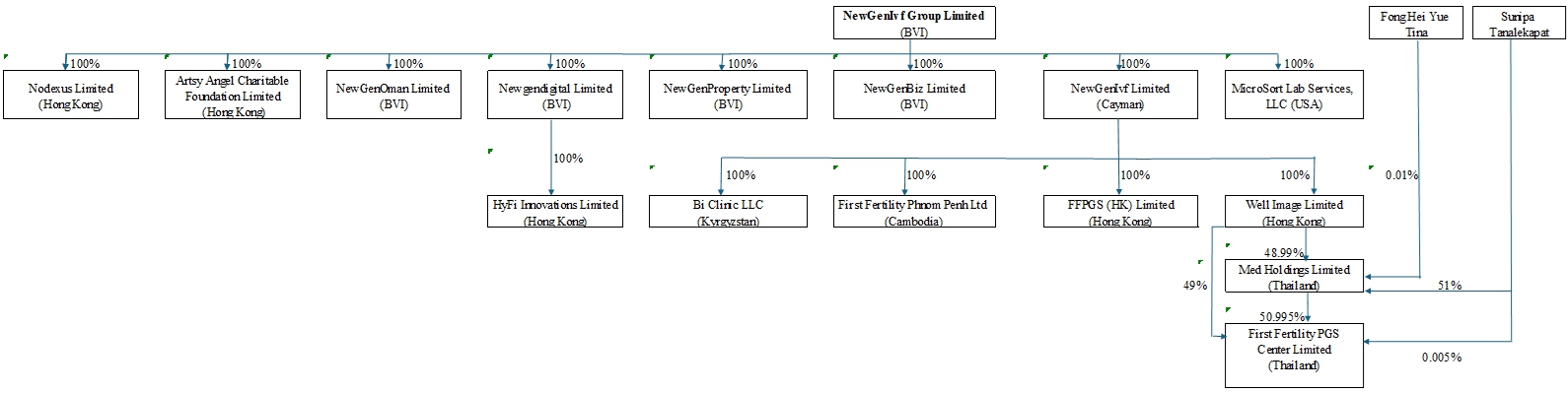
The Company’s subsidiaries are detailed in the table as follows:
| Name | | Background | | Ownership % | | Principal activity |
| NewGenivf Limited | | ● A Cayman Islands company ● Incorporated on 16 January, 2019 | | 100% | | Investment holding |
| FFPGS (HK) Limited | | ● A Hong Kong company ● Incorporated on December 19, 2019 | | 100% | | Marketing and administrative services |
| Well Image Limited | | ● A Hong Kong company ● Incorporated on July 11, 2008 | | 100% | | Investment holding |
| Med Holdings Limited (“Med Holdings”) (Note) | | ● A Thailand company ● Incorporated on January 21, 2015 | | 49%* | | Investment holding |
| First Fertility PGS Center Limited (“FFC”) (Note) | | ● A Thailand company ● Incorporated on March 6, 2014 | | 74% | | Provision of IVF treatment |
| First Fertility Phnom Penh Limited (“FFPP”) | | ● A Cambodia company ● Incorporated on August 10, 2015 | | 100% | | Provision of IVF treatment |
| Bi Clinic Ltd (“FFBi”) | | ● A Kyrgyzstan company ● Incorporated on December 16, 2021 ● Acquired on December 17, 2024 | | 100% | | Provision of IVF treatment, surrogacy and ancillary caring services |
| MicroSort Lab Services LLC | | ● A US company ● Incorporated on January 21, 2025 | | 100% | | Specialized applications, in provision of IVF treatment |
| Newgendigital Limited | | ● A BVI company ● Incorporated on June 16, 2025 | | 100% | | Investment Holding |
| NewGenProperty Limited | | ● A BVI company ● Incorporated on September 18, 2025 | | 100% | | Investment Holding |
| HyFi Innovations Limited | | ● A Hong Kong company ● Incorporated on October 20, 2025 | | 100% | | Tokenization Service |
| NewGenBiz Limited | | ● A BVI company ● Incorporated on January 13, 2026 | | 100% | | Investment Holding |
| NewGenOman Limited | | ● A BVI company ● Incorporated on February 2, 2025 | | 100% | | Investment Holding |
| Artsy Angel Charitable Foundation Limited (Former name: Alfred Siu Charitable Foundation Limited) | | ● A Hong Kong company ● Incorporated on February 27, 2026 | | 100% | | Charitable activities |
| Nodexus Limited | | ● A Hong Kong company ● Incorporated on July 16, 2026 | | 100% | | Specialized applications, in provision of IVF treatment |
| * | Where less than 50% of the equity of an investee is held, the Company (through its subsidiaries) holds significantly more voting rights than any other vote holder or organized company of vote holders. An assessment has been made, taking into account all the factors relevant to the relationship with the investee, to ascertain control has been established and the investee should be consolidated as a subsidiary of the Company. |
Note:
According to Thailand’s Foreign Business Act (the “FBA”), the majority shareholdings of limited company incorporated in Thailand is required to be owned by Thai nationals.
With reference to the capital structure and voting rights structure of ordinary shares and preference shares (the “Share Structure”) of Med Holdings and FFC, all the preference share capital shall be owned by a Thai national. No preference shares, however, have been issued to date. The ordinary shares and preference shares have the same rights and status in all respects except for the distribution of profits by way of dividends with details as follow:
| | (a) | Dividends from profits of Med Holdings and FFC shall be allocated to the holders of preference shares at a rate fixed from time to time by the board of directors prior to allocating to the holders of ordinary shares. In any event, such dividends to be allocated to the holders of preference shares shall not exceed 15% of the total amount of dividends declared from time to time; |
| | (b) | After allocation of dividends as per (a) above, the rest of the dividends shall be distributed equally amongst the holders of ordinary shares according to their shareholding ratio; |
| | (c) | The holders of preferred shares shall be entitled to dividends only in respect of the years for which the Company has declared a dividend payment, and there shall be no cumulative dividends; and |
| | (d) | Dividends allocated to the holders of preferred shares in each year shall be limited at the rate as stated in (a) only. No additional dividends shall be paid to the holders of preferred shares. |
Based upon the management’s judgement on the Shares Structure, as the Company is able to exercise majority voting power in any board meeting, the Company accounts for Med Holdings and FFC as subsidiaries on the ground that the Company is able to control Med Holdings and FFC by exercising its majority voting power in any board meetings.
On August 7, 2024, the Company entered into a Securities Purchase Agreement with certain investors named therein (collectively, the “Buyers”), pursuant to which, amongst other things: (i) the Company agreed to sell, at an initial closing with JAK Opportunities VI LLC (“JAK” and such initial closing, the “Initial Closing”), pursuant to which the Company agreed to sell to JAK (a) a senior convertible note (the “Initial Note”) in the aggregate original principal amount not exceeding $1,100,000), and which terms are further set forth below under the subheading “(ii) Initial Closing with JAK”), (b) a warrant to purchase 1,325,301 Class A Ordinary Shares of the Company, no par value (“Class A Shares” and such warrant, the Series A Warrant), and (c) a warrant to purchase 180,722 Class B Ordinary Shares of the Company, no par value (“Class B Shares” and such warrant, the Series B Warrant, and the Series B Warrants, together with the Series A Warrants, the “Warrants”); and (ii) the Company may require each Buyer (or each Buyer may require the Company, as applicable) to participate in the sale of (a) one or more additional convertible notes (which aggregate original principal amount for all additional convertible notes shall not exceed $9,500,000) (the “Additional Notes,” and, together with the Initial Note, the “Notes”).
On August 12, 2024, the Company and JAK consummated the Initial Closing. The Initial Note sold to JAK in connection with the Securities Purchase Agreement bears an interest rate of 14.75% per annum and is convertible into the Company’s Class A Shares as follows: the Conversion Amount (as defined below) into validly issued, fully paid and non-assessable Class A at the Conversion Rate determined by dividing the aggregate of the principal sum plus the interest rates (including late interest charges, if any) and the Make-Whole Amount, if any, by conversion price of $0.83.
At the Initial Closing, the Company also sold to JAK a Series A Warrant to purchase 1,325,301 Class A Shares and a Series B Warrant to purchase 180,722 Class B Shares.
Additionally, in connection with the Securities Purchase Agreement, the Company entered into amendment and exchange agreements with certain holders of its convertible promissory notes (the “Existing Notes” and each of such amendment and exchange agreements, “Amendment and Exchange Agreement”), pursuant to which the Company will exchange the Existing Notes by issuing, among other things, (i) senior convertible notes in the aggregate principal amount of $2,700,000 (the “Exchange Notes”) and (b) a series of warrants to initially acquire up to a certain number of ordinary shares to the holders of the Existing Notes set forth therein or in the Amendment and Exchange Agreement (the “Exchange Warrants”)
On August 28, 2024, the Company consummated the second tranche of its debt financing under the terms of the Securities Purchase Agreement. At the closing of the second tranche, the Company sold to JAK Opportunities VI LLC (“JAK”) a senior convertible note (the “Note”) in the principal amount of $500,000.
On November 11, 2024, the Company consummated the third tranche of its debt financing under the terms of the Securities Purchase Agreement (“SPA”) referenced in the current report on Form 6-K filed with the United States Securities and Exchange Commission (the “SEC”) on August 16, 2024. The Form 6-K filed with the SEC on August 16, 2024 is incorporated by reference herein. Pursuant to the terms of the SPA, the Company may elect at the second additional mandatory closing to sell and the institutional investor party to the SPA shall be required to purchases, subject to certain conditions, an additional note (“Second Additional Mandatory Note”) in the principal amount of $1,500,000, after the effective date of the Registration Statement (as defined in the SPA). The sale of the Second Additional Mandatory Note resulted in $1,395,000 of gross proceeds to the company before fees and expenses. The Notes bears an interest rate of 14.75% per annum and may be adjustable from time to time pursuant to its terms, with maturity at the 4.5 years anniversary of the date of issuance, subject to extension at the option of the holders in certain circumstances. The Second Additional Note are convertible at any time, at an initial conversion price of $0.658.
On November. 18, 2024, the Company entered into a binding term sheet (the “Term Sheet”) with White Lion Capital, LLC, (“White Lion”) a California-based institutional investor focused on high-growth, early-stage public companies, setting out the principal terms and conditions for a $100 million equity line of credit, expandable to $500 million. Pursuant to the Term Sheet, NewGen will have the option, but not the obligation, to sell to White Lion up to $100.0 million in shares of common stock over an initial 36-month period, with the potential to increase to $300.0 million upon substantial M&A or merger activity, and further to $500.0 million after $250.0 million has been drawn.
On February 28, 2025, the Company completed its acquisition of the MicroSort technology from Genetics & IVF Institute, Inc. (“GIVF”). Pursuant to a Purchase Agreement dated January 21, 2025 between the Company and GIVF (“Purchase Agreement”), the Company purchased all of the Assets (as defined in the Purchase Agreement) and IP Licenses (as defined in the Purchase Agreement) relating to the MicroSort technology from GIVF for a cash consideration of $750,000 and a share consideration of 125,000 Ordinary Shares (“MicroSort Acquisition”). Under the terms of the agreement, the Company acquired the technology for US$5 million, which was satisfied through a combination of US$750,000 in cash and the issuance of 2,500,000 ordinary shares (as was adjusted to 125,000 ordinary shares after the Reverse Stock Split on February 11, 2025) at a deemed value of US$1.70 per share.
On February 18, 2025, the Company entered into a cooperation agreement with FERTILITY GROUP LLC (“BOBCARE”) to jointly develop fertility services in the Kyrgyzstan market. The collaboration aims to combine NewGen’s technical expertise in fertility treatments with BOBCARE’s market resources in the region. This strategic partnership is anticipated to contribute to NewGen’s market presence over the next three years, improving the competitive position of both parties in the Kyrgyzstan market. Both companies will work together on several initiatives, including enhancing clinical protocols and patient management systems, knowledge exchange between fertility specialists, coordinated marketing and brand-building activities in Kyrgyzstan, and developing specialized fertility treatment options for the regional market.
On March 31, 2025, the Company’s Board approved certain amendments to its Share Incentive Plan of 2024, the awards of which are valid for a period of 10 years from March 28, 2025, whereby the maximum aggregate number of shares with respect to which Awards may be granted under the Plan shall be 1,054,260 Shares, which may be increased from time to time as determined by the Board or Committee of the Board, in an amount equal to 20% of the then outstanding ordinary shares of the Company at the time of such increase. Shares may be made available from Shares held in treasury or authorized but unissued shares of the Company not reserved for any other purpose.
On April 1, 2025, the Company entered into a new Securities Purchase Agreement (“2025 Securities Purchase Agreement”) with JAK, pursuant to which, amongst other things: (i) the Company agreed to sell, at an initial closing, a senior convertible note in the aggregate original principal amount not exceeding $3,200,000, convertible into Class A Ordinary Shares pursuant to its terms; and (ii) the Company may require JAK (or JAK may require the Company, as applicable) to participate in the sale of one or more additional convertible notes (which aggregate original principal amount for all additional convertible notes shall not exceed $25,600,000).
The 2025 Securities Purchase Agreement is filed as Exhibit 4.1 of the Company’s current report on Form 6-K dated April 3, 2025 and is incorporated by reference herein. The first tranche of $3,200,000 was received on June 3, 2025.
On April 2, 2025, the Company consummated the fourth tranche of its debt financing under the terms of its existing Securities Purchase Agreement with the investor, At the closing of the fourth tranche, the Company sold to the investor a senior convertible note in the principal amount of $2,000,000. The Note bears an interest rate of 14.75% per annum and may be adjustable from time to time pursuant to its terms. The funding from these arrangements with the investor is intended to be used to finance the establishment of a fertility clinic in Dubai.
Mr. Yip Eng Jeremy Foo, a director of NewGenIvf Group Limited (the “Company”), has resigned from the Board of Directors of the Company, the Audit Committee of the Company, and the Compensation Committee of the Company due to personal reasons, effective April 4, 2025. Mr. Foo’s resignation did not result from any disagreement with the Board or the Company on any matter relating to the Company’s operations, policies or practices.
Ms. Florianna Ann Chi Wan Chan was appointed as a director of the Company, effective April 15, 2025, to fill the vacancy on the Audit Committee and the Compensation Committee created by Mr. Foo’s resignation. Ms Chan has over 20 years of experience in project management, real estate development, and luxury hospitality, and is a proven leader in driving growth and operational excellence. Since 2015, Ms. Chan has led Lab Concept Company Limited, a subsidiary of The Lane Crawford Joyce Group, where she successfully restructured operations, spearheaded rebranding, and digitized processes, achieving significant revenue growth. Previously, she held senior roles at VCC Company Limited, Eton Properties, and Crown Macau, excelling in real estate development, marketing, and VIP services. She holds a Bachelor of Hospitality Management from Central Queensland University in Australia and an Advanced Diploma from William Angliss Institute of TAFE. Fluent in Cantonese, Mandarin, and English, Ms. Chan brings a deep understanding of Asia Pacific markets and a strategic vision that will drive the Company’s continued growth and success.
On October 6, 2025, NewGenProperty Limited (“NewGenProperty”), a wholly owned subsidiary of the Company, entered into a joint venture agreement with BNW to develop the Plot. Under the terms of the joint venture agreement, NewGenProperty shall hold 60% of the joint venture, and be responsible for funding 36% of the purchase price of the Plot to the Master Developer, while BNW shall be responsible for all the other cashflow and financing requirements of the project. In the event that BNW pays the balance of the Purchase Price of the Plot to the Master Developer, NewGenProperty shall reimburse BNW in accordance with the provisions of the joint venture agreement. NewGenProperty’s entitlement is an amount equivalent to 36% of the Gross Sales Revenue or Gross Sellable Area generated from the project, with deductions including (i) up to 10% of External and Internal Real Estate Agent and Brokerage Fees; (ii) 2% of Gross Sales Revenue for BNW’s Marketing Fees; and (iii) any amounts paid by the Developer towards the balance of the Purchase Price of the Plot on behalf of NewGenProperty.
On May 15, 2026, NewGenIvf signed a strategic investment agreement with PredicXion Group Limited, and Kong Yiu Cheung, PredicXion’s sole shareholder (the “Seller”), for the acquisition of up to a 10% equity interest in PredicXion (the “PredicXion Acquisition”) at a pre-money valuation of US$100,000,000. On May 28, 2026, NewGenIvf signed a share purchase agreement with PredicXion, and the Seller (“First PredicXion SPA”) for the acquisition of a 2% equity interest in PredicXion (“PredicXion Initial Acquisition”). The consideration payable for the PredicXion Initial Acquisition was a combination of: (i) cash consideration of US$1,000,000 or an equivalent amount in stablecoin, or Solana; and (ii) 666,667 newly issued Class A ordinary shares of the Company (equivalent to 2,315 Class A Ordinary Shares adjusted for Reverse Stock Split) at a share price of US$432. per share. This 2% equity investment transaction was completed
.
During the six months period ended June 30, 2026, a total of $2,127,112 of convertible promissory notes were issued with a discount of 0-10%. These Notes are to be settled by way of cash or may be converted to Class A ordinary shares. The conversion of these notes is subject to certain criterions as mentioned in the Convertible Note Agreements, which include a beneficiary cap of 9.9% of shareholdings in the Company.
NOTE 2 — SUMMARY OF SIGNIFICANT ACCOUNTING POLICIES
Principles of consolidation and basis of preparation
The accompanying consolidated financial statements reflect the accounts of the Company and all of its subsidiaries in which a controlling interest is maintained. All inter-company balances and transactions have been eliminated in consolidation.
Management has prepared the accompanying consolidated financial statements and these notes in accordance with accounting principles generally accepted in the United States of America (“U.S. GAAP”). The Company maintains its general ledger and journals with the accrual method accounting.
The business combination transaction between Legacy NewGenIvf and SPAC I was accounted for as a reverse recapitalization under ASC 805, Business Combinations, with NewGenIvf Group Limited, and deemed to be the accounting acquirer. As SPAC I did not meet the definition of a business under ASC 805, the transaction was not treated as a business combination. Instead, it was accounted for as a recapitalization.
Accordingly, the consolidated assets, liabilities and results of operations of the accounting acquirer will become the historical financial statements of the Company, and the accounting acquirer’s assets, liabilities and results of operations will be consolidated with the Company beginning on the acquisition date. The Legacy NewGenIvf was the legal acquiree but deemed to be the accounting acquirer. The Company was the legal acquirer but deemed to be the accounting acquiree in the reverse merger. The historical financial statements prior to the acquisition are those of the accounting acquirer (Legacy NewGenivf). After completion of the Share Exchange Transaction, the Company’s consolidated financial statements include the assets and liabilities, the operations and cash flow of the accounting acquirer. Any excess of the value of shares issued by the Company over the net book value of the accounting acquirer will be recognized as a reduction to equity (APIC).
Business combination and gain on bargain purchase
The Company adopted ASC 805, the accounting for business combinations which requires the application of the acquisition method. This method mandates that the acquiring entity recognize all assets acquired and liabilities assumed at their acquisition-date fair values. Gain on a business acquisition is recognized in earnings only in the specific circumstance of a “bargain purchase.” This occurs when the fair value of the identifiable net assets acquired exceeds the total consideration transferred (including the fair value of any non-controlling interest). It requires the acquirer to first meticulously reassess all measurements—including the identification and valuation of assets, liabilities, and the consideration—to ensure the gain is not a measurement error. Once confirmed, the resulting bargain purchase gain is recognized in profit or loss on the acquisition date. This treatment reflects the economic benefit obtained by the acquirer from purchasing net assets for less than their aggregate fair value. Under US GAAP, the distinction between acquiring a business and acquiring a group of assets is determined by a defined screen test. A transaction is accounted for as a business combination only if the acquired set meets the specific definition of a business, which requires an integrated set of activities with, at a minimum, an input and a substantive process that together significantly contribute to the ability to create outputs.
Segmental Reporting
As a public entity with securities listed on the Nasdaq Stock Market, the Company is required to apply the provisions of ASC 280, Segment Reporting. The Company determines its operating segments based on the information used by the Chief Operating Decision Maker (CODM) to allocate resources and assess performance. The CODM has been identified as the Chief Executive Officer. The CODM reviews financial information at the operating segment level on a regular basis. Based on this review process, the Company has determined its reportable segments to be IVF Revenue and Fertility Referral Revenue. These segments reflect how the CEO manages the business, evaluates performance, and makes strategic decisions regarding resource allocation. The CODM evaluates the performance of each segment based on segment contribution margin. Significant expenses are reviewed by CEO and it is determined that expenses related to Fertility Referral Revenue are immaterial and thus there is no need to segregate the expenses under different segments. Other segment items represent general and administrative and other miscellaneous expenses not separately reported to the CODM. As a public entity with securities listed on the Nasdaq Stock Market, the Company applies the provisions of ASC 280, Segment Reporting. Segment assets are not regularly provided to the CODM and are therefore not reported in the segment disclosures.
Use of estimates
The preparation of the consolidated financial statements in conformity with U.S. GAAP requires management to make estimates and assumptions that affect the reported amounts of assets and liabilities and disclosures of contingent assets and liabilities as of the date of the consolidated financial statements and the reported amounts of revenues and expenses during the periods presented. Actual results could differ from those estimates. Significant accounting estimates reflected in the Company’s consolidated financial statements includes the impairment of long-lived assets including the intangible assets, revenue recognition, fair value measurement of digital assets, assessment of whether an acquisition is that of a business or an asset and recognition of bargain purchase gain, determination of embedded derivatives requiring bifurcation and valuation thereof.
Foreign currency translation
The accompanying consolidated financial statements are presented in United States dollar (“$”), which is the reporting currency of the Company. The functional currency of the Company and its subsidiaries, FFPGS (HK) Limited and Well Image Limited, are Hong Kong dollar (“HK$”). Med Holdings and FFC use Thai baht (“THB”) as their functional currencies. First Fertility Phnom Penh Limited and Bi Clinic Ltd (“FFBi”) uses United States dollar (“USD”) as their functional currencies.
Assets and liabilities denominated in currencies other than the reporting currency are translated into the reporting currency at the rates of exchange prevailing at the balance sheet date. Monetary assets and liabilities denominated in currencies other than the functional currency are translated into the functional currency using the applicable exchange rates at the balance sheet dates. Translation gains and losses are recognized in the consolidated statements of operations and comprehensive income as other comprehensive income or loss.
Transactions in currencies other than the reporting currency are measured and recorded in the reporting currency at the exchange rate prevailing on the transaction date. The cumulative gain or loss from foreign currency transactions is reflected in the consolidated statements of operations and comprehensive income as other income (other expenses).
The value of foreign currencies including, the HK$, THB and RMB, may fluctuate against the United States dollar. Any significant variations of the aforementioned currencies relative to the United States dollar may materially affect the Company’s financial condition in terms of reporting in USD. The following table outlines the currency exchange rates that were used in preparing the accompanying consolidated financial statements:
| | | | | June 30,
2026 | | | December 31,
2025 | | | December 31,
2024 | |
| Period-end | | $: HK$ | | | 7.8000 | | | | 7.8000 | | | | 7.8000 | |
| Period average | | $: HK$ | | | 7.8000 | | | | 7.8000 | | | | 7.8000 | |
| Period-end | | $: THB | | | 33.2462 | | | | 31.4215 | | | | 34.3353 | |
| Period average | | $: THB | | | 32.2632 | | | | 31.7436 | | | | 35.2262 | |
| Period-end | | $: RMB | | | 6.7901 | | | | 7.2001 | | | | 7.2994 | |
| Period average | | $: RMB | | | 6.8492 | | | | 7.2327 | | | | 7.1946 | |
Cash and cash equivalents
Cash and cash equivalents include cash on hand, deposits held at call with financial institutions, other short-term deposits with original maturities of three months or less that are readily convertible to known amounts of cash and which are subject to an insignificant risk of changes in value.
Deposits, other receivables and deferred offering cost, net
Deposits, other receivables and deferred Offering cost, net primarily include deposits paid to suppliers, prepaid expenses, the prepaid professional fee which meets the definition of deferred IPO cost.
Deferred offering costs, which consist of legal and other expenses incurred through the balance sheet date that are directly related to the proposed public offering, are capitalized, and will be charged against the gross proceeds of the offering and recorded as reduction of shareholders’ equity upon the completion of the proposed offering. Should the proposed public offering prove to be unsuccessful, these deferred costs, as well as additional expenses incurred, will be charged to the statements of operations and comprehensive income (loss).
Legal and professional fees incurred in connection with issuing convertible debt are deferred and amortized over the life of the debt. These costs are presented as a direct deduction from the carrying amount of the debt liability on the balance sheet (per ASC 835-30).
Share based compensation
The Company accounts for stock-based compensation in accordance with ASC Topic 718-10, Compensation-Stock Compensation, which requires the measurement and recognition of compensation expense for all share-based payment arrangements related to the acquisition of goods and services from both nonemployees and employees based on fair values of the shares to be issued estimated at grant date. The stock-based compensation expense recognized during the period is based on the value of the portion of share-based payment awards that is ultimately expected to vest during the period.
Fair value is determined based on the estimated market prices of the Company’s Common Stock at the respective issuance date in accordance with ASC 718, taking into consideration the volatility of the market price of the shares, the terms of the instruments and the conditions upon which they were granted.
For the six months ended June 30, 2026, the stock-based compensation expense of $211,360 was recognized. For the year ended June 30, 2025, there was a stock-based compensation expense of $20,250.
Property and equipment, net
Plant and equipment are stated at cost less accumulated depreciation. Depreciation is provided over their estimated useful lives, using the straight-line method. The Company typically applies a salvage value of 0%. The estimated useful lives of the plan and equipment are as follows:
| Furniture and fixtures | | 3 – 5 years |
| Leasehold improvements | | the lesser of useful life or term of lease |
| Medical instruments | | 3 – 10 years |
| Motor vehicle | | 3 – 5 years |
| Office equipment | | 3 – 5 years |
The cost and related accumulated depreciation of assets sold or otherwise retired are eliminated from the accounts, and any gain or loss are included in the Company’s results of operations. The costs of maintenance and repairs are expensed as incurred. Significant renewals and betterments that extend the useful life of an assets are capitalized.
Intangible Assets
Intangible assets acquired from third parties are measured initially at fair value and those with an infinite live are not amortized. The Company annually evaluates the recoverability of the infinite-lived intangible assets for possible impairment whenever events or circumstances indicate that the carrying amount of such assets may not be recoverable. To test indefinite-lived intangible assets for impairment, the Company first performs a qualitative assessment to determine if it is more likely than not that the carrying amount of each of its indefinite-lived intangible assets exceeds its fair value. If it is, a quantitative assessment is required. Alternatively, the Company may bypass the qualitative assessment and perform a quantitative impairment test. The qualitative assessment requires the consideration of factors such as recent market transactions, macroeconomic conditions and changes in projected future cash flows. The quantitative assessment compares the fair value of an indefinite-lived intangible asset to its carrying amount. If the carrying amount of an indefinite-lived intangible asset exceeds its fair value, an impairment loss is recognized for the excess. Fair values of indefinite-lived intangible assets are determined based on discounted cash flows or appraised values, as appropriate. If such a review indicates that the carrying amount of intangible assets is not recoverable, the carrying amount of such assets is reduced to fair value. As of December 31, 2025, and 2024, the Company did not record an impairment on the intangible assets.
Impairment of long-lived assets
The Company evaluates the long-lived assets for impairment whenever events or changes in circumstances indicate that the carrying amount of assets may not be recoverable. Impairment may become obsolete from a difference in the industry, introduction of new technologies, or if the Company has inadequate working capital to utilize the long-lived assets to generate adequate profits. Impairment is present if the carrying amount of an asset is less than its expected future undiscounted cash flows.
If an asset is considered impaired, a loss is recognized based on the amount by which the carrying amount exceeds the fair market value of the asset. Assets to be disposed of are reported lower the carrying amount or fair value less cost to sell.
Inventories
Inventories are stated at the lower of cost and net realizable value. Costs are determined on a first-in, first-out basis. Net realizable value is based on the estimated selling prices less any estimated costs to be incurred to completion and disposal. A provision for excess and obsolete inventory will be made based primarily on products approaching expiry period and forecasts of product demand. The excess balance above the product demand as determined by this analysis becomes the basis for excess inventory charge and the written-down value of the inventory becomes its cost. Written-down inventory would not be reversed if market conditions improve.
Other borrowings
Other borrowings are recognized initially at fair value, net of debt issuance costs incurred. Other borrowings are subsequently stated at amortized cost; any difference between the proceeds (net of debt issuance costs) and the redemption value is recognized in the consolidated statements of operations over the period of the borrowings using the effective interest method.
Convertible Instruments
Convertible Instruments are categorized as equity or debt based on the terms of the notes. Convertible Notes are recorded at amounts equal to the proceeds of the issuance, including the embedded conversion feature, and net of discounts and unamortized debt issuance in accordance with ASC 480-10-55-44 on the consolidated balance sheets. An evaluation of all conversion, purchase and redemption features contained in a debt instrument is performed to determine if there are any embedded features that require bifurcation as a derivative. The conversion feature is recorded separately as a derivative liability at its fair value, calculated using the Black-Scholes model.
Warrants
The Company accounts for warrants as either equity-classified or liability-classified instruments based on an assessment of the warrant’s specific terms and applicable authoritative guidance in ASC Topic 480, Distinguishing Liabilities from Equity (“ASC 480”) and ASC Topic 815, Derivatives and Hedging (“ASC 815”). The assessment considers whether the warrants are freestanding financial instruments pursuant to ASC 480, meet the definition of a liability pursuant to ASC 480, and whether the warrants meet all of the requirements for equity classification under ASC 815, including whether the warrants are indexed to the Company’s own common stock and whether the warrant holders could potentially require “net cash settlement” in a circumstance outside of our control, among other conditions for equity classification. This assessment, which requires the use of professional judgment, is conducted at the time of warrant issuance and as of each subsequent period end date while the warrants are outstanding.
Equity-classified
For issued or modified warrants that meet all of the criteria for equity classification, the warrants are required to be recorded as a component of equity at the time of issuance. Warrants classified as equity instruments are initially recognized at fair value within additional paid in capital and are not subsequently remeasured. The warrants have been assessed to meet the requirements for equity classification and accounted for as equity. Upon exercise of the warrants, the Company will record the proceeds received, together with the carrying value of the warrants, as an increase to common stock and additional paid-in capital. Warrants that expire unexercised will be derecognized with no impact on the statement of operations.
Liability-classified
For issued or modified warrants that do not meet all the criteria for equity classification, the warrants are required to be recorded as liabilities at their initial fair value on the date of issuance and are remeasured at each reporting date until settlement. Changes in fair value is recognized as a component of change in fair value of warrant liability in the condensed consolidated statements of operations and as a non-cash gain or loss in the condensed consolidated statement of comprehensive loss. Transaction costs allocated to warrants that are presented as a liability are immediately expensed in the consolidated statements of operations and comprehensive loss.
No liability classified warrants have been issued as of June 30, 2026 and December 31, 2025.
Repurchase and Forbearance Agreement
The Company accounts for repurchase and forbearance agreements with lenders under ASC 470-50, Debt Modifications and Extinguishments, ASC 815, Derivatives and Hedging, ASC 480, Distinguishing Liabilities from Equity, and ASC 505, Equity, as applicable. When the Company enters into an agreement to repurchase outstanding convertible notes and warrants and to compensate the counterparty for forbearing from and ultimately waiving its future financing rights, the Company first assesses whether the agreement represents a substantive restructuring that effectively replaces the original convertible debt structure with a fixed settlement obligation. Where the agreement fixes the settlement amount, obligates the Company to pay fixed instalment, and provides for the transfer and cancellation of the notes upon completion of settlement, the Company accounts for the transaction as a debt extinguishment. Accordingly, the Company derecognizes the carrying amount of the extinguished convertible notes, the associated embedded derivative liabilities, and any unamortized deferred debt issuance costs, and recognizes a new debt settlement liability measured at the fixed contractual settlement amount. The difference between the net carrying amount of the extinguished instruments and the debt settlement liability is recognized immediately in earnings as a gain or loss on debt extinguishment.
Warrants that are equity-classified immediately prior to repurchase are accounted for as equity transactions. The Company recognizes a warrant repurchase liability with an offsetting reduction to additional paid-in capital, and no gain or loss is recognized in earnings.
Forbearance consideration is allocated based on the substance of the rights surrendered. Where the forbearance payment primarily compensates the counterparty for surrendering additional closing or future debt financing rights under the original securities purchase agreements, the Company treats the forbearance payment entirely as debt-related consideration and includes it in the debt settlement liability. No portion of such forbearance consideration is allocated to equity. The total contractual settlement obligation is presented as a debt settlement liability and a warrant repurchase liability, with current and non-current portions determined based on the contractual instalment schedule. Instalment payments reduce the corresponding liability as remitted.
For the period six months ended June 30, 2026, there was a loss of $3,421,643 on the Repurchase and Forbearance Agreement with JAK Opportunities VI LLC. There was no such loss or gain in the six months ended June 30, 2025.
Debt issuance and offering costs are amortized over the contractual term of the Convertible Notes, to the consolidated statements of operations in accordance with ASC 835-30-45-1A.
The convertible notes are subsequently recorded at amortized cost, with interest expense recognized using the effective interest method. The derivative liability, if any is remeasured at fair value at each reporting date and any gain or loss on fair value is recognized in the statement of comprehensive income.
Ordinary shares
The Company’s ordinary shares are stated at no par value. The difference between the consideration received, net of issuance cost, is recorded in additional paid-in capital.
On January 26, 2026, the Company effected a 1-for-3 reverse stock split of its issued and unissued shares. On March 16, 2026, the Company effected a 1-for-4 reverse stock split of its issued and unissued shares. On July 6, 2026, the Company effected a 1-for-3 reverse stock split of its issued and unissued shares. On September 1, 2026, the Company effected a 1-for-3 reverse stock split of its issued and unissued shares. On October 12, 2026, the Company effected a 1-for-4 reverse stock split of its issued and unissued shares. On October 26, 2026, the Company effected a 1-for-8 reverse stock split of its issued and unissued shares.
The equity of the Company as of June 30, 2026 represents 36,019 ordinary shares with par value of $ Nil. The number of shares as above have taken into consideration the reverse stock split effected as above.
In accordance with ASC 505, the reverse stock split is to be accounted for retrospectively.
Revenue recognition
The Company adopted ASC Topic 606, Revenue from Contracts with Customers, and all subsequent ASUs that modified ASC 606 on April 1, 2017 using the full retrospective method which requires the Company to present the financial statements for all periods as if Topic 606 had been applied to all prior periods. The Company derives revenue principally from provision of In vitro fertilization (“IVF”) treatment and surrogacy and ancillary caring services. Revenue from contracts with customers is recognized using the following five steps:
| | (1) | identify its contracts with customers; |
| | | |
| | (2) | identify its performance obligations under those contracts; |
| | | |
| | (3) | determine the transaction prices of those contracts; |
| | | |
| | (4) | allocate the transaction prices to its performance obligations in those contracts; and |
| | | |
| | (5) | recognize revenue when each performance obligation under those contracts is satisfied. Revenue is recognized when promised services are transferred to the client in an amount that reflects the consideration expected in exchange for those services. |
The Company enters into verbal agreements with its customers that outline the rights, responsibilities, and obligations of each party. The agreements also identify the scope of services, service fees, and payment terms. Agreements are acknowledged and consent forms are signed by the customers prior to each promised service or bundle of services are inter-dependant. All the contracts have commercial substance, and it is probable that the Company will collect considerations from its customers for service component as settlement is predominantly required prior to performance of the promised service.
The Company derives its revenues from two sources: (1) revenue from IVF treatment, and (2) revenue from fertility referral services.
Revenue from IVF treatment
In vitro fertilization (“IVF”) treatment is an assisted reproductive technique where eggs and sperm are collected and fertilized in laboratory to become embryo. Fertilized embryo is then implanted to the customer or a surrogate mother. IVF treatment involves the performance of a series of medical treatment as well as procedures and brings benefits to clients as the service of bundles service is completed. Revenue from IVF treatment is recognized at a point in time when different treatment and/or procedure or bundles thereof, are completed in clinic. The full completion of the various procedures and treatments are evidenced by treatment cards and reports included within the patient files indicating successful completion of the service.
Revenue from Fertility Referral services
The Company arranges fertility referral services for customers seeking IVF and/or surrogacy services and earns referral fee income. Upon a customer inquiry, the Company evaluates the customer’s needs and, if appropriate, refers them to independent third-party agents.
In these arrangements, the Company’s performance obligation is satisfied upon the successful referral of the customer to the independent agent. Referral fee revenue is recognized when the Company transfers control of the service by completing the referral, as this represents the point at which the Company’s obligation is fulfilled and the customer (the agent) simultaneously receives and consumes the benefits.
The transaction price consists of a referral fee, which is negotiated with the agent on a case-by-case basis. As the referral fee is contingent upon the agent’s acceptance of the referral and subsequent income received from the agent, revenue is constrained until it is probable that a significant reversal will not occur. Accordingly, revenue is recognized at the point in time when the referral fee is received from the agent, as this is when the uncertainty surrounding the consideration is resolved and the Company’s right to consideration becomes unconditional.
Revenue from egg freezing and storage facility
The Company provides access the facility to its customers. Upon request for the service, which is agreed verbally and followed by signed consent form from the customer, the Company makes available access to the facility with no further substantial involvement. Revenue is recognized at a point in time when the facility is made available to the customer at the agreed consideration by the provision of specific address within the facility as maintained in the patient file. The receipt of consideration is assured as payment is required upfront.
Principal versus agency considerations
The Company follows the guidance provided in ASC 606, Revenue from Contracts with Customers, for determining whether the Company is the principal or an agent in arrangements with customers that involve another party that contributes to the provision of services to a customer. In these instances, the Company determines whether it has promised to provide the service itself (as principal) or to arrange for the specified service to be provided by another party (as an agent). This determination is a matter of judgment that depends on the facts and circumstances of each arrangement. The Company recognizes revenue from the performance of the procedures and treatment on a gross basis as the Company is responsible for the fulfillment, controls the delivery of the promised service, and has full discretion in establishing prices and therefore is the principal in the arrangement.
Contract related assets and liabilities are classified as current assets and current liabilities. Significant balance sheet accounts related to the revenue cycle are as follows:
Account receivables, net
Accounts receivable, net are stated at the original amount less an allowance for expected credit loss on such receivables. The allowance for expected credit loss is estimated based upon the Company’s assessment of various factors including historical experience, the age of the accounts receivable balances, current general economic conditions, future expectations and customer specific quantitative and qualitative factors that may affect the Company’s customers’ ability to pay. An allowance is also made when there is objective evidence for the Company to reasonably estimate the amount of probable loss.
Contract liabilities
Contract liabilities represent considerations received from customers in advance of satisfying the Company’s performance obligations under the contract. These amounts are expected to be earned within 12 months and are classified as current liabilities.
Expected credit loss
ASU No. 2016-13, Financial Instruments — Credit Losses (Topic 326): Measurement of Credit Losses on Financial Instruments requires entities to use a current lifetime expected credit loss methodology to measure impairments of certain financial assets. Using this methodology will result in earlier recognition of losses than under the current incurred loss approach, which requires waiting to recognize a loss until it is probable of having been incurred. There are other provisions within the standard that affect how impairments of other financial assets may be recorded and presented, and that expand disclosures. Expected credit losses are probability-weighted estimates of credit losses. Credit losses are measured at the present value of all cash shortfalls (i.e., the difference between the cash flows due to the entity in accordance with the contract and the cash flows that the Company expects to receive). ECLs are discounted at the effective interest rate of the financial asset.
Retirement benefits
Retirement benefits in the form of mandatory government-sponsored defined contribution plans are charged to either expense as incurred or allocated to wages as part of cost of revenues.
Segment information
The Company determines its reportable segments using the management approach based on internal reporting used by the Chief Operating Decision Maker (“CODM”), comprising the Chief Executive Officer (CEO) and Chief Financial Officer (CFO), for decision-making, resource allocation, and performance assessment.
The Company does not distinguish revenues, costs, or expenses by segments, operational or geographical, but reports them in aggregate. Based on this assessment, management has determined that the Company operates as a single reportable segment under ASC 280. Accordingly, all required segment financial information is included in the consolidated financial statements. However, we segregate IVF revenue from surrogacy revenue as these two revenue types are critical to our business.
The Company’s CODM are Mr. Siu Wing Fund Alfred, its CEO and Mr Chung Ho Fai, its CFO. Geographic disclosures of long-lived assets and revenue from external customers as of June 30, 2026 and December 31, 2025 are presented in Note 16.
Leases
The Company measured the lease in accordance to ASU 2016-02, “Leases” (Topic 842). Lease terms used to calculate the present value of lease payments generally do not include any options to extend, renew, or terminate the lease, as the Company does not have reasonable certainty at lease inception that these options will be exercised. The Company generally considers the economic life of its operating lease ROU assets to be comparable to the useful life of similar owned assets. The Company has elected the short-term lease exception, therefore operating lease ROU assets and liabilities do not include leases with a lease term of twelve months or less. Its leases generally do not provide a residual guarantee. The operating lease ROU asset also excludes lease incentives. Lease expense is recognized on a straight-line basis over the lease term.
Income Taxes
The Company recognizes deferred income tax assets or liabilities for expected future tax consequences of events recognized in the consolidated financial statements or tax returns. Under this method, deferred income tax assets and liabilities are determined based on the differences between the financial reporting and income tax bases of assets and liabilities and are measured using the income tax rates that will be in effect when the differences are expected to reverse. Valuation allowances are provided when it is more likely than not that a deferred tax asset is not realizable or recoverable in the future.
The Company determines that the tax position is more likely than not to be sustained and records the largest amount of benefit that is more likely than not to be realized when the tax position is settled. the Company recognizes interest and penalties, if any, related to uncertain tax positions in income tax expense.
Comprehensive Income
The Company presents comprehensive income in accordance with ASC Topic 220, Comprehensive Income. ASC Topic 220 states that all items that are required to be recognized under accounting standards as components of comprehensive income be reported in the consolidated financial statements. The components of comprehensive income were the net income for the years and the foreign currency translation adjustments.
Earnings per share
The Company computes earnings per share (“EPS”) following ASC Topic 260, “Earnings per share”. Basic EPS is measured as the income or loss available to common shareholders divided by the weighted average common shares outstanding for the period. Diluted EPS presents the dilutive effect on a per-share basis from the potential conversion of convertible securities or the exercise of options and or warrants; the dilutive impacts of potentially convertible securities are calculated using the as-if method; the potentially dilutive effect of options or warranties are computed using the treasury stock method. Potentially anti-dilutive securities (i.e., those that increase income per share or decrease loss per share) are excluded from diluted EPS calculation.
Related parties
The Company adopted ASC 850, Related Party Disclosures, for the identification of related parties and disclosure of related party transactions.
Commitments and contingencies
In the normal course of business, the Company is subject to contingencies, including legal proceedings and claims arising out of the business that relate to a wide range of matters, such as government investigations and tax matters. The Company recognizes its liability for such contingency if it determines it is probable that a loss has occurred and a reasonable estimate of the loss can be made. The Company may consider many factors in making these assessments including historical and the specific facts and circumstances of each matter.
Non-controlling interests
Non-controlling interests are presented as a separate component of equity on the consolidated balance sheets and net (loss) income and other comprehensive loss are attributed to controlling and non-controlling interests respectively.
Concentration of risks
Concentration of credit risk
Financial instruments that potentially expose us to concentrations of credit risk consist primarily of cash and cash equivalents and account receivable. The Company places cash and cash equivalents with financial institutions with high credit ratings and quality.
Accounts receivable primarily comprise of amounts receivable from the service customers. The Company conducts credit evaluations of customers, and generally does not require collateral or other security from its customers. The Company establishes an allowance for doubtful accounts primarily based upon the factors surrounding the credit risk of specific customers. Furthermore, the risk is mitigated by ascertaining upfront payments for services prior to their performance.
Financial instruments
The Company’s financial instruments, including cash and cash equivalents, accounts receivables, net, deposits, other receivables and deferred IPO cost, net, loan to A SPAC I, accounts payables, accrued liabilities and other payables, and due from (to) shareholders, have carrying amounts that approximate their fair values due to their short maturities. ASC Topic 820, “Fair Value Measurements and Disclosures” requires disclosing the fair value of financial instruments held by the Company. ASC Topic 825, “Financial Instruments” defines fair value and establishes a three-level valuation hierarchy for disclosures of fair value measurement that enhances disclosure requirements for fair value measures. The carrying amounts reported in the consolidated balance sheets for cash and cash equivalents, accounts and other receivables, accounts and other payables, accrued liabilities and amounts due from (to) related parties each qualify as financial instruments and are a reasonable estimate of their fair values because of the short period between the origination of such instruments and their expected realization and their current market rate of interest. The three levels of valuation hierarchy are defined as follows:
| | ● | Level 1 — inputs to the valuation methodology used quoted prices for identical assets or liabilities in active markets. |
| | ● | Level 2 — inputs to the valuation methodology include quoted prices for similar assets and liabilities in active markets and information that are observable for the asset or liability, either directly or indirectly, for substantially the financial instrument’s full term |
| | ● | Level 3 — inputs to the valuation methodology are unobservable and significant to the fair value measurement. |
The Company analyzes all financial instruments with features of both liabilities and equity under ASC 480, “Distinguishing Liabilities from Equity” and ASC 815.
Recently issued accounting pronouncements
The FASB has introduced expanded income tax disclosure requirements under ASU 2023-09 to improve transparency. Companies will now need to provide a detailed reconciliation of their effective tax rate, breaking down federal, state, and foreign taxes, as well as specific categories like tax credits and foreign earnings. Additionally, businesses must disclose income taxes paid by jurisdiction, offering investors greater clarity on tax obligations. These changes apply to both public and private companies, with annual reporting periods beginning after December 15, 2024 (2025 for calendar-year entities). This update aims to reduce ambiguity in tax reporting and align disclosures with investor needs.
A major shift in digital asset accounting, ASU 2023-08 requires companies to measure certain crypto assets (e.g., Bitcoin, Ethereum) at fair value rather than applying the previous impairment-only model. This means entities must recognize quarterly fair value adjustments in their financial statements, increasing volatility in reported earnings but improving transparency. The standard applies to fiscal years beginning after December 15, 2024, and impacts both corporate treasuries and investment firms holding cryptocurrencies. This change aligns GAAP closer to fair value accounting seen in other investment holdings, addressing criticisms of the old impairment approach.
In November 2024, the FASB issued ASU 2024-03, *Income Statement—Reporting Comprehensive Income—Expense Disaggregation Disclosures (Subtopic 220-40): Disaggregation of Income Statement Expenses*, which requires public entities to disclose, in a tabular format in the notes to the financial statements, specific information about certain costs included in common expense captions. This standard mandates the disaggregation of natural expenses—such as employee compensation, depreciation, and inventory costs—from broader captions like “cost of services” or “selling, general and administrative expenses.” Although this ASU is effective for annual reporting periods beginning after December 15, 2026, and interim periods thereafter, with early adoption permitted, the Company is currently evaluating the potential impact of this new guidance on its financial statement disclosures.
In July 2025, the FASB issued ASU 2025-05, Financial Instruments—Credit Losses (Topic 326): Measurement of Credit Losses for Accounts Receivable and Contract Assets, which introduces a practical expedient to simplify the application of the current expected credit loss (CECL) model for current accounts receivable and contract assets arising from ASC 606 revenue transactions. Such practical expedient permits entities to assume that current economic conditions as of the balance sheet date will remain unchanged for the remaining life of these short-term assets, eliminating the need to develop and document forward-looking macroeconomic forecasts. For healthcare entities with significant patient accounts receivable, third-party payor contract assets, or government reimbursement receivables, this simplification reduces compliance costs and complexity while continuing to require consideration of historical loss experience and current conditions such as customer-specific financial distress or changes in credit policies. The guidance is effective for annual periods beginning after December 15, 2025, applied prospectively, and early adoption is permitted. The Company plans to adopt this practical expedient and will update its credit loss estimation policies and related disclosures accordingly.
Save for elsewhere disclosed, the Company does not believe other recently issued but not yet effective accounting standards, if currently adopted, would have a material effect on the Company’s consolidated balance sheet, statement of operations and comprehensive income (loss) and statement of cash flows.
NOTE 3 — ACCOUNTS RECEIVABLE, NET
Accounts receivable, net consists of the following:
| | | June 30,
2026 | | | December 31,
2025 | |
| Accounts receivable | | $ | 115,991 | | | $ | 166,552 | |
| Less: allowance for expected credit loss | | | (21 | ) | | | (21 | ) |
| | | $ | 115,970 | | | $ | 166,531 | |
As of the end of each of the financial period, the aging analysis of accounts receivable, net of allowance for expected credit loss, based on the invoice date is as follows:
| | | June 30,
2026 | | | December 31,
2025 | |
| Current | | | 31,587 | | | $ | 25,548 | |
| Within 60 days | | | 6,100 | | | $ | 6,677 | |
| Within 90 days | | $ | 9,087 | | | $ | 1,941 | |
| More than 90 days | | $ | 69,196 | | | $ | 132,365 | |
| | | $ | 115,970 | | | $ | 166,531 | |
The movement of allowances for expected credit loss is as follow:
| | | June 30,
2026 | | | December 31,
2025 | |
| Balance at beginning of the year | | $ | (21 | ) | | $ | (19 | ) |
| Reversal of expected credit losses | | | - | | | | (2 | ) |
| Ending balance | | $ | (21 | ) | | $ | (21 | ) |
NOTE 4 — INVENTORIES
Inventories consist of the following:
| | | June 30,
2026 | | | December 31,
2025 | |
| Medicines, consumables and reagents for clinical and laboratory analyses | | $ | 93,302 | | | $ | 77,296 | |
| Supplements | | | 258,064 | | | | 258,064 | |
| | | $ | 351,366 | | | $ | 335,360 | |
NOTE 5 — DEPOSITS, PREPAYMENT, OTHER RECEIVABLES AND DEFERRED OFFERING COST, NET
Deposits, prepayment, other receivables and deferred Offering cost, net consist of the following:
| | | June 30,
2026 | | | December 31,
2025 | |
| Current | | | | | | |
| Other receivables | | $ | 831,363 | | | $ | 33,442 | |
| Deposits | | | 3,404,831 | | | | 199,935 | |
| Prepayment | | | 171,436 | | | | 120,542 | |
| Loan receivable from a third party (a) | | | 75,000 | | | | 75,000 | |
| Advanced payment to supplier | | | - | | | | 74,674 | |
| Less: allowance for expected credit loss | | | (5 | ) | | | (5 | ) |
| | | $ | 4,482,625 | | | $ | 503,588 | |
| | | | | | | | | |
| Deposit with a digital asset broker | | $ | 4,717 | | | $ | 34,987 | |
| | | | | | | | | |
| Receivable from agents | | $ | 392,876 | | | $ | 794,116 | |
| | | | | | | | | |
| Deferred Offering Costs, net | | | 40,754 | | | | 116,250 | |
| | | | | | | | | |
| Deposit for land acquisition (b) | | $ | 4,714,749 | | | $ | 4,614,749 | |
(a) The loan is unsecured, interest free and is repayable on demand.
(b) No definitive agreement has been concluded to date regarding this deposit paid for the acquisition of land in Ras Al Khaimah, UAE.
The movement of allowances for expected credit loss is as follow:
| | | June 30,
2026 | | | December 31,
2025 | |
| Balance at beginning of the year | | $ | (5 | ) | | $ | (4 | ) |
| Reversal of provision (Provision) | | | - | | | | (1 | ) |
| Ending balance | | $ | (5 | ) | | $ | (5 | ) |
NOTE 6 — PROPERTY AND EQUIPMENT, NET
Plant and equipment, net consist of the following:
| | | June 30,
2026 | | | December 31,
2025 | |
| At cost: | | | | | | |
| Building improvement | | $ | 29,637 | | | $ | 247,515 | |
| Furniture and fixtures | | | 1,885,996 | | | | 1,550,061 | |
| Medical instruments | | | 819,491 | | | | 1,052,578 | |
| Motor vehicle | | | 274,457 | | | | - | |
| Office equipment | | | 372,365 | | | | 167,234 | |
| | | | 3,381,946 | | | | 3,017,388 | |
| Less: accumulated depreciation | | | (1,648,114 | ) | | | (1,228,278 | ) |
| Total | | $ | 1,733,832 | | | $ | 1,789,110 | |
Depreciation expenses for the 6 months period ended June 30, 2026 and for the 6 months period ended June 30, 2025 were $164,811 and $28,004, respectively.
No impairment loss was recorded for the 6 months period ended June 30, 2026 and June 30, 2025.
NOTE 7 — INTANGIBLE ASSETS
The intangible assets comprise:
| | (ii) | A trademark and technology upon the acquisition of MicroSort Lab Services, LLC (“MicroSort”) on February 28, 2025 valued at $3,495,335, and |
| | (ii) | An intellectual property upon the acquisition of the business of Nodexus Inc (“Nodexus”) on July 29, 2025 valued at $19,166,000. |
NewGenIvf exclusively owns the MicroSort Technology. MicroSort technology is a form of pre-conception gender selection technology for humans. MicroSort technology aims to separate male sperm cells based on which gender chromosome they contain, which results in separated semen samples that contain a higher percentage of sperm cells that carry the same gender chromosome. The technology ultimately helps couples choose the gender of their future child by choosing semen samples that predominately contain sperm with the X chromosome for a female or Y chromosome for a male. Traditionally and naturally, gender selection occurs after conception, meaning after the eggs are fertilized. As a result, some fertilized eggs will go unused. However, with MicroSort technology, NewGenIvf is able to increase the ratio of male or female embryos, based on the patient’s preference. Eggs are more likely to be fertilized according to the preferences of the parents. Other improvements that MicroSort treatment could help achieve include prevention of certain gender-related hereditary diseases.
NewGenIvf acquired patents from Nodexus Inc, in 2025, which is a biotechnology company revolutionizing live cell analysis and isolation through its advanced microfluidic technology. The company’s flagship NX One platform is an automated, benchtop system designed to make high-precision cell sorting more accessible and affordable for a wide range of laboratories, from academic institutions to biopharma firms. Unlike traditional, high-pressure sorters that can damage fragile cells, Nodexus utilizes a proprietary technology that operates at incredibly low pressures (under 1 psi), ensuring high cell viability during the sorting process. The system employs single-use, closed cartridges that maintain sterility, prevent cross-contamination, and support the sorting of diverse particle types, from small yeast cells and nuclei to large, delicate organoids up to 200 micrometers in size. This versatile and gentle approach has critical applications in cutting-edge research areas, including CRISPR gene editing, stem cell therapy development, cancer biology, and single-cell genomics. This technology can facilitate the gender selection as well as avoiding genetic diseases in the IVF treatment.
The Company has identified these intangible assets as indefinite life intangible assets as there are currently no legal, competitive, economic or other factors that materially limit the useful life of the Company’s intangible assets.
ASC 350-30-35, Intangibles - Goodwill and Other, provides for an option to first perform a qualitative assessment to determine whether it is more likely than not that an asset is impaired. If the qualitative assessment supports that it is more likely than not that the fair value of the asset exceeds its carrying value, a quantitative impairment test is not required. If the qualitative assessment does not support the fair value of the asset, then a quantitative assessment is performed. Our annual impairment assessment of our identifiable indefinite lived intangible assets is performed as of the fourth quarter of each year. An assessment is performed at other times if an event occurs or circumstances change that would more likely than not reduce the fair value of the asset below its carrying value. If the carrying value of the intangible assets exceeds its fair value, an impairment loss is recognized in an amount equal to that excess.
As of June 30, 2026 and December 31, 2025, the Company performed qualitative assessment, during the second quarter of 2026 and the fourth quarter of 2025, to determine whether it was more likely than not that the carrying amounts of its intangible assets were impaired. This assessment considered a number of qualitative factors, including but not limited to:
| | - | Macroeconomic conditions, |
| | - | Industry and market trends, |
| | - | Overall financial performance of the asset, |
| | - | Legal and regulatory environment, and |
| | - | Relevant internal reporting and management’s plans |
Based on this qualitative assessment, management did not identify any events or changes in circumstances that would indicate that the carrying amounts of the Company’s intangible assets are not recoverable. The qualitative impairment assessment of the indefinite intangible assets indicated that the fair value of such assets exceeded their carrying value and therefore were not at risk of impairment. Accordingly, no quantitative impairment test was deemed necessary, and no impairment losses were recognized for the 6 months ended June 30, 2026 and the year ended December 31, 2025.
NOTE 8 — DIGITAL ASSETS, FAIR VALUE
During the year ended December 31, 2025, the Company began investing excess treasury balances in certain digital assets, comprising Solana (“SOL”), Bitcoin (“BTC”), Ethereum (“ETH”), and a cryptographic token native to the XRP Ledger (“XRP”), all of which are blockchain-based crypto assets, as part of its capital allocation strategy. The Company’s primary business remains the provision of in-vitro fertilization (“IVF”) services, and digital asset activities are not part of its core operating activities. The Company does not engage in mining, staking, lending, nor other yield-generating crypto asset activities.
Investments and dispositions in digital assets during the year ended December 31, 2025 are made in cash through a third-party trading platform. The Company did not receive digital assets from customers nor use digital assets as payment for goods or services.
Digital Asset Holdings as at December 31, 2025
The following table presents information about the Company’s crypto asset holdings at December 31, 2025:
| Crypto asset | | Units held | | | Cost basis
(USD) | | | Fair value
(USD) | |
| Solana (SOL) | | | 13,000.23 | | | $ | 2,906,222 | | | $ | 1,630,827 | |
| Bitcoin (BTC) | | | – | | | | – | | | | – | |
| Ethereum (ETH) | | | – | | | | – | | | | – | |
| XRP | | | – | | | | – | | | | – | |
| Total | | | | | | $ | 2,906,222 | | | $ | 1,630,827 | |
The fair value per unit of Solana as at December 31, 2025 was approximately $125, based on quoted prices in active markets.
Reconciliation of Digital Asset Activity
The following table summarizes activity in digital assets for the year ended December 31, 2025 (in units):
| | | SOL
Units | | | BTC
Units | | | ETH
Units | | | XRP
Units | |
| Balance at January 1, 2025 | | | – | | | | – | | | | – | | | | – | |
| Purchases during the year | | | 46,118.55 | | | | 8.77 | | | | 8.95 | | | | 146,432.14 | |
| Sales during the year | | | (33,118.32 | ) | | | (8.77 | ) | | | (8.95 | ) | | | (146,432.14 | ) |
| | | | | | | | | | | | | | | | | |
| Balance at December 31, 2025 | | | 13,000.23 | | | | – | | | | – | | | | – | |
| | | SOL
(USD) | | | BTC
(USD) | | | ETH
(USD) | | | XRP
(USD) | | | Total
(USD) | |
| Realised gains (Losses) | | | 919,720 | | | | 12,569 | | | | 223 | | | | 10,849 | | | | 942,915 | |
| Unrealized gains (losses) | | | (1,275,395 | ) | | | – | | | | – | | | | – | | | | (1,275,395 | ) |
| Net Gain/Loss | | | (355,675 | ) | | | 12,569 | | | | 223 | | | | 10,849 | | | | (332,480 | ) |
The company recorded and presented the Net loss as a separate line item within other income (expense), net in the Consolidated Statements of Operations.
Only Solana remained held at year-end; all BTC, ETH, and XRP positions were fully liquidated prior to December 31, 2025.
As of December 31, 2025, the Company’s crypto assets were not subject to contractual sale restrictions, pledges, or lock-up arrangements.
Fair Value Measurement
Crypto assets are measured using Level 1 inputs within the fair value hierarchy under ASC 820, based on quoted prices for identical assets in active markets.
For the 6 months ended June 30, 2026, the Company had not invested in Digital Assets including Solana for investment purposes.
NOTE 9 — ACCRUED LIABILTIES AND OTHER PAYABLES
Accrued liabilities and other payables consist of the following:
| | | June 30,
2026 | | | December 31,
2025 | |
| Accrued expenses | | $ | 307,420 | | | $ | 514,169 | |
| Withholding tax payable | | | 3,438 | | | | 1,889 | |
| Compensation payable (Note 1) | | | - | | | | 105,446 | |
| Other payables | | | 189,378 | | | | 90,388 | |
| | | $ | 500,236 | | | $ | 711,892 | |
| Note 1: | Compensation payable represents a claim relating to an employee of the subsidiary. |
NOTE 10 — CONTRACT LIABILITIES
Contract liabilities consist of the following:
| | | June 30,
2026 | | | December 31,
2025 | |
| Balance at beginning of year | | $ | 111,981 | | | $ | 63,489 | |
| Additions | | | - | | | | 57,274 | |
| Recognized to revenue during the year | | | - | | | | (8,782 | ) |
| Exchange different | | | (6,146 | ) | | | - | |
| Balance at end of year | | $ | 105,835 | | | $ | 111,981 | |
NOTE 11 — CONVERTIBLE NOTES AND DERIVATIVE LIABILITY AND WARRANTS
Convertible Notes
| | | June 30,
2026 | | | December 31,
2025 | |
| Convertible notes, at amortised cost are as follows: | | | | | | |
| Convertible notes at amortised cost | | $ | 1,104,542 | | | | 4,701,738 | |
| Less: Deferred debt issuance cost | | $ | - | | | | 348,316 | |
| Convertible notes, net | | $ | 1,104,542 | | | | 4,353,422 | |
| Presented as: | | | | | | | | |
| Current liability | | $ | 1,104,542 | | | | 256,056 | |
| Non-current liability | | $ | - | | | | 4,097,366 | |
| Convertible notes, net | | $ | 1,104,542 | | | | 4,353,422 | |
As of June 30, 2026, the Company had the following outstanding convertible notes:
| | | Principal | | | Conversion | | Coupon | | | Issuance | | Maturity |
| Note Holders | | Amount | | | Price | | Rate | | | Date | | Date |
| Vanquish | | $ | 107,000 | | | 25% discount of lowest traded price during 10 trading days immediately preceding the conversion date | | | 10 | % | | January 22, 2026 | | October 30, 2026 |
| Boot Capital | | | 50,000 | | | 25% discount of lowest traded price during 10 trading days immediately preceding the conversion date | | | 10 | % | | January 22, 2026 | | October 30, 2026 |
| CFI Capital | | | 200,000 | | | 25% discount of lowest traded price during 10 trading days immediately preceding the conversion date | | | 6 | % | | March 18, 2026 | | March 18, 2027 |
| Silvercrest | | | 200,000 | | | 25% discount of lowest traded price during 10 trading days immediately preceding the conversion date | | | 10 | % | | March 30, 2026 | | March 30, 2027 |
| FirstFire | | | 220,000 | | | 25% discount of lowest traded price during 10 trading days immediately preceding the conversion date | | | 12 | % | | March 25, 2026 | | March 25, 2027 |
| Pacific Pier | | | 200,000 | | | 25% discount of lowest traded price during 10 trading days immediately preceding the conversion date | | | 10 | % | | April 14, 2026 | | April 14, 2027 |
| Labrys Fund | | | 250,000 | | | 15% discount of lowest traded price during 10 trading days immediately preceding the conversion date | | | 10 | % | | April 20, 2026 | | April 20, 2027 |
| White Lion | | | 200,000 | | | 25% discount of lowest traded price during 10 trading days immediately preceding the conversion date | | | 10 | % | | April 26, 2026 | | April 27, 2027 |
| Vanquish | | | 207,000 | | | 25% discount of lowest traded price during 10 trading days immediately preceding the conversion date | | | 10 | % | | May 4, 2026 | | February 28, 2027 |
| White Lion | | | 166,667 | | | 25% discount of lowest traded price during 10 trading days immediately preceding the conversion date | | | 10 | % | | May 26, 2026 | | May 26, 2027 |
| Vanquish | | | 132,000 | | | 25% discount of lowest traded price during 10 trading days immediately preceding the conversion date | | | 10 | % | | June 8, 2026 | | March 15, 2027 |
| White Lion | | | 83,334 | | | 25% discount of lowest traded price during 10 trading days immediately preceding the conversion date | | | 10 | % | | June 8, 2026 | | June 8, 2027 |
| White Lion | | | 111,111 | | | 25% discount of lowest traded price during 10 trading days immediately preceding the conversion date | | | 10 | % | | June 22, 2026 | | June 22, 2027 |
During the six months period ended June 30, 2026, a total of $2,127,112 of convertible promissory notes were issued with a discount of 6-12%. These Notes are to be settled by way of cash or may be converted to Class A ordinary shares. The conversion of these notes is subject to certain criterions as mentioned in the Convertible Note Agreements, which include a beneficiary cap of 9.9% of shareholdings in the Company.
On August 10, 2026, the Company entered into a Securities Purchase Agreement with Vanquish Funding Group, pursuant to which, amongst other things, the Company agreed to sell a convertible note in the aggregate principal amount of $100,000, convertible into Class A Ordinary Shares pursuant to its terms.
On August 11, 2026, the Company entered into an Amendment and Exchange Agreement (the “Exchange Agreement”) with JAK, pursuant to which on August 14, 2026, the Company issued to JAK a new senior convertible note in the aggregate principal amount of $7,105,468.75 (the “New Note”) in exchange for the existing outstanding convertible notes and related warrants previously issued by the Company to JAK. In connection with the Exchange Agreement, JAK also entered into a Leak-Out Agreement with the Company (the “Leak-Out Agreement”) restricting JAK’s sales of the Company’s Class A ordinary shares issuable upon conversion of the New Note. The Exchange Agreement, New Note and Leak-Out Agreement were filed as Exhibit 10.1, 10.2 and 10.3, respectively, of the Company’s current report on Form 6-K dated August 17, 2026 and are incorporated by reference herein
On August 17, 2026, the Company entered into a Securities Purchase Agreement with Hinterland Partners LLC, pursuant to which, amongst other things, the Company agreed to sell a convertible note in the aggregate principal amount of $250,000, convertible into Class A Ordinary Shares pursuant to its terms.
On October 1, 2026, the Company entered into a Securities Purchase Agreement with Labrys Fund II, L.P, pursuant to which, amongst other things, the Company agreed to sell a convertible note in the aggregate principal amount of $161,250, convertible into Class A Ordinary Shars pursuant to its terms.
On October 9, 2026, the Company entered into a Securities Purchase Agreement with Silvercrest Hybrid Capital LLC, pursuant to which, amongst other things, the Company agreed to sell a convertible note in the aggregate principal amount of $250,000, convertible into Class A Ordinary Shars pursuant to its terms.
On October 9, 2026, the Company entered into a Securities Purchase Agreement with CFI Capital LLC, pursuant to which, amongst other things, the Company agreed to sell a convertible note in the aggregate principal amount of $250,000, convertible into Class A Ordinary Shars pursuant to its terms.
On October 21, 2026, the Company entered into a Securities Purchase Agreement with Auctus Fund LLC, pursuant to which, amongst other things, the Company agreed to sell a convertible note in the aggregate principal amount of $175,000, convertible into Class A Ordinary Shars pursuant to its terms.
On October 21, 2026, the Company entered into a Securities Purchase Agreement with Efrat Investment LLC, pursuant to which, amongst other things, the Company agreed to sell a convertible note in the aggregate principal amount of $138,888, convertible into Class A Ordinary Shars pursuant to its terms.
During the year ended December 31, 2025, a total of $2,725,000 of convertible notes were converted into 203 (adjusted by Reverse Stock Splits in 2026) ordinary shares by the note holder, thereby increasing our shareholder equity by the same amount.
During the six months period ended June 30, 2026, a total of $5,289,000 of convertible notes were converted into 5,885 ordinary shares by the note holder (adjusted by Reverse Stock Splits), thereby increasing our shareholder equity by the same amount.
Interest expense amounted to $527,749 and $125,489 for the period ended June 30, 2026 and June 30, 2025 respectively and has been calculated based on the effective interest rate for each convertible note.
The transaction costs incurred on issuance of the Notes are capitalized and amortised over the term of the Notes as follows:
| | | June 30,
2026 | | | December 31,
2025 | |
| Balance at beginning of the period / year | | $ | 348,316 | | | $ | 648,232 | |
| Add: capitalized during the period / year | | | - | | | | 564,000 | |
| Less: charged to additional paid in capital for converted notes during the period / year | | | (269,263 | ) | | | (777,836 | ) |
| Less: amortized during the period / year | | | (79,053 | ) | | | (86,080 | ) |
| Ending balance | | $ | - | | | $ | 348,316 | |
Derivative liability
Pursuant to ASC 815, a derivative liability had arisen from the issuance of convertible bonds which have the option of being converted to or exchanged for Class A ordinary shares at any time from date of issuance. The derivative liability is assessed to be a debt requiring to be bifurcated from the host contract and recorded at the fair value.
However, the conversion to ordinary shares is subject to certain terms and criteria as set within the Agreement, which includes restriction of conversion if the shareholdings by the note holder before and after the conversion exceeds 9.99%, as revised. As of June 30, 2026 and December 31, 2025, the derivative is assessed to have an embedded value of $710,536 and $262,616 respectively.
Free standing instruments – warrants
The convertible bond agreements as mentioned above granted the note holders 1,292,306 series A warrant, 609,554 series C warrant, allowing the warrant holders to purchase additional Class A ordinary shares at an exercise price of $1.76 and $1.76, respectively.
The exercise of these warrants is subject to a 9.99% beneficial cap, as revised, which restricts the holder from exceeding shareholdings in excess of the cap in the Company. As of December 31, 2025, the threshold has been met, and accordingly the derivative is assessed to have no value. On June 15, 2026, the Company repurchased all the outstanding warrants from JAK and accordingly, there are no outstanding warrants as of June 30, 2026.
Public and Private – warrants
In connection with its initial public offering, the Company had issued 5,175,000 public warrants and 3,145,000 private warrants in a private placement transaction. Each warrant entitles the holder to purchase one ordinary share of the Company at an exercise price of $11.50 per share (subject to adjustment for share capital reorganisations and reverse stock splits).
The warrants may be exercised for cash or on a cashless basis at the holder’s option and are not redeemable by the Company. The warrants are exercisable commencing on the later of:
| | ● | twelve months after the date of the IPO prospectus, and |
| | ● | the completion of the Company’s initial business combination. |
The warrants expire five years after the completion of the business combination, or earlier upon liquidation of the Company.
As at June 30, 2026 and 31 December 2025, there were 5,175,000 public warrants and 3,145,000 private warrants outstanding.
During the periods since issuance, the Company completed multiple reverse stock splits. As a result, the number of ordinary shares issuable upon exercise of the warrants and the exercise price have been proportionately adjusted in accordance with the warrant agreement.
As at 30 June 2026, the market price of the Company’s ordinary shares was significantly below the adjusted exercise price of the warrants. Accordingly, the warrants were out of the money as at the reporting date. Management does not expect the warrants to be exercised unless the market price of the ordinary shares exceeds the exercise price prior to expiry.
NOTE 12 — LEASES
The Company has various operating leases for clinics and office spaces. The lease agreements do not specify an explicit interest rate. The Company’s management believes that the interest rate of 6.6% and 6.6% was the most indicative rate of the Company’s borrowing cost for the calculation of the present value of the lease payments.
As of June 30, 2026 and December 31, 2025, the right-of-use assets totaled $473,732, and $504,192, respectively.
As of June 30, 2026 and December 31, 2025, lease liabilities consist of the following:
| | | June 30,
2026 | | | December 31,
2025 | |
| Operating lease | | | | | | |
| Lease liabilities – current portion | | $ | 263,532 | | | $ | 238,105 | |
| Lease liabilities – non-current portion | | | 215,087 | | | | 272,359 | |
| Total | | $ | 478,619 | | | $ | 510,464 | |
The following is a schedule of future minimum payments under operating leases as of June 30, 2026:
| Not later than 1 year | | $ | 284,279 | |
| Between 1 to 2 years | | | 79,200 | |
| Between 2 to 5 years | | | 158,400 | |
| Total lease payments | | | 521,879 | |
| Less: imputed interest | | | (43,260 | ) |
| Total operating lease liabilities, net of interest | | $ | 478,619 | |
Other lease information is as follows:
| | | June 30,
2026 | | | December 31,
2025 | |
| | | | 2.75 years | | | | 2.37 years | |
| Weighted-average discount rate – operating leases | | | 5 | % | | | 5 | % |
| Short term lease cost | | $ | 101,015 | | | $ | 207,787 | |
As of June 30, 2026 and December 31, 2025, there were $473,732 and $504,192 right of use (“ROU”) assets and $478,619 and $510,464 lease liabilities based on the present value of the future minimum rental payments of leases, respectively. The Company’s management believes that using an incremental borrowing rate of the minimum loan rate and the Hong Kong Dollar Best Lending Rate (“BLR”) minus 0.125% was the most indicative rate of the Company’s borrowing cost for the calculation of the present value of the lease payments; the rate used by the Company was 6.6% and 6.6% respectively.
NOTE 13 — EQUITY
Ordinary shares
As at June 30, 2026 and December 31, 2025, the Company is authorized to issue unlimited ordinary shares. Each ordinary share is entitled to one vote. The holders of ordinary shares are also entitled to receive dividends whenever funds are legally available and when declared by the Board of Directors of the Company.
The equity of the Company as of June 30, 2026 and December 31, 2025 represents 36,019 and 836 ordinary shares with par value of $Nil. The number of shares as above have taken into consideration the reverse stock split effected on February 11, 2025, May 6, 2025, August 4, 2025, December 1, 2025, January 26, 2026, March 16, 2026, July 6, 2026, September 1, 2026, October 12, 2026, and October 23, 2026 at an exchange ratio of one (1) share for twenty (20) shares, one (1) share for ten (10) shares, one (1) share for five (5) shares, one (1) share for five (5) shares, one (1) share for three (3) shares, one (1) share for four (4) shares, one (1) share for three (3) shares, one (1) share for three (3) shares, one (1) share for four (4) shares, and one (1) share for eight (8) shares, respectively.
Additional paid-in capital
| Balance as at January 1,2024 | | $ | 4,331,815 | |
| Issuance of shares through Equity Line of Credit (Note 2) | | | 1,936,236 | |
| Issuance of shares through conversion of convertible notes | | | 2,650,000 | |
| Decrease in subscription receivable due to reduction of work by professionals (Note 1) | | | (2,766,856 | ) |
| Business Combination (Note 3) | | | (6,028,690 | ) |
| Balance as at January 1, 2025 | | | 122,505 | |
| Issuance of shares for share-based compensation to consultant (Note 4) | | | 20,250 | |
| Issuance of shares through Equity Line of Credit (Note 5) | | | 12,620,494 | |
| Issuance of shares through conversion of convertible notes | | | 4,860,427 | |
| Issuance of shares for business acquisition (Note 6) | | | 257,500 | |
| Balance as at December 31, 2025 | | $ | 17,881,174 | |
| Issuance of shares through Equity Line of Credit (Note 7) | | | 3,778,395 | |
| Issuance of shares through conversion of convertible notes | | | 1,664,645 | |
| Issuance of shares for investment in equity securities (Note 8) | | | 2,851,166 | |
| Issuance of shares for Share Incentive Plan of directors | | | 211,360 | |
| Settlement of Repurchase forbearance liability | | | (600,000 | ) |
| Balance as at June 30, 2026 | | $ | 25,786,740 | |
| * | the number of shares below have been amended to apply the reverse stock splits in February 11, May 6, 2025 and August 4, 2025, December 1, 2025, January 26, 2026, March 16, 2026, July 6, 2026, September 1, 2026, October 12, 2026, and October 23, 2026 retrospectively. |
Note 1: On January 10, 2023, the Company issued 27,293 ordinary shares (0.0016 Ordinary Shares as adjusted by all Reverse Stock Splits done as of this report) to professional party for consulting service of 10 years, increasing the additional paid-in capital by $812,300. On December 4, 2023, the Company issued additional 69,000 shares (0.004 Ordinary Shares as adjusted by all Reverse Stock Splits done as of this report) to DoubleClick Services Limited for consulting service of 10 years, increasing the additional paid-in capital by $2,054,556. During 2024, the service scope and duration were reduced and the service value was adjusted accordingly pursuant to addendums to respective agreements
Note 2: On November 21, 2024, the Company entered into a Common Shares Purchase Agreement (the “White Lion Purchase Agreement”) with White Lion Capital, LLC (“White Lion”) and a related Registration Rights Agreement (the “RRA”). Pursuant to the White Lion Purchase Agreement, the Company has the right, but not the obligation, to require White Lion to purchase, within 36 months from the Agreement effective date up to One Hundred Million Dollars ($100,000,000) in aggregate gross purchase price of newly issued Ordinary Shares, with an automatic increase to Three Hundred Million Dollars ($300,000,000) upon any substantial M&A or Material Transaction (as defined in the White Lion Purchase Agreement) and a further option to increase to Five Hundred Million Dollars ($500,000,000) after Two Hundred and Fifty Million Dollars ($250,000,000) has been issued and sold to White Lion under the White Lion Purchase Agreement, subject to certain limitations and conditions set forth in the White Lion Purchase Agreement. The White Lion Purchase Agreement was included as Exhibit 10.27 of the Form F-1 registration statement filed on December 5, 2024. On December 10, 2024, 35,000 Class A Ordinary Shares (0.002 Ordinary Shares as adjusted by all reverse stock splits done as of this report) were issued to White Lion amounting $276,850, in consideration for White Lion’s commitment pursuant to the White Lion Purchase Agreement. In addition, on December 12, 2024, pursuant to this Agreement, the Company issued 9,500 (0.00055 Ordinary Shares as adjusted by all reverse stock splits done as of this report) Class A Ordinary Shares for a purchase price of $1,572,186. On December 24, 2024, the Company issued 25,000 Class A Ordinary Shares (0.00156 Ordinary Shares as adjusted by all reverse stock splits done as of this report) for a purchase price of $160,050. On December 31, 2024, the Company issued 30,000 Class A Ordinary Shares (0.00188 Ordinary Shares as adjusted by all reverse stock splits done as of this report) for a purchase price of $204,000.
Note 3: Upon de-spac business combination, additional paid-in capital and capital reserve of Legacy NewGenIvf was combined with additional paid-in capital and accumulated net losses of the A SPAC I Acquisition Corp and added into the additional paid-in capital of NewGenIvf Group upon the reverse take-over.
Note 4: The Company had issued 0.00006 Class A Ordinary Shares to A SPAC (Holdings) Group Corp, pursuant to a one year consulting services agreement commencing on February 3, 2025.
Note 5: During the year ended December 31, 2025, the Company had issued 491.88 shares after taking account of all the reverse stock splits done as of this report.
Note 6: The Company had issued 125,000 Class A Ordinary Shares (0.14469 Ordinary Shares as adjusted by all reverse stock splits done as of this report) valued at US$2.06 per share (subject to Reverse Stock Split adjustment) for acquiring of MicroSort Reproductive Technology on January 21, 2025.
Note 7: During the six months period June 30, 2026, the Company had issued 16,102 shares after taking account of the reverse stock split on February 11, May 6, 2025 and August 4, 2025, December 1, 2025, January 26, 2026, March 16, 2026, July 6, 2026, September 1, 2026, October 12, 2026, and October 23, 2026 retrospectively.
Note 8: On May 28, 2026, the Company had issued 666,667 ordinary shares (equivalent to 2,315 Class A Ordinary Shares adjusted for Reverse Stock Splits) valued at US$296.64 per share for acquiring of K25.ai. On June 2, 2026 and June 18, 2026, the Company had issued 1,500,000 (equivalent to 5,208 Class A Ordinary Shares adjusted for Reverse Stock Splits) and 1,500,000 ordinary shares (equivalent to 5,208 Class A Ordinary Shares adjusted for Reverse Stock Splits) valued at US$296.64 and US$325.44 per share for deposit of acquiring of K25.ai respectively.
NOTE 14 — EMPLOYEE BENEFIT PLANS
HK SAR
The Company has a defined contribution pension scheme for its qualifying employees. The scheme assets are held under a provident fund managed by an independent fund manager. The Company and its employees are each required to make contributions to the scheme calculated at 5% of the employees’ basic salaries on monthly basis.
Thailand
The Company is obliged to make social security payments within the first 15 days of the month over which it is accrued. During period ended June 30 2026, the Company and its employees are each required to make contributions to the scheme calculated at 5% of the employee’s salary with a cap of THB750 per month.
Cambodia
Every business employing one or more workers must register its business and workers with the National Social Security Fund (the “NSSF”) for the Occupational Risk Scheme (for work-related accidents and occupational diseases), the Health Care Scheme and the Pension Scheme.
Once registered, the business must pay to the NSSF:
| | ● | A monthly contribution equivalent to 0.8% of each worker’s monthly average wages (between $0.40 and $2.40 per month per worker) for the Occupational Risk Scheme. |
| | ● | A monthly contribution equivalent to 2.6% of a worker’s monthly average wages (between $1.30 and $7.80 per month per worker) for the Health Care Scheme. |
| | ● | A monthly contribution to the compulsory Pension Scheme, which is jointly paid by the employer and the employee at the same rate of 2% (total of 4%) of the contributable wage for the first five years. The contributable wage for the Pension Scheme ranges from between KHR400,000 (approximately $100) up to KHR1,200,000 (approximately $300). |
Kyrgyzstan
The Company has a defined contribution pension scheme for its qualifying employees. The scheme assets are held under a provident fund managed by an independent fund manager. The Company and its employees are each required to make contributions to the scheme calculated at 15% and 8%, respectively of the employees’ basic salaries on monthly basis.
NOTE 15 — PROVISION FOR INCOME TAXES
Cayman Islands
NewGenIvf Limited was incorporated in the Cayman Islands and is not subject to tax on income or capital gains under current Cayman Islands law. In addition, upon payment of dividends by these entities to the shareholders, no Cayman Islands withholding tax will be imposed.
HK SAR
Under the two-tiered profits tax rates regime, Hong Kong tax residents are subject to Hong Kong Profits Tax in respect of profits arising in or derived from Hong Kong at 8.25% for the first HK$2 million of profits of the qualifying group entity, and profits above HK$2 million will be taxed at 16.5%. The profits of group entities not qualifying for the two-tiered profits tax rates regime will continue to be taxed at a flat rate of 16.5%.
Accordingly, the HK SAR profits tax is calculated at 8.25% on the first HK$2 million of the estimated assessable profits and at 16.5% on the remaining estimated assessable profits.
Thailand
The companies incorporated in Thailand are taxed on worldwide income. A company incorporated abroad is taxed on its profits arising from or in consequence of the business carried on in Thailand. The corporate income tax (CIT) rate is 20%. A foreign company not carrying on business in Thailand is subject to a final withholding tax (WHT) on certain types of assessable income (e.g. interest, dividends, royalties, rentals, and service fees) paid from or in Thailand. The rate of tax is generally 15%, except for dividends, which is 10%, while other rates may apply under the provisions of a double tax treaty (DTT).
Cambodia
The standard rate of corporate income tax (“CIT”) for companies and permanent establishments who are classified as medium and large taxpayers is 20%. For companies and permanent establishments who are classified as small taxpayers, the CIT rates are progressive rates from 0% to 20%. In view of the annual turnover of the company, the annual turnover ranges from KHR1 billion to KHR6 billion for service and commercial sectors, the company shall consider as the medium-sized company.
Kyrgyzstan
The company is subject to a corporate income tax on their aggregate annual income earned worldwide. Non-resident legal entities carrying out business activities through a permanent establishment in Kyrgyzstan are subject to profit tax on the income attributed to the activities of that permanent establishments. During the period ended June 30, 2026, no tax payable is accrued and reversed accordingly.
Profit tax is calculated at a rate of 10% of aggregate annual income less allowed deductions.
Significant components of the provisions for income taxes for the year ended December 31, 2025, and the six months period ended June 30, 2026 were as follows:
| | | June 30,
2026 | | | June 30,
2025 | |
| Current tax provision Kyrgyzstan | | $ | — | | | $ | — | |
| Over provision of tax in prior year Kyrgyzstan | | | — | | | | — | |
| Current tax provision Cambodia | | | — | | | | — | |
| Total tax (income) expense | | $ | — | | | $ | — | |
| | | June 30,
2026 | | | June 30,
2025 | |
| Profit / (Loss) Income before taxes | | $ | (8,079,392 | ) | | $ | 9,728,723 | |
| Tax credit (expense) at the effective tax rates | | | (122,670 | ) | | | 1,705,862 | |
| Tax effect on non-taxable income | | | (4 | ) | | | (3,682,167 | ) |
| Tax effect on non-deductible expenses | | | 123,033 | | | | 1,975,290 | |
| Tax losses unable to be utilized | | | (359 | ) | | | 1,015 | |
| Tax (income) expense | | $ | — | | | $ | — | |
Deferred tax asset, net
Significant components of deferred tax assets, net were as follows:
| | | June 30,
2026 | | | December 31,
2025 | |
| | | | USD | | | | USD | |
| Deferred tax assets: | | | | | | | | |
| – Net operating loss carry forward | | | — | | | | — | |
| Less: valuation allowance | | | — | | | | — | |
| Deferred tax assets, net | | | — | | | | — | |
As of June 30, 2026 and December 31, 2025 the Company had net operating loss carry forward of Nil. The Company believes it is less likely than not that its operations will be able to fully utilize its deferred tax assets, if any, related to the net operating loss carry forward. As a result, the Company provided 100% allowance on deferred tax assets on net operating loss.
NOTE 16 — DISAGGREGATED REVENUES
The Company’s main business operations are to provide: (i) IVF treatment service; and (ii) fertility referral services.
| Revenue from external customers | | June 30,
2026 | | | June 30,
2025 | |
| IVF treatment service | | $ | 1,574,320 | | | $ | 2,019,628 | |
| Fertility referral services | | | 350,561 | | | | — | |
| Total revenues | | $ | 1,924,881 | | | $ | 2,019,628 | |
Geographical information
| Revenue from external customers originated from | | June 30,
2026 | | | June 30,
2025 | |
| HK SAR | | | — | | | $ | — | |
| Kyrgyzstan | | | 728,054 | | | | 1,053,907 | |
| Cambodia | | | 243,153 | | | | 354,933 | |
| Thailand | | | 905,033 | | | | 576,102 | |
| US | | | 48,641 | | | | — | |
| China | | | — | | | | 34,686 | |
| Total revenues | | | 1,924,881 | | | $ | 2,019,628 | |
The revenue information above is based on the locations where the revenue originated.
| Long-lived assets located at | | June 30,
2026 | | | December 31,
2025 | |
| HK SAR | | $ | 261,595 | | | | 209,630 | |
| US | | | 22,677,902 | | | | 22,832,236 | |
| Kyrgyzstan | | | — | | | | — | |
| Cambodia | | | 329,031 | | | | 354,660 | |
| Thailand | | | 354,929 | | | | 311,845 | |
| | | $ | 23,623,457 | | | | 23,708,371 | |
The Company’s long-lived assets consist of plant and equipment, net, intangible assets, net and operating leases right-of-use assets, net.
NOTE 17 — RISKS
A. Credit risk
Accounts receivable
In order to minimize the credit risk, the management of the Company monitors and ensures that follow-up action is taken to recover overdue debts. The Company considers the probability of default upon initial recognition of asset and whether there has been a significant increase in credit risk on an ongoing basis throughout each reporting period. To assess whether there is a significant increase in credit risk, the Company compares the risk of a default occurring on the asset as at the reporting date with the risk of default as at the date of initial recognition. It considers available reasonable and supportive forward-looking information, such as GDP growth rate and nominal GDP per capita. Based on the impairment assessment performed by the Company, the directors consider the loss allowance for account receivables as of June 30, 2026 and December 31, 2025 to be $19 and $19 respectively.
Cash and cash equivalents
The credit risk on liquid funds is limited because the counterparties are banks with high credit ratings assigned by international credit-rating agencies. The Company is exposed to concentration of credit risk on liquid funds which are deposited with several banks with high credit ratings.
Deposits and other receivables, amount due from shareholders and loan to A SPAC I
The Company assessed the impairment for deposits and other receivables, due from shareholders individually based on internal credit rating and ageing of these debtors which, in the opinion of the directors, have no significant increase in credit risk since initial recognition. Based on the impairment assessment performed by the Company, the directors consider the loss allowance for deposits and other receivables, due from shareholders as of June 30, 2026 and December 31, 2025 is Nil, and $5, respectively. The loss allowance for deposits and other receivables, due from shareholders as of June 30, 2026 and December 31, 2025 is $5, and $5, respectively.
Receivables from agents
The Company assessed the impairment for receivables from agents based on ageing of these debts and the recoverability of the deposits distributed by the agents to their sub-agents. Based on the assessment performed by the Company, the management have written off an amount of Nil and $818,780 during the period ended June 30, 2026 and during the year ended December 31, 2025 respectively, which were deemed not recoverable. The loss allowance for receivables from agents as of June 30, 2026 and December 31, 2025 were $nil.
B. Interest risk
Cash flow interest rate risk
The Company is exposed to cash flow interest rate risk through the changes in interest rates related mainly to the Company’s variable-rates bank balances.
The Company currently does not have any interest rate hedging policy in relation to fair value interest rate risk and cash flow interest rate risk. The directors monitor the Company’s exposures on an ongoing basis and will consider hedging the interest rate should the need arises.
Sensitivity analysis
The sensitivity analysis below has been determined by assuming that a change in interest rates had occurred at the end of the reporting period and had been applied to the exposure to interest rates for financial instruments in existence at that date. 1% increase or decrease is used when reporting interest rate risk internally to key management personnel and represents management’s assessment of the reasonably possible change in interest rates.
If interest rates had been 1% higher or lower and all other variables were held constant, the Company’s net (loss) income for the period/years ended June 30, 2026 and December 31, 2025 would have increased or decreased by approximately $21,271 and $52,890, respectively.
Foreign currency risk
Foreign currency risk is the risk that the holding of foreign currency assets will affect the Company’s financial position as a result of a change in foreign currency exchange rates.
The Company’s monetary assets and liabilities are mainly denominated in HK$, THB and RMB which are the same as the functional currencies of the relevant group entities. Hence, in the opinion of the directors of the Company, the currency risk of US$ is considered insignificant. The Company currently does not have a foreign currency hedging policy to eliminate currency exposures. However, the directors monitor the related foreign currency exposure closely and will consider hedging significant foreign currency exposures should the need arise.
C. Economic and political risks
The Company’s operations are mainly conducted in Thailand, Cambodia and Kyrgyzstan. Accordingly, the Company’s business, financial condition, and results of operations may be influenced by changes in the political, economic, and legal environments in Thailand, Cambodia and Kyrgyzstan.
The Company’s operations in Thailand, Cambodia and Kyrgyzstan are subject to special considerations and significant risks. These include risks associated with, among others, the political, economic and legal environment and foreign currency exchange. The Company’s results may be adversely affected by changes in the political and social conditions in Thailand, Cambodia and Kyrgyzstan, and by changes in governmental policies with respect to laws and regulations, anti-inflationary measures, currency conversion, remittances abroad, and rates and methods of taxation, among other things including natural disasters and wars.
D. Inflation risk
Management monitors changes in prices levels. Historically inflation has not materially impacted the Company’s consolidated financial statements; however, significant increases in the price of labor that cannot be passed to the Company’s customers could adversely impact the Company’s results of operations.
NOTE 18 — RELATED PARTY BALANCES AND TRANSACTIONS
The summary of amount due from and due to related parties as the following:
| | | Relationship | | June 30,
2026 | | | June 30,
2025 | |
| Due from shareholders consist of the following: | | | | | | | | | | |
| Mr. Siu Wing Fung, Alfred (“Mr. Siu”) | | Shareholders and directors | | $ | -- | | | $ | 171,023 | |
| Harcourt Limited | | A related party (note 1) | | $ | 125,002 | | | | 211,664 | |
| | | | | | | | | | | |
| Due to a related party consist of the following: | | | | | | | | | | |
| Mr. Siu Wing Fung, Alfred (“Mr. Siu”) | | Shareholders and directors | | | (189,483 | ) | | | -- | |
Note:
| (1) | The directors and shareholders of Harcourt Limited are Mr. Siu and Ms. Fong, Harcourt Limited therefore has the common ultimate beneficial owners with the Company. |
The net balance due from (to) shareholders consist of the following:
| | | June 30,
2026 | | | June 30, 2025 | |
| Due from/ (to)shareholders/ related party | | $ | (64,481 | ) | | $ | 382,687 | |
| Less: allowance for expected credit loss | | | — | | | | — | |
| | | $ | (64,481 | ) | | $ | 382,687 | |
The movement of allowances for expected credit loss is as follow:
| | | | June 30,
2026 | | | | June 30,
2025 | |
| Balance at beginning of the year | | $ | — | | | $ | — | |
| Reversal of Provision / (Provision) | | | — | | | | — | |
| Ending balance | | $ | — | | | $ | — | |
In addition to the transactions and balances detailed elsewhere in these consolidated financial statements, the Company had the following transactions with related parties:
| | | June 30,
2026 | | | June 30,
2025 | |
| Directors’ remuneration to Mr. Siu Wing Fung, Alfred | | $ | 150,000 | | | $ | 120,000 | |
| Directors’ remuneration to Ms. Fong Hei Yue, Tina | | | 150,000 | | | | 120,000 | |
| Directors’ Share Incentive Plan to Mr. Siu Wing Fung, Alfred | | | 105,680 | | | | — | |
| Directors’ Share Incentive Plan to Ms. Fong Hei Yue, Tina | | | 105,680 | | | | — | |
| Director’s bonus of Mr. Siu Wing Fung, Alfred | | | — | | | | 750,000 | |
| Director’s welfare, accommodation and insurance to Mr. Siu Wing Fung, Alfred | | | 29,846 | | | | — | |
| Advisory services on fund raising project to Mr Siu, Daniel | | | 32,308 | | | | — | |
| Marketing/Administrative service fee to Harcourt Limited | | | 230,769 | | | | — | |
NOTE 19 — COMMITMENTS & CONTINGENCIES
As of June 30, 2026 and December 31, 2025, the Company was not a party to any legal or administrative proceedings.
As of June 30, 2026, the Company had commitment as described in Notes 10 and 11 to the financial statements. To complete the 10% equity investment in K25.ai, the Company had commitment of $2,900,000 as of June 30, 2026.
The Company is also committed to honor its obligations pursuant to the convertible note agreements as described in Note 11.
NOTE 20 — SUBSEQUENT EVENTS
The Company evaluated subsequent events and transactions that occurred after the balance sheet date up to the date that the financial statements were issued. Based upon this review, other than as described below, the Company did not identify any subsequent events that would have required adjustment or disclosure in the financial statements.
Subsequent to June 30, 2026 and to the date of this report, $1,010,540 convertible notes outstanding as of June 30, 2026 had been converted to additional 570,477 Class A ordinary shares (adjusted by Reverse Stock Split on July 6, 2026, September 1, 2026, October 12, 2026, and October 23, 2026).
On July 27, 2026, NewGenIvf signed a share purchase agreement with PredicXion, and the Seller (“Additional 3pct PredicXion SPA”) for the acquisition of an additional 3% equity interest in PredicXion. The consideration payable for the Additional 3pct PredicXion Acquisition was a combination of: (i) cash consideration of US$3,750,000 or an equivalent amount in stablecoin, or Solana; and (ii) 2,500,000 newly issued Class A ordinary shares (equivalent to 26,042 Class A Ordinary Shares adjusted for Reverse Stock Split) of the Company at a share price of US$1.50 per share (US$144 per share adjusted for Reverse Stock Split).
On August 10, 2026, the Company entered into a Securities Purchase Agreement with Vanquish Funding Group, pursuant to which, amongst other things, the Company agreed to sell a convertible note in the aggregate principal amount of $100,000, convertible into Class A Ordinary Shares pursuant to its terms.
On August 11, 2026, the Company entered into an Amendment and Exchange Agreement (the “Exchange Agreement”) with JAK, pursuant to which on August 14, 2026, the Company issued to JAK a new senior convertible note in the aggregate principal amount of $7,105,468.75 (the “New Note”) in exchange for the existing outstanding convertible notes and related warrants previously issued by the Company to JAK. In connection with the Exchange Agreement, JAK also entered into a Leak-Out Agreement with the Company (the “Leak-Out Agreement”) restricting JAK’s sales of the Company’s Class A ordinary shares issuable upon conversion of the New Note. The Exchange Agreement, New Note and Leak-Out Agreement were filed as Exhibit 10.1, 10.2 and 10.3, respectively, of the Company’s current report on Form 6-K dated August 17, 2026 and are incorporated by reference herein
On August 17, 2026, the Company entered into a Securities Purchase Agreement with Hinterland Partners LLC, pursuant to which, amongst other things, the Company agreed to sell a convertible note in the aggregate principal amount of $250,000, convertible into Class A Ordinary Shares pursuant to its terms.
On October 1, 2026, the Company entered into a Securities Purchase Agreement with Labrys Fund II, L.P, pursuant to which, amongst other things, the Company agreed to sell a convertible note in the aggregate principal amount of $161,250, convertible into Class A Ordinary Shars pursuant to its terms.
On October 9, 2026, the Company entered into a Securities Purchase Agreement with Silvercrest Hybrid Capital LLC, pursuant to which, amongst other things, the Company agreed to sell a convertible note in the aggregate principal amount of $250,000, convertible into Class A Ordinary Shars pursuant to its terms.
On October 9, 2026, the Company entered into a Securities Purchase Agreement with CFI Capital LLC, pursuant to which, amongst other things, the Company agreed to sell a convertible note in the aggregate principal amount of $250,000, convertible into Class A Ordinary Shars pursuant to its terms.
On October 21, 2026, the Company entered into a Securities Purchase Agreement with Auctus Fund LLC, pursuant to which, amongst other things, the Company agreed to sell a convertible note in the aggregate principal amount of $175,000, convertible into Class A Ordinary Shars pursuant to its terms.
On October 21, 2026, the Company entered into a Securities Purchase Agreement with Efrat Investment LLC, pursuant to which, amongst other things, the Company agreed to sell a convertible note in the aggregate principal amount of $138,888, convertible into Class A Ordinary Shars pursuant to its terms.