UNITED STATES
SECURITIES AND EXCHANGE COMMISSION
Washington, D.C. 20549
FORM 1-K
ANNUAL REPORT
ANNUAL REPORT PURSUANT TO REGULATION A OF THE SECURITIES ACT OF 1933
For the fiscal year ended June 30, 2026
Wellstreet Realty, Inc.
(Exact name of registrant as specified in its charter)
| Commission file number: | 024-12536 | |
| Georgia | 99-2029747 | |
(State or other jurisdiction of incorporation or organization) |
(I.R.S. Employer Identification No.) | |
11175 Cicero Dr. Suite 100 Alpharetta, GA |
30022 | |
| (Address of principal executive office) | (Zip Code) |
(678) 646-6791
(Registrant’s telephone number, including area code)
Wellstreet Housing Bonds
(Title of each class of securities issued pursuant to Regulation A)
PART II
CAUTIONARY NOTE REGARDING FORWARD-LOOKING STATEMENTS
This annual report contains forward-looking statements that are subject to various risks and uncertainties and that express our opinions, expectations, beliefs, plans, objectives, assumptions or projections regarding future events or future results, in contrast with statements that reflect historical facts. Many of these statements are contained under the headings “Management’s Discussion and Analysis of Financial Condition and Results of Operations” and “Business.” Forward-looking statements are generally identifiable by use of forward-looking terminology such as “anticipate,” “intend,” “believe,” “estimate,” “plan,” “seek,” “project” or “expect,” “may,” “will,” “would,” “could” or “should,” or other similar words or expressions. Forward-looking statements are based on certain assumptions, discuss future expectations, describe future plans and strategies, or state other forward-looking information. Our ability to predict future events, actions, plans or strategies is inherently uncertain. Although we believe that the expectations reflected in our forward-looking statements are based on reasonable assumptions, actual outcomes could differ materially from those set forth or anticipated in our forward-looking statements. Factors that could cause our forward-looking statements to differ from actual outcomes include, but are not limited to, those described under the heading “Risk Factors.” Readers are cautioned not to place undue reliance on any of these forward-looking statements, which reflect our views as of the date of this annual report. Furthermore, except as required by law, we are under no duty to, and do not intend to, update any of our forward-looking statements after the date of this annual report, whether as a result of new information, future events or otherwise.
You should thoroughly read this annual report and the documents that we refer to herein with the understanding that our actual future results may be materially different from and/or worse than what we expect. We qualify all of our forward-looking statements by these cautionary statements including those made in Risk Factors appearing elsewhere in this annual report. Other sections of this annual report include additional factors which could adversely impact our business and financial performance. New risk factors emerge from time to time and it is not possible for our management to predict all risk factors, nor can we assess the impact of all factors on our business or the extent to which any factor, or combination of factors, may cause actual results to differ materially from those contained in any forward-looking statements. Except for our ongoing obligations to disclose material information under the Federal securities laws, we undertake no obligation to release publicly any revisions to any forward-looking statements, to report events or to report the occurrence of unanticipated events. These forward-looking statements speak only as of the date of this annual report, and you should not rely on these statements without also considering the risks and uncertainties associated with these statements and our business.
| Item 1. | Business. |
Overview
We are a newly formed company, and to date, our activities have primarily consisted of organizing and establishing the Company and making two separate loans to two different developers. We are a wholly owned subsidiary of Wellstreet Financial, Inc. (“WSF”), f/k/a Worthy Wealth, Inc., which utilizes a fintech platform and mobile app (the “Wellstreet App”) that allows its users to digitally purchase “Wellstreet Housing Bonds.” Purchases can be made in several ways including by rounding up the users’ debit card and checking account linked credit card purchases and other checking account transactions and thereafter use the “round up” dollars in increments of $10.00 to purchase Wellstreet Housing Bonds from the Company. WSF also owns its proprietary website allowing direct purchases of Wellstreet Housing Bonds (collectively the “Worthy Fintech Platform”).
We are an early-stage company with limited operating history. Our business model is centered primarily around making investments in tenant in common ownership, mortgage loans, or other direct ownership interests in undeveloped properties acquired by infrastructure developers and properties acquired by other housing developers. Said tenant in common ownership interests and other direct ownership interests provide the Company with an actual ownership interest in the real property underlying the projects in which the Company so invests. Any mortgage loan would be secured by a first mortgage on the underlying real property, and said loans would be in an amount not greater than 70% of the independently assessed property value. The investments will be in projects in high growth, high demand, suburban markets located in the Southeast United States, including Florida, North Carolina, South Carolina, Georgia, Alabama, and Tennessee. The Company has been in discussions with several developers that are seeking investments in their various projects.
We will not be paying back any of the funds advanced to us by WSF and therefore there is no interest rate or maturity associated with such advances. WSF is not obligated to provide advances to us and there are no assurances that we will be successful in raising proceeds in the offering. If we do not raise sufficient funds in the offering or if our “Parent” declines to make advances to us, we will not be able to implement our business plan, or may have to cease operations altogether.
Until such time as the Company has raised sufficient proceeds in the Regulation A Offering (“Offering”) to make an initial investment, any funds raised will be invested in publicly traded government securities, and any interest and principal payment obligations with respect to the Company’s securities issued in the Offering would be satisfied through the proceeds of such investments, as well as, to the extents necessary, contributions to the Company’s capital by the Company’s “Parent” corporation WSF. As of the date hereof, the Company has not entered into any binding agreements with any infrastructure or housing developer related to multiple projects or long-term partnerships. The Company has, however, made two separate loans to two different developers. The first loan was in the principal amount of $180,000 and has been repaid pursuant to the terms of the loan. The second is in the principal amount of $1,700,000 and remains outstanding. The Company is actively seeking additional investment opportunities pursuant to its business model as described herein. The Company will be operational in the interim (i.e. prior to its initial investment) to manage the funds raised, as stated above, and to actively seek investment opportunities as additional funds are raised in the Offering. Once funds for an initial investment have been raised in the Offering, the Company will liquidate the necessary amount of governmental securities to fund said investment.
| 2 |
We anticipate that (i) at least 95% of our assets will consist of such investments, in the form of either tenant in common agreements or mortgage loans, and (ii) up to 5% of our assets will be allocated for working capital and for general corporate purposes, including the reimbursement amounts due under the Management Services Agreement with Wellstreet Management, Inc. (“WSMI”), f/k/a Worthy Wealth Management, Inc. WSMI was established on February 7, 2024, as part of the internal reorganization of the operations of our “Parent”, WSF. This operational restructure was undertaken as a cost-sharing effort to more efficiently utilize personnel throughout the Wellstreet group of companies. As a result, our executive officers and the other personnel which provide services to us are all employed by WSMI.
Under the terms of the Management Services Agreement, WSMI agreed to provide to the Company certain management services, personnel and office facilities, including all equipment and supplies that are reasonable, necessary or useful for the day-to-day operations of the business of the Company, as well as other common expenses of the Wellstreet group of companies, subject to such written direction provided by the Company to WSMI.
Pursuant to the Management Services Agreement, the Company agreed to reimburse WSMI for the costs incurred by WSMI in paying for the staff and office expenses for the Company as well as other common expenses of the Wellstreet group of companies under the Management Services Agreement. There is no interest rate or maturity associated with the obligations to reimburse WSMI under the Management Services Agreement. The reimbursement amounts payable to WSMI by the Company will accrue until the Company can make reimbursement payments to WSMI.
The reimbursement amount under the Management Services Agreement, will be equal to the costs incurred by WSMI in paying for the staff and office expenses under the Management Services Agreement for the Company and will consist of both a to-be-determined portion of the annual salaries and employee benefits of our executive officers and the other personnel employed by WSMI based upon the amount of time they devote to us, as well as a pro-rata allocation of office expenses. We have not yet determined the amount of this monthly reimbursement amount as it will be based on the costs incurred by WSMI in paying for the staff and office expenses for the Company under the Management Services Agreement and as WSMI has not yet determined salary payment amounts or the benefits it’ll provide to our executive officers and the other personnel employed by WSMI.
Our “Parent” company, WSF, was formed as a Georgia corporation on July 11, 2023.
On March 4, 2024, the Company was formed as a Georgia corporation and issued 100 shares of its $0.001 per share par value common stock in exchange for $100 to WSF. WSF is the sole shareholder of the Company’s common stock.
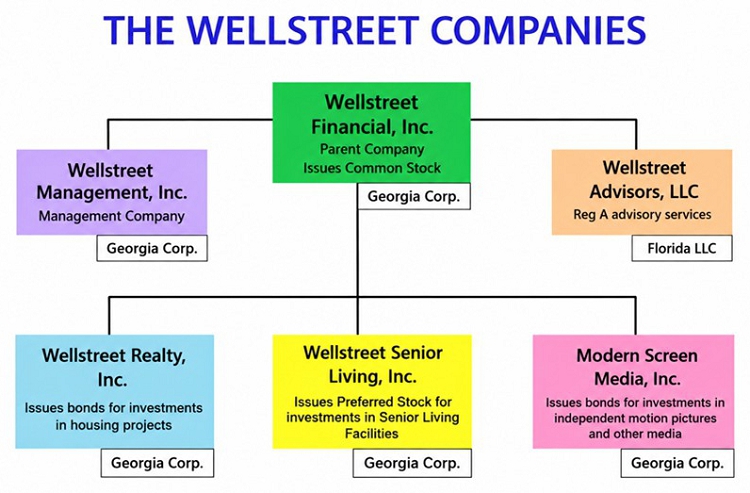
Wellstreet Senior Living, Inc. (“WSSL”), f/k/a Worthy Wealth Senior Living, Inc., a Georgia corporation and wholly owned subsidiary of the “Parent” company WSF was incorporated under the laws of the State of Georgia on December 3, 2024. Its business model is centered primarily around making investments in existing, yet underperforming, senior living facilities. It is anticipated that WSSL will partner in such investments with one or more owner operators of senior living facilities in newly acquired senior living facilities, with the goal of utilizing investment funds to improve said facilities, both operationally and through capex expenditures
Modern Screen Media, Inc. (“MSM”), f/k/a Worthy Wealth Media, Inc., a Georgia corporation and wholly owned subsidiary of the “Parent” company was founded on October 16, 2025. This early-stage company will primarily finance independent motion pictures and other media secured by distribution agreements, distribution accounts receivable, and completion bonds.
| 3 |
Organizational Structure:
The following reflects the current organization structure of WSF:
The Wellstreet Housing Bonds
| ● | are priced at $10.00 each; | |
| ● | represent a full and unconditional obligation of our Company; | |
| ● | have a 60-month term; | |
| ● | bear interest at 9% APY for the first 36 months, and thereafter at 10% APY; | |
| ● | in no event with the foregoing interest rates payable on Wellstreet Housing Bonds reduce below 9% APY (or 10% APY after 36 months); | |
| ● | any changes to interest rates payable will be effected through the filing of a post qualification amendment or supplement, as applicable, to the Wellstreet Realty Form 1-A; | |
| ● | interest shall be payable quarterly, in arrears; | |
| ● | are subject to repayment at the demand of the holder, subject to liquidity, no sooner than 36 months from the date that the purchase funds have cleared, upon 90 days prior written notice from holder; | |
| ● | are subject to redemption by us at any time; | |
| ● | are not payment dependent on any underlying real estate investments; | |
| ● | are transferable; and | |
| ● | are unsecured. |
| 4 |
Marketing
Our bonds will be primarily marketed through the Website, on-line information sources, social networks, institutional (Colleges and universities, charities, trade associations and employers) and other marketing partner sources of introduction and referral. Any such marketing operations, as well as customer service operations related to bonds sales, will be based out of our principal office in Alpharetta, GA.
Operations – Management Services Agreement with Wellstreet Management, Inc.
On February 8, 2025, we entered into the Management Services Agreement with WSMI. WSMI was established on February 7, 2024, as part of the internal reorganization of the operations of our “Parent”, WSF. This operational restructure was undertaken as a cost-sharing effort to more efficiently utilize personnel throughout the Wellstreet group of companies. As a result, our executive officers and the other personnel which provide services to us are all employed by WSMI.
Under the terms of the Management Services Agreement, WSMI agreed to provide to the Company certain management services, personnel and office facilities, including all equipment and supplies that are reasonable, necessary or useful for the day-to-day operations of the business of the Company, as well as other common expenses of the Wellstreet group of companies, subject to such written direction provided by the Company to WSMI.
Pursuant to the Management Services Agreement, the Company agreed to reimburse WSMI for the costs incurred by WSMI in paying for the staff and office expenses for the Company as well as other common expenses of the Wellstreet group of companies under the Management Services Agreement. There is no interest rate or maturity associated with the obligations to reimburse WSMI under the Management Services Agreement. The reimbursement amounts payable to WSMI by the Company will accrue until the Company can make reimbursement payments to WSMI.
The reimbursement amount under the Management Services Agreement, will be equal to the costs incurred by WSMI in paying for the staff and office expenses under the Management Services Agreement for the Company and will consist of both a to-be-determined portion of the annual salaries and employee benefits of our executive officers and the other personnel employed by WSMI based upon the amount of time they devote to us, as well as a pro-rata allocation of office expenses. We have not yet determined the amount of this monthly reimbursement amount as it will be based on the costs incurred by WSMI in paying for the staff and office expenses for the Company under the Management Services Agreement and as WSMI has not yet determined salary payment amounts or the benefits it’ll provide to our executive officers and the other personnel employed by WSMI.
| 5 |
There will be no fees under the Management Services Agreement.
The initial term of the Management Services Agreement will end on February 8, 2027, unless automatically renewed for successive one year terms. The Management Services Agreement can be terminated at any time upon 30 days’ prior written notice from one party to the other.
For additional information please see the Management Services Agreement, which is an exhibit to this annual report.
Employees
We do not have any full-time employees. We are dependent upon the services provided under the Management Services Agreement with WSMI for our operations.
Legal Proceedings
From time to time, we may become party to various lawsuits, claims and other legal proceedings that arise in the ordinary course of our business. We are not currently a party, as plaintiff or defendant, nor are we aware of any threatened or pending legal proceedings, that we believe to be material or which, individually or in the aggregate, would be expected to have a material effect on our business, financial condition or results of operation if determined adversely to us.
Executive Offices
Our principal office is located in Alpharetta, Georgia. It is anticipated that WSMI will make future payments under the principal office lease, as well as potentially providing other office space to us, in each case under the terms of the Management Services Agreement described above. As described therein, we will reimburse WSMI a to-be-determined portion of the total office expenses associated with office space. This amount has not been determined as of the date of this annual report.
Competition
We compete with other companies that lend to the real estate developer industry and developers of multi-unit housing projects. These companies include other developer lenders. We seek to, but may not be able to effectively compete with such competitors.
No Public Market
Although under Regulation A the Wellstreet Housing Bonds are not restricted, Wellstreet Housing Bonds are still highly illiquid securities. No public market has developed nor is expected to develop for Wellstreet Housing Bonds, and we do not intend to list Wellstreet Housing Bonds on a national securities exchange or interdealer quotational system. You should be prepared to hold your Wellstreet Bonds as they are expected to be highly illiquid investments.
| 6 |
Going Concern
The accompanying financial statements have been prepared assuming that the Company will continue as a going concern. For the year ended June 30, 2026, the Company generated $24,685 in revenue and has limited operating history. The Company generated net losses of approximately $285,000 and had cash used in operations of approximately $208,000 for the year ended June 30, 2026. The net losses incurred have resulted in an accumulated deficit of approximately $348,000 at June 30, 2026. There is a possibility that bond liability redemption requests may exceed available liquidity. These conditions raise substantial doubt about the Company’s ability to continue as a going concern for a period of twelve months from the issuance date of this report.
During 2024, the Company began to incur operating expenses, however, the Company had filed a Form 1-A Regulation A Offering Statement which allows the Company to raise funds. We expect to generate income from the difference between (a) the interest rates we earn on our investments with infrastructure and other housing developers, and (b) the interest we will pay to the holders of Wellstreet Housing Bonds. We also expect to use up to 5% of the proceeds from sales of Wellstreet Housing Bonds to provide working capital and general corporate purposes for our Company until such time as our revenues are sufficient to pay our operating expenses.
We are dependent on advances from WSF and proceeds from the offering to provide capital for our operations. WSF is not obligated to provide advances to us and there are no assurances that we will be successful in raising proceeds in the offering.
No assurances can be given that the Company will achieve success, without seeking additional financing. There also can be no assurances that any additional financing, if required, can be obtained, or obtained on reasonable terms acceptable to the Company. These financial statements do not include adjustments related to the recoverability and classifications of assets or the amounts and classification of liabilities that might be necessary should the Company be unable to continue as a going concern.
Emerging Growth Company Status
We are an “emerging growth company” as defined in the JOBS Act, which permits us to elect not to be subject to certain disclosure and other requirements that otherwise would have been applicable to us had we not been an “emerging growth company.” These provisions include:
| ● | reduced disclosure about our executive compensation arrangements; | |
| ● | no non-binding advisory votes on executive compensation or golden parachute arrangements; and | |
| ● | exemption from the auditor attestation requirement in the assessment of our internal control over financial reporting. |
We may take advantage of these exemptions for up to five years or such earlier time as we are no longer an “emerging growth company.” We will qualify as an “emerging growth company” until the earliest of:
| ● | the last day of our fiscal year following the fifth anniversary of the date of completion of the offering; | |
| ● | the last day of our fiscal year in which we have annual gross revenue of $1.0 billion or more; | |
| ● | the date on which we have, during the previous three-year period, issued more than $1.0 billion in non-convertible debt; or | |
| ● | the last day of the fiscal year in which we become a “large accelerated filer” as defined in Rule 12b-2 under the Securities Exchange Act of 1934, as amended, or the “Exchange Act.” |
Under this definition, we will be an “emerging growth company” upon completion of the offering and could remain an “emerging growth company” until as late as February 28, 2028.
In addition, the JOBS Act provides that an emerging growth company can take advantage of an extended transition period for complying with new or revised accounting standards. This allows an emerging growth company to delay the adoption of certain accounting standards until those standards would otherwise apply to private companies. We have irrevocably elected not to avail ourselves of this exemption from new or revised accounting standards and, therefore, we will be subject to the same new or revised accounting standards as other public companies that are not emerging growth companies.
| 7 |
RISK FACTORS
Investing in our securities involves risks. In addition to the other information contained in this annual report, you should carefully consider the following risks before deciding to purchase our securities in the offering. The occurrence of any of the following risks might cause you to lose all or a part of your investment. Some statements in this annual report, including statements in the following risk factors, constitute forward-looking statements. Please refer to “Cautionary Statement Regarding Forward-Looking Statements” for more information regarding forward-looking statements.
Below is a summary of material risks, uncertainties and other factors that could have a material effect on the Company and its operations:
| ● | We are an early-stage startup with limited operating history, and we may never become profitable; | |
| ● | Absent any additional financing or advances from our “Parent” company, other than the sale of the Wellstreet Housing Bonds, we may be unable to meet our operating expenses; | |
| ● | Depending on the amount of Wellstreet Housing Bonds sold in the offering, and the timing of our investments, it is possible that at times we may be dependent on advances from our “Parent” company, which has acknowledged its intent to provide such advances, in order to meet our operating expenses; | |
| ● | The amount of repayments that bondholders demand at a given time may exceed the amount of funds we have available to make such payments which may result in a delay in repayment or loss of investment to the bondholders; | |
| ● | Public health epidemics or outbreaks could adversely impact our business; | |
| ● | We operate in a highly regulated industry, and our business may be negatively impacted by changes in the regulatory environment; | |
| ● | Our business may be negatively impacted by worsening economic conditions and fluctuations in the credit market; | |
| ● | Competition in our industry is intense; | |
| ● | Holders of Wellstreet Housing Bonds are exposed to the credit risk of our company; | |
| ● | There has been no public market for Wellstreet Housing Bonds and none is expected to develop; and | |
| ● | We could be materially and adversely affected if we are deemed to be an investment company under the Investment Company Act. |
Risks Related to our Industry
Worsening economic conditions may result in decreased demand for investments, cause real estate developer default rates to increase, and harm our operating results.
Uncertainty and negative trends in general economic conditions in the United States and abroad, including significant tightening of credit markets, historically have created a difficult environment for companies in the real estate development industry. Many factors, including factors that are beyond our control, may have a detrimental impact on our operating performance. These factors include defaults by infrastructure and other housing developers, a reduction in the quantity of improved real estate lots acquired by national homebuilders, general economic conditions, unemployment levels, energy costs and interest rates, as well as events such as natural disasters, acts of war, terrorism, pandemic like the recent coronavirus (COVID-19) and catastrophes.
There can be no assurance that economic conditions will remain favorable for our business or that demand for investments in which we participate or default rates by infrastructure and other housing developers will remain at current levels. Reduced demand for investments would negatively impact our growth and revenue, while increased default rates by infrastructure and other housing developers may inhibit our access to capital and negatively impact our profitability. Further, if an insufficient number of qualified infrastructure and other housing developers seek our investments, our growth and revenue would be negatively impacted.
Competition for employees is intense, and we may not be able to attract and retain the highly skilled employees whom we need to support our business.
Competition for highly skilled personnel, especially data analytics personnel, is extremely intense, and we could face difficulty identifying and hiring qualified individuals in many areas of our business. We may not be able to hire and retain such personnel. Many of the companies with which we compete for experienced employees have greater resources than we have and may be able to offer more attractive terms of employment. In addition, we intend to invest significant time and expense in training our employees, which increases their value to competitors who may seek to recruit them. If we fail to retain our employees, we could incur significant expenses in hiring and training their replacements and the quality of our services and our ability to serve infrastructure and other housing developers could diminish, resulting in a material adverse effect on our business. We currently have no full time employees. However, management and staffing are presently provided by Wellstreet Management, Inc., a wholly owned subsidiary of our “Parent” company, under a Management Services Agreement. Please see “Operations – Management Services Agreement with Wellstreet Management, Inc.” for a detailed description of the Management Services Agreement.
| 8 |
We operate in a competitive market which may intensify, and competition may limit our ability to implement our business model and have a material adverse effect on our business, financial condition, and results of operations.
We operate in a competitive market which may intensify, and competition may limit our ability to implement our business model and have a material adverse effect on our business, financial condition, and results of operations. Our competitors may be able to have a lower cost for their services which would lead to infrastructure and other housing developers choosing such other competitors over the Company. In addition, some of our competitors may have higher risk tolerances or different risk assessments, which could allow them to consider a wider variety of investments, offer more attractive pricing or other terms and establish more relationships than us.
Risks Related to Residential Housing Market
An economic downturn or decline in economic conditions could adversely affect our business and our results of operations.
Demand for new homes is sensitive to economic changes driven by conditions such as employment levels, job growth, consumer confidence, inflation and interest rates. If the housing industry suffers a downturn, the ability of our partners to sell lots, in which we have a tenancy in common or other direct interest may decline which could have a material adverse effect on our profitability, ability to service our debt obligations and future cash flows.
Interest rate movements, inflation and other economic factors can negatively impact our business operations.
High rates of inflation generally affect the homebuilding industry adversely because of their adverse impact on interest rates. High interest rates not only increase the cost of borrowed funds to homebuilders and developers but also have a significant adverse effect on housing demand and on the affordability of permanent mortgage financing to prospective purchasers. Increases in prevailing interest rates could have a material adverse effect on the ability of our partners to sell their lots, in which we have a direct ownership interest in which could have a material adverse effect on our profitability, ability to service our debt obligations and future cash flows.
Diminished consumer confidence, whether generally or as to purchasing a home can negatively impact our business operations.
Consumers may be reluctant to purchase a home compared to housing alternatives (such as renting apartments or homes, or remaining in their existing home) due to location or lifestyle preferences, affordability and home selling price perceptions (particularly in markets that experienced rapid home price appreciation), employment instability or otherwise. Consumers may also decide not to search for a new home, or cancel their home sales contracts, due to economic or personal financial uncertainty. The combination of sharply higher mortgage interest rates since early 2022, several years of rising housing prices, volatility across financial markets, elevated inflation and various other macroeconomic and geopolitical concerns have weighed on consumer budgets and confidence. In addition, homeowners who purchased their home with a relatively low mortgage interest rate, as was generally the case from mid-2020 to mid-2022, may be reluctant to move given the sharp rate increases in 2022 and 2023. With housing affordability at an all-time low, these conditions are expected to remain. In that we partner with developers of lots that are sold to residential builders, any downturn in new residential home building and sales could adversely affect our profitability, ability to service our debt obligations and future cash flows.
| 9 |
Tightened availability or affordability of mortgage loans and homeowner insurance coverage can negatively impact our business operations.
Home buyers’ ability to obtain a mortgage loan is largely subject to prevailing interest rates, lenders’ credit standards and appraisals, and the availability of government-supported programs, such as those from the Federal Housing Administration, the Veterans Administration, Federal National Mortgage Association (also known as Fannie Mae) and the Federal Home Loan Mortgage Corporation (also known as Freddie Mac). If mortgage loan interest rates further increase, which they did in 2022 and 2023, reflecting the U.S. Federal Reserve’s focus on moderating inflation and investors’ concerns about the federal government’s debt level, credit standards are tightened, appraisals for homes are lowered or mortgage loan programs are curtailed, potential buyers of new residential homes may not be able to obtain necessary mortgage financing to be able to purchase a home. In that we partner with developers of lots that are sold to residential builders, any downturn in new residential home building and sales could adversely affect our profitability, ability to service our debt obligations and future cash flows.
Risks Related to Our Company
We are an early-stage startup with limited operating history, and we may never become profitable.
We expect to be profitable in the near term, but there can be no guarantees. If we are unable to obtain or maintain profitability, we will not be able to attract investment, compete, or maintain operations.
Our management has raised substantial doubt about our ability to continue as a going concern and our independent registered public accounting firm has included an explanatory paragraph relating to our ability to continue as a going concern in its audit report with respect to our audited financial statements for the year ended June 30, 2026.
We are an early-stage startup with limited operating history, and we may never become profitable. Our management has raised substantial doubt about our ability to continue as a going concern and our independent registered public accounting firm has included an explanatory paragraph in their opinion on our audited financial statements for the year ended June 30, 2026, that states that there is a substantial doubt about our ability to continue as a going concern. The accompanying financial statements have been prepared assuming that we will continue as a going concern. There is substantial doubt about our ability to continue as a going concern. No assurances can be given that we will generate sufficient revenue or obtain necessary financing to continue as a going concern. No assurances can be given that we will achieve success in selling the Wellstreet Housing Bonds.
If we do not raise sufficient funds in the offering and our “Parent” company declines to make advances to us we won’t be able to fully implement our business plan.
We have not generated any significant revenues to date and we are dependent on the proceeds from the offering to provide funds to implement our business model. The uncertainty of the amount of Wellstreet Housing Bonds that we will sell, and the timing of such sales, makes it difficult to predict our planned operations. Until sufficient proceeds have been received by us from the sale of Wellstreet Housing Bonds in the offering to make initial investments, we will invest all received proceeds in publicly traded government securities, and any interest payment obligations with respect to issued Wellstreet Housing Bonds would be satisfied through the proceeds of such investments, as well as, to the extent necessary, contributions to the Company’s capital by the Company’s “Parent” corporation WSF. We will not be paying back any of the funds advanced to us by WSF and therefore there is no interest rate or maturity associated with such advances. WSF is not obligated to provide advances to us and there are no assurances that we will be successful in raising proceeds in the offering. If we do not raise sufficient funds in the offering or if our “Parent” declines to make advances to us, we will not be able to implement our business plan, or may have to cease operations altogether. The Company does not intend to commence operations until such time as it has raised sufficient proceeds in the Offering to make initial investments. If we do not raise sufficient funds in the offering and if our “Parent” company declines to make advances to us we won’t be able to implement our business plan, and will either have to modify our business plan or potentially cease operations altogether, in which case we would wind down the Company’s investments in an orderly fashion to maximize the Company’s ability to meet any then outstanding obligations, including those related to outstanding Wellstreet Housing Bonds.
| 10 |
The amount of repayments that bondholders demand at a given time may exceed the amount of funds we have available to make such payments which may result in a delay in repayment or loss of investment to the bondholders.
We will use our commercially reasonable efforts to maintain sufficient cash and cash equivalents on hand to honor repayment demands of bondholders after the 36 months period detailed below. Such repayment, however, is subject to the then-current liquidity of the Company. Pursuant to the terms of our Wellstreet Housing Bonds Investor Agreement, the Wellstreet Housing Bonds are subject to repayment at the written demand of a bond holder no sooner than 36 months from the date that the purchase funds have cleared, upon 90 days notice by holder, and the outstanding principal balance together with the interest earned through the repurchase date will be credited to the bondholder’s account within 5 business days; provided, however, if the bond holder requests a repayment of Wellstreet Housing Bonds in the aggregate principal amount greater than $50,000, the Company may make such repayment to such bond holder within 30 days of the request for such repayment. Any failure to make repayments on the foregoing terms is an event of default under the Wellstreet Housing Bonds. Under the Wellstreet Housing Bonds Investor Agreement any claims brought by an investor against us following such a payment event of default may be subject to binding arbitration (subject to certain opt-out provisions) or small claims court. See “Description of the Wellstreet Housing Bonds” beginning on page 37.
In the event there are more demands for repayment to meet than our cash and cash equivalents on hand, we may be required to (i) seek commercial banks and non-bank lending sources, such as insurance companies, private equity funds and private lending organizations, for the provision of credit facilities, including, but not limited to, lines of credit, pursuant to which funds would be advanced to us, or (ii) seek capital contributions from our “Parent” company, WSF. In the event that the above sources of funds to honor repayments cannot be realized within the time frame of the repayment requests of bondholders, bondholders might have to wait for repayment until the above sources are realized. If the above sources do not generate enough funds to honor bondholders’ requests for repayment, there is a risk that the bondholders may lose some or all of their investment in the Wellstreet Housing Bonds.
If the information provided by infrastructure and other housing developers is incorrect or fraudulent, we may misjudge a customer’s qualification to receive an investment, and our operating results may be harmed.
Although a significant part of our investment decisions is based on appraisals of the real estate underlying the investments, our decisions are based partly on information provided to us by investment applicants. To the extent that these applicants provide information to us in a manner that we are unable to verify, we may not be able to accurately assess the associated risk. In addition, data provided by third-party sources is a significant component of our underwriting process, and this data may contain inaccuracies. Inaccurate analysis of credit data that could result from false application information could harm our reputation, business, and operating results.
Our risk management efforts may not be effective.
We could incur substantial losses, and our business operations could be disrupted if we are unable to effectively identify, manage, monitor, and mitigate financial risks, such as credit risk, interest rate risk, liquidity risk, and other market-related risk, as well as operational risks related to our business, assets, and liabilities. To the extent our models used to assess the creditworthiness of potential developers do not adequately identify potential risks, the risk profile of such infrastructure and other housing developers could be higher than anticipated. Our risk management policies, procedures, and techniques may not be sufficient to identify all of the risks we are exposed to, mitigate the risks that we have identified, or identify concentrations of risk or additional risks to which we may become subject in the future.
A significant disruption in our computer systems or a cybersecurity breach could adversely affect our operations.
We rely extensively on our computer systems to manage our investments and other processes. Our systems are subject to damage or interruption from power outages, computer and telecommunications failures, computer viruses, cyber security breaches, vandalism, severe weather conditions, catastrophic events and human error, and our disaster recovery planning cannot account for all eventualities. If our systems are damaged, fail to function properly or otherwise become unavailable, we may incur substantial costs to repair or replace them, and may experience loss of critical data and interruptions or delays in our ability to perform critical functions, which could adversely affect our business and results of operations. Any compromise of our security could also result in a violation of applicable privacy and other laws, significant legal and financial exposure, damage to our reputation, loss or misuse of the information and a loss of confidence in our security measures, which could harm our business.
| 11 |
Our ability to protect the confidential information of our infrastructure and other housing developers and investors may be adversely affected by cyber-attacks, computer viruses, physical or electronic break-ins or similar disruptions.
We process certain sensitive data from our infrastructure and other housing developers and investors. While we have taken steps to protect confidential information that we receive or have access to, our security measures could be breached. Any accidental or willful security breaches or other unauthorized access to our systems could cause confidential developer and investor information to be stolen and used for criminal purposes. Security breaches or unauthorized access to confidential information could also expose us to liability related to the loss of the information, time-consuming and expensive litigation and negative publicity. If security measures are breached because of third-party action, employee error, malfeasance or otherwise, or if design flaws in our software are exposed and exploited, our relationships with infrastructure and other housing developers and investors could be severely damaged, and we could incur significant liability.
Because techniques used to sabotage or obtain unauthorized access to systems change frequently and generally are not recognized until they are launched against a target, we may be unable to anticipate these techniques or to implement adequate preventative measures. In addition, federal regulators and many federal and state laws and regulations require companies to notify individuals of data security breaches involving their personal data. These mandatory disclosures regarding a security breach are costly to implement and often lead to widespread negative publicity, which may cause infrastructure and other housing developers and investors to lose confidence in the effectiveness of our data security measures. Any security breach, whether actual or perceived, would harm our reputation, we could lose infrastructure and other housing developers and investors and our business and operations could be adversely affected.
Any significant disruption in service on our platform or in our computer systems, including events beyond our control, could prevent us from processing or posting payments on our investments, reduce the attractiveness of our marketplace and result in a loss of infrastructure and other housing developers or investors.
In the event of a system outage and physical data loss, our ability to perform our servicing obligations, process applications or make investments available would be materially and adversely affected. The satisfactory performance, reliability and availability of our technology are critical to our operations, customer service, reputation and our ability to attract new and retain existing infrastructure and other housing developers and investors.
Any interruptions or delays in our service, whether as a result of third-party error, our error, natural disasters or security breaches, whether accidental or willful, could harm our relationships with our infrastructure and other housing developers and investors and our reputation. Additionally, in the event of damage or interruption, our insurance policies may not adequately compensate us for any losses that we may incur. Our disaster recovery plan has not been tested under actual disaster conditions, and we may not have sufficient capacity to recover all data and services in the event of an outage. These factors could prevent us from processing or posting payments on the investments, damage our brand and reputation, divert our employees’ attention, reduce our revenue, subject us to liability and cause infrastructure and other housing developers and investors to abandon our marketplace, any of which could adversely affect our business, financial condition and results of operations.
We contract with third parties to provide services related to our online web lending and marketing, as well as systems that automate the servicing of our investment portfolios. While there are material cybersecurity risks associated with these services, we require that our vendors provide industry-leading encryption, strong access control policies, Statement on Standards for Attestation Engagements (SSAE) 16 audited data centers, systematic methods for testing risks and uncovering vulnerabilities, and industry compliance audits to ensure data and assets are protected. To date, we have not experienced any cyber incidents that were material, either individually or in the aggregate.
If our estimates of investment losses are not adequate to absorb actual losses, our provision for investments losses would increase, which would adversely affect our results of operations.
We maintain an allowance for investment losses. To estimate the appropriate level of allowance for investment losses, we consider known and relevant internal and external factors that affect investment collectability, including the total amount of investment receivables outstanding, historical investment receivable charge-offs, our current collection patterns, and economic trends. If customer behavior changes as a result of economic conditions and if we are unable to predict how the unemployment rate, housing foreclosures, and general economic uncertainty may affect our allowance for investment losses, our provision may be inadequate. Our allowance for investment losses is an estimate, and if actual investment receivable losses are materially greater than our allowance for investment losses, our financial position, liquidity, and results of operations could be adversely affected.
| 12 |
We will face increasing competition of other developer real estate investors and, if we do not compete effectively, our operating results could be harmed.
We compete with other companies that make investments with infrastructure and other housing developers. If we are not able to compete effectively with our competitors, our operating results could be harmed.
Many of our competitors have significantly more resources and greater brand recognition than we do and may be able to attract infrastructure and other housing developers more effectively than we do.
When new competitors seek to enter one of our markets, or when existing market participants seek to increase their market share, they sometimes undercut the pricing and/or credit terms prevalent in that market, which could adversely affect our market share or ability to explore new market opportunities. Our pricing and credit terms could deteriorate if we act to meet these competitive challenges. Further, to the extent that the fees we pay to our strategic partners and investment referral sources are not competitive with those paid by our competitors, whether on new investments or renewals or both, these partners and sources may choose to direct their business elsewhere. All of the foregoing could adversely affect our business, results of operations, financial condition, and future growth.
We are reliant on the efforts of Sally Outlaw and Alan Jacobs.
We rely on our management team and need additional key personnel to grow our business, and the loss of key employees or inability to hire key personnel could harm our business. We believe our success has depended, and continues to depend, on the efforts and talents of our executive officers and directors, Sally Outlaw and Alan Jacobs. Our key personnel have expertise that could not be easily replaced if we were to lose any or all of their services.
Compliance with Regulation A and reporting to the SEC could be costly.
Compliance with Regulation A could be costly and requires legal and accounting expertise. After qualifying the Form 1-A, we are required to file an annual report on Form 1-K, a semiannual report on Form 1-SA, current reports on Form 1-U, and certain post qualification amendments and supplements.
Our legal and financial staff may need to be increased in order to comply with Regulation A. Compliance with Regulation A will also require greater expenditures on outside counsel, outside auditors, and financial printers in order to remain in compliance. Failure to remain in compliance with Regulation A may subject us to sanctions, penalties, and reputational damage and would adversely affect our results of operations.
We are required to publicly report on an ongoing basis under the reporting rules set forth in Regulation A for Tier 2 issuers. Therefore, we will be subject to ongoing public reporting requirements that are less rigorous than Exchange Act rules for companies that are not “emerging growth companies,” and our investors could receive less information than they might expect to receive from exchange traded public companies.
We will be required to publicly report on an ongoing basis under the reporting rules set forth in Regulation A for Tier 2 issuers. The ongoing reporting requirements under Regulation A are more relaxed than for “emerging growth companies” under the Exchange Act. The differences include, but are not limited to, being required to file only annual and semiannual reports, rather than annual and quarterly reports. Annual reports are due within 120 calendar days after the end of the issuer’s fiscal year, and semiannual reports are due within 90 calendar days after the end of the first six months of the issuer’s fiscal year. Therefore, our investors could receive less information than they might expect to receive from exchange traded public companies.
Our lack of operating history makes it difficult for you to evaluate this investment.
We are a recently formed entity with limited operating history and may not be able to successfully operate our business or achieve our investment objectives. We may not be able to conduct our business as described in our plan of operation.
| 13 |
We are subject to the risk of fluctuating interest rates, which could harm our planned business operations.
We expect to generate income from the difference between (a) the interest rates we earn on our real estate investments to infrastructure and other housing developers, and (b) the interest we will pay to the holders of Wellstreet Housing Bonds. Due to fluctuations in interest rates, we may not be able to charge infrastructure developer’s an interest rate sufficient for us to generate income, which could harm our planned business operations.
Any Referral Bonds you receive as a result of the Wellstreet Realty Referral Program could have adverse tax consequences to you.
There is some uncertainty about the appropriate treatment of these Referral Bonds for income purposes. If you receive Wellstreet Housing Bonds under the Wellstreet Realty Referral Program, upon receipt you will generally realize taxable income equal to the fair market value of the Wellstreet Housing Bonds. Your participation in the Wellstreet Realty Referral Program may increase the complexity of your tax filings and may cause you to be ineligible to file Internal Revenue Service Form 1040-EZ, if you would otherwise be eligible to file such form.
As of June 30, 2026, we have not entered into any long-term or multiple-project investment agreements with real estate developers.
As of the date hereof, the Company has not entered into any binding agreements with any infrastructure or housing developer related to multiple projects or long term partnerships. The Company has, however, made two separate loans to two different developers. The first loan was in the principal amount of $180,000 and has been repaid pursuant to the terms of the loan. The second is in the principal amount of $1,700,000 and remains outstanding. The Company is actively seeking additional investment opportunities pursuant to its business model as described herein.
Risks Related to Being Deemed an Investment Company under the Investment Company Act
We could be materially and adversely affected if we are deemed to be an investment company under the Investment Company Act.
We rely on the exception from the Investment Company Act set forth in Section 3(c)(5)(C) of the Investment Company Act, which excludes from the definition of investment company “any person who is not engaged in the business of issuing redeemable securities, face-amount certificates of the installment type or periodic payment plan certificates, and who is primarily engaged in one or more of the following businesses… (C) purchasing or otherwise acquiring mortgages and other liens on and interests in real estate, including the acquisition of, and development of, multi-unit housing projects.” The SEC Staff generally requires that, for the exception provided by Section 3(c)(5)(C) to be available, at least 55% of an entity’s assets be comprised of mortgages and other liens on and interests in real estate, including the acquisition of, and development of, multi-unit housing projects, also known as “qualifying interests,” and at least another 25% of the entity’s assets must be comprised of additional qualifying interests or real estate-type interests (with no more than 20% of the entity’s assets comprised of miscellaneous assets). We intend to acquire assets with the proceeds of the offering in satisfaction of such SEC requirements to fall within the exception provided by Section 3(c)(5)(C). Notwithstanding, it is possible that the staff of the SEC could disagree with any of our determinations. If the staff of the SEC were to disagree with our analysis under the Investment Company Act, we would need to adjust our investment strategy. Any such adjustment in our strategy could have a material adverse effect on us. If we are deemed to be an investment company, we may be required to register as an investment company if we are unable to dispose of the disqualifying assets, which could have a material adverse effect on us.
Registration under the Investment Company Act would require us to comply with a variety of substantive requirements that impose, among other things:
| ● | limitations on capital structure; | |
| ● | restrictions on specified investments; | |
| ● | restrictions on leverage or senior securities; | |
| ● | restrictions on unsecured borrowings; | |
| ● | prohibitions on transactions with affiliates; and | |
| ● | compliance with reporting, record keeping, voting, proxy disclosure and other rules and regulations that would significantly increase our operating expenses. |
| 14 |
If we were required to register as an investment company but failed to do so, we could be prohibited from engaging in our business, and criminal and civil actions could be brought against us. Registration with the SEC as an investment company would be costly, would subject us to a host of complex regulations and would divert attention from the conduct of our business, which could materially and adversely affect us. In addition, we would no longer be eligible to offer our securities under Regulation A of the Securities Act if we were required to register as an investment company.
If we are deemed to be an investment company under the Investment Company Act and are therefore ineligible to rely on Regulation A to sell securities, the unregistered issuance of our securities to the investors pursuant to the offering would be considered in violation of Section 5 of the Securities Act if there was no other available exemption from registration for this issuance giving the investors a right of rescission.
We rely on the exception from the Investment Company Act set forth in Section 3(c)(5)(C) of the Investment Company Act, however, in the event that the Company is deemed to be an investment company under the Investment Company Act, we would no longer be eligible to offer our securities under Regulation A of the Securities Act in the Offering, or at all. In the event that this occurs, the Company would have to immediately terminate the Offering. The unregistered issuance of our securities to the investors pursuant to the Offering would be considered in violation of Section 5 of the Securities Act if there were no other available exemption from registration for this issuance. The securities sold in the Offering prior to such termination would be subject to a private right of action for rescission or damages by the purchasing investors. Additionally, the Company may not have the funds required to address all rescissions if a large number of investors seek rescission at the same time, and as a result, we may be delayed in the delivery of funds for such rescissions and may be required to sell some of our assets, which may take significant amounts of time and may yield less than is needed to meet our rescission obligations. Additionally, the Company would not be able to raise funds in any other offering pursuant to Regulation A to meet such rescission obligations, as the Company would not be eligible to do so.
If we are deemed to be an investment company under the Investment Company Act and are therefore ineligible to rely on Regulation A for the Offering, it could result in a large number of investors demanding repayment in a short period of time, and the Company may not have funds to satisfy those demands.
We rely on the exception from the Investment Company Act set forth in Section 3(c)(5)(C) of the Investment Company Act, however, in the event that the Company is deemed to be an investment company under the Investment Company Act, we would no longer be eligible to offer our Wellstreet Housing Bonds under Regulation A of the Securities Act in the Offering, or at all. If this occurs, it could result in a large number of investors demanding repayment in a short period of time, and the Company may not have funds to satisfy those demands, provided, however, that repayment demands can only be made no sooner than 36 months after investment on 90 days notice by holder. As a result, we may be delayed in the delivery of funds and may be required to sell some of our assets, which may take significant amounts of time and may yield less than is needed to meet our obligations. Additionally, the Company would not be able to raise funds in any other offering pursuant to Regulation A to meet such demands, as the Company would not be eligible to do so.
If we are deemed to be an investment company under the Investment Company Act and sell securities in reliance on Regulation A and operate as an unregistered investment company, we could be subject to liability under Section 5 of the Securities Act.
In the event that the Company is deemed to be an investment company under the Investment Company Act, and if we sell securities in reliance on Regulation A and operate as an unregistered investment company due to a failure to qualify for the Section (3)(c)(5)(C) exemption of the Investment Company Act, for any Wellstreet Housing Bonds sold by us in reliance on Regulation A, the Company could be liable for violating Section 5 of the Securities Act if any of the securities issued in the Offering would be considered to be an unregistered issuance of securities if no other exemption from registration is available. Section 5 allows purchasers to sue the Company for selling a non-exempt security without registering it, whereby the purchasers seek rescission with interest, or damages if the purchaser sold his securities for less than he purchased them. The Company could also be subject to enforcement action by the SEC that claims a violation of Section 5 of the Securities Act. Additionally, if the Company was required to register as an investment company but failed to do so and therefore operated as an unregistered investment company, the Company could be subject to monetary penalties and injunctive relief in an action brought by the SEC.
| 15 |
Risks Related to Wellstreet Housing Bonds
The characteristics of the Wellstreet Housing Bonds, including interest rate, maturity date, lack of collateral security or guarantee, and lack of liquidity, may not satisfy your investment objectives.
The Wellstreet Housing Bonds may not be a suitable investment for you, and we advise you to consult your investment, tax and other professional financial advisors prior to purchasing Wellstreet Housing Bonds. The characteristics of the notes, including a 60-month maturity date, repayable at your demand on 90 days notice, no sooner than 36 months from the date that the purchase funds have cleared, redeemable by us, interest rate, lack of collateral security or guarantee, and lack of liquidity, may not satisfy your investment objectives. The Wellstreet Housing Bonds may not be a suitable investment for you based on your ability to withstand a loss of interest or principal or other aspects of your financial situation, including your income, net worth, financial needs, investment risk profile, return objectives, investment experience and other factors. Prior to purchasing any Wellstreet Housing Bonds, you should consider your investment allocation with respect to the amount of your contemplated investment in the Wellstreet Housing Bonds in relation to your other investment holdings and the diversity of those holdings.
Holders of Wellstreet Housing Bonds are exposed to the credit risk of our company.
Wellstreet Housing Bonds are our full and unconditional obligations. If we are unable to make payments required by the terms of the notes, you will have an unsecured claim against us. Wellstreet Housing Bonds are therefore subject to non-payment by us in the event of our bankruptcy or insolvency. In an insolvency proceeding, there can be no assurances that you will recover any remaining funds. Moreover, your claim may be subordinate to that of any senior creditors and any secured creditors to the extent of the value of their security.
The Wellstreet Housing Bonds are unsecured obligations.
The Wellstreet Housing Bonds do not represent an ownership interest in any specific Wellstreet investments, their proceeds, or their assets. The Wellstreet Housing Bonds are unsecured general obligations of Wellstreet only, and will rank equally with all of our other unsecured debt unless such debt is senior to or subordinate to the Wellstreet Housing Bonds by their terms. We may issue secured debt in our sole discretion without notice to or consent from the holders of Wellstreet Housing Bonds. Therefore as unsecured obligations, there is no security to be provided to the holders of the Wellstreet Housing Bonds.
There is no public market for Wellstreet Housing Bonds, and none is expected to develop.
Wellstreet Housing Bonds are newly issued securities. Although under Regulation A the securities are not restricted, Wellstreet Housing Bonds are still highly illiquid securities. No public market has developed nor is expected to develop for Wellstreet Housing Bonds, and we do not intend to list Wellstreet Housing Bonds on a national securities exchange or interdealer quotational system. You should be prepared to hold your Wellstreet Housing Bonds as Wellstreet Housing Bonds are expected to be highly illiquid investments.
Holders of the Wellstreet Housing Bonds will have no voting rights.
Holders of the Wellstreet Housing Bonds will have no voting rights and therefore will have no ability to control the Company. The Wellstreet Housing Bonds do not carry any voting rights and therefore the holders of the Wellstreet Housing Bonds will not be able to vote on any matters regarding the operation of the Company. As a bondholder purchaser in the offering will have no right to vote upon or receive notice of any corporate actions we may undertake which you might otherwise have if you owned equity in our Company.
| 16 |
There is a risk that the Wellstreet Website will not be able to handle a large number of investors subscribing to the offering.
Although the Wellstreet Website has been designed to handle numerous purchase orders and prospective investors, we cannot predict the response of the Wellstreet Website to any particular issuance of Wellstreet Housing Bonds pursuant to the offering. You should be aware that if a large number of investors try to access the Wellstreet Website at the same time and submit their purchase orders simultaneously, there may be a delay in receiving and/or processing your purchase order. You should also be aware that general communications and internet delays or failures unrelated to the Wellstreet Website, as well as Website capacity limits or failures may prevent purchase orders from being received on a timely basis by the Wellstreet Website. We cannot guarantee you that any of your submitted purchase orders will be received, processed and accepted during the offering process.
There is a risk that the Wellstreet Website and the Wellstreet App may be hacked.
We receive, collect, process, transmit, store, and use a large volume of personally identifiable information and other sensitive data from infrastructure and other housing developers and purchasers of the Wellstreet Housing Bonds and services on the Wellstreet Website and the Wellstreet App. There is a risk that the Wellstreet Website and the Wellstreet App may be hacked. Wellstreet Housing Bonds will be issued by computer-generated program on the Website and electronically signed by us in favor of the investor. The Wellstreet Housing Bonds will be stored by us and will remain in our custody for ease of administration. In today’s environment, cyberattacks are perpetrated by identity thieves, unscrupulous contractors and vendors, malicious employees, business competitors, prospective insider traders and market manipulators, so-called “hacktivists,” terrorists, state-sponsored actors, and others. Many companies that utilize technology in the business operations, such as ours are subject to the risk that they may be hacked. Even the most diligent cybersecurity efforts will not address all cyber risks that the Company faces. We cannot assure you that we’ll be able to prevent any such hacks by third parties, and if we experience these hacks, the effects would cause an adverse effect on our business operations and will jeopardize the privacy of our users data, and can lead to us having to cease operations altogether.
The Wellstreet Housing Bondholders may be subject to third party fees.
Wellstreet Housing Bond investors are not charged a servicing fee for their investment, but you may be charged a transaction fee if your method of payment requires us to incur an expense. The transaction fee will be equal to the amount that the Company will be charged by the payment processor. Other financial intermediaries, however, if engaged by you, may charge you commissions or fees.
Because the Wellstreet Housing Bonds will have no sinking fund, insurance, or guarantee, you could lose all or a part of your investment if we do not have enough cash to pay.
There is no sinking fund, insurance or guarantee of our obligation to make payments on the Wellstreet Housing Bonds. We will not contribute funds to a separate account, commonly known as a sinking fund, to make interest or principal payments on the Wellstreet Housing Bonds. The Wellstreet Housing Bonds are not certificates of deposit or similar obligations of, and are not guaranteed or insured by, any depository institution, the Federal Deposit Insurance Corporation, the Securities Investor Protection Corporation, or any other governmental or private fund or entity. Therefore, if you invest in the Wellstreet Housing Bonds, you will have to rely only on our cash flow from operations and possible funding from WSF, our “Parent” company, for repayment of principal and interest upon your demand of repayment or upon redemption by us pursuant to the terms hereof. If our cash flow from operations and possible funding from WSF, our “Parent” company, are not sufficient to pay any amounts owed under the Wellstreet Housing Bonds, then you may lose all or part of your investment.
| 17 |
By purchasing Wellstreet Housing Bonds in the Offering, unless you opt-out in accordance with the terms of the Wellstreet Realty Investor Agreement, you are bound by the arbitration provisions contained in our Wellstreet Realty Investor Agreement to be used for subscriptions in the offering which limits your ability to bring class action lawsuits or seek remedies on a class basis and waives the right to a trial by jury.
By purchasing shares in the Offering, unless you opt-out in accordance with the terms of the Wellstreet Realty Investor Agreement, you agree to be bound by the arbitration, jury waiver, and class action waiver provisions contained in Section 13 of our Investor Purchase Agreement to be used for subscriptions on the offering. Pursuant to the terms of the Wellstreet Realty Investor Agreement, the holders of Wellstreet Housing Bonds and the Company will agree to (i) resolve disputes of the holders of Wellstreet Housing Bonds through binding arbitration or small claims court, instead of through courts of general jurisdiction or through a class action and (ii) waive the right to a trial by jury and to participate in any class action, except in cases that involve personal injury. Pursuant to the terms of the Wellstreet Realty Investor Agreement, if a holder of Wellstreet Housing Bonds does not agree to the terms of the arbitration provision, the holder of Wellstreet Housing Bonds may opt-out of the arbitration provision by sending an arbitration opt-out notice to the Company within 30 days of the holder’s first electronic acceptance of the Wellstreet Realty Investor Agreement. If the opt-out notice is not received within 30 days, the holder of Wellstreet Housing Bonds will be deemed to have accepted all terms of the arbitration provision, including the class action and jury waiver. If the investor opts out of the arbitration provision, the investor has also opted out of the jury trial and class action waivers. As arbitration provisions in commercial agreements have generally been respected by federal courts and state courts of Georgia, we believe that the arbitration provision in the Wellstreet Realty Investor Agreement is enforceable under federal law and the laws of the State of Georgia. Although holders of Wellstreet Housing Bonds will be subject to the arbitration provisions of the Wellstreet Realty Investor Agreement, the arbitration provisions do not preclude holders of Wellstreet Housing Bonds from pursuing claims under the U.S. federal securities laws in federal courts. THE ARBITRATION PROVISION OF THE WELLSTREET REALTY INVESTOR AGREEMENT IS NOT INTENDED TO BE DEEMED A WAIVER BY ANY HOLDER OF WELLSTREET HOUSING BONDS OF THE COMPANY’S COMPLIANCE WITH THE U.S. FEDERAL SECURITIES LAWS AND THE RULES AND REGULATIONS PROMULGATED THEREUNDER. THE ARBITRATION PROVISION OF THE WELLSTREET REALTY INVESTOR AGREEMENT DO NOT APPLY TO CLAIMS BROUGHT UNDER THE EXCHANGE ACT AND SECURITIES ACT.
The Wellstreet Realty Investor Agreement provides that, to the extent permitted by law, each party to the Wellstreet Realty Investor Agreement waives the right to a jury trial or class action of any claim they may have against us arising out of or relating to our Wellstreet Housing Bonds or the Wellstreet Realty Investor Agreement. If we were to oppose a jury trial or class action demand based on such waiver, the court would determine whether the waiver was enforceable based upon the facts and circumstances of that case in accordance with applicable state and federal law, including whether a party knowingly, intelligently and voluntarily waived the right to a jury trial or class action. The bondholders of Wellstreet Housing Bonds will be subject to these provisions of the Wellstreet Realty Investor Agreement to the extent permitted by applicable law. THE WAIVER OF THE RIGHT TO A JURY TRIAL AND CLASS ACTION CONTAINED IN THE WELLSTREET REALTY INVESTOR AGREEMENT IS NOT INTENDED TO BE DEEMED A WAIVER BY ANY HOLDER OF WELLSTREET HOUSING BONDS OF THE COMPANY’S COMPLIANCE WITH THE U.S. FEDERAL SECURITIES LAWS AND THE RULES AND REGULATIONS PROMULGATED THEREUNDER. THE JURY WAIVER AND CLASS ACTION WAIVER PROVISIONS OF THE WELLSTREET REALTY INVESTOR AGREEMENT DO NOT APPLY TO CLAIMS BROUGHT UNDER THE EXCHANGE ACT AND SECURITIES ACT.
If the investor opts out of the arbitration provision, the investor has also opted out of the jury trial and class action waivers. In the event that an investor does not opt-out, as described above, the rights of the adverse bond holder to seek redress in court would be severely limited. These restrictions on the ability to bring a class action lawsuit may result in increased costs and/or reduced remedies, to individual investors who wish to pursue claims against the Company.
By purchasing Wellstreet Housing Bonds through the Offering, you are bound by the fee-shifting provision contained in our Bylaws, which may discourage you to pursue actions against us.
Section 7.4 of our Bylaws provides that “if any action is brought by any party against another party, relating to or arising out of these Bylaws, or the enforcement hereof, the prevailing party shall be entitled to recover from the other party reasonable attorneys’ fees, costs and expenses incurred in connection with the prosecution or defense of such action.”
In the event you initiate or assert a claim against us, in accordance with the dispute resolution provisions contained in our Bylaws, and you do not, in a judgment prevail, you will be obligated to reimburse us for all reasonable costs and expenses incurred in connection with such claim, including, but not limited to, reasonable attorney’s fees and expenses and costs of appeal, if any.
THE FEE SHIFTING PROVISION CONTAINED IN THE BYLAWS IS NOT INTENDED TO BE DEEMED A WAIVER BY ANY HOLDER OF WELLSTREET HOUSING BONDS OF THE COMPANY’S COMPLIANCE WITH THE U.S. FEDERAL SECURITIES LAWS AND THE RULES AND REGULATIONS PROMULGATED THEREUNDER. THE FEE SHIFTING PROVISION CONTAINED IN THE BYLAWS DO NOT APPLY TO CLAIMS BROUGHT UNDER THE EXCHANGE ACT AND SECURITIES ACT.
| 18 |
| Item 2. | MANAGEMENT’S DISCUSSION AND ANALYSIS OF FINANCIAL CONDITION AND RESULTS OF OPERATIONS |
The following discussion of our financial condition and results of operations should be read in conjunction with the financial statements and the notes to those statements that are included elsewhere in this annual report. Our discussion includes forward-looking statements based upon current expectations that involve risks and uncertainties, such as our plans, objectives, expectations and intentions. Actual results and the timing of events could differ materially from those anticipated in these forward-looking statements as a result of a number of factors, including those set forth under the Risk Factors, Cautionary Notice Regarding Forward-Looking Statements and Business sections in this annual report. We use words such as “anticipate,” “estimate,” “plan,” “project,” “continuing,” “ongoing,” “expect,” “believe,” “intend,” “may,” “will,” “should,” “could,” and similar expressions to identify forward-looking statements. Our future operating results, however, are impossible to predict and no guaranty or warranty is to be inferred from those forward-looking statements.
OUR BUSINESS
Our History and business model
We were incorporated under the laws of the State of Georgia on March 4, 2024. On March 4, 2024, we issued 100 shares of our $0.001 per share par value common stock in exchange for $100 to WSF.
We are a newly formed company, and to date, our activities have primarily consisted of organizing and establishing the Company and making two separate loans to two different developers. We are a wholly owned subsidiary of Wellstreet Financial, Inc. (“WSF”) which utilizes a fintech platform and mobile app (the “Wellstreet App”) that allows its users to digitally purchase “Wellstreet Housing Bonds.” Purchases can be made in several ways including by rounding up the users’ debit card and checking account linked credit card purchases and other checking account transactions and thereafter use the “round up” dollars in increments of $10.00 to purchase Wellstreet Housing Bonds from the Company. WSF also owns its proprietary Website allowing direct purchases of Wellstreet Housing Bonds (collectively the “Worthy Fintech Platform”).
We are an early stage company with limited operating history. Our business model is centered primarily around making investments in tenant in common ownership, mortgage loans, or other direct ownership interests in undeveloped properties acquired by infrastructure developers and properties acquired by other housing developers. Said tenant in common ownership interests and other direct ownership interests provide the Company with an actual ownership interest in the real property underlying the projects in which the Company so invests. Any mortgage loan would be secured by a first mortgage on the underlying real property, and said loans would be in an amount not greater than 70% of the independently assessed property value. We will not enter into mortgage loans with subprime borrowers. The investments will be in projects in high growth, high demand, suburban markets located in the Southeast United States, including Florida, North Carolina, South Carolina, Georgia, Alabama, and Tennessee. The Company has been in discussions with several developers that are seeking investments in their various projects. As of the date hereof, the Company has not entered into any binding agreements with any infrastructure or housing developer related to multiple projects or long-term partnerships. The Company has, however, made two separate loans to two different developers. The first loan was in the principal amount of $180,000 and has been repaid pursuant to the terms of the loan. The second is in the principal amount of $1,700,000 and remains outstanding. The Company is actively seeking additional investment opportunities pursuant to its business model as described herein. We anticipate that (i) at least 95% of our assets will consist of such investments, in the form of either tenant in common agreements or mortgage loans, and (ii) up to 5% of our assets will be allocated for working capital and for general corporate purposes, including the reimbursement amounts due under the Management Services Agreement with WSMI. The proceeds from the sale of Wellstreet Housing Bonds in the offering will provide the capital for these activities.
Our “Parent” company, WSF, was formed as a Georgia corporation on July 11, 2023.
The Wellstreet Housing Bonds:
| ● | are priced at $10.00 each; | |
| ● | represent a full and unconditional obligation of our Company; | |
| ● | have a 60-month term; | |
● ● |
bear interest at 9% APY for the first 36 months, and thereafter at 10% APY; any changes to interest rates payable will be effected through the filing of a post qualification amendment or supplement, as applicable, to the Wellstreet Realty Form 1-A; | |
●
● |
in no event with the foregoing interest rates payable on Wellstreet Housing Bonds reduce below 9% APY (or 10% APY after 36 months); any changes to interest rates payable will be effected through the filing of a post qualification amendment or supplement, as applicable, to the Wellstreet Realty Form 1-A; | |
| ● | interest shall be payable quarterly, in arrears; | |
| ● | are subject to repayment at the demand of the holder, subject to liquidity, no sooner than 36 months from the date that the purchase funds have cleared, upon 90 days prior written notice by holder; | |
| ● | are subject to redemption by us at any time; | |
| ● | are not payment dependent on any underlying real estate investments; | |
| ● | are transferable; and | |
| ● | are unsecured. |
| 19 |
Going Concern
The accompanying financial statements have been prepared assuming that the Company will continue as a going concern. For the year ended June 30, 2026, the Company generated $24,685 in revenue and has limited operating history. The Company generated net losses of approximately $285,000 and had cash used in operations of approximately $208,000 for the year ended June 30, 2026. The net losses incurred have resulted in an accumulated deficit of approximately $348,000 at June 30, 2026. There is a possibility that bond liability redemption requests may exceed available liquidity. These conditions raise substantial doubt about the Company’s ability to continue as a going concern for a period of twelve months from the issuance date of this report.
During 2024, the Company began to incur operating expenses, however, the Company had filed a Form 1-A Regulation A Offering Statement which allows the Company to raise funds. We expect to generate income from the difference between (a) the interest rates we earn on our investments with infrastructure and other housing developers, and (b) the interest we will pay to the holders of Wellstreet Housing Bonds. We also expect to use up to 5% of the proceeds from sales of Wellstreet Housing Bonds to provide working capital and general corporate purposes for our Company until such time as our revenues are sufficient to pay our operating expenses.
We are dependent on advances from WSF and proceeds from the offering to provide capital for our operations. WSF is not obligated to provide advances to us and there are no assurances that we will be successful in raising proceeds in the offering.
No assurances can be given that the Company will achieve success, without seeking additional financing. There also can be no assurances that any additional financing, if required, can be obtained, or obtained on reasonable terms acceptable to the Company. These financial statements do not include adjustments related to the recoverability and classifications of assets or the amounts and classification of liabilities that might be necessary should the Company be unable to continue as a going concern.
Results of Operations
Years Ended June 30, 2026 and June 30, 2025
Commencing in September 2025, the Company began loaning funds directly to borrowers.
Operating Revenue
Operating revenue primarily includes interest on loans receivable of $24,685 for the year ended June 30, 2026, as compared to $0 for the year ended June 30, 2025. The increase is due to the Company making loans in fiscal year 2026.
Cost of Revenue
Cost of revenue consists of interest expense on bonds of $82,369 and $0 and our provision for credit losses of $17,181 and $0 for the years ended June 30, 2026 and 2025, respectively. The increase is due to the Company making more loans and selling more bonds in fiscal year 2026.
Operating Expenses
Operating expenses consist of general and administrative expenses of $82,635 and $104,722 for the years ended June 30, 2026, and June 30, 2025, respectively, compensation and related expenses of $129,007 and sales and marketing expenses of $9,234 for the year ended June 30, 2026. Total operating expenses increased by $116,154 for the year ended June 30, 2026, as compared to the year ended June 30, 2025. General and administrative expenses decreased by $22,087, primarily due to lower expenses incurred as the Company continued to implement its business plan during fiscal year 2026. Compensation and related expenses increased by $129,007, while sales and marketing expenses increased by $9,234, primarily due to increased personnel costs and marketing activities associated with the Company's continued implementation of its business plan and Regulation A offering.
We are unable at this time to quantify any expected increases in our operating expenses. Until such time as we begin generating significant revenues, we expect to continue to report net losses.
Other Income (Expenses)
Unrealized gains (losses) on investments, net
For the year ended June 30, 2026, and 2025 our net unrealized gains (losses) on investments were ($27,365) and $0, respectively. This decrease was a result of market fluctuations.
Interest and dividends on investments
Interest and Dividends on Investments for the year ended June 30, 2026, is $10,430 as compared to $0 for the year ended June 30, 2025. This increase was the direct result of our increased investment portfolio.
| 20 |
Liquidity and capital resources
As of June 30, 2026, and June 30, 2025, we had total shareholder’s deficit of approximately $255,000 and $24,000, respectively; cash on hand of approximately $260,000 and $2,000, respectively; and total liabilities exceeded total assets by approximately $255,000 and $24,000, respectively.
To date, the working capital deficit has been funded by capital infusions to the Company through funds raised by capital contributions from WSF and proceeds from the sale of bonds.
Our shareholders’ deficit and accumulated deficit are the result of initial and early-stage operating sales of bonds (a liability) at a more rapid pace than the proceeds from the sale of bonds could be effectively invested in income generating loans. The combination of interest payable on the bonds and operating expenses initially generate working capital deficit.
Years Ended June 30, 2026 and June 30, 2025
Summary of cash flows
Year Ended June 30, 2026 | Year Ended June 30, 2025 | |||||||
| Net cash provided by (used in) operating activities | $ | (207,931 | ) | (80,753 | ) | |||
| Net cash provided by (used in) investing activities | $ | (1,935,803 | ) | - | ||||
| Net cash provided by (used in) financing activities | $ | 2,401,355 | 34,254 | |||||
In the year ended June 30, 2026, net cash used in operating activities was used primarily to fund our losses, offset by an increase in accrued interest. Net cash used in investing activities represents loans made, purchase of investments, and offset by the sale of investments. Net cash provided by financing activities is primarily the result of proceeds from bond sales.
Significant Accounting Policies
Our management’s discussion and analysis of our financial condition and results of operations is based on our financial statements, which have been prepared in accordance with U.S. generally accepted accounting principles, or “GAAP.” The preparation of these financial statements requires us to make estimates and assumptions that affect the reported amounts of assets and liabilities, disclosure of contingent assets and liabilities at the date of the financial statements, and the reported amounts of revenue and expenses during the reported period. In accordance with GAAP, we base our estimates on historical experience and on various other assumptions that we believe are reasonable under the circumstances. Actual results may differ from these estimates under different assumptions or conditions. Our significant accounting policies are fully described in Note 3 to our financial statements appearing elsewhere in this annual report, and we believe those accounting policies are critical to the process of making significant judgments and estimates in the preparation of our financial statements.
Contingent Liabilities
We may be subject to lawsuits, investigations and claims (some of which may involve substantial dollar amounts) that can arise out of our normal business operations. We would continually assess the likelihood of any adverse judgments or outcomes to our contingencies, as well as potential amounts or ranges of probable losses, and recognize a liability, if any, for these contingencies based on a thorough analysis of each matter with the assistance of outside legal counsel and, if applicable, other experts. Because most contingencies are resolved over long periods of time, liabilities may change in the future due to new developments (including new discovery of facts, changes in legislation and outcomes of similar cases through the judicial system), changes in assumptions or changes in our settlement strategy. There were no contingent liabilities as of June 30, 2026 and June 30, 2025.
Income Taxes
Wellstreet Housing Bonds will receive interest income. At the end of the calendar year, investors with over $10 of realized interest will receive a form 1099-INT. These will need to be filed in accordance with the United States Tax Code. Investor’s tax situations will likely vary greatly and all tax and accounting questions should be directed towards a certified public accountant.
| 21 |
Worthy Fintech Platform
WSF has entered into an agreement to purchase from WFI certain technology, which WSF has utilized to create the Wellstreet App and the Wellstreet Website that facilitate the purchase of Wellstreet Housing Bonds and provide information on accounts of the Wellstreet Housing Bond investors. We refer to these as the “Worthy Fintech Platform.” These solutions have been expanded to offer the same and improved technology solutions to purchasers of our bonds.
The Company has licensed the rights to use the Worthy Fintech Platform from WSF pursuant to the terms of a Technology License Fee Agreement between the parties, dated July 2025 (the “License Agreement”). Pursuant to the terms of the License Agreement, the Company has the right to use the Worthy Fintech Platform in connection with the sale and management of SEC-qualified bonds (i.e., Wellstreet Housing Bonds). The License Agreement provides for an annual license fee of $10.00 per registered user, which was subsequently amended effective January 1, 2026, to reduce the annual license fee to $5.00 per registered user. The term of the License Agreement is two years, with automatic one-year renewals unless terminated by either the Company or WSF upon thirty days’ prior written notice. The Company anticipates that any such technology license fees will be paid from operating revenues rather than proceeds of the offering.
The Wellstreet Website and Wellstreet App are operated by Wellstreet Management, Inc. (with the assistance of a WFI subsidiary pursuant to the terms of the license between WSF and WFI), and will solely include offerings by WSF, and its subsidiaries, including the Company.
The Worthy Fintech Platform contains links to separate offerings by the WSF and its wholly owned subsidiaries, including the Company, which link(s) clearly distinguish between each such offering then available. If during the offering period under the Offering Statement, at any time the Company is conducting a concurrent Regulation 506(c) offering, potential investors will have the ability, through the Worthy Fintech Platform, to view the terms of, and investor qualification requirements for, each such offering.
Wellstreet App
The Wellstreet App is designed to support the target market for our bonds which we believe is approximately 74 million millennials, who spend more than $600 billion a year. The Wellstreet App seeks to provide an easy way for our target market to micro invest including monetizing their debit card purchases, checking account linked credit card purchases and other checking account transactions by “rounding up” each purchase to the next higher dollar until the “round up” reaches $10.00 at which time the user can purchase a $10.00 Wellstreet Housing Bond. The Wellstreet App is available via the web at www.wellstreetfinancial.com or for Apple iPhone users from the Apple Store and for Android phone users from Google Play.
| 22 |
| Item 3. | Directors and Executive Officers |
The following table provides information on our current executive officers and directors:
| Name | Age | Positions | ||
| Sally Outlaw | 63 | President, Chief Executive Officer, and Director | ||
| Alan Jacobs | 84 | Executive Vice President, Chief Operating Officer, and Director | ||
| Jungkun Centofanti | 59 | Senior Vice President, and Chief Administrative Officer |
Sally Outlaw serves as a member of our Board of Directors, as Chief Executive Officer and President. She also serves in various officer and director roles for WSF, WFI, and their subsidiaries where she engages in defining long-term strategy, product development and implementing the company vision. From October 2010 to December 2015, she was the president of Peerbackers LLC, which engaged in all aspects of crowd funding and provided services to help clients navigate the world of crowd finance including the capital and investment opportunities offered through The JOBS ACT. Ms. Outlaw was also president and CEO of Peerbackers LLC, formerly an inactive SEC-registered investment advisor and a wholly owned subsidiary of WFI prior to the voluntary dissolution of Peerbackers LLC on January 16, 2021. Ms. Outlaw held a Series 65 license as a Registered Investment Advisor and is also a licensed real estate broker. Ms. Outlaw received her B.A. in Communications and Media Studies from the University of Minnesota in 1984. Ms. Outlaw brings extensive knowledge and experience in the financial industry which we believe will be of great value to the Company.
Alan Jacobs serves as a member of our Board of Directors, and as our Executive Vice President and Chief Operating Officer. He also serves in various officer and director roles for WSF, WFI, and their subsidiaries. Prior to joining the Wellstreet companies, he had been engaged as a business consultant for various early-stage companies. From 2016 to 2018, Mr. Jacobs was the Founder and President of CorpFin Management Group where he was focused on business development, strategic planning, and corporate development. From September 2014 to December 2015, Mr. Jacobs was associated with ViewTrade Securities, a FINRA registered broker-dealer where he was focused on advisory and corporate services. Prior to that time and for more than 30 years, Mr. Jacobs was associated with several FINRA registered broker-dealers including Ladenburg Thalman, Josephthal & Company, and Capital Growth Securities. Mr. Jacobs received his bachelor’s degree from Franklin and Marshall College in 1963 and law degree from Columbia University in 1966.
Jungkun (“Jang”) Centofanti serves as our Senior Vice President and Chief Administrative Officer. She also serves in various officer and director roles for WSF, WFI, and certain of their subsidiaries. Ms. Centofanti has more than 30 years of operational and management experience, which we believe will be of great value to our Company. From September 2016 to July 2018, she was Senior Vice President of CorpFin Management Group, a South Florida-based business development and strategic planning company where she handled all aspects of administration and marketing. Prior to joining CorpFin Management Group, from 2011 to June 2015 she was Administrative and Customer Service Manager for DU20 Holistic Oasis, and from 2004 until 2010 she was Preschool Director for Hazel Crawford School, both South Florida-based companies. Ms. Centofanti received an Associate of Science in Fashion Marketing and Business from the Art Institute of Fort Lauderdale in 1989.
| 23 |
The term of office of each director is until the next annual election of directors and until a successor is elected and qualified or until the director’s earlier death, resignation, or removal. Officers are appointed by the Board of Directors and serve at the discretion of the Board. There are no family relationships between any of the executive officers and directors.
Involvement in Certain Legal Proceedings
No executive officer, member of the board of directors or control person of our Company has been involved in any legal proceeding listed in Item 401(f) of Regulation S-K in the past 10 years.
COMPENSATION OF DIRECTORS AND EXECUTIVE OFFICERS
Our directors and executive officers will not be separately compensated by us. As described earlier in this annual report, offering statement under “Management – Management Services Agreement with Wellstreet Management,”
| Item 4. | SECURITY OWNERSHIP OF MANAGEMENT AND CERTAIN SHAREHOLDERS |
100% of the Company’s issued and outstanding securities are owned by its “Parent” company WSF. The following table sets out, as of June 30, 2026, the voting securities of WSF that are beneficially owned by the executive officers and directors, and other persons holding more than 10% of any class of the WSF’s voting securities, or having the right to acquire those securities.
| Name and Address of Beneficial Owner(7) | Title of Class of Stock | Amount | Nature of Beneficial Ownership | Percentage of Class | ||||||
| Sally Outlaw(1) | Common Stock | 1,828,000 shares | Direct | 57.2 | % | |||||
| Alan Jacobs(2) | Common Stock | 1,031,000 shares | Direct | 32.3 | % | |||||
| Jungkun “Jang” Centofanti(3) | Common Stock | 215,000 shares | Direct | 6.8 | % | |||||
| James Eichman(4) | Common Stock | 25,000 shares | Direct | * | ||||||
| Christopher Carter(5) | Common Stock | 37,500 shares | Direct | 1.2 | % | |||||
| Michael Szcodry(6) | Common Stock | 70,000 shares | Direct | 2.2 | % | |||||
| All WSF officers and directors as a group (six persons) (1) (2) (3) (4) (5) (6) | Common Stock | 3,206,500 shares | N/A | 97.6 | % | |||||
* Less than 1%.
| (1) | Includes 25,000 shares issuable upon the exercise of vested stock options. | |
| (2) | Includes 25,000 shares issuable upon the exercise of vested stock options. | |
| (3) | Includes 12,500 shares issuable upon the exercise of vested stock options. | |
| (4) | Includes 12,500 shares issuable upon the exercise of vested stock options. | |
| (5) | Includes 20,000 shares issuable upon the exercise of vested stock options. | |
| (6) | Includes 20,000 shares issuable upon the exercise of vested stock options. | |
| (7) | The business address for the shareholders listed is One Boca Commerce Center, 551 NW 77th Street, Suite 206, Boca Raton, FL 33487. |
| 24 |
| Item 5. | Interest of Management and Others in Certain Transactions. |
On February 8, 2025, we entered into the Management Services Agreement with WSMI. WSMI was established on February 7, 2024 as part of the internal reorganization of the operations of our “Parent”, WSF. This operational restructure was undertaken as a cost-sharing effort to more efficiently utilize personnel throughout the Wellstreet group of companies. As a result, our executive officers and the other personnel which provide services to us are all employed by WSMI.
Under the terms of the Management Services Agreement, WSMI agreed to provide to the Company certain management services, personnel and office facilities, including all equipment and supplies that are reasonable, necessary or useful for the day-to-day operations of the business of the Company, as well as other common expenses of the Wellstreet group of companies, subject to such written direction provided by the Company to WSMI.
Pursuant to the Management Services Agreement, the Company agreed to reimburse WSMI for the costs incurred by WSMI in paying for the staff and office expenses for the Company as well as other common expenses of the Wellstreet group of companies under the Management Services Agreement. There is no interest rate or maturity associated with the obligations to reimburse WSMI under the Management Services Agreement. The reimbursement amounts payable to WSMI by the Company will accrue until the Company can make reimbursement payments to WSMI from the proceeds of the offering allocated to working capital.
The reimbursement amount under the Management Services Agreement, will be equal to the costs incurred by WSMI in paying for the staff and office expenses under the Management Services Agreement for the Company and will consist of both a to-be-determined portion of the annual salaries and employee benefits of our executive officers and the other personnel employed by WSMI based upon the amount of time they devote to us, as well as a pro-rata allocation of office expenses. We have not yet determined the amount of this monthly reimbursement amount as it will be based on the costs incurred by WSMI in paying for the staff and office expenses for the Company under the Management Services Agreement and as WSMI has not yet determined salary payment amounts or the benefits it’ll provide to our executive officers and the other personnel employed by WSMI.
There will be no fees under the Management Services Agreement.
The initial term of the Management Services Agreement will end on February 8, 2027, unless automatically renewed for successive one year terms. The Management Services Agreement can be terminated at any time upon 30 days’ prior written notice from one party to the other.
For additional information please see the Management Services Agreement, which is an exhibit to this Annual Report.
| Item 6. | Other Information. |
None.
| 25 |
| Item 7. | Financial Statements. |
Wellstreet Realty, Inc.
TABLE OF CONTENTS
| F-1 |

Report of Independent Registered Public Accounting Firm
To the Shareholder and the Board of Directors of Wellstreet Realty, Inc.
Opinion on the Financial Statements
We have audited the accompanying balance sheets of Wellstreet Realty, Inc. (the “Company”) as of June 30, 2026 and 2025, and the related statements of operations and comprehensive loss, changes in shareholder’s deficit, and cash flows for each of the years in the two-year period ended June 30, 2026, and the related notes (collectively referred to as the “financial statements”). In our opinion, the financial statements present fairly, in all material respects, the financial position of the Company as of June 30, 2026 and 2025, and the results of its operations and its cash flows for each of the years in the two-year period ended June 30, 2026, in conformity with accounting principles generally accepted in the United States of America.
Explanatory Paragraph – Going Concern
The accompanying financial statements have been prepared assuming that the Company will continue as a going concern. For the year ended June 30, 2026, the Company generated $24,685 in revenue and has limited operating history. The Company generated net losses of approximately $285,000 and had cash used in operations of approximately $208,000 for the year ended June 30, 2026. The net losses incurred have resulted in an accumulated deficit of approximately $348,000 at June 30, 2026. These conditions raise substantial doubt about the Company’s ability to continue as a going concern. Management’s plans regarding these matters are also described in Note 2. The financial statements do not include any adjustments that might result from the outcome of this uncertainty.
Basis for Opinion
These financial statements are the responsibility of the Company’s management. Our responsibility is to express an opinion on the Company’s financial statements based on our audits. We are a public accounting firm registered with the Public Company Accounting Oversight Board (United States) (PCAOB) and are required to be independent with respect to the Company in accordance with the U.S. federal securities laws and the applicable rules and regulations of the Securities and Exchange Commission and the PCAOB.
We conducted our audits in accordance with the standards of the PCAOB and in accordance with auditing standards generally accepted in the United States of America. Those standards require that we plan and perform the audit to obtain reasonable assurance about whether the financial statements are free of material misstatement, whether due to error or fraud. The Company is not required to have, nor were we engaged to perform, an audit of its internal control over financial reporting. As part of our audits, we are required to obtain an understanding of internal control over financial reporting, but not for the purpose of expressing an opinion on the effectiveness of the Company’s internal control over financial reporting. Accordingly, we express no such opinion.
Our audits included performing procedures to assess the risks of material misstatement of the financial statements, whether due to error or fraud, and performing procedures that respond to those risks. Such procedures included examining, on a test basis, evidence regarding the amounts and disclosures in the financial statements. Our audits also included evaluating the accounting principles used and significant estimates made by management, as well as evaluating the overall presentation of the financial statements. We believe that our audits provide a reasonable basis for our opinion.
ASSURANCE DIMENSIONS, LLC also d/b/a McNAMARA and ASSOCIATES, LLC TAMPA BAY: 4920 W Cypress Street, Suite 102 | Tampa, FL 33607 | Office: 813.443.5048 | Fax: 813.443.5053 JACKSONVILLE: 7800 Belfort Parkway, Suite 290 | Jacksonville, FL 32256 | Office: 888.410.2323 | Fax: 813.443.5053 ORLANDO: 1800 Pembrook Drive, Suite 300 | Orlando, FL 32810 | Office: 888.410.2323 | Fax: 813.443.5053 SOUTH FLORIDA: 3111 N. University Drive, Suite 621 | Coral Springs, FL 33065 | Office: 754.800.3400 | Fax: 813.443.5053 www.assurancedimensions.com “Assurance Dimensions” is the brand name under which Assurance Dimensions, LLC including its subsidiary McNamara and Associates, LLC (referred together as “AD LLC”) and AD Advisors, LLC (“AD Advisors”), provide professional services. AD LLC and AD Advisors practice as an alternative practice structure in accordance with the AICPA Code of Professional Conduct and applicable laws, regulations, and professional standards. AD LLC is a licensed independent CPA firm that provides attest services to its clients, and AD Advisors provide tax and business consulting services to their clients. AD Advisors, and its subsidiary entities are not licensed CPA firms. |
| F-2 |
Critical Audit Matters
The critical audit matters communicated below are matters arising from the current period audit of the financial statements that were communicated or required to be communicated to the audit committee and that: (1) relate to accounts or disclosures that are material to the financial statements and (2) involved our especially challenging, subjective, or complex judgments. The communication of critical audit matters does not alter in any way our opinion on the financial statements taken as a whole, and we are not, by communicating the critical audit matters below, providing separate opinions on the critical audit matters or on the accounts or disclosures to which they relate.
Valuation of allowance for credit losses for mortgage loans and related accrued interest receivables
As described in Note 3 under the heading “Allowance for Credit Losses” and in Note 6, “Mortgage Loans Held for Investment,” to the financial statements, the Company maintains an allowance for credit losses on its mortgage loan held for investment and related interest receivable. These balances are evaluated by management for collectability periodically and at year-end. The determination of the allowance requires management to make significant estimates and assumptions related to the intent and ability of the borrower to pay the amounts owed to the Company. We identified the valuation of the allowance for credit losses for the mortgage loan and related interest receivable as a critical audit matter. Auditing management’s judgments regarding the intent and ability of the borrower to pay the amounts due to the Company involved a high degree of complexity and subjectivity.
The primary procedures we performed to address this critical audit matter included (a) reviewing management’s process for developing an estimate of the allowance for credit losses to be recorded, including management’s use of internal risk ratings and credit quality indicators and the information management uses to develop these ratings and indicators, (b) sending an audit confirmation letter to the borrower, (c) reviewing the promissory note and related legal documents, including collateral-related documents, for the borrower, (d) testing compliance with the terms of the borrower’s agreement, and (e) reviewing and verifying the subsequent collection history of the borrower through the date of our procedures and correlating this history to management’s process of developing the allowance for credit losses. Based on our procedures, we were in agreement with the Company’s ending allowance for credit losses as of June 30, 2026.
We have served as the Company’s auditor since 2024. Assurance Dimensions, LLC
Coral Springs, Florida October 26, 2026
ASSURANCE DIMENSIONS, LLC also d/b/a McNAMARA and ASSOCIATES, LLC TAMPA BAY: 4920 W Cypress Street, Suite 102 | Tampa, FL 33607 | Office: 813.443.5048 | Fax: 813.443.5053 JACKSONVILLE: 7800 Belfort Parkway, Suite 290 | Jacksonville, FL 32256 | Office: 888.410.2323 | Fax: 813.443.5053 ORLANDO: 1800 Pembrook Drive, Suite 300 | Orlando, FL 32810 | Office: 888.410.2323 | Fax: 813.443.5053 SOUTH FLORIDA: 3111 N. University Drive, Suite 621 | Coral Springs, FL 33065 | Office: 754.800.3400 | Fax: 813.443.5053 www.assurancedimensions.com “Assurance Dimensions” is the brand name under which Assurance Dimensions, LLC including its subsidiary McNamara and Associates, LLC (referred together as “AD LLC”) and AD Advisors, LLC (“AD Advisors”), provide professional services. AD LLC and AD Advisors practice as an alternative practice structure in accordance with the AICPA Code of Professional Conduct and applicable laws, regulations, and professional standards. AD LLC is a licensed independent CPA firm that provides attest services to its clients, and AD Advisors provide tax and business consulting services to their clients. AD Advisors, and its subsidiary entities are not licensed CPA firms. |
| F-3 |
Balance Sheets
As of June 30, 2026 and June 30, 2025
| As of | ||||||||
| June 30, 2026 | June 30, 2025 | |||||||
| ASSETS | ||||||||
| Assets | ||||||||
| Cash | $ | 259,839 | $ | 2,218 | ||||
| Loans held for investment, net of $17,000 and $0 reserve at June 30, 2026 and June 30, 2025, respectively | 1,683,000 | - | ||||||
| Interest receivable net of $181 and $0 reserve at June 30, 2026 and June 30, 2025, respectively | 17,882 | - | ||||||
| Investments | 209,997 | - | ||||||
| Due from related party, net | - | 15 | ||||||
| TOTAL ASSETS | $ | 2,170,718 | $ | 2,233 | ||||
| LIABILITIES AND SHAREHOLDER’S DEFICIT | ||||||||
| Liabilities | ||||||||
| Bond liabilities, net | $ | 2,218,910 | $ | - | ||||
| Due to related party, net | 130,540 | - | ||||||
| Accrued interest | 71,858 | - | ||||||
| Accounts payable | 2,155 | 25,869 | ||||||
| Accrued expenses | 2,753 | - | ||||||
| Total Liabilities | 2,426,216 | 25,869 | ||||||
| Commitments and Contingencies (Note 9) | ||||||||
| Shareholder’s Deficit | ||||||||
| Common stock, par value $0.001, 100 shares authorized, and 100 shares issued and outstanding | - | - | ||||||
| Accumulated other comprehensive income | 1,559 | - | ||||||
| Additional paid-in capital | 91,159 | 39,269 | ||||||
| Accumulated deficit | (348,216 | ) | (62,905 | ) | ||||
| Total Shareholder’s Deficit | (255,498 | ) | (23,636 | ) | ||||
| TOTAL LIABILITIES AND SHAREHOLDER’S DEFICIT | $ | 2,170,718 | $ | 2,233 | ||||
The accompanying notes are an integral part of these financial statements.
| F-4 |
Statements of Operations and Comprehensive Loss
Years Ended June 30, 2026 and 2025
| For the year ended June 30, 2026 | For the year ended June 30, 2025 | |||||||
| Operating Revenue | ||||||||
| Interest on loans receivable | $ | 24,685 | $ | - | ||||
| Total operating revenue | 24,685 | - | ||||||
| Cost of Revenue | ||||||||
| Interest expense on bonds | 82,369 | - | ||||||
| Provision for loan losses | 17,181 | - | ||||||
| Total cost of revenue | 99,550 | - | ||||||
| Gross profit (loss) | (74,865 | ) | - | |||||
| Operating Expenses | ||||||||
| General and administrative expenses | 82,635 | 104,722 | ||||||
| Compensation and related expenses | 129,007 | - | ||||||
| Sales and marketing | 9,234 | - | ||||||
| Total operating expenses | 220,876 | 104,722 | ||||||
| Other Income (Expense) | ||||||||
| Interest and dividends on investments | 10,430 | - | ||||||
| Total other income (expenses) | 10,430 | - | ||||||
| Loss from operations | (285,311 | ) | (104,722 | ) | ||||
| Recovery/provision for income taxes | - | 10,287 | ||||||
| Net Loss | $ | (285,311 | ) | $ | (94,435 | ) | ||
| Other comprehensive income: | ||||||||
| Unrealized gains on available for sale debt securities | 1,559 | - | ||||||
| Comprehensive loss | $ | (283,752 | ) | $ | (94,435 | ) | ||
| Net loss per common share - basic and diluted | $ | (2,853.11 | ) | $ | (944.35 | ) | ||
| Weighted average number of shares outstanding - basic and diluted | 100 | 100 | ||||||
The accompanying notes are an integral part of these financial statements.
| F-5 |
Statements of Changes in Shareholder’s Deficit
Years Ended June 30, 2026 and June 30, 2025
| Common Shares | Common Stock, Par | Additional Paid in Capital | Accumulated Other Comprehensive Income | Accumulated Deficit / Retained Earnings | Total | |||||||||||||||||||
| Balance at June 30, 2024 | 100 | - | $ | 5,000 | $ | - | $ | 31,530 | $ | 36,530 | ||||||||||||||
| Capital contributions from “Parent” company | - | - | 34,269 | - | - | 34,269 | ||||||||||||||||||
| Net loss | - | - | - | - | (94,435 | ) | (94,435 | ) | ||||||||||||||||
| Balance at June 30, 2025 | 100 | $ | - | $ | 39,269 | $ | - | $ | (62,905 | ) | $ | (23,636 | ) | |||||||||||
| Capital contributions from “Parent” company | - | - | 51,890 | - | - | 51,890 | ||||||||||||||||||
| Unrealized gains on available for sale debt securities | - | - | - | 1,559 | - | 1,559 | ||||||||||||||||||
| Net loss | - | - | - | - | (285,311 | ) | (285,311 | ) | ||||||||||||||||
| Balance at June 30, 2026 | 100 | $ | - | $ | 91,159 | $ | 1,559 | $ | (348,216 | ) | $ | (255,498 | ) | |||||||||||
The accompanying notes are an integral part of these financial statements.
| F-6 |
Statements of Cash Flows
Years Ended June 30, 2026 and 2025
Year ended June 30, 2026 | Year ended June 30, 2025 | |||||||
| Cash flows from operating activities: | ||||||||
| Net loss | $ | (285,311 | ) | $ | (94,435 | ) | ||
| Adjustments to reconcile net loss to cash used in operating activities: | ||||||||
| Unrealized losses on investments, net | 27,365 | - | ||||||
| Provision for loan loss | 17,181 | - | ||||||
| Changes in working capital items: | ||||||||
| Interest receivable | (18,063 | ) | - | |||||
| Accrued interest | 71,858 | - | ||||||
| Accrued expenses | 2,753 | - | ||||||
| Income tax payable | - | (10,287 | ) | |||||
| Accounts payable | (23,714 | ) | 23,969 | |||||
| Cash used in operating activities | (207,931 | ) | (80,753 | ) | ||||
| Cash flows from investing activities: | ||||||||
| Purchase of investments | (1,935,803 | ) | - | |||||
| Sale of investments | 1,700,000 | - | ||||||
| Loans receivable disbursements | (1,700,000 | ) | - | |||||
| Cash used in investing activities | (1,935,803 | ) | - | |||||
| Cash flows from financing activities: | ||||||||
| Proceeds from bonds | 2,218,990 | - | ||||||
| Redemption of bonds | (80 | ) | - | |||||
| Capital contributions from “Parent” company | 51,890 | 34,269 | ||||||
| Proceeds (repayments) to/from related party | 130,555 | (15 | ) | |||||
| Cash provided by financing activities | 2,401,355 | 34,254 | ||||||
| Net change in cash | 257,621 | (46,499 | ) | |||||
| Cash at beginning of period | 2,218 | 48,717 | ||||||
| Cash at end of period | $ | 259,839 | $ | 2,218 | ||||
| Supplemental Disclosures of Cash Flow Information: | ||||||||
| Cash paid for interest | $ | 10,512 | $ | - | ||||
| Cash paid for taxes | $ | - | $ | - | ||||
The accompanying notes are an integral part of these financial statements.
| F-7 |
Notes to the Financial Statements
For the Years ended June 30, 2026 and June 30, 2025
NOTE 1. ORGANIZATION AND NATURE OF OPERATIONS
Wellstreet Realty, Inc., a Georgia corporation, (the “Company,” “WSR”, “we,” or “us”), f/k/a Worthy Wealth Realty, Inc., was founded in March of 2024. On July 9, 2026, the Company changed its name from Worthy Wealth Realty, Inc. to Wellstreet Realty, Inc., pursuant to a certificate of amendment filed with the Georgia Secretary of State. This early-stage company primarily makes real estate loans secured by mortgages or acquire equity interests in residential related real estate. We offer our Wellstreet Housing Bonds in $10.00 increments on a continuous basis directly through the Wellstreet Website via computer or the Wellstreet App, to fund our loans.
We are a wholly owned subsidiary of Wellstreet Financial, Inc. (“WSF”), f/k/a Worthy Wealth, Inc., which utilizes a fintech platform and mobile app (the “Wellstreet App”) that allows its users to digitally purchase “Wellstreet Housing Bonds.” Purchases can be made in several ways including by rounding up the users’ debit card and checking account linked credit card purchases and other checking account transactions and thereafter use the “round up” dollars in increments of $10.00 to purchase Wellstreet Housing Bonds from the Company. WSF also owns its proprietary website allowing direct purchases of Wellstreet Housing Bonds (collectively the “Worthy Fintech Platform”).
The Company’s year-end is June 30th.
NOTE 2. GOING CONCERN
The accompanying financial statements have been prepared assuming that the Company will continue as a going concern. For the year ended June 30, 2026, the Company generated $24,685 in revenue and has limited operating history. The Company generated net losses of approximately $285,000 and had cash used in operations of approximately $208,000 for the year ended June 30, 2026. The net losses incurred have resulted in an accumulated deficit of approximately $348,000 at June 30, 2026. There is a possibility that bond liability redemption requests may exceed available liquidity. These conditions raise substantial doubt about the Company’s ability to continue as a going concern for a period of twelve months from the issuance date of this report.
During 2024, the Company began to incur operating expenses, however, the Company had filed a Form 1-A Regulation A Offering Statement which allows the Company to raise funds. We expect to generate income from the difference between (a) the interest rates we earn on our investments with infrastructure and other housing developers, and (b) the interest we will pay to the holders of Wellstreet Housing Bonds. We also expect to use up to 5% of the proceeds from sales of Wellstreet Housing Bonds to provide working capital and general corporate purposes for our Company until such time as our revenues are sufficient to pay our operating expenses.
We are dependent on advances from WSF and proceeds from the offering to provide capital for our operations. WSF is not obligated to provide advances to us and there are no assurances that we will be successful in raising proceeds in the offering.
No assurances can be given that the Company will achieve success, without seeking additional financing. There also can be no assurances that any additional financing, if required, can be obtained, or obtained on reasonable terms acceptable to the Company. These financial statements do not include adjustments related to the recoverability and classifications of assets or the amounts and classification of liabilities that might be necessary should the Company be unable to continue as a going concern.
NOTE 3. SUMMARY OF SIGNIFICANT ACCOUNTING POLICIES
Basis of presentation
The accompanying financial statements have been prepared in accordance with accounting principles generally accepted in the United States of America (“U.S. GAAP”).
Use of estimates
The preparation of financial statements in accordance with accounting principles generally accepted in the United States of America (“U.S. GAAP”) requires management to make estimates and assumptions that affect the reported amounts of assets and liabilities and the disclosure of contingent assets and liabilities at the date of the financial statements and the reported amounts of expenses during the reporting periods. Actual results could differ from those estimates.
Cash and cash equivalents
Cash and cash equivalents include checking accounts. We consider all highly liquid investments with original maturities of three months or less at the time of purchase to be cash equivalents. There were no cash equivalents on June 30, 2026, and June 30, 2025.
Concentration of Credit Risk
The Company is subject to potential concentrations of credit risk in its cash accounts. Noninterest-bearing deposits in financial institutions insured by the Federal Deposit Insurance Corporation (FDIC) were insured up to a maximum of $250,000 at June 30, 2026 and 2025. The Company places its cash with high quality financial institutions. Investments at other financial institutions were insured by the Securities Investor Protection Corporation (SIPC) up to $500,000, which includes a $250,000 limit for cash. As of June 30, 2026 and 2025, the Company was not in excess of the FDIC or SIPC insurance limits. The Company does not believe it is exposed to any significant credit risk on cash and cash equivalents.
| F-8 |
Fair Value of Financial Instruments
The Company’s financial instruments consist of cash, mortgage loans receivable, interest receivable, investments, other receivables, due from related parties, accounts payable, accrued interest payable and bond liabilities. The carrying amount of these financial instruments approximates fair value due to the short-term maturity of these instruments.
Fair Value Measurement
In accordance with ASC 820, Fair Value Measurement, we use a three-tier fair value hierarchy to classify and disclose all assets and liabilities measured at fair value on a recurring basis, as well as assets and liabilities measured at fair value on a nonrecurring basis, in periods subsequent to their initial measurement. The hierarchy requires us to use observable inputs when available, and to minimize the use of unobservable inputs when determining fair value.
The three tiers are defined as follows:
Level 1: Quoted prices in active markets or liabilities in active markets for identical assets or liabilities, accessible by us at the measurement date.
Level 2: Quoted prices for similar assets or liabilities in active markets or quoted prices for identical or similar assets or liabilities in markets that are not active, or other observable inputs other than quoted prices.
Level 3: Unobservable inputs for assets or liabilities for which there is little or no market data, which require us to develop our own assumptions. These unobservable assumptions reflect estimates of inputs that market participants would use in pricing the asset or liability. Valuation techniques include the use of option pricing models, discounted cash flows, or similar techniques, which incorporate our own estimates of assumptions that market participants would use in pricing the instrument or valuations that require significant management judgment or estimation.
A financial instrument’s categorization within the valuation hierarchy is based on the lowest level of input that is significant to the fair value measurement.
| June 30, 2026 | Quoted prices in active markets for identical assets (Level 1) | Significant other observable inputs (Level 2) | Significant unobservable inputs (Level 3) | |||||||||||||
| Description | ||||||||||||||||
| Recurring fair value measurements | ||||||||||||||||
| Available for sale debt securities: | ||||||||||||||||
| Certificates of deposit | $ | 209,997 | $ | - | $ | 209,997 | $ | - | ||||||||
| Total available for sale securities | 209,997 | - | 209,997 | - | ||||||||||||
| Total recurring fair value measurements | $ | 209,997 | $ | - | $ | 209,997 | $ | - | ||||||||
Mortgage Loans Held for Investment
Mortgage loans held for investment consist of loans secured by a mortgage in the real estate, which is located in the state of Florida. These loans typically have a maturity date of 2 years, pay interest at rates between 10.5% and 14.6% and are serviced by an outside, unrelated party. These loans require monthly interest payments to us. We have both the ability and intent to hold these loans to maturity. These loans are carried at amortized cost, reduced by a valuation allowance for credit losses, if deemed necessary, estimated as of the balance sheet dates.
| F-9 |
Accrued Interest Receivable
In accordance with ASC 326-20-30-5A, Financial Instruments – Credit Losses (“ASC 326”), the Company includes, in the allowance for credit losses an amount attributed to accrued interest receivable.
In accordance with ASC 326, the Company has an accounting policy election, at the class of financing receivable, to write off accrued interest receivables by recognizing credit loss expense.
Allowance for Credit Losses
Customer loans receivable are stated at the amount management expects to collect on balances. The Company accounts for credit losses in accordance with ASC Topic 326, Financial Instruments – Credit Losses (“ASC Topic 326”). ASC 326 impacts the impairment model for certain financial assets measured at amortized cost by requiring a current expected credit loss (“CECL”) methodology to estimate expected credit losses over the entire life of the financial asset, recorded at inception or purchase. The Company has the ability to determine there are no expected credit losses in certain circumstances. We evaluate the creditworthiness of our portfolio on an individual loan basis and on a portfolio basis. The allowance is subjective as it requires material estimates, including such factors as historical trends, known and inherent risks in the loan portfolio, adverse situations that may affect borrowers’ ability to repay and current economic conditions. Other qualitative factors considered may include items such as uncertainties in forecasting and modeling techniques, changes in portfolio composition, business conditions and emerging trends. Recovery of the carrying value of loans is dependent to a great extent on conditions that may be beyond our control. Any combination of the aforementioned factors may adversely affect our loan portfolio resulting in increased delinquencies and credit losses and could require additional provisions for credit losses, which could impact future periods.
Past Due and Non-Accrual Loans Receivable
Mortgage loans receivable are considered past due when a borrower hasn’t made a principal or interest payment for 90 days. The Company considers a mortgage loan to be non-performing and put on non-accrual status when management believes collectability is not probable. Management predicts probability of collectability through qualitative and quantitative criteria, including whether the loan is in past due status, borrower financial condition, including net collateral to mortgage loan balance, personal or corporate validity or other guarantees, our experience with the borrower, quality of borrower internal credit review system, quality of borrower management, and external operating environment. When a mortgage loan is placed on non-accrual status, we cease accruing interest and a reserve on interest receivable is established.
Revenue Recognition
We recognize revenue in accordance with the guidance in FASB ASC 942 “Financial Services – Depository Lending”.
We generate revenue primarily through interest earned.
We also generate revenue through interest and dividends on investments and realized and unrealized gains on investments, which will all be included in other income (expense) in the statement of operations and comprehensive loss.
Allocation of expenses Incurred by Affiliate on Behalf of the Company
Costs incurred by our affiliate will be allocated to the Company for the purposes of preparing the financial statements based on a specific identification basis or, when specific identification is not practicable, a proportional cost allocation method which allocates expenses based upon the percentage of employee time expended on the Company’s business as compared to total employee time. The proportional use basis was adopted to allocate shared costs is in accordance with the guidance of SEC Staff Accounting Bulletin (“SAB”) Topic 1B, Allocation Of Expenses And Related Disclosure In Financial Statements Of Subsidiaries, Divisions Or Lesser Business Components Of Another Entity. Management has determined that the method of allocating costs to the Company is reasonable.
| F-10 |
Management believes that the statements of operations include a reasonable allocation of costs and expenses incurred by the Company. However, such amounts may not be indicative of the actual level of costs and expenses that would have been incurred by the Company if it had operated as an independent company or of the costs and expenses expected to be incurred in the future.
Income taxes
The Company accounts for income taxes in accordance with ASC Topic 740, Accounting for Income Taxes. Under this method, deferred income taxes are determined based on the estimated future tax effects of differences between the financial statement and tax basis of assets and liabilities given the provisions of enacted tax laws.
Deferred income tax provisions and benefits are based on changes to the assets or liabilities from year to year. In providing for deferred taxes, the Company considers tax regulations of the jurisdictions in which they operate, estimates of future taxable income, and available tax planning strategies. If tax regulations, operating results, or the ability to implement tax- planning strategies vary, adjustments to the carrying value of deferred tax assets and liabilities may be required. Valuation allowances are recorded related to deferred tax assets based on the “more likely than not” criteria of Topic 740. FASB ASC 740 also provides guidance on derecognition, classification, interest and penalties, accounting in interim periods, disclosure and transition. Based on the Company’s evaluation, it has been concluded that there are no significant uncertain tax positions requiring recognition in the Company’s financial statements. The Company believes that its income tax positions would be sustained on audit and does not anticipate any adjustments that would result in a material change to its financial position.
Management has determined that the Company does not have any uncertain tax positions and associated unrecognized benefits that materially impact the financial statements or related disclosures. Since tax matters are subject to some degree of uncertainty, there can be no assurance that the Company’s tax returns will not be challenged by the taxing authorities and that the Company will not be subject to additional tax, penalties, and interest as a result of such challenge.
Basic Income (Loss) Per Share
Basic income (loss) per share is calculated by dividing the Company’s net, income (loss) by the weighted average number of common shares during the period. Diluted earnings per share is calculated by dividing the Company’s net income (loss) available to common shareholders by the diluted weighted average number of shares outstanding during the period. The diluted weighted average number of shares outstanding is the basic weighted number of shares adjusted for any potentially dilutive debt or equity. The Company does not have any potentially dilutive debt or equity on June 30, 2026, and June 30, 2025.
Segment reporting policy
In November 2023, the FASB issued Accounting Standards Update 2023-07 – Segment Reporting (Topic ASC 280) Improvements to Reportable Segment Disclosures. The ASU improves reportable segment disclosure requirements, primarily through enhanced disclosure about significant segment expenses. The enhancements under this update require disclosure of significant segment expenses that are regularly provided to the Chief Operating Decision Maker (“CODM”) and included within each reported measure of segment profit or loss, require disclosure of other segment items by reportable segment and a description of the composition of other segment items, require annual disclosures under ASC 280 to be provided in interim periods, clarify use of more than one measure of segment profit or loss by the CODM, require that the title of the CODM be disclosed with an explanation of how the CODM uses the reported measures of segment profit or loss to make decisions, and require that entities with a single reportable segment provide all disclosures required by this update and required under ASC 280. The Company adopted ASU 2023-07 for the annual period ended June 30, 2026.
The Company’s Chief Executive Officer serves as the Chief Operating Decision Maker (“CODM”) and evaluates the financial performance of the business and makes resource allocation decisions. As a result, the Company operates as a single reportable segment under ASC 280, Segment Reporting, defined by the CODM as Secured Lending. The Company’s operations include making loans and collecting interest, all of which are managed centrally.
The CODM assesses financial performance based on revenue, operating profit, and key operating expenses.
NOTE 4. RECENTLY ISSUED ACCOUNTING STANDARDS
Accounting standards promulgated by the FASB are subject to change. Changes in such standards may have an impact on the Company’s future financial statements.
The Company periodically reviews new accounting standards that are issued. Although some of these accounting standards may be applicable to the Company, the Company has not identified any new standards that it believes merit further discussion, and the Company expects that none would have a significant impact on its financial statements.
| F-11 |
NOTE 5. INVESTMENTS
The Company intends to invest in and maintain a diversified portfolio of investments. The Company’s investment policy limits the amount of credit exposure to any one issuer and targets 20% portfolio weight in the more conservative investments.
The following is a summary of the investments as of June 30, 2026:
| Cost | Unrealized Gain (Loss) | Fair Value | Percentage of Total | |||||||||||||
| Available for Sale - Debt Securities | ||||||||||||||||
| Certificates of deposit | 208,438 | 1,559 | 209,997 | 100.00 | % | |||||||||||
| Total Investments | 208,438 | 1,559 | 209,997 | 100.00 | % | |||||||||||
NOTE 6. MORTGAGE LOANS HELD FOR INVESTMENT
Mortgage Loans Held for Investment
Commencing in September of 2025, the Company began investing in a mortgage loan. The loan is secured by a mortgage in real estate, which is located in the state of Florida. The loan has a maturity date of 2 years. The loan pays interest at a rate of 12.75% annually and is serviced by an outside, unrelated party.
A summary of the Company’s loan portfolio as of June 30, 2026, disaggregated by class of financing receivable, are as follows:
| Loans to Real Estate Developers Secured by First Mortgages | ||||
| Outstanding at June 30, 2026 | ||||
| Loans | $ | 1,700,000 | ||
| Allowance for credit losses | $ | (17,000 | ) | |
| Total Loans, net | $ | 1,683,000 | ||
A summary of the Company’s loan loss allowance as of June 30, 2026, are as follows:
Balance at June 30, 2025 | Write-off | Provision for loan loss | Balance at June 30, 2026 | |||||||||||||
| Mortgage Receivable Allowance | $ | - | $ | - | $ | 17,000 | $ | 17,000 | ||||||||
| Interest Receivable Allowance | $ | - | $ | - | $ | 181 | $ | 181 | ||||||||
| Total | $ | - | $ | - | $ | 17,181 | $ | 17,181 | ||||||||
| F-12 |
This loan was funded by our bond sales.
As of June 30, 2026, the loan was individually evaluated for impairment purposes when calculating the allowance for credit losses. As of June 30, 2026, the recorded investment in financing receivables individually evaluated was $1,700,000.
This loan was not past due by more than 90 days or on non-accrual status on June 30, 2026.
As of June 30, 2026, future annual maturities of mortgage loans held for investment consists of the following:
| Period Ended June 30, | Amount | |||
| 2028 | $ | 1,700,000 | ||
| $ | 1,700,000 | |||
As of June 30, 2026, there was one mortgage loan with a gross balance of $1,700,000 which is required to pay only interest until maturity when the principal is due.
NOTE 7. BOND LIABILITIES
In September of 2025 our Regulation A+ Offering Statement was declared Qualified by the Securities and Exchange Commission allowing for the sale by the Company, up to $75,000,000 of $10.00, 9% APY for the first 36 months, and thereafter at 10% APY.
During the year ended June 30, 2026, the Company sold and redeemed Wellstreet Housing Bonds. The bonds have a 60-month term and accrue interest at 9% APY for the first 36 months and 10% APY thereafter. The Company may redeem the bonds at any time in accordance with their terms. Subject to the Company’s liquidity and the applicable terms of the bonds, bondholders may request repayment no sooner than 36 months after the purchase funds have cleared, upon 90 days’ prior written notice. For holder-requested repayments exceeding $50,000 in aggregate principal amount, the Company may make payment within 30 days of the repayment request.
The bonds have a contractual maturity period of 60 months. The Company commenced issuing bonds on October 8, 2025, with the first bonds scheduled to mature on October 8, 2028. Subsequent bonds mature 36 months from their respective issuance dates.
A summary of the Company’s bond liabilities activity for the year ended June 30, 2026, is as follows:
| Wellstreet Housing Bonds | ||||
| Outstanding at June 30, 2025 | $ | - | ||
| Bond issuances | $ | 2,218,990 | ||
| Bond redemptions | $ | (80 | ) | |
| Outstanding at June 30, 2026 | $ | 2,218,910 | ||
| Interest expense on bonds | $ | 82,369 | ||
NOTE 8. INCOME TAXES
For the period ended June 30, 2026, and June 30, 2025, the income tax (benefit) provision for current taxes was $0 and $(10,287). There were no net deferred tax assets or deferred tax liabilities recorded for the period ended June 30, 2026. The Company’s tax returns for the fiscal years 2024 through 2026 remain subject to potential examination by taxing authorities.
| F-13 |
The components of the net deferred tax assets are as follows:
| Year ended June 30, 2026 | Year ended June 30, 2025 | |||||||
| Net Operating Loss | $ | 78,904 | $ | 12,944 | ||||
| Less: Valuation allowance | (78,904 | ) | (12,944 | ) | ||||
| Net deferred tax asset | $ | - | $ | - | ||||
The table below summarizes the reconciliation of our income tax provision computed at the federal statutory rate of 21% for the years ended June 30, 2026, and June 30, 2025 and the actual tax provisions for the year ended June 30, 2026, and the period ended June 30, 2025.
| June 30, 2026 | June 30, 2025 | |||||||
| Expected provision (benefit) at statutory rate | (21.0 | )% | (21.0 | )% | ||||
| State taxes | (3.6 | )% | (3.6 | )% | ||||
| Increase in valuation allowance | 24.6 | % | 24.6 | % | ||||
| Reversal of prior year provision | - | (9.8 | )% | |||||
| Total (benefit) provision for income taxes | - | (9.8 | )% | |||||
At June 30, 2026, the Company had Federal net operating loss carry forwards of approximately $321,000. The net operating loss carry forward at June 30, 2026, can be carried forward indefinitely subject to annual usage limitations.
NOTE 9. COMMITMENTS AND CONTINGENCIES
Legal contingencies
From time to time, the Company may be a defendant in pending or threatened legal proceedings arising in the normal course of its business. Management is not aware of any pending, threatened or asserted claims.
NOTE 10. EQUITY
On March 4, 2024, the Company was founded with the issuance of 100 shares of our $0.001 per share par value common stock for $100 to WSF. WSF is the sole shareholder of the Company’s common stock. WSF made capital contributions of $51,890 and $34,269 during the fiscal years 2026 and 2025, respectively.
NOTE 11. RELATED PARTIES
The Company has received capital contributions from its “Parent” company, see Note 10. Due to related party at June 30, 2026, of $130,540 and due from related party at June 30, 2025, of $15, is due to and from the “Parent” company, Wellstreet Financial, Inc.
In July of 2025, the Company entered into a license fee agreement with WSF to pay a license fee to WSF for the use of the Worthy Fintech Platform in the amount of $10.00 per registered user per year, which was subsequently amended effective January 1, 2026, to reduce the annual license fee to $5.00 per registered user. For the year ended June 30, 2026, the Company paid WSF $4,351, which is included in general and administrative expenses in the statement of operations and comprehensive loss, pursuant to this agreement.
NOTE 12. SUBSEQUENT EVENTS
On July 9, 2026, the Company changed its name from Worthy Wealth Realty, Inc. to Wellstreet Realty, Inc., pursuant to a certificate of amendment filed with the Georgia Secretary of State.
Subsequent to June 30, 2026, through October 26, 2026, WSR sold $322,800 of Wellstreet Housing bonds.
The Company has evaluated these financial statements for subsequent events through October 26, 2026, the date these financial statements were available to be issued. Other than the above, management is not aware of any events that have occurred subsequent to the balance sheet date that would require adjustment to, or disclosure in the financial statements.
| F-14 |
Item 8. EXHIBITS
Index to Exhibits
| Number | Exhibit Description | |
| 2.1* | Articles of Incorporation | |
| 2.2* | Bylaws | |
| 3.1* | Form of Wellstreet Housing Bond | |
| 4.1* | Form of Investor Agreement | |
| 4.3* | Form of Auto-Invest Program | |
| 6.1* | Management Services Agreement | |
| 6.2* | Technology License Agreement |
* Previously filed.
| 26 |
SIGNATURES
Pursuant to the requirements of Regulation A, the issuer certifies that it has reasonable grounds to believe that it meets all of the requirements for filing this Annual Report and has duly caused this report to be signed on its behalf by the undersigned, thereunto duly authorized, in Alpharetta, Georgia, on October 26, 2026.
| Wellstreet Realty, Inc. | ||
| October 26, 2026 | By: | /s/ Sally Outlaw |
| Sally Outlaw, Chief Executive Officer and President | ||
Pursuant to the requirements of the Securities Act of 1933, this report has been signed by the following persons in the capacities and on the date indicated.
| Signature | Title | Date | ||
| /s/ Sally Outlaw | Chief Executive Officer, President and Director | October 26, 2026 | ||
| Sally Outlaw | ||||
| /s/ Alan Jacobs | Treasurer (Chief Financial Officer), Secretary and Director | October 26, 2026 | ||
| Alan Jacobs |
| 27 |