
Exhibit 99.2
Signed on: October 19, 2026
| At the Tel Aviv-Jaffa District Court | Case No. 6493-07-26 Before the Honorable Senior Judge Hagai Brenner |
| Re: | The Insolvency and Economic Rehabilitation Law, 5778-2018 | (hereinafter: “the Law”) |
| And regarding: | Insolvency and Economic Rehabilitation Regulations, 5779-2019 | (hereinafter: “the Regulations”) |
| And regarding: | Ree Automotive Ltd., Corp. No. 514557339 1 Galil Yam Street, Herzliya, 4690500 Represented by Attorney Yaniv Dinovitz (License No. 30236) and/or Neri Lavi and Attorney Elchanan David Waknin (License No. 99534) of the law firm Herzog, Fox, Neeman & Co. 6 Yitzhak Sadeh Street, Tel Aviv Tel.: 03-6922020; Fax: 03-6966464 dinovitchy@herzoglaw.co.il |
(hereinafter: “the Company”) |
| And regarding: | Uri Gaon, Esq. – The Company’s Arrangement Administrator 31 Achad Ha’am Street, Tel Aviv Tel.: 03-636-8888 |
(hereinafter: “the Arrangement Administrator”) |
| And regarding: | Commissioner of Insolvency Proceedings – Tel Aviv and Central Districts 2 HaShlosha Street, Tel Aviv-Jaffa, 6109001 Phone: 073-3923300 |
(hereinafter: “the Administrator”) |
Urgent Motion to Convene Creditors’ Meetings for the Purpose of Bringing a Debt Arrangement for Approval by the Company’s Creditors, Setting a Hearing Date, and Extending the Stay of Proceedings Order
(With the consent of the Arrangement Administrator)
Following the decisions of the Honorable Court and intensive negotiations conducted day and night, which culminated just prior to this motion in the formulation of an arrangement with investors, and in light of the fact that the stay of proceedings order remains in effect until October 30, 2026, REE Automotive Ltd. (hereinafter: “the Company”), with the consent of the Arrangement Administrator, respectfully submits an urgent motion pursuant to Part X of the Law, including Sections 321–323 and 326 of the Law, to order that the debt arrangement attached as Appendix “1” (hereinafter: “the Debt Arrangement” or “the Arrangement”), be brought for approval by its creditors through the convening of creditors’ meetings, and to issue the necessary instructions for this purpose.
In accordance with the provisions of the motion for a stay of proceedings, including its appendices, and for the reasons set forth below, the Honorable Court is requested to exercise its powers under the Law and the regulations and to order as follows:
| a) | To order the convening of meetings of classes of the Company’s creditors on October 25, 2026, at the times specified in the notices, for the purpose of discussing and voting on the proposed Debt Arrangement, in accordance with Section 322(a) of the Law, and to divide the meetings into the classes specified in Chapter C below (hereinafter: “Creditors’ Meetings”). |
| b) | To authorize the Arrangement Administrator, Attorney Uri Gaon, to convene and conduct the meetings, to determine the manner of participation and voting, and to decide on the voting rights and voting power of the Company’s creditors, both with respect to the classification of the claims and with respect to their amount. The verification of debt claims for voting purposes shall be based on the Company’s books and shall not constitute a final determination regarding the debt claims or eligibility for distribution, allocation of shares, or contingent consideration. Decisions regarding rights under the Arrangement shall be made in accordance with the mechanism set forth in the creditors’ arrangement and subject to its provisions. |
| c) | To order that a notice regarding the convening of creditors’ meetings and the dates to be set be published in two financial newspapers in Israel. |
| d) | To order that the Arrangement Administrator submit a report on the results of the meetings as soon as possible and no later than 48 hours after their conclusion, detailing the votes cast at each class meeting, and that, concurrently and in accordance with the results, a motion for approval of the debt arrangement, if approved at the meetings, or another appropriate motion in accordance with their results, shall be filed. |
| e) | To order that any objection to the motion for approval of the Debt Arrangement by the Court be filed, in light of the request for an expedited hearing, no later than 48 hours before the hearing date, and that a response to the objection be provided at the hearing and subject to the Court’s instructions. |
| f) | To reserve an urgent hearing for October 28, 2026, following the holding of the meetings and the filing of the report and the motion for approval, for the purpose of approving the Debt Arrangement, provided the conditions therefor are met, or for the purpose of granting any other relief required in light of the results of the meetings and taking into account the expiration date of the stay of proceedings order. |
| g) | Under the circumstances described below, there is no need to convene a shareholders’ meeting to approve the Arrangement, as the conditions set forth in Section 322(b) of the Law have not been met. |
| h) | In light of the tight timelines, to order, should an extension be required and subject to the time limits and conditions set forth in law, the extension of the temporary stay of proceedings order, which is currently in effect until October 30, 2026, until a date to be set by the Court for a ruling on the motion to approve the Arrangement; and to issue the necessary instructions to regulate the period until the Arrangement is finalized. |
2
| i) | To issue any other additional order required to bring the Arrangement before the creditors for approval, to have it approved by this Honorable Court, and to complete it, including adjusting the timelines as appropriate under the circumstances. |
This motion addresses the urgent need to approve a debt arrangement for an Israeli company that possesses groundbreaking technology, intellectual property, and unique expertise in the automotive sector, but which has encountered financial difficulties and is unable to continue its operations or repay its debts without a debt arrangement.
The Arrangement submitted for creditors’ approval in this motion is intended to preserve the Company as a “going concern” and the value inherent in its operations, rather than realizing its assets in liquidation, which would result in the destruction of value and negligible repayment of the debt, if any.
This motion is now being filed following protracted negotiations—conducted day and night—which culminated just before the filing of this motion in agreements with the investors Kukac LLC and Elljay Limited (hereinafter collectively referred to as “the Investors”) regarding a new investment by them totaling 4 million U.S. dollars (US$2 million each) in the Company for the purpose of injecting working capital and restructuring its debts and equity, subject to the terms of the Arrangement and the Equity Commitment Letter, which constitutes Appendix “1” to the Arrangement and is an integral part thereof (hereinafter: “the Commitment Letter”).
As detailed below, the Arrangement may result in a potential recovery of up to approximately 94% of the Company’s debts (gross):
| a) | Injection into the Arrangement Fund of the Company’s available cash and expected receipts generated during the operating period, up to a total amount of 3 million U.S. dollars. This collection, which serves as the source of the Arrangement, is possible only due to the Company’s continued operation as a going concern, thanks to the investors’ injection of working capital into the Company to enable its continued operations, as stated above and below; |
| b) | The Investors are converting debt totaling 20 million NIS into shares in the Company, thereby significantly reducing the amount of outstanding debt and, accordingly, increasing the effective distribution rate to creditors. In addition, Mr. Daniel Barel and Mr. Sardes are also converting debt owed to them by the Company—arising from loans they provided in the millions of NIS—into equity (rather than receiving a cash repayment), which further increases the distribution rate to creditors. |
3
| c) | Furthermore, the Arrangement grants eligible creditors a Contingent Value Right (CVR) in an aggregate amount of up to an additional 3 million U.S. dollars, subject to the qualifying conditions (an exit event). |
The purpose of the Arrangement is to enable the repayment of a significant portion of the Company’s debts while maintaining its operations, continuing to employ its workers, and serving its customers. Maintaining the Company as a “going concern” will, on the one hand, enable the collection of funds that will allow for optimal distribution to creditors, and on the other hand, preserve the technology, know-how, and intellectual property it has accumulated, complete ongoing projects, and maximize collection sources (which otherwise could not be collected), and, in the process, allow creditors to benefit from the potential for the Company’s future rehabilitation by participating in possible future upside through the CVR.
In light of the tight schedule, and considering that a delay in convening the meetings could thwart the investment and the debt arrangement, we request that an accelerated schedule be set for approval of the Arrangement and that the stay of proceedings order be extended, as necessary and subject to law, as requested in the preamble. Accelerating the proceedings is also intended to allow sufficient time for the conditions precedent to be met and for the necessary closing actions to be completed.
Attached to this motion as Appendix “2” is the opinion of CPA Yaakov Pasi, which shows that approval of the Arrangement is significantly preferable to a scenario of liquidation.
The grounds for the motion are as follows:
| A. | General |
| 1. | The factual and legal basis underlying the proceedings was detailed at length in the application for a stay of proceedings and its appendices (“the Application for a Stay of Proceedings”). In order not to burden the Honorable Court with a repetition of these matters and the inclusion of documents already on file, we refer to that application. The entire content of that application and all its appendices should be considered an integral part of this motion, subject to the updates and changes set forth below. |
| 2. | The Company is an Israeli technology company incorporated in 2011, with its offices and development center located in Galil Yam, Herzliya. Its primary value lies in software-defined vehicle (SDV) technology, electronic vehicle control systems, and the intellectual property and expertise of its development team. The company has operations and commercial ties in Israel and abroad, including a project for a defense client whose identity is confidential. |
4
| 3. | The Company’s primary asset is its owned intellectual property, which includes patents, patent applications, and trademarks in its fields of activity. However, the value of this asset is not limited to the registered rights alone. It encompasses the professional knowledge accumulated over years of development, the expertise of the staff, the regulatory approvals obtained, customer relationships, and the ability to continue developing the technology and integrating it into commercial projects. Preserving the business and the professional team is therefore an essential component in maintaining the Company’s value and its ability to derive value from its assets. |
| 4. | As detailed at length in the application for a stay of proceedings, the Company fell into a financial crisis due to a lack of funding sources. The deterioration of the Company’s financial situation stemmed from a combination of business, financial, and macroeconomic factors. Among other things, research, development, production, and commercialization activities entailed high costs, while the volume of commercial revenue and the pace at which it was realized were insufficient to finance operations. The Company therefore required ongoing capital investments and relied significantly on capital raising and business partners in a competitive market dominated by major international players. |
| 5. | During 2025, the difficulties intensified, in part due to U.S. tariff policies and their impact on the profitability of the Company’s vehicle production and its supply chain. The resulting rise in costs and uncertainty compelled the Company to review and realign its business model. |
| 6. | At the same time, as detailed in the application for a stay of proceedings, the Company’s ability to raise additional funding was impaired due to deteriorating capital-raising conditions for technology and growth companies—particularly those in the electric vehicle sector. Compounding these challenges were difficulties stemming from the security situation in Israel and its impact on advancing deals and negotiations with international parties. This combination of circumstances reduced the Company’s available sources of financing, precisely at a time when it needed resources to complete the transformation of its business model and to continue developing and commercializing its technology. |
| 7. | In parallel with the extensive streamlining measures the Company implemented, it worked for an extended period to identify an investor, acquirer, or strategic partner and to explore various financing options. As part of this process, the Company approached dozens of entities, including automakers, automotive industry suppliers, technology companies, and international investors. The Company’s management conducted direct negotiations with business and strategic entities, and various transaction structures were examined with the aim of enabling the Company to continue its operations and utilize the technology it had developed. However, these efforts did not, at that time, result in a transaction that would meet the Company’s needs. |
5
| 8. | Against this backdrop, and after exhausting all alternatives, the Company filed an application with the Honorable Court for a stay of proceedings. The goal was to enable the Company to continue operating within a protected and supervised framework, to preserve its assets and operations, and to formulate a Debt Arrangement that would address its obligations and ensure its continued existence. The Company believed, and continues to believe, that it is possible to formulate a Debt Arrangement that will save the Company from the difficult situation in which it finds itself—and the Debt Arrangement it has formulated is the optimal solution for the Company, its employees, and its creditors. |
| 9. | On July 2, 2026, an application for a stay of proceedings was filed together with an initial outline for an arrangement. A temporary order was issued that same day. On July 6, 2026, Attorney Uri Gaon was appointed as the Arrangement Administrator. On July 12, 2026, following a hearing, a temporary stay of proceedings was granted, which has been extended from time to time. The stay of proceedings is currently in effect until October 30, 2026. |
| B. | Actions Taken from the Date of the Order to the Present |
| 10. | Since the order was issued, the Company has worked to finalize the Debt Arrangement while continuing its business operations. The Company has continued to operate in accordance with the operating plan, provide services, and advance milestones in its projects. |
| 11. | The following is a report on the implementation of the operating plan for the months of July through September and a forecast for the end of October 2026: |
| Actual: | Forecast: | Forecast: | Forecast: | Forecast: Collection after the end | ||||||||||||||||||
| Item | Notes | 2.7.26– 12.10.26 | Expenses for 07–09.26 paid in 10.26 | 13.10.26– 31.10.26 | Total for the operating period | of the operating period | ||||||||||||||||
| Opening cash balance | (1) | 1,908,808 | 1,255,671 | 1,175,671 | 1,908,808 | 816,060 | ||||||||||||||||
| Cash receipts | 1,313,630 | - | 1,313,630 | - | ||||||||||||||||||
| Receivables, at the time of their receipt | (2) | - | - | 1,991,338 | ||||||||||||||||||
| Release of deposit pledged in favor of a customer | - | 200,000 | 200,000 | 379,310 | ||||||||||||||||||
| Current expenses | (1,961,716 | ) | (80,000 | ) | (559,611 | ) | (2,601,326 | ) | (340,853 | ) | ||||||||||||
| Other (exchange rate differences) | (5,051 | ) | (5,051 | ) | (58,925 | ) | ||||||||||||||||
| Closing cash balance | (3) | 1,255,671 | 1,175,671 | 816,060 | 816,060 | 2,786,930 | ||||||||||||||||
6
| 12. | According to the operational plan implementation report, the expected cash balance at the end of the operational period—after collecting outstanding balances from the defense client and releasing the escrow held in its favor—is estimated at approximately $2,786,930, as detailed below: |
| Component | USD | Nature of Component | ||||
| Bank balance as of October 12, 2026 (excluding pledged deposits) | 1,255,671 | Actual | ||||
| Less: Unpaid expenses for July–September | (80,000 | ) | Liabilities incurred during the proceedings | |||
| Less: Unpaid expenses for October 2026 | (559,611 | ) | Forecast | |||
| Expected cash balance as of October 30, 2026 | 616,060 | |||||
| Milestones 3–5 of the defense project | 1,991,338 | Subject to project completion and client approval | ||||
| Release of the project performance deposit and rental deposit upon return of the premises where the Company operated | 579,310 | Subject to project completion | ||||
| Operating expenses, VAT, and exchange rate differences | (399,778 | ) | ||||
| Total expected cash balance | 2,786,930 | |||||
| 13. | The table illustrates that the lion’s share of the expected cash balance depends on the completion of the defense project; in a liquidation scenario, these components are not expected to materialize. |
| 14. | In addition, as detailed below, the Company and its advisors (in collaboration with the Arrangement Administrator) have worked continuously to formulate the debt arrangement, including through contacts with existing and new investors and complex and intensive negotiations, all with the aim of finalizing and optimizing the Arrangement and increasing the return to its creditors. The arrangement now being put to a vote is the result of these efforts and represents the best possible arrangement that can be achieved at this time while meeting the established timelines. |
7
| 15. | Over the past period, intensive discussions have been held with potential investors, with the aim of formulating an investment plan and an arrangement that will enable the Company to continue its operations and undergo a restructuring in a manner that best serves its creditors. As will be detailed below, this motion seeks approval of an arrangement based on a capital injection by the investors. |
| C. | Debt Structure |
| 16. | The Company has no secured debt. The Company has two registered liens: (1) a debenture and a fixed lien over a deposit in account no. 311151 (Lien No. 2, registered on April 4, 2017), in an unlimited secured amount; (2) the Company provided a bank guarantee in the amount of NIS 500,000, against which a first-priority floating/specific lien was registered over a deposit in account no. 311114 (Lien No. 5, registered on September 9, 2020), in a secured amount of $217,000 (as of the update dated May 5, 2026). However, as of the date of filing this application, the Company has no outstanding debt secured by these liens; therefore, the Company has no actual secured debt. (3) The Company provided a guarantee to a customer in the amount of NIS 1 million, against which it posted a pledged deposit in the amount of NIS 1,100,000. |
| 17. | The following is a summary of the Company’s debt position (all amounts in NIS): |
| Liability Category | Claimed Amount | Company’s Position | Difference (Company’s Position Minus Claim) | |||||||||
| Employees | 19,574,259 | 11,475,978 | 8,098,281 | |||||||||
| Priority Authorities (Income Tax and National Insurance) | 926,502 | 925,646 | 856 | |||||||||
| VAT debt claim under ordinary law (Club Market) | 1,081,736 | - | 1,081,736 | |||||||||
| Suppliers who filed debt claims | 6,225,883 | 5,916,930 | 308,953 | |||||||||
| Suppliers who did not file claims | - | - | - | |||||||||
| Total, excluding convertible loans | 27,808,380 | 18,318,554 | 9,489,826 | |||||||||
| Convertible debt to the CEO, who is a shareholder ($1.6 million) | 4,896,000 | 4,896,000 | - | |||||||||
| Convertible debt to a shareholder-CEO ($0.85 million) | 2,616,300 | 2,616,300 | - | |||||||||
| Convertible loans | 20,410,777 | 20,410,777 | - | |||||||||
| 55,731,457 | 46,241,631 | 9,489,826 | ||||||||||
| 17.1. | Most of the discrepancy between the amounts claimed and the Company’s position stems from various components of the debt claims filed by a small portion of the employees; in the Company’s view, some of these claim components are in dispute and should not be approved. |
| 17.2. | The determination of the debt claims rests with the Arrangement Administrator and the Court. Any such recognition would increase the total debt even under the liquidation alternative, and therefore does not alter the comparison between the alternatives. |
| 18. | To complete the picture, on August 16, 2026, an income tax debt claim was filed in respect of withholdings, and is included in the debt data submitted to the authorities. Notably, on October 15, 2026, the Company received a telephone call from the tax assessor regarding the continuation of a withholding-tax audit being conducted against the Company. Immediately upon receiving the call, the Company referred the tax assessor to the Arrangement Administrator and updated him. In the Company’s view, at this stage—and after a debt claim has already been filed—the tax authorities can no longer continue conducting the audit or charge the Company additional unknown amounts. Accordingly, the scope of the debt should be limited to the debt claim filed by the tax authorities. In any event, any additional claim, should it be raised, will be examined in accordance with the Law and the Court’s decisions, while fully preserving the arguments of the Company and the Arrangement Administrator. At this stage, the scope of the claim—and consequently the extent of the exposure, if any—is entirely unknown. Accordingly, the effect of the tax authorities’ approach is unclear at this stage and has therefore not been taken into account in the distribution estimates. |
8
| D. | Results of the Arrangement Formulation Process Through Engagement with Investors |
| 19. | As noted, a significant component of the initial arrangement outline presented to the Honorable Court in the application for a stay of proceedings was based on settling the Company’s debts to three holders of convertible debentures, amounting to tens of millions of NIS, including through debt-for-equity swaps, in a manner that would improve the Company’s debt structure and enable the allocation of resources for the benefit of its other creditors. In addition, these parties agreed to favorably consider the possibility of injecting capital into the Company. |
| 20. | The initial outline was based on the conversion of convertible debentures into equity and on the expectation of an additional investment that, combined with the Company’s own resources, would enable it to fully repay its other debts. The additional investment was contingent upon the formulation of binding agreements. |
| 21. | Ultimately, this initial outline did not result in binding agreements. A reduction in investment resources, coupled with the need to update the debt portfolio following the filing of debt claims, necessitated the formulation of a different plan. |
| 22. | After protracted negotiations, working day and night, the Company succeeded in reaching agreements with the Investors: Kukac LLC and Elljay Limited, which include a new investment totaling 4 million U.S. dollars (2 million U.S. dollars from each) in exchange for the allocation of Class A shares and subject to the terms set forth in the Commitment Letter. The Investors’ obligations are separate and not joint and several. This is a capital injection intended for working capital and the continuation of operations, and not a new loan that would be added—in the amount of the injection itself—to the Company’s debts. The Investors’ willingness to provide new capital supports the possibility of preserving and enhancing the Company’s operations, in a manner that may also increase the return to creditors in accordance with the CVR mechanism in the Arrangement, as detailed below. |
| 23. | This is an arrangement designed to enable the Company to continue its operations, complete the defense project and preserve the related revenue streams, continue to employ its workforce, and repay a significant portion of its debts. |
| E. | The Proposed Debt Arrangement |
| 24. | The following are the main provisions of the Arrangement; the full text is set forth in Appendix “1” to this motion, together with the Commitment Letter and the appendices to the Arrangement—this is the binding text proposed for approval by the creditors and the Court. The description below is provided in summary form for convenience and is not intended to replace, add to, or detract from the terms of the Arrangement as detailed in Appendix “1”. |
9
E.1. The Proposed Method for Continuing the Corporation’s Operations
| 25. | The Arrangement combines a distribution from the Company’s resources, an investment of $4 million in working capital intended to enable the Company to continue its operations, and a debt-to-equity conversion. |
| 26. | The main advantage of the Arrangement is that it provides a practical alternative to liquidation, while preserving the sources of repayment and the possibility of allowing creditors to share in future appreciation. |
| 27. | The Company will continue its operations as a “going concern” subject to the approval and completion of the Arrangement, rather than through the separate realization of its assets. Pursuant to the Debt Arrangement, after the Effective Date, the Company will operate as a private company through its corporate organs, under the supervision of the Arrangement Administrator regarding the implementation of the Arrangement and within the scope of the powers expressly granted to him therein. |
| 28. | The Company’s continued operation as a going concern will enable the collection of receivables from its customers, which, had the Company not continued to operate as a going concern, would likely have been collectible only under uncertain circumstances. |
E.2. The Assumptions Underlying the Proposed Creditors’ Arrangement
| 29. | The Arrangement is based on the possibility of preserving the Company’s operations through the new investment, continuing to employ the development team, and completing the milestones in the defense project, for the purpose of collecting receivables and releasing the deposits that constitute part of the Company’s resources. |
| 30. | The valuation of the consideration to creditors is also based on the conversion of convertible debentures into equity, the conversion of loans into equity, the expected determinations on the debt claims, and the costs of the proceedings, as detailed in the expert opinion and in the Arrangement. |
E.3. Sources of Funds for the Creditors’ Arrangement
| 31. | Cash in the Arrangement Fund: |
| 31.1. | The Arrangement Fund will consist of the Company’s funds, in a total amount of up to 3,000,000 U.S. dollars, comprising available cash in the Company’s treasury and proceeds expected to be received by the Company pursuant to the Company’s agreements and projects that were in effect during the operating period, including proceeds for milestones not yet completed or deliverables not yet fully delivered as of the Effective Date and that are expected to be received after the Effective Date, all in accordance with the sources of receipts included in the financial forecast on which this Arrangement is based. |
| 31.2. | It is clarified that the aforementioned amount constitutes a ceiling and not a commitment to provide a minimum amount, and that the transfer of the proceeds to the Arrangement Fund is contingent upon their actual receipt by the Company. To the extent that any or all of the expected proceeds, whether in whole or in part, are not actually received, the Company shall not be obligated to make up the amounts not received from other sources, and their non-receipt shall not in and of itself be considered a breach of the Arrangement, provided that the Company acts with reasonable commercial diligence to fulfill its relevant obligations and to collect the proceeds. |
10
| 31.3. | The funds will be transferred by the Company to a designated account managed by the Arrangement Administrator and will be used to pay the Company’s eligible creditors and to cover the costs of the proceedings, in accordance with the provisions of this Arrangement and the Court’s decisions. The Company will transfer to the Arrangement Fund the available cash intended for distribution on the Effective Date, and the balance of the funds from receipts received by the Company after the Effective Date, within 14 business days of their receipt in the Company’s account, up to a total cap of 3,000,000 U.S. dollars. To secure this obligation, a specific lien and/or an assignment by way of a charge in favor of the Arrangement Fund shall be registered over the proceeds received from customers in respect of these payments (up to the aforementioned ceiling). The Company shall provide the Arrangement Administrator with periodic reports on the proceeds received by it (if any) and on the amounts transferred by it to the Arrangement Fund, including with respect to expected proceeds that have not yet been received, if any. |
| 32. | Contingent Value Right (CVR): |
| 32.1. | In addition to the basic distribution, the Arrangement grants eligible creditors a Contingent Value Right (hereinafter: “CVR”) from the Company, contingent upon an exit transaction by September 30, 2029 (if such a transaction materializes, and there is no commitment to do so) - This refers to a transaction or a series of related transactions in which a person or group of persons acquires, directly or indirectly, more than 50% of the Company’s issued share capital; or in which the Company sells, transfers, or otherwise disposes of all or substantially all of its business, operations, or assets. The calculation shall be based on the total amount of consideration, both in cash and non-cash (including shares and/or securities), received or to be received in connection with the transaction, including deferred consideration, excluding amounts required to settle or repay the Company’s debts and transaction costs, fees, and expenses incurred in connection therewith. |
| 32.2. | If the consideration, as defined in the Arrangement, exceeds 50 million U.S. dollars, the CVR amount will be 2 million U.S. dollars in aggregate for all eligible parties; if it exceeds US$150 million, US$1 million will be added, up to a cumulative total of US$3 million for all eligible parties. If no exit transaction entitling the holders to payment occurs by September 30, 2029, the right will expire; however, pursuant to Section 5.7.4 of the Arrangement, any right to payment that has accrued by that date will remain unaffected, including with respect to deferred consideration received thereafter. This preserves the opportunity to participate in the success of the rehabilitation and the enhancement of the Company, without making the basic distribution contingent on an exit event; it should be noted that this is not a guaranteed payment nor are these funds currently available for distribution. |
11
| 32.3. | The Company will ensure that the amount due to eligible creditors is deducted from the proceeds of the exit transaction prior to any distribution to shareholders and transferred directly to a designated account managed by the Arrangement Administrator, for distribution to the creditors. The Company will notify the Arrangement Administrator of the execution of a binding agreement to carry out an exit transaction prior to its completion, provide details regarding the expected proceeds, and report on the completion and the final calculation, accompanied by the required supporting documentation. This mechanism allows for continued oversight of the exercise of the right even after the Arrangement is completed. |
| 33. | The debts of holders of convertible loans who have filed claims will be converted into equity on the date of completion of the Arrangement. Loans provided by Messrs. Barel and Sardes will also be converted into shares on the date of completion. |
| 34. | Total cash resources available for distribution: approximately $2.8 million (approximately 8.4 million NIS) from the Arrangement’s resources and a potential $3 million in the event of an exit transaction (uncertain). |
E.4. Proposed Consideration for Each Category of Creditors and Waiver of Rights Compared to the Alternatives
| 35. | Method of Distribution: In accordance with the distribution provisions in the Arrangement and the priority schedule included therein, the distribution will be carried out by the Arrangement Administrator from funds actually received in the Arrangement Fund, after payment of the costs of the proceedings and in accordance with the provisions of the Arrangement, the priority schedule, and the Arrangement Administrator’s determinations on the debt claims (subject to the right of appeal). |
| 36. | Repayment Rate: |
| 36.1. | The actual distribution rate for each priority class will be determined based on the amounts actually received in the Arrangement Fund, on the Effective Date and thereafter, in accordance with the provisions of the Arrangement, the recognized debt portfolio and its classification, and the expenses and deductions applicable under the Arrangement. |
12
| 36.2. | To illustrate the terms, the following is a breakdown of the estimated (gross) distribution under the Arrangement1. The calculation is based on a rounded amount of approximately 8.4 million NIS (approximately 2.8 million U.S. dollars at an assumed exchange rate of 3 NIS per U.S. dollar), based on the Company’s position regarding the debt claims, and before deducting procedural expenses and any additional liabilities that may apply: |
| Summary | Company’s position regarding the debt as of 14.10 | Distribution rate | Gross distribution, net of the Arrangement Administrator’s fees | Distribution rate | In the event of an exit ($2 million) | Distribution rate in an exit | In the event of an exit ($3 million) | |||||||||||||||||||||
| Convertible debt to the CEO and the VP Technologies, shareholders ($2.455 million) | 7,512,300 | 0 | % | - | 0 | % | - | 0 | % | - | ||||||||||||||||||
| Convertible loans | 20,410,777 | 0 | % | - | 0 | % | - | 0 | % | - | ||||||||||||||||||
| Authorities, priority status (Income Tax 639,352; National Insurance 286,294) | 925,646 | 100 | % | 925,646 | 100 | % | 925,646 | 100 | % | 925,646 | ||||||||||||||||||
| Priority debts – employees | 672,947 | 100 | % | 672,947 | 100 | % | 672,947 | 100 | % | 672,947 | ||||||||||||||||||
| Debts to employees – liquidation alternative | 4,086,795 | 100 | % | 4,086,795 | 100 | % | 4,086,795 | 100 | % | 4,086,795 | ||||||||||||||||||
| Debts to employees exceeding the liquidation alternative | 6,716,236 | 21.49 | % | 1,443,184 | 70.00 | % | 4,701,365 | 94.15 | % | 6,323,336 | ||||||||||||||||||
| General creditors (suppliers) | 5,916,930 | 21.49 | % | 1,271,429 | 70.00 | % | 4,141,851 | 94.15 | % | 5,570,789 | ||||||||||||||||||
| Total | 46,241,631 | 8,400,000 | 14,528,604 | 17,579,513 | ||||||||||||||||||||||||
| 36.3. | The following is a summary of the Arrangement (gross estimate2): |
| a) | Priority creditors: Tax authorities – 100%. |
| b) | Priority creditors: Employees – 100% |
| 1 | Changes in the debt determinations made by the Arrangement Administrator, in the conversion rates, in the collection amount, and in expenses may alter the amounts and rates; furthermore, all amounts and rates are gross amounts, prior to the deduction of procedural expenses, the Arrangement Administrator’s fee, the supervision fee, and tax liabilities, if applicable. |
| 2 | The distribution is gross, from which the trustee’s fees and the costs of the proceedings will be deducted. |
13
| c) | Creditors under ordinary law—cash on hand and projected additional collections: approximately 21.49%; in addition, potentially in the event of an exit exceeding $50 million—approximately 70% of the debt; potentially in the event of an exit exceeding $150 million—approximately 94.15%. |
For the avoidance of doubt, these are projections and estimates based on the qualifications and assumptions set forth in the opinion. The final repayment rate will be determined based on the actual amount of available funds, the exchange rate on the date of distribution, and the Arrangement Administrator’s rulings on the debt claims.
| 37. | Conversion of Convertible Debentures into Equity: Outstanding debentures for which valid debt claims have been filed and whose eligibility has been recognized in accordance with the Law and the Arrangement will be converted on the Effective Date into new Class A shares representing, in the aggregate, 11% of the base capital, after the allocations and dilutions specified in the Commitment Letter. In any event, no cash consideration will be paid from the Arrangement Fund for the conversion of the debt instruments—and the conversion will be effected through conversion into equity. This mechanism reduces competing claims on the cash fund and preserves its resources for the other payments stipulated in the Arrangement. |
| 38. | Settlement of the Debt Owing to Mr. Daniel Barel: The Company’s debt to Mr. Daniel Barel arising from a loan he extended to the Company, the principal of which amounts to approximately 1,625,000 U.S. dollars, shall be considered an unsecured debt. On the Effective Date, the entire debt arising from this loan will be converted into Class B shares, representing 19% of the base capital, in exchange for full and final discharge of the debt. Mr. Barel will not be entitled to a cash payment from the Arrangement Fund or to any contingent consideration in connection with this loan. The allocation of the shares as described will be carried out in accordance with the capital structure and the provisions of the Commitment Letter and will not constitute an additional allocation beyond the percentage of ownership granted to Mr. Barel thereunder. |
| 39. | Settlement of the Loan Debt Owing to Mr. Ahishai Sardes: The Company’s debt to Mr. Sardes, arising from a loan he extended to the Company, with a principal balance of approximately 855,000 U.S. dollars, shall be considered an unsecured debt. On the Effective Date, the entire debt arising from this loan will be converted into Class B shares, at a rate of 10% of the base capital, in exchange for full and final discharge of the debt. Mr. Sardes will not be entitled to a cash payment from the Arrangement Fund or to any contingent consideration in connection with this loan. The allocation of the shares as described will be carried out in accordance with the capital structure and the provisions of the Commitment Letter, and will not constitute an additional allocation beyond the percentage of ownership granted to Mr. Sardes thereunder. |
14
| 40. | Summary |
| Creditor Class | Amount
of debt based on filed claims |
Claim
Amount, as Estimated by the Company |
Terms of the Settlement / Consideration | |||
| Employees with priority claims | 672,947 NIS. | 672,947 NIS. | 100% from the Arrangement Fund | |||
| Employees – Non-priority component | 18,901,312 NIS. | 10,803,031 NIS: Up to the liquidation alternative – 4,086,795 NIS Employees, balance under ordinary law: 6,716,236 NIS. |
From the Arrangement Fund | |||
| Barel Loan – Unsecured Debt | Approx. 1,625,000 U.S. dollars, principal | Approx. 1,625,000 U.S. dollars principal; | The debt will be converted in full into Class B shares at a rate of 19% of the base capital. No amount will be paid from the Arrangement Fund in connection therewith, and no right to contingent consideration will be granted in connection therewith | |||
| Sardes Loan – Unsecured Debt | $855,000 | Approximately $855,000 principal | The debt will be converted in full into Class B shares at a rate of 10% of the base capital. No amount will be paid from the Arrangement Fund in connection therewith, and no right to contingent consideration will be granted in connection therewith. | |||
| Priority debts to tax authorities for wages (Social Security and income tax) | 639,352 NIS. | 925,646 NIS. | From the Arrangement Fund [100%] | |||
| Suppliers, service providers, and provisions | 6,225,883 NIS. | 5,916,930 NIS. | From the Arrangement Fund; 1,271,429 NIS | |||
| Arrangement Fund ceiling for creditors and procedural expenses | Up to 3,000,000 U.S. dollars | Up to 3,000,000 U.S. dollars | Available cash and expected receipts of the Company, | |||
| holders of convertible debentures | Based on the claims accepted in accordance with Section 5.5. | Based on the claims accepted in accordance with Section 5.5. | Conversion to Class A shares: 11% of the aggregate par value; no cash payment from the Arrangement Fund. | |||
| Insolvency proceedings expenses | As determined by the Court | from the Arrangement Fund ceiling | ||||
| Conditional right to consideration—as amended | Up to an additional 3,000,000 U.S. dollars | Subject to a qualifying event occurring by September 30, 2029, and the applicable tiers. Potential only; there is no guarantee that the event will occur. |
15
E.5. Additional Provisions
| 41. | Capital Reorganization and Privatization of the Company: |
| 41.1. | On the Effective Date, all of the Company’s existing issued shares and all options, warrants, convertible securities, and other rights to receive or purchase shares in the Company, directly or indirectly, shall expire and be canceled, without any claim or right to consideration thereunder (hereinafter, respectively: “the shares” and “the equity rights”). The share capital and equity rights after the Effective Date shall consist solely of those specified in the Commitment Letter and the Debt Arrangement, including the new allocations and conversions set forth therein. For the avoidance of doubt, the cancellation of existing shares and equity rights shall not apply to shares and equity rights that are allocated or granted as part of the implementation of the Arrangement in accordance with the Commitment Letter. |
| 41.2. | On the Effective Date, shares will be allocated to eligible parties in accordance with the order of priority of the debt and the capital structure and table of holdings set forth in the Commitment Letter, including Class A shares to be allocated to eligible investors and holders of convertible debentures, and Class B shares to be allocated to Mr. Daniel Barel and Mr. Ahishai Sardes in accordance with the provisions of the Commitment Letter, all of which shall be free and clear of any lien, pledge, attachment, debt, obligation, or third-party right arising prior to the Effective Date, and subject to the rights of the respective classes of shares, the Investment Agreement, and the Company’s Articles of Association (hereinafter: “clear and unencumbered”). |
| 41.3. | As of the Effective Date, the Company will become a private company, as defined in the Companies Law, 5759-1999, and its shares will be delisted from NASDAQ. The Company will file the required documents with the U.S. Securities and Exchange Commission and take the necessary steps in the United States to implement the foregoing and to deregister as a reporting company, to the extent required. |
16
| 42. | Arrangement of Past Debts: |
| 42.1. | The definition of “past debts” includes all of the Company’s obligations and liabilities of any kind or nature to all of its creditors, known or unknown, arising up to and including the Effective Date, as well as all claims, allegations, and demands of any kind or nature, known or unknown, against the Company arising up to and including the Effective Date, from any party whatsoever, including any claim, allegation, or demand that is certain or contingent, existing or future, known or unknown, monetary or otherwise, fixed or unfixed, whether based on an agreement or by law, whether or not legal proceedings have been instituted in connection therewith, and including allegations, demands, and claims relating to the Arrangement itself, whether or not a proof of debt has been filed in connection therewith, whether based on contractual causes of action, torts, piercing the corporate veil, unjust enrichment, or any other cause of action, and including claims for indemnification and third-party notices; and all of the foregoing is intended to be inclusive, not exclusive. For the avoidance of doubt, “past debts” shall not include obligations and rights arising under the Debt Arrangement or the Commitment Letter, which are intended to exist after the Effective Date, including the right to contingent consideration. |
| 42.2. | Effective as of the Effective Date, and subject to the Court’s approval of the Debt Arrangement and the payment obligations set forth therein, all past debts shall be settled and discharged once and for all, and the Company and/or anyone acting on its behalf shall have no remaining liability in respect thereof, except for its express obligations under the Debt Arrangement with respect to past debts. No party shall be entitled to file a claim and/or demand against the Company and/or anyone acting on its behalf except in accordance with the provisions of the Debt Arrangement. As of the Effective Date, the Company’s creditors shall be entitled solely to the rights granted to them under the Debt Arrangement, as set forth in Section 7.2 of the Debt Arrangement. |
| 42.3. | The discharge of past debts and the granting of discharges shall not nullify or diminish the rights of past and present directors and officers to indemnification, exoneration, or insurance coverage. |
| 42.4. | In addition, as of the Effective Date, and subject to the Court’s approval of this Arrangement, all persons who have served and/or are serving as directors and/or officers of the Company and/or its subsidiaries shall be released from any claim, demand, allegation, liability, or cause of action, known or unknown, present or future, conditional or unconditional, arising from any act or omission that occurred up to the Effective Date or in connection therewith, directly or indirectly, in the course of their tenure or in connection with the Company’s activities, business, obligations, financial condition, management, and the proceedings for the formulation, approval, and implementation of the Arrangement up to the Effective Date. All as set forth in Section 7.3 of the Debt Arrangement. The release does not apply to any act or omission that has been determined by a final judgment to have been committed fraudulently or maliciously, or to any liability from which release is not permitted by law, all as set forth in Section 7.3 of the Debt Arrangement. |
17
| 42.5. | The Arrangement includes a waiver by the creditors and the Company of any claims against the Arrangement Administrator and anyone who acted in his name or on his behalf in connection with the actions taken to formulate and approve the Arrangement. |
E.6. Conditions Precedent and the Completion Mechanism
| 43. | The Arrangement shall take effect upon the fulfillment of the cumulative conditions set forth therein (Section 8 of the Arrangement). These include, among other things, the Court’s approval of the Arrangement together with the Commitment Letter, and the issuance of the orders specified in the Arrangement: discharge of the Company and those acting on its behalf from past debts; cancellation of existing shares and equity rights without entitlement to consideration or compensation; allocation of the entire new capital to those entitled under the Arrangement, on a fully diluted basis and subject to the allocations set forth in the Arrangement and in the Commitment Letter; the privatization of the Company, its delisting from trading, and its removal from SEC registration; and approval of the personal discharge for directors and officers discharged pursuant to Section 7.3 of the Arrangement. The Company’s board of directors must also approve the transactions and the entry into force of the Commitment Letter in accordance with its terms. |
| 44. | The closing transactions shall be deemed to have been performed simultaneously, and none of them shall be valid without the performance of the other transactions. This includes (Section 9 of the Arrangement): the convertible debentures of the eligible holders shall be converted into Class A shares, as applicable; the Company’s obligations under the loans from Mr. Daniel Barel and Mr. Ahishai Sardes shall be converted into Class B shares. The Investors will inject new funding into the Company in the total amount of 4,000,000 U.S. dollars, in accordance with their separate obligations set forth in the Commitment Letter; the Company will become a private company, and steps will be taken to delist it from NASDAQ and remove it from SEC registration; the Company will make available to the Arrangement Fund a total amount of up to $3,000,000 from its available cash. The funds will be transferred to a designated account managed by the Arrangement Administrator in accordance with the payment schedule set forth in the Arrangement, and will be used to pay eligible creditors and cover the costs of the proceedings in accordance with the provisions of the Arrangement and the Court’s decisions. It is clarified that the transfer of funds to the Arrangement Fund in accordance with the payment schedule set forth in the Arrangement may also take place after the Effective Date, and this shall not delay the Effective Date or affect the validity of the other actions carried out thereunder. |
18
E.7. Administration of the Arrangement and Oversight of Its Implementation
| 45. | The Arrangement Administrator shall rule on claims and carry out the distribution, and the Company and its officers are obligated to cooperate with the Arrangement Administrator in all matters relating to the implementation of the Arrangement. |
| 46. | Voting rights at the class meetings will be determined by the Arrangement Administrator based on the debt claims filed and the Company’s books—both with respect to the amount of the debt and its classification—subject to the Court’s instructions. These determinations shall serve for voting purposes only and shall not constitute a final ruling on claims or on entitlement to a distribution of funds, an allocation of shares, or contingent consideration. |
| 47. | Accordingly, the debt schedule and voting determinations shall not bind the Arrangement Administrator in decisions regarding distribution, which shall be made in accordance with the approved arrangement and the provisions of the Law. The mere convening of or participation in the meetings does not constitute the Company’s consent to any claim or a waiver of its defenses with respect thereto. |
| 48. | Claims filed after the deadline for filing will be handled in accordance with the provisions of the Law and the decisions of the Arrangement Administrator and/or the Court, including with respect to requests for extensions. Past debts for which no proof of debt was submitted in accordance with the Law and for which no extension was granted will be canceled on the Effective Date, and may not be repaid except in accordance with the rights granted under the Arrangement. |
| 49. | The debt determinations shall also serve to establish the identity of the creditors entitled to the CVR and their respective shares therein. The Arrangement Administrator is authorized to negotiate a settlement with creditors for the purpose of the determination; the right to appeal is reserved, within the time period prescribed by the Law from the date of delivery of the written determination. The Arrangement Administrator’s powers include receiving and distributing funds, including amounts to be paid pursuant to the CVR, as well as obtaining the information and supporting documentation necessary for such purposes. This combines the continuation of the Company’s operations through its legal entity with a dedicated mechanism for settling debts, distributing funds, and supervising the fulfillment of obligations remaining after completion. |
| E.8 | Resolution of Disputes and Controversies |
| 50. | Any dispute regarding the Arrangement, its implementation, or its interpretation shall be brought before the Honorable Court, within the scope of its powers under the Law. Appeals against the Arrangement Administrator’s decisions shall be filed with the Court in accordance with Section 10.5 of the Arrangement and the provisions of the Law, while preserving the right of the relevant interested parties to be heard. |
19
| F. | Preference of the Arrangement Over Liquidation |
| 51. | In the absence of approval and finalization of the proposed arrangement, the practical alternative facing the creditors is liquidation and the realization of its assets for negligible proceeds, if any. Attached to this motion is an expert opinion that clearly supports the preference of the Arrangement over liquidation. |
| 52. | Below, we will address the preference for the Arrangement sought in this motion in terms of the distribution to creditors (based on the estimate and subject to the provisions of the Arrangement, this motion, and the Pasi opinion): |
| Parameter | Debt Arrangement (in gross terms) | Liquidation Alternative (Gross Terms) | ||
| Priority Creditors (Employees and Government Agencies) | 100% of the Arrangement’s proceeds | 100%, subject to the liquidation fund and after liquidation expenses | ||
| Employees, up to the amount of the liquidation alternative | 100% of the Arrangement Fund, upon collection | From the National Insurance Institute, up to the statutory limits and according to components prescribed by law only | ||
| Ordinary creditors, including employees for the balance of their claims | Approx. 21.49% (conservative estimate); the Arrangement assumes a distribution ranging from 21.49% (the cash component from cash and collectible balances) to up to 94% (potentially in the event of a full exit transaction according to the tiering in the Arrangement). In this case, creditors are entitled to participate in future upside. | Approximately 1.8% in the optimistic scenario. There is no payment for the Company’s “success.” | ||
| Holders of convertible loans who filed debt claims, and the Sardes and Barel loans converted into equity | Conversion to equity in a private company, without a cash payment in exchange for the conversion (which frees up funds for distribution to creditors) | An addition of tens of millions of NIS to the creditor claims to be distributed among the other creditors | ||
| Additional upside for creditors | Up to 94% (potentially in the event of an exit transaction). In this case, creditors are entitled to participate in future upside. There is no guarantee that this will occur. | None | ||
| The defense project | The project is completed; as a result, it will be possible to collect outstanding balances of approximately $2 million, and the cash deposit of 1 million NIS is expected to be released. | The project is interrupted midway; the bank guarantee will be forfeited, and the client may claim a setoff against the outstanding payments. | ||
| Payment Date to Creditors | Financial component: Expected in the fourth quarter of 2026 / first quarter of 2027; Potential additional component for distribution of $2–3 million (in the event of an exit transaction by September 30, 2029)—in the event of an exit transaction, the repayment rate to creditors under ordinary law will be up to 94%, subject to the conditions set forth in the Arrangement. |
According to projections, only a very partial payment will be made to the Company’s employees—the timeframe is unclear and depends, among other things, on the time required for the National Insurance Institute to pay the employees’ debt claims. A negligible payment (if any) to general creditors. | ||
| Company Employees | Continuity and job security for approximately 15 of the Company’s employees, whose employment will continue after completion, with the potential for their numbers to increase in the future. | Layoffs and job loss for all company employees. | ||
| Technology | Preservation and continued groundbreaking development of the Company’s technology | Total destruction of value and complete elimination of the technology’s worth | ||
| Capital Injection | $4 million is injected in exchange for shares. The proposed financing does not create new loan debt that competes with the restructuring obligations. | There is no capital injection whatsoever. Without this injection, the Company will be forced to shut down. |
20
The priority of the Arrangement rests on several key pillars:
| 52.1. | A capital injection into the Company by two investors totaling $4 million to finance the Company’s continued operations (which will enable the Company to continue operating, pave the way for collecting customer debts, and provide the potential for an additional payment of up to $3 million to creditors in the event of an exit transaction). The capital injection will not take place in the event of a shift toward liquidation proceedings. |
| 52.2. | The holder of the convertible loans waives the right to receive cash payment for the debt owed to him, which is expected to yield a return of approximately 21.49% to the Company’s ordinary creditors and, in the event of an exit transaction, up to approximately 94% (potential—not a commitment—for an additional amount of up to $3 million). |
| 52.3. | Employees will receive their entire debt up to the amount payable in the liquidation alternative, plus 21.49% of the balance—and up to approximately 94% of the balance if an exit transaction occurs (potential only). In the event of liquidation, the National Insurance Institute pays only up to a ceiling of NIS 155,730 per employee and only for components required by law. |
| 52.4. | The creditors’ arrangement preserves the Company’s operations and results in: |
| a) | Preservation of jobs for approximately 15 of the Company’s employees. |
| b) | The continued operation of the Company and the prevention of layoffs of essential employees or departures due to a liquidation order will ensure the continuation of the defense project, which is the primary source of funds for the Arrangement (excluding the potential additional proceeds from an exit transaction) and from which the Company is expected to derive additional future revenue, provided the project succeeds. |
| c) | Completion of the project is contingent upon the Company’s continued operations and the retention of the development team. If the project is terminated due to liquidation, the consideration is not collected, and the client is entitled to offset its damages. In other words, liquidation nullifies the asset from which creditors in the Arrangement are repaid. |
| d) | Preventing the forfeiture of the NIS 1 million guarantee provided for the project |
| 52.5. | Significantly shortening the duration and costs of the proceedings, and preserving intellectual property and the team. |
21
| 53. | Preservation of the value of the business and intellectual property: The value of the Company’s technology is not limited to patents that can be sold. The value lies in the accumulated knowledge, the team capable of implementing it, and customer relationships. Cessation of operations and the dissolution of the workforce are expected to completely nullify opportunities and the value of liquidation. In a forced liquidation, without the team and without active customers, their value is expected to erode substantially. The proposed arrangement preserves the Company’s operations as a whole and provides significant working capital for its continuation and development. |
| 54. | Maximization of the Company’s proceeds and a clear preference for this arrangement over liquidation: |
| 54.1. | The cash in the Company’s accounts projected as of October 30, 2026, totals $616,060. In addition, the Company’s continued operation as a going concern will enable it to collect additional proceeds of $1,991,338 in connection with Milestones 3–5 of the defense project and the release of performance bonds (subject to completion of the work, customer approval, the conditions for release, and the terms of the Arrangement). |
| 54.2. | In contrast, in a liquidation scenario, the Company estimates that it will not be possible to collect the remaining payments or release the performance bond, due to the real risk of project termination, forfeiture of the guarantee, and claims by the client for set-off and damages. |
| 54.3. | The following is a comparison of the gross cash flows in U.S. dollars between the liquidation scenario and implementation of the Arrangement: |
| Component | Arrangement – Forecast | Liquidation – Conservative | Liquidation – Optimistic | |||||||||
| Expected Cash as of October 30, 2026 | 616,060 | 616,060 | 616,060 | |||||||||
| Remaining payments receivable from the defense project – Milestones 3–5 | 1,991,338 | 0 | 0 | |||||||||
| Release of the project performance bond | 379,310 | 0 | 0 | |||||||||
| Release of rental deposit | 200,000 | 0 | 200,000 | |||||||||
| Reduction in the Arrangement forecast due to operating expenses, VAT, and exchange rate differences | (399,778 | ) | — | — | ||||||||
| Exit transaction | Addition of up to $3 million | — | — | |||||||||
| Total Sources | 2,786,930 And in the event of an exit (CVR): 5,786,930 | 616,060 | 816,060 | |||||||||
22
| 54.4. | This underscores the necessity of continuing operations in order to generate returns for creditors, including the need to complete and collect on the milestones. |
| 54.5. | Furthermore, the estimated funds in the Arrangement, totaling $2,786,930, are approximately $1.97 million higher than the estimated funds in the optimistic liquidation scenario, which total $816,060. Added to this is the conversion of eligible notes into equity. In the Arrangement calculation based on the assumptions detailed above, a gross distribution of approximately 21.49% remains on the balance of the ordinary debt, in addition to the components calculated for employees and senior creditors. In addition to all of the above, one must take into account a potential (uncertain) additional return of up to $3 million; the CVR may provide an additional return to eligible parties if its conditions are met, and is not included in the sources or in the base repayment rate. |
| 55. | Negligible Sources in a Liquidation Scenario: |
| 55.1. | In liquidation, provided they file claims, holders of convertible loans do not convert their debt into equity. They join the general creditors with a debt of 32,024,250 NIS. This increases the general creditors’ group from a total of 18,318,554 NIS to a total of 50,342,804 NIS, a 2.75-fold increase. In addition, the debts under the loans from Messrs. Sardes and Barel will be added to this group, as they will not be converted into shares and will form part of the debt in the event of liquidation. |
23
| 55.2. | As can be seen, the lack of revenue sources following the Company’s cessation of operations significantly affects the balances remaining for distribution in a liquidation scenario3: |
| Conservative scenario (NIS) | Optimistic scenario (NIS) | |||||||
| $ | 616,060 | $ | 816,060 | |||||
| Net consideration for distribution, translated at an exchange rate of $1 = NIS 3.06 | 1,885,144 | 2,497,144 | ||||||
| Priority creditors (employees and authorities) | (1,598,593 | ) | (1,598,593 | ) | ||||
| Balance for ordinary creditors | 286,646 | 898,551 | ||||||
| Total ordinary creditors, including the convertible loans (the National Insurance Institute debt that becomes an ordinary debt) [see footnote 5 of the Hebrew original] | 44,643,038 | 44,643,038 | ||||||
| Repayment rate for ordinary creditors | 0.642 | % | 2.013 | % | ||||
| 56. | The arrangement will result in a reduction in the portion of the debt eligible for distribution and a significantly higher distribution percentage: |
| 56.1. | Under the Arrangement, convertible bonds totaling 20,410,777 NIS will be converted into equity and will not receive a cash payment from the Arrangement Fund. In the event of liquidation, provided they file debt claims, the holders of the additional convertible loans (who have not yet filed a claim) will not convert their debt into equity and will join the ordinary creditors with a debt of 32,024,250 NIS. This increases the total claims of ordinary creditors to 50,342,804 NIS, a 2.75-fold increase. Added to this will be the debts owed to Messrs. Sardes and Barel for loans they provided, which will also be included in the group of creditors (whereas under this Arrangement, those loans are converted into equity). |
| 3 | For the sake of conservatism, claims expected to be added in liquidation—such as claims by customers/orderers for damages resulting from the project’s non-completion, claims by suppliers who did not file debt claims in the current proceeding, and other claimants who will be harmed by the Company’s dissolution, including the VAT Authority (regarding VAT refunds on bad debts) and the property owner due to the early termination of the lease agreement. |
24
| 56.2. | In contrast, under the liquidation alternative, the debts related to the bonds will not be converted into shares and will be added to the total debt pool for distribution among the other ordinary creditors from the limited available funds. This means that the distribution rate to the other creditors will be dramatically diluted, leaving them with a minimal distribution percentage. |
| 56.3. | Furthermore, under the Arrangement, Mr. Barel’s loan is structured as a reinvestment without the option to receive cash, including with respect to the CVR, should such a right be granted to him. This, too, redirects cash resources to the other creditors. |
| 56.4. | Employee Rights and Job Preservation: The continuation of operations is intended to preserve the employment of approximately 15 employees and the core team necessary to complete the project and develop the technology. In addition to consideration for past debts, the Arrangement establishes a new stock option plan for remaining employees, amounting to up to 13.5% of the Company’s capital, plus an additional 1% in the event of an exit transaction with consideration exceeding 50 million U.S. dollars, in accordance with the Commitment Letter. The equity-based compensation to be granted under the plan, including options and restricted stock units (RSUs), may be settled in Class A common stock. The rights to participate in the proceeds of an exit transaction will be economically equivalent to those of Class A shareholders, subject to the terms of the stock option plan. |
| 57. | Shortening the duration and reducing the costs of the proceedings: The arrangement enables a distribution through a supervised mechanism from defined sources, without the need for a separate liquidation of all assets. The liquidation of a company with intellectual property and cross-border operations is expected to entail liquidation, preservation, and management expenses, as well as further erosion of asset value, at the expense of the proceeds for creditors. |
| 58. | Given that the Company’s primary value lies in the continuation of its operations and its ability to commercialize the technology it has developed, the separate liquidation of assets is not equivalent to preserving the business as a whole. Ceasing operations, disbanding the development team, and impairing the ability to meet obligations to customers may erode both the value of the intellectual property and the sources of revenue. In contrast, approval and completion of the Arrangement will, in the Company’s view, preserve value for the benefit of its creditors while allowing it to continue its operations and employ its staff. |
25
| 59. | Under these circumstances, approval of the proposed Debt Arrangement is intended to fulfill the objectives of the Law set forth in Section 1, including the Company’s economic rehabilitation and maximizing the percentage of debt repaid to creditors. The Arrangement offers creditors a concrete alternative, based on new investment, sources of repayment, and the restructuring of the debt and capital, while preserving the option to participate in contingent future returns. |
| e) | In Conclusion |
| 60. | The company seeks to present the creditors with a concrete arrangement that combines repayment from cash and the Company’s existing and anticipated proceeds, the conversion of debt into equity, an investment of millions of dollars to continue the Company’s operations, and creditor participation in potential future upside. |
| 61. | Under the circumstances described, convening the meetings as soon as possible will allow the Company to maximize the opportunity for rehabilitation and optimal repayment, rather than the Company’s assets and the resources available to its creditors being rendered worthless in the event of liquidation. |
| 62. | Finally, in the Company’s view, there is no need to convene a shareholders’ meeting under the circumstances, as the conditions set forth in Section 322(b) of the Law have not been met. As evident from the economic rationale presented in the motion and the expert opinion, the existing shareholders have no residual value remaining, and the Arrangement does not propose to repay each creditor the full amount of its debt. Pursuant to the Arrangement, the existing shares and equity rights will be canceled on the Effective Date, without any right to consideration therefor. The new allocations and conversions will be made in accordance with the entitlements set forth in the Arrangement and the Commitment Letter, and not by virtue of the continued validity of old equity rights. The starting point, established by law and case law, is that in an insolvent company, shareholders are in a subordinate and deferred position relative to creditors. Once the Company’s residual value is exhausted, the value of its shares is reduced to zero. In this situation, shareholders are not entitled to any consideration by virtue of their status as shareholders, and their rights expire. The Court’s remarks in Insolvency Case (Tel Aviv-Jaffa District Court) 27222-09-21 Israel Petrochemical Industries Ltd. v. the Commissioner of Insolvency Proceedings and Economic Rehabilitation (Nevo, September 5, 2022) are relevant in this regard. The courts have recognized this principle even in cases where a company undergoing an arrangement canceled its shares and allocated new shares to a creditor representing 100% of its issued capital, just as in the present case. See, for example: Insolvency Proceedings (Tel Aviv-Jaffa District Court) 25064-10-19 Africa Israel Investments Ltd. v. the Commissioner of Insolvency Proceedings and Economic Rehabilitation (Nevo, November 27, 2019); and LCA 8417/11 Nami Trusts Ltd. v. Adv. Bergerzon (Nevo, May 7, 2013). The same applies in this case: Under the current circumstances, the existing shareholders are left with no residual value whatsoever, and therefore their existing equity rights will expire and be extinguished as part of the Arrangement. Consequently, there is also no need to convene a shareholders’ meeting, as the conditions set forth in Section 322(b) of the Insolvency and Economic Rehabilitation Law have not been met. |
| 63. | Accordingly, the Honorable Court is requested to grant the motion and issue the order as requested in the preamble. |
| 64. | This motion is supported by the affidavit of Mr. Daniel Barel, the Company’s CEO. |
It is both right and just to grant this motion.
| Yaniv Dinovitz, Esq. | Neri Lavi, Esq. |
| Herzog Fox Neeman & Co., Law Firm |
| Counsel for the Company |
26
Appendix “1”
REE Automotive Ltd., Company No. 514557339 (the “Company”)
Debt Arrangement Pursuant to Section 322 of the Insolvency and Economic Rehabilitation Law
The Company is an Israeli company with exceptional business and technological potential that has developed innovative and groundbreaking technology. As detailed at length in the Company’s motion for a stay of proceedings, due to a series of circumstances, the Company has been adversely affected and, in light of the foregoing, has been compelled to seek a debt settlement, supported by a stay of proceedings, pursuant to Part X of the Act as defined below, as it is unable to continue paying its debts without a settlement with its creditors.
The purpose of this arrangement is to enable the repayment of a portion of the company’s debts while preserving the company as a “going concern” and an active business. Preserving the company as a “going concern” and rehabilitating it will enable the continued employment of the employees who remain with the company; it will also preserve the company’s unique assets—the technology, know-how, and intellectual property accumulated by the company over the years.
Without the formulation and approval of a debt restructuring plan that will pave the way for restoring managerial and operational stability, settling the company’s liabilities, and injecting capital, there is a real and immediate concern that the company’s situation will continue to deteriorate. In the event of liquidation, a significant destruction of value of the company’s assets and operations is expected. Consequently, the recovery rate for the company’s creditors is expected to be substantially reduced to the point where the proceeds remaining for distribution among them may be negligible or even zero. Under these circumstances, there is a clear and shared interest on the part of the company and its creditors to work toward the formulation and implementation of an effective and sustainable debt restructuring plan that will prevent the company from deteriorating into a scenario of liquidation and value destruction, enable the preservation of its operations and assets, and create the conditions necessary for its rehabilitation, continued operations, and repayment of its obligations to its creditors.
The arrangement is intended to fulfill the objectives of the Insolvency and Economic Rehabilitation Law, 5778-2018, foremost among which are promoting the company’s economic rehabilitation, maximizing the proportion of debt to be repaid to its creditors, and ensuring the fairness of the proceedings and an appropriate balance among the interests of all stakeholders.
As detailed below, the arrangement seeks to provide creditors with a balance between certainty and participation in the “upside.” In addition to defined sources of repayment, creditors will be entitled to participate in proceeds from exit events during the term of the arrangement. This preserves their ability to benefit from an increase in the company’s value should the restructuring process succeed, rather than merely receiving a payment based on its current financial condition.
Appendix 1 - 1
The following is a proposal for a debt arrangement with the company’s creditors:
| Whereas | the company has debts owed to its creditors and is unable to repay them from its current resources; |
| Whereas | the Company’s governing bodies have determined, after reviewing the Company’s situation, the totality of the circumstances, and the courses of action available to it, and after exhausting all efforts and attempts to find solutions to its situation, that the only way to ensure its continued existence as a going concern and to repay its debts to its creditors is by implementing the arrangement proposed herein; |
| Whereas | the Company wishes to propose an arrangement in accordance with Part X of the Insolvency Law; |
Therefore, the parties hereby declare, stipulate, and agree as follows:
| 1. | Interpretation and Definitions |
| 1.1 | The preamble to this arrangement and its appendices constitute an integral part thereof. |
| 2. | Definitions |
| 2.1 | In this agreement, the following terms shall have the meanings set forth opposite them, unless expressly stated otherwise: |
| “The Court” | The Tel Aviv-Jaffa District Court, which is hearing the motion for approval of the arrangement in Insolvency Case No. 6493-07-26; | |
| “the Arrangement” or “Creditors’ Arrangement” | This Arrangement, together with the Commitment Letter as defined below and its annexes, which constitute an integral part of this Arrangement; | |
| “the Company” | REE Automotive Ltd., Company No. 514557339, whose address for purposes of this Commitment Letter is: Kibbutz Glil-Yam 4690500, Israel; | |
| “The Subsidiaries” | REE Automotive UK Limited and REE Software UK Limited (United Kingdom), REE Automotive USA Inc. (United States), REE Automotive GmbH (Germany), and REE Automotive Japan K.K. (Japan); | |
| “The Law” | Insolvency and Economic Rehabilitation Law, 5778-2018; | |
| “the Regulations” | Insolvency and Economic Rehabilitation Regulations, 5779-2019; | |
| “Convertible Promissory Notes” | Convertible Promissory Notes issued by the Company, as described in Section 5.4 below; | |
| “the Investors” | Kukac LLC (“Kukac”) and Elljay Limited (“Eljay”); | |
| “New Financing” | A cash equity investment/capital contribution to the Company in the aggregate amount of US$4,000,000, of which US$2,000,000 will be provided by Kukac and US$2,000,000 by Elljay in exchange for newly issued Series A shares. This amount is intended for working capital and to enable the Company to continue operating as a going concern after completion of the Arrangement; |
Appendix 1 - 2
| “Letter of Commitment” or “ECL” | The Equity Commitment Letter signed by the Company, the Investors, Daniel Barel, and Ahishay Sardes, attached hereto as Annex “1” to this Arrangement, together with its terms and annexes, which constitute an integral part hereof (the “Commitment Letter”); | |
| “Past Debts” | All of the Company’s liabilities and obligations of any kind or nature to all of its creditors, whether known or unknown, arising on or before the Closing Date, and all claims, allegations, and demands of any kind or nature, whether known or unknown, against the Company arising on or before the Closing Date, from any party whatsoever, including any claim, allegation, or demand that is certain or contingent, existing or future, known or unknown, monetary or otherwise, fixed or unfixed, whether based on an agreement or on law, whether or not legal proceedings have been instituted in connection therewith, including claims, demands, and allegations relating to the Arrangement itself, whether or not a proof of debt has been filed in connection therewith, whether based on contractual or tort claims, piercing the corporate veil, unjust enrichment, or any other cause of action, and including claims for indemnification and third-party notices; all of the foregoing is intended to be inclusive and not exclusive. For the avoidance of doubt, “Past Debts” shall not include obligations and rights arising under this Arrangement or under the Commitment Letter that are intended to arise after the Closing Date, including the right to contingent consideration pursuant to Section 5.8 below. | |
| “Debts Included in the Arrangement” | “Past Debts” as recognized and determined by the Arrangement Administrator or by the Court in the context of an appeal against a debt determination; | |
| “Company Creditors” or “Creditors” | all creditors of the company who have, had, or will have a cause of action against the company arising from past debts, of any kind or type, known and unknown, including, without limitation: unsecured creditors, secured creditors, employees, and any other creditor with respect to any debt whatsoever (including future and contingent debts); | |
| “Closing Date” or “Date the Arrangement Takes Effect” | The date of completion of the Arrangement, on which the conditions precedent set forth in Section 8 are satisfied and the actions specified in Section 9 below are performed; |
Appendix 1 - 3
| “Date for Proof of Debt” | The date for filing claims (hereinafter also referred to as “proof of debt”) up to the date of filing the arrangement petition, as determined by the Arrangement Administrator. | |
| “Court Order” | The order referred to in Section 8 below; | |
| “Conditions Precedent for the Arrangement to Take Effect” | The conditions precedent set forth in Section 8 below; | |
| “Reference Date” | The date on which the competent Court issues the temporary stay of proceedings order; | |
| “Existing Shareholders” | All holders, immediately prior to the Closing Date, of the Company’s Class A shares, Class B shares, and/or shares of any other class; | |
| “Existing Rights Holders” | Any person or entity holding, immediately prior to the Closing Date, equity interests in the Company, including options, warrants, convertible securities, and/or any other right to receive or purchase shares of the Company; | |
| “Exercise Period” | the period of the temporary stay of proceedings as determined and/or extended and/or to be extended by court orders; | |
| “Conditional Right to Consideration” | A Contingent Value Right (CVR) of the creditors entitled thereto under this Arrangement, to receive additional consideration on a cumulative basis, subject to the conditions set forth in Section 5.8 of this Arrangement and in accordance with the provisions of the Commitment Letter; | |
| “Base Capital” | The Company’s equity immediately following the Closing Date, on a fully diluted basis and after the investment (post-money), including shares and equity rights allocated or granted on the Closing Date in accordance with the Letter of Commitment, excluding shares or options to be allocated under the new employee plan after the Closing Date, all in accordance with the definition of “Equity” in the Letter of Commitment and the table of holdings attached thereto; | |
| “Class A Shares” | The Company’s Class A Ordinary Shares, as defined in Section 3 of the Commitment Letter, the rights of which shall be as set forth in the Commitment Letter and in the Company’s Articles of Association as adopted in connection with the execution of the Arrangement; | |
| “Class B Shares” | The Company’s Ordinary B Shares, as defined in the Commitment Letter, the rights of which shall be as set forth in the Commitment Letter and in the Company’s Articles of Association as adopted in connection with implementation of the Arrangement; |
Appendix 1 - 4
| “Exit Transaction” | A transaction or series of related transactions pursuant to which: (a) a person or group of persons acquires, directly or indirectly, more than 50% of the Company’s issued share capital; or (b) the Company sells, transfers, or otherwise disposes of all or substantially all of its business, operations, or assets, whether in a single transaction or in a series of related transactions; | |
| “Consideration for the EXIT Transaction” | The total amount of cash and non-cash consideration (including shares and/or securities) received or receivable by the Company and/or its shareholders in connection with the Exit Transaction, including deferred consideration, but excluding amounts required to settle or repay the Company’s debts and transaction costs, fees, and expenses incurred in connection with the Exit Transaction; | |
| “The New Employee Plan” | A new employee stock option plan to be adopted and implemented after the Closing Date, in accordance with the Commitment Letter and Section 6.4 of this Arrangement; | |
| “Long-Stop Date” | November 15, 2026, subject to the provisions of the Commitment Letter and Section 8 of this Arrangement; | |
| “Arrangement Administrator” | Attorney Uri Gaon, who was appointed by the court as the Company’s Arrangement Administrator, or any person lawfully appointed in his place or for the purpose of implementing the provisions of this Arrangement. |
| 2.2 | In this Arrangement, the singular includes the plural and vice versa; the masculine includes the feminine and vice versa; and “person” means any entity, including a corporation, company, and partnership (whether registered or unregistered), as well as a natural person. |
| 3. | The Arrangement—General Provisions |
| 3.1 | Subject to satisfaction of the conditions precedent for the Arrangement to take effect, and as of the Closing Date, this Arrangement shall define and set forth exclusively and definitively the relationships, rights, and obligations among the Company, the Company’s creditors, Existing Shareholders, Existing Rights Holders, and the Investors, and shall exhaustively settle and regulate the status of all Past Debts. |
| 3.2 | As of the Closing Date, and subject to the Court’s approval of this Arrangement and the payment obligations set forth herein, all Past Debts shall be finally and completely settled and discharged, and the Company and anyone acting on its behalf shall have no remaining liability in respect thereof, except for its express obligations under this Arrangement. With respect to Past Debts, no person, including the Company’s creditors, shareholders, and all Rights Holders, shall be entitled to file a claim and/or demand against the Company and/or anyone acting on its behalf except in accordance with this Arrangement. As of the Closing Date, the Company’s creditors shall be entitled solely to the rights granted to them under this Arrangement. Nothing herein shall derogate from the right of eligible creditors to enforce the Company’s obligations under this Arrangement. |
| 3.3 | After the Closing Date, the Company will continue to operate as a going concern as a private company, through its corporate organs and in accordance with the capital structure and corporate governance set forth in this Arrangement. |
Appendix 1 - 5
| 4. | Letter of Commitment |
| 4.1 | Attached to this Arrangement as Annex “1” is the approved Equity Commitment Letter, which forms an integral part of this Arrangement and pursuant to which, among other things, the Investors will provide the Company with new cash financing in the aggregate amount of US$4,000,000 in exchange for the allocation of shares. The Investors’ obligations to provide the New Financing are separate and not joint and several, with each Investor having committed to invest US$2,000,000 in the Company in accordance with the terms of the Commitment Letter. |
| 4.2 | The new funding will be used as working capital for the company, and not for payments to the company’s creditors or to finance the costs of the proceedings. |
| 5. | Terms of the Proposed Settlement for Creditors |
| 5.1 | The Arrangement Fund will consist of the Company’s funds, in a total amount of up to 3,000,000 U.S. dollars, from available cash on hand and proceeds expected to be received by the Company. This is based on the Company’s existing contracts and projects during the operational period, including proceeds for milestones not yet completed or deliverables not yet fully delivered as of the Closing Date, which are expected to be received after the Closing Date, all in accordance with the revenue sources included in the financial forecast upon which this arrangement is based. |
It is clarified that the foregoing amount constitutes a ceiling and not a commitment to provide a minimum amount, and that the transfer of proceeds to the Arrangement Fund is contingent upon their actual receipt by the Company. If all or part of the expected proceeds are not actually received, the Company shall not be obligated to make up the amounts not received from other sources, and their non-receipt shall not in itself constitute a breach of the Arrangement, provided that the Company acts with reasonable commercial diligence to fulfill its relevant obligations and collect the proceeds.
| 5.2 | With respect to proceeds arising from agreements that involve activities both before and after the Closing Date, the Arrangement Fund shall include the proceeds specified in the financial forecast on which this Arrangement is based, including proceeds for milestones to be completed or deliverables to be provided after the Closing Date, subject to their actual receipt by the Company and in accordance with Section 5.1 above. The funds will be transferred by the Company to a designated account managed by the Arrangement Administrator and will be used to pay the Company’s eligible creditors and the costs of the proceedings, in accordance with this Arrangement and the Court’s decisions. The Company shall transfer to the Arrangement Fund the available cash intended for distribution on the Closing Date, and the balance of funds from proceeds received by it after the Closing Date within 14 business days after their receipt in the Company’s account, up to an aggregate cap of US$3,000,000, based on funds actually received. To secure this obligation, a lien in favor of the insolvency estate shall be registered on proceeds received from customers in respect of these payments, up to the cap. The Company shall provide the Arrangement Administrator with periodic reports on the proceeds received and the amounts transferred to the Arrangement Fund, including, if any, expected proceeds that have not yet been received. |
Appendix 1 - 6
| 5.3 | The debt schedule for the purposes of this arrangement will be determined based on the debt claims and the rulings thereon, and in accordance with this arrangement. |
| 5.4 | Distributions from the arrangement fund will be made through the arrangement administrator, in accordance with the classification of claims, the distribution amounts, and the distribution ratios as detailed below. The distribution will be made from the funds actually received in the arrangement fund, after payment of the costs of the proceedings and in accordance with the order of priority of claims, subject to the provisions of this arrangement and the rulings on the debt claims. The final distribution amounts and rates will be determined in accordance with the amounts of the claims recognized and the funds actually available for distribution. |
| 5.4.1 | Priority claims—will be settled from the Arrangement Fund according to their classification, the debt rulings, and the distribution amounts and rates specified in the table below; |
| 5.4.2 | Debts to employees and payroll deductions, including employee claims up to the Closing Date—shall be settled according to their classification as priority claims or unsecured claims, and in accordance with the distribution amounts and rates specified in the table below; |
| 5.4.3 | General creditors, including suppliers, service providers, and accruals, shall be settled as unsecured claims from the Arrangement Fund in accordance with the debt determinations and the distribution amounts and percentages. |
Appendix 1 - 7
The following is a summary of the creditor classes, the sources of distribution, and the method of settling them, subject to the debt determinations and completion of the distribution data (forecast)4:
| Debt Class | Amount
of Debt Based on Filed Claims |
Amount
of debt according to the company’s estimate |
Settlement Method / Consideration | |||
| Employees with priority claims | 672,947 ₪. | 672,947 NIS. | From the Arrangement Fund; amount and percentage: [100%] | |||
| Employees – Non-priority component | 18,901,312 NIS. | 10,803,031 NIS Until liquidation alternative – 4,086,795 NIS Employees, balance under ordinary law: 6,716,236 NIS. | From the Arrangement Fund; amount and percentage: NIS 5,529,979 | |||
| Bral Loan – Unsecured debt | Approx. 1,625,000 U.S. dollars, principal; | Approx. 1,625,000 U.S. dollars, principal; | The debt will be converted in full into newly issued Class B Shares at a rate of 19% of the Base Capital, in accordance with Section 5.6 below. No amount will be paid in respect thereof from the Arrangement Fund, and no right to contingent consideration will be granted in respect thereof. | |||
| Sardes Loan – Unsecured Debt | $855,000 | Approximately US$855,000, principal | The debt will be converted in full into newly issued Class B Shares at a rate of 10% of the Base Capital, in accordance with Section 5.7 below. No amount will be paid in respect thereof from the Arrangement Fund, and no right to contingent consideration will be granted in respect thereof. | |||
| Priority debts owed to the tax authorities in respect of wages (National Insurance and income tax) | 639,352 NIS. | 925,646 NIS. | From the Arrangement Fund; amount and percentage: [100%] | |||
| Suppliers, service providers, and accruals | 6,225,883 NIS. | 5,916,930 ₪. | From the Arrangement Fund; amount and percentage: [1,271,429 NIS] | |||
| Cap on the Arrangement Fund for creditors and procedural expenses | Up to 3,000,000 U.S. dollars | Up to 3,000,000 U.S. dollars | From the Company’s available cash and expected receipts, in accordance with Section 5.1 above; | |||
| Holders of convertible promissory notes | Based on claims received in accordance with Section 5.5. | Based on claims received in accordance with Section 5.5. | Conversion into Class A Shares: 11% of the Base Capital; Without cash repayment from the Arrangement Fund. | |||
| Insolvency Proceedings Expenses | As determined by the court | from the Arrangement Fund ceiling | ||||
| Right to contingent consideration—as amended | up to an additional 3,000,000 U.S. dollars | Subject to a qualifying event occurring by September 30, 2029, and the thresholds set forth in Section 5.8; potential only, with no assurance that the event will occur. |
| 4 | See also the estimates, forecasts, calculations, and reservations in the request to convene meetings and its appendices. |
Appendix 1 - 8
| 5.5 | The Convertible Promissory Notes will be settled by conversion into equity in accordance with the provisions set forth below. No cash payment will be made for them from the Arrangement Fund: outstanding Convertible Promissory Notes for which the holders have filed a valid proof of debt by the date specified in the Commitment Letter will be converted into Class A Shares on the Closing Date. The shares allocated to the eligible holders described above will collectively represent 11% of the Base Capital, after the allocations and dilution specified in the Commitment Letter have been effected. No cash payment will be made to these holders from the Arrangement Fund in connection with the Convertible Promissory Notes. |
| 5.6 | The Company’s debt to Mr. Daniel Barel in connection with a loan he extended to the Company, the principal amount of which is approximately US$1,625,000, shall be treated as unsecured debt. On the Closing Date, the entire debt arising from this loan will be converted into Class B Shares representing 19% of the Base Capital, in exchange for full and final settlement of the debt. Mr. Barel will not be entitled to a cash payment from the Arrangement Fund or to any contingent consideration in connection with this loan. The allocation of the shares described above will be carried out in accordance with the capital structure and the provisions of the Commitment Letter and will not constitute an additional allocation beyond the percentage of ownership granted to Mr. Barel thereunder. |
| 5.7 | The Company’s debt to Mr. Ahishay Sardes in connection with a loan he extended to the Company, the principal amount of which is approximately US$855,000, shall be treated as unsecured debt. On the Closing Date, the entire debt arising from this loan will be converted into Class B Shares representing 10% of the Base Capital, in exchange for full and final settlement of the debt. Mr. Sardes will not be entitled to a cash payment from the Arrangement Fund or to any contingent consideration in connection with this loan. The allocation of the shares described above will be carried out in accordance with the capital structure and the provisions of the Commitment Letter and will not constitute an additional allocation beyond the percentage of ownership granted to Mr. Sardes thereunder. |
Appendix 1 - 9
| 5.8 | Right to Contingent Consideration – Creditors’ Participation in an Exit Transaction |
The Company’s creditors who are eligible pursuant to the provisions of this Arrangement and the rulings on the debt claims shall be entitled to a conditional right to consideration (CVR) in an aggregate amount for all eligible creditors, subject to the terms set forth below:
| 5.8.1 | The right shall be contingent upon the completion of an Exit Transaction by September 30, 2029. |
| 5.8.2 | If the consideration in the Exit Transaction exceeds US$50,000,000, the amount of the contingent consideration shall be US$2,000,000 in aggregate for all eligible creditors; |
| 5.8.3 | If the consideration in the Exit Transaction exceeds US$150,000,000, an additional US$1,000,000 will be added, so that the cumulative contingent consideration will total US$3,000,000 for all eligible creditors; |
| 5.8.4 | The right to contingent consideration is an economic right in addition to the creditors’ rights from the Arrangement Fund. If no Exit Transaction entitling the holders to payment occurs by September 30, 2029, the right to contingent consideration will expire. Nothing herein shall derogate from any right to payment that has accrued by that date, if any, including with respect to deferred consideration received thereafter. |
| 5.8.5 | Upon an Exit Transaction that entitles holders to payment under the right to contingent consideration, the Company shall ensure that the amount due to eligible creditors is deducted from the proceeds of the Exit Transaction before any distribution of those proceeds to shareholders and transferred directly to a designated account managed by the Arrangement Administrator for distribution to the eligible creditors in accordance with this Arrangement. |
| 5.8.6 | The Company shall notify the Arrangement Administrator in writing, shortly after entering into a binding agreement to carry out an Exit Transaction and, in any event, prior to its completion, of the expected completion date, the expected consideration for the Exit Transaction, and the expected amount of the contingent consideration to be paid. The Company shall also notify the Arrangement Administrator of the transaction’s completion and provide him with the final calculation of the contingent consideration amount, together with reasonable documents and supporting evidence required by him to verify the amount. |
| 6. | Reorganization of the Capital Structure and Conversion of the Company into a Private Company |
| 6.1 | On the Closing Date, all of the Company’s existing issued shares and all options, warrants, convertible securities, and other rights to receive or acquire shares in the Company, directly or indirectly, shall expire and be canceled, without any claim or right to consideration thereunder (hereinafter, respectively, the “Shares” and the “Equity Rights”). The share capital and Equity Rights after the Closing Date shall consist solely of those specified in the Commitment Letter and this Arrangement, including the new allocations and conversions set forth therein. For the avoidance of doubt, the cancellation of existing Shares and Equity Rights shall not apply to Shares and Equity Rights allocated or granted as part of implementation of this Arrangement in accordance with the Commitment Letter. |
Appendix 1 - 10
| 6.2 | On the Closing Date, shares will be allocated to the parties entitled thereto under this Arrangement in accordance with the capital structure and capitalization table specified in the Commitment Letter, including Class A Shares to be allocated to eligible Investors and holders of Convertible Promissory Notes, and Class B Shares to be allocated to Mr. Daniel Barel and Mr. Ahishay Sardes in accordance with Sections 5 and 6 of the Commitment Letter. The shares shall be free and clear of any lien, pledge, attachment, debt, obligation, or third-party right arising before the Closing Date, and subject to the rights of the share classes, the Commitment Letter, and the Company’s Articles of Association (hereinafter, “free and clear”). |
| 6.3 | As of the Closing Date, the Company will become a private company, including as defined in the Companies Law, 5759-1999, and its shares will be delisted from NASDAQ. The Company will file the required documents with the U.S. Securities and Exchange Commission and take the necessary steps in the United States to implement the foregoing and to deregister as a reporting company, to the extent required. |
| 6.4 | New Employee Stock Option Plan (ESOP) for Remaining Employees |
| 6.4.1 | In accordance with the Commitment Letter, the scope of the New Employee Plan will be up to 13.5% of the Company’s equity, plus an additional 1% in the event of an Exit Transaction with consideration exceeding US$50,000,000, all in accordance with Section 9 of the Commitment Letter. The New Employee Plan will not apply to Mr. Daniel Barel or Mr. Ahishay Sardes. The equity-based compensation granted under the plan, including options and restricted stock units (RSUs), will be settled in Ordinary A Shares. The rights to participate in the proceeds of an Exit Transaction will be economically equivalent to those of other holders of Ordinary A Shares, in each case subject to the employee plan. |
| 7. | Waiver Arrangements, Release of Claims and Claims |
| 7.1 | Notwithstanding anything else stated in this Arrangement, neither this Arrangement, the discharge of Past Debts, nor the releases granted pursuant hereto shall nullify or detract from the rights of past and present directors and officers to indemnification, exemption, or insurance coverage under law, the Company’s Articles of Association, exemption and indemnification letters, agreements, or insurance policies, including directors’ and officers’ liability (D&O) insurance policies, in each case subject to applicable law and the terms of the relevant documents. |
Appendix 1 - 11
| 7.2 | As of the Closing Date, and subject to the Court’s approval of this Arrangement and the payment obligations set forth herein, all of the Company’s Past Debts, as well as all rights and claims against the Company and/or anyone acting on its behalf arising from ownership of shares or other rights in the Company, including rights and claims relating to their acquisition, holding, dilution, or cancellation and whose cause of action arose before the Closing Date, shall be finally and completely settled and discharged in accordance with this Arrangement. The Company’s creditors, Existing Shareholders, and all Existing Rights Holders shall be entitled, with respect to Past Debts and/or their prior rights in the Company, as applicable, solely to the rights expressly granted to them under this Arrangement, to the extent such rights are granted, and shall not be entitled to file claims against the Company and/or anyone acting on its behalf in respect of Past Debts and/or their prior rights in the Company, except to enforce obligations under this Arrangement. Subject to this Arrangement and the releases set forth herein, the Company and anyone acting on its behalf shall be released from any claim, demand, allegation, liability, or cause of action, whether known or unknown, existing or future, contingent or unconditional, arising from or in connection with any act or omission occurring on or before the Closing Date, including in connection with the Company’s activities, business, obligations, financial condition, management, and the proceedings for formulating, approving, and implementing this Arrangement through the Closing Date, including claims regarding Past Debts to the extent such debts fall within the scope of the obligations and rights set forth in this Arrangement, claims by creditors, shareholders, rights holders, and similar claims. Any creditor, shareholder, or rights holder whose cause of action arose before the Closing Date may not seek payment from the Company and/or anyone acting on its behalf, file a claim against them, or initiate any legal proceeding, except in accordance with this Arrangement. Any such proceedings that have been filed shall be stayed and dismissed. |
| 7.3 | As of the Closing Date, and subject to the Court’s approval of this Arrangement, all persons who have served and/or are serving as directors and/or officers of the Company and/or its Subsidiaries, including outside and independent directors and any such persons who hold shares in the Company (the “Released Officers”), shall be finally, fully, and irrevocably released from any claim, demand, allegation, liability, or cause of action, including those of the Company’s creditors, Existing Shareholders, and Existing Rights Holders, whether known or unknown, existing or future, contingent or unconditional, arising from or in connection with any act or omission occurring on or before the Closing Date, directly or indirectly, in the course of their service or in connection with the Company’s activities, business, obligations, financial condition, management, the proceedings for formulating and approving this Arrangement, and its implementation through the Closing Date, including claims regarding Past Debts and claims arising from ownership of shares or other rights in the Company, including in connection with their acquisition, holding, dilution, or cancellation under this Arrangement, in each case to the extent within the scope of the obligations and rights set forth in this Arrangement. Any such proceedings that have been filed shall be stayed and dismissed in accordance with this Arrangement and the Court’s decision. |
Appendix 1 - 12
The release shall apply, among other things, to claims and causes of action under corporate law, insolvency law, contract law, tort law, and any other law, including claims alleging breach of duties of care, loyalty, or supervision, negligent management, misrepresentations, non-disclosure, and breach of obligations, including where such causes of action are asserted by creditors, shareholders, or rights holders in the Company, to the extent that such causes of action may be released under applicable law and this Arrangement.
The release shall not apply to any act or omission determined by a final judgment to have been committed fraudulently or maliciously, or to any liability from which release is not permitted by law. Nothing in this Section shall derogate from the rights of the Released Officers to indemnification, exemption, or insurance coverage under any law, the Company’s Articles of Association, exemption or indemnification letter, agreement, or insurance policy, including directors’ and officers’ liability (D&O) insurance policies, to the extent such rights are available to them.
| 7.4 | The creditors and the Company hereby confirm that they do not have and will not have, and they irrevocably waive, any right, cause of action, claim, or allegation against the Arrangement Administrator or anyone who acted in his name or on his behalf, with respect to any matter relating to actions taken to formulate and approve the Company’s Arrangement. |
| 7.5 | Past Debts owed to the Company’s creditors shall be paid solely from the sources of the Arrangement. |
| 7.6 | Tax will be withheld from any payment made to the creditors, in accordance with the provisions of the law. |
| 7.7 | As of the Closing Date, no proceedings shall be initiated or continued by any creditor against the Company, its shareholders, advisors, attorneys, officers, or guarantors in connection with Past Debts; and, to the extent any proceedings are pending before a court or in enforcement proceedings against them, those proceedings shall be dismissed. |
| 7.8 | As of the Closing Date, creditors shall not be entitled to take any self-help measure of any kind or nature with respect to Past Debts owed by the Company, its shareholders, officers, or guarantors, including, without limitation, seizure of assets, set-off, enforcement of guarantees (including bank guarantees), assignment of debt, attachment, or a right of retention. |
| 7.9 | All attachments, restrictions, and liens imposed on the Company’s assets and rights, if any, shall be removed immediately upon the Court’s approval of the Arrangement. |
Appendix 1 - 13
| 8. | Conditions Precedent for the Arrangement to Take Effect |
| 8.1 | The Closing Date is the date on which all of the cumulative conditions precedent set forth below (the “Conditions Precedent to the Closing”) are satisfied: |
| 8.1.1 | The court shall grant unconditional approval of this arrangement (“Court Order”), including, cumulatively, all of the following orders: |
(a) Approval of this Arrangement together with the Commitment Letter, which forms an integral part hereof;
(b) An order pursuant to which the Company shall be released from all Past Debts;
(c) An order pursuant to which (1) the Shares and Equity Rights, including all contractual and other rights of Existing Shareholders and Existing Rights Holders, shall be deleted and canceled on the Closing Date, without any right to consideration or compensation; (2) 100% of the Company’s issued and paid-up share capital, on a fully diluted basis, free and clear, shall be allocated to the parties entitled thereto under this Arrangement; and (3) the Company shall become a private company, be delisted from NASDAQ, and be removed from registration with the SEC;
| 8.2 | The Company’s Board of Directors approves the Company’s entry into the transactions described in this arrangement. |
| 8.3 | The entry into force of the letter of commitment in accordance with the terms set forth therein. |
| 8.4 | The date on which the conditions precedent for the arrangement to take effect are satisfied is the date on which the last of the conditions listed above is met. |
| 9. | Actions to Be Taken on the Closing Date |
| 9.1 | On the Closing Date, the following actions shall be performed, all of which shall be deemed to have been performed simultaneously, and none of which shall be valid unless all other actions are performed: |
| 9.1.1 | All shares and equity rights shall be canceled and extinguished; |
| 9.1.2 | Shares of the Company will be allocated to the parties entitled thereto in accordance with the distribution set forth in the Commitment Letter; |
| 9.1.3 | The Convertible Promissory Notes of the holders eligible for Class A Shares, in accordance with Section 5.5 above, shall be converted into Class A Shares. The Company’s debts arising from the loans of Mr. Daniel Barel and Mr. Ahishay Sardes shall be converted into Class B Shares, representing 19% and 10% of the Base Capital, respectively, in accordance with Sections 5.6 and 5.7 above and Sections 5 and 6 of the Commitment Letter. The Investors will provide the New Financing to the Company in the aggregate amount of US$4,000,000 in accordance with their separate commitments under the Commitment Letter. |
Appendix 1 - 14
| 9.1.4 | The Company will become a private company, and steps will be taken to delist it from NASDAQ and deregister it with the SEC. |
| 9.1.5 | The Company shall make available to the Arrangement Fund its available cash and expected proceeds, in accordance with Sections 5.1 and 5.2 above. The funds shall be transferred to a designated account managed by the Arrangement Administrator in accordance with the payment schedule set forth in this Arrangement and shall be used to pay eligible creditors and the costs of the proceedings in accordance with this Arrangement and the Court’s decisions. A lien and/or an assignment by way of security shall be registered over the proceeds as set forth in Section 5 above. It is clarified that the transfer of funds to the Arrangement Fund in accordance with the payment schedule set forth in this Arrangement may also take place after the Closing Date, and this shall not delay the Closing Date or affect the validity of the other actions carried out thereunder. |
| 10. | Debt Verification Process and Administration of the Arrangement |
| 10.1 | The Arrangement Administrator shall rule on the debt claims that have been filed. The Arrangement Administrator’s rulings on the debt claims shall also be used to determine the eligibility of holders of convertible debt instruments for the allocation of shares and to determine the identity of creditors entitled to contingent consideration and their respective shares thereof, in accordance with the provisions of this Arrangement. |
| 10.2 | Debt claims filed after the filing deadline set forth in this Arrangement shall be handled in accordance with law and the Court’s decisions, including requests for an extension of the deadline. If no extension is granted, the alleged creditors shall have no right of claim and/or demand against the Company, the Arrangement Administrator, or the Arrangement Fund, unless the Court determines otherwise. |
| 10.3 | The Arrangement Administrator shall be authorized to determine the debt claims based on the information and documents in his possession or to reject them in whole or in part, as he deems appropriate. Before making a determination, the Company shall be given an opportunity to submit its reasoned response. |
| 10.4 | The administrator of the arrangement shall be authorized to negotiate, including to reach a settlement, with any of the company’s creditors for the purpose of resolving the claims. |
| 10.5 | A creditor who wishes to appeal a debt determination may do so within the time limit prescribed by law from the date on which the creditor received the debt determination in writing (including by email). Appeals of debt determinations shall be filed with the court. |
| 10.6 | Except as specified in this arrangement, past debts for which no proof of debt has been submitted shall be null and void as of the Closing Date, and their creditors shall have no right of claim with respect to them. As of the Closing Date of this arrangement, past debts may be repaid only in accordance with the rights expressly granted in this arrangement. |
Appendix 1 - 15
| 10.7 | Oversight of implementation of the Arrangement will be carried out by the Arrangement Administrator, and the Company and its officers undertake to cooperate with him in all matters relating to implementation of the Arrangement. As of the Closing Date, the Company will operate through its corporate organs; except for the powers expressly granted to the Arrangement Administrator, he shall have no other powers with respect to the Company. The Arrangement Administrator’s powers shall also include receiving funds and distributing them to eligible creditors in accordance with this Arrangement, including amounts payable pursuant to the right to contingent consideration, as well as obtaining the information and documentation necessary to perform these functions. |
| 10.8 | All amounts and rates specified in this Arrangement are gross amounts, before deduction of the costs of the proceedings, the Arrangement Administrator’s fees, the Supervisor’s supervisory fee, and tax liabilities, if applicable. The Arrangement Administrator’s fees shall be determined in accordance with law and as approved by the Court and shall be paid from the sources of the Arrangement. |
| 10.9 | Payments to creditors shall be subject to tax deductions as required by law, if applicable. |
| 11. | General Provisions |
| 11.1 | The preamble to this Arrangement and its annexes constitute an integral part hereof; the section headings are for convenience only and shall not be used for its interpretation. |
| 11.2 | For purposes of interpretation, the provisions of this Arrangement and the provisions of its annexes shall be deemed complementary and to form a single whole. |
| 11.3 | The provisions of this Arrangement and the provisions of the Commitment Letter shall be interpreted, to the extent possible, in a manner that gives effect to both. In the event of an explicit conflict between this Arrangement and the Commitment Letter, the provisions of the Commitment Letter shall prevail with respect to the commercial rights and obligations among the Company, the Investors, and the Equity Rights Holders, provided that this shall not derogate from the rights of the Company’s creditors as approved by the Court under this Arrangement. In the event of a conflict concerning creditors’ rights under the approved Arrangement, the provisions of this Arrangement shall prevail, unless the Court orders otherwise. |
| 11.4 | It is clarified that the debt amounts listed above are based on the Company’s data, reports, and court pleadings filed on behalf of the creditors and do not constitute final amounts, because the debt claims have not yet been reviewed and determined. The debt claims will be reviewed and determined by the Arrangement Administrator, and his determinations will be subject to appeal to the Court in accordance with law. The results of the debt-claim review process will determine the amount of the Company’s Past Debts as recognized, and the Arrangement will apply to those debts. |
Appendix 1 - 16
| 11.5 | The Company and the Investors shall be entitled, during the period up to the Closing Date and by mutual agreement, to establish supplementary technical provisions relating to the Arrangement and its annexes and/or to make non-material amendments, subject to the approval of the Arrangement Administrator, provided that such amendments do not diminish the consideration to the creditors, alter the mechanism for the right to contingent consideration, or impair other material rights granted to creditors under this Arrangement, except in accordance with the approvals required by law. |
| 11.6 | The information contained in the foregoing Arrangement and its annexes regarding the Company, its assets, and the sources of the Arrangement does not constitute a representation or commitment to any creditor or third party, but is information based on various assumptions and estimates and is also forward-looking information. There is no certainty that the assumptions, forecasts, and estimates described above will be fully realized. Accordingly, the description of the Company and its assets, and the assessments regarding the possibility of utilizing them and the recovery rate under the Arrangement, may materialize differently from the description above. Nothing herein shall derogate from the express obligations of the Company or the Investors under this Arrangement and the Commitment Letter. |
| 11.7 | The Insolvency Court shall have exclusive jurisdiction to hear any matter or dispute, if any, arising out of or in connection with the provisions of this Arrangement and its implementation. |
| 11.8 | If any provision of this Arrangement becomes unlawful, invalid, or unenforceable, this shall not affect the legality, validity, or enforceability of the remaining provisions, which shall remain in full force and effect with the necessary modifications. To the extent that a waivable statutory provision caused such invalidity, this Section shall constitute such a waiver by the parties. |
| 11.9 | Any reference to this Arrangement, to a provision herein, or to any other document shall be construed as a reference to it as in effect at that time, including as amended, modified, or supplemented from time to time in accordance with its terms or by agreement of the relevant parties. |
| 11.10 | This Arrangement, together with the Commitment Letter, constitutes the entire agreement between the Company and its creditors with respect to the matters covered by this Arrangement, and no proposal, agreement, understanding, representation, or promise made before it takes effect, whether in writing or orally, shall be valid except as set forth in this Arrangement. |
| 11.11 | Any failure, delay, or postponement by either party in exercising a right granted to it under this Agreement or by law shall not be deemed a waiver of that right. Any extension, relief, waiver, or compromise in any instance shall not be construed as a precedent or a waiver with respect to any other instance. |
| 11.12 | No drafts of this Agreement or its annexes shall be admissible as evidence before judicial or quasi-judicial bodies, nor shall they be used to interpret this Agreement, its provisions, or its annexes. |
| 11.13 | This Arrangement shall be governed by and construed in accordance with the laws of the State of Israel. The exclusive and sole forum for this Arrangement shall be the Insolvency Court. Without limiting the foregoing, the Court shall have exclusive jurisdiction to hear any dispute, if any, arising out of or in connection with the provisions of this Arrangement. |
- End –
Appendix 1 - 17
Appendix “2”
REE Automotive Ltd., Company No. 514557339
Accountant’s Opinion
Assessment of the Superiority of the Proposed Debt Arrangement Over the Liquidation Alternative
October 2026
Appendix 2 - 1
 |
 |
 |
Table of Contents
| Chapter | Name | Page | ||
| A | Statement | 3 | ||
| B | Professional Background and Prior Experience of the Undersigned | 4 | ||
| C | Data Sources | 13 | ||
| D. | Purpose of the Opinion and Key Conclusions | 13 | ||
| E | Background and Developments Since the Filing of the Petition | 15 | ||
| F | Implementation of the Operating Plan and Expected Cash Balance at Its Conclusion | 17 | ||
| G | Statement of Debts Following the Filing of Debt Claims | 18 | ||
| H | The Proposed Debt Arrangement: Sources and Distribution | 20 | ||
| I. | The Liquidation Alternative: Sources | 22 | ||
| J. | Creditors in Liquidation | 23 | ||
| K | Distribution of Sources in the Liquidation Alternative | 23 | ||
| L | Advantages of the Arrangement Over the Liquidation Alternative | 25 |
Appendix 2 - 2
| A. | Statement |
I, the undersigned, Jacob Passi, CPA, have been asked to examine, from an accounting and economic perspective, the proposed debt arrangement for the creditors of REE Automotive Ltd. (hereinafter: “the Company”) in its updated version, and to compare it to the practical alternative available to the creditors, namely, the liquidation of the Company and the realization of its assets.
This opinion supplements my opinion dated June 30, 2026, which was attached to the Company’s motion for a stay of proceedings and approval of a debt arrangement.
This update is required in light of two material changes: (a) The structure of the arrangement has changed, in light of the fact that, of the three holders of convertible bonds, one holder will inject funds; (b) after the proceeding was filed, debt claims were filed.
This opinion was prepared based on examinations I conducted, meetings I held with the company’s management and its officers, a review of audited financial statements, management reports, the operating plan, and the business, financial, and operational information provided to me, the debt claims filed in this proceeding by the company’s creditors, and other documents deemed relevant for the preparation of this opinion.
I have not served as the company’s auditor, have no interest in the company, and am not subject to any conflict of interest.
In preparing this opinion, I relied, among other things, on data and documents provided to me by the company or those received in these proceedings. I did not conduct an audit in accordance with generally accepted auditing standards, nor did I perform a full due diligence review. However, reasonable tests and financial analyses were performed which, in the undersigned’s opinion, provide a sufficient professional basis for assessing the company’s financial condition and the feasibility of the proposed creditors’ arrangement.
To the best of my professional knowledge, the information presented in this opinion adequately reflects the Company’s business and financial condition as of the date of this opinion for the operating period, as well as the estimated status of its assets and liabilities for the purpose of formulating the creditors’ arrangement proposal.
Jacob Passi, Certified Public Accountant
October 18, 2026
Appendix 2 - 3
| B. | Professional Background and Prior Experience of the Undersigned |
| Education: | Graduate of the Hebrew University of Jerusalem, Departments of Economics and Accounting; degree completed and conferred in 1986. |
Master of Business Administration (MBA) from Newport International University in the United States, degree completed and conferred in 2005.
Certified Public Accountant in Israel since 1989
| Professional Experience: | 1986–1988: Internship at the accounting firm of Hagai Wallenstein & Co. |
1988–1992: Supervising CPA at Haft & Haft, CPAs (now BDO).
1992–1994: Finance Manager at Olegs Ltd.
1994–present, Head of the Jacob Passi CPA Firm.
Appendix 2 - 4
Jacob Passi CPA Firm:
The undersigned manages an accounting firm with over 25 years of experience, employing 10 staff members, including certified public accountants and bookkeepers. The firm is located in Tel Aviv, at the Rubinstein House (20 Lincoln Street). As part of the firm’s activities, the undersigned and his team specialize in handling a diverse range of matters, some of which are unique in their field, as detailed below:
A. Providing accounting services and financial guidance to companies in stay of proceedings, receivership and/or liquidation, and assisting trustees, receivers, and liquidators in managing these proceedings. The undersigned has many years of experience in supporting these proceedings, spanning a wide range of topics in the field that require specialized expertise, including the financial management of a business undergoing insolvency proceedings, while adhering to the limitations set forth by law, handling creditors’ claims as well as addressing all issues arising from the insolvency proceedings regarding employer-employee relations; liaising with the various tax authorities regarding the unique tax issues characteristic of insolvency proceedings; preparing calculations, expert opinions, and reports for the court, and participating in court hearings as part of the process, as well as filing financial statements and tax returns.
Companies to which accounting support services were provided in assisting the work of office holders include the following:
| 1. | The Matok Efrayim & Sons Group (in receivership and liquidation) – Zvi Yochman, CPA. |
| 2. | Miav Construction Company Ltd. (in receivership), Attorney Dorit Levy Tiller. |
| 3. | Dan Rolider Ltd. (in liquidation), CPA Gabi Trabelsi. |
| 4. | Spandex Israel Ltd. (in liquidation), CPA Zvi Yochman. |
| 5. | Dan Hill General Industries for Israel, Ltd. (in liquidation), CPA Zvi Yochman. |
| 6. | Plywood Industries Ltd. (in liquidation), CPA Gabi Trabelsi. |
| 7. | Hiram Gat Ltd. (in liquidation), CPA Gabi Trabelsi. |
| 8. | Pritzker Enterprises Ltd. (in liquidation), Dorit Levy Tiller. |
| 9. | Molichi Tevel Group Ltd. (in receivership), Attorney Ofer Shapira. |
| 10. | H.M.M. Netivot, Ltd. (in receivership), Attorney Ofer Shapira. |
| 11. | I.M.M. Insurance Agencies (1998) Ltd. (in receivership and liquidation), Attorneys Ronen Matri and Peggy Sharon. |
| 12. | Jigmi Israel Ltd. (in liquidation), Attorney Yosef Bankel |
Appendix 2 - 5
| 13. | Electrochemical Industries, Ltd. (in liquidation), CPA Gabriel Trabelsi. |
| 14. | Ampa Consumer Products Ltd. (in liquidation), Attorney Dorit Levy Tiller. |
| 15. | Mercado Software Ltd. (in receivership), Attorney Ofer Shapira. |
| 16. | Polgat Ltd. (in liquidation), CPA Haim Kamil. |
| 17. | Autopart Ltd. (in liquidation), Attorney Ilan Shimoni, liquidator of the company. |
| 18. | M.M. Yavoli HaTavor Ltd. (in liquidation), Attorney Ofer Shapira. |
| 19. | OSK Infinity Entrepreneurship and Investments Ltd. (in liquidation), Attorney Ehud Porat. |
| 20. | Tavel International Broadcasts Ltd. (in liquidation), CPA Zvi Yochman. |
| 21. | Lidcom Integrate Solutions Ltd. (in receivership and liquidation), Attorney Ofer Shapira. |
| 22. | Traffitec Technologies and Traffic Engineering Ltd. (in provisional liquidation), Attorney Dorit Levy Tiller. |
| 23. | Civile Germani Ltd. (in receivership), Attorney Ofer Shapira and Attorney Oded Goldstein. |
| 24. | Express Motors Holon Ltd. (in receivership), Attorney Dorit Levy Tiller. |
| 25. | Tit Beit Industries Ltd. (in receivership) and Tit Beit Ltd. (in receivership), Attorney Dorit Levy Tiller. |
| 26. | Selina Industries Ltd. (in receivership), Attorney Dorit Levy Tiller. |
| 27. | Kal Binyan Group Ltd. (under a stay of proceedings), CPA Gabriel Trabelsi. |
| 28. | Sigal Dekel Ltd. (under a stay of proceedings), Attorney Dorit Levy Tiller. |
| 29. | Sigal Dekel Ltd. (in liquidation), Attorney Dorit Levy Tiller. |
| 30. | ATP - East Med Number 1 B.V., Attorney David Forer, trustee from the law firm of Gross & Co. Attorney Dror Vigdor, trustee from the law firm of Yigal Arnon & Co. |
| 31. | Kaman Group, Attorneys Ofer Shapira and Gideon Weinstock. |
| 32. | Kaman Industries Ltd. (in liquidation), Attorney Alon Kaziof. |
| 33. | Optive Ltd. and Salvin Ltd., provisional liquidation, Attorney Dorit Levy Tiller. |
| 34. | Transwitz (Israel) Ltd. (in provisional liquidation), Attorney Lior Dagan. |
Appendix 2 - 6
| 35. | Eliran Shimshon Ltd. (in liquidation), attorneys Dorit Levy Tiller and Ofer Peles. |
| 36. | Marian Peles Teva (in liquidation), attorneys Dorit Levy Tiller, Adina Weil, and Amit Lederman. |
| 37. | Orckit Communications Ltd. (in provisional liquidation), Attorney Lior Dagan. |
| 38. | Poris Telecom Ltd. (in receivership), Attorney Ofer Shapira. |
| 39. | Yishkol Bond Warehouses Ltd. (under a stay of proceedings), Attorney Dorit Levy Tiller. |
| 40. | Meteor Agricultural Networks Ltd. (under a stay of proceedings), Attorney Dorit Levy Tiller. |
| 41. | Ami Installations and Services Ltd. (under a stay of proceedings), Attorney Amir Palmer. |
| 42. | Eden Health & Nature Market Ltd. (under a stay of proceedings), Attorney Dorit Levy Tiller. |
| 43. | Achidtex, Pilker, Mayotex, and Export Erez (Defense Group) (under stay of proceedings), Attorney Amir Palmer. |
| 44. | Intelliscoping Solutions Ltd. (in provisional liquidation), Attorney Ahiaad Harel. |
| 45. | Kol Bo Meir HaMeir Ltd. (under stay of proceedings), Attorney Lior Dagan. |
| 46. | Benoog L’Guf Ltd. (under a stay of proceedings), Attorney Avitar Kramer. |
| 47. | The World Committee for the Poor of the Land of Israel and the Diaspora (R.A.) (in liquidation), Attorney Ronen Matri. |
| 48. | Z. Schneider Diamond Company Ltd. (under provisional liquidation), Attorneys Aviv Tasa and Dorit Levy Tiller. |
| 49. | Fishman Group: Financial and tax counsel to the receivers regarding the Group’s assets pledged to Bank Hapoalim; Attorneys Pinchas Rubin and Yaron Alkaoui. |
| 50. | Insight Biopharmaceuticals Ltd. (in liquidation), Attorney Dorit Levy Tiller. |
| 51. | Parking Kit Automatic Parking Lots Ltd. (in liquidation), Attorney Ahiaad Harel. |
| 52. | Alpachon Ltd. (under a stay of proceedings), Attorneys Lior Dagan and Shai Milo. |
Appendix 2 - 7
| 53. | Saruzhen Ltd. (under a stay of proceedings), Attorneys Shai Milo and Yissachar Bar HaHalal. |
| 54. | Seif Metals Ltd. (under a stay of proceedings), Attorney Ofer Shapira. |
| 55. | Shomrei Emunim (registered association) (in liquidation), Attorney Omer Gadish. |
| 56. | Decor Furniture (2000) 1989 Ltd. (under stay of proceedings), Attorneys Mor Nardiya and Liza Hadash. |
| 57. | Talmud Torah General and the Etz Chaim Yeshiva in Jerusalem (registered association) (in liquidation), Attorney Ronen Matri. |
| 58. | Pecker Iron (S.R.) (under a stay of proceedings), represented by the company’s trustees, the receivers of Africa Israel Industries, Attorneys Gil Oren and Ofer Shapira. |
| 59. | Africa Israel Industries Ltd., Attorneys Gil Oren and Ofer Shapira. |
| 60. | Poalei Agudat Yisrael (registered association) (in liquidation), Attorneys Shaul Kotler and Benayahu Lebel. |
| 61. | Koor Metal Ltd. (in liquidation), represented by Attorney Dorit Levy Tiller and CPA Chen Bardichev. |
| 62. | Adin Cooperative for the Production of Chocolate and Confectionery (Cooperative Association) (in liquidation), Cohen, Wilchik & Co., Attorneys at Law. |
| 63. | Yaakov Elazar Construction and Entrepreneurship (2010) Ltd. (in a creditors’ arrangement), Attorneys Amir Palmer and Shai Bar-Nir, trustees in the company’s creditors’ arrangement. |
| 64. | A.R.I.Z. Food Import and Marketing Ltd. (in liquidation), Attorney Raanan Klar. |
| 65. | Utilight Ltd. (in temporary receivership), Attorneys Yaniv Dinovitz and Sefi Zinger, Herzog Fox & Neeman, Attorneys at Law. |
| 66. | Gil Teichman Lighting Design Systems Ltd. (in receivership), Attorneys Mor Nardiya and Assaf Shomrat, receivers for the company. |
| 67. | C.D.I. Negev Ltd. (in liquidation), the company’s trustee. Appointment by the Honorable President of the Tel Aviv-Jaffa District Court, Judge Eitan Orenstein, for accounting investigations and as office holder for the HaIsh Moshe Association. |
| 68. | Vanilia Chain (in commencement of proceedings), Attorney Lior Dagan. |
| 69. | Ness-Polymers Ltd. (in commencement of proceedings), Attorney Ido Einat. |
Appendix 2 - 8
| 70. | A. Dori Construction Ltd. (in liquidation), Attorneys Ofer Shapira and Itai Hess. |
| 71. | Eurocom Real Estate Ltd. (in liquidation), Attorneys Shaul Kotler and Shalom Goldblatt. |
| 72. | Agrotop Ltd. (in a creditors’ arrangement), HaPach Ltd. (in a creditors’ arrangement), Attorney Avner Cohen, CPA Gabriel Trabelsi. |
| 73. | Gag Maniv Ltd. (in liquidation): Attorney Benayahu Lebel, the company’s trustee. |
| 74. | Bachar Group Ltd. (in liquidation)—on behalf of the receivers for two of the company’s projects—Attorney Yaniv Dinovitz, Herzog Fox & Neeman. |
| 75. | The Madorgi Founders Association in Karnei Shomron (Registered Association) (in liquidation), Attorney Hagai Ulman, trustee of the association. Isram World of Tools and Construction Ltd. (in commencement of proceedings) |
| 76. | Isram Services Ltd. (under an arrangement pursuant to Amendment 4 to Chapter 10 of the Insolvency Law), Attorney Hagai Ulman |
| 77. | Abdon Isram Metal Ltd. (under an arrangement pursuant to Amendment 4 to Chapter 10 of the Insolvency Law), Attorney Hagai Ulman |
| 78. | Isram Iron Works Ltd. (under an arrangement pursuant to Amendment 4 to Chapter 10 of the Insolvency Law), Attorney Hagai Ulman. |
| 79. | Vio Clinic – Dr. Tzach on Behalf of the Company, Ltd. – under a creditors’ arrangement administered by the trustee Dr. Eyal Ben-Zaken |
| 80. | Tal-Bar Construction and Development Ltd. (under a court order to commence proceedings), Attorneys Erez Haver and Avihai Vardi. |
| 81. | HaHar Contracting and Construction Ltd. (in commencement of proceedings)—appointment of the undersigned by the Be’er Sheva District Court. |
| 82. | Zabarim Real Estate Ltd. (in receivership and with proceedings initiated), Attorney Hagai Ulman as receiver and Erez Haver as the company’s trustee. |
| 83. | The Green Boulevard (in liquidation), Attorney Mor Nardiya as the company’s trustee. |
Appendix 2 - 9
The undersigned is included on the list of operating and co-operating trustees in corporate insolvency proceedings, published by the Public Committee for Compiling the List of Trustees, on behalf of the Administrator General – Commissioner of Insolvency Proceedings.
B. Providing professional opinions on various financial and accounting issues, conducting accounting investigations and valuations as part of legal proceedings, and appearing as an expert witness in legal proceedings.
The following are examples:
| 1. | S.H.G. Golden & Silver Ltd. (in liquidation), an expert opinion for the liquidator, Attorney Shaul Kotler. |
| 2. | Attorney Kreuzer – Accounting investigations and expert opinions (regarding purchasing groups in the ultra-Orthodox sector) for the receiver of his assets, Attorney Tomer Rabinowitz. |
| 3. | Attorney Shaul Kotler – Conducting accounting investigations and providing expert opinions regarding the operations of O.D.F. Optronics Ltd. (in liquidation) and Oceana Technologies Ltd. (in liquidation) |
| 4. | Attorney Kobi Kaplinsky: Providing expert opinions and advising on insurance matters related to directors’ and officers’ liability and damage assessments. |
| 5. | Attorney Hagai Ulman: Expert opinion regarding a claim against directors of a public company. |
| 6. | Attorney Uri Kedar: Expert opinion in a counterclaim, Beit Shemesh Municipality. |
| 7. | Attorney Boaz Vilensky: Conducting accounting investigations and providing expert opinions in arbitration proceedings involving two leading companies in the automotive sector. |
| 8. | Attorney Ronen Matri, General Talmud Torah and the Etz Chaim Yeshiva in Jerusalem (registered association) (in liquidation)—accounting investigations and provision of expert opinions. |
| 9. | Attorney Uri Kedar: conducting accounting investigations and providing expert opinions in connection with a claim concerning a major educational nonprofit organization. |
Appendix 2 - 10
| 10. | Accounting investigations for the foreign partnership 257 WASHINGTON INVESTORS LLC, WASHINGTON BU—part of the Brookland Group—on behalf of the partnership’s rights holders. |
| 11. | Appointment as CPA by the Honorable Judge Eitan Orenstein as a court-appointed expert in Bankruptcy Case No. 1484-00-08, Yitzhak Dahan, through the trustee, Attorney Ronen Bezalel, v. Meir Sharbet. |
| 12. | Appointment as CPA by the Honorable Judge Eitan Orenstein as a court-appointed expert in the case concerning an accounting investigation of the HaIsh Moshe Association (registered nonprofit). |
| 13. | Appointment as CPA by the Honorable Judge Irit Weinberg Notowitz as a court-appointed expert in the case, regarding the valuation of shares in Yagur – Free Time Ltd. |
| 14. | Appointment as CPA by the Honorable Judge Irit Weinberg Notowitz as a court-appointed expert in the case regarding accounting investigations into the Or Malka Association. |
| 15. | Appointment by the Honorable Judge Pliner of the Tel Aviv–Jaffa District Court to prepare an expert opinion regarding the dissolution of the Citrin & Levenstein partnership. |
| 16. | Appointment by the Honorable Judge E. Atias of the Haifa District Court to conduct accounting reviews and investigations for Raid Zohar Ltd. (in liquidation). |
| 17. | EGFE Israel Ltd. (in liquidation): Conducting an accounting investigation regarding financial transactions in the company’s accounts, Attorney Lior Dagan. |
| 18. | Gag Maniv Ltd. (in liquidation): Conducting accounting audits and preparing an opinion regarding the parties’ claims, Attorney Benayahu Lebel. |
| 19. | Urban Place (Limited Partnership): Valuation of the partnership on behalf of Attorneys Ronen Matri and Idan Adler (Pirt & Vilensky & Co.). |
| 20. | Appointment by the Honorable Judge Y. Sharvit of the Tel Aviv-Jaffa District Court to perform a valuation of partners’ holdings in the Greek Market complex in Jaffa. |
| 21. | Appointment by the Honorable Judge Dorot of the Jerusalem District Court to conduct a valuation of shares in a transaction involving the sale of shares in Isram. |
Appendix 2 - 11
| 22. | Appointment by the Honorable Judge Pliner of the Tel Aviv-Jaffa District Court to perform a valuation for the Green Caro & Ash partnership. |
| 23. | Appointment by the Honorable Retired Judge Eitan Orenstein as arbitrator to provide an expert opinion in the Zim Bahari case. |
| 24. | Appointment by the Honorable Judge Y. Sharvit of the Tel Aviv-Jaffa District Court to conduct a valuation for Petmarket Ltd. |
| 25. | Appointment by the Central District Court of the Honorable Judge Irit Weinberg-Notowitz to provide an opinion regarding the financial accounting between the trustee of I.R.M. Assets Ltd. and Tzarum. |
| 26. | Appointment by the Honorable Judge Y. Sharvit of the Tel Aviv-Jaffa District Court to perform a valuation for Pet Market Ltd. |
C. Providing management, accounting, and financial reporting services to investment funds (equity funds and leveraged funds) and public companies.
Among the funds and public companies that are my clients are the following:
| 1. | Sky Fund (investment fund) |
| 2. | Origo Fund (Leveraged Fund) |
| 3. | Public companies in the process of liquidation, Orckit Communications Ltd., Tat Industries Ltd., and others |
D. Reaching tax agreements regarding the liquidation process and obtaining tax rulings, such as a ruling on payments to bondholders obtained on behalf of the trustees for the bondholders.
E. Providing management, accounting, and financial reporting services to private companies and individuals, and representing them before the tax authorities.
Appendix 2 - 12
| C. | Data Sources (see Appendices) |
| 1. | The data detailed and presented to me for the purpose of preparing my initial opinion dated June 30, 2026 |
| 2. | Report on the implementation of the operating plan for July–August 2026, dated September 14, 2026 |
| 3. | Debt claims filed by the company’s creditors |
| 4. | The updated statement of liabilities compared to the debt claims (as of September 10, 2026) and the company’s response to the discrepancies between the claimed debts and the statement of liabilities as presented in the petition. |
| D. | Purpose of the Opinion and Key Conclusions |
| 1. | The purpose of this opinion is to examine whether, given the company’s current financial position, the resources at its disposal, and the risks associated with continuing its operations, the expected financial return to creditors under the updated arrangement is preferable to the return they would receive under the liquidation alternative. |
| 2. | The question is not whether the arrangement guarantees full repayment, but rather which of the practical alternatives maximizes the return to creditors. |
| 3. | The original motion presented a proposal assuming full debt repayment to all creditors other than holders of convertible loans. Since then, two changes have occurred. First, some of the investors on whose investment the proposal was based decided not to inject funds; two investors committed to injecting $4 million into the company. Second, the total amount of debt claims filed (approximately 47.1 million NIS) exceeded the company’s estimate of its known debt obligations (approximately 38.7 million NIS), including the convertible loans. |
| 4. | The updated arrangement assumes, based on the projections5, full repayment to priority creditors and to employees up to the amount of the liquidation alternative; and repayment ranging from approximately 21.49% to 94% (gross) to general creditors and employees for the balance of their debt above the National Insurance ceiling. |
| 5. | The key conclusion is that even in its updated form, the proposed debt arrangement is clearly preferable to the liquidation alternative for each creditor group. The main points of the comparison are outlined below. |
| 5 | This conclusion does not constitute a representation or commitment but is based on assumptions and estimates and is also forward-looking information. |
Appendix 2 - 13
| 6. | The two alternatives are presented side by side below. The alternative of implementing the creditors’ arrangement versus the liquidation alternative: |
| Parameter | Debt Arrangement (in gross terms) | Liquidation Alternative | ||
| Priority creditors (employees and authorities) | 100% from the arrangement’s sources | 100%, subject to the estate funds and after liquidation expenses | ||
| Employees, up to the amount of the liquidation alternative | 100% from the arrangement’s sources, shortly after collection | From the National Insurance Institute, up to the statutory limits and according to components prescribed by law only | ||
| Ordinary creditors, including employees for the balance of their claims | Approx. 21.49% (conservative estimate); the arrangement assumes a distribution ranging from 21.49% (fixed component) to 94% (potential in the event of an exit transaction). | Approx. 1.8% in the optimistic scenario | ||
| Holders of convertible loans who filed a claim | Conversion to equity in a private company, without cash payment in exchange for the conversion | General creditors who share the proceeds with the other creditors | ||
| The defense project | The project is completed; as a result, balances of approximately $2 million can be collected, and the cash deposit of 1 million NIS will be released | The project is cut off midway; the bank guarantee provided will be forfeited, and the client may claim a setoff against the remaining payments. | ||
| Payment Date to Creditors | Fixed cash component: Expected in the fourth quarter of 2026 / first quarter of 2027; Potential additional component to be distributed between $2–3 million (in the event of an exit transaction by September 30, 2029)—in the event of an exit transaction, the repayment rate to ordinary creditors will be 69%–94% | According to projections, a very partial payment will be made to the company’s employees only—the timeframe is unclear and depends, among other things, on the time required for the National Insurance Institute to pay the employees’ debt claims. A negligible payment (if any) to general creditors. | ||
| Company Employees | Continuity and job security for approximately 15 of the company’s employees, whose employment will continue after completion, with the potential for their numbers to grow in the future. | Layoffs and job loss for all company employees. | ||
| Technology | Preservation and continued development of the company’s groundbreaking technology | Total destruction of value and complete loss of the technology’s worth
| ||
| Capital Injection | $4 million is injected in exchange for shares. The proposed financing does not create new loan debt that competes with the arrangement debts. | There is no capital injection whatsoever. Without an injection, the company will close down. |
Appendix 2 - 14
| 7. | The superiority of the arrangement rests on five main pillars: |
| a) | A capital injection into the company by two investors totaling $4 million to finance the company’s continued operations (which will enable the company to continue operating, pave the way for collecting customer debt, and potentially provide an additional payment of up to $3 million to creditors in the event of an exit transaction). The capital injection will not be made in the event of a shift toward liquidation proceedings. |
| b) | The holder of the convertible loans has waived the right to receive cash payment for the debt owed to him (the other holders have not filed claims); this is expected to yield a recovery rate of approximately 21.49% for the company’s ordinary creditors and, in the event of an exit, 94%. |
| c) | Employees will receive their full debt up to the liquidation alternative amount, plus an additional 21.49%–94% of the remaining debt. In the event of liquidation, the National Insurance Institute pays only up to a ceiling of 155,730 NIS per employee and only for components required by law. |
| d) | The creditors’ arrangement preserves the company’s ongoing operations and thereby safeguards the jobs of approximately 15 of the company’s employees. |
| e) | Keeping the company in operation and preventing the layoff of essential employees or their departure due to a liquidation order will ensure the continuation of the defense project, which accounts for approximately 70% of the sources of funding under the arrangement and is expected to generate additional future revenue for the company, if it succeeds. |
| f) | Preventing the forfeiture of the 1 million NIS guarantee provided for the project |
| g) | A significant reduction in the duration and costs of the proceedings, and the preservation of intellectual property and the workforce. |
| E. | Background and Developments Since the Filing of the Petition – The Company |
| 8. | The company was incorporated in Israel in 2011 (under its original name, Softville Ltd.) and is engaged in the development of Software-Defined Vehicle (SDV) technology, a fully electronic control system (By-Wire), and the REEcorner system. The company’s headquarters, development center, and the bulk of the group’s intellectual property are concentrated in the Israeli entity. |
| 9. | The company has subsidiaries in the United Kingdom, the United States, Germany, and Japan. The manufacturing company in the United Kingdom entered into administration on May 5, 2026. |
| 10. | During 2025–2026, the company transitioned from a commercial vehicle manufacturing model to a model focused on technology development and licensing, while dramatically reducing its workforce and operating expenses. At the same time, beginning in May 2026, the company, with the assistance of an international financial advisor (TD Securities), conducted a review of strategic alternatives, including the sale of the company or its assets, mergers, and partnerships. |
Appendix 2 - 15
| 11. | Following the failure of efforts to sell the company or raise new investors or additional investments from existing investors, the company filed a petition with the court on July 2, 2026, requesting a creditors’ arrangement under Chapter 10 of the Law. |
| 12. | Changes to the proposed creditors’ arrangement outline: |
| A. | The original proposal relied on investments from several existing and new investors in an amount sufficient to enable full repayment of debts and the provision of working capital. In practice, agreements could not be reached with some of the investors. Ultimately, the company managed to secure an investment of $4 million for working capital to continue its operations, subject to the terms set forth in the commitment letter with the investor. |
| B. | At the same time, as the debt claims were filed, it became clear that the amount of debt claimed was approximately 7 million NIS higher than the amount estimated in the petition, primarily due to claims by senior employees for bonuses and severance pay (much of which is disputed). The combination of reduced funding sources and an increase in the claimed debts led to a reduction in the proposed repayment rate for ordinary creditors compared to the existing proposal. |
| 13. | Income Tax (Withholdings). The Income Tax (Withholdings) authorities filed a debt claim in this case on August 16, 2026, in the amount of 639,642 NIS (priority claim). It should be noted that the tax authorities began an audit of withholdings in 2025 (the company cooperated and provided all requested information). Puzzlingly, at this time (after the deadline for filing claims had passed and after the aforementioned claim had been filed), the company was taken by surprise by a phone call from the tax authorities stating that they insist on continuing the audit process and that this process may result in an additional income tax liability in addition to the one already claimed, and that this process is expected to continue for an extended period of many months. The company disputes the tax authorities’ right to file a debt claim at this stage as well as to continue the audit proceedings. |
Appendix 2 - 16
| F. | Implementation of the Operating Plan and Expected Cash Balance at Its Conclusion |
| 14. | The following is a report on the implementation of the operating plan for July–September 2026 and a forecast for the end of October 2026: |
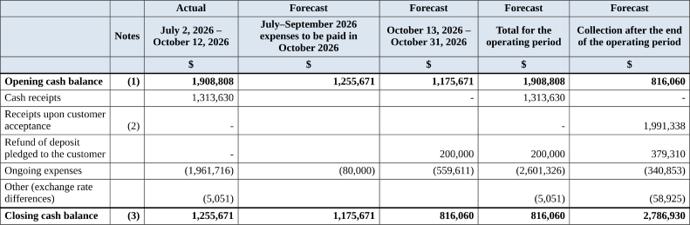
| 15. | According to the operating plan implementation report, the expected cash balance at the end of the operating period, following the collection of the defense client’s balances and the release of the deposit, is estimated at approximately $2,786,930, as detailed below: |
| Component | USD | Nature of Component | ||||
| Bank balance as of October 12, 2026 (excluding pledged deposits) | 1,255,671 | Actual | ||||
| Less: Unpaid expenses for July–September | (80,000 | ) | Debts incurred during the proceedings | |||
| Less: October 2026 expenses that have not yet been paid | (559,611 | ) | Forecast | |||
| Expected cash balance as of October 30, 2026 | 616,060 | |||||
| Milestones 3–5 in the defense project | 1,991,338 | Subject to project completion and client approval | ||||
| Release of the project performance deposit and of the rent deposit upon return of the premises in which the company operated | 579,310 | Subject to project completion | ||||
| Ongoing expenses, VAT, and exchange rate differences | (399,778 | ) | ||||
| Total expected cash balance | 2,786,930 | |||||
| 16. | The table illustrates that approximately 85% of the expected cash balance depends on the completion of the defense project; in a liquidation scenario, these components are not expected to materialize. |
Appendix 2 - 17
| G. | Statement of Debts Following the Filing of Debt Claims |
| 17. | The following is a comparison between the debt position based on the debt claims filed and the company’s position regarding them (in NIS): |
| Creditor Class | Claimed | Company’s Position | Difference (Company’s Position Minus Claim) | |||||||||
| Employees | 19,574,259 | 11,475,978 | 8,098,281 | |||||||||
| Priority authorities (Income Tax and National Insurance) | 926,502 | 925,646 | 856 | |||||||||
| VAT debt claim under ordinary law (Club Market) | 1,081,736 | - | 1,081,736 | |||||||||
| Suppliers who filed debt claims | 6,225,883 | 5,916,930 | 308,953 | |||||||||
| Suppliers who did not file claims | - | - | - | |||||||||
| Total, excluding convertible loans | 27,808,380 | 18,318,554 | (9,489,826 | ) | ||||||||
| Convertible debt to the CEO and CTO, shareholders ($2.455 million), debt convertible into shares | 7,512,300 | 7,512,300 | - | |||||||||
| Convertible loans | 20,410,777 | 20,410,777 | - | |||||||||
| 55,731,457 | 46,241,631 | (9,489,826 | ) | |||||||||
| 18. | Most of the discrepancy between the amounts claimed and the Company’s position stems from various components of the debt claims filed by a small number of employees. In the Company’s view, some of these claim components are disputed and should not be approved (primarily regarding bonus components and the like). |
| 19. | Below is a breakdown of the discrepancies between the debt claims and the Company’s position. It should be noted that the bulk of the discrepancy is concentrated in the claims of 5 employees (represented by a single attorney). |
Appendix 2 - 18
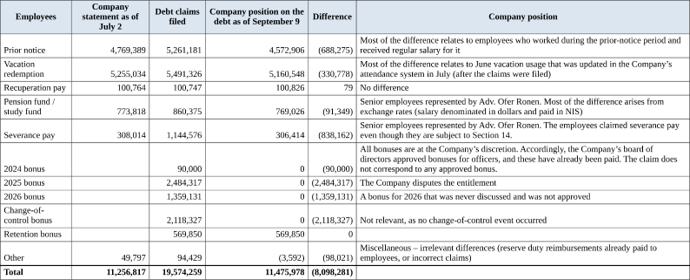
| 20. | Regarding the VAT debt in the amount of 1,081,736 NIS, this debt is being claimed in light of a future VAT liability expected to be incurred by the company due to debt forgiveness and the resulting VAT refund (Club-Market debt). In this regard, it should be explained that this debt is not supposed to be included in the company’s liabilities, for the following reasons: |
| a) | First, this claim was filed based on an estimate without a precise calculation. |
| b) | Second, of the total approved supplier liabilities amounting to 5,916,930 NIS, the liability to local suppliers based on issued invoices amounts to only 942,327 NIS, with the VAT included therein totaling only 143,745 NIS. On the other hand, the company is owed an accrued VAT refund that has not yet been paid to it, due to a setoff claim in the amount of approximately 380,000 NIS, which was also not included in the sources. |
| c) | Third, according to existing case law regarding the approval process for VAT debt claims (Club Market), the VAT Authority is required to prove that it has indeed paid the VAT refund to the creditors. It is a well-known fact that not all creditors take action to claim VAT refunds, so even the amount of 143,745 NIS is not certain. |
| d) | Finally, in the case of an exit, the debt forgiveness by suppliers will be only 6% of their debt, so the VAT on the debt forgiveness is negligible. |
| 21. | The decision on the debt claims rests with the arrangement administrator and the court. Therefore, the impact of recognizing some of the disputed components is also examined below. It should be emphasized that any such recognition would increase the total debt even in the liquidation alternative, and thus does not alter the direction of the comparison between the alternatives. |
Appendix 2 - 19
| 22. | Breakdown of Employee Debts. In the petition, the employees’ debts were broken down into three groups: a priority debt in the amount of 672,947 NIS; a debt up to the amount of the benefit that would have been paid by the National Insurance Institute in the event of liquidation (hereinafter: “the liquidation alternative”) in the amount of 4,086,795 NIS; and the balance of the debt under ordinary law. |
| 23. | For the purposes of this calculation, I have assumed that the increase in the company’s position—which stems primarily from the retention bonus for senior employees—is added in full to the balance under ordinary law, which therefore stands at 6,716,236 NIS. |
| 24. | Related Parties. The company has debts to its subsidiaries in the United States and Germany totaling approximately 8 million NIS. To the best of my knowledge, these companies have no material external creditors; therefore, these debts are not included in the calculation of the distribution under the arrangement. Suppliers who have not filed claims are also excluded from the distribution. |
| H. | The Proposed Debt Arrangement—Sources and Distribution |
| 25. | Sources of the Arrangement There are three sources for the arrangement: |
| a) | The cash balance expected to be finalized after the end of the operating period, in the amount of approximately $2.8 million. |
| b) | The investor’s investment: A $4 million investment will be injected as working capital to support the company’s continued operations. |
| c) | An additional payment to the company’s creditors if, by September 30, 2029, there is a change of control or a sale of the majority of the business: $2 million if the exit consideration exceeds $50 million, and an additional $1 million if it exceeds $150 million. |
| d) | The debts of the convertible loan holders who have filed claims will be converted into equity upon the closing of the arrangement. |
| e) | Total cash available for distribution: $2.8 million (8.4 million NIS)6 from the arrangement’s sources and a potential $3 million (which the company estimates has a reasonable chance of materializing). |
| 6 | Although the operating surplus of $2.78 million, converted at an exchange rate of 3.06, results in a surplus of 8.5 million NIS, an additional provision of 100,000 NIS was set aside from this surplus for unforeseen additional expenses. |
Appendix 2 - 20
| 26. | Distribution Order—The distribution will be made in accordance with the statutory order of priority: First, priority creditors and employees up to the amount of the liquidation alternative will be paid in full, and thereafter the balance will be distributed equally among the general creditors: |
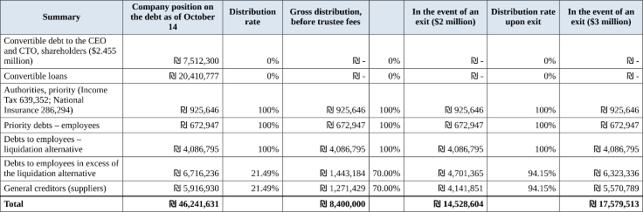
| 27. | The following is a summary of the arrangement (gross estimate7 ): |
| a) | Priority creditors: tax authorities – 100%. |
| b) | Priority creditors: employees – 100% |
| c) | Ordinary creditors – 21.49% |
| d) | Ordinary creditors (potential in the event of an exit exceeding $50 million) – an additional 48.51% of the debt (70% in total) |
| e) | Ordinary creditors (potential in the event of an exit exceeding $150 million) – an additional 24.15% of the debt (for a total of 94.15%) |
| f) | Creditors for debts and convertible loans – 0% (distribution of shares). |
| 28. | For the avoidance of doubt, this is an estimate based on the qualifications and assumptions set forth in this document. The final repayment rate will be determined based on the actual amount of funds available, the exchange rate on the date of distribution, and the arrangement administrator’s decisions on the debt claims. |
| 7 | The distribution is gross, from which the trustee’s fees and the costs of the proceedings will be deducted. |
Appendix 2 - 21
| I. | Liquidation Alternative – Sources |
| 29. | Realization Value of Assets |
| Asset | Conservative Scenario ($) | Optimistic Scenario ($) | Explanation | |||||||
| Net Cash | 616,060 | 616,060 | Expected cash balance as of October 30, 2026, excluding receipts for Milestones 3 through 5 of the defense project ($1,991,338) | |||||||
| Defense client balances (Milestones 3–5) | - | - | $1,991,338 not expected to be collected: This is because the project is not completed and the client may offset the expected proceeds against its damages | |||||||
| Project performance deposit | - | - | A deposit of $379,310; the bank guarantee in the amount of approximately 1 million NIS will be forfeited, and in the optimistic scenario, the balance will be refunded | |||||||
| Rental deposit | - | 200,000 | Subject to offset for damages | |||||||
| Intellectual property, equipment, and other assets | - | - | Without the company’s employees, the intellectual property has no value. As for the equipment, its value is negligible even when taking into account the costs of removal. | |||||||
| Total Gross Consideration | 616,060 | 816,060 | ||||||||
| 30. | Intellectual property. The bulk of the company’s value lies in its intellectual property, knowledge, and team. These assets depend on the continuation of operations. In the event of a forced liquidation, without the team and without active customers, their value is expected to erode significantly. There are three indicators of this: |
| A. | The process of evaluating strategic alternatives, which began in May 2026 with the assistance of an international financial advisor, did not yield a deal superior to the current proposal. |
| B. | The investor’s investment of $4 million reflects what the market is willing to pay for a going concern—including the team and projects—for 60% of the company’s equity. |
| C. | The company’s shares have been delisted from NASDAQ. Therefore, unlike other public companies undergoing insolvency proceedings, no additional value is available to creditors in respect of a “public platform.” |
Appendix 2 - 22
| J. | Creditors in Liquidation |
| 31. | In liquidation, the liabilities must include creditors holding convertible loans totaling 20,410,777 NIS, who do not participate in the distribution of cash under the arrangement8, as well as debts owed to the CEO and the CTO totaling 7,512,300 NIS, who also do not participate in the distribution of cash resources in the event of an arrangement. |
| 32. | The calculation does not include claims expected to arise in liquidation, such as claims by clients for damages resulting from the project’s non-completion, claims by suppliers who did not file debt claims in the current proceedings (approximately 1.1 million NIS), and other claimants who will be harmed by the cessation of the company’s operations, including the VAT Authority (regarding VAT refunds on bad debts). |
| K. | Distribution of Sources in the Liquidation Alternative |
| 33. | The lack of funds resulting from the company’s cessation of operations significantly affects the balances that will remain for distribution under this option. The following table illustrates this: |
| Conservative Scenario (₪) | Optimistic Scenario (₪) | |||||||
| $ | 616,060 | $ | 816,060 | |||||
| ₪ | ₪ | |||||||
| Net distribution amount (converted at an exchange rate of $1 = 3.06 ₪) | 1,885,144 | 2,497,144 | ||||||
| Priority creditors (employees and government agencies), | (1,598,593 | ) | (1,598,593 | ) | ||||
| Balance due to ordinary creditors | 286,646 | 898,551 | ||||||
| Total ordinary creditors, including convertible loans (and debt to the National Insurance Institute that becomes ordinary debt)9 | 44,643,038 | 44,643,038 | ||||||
| Repayment rate to ordinary creditors | 0.642 | % | 2.013 | % | ||||
| 8 | To date, only one of the bondholders has filed a claim in this proceeding. |
| 9 | 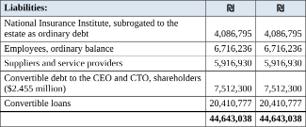 |
Appendix 2 - 23
| 34. | Employees in Liquidation—Employees in liquidation are entitled to benefits from the National Insurance Institute under Chapter 8 of the National Insurance Law. For the year 2026, the benefit is capped at 134,966 NIS for wages and severance pay, and at a separate cap of 20,764 NIS for debts to provident funds, for a total of 155,730 NIS per employee. The benefit is calculated based solely on statutory components. Thus, for example, prior notice is calculated according to the law rather than the contract, and redemption of vacation days is limited. |
| 35. | The balance of the employees’ claims in excess of the benefit remains a claim against the liquidation estate. Part of it has priority, up to the statutory ceiling, and the remainder is an ordinary claim, under which the expected repayment rate is negligible (in the optimistic scenario, approximately 1.569%). |
| 36. | In this regard, it should be noted that payments to employees from the National Insurance Institute may also take longer than under the arrangement alternative, as these payments depend on the filing of debt claims with the National Insurance Institute and its review of them—a process that takes several months. |
| 37. | Duration of the Proceedings—The liquidation of a technology company with subsidiaries in several countries, intellectual property registered in several countries, and a subsidiary undergoing administration in the United Kingdom is expected to last many months. Throughout this period, expenses for preservation, management, and legal proceedings will accrue, and the value of the intangible assets will erode. |
| 38. | Below is a comparison of the expected proceeds for each creditor group (in NIS) for each alternative: |
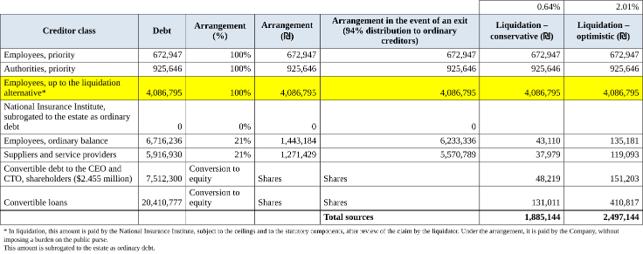
| 39. | Employees. Under the arrangement, employees receive their full claim as a priority creditor up to the amount of the liquidation alternative, plus approximately 1,443,184 NIS on the balance of their claim. In liquidation, they receive their full priority claim and the liquidation alternative amount, plus 79,252 NIS on the balance of their claims, in the optimistic scenario. |
| 40. | Ordinary creditors. The repayment rate under the arrangement is approximately 21.49%; in the event of an exit exceeding $50 million, the dividend they receive rises to 70% of their debt, and in the event of an exit exceeding $150 million, the dividend rises to 94.15%. |
Appendix 2 - 24
| 41. | Priority creditors. In the optimistic scenario, they are repaid in full under both alternatives. |
| 42. | Holders of convertible loans. In liquidation, those who file claims are expected to receive payment in cash. Under the arrangement, those who filed a claim receive shares in a private company. This consent reflects the assessment that the company’s value as a going concern exceeds the liquidation proceeds, while simultaneously significantly increasing the proceeds for all other creditors. |
| L. | Advantages of the Arrangement Over the Liquidation Alternative |
| 43. | Waiver of convertible loans—a debt claim in the amount of approximately 20 million NIS was filed, which, under the arrangement, is converted into equity and does not participate in the cash distribution. This frees up financial resources to increase the repayment rate for ordinary creditors, who under the liquidation alternative would receive no repayment or only a negligible portion of their claims. |
| 44. | The arrangement guarantees full repayment to creditors with priority claims and to employees in the amount of the liquidation alternative; for creditors with ordinary claims, the arrangement guarantees repayment of approximately 21.5% of their debt, but in the event of an exit transaction, repayment of up to 94% of their debt. |
| 45. | The arrangement secures the employment of approximately 15 employees |
| 46. | The arrangement guarantees employees full payment from the company’s funds of the entire amount they would have received from the National Insurance Institute in the event of liquidation; in addition, the employees participate in the distribution to ordinary creditors of the remaining debt. In the event of liquidation, the National Insurance Institute pays up to 155,730 NIS per employee (134,966 NIS for wages and severance pay, plus 20,764 NIS for provident funds), and only for components required by law. Senior employees, whose debt exceeds the cap, would be left with a claim under ordinary law whose value is negligible. |
| 47. | Additionally, under the arrangement, the public purse does not bear the cost of the benefit, and the Chapter 8 mechanism is not triggered. |
| 48. | Continuation of the Defense Project as a Path Forward—The company is carrying out a project for a defense client (whose identity is confidential) with a total scope of approximately 8.5 million NIS (approximately $2.9 million), divided into five milestones. The first and second milestones have been completed and approved. The remaining payment, $1,991,338, and the release of the performance deposit together constitute approximately 85% of the arrangement’s funding sources (contractual funds, excluding potential sources). |
Appendix 2 - 25
| 49. | Completion of the project is contingent upon the company’s continued operations and the retention of the development team. In liquidation, the project is cut off, the consideration is not collected, and the client is entitled to offset its damages. In other words, liquidation nullifies the asset from which creditors in the arrangement are repaid. |
| 50. | Furthermore, the completion of the project has strategic value: regarding additional defense projects or follow-on projects expected to generate millions of dollars for the company, their scope and timelines—to the extent that can be disclosed within the constraints of confidentiality. This value is preserved only under the arrangement. |
| 51. | Preventing Forfeiture of the Guarantee—To ensure the project’s execution, a guarantee in the amount of 1 million NIS was provided to the client, backed by a pledged deposit of 1,221,991 NIS. In the event of liquidation, the guarantee is expected to be forfeited, and the deposit will not be released to the creditors. Under the arrangement, upon completion of the project, the guarantee is canceled and the deposit is released to the estate. |
| 52. | Preservation of Intellectual Property and the Team—Under the arrangement, the intellectual property, patents, and know-how developed over more than a decade, as well as the core team of approximately 15 employees, are preserved. In liquidation, the team is expected to be disbanded and the intellectual property sold off separately, thereby eroding its value. |
| 53. | Speed, Certainty, and Costs—The arrangement enables payment to creditors within a few months of the collection date, without liquidator fees, without overseas enforcement proceedings, and without waiting for years. |
| 54. | In summary, the arrangement will yield $4 million to strengthen the company’s equity, ensuring its continued operation—a sum that would not be received in the event of liquidation. |
Jacob Passi, Certified Public Accountant
Appendix 2 - 26