LEGAL GLOBAL POLICY 6.15 INSIDER TRADING Effective June 1, 2000 • Revised July 24, 2026 I. Introduction Set forth below is the policy of CBRE Group, Inc. and its direct and indirect subsidiaries (collectively, “CBRE” or the “Company”) regarding trading of CBRE securities and the securities of other companies. CBRE has adopted this policy to promote compliance with federal securities laws, to protect the Company’s reputation for integrity and ethical conduct, and to avoid the appearance of impropriety in connection with transactions involving the Company’s securities and of the securities of other companies about which covered persons (defined below) may have material non- public information due to their service to the Company. This policy is subject to change without prior notification. Any violation of this insider trading policy may result in immediate dismissal and may subject the individual involved to both civil and criminal penalties. This is an extremely important matter, and we urge you to read the following with care. II. Who Is Covered by This Policy? This policy applies to all CBRE directors, officers, employees, independent contractors, and consultants (collectively, “covered persons”). It also extends to: • Family members: Your spouse or domestic partner, minor children, and other family members who share your household or are financially dependent on you. • Controlled entities: Any trust, partnership, foundation, or other entity whose transactions in securities you direct, influence, or control—including family investment accounts and similar vehicles. You are responsible for ensuring that anyone or any entity whose trading activity you directly or indirectly influence or control—or whose trading would reasonably be perceived by others as being under your influence—complies with this policy. If you are uncertain whether someone or something falls within the scope of this policy, contact the Corporate Legal Team before acting. III. What Transactions Are Covered? For purposes of this policy, “securities” includes stocks, bonds, debentures, options, warrants, convertible instruments, restricted stock units, performance stock units, exchange-traded funds, and any other financial instrument whose value is derived from or related to CBRE’s equity or debt. This policy applies broadly to any transaction in CBRE securities or related instruments (“covered transactions”), including, but not limited to: • Purchases, sales, and gifts of CBRE common stock. • Changes to CBRE stock fund investments in the CBRE 401(k) Plan or Deferred Compensation Plan. • Sales to satisfy tax withholding obligations on equity awards. Exhibit 19
2 What is NOT covered? The following transactions are exempt: • Investments in broadly diversified mutual funds or ETFs that happen to hold CBRE stock. • Company withholding of shares to satisfy tax obligations at vesting. • Transfers that do not change your beneficial ownership. IV. What Is Insider Trading? Insider trading means buying or selling securities, or encouraging someone else to do so, while aware of material non-public information. What is “material non-public information”? Information is “material” if a reasonable investor would consider it important in deciding whether to buy, sell, or hold a security. It can be positive or negative. Information is “non-public” if it has not been widely shared with the investing public. After information is publicly announced, it is recommended that you wait until at least the next trading day before trading so the market has time to absorb the information. Examples of material non-public information include, but are not limited to: • Financial results, earnings estimates, or significant changes in business performance. • Mergers, acquisitions, divestitures, or other major strategic transactions. • Significant changes to CBRE’s capital structure, including securities offerings, debt transactions, changes in debt ratings, dividend changes, or stock repurchase plans. • Government or internal investigations, major litigation, or significant cybersecurity incidents. • Major leadership changes or other developments likely to significantly affect CBRE’s business. Material information does not have to come directly from CBRE. For example, information about a major shareholder’s activities or an upcoming financial press report may be material if it is expected to affect the market price of a security. V. Insider Trading Prohibitions No Trading While Aware of Material Non-public Information Do not trade in CBRE securities when aware of information that has not been publicly announced and that could have a material effect on the value of those securities. No Tipping Do not disclose material non-public information to any other person, including family members, or make any recommendation about whether to buy or sell CBRE securities while aware of material non-public information. No Third-Party Trading or Tipping Do not trade in another company’s securities while aware of material non-public information about that company that you learned through your service to CBRE, including information about a CBRE client, counterparty, acquisition target, business partner, or an economically-linked company such as a competitor of CBRE. You also may not share or “tip” material non-public information about another company. This prohibition extends to participation in prediction markets and similar event- contract platforms—you may not establish, adjust, or close a position on any such platform while in
3 possession of material non-public information relevant to the predicted outcome that you learned through your service to CBRE. No Trading During Blackout Periods If you are subject to a trading window under this policy, you must not trade in CBRE securities while the trading window is closed (a “blackout period”). Standing and Limit Orders Discouraged Standing or limit orders involving CBRE securities are strongly discouraged because they may execute automatically when you are aware of material non-public information or during a blackout period. You are responsible for canceling any open standing or limit order promptly if you become aware of material non-public information and before any blackout period that applies to you begins. No Short Sales, Hedging, or Trading in Derivatives Short sales, transactions that hedge or offset any decrease in the value of CBRE securities, transactions in derivatives of CBRE securities, and positions in prediction markets or event-contract platforms whose outcomes are tied to CBRE’s business, performance, or securities are prohibited at all times. This includes prepaid variable forward contracts, equity swaps, collars, options, warrants, puts, calls, and similar instruments related to CBRE securities. No Margin Accounts and Pledges Directors and Section 16 Officers may not purchase CBRE securities on margin, borrow against accounts holding CBRE securities, or pledge CBRE securities as loan collateral. Margin or foreclosure sales may occur without your consent at a time when trading is prohibited, and may still be treated as sales for your benefit under insider trading rules. Termination of Employment or Relationship with the Company In the event your employment or relationship with the Company terminates while you are in possession of material non-public information about the Company or another company, you may not trade in CBRE securities or the securities of such other company until that information has become public or is no longer material.
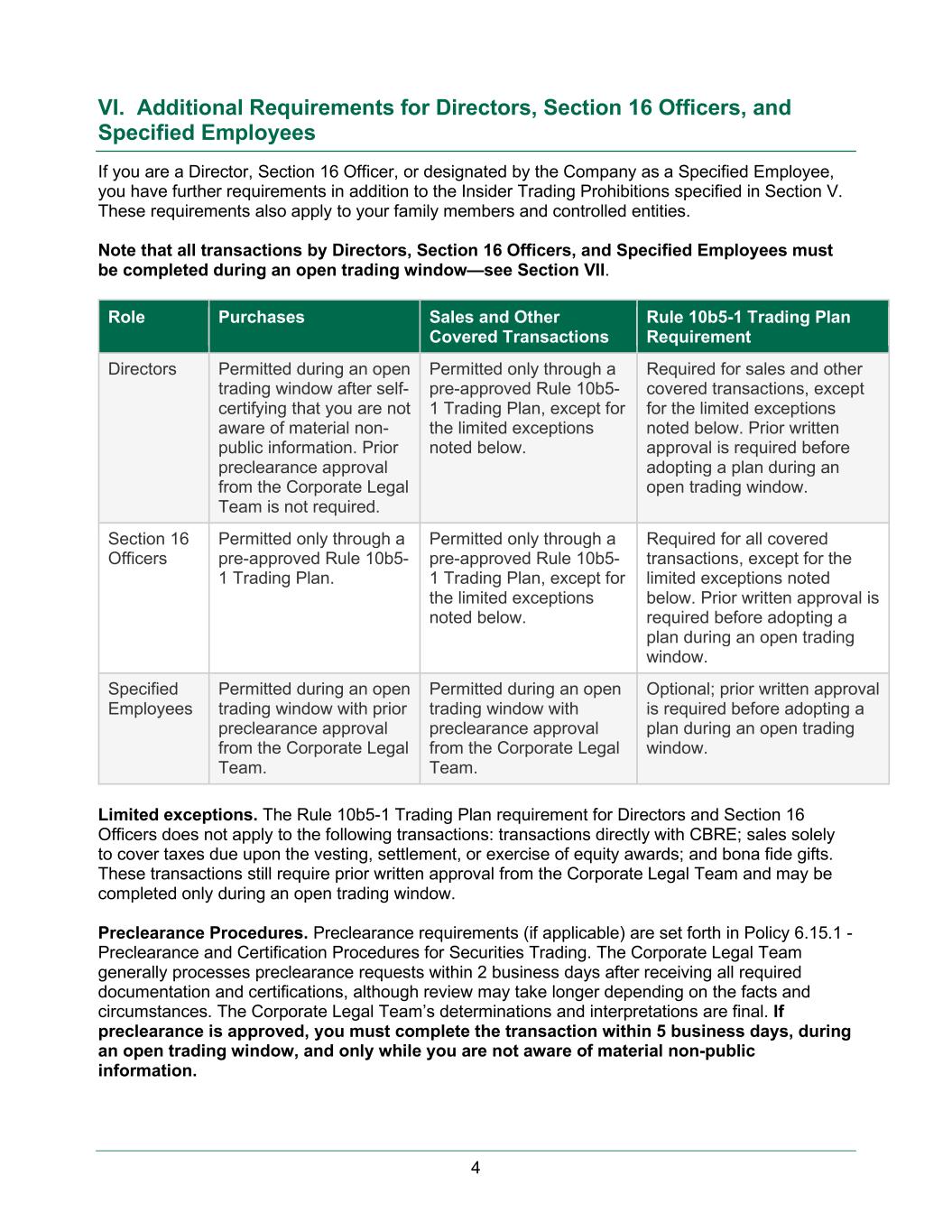
4 VI. Additional Requirements for Directors, Section 16 Officers, and Specified Employees If you are a Director, Section 16 Officer, or designated by the Company as a Specified Employee, you have further requirements in addition to the Insider Trading Prohibitions specified in Section V. These requirements also apply to your family members and controlled entities. Note that all transactions by Directors, Section 16 Officers, and Specified Employees must be completed during an open trading window—see Section VII. Role Purchases Sales and Other Covered Transactions Rule 10b5-1 Trading Plan Requirement Directors Permitted during an open trading window after self- certifying that you are not aware of material non- public information. Prior preclearance approval from the Corporate Legal Team is not required. Permitted only through a pre-approved Rule 10b5- 1 Trading Plan, except for the limited exceptions noted below. Required for sales and other covered transactions, except for the limited exceptions noted below. Prior written approval is required before adopting a plan during an open trading window. Section 16 Officers Permitted only through a pre-approved Rule 10b5- 1 Trading Plan. Permitted only through a pre-approved Rule 10b5- 1 Trading Plan, except for the limited exceptions noted below. Required for all covered transactions, except for the limited exceptions noted below. Prior written approval is required before adopting a plan during an open trading window. Specified Employees Permitted during an open trading window with prior preclearance approval from the Corporate Legal Team. Permitted during an open trading window with preclearance approval from the Corporate Legal Team. Optional; prior written approval is required before adopting a plan during an open trading window. Limited exceptions. The Rule 10b5-1 Trading Plan requirement for Directors and Section 16 Officers does not apply to the following transactions: transactions directly with CBRE; sales solely to cover taxes due upon the vesting, settlement, or exercise of equity awards; and bona fide gifts. These transactions still require prior written approval from the Corporate Legal Team and may be completed only during an open trading window. Preclearance Procedures. Preclearance requirements (if applicable) are set forth in Policy 6.15.1 - Preclearance and Certification Procedures for Securities Trading. The Corporate Legal Team generally processes preclearance requests within 2 business days after receiving all required documentation and certifications, although review may take longer depending on the facts and circumstances. The Corporate Legal Team’s determinations and interpretations are final. If preclearance is approved, you must complete the transaction within 5 business days, during an open trading window, and only while you are not aware of material non-public information.
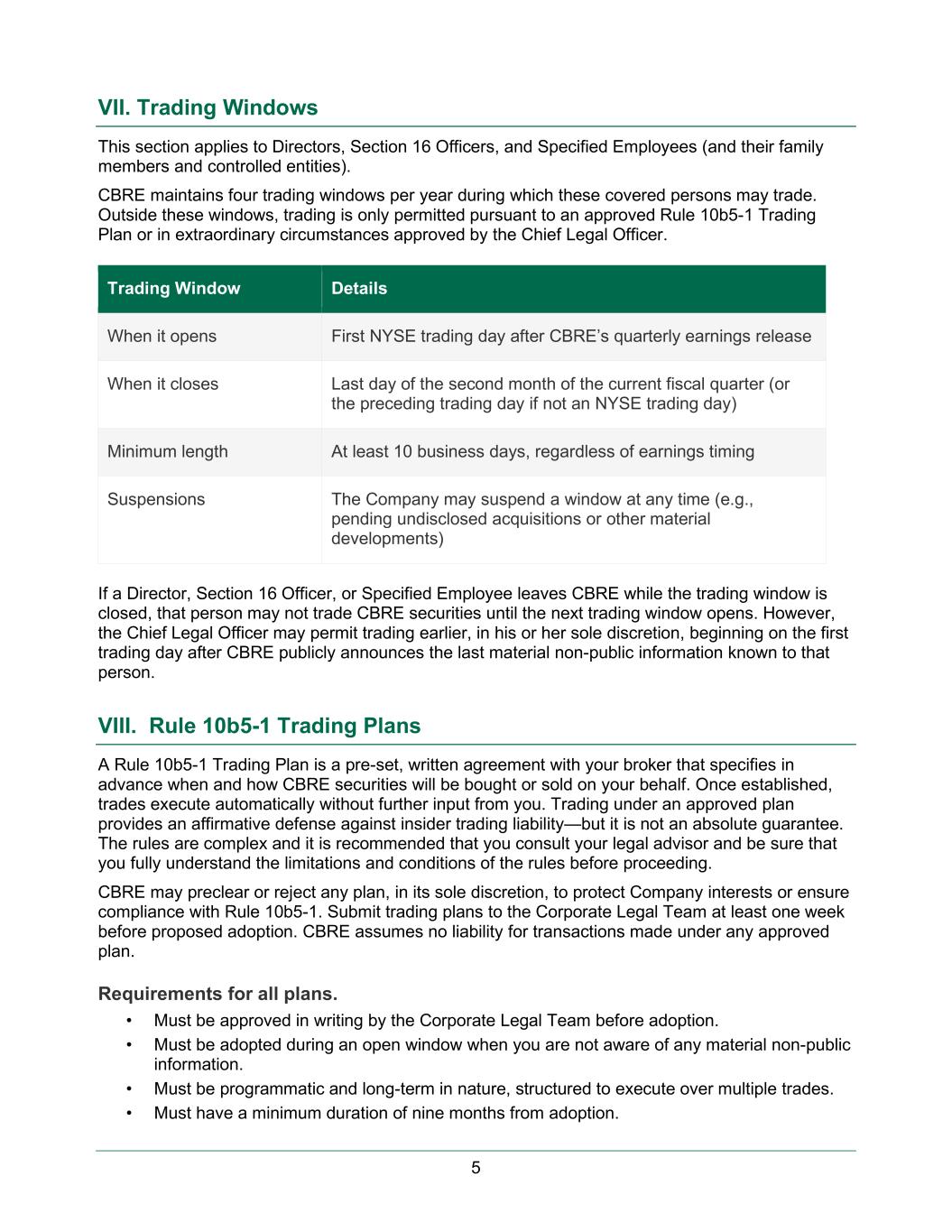
5 VII. Trading Windows This section applies to Directors, Section 16 Officers, and Specified Employees (and their family members and controlled entities). CBRE maintains four trading windows per year during which these covered persons may trade. Outside these windows, trading is only permitted pursuant to an approved Rule 10b5-1 Trading Plan or in extraordinary circumstances approved by the Chief Legal Officer. Trading Window Details When it opens First NYSE trading day after CBRE’s quarterly earnings release When it closes Last day of the second month of the current fiscal quarter (or the preceding trading day if not an NYSE trading day) Minimum length At least 10 business days, regardless of earnings timing Suspensions The Company may suspend a window at any time (e.g., pending undisclosed acquisitions or other material developments) If a Director, Section 16 Officer, or Specified Employee leaves CBRE while the trading window is closed, that person may not trade CBRE securities until the next trading window opens. However, the Chief Legal Officer may permit trading earlier, in his or her sole discretion, beginning on the first trading day after CBRE publicly announces the last material non-public information known to that person. VIII. Rule 10b5-1 Trading Plans A Rule 10b5-1 Trading Plan is a pre-set, written agreement with your broker that specifies in advance when and how CBRE securities will be bought or sold on your behalf. Once established, trades execute automatically without further input from you. Trading under an approved plan provides an affirmative defense against insider trading liability—but it is not an absolute guarantee. The rules are complex and it is recommended that you consult your legal advisor and be sure that you fully understand the limitations and conditions of the rules before proceeding. CBRE may preclear or reject any plan, in its sole discretion, to protect Company interests or ensure compliance with Rule 10b5-1. Submit trading plans to the Corporate Legal Team at least one week before proposed adoption. CBRE assumes no liability for transactions made under any approved plan. Requirements for all plans. • Must be approved in writing by the Corporate Legal Team before adoption. • Must be adopted during an open window when you are not aware of any material non-public information. • Must be programmatic and long-term in nature, structured to execute over multiple trades. • Must have a minimum duration of nine months from adoption.
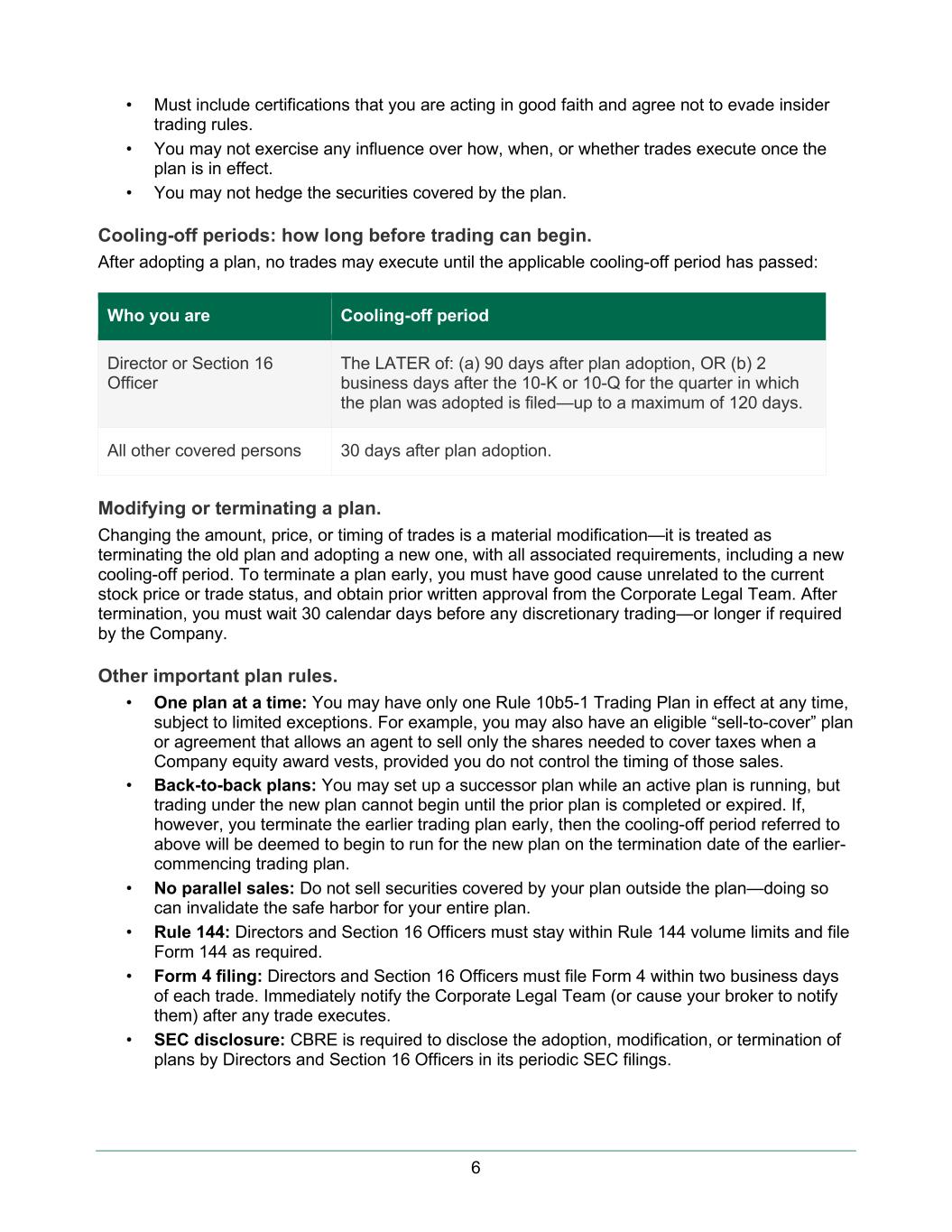
6 • Must include certifications that you are acting in good faith and agree not to evade insider trading rules. • You may not exercise any influence over how, when, or whether trades execute once the plan is in effect. • You may not hedge the securities covered by the plan. Cooling-off periods: how long before trading can begin. After adopting a plan, no trades may execute until the applicable cooling-off period has passed: Who you are Cooling-off period Director or Section 16 Officer The LATER of: (a) 90 days after plan adoption, OR (b) 2 business days after the 10-K or 10-Q for the quarter in which the plan was adopted is filed—up to a maximum of 120 days. All other covered persons 30 days after plan adoption. Modifying or terminating a plan. Changing the amount, price, or timing of trades is a material modification—it is treated as terminating the old plan and adopting a new one, with all associated requirements, including a new cooling-off period. To terminate a plan early, you must have good cause unrelated to the current stock price or trade status, and obtain prior written approval from the Corporate Legal Team. After termination, you must wait 30 calendar days before any discretionary trading—or longer if required by the Company. Other important plan rules. • One plan at a time: You may have only one Rule 10b5-1 Trading Plan in effect at any time, subject to limited exceptions. For example, you may also have an eligible “sell-to-cover” plan or agreement that allows an agent to sell only the shares needed to cover taxes when a Company equity award vests, provided you do not control the timing of those sales. • Back-to-back plans: You may set up a successor plan while an active plan is running, but trading under the new plan cannot begin until the prior plan is completed or expired. If, however, you terminate the earlier trading plan early, then the cooling-off period referred to above will be deemed to begin to run for the new plan on the termination date of the earlier- commencing trading plan. • No parallel sales: Do not sell securities covered by your plan outside the plan—doing so can invalidate the safe harbor for your entire plan. • Rule 144: Directors and Section 16 Officers must stay within Rule 144 volume limits and file Form 144 as required. • Form 4 filing: Directors and Section 16 Officers must file Form 4 within two business days of each trade. Immediately notify the Corporate Legal Team (or cause your broker to notify them) after any trade executes. • SEC disclosure: CBRE is required to disclose the adoption, modification, or termination of plans by Directors and Section 16 Officers in its periodic SEC filings.
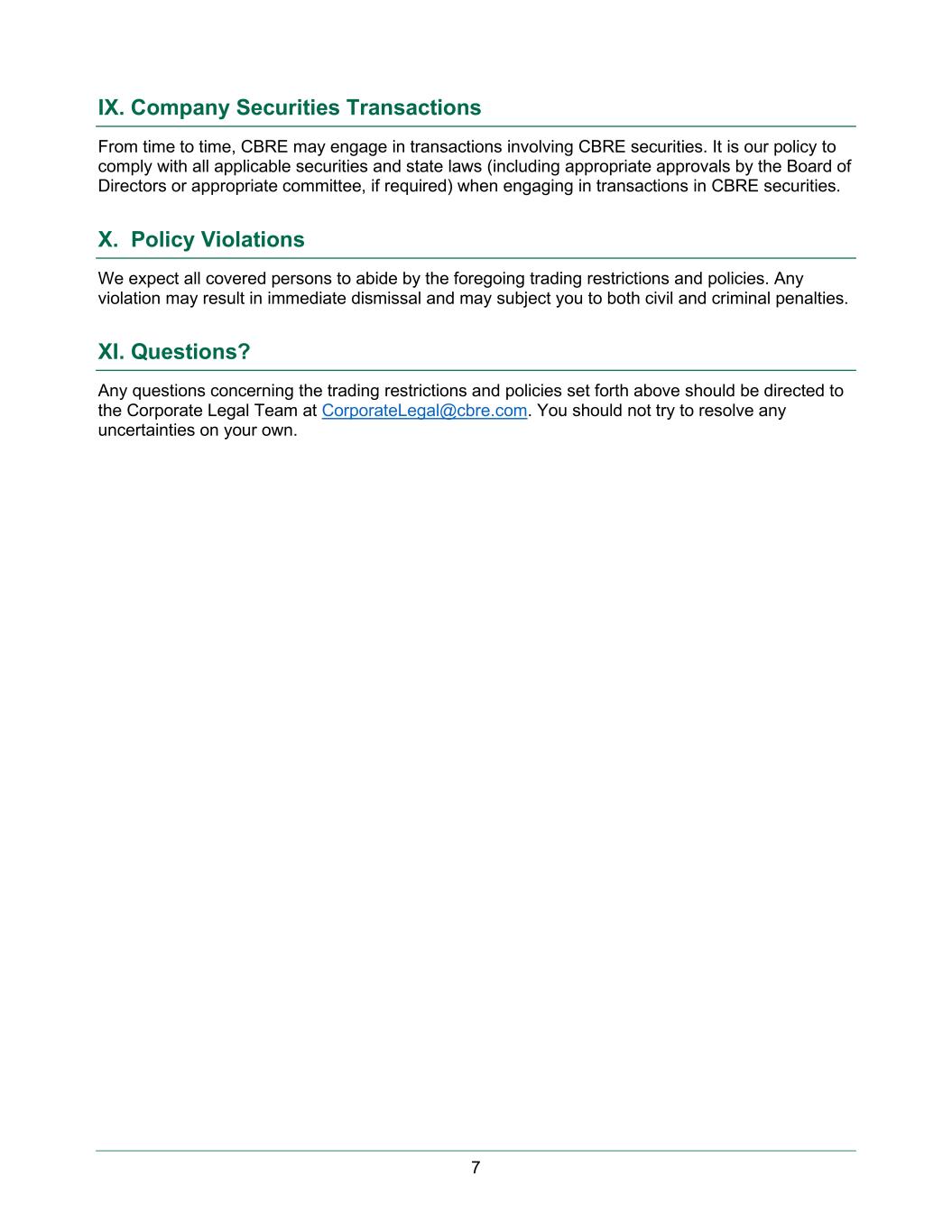
7 IX. Company Securities Transactions From time to time, CBRE may engage in transactions involving CBRE securities. It is our policy to comply with all applicable securities and state laws (including appropriate approvals by the Board of Directors or appropriate committee, if required) when engaging in transactions in CBRE securities. X. Policy Violations We expect all covered persons to abide by the foregoing trading restrictions and policies. Any violation may result in immediate dismissal and may subject you to both civil and criminal penalties. XI. Questions? Any questions concerning the trading restrictions and policies set forth above should be directed to the Corporate Legal Team at CorporateLegal@cbre.com. You should not try to resolve any uncertainties on your own.