Exhibit 99.1
 | Collective Mining Ltd. |
| Guayabales Project - Apollo Mineral Resource 2026-08 |
Table of Contents
| 1 | Summary | 11 |
| 1.1 | Apollo | 11 |
| 1.2 | Exploration Potential | 16 |
| 1.3 | Recommendations | 16 |
| 2 | Introduction | 18 |
| 2.1 | Source of data | 18 |
| 2.2 | Qualifications of the QPs | 19 |
| 2.3 | Site Visit | 19 |
| 2.4 | QP opinion on the Exploration Data | 20 |
| 3 | Reliance on Other Experts | 20 |
| 4 | Property Description and Location | 21 |
| 4.1 | Property Location | 21 |
| 4.2 | Legal Framework | 21 |
| 4.3 | Mining Property Rights | 25 |
| 4.4 | Mining Property Acquisition Agreements | 29 |
| 4.5 | Royalties | 30 |
| 4.6 | Legal Access and Surface Rights | 31 |
| 4.7 | Water Rights | 31 |
| 4.8 | Environmental Liabilities | 31 |
| 4.9 | National Parks and Reserves | 32 |
| 4.10 | Indigenous Reserves and Communities | 32 |
| 4.11 | Other | 32 |
| 5 | Accessibility, Climate, Local Resources, Infrastructure and Physiography | 33 |
| 5.1 | Accessibility | 33 |
| 5.2 | Climate | 33 |
| 5.3 | Hydrology | 39 |
| 5.4 | Local Resources and Infrastructure | 40 |
| 5.5 | Physiography | 41 |
| 6 | History | 43 |
| 6.1 | Prior ownership and ownership changes | 43 |
| 6.2 | Historical mineral resource estimates | 44 |
| 6.3 | Historical production | 44 |
| 7 | Geological Setting and Mineralization | 45 |
| 7.1 | Regional geology | 45 |
| 7.2 | District Geology | 49 |
| 7.3 | Local Geology | 49 |
| 7.4 | Geology of the Apollo Deposit | 52 |
| 7.5 | Conclusions | 68 |
| 7.6 | Trap Target | 70 |
| 8 | Deposit Types | 72 |
| 8.1 | Guayabales Porphyry-Breccia-Vein System | 72 |
| 8.2 | Reduced Intrusion-Related Gold Systems (RIRGS) | 73 |
i
| Collective Mining Ltd. |
| Guayabales Project - Apollo Mineral Resource 2026-08 |
| 8.3 | Porphyry Cu-Mo-Au Systems | 75 |
| 9 | Exploration | 77 |
| 9.1 | Historical Exploration (1995 to 2012) | 77 |
| 9.2 | Exploration completed by Collective (2021-2026) | 78 |
| 9.3 | Apollo Target | 88 |
| 9.4 | Trap Target | 91 |
| 10 | Drilling | 94 |
| 10.1 | Drilling by Colombian Mines (2008) | 95 |
| 10.2 | Drilling by Mercer Gold (2010-11) | 95 |
| 10.3 | Drilling by Collective (2021 - Present) | 96 |
| 10.4 | The QP’s Comments with respect to Drilling | 105 |
| 10.5 | Results | 105 |
| 10.6 | Drilling Results between Closure of the Database and 13 October 2026 | 113 |
| 11 | Sample Preparation, Analyses and Security | 117 |
| 11.1 | Historical Data | 117 |
| 11.2 | Collective - Sample Preparation, Analyses, and Security | 118 |
| 11.3 | QAQC Results– Collective | 125 |
| 11.4 | Interpretation of QAQC Results | 134 |
| 11.5 | QP’s Opinion on the Adequacy of Sample Preparation, Security, and Analytical Procedures | 137 |
| 12 | Data Verification | 138 |
| 12.1 | Verification by Redwood (2025) | 138 |
| 12.2 | Verification by the QP | 138 |
| 12.3 | Qualified Person’s Opinion on the Adequacy of the Data for the Purposes Used in the Technical Report | 140 |
| 13 | Mineral Processing and Metallurgical Testing | 141 |
| 13.1 | Preliminary testing of Ramp samples. | 147 |
| 13.2 | Summary | 148 |
| 14 | Mineral Resource estimates | 150 |
| 14.1 | Disclosure | 150 |
| 14.2 | Known Issues that Materially Affect Mineral Resources | 150 |
| 14.3 | The Approach Used for Modelling | 150 |
| 14.4 | Data Provided for Estimation | 151 |
| 14.5 | Geological Interpretation and Modelling | 152 |
| 14.6 | Compositing of Assay Intervals | 156 |
| 14.7 | Variogram models | 158 |
| 14.8 | Orientations and Search distances used for modelling | 161 |
| 14.9 | Block model set up | 163 |
| 14.10 | Grade Estimation | 164 |
| 14.11 | Model validation | 165 |
| 14.12 | AuEq Calculation | 172 |
| 14.13 | Cut-off grade Determination and the Evaluation of RPEEE | 173 |
| 14.14 | Mineral Resource classification | 176 |
| 14.15 | Mineral Resource Tabulations | 179 |
| 15 | Mineral Reserve Estimates | 185 |
| 16 | Mining Methods | 185 |
ii
| Collective Mining Ltd. |
| Guayabales Project - Apollo Mineral Resource 2026-08 |
| 17 | Recovery Methods | 185 |
| 18 | Project Infrastructure | 185 |
| 19 | Market Studies and Contracts | 185 |
| 20 | Environmental Studies, Permitting and Social or Community Impact | 185 |
| 21 | Capital and Operating Costs | 185 |
| 22 | Economic Analysis | 185 |
| 23 | Adjacent Properties | 186 |
| 23.1 | Aris Mining - Marmato | 186 |
| 23.2 | Quebradona | 187 |
| 24 | Other Relevant Data and Information | 188 |
| 25 | Interpretation and Conclusions | 189 |
| 25.1 | Exploration and Drilling | 189 |
| 25.2 | Sample Preparation, Analysis and Data Quality | 190 |
| 25.3 | Mineral Processing and Metallurgical Interpretation | 191 |
| 25.4 | The Geological Framework for Apollo | 192 |
| 25.5 | The Apollo Mineral Resource | 193 |
| 25.6 | Exploration Potential | 195 |
| 26 | Recommendations | 196 |
| 26.1 | Recommendations for Exploration | 196 |
| 26.2 | Recommendations for further metallurgical testwork include: | 197 |
| 26.3 | Recommendations for other Technical Studies: | 197 |
| 26.4 | Conclusions on Recommendations | 197 |
| 27 | References | 199 |
| CERTIFICATE of QUALIFIED PERSON | 203 | |
| CERTIFICATE of QUALIFIED PERSON | 204 | |
iii
| Collective Mining Ltd. |
| Guayabales Project - Apollo Mineral Resource 2026-08 |
Tables
| Table 1.1: Mineral Resource for the Apollo Mineral Deposit, August 31, 2026* | 14 |
| Table 4.1 List of the mining rights with title of the Guayabales Project. | 27 |
| Table 4.2. List of concession applications of the Guayabales Project. | 28 |
| Table 4.3 Yearly payments resulting from mining title option agreements. | 30 |
| Table 4.4. List of Superficial Water Concessions and applications for the Guayabales Project. | 31 |
| Table 5.1 General data on the nearest hydrometeorological stations to the project (source IDEAM). Source: Collective (2026) | 35 |
| Table 5.2 General information of MET I. | 38 |
| Table 5.3 General information of MET I variables. | 38 |
| Table 6.1 Summary of the history of the Guayabales Project. | 43 |
| Table 7.1 Description of the main lithologies in the Guayabales Project. | 51 |
| Table 7.2 Summary of the geology of the targets identified in the Guayabales Project. | 69 |
| Table 9.1: Surface Samples collected on the Guayabales Project - 2005-2026 | 77 |
| Table 9.2. Summary of Collective’s exploration (excludes drilling) at the Guayabales Project between 2020 and 31 March 2026. | 78 |
| Table 9.3. Protocol and chain of custody for soil and rock samples. | 80 |
| Table 10.1: Drilling completed at the Guayabales Project by target | 94 |
| Table 10.2 Summary of historical diamond drill programs. | 94 |
| Table 10.3. Summary of the drilling contractors of the Guayabales diamond drill programmes. | 98 |
| Table 10.4. Summary of Guayabales drillholes by target. | 98 |
| Table 10.5. Drillholes surveyed using the Acoustic Televiewer. | 102 |
| Table 10.6. Summary of density measurements of Guayabales core. | 104 |
| Table 10.7 Drilling Results between Closure of the Database and 13 October 2026. | 114 |
| Table 11.1 Summary of the sample preparation and analyses methods of the historical samples. | 117 |
| Table 11.2 QA-QC samples used in the historical sampling programs. | 118 |
| Table 11.3. Summary of the sample preparation and analyses methods of the Collective samples. | 119 |
| Table 11.4. QA-QC protocol of Collective for core samples. | 120 |
| Table 11.5. QA-QC protocol of Collective for soil and sediment samples. | 120 |
| Table 11.6. CRM summary statistics of performance. | 121 |
| Table 11.7. Summary of W/WO₃ CRM. | 122 |
| Table 11.8. Summary of Duplicates Programs. | 123 |
| Table 11.9. Summary of Au, Ag and Cu CRM performance. | 126 |
iv
| Collective Mining Ltd. |
| Guayabales Project - Apollo Mineral Resource 2026-08 |
| Table 11.10. CRM performance for Au analyses. | 126 |
| Table 11.11. CRM performance for Ag analyses. | 128 |
| Table 11.12. CRM performance for Cu analyses. | 129 |
| Table 11.13. Summary of W – WO3 CRM performance. | 130 |
| Table 11.14. Summary of Blank performance - Au. | 131 |
| Table 11.15. Summary of Blank performance - Ag. | 131 |
| Table 11.16. Summary of Blank performance - Cu. | 131 |
| Table 11.17. Summary of Blank performance - W. | 131 |
| Table 11.18. Summary of Duplicates Programs. | 132 |
| Table 12.1: Verification samples by the QP | 139 |
| Table 13.1: Metallurgical Testwork 2022 to 2024 | 141 |
| Table 13.2: Composite head grades | 145 |
| Table 13.3: Composites 1 to 6 results, summary. | 145 |
| Table 13.4: LCT test on MC1-6 composite. | 146 |
| Table 13.5: Overall recoveries for gravity, flotation and cyanidation of flotation tailings. | 146 |
| Table 13.6: Head grade of samples. | 147 |
| Table 13.7: Gravity + Flotation + Cyanidation. | 148 |
| Table 13.8: Gravity + Cyanidation. | 148 |
| Table 13.9: Recent Metallurgical Test Work Results on Copper and Tungsten sub-domains. | 149 |
| Table 14.1: Lithological Domains for geological modelling | 152 |
| Table 14.2: Mineralogical and Grade Domains for geological modelling | 152 |
| Table 14.3: Carbonate Base Metal (CBM) Vein Domains for geological modelling – affects Au only | 152 |
| Table 14.4: Oxidation Domains for geological modelling | 153 |
| Table 14.5: Estimation Domains for modelling of gold grades | 155 |
| Table 14.6: Estimation Domains for modelling of copper and silver grades above 1400 masl | 155 |
| Table 14.7: Estimation Domains for modelling of WO3 grades above 1400 masl | 156 |
| Table 14.8: Summary statistics for Au of 2m composited data in the main Au domains for the Apollo Deposit (>1400) | 157 |
| Table 14.9: Summary statistics for Au of 2m composited data in the main Au domains for the Apollo Deposit (<1400 masl) | 157 |
| Table 14.10: Summary statistics for Cu, Ag and WO3 of composited data in the grade domains for the Apollo Deposit (>1400) | 158 |
| Table 14.11: Variogram parameters (Au) for the main mineralized Au domains | 160 |
| Table 14.12: Variogram parameters (Ag) for the main mineralized Ag domains | 160 |
| Table 14.13: Variogram parameters (Cu) for the main mineralized Cu domains | 160 |
v
| Collective Mining Ltd. |
| Guayabales Project - Apollo Mineral Resource 2026-08 |
| Table 14.14: Variogram parameters (WO3) for the main mineralized WO3 domains | 161 |
| Table 14.15: Search orientations and distances for Au by domain for the first search | 161 |
| Table 14.16: Search orientations and distances for Ag by domain for the first search | 162 |
| Table 14.17: Search orientations and distances for Cu by domain for the first search | 162 |
| Table 14.18: Search orientations and distances for WO3 by domain for the first search | 162 |
| Table 14.19: Geometric parameters of the block model | 163 |
| Table 14.20: Density values (t/m3) used in the model | 164 |
| Table 14.21: Comparison of the mean composites Au grade (ppm) with the mean block model Au grade | 169 |
| Table 14.22: Comparison of the mean composites Ag grade (ppm) with the mean block model Ag grade | 169 |
| Table 14.23: Comparison of the mean composites Cu grade (ppm) with the mean block model Cu grade | 170 |
| Table 14.24: Comparison of the mean composites WO3 grade (ppm) with the mean block model WO3 grade | 170 |
| Table 14.25: Parameters for testing prospects for economic extraction | 174 |
| Table 14.26: Mineral Resource for the Apollo Mineral Deposit, August 31, 2026* | 180 |
| Table 14.27: Open Cut tabulation for the Apollo Mineral Resource at a cut-off grade of 0.3 g/t AuEq, August 31, 2026* | 180 |
| Table 14.28: Underground above 1,000 masl for the Apollo Mineral Resource at a cut-off grade of 1.2 g/t AuEq, August 31, 2026* | 181 |
| Table 14.29: Underground below 1,000 masl for the Apollo Mineral Resource at a cut-off grade of 1.5 g/t AuEq, August 31, 2026* | 181 |
| Table 14.30: Contained Metal by Commodity | 181 |
| Table 14.31: Open-pit Cut-off Grade Sensitivity - August 31, 2026* | 182 |
| Table 14.32: Underground above 1,000 masl Cut-off Grade Sensitivity - August 31, 2026* | 182 |
| Table 14.33: Underground below 1,000 masl Cut-off Grade Sensitivity - August 31, 2026* | 183 |
| Table 14.34: Sensitivity of grade and tonnage replacing the open cut with a purely underground scenario - August 31, 2026* | 184 |
| Table 25.1: Mineral Resource for the Apollo Mineral Deposit, August 31, 2026* | 194 |
| Table 26.1: Estimated budget for the recommended advanced exploration program and PEA, Guayabales Project | 198 |
vi
| Collective Mining Ltd. |
| Guayabales Project - Apollo Mineral Resource 2026-08 |
Figures
| Figure 4.1. Location map of the Guayabales Project. Source: Collective (2026) | 22 |
| Figure 4.2. Plan of Guayabales Property mining rights showing concession contracts in red fill and concession applications in red outline. Source: Collective (2026) | 26 |
| Figure 5.1 Location and access map of the Guayabales Project. Inset shows enlargement of the Guayabales Project with the mining rights and local roads. Source: Collective (2026) | 34 |
| Figure 5.2 Location of selected hydrometeorological stations to the Guayabales Project. Source: Collective (2026) | 35 |
| Figure 5.3 Average annual rainfall in the project area (IDEAM). | 36 |
| Figure 5.4 (a) Annual precipitation cycle and (b) standardized annual precipitation cycle (IDEAM). | 36 |
| Figure 5.5 Annual cycle of average temperature. | 37 |
| Figure 5.6 Annual Flow cycle (IDEAM). | 37 |
| Figure 5.7 Average annual real evapotranspiration (RET) for the project area (IDEAM). | 39 |
| Figure 5.8. Spatial distribution of piezometers relative to the Apollo area. Source: Collective (2026) | 40 |
| Figure 5.9. A general view of the physiography of the Apollo deposit looking northwest and the location of different drill pads Source: Collective, 2026. | 42 |
| Figure 5.10. A general view of the Guayabales Project looking north from the access road to the town of Caramanta on the far ridge ( Source: Collective, 2026). | 42 |
| Figure 7.1: Regional tectonic and terrane map of Colombia showing the location of the Guayabales Project (Modified from Castaño-Castro, 2026). Abbreviations: SMBFS (Santa Marta-Bucaramanga fault system), SJFS (San Jacinto fault system), UFS (Uramita Fault System), RFS (Romeral fault system), GFS (Garrapatas Fault System), SFS (Suaza fault system), WC (Western Cordillera), CC (Cordillera Central), EC (Eastern Cordillera), in orange line the Oligocene margin (25Ma). Source: Collective, 2026. | 46 |
| Figure 7.2: The geology and major gold deposits of the Middle Cauca Gold-Copper Belt showing the location of the Apollo deposit. Source: Collective (2026) | 48 |
| Figure 7.3: Geological map of the Guayabales Project showing targets. Source: Collective, 2026. | 50 |
| Figure 7.4: Surface geology map of the Apollo deposit and N- S interpreted geology section across the Apollo deposit (same section line used for the alteration and mineralization sections). Source: Collective, 2026. | 53 |
| Figure 7.5: Core sample photographs of the Apollo porphyries. Source: Collective, 2026. | 53 |
| Figure 7.6: Core sample photographs of the breccia facies present at Apollo deposit. A) Monomict crackle breccia with green chlorite filling fractures and open spaces. B) Shingle breccia. C) Sulfide-bearing angular breccia, with cement of ore minerals and gangue. D) Fluidized breccia. Source: Collective, 2026. | 54 |
vii
| Collective Mining Ltd. |
| Guayabales Project - Apollo Mineral Resource 2026-08 |
| Figure 7.7: Structural geology map of the Apollo deposit, showing the main faults, and structural controls on mineralization. Source: Collective, 2026. | 55 |
| Figure 7.8: North-south cross-section through the Apollo deposit showing the distribution of hydrothermal alteration types. Source: Collective, 2026. | 58 |
| Figure 7.9: Photographs of core samples show the main textures and features of Hydrothermal Alteration Types within the Apollo deposit. (A) Secondary biotite in groundmass formed after igneous amphiboles cut by chlorite-sericite-carbonate halos to veinlets. (B) Typical chlorite sericite assemblage in the Apollo deposit. (C) Typical chlorite-sericite-carbonate alteration related to the main breccia event overprinting former secondary biotite alteration. (D) Albite alteration. (E) Intermediate argillic alteration. It is restricted to Carbonate Base Metal veins (CBM). (F) Chlorite-epidote-carbonate-quartz-pyrite veinlets are mainly found in P60. Source: Collective, 2026. | 58 |
| Figure 7.10: Apollo Porphyry System model with stages of mineralization. Source: Collective, 2026. | 60 |
| Figure 7.11: North-south cross-section through the Apollo deposit showing the vertical distribution of minerals. Source: Collective, 2026. | 61 |
| Figure 7.12: Porphyry-related veinlet types identified at the Apollo deposit. Source: Collective, 2026. | 62 |
| Figure 7.13: Breccia types at the Apollo target, showing different sulfide and non-sulfide cement types including chalcopyrite, pyrrhotite, pyrite, scheelite, carbonates and quartz. Rock flour is altered to chlorite and sericite. (A, B) Scheelite cement, shown fluorescing blue under short-wave UV light; (C) Pyrrhotite cementing the breccia; (D) Chalcopyrite cement; (E) Typical Ramp Zone assemblage of pyrrhotite and sulfosalts. Source: Collective, 2026. | 63 |
| Figure 7.14: Representative images of the Carbonate Base Metal veins type of mineralization at the Apollo Deposit. CBM veins sulfide content is dominated by Fe-rich sphalerite (Marmatite) and galena. Sulfosalts are also present in this late-stage mineralization. Source: Collective, 2026. | 64 |
| Figure 7.15: Representative images of the Ramp Zone mineralization. (A-B) Pyrrhotite and sulfosalts with associated albite alteration; (C-D) Pyrite and pyrrhotite infilling cracks. Source: Collective, 2026. | 65 |
| Figure 7.16: Ramp Zone – Plan View at 750 masl. Source: Collective, 2026. | 66 |
| Figure 7.17: Plan View of the Apollo Deposit Highlighting the Shallow Halo Zone. Source: Collective, 2026. | 68 |
| Figure 7.18: Core sample photographs of the Trap porphyries. Source: Collective, 2026. | 70 |
| Figure 7.19: Geological map of the Trap target showing the Collective drillhole traces. Source: Collective, 2026. | 71 |
| Figure 8.1. Cartoon NW-SE long section along the Marmato trend showing an interpretation of the possible relationship between the Apollo System and Marmato Deeps Zone. Source: Collective (2026) | 73 |
| Figure 8.2. Cartoon showing the different styles of Au-Bi-W and Sn-W deposits (Baker et al., 2005). | 74 |
| Figure 8.3. Plan model of RIRGS Au deposits from the Tintina Gold Province (Alaska-Yukon) showing geochemical zonation around a central pluton of 0.1-5.0 km diameter and the variety of possible mineralization styles (Hart, 2007). | 75 |
| Figure 8.4. Porphyry system model (modified after Sillitoe, 2010). | 76 |
| Figure 9.1. Guayabales Project, Collective soil geochemistry for gold. Source: Collective, 2026. | 80 |
| Figure 9.2. Guayabales Project, Collective soil geochemistry for copper. Source: Collective, 2026. | 81 |
| Figure 9.3. Guayabales Project, Collective soil geochemistry for silver. Source: Collective, 2026. | 81 |
| Figure 9.4. Guayabales Project, Collective soil geochemistry for molybdenum. Source: Collective, 2026. | 82 |
| Figure 9.5. Guayabales Project, Collective rock geochemistry for gold. Source: Collective, 2026. | 82 |
| Figure 9.6. Guayabales Project, Collective rock geochemistry for copper. Source: Collective, 2026. | 83 |
| Figure 9.7. Guayabales Project, Collective rock geochemistry for silver. Source: Collective, 2026. | 83 |
| Figure 9.8. Guayabales Project, Collective rock geochemistry for molybdenum. Source: Collective, 2026. | 84 |
viii
| Collective Mining Ltd. |
| Guayabales Project - Apollo Mineral Resource 2026-08 |
| Figure 9.9. Guayabales Total Magnetic Intensity (TMI) inversion from the helicopter-borne survey. Source: Collective, 2026. | 85 |
| Figure 9.10. Guayabales Project joint inversion of IP chargeability at 100 m depth reprocessed by Condor North Consulting. Source: Collective, 2026. | 86 |
| Figure 9.11. Guayabales Project joint inversion of IP resistivity at 100 m depth reprocessed by Condor North Consulting. Source: Collective, 2026. | 87 |
| Figure 9.12. Density map (g/cc) of the Apollo target at 200m depth processed by Arce Geofisicos. Source: Collective, 2026. | 87 |
| Figure 9.13. Apollo target geology and geochemistry for gold (soil and rock). Source: Collective, 2026. | 89 |
| Figure 9.14: Drillhole locations at the Apollo Deposit showing the outline of the breccia at 1000 masl. Source: Collective (2026) | 90 |
| Figure 9.15. Trap target geology and geochemistry (soil, rock) for gold (left) and copper (right). Source: Collective, 2026. | 91 |
| Figure 9.16: Drillhole locations at the Trap Prospect. Source: Collective (2026) | 92 |
| Figure 9.17: Long-section showing drill intersections at the Trap Prospect. Source: Collective (2026) | 93 |
| Figure 9.18: NE-SW Cross-section through the Trap Prospect. Source: Collective (2026) | 93 |
| Figure 10.1. Location map of the historical drill collar locations and drillhole traces in the Guayabales Project. Source: Collective (2026) | 95 |
| Figure 10.2. Kluane KD-1700 hydraulic drill rig drilling hole APC106-D3 on Drill Pad 19 on 10 June 2025. Source: Collective (2026) | 97 |
| Figure 10.3. Location map of Collective drill collars drillholes in Guayabales. Source: Collective (2026) | 99 |
| Figure 10.4. A typical drill platform. Source: Collective (2026) | 100 |
| Figure 10.5. Cross section SW-NE looking northwest at the Apollo target showing significant drill intersections. Source: Collective (2026) | 108 |
| Figure 10.6. Cross sections of the Apollo target showing distribution of Au+Zn, Cu+Ag and W. Source: Collective (2026) | 108 |
| Figure 10.7. Cross sections of the Apollo target showing distribution of Ag, Mo and Zn. Source: Collective (2026) | 109 |
| Figure 10.8. Plan of the significant drill intersections in the Plutus target. Source: Collective (2026) | 110 |
| Figure 10.9. Plan of the significant drill intersections in the Trap target. | 111 |
| Figure 10.10. Plan showing significant drill intersections in the X target. | 112 |
| Figure 11.1: Examples of control charts for CRM assays for gold. | 127 |
| Figure 11.2: Examples of control charts for CRM assays for silver. | 128 |
| Figure 11.3: Examples of control charts for CRM assays for copper. | 129 |
| Figure 11.4: Example of control charts for CRM assays for WO3. | 130 |
| Figure 11.5: Scatter plots of coarse reject duplicates for gold SGS Phase1 (left) and ALS Phase 2 (right). | 133 |
| Figure 11.6: Scatter plots of pulp duplicates(left) and coarse (right) for copper SGS - ALS Combined. | 133 |
| Figure 11.7: Scatter plots of pulp duplicates for gold Interlab. | 134 |
ix
| Collective Mining Ltd. |
| Guayabales Project - Apollo Mineral Resource 2026-08 |
| Figure 13.1: Metallurgical Samples. | 142 |
| Figure 13.2: 2024 SGS and ALS Cyanidation samples. | 143 |
| Figure 13.3: Cross-section of the Apollo system showing the location of samples. | 144 |
| Figure 13.4: Copper head grade versus copper recovery. | 147 |
| Figure 14.1: Definition of Geological Domains – Apollo - Cross-Section view | 153 |
| Figure 14.2: Definition of Cu and WO3 Grade Domains – Apollo - Cross-Section view | 154 |
| Figure 14.3: Log histogram of gold grades in composited drill data for the 3200 BAM zone >1400 masl. | 157 |
| Figure 14.4: Variogram of gold grades in composited drill data for the total BAM (>1400 masl). | 159 |
| Figure 14.5: Plan validation view of Au grades in the BAM domain at Apollo (1 650 masl) | 166 |
| Figure 14.6: SW-NE Cross-section validation view >1400 masl of Au grades at Apollo | 166 |
| Figure 14.7: SW-NE Cross-section validation view <1400 masl of Au grades at Apollo | 167 |
| Figure 14.8: SW-NE Cross-section validation view >1400 masl of Cu grades at Apollo | 167 |
| Figure 14.9: SW-NE Cross-section validation view >1400 masl of WO3 grades at Apollo | 168 |
| Figure 14.10: Example of a Grade trend plot of composite Au data vs average model grade by easting – Domain 3200 >1400 masl | 171 |
| Figure 14.11: Example of a Grade trend plot of composite Cu data vs average model grade by easting – Domain 3230 | 172 |
| Figure 14.12: Plan view at 1800 masl showing the Mineral Resource classification in relation to drilling as constrained by the resource pit shape and underground optimization shapes. | 178 |
| Figure 14.13: SW-NE cross-section showing the Mineral Resource classification in relation to drilling as constrained by the resource pit shape and underground optimization shapes. | 179 |
x
| Collective Mining Ltd. |
| Guayabales Project - Apollo Mineral Resource 2026-08 |
| 1 | Summary |
Aurum Consulting (“Aurum”) in conjunction with Mr. John Wells prepared this technical report for Collective Mining Ltd. (“Collective”). The report documents the Mineral Resource estimate and supporting metallurgical testwork for the Apollo deposit at the Guayabales Project, Colombia, with a resource date of 31 August 2026, follows NI 43-101 and uses the CIM Definition Standards (2014). The Qualified Persons are Mr. Ivor Jones (FAusIMM, P.Geo) and Mr. John Wells (FSAIMM). Both are independent of Collective.
The Guayabales Project (“Guayabales”) is in the Marmato–Supía district of Colombia’s Middle Cauca Belt, about 198 km north-west of Bogotá and 80 km south of Medellín. It covers parts of Caldas and Antioquia departments. The project consists of 20 granted mining rights (about 3,886 ha) and 37 concession applications (about 2,615 ha), a total of roughly 6,501 ha. Collective also holds surface rights over 31 properties (about 719 ha).
Guayabales has been recently explored by four companies prior to Collective, from 2005. Collective has been exploring the project since 2020 and during this time Guayabales has been the subject of three formal technical reports. These reports only reviewed the exploration potential of the property. No historical resource estimates exist; the Apollo Deposit is a Greenfields discovery by Collective and the breccia system has no historical artisanal mining.
Guayabales is an advanced-stage mineral project located in Colombia’s Middle Cauca Belt. The project comprises 3,886 hectares of granted exploration licenses and to-date has identified fourteen targets have been identified and are prospective for gold (Au), silver (Ag), copper (Cu), lead (Pb), zinc (Zn), molybdenum (Mo), and tungsten (WO₃). Figures presented in chapter 9 highlight the high prospectivity of the project area with extensive mineralized zones outlined by surface geochemistry for rock and soil. Limited reconnaissance drilling has been undertaken on most of the targets whilst more extensive work has been completed at the Trap and Apollo Targets. The Apollo Deposit is the principal focus of exploration spend to date and hosts a multistage, polymetallic system associated with porphyry-breccia and reduced intrusive mineralization events.
| 1.1 | Apollo |
The Apollo deposit outcrops at surface and hosts multistage mineralisation resulting in distinct metal zonation over a vertical depth of over 1,400 m. The deposit has a distinct downward flaring geometry with maximum dimensions of 700 m northeast by 400 m northwest. In this Technical Report it is outlined by 265 holes and 114,520 metres of drilling. Apollo is still open at depth and to the north.
| 1.1.1 | Geological Framework of the Apollo Deposit |
Apollo is a hydrothermal breccia formed in a subvolcanic porphyry environment with multistage mineralization resulting in zonation of both alteration and metal. Mineralization stages include early, low grade, porphyry veining, various periods of sulphide metal infill (plus scheelite) within the breccia matrix and multiple overprinting, late stage, sulphosalt and carbonate base metal (“CBM”) veins. At depth the Apollo system has less copper and pyrrhotite dominates over pyrite. A new style of mineralisation, referred to as the Ramp Zone occurs, commencing at 1,000 m below surface and is characterized by Au-Ag-Bi-Te in sulphide-rich veins, associated with intense albite alteration and hosted within crackle breccia. The Ramp Zone is a gold dominant system and has mineralogy and host rock similarities with the multi-million-ounce Marmato Deeps Zone located 1.75 km southeast of Apollo. The Marmato Deeps deposit is characterized as a reduced intrusive gold system.
11
| Collective Mining Ltd. |
| Guayabales Project - Apollo Mineral Resource 2026-08 |
The known mineralized footprint of the Apollo deposit continues to grow at depth and to the north, as outlined by recent drilling, extending beyond the currently modelled limits in the resource estimate. Current drilling programs are focused on drill testing the Shallow Halo Zones (SHZ), sparsely drilled areas above 1,000 masl in the breccia body and expanding and growing the Ramp style of mineralization at depth. The SHZ area has very limited drilling and approximately 80% of this zone is untested. Within the mineralized breccia body, at elevations from 1,500 to 1,000 masl, there is very limited drilling particularly on the northeastern and western margins and a new extension to the mineralized breccia was recently intercepted in the north at these depths. Ramp Zone mineralization has been intersected along the breccia margin in the southeast, west and southwest supporting a contact model. Approximately 80% of the interpreted 1.5-kilometer circumference of mineralized breccia contact zone, with potential for Ramp style mineralization, remains untested by drilling. The Ramp Zone also remains open at depth below the deepest drilling completed to date within the current resource model. Higher-capacity drill rigs are being mobilized to test the Ramp Zone at depth in all areas with potential for Ramp Zone style mineralization.
The Qualified Person has reviewed the exploration data, geological interpretation, sampling, analytical results, and metallurgical information and considers them of high quality and appropriate to support the current Mineral Resource estimate, subject to the limitations and recommendations identified in this technical report.
| 1.1.2 | Metallurgical Performance |
Testwork prior to 2022 reported gold recoveries generally exceeding 90%, with average carbon-in-leach gold recovery greater than 93%. Subsequent testing demonstrated that gravity concentration could recover approximately 30%–50% of the gold, potentially contributing around five percentage points to overall gold extraction.
Metallurgical testwork from 2022 to 2026 shows the mineralization responds well to gravity concentration, flotation and cyanidation.
The 2026 metallurgical program evaluated six composites representing different areas of Apollo using a process sequence comprising gravity concentration, flotation, and cyanidation of flotation tailings. Results demonstrated recovery of gold, silver, and copper, supported by favourable mineralogy, coarse-grained chalcopyrite, and good mineral liberation. Relatively rapid flotation kinetics were observed, with an optimum primary grind of approximately 95 microns for the tested material. A master composite achieved recoveries of 95% Au, 92% Ag and 85% Cu using gravity, flotation and cyanidation of flotation tailings. Preliminary gravity testing on scheelite-rich material recovered up to 74% of the tungsten into a concentrate grading 63.6% WO₃. Collective is evaluating a flowsheet with a gold–silver doré and separate copper and tungsten concentrates.
12
| Collective Mining Ltd. |
| Guayabales Project - Apollo Mineral Resource 2026-08 |
Testwork completed in 2025 and 2026 on sample material from the copper and tungsten sub-domains, which lie mainly within the indicated open-pit portion of the resource (Collective Mining Ltd, September 21, 2026), showed higher copper and silver recovery (95% and 94.4% respectively) in the copper subdomain with slightly lower gold recovery (90%), and higher tungsten recovery (74%) in the tungsten subdomain. Future testwork will include optimisation of the metallurgy for those subdomains, with a focus on increasing gold recovery.
Overall, the metallurgical results support continued evaluation of conventional gravity, flotation, and cyanidation processing routes. Further optimization and variability testing will be important in developing more robust process design and economic assumptions.
| 1.1.3 | The Apollo Mineral Resource |
The August 31, 2026 Mineral Resource incorporates gold, silver, copper, and tungsten mineralization and was prepared using geological modelling, statistical analysis, variography, ordinary kriging, and resource classification in accordance with applicable CIM standards.
Mineralization was modelled in lithological, structural and grade domains. The main domains for modelling incorporated combinations of the mineralised angular breccia (“BAM”), CBMs, Ramp Zone, a copper subdomain and a tungsten subdomain. Samples were composited to 2 m, and grades were estimated by ordinary kriging in a 10 × 5 × 5 m block model. Validation was visual and statistical. Blocks were classified using drill spacing and geological and grade continuity.
The estimates were tested for a reasonable prospect of eventual economic extraction (“RPEEE”) prior to defining them as a mineral resource. Block values were defined as a gold equivalent value based on metal prices of US$3,000/oz Au, US$60/oz Ag, US$5.25/lb Cu and US$2,057/mtu WO₃ and metallurgical recoveries of 95% Au, 92% Ag, 85% Cu and 70% WO₃. Reporting cut-offs are well above the calculated break-even grades of 0.13 g/t AuEq (open-pit), 0.73 g/t AuEq (underground above 1,000 masl) and 0.96 g/t AuEq (underground below 1,000 masl). Open-pit resources are constrained by pit shells, and underground resources by conceptual stope shapes. Resources are reported in situ, with no mining dilution or losses applied. Mineral Resources are not Mineral Reserves and have no demonstrated economic viability. The economic assessment is conceptual and below PFS level.
Mineral Resources are reported using cut-off grades of 0.30 g/t AuEq for open-pit material, 1.20 g/t AuEq for underground material above 1,000 metres elevation, and 1.50 g/t AuEq for underground material below 1,000 metres elevation. These thresholds reflect conceptual mining methods, mineralization geometry, metallurgical assumptions, operating costs, and the assessment of reasonable prospects for eventual economic extraction.
The Apollo estimate was classified as a Mineral Resource (Table 1.1) based on the requirements of NI 43-101 which includes data quality and consideration of geological and grade continuity. The Apollo classification also included drill-spacing and the number of drillholes within different distances from blocks being estimated.
The Mineral Resource is reported in three parts: open-pit, underground above 1,000 masl, and underground below 1,000 masl (including the Ramp Zone).
13
| Collective Mining Ltd. |
| Guayabales Project - Apollo Mineral Resource 2026-08 |
The Indicated Mineral Resource (Table 1.1) comprises 22.5 Mt of open-pit material at 2.06 g/t AuEq, 13.2 Mt of underground material above 1,000 metres elevation at 2.10 g/t AuEq, and 1.29 Mt of underground material below 1,000 metres elevation at 4.74 g/t AuEq.
The Inferred Resource comprises 25.9 Mt of open-pit material at 0.86 g/t AuEq, 16.2 Mt of underground material above 1,000 metres elevation at 2.06 g/t AuEq, and 6.04 Mt of underground material below 1,000 metres elevation at 5.37 g/t AuEq.
No Measured Mineral Resources or Mineral Reserves are reported. The estimate represents in-situ mineralization and does not account for mining losses or operational dilution. Mineral Resources do not have demonstrated economic viability, and the current estimate should not be interpreted as a production forecast.
Table 1.1: Mineral Resource for the Apollo Mineral Deposit, August 31, 2026*
| Category** | Cut-off
Grade (g/t AuEq***) |
Mineralization (Mt) |
Metal
grade (g/t AuEq) |
Contained
metal (AuEq Moz) |
| Indicated Resource | ||||
| Open-pit | 0.3 | 22.5 | 2.06 | 1.49 |
| Underground >1000 masl | 1.2 | 13.2 | 2.10 | 0.89 |
| Underground <1000 masl | 1.5 | 1.29 | 4.74 | 0.20 |
| Total Indicated Resource | 37.0 | 2.17 | 2.58 | |
| Inferred Resource | ||||
| Open-pit | 0.3 | 25.9 | 0.86 | 0.71 |
| Underground >1000 masl | 1.2 | 16.2 | 2.06 | 1.07 |
| Underground <1000 masl | 1.5 | 6.04 | 5.37 | 1.04 |
| Total Inferred Resource^ | 48.2 | 1.83 | 2.83 |
*Note: Contained metal and tonnes figures in totals may differ due to rounding.
* Mineral Resources which are not Mineral Reserves do not have demonstrated economic viability. The estimate of Mineral Resources may be materially affected by environmental, permitting, legal, marketing, or other relevant issues. The Mineral Resources in this Technical Report were reported using CIM (2014) Standards on Mineral Resources and Reserves, Definitions and Guidelines.
** Mineral Resources have been tested for RPEEE. They are either reported within an open-pit shell or within underground shapes using a floating stope optimisation routine. Additional information is included in this report.
*** AuEq =((AU*0.95)+(AG*0.020*0.92)+(CU*1.20*0.85)+(WO3*21.33*0.7))/0.95 where the ratios are defined using metal prices of US$3000/oz Au, US$60/oz Ag, US$5.25/lb Cu, and US$93.31/lb WO3 (equivalent to US$2,057 mtu WO3), and metallurgical recoveries of 95% for gold, 92% for silver, 85% for copper and 70% for WO3.
^ The quantity and grade of the reported Inferred Resources in this report are uncertain in nature and there has been insufficient exploration to define this Inferred Resource as an Indicated or Measured Mineral Resource. It is uncertain if further exploration will result in upgrading the Inferred Resource to an Indicated or Measured Mineral Resource category.
Further details of the Mineral Resource can be found in Section 14 of this report.
The QP considers the exploration, sampling, analytical and metallurgical data are suitable to support the Mineral Resource and identified no issues that materially affect it. Aurum is unaware of any permitting, legal, title or other factors that would affect access or the right to carry out the recommended work.
14
| Collective Mining Ltd. |
| Guayabales Project - Apollo Mineral Resource 2026-08 |
| 1.1.4 | Key Technical Considerations and Risks |
The Qualified Person considers the available geological and drilling information sufficient to support the current Indicated and Inferred Mineral Resource classifications. Nevertheless, several technical matters require further investigation as the project advances.
Gold assay variability: Review of laboratory duplicate and inter-laboratory check samples identified only reasonable precision in gold analyses. The QPs review concluded that coarse and/or free gold may contribute to sample variability and could result in biased estimates, and in this case the assays could be biased low (the sample results may be lower than they should be). A dedicated program using larger subsamples and comparative screen fire assay, conventional fire assay, and photon analysis is recommended to assess this variability. If this program demonstrates material bias, re-assaying all mineralized intersections should be considered.
It should be noted that the results from the duplicates to date distort the picture of precision in gold assaying because they mix not only duplicate assays, but different sample preparation methods, different laboratories over different time periods, and different assay parameters. The QP is concerned that the data from the existing duplicate sample results is misleading and does not provide a true picture of the assay variability. There are recommendations presented to address this.
Tungsten analytical quality control: Independent blind quality-control analyses have not been conducted for W or WO₃ analyses. There is also evidence that indicates the tungsten assays from ICP analyses understate the real tungsten grades because of incomplete dissolution of scheelite in the assay process. Commercially certified reference materials suitable for X-ray fluorescence measurements and improved quality-control procedures are recommended.
Ramp Zone opportunity: The Ramp Zone remains at an early exploration stage outside the area included in the current resource estimate. Drilling since the close of the database for the resource estimation indicates that the Ramp Zone is significantly larger than the small part already modelled, but it needs additional drilling to meet the drill spacing required for a mineral resource. Additional drilling is being designed to allow detailed evaluation of the Ramp Zone geometry, grade distribution, extensions at depth, and to the north and west.
Further Development: The Mineral Resource is still expanding, and the potential of the Ramp Zone needs to be understood further. Drilling within the breccia, particularly on the periphery of the breccia, continues to intersect new areas of Ramp Zone mineralisation, and the potential of this zone is looking very promising. It is the QP’s opinion that the grade, size and characteristics of this zone need to be further understood before Collective decides how to proceed with planning the future of this part of Apollo.
Collective is currently focusing its efforts on the exploration of the RAMP Zone as well as other areas including the SHZ, and the company will be in a better position to advance the project with additional upgrades to the Mineral Resource and with a subsequent PEA during 2028. Further technical and economic studies will therefore be necessary before the project’s development potential can be fully assessed.
15
| Collective Mining Ltd. |
| Guayabales Project - Apollo Mineral Resource 2026-08 |
| 1.2 | Exploration Potential |
Exploration in the Guayabales project area, covering 3,886 ha of granted licenses, has identified 14 targets from exploration to date covering porphyry, breccia and CBM-Sulfosalt vein styles for Au, Ag, Cu, Pb, Zn, Mo and WO3 mineralization. Figures presented in chapter 9 highlight the high prospectivity of the project area with extensive mineralized zones outlined by surface geochemistry for rock and soil. The focus of drilling to date has been the Apollo grassroots discovery and to a lesser extent the grassroots discovery at Trap.
The known mineralized footprint of the Apollo deposit continues to grow at depth and to the north, as outlined by recent drilling, extending beyond the currently modelled limits in the resource estimate. Current drilling programs are focused on drill testing the Shallow Halo Zones (SHZ), sparsely drilled areas above 1,000 masl in the breccia body and expanding and growing the Ramp Zone style of mineralization at depth. The SHZ area has very limited drilling and approximately 80% of this zone is untested. Within the mineralized breccia body, at elevations from 1,500 to 1,000 masl, there is minimal drilling particularly on the northeastern and western margins and a new extension to the BAM was recently intercepted in the north at these depths. Ramp Zone mineralization has recently been intersected along the breccia margin in the west and southwest supporting a contact model. Approximately 80% of the interpreted 1.5-kilometer circumference of mineralized breccia contact zone, with potential for Ramp style mineralization, remains sparsely drilled and partly untested by drilling. The Ramp Zone also remains open at depth below the deepest drilling completed to date within the current resource model. Higher-capacity drill rigs are being mobilized to test the Ramp Zone at depth in all areas with potential for Ramp Zone style mineralization. It is worth noting that drilling since the 31st of March, 2026, when the database extract was made has demonstrated significant upside in the Ramp Zone when compared to the Ramp Zone as modelled in this resource.
Trap is a NNW-trending structural corridor within quartz diorite porphyry hosting early-stage porphyry and subsequent overprinting CBM and sulfosalt vein systems. The northwest trending vein system has been outlined over 2 km with wide spaced drilling, remains open in all directions and is the subject of follow-up drill programs with the objective of outlining a future mineral resource. Reconnaissance drilling will also continue on the other porphyry, breccia and vein targets within the current project area. Collective also has contiguous license applications for 2,654 ha to expand the Guayabales project area.
| 1.3 | Recommendations |
The Qualified Persons (QPs) recommend that Collective continue systematic exploration of the Guayabales Project to identify economically significant mineralization, expand the overall Mineral Resource, and improve confidence in existing estimates. At the Apollo Deposit, priority should be given to further evaluating the near-surface tungsten zone to determine the additional drilling and geological work required to support classification as a Measured Mineral Resource. Additional drilling is also recommended to improve the geological understanding and resource classification of the shallow halo zone, higher-grade underground areas with sparse drilling, and the broader Ramp Zone. The program should also assess the reliability of geological interpretations and resource estimates against new drilling results, while continuing to rank and systematically test exploration targets outside Apollo.
16
| Collective Mining Ltd. |
| Guayabales Project - Apollo Mineral Resource 2026-08 |
A key recommendation is to investigate potential biases in gold assay results, particularly the possibility that coarse gold and small sample sizes have resulted in underestimation of gold grades. The QPs recommend testing approximately 200 samples, comprising 100 from the Ramp Zone and 100 from the BAM/CBM zones, using screen fire assays, standard fire assays, and photon analysis to establish an appropriate analytical protocol. If systematic underestimation is confirmed, all samples from mineralized intersections should be re-assayed using the revised protocol, regardless of grade. Quality assurance and quality control should also be strengthened using commercial certified reference materials for tungsten trioxide (WO₃) XRF analysis and consistent preparation, laboratory, and analytical methods for duplicate samples. These measures are intended to improve the reliability and consistency of analytical results.
Further metallurgical testwork is recommended to optimize processing performance and support future project development. This work includes optimizing primary and regrind sizes, gravity concentration, and the relationship between concentrate grade and recovery; conducting locked-cycle and carbon tests; and completing chemical analyses of flotation concentrates. Additional representative samples should be collected from new mineralized zones, particularly the Ramp Zone and scheelite zone, to support more detailed and variability testing. Studies of tailings thickening, filtration, pulp rheology, paste-fill preparation, and tailings deposition are also required to inform process design and potential mine operations. In parallel, geotechnical investigations, environmental baseline studies, and technical studies covering mine planning, engineering, process design, and tailings management should be advanced in preparation for the 2028 Preliminary Economic Assessment (PEA).
The QPs recommend a single-phase advanced exploration program comprising approximately 125,000 metres of diamond drilling over 15 to 18 months. Of this total, 115,000 metres are allocated to Apollo, including deep drilling at the Ramp Zone, while 10,000 metres are allocated to other exploration targets. The program aims to incorporate drilling completed since the maiden Mineral Resource estimate, convert Inferred Mineral Resources to the Indicated category, and expand the overall Mineral Resource. Target-generation activities will continue across the broader property to identify additional drilling opportunities. The estimated cost of the advanced exploration program, including associated site general and administrative expenses, is approximately US$58.25 million.
Following the updated Mineral Resource estimate, the QPs recommend completing a PEA for the Apollo Deposit, with supporting metallurgical, geotechnical, environmental, engineering, and resource estimation studies conducted concurrently with the exploration program. This work is expected to take a further 15 to 18 months and includes an estimated US$10.0 million allocation for PEA-related studies and activities. The total estimated budget for the recommended exploration program and PEA is US$70.75 million, including general and administrative costs. Collectively, these recommendations are intended to strengthen the technical foundation of the Guayabales Project, improve resource confidence, evaluate its economic potential, and advance Apollo toward a more informed assessment of future mine development.
17
| Collective Mining Ltd. |
| Guayabales Project - Apollo Mineral Resource 2026-08 |
| 2 | Introduction |
This technical report has been completed on behalf of Collective Mining Ltd. (“Collective” or the “Issuer”). Its main purpose is to document the data, methods and results of the Mineral Resource estimate for the Apollo gold-silver-copper-tungsten deposit, with a resource date of 31 August 2026 and a report effective date of 13 October 2026. The report has been prepared in accordance with National Instrument 43-101 Standards of Disclosure for Mineral Projects (“NI 43-101”) and Form 43-101F1. Mineral Resources are classified using the CIM Definition Standards (2014).
The Apollo deposit is part of the Guayabales Project, an advanced-stage exploration project in the Marmato–Supía district of the Middle Cauca Belt, Colombia. The project lies in the municipalities of Marmato, Supía and La Merced (Department of Caldas) and Caramanta (Department of Antioquia). It is centred about 198 km north-west of Bogotá and 80 km south of Medellín. It comprises 20 granted mining rights covering approximately 3,886 ha and 37 concession applications covering approximately 2,654 ha, giving a reported project area of about 6,501 ha.
Apollo is the most extensively explored of the 14 targets for exploration at Guayabales and is interpreted as a hydrothermal breccia formed in a porphyry environment with multi-stage mineralization. Artisanal mining has taken place in the district previously, but none at Apollo, and four companies explored the property between 2005 and 2013. Collective has carried out the current exploration programme since 2020. No historical mineral resource estimates exist for the project. Collective’s work has been the subject of three previous NI 43-101 technical reports (Redwood, 2021, 2023 and 2025).
The Apollo Mineral Resource in this report is based on 265 drillholes totalling approximately 114,520 m, of which 256 are coded to Apollo. This report is the first to document a Mineral Resource estimate for the deposit. It describes the property and its geological setting, the exploration, drilling and sampling programmes, the data verification and QAQC work, the metallurgical testwork, and the resource modelling and classification. The remaining sections required by NI 43-101 are included for completeness and are marked not applicable, because the project has not advanced beyond the Mineral Resource stage.
| 2.1 | Source of data |
Collective provided most of the data used in this work. No historic data was used in this technical report. Where possible, the QP has validated this data. It includes:
| ● | Discussions with Collective personnel |
| ● | Internal technical documents and information provided by Collective including assay certificates |
| ● | Inspection of the Guayabales Project area, including drill core |
| ● | Regional and local geological frameworks |
| ● | Topographic surface CAD file |
| ● | Geological interpretations based on drill logs |
18
| Collective Mining Ltd. |
| Guayabales Project - Apollo Mineral Resource 2026-08 |
| ● | Exploration history and data |
| ● | Legal framework |
| ● | Information from public domain sources. |
The geological interpretation has been completed by Collective’s exploration team. This work has largely been peer reviewed by external consultants including Prof. Richard Tosdal, Mr. Brett Davies and Mr. Doug Kirwin.
The resource block model and resource evaluation were prepared by Mr. Ivan Espitia of Collective under the direct supervision of Mr. Ivor Jones of Aurum Consulting. Mr. Jones reviewed and checked this work and takes responsibility for the Mineral Resource estimate.
The QP has been given full access to all data requested, has spent extensive time at site and with Collective personnel, inspected cores and sampling and conducted interviews with Collective personnel to obtain information on exploration work completed, past and present. Aurum has no reason to doubt the reliability of information provided by Collective.
| 2.2 | Qualifications of the QPs |
This technical report was completed by Mr. Ivor Jones, FAusIMM (#111429), P.Geo (APEG BC #197172) and Mr. John Wells, FSAIMM.
Mr. Jones is a member of a recognized professional association, and has relevant qualifications and sufficient relevant work experience to be considered a Qualified Person as defined by National Instrument 43-101. Mr. Jones is independent of Collective.
Mr. Wells is a member of a recognized professional association, and has relevant qualifications and sufficient relevant work experience to be considered a Qualified Person as defined by National Instrument 43-101. Mr. Wells is independent of Collective.
| 2.3 | Site Visit |
In accordance with National Instrument 43-101, Mr. Jones has visited the Guayabales Project four times between May 2025 and October 2026, with the most recent visit being from 28 September until 5th October 2026. The purpose of the site visit was to review the site, exploration procedures, review the geological framework, review drill core, interview staff and collect information relevant to the evaluation of a mineral resource and the compilation of this technical report.
19
| Collective Mining Ltd. |
| Guayabales Project - Apollo Mineral Resource 2026-08 |
Mr. Wells also visited the site and the core shed on three occasions between 2022 and 2024. In addition Mr. Wells made monthly visits to the testwork laboratories.
| 2.4 | QP opinion on the Exploration Data |
Overall Aurum is satisfied with the information obtained from Collective. It is Aurum’s opinion that the exploration data and the drilling database are sufficiently reliable to support a mineral resource evaluation. Whilst some areas for improvement have been identified, and recommendations made, it is the QP’s opinion that they do not pose a material risk to the mineral resource documented.
The QPs recommendations include changes to the gold assaying, and changes to the duplicate procedure. The change to the gold assaying is because of the coarse and free gold, and include a much larger sample to be assayed either using a screen fire assay (SFA) or a photon analysis. Each of these use a much larger subsample for analysis than the 30 g subsample used in the standard fire assay used by Collective. The change to the duplicate assays is to make sure that the duplicate assay uses the same sample preparation, the same assay methodology, and the same laboratory as the original. The aim is to assess precision and changing any of these parameters introduces sources of variability that do not allow a view of sample/assay precision.
| 3 | Reliance on Other Experts |
Section 4: Aurum has relied on information provided by Collective with respect to the legal title to the Guayabales Project. Aurum has not conducted an independent verification of land title or tenure information. Aurum did not confirm the legal validity of any of the underlying agreements between third parties.
Aurum was informed by Collective that there are no known litigations potentially affecting the Guayabales Project.
20
| Collective Mining Ltd. |
| Guayabales Project - Apollo Mineral Resource 2026-08 |
| 4 | Property Description and Location |
| 4.1 | Property Location |
The Guayabales Property is located 198 km north-west of Bogotá, 80 km south of Medellin, 75 km north of Pereira and 50 km north-northwest of Manizales. Politically, the property is in the Municipalities of Marmato, Supía and La Merced, Department of Caldas, and the Municipality of Caramanta, Department of Antioquia, at approximately 5°30’N, 75°36’W and an altitude of between 1,470 to 2,150 masl (Figure 4.1).
| 4.2 | Legal Framework |
All mineral resources in Colombia belong to the state and can be explored and exploited by means of concession contracts granted by the state. The mining authority is the National Mining Agency (Agencia Nacional de Minería or ANM). The Ministry of Mines and Energy is in charge of setting and overseeing the Government´s national mining policies. Mining activities in Colombia are principally governed by law 685 of 2001 (the Mining Code), together with subsequent laws, decrees, resolutions and other regulations. Mining titles granted under earlier legal regimes generally remain subject to the legal framework applicable at the time of their granting, including, in many cases, Decree 2655 of 1988. Since its enactment, certain provisions of law 685 of 2001 and the broader mining regulatory framework have been amended, supplemented, repealed, or otherwise affected by subsequent legislation, including Laws 1450 of 2011, 1753 of 2015, 1955 of 2019, 2250 of 2022 and 2294 of 2023. Under Law 685 of 2001, there is a single type of concession contract covering exploration, construction and assembly, exploitation, and associated closure and abandonment stages. The concession is granted for a term of up to 30 years and may be extended for another 30 years.
Historically, mining concession areas in Colombia were defined on a map with reference to a starting point (punto arcifinio) with distances and bearings (distancias y rumbos), or map coordinates, resulting in irregular polygons whose boundaries were established in the respective contractual agreement.
As a result of Law 1573, 2015, the ANM adopted the Mining Grid System via Resolution 504 of September 18, 2018. Titles granted under earlier coordinate systems kept their original boundaries. As it follows from Resolution 504, any grid cell partly intersected by a valid title is blocked for new applications. The residual part of such a cell, outside the title, is referred to as an “incomplete cell”. Under Resolution 504, 2018, and Resolution 505, 2019 an incomplete cell may be incorporated into, or adjudicated to, the title it abuts on application by that titleholder. Furthermore, Law 2250, 2022 reiterated the rule and required mining title holders to file for a request to add incomplete cells.
21
| Collective Mining Ltd. |
| Guayabales Project - Apollo Mineral Resource 2026-08 |
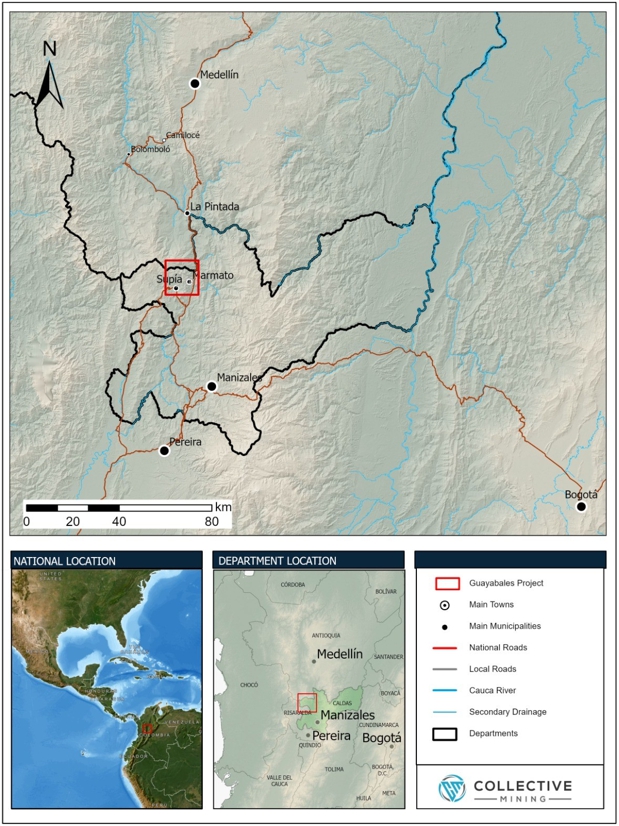
Figure 4.1. Location map of the Guayabales Project. Source: Collective (2026)
22
| Collective Mining Ltd. |
| Guayabales Project - Apollo Mineral Resource 2026-08 |
The application process for concession contracts is entirely online as follows:
| 1. | Purchase a PIN number (one per concession application). According to the National Mining Agency (ANM), the cost of the PIN is equivalent to one (1) Minimum Monthly Legal Salary (SMMLV), plus 19% Value Added Tax (VAT). For 2026, the SMMLV is COP 1,750,905, resulting in a total PIN cost, including VAT, of approximately COP 2,083,577 (equivalent to approximately US$520, depending on the applicable exchange rate at the time of payment). |
| 2. | Submit the application on the internet at the ANM website ANNA Mineria https://annamineria.anm.gov.co/sigm/externalLogin. |
| 3. | Upload pdf copies of the annexes to the application. These comprise legal, economic and technical documents including demonstration of the economic capacity of the applicant and the exploration proposal for the requested area. As per a State Council Court ruling issued on 4 August, 2022, the applicant must also provide a certification from the relevant environmental authority which reports whether the project overlaps with certain types of environmentally protected or sensitive ecosystems, and whether the said ecosystems are identified within the mining cadaster, and finally whether mining activities are permitted or not within the said environmental areas. |
| 4. | A Technical Study is carried out by ANM to determine whether there is any overlap with other contracts or applications. The applicant is notified of the “free areas.” The full area of the application may not be granted in its entirety if there is overlap with existing mining rights. |
| 5. | A legal and financial study is made by ANM. |
| 6. | A consultation process is held with the mayor of the municipality in which the application is located. |
| 7. | As part of the mining concession application process, the National Mining Agency (ANM) conducts a public hearing, where applicable, to inform local communities and municipal authorities about the proposed mining concession and provide an opportunity for public participation. |
| 8. | The contract is prepared and signed. |
| 9. | The contract is inscribed in the National Mining Registry (Registro Minero Nacional, RMN). The contract comes into effect on the date of registration. |
A surface tax (canon superficiario) is paid annually in advance during the exploration and construction phases of mining concession contracts. This payment is due when the concession contract is registered in the National Mining Registry (RMN). The amount varies depending on the area and stage of the concession and ranges from 0.5 to 3.0 daily minimum legal wages per hectare per year (approximately US$9.39 to US$56.31 per hectare per year, based on 2026 values).
In 2026, the monthly minimum wage in Colombia is COP $1,750,905, equivalent to a daily minimum wage of COP $58,363.50. Therefore, the surface tax per hectare for 2026 is calculated as follows, using an exchange rate of COP $3,109.30 per US$1.00 (TRM as of September 15, 2026):
Minimum: 0.5 × COP $58,363 = COP $29,181 per hectare per year (≈ US$9.38)
Maximum: 3 × COP $58,363 = COP $175,090 per hectare per year (≈ US$56.31)
23
| Collective Mining Ltd. |
| Guayabales Project - Apollo Mineral Resource 2026-08 |
Only exploration activities involving underground methods (i.e. drilling) require a mining title. Superficial exploration activities or prospecting can be carried out freely and do not require a mining title. Exploration that does not require a title (mapping, sampling, geophysics) may be done freely. Drilling from platforms or along hole traces outside a titleholder’s boundaries is permitted under Articles 58 and 166 of Law 685 of 2001. Drilling within water-drainage buffer zones requires permits from the regional environmental authority, which Collective has not required to date. The Apollo deposit does not overlap any area excluded from mining.
The concession contract (law 685/2001) has three phases:
| 1. | Exploration Phase: |
| ● | Starts once the contract is registered in the National Mining Registry. |
| ● | Has an initial term of three years, with up to four extensions of two years each, for a maximum exploration period of 11 years. Extensions requests must be submitted by the concessionaire at least three months before the expiration of the current exploration period and are subject to compliance with applicable legal and contractual requirements. |
| ● | Requires annual fee payments (canon superficiario). |
| ● | Requires an annual Environmental Mining Insurance Policy (póliza minero-ambiental), with coverage equivalent to 5% of the value of the exploration expenditure planned for the year. |
| ● | No environmental licensing is required during this phase, other than specific permits and concessions required for the use of natural renewable resources, such as water rights, dumping rights, and forestry rights, amongst others. In addition, exploration activities must be carried out in accordance with the Mining Environmental Guidelines (Guias Minero-Ambientales), which explains the explorer´s proposed environmental management activities during exploration. This document does not require approval by the environmental authority. |
| ● | At the end of the exploration phase, the explorer must file a Mining Plan (Programa de Trabajos y Obras or PTO) and a Social Management Plan (Plan de Gestión Social) with the mining authority and an Environmental Impact Study (Estudio de Impacto Ambiental or EIA) with the environmental authority in order to start construction and exploitation activities. |
| 2. | Construction and assembly Phase: |
| ● | May only commence once the PTO has been approved by the mining authority (ANM) and the environmental license has been granted by the competent environmental authority, following approval of the EIA. |
| ● | Valid for 3 years, plus a single 1-year extension. |
| ● | Annual surface tax payments continue. | |
| ● | Requires an annual Mining and Environmental Insurance Policy equivalent to 5% of the value of the planned investments, as defined in the PTO for the corresponding year. |
24
| Collective Mining Ltd. |
| Guayabales Project - Apollo Mineral Resource 2026-08 |
| 3. | Exploitation Phase: |
| ● | Valid for the remaining time of the concession, after deducting the time spent in the exploration and construction phases, and may be extended for a period of up to 30 additional years, subject to the applicable legal requirements. |
| ● | An annual Mining and Environmental Insurance Policy is required. During the exploitation stage, the insured amount is equivalent to 10% of the value of the estimated production approved in the PTO. This value is calculated by multiplying the estimated annual production volume of the mineral covered by the concession by the ex-mine price established annually by the Colombian Government. |
| ● | No annual surface taxes. |
| ● | Pay a royalty based on the regulations in force at the time of granting of the Contract (See Section 4.5). |
| 4.3 | Mining Property Rights |
The Guayabales Project (Figure 4.2) includes 20 granted mining rights covering approximately 3,886.2436 ha (894.7633 ha exploitation plus 2,991.4803 ha exploration) (Table 4.1) and 37 concession applications covering approximately 2,654.2573 hectares (Table 4.2). Together, these represent a reported project area of approximately 6,501.5009 hectares. The granted mining rights comprise titles held directly by Collective or its affiliates, titles undergoing assignment proceedings in favour of Collective, and titles subject to option agreements in favour of Collective, as detailed in Table 4.1.
In addition, in regards to mining title LH0071-17, 74 claim applications (43.7700 ha) have been submitted for incomplete cells that surround the referred title. Furthermore, the QP has been informed by Management of Collective Mining that the mining title owners of the Guayabales license, for which Collective Mining accelerated its option agreement to own an undivided 100% interest in June 2025 (see Item 4.4), requested in 2022 that the Colombian authorities integrate the incomplete cells abutting its mining title into the title. The authorities responded in writing, confirming that the incomplete cells will be incorporated into the title once the Colombian mining information system is updated to support such integration. Currently, Collective Mining is awaiting incorporation of incomplete cells. North of the incomplete cells, Collective Mining holds property to mining titles HI8-15231, 502173, 502174, 510319 and 510320.
This incomplete-cell procedure is separate from the assignment proceedings referred to elsewhere in this report. The assignment proceedings relate to the transfer of existing mining rights in favour of Collective, whereas the incomplete-cell procedure specifically concerns the incorporation or adjudication of residual grid-cell portions adjacent to existing mining titles, in accordance with the specific procedures established by the Colombian mining authority.
25
| Collective Mining Ltd. |
| Guayabales Project - Apollo Mineral Resource 2026-08 |
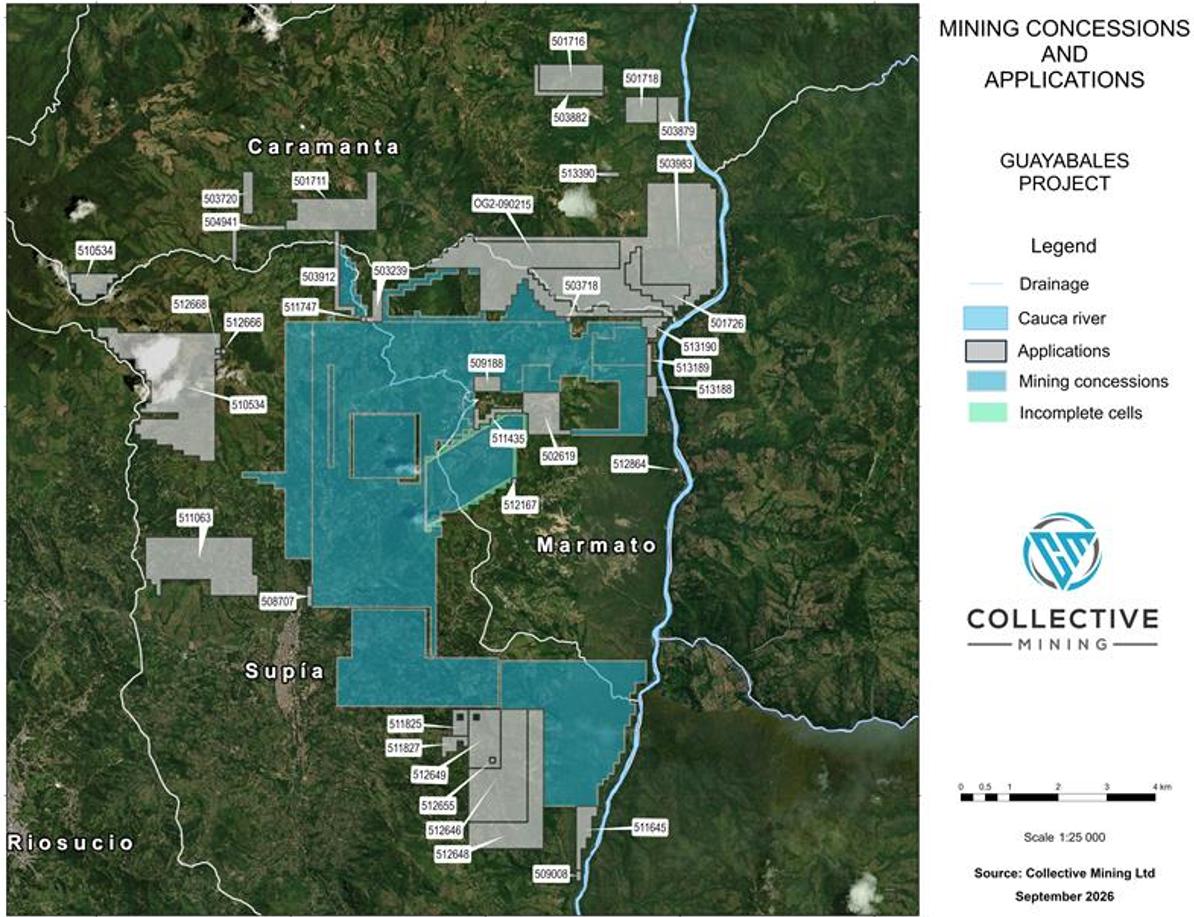
Figure 4.2. Plan of Guayabales Property mining rights showing concession contracts in red fill and concession applications in red outline. Source: Collective (2026)
The location of a mining title is defined by the coordinates of its corners, as described in each of the mining concession agreements executed with the mining authority. The coordinates of the corners are presented as geographic coordinates referenced to the MAGNA-SIRGAS coordinate reference system, expressed in decimal degrees to five decimal places, in accordance with the guidelines of the National Mining Agency (ANM). The Transverse Mercator – National Origin (CTM12) projection is used for the calculation of distances and areas. There is no legal requirement to mark the corners by monuments in the field or have the corners officially surveyed, and the corners have not been surveyed.
26
| Collective Mining Ltd. |
| Guayabales Project - Apollo Mineral Resource 2026-08 |
Table 4.1 List of the mining rights with title of the Guayabales Project.
| No. | Name | Number | Type | Owner | Date of Registration | Date of Expiry | Area (ha) | |
| 1 | Guayabales | LH0071-17 | Exploitation | Collective Mining Limited Sucursal Colombia | 28/03/2008 | 27/03/2038 | 247.8076 | |
| 2 | Guayabales | HI8-15231 | Exploration | Collective Mining Limited Sucursal Colombia | 11/10/2021 | 11/10/2051 | 1710.2903 | |
| 3 | Guayabales | HB1-08302X | Exploration | Collective Mining Limited Sucursal Colombia | 3/11/2021 | 2/11/2051 | 12.2598 | |
| 4 | Guayabales | 502174 | Exploration | Collective Mining Limited Sucursal Colombia | 10/04/2026 | 10/04/2056 | 1.2260 | |
| 5 | Guayabales | 503793 | Exploration | Collective Mining Limited Sucursal Colombia | 10/04/2026 | 10/04/2056 | 52.7146 | |
| 6 | Guayabales | 503899 | Exploration | Collective Mining Limited Sucursal Colombia | 10/04/2026 | 10/04/2056 | 52.7161 | |
| 7 | Guayabales | 503911 | Exploration | Collective Mining Limited Sucursal Colombia | 10/04/2026 | 10/04/2056 | 2.4519 | |
| 8 | Guayabales | 502173 | Exploration | Collective Mining Limited Sucursal Colombia | 14/07/2026 | 14/07/2056 | 2.4520 | |
| 9 | Guayabales | 503238 | Exploration | Collective Mining Limited Sucursal Colombia | 14/07/2026 | 14/07/2056 | 41.6832 | |
| 10 | Guayabales | 501714 | Exploration | Collective Mining Limited Sucursal Colombia | 14/07/2026 | 14/07/2056 | 578.6993 | |
| 11 | Guayabales | 510320 | Exploration | Collective Mining Limited Sucursal Colombia | 14/07/2026 | 14/07/2056 | 1.2260 | |
| 12 | Guayabales | 510319 | Exploration | Collective Mining Limited Sucursal Colombia | 14/07/2026 | 14/07/2056 | 1.2260 | |
| 13 | Guayabales | 509506 | Exploration | Collective Mining Limited Sucursal Colombia | 14/07/2026 | 14/07/2056 | 1.2260 | |
| 14 | Guayabales | 501712 | Exploration | Minerales Provenza SAS | 25/10/2021 | 24/10/2051 | 288.1232 | |
| 15 | Guayabales | CAG-141X | Exploration | MINEROS S.A. | 18/08/2026 | 17/08/2027 | 23.2946 | |
| 16 | Guayabales | 674-17 | Exploration | Luis Fernando García | 20/10/2021 | 20/10/2051 | 77.2319 | |
| 17 | Guayabales | 619-17 | Exploration | Luis Fernando García | 20/10/2021 | 20/10/2051 | 109.1070 | |
| 18 | Guayabales | 620-17 | Exploitation | Luis Fernando García | 23/09/2004 | 22/09/2033 | 481.8770 | |
| 19 | The Box | 781-17 | Exploitation | Sandra Liliana Saldarriaga Escobar, Margarita Maria Saldarriaga Escobar, Monica Paola Saldarriaga Escobar | 16/05/2006 | 15/05/2037 | 165.0787 | |
| 20 | Guayabales | DLH-14451X | Exploitation | Luis Fernando García | 20/10/2021 | 19/10/2051 | 35.5524 | |
| Total | 3886.2436 | |||||||
Ownership: Collective Mining (1-13); Minerales Provenza S.A.S., an affiliate of Collective Mining (14); mining rights subject to ongoing assignment proceedings in favour of Collective Mining (15-18); and mining rights subject to option agreements in favour of Collective Mining (19 and 20).
27
| Collective Mining Ltd. |
| Guayabales Project - Apollo Mineral Resource 2026-08 |
Table 4.2. List of concession applications of the Guayabales Project.
| No. | Number | Type | Owner | Date of Applications | Area (ha) |
| 1 | 501711 | Exploration | (76966) COLLECTIVE MINING LIMITED SUCURSAL COLOMBIA | 7/05/2021 | 128.7252 |
| 2 | 501716 | Exploration | (76966) COLLECTIVE MINING LIMITED SUCURSAL COLOMBIA | 7/05/2021 | 73.5491 |
| 3 | 501718 | Exploration | (76966) COLLECTIVE MINING LIMITED SUCURSAL COLOMBIA | 7/05/2021 | 36.7742 |
| 4 | 501726 | Exploration | (76966) COLLECTIVE MINING LIMITED SUCURSAL COLOMBIA | 7/05/2021 | 58.8416 |
| 5 | 502619 | Exploration | (76966) COLLECTIVE MINING LIMITED SUCURSAL COLOMBIA | 17/09/2021 | 66.2016 |
| 6 | 503239 | Exploration | (76966) COLLECTIVE MINING LIMITED SUCURSAL COLOMBIA | 14/10/2021 | 15.9377 |
| 7 | 503720 | Exploration | (76966) COLLECTIVE MINING LIMITED SUCURSAL COLOMBIA | 9/12/2021 | 19.6157 |
| 8 | 503718 | Exploration | (76966) COLLECTIVE MINING LIMITED SUCURSAL COLOMBIA | 9/12/2021 | 1.2259 |
| 9 | 503882 | Exploration | (76966) COLLECTIVE MINING LIMITED SUCURSAL COLOMBIA | 24/12/2021 | 22.0649 |
| 10 | 503879 | Exploration | (74025) MINERALES PROVENZA SAS | 24/12/2021 | 24.5159 |
| 11 | 503912 | Exploration | (74025) MINERALES PROVENZA SAS | 28/12/2021 | 23.2936 |
| 12 | 503983 | Exploration | (76966) COLLECTIVE MINING LIMITED SUCURSAL COLOMBIA | 30/12/2021 | 549.1849 |
| 13 | 504941 | Exploration | (74025) MINERALES PROVENZA SAS | 22/03/2022 | 19.6159 |
| 14 | 508707 | Exploration | (74025) MINERALES PROVENZA SAS | 29/11/2023 | 4.9044 |
| 15 | 509008 | Exploration | (76966) COLLECTIVE MINING LIMITED SUCURSAL COLOMBIA | 22/02/2024 | 2.4522 |
| 16 | 513390 | Exploration | (76966) COLLECTIVE MINING LIMITED SUCURSAL COLOMBIA | 17/09/2026 | 4.9034 |
| 17 | 509188 | Exploration | (76966) COLLECTIVE MINING LIMITED SUCURSAL COLOMBIA | 12/04/2024 | 18.3895 |
| 18 | 510534 | Exploration | (76966) COLLECTIVE MINING LIMITED SUCURSAL COLOMBIA | 11/02/2025 | 405.8324 |
| 19 | 511063 | Exploration | (76966) COLLECTIVE MINING LIMITED SUCURSAL COLOMBIA | 28/05/2025 | 235.418 |
| 20 | 511435 | Exploration | (76966) COLLECTIVE MINING LIMITED SUCURSAL COLOMBIA | 4/08/2025 | 17.1636 |
| 21 | 511645 | Exploration | (76966) COLLECTIVE MINING LIMITED SUCURSAL COLOMBIA | 12/09/2025 | 34.3307 |
| 22 | 511747 | Exploration | (76966) COLLECTIVE MINING LIMITED SUCURSAL COLOMBIA | 30/09/2025 | 1.2260 |
| 23 | 511825 | Exploration | (76966) COLLECTIVE MINING LIMITED SUCURSAL COLOMBIA | 15/10/2025 | 17.1654 |
| 24 | 511827 | Exploration | (76966) COLLECTIVE MINING LIMITED SUCURSAL COLOMBIA | 15/10/2025 | 15.9395 |
| 25 | 512167 | Exploration | (76966) COLLECTIVE MINING LIMITED SUCURSAL COLOMBIA | 23/12/2025 | 1.2260 |
| 26 | OG2-090215 | Exploration | (58093) JORGE ALBERTO GOMEZ LOPEZ, (49035) NELSON DAVID ORREGO QUINTERO | 2/07/2013 | 334.6724 |
| 27 | 512646 | Exploration | (76966) COLLECTIVE MINING LIMITED SUCURSAL COLOMBIA | 5/05/2026 | 202.3073 |
| 28 | 512648 | Exploration | (76966) COLLECTIVE MINING LIMITED SUCURSAL COLOMBIA | 5/05/2026 | 163.0724 |
| 29 | 512649 | Exploration | (76966) COLLECTIVE MINING LIMITED SUCURSAL COLOMBIA | 5/05/2026 | 78.4703 |
| 30 | 512655 | Exploration | (76966) COLLECTIVE MINING LIMITED SUCURSAL COLOMBIA | 5/05/2026 | 1.2261 |
| 31 | 512668 | Exploration | (76966) COLLECTIVE MINING LIMITED SUCURSAL COLOMBIA | 6/05/2026 | 1.2261 |
| 32 | 512666 | Exploration | (76966) COLLECTIVE MINING LIMITED SUCURSAL COLOMBIA | 6/05/2026 | 1.2260 |
| 33 | 512864 | Exploration | (76966) COLLECTIVE MINING LIMITED SUCURSAL COLOMBIA | 4/06/2026 | 1.2259 |
| 34 | 513190 | Exploration | (76966) COLLECTIVE MINING LIMITED SUCURSAL COLOMBIA | 14/08/2026 | 15. 9365 |
| 35 | 513189 | Exploration | (76966) COLLECTIVE MINING LIMITED SUCURSAL COLOMBIA | 14/08/2026 | 7.3554 |
| 36 | 513188 | Exploration | (76966) COLLECTIVE MINING LIMITED SUCURSAL COLOMBIA | 14/08/2026 | 9.8073 |
| 37 | 513418 | Exploration | (76966) COLLECTIVE MINING LIMITED SUCURSAL COLOMBIA | 26/09/2026 | 39.2343 |
| TOTAL | 2654.2573 | ||||
28
| Collective Mining Ltd. |
| Guayabales Project - Apollo Mineral Resource 2026-08 |
| 4.4 | Mining Property Acquisition Agreements |
Collective has entered into a series of acquisition and assignment agreements in respect of certain mining rights comprising the Guayabales Project.
The assignment process for mining rights LH0071-17, HB1-08302X, 674-17 and 619-17 has been completed. The relevant assignment agreements were executed, the transfers were processed before the Colombian National Mining Agency (ANM), and the changes in titleholder were subsequently registered in the National Mining Registry (RMN). Accordingly, these mining rights are currently registered in the name of Collective Mining Limited Sucursal Colombia.
With respect to mining right 620-17, the relevant assignment agreements have been executed between the parties; however, the corresponding transfers remain subject to the administrative process before the ANM and have not yet been registered in the RMN in the name of Collective.
Collective has also entered into option agreements in respect of Mining Rights 781-17 and DLH-14451X. In the case of DLH-14451X, in addition to the option agreement, the parties have executed an assignment agreement in favour of Collective, and the corresponding transfer application is currently under administrative review by the ANM pending registration in the RMN. Although the acquisition is subject future payments, the contract provides for immediate transfer of title to Collective. The title is therefore subject to an ongoing assignment proceeding in favor of Collective.
Exploration License CAG-141X, currently registered in the name of MINEROS S.A., also forms part of the Guayabales Project. Collective has entered into an agreement for the acquisition and assignment of this mining right, and the total acquisition consideration of US$50,000 has been paid in full.
Under the Colombian mining tenure framework, execution of an assignment agreement does not, by itself, complete the transfer of a mining right. The assignment must be processed before the ANM and the change in titleholder must be registered in the RMN. Accordingly, references in this report to “assignment proceedings” refer solely to this administrative transfer and registration process and do not imply litigation, a dispute, forfeiture, or an adverse claim over the relevant mining rights.
The acquisition and option agreements relating to the Guayabales Project provide for aggregate payments of approximately US$30.05 million through 2030, including payments associated with certain mining rights and related assets. As of the effective date of this Technical Report, the QP understands that Collective has made payments of approximately US$18.15 million under these agreements. The scheduled payments and amounts paid are summarized in Table 4.3.
29
| Collective Mining Ltd. |
| Guayabales Project - Apollo Mineral Resource 2026-08 |
Table 4.3 Yearly payments resulting from mining title option agreements.
| Year | Amount (US$) | Payments made (US$) |
| 2020 | 350,000 | 350,000 |
| 2021 | 800,000 | 800,000 |
| 2022 | 1,100,000 | 1,100,000 |
| 2023 | 750,000 | 750,000 |
| 2024 | 666,667 | 666,667 |
| 2025 | 11,758,334 | 11,758,334 |
| 2026 | 3,467,500 | 2,727,500 |
| 2027 | 1,917,500 | |
| 2028 | 1,730,000 | |
| 2029 | 3,880,000 | |
| 2030 | 3,630,000 |
Total exploration expenditure commitments under certain of these agreements amounted to approximately US$13.8 million over their term. These expenditures were adequately completed by Collective Mining Colombia, therefore it exercised its right to acquire 100% ownership of the relevant tenements.
Collective also entered into an agreement for the acquisition of Exploration License CAG-141X, currently registered in the name of MINEROS S.A. The total acquisition consideration of US$50,000 has been paid in full, and the assignment of the mining right in favour of Collective is currently in process.
| 4.5 | Royalties |
Royalties payable to the State for the exploitation of gold and silver are 4% of the value of production at the mine mouth, while royalties for copper and tungsten are 5%, pursuant to Article 16 of Law 141 of 1994, as amended by Article 16 of Law 756 of 2002. For purposes of calculating royalties on gold and silver, the mine-mouth value is determined based on 80% of the average international price for the preceding month, in accordance with applicable regulations. The base prices used for royalty calculations are published by the competent authority.
Other than the State royalties described above, Collective has advised the QP that the mining rights comprising the Guayabales Project, including the mining rights subject to option agreements (781-17 and DLH-14451X) and those subject to assignment proceedings, are not subject to any private royalties, net smelter return royalties, streams, back-in rights or other encumbrances. The option agreement for mining right (LH0071-17) originally provided for a 1% net smelter return royalty as one alternative for acquiring the final 10% interest. Following the acceleration of that option in June 2025 and full settlement of the remaining payments in January 2026, no royalty is payable under that agreement. The remaining payment obligations under the acquisition and option agreements are summarized in Section 4.4 and Table 4.3.
30
| Collective Mining Ltd. |
| Guayabales Project - Apollo Mineral Resource 2026-08 |
| 4.6 | Legal Access and Surface Rights |
Granting of a mining title does not include surface access rights; therefore, the consent of the relevant landowner or community is required.
Collective holds surface rights over 31 properties located within the Guayabales Project, covering a total area of 719.22 ha. To date, Collective has not encountered any significant access constraints that have materially affected its ability to carry out planned activities within the Guayabales Project.
In addition, Collective has entered into easement agreements with several landowners within the Guayabales Project. The Company currently holds easement rights over 20 properties, allowing exploration activities, including:
| ● | 7 properties for the installation and operation of 10 drilling platforms; |
| ● | 1 property for access to water intake points at Arquía and Guayabales (the latter pursuant to the option agreement entered into with the Guayabales Miners Association); and |
| ● | 12 properties for the installation of hoses, pumps, and storage tanks associated with the Arquía and Guayabales water lines. |
Most of these agreements have a term of twelve (12) months and provide for the payment of monetary consideration.
| 4.7 | Water Rights |
A Superficial Water Concession is required if water is to be taken from creeks or underground sources for drilling. The company has three Superficial Water Concessions approved (Table 4.4). Water rights may take from 6 to 9 months to obtain. If needed, water can be purchased in bulk and trucked in tanks to the drilling areas.
Table 4.4. List of Superficial Water Concessions and applications for the Guayabales Project.
| Water Permit Name | Status | Number | Date Granted |
| Agua Clara | Approved | Resolution No. 2022-0122 | January 2022 |
| Arquía | Approved | Resolution No. 2023-2053 | December 2023 |
| Mina Guayabales y Quebrada San Jorge | Approved | Resolution No. 2023-1288 | August 2023 |
| 4.8 | Environmental Liabilities |
The Guayabales Project has artisanal mining in four areas. Under Colombian law, existent artisanal mining will not be an environmental liability for Collective. The company has carried out environmental baseline studies to determine existing liabilities in the area and continues to do so as it identifies local miners.
31
| Collective Mining Ltd. |
| Guayabales Project - Apollo Mineral Resource 2026-08 |
| 4.9 | National Parks and Reserves |
There are no national parks, reserves or other areas that exclude mining covering the Guayabales Project area.
| 4.10 | Indigenous Reserves and Communities |
Within the Municipality of Supía, there are three Indigenous reserves (resguardo indígena in Spanish), called the Cañamomo - Loma Prieta Reserve, the La Trina Reserve, and the Cartama Reserve. There is also one Indigenous community (parcialidad indígena in Spanish), called Cauromá, where the people live according to indigenous laws and customs but they do not own the territory. A “parcialidad indígena” is related more to a community which is not delimited by a territory, has integrated to a standard social community, but still holds relations amongst each other in which certain indigenous laws and customary ways of living still prevail. In the Municipality of Marmato, there is an indigenous community called Cartama. These communities belong to the Embera Chami indigenous group. The Cauroma and Cartama indigenous communities overlap with parts of Collective’s mining rights, but not with the areas of current interest for exploration.
Exploration is permitted by law in both the reserves and the communities and, in practice, would require an agreement with the relevant indigenous communities. Only reserves would require a prior agreement with the relevant community. Irrespective of an overlap, prior consultation will be required for the granting of the environmental license for the exploitation phase if a direct or indirect impact upon an indigenous reserve is identified.
| 4.11 | Other |
The QP is not aware of any other significant factors and risks that may affect access, title or the right or ability to perform work on the property.
32
| Collective Mining Ltd. |
| Guayabales Project - Apollo Mineral Resource 2026-08 |
| 5 | Accessibility, Climate, Local Resources, Infrastructure and Physiography |
| 5.1 | Accessibility |
The Guayabales Project is located close to several major cities in central and western Colombia. Measured in a straight line, the Project is approximately 80 km south of Medellin, the capital of the Department of Antioquia and Colombia’s second-largest city; 50 km north-northwest of Manizales, the capital of the Department of Caldas, 75 km north of Pereira, the capital of the Department of Risaralda, and approximately 198 km west-northwest of Bogotá, the capital of the Republic of Colombia (See Figure 4.1). The nearest commercial airport is La Nubia Airport in Manizales, approximately 50 km from the Project in a straight line.
By road, access to the field office and core logging and storage facility in the town of Supía is provided by paved highways from Medellín (approximately 141 to 172 km, depending on the route), Manizales (approximately 81 km), Pereira (approximately 98 to 122 km, depending on the route), and Bogotá (approximately 360 to 380 km, depending on the route) (Figure 5.1). Supía is located approximately 5 km southwest of the Guayabales Project in a straight line. Road access from Supía to the Project is approximately 12 km and is provided by a combination of secondary paved road and local unpaved roads.
| 5.2 | Climate |
The Köppen climate classification for the Guayabales Project is Subtropical Highland climate (Cwb). The Cwb classification is based on dry winters and average monthly temperatures below 22°C with at least 4 months greater than 10°C.
Field-work can be carried out on the project year-round.
There are no hydrometeorological stations in the project area so a station survey of IDEAM (Institute of Hydrology, Meteorology and Environmental Studies) was carried out to locate the nearest stations based on proximity, minimum data record of 10 years, and good data representativity (Table 5.1, Figure 5.2). Collective installed a weather station, MET 1, at Apollo in December 2023.
33
| Collective Mining Ltd. |
| Guayabales Project - Apollo Mineral Resource 2026-08 |
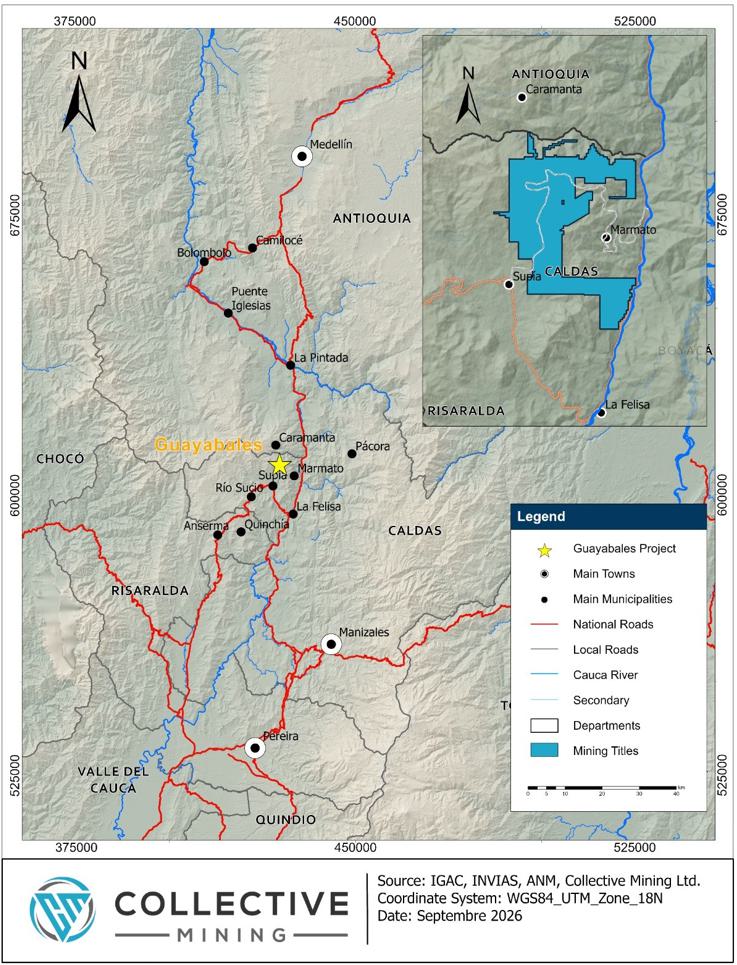
Figure 5.1 Location and access map of the Guayabales Project. Inset shows enlargement of the Guayabales Project with the mining rights and local roads. Source: Collective (2026)
34
| Collective Mining Ltd. |
| Guayabales Project - Apollo Mineral Resource 2026-08 |
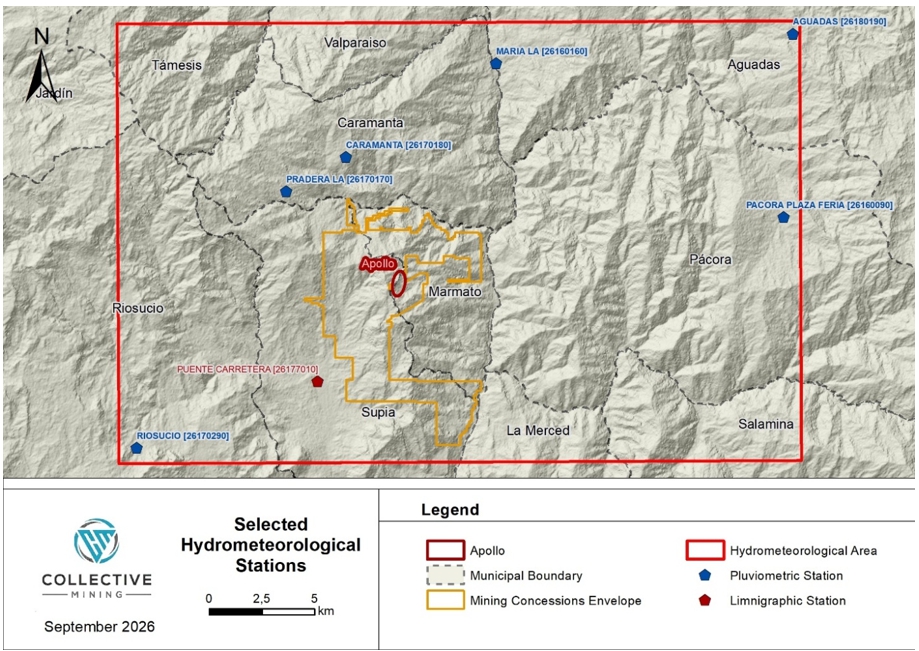
Figure 5.2 Location of selected hydrometeorological stations to the Guayabales Project. Source: Collective (2026)
Table 5.1 General data on the nearest hydrometeorological stations to the project (source IDEAM). Source: Collective (2026)
| ID | Name | Category | Status | Variable | Scale | Altitude (m.a.s.l.) | Distance from Project (km) |
| 26180190 | Aguadas [26180190] | PM | Active | Precipitation | Daily | 2,180 | 21.76 |
| 26170180 | Caramanta [26170180] | PM | Active | Precipitation | Daily | 2,112 | 6.26 |
| 26160160 | María La [26160160] | PM | Active | Precipitation | Daily | 645 | 11.08 |
| 26160090 | Pacora Plaza Feria [26160090] | PM | Active | Precipitation | Daily | 1,821 | 18.30 |
| 26170170 | Pradera La [26170170] | PM | Suspended | Precipitation | Daily | 1,950 | 6.72 |
| 26170290 | Riosucio [26170290] | PM | Active | Precipitation | Daily | 1,946 | 14.71 |
| 26177010 | Puente Carretera [26177010] | LM | Active | Water flow | Daily | 1,192 | 6.15 |
Category: PM pluviometric, LM limnimetric.
The average annual precipitation for the area of interest varies between 2,437 mm and 2,827 mm (Figure 5.3), with the latter being the most representative value as it is associated with the Caramanta station which is closest to the project area.
35
| Collective Mining Ltd. |
| Guayabales Project - Apollo Mineral Resource 2026-08 |
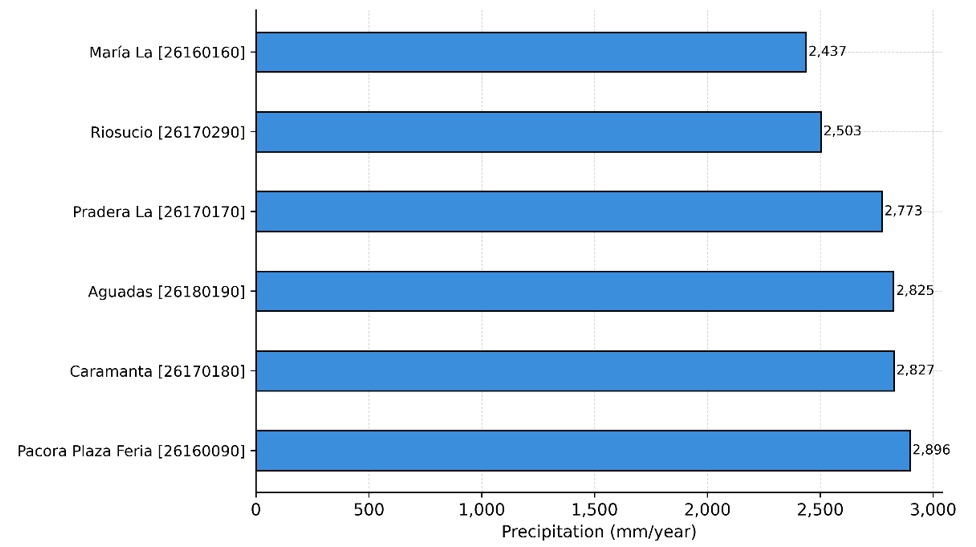
Figure 5.3 Average annual rainfall in the project area (IDEAM).
The area is characterized by a bimodal rainfall cycle (Figure 5.4), with drier seasons between December and February and between June and August, with minimum values of about 110.3 mm. There is a wet season between April and May, and a slightly more intense second wet season between October and November with average maximum values of 381.3 mm. This pattern is confirmed in the annual cycle of standardized precipitation anomalies (Figure 5.4).
There are no IDEAM temperature records for the area of interest, so satellite data from the WorldClim and Chelsa climatological databases were used. The annual cycle of average temperature in the area of interest (Figure 5.5) varies between 17.4°C in October and 19.2°C in March. There is a seasonal pattern with higher average temperatures between February and May, and a decrease during the second half of the year, particularly in July and October.
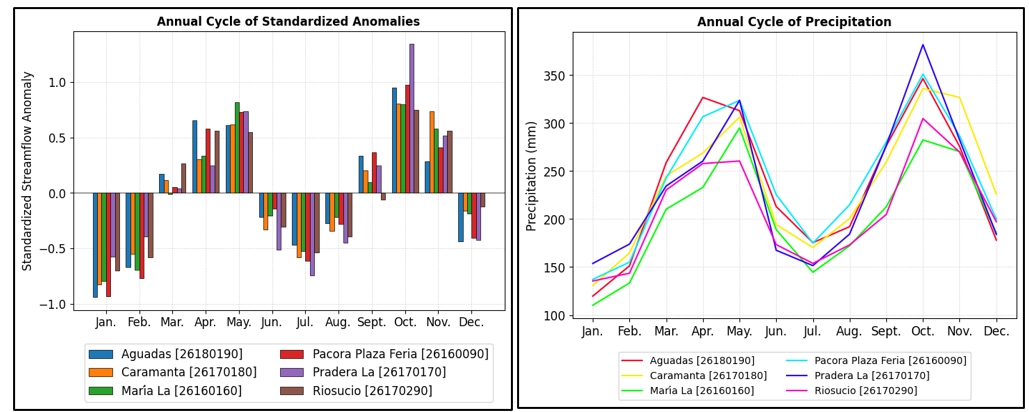
Figure 5.4 (a) Annual precipitation cycle and (b) standardized annual precipitation cycle (IDEAM).
36
| Collective Mining Ltd. |
| Guayabales Project - Apollo Mineral Resource 2026-08 |
The flow regime in the area shows a bimodal pattern (Figure 5.6 and Table 5.3), characterized by two drier seasons (January–March and July–September) and two wet seasons (April–June and October–December). In relation to precipitation, there is approximately a one-month lag in the flow response starting in July. While precipitation peaks in October, the corresponding increase in flow is observed in November, suggesting a delayed hydrological response to rainfall events.
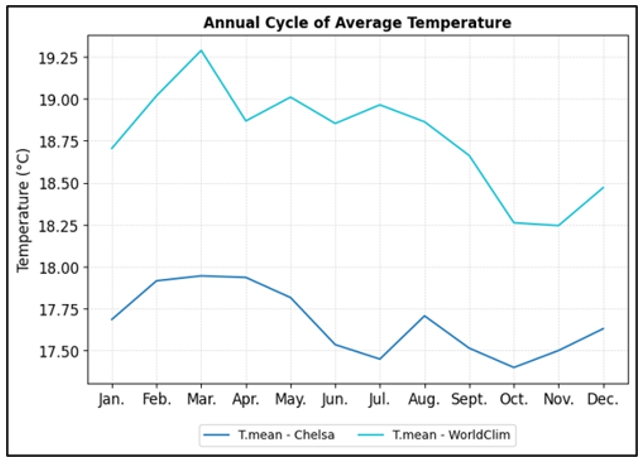
Figure 5.5 Annual cycle of average temperature.
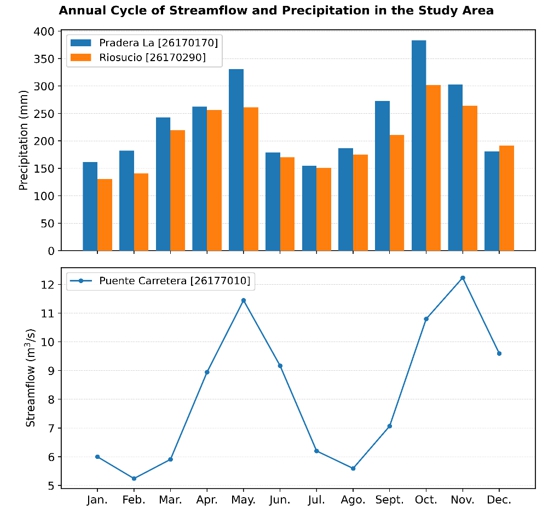
Figure 5.6 Annual Flow cycle (IDEAM).
37
| Collective Mining Ltd. |
| Guayabales Project - Apollo Mineral Resource 2026-08 |
The MET I station, owned by Collective, has collected limited data so far (Table 5.2, Table 5.3). During 2024, precipitation reached maximum values of 98.9 mm in August and 75.5 mm in November, while in 2025 it peaked at 54.5 mm in March. In the first half of 2026, the maximum was recorded in June, at 153.1 mm. The average temperature in 2025 was 17.5 °C. Relative humidity ranged between 63.7% and 95.3%, indicating high atmospheric variability. Atmospheric pressure fluctuated between 595.0 and 602.7 mm Hg, showing no clear trend. Solar radiation reached a maximum of 556.3 W/m², typical of midday hours. Finally, wind mainly came from the southeast, with speeds ranging from 0.2 to 2.7 m/s with gusts exceeding 4.0 m/s.
Table 5.2 General information of MET I.
| Name | Category | Status | Altitude (m.a.s.l.) | National Origin Coordinates | UTM, 18N zone | ||
| Easting (m) | Northing (m) | Easting (m) | Northing (m) | ||||
| MET I | Climatological | Active | 2,047 | 4,710,024.602 | 2,165,740.300 | 431,538.568 | 607,341.173 |
Table 5.3 General information of MET I variables.
| Variable | Scale | Start Date | End Date | Duration (years) |
| Precipitation | Hourly | 1/12/2023 | 31/08/2026 | 2.75 |
| Temperature | Hourly | 1/12/2023 | 31/08/2026 | 2.75 |
| Relative Humidity | Hourly | 1/12/2023 | 31/08/2026 | 2.75 |
| Atmospheric Pressure | Hourly | 1/12/2023 | 31/08/2026 | 2.75 |
| Solar Radiation | Hourly | 1/12/2023 | 31/08/2026 | 2.75 |
| Wind Speed | Hourly | 1/12/2023 | 31/08/2026 | 2.75 |
| Wind Direction | Hourly | 1/12/2023 | 31/08/2026 | 2.75 |
Mean annual precipitation was obtained from CHIRPS (Climate Hazards Group InfraRed Precipitation with Station data) satellite information, and the resulting field was corrected using records from IDEAM gauging stations. Potential evapotranspiration (PET) was estimated using the method proposed by Cenicafé, which expresses it as a function of elevation. Finally, real evapotranspiration (RET) was calculated from PET and the corrected mean annual precipitation using the Budyko equation.
The real evapotranspiration (RET) values vary from 608.98 mm to 762.35 mm. A general trend of increasing temperature values is observed from southwest to northeast.
38
| Collective Mining Ltd. |
| Guayabales Project - Apollo Mineral Resource 2026-08 |
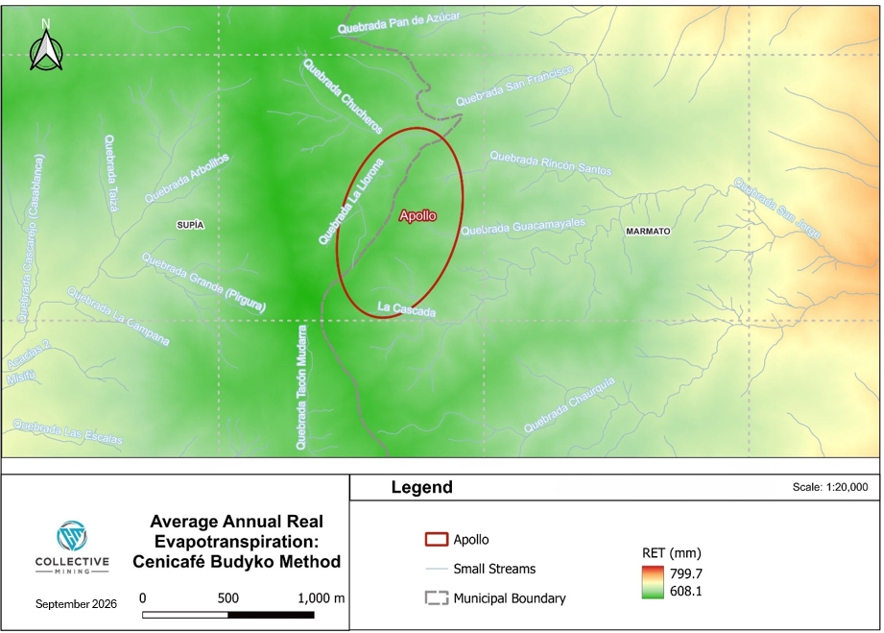
Figure 5.7 Average annual real evapotranspiration (RET) for the project area (IDEAM).
| 5.3 | Hydrology |
Collective has installed 20 piezometers at depths of 24 to 150 m in different geological units including diorite, quartz diorite, breccias, schists, and saprolite. The piezometers are located at variable distances from Apollo: some are located within the Apollo zone, while others are distributed in surrounding areas at distances of up to just under 4 km. Overall, there is high variability in hydraulic parameters, influenced by the heterogeneity of geological formations and depth differences among piezometers. A concentration of flow is observed towards lower elevation areas, with a general W to E flow trend and local trends directing flow toward main streams such as Chaurquía, San Jorge, and La Llorona, which in turn direct water toward the Cauca River.
39
| Collective Mining Ltd. |
| Guayabales Project - Apollo Mineral Resource 2026-08 |
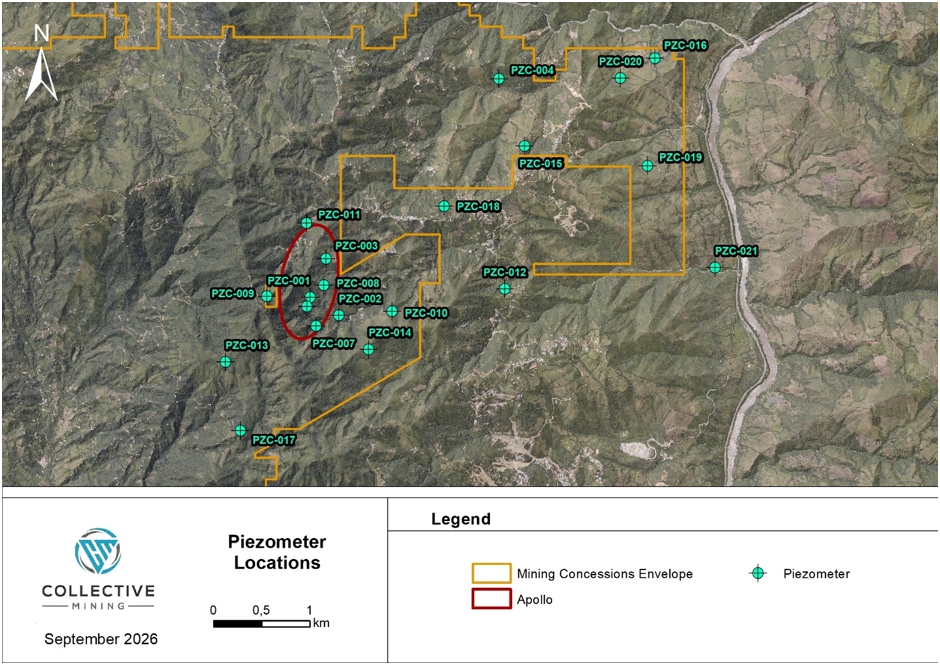
Figure 5.8. Spatial distribution of piezometers relative to the Apollo area. Source: Collective (2026)
| 5.4 | Local Resources and Infrastructure |
The Guayabales Project is located about 200 km east of the Pacific Ocean and 300 km south of the Caribbean Sea. The nearest port facility on the Pacific Ocean is Buenaventura, located approximately 330 to 350 km by road from Supía. Buenaventura is Colombia’s principal port on the Pacific coast and one of the country’s main international maritime gateways. On the Caribbean coast, the nearest major port facility is Puerto Antioquia, located at Nueva Colonia in the municipality of Turbo, Antioquia, on the Gulf of Urabá. Puerto Antioquia commenced foreign-trade operations in 2026 and is located approximately 450 to 500 km by road from Supía, depending on the route.
The nearest railhead is at Medellin. There are international airports at Medellin and Pereira, and a national airport at Manizales. The Medellin to Cali segment of the PanAmerican Highway, Route 25, runs through Supia, the base for the project.
The national electricity and natural gas grids run along the River Cauca valley about 3 km east of the project. They comprise three 230 kV power lines and a ten-inch diameter oil and gas pipeline with a capacity of 12,000 barrels per day.
40
| Collective Mining Ltd. |
| Guayabales Project - Apollo Mineral Resource 2026-08 |
Field personnel for the exploration program are available locally from towns and villages near the project. The district is expected to be able to supply the basic workforce for any future mining operation. There is an industrial underground gold mine operation at Marmato, and there is abundant artisanal mining in the region.
The region has high rainfall and there are ample water resources available.
Collective is currently in the process of acquiring land and, as of today, holds surface rights over 31 properties within the Guayabales Project. The project remains in the exploration phase, making it premature to define the specific locations of surface rights that could be required for future mining infrastructure. The company has identified several sites providing the potential for required infrastructure, but these are still being evaluated for optimal locations and have not been agreed within the company.
| 5.5 | Physiography |
The Guayabales Project is located on the eastern edge of the Western Cordillera and on the western side of the Cauca River Valley. The project is located at altitudes between 990.7 and 2,225.4 meters above sea level (masl). The Cauca is an important river that flows north through a deep valley that separates the Western and Central mountain ranges. It has an average daily flow of 674.1 m3/s according to the IRRA – AUT [26167070] station of IDEAM, located in the municipality of Neira Caldas. It is a tributary of the Magdalena River, which flows into the Caribbean Sea in the city of Barranquilla. Rocks are exposed in streams, rivers, road cuttings and artisanal mines, but in other areas exposure is limited. The terrain is steep and covered by forest with some clearings used as pastures.
The project lies within the tropical, moist forest to premontane wet forest ecological zones of the Holdridge Life Zone climatic classification system. The vegetation is tropical forest that has been partly cleared for pasture, with secondary forest growth. Land is used for rough pasture for cattle, and growing coffee.
41
| Collective Mining Ltd. |
| Guayabales Project - Apollo Mineral Resource 2026-08 |
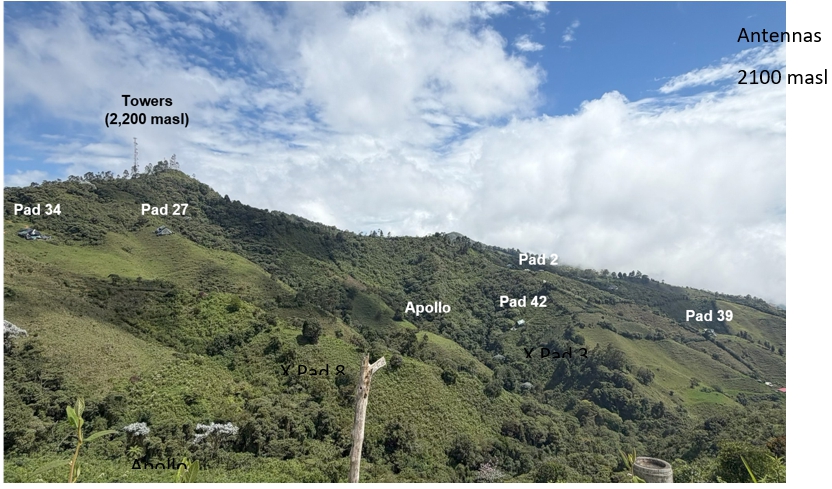
Figure 5.9. A general view of the physiography of the Apollo deposit looking northwest and the location of different drill pads Source: Collective, 2026.
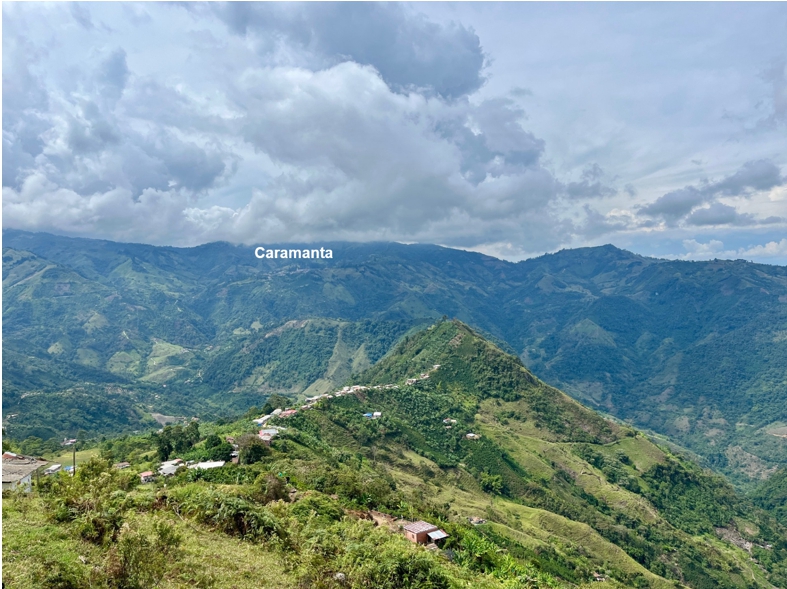
Figure 5.10. A general view of the Guayabales Project looking north from the access road to the town of Caramanta on the far ridge ( Source: Collective, 2026).
42
| Collective Mining Ltd. |
| Guayabales Project - Apollo Mineral Resource 2026-08 |
| 6 | History |
This section was extracted and modified from Redwood (2025).
| 6.1 | Prior ownership and ownership changes |
The recent history of the Guayabales Project began in 1995 when the Guayabales Mining Community (Comunidad Minera Guayabales), also known as the Guayabales Miners Association (Asociación de Mineros Guayabales), started artisanal gold mining. It developed 16 small underground mines in the Encanto zone. It began the process to legalise ownership in 2002 and was granted ownership when the title to concession contract LH-0071-17 was registered on 28 March 2008. The total gold production is not known. The history of the Guayabales Project is summarised in Table 6.1.
Table 6.1 Summary of the history of the Guayabales Project.
| Years | Company | Work carried out | NI 43-101 reports |
600 BCE to 21st Century CE |
Quimbaya Culture (600 BCE – 1600 CE) Spanish Colonial Period (1534-1819) Republic of Colombia period (1819-present) |
The Marmato-Supia district – Artisanal mining. | |
| 1995-present | Guayabales Mining Community | Artisanal gold mining in 16 underground mines. Legalisation started 2002. Mining title LH-0071-17 registered 28 March 2008. | |
| 2005-2006 | Colombia Gold plc, London | Underground sampling, surface rock sampling. | |
| 2006-2009 | Colombian Mines Corporation, Vancouver | Underground sampling, surface rock sampling, 17 diamond drillholes (2079m). | Thompson (2007) |
| 2010-2011 | Mercer Gold Corporation, Nevada | Underground and surface rock sampling, soil grid, geological mapping, 11 diamond drillholes for 4,067 m. | Turner (2010, 2011) |
| 2011-2013 | Tresoro Mining Corp., Nevada (formerly Mercer Gold Corporation) | No work. Option expired 2012 or 2013. | Leroux (2012) |
| 2014-2019 | None | Exploration inactive | |
| 2020-present | Collective Mining Ltd., Toronto | Current exploration programme | Redwood (2021, 2023, 2025) |
The Marmato-Supia district has been mined for gold since pre-Colombian times by the Quimbaya culture (600 BCE – 1600 CE), who were highly skilled goldsmiths, during the Spanish colonial period (1534-1819), and during the republican period (1819 to present) (Gartner, 2005; Bray et al., 2021).
43
| Collective Mining Ltd. |
| Guayabales Project - Apollo Mineral Resource 2026-08 |
From 2005-2013, the Guayabales project was explored for gold by three companies under option agreements with Comunidad Minera Guayabales. These were Colombia Gold plc in 2005-2006, Colombian Mines Corporation (Colombian Mines) in 2006-2009 (Thompson, 2007), and Mercer Gold Corporation (Mercer Gold) in 2010-2011 (previously called Uranium International Corp.) (Turner, 2010, 2011). Mercer Gold changed its name to Tresoro Mining Corp. in 2011 but it carried out no more exploration (Leroux, 2012). Its option expired for non-compliance sometime in 2012 or 2013, and the company declared bankruptcy on 3 March 2014. Exploration carried out by these companies included geological mapping, soil sampling, rock sampling, and mapping and channel sampling of artisanal mines, and diamond drilling. In 2008 Colombian Mines drilled 17 holes for 2,079 m in the Encanto Zone, and in 2010-2011 Mercer Gold drilled 11 holes for 4,067 m in the Encanto Zone and to the northeast of this zone. The results of the historical exploration and drilling are reported in Sections 9.1 and 10.1.
Exploration of the Comunidad Minera Guayabales concession focused on the NW to WNW-trending Encanto Zone where 16 small gold mines are currently operated by Comunidad Minera Guayabales. The zone is a shear zone at least 500 m long and 20-40 m wide with gold-silver-polymetallic veins that were targeted by drilling. Porphyry stockwork veining mineralization is exposed in some road cuts shown by argillic and sericitic alteration overprinting quartz veinlet stockworks and hematite after magnetite veinlets and was intersected in two historical drillholes.
| 6.2 | Historical mineral resource estimates |
There are no historical mineral resource estimates for the Guayabales project.
| 6.3 | Historical production |
There has been small scale, artisanal production of gold from the Guayabales project but the quantity is not known.
44
| Collective Mining Ltd. |
| Guayabales Project - Apollo Mineral Resource 2026-08 |
| 7 | Geological Setting and Mineralization |
| 7.1 | Regional geology |
The Guayabales Project is in the Western Cordillera of the Colombian Andes situated in the late Miocene, Middle Cauca Gold-Copper Metallogenic Belt (Figure 7.1). The project occurs in the Romeral terrane, an accretionary suture containing dismembered sections of oceanic crust (ophiolite complexes) comprised of a melange of ultramafic and mafic rocks (including peridotites, serpentinites, gabbros, basalts) and oceanic sedimentary rocks (graphitic schist, biotite schist, sericite schist chlorite schist), referred to as the Arquía Complex of probable Late Jurassic to Early Cretaceous age (Cediel & Cáceres, 2000; Cediel et al., 2003; Cediel & Shaw, 2019). This terrane was accreted to the continental margin along the Romeral Fault in the Aptian period (early Cretaceous). Movement on the Romeral Fault was dextral indicating that terrane accretion was highly oblique from the southwest. The Romeral terrane is bounded by the Cauca-Patia Fault on the west side.
Further west, additional oceanic and island arc terranes were subsequently accreted to the Western Cordillera in the Paleogene and Neogene periods, culminating in the on-going collision of the Panamá-Choco arc since the late Miocene and is interpreted to have induced a reconfiguration of subduction geometry beneath the Northern Andes, which reactivated arc-related magmatism along the Middle Cauca belt (Cediel & Cáceres, 2000; Cediel et al., 2003; Cediel & Shaw, 2019). The Romeral fault system has played an important role in subsequent pull apart basin sedimentation (Sierra, Marín-Cerón and MacDonald, 2012) during the Oligocene to Miocene aged, Amagá Formation (“Amagá”) and the locus of the Miocene Combia Volcanic Province (CVP, Weber et al., 2020). The Amagá, deposited unconformably on basement rocks, consists of shallow marine to terrestrial siliciclastic sequences. The CVP (see Figure 7.2) represents a late Miocene (12-6 Ma) volcaniclastic and volcanic (extrusive and intrusive) sequence positioned in the intermontane Cauca valley between the Western and Central Cordillera.
Porphyry Au-Ag-Cu-Mo mineralization and subsequent polymetallic vein systems (hosting Au-Ag-Zn-Pb-Cu) in the Middle Cauca Gold-Copper Belt are related to clusters of late Miocene porphyry intrusions of diorite-quartz diorite composition, and intrusive breccias within the CVP (Figure 7.2).
45
| Collective Mining Ltd. |
| Guayabales Project - Apollo Mineral Resource 2026-08 |
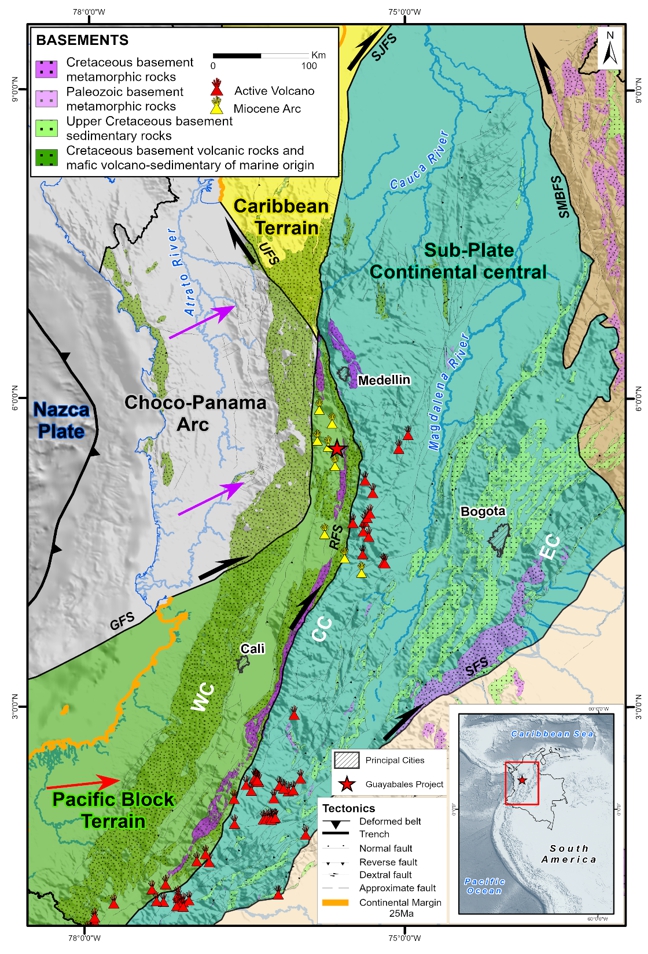
Figure 7.1: Regional tectonic and terrane map of Colombia showing the location of the Guayabales Project (Modified from Castaño-Castro, 2026). Abbreviations: SMBFS (Santa Marta-Bucaramanga fault system), SJFS (San Jacinto fault system), UFS (Uramita Fault System), RFS (Romeral fault system), GFS (Garrapatas Fault System), SFS (Suaza fault system), WC (Western Cordillera), CC (Cordillera Central), EC (Eastern Cordillera), in orange line the Oligocene margin (25Ma). Source: Collective, 2026.
46
| Collective Mining Ltd. |
| Guayabales Project - Apollo Mineral Resource 2026-08 |
Middle Cauca Belt
The Middle Cauca Belt (MCB) is a 350 km long, north-trending metallogenic belt extending from the Buritica gold mine (Zijin Mining Group Co. Ltd.) to the La Colosa gold deposit (Mineros S.A.) (Figure 7.2). It is delineated by the Cauca-Romeral fault system and physiographically restricted within or along the upper Cauca valley (Bartos et al., 2017). The belt is notable for its gold-rich porphyry clusters and a single major copper-rich system (Quebradona, Figure 7.2), along with numerous low to intermediate-sulfidation, polymetallic, vein systems (i.e. Buriticá) that are structurally controlled and related to the porphyry systems. The Neogene aged, porphyry and porphyry vein systems are associated with calc-alkaline intrusions formed in a complex tectonic setting (Bartos et al., 2017; Naranjo et al., 2017; Santacruz et al., 2021). The MCB contains the Amagá Basin in the Middle Cauca Valley and available age constraints indicate magmatism occurred between 11.8 and 5 Ma ago (López et al., 2006; Leal-Mejia et al., 2011, 2017, 2019; Marin-Ceron et al., 2019; Shaw et al., 2011, 2019; Weber, 2020) although the belt’s most productive epoch is between 8.8 and 6.0 Ma. ago (Tassinari et al., 2008; Bissig et al., 2013; Santacruz et al., 2021). Hydrothermal activity at Marmato and Apollo occurred over a short time between 6.7 Ma and 5.7 Ma (Santacruz et al., 2021; Londono-Vanegas, 2026), broadly coeval with the emplacement of other Cu-Au porphyry systems documented regionally.
The magmatic and hydrothermal evolution within the belt has resulted in the formation of numerous mineral deposits, that have made important contributions to exploration and mining activities (e.g. Lodder et al., 2010; Lesage et al., 2013; Naranjo et al., 2017; Bartos et al., 2017; Santacruz et al., 2021). Porphyry systems within the MCB are predominantly gold-rich (e.g., Quinchía, Colosa, El Poma, La Mina, Caramanta) with only one copper-rich system (Quebradona) (Figure 7.1). Additionally, there are intermediate sulfidation polymetallic vein systems hosting high values of gold and silver. These structurally controlled deposits are referred to as carbonate-base metal veins (CBM) as they also host sulfides of lead and zinc and are related to porphyry and intrusion-related systems (e.g., Buriticá, Titiribí, Marmato). An understanding of the geological evolution in the MCB has been essential for unravelling its mineral potential and economic significance for Colombia.
47
| Collective Mining Ltd. |
| Guayabales Project - Apollo Mineral Resource 2026-08 |
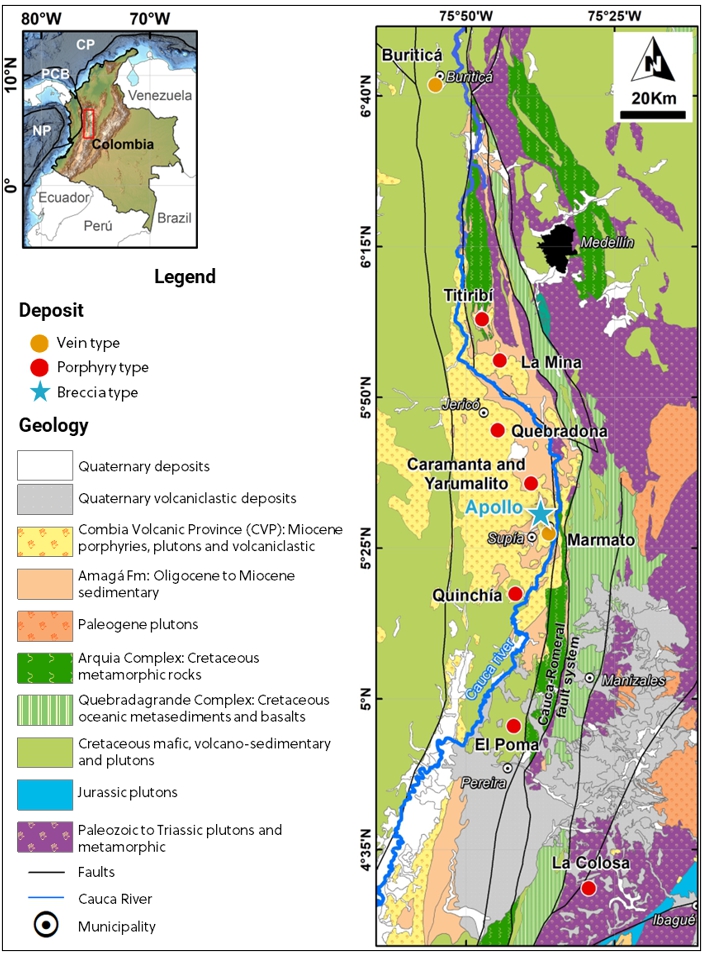
Figure 7.2: The geology and major gold deposits of the Middle Cauca Gold-Copper Belt showing the location of the Apollo deposit. Source: Collective (2026)
48
| Collective Mining Ltd. |
| Guayabales Project - Apollo Mineral Resource 2026-08 |
| 7.2 | District Geology |
The local geology of the Guayabales project area comprises the country rock of the Late Jurassic to Early Cretaceous Arquía Complex, an elongated, narrow, and discontinuous belt composed of carbonaceous, chloritic, and sericitic schists, as well as segments of ultramafic rocks with a low degree of metamorphism (Villagómez et al., 2011; Toussaint and Restrepo, 2020). Foliation in the schist packages typically dips gently to the southeast based on surface exposures and drill core intersections. The Arquía Complex forms roof pendants within the subsequent MVP intrusive bodies.
These rocks are overlain by two distinct Cenozoic units. The older is the Amagá Formation, a continental sedimentary sequence of conglomerate, sandstone and siltstone deposited by debris flows and braided fluvial systems within a pull-apart basin in the Cauca-Patía intermontane depression (Jaramillo et al., 2019; Leal-Mejía et al., 2019; Weber et al., 2020). The Amagá Formation is in turn overlain by the younger volcano-sedimentary Combia Volcanic Province (CVP; 9–4 Ma). The CVP locally exceeds 1,000 m in stratigraphic thickness and comprises intercalated basalt, andesite and tuff (Leal-Mejía et al., 2019; Weber et al., 2020; Villalba et al., 2023). Subvolcanic dioritic to quartz diorite porphyry stocks formed at the same time as the Combia volcanism and are genetically related to it. These stocks intrude the Amagá Formation. The late Miocene porphyry and porphyry-breccia bodies host Au-Ag-Cu-Mo mineralization, as well as late-stage polymetallic Au-Ag-Zn veins. All these mineralization styles have been observed across the targets discovered to date at the Guayabales Project.
| 7.3 | Local Geology |
The local geology of the Guayabales Project is presented in Figure 7.3, and the principal lithological units are summarized in Table 7.1. Geological interpretations are based on surface mapping completed by Collective, integrated with detailed geological logging of drill core. Bedrock exposure across the project area is limited, averaging approximately 5–10%. Much of the area is obscured by soil, volcanic ash, saprolite, dense vegetation, and landslide deposits. Consequently, the surface geological map is generalized and interpretative, with subsurface geological information from drilling providing an important constraint on lithological and structural interpretations.
The project area is characterized by multiphase porphyritic intrusions and associated magmatic-hydrothermal breccias, emplaced over a short duration between 6.7 ± 0.1 Ma and 6.5±0.1 Ma based on LA-ICP-MS weighted mean 206Pb/238U ages (Arredondo, 2026; Londono-Vanegas, 2026). These units are part of the Combia Volcanic Province (CVP). Basement rocks consist of various schists and ultramafic rocks of the Arquía Complex. Sandstones and mudstones of the Amagá Formation and remnant outliers of Combia Formation lavas and tuffs of basalt to andesite composition all located in the west of the project area (Figure 7.3).
49
| Collective Mining Ltd. |
| Guayabales Project - Apollo Mineral Resource 2026-08 |
The structural setting of the Guayabales Project is strongly influenced by the major Cauca-Romeral fault system, a large-scale strike-slip deformation zone that is followed by the Cauca River’s north trend. Lineament analysis of topographic data integrated with regional mapping and airborne magnetic data has identified North trending fault systems which are intersected by steeply dipping to subvertical NW-, WNW- and E-trending fault systems. The Guayabales shear zone is interpreted as a major NW-trending structural corridor that crosses the center of the Apollo deposit (Figure 7.3). It produces numerous subsidiary faults throughout the concession and is interpreted as the primary first-order fault system controlling the structural architecture of the district.
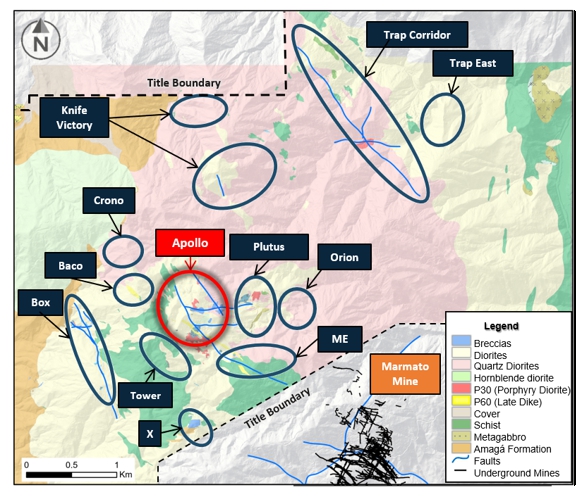
Figure 7.3: Geological map of the Guayabales Project showing targets. Source: Collective, 2026.
At the Guayabales Project, Au, Ag, Cu, Mo and WO3 mineralization is related to porphyry and reduced intrusion related systems, which are overprinted predominantly by carbonate base metal veins with Au, Ag, Pb and Zn, comprising steeply-dipping NW-WNW-trending veins and shallower-dipping EW-trending veins. Hydrothermal alteration related to porphyry mineralized systems include potassic, chlorite-sericite, albite, chlorite-epidote and intermediate argillic. The late vein overprints are associated with intense intermediate argillic alteration which is characterized by sericite, carbonates and pyrite. The reduced intrusive related system occurs at depth in Apollo and is associated with albite-actinolite alteration.
50
| Collective Mining Ltd. |
| Guayabales Project - Apollo Mineral Resource 2026-08 |
Table 7.1 Description of the main lithologies in the Guayabales Project.
| Lithology | Description |
| BXT (Tectonic Breccia) | Milled rock formed by the breaking and crushing of rocks due to tectonic forces, usually along fault zones. These breccias indicate fault movement and are important as pathways for fluids and zones of structural weakness. |
| Tuff | Consolidated volcanic rock composed primarily of compacted and cemented volcanic ash and small pyroclastic fragments. |
| Cover | Unconsolidated sediments—such as clays, silts, sands, gravels, tills, and peat—formed during the Quaternary Period. |
| Basalt | Small mafic bodies of dark greenish color with an aphanitic texture. |
| P60 | A late porphyry dyke striking ~310° characterized by plagioclase mega-phenocrysts >1 cm in size, set in a fine-grained groundmass, with chilled margins, and steeply dipping (>80°). |
| BAM (Mineralized Angular Breccia) | Sulfide-bearing angular breccia cemented by ore minerals and gangue. Cement texture occurs as massive, irregular and straight-walled fracture fills that crosscut clasts, as open-space fills between clasts and matrix, and as irregularly shaped vugs, with lesser veinlets cross-cutting the body. |
| BA (Angular Breccia) | Breccia with angular and transported clasts in a matrix of altered rock-flour, clast to matrix ratio varies from 8:2 to 9:1. Predominantly polymictic and clast-supported. Cement includes quartz, carbonate, pyrrhotite, pyrite, chalcopyrite, scheelite, sphalerite, and galena, with the dominant alteration characterized by sericite and chlorite. |
| BF (Fluidized Breccia) | Characterized by high milled-matrix content (>30 vol.%), rounded clasts, poorly sorted to chaotic, matrix supported, clast to matrix ratio averages approximately 7:3 and exhibit typical chlorite + sericite assemblages, share similar textures with the angular breccia, but lack significant mineralization. |
| BI (Igneous Breccia) | Breccia consisting of xenoliths of country rock and porphyry with a porphyry matrix. |
| BC (Crackle Breccia) | Breccia with only slight rotation of clasts relative to one another, with minimal displacement. The clasts often match along with their opposed sides. The matrix consists of comminuted wall rock (rock-flour, <0.1-1mm). |
| P55 | Medium-grained quartz diorite comprising ~25% quartz, ~30% plagioclase, and ~15% biotite, set in a fine- to cryptocrystalline felsic groundmass that constitutes approximately 50% of the rock. Equivalent to PT55 at Trap. |
| P50 | Fine-grained porphyry with euhedral biotite in an aphanitic groundmass. This body is the least common in the deposit and occurs as irregular dykes less than a few tens of meters wide. Equivalent to PT50 at Trap. |
| P40 | Medium-grained quartz diorite porphyry which covers the greatest extent of the project area. Crowded phenocrysts of plagioclase (35-40%), quartz (5-10%), biotite and hornblende (5-8%). The groundmass is aplitic containing fine quartz and plagioclase. Equivalent to PT40 at Trap. |
| P30 | Coarse-grained porphyry with finer crystalline groundmass with high density of quartz veinlets. The phenocryst to groundmass ratio is approximately 7:3. Equivalent to PT30 at Trap. |
| P20 | A medium-grained porphyritic diorite composed of crowded phenocrysts of plagioclase (~40%), quartz (<5%) and fine-grained biotite (~18%) with hornblende (~5%), apatite (~2%) and rutile (1-2%) replacing primary mafic minerals. The groundmass is fine-grained (<0.3 mm) and consists of microcrystalline quartz and plagioclase. Equivalent to PT20 at Trap. |
| P10 | Quartz diorite porphyry with large phenocrysts (1-2mm) of quartz (~12%), plagioclase (~30%) and biotite (~5%) with minor hornblende, apatite, and zircon. The quartz phenocrysts exhibit undulatory extinction and subtle indications of intracrystalline strain. Equivalent to PT10 at Trap. |
| Fine diorite | Diorite porphyry of dark to light gray colour with fine-grained groundmass and phenocrysts of plagioclase (35–40%), quartz (<5%), and hornblende (7%). |
| Coarse diorite | Multiple quartz diorite porphyries are present with different textures. They are dark to light gray and medium to coarse grained phenocrysts of plagioclase (35-45%), quartz (5-10%), biotite and hornblende (5-10%). |
| Diorite | Multiple diorite porphyries are present with different textures. Dark to light gray in colour with medium grained phenocrysts of plagioclase (35-60%), quartz (<5%), hornblende and biotite (<10%). |
| Hornblende diorite | Diorite porphyry, dark to light gray colour, porphyritic to equigranular texture. Microcrystalline groundmass with hornblende phenocrysts (7–10%). |
| Amagá Formation | Sandstones, siltstones, and coal seams. |
| Arquía Complex | The complex includes serpentine schist, metagabbro, garnet-bearing amphibolite, quartz-sericite schist with variable content of quartz segregations, chloritic schist, and ultramafic rocks. |
51
| Collective Mining Ltd. |
| Guayabales Project - Apollo Mineral Resource 2026-08 |
| 7.4 | Geology of the Apollo Deposit |
The host rocks are several different phases of diorite and quartz diorite porphyry. The diorite porphyry has phenocrysts of plagioclase and hornblende. The grain size and percentage of phenocrysts varies and a crowded porphyritic texture is common (Figure 7.5). The quartz diorite porphyry has phenocrysts of biotite and hornblende that are often replaced by sulfides, and 30% plagioclase, 5-10% quartz eyes with a microcrystalline quartz - K feldspar groundmass. Figure 7.5 and Figure 7.6 show the main reference charts illustrating the textural classifications of the lithologies from Apollo specifically.
The Apollo deposit comprises a vertically extensive, intrusion-related breccia and vein system hosting Au, Ag, Cu and WO₃ mineralization within a composite diorite–quartz diorite porphyry sequence. The broader mineralized footprint, defined by surface mapping and drilling of the breccia body and enveloping vein systems, extends over roughly 1,000 m by 800 m and is open in several directions at depth, with drilling to date reaching 1,400 m. Mineralization is focused within an inverted funnel-shaped breccia body that narrows near surface and widens at depth, and within associated vein zones and crackle-brecciated porphyries. The northern part of the system, historically referred to as Olympus, is characterized by an Au–Ag vein corridor that forms part of the broader Apollo mineralized envelope.
| 7.4.1 | Lithology |
The porphyry suite is dominated by diorite and quartz diorite, with P10 to P55 representing pre-breccia intrusions and the P60 emplaced post-breccia (See Figure 7.4, Figure 7.5 and Table 7.1). P10 and P20 are medium-grained, porphyritic precursor intrusions, while P30 displays an equigranular to porphyritic texture at a similarly medium grain size. These earlier phases are crosscut by P40, the volumetrically largest porphyry phase in the deposit, a medium-grained quartz diorite porphyry. The P50 and P55 are intermineral, fine-grained porphyritic quartz diorites.
The Apollo system is cut by a late diorite porphyry dyke (P60) that trends NW and crosscuts the mineralized breccia and vein network (Figure 7.4). This dyke is aphanitic to fine-grained with prominent plagioclase phenocrysts, exhibits epidote-chlorite alteration, and lacks significant sulfide mineralization, indicating a post-mineral timing relative to the Apollo system. The dyke can be traced regionally across other deposits (Marmato and Aguas Claras), providing a useful stratigraphic and structural marker within the district.
52
| Collective Mining Ltd. |
| Guayabales Project - Apollo Mineral Resource 2026-08 |
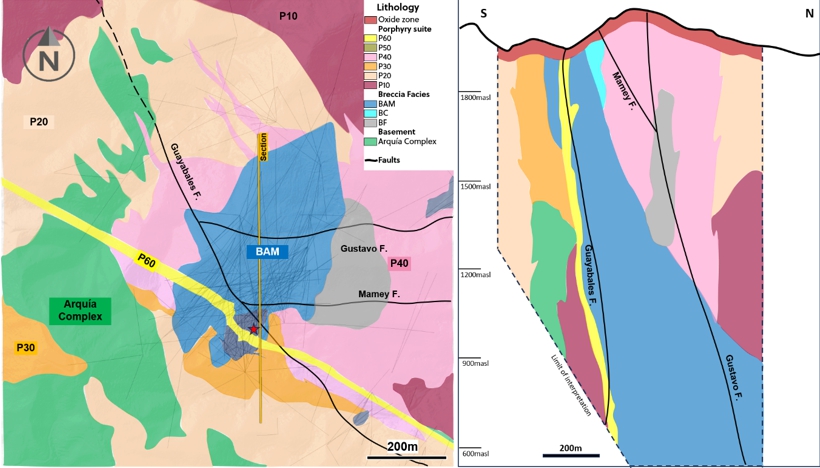
Figure 7.4: Surface geology map of the Apollo deposit and N- S interpreted geology section across the Apollo deposit (same section line used for the alteration and mineralization sections). Source: Collective, 2026.
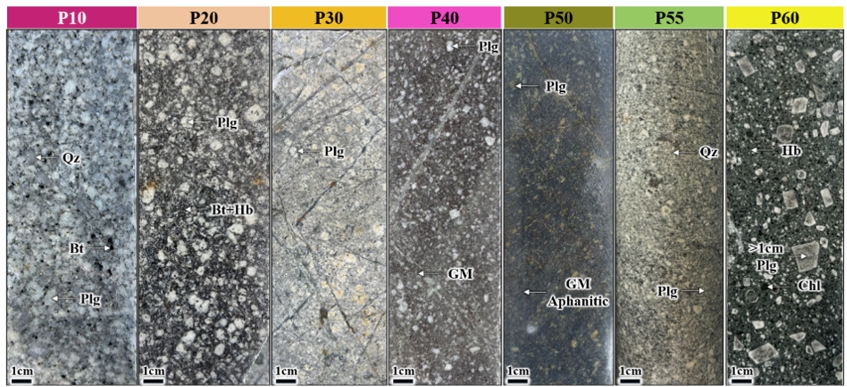
Figure 7.5: Core sample photographs of the Apollo porphyries. Source: Collective, 2026.
Multiple breccias are present within the Guayabales Project. They are classified as hydrothermal breccias and magmatic breccias. The hydrothermal breccias exhibit textural variability ranging from matrix-supported to clast-supported fabrics, with a matrix comprising sericite, carbonates, sulfides, quartz, and rock flour (Figure 7.6). They display pervasive sericitic alteration affecting both clasts and matrix. The fragments are subangular to subrounded and host abundant sulfides including pyrite, chalcopyrite and pyrrhotite. The Apollo target hosts significant breccia bodies that host high-grade mineralization. Four breccia facies have been described: 1) crackle breccia, 2) shingle breccia, 3) angular breccia, and 4) fluidized breccia (Figure 7.6 and Table 7.1). The magmatic breccias consist of clasts or xenoliths of country rock and early porphyries with an igneous matrix. These breccias commonly occur along the margins of intrusive bodies.
53
| Collective Mining Ltd. |
| Guayabales Project - Apollo Mineral Resource 2026-08 |
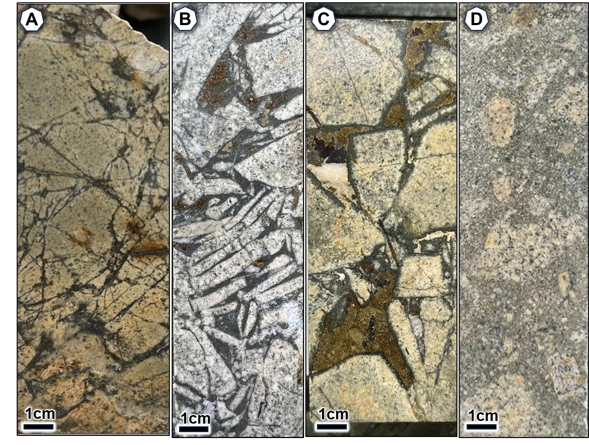
Figure 7.6: Core sample photographs of the breccia facies present at Apollo deposit. A) Monomict crackle breccia with green chlorite filling fractures and open spaces. B) Shingle breccia. C) Sulfide-bearing angular breccia, with cement of ore minerals and gangue. D) Fluidized breccia. Source: Collective, 2026.
| 7.4.2 | Structural Architecture |
The geological setting of the Apollo Deposit is bounded on the east by the major Cauca-Romeral fault system, a crustal-scale polygenic deformation zone that follows the Cauca River’s northerly trend (Figure 7.7). Lineament analyses of topography data integrated with regional mapping has identified that N-trending fault systems are intersected by steeply dipping to subvertical NW, WNW-, and E-trending fault or fracture systems. The NW-trending Guayabales fault is a major structural corridor, well constrained by drillhole and outcrop data, extending from the Marmato deposit to the southeast and crosses the center of the project area (Santacruz et al., 2021). Numerous subsidiary faults are also present throughout the concession. Although not showing any significant post-mineral fault displacement, the Guayabales shear zone is interpreted as the first-order fault system controlling the structural architecture of the district.
54
| Collective Mining Ltd. |
| Guayabales Project - Apollo Mineral Resource 2026-08 |
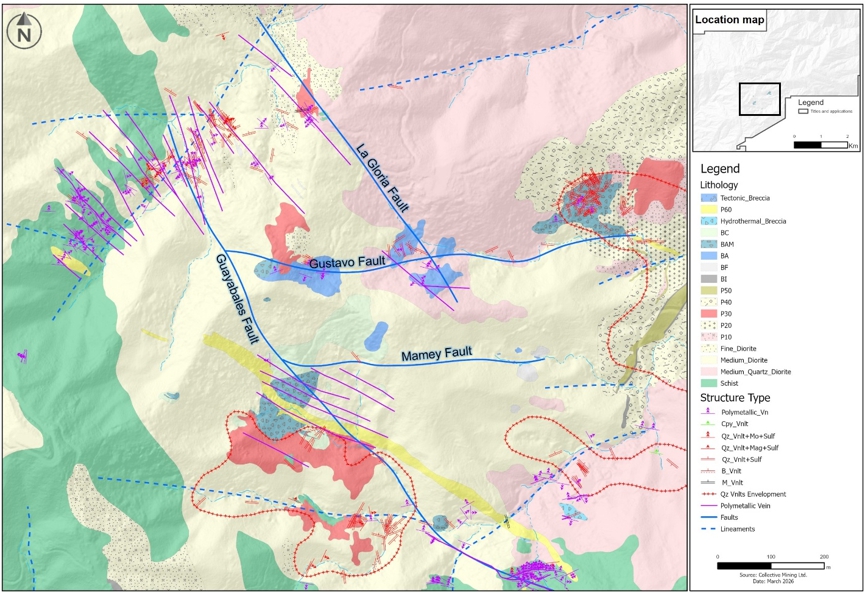
Figure 7.7: Structural geology map of the Apollo deposit, showing the main faults, and structural controls on mineralization. Source: Collective, 2026.
| 7.4.3 | Hydrothermal Alteration |
Hydrothermal alteration at Apollo comprises potassic, propylitic (chlorite-epidote), chlorite-sericite (phyllic), albite and intermediate argillic assemblages, present with varying intensity and style across the deposit (Figure 7.8). Potassic alteration is characterized by replacement of mafic minerals by secondary biotite, magnetite and, locally, epidote. These minerals are also associated with quartz veins, with secondary biotite identified in vein halos. Propylitic (chlorite-epidote) alteration overprints mafic minerals and is developed mainly in the outer zones surrounding the potassic alteration. Chlorite-sericite (phyllic) alteration overprints earlier secondary biotite associated with the porphyry stockwork and is the most abundant alteration style across the entire Apollo deposit. Intermediate argillic alteration (illite-sericite, with kaolinite at shallow levels) occurs as selvedges/haloes on carbonate base metal (CBM) veins and along associated fault zones, marking zones of enhanced permeability and brittle deformation. These vein-and-alteration corridors are a property-wide feature, cutting across the potassic and phyllic assemblages. At Apollo, this corridor has been intersected in drilling over a vertical extent of approximately 1,000 m, extending northward into brecciated wall rocks, and laterally along peripheral veins for approximately 0.8 km to NW.
55
| Collective Mining Ltd. |
| Guayabales Project - Apollo Mineral Resource 2026-08 |
At deeper levels, particularly within the breccia and crackled porphyry domains, a sodic-calcic assemblage of albite ± actinolite ± epidote locally replaces the breccia matrix and primary minerals, and is spatially associated with higher Au grades. This alteration pattern, together with the observed mineralogical and metal zonation, supports an interpretation of Apollo as a partially reduced, vertically zoned intrusion-related system with significant precious-metal potential.
Potassic Alteration (Secondary biotite)
Potassic alteration associated with the early porphyry phase of mineralization is restricted to the P10-P30 porphyry suite and is absent in P40-P50. It consists of secondary biotite–rutile–quartz replacement of sparse igneous hornblende. Both igneous biotite phenocrysts and the sparse secondary (hydrothermal) biotite are variably altered to chlorite. A weak dusting of plagioclase by white mica, likely muscovite, and quartz accompanied the chlorite overprint.
Secondary biotite–rutile–quartz is also preserved at depth in the southern portions of the breccia, below approximately 1,700 m elevation, and extends into the wall-rock P10 porphyry (Figure 7.8). It is expressed as pervasive replacement of primary hornblende in the rock and in the rock flour by fine-grained, dark brown secondary biotite, accompanied by rutile, magnetite and very minor K-feldspar (Figure 7.9). Secondary biotite overprints igneous hornblende in both the rock and the rock flour.
Phyllic Alteration (Chlorite-sericite)
Chlorite-sericite assemblage is the most widespread and dominant assemblage in the Apollo breccia. It is spatially associated with the pervasive sulfide minerals along with carbonates and minor quartz (Figure 7.9). It affects the matrix and clasts of the angular breccia facies, the adjacent P40 and P55 porphyries, and, to a lesser extent, the crackle breccia margins where it overprints older potassic assemblages. The chlorite-sericite assemblage consists of chamosite (Fe-rich chlorite) > muscovite - illite + calcite with subordinate siderite and ankerite (Figure 7.9). The white mica shows intermediate crystallinity between muscovite and illite, although it seems likely that the tendency toward illite represents a lower temperature overprint on muscovite.
The chlorite - sericite assemblages display a carbonate-rich variant at Apollo in which ankerite and siderite are major components of the breccia matrix, along with chamosite and muscovite. This assemblage is spatially coincided with the highest concentration of sulfide minerals including pyrrhotite, pyrite, chalcopyrite, native gold, electrum, argentite, native silver, and scheelite (Figure 7.8).
Sodic-Calcic Alteration (Albite ± Actinolite)
The deeper levels of the Apollo deposit, from approximately 1,100 m below surface, are affected by a sodic-calcic alteration assemblage dominated by albite ± actinolite ± epidote (Figure 7.9). This alteration is best developed within the Ramp Zone, where it occurs as pervasive to selective replacement of the groundmass/matrix and, locally, of primary mineral phases within the host rocks, particularly those assigned to the P10–P55 intrusive phases. Albite is the dominant phase, commonly expressed as partial to complete replacement of feldspar and fine-grained matrix material, whereas actinolite and epidote are subordinate, occurring as disseminated minerals, replacement aggregates, and fracture- or vein-controlled phases.
56
| Collective Mining Ltd. |
| Guayabales Project - Apollo Mineral Resource 2026-08 |
The sodic-calcic alteration is spatially associated with the deeper mineralized domain (the Ramp Zone) of Apollo and coincides with elevated gold grades and increased bismuth and telluride concentrations (Figure 7.8). This relationship suggests that the alteration represents an important hydrothermal process linked to a distinct mineralizing environment at depth, potentially reflecting a more proximal or higher-temperature component of the Apollo hydrothermal system relative to the shallower alteration assemblages. The Ramp Zone alteration assemblages have been verified through thin-section petrography and X-ray diffraction (XRD) mineralogical analyses.
Intermediate Argillic Alteration (Illite ± Kaolinite)
An intermediate argillic alteration assemblage overprints the earlier secondary biotite, chlorite-epidote, and chlorite-sericite assemblages, representing the youngest and volumetrically most minor alteration event within the Apollo deposit (Figure 7.8). It occurs continuously from the deepest portions of the deposit through to the shallowest parts of the deposit, as well as within fault rocks, and forms halos around post-breccia carbonate-base metal (CBM) veins and cavity infill. Outside the breccia, particularly to the north, it similarly borders corridors of CBM veins.
The assemblage is characterized by strong, pervasive sericite (illite) and kaolinite formed after former plagioclase (Figure 7.9), together with montmorillonite, smectite, calcite, siderite and ankerite, and minor quartz. It is associated with pyrite, Fe-rich sphalerite (marmatite), galena, sulfosalts, minor quartz and chalcopyrite. Vertically, the assemblage grades from the chlorite-sericite (phyllic) assemblage below approximately 1,700 m elevation, above which kaolinite becomes the dominant clay phase — a zonation interpreted to reflect decreasing temperatures of fluid-rock interaction toward the paleosurface, rather than a strict elevation-controlled presence/absence of the vein halos.
Propylitic Alteration (Epidote-Chlorite)
Propylitic alteration forms a peripheral halo around the Apollo breccia complex and is characterized by chlorite–epidote–calcite–pyrite assemblages that overprint primary mafic silicates and plagioclase in the host rocks (Figure 7.9). Chlorite and epidote occur as selective replacements, disseminations, and locally along fractures, veinlets, and permeable intrusive contacts. Calcite is commonly veinlet-controlled, whereas pyrite is present as a minor accessory sulfide.
The alteration is moderately pervasive along the northern margin of the breccia complex but is weaker and more discontinuous in the southern early pre-breccia porphyry Cu–Au stockwork domain. Weak chlorite–epidote alteration also occurs along intrusive contacts and locally within post-breccia P60 dykes throughout the property (Figure 7.8). This distribution is consistent with a late, distal hydrothermal overprint developed outward from the principal breccia-hosted and intrusive-related mineralized system.
57
| Collective Mining Ltd. |
| Guayabales Project - Apollo Mineral Resource 2026-08 |
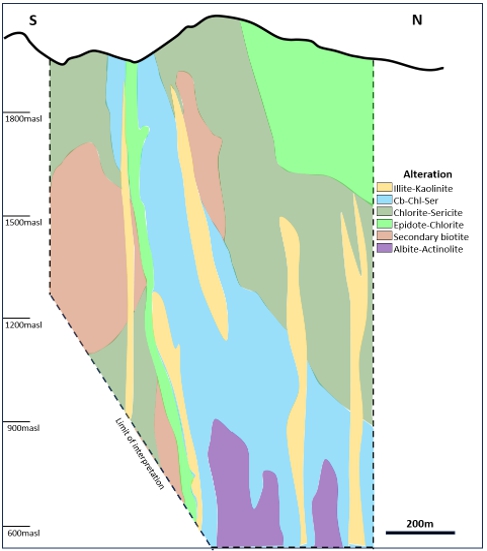
Figure 7.8: North-south cross-section through the Apollo deposit showing the distribution of hydrothermal alteration types. Source: Collective, 2026.
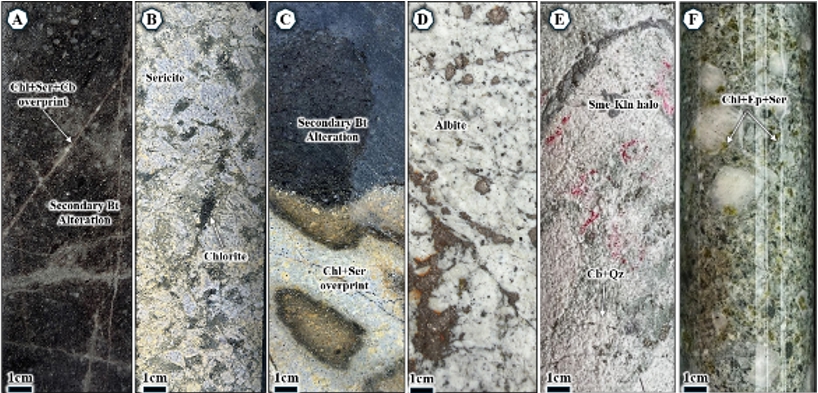
Figure 7.9: Photographs of core samples show the main textures and features of Hydrothermal Alteration Types within the Apollo deposit. (A) Secondary biotite in groundmass formed after igneous amphiboles cut by chlorite-sericite-carbonate halos to veinlets. (B) Typical chlorite sericite assemblage in the Apollo deposit. (C) Typical chlorite-sericite-carbonate alteration related to the main breccia event overprinting former secondary biotite alteration. (D) Albite alteration. (E) Intermediate argillic alteration. It is restricted to Carbonate Base Metal veins (CBM). (F) Chlorite-epidote-carbonate-quartz-pyrite veinlets are mainly found in P60. Source: Collective, 2026.
58
| Collective Mining Ltd. |
| Guayabales Project - Apollo Mineral Resource 2026-08 |
| 7.4.4 | Mineralization |
Mineralization is multistage and interpreted to have evolved from an early porphyry-style Cu–Mo–Au stockwork stage into breccia-hosted sulfide mineralization and scheelite, deep sulfide-rich Au–Ag–Bi–Te crackle breccias, and late carbonate–base metal veins (Figure 7.10). Early porphyry-style mineralization is hosted in quartz diorite porphyry phases and preserved locally as mineralized clasts within the breccia, indicating that porphyry mineralization predates breccia formation (Figure 7.11). The main breccia-hosted stages carry Au, Ag, Cu and WO₃ associated with pyrite–chalcopyrite replacing earlier pyrrhotite, with chalcopyrite and scheelite being more developed near the top of the breccia. Chalcopyrite and pyrite are more prevalent at shallow to intermediate levels (Surface to 600m below surface, Figure 7.11) with pyrrhotite more prevalent below this. At greater depths, sulfide-rich crackle breccias and crackled porphyries host Au–Ag–Bi–Te mineralization, consistent with a reduced intrusion-related gold system (RIRGS) style, while late CBM veins introduce coarse native gold and base metals in structurally prepared zones (Figure 7.12).
The mineralization is zoned vertically and comprises: 1) an upper zone of Au-Ag-Cu-WO3 to 150 m depth; 2) Au-Ag-Cu to 500-600 m depth; 3) Au-Ag to 1,000 m depth; and 4) Au-Ag-Bi-Te from 1,000 m depth to >1,350 m depth (Figure 7.10). Four styles of primary or hypogene mineralization occur in the project: porphyry, breccias, polymetallic veins and reduced intrusion-related gold mineralization (RIRGS), as well as supergene oxide mineralization.
59
| Collective Mining Ltd. |
| Guayabales Project - Apollo Mineral Resource 2026-08 |
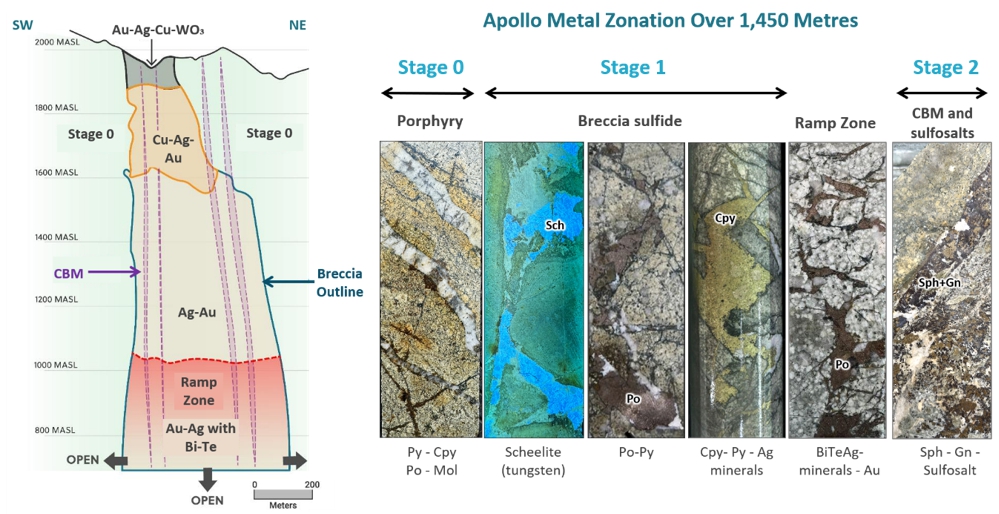
Figure 7.10: Apollo Porphyry System model with stages of mineralization. Source: Collective, 2026.
60
| Collective Mining Ltd. |
| Guayabales Project - Apollo Mineral Resource 2026-08 |
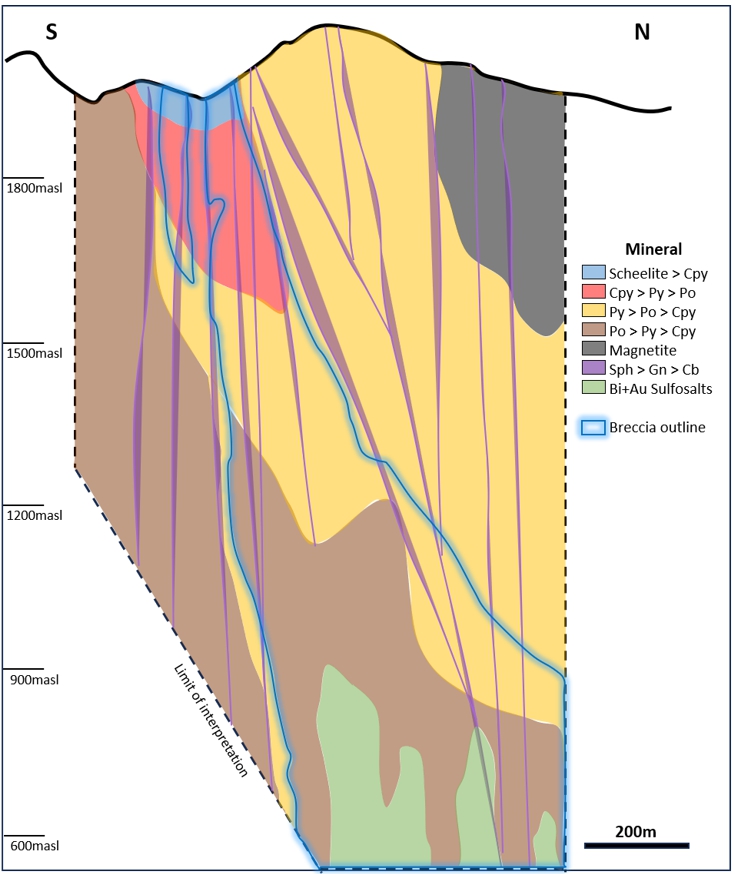
Figure 7.11: North-south cross-section through the Apollo deposit showing the vertical distribution of minerals. Source: Collective, 2026.
Porphyry-type stage
Veins and stockwork mineralization are principally hosted in the P10, P20 and P30 Apollo porphyry units, with the highest vein frequency at shallow levels where the P30 porphyry dominates. In this interval, a dense array of quartz–pyrite–pyrrhotite–chalcopyrite–molybdenite sheeted veins are present, together with disseminated sulfides in the porphyry groundmass (Figure 7.12). These quartz–sulfide veins occur as subparallel to sheeted sets and locally as closely spaced stockwork, forming vein networks within the P10–30 porphyry units. The same quartz–pyrite–pyrrhotite–chalcopyrite–molybdenite vein assemblage is also observed as clasts within the Apollo angular breccia body.
61
| Collective Mining Ltd. |
| Guayabales Project - Apollo Mineral Resource 2026-08 |
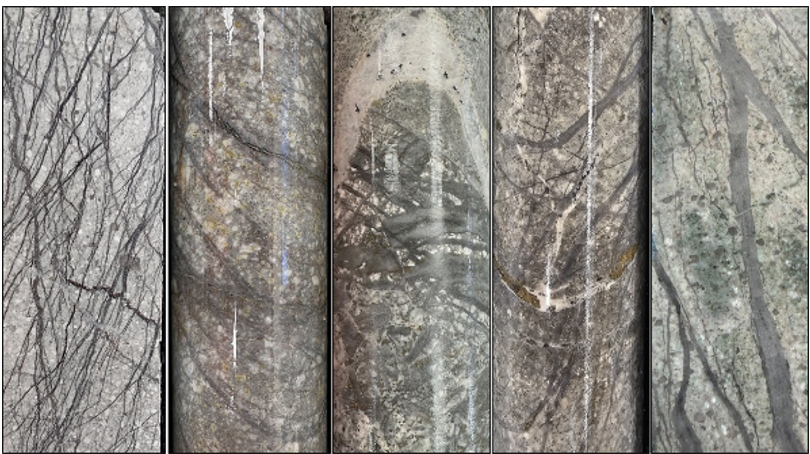
Figure 7.12: Porphyry-related veinlet types identified at the Apollo deposit. Source: Collective, 2026.
Breccia Tungsten-Sulfide stage
Ore forming minerals in the Apollo breccia are spatially associated with the phyllic assemblage in the angular breccia, with only minor sulfide minerals in the crackle breccia and few in the fluidized breccia facies (Figure 7.11). Two sub-stages are recognized: an early high-temperature reduced sub-stage of scheelite, followed by a chalcopyrite – pyrite – pyrrhotite substage that is overprinted by polymetallic veins.
The scheelite substage (tungsten zone)
The scheelite substage is concentrated in the upper margins of the breccia in an area where graphite-bearing Arquía Complex metapelites occur as roof pendants and as clasts within the breccia. Its occurrence indicates localized W-bearing hydrothermal fluid interaction within the upper breccia system, likely influenced by the presence of reactive carbonaceous metasedimentary rocks and breccia-related permeability. Scheelite occurs predominantly as euhedral, yellow- to tan-coloured crystals disseminated within the breccia cement.
Scheelite mineralization has an approximately 150 m vertical extent and is spatially restricted relative to the broader Au–Ag–Cu mineralized system. Scheelite also occurs at deeper levels along the margins of the breccia body, particularly where crackle breccias are developed. A zone of more significant scheelite occurrence is present immediately below the main scheelite zone, although it remains volumetrically smaller than the main zone itself. Scheelite becomes increasingly sparse further down-dip. Locally, scheelite is partially overprinted by the younger chalcopyrite–pyrite–pyrrhotite substages (Figure 7.13)
62
| Collective Mining Ltd. |
| Guayabales Project - Apollo Mineral Resource 2026-08 |
The chalcopyrite-pyrite-pyrrhotite substage (copper zone)
The chalcopyrite–pyrite–pyrrhotite substage represents a major sulfide mineralization event within the Apollo breccia system and overlaps the tungsten zone. The highest concentrations of iron sulfides occur as breccia-matrix cement and are associated with chlorite–sericite and carbonate-rich chlorite–sericite alteration assemblages. Minor pyrite and pyrrhotite are also present within fluidized and crackle breccia facies. Pyrrhotite becomes the dominant iron-sulfide species toward the southern portion of the breccia body and at depth, where it commonly replaced chamosite-altered rock flour within the breccia matrix. Pyrrhotite was subsequently replaced, in part, by chalcopyrite and pyrite, indicating progressive sulfide deposition during this mineralizing substage (Figure 7.13).
Copper–iron sulfides in the Apollo system are dominated by chalcopyrite, which occurs principally as breccia-matrix cement and locally as replacement of earlier pyrrhotite. Chalcopyrite is most strongly concentrated within the upper approximately 500 vertical m below surface and decreases abruptly below the 1,550 m elevation (Figure 7.11). The chalcopyrite-rich zone is characterized by abundant chalcopyrite with pyrite, Ag-bearing minerals, and late Cu–Ag-rich sulfosalts. This vertical zonation, together with the southward and downward increase in pyrrhotite, reflects changes in the physical and chemical conditions of the mineralizing fluids through the breccia system.
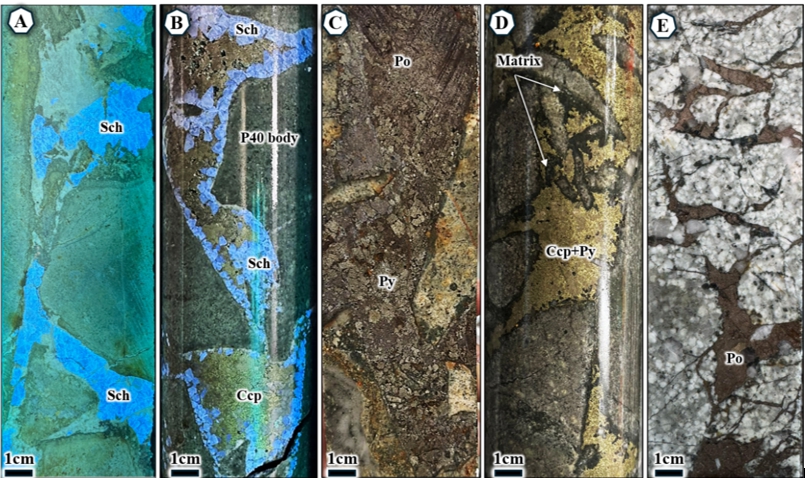
Figure 7.13: Breccia types at the Apollo target, showing different sulfide and non-sulfide cement types including chalcopyrite, pyrrhotite, pyrite, scheelite, carbonates and quartz. Rock flour is altered to chlorite and sericite. (A, B) Scheelite cement, shown fluorescing blue under short-wave UV light; (C) Pyrrhotite cementing the breccia; (D) Chalcopyrite cement; (E) Typical Ramp Zone assemblage of pyrrhotite and sulfosalts. Source: Collective, 2026.
63
| Collective Mining Ltd. |
| Guayabales Project - Apollo Mineral Resource 2026-08 |
Post-breccia carbonate base metal stage
Late carbonate and base metal (CBM) veins are widespread throughout the Apollo deposit and overprint the earlier scheelite and chalcopyrite–pyrite–pyrrhotite mineral assemblages. They are composed principally of Fe-rich sphalerite (marmatite), galena, siderite, ankerite, pyrite, and minor quartz, together with variable Cu–Ag-rich and Zn-rich sulfosalts (Figure 7.14). The CBM assemblage occurs as discrete veins and as late cement within open spaces and cavities preserved after breccia formation and earlier sulfide cementation.
The veins extend to depths greater than 1 km below surface, including below the 1,000 m elevation (Figure 7.11), and generally strike northwest–southeast and east–west, with steep east-northeast or west-southwest dips. Individual veins range from approximately 0.5 m to 5 m in width and locally form significant mineralized zones. Their structural continuity and infill of late-stage cavities indicate emplacement during a late, structurally controlled hydrothermal event. The CBM veins are associated with high-grade visible gold, indicating that late carbonate- and base-metal-rich fluids contributed to local gold upgrading within the Apollo mineralized system.
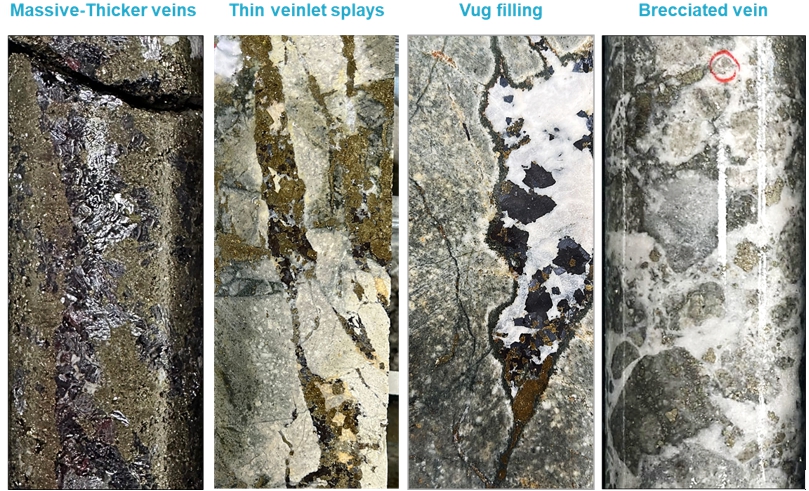
Figure 7.14: Representative images of the Carbonate Base Metal veins type of mineralization at the Apollo Deposit. CBM veins sulfide content is dominated by Fe-rich sphalerite (Marmatite) and galena. Sulfosalts are also present in this late-stage mineralization. Source: Collective, 2026.
64
| Collective Mining Ltd. |
| Guayabales Project - Apollo Mineral Resource 2026-08 |
Multiple high-grade Au-Ag zones have been recognized by Collective’s drilling. The high-grade subzones represent structurally controlled zones of CBM mineralization that are localized at the intersection of steeply dipping northwestern (NW) and eastern (EW) trending veins, both along strike and down-dip, which display a low-dipping angle. These zones are found within and outside the main breccia body. These Subzones are composed of Au, pyrite, galena, sphalerite and carbonate. One of the high-grade subzones measures in excess of 230 m of strike by more than 70 m width and over 180 m vertically. Additional high-grade (>5 g/t Au) subzones are confirmed by drilling where tested, and are potentially present elsewhere across the Apollo system at analogous structural intersections that remain untested.
Ramp Zone mineralization (Gold Zone)
The Ramp Zone is a deep, high-grade, gold dominant mineralized domain within the Apollo deposit, developed along the outer margin-contact zone of the breccia body and commencing at approximately 1,000 m below surface. Mineralization is characterized by an Au–Bi–Te association hosted in sulfide-rich veins and veinlet stockworks, hydrothermally altered breccias, crackle-brecciated porphyries, fractures, and locally miarolitic cavities (Figure 7.15). Its distribution is controlled by NW- and EW-trending structures and enhanced by the high permeability of breccia facies and structurally prepared porphyry contacts. Alteration within the zone is dominated by biotite and sodic-calcic assemblages comprising albite ± actinolite ± epidote, with locally developed muscovite–sericite alteration.
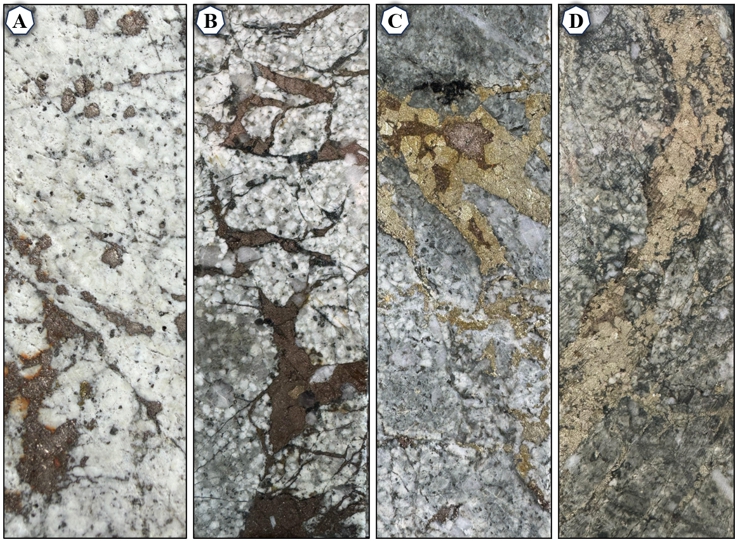
Figure 7.15: Representative images of the Ramp Zone mineralization. (A-B) Pyrrhotite and sulfosalts with associated albite alteration; (C-D) Pyrite and pyrrhotite infilling cracks. Source: Collective, 2026.
65
| Collective Mining Ltd. |
| Guayabales Project - Apollo Mineral Resource 2026-08 |
Mineralogically, the assemblage includes pyrrhotite, pyrite, chalcopyrite, arsenopyrite and galena, with electrum, free gold (>1 mm), minor native gold, Bi-Ag-(Pb-Sb) sulfosalts, Ag tellurides including hessite (Ag₂Te) and cervelleite (Ag₃TeS), argentite (Ag2S), bismuthinite (B2iS3), and native bismuth. The reported Bi-Ag-(Pb-Sb) sulfosalts include ourayite (Ag₃Pb₄Bi₅S₁₃), matildite (AgBiS₂), owyheeite (Pb₇Ag₂(Sb,Bi)₈S₂₀), benleonardite (Ag₈(Sb,As)Te₂S₃), and sternbergite (AgFe₂S₃). The ratio of pyrrhotite to pyrite increases within the breccia matrix, reflecting a reduced sulfidation state in the core of the mineralized system. In one sample overprinted by CBM, the Ag-Sb sulfosalts freibergite (Ag₆(Cu₄Fe₂)Sb₄S₁₂) and stephanite (Ag₅SbS₄) are present.
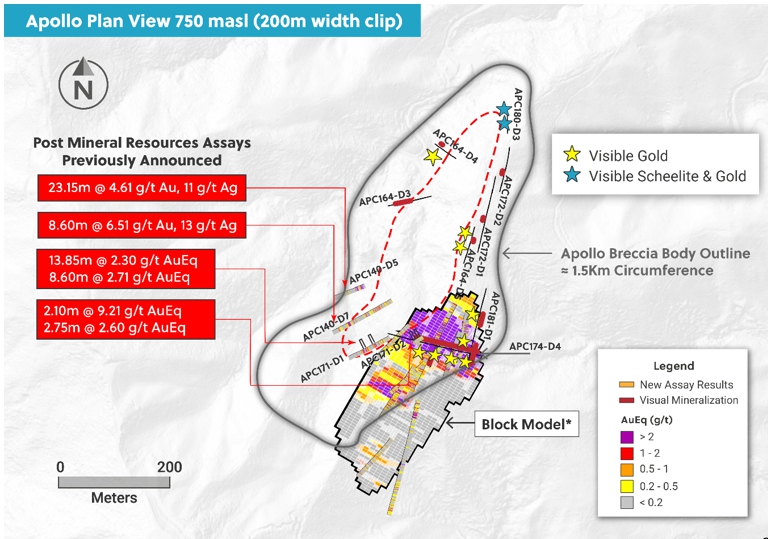
Figure 7.16: Ramp Zone – Plan View at 750 masl. Source: Collective, 2026.
Drilling has defined the Ramp Zone over at least 350 m vertically and approximately 315 m along strike, with mineralization remaining open at depth and along the projected breccia margin in several directions. In plan view, the mineralized domain is interpreted to form a ring-like geometry around the breccia body reflecting the contact zone between the mineralized breccia and surrounding porphyry intrusive (Figure 7.16). The southeast and upper part of this circumference has been drilled with sufficient drill density to define a mineral resource. Additional drill intercepts from recent drilling in the west are consistent with the interpretation of the contact model and provide support for the proposed exploration to further define the Ramp Zone. Visual logging from recently completed holes in the north also highlight the presence of Ramp Zone style mineralization and include observations of visible gold. Including previously reported drilling along the southeastern and western margins, approximately 470 meters of the interpreted 1.5-kilometer circumference of the Apollo breccia body at depth has now been tested for Ramp Zone mineralization. Only 315 meters of this circumference had sufficient drilling density for inclusion in the maiden Mineral Resource. This circumference geometry related to the breccia margins, together with the Au–Bi–Te geochemical signature, intense albite alteration and pyrrhotite-rich sulfide assemblage, is consistent with a structurally focused reduced intrusion-related gold system. Oriented-core measurements and acoustic televiewer data indicate that drilling to-date has intersected the principal mineralized structures at near-orthogonal angles, supporting the interpretation of the geometry and continuity of the mineralized domain.
66
| Collective Mining Ltd. |
| Guayabales Project - Apollo Mineral Resource 2026-08 |
Supergene Oxide Zone
The Apollo deposit is capped by a supergene weathering profile, comprising saprolite, saprock, and a mixed or transitional oxide-sulfide zone, locally extending down to fresh rock. This weathering profile ranges from 30 to 150 m in total thickness, with saprolite and saprock together accounting for approximately 50 to 60 m of this interval and is particularly well developed at the uppermost elevations (>1,800 m). The saprolite consists of clay and goethite with no preserved relict rock texture, whereas the saprock is defined by clay and goethite alteration with original rock textures still visible. Downward transition into the mixed oxide-sulfide zone marks the gradual return of primary sulfide mineralization. Gold and silver grades appear to be locally enriched within the supergene profile, while Cu is depleted throughout the upper oxidized zone (saprolite and saprock) due to leaching. Copper grade increases with depth in the mixed zone, coincident with the appearance of primary copper sulfides. However, no distinct supergene Cu enrichment zone has been recognized.
The Shallow Halo Zone (“SHZ”) is defined by the broader Apollo footprint at surface and includes outcropping mineralised breccia and the enveloping CBM vein systems. The SHZ is an interpreted 2.4-kilometer-long, 200-meter-wide, precious metal-dominant target area which currently lies within the Mineral Resource open-pit shell. In the supergene profile, the SHZ represents the mineralized portion of the oxide to partially oxidized diorite, hosting gold and silver with minor copper (Figure 7.17). Au-Ag mineralization within the SHZ is not ubiquitous but is instead preferentially developed where favourable oxide/transitional weathering conditions coincide with structural and lithological controls in relation to CBM vein systems. The SHZ is largely untested by drilling at this point in time and consists primarily of outcropping and subcropping mineralized rock. SHZ mineralization is better developed within the oxide and transitional zones and is interpreted to reflect secondary dispersion and enrichment of metals during weathering and groundwater processes, consistent with the supergene enrichment patterns described above.
67
| Collective Mining Ltd. |
| Guayabales Project - Apollo Mineral Resource 2026-08 |
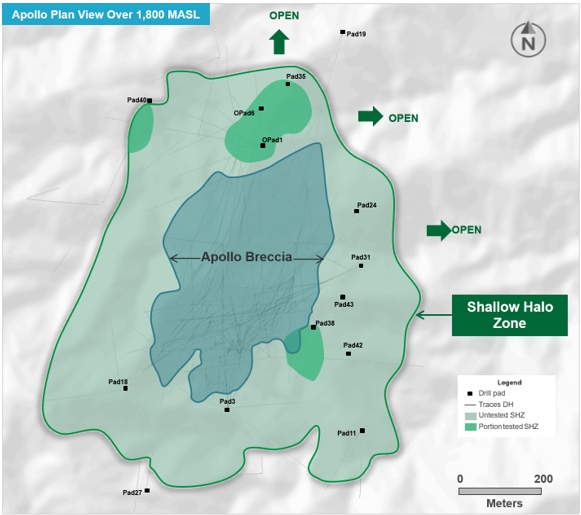
Figure 7.17: Plan View of the Apollo Deposit Highlighting the Shallow Halo Zone. Source: Collective, 2026.
| 7.5 | Conclusions |
The Apollo system remains open in several directions, with the mineralized footprint defined by drilling to date extending beyond the currently modelled zone of mineralization:
| ● | Shallow Halo Zone: open in multiple directions around the current pit outline, with untested areas to the south, west and north coincident with Au-Ag-Cu-W, Pb, Zn surface geochemical anomalies. A dedicated shallow drilling program is planned to test this whole area and determine if the footprint can be extended particularly northwards. | |
| ● | Upper underground (above 1,000 masl): sparsely drilled areas along the north-eastern and south-western margins of the breccia body represent opportunities to test for lateral extensions of the mineralized system particularly with respect to CBM vein systems and breccia margins. | |
| ● | Northern Breccia Extension (above 1,000 masl): identified approximately 150 m north-east of the currently defined mineralization, where recent drilling has returned broad intercepts outside the presently modelled extent of the breccia system. | |
| ● | Ramp Zone (below 1,000 masl): approximately 80% of the interpreted 1.5-kilometer circumference remains undrilled at a density sufficient for confident geological interpretation, and the zone remains open at depth below the deepest drilling completed to date. Higher-capacity drill rigs are being mobilized to test the Ramp Zone at depth. |
68
| Collective Mining Ltd. |
| Guayabales Project - Apollo Mineral Resource 2026-08 |
Significant Mineralized Zones
Collective has identified 14 targets for exploration at the Guayabales Project (Redwood, 2025) that are shown on Figure 7.3 and summarized in Table 7.2. The majority of the drilling to date has focused on the Apollo target (73.8% of drilled meters, see Section 10.2.1) and the Trap target (11.0%).
Table 7.2 Summary of the geology of the targets identified in the Guayabales Project.
| No. | Target | Former Names |
Area (m) | Geology | Alteration | Mineralization | Geochemistry (soil, rock) | Style |
| 1 | Apollo | Olympus (ex La Llorona) | 1000 x 800 | Hydrothermal breccias, Dio and Qdio porphyry, schist | Chl-Ser, Bt, Argillic | Cpy-Po-Py-Mo-Sch-Sph-Gn-Sulfosalts | Cu-Bi-W-As-Au-Sn-Ag | Breccia - CBM |
| 2 | Trap | Victory Central | 2000 x 1000 | Qdio porphyry, Schist | Ser, Chl-Epi, Bt | Py-Mt-Cc-Mo-Sph-Gn-Sulfosalts | Ag-Au-Cu-Mo | Porphyry - CBM |
| 3 | Plutus North | Donut | 600 x 400 | Qdio porphyry, Dio porphyry, breccias | Ser, Chl-Epi, Bt, Kps | Py-Mt-Cpy-Mo-Gn-Sph-Sulfosalts | Cu-Mo-Au-Bi-W | Breccia -Porphyry - CBM |
| 4 | Plutus South | 1000 x 750 | Qdio porphyry, schist | Bt, Chl-Ser | Qz-Mt-Cpy-Py | Cu-Mo-Bi-Sn | Porphyry | |
| 5 | ME | Guayabales and Encanto | 800 x 600 | Schist, Qdio – Dio porphyries, breccias | Chl, Ser, Bt | Cb-Sph-Gn-Py-Sulfosalts | Au-Ag-Te-Mo-Bi | CBM, Breccia |
| 6 | X | 500 x 400 | Schist, siltstone, Dio porphyry, breccia | Ser, Clays | Py-Sph-Gn | As-Au-Bi-Cu-Mo-Sn-W | CBM, Breccia | |
| 7 | Box | 1300 x 800 | Dio and Qdio Porphyry, mudstone, schist | Bt, Chl-Ser, Epi | Py-Cpy-Gn-Sph | Ag-Au-As-Bi-Sn | Porphyry, breccia, CBM | |
| 8 | Victory | 700 x 700 | Qdio and Dio porphyry | Ser, Ep, Clays, Bt | Qz-Mt-Mo | Au-Cu-Mo-As | Porphyry | |
| 9 | Baco | 400 x 400 | Qdio and Dio porphyry, schist | Ser | Py-Sph-Gn | Au-Bi-Sn-Te | Porphyry, CBM | |
| 10 | Crono | 450 x 300 | Qdio porphyry | Ser | Py-Cpy-Mo-Sph | Au-Te-Bi-Sn | Porphyry | |
| 11 | Tower | 800 x 400 | Schist, Dio porphyry, breccia | Ser, clays | Py-Sph-Gn | Au-W-Bi-Cu-Te-Sn | Porphyry, breccia, CBM | |
| 12 | Knife | 800 x 600 | Qdio and Dio porphyry, siltstone | Ser, clays | Py-Sph-Gn-Cpy-Mo | Au-Ag-Sn-Bi-As-W | CBM, Porphyry | |
| 13 | Orion | 350 x 300 | Qdio and Dio porphyry; breccias | Chl-Ser; Bt, Clays | Cpy-Py-Mo-Sph-Gn-Apy-Sulfosalts | Cu-Bi-W-As-Au-Ag-Mo-Zn-Pb | Porphyry; CBM | |
| 14 | Trap East | 350 x 320 | Qdio Diorites; Schist | Chl-Ser; Argillic | Py-Sph-Gn-Cpy-Sulfosalts | As-Au-Zn-Bi-Pb | CBM | |
|
Abbreviations= Dio= Diorite, Qdio= Quartz diorite, Chl = chlorite, Cb = Carbonate, Bt = Secondary biotite, Qz = Quartz, Po = Pyrrhotite, Py = Pyrite, Cpy = Chalcopyrite, Sph = Sphalerite, Gn = Galena, Sch = Scheelite, Mo= Molybdenite, Mt= Magnetite, Cc= Chalcocite, Kps= K feldspar. | ||||||||
69
| Collective Mining Ltd. |
| Guayabales Project - Apollo Mineral Resource 2026-08 |
| 7.6 | Trap Target |
The Trap target comprises a NNW-trending structural corridor hosted by quartz diorite porphyry (Figure 7.18). It is characterized by porphyry-style Au-Ag-Cu-Mo mineralization associated with potassic alteration, defined by secondary biotite and magnetite, and overprinted by chlorite-sericite alteration. Mineralization includes magnetite, chalcopyrite, and quartz veining. This mineralization is overprinted by late-stage, structurally controlled NW–SE- and E–W-trending carbonate-base-metal polymetallic veins. These veins contain Au, Ag, Cu, Pb, and Zn and are associated with intense sericite-pyrite alteration. The NW-trending vein system has been traced for more than 2,000 m through surface exploration and reconnaissance drilling.
The target area is underlain by diorite and quartz diorite porphyry stocks intruding graphite schists of the Arquía Complex (Figure 7.19). The structural framework records multiple deformation phases: early north–south structures are offset by NW–WNW-trending structural corridors, which are in turn crosscut by late E–W structures. The principal NW-trending corridor is interpreted to represent the northwestern extension of the Echandía–Marmato mineralized corridor.
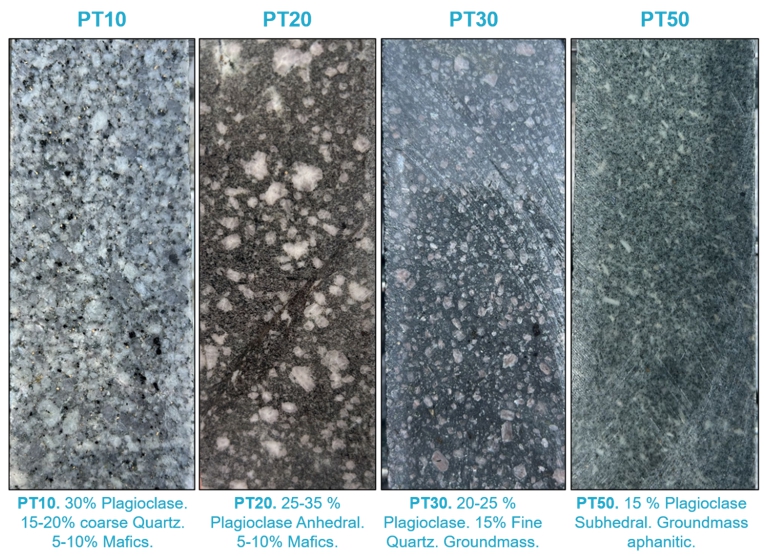
Figure 7.18: Core sample photographs of the Trap porphyries. Source: Collective, 2026.
70
| Collective Mining Ltd. |
| Guayabales Project - Apollo Mineral Resource 2026-08 |
In the Trap target, both mineralization styles are present. Quartz diorite hosts porphyry-style mineralization characterized by secondary biotite, magnetite veins, disseminated chalcopyrite, and chalcocite. This mineralization is spatially associated with the NW-trending Trap Fault, which hosts sphalerite-, galena-, carbonate-, and malachite-bearing veins accompanied by strong sericite alteration.
A diorite body located several hundred metres north of the El Pital area displays weak secondary biotite alteration, disseminated magnetite, and weak chlorite-epidote alteration. Along San Francisco Creek, porphyry-style mineralization is characterized by secondary biotite and epidote alteration, disseminated and stringer chalcopyrite, and locally occurring quartz veins containing molybdenite along vein sutures.
In the La Loma area, at the southeastern end of Trap extensive artisanal mining provides evidence of a strong and laterally extensive sericitic alteration footprint associated with the late polymetallic vein system.
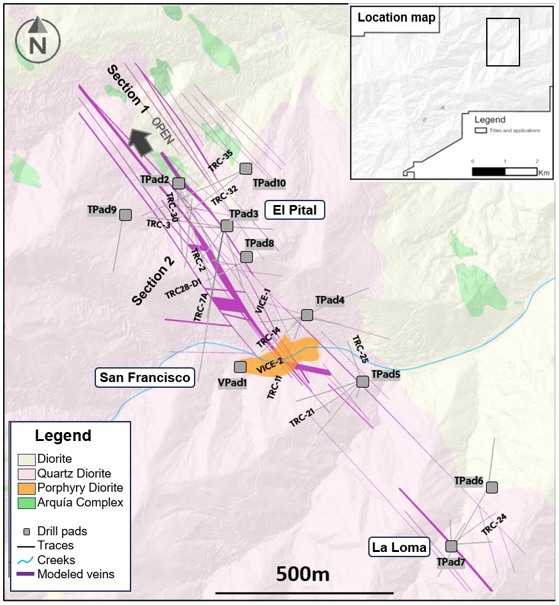
Figure 7.19: Geological map of the Trap target showing the Collective drillhole traces. Source: Collective, 2026.
71
| Collective Mining Ltd. |
| Guayabales Project - Apollo Mineral Resource 2026-08 |
| 8 | Deposit Types |
Mineralization at the Guayabales Project comprises 14 known targets for Au-Ag with Cu, Mo, WO3, Pb and Zn that are hosted by multiple porphyry stocks and wall rock of Arquía Complex schists, Amagá Formation siliciclastic sedimentary rocks and Combia Formation volcanic and sedimentary rocks. The deposit types are porphyry Au-Ag-Cu±Mo, reduced intrusion-related Au, intermineral breccias with Au-Ag±Cu, and structurally-controlled, Au-Ag-bearing carbonate-base metal (Zn-Pb-Cu) veins (CBM).
| 8.1 | Guayabales Porphyry-Breccia-Vein System |
The Apollo Au-Ag-Cu-WO3 deposit has been explored in the most detail within the project area. Apollo is a hydrothermal breccia formed in a subvolcanic porphyry environment with multistage mineralization and alteration. The multistage mineralization includes early porphyry, various periods of sulfide infill within a hydrothermal breccia matrix and multiple overprinting, late stage, sulfosalts and carbonate base metal (CBM) veins. The characteristic features of Apollo include:
| ● | Early pre-breccia porphyry system shown by quartz veinlets in porphyry clasts in breccia; | |
| ● | The downward flaring or cone shaped geometry of the breccia, which differs from normal funnel-shaped breccias and may indicate formation at depth; | |
| ● | A strong correlation between Cu and Ag with a low Cu/Ag ratio in the upper part of the breccia which is not a typical porphyry fluid; | |
| ● | The presence of WO3 as scheelite and, moreover, at shallow depth of up to 150 m in contrast to its normal occurrence at depth in hydrothermal deposits, which is attributed here to the presence of roof pendants of graphitic schist causing reduction of the fluid and deposition of scheelite; | |
| ● | Upward transition of deep pyrrhotite to replacement by pyrite and chalcopyrite interpreted as a change from a reduced to a more oxidizing fluid chemistry; | |
| ● | High grade Au-Ag-Bi-Te sulfide-rich zone in crackle breccia associated with albite-actinolite alteration which commences at 1,000 masl; indicating a reduced fluid which is similar to and occurs at the same elevation as the top of the Marmato Deeps Zone located 1.75 km SE (Figure 8.1); | |
| ● | Late stage, high Au-Ag grade epithermal, Ag and Pb sulfosalt-bearing, carbonate-base metal veins which are notable for their great vertical extent of >1,350 m and indicate a change in fluid chemistry from an early, reduced, low sulfidation fluid to a late, low temperature, oxidized, intermediate to high sulfidation fluid from 1,000 masl up to surface. |
The characteristics of the Apollo deposit are more typical of a reduced intrusion-related gold system (RIRGS) rather than a typical porphyry system. The system varied between reduced (upper Au-Ag-Cu-WO3 zone, deep pyrrhotite with Au-Ag, deep Au-Ag-Bi-Te zone) and oxidized (pre-breccia porphyry, upper breccia fill of Au-Ag-Cu, CBM veins). Apollo, Marmato and Aguas Claras occur within a 3.5 km northwest trending corridor which hosts multiple calc-alkalic porphyry stocks, dike swarms, and multiple NW and EW trending carbonate base metal veins (Figure 8.1). The three deposits have very similar ages.
72
| Collective Mining Ltd. |
| Guayabales Project - Apollo Mineral Resource 2026-08 |
Radiometric dating of the Apollo porphyries by LA-ICP-MS U–Pb zircon shows that magmatic activity occurred from 6.75 ± 0.091 Ma to 6.39 ± 0.087 Ma, while Re–Os molybdenite dating indicates that the principal phase of bulk-tonnage mineralization occurred at 6.82 ± 0.028 Ma (Reading et al., 2025). The ages of magmatism and mineralization are the same and indicate a direct genetic link between porphyry intrusion and ore formation at Apollo.
Significantly, the ages are similar to Marmato where the porphyry intrusions have been dated at 6.576 ± 0.075 Ma to 5.75 ± 0.11 Ma by LA-ICP-MS U-Pb on zircon and mineralization was dated by 40Ar/39Ar analyses of adularia between 6.95 ± 0.02 Ma and 5.96 ± 0.02 Ma (Santacruz et al., 2021). Marmato is described as a hybrid reduced intrusion-related/porphyry gold deposit (Santacruz et al., 2021). The Aguas Claras porphyry gold deposit, located 1.75 km SE of Marmato, is an oxidized, Maricunga-type porphyry gold deposit related to quartz veinlets with magnetite, pyrite and minor chalcopyrite hosted by quartz diorite to granodiorite porphyry stocks dated at 6.55 ± 0.15 Ma to 5.74 ± 0.14 Ma by LA-ICP-MS U-Pb zircon, and by Combia Formation basalt (Santacruz et al., 2021).
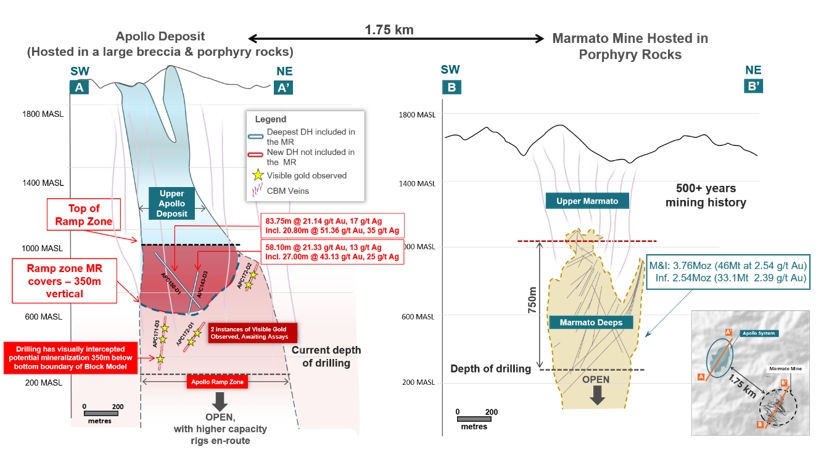
Figure 8.1. Cartoon NW-SE long section along the Marmato trend showing an interpretation of the possible relationship between the Apollo System and Marmato Deeps Zone. Source: Collective (2026)
| 8.2 | Reduced Intrusion-Related Gold Systems (RIRGS) |
Many features of the Apollo deposit are typical of reduced intrusion related gold systems (RIRGS) such as those of the Tintina belt (Alaska-Yukon) and Kori Kollo (Bolivia) as described by Thompson et al. (1999), Baker et al. (2005) and Hart (2007) (Figure 8.2 to Figure 8.4). Conditions at the Apollo system evolved from oxidised porphyry, oxidised epithermal and RIRGS at depth.
73
| Collective Mining Ltd. |
| Guayabales Project - Apollo Mineral Resource 2026-08 |
The characteristics of RIRGS deposits are (Hart, 2007):
| ● | Sheeted Au-bearing quartz veins in the brittle roof zone of small plutons or stocks; |
| ● | Au-Bi-Te-W metal assemblage; |
| ● | Skarn, replacement, veins in wall rock surrounding the pluton; |
| ● | Zoned from proximal Au-W-As to distal Ag-Pb-Zn; |
| ● | Typically associated with metaluminous, moderately reduced, moderately fractionated, biotite>hornblende>pyroxene quartz monzonites that have mixed with volatile-rich lamprophyric melts; |
| ● | Magmas are ilmenite-series due to a reduced primary oxidation state; |
| ● | Sulfides are characterised by pyrrhotite due to the reduced state. |
| ● | Form at 5-7 km depth. |
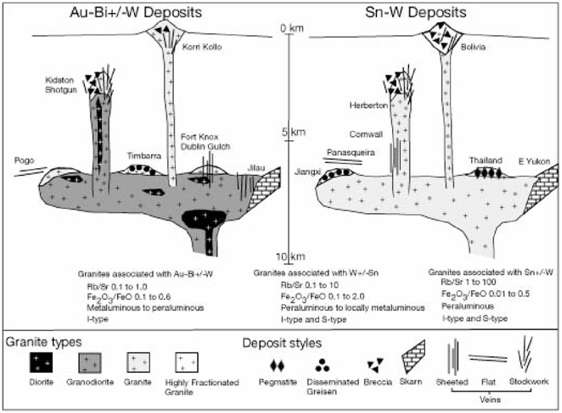
Figure 8.2. Cartoon showing the different styles of Au-Bi-W and Sn-W deposits (Baker et al., 2005).
74
| Collective Mining Ltd. |
| Guayabales Project - Apollo Mineral Resource 2026-08 |
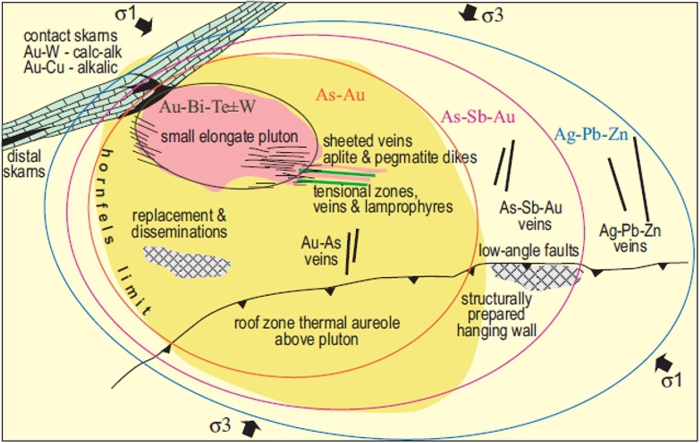
Figure 8.3. Plan model of RIRGS Au deposits from the Tintina Gold Province (Alaska-Yukon) showing geochemical zonation around a central pluton of 0.1-5.0 km diameter and the variety of possible mineralization styles (Hart, 2007).
| 8.3 | Porphyry Cu-Mo-Au Systems |
The Porphyry Copper Systems paper by Sillitoe (2010) provides a landmark reference study used here, with his schematic deposit model shown in Figure 8.4. Porphyry systems may contain porphyry Cu ± Mo ± Au deposits of various sizes from <10 to 10,000 million tonnes. Typical primary porphyry copper deposits have average grades of 0.5 to 1.5% Cu, <0.01 to 0.04% Mo, and 0.01 to 1.5 g/t Au. Porphyry Au deposits have grades of 0.9 to 1.5 g/t Au but little Cu (<0.1% Cu).
The alteration and mineralization in porphyry systems can have a volume of many cubic kilometres of rock and are zoned outward from stocks or dike swarms, which typically comprise several generations of intermediate to felsic porphyry intrusions. Porphyry Cu ± Au ± Mo deposits are centred on the intrusions. High-sulfidation epithermal deposits may occur in lithocaps above porphyry copper deposits, and are typically massive sulfide lodes in deeper feeder structures and Au-Ag-rich, disseminated deposits in the upper parts. Intermediate sulfidation epithermal veins may develop on the peripheries of the lithocaps. The porphyry systems of the Middle Cauca Gold-Copper Belt are characterised by late stage, high grade Au-Ag-polymetallic carbonate-base metal (CBM) veins with a vertical extent of 1-2 km.
75
| Collective Mining Ltd. |
| Guayabales Project - Apollo Mineral Resource 2026-08 |
The alteration and mineralization in porphyry copper deposits is zoned upward from barren, early sodic-calcic alteration through potentially ore-grade potassic, chlorite-sericite, and sericitic alteration, capped by an advanced argillic alteration lithocap up to >1 km in thickness. Low sulfidation-state chalcopyrite ± bornite assemblages are characteristic of potassic zones, whereas higher sulfidation-state sulfides are generated progressively upwards as a result of temperature decline and the accompanying greater degrees of hydrolytic alteration, culminating in pyrite ± enargite ± covellite in the shallow parts of the lithocaps. The porphyry copper mineralization occurs in a distinctive sequence of quartz-bearing veinlets as well as in disseminated form in the altered rock. Magmatic-hydrothermal breccias may form during porphyry intrusion and may have high-grade mineralization because of their high permeability. The Apollo breccia is a large example of a magmatic-hydrothermal breccia. In contrast, most phreatomagmatic breccias, constituting maar-diatreme systems, are poorly mineralized because they usually formed late in the evolution of the porphyry systems.
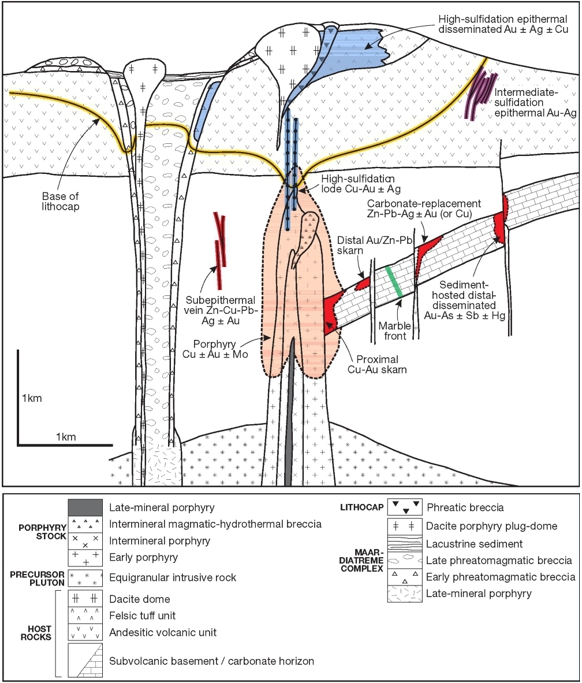
Figure 8.4. Porphyry system model (modified after Sillitoe, 2010).
76
| Collective Mining Ltd. |
| Guayabales Project - Apollo Mineral Resource 2026-08 |
| 9 | Exploration |
Exploration work completed on the Guayables Project includes prospecting, geochemical surveys, geological mapping, some artisanal mining, geophysical surveys, and drilling. The formal part of this work has been completed by Colombia Gold plc, Colombian Mines Corporation, Mercer Gold Corporation and more recently Collective. A summary of sample types collected during this time is tabulated in Table 9.1 and geophysical surveys tabulated in Table 9.3.
Table 9.1: Surface Samples collected on the Guayabales Project - 2005-2026
| Sample Type* | Colombia Gold plc | Colombian Mines Corporation | Mercer Gold Corporation | Collective | Totals |
| Soil | - | - | 253 | 3,602 | 3,855 |
| Rock | 263 | 887 | 108 | 7,422 | 8,680 |
* Core samples collected through drilling are not included in this table.
| 9.1 | Historical Exploration (1995 to 2012) |
Exploration work at the Guayabales Project has been completed by Colombia Gold plc, Colombian Mines Corporation and Mercer Gold Corporation.
Since 1995, the Guayabales community has developed 16 underground workings and development in the general area, but the Apollo target was not mined previously by the artisanal miners. In 2002, the community initiated the formal process to legalize ownership and was granted ownership in 2008. The legal entity is registered as Comunidad Minera Guayabales.
From 2005 to 2012, three firms conducted gold exploration on the property: Colombia Gold plc in 2005, Colombian Mines Corporation from 2006 to 2009, and Mercer Gold Corporation from 2010 to 2012 (renamed Tresoro Mining Corp. beginning in 2011).
In 2008, Colombian Mines drilled 2,079 m in 17 diamond drillholes in the Encanto Zone (ME). Mercer Gold then drilled 4,067 m in 11 diamond drillholes 2010-2011 (Redwood, 2023) in the ME and Plutus areas. This is discussed further in Section 10 of this report.
| 9.1.1 | Historical Soil Geochemical Surveys |
Soil sampling was carried out by Mercer Gold on a 100 m by 100 m grid. The sampling protocol is not known.
| 9.1.2 | Historical Rock Geochemical Surveys |
Rock channel sampling was carried out in underground mines, outcrops and road cuttings by all three companies. The sampling protocol is not known.
77
| Collective Mining Ltd. |
| Guayabales Project - Apollo Mineral Resource 2026-08 |
| 9.1.3 | The QP’s opinion on historical geochemical sampling |
The sampling protocol is unknown for either the soil or the rock sampling, and as such, the QP considers that the results must be used with caution. However, Collective have not used any of these results and completed new geochemical surveys, new geological maps and resampled core where appropriate.
| 9.2 | Exploration completed by Collective (2021-2026) |
Collective commenced its exploration program in 2020, and has advanced exploration rapidly since then.
Table 9.2. Summary of Collective’s exploration (excludes drilling) at the Guayabales Project between 2020 and 31 March 2026.
| Year | Survey | Contractor | Units | Number | Target |
| 2020-2022 | Database compile historic data | None | samples | 1,561 | Whole property |
| 2020-2025 | Historical core relogging | None | meters | 5,294 | Encanto, Donut |
| 2020-2025 | Geological mapping | None | km2 | 37.5 | Whole property |
| 2020-2025 | Rock sampling | None | samples | 7,422 | Whole property |
| 2020-2025 | Soil sampling | None | samples | 3,602 | Whole property |
| 2021 | LIDAR survey | Lidarus | km2 | 76.8 | Whole property |
| 2021 | Full Waveform Distributed Array Induced Polarization survey (AGDAS) | Arce Geofísicos Ltd | km2 | 3.37939 | Olympus and Box |
| 2020-2021 | Heli-magnetic and radiometric survey | MPX Geophysics Ltd & Arce Geophysics Ltd | Line km | 775.9 | Whole property |
| 2022 | Heli-magnetic and radiometric survey Reprocessing | Condor North Consulting | line km | 775.9 | Whole property |
| 2022 | IP survey Reprocessing | Condor North Consulting | km2 | 3.37939 | Olympus and Box |
| 2024 | IP Reprocessing - Joint inversion model of the three blocks of the DCIP Survey conducted by Arce Geofísicos | Condor North Consulting | Km2 | 3.38 | Box-Olympus |
| 2025 | IP Reprocessing- Constrained 3D resistivity inversion using the 2021 DCIP data collected over the Box target area, in combination with the 3D geology model | Condor North Consulting | m2 | 975 | Box |
| 2025 | Gravity survey | Arce Geofísicos | Ha | 220 | Apollo, ME, Plutus |
| 9.2.1 | Topographical Surveys |
Lidarus completed a LIDAR survey on behalf of Collective in 2021, covering approximately 7,620 hectares across the Guayabales concessions and surrounding areas. The survey was referenced to the WGS84 datum, UTM Zone 18N, with a horizontal and vertical accuracy of one metre. The results of this work comprised a digital terrain model (DTM), a digital surface model (DSM) and a topographic map with 1 m contour intervals.
78
| Collective Mining Ltd. |
| Guayabales Project - Apollo Mineral Resource 2026-08 |
This survey forms the basis for all engineering, mineral exploration and resource-related activities across the Guayabales property.
| 9.2.2 | Geological Mapping |
Collective carried out 37.5 km2 of geological mapping of the concessions and targets since 2020. This work is ongoing, and includes reviewing and compiling historical mapping. The results are described in Section 7.3 and the targets in Section 9.3.
| 9.2.3 | Petrography |
Collective has carried out petrography analysis on 58 drill core samples as part of its exploration and geological characterization program. Petrography was used to support logging, mineral identification, and alteration interpretation, informing the lithological and hydrothermal alteration classifications presented in Section 7 (Geological Setting and Mineralization). The results of this work have been used in developing the geological framework, and are discussed in Section 7.
| 9.2.4 | Collective Geochemical Surveys |
Soil Sampling
Collective has a written protocol for soil sampling. Samples are taken at the C soil horizon at a depth between 1.5-3.5 m using a manually operated auger. The sample is collected on a plastic sheet and then placed in a sample bag that is numbered and sealed. The geologist completes a sample description card with the location, soil profile description, weathering intensity, colour, oxides and other information. This is entered into the exploration database. The protocol and chain of custody for transport and analysis of rock and soil samples is summarised in Table 9.3.
Collective has collected 3,602 soil samples. Soil samples were generally taken on ridges and spurs, and in some places on a grid of 100 m by 100 m. The results for Au, Cu, Ag and Mo are shown in maps in Figure 9.1 to Figure 9.4.
The QP considers that the sampling method is generally appropriate for the type of mineralization sought. However, the grid samples are often not effective due to young volcanic ash cover and landslides. On the ridges, however, the ash has been washed away and so the ridge and spur samples are more effective, do not have this sampling bias, and are indicative of the mineralization sought.
Rock Sampling
Collective has a written protocol for taking rock samples. The chip channel samples are marked with paint in lengths of 2.00 m and a continuous sample is taken using a hammer and chisel. The broken rock is collected on a plastic sheet and then placed in a sample bag that is numbered and sealed. Rock chip samples are taken in a similar manner but by taking a rock chip every approximately 10 cm, rather than a continuous channel. A sample description card is completed in the field for each sample with the location and description. The protocol and chain of custody for transport and analysis of rock and soil samples is summarised in Table 9.3.
79
| Collective Mining Ltd. |
| Guayabales Project - Apollo Mineral Resource 2026-08 |
Collective has taken 7,422 surface and underground rock samples as of the effective date of this report. The results for Au, Cu, Ag and Mo are shown in maps in Figure 9.5 to Figure 9.8.
Sample management
Table 9.3. Protocol and chain of custody for soil and rock samples.
| Step | Location | Person(s) | Description |
| 1 | Field | Technician, geologist | Sample collection according to protocol of stream sediment (none taken), soil, rock or underground mine samples. |
| 2 | Transport to field camp and to core logging facility, Supia | Company pickup truck and driver | |
| 3 | Core logging facility | Facility manager | Temporary secure storage. |
| 4 | Core logging facility | Geologist, technician | Insert QAQC samples. |
| 5 | Core logging facility | Technician | Samples packed in sacks and labelled. Lab order form prepared. |
| 6 | Transport to lab, Medellin | Company pickup truck and driver | Sample batches sent to lab three times per week. |
| 7 | Laboratory Medellin | Laboratory personnel | Receive samples. Sample preparation. |
| 8 | Laboratory Callao | Laboratory personnel | Sample pulps shipped by courier, assayed at Callao Lab. |
| 9 | Sample storage rooms at camp | Technician | Sample coarse rejects and pulps returned by lab, checked, noted in database, secure storage. |
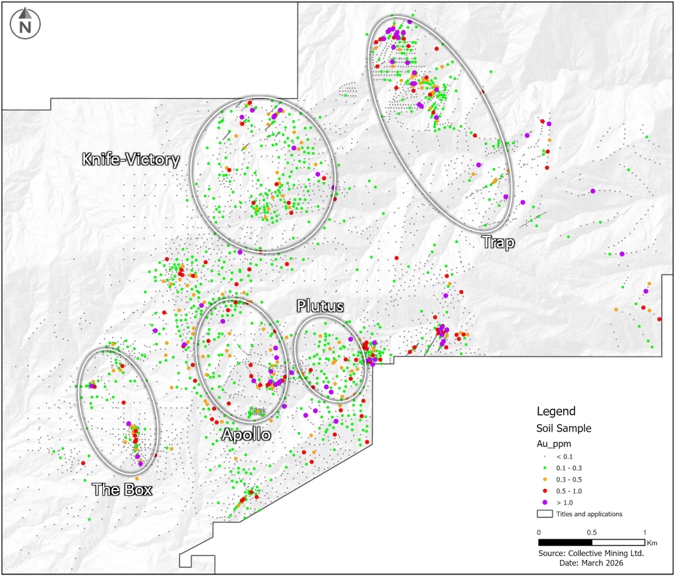
Figure 9.1. Guayabales Project, Collective soil geochemistry for gold. Source: Collective, 2026.
80
| Collective Mining Ltd. |
| Guayabales Project - Apollo Mineral Resource 2026-08 |
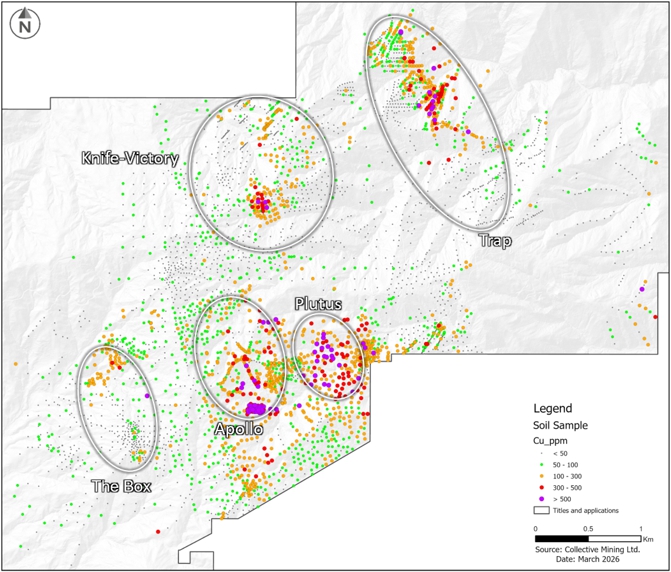
Figure 9.2. Guayabales Project, Collective soil geochemistry for copper. Source: Collective, 2026.
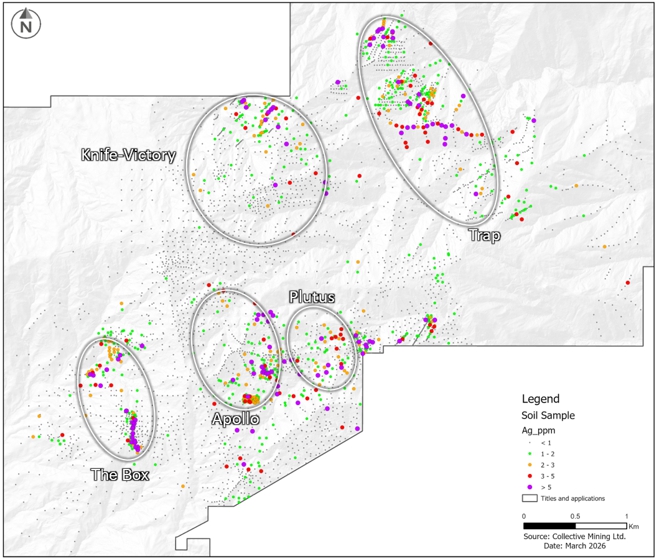
Figure 9.3. Guayabales Project, Collective soil geochemistry for silver. Source: Collective, 2026.
81
| Collective Mining Ltd. |
| Guayabales Project - Apollo Mineral Resource 2026-08 |
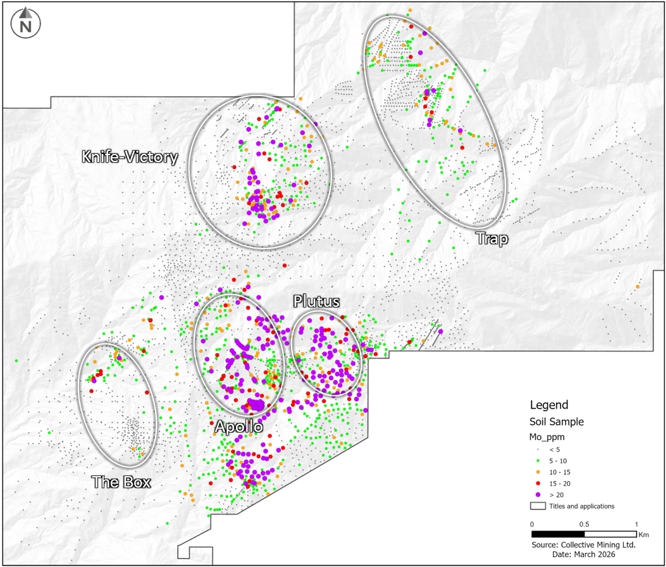
Figure 9.4. Guayabales Project, Collective soil geochemistry for molybdenum. Source: Collective, 2026.
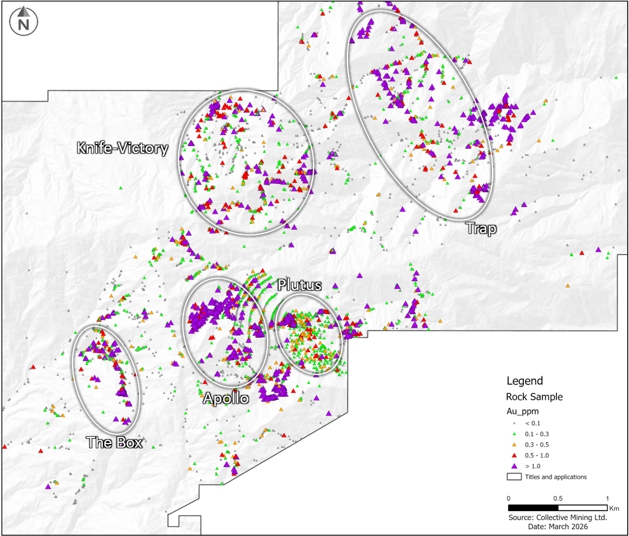
Figure 9.5. Guayabales Project, Collective rock geochemistry for gold. Source: Collective, 2026.
82
| Collective Mining Ltd. |
| Guayabales Project - Apollo Mineral Resource 2026-08 |
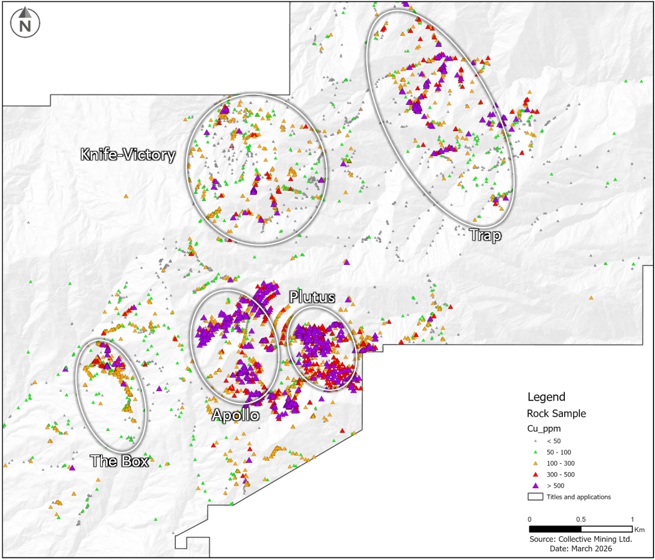
Figure 9.6. Guayabales Project, Collective rock geochemistry for copper. Source: Collective, 2026.
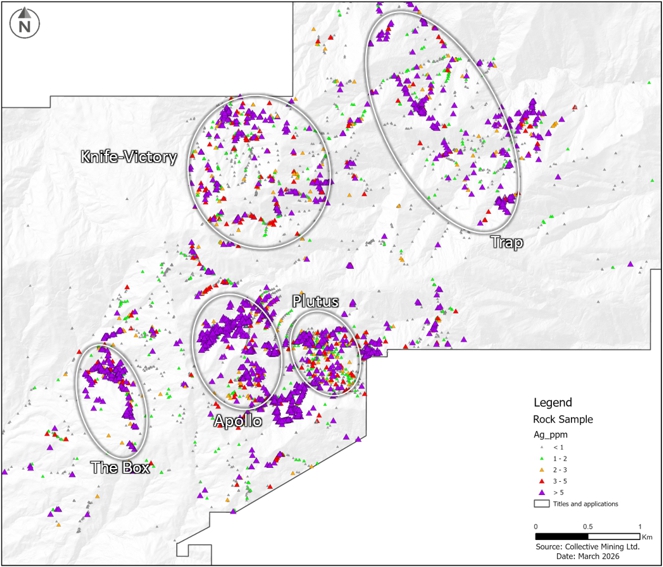
Figure 9.7. Guayabales Project, Collective rock geochemistry for silver. Source: Collective, 2026.
83
| Collective Mining Ltd. |
| Guayabales Project - Apollo Mineral Resource 2026-08 |
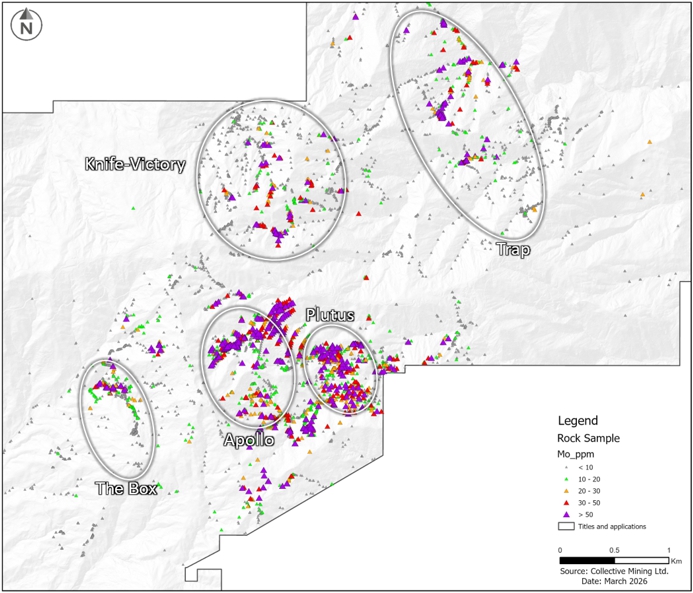
Figure 9.8. Guayabales Project, Collective rock geochemistry for molybdenum. Source: Collective, 2026.
| 9.2.5 | Geophysics |
Collective carried out a helicopter-borne magnetic and radiometric geophysical survey in December 2020 over an area of about 9 km E-W by 8 km N-S centred on the mining titles. Data was collected on 775.9 line-km on N-S flight lines with a line spacing of 100 m and nominal mean terrain clearance of 80 m, with E-W tie lines. The survey was flown by MPX Geophysics Ltd (MPX, 2020). The data was processed by Arce Geophysics (Arce, 2021) and reprocessed by Condor Consulting (Figure 9.9).
84
| Collective Mining Ltd. |
| Guayabales Project - Apollo Mineral Resource 2026-08 |
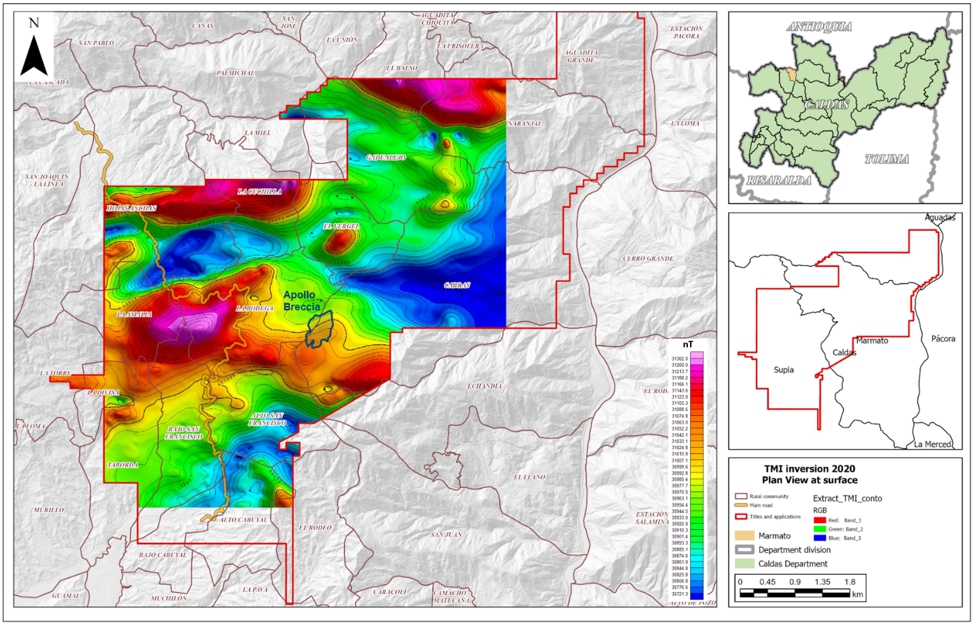
Figure 9.9. Guayabales Total Magnetic Intensity (TMI) inversion from the helicopter-borne survey. Source: Collective, 2026.
In 2021, Arce Geofísicos Ltd. carried out a Full Waveform Distributed Array Induced Polarization (IP) survey (AGDAS) at Apollo North, Box, and Victory targets, covering an area of interest of 3.38 km² across three blocks. However, the effectiveness of this survey was limited due to high chargeability responses from graphite schists.
During 2024, Condor North Consulting generated a joint inversion model of the three blocks using the 2021 data (Figure 9.10 and Figure 9.11), with the objective of developing a more consistent model to serve as a baseline for comparison with upcoming ZTEM and VTEM surveys. Later in 2024, Collective attempted to conduct ZTEM and VTEM surveys with Geotech Ltd. over the Guayabales project, covering approximately 70 km², but the survey failed due to high noise from powerlines. Additionally, Condor North Consulting compared inversion modelling results from 3D DC resistivity and induced polarization (DCIP) data for the Guayabales project with geological cross-sections provided by Collective. Smooth resistivity and chargeability inversion models were created using the 2021 DCIP data collected over the three blocks, and the depth of investigation for both models was determined.
In 2025, Condor North Consulting performed a constrained 3D resistivity inversion using the 2021 DCIP data collected over the Box target area, combined with a 3D geology model provided by Collective. The geology model was converted into a voxel model, and rock units were assigned conductivity values based on average petrophysical data (a voxel model is a three-dimensional, regularly gridded representation of the subsurface composed of individual volumetric cells (“voxels”). Each voxel is assigned one variable such as density, magnetic susceptibility, or resistivity).
85
| Collective Mining Ltd. |
| Guayabales Project - Apollo Mineral Resource 2026-08 |
Later in 2025, Arce Geofísicos conducted a gravity survey at the Guayabales project. The survey consisted of 372 stations arranged on a 50 m by 100 m grid (Figure 9.12). The same base station used during the first stage was employed for drift correction. Two Scintrex CG-6 gravity meters were used to carry out the measurements. An additional 372 stations were acquired during this second stage, resulting in a total of 414 stations. The gravity survey was completed with 372 stations at 50 m intervals along previously defined lines. A minimum of 5 repeated readings were taken at each station. The CG6 gravimeter can measure resolutions in the order of 0.1 microGals.
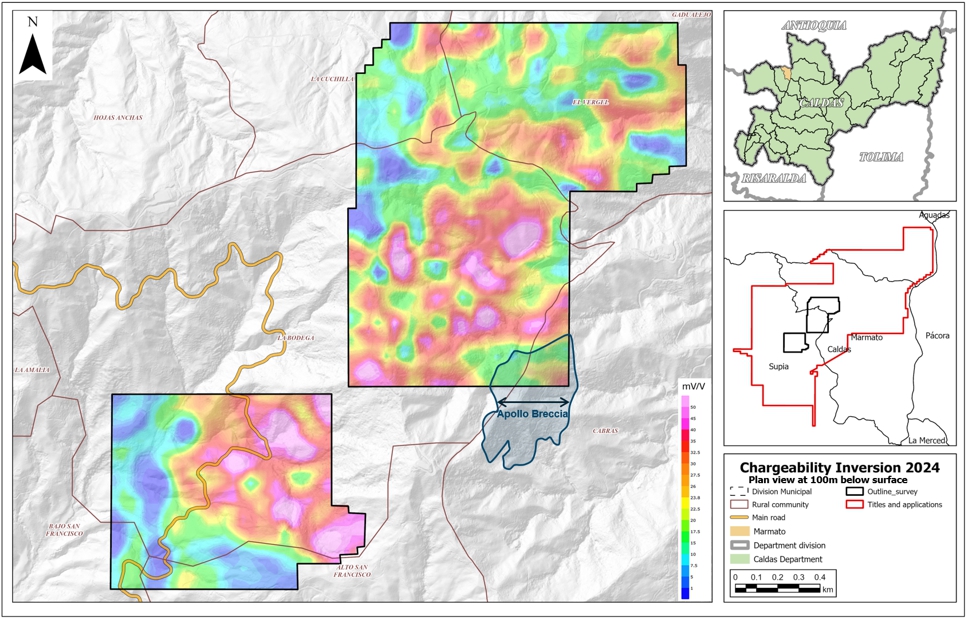
Figure 9.10. Guayabales Project joint inversion of IP chargeability at 100 m depth reprocessed by Condor North Consulting. Source: Collective, 2026.
86
| Collective Mining Ltd. |
| Guayabales Project - Apollo Mineral Resource 2026-08 |
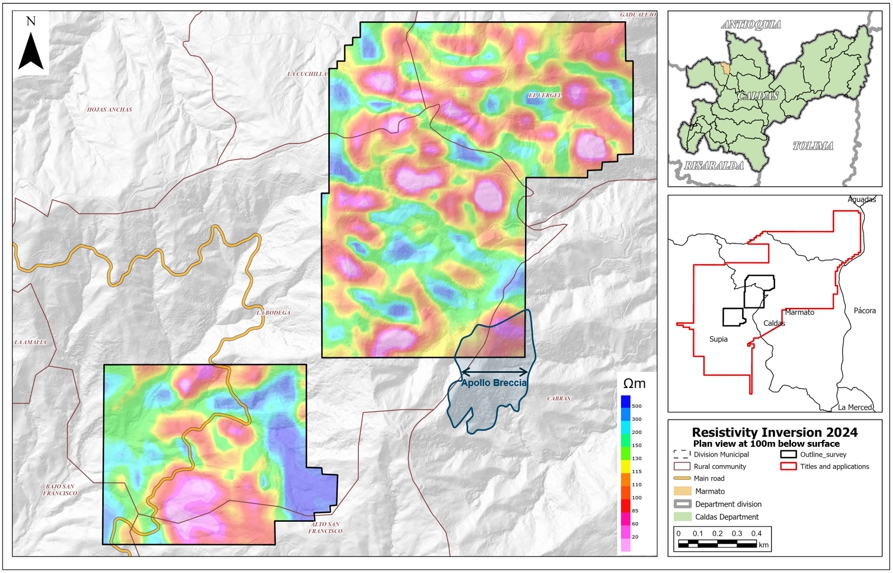
Figure 9.11. Guayabales Project joint inversion of IP resistivity at 100 m depth reprocessed by Condor North Consulting. Source: Collective, 2026.
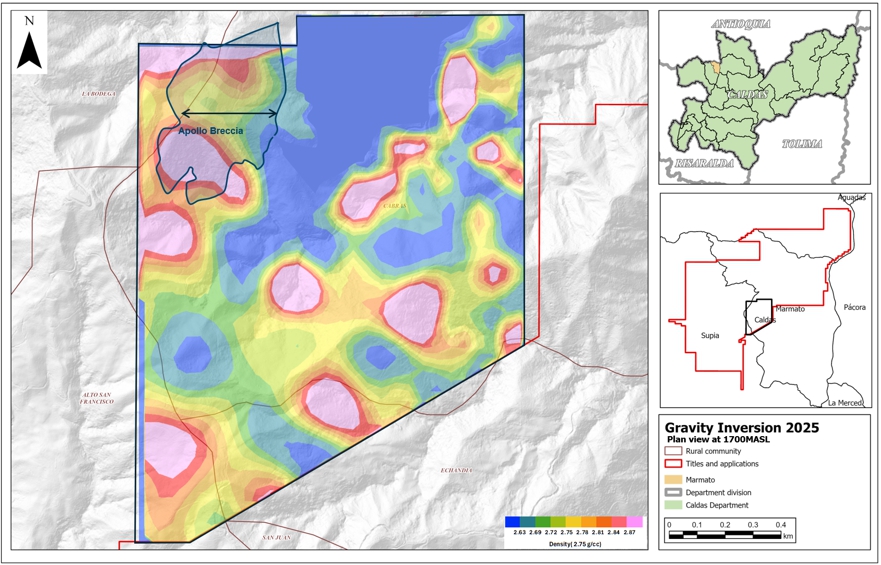
Figure 9.12. Density map (g/cc) of the Apollo target at 200m depth processed by Arce Geofisicos. Source: Collective, 2026.
87
| Collective Mining Ltd. |
| Guayabales Project - Apollo Mineral Resource 2026-08 |
| 9.2.6 | Collective Drilling |
Collective drilled 358 HQ diamond drillholes (151,209.70 m) between 2021 and 31 March 2026. An additional 59,000 m of drilling has been completed between the shut-off date of the resource work and 13 October 2026, with results released publicly, and an expected positive impact on the results documented in this report. The purpose of the drilling was to define the Apollo system and explore nearby anomalies as defined by the work described above. The drilling is described in Section 10.
| 9.2.7 | Priority Targets for Exploration |
Of the fourteen exploration targets identified across the Guayabales Project area (Figure 7.3), the Apollo and Trap systems have been the primary focus of drilling to date, resulting in the discovery of significant mineral systems. This section describes these two priority targets; the remaining targets are at an earlier stage of exploration and are not discussed further in this report.
| 9.3 | Apollo Target |
Plans of the geochemistry of Au, Cu, Ag, Mo and W in rocks and soils that were used to define drill targets. A plan showing the gold soil and rock geochemistry at Apollo is shown in Figure 9.13. Geochemistry and mapping identified a breccia as the initial drill target.
Drilling completed at Apollo has outlined the Apollo deposit and a subsequent mineral resource (See Section 14). The geology of Apollo is described in detail is Section 7. Much of the early drilling was from central locations as the surface expression of the breccia was small and ideal sites for drilling were not always accessible. The orientations of these early holes were not ideal for delineating the upper parts of the mineralization but allowed a quick view of the potential of the mineralization.
Later drilling locations have been more successful in drilling across the mineralization, and with bigger and more powerful drill rigs, deeper areas of the deposit have been explored and resulted in the identification of the Ramp Zone.
Drilling at Apollo is from designated Drill Pads (Figure 9.14) approved by the Sustainability and Exploration departments with multiple holes drilled from each pad. The deeper holes are now being drilled as a parent hole with multiple wedges inserted so that deflections (daughter holes) can be drilled. This reduces the time and cost of exploring in the vicinity of the parent hole.
88
| Collective Mining Ltd. |
| Guayabales Project - Apollo Mineral Resource 2026-08 |
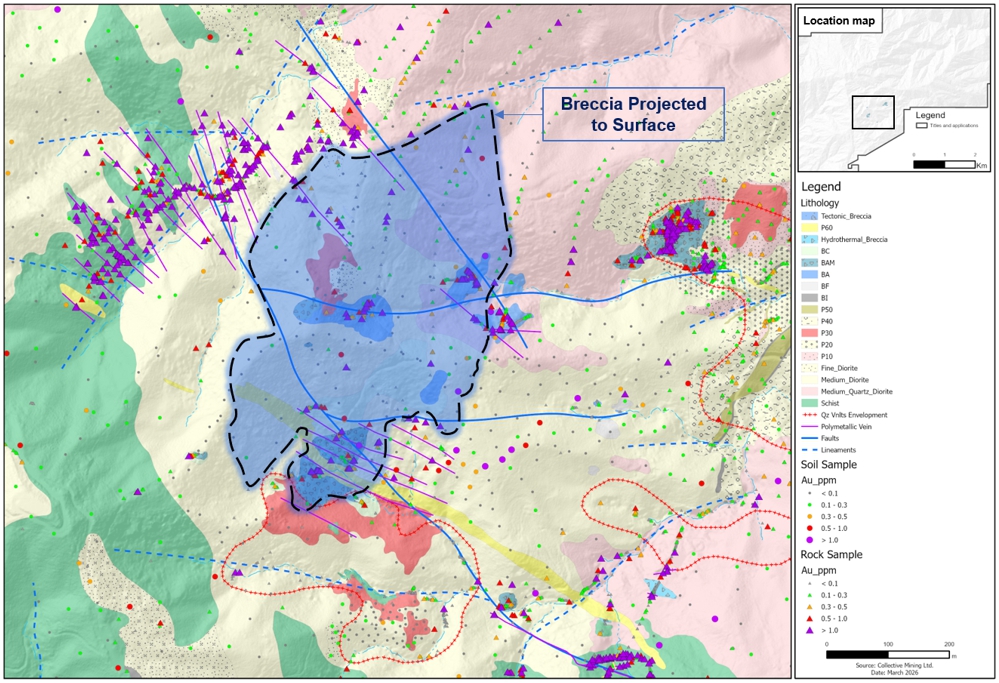
Figure 9.13. Apollo target geology and geochemistry for gold (soil and rock). Source: Collective, 2026.
89
| Collective Mining Ltd. |
| Guayabales Project - Apollo Mineral Resource 2026-08 |
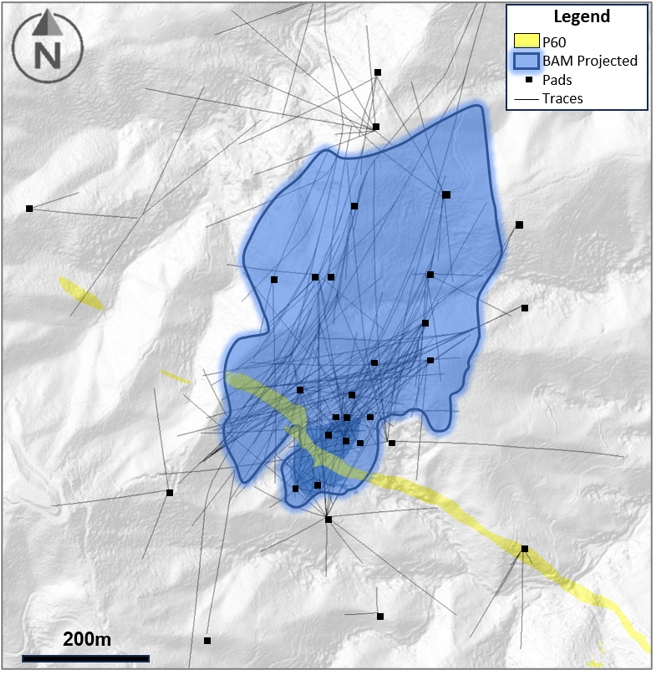
Figure 9.14: Drillhole locations at the Apollo Deposit showing the outline of the breccia at 1000 masl. Source: Collective (2026)
90
| Collective Mining Ltd. |
| Guayabales Project - Apollo Mineral Resource 2026-08 |
| 9.4 | Trap Target |
Plans of the geochemistry of Au, Cu, Ag and Mo in rocks and soils were used to define drill targets at the Trap target. The geology and geochemistry for gold and copper are shown in Figure 9.15.
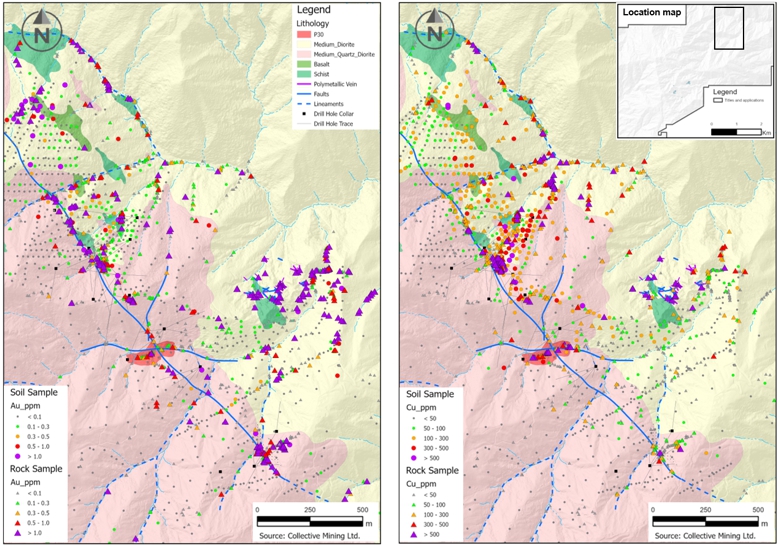
Figure 9.15. Trap target geology and geochemistry (soil, rock) for gold (left) and copper (right). Source: Collective, 2026.
Drilling completed at Trap has also outlined mineralization of interest and is the subject of ongoing exploration, but no mineral resource has as yet been defined. The geology of Trap is described in detail is Section 7.
Drilling locations, as at Apollo, are not always ideal for drilling across the mineralization.
Drilling at Trap is from designated Drill Pads (Figure 9.16) again with multiple holes drilled from each pad.
91
| Collective Mining Ltd. |
| Guayabales Project - Apollo Mineral Resource 2026-08 |
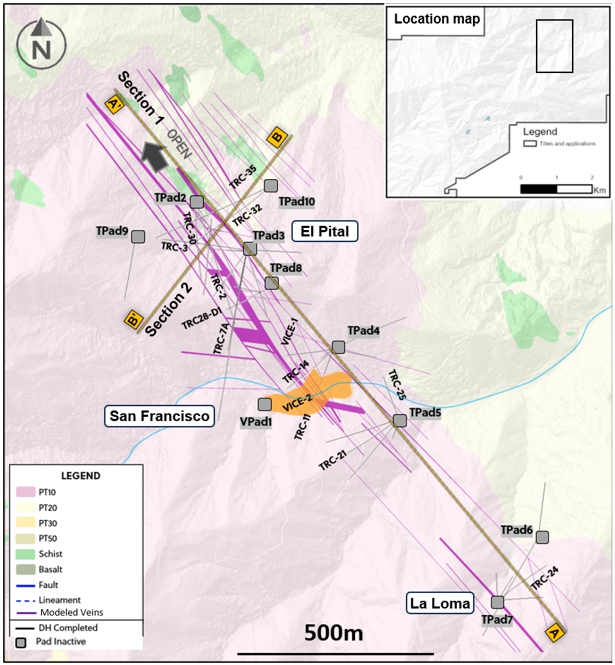
Figure 9.16: Drillhole locations at the Trap Prospect. Source: Collective (2026)
92
| Collective Mining Ltd. |
| Guayabales Project - Apollo Mineral Resource 2026-08 |
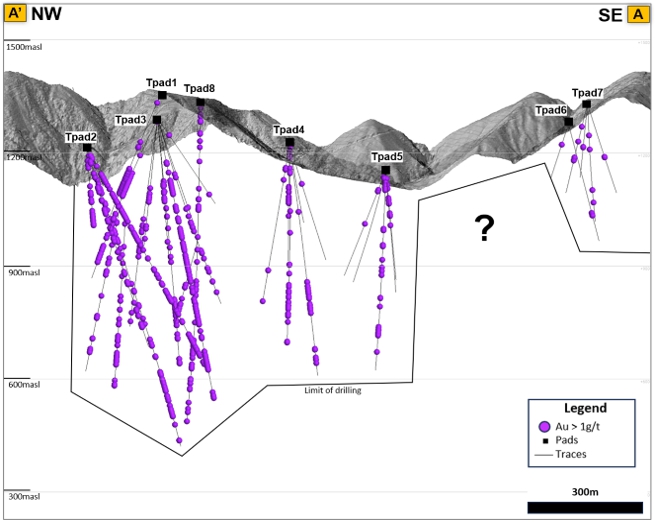
Figure 9.17: Long-section showing drill intersections at the Trap Prospect. Source: Collective (2026)
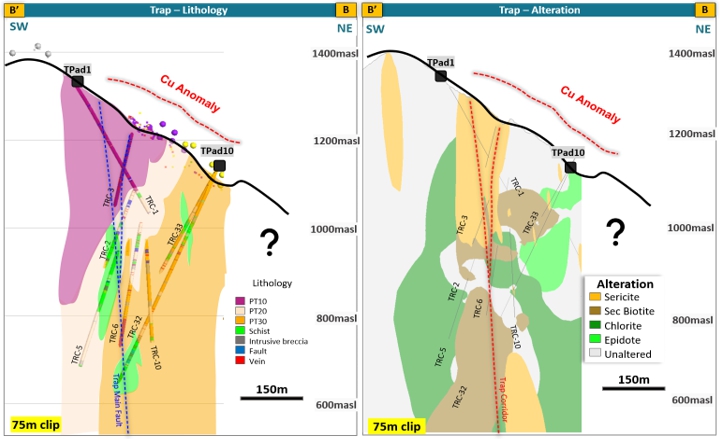
Figure 9.18: NE-SW Cross-section through the Trap Prospect. Source: Collective (2026)
93
| Collective Mining Ltd. |
| Guayabales Project - Apollo Mineral Resource 2026-08 |
| 10 | Drilling |
Section 10 up to and including Section 10.3 is modified after Redwood (2025).
Table 10.1: Drilling completed at the Guayabales Project by target
| Company | Year | Target | Type | Number | Total (m) |
| Colombian Mines Corporation | 2008 | ME | HQ, NQ, BTW | 17 | 2,160.78 |
| Mercer Gold | 2010-11 | ME | HQ, NQ | 7 | 2,623.20 |
| Plutus | HQ, NQ | 4 | 1,447.70 | ||
| Collective | 2021-22 | Apollo, Box, Plutus North, Trap, Victory | HTW, NTW, BTW, HQ, NQ | 71 | 27,618.15 |
| 2023 | Apollo, Box, Plutus North, Trap, Victory, ME | PQ, NQ, BQ, HQ3, NQ3, HTW, NTW, BTW. | 81 | 35,493.40 | |
| 2024 | Apollo, Box, Plutus North, Trap, X, ME | PQ, NQ, BQ, HQ3, NQ3, HTW, NTW, BTW. | 84 | 38,801.40 | |
| 2025 | Apollo, X, Towers | PQ, NQ, BQ, HQ3, NQ3, | 114 | 45,490.00 | |
| 2026 | Apollo | PQ, NQ, BQ, HQ3, NQ3, | 8 | 3,806.75 | |
| Total | 386 | 157,441.38 |
Note: An additional 59,000 m of core drilling has been completed between 31 March and 13 October 2026, and is not recorded in this table as it is after the database shut-off date for the Mineral Resource.
Table 10.2 Summary of historical diamond drill programs.
| Year | Company | Contractor | Rig type | Core size | Diameter (mm) | Holes | Total meters |
| 2008 | Colombian Mines Corporation |
Terramundo | Boyles 37 | HQ | 63.5 | 12 | 1,920.09 |
| Winkie | BTW | 42 | 5 | 240.69 | |||
| 2010-2011 | Mercer Gold | Logan Drilling Colombia SAS |
Duralite T600N | HQ, NQ | 63.5, 47.6 | 11 | 4,070.90 |
| Total | 28 | 6,231.68 |
94
| Collective Mining Ltd. |
| Guayabales Project - Apollo Mineral Resource 2026-08 |
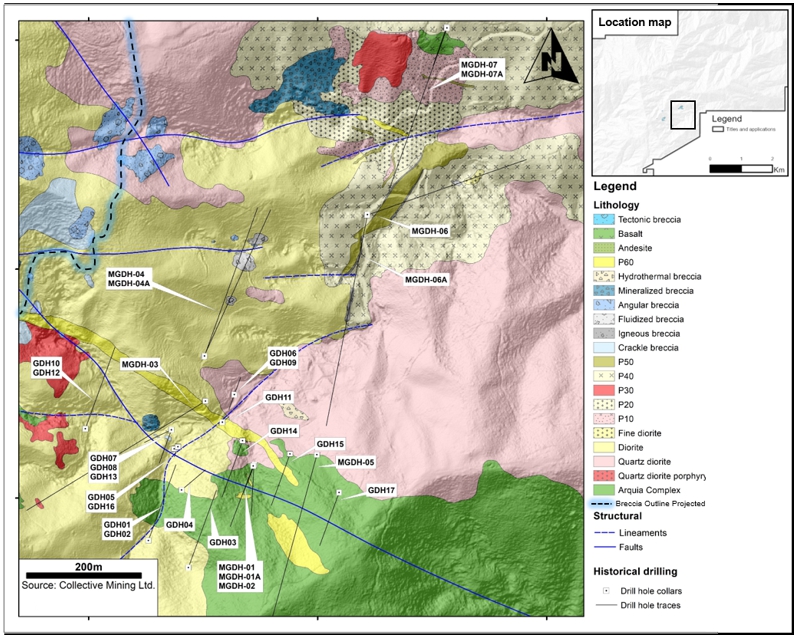
Figure 10.1. Location map of the historical drill collar locations and drillhole traces in the Guayabales Project. Source: Collective (2026)
| 10.1 | Drilling by Colombian Mines (2008) |
Colombian Mines drilled 17 diamond drillholes for 2,160.78 m in 2008 at ME target. Twelve holes were drilled with a skid-mounted Boyle 37 rig with lengths of 83.70 to 221.50 m and an average of 160.9 m. Five holes were drilled with a man-portable Winkie drill (GDH-05, 06, 09, 11, 16) with lengths of 9.53 to 48.90 m and an average of 29.6 m and failed to reach their targets.
No information is available detailing drilling and sampling procedures for work completed by Colombian Mines.
| 10.2 | Drilling by Mercer Gold (2010-11) |
Mercer Gold drilled 11 diamond drillholes for 4,070.90 m in 2010-2011 with a track-mounted Duralite T600N drill rig. The hole lengths were 76.6 to 620.0 m with an average of 369.8 m. The holes were drilled in the ME and Plutus targets. The contractors, rig types and core sizes are summarised in Table 10.2. The drill collar locations are shown in Figure 10.1.
95
| Collective Mining Ltd. |
| Guayabales Project - Apollo Mineral Resource 2026-08 |
The survey method used to record the drill collars is not recorded. The drill platforms were restored and revegetated after use. The hole collars are not marked.
No downhole directional surveys were carried out.
There is no information available on core recovery from the historical drillholes.
Logging and Sampling Protocols – Mercer Gold
Historical NI 43-101 technical reports (Turner, 2010; Leroux, 2012) do not describe the protocols for core handling, logging, sampling and chain of security for the two drill programs. The core is stored in wooden boxes and was cut in half lengthwise with a diamond saw for sampling.
No measurements of density or specific gravity were made from drill core in either program.
The drill intersections do not represent the true width of the mineralized zones.
| 10.3 | Drilling by Collective (2021 - Present) |
Collective’s drilling at Guayabales commenced in September 2021 and is ongoing as at the time of this Technical Report (Table 10.3). The drilling contractors were Kluane Colombia SAS, Logan Drilling SAS, Perforaciones Tecnicas SAS (Perfotec) and Globexplore using modular, portable drill rigs with hydraulic drive using the wireline core drilling method. The drilling has included up to 15 drill rigs at a time. The drillhole distribution by target is listed in Table 10.4, and the collar locations are shown in Figure 10.3.
Most of the drilling has been completed at the Apollo (approximately 74%) and Trap (11%) targets, with the rest of the drilling completed on the Box, Knife-Towers, ME, Plutus, X and Victory targets (Table 10.4). The average hole length is approximately 430 m, the minimum length is 58.55 m, and the maximum length is 1,192.80 m. There are 5 holes greater than 1,000 m long and 78 holes with a length of between 500 m and 1,000 m.
Directional diamond drilling was used for some holes using the Aziwell system to accurately reach predetermined subsurface targets while ensuring optimal core recovery and orientation control. Directional drilling is employed when deviation or deflection of the borehole is required to follow a specific planned trajectory. This controlled drilling technique allows the drill bit to be guided along a non-vertical path toward the target using specialised downhole tools and steering systems, enabling precise interception of mineralized zones that cannot be reached through conventional vertical drilling methods. The system enables drilling of ‘mother holes’ and multiple ‘daughter’ holes.
96
| Collective Mining Ltd. |
| Guayabales Project - Apollo Mineral Resource 2026-08 |
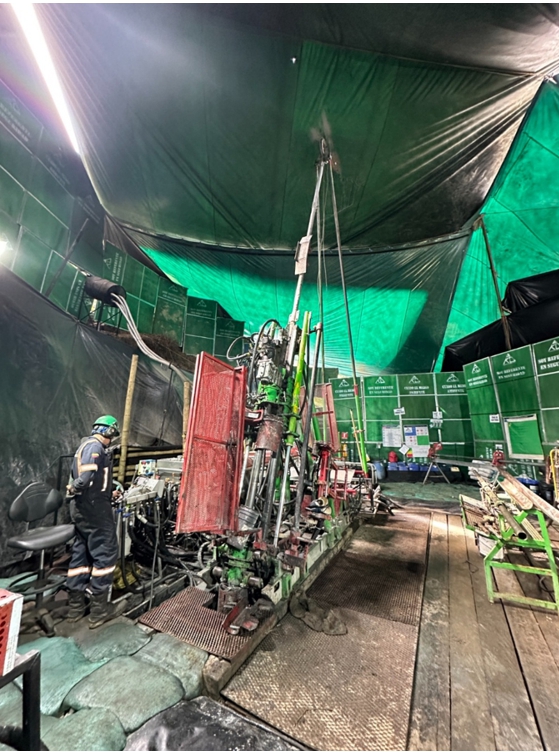
Figure 10.2. Kluane KD-1700 hydraulic drill rig drilling hole APC106-D3 on Drill Pad 19 on 10 June 2025. Source: Collective (2026)
97
| Collective Mining Ltd. |
| Guayabales Project - Apollo Mineral Resource 2026-08 |
Table 10.3. Summary of the drilling contractors of the Guayabales diamond drill programmes.
Year |
Contractor | Rig type, x number |
Core size, diameter (mm) | Holes | Total meters |
| 2021-22 | Kluane Colombia SAS | KD-1000 x 1 KD-1700 x 1 |
HTW (70.92), NTW (56.0), BTW (42.0) | 15 | 7,219.15 |
| 2021-22 | Logan Drilling SAS | DL-600 x 1 LC-600 x 1 LC-800 x 1 MP-1000 x 1 TN-800 x 1 |
HTW (70.92), NTW (56.0), BTW (42.0) | 56 | 20,399.00 |
| 2023-26 | Kluane Colombia SAS | KD-1700 x 5 KD-1000 x 1 KD-200 x 2 KD-600 x 2 |
PQ (85.0), NQ (44.0), BQ (36.4), HQ3 (61.1), NQ3 (45.1), HTW (70.9), NTW (56.0), BTW (42.0) |
274 | 119,464.40 |
| 2023-26 | Logan Drilling SAS | DL-1000 x 1 LC-800 x 1 |
PQ (85.0), HQ (63.5), BQ (36.4), NQ3 (45.1) |
12 | 3,766.95 |
| 2023-26 | Globexplore | WPD900- GBX54 x 1 |
PQ (85.0), HQ (63.5), BQ (36.4), NQ (47.6) |
1 | 360.20 |
| Total Exploration | 358 | 151,209.70 | |||
| 2026 | Perfotec | Hydracore 4000 x 1 Mancore 600 x 1 |
HQ (63.5) | 12 | 360.2 |
| Total Drilling | 370 | 152724.9 |
Table 10.4. Summary of Guayabales drillholes by target.
| Target | Platforms | Drillholes | Total Length (m) | Meters (%) |
| Apollo | 49 | 256 | 111,641.80 | 73.1 |
| Box | 6 | 16 | 5,403.60 | 3.5 |
| Knife-Towers | 3 | 6 | 1,729.40 | 1.1 |
| ME | 3 | 9 | 3,734.10 | 2.4 |
| Plutus | 6 | 26 | 9,494.75 | 6.2 |
| Trap | 11 | 38 | 16,622.95 | 10.9 |
| X | 2 | 5 | 1,646.90 | 1.1 |
| Victory | 1 | 2 | 936.20 | 0.6 |
| Total Exploration Drilling | 81 | 358 | 151,209.70 | 99.0 |
| Geotechnical Drilling | 12 | 12 | 1,515.20 | 1.0 |
| Total Drilling | 81 | 358 | 152,724.90 | 100.0 |
# Resource estimate of 265 holes includes 256 Apollo, five holes from ME and four holes from Tower.
| 10.3.1 | Drill Pads - Collective |
The drill pads are built by hand due to the steep slopes and are accessed by mule trails (Figure 10.4). Multiple holes are drilled from each pad. At the completion of drilling a collar monument is installed. The pads are restored and revegetated after final use. The drill rigs are man portable. Men and mules move the rigs, rods, tanks and accessories, carry in consumables such as fuel and drilling mud, and carry out core boxes. Water is pumped from streams at two authorised water licenses and distributed by water lines over several kilometres to the pads. Returned drill water is collected in tanks, rather than sumps, and is recirculated. Drill cuttings are treated as hazardous waste due to the presence of sulfides and metals. The solids settle out in the recirculation tanks, are collected and put in sacks, then taken to the core logging facility in Supia, and, together with the cuttings from the core saw, are periodically collected by a licensed contractor for safe disposal at an authorised hazardous waste disposal facility.
98
| Collective Mining Ltd. |
| Guayabales Project - Apollo Mineral Resource 2026-08 |
The collar locations are shown in Figure 10.3.
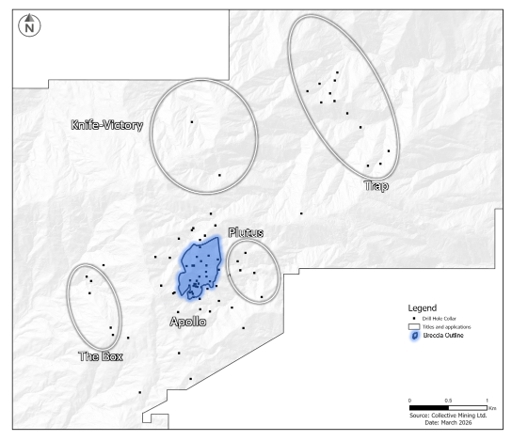
Figure 10.3. Location map of Collective drill collars drillholes in Guayabales. Source: Collective (2026)
99
| Collective Mining Ltd. |
| Guayabales Project - Apollo Mineral Resource 2026-08 |
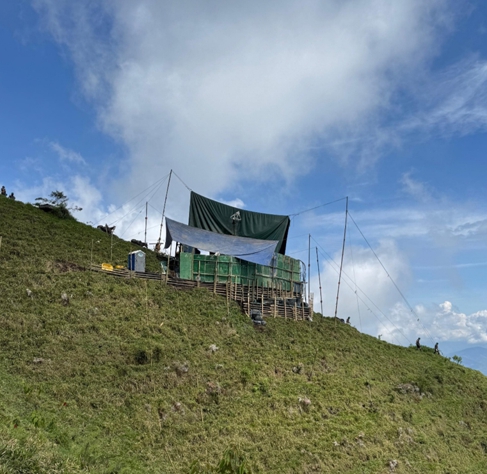
Figure 10.4. A typical drill platform. Source: Collective (2026)
| 10.3.2 | Collar Surveys - Collective |
Drillhole collar locations are defined, verified and surveyed in three successive stages. Each stage generates its own set of coordinates, and all three sets are stored in the drillhole database with their source and status.
Planned Coordinates
The Planning team issues each proposed drillhole by e-mail to the Geology, Logging and Drilling teams. The notification includes:
| ● | the planned collar coordinates; |
| ● | the drillhole identification; |
| ● | the target depth, azimuth and dip; |
| ● | the analytical program to be applied. |
This information is recorded in the database as the “planned coordinates”.
100
| Collective Mining Ltd. |
| Guayabales Project - Apollo Mineral Resource 2026-08 |
Actual Coordinates
Where the drill pad is not already active, the Logging team first checks whether the proposed location is feasible. To do this, it locates the planned coordinates in the field and assesses the terrain, access and site conditions.
After the pad is built and the drill rig is positioned, the Logging team records the collar location with a handheld GPS during a field visit. These field coordinates are recorded in the database as the “actual coordinates”. They allow the as-drilled collar position to be compared with the planned location. A handheld GPS typically has a horizontal accuracy of about ±3 m, and its elevation reading is less reliable.
Certified Coordinates
When a hole is completed, a PVC casing marked with the drillhole number is left in the collar. Once the pad is decommissioned, the Planning team coordinates with the Topography contractor to survey every hole on each released pad. The survey uses high-precision Efix dual-frequency GPS units (E-base & C5). This equipment was configured in RTK mode using the UTM Zone 18N coordinate system.
Differences between the actual and certified coordinates are reviewed as part of routine data validation. Any significant discrepancy, above 7m, is investigated and resolved before the data is used for estimation. Certified collar elevations are also checked against the LiDAR surface model.
| 10.3.3 | Downhole Surveys - Collective |
Gyroscopic Surveying Procedure with SPT Equipment
The surveying procedure with SPT gyroscopic equipment begins with Bluetooth pairing between the probe and the PDA, verification of battery and flash memory levels, and programming of the survey at surface. Once programmed, the tool is lowered to the bottom of the hole via wireline cable at constant speed, recording measurements both on the way down and on the way up. Upon completing the programmed interval, the tool is retrieved for data download.
Control surveys are conducted every 100 meters of drilling advance to ensure detailed deviation control. Upon completion of each hole, a continuous survey is run from surface to final depth. Files are delivered in Excel format and compiled into the MX Deposit database for each drillhole.
Dogleg Control During Curve Building - SPT Gyro
During directional well construction, the same method used for conventional borehole surveying is employed, with a modification applied only during curve building, subject to the following considerations: The SPT tool is lowered via wireline and seated in the Azidrill; correct placement is verified by a pressure increase when pumping water. The survey is performed by pulling the drill string and taking readings every 3 meters according to the established interval. Once completed, the tool is retrieved for data download. Trajectory control is carried out every 6 meters or every 3 meters if dogleg severity tends to increase or decrease, and every 9 meters if it remains stable.
101
| Collective Mining Ltd. |
| Guayabales Project - Apollo Mineral Resource 2026-08 |
| 10.3.4 | Acoustic televiewer surveys - Collective |
Acoustic televiewer downhole surveys have been made in 60 drillholes totalling 20,389.61 m (Table 10.5). The acoustic televiewer survey works by the transmission of an ultrasonic pulse to the borehole walls in which amplitude and travel time values are used to generate a high-resolution image of the walls. The objective is to identify the orientation of the different planar structures including faults, veins, fractures, damage zones, foliation, and others. The raw data is processed and filtered, and precise structure orientations are manually picked. These are ranked based on the continuity, infill and aperture of the structure, and then contrasted in the image and confirmed through logging. Furthermore, rock quality and competence variables can be assessed through the images and data, as well as for tracking the phreatic level.
Table 10.5. Drillholes surveyed using the Acoustic Televiewer.
| Target | Surveyed drillholes | Sum of Interval (m) |
| Apollo | 40 | 13,183.16 |
| Box | 4 | 1,067.62 |
| ME | 1 | 362.15 |
| Plutus South | 2 | 664.83 |
| Trap | 13 | 5,111.85 |
| Grand Total | 60 | 20,389.61 |
| 10.3.5 | Core Recovery - Collective |
The average core recovery for all drilling programs is 98%.
| 10.3.6 | Logging and Sampling Protocols - Collective |
There is a written manual of protocols. Core logging, sample preparation and storage of core, coarse rejects and pulps are carried out at a secure Core Logging & Storage Facility in Supia (See below).
Core logging and sampling with chain of custody was as follows:
| 1. | The core boxes are transported by the drilling company from the rig to the road by mule, and by pick-up truck to the core logging facility. Custody is given to the Logging Manager in Supia. |
| 2. | The core boxes were checked against the driller’s list. |
| 3. | A Quick Log is generated by one of the geologists. |
| 4. | A technician takes a first photograph of the uncut core. Photos are stored directly in a laptop computer and named using IMAGO app. |
| 5. | A technician completes a geotechnical log. |
102
| Collective Mining Ltd. |
| Guayabales Project - Apollo Mineral Resource 2026-08 |
| 6. | A geologist then completes a detailed geological log which is recorded using the MX Deposit program on a laptop computer. |
| 7. | Sample intervals and the cut-line were marked up by the geologist. The minimum sample length was 0.50 m, and the maximum sample length was 2.00 m, and constrained by geology. |
| 8. | Technicians then sampled the core as follows: |
| a. | Sample numbers are assigned and recorded in MX Deposit. |
| b. | Core was cut using a diamond core saw. |
| c. | Cut core is sampled and placed into plastic bags which are then sealed with cable tie. |
| d. | QAQC samples were then inserted in collaboration with a geologist. |
| e. | Samples were then all put in sacks and labelled, and a Lab order form prepared. |
| f. | Sample batches were sent to lab three times per week (under the custody of a contractor). |
| g. | The laboratory took custody of the samples on delivery, the dispatch was checked, sample preparation completed and was responsible for management of the assay process including delivery of pulps to the assay laboratory by courier. |
| h. | The laboratory returns to the Logging Manager in Supia the sample coarse rejects and pulps. Here they were checked, noted in the database and stored. |
| 9. | Following collection of the samples, the technicians: |
| a. | A second set of photographs was taken. |
| b. | Magnetic susceptibility measurements taken and recorded in the MX Deposit database. |
| c. | Specific gravity samples were selected for shipment to the laboratory. |
| d. | The core boxes were then transferred to storage in racks, all within the Supia facility. |
| 10.3.7 | Geotechnical Logging - Collective |
Geotechnical logging is carried out as follows:
| ● | Core recovery measurement, recorded on a meter-by-meter basis, to determine the recovery of rock material, identify the exact depths of key intervals, and locate core losses that occurred during drilling. This information directly influences the accuracy of subsequent geotechnical analyses. |
| ● | Measurement of Rock Quality Designation (RQD) to assess the degree of fracturing within the rock, provide an approximate indication of cohesion, and estimate representative block size within the rock mass. |
| ● | Point Load Testing (PLT) is conducted on selected core samples to evaluate approximate rock strength based on the uncorrected point load index. The results provide quantitative information on rock strength under varying loading conditions, depths, and geotechnical units, establishing a link between qualitative strength assessments and quantitative engineering requirements. |
| ● | Geotechnical logging following the Rock Mass Rating (RMR) classification system proposed by Bieniawski (1989), which includes the description and characterization of discontinuities as well as additional parameters such as rock strength, fracture frequency, groundwater conditions, and structural orientations. The Geological Strength Index (GSI) proposed by Hoek and Marinos (2000) is also applied to classify rock mass quality through direct observation of the rock and its discontinuities. |
103
| Collective Mining Ltd. |
| Guayabales Project - Apollo Mineral Resource 2026-08 |
| 10.3.8 | Density Measurements - Collective |
Density measurements were carried out by the company by coating complete drill cores with paraffin wax (Table 10.6). Density measurements were carried out by the following procedure using Archimedes’ principle:
| ● | Systematic core sampling every 10 m, or at shorter intervals according to geological criteria due to changes in lithology, alteration, and/or mineralization. |
| ● | The selected samples must be complete cores with a length between 10 and 30 cm, depending on the diameter of the core. Only in special cases was half core used. |
| ● | The sample undergoes a process of dry weighing, complete coating with paraffin wax, and weighing by immersing it in water. |
| ● | Weights and density values (paraffin and water) were used to calculate the apparent specific gravity. |
Additionally, specific gravity measurements were completed on 91 samples from the Apollo target at ALS Colombia Ltda laboratory in Medellin by weighing in air and water after wax coating.
Table 10.6. Summary of density measurements of Guayabales core.
| Target | Number of samples | Paraffin-coated average density (g/cm3) |
| Apollo | 5,427 | 2.72 |
| ME | 540 | 2.71 |
| Plutus | 1,172 | 2.67 |
| The Box | 806 | 2.72 |
| Trap | 3,196 | 2.66 |
| X | 304 | 2.69 |
| Knife - Tower | 136 | 2.67 |
| Total | 11,581 | 2.69 |
104
| Collective Mining Ltd. |
| Guayabales Project - Apollo Mineral Resource 2026-08 |
| 10.3.9 | Magnetic Susceptibility - Collective |
Magnetic susceptibility and electrical conductivity measurements were conducted using a KT-10 Magnetic Susceptibility Meter (Terraplus). This handheld instrument operates at a frequency of 10 kHz and provides high-sensitivity measurements in the range of 0.001 × 10⁻³ to 1,999.99 × 10⁻³ SI units for magnetic susceptibility and 1 to 100,000 S/m for conductivity. Measurements were taken directly on intact drill core at 25 cm intervals along the entire length of each hole. The results were averaged over one-metre intervals to obtain a single representative value for both magnetic susceptibility and conductivity per metre of core. All measurements were performed in discrete mode to ensure repeatability and to minimize coil-position variability relative to the core surface. This dataset is maintained and reviewed on a daily basis to monitor geophysical variations across lithological units and mineralized intervals, providing additional support for geological interpretation and correlation with geochemical and petrophysical data.
| 10.3.10 | Mineralogy |
Collective has carried out petrography of 58 samples from drill core from the Apollo, Plutus North and Trap targets. These were carried out by Minerlab Ltds (26), University of Caldas (14) and SGS Chile (18).
Advanced mineralogy by Qemscan / Tima was carried out for 28 samples from Apollo at SGS Chile (24) and ALS Kamloops (4).
Spectral analysis of core (3,098 samples) and sample pulps (578 samples) has been completed by Collective using Terraspec short-wave infra-red (SWIR) spectroscopy.
| 10.4 | THe Qp’s Comments with Respect to Drilling |
Redwood (2025) noted that for the historical drilling, logging, sampling and QA-QC protocols are not known but appear to have been carried out to current industry standards. However, the drilling is not in a location which has an impact on the Mineral Resource reported in this technical report and therefore the historical drilling information does not affect the accuracy and reliability of the results of this report.
It is the QP’s opinion that the drilling and sampling procedures adopted by Collective were well-documented and consistent with generally recognized industry best practices.
| 10.5 | Results |
The drilling program at the Guayabales project resulted in the discovery of a significant mineral system at the Apollo target along with additional drilling discoveries in other targets such as Plutus, Trap, Box, ME and X. The drill intersections recorded in this section represent intersections of mineralized porphyry, breccia and veins. However, they do not represent the true width of the mineralization due to the complex and irregular shape of the mineralization.
| 10.5.1 | Apollo Target |
The Apollo drill programme resulted in the grassroots discovery of the gold-silver-copper-tungsten porphyry-breccia-vein system named the Apollo Porphyry System. The discovery hole was announced on 22 June 2022. Two hundred and sixty five holes have been drilled between Collective’s discovery hole in 2022 and 31 March 2026 at the Apollo Target.
105
| Collective Mining Ltd. |
| Guayabales Project - Apollo Mineral Resource 2026-08 |
Significant Intersections
Significant intersections are selected using a grams/tonne x metres (gm/t) product greater than 1,000 gm/t AuEq (See Figure 10.5). Assay intervals represent apparent widths and are reported as length-weighted averages. Drilling is not always perpendicular to the dip of mineralization and true widths have been estimated to be between 60%-100% of the total length with no grade capping applied. Internal and continuous dilution of up to 20% below a cutoff grade of 0.30 g/t Au may be included within the total interval.
On a gm/t basis, APC150-D1 is the highest-grade intercept drilled at Apollo yielding 1,700 gm/t AuEq. Some of the more significant drill intersections include:
| ● | APC150_D01: 83.75 m at 21.14 g/t Au, 17 g/t Ag from 1,309 m downhole |
| ● | APC104_D05: 497.35 m at 2.68 g/t Au, 20 g/t Ag, 0.05% Cu from 273 m downhole |
| ● | APC104_D01: 534.40 m at 2.16 g/t Au, 32 g/t Ag, 0.09% Cu from 279 m downhole |
| ● | APC_072: 519.10 m at 2.12 g/t Au, 36 g/t Ag, 0.10% Cu from 3 m downhole |
| ● | APC_055: 792.25 m at 0.88 g/t Au, 39 g/t Ag, 0.18% Cu downhole |
| ● | APC143_D3: 58.10 m at 21.33 g/t Au, 13 g/t Ag from 1,298 m downhole |
| ● | APC104_D02: 402.60 m at 2.32 g/t Au, 43 g/t Ag, 0.14% Cu from 277 m downhole |
| ● | APC_064: 451.40 m at 1.48 g/t Au, 57 g/t Ag, 0.26% Cu from 18 m downhole |
| ● | APC_035: 359.15m at 1.84 g/t Au, 48 g/t Ag, 0.48% Cu from 8 m downhole |
| ● | APC_060: 557.85 m at 0.74 g/t Au, 59 g/t Ag, 0.33% Cu from 27 m downhole |
| ● | APC_095: 513.70 m at 1.50 g/t Au, 42 g/t Ag, 0.18% Cu from 232 m downhole |
| ● | APC088_D02: 548.90 m at 1.33 g/t Au, 31 g/t Ag, 0.12% Cu from 189 m downhole |
| ● | APC_122: 397.50 m at 1.20 g/t Au, 60 g/t Ag, 0.33% Cu downhole |
| ● | APC_093: 560.05m at 1.18 g/t Au,34 g/t Ag, 0.33% Cu from 135 m downhole |
| ● | APC_053: 329.75m at 2.30 g/t Au, 42 g/t Ag, 0.16% Cu from 226 m downhole |
| ● | APC099_D05: 517.35 m at 1.84 g/t Au, 10 g/t Ag, 0.03% Cu from 676 m downhole |
| ● | APC_065: 503.25 m at 1.55 g/t Au, 23 g/t Ag, 0.10% Cu downhole |
| ● | APC_063: 593.65 m at 1.46 g/t Au, 15 g/t Ag, 0.03% Cu downhole |
Other zones of mineralisation for the Apollo target include:
Shallow Tungsten Zone
| ● | APC_155: 60.45m at 0.66% WO3, 1.28 g/t Au, 43 g/t Ag, 0.15% Cu downhole |
| ● | APC_158: 131.20m at 0.22% WO3, 1.21 g/t Au, 27 g/t Ag, 0.14% Cu from 6.80 m downhole |
| ● | APC_110: 91.00m at 0.32% WO3, 0.85 g/t Au, 48 g/t Ag, 0.39% Cu from 56.15 m downhole |
| ● | APC_152: 113.65m at 0.22% WO3, 1.28 g/t Au, 25 g/t Ag, 0.15% Cu from 4.60 m downhole |
| ● | APC_115: 124.00 m at 0.16% WO3, 0.55 g/t Au, 86 g/t Ag, 0.63% Cu from 1.30 m downhole |
106
| Collective Mining Ltd. |
| Guayabales Project - Apollo Mineral Resource 2026-08 |
Shallow Halo Zone (SHZ)
| ● | APC_100D: 75.45 m at 0.62 g/t Au, 47 g/t Ag, 0.08% Cu from 22.50 m downhole |
| ● | OLCC-3: 301.90 m at 0.89 g/t Au, 12 g/t Ag, 0.03% Cu from 61.70 m downhole |
| ● | OLCC-4: 10.25 m at 8.89 g/t Au, 142 g/t Ag, 0.03% Cu from 73.00 m downhole |
| ● | APC_161D: 21.00 m at 0.82 g/t Au, 95 g/t Ag, 0.07% Cu from 91.30 m downhole |
Gold, Copper and Silver Zones:
| ● | APC_035: 359.15 m at 1.84 g/t Au, 48 g/t Ag, 0.48% Cu from 7.00 m downhole |
| ● | APC104_D02: 181.35 m at 4.00 g/t Au, 80 g/t Ag, 0.28% Cu from 279 m downhole |
| ● | APC_043: 271.30 m at 2.37 g/t Au, 23 g/t Ag, 0.42% Cu downhole |
| ● | APC_045: 162.20 m at 2.59 g/t Au, 29 g/t Ag, 0.56% Cu downhole |
| ● | APC_052: 190.30 m at 1.19 g/t Au, 43 g/t Ag, 0.41% Cu from 1.90 m downhole |
Ramp Gold and Silver Zone:
| ● | APC150_D01: 83.75 m at 21.14 g/t Au, 17 g/t Ag from 1,309 m downhole |
| ● | APC143_D03: 58.10 m at 21.33 g/t Au, 13 g/t Ag from 1,298 m downhole |
| ● | APC143_D02: 63.90 at 13.46 g/t Au, 13 g/t Ag from 1,286 m downhole |
| ● | APC099_D05: 57.65 m at 7.83 g/t Au, 33 g/t Ag from 1,093 m downhole |
| ● | APC103_D02: 51.95 m at 8.21 g/t Au, 30 g/t Ag from 1,069 m downhole |
| ● | APC105_D01: 75.80 m at 8.06 g/t Au, 15 g/t Ag from 1,054 m downhole |
The maximum dimensions of the Apollo system surface footprint given the existing knowledge are 1,000 m by 800 m by 1,400 m vertical from surface, and it is open in several directions. The breccia hosts matrix sulphide mineralization and overprinting CBM veins which can form stockwork. The high gold grades in the breccia are due to multiple phases of mineralization which include early gold-silver-copper-tungsten mineralization derived from a potentially reduced intrusion related source and late-stage, overprinting, carbonate base metal (CBM) and sulfosalts veins. Examples of the distribution of the various metal grades and their zonation are illustrated in figures 10.6 and 10.7.
107
| Collective Mining Ltd. |
| Guayabales Project - Apollo Mineral Resource 2026-08 |
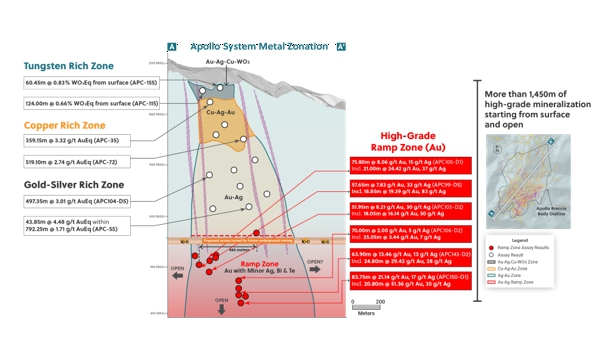
Figure 10.5. Cross section SW-NE looking northwest at the Apollo target showing significant drill intersections. Source: Collective (2026)
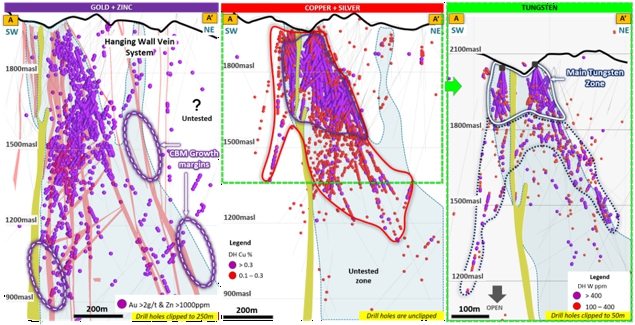
Figure 10.6. Cross sections of the Apollo target showing distribution of Au+Zn, Cu+Ag and W. Source: Collective (2026)
108
| Collective Mining Ltd. |
| Guayabales Project - Apollo Mineral Resource 2026-08 |
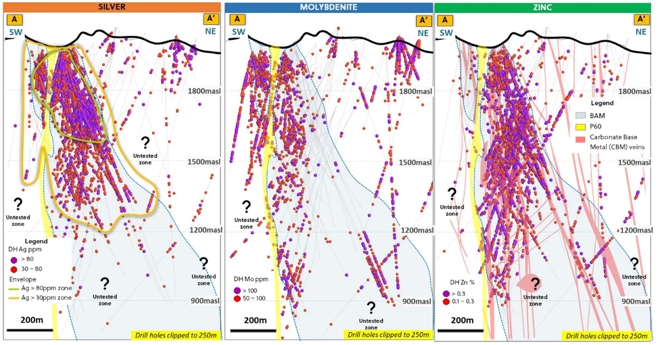
Figure 10.7. Cross sections of the Apollo target showing distribution of Ag, Mo and Zn. Source: Collective (2026)
| 10.5.2 | Plutus Target |
Twenty-six holes have been drilled from six platforms for 9,494.75 m at the Plutus target from 2021 to 2026. Previously, the north zone of the Plutus Target was called Donut target. Highlights include:
| ● | DOC_002: 104.00 m at 1.20 g/t Au, 12.0 g/t Ag downhole |
| ● | DOC_003: 163.00 m at 1.20 g/t Au, 11.0 g/t Ag downhole |
| ● | DOC_008: 107.65 m at 0.78 g/t Au, 21.0 g/t Ag from 18.00 m downhole |
| ● | PNC_002: 185.80 m at 0.59 g/t Au, 13 g/t Ag, 0.02% Cu from 143.20 m downhole |
| ● | PNC_002: 136.45 m at 0.97 g/t Au, 20 g/t Ag, 0.04% Cu from 369.35 m downhole |
| ● | PNC_005: 304.60 m at 0.58 g/t Au, 9 g/t Ag, 0.03% Cu from 4.40 m downhole |
109
| Collective Mining Ltd. |
| Guayabales Project - Apollo Mineral Resource 2026-08 |
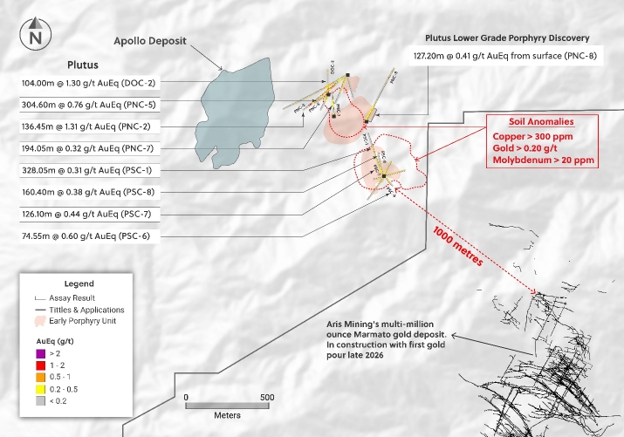
Figure 10.8. Plan of the significant drill intersections in the Plutus target. Source: Collective (2026)
| 10.5.3 | The Box Target |
Sixteen holes have been drilled from 6 different platforms for 5,403.60 m at the Box target from 2021 to 2026. Highlights include:
| ● | BOXC_007: 33.30 m at 0.91 g/t Au, 50 g/t Ag, 0.10% Zn, 0.02% Pb, 0.01% Cu from 73.40 m downhole |
| ● | BOXC_008: 34.95 m at 0.72 g/t Au, 16 g/t Ag, 0.05% Zn, 0.04% Pb, 0.03% Cu from 171.80 m downhole |
| ● | BOXC_010: 55.00 m at 0.45 g/t Au, 59 g/t Ag, 0.23% Zn, 0.04% Pb, 0.01% Cu from 8.50 m downhole |
| 10.5.4 | Trap Target |
Trap is a north to northwest trending, structurally controlled corridor with evidence of porphyry B veins overprinted by late-stage carbonate base metals veins. Thirty-eight holes have been drilled from 2022 to 2026 at 11 platforms for 16,622.95 m at the Trap target. The holes have the following highlights:
| ● | TRC_001: 102.20 m at 1.26 g/t Au, 12 g/t Ag, 0.09% Cu from 233.80 m downhole |
| ● | VICE_001: 14.70 m at 1.14 g/t Au, 26 g/t Ag, 0.01% Cu from 212.60 m downhole |
110
| Collective Mining Ltd. |
| Guayabales Project - Apollo Mineral Resource 2026-08 |
| ● | VICE_002: 18.90 m at 1.06 g/t Au, 36 g/t Ag, 0.18% Cu from 214.60 m downhole |
| ● | TRC_002: 646.00 m at 0.71 g/t Au, 6 g/t Ag, 0.02% Cu from 19.50 m downhole |
| ● | TRC_006: 206.95 m at 0.90 g/t Au, 5 g/t Ag from 98.40 m downhole |
| ● | TRC_007A: 632.25 m at 0.92 g/t Au, 9 g/t Ag from 172.65 m downhole |
| ● | TRC_011: 174.45 m at 0.89 g/t Au, 11 g/t Ag from 485.15 m downhole |
| ● | TRC_014: 30.00 m at 3.10 g/t Au, 149 g/t Ag, 0.05% Cu from 11.85 m downhole |
| ● | TRC_030: 200.85 m at 1.01 g/t Au, 5 g/t Ag, 0.04% Cu from 4.55 m downhole |
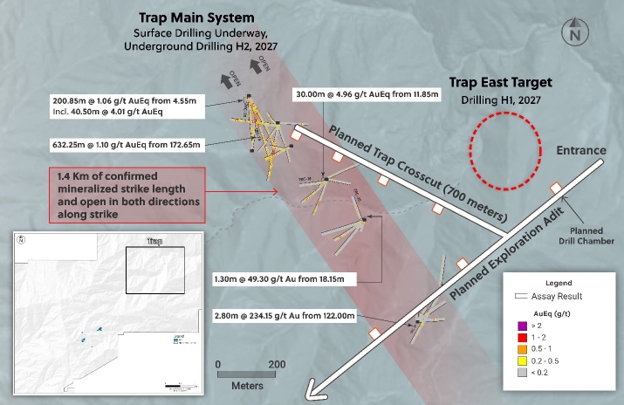
Figure 10.9. Plan of the significant drill intersections in the Trap target.
| 10.5.5 | ME Target |
Nine holes have been drilled from three different platforms for 3,734.10 m at ME Target. Highlights include:
| ● | APC_081: 111.25 m at 0.83 g/t Au, 10 g/t Ag, 0.03% Cu from 130.00 m downhole |
| ● | APC_083: 55.40 m at 0.98 g/t Au, 14 g/t Ag, 0.02% Cu from 239.95 m downhole |
| ● | MEC_002: 0.65 m at 534.00 g/t Au, 40 g/t Ag from 274.50 m downhole |
| ● | MEC_002: 0.90 m at 47.20 g/t Au, 8 g/t Ag from 291.80 m downhole |
111
| Collective Mining Ltd. |
| Guayabales Project - Apollo Mineral Resource 2026-08 |
| 10.5.6 | X Target |
Five holes have been drilled from two platforms for 1,646.90 m at the X target. They intersected high grade Ag veins carrying Au and minor base metals. Highlights include:
| ● | XTC_001: 12.85 m at 1.82 g/t Au, 361 g/t Ag from 121.10 m downhole |
| ● | XTC_001: 2.15 m at 0.70 g/t Au, 198 g/t Ag from 208.15 m downhole |
| ● | XTC_001: 18.65 m at 0.72 g/t Au, 59 g/t Ag from 334.95 m downhole |
| ● | XTC_001: 2.30 m at 0.64 g/t Au, 368 g/t Ag from 351.30 m downhole |
| ● | XTC_002: 2.15 m at 0.55 g/t Au, 181 g/t Ag from 204.05 m downhole |
| ● | XTC_002: 1.10 m at 1.22 g/t Au, 426 g/t Ag from 251.80 m downhole |
| ● | XTC_003: 3.25 m at 0.33 g/t Au, 113 g/t Ag from 190.95 m downhole |
| ● | XTC_004: 5.00 m at 0.71 g/t Au, 137 g/t Ag from 202.00 m downhole |
| ● | XTC_004: 3.15 m at 1.06 g/t Au, 220 g/t Ag from 213.55 m downhole |
| ● | XTC_005: 1.20 m at 0.14 g/t Au, 144 g/t Ag from 34.60 m downhole |
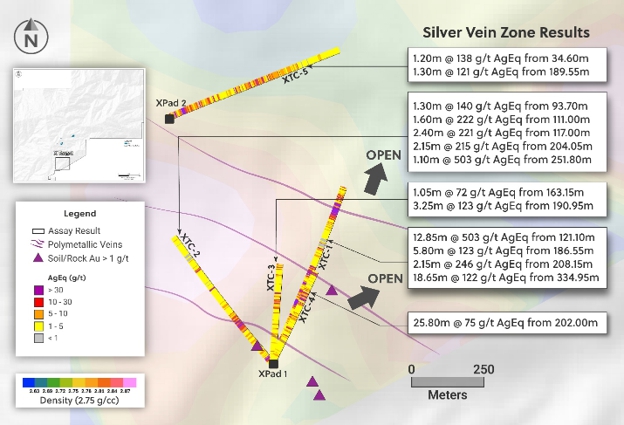
Figure 10.10. Plan showing significant drill intersections in the X target.
112
| Collective Mining Ltd. |
| Guayabales Project - Apollo Mineral Resource 2026-08 |
| 10.5.7 | Knife-Towers Target |
Six holes have been drilled from three platforms for 1,729.40 m at the Knife-Towers target with no significant intersections.
| 10.5.8 | Victory Target |
In 2022, two holes were drilled from one platform for 936.20 m at the Victory target and were reinterpreted in 2026 with both holes intersecting multiple zones of high-grade precious metals veining, representing the at depth extensions of auriferous veins mapped at surface. Significant intercepts included:
| ● | VICW-1: 5.85 m at 2.95 g/t Au from 198.50 m downhole |
| ● | VICW-1: 1.00 m at 13.94 g/t Au from 261.40 m downhole |
| ● | VICW-2: 3.75 m at 3.21 g/t Au from 64.95 m downhole |
| ● | VICW-2: 0.85 m at 7.90 g/t Au from 307.75 m downhole |
| 10.6 | Drilling Results between Closure of the Database and 13 October 2026 |
Since closure of the borehole database for the MRE, Collective has drilled approximately, another 59,000 metres in 157 diamond drillholes. As at 13.10.26 results have been announced for 58 holes (21,000m) from this programme with assays still pending for 38 000 metres (99 Holes). Table 10.7 below outlines highlights from the recently announced results subdivided into drilling target area or mineralized zone.
The Shallow Halo Zone (SHZ) is an interpreted 2.4-kilometer-long, 200-meter-wide, precious metal-dominant target area which currently lies within the Mineral Resource open-pit shell. The SHZ extends from surface to a maximum depth of 150 metres and includes mineralization in oxide, partially oxidized rock (transition) and primary, sulfide mineralized rock. To date twenty-three holes have been announced since the MRE with twenty-two falling above the open-pit cut-off grade of 0.3 g/t AuEq. Only 29% of the SHZ has been drill tested as at the date of this technical report. The SHZ mineralization is outlined in Figure 7.17 and summarized in section 7.4.4 of this technical report. Recent drilling has identified high grade, silver tungsten-copper mineralization associated with scheelite, chalcocite and silver sulfosalts in NW-trending veins.
New and high-grade Tungsten mineralization has been drilled in the eastern contact zone of the Apollo breccia (APC162) and southwest within schist rock and adjacent to the SW breccia contact (APC150-D4). The eastern contact zone begins at approximately 300 meters below surface and is distinct and separate from the upper tungsten subdomain in the Apollo breccia body, which covers the top 100 m of the Apollo system from surface and is defined in the MRE. The southwestern intercept hosted in schist lies approximately 680 m vertically below the Tungsten subdomain represented in the block model for Apollo. Both intercepts host scheelite mineralization associated with high gold grades, within breccia in the eastern zone and in a calcite vein within the schist.
113
| Collective Mining Ltd. |
| Guayabales Project - Apollo Mineral Resource 2026-08 |
Table 10.7 Drilling Results between Closure of the Database and 13 October 2026.
| Hole | From | Length | Au | Ag | Cu | WO3 | AuEq | Zone | Release Date |
| (m) | (m) | (g/t) | (g/t) | (%) | (%) | (g/t) | |||
| APC151-D1 | 106.55 | 232.7 | 1.44 | 22 | 0.06 | 1.93 | Shallow Halo Zone | May 6, 2026 | |
| Incl. | 184.60 | 45.00 | 3.08 | 26 | 0.07 | 3.66 | |||
| & Incl. | 306.45 | 32.80 | 2.91 | 46 | 0.08 | 3.89 | |||
| APC151-D2 | 123.45 | 160.15 | 1.81 | 14 | 0.05 | 2.13 | |||
| Incl. | 139.65 | 21.10 | 4.13 | 35 | 0.09 | 4.90 | |||
| & Incl. | 240.00 | 24.80 | 4.25 | 14 | 0.09 | 4.62 | |||
| APC-161D | 91.30 | 21.00 | 0.82 | 95 | 2.66 | May 20, 2026 | |||
| APC-162 | 194.25 | 6.70 | 3.37 | 34 | 0.03 | 4.06 | June 29, 2026 | ||
| and | 296.00 | 13.00 | 5.09 | 12 | 0.04 | 0.09 | 6.78 | ||
| APC-165 | 0.00 | 71.20 | 0.75 | 87 | 2.44 | May 20, 2026 | |||
| APC-167D | 392.20 | 58.00 | 0.85 | 10 | 0.01 | 1.05 | June 29, 2026 | ||
| Incl. | 425.80 | 7.15 | 3.16 | 38 | 0.01 | 3.91 | |||
| APC-169D | 12.80 | 56.00 | 0.30 | 79 | 1.83 | May 20, 2026 | |||
| APC-182 | 21.30 | 135.15 | 0.28 | 90 | 0.10 | 2.13 | September 15, 2026 | ||
| Incl. | 21.30 | 49.05 | 0.15 | 24 | 0.61 | ||||
| Incl. | 70.35 | 61.05 | 0.36 | 162 | 0.13 | 3.64 | |||
| Incl. | 131.40 | 25.05 | 0.30 | 39 | 0.14 | 1.21 | |||
| APC-184 | 65.6 | 19.5 | 0.4 | 93 | 0.16 | 2.37 | Shallow Halo Zone | October13 2026 | |
| and | 107.6 | 1.5 | 0.08 | 351 | 0.16 | 0.42 | 13.65 | ||
| APC-186 | 17.7 | 87.6 | 0.21 | 99 | 0.09 | 0.05 | 3.01 | ||
| Incl. | 77.65 | 26.1 | 0.11 | 286 | 0.22 | 0.18 | 8.71 | ||
| Incl. | 89.15 | 5.5 | 0.17 | 1283 | 0.57 | 0.83 | 38.68 | ||
| APC-190 | 163.1 | 1.5 | 2.34 | 35 | 3.02 | ||||
| and | 189.4 | 1.3 | 2.74 | 22 | 3.17 | ||||
| APC-193 | 0 | 149.55 | 0.28 | 32 | 0.09 | 1.00 | |||
| Incl. | 14.2 | 45.5 | 0.22 | 46 | 0.05 | 1.16 | |||
| Incl. | 59.7 | 14.7 | 0.33 | 103 | 0.16 | 2.50 | |||
| Incl. | 59.7 | 1.35 | 0.17 | 120 | 0.19 | 0.14 | 4.90 |
114
| Collective Mining Ltd. |
| Guayabales Project - Apollo Mineral Resource 2026-08 |
| APC-208 | 312.95 | 49.85 | 1.76 | 33 | 0.28 | 2.70 | |||
| Incl. | 312.95 | 1.05 | 6.31 | 6 | 0.07 | 0.24 | 10.27 | ||
| APC150-D4 | 128.75 | 8.15 | 8.47 | 4 | 0.40 | 14.83 | New Tungsten-Enriched Schist Zone | September 24, 2026 | |
| APC-162 | 336.40 | 27.35 | 11.62 | 54 | 0.43 | 1.68 | 39.53 | New Tungsten Enriched High-Grade Subzone | June 29, 2026 |
| APC172-D2 | 19.65 | 141.40 | 4.75 | 5 | 0.02 | 4.87 | Breccia Extension | September 1, 2026 | |
| Incl. | 27.80 | 38.00 | 15.25 | 8 | 0.03 | 15.44 | |||
| APC-171D | 311.05 | 1.30 | 7.82 | 6 | 7.94 | High-Grade Veins | September 24, 2026 | ||
| APC-171D | 823.15 | 1.15 | 55.5 | 109 | 0.35 | 57.99 | |||
| APC-171D | 949.65 | 1.25 | 28.6 | 6 | 28.72 | ||||
| APC171-D1 | 145.30 | 9.70 | 4.28 | 11 | 0.05 | 4.55 | |||
| APC171-D2 | 43.70 | 5.30 | 5.56 | 53 | 0.15 | 6.75 | |||
| APC171-D2 | 89.90 | 1.00 | 7.37 | 57 | 0.16 | 8.65 | |||
| APC171-D2 | 181.50 | 2.60 | 6.14 | 10 | 6.33 | ||||
| APC171-D2 | 188.85 | 1.35 | 6.95 | 6 | 7.07 | ||||
| APC171-D2 | 299.45 | 1.25 | 8.20 | 5 | 8.30 | ||||
| APC140-D5 | 396.15 | 23.15 | 4.61 | 11.00 | 4.82 | Western Ramp Zone | May 6, 2026 | ||
| APC140-D6 | 384.00 | 5.30 | 37.04 | 28 | 37.58 | ||||
| APC140-D7 | 586.55 | 8.60 | 6.51 | 13 | 6.76 | ||||
| APC160-D1 | 433.10 | 116.25 | 1.23 | 11 | 0.02 | 1.46 | Infill drilling | June 29, 2026 | |
| Incl. | 433.10 | 15.15 | 2.09 | 15 | 0.02 | 2.40 | |||
| & Incl. | 532.00 | 17.35 | 4.46 | 23 | 0.04 | 4.95 | |||
| and | 790.00 | 28.80 | 1.55 | 8 | 0.03 | 1.74 | |||
| APC160-D3 | 307.00 | 171.65 | 1.77 | 15 | 0.05 | 2.11 | September 1, 2026 | ||
| Incl. | 335.60 | 44.90 | 4.66 | 13 | 0.02 | 4.93 | |||
| APC160-D4 | 237.30 | 83.00 | 1.66 | 16 | 0.04 | 2.01 | |||
| Incl. | 292.45 | 15.30 | 3.64 | 28 | 0.07 | 4.26 |
AuEq grades reported here use the same formula as per the Mineral Resource.
115
| Collective Mining Ltd. |
| Guayabales Project - Apollo Mineral Resource 2026-08 |
Directional drilling, designed to test the Ramp Zone at depth encountered a new gold dominant mineralization area forming a northern extension to the Apollo breccia body at a depth of 1,000 m below surface. APC172-D2 is highlighted in the above table, and mineralization is hosted within breccia cement filled with pyrite, pyrrhotite, chalcopyrite, sphalerite, galena and occurrences of visible gold related to impregnation of the breccia by CBM veining.
Directional holes APC171D, D1 and D2 also intersected multiple, high grade, CBM veins whilst drilling towards the Ramp Zone. The three holes intersected previously unrecognized high-grade veins within and beyond the Apollo block model. Further drilling is in progress in order to define continuity in these vein systems.
Modelling of the Ramp Zone mineralization has led to an interpretation that this domain forms a ring-like geometry around the breccia body (see Figure 7.16). This circumference has been drilled to an initial resource level, as per this report, in the southeast with some additional intercepts recently drilled and highlighted in this table in the west and northwest (APC140-D5 to D7). All three drillholes intersected high-grade Ramp Zone style mineralization characterized by albite, muscovite and sericite alteration, and gold associated with anomalous bismuth and tellurium values. To date, approximately 470 meters of the interpreted 1.5-kilometer circumference of the Apollo breccia body at depth has now been tested for Ramp Zone mineralization.
Drilling at Apollo continues to infill gaps in the internal block model at various elevations with highlights presented in APC160-D1, D3 and D4. In APC160-D1 drilling continued towards the western margin and also extended the mineralized angular breccia body by 77 meters to the northwest at 900 m below surface.
The Ramp Zone remains at an early exploration stage outside the area included in the current resource estimate. Drilling since the close of the database for the resource estimation indicates that the Ramp Zone is significantly larger than the small part already modelled, but it needs additional drilling to meet the drill spacing required for a mineral resource. Additional drilling is being designed to allow detailed evaluation of the Ramp Zone geometry, grade distribution, extensions at depth, and to the north and west.
116
| Collective Mining Ltd. |
| Guayabales Project - Apollo Mineral Resource 2026-08 |
| 11 | Sample Preparation, Analyses and Security |
| 11.1 | Historical Data |
This section on historical data Section 11 Sample Preparation, Analyses and Security is copied and modified from Redwood (2025).
| 11.1.1 | Sample Preparation, Analysis and Security |
The historical samples were prepared and analysed by standard methods at certified laboratories using the methods summarized in Table 11.1 (Turner, 2010; Leroux, 2012).
Table 11.1 Summary of the sample preparation and analyses methods of the historical samples.
| Company | Laboratory | Method | Code | Procedure |
| Colombia Gold plc | not known | Preparation | Not known | |
| Au | Fire assay 30 g, AAS | |||
| Au overlimit | Fire assay 30 g, gravimetry | |||
| Multi-elements | ICP-AES | |||
| Colombian Mines | Inspectorate, Medellin and Reno (ISO/IEC 17025) | Preparation | Crush to -10 mesh, split 500 g, pulverise to -150 mesh. | |
| Au | FA/AA | Fire assay 30 g, AAS | ||
| Au overlimit | FA/GRAV | Fire assay 30 g, gravimetry | ||
| Multi-elements | ICP | ICP-AES | ||
| Colombian Mines (from June 2007) | SGS, Medellin and Callao (ISO 9001) | Preparation | Not known | |
| Au | FAA313 | Fire assay 30 g, AAS | ||
| Au overlimit | Fire assay 30 g, gravimetry | |||
| Multi-elements | ICP12B | 34 elements by aqua regia digestion, ICP-AES | ||
| Mercer Gold (soils, rocks) | SGS, Medellin and Callao (ISO 9001) | Preparation soils | SCR30 | Dry, screen to -10 mesh and -80 mesh, pulverise to P95 -140 mesh. |
| Preparation rocks | PRP94 | Dry, crush to -1/4 inch and -10 mesh, split 250 g, pulverise to P95 -140 mesh. | ||
| Au | FAA313 | Fire assay 30 g, AAS | ||
| Au | FAI303 | Fire assay 30 g, ICP | ||
| Multi-elements | ICP40B | 32 elements by 4 acid digestion, ICP-AES | ||
| Multi-elements | ICP12B | 34 elements by aqua regia digestion, ICP-AES | ||
| Mercer Gold (core) | Acme, Medellin and Vancouver (ISO 9001) | Preparation | R200 | Crush 1 kg to p80 -10 mesh, split 250 g, pulverise to p85 -200 mesh. |
| Au | G6 | Fire assay 30 g, AAS | ||
| Ag | 7AR1 | Aqua regia digest, ICP-AES | ||
| Multi-elements | 1D02 | 34 elements by aqua regia digestion, ICP-AES |
Colombia Gold plc and Mercer Gold had standard industry protocols for sample security with sampling supervised by a geologist, and secure sample storage and transport to the laboratory as summarised by Turner (2010) and Leroux (2012).
| 11.1.2 | Quality Assurance and Quality Control (QA-QC) |
Colombian Mines and Mercer Gold inserted certified standard reference materials (CRM), coarse blanks and field duplicates in the sample batches of soil, rock and core samples, as summarised in Table 11.2. The CRM were monitored for Au and Ag by scatter plots with performance gates of the recommended value of the data ± 2 SD (standard deviations) and ±3 SD, and show acceptable results (Turner, 2010; Leroux, 2012). The blanks were monitored for Au and Ag by scatter plots, and generally showed acceptable results, although the Acme gold samples show some carry-over between samples (Turner, 2010; Leroux, 2012). Field duplicates were monitored for Au on scatter plots and show low variability at low grades and scatter at higher grades as a result of geological heterogeneity. No check samples at a second laboratory were carried out. Both Turner (2010) and Leroux (2012) analysed check samples and took field duplicates, with acceptable correlations.
117
| Collective Mining Ltd. |
| Guayabales Project - Apollo Mineral Resource 2026-08 |
Table 11.2 QA-QC samples used in the historical sampling programs.
| Company | Type | Material | Position | No. | Acceptance |
| Colombian Mines | CRM | OREAS 15Pa, 62Pb, 50Pb, 61Pb | Not known | 27 | Average ± 2 SD, 3 SD |
| Coarse Blank | Not known | Not known | 53 | Scatter plot | |
| Field Duplicate | Protocol not known | Not known | 40 | Scatter plot | |
| Check samples | None | none | 0 | n/a | |
| Mercer Gold | CRM | OREAS 65a, 66a, 60a | Not known | 30 | Average ± 2 SD, 3 SD |
| Coarse Blank | Not known | Not known | 28 | Scatter plot | |
| Field Duplicate | Protocol not known | Not known | 37 | Scatter plot | |
| Check samples | None | none | 0 | n/a |
| 11.2 | Collective - Sample Preparation, Analyses, and Security |
| 11.2.1 | Sample Preparation, Analysis and Security |
From 2020-2021, Collective samples were prepared and analysed by Actlabs Colombia S.A.S. at a laboratory in Rionegro, Medellin, certified to ISO 9001-2008, Activation Laboratories Ltd., Ancaster, Ontario, certified to ISO/IEC 17025 and SGS Colombia S.A.S., Medellin for sample preparation and SGS Peru S.A.S., El Callao for analysis, both certified to ISO 9001. Since 2023, Collective has used ALS Colombia Ltd for sample preparation, ALS Peru S.A for analysis (certified to ISO/IEC 17025) and in March 2026, ALS Vancouver for the analysis of Au in selected Collective samples. Actlabs, SGS and ALS are all independent of Collective. The methods are listed in Table 11.3.
118
| Collective Mining Ltd. |
| Guayabales Project - Apollo Mineral Resource 2026-08 |
Table 11.3. Summary of the sample preparation and analyses methods of the Collective samples.
| Laboratory | Method | Code | Procedure |
| Actlabs, Medellin and Activation Laboratories Ltd., Ancaster, Ontario |
Preparation rocks | RX1 | Dry, crush to P80 - 2mm, riffle split 250g, and pulverise to P95 - 105µm |
| Preparation soils | S1 | Dry, sieve to 177µm | |
| Au | 1A2-30 | Fire assay 30g, AAS | |
| Au overlimit | 1A3 | Fire assay 30g, gravimetry | |
| Multi-elements rocks | UT-4M | 42 elements by multiacid digestion, ICP-MS | |
| Multi-elements soils | UT-1M | 34 elements by aqua regia digestion, ICP-MS | |
| SGS Colombia SAS, Medellin. | Preparation rocks | PRP93 | Dry, crush to P90 - 2mm, riffle split 250g, and pulverise to P95 - 106µm |
| SGS Peru SAS, El Callao, Peru |
Preparation soils | SCR31 | Dry, sieve to - 177 µm, riffle split 250g, and pulverise to P95 - 105 µm |
| Au | FAA313 | Fire assay 30g, AAS | |
| Au overlimit | FAG303 | Fire assay 30g, gravimetry | |
| Ag | AA12C | Aqua regia digestion, AAS | |
| Ag overlimit | AA11B | Aqua regia digestion, AAS | |
| Multi-elements rocks | ICM40B | 43 elements by multiacid digestion, ICP-MS | |
| Multi-elements soils | ICM14B | 36 elements by aqua regia digestion, ICP-OES | |
| ALS Colombia Ltd, Medellin. | Preparation Core | PREP-31B | Dry, crush to P70 - 2mm, riffle split 1000g, and pulverise to P85 - 75µm |
| Preparation Rocks - Soils | PREP-31 | Dry, crush to P70 - 2mm, riffle split 250g, and pulverise to P85 - 75µm | |
| ALS Peru SAS, El Callao, Lima. ALS Vancouver. |
Au (Core Samples) | AA24 | Fire assay 50g, AAS |
| Au overlimit (Core Samples) | GRA22 | Fire assay 50g, gravimetry | |
| Au - Screen Metallics (Core) | SCR24 | The gold values for both the (+) 106 and (-) 106-micron fractions are reported together with the weight of each fraction as well as the calculated total gold content of the sample. Fire Assay 50g, AAS | |
|
ALS Peru SAS, El ALS Peru SAS, El |
Multi-elements (Core Samples) | MS61 | 48 elements by multiacid digestion, ICP-MS |
| Au (Rocks - Soils Samples) | AA23 | Fire assay 30g, AAS | |
| Au overlimit (Rocks - Soils Samples) | GRA21 | Fire assay 30g, gravimetry | |
| Multi-elements (Rocks - Soils Samples) | MS61 | 48 elements by multiacid digestion, ICP-MS | |
| ALS Peru SAS, El Callao, Lima. ALS Vancouver. |
WO3 (Core Samples) | XRF15b | Decomposition for Lithium Metaborate, Lithium Tetraborate and Sodium Nitrate Fusion with X–ray fluorescence (XRF) finish |
| WO3 (Core Samples) | XRF15c | Decomposition for Lithium Metaborate with XRF finish |
Abbreviations: AAS = atomic absorption spectrophotometer; ICP, ICP-AES = inductively coupled plasma atomic emission spectrometer. ICP-MS = inductively coupled plasma mass spectrometer.
All results accepted into the database fell within the lower limit of detection, and upper limit of acceptable results for the relevant assay method. All assay data accepted for the resource model was measured with a lower limit of detection that was significantly lower than the level of significance or materiality with respect to the assay method.
119
| Collective Mining Ltd. |
| Guayabales Project - Apollo Mineral Resource 2026-08 |
| 11.2.2 | Quality Assurance and Quality Control (QA-QC) |
Collective has written protocols for sampling and QA-QC with the insertion of certified standard reference materials (CRM), coarse blanks, fine blanks, coarse duplicates and fine duplicates, as described in Table 11.4 and Table 11.5. A total of 18% of the number of QA-QC samples inserted exceeds normal industry practice and is consistent with industry best practice. The QA-QC is monitored in real time on receipt of the results of each batch of samples. The protocol for failed CRMs or blanks is to investigate the sample when in company custody, then in laboratory custody and, if necessary, reanalyse the interval.
Table 11.4. QA-QC protocol of Collective for core samples.
| Type | Code | Material | Rock, core % | Acceptance |
| CRM | STD | OREAS certified for Au, Ag, Cu, multielements | 3 | Rec value ±3 SD, 5 SD |
| Coarse Blank | BKG | Coarse quartz | 3 | 10x and 20x LLD |
| Fine Blank | BKF | Fine quartz | 3 | 10x and 20x LLD |
| Coarse Duplicate | DUG | Coarse reject, Blind control | 3 | 20% relative error |
| Fine Duplicate | DUP | Pulp reject, Blind control | 3 | 10% relative error |
| Check samples | MS | Master split reject | 3 | 10% relative error |
| Total | 18 |
Table 11.5. QA-QC protocol of Collective for soil and sediment samples.
| Type | Code | Material | Soils, seds % | Acceptance |
| CRM | STD | OREAS certified for Au, Ag, Cu | 4 | Rec value ±3 SD, 5 SD |
| Coarse Blank | BKG | Coarse quartz | 4 | 10x and 20x LLD |
| Fine Blank | BKF | Fine quartz | 4 | 10x and 20x LLD |
| Total | 12 |
The charts in the following three sections are for analyses of drill core from the drilling program from 2021 up to the 31 March, 2026 and include all the Guayabales targets presented herein.
Certified Reference Materials (Au, Cu, Ag)
CRM are purchased from a recognized laboratory. The CRM are monitored for Au, Ag and Cu by scatter plots with performance gates with rejection if a sample is greater or lesser than the recommended value ± 5 SD, and a warning if two or more samples are between the recommended value ±3 to ±5 SD (Figure 11.1 to Figure 11.3).
A sensitivity analysis was undertaken on 10,077 CRM results (Au, Ag and Cu) evaluated against certified values from 13 certified reference materials. Applying a conventional ±3 SD rejection limit, 320 results (3.18%) would be classified as failures, compared with 14 (0.14%) under the ±5 SD criterion adopted. All 14 results outside ±5 SD were diagnosed as gross errors: five results from two mislabelled CRM samples (all elements matching a different CRM) and nine isolated single-element errors. These would be rejected under any criterion.
120
| Collective Mining Ltd. |
| Guayabales Project - Apollo Mineral Resource 2026-08 |
Of the 306 results falling between ±3 SD and ±5 SD, 219 correspond to a single low-grade Ag CRM analysed by SGS (2021–2022). This CRM with a certified value 1.02 ppm Ag has been discounted from the analysis because of the continual problems with this CRM, the low level of issues in the other CRMs for Ag, and the Ag grade of the CRM being well below the level of economic interest.
The remaining 87 problematic results were distributed across different CRMs, laboratories and time, and in about 80% of the affected batches the other CRMs in the same certificate passed. There was no significant bias with any of the CRMs within any grades of economic interest.
Because the ±5 SD limit classifies systematic bias as warnings rather than failures, mean bias for each CRM is monitored independently. Mean biases greater than ±5% trigger investigation. Collective considers that the ±5 SD criterion, combined with independent bias monitoring, does not mask any material accuracy issue. The CRM are also monitored statistically for accuracy (Table 11.6)
Table 11.6. CRM summary statistics of performance.
| Grade CRM | Metal | Unit | Certified Value | SD | RSD (%) | Average | Mean BIAS (%) | BIAS (SD) |
| Low | Au | ppm | 0.23 | 0.01 | 4.61 | 0.24 | 2.98 | 0.65 |
| Low | Au | ppm | 0.33 | 0.01 | 4.38 | 0.32 | -1.08 | -0.25 |
| Low | Au | ppm | 0.34 | 0.01 | 2.82 | 0.34 | 1.15 | 0.41 |
| Medium | Au | ppm | 0.70 | 0.02 | 3.58 | 0.72 | 2.75 | 0.77 |
| Medium | Au | ppm | 0.71 | 0.02 | 2.58 | 0.69 | -2.47 | -0.96 |
| Medium | Au | ppm | 1.00 | 0.05 | 4.86 | 1.02 | 2.31 | 0.47 |
| High | Au | ppm | 1.26 | 0.05 | 3.64 | 1.26 | 0.37 | 0.10 |
| High | Au | ppm | 1.46 | 0.04 | 2.41 | 1.47 | 1.15 | 0.48 |
| High | Au | ppm | 1.88 | 0.06 | 3.36 | 1.90 | 0.99 | 0.29 |
| Low | Ag | ppm | 6 | 0.26 | 4.18 | 6.47 | 5.86 | 1.40 |
| Medium | Ag | ppm | 20 | 1.10 | 5.58 | 20.56 | 4.37 | 0.78 |
| Medium | Ag | ppm | 30 | 1.26 | 4.25 | 29.76 | 0.65 | 0.15 |
| High | Ag | ppm | 50 | 2.31 | 4.59 | 51.06 | 1.43 | 0.31 |
| High | Ag | ppm | 63 | 1.80 | 2.86 | 62.72 | -0.08 | -0.03 |
| High | Ag | ppm | 114 | 2.50 | 2.19 | 114.57 | 0.50 | 0.23 |
| High | Ag | ppm | 134 | 8.89 | 6.64 | 130.31 | -2.68 | -0.40 |
| Low | Cu | ppm | 268 | 11.22 | 4.18 | 276.40 | 3.03 | 0.72 |
| Low | Cu | ppm | 554 | 18.67 | 3.37 | 551.79 | -0.49 | -0.14 |
| Medium | Cu | ppm | 1156 | 45.07 | 3.90 | 1143.19 | -1.11 | -0.29 |
| Medium | Cu | ppm | 2722 | 87.66 | 3.22 | 2726.62 | 0.15 | 0.05 |
| Medium | Cu | ppm | 3599 | 154.89 | 4.30 | 3569.51 | -0.81 | -0.19 |
| Medium | Cu | ppm | 4770 | 197.05 | 4.13 | 4744.28 | -0.54 | -0.13 |
| High | Cu | ppm | 5314 | 164.44 | 3.09 | 5352.12 | 0.72 | 0.23 |
| High | Cu | ppm | 5478 | 132.90 | 2.43 | 5493.04 | 0.28 | 0.11 |
| High | Cu | ppm | 7124 | 199.62 | 2.80 | 7084.01 | -0.56 | -0.20 |
SD = standard deviation; RSD = relative standard deviation. RSD = ((SD/Mean)*100); Mean Bias% = [(Certified Value CRM / Average Value)-1]*100; Bias = (Average Value – Certified Value/ Certified Value)×100
121
| Collective Mining Ltd. |
| Guayabales Project - Apollo Mineral Resource 2026-08 |
Table 11.7. Summary of W/WO₃ CRM.
| Reference | CRM type | Species | Certified value | SD (%) | Mean (%) | Bias (%) |
| OREAS700 | Medium-grade tungsten | WO3 | 1.4226% WO₃ | 0.0311 | 1.4299 | 0.51 |
| NIST SRM 277 | Tungsten concentrate | WO3 | 67.5% WO₃ | 0.13* | 67.4 | -0.15 |
| BCS-CRM 355 | Low-grade tin ore | W | 0.35% W | 0.04 | 0.3515 | 0.44 |
| CANMET MP-1b | Low-grade polymetallic ore | W | 1100 ppm W** | 0.0139 | 0.1119 | 1.72 |
** Informational value (non-certified). The SD was not provided by the certificate.
Certified Reference Materials (W and WO3)
Blind CRM samples were not inserted for W or WO3.
Analytical accuracy for tungsten was only monitored by the laboratory who used four reference materials inserted into the sample stream. Two of these were for XRF-15b method (analysis of W in ppm), and two for the XRF-15c method (analysis of WO3 in percent). Together they cover a range from approximately 0.11% W to 67.5% WO₃ (Table 11.7). A total of 373 CRM results were reported by ALS between laboratory certificates MD25096201 and MD25413447.
Blanks
Before 2024, uncertified fine and coarse blanks were used in the quality control program. Since 2024 certified blanks have been used. These blanks were prepared from barren quartz and were analysed and certified by Bureau Veritas laboratory, Medellín.
Coarse and Fine Duplicates
Between December 2021 and August 2023, the QA/QC program included field duplicates (DU), coarse duplicates (DUG) and pulp duplicates (DUP). Samples were selected by the logging geologist. Coarse and pulp duplicates were obtained by splitting the samples during preparation at the laboratory (SGS) and their insertion was not blind to the laboratory.
In April 2023, GSI International carried out a technical advisory visit and issued recommendations to improve the internal QA/QC procedures, documented in the Visit_Report_April_2023 and its appendices. The recommendations included heterogeneity testing and a change to the sample preparation scheme.
From September 2023, the program moved to blind duplicates, using laboratory counter-samples (coarse rejects and pulps) of original samples previously prepared and analysed by SGS and, later, by ALS. During this period the preparation scheme for the duplicate of 250 g of pulverized material and a 30 g fire assay charge for Au was maintained. Between October 2023 and September 2024, a new preparation scheme was progressively implemented at ALS, consisting of pulverization of 1,000 g and a 50 g fire assay charge. This transition allowed reproducibility to be assessed by re-processing reject samples of material originally analysed under the previous scheme. The duplicate assays are no longer a duplicate of the original sample, and therefore the results do not give an accurate representation of the variability in the assay results.
122
| Collective Mining Ltd. |
| Guayabales Project - Apollo Mineral Resource 2026-08 |
Since September 2024, this revised protocol has been in place. It is based on blind duplicates taken from reject samples of original samples prepared and analysed by ALS under the same scheme (1,000 g pulverization and a 50 g charge for Au). Field duplicates were discontinued, and precision is controlled with laboratory reject samples. A summary of the duplicate programs is provided in Table 11.8.
Table 11.8. Summary of Duplicates Programs.
| Stage | Period | Procedure |
| 1 | Dec 2021 – Aug 2023 | Field (DU), coarse (DUG) and pulp (DUP) duplicates, split at the laboratory (SGS); not blind. Pulverization of 250 g and 30 g charge for Au. |
| 2 | Sep 2023 – Sep 2024 | Blind duplicates from the rejects of samples originally processed by SGS, submitted to ALS. Pulverization of 250 g and 30 g charge for Au. |
| 3 | Oct 2023 – Sep 2024 | Rejects of samples originally processed by ALS under the previous scheme, re-processed with the new scheme: pulverization of 1,000 g and 50 g charge for Au. – Blind duplicates. |
| 4 | Sep 2024 – present | Rejects of samples originally processed by ALS under the same preparation and analytical scheme: pulverization of 1,000 g and 50 g charge for Au. – Blind duplicates. |
Stages 2 and 3 are partially overlapping transition periods between preparation schemes and laboratories.
2024-2026 Duplicate Procedure
The procedure at the time of this report uses ALS laboratory reject samples and comprises three phases: identification of material, sample selection, and insertion into the analytical batches.
Phase 1 – Identification and availability of reject samples. Reject samples are obtained during the preparation of the original samples, following the ALS preparation scheme:
| ● | Coarse duplicates (DUG): material retained after primary crushing and splitting. The 1,000 g split continues to pulverization, and the remaining material is kept as a coarse reject sample. The material must meet a particle size of 70% passing 2.00 mm (No. 10 mesh) and a minimum mass of 1,500 g to be selected. |
| ● | Pulp duplicates (DUP): pulp fractions retained after pulverization. The remaining material is kept as a pulp reject sample. A minimum mass of 130 g is required for selection. Pulp reject samples are also used for inter-laboratory check assays. |
Phase 2 – Sample selection. Duplicates are selected from the database following the chronological order of drilling and considering each mineralized target. Samples are grouped by Au grade into three ranges: low (>0.3 to ≤0.5 ppm), medium (>0.5 to ≤1.0 ppm) and high (>1.0 to ≤5.0 ppm). The availability and mass of the reject samples are then verified.
Phase 3 – Insertion and submission. A list of selected reject samples is prepared to confirm availability and mass. Samples meeting the criteria are included in the control sheets following the blind coding and insertion procedure and are submitted to ALS for preparation and analysis using 1,000 g pulverization and a 50 g fire assay charge for Au.
123
| Collective Mining Ltd. |
| Guayabales Project - Apollo Mineral Resource 2026-08 |
Field Duplicates
Field duplicates, consisting of a ¼-core split of the original ½-core sample, were collected until June 2023. Because of the strong heterogeneity of the mineralization, Collective considered that a ¼-core sample did not adequately represent the original interval. In addition, the different sample masses of the original (½ core) and the duplicate (¼ core) introduced a sampling variance that exceeds the true variability of the deposit, so the comparison is not statistically meaningful.
Check Samples Inter-laboratory check assays
A total of 2,145 pulp samples were submitted to Bureau Veritas (BV) as the secondary laboratory. They were taken from the pulp reject samples of the original samples and their duplicates, following the reject sample duplicate insertion procedure described in Section 11.2.2. Each check sample was paired with its original sample by drillhole and sample interval. A total of 2,145 pairs were obtained: 2,048 corresponding to original samples analysed by ALS and 97 originally analysed by SGS.
| 11.2.3 | Specific Gravity Data – Collective |
Specific gravity (SG) is measured on site by trained company personnel using the paraffin wax-coated water immersion (Archimedes) method, which was applied to all selected samples. Measurements were taken on 10 to 30 cm long whole or cut core samples, collected every 10 m or at each lithological change, to ensure representative coverage of the main lithologies, alteration types and mineralized zones. For each sample, the drillhole, box number, sample ID, lithology, core diameter and depth interval were recorded, and the measured core length checked against the theoretical interval length.
Samples were weighed before and after drying to confirm moisture removal. They were then fully coated with paraffin wax, weighed in air, and weighed suspended in water, and the water temperature recorded. SG is calculated as:
SG = W_dry / [(W_coated − W_water) − (W_coated − W_dry) / ρ_wax] × ρ_water
where ρ_wax = 0.92 g/cm³ and ρ_water = 0.9978 g/cm³ (at 26 °C). After measurement, the paraffin was removed and the sample reweighed to quantify any residual wax before being returned to the core box. Each record identifies the operator who performed the measurement and was authorized by a geologist. Corrections were documented in the data capture and the results loaded into the MX Deposit database.
As an external verification, 91 samples were submitted to ALS for SG determination using the wax-coated water immersion method (ALS code OA-GRA09A).
| 11.2.4 | Sample Security - Collective |
Sample integrity was controlled from the drill platform to the laboratory under the company’s internal control procedure. At the drill site, core was recovered using a core retainer plug (Duque Pro) to prevent core loss. It was then placed in clean, dry core boxes of the appropriate diameter and marked with depth blocks. The boxes were transported by company personnel to the core logging facility, where they were checked and verified before logging. After marking and cutting, each sample was collected into an individually labelled bag, and its interval and identification checked against the sample ticket book. Sample information was then recorded and verified in the MX Deposit database. Certified reference materials (CRMs), blanks and duplicates were then inserted into each batch following the control ticket sequence.
124
| Collective Mining Ltd. |
| Guayabales Project - Apollo Mineral Resource 2026-08 |
Samples were weighed individually and packed by batch into bags of no more than 25 kg. Each bag was labelled with the batch number, bag number and destination laboratory, and sealed with a numbered security seal. A chain of custody form and an analysis request were also prepared for each batch. A batch file was kept containing sample dispatch weights, the chain of custody, the analysis request and photographs of the control samples. Batches were transported to the laboratory in company vehicles. On arrival, the laboratory checks the samples against the chain of custody and the analysis request before issuing a work order.
Following completion of the analysis, coarse reject and pulp reject samples were returned to the company (45 to 90 days after analysis), identified by certificate number and accompanied by a physical and digital chain of custody. They were stored by batch on pallets in a dedicated warehouse attached to the core processing facility, with an inventory and a location map. The remaining half core was also stored in core racks, ordered by drillhole, depth and box number, with a digital and physical inventory.
| 11.3 | QAQC Results– Collective |
This discussion only refers to the results of QAQC for the core samples.
| 11.3.1 | Certified Reference Materials (“CRMs”) – Collective |
Analytical accuracy for Au, Ag and Cu was monitored by inserting commercial certified reference materials (CRMs) into the sample stream. A total of 4,175 CRMs were inserted, which corresponds to 3.6% of the 117,284 primary samples.
Thirteen CRMs purchased from recognized commercial suppliers were used for the evaluation. Their certified values cover a wide range of grades: 0.08–1.88 ppm Au, 1.0–133.9 ppm Ag and 0.03–2.98% Cu. Au values were certified by lead-collection fire assay; Ag and Cu values were certified by four-acid digestion and ICP. CRMs, or individual elements, without a certificate on file were excluded from the evaluation of accuracy.
Results were evaluated with control charts (Figure 11.1 to Figure 11.3) and the result summarised in Table 11.9. A result passed if it was within ±3 SD of the certified value, was classified as a warning between ±3 SD and ±5 SD, and the result classified as a fail beyond ±5 SD. Mean bias for each CRM was monitored independently, and a mean bias above ±5% triggered an investigation.
125
| Collective Mining Ltd. |
| Guayabales Project - Apollo Mineral Resource 2026-08 |
Table 11.9. Summary of Au, Ag and Cu CRM performance.
| Element | N | Pass | Warning (3 to 5 SD) |
Fail (>5 SD) | Range of mean bias (%) |
Range of RSD (%) |
| Au | 3,191 | 3,166 (99.2%) | 20 (0.6%) | 5 (0.2%) | -2.47 to +3.62 | 2.0-5.1 |
| Ag* | 1,733 | 1,719 (99.2%) | 14 (0.8%) | 0 (0.0%) | -2.68 to +5.86 | 2.2-6.6 |
| Cu | 3,525 | 3,497 (99.2%) | 22 (0.6%) | 6 (0.2%) | -2.36 to +0.72 | 1.4-4.1 |
* Excludes one low-grade CRM whose certified Ag value (0.66 ppm) is below 20 times the detection limit.
All results outside ±5 SD were classified as gross errors. Five of these 11 results were from two mislabelled CRM samples and six were isolated single-element errors. These are not considered representative of laboratory performance.
Gold (Au).
Accuracy is good across the full grade range.
High-grade CRMs (1.26–1.88 ppm Au): best performance, with mean biases of +0.37% to +1.15% and RSDs of 2.0–2.8%.
Intermediate-grade CRMs (0.47–1.00 ppm Au): mean biases between −2.47% and +2.75%, with RSDs of 2.6–3.3%.
Low-grade CRMs (0.08–0.34 ppm Au): mean biases between −1.83% and +3.62%. RSDs are higher, from 2.8% to 5.1%, as expected at concentrations close to the detection limit.
The control charts show the change of laboratory in 2023, and acceptable accuracy was preserved. Eight of the twelve Au CRMs show a slight positive bias, which indicates a mild tendency to overestimate Au grades. This is most evident for one intermediate-grade CRM (1.00 ppm Au), which returned a bias of +6.6% at ALS compared with +0.4% at SGS, for an overall bias of +2.3%.
Table 11.10. CRM performance for Au analyses.
| Element | Reference | SD |
RSD % |
N |
Mean obs. |
Bias % |
SD obs. | SD obs./SD ref |
Warning 3–5 SD |
Fail >5 SD |
% Fail ±5 SD |
| Au | 0.23 | 0.01 | 4.61% | 168 | 0.24 | 2.98% | 0.01 | 0.61 | 0 | 0 | 0.00% |
| Au | 0.33 | 0.01 | 4.38% | 142 | 0.32 | -1.08% | 0.03 | 2.14 | 0 | 1 | 0.70% |
| Au | 0.34 | 0.01 | 2.82% | 451 | 0.34 | 1.15% | 0.02 | 2.53 | 1 | 2 | 0.44% |
| Au | 0.70 | 0.02 | 3.58% | 119 | 0.72 | 2.75% | 0.02 | 0.74 | 0 | 0 | 0.00% |
| Au | 0.71 | 0.02 | 2.58% | 184 | 0.69 | -2.47% | 0.02 | 1.17 | 9 | 0 | 0.00% |
| Au | 1.00 | 0.05 | 4.86% | 874 | 1.02 | 2.31% | 0.03 | 0.71 | 0 | 0 | 0.00% |
| Au | 1.26 | 0.05 | 3.64% | 123 | 1.26 | 0.37% | 0.04 | 0.77 | 0 | 0 | 0.00% |
| Au | 1.46 | 0.04 | 2.41% | 349 | 1.47 | 1.15% | 0.03 | 0.86 | 3 | 0 | 0.00% |
| Au | 1.88 | 0.06 | 3.36% | 180 | 1.90 | 0.99% | 0.05 | 0.76 | 0 | 0 | 0.00% |
126
| Collective Mining Ltd. |
| Guayabales Project - Apollo Mineral Resource 2026-08 |
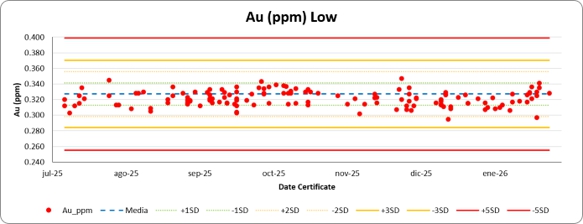
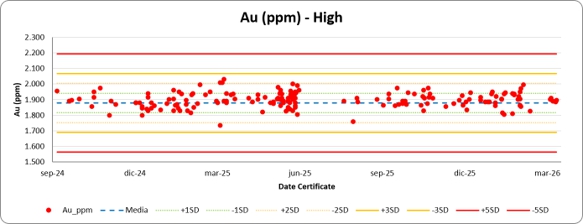
Figure 11.1: Examples of control charts for CRM assays for gold.
Silver (Ag).
Performance is good for medium- and high-grade CRMs.
High-grade CRMs (29.6–133.9 ppm Ag): mean biases between −2.68% and +1.43%, with RSDs of 2.2–6.6%.
Low-grade CRMs (1.0–2.7 ppm Ag): mean biases between −0.35% and +2.78%, with higher RSDs of 3.9–8.5%. At these levels, several results were reported at a 0.1 ppm resolution, where one reporting increment is equivalent to 0.8–1.7 certified SDs.
Intermediate-grade CRMs (6.1 and 19.7 ppm Ag): positive biases of +5.86% and +4.37%, respectively.
One low-grade CRM at SGS was problematic with a large number of failures returned a systematic bias of +13.1% at a certified value of only 1.02 ppm Ag, which was only three to five times the detection limit. The bias is not considered material, because Ag grades of economic interest are well above this level. The results from this particular standard have therefore been removed from the analysis of accuracy.
127
| Collective Mining Ltd. |
| Guayabales Project - Apollo Mineral Resource 2026-08 |
Table 11.11. CRM performance for Ag analyses.
| Element | Reference | SD |
RSD % |
N |
Mean obs. |
Bias % |
SD obs. | SD obs./SD ref |
Warning 3–5 SD |
Fail >5 SD |
% Fail ±5 SD |
| Ag | 6.11 | 0.26 | 4.18% | 119 | 6.47 | 5.86% | 0.23 | 0.89 | 4 | 0 | 0.00% |
| Ag | 19.70 | 1.10 | 5.58% | 126 | 20.56 | 4.37% | 0.92 | 0.83 | 0 | 0 | 0.00% |
| Ag | 29.57 | 1.26 | 4.25% | 123 | 29.76 | 0.65% | 0.96 | 0.77 | 0 | 0 | 0.00% |
| Ag | 50.34 | 2.31 | 4.59% | 874 | 51.06 | 1.43% | 1.27 | 0.55 | 0 | 0 | 0.00% |
| Ag | 62.77 | 1.80 | 2.86% | 180 | 62.72 | -0.08% | 1.53 | 0.85 | 0 | 0 | 0.00% |
| Ag | 114.00 | 2.50 | 2.19% | 99 | 114.57 | 0.50% | 2.46 | 0.99 | 1 | 0 | 0.00% |
| Ag | 133.89 | 8.89 | 6.64% | 212 | 130.31 | -2.68% | 8.62 | 0.97 | 9 | 0 | 0.00% |
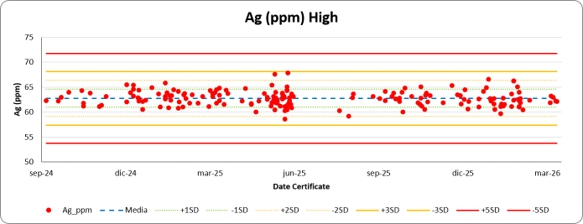
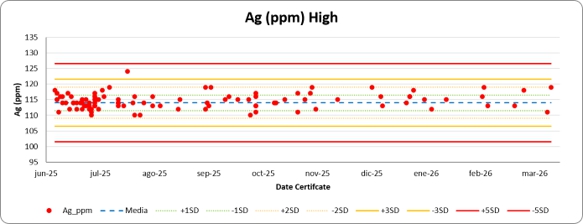
Figure 11.2: Examples of control charts for CRM assays for silver.
128
| Collective Mining Ltd. |
| Guayabales Project - Apollo Mineral Resource 2026-08 |
Copper (Cu)
The results for the copper from the CRMs show the most consistent performance of the three elements. All CRMs (0.03–2.98% Cu) return mean biases between −2.36% and +0.72% and RSDs of 1.4–4.1%, with no discernible difference between SGS and ALS.
Based on the results presented, the QP considers that the Au, Ag and Cu assay data are sufficiently accurate for use in Mineral Resource estimation.
Table 11.12. CRM performance for Cu analyses.
| Element | Reference | SD |
RSD % |
N |
Mean obs. |
Bias % |
SD obs. | SD obs./SD ref |
Warning 3–5 SD |
Fail >5 SD |
% Fail ±5 SD |
| Cu | 268.27 | 11.22 | 4.18% | 451 | 276.4 | 3.03% | 229.4 | 20.45 | 0 | 3 | 0.67% |
| Cu | 554.49 | 18.67 | 3.37% | 119 | 551.8 | -0.49% | 15.50 | 0.83 | 0 | 0 | 0.00% |
| Cu | 1156.1 | 45.07 | 3.90% | 873 | 1143.2 | -1.11% | 43.73 | 0.97 | 0 | 1 | 0.11% |
| Cu | 2722.4 | 87.66 | 3.22% | 168 | 2726.6 | 0.15% | 88.51 | 1.01 | 2 | 0 | 0.00% |
| Cu | 3598.6 | 154.9 | 4.30% | 123 | 3569.5 | -0.81% | 94.60 | 0.61 | 0 | 0 | 0.00% |
| Cu | 4770.1 | 197.1 | 4.13% | 180 | 4744.3 | -0.54% | 118.1 | 0.60 | 0 | 0 | 0.00% |
| Cu | 5313.7 | 164.4 | 3.09% | 184 | 5352.1 | 0.72% | 147.7 | 0.90 | 1 | 0 | 0.00% |
| Cu | 5477.9 | 132.9 | 2.43% | 379 | 5493.0 | 0.28% | 101.8 | 0.77 | 3 | 0 | 0.00% |
| Cu | 7123.8 | 199.6 | 2.80% | 142 | 7084.0 | -0.56% | 248.7 | 1.25 | 1 | 1 | 0.70% |
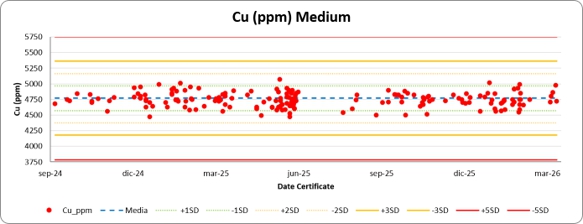 |
Figure 11.3: Examples of control charts for CRM assays for copper.
Certified Reference Materials (W and WO3)
CRM samples were not inserted by Collective for W or WO3. The results from CRM samples for WO3 XRF analyses were monitored by the laboratory, not by Collective.
129
| Collective Mining Ltd. |
| Guayabales Project - Apollo Mineral Resource 2026-08 |
No results fell outside the ±5 SD failure limit. Mean biases for all four materials are within ±2% of the reference values, ranging from −0.15% to +1.72%. This indicates that the tungsten analyses show no significant systematic bias across the grade range tested.
The medium-grade tungsten CRM is the principal accuracy control for the tungsten grades of interest. All 162 results passed, with a mean bias of +0.51% and a coefficient of variation of 0.87%. The low-grade tin ore CRM also returned all results within tolerance, with a mean bias of +0.44%. Its certified SD of 0.04% (about 11% relative) comes from the spread of intralaboratory means among six laboratories. Its control limits are therefore wide, and the evaluation relies mainly on the low observed bias. All ten warnings correspond to the high-grade tungsten concentrate. They result from applying the certificate’s expanded uncertainty (±0.13% WO₃) as if it were a standard deviation. This produces control limits of only ±0.39% WO₃ (±0.6% relative) at a concentration of 67.5% WO₃. The laboratory’s performance on this material is excellent: the mean bias is −0.15% and the CV is 0.39%, and the maximum deviation observed (±4.6 units) remains within the ±5 SD limit. The warnings are therefore considered to reflect overly narrow control limits rather than analytical error. This material represents concentrate-grade material. It validates the high-grade analytical method but is not representative of exploration grades.
Table 11.13. Summary of W – WO3 CRM performance.
| CRM | Certified value (%) |
SD (%) |
N | Labmean |
Lab SD (%) |
CV% | Bias% | Z of mean | PASS | % PASS |
% WARNING |
% FAIL |
| OREAS 700 | 1.42% WO3 | 0.03 | 162 | 1.43% | 0.012 | 0.87% | 0.51% | 0.23 | 162 | 100% | 0% | 0% |
| NIST SRM 277 | 67.50% WO3 | 0.13 | 45 | 67.40% | 0.261 | 0.39% | -0.15% | -0.77 | 35 | 78% | 22% | 0% |
| BCS-CRM 355 | 0.35% W | 0.04 | 22 | 0.35% | 0.005 | 1.30% | 0.44% | 0.04 | 22 | 100% | 0% | 0% |
| CANMET MP-1b | 0.11% W | 0.01 | 144 | 0.11% | 0.004 | 3.73% | 1.72% | 0.14 | 144 | 100% | 0% | 0% |
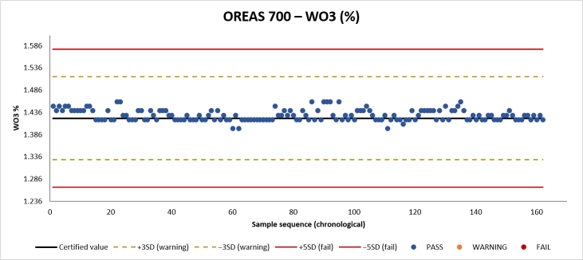 |
Figure 11.4: Example of control charts for CRM assays for WO3.
130
| Collective Mining Ltd. |
| Guayabales Project - Apollo Mineral Resource 2026-08 |
Blank analysis – Collective
Contamination during sample preparation and analysis was monitored by inserting 4,245 fine (pulp) blanks and 4,042 coarse blanks into the sample stream, equivalent to insertion rates of 3.6% and 3.4%. Au, Ag and Cu results were evaluated for about 4,066 fine blanks and 4,036 coarse blanks. For Au, the warning and failure limits were 10 and 20 times the detection limit (0.05 and 0.10 ppm). For Ag and Cu in fine blanks, they were 25 and 50 times the detection limit (0.25 to 0.50 ppm Ag; 5 to 10 ppm Cu). For coarse blanks, these limits were based on between 10 and 20 times the mean Ag grade of the blank material (0.96 to 1.92 ppm Ag), and 5 and 10 times the mean Cu grade of the blank material (14.7 to 29.3 ppm Cu).
The results from the Au and Ag blanks show no significant contamination. The median Au value in both blank types equals half the detection limit (0.0025 ppm Au), and the pass rate is above 99.8%. Only three Au results exceeded the failure limit (0.14 to 0.47 ppm Au), all isolated cases at ALS, and only one fine blank failed for Ag (0.5 ppm Ag). Cu shows the highest number of exceedances: 7 fine blanks (0.17%) and 20 coarse blanks (0.50%) failed, with median values of 1.7 ppm Ag and 2.0 ppm Ag. Most of these failures (24 of 27) occurred at SGS between January 2022 and March 2023. ALS batches show only sporadic cases.
All failed blanks were reported to the laboratory through formal non-conformance reports, and the affected batches were re-assayed. The laboratory attributed the failures to carry-over contamination. The re-assay results showed that carry-over into adjacent samples was below 1%, which was not considered significant, so no corrections to the database were required. Overall, the pass rates of 98.4–100% for all three elements, together with the follow-up and corrective actions undertaken, indicate that cross-contamination during sample preparation and analysis is not significant.
Table 11.14. Summary of Blank performance - Au.
| Element | Type | N | Pass | Warning | Failed | % Pass | Median | Average | Max | LLD |
| Au | BKF | 4066 | 4065 | 0 | 1 | 100% | 0.0025 | 0.0027 | 0.2420 | 0.0050 |
| Au | BKG | 4036 | 4031 | 3 | 2 | 100% | 0.0025 | 0.0029 | 0.4680 | 0.0050 |
Table 11.15. Summary of Blank performance - Ag.
| Element | Type | N | Pass | Warning | Failed | % Pass | Median | Average | Max | LLD |
| Ag | BKF | 4066 | 4057 | 8 | 1 | 100% | 0.1000 | 0.0923 | 0.5000 | 0.0100 |
| Ag | BKG | 4036 | 4036 | 0 | 0 | 100% | 0.1000 | 0.0959 | 0.5800 | 0.0100 |
Table 11.16. Summary of Blank performance - Cu.
| Element | Type | N | Pass | Warning | Failed | % Pass | Median | Average | Max | LLD |
| Cu | BKF | 4058 | 3992 | 59 | 7 | 98% | 1.70 | 2.03 | 239.40 | 0.20 |
| Cu | BKG | 4028 | 3973 | 35 | 20 | 99% | 2.0 | 2.93 | 240.90 | 0.20 |
Table 11.17. Summary of Blank performance - W.
| Element | Type | N | Pass | Warning | Failed | % Pass | Median | Average | Max | LLD |
| W | BKF | 4058 | 4034 | 16 | 8 | 99% | 0.1000 | 0.0923 | 0.5000 | 0.0100 |
| W | BKG | 4028 | 3986 | 25 | 17 | 99% | 0.1000 | 0.0959 | 0.5800 | 0.0100 |
131
| Collective Mining Ltd. |
| Guayabales Project - Apollo Mineral Resource 2026-08 |
Duplicate analysis – Collective
As noted earlier, the duplicate program essentially contains two parts. The first part included duplicates completed at the same laboratory (SGS), but included some duplicates that were not blind. The second part included selection of samples between 0.3 and 5.0 g/t Au and sending the reject samples to a separate laboratory (ALS), and using different sample preparation parameters and using a larger sample charge (50 g as opposed to 30 g) for the duplicate assay.
Table 11.18. Summary of Duplicates Programs.
| Stage | Period | Procedure |
| 1 | Dec 2021 – Aug 2023 | Field (DU), coarse (DUG) and pulp (DUP) duplicates, split at the laboratory (SGS); not blind. Pulverization of 250 g and 30 g charge for Au. |
| 2 | Sep 2023 – Sep 2024 | Blind duplicates from the rejects of samples originally processed by SGS, submitted to ALS. Pulverization of 250 g and 30 g charge for Au. |
| 3 | Oct 2023 – Sep 2024 | Rejects of samples originally processed by ALS under the previous scheme, re-processed with the new scheme: pulverization of 1,000 g and 50 g charge for Au. |
| 4 | Sep 2024 – present | Rejects of samples originally processed by ALS under the same preparation and analytical scheme: pulverization of 1,000 g and 50 g charge for Au. |
Stages 2 and 3 are partially overlapping transition periods between preparation schemes and laboratories.
The lower precision observed in the ALS duplicates when compared with SGS is the result of a combination of multiple factors. The ALS duplicate samples are blind reject samples analysed in different batches from their originals, with a median of about 13 months between the original and duplicate certificates. The ALS samples were also prepared with a different sample preparation (a larger sample was pulverised) and a larger subsample charge for the fire assay. They therefore measure variability between laboratories, different sample preparation methods, different charge size in the assays, different batches, and possible segregation of stored reject samples, whereas the SGS duplicates measured variability with samples prepared and assayed exactly the same way and at the same laboratory.
The performance of the SGS duplicates and the ALS duplicates for the coarse rejects are presented in Figure 11.5 for gold, and Figure 11.6 for copper. The charts showing duplicate gold assays show low variability for the SGS assays, but high variability for the ALS assays. This presents conflicting results, whereas the same analysis for copper shows good reproducibility at each of the two laboratories. The issues with the different laboratory, transport, sample preparation and assaying cast sufficient doubt on the ALS duplicate assays that these results cannot be considered evidence that there is a problem with the precision of the original assays, given the reproducibility of the SGS assays, even if the SGS samples were not blind and there is no indication of assay bias. It is recommended that this topic is investigated further.
132
| Collective Mining Ltd. |
| Guayabales Project - Apollo Mineral Resource 2026-08 |
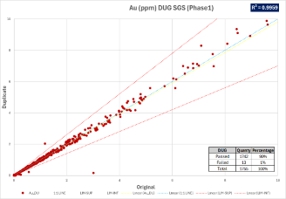 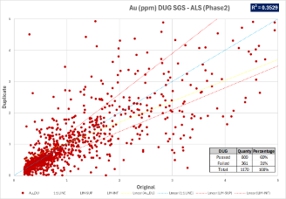 |
Figure 11.5: Scatter plots of coarse reject duplicates for gold SGS Phase1 (left) and ALS Phase 2 (right).
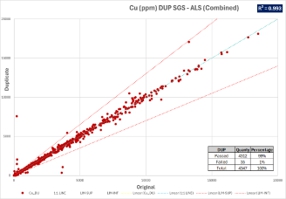 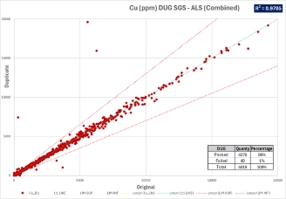 |
Figure 11.6: Scatter plots of pulp duplicates(left) and coarse (right) for copper SGS - ALS Combined.
Check samples – Inter-laboratory
A total of 2,145 pulp samples were re-assayed at Bureau Veritas (BV) as the umpire laboratory. Only pairs with a mean grade of at least 20 times the higher of the two laboratories’ detection limits were considered, giving 1,708 evaluated pairs for Au, 1,656 for Ag and 1,687 for Cu. BV performed reliably throughout the program: its internal blanks showed no contamination events, and none of its certified reference material results exceeded five standard deviations of the certified values. The BV results can therefore be considered a reliable reference for the comparison.
For Au, the original assays were obtained by fire assay with AAS finish on 30 g and 50 g charges, and the check assays at BV were also performed by fire assay. Overall, there is no significant global bias: the mean BV grade is 1.2% higher than the original assays (+0.7% for ALS and +9.4% for SGS, the latter based on only 63 pairs), and the RMA slope is 1.16. However, the paired results show moderate to high scatter (eg Figure 11.7). The correlation coefficient is 0.82, and approximately 51% of the pairs fall within ±20%. The relative bias varies by grade range: −15.2% below 0.5 ppm Au, −1.8% between 0.5 and 2 ppm Au, and +9.8% above 2 ppm Au. This dispersion is likely attributed to the effect of free gold, which is unevenly distributed between the separate aliquots taken from the same pulp. The pulp-splitting deficiencies identified by Collective at ALS may also have contributed to sub-sampling variability in part of the original assays. Whilst this variability can cause some local accuracy issues in estimates, overall it is not expected to cause a bias issue as noted in section 12 in the check assays. The issue is being addressed by Collective who agreed with the QP and have started a test program to re-assay 200 samples with a screen fire assay, and separately with a photon assay to examine the issue in more detail.
133
| Collective Mining Ltd. |
| Guayabales Project - Apollo Mineral Resource 2026-08 |
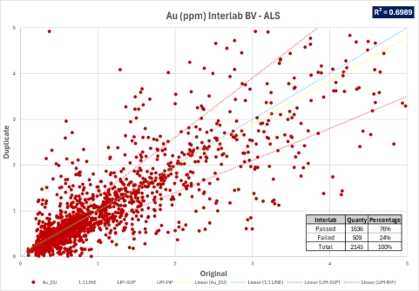
Figure 11.7: Scatter plots of pulp duplicates for gold Interlab.
Ag and Cu show very good agreement between laboratories. The global biases are +1.4% for both elements. The correlation coefficients are 0.994 and 0.998, and the RMA slopes are 1.04 and 1.01. Of the evaluated pairs, 88% (Ag) and 99% (Cu) fall within ±20%, and the biases remain within ±5% across all grade ranges. These results confirm the accuracy and precision of the original Ag and Cu assays. They also suggest that the dispersion observed for Au comes from the particulate nature of the gold rather than from analytical error.
| 11.4 | Interpretation of QAQC Results |
The QA/QC results demonstrate that the analytical data generated by Collective are generally reliable and suitable for use in Mineral Resource estimation. The QA/QC program incorporated certified reference materials (CRMs), coarse and fine blanks, duplicate samples, and independent inter-laboratory check assays. Overall, the results indicate acceptable analytical accuracy for all elements, limited contamination, and generally satisfactory reproducibility, although moderate variability is evident in the gold duplicate and check-assay data.
134
| Collective Mining Ltd. |
| Guayabales Project - Apollo Mineral Resource 2026-08 |
Certified Reference Materials (CRMs).
A total of 4,175 CRMs were inserted into the primary sample stream, representing approximately 3.6% of the 117,284 primary samples. For Au, 99.2% of 3,191 results passed the ±3 SD criterion, 0.6% were classified as warnings, and only 0.2% were failures beyond ±5 SD. Mean biases ranged from −2.47% to +3.62%, with RSDs of 2.0–5.1%. These results indicate good analytical accuracy and precision for gold over the tested grade range. The slightly higher RSDs in the low-grade Au CRMs are considered consistent with concentrations approaching the analytical detection limit. A mild positive bias was observed in several Au CRMs, but it was not considered material.
Silver showed a larger number of warning results with most of the warnings associated with a single low-grade Ag CRM analyzed by SGS. This CRM had a certified concentration of only 1.02 ppm Ag which was close to the detection limit and well below grades considered economically significant, so the bias was considered immaterial. Medium- and high-grade Ag CRMs showed generally good accuracy, with mean biases typically within approximately ±3%. After removal of the very low-grade CRM, the CRM results showed more than 99% passing, 0.8% classified as warnings, and minimal failure using the ±5 SD criterion.
Copper demonstrated the most consistent CRM performance. All Cu CRMs returned mean biases between −2.36% and +0.72%, with RSDs ranging from 1.4% to 4.1%. There was no discernible difference in performance between SGS and ALS. These results indicate good analytical accuracy and precision for Cu across the tested grade range.
The 11 CRM results falling outside the ±5 SD failure limit were investigated and classified as gross errors rather than evidence of systematic laboratory problems. Five were associated with two mislabelled CRM samples and six were isolated single-element errors. The document therefore concludes that the CRM results do not indicate a material analytical accuracy issue.
Tungsten and WO₃ CRMs
For W and WO₃, Collective did not insert its own blind CRMs; accuracy was instead monitored using reference materials inserted by the laboratory. A total of 373 CRM results were available. None exceeded the ±5 SD failure criterion, and mean biases ranged from −0.15% to +1.72%, indicating no significant systematic bias across the tested grade range. The principal medium-grade WO₃ CRM produced a mean bias of only +0.51%. The warnings associated with the high-grade tungsten concentrate were interpreted as an artefact of overly narrow control limits rather than analytical error.
Nevertheless, this represents a limitation of the QA/QC program because independent W/WO₃ CRMs were not inserted by Collective. The QP consequently recommends acquiring suitable CRMs for independent monitoring of WO₃ accuracy rather than relying solely on laboratory QA/QC.
Blank performance and contamination.
The blank results indicate that cross-contamination during sample preparation and analysis was generally not significant. Approximately 4,245 fine blanks and 4,042 coarse blanks were inserted, representing insertion rates of approximately 3.6% and 3.4%, respectively. Au blanks showed excellent performance, with pass rates above 99.8% and only isolated failures. Ag similarly showed no significant contamination, with only one fine blank failure. Cu exhibited the greatest number of blank failures, particularly in samples processed by SGS between January 2022 and March 2023.
135
| Collective Mining Ltd. |
| Guayabales Project - Apollo Mineral Resource 2026-08 |
The failed blanks were formally reported to the laboratories, and the affected batches were re-assayed. The laboratories attributed the failures to carry-over contamination, while the re-assay results indicated that contamination into adjacent samples was below 1%. Consequently, no database corrections were considered necessary. Overall blank performance, with pass rates of approximately 98.4–100%, indicates that contamination is not considered significant enough to compromise the resource database.
Duplicate precision.
The duplicate results require some qualification because the duplicate protocols changed over time. Early duplicates included field, coarse and pulp duplicates at SGS, while later programs used blind duplicates from laboratory rejects and involved changes in laboratory, sample preparation, pulverization mass and fire-assay charge size. Consequently, the later ALS duplicates measure several sources of variability simultaneously and are not directly comparable with the earlier SGS duplicates.
Gold duplicates from SGS showed relatively low variability, whereas the ALS duplicate results showed substantially greater variability. However, much of this difference can be attributed to the design of the duplicate program rather than laboratory performance. The ALS duplicates involved different laboratories, preparation methods, analytical charges, batches and storage periods. The effects of coarse free gold and the associated nugget effect are also considered important contributors to the observed variability. The report therefore concludes that the ALS duplicate results should not necessarily be interpreted as evidence of poor precision in the original assays.
Inter-laboratory check assays.
A total of 2,145 pulp samples were submitted to Bureau Veritas (BV) as an independent check laboratory. BV’s own QA/QC performance was satisfactory, with no significant blank contamination and no CRM results exceeding the ±5 SD criterion, supporting its use as a reliable reference laboratory.
The Au check assays show no significant overall global bias: BV results averaged approximately 1.2% higher than the original assays, although the paired results displayed considerable scatter. Only 51% of the Au pairs fell within ±20%, with a correlation coefficient of 0.82. The variability changes with grade, showing negative relative bias at low grades and positive bias at higher grades. The report attributes much of this dispersion to the nugget effect associated with coarse, free gold and potentially to pulp-splitting variability. Importantly, the results do not indicate a material systematic bias in the original Au assays.
In contrast, Ag and Cu showed very strong agreement between the primary and check laboratories. Global biases were approximately +1.4% for both elements, with correlation coefficients of 0.994 for Ag and 0.998 for Cu. Approximately 88% of Ag and 99% of Cu pairs fell within ±20%, and biases remained within ±5% across the grade ranges evaluated. These results provide strong independent confirmation of the accuracy of the original Ag and Cu assays.
136
| Collective Mining Ltd. |
| Guayabales Project - Apollo Mineral Resource 2026-08 |
| 11.5 | QP’s Opinion on the Adequacy of Sample Preparation, Security, and Analytical Procedures |
The QP has reviewed the written field procedures and analytical quality control measures used by Collective. The QP is of the opinion that Collective personnel have exercised appropriate care in the collection and management of field and assay data. Sample preparation, sample security, and analytical procedures used by Collective are consistent with generally accepted industry best practices and the results are adequate for the purpose of mineral resource estimation.
Taken together, the QA/QC results indicate that the Collective analytical database has an acceptable level of accuracy and precision for Mineral Resource estimation. CRM results demonstrate generally good analytical accuracy for Au, Ag and Cu; blank results indicate that contamination is limited and controlled; and inter-laboratory check assays confirm the accuracy of Ag and Cu and show no material global bias in Au. The greater scatter observed in gold duplicates and inter-laboratory checks is considered largely attributable to the heterogeneous distribution of coarse free gold and the nugget effect rather than systematic analytical bias.
The principal QA/QC limitations are the elevated variability in some gold duplicate/check-assay datasets, the historical changes in duplicate methodology and laboratory, and the absence of Collective-inserted independent CRMs for W/WO₃. These limitations do not, in the QP’s opinion, invalidate the database, but they warrant continued monitoring. The QP considers the sample preparation, analytical procedures, sample security and QA/QC program to meet or exceed standard industry practice and considers the data adequate for Mineral Resource estimation. Continued monthly submission of check samples is recommended to monitor analytical accuracy in real time.
It is recommended that Collective acquires CRM samples certified for XRF analyses suitable for the independent evaluation of WO3 accuracy so that blind QAQC can be completed independent of the laboratory.
The SGS duplicate coarse reject gold assays indicate good precision, whereas the ALS duplicate coarse reject gold assays show only moderate precision. It is the QPs opinion that there is sufficient confidence for an Indicated Resource, but a better understanding of the precision of the gold assaying is needed before a Measured Resource can be declared. To achieve this, the QP recommends that Collective re-assays 200 mineralised samples through either SFA or photon assay or both as per the recommendation in Section 26 of this report. This will allow a view of the precision of the fire assay with respect to the SFA as well as the photon assay, and provide a view of the potential upside by assaying a larger sample. It is quite possible that because of the coarse and free gold, the fire assays have been under-evaluating the gold assays. Evidence for this includes the variability noted in the ALS duplicate assays and the view of the small number of SFA assays with respect to fire assays noted in the verification samples reported in Section 12 of this report.
137
| Collective Mining Ltd. |
| Guayabales Project - Apollo Mineral Resource 2026-08 |
| 12 | Data Verification |
| 12.1 | Verification by Redwood (2025) |
Redwood (2025) verified the Collective data up to mid-2025 as used in this Technical Report. In addition to the technical presentation of data, he reported that he:
| 1. | Made three site visits to the field office, core logging and storage facility, drilling sites and field localities. |
| 2. | Verified location and access by GPS. |
| 3. | Reviewed the protocols for drilling, core transport, security, chain of custody, logging, sampling, storage, and made recommendations which were implemented. |
| 4. | Reviewed core from 16 holes over the three visits. |
| 5. | Reviewed the database, including historic data, and checking a percentage of the assay certificates. He reported no errors. |
| 6. | Reviewed the QA-QC. |
Redwood stated that his verification of the drill program was limited to a review of drill core, geological logs, and a check of assay certificates against the database. No independent check samples from the drill core were collected for analysis.
Redwood concluded that the exploration and drilling data was adequate and reliable for the purposes used in the 2025 technical report. The 2025 technical report was a technical report on the exploration.
| 12.2 | Verification by the QP |
Verification by the QP has included:
| 1. | Four site visits to the field office, core logging and storage facility, drilling sites and field localities. |
| 2. | Review of the protocols for drilling, core transport, security, chain of custody, logging, sampling, and storage. |
| 3. | Regular review of recent core. |
| 4. | Review of the database including a data audit. |
| 5. | Review of the QA-QC. |
| 6. | Collection and assaying of 16 independent samples |
| 12.2.1 | Site Visits by the QP |
Mr. Ivor Jones of Aurum Consulting has completed four site visits with an average length of seven days since May 2025, the most recent being from the 28th September 2026 to the 5th October 2026.
No items of concern were noted with respect to the core management, core logging, the sample collection process, sample security or quality control measures.
138
| Collective Mining Ltd. |
| Guayabales Project - Apollo Mineral Resource 2026-08 |
| 12.2.2 | Verification sampling by the QP |
The QP took 16 samples (Table 12.1) for verification of the grade of samples recorded by Collective. Five samples were collected of each of the Ramp Zone, the CBMs and the BAM, and were submitted to ALS for analysis by fire assay for Au, Screen Fire Assay (SFA) for Au and ICP for Cu.
Table 12.1: Verification samples by the QP
| Drillhole |
Depth From (m) |
Depth To (m) |
Original Au (g/t Au) |
Resample Au (g/t Au) |
Resample SFA Au (g/t Au) |
Original Cu (ppm Cu) |
Resample Cu (ppm Cu) |
| APC106_D03 | 322 | 323 | 3.64 | 4.13 | 4.69 | 1230 | 1295 |
| APC105_D01 | 499 | 500.1 | 5.71 | 3.3 | 3.02 | 190 | 174 |
| APC143_D01 | 429.15 | 431 | 6.92 | 10.75 | 11.65 | 81.6 | 271 |
| APC143_D02 | 415.15 | 416.05 | 4.47 | 5.66 | 6.08 | 41.4 | 46.7 |
| APC150_D01 | 653.8 | 655 | 9.18 | 4.68 | 4.81 | 4.6 | 4.9 |
| APC104_D02 | 161.9 | 162.9 | 3.36 | 2.99 | 2.9 | 289 | 301 |
| APC104_D04 | 320.65 | 321.65 | 3.02 | 3.31 | 3.26 | 2610 | 3340 |
| APC070_D04 | 488.9 | 489.6 | 3.12 | No result | 4.54 | 1720 | No result |
| APC104_D01 | 183.25 | 184.15 | 4.51 | 4.55 | 6.09 | 1890 | 1835 |
| APC104_D05 | 229.75 | 231.05 | 4.53 | 9.57 | 6.36 | 1040 | 1510 |
| APC_031 | 122.45 | 123.15 | 0.36 | 0.29 | 0.24 | 5979 | 4090 |
| APC_035 | 165.95 | 166.6 | 0.20 | 0.14 | 0.15 | 9142 | 9370 |
| APC_045 | 67.85 | 68.5 | 0.25 | 0.21 | 0.2 | 8115 | 7510 |
| APC_122 | 200.2 | 201.4 | 0.10 | 0.11 | 0.12 | 7840 | 8870 |
| APC_139 | 272.65 | 274.05 | 0.81 | 0.16 | 0.17 | 5030 | 5610 |
| APC_028 | 361.9 | 362.55 | 3.27 | 2.36 | 1.81 | 6639 | 6490 |
| Average | 3.35 | 3.48 | 3.51 | 3341 | 3381 |
The results for the 15 samples where fire assay results for Au were received show relatively consistent grades between the original and re-assay. It did show some variability consistent with fine grained gold, but the average of the 15 sample results received for Au had approximately the same grade as the original samples. Importantly, the higher-grade original samples also showed higher grades in the resampled intervals.
The Screen Fire Assays (SFA) for AU showed the same pattern as the original fire assays, except on average the grade from the SFA was 5% higher than the original samples. If the five samples with grades below 1 g/t are removed, the assay bias increases to 7%. This suggests that the original fire assays on average are under-representing the actual grade of the original samples, and this is likely to be a free gold sampling issue. It is noted that fine-grained visible gold is common in core from the Apollo deposit.
With respect to the copper grades, the average grade of the re-assay (0.338% Cu) was essentially the same as the original assay (0.334% Cu).
139
| Collective Mining Ltd. |
| Guayabales Project - Apollo Mineral Resource 2026-08 |
| 12.2.3 | Audit of database data |
There were assays for 117,285 samples that formed the basis of the dataset used for resource estimation.
From the original data, 4,866 sample records were selected (selected as random batches) and the database records were compared against assay results downloaded by the QP from the ALS Laboratory website. It was noted that the Au assays were reported into the exports in a priority sequence, so that the assay given the priority was a screen fire assay if available, which took priority over an over-grade assay (for assays greater than 10 g/t Au), which took priority over the standard fire assay. The same priority system was used for Cu, Ag and W assays where the over-grade assay was reported in preference over the normal assay.
Of the 4,866 sample records audited (a little over 4%), there were no errors noted for the Au, Cu and Ag assays. There was one error noted for the W assays where one assay (sample number DH232386) was reported as 10000 ppm in the database whereas the assay certificate reported >10000 ppm. It is the QPs understanding that this error has since been corrected in the database.
The database records for WO3 were also checked against the laboratory XRF certificates. Three hundred and seventy-three WO3 records out of 4,583 XRF measurement records were checked with no errors or anomalous values. Values of ‘<0.001’ in the XRF certificates were replaced with 0.0005 in the database. This is not considered a significant issue.
| 12.3 | Qualified Person’s Opinion on the Adequacy of the Data for the Purposes Used in the Technical Report |
It is the opinion of the Qualified Person for this section of the report that the data used is adequate for the purposes used in the technical report.
The QP does not consider that there are any significant limitations for use of this data in this report.
However, the QP notes that the original fire assays are lower than the re-assays and recommends that Collective re-assays around 200 mineralised samples through either SFA or photon assay or both as per the recommendation in Section 26 of this report. This will allow a view of the precision of the fire assay with respect to the SFA as well as the photon assay, and provide a view of the potential upside by assaying a larger sample. It is quite possible that because of the coarse and free gold, the fire assays have been under-evaluating the gold assays. Evidence for this includes the variability noted in the ALS duplicate assays and the view of the small number of SFA assays with respect to fire assays noted in the verification samples reported in Section 12 of this report.
140
| Collective Mining Ltd. |
| Guayabales Project - Apollo Mineral Resource 2026-08 |
| 13 | Mineral Processing and Metallurgical Testing |
Collective has carried out eight testwork programs on samples from the Apollo deposit between 2022 and 2026. The results of this testwork are summarized in Table 13.1 to Table 13.5. Table 13.5: Overall recoveries for gravity, flotation and cyanidation of flotation tailings.
The initial work, between 2022 and 2023 was carried out at the SGS Laboratory in Lima, Peru. From 2024 to 2026 the work has been carried out at the ALS Laboratory in Kamloops, Canada, (with one short program at SGS (SGS, 2024)). All of the work has been under the supervision of John Wells, an Independent Metallurgical Consultant and QP for this work, who has visited both laboratories on a monthly basis.
The 2022 to 2024 results are summarized in Table 13.1.
Table 13.1: Metallurgical Testwork 2022 to 2024
| Date | Laboratory | Samples | Test | Results |
| 2022 | SGS | 3 samples | Cyanide Leach bottle-roll tests, (72h) | Au recovery, 90.7-97.5% |
| 1.17-8.01 g/t Au | Ag recovery, 46-52% | |||
| 16.05-56.08 g/t Ag | ||||
| 2023 | SGS | 8 composite samples | Cyanide Leach bottle roll tests, (72h) | Au recovery, Average 93.5% |
| 0.7-48.1 g/t Au | Scoping flotation tests | For Cu<0.15%, Average gold recovery 96.7% | ||
| 0.06-1.04% Cu | ||||
| 2024 | ALS | 86kg sulfide sample | Flotation tests, including Locked Cycle | Recovery up to 95.3%Cu, 83.6% Ag, 79.4%Au |
| Con grades up to 30.5%Cu, 1,280g/t Ag, 28.7g/t Au | ||||
| ALS | 3 low grade samples | Cyanide leach bottle roll tests | Au recovery, average 91.2% | |
| 0.39-0.86 g/t Au | Ag recovery, average 59.6% | |||
| ALS | 25kg from high tungsten zone | Gravity tests | WO3 recovery up to 74% | |
| Con grade 63.6%WO3 | ||||
| ALS | 80 kg, >0.1%Cu | Flotation tests | Au recovery 89.4% | |
| Ag recovery 85.2% | ||||
| Cu recovery 94.4% | ||||
| SGS | 7 sulfide samples | Cyanide leach bottle roll tests | Au recovery 94.3% average | |
| <0.15%Cu | Ag recovery 63.7% average | |||
| 1.0g/t Au | ||||
| 11.7g/t Ag |
141
| Collective Mining Ltd. |
| Guayabales Project - Apollo Mineral Resource 2026-08 |
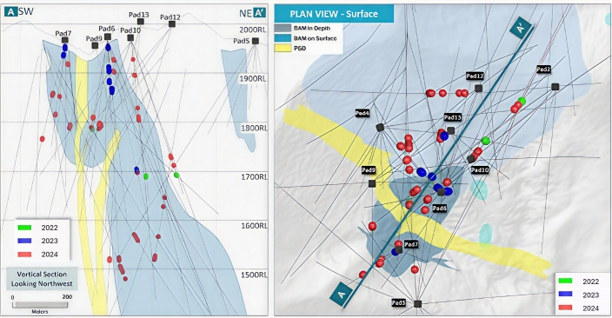 |
Figure 13.1: Metallurgical Samples.
142
| Collective Mining Ltd. |
| Guayabales Project - Apollo Mineral Resource 2026-08 |
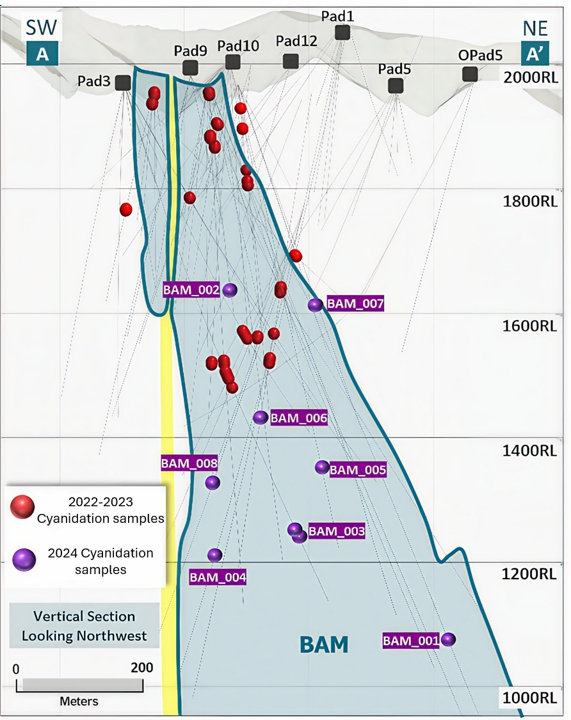 |
Figure 13.2: 2024 SGS and ALS Cyanidation samples.
All of the testwork indicated that Apollo material is amenable to treatment by both cyanidation and flotation, with high recoveries of gold, silver and copper. Agreement between the laboratories was good. Flotation was successful, producing commercial concentrate grades, for head grades above 0.08% Cu. Silver recoveries were higher with flotation, as much of the silver is associated with the copper, (chalcopyrite).
143
| Collective Mining Ltd. |
| Guayabales Project - Apollo Mineral Resource 2026-08 |
During 2024, a zone in the upper part of the Apollo deposit was found to contain scheelite, a tungsten mineral, CaWO4. Visual inspection, confirmed by microscopic work at ALS showed the scheelite to be coarse grained and very well liberated. A 25 kg sample was submitted to ALS for some preliminary testwork to investigate recovery by gravity concentration. Four tests were carried out with first stage Knelson and then super vanner upgrading. Scheelite recovery was up to 74%, and a grade of 63.6% WO3 was achieved in concentrate. The concentrate contained over 90% scheelite. Further work on a new, larger sample is planned for 2027.
In the 4th Quarter of 2025, 36 samples of drill core, each of 10-15 kg were collected from six ore zones named as Composites 1 to 6, as shown in Figure 13.3 and defined in Table 13.2.
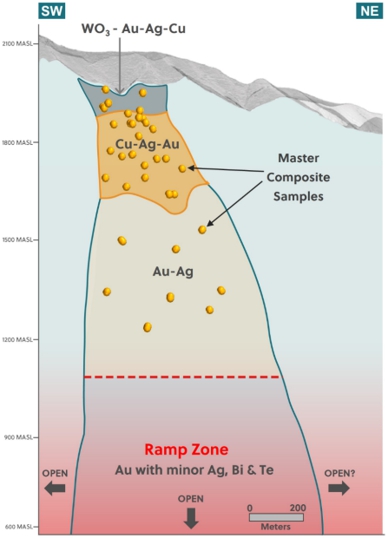 |
Figure 13.3: Cross-section of the Apollo system showing the location of samples.
These samples were delivered to ALS. Six composites were prepared representing the different zones, with half of the individual 36 core samples retained for future variability testing.
144
| Collective Mining Ltd. |
| Guayabales Project - Apollo Mineral Resource 2026-08 |
In the testwork 2022-2024, it was assumed that high copper ore would be treated in a flotation circuit and low copper ore would be treated in a parallel cyanidation circuit. In 2025 it became apparent that the mining method would see ore delivered to the process plant from various areas simultaneously. Thus, the testwork developed in 2026 was based on one common circuit, where the ore would be milled, then treated by gravity, flotation and cyanidation of the flotation tailings. Tests in 2025 had shown that significant gold could be recovered to a high-grade gravity concentrate.
Initial tests showed rapid flotation kinetics and an optimum grind size p80 of 90 microns.
The results are summarized in Table 13.2 and Table 13.3.
Table 13.2: Composite head grades
| N | Composite |
Cu % |
Au g/t |
Ag g/t |
As % |
Zone | Description |
| 1 | SHCU | 0.35 | 1.98 | 35 | 0.05 | Upper | High Scheelite, High Copper |
| 2 | SLCU | 0.07 | 1.94 | 3 | 0.22 | Upper | High Scheelite, Low Copper |
| 3 | HCULAS | 0.42 | 1.16 | 71 | 0.02 | Upper | High Copper, Low Arsenic |
| 4 | HCUHAS | 0.35 | 1.26 | 62 | 0.34 | Upper | High Copper, 0.3% As |
| 5 | GSLCU | 0.06 | 1.77 | 15 | 0.09 | Upper | Gold-Silver, Low Copper |
| 6 | GS | 0.02 | 1.56 | 16 | 0.02 | Middle | Gold-Silver, minor Copper |
| 7 | RAMPHAS | 0.03 | 2.85 | 8 | 1.27 | Lower | High-grade Gold, 1.27% As |
| 8 | RAMPLAS | 0.04 | 2.99 | 8 | 0.03 | Lower | High-grade Gold, Low Arsenic |
Table 13.3: Composites 1 to 6 results, summary.
| Composite |
Overall Recovery %Cu |
Overall Recovery %Au |
Overall Recovery %Ag |
Concentrate Grade %Cu |
Concentrate Grade Au g/t |
Concentrate Grade Ag g/t |
Concentrate Grade %As |
| SHCU | 90.6 | 94.7 | 88 | 21.4 | 77.2 | 2032 | 0.04 |
| SLCU | 76 | 83.8 | 63 | 15.6 | 382 | 444 | 0.68 |
| HCULAS | 95 | 90 | 94.4 | 27.2 | 37.6 | 3504 | 0.06 |
| HCUHAS | 90 | 82 | 86 | 18.8 | 29 | 2580 | 0.85 |
| GSLCU | 72.3 | 93.0 | 85.0 | 7.7 | 202 | 2232 | 0.3 |
| GS | 80.7 | 91.0 | 85.0 | 13.3 | 278 | 4440 | 0.08 |
| Average | 78.8 | 90.9 | 85.2 | 15 | 110 | 2700 | 0.2 |
The series circuit provides more opportunity to increase gold and silver recovery for all zones. It also allows copper recovery from lower copper grade material, that in the previous flowsheet would have bypassed flotation. Note: the tests in Table 13.3 were based on open circuit flotation and not locked cycle tests.
145
| Collective Mining Ltd. |
| Guayabales Project - Apollo Mineral Resource 2026-08 |
Two of the zones in the deposit represented by Composites 1-6 contain relatively minor quantities of the arsenic mineral, arsenopyrite. Mineralogy has shown that this arsenopyrite is not associated with the copper bearing mineral, chalcopyrite and is easily eliminated to tailings during flotation. Furthermore, little gold is associated with the arsenopyrite. Hence the impact of arsenopyrite on flotation and overall gold, silver and copper recovery is minimal. The results of preliminary work on samples from the Ramp Zone are equally positive, with gold recovery of 96% and 86% from the two Ramp Zone composites.
A master composite was then prepared from the six individual composites, based on the estimated tonnages of material in each zone. This composite was then subjected to the gravity, flotation and cyanidation test, but in this case included a Locked Cycle test for the flotation stage. The results are summarized in Table 13.4.
Table 13.4: LCT test on MC1-6 composite.
| Product |
wt % |
Cu % |
Au g/t |
Ag g/t |
As % |
Distribution %Cu |
Distribution %Au |
Distribution %Ag |
Distribution %As |
| Gravity Con | 0.3 | 0.14 | 127 | 216 | 1.62 | 0.5 | 31.7 | 3.3 | 10 |
| Flotation Con | 0.7 | 11.1 | 107 | 2330 | 0.5 | 84.9 | 56.5 | 74.8 | 6.5 |
| Cleaner Tails | 5.9 | 0.12 | 1.56 | 42 | 0.45 | 8.1 | 7.3 | 12 | 52.2 |
| Rougher Tails | 93.2 | 0.006 | 0.06 | 2.2 | 0.02 | 6.5 | 4.5 | 9.9 | 31.3 |
| Feed | 100 | 0.087 | 1.25 | 21 | 0.05 | 100 | 100 | 100 | 100 |
As seen in Table 13.4, the recoveries of gold and silver to the gravity and flotation concentrates were 88.2% and 78.1% respectively. Cyanidation of the flotation tailings achieved dissolution of gold and silver of 61% and 67% respectively. Thus, the overall recoveries are as shown in Table 13.5.
Table 13.5: Overall recoveries for gravity, flotation and cyanidation of flotation tailings.
| % Recovery | |
| Copper | 85 |
| Gold | 95 |
| Silver | 92 |
These recoveries, based on a master composite and including a locked cycle test, are applied in this technical report (locked cycle tests typically increase recovery between 2% and 5%).
Appropriate smelter charges will be applied to the concentrates.
Apollo material almost always responds very well to flotation, as shown in Figure 13.4.
146
| Collective Mining Ltd. |
| Guayabales Project - Apollo Mineral Resource 2026-08 |
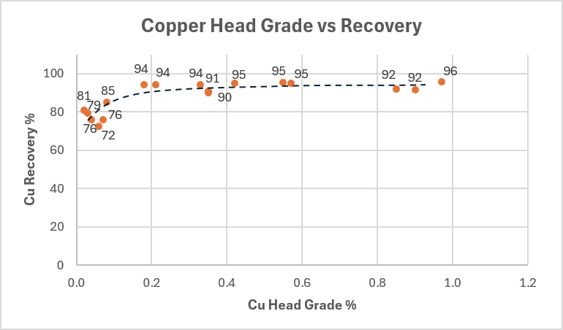 |
Figure 13.4: Copper head grade versus copper recovery.
| 13.1 | Preliminary testing of Ramp samples. |
In the first quarter of 2026, drill core was collected from the Ramp Zone for preliminary testwork. Two 25 kg composites were prepared, representing high and low arsenic material (RAMPHAS and RAMPLAS respectively). Again, the balance of this material has been stored for variability testwork in 2027.
The first tests on RAMPHAS and RAMPLAS investigated Gravity + Flotation + Cyanidation and Gravity + Cyanidation. The results are summarized in Table 13.7 and Table 13.8.
Table 13.6: Head grade of samples.
| Sample | %Cu | Au g/t | Ag g/t | % As | % S |
| RAMPHAS | 0.03 | 2.64 | 6 | 1.27 | 3.38 |
| RAMPLAS | 0.04 | 2.07 | 7.7 | 0.03 | 2 |
147
| Collective Mining Ltd. |
| Guayabales Project - Apollo Mineral Resource 2026-08 |
Table 13.7: Gravity + Flotation + Cyanidation.
| Sample | Copper head grade %Cu |
Copper concentrate %Cu |
Copper concentrate g/t Au |
Copper concentrate g/t Ag |
Copper concentrate %As |
Overall gold recovery |
Overall silver recovery |
| RAMPHAS | 0.03 | 5.6 | 341 | 804 | 12.9 | 83 | 81 |
| RAMPLAS | 0.04 | 10.5 | 200 | 1280 | 0.97 | 91 | 75 |
For the high-arsenic sample (RAMPHAS), gravity concentration followed by cyanidation is the preferred route, recovering 86% of the gold and 64% of the silver (Table 13.8) without producing a flotation concentrate. Flotation of RAMPHAS produced a low-grade copper concentrate (5.6% Cu) with high arsenic (12.9% As) (Table 13.7) and flotation is therefore not proposed for this material.
In contrast, RAMPLAS does respond favorably to flotation, even with the low copper head grade and this process route is a viable option. Although the arsenic content of the concentrate is high, this testwork assumes that RAMPLAS style ore would be blended with the lower arsenic concentrates. The copper, gold and silver values should make it attractive to smelters.
Table 13.8: Gravity + Cyanidation.
| Samples | Overall gold recovery | Overall silver recovery |
| RAMPHAS | 86 | 64 |
| RAMPLAS | 96 | 55 |
This preliminary result indicates that RAMPHAS material is not refractory and would be best treated by gravity and cyanidation, with no flotation. RAMPLAS could be treated successfully by either process.
As stated above, the Ramp Zone testwork is regarded as preliminary and used small, randomly selected samples. Further work on larger, more representative samples will be one of the priorities in 2027. Optimization of Ramp Zone testwork will include locked cycle tests and finer grinding.
| 13.2 | Summary |
Four programs of cyanidation testwork were carried out between 2022 and 2024 at SGS and ALS on a multitude of samples and achieved an average gold recovery of 93.5%. These tests did not include gravity or flotation. Flotation tests on many samples during this period achieved recoveries of 94% Cu, 85% Ag and 89% Au. In 2025 and 2026, gravity concentration was added prior to flotation and cyanidation, using a single line, three stage recovery process. After the successful testwork on six composites from the upper and middle zones of Apollo, a master composite was prepared from the six composites, (based upon the estimated tonnage in each ore zone). This achieved recoveries of 95% Au, 92% Ag and 85% Cu to the gravity and flotation concentrates, (using locked cycle tests) and cyanide leaching of the flotation tailings. Preliminary testwork on samples from the high scheelite zone generated recovery up to 74% to a 63.6% WO3 concentrate. These recoveries have been applied to this NI 43-101 technical report.
148
| Collective Mining Ltd. |
| Guayabales Project - Apollo Mineral Resource 2026-08 |
Future testwork, to provide additional support for a Pre-Feasibility Study and to optimise recoveries for the various zones in Apollo is given in the Recommendations.
Testwork completed in 2025 and 2026 on sample material from the copper and tungsten sub-domains which locate predominantly within the indicated and open-pit portion of the resource (Collective Mining Ltd, September 21, 2026). These results are summarised in Table 13.9 below:
Table 13.9: Recent Metallurgical Test Work Results on Copper and Tungsten sub-domains.
| Material / Test Stage | Head Grades | Results |
| Copper sub-domain composite / Open-circuit testing |
Au: 1.16 g/t Ag: 71 g/t Cu: 0.42% |
95% copper, 90% gold and 94.4% silver recovery through gravity, flotation and cyanidation producing a concentrate grading 27.2% Cu, 37.6 g/t Au and 3,504 g/t Ag. |
| Tungsten sub-domain test work |
Au: 2.91 g/t Ag: 26.4 g/t Cu: 0.15% WO3: 0.44% |
Tungsten recovery through gravity of up to 74%. Separate, subsequent bulk-sample testing produced a concentrate containing 95% scheelite. |
This work highlights the opportunity to selectively feed these sub-domains into the gravity and flotation circuits during the early stages of any future mine plan to achieve higher recoveries for gold and silver and develop high grade concentrates. Future testwork will include optimisation of the metallurgy for those subdomains, with a focus on increasing gold recovery.
Collective is advancing an integrated flowsheet proposal with two principal product streams: gold-silver doré, and separate copper and tungsten concentrates. In this proposal, material with low copper and tungsten grades will be processed primarily through gravity recovery and cyanidation to produce doré. Higher-grade copper material is proposed to be directed to copper flotation, while a front-end gravity stage will separate tungsten-rich material for treatment in a small, dedicated tungsten circuit. It is also proposed that copper flotation tailings be subsequently treated through cyanidation to recover residual gold and silver. Copper and tungsten recoveries are expected to come primarily from their respective higher-grade sub-domains.
149
| Collective Mining Ltd. |
| Guayabales Project - Apollo Mineral Resource 2026-08 |
| 14 | Mineral Resource estimates |
The August 2026 estimate of the Mineral Resource for the Apollo Mineral Deposit, as documented in this report, was prepared using data provided by Collective. Data only included new data collected by Collective as of 31 March 2026. There is no historic data within the resource area.
| 14.1 | Disclosure |
Mineral Resources were prepared by Mr. Ivor Jones, FAusIMM, P.Geo (APEGBC) of Aurum Consulting, a Cayman Islands based company. By way of his experience, membership of a recognized professional organization and qualifications, the author is a Qualified Person as defined by NI 43-101. Both Mr. Jones and Aurum Consulting are independent of the Issuer.
| 14.2 | Known Issues that Materially Affect Mineral Resources |
At the time of this report, the Author was not aware of any permitting, legal, title, taxation, socio-economic, marketing or other issues that could materially affect the Mineral Resource.
| 14.3 | The Approach Used for Modelling |
The basis of the resource estimates for the Apollo Mineral Deposit was prepared in the following steps:
| ● | Digital data validation. |
| ● | Data preparation. |
| ● | Exploratory data analysis of Au, Ag, Cu and WO3. |
| ● | Geological interpretation and modelling (wireframing). |
| ● | Establishment of block models. |
| ● | Coding and compositing of assay intervals. |
| ● | Consideration of grade outliers. |
| ● | Derivation of kriging plan. |
| ● | Variogram analysis and selection of kriging parameters. |
| ● | Grade interpolation of grades using ordinary kriging. |
| ● | Validation of grade estimates and models. |
| ● | Classification of confidence in estimates. |
| ● | Assessment for a Reasonable Prospects of Eventual Economic Extraction (RPEEE). |
| ● | Mineral Resource tabulation and reporting. |
The ordinary kriging grade estimation method was chosen as there is well recognized and demonstrated continuity of the mineralization. In this context, the interpretation of the mineralization is relatively well defined by the drilling.
All grade modelling was completed using Datamine’s Studio RM software.
150
| Collective Mining Ltd. |
| Guayabales Project - Apollo Mineral Resource 2026-08 |
| 14.4 | Data Provided for Estimation |
The drillhole database used for the resource estimate was provided by Collective and reviewed by Aurum Consulting without any significant issues identified. The data was provided as comma separated values format “csv” files from the Issuer database and contained collar, survey, assay, geological codes and specific gravity data.
A digital terrain model (DTM) was provided in dxf format for the topographic elevation.
Interpretations of the geology completed by Collective were provided and checked for reasonableness by Aurum Consulting. They include comprehensive interpretations of the lithology, alteration and breccia and vein-hosted mineralization (including an acoustic televiewer interpretation).
Aurum decided that any minor potential changes to the lithological interpretation were not sufficient for Aurum to consider that this posed any significant risk to the resource evaluation.
The sample database and the topographic surface were reviewed and validated prior to being supplied for grade estimation. The most significant issue noted with respect to the data was some minor differences in elevation when compared to the topographic wireframe. These are unlikely to have resulted in any significant risk to the resource evaluation.
| 14.4.1 | The data used for grade estimation |
Information from 265 drillholes and 114,520 m of drilling by Collective formed the dataset for the resource evaluation. This included 256 holes coded to belong to Apollo, five holes to the ME target and four to the Towers target.
The data used for modelling includes Au, Ag, Cu, W and WO3 values derived from assays. As noted in Section 12, the Au assays were exported in a priority sequence. The gold assay given the highest priority was the screen fire assay (only for gold) if available, then the over-grade assay (for assays greater than 10 g/t Au), and finally the standard fire assay. The same priority system was used for Cu, Ag and W assays where the over-grade assay was reported in preference over the normal assay.
Out of the 117,285 assay records exported, there were 4,583 WO3 measurements from XRF analyses and 117,285 W assays from ICP. For those samples that did not have direct WO3 analysis by XRF, their WO3 equivalent grade was calculated through stoichiometric conversion from the W concentration obtained by ICP-MS, using the following formula: WO3=W*231.84/183.84. The majority of the direct WO3 measurements occur in the higher-grade WO3 domain, the priority area for estimation.
During a review of the data, it was noted that the WO3 assays were on average 25% higher grade than the W assays measured using ICP (after stoichiometric conversion). This difference exceeds 40% when the ICP equivalent grade is higher than 0.5% WO3. This difference has been attributed to the incomplete dissolution of the scheelite in the assaying process with ICP. This was supported by physical checks of the core where significant concentrations of scheelite (more than 5%) occur in samples where the ICP assay was less than 0.5% WO3 equivalent.
Because the ICP-derived values are understated relative to XRF, and most XRF measurements are in the higher-grade WO3 domain, the QP considers that the estimated WO3 grades are likely to be understated, particularly outside the tungsten subdomain. Section 26 recommends further work to improve confidence in the tungsten data, including CRMs suitable for XRF analysis of WO3.
151
| Collective Mining Ltd. |
| Guayabales Project - Apollo Mineral Resource 2026-08 |
| 14.5 | Geological Interpretation and Modelling |
The modelling for the preparation of domains is a complex mixture of lithology, veins and type of mineralization for each element of interest. Interpretations of the lithologies were made to provide the underlying geological framework (Table 14.1). On top of the lithology, a separate set of interpretations was made to account for domains with generally elevated values for the element/variable being estimated (Table 14.2).
Table 14.1: Lithological Domains for geological modelling
| Lithological Domain | Lithological Domain code for modelling |
| Schist | 1000 |
| P10 and P20 intrusives | 2000 |
| P30 intrusive | 3000 |
| BABC – Angular and Crackle Breccia – Un-mineralized | 3100 |
| BAM – Angular Breccia - Mineralized | 3200 |
| BCM – Crackle Breccia – Mineralized | 3300 |
| P40 and P50 intrusives | 4000 |
| P55 | 5500 |
| P60 | 6000 |
Table 14.2: Mineralogical and Grade Domains for geological modelling
| Mineralization Domain | Mineralization code used for modelling |
| Copper/Silver Domain | 30 |
| Tungsten domain | 50 |
| RAMP Zone | 60 |
A third set of interpretations was made to cover the three Carbonate Base Metal Vein sets (Table 14.3).
Table 14.3: Carbonate Base Metal (CBM) Vein Domains for geological modelling – affects Au only
| CBM Domain | CBM code used for modelling |
| CBM – LA (Low-Angle orientation) | 9100 |
| CBM – EW (East-West orientation) | 9200 |
| CBM – NW (North-West orientation) | 9300 |
152
| Collective Mining Ltd. |
| Guayabales Project - Apollo Mineral Resource 2026-08 |
Lastly, domains for oxidation were prepared (Table 14.4).
Table 14.4: Oxidation Domains for geological modelling
| Oxidation Domain | Oxidation code used for modelling |
| Oxide zone | 8000 |
| Transitional Zone | 7000 |
| Not oxidised / Fresh | 0000 |
Each of the geological-mineralization units was coded and represented in the block model as well as in the data (Figure 14.1 and Figure 14.2). They were then combined in the data and the model to relate to the relevant domains for each variable estimated, with the original codes retained in the model.
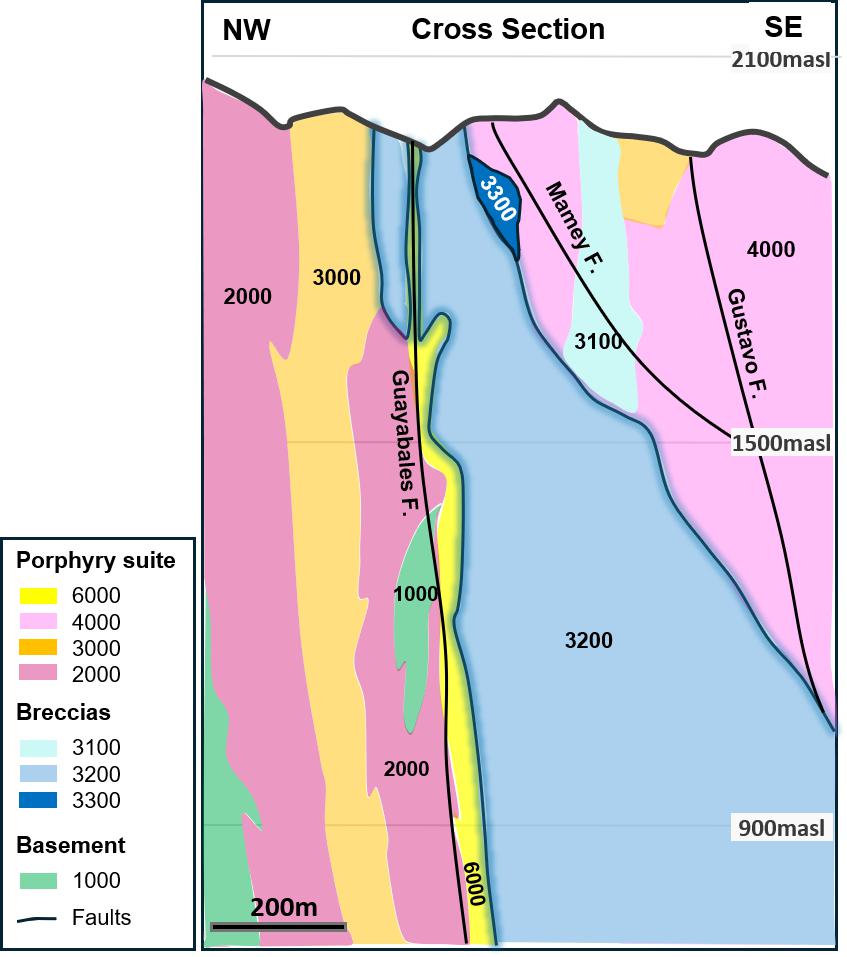
Figure 14.1: Definition of Geological Domains – Apollo - Cross-Section view
153
| Collective Mining Ltd. |
| Guayabales Project - Apollo Mineral Resource 2026-08 |
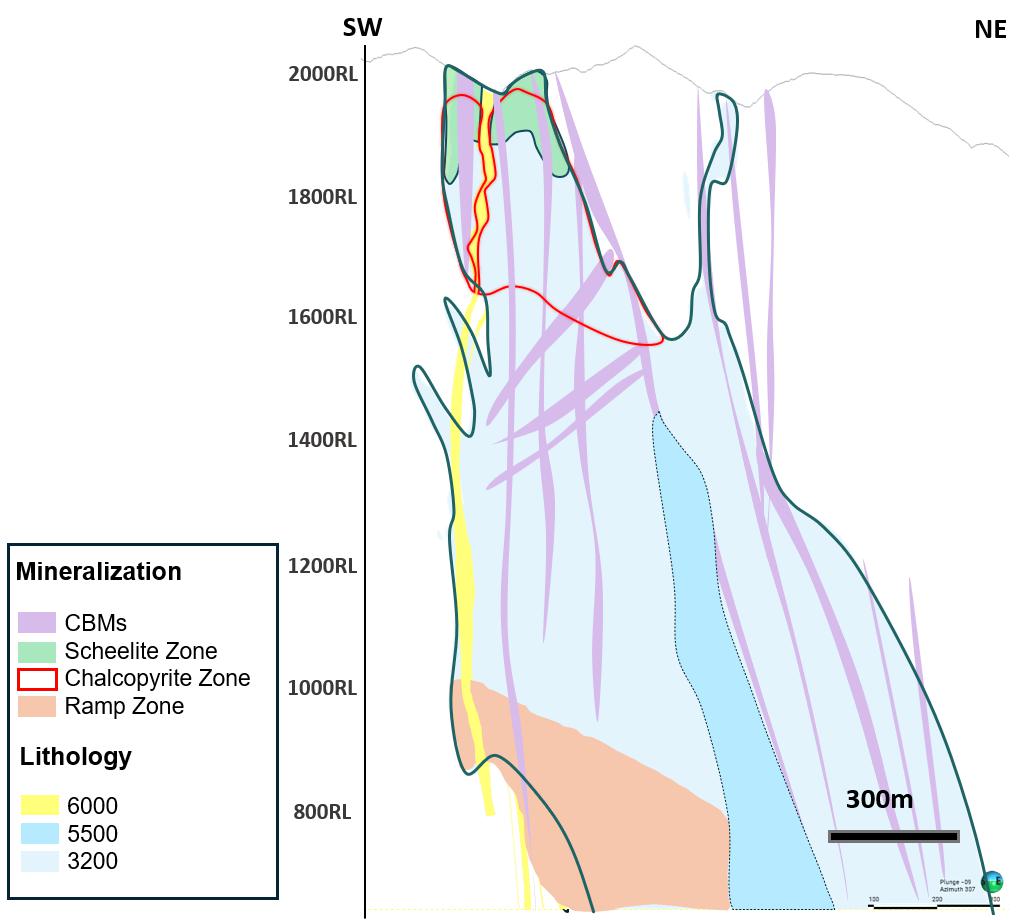
Figure 14.2: Definition of Cu and WO3 Grade Domains – Apollo - Cross-Section view
| 14.5.1 | Definition of Domains for Modelling |
The domains used for modelling are a mixture of lithological, weathering and mineralogical/grade domains. Domain Codes are presented in Table 14.5 to Table 14.7.
Gold grade modelling domains above 1400 masl
The domains for estimating gold (Au) grades were originally focused on distinguishing the CBM vein zones from the BAM but this proved challenging above 1,400 masl. because they have often impregnated the BAM matrix resulting in a complex and dense array of mixed mineralization. The decision was then made to model gold in the BAM unit as a single domain for estimation and not split into CBM and BAM units (Table 14.5). The domains that host the majority of the gold mineralization in this model above 1400 masl are the 3200 (BAM) and the 9100 (CBM-LA), 9200 (CBM-EW) and 9300 (CBM-NW).
154
| Collective Mining Ltd. |
| Guayabales Project - Apollo Mineral Resource 2026-08 |
Gold grade modelling domains below 1400 masl
Estimation of the grades below 1400 masl were completed in a similar manner except the CBMs have been modelled independently due to their less complex spatial distribution and the need to constrain the grades to the CBMs where there is less data. The CBMs and the BAM have therefore been modelled separately. The Ramp Zone occurs below 1,000 masl and overlaps some of the lithological domains as well as the BAM. In the Ramp Zone, these lithologies were all put together into one domain for modelling as there was lack of data in the other subareas.
Table 14.5: Estimation Domains for modelling of gold grades
| Domain codes for modelling gold | Lithological codes | Mineralization codes | Oxidation Codes |
| 8000 | All except 3200 and 3300 | 00 | 8000 |
| 7000 | All except 3200 and 3300 | 00 | 7000 |
| 9100, 9200, 9300 | >1400 - All except 3200 <1400 - All lithology codes | All codes | No differentiation |
| 3200 | >1400 - 3200, 3300, 9100,9200,9300 inside 3200 & 3300 domains <1400 - 3200 domain only | 00 | No differentiation |
| 3260 | 3200 + minor 1000 | 60 | 0000 |
| 5500 | 5500 | 00 | 0000 |
| 6000 | 6000 | 00 | No differentiation |
| 1000 | 1000, 2000, 3000, 4000 | 00 | 0000 |
# Principal grade domains for gold are shaded in grey. Silver was also estimated separately in domain 3260 (Ramp).
Copper and silver grade modelling domains
The domains for estimating copper (Cu) and silver (Ag) grades were based largely on the lithological domains, with one higher-grade domain (Table 14.6). The CBM veins are mainly gold dominant, so the copper grades were estimated independently of the CBMs.
Table 14.6: Estimation Domains for modelling of copper and silver grades above 1400 masl
| Domain codes in model | Lithological codes | Mineralization codes | Oxidation Codes |
| 8000 | All except 3200 and 3300 | 00 | 8000 |
| 8100 | 3200 and 3300 | 00 | 8000 |
| 7000 | All except 3200 and 3300 | 00 | 7000 |
| 7100 | 3200 and 3300 | 00 | 7000 |
| 5500 | 5500 | 00 | 00 |
| 6000 | 6000 | 00 | 00 |
| 3230 | 3200, 3300 | 30 | 7000, 00 |
| 3200 | 3200 | 00 | 7000, 00 |
| 1000 | 1000, 2000, 3000, 4000 | 00 | 00 |
# Principal grade domains for copper are shaded in grey. Silver was also estimated separately in domain 3260 (Ramp).
155
| Collective Mining Ltd. |
| Guayabales Project - Apollo Mineral Resource 2026-08 |
Tungsten Trioxide grade modelling domains
The domains for estimating the tungsten trioxide (WO3) grades are based largely on the lithological domains, with one higher-grade domain (Table 14.7). The CBMs do not host tungsten, so the tungsten grades were estimated independently of the CBMs.
Table 14.7: Estimation Domains for modelling of WO3 grades above 1400 masl
| Domain codes in model | Lithological codes | Mineralization codes | Oxidation Codes |
| 8000 | All except 3200 and 3300 | 00 | 8000 |
| 7000 | All except 3200 and 3300 | 00 | 7000 |
| 3250 | 3200, 3300 | 50 | No differentiation |
| 3200 | 3200 | 00 | No differentiation |
| 5500 | 5500 | 00 | 0000 |
| 6000 | 6000 | 00 | 0000 |
| 1000 | 1000, 2000, 3000, 4000 | 00 | 0000 |
# Principal grade domains for tungsten are shaded in grey.
| 14.6 | Compositing of Assay Intervals |
Samples were composited within domains for modelling as defined for each grade variable as documented above in Table 14.5 to Table 14.7.
The composite sample length selected was 2.0 m. This was based on the most common sample length of around 1 m, the block size chosen for modelling (5.0 m vertical height) and the style of modelling selected. Compositing was completed in Datamine’s COMPDH process, with the parameter MODE=1 selected to avoid small samples as residuals, and to provide composites as close to the same sample support as possible. The data was coded according to the relevant geological zone prior to compositing in preparation for modelling.
| 14.6.1 | Summary statistics and grade-capping |
Histograms of the composited data exhibit a moderate positive skew with a moderate to high coefficient of variation (“CV”). Summary statistics are presented in the tables below (Table 14.8 to Table 14.10) along with an example histogram (Figure 14.3).
Capping was applied (Table 14.8 to Table 14.10) to reduce the influence of relatively high grades during grade estimation. Capping was assessed in two phases. The first was a more traditional view looking at the composite data and the summary statistics, and the second was to look at the clustering of high grades locally within the Apollo Mineral Deposit, so the spatial relationships between high grades were also considered during development of the capping strategy.
156
| Collective Mining Ltd. |
| Guayabales Project - Apollo Mineral Resource 2026-08 |
Table 14.8: Summary statistics for Au of 2m composited data in the main Au domains for the Apollo Deposit (>1400)
| 1,000 >1400 masl |
3200 BAM >1400 masl |
9100 (all) >1400 masl |
9200 (all) >1400 masl |
9300 (all) >1400 masl | |
| Number comps | 17,387 | 17,763 | 2,443 | 4,579 | 6,927 |
| Mean (g/t Au) | 0.12 | 1.22 | 1.97 | 1.66 | 1.04 |
| Std. Dev. | 0.58 | 3.42 | 3.99 | 5.26 | 3.01 |
| Coeff. Var. (CV) | 4.9 | 2.8 | 2.0 | 3.2 | 2.9 |
| Max (g/t Au) | 47.2 | 131.0 | 114.7 | 123.2 | 153.1 |
| Capping Value | 7.00 | 65.0 | 41.0 | 90.0 | 80.0 |
| Capped Mean | 0.11 | 1.21 | 1.94 | 1.64 | 1.03 |
| Capped CV | 2.9 | 2.6 | 1.7 | 3.0 | 2.5 |
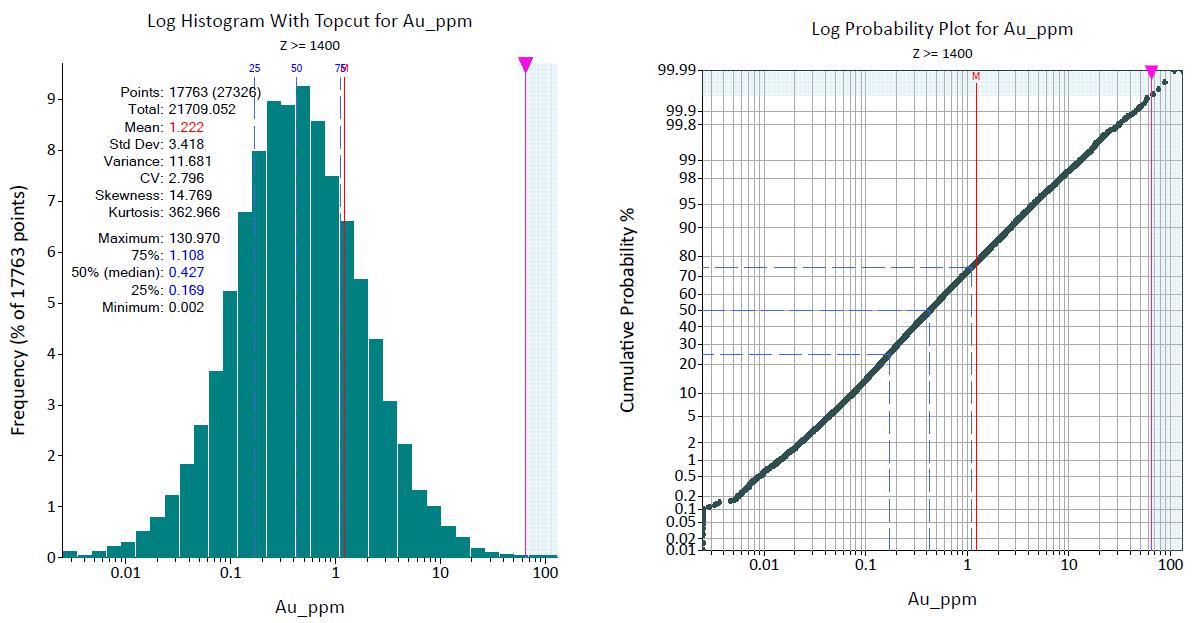 |
Figure 14.3: Log histogram of gold grades in composited drill data for the 3200 BAM zone >1400 masl.
Table 14.9: Summary statistics for Au of 2m composited data in the main Au domains for the Apollo Deposit (<1400 masl)
|
3200 BAM <1400 masl |
3260 RAMP <1,000 masl |
9100 <1400 masl |
9200 <1400 masl |
9300 <1400 masl | |
| Number comps | 5,537 | 2,153 | 253 | 894 | 1,376 |
| Mean (g/t Au) | 0.41 | 2.26 | 0.61 | 0.80 | 1.36 |
| Std. Dev. | 0.94 | 12.41 | 1.44 | 1.50 | 4.71 |
| Coeff. Var. (CV) | 2.3 | 5.5 | 2.4 | 1.9 | 3.5 |
| Max (g/t Au) | 26.2 | 422.6 | 12.0 | 22.8 | 139.9 |
| Capping Value | 10.0 | 71.0 | 12.0 | 17.0 | 17.0 |
| Capped Mean | 0.41 | 1.96 | 0.61 | 0.80 | 1.21 |
| Capped CV | 2.0 | 3.2 | 2.4 | 1.8 | 1.9 |
157
| Collective Mining Ltd. |
| Guayabales Project - Apollo Mineral Resource 2026-08 |
Table 14.10: Summary statistics for Cu, Ag and WO3 of composited data in the grade domains for the Apollo Deposit (>1400)
| 3200 Cu >1400 | 3230 Cu | 3200 Ag >1400 | 3230 Ag | 3200 WO3 (>1400) | 3250 WO3 | |
| Number comps | 10,721 | 6,950 | 10,721 | 6,950 | 15,294 | 3,169 |
| Mean (ppm) | 492.3 | 4,045 | 13.7 | 54.7 | 40.2 | 1,449 |
| Std. Dev. | 954.1 | 3,444 | 21.5 | 59.1 | 246.9 | 2,620 |
| Coeff. Var. (CV) | 1.9 | 0.9 | 1.6 | 1.08 | 6.5 | 1.808 |
| Max (ppm) | 25,852 | 26,295 | 668.6 | 901.1 | 16,771 | 27,851 |
| Capping Value | 11,100 | 19,000 | 200.0 | 440.0 | 2,700 | 21,100 |
| Capped Mean | 487.2 | 4,040 | 13.5 | 54.5 | 37.6 | 1,441 |
| Capped CV | 1.8 | 0.8 | 1.4 | 1.1 | 4.7 | 1.8 |
| 14.7 | Variogram models |
In the development of this resource estimate, semi-variograms (variograms) were prepared on the Au, Cu, Ag and WO3 variables using the relevant domains for grade estimation. Variograms were prepared as Normal Scores Semi-Variograms and backtransformed prior to use (an example in Figure 14.4) with orientations consistent with the main geological orientations and considering the evidence in the variogram fans. These orientations were not always obvious from the variogram fans.
For Au in the CBMs, variograms were prepared aligned with the principal orientation for each of the three principal vein sets. In the BAM above 1400 masl, the orientation was unclear in the variogram fans, but was seemingly consistent with the CBM-NW orientation and this direction was therefore chosen for modelling. A similar orientation was chosen for the BAM below 1400 masl.
Variograms for Cu, Ag and WO3 were chosen to be consistent with the overall orientation of the BAM mineralization in each of the main mineralized domains. This was not an overly significant decision as the mineralization is largely isotropic in the short range. Variogram models were also chosen to be accurate to within the range of the ultimate search ellipse and so were not always a good match for the variogram beyond the area of influence.
Variogram models as used for grade estimation are presented in Table 14.11, 12, 13 and 14.
158
| Collective Mining Ltd. |
| Guayabales Project - Apollo Mineral Resource 2026-08 |
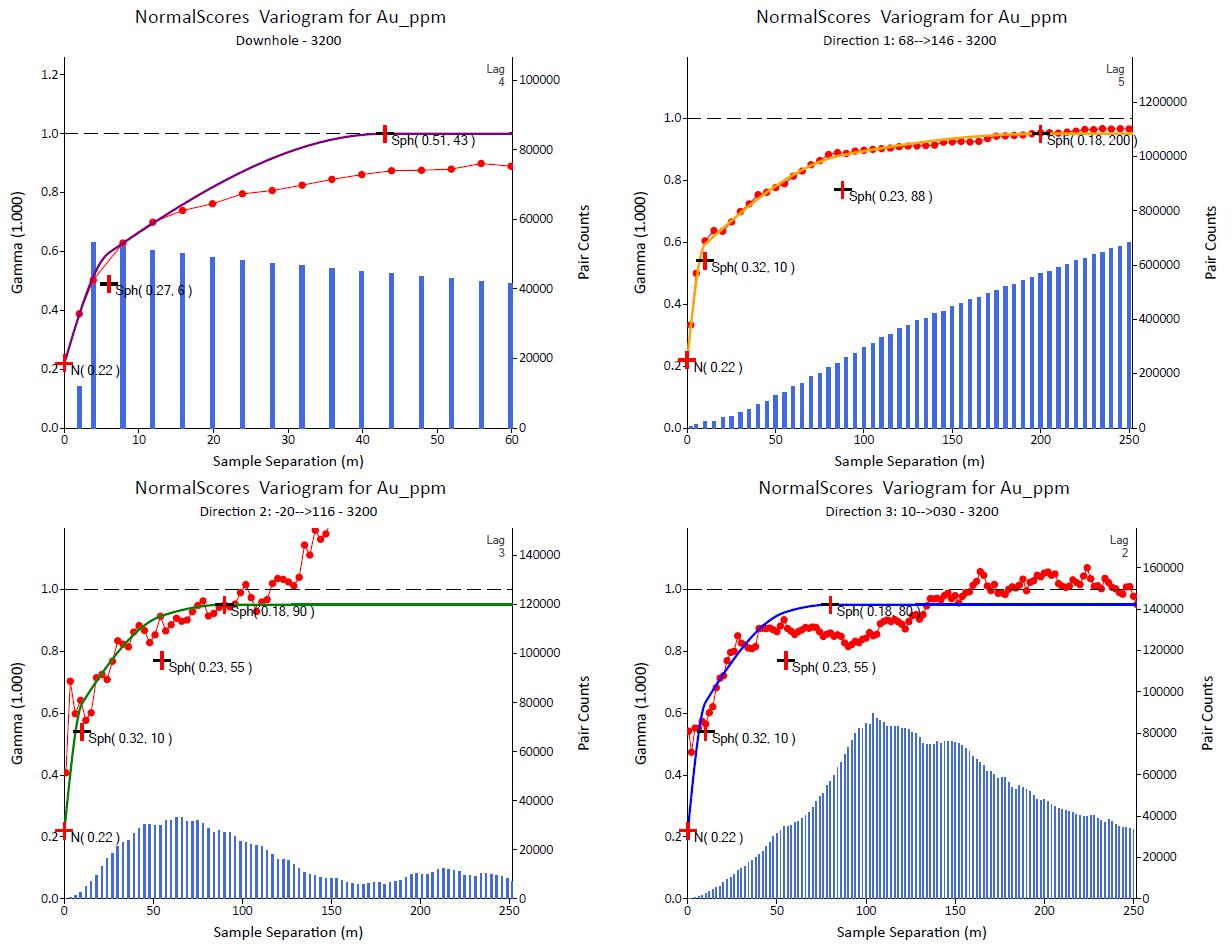
Figure 14.4: Variogram of gold grades in composited drill data for the total BAM (>1400 masl).
159
| Collective Mining Ltd. |
| Guayabales Project - Apollo Mineral Resource 2026-08 |
Table 14.11: Variogram parameters (Au) for the main mineralized Au domains
| Nugget value | Structure | Structure contribution |
Ranges | Rotation (ZXZ) | |||||
| Major | Semi | Minor | Z’ | X’ | Z’ | ||||
| 3200 above 1,400 masl |
0.498 | C1 | 0.378 | 10 | 10 | 10 | 30 | 80 | 70 |
| C2 | 0.091 | 88 | 55 | 55 | |||||
| C3 | 0.034 | 200 | 90 | 80 | |||||
| 3200 below 1,400 masl |
0.338 | C1 | 0.338 | 5 | 5 | 5 | 140 | 90 | 90 |
| C2 | 0.138 | 16 | 16 | 32 | |||||
| C3 | 0.098 | 90 | 70 | 80 | |||||
|
3260 (within BAM) |
0.424 | C1 | 0.450 | 5 | 5 | 5 | 40 | 90 | 90 |
| C2 | 0.094 | 17 | 40 | 45 | |||||
| C3 | 0.032 | 50 | 65 | 65 | |||||
| 9100 | 0.257 | C1 | 0.553 | 3 | 3 | 3 | 180 | 90 | 140 |
| C2 | 0.124 | 17 | 13 | 13 | |||||
| C3 | 0.066 | 55 | 30 | 30 | |||||
| 9200 | 0.190 | C1 | 0.608 | 7 | 5 | 2 | 180 | 90 | 90 |
| C2 | 0.117 | 80 | 40 | 15 | |||||
| C3 | 0.085 | 140 | 70 | 35 | |||||
| 9300 | 0.216 | C1 | 0.328 | 5 | 5 | 5 | 30 | 90 | 90 |
| C2 | 0.205 | 15 | 15 | 15 | |||||
| C3 | 0.252 | 135 | 75 | 60 | |||||
Table 14.12: Variogram parameters (Ag) for the main mineralized Ag domains
| Nugget value | Structure | Structure contribution | Ranges | Rotation (ZXZ) | |||||
| Major | Semi | Minor | Z’ | X’ | Z’ | ||||
| 3200 above 1,400 masl |
0.259 | C1 | 0.561 | 5 | 5 | 4 | 130 | 110 | 90 |
| C2 | 0.090 | 22 | 15 | 15 | |||||
| C3 | 0.089 | 60 | 35 | 30 | |||||
| 3200 below 1,400 masl |
0.278 | C1 | 0.499 | 5 | 5 | 5 | 130 | 90 | 90 |
| C2 | 0.112 | 10 | 25 | 22 | |||||
| C3 | 0.111 | 75 | 55 | 40 | |||||
| 3230 | 0.187 | C1 | 0.333 | 10 | 8 | 8 | 130 | 110 | -160 |
| C2 | 0.264 | 80 | 80 | 35 | |||||
| C3 | 0.216 | 110 | 110 | 45 | |||||
|
3260 (within BAM) |
0.314 | C1 | 0.341 | 5 | 5 | 5 | 40 | 70 | 90 |
| C2 | 0.187 | 25 | 40 | 10 | |||||
| C3 | 0.158 | 65 | 90 | 55 | |||||
Table 14.13: Variogram parameters (Cu) for the main mineralized Cu domains
| Nugget value | Structure | Structure contribution | Ranges | Rotation (ZXZ)* | |||||
| Major | Semi | Minor | Z’ | X’ | Z’ | ||||
| 3200 above 1,400 masl |
0.320 | C1 | 0.305 | 7 | 7 | 7 | 130 | 110 | 90 |
| C2 | 0.180 | 117 | 55 | 55 | |||||
| C3 | 0.195 | 330 | 260 | 200 | |||||
| 3200 below 1,400 masl |
0.256 | C1 | 0.309 | 6 | 15 | 15 | 130 | 90 | 90 |
| C2 | 0.109 | 80 | 20 | 60 | |||||
| C3 | 0.326 | 360 | 350 | 90 | |||||
| 3230 | 0.111 | C1 | 0.215 | 10 | 6 | 6 | 130 | 110 | -160 |
| C2 | 0.309 | 50 | 50 | 30 | |||||
| C3 | 0.365 | 75 | 70 | 55 | |||||
160
| Collective Mining Ltd. |
| Guayabales Project - Apollo Mineral Resource 2026-08 |
Table 14.14: Variogram parameters (WO3) for the main mineralized WO3 domains
| Nugget value | Structure | Structure contribution | Ranges | Rotation (ZXZ)* | |||||
| Major | Semi | Minor | Z’ | X’ | Z’ | ||||
| 3200 above 1,400 masl | 0.232 | C1 | 0.340 | 6 | 6 | 6 | 130 | 110 | 90 |
| C2 | 0.206 | 35 | 35 | 35 | |||||
| C3 | 0.222 | 320 | 320 | 280 | |||||
| 3200 below 1,400 masl | 0.501 | C1 | 0.413 | 6 | 6 | 6 | 130 | 110 | 90 |
| C2 | 0.069 | 30 | 30 | 30 | |||||
| C3 | 0.016 | 160 | 160 | 150 | |||||
| 3250 | 0.045 | C1 | 0.299 | 4 | 4 | 5 | 130 | 110 | -160 |
| C2 | 0.397 | 14 | 14 | 14 | |||||
| C3 | 0.259 | 85 | 85 | 80 | |||||
| 14.8 | Orientations and Search distances used for modelling |
The primary orientations used for grade estimation at Apollo were based on the principal geological orientations whilst taking into consideration the evidence in the variogram fans.
Search distances were chosen to be consistent with the direction of principal grade continuity in order to limit the number of samples collected in directions other than the principal direction in the broader zones. This has become necessary where drillholes in some areas have been drilled at acute angles to the overall direction of the mineralization.
Search parameters have been tabulated for the most significant domains in the tables below (Table 14.15, Table 14.16, Table 14.17 and Table 14.18).
Table 14.15: Search orientations and distances for Au by domain for the first search
| Domain | Rotation (ZXZ) | Pass 1 (m) | Composites | |||||
| Z° | X° | Z° | Major | Semi-major | Minor | Min | Max | |
| 3200 (>1,400 masl) | 30 | 80 | 90 | 100 | 75 | 30 | 6 | 15 |
| 9100 (>1,400 masl) | 180 | 90 | 140 | 45 | 25 | 25 | 9 | 16 |
| 9200 (>1,400 masl) | 180 | 90 | 90 | 60 | 40 | 20 | 9 | 16 |
| 9300 (>1,400 masl) | 30 | 90 | 90 | 100 | 50 | 40 | 9 | 16 |
| 3200 (<1,400 masl) | 140 | 90 | 90 | 65 | 25 | 25 | 6 | 15 |
| 9100 (<1,400 masl) | 180 | 90 | 140 | 45 | 25 | 25 | 9 | 16 |
| 9200 (<1,400 masl) | 180 | 90 | 90 | 60 | 40 | 20 | 9 | 16 |
| 9300 (<1,400 masl) | 30 | 90 | 90 | 100 | 50 | 40 | 9 | 16 |
| 3260 | 30 | -40 | 0 | 40 | 10 | 40 | 6 | 15 |
161
| Collective Mining Ltd. |
| Guayabales Project - Apollo Mineral Resource 2026-08 |
Table 14.16: Search orientations and distances for Ag by domain for the first search
| Domain | Rotation (ZXZ) | Pass 1 (m) | Composites | |||||
| Z° | X° | Z° | Major | Semi-major | Minor | Min | Max | |
| 3230 | 130 | 110 | -160 | 50 | 50 | 25 | 14 | 30 |
| 3200 (>1,400 masl) | 130 | 110 | 90 | 45 | 30 | 25 | 9 | 15 |
| 3200 (<1,400 masl) | 140 | 90 | 90 | 65 | 25 | 25 | 6 | 15 |
| 3260 | 30 | -40 | 0 | 40 | 10 | 40 | 6 | 15 |
Table 14.17: Search orientations and distances for Cu by domain for the first search
| Domain | Rotation (ZXZ) | Pass 1 (m) | Composites | |||||
| Z° | X° | Z° | Major | Semi-major | Minor | Min | Max | |
| 3230 | 130 | 110 | -160 | 60 | 55 | 45 | 6 | 12 |
| 3200 (>1,400 masl) | 130 | 110 | 90 | 80 | 60 | 45 | 9 | 12 |
| 3200 (<1,400 masl) | 140 | 90 | 90 | 65 | 25 | 25 | 6 | 15 |
Table 14.18: Search orientations and distances for WO3 by domain for the first search
| Domain | Rotation (ZXZ) | Pass 1 (m) | Composites | |||||
| Z° | X° | Z° | Major | Semi-major | Minor | Min | Max | |
| 3250 | 130 | 110 | -160 | 30 | 30 | 20 | 20 | 30 |
| 3200 (>1,400 masl) | 130 | 110 | 90 | 120 | 120 | 70 | 16 | 20 |
| 3200 (<1,400 masl) | 130 | 110 | 90 | 120 | 120 | 70 | 10 | 20 |
A second search pass of between 1.5 times and 2 times the first search distances. The aim was to ensure grades were estimated in all blocks.
The estimation parameters were selected with consideration of the spatial distribution and continuity of the composite data. The progressively expanded search strategy was used to obtain an estimate for the maximum practical proportion of the modelled mineralized volume while distinguishing blocks estimated from relatively well-supported data from those estimated using more distant or limited information. The estimation pass used for each block was retained in the block model to support subsequent assessment of estimation confidence and resource classification.
Hard boundaries were applied between the interpreted mineralized domains for all estimation variables except Au in the CBM domains (9100, 9200 and 9300) outside the BAM and >1400 masl. Accordingly, only composites assigned to a particular estimation domain were used to estimate blocks located within that same domain. Composites from adjacent domains were excluded from the estimation of blocks across the domain boundary. For estimation of Au in the CBM domains outside the BAM, a soft boundary was used with the CBM coded composites inside the BAM, thereby allowing better consistency of Au grade in the CBMs between the inside and the outside of the BAM. The boundary approach was considered appropriate because the interpreted domain boundaries represent geological and/or mineralization controls across which consistency of grade was not assumed for the purposes of the resource estimate.
162
| Collective Mining Ltd. |
| Guayabales Project - Apollo Mineral Resource 2026-08 |
| 14.9 | Block model set up |
A Datamine rotated block model with parent cell dimensions of 10 m (300° direction) x 5 m (030° direction) x 5 m (vertical) was created and coded to reflect the surface topography, state of weathering, lithology, higher-grade zones for copper and tungsten and the Ramp Zone.
Table 14.19: Geometric parameters of the block model
| Parameter | 300o Axis (NW) | 030o Axis (NE) | Elevation (Z) |
| Model Origin | 431,600 mE | 606,250 mN | 550 mZ |
| Number of parent cells | 170 | 340 | 366 |
| Parent cell size (m) | 10 | 5 | 5 |
| Model Extent (m) | 1,700 | 1,700 | 1,830 |
| Sub-cell size (m) | 5 | 1 | 1 |
Sub-celling was used so that lithological boundaries could be reasonably preserved using 5 m subcells in the NW direction and 1.0 m subcells in the NE and Z directions. Sub-celling was also used for definition of the topography but only using subcells in the Z direction at 1.0 m height.
The model origin is reported in the global East, North, and Elevation coordinate system. The horizontal block dimensions and cell counts are reported relative to the rotated local axes of the block model.
| 14.9.1 | Volumetric Mass Density & Specific Gravity |
Specific Gravity (“SG”) was from measurements described in Section 11.
The Apollo Deposit has a specific gravity (bulk density) database consisting primarily of determinations performed using the Archimedes method (water immersion) on drill core samples approximately 10 to 20 cm in length. Determinations were generally performed at 10 m intervals along the drillholes, or at shorter intervals where significant lithological changes were identified.
Most samples correspond to competent rocks with low to negligible porosity. Consequently, the measurements obtained using the Archimedes method are considered representative of the in-situ density of the corresponding geological units.
The database comprises 2,845 specific gravity determinations for Domains 1000, 5500, and 6000, and 2,349 determinations for Domain 3200, providing a robust statistical basis for density assignment. The mineralized Domains 9100, 9200, and 9300 contain a combined total of 204 measurements, considered adequate to characterize the specific gravity of these units. In contrast, Domains 7000 and 7100 have only 19 measurements, resulting in greater relative uncertainty in the assigned value.
Domains 8000 and 8100 are in the upper portion of the deposit and are characterized by oxidized, less competent material and, locally, poor core recovery. Due to these conditions, representative core samples suitable for the Archimedes method could not consistently be obtained. Specific gravity for these domains was therefore determined using the sand-cone method. A total of 10 measurements are available for these domains.
For Mineral Resource tonnage, a specific gravity of 2.68 t/m³ was assigned to Domains 1000, 5500, and 6000; 2.29 t/m³ was assigned to Domains 7000 and 7100; 1.31 t/m³ was assigned to Domains 8000 and 8100; and 2.94 t/m³ to Domains 9100, 9200, and 9300.
163
| Collective Mining Ltd. |
| Guayabales Project - Apollo Mineral Resource 2026-08 |
For Domain 3200, a specific gravity of 2.75 t/m³ was assigned to the portion below the 1,400 m elevation. For the portion above 1,400 m elevation, a value of 2.84 t/m³ was assigned based on the combined evaluation of the available specific gravity measurements from Domain 3200 and the mineralized domains of the 9000 series.
The assigned specific gravity values reflect the lithological, alteration, oxidation and rock competency characteristics observed across the deposit. The higher values assigned to the mineralized 9000-series domains are consistent with their geological characteristics, while the lower values assigned to Domains 8000 and 8100 reflect the less competent and oxidized nature of the material in the upper portion of the deposit.
Overall, the available measurements provide an adequate basis for the specific gravity values used in the current Mineral Resource tonnage calculations. However, Domains 7000 and 7100, and particularly Domains 8000 and 8100, have relatively limited datasets compared with the other domains and therefore carry greater uncertainty in their assigned values. These values should be reviewed and potentially refined as additional specific gravity measurements become available.
Table 14.20 summarizes the number of specific gravity measurements and the values assigned to each domain in the model.
Table 14.20: Density values (t/m3) used in the model
|
Lithological Domain |
Number of measurements |
Specific Gravity (g/cm3) |
Standard Deviation |
| 1000, 5500, 6000 | 2,845 | 2.68 | 0.09 |
| 3200 (>1400 masl) | 1,492 | 2.76 | 0.13 |
| 3200 (<1400 masl) | 857 | 2.75 | 0.14 |
| 9100, 9200, 9300 | 204 | 2.94 | 0.46 |
| 7000, 7100 | 19 | 2.29 | 0.24 |
| 8000, 8100 | 10 | 1.31 | 0.13 |
Note: SG for the 3200 above 1400 was the average between 3200 and 9000 domains (2.84).
| 14.10 | Grade Estimation |
The composited gold grade data for Apollo, when collated in a histogram, exhibit a moderately skewed gold grade population. The maximum gold-grade recorded for a one half metre sample was 428.0 g/t Au in drillhole APC088_D01 from 818.5 m downhole.
Ordinary kriging (“OK”) with capped high grades was selected for grade estimation.
164
| Collective Mining Ltd. |
| Guayabales Project - Apollo Mineral Resource 2026-08 |
| 14.10.1 | Assumptions in the grade estimation |
The key assumption used for grade modelling is that the mineralized zones, and the grades in the mineralized zones are relatively continuous in grade, thickness and orientation. Aurum has confidence that this assumption is valid because of the density of drilling relative to the thickness of the mineralization, and the success in targeting extensions to the mineralization using this model with the 2025 and 2026 Collective drill programs.
| 14.10.2 | Grade estimation parameters |
Variogram models (Table 14.11 to Table 14.14) and Search parameters (Table 14.15 to Table 14.18) were used as input parameters to the ordinary kriging.
Search parameters were defined so that enough and appropriate data was collected to make an estimate. Too little data creates a bias, and too much data creates excessive smoothing. The parameters were chosen to have the longest search in the down-dip directions. This prevented the estimation from selecting too many samples from drillholes that were drilled down the axis of the mineralization and were creating artefacts in the model.
| 14.11 | Model validation |
In addition to conducting validation checks on all stages of the modelling and estimation process, final grade estimates and models were checked / validated by comparing global estimation block grades with the input drillhole composites, by visual validation of block model cross sections against drilling and channel sampling information, and by grade trend plots.
| 14.11.1 | Visual validation |
Visual validations of the estimates were undertaken by comparing composite grades with the grades estimated in the block model, both in plan and in vertical sections. This review was used to assess the consistency between the spatial distribution of observed grades and the interpolated grades, as well as the appropriate reproduction of the geometry and continuity of the mineralized domains (within the confidence implied by the classification).
In general, the visual reviews indicated that the estimates adequately reproduced the spatial distribution of grades within the different domains, with no indications of excessive smoothing or unjustified extrapolation. The estimates maintain consistency between the high- and low-grade zones defined by the drilling data and those represented in the block model. Likewise, geological contacts and the boundaries of the mineralized domains are respected by the estimation, with no inconsistent extensions of mineralization across domain boundaries.
The estimates show a reasonable to good visual correspondence with the input composite grades. Example plan views and cross-sections of the model as used for validation are illustrated in the figures below (Figure 14.5 to Figure 14.9).
165
| Collective Mining Ltd. |
| Guayabales Project - Apollo Mineral Resource 2026-08 |
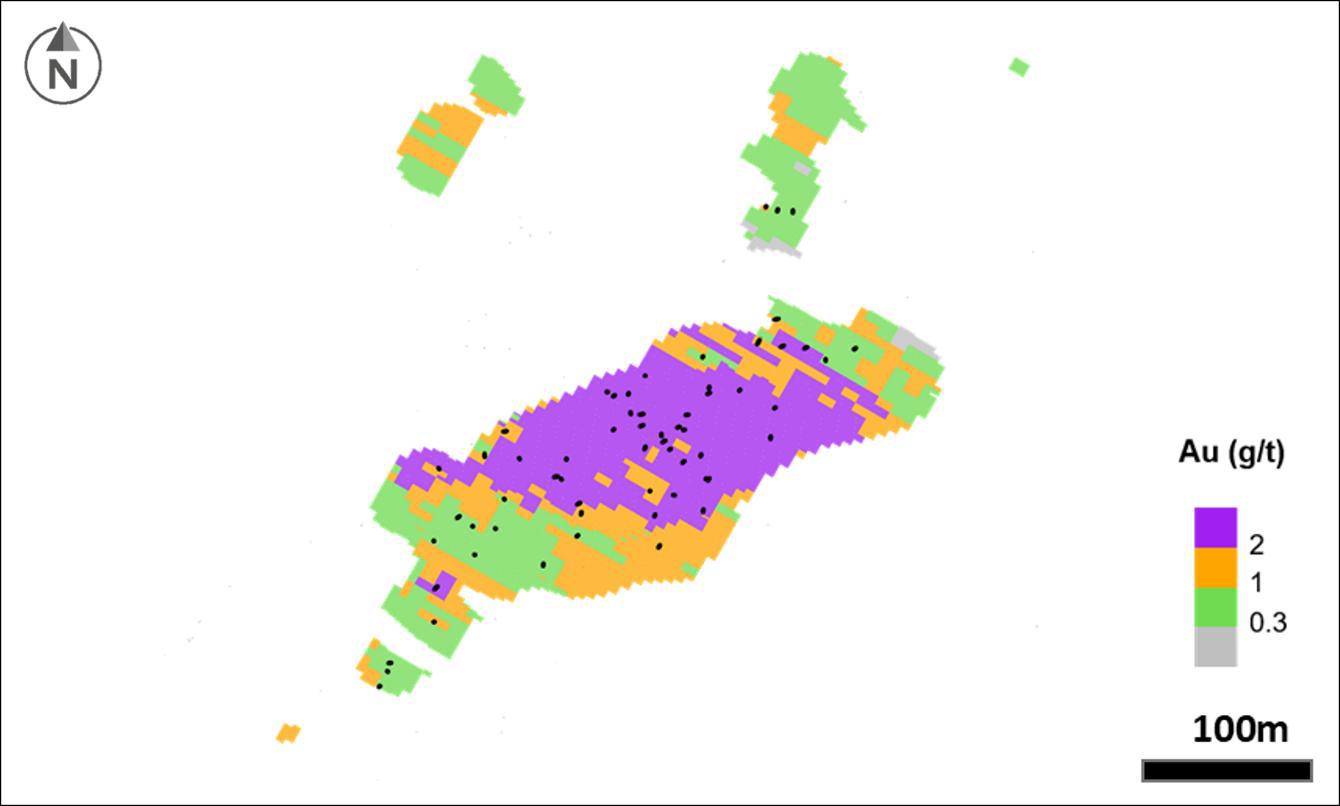
Figure 14.5: Plan validation view of Au grades in the BAM domain at Apollo (1 650 masl)
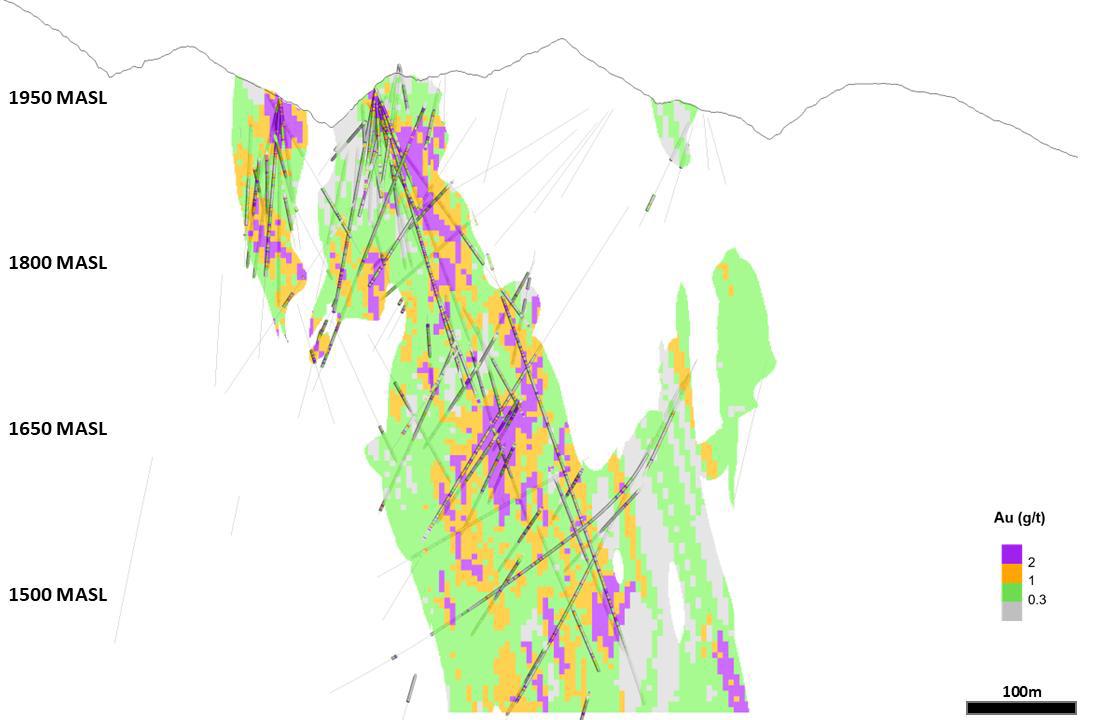
Figure 14.6: SW-NE Cross-section validation view >1400 masl of Au grades at Apollo
166
| Collective Mining Ltd. |
| Guayabales Project - Apollo Mineral Resource 2026-08 |
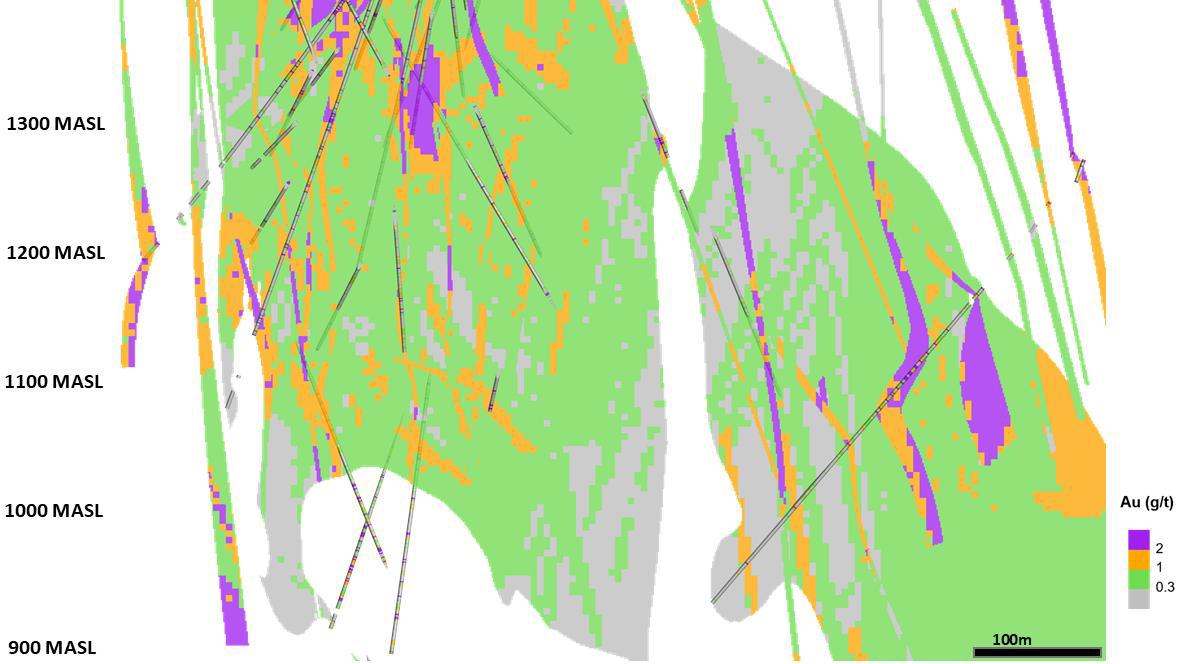
Figure 14.7: SW-NE Cross-section validation view <1400 masl of Au grades at Apollo
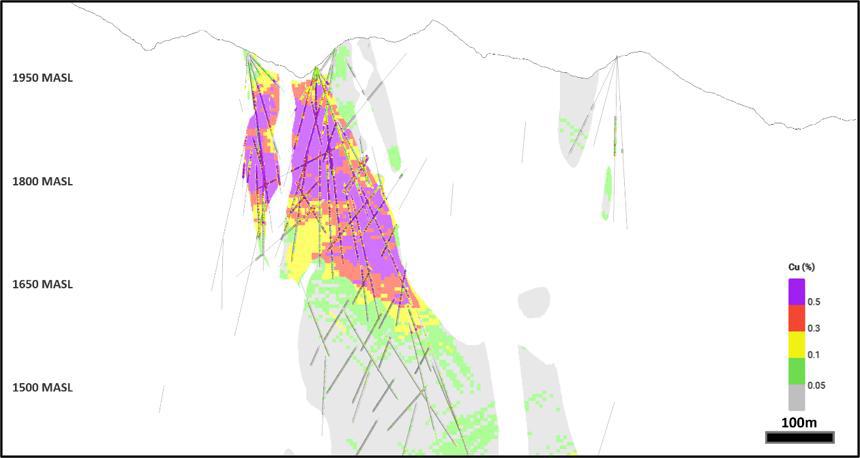
Figure 14.8: SW-NE Cross-section validation view >1400 masl of Cu grades at Apollo
167
| Collective Mining Ltd. |
| Guayabales Project - Apollo Mineral Resource 2026-08 |
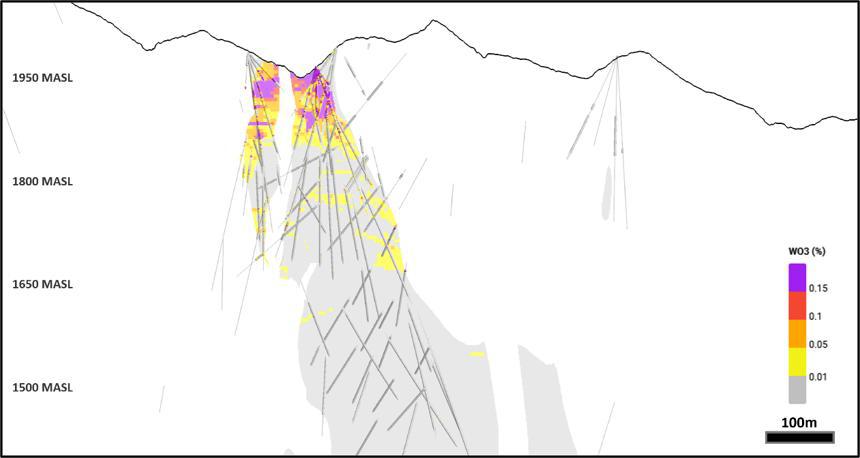
Figure 14.9: SW-NE Cross-section validation view >1400 masl of WO3 grades at Apollo
| 14.11.2 | Global comparisons |
The grade estimates were also validated statistically against the input drillhole composites. Table 14.21 to Table 14.24 provide comparisons between the estimated grades in the first search pass and the input grades for the global estimates of each of the domains. It also shows the comparative Nearest Neighbour value (NN) which is a proxy for a declustered value providing a second view on the declustered statistics for the composite data.
One of the most notable differences between the OK Au estimates and the declustered composite data is that most of the OK estimates are lower than the declustered mean. The notable exception to this is the CBM Au estimates below 1400 masl which are noticeably higher grade than the declustered mean. However, the NN values remain relatively close to the OK estimates suggesting that the declustering was not optimal. The QP opines that the difference between the OK estimate and the declustered grades is likely because of the use of soft boundaries between the CBM domains (outside the BAM) and the CBM samples inside the BAM which have higher grades. However, it is interpreted that the CBMs are continuous in grade across the BAM boundary and do not suddenly change, so it is considered a reasonable result.
The OK Ag estimates are relatively close to the declustered mean and consistent with the QPs expectations with the grade decreasing with distance from the core of the mineralization and distance from samples. The OK and NN methods remain closely grouped, suggesting that the NN method shows a different view to the declustering applied.
168
| Collective Mining Ltd. |
| Guayabales Project - Apollo Mineral Resource 2026-08 |
Table 14.21: Comparison of the mean composites Au grade (ppm) with the mean block model Au grade
| Domain | Declustered mean (5x10x5) |
Search Pass | OK | NN | (OK/Decl.)-1 | (NN/OK)-1 |
| 3200 (>1,400 masl) | 1.17 | 1 | 1.01 | 1.01 | -14% | 0.30% |
| 1+2 | 0.97 | 0.97 | -17% | 0.40% | ||
| 3200 (<1,400 masl) | 0.42 | 1 | 0.43 | 0.43 | 2.90% | -1.20% |
| 1+2 | 0.40 | 0.40 | -3.60% | 0.50% | ||
| 3260 | 1.96 | 1 | 2.02 | 2.03 | 2.90% | 0.50% |
| 1+2 | 1.94 | 1.95 | -1.40% | 1.20% | ||
| 9100 (>1,400 masl) | 1.91 | 1 | 1.76 | 1.73 | -8.10% | -1.70% |
| 1+2 | 1.56 | 1.53 | -18% | -2.40% | ||
| 9100 (<1,400 masl) | 0.61 | 1 | 0.98 | 0.80 | 60% | -18% |
| 1+2 | 0.89 | 0.67 | 46% | -27% | ||
| 9200 (>1,400 masl) | 1.55 | 1 | 1.31 | 1.37 | -16% | 5.00% |
| 1+2 | 1.27 | 1.30 | -18% | 2.60% | ||
| 9200 (<1,400 masl) | 0.83 | 1 | 1.18 | 1.09 | 42% | -7.50% |
| 1+2 | 1.06 | 0.97 | 27% | -8.00% | ||
| 9300 (>1,400 masl) | 1.01 | 1 | 0.97 | 0.96 | -4.40% | -0.90% |
| 1+2 | 0.85 | 0.83 | -16% | 3.20% | ||
| 9300 (<1,400 masl) | 1.25 | 1 | 1.42 | 1.45 | 14% | 2.10% |
| 1+2 | 1.36 | 1.36 | 9.30% | 3.70% |
Table 14.22: Comparison of the mean composites Ag grade (ppm) with the mean block model Ag grade
| Domain | Declustered mean (5x10x5) |
Search Pass | OK | NN | (OK/Decl.)-1 | (NN/OK)-1 |
| 3200 (>1,400 masl) | 13.55 | 1 | 13.3 | 13.2 | -1.50% | -1.20% |
| 1+2 | 13.3 | 13.0 | -1.90% | -2.40% | ||
| 3200 (<1,400 masl) | 6.15 | 1 | 5.93 | 5.87 | -3.50% | -1.10% |
| 1+2 | 5.31 | 5.29 | -14% | 0.50% | ||
| 3230 | 55.0 | 1 | 57.5 | 58.2 | 4.50% | 1.20% |
| 1+2 | 55.2 | 55.9 | 0.40% | 1.00% | ||
| 3260 | 4.29 | 1 | 4.43 | 4.32 | 3.10% | -2.30% |
| 1+2 | 3.77 | 3.69 | -12% | -1.30% |
169
| Collective Mining Ltd. |
| Guayabales Project - Apollo Mineral Resource 2026-08 |
Table 14.23: Comparison of the mean composites Cu grade (ppm) with the mean block model Cu grade
| Domain | Declustered mean (5x10x5) |
Search Pass | OK | NN | (OK/Decl.)-1 | (NN/OK)-1 |
| 3200 (>1,400 masl) | 494.5 | 1 | 450 | 438 | -8.90% | -2.80% |
| 1+2 | 431 | 421 | -13% | -2.10% | ||
| 3200 (<1,400 masl) | 230.68 | 1 | 232 | 231 | 0.40% | -0.40% |
| 1+2 | 219 | 219 | -5.10% | 0.10% | ||
| 3230 | 4,080.50 | 1 | 4,044 | 4,029 | -0.90% | -0.40% |
| 1+2 | 4,035 | 4,018 | -1.10% | -0.40% | ||
| 3260 | 494.5 | 1 | 450 | 438 | -8.90% | -2.80% |
| 1+2 | 431 | 421 | -13% | -2.10% |
The OK Cu estimates are again relatively close to the declustered mean and consistent with the QPs expectations with the grade decreasing with distance from the core of the mineralization and distance from samples.
Table 14.24: Comparison of the mean composites WO3 grade (ppm) with the mean block model WO3 grade
| Domain | Declustered mean (5x10x5) |
Search Pass | OK | NN | (OK/Decl.)-1 | (NN/OK)-1 |
| 3200 (>1,400 masl) | 38.1 | 1 | 41.3 | 44.3 | 8.5% | 7.3% |
| 1+2 | 40.0 | 43.3 | 4.9% | 8.0% | ||
| 3200 (<1,400 masl) | 5.2 | 1 | 5.13 | 5.3 | -1.6% | 2.3% |
| 1+2 | 5.32 | 5.6 | 2.0% | 5.3% | ||
| 3250 | 1,212 | 1 | 1,439 | 1,410 | 19% | -2.0% |
| 1+2 | 1,050 | 1,026 | -13% | -2.9% |
The OK WO3 estimates are relatively close to the declustered mean and consistent with the QPs expectations with the grade decreasing with distance from the core of the mineralization and distance from samples. The OK and NN methods remain closely grouped, suggesting that the NN method shows a different view to that of the declustering applied.
| 14.11.3 | Grade trend plots |
Sectional validation graphs otherwise known as grade trend plots or Swath Plots were created to assess the reproduction of local means and to validate the grade trends in the model. A grade trend plot is a moving window average where the average of the estimated grades in a slice of the model is compared to the average grade of the input grades for the same slice. The graphs also show the number of input samples on the right axis to give an indication of the support for each bin.
The graphs indicate that there is generally good local reproduction of the input grades and proportions of mineralization. An example is shown in Figure 14.10. The mineralized population estimate generally shows a good reproduction of the input grades with some smoothing evident, even though at this scale the detail is not evident. Departures noted in these graphs were checked and generally found to represent clustering of data relative to the model, and not an issue with the model.
170
| Collective Mining Ltd. |
| Guayabales Project - Apollo Mineral Resource 2026-08 |
The Swath Plot analysis indicates that the Ordinary Kriging (OK) estimates generally reproduce the main spatial trends observed in the declustered composites. In areas with good data support, the estimated and composite curves show relatively close correspondence, including the general location and magnitude of higher- and lower-grade zones. Some smoothing of local peaks and troughs is observed in the estimated grades, which is an expected characteristic of block estimation and reflects the averaging effect of the estimation support.
In areas with lower data density or more limited spatial continuity, greater separation between the composite and estimated curves is observed. These differences are generally localized and vary according to the swath direction and the spatial distribution of the informing composites. The magnitude of the differences is also influenced by the continuity and anisotropy of the mineralization, as well as by the local data support.
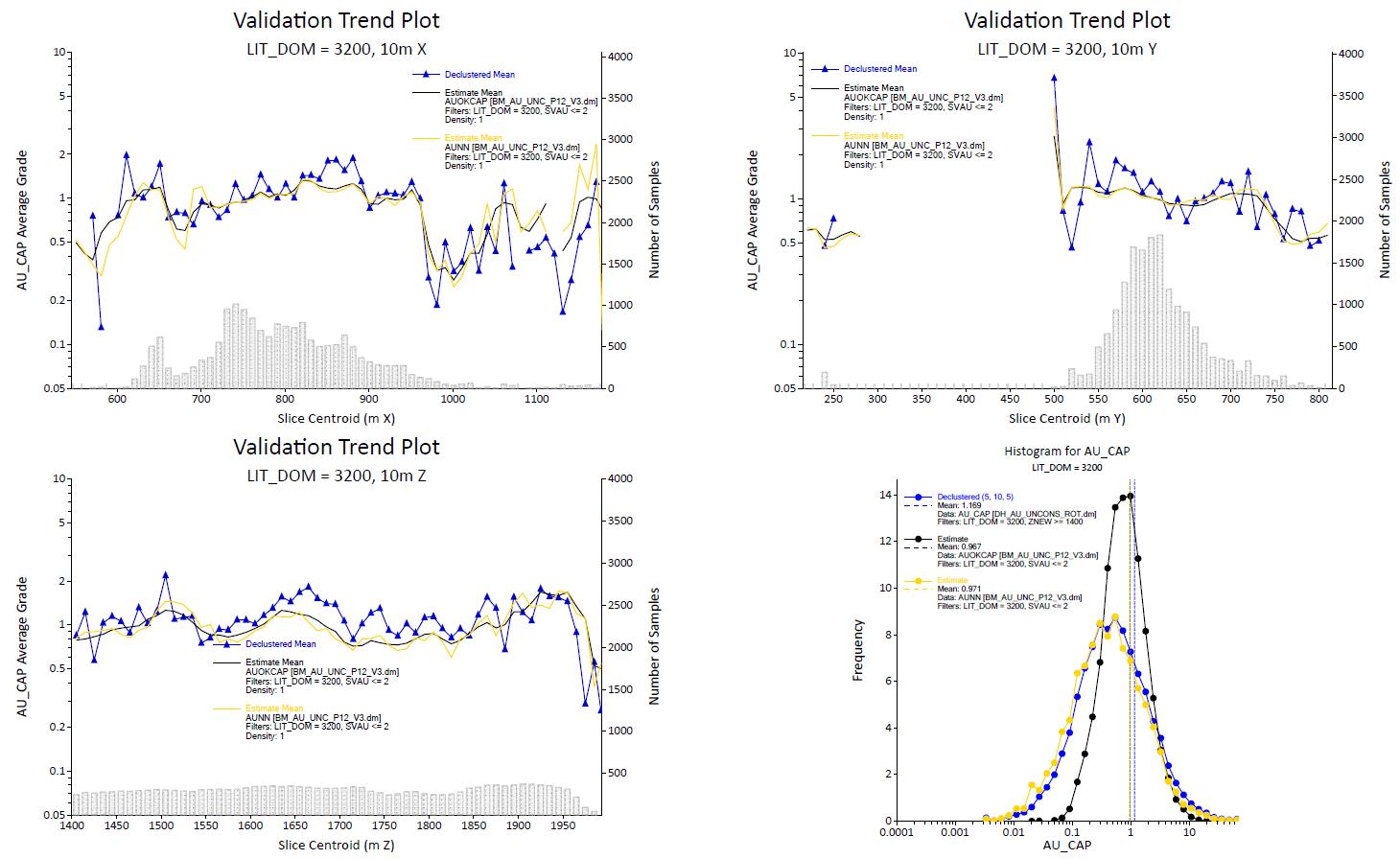
Figure 14.10: Example of a Grade trend plot of composite Au data vs average model grade by easting – Domain 3200 >1400 masl
Note: grey histogram = number of composite samples, blue = composite grade, black = model grade. The blue line represents the declustered (5x10x5) samples, the black line represents the OK estimate, and the yellow line represents the NN value.
171
| Collective Mining Ltd. |
| Guayabales Project - Apollo Mineral Resource 2026-08 |
Comparison of the OK and NN curves provides an additional assessment of the local estimation behavior. In general, the two estimation methods reproduce similar spatial trends, although differences in the magnitude of local peaks and troughs are evident in some swaths. These differences are expected because the methods apply different weighting schemes and respond differently to the spatial configuration of the informing composites.
Overall, the Swath Plot analysis indicates that the block model generally reproduces the principal spatial trends of the declustered composites in the evaluated domains and directions. Local discrepancies occur mainly in areas of higher-grade variability or reduced data support and are generally associated with the smoothing inherent in block estimation and differences in the spatial configuration of the informing composites.
No persistent or systematic separation between the composite and estimated curves is evident that would indicate a significant local bias. The generally similar spatial behavior of the OK estimates and the NN values provides additional support for the consistency of the local estimation results.
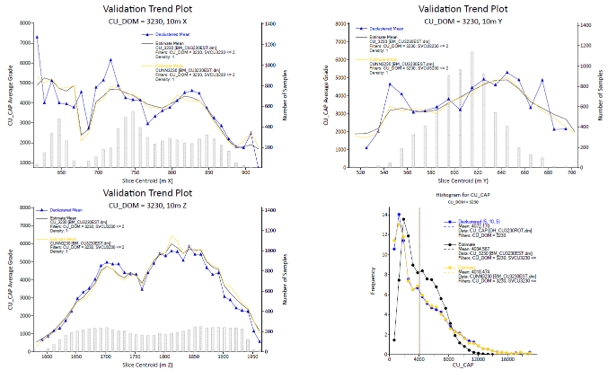
Figure 14.11: Example of a Grade trend plot of composite Cu data vs average model grade by easting – Domain 3230
| 14.12 | AuEq Calculation |
As the Apollo Deposit is polymetallic, an equivalent gold grade (AuEq) was calculated to express the combined value contribution of gold, silver, copper and tungsten on a common gold-equivalent basis. The AuEq calculation used for the Mineral Resource estimate is based on metal prices and metallurgical recoveries for each metal defined from the metallurgical testwork available at the time of preparation of the report (See Section 13).
172
| Collective Mining Ltd. |
| Guayabales Project - Apollo Mineral Resource 2026-08 |
Metal prices and recovery values used in the AuEq calculation and the RPEEE assessment were US$3,000/oz gold and 95% recovery, US$60/oz silver and 92% recovery, US$5.25/lb copper and 85% recovery, and US$2,057/mtu WO₃ (US$93.31/lb WO₃) and 70% recovery. The prices were proposed by Collective and reviewed and accepted by the QP. They were selected with reference to long-term consensus forecasts published by financial institutions, prevailing and trailing average market prices as of August 31, 2026, and prices used in recently disclosed Mineral Resource estimates for comparable development-stage projects.
Based on World Bank Commodity Price Data (The Pink Sheet, October 2, 2026), the assumed gold price is 32% below the August 2026 average price of US$4,411/oz. It is also 18% and 6% below the two- and three-year trailing average prices to August 31, 2026 of approximately US$3,650/oz and US$3,180/oz, respectively. Gold contributes approximately half of the AuEq value of the Indicated open-pit Mineral Resource and the majority of the AuEq value of the underground Mineral Resources. The assumed silver and copper prices are in line with the significant appreciation in the prices of these metals during 2025 and 2026. The assumed tungsten price reflects the significant increase in APT prices since 2025, driven largely by supply constraints, including export controls imposed by China, the dominant global producer. Because the tungsten market is less liquid and less transparent than the markets for the other metals, and long-term forecasts are limited, the tungsten price carries greater uncertainty. However, tungsten contributes only approximately 11% of the AuEq value of the Indicated open-pit Mineral Resource and approximately 2% of the underground Mineral Resource above 1,000 masl, and it is not included in the AuEq grade of the Ramp Zone Mineral Resource.
The WO₃ price of US$2,057/mtu is applied in the AuEq formula as the value received for WO₃ in a scheelite concentrate; no separate payability deduction is applied. Scheelite concentrates are normally sold at a discount to the APT reference price. The assumed price is below the Fastmarkets assessment for tungsten concentrate (50–70% WO₃) of US$2,500–2,800/mtu that has applied since late May 2026, and is approximately two-thirds of the European APT price reported in April 2026. The QP considers that this provides an allowance for concentrate payability at current market prices. The 70% WO₃ recovery is based on preliminary gravity testwork on a single 25 kg sample (Section 13).
The AuEq formula used for the Apollo Mineral Resource estimate is:
AuEq (g/t) = [(Au g/t × 0.95) + (Ag g/t × 0.020 × 0.92) + (Cu% × 1.20 × 0.85) + (WO₃% × 21.33 × 0.70)] / 0.95
| 14.13 | Cut-off grade Determination and the Evaluation of RPEEE |
The CIM requirements for a Mineral Resource are that there must be a reasonable prospect for eventual economic extraction (“RPEEE”). Collective commissioned a pit evaluation exercise and underground optimisation studies using the parameters provided in Table 14.25. The open-pit SMU size used was 10 m (300° direction) by 5 m by 5 m. The underground stope size used for the optimisation was variable from 3 m to 100 m (030° direction) by 5 m (300° direction) by 10 m (vertical).
173
| Collective Mining Ltd. |
| Guayabales Project - Apollo Mineral Resource 2026-08 |
RPEEE was carried out by Mr. Raphael Maracajá, VP Technical Services of Collective, under the supervision of the QP. The optimization parameters (Table 14.25) were provided by Collective and reviewed and accepted by the QP, who also reviewed and accepts the resulting pit shell and stope shapes.
The optimization work was not taken to a final engineered or operational design.
At the time of preparation of the August 2026 Mineral Resource, the Spot gold price was around US$4,300/oz Au, and the average two-year trailing gold price was approximately US$3,650/oz Au. The gold price forecast used for estimating the RPEEE was US$3,000/oz Au.
Table 14.25: Parameters for testing prospects for economic extraction
| Parameter | Unit | Open cut | Underground excl. Ramp | Underground Ramp Zone |
| Gold price | US$/oz | 3000 | 3000 | 3000 |
| Royalties | % | 3.20 | 3.20 | 3.20 |
| Mining Cost | US$/t | 4.00 | 53.42 | 73.42 |
| Processing cost (including admin and haulage) | US$/t | 8.58 | 8.58 | 8.58 |
| G & A | US$/t | 3.00 | 3.00 | 3.00 |
| Mining Recovery | % | 100 | 100 | 100 |
| Mining dilution | % / g/t | 0/0 | 0/0 | 0/0 |
| Geotechnical slope angles | degree | 45° | ||
| Calculated break-even cut-off grade | g/t AuEq | 0.13 | 0.73 | 0.96 |
| Selected Reporting Cut-off grade | g/t AuEq | 0.3 | 1.20 | 1.50 |
Note - Evaluation assumes sunk processing and infrastructure capex, and no exclusion areas. Royalties are 3.20% or 4% of 80% of the metal price.
Metal prices and recovery values used were gold (US$3000/oz and 95% recovery), silver (US$60/oz and 92% recovery), copper (US$5.25/lb and 85% recovery) and WO3 (US$93.31/lb - equivalent to US$2,057 mtu WO3 and 70% recovery).
For the RPEEE assessment, the 3.2% effective rate was applied to all metals, as the Mineral Resource was evaluated on a gold-equivalent basis and gold and silver contribute approximately 78% of the AuEq value of the Indicated open-pit Mineral Resource and more than 94% of the underground Mineral Resources. Differentiating royalty rates by commodity was considered a level of fiscal detail beyond the scope of the RPEEE assessment and will be addressed in subsequent economic studies.
Nonetheless, the QP evaluated the effect of applying the 5% royalty to the copper and tungsten portion of the AuEq value and found that the break-even cut-offs remain unchanged at 0.13, 0.73 and 0.96 g/t AuEq. This includes the tungsten sub-domain, where copper and tungsten contribute approximately half of the AuEq value. As the reporting cut-offs of 0.3, 1.2 and 1.5 g/t AuEq exceed these break-even values by 57% to 130%, the QP concludes that using commodity-specific royalties would not materially affect the RPEEE constraints or the reported Mineral Resource.
The RPEEE assessment was undertaken using conceptual open-pit and underground mining constraints. For the open-pit assessment, the SMU dimensions and an overall pit slope angle of 45° were applied. For the underground assessment, conceptual stope shapes were generated using the dimensions described above. The underground assessment considered the potential application of selective underground mining methods and the spatial continuity and geometry of the mineralization.
174
| Collective Mining Ltd. |
| Guayabales Project - Apollo Mineral Resource 2026-08 |
For the underground resources, lower-grade and unmineralized material enclosed within the conceptual stope shapes was evaluated using Datamine’s Mineable Shape Optimizer (MSO) software. The QP considers the treatment of mining selectivity and the resulting conceptual stope geometry to be appropriate for the current level of the Mineral Resource estimate, considering the mineralization geometry and continuity, minimum mining widths, analogous mining experience, and sensitivity analysis. Additional operational dilution and mining losses will be evaluated as the project advances to subsequent engineering studies.
Overall, the QP considers these assumptions reasonable and appropriate for the purpose of determining reasonable prospect for eventual economic extraction for the Apollo Project. However, Aurum did not demonstrate that the mineralization is economic, as this pit evaluation study was not at the level of at least a prefeasibility study (PFS) and did not conform to the studies required for a PFS.
For the Open-pit Mineral Resources, the calculated break-even cut-off grade represents an in-pit marginal cut-off based on processing and G&A costs, while the underground break-even cut-off grades include the applicable mining costs. The calculated break-even cut-off grades are approximately 0.13 g/t AuEq for the open-pit case, 0.73 g/t AuEq for the Underground Mineral Resources above 1,000 masl, and 0.96 g/t AuEq for the Underground Mineral Resources below 1,000 masl.
The selected reporting cut-off grades are 0.30 g/t AuEq for the open-pit Mineral Resources, 1.20 g/t AuEq for the Underground Mineral Resources above 1,000 masl, and 1.50 g/t AuEq for the Underground Mineral Resources below 1,000 masl. These selected cut-off grades are above the respective calculated break-even cut-off grades. They were selected by Collective taking into account the conceptual mining methods, mineralization geometry and continuity, mining selectivity, metallurgical assumptions, operating costs, and the overall RPEEE assessment. The QP considers the resulting margin of 57% to 130% above the break-even grades appropriate at this stage because no mining dilution or losses have been modelled (Table 14.25), operating costs are at a conceptual level, and no allowance has been made for initial capital.
The Mineral Resources are reported on an in-situ basis. No separate percentage adjustments for mining losses or additional operational dilution have been applied to the reported Mineral Resource tonnes and grades. The reported Mineral Resources therefore do not represent recoverable mine production and should not be interpreted as a mine production forecast.
No allowance for initial capital expenditure for processing and infrastructure has been included in the calculated break-even cut-off grades. This assumption reflects the conceptual nature of the RPEEE assessment and should be considered when interpreting the calculated economic limits. Capital requirements and associated economic factors will require further evaluation as the project advances through subsequent engineering studies.
The RPEEE assessment is based on conceptual mining and processing assumptions and is intended solely to demonstrate that the reported Mineral Resources have reasonable prospects for eventual economic extraction. The assessment was not advanced to an engineered mine design and does not constitute a Preliminary Economic Assessment, Pre-Feasibility Study, or Feasibility Study. The assumptions used in the RPEEE assessment should therefore not be interpreted as demonstrating economic viability or establishing Mineral Reserves.
175
| Collective Mining Ltd. |
| Guayabales Project - Apollo Mineral Resource 2026-08 |
| 14.14 | Mineral Resource classification |
The Mineral Resource classification definitions used for this estimate are those published by the CIM Definition Standards (2014) and includes Measured, Indicated and Inferred Mineral Resource.
| ● | Measured Mineral Resource: that part of a Mineral Resource for which quantity, grade or quality, densities, shape, physical characteristics are so well established that they can be estimated with confidence sufficient to allow the appropriate application of technical and economic parameters, to support production planning and evaluation of the economic viability of the deposit. The estimate is based on detailed and reliable exploration, sampling and testing information gathered through appropriate techniques from locations such as outcrops, trenches, pits, workings and drillholes that are spaced closely enough to confirm both geological and grade continuity. |
| ● | Indicated Mineral Resource: that part of a Mineral Resource for which quantity, grade or quality, densities, shape and physical characteristics can be estimated with a level of confidence sufficient to allow the appropriate application of technical and economic parameters, to support mine planning and evaluation of the economic viability of the deposit. The estimate is based on detailed and reliable exploration and testing information gathered through appropriate techniques from locations such as outcrops, trenches, pits, workings and drillholes that are spaced closely enough for geological and grade continuity to be reasonably assumed. |
| ● | Inferred Mineral Resource: that part of a Mineral Resource for which quantity and grade or quality can be estimated on the basis of geological evidence and limited sampling and reasonably assumed, but not verified, geological and grade continuity. The estimate is based on limited information and sampling gathered through appropriate techniques from locations such as outcrops, trenches, pits, workings and drillholes. |
The Author as Qualified Person for the Mineral Resource is satisfied that the information which was used to define the Mineral Resource is of a good quality and suitable for the estimation of resources at a reasonable level of confidence.
The Author is also satisfied that the confidence in the geological framework as defined by the geological interpretation is adequately reflected in the classification of the resource, and that any changes to the interpretation following the acquisition of new data would have minimal impact on the Mineral Resource within the expectations of the classification levels.
| 14.14.1 | Assessment of drill-spacing |
Initially, classification was assigned at the block level using quantitative criteria related to drilling spacing and the minimum number of informing drillholes. For the assessment of effective drilling spacing, 51 drillholes with inclinations greater than 75° were excluded from the drilling-spacing evaluation because their orientation is at an acute angle or parallel to mineralization and their inclusion could result in an overestimation of the effective density of independent geological information. Whilst these holes were excluded from the primary classification, they were retained in the grade estimation because they provide valid and representative assay information and contribute to the estimation of grades.
176
| Collective Mining Ltd. |
| Guayabales Project - Apollo Mineral Resource 2026-08 |
The resulting block-level classification was subsequently reviewed and smoothed using three-dimensional classification envelopes. The purpose of this procedure was to reduce isolated blocks and irregular classification patterns and to produce spatially coherent classification domains, commonly referred to as avoiding the “spotted dog effect.” The application of these envelopes was constrained by the geological interpretation and the underlying quantitative classification criteria and was not intended to upgrade blocks solely based on spatial smoothing. The resulting classification domains are considered to provide a more geologically coherent representation of the relative confidence in the Mineral Resource estimate.
| 14.14.2 | Application of Classification |
The general criteria used during the resource classification are presented below.
| ● | Mineral Resource: |
| o | For an estimate to be considered as a part of the Mineral Resource, it needed to fall within the limits of the various optimisation shapes used to define the tests of Reasonable Prospect of Eventual Economic Extraction (RPEEE). |
| o | The drill-spacing and geological confidence model described in 14.14.1 was then used to define the Indicated or Inferred classification. |
| ● | Measured: |
| o | Some areas of the estimate could be classified as Measured but remain classified as Indicated at this stage. There are some areas where there is a lot of data, and the geological framework and domains for modelling are well understood. However, the orientation of the drilling is not always across the mineralization and insufficient work has been completed to analyse the appropriateness of the Measured classification. |
| ● | Indicated: |
| o | For an estimate to be classified as Indicated, it needed to have samples within a search range of approximately 20 m x 20 m x 40 m (longest direction being vertical) and estimated using the information from at least two drillholes and within the same estimation domain. This volume was then wireframed to provide a contiguous volume to define the Indicated Resource. |
| ● | Inferred: |
| o | For an estimate to be classified as Inferred, it needed to have samples within a search range of 75m x 50m x 100m (longest direction being the vertical and semi-major in the NW direction) and estimated using the information from at least two drillholes. This volume was then wireframed to provide a contiguous volume to define the Inferred Resource. This volume encapsulated the Indicated Resource. |
177
| Collective Mining Ltd. |
| Guayabales Project - Apollo Mineral Resource 2026-08 |
| 14.14.3 | Final classification |
The final Mineral Resource classification was reviewed against the geological interpretation, drill-hole distribution, estimation search parameters, estimation passes, and the spatial continuity of the classified volumes. The resulting classification is considered appropriate for the current level of geological knowledge and data density and reflects the relative confidence in the estimated Mineral Resources.
The spatial distribution of the resulting Mineral Resource categories is illustrated in Figure 14.12 and Figure 14.13. The figures provide representative examples of the relationship between the resource classification and the drilling coverage within the deposit.
There are no known environmental, permitting, legal, title, taxation, socio-economic, marketing, political or other relevant factors which could materially affect the Mineral Resource.
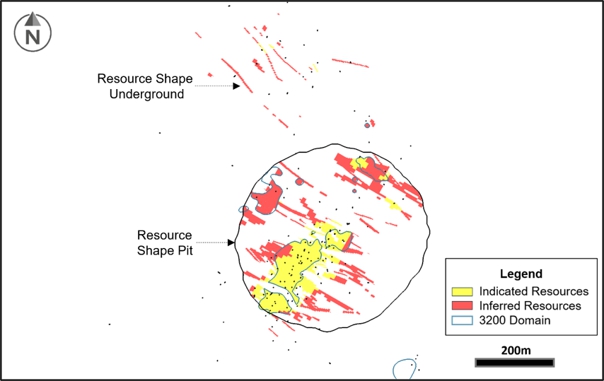
Figure 14.12: Plan view at 1800 masl showing the Mineral Resource classification in relation to drilling as constrained by the resource pit shape and underground optimization shapes.
178
| Collective Mining Ltd. |
| Guayabales Project - Apollo Mineral Resource 2026-08 |
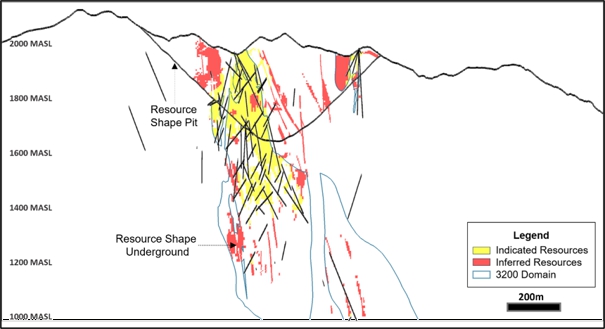
Figure 14.13: SW-NE cross-section showing the Mineral Resource classification in relation to drilling as constrained by the resource pit shape and underground optimization shapes.
| 14.15 | Mineral Resource Tabulations |
Collective’s 2026 Mineral Resource has been reported in three parts. The open-pit portion of the resource covers a portion of the higher-grade copper and tungsten mineralization. Below that the underground portion of the resource has been split into the portion above 1,000 masl, and the portion below which is principally the Ramp Zone.
Collective’s 2026 Mineral Resource (Table 14.26) was reported at a threshold grade of 0.3 g/t AuEq for the open-pit, 1.2 g/t AuEq for the underground above 1,000 masl, and 1.5 g/t AuEq for the underground below 1,000 masl. Additional detail is recorded in Table 14.27, Table 14.28 and Table 14.29. The reporting cut-off grades were selected by Collective to be above the calculated break-even grade, and to focus the reported Mineral Resource on higher-grade mineralization. They were reviewed and accepted by the QP for the reasons set out in Section 14.12.
179
| Collective Mining Ltd. |
| Guayabales Project - Apollo Mineral Resource 2026-08 |
Table 14.26: Mineral Resource for the Apollo Mineral Deposit, August 31, 2026*
| Category** |
Cut-off Grade (g/t AuEq***) |
Mineralization (Mt) |
Metal grade (g/t AuEq) |
Contained metal (AuEq Moz) |
| Indicated Resource | ||||
| Open-pit | 0.3 | 22.5 | 2.06 | 1.49 |
| Underground >1000 masl | 1.2 | 13.2 | 2.10 | 0.89 |
| Underground <1000 masl | 1.5 | 1.29 | 4.74 | 0.20 |
| Total Indicated Resource | 37.0 | 2.17 | 2.58 | |
| Inferred Resource | ||||
| Open-pit | 0.3 | 25.9 | 0.86 | 0.71 |
| Underground >1000 masl | 1.2 | 16.2 | 2.06 | 1.07 |
| Underground <1000 masl | 1.5 | 6.04 | 5.37 | 1.04 |
| Total Inferred Resource^ | 48.2 | 1.83 | 2.83 |
*Note: Contained metal and tonnes figures in totals may differ due to rounding.
* Mineral Resources which are not Mineral Reserves do not have demonstrated economic viability. The estimate of Mineral Resources may be materially affected by environmental, permitting, legal, marketing, or other relevant issues. The Mineral Resources in this Technical Report were reported using CIM (2014) Standards on Mineral Resources and Reserves, Definitions and Guidelines.
** Mineral Resources have been tested for RPEEE. They are either reported within an open-pit shell or within underground shapes using a floating stope optimisation routine. Additional information is included in this report.
*** AuEq =((AU*0.95)+(AG*0.020*0.92)+(CU*1.20*0.85)+(WO3*21.33*0.7))/0.95 where the ratios are defined using metal prices of US$3000/oz Au, US$60/oz Ag, US$5.25/lb Cu, and US$93.31/lb WO3 (equivalent to US$2,057 mtu WO3), and metallurgical recoveries of 95% for gold, 92% for silver, 85% for copper and 70% for WO3.
^ The quantity and grade of the reported Inferred Resources in this report are uncertain in nature and there has been insufficient exploration to define this Inferred Resource as an Indicated or Measured Mineral Resource. It is uncertain if further exploration will result in upgrading the Inferred Resource to an Indicated or Measured Mineral Resource category.
Table 14.27: Open Cut tabulation for the Apollo Mineral Resource at a cut-off grade of 0.3 g/t AuEq, August 31, 2026*
| Category | Tonnes (Mt) |
AuEq (g/t) |
Au (g/t) |
Ag (g/t) |
Cu (%) |
WO3 (%) |
AuEq (Moz) |
| Indicated Resource | |||||||
| Surface to Pit Shell 1 | 3.42 | 2.53 | 1.29 | 17.9 | 0.11 | 0.049 | 0.28 |
| Surface to Shell 2 |
8.88 | 2.11 | 1.01 | 23.1 | 0.18 | 0.030 | 0.60 |
| Surface to Shell 3 |
17.3 | 2.07 | 1.03 | 28.3 | 0.19 | 0.018 | 1.15 |
| Indicated Resource | 22.5 | 2.06 | 1.02 | 30.2 | 0.20 | 0.015 | 1.49 |
| Inferred Resource | |||||||
| Surface to Pit Shell 1 | 1.93 | 2.43 | 2.09 | 10.3 | 0.03 | 0.007 | 0.15 |
| Surface to Shell 2 |
5.97 | 1.24 | 0.94 | 11.1 | 0.04 | 0.003 | 0.24 |
| Surface to Shell 3 |
18.5 | 0.91 | 0.65 | 8.91 | 0.03 | 0.003 | 0.54 |
| Inferred Resource | 25.9 | 0.86 | 0.60 | 8.98 | 0.03 | 0.003 | 0.71 |
Notes for the Mineral Resource Table (Table 14.26) also apply to this table.
180
| Collective Mining Ltd. |
| Guayabales Project - Apollo Mineral Resource 2026-08 |
Table 14.28: Underground above 1,000 masl for the Apollo Mineral Resource at a cut-off grade of 1.2 g/t AuEq, August 31, 2026*
| Category | Tonnes (Mt) |
AuEq (g/t) | Au (g/t) | Ag (g/t) | Cu (%) | WO3 (%) |
| Indicated Resource | 13.2 | 2.10 | 1.68 | 15.9 | 0.06 | 0.003 |
| Inferred Resource |
16.2 | 2.06 | 1.84 | 7.69 | 0.03 | 0.002 |
Notes for the Mineral Resource Table (Table 14.26) also apply to this table.
Table 14.29: Underground below 1,000 masl for the Apollo Mineral Resource at a cut-off grade of 1.5 g/t AuEq, August 31, 2026*
| Category | Tonnes (Mt) |
AuEq (g/t) | Au (g/t) | Ag (g/t) | Cu (%) | WO3 (%) |
| Indicated Resource | 1.29 | 4.74 | 4.52 | 9.85 | 0.03 | - |
| Inferred Resource |
6.04 | 5.37 | 5.20 | 7.72 | 0.02 | - |
Notes for the Mineral Resource Table (Table 14.26) also apply to this table.
Table 14.30: Contained Metal by Commodity
| Category | Tonnes (Mt) |
Gold (Moz) |
Silver (Moz) |
Copper (Mlb) |
WO3 (tonnes) |
WO3 (‘000 mtu) |
AuEq (Moz) |
| Indicated Resource | 37.0 | 1.64 | 29.0 | 115 | 3,887 | 389 | 2.58 |
| Inferred Resource | 48.2 | 2.47 | 13.0 | 32 | 1,081 | 108 | 2.83 |
Contained metal is calculated from the tonnes and grades in Table 14.26. 1 metric tonne unit (“mtu”) = 10 kg WO3
| 14.15.1 | Resource sensitivity to cut-off grade |
Table 14.31 presents the tonnes and grade according to different cut-off grades within the resource ultimate open-pit shape. The variation in tonnes and grade does not indicate that the tonnes and grade have been optimised, but merely provide an indication of the sensitivity to the cut-off grade of the mineralization within that particular ultimate open-pit shape.
Table 14.32 and Table 14.33 provide a similar view to the above 1,000 masl and below 1,000 masl underground reports. The underground resource shapes have not been optimised to the various cut-off grades documented, but again only provide an indication of the sensitivity to the cut-off grade of the mineralization within those resource definition shapes.
181
| Collective Mining Ltd. |
| Guayabales Project - Apollo Mineral Resource 2026-08 |
Table 14.31: Open-pit Cut-off Grade Sensitivity - August 31, 2026*
| Classification | Cut-off (g/t AuEq) |
Tonnes (Mt) | AuEq (g/t) | Au (g/t) | Ag (g/t) | Cu (%) | WO3 (%) | AuEq (Moz) |
| Indicated | 0.2 | 26.3 | 1.80 | 0.89 | 26.3 | 0.17 | 0.013 | 1.52 |
| 0.3 | 22.5 | 2.06 | 1.02 | 30.2 | 0.20 | 0.015 | 1.49 | |
| 0.5 | 19.0 | 2.37 | 1.17 | 34.9 | 0.23 | 0.018 | 1.45 | |
| 1.0 | 14.4 | 2.89 | 1.40 | 42.8 | 0.29 | 0.023 | 1.34 | |
| 1.2 | 13.3 | 3.05 | 1.46 | 45.3 | 0.31 | 0.024 | 1.30 | |
| 1.5 | 11.8 | 3.27 | 1.53 | 49.0 | 0.34 | 0.027 | 1.24 | |
| Inferred | 0.2 | 43.2 | 0.61 | 0.41 | 7.04 | 0.03 | 0.003 | 0.85 |
| 0.3 | 25.9 | 0.86 | 0.60 | 8.98 | 0.03 | 0.003 | 0.71 | |
| 0.5 | 13.7 | 1.28 | 0.97 | 11.4 | 0.04 | 0.003 | 0.56 | |
| 1.0 | 4.85 | 2.37 | 1.90 | 15.4 | 0.07 | 0.006 | 0.37 | |
| 1.2 | 3.42 | 2.90 | 2.40 | 15.6 | 0.08 | 0.007 | 0.32 | |
| 1.5 | 2.29 | 3.67 | 3.06 | 18.0 | 0.10 | 0.009 | 0.27 |
The table illustrates sensitivity to alternative AuEq cut-off grades and does not represent separate Mineral Resources. The Mineral Resource reporting and cut-off used in Table 14.26 is shown in bold. Notes for the Mineral Resource Table 14.26 also apply to this table.
Table 14.32: Underground above 1,000 masl Cut-off Grade Sensitivity - August 31, 2026*
| Classification | Cut-off (g/t AuEq) |
Tonnes (Mt) | AuEq (g/t) | Au (g/t) | Ag (g/t) | Cu (%) | WO3 (%) | AuEq (Moz) |
| Indicated | 0.8 | 14.3 | 2.02 | 1.61 | 15.6 | 0.06 | 0.003 | 0.93 |
| 1.0 | 14.0 | 2.04 | 1.63 | 15.6 | 0.06 | 0.003 | 0.92 | |
| 1.2 | 13.2 | 2.10 | 1.68 | 15.9 | 0.06 | 0.003 | 0.89 | |
| 1.5 | 9.69 | 2.37 | 1.93 | 16.7 | 0.06 | 0.003 | 0.74 | |
| 2.0 | 5.12 | 2.95 | 2.47 | 18.5 | 0.06 | 0.004 | 0.49 | |
| Inferred | 0.8 | 17.4 | 1.99 | 1.77 | 7.78 | 0.03 | 0.002 | 1.11 |
| 1.0 | 17.1 | 2.01 | 1.79 | 7.78 | 0.03 | 0.002 | 1.11 | |
| 1.2 | 16.2 | 2.06 | 1.84 | 7.69 | 0.03 | 0.002 | 1.07 | |
| 1.5 | 11.3 | 2.37 | 2.16 | 7.36 | 0.03 | 0.002 | 0.86 | |
| 2.0 | 6.01 | 2.95 | 2.75 | 6.75 | 0.03 | 0.002 | 0.57 |
The table illustrates sensitivity to alternative AuEq cut-off grades and does not represent separate Mineral Resources. The Mineral Resource reporting and cut-off used in Table 14.26 is shown in bold. Notes for the Mineral Resource Table 14.26 also apply to this table.
182
| Collective Mining Ltd. |
| Guayabales Project - Apollo Mineral Resource 2026-08 |
Table 14.33: Underground below 1,000 masl Cut-off Grade Sensitivity - August 31, 2026*
| Classification | Cut-off (g/t AuEq) |
Tonnes (Mt) | AuEq (g/t) | Au (g/t) | Ag (g/t) | Cu (%) | WO3 (%) | AuEq (Moz) |
| Indicated | 0.8 | 1.42 | 4.42 | 4.21 | 9.34 | 0.03 | - | 0.20 |
| 1.0 | 1.40 | 4.48 | 4.26 | 9.43 | 0.03 | - | 0.20 | |
| 1.2 | 1.37 | 4.56 | 4.34 | 9.57 | 0.03 | - | 0.20 | |
| 1.5 | 1.29 | 4.74 | 4.52 | 9.85 | 0.03 | - | 0.20 | |
| 2.0 | 1.13 | 5.19 | 4.95 | 10.6 | 0.03 | - | 0.19 | |
| 2.5 | 0.97 | 5.65 | 5.40 | 11.3 | 0.03 | - | 0.18 | |
| Inferred | 0.8 | 6.68 | 4.97 | 4.80 | 7.31 | 0.02 | - | 1.07 |
| 1.0 | 6.57 | 5.04 | 4.88 | 7.38 | 0.02 | - | 1.06 | |
| 1.2 | 6.42 | 5.13 | 4.96 | 7.46 | 0.02 | - | 1.06 | |
| 1.5 | 6.04 | 5.37 | 5.20 | 7.72 | 0.02 | - | 1.04 | |
| 2.0 | 5.04 | 6.09 | 5.90 | 8.48 | 0.02 | - | 0.99 | |
| 2.5 | 4.13 | 6.93 | 6.72 | 9.40 | 0.02 | - | 0.92 |
The table illustrates sensitivity to alternative AuEq cut-off grades and does not represent separate Mineral Resources. The Mineral Resource reporting and cut-off used in Table 14.26 is shown in bold. Notes for the Mineral Resource Table 14.26 also apply to this table.
| 14.15.2 | Underground Mining Scenario Sensitivity Analysis |
Mineral Resources were reported using both open-pit and underground mining methods, based on the applicable constraining assumptions used to demonstrate reasonable prospects for eventual economic extraction.
As an additional sensitivity analysis, conceptual stopes were also generated within the area reported as an open-pit Mineral Resource to consider the difference if the open-pit part of the resource was mined by underground methods instead of open cut methods. The results are presented in this section (Table 14.34). They are not additional to the reported open-pit Mineral Resource.
183
| Collective Mining Ltd. |
| Guayabales Project - Apollo Mineral Resource 2026-08 |
Table 14.34: Sensitivity of grade and tonnage replacing the open cut with a purely underground scenario - August 31, 2026*
| Indicated Blocks | |||||||||
| Cutoff (g/t AuEq) |
Mt | AuEq (g/t) |
AuEq (Moz) |
Au (g/t) |
Au (Moz) |
Ag (g/t) |
Cu (%) | WO3 (%) | |
| UG above 1000 | 1.2 | 25.9 | 2.60 | 2.16 | 1.58 | 1.31 | 31.0 | 0.19 | 0.014 |
| 1.5 | 21.3 | 2.87 | 1.96 | 1.72 | 1.17 | 34.6 | 0.21 | 0.016 | |
| UG below 1000 | 1.2 | 1.37 | 4.56 | 0.20 | 4.34 | 0.19 | 9.57 | 0.03 | 0.000 |
| 1.5 | 1.29 | 4.74 | 0.20 | 4.52 | 0.19 | 9.85 | 0.03 | 0.000 | |
| Total | 1.2 | 27.2 | 2.70 | 2.36 | 1.72 | 1.50 | 29.9 | 0.18 | 0.013 |
| 1.5 | 22.6 | 2.98 | 2.16 | 1.88 | 1.36 | 33.1 | 0.20 | 0.015 | |
| Inferred Blocks | |||||||||
| Cutoff (g/t AuEq) |
Mt | AuEq (g/t) |
AuEq (Moz) |
Au (g/t) |
Au (Moz) |
Ag (g/t) |
Cu (%) | WO3 (%) | |
| UG above 1000 | 1.2 | 19.0 | 2.23 | 1.36 | 1.96 | 1.20 | 9.06 | 0.04 | 0.003 |
| 1.5 | 13.4 | 2.60 | 1.12 | 2.32 | 1.00 | 9.18 | 0.04 | 0.003 | |
| UG below 1000 | 1.2 | 6.42 | 5.13 | 1.06 | 4.96 | 1.02 | 7.46 | 0.02 | 0.000 |
| 1.5 | 6.04 | 5.37 | 1.04 | 5.20 | 1.01 | 7.72 | 0.02 | 0.000 | |
| Total | 1.2 | 25.4 | 2.96 | 2.42 | 2.72 | 2.22 | 8.66 | 0.03 | 0.003 |
| 1.5 | 19.4 | 3.46 | 2.16 | 3.21 | 2.01 | 8.72 | 0.03 | 0.002 | |
The table illustrates sensitivity to grade and tonnage replacing the open cut with a purely underground scenario at two cut-off grades. Notes for the Mineral Resource Table 14.26 also apply to this table.
184
| Collective Mining Ltd. |
| Guayabales Project - Apollo Mineral Resource 2026-08 |
| 15 | Mineral Reserve Estimates |
As at the time of this technical report, there have been no studies to define mineral reserves.
| 16 | Mining Methods |
This section is not applicable.
| 17 | Recovery Methods |
This section is not applicable.
| 18 | Project Infrastructure |
This section is not applicable.
| 19 | Market Studies and Contracts |
This section is not applicable.
| 20 | Environmental Studies, Permitting and Social or Community Impact |
This section is not applicable.
| 21 | Capital and Operating Costs |
This section is not applicable.
| 22 | Economic Analysis |
This section is not applicable.
185
| Collective Mining Ltd. |
| Guayabales Project - Apollo Mineral Resource 2026-08 |
| 23 | Adjacent Properties |
The Qualified Person has not verified the information below. Information with respect to these projects is provided for regional context only and is not necessarily indicative of the mineralization on the Guayables Project.
| 23.1 | Aris Mining - Marmato |
This section 23.1 is copied and modified from Redwood (2025).
The Marmato deposit, located 1.75 km southeast of the Guayabales Project (See Figure 7.2 and Figure 8.1), has been mined since pre-Colombian times with estimated historical production of between 1.9 and 2.4 Moz gold. It has a current Measured and Indicated Mineral Resource of 61.5 Mt grading 3.03 g/t Au (5.997 Moz Au) and 7.2 g/t Ag (14.270 Moz Ag), and an Inferred Mineral Resource of 35.6 Mt grading 2.43 g/t Au (2.787 Moz Au) and 3.2 g/t Ag (3.682 Moz Ag) (Parsons et al., 2022). The Proven and Probable Mineral Reserves are 31.277 Mt grading 3.16 g/t Au (3.178 Moz Au) and 6.1 g/t Ag (6.138 Moz Ag) (Parsons et al., 2022). The QP has been unable to verify the information in this report and the information is not necessarily indicative of the mineralization on the Guayabales Project that is the subject of this Technical Report. These underground resources occur in veins and porphyry in the Upper Mine or Narrow Vein Zone above 950 masl, and in sheeted veinlets in the Lower Mine or Bulk Mining Zone (previously referred to as the Deeps Zone). A sulfide-rich mineral assemblage is dominated by pyrite, arsenopyrite, black Fe-rich sphalerite, pyrrhotite, chalcopyrite and electrum in the Upper Mine, and a sheeted quartz veinlet system with pyrrhotite, chalcopyrite, bismuth minerals and free gold occurs in the Lower Mine. Aris Mining Corporation produced 28,741 oz of gold from the Upper Mine in 2025 and is carrying out a major underground mine expansion to exploit the Lower Mine with a CIP plant of 5,000 tpd in construction and first gold expected in Q4 2026 and production ramping up through 2027 to eventually reach over 200,000 oz gold per year.
Mineralization at Marmato is hosted by five hornblende-bearing dacitic to andesitic hypabyssal porphyry intrusions, with ilmenite and minor magnetite. These are intruded into country rocks of the Arquía Complex consisting of graphitic and chlorite schists. The porphyry intrusions, denominated P1 to P5, have been dated between 6.576 ± 0.075 Ma and 5.75 ± 0.11 Ma by LA-ICP-MS 206Pb/238U on zircon. The age of mineralization was determined by 40Ar/39Ar analyses of adularia in veins with plateau ages between 6.95 ± 0.02 Ma and 5.96 ± 0.02 Ma, closely related to the magmatism (Santacruz et al., 2021). The Marmato deposit model is described as a hybrid between a reduced intrusion-related and a porphyry gold deposit with epithermal veins in the upper part (Santacruz et al., 2021). The adjacent Aguas Claras porphyry gold deposit, located SE of the Marmato mine infrastructure, is related to quartz veinlets with magnetite, pyrite and chalcopyrite. It is low grade and has no mineral resources. Mineralization is hosted by five dacitic to microgranodioritic porphyry intrusions called AP1 to AP5 dated between 6.55 ± 0.15 Ma and 5.74 ± 0.14 Ma by LA-ICP-MS 206Pb/238U on zircon (Santacruz et al., 2021).
186
| Collective Mining Ltd. |
| Guayabales Project - Apollo Mineral Resource 2026-08 |
| 23.2 | Quebradona |
The Quebradona project, owned by AngloGold Ashanti, is located in the Middle Cauca Belt, approximately 60 km south-southeast of Medellín in the Department of Antioquia, Colombia and approximately 40 km NW (straight-line distance) of the Guayabales Project (Figure 7.2). It is one of the largest known porphyry deposits in the Middle Cauca Belt (MCB) and the only known, copper-dominant porphyry deposit (plus molybdenum and gold by products) discovered to date in the MCB. The deposit is hosted within the Combia Volcanic Province, as defined locally by a sequence of andesitic pyroclastic and volcaniclastic rocks and flows up to 400 m thick, dominated by ash, lapilli and crystal tuffs. The Combia rocks are intruded by a complex of small composite stocks (75-400 m in diameter) and radiating subvertical dikes of diorite and quartz diorite. These bodies host the Cu-Au-Mo mineralization. Re-Os ages on molybdenite and a U-Pb zircon age constrain porphyry mineralization to an average of 7.47 ± 0.09 Ma, with distal intermediate-sulfidation carbonate-quartz-base metal veins on the western flank yielding an indistinguishable Re-Os age of 7.53 ± 0.04 Ma (Bartos et al., 2017).
Alteration at Nuevo Chaquiro comprises calcic-potassic (actinolite-epidote) alteration at depth, grading upward into potassic (biotite-magnetite) alteration, which is overprinted by sericite-chlorite alteration centred on the intrusion apexes. All of these are overprinted by a broad sericitic (phyllic) cap, locally cut by argillic pipes controlled by faults and fractures, with propylitic alteration developed distally. Copper mineralization, principally chalcopyrite with molybdenite, is concentrated in two contiguous orebodies: a high-grade sheeted quartz-vein zone developed at the cupola of the Early quartz diorite, containing up to 80 vol% quartz veining and up to 5 vol% chalcopyrite, and a lower-grade, inverted-bowl-shaped orebody associated with potassic alteration and draped over the Intermineral porphyry cupolas (Bartos et al., 2017).
AngloGold Ashanti (AngloGold Ashanti plc., 2026) reports Measured and Indicated Mineral Resources at Nuevo Chaquiro of 194.06 Mt grading 0.68% Cu, 0.34 g/t Au, 4.6 g/t silver and 158 ppm Mo for 2.218 billion pounds of copper metal, 68 million pounds of Molybdenum, 28.71 million ounces of silver and 2.15 million ounces of gold. The reported Inferred Resources are 305.94 Mt grading 0.48% Cu, 135ppm Mo, 3.66 g/t Ag and 0.23 g/t Au for 3.231 billion pounds of copper, 91 million pounds of molybdenum, 36.05 million ounces of silver and 2.27 million ounces of gold (AngloGold Ashanti Mineral Resource and Reserve declaration, 2025). Reported Probable Mineral Reserves at Quebradona are 120 Mt grading 1.23% Cu, 7.29 g/t Ag and 0.67 g/t Au for 3.25 billion pounds of copper, 28.11 million ounces of silver and 2.6 million ounces of gold.
Quebradona has completed feasibility studies and is in the permitting stage with an updated environmental study still pending.
187
| Collective Mining Ltd. |
| Guayabales Project - Apollo Mineral Resource 2026-08 |
| 24 | Other Relevant Data and Information |
No additional information or explanation is necessary to make this Technical Report understandable and not misleading.
188
| Collective Mining Ltd. |
| Guayabales Project - Apollo Mineral Resource 2026-08 |
| 25 | Interpretation and Conclusions |
The Guayabales Project is an advanced-stage gold exploration project, located in the Middle Cauca Belt of Colombia. The Mineral Resource documented in this report covers the Apollo Deposit. The Qualified Person (QP) considers that the exploration, geological, sampling, analytical, metallurgical, and Mineral Resource data available for the Apollo Deposit provide a sound basis for the Mineral Resource estimate as presented in this Technical Report, subject to the qualifications, assumptions, and recommendations and constraints described herein.
The Apollo Deposit is characterized by multistage gold-silver-copper-tungsten mineralization associated with porphyry-breccia and reduced intrusive systems and is principally hosted in intrusive rocks of the late Miocene Combia Volcanic Province. The geological interpretation is based principally on surface mapping, drillhole geological information, assay data, structural data and observations, and the interpretation of mineralized domains.
| 25.1 | Exploration and Drilling |
Exploration in the Guayabales project area, covering 3,886 ha of granted licenses, has identified 14 gold targets to date with porphyry, breccia and CBM-Sulfosalt vein styles for Au, Ag, Cu, Pb, Zn, Mo and WO3 mineralization. Figures presented in chapter 9 highlight the high prospectivity of the project area with extensive mineralized zones outlined by surface geochemistry for rock and soil. To date the principal focus of exploration work has been the Apollo project with 74% of the drilling completed to date on this deposit. The Trap target has also had 11% of total drilling, and the rest of the targets have only had limited reconnaissance drilling. Collective also has contiguous license applications for 2,654 ha to expand the Guayabales project area.
Apollo is a hydrothermal breccia formed in a subvolcanic porphyry environment with multistage mineralization resulting in zonation of both alteration and metal. Mineralization stages include early, low grade, porphyry veining, various periods of sulphide metal infill (plus scheelite) within the breccia matrix and multiple overprinting, late stage, sulphosalt and carbonate base metal (“CBM”) veins. At depth the Apollo system has less copper, and pyrrhotite dominates over pyrite. A new style of mineralisation, referred to as the Ramp Zone occurs, commencing at 1,000 masl below surface and is characterized by Au-Ag-Bi-Te in sulphide-rich veins, associated with intense albite alteration, within crackle breccia. The Ramp Zone is a gold dominant system and has mineralogy and host rock similarities with the top part of the multi-million ounce, Marmato Deeps Zone located 1.75 km southeast of Apollo. The Marmato Deeps deposit is characterized as a reduced intrusive gold system.
The Apollo deposit outcrops at surface and hosts multistage mineralisation resulting in distinct metal zonation over a vertical depth of over 1,400 m. The Apollo breccia does not have any historical mining or current artisanal activity. The Apollo Breccia has a distinct downward flaring geometry with maximum dimensions of 700 m northeast by 400 m northwest. With this Technical Report it is outlined by 265 holes and 114,520 metres of drilling. Apollo is still open at depth and to the north. The exploration database supporting the August 2026 Apollo Mineral Resource only includes drilling completed by Collective with results approved by 31 March 2026.
189
| Collective Mining Ltd. |
| Guayabales Project - Apollo Mineral Resource 2026-08 |
The QP’s review of the exploration and drilling information did not identify any issues considered to materially affect the Mineral Resource estimate. This drilling has comprehensively demonstrated the continuity of the principal mineralized zones for the purposes of this estimate. Access and budget constraints up until late 2024 restricted the locations Collective could drill from, and subsequently its ability to optimally define the mineralized body and breccia morphology. Drilling programmes after this have been mainly directional from North-Northeast to South-Southwest and approximately orthogonal to the mineralized breccia and associated vein systems. Additional oriented drilling is recommended in selected areas to continue to improve definition of structural controls and mineralization orientation as this would continue to improve geological confidence.
Outside this resource estimate, the Ramp Zone remains at an early exploration stage. Drilling since the close of the database for the resource estimation indicates that the Ramp Zone is significantly larger than the small part already modelled, but it needs additional drilling to meet the drill spacing required for a mineral resource. Additional drilling is being designed to allow detailed evaluation of the Ramp Zone geometry, grade distribution, extensions at depth, and to the north and west.
| 25.2 | Sample Preparation, Analysis and Data Quality |
The Mineral Resource estimate was prepared using a database that included collar, survey, assay, geological logging, structural data and specific gravity information. The QP reviewed the available database and the verification work undertaken in this Technical Report and considers the data adequate for the purposes of the Mineral Resource estimate, subject to the limitations identified in the relevant sections of this report.
The QP notes that there is only what can be considered reasonable precision in the ALS duplicate gold analyses, but good precision in the SGS duplicate gold analyses. This is evident in the ALS duplicates, and in the inter-laboratory check samples. This precision is potentially a coarse-gold effect that may require a different sampling and assay protocol.
It should be noted that the results from the duplicates to date distort the picture of precision in gold assaying because they mix not only duplicate assays, but different sample preparation methods, different laboratories over different time periods, and different assay parameters. The QP is concerned that the data from the existing duplicate sample results is misleading and does not provide a true picture of the assay variability. There are recommendations presented to address this.
The QPs review concluded that coarse and/or free gold may contribute to sample variability and could result in biased estimates, and in this case the assays could be biased low (the sample results may be lower than they should be) as noted during the assay results for verification samples noted in Section 12. A dedicated program using larger subsamples and comparative screen fire assay, conventional fire assay, and photon analysis is recommended to assess this variability. If this program demonstrates material bias, re-assaying all mineralized intersections should be considered.
190
| Collective Mining Ltd. |
| Guayabales Project - Apollo Mineral Resource 2026-08 |
The quality of WO3 analyses is not assessed by independent blind analyses, and the QAQC for WO3 analyses relies on the laboratory’s QAQC. Data analysis also demonstrated that Tungsten grades derived from ICP assays is understated and significantly undervalue grade in the stoichiometric WO3 calculation.
The QP considers that the available analytical data are suitable for grade estimation and the preparation of a Mineral Resource given the classification that has been applied.
| 25.3 | Mineral Processing and Metallurgical Interpretation |
An extensive metallurgical testwork program has been completed between 2022 and 2026 on drill core and assay reject material at two established laboratories. The results of this testwork indicate that Apollo mineralization is amenable to gravity concentration, flotation, and cyanidation.
Testwork undertaken between 2022 and 2024 evaluated process configurations incorporating flotation for higher-copper material and carbon-in-leach (CIL) treatment. Gold recoveries in this work were generally greater than 90%, with average CIL gold recovery reported at greater than 93%.
Work in 2025 demonstrated that a significant proportion of the gold could be recovered by gravity concentration, with reported gravity recoveries generally ranging from approximately 30% to 50%. Gravity concentration has consequently been incorporated into subsequent metallurgical testwork and appears to add approximately 5% to the overall gold extraction.
The 2026 metallurgical program evaluated six composites representing different areas of the Apollo Deposit using a single process sequence comprising gravity concentration, flotation, and cyanidation of flotation tailings. The results provided recovery of gold, silver, and copper through the proposed process sequence, and reflect the favourable mineralogy, with coarse grained chalcopyrite and excellent liberation.
The 2026 testwork also demonstrated relatively rapid flotation kinetics and identified an optimum primary grind of approximately 95 µm for the tested material. Commercial concentrate grades were achieved even with copper head grades below 0.10%Cu. In the higher grade domain for copper, most of which locates in the resource pit shell, excellent concentrate grades and recoveries have been achieved.
A Master Composite comprising the six individual composites was subjected to gravity concentration, locked-cycle flotation testing, and cyanidation of flotation tailings. The results of this definitive testwork were used in support of the metallurgical assumptions applied to the Mineral Resource evaluation.
Preliminary testwork on samples from the scheelite zone have given encouraging results with over 70% scheelite recovery to a 90% scheelite concentrate. Again, these results reflect the mineralogy, with coarse grained, well liberated scheelite.
Preliminary testing of core from the Ramp Zone has also commenced. A 96% gold recovery was achieved for the Ramp Zone low arsenic sample. Additional representative Ramp Zone samples should be subjected to metallurgical testing to establish variability and to support future resource and economic evaluations.
191
| Collective Mining Ltd. |
| Guayabales Project - Apollo Mineral Resource 2026-08 |
| 25.4 | The Geological Framework for Apollo |
The geological interpretation for the Apollo Deposit is based on an extensive exploration and drilling database and incorporates lithological, structural, mineralogical, grade, and weathering information. The Mineral Resource database used for the August 31, 2026 estimate comprised 265 drillholes and approximately 114,520 m of drilling by Collective, including 256 drillholes coded to the Apollo Deposit, together with five holes from the ME target and four holes from the Towers target. The estimation database included collar, downhole survey, geological logging, assay, and specific gravity information.
The QP considers the quantity of drilling and the resulting three-dimensional geological information to be very comprehensive. This work has facilitated the establishment of the principal geological framework and demonstrates the continuity of the main mineralized domains at the level required to support the August 2026 Mineral Resource estimate. The geological interpretation was undertaken by Collective and subsequently reviewed by the QP.
The geological model used for the Mineral Resource estimate comprises several levels of interpretation rather than relying solely on a single mineralized envelope. This approach reflects the multistage mineralization in the Apollo system and reflects a polymetallic deposit hosting gold, copper, silver, and tungsten mineralization which have been incorporated into the estimation domains.
The underlying three dimensional geological framework comprises interpreted lithological domains that include schist, several generations of intrusive rocks, mineralized and unmineralized breccias, and other intrusive units. The mineralization has been modelled within this framework. Of particular importance to the resource estimate are the mineralized BAM and BCM breccia units and their relationship to the intrusive units.
Separate mineralogical and grade interpretations were developed to account for areas of generally elevated concentrations of the variables being estimated. These include a Copper/Silver domain, a Tungsten domain, and the Ramp Zone.
A further component of the geological interpretation comprises three principal Carbonate Base Metal (CBM) vein sets that were explicitly modelled because of their importance to the distribution of gold.
The geological framework is overprinted by a weathering profile that includes an oxide zone, a transitional zone and the fresh, unoxidized material.
These domains were all coded into the block model, and combined as appropriate for resource evaluation.
The QP considers the interpretations within the limits of the mineral resource classification, to be reasonably well constrained by the available drilling. The interpretation is supported by high-quality systematic geological logging of drill core, a comprehensive multi-element database, and by the continuity observed between drill sections, down drillholes, and between drillholes.
The geological interpretation was supported not only by the continuity of the interpreted lithological and mineralization domains, but also by the drill data, some of which was aligned with the mineralization. For grade estimation, samples were composited to 2 m within the applicable estimation domains, followed by statistical analysis, assessment of high-grade populations, variography, grade interpolation, and model validation.
192
| Collective Mining Ltd. |
| Guayabales Project - Apollo Mineral Resource 2026-08 |
The composited gold data exhibit positive skewness and moderate to high coefficients of variation, particularly within the principal mineralized domains. High-grade values were therefore assessed both statistically and spatially, and grade caps were applied where considered appropriate to control the influence of isolated high-grade composites during estimation.
Variograms and search parameters were developed independently for Au, Ag, Cu, and WO3 using the relevant estimation domains.
The QP considers the integration of geological interpretation, statistical analysis, variography, and estimation parameters to provide an appropriate framework for the current Mineral Resource estimate.
Overall, the QP considers that the Apollo geological interpretation is supported by a substantial amount of exploration and drilling data and is sufficiently well constrained to support the reported Indicated and Inferred Mineral Resources. The principal areas of remaining geological uncertainty are associated with portions of the deposit where drill spacing is wider, the deeper and peripheral extensions of mineralization, and the Ramp and tungsten domains where additional drilling is required.
The current interpretation should therefore be regarded as appropriate for the present level of geological knowledge, while recognizing that additional oriented drilling has the potential to improve the definition of structural controls, geological continuity, and Mineral Resource classification in selected areas.
| 25.5 | The Apollo Mineral Resource |
The August 31, 2026 Mineral Resource for Apollo was prepared using a conventional geological modelling and grade estimation workflow incorporating data validation, geological interpretation and modelling, compositing, statistical and variographic analysis, block modelling, ordinary kriging, model validation, Mineral Resource classification, and assessment of the Reasonable Prospects of Eventual Economic Extraction (RPEEE).
The QP considers ordinary kriging to be an appropriate grade estimation method for the Apollo Deposit given the demonstrated geological and grade continuity and the available drilling density.
The Mineral Resource estimate incorporates gold, silver, copper, and tungsten-related assay data and reflects the geological and analytical information available as of the effective date of the estimate.
The Mineral Resource classification was based on the quality and quantity of available exploration and sampling data, geological and grade continuity, and the drill-spacing and confidence criteria described in Section 14 of this Technical Report.
No Measured Mineral Resources are reported in the August 2026 estimate. Additional drilling and analytical work would be required to support any future conversion of portions of the Mineral Resource to the Measured category.
The Mineral Resource has been constrained and reported in accordance with an assessment of Reasonable Prospects of Eventual Economic Extraction (RPEEE). The reporting thresholds selected for the August 2026 estimate are:
| ● | Open-pit Mineral Resources: 0.30 g/t AuEq; |
193
| Collective Mining Ltd. |
| Guayabales Project - Apollo Mineral Resource 2026-08 |
| ● | Underground Mineral Resources above 1,000 masl: 1.20 g/t AuEq; and |
| ● | Underground Mineral Resources below 1,000 masl: 1.50 g/t AuEq. |
The selected reporting thresholds used in this technical report are above the respective calculated break-even cut-off grades and were selected considering conceptual mining methods, mineralization geometry and continuity, mining selectivity, metallurgical assumptions, operating costs, and the overall RPEEE assessment.
The Mineral Resources (Table 14.26 and reproduced in Table 25.1) are reported on an in-situ basis. No separate adjustments for mining losses or operational dilution have been applied to the reported tonnes and grades. Accordingly, the reported Mineral Resources should not be interpreted as recoverable mine production or as a mine production forecast.
The RPEEE assessment is based on conceptual mining and processing assumptions. No allowance for initial capital expenditure for processing and infrastructure has been incorporated into the calculated break-even cut-off grades. The resulting economic limits are therefore subject to further evaluation as the project advances.
Table 25.1: Mineral Resource for the Apollo Mineral Deposit, August 31, 2026*
| Category** |
Cut-off Grade (g/t AuEq***) |
Mineralization (Mt) |
Metal grade (g/t AuEq) |
Contained metal (AuEq Moz) |
| Indicated Resource | ||||
| Open-pit | 0.3 | 22.5 | 2.06 | 1.49 |
| Underground >1000 masl | 1.2 | 13.2 | 2.10 | 0.89 |
| Underground <1000 masl | 1.5 | 1.29 | 4.74 | 0.20 |
| Total Indicated Resource | 37.0 | 2.17 | 2.58 | |
| Inferred Resource | ||||
| Open-pit | 0.3 | 25.9 | 0.86 | 0.71 |
| Underground >1000 masl | 1.2 | 16.2 | 2.06 | 1.07 |
| Underground <1000 masl | 1.5 | 6.04 | 5.37 | 1.04 |
| Total Inferred Resource^ | 48.2 | 1.83 | 2.83 |
*Note: Contained metal and tonnes figures in totals may differ due to rounding.
* Mineral Resources which are not Mineral Reserves do not have demonstrated economic viability. The estimate of Mineral Resources may be materially affected by environmental, permitting, legal, marketing, or other relevant issues. The Mineral Resources in this Technical Report were reported using CIM (2014) Standards on Mineral Resources and Reserves, Definitions and Guidelines.
** Mineral Resources have been tested for RPEEE. They are either reported within an open-pit shell or within underground shapes using a floating stope optimisation routine. Additional information is included in this report.
*** AuEq =((AU*0.95)+(AG*0.020*0.92)+(CU*1.20*0.85)+(WO3*21.33*0.7))/0.95 where the ratios are defined using metal prices of US$3000/oz Au, US$60/oz Ag, US$5.25/lb Cu, and US$93.31/lb WO3 (equivalent to US$2,057 mtu WO3), and metallurgical recoveries of 95% for gold, 92% for silver, 85% for copper and 70% for WO3.
^ The quantity and grade of the reported Inferred Resources in this report are uncertain in nature and there has been insufficient exploration to define this Inferred Resource as an Indicated or Measured Mineral Resource. It is uncertain if further exploration will result in upgrading the Inferred Resource to an Indicated or Measured Mineral Resource category.
194
| Collective Mining Ltd. |
| Guayabales Project - Apollo Mineral Resource 2026-08 |
| 25.6 | Exploration Potential |
Exploration in the Guayabales project area, covering 3,886 ha of granted licenses, has identified 14 targets for exploration to date covering porphyry, breccia and CBM-Sulfosalt vein styles for Au, Ag, Cu, Pb, Zn, Mo and WO3 mineralization. Figures presented in chapter 9 highlight the high prospectivity of the project area with extensive mineralized zones outlined by surface geochemistry for rock and soil. The focus of drilling to date has been the Apollo grassroots discovery and to a lesser extent the grassroots discovery at Trap.
The known mineralized footprint of the Apollo deposit continues to grow at depth and to the north, as outlined by recent drilling, extending beyond the currently modelled limits in the resource estimate. Current drilling programs are focused on drill testing the Shallow Halo Zones (SHZ), sparsely drilled areas above 1,000 masl in the breccia body and expanding and growing the Ramp Zone style of mineralization at depth. The SHZ area has very limited drilling and approximately 80% of this zone is untested. Within the mineralized breccia body, at elevations from 1,500 to 1,000 masl, there is minimal drilling particularly on the northeastern and western margins and a new extension to the BAM was recently intercepted in the north at these depths. Ramp Zone mineralization has recently been intersected along the breccia margin in the west and southwest supporting a contact model. Approximately 80% of the interpreted 1.5-kilometer circumference of mineralized breccia contact zone, with potential for Ramp style mineralization, remains sparsely drilled and in part, untested by drilling. The Ramp Zone also remains open at depth below the deepest drilling completed to date within the current resource model. Higher-capacity drill rigs are being mobilized to test the Ramp Zone at depth in all areas with potential for Ramp Zone style mineralization. It is worth noting that drilling since the 31st of March when the database extract was made has demonstrated significant upside in the Ramp Zone when compared to the Ramp Zone as modelled in this resource.
Trap is a NNW-trending structural corridor within quartz diorite porphyry hosting early-stage porphyry and subsequent overprinting CBM and sulfosalt vein systems. The northwest trending vein system has been outlined over 2 km with wide spaced drilling, remains open in all directions and is the subject of follow-up drill programs with the objective of outlining a future mineral resource. Reconnaissance drilling will also continue on the other porphyry, breccia and vein targets within the current project area.
195
| Collective Mining Ltd. |
| Guayabales Project - Apollo Mineral Resource 2026-08 |
| 26 | Recommendations |
For the overall Guayabales Project, Aurum recommends that Collective continues exploration of the larger Guayabales Project with the aim of identifying targets of economic interest. More specifically, for the Apollo Deposit area, the QP’s recommend that Collective:
| 26.1 | Recommendations for Exploration |
| 1. | Complete studies, including drilling, on the near-surface tungsten zone to determine what drilling and geological work needs to be completed to define the tungsten zone with sufficient confidence to classify that part of the resource as a Measured Mineral Resource to meet corporate objectives. |
| 2. | Complete studies to examine the potential bias in the gold assaying and benefits in using a larger subsample in assaying. A program of approximately 100 samples from the Ramp Zone and 100 samples from the BAM/CBM should utilise the coarse rejects for further analysis. It is recommended that the sample is split and one half sent for a screen fire assay (SFA) as well as a standard fire assay, and the second half sent for photon analysis. The analyses should then be checked to redefine the analysis protocol for gold, especially considering the potential for a low-grade bias in the existing analyses caused by small samples and free gold in the original sample. |
It is possible that because of the coarse and free gold, the fire assays have been under-evaluating the gold assays. Evidence for this includes the variability noted in the ALS duplicate assays and the view of the small number of SFA assays with respect to fire assays noted in the verification samples reported in Section 12 of this report. If this can be demonstrated through the above recommendation, Collective should re-assay all samples, regardless of grade, in mineralized intersections using the new protocol.
| 3. | Acquire commercial CRMs suitable for XRF measurements of WO3 content and use them for blind QAQC of all subsequent sample batches that are destined for WO3 analysis. |
| 4. | Duplicate samples should be analysed using the same sample preparation, same laboratory and the same method as the original analysis. The idea of duplicates is to define sample and analysis variability and not variability caused by multiple factors including different sample preparations and laboratories. |
| 5. | Complete oriented drilling at Apollo to further define mineralization, improve knowledge and subsequently resource classification in: |
| o | the shallow halo zone, especially in locations that fall within or proximal to the conceptual mineral resource pit (this does not require oriented drilling) |
| o | locations within the underground resource areas where the grade is encouraging and the drilling is sparse. There is sparse drilling in some areas above 1,000 masl, and these areas are of particular interest to Collective |
| o | the larger Ramp Zone where drilling is insufficient to define a mineral resource or where infill drilling is required in order to improve knowledge or confidence in the information available. |
| 6. | Drilling down the dip of the mineralization should be minimised unless for specific geological reasons. |
196
| Collective Mining Ltd. |
| Guayabales Project - Apollo Mineral Resource 2026-08 |
| 7. | Use the drilling to define confidence levels in the geological interpretation and estimates by checking them against the results of new drilling. The QP understands that this process has now been initiated to help in optimising exploration. |
| 8. | Continue to rank and prioritize targets outside of Apollo in order of merit and systematically evaluate and test through drilling. |
| 26.2 | Recommendations for further metallurgical testwork include: |
| 9. | Optimization of the primary and regrind size. |
| 10. | Testwork on tailings thickening, filtration and pulp rheology. |
| 11. | Optimization of gravity concentration, concentrate grade v recovery relationship, as well as mineralogy of the concentrates. |
| 12. | Work on new zones, with emphasis on the Ramp Zone. New representative samples. |
| 13. | Locked Cycle Tests on individual composites. |
| 14. | Carbon tests. |
| 15. | Complete chemical analyses of the flotation concentrates. |
| 16. | Preparation of samples for pastefill and tailings deposition. |
| 17. | Obtain new samples from the scheelite zone and complete more detailed testwork. |
| 18. | Variability testwork on samples from the various zones. |
| 26.3 | Recommendations for other Technical Studies: |
| 19. | Generation of targets should continue in this highly prospective area. |
| 20. | Geotechnical studies should be completed to assist the preparation of appropriate mine planning parameters for the 2028 Preliminary Economic Assessment (“PEA”). |
| 21. | Environmental baseline studies should be completed in preparation for the 2028 PEA. |
| 22. | Technical Studies for mine planning/design, process design and tailings management. |
| 23. | Preparation of a Mineral Resource as input to the 2028 PEA. |
| 24. | Completion of a 2028 PEA and preparation of a NI 43-101 Technical Report. |
| 26.4 | Conclusions on Recommendations |
The QP recommends a single-phase advanced exploration program for the Guayabales Project. The objectives of the program are to update the Mineral Resource to incorporate drilling completed since the maiden Mineral Resource, convert Inferred Mineral Resources to the Indicated category and grow the overall mineral resource. The program comprises approximately 125,000 m of diamond drilling: 115,000 m at the Apollo target, including deep drilling of the Ramp Zone, and 10,000 m on other targets. Target generation work is also recommended to define additional drill targets on the property. Drilling has continued since the effective date of this report. The program is expected to take approximately 15 to 18 months, at an estimated cost of US$58.25 million (Table 26.1).
197
| Collective Mining Ltd. |
| Guayabales Project - Apollo Mineral Resource 2026-08 |
Following the updated Mineral Resource, the QP recommends that the Company complete a Preliminary Economic Assessment (PEA) of the Apollo target. The PEA will require metallurgical test work, geotechnical studies, environmental baseline studies, and engineering studies covering mining, process design, tailings management and related aspects. This work is expected to take 15 to 18 months and will be carried out concurrently with the advanced exploration program, at an estimated cost of US$10.0 million (Table 26.1). The total estimated budget for the recommended work, including G&A, is US$70.75 million.
Table 26.1: Estimated budget for the recommended advanced exploration program and PEA, Guayabales Project
| Recommendation | Item | Metres | Cost per m (US$) | Total (US$) |
| 1-8 | Apollo (including deep drilling of the Ramp Zone) | 115,000 | 400 | 46,000,000 |
| 9 | Other targets | 10,000 | 400 | 4,000,000 |
| 1-8 | Site G&A | 125,000 | 50 | 6,250,000 |
| 8, 19 | Target generative work | 2,000,000 | ||
| 9-18 | Metallurgical test work | 1,000,000 | ||
| 20 | Geotechnical studies | 1,500,000 | ||
| 21 | Environmental baseline studies | 2,000,000 | ||
| 22 | Technical studies for mining, process design, tailings, etc. | 3,000,000 | ||
| 23 | Resource estimation | 500,000 | ||
| 24 | Preliminary Economic Assessment (PEA) | 2,000,000 | ||
| G&A | 2,500,000 | |||
| Total | 70,750,000 |
198
| Collective Mining Ltd. |
| Guayabales Project - Apollo Mineral Resource 2026-08 |
| 27 | References |
ALS Canada Reports, 2023,2024,2025 and 2026. Metallurgical Testwork Reports on Apollo samples.
AngloGold Ashanti plc., 2026. 2025 Mineral Resource and Mineral Reserve Report as at 31 December 2025. Retrieved from AngloGold Ashanti Annual Reports Archive.
Arce, J., 2021. Marmato, Colombia. Geophysical Survey. Reprocessing and modelling of airborne magnetometer survey. Report for Collective Mining Ltd by Arce Geofisicos, Lima, Peru, 20 January 2021, 9 p.
Arredondo, C., 2026, Evolución magmática de cuerpos subvolcánicos mineralizados del Mioceno Superior, Andes centro-occidentales de Colombia. [Unpublished Master dissertation, Universidad de Caldas].
Baker, T., Pollard, P., Mustard, R., Mark, G. & Graham, J., 2005. A comparison of granite-related tin, tungsten and gold-bismuth deposits: implications for exploration. SEG Newsletter No. 61, p. 5, 10-17.
Bartos, P.J., García, C., and Gil, J., 2017, The Nuevo Chaquiro Co Au (Mo) porphyry deposit, Middle Cauca belt, Colombia: Geology, alteration, mineralization: Economic Geology, v. 112, p. 591– 691.
Bieniawski, Z. T., 1989. Engineering Rock Mass Classifications: a complete manual for engineers and geologists in mining, civil, and petroleum engineering. Wiley, New York. p. 251.
Bissig, T., and Hart, C.J.R. (eds.)., 2013, Colombia Gold and Porphyry Project Year 2 Technical Report, Mineral Deposit Research Unit: The University of British Columbia, p. 64.
Bray, W., Cooke, R. H. & Redwood, S. D., 2021. Early Metalwork in Caribbean Colombia and Southern Central America. In: McEwan, C. & Hoopes, J. W., eds. Pre-Columbian Art from Central American and Colombia at Dumbarton Oaks. Dumbarton Oaks Research Library and Collection, Trustees for Harvard University, Washington, D. C., p. 541-567.
Cediel, F. & Cáceres, C., 2000. Geological Map of Colombia. Bogotá, Colombia, Geotec Ltda, 3rd edition. 7 maps at 1:1,000,000 scale.
Cediel, F., Shaw, R. P. & Cáceres, C., 2003. Tectonic Assembly of the Northern Andean Block. In: Bartolini, C., Buffler, R. T. & Blickwede, J. (Eds), The Circum-Gulf of Mexico and the Caribbean: Hydrocarbon habitats, basin formation, and plate tectonics. American Association of Petroleum Geologists Memoir 79, p. 815-848.
Gartner, A., 2005. Los místeres de las minas: Crónica de la colonia europea más grande de Colombia en el siglo XIX, surgida alrededor de las minas de Marmato, Supía y Riosucio. Manizales: Universidad de Caldas, Centro Editorial, p. 475.
Hart, C.J.R., 2007. Reduced intrusion-related gold systems. In Goodfellow, W.D., (ed.), Mineral deposits of Canada: A Synthesis of Major Deposit Types, District Metallogeny, the Evolution of Geological Provinces, and Exploration Methods. Geological Association of Canada, Mineral Deposits Division, Special Publication No. 5, p. 95-112.
Hoek, E., and Marinos, P., 2000. GSI: A Geologically Friendly Tool For Rock Mass Strength Estimation. International Symposium. Melbourne, Australia. 19-24 November 2000, p. 1422-1446.
199
| Collective Mining Ltd. |
| Guayabales Project - Apollo Mineral Resource 2026-08 |
Jaramillo, J.S., Cardona, A., Monsalve, G., Valencia, V., León, S., 2019, Petrogenesis of the late Miocene Combia Volcanic complex, northwestern Colombian Andes: Tectonic implication of short term and compositionally heterogeneous arc magmatism: Lithos, v. 330, p. 194–210.
Leal-Mejia, H., 2011, Phanerozoic gold metallogeny in the colombian andes: a tectonic- magmatic approach: Ph.D thesis, Barcelona, Spain, University of Barcelona, p. 989.
Leal-Mejía, H., Bissig, T., Hart, C.J.R., Shaw, R.P., 2017, The Late Miocene Middle Cauca Au Cu porphyry belt, Colombia: time space distribution of magmatism and controls on Au mineralization: Mineral Resources to Discover - 14th SGA Biennial Meeting 2017, v. 1, p. 1–5.
Leal-Mejia. H., Shaw. RP., Melgarejo. JC., 2019, Spatial/temporal migration of granitoid magmatism and the phanerozoic tectono-magmatic evolution of the Colombian Andes. In: Cediel F and Shaw RP (eds). Geology and Tectonics of Northwestern South America: The Pacific- Caribbean-Andean Junction, Springer, p. 253–410.
Leroux, D. C., 2012. Technical report on the Guayabales gold project, Department of Caldas, Republic of Colombia. Report by A.C.A. Howe Ltd. for Tresoro Mining Corp., 31 July 2012, 116 p.
Lesage, G., Richards, J.P., Mühlenbachs, K., and Spell, T.L., 2013, Geochronology, geochemistry, and fluid characterization of the late Miocene Buriticá gold deposit, Antioquia Department, Colombia: Economic Geology, v. 108, p. 1067 –1097.
Lodder, C., Padilla, R., Shaw, R., Garzon, T., Palacio, E., and Jahoda, R., 2010, Discovery history of the La Colosa gold porphyry deposit, Cajamarca, Colombia: Society of Economic Geologists Special Publication v. 15, p. 19– 28.
Londono-Vanegas, D., 2026, Lithological, geochemical, and geochronological characterization of porphyry and superposed hydrothermal breccia composing the Apollo porphyry - breccia complex, Middle Cauca Belt, Colombia. [Unpublished Master dissertation, Universidad de Caldas].
López, A., Sierra, G.M., Ramírez, S., 2006, Vulcanismo Neogeno en el suroccidente antioqueño y sus implicaciones tectónicas: Boletín Ciencias de la Tierra v. 19, p. 27–41.
Marin-Ceron, M.I., Leal-Mejía, H., Bernet, M., Mesa-García, J., 2019, Late Cenozoic to Modern-Day Volcanism in the Northern Andes: A Geochronological, Petrographical, and Geochemical Review. In: Cediel, F., Shaw, R.P. (Eds.), Geology and Tectonics of Northwestern South America. Springer International Publishing, Cham, Switzerland, p. 603–648.
MPX Geophysics Ltd., 2020. Heliborne Magnetic and Radiometric Geophysical Survey, Marmato Block, Antioquia y Caldas, Colombia. Report for Collective Mining Inc., December 2020, 37 p.
Naranjo, A., Horner, J., Jahoda, R., Diamond, L., Castro, A., Uribe, A., Perez, C., Paz, H., Mejia, C., Weil, J., 2017, La Colosa Au Porphyry Deposit, Colombia: Mineralization Styles, Structural Controls, and Age Constraints: Economic Geology, v. 113, p. 553–578.
Parsons, B., and 13 others, 2022. NI 43-101 Technical Report for the Marmato Gold Mine, Caldas Department, Colombia: Pre-Feasibility Study of the Lower Mine Expansion Project. Report by SRK Consulting (U.S.) Inc. for Aris Mining Corporation, 23 November 2022, 250 p.
200
| Collective Mining Ltd. |
| Guayabales Project - Apollo Mineral Resource 2026-08 |
Reading, D.J., Londoño-Vanegas, D., Arango-Trujillo, M., Orozco-Rios, J., Rios, C.D., Pinilla, O.J., Ramírez, H.A., Castaño-Castro, M., Amaya-López, C., & Tosdal, R.M., 2025. Apollo Au-Ag-Cu-W Deposit, Colombia: Greenfields discovery of a porphyry hosted breccia with multistage mineralization. NewGen Gold Conference Memoirs, 16-17 November 2025.
Redwood, S. D., 2021. NI 43-101 Technical Report for the Guayabales Gold Project, Department of Caldas, Colombia. Report for Collective Mining Ltd., Toronto, 22 September 2021, 115 p.
Redwood, S. D., 2023. NI 43-101 Technical Report for the Guayabales Gold Project, Department of Caldas, Colombia. Report for Collective Mining Ltd., Toronto, 21 April 2023, 182 p.
Redwood, S. D., 2025. NI 43-101 Technical Report for the Guayabales Gold-Silver-Copper-Tungsten Project, Department of Caldas, Colombia. Report for Collective Mining Ltd., Toronto, 15 September 2025, 205 p.
Santacruz, R. L., Redwood, S. D., Cecci, A., Matteini, M., Botelho, N. F., Ceballos, J., Starling, T. & Molano, J. C., 2021. The age and petrogenesis of reduced to weakly oxidized porphyry intrusions at the Marmato gold deposit, Colombia. Ore Geology Reviews, Vol. 131, 103953. https://doi.org/10.1016/j.oregeorev.2020.103953
Shaw, R.P., Padilla, R., and H. Leal., 2011, Colombia’s so-called “Middle Cauca porphyry belt”: Towards an empirical definition: Vancouver, BC, University of British Columbia, MDRU, Geology, mineralization, magmatic and structural control of Colombia’s gold and porphyry deposits and districts, Colombia gold project proposal.
Shaw, R. P., Leal-Mejia, H. & Melgarego i Draper, J. C., 2019. Phanerozoic Metallogeny in the Colombian Andes: A Tectono-Magmatic Analysis in Space and Time. In Cediel, F. & Shaw, R. P. (eds), Geology and Tectonics of Northwestern South America: The Pacific-Caribbean-Andean Junction. Springer International Publishing AG, Cham, Switzerland, p. 411-549.
SGS Lima Report, 2024. Metallurgical cyanidation tests on further Apollo samples.
Sierra, G. M., Marín-Cerón, M. I., and MacDonald, W., 2012. Tectonic evolution of the Irra pull-apart basin: evidences of slip reversals on the Romeral Fault Zone, northern part of Andean Central Cordillera, Colombia. Boletín de Ciencias de la Tierra, (32), p. 143-159.
Sillitoe, R. H., 2010. Porphyry Copper Systems. Economic Geology, Vol. 105, p. 3-41.
Tassinari, C.C.G., Díaz, F., Buenaventura, J., 2008, Age and sources of gold mineralization in the Marmato mining district, NW Colombia: a Miocene-Pliocene epizonal gold deposit. Ore Geology Reviews, v. 33, p. 505–518.
Thompson, J.F.H., Sillitoe, R.H., Baker, T., Lang, J.R., & Mortensen, J.K., 1999. Intrusion-related gold deposits associated with tungsten-tin provinces. Mineralium Deposita, Vol. 34, p. 323–334.
Thompson, R. J., 2007. Guayabales Project Technical Report, Department of Caldas, Republic of Colombia. Report for Colombian Mines Corporation, 5 April 2007, 54 p.
Toussaint, J.F., and Restrepo, J.J., 2020, Tectonostratigraphic terranes in Colombia: An update. First part: Continental terranes. In: Gómez, J. & Mateus–Zabala, D. (editors), The Geology of Colombia, Volume 1 Proterozoic – Paleozoic. Servicio Geológico Colombiano, Publicaciones Geológicas Especiales 35, p. 37–63.
201
| Collective Mining Ltd. |
| Guayabales Project - Apollo Mineral Resource 2026-08 |
Turner, D. D., 2010. Guayabales Project Technical Report, Department of Caldas, Republic of Colombia. Report by Exploration Geotechnologies Inc., Littleton, Colorado for Uranium International Corp., 28 May 2010, 144 p.
Turner, D. D., 2011. Guayabales Project Technical Report, Department of Caldas, Republic of Colombia. Report by Exploration Geotechnologies Inc., Littleton, Colorado for Mercer Gold Corporation, 8 February 2011, 193 p.
Villagómez, D., Spikings, R., Magna, T., Kammer, A., Winkler, W. and Beltrán, A., 2011. Geochronology, geochemistry and tectonic evolution of the Western and Central Cordilleras of Colombia. Lithos, v. 125, p. 875–896.
Villalba, N., Murcia, H., Jerez, E., Piedrahita, D., Schonwalder-Angel, D., Pardo-Trujillo, A., Echeverri, S., 2023, Compositional and geothermobarometric analysis of the Upper Miocene tholeiitic volcanic products in the northern Andes at 5-6 ° N latitude: The Combia Volcanic Province: Andean Geology, v. 50 (2), p. 181–200.
Weber, M., Duque, J.F., Hoyos, S., Cárdenas-Rozo, A.L., Tapias, J.G., Wilson, R., 2020, The Combia Volcanic Province: Miocene Post-Collisional Magmatism in the Northern Andes. The Geology of Colombia v. 3, p. 355–394.
Wells, J., 2026, Metallurgical Summary of all Apollo testwork, 2022 to 2026, p. 355–394.
202
| Collective Mining Ltd. |
| Guayabales Project - Apollo Mineral Resource 2026-08 |
CERTIFICATE of QUALIFIED PERSON
Ivor W.O. Jones, M.Sc., P.Geo, FAusIMM
I, Ivor W.O. Jones, M.Sc., FAusIMM (#111429), P.Geo (APEGBC #197172), as the co-author of the technical report titled “Guayabales Project - Apollo Mineral Resource, Caldas Department, Colombia” prepared for Collective Mining Ltd., with an effective date of October 13, 2026, prepared pursuant to National Instrument (NI) 43-101 (Technical Report), do hereby certify that:
| ● | I am an Executive Consultant with Aurum Consulting with a business address at Block OPY, Parcel 45, Genesis Close, Genesis Building, George Town, Cayman Islands. |
| ● | I am a graduate of Macquarie University (B.Sc. Geology (Honours), 1986) and the University of Queensland (M.Sc. Resource Estimation, 2001). |
| ● | I have worked as a geologist continuously for a total of 40 years since graduation. I have been involved in resource evaluation for more than 30 years and consulting for more than 20 years. My relevant experience for the purpose of the Technical Report, and in the last ten years includes the estimation and reporting of more than 20 mineral deposits using CRIRSCO codes and NI 43-101. |
| ● | I have read the definition of "qualified person" set out in NI 43- and certify that by reason of my education, affiliation with a professional association (as defined in NI 43-101) and past relevant work experience, I fulfill the requirements to be a "qualified person" for the purposes of NI 43-101. |
| ● | I most recently visited the Apollo Project from September 28 to October 5, 2026. |
| ● | I am responsible for all sections except section 13 of the Technical Report. |
| ● | I am independent of the Issuer according to the test set out in Section 1.5 of NI 43-101. |
| ● | I have worked with Collective Mining Ltd. on the Apollo Project for approximately 18 months, but had no involvement with the property that is the subject of the Technical Report prior to that. |
| ● | I have read NI 43-101, and the Technical Report has been prepared in compliance with NI 43-101 and Form 43-101F1. |
| ● | At the effective date of the Technical Report, to the best of my knowledge, information, and belief, the Technical Report contains all scientific and technical information that is required to be disclosed to make the Technical Report not misleading. |
Dated 22 day of October, 2026
(Signed) Ivor Jones
Ivor W.O. Jones, FAusIMM, P.Geo, APEG BC
203
| Collective Mining Ltd. |
| Guayabales Project - Apollo Mineral Resource 2026-08 |
CERTIFICATE of QUALIFIED PERSON
John A. Wells, FSAIMM
I, John A. Wells, BSc (Hons), MBA, FSAIMM, as co-author of this technical report titled “Guayabales Project - Apollo Mineral Resource, Caldas Department, Colombia” prepared for Collective Mining Ltd. with an effective date of October 13, 2026, pursuant to National Instrument (NI) 43-101 (Technical Report), do hereby certify that:
| ● | I am an Independent Consulting Metallurgist, address Unit 108, 2727 Lakeshore Road, Vernon, BC, Canada, V1H 1X5. |
| ● | I am a graduate of the Royal School of Mines, London, England, (BSc Honours, Minerals Engineering, 1967). |
| ● | I have worked as a Metallurgical Engineer continuously for 59 years since graduation, in operations and engineering including as an Independent Consultant for the last 14 years. |
| ● | I have read the definition of "qualified person" set out in NI 43-101 and certify that by reasons of my education, affiliations and past relevant work experience, I fulfill the requirements to be a qualified person for the purposes of NI 43-101 |
| ● | I have visited the Apollo project three times to select core samples for testwork and have visited the laboratories in Lima and Canada on a monthly basis to discuss and direct the testwork. |
| ● | I am responsible for Section 13.0 of this Report. |
| ● | I am independent of the Issuer as set out in NI 43-101. |
| ● | I have consulted to Collective Mining Ltd. from 2022 to the current time. |
| ● | At the effective date of this Technical Report, to the best of my knowledge. information and belief, Section 13.0 contains all scientific and technical information that is required to be disclosed to make the Technical Report not misleading. |
| ● | At the effective date of the Technical Report, to the best of my knowledge, information, and belief, the Technical Report contains all scientific and technical information that is required to be disclosed to make the Technical Report not misleading. |
Dated 22nd day of October, 2026
(Signed) John Wells
John A. Wells, FSAIMM
204