Exhibit 99.2

October 21, 2026 Corporate Reorganization 1
Forward-Looking Statements and Non-GAAP Financial Measures The following
information is current as of June 30, 2026 (unless otherwise noted) and should be read in connection with Navient Corporation’s (“Navient”) Annual Report on 2025 Form 10-K for the year ended December 31, 2025 (the “2025 Form 10-K”), filed by
Navient with the Securities and Exchange Commission (the “SEC”) on February 26, 2026 and subsequent reports filed by Navient with the SEC. Definitions for capitalized terms in this presentation not defined herein can be found in the 2025 Form
10-K. This presentation contains “forward-looking statements,” within the meaning of the federal securities laws, about our business, and prospectus and other information that is based on management’s current expectations as of the date of
this presentation. Statements that are not historical facts, including statements about our beliefs, opinions, or expectations and statements that assume or are dependent upon future events, are forward-looking statements and often contain
words such as “expect,” “anticipate,” “assume,” “intend,” “plan,” “believe,” “seek,” “see,” “will,” “would,” “may,” “could,” “should,” “goals,” or “target.” Such statements are based on management's expectations as of the date of this release
and involve many risks and uncertainties that could cause our actual results to differ materially from those expressed or implied in our forward-looking statements. For Navient, these factors include, among other things: • general
economic conditions, including the potential impact of inflation and interest rates on Navient and its clients and customers and on the creditworthiness of third parties; and • increased defaults on education loans held by us. The
company could also be affected by, among other things: • unanticipated repayment trends on education loans including prepayments or deferrals resulting from new interpretations or the timing of the execution and implementation of current
laws, rules or regulations or future laws, executive orders or other policy initiatives that operate to encourage or require consolidation, abolish existing or create additional income-based repayment or debt forgiveness programs or establish
other policies and programs or extensions of previously announced deadlines which may increase or decrease the prepayment rates on education loans and accelerate or slow down the repayment of the bonds in our securitization trusts; • a
reduction in our credit ratings; • changes to applicable laws, rules, regulations and government policies and expanded regulatory and governmental oversight; • changes in the general interest rate environment, including the availability of
any relevant money-market index rate or the relationship between the relevant money-market index rate and the rate at which our assets are priced; • the interest rate characteristics of our assets do not always match those of our funding
arrangements; • adverse market conditions or an inability to effectively manage our liquidity risk or access liquidity could negatively impact us; • the cost and availability of funding in the capital markets; our ability to earn Floor
Income and our ability to enter into hedges relative to that Floor Income are dependent on the future interest rate environment and therefore is variable; • our use of derivatives exposes us to credit and market risk; • our ability to
continually and effectively align our cost structure with our business operations; • a failure or breach of our operating systems, infrastructure or information technology systems; • failure by any third party providing us material services
or products or a breach or violation of law by one of these third parties; • our current or previous work with government clients exposes us to additional risks inherent in the government contracting environment; • acquisitions, strategic
initiatives and investments or divestitures that we pursue; • shareholder activism; reputational risk and social factors; and • the other factors that are described in the “Risk Factors” section of Navient’s Annual Report on Form 10-K for
the year ended December 31, 2025, and in our other reports filed with the SEC. The preparation of our consolidated financial statements also requires management to make certain estimates and assumptions including estimates and assumptions
about future events. These estimates or assumptions may prove to be incorrect and actual results could differ materially. All forward-looking statements contained in this release are qualified by these cautionary statements and are made only
as of the date of this release. The company does not undertake any obligation to update or revise these forward-looking statements except as required by law. Navient reports financial results on a GAAP basis and also provides certain
non-GAAP performance measures, including Core Earnings, Adjusted Tangible Equity Ratio, and various other non-GAAP financial measures derived from Core Earnings. When compared to GAAP results, Core Earnings exclude the impact of: (1)
mark-to-market gains/losses on derivatives; and (2) goodwill and acquired intangible asset amortization and impairment. Navient provides Core Earnings measures because this is what management uses when making management decisions regarding
Navient’s performance and the allocation of corporate resources. Navient Core Earnings are not defined terms within GAAP and may not be comparable to similarly titled measures reported by other companies. For additional information, see Core
Earnings in Navient’s second quarter 2026 earnings release for a complete reconciliation between GAAP net income and Core Earnings. 2
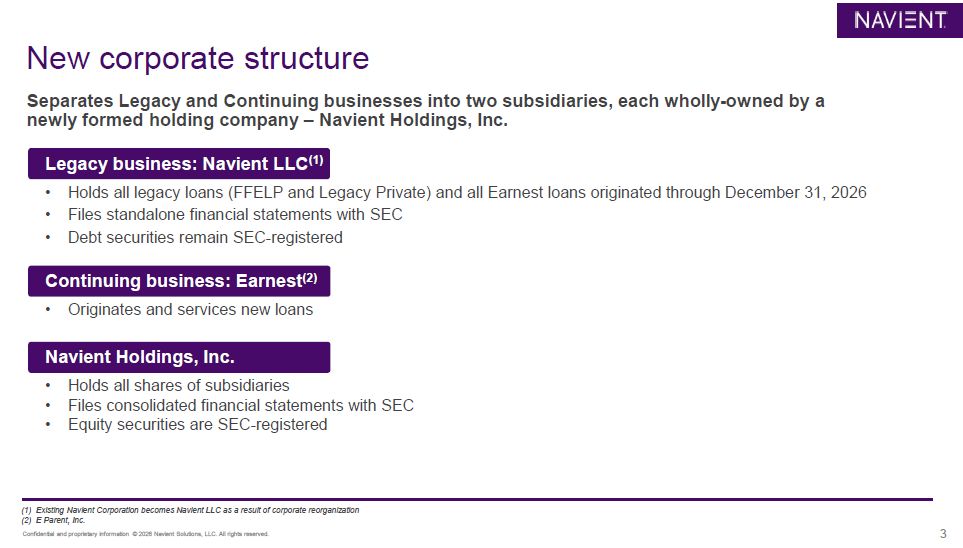
New corporate structure Legacy business: Navient LLC(1) Holds all legacy loans
(FFELP and Legacy Private) and all Earnest loans originated through December 31, 2026 Files standalone financial statements with SEC Debt securities remain SEC-registered Separates Legacy and Continuing businesses into two subsidiaries,
each wholly-owned by a newly formed holding company – Navient Holdings, Inc. Continuing business: Earnest(2) Originates and services new loans Navient Holdings, Inc. Holds all shares of subsidiaries Files consolidated financial
statements with SEC Equity securities are SEC-registered Existing Navient Corporation becomes Navient LLC as a result of corporate reorganization E Parent, Inc. 3
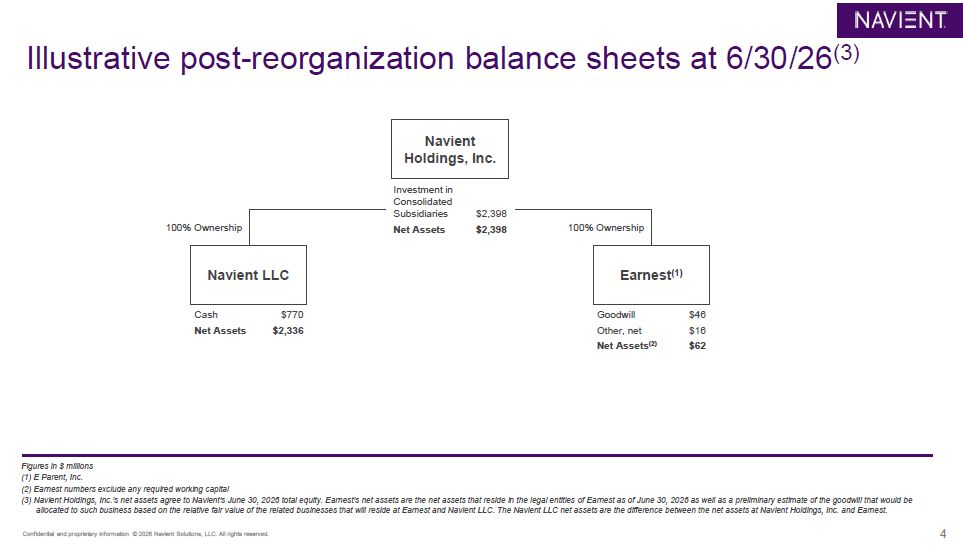
Illustrative post-reorganization balance sheets at 6/30/26(3) Figures in $
millions (1) E Parent, Inc. (2) Earnest numbers exclude any required working capital (3) Navient Holdings, Inc.’s net assets agree to Navient’s June 30, 2026 total equity. Earnest’s net assets are the net assets that reside in the legal
entities of Earnest as of June 30, 2026 as well as a preliminary estimate of the goodwill that would be allocated to such business based on the relative fair value of the related businesses that will reside at Earnest and Navient LLC. The
Navient LLC net assets are the difference between the net assets at Navient Holdings, Inc. and Earnest. 4 Goodwill $46 Other, net $16 Net Assets(2) $62 Navient Holdings, Inc. 100% Ownership 100% Ownership Investment
in Consolidated Subsidiaries $2,398 Net Assets $2,398 Cash $770 Net Assets $2,336 Earnest(1) Navient LLC
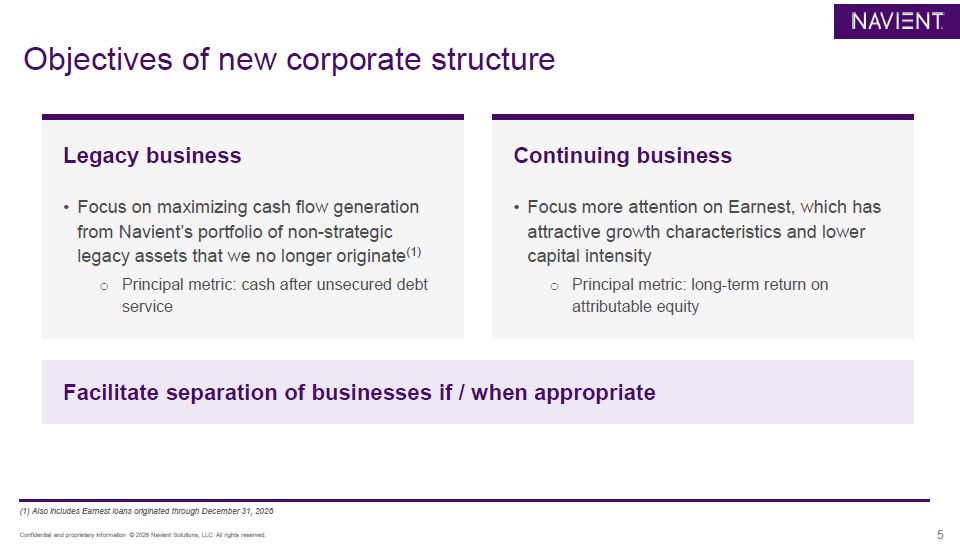
(1) Also includes Earnest loans originated through December 31, 2026 Objectives
of new corporate structure 5 Legacy business Focus on maximizing cash flow generation from Navient’s portfolio of non-strategic legacy assets that we no longer originate(1) Principal metric: cash after unsecured debt service Continuing
business Focus more attention on Earnest, which has attractive growth characteristics and lower capital intensity Principal metric: long-term return on attributable equity Facilitate separation of businesses if / when appropriate
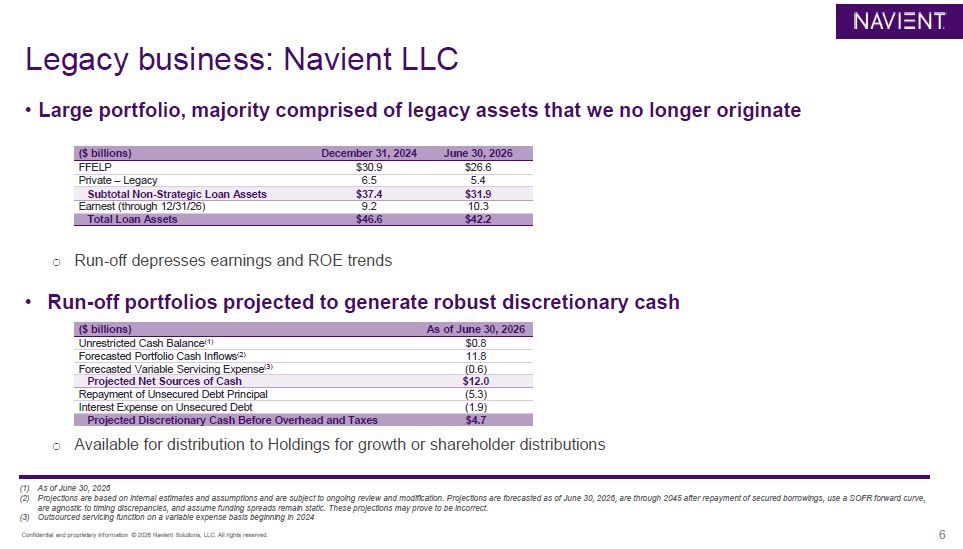
Legacy business: Navient LLC Large portfolio, majority comprised of legacy
assets that we no longer originate Run-off depresses earnings and ROE trends Run-off portfolios projected to generate robust discretionary cash Available for distribution to Holdings for growth or shareholder distributions As of June
30, 2026 Projections are based on internal estimates and assumptions and are subject to ongoing review and modification. Projections are forecasted as of June 30, 2026, are through 2045 after repayment of secured borrowings, use a SOFR
forward curve, are agnostic to timing discrepancies, and assume funding spreads remain static. These projections may prove to be incorrect. Outsourced servicing function on a variable expense basis beginning in 2024 6 ($
billions) December 31, 2024 June 30, 2026 FFELP $30.9 $26.6 Private – Legacy 6.5 5.4 Subtotal Non-Strategic Loan Assets $37.4 $31.9 Earnest (through 12/31/26) 9.2 10.3 Total Loan Assets $46.6 $42.2 ($ billions) As of June
30, 2026 Unrestricted Cash Balance(1) $0.8 Forecasted Portfolio Cash Inflows(2) 11.8 Forecasted Variable Servicing Expense(3) (0.6) Projected Net Sources of Cash $12.0 Repayment of Unsecured Debt Principal (5.3) Interest Expense
on Unsecured Debt (1.9) Projected Discretionary Cash Before Overhead and Taxes $4.7
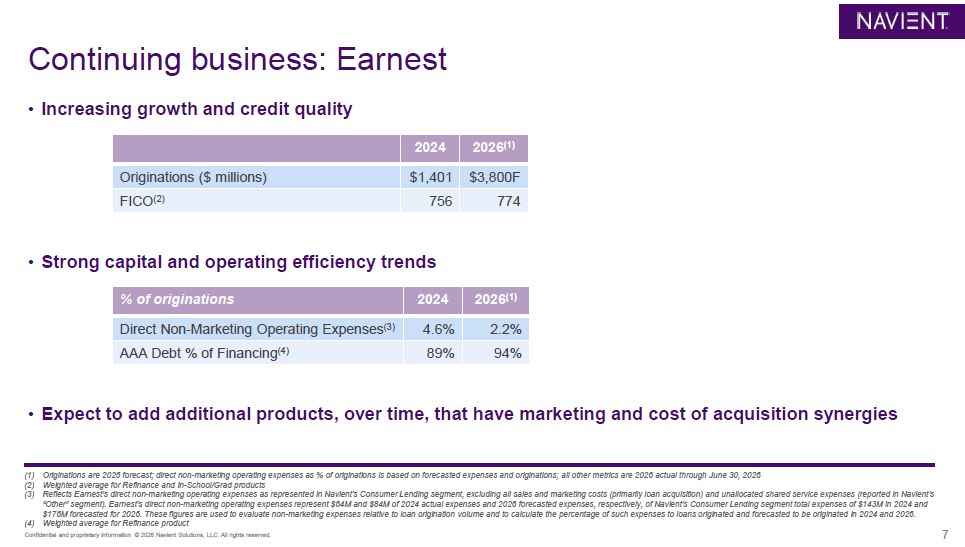
Originations are 2026 forecast; direct non-marketing operating expenses as % of
originations is based on forecasted expenses and originations; all other metrics are 2026 actual through June 30, 2026 Weighted average for Refinance and In-School/Grad products Reflects Earnest’s direct non-marketing operating expenses as
represented in Navient's Consumer Lending segment, excluding all sales and marketing costs (primarily loan acquisition) and unallocated shared service expenses (reported in Navient’s “Other” segment). Earnest’s direct non-marketing operating
expenses represent $64M and $84M of 2024 actual expenses and 2026 forecasted expenses, respectively, of Navient’s Consumer Lending segment total expenses of $143M in 2024 and $176M forecasted for 2026. These figures are used to evaluate
non-marketing expenses relative to loan origination volume and to calculate the percentage of such expenses to loans originated and forecasted to be originated in 2024 and 2026. Weighted average for Refinance product Continuing business:
Earnest Increasing growth and credit quality Strong capital and operating efficiency trends Expect to add additional products, over time, that have marketing and cost of acquisition synergies 7 2024 2026(1) Originations ($
millions) $1,401 $3,800F FICO(2) 756 774 % of originations 2024 2026(1) Direct Non-Marketing Operating Expenses(3) 4.6% 2.2% AAA Debt % of Financing(4) 89% 94%
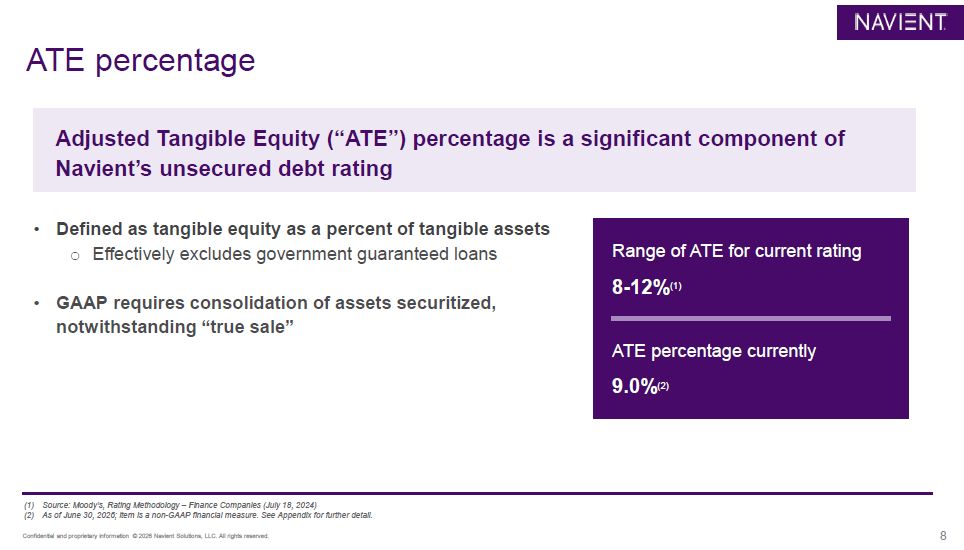
Source: Moody’s, Rating Methodology – Finance Companies (July 18, 2024) As of
June 30, 2026; item is a non-GAAP financial measure. See Appendix for further detail. ATE percentage 8 Adjusted Tangible Equity (“ATE”) percentage is a significant component of Navient’s unsecured debt rating Defined as tangible equity as
a percent of tangible assets Effectively excludes government guaranteed loans GAAP requires consolidation of assets securitized, notwithstanding “true sale” Range of ATE for current rating 8-12%(1) ATE percentage currently 9.0%(2)
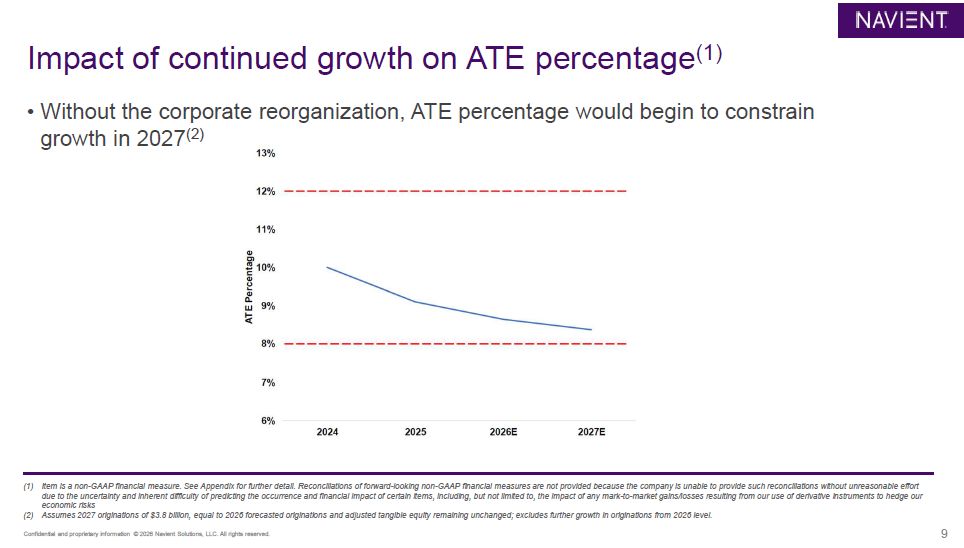
Item is a non-GAAP financial measure. See Appendix for further detail.
Reconciliations of forward-looking non-GAAP financial measures are not provided because the company is unable to provide such reconciliations without unreasonable effort due to the uncertainty and inherent difficulty of predicting the
occurrence and financial impact of certain items, including, but not limited to, the impact of any mark-to-market gains/losses resulting from our use of derivative instruments to hedge our economic risks Assumes 2027 originations of $3.8
billion, equal to 2026 forecasted originations and adjusted tangible equity remaining unchanged; excludes further growth in originations from 2026 level. Impact of continued growth on ATE percentage(1) Without the corporate reorganization,
ATE percentage would begin to constrain growth in 2027(2) 9
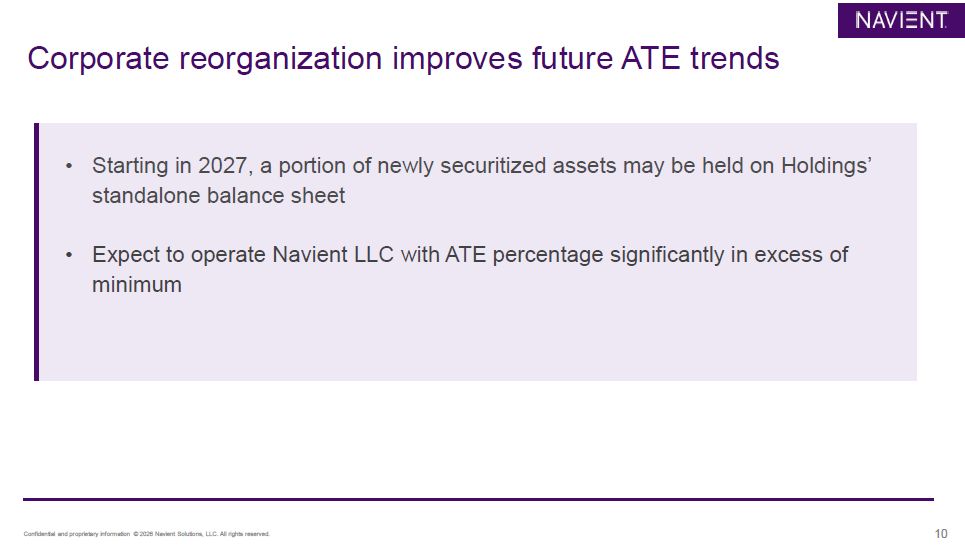
Corporate reorganization improves future ATE trends 10 Starting in 2027, a
portion of newly securitized assets may be held on Holdings’ standalone balance sheet Expect to operate Navient LLC with ATE percentage significantly in excess of minimum
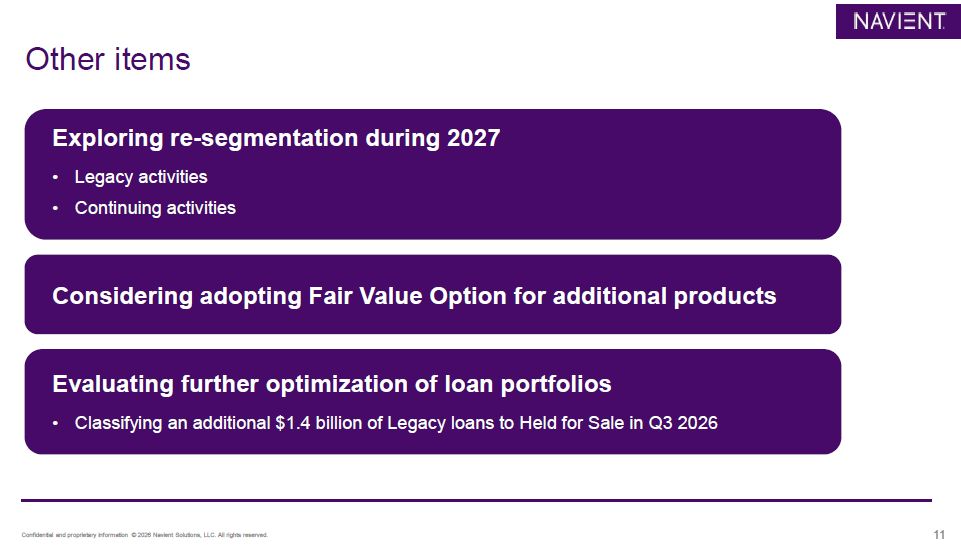
Other items 11 Exploring re-segmentation during 2027 Legacy
activities Continuing activities Considering adopting Fair Value Option for additional products Evaluating further optimization of loan portfolios Classifying an additional $1.4 billion of Legacy loans to Held for Sale in Q3 2026
Appendix 12
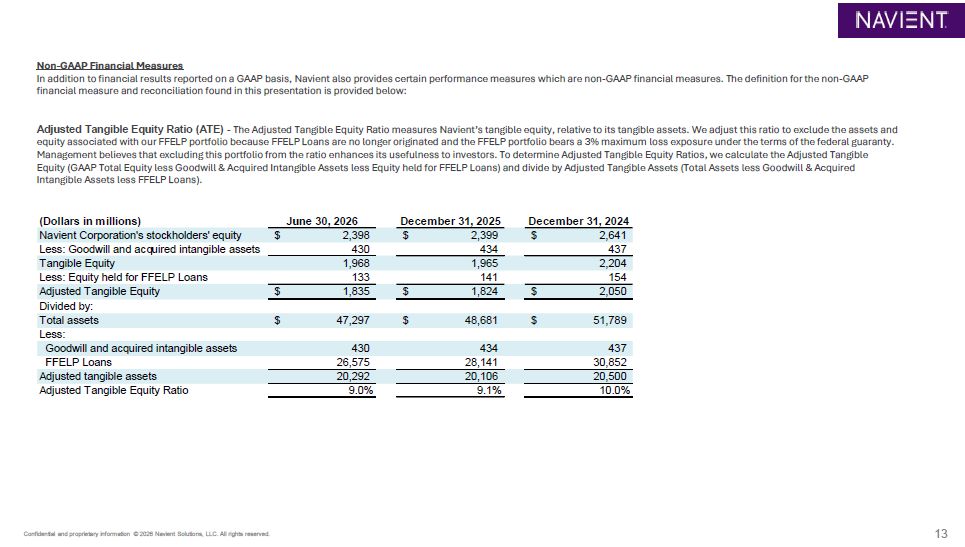
Non-GAAP Financial Measures In addition to financial results reported on a GAAP
basis, Navient also provides certain performance measures which are non-GAAP financial measures. The definition for the non-GAAP financial measure and reconciliation found in this presentation is provided below: Adjusted Tangible Equity
Ratio (ATE) - The Adjusted Tangible Equity Ratio measures Navient’s tangible equity, relative to its tangible assets. We adjust this ratio to exclude the assets and equity associated with our FFELP portfolio because FFELP Loans are no longer
originated and the FFELP portfolio bears a 3% maximum loss exposure under the terms of the federal guaranty. Management believes that excluding this portfolio from the ratio enhances its usefulness to investors. To determine Adjusted Tangible
Equity Ratios, we calculate the Adjusted Tangible Equity (GAAP Total Equity less Goodwill & Acquired Intangible Assets less Equity held for FFELP Loans) and divide by Adjusted Tangible Assets (Total Assets less Goodwill & Acquired
Intangible Assets less FFELP Loans). 13