Exhibit 99.3
VS - 7375 : Potential Best - in - Class KRAS G12D (ON/OFF) Inhibitor R&D Update October 14, 2026
2 2 FORWARD - LOOKING STATEMENTS This presentation includes forward - looking statements about, among other things, Verastem Oncology’s (the “Company”) programs an d product candidates, strategy, future plans and prospects, including statements related to the potential safety, efficacy and therapeutic profile of VS - 7375, including as a monotherapy and in combination with other agents, and the timing of clinical trial initiations, enrollment and data readouts for VS - 7375, approval and commercialization of AVMAPKI® FAKZYNJA® CO - PACK (avutometinib capsules; defactinib tablets) as a treatment for adult patients with Kirsten rat sarcoma viral o ncogene homolog (KRAS) mutant - type (mt) recurrent Low - Grade Serous Ovarian Cancer (LGSOC), the expected outcome and benefits of collaborations, including with GenFleet Therapeutics (Shanghai), Inc. (GenFleet), including the conduct of a Pha se 1/2a study and subsequent studies with respect to VS - 7375, the potential of the results of the RAMP 301 Phase 3 trial to confirm the results of the RAMP 201 study specific to KRAS mutant patients and to expand the indication for AVMAPKI FAKZYNJA CO - PACK regardless of KRAS mutation status, the structure and potential clinical value of our completed, planned and pending clinical trials, the potential clinical value of various of the Company’s clinical trials, including the RAMP 201, RA MP 201J, RAMP 205, RAMP 301 and VS - 7375 trials, the timing of commencing and completing trials, including topline data reports, our interactions with regulators, the timeline and indications for clinical development, regulatory submissions and the poten tia l for and timing of commercialization of our product candidates and potential for additional development programs involving the Company’s lead compound and the potential market opportunities thereof; and the estimated addressable markets for, and an tic ipated market opportunities of our drug candidates. The words “anticipate,” “believe,” “estimate,” “expect,” “may,” “plan,” “target,” “would,” “could,” “should,” “continue,” “potential,” “can” and similar expressions are intended to identif y f orward - looking statements, although not all forward - looking statements contain these identifying words. Each forward - looking statement is subject to risks and uncertainties that could cause actual results to differ materially from those expressed or imp lied in such statement. Forward - looking statements are subject to a number of risks and uncertainties including, but not limited to: the assumptions underlying the forward - looking statements; risks related to the development and successful commercialization of our product candidates; obtaining and maintaining regulatory approvals, including, but not limited to, potential regulatory delays or rejections; the challenges with the commercialization of a new product; our history of operating losses and the possibility that we may never achieve or maintain profitability; risks associated with meeting the objectives of Verastem ’s clinical trials, including, but not limited to Verastem’s ability to achieve enrollment objectives concerning patient numbers (i ncluding an adequate safety database), outcomes objectives and/or timing objectives for Verastem’s trials; any delays or fail ure s in enrollment and the occurrence of adverse safety events; our ability to successfully commercialize AVMAPKI FAKZYNJA CO - PACK in the U.S. including our ability to generate market demand for and acceptance of AVMAPKI FAKZYNJA CO - PACK; the potential inability to raise sufficient capital to fund ongoing operations as currently planned or to obtain financing on acc ept able terms or to fund operations from revenues generated by the sales of AVMAPKI FAKZYNJA CO - PACK; actions or advice of regulatory agencies to maintain regulatory approval of AVMAPKI FAKZYNJA CO - PACK; the impact of current and future healthcare ref orms, including those affecting the delivery of or payment for healthcare products and services; uncertainties related to the activities and initiatives of the current U.S. presidential administration, including regulatory and policy changes th at may adversely affect our business; risks related to our ability to obtain, maintain and enforce patent and other intellectual pr operty protection for our product candidates; decisions by regulatory authorities regarding trial design, labeling and other matters th at could affect the timing, availability or commercial potential of our product candidates; whether preclinical studies and a ny positive preliminary, initial “top - line,” and interim data, from our clinical trials of our product candidates may not necessari ly be predictive of the results of ongoing or later clinical trials; that the timing, scope and rate of reimbursement for our pr oduct candidates is uncertain; that the market opportunities of our drug candidates are based on internal and third - party estimates wh ich may prove to be incorrect; that third - party payors (including government agencies) may not reimburse; that there may be competitive developments affecting our product candidates; that data may not be available when expected; that enrollment of c lin ical trials may take longer than expected; the risks that we will not satisfy our post - marketing requirements and commitments established and agreed to as part of the FDA’s approval of AVMAPKI FAKZYNJA CO - PACK; that our marketed product candi dates may cause adverse safety events and/or unexpected concerns may arise from additional data or analysis, or result in unmanageable safety profiles as compared to their levels of efficacy; that we may not be able to confirm the result s f rom the RAMP 201 study or expand the approved indication for AVMAPKI FAKZYNJA CO - PACK; that our product candidates may experience manufacturing or supply interruptions or failures; that any of our third - party contract research organizations, c ontract manufacturing organizations, clinical sites, or contractors, among others, which we rely on may fail to fully perform ; t hat we face substantial competition, which may result in others developing or commercializing products before or more successfull y t han we do which could result in reduced market share or market potential for our product candidates; that we may be unable to successfully initiate or complete the clinical development and eventual commercialization of our product candidates ; t hat the development and commercialization of our product candidates may take longer or cost more than planned, including as a result of conducting additional studies or our decisions regarding execution of such commercialization; that w e m ay not attract and retain high quality personnel; that we or Pfizer, Inc. may fail to fully perform under the license agreeme nt covering certain Pfizer FAK inhibitors, including defactinib; that we or Chugai Pharmaceutical Co., Ltd. may fail to fully pe rfo rm under the avutometinib license agreement; that we or GenFleet may fail to fully perform under the collaboration and option agreement covering VS - 7375 and other assets we may decide to option in; that our total addressable and target markets for our pr oduct candidates might be smaller than we are presently estimating; that we or Secura Bio, Inc. may fail to fully perform under the asset purchase agreement with Secura Bio, Inc., including in relation to milestone payments; that we may not be abl e t o establish new or expand on existing collaborations or partnerships, including with respect to in - licensing of our product candidates, on favorable terms, or at all; that we may be unable to obtain adequate financing in the future through product l ice nsing, co - promotional arrangements, public or private equity, debt financing or otherwise; that we may not pursue or submit regulatory filings for our product candidates; that, due to the current presidential administration’s significant reduction i n t he FDA’s workforce and potential reductions to the FDA’s budget, we may experience a material impact to the FDA’s ability to engage in a variety of activities that may affect our business, including routine regulatory and oversight activities; and th at our product candidates may not receive regulatory approval, become commercially successful products, or result in new treatme nt options being offered to patients. Other risks and uncertainties include those identified under the heading “Risk Factors” in the Company’s Annual Report on For m 1 0 - K for the year ended December 31, 2025, as filed with the Securities and Exchange Commission (“SEC”) on March 04, 2026, the Company’s Quarterly Report on Form 10 - Q for the quarter ended June 30, 2026, as filed with the SEC on August 6, 2026 a nd in any subsequent filings with the SEC, which are available at www.sec.govand www.verastem.com . The forward - looking statements in this presentation speak only as of the original date of this presentation, and we undertake no obligati on to update or revise any of these statements whether as a result of new information, future events or otherwise, except as required by law. Our business is subject to substantial risks and uncertainties, including those referenced above. Investors, po tential investors, and others should give careful consideration to these risks and uncertainties. THIRD - PARTY SOURCES Certain information contained in this presentation, including industry and market data and other statistical information, rel ate s to or is based on studies, publications, surveys and other data obtained from third - party sources and the Company’s own internal estimates and research. While the Company believes these third - party sources to be reliable as of the date of this pres entation, it has not independently verified, and makes no representation as to the adequacy, fairness, accuracy or completeness of, any information obtained from third - party sources. In addition, all of the market data included in this present ation involves a number of assumptions and limitations, and there can be no guarantee as to the accuracy or reliability of su ch assumptions. This presentation shall not constitute an offer to sell or the solicitation of an offer to buy, nor shall there be any sale o f s ecurities in any state or other jurisdiction in which such offer, solicitation or sale would be unlawful prior to registratio n o r qualification under the securities laws of any such state or other jurisdiction.
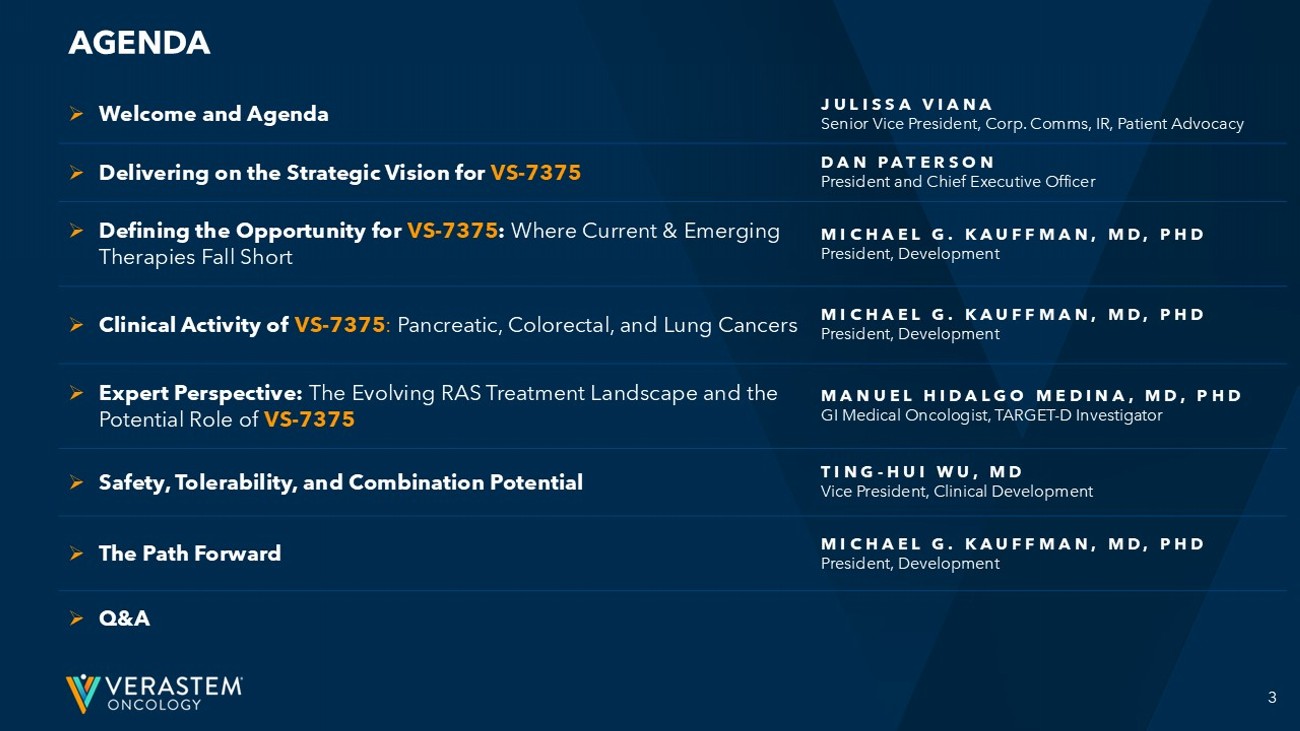
3 JULISSA VIANA Senior Vice President, Corp. Comms, IR, Patient Advocacy » Welcome and Agenda DAN PATERSON President and Chief Executive Officer » Delivering on the Strategic Vision for VS - 7375 MICHAEL G. KAUFFMAN, MD, PHD President, Development » Defining the Opportunity for VS - 7375 : Where Current & Emerging Therapies Fall Short MICHAEL G. KAUFFMAN, MD, PHD President, Development » Clinical Activity of VS - 7375 : Pancreatic, Colorectal, and Lung Cancers MANUEL HIDALGO MEDINA, MD, PHD GI Medical Oncologist, TARGET - D Investigator » Expert Perspective: The Evolving RAS Treatment Landscape and the Potential Role of VS - 7375 TING - HUI WU, MD Vice President, Clinical Development » Safety, Tolerability, and Combination Potential MICHAEL G. KAUFFMAN, MD, PHD President, Development » The Path Forward » Q&A AGENDA

Delivering on the Strategic Vision for VS - 7375 Dan Paterson President & CEO
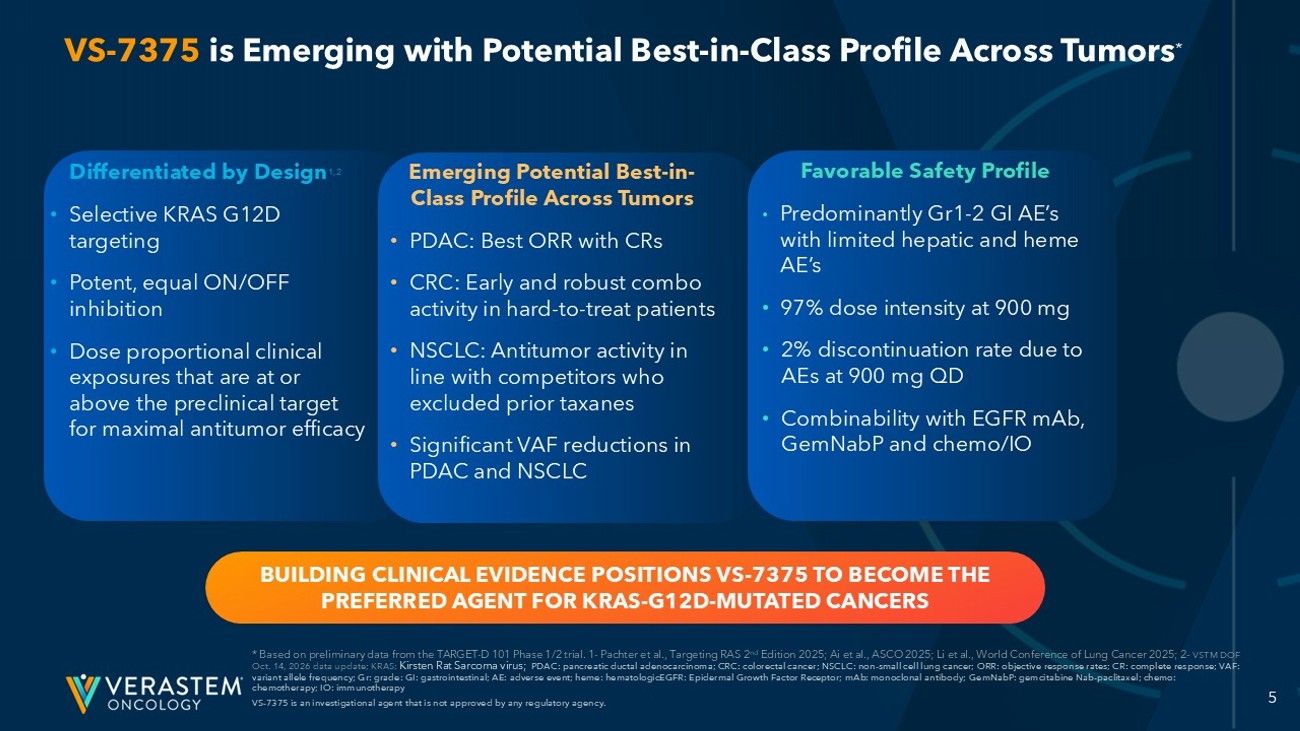
5 Differentiated by Design 1,2 • Selective KRAS G12D targeting • Potent, equal ON/OFF inhibition • Dose proportional clinical exposures that are at or above the preclinical target for maximal antitumor efficacy Emerging Potential Best - in - Class Profile Across Tumors • PDAC: Best ORR with CRs • CRC: Early and robust combo activity in hard - to - treat patients • NSCLC: Antitumor activity in line with competitors who excluded prior taxanes • Significant VAF reductions in PDAC and NSCLC Favorable Safety Profile • Predominantly Gr1 - 2 GI AE’s with limited hepatic and heme AE’s • 97% dose intensity at 900 mg • 2% discontinuation rate due to AEs at 900 mg QD • Combinability with EGFR mAb , GemNabP and chemo/IO VS - 7375 is Emerging with Potential Best - in - Class Profile Across Tumors * * Based on preliminary data from the TARGET - D 101 Phase 1/2 trial. 1 - Pachter et al., Targeting RAS 2 nd Edition 2025; Ai et al., ASCO 2025; Li et al., World Conference of Lung Cancer 2025; 2 - VSTM DOF Oct. 14, 2026 data update; KRAS: Kirsten Rat Sarcoma virus; PDAC: pancreatic ductal adenocarcinoma; CRC: colorectal cancer; NSCLC: non - small cell lung cancer; ORR: objective response rate s; CR: complete response; VAF: variant allele frequency; Gr: grade: GI: gastrointestinal; AE: adverse event; heme: hematologicEGFR: Epidermal Growth Factor Rec eptor; mAb : monoclonal antibody; GemNabP : gemcitabine Nab - paclitaxel; chemo: chemotherapy; IO: immunotherapy VS - 7375 is an investigational agent that is not approved by any regulatory agency. BUILDING CLINICAL EVIDENCE POSITIONS VS - 7375 TO BECOME THE PREFERRED AGENT FOR KRAS - G12D - MUTATED CANCERS

Defining the Opportunity for VS - 7375: Where Current & Emerging Therapies Fall Short Michael G. Kauffman, MD, PhD President of Development
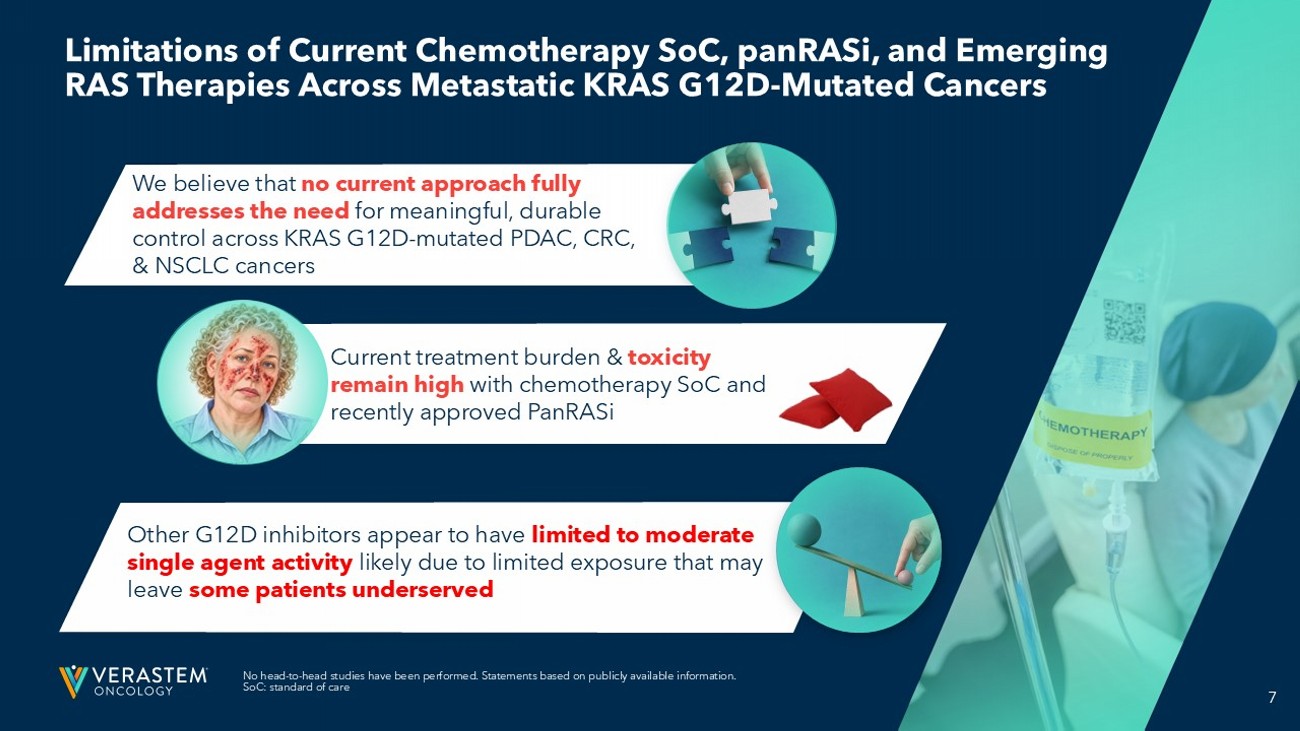
7 Limitations of Current Chemotherapy SoC, panRASi, and Emerging RAS Therapies Across Metastatic KRAS G12D - Mutated Cancers No head - to - head studies have been performed. Statements based on publicly available information. SoC: standard of care Other G12D inhibitors appear to have limited to moderate single agent activity likely due to limited exposure that may leave some patients underserved Current treatment burden & toxicity remain high with chemotherapy SoC and recently approved PanRASi We believe that no current approach fully addresses the need for meaningful, durable control across KRAS G12D - mutated PDAC, CRC, & NSCLC cancers
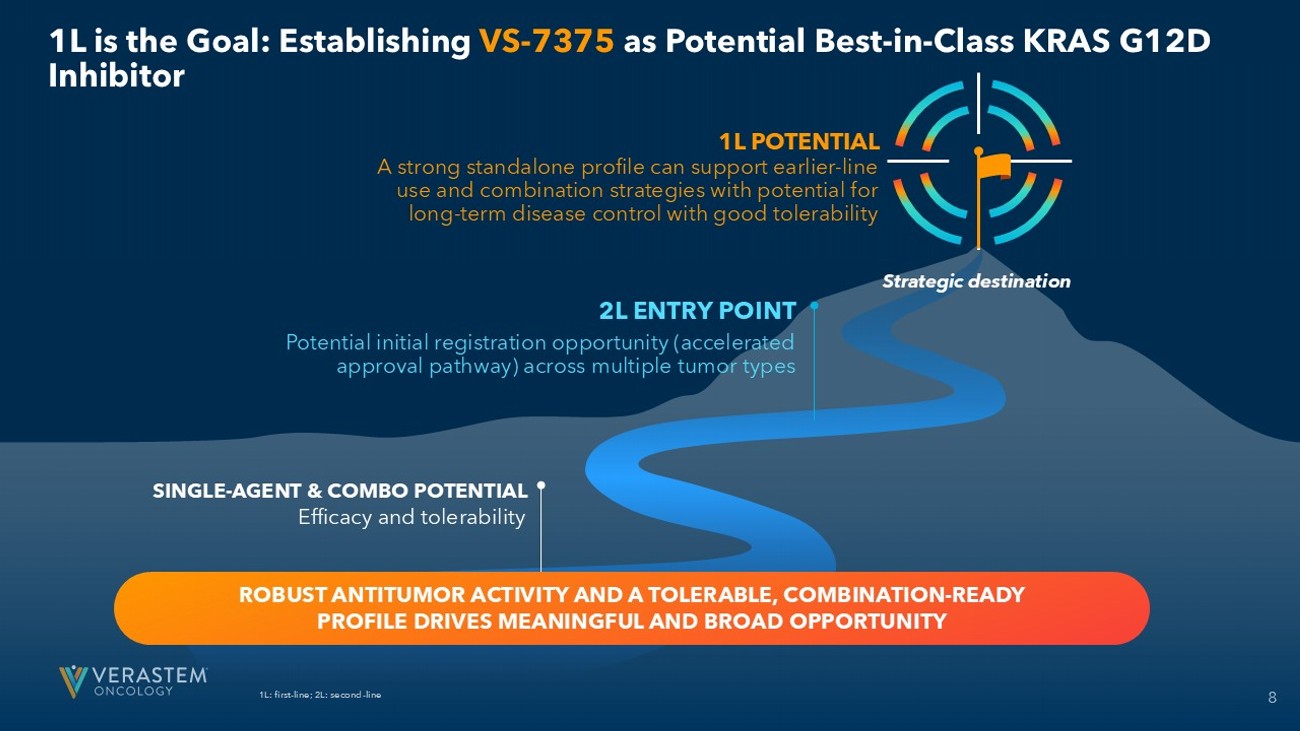
8 1L is the Goal: Establishing VS - 7375 as Potential Best - in - Class KRAS G12D Inhibitor 1L: first - line; 2L: second - line 1L POTENTIAL A strong standalone profile can support earlier - line use and combination strategies with potential for long - term disease control with good tolerability 2L ENTRY POINT Potential initial registration opportunity (accelerated approval pathway) across multiple tumor types Strategic destination SINGLE - AGENT & COMBO POTENTIAL ROBUST ANTITUMOR ACTIVITY AND A TOLERABLE, COMBINATION - READY PROFILE DRIVES MEANINGFUL AND BROAD OPPORTUNITY Efficacy and tolerability
Michael G. Kauffman, MD, PhD President of Development Clinical Activity of VS - 7375: Pancreatic Ductal Adenocarcinoma
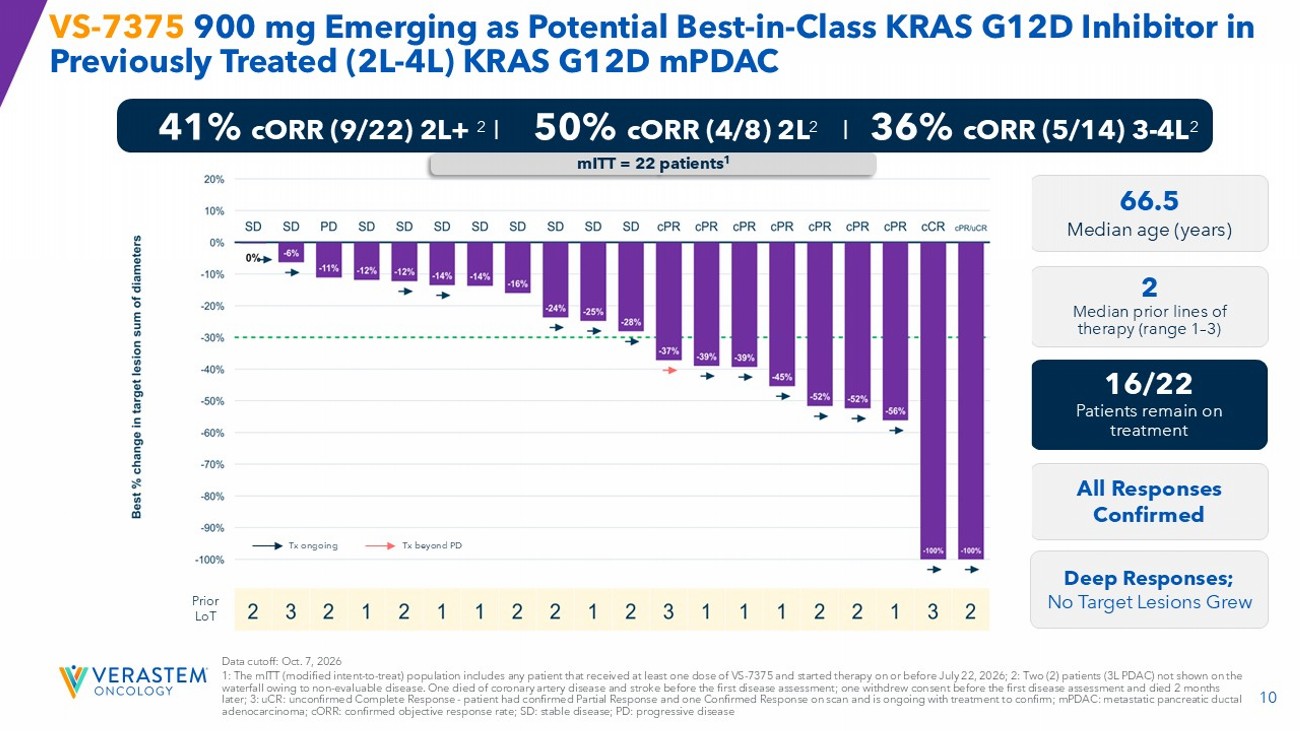
10 VS - 7375 900 mg Emerging as Potential Best - in - Class KRAS G12D Inhibitor in Previously Treated (2L - 4L) KRAS G12D mPDAC Data cutoff: Oct. 7, 2026 1: The mITT (modified intent - to - treat) population includes any patient that received at least one dose of VS - 7375 and started therapy on or before July 22, 2026; 2: Two (2) patients (3L PDAC) not shown on the waterfall owing to non - evaluable disease. One died of coronary artery disease and stroke before the first disease assessment; on e withdrew consent before the first disease assessment and died 2 months later; 3: uCR : unconfirmed Complete Response - patient had confirmed Partial Response and one Confirmed Response on scan and is ongoing with treatment to confirm; mPDAC: metastatic pancreatic ductal adenocarcinoma; cORR : confirmed objective response rate; SD: stable disease; PD: progressive disease 66.5 Median age (years) 2 Median prior lines of therapy (range 1 – 3) 16/22 Patients remain on treatment All Responses Confirmed 41% cORR (9/22) 2L+ 2 I 50% cORR (4/8) 2L 2 I 36% cORR (5/14) 3 - 4L 2 Prior LoT mITT = 22 patients 1 Deep Responses; No Target Lesions Grew Tx ongoing Tx beyond PD
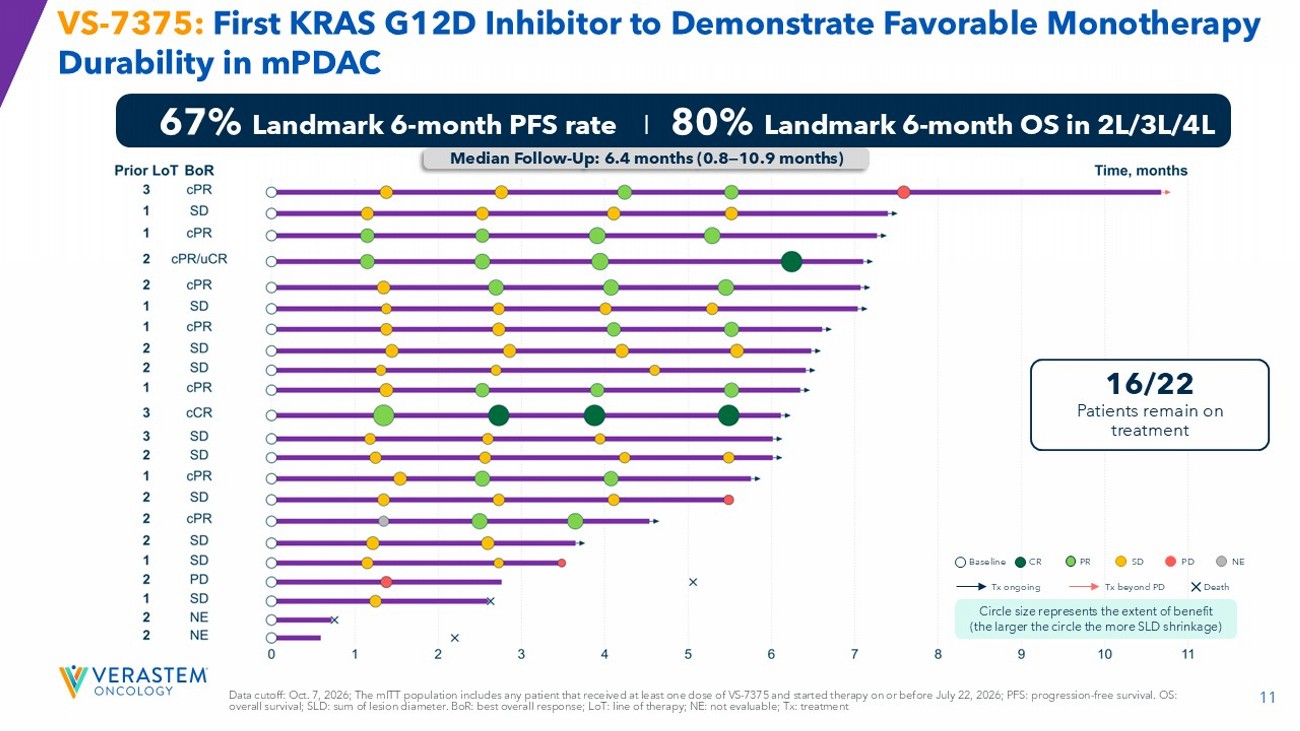
11 VS - 7375: First KRAS G12D Inhibitor to Demonstrate Favorable Monotherapy Durability in mPDAC 67% Landmark 6 - month PFS rate I 80% Landmark 6 - month OS in 2L/3L/4L Data cutoff: Oct. 7, 2026; The mITT population includes any patient that received at least one dose of VS - 7375 and started therapy on or before July 22, 2026; PFS: progression - free survival. OS: overall survival; SLD: sum of lesion diameter. BoR : best overall response; LoT : line of therapy; NE: not evaluable; Tx: treatment Median Follow - Up: 6.4 months (0.8 — 10.9 months) 16/22 Patients remain on treatment Baseline CR PR SD PD NE Tx ongoing Tx beyond PD Death Circle size represents the extent of benefit (the larger the circle the more SLD shrinkage)
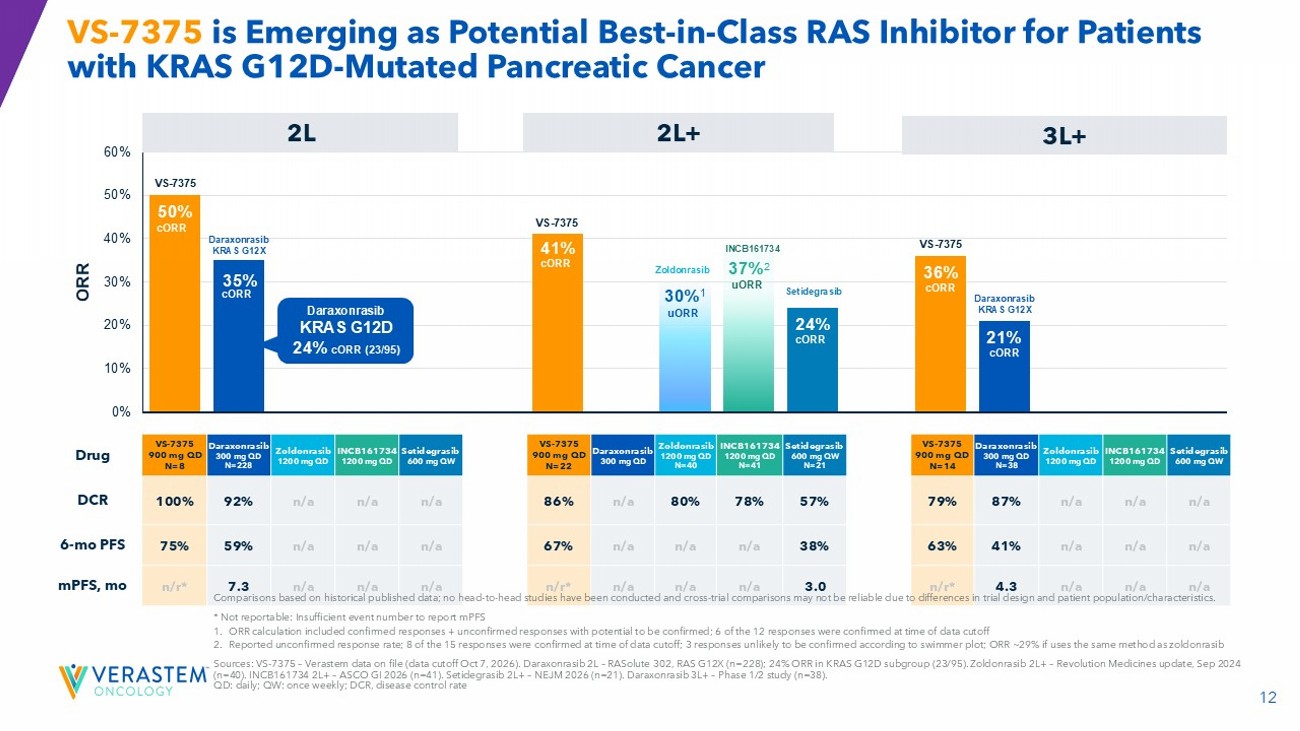
12 VS - 7375 is Emerging as Potential Best - in - Class RAS Inhibitor for Patients with KRAS G12D - Mutated Pancreatic Cancer 50% 35% 41% 30% 1 37% 2 24% 36% 21% 0% 10% 20% 30% 40% 50% 60% ORR 2L 2L+ 3L+ Setidegrasib INCB161734 Zoldonrasib Daraxonrasib VS - 7375 900 mg QD N=14 Setidegrasib INCB161734 Zoldonrasib Daraxonrasib VS - 7375 900 mg QD N=22 Setidegrasib INCB161734 Zoldonrasib Daraxonrasib VS - 7375 900 mg QD N=8 Drug n/a n/a n/a 87% 79 % 57% 78% 80% n/a 86 % n/a n/a n/a 92% 100 % DCR n/a n/a n/a 41% 63% 38% n/a n/a n/a 67% n/a n/a n/a 59% 75% 6 - mo PFS n/a n/a n/a 4.3 n/r* 3.0 n/a n/a n/a n/r* n/a n/a n/a 7.3 n/r* mPFS, mo VS - 7375 VS - 7375 VS - 7375 Daraxonrasib KRAS G12X Daraxonrasib KRAS G12X Zoldonrasib INCB161734 Setidegrasib uORR uORR cORR cORR cORR cORR cORR cORR Comparisons based on historical published data; no head - to - head studies have been conducted and cross - trial comparisons may not be reliable due to differences in trial design and patient population/characteristics. * Not reportable: Insufficient event number to report mPFS 1. ORR calculation included confirmed responses + unconfirmed responses with potential to be confirmed; 6 of the 12 responses we re confirmed at time of data cutoff 2. Reported unconfirmed response rate; 8 of the 15 responses were confirmed at time of data cutoff; 3 responses unlikely to be c onf irmed according to swimmer plot; ORR ~29% if uses the same method as zoldonrasib Sources: VS - 7375 – Verastem data on file (data cutoff Oct 2, 2026). Daraxonrasib 2L – RASolute 302, RAS G12X (n=228); 24% ORR in KRAS G12D subgroup (23/95). Zoldonrasib 2L+ – Revolution Medicines update, Sep 2024 (n=40). INCB161734 2L+ – ASCO GI 2026 (n=41). Setidegrasib 2L+ – NEJM 2026 (n=21). Daraxonrasib 3L+ – Phase 1/2 study (n=38). QD: daily; QW: once weekly; DCR, disease control rate Daraxonrasib KRAS G12D 24% cORR (23/95)
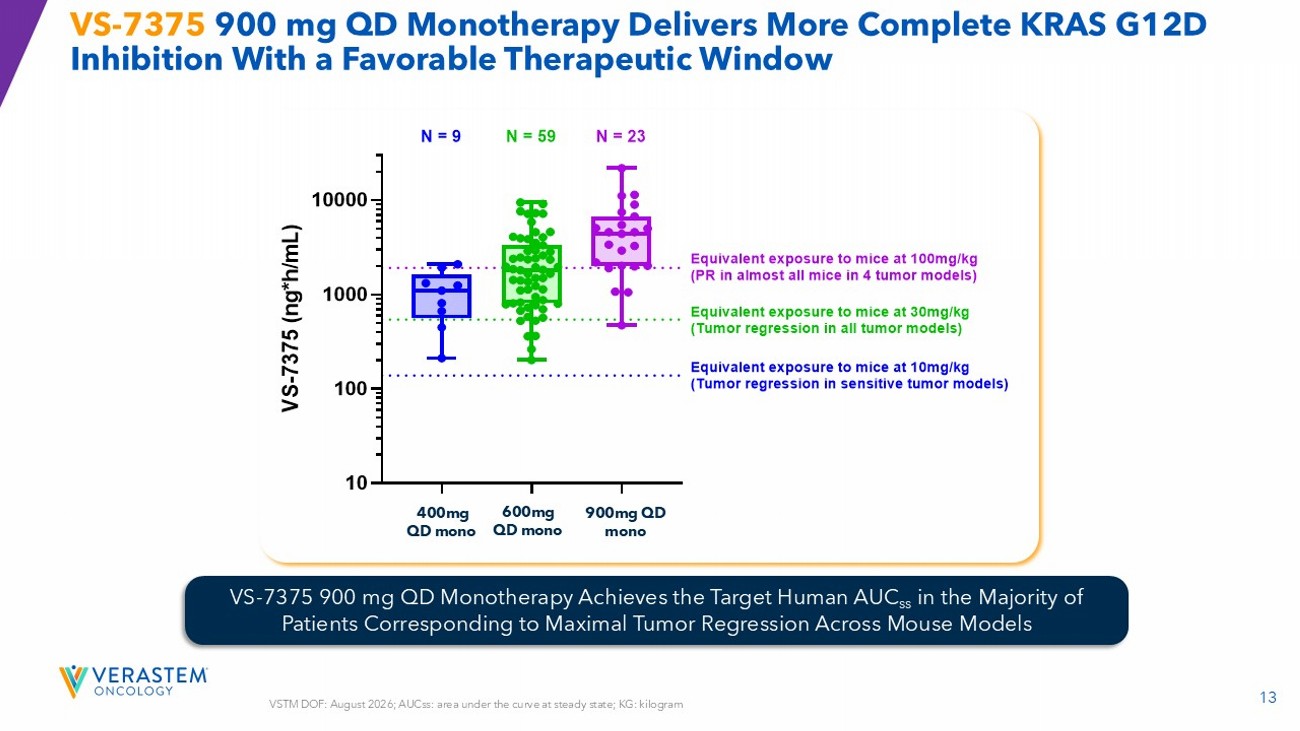
13 VSTM DOF: August 2026; AUCss : area under the curve at steady state; KG: kilogram VS - 7375 900 mg QD Monotherapy Delivers More Complete KRAS G12D Inhibition With a Favorable Therapeutic Window VS - 7375 900 mg QD Monotherapy Achieves the Target Human AUC ss in the Majority of Patients Corresponding to Maximal Tumor Regression Across Mouse Models 4 0 0 m g M o n o 6 0 0 m g M o n o 9 0 0 m g M o n o 10 100 1000 10000 V S - 7 3 7 5 ( n g * h / m L ) Equivalent exposure to mice at 100mg/kg (PR in almost all mice in 4 tumor models) Equivalent exposure to mice at 30mg/kg (Tumor regression in all tumor models) Equivalent exposure to mice at 10mg/kg (Tumor regression in sensitive tumor models) N = 9 N = 59 N = 23 400mg QD mono 600mg QD mono 900mg QD mono
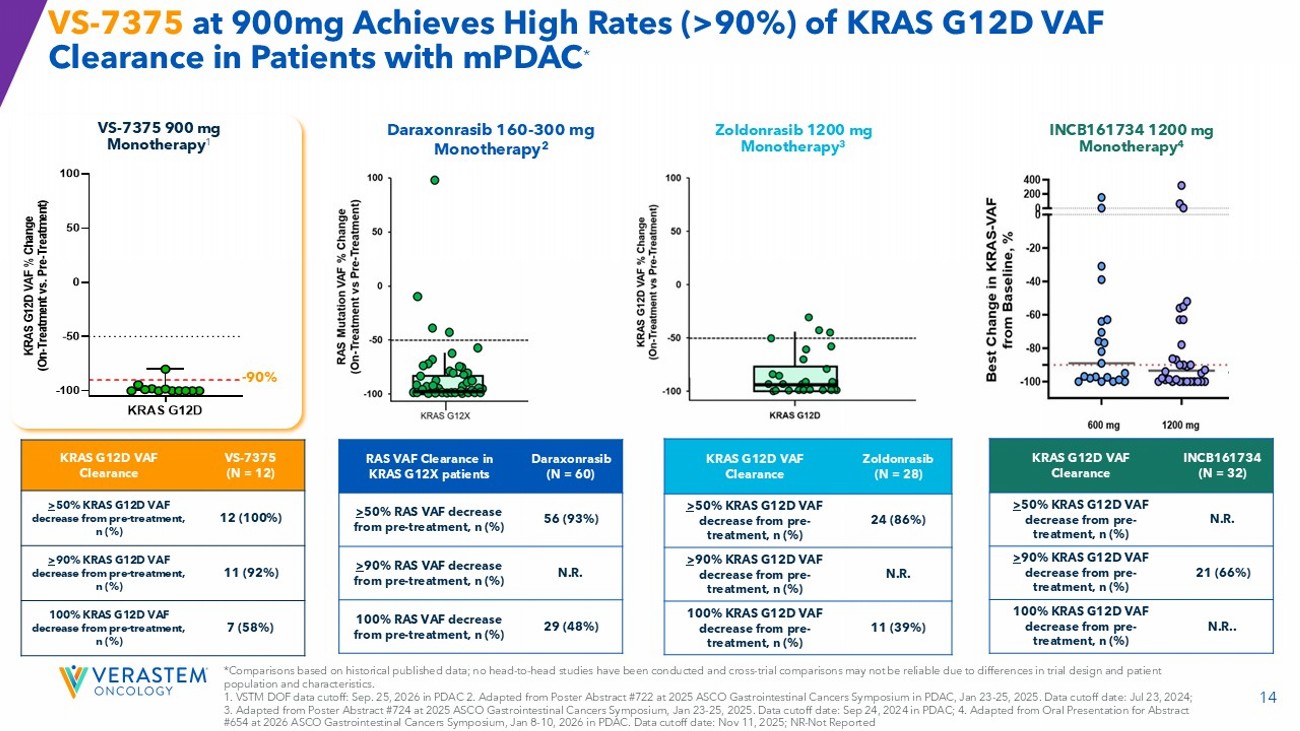
14 KRAS G12D -100 -50 0 50 100 K R A S G 1 2 D V A F % C h a n g e ( O n - T r e a t m e n t v s . P r e - T r e a t m e n t ) Zoldonrasib (N = 28) KRAS G12D VAF Clearance 24 (86%) > 50% KRAS G12D VAF decrease from pre - treatment, n (%) N.R. > 90% KRAS G12D VAF decrease from pre - treatment, n (%) 11 (39%) 100% KRAS G12D VAF decrease from pre - treatment, n (%) VS - 7375 at 900mg Achieves High Rates (>90%) of KRAS G12D VAF Clearance in Patients with mPDAC * VS - 7375 (N = 12) KRAS G12D VAF Clearance 12 (100%) > 50% KRAS G12D VAF decrease from pre - treatment, n (%) 11 (92%) > 90% KRAS G12D VAF decrease from pre - treatment, n (%) 7 (58%) 100% KRAS G12D VAF decrease from pre - treatment, n (%) VS - 7375 900 mg Monotherapy 1 Daraxonrasib 160 - 300 mg Monotherapy 2 INCB161734 1200 mg Monotherapy 4 Daraxonrasib (N = 60) RAS VAF Clearance in KRAS G12X patients 56 (93%) > 50% RAS VAF decrease from pre - treatment, n (%) N.R. > 90% RAS VAF decrease from pre - treatment, n (%) 29 (48%) 100% RAS VAF decrease from pre - treatment, n (%) INCB161734 (N = 32) KRAS G12D VAF Clearance N.R. > 50% KRAS G12D VAF decrease from pre - treatment, n (%) 21 (66%) > 90% KRAS G12D VAF decrease from pre - treatment, n (%) N.R.. 100% KRAS G12D VAF decrease from pre - treatment, n (%) Zoldonrasib 1200 mg Monotherapy 3 - 90% *Comparisons based on historical published data; no head - to - head studies have been conducted and cross - trial comparisons may not be reliable due to differences in trial design and patient population and characteristics. 1. VSTM DOF data cutoff: Sep. 25, 2026 in PDAC 2. Adapted from Poster Abstract #722 at 2025 ASCO Gastrointestinal Cancers Sym pos ium in PDAC, Jan 23 - 25, 2025. Data cutoff date: Jul 23, 2024; 3. Adapted from Poster Abstract #724 at 2025 ASCO Gastrointestinal Cancers Symposium, Jan 23 - 25, 2025. Data cutoff date: Sep 24, 2024 in PDAC; 4. Adapted from Oral Presentation for Abstract #654 at 2026 ASCO Gastrointestinal Cancers Symposium, Jan 8 - 10, 2026 in PDAC. Data cutoff date: Nov 11, 2025; NR - Not Reported
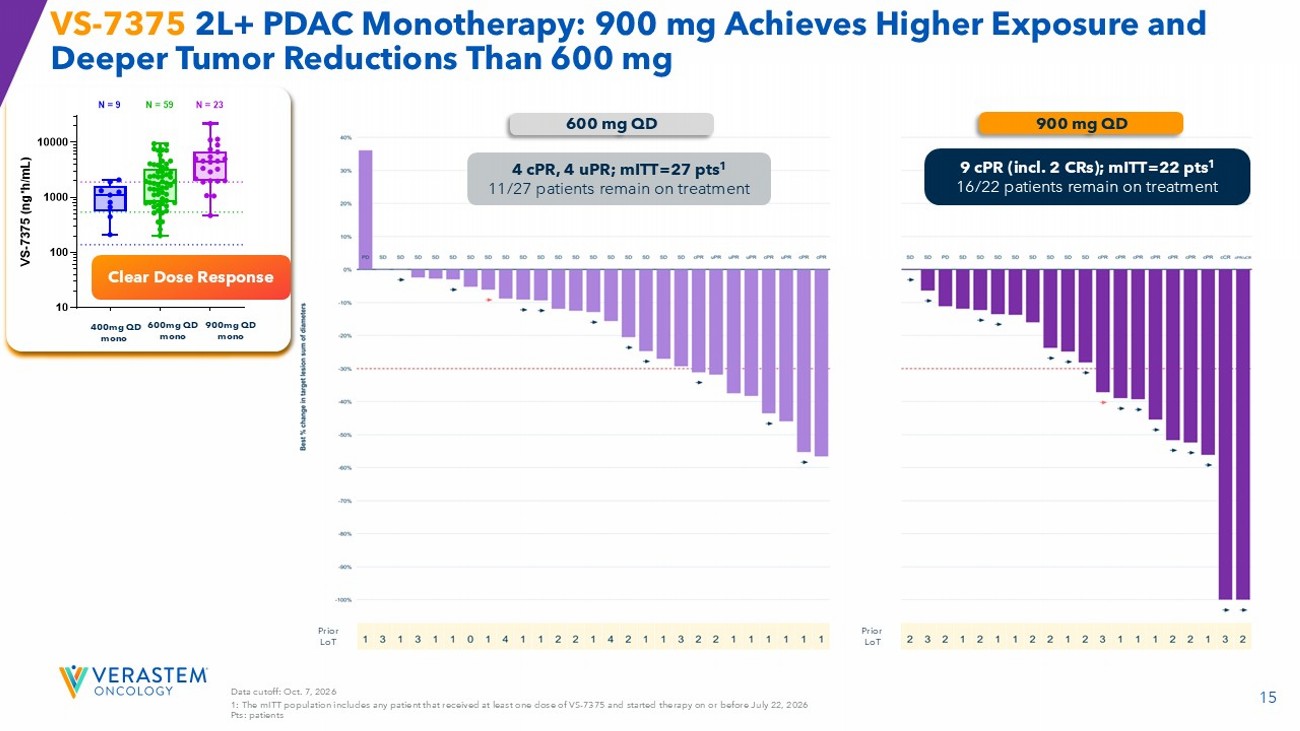
15 Prior LoT Prior LoT Data cutoff: Oct. 7, 2026 1: The mITT population includes any patient that received at least one dose of VS - 7375 and started therapy on or before July 22, 2026 Pts: patients VS - 7375 2L+ PDAC Monotherapy: 900 mg Achieves Higher Exposure and Deeper Tumor Reductions Than 600 mg Clear Dose Response 600 mg QD 900 mg QD 9 cPR (incl. 2 CRs); mITT =22 pts 1 16/22 patients remain on treatment 4 cPR , 4 uPR ; mITT =27 pts 1 11/27 patients remain on treatment 4 0 0 m g M o n o 6 0 0 m g M o n o 9 0 0 m g M o n o 10 100 1000 10000 V S - 7 3 7 5 ( n g * h / m L ) Equivalent exposure to mice at 100mg/kg (PR in almost all mice in 4 tumor models) Equivalent exposure to mice at 30mg/kg (Tumor regression in all tumor models) Equivalent exposure to mice at 10mg/kg (Tumor regression in sensitive tumor models) N = 9 N = 59 N = 23 400mg QD mono 600mg QD mono 900mg QD mono
Clinical Activity of VS - 7375: Colorectal Cancer Michael G. Kauffman, MD, PhD President of Development
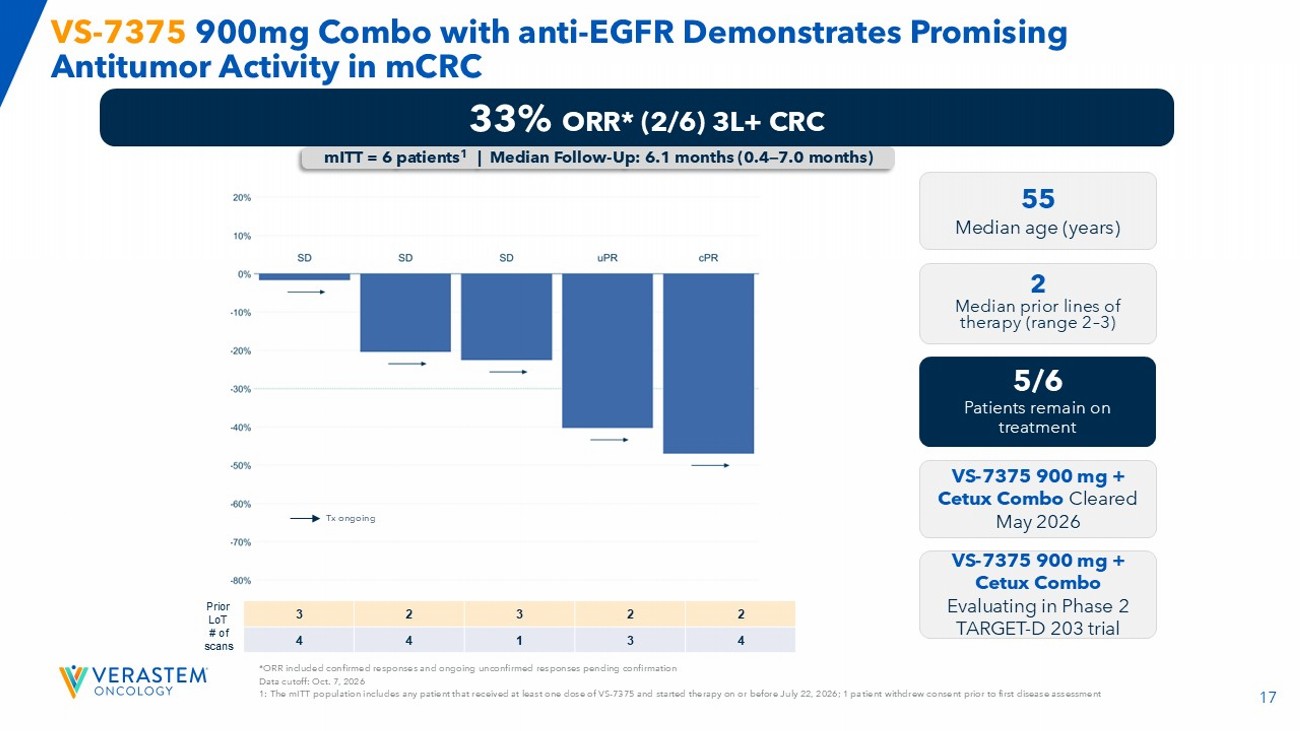
17 *ORR included confirmed responses and ongoing unconfirmed responses pending confirmation Data cutoff: Oct. 7, 2026 1: The mITT population includes any patient that received at least one dose of VS - 7375 and started therapy on or before July 22, 2026; 1 pa tient withdrew consent prior to first disease assessment VS - 7375 900mg Combo with anti - EGFR Demonstrates Promising Antitumor Activity in mCRC 2 2 3 2 3 Prior LoT 4 3 1 4 4 # of scans 33% ORR* (2/6) 3L+ CRC 55 Median age (years) 2 Median prior lines of therapy (range 2 – 3) 5/6 Patients remain on treatment VS - 7375 900 mg + Cetux Combo Cleared May 2026 VS - 7375 900 mg + Cetux Combo Evaluating in Phase 2 TARGET - D 203 trial mITT = 6 patients 1 | Median Follow - Up: 6.1 months (0.4 — 7.0 months) Tx ongoing
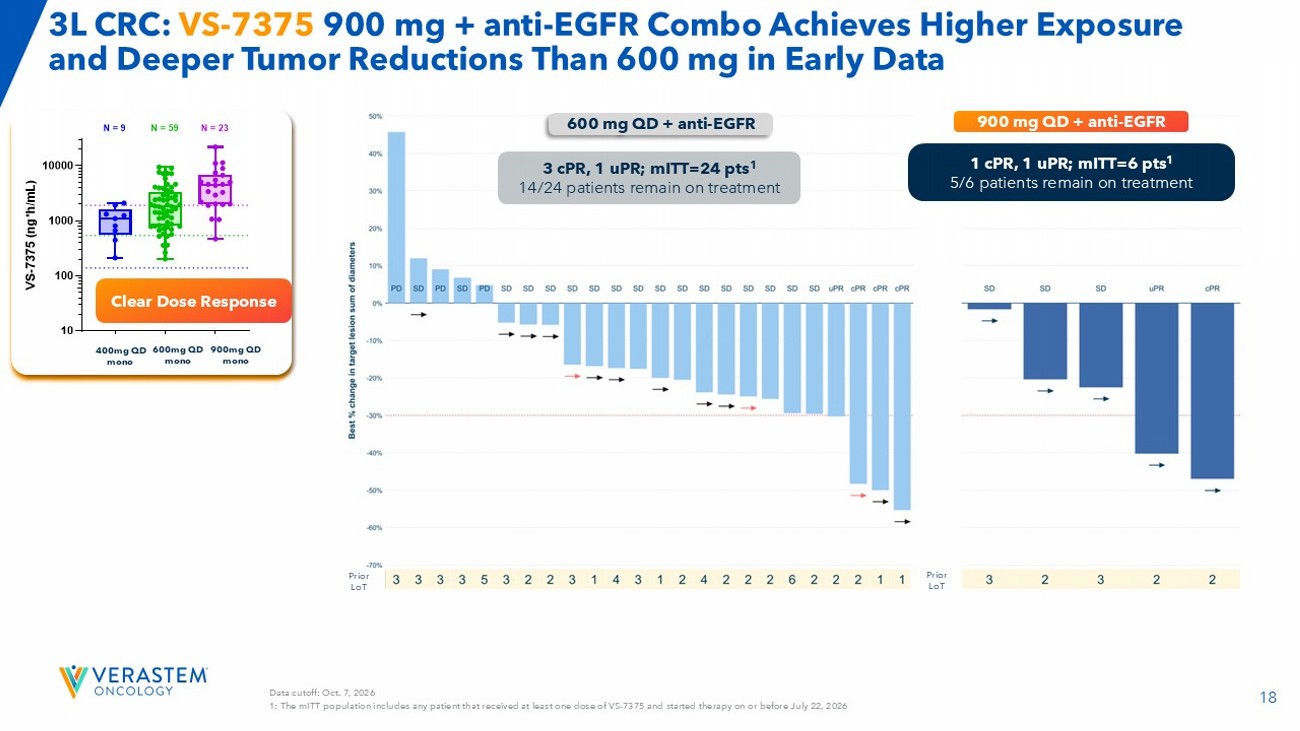
18 Data cutoff: Oct. 7, 2026 1: The mITT population includes any patient that received at least one dose of VS - 7375 and started therapy on or before July 22, 2026 3L CRC: VS - 7375 900 mg + anti - EGFR Combo Achieves Higher Exposure and Deeper Tumor Reductions Than 600 mg in Early Data 600 mg QD + anti - EGFR 900 mg QD + anti - EGFR 3 cPR , 1 uPR ; mITT =24 pts 1 14/24 patients remain on treatment Clear Dose Response 4 0 0 m g M o n o 6 0 0 m g M o n o 9 0 0 m g M o n o 10 100 1000 10000 V S - 7 3 7 5 ( n g * h / m L ) Equivalent exposure to mice at 100mg/kg (PR in almost all mice in 4 tumor models) Equivalent exposure to mice at 30mg/kg (Tumor regression in all tumor models) Equivalent exposure to mice at 10mg/kg (Tumor regression in sensitive tumor models) N = 9 N = 59 N = 23 400mg QD mono 600mg QD mono 900mg QD mono 1 cPR , 1 uPR ; mITT =6 pts 1 5/6 patients remain on treatment Prior LoT Prior LoT
Clinical Activity of VS - 7375: Non - Small Cell Lung Cancer Michael G. Kauffman, MD, PhD President of Development
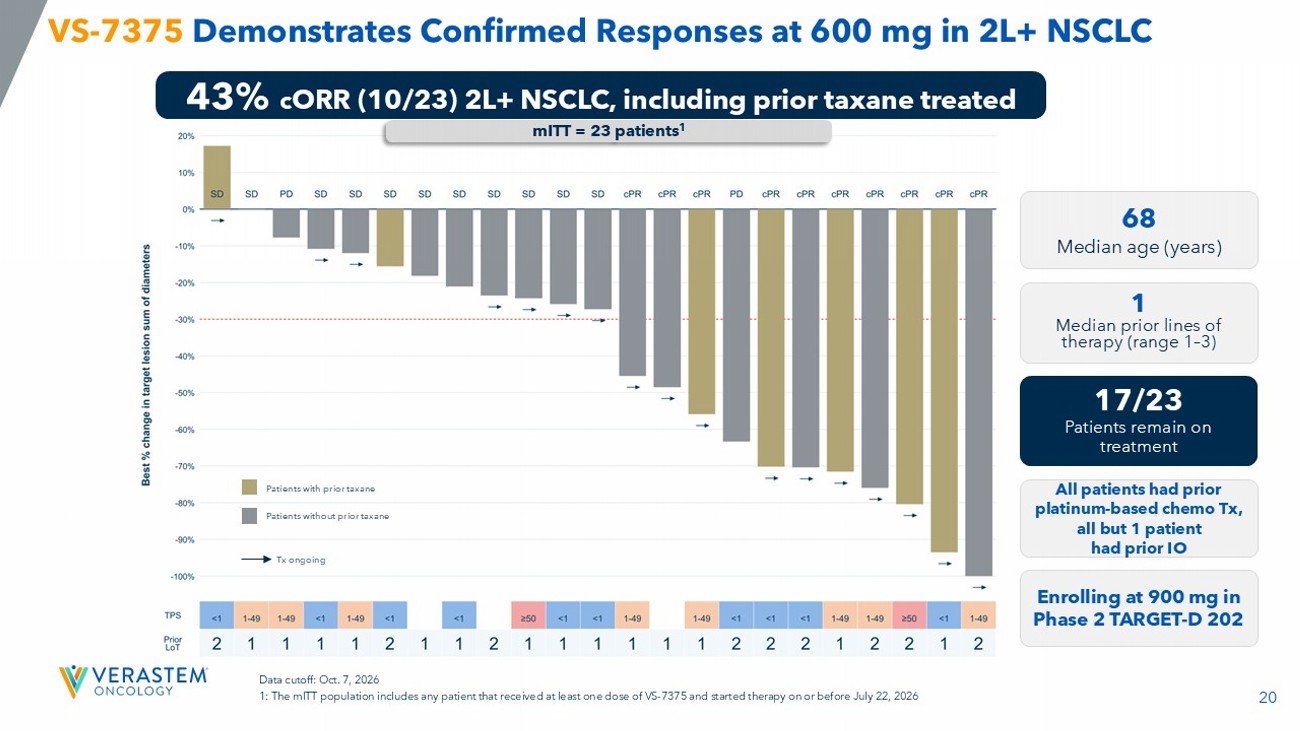
20 VS - 7375 Demonstrates Confirmed Responses at 600 mg in 2L+ NSCLC 43% c ORR (10/23) 2L+ NSCLC, including prior taxane treated 68 Median age (years) 1 Median prior lines of therapy (range 1 – 3) 17/23 Patients remain on treatment All patients had prior platinum - based chemo Tx, all but 1 patient had prior IO Enrolling at 900 mg in Phase 2 TARGET - D 202 mITT = 23 patients 1 Data cutoff: Oct. 7, 2026 1: The mITT population includes any patient that received at least one dose of VS - 7375 and started therapy on or before July 22, 2026 Tx ongoing Patients with prior taxane Patients without prior taxane
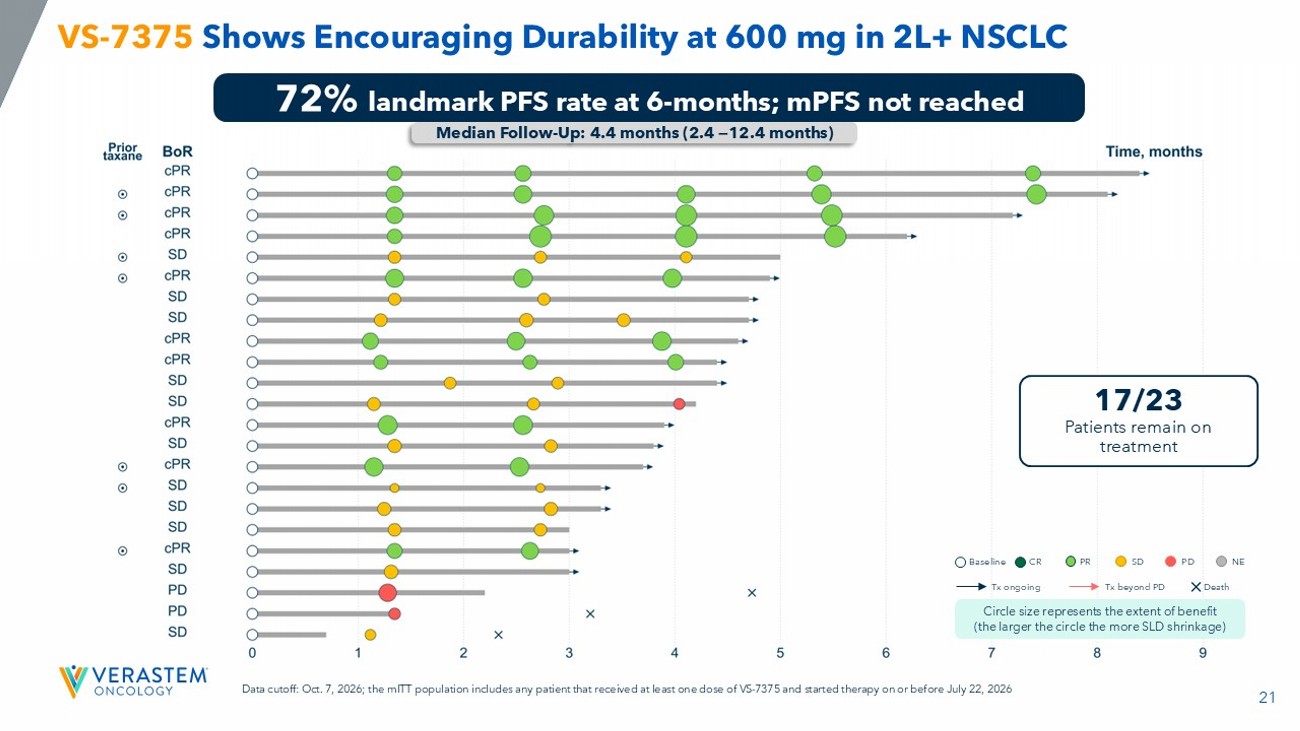
21 VS - 7375 Shows Encouraging Durability at 600 mg in 2L+ NSCLC 72% landmark PFS rate at 6 - months; mPFS not reached Median Follow - Up: 4.4 months (2.4 — 12.4 months) 17/23 Patients remain on treatment Baseline CR PR SD PD NE Tx ongoing Tx beyond PD Death Circle size represents the extent of benefit (the larger the circle the more SLD shrinkage) Data cutoff: Oct. 7, 2026; the mITT population includes any patient that received at least one dose of VS - 7375 and started therapy on or before July 22, 2026
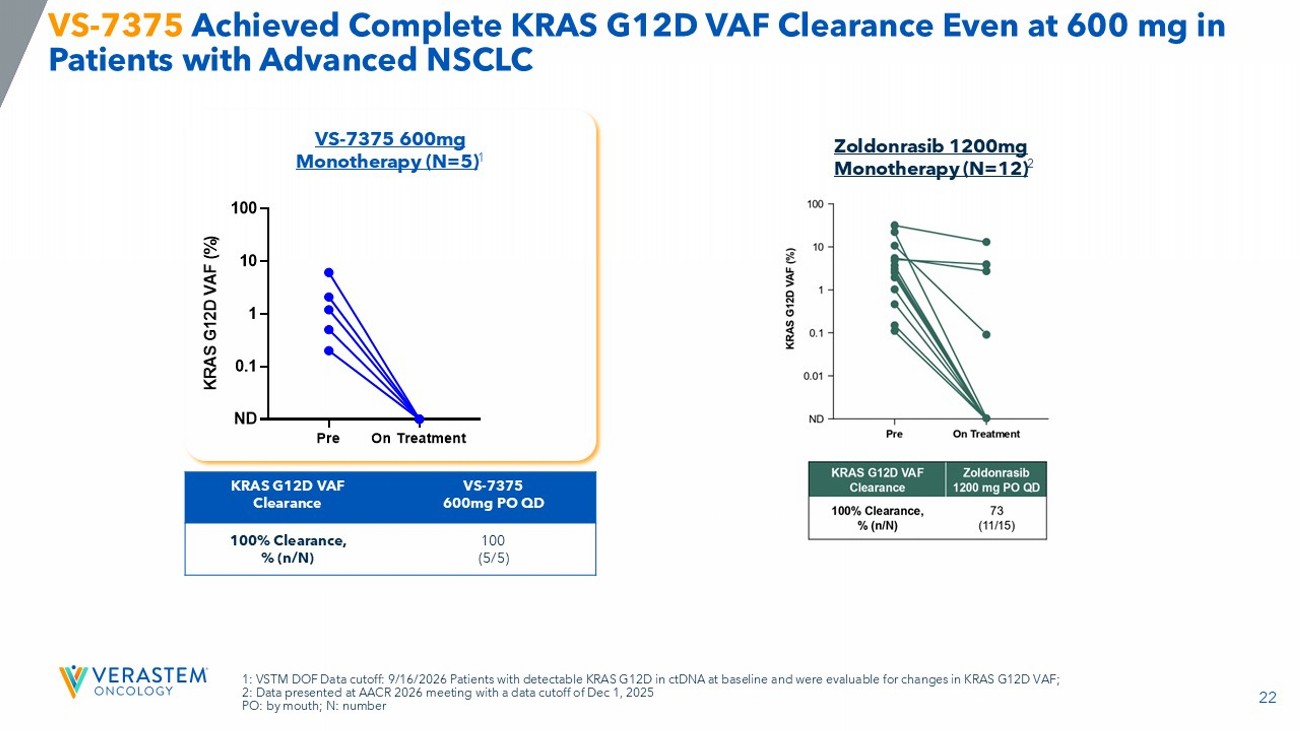
22 1: VSTM DOF Data cutoff: 9/16/2026 Patients with detectable KRAS G12D in ctDNA at baseline and were evaluable for changes in KRA S G12D VAF; 2: Data presented at AACR 2026 meeting with a data cutoff of Dec 1, 2025 PO: by mouth; N: number VS - 7375 Achieved Complete KRAS G12D VAF Clearance Even at 600 mg in Patients with Advanced NSCLC Pre On Treatment 0.1 1 10 100 K R A S G 1 2 D V A F ( % ) ND VS - 7375 600mg PO QD KRAS G12D VAF Clearance 100 (5/5) 100% Clearance, % (n/N) VS - 7375 600mg Monotherapy (N=5) 1 Zoldonrasib 1200mg Monotherapy (N=12) 2
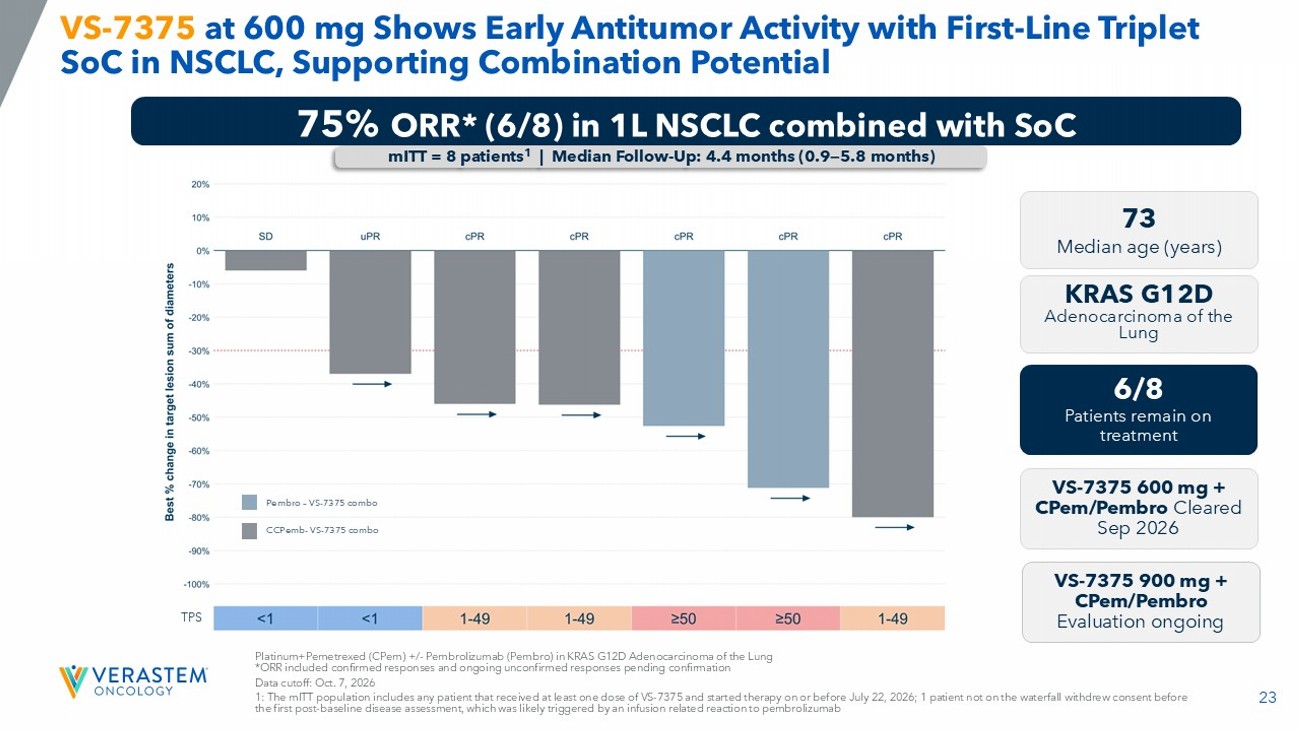
23 TPS VS - 7375 at 600 mg Shows Early Antitumor Activity with First - Line Triplet SoC in NSCLC, Supporting Combination Potential Platinum+Pemetrexed ( CPem ) +/ - Pembrolizumab ( Pembro ) in KRAS G12D Adenocarcinoma of the Lung *ORR included confirmed responses and ongoing unconfirmed responses pending confirmation Data cutoff: Oct. 7, 2026 1: The mITT population includes any patient that received at least one dose of VS - 7375 and started therapy on or before July 22, 2026; 1 pa tient not on the waterfall withdrew consent before the first post - baseline disease assessment, which was likely triggered by an infusion related reaction to pembrolizumab 75% ORR* (6/8) in 1L NSCLC combined with SoC mITT = 8 patients 1 | Median Follow - Up: 4.4 months (0.9 — 5.8 months) 73 Median age (years) 6/8 Patients remain on treatment VS - 7375 600 mg + CPem / Pembro Cleared Sep 2026 VS - 7375 900 mg + CPem/ Pembro Evaluation ongoing KRAS G12D Adenocarcinoma of the Lung Pembro – VS - 7375 combo CCPemb - VS - 7375 combo

Manuel Hidalgo Medina, MD, PHD Director of the Gastrointestinal Cancer Center at New York University (NYU) Langone Health and as a professor of medicine at NYU Grossman School of Medicine TARGET - D Investigator Disclosures All statements made and opinions expressed are solely my own and do not reflect the views of Verastem. You should not treat any such statement or opinion as a recommendation to make a particular investment or follow a particularly investment strategy. Expert Perspective: The Evolving RAS Treatment Landscape and the Potential Role of VS - 7375
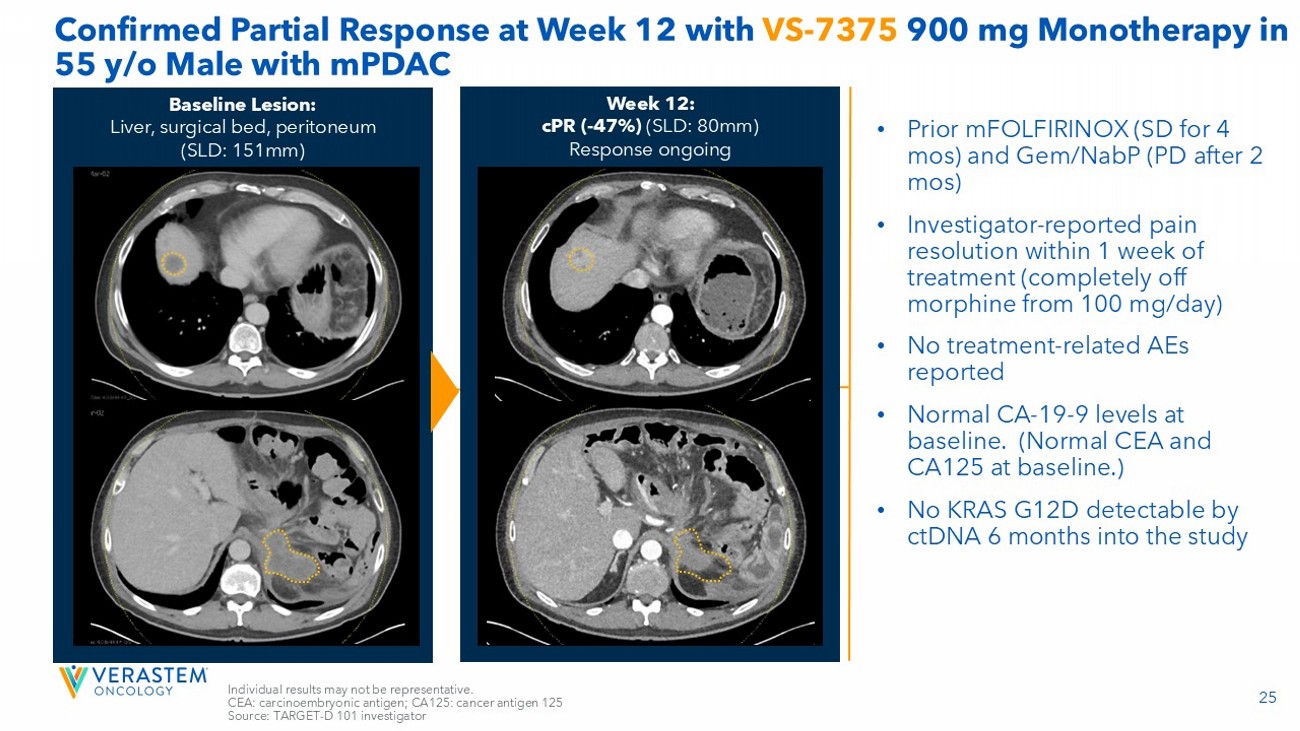
25 Confirmed Partial Response at Week 12 with VS - 7375 900 mg Monotherapy in 55 y/o Male with mPDAC • Prior mFOLFIRINOX (SD for 4 mos ) and Gem/NabP (PD after 2 mos ) • Investigator - reported pain resolution within 1 week of treatment (completely off morphine from 100 mg/day) • No treatment - related AEs reported • Normal CA - 19 - 9 levels at baseline. (Normal CEA and CA125 at baseline.) • No KRAS G12D detectable by ctDNA 6 months into the study Week 12: cPR ( - 47%) (SLD: 80mm) Response ongoing Baseline Lesion: Liver, surgical bed, peritoneum (SLD: 151mm) Individual results may not be representative. CEA: carcinoembryonic antigen; CA125: cancer antigen 125 Source: TARGET - D 101 investigator

Safety, Tolerability, and Combination Potential Ting - Hui Wu, MD Vice President of Development
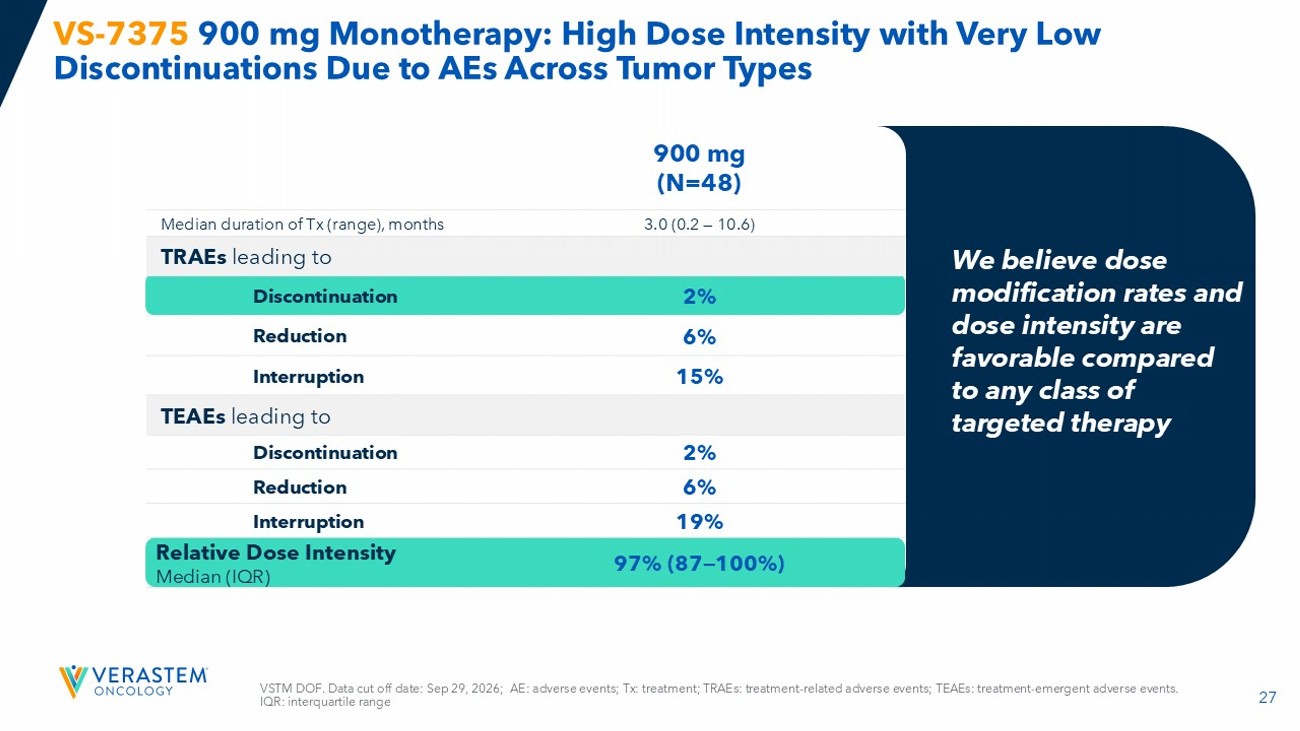
27 VSTM DOF. Data cut off date: Sep 29, 2026; AE: adverse events; Tx: treatment; TRAEs: treatment - related adverse events; TEAEs: treatment - emergent adverse events. IQR: interquartile range VS - 7375 900 mg Monotherapy: High Dose Intensity with Very Low Discontinuations Due to AEs Across Tumor Types 900 mg (N=48) 3.0 (0.2 — 10.6) Median duration of Tx (range), months TRAEs leading to 2% Discontinuation 6% Reduction 15% Interruption TEAEs leading to 2% Discontinuation 6% Reduction 19% Interruption 97% (87 — 100%) Relative Dose Intensity Median (IQR) We believe dose modification rates and dose intensity are favorable compared to any class of targeted therapy
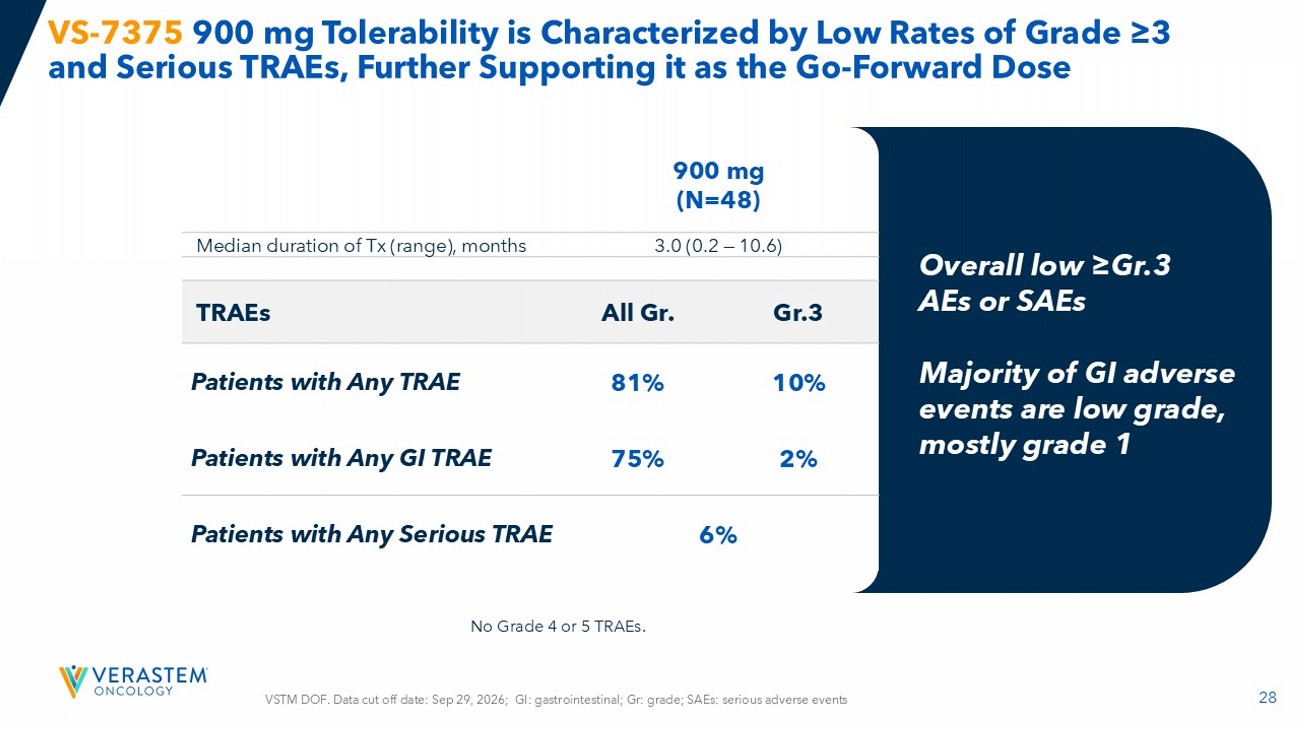
28 VS - 7375 900 mg Tolerability is Characterized by Low Rates of Grade ≥3 and Serious TRAEs, Further Supporting it as the Go - Forward Dose 900 mg (N=48) 3.0 (0.2 — 10.6) Median duration of Tx (range), months Gr.3 All Gr. TRAEs 10% 81% Patients with Any TRAE 2% 75% Patients with Any GI TRAE 6% Patients with Any Serious TRAE Overall low ≥Gr.3 AEs or SAEs Majority of GI adverse events are low grade, mostly grade 1 VSTM DOF. Data cut off date: Sep 29, 2026; GI: gastrointestinal; Gr: grade; SAEs: serious adverse events No Grade 4 or 5 TRAEs.
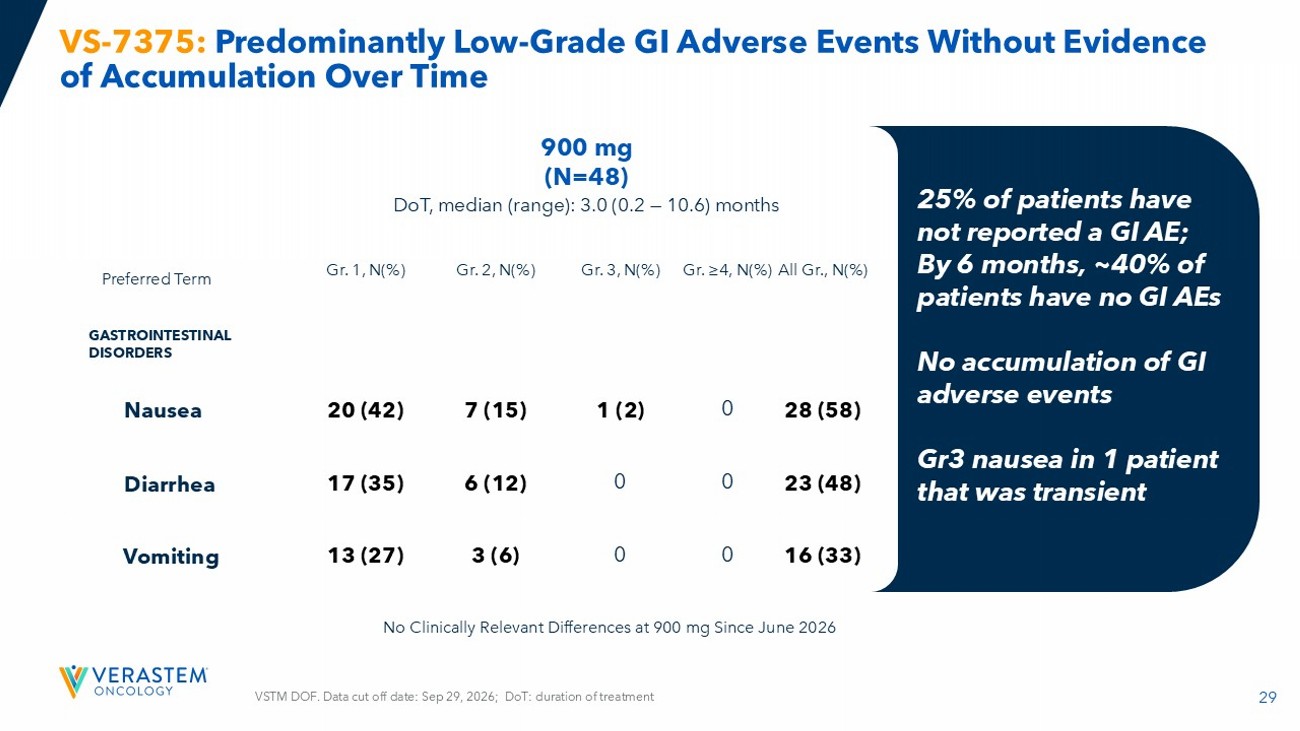
29 900 mg (N=48) DoT, median (range): 3.0 (0.2 — 10.6) months All Gr., N(%) Gr. ≥4, N(%) Gr. 3, N(%) Gr. 2, N(%) Gr. 1, N(%) Preferred Term GASTROINTESTINAL DISORDERS 28 (58) 0 1 (2) 7 (15) 20 (42) Nausea 23 (48) 0 0 6 (12) 17 (35) Diarrhea 16 (33) 0 0 3 (6) 13 (27) Vomiting VS - 7375: Predominantly Low - Grade GI Adverse Events Without Evidence of Accumulation Over Time 25% of patients have not reported a GI AE; By 6 months, ~40% of patients have no GI AEs No accumulation of GI adverse events Gr3 nausea in 1 patient that was transient No Clinically Relevant Differences at 900 mg Since June 2026 VSTM DOF. Data cut off date: Sep 29, 2026; DoT: duration of treatment
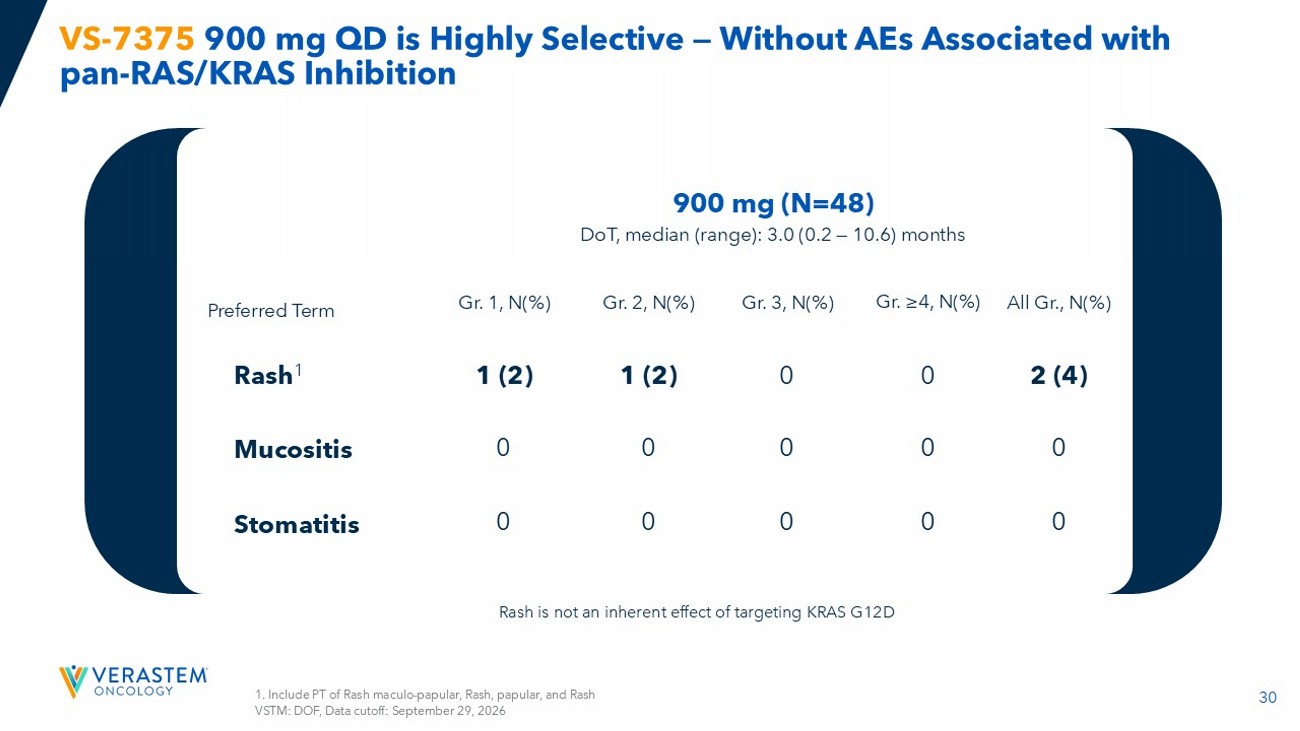
30 VS - 7375 900 mg QD is Highly Selective — Without AEs Associated with pan - RAS/KRAS Inhibition 1. Include PT of Rash maculo - papular, Rash, papular, and Rash VSTM: DOF, Data cutoff: September 29, 2026 900 mg (N=48) DoT, median (range): 3.0 (0.2 — 10.6) months All Gr., N(%) Gr. ≥4, N(%) Gr. 3, N(%) Gr. 2, N(%) Gr. 1, N(%) Preferred Term 2 (4) 0 0 1 (2) 1 (2) Rash 1 0 0 0 0 0 Mucositis 0 0 0 0 0 Stomatitis Rash is not an inherent effect of targeting KRAS G12D
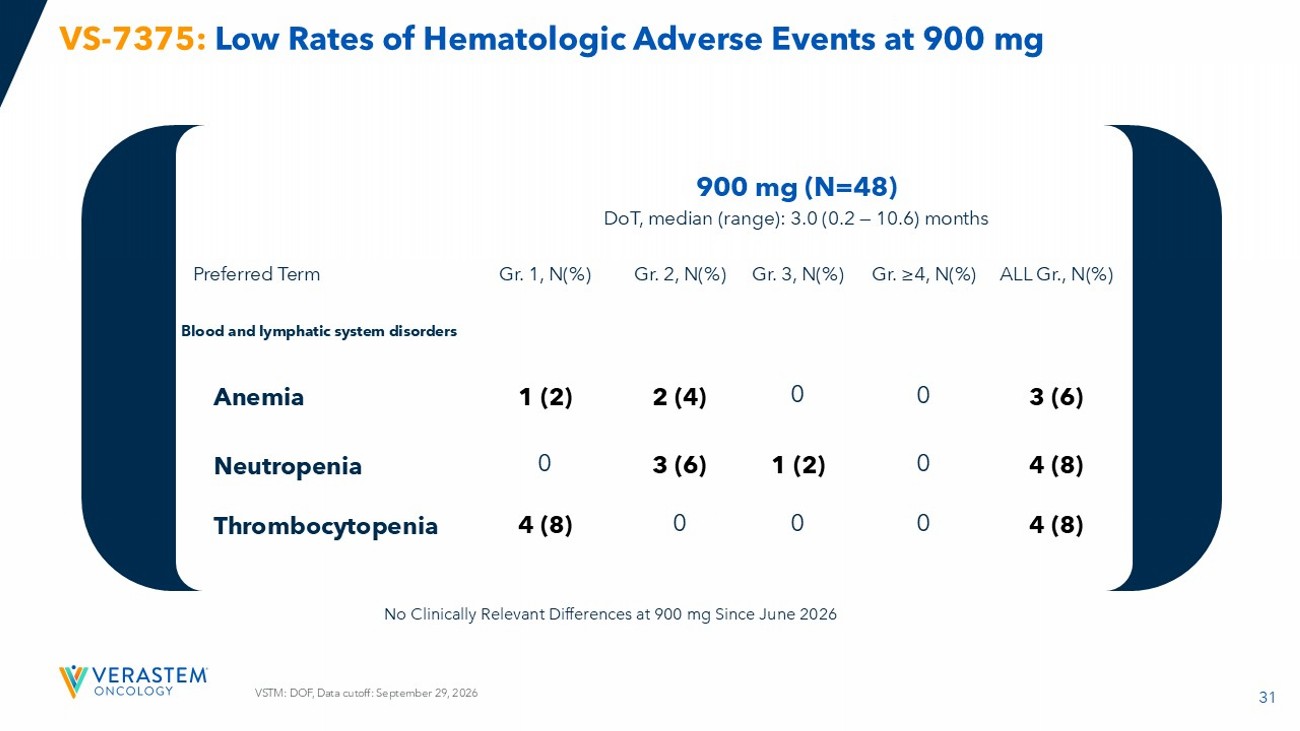
31 VS - 7375: Low Rates of Hematologic Adverse Events at 900 mg VSTM: DOF, Data cutoff: September 29, 2026 900 mg (N=48) DoT, median (range): 3.0 (0.2 — 10.6) months ALL Gr., N(%) Gr. ≥4, N(%) Gr. 3, N(%) Gr. 2, N(%) Gr. 1, N(%) Preferred Term Blood and lymphatic system disorders 3 (6) 0 0 2 (4) 1 (2) Anemia 4 (8) 0 1 (2) 3 (6) 0 Neutropenia 4 (8) 0 0 0 4 (8) Thrombocytopenia No Clinically Relevant Differences at 900 mg Since June 2026
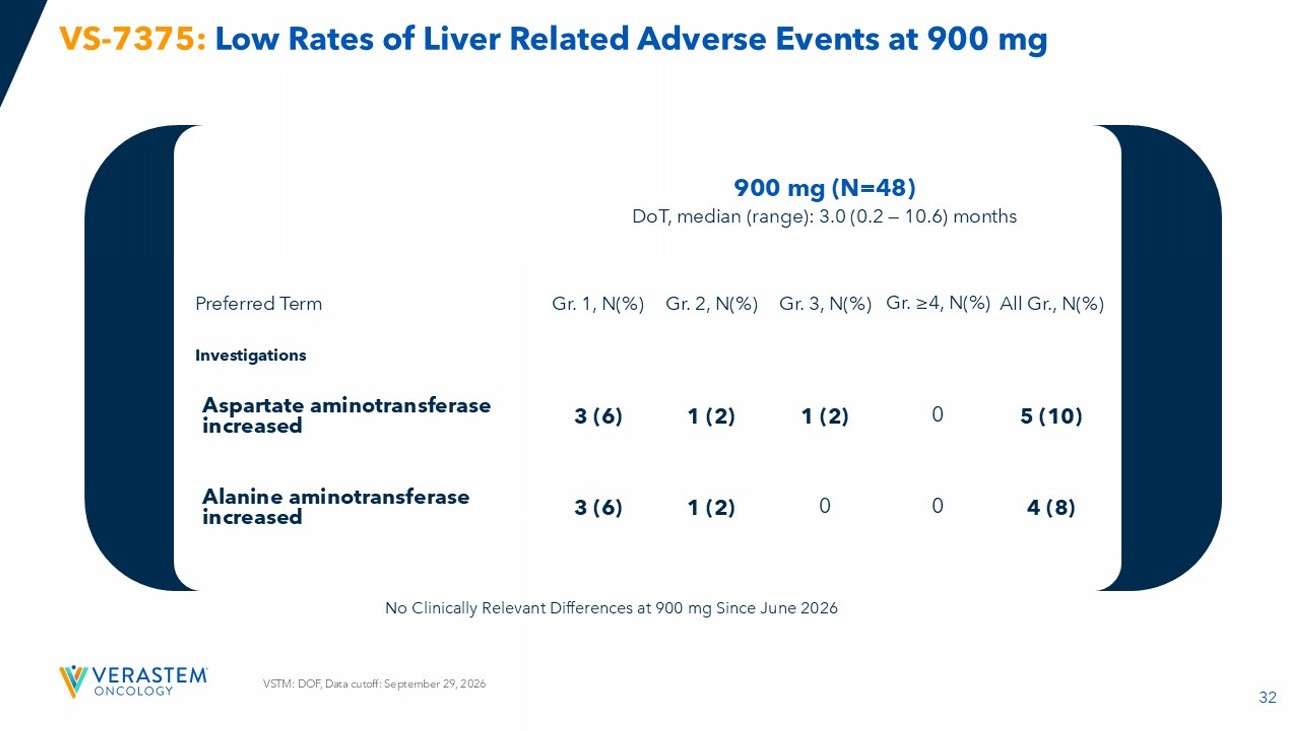
32 VS - 7375: Low Rates of Liver Related Adverse Events at 900 mg VSTM: DOF, Data cutoff: September 29, 2026 900 mg (N=48) DoT, median (range): 3.0 (0.2 — 10.6) months All Gr., N(%) Gr. ≥4, N(%) Gr. 3, N(%) Gr. 2, N(%) Gr. 1, N(%) Preferred Term Investigations 5 (10) 0 1 (2) 1 (2) 3 (6) Aspartate aminotransferase increased 4 (8) 0 0 1 (2) 3 (6) Alanine aminotransferase increased No Clinically Relevant Differences at 900 mg Since June 2026
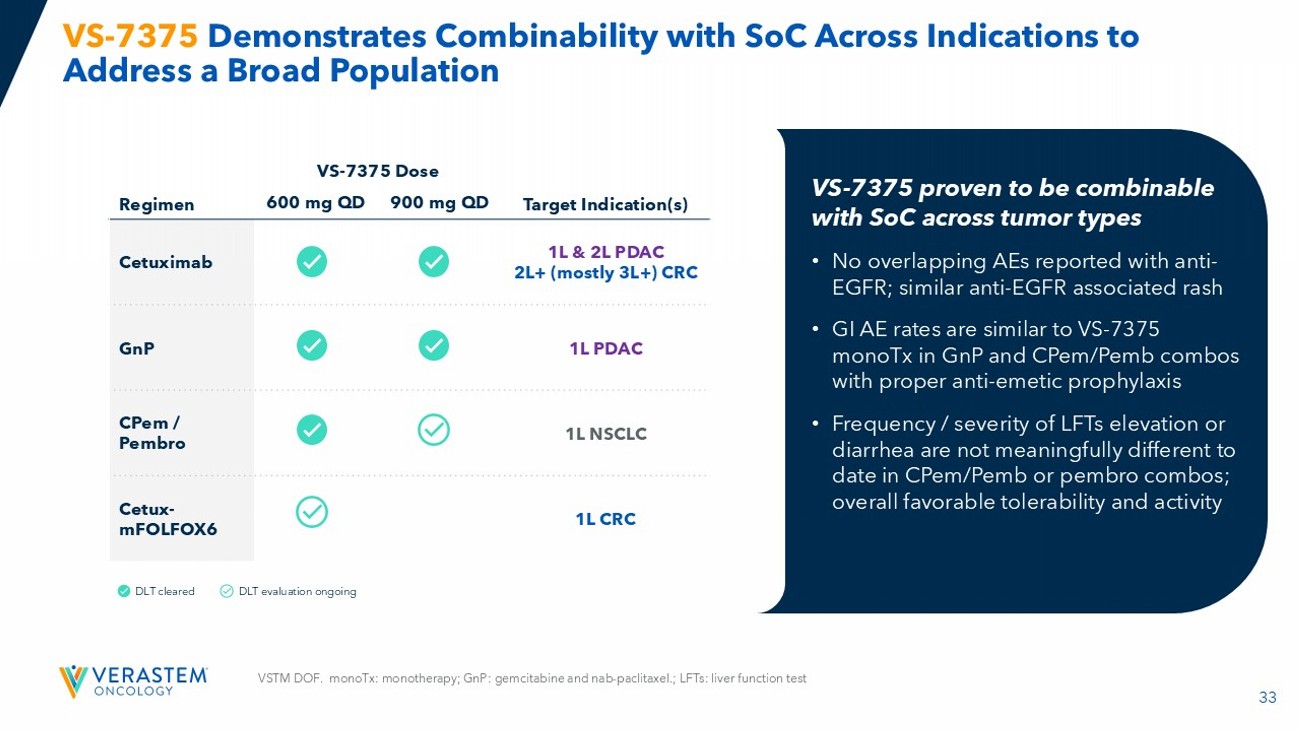
33 VS - 7375 Demonstrates Combinability with SoC Across Indications to Address a Broad Population Target Indication(s) VS - 7375 Dose Regimen 900 mg QD 600 mg QD 1L & 2L PDAC 2L+ (mostly 3L+) CRC Cetuximab 1L PDAC GnP 1L NSCLC CPem / Pembro 1L CRC Cetux - mFOLFOX6 DLT cleared DLT evaluation ongoing VS - 7375 proven to be combinable with SoC across tumor types • No overlapping AEs reported with anti - EGFR; similar anti - EGFR associated rash • GI AE rates are similar to VS - 7375 monoTx in GnP and CPem / Pemb combos with proper anti - emetic prophylaxis • Frequency / severity of LFTs elevation or diarrhea are not meaningfully different to date in CPem / Pemb or pembro combos; overall favorable tolerability and activity VSTM DOF. monoTx : monotherapy; GnP : gemcitabine and nab - paclitaxel.; LFTs: liver function test
Path Forward: PDAC Phase 3 Trial Design & FDA Feedback, Data Summary Michael G. Kauffman, MD, PhD President of Development
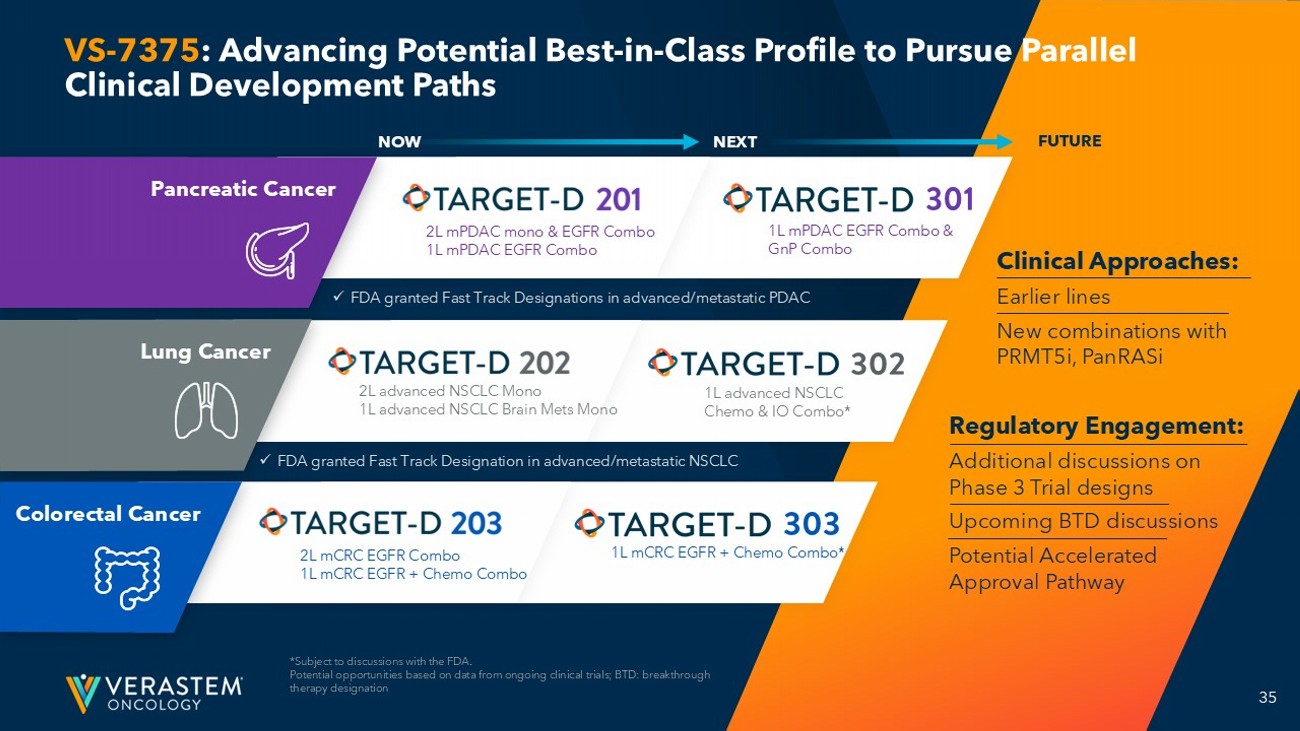
35 1L advanced NSCLC Chemo & IO Combo* 1L mCRC EGFR + Chemo Combo* 1L mPDAC EGFR Combo & GnP Combo NEXT VS - 7375 : Advancing Potential Best - in - Class Profile to Pursue Parallel Clinical Development Paths *Subject to discussions with the FDA. Potential opportunities based on data from ongoing clinical trials; BTD: breakthrough therapy designation x FDA granted Fast Track Designations in advanced/metastatic PDAC 2L advanced NSCLC Mono 1L advanced NSCLC Brain Mets Mono 2L mCRC EGFR Combo 1L mCRC EGFR + Chemo Combo 2L mPDAC mono & EGFR Combo 1L mPDAC EGFR Combo Pancreatic Cancer Lung Cancer Colorectal Cancer x FDA granted Fast Track Designation in advanced/metastatic NSCLC Clinical Approaches: Earlier lines New combinations with PRMT5i, PanRASi Regulatory Engagement: Additional d iscussions on Phase 3 Trial d esigns Upcoming BTD discussions Potential Accelerated Approval Pathway FUTURE NOW
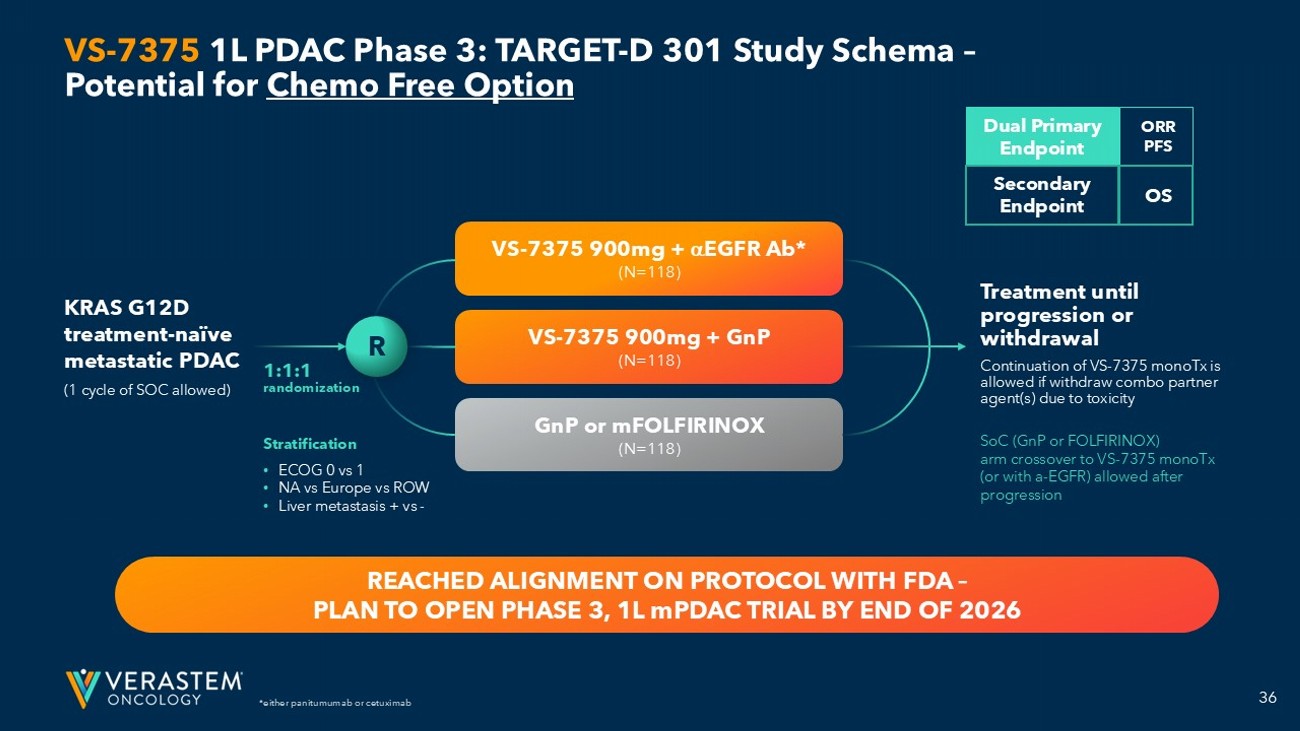
36 ORR PFS *either panitumumab or cetuximab VS - 7375 1L PDAC Phase 3: TARGET - D 301 Study Schema – Potential for Chemo Free Option 1:1:1 randomization Stratification • ECOG 0 vs 1 • NA vs Europe vs ROW • Liver metastasis + vs - SoC (GnP or FOLFIRINOX) arm crossover to VS - 7375 monoTx (or with a - EGFR) allowed after progression Dual Primary Endpoint Secondary Endpoint OS VS - 7375 900mg + EGFR Ab* (N=118) VS - 7375 900mg + GnP (N=118) GnP or mFOLFIRINOX (N=118) R Treatment until progression or withdrawal Continuation of VS - 7375 monoTx is allowed if withdraw combo partner agent(s) due to toxicity KRAS G12D treatment - naïve metastatic PDAC (1 cycle of SOC allowed) REACHED ALIGNMENT ON PROTOCOL WITH FDA – PLAN TO OPEN PHASE 3, 1L mPDAC TRIAL BY END OF 2026
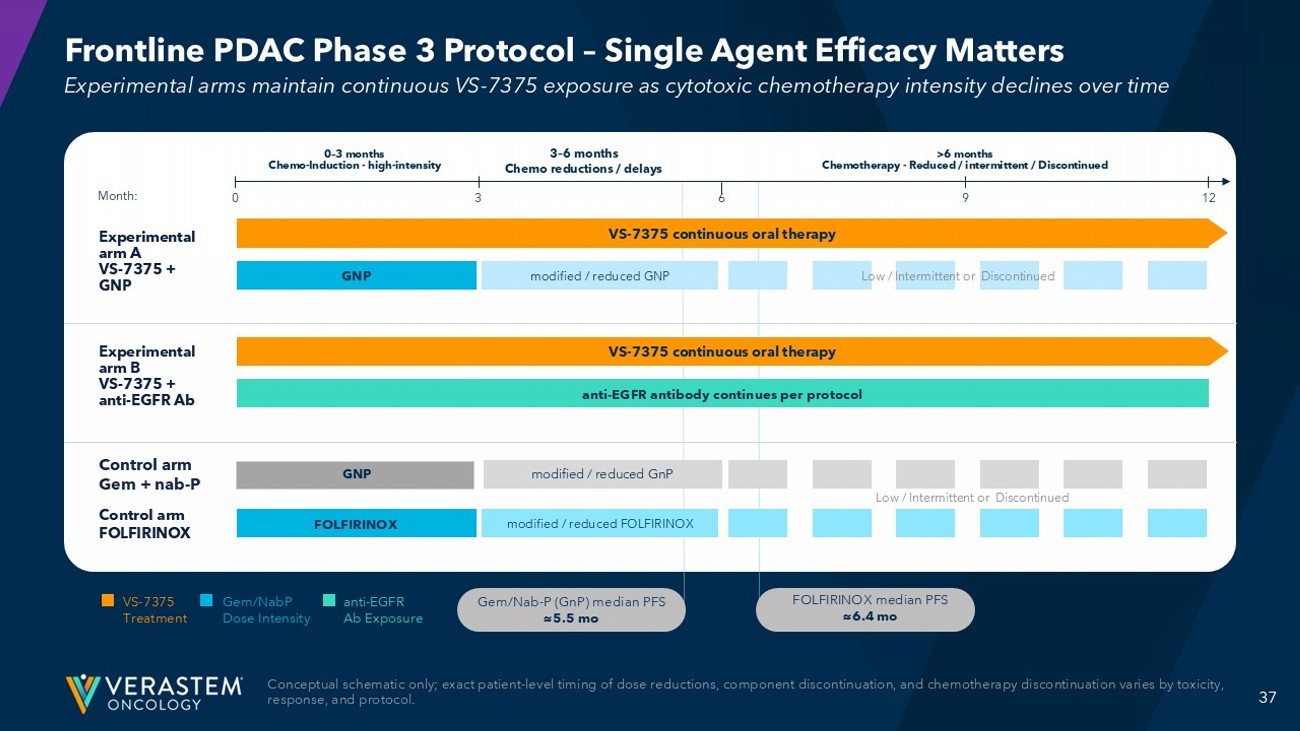
37 Frontline PDAC Phase 3 Protocol – Single Agent Efficacy Matters Conceptual schematic only; exact patient - level timing of dose reductions, component discontinuation, and chemotherapy discontinu ation varies by toxicity, response, and protocol. Experimental arms maintain continuous VS - 7375 exposure as cytotoxic chemotherapy intensity declines over time Month: 0 3 6 9 12 0 – 3 months Chemo - Induction - high - intensity 3 – 6 months Chemo reductions / delays >6 months Chemotherapy - Reduced / intermittent / Discontinued Experimental arm A VS - 7375 + GNP Experimental arm B VS - 7375 + anti - EGFR Ab Control arm FOLFIRINOX VS - 7375 continuous oral therapy GNP modified / reduced GNP Low / Intermittent or Discontinued VS - 7375 continuous oral therapy anti - EGFR antibody continues per protocol FOLFIRINOX modified / reduced FOLFIRINOX VS - 7375 Treatment Gem/NabP Dose Intensity anti - EGFR Ab Exposure Gem/Nab - P ( GnP ) median PFS ≈5.5 mo Control arm Gem + nab - P GNP modified / reduced GnP Low / Intermittent or Discontinued FOLFIRINOX median PFS ≈6.4 mo
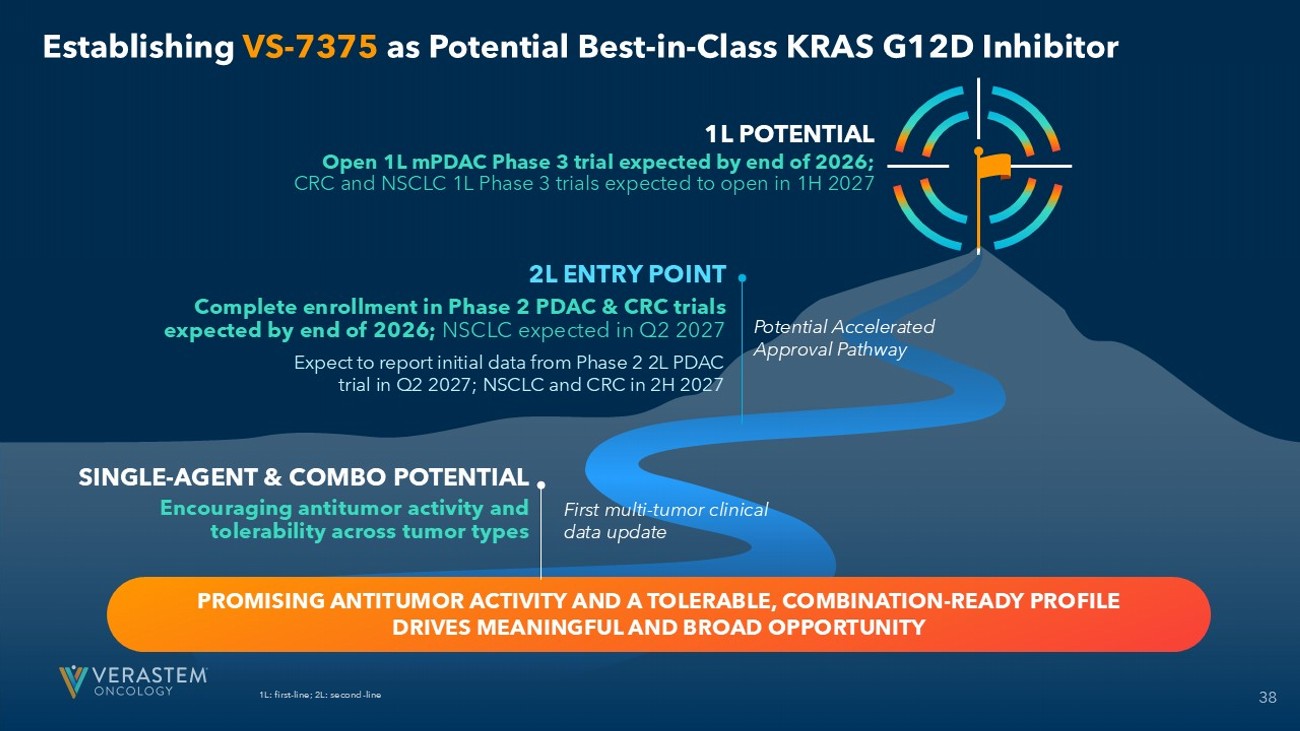
38 Establishing VS - 7375 as Potential Best - in - Class KRAS G12D Inhibitor 1L: first - line; 2L: second - line PROMISING ANTITUMOR ACTIVITY AND A TOLERABLE, COMBINATION - READY PROFILE DRIVES MEANINGFUL AND BROAD OPPORTUNITY 1L POTENTIAL Open 1L mPDAC Phase 3 trial expected by end of 2026; CRC and NSCLC 1L Phase 3 trials expected to open in 1H 2027 2L ENTRY POINT Complete enrollment in Phase 2 PDAC & CRC trials expected by end of 2026; NSCLC expected in Q2 2027 SINGLE - AGENT & COMBO POTENTIAL Encouraging antitumor activity and tolerability across tumor types Potential Accelerated Approval Pathway Expect to report initial data from Phase 2 2L PDAC trial in Q2 2027; NSCLC and CRC in 2H 2027 First multi - tumor clinical data update

Addendum
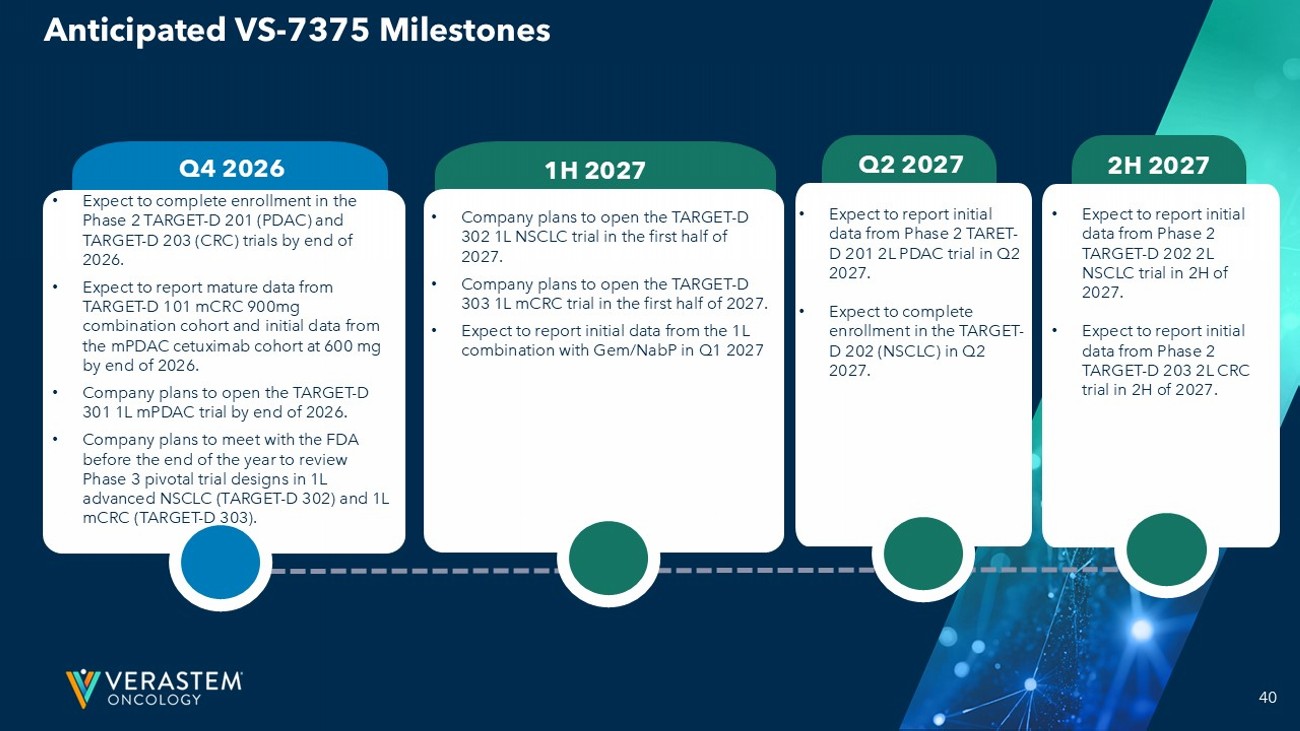
40 • Expect to complete enrollment in the Phase 2 TARGET - D 201 (PDAC) and TARGET - D 203 (CRC) trials by end of 2026. • Expect to report mature data from TARGET - D 101 mCRC 900mg combination cohort and initial data from the mPDAC cetuximab cohort at 600 mg by end of 2026. • Company plans to open the TARGET - D 301 1L mPDAC trial by end of 2026. • Company plans to meet with the FDA before the end of the year to review Phase 3 pivotal trial designs in 1L advanced NSCLC (TARGET - D 302) and 1L mCRC (TARGET - D 303). Q4 2026 • Expect to report initial data from Phase 2 TARET - D 201 2L PDAC trial in Q2 2027. • Expect to complete enrollment in the TARGET - D 202 (NSCLC) in Q2 2027. 1H 2027 Q2 2027 2H 2027 • Expect to report initial data from Phase 2 TARGET - D 202 2L NSCLC trial in 2H of 2027. • Expect to report initial data from Phase 2 TARGET - D 203 2L CRC trial in 2H of 2027. • Company plans to open the TARGET - D 302 1L NSCLC trial in the first half of 2027. • Company plans to open the TARGET - D 303 1L mCRC trial in the first half of 2027. • Expect to report initial data from the 1L combination with Gem/NabP in Q1 2027 Anticipated VS - 7375 Milestones
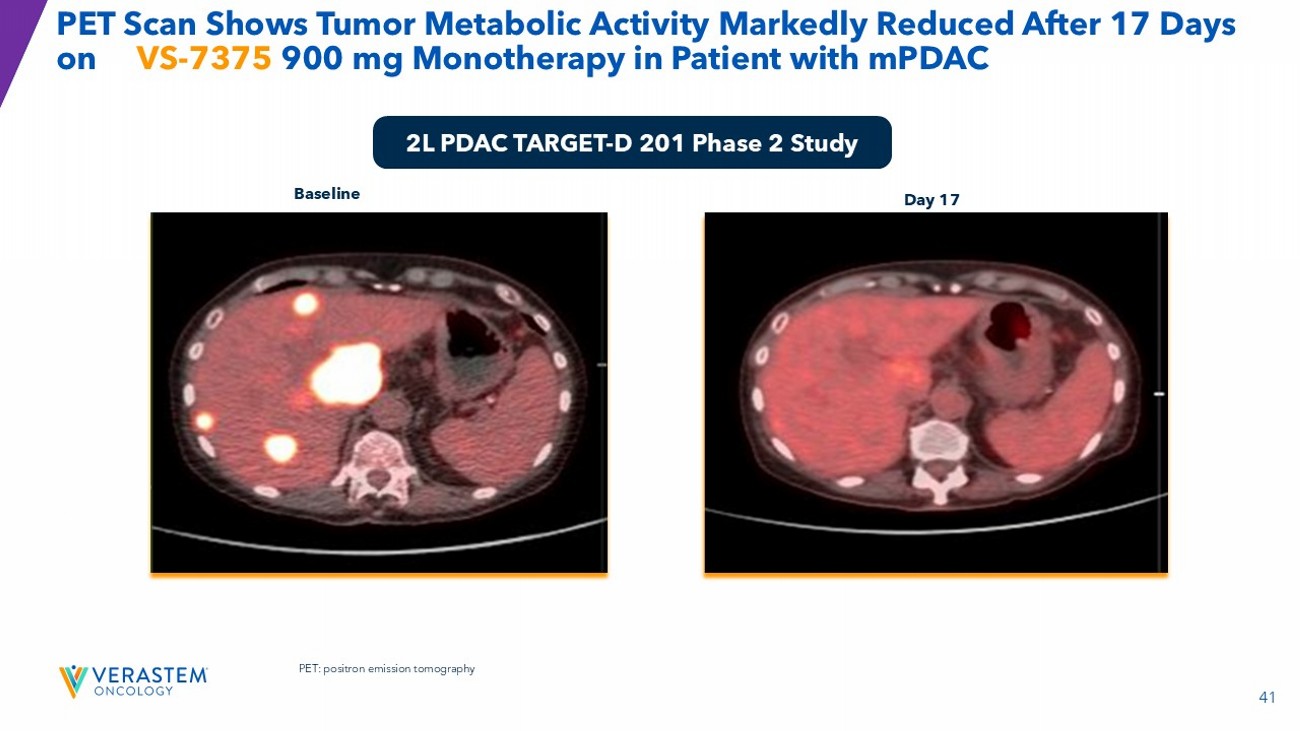
41 Baseline Day 17 PET Scan Shows Tumor Metabolic Activity Markedly Reduced After 17 Days on VS - 7375 900 mg Monotherapy in Patient with mPDAC 2L PDAC TARGET - D 201 Phase 2 Study PET: positron emission tomography
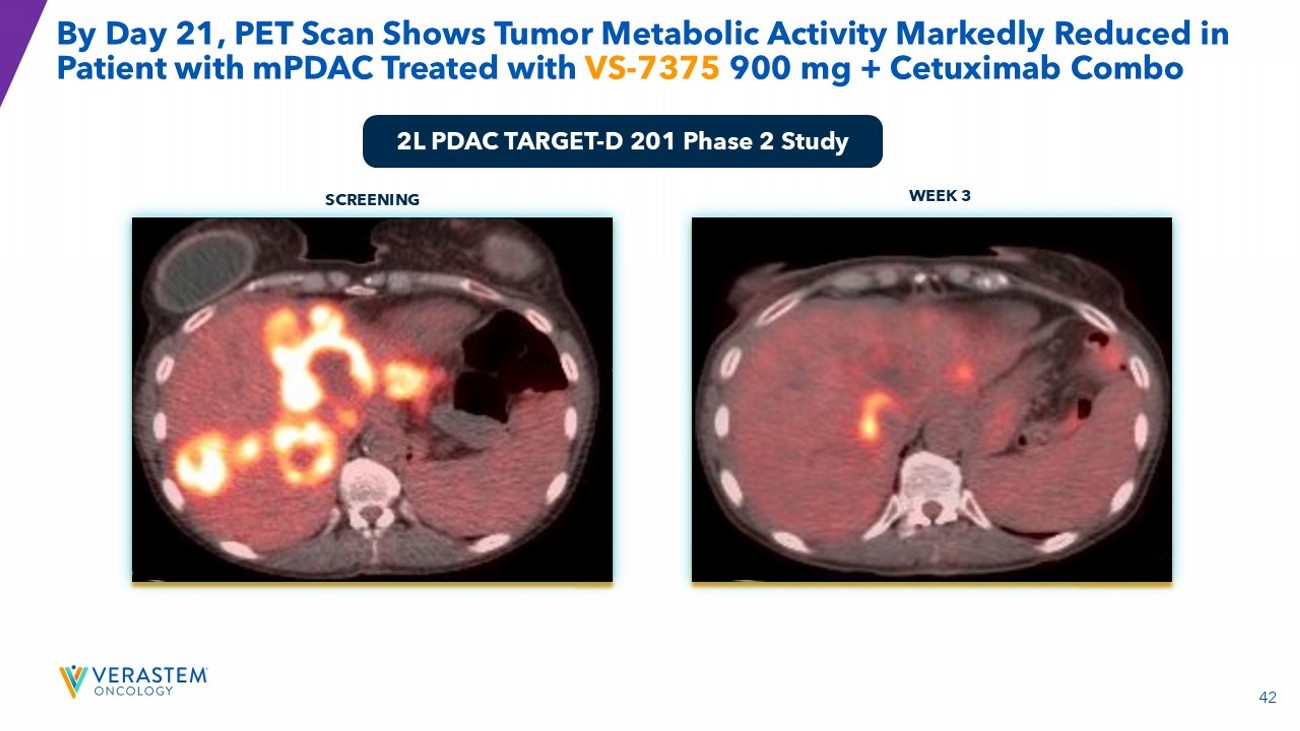
42 SCREENING WEEK 3 By Day 21, PET Scan Shows Tumor Metabolic Activity Markedly Reduced in Patient with mPDAC Treated with VS - 7375 900 mg + Cetuximab Combo 2L PDAC TARGET - D 201 Phase 2 Study
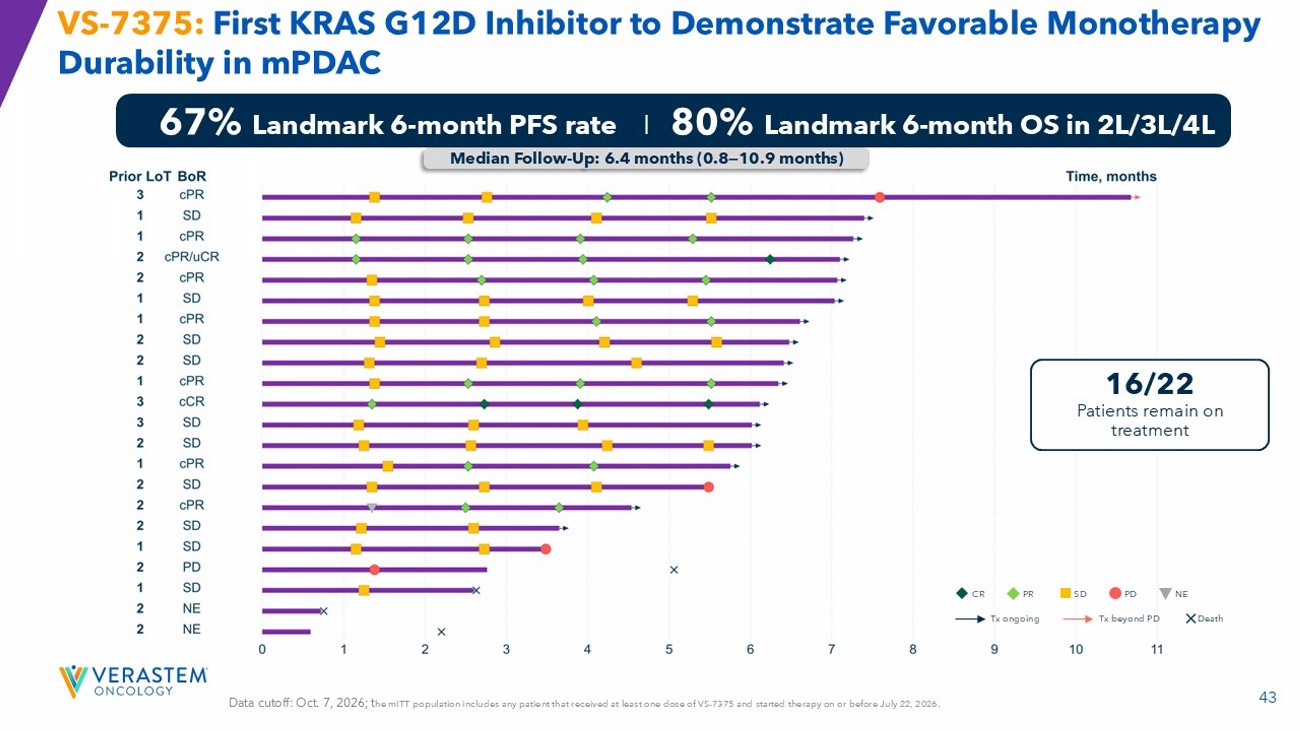
43 VS - 7375: First KRAS G12D Inhibitor to Demonstrate Favorable Monotherapy Durability in mPDAC 67% Landmark 6 - month PFS rate I 80% Landmark 6 - month OS in 2L/3L/4L Data cutoff: Oct. 7, 2026; t he mITT population includes any patient that received at least one dose of VS - 7375 and started therapy on or before July 22, 2026. Median Follow - Up: 6.4 months (0.8 — 10.9 months) 16/22 Patients remain on treatment CR PR SD PD NE Tx ongoing Tx beyond PD Death
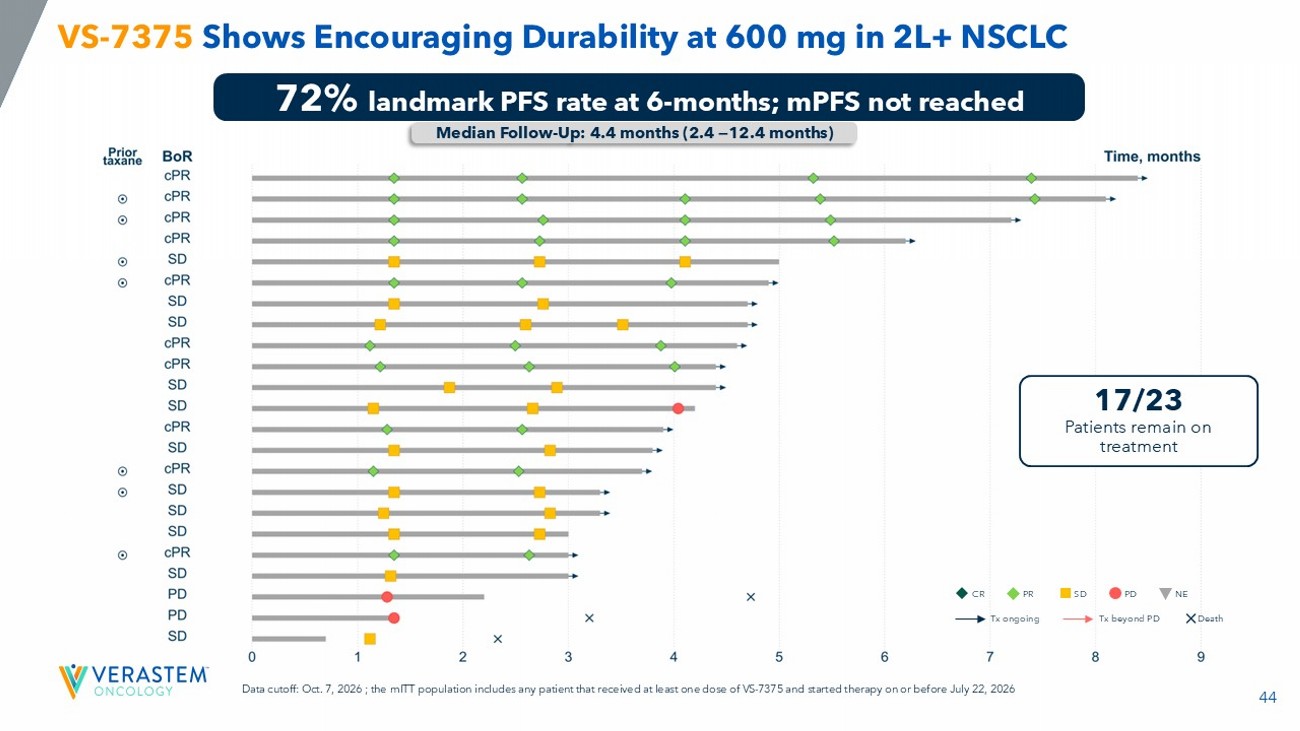
44 VS - 7375 Shows Encouraging Durability at 600 mg in 2L+ NSCLC 72% landmark PFS rate at 6 - months; mPFS not reached Median Follow - Up: 4.4 months (2.4 — 12.4 months) Data cutoff: Oct. 7, 2026; the mITT population includes any patient that received at least one dose of VS - 7375 and started therapy on or before July 22, 2026 17/23 Patients remain on treatment CR PR SD PD NE Tx ongoing Tx beyond PD Death
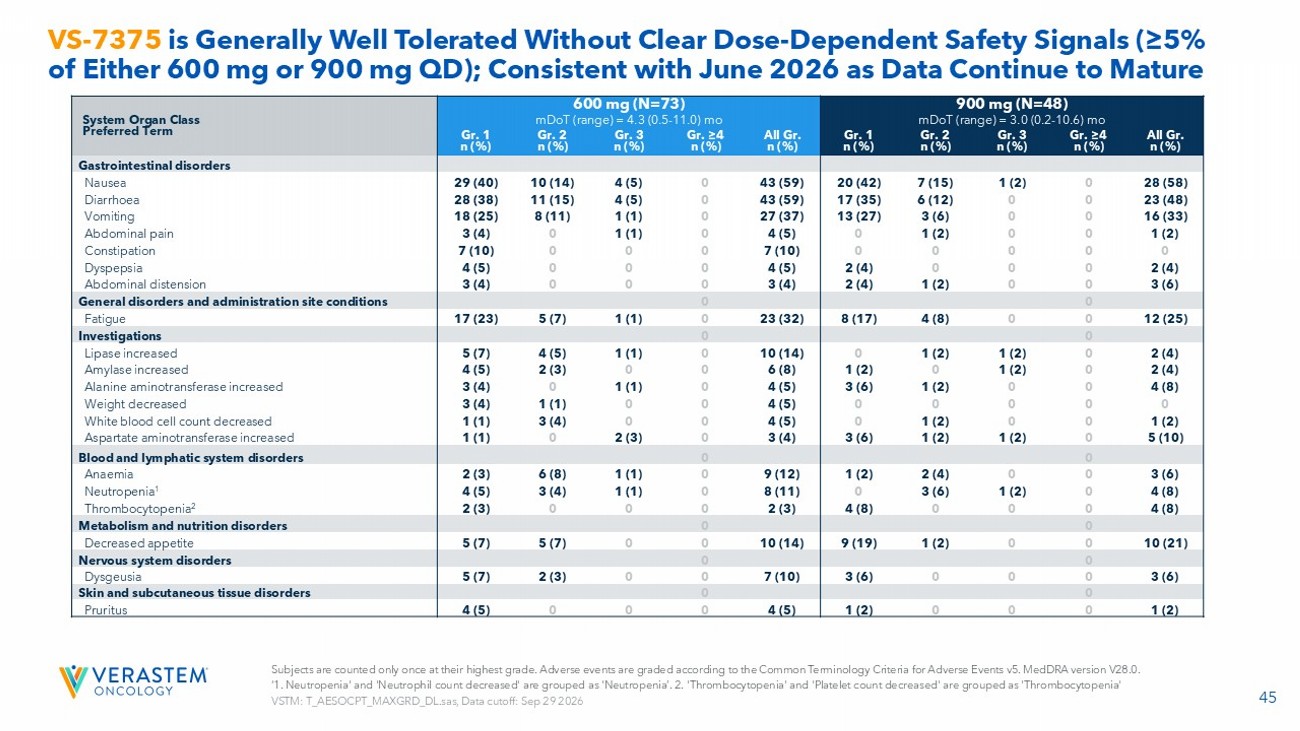
45 VS - 7375 is Generally Well Tolerated Without Clear Dose - Dependent Safety Signals (≥5% of Either 600 mg or 900 mg QD); Consistent with June 2026 as Data Continue to Mature 900 mg (N=48) 600 mg (N=73) System Organ Class Preferred Term mDoT (range) = 3.0 (0.2 - 10.6) mo mDoT (range) = 4.3 (0.5 - 11.0) mo All Gr. n (%) Gr. ≥4 n (%) Gr. 3 n (%) Gr. 2 n (%) Gr. 1 n (%) All Gr. n (%) Gr. ≥4 n (%) Gr. 3 n (%) Gr. 2 n (%) Gr. 1 n (%) Gastrointestinal disorders 28 (58) 0 1 (2) 7 (15) 20 (42) 43 (59) 0 4 (5) 10 (14) 29 (40) Nausea 23 (48) 0 0 6 (12) 17 (35) 43 (59) 0 4 (5) 11 (15) 28 (38) Diarrhoea 16 (33) 0 0 3 (6) 13 (27) 27 (37) 0 1 (1) 8 (11) 18 (25) Vomiting 1 (2) 0 0 1 (2) 0 4 (5) 0 1 (1) 0 3 (4) Abdominal pain 0 0 0 0 0 7 (10) 0 0 0 7 (10) Constipation 2 (4) 0 0 0 2 (4) 4 (5) 0 0 0 4 (5) Dyspepsia 3 (6) 0 0 1 (2) 2 (4) 3 (4) 0 0 0 3 (4) Abdominal distension 0 0 General disorders and administration site conditions 12 (25) 0 0 4 (8) 8 (17) 23 (32) 0 1 (1) 5 (7) 17 (23) Fatigue 0 0 Investigations 2 (4) 0 1 (2) 1 (2) 0 10 (14) 0 1 (1) 4 (5) 5 (7) Lipase increased 2 (4) 0 1 (2) 0 1 (2) 6 (8) 0 0 2 (3) 4 (5) Amylase increased 4 (8) 0 0 1 (2) 3 (6) 4 (5) 0 1 (1) 0 3 (4) Alanine aminotransferase increased 0 0 0 0 0 4 (5) 0 0 1 (1) 3 (4) Weight decreased 1 (2) 0 0 1 (2) 0 4 (5) 0 0 3 (4) 1 (1) White blood cell count decreased 5 (10) 0 1 (2) 1 (2) 3 (6) 3 (4) 0 2 (3) 0 1 (1) Aspartate aminotransferase increased 0 0 Blood and lymphatic system disorders 3 (6) 0 0 2 (4) 1 (2) 9 (12) 0 1 (1) 6 (8) 2 (3) Anaemia 4 (8) 0 1 (2) 3 (6) 0 8 (11) 0 1 (1) 3 (4) 4 (5) Neutropenia 1 4 (8) 0 0 0 4 (8) 2 (3) 0 0 0 2 (3) Thrombocytopenia 2 0 0 Metabolism and nutrition disorders 10 (21) 0 0 1 (2) 9 (19) 10 (14) 0 0 5 (7) 5 (7) Decreased appetite 0 0 Nervous system disorders 3 (6) 0 0 0 3 (6) 7 (10) 0 0 2 (3) 5 (7) Dysgeusia 0 0 Skin and subcutaneous tissue disorders 1 (2) 0 0 0 1 (2) 4 (5) 0 0 0 4 (5) Pruritus Subjects are counted only once at their highest grade. Adverse events are graded according to the Common Terminology Criteria fo r Adverse Events v5. MedDRA version V28.0. ‘1. Neutropenia' and 'Neutrophil count decreased' are grouped as 'Neutropenia’. 2. 'Thrombocytopenia' and 'Platelet count dec rea sed' are grouped as 'Thrombocytopenia' VSTM: T_AESOCPT_MAXGRD_DL.sas , Data cutoff: Sep 29 2026
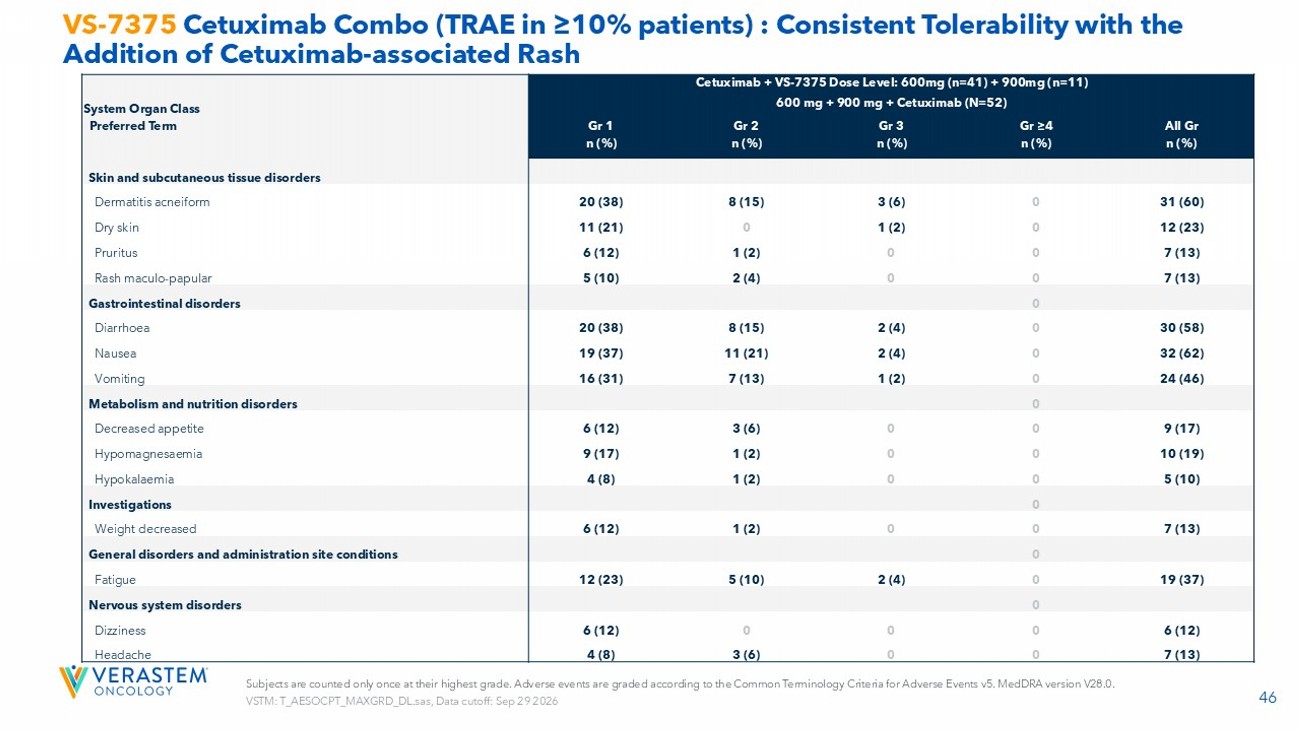
46 VS - 7375 Cetuximab Combo (TRAE in ≥10% patients) : Consistent Tolerability with the Addition of Cetuximab - associated Rash Subjects are counted only once at their highest grade. Adverse events are graded according to the Common Terminology Criteria fo r Adverse Events v5. MedDRA version V28.0. VSTM: T_AESOCPT_MAXGRD_DL.sas , Data cutoff: Sep 29 2026 Cetuximab + VS - 7375 Dose Level: 600mg (n=41) + 900mg (n=11) 600 mg + 900 mg + Cetuximab (N=52) System Organ Class Preferred Term All Gr n (%) Gr ≥4 n (%) Gr 3 n (%) Gr 2 n (%) Gr 1 n (%) Skin and subcutaneous tissue disorders 31 (60) 0 3 (6) 8 (15) 20 (38) Dermatitis acneiform 12 (23) 0 1 (2) 0 11 (21) Dry skin 7 (13) 0 0 1 (2) 6 (12) Pruritus 7 (13) 0 0 2 (4) 5 (10) Rash maculo - papular 0 Gastrointestinal disorders 30 (58) 0 2 (4) 8 (15) 20 (38) Diarrhoea 32 (62) 0 2 (4) 11 (21) 19 (37) Nausea 24 (46) 0 1 (2) 7 (13) 16 (31) Vomiting 0 Metabolism and nutrition disorders 9 (17) 0 0 3 (6) 6 (12) Decreased appetite 10 (19) 0 0 1 (2) 9 (17) Hypomagnesaemia 5 (10) 0 0 1 (2) 4 (8) Hypokalaemia 0 Investigations 7 (13) 0 0 1 (2) 6 (12) Weight decreased 0 General disorders and administration site conditions 19 (37) 0 2 (4) 5 (10) 12 (23) Fatigue 0 Nervous system disorders 6 (12) 0 0 0 6 (12) Dizziness 7 (13) 0 0 3 (6) 4 (8) Headache
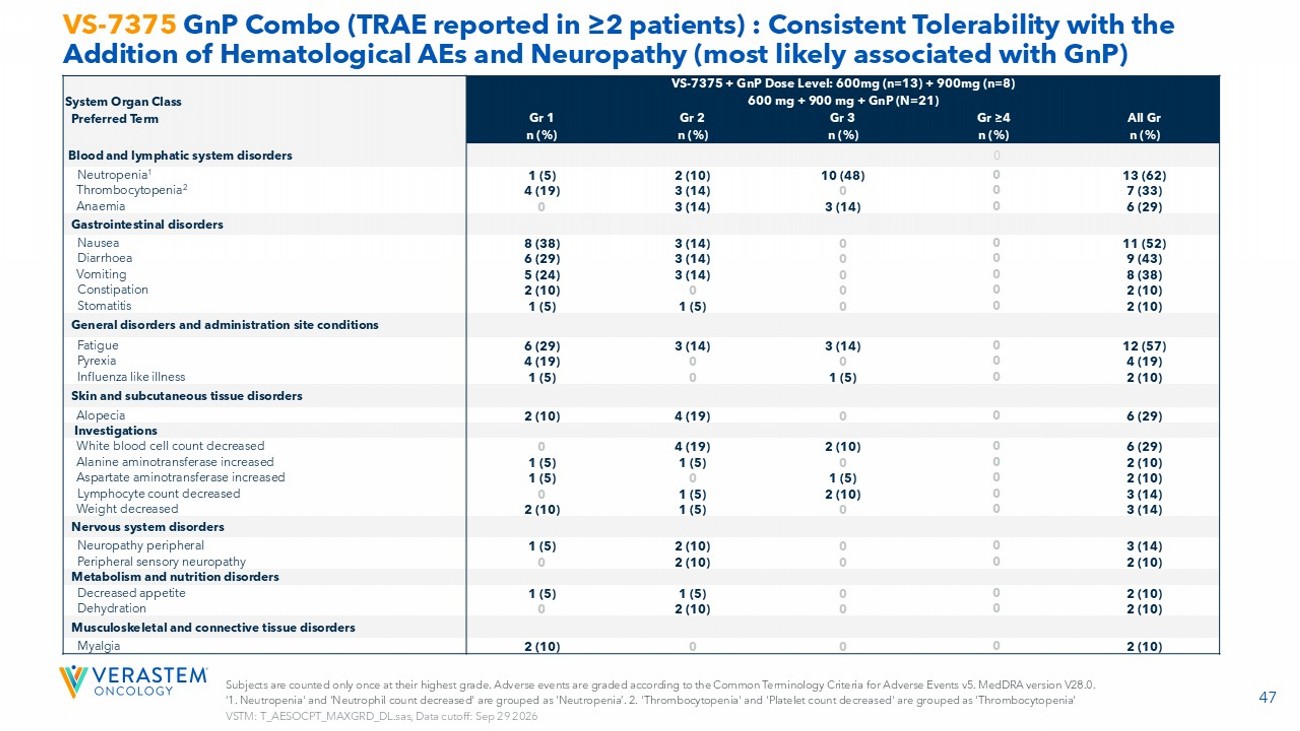
47 VS - 7375 GnP Combo (TRAE reported in ≥2 patients) : Consistent Tolerability with the Addition of Hematological AEs and Neuropathy (most likely associated with GnP ) Subjects are counted only once at their highest grade. Adverse events are graded according to the Common Terminology Criteria fo r Adverse Events v5. MedDRA version V28.0. ‘1. Neutropenia' and 'Neutrophil count decreased' are grouped as 'Neutropenia’. 2. 'Thrombocytopenia' and 'Platelet count dec rea sed' are grouped as 'Thrombocytopenia' VSTM: T_AESOCPT_MAXGRD_DL.sas , Data cutoff: Sep 29 2026 VS - 7375 + GnP Dose Level: 600mg (n=13) + 900mg (n=8) 600 mg + 900 mg + GnP (N=21) System Organ Class Preferred Term All Gr n (%) Gr ≥4 n (%) Gr 3 n (%) Gr 2 n (%) Gr 1 n (%) 0 Blood and lymphatic system disorders 13 (62) 0 10 (48) 2 (10) 1 (5) Neutropenia 1 7 (33) 0 0 3 (14) 4 (19) Thrombocytopenia 2 6 (29) 0 3 (14) 3 (14) 0 Anaemia Gastrointestinal disorders 11 (52) 0 0 3 (14) 8 (38) Nausea 9 (43) 0 0 3 (14) 6 (29) Diarrhoea 8 (38) 0 0 3 (14) 5 (24) Vomiting 2 (10) 0 0 0 2 (10) Constipation 2 (10) 0 0 1 (5) 1 (5) Stomatitis General disorders and administration site conditions 12 (57) 0 3 (14) 3 (14) 6 (29) Fatigue 4 (19) 0 0 0 4 (19) Pyrexia 2 (10) 0 1 (5) 0 1 (5) Influenza like illness Skin and subcutaneous tissue disorders 6 (29) 0 0 4 (19) 2 (10) Alopecia Investigations 6 (29) 0 2 (10) 4 (19) 0 White blood cell count decreased 2 (10) 0 0 1 (5) 1 (5) Alanine aminotransferase increased 2 (10) 0 1 (5) 0 1 (5) Aspartate aminotransferase increased 3 (14) 0 2 (10) 1 (5) 0 Lymphocyte count decreased 3 (14) 0 0 1 (5) 2 (10) Weight decreased Nervous system disorders 3 (14) 0 0 2 (10) 1 (5) Neuropathy peripheral 2 (10) 0 0 2 (10) 0 Peripheral sensory neuropathy Metabolism and nutrition disorders 2 (10) 0 0 1 (5) 1 (5) Decreased appetite 2 (10) 0 0 2 (10) 0 Dehydration Musculoskeletal and connective tissue disorders 2 (10) 0 0 0 2 (10) Myalgia
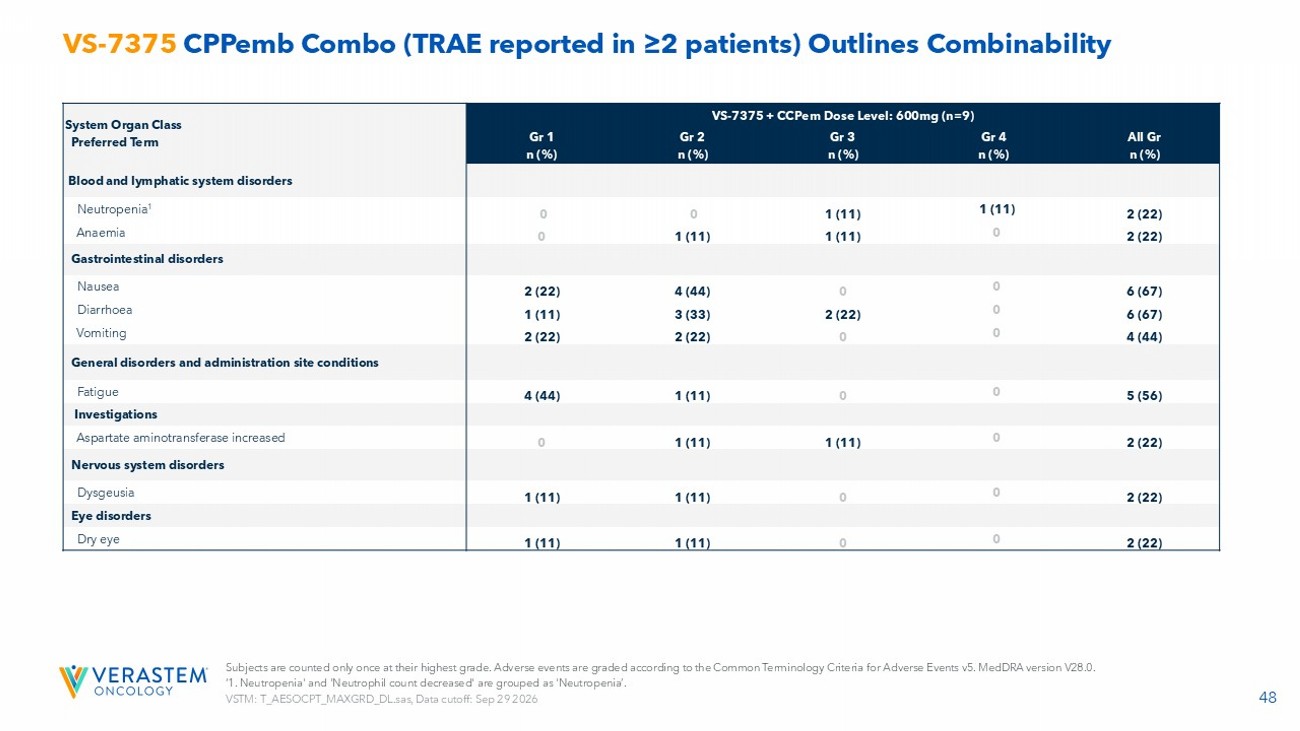
48 VS - 7375 CPPemb Combo (TRAE reported in ≥2 patients) Outlines Combinability VS - 7375 + CCPem Dose Level: 600mg (n=9) System Organ Class Preferred Term All Gr n (%) Gr 4 n (%) Gr 3 n (%) Gr 2 n (%) Gr 1 n (%) Blood and lymphatic system disorders 2 (22) 1 (11) 1 (11) 0 0 Neutropenia 1 2 (22) 0 1 (11) 1 (11) 0 Anaemia Gastrointestinal disorders 6 (67) 0 0 4 (44) 2 (22) Nausea 6 (67) 0 2 (22) 3 (33) 1 (11) Diarrhoea 4 (44) 0 0 2 (22) 2 (22) Vomiting General disorders and administration site conditions 5 (56) 0 0 1 (11) 4 (44) Fatigue Investigations 2 (22) 0 1 (11) 1 (11) 0 Aspartate aminotransferase increased Nervous system disorders 2 (22) 0 0 1 (11) 1 (11) Dysgeusia Eye disorders 2 (22) 0 0 1 (11) 1 (11) Dry eye Subjects are counted only once at their highest grade. Adverse events are graded according to the Common Terminology Criteria fo r Adverse Events v5. MedDRA version V28.0. ‘1. Neutropenia' and 'Neutrophil count decreased' are grouped as 'Neutropenia’. VSTM: T_AESOCPT_MAXGRD_DL.sas , Data cutoff: Sep 29 2026
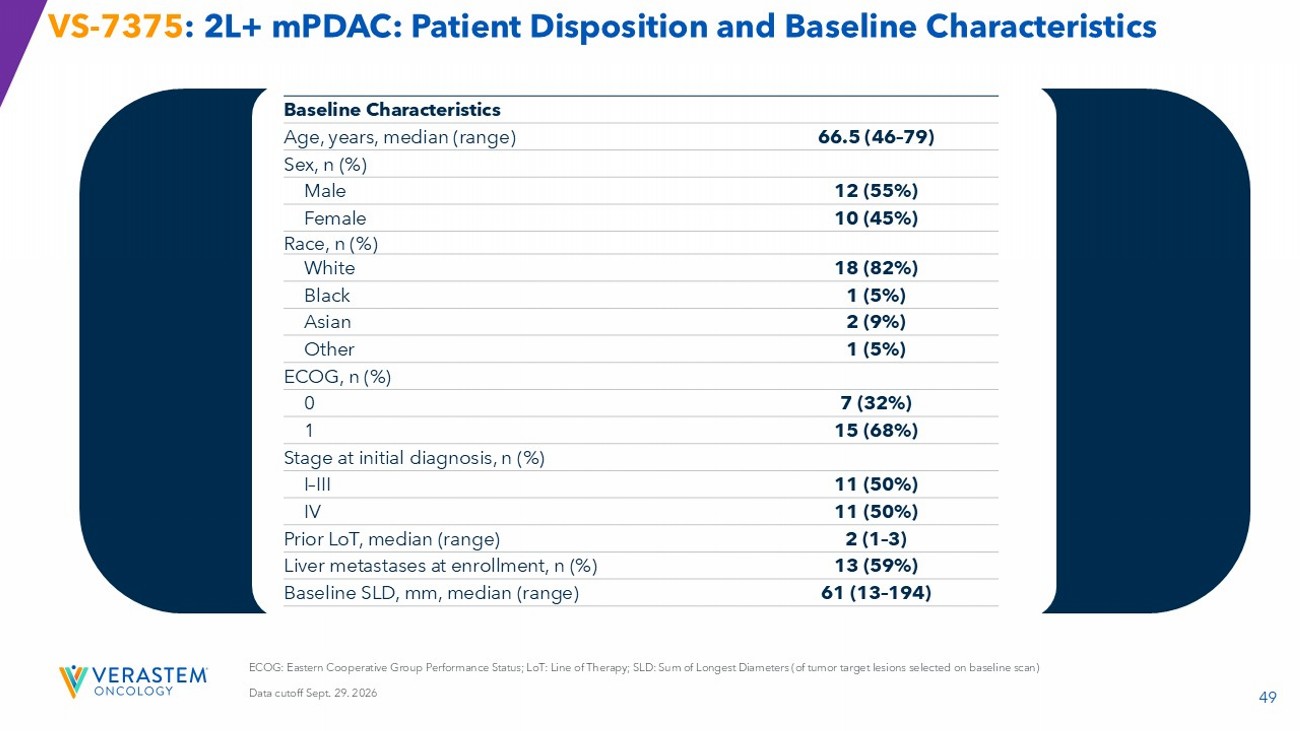
49 ECOG: Eastern Cooperative Group Performance Status; LoT : Line of Therapy; SLD: Sum of Longest Diameters (of tumor target lesions selected on baseline scan) Data cutoff Sept. 29. 2026 VS - 7375 : 2L+ mPDAC: Patient Disposition and Baseline Characteristics Baseline Characteristics 66.5 (46 – 79) Age, years, median (range) Sex, n (%) 12 (55%) Male 10 (45%) Female Race, n (%) 18 (82%) White 1 (5%) Black 2 (9%) Asian 1 (5%) Other ECOG, n (%) 7 (32%) 0 15 (68%) 1 Stage at initial diagnosis, n (%) 11 (50%) I – III 11 (50%) IV 2 (1 – 3) Prior LoT, median (range) 13 (59%) Liver metastases at enrollment, n (%) 61 (13 – 194) Baseline SLD, mm, median (range)
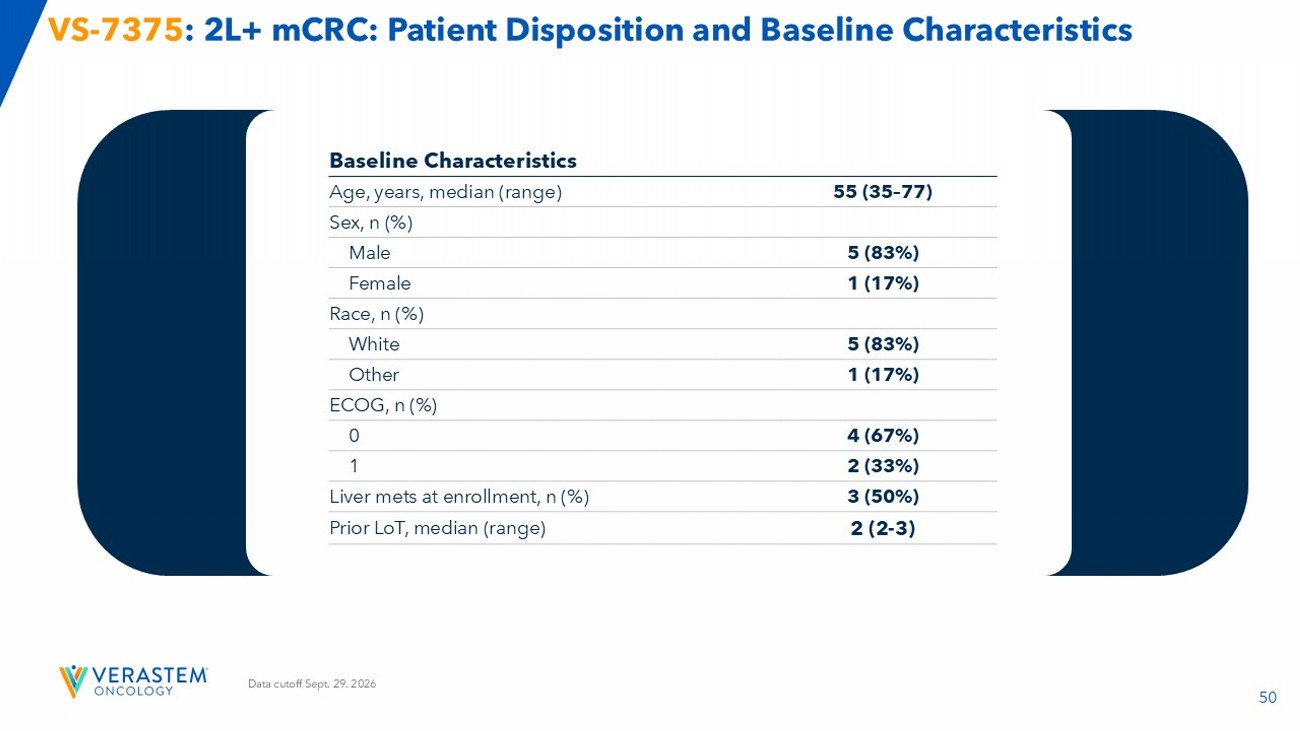
50 Data cutoff Sept. 29. 2026 VS - 7375 : 2L+ mCRC: Patient Disposition and Baseline Characteristics Baseline Characteristics 55 (35 – 77) Age, years, median (range) Sex, n (%) 5 (83%) Male 1 (17%) Female Race, n (%) 5 (83%) White 1 (17%) Other ECOG, n (%) 4 (67%) 0 2 (33%) 1 3 (50%) Liver mets at enrollment, n (%) 2 (2 - 3) Prior LoT, median (range)
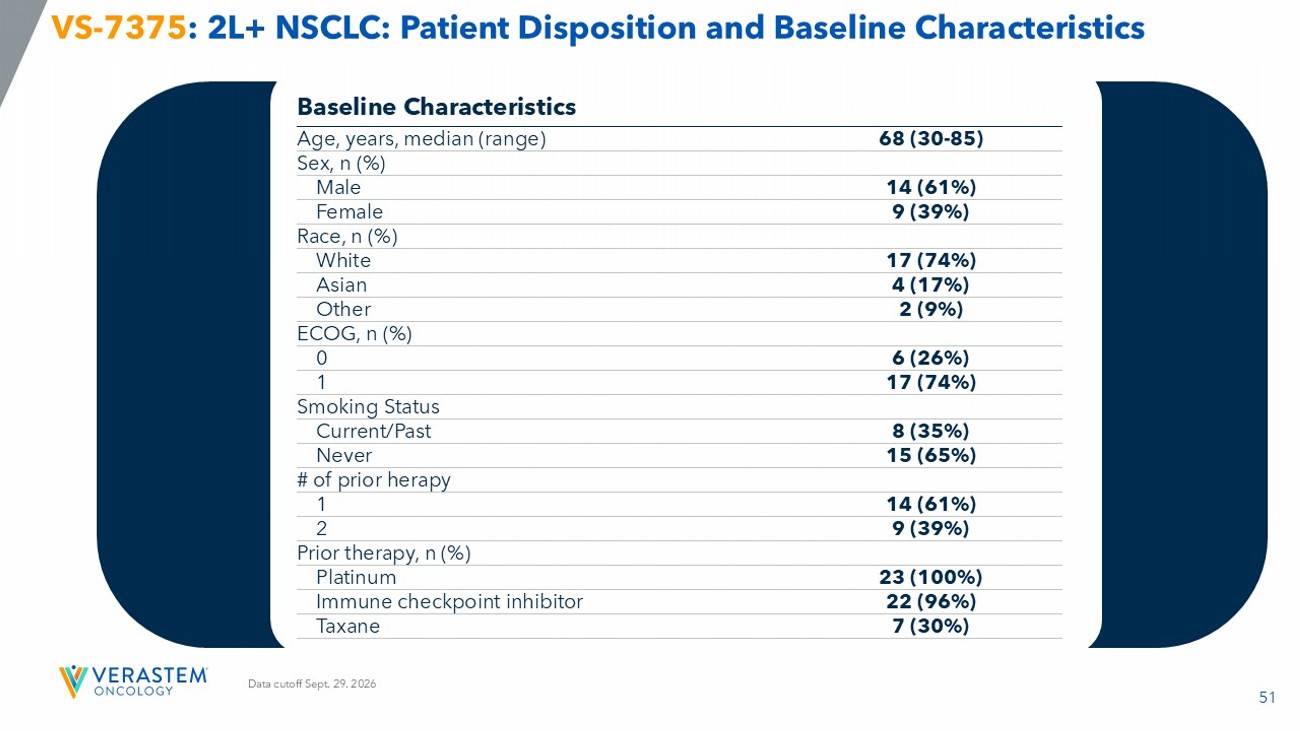
51 Data cutoff Sept. 29. 2026 VS - 7375 : 2L+ NSCLC: Patient Disposition and Baseline Characteristics Baseline Characteristics 68 (30 - 85) Age, years, median (range) Sex, n (%) 14 (61%) Male 9 (39%) Female Race, n (%) 17 (74%) White 4 (17%) Asian 2 (9%) Other ECOG, n (%) 6 (26%) 0 17 (74%) 1 Smoking Status 8 (35%) Current/Past 15 (65%) Never # of prior herapy 14 (61%) 1 9 (39%) 2 Prior therapy, n (%) 23 (100%) Platinum 22 (96%) Immune checkpoint inhibitor 7 (30%) Taxane
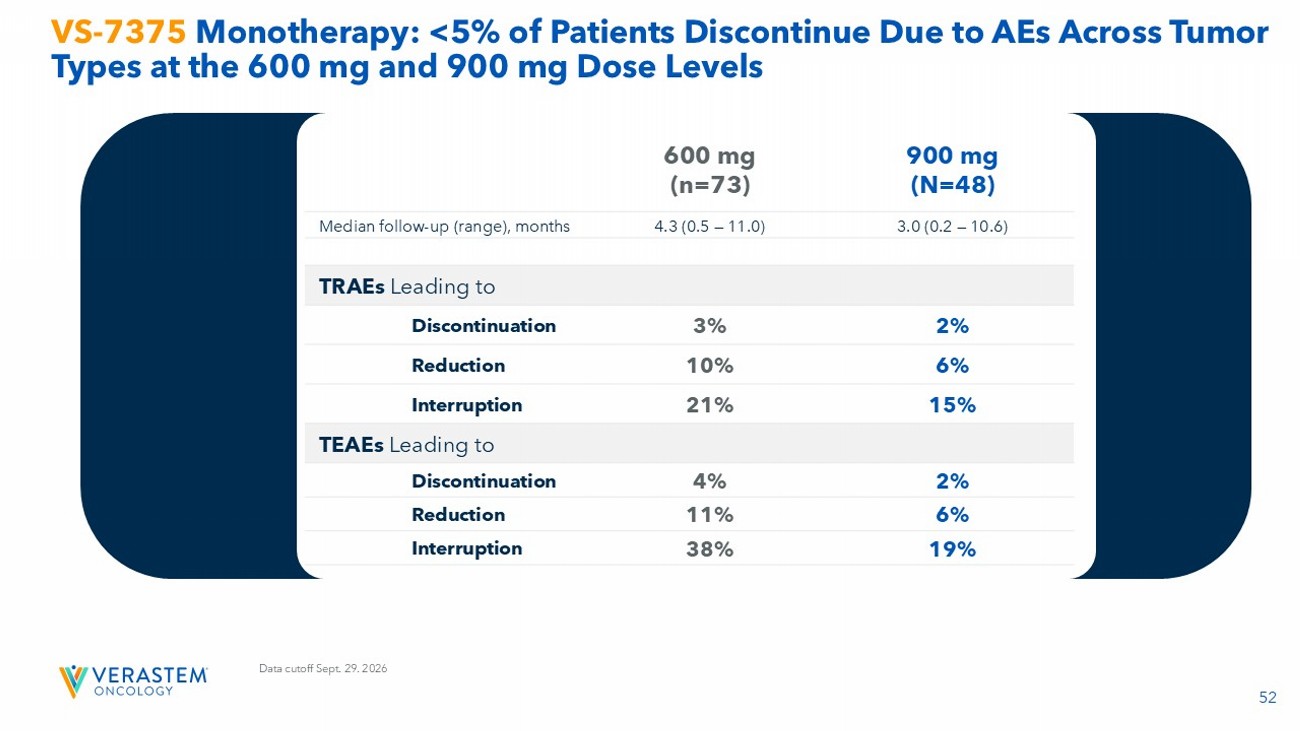
52 VS - 7375 Monotherapy: <5% of Patients Discontinue Due to AEs Across Tumor Types at the 600 mg and 900 mg Dose Levels 900 mg (N=48) 600 mg (n=73) 3.0 (0.2 — 10.6) 4.3 (0.5 — 11.0) Median follow - up (range), months TRAEs Leading to 2% 3% Discontinuation 6% 10% Reduction 15% 21% Interruption TEAEs Leading to 2% 4% Discontinuation 6% 11% Reduction 19% 38% Interruption Data cutoff Sept. 29. 2026
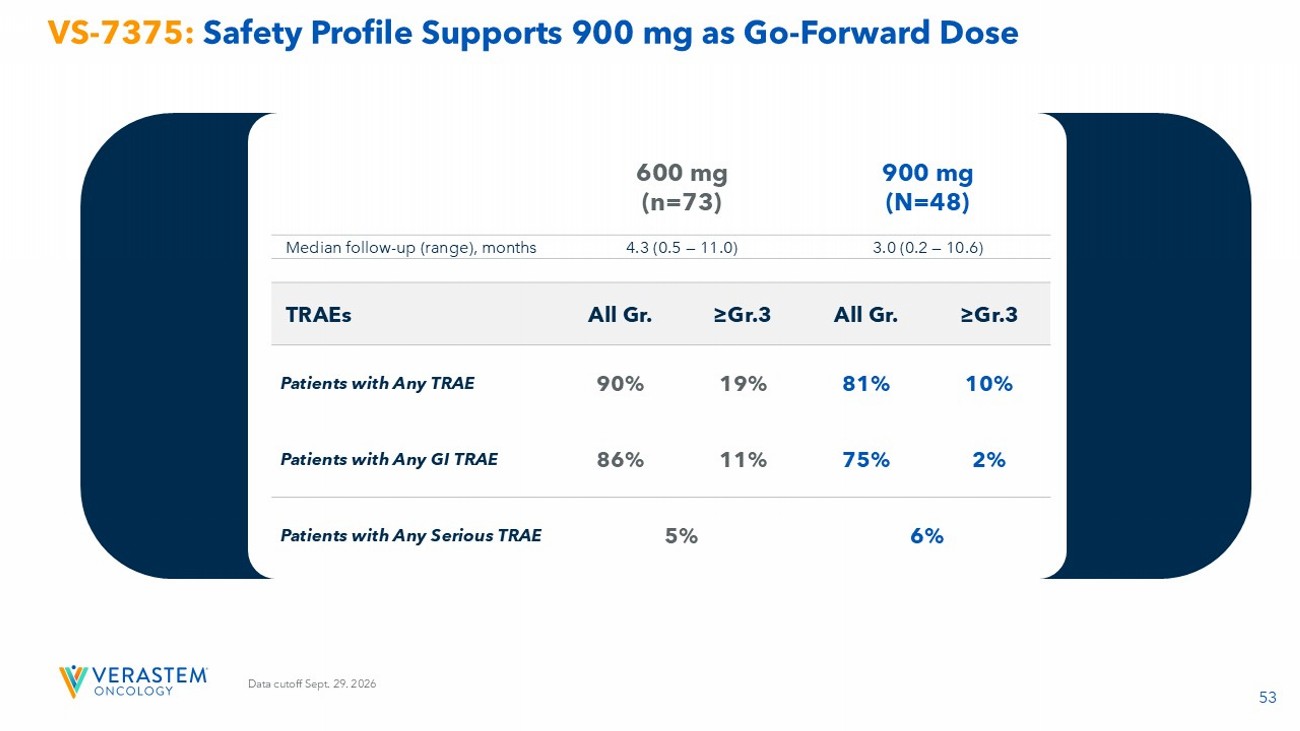
53 VS - 7375: Safety Profile Supports 900 mg as Go - Forward Dose 900 mg (N=48) 600 mg (n=73) 3.0 (0.2 — 10.6) 4.3 (0.5 — 11.0) Median follow - up (range), months ≥Gr.3 All Gr. ≥Gr.3 All Gr. TRAEs 10% 81% 19% 90% Patients with Any TRAE 2% 75% 11% 86% Patients with Any GI TRAE 6% 5% Patients with Any Serious TRAE Data cutoff Sept. 29. 2026
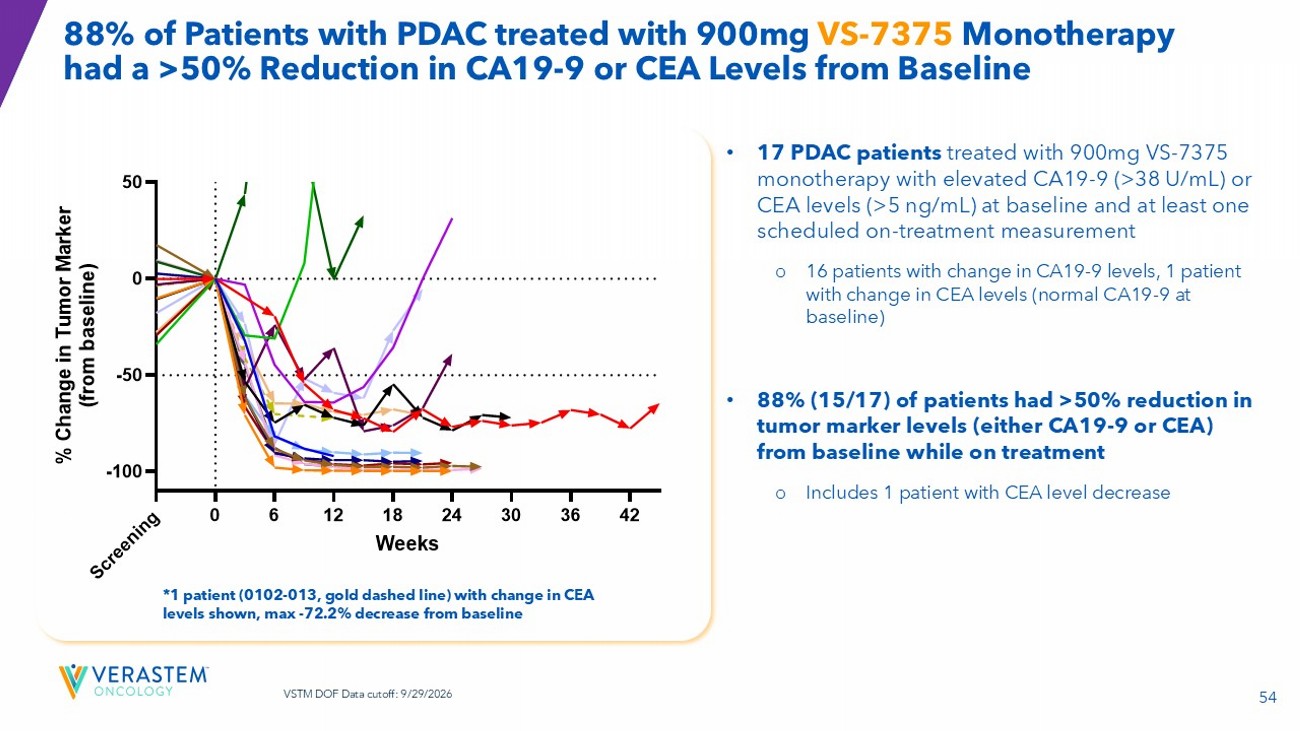
54 88% of Patients with PDAC treated with 900mg VS - 7375 Monotherapy had a >50% Reduction in CA19 - 9 or CEA Levels from Baseline • 17 PDAC patients treated with 900mg VS - 7375 monotherapy with elevated CA19 - 9 (>38 U/mL) or CEA levels (>5 ng/mL) at baseline and at least one scheduled on - treatment measurement o 14/17 remain on treatment o 16 patients with change in CA19 - 9 levels, 1 patient with change in CEA levels (normal CA19 - 9 at baseline) • 88% (15/17) of patients had >50% reduction in tumor marker levels (either CA19 - 9 or CEA) from baseline while on treatment o Includes 1 patient with CEA level decrease *1 patient (0102 - 013, gold dashed line) with change in CEA levels shown, max - 72.2% decrease from baseline 0 6 12 18 24 30 36 42 -100 -50 0 50 Weeks % C h a n g e i n T u m o r M a r k e r ( f r o m b a s e l i n e ) 0101-020 0102-004 0103-007 0104-012 0104-016 0105-021 0105-023 0105-026 0106-016 0110-007 0110-011 0112-016 0116-003 0116-005 0116-008 1202-001 S c r e e n i n g 0102-013 VSTM DOF Data cutoff: 9/29/2026
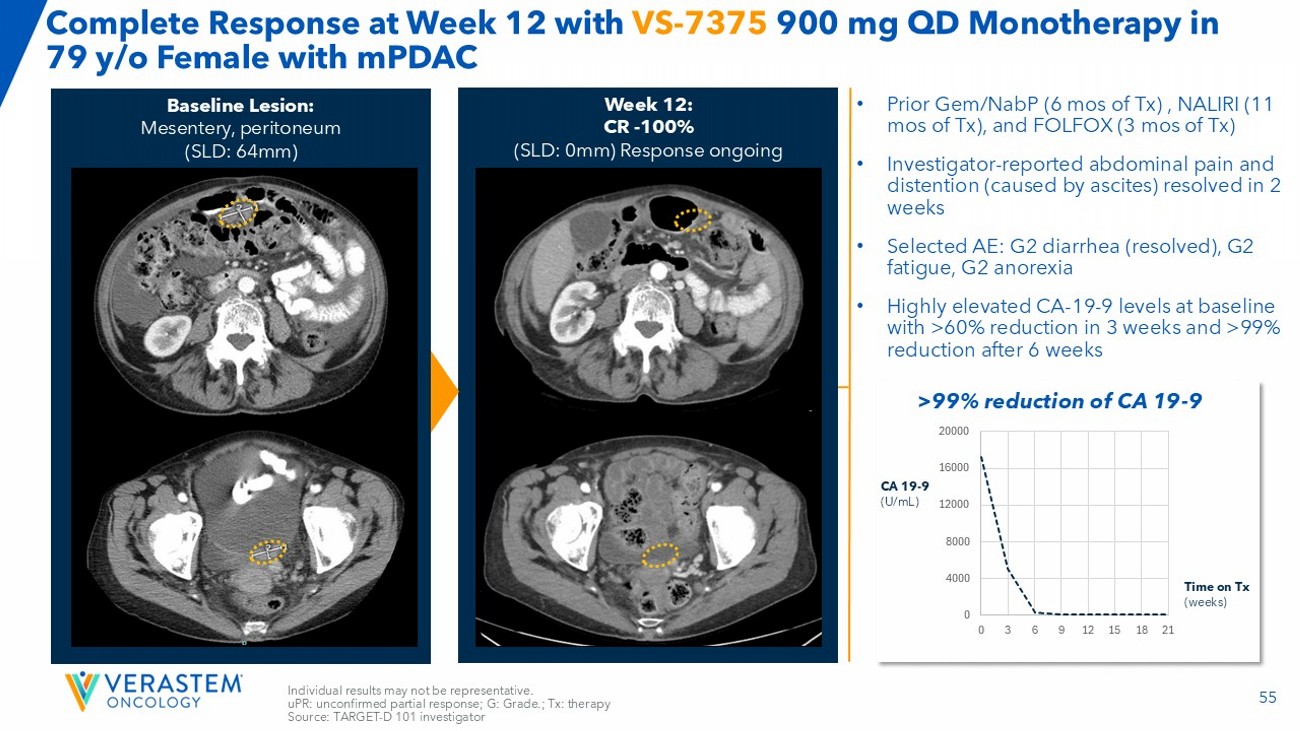
55 Complete Response at Week 12 with VS - 7375 900 mg QD Monotherapy in 79 y/o Female with mPDAC Individual results may not be representative. uPR : unconfirmed partial response; G: Grade.; Tx: therapy Source: TARGET - D 101 investigator • Prior Gem/ NabP (6 mos of Tx) , NALIRI (11 mos of Tx), and FOLFOX (3 mos of Tx) • Investigator - reported abdominal pain and distention (caused by ascites) resolved in 2 weeks • Selected AE: G2 diarrhea (resolved), G2 fatigue, G2 anorexia • Highly elevated CA - 19 - 9 levels at baseline with >60% reduction in 3 weeks and >99% reduction after 6 weeks Week 12: CR - 100% (SLD: 0mm) Response ongoing Baseline Lesion: Mesentery, peritoneum (SLD: 64mm) 0 4000 8000 12000 16000 20000 0 3 6 9 12 15 18 21 CA 19 - 9 (U/mL) Time on Tx (weeks) >99% reduction of CA 19 - 9
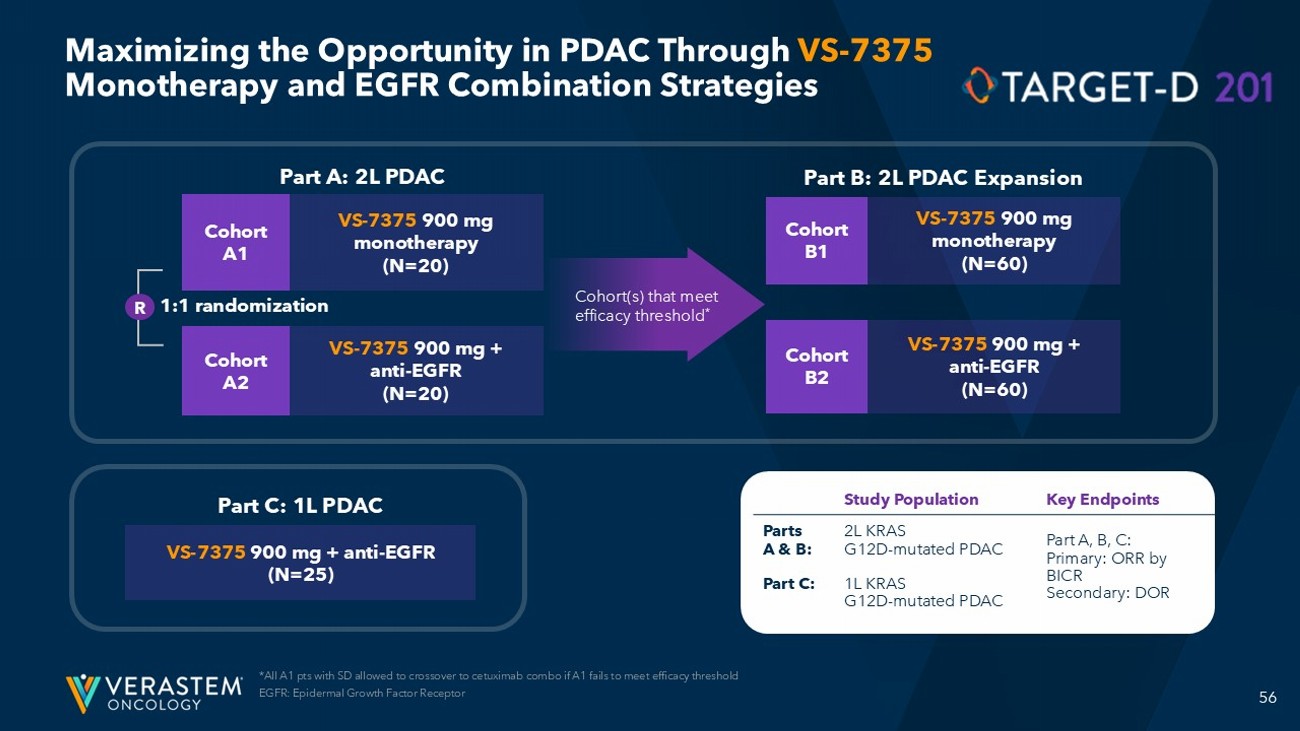
56 Maximizing the Opportunity in PDAC Through VS - 7375 Monotherapy and EGFR Combination Strategies *All A1 pts with SD allowed to crossover to cetuximab combo if A1 fails to meet efficacy threshold EGFR: Epidermal Growth Factor Receptor R 1:1 randomization Part A: 2L PDAC Cohort A 1 Cohort A2 VS - 7375 900 mg monotherapy (N=20) VS - 7375 900 mg + anti - EGFR (N=20) Cohort B1 Cohort B2 VS - 7375 900 mg monotherapy (N=60) VS - 7375 900 mg + anti - EGFR (N=60) Part B: 2L PDAC Expansion Cohort(s) that meet efficacy threshold * Part C: 1L PDAC VS - 7375 900 mg + anti - EGFR (N=25) Key Endpoints Study Population Part A, B, C: Primary: ORR by BICR Secondary: DOR 2L KRAS G12D - mutated PDAC 1L KRAS G12D - mutated PDAC Parts A & B: Part C:
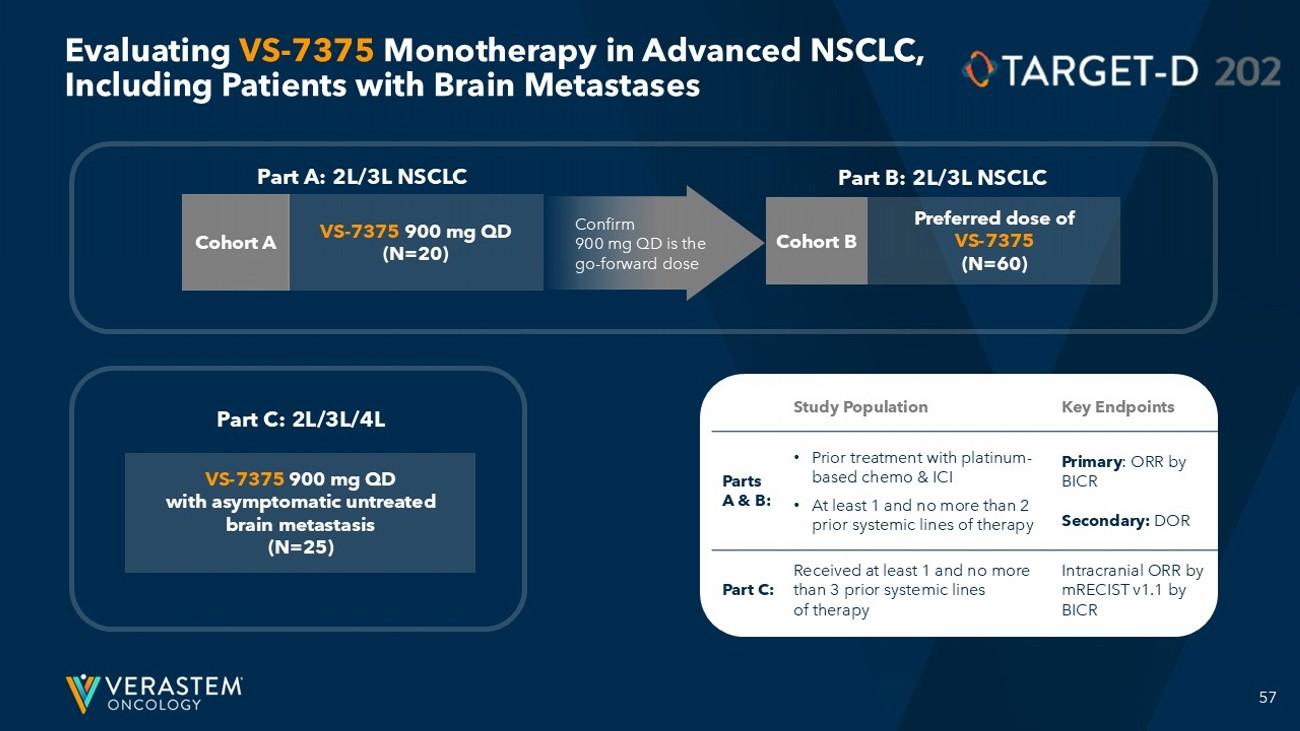
57 Evaluating VS - 7375 Monotherapy in Advanced NSCLC, Including Patients with Brain Metastases Part A: 2L/3L NSCLC Cohort A VS - 7375 900 mg QD (N=20) Cohort B Preferred dose of VS - 7375 (N=60) Part B: 2L/3L NSCLC Confirm 900 mg QD is the go - forward dose Part C: 2L/3L/4L VS - 7375 900 mg QD with asymptomatic untreated brain metastasis (N=25) Key Endpoints Study Population Primary : ORR by BICR Secondary: DOR • Prior treatment with platinum - based chemo & ICI • At least 1 and no more than 2 prior systemic lines of therapy Parts A & B: Intracranial ORR by mRECIST v1.1 by BICR Received at least 1 and no more than 3 prior systemic lines of therapy Part C:
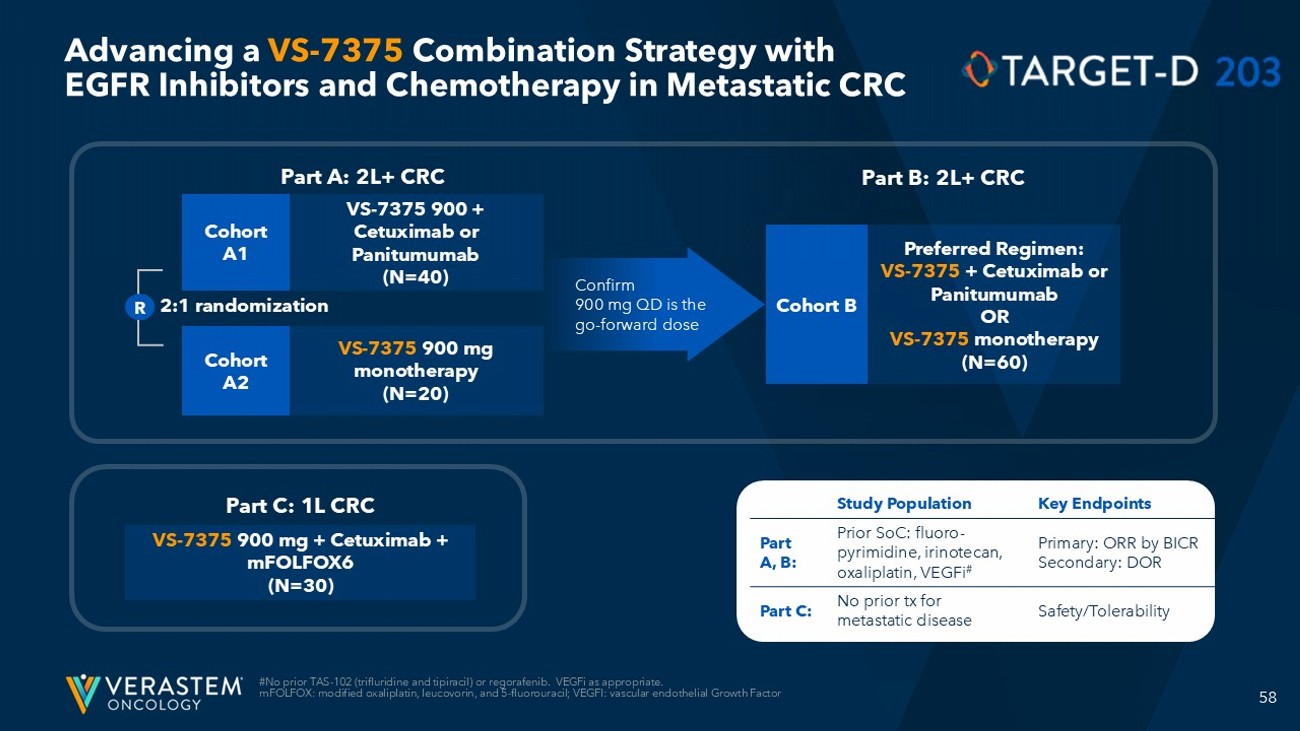
58 Advancing a VS - 7375 Combination Strategy with EGFR Inhibitors and Chemotherapy in Metastatic CRC #No prior TAS - 102 ( trifluridine and tipiracil ) or regorafenib. VEGFi as appropriate. mFOLFOX : modified oxaliplatin, leucovorin, and 5 - fluorouracil; VEGFI: vascular endothelial Growth Factor R 2:1 randomization Part A: 2L+ CRC Cohort A 1 Cohort A2 VS - 7375 900 + Cetuximab or Panitumumab (N=40) VS - 7375 900 mg monotherapy (N=20) Cohort B Preferred Regimen: VS - 7375 + Cetuximab or Panitumumab OR VS - 7375 monotherapy (N=60) Part B: 2L+ CRC Confirm 900 mg QD is the go - forward dose Part C: 1L CRC VS - 7375 900 mg + Cetuximab + mFOLFOX6 (N=30) Key Endpoints Study Population Primary: ORR by BICR Secondary: DOR Prior SoC: fluoro - pyrimidine, irinotecan, oxaliplatin, VEGFi # Part A, B: Safety/Tolerability No prior tx for metastatic disease Part C:
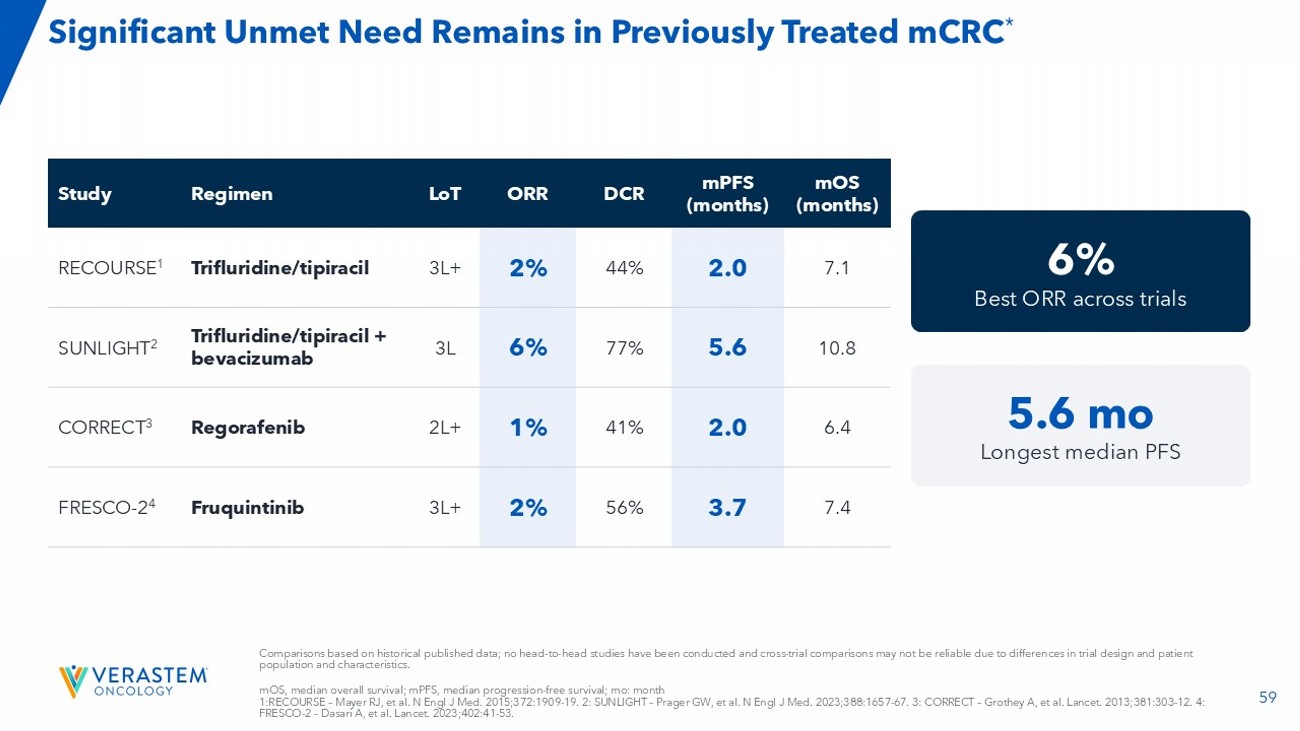
59 Comparisons based on historical published data; no head - to - head studies have been conducted and cross - trial comparisons may not be reliable due to differences in trial design and patient population and characteristics. mOS , median overall survival; mPFS , median progression - free survival; mo : month 1:RECOURSE – Mayer RJ, et al. N Engl J Med. 2015;372:1909 - 19. 2: SUNLIGHT – Prager GW, et al. N Engl J Med. 2023;388:1657 - 67. 3: CORRECT – Grothey A, et al. Lancet. 2013;381:303 - 12. 4: FRESCO - 2 – Dasari A, et al. Lancet. 2023;402:41 - 53. mOS (months) mPFS (months) DCR ORR LoT Regimen Study 7.1 2.0 44% 2% 3L+ Trifluridine/ tipiracil RECOURSE 1 10.8 5.6 77% 6% 3L Trifluridine/ tipiracil + bevacizumab SUNLIGHT 2 6.4 2.0 41% 1% 2L+ Regorafenib CORRECT 3 7.4 3.7 56% 2% 3L+ Fruquintinib FRESCO - 2 4 6% Best ORR across trials 5.6 mo Longest median PFS Significant Unmet Need Remains in Previously Treated mCRC *