
Exhibit 99.98
2999 N. 44th St. Suite 300
Phoenix, AZ 85018
INFORMATION CIRCULAR
As at May 8, 2026, unless otherwise noted
FOR THE ANNUAL GENERAL AND SPECIAL MEETING
OF THE SHAREHOLDERS
TO BE HELD ON JUNE 25, 2026
SOLICITATION OF PROXIES
This information circular is furnished in connection with the solicitation of proxies by the management of Gunnison Copper Corp. (“Gunnison” or the “Company”) for use at the Annual General and Special Meeting (the “Meeting”) of the Shareholders of the Company to be held at the time and place and for the purposes set forth in the Notice of Meeting and at any adjournment thereof.
PERSONS OR COMPANIES MAKING THE SOLICITATION
The enclosed Instrument of Proxy is solicited by management of the Company (“Management”). Solicitations will be made by mail and possibly supplemented by telephone or other personal contact to be made without special compensation by regular officers and employees of the Company. The Company does not reimburse Shareholders’ nominees or agents (including brokers holding shares on behalf of clients) for the cost incurred in obtaining from their principals, authorization to execute the Instrument of Proxy. No solicitation will be made by specifically engaged employees or soliciting agents. The cost of solicitation will be borne by the Company. None of the directors of the Company have advised that they intend to oppose any action intended to be taken by Management as set forth in this Information Circular.
NOTICE-AND-ACCESS PROCESS
In accordance with the notice-and-access rules under National Instrument 54-101 Communications with Beneficial Owners of Securities of a Reporting Issuer, the Company has sent its proxy-related materials to registered holders and non-objecting beneficial owners using notice-and-access. Therefore, although Shareholders still receive a proxy or voting instruction form (as applicable) in paper copy, this Information Circular, the annual audited financial statements of the Company for its fiscal year ended December 31, 2025 and related management discussion and analysis on financial condition, are not physically delivered. Instead, Shareholders may access these materials under the Company’s profile on SEDAR+ at www.sedarplus.com or at https://docs.tsxtrust.com/2475.
Registered holders or beneficial owners may request paper copies of the Meeting materials be sent to them by postal delivery at no cost to them. Requests may be made up to one year from the date the meeting materials are posted on the website referenced above. In order to receive a paper copy of the Meeting materials or if you have questions concerning notice-and-access, please call toll free at 1-866-600-5869 or email tsxtis@tmx.com. Requests for paper copies of the Meeting materials should be received by June 16, 2026 in order to receive the Meeting materials in advance of the Meeting.
| - 2 - |
APPOINTMENT AND REVOCATION OF PROXIES
The persons named in the accompanying Instrument of Proxy are directors or officers of the Company and are nominees of Management. A Shareholder has the right to appoint a person to attend and act for him/her on his/her behalf at the Meeting other than the persons named in the enclosed Instrument of Proxy. To exercise this right, a Shareholder should strike out the names of the persons named in the Instrument of Proxy and insert the name of his/her nominee in the blank space provided, or complete another proper form of Instrument of Proxy. The completed Instrument of Proxy should be deposited with the Company’s Registrar and Transfer Agent, TSX Trust Company, located at 301 – 100 Adelaide Street West, Toronto, ON, M5H 4H1, at least 48 hours before the time of the Meeting or any adjournment thereof, excluding Saturdays, Sundays and holidays.
The Instrument of Proxy must be dated and be signed by the Shareholder or by his/her attorney in writing, or, if the Shareholder is a Company, it must either be under its common seal or signed by a duly authorized officer.
In addition to revocation in any other manner permitted by law, a Shareholder may revoke a Proxy either by (a) signing a Proxy bearing a later date and depositing it at the place and within the time aforesaid, or (b) signing and dating a written notice of revocation (in the same manner as the Instrument of Proxy is required to be executed as set out in the notes to the Instrument of Proxy) and either depositing it at the place and within the time aforesaid or with the Chair of the Meeting on the day of the Meeting or on the day of any adjournment thereof, or (c) registering with the Scrutineer at the Meeting as a Shareholder present in person, whereupon such Proxy shall be deemed to have been revoked.
NON-REGISTERED HOLDERS OF COMPANY’S SHARES
Only Shareholders whose names appear in the Company’s Central Securities Register (the “Registered Shareholders”) or duly appointed proxyholders are permitted to vote at the Meeting. Shareholders who do not hold their common shares of the Company (“Common Shares”) in their own name (“Beneficial Shareholders”) are advised that only proxies from Shareholders of record can be recognized and voted at the Meeting. Beneficial Shareholders who complete and return an Instrument of Proxy must indicate thereon the person (usually a brokerage house) who holds their Common Shares as registered Shareholder. Every intermediary (broker) has its own mailing procedure, and provides its own return instructions, which should be carefully followed. The form of proxy supplied to Beneficial Shareholders is similar to that provided to Registered Shareholders. However, its purpose is limited to instructing the registered Shareholder how to vote on behalf of the Beneficial Shareholder. Management of the Company does not intend to pay for intermediaries to forward to objecting beneficial owners under National Instrument 54-101 the proxy-related materials and Form 54-101F7 – Request for Voting Instructions Made by Intermediary, and in case of an objecting beneficial owner, the objecting beneficial owner will not receive the materials unless the objecting beneficial owner’s intermediary assumes the cost of delivery.
If Common Shares are listed in an account statement provided to a Shareholder by a broker, then in almost all cases those Common Shares will not be registered in such Shareholder’s name on the records of the Company. Such Common Shares will more likely be registered under the name of the Shareholder’s broker or agent of that broker. In Canada, the vast majority of such Common Shares are registered under the name of CDS & Co. (the registration for the Canadian Depository for Securities, which company acts as nominee for many Canadian brokerage firms). Common shares held by brokers or their nominees can only be voted (for or against resolutions) upon the instructions of the Beneficial Shareholder. Without specific instructions, brokers/nominees are prohibited from voting shares for their clients. The directors and officers of the Company do not know for whose benefit the Common Shares registered in the name of CDS & Co. are held.
| - 3 - |
In accordance with National Instrument 54-101 of the Canadian Securities Administrators, the Company has distributed copies of the Notice of Meeting, this Information Circular and the Instrument of Proxy to the clearing agencies and intermediaries for onward distribution. Applicable regulatory policy requires intermediaries/brokers to seek voting instructions from Beneficial Shareholders in advance of Shareholders’ meetings unless the Beneficial Shareholders have waived the right to receive meeting materials. Every intermediary/broker has its own mailing procedures and provides its own return instructions, which should be carefully followed by Beneficial Shareholders in order to ensure that their Common Shares are voted at the Meeting. Often the form of proxy supplied to a Beneficial Shareholder by its broker is identical to the Instrument of Proxy provided by the Company to the Registered Shareholders. However, its purpose is limited to instructing the Registered Shareholder how to vote on behalf of the Beneficial Shareholder. Should a Beneficial Shareholder receive such a form and wish to vote at the Meeting, the Beneficial Shareholder should strike out the Management proxyholder’s name in the form and insert the Beneficial Shareholder’s name in the blank provided. The majority of brokers now delegate the responsibility for obtaining instructions from clients to Broadridge Financial Solutions, Inc. (“Broadridge”). Broadridge typically applies a special sticker to the proxy forms, mails those forms to the Beneficial Shareholders and requests Beneficial Shareholders to return the proxy forms to Broadridge. Broadridge then tabulates the results of all instructions received and provides appropriate instructions respecting the voting of Common Shares to be represented at the Meeting. A Beneficial Shareholder receiving a proxy with a Broadridge sticker on it cannot use that proxy to vote Common Shares directly at the Meeting – the proxy must be returned to Broadridge well in advance of the Meeting in order to have the Common Shares voted. All references to Shareholders in this Information Circular and the accompanying Instrument of Proxy and Notice of Meeting are to Shareholders of record unless specifically stated otherwise.
VOTING OF SHARES AND EXERCISE OF DISCRETION OF PROXIES
On any poll, the persons named in the enclosed Instrument of Proxy will vote the shares in respect of which they are appointed and, where directions are given by the Shareholder in respect of voting for or against any resolution, will do so in accordance with such direction.
If no choice is specified on the proxy with respect to a matter to be acted upon, the proxy confers discretionary authority with respect to the matter upon the proxyholder named on the Instrument of Proxy. In the absence of any direction in the Instrument of Proxy, it is intended that the proxyholder named by Management in the Instrument of Proxy will vote the shares represented by the proxy in favour of the motions proposed to be made at the Meeting as stated under the headings in this Information Circular. The Instrument of Proxy enclosed, when properly signed, confers discretionary authority with respect to amendments or variations to any matters which may properly be brought before the Meeting.
At the time of printing of this Information Circular, the Management of the Company is not aware that any such amendments, variations or other matters are to be presented for action at the Meeting. However, if any other matters which are not now known to the Management should properly come before the Meeting, the Proxies hereby solicited will be exercised on such matters in accordance with the best judgement of the nominee.
FINANCIAL STATEMENTS
The audited financial statements of the Company for the year ended December 31, 2025 will be presented to the Shareholders at the Meeting.
| - 4 - |
VOTING SHARES AND PRINCIPAL HOLDERS THEREOF
At May 8, 2026, the Company had 423,003,601 Common Shares and no non-voting common shares (“Non-Voting Common Shares”) issued and outstanding.
Common Shares
May 8, 2026 has been determined as the record date as of which holders of Common Shares or their duly appointed proxies are entitled to receive notice of and attend and to one vote per common share at the Meeting. Shareholders desiring to be represented by proxy at the Meeting must deposit their proxies at the place and within the time set forth in the notes to the Instrument of Proxy in order to entitle the person duly appointed by the proxy to attend and vote thereat.
Non-Voting Common Shares
The Non-Voting Common Shares are restricted securities within the meaning of National Instrument 51-102. Non-Voting Common Shares do not carry the right to vote at any meetings of the Shareholders. Non-voting shares may be converted at the option of the holder into Common Shares on the basis of one (1) non-voting common share for one (1) common share of the Company. As the Non-Voting Common Shares are convertible into Common Shares, pursuant to National Instrument 62-104, a take-over bid for the Common Shares must also be made to the holders of the Non-Voting Common Shares.
Quorum and Significant Shareholders
The quorum for a meeting of Shareholders is two persons who are, or who represent by proxy, shareholders who, in the aggregate, hold at least 5% of the issued shares entitled to be voted at the meeting.
To the knowledge of the directors or executive officers of the Company, as at May 8, 2026, no Shareholder beneficially owns or controls, directly or indirectly, voting securities carrying more than 10% of the voting rights attached to the Common Shares of the Company.
FIXING THE NUMBER OF DIRECTORS AND ELECTION OF DIRECTORS
The persons named in the enclosed Instrument of Proxy intend to vote in favour of the ordinary resolution fixing the number of directors on the board of directors of the Company (the “Board of Directors”) at six (6). Each director of the Company is elected annually and holds office until the next Annual General Meeting unless that person ceases to be a director before then. Management of the Company proposes to nominate the persons herein listed for election as directors of the Company to serve until their successors are elected or appointed. In the absence of instructions to the contrary, the Common Shares represented by proxy will, on a poll, be voted for the nominees herein listed. MANAGEMENT OF THE COMPANY DOES NOT CONTEMPLATE THAT ANY OF THE NOMINEES WILL BE UNABLE TO SERVE AS A DIRECTOR. IN THE EVENT THAT PRIOR TO THE MEETING ANY VACANCIES OCCUR IN THE SLATE OF NOMINEES HEREIN LISTED, IT IS INTENDED THAT DISCRETIONARY AUTHORITY SHALL BE EXERCISED BY MANAGEMENT TO VOTE THE PROXY ON ANY POLL FOR THE ELECTION OF ANY PERSON OR PERSONS AS DIRECTOR UNLESS THE SHAREHOLDER HAS SPECIFIED OTHERWISE IN THE PROXY. UNLESS AUTHORITY TO DO SO IS WITHHELD, THE PERSONS NAMED IN THE ACCOMPANYING INSTRUMENT OF PROXY INTEND TO VOTE FOR THE ELECTION OF ALL OF THE NOMINEES.
The Board of Directors of the Company has adopted a policy (“Majority Voting Policy”) stipulating that if the Common Shares voted in favour of the election of a director nominee at a meeting of the Company’s shareholders represent less than a majority of the total Common Shares voted for and voted as withheld at the meeting, the director nominee will submit his resignation promptly after such meeting to the the Compensation, Nominating and Corporate Governance Committee’s consideration. After reviewing the matter, the the Compensation, Nominating and Corporate Governance Committee will make a recommendation to the Board, and the Board’s subsequent decision to accept or reject the resignation offer will be publicly disclosed.
| - 5 - |
With the exception of exceptional circumstances that would warrant the continued service of the subject director on the Board of Directors, the the Compensation, Nominating and Corporate Governance Committee shall be expected to accept and recommend acceptance of the resignation by the Board of Directors. Within 90 days following the applicable meeting of the Company’s shareholders, the Board of Directors shall make its decision, on the Compensation, Nominating and Corporate Governance Committee’s recommendation and in making its decision the Board of Directors shall be required to accept the resignation of the Subject Director, absent exceptional circumstances. The director nominee will not participate in any Compensation, Nominating and Corporate Governance Committee or Board deliberations regarding the resignation offer. The Majority Voting Policy does not apply in circumstances involving contested director elections.
The following table sets out the names of the persons to be nominated for election as directors, the positions and offices which they presently hold with the Company, their respective principal occupations or employment during the past five years if such nominee is not presently an elected director and the number of Common Shares of the Company which each beneficially owns, directly or indirectly, or over which control or direction is exercised as of the date of this Information Circular:
Name, Province or State and Country of Ordinary Residence of Nominee(7) and Present Positions with the Company |
Principal Occupation and, if not a Presently Elected Director, Occupation during the last Five Years(9) |
Period from which Nominee has been a Director |
Number of Common Shares Held(1)(2) |
Stephen Twyerould(6)(8) Director, President, CEO Arizona, USA |
President and Chief Executive Officer of the Company until May 15, 2026. | October 14, 2010 |
7,947,186 |
Fred DuVal(3)(4)(5)(6) Director Arizona, USA |
President of DuVal and Associates. | June 28, 2018 | Nil |
Jason Howe(3)(5) Director British Columbia, Canada |
Senior Vice President, Corporate Development of Capstone Copper Corp. from 2004 to 2022; President, CEO & Director of Zena Mining Corp. from 2008 to Present. | May 14, 2025 | 250,000 |
Joseph Gallucci(3)(4)(5) Director Quebec, Canada |
Managing Director, Head of Mining Investment Banking at Ventum Financial Corp. from November 2025 to present; Laurentian Bank Securities Managing Director, Head of Investment Banking of Laurentian Bank Securities Inc. from January 2022 to November 2025; Managing Director, Head of Mining, Investment Banking of Laurentian Bank Securities Inc. from March 2019 to January 2022. | May 14, 2025 | Nil |
| - 6 - |
| Name, Province or State and Country of Ordinary Residence of Nominee(7) and Present Positions with the Company | Principal Occupation and, if not a Presently Elected Director, Occupation during the last Five Years(9) | Period from which Nominee has been a Director | Number of Common Shares Held(1)(2) |
Craig Hallworth Director, SVP and Chief Financial Officer(8) Arizona, USA |
President & Chief Executive Officer of the Company from May 15, 2025; Senior Vice President and Chief Financial Officer of the Company from September 2024 to May 15, 2016; Chief Financial Officer, Arizona Business Unit of Hudbay Minerals Inc. from May 2019 to September 2024. | May 15, 2026(8) | 732,500 |
Brian Penney Director Nova Scotia, Canada |
Chief Executive Officer of Tacora Resources Inc. from September 2024 to Present; Chief Executive Officer of Baffinland Iron Mines Corporation from February 2016 to September 2024. | N/A | Nil |
| (1) | Common shares beneficially owned, directly and indirectly, or over which control or direction is exercised, at the date hereof, based upon the information furnished to the Company by individual directors and officers. Unless otherwise indicated, such Common Shares are held directly. These figures do not include Common Shares that may be acquired on the exercise of any share purchase warrants or stock options held by the respective directors or nominees. |
| (2) | The directors and nominees, as a group beneficially own, directly or indirectly, 8,929,686 Common Shares of the Company representing approximately 2.1% of the total issued and outstanding Common Shares of the Company. | |
| (3) | Current Member of the Audit Committee of the Company. | |
| (4) | Current Member of the Nominating and Corporate Governance Committee of the Company. | |
| (5) | Current Member of the Compensation Committee of the Company. | |
| (6) | Current Member of the Project Steering Committee of the Company. |
| (7) | The information as to country of residence and principal occupation, not being within the knowledge of the Company, has been furnished by the respective directors individually. |
| (8) | Effective May 15, 2026, Mr. Twyerould will retire as President & Chief Executive Officer but remain as a director, and Mr. Hallworth will be appointed President & Chief Executive Officer and a director. |
Pursuant to the applicable securities legislation, the Company is required to have an audit committee. The general function of the audit committee is to review the overall audit plan and the Company’s system of internal controls, to review the results of the external audit, and to resolve any potential dispute with the Company’s auditors.
PENALTIES AND SANCTIONS
No proposed director of the Company is, or within the 10 years prior to the date of this Information Circular, has been, a director, chief executive officer or chief financial officer of any company that while that person was acting in that capacity:
| (a) | was the subject to a cease trade or similar order or an order that denied the relevant company access to any exemption under securities legislation, for a period of more than 30 consecutive days; or |
| (b) | was subject to an event that resulted, after the proposed director ceased to be a director, chief executive officer or chief financial officer, in the company being the subject of a cease trade or an order that denied the relevant company access to any exemption under securities legislation, for more than 30 consecutive days. |
| - 7 - |
Except as disclosed below, no proposed director of the Company is, or within the 10 years prior to the date of this Information Circular, has been, a director or executive officer of any company that while that person was acting in that capacity or within a year of that person ceasing to act in that capacity, became bankrupt, made a proposal under any legislation relating to bankruptcy or insolvency or was subject to or instituted any proceedings, arrangement or compromise with creditors or had a receiver, receiver manager or trustee appointed to hold its assets.
No proposed director has individually, within the 10 years prior to this Information Circular, become bankrupt, made a proposal under any legislation relating to bankruptcy or insolvency, or become subject to or instituted any proceedings, arrangement or compromise with creditors, or had a receiver, receiver manager or trustee appointed to hold the assets of the director, officer or Shareholder.
No proposed director of the Company has been subject to: (a) any penalties or sanctions imposed by a court relating to securities legislation or by a securities regulatory authority or has entered into a settlement agreement with a securities regulatory authority; or (b) any other penalties or sanctions imposed by a court or regulatory body that would likely be considered important to a reasonable securityholder in deciding whether to vote for a proposed director.
On November 18, 2022, the British Columbia Securities Commission issued a cease trade order in respect of the securities of Great Panther Mining Limited (“Great Panther”) as a result of its inability to file its quarterly continuous disclosure documents in accordance with Canadian securities laws. On December 16, 2022, Great Panther made a voluntary assignment into bankruptcy under the Bankruptcy and Insolvency Act (Canada) and Alvarez & Marshall Canada Inc. was appointed licenses insolvency trustee of Great Panther’s estate. Joseph Gallucci was a director of Great Panther until December 16, 2022.
APPOINTMENT AND REMUNERATION OF AUDITOR
PricewaterhouseCoopers LLP, Chartered Professional Accountants, of Vancouver, British Columbia, the current Auditors of the Company, were appointed on May 12, 2015.
The persons named in the enclosed Instrument of Proxy will vote for the appointment of PricewaterhouseCoopers LLP, Chartered Professional Accountants, of Vancouver, British Columbia, as Auditors of the Company, to hold office until the next Annual General Meeting of the Shareholders at remuneration to be fixed by the directors.
INTEREST OF CERTAIN PERSONS IN MATTERS TO BE ACTED UPON
Except as disclosed under the heading “Particulars of Other Matters to be Acted Upon”, none of the directors or executive officers of the Company, no proposed nominee for election as a director of the Company, none of the persons who have been directors or executive officers of the Company since the commencement of the Company’s last completed financial year and no associate or affiliate of any of the foregoing persons has any material interest, direct or indirect, by way of beneficial ownership of securities or otherwise, in any matter to be acted upon at the Meeting other than the election of directors or appointment of auditors.
INTEREST OF INFORMED PERSONS IN MATERIAL TRANSACTIONS
Other than as disclosed under the headings “Fixing the Number of Directors” and “Particulars of Other Matters to be Acted Upon”, and other than transactions carried out in the ordinary course of business of the Company or its subsidiary, none of the directors or executive officers of the Company, any shareholder directly or indirectly beneficially owning, or exercising control or direction over, more than 10% of the outstanding Common Shares, nor an associate or affiliate of any of the foregoing persons has had, during the most recently completed financial year of the Company or during the current financial year, any material interest, direct or indirect, in any transactions that materially affected or would materially affect the Company or its subsidiary.
| - 8 - |
STATEMENT OF EXECUTIVE COMPENSATION
The Company’s Statement of Executive Compensation for the year ended December 31, 2025 is attached as Schedule “B” to this Information Circular.
EQUITY COMPENSATION PLAN INFORMATION
The following table sets out particulars of the compensation plans and individual compensation arrangements under which equity securities of the Company are authorized for issuance as of December 31, 2025.
Plan Category |
Number of securities to be issued upon exercise of outstanding options, warrants and rights(1) |
Weighted-average exercise price of outstanding options, warrants and rights(2) |
Number of securities remaining available for future issuance under equity compensation plans |
| Equity compensation plans approved by securityholders | 26,030,000 | $0.28 | 14,255,437 |
| Equity compensation plans not approved by securityholders | Nil | Nil | Nil |
| Total | 26,030,000 | $0.28 | 14,255,437 |
| (1) | At December 31, 2025, the Company had a “rolling” Stock Option Plan, a Restricted Share Unit Plan and a Performance Share Unit Plan, that collectively reserved 10% of the Company’s outstanding Common Shares from time to time for issuance. There were no Restricted Share Units or Performance Share Units outstanding as of December 31, 2025. |
For a description of the material features of the Stock Option Plan, the Restricted Share Unit Plan and the Performance Share Unit Plan, please see “Statement of Executive Compensation – Option-based Awards.” attached as Schedule “B” to this Information Circular.
INDEBTEDNESS OF DIRECTORS AND EXECUTIVE OFFICERS
Other than routine indebtedness, no current or former director, executive officer or senior officer of the Company, employee or any proposed nominee for election as a director of the Company, or any associate or affiliate of any such director, executive officer or senior officer, employee or proposed nominee, is or has been indebted to the Company or any of its subsidiaries, or to any other entity that was provided a guarantee or similar arrangement by the Company or any of its subsidiaries in connection with the indebtedness, at any time since the beginning of the most recently completed financial year of the Company.
MANAGEMENT CONTRACTS
Effective May 17, 2010, the Company engaged King & Bay West of Suite 2400, 1055 West Georgia Street Pender Street, Vancouver, British Columbia V6E 3P3, to provide services and facilities to the Company. The following are the executive officers of King & Bay West, all of whom are residents of British Columbia, Canada: Mr. Mark Morabito, Chair & CEO and Ms. Sheila Paine, Secretary. King & Bay West provides the Company with administrative and management services. The services provided by King & Bay West include shared facilities and corporate secretarial services. The fees for these management services are determined and allocated to the Company based on the cost or value of the services provided to the Company as determined by King & Bay West, and the Company reimburses King & Bay West for such costs on a monthly basis. During the financial year ended December 31, 2025 the Company incurred fees of C$181,348 (excluding taxes) to King & Bay West. Of this amount C$152,287 was for services provided to the Company by King & Bay West personnel and C$29,061 was for overhead and third-party costs incurred by King & Bay West on behalf of the Company.
| - 9 - |
AUDIT COMMITTEE
For information regarding the Audit Committee, see the Company’s annual information form (the “AIF”) for the year ended December 31, 2025 under the heading, “Audit Committee”, including a copy of the audit committee charter which is attached to the AIF as Schedule “A”. The AIF is available under the Company’s profile at www.sedarplus.ca. The current members of the Audit Committee are Jason Howe (Chair), Fred DuVal and Joseph Gallucci.
STATEMENT OF CORPORATE GOVERNANCE PRACTICES
The Canadian Securities Administrators have introduced in final form National Instrument 58-101 – Disclosure of Corporate Governance Practices (“NI 58-101”) and National Policy 58-201 – Corporate Governance Guidelines (“NP 58-201”). The Company has reviewed its own corporate governance practices in light of the NP 58-201 guidelines. In certain cases, the Company’s practices comply with NP 58-201, however, the Board of Directors considers that some of the guidelines are not suitable for the Company at its current stage of development and therefore certain guidelines have not been adopted. Set out in Schedule “A” is a description of certain corporate governance practices of the Company, as required by NI 58-101.
PARTICULARS OF OTHER MATTERS TO BE ACTED UPON
Approval of Amended Stock Option Plan
At the Meeting, Shareholders will be asked to consider, and if thought advisable, approve the Company’s amended stock option plan dated May 21, 2018, as amended May 8, 2026 (the “Plan”) which was last approved by Shareholders at the Company’s annual general and special meeting of Shareholders held June 22, 2023.
The Plan reserves for issuance a maximum of 10% of the issued and outstanding Common Shares at the time of a grant of options under the Plan.
The Plan is an evergreen plan which provides that if any option has been exercised, then the number of Common Shares into which such option was exercised shall become available to be issued upon the exercise of options subsequently granted under the Plan. The Plan operates in conjunction with the Restricted Share Unit Plan (the “RSU Plan”), Performance Share Unit Plan (the “PSU Plan”) and Deferred Share Unit Plan (the “DSU Plan”). The Plan, RSU Plan, PSU Plan, DSU Plan, and any employee stock purchase plan or any other compensation or incentive mechanism involving the issuance or potential issuance of securities of the Company to one or more service providers, including a share purchase from treasury which is financially assisted by the Company by way of a loan, guarantee or otherwise, are collectively referred to as the “Security-Based Compensation Plans”.
The key provisions of the Plan can be summarized as follows:
| (a) | The maximum number of Common Shares that may be reserved for issuance for all purposes under the Plan, together with all other Security-Based Compensation Plans, is a maximum of 10% of the issued and outstanding Common Shares at the time of a grant of stock options under the Plan. However, if any option has been exercised, then the number of Common Shares into which such option was exercised shall become available to be issued under all Security-Based Compensation Plans. |
| - 10 - |
| (b) | The exercise price per Common Share shall be determined by the Board of Directors at the time the option is granted, but such price shall not be less than the closing price of the Common Shares on the TSX on the last trading day preceding the date on which the grant of the option is approved by the Board of Directors. In the event that the Common Shares are not listed and posted for trading on any stock exchange or other quotation system, the exercise price shall be the fair market value of the Common Shares as determined by the Board of Directors in its sole discretion. |
| (c) | The Plan provides that options may be granted to directors, officers, employees, corporations that have a right to nominate a director to the Board of Directors, and consultants of the Corporation or any of its designated affiliates. |
| (d) | The Plan gives discretion to establish, and modify vesting provisions to the Board of Directors, or a committee established thereby. |
| (e) | The Plan provides that where a participant is terminated for any reason other than cause or death, options may be exercised no later than the earlier of (i) the original expiry date and (ii) 90 days after the termination date, in the case of termination by reason of death, no later than 12 months following the date of death or disability, by the legal representative(s) of the estate of the participant, and in the case of termination for cause, options expire immediately. |
| (f) | Any amendment to any provision of the Plan shall be subject to any necessary approvals by any stock exchange or regulatory body having jurisdiction over the securities of the Company. The Plan will require Shareholder approval of certain amendments in accordance with the policies of the TSX, however, the Board of Directors has the discretion to make the following amendments, which it may deem necessary without having to obtain Shareholder approval: |
| (i) | for the purposes of making formal minor or technical modifications to any of the provisions of the Plan; |
| (ii) | to correct any ambiguity, defective provisions, error or omission in the provisions of the Plan; |
| (iii) | to change the persons who qualify as participants under the Plan; |
| (iv) | to change any vesting provisions of options; |
| (v) | to change the termination provisions of the options or of the Plan which does not entail an extension beyond the original expiry date of the options; and |
| (vi) | to add, or amend the terms of, a cashless exercise feature to the Plan, providing for the payment in cash or securities on the exercise of options; |
provided, however, that:
| (vii) | no such amendment of the Plan may be made without the consent of such affected participant (as defined in the Plan) if such amendment would adversely affect the rights of such affected participant under the Plan; and |
| - 11 - |
| (viii) | Shareholder approval shall be obtained in accordance with the requirements of the TSX for any amendment that results in: |
| 1. | an increase in the number of shares issuable under options granted pursuant to the Plan; |
| 2. | a reduction in the exercise price of an option; |
| 3. | an extension of the term of an option granted under the Plan; |
| 4. | amendments to eligible participants that may permit the introduction or reintroduction of non-employee directors on a discretionary basis or amendments that increase limits previously imposed on non-employee director participation; |
| 5. | any amendment which would permit options granted under the Plan to be transferable or assignable other than for normal estate settlement purposes; |
| 6. | any cancellation and reissuance of options; |
| 7. | a change to the insider participation limit set forth in the Plan; or |
| 8. | a change to amending provision of the Plan. |
Additionally, the Plan contains the following provisions:
| (a) | The number of Common Shares issuable to any individual under any Security-Based Compensation Plan of the Company shall not, within a one-year period, exceed 5% of the number of Common Shares outstanding immediately prior to the subject grant. |
| (b) | The equity value of options that may be granted to each non-employee director of the Corporation (“Non-Employee Director”) within any one-year period under the Plan shall not exceed $100,000, and under the Plan together with all other Security-Based Compensation Plans of the Company (excluding deferred share units granted in lieu of cash fees on a value for value basis) shall not exceed $150,000 (the “Non-Employee Director Participation Limits”). The Non-Employee Director Participation Limits do not apply where the Company is making an initial grant to a new Non-Employee Director upon that person joining the Board. |
| (c) | The maximum term for stock options issued pursuant to the Plan cannot exceed 10 years, subject to an automatic extension in the event that the expiry of the term of an option falls within a black out period. In the event that options granted under the Plan expire within a black out period, the expiration date relating to such options shall automatically be extended to such date that is ten (10) business days after the expiry of the applicable black out period. |
| (d) | The number of Common Shares: (i) issued to insiders of the Company, within any one-year period, and (ii) issuable to insiders of the Company, at any time, under the Plan, or when combined with all of the Company’s other Security-Based Compensation Plans, will not exceed 10% of the Company’s total issued and outstanding Common Shares. |
| (e) | An option is personal to an optionee and non-assignable, subject to limited exceptions as set out in the Plan. |
| (f) | In the event of a Change in Control (as defined in the Plan), if the surviving corporation fails to continue or assume the obligations with respect to each option or fails to provide for the conversion or replacement of each option with an equivalent award, then all options that have not otherwise previously been cancelled shall immediately vest on the date on which a Change in Control occurs. |
| - 12 - |
| (g) | The Plan allows the Company to withhold from any remuneration otherwise payable to a participant any amounts required by any taxing authority to be withheld for taxes of any kind as a consequence of their participation in the Plan. This provision of the Plan is necessary as a result of certain proposed amendments to the Income Tax Act (Canada) relating to the taxation of share options which came into effect on January 1, 2011. |
| (h) | The Plan contains a cashless exercise feature whereby, at the sole discretion of the Company, an option that is eligible for exercise may be exercised on a cashless basis instead of a participant making a cash payment for the aggregate exercise price of the options. There are two options for a cashless exercise of options that the Company has made available: |
| a. | Broker assisted cashless exercise: The Company shall issue directly to the participant’s broker the number of Common Shares in respect of such options exercised for cash and the participant’s broker shall, at the election of the participant: (i) sell at market, and retain the proceeds of, a sufficient number of Common Shares to cover the aggregate purchase price of the Common Shares and any withholding obligations in respect of which the option has been exercised, with any cash balance to be delivered to the participant and any remaining Common Shares held by the participant’s broker in trust for, or delivered as directed by, the participant; or (ii) sell at market all of the Common Shares in respect of which the option has been exercised and deliver to the participant the cash balance remaining after deducting the aggregate purchase price of such Common Shares and any withholding Obligations. |
| b. | Exchange for Substituted Rights: The participant relinquishes his options in return for a substituted right to acquire from the Company a number of Common Shares determined by the in-the-money amount of option. The in-the-money amount of the option is divided by the market price at the time of exercise and the participant receives a net amount of Common Shares without any cash payment to the Company, other than for withholding obligations. |
As of May 8, 2026, the Company has adopted the following amendments to the Plan, which remain subject to shareholder approval:
| (a) | The Non-Employee Director Participation Limits have been added, as disclosed above. |
| (b) | The amending provision of the Plan has been amended to add the following additional amendments that required shareholder approval: |
| a. | a reduction in the exercise price of an option; |
| b. | an extension of the term of an option granted under the Plan beyond the original expiry date; |
| c. | amendments to eligible participants that may permit the introduction or reintroduction of non-employee directors on a discretionary basis or amendments that increase limits previously imposed on non-employee director participation; |
| d. | any amendment which would permit options granted under the Plan to be transferable or assignable other than for normal estate settlement purposes; and |
| e. | any cancellation and reissuance of options. |
| (c) | Certain housekeeping amendments. |
| - 13 - |
As at December 31, 2025, the Company had options outstanding that will result in 26,030,000 Common Shares being issuable upon the exercise of such options which represented approximately 6.46% of the number of issued and outstanding Common Shares at December 31, 2025, no RSUs outstanding, no PSUs outstanding, and no DSUs outstanding. As at December 31, 2025, an aggregate of 14,255,437 Common Shares were available to be issued under the Company’s Security-Based Compensation Plans, representing approximately 3.54% of the issued and outstanding Common Shares at December 31, 2025.
As at the date of this Information Circular, the Company has 31,597,198 options outstanding representing approximately 7.52% of the current number of issued and outstanding Common Shares, 1,866,268 RSUs representing approximately 0.44% of the current number of issued and outstanding Common Shares, 895,422 PSUs representing approximately 0.21% of the current number of issued and outstanding Common Shares, and no DSUs. Assuming the approval of the Plan, RSU Plan, PSU Plan and DSU Plan, 7,941,472 Common Shares will be available to be granted under the Company’s Security-Based Compensation Plans, representing approximately 1.88% of the current number of issued and outstanding Common Shares.
Annual Burn Rate
The annual burn rate for the Company’s Security-Based Compensation Plans for the three most recently completed financial years is set out in the table below:
| Fiscal Year | Plan | Number of Securities Granted During Fiscal Year | Weighted Average Number of Securities Outstanding |
Burn Rate |
| 2025 | Stock Option Plan RSU Plan PSU Plan |
16,195,000 Nil Nil |
347,833,318 | 4.66% Nil Nil |
| 2024 | Stock Option Plan RSU Plan PSU Plan |
3,500,000 Nil Nil |
347,833,318 | 1.11% Nil Nil |
| 2023 | Stock Option Plan RSU Plan PSU Plan |
7,215,000 Nil Nil |
347,833,318 | 2.23% Nil Nil |
The rules of the TSX require that, if a listed issuer has a stock option plan that does not have a fixed maximum aggregate number of securities issuable under such plan (including an evergreen plan), the shareholders of the listed issuer must approve and re-affirm the unallocated options under the plan every three years. Shareholders will be asked to consider and, if thought advisable, pass an ordinary resolution approving the Plan and all unallocated options under such plan (the “Stock Option Plan Resolution”). The Stock Option Plan Resolution requires the approval of a simple majority of the votes cast by Shareholders voting in person or by proxy at the Meeting. At the Meeting Shareholders will be asked to consider and approve the following Stock Option Plan Resolution, with or without modification:
If the Stock Option Plan Resolution is passed, this approval will be effective until June 25, 2029. If approval is not obtained at the Meeting, options which have not been allocated as of June 22, 2026 will not be available for grant. Previously allocated options will be unaffected, but will not be available to be reallocated.
At the Meeting Shareholders will be asked to consider and approve the following Stock Option Plan Resolution, with or without modification:
| - 14 - |
“RESOLVED, as an Ordinary Resolution, that:
| 1. | The Incentive Stock Option Plan dated effective May 21, 2018, including any amendments made as of May 8, 2026 (the “Plan”) and all unallocated options issuable pursuant to the Plan be and are hereby approved and authorized until June 25, 2029, being the date that is three years from Shareholder approval of the Plan; |
| 2. | The Company be and is hereby authorized to grant stock options pursuant to and subject to the terms and conditions of the Plan entitling the option holders to purchase Common Shares of the Company; |
| 3. | The Company be and is hereby authorized to abandon or terminate all or any part of the adoption of the Plan, if the Board of Directors of the Company deems it appropriate and in the best interest of the Company to do so; and |
| 4. | Any one director or officer of the Company be and is hereby authorized and directed to do all such acts and things and to execute and deliver, under the corporate seal of the Company or otherwise, all such deeds, documents, instruments and assurances as in his or her opinion may be necessary or desirable to give effect to the foregoing resolutions.” |
The foregoing resolution must be approved by a simple majority of Shareholders. Shareholders will be able to vote either “FOR” or “AGAINST” the foregoing resolution.
The full text of the Plan is attached as Schedule “C” to this Information Circular.
Management recommends that Shareholders vote in favour of the resolution to approve the Plan. In the absence of contrary instruction, the persons named in the enclosed Instrument of Proxy intend to vote for the approval of the Stock Option Plan Resolution at the Meeting.
Approval of Amended Restricted Share Unit Plan
In order to further align the interests of the Company’s senior executives, key employees, consultants and directors with those of the Shareholders, the Company has adopted its RSU Plan. Accordingly, at the Meeting, Shareholders will be asked to consider and, if thought advisable, approve the Company’s RSU Plan which was last approved by Shareholders at the Company’s annual general and special meeting of Shareholders held June 22, 2023.
Restricted share units (“RSUs”) are a bookkeeping entry, with each RSU having the same value as a Common Share. The number of RSUs awarded is determined by the Board of Directors in its sole discretion and from time to time by resolution.
Upon each vesting date, participants receive (a) the issuance of Common Shares from treasury equal to the number of RSUs vesting, or (b) a cash payment equal to the number of vested RSUs multiplied by the fair market value of a Common Share, calculated as the closing price of the Common Shares on the TSX for the trading day immediately preceding such payment date; or (c) a combination of (a) and (b).
Description of RSU Plan
The description of the RSU Plan set forth below is subject to and qualified in its entirety by the provisions of the RSU Plan. Reference should be made to the provisions of the RSU Plan with respect to any particular provision described below.
| - 15 - |
As of May 8, 2026, the Company has adopted the following amendments to the RSU Plan, which remain subject to shareholder approval:
| (a) | The Non-Employee Director Participation Limits have been added, as disclosed below. |
| (b) | The amending provision of the RSU Plan has been amended to add confirm that the housekeeping amendments section shall not allow, without shareholder approval, amendments to eligible participants that may permit the introduction or reintroduction of non-employee directors on a discretionary basis or amendments that increase limits previously imposed on non-employee director participation. |
| (c) | Certain housekeeping amendments. |
Eligibility
| ● | RSUs may be granted to a person who is a director, officer, employee, management company employees of, or consultants to, the Company or its related entities, or their permitted assigns (each, a “Participant”). |
Limitations
| ● | The maximum aggregate number of Common Shares issuable to Participants at any time pursuant to the RSU Plan, together with all other Security-Based Compensation Plans of the Company, may not exceed 10% of the issued and outstanding Common Shares at the time of a grant of the RSU. However, if any RSU has been vested and redeemed, then the number of Common Shares into which such RSU was redeemed shall become available to be issued under all Security-Based Compensation Plans. |
| ● | The number of Common Shares issuable to any individual under any Security-Based Compensation Plan of the Company shall not, within a one-year period, exceed 5% of the number of Common Shares outstanding immediately prior to the subject grant. |
| ● | The number of Common Shares: (i) issued to insiders of the Company, within any one-year period, and (ii) issuable to insiders of the Company, at any time, under the RSU Plan, or when combined with all of the Company’s other Security-Based Compensation Plans, will not exceed 10% of the Company’s total issued and outstanding Common Shares. |
| ● | The equity value of the Common Shares issuable to each Non-Employee Director within any one-year period under the RSU Plan shall not exceed $150,000. Notwithstanding the foregoing, the equity value of the Common Shares issuable to each Non-Employee Director of the Company within any one-year period under the Plan together with all other Security-Based Compensation Arrangements of the Corporation (excluding deferred share units granted in lieu of cash fees on a value for value basis) shall not exceed $150,000 (the “Non-Employee Director Participation Limits”). The Non-Employee Director Participation Limits do not apply where the Company is making an initial grant to a new Non-Employee Director upon that person joining the Board. |
Term for Canadian Participants
| ● | For Canadian Participants, the term of an RSU cannot exceed December 15 of the third year following the calendar year in which the RSU was granted. |
Fair Market Value
| ● | At any particular date, the market value of a Common Share at that date will be the closing price of the Common Shares on the principal stock exchange where the Common Shares are listed for the trading day immediately preceding such date; provided that if the Common Shares are no longer listed on any stock exchange, then the fair market value will be the fair market value of the Common Shares as determined by the Board. |
| - 16 - |
Vesting
| ● | RSUs shall vest and be subject to the terms and conditions of the RSU Plan and such other terms and conditions, in each case, as determined in the sole discretion of the Board at the time of grant. |
| ● | The Board of Directors may, in its sole discretion, (i) shorten the vesting period of any RSUs or waive any conditions applicable to such RSUs and (ii) determine on the grant date of RSUs that such RSUs may not be satisfied by the issuance of Common Shares and such RSUs must be satisfied by cash payment only. |
| ● | In the event of a Change in Control (as defined in the RSU Plan), if the surviving corporation fails to continue or assume the obligations with respect to each RSU or fails to provide for the conversion or replacement of each RSU with an equivalent award, then all RSUs credited to a Participant’s account that have not otherwise previously been cancelled shall immediately vest on the date on which a Change in Control occurs. |
| ● | If vesting occurs during a period when a blackout on trading has been imposed, or within ten business days following the end of a blackout, the redemption date of such vested units shall be extended to a date which is the earlier of (i) ten (10) business days following the end of such blackout and (ii) the expiry date, provided that in order to avoid a salary deferral arrangement, in the case of a Participant that is a Canadian taxpayer, any redemption that is effected during a blackout period will be redeemed for cash. |
Termination
| ● | Unless otherwise determined by the Board of Directors, upon termination of a Participant without cause or death of a Participant: (i) all RSUs credited to the Participant’s account which have vested may be redeemed; and (ii) all RSUs credited to the Participant’s account which have not yet vested shall be cancelled and no further payments shall be made under the RSU Plan in relation to such RSUs and the Participant shall have no further rights, title or interest with respect to such RSUs. |
| ● | Unless otherwise determined by the Board of Directors, upon termination of a Participant for cause, all RSUs credited to the Participant’s account, whether vested or unvested, shall be cancelled and no further payments shall be made under the RSU Plan in relation to such RSUs and the Participant shall have no further rights, title or interest with respect to such RSUs. |
Assignability and Transferability
| ● | RSUs are not assignable or transferable and payments with respect to vested RSUs may only be made to the Participant, other than in the case of the death of the Participant. |
Amendments to the RSU Plan
| ● | The RSU Plan provides that the Board may amend the RSU Plan without the approval of Shareholders in certain limited circumstances, provided however, that the Shareholders must approve any amendment to the RSU Plan which amends the amendment provision of the plan, or the number of Common Shares issuable under the Plan, (including an increase to a fixed maximum number of Common Shares or a fixed maximum percentage of Common Shares, as the case may be, or a change from a fixed maximum number of Common Shares to a fixed maximum percentage). |
| ● | The only amendments to the RSU Plan which can be made without the approval of Shareholders are the following: |
| (i) | changing the termination or vesting provisions of the RSUs; |
| - 17 - |
| (ii) | amendments of a housekeeping nature, including the correction or rectification of any ambiguities, defective or inconsistent provisions, errors, mistakes or omissions and updating provisions to reflect changes in the governing laws, including tax laws, and the TSX requirements; and |
| (iii) | amendments, modification or termination of any outstanding RSU, including, but not limited to, substituting another award of the same or of a different type. |
Outstanding RSUs
As at December 31, 2025, the Company had no RSUs outstanding, options outstanding that will result in 26,030,000 Common Shares being issuable upon the exercise of such options which represented approximately 6.46% of the number of issued and outstanding Common Shares at December 31, 2025, no PSUs outstanding, and no DSUs outstanding. As at December 31, 2025, an aggregate of 14,255,437 Common Shares were available to be issued under the Company’s Security-Based Compensation Plans, representing approximately 3.54% of the issued and outstanding Common Shares at December 31, 2025.
As at the date of this Information Circular, the Company has 1,866,268 RSUs representing approximately 0.44% of the current number of issued and outstanding Common Shares, 31,597,198 options outstanding representing approximately 7.52% of the current number of issued and outstanding Common Shares, 895,422 PSUs representing approximately 0.21% of the current number of issued and outstanding Common Shares, and no DSUs. Assuming the approval of the Plan, RSU Plan, PSU Plan and DSU Plan, 7,941,472 Common Shares will be available to be granted under the Company’s Security-Based Compensation Plans, representing approximately 1.88% of the current number of issued and outstanding Common Shares.
RSU Plan Resolution
At the Meeting, Shareholders will be asked to consider and approve the RSU Plan Resolution in the following form:
“RESOLVED, as an Ordinary Resolution of the Shareholders of the Company, that:
| 1. | The restricted share unit plan of the Company, dated effective May 21, 2018, including any amendments made as of May 8, 2026 (the “RSU Plan”) and all unallocated RSUs issuable pursuant to the RSU Plan, be and is hereby ratified, confirmed and approved until June 25, 2029, being the date that is three years from Shareholder approval of the RSU Plan; |
| 2. | The Company be and is hereby authorized to issue restricted share units (“RSUs”) pursuant to and subject to the terms and conditions of the RSU Plan entitling the holders to receive Common Shares of the Company or a cash payment equal to the number of vested RSUs (as set out in the RSU Plan). |
| 3. | Any one director or officer of the Company be and is hereby authorized and directed to do all such acts and things and to execute and deliver, under the corporate seal of the Company or otherwise, all such deeds, documents, instruments and assurances as in his or her opinion may be necessary or desirable to give effect to the foregoing resolutions.” |
The foregoing resolution must be approved by a simple majority of Shareholders. Shareholders will be able to vote either “FOR” or “AGAINST” the foregoing resolution.
The full text of the RSU Plan is attached as Schedule “D” to this Information Circular.
Management recommends that Shareholders vote in favour of the resolution to approve the RSU Plan. In the absence of contrary instruction, the persons named in the enclosed Instrument of Proxy intend to vote for the approval of the resolution to approve the RSU Plan.
| - 18 - |
Approval of Amended Performance Share Unit Plan
In order to further align the interests of the Company’s senior executives, key employees and consultants with those of the Shareholders, the Company has adopted its PSU Plan. Accordingly, at the Meeting, Shareholders will be asked to consider and, if thought advisable, approve the Company’s PSU Plan which was last approved by Shareholders at the Company’s annual general and special meeting of Shareholders held June 22, 2023.
Performance share units (“PSUs”) are a bookkeeping entry, with each PSU having the same value as a Common Share. The number of PSUs awarded and the target milestones for vesting of PSUs, including performance and/or time targets, is determined by the Board of Directors in its sole discretion and from time to time by resolution.
Upon each vesting date, participants receive (a) the issuance of Common Shares from treasury equal to the number of PSUs vesting, or (b) a cash payment equal to the number of vested PSUs multiplied by the fair market value of a Common Share, calculated as the closing price of the Common Shares on the TSX for the trading day immediately preceding such payment date; or (c) a combination of (a) and (b).
Description of PSU Plan
The description of the PSU Plan set forth below is subject to and qualified in its entirety by the provisions of the PSU Plan. Reference should be made to the provisions of the PSU Plan with respect to any particular provision described below.
As of May 8, 2026, the Company has adopted the following amendments to the PSU Plan, which remain subject to shareholder approval:
| (a) | The amending provision of the PSU Plan has been amended to add confirm that the housekeeping amendments section shall not allow, without shareholder approval, amendments to eligible participants that may permit the introduction or reintroduction of non-employee directors on a discretionary basis or amendments that increase limits previously imposed on non-employee director participation. |
| (b) | The PSU Plan was clarified to include a provision that non-employee directors are not permitted to receive grants of PSUs under the terms of the PSU Plan. |
| (c) | Certain housekeeping amendments. |
Eligibility
| ● | PSUs may be granted to a person who is an officer, employee or consultant of the Company or of a related entity of the Corporation (each, a “Participant”). Non-employee directors are not permitted to receive grants of PSUs under the terms of the Plan. |
Limitations
| ● | The maximum aggregate number of Common Shares issuable to Participants at any time pursuant to the PSU Plan, together with all other Security-Based Compensation Plans of the Company, may not exceed 10% of the issued and outstanding Common Shares at the time of a grant of the PSU. However, if any PSU has been vested and redeemed, then the number of Common Shares into which such PSU was redeemed shall become available to be issued under all Security-Based Compensation Plans. |
| ● | The number of Common Shares issuable to any individual under any Security-Based Compensation Plan of the Company shall not, within a one-year period, exceed 5% of the number of Common Shares outstanding immediately prior to the subject grant. |
| - 19 - |
| ● | The number of Common Shares: (i) issued to insiders of the Company, within any one-year period, and (ii) issuable to insiders of the Company, at any time, under the PSU Plan, or when combined with all of the Company’s other Security-Based Compensation Plans, will not exceed 10% of the Company’s total issued and outstanding Common Shares. |
Term for Canadian Participants
| ● | For Canadian Participants, the term of an PSU shall not exceed that period commencing on the January 1 coincident with or immediately preceding the grant and ending on December 31 of the third year following the calendar year in which such PSUs were granted. |
Fair Market Value
| ● | At any particular date, the market value of a Common Share at that date will be the closing price of the Common Shares on the principal stock exchange where the Common Shares are listed for the trading day immediately preceding such date; provided that if the Common Shares are no longer listed on any stock exchange, then the fair market value will be the fair market value of the Common Shares as determined by the Board. |
Vesting
| ● | PSUs shall vest and be subject to the terms and conditions of the PSU Plan and applicable target milestones, including performance and/or time targets, and such other terms, in each case, as determined in the sole discretion of the Board at the time of grant. |
| ● | The Board of Directors may, in its sole discretion, (i) alter the applicable target milestones for vesting of any PSUs or waive any other conditions applicable to such PSUs and (ii) determine on the grant date of PSUs that such PSUs may not be satisfied by the issuance of Common Shares and such PSUs must be satisfied by cash payment only. |
| ● | In the event of a Change in Control (as defined in the PSU Plan), if the surviving corporation fails to continue or assume the obligations with respect to each PSU or fails to provide for the conversion or replacement of each PSU with an equivalent award, then all PSUs credited to a Participant’s account that have not otherwise previously been cancelled shall immediately vest on the date on which a Change in Control occurs. |
| ● | If vesting occurs during a period when a blackout on trading has been imposed, or within ten business days following the end of a blackout, the redemption date of such vested units shall be extended to a date which is the earlier of (i) ten (10) business days following the end of such blackout and (ii) the expiry date, provided that in order to avoid a salary deferral arrangement, in the case of a Participant that is a Canadian taxpayer, any redemption that is effected during a blackout period will be redeemed for cash |
Termination
| ● | Unless otherwise determined by the Board of Directors, upon termination of a Participant without cause or death of a Participant: (i) all PSUs credited to the Participant’s account which have vested may be redeemed; and (ii) all PSUs credited to the Participant’s account which have not yet vested shall be redeemable based on the following: (A) if a Participant’s performance toward a target milestone can be objectively measured, the vesting of the PSUs shall be in accordance with the proportional achievement of the target milestone as determined by the Board, acting reasonably; and (B) if a Participant’s performance toward a target milestone cannot be objectively measured but the Board considers that it can nevertheless measure such performance, the vesting of any PSUs of such Participant shall be determined by the Board, acting reasonably. |
| - 20 - |
| ● | Unless otherwise determined by the Board of Directors, upon termination of a Participant for cause, all PSUs credited to the Participant’s account, whether vested or unvested, shall be cancelled and no further payments shall be made under the PSU Plan in relation to such PSUs and the Participant shall have no further rights, title or interest with respect to such PSUs. |
Assignability and Transferability
| ● | PSUs are not assignable or transferable and payments with respect to vested PSUs may only be made to the Participant, other than in the case of the death of the Participant. |
Amendments to the PSU Plan
| ● | The PSU Plan provides that the Board may amend the PSU Plan without the approval of Shareholders in certain limited circumstances, provided however, that the Shareholders must approve any amendment to the PSU Plan which amends the amendment provision of the PSU Plan, or the number of Common Shares issuable under the PSU Plan, (including an increase to a fixed maximum number of Common Shares or a fixed maximum percentage of Common Shares, as the case may be, or a change from a fixed maximum number of Common Shares to a fixed maximum percentage); |
| ● | The only amendments to the PSU Plan which can be made without the approval of Shareholders are the following: |
| (i) | changing the termination or vesting provisions of the PSUs; |
| (ii) | amendments of a housekeeping nature, including the correction or rectification of any ambiguities, defective or inconsistent provisions, errors, mistakes or omissions and updating provisions to reflect changes in the governing laws, including tax laws, and the TSX requirements; and |
| (iii) | amendments, modification or termination of any outstanding PSU, including, but not limited to, substituting another award of the same or of a different type. |
Outstanding PSUs
As at December 31, 2025, the Company had no PSUs outstanding, options outstanding that will result in 26,030,000 Common Shares being issuable upon the exercise of such options which represented approximately 6.46% of the number of issued and outstanding Common Shares at December 31, 2025, no RSUs outstanding, and no DSUs outstanding. As at December 31, 2025, an aggregate of 14,255,437 Common Shares were available to be issued under the Company’s Security-Based Compensation Plans, representing approximately 3.54% of the issued and outstanding Common Shares at December 31, 2025.
As at the date of this Information Circular, the Company has 895,422 PSUs representing approximately 0.21% of the current number of issued and outstanding Common Shares, 31,597,198 options outstanding representing approximately 7.52% of the current number of issued and outstanding Common Shares, 1,866,268 RSUs representing approximately 0.44% of the current number of issued and outstanding Common Shares, and no DSUs. Assuming the approval of the Plan, RSU Plan, PSU Plan and DSU Plan, 7,941,472 Common Shares will be available to be granted under the Company’s Security-Based Compensation Plans, representing approximately 1.88% of the current number of issued and outstanding Common Shares.
| - 21 - |
PSU Plan Resolution
At the Meeting, Shareholders will be asked to consider and approve the PSU Plan Resolution in the following form:
“RESOLVED, as an Ordinary Resolution of the Shareholders of the Company, that:
| 1. | The performance share unit plan of the Company, dated effective May 21, 2018, including any amendments made as of May 8, 2026 (the “PSU Plan”) and all unallocated PSUs issuable pursuant to the PSU Plan, be and is hereby ratified, confirmed and approved until June 25, 2029, being the date that is three years from Shareholder approval of the PSU Plan; |
| 2. | The Company be and is hereby authorized to issue performance share units (“PSUs”) pursuant to and subject to the terms and conditions of the PSU Plan entitling the holders to receive Common Shares of the Company or a cash payment equal to the number of vested PSUs (as set out in the PSU Plan). |
| 3. | Any one director or officer of the Company be and is hereby authorized and directed to do all such acts and things and to execute and deliver, under the corporate seal of the Company or otherwise, all such deeds, documents, instruments and assurances as in his or her opinion may be necessary or desirable to give effect to the foregoing resolutions.” |
The foregoing resolution must be approved by a simple majority of Shareholders. Shareholders will be able to vote either “FOR” or “AGAINST” the foregoing resolution.
The full text of the PSU Plan is attached as Schedule “E” to this Information Circular.
Management recommends that Shareholders vote in favour of the resolution to approve the PSU Plan. In the absence of contrary instruction, the persons named in the enclosed Instrument of Proxy intend to vote for the approval of the resolution to approve the PSU Plan.
Approval of Deferred Share Unit Plan
On May 8, 2026, the Board of Directors adopted a Deferred Share Unit Plan (the “DSU Plan”) for the benefit of its Directors (as defined in the DSU Plan). The goal of the DSU Plan is to better align the interests of the Directors with those of the shareholders of the Company and facilitates the voluntary deferral of the recognition of compensation in a manner that complies with the Income Tax Act (Canada).
Under the terms of the DSU Plan, Directors (who are not also employees) are entitled to elect to receive all or part of their annual retainer as Board member in deferred share units (“DSUs”) are entitled to elect to receive all or part of their annual cash bonus, if any, in DSUs. For the purposes of this section, “Annual Remuneration” is all amounts payable to a Director by the Company or an affiliate in respect of the services provided to the Company or an affiliate by the Director in a calendar year. Notwithstanding any election by a Director under the DSU Plan, the Company’s Compensation Committee may, in its sole discretion, decline to award DSUs in respect of a Director’s Annual Remuneration and instead require the Director to receive cash for Annual Remuneration in the ordinary course.
The amount of DSUs granted to a Director shall be determined by dividing (i) the portion of the Annual Remuneration for the applicable fiscal quarter to be satisfied by DSUs by (ii) the Market Value on the last trading day of the applicable quarter. Deferred share units granted to each Director shall be credited to a deferred share unit account (“DSU Account”) established for the Company for each Director.
“Market Value” is, with respect to a particular date, the weighted average of the prices for the Common Shares on the TSX for the five (5) trading days immediately prior to that date. For the purposes of granting DSUs, the Market Value for Directors is determined on the last trading day of a fiscal quarter.
| - 22 - |
DSUs may only be redeemed after the date (“Termination Date”) a Director ceases to act as a Director of the Company, or dies. The value of the DSU credited to a DSU Account shall be paid to a Director (or, where the Director has died, his or her estate) not later than the end of the first calendar year after the calendar year which includes the Termination Date. A Director (or after the Director’s death, his or her legal representative) may deliver a written notice in the form set out in the DSU Plan to the Corporate Secretary of the Company, specifying a payment date (the “Redemption Date”) which is not earlier than fifteen (15) business days after the date on which the notice is delivered and not later than fifteen (15) days before the end of the first calendar year commencing after the calendar year which includes the Termination Date (the “Redemption Deadline”). If the Company does not receive written notice as described herein prior to the Redemption Deadline, the Redemption Date shall be the Redemption Deadline.
The value of the DSUs redeemed shall be the aggregate Market Value thereof on the Redemption Date and such value shall be paid to the Director (or, if the Director has died, to his or her estate) in the form of a lump sum cash payment, net of any applicable withholdings, as soon as practicable after the Redemption Date, but in any event no later than the Redemption Deadline. DSUs may be settled in cash or in Common Shares issued from treasury, as determined by the Board. The ability for the Company to settle DSUs through the issuance of Common Shares helps the Company preserve its cash resources.
The maximum aggregate number of Common Shares issuable to Participants at any time pursuant to the DSU Plan, together with all other Security-Based Compensation Plans of the Company, may not exceed 10% of the issued and outstanding Common Shares at the time of a grant of the DSU. However, if any DSU has been vested and redeemed, then the number of Common Shares into which such DSU was redeemed shall become available to be issued under all Security-Based Compensation Plans. The DSU Plan does not have a maximum amount of DSUs that may be granted to any one person.
There are currently no DSUs issued and outstanding. Assuming the approval of the Plan, RSU Plan, PSU Plan and DSU Plan, 7,941,472 Common Shares will be available to be granted under the Company’s Security-Based Compensation Plans, representing approximately 1.88% of the current number of issued and outstanding Common Shares. However, if any DSUs have been settled through the issuance of Common Shares, then the number of Common Shares issued on the settlement of such DSUs shall become available to be issued under all Security-Based Compensation Plans. Unless otherwise provided at the time of grant and as set forth in Schedule C to the DSU Plan, DSUs are fully vested upon granting. DSUs are non-assignable other than for normal estate settlement purposes.
The Board may without shareholder approval amend, suspend or cancel the DSU Plan or DSUs granted under the DSU Plan, provided that: (a) any approvals required under applicable law or the rules and policies of the TSX are obtained; and (b) shareholder approval will be sought where the proposed addition or amendment results in: (i) an increase in the maximum number of Common Shares issuable from treasury under the DSU Plan; (ii) a change in the definition of market value which would result in an increase in the value of DSUs redeemed under the DSU Plan; (iii) a change in the term of any DSUs; (iv) an amendment to the amending provisions of the DSU Plan so as to increase the Board’s ability to amend the DSU Plan without shareholder approval; (v) a reduction in the market value in respect of any DSUs benefitting a participant; (vi) any change to the categories of individuals eligible to be selected for grants of DSUs where such change may broaden or increase the participation of insiders under the DSU Plan; (vii) any amendment to remove or exceed the insider participation limits set out in the DSU Plan; or (viii) an amendment that would permit DSUs to be transferrable or assignable other than for normal estate settlement purposes.
On any payment date for dividends paid on Common Shares, a participant shall be credited with dividend equivalents in respect of DSUs credited to the participant’s account as of the record date for payment of dividends. Such dividend equivalents shall be converted into additional DSUs (including fractional DSUs) based on the market value on the date on which the dividends on the Common Shares are paid.
The DSU Plan also includes a provision that the number of Common Shares: (i) issued to insiders of the Company, within any one year period, and (ii) issuable to insiders of the Company, at any time, under the DSU Plan, or when combined with all of the Company’s other security based compensation arrangements, will not exceed 10% of the Company’s total issued and outstanding securities.
| - 23 - |
The rules of the TSX require that, if a listed issuer has a security based compensation arrangement that does not have a fixed maximum aggregate number of securities issuable under such plan (including an evergreen plan), the shareholders of the listed issuer must approve and re-affirm the unallocated options under the plan every three years. Shareholders will be asked to consider and, if thought advisable, pass an ordinary resolution approving the DSU Plan and all unallocated Common Share entitlements under such plan (the “DSU Plan Resolution”). The DSU Plan Resolution requires the approval of a simple majority of the votes cast by Shareholders voting in person or by proxy at the Meeting.
If the DSU Plan Resolution is passed, this approval will be effective until June 25, 2029. If approval is not obtained at the Meeting, the Company will not be permitted to settle DSUs through the issuance of Common Shares and will have to settle DSUs through cash payments.
At the Meeting, Shareholders will be asked to consider and approve the DSU Plan Resolution in the following form:
“RESOLVED, as an Ordinary Resolution of the Shareholders of the Company, that:
| 1. | The deferred share unit plan of the Company, dated effective May 8, 2029 (as may be amended, varied or supplemented from time to time) (the “DSU Plan”) and all unallocated DSUs issuable pursuant to the DSU Plan, be and is hereby ratified, confirmed and approved until June 25, 2029, being the date that is three years from Shareholder approval of the DSU Plan; |
| 2. | The Company be and is hereby authorized to issue deferred share units (“DSUs”) pursuant to and subject to the terms and conditions of the DSU Plan entitling the holders to receive Common Shares of the Company or a cash payment equal to the number of vested DSUs (as set out in the DSU Plan). |
| 3. | Any one director or officer of the Company be and is hereby authorized and directed to do all such acts and things and to execute and deliver, under the corporate seal of the Company or otherwise, all such deeds, documents, instruments and assurances as in his or her opinion may be necessary or desirable to give effect to the foregoing resolutions.” |
The foregoing resolution must be approved by a simple majority of Shareholders. Shareholders will be able to vote either “FOR” or “AGAINST” the foregoing resolution.
The full text of the DSU Plan is attached as Schedule “F” to this Information Circular.
Management recommends that Shareholders vote in favour of the resolution to approve the DSU Plan. In the absence of contrary instruction, the persons named in the enclosed Instrument of Proxy intend to vote for the approval of the resolution to approve the DSU Plan.
OTHER MATTERS
It is not known if any other matters will come before the Meeting other than set forth above and in the Notice of Meeting, but if such should occur, the persons named in the accompanying Proxy intend to vote on any poll, on such matters in accordance with their best judgment, exercising discretionary authority with respect to amendments or variations of matters identified in the Notice of Meeting and other matters which may properly come before the Meeting or any adjournment thereof.
ADDITIONAL INFORMATION
Additional information regarding the Company is available on SEDAR+ at www.sedarplus.com. Shareholders can obtain copies of the Company’s financial statements and management discussion and analysis of financial results by sending a request in writing to the Company at Suite 2400, 1055 West Georgia Street, Vancouver, British Columbia V6E 3P3. Financial information regarding the Company is provided in the Company’s audited comparative financial statements for the years ended December 31, 2025 and 2024 and in the accompanying management discussion and analysis, both of which are available on SEDAR+ at www.sedarplus.com.
| - 24 - |
DATED at Vancouver, British Columbia, this 8th day of May, 2026.
| “Fred DuVal” | |
| Fred DuVal | |
| Chair of the Board of Directors |
SCHEDULE “A”
STATEMENT OF CORPORATE GOVERNANCE PRACTICES
NEW DISCLOSURE RULES AND POLICIES (FORM 58-101F1)
| 1. | BOARD OF DIRECTORS |
| (a) | Disclose the identity of directors who are independent. |
NP 58-201 recommends that boards of directors of reporting issuers be composed of a majority of independent directors. NI 52-110 sets out the standard for director independence under applicable Canadian securities laws. Under NI 52-110, a director is independent if he or she has no direct or indirect material relationship with the Company. A material relationship is a relationship which could, in the view of the Board of Directors, be reasonably expected to interfere with the exercise of a director’s independent judgment.
The current Board of Directors consists of four directors, with three of the four directors considered independent: each of Fred DuVal, Jason Howe and Joseph Gallucci is an independent director under applicable Canadian securities laws. The slate of directors proposed for the Meeting has six directors, with four of the six directors considered independent
| (b) | Disclose the identity of directors who are not independent, and describe the basis for that determination. |
Stephen Twyerould is the President & CEO of the Company until May 15, 2026 and therefore is not considered independent. Craig Hallworth is the SVP & Chief Financial Officer until May 15, 2026 and as of May 15, 2026 will be the President & CEO of the Company and therefore is not considered independent.
| (c) | Disclose whether or not a majority of directors are independent. If a majority of directors are not independent, describe what the board of directors (the board) does to facilitate its exercise of independent judgement in carrying out its responsibilities. |
Currently, three of the four current directors, and four of the six director nominees, are independent. Presently the majority of directors are independent, and if the six director nominees are elected as directors at the Meeting, then the majority of directors will continue to be independent. The Board of Directors believes that Management is effectively supervised by the independent directors of the Company on an informal basis, as the independent directors are actively and regularly involved in reviewing the operations of the Company and have regular and full access to management. In addition, the independent directors conduct in-camera sessions during which non-independent directors are not present.
| (d) | If a director is presently a director of any other issuer that is a reporting issuer (or the equivalent) in a jurisdiction or a foreign jurisdiction, identify both the director and the other issuer. |
Currently, the following existing directors or proposed directors serve on the following boards of directors of other public companies:
| Director | Public Corporation Board Membership |
| Stephen Twyerould | None |
| Fred DuVal | None |
| Jason Howe | None |
| Joseph Gallucci | Trident Resources Corp. Lithium Ion Energy Ltd. Skyharbour Resources Ltd. Vox Royalty Corp. |
| Craig Hallworth | None |
| Brian Penney | None |
| A-2 |
| (e) | Disclose whether or not the independent directors hold regularly scheduled meetings at which non-independent directors and members of management are not in attendance. If the independent directors hold such meetings, disclose the number of meetings held since the beginning of the issuer’s most recently completed financial year. If the independent directors do not hold such meetings, describe what the board does to facilitate open and candid discussion among its independent directors. |
The independent directors do not hold regularly scheduled meetings at which non-independent directors are not in attendance. However, during the course of a directors’ meeting, if a matter is more effectively dealt with without the presence of directors who are also members of Management, the non-management directors ask members of Management to leave the meeting, and the independent directors are able to discuss matters in camera. In addition, during meetings of the Audit Committee, executives, officers and other guests attending these meetings may be asked to withdraw from these meetings for a certain period at the end of each meeting to allow the three non-management directors on the Audit Committee to discuss issues freely among themselves in camera.
| (f) | Disclose whether or not the chair of the board is an independent director. If the board has a chair or lead director who is an independent director, disclose the identity of the independent chair or lead director, and describe his or her role and responsibilities. If the board has neither a chair that is independent nor a lead director that is independent, describe what the board does to provide leadership for its independent directors. |
Fred DuVal, the Chair of the Board of Directors is an independent director. The role and responsibilities of the Chair are to:
| ● | Protect the integrity of the Board for the long-term benefit of the Company and its shareholders. |
| ● | Provide effective leadership in ensuring that the Board works harmoniously as a cohesive team. |
| ● | Ensure that the Board can function independently of management by meeting without management and engaging outside advisors as required. |
| ● | Ensure that the responsibilities of the Board are well understood by both the Board and management, and that the boundaries between Board and management responsibilities are clearly understood and respected. |
| ● | Lead in reviewing and monitoring the goals, objectives, strategies and policies of the Company. |
| ● | Interpret and ensure compliance with the general policies established by the Board, and direct the development of specific policies, procedures and programs to ensure that they are efficiently administered and controlled in a way that best meets the objectives and policies established by the Board. |
| A-3 |
| ● | Lead in appointing committees, maintain regular contact with committee chairs, and attend committee meetings as an observer for the purpose of (i) assisting the committees to meet their obligations under their mandates, and (ii) gaining a better understanding of the issues that are discussed by the committees in order to facilitate the effective and efficient presentation and discussion of these issues at meetings of the Board, and to facilitate the creation and prioritization of the Board meeting agendas. |
| ● | Establish procedures to govern the Board’s work including: |
| ○ | working with the CEO and Corporate Secretary, to schedule meetings of the Board and its committees; |
| ○ | developing the agenda for Board meetings with input from other Board members and management; |
| ○ | working with the CEO and Corporate Secretary to ensure that proper and timely information is delivered to the Board; |
| ○ | working with the CEO to ensure that the conduct of Board meetings provides adequate time for serious discussion of relevant issues; |
| ○ | chairing all meetings of the Board; |
| ○ | encouraging full participation, stimulating debate, facilitating consensus and ensuring clarity regarding decision-making; |
| ○ | providing an opportunity for the independent directors to meet in-camera, in conjunction with each meeting of the Board; |
| ○ | ensuring that the Board has appropriate administrative support; and |
| ○ | addressing complaints, questions and concerns regarding Board matters. |
| ● | Communicate with directors between meetings. |
| ● | Ensure the Board provides stewardship as well as objective and critical evaluation of management plans. This includes, but is not restricted to, ensuring the Board and all of its committees have adequate resources to fully exercise their duties and responsibilities in compliance with applicable governance and other policies. |
| ● | Ensure the Board fully exercises its responsibilities and duties and complies with applicable governance and other policies. |
As the Chair is independent, the Company does not have a lead director.
| A-4 |
| (g) | Disclose the attendance record of each director for all board meetings held since the beginning of the issuer’s most recently completed financial year. |
Gunnison’s Board meets when it is necessary and desirable to transact business of the Company. Each committee of Gunnison’s Board meets at least once each year or more frequently as deemed necessary by the applicable committee. The Audit Committee meets every quarter. The frequency of the meetings and the nature of the meeting agendas are dependent upon the nature of the business and affairs which Gunnison faces from time to time. During the financial year ended December 31, 2025, Gunnison’s Board met seven times, the Audit Committee met four times, the Compensation Committee did not meet, the Nominating and Corporate Governance Committee did not meet, and the Project Steering Committee met twelve times. The following table provides details regarding director attendance at Board and committee meetings held during each director’s tenure on Gunnison’s Board and his respective committees during the financial year ended December 31, 2025.
Director |
Board |
Audit Committee |
Compensation, Committee |
Nominating and Corporate Governance Committee |
Project Steering Committee |
| Stephen Twyerould | 6 of 7 | N/A | N/A | N/A | 8 of 12 |
| Fred DuVal | 7 of 7 | 2 of 2 | 0 of 0 | 0 of 0 | 2 of 2 |
| Joseph Gallucci | 5 of 5 | N/A | 0 of 0 | 0 of 0 | N/A |
| Jason Howe | 5 of 5 | 2 of 2 | N/A | 0 of 0 | N/A |
| Craig Hallworth(1) | N/A | N/A | N/A | N/A | N/A |
| Brian Penney(1) | N/A | N/A | N/A | N/A | N/A |
| (1) | Mr. Hallworth was not a director during the year ended December 31, 2025. |
| (2) | Mr. Penney was not a director during the year ended December 31, 2025. |
| 2. | BOARD MANDATE |
Disclose the text of the board’s written mandate. If the board does not have a written mandate, describe how the board delineates its role and responsibilities.
The Gunnison Board does not have a written mandate. The duties and responsibilities of Gunnison’s Board are to supervise the management of the business and affairs of Gunnison and to act with a view towards the best interests of Gunnison. Gunnison’s Board delegates day-to-day management of Gunnison to executive officers, relying on them to keep it apprised of all significant developments affecting Gunnison In discharging its mandate, Gunnison’s Board is responsible for the oversight and review of the development of, among other things, the following matters: the strategic planning process of Gunnison, identifying the principal risks of Gunnison’s business and ensuring the implementation of appropriate systems to manage these risks; succession planning, including appointing, training and monitoring senior management; a communications policy for Gunnison to facilitate communications with investors and other interested parties; and the integrity of Gunnison’s internal control and management information systems.
Gunnison’s Board also has the mandate to assess the effectiveness of Gunnison’s Board as a whole, its committees and the contribution of individual directors. Gunnison’s Board discharges its responsibilities directly and through its committees, currently consisting of the Audit Committee, the Compensation Committee, the Nominating and Corporate Governance Committee and the Project Steering Committee.
| 3. | BOARD OF DIRECTORS |
| (a) | Disclose whether or not the board has developed written position descriptions for the chair and the chair of each board committee. If the board has not developed written position descriptions for the chair and/or the chair of each board committee, briefly describe how the board delineates the role and responsibilities of each such position. |
The Board has developed a written position description for the Chair. The Chair of each Board committee acts within the parameters set by their respective committee charters.
| A-5 |
| (b) | Disclose whether or not the board and CEO have developed a written position description for the CEO. If the board and CEO have not developed such a position description, briefly describe how the board delineates the role and responsibilities of the CEO. |
The Board has developed a written position description for the Chief Executive Officer.
| 4. | ORIENTATION AND CONTINUING EDUCATION |
| (a) | Briefly describe what measures the board takes to orient new directors regarding |
| (i) | the role of the board, its committees and its directors, and |
| (ii) | the nature and operation of the issuer’s business. |
The Company provides an orientation program to new directors. This program consists of:
| ● | A detailed briefing with the Chair. |
| ● | A detailed briefing with the President and Chief Executive Officer. |
| ● | The Company’s General Counsel providing education regarding directors’ responsibilities, corporate governance issues and recent and developing issues related to corporate governance and regulatory reporting. |
| ● | Provision of the Company’s committee charters and corporate governance policy booklet to the new director. |
| ● | Access to the Company’s independent directors, as required, for the new director to discuss the operation of the Company and the Board. |
| (b) | Briefly describe what measures, if any, the board takes to provide continuing education for its directors. If the board does not provide continuing education, describe how the board ensures that its directors maintain the skill and knowledge necessary to meet their obligations as directors. |
The Company encourages senior management to participate in professional development programs and courses and supports Management’s commitment to training and developing employees. The Board of Directors provides comprehensive information regarding the Company to new directors and continuing education for directors on an ad hoc basis in respect of issues that are necessary for them to understand to meet their obligations as directors.
As required, directors are briefed on strategic issues affecting the Company, and these briefings include reviews of the competitive environment, the Company’s progress and performance relative to its peers, and any other developments that could materially affect the Company’s business. The briefings are conducted by the Chair and Chief Executive Officer, Chief Financial Officer and other members of the executive management team. Furthermore, the Nominating and Corporate Governance Committee is responsible for reviewing, monitoring and making recommendations regarding new director orientation and ongoing development of existing directors.
| A-6 |
| 5. | ETHICAL BUSINESS CONDUCT |
| (a) | Disclose whether or not the board has adopted a written code for the directors, officers and employees. If the board has adopted a written code: |
| (i) | disclose how a person or company may obtain a copy of the code; | |
| The Board of Directors expects Management to operate the business of the Company in a manner that enhances shareholder value and is consistent with the highest level of integrity. Management is expected to execute the Company’s business plan and to meet performance goals and objectives. The Board of Directors has adopted a formal written Code of Business Conduct and Ethics (the “Code”) which is available on SEDAR+ at www.sedarplus.ca. | ||
| (ii) | describe how the board monitors compliance with its code, or if the board does not monitor compliance, explain whether and how the board satisfies itself regarding compliance with its code; and | |
| Compliance with the Code is based first and foremost on the cooperation and vigilance of all persons subject to the Code. Each director, officer and employee and consultant is provided with a copy of the Code and is required to acknowledge in their employment or consulting contract, as applicable, that they have read, understood and agree to comply with the Code. The Nominating and Corporate Governance Committee is responsible for monitoring compliance with the Code by ensuring that all directors, officers, consultants and employees receive and become thoroughly familiar with the Code and acknowledge their support and understanding of the Code. Any non-compliance with the Code is to be reported to the Chair of the Board, Chief Executive Officer, Chief Financial Officer, General Counsel or other appropriate person. The Board sets the tone for ethical conduct throughout the Company by considering and discussing ethical considerations when reviewing the corporate transactions of the Company. | ||
The Code requires all employees, officers, directors and consultants of the Company to perform the responsibilities of their positions on the basis of what is in the best interests of the Company and free from the influence of personal considerations and relationships. No material change report has ever been filed that pertains to any conduct of a director or executive officer that constitutes a departure from the Code.
The Company has also adopted a Whistleblower Policy to address Gunnison’s commitment to integrity, ethical behavior, and compliance with the Code by its personnel. The Company’s Whistleblower Policy sets out procedures for directors, officers, consultants and employees of the Company to make good faith complaints concerning a suspicion of unethical behaviour of the Company or any of its personnel. The Board believes that providing a procedure for employees and officers to raise concerns about ethical conduct on an anonymous and confidential basis fosters a culture of ethical conduct within the Company.
| (iii) | provide a cross-reference to any material change report filed since the beginning of the issuer’s most recently completed financial year that pertains to any conduct of a director or executive officer that constitutes a departure from the code. |
No material change report was filed by the Company since January 1, 2025 regarding departures from the Code by directors or executive officers.
| (b) | Describe any steps the board takes to ensure directors exercise independent judgement in considering transactions and agreements in respect of which a director or executive officer has a material interest. |
| (c) | Describe any other steps the board takes to encourage and promote a culture of ethical business conduct. |
The Board endeavors to ensure that directors, officers and employees exercise independent judgement in considering transactions and agreements in respect of which a director, officer or employee of the Company has a material interest, which include ensuring that directors, officers and employees are thoroughly familiar with the Code and, in particular, the rules concerning reporting conflicts of interest and obtaining direction from the Compensation, Nominating and Corporate Governance Committee regarding any potential conflicts of interest.
| A-7 |
In accordance with the Business Corporations Act (British Columbia) (the “Act”), if a director is a director or officer of, or has a material interest in, any person who is a party to a transaction or proposed transaction with the Company, that director is not entitled to vote on any directors’ resolutions in respect of such transaction, in most circumstances. The Compensation, Nominating and Corporate Governance Committee monitors the disclosure of conflicts of interest to the Board by directors and ensures that no director will vote or participate in a discussion on a matter in respect of which such director has a material interest. Committee Chairs perform the same function with respect to meetings of each Board committee.
| 6. | NOMINATION OF DIRECTORS |
| (a) | Describe the process by which the board identifies new candidates for board nomination. |
The Nominating and Corporate Governance Committee is responsible for recommending to the Board, on an annual basis, nominees for election as directors for the next annual meeting of Shareholders and analyzing the needs of the Board and recommending nominees who meet such needs, when vacancies arise on the Board.
| (b) | Disclose whether or not the board has a nominating committee composed entirely of independent directors. If the board does not have a nominating committee composed entirely of independent directors, describe what steps the board takes to encourage an objective nomination process. |
The Nominating and Corporate Governance Committee is comprised of Fred DuVal, Jason Howe and Joseph Gallucci. Each of Mr. DuVal, Mr. Howe and Mr. Gallucci is considered an independent director for purpose of application securities laws.
| (c) | If the board has a nominating committee, describe the responsibilities, powers and operation of the nominating committee. |
To encourage an objective nominating process, when considering potential Board nominees the Nominating and Corporate Governance Committee takes into account a number of factors, which may include the current composition of the Board, the ability of the individual candidate to contribute on an overall basis, the ability of the individual to contribute sufficient time and resources to the Board, the current and future needs of the Company, the individual’s direct experience with public companies in general and mining companies in particular as well as the individual’s skills and knowledge and the skills and knowledge of existing members of the Board.
The overall purpose of the Nominating and Corporate Governance Committee is to:
| ● | assist the Company in its corporate governance responsibilities under applicable law; |
| ● | establish criteria for Board and committee membership; |
| ● | recommend composition of the Board and its committees; and |
| ● | as circumstances arise, assess directors’ performance. |
The Nominating and Corporate Governance Committee uses the following process to identify and nominate highly qualified and dedicated director candidates for election to the Board:
| ● | the Chair of the Board, the Chair of the Nominating and Corporate Governance Committee or other members of the Board identify the need to add new Board members, with careful consideration of the mix of qualifications, skills and experience represented on the Board; |
| A-8 |
| ● | the Nominating and Corporate Governance Committee coordinates the search for qualified candidates with input from management and other Board members; |
| ● | the Nominating and Corporate Governance Committee may engage a candidate search firm to assist in identifying potential nominees, if it deems such engagement necessary and appropriate; |
| ● | selected members of Management and the Board will interview prospective candidates; |
| ● | the Nominating and Corporate Governance Committee will recommend a nominee and seek full Board endorsement of the selected candidate, based on its judgment as to which candidate will best serve the interests of the Shareholders; |
| ● | the Nominating and Corporate Governance Committee may, to the extent it deems appropriate, consult with significant Shareholders of the Company or other Shareholders as part of the process of nominating new directors; and |
| ● | the Nominating and Corporate Governance Committee will consider any candidates submitted by Shareholders on the same basis as any other candidate. |
| 7. | COMPENSATION |
| (a) | Describe the process by which the board determines the compensation for the issuer’s directors and officers. |
Reference should be made to the “Statement of Executive Compensation” attached to this Information Circular as Schedule “B” for details regarding the Company’s process for determining compensation.
| (b) | Disclose whether or not the board has a compensation committee composed entirely of independent directors. If the board does not have a compensation committee composed entirely of independent directors, describe what steps the board takes to ensure an objective process for determining such compensation. |
Reference should be made to the “Statement of Executive Compensation” attached to this Information Circular as Schedule “B” for details regarding the Company’s Compensation, Committee.
| (c) | If the board has a compensation committee, describe the responsibilities, powers and operation of the compensation committee. |
Reference should be made to the “Statement of Executive Compensation” attached to this Information Circular as Schedule “B” for details regarding the Company’s Compensation, Committee.
| 8. | OTHER BOARD COMMITTEES |
If the board has standing committees other than the audit, compensation and nominating committees, identify the committees and describe their function.
The only committee of the Board that the Company has, other than the Audit Committee, the Compensation, Committee and the Nominating and Corporate Governance Committee, is the Project Steering Committee. The current members of the Project Steering Committee are Stephen Twyerould and Fred DuVal. The purpose of the Project Steering Committee is to assess and review the overall progress of the Company’s Gunnison Copper Project, and in particular, to consider and guide the Company in respect of the operational, technical, financing, permitting and stakeholder engagement aspects of the Gunnison Copper Project.
| A-9 |
| 9. | ASSESSMENTS |
Disclose whether or not the board, its committees and individual directors are regularly assessed with respect to their effectiveness and contribution. If assessments are regularly conducted, describe the process used for the assessments. If assessments are not regularly conducted, describe how the board satisfies itself that the board, its committees, and its individual directors are performing effectively.
The Board, its Committees and individual directors are currently not regularly assessed with respect to their effectiveness and contribution. However, the Chair meets with directors individually which facilitates a discussion of his or her contribution and that of other directors. When needed, time is set aside at a meeting of the Board for a discussion regarding the effectiveness of the Board and its committees. If appropriate, the Board then considers procedural or substantive changes to increase the effectiveness of the Board and its committees. On an informal basis, the Chair and the Nominating and Corporate Governance Committee are responsible for reporting to the Board on areas where improvements can be made. Any agreed upon improvements required to be made are implemented and overseen by the Nominating and Corporate Governance Committee. A more formal assessment process will be instituted as, if, and when the Board considers it to be necessary.
| 10. | TERM LIMITS |
Disclose whether or not the issuer has adopted term limits for the directors on its board or other mechanism of board renewal and, if so, include a description of those director term limits or other mechanism of board renewal. If the issuer has not adopted director term limits or other mechanisms of board renewal, disclose why it has not done so.
The Company has not adopted term limits for directors because the risk profile of the Company makes it more difficult for the Company to attract and to retain highly qualified board members than other companies. The Company seeks to avoid losing the services of a qualified director with knowledge of its business through the imposition of an arbitrary term limit.
| 11. | POLICIES REGARDING THE REPRESENATION OF WOMEN ON THE BOARD |
| (a) | Disclose whether the issuer has adopted a written policy relating to the identification and nomination of women directors. If the issuer has not adopted such a policy, disclose why it has not done so. |
The Company has not adopted a written policy relating to the identification and nomination of women directors. The Nominating and Corporate Governance Committee generally identifies, evaluates and recommends candidates to become members of the Board with the goal of creating a Board that, as a whole, consists of individuals with various and relevant career experience, industry knowledge and experience, and financial and other specialized expertise. The composition of the Board of Directors is primarily a question of experience and expertise brought by each nominee to the Board of Directors. The Nominating and Corporate Governance Committee, when searching for nominees to the Board of Directors, also takes diversity, including gender diversity, into account. Primarily, the Board of Directors needs directors who have the expertise and the skills necessary for a copper development and production company. Although the committee does not have a formal diversity policy concerning membership of the Board, it considers diversity in its broadest sense when evaluating candidates, including persons diverse in gender, ethnicity, experience, and background.
| A-10 |
| (b) | If the issuer has adopted a policy referred to in (a), disclose the following in respect of the policy: (i) a short summary of its objectives and key provisions; (ii) the measures taken to ensure that the policy has been effectively implemented; (iii) annual and cumulative progress by the issuer in achieving the objectives of the policy; and (iv) whether and, if so, how the board or its nominating committee measures the effectiveness of the policy. |
The Company does not have a written policy relating to the identification and nomination of women directors.
| 12. | CONSIDERATION OF THE REPRESENATION OF WOMEN IN THE DIRECTOR IDENTIFICATION AND SELECTION PROCESS. |
Disclose whether and, if so, how the board or nominating committee considers the level of representation of women on the board in identifying and nominating candidates for election or re-election to the board. If the issuer does not consider the level of representation of women on the board in identifying and nominating candidates for election or re-election to the board, disclose the issuer’s reasons for not doing so.
The Nominating and Corporate Governance Committee considers all factors it deems relevant in the process of identifying and nominating candidates for election or re-election to the Board. As noted above, gender diversity is taken into account but its primary focus to identify directors who have the expertise and the skills necessary for a copper development and production company.
| 13. | CONSIDERATON GIVEN TO THE REPRESENTATION OF WOMEN IN EXECUTIVE OFFICER APPOINTMENTS |
Disclose whether and, if so, how the issuer considers the level of representation of women in executive officer positions when making executive officer appointments. If the issuer does not consider the level of representation of women in executive officer positions when making executive officer appointments, disclose the issuer’s reason for not doing so.
The Company identifies, evaluates and recommends persons to become executive officers with the goal of creating a senior management team that, as a whole, consists of individuals with various and relevant career experience and industry knowledge and experience. The composition of the senior management team is primarily a question of the experience and expertise brought by officer. Primarily, the Company needs executive officers who have the expertise and the skills necessary for the development and operation of a copper project in the State of Arizona.
| 14. | ISSUER’S TARGETS REGARDING THE REPRESENTATION OF WOMEN ON THE BOARD AND IN EXECUTIVE OFFICER POSITIONS |
For purposes of this item, a “target” means a number or percentage, or a range of numbers or percentages, adopted by the issuer of women on the issuer’s board or in executive officer positions of the issuer by a specific date. Disclose whether the issuer has adopted a target regarding women on the issuer’s board. If the issuer has not adopted a target, disclose why it has not done so. Disclose whether the issuer has adopted a target regarding women in executive officer positions of the issuer. If the issuer has not adopted a target, disclose why it has not done so. If the issuer has adopted a target of either type, disclose the target and the annual and cumulative progress of the issuer in achieving the target.
The Company has not adopted a target regarding women on the Board because the Nominating and Corporate Governance Committee generally identifies, evaluates and recommends candidates to become members of our Board with the goal of creating a Board that, as a whole, consists of individuals with various and relevant career experience, industry knowledge and experience, and financial and other specialized experience, while taking diversity, including gender diversity, into account. The Company has not adopted a target regarding women in executive officer positions because the Company’s risk profile and the current process which, often on short notice, focuses on the most qualified person who is willing to accept the risks inherent in a Company in an early stage of production operations, with its flagship asset still under development.
| 15. | NUMBER OF WOMEN ON THE BOARD AND IN EXECUTIVE OFFICER POSITIONS |
| (a) | Disclose the number and proportion (in percentage terms) of directors on the issuer’s board who are women. |
Currently no member of the Company’s Board is a woman.
| (b) | Disclose the number and proportion (in percentage terms) of executive officers of the issuer, including all major subsidiaries of the issuer, who are women. |
Currently only the Company’s Corporate Secretary is a woman, representing 20% of the executive officers of the issuer.
SCHEDULE “B”
FORM 51-102F6
STATEMENT OF EXECUTIVE COMPENSATION
GUNNISON COPPER CORP.
(the “Company”)
(for the year ended December 31, 2025)
DATED MAY 8, 2026
Definitions
For the purpose of this Information Circular:
“Chief Executive Officer” or “CEO” of the Company means an individual who served as chief executive officer of the Company or acted in a similar capacity during the most recently completed financial year;
“Chief Financial Officer” or “CFO” of the Company means an individual who served as chief financial officer of the Company or acted in a similar capacity during the most recently completed financial year;
“Executive officer” of the Company for the financial year, means an individual who at any time during the year was:
| (a) | a chair of the Company; |
| (b) | a vice-chair of the Company; |
| (c) | the president of the Company; |
| (d) | a vice-president of the Company in charge of a principal business unit, division or function, including sales, finance or production; or |
| (e) | performing a policy-making function in respect of the Company. |
“NEO” or “named executive officer” means each of the following individuals:
| (a) | a CEO; |
| (b) | a CFO; |
| (c) | each of the three most highly compensated executive officers, or the three most highly compensated individuals acting in a similar capacity, other than the CEO and CFO, at the end of the most recently completed financial year whose total compensation was, individually, more than $150,000, as determined in accordance with subsection 1.3(6) of Form 51-102F6, for that financial year; and |
| (d) | each individual who would be an NEO under paragraph (c) but for the fact that the individual was neither an executive officer of the company, nor acting in a similar capacity, at the end of that financial year; |
“equity incentive plan” means an incentive plan, or portion of an incentive plan, under which awards are granted and that falls within the scope of IFRS 2 Share-based Payment;
| B-2 |
“incentive plan” means any plan providing compensation that depends on achieving certain performance goals or similar conditions within a specified period;
“incentive plan award” means compensation awarded, earned, paid, or payable under an incentive plan;
“non-equity incentive plan” means an incentive plan or portion of an incentive plan that is not an equity incentive plan;
“option-based award” means an award under an equity incentive plan of options, including, for greater certainty, share options, share appreciation rights, and similar instruments that have option-like features;
“plan” includes any plan, contract, authorization, or arrangement, whether or not set out in any formal document, where cash, securities, similar instruments or any other property may be received, whether for one or more persons;
“share-based award” means an award under an equity incentive plan of equity-based instruments that do not have option-like features, including, for greater certainty, common shares, restricted shares, restricted share units, deferred share units, phantom shares, phantom share units, common share equivalent units, and stock.
Unless otherwise specified, all dollar amounts are in United States dollars.
Compensation discussion and analysis
The Company has a Compensation Committee (the “Compensation Committee”) that is responsible for recommending to the Board of Directors all forms of compensation to be granted to the Named Executive Officers and the directors, and for reviewing the President and CEO’s recommendations respecting compensation of the other officers of the Company. The Company’s Named Executive Officers are compensated through consulting agreements, employment agreements or management services arrangements.
Compensation for the NEOs is composed of five components: base salary, performance bonuses, stock options, restricted share units and performance share units. Performance bonuses are considered from time to time. The Compensation Committee has historically not relied on any formula, or objective criteria and analysis to determine an exact amount of compensation to pay. The establishment of base salary, award of stock options, restricted share units, performance share units and performance bonuses were based on subjective criteria including individual performance, level of responsibility, length of service and available market data. The target is for the total compensation package granted to the NEOs to be approximately in the middle range of other comparably sized mining companies; however, while reference is made to executive compensation surveys, there is no fixed formula, or pre-determined set of peer companies that is used for this determination.
Historically base compensation was determined following a review of comparable compensation packages for that position, together with an assessment of the responsibility and experience required for the position to ensure that it reflects the contribution expected from each NEO taking into consideration a variety of factors. These factors include overall financial and operating performance of the Company and the Board’s overall assessment of each NEO’s individual performance and contribution towards meeting corporate objectives, levels of responsibility, length of service and industry comparables. Each of these factors is evaluated on a subjective basis.
Subsequent to the year ended December 31, 2025, the Compensation Committee retained HRKnow an independent compensation specialist consulting firm based in Tucson, Arizona to conduct a custom-made market review and provide board and executive compensation recommendations to the Company. HRKnow performed a market review of board and executive compensation pay practices specific to companies like Gunnison in the United States and provided a customized report (the “2026 HRKnow Report”) with recommended pay framework aligned with the Company’s size, anticipated revenue growth trajectory, and corporate governance considerations.
| B-3 |
The 2026 HRKnow Report was developed with reference to several surveys, reports and data sources including:
| ● | 2025 Mercer SIRS Compensation Survey |
| ● | 2025 Aon Radford-McLagan Compensation Survey |
| ● | 2026 Economic Research Institute (ERI) Executive Salary Assessor |
| ● | 2024 InfoMine Compensation Report |
| ● | ISS Governance Guidelines |
| ● | Glass Lewis Small-Cap Board Pay Norms |
| ● | SEC Form 10-K annual reports |
| ● | Definitive Proxy statements from comparable copper producers (Form DEF 14A) |
| ● | Bureau of Economic Analysis (BEA) |
| ● | Bureau of Labor Statistics (BLS) |
The focus of the analysis was on for-profit public companies within the mining or similar (e.g. construction) industry, having similar operating revenue size, and, where feasible, similar geographic region. HRKnow collected 25th, 50th, and 75th percentile market data of actual salaries for:
| ● | Base salary |
| ● | Short-term incentives (“STI”) |
| ● | Long-term incentives (“LTI”) |
| ● | Board base fees |
LTI was evaluated as a composite of its primary components, including stock options, RSUs, and PSUs awarded within the defined labor market. The Company’s current low-share-price profile was also considered when assessing appropriate compensation models and prevailing market practices. The use of multiple data sources allowed aggregation of information to develop reliable market observations for supportive conclusions on pay levels and compensation structure practices. In addition to reviewing absolute pay levels, structural ratios between base, STI, and LTI were analyzed to identify prevailing patterns in similarly sized mining organizations.
Due to the fact this analysis was conducted subsequent to year-end, it did not factor into the base salary or equity compensation that was granted for the year ended December 31, 2025. However, the analysis from the HRKnow Report was used in determining bonus payments for performance that occurred during the year ended December 31, 2025.
Base Salary
In determining the base salary of an executive officer, the Compensation Committee begins its analysis with a recommendation from the President and CEO of the Company and also places weight on the following factors: the particular responsibilities related to the position; the experience level of the executive officer; the difficulties in recruiting new talent; and his or her overall performance.
In addition, the Compensation Committee formerly made reference to salary surveys that are published by various organizations that set out a broad comparison of the salary and compensation programs of various companies. During fiscal 2025, the Compensation Committee made reference to:
| ● | The Canadian Mining Industry Report prepared by The Bedford Consulting Group Inc. |
| B-4 |
This survey contains a summary of the compensation practices of hundreds of companies in the mining industry, ranging for junior, mid-tier, and major firms that are publicly listed in Canada and internationally. These companies range in stage of evolution (exploration, development, production) and commodity focus (gold, silver, copper, etc.). The Compensation Committee made reference to the general results of the surveys for companies that have corporate assets between $100 million and $500 million, without making reference to any specific companies within that group.
For the Company’s CEO, the Compensation Committee targets total compensation, including base salary, annual cash incentive compensation and long-term incentive compensation of between the 25th and 50th percentile of the competitive market. For the NEOs other than the CEO, the Compensation Committee’s policy is to target compensation relative to the CEO and to use the Survey information on similarly situated executives at companies in the Survey, including informal survey information on similarly situated executives where that data is not available in the Survey. The Compensation Committee has established this market positioning policy for total compensation because it believes the Company’s success is highly dependent on its executive talent.
During the financial year ended December 31, 2025, the annual base salary for services provided by Stephen Twyerould, the President and CEO was US$410,000, the annual base salary for services provided by Roland Goodgame, Senior Vice President Business Development, was US$330,000, the annual base salary for services provided by Craig Hallworth, the Senior Vice President and CFO was US$330,000 and the annual base salary for Robert Winton, Senior Vice President Operations and Chief Operating Officer was US$330,000. The Compensation Committee elected to not provide salary increases for Mr. Twyerould or Mr. Goodgame in fiscal 2025. The salaries for Mr. Hallworth and Mr. Winton were each increased in fiscal 2025 from US$270,000 to US$330,000.
The 2026 HRKnow Report was not used to determine base salaries during fiscal 2025, but has been used to set base salaries for fiscal 2026.
Bonus Payments
Executive officers are eligible for annual cash bonuses at the discretion of the Board of Directors, based on recommendations from the Compensation Committee. The Compensation Committee has not previously prescribed a set of formal objective measures to determine discretionary bonus entitlements. Rather, the Compensation Committee first looks to measure the standards of performance of the NEO within the strategic goals set by the Board for the Company. The Compensation Committee includes those duties commensurate with the position and salary that the NEO was hired for, such as cost and capital control and safety, management of Company affairs, and governance. The Compensation Committee considers the standards and expectations of the base salary engagement the NEO is employed under, and then looks to informally gauge where the NEO has performed beyond expectations. In particular, areas where the actions and controls of the NEO merit recognition and scoring above and beyond the standards of the base salary expectations of the Executive. These areas may include superior performance in any of many categories such as safety, corporate strategy, cost care and control of capital expenditures, permitting, and project start-up. These areas also include other informal and not necessarily defined goals typical for development stage companies such as strategic acquisitions, advancement of production operations and development, equity and debt financings and other transactions and developments that serve to increase the Company’s valuation and not normally gauged as expected performance within the base salary. Precise goals or milestones are not pre-set by the Compensation Committee. The Company has set out bonus targets as set forth in the table below:
Named Executive Officer |
2025 Bonus Target (% of Base Salary) | Annual Bonus amount paid (%) | Annual Bonus amount paid (US$) |
| President & Chief Executive Officer | 100% | 129% | $530,000 |
| Senior Vice President Business Development | 75% | 92% | $302,500 |
| Senior Vice President and Chief Operating Officer | 50% | 120% | $341,250 |
| Senior Vice President & Chief Financial Officer | 50% | 120% | $346,427 |
| B-5 |
In determining the award of the bonuses set forth in the table above, the Compensation Committee undertook a review of both Company and executive performance during fiscal 2025. In assessing management’s performance for fiscal 2025 the Compensation Committee considered the following achievements:
| ● | Corporate/Company |
| ● | No lost-time injury, no reportable environmental incidents, keys stakeholders pleased with progress; |
| ● | Several successful equity financings; |
| ● | Nebari debt restructuring |
| ● | Nuton / Rio Tinto transactions completed |
| ● | Market capitalization |
| ● | Significant increase in market capitalization following open-pit strategic pivot |
| ● | Gunnison Open Pit Strategic Pivot |
| ● | Executed high value add program to support updated preliminary economic assessment |
| ● | Johnson Camp Mine |
| ● | Successful relationship management, construction progress under difficult circumstances, excellent safety record and commencement of production |
| ● | US$13.9 million allocation of 48C tax credits |
| ● | Investor Relations |
| ● | Extensive marketing campaign (conferences, media, socials), analyst coverage |
Based on the analysis in the 2026 HRKnow Report, the Company has set the period for performance based executive compensation to begin on March 1st of the prior fiscal year and end on February 28 (29) of the present fiscal year. As a result, the bonus amounts set forth in the table above have been pro-rated to represent only the portion applicable to the year ended December 31, 2025.
| B-6 |
Long-Term Incentives
The Company believes that granting stock options, RSUs and PSUs to key personnel encourages retention and more closely aligns the interests of executive management with the intent of Shareholders. The inclusion of options, RSUs and PSUs in compensation packages allows the Company to compensate employees while not drawing on cash resources. Further, the Company believes that the option, RSU and PSU component serves to further align the interests of management with the interests of the Company’s Shareholders. The amount of options, RSUs or PSUs to be granted is based on the relative contribution and involvement of the individual in question, as well as taking into consideration previous option grants. Historically, there have been no other specific quantitative or qualitative measures associated with option grants and no specific weights are assigned to any criteria individually, rather, the performance of the Company is broadly considered as a whole when determining the number of stock based compensation (if any) to be granted and the Company does not focus on any particular performance metric. During the financial year ended December 31, 2025, the Company granted a total of 7,300,000 stock options, no restricted share units and no performance share units to its Named Executive Officers.
Hedging Restrictions
The Company does not have any policies that restrict a NEO or director from purchasing financial instruments, including, for greater certainty, prepaid variable forward contracts, equity swaps, collars, or units of exchange funds, that are designed to hedge or offset a decrease in market value of equity securities granted as compensation or held, directly or indirectly, by the NEO or director except that NEOs and directors are prohibited from undertaking any of the following activities under the Company’s Insider Trading Policy:
| ● | speculating in securities of the Company, which may include buying with the intention of quickly reselling such securities, or selling securities of the Company with the intention of quickly buying such securities (other than in connection with the acquisition and sale of shares issued under the Company’s stock option plan or any other Company benefit plan or arrangement); | |
| ● | buying the Company’s securities on margin; | |
| ● | short selling a security of the Company or any other arrangement that results in a gain only if the value of the Company’s securities declines in the future; | |
| ● | selling a “call option” giving the holder an option to purchase securities of the Company; and | |
| ● | buying a “put option” giving the holder an option to sell securities of the Company. |
Risk Management and Assessment
With respect to the management of risk, the Board takes a conservative approach to executive compensation, rewarding individuals with additional performance-based compensation dependent upon the success of the Company and when such success can be demonstrated. The Compensation Committee is responsible for reviewing the Company’s compensation program to ensure that risks are identified and mitigated to the extent possible. Care is taken in measuring this success, while ensuring it is achieved within normal operating procedures and standards, including those related to the environment, health, safety and sustainable development.
The nature of the business and the competitive environment in which the Company operates requires some level of risk-taking to achieve growth and desired results in the best interest of stakeholders. The Company’s executive compensation program seeks to encourage behaviours directed towards increasing long-term value, while limiting incentives that promote excessive risk taking.
| B-7 |
The Company has assessed the risks associated with its approach to bonuses and equity-based compensation grants. In order to manage risks, the executive team has been directed to give an overriding priority to safety, while at the same time working to bring the Gunnison Project into production according to the Board approved plan.
The Company views stock options, RSUs and PSUs as a valuable tool for aligning the interest of management and Shareholders in the long term growth and success of the Company. The Company is aware that stock option, RSU and PSU grants that vest immediately may create an incentive for management to maximize short term gains at the expense of the long term success of the Company. In order to mitigate this risk, option, RSU and PSU grants are generally subject to time or performance based vesting conditions.
Performance Graph
The following graph depicts the Company’s cumulative total Shareholder returns in the past five years (to December 31, 2025), assuming a $100 investment in Common Shares on January 1, 2021, compared to an equal investment in the S&P/TSX Composite Index. The Company does not currently issue dividends. The Common Share performance as set out in the graph does not necessarily indicate future price performance.
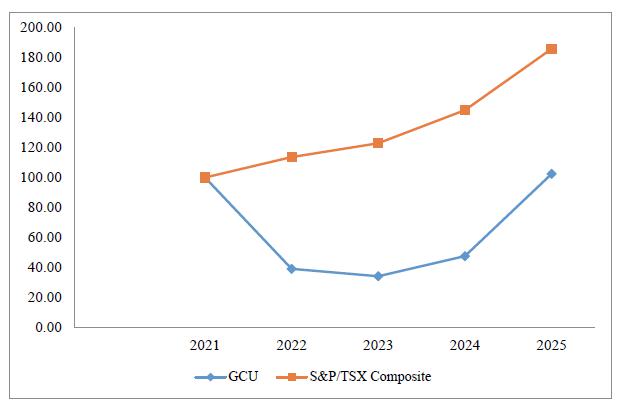
As described above, the Compensation Committee considers various factors in determining the compensation of the Named Executive Officers and common share performance is one performance measure that is reviewed and taken into consideration with respect to executive compensation. As a copper development company, the Common Share price can be impacted by the market price of copper, which can fluctuate widely and be affected by numerous factors that are beyond the Company’s control and difficult to forecast. The Common Share price is also affected by other factors beyond the Company’s control, including general and industry-specific economic and market conditions.
There is not a correlation between the trend of Gunnison’s stock price and Gunnison’s executive compensation. Due to a variety of factors, the Company’s executive compensation increased from 2021 to 2025 as the Company pivoted the development plan for its Gunnison Copper Project and the restart of production from the Johnson Camp Mine.
During the year ended December 31, 2025, the Company’s salary was unchanged for the Chief Executive Officer and Senior Vice President Business Development, and increased for the Senior Vice President and
Chief Financial Officer and Senior Vice President and Chief Operating Officer. During fiscal 2025, the Company paid bonuses for the first time in the measurement period for the reasons discuss further above and the more recent increase in compensation is correlated with an increase in the Company’s share price.
| B-8 |
Compensation Governance
Compensation Committee
Members and Independence
During the year ended December 31, 2025, the Compensation Committee was comprised of Colin Kinley, Fred DuVal and Joseph Gallucci, all of whom are independent directors. The Company announced the sudden passing of Mr. Kinley on November 7, 2025. Currently, the members of the Compensation Committee are Fred DuVal and Joseph Gallucci, all of whom are independent directors.
Skills and Experience
The Board believes that each current member of the Compensation Committee possesses skills and experience relevant to the mandate of the Compensation Committee. In addition, the members of the Compensation Committee each have skills and experience that enable them to make decisions on the suitability of the Company’s compensation policies and practices.
| Committee Member | Relevant Skills and Experience | |
| Fred DuVal | Mr. DuVal is currently a consultant to many American businesses, and a member of Dentons Law, the largest law firm in the world. He is also a senior advisor to Macquarie Infrastructure on public-private partnerships. Mr. DuVal was the Democratic nominee for Governor of Arizona in 2014 and served as Chairman of the Arizona Board of Regents and on the Arizona Commerce Commission. Mr. DuVal was Chief of Protocol of the United States, Assistant to President Clinton in the White House and responsible for all Governors and state issues; he was also the Political Director for Vice President Al Gore. Based on his extensive experience with several different public companies, Mr. DuVal has developed significant knowledge with respect to executive compensation policies and procedures. | |
| Joseph Gallucci | Mr. Gallucci MBA, ICD.D, is a capital markets executive and director with more than 20 years of experience including investment banking and equity research focused on mining including base metals, precious metals, energy metals and bulk commodities. His career has spanned across several firms including BMO Capital Markets, GMP Securities, Dundee Securities, Laurentian Bank Securities and he was a co-founder of Eight Capital where he led their Mining Investment Banking team. He is presently Managing Director, Head of Investment Banking at Ventum Financial where he oversees the mining practice. Earlier in his career, Mr. Gallucci was a research analyst at GMP and Dundee Securities. At Dundee Securities, he was a Managing Director and Head of the Metals and Mining Research Team. Aside from the ICD.D designation obtained in 2022, Mr. Gallucci holds a B.Comm and an MBA in investment management from Concordia University. Based on his extensive experience with several different public companies, Mr. Gallucci has developed significant knowledge with respect to executive compensation policies and procedures. |
| B-9 |
Responsibilities, Powers and Operation
The Compensation Committee’s primary function to assist the Board of Directors in fulfilling its oversight responsibilities by:
| ● | Reviewing and approving and then recommending to the Board of Directors salary or consulting fees, bonuses, and other benefits, direct or indirect, and any change-of-control packages of the Company’s executive officers; | |
| ● | Reviewing compensation of the Board of Directors; | |
| ● | Administration of the Company’s compensation plans, including stock option plans, outside directors’ compensation plans, and such other compensation plans or structures as are adopted by the Company from time to time; | |
| ● | Research and identification of trends in employment benefits; and | |
| ● | Establishment and periodic review of the Company’s policies in the area of management benefits and perquisites based on comparable benefits and perquisites in the mining industry. |
Meetings of the Compensation Committee are held from time to time as the Compensation Committee or the Chair of the Compensation Committee shall determine. The Compensation Committee may ask members of Management or others to attend meetings or to provide information as necessary. The Compensation Committee is permitted to retain and terminate the services of outside compensation specialists and other advisors to the extent required, and has the sole authority to approve their fees and other retention terms.
Compensation Advisor
Identity and Mandate of Compensation Consultant
During the first of the current financial year, the Company retained HRKnow to undertake a review of the Company’s director and executive compensation program. The Committee’s mandate was for HRKnow to provide recommendations regarding director and executive compensation for the fiscal year ended December 31, 2026 and thereafter; however, this also included an analysis of bonus recommendations for performance during the year ended December 31, 2025. In developing compensation recommendations for the fiscal year ended December 31, 2026, and bonus recommendations for the year ended December 31, 2025, HRKnow provided the following support to the Compensation Committee:
| ● | Review and discuss director and executive compensation related matters and market trends. | |
| ● | Review director compensation recommendations. | |
| ● | Review the competitiveness and appropriateness of executive compensation practices and peer groups. | |
| ● | Review executive compensation recommendations. |
| B-10 |
The Company does not have a requirement that the Compensation Committee or Board of Directors pre-approve the services that a compensation consultant provides to the Company at the request of Management.
Fees Paid to Compensation Consultant
During the two most recently completed financial years, following fees have been billed by HRKnow to the Company:
| Financial Year | 2025 | 2024 |
| Executive compensation-related fees | Nil | Nil |
| All other fees | Nil | Nil |
| Total fees | Nil | Nil |
Summary Compensation Table
The following table contains information about the compensation paid to, or earned by, those who were during the fiscal year ended December 31, 2025 the Company’s Named Executive Officers. The Company had four Named Executive Officers during the fiscal year ended December 31, 2025, namely Stephen Twyerould, Roland Goodgame, Robert Winton and Craig Hallworth.
| Name and principal position) | Year | Salary ($) | Share-based awards ($) | Option-based awards ($) | Non-equity incentive plan compensation ($) | Pension value ($) | All other compensation ($) |
Total compensation ($) | |
| Annual incentive plans |
Long-term incentive plans | ||||||||
| Stephen Twyerould(1) | 2025 | 410,000 | Nil | 261,925(5)(6) | 530,000 | Nil | Nil | Nil | 1,201,925(10) |
| CEO | 2024 | 410,000 | Nil | Nil | Nil | Nil | Nil | Nil | 410,261(11) |
| 2023 | 410,000 | Nil | 114,428(8) | Nil | Nil | Nil | Nil | 524,428(12) | |
| Roland Goodgame(2) | 2025 | 330,000 | Nil | 169,184(5) | 302,500 | Nil | Nil | Nil | 801,684(10) |
| SVP Business | 2024 | 320,256 | Nil | Nil | Nil | Nil | Nil | Nil | 320,256(11) |
| Development | 2023 | 330,000 | Nil | 77,811(8) | Nil | Nil | Nil | Nil | 407,811(12) |
| Robert Winton(3) | 2025 | 284,965 | Nil | 259,415(5) | 341,250 | Nil | Nil | Nil | 885,630(10) |
| SVP & COO | 2024 | 272,764 | Nil | Nil | Nil | Nil | Nil | Nil | 272,764(11) |
| 2023 | 270,000 | Nil | 77,811(8) | Nil | Nil | Nil | Nil | 347,811(12) | |
| Craig Hallworth(4) | 2025 | 284,966 | Nil | 169,184(5) | 346,427 | Nil | Nil | Nil | 800,577(10) |
| SVP & CFO | 2024 | 102,060 | Nil | 195,543(7) | Nil | Nil | Nil | 5,779 (9) | 303,382(11) |
| 2023 | Nil | Nil | Nil | Nil | Nil | Nil | Nil | Nil | |
| (1) | Effective January 1, 2017, Mr. Twyerould entered into an employment agreement with Excelsior Arizona. On July 1, 2018, Mr. Twyerould entered into a new employment agreement with Excelsior Arizona and receives his compensation pursuant to the terms of the employment agreement. See below under “Termination and Change of Control Benefits” for a description of the agreements. Mr. Twyerould also serves as a director of the Company, but receives no additional compensation for his services as a director. | |
| (2) | Effective March 1, 2017, Mr. Goodgame entered into an employment agreement with Excelsior Arizona. On July 1, 2018, Mr. Goodgame entered into a new employment agreement with Excelsior Arizona and receives his compensation pursuant to the terms of the employment agreement. See below under “Termination and Change of Control Benefits” for a description of the agreements. Effective April 21, 2017, Mr. Goodgame was appointed Chief Operating Officer of the Company and served as COO until he was appointed Senior Vice President of the Company on August 24, 2020. Effective December 23, 2020, Mr. Goodgame was appointed Senior Vice President Business Development. |
| B-11 |
| (3) | Mr. Winton was appointed as Senior Vice President Operations & General Manager on August 24, 2020. Mr. Winton receives his compensation pursuant to the terms of an employment agreement between Excelsior Arizona and Robert Winton dated August 12, 2020. On October 9, 2025, Mr. Winton was appointed as Senior Vice President & Chief Operating Officer. See below under “Termination and Change of Control Benefits” for a description of this agreement. | |
| (4) | Mr. Hallworth was appointed Senior Vice President and CFO effective September 3, 2024. Mr. Hallworth receives his compensation pursuant to the terms of an employment agreement between Excelsior Arizona and Craig Hallworth dated July 5, 2024. See below under “Termination and Change of Control Benefits” for a description of this agreement. | |
| (5) | The value of the option-based awards reflects the fair value of options granted on the date of grant, which was April 7, 2025. The fair value was computed using the Black Scholes option pricing model with the following assumptions: a) average risk-free interest rate of 2.623% (b) expected life of five years; c) the price of the stock on the grant date; d) expected volatility of 77.27% and e) no expected dividend payments. The Black Scholes model was used to compute option fair values because it is the most commonly used option pricing model and is considered to produce a reasonable estimate of fair value. | |
| (6) | The value of the option-based awards reflects the fair value of options granted on the date of grant, which was December 11, 2025. The fair value was computed using the Black Scholes option pricing model with the following assumptions: a) average risk-free interest rate of 2.978% (b) expected life of five years; c) the price of the stock on the grant date; d) expected volatility of 79.23% and e) no expected dividend payments. The Black Scholes model was used to compute option fair values because it is the most commonly used option pricing model and is considered to produce a reasonable estimate of fair value. | |
| (7) | The value of the option-based awards reflects the fair value of options granted on the date of grant, which was September 3, 2024. The fair value was computed using the Black Scholes option pricing model with the following assumptions: a) average risk-free interest rate of 3.08% (b) expected life of five years; c) the price of the stock on the grant date; d) expected volatility of 60.81% and e) no expected dividend payments. The Black Scholes model was used to compute option fair values because it is the most commonly used option pricing model and is considered to produce a reasonable estimate of fair value. | |
| (8) | The value of the option-based awards reflects the fair value of options granted on the date of grant, which was May 1, 2023. The fair value was computed using the Black Scholes option pricing model with the following assumptions: a) average risk-free interest rate of 3.076% (b) expected life of five years; c) the price of the stock on the grant date; d) expected volatility of 60.81% and e) no expected dividend payments. The Black Scholes model was used to compute option fair values because it is the most commonly used option pricing model and is considered to produce a reasonable estimate of fair value. | |
| (9) | Relocation expenses paid to Craig Hallworth during the year ended December 31, 2024. | |
| (10) | Canadian dollar amounts have been converted to United States dollars using an exchange rate of one U.S. dollar equals 1.3706 of one Canadian dollar, based on the average daily exchange rate on December 31, 2025 as published by the Bank of Canada. | |
| (11) | Canadian dollar amounts have been converted to United States dollars using an exchange rate of one U.S. dollar equals 1.4389 of one Canadian dollar, based on the average daily exchange rate on December 31, 2024 as published by the Bank of Canada. | |
| (12) | Canadian dollar amounts have been converted to United States dollars using an exchange rate of one U.S. dollar equals 1.3226 of one Canadian dollar, based on the average daily exchange rate on December 29, 2023 as published by the Bank of Canada. |
Option-based Awards
The Company currently has a stock option plan in place. The purpose of the stock option plan is to advance the interests of the Company by encouraging equity participation in the Company through the acquisition of Common Shares. Please refer to “Particulars of Matters to be Acted Upon – Approval of Amended Stock Option Plan” in the Information Circular for a summary of the stock option plan.
Restricted Share Unit Plan
In order to further align the interests of the Company’s senior executives, key employees, consultants and directors with those of the Shareholders, the Company has adopted its RSU Plan. Please refer to “Particulars of Matters to be Acted Upon – Approval of Amended Restricted Share Unit Plan” in the Information Circular for a summary of the RSU Plan.
Performance Stock Unit Plan
In order to further align the interests of the Company’s senior executives, key employees and consultants with those of the Shareholders, the Company has adopted its PSU Plan. Please refer to “Particulars of Matters to be Acted Upon – Approval of Amended Performance Share Unit Plan” in the Information Circular for a summary of the PSU Plan.
| B-12 |
Outstanding share-based awards and option-based awards
The following table provides details with respect to outstanding option-based awards and share-based awards, granted to the Named Executive Officers as at the year ended December 31, 2025.
| Option-based Awards | Share-based Awards | ||||||
| Name | Number of securities underlying unexercised options (#) |
Option exercise price ($)(4) |
Option expiration date | Value of unexercised in-the-money options ($)(1)(4) |
Number of shares or units of shares that have not vested (#) |
Market or payout value of share-based awards that have not vested ($)(1)(4) |
Market or payout value of vested share-based awards not paid out or distributed ($) |
| Stephen Twyerould | 500,000(2) | $0.29 | 2030-12-11 | $10,000 | Nil | Nil | Nil |
| CEO | 1,500,000(3) | $0.22 | 2030-04-07 | $135,000 | |||
| 200,000(3) | $0.20 | 2027-05-02 | $22,000 | ||||
| 1,250,000(3) | $0.19 | 2028-05-01 | $150,000 | ||||
| Roland Goodgame | 1,500,000(3) | $0.22 | 2030-04-07 | $135,000 | Nil | Nil | Nil |
| COO | 100,000(3) | $0.20 | 2027-05-02 | $11,000 | |||
| 850,000(3) | $0.19 | 2028-05-01 | $102,000 | ||||
| Robert Winton | 2,300,000(3) | $0.22 | 2030-04-07 | $207,000 | Nil | Nil | Nil |
| Senior VP Operations | 300,000(3) | $0.54 | 2026-03-31 | Nil | |||
| & General Manager | 100,000(3) | $0.20 | 2027-05-02 | $11,000 | |||
| 850,000(3) | $0.19 | 2028-05-01 | $102,000 | ||||
| Craig Hallworth(5) | 1,500,000(3) | $0.22 | 2026-03-31 | $135,000 | Nil | Nil | Nil |
| Senior VP & CFO | 3,500,000(3) | $0.11 | 2029-09-03 | $700,000 | |||
| (1) | Based on the closing price of the Common Shares on the Exchange on December 31, 2025, being US$0.31 (C$0.42 converted to United States dollars). | |
| (2) | Options are granted for a period of five years and vest once the Board of Directors determines that Greenstone Excelsior Holdings L.P. has completed the divestment of its interests in the Company. | |
| (3) | Options are granted for a period of five years and vest over a period of two years such that 25% become available for exercise on each of the six, twelve, eighteen and twenty-four month anniversaries of the date of grant. | |
| (4) | Canadian dollar amounts have been converted to United States dollars and rounded to two decimal places using an exchange rate of one U.S. dollar equals 1.3706 of one Canadian dollar, based on the average daily exchange rate on December 31, 2025 as published by the Bank of Canada. |
Incentive plan awards – value vested or earned during the financial year ended December 31, 2025
The following table provides information regarding value vested or earned through incentive plan awards by the Named Executive Officers during the year ended December 31, 2025:
| B-13 |
| Name | Option-based awards – Value vested during the year ($)(1) |
Share-based awards – Value vested during the year ($)(2) |
Non-equity incentive plan compensation – Value earned during the year ($) |
Stephen Twyerould CEO |
$55,625(3) | Nil | Nil |
Roland Goodgame COO |
$54,625(4) | Nil | Nil |
Robert Winton Senior VP Operations & General Manager |
$82,625(5) | Nil | Nil |
Craig Hallworth Senior VP & CFO |
$140,000(6) | Nil | Nil |
| (1) | This amount is calculated based on the dollar value that would have been realized by determining the difference between the closing market price of the Common Shares and the exercise price of the options on the vesting date. | |
| (2) | This amount is calculated by multiplying the number of RSUs vested by the closing price of the Common Shares on the Exchange on the day immediately preceding the date on which the RSUs vested. | |
| (3) | 312,500 options exercisable at $0.19 per share vested on May 1, 2025, and 375,000 options exercisable at $0.22 per share vested on October 7, 2025. The closing prices of the Common Shares on the Exchange on May 1, 2025, and October 7, 2025 were $0.20 and $0.36, respectively. The aggregate value of options vested during 2025 was $55,625. | |
| (4) | 212,500 options exercisable at $0.19 per share vested on May 1, 2025, and 375,000 options exercisable at $0.22 per share vested on October 7, 2025. The closing prices of the Common Shares on the Exchange on May 1, 2025, and October 7, 2025 were $0.20 and $0.36, respectively. The aggregate value of options vested during 2025 was $54,625.00. | |
| (5) | 212,500 options exercisable at $0.19 per share vested on May 1, 2025, and 575,000 options exercisable at $0.22 per share vested on October 7, 2025. The closing prices of the Common Shares on the Exchange on May 1, 2025, and October 7, 2025 were $0.20 and $0.36, respectively. The aggregate value of options vested during 2025 was $82,625. | |
| (6) | 875,000 options exercisable at $0.11 per share vested on March 3, 2025, 875,000 options exercisable at $0.11 per share vested on September 3, 2025, and 375,000 options exercisable at $0.22 per share vested on October 7, 2025. The closing prices of the Common Shares on the Exchange on March 3, 2025, September 3, 2025, and October 7, 2025 were $0.13, $0.19, and $0.36, respectively. The aggregate value of options vested during 2025 was $140,000. |
Pension Plan Benefits
The Company does not have any pension or retirement plans or arrangements for its Named Executive Officers.
Termination and Change of Control Benefits
The following describes the respective employment agreements currently in effect for the Named Executive Officers:
Stephen Twyerould
Effective January 1, 2017, Stephen Twyerould entered into an employment agreement with Excelsior Arizona pursuant to which Excelsior Arizona employs Mr. Twyerould in the position of Chief Executive Officer and President of the Company, Excelsior Arizona and Excelsior Mining JCM, Inc. (“Excelsior JCM”). Effective July 1, 2018, Mr. Twyerould entered into a new employment agreement (the “Twyerould Agreement”) with Excelsior Arizona and his annual base salary increased to US$410,000.
Pursuant to the Twyerould Agreement if Excelsior Arizona terminates the Twyerould Agreement for cause, Excelsior Arizona is required to pay Mr. Twyerould all previously unpaid base salary up to the date of termination. If Excelsior Arizona terminates the Twyerould Agreement for any reason other than for cause or the death or disability of Mr. Twyerould, or if Mr. Twyerould terminates the Twyerould Agreement for Good Reason (as defined below), Excelsior Arizona is required to pay Mr. Twyerould all unpaid base salary and an amount equal to one year of base salary. In the event of a Change of Control (as defined below) and Excelsior Arizona terminates the Twyerould Agreement or fails to renew the Twyerould Agreement within 18 months of the Change of Control, Excelsior Arizona is required to pay Mr. Twyerould an amount equal to (i) three years worth of base salary, (ii) plus an amount calculated by multiplying (A) the targeted amount of the annual bonus by (B) a fraction the numerator of which is the number of whole months of base salary that is provided pursuant to (i) and the denominator is 12, and (iii) provide either the continuation of benefits for a one year period or a payout of the value of such benefits as determined by an independent valuator selected by the Company.
| B-14 |
Roland Goodgame
Effective March 1, 2017, Roland Goodgame entered into an employment agreement with Excelsior Arizona pursuant to which Excelsior Arizona employs Mr. Goodgame in the position of Chief Operating Officer of the Company, Excelsior Arizona and Excelsior JCM. Effective July 1, 2018, Mr. Goodgame entered into a new employment agreement with Excelsior Arizona (the “Goodgame Agreement”) and his annual base salary increased to US$330,000. Effective December 23, 2020, Mr. Goodgame was promoted to the position of Senior Vice President Business Development. No changes were made to the Goodgame Agreement with respect to the promotion.
Pursuant to the Goodgame Agreement, if Excelsior Arizona terminates the Goodgame Agreement for cause, Excelsior Arizona is required to pay Mr. Goodgame all previously unpaid base salary up to the date of termination. If Excelsior Arizona terminates the Goodgame Agreement for any reason other than for cause or the death or disability of Mr. Goodgame, or if Mr. Goodgame terminates the Goodgame Agreement for Good Reason (as defined below), Excelsior Arizona is required to pay Mr. Goodgame all unpaid base salary and an amount equal to one year of base salary. In the event of a Change of Control (as defined below) and Excelsior Arizona terminates the Goodgame Agreement or fails to renew the Goodgame Agreement within 18 months of the Change of Control, Excelsior Arizona is required to pay Mr. Goodgame an amount equal an amount equal to (i) three years worth of base salary, (ii) plus an amount calculated by multiplying (A) the targeted amount of the annual bonus by (B) a fraction the numerator of which is the number of whole months of base salary that is provided pursuant to (i) and the denominator is 12, and (iii) provide either the continuation of benefits for a one year period or a payout of the value of such benefits as determined by an independent valuator selected by the Company.
Robert Winton
Effective August 12, 2020, Robert Winton entered into an employment agreement with Excelsior Arizona (the “Winton Agreement”) pursuant to which Excelsior Arizona employs Mr. Winton in the position of Senior Vice President Operations and General Manager of the Company, Excelsior Arizona and Excelsior JCM at an annual base salary of US$270,000. During fiscal 2025 his annual base salary was increased to US$330,000.
Pursuant to the Winton Agreement, Mr. Winton, may terminate the Winton Agreement on the giving to the Excelsior Arizona at least three months’ written notice of the effective date of such termination. Excelsior Arizona may terminate the Winton Agreement without cause as follows:
| (i) | for the period from the Commencement Date until and including the one year anniversary of the Commencement Date, six (6) months’ written notice or pay in lieu of notice; | |
| (ii) | for the period after the one year anniversary date of the Commencement Date until and including the second year anniversary of the Commencement Date, nine (9) months’ written notice or pay in lieu of notice; and | |
| (iii) | for any period after the second year anniversary of the Commencement Date, twelve (12) months’ written notice or pay in lieu of notice. |
In the event of a Change of Control (as defined below) and Excelsior Arizona terminates the Winton Agreement without cause within 12 months of the change of control, or Mr. Winton terminates the Winton Agreement for Good Reason, within 12 months of the change of control, Excelsior Arizona is required to pay Mr. Winton an amount equal to the 12 months’ base salary at the time of termination.
| B-15 |
Craig Hallworth
On July 5, 2024, Craig Hallworth entered into an employment agreement with Excelsior Arizona (the “Hallworth Agreement”) pursuant to which Excelsior Arizona employs Mr. Hallworth in the position of Chief Financial Officer and Senior Vice President of the Company, Excelsior Arizona and Excelsior Holdings at an annual base salary of US$270,000. During fiscal 2025 his annual base salary was increased to US$330,000.
Pursuant to the Hallworth Agreement, Mr. Hallworth, may terminate the Hallworth Agreement on the giving to the Excelsior Arizona at least four months’ written notice of the effective date of such termination. Excelsior Arizona may terminate the Hallworth Agreement without cause on the giving of twelve (12) months’ written notice or pay in lieu of notice.
In the event of a Change of Control (as defined below) and Excelsior Arizona terminates the Hallworth Agreement without cause within 12 months of the change of control, or Mr. Hallworth terminates the Hallworth Agreement for Good Reason, within 12 months of the change of control, Excelsior Arizona is required to pay Mr. Hallworth an amount equal to the 24 months’ base salary at the time of termination.
Definitions
Change of control (“Change of Control”) is defined in each of the Goodgame Agreement, the Twyerould Agreement, the Winton Agreement and the Hallworth Agreement to include each of the following: (a) any tender offer, take-over bid or exchange offer is consummated involving fifty one percent (51%) or more of the combined voting power of Excelsior Arizona’s or the Company’s outstanding securities; (b) the consummation of any merger, consolidation or other reorganization or similar transaction involving Excelsior Arizona or the Company where less than sixty percent (60%) of the outstanding voting shares of the surviving entity are or would be owned in the aggregate by Excelsior Arizona’s or the Company’s stockholders who are stockholders of Excelsior Arizona or the Company, as applicable, as of the date of such action; (c) the consummation of any sale or transfer of all or substantially all of the assets of Excelsior Arizona or the Company to any person or entity, other than to an entity that is wholly owned by Excelsior Arizona or the Company, as applicable; (d) any tender offer, take-over bid, exchange offer, merger, take-over bid, consolidation, other reorganization or similar transaction, sale or transfer of assets or contested election where less than a majority of the board of directors of Excelsior Arizona or the Company, or, if applicable, the surviving entity were directors of Excelsior Arizona or the Company, as applicable, before such action; or (e) any transaction relating to Excelsior Arizona or the Company that is required to be described in accordance with Schedule 14A of Regulation 14A of the Securities and Exchange Commission (or equivalent regulations applicable in Canada). In the Goodgame Agreement and the Twyerould Agreement a change of control also includes where any securityholder, including its affiliates, sells or transfers fifty percent (50.0%) or more of the combined voting power of Excelsior Arizona’s or the Company’s outstanding securities to a party that is not an affiliate of the transferring securityholder, where references to an “affiliate” are as such term is defined in the Business Corporations Act (British Columbia).
Good Reason is defined in the Twyerould Agreement to mean, without Twyerould’s written consent, the occurrence of any of the following circumstances: (i) reduction by Excelsior Arizona in Twyerould’s Base Salary; (ii) the failure of Twyerould to be appointed or re-appointed to the position of President & Chief Executive Officer of Excelsior Arizona or the Company; (iii) a material diminution in Twyerould’s duties or the assignment to Twyerould of any duties inconsistent with his position and status as President & Chief Executive Officer of Excelsior Arizona or the Company; (iv) the Company ceases to be publicly traded; (v) a change in Twyerould’s reporting relationship such that Twyerould no longer reports directly to the Board of Directors of Excelsior Arizona and the Company; or (vi) a relocation of place of work outside of Arizona.
Good Reason is defined in the Goodgame Agreement to mean, without Goodgame’s written consent, the occurrence of any of the following circumstances: (i) reduction by Excelsior Arizona in the Goodgame’s Base Salary; (ii) the failure of the Goodgame to be appointed or re-appointed to the position of Senior Vice President or Chief Operating Officer, as applicable, of Excelsior Arizona or the Company; (iii) a material diminution in the Goodgame’s duties or the assignment to the Goodgame of any duties inconsistent with his position and status as Senior Vice President or Chief Operating Officer, as applicable, of Excelsior Arizona or the Company; (iv) the Company ceases to be publicly traded; (v) a change in the Goodgame’s reporting relationship such that the Goodgame no longer reports directly to the Chief Executive Officer of Excelsior Arizona and the Company; or (vi) a relocation of place of work outside of Arizona.
| B-16 |
Good Reason is defined in the Winton Agreement to mean, without Winton’s written consent, the occurrence of any of the following circumstances: (i) reduction by Excelsior Arizona in Winton’s Base Salary; (ii) the failure of Winton to be appointed or re-appointed to the position of Senior Vice President Operations and General Manager; (iii) a material diminution in Winton’s duties or the assignment to Winton of any duties inconsistent with his position and status as Senior Vice President Operations and General Manager of Excelsior Arizona, or the Company; (iv) the Company ceases to be publicly traded; (v) a change in Winton’s reporting relationship such that Winton no longer reports directly to the Chief Executive Officer; (vi) Winton is directed by the Company to act, or refrain from acting, in a manner that would result in the Company becoming non-compliant with any of its permits or a violation of applicable law; or (vii) a relocation of place of work outside of Arizona.
Good Reason is defined in the Hallworth Agreement to mean, without Hallworth’s written consent, the occurrence of any of the following circumstances: (i) reduction by Excelsior Arizona in Hallworth’s Base Salary; (ii) the failure of Hallworth to be appointed or re-appointed to the position of Chief Financial Officer and Senior Vice President; (iii) a material diminution in Hallworth’s duties or the assignment to Hallworth of any duties inconsistent with his position and status as Chief Financial Officer and Senior Vice President;
(iv) the Parent Company ceases to be publicly traded; (v) a change in Hallworth’s reporting relationship such that Hallworth no longer reports directly to the Chief Executive Officer of Excelsior Arizona; or (vi) a relocation of place of work outside of Arizona.
Termination Payments
The following table shows estimated incremental payments triggered pursuant to termination of employment of a Named Executive Officer in the event of a Change of Control in accordance with the termination provisions described above:•
| Name(1), | Stephen Twyerould | Roland Goodgame | Robert Winton | Craig Hallworth |
| Severance Period | 36 months | 36 months | 12 months | 24 months |
| Severance Payment (Salary Portion) | $1,230,000 | $990,000 | $330,000 | $660,000 |
| Severance Payment (Bonus Portion) | $1,230,000 | $742,500 | Nil | Nil |
| Unvested Stock Options(2)(3) | $116,250 | $101,250 | $155,250 | $451,250 |
| Benefits(4) | Nil | Nil | $8,769 | $1,342 |
| TOTALS | $2,576,250 | $1,833,750 | $494,019 | $1,112,592 |
| (1) | The termination value assumes that the triggering event took place on the last business day of the Company’s financial year-end (December 31, 2025). | |
| (2) | Canadian dollar amounts have been converted to United States dollars and rounded to two decimal places using an exchange rate of one U.S. dollar equals 1.3706 of one Canadian dollar, based on the average daily exchange rate on December 31, 2025 as published by the Bank of Canada. | |
| (3) | Subject to any resolution of the Board of Directors, if there is a Change of Control, all stock options vest immediately prior to such Change of Control. This calculation is based on the closing price of the Common Shares on the Toronto Stock Exchange on December 31, 2025, being US$0.31 (C$0.42 converted to United States dollars). | |
| (4) | This amount includes health and medical plan premiums. |
| B-17 |
The following table shows estimated incremental payments triggered pursuant to termination of employment of a Named Executive Officer without cause in accordance with the termination provisions described above:
| Name(1),(2) | Stephen Twyerould | Roland Goodgame | Robert Winton | Craig Hallworth |
| Severance Period | 12 months | 12 months | 12months | 12 months |
| Severance Payment (Salary Portion) | $410,000 | $330,000 | $330,000 | $330,000 |
| Severance Payment (Bonus Portion) | Nil | Nil | Nil | Nil |
| Unvested Stock Options | Nil | Nil | Nil | Nil |
| Benefits | Nil | Nil | Nil | Nil |
| TOTALS | $410,000 | $330,000 | $330,000 | $330,000 |
| (1) | The termination value assumes that the triggering event took place on the last business day of the Company’s financial year-end (December 31, 2025). |
Director Compensation
From April 21, 2021, under the Company’s director compensation program, non-executive Directors of the Company receive the following director compensation, paid quarterly:
| ● | Non-Executive Chair $100,000/Year | |
| ● | Non-Executive Director $40,000/Year | |
| ● | Non-Chair Committee membership fee (per committee) - $7,500/Year | |
| ● | Chair Committee fee (per committee) - $10,000/Year |
The following table contains information about the compensation paid to, or earned by Directors of the Company who were not Named Executive Officers. During the financial year ended December 31, 2025, the Company had six Directors who were not Named Executive Officers, being Colin Kinley, Michael Haworth, Fred DuVal, Stephen Axcell, Jason Howe and Joseph Gallucci.
Name |
Fees earned ($) |
Share-based awards ($) |
Option-based awards ($)(7) |
Non-equity incentive plan compensation ($) |
Pension value ($) |
All other compensation ($) |
Total ($) |
Colin Kinley(1) Former Director |
$52,500 | Nil | $167,965(8)(9) | Nil | Nil | Nil | $220,465 |
Michael Haworth(2)(6) Former Director |
$57,500(2) | Nil | $167,965(8)(9) | Nil | Nil | Nil | $225,465 |
| Fred DuVal Director | $121,250 | Nil | $167,965(8)(9) | Nil | Nil | Nil | $289,215 |
Stephen Axcell(3) Former Director |
$16,250 | Nil | Nil | Nil | Nil | Nil | $16,250 |
Jason Howe(4) Director |
$33,750 | Nil | $179,040(10) | Nil | Nil | Nil | $212,790 |
Joseph Gallucci(5) Director |
$32,500 | Nil | $179,040(10) | Nil | Nil | Nil | $211,540 |
| (1) | Mr. Kinley passed away on November 6, 2025. | |
| (2) | Mr. Haworth resigned as a director on March 10, 2026. | |
| (3) | Mr. Axcell resigned as a director on March 20, 2025. |
| B-18 |
| (4) | Mr. Howe was appointed as a director on May 14, 2025. | |
| (5) | Mr. Gallucci was appointed as a director on May 14, 2025. | |
| (6) | The amount under “Fees earned” and “Option-based awards” represents fees paid and stock options granted to Greenstone Management Ltd. instead of Mr. Haworth directly. | |
| (7) | Canadian dollar amounts have been converted to United States dollars and rounded to two decimal places using an exchange rate of one U.S. dollar equals 1.3706 of one Canadian dollar, based on the average daily exchange rate on December 31, 2025 as published by the Bank of Canada. | |
| (8) | The value of the option-based awards reflects the fair value of options granted on the date of grant, which was April 7, 2025. The fair value was computed using the Black Scholes option pricing model with the following assumptions: a) average risk-free interest rate of 2.623% (b) expected life of five years; c) the price of the stock on the grant date; d) expected volatility of 77.27% and e) no expected dividend payments. The Black Scholes model was used to compute option fair values because it is the most commonly used option pricing model and is considered to produce a reasonable estimate of fair value. | |
| (9) | The value of the option-based awards reflects the fair value of options granted on the date of grant, which was July 30, 2025. The fair value was computed using the Black Scholes option pricing model with the following assumptions: a) average risk-free interest rate of 3.027% (b) expected life of five years; c) the price of the stock on the grant date; d) expected volatility of 77.05% and e) no expected dividend payments. The Black Scholes model was used to compute option fair values because it is the most commonly used option pricing model and is considered to produce a reasonable estimate of fair value. | |
| (10) | The value of the option-based awards reflects the fair value of options granted on the date of grant, which was May 14, 2025. The fair value was computed using the Black Scholes option pricing model with the following assumptions: a) average risk-free interest rate of 2.820% (b) expected life of five years; c) the price of the stock on the grant date; d) expected volatility of 77.55% and e) no expected dividend payments. The Black Scholes model was used to compute option fair values because it is the most commonly used option pricing model and is considered to produce a reasonable estimate of fair value. |
Incentive plan awards - Outstanding share-based awards and option-based awards granted to Directors
The following table provides details with respect to outstanding option-based awards and share-based awards, granted to the Directors of the Company who were not Named Executive Officers as at the year ended December 31, 2025.
| Option-based Awards | Share-based Awards | ||||||
| Name | Number of securities underlying unexercised options (#) |
Option exercise price ($)(4) | Option expiration date | Value of unexercised in-the-money options ($)(1)(4) |
Number of shares or units of shares that have not vested (#) | Market or payout value of share-based awards that have not vested ($)(1)(4) | Market or payout value of vested share-based awards not paid out or distributed ($) |
| Colin Kinley | 50,000(2) | $0.20 | 2027-05-02 | $5,500 | Nil | Nil | Nil |
| Former Director | 500,000(2) | $0.19 | 2028-05-01 | $60,000 | |||
| 1,000,000(2) | $0.22 | 2030-04-07 | $90,000 | ||||
| 500,000(2) | $0.22 | 2030-07-30 | $45,000 | ||||
| Michael Haworth | 50,000(2)(3) | $0.20 | 2027-05-02 | $5,500 | Nil | Nil | Nil |
| Former Director | 500,000(2)(3) | $0.19 | 2028-05-01 | $60,000 | |||
| 1,000,000(2)(3) | $0.22 | 2030-04-07 | $90,000 | ||||
| 500,000(2) | $0.22 | 2030-07-30 | $45,000 | ||||
| Fred DuVal | 150,000(2) | $0.20 | 2027-05-02 | $16,500 | Nil | Nil | Nil |
| Director | 800,000(2) | $0.19 | 2028-05-01 | $96,000 | |||
| 1,000,000(2) | $0.22 | 2030-04-07 | $90,000 | ||||
| 500,000(2) | $0.22 | 2030-07-30 | $45,000 | ||||
| Stephen Axcell | 50,000(2) | $0.20 | 2027-05-02 | $5,500 | Nil | Nil | Nil |
| Former Director | 500,000(2) | $0.19 | 2028-05-01 | $60,000 | |||
Jason Howe Director |
1,500,000(2) | $0.22 | 2030-05-14 | $135,000 | Nil | Nil | Nil |
Joseph Gallucci Director |
1,500,000(2) | $0.22 | 2030-05-14 | $135,000 | Nil | Nil | Nil |
| (1) | Based on the closing price of the Common Shares on the Exchange on December 31, 2025, being US$0.31 (C$0.42 converted to United States dollars). | |
| (2) | Options are exercisable for a period of five years and vest over a period of two years such that 25% become available for exercise on each of the six, twelve, eighteen and twenty-four month anniversaries of the date of grant. |
| B-19 |
| (3) | These Options were granted to Greenstone Management Ltd. instead of Mr. Haworth directly. | |
| (4) | Canadian dollar amounts have been converted to United States dollars and rounded to two decimal places using an exchange rate of one U.S. dollar equals 1.3706 of one Canadian dollar, based on the average daily exchange rate on December 31, 2025 as published by the Bank of Canada. |
Incentive plan awards – value vested or earned during the financial year ended December 31, 2025
The following table provides information regarding value vested or earned through incentive plan awards by the Directors of the Company who were not Named Executive Officers during the year ended December 31, 2025:
| Name | Option-based awards – Value vested during the year ($)(1) |
Share-based awards – Value vested during the year ($)(2) |
Non-equity incentive plan compensation – Value earned during the year ($) |
Colin Kinley, Former Director |
$36,250(3) | Nil | Nil |
Michael Haworth, Former Director |
$36,250(4)(5) | Nil | Nil |
Fred DuVal, Director |
$37,000(6) | Nil | Nil |
Stephen Axcell, Former Director |
Nil(7) | Nil | Nil |
Jason Howe Director |
$7,500(8) | Nil | Nil |
Joseph Gallucci Director |
$7,500(9) | Nil | Nil |
| (1) | This amount is calculated based on the dollar value that would have been realized by determining the difference between the closing market price of the Common Shares and the exercise price of the options on the vesting date. | |
| (2) | This amount is calculated by multiplying the number of RSUs vested by the closing price of the Common Shares on the Exchange on the day immediately preceding the date on which the RSUs vested. | |
| (3) | 125,000 options exercisable at $0.19 per share vested on May 1, 2025, and 250,000 options exercisable at $0.22 per share vested on October 7, 2025. The closing prices of the Common Shares on the Exchange on May 1, 2025, and October 7, 2025 were $0.20 and $0.36, respectively. The aggregate value of options vested during 2025 was $36,250. | |
| (4) | 125,000 options exercisable at $0.19 per share vested on May 1, 2025, and 250,000 options exercisable at $0.22 per share vested on October 7, 2025. The closing prices of the Common Shares on the Exchange on May 1, 2025, and October 7, 2025 were $0.20 and $0.36, respectively. The aggregate value of options vested during 2025 was $36,250. | |
| (5) | Represents stock options granted to Greenstone Management Ltd. instead of Mr. Haworth directly. | |
| (6) | 200,000 options exercisable at $0.19 per share vested on May 1, 2025, and 250,000 options exercisable at $0.22 per share vested on October 7, 2025. The closing prices of the Common Shares on the Exchange on May 1, 2025, and October 7, 2025 were $0.20 and $0.36, respectively. The aggregate value of options vested during 2025 was $37,000. | |
| (7) | Mr. Axcell resigned as a director on March 20, 2025 and as a result no options vested. | |
| (8) | 375,000 options exercisable at $0.22 per share vested on November 14, 2025. The closing price of the Common Shares on the Exchange on November 14, 2025 was $0.24. The aggregate value of options vested during 2025 was $7,500. | |
| (9) | 375,000 options exercisable at $0.22 per share vested on November 14, 2025. The closing price of the Common Shares on the Exchange on November 14, 2025 was $0.24. The aggregate value of options vested during 2025 was $7,500. |
SCHEDULE “C”
STOCK OPTION PLAN
See attached.
GUNNISON COPPER CORP.
AMENDED INCENTIVE STOCK OPTION PLAN
May 21, 2018
As Amended May 8, 2026
TABLE OF CONTENTS
| ARTICLE 1 | PURPOSE AND INTERPRETATION | 1 | |
| 1.1 | Purpose | 1 | |
| 1.2 | Definitions | 1 | |
| ARTICLE 2 | SHARE OPTION PLAN | 5 | |
| 2.1 | The Plan | 5 | |
| 2.2 | Participants | 5 | |
| 2.3 | Maximum Number of Common Shares | 5 | |
| 2.4 | Limits with Respect to Insiders and Consultants | 5 | |
| 2.5 | Price | 6 | |
| 2.6 | Vesting | 6 | |
| 2.7 | Lapsed Options | 6 | |
| 2.8 | Consideration, Option Period and Payment | 6 | |
| 2.9 | Termination of Employment or Engagement | 9 | |
| 2.10 | Death of Participant | 10 | |
| 2.11 | Adjustment in Shares Subject to the Plan | 10 | |
| 2.12 | Change in Control | 10 | |
| 2.13 | Interpretation | 10 | |
| 2.14 | Discretion to Accelerate Options | 11 | |
| 2.15 | Options Need Not Be Treated Identically | 11 | |
| 2.16 | Record Keeping | 11 | |
| 2.17 | Option Agreements | 12 | |
| 2.18 | Tax Withholding | 12 | |
| ARTICLE 3 | GENERAL | 12 | |
| 3.1 | Assignability and Transferability | 12 | |
| 3.2 | Employment | 12 | |
| 3.3 | Delegation to Compensation Committee | 13 | |
| 3.4 | Administration of the Plan | 13 | |
| 3.5 | Amendment, Modification or Termination of the Plan | 13 | |
| 3.6 | No Representation or Warranty | 14 | |
| 3.7 | Governing Law | 14 | |
| 3.8 | Approval and Effective Date | 14 | |
| 3.9 | Compliance with Applicable Law | 14 | |
| 3.10 | Rights of Participant | 14 | |
| 3.11 | Conflict | 14 | |
| 3.12 | Time of Essence | 14 | |
| 3.13 | Compliance With U.S. Laws | 14 | |
| 3.14 | Entire Agreement | 14 | |
| APPENDIX A | INCENTIVE STOCK OPTION AGREEMENT | A-1 | |
ARTICLE 1
PURPOSE AND INTERPRETATION
1.1 Purpose. The purpose of the Plan is to advance the interests of the Corporation by encouraging equity participation in the Corporation through the acquisition of Common Shares of the Corporation by directors, officers, employees and consultants of the Corporation.
1.2 Definitions. In the Plan, the following capitalized words and terms shall have the following meanings:
| (a) | “Act” means the Business Corporations Act (British Columbia) or its successor, as amended from time to time, or the governing corporate statute in the jurisdiction where the Corporation is incorporated or continued into; | |
| (b) | “Affiliate” shall have the meaning ascribed thereto in the Securities Act. | |
| (c) | “Associate” shall have the meaning ascribed thereto in the Securities Act. | |
| (d) | “Blackout Period” means a period, formally imposed by the Corporation pursuant to its internal trading policies as a result of the bona fide existence of material undisclosed information, during which Participants are prohibited from exercising options. | |
| (e) | “Board of Directors” means the board of directors of the Corporation as constituted from time to time and any committee of the board of directors. | |
| (f) | “Change in Control” means the occurrence of any one or more of the following events: |
| (i) | a consolidation, merger, amalgamation, arrangement or other reorganization or acquisition involving the Corporation or any of its subsidiaries and another corporation or other entity, as a result of which the holders of Voting Shares prior to the completion of the transaction hold less than 50% of the votes attached to all of the outstanding voting securities of the successor corporation or entity after completion of the transaction; | |
| (ii) | a resolution is adopted to wind-up, dissolve or liquidate the Corporation; | |
| (iii) | any person, entity or group of persons or entities acting jointly or in concert (the “Acquiror”) acquires, or acquires control (including the power to vote or direct the voting) of, voting securities of the Corporation which, when added to the voting securities owned of record or beneficially by the Acquiror or which the Acquiror has the right to vote or in respect of which the Acquiror has the right to direct the voting, would entitle the Acquiror and/or associates and/or affiliates of the Acquiror to cast or direct the casting of 50% or more of the votes attached to all of the Corporation’s outstanding voting securities which may be cast to elect directors of the Corporation or the successor corporation (regardless of whether a meeting has been called to elect directors); | |
| (iv) | the sale, transfer or other disposition of all or substantially all of the assets of the Corporation; | |
| (v) | as a result of or in connection with: |
| (A) | the contested election of directors; or | |
| (B) | a transaction referred to in paragraph (i) of this definition of “Change in Control”, |
| 1 |
the nominees named in the most recent management information circular of the Corporation for election to the board of directors of the Corporation shall not constitute a majority of the directors;
| (vi) | the Board adopts a resolution to the effect that a transaction or series of transactions involving the Corporation or any of its affiliates that has occurred or is imminent is a Change in Control, |
and for purposes of the foregoing, “voting securities” means the Voting Shares and any other shares entitled to vote for the election of directors, and shall include any securities, whether or not issued by the Corporation, which are not shares entitled to vote for the election of directors but which are convertible into or exchangeable for shares which are entitled to vote for the election of directors, including any options or rights to purchase such shares or securities.
| (g) | “Consultant” means, in relation to the Corporation, an individual or company, other than an employee or a Director of the Corporation, that: |
| (i) | is engaged to provide on a ongoing bona fide basis, consulting, technical, management or other services to the Corporation or to a related entity of the Corporation, other than services provided in relation to a Distribution; | |
| (ii) | provides the services under a written contract between the Corporation or related entity and the individual or the Consultant Company; | |
| (iii) | in the reasonable opinion of the Corporation, spends or will spend a significant amount of time and attention on the affairs and business of the Corporation or related entity of the Corporation; and | |
| (iv) | has a relationship with the Corporation or a related entity of the Corporation that enables the individual to be knowledgeable about the business and affairs of the Corporation. |
For purposes of the above definition of “Consultant”, the term “Director” means a director, senior officer or Management Company Employee of the Corporation, or a director, senior officer or Management Company Employee of the Corporation’s subsidiaries.
| (h) | “Consultant Company” means a Consultant that is a company. | |
| (i) | “Corporation” means Gunnison Copper Corp., a corporation incorporated under the Act, and its successors from time to time. | |
| (j) | “Corporation’s Broker” has the meaning given to such term in Section 2.16 of the Plan. |
| 2 |
| (k) | “Designated Affiliate” means the Affiliates of the Corporation designated by the Board of Directors for purposes of the Plan from time to time. | |
| (l) | “Distribution” shall have the meaning ascribed thereto in the Securities Act. | |
| (m) | “director” means directors, executive officers and Management Company Employees of the Corporation, or directors, executive officers and Management Company Employees of the Corporation’s subsidiaries to whom stock options can be granted in reliance on a Prospectus exemption under applicable securities laws. | |
| (n) | “executive officer” means, for an issuer, an individual who is |
| (i) | a chair, vice-chair or president, | |
| (ii) | a vice-president in charge of a principal business unit, division or function including sales, finance or production, or | |
| (iii) | performing a policy-making function in respect of the issuer; |
| (o) | “Exchange” means the TSX or such other stock exchange or quotation system as the Common Shares may from time to time be listed or quoted for trading. | |
| (p) | “employee” means: |
| (i) | an individual who is considered an employee of the Corporation or its related entity under the Income Tax Act (Canada) (i.e. for whom income tax, employment insurance and CPP deductions must be made at source); | |
| (ii) | an individual who works full- time for an Corporation or its related entity providing services normally provided by an employee and who is subject to the same control and direction by the Corporation over the details and methods of work as an employee of the Corporation, but for whom income tax deductions are not made at source; or | |
| (iii) | an individual who works for an Corporation or its related entity on a continuing and regular basis for a minimum amount of time per week (the number of hours should be disclosed in the submission) providing services normally provided by an employee and who is subject to the same control and direction by the Corporation over the details and methods of work as an employee of the Corporation, but for whom income tax deductions are not made at source. |
| (q) | “Holding Company” shall have the meaning specified in Section 2.2 hereof. | |
| (r) | “Insider” shall have the meaning ascribed thereto in the TSX Company Manual. | |
| (s) | “Issuer Bid” shall have the meaning ascribed thereto in the Securities Act. | |
| (t) | “Management Company Employee” means an individual employed by a person providing management services to the Corporation, which are required for the ongoing successful operation of the business enterprise of the Corporation; |
| 3 |
| (u) | “Market Price” means the closing trading price of the Common Shares on the TSX, or another stock exchange where the majority of the trading volume and value of the Common Shares occurs, on the trading day immediately preceding the relevant date; | |
| (v) | “Non-Employee Director” has the meaning ascribed thereto in Section 2.4(c). | |
| (w) | “Non-Employee Director Participation Limits” has the meaning ascribed thereto in Section 2.4(c). | |
| (x) | “Option Agreements” shall have the meaning specified in Section 2.17 hereof. | |
| (y) | “Option Period” means the period of time an option may be exercised as specified in Subsection 2.8(a) hereof. | |
| (z) | “Participant” means a participant under the Plan as described in Section 2.2 hereof. | |
| (aa) | “Participant’s Broker” has the meaning given to such term in Section 2.8(c) of the Plan. | |
| (bb) | “Plan” means the share incentive plan provided for herein. | |
| (cc) | “RRSP” shall have the meaning specified in Section 2.2 hereof. | |
| (dd) | “Securities Act” means the Securities Act (British Columbia) or its successor, as amended from time to time. | |
| (ee) | “Security-Based Compensation Arrangement” includes: |
| (i) | the Plan; | |
| (ii) | the Restricted Share Unit Plan of the Corporation; | |
| (iii) | the Performance Share Unit Plan of the Corporation; and | |
| (iv) | any employee stock purchase plan or any other compensation or incentive mechanism involving the issuance or potential issuance of securities of the Corporation to one or more service providers, including a share purchase from treasury which is financially assisted by the Corporation by way of a loan, guarantee or otherwise. |
| (ff) | “Substituted Rights” has the meaning given to such term in Section 2.8(c) of the Plan. | |
| (gg) | “Take-Over Bid” shall have the meaning ascribed thereto in the Securities Act. | |
| (hh) | “TSX” means the Toronto Stock Exchange. | |
| (ii) | “US Taxpayer” means a Participant liable to pay income taxes in the United States as a result of the grant of an option or exercise thereof. |
| 4 |
ARTICLE 2
SHARE OPTION PLAN
2.1 The Plan. The Plan is hereby established for certain directors, officers, employees and Consultants of the Corporation and Designated Affiliates.
2.2 Participants. Participants in the Plan shall be bona fide directors, officers, employees, corporations that have a right to nominate a director to the Board of Directors, and Consultants of the Corporation or any of its Designated Affiliates (including officers thereof, whether or not directors) who, by the nature of their positions or jobs are, in the opinion of the Board of Directors, upon the recommendation of the President of the Corporation, in a position to contribute to the success of the Corporation or provide other benefits. At the request of any Participant, options granted to such Participant may be issued to and registered in the name of a personal holding company controlled by such Participant the shares of which are held directly by the Participant (“Holding Company”) or to a registered retirement savings plan established for the sole benefit of such Participant (“RRSP”) and, in such event, the provisions of this Plan shall apply to such options mutatis mutandis as though they were issued to and registered in the name of the Participant.
2.3 Maximum Number of Common Shares. The number of Common Shares issuable pursuant to options to purchase Common Shares granted pursuant to the Plan, together with all other Security-Based Compensation Arrangements of the Corporation, shall not exceed 10% of the Common Shares outstanding immediately prior to the subject grant, subject to any adjustments made pursuant to section 2.11. However, if any option has been exercised, then the number of Common Shares into which such option was exercised shall become available to be issued under all Security-Based Compensation Arrangements.
2.4 Limits with Respect to Insiders and Consultants.
| (a) | The number of Common Shares: |
| (i) | issued to Insiders of the Corporation, within any one year period, and | |
| (ii) | issuable to Insiders of the Corporation, at any time, |
under the Plan, or when combined with all of the Corporation’s other Security-Based Compensation Arrangements, will not exceed 10% of the Corporation’s total issued and outstanding securities.
| (b) | The number of Common Shares issuable to any individual under any Share Based Compensation Arrangement of the Corporation shall not, within a one year period, exceed 5% of the number of Common Shares outstanding immediately prior to the grant of any such option. | |
| (c) | The equity value of options that may be granted to each non-employee director of the Corporation (“Non-Employee Director”) within any one-year period under the Plan shall not exceed $100,000, and under the Plan together with all other Security Based Compensation Arrangements of the Company (excluding deferred share units granted in lieu of cash fees on a value for value basis) shall not exceed $150,000 (the “Non-Employee Director Participation Limits”). The Non-Employee Director Participation Limits do not apply where the Corporation is making an initial grant to a new Non-Employee Director upon that person joining the Board. |
| 5 |
2.5 Price. The exercise price per Common Share shall be determined by the Board of Directors at the time the option is granted, but such price shall not be less than the closing price of the Common Shares on the Exchange on the last trading day preceding the date on which the grant of the option is approved by the Board of Directors. In the event that the Common Shares are not listed and posted for trading on any stock exchange or other quotation system, the exercise price shall be the fair market value of the Common Shares as determined by the Board of Directors in its sole discretion.
2.6 Vesting. The issuance of options under the Plan will be subject to the vesting periods, if any, as determined by the Board of Directors in its discretion.
2.7 Lapsed Options. In the event that options granted under the Plan terminate or expire without being exercised in whole or in part in accordance with the terms of the Plan, the Common Shares reserved for issuance but not purchased under such lapsed options shall be available for subsequent options to be granted under the Plan.
2.8 Consideration, Option Period and Payment.
| (a) | The period during which options may be exercised shall be determined by the Board of Directors, in its discretion, to a maximum of ten years from the date the option is granted (the “Option Period”), except as the Option Period may be extended with respect to any option that expires within a Blackout Period and except as the Option Period may be reduced with respect to any option as provided in Sections 2.9 and 2.10 hereof respecting termination of employment or death of the Participant or amended from time to time by the Board of Directors, in its discretion, subject to the approval of any stock exchange or regulatory requirements. | |
| (b) | In the event that options granted under the Plan expire within a Blackout Period, the expiration date of the Option Period relating to such options shall automatically be extended to such date that is ten (10) business days after the expiry of the applicable Blackout Period. Notwithstanding the foregoing, the automatic extension of any Option Period shall not be permitted where the Participant or the Corporation is subject to a cease trade order (or similar order under securities laws) in respect of the Corporation’s securities. Furthermore, the automatic extension of any Option Period shall not be permitted where Participants are subject to United States federal income taxation, and such extension would result in an impermissible extension of the expiry date under section 409A of the U.S. Internal Revenue Code. | |
| (c) | Subject to any other provision of this Plan, and in particular the vesting provisions set forth in Section 2.6 hereof, an option may be exercised from time to time during the Option Period, subject to vesting limitations, in either of the following manners: |
| (i) | Cash Exercise: an option that is eligible for exercise may be exercised by delivery to the Corporation at its registered office of a written notice of exercise addressed to the Corporate Secretary of the Corporation specifying the number of Common Shares with respect to which the option is being exercised and accompanied by payment in full of the exercise price therefor. Certificates for such Common Shares shall be issued and delivered to the Participant as soon as practicable following receipt of such notice and payment. | |
| (ii) | Broker Assisted Cashless Exercise: In lieu of a cash exercise in accordance with Section 2.8(c)(i), the Corporation may, in its sole and absolute discretion, permit an option that is eligible for exercise to be exercised by the delivery to the Corporation at its registered office the prescribed form of notice of broker assisted cashless exercise addressed to the Corporate Secretary of the Corporation specifying the number of Common Shares with respect to which the option is being exercised and selecting one of the options that follows. |
| 6 |
A Participant who elects the cashless exercise of options with broker assistance is deemed to have assigned to the securities broker appointed to facilitate the cashless exercise of options by the Participant (the “Participant’s Broker”) such Participant’s right to receive Common Shares and is deemed to release the Corporation from any further obligation to issue Common Shares to such Participant in respect of such options exercised in exchange for cash. When a Participant elects the cashless exercise of options by providing the prescribed form of notice of broker assisted cashless exercise, the Corporation shall issue directly to the Participant’s Broker the number of Common Shares in respect of such options exercised for cash and the Participant’s Broker shall, at the election of the Participant:
| (A) | sell at market, and retain the proceeds of, a sufficient number of Common Shares to cover the aggregate purchase price of the Common Shares and any Withholding Obligations (as defined in Section 2.16 below) in respect of which the option has been exercised, with any cash balance to be delivered to the Participant and any remaining Common Shares held by the Participant’s Broker in trust for, or delivered as directed by, the Participant; or | |
| (B) | sell at market all of the Common Shares in respect of which the option has been exercised and deliver to the Participant the cash balance remaining after deducting the aggregate purchase price of such Common Shares and any Withholding Obligations. |
| (iii) | Exchange for Substituted Rights: In lieu of a cash exercise in accordance with Section 2.8(c)(i), the Corporation may, in its sole and absolute discretion, permit an option that is eligible for exercise to be exercised by the delivery to the Corporation at its registered office the prescribed form of notice of exchange for substituted rights addressed to the Corporate Secretary of the Corporation specifying the number of Common Shares with respect to which the Participant wishes to exchange options for Substituted Rights (as defined below), together with a certified cheque or bank draft made payable to the Corporation for the amount of the estimated Withholding Obligations. |
Upon receipt of the foregoing, and without any further action by either the Corporation or the Participant, the following transactions will be deemed to have occurred in the following order:
| (A) | The Participant shall be deemed to have relinquished all Common Shares and the applicable options specified in the notice and the Corporation will be deemed to have issued to the Participant, in exchange therefore, rights (the “Substituted Rights”) to acquire from the Corporation, on exercise, a number of Common Shares determined in accordance with the following formula: |
| Substituted Rights = | (A x MP) – (A x EP) MP |
|||
| A | is the aggregate number of Common Shares with respect to which the Participant has exchanged options for Substituted Rights | |||
| MP | is the Market Price | |||
| EP | Is the exercise price of the number of Common Shares with respect to which the Participant has exchanged options for Substituted Rights | |||
| 7 |
| (B) | Notwithstanding any other provision of this Plan, no fractional Substituted Rights shall be issued to the Participant. If the aggregate number of Substituted Rights to which the Participant would otherwise be entitled is not a whole number, then the number of Substituted Rights, as the case may be, shall be rounded down to the next whole number and no compensation will be paid to the Participant in respect of such fractional Substituted Right. | |
| (C) | Each Substituted Right shall immediately thereafter be deemed to have been exercised to acquire one Common Share for no additional consideration payable by the Participant to the Corporation. | |
| (D) | Thereafter, there will be a binding contract for the issue of the Common Shares calculated as described above. |
In the event that a Participant delivers a notice under Section 2.8(c)(iii) and it is later determined that the number of Substituted Rights calculated in accordance with the formula above is less than or equal to zero, such notice shall be deemed to be void in its entirety and of no further force or effect.
Notwithstanding the foregoing, prior to a broker assisted cashless exercise or an exchange for Substituted Rights, the Participant must contact the Corporation to confirm that the Corporation will permit options to be exercised or exchanged on a cashless basis.
| (d) | Except as set forth in Sections 2.9 and 2.10 hereof, no option may be exercised unless the Participant is, at the time of such exercise, a director, employee or Consultant of the Corporation or any of its Designated Affiliates and shall have been continuously a director, employee or Consultant since the grant of his or her option. Absence on leave with the approval of the Corporation or a Designated Affiliate shall not be considered an interruption of employment for purposes of the Plan. | |
| (e) | The exercise of any option will be contingent upon the Participant complying with the exercise procedures set out in Section 2.8(c) hereof. No Participant or his or her legal representatives, legatees or distributees will be, or will be deemed to be, a holder of any Common Shares with respect to which he or she was granted an option under the Plan, unless and until certificates for such Common Shares are issued to him or her under the terms of the Plan. |
| 8 |
| (f) | Notwithstanding any other provision of this Plan or in any option granted to a Participant, the Corporation shall not be obligated to issue or deliver Common Shares to a Participant upon the exercise of any option or take other actions under the Plan until the Corporation shall have determined that applicable federal and state laws, rules, and regulations have been complied with and such approvals of any stock exchange, regulatory or governmental agency have been obtained and contractual obligations to which the grant of the option exercisable for such Common Shares may be subject have been satisfied. In particular, the Corporation, in its discretion, may postpone the issuance or delivery of Common Shares under any option until: |
| (i) | completion of such stock exchange listing or registration or other qualification of such Common Shares or obtaining approval of such regulatory authorities as the Corporation shall determine to be necessary or advisable in connection with the authorization, issuance or sale thereof; and | |
| (ii) | the receipt from the Participant of such information, representations, warranties, agreements and undertakings, including as to future dealings in such Common Shares, as the Corporation or its counsel determines to be necessary or advisable in order to ensure compliance with all applicable securities laws. |
| (g) | An option may be exercised at any time after the date the option has been granted, subject to any vesting provisions attaching thereto, up to 5:00 p.m. (Vancouver time) on the last day of the Option Period and shall not be exercisable thereafter. |
2.9 Termination of Employment or Engagement. Subject to the next following sentence, if a Participant shall cease to be:
| (a) | a director or Consultant of the Corporation or any of its Designated Affiliates (and is not or does not continue to be an employee thereof for any reason other than death); or | |
| (b) | an employee of the Corporation or any of its Designated Affiliates (and is not or does not continue to be a director thereof) for any reason (other than death) or shall receive notice from the Corporation or any of its Designated Affiliates of the termination of his or her employment; |
(collectively, “Termination”) he or she or it may, but only within 90 days next succeeding the effective date of such Termination, exercise his or her or its vested options to the extent that he or she or it was entitled to exercise such options at the date of such Termination; provided that in no event shall such right extend beyond the Option Period. If a Participant is terminated for cause, his or her options shall expire immediately. This section is subject to any agreement with any Participant and the Corporation with respect to the rights of such Participant upon Termination or Change in Control of the Corporation.
Employment or engagement by the Corporation shall be deemed to continue intact during any military or sick leave or other bona fide leave of absence if the period of such leave does not exceed 90 days or, if longer, for so long as the Participant’s right to re- employment or re-engagement by the Corporation is guaranteed either by statute or by contract. If the period of such leave exceeds 90 days and the Participant’s re-employment or re-engagement is not so guaranteed, then his or her employment or engagement shall be deemed to have terminated on the ninety-first day of such leave.
| 9 |
2.10 Death of Participant. In the event of the death of a Participant who is a director or Consultant of the Corporation or any of its Designated Affiliates or who is an employee having been continuously in the employ of the Corporation or any of its Designated Affiliates, the options theretofore granted to him or her shall be exercisable within the one year next succeeding such death and then only:
| (a) | by the person or persons to whom the Participant’s rights under the options shall pass by the Participant’s will or the laws of descent and distribution; and | |
| (b) | to the extent that he or she was entitled to exercise the options at the date of his or her death, provided that in no event shall such right extend beyond the Option Period. |
2.11 Adjustment in Shares Subject to the Plan. In the event that:
| (a) | there is any change in the Common Shares of the Corporation through subdivisions or consolidations of the share capital of the Corporation, or otherwise; | |
| (b) | the Corporation declares a dividend on Common Shares payable in Common Shares or securities convertible into or exchangeable for Common Shares; or | |
| (c) | the Corporation issues Common Shares, or securities convertible into or exchangeable for Common Shares, in respect of, in lieu of, or in exchange for, existing Common Shares, |
the number of Common Shares available for option, the Common Shares subject to any option, and the option price thereof, shall be adjusted appropriately by the Board of Directors in its sole discretion and such adjustment shall be effective and binding for all purposes of the Plan.
2.12 Change in Control. Unless otherwise determined by the Board, or unless otherwise provided in the Participant’s agreement with the Corporation or its related entity, or in the Option Agreement, if a Change in Control shall conclusively be deemed to have occurred and either one of the following occurs:
| (a) | upon a Change in Control the surviving corporation (or any related entity thereof) or the potential successor (or any related entity thereto) fails to “continue or assume” the obligations with respect to each option or fails to provide for the “conversion or replacement” of each option with an equivalent option that satisfies the criteria set forth in Section 1.1(a) or 1.1(b); or | |
| (b) | in the event that the options were “continued or assumed”, or “converted or replaced” as contemplated in 2.13, during the two-year period following the effective date of a Change in Control, the Participant’s employment or engagement is terminated as contemplated in Section 2.9 or 2.10. |
then there shall be immediate full vesting and redemption of each outstanding option.
2.13 Interpretation. For the purposes of interpretation of Section 2.12:
| (a) | the obligations with respect to each Participant shall be considered to have been “continued or assumed” by the surviving corporation (or any related entity thereto) or the potential successor (or any related entity thereto), if each of the following conditions are met, which determination shall be made solely in the discretionary judgment of the Board, which determination may be made in advance of the effective date of a particular Change in Control and shall be final and binding: |
| (i) | the Voting Shares remain publicly held and widely traded on an established stock exchange; and | |
| (ii) | the terms of the Plan and each option are not materially altered or impaired without the consent of the Participant; and |
| 10 |
| (b) | the obligations with respect to each option shall be considered to have been “converted or replaced” with an equivalent option by the surviving corporation (or any related entity thereto) or the potential successor (or any related entity thereto), if each of the following conditions are met, which determination shall be made solely in the discretionary judgment of the Board, which determination may be made in advance of the effective date of a particular Change in Control and shall be final and binding: |
| (i) | each option is converted or replaced with a replacement option in a manner that qualifies under subsection 7(1.4) of the Income Tax Act (Canada) in the case of a Participant that is a Canadian Taxpayer (or that complies with Code Section 409A in the case of a Participant that is a US Taxpayer, to the extent applicable) on all or any portion of the benefit arising in connection with the grant, exercise and/or other disposition of such option; | |
| (ii) | the converted or replaced option preserves the existing value of each underlying option being replaced, contains provisions for scheduled vesting and treatment on termination of employment (including with respect to termination for Cause or constructive dismissal) that are no less favourable to the Designated Participant than the underlying option being replaced, and all other terms of the converted option or replacement option (but other than the security and number of shares represented by the continued option or replacement option) are substantially similar to the underlying option being converted or replaced; and | |
| (iii) | the security represented by the converted or replaced option is of a class that is publicly held and widely traded on an established stock exchange. |
2.14 Discretion to Accelerate Options. Notwithstanding Section 2.12, in the event of a Change in Control, the Board may accelerate the dates upon which any or all outstanding options shall vest and be exercised, without regard to whether such options have otherwise vested in accordance with their terms and such acceleration may or may not be conditional upon completion of the Change in Control event.
2.15 Options Need Not be Treated Identically. In taking any of the actions contemplated by this Plan, the Board shall not be obligated to treat all options held by any Participant, or all options in general, identically.
2.16 Record Keeping. The Corporation shall maintain a register in which shall be recorded:
| (a) | the name and address of each Participant in the Plan; and | |
| (b) | the number of options granted to a Participant and the aggregate number of options outstanding, the exercise price and the expiry date thereof. |
| 11 |
2.17 Option Agreements. All options granted pursuant to the Plan shall be evidenced by written agreements between the Corporation and each Participant to whom options are granted hereunder in the form attached hereto as Appendix “A” (“Option Agreements”) and containing such terms and conditions, not inconsistent with the provisions of the Plan, as may be established by the Board of Directors, including the following:
| (a) | subject to and in accordance with the provisions of Sections 2.3 and 2.4, the number of options covered by any grant of options and the number of Common Shares which such options shall entitle the Participant the right to purchase; | |
| (b) | subject to and in accordance with the provisions of Section 2.5, the price of the Common Shares covered by any option, stated and payable in Canadian dollars; and | |
| (c) | subject to and in accordance with the provisions of Section 2.8, the Option Period. |
2.18 Tax Withholding. The Corporation may withhold from any amount payable to a Participant, either under this Plan or otherwise, such amount as may be necessary to enable the Corporation to comply with the applicable requirements of any federal, provincial, state or local law, or any administrative policy of any applicable tax authority, relating to the withholding of tax or any other required deductions with respect to grants hereunder (“Withholding Obligations”). The Corporation shall also have the right in its discretion to satisfy any liability for any Withholding Obligations by selling, or causing a broker to sell, on behalf of any Participant such number of Shares issued to the Participant sufficient to fund the Withholding Obligations (after deducting commissions payable to the broker), or retaining any amount payable which would otherwise be delivered, provided or paid to the Participant hereunder. The Corporation may require a Participant, as a condition to exercise of an option, to make such arrangements as the Corporation may require so that the Corporation can satisfy applicable Withholding Obligations, including, without limitation, requiring the Participant to (i) remit the amount of any such Withholding Obligations to the Corporation in advance; (ii) reimburse the Corporation for any such Withholding Obligations; or (iii) cause a broker who sells Shares acquired by the Participant under the Plan on behalf of the Participant to withhold from the proceeds realized from such sale the amount required to satisfy any such Withholding Obligations and to remit such amount directly to the Corporation.
Any Shares of a Participant that are sold by the Corporation, or by a broker engaged by the Corporation (the “Corporation’s Broker”), to fund Withholding Obligations will be sold as soon as practicable in transactions effected on the Exchange. In effecting the sale of any such Shares, the Corporation or the Corporation’s Broker will exercise its sole judgement as to the timing and manner of sale and will not be obligated to seek or obtain a minimum price. Neither the Corporation nor the Corporation’s Broker will be liable for any loss arising out of any sale of such Shares including any loss relating to the manner or timing of such sales, the prices at which the Shares are sold or otherwise. In addition, neither the Corporation nor the Corporation’s Broker will be liable for any loss arising from a delay in transferring any Shares to a Participant. The sale price of Shares sold on behalf of Participants will fluctuate with the market price of the Corporation’s shares and no assurance can be given that any particular price will be received upon any such sale.
ARTICLE 3
GENERAL
3.1 Assignability and Transferability. The benefits, rights and options accruing to any Participant in accordance with the terms and conditions of the Plan shall not be assignable or transferable by the Participant except (i) from the Participant to his or her Holding Company or RRSP or from a Holding Company or RRSP to the Participant and, in either such event, the provisions of this Plan shall apply mutatis mutandis as though they were originally issued to and registered in the name of the Participant, or (ii) as otherwise specifically provided herein. During the lifetime of a Participant, all benefits, rights and options shall only be exercised by the Participant or by his or her guardian or legal representative.
3.2 Employment. Nothing contained in the Plan shall confer upon any Participant any right with respect to employment or continuance of employment with the Corporation or any Affiliate, or interfere in any way with the right of the Corporation or any Affiliate to terminate the Participant’s employment at any time. Participation in the Plan by a Participant shall be voluntary.
| 12 |
3.3 Delegation to Compensation Committee. All of the powers exercisable by the Board of Directors under the Plan may, to the extent permitted by applicable law and authorized by resolution of the Board of Directors of the Corporation, be exercised by a Compensation Committee of not less than three (3) directors. The members of any such Compensation Committee shall not be employees of the Corporation.
3.4 Administration of the Plan. The Board of Directors of the Corporation shall administer the Plan. The Board of Directors shall be authorized to interpret and construe the Plan and may, from time to time, establish, amend or rescind rules and regulations required for carrying out the purposes, provisions and administration of the Plan and determine the Participants to be granted options, the number of Common Shares covered thereby, the exercise price therefor and the time or times when they may be exercised. Any such interpretation or construction of the Plan shall be final and conclusive. The Corporation shall pay all administrative costs of the Plan. The senior officers of the Corporation are hereby authorized and directed to do all things and execute and deliver all instruments, undertakings and applications and writings as they, in their absolute discretion, consider necessary for the implementation of the Plan and of the rules and regulations established for administering the Plan.
3.5 Amendment, Modification or Termination of the Plan. Subject to Section 3.3, The Board of Directors may at any time terminate this Plan in any respect, provided that no such termination shall adversely affect the rights of any Participant under any option previously granted except with the consent of such Participant. The Board of Directors may, without notice, at any time and from time to time, subject to regulatory approval, and without approval from the shareholders of the Corporation, amend the Plan or any provisions thereof, or the form of Option Agreement or instrument to be executed pursuant to the Plan, in such manner as the Board of Directors, in its sole discretion, determines appropriate including, without limiting the generality of the foregoing:
| (a) | for the purposes of making formal minor or technical modifications to any of the provisions of the Plan; | |
| (b) | to correct any ambiguity, defective provisions, error or omission in the provisions of the Plan; | |
| (c) | to change the persons who qualify as Participants under the Plan; | |
| (d) | to change any vesting provisions of options; | |
| (e) | to change the termination provisions of the options or the Plan which does not entail an extension beyond the original expiry date of the options; and | |
| (f) | to add, or make amendments to, a cashless exercise feature to the Plan, providing for the payment in cash or securities on the exercise of options. |
provided, however, that:
| (g) | no such amendment of the Plan may be made without the consent of such affected Participant if such amendment would adversely affect the rights of such affected Participant under the Plan; and | |
| (h) | shareholder approval shall be obtained in accordance with the requirements of the TSX, for any amendment that results in: |
| (i) | an increase in the number of Common Shares issuable under options granted pursuant to the Plan (other than pursuant to Section 2.11); |
| 13 |
| (ii) | a reduction in the exercise price of an option (other than pursuant to Section 2.11); | |
| (iii) | an extension of the term of an option granted under the Plan beyond the original expiry date; | |
| (iv) | amendments to eligible participants that may permit the introduction or reintroduction of non-employee directors on a discretionary basis or amendments that increase limits previously imposed on non-employee director participation; | |
| (v) | any amendment which would permit options granted under the Plan to be transferable or assignable other than for normal estate settlement purposes; | |
| (vi) | any cancellation and reissuance of options; | |
| (vii) | a change to the insider participation limit set forth in section 2.4(a) of the Plan; or | |
| (viii) | a change to this section 3.5 of the Plan. |
3.6 No Representation or Warranty. The Corporation makes no representation or warranty as to the future market value of any Common Shares issued in accordance with the provisions of the Plan.
3.7 Governing Law. This Plan shall be governed by and construed in accordance with the laws of the Province of British Columbia
3.8 Approval and Effective Date. This Plan shall be effective as of the date it is approved by the Board of Directors and any regulatory body having jurisdiction over the securities of the Corporation.
3.9 Compliance with Applicable Law. If any provision of the Plan or any Option Agreement contravenes any law or any order policy, by-law or regulation of any regulatory body or Exchange having authority over the Corporation or the Plan, then such provision shall be deemed to be amended to the extent required to bring such provision into compliance therewith.
3.10 Rights of Participant. A Participant shall have no rights whatsoever as a shareholder of the Corporation in respect of any of the unexercised options (including, without limitation, voting gifts or any right to receive dividends, warrants or rights under any rights offering).
3.11 Conflict. In the event of any conflict between the provisions of this Plan and an Option Agreement, the provisions of this Plan shall govern.
3.12 Time of Essence. Time is of the essence of this Plan and each Option Agreement. No extension of time will be determined to be or to operate as a waiver thereof.
3.13 Compliance with U.S. Laws. As a condition to the exercise of an option, the Corporation may require the Participant to represent and warrant in writing at the time of such exercise that the Common Shares are being purchased only for investment and without any then-present intention to sell or distribute such Common Shares. At the option of the Corporation, a stop-transfer order against such Common Shares may be placed on the stock books and records of the Corporation, and a legend indicating that the stock may not be pledged, sold or otherwise transferred unless an opinion of counsel is provided stating that such transfer is not in violation of any applicable law or regulation, may be stamped on the certificates representing such Common Shares in order to assure an exemption from registration. The Corporation may require such other documentation as may from time to time be necessary to comply with United States’ federal and state laws. The Corporation has no obligation to undertake registration of options or the Common Shares issuable upon the exercise of the options. In order to comply with all applicable federal or state income tax laws or regulations, the Corporation may take such action as it deems appropriate to ensure that all applicable U.S. federal or state payroll, withholding, income or other taxes that are the sole and absolute responsibility of a U.S. Participant are withheld or collected from such U.S. Participant.
3.14 Entire Agreement. This Plan and each Option Agreement set out the entire agreement between the Corporation and the Participant to which any particular Option Agreement relates relative to the subject matter hereof and supercedes all prior agreements, undertakings and understandings, whether oral or written.
| 14 |
APPENDIX “A”
INCENTIVE STOCK OPTION AGREEMENT
THIS INCENTIVE STOCK OPTION AGREEMENT is made effective this _______ day of ________, ___________.
BETWEEN:
♦
of ♦
(hereafter referred to as the “Optionee”)
AND:
GUNNISON COPPER CORP., a company duly formed under the laws
of British Columbia and having an office at 2400 – 1055 West Georgia
St., Vancouver, B.C. V6E 3P3
(hereafter referred to as the “Corporation”)
WHEREAS:
A. The Corporation wishes to grant to the Optionee an option to purchase common shares in the capital of the Corporation;
B. The Optionee is eligible to receive an option by virtue of being one or more of (i) a Director (which includes a director, senior officer and “Management Company Employee”), (ii) an Employee, or (iii) a Consultant (which includes a “Consultant Company”), of either the Corporation or a subsidiary thereof (any person so being eligible to receive an option being hereafter referred to as an “Eligible Person”);
C. The Optionee acknowledges and agrees that the Option is an incentive mechanism and that the Optionee was not induced to participate in the grant and receipt of the Option (as defined below) by expectation of appointment or continued appointment, employment or continued employment, or engagement or continued engagement to provide services, as the case may be, by the Corporation.
NOW THEREFORE this Agreement witness that in consideration of $1.00 given by each party to the other and for other good and valuable consideration, the receipt and sufficiency of which is hereby acknowledged, the parties hereto agree as follows:
| 1. | Option Plan Governs. The Optionee acknowledges and agrees that Option (as hereafter defined) is being granted pursuant to the terms of the Corporation’s Amended Incentive Stock Option Plan, dated May 21, 2018, as amended May 8, 2026, and as further amended from time to time (the “Stock Option Plan”) in effect from time to time. In the event of an inconsistency between the terms hereof and the terms of the Stock Option Plan, the terms of the Stock Option Plan shall govern. Capitalized terms used in this Agreement but not defined herein have the meaning given to such terms in the Stock Option Plan. |
| 2. | Option Terms. The Corporation hereby grants to the Optionee an option (the “Option”) to purchase, from time to time, a total of ♦ common shares (the “Shares”) in the capital of the Corporation, as constituted on the date hereof, at an exercise price of $♦ per Share, until 5:00 p.m. Vancouver Time (the “Expiry Time”) on ♦ (the “Expiry Date”) or such earlier date in accordance with the Stock Option Plan. |
| 1 |
| 3. | Vesting. The Options shall vest and accordingly become exercisable by the Optionee every ♦ months, in 4 equal instalments, over a period of ♦ months, with one-fourth of the Option vesting on the day which is ♦ months after the effective date of this Option Agreement, and each additional one-fourth of the Option vesting every ♦ months thereafter, subject to the Optionee’s Termination Date not having occurred on or prior to the relevant vesting date. |
| 4. | Transferability; Hold Period. The Option is personal to the Optionee and may not be assigned or otherwise transferred in whole or in part except as set out in the Stock Option Plan. The Optionee acknowledges and agrees that the Shares may be subject to a hold period imposed under applicable securities laws or by the Exchange of four months and a day from the effective date of the grant of the Option, and that certificates representing the Shares will bear a legend to this effect if applicable. |
| 5. | Early Termination. Any Options that are unvested as of the Termination Date shall be forfeited, and by signing this Incentive Stock Option Agreement the Optionee waives any claim to damages or compensation in respect thereof including any damages or compensation related or attributable to any contractual or common law termination entitlements. The Options shall otherwise terminate in accordance with the terms of the Stock Option Plan. For the purposes of this Incentive Stock Option Agreement, “Termination Date” means the date on which the Optionee ceases to be an employee, executive officer, director or consultant of the Corporation for any reason, whether lawful or otherwise (including, without limitation, by reason of resignation, termination for cause, termination without cause, death, frustration of contract due to disability or constructive dismissal), without regard to any pay in lieu of notice (whether by lump sum or salary continuance), benefits continuation, or other termination or severance payments or benefits which the Optionee may then receive or be entitled to receive, whether pursuant to contract, the common law or otherwise, except as may be expressly required by applicable employment standards legislation. |
| 6. | Exercise Procedure. To exercise the Option in whole or in part, the Optionee shall, prior to the Expiry Time on the Expiry Date (and subject to any earlier expiry of the Option in accordance with the Stock Option Plan), give to the Corporation: |
| (a) | a written notice of exercise addressed to the Corporate Secretary of the Corporation, in the form set out in Schedule “A” hereto, specifying the number of Shares with respect to which the Option is being exercised, indicating whether the Option is being exercised on a cashless basis (which shall be subject to the Corporation’s prior consent in accordance with the Stock Option Plan), and making any necessary election with respect to the Withholding Obligations (as defined in the Stock Option Plan); | |
| (b) | except where an Option is being exercised on a cashless basis, a certified cheque or bank draft made payable to the Corporation for the aggregate exercise price for the number of Shares with respect to which the Option is being exercised; | |
| (c) | a certified cheque or bank draft made payable to the Corporation for the amount of the estimated Withholding Obligations, if applicable; and | |
| (d) | documents containing such representations, warranties, agreements and undertakings, including such as to the Optionee’s future dealings in the Shares, as counsel to the Corporation reasonably determines to be necessary or advisable in order to comply with or safeguard against the violation of the laws of any jurisdiction. |
| 7. | Securities Act Matters. The Optionee represents and warrants to the Corporation that the Optionee [tick appropriate box]: |
| ☐ | (a) | is a director of the Corporation or a related entity thereof; OR |
| ☐ | (b) | is an executive officer of the Corporation or a related party thereof; OR |
| 2 |
| ☐ | (c) | an employee of the Corporation or a related entity thereof; OR |
| ☐ | (d) | a consultant of the Corporation or a related party thereof; OR |
| ☐ | (e) | the Optionee is otherwise qualified (other than pursuant to section 2.24 of NI 45-106) or the circumstances are such that the distribution of the Option by the Corporation to the Optionee is exempt from the prospectus and registration requirements of applicable securities laws, and the Optionee further agrees to provide to the Corporation all such certificates, instruments and other documents to evidence such exemption as counsel to the Corporation reasonably determines to be necessary or advisable in order to ensure compliance with or safeguard against the violation of the securities laws of any jurisdiction. |
| 8. | Exchange Approval. The grant of the Option and any amendment hereto shall be subject to the prior approval of the Toronto Stock Exchange or such other stock exchange as the Shares of the Corporation may be listed on (the “Exchange”), including any requirement for shareholder approval. The Optionee acknowledges and agrees that the Option shall not be exercisable, or exercisable on such amended terms, as the case may be, until such approval of the Exchange and, if required, the Corporation’s shareholders, is obtained in accordance with the policies of the Exchange. If such approval of the Exchange and, if required, the Corporation’s shareholders, is not obtained, then the Option and this Agreement, or the amendment hereof, as the case may be, shall be null and void and of no further force or effect as of the date hereof, or the date of amendment, as the case may be. |
| 9. | Capital Adjustments. In the event that there is any change in the common shares of the Corporation through the declaration of stock dividends, stock splits, consolidations, exchanges of shares, or otherwise, the number of common shares subject to Option and the exercise price of the Option shall be adjusted in accordance with the terms of the Stock Option Plan. |
| 10. | Collection and Use of Personal Information. The Optionee expressly acknowledges, consents and agrees to the Corporation collecting, using and releasing personal information regarding the Optionee and this Agreement for the purpose of completing the transactions contemplated by this Agreement, including but not limited to the Optionee’s name, address and principals, the number of Options granted to the Optionee, the status of the Optionee as a Director, senior officer, Management Company Employee, Employee, Consultant or as otherwise represented herein, and any and all other information necessary or incidental to the transactions contemplated herein, including but not limited to that provided in any form submitted to the Exchange. The purpose of the collection, use and disclosure of the personal information is to ensure that the Corporation and its advisors will be able to grant the Option to the Optionee in compliance with applicable corporate, securities and other laws, and to obtain the information required to be filed with the Exchange and other authorities under applicable Exchange requirements, securities laws and other laws. In addition, the Optionee expressly acknowledges, consents and agrees to the collection, use and disclosure of all such personal information by the Exchange and other authorities in accordance with their requirements, including the provision of all such personal information to their agents and third party service providers, from time to time. The contact information for the officer of the Corporation who can answer questions about this collection of information by the Corporation is as follows: |
Sheila Paine
Corporate Secretary of Gunnison Copper Corp.
2400 – 1055 West Georgia St., Vancouver, B.C. V6E 3P3
Tel: (604) 681-8030
| 3 |
| 11. | General. |
| (a) | The Optionee agrees to comply with the provisions of applicable Exchange requirements and securities laws in connection with the exercise, holding and disposition of any Shares or other property or securities acquired pursuant to the exercise of the Option. | |
| (b) | This Agreement constitutes the entire agreement of the parties with respect to the subject matter hereof. The parties shall execute and deliver any and all such instruments and other documents and perform any and all such acts and other things as may be necessary or desirable to carry out the intent of this Agreement. | |
| (c) | No modification of this Agreement or waiver of any provision hereof shall be valid unless made in writing and signed by the parties hereto. No waiver of any provision of this Agreement shall operate as a waiver of any other provision hereof or operate as a continuing waiver unless such is expressly provided for in writing. | |
| (d) | This Agreement shall enure to the benefit of and be binding upon the parties hereto and upon their successors or assigns. | |
| (e) | This Agreement shall be construed in accordance with and governed by the laws of British Columbia and the laws of Canada applicable therein, and for the purposes of all legal proceedings, the parties hereby irrevocably agree that the courts of British Columbia shall have exclusive jurisdiction. | |
| (f) | Words importing the singular number shall include the plural and vice versa. Words importing individuals shall include corporations, partnerships, proprietorships, trusts and other forms of legal entities and vice versa. Words importing gender shall include the other gender; words importing gender shall include the neuter and vice versa. Words importing a particular form of legal entity includes all other forms of legal entities interchangeably. | |
| (g) | This Agreement may be executed and delivered in two or more counterparts and by facsimile. Each such counterpart and facsimile shall be deemed to form one and the same and an originally executed instrument, bearing the date set forth on the face page hereof notwithstanding the date of execution or delivery. |
[Signature Page Follows]
| 4 |
IN WITNESS WHEREOF the parties hereto have executed this Agreement effective as of the date first above written.
GUNNISON COPPER CORP.
| Per: | ||
| Authorized Signatory |
| WITNESSED BY: | ) | |
| ) | ||
| ) | ||
| Name | ) | |
| ) | ||
| ) | ||
| Address | ) | ♦ |
| ) | ||
| ) | ||
| Occupation | ) |
| 5 |
Schedule “A”
NOTICE OF ELECTION TO EXERCISE OPTION – CASH EXERCISE
Date: ____________________
Gunnison Copper Corp.
2400 – 1055 West Georgia St.
Vancouver, B.C. V6E 3P3
Attention: Corporate Secretary
Dear Sirs:
Pursuant to the provisions of the Option Agreement dated _______________, pursuant to which the Participant was granted an option to purchase common shares in the capital of Gunnison Copper Corp. (the “Corporation”), the Participant elects to exercise its option to purchase _______________ of the ______________common shares covered by such Option Agreement at the Exercise Price specified therein with the total Exercise Price being the amount of CAD ___________ dollars (CAD $ ___________________).
Please register the Shares as follows:
________________________________________________________________________
[Name]
________________________________________________________________________
[Address]
Satisfaction of Exercise Price and Withholding Obligations
The Participant hereby encloses a certified cheque or bank draft made payable to Gunnison Copper Corp. for the aggregate Exercise Price and the Participant selects the following option with respect to the payment of Withholding Obligations:
☐ (a) I hereby enclose a certified cheque or bank draft made payable to Gunnison Copper Corp. for the amount of the estimated Withholding Obligations.
☐ (b) I direct the Corporation, on my behalf, to sell sufficient Common Shares issued upon exercise of these options to satisfy the estimated Withholding Obligation and to remit to me any net proceeds therefrom in excess of the aggregate Exercise Price and estimated Withholding Obligations together with the balance of the Common Shares issued upon exercise of these options. Notwithstanding the foregoing, the Participant must contact the Corporation to confirm that the Corporation will permit this alternative method for the satisfaction of Withholding Obligations.
| 6 |
| Yours truly, | |
| Signature | |
| Name (please print) | |
| Address | |
| Social Insurance Number |
| 7 |
NOTICE OF ELECTION TO EXERCISE OPTION – BROKER ASSISTED CASHLESS EXERCISE
Date: ______________________
Gunnison Copper Corp.
2400 – 1055 West Georgia St.
Vancouver, B.C. V6E 3P3
Attention: Corporate Secretary
Dear Sirs:
Pursuant to the provisions of the Option Agreement dated _________________, pursuant to which the Participant was granted an option to purchase common shares in the capital of Gunnison Copper Corp. (the “Corporation”), the Participant elects to exercise its option to purchase ______________ of the _________________ common shares covered by such Option Agreement at the Exercise Price specified therein with the total Exercise Price being the amount of CAD _____________ dollars (CAD $ __________________).
Please register the Shares as follows:
_____________________________________________________________
[Name]
_____________________________________________________________
[Address]
Satisfaction of Exercise Price and Withholding Obligations
The Participant selects the following option with respect to the satisfaction of the Exercise Price and the payment of Withholding Obligations:
☐ (a) I direct Participant’s Broker, on my behalf, to sell all Common Shares issued upon exercise of these options and to remit to the Corporation from the net proceeds therefrom, the aggregate Exercise Price and the amount of the estimated Withholding Obligations and to remit the balance to me, all in accordance with Section 2.16 of the Corporation’s Stock Option Plan; or
☐ (b) I direct Participant’s Broker, on my behalf, to sell sufficient Common Shares issued upon exercise of these options to satisfy the aggregate Exercise Price and the amount of the estimated Withholding Obligations and to remit to the Corporation the aggregate Exercise Price and the amount of estimated Withholding Obligations, and to me any net proceeds therefrom in excess of the aggregate Exercise Price and estimated Withholding Obligation together with the balance of the Common Shares issued upon exercise of these options.
Notwithstanding the foregoing, prior to selecting a broker assisted cashless exercise, the Participant must contact the Corporation to confirm that the Corporation will permit options to be exercised pursuant to a broker assisted cashless exercise.
| 8 |
Name, Address and Telephone number of Participant’s Broker:
____________________________________________________________________________
[Name]
____________________________________________________________________________
[Address]
____________________________________________________________________________
[Telephone]
| Yours truly, | |
| Signature | |
| Name (please print) | |
| Address | |
| Social Insurance Number |
| 9 |
NOTICE OF ELECTION TO EXERCISE OPTION – EXCHANGE FOR SUBSTITITED RIGHTS
Date: _______________________________
Gunnison Copper Corp.
2400 – 1055 West Georgia St.
Vancouver, B.C. V6E 3P3
Attention: Corporate Secretary
Dear Sirs:
Pursuant to the provisions of the Option Agreement dated ________________, pursuant to which the Participant was granted an option to purchase common shares in the capital of Gunnison Copper Corp. (the “Corporation”), the Participant elects to exchange for Substituted Rights (as defined in the Corporation’s Stock Option Plan) ________________ of the _____________common shares covered by such Option Agreement at the Exercise Price specified therein with the total Exercise Price being the amount of CAD _____________ dollars (CAD $ ______________).
Please register the Shares as follows:
| [Name] |
| [Address] |
Satisfaction of Exercise Price and Withholding Obligations
The Participant hereby encloses a certified cheque or bank draft made payable to Gunnison Copper Corp. for the amount of the estimated Withholding Obligations and directs the Corporation to issue the Participant the number of Shares as determined pursuant to Section 2.8(c)(iii) of the Corporation’s Stock Option Plan.
Notwithstanding the foregoing, prior to selecting an exchange for substituted rights, the Participant must contact the Corporation to confirm that the Corporation will permit options to be exercised pursuant to an exchange for Substituted Rights.
| 10 |
| Yours truly, | |
| Signature | |
| Name (please print) | |
| Address | |
| Social Insurance Number |
| 11 |
SCHEDULE “D”
RESTRICTED SHARE UNIT PLAN
See attached.
GUNNISON COPPER CORP.
RESTRICTED SHARE UNIT PLAN
Effective May 21, 2018
As Amended May 8, 2026
TABLE OF CONTENTS
| ARTICLE 1 PURPOSE OF THE PLAN | 1 | ||
| 1.1 | Purpose. | 1 | |
| 1.2 | Definitions. | 1 | |
| ARTICLE 2 ADMINISTRATION OF THE PLAN | 6 | ||
| 2.1 | Administration of the Plan. | 6 | |
| 2.2 | Recommendations of CEO. | 6 | |
| 2.3 | Compensation Committee. | 6 | |
| 2.4 | Board Authority. | 6 | |
| 2.5 | Further Authorization. | 6 | |
| ARTICLE 3 SHARES SUBJECT TO THE PLAN | 6 | ||
| 3.1 | Maximum Number of Shares. | 6 | |
| 3.2 | Limitations on RSU Grants. | 6 | |
| ARTICLE 4 GRANTS OF RSUS | 7 | ||
| 4.1 | Grants of RSUs. | 7 | |
| 4.2 | Terms and Conditions. | 7 | |
| 4.3 | Black-out Periods. | 7 | |
| 4.4 | RSU Agreement. | 8 | |
| 4.5 | Assignability. | 8 | |
| ARTICLE 5 ACCOUNTS | 8 | ||
| 5.1 | Restricted Share Unit Account. | 8 | |
| 5.2 | Cancellation of RSUs. | 8 | |
| ARTICLE 6 VESTING, REDEMPTION AND PAYMENT OF RESTRICTED SHARE UNITS | 8 | ||
| 6.1 | Vesting. | 8 | |
| 6.2 | Redemption. | 8 | |
| 6.3 | Issuance and Delivery of Shares. | 9 | |
| 6.4 | Fractional Shares. | 9 | |
| ARTICLE 7 TERMINATION OF EMPLOYMENT AND ENGAGEMENT | 9 | ||
| 7.1 | Disability, Retirement and Termination without Cause. | 9 | |
| 7.2 | Death of Designated Participant. | 9 | |
| 7.3 | Termination for Cause. | 9 | |
| 7.4 | Unvested RSUs. | 9 | |
| ARTICLE 8 ADJUSTMENT IN SHARES SUBJECT TO THE PLAN | 10 | ||
| 8.1 | Adjustment in Shares. | 10 | |
| ARTICLE 9 CHANGE IN CONTROL | 10 | ||
| 9.1 | Change in Control. | 10 | |
| 9.2 | Interpretation. | 11 | |
| - i - |
| 9.3 | Discretion to Accelerate RSUs. | 12 | |
| 9.4 | Awards Need Not be Treated Identically. | 12 | |
| ARTICLE 10 REGULATORY APPROVAL | 12 | ||
| 10.1 | Compliance. | 12 | |
| 10.2 | Regulator Requirements. | 12 | |
| ARTICLE 11 MISCELLANEOUS | 13 | ||
| 11.1 | Black-out Period. | 13 | |
| 11.2 | Rights of Designated Participants. | 13 | |
| 11.3 | No Interest. | 13 | |
| 11.4 | No Dividend Rights. | 13 | |
| 11.5 | No Representations or Warranty. | 13 | |
| 11.6 | Tax Withholding. | 13 | |
| ARTICLE 12 EFFECTIVE DATE, AMENDMENT AND TERMINATION | 14 | ||
| 12.1 | Effective Date. | 14 | |
| 12.2 | Amendment of Plan. | 14 | |
| 12.3 | Suspension or Termination of Plan. | 14 | |
| 12.4 | Amendments to Outstanding RSUs. | 14 | |
| 12.5 | Canadian Taxpayers. | 15 | |
| SCHEDULE A DESIGNATED PARTICIPANT’S AGREEMENT | A-1 | ||
| - ii - |
GUNNISON COPPER CORP.
RESTRICTED SHARE UNIT PLAN
for Designated Participants
effective as of May 21, 2018, as amended May 8, 2026
ARTICLE 1
PURPOSE OF THE PLAN
1.1 Purpose. The purpose of the Plan is to: (a) promote the alignment of interests between Designated Participants and the shareholders of the Corporation; (b) assist the Corporation in attracting, retaining and motivating employees, officers, Consultants and directors of the Corporation and of its related entities, (c) provide a compensation system for Designated Participants that is reflective of the responsibility, commitment and risk accompanying their management role over the medium term; and (d) allow Designated Participants to participate in the success of the Corporation over the medium term.
1.2 Definitions. For the purposes of the Plan, the following terms have the respective meanings set forth below:
| (a) | “Act” means the Business Corporations Act (British Columbia) or its successor, as amended from time to time. | |
| (b) | “Black-out Period” means a period, formally imposed by the Corporation pursuant to its internal trading policies as a result of the bona fide existence of material undisclosed information, during which Designated Participants are prohibited from trading in securities of the Corporation. | |
| (c) | “Board” means the board of directors of the Corporation. | |
| (d) | “Canadian Taxpayer” means a Designated Participant liable to pay income taxes in Canada as a result of the grant of and RSU or redemption thereof. | |
| (e) | “Cause” has the meaning given to that term under the common law of the Province of British Columbia. | |
| (f) | “Change in Control” means the occurrence of any one or more of the following events: |
| (i) | a consolidation, merger, amalgamation, arrangement or other reorganization or acquisition involving the Corporation or any of its subsidiaries and another corporation or other entity, as a result of which the holders of Shares prior to the completion of the transaction hold less than 50% of the votes attached to all of the outstanding voting securities of the successor corporation or entity after completion of the transaction; | |
| (ii) | a resolution is adopted to wind-up, dissolve or liquidate the Corporation; |
| - 2 - |
| (iii) | any person, entity or group of persons or entities acting jointly or in concert (the “Acquiror”) acquires, or acquires control (including the power to vote or direct the voting) of, voting securities of the Corporation which, when added to the voting securities owned of record or beneficially by the Acquiror or which the Acquiror has the right to vote or in respect of which the Acquiror has the right to direct the voting, would entitle the Acquiror and/or associates and/or affiliates of the Acquiror to cast or direct the casting of 50% or more of the votes attached to all of the Corporation’s outstanding voting securities which may be cast to elect directors of the Corporation or the successor corporation (regardless of whether a meeting has been called to elect directors); | |
| (iv) | the sale, transfer or other disposition of all or substantially all of the assets of the Corporation; | |
| (v) | as a result of or in connection with: |
| (A) | the contested election of directors; or | |
| (B) | a transaction referred to in paragraph (i) of this definition of “Change in Control”, |
the nominees named in the most recent management information circular of the Corporation for election to the board of directors of the Corporation shall not constitute a majority of the directors;
| (vi) | the Board adopts a resolution to the effect that a transaction or series of transactions involving the Corporation or any of its affiliates that has occurred or is imminent is a Change in Control, |
and for purposes of the foregoing, “voting securities” means the Shares and any other shares entitled to vote for the election of directors, and shall include any securities, whether or not issued by the Corporation, which are not shares entitled to vote for the election of directors but which are convertible into or exchangeable for shares which are entitled to vote for the election of directors, including any options or rights to purchase such shares or securities.
| (g) | “Compensation Committee” means the compensation committee of the Board and if there is none, means the full Board. | |
| (h) | “Consultant” means, in relation to the Corporation, an individual or company, other than an employee or a Director of the Corporation, that: |
| (i) | is engaged to provide on an ongoing bona fide basis, consulting, technical, management or other services to the Corporation or to a related entity of the Corporation, other than services provided in relation to a Distribution; |
| - 3 - |
| (ii) | provides the services under a written contract between the Corporation or the related entity and the individual or the Consultant Company; | |
| (iii) | in the reasonable opinion of the Corporation, spends or will spend a significant amount of time and attention on the affairs and business of the Corporation or a related entity of the Corporation; and | |
| (iv) | has a relationship with the Corporation or a related entity of the Corporation that enables the individual to be knowledgeable about the business and affairs of the Corporation. |
For purposes of the above definition of “Consultant”, the term “Director” means a director, senior officer or Management Company Employee of the Corporation, or a director, senior officer or Management Company Employee of the Corporation’s subsidiaries.
| (i) | “Consultant Company” means a Consultant that is a company. | |
| (j) | “Corporation” means Gunnison Copper Corp. | |
| (k) | “Designated Participant” means such employees, officers, directors, Consultants of the Corporation or of a related entity of the Corporation as the Board may designate from time to time as eligible to participate in the Plan. | |
| (l) | “Disability” means a physical or mental incapacity of a nature which the Board determines prevents or would prevent the Designated Participant from satisfactorily performing the substantial and material duties of his or her position with the Corporation or the related entity of the Corporation as the case may be. | |
| (m) | “Distribution” shall have the meaning ascribed thereto in the Securities Act. | |
| (n) | “employee” means: |
| (i) | an individual who is considered an employee of the Corporation or its related entity under the Income Tax Act (Canada) (i.e. for whom income tax, employment insurance and Canada Pension Plan deductions must be made at source); | |
| (ii) | an individual who works full- time for the Corporation or its related entity providing services normally provided by an employee and who is subject to the same control and direction by the Corporation over the details and methods of work as an employee of the Corporation, but for whom income tax deductions are not made at source; or | |
| (iii) | an individual who works for the Corporation or its related entity on a continuing and regular basis for a minimum amount of time per week (the number of hours should be disclosed in the submission) providing services normally provided by an employee and who is subject to the same control and direction by the Corporation over the details and methods of work as an employee of the Corporation, but for whom income tax deductions are not made at source. |
| - 4 - |
| (o) | “Exchange” means, if the Shares are listed on the TSX, the TSX and, if the Shares are not listed on the TSX, any other principal exchange upon which the Shares are listed. | |
| (p) | “Grant Date” has the meaning ascribed thereto in Section 4.1. | |
| (q) | “Insider” shall have the meaning ascribed thereto in the TSX Company Manual. | |
| (r) | “Management Company Employee” means an individual employed by a person providing management services to the Corporation, which are required for the ongoing successful operation of the business enterprise of the Corporation. | |
| (s) | “Market Value” of a Restricted Share Unit or a Share on any date means the closing price of the Shares on the Trading Day immediately preceding the relevant date; provided that if the Shares are no longer listed on any stock exchange, then the Market Value will be the fair market value of the Shares as determined by the Board. | |
| (t) | “NI 45-106” means National Instrument 45-106 – Prospectus Exemptions. | |
| (u) | “Non-Employee Director” has the meaning ascribed thereto in Section 3.2(c). | |
| (v) | “Non-Employee Director Participation Limits” has the meaning ascribed thereto in Section 3.2(c). | |
| (w) | “Plan” means this Restricted Share Unit Plan of the Corporation as set forth herein as the same may be amended and/or restated from time to time. | |
| (x) | “Redemption Date” means, in respect of an RSU, the last day of the Restricted Period applicable to the RSU. | |
| (y) | “Regulators” has the meaning ascribed thereto in Section 10.1(a). | |
| (z) | “related entity” has the meaning ascribed to that term in Section 2.22 of NI 45-106. | |
| (aa) | “Restricted Period” means a period as specified by the Board in accordance with Section 4.2 in respect of which a Designated Participant may be or become entitled to receive any Shares issuable or amount payable on account of Restricted Share Units. | |
| (bb) | “Restricted Share Unit Account” has the meaning ascribed thereto in Section 5.1. |
| - 5 - |
| (cc) | “Restricted Share Units” or “RSUs” means a bookkeeping entry, denominated in Shares, credited to the Restricted Share Unit Account of a Designated Participant in accordance with the provisions hereof. | |
| (dd) | “RSU Agreement” has the meaning ascribed thereto in Section 4.4. | |
| (ee) | “Securities Act” means the Securities Act (British Columbia) or its successor, as amended from time to time. | |
| (ff) | “Security-Based Compensation Arrangements” includes: |
| (i) | the Plan; | |
| (ii) | the Amended Incentive Stock Option Plan of the Corporation; | |
| (iii) | the Performance Share Unit Plan of the Corporation; and | |
| (iv) | any employee stock purchase plan or any other compensation or incentive mechanism involving the issuance or potential issuance of securities of the Corporation to one or more service providers, including a share purchase from treasury which is financially assisted by the Corporation by way of a loan, guarantee or otherwise. |
| (gg) | “Share” means, subject to Article 8 hereof, a common share of the Corporation. | |
| (hh) | “Trading Day” means any day on which the Exchange is open for trading of Shares provided that if the Shares are no longer listed on any stock exchange, means any day which is a business day in British Columbia. | |
| (ii) | “TSX” means the Toronto Stock Exchange. | |
| (jj) | “US Taxpayer” means a Designated Participant liable to pay income taxes in the United States as a result of the grant of an RSU or redemption thereof. | |
| (kk) | “Vested RSU” has the meaning ascribed thereto in Section 6.1. |
All references to “termination date” or similar terms herein is deemed to be the date of termination of employment or engagement of the Designated Participant with the Corporation or related entity, as the case may be, by the Corporation or related entity, as the case may be, and all references herein to “termination of employment or engagement”, “termination date” or similar references means the last day of active employment or engagement with the Corporation or its related entity, as the case may be, regardless of any salary continuance or notice period to or by the Corporation.
Unless otherwise indicated, all dollar amounts referred to in this Restricted Share Unit Plan are in Canadian funds.
| - 6 - |
As used in this Plan, words importing the masculine gender shall include the feminine and neuter genders, words importing the singular shall include the plural and vice versa, unless the context otherwise requires and references to person includes any individual, partnership, limited partnership, joint venture, syndicate, sole proprietorship, company or corporation (with or without share capital), unincorporated association, trust, trustee, executor, administrator or other legal representative.
ARTICLE 2
ADMINISTRATION OF THE PLAN
2.1 Administration of the Plan. The Plan shall be administered by the Compensation Committee.
2.2 Recommendations of CEO. The Chief Executive Officer of the Corporation shall periodically make recommendations to the Compensation Committee as to the grant of RSUs.
2.3 Compensation Committee. The Compensation Committee shall, periodically, after considering the Chief Executive Officer’s recommendations, make recommendations to the Board as to the grant of RSUs.
2.4 Board Authority. In addition to the powers granted to the Board under the Plan and subject to the terms of the Plan, the Board shall have full and complete authority to grant RSUs, to interpret the Plan, to prescribe such rules and regulations as it deems necessary for the proper administration of the Plan and to make such determinations and to take such actions in connection therewith as it deems necessary or advisable. Any such interpretation, rule, determination or other act of the Board shall be conclusively binding upon all persons.
2.5 Further Authorization. The Board may authorize one or more officers of the Corporation to execute and deliver and to receive documents on behalf of the Corporation.
ARTICLE 3
SHARES SUBJECT TO THE PLAN
3.1 Maximum Number of Shares. The maximum number of Shares which may be issued under this Plan, together with all other Security-Based Compensation Arrangements of the Corporation, shall not exceed 10% of the Shares outstanding immediately prior to the subject grant, subject to adjustment as provided in Article 8. However, if any RSU has been redeemed, then the number of Shares into which such RSU was redeemed shall become available to be issued under all Security-Based Compensation Arrangements.
3.2 Limitations on RSU Grants
| (a) | The number of Shares: |
| (i) | issued to Insiders of the Corporation, within any one year period, and | |
| (ii) | issuable to Insiders of the Corporation, at any time, | |
| under the Plan, or when combined with all of the Corporation’s other Security-Based Compensation Arrangements, will not exceed 10% of the Corporation’s total issued and outstanding securities. | ||
| - 7 - |
| (b) | The number of Shares issuable to any individual under any Security-Based Compensation Arrangement of the Corporation shall not, within a one year period, exceed 5% of the number of Shares outstanding immediately prior to the subject grant. | |
| (c) | The equity value of the Shares issuable to each non-employee director of the Corporation (“Non-Employee Director”) within any one-year period under the Plan shall not exceed $150,000. Notwithstanding the foregoing, the equity value of the Shares issuable to each Non-Employee Director of the Corporation within any one-year period under the Plan together with all other Security-Based Compensation Arrangements of the Corporation (excluding deferred share units granted in lieu of cash fees on a value for value basis) shall not exceed $150,000 (the “Non-Employee Director Participation Limits”). The Non-Employee Director Participation Limits do not apply where the Corporation is making an initial grant to a new Non-Employee Director upon that person joining the Board. |
ARTICLE 4
GRANTS OF RSUS
4.1 Grants of RSUs. Subject to the provisions of the Plan, the Board shall in its sole discretion and from time to time by resolution, determine those Designated Participants to whom RSUs shall be granted as a discretionary payment. The grant date (“Grant Date”) of an RSU for purposes of the Plan will be the date on which the RSU is awarded by the Board or such later date determined by the Board, subject to applicable securities laws and regulatory requirements.
4.2 Terms and Conditions. The Board shall determine the terms and conditions in connection with each grant of an RSU including:
| (a) | the number of RSUs to be granted; | |
| (b) | the terms under which an RSU shall vest; | |
| (c) | the Restricted Period, provided that the Restricted Period with respect to a grant of RSUs for Canadian Taxpayers shall not exceed that period commencing on the January 1 coincident with or immediately preceding the grant and ending on December 15 of the third year following the calendar year in which such RSUs were granted; and | |
| (d) | any other terms and conditions (which need not be identical) of all RSUs covered by any grant. |
4.3 Black-out Periods. If the RSUs are inadvertently granted during a Black-out Period, then the Grant Date shall be deemed to be the first Trading Date following the end of the Black-out Period.
| - 8 - |
4.4 RSU Agreement. Upon the grant of an RSU, the Designated Participant and the Corporation shall enter into an RSU agreement (“RSU Agreement”) in a form set out in Schedule A or in such other form as approved by the Board, which shall set out the name of the Designated Participant, the number of RSUs, the Restricted Period, the vesting terms, the Grant Date, and such other terms and conditions as the Board may deem appropriate. No Shares will be issued on the Grant Date and the Corporation shall not be required to set aside a fund for the payment of any such RSUs.
4.5 Assignability. An RSU is personal to the Designated Participant and is non-assignable and non-transferable other than by will or by the laws governing the devolution of property in the event of death of the Designated Participant.
ARTICLE 5
ACCOUNTS
5.1 Restricted Share Unit Account. An account, to be known as a “Restricted Share Unit Account”, shall be maintained by the Corporation for each Designated Participant and shall be credited with such notional grants of RSUs as are granted to a Designated Participant from time to time. Each Designated Participant’s Restricted Share Unit Account shall indicate the number of RSUs which have been credited to such account from time to time together with the Restricted Period and vesting terms.
5.2 Cancellation of RSUs. RSUs that have not vested in accordance with the Plan prior to the earlier of the termination date and the Redemption Date, or that are redeemed in accordance with the Plan, shall be cancelled and a notation to such effect shall be recorded in the Designated Participant’s Restricted Share Unit Account and the Designated Participant will have no further right, title or interest in such RSUs, except in the case of Vested RSUs that have been redeemed but the payment has not been paid to the Designated Participant, the right to receive the payment applicable to the redeemed Vested RSU less any amounts that may be withheld hereunder.
ARTICLE 6
VESTING, REDEMPTION AND PAYMENT OF RESTRICTED SHARE UNITS
6.1 Vesting. Unless otherwise specified by the Board, subject to the remaining provisions of this Article 6, RSUs granted to a Designated Participant shall vest in accordance with the vesting schedule established by the Board at the time of the grant and as set out in the Designated Participant’s RSU Agreement. Except where the context requires otherwise, each RSU which is vested pursuant to this Article 6 shall be referred to herein as a “Vested RSU”.
6.2 Redemption. All Vested RSUs shall be redeemable on the Redemption Date and subject to the remaining provisions of this Article 6 and Article 7, each Designated Participant shall receive, with respect to all RSUs that are Vested RSUs, at the election of the Board in its sole discretion:
| (a) | a cash payment equal to the Market Value of such Vested RSUs as of the Redemption Date; or |
| - 9 - |
| (b) | such number of Shares issued by the Corporation, as are equal to the number of such Vested RSUs; or | |
| (c) | any combination of the foregoing, such that the cash payment plus such number of Shares either issued by the Corporation, have a value equal to the Market Value of such Vested RSUs as of the Redemption Date; |
in each case as soon as practicable following the Redemption Date, and in any event within five Trading Days thereof but in no event later than December 31 of the calendar year in which redemption occurs.
6.3 Issuance and Delivery of Shares. No Share shall be delivered under the Plan unless and until the Board has determined that all provisions of applicable law have been satisfied. The Board may require, as a condition of the issuance and delivery of Shares pursuant to the terms hereof, that the recipient of such Shares make such covenants, agreements and representations, as the Board in its sole discretion deems necessary or desirable.
6.4 Fractional Shares. The Corporation shall not be required to issue or deliver fractional Shares on account of the redemption of RSUs. If any fractional interest in a Share would, except for this provision, be deliverable on account of the redemption of RSUs, such fractional interest shall be satisfied by the Corporation paying to the Designated Participant or his beneficiary, if applicable, a cash amount equal to the fraction of the Share corresponding to such fractional interest multiplied by the Market Value of such Share.
ARTICLE 7
TERMINATION OF EMPLOYMENT AND ENGAGEMENT
7.1 Disability, Retirement and Termination without Cause. Any Designated Participant whose employment or engagement with the Corporation is terminated for any reason whatsoever including resignation, retirement or Disability, but excluding termination in the circumstances described in Sections 7.2 and 7.3, shall be entitled to have any outstanding RSUs redeemed on the Redemption Date applicable to the RSU to the extent such RSU had vested on the termination date and had not yet been redeemed and paid to the Designated Participant in accordance with the terms herein.
7.2 Death of Designated Participant. In the event of the death of a Designated Participant, either while in the employment or engagement of the Corporation, the Designated Participant’s estate shall be entitled to have any outstanding RSUs redeemed on the Redemption Date applicable to the RSU to the extent such RSU had vested on the date of the Designated Participant’s death and had not yet been redeemed and paid to the Designated Participant’s estate in accordance with the terms herein. The Designated Participant’s estate shall include only the executors or administrators of such estate and persons who have acquired the right to redeem such Vested RSUs directly from the Designated Participant by bequest or inheritance.
7.3 Termination for Cause. In the event a Designated Participant’s employment or engagement is terminated for Cause, unless the Board, in its sole discretion, determines otherwise, all outstanding RSUs, whether or not vested, and any and all rights to a payment with respect to such outstanding RSU shall be forfeited and cancelled effective as of the termination date.
7.4 Unvested RSUs. Except as otherwise determined by the Board and following a termination of employment or engagement, as the case may be, all rights with respect to RSUs that are not vested as of the termination date are relinquished and cancelled; provided however that the Board may in its sole discretion accelerate the vesting time period, or otherwise waive the vesting terms.
| - 10 - |
ARTICLE 8
ADJUSTMENT IN SHARES SUBJECT TO THE PLAN
8.1 Adjustment in Shares. In the event that:
| (a) | there is any change in the Shares of the Corporation through subdivisions or consolidations of the share capital of the Corporation, or otherwise; | |
| (b) | the Corporation declares a dividend on Shares payable in Shares or securities convertible into or exchangeable for Shares; or | |
| (c) | the Corporation issues Shares, or securities convertible into or exchangeable for Shares, in respect of, in lieu of, or in exchange for, existing Shares, |
the number of Shares available for grants and the Shares subject to any RSU shall be adjusted appropriately by the Board in its sole discretion and such adjustment shall be effective and binding for all purposes of the Plan.
ARTICLE 9
CHANGE IN CONTROL
9.1 Change in Control. Unless otherwise determined by the Board, or unless otherwise provided in the Designated Participant’s agreement with the Corporation or its related entity, or in the RSU Agreement, if a Change in Control shall conclusively be deemed to have occurred and either one of the following occurs:
| (a) | upon a Change in Control the surviving corporation (or any related entity thereof) or the potential successor (or any related entity thereto) fails to “continue or assume” the obligations with respect to each RSU or fails to provide for the “conversion or replacement” of each RSU with an equivalent award that satisfies the criteria set forth in Section 9.2(a) or 9.2(b); or | |
| (b) | in the event that the RSUs were “continued or assumed”, or “converted or replaced” as contemplated in 9.2, during the two-year period following the effective date of a Change in Control, the Designated Participant’s employment or engagement is terminated as contemplated in Section 7.1 or 7.2. |
| - 11 - |
then there shall be immediate full vesting and redemption of each outstanding RSU, provided, however, that in the case of a Designated Participant who is a US Taxpayer, if an RSU is determined to constitute “deferred compensation” that is subject to Section 409A of the United States Internal Revenue Code (the “Code”) (e.g., generally, an RSU that ceases to be subject to a substantial risk of forfeiture, such as a substantial service or performance condition, in a tax year that precedes the tax year in which the redemption occurs), then there shall be immediate full vesting, but the redemption of such RSU shall not occur (i) under (a) above unless the Change in Control qualifies as a “change in control event” as defined under Code Section 409A, and (ii) under (b) above unless the termination of the Designated Participant’s employment or engagement constitutes a “separation from service” as defined under Code Section 409A. In the case of a Designated Participant who is a US Taxpayer and is a “specified employee” (as defined under Code Section 409A), if an RSU is subject to Code Section 409A and if the RSU’s redemption occurs on account of such Designated Participant’s separation from service, payment shall not occur until the six-month anniversary of such separation from service, or the date of the Designated Participant’s death, if earlier.
9.2 Interpretation. For the purposes of interpretation of Section 9.1:
| (a) | the obligations with respect to each Designated Participant shall be considered to have been “continued or assumed” by the surviving corporation (or any related entity thereto) or the potential successor (or any related entity thereto), if each of the following conditions are met, which determination shall be made solely in the discretionary judgment of the Board, which determination may be made in advance of the effective date of a particular Change in Control and shall be final and binding: |
| (i) | the Shares remain publicly held and widely traded on an established stock exchange; and | |
| (ii) | the terms of the Plan and each RSU are not materially altered or impaired without the consent of the Designated Participant; and |
| (b) | the obligations with respect to each RSU shall be considered to have been “converted or replaced” with an equivalent award by the surviving corporation (or any related entity thereto) or the potential successor (or any related entity thereto), if each of the following conditions are met, which determination shall be made solely in the discretionary judgment of the Board, which determination may be made in advance of the effective date of a particular Change in Control and shall be final and binding: |
| (i) | each RSU is converted or replaced with a replacement award in a manner that qualifies under subsection 7(1.4) of the Income Tax Act (Canada) in the case of a Designated Participant that is a Canadian Taxpayer (or that complies with Code Section 409A in the case of a Designated Participant that is a US Taxpayer, to the extent applicable) on all or any portion of the benefit arising in connection with the grant, exercise and/or other disposition of such award; |
| - 12 - |
| (ii) | the converted or replaced award preserves the existing value of each underlying RSU being replaced, contains provisions for scheduled vesting and treatment on termination of employment (including with respect to termination for Cause or constructive dismissal) that are no less favourable to the Designated Participant than the underlying RSU being replaced, and all other terms of the converted award or replacement award (but other than the security and number of shares represented by the continued award or replacement award) are substantially similar to the underlying RSU being converted or replaced; and | |
| (iii) | the security represented by the converted or replaced RSU is of a class that is publicly held and widely traded on an established stock exchange. |
9.3 Discretion to Accelerate RSUs. Notwithstanding Section 9.1, in the event of a Change in Control, the Board may accelerate the dates upon which any or all outstanding RSUs shall vest and be redeemed, without regard to whether such RSUs have otherwise vested in accordance with their terms and such acceleration may or may not be conditional upon completion of the Change of Control event. In the case of a Designated Participant who is a US Taxpayer, if an RSU is determined to constitute “deferred compensation” that is subject to Code Section 409A (e.g., generally, an RSU that ceases to be subject to a substantial risk of forfeiture, such as a substantial service or performance condition, in a tax year that precedes the tax year in which the redemption occurs), then the Board may at its discretion accelerate the vesting, but shall not accelerate the redemption of such RSU unless the Change in Control qualifies as a “change in control event” as defined under Code Section 409A.
9.4 Awards Need Not be Treated Identically. In taking any of the actions contemplated by this Article 9, the Board shall not be obligated to treat all RSUs held by any Designated Participant, or all RSUs in general, identically.
ARTICLE 10
REGULATORY APPROVAL
10.1 Compliance. Notwithstanding any of the provisions contained in the Plan or any RSU, the Corporation’s obligation to grant RSUs or otherwise make payments to a Designated Participant hereunder shall be subject to:
| (a) | compliance with all applicable laws, regulations, rules, orders of governmental or regulatory authorities, including without limitation, any stock exchange on which the Shares are listed (“Regulators”); and | |
| (b) | receipt from the Designated Participant of such covenants, agreements, representations and undertakings, including as to future dealings in such RSUs, as the Corporation determines to be necessary or advisable in order to safeguard against the violation of the securities laws of any jurisdiction. |
10.2 Regulator Requirements. Notwithstanding any provisions in the Plan or any RSU, if any amendment, modification or termination to the provisions hereof or any RSU made pursuant hereto are required by any Regulator, a stock exchange or a market as a condition of approval to a distribution to the public of any Shares or to obtain or maintain a listing or quotation of any Shares, the Board is authorized to make such amendments and thereupon the terms of the Plan, any RSUs, shall be deemed to be amended accordingly without requiring the consent or agreement of any Designated Participant or holder of an RSU.
| - 13 - |
ARTICLE 11
MISCELLANEOUS
11.1 Black-out Period. If a Restricted Share Unit is redeemed during, or within 10 business days after, a Black-out Period imposed by the Corporation, then, notwithstanding any other provision of the Plan, the Restricted Share Unit shall be redeemed 10 business days after the Black-out Period is lifted by the Corporation or such earlier date as determined by the Board. In order to avoid a salary deferral arrangement as referenced in Section 12.5, in the case of a Canadian Taxpayer, any redemption that is effected during a Black-out Period will be redeemed for cash. In addition, in the case of a US Taxpayer, to the extent that a delay in the redemption would violate Code Section 409A, any redemption that is effected during a Black-out Period will be redeemed for cash.
11.2 Rights of Designated Participants. The Plan shall not confer upon any Designated Participant any right with respect to a continuation of employment with or engagement by, the Corporation nor shall it interfere in any way with the right of the Corporation to terminate any Designated Participant’s employment or engagement at any time.
11.3 No Interest. For greater certainty, no interest shall accrue to, or be credited to, the Designated Participant on any amount payable under the Plan.
11.4 No Dividend Rights. RSUs are not Shares and the grant of RSUs do not entitle a Designated Participant to any rights as a shareholder of the Corporation nor to any rights to Shares or any securities of the Corporation. Except as provided in Section 8.1 above, no holder of any RSU shall be entitled to receive and no adjustment shall be made for any dividends, distributions or any other rights declared on the Shares.
11.5 No Representations or Warranty. The Corporation makes no representation or warranty as to the future market value of any RSU or Shares delivered in accordance with the provisions of the Plan.
11.6 Tax Withholding. If the Corporation or any of its related entities shall be required to withhold any amounts by reason of any federal, provincial, state, local or other rules or regulations concerning taxes or social security contributions in connection with the grants, vesting or redemption hereunder it may deduct and withhold such amount or amounts from any amount payable by the Corporation or the related entity to a Designated Participant, whether or not such payment is made pursuant to this Plan. In addition, or as an alternative to such withholding from payments, the Corporation or any related entity with a withholding obligation as described above may require a Designated Participant, as a condition of the grant or redemption of an RSU, to pay to the Corporation or related entity, as the case may be, an amount not exceeding the total of the withholding obligation of the Corporation or related entity arising in respect of the issuance or delivery of Shares to the Designated Participant, or to reimburse the Corporation or related entity for such amount. Under no circumstances shall the Corporation or any related entity be responsible for funding the payment of any tax on behalf of any a Designated Participant or for providing any tax advice to any Designated Participant. In the case of a Designated Participant who is a US Taxpayer, if the Redemption Date of an RSU occurs in a tax year that is after the tax year in which the RSU ceases to be subject to a substantial risk of forfeiture (e.g., is no longer subject to a substantial service or performance condition), then the Corporation or one of its related entities with a withholding obligation may be required to withhold employment taxes (e.g., U.S Social Security and Medicare) in the year in which the RSU ceases to be subject to a substantial risk of forfeiture, notwithstanding that U.S. income tax is assessed in the tax year in which the redemption occurs. In such case, the Corporation or one of its related entities may redeem RSUs to satisfy its withholding obligations, or as an alternative to redemption, may require a Designated Participant to pay to the Corporation or related entity, as the case may be, an amount not exceeding the total of the withholding obligation.
| - 14 - |
ARTICLE 12
EFFECTIVE DATE, AMENDMENT AND TERMINATION
12.1 Effective Date. The Plan is effective as of May 21, 2018, as amended May 8, 2026.
12.2 Amendment of Plan. The Board may, subject to Shareholder approval, amend the Plan or the terms of an RSU at any time. Notwithstanding the foregoing, the Board is specifically authorized to amend or revise the terms of the Plan or RSUs without obtaining Shareholder approval only in the following circumstances:
| (a) | to change the termination or vesting provisions of the RSUs; | |
| (b) | other amendments of a housekeeping nature, including the correction or rectification of any ambiguities, defective or inconsistent provisions, errors, mistakes or omissions herein and updating provisions herein to reflect changes in the governing laws, including tax laws, and the TSX requirements, provided that this section shall not allow, without Shareholder approval, amendments to eligible participants that may permit the introduction or reintroduction of non-employee directors on a discretionary basis or amendments that increase limits previously imposed on non-employee director participation. |
Except as otherwise permitted by the TSX, amendments to this provision, as well as amendments to the number of Shares issuable under the Plan, (including an increase to a fixed maximum number of Shares or a fixed maximum percentage of Shares, as the case may be, or a change from a fixed maximum number of shares to a fixed maximum percentage) may not be made without obtaining approval of the Shareholders in accordance with TSX requirements.
12.3 Suspension or Termination of Plan. The Board may suspend or terminate the Plan at any time. No action by the Board to terminate the Plan pursuant to this Article 12 shall affect any RSUs granted hereunder pursuant to the Plan prior to termination.
12.4 Amendments to Outstanding RSUs. Except as set out below, the Board may (without Shareholder approval) amend, modify or terminate any outstanding RSU, including, but not limited to, substituting another award of the same or of a different type or changing the Restricted Period; provided, however, that, the Designated Participant’s consent to such action shall be required unless the Board determines that the action when taken with any related action, would not materially and adversely affect the Designated Participant or is specifically permitted hereunder.
12.5 Canadian Taxpayers. Notwithstanding the foregoing, no amendment to the Plan shall cause the Plan or RSUs granted to a Canadian Taxpayer hereunder to be made without consent of such Canadian Taxpayer if the result of such amendment would be to cause the RSU to be a “salary deferral arrangement” under the Income Tax Act (Canada).
SCHEDULE A
DESIGNATED PARTICIPANT’S AGREEMENT
| 1. | Agreement: This Agreement has been entered into by Gunnison Copper Corp. (the “Corporation”) and the Designated Participant as defined below. |
| 2. | Acknowledgment: The Designated Participant acknowledges having received a copy of the Corporation’s Restricted Share Unit Plan dated May 21, 2018, as amended May 8, 2026 (as further amended or amended and/or restated from time to time, the “Plan”) and that the terms therein govern the grant hereunder. |
| 3. | Grant: Subject to the terms and conditions of the Plan, the Corporation grants the Designated Participant the Restricted Share Units (“RSUs”) set out below on the terms and conditions set out below. |
| (a) | Name of Designated Participant: ________________(the “Designated Participant”) | |
| (b) | Date of grant: ___________________ | |
| (c) | Number of RSUs: ___________________ | |
| (d) | Vesting Terms: <@> | |
| (e) | Restricted Period: <@> | |
| (f) | Other Terms: <@> [insert other terms if applicable] |
| 4. | Compliance with Laws and Policies: The Designated Participant acknowledges and agrees that the undersigned will, at all times, act in strict compliance with any and all applicable laws and any policies of the Corporation applicable to the Designated Participant in connection with the Plan. | |
| 5. | Terms and Conditions: This Acknowledgement is subject to the terms and conditions set out in the Plan, and such terms and conditions are incorporated herein by this reference. In the case of any inconsistency between this Agreement and the Plan, the Plan shall govern. Unless otherwise indicated, all defined terms shall have the respective meanings attributed thereto in the Plan. |
| A-2 |
Effective as of the ____________day of ________________, 20 ___.
| GUNNISON COPPER CORP. | ||
| Per: | ||
| Authorized Signatory | ||
| Acknowledged and Agreed to: | ||
| ) | ||
| ) | ||
| ) | ||
| Signature of Designated Participant | ) | Signature of Witness |
| ) | ||
| ) | ||
| ) | ||
| Name and Title of Designated Participant | ) | Name of Witness |
SCHEDULE “E”
PERFORMANCE SHARE UNIT PLAN
See attached.
GUNNISON COPPER CORP.
PERFORMANCE SHARE UNIT PLAN
May 21, 2018
As Amended May 8, 2026
TABLE OF CONTENTS
| ARTICLE 1 PURPOSE OF THE PLAN | 1 | ||
| 1.1 | Purpose. | 1 | |
| 1.2 | Definitions. | 1 | |
| ARTICLE 2 ADMINISTRATION OF THE PLAN | 6 | ||
| 2.1 | Administration of the Plan. | 6 | |
| 2.2 | Recommendations of CEO. | 6 | |
| 2.3 | Compensation Committee. | 6 | |
| 2.4 | Board Authority. | 6 | |
| 2.5 | Further Authorization. | 6 | |
| ARTICLE 3 SHARES SUBJECT TO THE PLAN | 6 | ||
| 3.1 | Maximum Number of Shares. | 6 | |
| 3.2 | Limitations on PSU Grants | 6 | |
| ARTICLE 4 GRANTS OF PSUS | 7 | ||
| 4.1 | Grants of PSUs. | 7 | |
| 4.2 | Terms and Conditions. | 7 | |
| 4.3 | Black-out Periods. | 7 | |
| 4.4 | PSU Agreement. | 7 | |
| 4.5 | Assignability. | 8 | |
| ARTICLE 5 ACCOUNTS | 8 | ||
| 5.1 | Performance Share Unit Account. | 8 | |
| 5.2 | Cancellation of PSUs. | 8 | |
| ARTICLE 6 VESTING AND REDEMPTION OF PERFORMANCE SHARE UNITS | 8 | ||
| 6.1 | Vested PSU. | 8 | |
| 6.2 | Vesting. | 8 | |
| 6.3 | Redemption. | 8 | |
| 6.4 | Issuance and Delivery of Shares. | 9 | |
| 6.5 | Fractional Shares. | 9 | |
| ARTICLE 7 TERMINATION OF EMPLOYMENT AND ENGAGEMENT | 9 | ||
| 7.1 | Death, Disability, Retirement and Termination without Cause. | 9 | |
| 7.2 | Termination Before Target Milestones. | 10 | |
| 7.3 | Termination for Cause. | 10 | |
| 7.4 | US Taxpayers. | 10 | |
| ARTICLE 8 ADJUSTMENT IN SHARES SUBJECT TO THE PLAN | 11 | ||
| 8.1 | Adjustment in Shares. In the event that: | 11 | |
| ARTICLE 9 CHANGE IN CONTROL | 11 | ||
| 9.1 | Change in Control. | 11 | |
| 9.2 | Interpretation. | 12 | |
| - i - |
| 9.3 | Discretion to Accelerate PSUs. | 13 | |
| 9.4 | Awards Need Not be Treated Identically. | 13 | |
| ARTICLE 10 REGULATORY APPROVAL | 13 | ||
| 10.1 | Compliance. | 13 | |
| 10.2 | Regulator Requirements. | 13 | |
| ARTICLE 11 MISCELLANEOUS | 13 | ||
| 11.1 | Black-out Period. | 13 | |
| 11.2 | Rights of Designated Participants. | 14 | |
| 11.3 | No Interest. | 14 | |
| 11.4 | No Dividend Rights. | 14 | |
| 11.5 | No Representations or Warranty. | 14 | |
| 11.6 | Tax Withholding. | 14 | |
| ARTICLE 12 EFFECTIVE DATE, AMENDMENT AND TERMINATION | 15 | ||
| 12.1 | Effective Date. | 15 | |
| 12.2 | Amendment of Plan. | 15 | |
| 12.3 | Suspension or Termination of Plan. | 15 | |
| 12.4 | Amendments to Outstanding PSUs. | 15 | |
| 12.5 | Canadian Taxpayers. | 15 | |
| SCHEDULE A DESIGNATED PARTICIPANT’S AGREEMENT | A-1 | ||
| - ii - |
GUNNISON COPPER CORP.
PERFORMANCE SHARE UNIT PLAN
for Designated Participants
effective as of May 21, 2018, as amended May 8, 2026
ARTICLE 1
PURPOSE OF THE PLAN
1.1 Purpose. The purpose of the Plan is to: (a) promote the alignment of interests between Designated Participants and the shareholders of the Corporation; (b) assist the Corporation in attracting, retaining and motivating employees, officers and Consultants of the Corporation and of its related entities, (c) provide a compensation system for Designated Participants that is reflective of the responsibility, commitment and risk accompanying their management role over the medium term; and (d) allow Designated Participants to participate in the success of the Corporation over the medium term.
1.2 Definitions. For the purposes of the Plan, the following terms have the respective meanings set forth below:
| (a) | “Act” means the Business Corporations Act (British Columbia) or its successor, as amended from time to time. |
| (b) | “Black-out Period” means a period, formally imposed by the Corporation pursuant to its internal trading policies as a result of the bona fide existence of material undisclosed information, during which Designated Participants are prohibited from trading in securities of the Corporation. |
| (c) | “Board” means the board of directors of the Corporation. |
| (d) | “Canadian Taxpayer” means a Designated Participant liable to pay income taxes in Canada as a result of the grant of and PSU or redemption thereof. |
| (e) | “Cause” has the meaning given to that term under the common law of the Province of British Columbia. |
| (f) | “Change in Control” means the occurrence of any one or more of the following events: |
| (i) | a consolidation, merger, amalgamation, arrangement or other reorganization or acquisition involving the Corporation or any of its subsidiaries and another corporation or other entity, as a result of which the holders of Shares prior to the completion of the transaction hold less than 50% of the votes attached to all of the outstanding voting securities of the successor corporation or entity after completion of the transaction; |
| (ii) | a resolution is adopted to wind-up, dissolve or liquidate the Corporation; |
| - 2 - |
| (iii) | any person, entity or group of persons or entities acting jointly or in concert (the “Acquiror”) acquires, or acquires control (including the power to vote or direct the voting) of, voting securities of the Corporation which, when added to the voting securities owned of record or beneficially by the Acquiror or which the Acquiror has the right to vote or in respect of which the Acquiror has the right to direct the voting, would entitle the Acquiror and/or associates and/or affiliates of the Acquiror to cast or direct the casting of 50% or more of the votes attached to all of the Corporation’s outstanding voting securities which may be cast to elect directors of the Corporation or the successor corporation (regardless of whether a meeting has been called to elect directors); |
| (iv) | the sale, transfer or other disposition of all or substantially all of the assets of the Corporation; |
| (v) | as a result of or in connection with: |
| (A) | the contested election of directors; or |
| (B) | a transaction referred to in paragraph (i) of this definition of “Change in Control”, |
the nominees named in the most recent management information circular of the Corporation for election to the board of directors of the Corporation shall not constitute a majority of the directors;
| (vi) | the Board adopts a resolution to the effect that a transaction or series of transactions involving the Corporation or any of its affiliates that has occurred or is imminent is a Change in Control, |
and for purposes of the foregoing, “voting securities” means the Shares and any other shares entitled to vote for the election of directors, and shall include any securities, whether or not issued by the Corporation, which are not shares entitled to vote for the election of directors but which are convertible into or exchangeable for shares which are entitled to vote for the election of directors, including any options or rights to purchase such shares or securities.
| (g) | “Compensation Committee” means the compensation committee of the Board and if there is none, means the full Board. |
| (h) | “Consultant” means, in relation to the Corporation, an individual or company, other than an employee or a Director of the Corporation, that: |
| (i) | is engaged to provide on an ongoing bona fide basis, consulting, technical, management or other services to the Corporation or to a related entity of the Corporation, other than services provided in relation to a Distribution; |
| - 3 - |
| (ii) | provides the services under a written contract between the Corporation or related entity and the individual or the Consultant Company; |
| (iii) | in the reasonable opinion of the Corporation, spends or will spend a significant amount of time and attention on the affairs and business of the Corporation or a related entity of the Corporation; and |
| (iv) | has a relationship with the Corporation or a related entity of the Corporation that enables the individual to be knowledgeable about the business and affairs of the Corporation. |
For purposes of the above definition of “Consultant”, the term “Director” means a director, senior officer or Management Company Employee of the Corporation, or a director, senior officer or Management Company Employee of the Corporation’s subsidiaries.
| (i) | “Consultant Company” means a Consultant that is a company. |
| (j) | “Corporation” means Gunnison Copper Corp. |
| (k) | “Designated Participant” means such employees, officers and Consultants of the Corporation or of a related entity of the Corporation as the Board may designate from time to time as eligible to participate in the Plan. For greater certainty non-employee directors are not permitted to receive grants of PSUs under the terms of the Plan. |
| (l) | “Disability” means a physical or mental incapacity of a nature which the Board determines prevents or would prevent the Designated Participant from satisfactorily performing the substantial and material duties of his or her position with the Corporation or the related entity of the Corporation as the case may be. |
| (m) | “Distribution” shall have the meaning ascribed thereto in the Securities Act. |
| (n) | “employee” means: |
| (i) | an individual who is considered an employee of the Corporation or its related entity under the Income Tax Act (Canada) (i.e. for whom income tax, employment insurance and Canada Pension Plan deductions must be made at source); |
| (ii) | an individual who works full- time for the Corporation or its related entity providing services normally provided by an employee and who is subject to the same control and direction by the Corporation over the details and methods of work as an employee of the Corporation, but for whom income tax deductions are not made at source; or |
| (iii) | an individual who works for the Corporation or its related entity on a continuing and regular basis for a minimum amount of time per week (the number of hours should be disclosed in the submission) providing services normally provided by an employee and who is subject to the same control and direction by the Corporation over the details and methods of work as an employee of the Corporation, but for whom income tax deductions are not made at source. |
| - 4 - |
| (o) | “Exchange” means, if the Shares are listed on the TSX, the TSX and, if the Shares are not listed on the TSX, any other principal exchange upon which the Shares are listed. |
| (p) | “Grant Date” has the meaning ascribed thereto in Section 4.1. |
| (q) | “Insider” shall have the meaning ascribed thereto in the TSX Company Manual. |
| (r) | “Management Company Employee” means an individual employed by a person providing management services to the Corporation, which are required for the ongoing successful operation of the business enterprise of the Corporation. |
| (s) | “Market Value” of a Performance Share Unit or a Share on any date means the closing price of the Shares on the Trading Day immediately preceding the relevant date; provided that if the Shares are no longer listed on any stock exchange, then the Market Value will be the fair market value of the Shares as determined by the Board. |
| (t) | “NI 45-106” means National Instrument 45-106 – Prospectus Exemptions. |
| (u) | “Plan” means this Performance Share Unit Plan of the Corporation as set forth herein as the same may be amended and/or restated from time to time. |
| (v) | “Performance Period” means a period as specified by the Board in accordance with Section 4.2 in respect of which a Designated Participant may be or become entitled to receive any Shares issuable or amount payable on account of Performance Share Units. |
| (w) | “Performance Share Unit Account” has the meaning ascribed thereto in Section 5.1. |
| (x) | “Performance Share Units” or “PSUs” means a bookkeeping entry, denominated in Shares, credited to the Performance Share Unit Account of a Designated Participant in accordance with the provisions hereof. |
| (y) | “PSU Agreement” has the meaning ascribed thereto in Section 4.4. |
| (z) | “Regulators” has the meaning ascribed thereto in Section 10.1(a). |
| (aa) | “related entity” has the meaning ascribed to that term in Section 2.22 of NI 45-106. |
| - 5 - |
| (bb) | “Securities Act” means the Securities Act (British Columbia) or its successor, as amended from time to time. |
| (cc) | “Security-Based Compensation Arrangements” includes: |
| (i) | the Plan; |
| (ii) | the Amended Incentive Stock Option Plan of the Corporation; |
| (iii) | the Restricted Share Unit Plan of the Corporation; and |
| (iv) | any employee stock purchase plan or any other compensation or incentive mechanism involving the issuance or potential issuance of securities of the Corporation to one or more service providers, including a share purchase from treasury which is financially assisted by the Corporation by way of a loan, guarantee or otherwise. |
| (dd) | “Share” means, subject to Article 8 hereof, a common share of the Corporation. |
| (ee) | “Target Milestones” means the target milestones (which may include performance and/or time targets) set by the Board for a Designated Participant for a Performance Period at the time of granting the PSU. |
| (ff) | “Trading Day” means any day on which the Exchange is open for trading of Shares provided that if the Shares are no longer listed on any stock exchange, means any day which is a business day in British Columbia. |
| (gg) | “TSX” means the Toronto Stock Exchange. |
| (hh) | “US Taxpayer” means a Designated Participant liable to pay income taxes in the United States as a result of the grant of an RSU or redemption thereof. |
| (ii) | “Vested Performance Share Unit” has the meaning ascribed thereto in Section 6.1. |
All references to “termination date” or similar terms herein is deemed to be the date of termination of employment or engagement of the Designated Participant with the Corporation or related entity, as the case may be, by the Corporation or related entity, as the case may be, and all references herein to “termination of employment or engagement”, “termination date” or similar references means the last day of active employment or engagement with the Corporation or its related entity, as the case may be, regardless of any salary continuance or notice period to or by the Corporation.
Unless otherwise indicated, all dollar amounts referred to in this Performance Share Unit Plan are in Canadian funds.
As used in this Plan, words importing the masculine gender shall include the feminine and neuter genders, words importing the singular shall include the plural and vice versa, unless the context otherwise requires and references to person includes any individual, partnership, limited partnership, joint venture, syndicate, sole proprietorship, company or corporation (with or without share capital), unincorporated association, trust, trustee, executor, administrator or other legal representative.
| - 6 - |
ARTICLE 2
ADMINISTRATION OF THE PLAN
2.1 Administration of the Plan. The Plan shall be administered by the Compensation Committee.
2.2 Recommendations of CEO. The Chief Executive Officer of the Corporation shall periodically make recommendations to the Compensation Committee as to the grant of PSUs.
2.3 Compensation Committee. The Compensation Committee shall, periodically, after considering the Chief Executive Officer’s recommendations, make recommendations to the Board as to the grant of PSUs.
2.4 Board Authority. In addition to the powers granted to the Board under the Plan and subject to the terms of the Plan, the Board shall have full and complete authority to grant PSUs, to interpret the Plan, to prescribe such rules and regulations as it deems necessary for the proper administration of the Plan and to make such determinations and to take such actions in connection therewith as it deems necessary or advisable. Any such interpretation, rule, determination or other act of the Board shall be conclusively binding upon all persons.
2.5 Further Authorization. The Board may authorize one or more officers of the Corporation to execute and deliver and to receive documents on behalf of the Corporation.
ARTICLE 3
SHARES SUBJECT TO THE PLAN
3.1 Maximum Number of Shares. The maximum number of Shares which may be issued under this Plan, together with all other Security-Based Compensation Arrangements of the Corporation, shall not exceed 10% of the Shares outstanding immediately prior to the subject grant, subject to adjustment as provided in Article 8. However, if any PSU has been redeemed, then the number of Shares into which such PSU was redeemed shall become available to be issued under all Security-Based Compensation Arrangements.
3.2 Limitations on PSU Grants
| (a) | The number of Shares: |
| (i) | issued to Insiders of the Corporation, within any one year period, and |
| - 7 - |
| (ii) | issuable to Insiders of the Corporation, at any time, under the Plan, or when combined with all of the Corporation’s other Security-Based Compensation Arrangements, will not exceed 10% of the Corporation’s total issued and outstanding securities. |
| (b) | The number of Shares issuable to any individual under any Security-Based Compensation Arrangement of the Corporation shall not, within a one year period, exceed 5% of the number of Shares outstanding immediately prior to the subject grant. |
ARTICLE 4
GRANTS OF PSUS
4.1 Grants of PSUs. Subject to the provisions of the Plan, the Board shall in its sole discretion and from time to time by resolution, determine those Designated Participants to whom PSUs shall be granted. The grant date (“Grant Date”) of a PSU for purposes of the Plan will be the date on which the PSU is awarded by the Board or such later date determined by the Board, subject to applicable securities laws and regulatory requirements.
4.2 Terms and Conditions. The Board shall determine the terms and conditions in connection with each grant of a PSU including:
| (a) | the number of PSUs to be granted; |
| (b) | the applicable Target Milestones; |
| (c) | the Performance Period, provided that the Performance Period with respect to a grant of PSUs for Canadian Taxpayers shall not exceed that period commencing on the January 1 coincident with or immediately preceding the grant and ending on December 31 of the third year following the calendar year in which such PSUs were granted; and |
| (d) | any other terms and conditions (which need not be identical) of all PSUs covered by any grant. |
4.3 Black-out Periods. If the PSUs are inadvertently granted during a Black-out Period, then the Grant Date shall be deemed to be the first Trading Date following the end of the Black-out Period.
4.4 PSU Agreement. Upon the grant of a PSU, the Designated Participant and the Corporation shall enter into a PSU agreement (“PSU Agreement”) in a form set out in Schedule A or in such other form as approved by the Board, which shall set out the name of the Designated Participant, the number of PSUs, the Target Milestones, the Performance Period, the Grant Date, and such other terms and conditions as the Board may deem appropriate. No Shares will be issued on the Grant Date and the Corporation shall not be required to set aside a fund for the payment of any such PSUs.
| - 8 - |
4.5 Assignability. A PSU is personal to the Designated Participant and is non-assignable and non-transferable other than by will or by the laws governing the devolution of property in the event of death of the Designated Participant.
ARTICLE 5
ACCOUNTS
5.1 Performance Share Unit Account. An account, to be known as a “Performance Share Unit Account”, shall be maintained by the Corporation for each Designated Participant and shall be credited with such notional grants of PSUs as are granted to a Designated Participant from time to time. Each Designated Participant’s Performance Share Unit Account shall indicate the number of PSUs which have been credited to such account from time to time together with the Performance Period and Target Milestones.
5.2 Cancellation of PSUs. PSUs that fail to vest in accordance with the Plan or that are redeemed in accordance with the Plan, shall be cancelled and a notation to such effect shall be recorded in the Designated Participant’s Performance Share Unit Account as of the date on which such PSUs fail to vest or are redeemed, as the case may be, and the Designated Participant will have no further right, title or interest in such PSUs, except in the case of Vested PSUs that have been redeemed but the payment has not been paid to the Designated Participant, the right to receive the payment applicable to the redeemed Vested PSU less any amounts that may be withheld hereunder.
ARTICLE 6
VESTING AND REDEMPTION OF PERFORMANCE SHARE UNITS
6.1 Vested PSU. PSUs granted to a Designated Participant under Article 4 in respect of a Performance Period, shall vest in accordance with this Article 6. Except where the context requires otherwise, each PSUs which is vested pursuant to this Article 6 shall be referred to herein as a “Vested Performance Share Unit”.
6.2 Vesting. Unless otherwise specified by the Board, subject to the remaining provisions of this Article 6, each PSU granted to a Designated Participant shall vest, based upon the Designated Participant’s performance toward Target Milestones during the related Performance Period as determined by the Board acting reasonably, in accordance with the vesting schedule established by the Board at the time of the grant and as set out in the PSU Agreement referred to in Section 4.4.
6.3 Redemption. Subject to the remaining provisions of this Article 6, each Designated Participant who continues in employment or under contract with the Corporation or a related entity of the Corporation shall have the right to receive, and shall receive, with respect to all PSUs that are Vested Performance Share Units as at the last day of the Performance Period as provided herein (or such earlier date in the case of Vested Performance Share Units that are redeemable immediately upon the achievement of Target Milestones) at the election of the Board in its sole discretion:
| (a) | a cash payment equal to the Market Value of such Vested Performance Share Units as of the date of redemption; or |
| - 9 - |
| (b) | such number of Shares issued by the Corporation as are equal to the number of such Vested Performance Share Units; or |
| (c) | any combination of the foregoing, such that the cash payment plus such number of Shares issued by the Corporation have a value equal to the Market Value of such Vested Performance Share Units as of the date of redemption; |
in each case as soon as practicable following the end of the Performance Period or such earlier date in the case of Vested Performance Share Units that are redeemable immediately upon the achievement of Target Milestones.
6.4 Issuance and Delivery of Shares. No Share shall be delivered under the Plan unless and until the Board has determined that all provisions of applicable law have been satisfied. The Board may require, as a condition of the issuance and delivery of Shares pursuant to the terms hereof, that the recipient of such Shares make such covenants, agreements and representations, as the Board in its sole discretion deems necessary or desirable.
6.5 Fractional Shares. The Corporation shall not be required to issue fractional Shares on account of the redemption of PSUs. If any fractional interest in a Share would, except for this provision, be deliverable on account of the redemption of PSUs, such fractional interest shall be satisfied by the Corporation paying to the Designated Participant or his beneficiary, if applicable, a cash amount equal to the fraction of the Share corresponding to such fractional interest multiplied by the Market Value of such Share.
ARTICLE 7
TERMINATION OF EMPLOYMENT AND ENGAGEMENT
7.1 Death, Disability, Retirement and Termination without Cause. Unless otherwise determined by the Board, if a Designated Participant dies during a Performance Period, or if a Designated Participant is an employee of the Corporation or a related entity of the Corporation and retires during a Performance Period or suffers a Disability during a Performance Period, or if a Designated Participant is terminated without Cause during a Performance Period and the Designated Participant’s Target Milestones for that Performance Period have not been met, then such Designated Participant or his/her beneficiary, if applicable, shall have the right to receive, and shall receive, with respect to all PSUs that are Vested Performance Share Units as determined in accordance with Section 7.2(a) or 7.2(b), mutatis mutandis, as at the Termination Date, at the election of the Board in its sole discretion:
| (a) | a cash payment equal to the Market Value of such Vested Performance Share Units as of the date of redemption; or |
| (b) | such number of Shares duly issued by the Corporation as are equal to the number of such Vested Performance Share Units; or |
| (c) | any combination of the foregoing, such that the cash payment, plus such number of Shares duly issued by the Corporation have a value equal to the Market Value of such Vested Performance Share Units as of the date of redemption; |
in each case as soon as practicable following the Termination Date.
| - 10 - |
7.2 Termination Before Target Milestones. Unless otherwise determined by the Board, and subject to Section 4.2, if a Designated Participant dies during a Performance Period, or if a Designated Participant is an employee of the Corporation or a related entity of the Corporation and suffers a Disability during a Performance Period, or if a Designated Participant is terminated without cause during a Performance Period and in any such cases the Designated Participant’s Target Milestones for that Performance Period have not been met, then where the Designated Participant’s performance toward such Target Milestones:
| (a) | can be objectively measured, the vesting of the PSUs of such Designated Participant shall be in accordance with the proportional achievement of the Target Milestone as determined by the Board, acting reasonably; and |
| (b) | cannot be objectively measured but the Board considers that it can nevertheless measure such performance, the vesting of any PSUs of such Designated Participant shall be determined by the Board, acting reasonably. |
7.3 Termination for Cause. Unless otherwise determined by the Board, if:
| (a) | the employment of a Designated Participant is terminated for Cause; or |
| (b) | the Designated Participant terminates his employment with the Corporation or a related entity of the Corporation for any reason other than the circumstances specified in Section 7.2; |
then such Designated Participant shall not be entitled to any cash or Shares on account of PSUs relating to any Performance Period in which such Designated Participant’s employment terminates and any such PSUs recorded in the Designated Participant’s Performance Share Unit Account shall be cancelled.
7.4 US Taxpayers. In the case of a Designated Participant who is a US Taxpayer, if a PSU is determined to constitute “deferred compensation” that is subject to Section 409A of the United States Internal Revenue Code (the “Code”) (e.g., generally, a PSU that ceases to be subject to a substantial risk of forfeiture, such as a substantial service or performance condition, in a tax year that precedes the tax year in which the redemption occurs), then the redemption of such PSU shall not occur on account of the Designated Participant’s termination of employment or engagement or Disability unless such termination constitutes a “separation from service” as defined under Code Section 409A and such Disability constitutes a disability as defined under applicable Code Section 409A. In the case of a Designated Participant who is a US Taxpayer and is a “specified employee” (as defined under Code Section 409A), if a PSU is subject to Code Section 409A and if the PSU’s redemption occurs on account of such Designated Participant’s separation from service, payment shall not occur until the six-month anniversary of such separation from service, or the date of the Designated Participant’s death, if earlier.
| - 11 - |
ARTICLE 8
ADJUSTMENT IN SHARES SUBJECT TO THE PLAN
8.1 Adjustment in Shares. In the event that:
| (a) | there is any change in the Shares of the Corporation through subdivisions or consolidations of the share capital of the Corporation, or otherwise; |
| (b) | the Corporation declares a dividend on Shares payable in Shares or securities convertible into or exchangeable for Shares; or |
| (c) | the Corporation issues Shares, or securities convertible into or exchangeable for Shares, in respect of, in lieu of, or in exchange for, existing Shares, |
the number of Shares available for grants and the Shares subject to any PSU shall be adjusted appropriately by the Board in its sole discretion and such adjustment shall be effective and binding for all purposes of the Plan.
ARTICLE 9
CHANGE IN CONTROL
9.1 Change in Control. Unless otherwise determined by the Board, or unless otherwise provided in the Designated Participant’s agreement with the Corporation or its related entity, or in the PSU Agreement, if a Change in Control shall conclusively be deemed to have occurred and either one of the following occurs:
| (a) | upon a Change in Control the surviving corporation (or any related entity thereof) or the potential successor (or any related entity thereto) fails to “continue or assume” the obligations with respect to each PSU or fails to provide for the “conversion or replacement” of each PSU with an equivalent award that satisfies the criteria set forth in Section 9.2(a) or 9.2(b); or |
| (b) | in the event that the PSUs were “continued or assumed”, or “converted or replaced” as contemplated in 9.2, during the two-year period following the effective date of a Change in Control, the Designated Participant employment or engagement is terminated as contemplated in Section 7.1, |
then there shall be immediate full vesting and redemption of each outstanding PSU; provided, however, that in the case of a Designated Participant who is a US Taxpayer, if a PSU is determined to constitute “deferred compensation” that is subject to Code Section 409A (e.g., generally, a PSU that ceases to be subject to a substantial risk of forfeiture, such as a substantial service or performance condition, in a tax year that precedes the tax year in which the redemption occurs), then there shall be immediate full vesting, but the redemption of such PSU shall not occur (i) under (a) above unless the Change in Control qualifies as a “change in control event” as defined under Code Section 409A, and (ii) under (b) above unless the termination of the Designated Participant’s employment or engagement constitutes a “separation from service” as defined under Code Section 409A. In the case of a Designated Participant who is a US Taxpayer and is a “specified employee” (as defined under Code Section 409A), if a PSU is subject to Code Section 409A and if the PSU’s redemption occurs on account of such Designated Participant’s separation from service, payment shall not occur until the six-month anniversary of such separation from service, or the date of the Designated Participant’s death, if earlier.
| - 12 - |
9.2 Interpretation. For the purposes of interpretation of Section 9.1:
| (a) | the obligations with respect to each Designated Participant shall be considered to have been “continued or assumed” by the surviving corporation (or any related entity thereto) or the potential successor (or any related entity thereto), if each of the following conditions are met, which determination shall be made solely in the discretionary judgment of the Board, which determination may be made in advance of the effective date of a particular Change in Control and shall be final and binding: |
| (i) | the Shares remain publicly held and widely traded on an established stock exchange; and |
| (ii) | the terms of the Plan and each PSU are not materially altered or impaired without the consent of the Designated Participant; and |
| (b) | the obligations with respect to each PSU shall be considered to have been “converted or replaced” with an equivalent award by the surviving corporation (or any related entity thereto) or the potential successor (or any related entity thereto), if each of the following conditions are met, which determination shall be made solely in the discretionary judgment of the Board, which determination may be made in advance of the effective date of a particular Change in Control and shall be final and binding: |
| (i) | each PSU is converted or replaced with a replacement award in a manner that qualifies under subsection 7(1.4) of the Income Tax Act (Canada) in the case of a Designated Participant that is a Canadian Taxpayer ( or that complies with Code Section 409A in the case of a Designated Participant that is a US Taxpayer, to the extent applicable) on all or any portion of the benefit arising in connection with the grant, exercise and/or other disposition of such award; |
| (ii) | the converted or replaced award preserves the existing value of each underlying PSU being replaced, contains provisions for scheduled vesting and treatment on termination of employment (including with respect to termination for Cause or constructive dismissal) that are no less favourable to the Designated Participant than the underlying PSU being replaced, and all other terms of the converted award or replacement award (but other than the security and number of shares represented by the continued award or replacement award) are substantially similar to the underlying PSU being converted or replaced; and |
| (iii) | the security represented by the converted or replaced PSU is of a class that is publicly held and widely traded on an established stock exchange. |
| - 13 - |
9.3 Discretion to Accelerate PSUs. Notwithstanding Section 9.1, in the event of a Change in Control, the Board may accelerate the dates upon which any or all outstanding PSUs shall vest and be redeemed, without regard to whether such PSUs have otherwise vested in accordance with their terms and such acceleration may or may not be conditional upon completion of the Change of Control event. . In the case of a Designated Participant who is a US Taxpayer, if a PSU is determined to constitute “deferred compensation” that is subject to Code Section 409A (e.g., generally, a PSU that ceases to be subject to a substantial risk of forfeiture, such as a substantial service or performance condition, in a tax year that precedes the tax year in which the redemption occurs), then the Board may at its discretion accelerate the vesting, but shall not accelerate the redemption of such PSU unless the Change in Control qualifies as a “change in control event” as defined under Code Section 409A.
9.4 Awards Need Not be Treated Identically. In taking any of the actions contemplated by this Article 9, the Board shall not be obligated to treat all PSUs held by any Designated Participant, or all PSUs in general, identically.
ARTICLE 10
REGULATORY APPROVAL
10.1 Compliance. Notwithstanding any of the provisions contained in the Plan or any PSU, the Corporation’s obligation to grant PSUs or otherwise make payments to a Designated Participant hereunder shall be subject to:
| (a) | compliance with all applicable laws, regulations, rules, orders of governmental or regulatory authorities, including without limitation, any stock exchange on which the Shares are listed (“Regulators”); and |
| (b) | receipt from the Designated Participant of such covenants, agreements, representations and undertakings, including as to future dealings in such PSUs, as the Corporation determines to be necessary or advisable in order to safeguard against the violation of the securities laws of any jurisdiction. |
10.2 Regulator Requirements. Notwithstanding any provisions in the Plan or any PSU, if any amendment, modification or termination to the provisions hereof or any PSU made pursuant hereto are required by any Regulator, a stock exchange or a market as a condition of approval to a distribution to the public of any Shares or to obtain or maintain a listing or quotation of any Shares, the Board is authorized to make such amendments and thereupon the terms of the Plan, any PSUs, shall be deemed to be amended accordingly without requiring the consent or agreement of any Designated Participant or holder of a PSU.
ARTICLE 11
MISCELLANEOUS
11.1 Black-out Period. If a Performance Share Unit is redeemed during, or within 10 business days after, a Black-out Period imposed by the Corporation, then, notwithstanding any other provision of the Plan, the Performance Share Unit shall be redeemed 10 business days after the Black-out Period is lifted by the Corporation or such earlier date as determined by the Board. In order to avoid a salary deferral arrangement as referenced in Section 12.5, in the case of a Canadian Taxpayer, any redemption that is effected during a Black-out Period will be redeemed for cash In addition, in the case of a US Taxpayer, to the extent that a delay in the redemption would violate Code Section 409A, any redemption that is effected during a Black-out Period will be redeemed for cash.
| - 14 - |
11.2 Rights of Designated Participants. The Plan shall not confer upon any Designated Participant any right with respect to a continuation of employment with or engagement by, the Corporation nor shall it interfere in any way with the right of the Corporation to terminate any Designated Participant’s employment or engagement at any time.
11.3 No Interest. For greater certainty, no interest shall accrue to, or be credited to, the Designated Participant on any amount payable under the Plan.
11.4 No Dividend Rights. PSUs are not Shares and the grant of PSUs do not entitle a Designated Participant to any rights as a shareholder of the Corporation nor to any rights to Shares or any securities of the Corporation. Except as provided in Section 8.1 above, no holder of any PSU shall be entitled to receive and no adjustment shall be made for any dividends, distributions or any other rights declared on the Shares.
11.5 No Representations or Warranty. The Corporation makes no representation or warranty as to the future market value of any PSU or Shares delivered in accordance with the provisions of the Plan.
11.6 Tax Withholding. If the Corporation or any of its related entities shall be required to withhold any amounts by reason of any federal, provincial, state, local or other rules or regulations concerning taxes or social security contributions in connection with the grants, vesting or redemption hereunder it may deduct and withhold such amount or amounts from any amount payable by the Corporation or the related entity to a Designated Participant, whether or not such payment is made pursuant to this Plan. In addition, or as an alternative to such withholding from payments, the Corporation or any related entity with a withholding obligation as described above may require a Designated Participant, as a condition of the grant or redemption of a PSU, to pay to the Corporation or related entity, as the case may be, an amount not exceeding the total of the withholding obligation of the Corporation or related entity arising in respect of the issuance or delivery of Shares to the Designated Participant, or to reimburse the Corporation or related entity for such amount. Under no circumstances shall the Corporation or any related entity be responsible for funding the payment of any tax on behalf of any a Designated Participant or for providing any tax advice to any Designated Participant. In the case of a Designated Participant who is a US Taxpayer, if the redemption date of an RSU occurs in a tax year that is after the tax year in which the PSU ceases to be subject to a substantial risk of forfeiture (e.g., is no longer subject to a substantial service or performance condition), then the Corporation or one of its related entities with a withholding obligation may be required to withhold employment taxes (e.g., U.S Social Security and Medicare) in the year in which the PSU ceases to be subject to a substantial risk of forfeiture, notwithstanding that U.S. income tax is assessed in the tax year in which the redemption occurs. In such case, the Corporation or one of its related entities may redeem PSUs to satisfy its withholding obligations, or as an alternative to redemption, may require a Designated Participant to pay to the Corporation or related entity, as the case may be, an amount not exceeding the total of the withholding obligation.
| - 15 - |
ARTICLE 12
EFFECTIVE DATE, AMENDMENT AND TERMINATION
12.1 Effective Date. The Plan is effective as of May 21, 2018, as amended May 8, 2026.
12.2 Amendment of Plan. The Board may, subject to Shareholder approval, amend the Plan or the terms of a PSU at any time. Notwithstanding the foregoing, the Board is specifically authorized to amend or revise the terms of the Plan or PSUs without obtaining Shareholder approval only in the following circumstances:
| (a) | to change the termination or vesting provisions of the PSUs; |
| (b) | other amendments of a housekeeping nature, including the correction or rectification of any ambiguities, defective or inconsistent provisions, errors, mistakes or omissions herein and updating provisions herein to reflect changes in the governing laws, including tax laws, and the TSX requirements, provided that this section shall not allow, without Shareholder approval, amendments to eligible participants that may permit the introduction of non-employee directors on a discretionary basis or, if non-employee directors become a Designated Participant through an approve amendments any amendments that increase limits previously imposed on non-employee director participation. |
Except as otherwise permitted by the TSX, amendments to this provision, as well as amendments to the number of Shares issuable under the Plan, (including an increase to a fixed maximum number of Shares or a fixed maximum percentage of Shares, as the case may be, or a change from a fixed maximum number of shares to a fixed maximum percentage) may not be made without obtaining approval of the Shareholders in accordance with TSX requirements.
12.3 Suspension or Termination of Plan. The Board may suspend or terminate the Plan at any time. No action by the Board to terminate the Plan pursuant to this Article 12 shall affect any PSUs granted hereunder pursuant to the Plan prior to termination.
12.4 Amendments to Outstanding PSUs. Except as set out below, the Board may (without Shareholder approval) amend, modify or terminate any outstanding PSU, including, but not limited to, substituting another award of the same or of a different type or changing the Performance Period; provided, however, that, the Designated Participant’s consent to such action shall be required unless the Board determines that the action when taken with any related action, would not materially and adversely affect the Designated Participant or is specifically permitted hereunder.
12.5 Canadian Taxpayers. Notwithstanding the foregoing, no amendment to the Plan shall cause the Plan or PSUs granted to a Canadian Taxpayer hereunder to be made without consent of such Canadian Taxpayer if the result of such amendment would be to cause the PSU to be a “salary deferral arrangement” under the Income Tax Act (Canada).
SCHEDULE A
DESIGNATED PARTICIPANT’S AGREEMENT
| 1. | Agreement: This Agreement has been entered into by Gunnison Copper Corp. (the “Corporation”) and the Designated Participant as defined below. |
| 2. | Acknowledgment: The Designated Participant acknowledges having received a copy of the Corporation’s Performance Share Unit Plan dated May 21, 2018, as amended May 8, 2026 (as further amended or amended and/or restated from time to time, the “Plan”) and that the terms therein govern the grant hereunder. |
| 3. | Grant: Subject to the terms and conditions of the Plan, the Corporation grants the Designated Participant the Performance Share Units (“PSUs”) set out below on the terms and conditions set out below. |
| (a) | Name of Designated Participant: ______________ (the “Designated Participant”) |
| (b) | Date of grant: ______________ |
| (c) | Number of PSUs: ______________ |
| (d) | Target Milestones: <@> |
| (e) | Performance Period: <@> |
| (f) | Other Terms: <@> [insert other terms if applicable] |
| 4. | Target Milestones. The achievement of the Target Milestones shall be determined by the Board in its sole discretion. |
| 5. | Compliance with Laws and Policies: The Designated Participant acknowledges and agrees that the undersigned will, at all times, act in strict compliance with any and all applicable laws and any policies of the Corporation applicable to the Designated Participant in connection with the Plan. |
| A-2 |
| 6. | Terms and Conditions: This Acknowledgement is subject to the terms and conditions set out in the Plan, and such terms and conditions are incorporated herein by this reference. In the case of any inconsistency between this Agreement and the Plan, the Plan shall govern. Unless otherwise indicated, all defined terms shall have the respective meanings attributed thereto in the Plan. |
Effective as of the ____ day of ___________________, 20____.
| GUNNISON COPPER CORP. | ||
| Per: | ||
| Authorized Signatory | ||
| Acknowledged and Agreed to: | ||
| ) | ||
| ) | ||
| ) | ||
| Signature of Designated Participant | ) | Signature of Witness |
| ) | ||
| ) | ||
| ) | ||
| Name and Title of Designated Participant | ) | Name of Witness |
SCHEDULE “F”
DEFERRED SHARE UNIT PLAN
See attached.
DEFERRED SHARE UNIT PLAN FOR DIRECTORS
OF
GUNNISON COPPER CORP.
Adopted with effect from May 8, 2026
TABLE OF CONTENTS
| Page | ||
| 1. | PREAMBLE AND DEFINITIONS | 1 |
| 2. | CONSTRUCTION AND INTERPRETATION | 3 |
| 3. | ELIGIBILITY | 3 |
| 4. | DEFERRED SHARE UNIT GRANTS AND ELECTIONS | 3 |
| 5. | ACCOUNTS, DIVIDEND EQUIVALENTS AND REORGANIZATION | 4 |
| 6. | REDEMPTION ON RETIREMENT OR DEATH | 6 |
| 7. | CURRENCY | 7 |
| 8. | SHAREHOLDER RIGHTS | 7 |
| 9. | ADMINISTRATION | 7 |
| 10. | ASSIGNMENT | 8 |
| 11. | WITHHOLDING | 8 |
Schedule A – Participation Acknowledgement and Election Notice
Schedule B – Redemption Notice
Schedule C – Provisions Applicable to United Kingdom Taxpayers
Schedule D – Certificate of U.S. Resident Director
| i |
1. PREAMBLE AND DEFINITIONS
1.1 Plan
A Plan is hereby established effective May 8, 2026 (the “Effective Date”) which shall be called the “Deferred Share Unit Plan for Directors of Gunnison Copper Corp.”.
1.2 Purpose of the Plan
The purpose of the Plan is to compensate Directors in a manner that promotes an alignment of interests between Directors and the shareholders of the Corporation and facilitates the voluntary deferral of the recognition of compensation in a manner that complies with the Act.
1.3 Definitions
| (a) | “Act” means the Income Tax Act (Canada) as amended from time to time. |
| (b) | “Affiliate” means an affiliate of the Corporation as the term “affiliate” is defined in the Securities Act (British Columbia). |
| (c) | “Affiliate’s Board” means the Board of Directors of an Affiliate. |
| (d) | “Annual Remuneration” means in respect of each Director, all amounts payable to a Director by the Corporation or an Affiliate in respect of the services provided to the Corporation or an Affiliate by the Director in a calendar year, including without limitation (i) the annual base retainer fee for serving as a Director, (ii) the annual retainer fee for serving as a member of a Board committee or an Affiliate’s Board committee; (iii) the annual retainer fee for chairing a Board committee or an Affiliate’s Board committee, and (iv) if applicable, the fees for attending meetings of the Board or Board committees or Affiliate’s Board or Affiliate’s Board committees, but, for greater certainty, excludes amounts received by a Director as a reimbursement for expenses incurred in attending meetings of the Board or the Affiliate’s Board (as applicable). |
| (e) | “Board” means the Board of Directors of the Corporation. |
| (f) | “Cease Trade Order” means an order issued by a Stock Exchange requiring that trading of Shares be suspended. |
| (g) | “Cease Trade Period” means a Trading Day or period of consecutive Trading Days on which a Cease Trade Order is in effect. |
| (h) | “Code” means the U.S. Internal Revenue Code of 1986, as amended. |
| (i) | “Committee” means the Compensation Committee of the Board. |
| (j) | “Corporation” means Gunnison Copper Corp. and any successor corporation whether by amalgamation, merger or otherwise. |
| (k) | “Deferred Share Unit” or “DSU” means an amount expressed as a bookkeeping entry on the books of the Corporation, the monetary value of which shall on any particular date be equal to the Market Value. |
| 1 |
| (l) | “Deferred Share Unit Account” means an account maintained for a Director in accordance with Section 5.1. |
| (m) | “Director” means an individual who is a director of the Corporation or an Affiliate, and is not an employee of the Corporation. |
| (n) | “Effective Date” has the meaning ascribed thereto in Section 1.1. |
| (o) | “Fiscal Year” means fiscal year of the Corporation, which until changed by the Corporation, shall be the twelve month period commencing on January 1 and ending on December 31 in any calendar year. |
| (p) | “Insider” means an “insider” as defined in the policies of the Toronto Stock Exchange relating to security-based compensation arrangements; |
| (q) | “Market Value” means, with respect to a particular date, the weighted average of the prices for the Shares on the Stock Exchange for the five (5) Trading Days immediately prior to that date or, in the event a Cease Trade Order applies, such other value as may be determined pursuant to Section 5.2(a) or Section 6.4. |
| (r) | “Plan” means this Deferred Share Unit Plan for Directors of the Corporation. |
| (s) | “Quarter” means a fiscal quarter of the Corporation, which, until changed by the Corporation, shall be the three month period ending March 31, June 30, September 30 or December 31 in any calendar year. |
| (t) | “Redemption Date” has the meaning ascribed thereto in Section 6.1. |
| (u) | “Redemption Deadline” has the meaning ascribed thereto in Section 6.1. |
| (v) | “Separation from Service” of a U.S. Participant means the date the U.S. Participant incurs a separation from service with the Corporation within the meaning of U.S. Treas. Regs. § 1.409A-1(h). |
| (w) | “Share” means a common voting share of the Corporation and such other share as is substituted therefore as a result of amendments to the articles of the Corporation, reorganization or otherwise, including any rights that form a part of a common voting share or substituted share but not including any other rights that are attached thereto and trade therewith or any other share that is added thereto. |
| (x) | “Share Compensation Arrangement” means any stock option, stock option plan, employee stock purchase plan, share unit plan, deferred share unit plan or any other compensation or incentive mechanism involving the issuance or potential issuance of Shares, including a share purchase from treasury which is financially assisted by the Corporation by way of loan, guarantee or otherwise, but excludes any options, Shares, share units, deferred share units or award involving the issuance or potential issuance of Shares granted or issued in reliance on Section 613(c) of the Toronto Stock Exchange Company Manual; |
| (y) | “Specified Employee” means a U.S. Participant who meets the definition of “specified employee,” as defined in Section 409A(a)(2)(B)(i) of the Code. |
| 2 |
| (z) | “Stock Exchange” means the Toronto Stock Exchange, or if the Shares are not listed on the Toronto Stock Exchange, such other stock exchange on which the Shares are listed, or if the Shares are not listed on any stock exchange, then on the over-the-counter market. |
| (aa) | “Stub Year” means the period commencing on the Effective Date and ending on December 31, 2026. |
| (bb) | “Termination Date” means the day on which the Director dies or ceases to be a Director of the Corporation and all of its Affiliates, provided that if the Director is a U.S. Participant, the Termination Date shall be the date the Director has experienced a Separation from Service. |
| (cc) | “Trading Day” means any date on which the Stock Exchange is open for the trading of Shares and on which one or more Shares actually traded. |
| (dd) | “U.S. Participant” means a Director whose benefit under this Plan is subject to U.S. federal income tax. |
2. CONSTRUCTION AND INTERPRETATION
2.1 In the Plan, references to the masculine include the feminine; references to the singular shall include the plural and vice versa, as the context shall require.
2.2 The Plan shall be governed and interpreted in accordance with the laws of the Province of British Columbia and the federal laws of Canada applicable in British Columbia.
2.3 If any provision of the Plan or part hereof is determined to be void or unenforceable in whole or in part, such determination shall not affect the validity or enforcement of any other provision or part thereof.
2.4 Headings wherever used herein are for reference purposes only and do not limit or extend the meaning of the provisions herein contained.
3. ELIGIBILITY
3.1 All Directors are eligible to participate in the Plan.
3.2 Nothing herein contained shall be deemed to give any person the right to be retained as a Director, or an employee or officer of the Corporation or of an Affiliate.
4. DEFERRED SHARE UNIT GRANTS AND ELECTIONS
4.1 Subject to such rules, regulations, approvals and conditions as the Committee may impose, a Director may elect to request payment of all or a portion of his or her Annual Remuneration in the form of Deferred Share Units.
4.2 To request payment of all or a portion of Annual Remuneration in the form of Deferred Share Units, a Director shall complete and deliver to the Corporate Secretary of the Corporation a written election in the form attached as Schedule A hereto:
| (a) | for the Annual Remuneration entitled to be received by the Director during the Stub Year, no later than thirty (30) days after the Effective Date; and |
| 3 |
| (b) | for the Annual Remuneration entitled to be received by the Director for any Fiscal Year following the Stub Year, no later than December 31 of the immediately preceding Fiscal Year. |
4.3 A Director shall be entitled to elect one of the following four (4) options with respect to the deferred payment of his or her Annual Remuneration:
| (a) | 25% of the Annual Remuneration in the form of Deferred Share Units; |
| (b) | 50% of the Annual Remuneration in the form of Deferred Share Units; |
| (c) | 75% of the Annual Remuneration in the form of Deferred Share Units; or |
| (d) | 100% of the Annual Remuneration in the form of Deferred Share Units. |
4.4 A Director’s election received by the Corporate Secretary of the Corporation under Section 4.2 shall be irrevocable and shall continue to apply until the Director completes and delivers to the Corporate Secretary of the Corporation a revised election which may increase or decrease the percentage of deferred payment of his or her Annual Remuneration in the form of Deferred Share Units in accordance with the options set out in Section 4.3. Any such revised election shall be effective in respect of the next full Fiscal Year commencing after the date which such revised election is delivered. A Director may make one revised election per Fiscal Year. Directors shall not, subject to their initial election set out in Section 4.2(a), be entitled to make any revised elections for the period applicable to the Stub Year.
4.5 The Annual Remuneration payable in respect of each Quarter in the form of DSUs to the Directors shall be recorded by the Corporation as soon as practicable after the last day of each Quarter. Notwithstanding any election by a Director under the Plan, the Committee may, in its sole discretion, decline to award DSUs in respect of a Director’s Annual Remuneration and instead require the Director to receive cash for Annual Remuneration in the ordinary course. In the case of a Director who is a U.S. Participant, the Committee’s determination to decline an award of DSUs in favor of cash will be made no later than December 31 preceding the Fiscal Year for which the election was made.
5. ACCOUNTS, DIVIDEND EQUIVALENTS AND REORGANIZATION
5.1 A Deferred Share Unit Account shall be maintained by the Corporation for each Director and and credited with the Deferred Share Units granted to a Director from time to time hereunder.
5.2 Deferred Share Units granted to a Director pursuant to Section 4.5, shall be credited to the Deferred Share Unit Account, as of the last day of each Quarter, in an amount determined by dividing (i) the portion of the Annual Remuneration for the applicable Quarter to be satisfied by Deferred Share Units by (ii) the Market Value on the last Trading Day of the applicable Quarter. In the event the Deferred Share Units are granted to a Director pursuant to Section 4.5 during a Cease Trade Period or within five (5) Trading Days following a Cease Trade Period, the amount of Deferred Share Units shall be determined by dividing (i) the portion of the Annual Remuneration for the applicable Quarter to be satisfied by Deferred Share Units by (ii) the Market Value on the last Trading Day before the Cease Trade Period.
5.3 Unless otherwise provided at the time of grant and as set forth in Schedule C, Deferred Share Units will be fully vested upon being credited to a Deferred Share Unit Account and the Director’s entitlement to payment thereof shall not be subject to satisfaction of any requirements as to any minimum period of membership on the Board, Affiliate’s Board, or employment tenure with the Corporation.
| 4 |
5.4 In the event cash dividends are paid to holders of Shares, additional Deferred Share Units will be credited to Deferred Share Unit Accounts in numbers calculated by dividing the dividends that would have been paid if the Deferred Share Units granted as at the record date for the dividend had been Shares by the Market Value on the date of payment.
5.5 In the event of any stock dividend, stock split, combination or exchange of Shares, merger, arrangement, re-organization, re-capitalization, consolidation, spin-off or other distribution (other than cash dividends) of the Corporation’s assets to shareholders, or any other similar changes affecting the Shares, such proportionate adjustments, as reflect such event or events shall be made with respect to the Deferred Share Units outstanding under the Plan as are determined by the Committee in its sole and absolute discretion.
5.6 No amount will be paid to, or in respect of, a Director under the Plan or any other arrangement, and no additional Deferred Share Units will be granted to a Director to compensate for a downward fluctuation in the fair market value of the Shares, and no other form of benefit will be conferred upon, or in respect of, a Director for such purpose.
5.7
| (a) | Subject to adjustment pursuant to Section 5.5, the maximum number of Shares issuable under all Share Compensation Arrangements (including the Plan) shall not exceed 10% of the Shares outstanding immediately prior to the subject grant, subject to adjustment as provided in Section 5.8. However, if any Deferred Share Units are settled through the issuance of Shares, then the number of Shares issued on the settlement of such Deferred Shares Units shall become available to be issued under all Share Compensation Arrangements. |
| (b) | Under this Plan and any other Share Compensation Arrangements of the Corporation: |
| (i) | the number of Shares issuable to Insiders, and |
| (ii) | the number of Shares issued to Insiders, within a one year period, |
shall not exceed 10% of the issued and outstanding Shares. Any options, Shares, share units, deferred shares units or other awards involving the issuance or potential issuance of Shares that are granted or issued in reliance on Section 613(c) of the Toronto Stock Exchange Company Manual shall, notwithstanding the definition of Share Compensation Arrangement or any other provision of this Plan, be included (and not excluded) in determining whether the number of Shares issued or issuable might exceed the limitations set out in this Section 5.7(b).
| (c) | Notwithstanding anything herein to the contrary, the Corporation’s obligation to issue and deliver Shares in respect of any DSU is subject to the satisfaction of all requirements under Applicable Law in respect thereof and obtaining all regulatory approvals as the Corporation shall determine to be necessary or advisable in connection with the authorization, issuance or sale thereof and the receipt from the Director of such representations, agreements and undertakings as to future dealings in such Shares as the Corporation determines to be necessary or advisable in order to safeguard against the violation of the securities laws of any jurisdiction or to comply with Applicable Law. In this connection, the Corporation shall take all reasonable steps to obtain such approvals and registrations as may be necessary for the issuance of such Shares in compliance with Applicable Law. In a case of the issuance of Shares in respect of any Deferred Share Units granted to a Director resident in the United States of America, such issuance shall be contingent upon receipt of completed representations as set forth in Schedule D hereto. |
| 5 |
5.8 In the event that:
| (a) | there is any change in the Shares of the Corporation through subdivisions or consolidations of the share capital of the Corporation, or otherwise; |
| (b) | the Corporation declares a dividend on Shares payable in Shares or securities convertible into or exchangeable for Shares; or |
| (c) | the Corporation issues Shares, or securities convertible into or exchangeable for Shares, in respect of, in lieu of, or in exchange for, existing Shares, |
the number of Shares available for grants and the Shares subject to any DSU shall be adjusted appropriately by the Board in its sole discretion and such adjustment shall be effective and binding for all purposes of the Plan.
6. REDEMPTION ON RETIREMENT OR DEATH
6.1 Subject to Schedule C and Section 6.6, the value of the Deferred Share Units credited to a Deferred Share Unit Account shall be paid (through an issuance of Shares, cash payment or combination of cash and Shares) to a Director (or, where the Director has died, his or her estate) not later than the end of the first calendar year after the calendar year which includes the Termination Date. A Director (or after the Director’s death, his or her legal representative) may deliver a written notice in the form of Schedule B hereto to the Corporate Secretary of the Corporation, specifying a settlement date (the “Redemption Date”) which is not earlier than fifteen (15) business days after the date on which the notice is delivered and not later than fifteen (15) days before the end of the first calendar year commencing after the calendar year which includes the Termination Date (the “Redemption Deadline”).
6.2 If the Corporation does not receive written notice as described herein prior to the Redemption Deadline, the Redemption Date shall be the Redemption Deadline.
6.3 Subject to Section 11.1, the Director (or, if the Director has died, to his or her estate), whose Deferred Share Units are redeemed hereunder as of a Redemption Date shall be entitled to receive from the Corporation, as a single distribution and not in installments, a cash payment, Shares or any combination of cash and Shares, as determined by the Board. Settlement in Shares shall be made by way of the issuance by the Corporation of one Share for each Deferred Share Unit being settled in Shares as of the relevant Redemption Date. Settlement of Deferred Share Units in cash shall be made by way of the lump sum payment of an amount equal to the Market Value on the relevant Redemption Date multiplied by the number of Deferred Share Units being settled in cash as of such Redemption Date. No fractional Shares will be issued and any fractional Deferred Share Units shall be settled in cash based on the Market Value on the relevant Redemption Date.
6.4 In the event that a Redemption Date occurs during a Cease Trade Period or follows within five (5) Trading Days of a Cease Trade Period, the value of the Deferred Share Units redeemed by or in respect of the Director that is paid in cash shall be determined in accordance with the following:
| (a) | where the Redemption Date is not more than 365 days after the last Trading Day before the Cease Trade Period, the value of each Deferred Share Unit redeemed shall be equal to the Market Value on the last Trading Day before the Cease Trade Period; and |
| (b) | where the Redemption Date is after the date that is more than 365 days after the last Trading Day before the Cease Trade Period, the value of each Deferred Share Unit redeemed shall be based on the fair market value of a Share determined on an informed, reasonable and equitable basis by the Committee, and if the Committee no longer exists, the fair market value of a Share shall be determined on an informed, reasonable and equitable basis by the Board, in either case, after receiving the advice of one or more independent firms of investment bankers of national repute. |
| 6 |
6.5 In the event the all or substantially all of the issued and outstanding Shares are acquired by a third party which results in the Shares no longer being a listed on any Stock Exchange and the Corporation no longer being a reporting issuer under the Securities Act (British Columbia), the value of the Deferred Share Units shall be determined on the last Trading Day immediately preceding the closing date of such acquisition.
6.6 Notwithstanding the foregoing, if a Director is a U.S. Participant, then the following rules shall apply:
| (a) | Deferred Share Units which become redeemable under Section 6.1 shall be redeemed only if the Termination Date is a Separation from Service; and |
| (b) | the Redemption Date shall be any date determined by the Corporation (and not the U.S. Participant) not later than 90 days after the Separation from Service, except that if the U.S. Participant is determined to be a Specified Employee, the Redemption Date shall be the first day of the seventh month after the Separation from Service of the U.S. Participant. |
7. CURRENCY
7.1 All references in the Plan to currency refer to lawful Canadian currency.
8. SHAREHOLDER RIGHTS
8.1 Deferred Share Units are not Shares or other securities of the Corporation and will not entitle a Director to any rights as a shareholder, including, without limitation, voting rights, dividend entitlement (excluding rights in Section 5.4), rights on liquidation, rights under a shareholder rights plan or rights to participate in a rights offering.
9. ADMINISTRATION
9.1 Unless otherwise determined by the Board, the Plan shall remain an unfunded and unsecured obligation of the Corporation.
9.2 Unless otherwise determined by the Board, the Plan shall be administered by the Committee.
9.3 The Board may without shareholder approval amend, suspend or cancel the Plan or Deferred Share Units granted hereunder as it deems necessary or appropriate, provided that:
| (a) | any approvals required under applicable law or the rules and policies of the Stock Exchange Rules are obtained; |
| 7 |
| (b) | shareholder approval will be sought where the proposed addition or amendment results in: (i) an increase in the maximum number of Shares issuable from treasury under the Plan; (ii) a change in the definition of Market Value which would result in an increase in the value of Deferred Share Units redeemed under the Plan; (iii) a change in the term of any Deferred Share Units; (iv) an amendment to the amending provisions of the Plan so as to increase the Board’s ability to amend the Plan without shareholder approval; (v) a reduction in the Market Value in respect of any Deferred Share Units benefitting a participant; (vi) any change to the categories of individuals eligible to be selected for grants of Deferred Share Units where such change may broaden or increase the participation of Insiders under the Plan; (vii) any amendment to remove or exceed the Insider participation limits set out in Section 5.7(b); (viii) an amendment that would permit Deferred Share Units to be transferrable or assignable other than for normal estate settlement purposes; and |
| (c) | no such amendment shall, without the consent of the Director or unless required by law, adversely affect the rights of a Director with respect to any amount in respect of which a Director has then elected to receive Deferred Share Units or Deferred Share Units which the Director has then been granted under the Plan. |
Notwithstanding the foregoing, any amendment or termination of the Plan shall be such that to the greatest extent possible or advisable, the Plan will continuously meet the requirements of paragraph 6801(d) of the Regulations promulgated under the Act and the requirements of Section 409A of the Code, as may apply to U.S. Participants. For avoidance of doubt, and notwithstanding this Section 9.3, if any provision of the Plan contravenes any regulations or U.S. Treasury guidance promulgated under Section 409A of the Code or would cause the Deferred Share Units to be subject to the interest and penalties under Section 409A of the Code, such provision of the Plan shall, to the extent that it applies to U.S. Participants, be modified, without the consent of any U.S. Participant, to maintain, to the maximum extent practicable, the original intent of the applicable provision without violating the provisions of Section 409A of the Code.
9.4 The Corporation will be responsible for all costs relating to the administration of the Plan.
10. ASSIGNMENT
10.1 The assignment or transfer of the Deferred Share Units, or any other benefits under this Plan, shall not be permitted other than by operation of law to an estate of a deceased Director.
11. WITHHOLDING
11.1 The Corporation may withhold from any amount payable to a Director, either under the Plan or otherwise, such amount as may be necessary to enable the Corporation to comply with the applicable requirements of any federal or provincial tax law or authority relating to the withholding of tax or any other required deductions with respect to Deferred Share Units. The Corporation may also satisfy any liability for any such withholding obligations, on such terms and conditions as the Corporation may determine in its discretion, by (a) selling on behalf of any Director, or causing any Director to sell, any Shares issued hereunder, or retaining any amount payable, which would otherwise be provided or paid to the Director hereunder or (b) requiring a Director, as a condition to the redemption of any Deferred Share Units, to make such arrangements as the Corporation may require so that the Corporation can satisfy such withholding obligations, including, without limitation, requiring the Director to remit to the Corporation in advance, or reimburse the Corporation for, any such withholding obligations.
| 8 |
Schedule A
Deferred Share Unit Plan for
Directors of Gunnison Copper Corp. (the “Plan”)
PARTICIPATION ACKNOWLEDGEMENT AND ELECTION NOTICE – Sections 4.2 and 4.3 of
the Plan
| I. | Acknowledgment of Corporation |
The Corporation acknowledges that it has established the Plan for the benefit of Directors in accordance with Section 6801(d) of the Regulations promulgated under the Income Tax Act (Canada).
| II. | Election |
The Director hereby elects to participate in the Plan and to receive (check):
| ☐ 25%or | ☐ 50%or | ☐ 75%or | ☐ 100% |
of the Annual Remuneration that may be payable to him or her after the effective date of this election in the form of Deferred Share Units (“DSUs”) and the balance of any such Directors’ Annual Remuneration in cash, net of applicable source deductions.
| III. | Acknowledgement of Director |
The Director hereby confirms and acknowledges that:
| 1. | He or she has received and reviewed a copy of the terms of the Plan and agrees to comply with them. |
| 2. | Notwithstanding this election, the Committee retains discretion to decline to grant DSUs, in which case he or she will receive their Annual Remuneration in cash. |
| 3. | He or she will not be entitled to cause the Corporation or any Affiliate thereof to redeem DSUs granted under the Plan until no longer either a Director of the Corporation or an Affiliate. |
| 4. | When DSUs credited to his or her account pursuant to this election are redeemed in accordance with the terms of the Plan (after he or she is no longer either a Director of the Corporation or any Affiliate), income tax and other withholding requirements will arise and the Corporation will make all source deductions as are required by law. |
| 5. | The value of DSUs is based on the value of the common voting shares of the Corporation and is therefore not guaranteed. |
| 6. | When Deferred Share Units are redeemed under the Plan, the Corporation may settle the redemption through a cash payment, Shares or any combination of cash and Shares, as determined by the Board. |
| A-1 |
| 7. | No funds will be set aside by the Corporation to guarantee the payment of DSUs. The obligation of the Corporation to pay DSUs will remain an unfunded and unsecured liability recorded on its books. |
| 8. | This election will be in effect until he or she makes and delivers a revised election and cannot be retroactively changed. |
| 9. | In the event of any discrepancy between the terms of the Plan and the terms of this Election Notice, the terms of the Plan shall prevail. All capitalized expressions used herein shall have the same meaning as in the Plan unless otherwise defined herein. |
| 10. | Neither the Plan nor anything contained herein constitutes tax or employment law advice to him or her and he or she is responsible for seeking independent counsel in all such matters. |
| IV. | Effective Date |
This election shall be effective on the date on which it is received by the Corporate Secretary of the Corporation.
| Date | (Name of Director) | |
| (Signature of Director) |
Received and acknowledged by the Corporation the _____ day of ________________________, 20 _____ by
| Signature | ||
| Name | ||
| Title |
| A-2 |
Schedule B
Deferred Share Unit Plan for
Directors of Gunnison Copper Corp. (the “Plan”)
REDEMPTION NOTICE
Pursuant to Section 6.1 of the Plan, I hereby advise Gunnison Copper Corp. (the “Corporation”) that I wish to redeem all the Deferred Share Units credited to my account under the Plan on ______________________ [insert Redemption Date]
| Date | (Name of Director) | |
| (Signature of Director) |
If the Redemption Notice is signed by a legal representative, documents providing the authority of such signature must be provided to the Corporation.
| B-1 |
Schedule C
Deferred Share Unit Plan for
Directors of Gunnison Copper Corp. (the “Plan”)
PLAN PROVISIONS APPLICABLE TO UNITED KINGDOM TAXPAYERS
The provisions of this Schedule “C” apply to Deferred Share Units held by a U.K. Taxpayers to the extent such Deferred Share Units are subject to United Kingdom (“UK”) taxation. The following provisions apply, notwithstanding anything to the contrary in the Plan. All capitalized terms used in this Schedule “A” and not defined herein, shall have the meaning attributed to them in the Plan.
“UK Taxpayer” shall mean any Director who is a UK citizen, UK permanent resident, or other person who has been granted a Deferred Share Unit under the Plan that is otherwise subject to UK taxation.
| 1. | Notwithstanding Sections 5.3 and 6.1, if a Director, who is a UK Taxpayer, ceases to be a Director of the Corporation due to his or her dismissal by the Corporation with cause or removal from the Board as a result of the Director being disqualified to hold a position as a Director under the British Columbia Business Corporations Act, then all such Deferred Share Units held by such Director (whether vested Deferred Share Units or not) shall immediately be null and void upon such dismissal or removal. |
| C-1 |
Schedule D
Deferred Share Unit Plan for
Directors of Gunnison Copper Corp. (the “Plan”)
CERTIFICATE OF U.S. RESIDENT DIRECTOR
This Certificate is delivered pursuant to Section 5.7(c) of the Deferred Share Unit Plan of Gunnison Copper Corp. (the “Corporation”), and evidences that the undersigned ___________________, being the holder (the “DSU Holder”) of the right, by way of “deferred share units” (the “DSUs”), to acquire certain common shares (the “Shares”) of the capital stock of the Corporation upon such term, conditions and price as set forth in the Plan, hereby represents, warrants, acknowledges and affirms as follows:
(1) the undersigned is a resident of the United States of America; and
(2) the undersigned, in his/her capacity as a Director of the Corporation, has had full access to the books and records of the Corporation; has had the opportunity to access and review the Corporation’s public Internet filings on the System for Electronic Document Analysis and Retrieval at www.sedar.com, the Electronic Data Gathering and Retrieval System at www.sec.gov, and to consult with his/her legal and tax advisors with regard thereto; has been offered the opportunity to ask questions and receive answers from management concerning the Corporation and its Securities; and that any request for such information has been complied with to the undersigned’s satisfaction; and
(3) the undersigned understands and agrees that all certificate(s) representing the Shares will be endorsed with, and be subject to the terms and conditions of, the following U.S. restrictive legend:
“THE SECURITIES REPRESENTED HEREBY HAVE NOT BEEN REGISTERED UNDER THE UNITED STATES SECURITIES ACT OF 1933, AS AMENDED (THE “U.S. SECURITIES ACT”) OR UNDER ANY STATE SECURITIES LAWS. THE HOLDER HEREOF, BY PURCHASING SUCH SECURITIES, AGREES FOR THE BENEFIT OF GUNNISON COPPER CORP. (“THE COMPANY”) THAT SUCH SECURITIES MAY BE OFFERED, SOLD OR OTHERWISE TRANSFERRED ONLY (A) TO THE COMPANY, (B) PURSUANT TO AN EFFECTIVE REGISTRATION STATEMENT UNDER THE U.S. SECURITIES ACT AND APPLICABLE STATE LAWS; (C) OUTSIDE THE UNITED STATES IN ACCORDANCE WITH REGULATIONS UNDER THE U.S. SECURITIES ACT, (D) WITHIN THE UNITED STATES IN ACCORDANCE WITH AN EXEMPTION FROM REGISTRATION UNDER THE U.S. SECURITIES ACT PROVIDED BY RULE 144 OR 144A THEREUNDER, IF AVAILABLE, AND IN COMPLIANCE WITH ANY APPLICABLE STATE SECURITIES LAWS, OR (E) IN A TRANSACTION THAT DOES NOT REQUIRE REGISTRATION UNDER THE U.S. SECURITIES ACT OR APPLICABLE STATE SECURITIES LAWS, AND THE SELLER HAS FURNISHED TO THE COMPANY AN OPINION TO SUCH EFFECT, FROM COUNSEL OF RECOGNIZED STANDING REASONABLY SATISFACTORY TO THE COMPANY, PRIOR TO SUCH OFFER, SALE OR TRANSFER UNDER (D) OR (E) ABOVE. DELIVERY OF THIS CERTIFICATE MAY NOT CONSTITUTE GOOD DELIVERY IN SETTLEMENT OF TRANSACTIONS ON STOCK EXCHANGES IN CANADA.
SUBJECT TO APPLICABLE CANADIAN LAW, AND PROVIDED THAT THE FOLLOWING PROCEDURE COMPLIES WITH U.S. SECURITIES LAWS AT THE TIME OF SALE, A NEW CERTIFICATE BEARING NO U.S. RESTRICTIVE LEGENDS MAY BE OBTAINED FROM THE COMPANY’S REGISTRAR AND TRANSFER AGENT UPON DELIVERY OF THIS CERTIFICATE AND A DULY EXECUTED DECLARATION, IN A FORM SATISFACTORY TO THE TRANSFER AGENT AND THE COMPANY, TO THE EFFECT THAT SUCH SALE IS BEING MADE IN ACCORDANCE WITH REGULATIONS UNDER THE U.S. SECURITIES ACT.”
| D-1 |
Provided that, if the Shares bearing such legend are being sold outside the United States in compliance with Rule 904 of such Regulation S and in compliance with applicable local laws and regulations, the Corporation shall use its reasonable best efforts to cause the legend to be timely removed upon delivery of the certificate and a duly executed declaration to the Corporation’s registrar and transfer agent in the form attached hereto as “Exhibit I” to this Schedule D (or as the Corporation may reasonably prescribe from time to time); provided, further, that if any such Shares are being sold pursuant to Rule 144 under the U.S. Securities Act, the legend may be removed by delivery to the Corporation’s registrar and transfer agent of an opinion of U.S. counsel of recognized standing in form and substance satisfactory to the Corporation, to the effect that the legend is no longer required under applicable requirements of the U.S. Securities Act and applicable state securities laws.
Please issue a certificate for the Shares being acquired pursuant to my DSUs as follows:
| NAME: | ||
| (Please Print) | ||
| ADDRESS: | ||
| Signature of DSU Holder: | |||
| Date signed: | |||
| Signature | |||
| Printed Name and Address: | |||
| D-2 |
EXHIBIT 1 TO SCHEDULE D
DECLARATIONS FOR REMOVAL OF U.S. RESTRICTIVE LEGEND
| To: | TSX Trust Company, as registrar and transfer agent for the shares of Gunnison Copper Corp. (the “Corporation”) |
The undersigned (A) acknowledges that the sale of _____________ shares of the Corporation, represented by certificate number _______________, to which this declaration relates, has been made in reliance on Rule 904 of Regulation Sunder the United States Securities Act of 1933, as amended (the “I 933 Act”), and (B) certifies that (I) the undersigned is not an “affiliate” (as defined in Rule 405 under the I 933 Act) of the Corporation, or is an “affiliate” solely by virtue of being an officer and/or director thereof; (2) the offer of such securities was not made to a “US Person” or to a person in the United States and either (a) at the time the buy order was originated, the buyer was outside the United States, or the seller and any person acting on its behalf reasonably believe that the buyer was outside the United States, or (b) the transaction was executed on or through the facilities of the Toronto Stock Exchange, and neither the seller nor any person acting on its behalf knows that the transaction was prearranged with a buyer in the United States; (3) in the case of the undersigned being an officer and/or director of the Corporation, no selling concession, fee or other remuneration will be paid in connection with such offer and sale other than the usual and customary broker’s commission; and (4) neither the seller nor any person acting on its behalf engaged in any directed selling efforts in connection with the offer and sale of such securities. Terms used herein have the meanings given to them by Regulation S.
| By: | Date: |
| Name (please print) |
Affirmation by Seller’s Broker-Dealer
We have read the foregoing representations of our customer with regard to the sale of shares described therein, and on behalf of ourselves we certify and affirm that (A) we have no knowledge that the transaction had been prearranged with a buyer in the United States, (B) the transaction was executed on or through the facilities of The Toronto Stock Exchange and (C) neither we, nor any person acting on our behalf, engaged in any directed selling efforts in connection with the offer and sale of such securities. Terms used herein have the meanings given to them by Regulation S.
| Name of Firm |
| By: | ||
| Authorized officer |
| Date: |