
Exhibit 99.14
Suite 2400, 1055 West Georgia Street.
Vancouver, B.C. V6E 3P3
March 31, 2025
GUNNISON COPPER CORP.
ANNUAL INFORMATION FORM
TABLE OF CONTENTS
| Page | |
| PRELIMINARY NOTES | 1 |
| Effective Date of Information | 1 |
| Currency | 1 |
| Metric Equivalents | 1 |
| Special Note Regarding Forward-Looking Information | 1 |
| Cautionary Note to U.S. Investors | 4 |
| GLOSSARY | 5 |
| ABBREVIATIONS | 8 |
| CORPORATE STRUCTURE | 9 |
| Name, Address and Incorporation | 9 |
| Inter-corporate Relationships | 9 |
| DESCRIPTION AND GENERAL DEVELOPMENT OF THE BUSINESS | 10 |
| Three Year History | 10 |
| Year Ended December 31, 2022 Developments | 10 |
| Year Ended December 31, 2023 Developments | 11 |
| Year Ended December 31, 2024 Developments | 16 |
| Developments Subsequent to December 31, 2024 | 18 |
| Outlook | 21 |
| NARRATIVE DESCRIPTION OF THE BUSINESS | 22 |
| Summary of the Business | 22 |
| Competitive Conditions | 22 |
| Employees | 23 |
| Environmental Protection | 23 |
| Social and Environmental Policies | 24 |
| MINERAL PROPERTIES | 24 |
| General | 24 |
| Gunnison Project | 24 |
| Johnson Camp Mine | 49 |
| Other Assets | 60 |
| RISK FACTORS | 61 |
| DIVIDENDS | 76 |
| DESCRIPTION OF CAPITAL STRUCTURE | 77 |
| MARKET FOR SECURITIES | 77 |
| Market | 77 |
| Trading Price and Volume | 77 |
| Prior Sales | 78 |
| ESCROWED SECURITIES AND SECURITIES SUBJECT TO CONTRACTUAL RESTRICTION ON TRANSFER | 78 |
| DIRECTORS AND OFFICERS | 78 |
| Cease Trade Orders, Bankruptcies, Penalties or Sanctions | 80 |
| Conflicts of Interest | 81 |
| LEGAL PROCEEDINGS AND REGULATORY ACTIONS | 81 |
| PROMOTERS | 82 |
| INTEREST OF MANAGEMENT AND OTHERS IN MATERIAL TRANSACTIONS | 82 |
| MATERIAL CONTRACTS | 82 |
| INTEREST OF EXPERTS | 83 |
| ADDITIONAL INFORMATION | 84 |
| AUDIT COMMITTEE | 84 |
| Audit Committee Charter | 84 |
| Composition of the Audit Committee | 84 |
| Relevant Education and Experience | 85 |
| Reliance on Certain Exemptions | 85 |
| Reliance on Exemption in Subsection 3.3(2) or Section 3.6 | 86 |
| Reliance on Section 3.8 | 86 |
| Audit Committee Oversight | 86 |
| Pre-Approval Policies and Procedures | 86 |
| External Auditor Service Fees | 86 |
| SCHEDULE A | 88 |
| i |
ANNUAL INFORMATION FORM
GUNNISON COPPER CORP.
(formerly Excelsior Mining Corp.)
PRELIMINARY NOTES
Effective Date of Information
The information contained in Gunnison Copper Corp.’s annual information form (“AIF” or “Annual Information Form”) is presented as of December 31, 2024 unless otherwise stated herein. Unless the context otherwise requires, all references to the “Company”, “we” or “us” shall mean Gunnison Copper Corp., together with its subsidiaries.
Currency
Unless specified otherwise, all references in the AIF to “dollars”, “$” or to “US$” are to United States of America dollars and all references to “Canadian dollars” or to “Cdn$” are to Canadian dollars.
Metric Equivalents
For ease of reference, the following factors for converting metric measurements into imperial equivalents are provided:
| To Convert From Metric | To Imperial | Multiply by | ||
| Hectares | Acres | 2.471 | ||
| Metres | Feet (ft.) | 3.281 | ||
| Kilometres (km.) | Miles | 0.621 | ||
| Tonnes | Tons (2000 pounds) | 1.102 |
Special Note Regarding Forward-Looking Information
This AIF and the documents incorporated by reference herein, contain “forward-looking information” and “forward looking statements” within the meaning of applicable Canadian and United States securities legislation (collectively herein referred to as “forward-looking statements”), including the “safe harbour” provisions of provincial securities legislation and the U.S. Private Securities Litigation Reform Act of 1995, Section 21E of the U.S. Securities Exchange Act of 1934, as amended (the “Exchange Act”), and Section 27A of the U.S. Securities Act of 1933, as amended (the “U.S. Securities Act”). Forward-looking statements may include, but are not limited to, information with respect to:
| ● | the future price of copper; | |
| ● | the development of and production from the Gunnison Project, JCM and the S&H Project (each as defined below); | |
| ● | our planned exploration and development activities; | |
| ● | the adequacy of our financial resources; | |
| ● | the estimation of mineral resources and mineral reserves; | |
| ● | realization of mineral resource and mineral reserve estimates; | |
| ● | the timeline for commercial production at the Gunnison Project, JCM and the S&H Project; | |
| ● | costs and timing of future development; | |
| ● | results of future development programs; |
| 1 |
| ● | production and processing estimates; | |
| ● | capital and operating cost estimates; | |
| ● | statements relating to the economic viability of the Gunnison Project, JCM or the S&H Project, including mine life, total tons mined and processed and mining operations; | |
| ● | statements related to the various transactions with Nuton (defined below); | |
| ● | approvals, consents and permits under applicable legislation; | |
| ● | our relationship with community stakeholders; | |
| ● | our executive compensation approach and practice; | |
| ● | litigation risks; currency fluctuations; and | |
| ● | environmental risks. |
Wherever possible, words such as “plans”, “expects”, “projects”, “assumes”, “budgeted”, “strategy”, “scheduled”, “estimates”, “forecasts”, “anticipates”, “believes”, “intends” “modeled” and similar expressions or statements that certain actions, events or results “may”, “could”, “would”, “might” or “will” be taken, occur or be achieved, or the negative forms of any of these terms and similar expressions, have been used to identify forward-looking statements. Statements concerning mineral resource estimates may also be deemed to constitute forward-looking statements to the extent that they involve estimates of the mineralization that will be encountered if the property is developed. Any statements that express or involve discussions with respect to predictions, expectations, beliefs, plans, projections, objectives, assumptions or future events or performance are not statements of historical fact and may be forward-looking statements. Forward-looking statements are subject to a variety of known and unknown risks, uncertainties and other factors that could cause actual events or results to differ from those expressed or implied by the forward-looking statements, including, without limitation, the following risks and uncertainties referred to under the heading “Risk Factors” in this AIF.
| ● | operational risks inherent in the conduct of mining activities, including the risk of accidents, labour disputes, availability of reagents and power, increases in capital and operating costs and the risk of delays or increased costs that might be encountered during the development process; | |
| ● | risks inherent in the exploration and development of mineral deposits, including risks relating to changes in project parameters as plans continue to be redefined including the possibility that mining operations may not commence or be sustained at the Gunnison Project, JCM or the S&H Project; | |
| ● | assumptions regarding expected capital and operating costs and expenditures, production schedules, economic returns and other projections; | |
| ● | our production estimates, including accuracy thereof; | |
| ● | risks related to general economic conditions and in particular the potential impact of a global pandemic on the Company or its operations and the mining industry; | |
| ● | the fact that we have no mineral properties in commercial production and no history of production or revenue; | |
| ● | risks relating to variations in mineral resources, grade or recovery rates resulting from current exploration and development activities; | |
| ● | risks relating to variations in metallurgical assumptions including copper recovery and acid consumption; | |
| ● | risks related to fluctuations in the price of copper as the Company’s future revenues, if any, are expected to be derived from the sale of copper; | |
| ● | risks related to a reduction in the demand for copper in the Chinese market which could result in an extended period of lower prices and demand for copper; | |
| ● | financing, capitalization and liquidity risks, including the risk that the financing necessary to fund the development and construction activities at the Gunnison Project, JCM or the S&H Project may not be available on satisfactory terms, or at all; | |
| ● | the Company has no history of commercially viable mining operations and no revenues from operations and expects to incur losses for the foreseeable future; |
| 2 |
| ● | risks associated with secured debt and the copper stream agreement; | |
| ● | risks related to the Nuton transactions, including Nuton’s right to terminate and cease providing further funding; | |
| ● | risks related to the Company obtaining and maintaining various permits required to conduct its current and anticipated future operations; | |
| ● | risks related to disputes concerning property titles and interest; | |
| ● | risks relating to the ability to access infrastructure; | |
| ● | risks related to the significant governmental regulation to which the Company is subject; | |
| ● | environmental risks; | |
| ● | climate change risks; | |
| ● | risks related to the adequacy of financial assurance arrangements with State and Federal Governments; | |
| ● | reliance on key personnel; | |
| ● | risks related to increased competition in the market for copper and related products and in the mining industry generally; | |
| ● | cybersecurity risks; | |
| ● | risks related to potential conflicts of interests among the Company’s directors and officers; | |
| ● | exchange rate fluctuations between the Canadian and United States dollar; | |
| ● | uncertainties inherent in the estimation of inferred mineral resources; | |
| ● | land reclamation requirements may be burdensome; | |
| ● | risks associated with the acquisition of any new properties or maintaining the current properties; | |
| ● | risks related to legal proceedings to which the Company may become subject; | |
| ● | potential liabilities associated with JCM (as defined herein); | |
| ● | our ability to comply with foreign corrupt practices regulations and anti-bribery laws; | |
| ● | changes to relevant legislation, accounting practices or increasing insurance costs; | |
| ● | significant growth could place a strain on our management systems; | |
| ● | share ownership by our significant shareholders and their ability to influence our governance; | |
| ● | risks relating to the Company’s Common Shares, including that future sales or issuances of our debt or equity securities may decrease the price of our securities; | |
| ● | the trading price of our Common Shares is subject to volatility due to market conditions; | |
| ● | the absence of dividends or intent to pay dividends in the near future; | |
| ● | certain actions under U.S. federal securities laws may be unenforceable; | |
| ● | our broad discretion relating to the use of any proceeds raised hereunder; | |
| ● | non-U.S. holders of Common Shares could be subject to U.S. federal income tax from the sale or other taxable disposition of Common Shares; | |
| ● | withholding to Non-U.S. investors will apply to our dividends on our Common Shares; | |
| ● | our being treated as a U.S. domestic corporation for U.S. federal income tax purposes; | |
| ● | the uncertainty of maintaining a liquid trading market for the Company’s Common Shares; | |
| ● | the absence of a market through which the Company’s securities, other than Common Shares, may be sold; and | |
| ● | risks related to the debt securities being unsecured. |
| 3 |
This list is not exhaustive of the factors that may affect any of our forward-looking statements. Although we have attempted to identify important factors that could cause actual results to differ materially from those contained in forward-looking statements, there may be other factors that cause results not to be as anticipated, estimated or intended. There can be no assurance that such information will prove to be accurate, as actual results and future events could differ materially from those anticipated in such information. Forward-looking statements involve statements about the future and are inherently uncertain, and our actual achievements or other future events or conditions may differ materially from those reflected in the forward-looking statements due to a variety of risks, uncertainties and other factors, including, without limitation, those referred to in this AIF under the heading “Risk Factors” and elsewhere in this AIF and the documents incorporated by reference. Our forward-looking statements are based on the beliefs, expectations and opinions of management on the date the statements are made. In connection with the forward-looking statements contained in this AIF and the documents incorporated, or deemed to be incorporated, by reference, we have made certain assumptions about our business, including about our planned exploration, development and production activities; the accuracy of our mineral resource estimates; capital and operating cost estimates; production and processing estimates; the results, costs and timing of future exploration and drilling; timelines and similar statements relating to the economic viability of the Gunnison Project; timing and receipt of approvals, consents and permits under applicable legislation; and the adequacy of our financial resources. We have also assumed that no significant events will occur outside of our normal course of business. Although we believe that the assumptions inherent in the forward-looking statements are reasonable as of the date of this AIF, forward-looking statements are not guarantees of future performance and, accordingly, undue reliance should not be put on such statements due to the inherent uncertainty therein. For the reasons set forth above, prospective investors should not place undue reliance on forward-looking statements. Except as required by applicable securities laws, the Company does not undertake any obligation to publicly update or revise any forward-looking information.
Cautionary Note to U.S. Investors
Technical disclosure regarding our properties included in this AIF and in the documents incorporated herein by reference has not been prepared in accordance with the requirements of U.S. securities laws. Without limiting the foregoing, such technical disclosure uses terms that comply with reporting standards in Canada and certain estimates are made in accordance with National Instrument 43-101 — Standards of Disclosure for Mineral Projects (“NI 43-101”). NI 43-101 is a rule developed by the Canadian Securities Administrators that establishes standards for all public disclosure an issuer makes of scientific and technical information concerning mineral projects. Unless otherwise indicated, all mineral reserve and mineral resource estimates contained in the technical disclosure have been prepared in accordance with NI 43-101 and the Canadian Institute of Mining, Metallurgy and Petroleum Definition Standards on Mineral Resources and Reserves (“CIM Definition Standards”).
Canadian standards, including NI 43-101, differ significantly from the historical requirements of the Securities and Exchange Commission (the “SEC”), and mineral reserve and resource information contained or incorporated by reference in this AIF may not be comparable to similar information disclosed by U.S. companies.
Mining disclosure under U.S. securities law was previously required to comply with item 102 of Regulation S-K under the U.S. Securities Act and the Securities Exchange Act of 1934, as amended and SEC Industry Guide 7 (“SEC Industry Guide 7”). The SEC has adopted rules to replace SEC Industry Guide 7 with new mining disclosure rules under sub-part 1300 of Regulation S-K of the U.S. Securities Act (the “SEC Modernization Rules”) which became mandatory for U.S. reporting companies beginning with the first fiscal year commencing on or after January 1, 2021. Under the SEC Modernization Rules, the definitions of “proven mineral reserves” and “probable mineral reserves” have been amended to be substantially similar to the corresponding CIM Definition Standards and the SEC has added definitions to recognize “measured mineral resources”, “indicated mineral resources” and “inferred mineral resources” which are also substantially similar to the corresponding CIM Definition Standards; however, there are still differences in the definitions and standards under the SEC Modernization Rules and the CIM Definition Standards. As a foreign private issuer, the Company is permitted to continue to comply with NI 43-101 disclosure rules. Therefore, the Company’s mineral resources and reserves as determined in accordance with NI 43-101 may be significantly different than if they had been determined in accordance with the SEC Modernization Rules.
| 4 |
NOTICE PURSUANT TO TREASURY DEPARTMENT CIRCULAR 230: NOTHING CONTAINED IN THIS AIF CONCERNING ANY U.S. FEDERAL TAX ISSUE IS INTENDED OR WRITTEN TO BE USED, AND IT CANNOT BE USED, BY A HOLDER, FOR THE PURPOSE OF AVOIDING U.S. FEDERAL TAX PENALTIES UNDER THE CODE (AS DEFINED BELOW). THIS SUMMARY WAS WRITTEN TO SUPPORT MATTERS ADDRESSED BY THIS DOCUMENT. EACH HOLDER SHOULD SEEK U.S. FEDERAL TAX ADVICE, BASED ON SUCH HOLDER’S PARTICULAR CIRCUMSTANCES, FROM AN INDEPENDENT TAX ADVISOR.
GLOSSARY
In the AIF, unless otherwise defined or unless there is something in the subject matter or context inconsistent therewith, the following terms have the meanings set forth herein or therein:
“ADWR” means Arizona Department of Water Resources;
“AIF” or “Annual Information Form” means this annual information form and any appendices, schedules or attachments hereto;
“AzTech” means AzTech Minerals, Inc., an Arizona corporation, which was merged with and into Gunnison Arizona;
“BCBCA” means the Business Corporations Act (British Columbia), C-57, as amended;
“Business Day” means any day on which commercial banks are generally open for business other than a Saturday, Sunday or a day observed as a holiday (i) in Vancouver under the laws of British Columbia, (ii) in Toronto under the laws of Ontario, or (iii) under the federal laws of Canada;
“Code” means the U.S. Internal Revenue Code of 1986, as amended;
“Common Share” means the common (voting) shares in the capital of Gunnison;
“Company” means, collectively, Gunnison, Gunnison Arizona and Gunnison Holdings;
“Control Person” means any Person that holds or is one of a combination of Persons that holds a sufficient number of any of the securities of an issuer so as to affect materially the control of that issuer, or that holds more than 20% of the outstanding voting securities of an issuer except where there is evidence showing that the holder of those securities does not materially affect the control of the issuer;
“Definitive Agreement” means the agreement and plan of merger dated as of August 19, 2010 among Gunnison, Gunnison Arizona and AzTech, as amended from time to time;
“EPA” means the United States Environmental Protection Agency;
“Greenstone” means Greenstone Gunnison Holdings L.P., an affiliate of Greenstone Resources;
“Greenstone II” means Greenstone Resources II L.P., an affiliate of Greenstone Resources;
“Greenstone IR Agreement” means the Investor Rights Agreement dated August 13, 2014 between Greenstone and Gunnison, as amended by the Amending Agreement to the Greenstone IR Agreement dated January 19, 2018 between the Company, Greenstone and Greenstone No. 2; further amended by the Second Amending Agreement to the Greenstone IR Agreement, dated December 5, 2018 between the Company, Greenstone, Greenstone II, Greenstone No. 1 and Greenstone No. 2; and further amended by the Third Amending Agreement to the Greenstone IR Agreement, dated December 5, 2018 between the Company, Greenstone, Greenstone II, Greenstone No. 1, Greenstone No. 2 and Greenstone Resources;
“Greenstone No. 1” means Greenstone Co-Investment No. 1 (Gunnison) L.P. an affiliate of Greenstone Resources;
“Greenstone No. 2” means Greenstone Co-Investment No. 2 (Gunnison) L.P. an affiliate of Greenstone Resources;
| 5 |
“Greenstone Resources” means Greenstone Resources L.P.;
“Gunnison” or “GCC” means Gunnison Copper Corp. (formerly Excelsior Mining Corp.), a corporation incorporated under the laws of the Province of British Columbia;
“Gunnison Arizona” means Excelsior Mining Arizona, Inc. dba Gunnison Copper, a company incorporated under the laws of Arizona, and which is a wholly-owned subsidiary of Gunnison;
“Gunnison JCM” means Gunnison Mining JCM, Inc., a company incorporated under the laws of Arizona, and which was a wholly-owned subsidiary of Gunnison prior to its merger with Gunnison Arizona;
“Gunnison Holdings” means Excelsior Mining Holdings, Inc., a company incorporated under the laws of Arizona, and which is a wholly-owned subsidiary of Gunnison;
“Gunnison Project” means the Gunnison Copper Project consisting of unpatented mining claims, private land, exploration permits, mineral leases and direct ownership of mineral rights in an area that encompasses approximately 10 square miles, located in Cochise County, Arizona, approximately 62 miles east of Tucson, Arizona in the Johnson Camp mining district;
“Gunnison Technical Report” means the technical report entitled “Gunnison Project, NI 43-101 Technical Report, Preliminary Economic Assessment, Cochise County, Arizona” dated effective November 1, 2024 prepared by John Woodson, P.E., SME-RM, Jeffery Bickel, C.P.G., Abyl Sydykov, Ph.D., P.E., Dr. Terence P. McNulty, P.E., D.Sc., R. Douglas Bartlett, C.P.G., Jacob Richey, P.E. and Thomas M. Ryan, P.E.;
“IRS” means the United States Internal Revenue Service;
“JCM” or “Johnson Camp” means the Johnson Camp Copper mine located immediately adjacent to the Gunnison Project;
“JCM Purchase Agreement” means the asset purchase agreement dated October 7, 2015 between Christopher G. Linscott (as court appointed receiver for the assets of Nord) and Gunnison JCM pursuant to which Gunnison JCM acquires all of the assets of Nord as they relate to the JCM for total consideration of US$8.4 million;
“JCM Technical Report” means the technical report entitled “Johnson Camp Mine NI 43-101 Technical Report”, dated effective March 12, 2025 prepared by prepared by John Woodson, PE, SME-RM, Jeffrey Bickel, CPG, Abyl Sydykov, PhD, PE, Dr. Terence P. McNulty, PE, DSc, R. Douglas Bartlett, CPG, Jacob Richey, PE and Thomas M. Ryan, PE.
“Leverage Ratio Grace Period” has the meaning given to such term in “Risk Factors”; “Nebari” means Nebari Natural Resources Credit Fund I, LP;
“Nebari Credit Agreement” means the credit agreement dated October 31, 2019, as amended, between Gunnison, Gunnison Arizona and Nebari pursuant to pursuant to which Nebari has provided the Nebari Credit Facility;
“Nebari Credit Facility” means the US$15 million credit facility provided by Nebari to Gunnison and Gunnison Arizona pursuant to the Nebari Credit Agreement;
| 6 |
“Non-U.S. Holder” means any beneficial owner of Common Shares that is neither a U.S. Holder nor a partnership (including an entity treated as a partnership for U.S. federal income tax purposes).
“Non-Voting Shares” means the non-voting shares of Gunnison;
“Nord” means Nord Resources Corporation;
“North Star Deposit” means the North Star Deposit of the Gunnison Project as identified on Figure 1-1 in this AIF;
“Nuton” means Nuton Technologies, LLC;
“Person” or “person” means a company or individual;
“South Star Deposit” means the South Star Deposit of the Gunnison Project as identified on Figure 1-1 in this AIF;
“Stream Agreement” means the copper purchase and sale agreement (the “Stream Agreement”) dated October 30, 2018, as amended, between Triple Flag, Gunnison, Gunnison Arizona and Gunnison JCM pursuant to which Triple Flag has provided a deposit of US$65 million for the future purchase of refined copper from Gunnison Arizona;
“S&H or S&H Project” means the Strong and Harris copper-silver-zinc project located in Cochise County, Arizona as further described in the S&H PEA Technical Report;
“S&H PEA Technical Report” means the technical report entitled “Estimated Minerals Resources and Preliminary Economic Analysis, Strong and Harris Copper-Silver-Zinc Project, Cochise County, Arizona” dated effective September 9, 2021 prepared by Jeffery Bickel, C.P.G., Michael M. Gustin, C.P.G., Ph.D., Thomas L. Dyer, P.Eng. and Robert Bowell, Ph.D., C.Chem., C.Geol., FIMMM;
“Tax Act” means the Income Tax Act (Canada), as amended, including the regulations promulgated thereunder;
“Triple Flag” means Triple Flag International Ltd.;
“Trust” means the James L. Sullivan Trust dated November 24, 2004;
“TSX” or “Exchange” means the Toronto Stock Exchange;
“U.S.” or “United States” means the United States of America, any state thereof, and the District of Columbia;
“U.S. Holder” means a beneficial owner of Common Shares, that is, for U.S. federal income tax purposes:
(i) a citizen or individual resident of the United States; (ii) a corporation (or other entity taxable as a corporation) organized under the laws of the United States, any state thereof or the District of Columbia; (iii) an estate whose income is subject to U.S. federal income taxation regardless of its source; or (iv) a trust that (1) is subject to the primary supervision of a court within the U.S. and the control of one or more U.S. persons for all substantial decisions or (2) has a valid election in effect under applicable Treasury Regulations to be treated as a U.S. person; and
Words importing the singular number, where the context requires, include the plural and vice versa and words importing any gender include all genders.
| 7 |
ABBREVIATIONS
In the AIF, unless otherwise defined or unless there is something in the subject matter or context inconsistent therewith, the following abbreviations have the meanings set forth herein or therein:
| Abbreviation | Term | |
| % | percent | |
| ADEQ | Arizona Department of Environmental Quality | |
| APP | Aquifer Protection Permit | |
| ASCu | Acid-soluble copper | |
| AzTech | AzTech Minerals, Inc. | |
| BADCT | Best-Available Demonstrated Control Technology | |
| cm | Centimeter | |
| CNCu | Cyanide-soluble Copper | |
| Cu | Copper | |
| CuS | Primary sulfide copper | |
| EIS | Economic Impact Study | |
| ft | foot (feet) | |
| GA | General Arrangement | |
| gpl | gram per liter | |
| gpm | gallons per minute | |
| G&A | General & Administrative | |
| Ha | hectares | |
| HDPE | High Density Polyethylene | |
| IRR | Internal Rate of Return | |
| ISR | In Situ Recovery | |
| km | kilometer | |
| kV | kilovolt | |
| lb | pound | |
| lixiviant | liquid medium used for metal extraction | |
| M | meter | |
| M3 | M3 Engineering & Technology Corp. | |
| Ma | million years ago | |
| MDA | Mine Development Associates | |
| Mlb | million pounds | |
| mm | millimeter | |
| NI 43-101 | Canadian National Instrument 43-101 | |
| NPV | Net Present Value | |
| PLS | Pregnant Leach Solution | |
| QA/QC | Quality Assurance/Quality Control | |
| RC | reverse circulation drilling | |
| SEC | U.S. Securities & Exchange Commission | |
| SG | specific gravity | |
| SX-EW | Solvent Extraction (SX) / Electrowinning (EW) | |
| TCu | Total copper | |
| UIC | Underground Injection Control | |
| WTP | Water treatment plant |
| 8 |
CORPORATE STRUCTURE
Name, Address and Incorporation
Gunnison was incorporated under the name “Excelsior Mining Corp.” pursuant to the provisions of the BCBCA on June 9, 2005 with an authorized capital of an unlimited number of Common Shares without par value.
On October 14, 2010, a special resolution of shareholders was passed to create a new class of shares, the Non-Voting Shares. Also on October 14, 2010, Gunnison effected consolidation of its Common Shares on the basis of three pre-consolidation Common Shares for one post-consolidation Common Share. Effective November 11, 2024, Gunnison changed its name from Excelsior Mining Corp. to Gunnison Copper Corp. Presently, the authorized share capital of Gunnison consists of an unlimited number of Common Shares, without nominal or par value, and an unlimited number of Non-Voting Shares, without nominal or par value. The Non-Voting Shares are convertible into Common Shares on the basis of one Non-Voting Common Share for one Common Share at the election of the holder of such Non-Voting Common Shares. All Common Share numbers reported in this AIF are reported on a post-consolidation basis with a corresponding adjustment to Common Share price if applicable.
The Common Shares are listed on the TSX under the trading symbol “GCU” and trade on OTCQB under the symbol “GCUMF” and on the Frankfurt Exchange under the symbol “3XS”. Gunnison’s head office is located at Concord Place, 2999 N. 44th St, Suite 300, Phoenix, AZ, USA 85018 and its registered and records office is located at Suite 2400, 1055 West Georgia Street, Vancouver, British Columbia, V6E 3P3, Canada.
Inter-corporate Relationships
As set out in the corporate structure chart below, Gunnison has two wholly-owned subsidiaries, Gunnison Arizona and Gunnison Mining Holdings, Inc., both incorporated under the laws of Arizona.
GUNNISON COPPER CORP.(1)
(formerly Excelsior Mining Corp.)
(British Columbia) |
||||
| 100% | 100% | |||
EXCELSIOR MINING ARIZONA, INC.(2)
(Arizona) |
EXCELSIOR MINING HOLDINGS, INC.
(Arizona) | |||
| 100% | ||||
Gunnison Project and Johnson Camp
(Arizona) |
Strong & Harris and Exploration Properties
(Arizona) | |||
| 1. | Effective November 11, 2024, the Company changed its name to Gunnison Copper Corp. |
| 2. | Effective March 1, 2021, Gunnison JCM was merged with and into Gunnison Arizona. |
| 9 |
DESCRIPTION AND GENERAL DEVELOPMENT OF THE BUSINESS
Three Year History
The principal business of Gunnison is the acquisition, exploration and development of copper mineral properties in Arizona. Significant business, operations and management developments for Gunnison over the three most recently completed fiscal years have been as follows:
Year Ended December 31, 2022 Developments
Operations Update
On January 11, 2022, Gunnison announced that 2 diamond drills had been mobilized to the JCM for infill drilling of the Burro and Copper Chief open pits, as well as drilling of the geophysical anomalies at the S&H and Peabody Sill deposits. Godbe Drilling LLC. from Colorado was retained to conduct the drilling. The plan was to first drill the JCM deposit infill and metallurgical holes. The drill rigs were then to be moved to S&H and Peabody Sill for exploration drilling and finally for the infill and metallurgical drilling there.
On March 30, 2022, Gunnison announced the results of its Prefeasibility Study Update (the “2022 Gunnison PFS”) on the North Star Deposit of the Gunnison Copper Project and Preliminary Economic Assessment (the “2022 JCM PEA”) on the Johnson Camp Mine Heap Leach, both located in Cochise County, southeastern Arizona. The Gunnison Project was originally designed as a copper in-situ recovery mine using solvent extraction-electrowinning. Subsequently the 2022 Gunnison PFS was replaced and superseded by the Gunnison Technical Report and 2022 JCM PEA was replaced and superseded by the results of the JCM Technical Report.
On April 11, 2022, Gunnison announced assay results from the infill drill program on the Johnson Camp mine pits (JCM) located in Cochise County, southeastern Arizona. The improved results at the north end of the pit, including the high average leaching potential, should allow the Company to develop a mine plan that targets the high-grade section to maximize cashflows at the start of operations.
On October 3, 2022, Gunnison announced the final assay results from the infill drill program on the Johnson Camp mine pits (JCM) located in Cochise County, southeastern Arizona.
Due to successful drilling in the NE corner of Burro pit, additional holes were added and assays reported. The improved results allowed the Company to develop a mine plan that focuses on this new, higher-grade, mineralized zone. Permitting of the new leach pad to restart operations was approved in January 2023.
The Johnson Camp Mine has historically been an open pit, heap leach operation since Cyprus Minerals opened the property in the 1970’s. The operation includes two open pits, a two-stage crushing-agglomerating circuit, a fully functioning SX-EW plant capable of producing 25 million pounds of cathode copper per year, a complete set of PLS and raffinate ponds, and full infrastructure (ancillary facilities, access, power, water, and communications).
Gunnison also announced that effective October 10, 2022, Mr. Danny Heatherson would be appointed as the Interim Chief Financial Officer of the Company.
Gunnison also provided an update on operations and future plans. Gunnison’s near-term focus is on the following:
| 1. | Using the newly collected data at the Johnson Camp mine to evaluate the potential for mining the old Burro open pit. The Company’s goal is to restart mining operations at JCM assuming mine planning demonstrates an economic operation. |
| 10 |
| 2. | Ongoing modelling, planning, and permitting for well stimulation trials, designed to determine the effectiveness of this technique to alleviate production problems at the Gunnison in-situ mine. Gunnison is presently engaged with EPA on well stimulation approvals. Well stimulation has the potential to reduce the need for raffinate neutralization or change the design criteria for the neutralization plant. As such, detailed work on the design and testing of neutralized raffinate will be delayed pending the results of the well stimulation trials. |
| 3. | Gunnison was continuing its compilation and investigation of the Cochise Mining District (Johnson Camp Mine area) which has enjoyed a long history of underground and open pit operations (Cu, Zn, Pb and Ag). |
On October 18, 2022, Gunnison announced the results of the Well Stimulation modelling for the Gunnison Copper Project, located in Cochise County, southeastern Arizona. Well stimulation has the potential to fundamentally change the performance of the wellfield, reduce the need for raffinate neutralization or change the design criteria for the neutralization plant.
Well stimulation is primarily intended to inflate (open-up) the pre-existing mineralized facture network in the wellfield to help gas bubbles (CO2) escape. It can enlarge pre-existing channels and flow paths, increase pore space and make it possible for the solution to move more readily from injection to recovery well. Doing so would improve connectivity between these wells, improve flow rates and copper production. To this end Gunnison commissioned a leading engineering and environmental consulting firm to undertake well stimulation modelling on a selection of wells within the current wellfield. The model showed that well stimulation successfully inflated pre-existing fractures over significant volumes around the central well within the 5-spot pattern.
Passing of Director, Mr. Jim Kolbe
On December 5, 2022, Gunnison announced the passing of Mr. Jim Kolbe who had served as a director of Gunnison for over 10 years.
Year Ended December 31, 2023 Developments
Operations Update
On January 16, 2023, Gunnison announced that it had entered into a Collaboration Agreement with Nuton, a Rio Tinto venture, to evaluate the use of its Nuton™ copper heap leaching technologies at Gunnison’s Johnson Camp mine in Cochise County, Arizona.
On January 23, 2023, Gunnison announced that it had received approval from Arizona Department of Environmental Quality (ADEQ) for a new leach pad at the JCM facility. The Aquifer Protection Permit (APP) for Johnson Camp has been amended to include the construction and operation of a heap leach pad to produce copper from the legacy open pits at JCM.
On February 22, 2023, Gunnison announced the results of its Updated Preliminary Economic Assessment (“PEA”) on the Johnson Camp Mine Heap Leach, located in Cochise County, southeastern Arizona. The PEA considers the results of the drill program completed in 2022 and the implementation of sulfide leaching technology to improve recoveries. The Johnson Camp PEA was subsequently superseded and replaced by the JCM Technical Report.
| 11 |
On April 24, 2023, the Company announced that the EPA had issued an amendment to the Class III Underground Injection Control (“UIC”) Area Permit, that will allow for well stimulation to occur at the Gunnison Project. The permit amendment subsequently became fully effective on May 26, 2023. Well stimulation has the potential to fundamentally change the performance of the wellfield, and eliminate or reduce the need for the raffinate neutralization plant. The final regulatory approval step is the submission and approval by the EPA of well stimulation work plans. Gunnison received approval for a well stimulation work plan from the EPA in December 2023 and therefore has all regulatory approvals required to proceed with well stimulation trials. However, as disclosed below, at the present time Gunnison is focused on developing an open pit mining operation at the Gunnison Project.
Extension of Nebari Credit Facility
On January 30, 2023, Gunnison announced that it and its wholly-owned Gunnison Arizona had agreed with Nebari to extend the maturity date of the Nebari Credit Agreement.
The Company, Gunnison Arizona and Nebari have entered into a Second Amendment to the Nebari Credit Agreement (the “Second Amended ARCA”). The Second Amended ARCA provides for the extension of the maturity date of the existing US$15 million credit facility to March 31, 2025 (the “Extension”) and reduces the minimum cash balance requirement to US$2.5 million.
The Extension was subject to certain conditions including completion of a debenture offering by February 17, 2023 and conclusion of certain agreements with Triple Flag. All conditions to the extension were satisfied in February, 2023, including an amendment to the Stream Agreement to extend the Leverage Ratio Grace Period to March 31, 2025.
As consideration for the Second Amended ARCA the Company was required to issue common shares of the Company to nominees of Nebari in a number equal to US$450,000, converted to Canadian dollars at an exchange rate equal to the average market rate posted by the Bank of Canada for the 5 days preceding the issuance, divided by the lower of (i) the conversion price of the January 2023 Debenture Offering (defined below) and (ii) the volume weighted adjusted price of the Common Shares for the 5 trading days immediately preceding the issuance. In addition, commencing January 31, 2024 the Company was to begin amortizing US$5 million of the principal amount of the facility in monthly instalments of US$333,333.
On February 9, 2023, Gunnison announced that in connection with the Second Amended ARCA, it had issued 2,368,421 Common Shares to nominees of Nebari.
On February 22, 2023 the Company and Triple Flag entered into an amendment to the Stream Agreement to extend the leverage ratio grace period to March 31, 2025 to match the extended term of the Nebari credit facility.
Debenture Financing
On January 30, 2023, Gunnison announced that it had entered into agreements for a US$3 million private placement of unsecured convertible debentures (the “January 2023 Debenture Offering”).
Pursuant to the Debenture Offering, investors subscribed for a total of US$3 million principal amount of convertible debentures (the “January 2023 Debentures”). The terms of the January 2023 Debentures included:
| ● | a maturity date of three years from the date of closing (the “January 2023 Debenture Maturity Date”) and the principal amount, together with any accrued and unpaid interest, will be payable on the January 2023 Debenture Maturity Date, unless earlier converted in accordance with their terms; |
| 12 |
| ● | the Debentures bear interest at the rate of 10% per annum, which interest will be payable on April 1, 2025 and on the January 2023 Debenture Maturity Date, unless earlier converted into Common Shares; | |
| ● | the principal amount of the January 2023 Debentures is convertible into Common Shares at the option of the holder at a conversion price of US$0.19 per Common Share; | |
| ● | the accrued and unpaid interest is convertible into Common Shares at a conversion price equal to the volume weighted average trading price on the Toronto Stock Exchange for the five trading days prior to the date of conversion; and | |
| ● | the January 2023 Debentures are unsecured. |
On February 9, 2023, Gunnison announced the closing of the January 2023 Debenture Offering.
Retirement of Director, Lord Robin Renwick
On March 31, 2023, Gunnison announced the retirement from the Board of Lord Robin Renwick who had served as a director of Gunnison since 2014.
Nuton Option Agreement
On July 31, 2023, Gunnison announced that it had entered into an option agreement (the “Nuton Option Agreement”) with Nuton to further evaluate the use of its Nuton™ copper heap leaching technologies (the “Nuton™ Technologies”) at Gunnison’s Johnson Camp mine in Cochise County, Arizona. Under the Nuton Option Agreement, Gunnison remains the operator and Nuton funds Gunnison’s costs associated with a two-stage work program at Johnson Camp. Nuton provided a US$3 million pre-payment to Gunnison for Stage 1 costs and a payment of US$2 million for an exclusive option to form a joint venture with Gunnison over the Johnson Camp Mine after the completion of Stage 2.
Under the terms of the Nuton Option Agreement, the Stage 1 work program involved Gunnison completing diamond drilling, permitting activities, detailed engineering, and project execution planning. Nuton completed mineralogy, predictive modelling, engineering and other test work. Based on the results of the Stage 1 work program, Nuton had the option to proceed to Stage 2 (which was subsequently exercised).
The Nuton Option Agreement required that if Nuton proceeds to Stage 2, it will make a US$5 million payment to Gunnison for the use of existing infrastructure at the Johnson Camp mine for the Stage 2 work program. Nuton will also be responsible for funding all of Gunnison’s costs associated with Stage 2. The full Stage 2 work program is anticipated to take up to five years but will proceed based on milestones related to engineering and mobilization, infrastructure and construction, mining, leaching, copper production and post-leach rinsing. Mining is expected to commence in year one. The completion of all milestones would result in full scale commercial production over several years at Johnson Camp utilizing NutonTM Technologies. Revenue from operations will first be used to pay back Stage 2 costs to Nuton and will then be credited to Gunnison’s account.
After the completion of Stage 2, Nuton will have the right to form a joint venture on Johnson Camp per mutually agreeable terms whereby Nuton will hold an initial 49% and Gunnison an initial 51%. The purpose of the joint venture is to continue the development of the Johnson Camp Mine using NutonTM Technologies. Should Nuton not exercise their joint venture rights, Nuton and Gunnison will discuss in good faith Gunnison’s continued use of the Nuton™ Technologies at the Johnson Camp Mine subject to certain licensing terms and conditions. The infrastructure arrangement at Johnson Camp under this Agreement are non-exclusive. During Stages 1 and 2, Gunnison may continue to use the Johnson Camp infrastructure for processing Gunnison solutions and other copper sources not related to the Stage 2 work program so long as capacity requirements for the Stage 2 work program are met.
| 13 |
JCM Drilling
On August 16, 2023, Gunnison announced that it had commenced drilling at JCM with, to further evaluate the use of its Nuton™ Technologies at JCM. The program consisted of drilling 6,000 feet of PQ core for the purposes of further metallurgical evaluation. The samples from this program were processed for mineralogy and tested using the Nuton™ process. The program was funded by Nuton pursuant to the Nuton Option Agreement.
Further Extension of Nebari Credit Facility
On November 30, 2023, Gunnison announced that it and its wholly-owned Gunnison Arizona had agreed with Nebari to extend the maturity date of its existing US$15 million credit facility to June 30, 2026 (see “Description and General Development of the Business – Three Year History – Year Ended December 31, 2023 – Extension of Nebari Credit Facility”).
The Company, Gunnison Arizona and Nebari entered into a Third Amendment to the Nebari Credit Agreement (the “Third Amended ARCA”). The Third Amended ARCA provides for the extension of the maturity date of the existing US$15 million credit facility to June 30, 2026 (the “Extension”). Nebari has also agreed to reduce the interest rate (the “Rate Reduction”) to 10.5% plus a rate supplement (the “Rate Supplement”) equal to the greater of (i) the forward-looking secured overnight financing rate (administered by CME Group Benchmark Administration Limited or a successor administrator) for a tenor of 3 months and (ii) 1.50%.
As consideration for the Third Amended ARCA as it relates to the Extension and Rate Reduction, the Company is required to issue Common Shares to nominees of Nebari in a number equal to US$1,050,224, converted to Canadian dollars at an exchange rate equal to the average market rate posted by the Bank of Canada for the 5 days preceding the issuance, divided by C$0.155 (US$0.11405). This amount includes a cash extension bonus plus an amount equal to the total additional amount of interest that would have been payable to the maturity date of the credit facility prior to the Rate Reduction.
In addition the early amortization of the credit facility has been extended such that the Company will begin amortizing the principal amount of the facility (and pro-rata repayment bonus (the “Repayment Bonus”) amount that already exists under the credit facility) in monthly instalments payable on the last day of each month of (i) commencing June 2024 to and including December 2024, seven equal monthly installments of US$206,000.00; (ii) commencing January 2025 to and including December 2025, twelve equal monthly installments of US$257,500.00; and (iii) commencing January 2026 to June 2026, six equal monthly installments of US $309,000.00.
On December 14, 2023, Gunnison announced that in connection with the Third Amended ARCA, it has issued 9,208,093 Common Shares to nominees of Nebari.
Financing
On November 30, 2023, Gunnison announced that in order to satisfy the condition to complete the Financing under the Third Amended ARCA, the Company has agreed to a transaction with Triple Flag USA Royalties Ltd (“Triple Flag Royalties”) and Greenstone on the following terms: (i) Greenstone shall sell 1.5% of its total 3% gross revenue royalty on the Johnson Camp Mine to Triple Flag Royalties for consideration of US$5.5 million in cash (the “Royalty Sale”); and (ii) Greenstone will concurrently complete a US$5.5 million financing with the Company that consists of US$3.1 million in Common Shares (the “2023 Share Offering”) and $2.4 million principal amount of convertible debentures (the “December 2023 Debenture Offering”).
| 14 |
In order to facilitate these transactions, Greenstone first transferred the 1.5% gross revenue royalty on the Johnson Camp Mine to Gunnison for the proceeds of the 2023 Share Offering and December 2023 Debenture Offering, and then Gunnison re-sold the royalty to Triple Flag Royalties for US$5.5 million in cash.
Pursuant to the 2023 Share Offering, the Company issued Greenstone a total of 27,180,000 Common Shares at a price of US$0.11405 (C$0.155) per Common Share for aggregate gross proceeds of $3.1 million.
Pursuant to the December 2023 Debenture Offering, Greenstone will subscribe for a total of US$2.4 million principal amount of convertible debentures (the “December 2023 Debentures”). The terms of the December 2023 Debentures include:
| ● | a maturity date of September 30, 2026 (the “December 2023 Debenture Maturity Date”) and the principal amount, together with any accrued and unpaid interest, will be payable on the December 2023 Debenture Maturity Date, unless earlier converted in accordance with their terms; |
| ● | the Debentures bear interest at the rate of 10.5% per annum plus the Rate Supplement, which interest will be payable on the December 2023 Debenture Maturity Date, unless earlier converted into Common Shares; |
| ● | subject to the receipt of disinterested shareholder approval from the holders of the Common Shares at a duly and validly call meeting, the principal amount of the December 2023 Debentures is convertible into Common Shares at the option of the holder (or at the option of the Company on 30 days prior notice) at a conversion price of US$0.11405 per Common Share; |
| ● | subject to receipt of shareholder approval (which was obtained), the accrued and unpaid interest is convertible into Common Shares at a conversion price equal to the volume weighted average trading price on the TSX for the five trading days prior to the date of conversion; and |
| ● | the December 2023 Debentures are unsecured. |
The Company used the proceeds of the Share Offering and Debenture Offering for project development expenses and working capital.
On December 14, 2023, Gunnison announced the closing of the 2023 Share Offering and December 2023 Debenture Offering. Greenstone Resources and its affiliated entities, including Greenstone, previously held 116,028,937 Common Shares. Greenstone Resources also owns and controls 1,250,000 options to acquire Common Shares and a convertible debenture with principal amount of $1.5 million that is convertible into 7,894,736 Common Shares. As a result of the closing of the 2023 Share Offering and December 2023 Debenture Offering and conversion of the debentures held by Greenstone Resource and Greenstone (assuming conversion of all interest payments on the maturity date, using a conversion price of US$0.11405 and a SOFR rate of 5.3307%), Greenstone Resources and Greenstone would acquire ownership and control over an additional 57,383,369 Common Shares. As a result, together with the Common Shares currently owned and controlled by Greenstone Resources and its affiliated entities, including Greenstone, Greenstone Resources and its affiliated entities would hold a total of 173,412,306 Common Shares (assuming conversion of only the debentures held by Greenstone and assuming the conversion of all interest to maturity at US$0.11405).
On December 14, 2023 the Company and Triple Flag entered into a further amendment to the Stream Agreement to extend the leverage ratio grace period to September 30, 2026 to match the extended term of the Nebari credit facility. The holders of the January 2023 Debentures also agreed to extend the January 2023 Debenture Maturity Date to September 30, 2026.
| 15 |
Year Ended December 31, 2024 Developments
Nuton Option Agreement Update
On May 15, 2024, the Company announced that Nuton had elected to proceed to Stage 2 of the existing Nuton Option Agreement “Description and General Development of the Business – Three Year History – Year Ended December 31, 2023 – Nuton Option Agreement”). The purpose of the Nuton Option Agreement is for Nuton to evaluate the use of its Nuton™ copper heap leaching technologies at Gunnison’s Johnson Camp mine in Cochise County, Arizona. As Nuton elected to proceed to Stage 2, Nuton, Gunnison and Gunnison Arizona entered into the Nuton Technology Demonstration Agreement dated June 17, 2024 (the “Nuton Demonstration Agreement”). The Nuton Demonstration Agreement operates in conjunction with the Nuton Option Agreement and provides the framework for the Stage 2 work program at Johnson Camp. Under the Option Agreement and Nuton Demonstration Agreement, Gunnison remains the operator and Nuton funds Gunnison’s costs associated with a two-stage work program at Johnson Camp.
As Nuton has elected to proceed to Stage 2, it made a US$5 million payment to Gunnison for the use of existing infrastructure at the Johnson Camp mine for the Stage 2 work program. Nuton will also be responsible for funding all of Gunnison’s costs associated with Stage 2. The full Stage 2 work program is anticipated to take up to five years, and, if successful, will demonstrate key elements of the Nuton technologies at industrial scale. It will proceed based on milestones related to engineering and mobilization, infrastructure and construction, mining, leaching, copper production and post-leach rinsing. Mining is expected to commence in year one with first Nuton copper produced in 2025.
The completion of all milestones would result in full scale commercial production of Nuton copper over several years at Johnson Camp. Revenue from operations will first be used to pay back Stage 2 costs to Nuton and will then be credited to Gunnison’s account after fulfillment of Gunnison’s applicable royalty and stream obligations.
Appointment of Craig Hallworth as Chief Financial Officer
On August 1, 2024, the Company announced the appointment of Craig Hallworth as Chief Financial Officer and Senior Vice President of the Company, such appointment being effective September 3, 2024.
Litigation Update
On October 29, 2024, the Company announced that the proceedings brought by MM Fund (as plaintiff) in British Columbia and Ontario have been dismissed with prejudice. The Company and the plaintiff agreed to dismiss the proceedings on a no cost basis (see “Legal Proceedings and Regulatory Actions”).
Name Change
On November 11, 2024, the Company completed a corporate name change to “Gunnison Copper Corp.”
Johnson Camp Update
On August 8, 2024, the Company provided an update on construction at the Johnson Camp Mine, announcing that construction of the leach pad had commenced. Gunnison has completed the bulk of the planning & engineering and has mobilized crews to start construction. M3 Engineering based in Tucson has been awarded the EPCM contract. Earthworks related to the construction of the new leach pad has commenced, including crushing of the over-liner material. Rango Inc. from Mesa was awarded the leach pad construction and overliner crushing contract and is ramping up efforts to achieve the Gunnison milestones.
| 16 |
On October 21, 2024, the Company announced that it had received all permits required to commence operations at the Johnson Camp Mine.
On December 16, 2024, the Company provided construction update on the Johnson Camp Mine, announcing that the mining fleet has been mobilized, and mining activities such as pre-stripping have begun.
Gunnison Project Update
On November 14, 2024, the Company announced the results of a Preliminary Economic Assessment (“Gunnison PEA”) on its 100%-owned Gunnison Project in the Cochise Mining District, Arizona. The Gunnison Project is presented as a conventional open pit and heap leach operation which will produce finished copper cathode for domestic U.S. consumption.
Gunnison has entered into an option agreement dated November 12, 2024 (the “Benson Option Agreement”) with certain local landowners providing the option (the “Benson Option”) for a period of six years to acquire a total of 3,906.57 acres of land (the “Option Land”). Portions of the Option Land will contain the proposed open pit and related infrastructure. The terms of the Benson Option Agreement require an initial payment of $1,000,000, and annual payments of $250,000 in years 2, 3, 4 and 5 of the Option. The final purchase price for exercise of the Option is based on the exercise date and is set forth in the table below:
| Final Payment Date | Total Price | |||
| During the period within 1 year from Effective Date | $ | 28,000,000 | ||
| During the period after 1 year but within 2 years from Effective Date | $ | 30,000,000 | ||
| During the period after 2 years but within 3 years from Effective Date | $ | 31,250,000 | ||
| During the period after 3 years but within 4 years from Effective Date | $ | 33,500,000 | ||
| During the period after 4 years but within 5 years from Effective Date | $ | 35,750,000 | ||
| During the period after 5 years but within 6 years from Effective Date | $ | 37,000,000 | ||
The Gunnison Project was previously designed as a copper in-situ recovery (“ISR”) mine using solvent extraction-electrowinning (“SX-EW”) to produce copper cathode. The ISR operation commenced ramp-up to production in 2020; however, as previously disclosed, it had operational issues related to low flow rates, so the Company began evaluating alternatives and opportunities to fix the ramp-up challenges. Well stimulation (small scale, shallow level, hydraulic fracking), has the potential to fundamentally change the performance of the wellfield and fix many of the low productivity issues. The Company has obtained a permit for well stimulation and the next step would be to conduct field trials. If well stimulation is successful, it could provide an operation with superior economics to the open pit operation and be in copper production much quicker than an open pit. However, due to the technical risks of ISR and substantially improved viability of the open pit operation, Gunnison intends to focus on an open pit operation as the alternative to ISR. If future financing is available for ISR activities, the Company may elect to conduct well stimulation field trials, but such field trials will not hinder the open pit studies. The Company intends to maintain the optionality of future ISR operations and well stimulation trials as this remains an asset to the Company. This includes maintaining full compliance with all regulatory and permit requirements, including maintaining hydraulic control, pumping, monitoring and regulatory reporting.
| 17 |
Please refer to “Mineral Properties” for a description of the results of the Gunnison PEA which are contained in the Gunnison Technical Report.
Developments Subsequent to December 31, 2024
48C Tax Credits
On January 16, 2025, the Company announced that the Company and Nuton have been selected to receive US$13.9 million in tax credits (the “48C tax credit”) under the Qualifying Advanced Energy Project Credit Program (the “48C program”) to expand production of Made in America copper, which is designated a Critical Material for Energy, from its Johnson Camp.
The 48C tax credit is part of the US$10 billion in funding under the Inflation Reduction Act of 2022 (“IRA”) to intensify clean energy manufacturing and recycling, industrial decarbonization, and critical materials projects in the US. In March 2024, the IRS allocated $4 billion in 48C credits. In April 2024, the Department of the Treasury and the Internal Revenue Service, in partnership with DOE, announced up to $6 billion in a second round of tax credit allocations and Gunnison and Nuton applied for these credits for the Johnson Camp project. Under the IRA, a qualifying advanced energy project credit can either be monetized through its sale for cash or by using it to offset income tax liability. Realization of the full amount of this tax credit is subject to satisfaction of the requirements set forth in Section 48C of the Internal Revenue Code including certification of the operational and employment plans set out in the application. The tax partnership has a period of two years within which to satisfy the certification requirements and claim the tax credits.
The actual allocation of the 48C tax credits as between the Company and Nuton is determined in a tax partnership agreement entered into between the parties which is discussed further below.
Comprehensive Financial Transaction
On March 3, 2025 the Company announced that it has agreed to a non-dilutive funding transaction (the “2025 Nuton Transaction”) with Nuton for $3 million in proceeds to Gunnison to be used toward its costs related to a Nuton testing program at the Gunnison Project, as well as the execution of a Tax Partnership Agreement between Gunnison and Nuton (the “Tax Partnership Agreement”) with an agreed-upon allocation of the potential future proceeds from Gunnison and Nuton’s award of 48C tax credits from the U.S. government.
Gunnison, Gunnison Arizona and Nuton have entered into a Collaboration Agreement dated February 28, 2025 (the “Gunnison Collaboration Agreement”) that provides for, among other things:
| ● | Nuton’s exclusivity over novel heap leach processing technologies for sulfide mineralization at the Gunnison Open Pit, and | |
| ● | Agreed milestones to examine the potential for an extension to the Stage 2 Work Program at the Johnson Camp Mine. |
In exchange for the above:
| ● | Nuton will provide $3 million to Gunnison to be used toward its expenses for the Nuton Stage 1 Viability study on the Gunnison Open Pit and other agreed purposes; and | |
| ● | The parties will work within the parameters of the Tax Partnership Agreement to allow for a portion of the realized cash proceeds from the potential sale of 48C tax credits to be distributed to Gunnison to benefit the Stage 2 project, including paying down a significant portion, or all of, the Nebari debt. Gunnison estimates that its share of the potential proceeds could be up to $8 million after Nuton’s allocation and reimbursement of costs, with the actual amount depending on the 48C tax credit certification process and how much can be realized from the sale of the certified credits. |
| 18 |
In addition to this, Gunnison and Nebari have entered a binding term sheet (details below) that provides for the following:
| ● | Deferral of all principal payments for the remainder of 2025, reducing carrying costs by $2.8 million. | |
| ● | The right to convert up to $6.25 million of the principal into equity at a set conversion price based on a premium to market price or financing price. | |
| ● | A trigger to initiate a process by Nebari to refinance the remaining principal maturity, if any, to December 31, 2029. The trigger occurs when the principal, currently $13.75 million (including the Repayment Bonus) is reduced to $7.5M or less (the “Refinance Trigger”). |
The above provides two pathways to trigger the refinancing process, either through Nebari’s conversion of principal to equity, or through funds received under the distribution of money from the potential sale of the 48C tax credits.
The parties have agreed to conduct a Stage 1 viability testing program of Nuton Technologies on sulfide mineralization at the Gunnison Open Pit (the “Stage 1 Gunnison Program”). The Stage 1 Gunnison Program will involve the collection and testing of samples from drill core from the Gunnison Project. The samples will be analyzed by Nuton for the purposes of determining the suitability of the Gunnison Project with Nuton Technologies.
Gunnison and Nuton have also agreed to work together to evaluate the possible extension of the Stage 2 Work Program at Johnson Camp. Nuton shall also receive a right of first offer over the use of any excess capacity from the SX/EW plant and related infrastructure and mining assets located at the Johnson Camp Mine.
Gunnison and Nuton (or its affiliates) have also agreed to negotiate in good faith an exclusive exploration agreement over all of Gunnison’s property for a 3-to-5-year term (or such term as agreed between the parties), on commercial terms that includes a specified work program, costs and timelines.
Nuton and Gunnison will work within the parameters of the Tax Partnership Agreement to potentially allow for a portion of realized cash proceeds from the sale of 48C tax credits to be distributed to Gunnison to retire a significant portion, or all of, the Nebari debt, which will benefit the Stage 2 Work Program by reducing Gunnison’s debt service obligations. The receipt of the 48C tax credit is subject to Certification as outlined in IRS Notice 2023-44. There is no certainty that the conditions to the completion of the 2025 Nuton Transaction or receipt of the 48C tax credit will be satisfied.
Gunnison, Gunnison Arizona and Nebari have also agreed to further amend certain terms of the Nebari Credit Agreement. The amendments provide for, amongst other matters, a suspension of principal amortization from February 1, 2025 until January 1, 2026, provide for potential partial conversion to equity, and provide for a mechanism to repay a portion of the principal amount of the Nebari Credit Agreement with proceeds to be received from sale of the previously announced 48C tax credits and through a potential refinancing process provide for an extension of the maturity date.
| 19 |
The amendments to the Nebari Credit Agreement include (collectively, the “Amendments”):
| 1. | Deferral of Principal Amortization: The requirement to begin repaying the principal balance of the Nebari Credit Agreement in monthly installments shall be suspended from February 1, 2025 until January 1, 2026. As of January 1, 2026, the remaining principal shall be amortized on a straight-line basis in equal monthly amounts or a monthly amount of $300,000, whichever is smaller. |
| 2. | Equity Conversion: To provide for a potential alternative repayment mechanism, up to $6.25 million of the principal amount of the Nebari Credit Agreement will be convertible, at Nebari’s option, into common shares of Gunnison, at a price (the “Conversion Price”) equal to the lower of (i) Cdn$0.30 provided that the 2025 Offering (defined below) is closed on or before April 14, 2025; and (ii) the lowest exercise price of any warrants issued as part of any such equity financing, provided that if the 2025 Offering is not completed on or before April 14, 2025 the Conversion Price shall be US$0.1622 (Cdn$0.2339), which is a 30% premium to the volume weighted average trading price (“VWAP”) of the common shares of Parent on the Toronto Stock Exchange for the five trading days prior to the execution of a term sheet regarding the Amendments. |
| 3. | Principal Reduction through 48C Tax Credit: If Gunnison receives a portion of the cash received from the sale of Johnson Camp 48C tax credit it shall use the lower of $6.25 million or the full amount of the proceeds so received to pay down the non-convertible principal amount of the Nebari Credit Agreement. |
| 4. | Maturity Date Extension: In the event that the principal amount of the Nebari Credit Agreement is reduced to $7.5 million or less (whether through conversion or repayment in cash (including cash from the 48C tax credit)), Nebari agrees to seek sale and assignment of the Nebari Credit Agreement to another party (the “Loan Buyer”). The assigned Nebari Credit Agreement shall have its maturity date amended to December 31, 2029, or such earlier date as agreed between the Loan Buyer and Gunnison, and no amortization shall be due on the convertible portion of the Nebari Credit Agreement until the amended maturity date. |
| 5. | Minimum Cash Balance: The existing financial covenants related to a minimum cash balance and accounts payable aging shall be adjusted so that they only apply to cash and accounts payable that are not related to the Stage 2 Work Program with Nuton. Furthermore, the required minimum cash balance shall be $1 million. |
| 6. | Security: Gunnison’s subsidiary Excelsior Mining Holdings, Inc. shall become part of Nebari’s collateral package. |
The Amendments are subject to certain conditions including approval of the Toronto Stock Exchange, approval from Greenstone and Triple Flag, deferral of interest payments due under convertible debentures due to Greenstone and Triple Flag, certain agreements between Nebari and Triple Flag agreement and commencement of a work program by Gunnison to optimize certain opportunities identified in the PEA for the Gunnison Project.
Nebari is at arm’s length to the Company. There are no commissions or finders’ fees payable in connection with the transactions discussed in this news release. While the Nebari Term Sheet is binding, the parties intend to conclude a second amended and restated credit agreement reflecting the terms in the Nebari Term Sheet. There is no assurance that the conditions to the Amendments will be satisfied.
Director Retirement
On March 20, 2025 Stephen Axcell retired as a director of the Company.
| 20 |
Listed Issuer Financing Exemption (LIFE) Private Placement of Units
On March 26, 2025, the Company announced a non-brokered private placement (the “2025 Offering”) consisting of a minimum of 6,666,700 and up to a maximum of 22,940,000 units (the “2025 Units”), with each Unit consisting of one common share and one-half of one common share purchase warrant (each full common share purchase warrant, a “2025 Warrant”) at a price of C$0.30 per Unit for aggregate gross proceeds of a minimum of C$2,000,010 and up to a maximum of C$6,882,000. Each full 2025 Warrant shall entitle the holder thereof to acquire one additional common share at a price of C$0.45 for a period of twenty-four (24) months from the closing date of the 2025 Offering.
The net proceeds will be used to define high value opportunities and commencement of drilling and metallurgical testing activities that will be incorporated in a pre-feasibility study for the Gunnison Copper Project. The Company intends to close the 2025 Offering during the week of March 31, 2025. Closing of the 2025 Offering is subject to approval of the TSX.
Outlook
Gunnison High Value Work Program
In January 2025, Gunnison announced its intention to proceed with the High Value Work Program at the Gunnison Copper Project that will advance several of the important opportunities identified in the Preliminary Economic Assessment. This work program, consisting of limited drilling and studies, is expected to cost up to
$3.0 million and be completed within six months, with results to be published in H2 2025.
The program includes studies to examine the saleable potential of the gravel and limestone overburden that is currently treated as waste in the PEA economics but are products with active markets within an economic radius of the mine site. The sale of these potential by-products could add a significant amount of revenue over the mine life.
Another planned study relates to examining the potential for optical mineralized material sorting, which can significantly reduce the quantity of acid consumed by sorting and rejecting waste material from the process prior to heap leaching. Given the specific nature of the mineralized material body, with the contained copper existing along fractures in the rock rather than disseminated throughout, the Gunnison deposit has a high potential for successful use of optical mineralized material sorting.
Gunnison Copper Project Pre-Feasibility Study & Permit Amendments
In H2 2025, Gunnison plans to commence work on a Pre-Feasibility Study (“PFS”) for the Gunnison Copper Project with the objective of converting the resources included in the mine plan to the Measured and Indicated level and into mineral reserves, in addition to advancements in the detail level of mine and plant engineering. The work program will include infill drilling, geotechnical drilling, hydrology work, engineering, and other studies. It is expected to cost $13.5M and take approximately 16 months to complete. Results of the PFS are expected to be published in Q4 2026.
Concurrently with the PFS work program, Gunnison intends to file permit amendments with Arizona Department of Environmental Quality and the Arizona State Mine Inspector with respect to the existing Air, Aquifer Protection, and Mine Land Plan of Reclamation permits. These amendments will permit the open pit approach. Currently, the Gunnison Project is fully permitted for In-Situ leaching which is the approach previously pursued. All required permits for the Gunnison open pit fall under the state permitting regime (i.e. no federal nexus). The permit amendments are expected to cost $1.4 million and take between nine and sixteen months to receive. All permit amendments are expected to be received by the end of 2026.
| 21 |
Johnson Camp Mine Production
The Johnson Camp Mine construction required for the Stage 2 work program with Nuton is expected to be substantially complete by mid-2025 with commissioning and first production of copper cathode in Q3 2025. Ramp up to nameplate capacity is expected to occur over the second half of 2025 and reach full production by early 2026. The Johnson Camp Mine SX/EW plant has an installed production capacity of 25 million lbs of finished copper cathode per year, with future sales of the copper cathode to US domestic supply chains only. The construction and restart of the Johnson Camp Mine is fully funded by Nuton LLC for the purpose of demonstrating their proprietary sulfide leaching technology.
Mining of mineralized material commenced in January 2025 and will be stockpiled until the start of stacking and irrigation on the Leach Pad expected in Q2 2025.
48C Tax Credits Monetization and Debt Reduction
The $13.9 million allocation of tax credits was granted to the Gunnison-Nuton Tax Partnership in January 2025 under the Qualifying Advanced Energy Project Credit Program of the Inflation Reduction Act. Under the IRA, a qualifying advanced energy project credit can either be monetized through its sale for cash or by using it to offset income tax liabilities. These credits are expected to be monetized by the end of 2025 through the sale of these credits in a free-market transaction following the completion of the certification process. Gunnison expects to receive up to $8 million in cash after Nuton’s allocation and reimbursement of costs, with the actual amount depending on the 48C tax credit certification process and how much can be realized from the sale of the certified credits.
In accordance with the binding term sheet with Nebari, the proceeds received from the sale of 48C tax credits will be used to retire a significant portion of the Nebari debt. Following the partial debt retirement, Nebari will initiate a process seeking to refinance the remainder of the debt with a revised maturity date of December 31, 2029.
This section contains forward-looking information. Please refer to “Special Note Regarding Forward-Looking Information” for details on the risks and assumptions associated with such forward-looking information.
Significant Acquisitions
The Company has made no significant acquisitions for which disclosure is required under Part 8 of National Instrument 51-102.
NARRATIVE DESCRIPTION OF THE BUSINESS
Summary of the Business
The Company is focused on mining operations at its core assets, the Johnson Camp Mine and the Gunnison Project located in Cochise County, Arizona.
Competitive Conditions
The mineral exploration and mining business is a competitive business. The Company competes with numerous other companies and individuals in the search for and the acquisition of attractive mineral properties. The success of the Company will depend not only on its ability to operate and develop its properties but also on its ability to select and acquire suitable properties or prospects for development or mineral exploration.
| 22 |
The mineral resource industry is intensely competitive in all of its phases, and the Company competes with other mineral resource companies in connection with the acquisition of properties, the recruitment and retention of qualified personnel and contractors, the supply of equipment and, ultimately, customers for any copper that may be produced from the Gunnison Project if it reaches production. Many of the companies the Company competes with have greater financial resources, operational experience and technical facilities than the Company. Consequently, the Company’s future revenue, operations and financial condition could be materially adversely affected by competitive conditions. See also “Risk Factors”.
Employees
The Company had 48 employees as of December 31, 2024.
Environmental Protection
The Company understands the importance of environmental protection. The Company’s activities are subject to extensive federal, state and local laws and regulations governing environmental protection and employee health and safety. The Company is required to obtain government permits and comply with bonding requirements under environmental laws. All phases of the Company’s operations are subject to environmental regulation. These regulations mandate, among other things, the maintenance of air and water quality standards and land reclamation. They also set forth limitations on the generation, transportation, storage and disposal of solid and hazardous waste. Environmental legislation is evolving in a manner which will require stricter standards and enforcement, increased fines and penalties for non-compliance, and more stringent environmental assessments of proposed projects.
On October 23, 2024, and following an informational public meeting on September 26, 2024, and a review of a technical memorandum issued by ADWR’s Chief Hydrologist, the Director of the Department of Water Resources issued an Order initiating the proceedings to designate the Willcox Groundwater Basin as a subsequent active management area (“AMA”) pursuant to A.R.S. § 45-414. The Willcox Groundwater Basin includes the area where the Company’s Gunnison Project and JCM are located.
As a result of the AMA designation there are now restrictions on the Company’s ability to withdraw groundwater for use at its mineral projects and in order to withdraw groundwater the Company will have to comply with the terms of the Order. The Company anticipates that JCM would be eligible for grandfathered rights. Individuals and entities seeking to claim a grandfathered right must apply for a certificate of grandfathered right no later than fifteen months after the date of the designation of the AMA on January 8, 2025 (by April 8, 2026), in accordance with A.R.S. § 45-476. The grandfathered rights take into account groundwater use that occurred in the five-year period preceding the directors notice of proceedings to designate an AMA. A person who fails to apply for a certificate of grandfathered right within an active management area waives and relinquishes any right to withdraw or receive and use groundwater pursuant to a grandfathered right (A.R.S. § 45-477.01).
In addition, Arizona law provides for a process for the use of groundwater by mining operations within an AMA, even for operations without grandfathered rights. In particular, there are two types of withdrawal permits specifically tailored to mining operations: (1) the dewatering permit, (ARS § 54-513) and (2) the mineral extraction and metallurgical processing permit (ARS § 54-514). The statutes specify that ADWR “shall” issue the permits if the applicant meets the statutory requirements, which, depending on the type of permit, principally address the unavailability of reasonable-cost water from other sources and the use to be made of the water.
The environmental protection requirements affect the financial condition and operational performance and earnings of the Company as a result of the capital expenditures and operating costs needed to meet or exceed these requirements. These expenditures and costs may also have an impact on the competitive position of the Company to the extent that its competitors are subject to different requirements in other governmental jurisdictions. To date the effect of these requirements has been limited due to the small amount of production activity of the Company, but they are expected to have a larger effect in future years as the Company moves toward commercial production and eventual production expansion. There is no assurance that future changes in environmental regulation, if any, will not adversely affect the Company’s operations.
| 23 |
For further information related to environmental protection see “Mineral Properties – Gunnison Project – Mining Operations – Environmental and Permitting.”
Social and Environmental Policies
The Company places great emphasis on providing a safe and secure working environment for all of its employees and contractors, and it recognizes the importance of operating in a sustainable manner.
The Company’s Code of Business Conduct and Ethics (“Code of Conduct”) is the policy that sets out the standards which guide the conduct of the Company’s business and the behaviour of its employees, officers and our Board of Directors. The Code of Conduct, amongst other things, sets out standards in areas relating to:
| ● | Promotion and provision of a work environment in which individuals are treated with respect, provided with equal opportunity and is free of all forms of discrimination; | |
| ● | Ethical business conduct and legal compliance, including without limitation prohibition against accepting or offering bribes; and | |
| ● | Commitment to health and safety in our business operations, and the identification, elimination or control of workplace hazards. |
The Company’s commitment to safety is defined in its Safety Handbook. The Company is committed to developing and maintaining programs that meet and where practical, exceed the requirements of the law. The Company’s ultimate goal is zero accidents and to earn the reputation of being a safety conscious operator. As of December 31, 2024, that Company had achieved over 3,700 days without a lost time incident.
MINERAL PROPERTIES
General
The Company’s only material mineral properties are the Gunnison Project and JCM.
Gunnison Project
The following represents the summary of the Gunnison Technical Report dated effective November 1, 2024 prepared by John Woodson, P.E., SME-RM, Jeffery Bickel, C.P.G., Abyl Sydykov, Ph.D., P.E., Dr. Terence P. McNulty, P.E., D.Sc., R. Douglas Bartlett, C.P.G., Jacob Richey, P.E. and Thomas M. Ryan, P.E. Unless specifically noted otherwise, the following disclosure regarding the Gunnison Project has been prepared under the authority and supervision and with the consent of the authors, each a “qualified person” within the meaning of NI 43-101. The full Gunnison Technical Report is incorporated by reference into this AIF and is available under Gunnison’s corporate profile on SEDAR+ at www.sedarplus.ca. All references in this summary to Sections are to the Sections of the Technical Report.
Summary
M3 Engineering & Technology Corp. (M3) was commissioned by Gunnison to prepare a PEA in accordance with the Canadian NI 43-101 standards for reporting mineral properties, for the Gunnison Project (the “Gunnison Project”) in Cochise County, Arizona, USA. The Gunnison Project considers to mine the Gunnison Deposit as an open pit, using heap leaching to produce PLS that then reports to a SX-EW plant. The plant capacity of the Gunnison Project is 175 million pounds per annum (mppa) of cathode copper. The SX-EW plant will be constructed in a single stage of development.
| 24 |
The Gunnison Project is located about 62 miles east of Tucson, Arizona on the southeastern flank of the Little Dragoon Mountains in the Cochise Mining District. The property is within the copper porphyry belt of Arizona. The Gunnison Project hosts the Gunnison (formerly known as the I-10) Deposit and contains copper oxide and sulfide mineralization with associated molybdenum in potentially economic concentrations. Oxidized, mineralized bedrock lies 300 to 800 feet beneath alluvial basin fill.
GCC selected M3 and other respected third-party consultants to prepare mine plans, mineral resource estimates, process plant designs, complete environmental studies, and cost estimates used for this Technical Report. The costs are based on 3rd quarter 2024 U.S. dollars.
Key Data
The key results of this PEA for the Gunnison Project are as follows:
| ● | Copper price: $4.10/lb. A premium of $0.02/lb has been added for producing Grade A cathode copper. | |
| ● | The average annual production is projected to be approximately 167 million pounds of copper. Total life of operation production is projected at approximately 2,712 million pounds of copper. | |
| ● | The Gunnison Project currently has 831.6 million short tons of measured and indicated oxide, transitional, and sulfide mineral resources at an average grade of 0.31% Total Copper (TCu) and inferred oxide, transitional, and sulfide mineral resources of 79.6 million short tons at an average grade of 0.20% TCu; using a cut-off grade of $0.05/ton. The tonnage of material in the Gunnison conceptual mine plan used for this PEA is 550.6 million tons having an average grade of 0.355% TCu. | |
| ● | The anticipated heap leach recovery is estimated to be 90% of the AsCu and CNCu copper grade for all leach material types. Material treated with a sulfide leach process is expected to achieve an additional 60% recovery of sulfide copper (CuS) grades. | |
| ● | The average direct, life-of-mine operating cost is estimated to be $7.01 per ton of mineralized material mined, which is equivalent to $1.42/lb Cu. The average all-in operating cost including royalties and taxes is $8.22 per ton of mineralized material mined which is equivalent to $1.69/lb Cu. | |
| ● | The estimated initial capital cost is $1,342.6 million, including capitalized pre-production costs and acid plant. Sustaining capital costs are estimated to be $529.9 million. Another $346.2 million is attributable to deferred stripping sustaining capital. | |
| ● | The total cost for reclamation and closure is estimated to be $93.0 million and averages $0.034 per pound of copper recovered. A credit of $31.0 million is expected from salvage value of capital equipment. | |
| ● | The economic analysis for the Gunnison open pit before taxes indicates an Internal Rate of Return (IRR) of 22.8% and a payback period of 3.8 years. Based on a long-term average copper price of $4.10 per pound (plus $0.02 Grade A cathode premium), the Net Present Value (NPV) before taxes is $1,545 million at an 8% discount rate. | |
| ● | The economic analysis for the Base Case after taxes indicates that the Gunnison Project has an IRR of 20.9% with a payback period of 4.1 years. The NPV after taxes is $1,260 million at an 8% discount rate. |
The PEA is preliminary in nature and includes inferred mineral resources that are considered too speculative geologically to have the economic considerations applied to them that would enable them to be categorized as mineral reserves. There is no certainty that the conclusions reached in the PEA will be realized. Mineral resources that are not mineral reserves do not have demonstrated economic viability.
| 25 |
Property Description and Location
The Gunnison Project is located in Cochise County, Arizona, approximately 62 miles east of Tucson and 1.5 miles southeast of the historic Johnson Camp mining district. Figure 0-1 is a general location map and property location near the US Interstate 10 (I-10) freeway. Total area is approximately 9,756 acres (3,949 hectares).
The Gunnison Project is held by GCC through its wholly owned subsidiary Gunnison Arizona. Acquisition of all mineral interest from the James L. Sullivan Trust was completed in January of 2015. These assets represent, among other things, the mineral rights to the Gunnison and South Star Copper deposits.
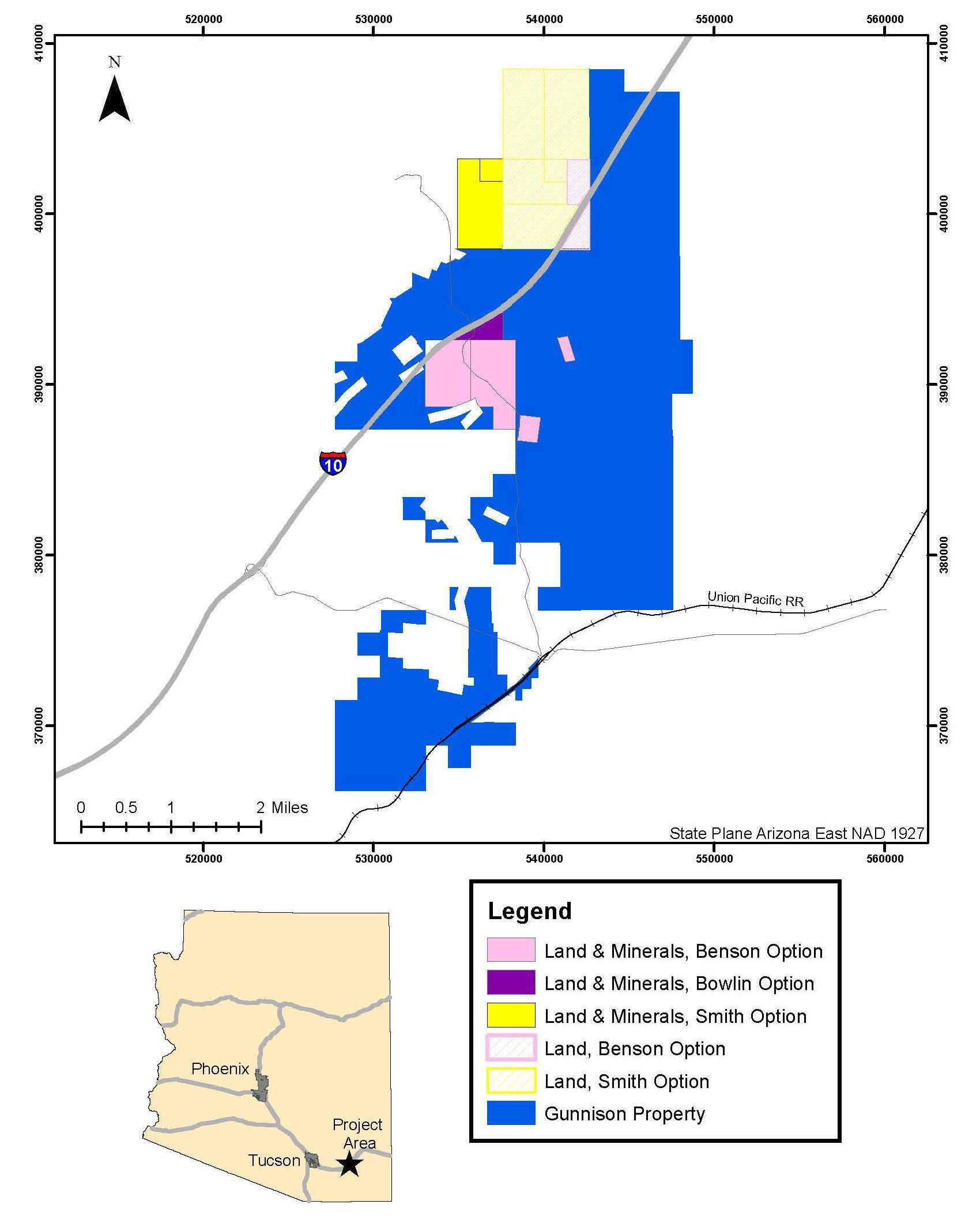
Source: GCC, December 2024
Figure 0-1: Gunnison Project Location Map, Gunnison and South Star Deposits Accessibility, Climate, Local Resources, Infrastructure and Physiography
| 26 |
The Gunnison Project is located in a sparsely populated, flat to slightly undulating ranching and mining area about 65 road miles east of Tucson, Arizona. The Tucson metropolitan area is a major population center (approximately 1,000,000 persons) with a major airport and transportation hub and well-developed infrastructure and services that support the surrounding copper mining and processing industry. The towns of Benson and Willcox are nearby and combined with Tucson can supply sufficient skilled labor for the Gunnison Project.
Access to the Gunnison Project is via the I-10 freeway from Tucson and Benson to the west or Willcox to the east. The Gunnison Deposit can be accessed via good quality dirt roads heading approximately 1 mile east from the south side of “The Thing” travel center and roadside attraction on the Johnson Road exit from I-10.
The elevation on the property ranges from approximately 4,600 to 4,900 feet above mean sea level in the eastern Basin and Range physiographic province of southeastern Arizona. The climate varies with elevation, but in general the summers are hot and dry, and winters are mild.
Vegetation on the property is typical of the upper Sonoran Desert and includes bunchgrasses, yucca, mesquite, and cacti.
History
There is no direct mining history of the Gunnison Deposit; however, the district has seen considerable copper, zinc, silver, and tungsten mining beginning in the 1880’s and extending to the present day. Modern mining and leaching operations at the Johnson Camp Mine, began in the 1970s by Cyprus Minerals. Successor owners and operators include Arimetco, North Star, Summo Minerals, and Nord Resources Corporation. Nord mined fresh material until mid-2010 and maintained leaching operations until late 2015, when the property was purchased by GCC.
In 1970, a division of the Superior Oil Company (“Superior”) joint ventured into the northern half of the Gunnison Deposit with Cyprus and the private owners (J. Sullivan, pers. com.). During the early 1970s, Superior did most of the drilling and limited metallurgical testing on Gunnison and by early 1974 had defined several million tons of low-grade acid-soluble copper mineralization.
The Gunnison Project was previously designed as a copper in-situ recovery (ISR) mine using SX-EW to produce copper cathode. The ISR operation commenced ramp-up to production in 2020; however, it had operational issues related to low flow rates, so the Company began evaluating alternatives and opportunities to fix the ramp-up challenges. Well stimulation (small scale, shallow level, hydraulic fracking), has the potential to fundamentally change the performance of the wellfield and fix many of the low productivity issues. The Company has obtained a permit for well stimulation and the next step would be to conduct field trials. If well stimulation is successful, it could provide an operation with superior economics to the open pit operation and be in copper production much quicker than an open pit. However, due to the substantially improved viability of the open pit operation, GCC intends to focus on an open pit operation as the alternative to ISR. The Company intends to maintain the optionality of future ISR operations and well stimulation trials as this remains an asset to the Company. This includes maintaining full compliance with all regulatory and permit requirements, including maintaining hydraulic control, pumping, monitoring and regulatory reporting.
Geological Setting and Mineralization
There are two oxide copper deposits controlled by GCC, Gunnison Deposit and South Star Deposit, both situated in the Mexican Highland section of the Basin and Range physiographic province. The province is characterized by fault-bounded mountains, typically with large igneous intrusions at their cores, separated by deep basins filled with Tertiary and Quaternary gravels.
The Gunnison Project (Gunnison Deposit) lies on the eastern edge of the Little Dragoon Mountains. The ages of the rocks range from 1.4-billion-year-old Pinal Group schists to recent Holocene sediments. The southern portion of the Little Dragoon Mountains consists predominately of the Tertiary Texas Canyon Quartz Monzonite whereas the Pinal Group schists and the Paleozoic sediments that host the regional copper mineralization dominate the northern half.
| 27 |
Copper sulfide mineralization has formed preferentially in the proximal (higher metamorphic grade) skarn facies, particularly along stratigraphic units such as the Abrigo and Martin Formations near the contact with the quartz monzonite and within structurally complex zones. Primary mineralization occurs as stringers and veinlets of chalcopyrite and bornite. Primary (unoxidized) mineralization remains “open” (undetermined limits) at depth and to the north, south, and east.
Oxidation of the mineralization occurs to a depth of approximately 1,600 feet, resulting in the formation of dominantly chrysocolla and tenorite with minor copper oxides and secondary chalcocite. The bulk of the copper oxide mineralization occurs as chrysocolla, which has formed as coatings on rock fractures and as vein fill. The remainder of the oxide mineralization occurs as replacement patches and disseminations.
Deposit Types
The Gunnison Deposit is a classic copper-bearing, skarn-type deposit. Skarn deposits range in size from a few million to 500 million tons and are globally significant, particularly in the American Cordillera. The Gunnison Deposit is large, being at the upper end of the range of size for skarn deposits and is associated with a mineralized porphyry copper system that has been largely unexplored.
Exploration
Since Gunnison’s discovery, numerous companies have explored the area. During this time period, extensive drilling, and assaying, magnetic and IP geophysical surveys, metallurgical testing, hydrological studies, ISR tests, and preliminary mine designs and evaluations have occurred. The focus since the 1970’s has been to utilize ISR or a combination of ISR and open pits as a potential mining strategy.
Stephen Twyerould first became involved with the Gunnison Project in mid-2005 and AzTech (later named Excelsior Mining Arizona, Inc.) became involved in mid-2006. Since that time, significant work has been completed such as cataloguing, reviewing, and compiling high-quality historical data spanning over thirty years of investigations by Superior Oil and Gas, Cyprus, Quintana, CF&I, Magma Copper Corporation, Phelps Dodge Corporation, and James Sullivan. GCC conducted detailed ground magnetics over the exploration targets in June 2011.
GCC initiated a re-logging program in December 2010 that was completed in the third quarter of 2011. In addition, a re-assaying program began in March 2011 during which all of the Magma holes were re-assayed. In May 2011, a re-assay program was initiated for the Quintana Minerals holes (DC, S, and T series) to include sequential copper analyses for cyanide-soluble (CNCu) and acid-soluble copper (ASCu). Previous results only included total copper (TCu) assays.
Drilling
The Gunnison Deposit drillhole database includes 217 drillholes totaling 245,509 feet. Among the total drillholes, 88 were historical drillholes that were completed by several companies. These holes extend to a depth of approximately 2,450 ft below the surface at the Gunnison Deposit and cover an area of approximately 310 acres, with additional drilling extending beyond this area. There is a slightly higher density of drilling along the central axis of the Gunnison Deposit.
| 28 |
Sample Preparation, Analysis and Security
The laboratory sample preparation and analysis procedures used by the previous owners of the deposits are unknown; however, major commercial laboratories using best practices at the time completed the majority of analyses.
The data, information, samples, and core from the deposits have been under the control and security of AzTech Minerals since November 2006 and then GCC since October 2010. The original information and samples are stored at the Sullivan’s core storage facility in Casa Grande, with numerous copies held by GCC at its Phoenix, Arizona office. It is the opinion of RESPEC Company LLC (RESPEC), the reviewer of the assay data for this Technical Report, that the sample procedures, processes, and security are reasonable and adequate.
Data Verification
The verification of location and assay data in the drillhole database covers historic drilling and the verification of the data collected by GCC. No significant issues have been identified with respect to the data provided by GCC’s quality assurance/quality control (“QA/QC”) programs. QA/QC data are not available for the historical drilling programs at the Gunnison Deposit, but GCC analyses dominate the assays used directly in the estimation of the mineral resources. Additionally, most of the historical data were generated by well-known mining companies, and the GCC drill data are generally consistent with the results generated by the historical companies.
Assaying and QA/QC procedures were industry standard. The TCu, CNCu, and ASCu assays used to estimate grades in the Gunnison model are acceptable for estimating mineral resources, based on RESPEC’s review of the available data for repeat, check, duplicate, standard and blank assays, and on paired comparisons of assay data from different drilling campaigns.
Mineral Processing and Metallurgical Testing
Column tests and other metallurgical testing conducted during the last decade or more, supplemented by recent developments, have supported the following predictions of heap leaching performance for copper-bearing material from the Gunnison resource that has been crushed to a nominal minus 6-inch product.
Copper extractions according to the mineralogical categories defined by assay procedure are as follows: acid-soluble copper (ASCu), 90%; cyanide-soluble copper (CNCu), 90%; and sulfide copper (CuS), 60% (CuS recovery is limited to the sulfide mineral domain). The predicted leaching response of primary sulfide minerals, essentially all chalcopyrite, assumes that accelerated oxidation and de-passivation of chalcopyrite will be at least moderately effective.
However, the copper will dissolve slowly over a period of several years due to kinetic limitations and imperfect solution access. For instance, chrysocolla, the dominant ASCu species, dissolves in two stages with declining rate as copper content in the layer silicate structure diminishes. Accordingly, the following approximate rates are predicted.
Table 0-1: Rates of Copper Extraction during Heap Leaching
| Species | Year 1 (%) | Year 2 (%) | Year 3 (%) | |||||||||
| ASCu | 81 | 4.5 | 4.5 | |||||||||
| CNCu | 81 | 4.5 | 4.5 | |||||||||
| CuS | 48 | 9 | 3 | |||||||||
Column tests and other metallurgical tests have indicated that acid consumptions for the dominant rock formations in the Gunnison resource will be as follows, expressed as pounds of 98% H2SO4 per ton of heap feed: Martin, 70; Upper Abrigo, 48; Middle Abrigo, 48; Lower Abrigo, 24; and TQM/Bolsa/Pinal, 24.
| 29 |
In the Gunnison resource, much of the acid-consuming gangue is comprised of dolomite and/or calcite that contain little copper. This presents an opportunity for reducing acid costs by particle segregation, or “sorting”. Mineralized material sorting has been done manually for millennia and has been a common practice for decades in waste segregation, metal recycling, and upgrading of some types of mineralized material. However, major advances have been made during the last few years in sensor efficiency and sorting equipment capacity.
Preliminary testing by one supplier of optical sensing and physical sorting equipment has produced very encouraging rejection of acid consumers, but more refinements will be needed to minimize copper losses into the reject fraction. The objective of future test programs will be an economic balance of acid cost, copper losses, and sorter capital and operating expenses.
Discussions with six manufacturers of sensors and/or sorting equipment have confirmed the practicality of developing and operating systems that can meet the needs of the Gunnison Project. Some recent sorting installations for the mineralized material consisting of copper, iron, and gold have daily treatment rates at or above those contemplated for the Gunnison Project. Depending on the types and selectivity of sensors and the required numbers of sorters and associated conveyors, preliminary cost estimates indicate a CAPEX range of
$36-100 million with an OPEX of $0.30-0.50/ton. Although not included in this PEA and economic analysis, future studies should investigate the use of sorting technology as a hedge against high acid costs or higher than expected acid consumption.
Mineral Resource Estimate
The Gunnison mineral resources have been updated to include resources on lands newly acquired by GCC. The mineral resources were constrained by a pit optimization. Table 0-2 is a summary of the oxide, transitional, and sulfide mineral resource tabulated at a total copper cut-off of 0.05%. Table 0-3 is a summary of the resource by oxidation zone.
Table 0-2: Gunnison Oxide, Transition, and Sulfide Mineral Resource Summary Effective September 4, 2024
| Total Resources (Oxide + Transitional + Sulfide) | ||||||||||||
| Resource Class | Short Tons (millions) | Total Cu (%) | Cu Pounds (millions) | |||||||||
| Measured | 191.3 | 0.37 | 1,420 | |||||||||
| Indicated | 640.2 | 0.29 | 3,684 | |||||||||
| Measured + Indicated | 831.6 | 0.31 | 5,104 | |||||||||
| Inferred | 79.6 | 0.20 | 325 | |||||||||
Notes:
| 1. | Mineral Resources that are not Mineral Reserves do not have demonstrated economic viability. | |
| 2. | Mineral Resources are reported at a 0.05% total copper cut-off within an optimized pit. | |
| 3. | Rounding may result in apparent discrepancies between tons, grade, and metal content. | |
| 4. | The Effective Date of the Mineral Resource estimate is September 4, 2024. |
| 30 |
Table 0-3: Gunnison Mineral Resource Summary Effective September 4, 2024
| Pit-Constrained Oxide Resources | ||||||||||||
| Resource Class | Short Tons (millions) | Total Cu (%) | Cu Pounds (millions) | |||||||||
| Measured | 155.5 | 0.39 | 1,200 | |||||||||
| Indicated | 470.5 | 0.29 | 2,709 | |||||||||
| Measured + Indicated | 625.7 | 0.31 | 3,909 | |||||||||
| Inferred | 71.3 | 0.20 | 0,283 | |||||||||
| Pit-Constrained Transitional Resources | ||||||||||||
| Resource Class | Short Tons (millions) | Total Cu (%) | Cu Pounds (millions) | |||||||||
| Measured | 31.9 | 0.32 | 202 | |||||||||
| Indicated | 112.5 | 0.28 | 638 | |||||||||
| Measured + Indicated | 144.4 | 0.29 | 840 | |||||||||
| Inferred | 5.7 | 0.21 | 24 | |||||||||
| Pit-Constrained Sulfide Resources | ||||||||||||
| Resource Class | Short Tons (millions) | Total Cu (%) | Cu Pounds (millions) | |||||||||
| Measured | 3.9 | 0.25 | 19 | |||||||||
| Indicated | 57.3 | 0.29 | 337 | |||||||||
| Measured + Indicated | 61.2 | 0.29 | 356 | |||||||||
| Inferred | 2.5 | 0.37 | 18 | |||||||||
Notes:
| 1. | Mineral Resources that are not Mineral Reserves do not have demonstrated economic viability. | |
| 2. | Mineral Resources are reported at a 0.05% total copper cut-off within an optimized pit. | |
| 3. | Rounding may result in apparent discrepancies between tons, grade, and metal content. | |
| 4. | The Effective Date of the Mineral Resource estimate is September 4, 2024. |
The Mineral Resources presented herein are inclusive of the Economic Analysis presented in the Gunnison Technical Report which therefore represents a subset of the Mineral Resources under slightly different economic inputs, most notably lower copper price.
Mineral Reserve Estimate
The Gunnison Project does not currently have any mineral reserves.
Mining Methods
Mining of the Gunnison Deposit will be accomplished using conventional open pit hard rock mining methods. The mine plan was developed to produce 175 million pounds of recoverable copper per year with mining being completed by an owner-operated fleet. Mining of the deposit is expected to be accomplished with hydraulic front shovels and 320-ton trucks. Mining is planned on 50-ft bench heights.
| 31 |
An annual schedule was developed for the mine plan. Leach material will be dumped into near pit gyratory crushers to be conveyed to the leach pad. All leach material produced through Year 7 is planned to be treated in a conventional leach operation. Beginning in Year 8, a portion of the leach material is planned to be treated in a sulfide leach operation with the rest of the material treated in a conventional leach operation. The heap tonnage production varies by year as it is based on the requirement of 175 million pounds of recoverable copper being placed on the heap annually. The mine plan presented in this Technical Report is achieved by mining 6 phase expansions to achieve the ultimate pit limit in the Gunnison deposit. The phases are practical expansions of the Gunnison pit incorporating haul road designs, operating room for equipment and all practical mining requirements.
Pit slope angles are based on recommendations provided by Call and Nicholas Inc. in an October 2024 memo. Overall pit slope angles were provided along with the recommendation that interramp slopes could be up to 3-degrees steeper. The shallow east dipping beds of the Paleozoic rock formations is the controlling factor for the 36-degree overall slopes in these rocks on the west pit wall.
The mine production schedule was developed using the phase designs, and the required leach pad feed rate to produce ~175 million pounds of recoverable copper per year. Sufficient waste is moved during the mine life to assure continued release of the required heap material. The cut-off grade of the mineralized material is equal to or greater than $0.60 net of process. The $0.60 was chosen as the cut-off grade to approximate the capital cost per ton of capacity of the leach pad.
The waste storage areas are east and west of the pit. The waste dumps are planned to be constructed in 50-ft lifts at an angle of 2.5:1.
Mining is planned to be executed using a conventional open pit mining fleet. The reference to specific equipment manufacturers is to illustrate equipment size and is not to be considered a recommendation by Independent Mining Consultants. Production drilling is expected to be accomplished with 125,000lb pull-down force class drills with mast lengths capable of single pass drilling 50 ft benches. Holes will be loaded with ANFO when dry and an emulsion slurry when wet. Hydraulic front shovels with 46-50-yard buckets are planned to load a majority of the material with a 43-yard front end loader available to provide loading flexibility. Haul trucks are planned to be 320-ton class trucks. Haul truck productivities are based on haulage time simulations for annual waste and heap material haul profiles. A fleet of auxiliary equipment to support the main operating equipment will be required. This will be comprised of 500 hp rubber-tired dozers, 600 hp track dozers, motor graders with 24-ft mold boards, 100-ton haul trucks fitted with 20,000-gallon water tanks and other support equipment.
The requirements for mine supervision, operations, and maintenance personnel were calculated using the equipment list and mine schedule. Mine operations and maintenance labor increases to 382 persons at the end of Year 8 and stays above 350 persons until labor requirements begin to decline in Year 13. Maintenance personnel requirements are set to be approximately 60% of required operations personnel. There are expected to be 48 salaried staff for supervision, engineering, geology, and mineralized material control.
Pit dewatering will be required during mining because the Gunnison Deposit is mostly below the water table in highly fractured bedrock. A groundwater flow model for the Gunnison ISR project was completed as part of the 2016 Aquifer Protection Permit (APP) application reviewed and approved by the Arizona Department of Environmental Quality (ADEQ) and the 2016 Underground Injection Control (UIC) Permit application reviewed and approved by the U.S. EPA.
| 32 |
The groundwater flow model was combined with the mine phase plan to estimate the dewatering flow rates required to keep the pit dry over the course of the mine life. The drainage into a pit at the Gunnison Project site is likely to result in significant flows into the pit, up to about 4,000 gpm during the pit construction. This dewatering rate may be a high estimate due to limitations of model construction. An average dewatering rate of 3,000 gpm is more likely. This rate of dewatering is recognized to be high relative to other open pit mines in Arizona, however, the mineralized body at Gunnison is quite fractured and broken relative to other mineralized bodies therefore a high rate of dewatering is expected
Recovery Methods
The open pit mining result in a copper-bearing pregnant leach solution (PLS) from which copper is extracted using the well-established SX-EW process. The Gunnison Project constructs an SX-EW plant in a single construction period prior to production to produce 175 mppa of cathode copper.
Open Pit-Heap Leach Recovery Methods
For the open pit-heap leach, mineralized oxide material from the open pit mine is placed on the leach pad as crushed material, described in Section 16. The oxide material will be irrigated with acidified raffinate pumped from the Gunnison Raffinate Pond. Copper-bearing PLS solutions are collected by an overliner collection system and discharged to the Leachate Collection Pond. PLS is pumped from the Leachate Collection Pond to the Gunnison SX Feed Tank.
The Gunnison open pit SX-EW Plant has the capacity to produce 175 mppa of cathode copper. This increase in capacity is accomplished by increasing the size of the SX mixer-settlers and adding additional electrowinning cells to the EW tankhouse. Commensurate increases to the capacities of the piping, tanks, and other equipment are required throughout the Gunnison open pit SX-EW Plant. The PLS from the leach pad provides the feed for the SX-EW process.
The location of the leach pad is southeast of the Gunnison pit in an area where the natural drainage is toward the southeast. The full leach pad will be approximately 893 acres in area and oriented to match existing topography so that it allows gravity drainage of solutions down to the southeastern toe of the pad for collection and transport by pumping system to the JCM PLS pond with one set of pumps and to the SX Feed Tank with another set. The Leach Pad will be constructed in three phases. The initial phase of the leach pad consists of approximately 313 acres and is constructed during the initial construction period for the mine and processing plant. Phase 2 adds an additional 223 acres of leach pad to be constructed at the beginning of Year 4. Phase 3 completes the build-out of the pad with a 357 acres constructed in Years 6 and 7 to provide the capacity for the Life of Mine.
Sulfuric acid for the heap leach option is provided by a molten sulfur burning sulfuric acid plant constructed prior to operation to provide the acid necessary for leaching and SX-EW process. The acid plant is designed to produce 3,000 short tons per day of 98% sulfuric acid which is sufficient to meet the process demand in most years. Molten sulfur is delivered to the plant by rail. In years when the demand exceeds acid plant capacity, sulfur acid will be delivered by rail tank cars.
Gunnison Project Infrastructure
The open pit requires relocation of Interstate 10 because the northern portion of the deposit lies beneath the freeway. A portion of the freeway approximately 2.8 miles long will be rerouted to the north along with its interchange with Johnson Road. The preferred location of that interchange will be determined during roadway design in consultation with the Arizona Department of Transportation (ADOT), which has control of the Interstate and is the coordinating agency for the relocation design and construction. Access to the Gunnison SX-EW plant will be off Johnson Road south of the pit approximately 1 mile north of Dragoon.
| 33 |
The mine pit is located in the northern portion of the Gunnison Project area and is flanked by waste stockpiles to the east and west to store alluvial overburden and waste rock removed from the pit during the mining operation. Mineralized material removed from the pit is hauled to the leach pad located southeast of the pit. Crushed material is dumped on the leach pad, spread, ripped, and covered with a piping network to deliver acidified leach solution. The leach solution drains out of the southeast toe of the leach pad and collected as PLS in the Leachate Collection Ponds. The PLS is pumped to the SX Feed Tank for extraction in the Gunnison plant.
The Gunnison SX-EW plant will be constructed in the southeast corner of the site with a nominal copper production capacity of 175 mppa. The electrowinning building (tankhouse) will be a steel building with corrugated metal roofing and siding. It will contain 112 electrowinning cells on each end of the building (total of 224 cells) and two automatic cathode stripping machines.
The Gunnison Tank Farm is located downhill from the SX area and the tankhouse to facilitate gravity drainage of solutions to the Tank Farm. The Tank Farm has a concrete containment that drains to a sump with an oil-water separator to return spilled liquid to the proper location for recycling. There is a Plant Runoff Pond located downstream of the Tank Farm to capture any surface flows in the event of an upset condition at the plant.
Ancillary facilities needed to support the Gunnison Project include buildings, ponds, tanks, and trenches. Ancillary buildings include an Administration Building, Warehouse, Plant Maintenance building, Change House, Security Building (gatehouse), and Sulfuric Acid Plant-Cogeneration complex. Other facilities will include ponds, and tanks. A new assay lab facility will be constructed to handle production samples, solution assays, and cathode sampling.
Power for the facility will be tapped from an existing 69 kilovolt (kV) power line that enters the project area from the southeast. The existing power line will terminate at the new Gunnison Substation. The requirement to feed the SX-EW from a higher voltage transmission line will be evaluated as the project progresses.
Fresh well water will be extracted from pit dewatering wells adjacent to the Gunnison open pit. Fresh water will be pumped to the 500,000 gallon process water/firewater tank. The lower 300,000 gallons in the storage tank will be reserved for fire suppression. Process water for plant use will be taken from the storage tank above this reserve level for fire suppression.
The sulfur-burning sulfuric acid plant will be constructed south of the Gunnison processing plant along with the accompanying rail spur and loading-unloading facilities. The plant design will be increased to produce 3,000 short tons of concentrated sulfuric acid per day. The waste heat from the acid making process produces steam to generate 44 MW of electrical power from a steam turbine generator. Of that amount, 14 MW of power will be required for operation of the acid plant, leaving 27.8 MW for delivery back to the power grid. The sulfuric acid plant includes molten sulfur day tanks, sulfur burner and waste-heat boiler, drying and adsorption tower area, cogeneration building, water treatment building, power distribution building and substation, cooling towers, office building, sulfuric acid storage area, and a rail yard for unloading molten sulfur and sulfuric acid.
Market Studies and Contracts
The Company has an offtake agreement for the copper cathodes produced by the Gunnison Project that is negotiated annually. The current agreement is for payment at the average monthly HG Copper COMEX settlement price.
The use of consensus prices obtained by collating the prices used by peers or as provided by industry observers and analysts is recognized by the Canadian Institute of Mining and Metallurgy (CIM) for technical reports and has the advantage of providing prices that are acceptable to a wide body of industry professionals (peers).
| 34 |
These prices are generally acceptable for most common commodities, major industrial minerals, and some minor minerals.
The PEA has selected $4.10 per pound copper for all thru the end of mine life. A Grade A cathode credit of
$0.02 per lb has been added to the long-term copper price, bringing the expected copper price to $4.12 per lb. Market studies indicate that the long-term prices for the major reagents are as follows.
| Sulfuric Acid | $150/st purchased | |
| Sulfuric Acid | $130/st for excess sulfuric acid produced that is sold on open market | |
| Molten Sulfur | $110/st |
The price for sulfuric acid is predicted to be $150/st. Based on a delivered sulfur cost of $110/ton, the cost of acid produced in GCC’s sulfuric acid costs are estimated to be $36.46 for the 3,000 stpd acid plant for the Gunnison open pit.
Environmental and Permitting
The open pit mining and heap leaching option has not been permitted. The open pit requires surface disturbance and relocation of an interstate highway.
Some additional environmental permits are required for an open pit mine at Gunnison. Federal, state, and local government existing environmental permits are listed in Table 20-1. A permit from ADOT will be required for the planned relocation of Interstate 10. The permit may require additional environmental studies, including cultural, biological, and native plant surveys, depending on the I-10 routing.
An Aquifer Protection permit (APP) exists for the prior ISR mining activities. This permit will require major modifications to accommodate the open pit and discharging facilities that have the possibility of impacting an aquifer. Facilities that may be constructed at Gunnison that may require an amended APP include leach pads, waste rock stockpiles, non-stormwater ponds, process solution ponds (PLS and Raffinate), re-injection wells for a portion of the open pit dewatering, and the acid plant.
Other existing permits requiring modification include the Arizona Mined Land Reclamation Plan, Air Quality permits, and to the existing Underground Injection Control permit to accommodate the open pit.
Water management associated with the open pit mine will include dewatering of the pit and run-on and run-off controls. Dewatering is expected to generate up to 4,000 gpm during pit development. This water can be used for a variety of uses including dust control and makeup water for mineralized material leaching. Dewatering water not used for mine operations will be re-injected in a local aquifer. Surface water will be diverted around the pit, leach pad, process plant, and other non-APP facilities. Water will be managed using engineered features such as diversions or retention structures.
Reclamation and closure must be conducted on all APP-regulated facilities in accordance with the stipulations of the APP permit at the end of operations. Non-APP facilities, such as buildings and infrastructure, will be reclaimed in accordance with the approved Mined Land Reclamation Program overseen by the Arizona State Mine Inspector’s Office. Reclamation of the pit (which is not expected to be an APP-regulated facility) will consist of erosion control. At closure, the heap leach pad (an APP-regulated facility) and the waste rock stockpiles (which may be regulated under APP) will be managed to prevent, contain, or control discharges. In the case of the heap leach pad, it is anticipated that closure will include neutralizing or rinsing of all spent mineralized material, elimination of free liquids, stabilization of heap materials, and recontouring of the heap to eliminate ponding. The waste rock stockpile will be recontoured in a similar manner to eliminate ponding and minimize infiltration. Process solution and non-stormwater ponds will be closed in accordance with the approved APP closure plan. Other facilities such as the plant and buildings will be removed and the land surface will be contoured and graded.
| 35 |
Capital and Operating Costs
Capital Costs
The Gunnison open pit is built in one stage of development with the pre-stripping of the open pit, leasing of the mine mobile fleet, construction of the initial heap leach pad and ponds, an SX-EW plant with a capacity of 175 mppa, 3,000 stpd sulfuric acid plant, and relocation of Interstate 10 to make room for pit expansion to the north. The initial capital costs total $1,342.6 million.
Mine Capital Costs
The mine capital includes three components: capital to lease / purchase the mining fleet, capital for mine support equipment, and the cost of pre-stripping. Mine capital costs for mobile equipment were developed from the mine equipment list presented in Section 16. Mine capital costs including equipment and pre-production development are presented in Table 0-4. Initial mine capital is $306.1 million, while sustaining mine capital costs are $334.9 million. An additional $346.2 million of waste stripping costs between the Years 1 and 12 included in Table 0-7 are applied to sustaining capital costs as deferred stripping.
Table 0-4: Summary of Mine Capital Costs ($000’s)
| Initial Capital | Sustaining | Total | ||||||||||||||||||
| Category | Year -2 | Year -1 | Total | Capital | Capital | |||||||||||||||
| Preproduction Development | $ | 96,897 | $ | 114,795 | $ | 211,692 | $ | 211,692 | ||||||||||||
| Major Equipment | $ | 57,136 | $ | 37,279 | $ | 94,415 | $ | 334,850 | $ | 429,265 | ||||||||||
| Total | $ | 154,033 | $ | 152,074 | $ | 306,107 | $ | 334,850 | $ | 640,957 | ||||||||||
Plant Capital Costs
The plant capital includes several components: development of the heap leach pad and ponds, capital for the Gunnison SX-EW plant, and cost for ancillary facilities and infrastructure, costs to construct the sulfuric acid plant and railroad siding and railyard, the Interstate highway relocation, freight, indirect costs, Owner’s costs, and contingency. Table 0-5 summarizes the initial capital costs to develop the Gunnison Plant exclusive of mine development. These costs are estimated to be $1,036.5 million. Including the mine initial capital costs, the total initial capital cost to develop the Gunnison Project is $1,342.6 million over a construction period of three years.
| 36 |
Table 0-5: Initial Capex for Gunnison Plant & Acid Plant Development
| Description of Capital Cost Item | Estimated Cost ($000) | |||
| Gunnison Heap Leach and Ponds | $ | 163,670 | ||
| Gunnison SX-EW Plant | $ | 144,980 | ||
| Infrastructure/Utilities | $ | 42,275 | ||
| Ancillary Facilities | $ | 12,083 | ||
| Mine Services | $ | 19,217 | ||
| Sulfuric Acid Plant | $ | 243,118 | ||
| Other (Freight) | $ | 37,805 | ||
| Total Direct Field Cost | $ | 663,148 | ||
| Total Direct Field Cost w/o Mobile Equipment | $ | 660,097 | ||
| Mobilization (2) | $ | 9,372 | ||
| Temporary Construction Facilities (4) | $ | 3,301 | ||
| Temporary Construction Power (4) | $ | 660 | ||
| Fee - Contractor (5) | In Direct Cost | |||
| Total Constructed Cost | $ | 673,430 | ||
| Total EPCM (6) | $ | 106,065 | ||
| EPCM Temp. Fac. & Utility Setup (7) | $ | 3,367 | ||
| Commissioning (8) | $ | 3,351 | ||
| Vendor Supervision of Specialty Const. (9) | $ | 5,027 | ||
| Vendor Pre-commissioning (10) | $ | 1,676 | ||
| Vendor’s Commissioning (10) | $ | 1,676 | ||
| Capital Spares (11) | $ | 6,703 | ||
| Commissioning Spares (12) | $ | 1,676 | ||
| Mobile Equipment | $ | 3,051 | ||
| Total Contracted Cost | $ | 806,021 | ||
| Contingency (13) | $ | 161,204 | ||
| Bonds & Insurance | In Owner’s Cost | |||
| Highway Relocation | $ | 45,605 | ||
| Added Owner’s Cost (14) | $ | 23,657 | ||
| Total Contracted Cost with Contingency | $ | 1,036,487 | ||
| Escalation (15) | $ | 0 | ||
| Total Evaluated Project Cost (12) | $ | 1,036,487 | ||
Notes:
| 1. | Specific Indirect Field Costs have been added to the direct labor rates listed for each Area Indirects added to direct labor include: field payroll burden, overtime adjustment, small tools and expendables allowance, field supervisory labor & burden, contractor operating overheads & profit. | |
| 2. | Mobilization is included at 5% for civil direct costs and 1% for all other direct costs without Mobile Equipment. | |
| 3. | Transportation & Busing and Camp costs will be carried in the Owner’s Costs. | |
| 4. | Temporary Construction Facilities is included at 0.5% of Total Direct Cost without Mobile Equipment. Temporary Construction Power is included at 0.1% of Total Direct Cost without Mobile Equipment. |
| 37 |
| 5. | Contractors’ fee included in Labor rates and Subcontract unit cost. | |
| 6. | The EPCM cost has been calculated at 16.8% of the Total Constructed Costs w/o costs from Kinley. | |
| 7. | EPCM Temporary Facilities and Utility Setup is included at 0.5% of Total Constructed Costs. | |
| 8. | Commissioning is included at 1% of Plant Equipment w/o Mobile Equipment. | |
| 9. | Supervision of Specialty Construction included at 1.5% of Plant Equipment Costs w/o Mobile Equipment. | |
| 10. | Vendor Pre-commissioning included at 0.5% of Plant Equipment Costs w/o Mobile Equipment. Vendor Commissioning included at 0.5% of Plant Equipment Costs w/o Mobile Equipment. | |
| 11. | Capital Spare Parts included at 2% of Plant Equipment Costs w/o Mobile Equipment. | |
| 12. | Commissioning Spare parts are included at 0.5% of Plant Equipment Costs w/o Mobile Equipment. | |
| 13. | Contingency is based on Total Contracted Cost is calculated as 20%. | |
| 14. | Added Owners Cost - To be provided by Owner. (Initial fills are included in Owner’s Costs) | |
| 15. | All costs are in 3rd quarter 2024 U.S. dollars with no escalation. Total Evaluated Project Cost is projected to be in the range of -35% to +25%. |
| (A) | Sustaining Capital Costs |
Sustaining capital costs for the mine, leach pad, sulfuric acid plant, and deferred stripping are shown by Year of operation in Table 0-6. Mining sustaining capital costs are mainly mobile equipment replacement costs. Sustaining capital in the plant areas includes expansions to the heap leach pad in Years 4, 6 and 7. There are no anticipated sustaining capital costs for the Gunnison SX-EW, since improvements to these facilities will be covered in operating maintenance costs. The sulfuric acid plant has $72 million in capital improvements planned in Years 6 and 7. Deferred stripping costs occurs in Year 1 through Year 12.
Table 0-6: Gunnison Project Sustaining Capital Costs by Year
| Year | Mining Sustaining Capital ($000) | Heap Leach Pad Sustaining Capital ($000) | Sulfuric Acid Plant Sustaining Capital ($000) | Deferred Stripping Sustaining Capital ($000) | Total Annual Sustaining Capital Cost ($000) | |||||||||||||||
| 1 | $ | 17,975 | $ | 43,611 | $ | 61,586 | ||||||||||||||
| 2 | $ | 53,482 | $ | 23,333 | $ | 76,815 | ||||||||||||||
| 3 | $ | 813 | $ | 50,747 | $ | 51,560 | ||||||||||||||
| 4 | $ | 21,163 | $ | 47,299 | $ | 28,750 | $ | 97,213 | ||||||||||||
| 5 | $ | 6,489 | $ | 24,916 | $ | 31,405 | ||||||||||||||
| 6 | $ | 14,293 | $ | 37,873 | $ | 36,000 | $ | 3,638 | $ | 91,803 | ||||||||||
| 7 | $ | 14,763 | $ | 37,873 | $ | 36,000 | $ | 41,182 | $ | 129,817 | ||||||||||
| 8 | $ | 61,156 | $ | 21,588 | $ | 82,744 | ||||||||||||||
| 9 | $ | 13,171 | $ | 46,807 | $ | 59,978 | ||||||||||||||
| 10 | $ | 80,491 | $ | 34,308 | $ | 114,799 | ||||||||||||||
| 11 | $ | 44,679 | $ | 15,127 | $ | 59,805 | ||||||||||||||
| 12 | $ | 0 | $ | 12.157 | $ | 12,157 | ||||||||||||||
| 13 | $ | 6,007 | $ | 6,007 | ||||||||||||||||
| 14 | $ | 368 | $ | 368 | ||||||||||||||||
| TOTAL | $ | 334,850 | $ | 123,044 | $ | 72,000 | $ | 346,163 | $ | 876,057 | ||||||||||
| 38 |
Operating Cost
Mine Operating Costs
The LOM mine operating cost per lb over the LOM is $0.81/lb Cu plus the equipment leasing cost of $0.06/lb Cu, resulting in a full mine operating cost of $0.87/lb Cu.
Mine operating costs are summarized by material type: mineralized material, alluvium waste, and hardrock waste (sedimentary) in Table 0-7. Pre-production mine operating costs of $211.7 million and deferred stripping costs of $346.2 million are included in Table 0-7 below but are applied as Capital costs. The total mining cost per short ton of mineralized material not including equipment lease payments is $5.02, which equates to $1.02/lb Cu. After subtracting the pre-stripping and deferred stripping costs, the total mined operating cost is $0.87/lb Cu.
Table 0-7: Summary of Mine Operating Costs
| Mined Type | LoM ($M) | $/st Mined Type | $/st Mineralized Material Processed | $/lb Copper Recovered (US$) | ||||||||||||
| Mined Mineralized Material | $ | 1,059.2 | $ | 0.63 | $ | 1.92 | $ | 0.39 | ||||||||
| Waste – Sedimentary | $ | 730.8 | $ | 0.43 | $ | 1.33 | $ | 0.27 | ||||||||
| Waste – Alluvium | $ | 973.8 | $ | 0.58 | $ | 1.77 | $ | 0.36 | ||||||||
| Total Mined Costs1 | $ | 2,763.9 | $ | 1.64 | $ | 5.02 | $ | 1.02 | ||||||||
| Additional Cost of Lease Payments | $ | 163.8 | $ | 0.10 | $ | 0.29 | $ | 0.06 | ||||||||
| Total Mined Costs including Lease Payments | $ | 2,927.7 | $ | 1.74 | $ | 5.31 | $ | 1.08 | ||||||||
| Pre-Stripping Cost | $ | (211.7 | ) | $ | (0.13 | ) | $ | (0.38 | ) | $ | (0.08 | ) | ||||
| Deferred Stripping Cost | $ | (346.2 | ) | $ | (0.21 | ) | $ | (0.63 | ) | $ | (0.13 | ) | ||||
| Total Mined Operating Costs | $ | 2,369.8 | $ | 1.40 | $ | 4.30 | $ | 0.87 | ||||||||
Notes:
| 1. | This value includes the cost of pre-stripping, ($0.08/lb Cu), which is capitalized, and deferred stripping costs ($0.13/lb Cu), which reports to sustaining capital. However, it is missing the equipment leasing cost of $0.06/lb Cu which brings the total to $0.87/lb Cu. |
Plant Operating Costs
Table 0-8 shows the average and Life of Mine (LOM) operating costs breakdown for the processing plants. The heap leaching cost of $0.24/lb Cu includes crushing, conveying, and leaching costs. In operating Year 8, the leach pad will include sulfide material that will be treated using enhanced heap leaching circuit which will include crushing and reagent additions. This incremental cost will add $0.07/lb Cu to the heap leaching cost. The SX-EW plant costs ($0.19/lb Cu) include all costs beyond the PLS pond to the production of cathode copper. Operating costs include operating labor, reagents, power, maintenance labor and spare parts, and operating supplies and services.
| 39 |
Table 0-8: Summary Process Operating Cost
| Area | LoM ($000) | $/st Mineralized Material Processed | $/lb Copper Recovered (US$) | |||||||||
| Heap Leach Operating Cost | $ | 648,989 | $ | 1.18 | $ | 0.24 | ||||||
| Incremental Sulfide Material Cost | $ | 187,368 | $ | 0.34 | $ | 0.07 | ||||||
| SX-EW Operating Cost | $ | 503,570 | $ | 0.91 | $ | 0.19 | ||||||
| G & A | $ | 150,292 | $ | 0.27 | $ | 0.06 | ||||||
| Treatment & Refining Charges | $ | 0.00 | $ | 0.00 | $ | 0.00 | ||||||
| Operating Costs | $ | 1,490,219 | $ | 2.71 | $ | 0.55 | ||||||
| Royalties | $ | 526,238 | $ | 0.96 | $ | 0.19 | ||||||
| Property & Severance Tax | $ | 141,384 | $ | 0.26 | $ | 0.05 | ||||||
| Closure & Salvage Value | $ | 61,950 | $ | 0.11 | $ | 0.02 | ||||||
| Other Production Costs | $ | 729,572 | $ | 1.32 | $ | 0.27 | ||||||
| Total Plant Costs | $ | 2,219,791 | $ | 4.03 | $ | 0.82 | ||||||
General and Administrative Operating Costs
General and Administrative (G&A) costs include labor and fringe benefits for administration and support personnel and other support expenses. G&A expenses are shown in Table 0-9 in $ thousands.
Table 0-9: Summary General and Administrative Operating Cost
| Item | Average Annual Cost ($000) | $/lb Copper | LoM Operating Cost ($000) | % | ||||||||||||
| Labor | $ | 4,360 | $ | 0.03 | $ | 78,488 | 52.2 | % | ||||||||
| Accounting (excluding labor) | $ | 69 | $ | 0.000 | $ | 1,238 | 0.8 | % | ||||||||
| Safety & Environmental (excluding labor) | $ | 60 | $ | 0.000 | $ | 1,073 | 0.7 | % | ||||||||
| Human Resources (excluding labor) | $ | 46 | $ | 0.000 | $ | 825 | 0.5 | % | ||||||||
| Security (excluding labor) | $ | 69 | $ | 0.000 | $ | 1,238 | 0.8 | % | ||||||||
| Assay Lab (excluding labor) | $ | 275 | $ | 0.002 | $ | 4,952 | 3.3 | % | ||||||||
| Office Operating Supplies and Postage | $ | 46 | $ | 0.000 | $ | 825 | 0.5 | % | ||||||||
| Maintenance Supplies | $ | 138 | $ | 0.001 | $ | 2,476 | 1.6 | % | ||||||||
| Propane, Power | $ | 69 | $ | 0.000 | $ | 1,238 | 0.8 | % | ||||||||
| Communications | $ | 92 | $ | 0.001 | $ | 1,651 | 1.1 | % | ||||||||
| Small Vehicles | $ | 138 | $ | 0.001 | $ | 2,476 | 1.6 | % | ||||||||
| Claims Assessment | $ | 23 | $ | 0.000 | $ | 413 | 0.3 | % | ||||||||
| Legal & Audit | $ | 321 | $ | 0.002 | $ | 5,777 | 3.8 | % | ||||||||
| Consultants | $ | 229 | $ | 0.002 | $ | 4,127 | 2.7 | % | ||||||||
| Janitorial Services | $ | 69 | $ | 0.000 | $ | 1,238 | 0.8 | % | ||||||||
| Insurances | $ | 1,834 | $ | 0.012 | $ | 33,013 | 22.0 | % | ||||||||
| Subs, Dues, PR, and Donations | $ | 55 | $ | 0.000 | $ | 990 | 0.7 | % | ||||||||
| Travel, Lodging, and Meals | $ | 183 | $ | 0.001 | $ | 3,301 | 2.2 | % | ||||||||
| Recruiting/Relocation | $ | 183 | $ | 0.001 | $ | 3,301 | 2.2 | % | ||||||||
| Community Relations | $ | 92 | $ | 0.001 | $ | 1,651 | 1.1 | % | ||||||||
| Total | $ | 8,350 | $ | 0.055 | $ | 150,292 | 100.0 | % | ||||||||
| 40 |
Sulfuric Acid Plant
The Gunnison Project requires a sulfuric acid plant. The annual operating costs for the sulfuric acid plant, power plant, and associated facilities is $38.3 million or $36.46 per ton sulfuric acid and $0.26 per pound of copper produced. The actual sulfuric acid plant costs are included in the heap leach and SX-EW costs as components of the reagent costs. The low cost of sulfuric acid is mainly due to the power credit from selling cogenerated power back to the utility. The acid plant operating costs are summarized in Table 0-10.
Table 0-10: Sulfuric Acid Plant Costs – Open Pit
| Cost Category | Annual Cost | $/short ton-Acid | $/lb-Copper | |||||||||
| Labor | $ | 4,707,942 | $ | 4.48 | $ | 0.031 | ||||||
| Reagents | $ | 37,744,286 | $ | 35.95 | $ | 0.252 | ||||||
| Fuels (Propane) | $ | 946,080 | $ | 0.90 | $ | 0.006 | ||||||
| Power (Credit) | $ | (18,448,080 | ) | $ | (17.57 | ) | $ | 0.123 | ||||
| Maintenance | $ | 7,046,725 | $ | 6.71 | $ | 0.047 | ||||||
| Operating Supplies | $ | 6,286,605 | $ | 5.99 | $ | 0.042 | ||||||
| Total | $ | 38,283,558 | $ | 36.46 | $ | 0.26 | ||||||
Reclamation and Closure Cost
The Gunnison Project will require the reclamation and closure of several elements. Three main components comprise the reclamation costs:
| ● | Gunnison Mine Leach Pad, Solution Ponds, & Waste Dumps | |
| ● | Gunnison Plant, Ponds, Ancillary Facilities & Infrastructure | |
| ● | Bond Fees |
These costs are accounted for in the financial model as sustaining capital costs. In the current FS, reclamation costs have been refined and are now accounted for as expenses (operating costs). The reclamation and closure costs used in the financial model are estimated to be $93.0 million. Bonding fees are estimated to be $0.4 million. These costs are summarized in Table 0-11 below.
| 41 |
Table 0-11: Summary Reclamation and Closure Cost
| Area | Reclamation & Closure Cost ($M) | |||
| Solution Management | $ | 1.9 | ||
| Civil Contouring | $ | 41.9 | ||
| Plant Demolition | $ | 41.2 | ||
| Indirect Costs | $ | 4.2 | ||
| Contract Administration | $ | 3.4 | ||
| Total Reclamation & Closure | $ | 92.6 | ||
| Estimated Bond Fees | $ | 0.4 | ||
| Total Reclamation, Bonding, & Closure | $ | 93.0 | ||
Economic Analysis
The financial evaluation presents the determination of the Net Present Value (NPV), payback period (time in years to recapture the initial capital investment), and the Internal Rate of Return (IRR) for the Gunnison Project. Annual cash flow projections were estimated over the life of the operation based on the estimates of capital expenditures and production cost and sales revenue. The sales revenue is based on the production of a copper cathode for open pit mining.
New facilities include Crushing-Conveying system, the Heap Leach Pad, SX-EW plant, the facilities at the Mine Services Area, the ancillary buildings located at the SX-EW plant, and the sulfuric acid plant.
Infrastructure changes include realignment of Interstate 10 in the vicinity of the Gunnison open pit, rerouting/relocating the powerlines and substations for the new Gunnison SX-EW and installation of the rail spur into the Gunnison property and the railyard.
The sulfuric acid plant has been upsized from 1,650 stpd to 3,000 stpd to meet the new acid demand for the heap leach option.
Plant Production Statistics
The design basis for the SX-EW process plant production is 175 mppa of cathode copper divided from one new SX-EW plant built in a single construction stage. Average annual full-rate production is projected to be approximately 150.6 million pounds of copper cathode over the 18-year life of mine and 167.3 million pounds per year over the first 16 years. Total production for the life of the operation is projected at approximately 2,712 million pounds of copper.
Copper Sales
The copper cathodes are assumed to be shipped to buyers in the US market, with sales terms negotiated with each buyer. The financial model assumptions are based on experience with copper sales from similar operations in the US.
Initial Capital
The initial capital cost estimate for the Gunnison project, exclusive of open pit development is shown in Table 0-12 below. The estimated initial capital cost for the project is $1,342.6 million. The financial indicators have been calculated assuming 100% equity financing of the initial capital. Any acquisition cost or expenditures, such as property acquisition, permitting, and study costs, prior to project authorization have been treated as “sunk” cost and have not been included in the analysis.
| 42 |
Table 0-12: Initial Capital Requirement
| Time | Initial Capital ($M) | |||||
| 1 | Mine (including Pre-stripping) | $ | 211.7 | |||
| 2 | Mine (Initial Owner’s Fleet Leasing Costs) | $ | 94.4 | |||
| 3 | Mine Services Area | $ | 18.2 | |||
| 4 | Crushing Plant- Conveying-Leach Pad-Solution Ponds | $ | 164.3 | |||
| 5 | SX-EW Plant (includes SX, Tank Farm, EW Tankhouse, and Reagents) | $ | 166.7 | |||
| 6 | Plant Ancillary Buildings | $ | 11.4 | |||
| 7 | Acid Plant and Railyard | $ | 243.1 | |||
| 8 | Utilities – Power Transmission & Distribution, Water Systems | $ | 21.7 | |||
| 9 | Freight | $ | 37.8 | |||
| 10 | Indirects | $ | 145.9 | |||
| 11 | Owner’s Cost | $ | 23.7 | |||
| 12 | Highway Realignment | $ | 45.6 | |||
| 13 | Contingency | $ | 161.2 | |||
| Total Initial Capital | $ | 1,342.6 | ||||
Sustaining Capital
A schedule of capital cost expenditures during the production period was estimated and included in the financial analysis under the category of sustaining capital. The total life of operation sustaining capital is estimated to be $876.1 million. This capital will be expended from Year 1 through Year 16.
Working Capital
A 15-day delay of receipt of revenue from sales is assumed for accounts receivables. A delay of payment for accounts payable of 30 days is also incorporated into the financial model. An allowance for initial replacement parts inventory for the plant is also included. All the working capital is recaptured at the end of the mine life and the final value of these accounts is zero.
Revenue
Annual revenue is determined by applying estimated metal prices to the annual payable metal estimated for each operating year. Sales prices have been applied to all life of operation production without escalation or hedging. The revenue is the gross value of payable metals sold before treatment charges and transportation charges. The average copper price used in the evaluation is $4.12/lb for the life of the mine.
Total Operating Cost
The average cash operating cost over the life of the operation is estimated to be $1.42 per pound of copper produced, excluding the cost of the capitalized pre-production leaching. Cash operating cost includes process plant operations, water treatment, and general administrative cost. Table 0-13 below shows the estimated operating cost and other production costs by area per pound of copper produced.
| 43 |
Table 0-13: Life of Operation Operating + Production Costs
| Operating Cost | $/lb Copper | |||
| Mining (including fleet leasing costs) | $ | 0.87 | ||
| Heap Leach | $ | 0.24 | ||
| Sulfide Material Incremental Cost | $ | 0.07 | ||
| SX-EW | $ | 0.19 | ||
| General and Administrative | $ | 0.06 | ||
| Sub-Total: Operating Cash Cost | $ | 1.42 | ||
| Royalties, Taxes (excludes Income Tax), Reclamation & Salvage | $ | 0.27 | ||
| Total Cash Cost | $ | 1.69 | ||
Total Cash Cost
Total Cash Cost is the Total Operating Cost plus royalties, property tax, severance tax, salvage value, and reclamation and closure costs. The average Total Cash Cost over the life of the operation is estimated to be $1.69 per pound of copper produced.
Royalty
There are four entities that are entitled to royalties: the State of Arizona, Greenstone, Altius and Bowlin Travel Centers, Inc. The State has a flat royalty of 5.5% on copper produced from State land.
The Greenstone royalty is paid at the rate of 3.0% of the value of copper produced while the Altius royalty is paid at a rate of 1.50%. Bowlin Travel Centers, Inc. has been granted a 1% gross revenue royalty on any copper mined and processed from an area that it has optioned to Gunnison Arizona.
Royalties for the life of the operation are estimated at $526.2 million and average $0.19 per pound of copper recovered.
The minor Bowlin royalty which amounts to approximately $500,000, was not included in the cash flow analysis. It translates to $0.002/lb Cu over the LOM.
Property and Severance Taxes
Property and severance taxes are estimated to be $141.4 million and average $0.05 per pound of copper recovered. Property taxes were estimated to be approximately $3.5 million per year during production, totaling
$54.2 million for the life of the operation. Severance taxes are calculated as 2.5% of net proceeds before taxes from mining. Severance taxes are estimated to be approximately $87.2 million for the life of the operation.
Reclamation and Closure
An allowance for reclamation and closure costs is estimated to be $93.0 million ($0.034/lb copper cathode). Reclamation and closure activities are assumed to occur for 3 years beginning the year after mining has ceased.
Income Taxes
Taxable income for income tax purposes is defined as metal revenues minus operating expenses, royalty, property and severance taxes, reclamation and closure expense, depreciation, and depletion. The combined federal and state corporate income tax rate in Arizona is 25.9 percent and is applied to ‘taxable income’ derived from the Gunnison Project.
| 44 |
Income taxes are estimated by applying state and federal tax rates to taxable income. The primary adjustments to taxable income are tax depreciation and the depletion deduction. Income taxes estimated in this manner total
$700.7 million for the life of the Gunnison Project.
Net Present Value (NPV) and Internal Rate of Return (IRR)
The economic analysis for the Gunnison Project, before taxes, indicates an Internal Rate of Return (IRR) of 22.8% and a payback period of 3.8 years. The Net Present Value (NPV) before taxes is $1.54 billion at an 8% discount rate using the mid-year convention. The economic results after taxes indicates that the Gunnison Project has an IRR of 20.9% with a payback period of 4.1 years. The NPV after taxes is $1.26 billion at an 8% discount rate using the mid-year convention. The analysis assumes 100% equity financing.
Table 0-14: Economic Results
| Item | Base Case | |||
| Years of Commercial Production | 18 | |||
| Total Copper Produced (million lbs) | 2,712 | |||
| LOM Copper Price (avg $/lb) includes $0.02/lb cathode premium | $ | 4.12 | ||
| Initial Capital Cost ($M) | $ | 1,342.6 | ||
| Sustaining Capital Cost ($M) | $ | 876.1 | ||
| Payback of Capital (pre-tax / after-tax) | 3.8 / 4.1 | |||
| Internal Rate of Return (pre-tax / after-tax) | 22.8% / 20.9% | |||
| LOM Direct Operating Cost ($/lb Copper recovered) | $ | 1.42 | ||
| LOM Total Production Cost ($/lb Copper recovered) | $ | 1.69 | ||
| Pre-Tax NPV at 8% discount rate ($M) – mid-year | $ | 1,545.0 | ||
| After-Tax NPV at 8% discount rate ($M) – mid-year | $ | 1,259.6 | ||
The PEA is preliminary in nature and includes inferred mineral resources that are considered too speculative geologically to have the economic considerations applied to them that would enable them to be categorized as mineral reserves. There is no certainty that the conclusions reached in the PEA will be realized. Mineral resources that are not mineral reserves do not have demonstrated economic viability. The project’s after-tax economic results show greatest sensitivity to copper price fluctuations, followed by initial capital expenditures and operating cost changes. Table 0-15, Figure 0-2 and Figure 0-3 below illustrate these sensitivities.
| 45 |
Table 0-15: Sensitivity Analysis – Open Pit
| Copper Price | ||||||||||||
| NPV @ 8.0%, after-tax ($M) | IRR% | Payback | ||||||||||
| Base Case | $ | 1,260 | 20.9 | % | 4.1 | |||||||
| 20% | $ | 2,054 | 27.6 | % | 3.1 | |||||||
| 10% | $ | 1,660 | 24.4 | % | 3.5 | |||||||
| -10% | $ | 848 | 17.1 | % | 4.7 | |||||||
| -20% | $ | 431 | 12.8 | % | 6.0 | |||||||
| Operating Cost | ||||||||||||
| NPV @ 8.0%, after-tax ($M) | IRR% | Payback | ||||||||||
| Base Case | $ | 1,260 | 20.9 | % | 4.1 | |||||||
| 20% | $ | 979 | 18.4 | % | 4.4 | |||||||
| 10% | $ | 1,120 | 19.7 | % | 4.2 | |||||||
| -10% | $ | 1,396 | 22.1 | % | 3.9 | |||||||
| -20% | $ | 1,530 | 23.2 | % | 3.7 | |||||||
| Initial Capital | ||||||||||||
| NPV @ 8.0%, after-tax ($M) | IRR% | Payback | ||||||||||
| Base Case | $ | 1,260 | 20.9 | % | 4.1 | |||||||
| 20% | $ | 1,031 | 17.3 | % | 4.8 | |||||||
| 10% | $ | 1,145 | 19.0 | % | 4.4 | |||||||
| -10% | $ | 1,374 | 23.2 | % | 3.7 | |||||||
| -20% | $ | 1,488 | 25.9 | % | 3.3 | |||||||
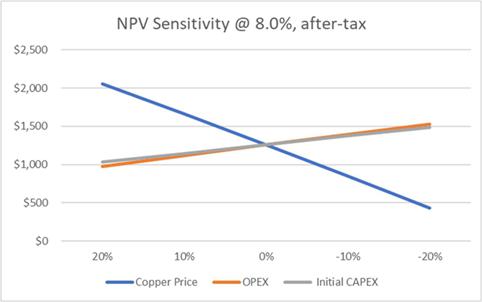
Figure 0-2: Open Pit NPV Sensitivity – After Tax
| 46 |
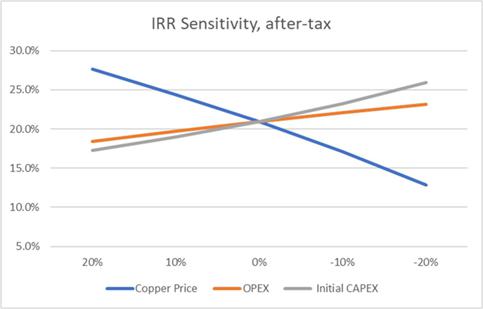
Figure 0-3: Open Pit IRR Sensitivity – After Tax
Adjacent Properties
The Gunnison Project lies within the porphyry copper metallogenic province of the southwestern United States. It is located in the Cochise Mining District, which is dominated by Cu-Zn skarns. With the acquisition of the Johnson Camp Mine, GCC now controls a majority of historical producing properties in the district. Tungsten and minor lead-silver-gold have been produced in adjacent properties in the district. In particular, tungsten has been historically produced in the area west of the Gunnison Project in the northern half of the Texas Canyon quartz monzonite stock before and during World War I. Lead-silver was also historically produced from Paleozoic limestones in the Gunnison Hills east of the Gunnison Project in the early 1900s (Cooper and Silver, 1964). Mineralization on adjacent properties is not necessarily indicative of the mineralization on the Gunnison Project. The author has relied on reports by others (as referenced) for the information presented in this section of the technical report and has been unable to verify the information.
Interpretation and Conclusions
A production schedule has been developed using input from independent consultants and existing Gunnison Project data. The production schedule anticipates recovery of 85% of the mineral resources in the mine plan resulting in production of 2,712 million pounds of cathode copper over a mine life of 18 years.
The economic analysis indicates an after-tax NPV of $1,260 million at a 8% discount rate with a projected IRR at 20.9%. Payback is anticipated in 4.1 years of production. The economics are based on a $4.10/lb copper price with a premium of $0.02/lb added for producing Grade A cathode copper, a design copper production rate of 167 mppa for 18 years. Direct operating costs are estimated at $1.42/lb of copper, inclusive of Mining Operating costs. Initial CAPEX totals $1,342 million, which includes the mine, Gunnison SX-EW plant, leach pad and ponds, acid plant, rail spur, and owner’s costs. Sustaining capital costs of $876 million are projected for mine fleet replacement and additions to the leach pad.
The PEA is preliminary in nature and includes inferred mineral resources that are considered too speculative geologically to have the economic considerations applied to them that would enable them to be categorized as mineral reserves. There is no certainty that the conclusions reached in the PEA will be realized. Mineral resources that are not mineral reserves do not have demonstrated economic viability.
| 47 |
Risks
Gunnison Project risks for the open pit include slope stability, blasting costs, mine design complication, copper recovery problems, leach pad flow problems in the leach pad, acid consumption underestimate, permitting difficulties, and interstate relocation cost and complications. Recommendations are provided to investigate potential risk items or advance mitigation strategies. Many of these risks can be addressed by investigations in subsequent phases of the study and design processes, including geotechnical investigations and additional metallurgical test work. Further investigation regarding the cost and process of relocating the interstate highway can mitigate that risk.
Opportunities
Several opportunities have been identified which could enhance the viability and economic attractiveness of the Gunnison Project. Opportunities include higher copper recoveries than predicted, increases in the price of copper, identification of additional resources, reduced acid costs, consolidation savings, mining exposed sulfide mineralization, and reductions to capital costs, particularly in the initial stage of operation. Other opportunities include concurrent mining of the Strong & Harris project, potential in-pit leaching, monetization of mined gravel and limestone and discovery of additional resources from exploration drilling.
Recommendations
Based on the results of this PEA, it is recommended that GCC consider proceeding with a Pre-feasibility Study (PFS) of the Gunnison Project which is expected to be completed late 2026 (subject to appropriate financing). A feasibility study will be proposed on successful completion of the PFS.
Additional drilling for resource verification and geotechnical coverage is recommended to support mine planning. Updating the acid plant design for the selected capacity is also recommended. Additional planning and costing work are required to establish the schedule and costs for the relocation of Interstate 10 and the addition of the rail spur to the Union Pacific Railroad.
Additional drilling will be required for metallurgical studies. Pilot metallurgical heap leach testing is recommended to investigate the recovery kinetics and flow characteristics for the heap leach design. In addition, mineralized material sorting studies are recommended to determine the effectiveness and economics. A mine plan, heap leach design, SX-EW design and highway move design are necessary to complete the PFS. GCC has proposed a list and budget for additional work that will support the pre-feasibility study shown in Table 0-16.
Table 0-16: Gunnison Project Pre-feasibility Budget
| Detail | Cost $US | |||
| Resource Upgrade | $ | 4,091,448 | ||
| Metallurgy | $ | 7,856,000 | ||
| Geotechnical | $ | 210,000 | ||
| Pit design | $ | 300,000 | ||
| Infrastructure design/PFS study | $ | 1,385,000 | ||
| Total | $ | 13,842,448 | ||
| 48 |
Johnson Camp Mine
The following represents the summary of the JCM Technical Report dated effective March 12, 2025 prepared by John Woodson, PE, SME-RM, Jeffrey Bickel, CPG, Abyl Sydykov, PhD, PE, Dr. Terence P. McNulty, PE, DSc, R. Douglas Bartlett, CPG, Jacob Richey, PE and Thomas M. Ryan, PE. Unless specifically noted otherwise, the following disclosure regarding the Johnson Camp Mine has been prepared under the authority and supervision and with the consent of the authors, each a “qualified person” within the meaning of NI 43-101. The full JCM Technical Report is incorporated by reference into this AIF and is available under Gunnison’s corporate profile on SEDAR+ at www.sedarplus.ca. All references in this summary to Sections are to the Sections of the JCM Technical Report.
Summary
M3 Engineering & Technology Corporation (“M3”) was commissioned by Gunnison Copper Corp. (“GCC”) to prepare a technical report in accordance with the Canadian National Instrument 43-101 standards for reporting mineral properties, for the Johnson Camp Mine Heap Leach Project (the “JCM Project” or the “Project”) in Cochise County, Arizona, USA. Gunnison Copper Corp. has restarted mining, heap leaching and processing through solvent extraction-electrowinning as a result of Nuton’s decision to proceed with and fund an industrial-scale demonstration of its bio-heap leaching technology on primary sulfides (the Nuton Demonstration). Nuton, a Rio Tinto venture, has a portfolio of proprietary nature-based leaching technologies and capabilities that offer the potential to economically unlock copper through bio-heap leaching, including from primary sulfide resources. The plant was upgraded in 2019 and 2020 to treat Pregnant Leach Solutions (PLS) solutions from the Gunnison In-Situ Recovery (ISR) Project located nearby to effect copper recovery by SX-EW, producing salable copper cathodes. For this project, a new leach pad, Pad 5, is presently being constructed. The Nuton Demonstration is expected to include 3 years of mining and 5 years of leaching. Simultaneously, run-of-mine (“ROM”) material not treated with Nuton™ technologies will be mined and leached on a separate portion of the leach pad. All PLS solutions will be processed at the existing Johnson Camp SX-EW facility.
The Johnson Camp Mine is located about 65 miles east of Tucson, Arizona, on the southeastern flank of the Little Dragoon Mountains in the Cochise Mining District. The property is within the copper porphyry belt of Arizona. The Johnson Camp Mine contains two open pit mines, the Burro pit and the Copper Chief pit, that contain copper oxide, transition, and sulfide mineralization with associated molybdenum (not recovered by heap leaching), in potentially economic concentrations. Mining by a former owner, Nord Resources Corporation (“Nord”), ceased in 2012.
The JCM Project mine plan includes mining of oxide, transition and sulfide materials from the Burro pit for 3 years and heap leaching for an additional 2 years to produce copper cathode at a capacity of up to 25 million pounds per annum (“mppa”). Heap leaching of primary sulfide copper using Nuton’s proprietary technology is proposed for a portion of the leach material described in the technical report.
To restart the Johnson Camp Mine, construction of a new heap leach pad, Pad 5, which is fully permitted has been initiated. Leach pad construction is planned to be complete and irrigation started in less than one year. Piping of PLS and raffinate lines from Pad 5 to the JCM ponds also fits within this time frame.
GCC is using a contract miner for all mining-related activities, crushing and agglomerating, and placement of material on the leach pads. GCC is using GCC staff for heap leach management, SX-EW operation, and general site management.
GCC is using RESPEC, Independent Mining Consultants, Call & Nicholas, Clear Creek Associates, and M3 Engineering to prepare the technical report. All consultants have experience with the JCM property and the capability to support the JCM Project.
| 49 |
The costs are based on 1st quarter 2025 U.S. dollars.
Key Data
The key results of this study are as follows.
| ● | The JCM Project currently has a pit constrained mineral resource of 101.6 million short tons of measured and indicated material, and 24.6 million short tons of inferred mineral resources with respective total copper grades of 0.34% measured and indicated, and 0.33% inferred. | |
| ● | Total copper recovery is estimated to be 50.1%, made up of varying recoveries of oxide, transition, and sulfide materials processed as either ROM or crushed and agglomerated products. Recovery of copper is estimated to be 80% of recoverable copper during the first year after placement on the leach pad and the remaining 20% of these estimates during the second year. | |
| ● | Primary sulfide copper mineralization is mainly chalcopyrite, which typically responds poorly to conventional heap leaching conditions. However, the use of NutonTM technology will significantly improve extraction. | |
| ● | Accelerated leaching of sulfide mineral resources will be enhanced by crushing and agglomeration. | |
| ● | Bacterial oxidation of sulfide minerals will reduce acid consumption for the heap leaching operation. |
Property Description and Location
The JCM Project is located in Cochise County, Arizona, approximately 65 miles east of Tucson in the historic Johnson Camp mining district. Figure 0-4 is a general location map and property location near the I-10 freeway.
| 50 |
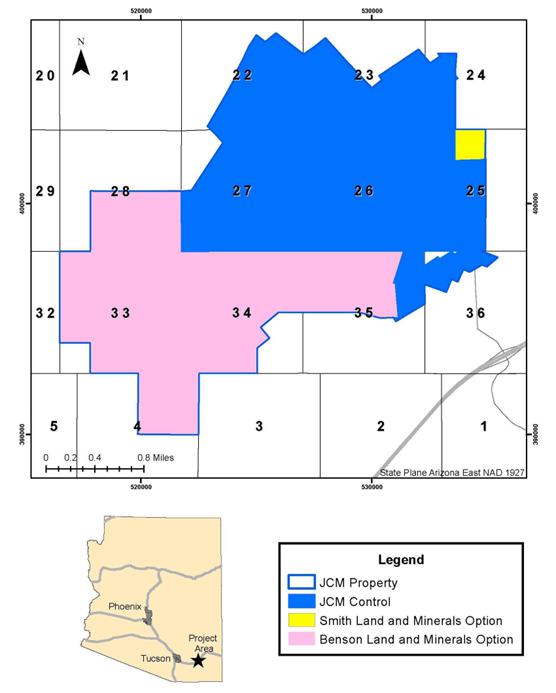
Source: GCC, 2025
Figure 0-4: JCM Project Location Map
The JCM Project is held by GCC through its wholly owned subsidiaries Excelsior Mining Arizona, Inc. (“GCAZ”) and Excelsior Mining Holdings, Inc. (“GCH”). Acquisition of the Nord Resources Corporation assets took place through a court-appointed receiver in December 2015.
On July 31, 2023, GCC announced that it had entered into an option agreement (“Nuton Option Agreement”) with Nuton to further evaluate the use of its Nuton™ copper heap leaching technologies (Nuton™ technologies) at Johnson Camp. Under the Nuton Option Agreement, GCC remains the operator and Nuton funds GCC’s costs associated with a two-stage work program at Johnson Camp.
| 51 |
The Nuton Option Agreement required that if Nuton proceeds to Stage 2, it would make a US$5 million payment to GCC for the use of existing infrastructure at the Johnson Camp mine for the Stage 2 work program. Nuton is also responsible for funding all of GCC’s costs associated with Stage 2. On May 15, 2024, GCC announced that Nuton had elected to proceed to Stage 2 of the existing Nuton Option Agreement.
After the completion of Stage 2, Nuton will have the right to exercise the option to joint venture and form a joint venture with GCU for Johnson Camp per mutually agreeable terms whereby Nuton would hold an initial 49% and GCC an initial 51%. The purpose of the joint venture is to continue the development of the Johnson Camp Mine using Nuton™ technologies. Should Nuton not exercise the option to form a joint venture, Nuton and GCC will discuss in good faith Gunnison’s continued use of the Nuton™ technologies at the Johnson Camp Mine subject to certain licensing terms and conditions to be agreed.
Accessibility, Climate, Local Resources, Infrastructure and Physiography
The JCM Project is located in a sparsely populated, flat to slightly undulating ranching and mining area about 65 road miles east of Tucson, Arizona. The Tucson metropolitan area is a major population center (approximately 1,000,000 persons) with a major airport and transportation hub and well-developed infrastructure and services that support the surrounding copper mining and processing industry. The nearby towns of Benson and Wilcox, along with Tucson, can supply sufficient skilled labor for the JCM Project.
Access to the JCM Project is via the Interstate (I-10) freeway from Tucson and Benson to the west or Willcox to the east. The Johnson Camp Mine can be accessed from the Johnson Road exit along 1.5 miles of improved dirt roads north of I-10.
The elevation on the property ranges from 4,500 to 5,500 feet above mean sea level in the eastern Basin and Range physiographic province of southeastern Arizona. The climate varies with elevation, but in general the summers are hot and dry, and winters are mild.
Vegetation on the property is typical of the upper Sonoran Desert and includes bunch grasses, yucca, mesquite, and cacti.
History
Modern mining and leaching operations at the Johnson Camp Mine began in the 1970s by Cyprus Minerals. Successor owners and operators include Arimetco, who mined JCM in the 1980s-early 90s, North Star, Summo Minerals, and Nord Resources Corporation (Nord) who commenced mining in 2009 until 2012. Nord mined fresh material until mid-2010 and maintained leaching operations until late 2015, when the property was purchased by GCC.
Geological Setting and Mineralization
The Johnson Camp Mine is located within the Mexican Highland region of the Basin and Range province, which is characterized by fault-bounded mountain ranges, with large intrusions forming the cores of the ranges. The JCM Project lies on the eastern edge of the Little Dragoon Mountains within the Cochise mining district. The Little Dragoon Mountains are an isolated, fault bounded horst block comprised of rocks spanning from 1.4 billion years ago (Ga) Pinal Group schists to Holocene sediments. The southern portion of the Little Dragoon Mountains consists predominately of the Texas Canyon Quartz Monzonite of Tertiary age, whereas the Pinal Group schists and a sequence of Paleozoic sedimentary units dominate the northern half of the range. At Johnson Camp, the important Paleozoic host is the Cambrian Abrigo Formation. The Texas Canyon Quartz Monzonite is porphyritic intrusion that crops out to the southwest of the Burro Pit at the Johnson Camp Mine.
| 52 |
Several deformations have occurred in the area with the most recent being the latest Cretaceous-Paleocene Laramide Orogeny compression, followed by Miocene and younger Basin and Range extension that has modified the topography to its current appearance.
The stratigraphy of the Burro pit and Copper Chief pit includes, from lowest to highest, Pioneer shale, diabase sill, Bolsa quartzite, three members of the Abrigo formation, and the Martin dolomite. Most mineralization is hosted in the lower and middle members of the Abrigo formation.
Moderate to intense calc-silicate alteration including garnet, epidote, and diopside are common in various assemblages, most intense calc-silicate alteration in the Lower and Middle Abrigo formations. Pervasive quartz veining occurs in both the Abrigo Formation and underlying Bolsa Quartzite throughout the Johnson Camp Mine area. Quartz vein orientations are typically sub-parallel to the stratigraphic units.
Primary copper mineralization at the Johnson Camp Mine is dominantly found along bedding planes or in veins and replacements as chalcopyrite along with quartz and pyrite, closely associated with skarn and calc-silicate alteration in the rock. The host formations are generally within the Bolsa Quartzite, Diabase Units, Lower and Middle Abrigo Formations. Oxidized mineralization consists of chrysocolla, malachite, copper limonite, and manganiferous wad; decreases with depth; but penetrates faults and stratigraphic contacts. Supergene chalcocite and occasional native copper occur generally below the oxidized zone. Below the supergene zone, the mineralization transitions to primary sulfides with local zones of supergene mineralization.
Deposit Types
The Johnson Camp Mine copper deposit is a type of copper skarn. The copper skarn at Johnson Camp and collectively in the Cochise mining district is presumably related to the Texas Canyon Quartz Monzonite. Copper skarns generally form in calcareous shales, dolomites, and limestones peripheral or adjacent to the margins of diorite to granite intrusions that range from dikes and sills to large stocks or phases of batholithic intrusions, and frequently are associated with mineralized intrusions. Copper mineralization forms along structurally complex and fractured rocks and convert the calcareous shales and limestones to andradite-rich garnet assemblages near the intrusive body, and to pyroxene and wollastonite rich assemblages at areas more distal to the intrusive that are subject to retrograde alteration with mineral hydrated silicate assemblages that overprint earlier garnet and pyroxene.
Mineralization at Johnson Camp occurs approximately 500 ft northeast of known occurrences of the Texas Canyon Quartz Monzonite intrusion as proximal skarn related to a porphyry copper system. This assumption is supported by the high abundance of garnet-epidote alteration in the mineralized zones, and the characterization of the deposits in numerous historical publications.
Exploration
Open pit mining commenced in 1975 by Cyprus and replaced the underground mining operations following the completion of an exploratory drilling program that defined the reserve of the Burro deposit. Cyprus and Arimetco collectively drilled 254 holes within both the Burro and Copper Chief pits. In 1999, Nord focused drilling exploration efforts on prospective targets outside of the pits that added no copper mineralization could be classified as reserves. GCC completed an exploration drilling program in 2022, and a metallurgical drill program in 2023 and 2024, aimed to define sulfide zones and collect samples of sulfide material for column tests.
| 53 |
Drilling
The Johnson Camp Mine database contains 390 drill holes total 135,600 feet of drilling. Several drilling campaigns and operators span the contents of the database. Based on RESPEC’s current knowledge, historical operators of the campaigns include Cyprus Mining (187 drill holes), Arimetco (83 drill holes), Nord (31 drill holes), Sumitomo (12 drill holes), and 16 drill holes were completed by an operator unknown to RESPEC. GCC drilled 77 holes. Drilling is concentrated in and immediately around the historically producing open pits. Table 0-17 is a breakdown of the drilling and operators in the Johnson Camp Mine area.
Table 0-17: Summary of Johnson Camp Drilling
| Operator | Year | Holes | Feet | |||||||
| Cyprus Mining | 1960 – 1986 | 171 | 59,818 | |||||||
| Arimetco | 1989 - 1997 | 83 | 24,637.5 | |||||||
| Summo USA Corp. | 1998 | 12 | 5,800 | |||||||
| Nord Resources Corp. | 2008-2010 | 31 | 14,368 | |||||||
| GCC | 2022 - 2024 | 77 | 29,377.5 | |||||||
| Unknown | 16 | 1,599 | ||||||||
| Totals | 390 | 135,600 | ||||||||
The drilling sampling procedures provided samples that are representative and of sufficient quality for use in the resource estimations discussed in Section 14. The QP is unaware of any sampling or recovery factors that materially impact the mineral resources discussed in Section 14 of the technical report.
There is a general lack of down-hole deviation survey data for the historical holes in the Johnson Camp Mine area. The paucity of such data is not unusual for drilling done prior to the 1990s, the lack of deviation data contributes a level of uncertainty as to the exact locations of drill samples at depth. However, these uncertainties are mitigated to a significant extent by the vertical orientation of nearly all drill holes, and the open-pit nature of any potential future mining operation that is based in part on data derived from the historical holes.
Sample Preparation, Analysis and Security
All of the historical drilling, sample preparation and analysis of the samples presented in the technical report was under the control of the previous property owners. GCC drilled seventy-seven holes between 2022 and 2024 and conducted core-duplicate sampling in 2016 and 2017.
The laboratory sample preparation and analysis procedures used by the previous owners of the deposits are unknown; however, major commercial laboratories using best practices at the time completed the majority of analyses. Additionally, most of the historical data were generated by well-known mining companies.
The data, information, samples, and core from the deposits have been under the control and security of AzTech Minerals since November 2006 and then GCC since October 2010. The original Information and samples are stored at GCC’s core storage facility in Casa Grande, with numerous copies held by GCC at its Phoenix, Arizona office.
The certification status of some of the historical analytical laboratories is not known. Southwestern Assayers and Chemists is the predecessor to Skyline. Mr. Bickel believes the historical labs were independent commercial laboratories that were widely recognized and used by the mining industry at that time.
Documentation of the methods and procedures used for historical sample preparation, analyses, and sample security, as well as for quality assurance/quality control procedures and results, is incomplete and in many cases not available. Despite this, some of the historical assay certificates have been preserved and GCC was able to reasonably duplicate the original results (described in section 12.2.4 of the technical report). The QP is satisfied that the historical analytical data are adequate to support the current resources, interpretations, conclusions, and recommendations summarized in the technical report.
| 54 |
GCC’s sample preparation and analyses were performed at a well-known certified laboratory, and the sample security and QA/QC procedures are adequate to support the current resources, interpretations, conclusions, and recommendations summarized in the technical report.
Data Verification
Data verification, the process of confirming that data has been generated with proper procedures, has been accurately transcribed from the original source and is suitable to be used, has been performed by Mr. Bickel through reviews of original data and certificates, drill core, a site visit, and audits and analyses of GCC’s drill-hole database. As a part of the verification of historical assays, RESPEC also analyzed core-duplicate data generated by GCC in 2016 and 2017 and compared the results to historical assays. The results are discussed in Section 12 of the technical report. There were no limitations on, or failure to conduct, the data verification for the technical report other than those discussed in this technical report. Mr. Bickel has verified that the JCM Project data are adequate as used in the technical report, most significantly to support the estimation and classification of the mineral resources reported herein.
Mineral Processing and Metallurgical Testing
Metallurgical testwork has been conducted in numerous campaigns by previous operators and owners including Superior Oil, Quintana Minerals, Phelps Dodge, Magma Copper, Arimetco, and Nord Resources. Testwork included many rounds of bottle roll and column testing. Early test programs indicated that total sulfuric acid consumption (before the electrowinning credit) will be approximately 9 lb H2SO4/lb of copper dissolved, that average PLS grade will be as high as 1.5 gpl Cu, and that about 65% of the total copper will dissolve, while as much as 95% of the ASCu could dissolve after sufficient contact time. This prior test work did not include augmented sulfide and transitional mineral leaching.
Nord Resources conducted eight column tests in 2011 on crushed and agglomerated material and 35 column tests in 2012 on crushed material minus 1” and minus 6”. Of these columns, 23 provided useful results to determine copper recovery and acid consumption. The column testing programs are described in Section
13.2.1. The results of some of the column tests produced ambiguous results regarding acid consumption (higher with a 6” crush than a 1” crush).
Lacking recent laboratory testing and comparison of results with current heap performance, a precise estimation of near-term operating results requires further test work. However, for the purpose of this study it is not unreasonable to expect up to 86% ASCu extraction, up to 76% CNCu extraction.Net acid consumptions in pounds per ton of mineralized ROM material are expected to be as follows: Upper Abrigo, 70; Middle Abrigo, 70; Lower Abrigo, 26, and Bolsa Quartzite, 22. For minus 1-inch crushed and agglomerated heap feed, the net acid consumption will be about 35% higher for each lithology.
GCC management, in collaboration with an industry-leading organization that is developing heap leaching applications to primary copper sulfide mineralization, have launched a sampling and metallurgical column testing program for material from the Burro pit, focusing on sulfide and mixed sulfide/transition/oxide mineralization. As the JCM pits deepen and non-ASCu copper minerals begin to overtake predominantly non-sulfide species, total copper extraction will decline, and the rate of extraction will diminish. Biologically-augmented heap leaching at elevated temperatures is designed to counteract this effect.
| 55 |
Mineral Resource Estimate
The mineral resource estimation for the Johnson Camp Mine was completed for disclosure in accordance with NI 43-101 with an effective date of November 05, 2024. The Johnson Camp Mine mineral resources are classified in order of increasing geological and quantitative confidence into Inferred, Indicated, and Measured categories in accordance with the “CIM Definition Standards - For Mineral Resources and Mineral Reserves” (2014). All mineral resources in this estimate are classified as Inferred. A full description of the Johnson Camp mineral resource estimation methodology is presented in Section 14 of the technical report.
The Johnson Camp Mine copper resources were modeled and estimated using information provided by GCC. The information is derived from historical core holes drilled by Cyprus Mining, Arimetco, Summo USA Corp., and Nord Resources Corp. The drill hole database also includes analyses performed by GCC on the historical core.
Mineral domains were modeled by RESPEC to respect the lithologic and structural interpretations of the deposit. Following statistical evaluation of the drillhole data, mineral domains were modeled on cross sections for total copper (“TCu”). Low-, mid-, and high-grade domains were modeled for total copper and were numbered 100, 200, and 300, respectively. Grade domains were interpreted based on copper grade domains that ideally correspond to the underlying geology. The grade domain ranges are shown in Table 0-18 below:
Table 0-18: Grade Domain Ranges
| Domain | Total Copper (%) | |
| 100 | ~0.025 to ~0.15 | |
| 200 | ~0.15 to 0.7 | |
| 300 | >~0.7 |
Soluble copper ratios were estimated within the total copper domains and lithologic units and used to calculate a soluble copper grade. A full description of the soluble copper estimate is in Section 14.6.2 of the technical report.
Mineral resources were estimated for total copper (“TCu”), acid-soluble copper (“ASCu”), cyanide-soluble copper (“CNCu”), and sulfide copper (“CuS”). Once the final estimate was complete, a pit optimization using the inputs described in Section 14.10 of the technical report were applied to the resource to evaluate if it has reasonable prospects for economic extraction. The contained resources within the cut-off grade defined by the pit optimization are given in Table 0-19.
Table 0-19: Johnson Camp Mineral Resources
(0.12% TCu cut-off)
| Classification | Tons | % TCu | % ASCu | % CNCu | % CuS | lbs TCu | lbs ASCu | lbs CNCu | lbs CuS | |||||||||||||||||||||||||||
| Measured | 31,493,000 | 0.36 | 0.15 | 0.07 | 0.08 | 226,707,000 | 94,697,000 | 46,007,000 | 49,075,000 | |||||||||||||||||||||||||||
| Indicated | 69,720,000 | 0.34 | 0.15 | 0.06 | 0.05 | 467,732,000 | 214,921,000 | 77,380,000 | 76,624,000 | |||||||||||||||||||||||||||
| Inferred | 24,968,000 | 0.32 | 0.15 | 0.05 | 0.05 | 162,130,000 | 75,406,000 | 24,895,000 | 24,295,000 | |||||||||||||||||||||||||||
| 1. | The Effective Date of the mineral resources is November 05, 2024. | |
| 2. | The JCM Project mineral resources are shown in bold and are comprised of all model blocks at a 0.12 % TCu cut-off that lie within optimized resource pits. | |
| 3. | Mineral resources that are not mineral reserves do not have demonstrated economic viability. | |
| 4. | The estimate of mineral resources may be materially affected by geology, environmental, permitting, legal, title, taxation, sociopolitical, marketing, or other relevant issues. | |
| 5. | Rounding as required by reporting guidelines may result in apparent discrepancies between tons, grade, and contained metal content. |
| 56 |
Table 0-20 provides a breakdown of tons and grade of the JCM mineral resources by oxidation groups defined in modeling at a cut-off grade of 0.12% TCu that fit within the simulated economic pit shell.
Table 0-20: Johnson Camp Mineral Resources by Oxidation Group
(0.12% TCu cut-off)
| Classification | Oxidation Group | tons | % TCu | % ASCu | % CNCu | % CuS | lbs TCu | lbs ASCu | lbs CNCu | lbs CuS | ||||||||||||||||||||||||||||||
| Measured | 3,640,000 | 0.48 | 0.04 | 0.08 | 0.36 | 35,076,000 | 3,136,000 | 5,926,000 | 26,014,000 | |||||||||||||||||||||||||||||||
| Indicated | Sulfide | 3,085,000 | 0.41 | 0.06 | 0.07 | 0.27 | 24,997,000 | 3,755,000 | 4,595,000 | 16,646,000 | ||||||||||||||||||||||||||||||
| Inferred | 86,000 | 0.40 | 0.08 | 0.08 | 0.24 | 694,000 | 145,000 | 136,000 | 414,000 | |||||||||||||||||||||||||||||||
| Measured | 5,614,000 | 0.43 | 0.14 | 0.20 | 0.09 | 48,338,000 | 15,554,000 | 22,818,000 | 9,965,000 | |||||||||||||||||||||||||||||||
| Indicated | Transition | 6,514,000 | 0.36 | 0.12 | 0.16 | 0.08 | 47,119,000 | 15,196,000 | 21,027,000 | 10,896,000 | ||||||||||||||||||||||||||||||
| Inferred | 773,000 | 0.32 | 0.07 | 0.20 | 0.04 | 4,921,000 | 1,159,000 | 3,101,000 | 661,000 | |||||||||||||||||||||||||||||||
| Measured | 6,519,000 | 0.32 | 0.15 | 0.06 | 0.10 | 41,445,000 | 19,994,000 | 8,355,000 | 13,096,000 | |||||||||||||||||||||||||||||||
| Indicated | Mixed | 19,573,000 | 0.36 | 0.16 | 0.08 | 0.13 | 141,277,000 | 61,532,000 | 30,664,000 | 49,081,000 | ||||||||||||||||||||||||||||||
| Inferred | 9,148,000 | 0.36 | 0.15 | 0.08 | 0.13 | 65,792,000 | 28,232,000 | 14,340,000 | 23,220,000 | |||||||||||||||||||||||||||||||
| Measured | 9,943,000 | 0.34 | 0.22 | 0.03 | 0.00 | 67,284,000 | 43,527,000 | 6,366,000 | - | |||||||||||||||||||||||||||||||
| Indicated | Oxide | 23,854,000 | 0.34 | 0.21 | 0.03 | 0.00 | 161,602,000 | 99,039,000 | 13,325,000 | - | ||||||||||||||||||||||||||||||
| Inferred | 7,255,000 | 0.35 | 0.22 | 0.03 | 0.00 | 50,240,000 | 31,404,000 | 3,978,000 | ||||||||||||||||||||||||||||||||
| Measured | 5,776,000 | 0.30 | 0.11 | 0.02 | 0.00 | 34,564,000 | 12,485,000 | 2,542,000 | - | |||||||||||||||||||||||||||||||
| Indicated | Iron-rich oxide | 16,694,000 | 0.28 | 0.11 | 0.02 | 0.00 | 92,737,000 | 35,399,000 | 7,769,000 | - | ||||||||||||||||||||||||||||||
| Inferred | 7,707,000 | 0.26 | 0.09 | 0.02 | 0.00 | 40,484,000 | 14,467,000 | 3,340,000 | - | |||||||||||||||||||||||||||||||
Future drilling, exploration, and resource definition at Johnson Camp Mine should focus on increasing the understanding of the distribution of cyanide soluble copper mineralization. Infill drilling in key areas to increase drill density, and drill-testing of the unconstrained limits of the deposit, particularly down-dip from known mineralization, should be prioritized.
Mineral Reserve Estimate
No mineral reserves are reported in the technical report. The author of the technical report cautions that GCC has decided to commence construction and proceed to production at the JCM Project. GCC did not base this production decision on any feasibility study of Mineral Reserves demonstrating economic and technical viability of the mines. As a result, there may be increased uncertainty and risks of achieving any level of recovery of minerals from the mine at the JCM Project or the costs of such recovery. As the JCM Project does not have established Mineral Reserves, GCC faces higher risks that anticipated rates of production and production costs will not be achieved, each of which risks could have a material adverse impact on GCC’s ability to continue to generate anticipated revenues and cash flows to fund operations from the JCM Project and ultimately the profitability of the operation.
Mining Method
Mining of the Johnson Camp (JCM) deposit for the Nuton Demonstration is planned to be accomplished using conventional open pit hard rock mining methods. The 3-year mine plan was developed to produce sulfide material for the Nuton Demonstration as quickly as possible. Mining of the deposit is expected to be accomplished with front end loaders and 70-100 ton haul trucks. Mining is planned on 20-ft and 30-ft bench heights. Mining will be performed by a contract miner.
| 57 |
Recovery Methods
The Johnson Camp Mine has a fully working SX-EW plant capable of producing 25 million lbs of cathode copper per year when fully operating. For the Nuton Demonstration, a new heap leach pad, designated Pad 5, is under construction. The leach pad will host both ROM and crushed and agglomerated material separated by a dividing berm. Most of the new equipment will be located on top of Pad 5 with leach material transported to the pad by haul truck. The crushed and agglomerated material will be stacked with conveyors into an engineered heap. This material will be aerated and irrigated by a series of blowers and perforated piping.
PLS flows from the crushed and ROM sections of the pad will be measured and sampled independently before reporting to the existing PLS pond via a new pipeline. The PLS will be treated in the JCM SX-EW facility.
JCM Project Infrastructure
The Johnson Camp Mine is an existing and operating copper hydrometallurgical plant. The site includes two open pits, waste dumps, SX-EW plant facilities and mine infrastructure that will be used when mine operations in the Burro Pit resumes. A new heap leach pad is in construction for the placement of newly mined material (Figure 0-5).
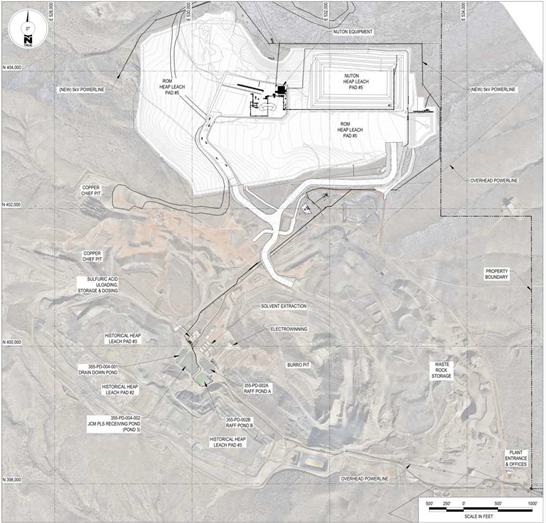
Source: M3, 2024
Figure 0-5: Site Plan of the Johnson Camp Mine showing the location of new leach pad, Pad 5
Water is supplied by two wells on site that produce 266 gpm of process make-up water. Additional water will be available from hydraulic control wells from the Gunnison wellfield and from pit dewatering.
| 58 |
Power
An existing 69 kV power line runs to the JCM substation where power is stepped down to 5 kV for distribution around the JCM mine site. Power distribution to the equipment located on Pad 5 will be fed with power stepped up to 13.8 kV from the main JCM substation. The average power consumption for the JCM project is estimated to be 7.1 kW with a demand load of 10.7 kW.
Market Studies and Contracts
GCC and Nuton have agreed that Nuton will receive 100% of the revenue generated from the sale of copper cathode production from JCM until Nuton recoups its Stage 2 funding and then GCC will retain 100% of the revenue until a joint venture is formed or the Nuton Option Agreement is terminated. Nuton also has the right to market 100% of the copper cathode production from JCM until Nuton recoups its Stage 2 funding and will enter into off-take agreements for such purpose.
Please refer to Section 19 of the technical report for other relevant Market Studies and Contracts.
Environmental and Permitting
The Johnson Camp Mine (JCM) is an active open pit mine. A processing (SX-EW) plant and associated ponds located at JCM are used to process pregnant leach solutions (PLS) from JCM. JCM has resumed mining of the open pit and will resume the heap leaching process using the mineralized material that will be placed on a new heap leach pad. Existing permits have been modified to address resumption of mining at JCM. Section 20 of the technical report describes the environmental permits that have been obtained for JCM.
Capital and Operating Costs
A capital cost estimate has been prepared to put the Johnson Camp Mine back into service for the Nuton Demonstration. This cost estimate includes:
| ● | Earthworks and lining of new heap leach pad, Pad 5 | |
| ● | Haul roads and access roads | |
| ● | Water diversions and emergency runoff ponds | |
| ● | Process equipment and piping upgrades | |
| ● | Electrical distribution upgrades | |
| ● | Indirect & Owners costs | |
| ● | Contingency |
Through the end of December 2024, GCC has spent $36,925 towards the JCM Restart and Nuton Demonstration, which expenses have been funded by Nuton.
Operating costs for the restart of the JCM operation have been built up from the following sources:
| ● | Historical plant operating costs, | |
| ● | New detailed contractor mining costs, | |
| ● | Updated sulfuric acid and reagent consumptions and costs, | |
| ● | Updated power loads and utility costs, | |
| ● | Comparative labor costs from other recent SX-EW projects, | |
| ● | Historical estimate factors for maintenance and services. |
| 59 |
G&A costs have been updated from historical G&A costs from JCM.
The cost for reclamation and closure for Pad 5 and the JCM operation as of December 31, 2024 is $7,281.757.
| (b) | Economic Analysis |
There are no current estimates of Mineral Reserves on the JCM Project. While the JCM Project has a current Mineral Resource Estimate, the future production forecast is not based on that Mineral Resource Estimate. GCC made decisions to commence construction and enter production at the JCM Project without having completed final feasibility studies. Accordingly, GCC did not base its construction and production decisions on any feasibility studies of Mineral Reserves demonstrating economic and technical viability of the JCM Project, with positive cash flow. As a result, there is increased uncertainty and risks of achieving any level of recovery of minerals from the JCM Project or the costs of such recovery. As the JCM Project does not have established Mineral Reserves, GCC faces higher risks that the anticipated rates of production and production costs, such as those provided in the technical report, will not be achieved. These risks could have a material adverse impact on GCC’s ability to continue to generate anticipated revenues and cash flows to fund operations from and ultimately achieve or maintain profitable operations at the JCM Project.
The Mineral Resource Estimate on the JCM Project includes inferred resources. Inferred Mineral Resources are considered too speculative geologically to have the economic considerations applied to them that would enable them to be categorized as mineral reserves. In addition, NI 43-101 prohibits the disclosure of the results of an economic analysis that includes or is based on inferred Mineral Resources. As a result, the author of the technical report has determined that it is not permitted to provide an economic analysis of the JCM Project.
Adjacent Properties
There are no relevant adjacent properties that are not controlled by GCC.
Interpretation and Conclusions
The JCM SX-EW plant was upgraded in 2019 and 2020, and JCM ponds are fully operational.
The full capital cost for restarting the JCM heap leaching operation includes mining pre-production, first fills/Owners costs, leach pad construction, crusher and agglomerator refurbishment, new leach pad stackers and haul road construction. This project is an opportunity to exploit existing mineral resources with considerable upside if long-term copper prices and sulfuric acid prices remain favorable.
Recommendations
GCC management launched a sampling and metallurgical testing program to evaluate the leaching strategy proposed in this study. The sampling and testwork program will assess the metallurgical zonation within the pits to estimate copper recoveries more accurately from each zone including testing the solubility of sulfide species. This program will help determine the long-term outlook for open pit mining and heap leaching at JCM.
The current Nuton Demonstration mine plan includes contract crushing and agglomeration with conveying and stacking the agglomerated material on the leach pad. In the future, GCC will look at replacing the contract crushing with its own equipment. GCC should refine the cost to reactivate the crushing-agglomerating plant, design the conveyor system, and the stacking plan for the life of the mine.
Other Assets
The Company does not have any material properties other than those described above.
| 60 |
RISK FACTORS
Investing in our securities is speculative and involves a high degree of risk due to the nature of our business and the present stage of its development. The following risk factors, as well as risks currently unknown to us, could materially adversely affect our future business, operations and financial condition and could cause them to differ materially from the estimates described in forward-looking statements relating to the Company, or its business, property or financial results, each of which could cause purchasers of our securities to lose part or all of their investment. The risks set out below are not the only risks we face; risks and uncertainties not currently known to us or that we currently deem to be immaterial may also materially and adversely affect our business, financial condition, results of operations and prospects. You should also refer to the other information set forth or incorporated by reference in this AIF.
Risks Related to the Business of the Company
Mining operations generally involve a high degree of risk.
Gunnison’s mining operations are subject to all of the hazards and risks normally encountered in the exploration for and development and production of metals, including, but not limited to: unusual and unexpected geologic formations, carbon-dioxide gas restricting fluid flows, environmental hazards, seismic activity, structural collapse, fire, flooding, variations in grade, deposit size, density and other geological problems, hydrological conditions, metallurgical and other processing problems, mechanical equipment performance problems, industrial accidents, the unavailability of power, the unavailability of materials and equipment including reagents and fuel, acid supply, labour force disruptions, unanticipated transportation costs, unanticipated regulatory changes, unanticipated or significant changes in the costs of supplies including, but not limited to, petroleum and reagents, acid supply, and adverse weather conditions and other conditions involved in the drilling and removal of material, these and other hazards may cause damage to, or destruction of, all or part of the Gunnison Project or JCM and other facilities, injuries or death to employees, contractors or other persons at the Company’s mineral properties, severe damage to and destruction of the Company’s property, plant and equipment, and contamination of, or damage to, the environment, and may result in the suspension of the Company’s development and production activities. Safety measures implemented by the Company may not be successful in preventing or mitigating future accidents.
In addition, from time to time the Company may be subject to governmental investigations and claims and litigation filed on behalf of persons who are harmed while at its properties or otherwise in connection with the Company’s operations. To the extent that the Company is subject to personal injury or other claims or lawsuits in the future, it may not be possible to predict the ultimate outcome of these claims and lawsuits due to the nature of personal injury litigation. Similarly, if the Company is subject to governmental investigations or proceedings, the Company may incur significant penalties and fines, and enforcement actions against it could result in the closing of the Gunnison Project or JCM. If claims and lawsuits or governmental investigations or proceedings are finally resolved against the Company, the Company’s financial performance, financial position and results of operations could be materially adversely affected.
Gunnison maintains insurance to protect against certain risks. At a minimum, these comply with all regulatory requirements and contractual obligations of the Company. However, insurance will not cover all of the potential risks associated with the Company’s operations. Gunnison also may be unable to maintain insurance to cover certain risks at economically feasible premiums. Insurance coverage may not continue to be available or may not be adequate to cover all resulting losses or liability. Gunnison might also become subject to liability for pollution or other hazards against which it may not be insured, may be underinsured or that Gunnison may elect not to insure against because of premium costs or other reasons. Losses from these events may cause Gunnison to incur significant costs that could have a material adverse effect upon its financial position, results of operations or cash flows.
| 61 |
The successful start of mining operations at, and the development of, the Gunnison Project or JCM into a commercially viable mine cannot be assured.
The commercial viability of a mineral deposit is dependent upon a number of factors which are beyond the Company’s control, including the attributes of the deposit, commodity prices, government policies and regulation and environmental protection. Fluctuations in the market prices of minerals may render resources and deposits containing relatively lower grades of mineralization uneconomic. There is no certainty that Gunnison will be able to have available funds to finance mining operations, avoid potential increases in costs, recruit and train personnel, or that Gunnison will be able to update, renew and obtain all necessary permits to start or to continue to operate the Gunnison Project or JCM. Most of these activities require significant lead times, and Gunnison will be required to manage and advance these activities concurrently in order to begin production. A failure or delay in the completion of any one of these activities may delay production, possibly indefinitely, at the Gunnison Project or JCM and would have a material adverse effect on Gunnison’s business, prospects, financial position, results of operations and cash flows. There is no assurance that Gunnison will ever achieve commercial production or that Gunnison will ever be profitable if production is achieved.
Actual capital costs, operating costs and expenditures, production schedules and economic returns may differ significantly from those we have anticipated.
Our expected capital costs, operating costs and expenditures, All-In Costs, production schedules, economic returns and other projections for the Gunnison Project and JCM which are contained in the Gunnison Technical Report and JCM Technical Report, respectively, are based on assumed or estimated future metals prices, cut-off grades, operating costs, capital costs and expenditures and other factors that each may prove to be inaccurate. Therefore, the Gunnison Technical Report or JCM Technical Report may prove to be unreliable if the assumptions or estimates do not reflect actual facts and events. For example, significant declines in market prices for copper or extended periods of inflation would have an adverse effect on the economic projections set forth in the Gunnison Technical Report or JCM Technical Report.
Any material reductions in estimates of mineralization or increases in capital costs and expenditures, or in our ability to maintain a projected budget or renew a particular mining permit, could also have a material adverse effect on projected production schedules and economic returns, as well as on our overall results of operations or financial condition. There is also a risk that rising costs for labour and material could have an adverse impact on forecasted construction costs and that shortages of labour and material could have a negative impact on any mine development schedule. An increase in any of these costs, or a lack of availability of commodities and goods, may have an adverse impact on our financial condition and results of operations.
The Company may be required to seek additional debt or equity capital in order to continue mining operations at the Gunnison Project and JCM and we may not be able to access capital on commercially reasonable terms or at all and, even if successful, we may not be able to raise enough capital to allow us to fully fund the costs required to continue mining operations at the Gunnison Project and JCM.
There is uncertainty relating to production estimates.
We have prepared estimates of future production and future production costs for the Gunnison Project and JCM. No assurance can be given that production estimates will be achieved. These production estimates are based on, among other things: the accuracy of resource estimates; the accuracy of our assumptions as to future events and circumstances; metallurgical, geological, geochemical and hydrological characteristics; and the accuracy of estimated rates and costs of mining and processing. Actual production may vary from estimates for a variety of reasons, including, among other things: actual material mined varying from estimates of grade, tonnage, dilution, metallurgical and other characteristics; short-term operating factors relating to the mineral resources, such as the need for sequential development of mineralized material bodies and the processing of new or different mineralized material grades; risk and hazards associated with mining; natural phenomena, such as inclement weather conditions, floods, earthquakes, cave-ins; and unexpected labour shortages or strikes. Failure to achieve production estimates could have an adverse impact on our future cash flows, earnings, results of operations and financial condition.
| 62 |
General economic conditions may adversely affect Gunnison’s growth, future profitability, ability to finance and operations.
Global financial conditions continue to be characterized as volatile. In recent years, global markets have been adversely impacted by various credit crises and significant fluctuations in metals prices and fuel and energy costs. Many industries, including the mining industry, have been impacted by these market conditions. Global financial conditions remain subject to sudden and rapid destabilizations in response to future events. A continued or worsened slowdown in the financial markets or other economic conditions, including but not limited to consumer spending, employment rates, business conditions, inflation, tariffs, fuel and energy costs, consumer debt levels, lack of available credit, the state of the financial markets, interest rates and tax rates, may adversely affect our growth and profitability. Future crises may be precipitated by any number of causes, including natural disasters, geopolitical instability, changes to energy prices or sovereign defaults. If increased levels of volatility continue or in the event of a rapid destabilization of global economic conditions, it may result in a material adverse effect on commodity prices, demand for metals, including, copper, availability of credit, investor confidence, and general financial market liquidity, all of which may adversely affect our business and the market price of our securities.
In addition, if there is an emergence of a global pandemic, it could have a material adverse effect on global economic conditions which may adversely impact our business and results of operations and the operations of our suppliers, contractors and service providers, and the demand for our production.
The development of our properties will be subject to all of the risks associated with establishing new mining operations.
Development of our mineral properties will require the operation of mines, processing plants and related infrastructure as well as restarting or running at full capacity the SX-EW plant at JCM. In addition, the restart of operations at JCM is contingent on the success of the Nuton Technologies increasing recovery rates of sulfide material and as a result making the JCM operation economically viable. As a result, we are and will continue to be subject to all of the risks associated with establishing new mining operations, restarting operations, and ramping-up or running operations, including:
● the timing and cost, which can be considerable, of the construction and operation of mining and processing facilities;
● the availability and cost of skilled labour, mining equipment and principal supplies needed for operations;
● the need to maintain necessary environmental and other governmental approvals and permits;
● the availability of funds to finance mining operations;
● potential opposition from non-governmental organizations, environmental groups, local groups or other stakeholders which may delay or prevent mining operations; and
● potential increases in construction and operating costs due to changes in the cost of labour, fuel, power, materials and supplies.
| 63 |
It is common in new mining operations to experience unexpected costs, problems and delays during construction, development and mine start-up. Accordingly, we cannot provide assurance that our activities will result in profitable mining operations at our mineral properties.
Mineral resource calculations are only estimates.
Any figures presented for mineral resources in this AIF and the Gunnison Technical Report are only estimates. There is a degree of uncertainty attributable to the calculation of mineral resources as they are determined based on assumed future prices, cut off grades and operating costs. Until mineral resources are actually mined and processed, the quantity of metal and grades must be considered as estimates only and no assurances can be given that some or all of the indicated levels of metals will be produced. In making determinations about whether to advance any part of the Gunnison Project to development, Gunnison must rely upon estimated calculations as to the mineral resources and grades of mineralization on the Gunnison Project. Presently none of the Company’s mineral projects have a mineral reserve estimate.
Estimating mineral reserves and mineral resources is a subjective process that relies on the judgment of the persons preparing the estimates. Estimates of mineral resources are, to a large extent, based on the interpretation of geological data obtained from drillholes and other sampling techniques. This information is used to calculate estimates of the configuration of the mineral resource, expected recovery rates, anticipated environmental conditions and other factors. As a result, mineral resource estimates for the Gunnison Project may require adjustments or downward revisions based upon further exploration or development work or upon actual production experience, thereby adversely impacting the economics of the Gunnison Project. In addition, the grade of mineralized material ultimately mined, if any, may differ from that indicated by drilling results. There can be no assurance that minerals recovered in small-scale tests will be duplicated in large-scale tests under on-site conditions or in production scale. Any material change in the quantity of mineralization or grade may render portions of the Company’s mineralization uneconomic and result in reduced reported mineralization. Any material reductions in estimates of mineralization, or of the Company’s ability to extract this mineralization, could have a material adverse effect on the Company’s results of operations or financial condition.
Changes in the market price of copper, which in the past has fluctuated widely, will affect the projected results of Gunnison’s operations, financial position and cash flows.
Gunnison’s revenues in the future, if any, are expected to be derived in large part from the sale of copper. The price of this commodity has fluctuated widely in recent years and is affected by factors beyond the control of Gunnison including, but not limited to international economic and political trends, changes in industrial demand, currency exchange fluctuations, economic inflation and expectations for the level of economic inflation in the consuming economies, interest rates, global and local economic health and trends, speculative activities, the availability and costs of substitutes and changes in the supply of this commodity due to new mine developments and mine closures. All of these factors, which are impossible to predict with certainty, will impact the viability of the Gunnison Project and JCM.
Reduction in the demand for copper in the Chinese markets may negatively impact Gunnison’s operations and financial condition.
China has been a significant driver of global demand for minerals and metals, including copper. A slowing in China’s economic growth could result in lower prices and demand for copper. Increasing tariffs on goods manufactured in China present a risk of slowing China’s economic growth. China is increasingly seeking strategic self-sufficiency in key commodities, including investments in existing businesses or new developments in other countries. These investments may adversely impact future copper demand and supply balances and prices.
| 64 |
Gunnison will require additional capital in the future, and no assurance can be given that such capital will be available at all or available on terms acceptable to Gunnison.
Gunnison currently has no significant cash flow from production. The construction and operation of the Gunnison Project or JCM depends upon Gunnison’s ability to obtain financing through strategic partnerships, equity or debt financings, production-sharing arrangements or other dilutive or non-dilutive means. Nuton has agreed to fund the costs associated with the restart of mining operations at Johnson Camp; however, at any point Nuton can terminate the Nuton Option Agreement and Nuton Technology Demonstration Agreement and thereafter is no longer obligated to provide additional funding. There is no assurance that Nuton will continue to provide funding or that Gunnison will be successful in obtaining required financing on acceptable terms, or at all. If Gunnison is unable to obtain additional financing it may consider other options, such as (i) selling assets, (ii) selling equity, or (iii) selling interests in the Gunnison Project or JCM. If Gunnison raises additional funding by issuing additional equity securities or other securities that are convertible into equity securities, such financings may substantially dilute the interest of existing or future shareholders. Sales or issuances of a substantial number of securities, or the perception that such sales could occur, may adversely affect the prevailing market price of the Common Shares. With any additional sale or issuance of equity securities, investors will suffer dilution of their voting power and may experience dilution in earnings per share. If Gunnison raises additional funding by entering into stream agreements, royalty agreements or other similar agreements, the Company may be required to deliver a portion of future metals production or revenue derived from operations. Such contractual obligations may have a negative effect on our future financial condition and results of operations and investors may suffer dilution in earnings per share. There is no assurance we will be able to negotiate acceptable terms for the sale of any interests in the Gunnison Project. Failure to obtain additional financing could result in an indefinite postponement of further exploration and development of the Gunnison Project and JCM, and will have a material adverse effect on Gunnison’s business, prospects, financial position, results of operations and cash flows.
Gunnison has a limited history of mining operations and limited revenue from operations.
The Company commenced the ramp-up phase using ISR leading to commercial production at the Gunnison Project and achieved first copper production. However, due to issues related to ramp-up copper production, the Company has elected to advance an open pit mining operation at the Gunnison Project instead of an ISR operation. The open pit mining operation at the Gunnison Project will require several years of permitting, technical studies and financing prior to any operations occurring. As a result, there is no present copper production from the Gunnison Project. Nuton is funding the construction of the Johnson Camp mine and mining operations are expected to commence in 2025. As such, Gunnison remains subject to many risks common to a start-up mining operation, including under-capitalization, cash shortages, limitations with respect to personnel, financial and other resources and lack of revenues. There can be no assurance that significant losses will not occur in the near future or that we will be profitable in the future. Gunnison’s operating expenses and capital expenditures may increase in the future as consultants, personnel and equipment costs associated with advancing development and commercial production of our properties increase. Gunnison expects to continue to incur losses unless and until such time, if ever, its enters into commercial production and generate sufficient revenues to fund its continuing operations. There can be no assurance that it will generate any revenues. If Gunnison is unable to generate significant revenues at the Gunnison Project or JCM, Gunnison will not be able to earn profits or continue operations.
Gunnison has a history of losses and expects to incur losses for the foreseeable future.
Gunnison has incurred losses since its inception and expects to incur losses for the foreseeable future. Gunnison expects to continue to incur losses unless and until such time as the Gunnison Project or JCM enters into commercial production and generates sufficient revenues to fund continuing operations. The operation of the Gunnison Project and JCM will require the commitment of substantial financial resources. The amount and timing of expenditures will depend on a number of factors, including the progress of mining operations, the results of consultant analysis and recommendations, the rate at which operating losses are incurred, the execution of any agreements with strategic partners, and Gunnison’s acquisition of additional properties. Some of these factors are beyond Gunnison’s control. There can be no assurance that Gunnison will ever achieve profitability.
| 65 |
Risks associated with secured debt.
The Company’s obligations under the Nebari Credit Agreement are secured against the Gunnison Project. Any failure to meet any of the payment obligations under the Nebari Credit Agreement, or otherwise adhere to the positive and negative covenants therein or fulfill the other obligations thereunder, may trigger an event of default and a demand for full immediate repayment of all amounts outstanding under the Nebari Credit Agreement. We may be able to generate cash flow from operations in the future sufficient to service our debt and make necessary capital expenditures. If we are unable to generate such cash flow, we may be required to adopt one or more alternatives, such as selling assets, restructuring debt or obtaining additional equity capital on terms that may be onerous or highly dilutive. Our ability to refinance our indebtedness will depend on the capital markets and our financial condition at such time. We may not be able to engage in any of these activities or engage in these activities on desirable terms, which could result in a default on our debt obligations. If the Company is unable to repay all amounts outstanding under the Nebari Credit Agreement, Nebari may realize on its security and the Company could lose its interest in the Gunnison Project and JCM.
Risks associated with 48C Tax Credits
Nuton and Gunnison have been selected to receive US$13.9 million in tax credits (48C) under the Qualifying Advanced Energy Project Credit Program to expand production of Made in America copper, which is designated a Critical Material for Energy, from its Johnson Camp Mine in Southern Arizona. Nuton and Gunnison have agreed to an allocation of the tax credits which could result in potential proceeds of up to $8 million payable to Gunnison. However, the actual amount depending on the 48C tax credit certification process and how much can be realized from the sale of the certified credits. The receipt of the 48C tax credit is subject to Certification as outlined in IRS Notice 2023-44 Code including certification of the operational and employment plans set out in the application. There is no certainty that the conditions to the completion of the Nuton Transaction or receipt of the 48C tax credit will be satisfied.
Risks associated with Copper Stream Agreement.
Pursuant to the Stream Agreement with Triple Flag, the Company is required to maintain a leverage ratio of
3.5:1.0. The leverage ratio is calculated as the ratio of indebtedness of the Company to net income (adjusted for certain items). The applicability of the leverage ratio has been suspended until September 30, 2026 (the “Leverage Ratio Grace Period”). Because the Gunnison project is in the process of ramping up to production, management does not expect that the leverage ratio will be able to be met until sustained production is achieved If the Company does not meet the leverage ratio prior to the end of the Leverage Ratio Grace Period, the Company will be in default of this covenant in the Stream Agreement. If the Company defaults, then Triple Flag will have certain options available to it. In a default scenario Triple Flag may demand from the Company all amounts and deliveries due from the Company to Triple Flag but not paid or made. In addition, Triple Flag may also elect to terminate the Stream Agreement. If Triple Flag terminates the Stream Agreement, it can seek to recover the greater of its target return amount and the value of the deliveries that would have occurred over the life of the Stream Agreement if it had not been terminated. A default under the Stream Agreement would also cause a default under the terms of the Nebari Credit Agreement. If the Company is unable to repay all amounts owing to Triple Flag and Nebari, Nebari may realize on its security and the Company could lose its interest in the Gunnison Project.
| 66 |
Gunnison requires various permits in order to conduct its current and anticipated future operations, and any delays in obtaining or a failure to obtain such permits, or a failure to comply with the terms of any such permits that Gunnison has obtained or will obtain, could have a material adverse impact on Gunnison.
Gunnison’s current and anticipated future operations, including further exploration, evaluation and development activities on the Gunnison Project and JCM, require permits from various United States federal, state, and local government authorities. Obtaining or renewing governmental permits is a complex and time-consuming process. The duration and success of efforts to obtain and renew permits are contingent upon many variables not within Gunnison’s control.
Shortage of qualified and experienced personnel in the various levels of government could result in delays or inefficiencies. Backlog within the permitting agencies could affect the permitting timeline of the Gunnison Project and JCM. Other factors that could affect the permitting timeline include (i) the number of other large-scale projects currently in a more advanced stage of development which could slow down the review process for the Gunnison Project and JCM, and (ii) significant public response regarding the Gunnison Project or JCM that could lead to delays in the process or appeals of issued permits. There can be no assurance that all permits which Gunnison requires for its development activities and construction of expanded mining facilities and the conduct of mining operations will be obtainable or renewable on reasonable terms, or at all. Delays or a failure to obtain such permits, or the expiry, revocation or a failure to comply with the terms of any such permits that Gunnison has obtained, could have a material adverse impact on Gunnison.
Title and other rights to the Gunnison Project and the JCM cannot be guaranteed and may be subject to prior unregistered agreements, transfers or claims and other defects.
Gunnison cannot guarantee that title to the Gunnison Project or the JCM will not be challenged. Gunnison may not have, or may not be able to obtain, all necessary surface rights to develop, or all water rights needed to operate the Gunnison Project. In particular, certain portions of the Gunnison Project are subject to option agreements that require future payments to landowners to exercise the option and acquire title, including the Benson Option Agreement. If Gunnison does not make the required payments under these option agreements, including the Benson Option, it will not have the necessary surface or mineral rights to develop the open pit mining operation at the Gunnison Project as set out in the Gunnison Technical Report. In addition, title insurance generally is not available for mineral properties and Gunnison’s ability to ensure that it has obtained secure claim to individual mineral properties or mining concessions comprising the Gunnison Project and the JCM may be severely constrained; however, Gunnison Arizona does have title insurance for the portions of the JCM that are patented mining claims and fee title property. The Gunnison Project and the JCM may be subject to prior unregistered agreements, transfers or claims, and title may be affected by, among other things, undetected defects. Gunnison has not conducted surveys of all of the claims in which it holds direct or indirect interests. A successful challenge to the precise area and location of these claims could result in Gunnison being unable to operate on all or part of the Gunnison Project or the JCM as permitted or being unable to enforce its rights with respect to all or part of the Gunnison Project or the JCM. Surface owners may also be able to obtain damages or an injunction that prevents continued mining operations at the Gunnison Project. These circumstances could result in a material adverse impact on Gunnison and Gunnison not being compensated for its prior expenditures relating to the properties.
Gunnison needs to enter into contracts with external service and utility providers.
Mining, processing, development and exploration activities depend, to one degree or another, on adequate infrastructure. In order to develop a mine at the Gunnison Project, Gunnison will need to negotiate, conclude and maintain various agreements with external service and utility providers for power, water, transportation and shipping and these are important determinants that affect capital and operating costs.
| 67 |
There is no certainty that Gunnison will be able to conclude or maintain various agreements with external service and utility providers on economically feasible terms and this could have a material adverse effect on Gunnison’s results of operations, financial position and cash flows and render the development of a mine on the Gunnison Project unviable.
Gunnison is subject to significant governmental regulation.
Gunnison’s operations and exploration and development activities in the United States are subject to extensive federal, state and local laws and regulation governing various matters, including environmental protection, management and use of toxic substances and explosives, management of natural resources, exploration, development of mines, production and post-closure reclamation, exports, price controls, taxation, mining royalties, management of tailing and other waste generated by operations, labour standards and occupational health and safety, including mine safety, and historic and cultural preservation.
Failure to comply with applicable laws and regulations may result in civil or criminal fines or penalties or enforcement actions, including orders issued by regulatory or judicial authorities enjoining or curtailing operations or requiring corrective measures, installation of additional equipment or remedial actions, any of which could result in Gunnison incurring significant expenditures. Gunnison may also be required to compensate private parties suffering loss or damage by reason of a breach of such laws, regulations or permitting requirements. It is also possible that future laws and regulations, or a more stringent enforcement of current laws and regulations by governmental authorities, could cause Gunnison to incur additional expense, capital expenditures, restrictions on or suspensions of Gunnison’s operations and delays in the development of the Gunnison Project.
The Canadian Extractive Sector Transparency Measures Act (“ESTMA”), which became effective June 1, 2015, requires public disclosure of payments to governments by mining companies engaged in the commercial development of minerals who are either publicly listed in Canada or with business or assets in Canada. Mandatory annual reporting is required for extractive companies with respect to payments made to foreign and domestic governments at all levels, including entities established by two or more governments. ESTMA requires reporting on the payments of any taxes, royalties, fees, production entitlements, bonuses, dividends, infrastructure improvement payments, and any other prescribed payment over C$100,000. Failure to report, false reporting or structuring payments to avoid reporting may result in fines of up to C$250,000 (which may be concurrent). If we find ourselves subject to an enforcement action or in violation of ESTMA, this may result in significant penalties, fines and/or sanctions imposed on us resulting in a material adverse effect on our reputation.
Gunnison’s activities are subject to environmental laws and regulations that may increase Gunnison’s costs of doing business and restrict the Company’s operations.
All of Gunnison’s exploration, potential development and production activities in the United States are subject to regulation by governmental agencies under various environmental laws, including with respect to, air emissions, discharges into water, use of groundwater, management of waste, management of hazardous substances, protection of natural resources, antiquities and endangered species and reclamation of lands disturbed by mining operations. Environmental legislation, including with respect to climate change, in many countries is evolving and the trend has been towards stricter standards and enforcement, increased fines and penalties for non-compliance, more stringent environmental assessments of proposed projects and increasing responsibility for companies and their officers, directors and employees. Compliance with environmental laws and regulations may require significant capital outlays on behalf of Gunnison and may cause material changes or delays in Gunnison’s intended activities. There can be no assurance that future changes in environmental regulations will not adversely affect Gunnison’s business, and it is possible that future changes in these laws or regulations could have a significant adverse impact on some portion of Gunnison’s business, causing Gunnison to re-evaluate those activities at that time. Failure to comply with applicable environmental laws, regulations and permitting requirements may result in enforcement actions thereunder, including orders issued by regulatory or judicial authorities, causing operations to cease or to be curtailed, and may include corrective measures requiring capital expenditures, installation of additional equipment or remedial actions.
| 68 |
As disclosed under “Narrative Description of the Business - Environmental Protection” on October 23, 2024, the Director of the Department of Water Resources issued an Order initiating the proceedings to designate the Willcox Groundwater Basin as a subsequent AMA. The Willcox Groundwater Basin includes the area where the Company’s Gunnison Project and JCM are located. In order to utilize groundwater for the Company’s mineral projects it will have to obtain grandfathered rights or receive a withdrawal permit under Arizona law. In the event that such grandfathered rights are not available, or a withdrawal permit cannot be obtained, the Company will not have sufficient groundwater for its mineral project meaning it will not be able to commence or continue mining which would have a material adverse effect on our operations and profitability.
Environmental hazards may exist on the Gunnison Project or the JCM that are unknown to Gunnison at the present time and that have been caused by previous owners or operators or that may have occurred naturally. Gunnison may be liable for remediating such damage.
Climatic conditions can affect Gunnison future operations.
Arizona can be subject to periods of drought. Operations at the Gunnison Project and JCM will require water for normal operations. A lack of necessary water for a prolonged period of time could affect operations at the Gunnison Project and JCM, and materially adversely affect Gunnison’s results of operations. Arizona can also be subject to significant rainfall events which could result in flooding and materially adversely affect the Company’s results of operations.
Governments are moving to introduce climate change legislation and treaties at the international, national, state/provincial and local levels. The regulatory requirements are evolving and are not consistent across the jurisdictions in which we operate. However, regulation relating to emission levels (such as carbon taxes) and energy efficiency is becoming more stringent. If the current regulatory trend continues, we expect that this will result in increased costs at our operations. In addition, the physical risks of climate change may also have an adverse effect on our operations. These risks include the following:
| ● | Sea level rise: Changes in sea levels could affect ocean transportation and shipping facilities that are used to transport supplies, equipment to our operations and products from those operations to world markets. | |
| ● | Extreme weather events: Extreme weather events (such as increased frequency or intensity of hurricanes, increased snow pack, prolonged drought) have the potential to disrupt operations at our mine. Extended disruptions to supply lines could result in interruption to production. | |
| ● | Resource shortages: our facilities depend on regular supplies of consumables (stainless steel, copper cable, acid, etc.) and reagents to operate efficiently. In the event that the effects of climate change or extreme weather events cause prolonged disruption to the delivery of essential commodities, our production efficiency is likely to be reduced. |
The occurrence of such physical climate change events may result in substantial costs to respond to the event or recover from the event, and to prevent recurrent damage, through either the modification of, or addition to, existing infrastructure at our operations. The scientific community has predicted an increase, over time, in the frequency and severity of extraordinary or catastrophic natural phenomena as a result of climate change. We can provide no assurance that we will be able to predict, respond to, measure, monitor or manage the risks posed as a result. Physical climate change events, and the trend toward more stringent regulations aimed at reducing the effects of climate change, could impact our decision to pursue future opportunities, or maintain our existing operations, which could have an adverse effect on our business and our future operations.
| 69 |
We can provide no assurance that efforts to mitigate the risks of climate changes will be effective and that the physical risks of climate change will not have an adverse effect on our operations and profitability.
Failure to provide regulatory authorities with the required financial assurances could potentially result in the closure of one or more of our operations, which could result in a material adverse effect on our operating results and financial condition.
We are required by regulatory authorities of the State of Arizona and United States Federal Government to provide financial assurances sufficient to allow a third party to implement approved closure and reclamation plans if we are unable to do so. These laws are complex and govern the determination of the scope and cost of the closure and reclamation obligations and the amount and forms of financial assurance.
The amount and nature of the financial assurances are dependent upon a number of factors, including our financial condition and reclamation cost estimates. Changes to these amounts, as well as the nature of the collateral to be provided, could significantly increase our costs, making the maintenance and development of existing and new mines less economically feasible. Regulatory authorities may also require further financial assurances. To the extent that the value of the collateral provided to the regulatory authorities is or becomes insufficient to cover the amount of financial assurance we are required to post, we would be required to replace or supplement the existing security with more expensive forms of security, which might include cash deposits, which would reduce our cash available for operations and financing activities. We can provide no assurance that we will be able to maintain or add to our current level of financial assurance or that we will have sufficient capital resources to further supplement our existing security, which could result in a material adverse effect on our operating results and financial condition.
Gunnison may experience difficulty attracting and retaining qualified management and technical personnel to meet the needs of its anticipated growth.
Gunnison is dependent on the services of key executives including Gunnison’s Chief Executive Officer and Senior Vice Presidents, and other highly skilled and experienced executives and personnel focused on managing Gunnison’s interests and the advancement of the Gunnison Project, and on identifying new opportunities for growth and funding. Due to Gunnison’s relatively small size, the loss of these persons or Gunnison’s inability to attract and retain additional highly skilled employees required for the development of Gunnison’s activities may have a material adverse effect on Gunnison’s business or future operations.
In addition, Gunnison anticipates that with the Gunnison Project commencing production and if appropriate, it acquires additional mineral rights, Gunnison will experience significant growth in its operations. Gunnison expects this growth to create new positions and responsibilities for management and technical personnel and to increase demands on its operating and financial systems. There can be no assurance that Gunnison will successfully meet these demands and effectively attract and retain additional qualified personnel to manage its anticipated growth. The failure to attract such qualified personnel to manage growth would have a material adverse effect on Gunnison’s business, financial position, results of operations and cash flows.
Increased competition could adversely affect Gunnison’s ability to attract necessary capital funding or acquire suitable producing properties or prospects for mineral exploration in the future.
The mining industry is intensely competitive. Significant competition exists for the acquisition of properties producing or capable of producing copper or other metals. Gunnison may be at a competitive disadvantage in acquiring additional mining properties because it must compete with other individuals and companies, many of which have greater financial resources, operational experience and technical capabilities than Gunnison. Gunnison also may encounter increasing competition from other mining companies in its efforts to hire experienced mining professionals. The Company’s competitors may be able to respond more quickly to new laws or regulations or emerging technologies, or devote greater resources to the expansion of their operations, than the Company can. In addition, current and potential competitors may make strategic acquisitions or establish cooperative relationships among themselves or with third parties. Increased competition could adversely affect Gunnison’s ability to attract necessary capital funding or to acquire suitable producing properties or prospects for mineral exploration in the future. If Gunnison is unsuccessful in acquiring additional mineral properties or services or qualified personnel it will not be able to grow at the rate it desires, or at all. The Company may not be able to compete successfully against current and future competitors, and any failure to do so could have a material adverse effect on the Company’s business, financial condition or results of operations.
| 70 |
Gunnison may experience cybersecurity threats.
Gunnison relies on secure and adequate operations of information technology systems in the conduct of its operations. Access to and security of the information technology systems are critical to Gunnison’s operations. To Gunnison’s knowledge, it has not experienced any material losses relating to disruptions to its information technology systems. Gunnison has implemented ongoing policies, controls and practices to manage and safeguard Gunnison and its stakeholders from internal and external cybersecurity threats and to comply with changing legal requirements and industry practice. Given that cyber risks cannot be fully mitigated and the evolving nature of these threats, Gunnison cannot assure that its information technology systems are fully protected from cybercrime or that the systems will not be inadvertently compromised, or without failures or defects. Disruptions to Gunnison’s information technology systems, including, without limitation, security breaches, power loss, theft, computer viruses, cyber-attacks, natural disasters, and non-compliance by third party service providers and inadequate levels of cybersecurity expertise and safeguards of third party information technology service providers, may adversely affect the operations of Gunnison as well as present significant costs and risks including, without limitation, loss or disclosure of confidential, proprietary, personal or sensitive information and third party data, material adverse effect on its financial performance, compliance with its contractual obligations, compliance with applicable laws, damaged reputation, remediation costs, potential litigation, regulatory enforcement proceedings and heightened regulatory scrutiny.
Conflicts of interest may arise among the Company’s directors and officers as a result of their involvement with, or shareholdings in, other mineral resource companies.
Certain of Gunnison’s directors and officers also serve as directors or officers for, or have significant shareholdings in, other companies involved in natural resource exploration and development or mining-related activities. To the extent that such other companies may participate in ventures in which Gunnison may participate in, or in ventures which Gunnison may seek to participate in, its directors and officers may have a conflict of interest in negotiating and concluding terms respecting the extent of such participation. In all cases where the Company’s directors and officers have an interest in other companies, such other companies may also compete with Gunnison for the acquisition of mineral property investments. Such associations may give rise to conflicts of interest for Gunnison’s directors and officers resulting in a material and adverse effect on the Company’s profitability, results of operation and financial condition. As a result of these potential conflicts of interest, Gunnison may miss the opportunity to participate in certain transactions, which may have a material adverse effect on its financial position. The directors of the Company are required by law to act honestly and in good faith with a view to the best interests of the Company and its shareholders and to disclose any interest which they may have in any project or opportunity of the Company, but each officer or director has the identical obligation to other companies for which such officer or director serves as an officer or director.
Gunnison is exposed to exchange rate fluctuations because it raises funds in Canadian dollars and its costs are incurred in United States dollars.
Exchange rate fluctuations may affect the costs that Gunnison incurs in its operations. Gunnison has historically raised funds in Canadian dollars and its costs are incurred principally in United States dollars. Any appreciation of the US dollar against the Canadian dollar will reduce the purchasing power of each Canadian dollar raised, which could increase the risk that the Company would not be able to finance its operations and projects. The Company has assessed this risk and has not presently adopted an active currency hedging program given the current currency exchange rates.
| 71 |
Uncertainty exists related to inferred mineral resources.
Inferred Resources are estimated on the basis of limited geological evidence and sampling and while, by definition, it can reasonably be expected that a majority of inferred mineral resources referred to in this prospectus could be upgraded to indicated resources with further exploration, there is no assurance of such further exploration will take place, or that further exploration will result in the Company’s inferred resources being converted into measured or indicated mineral resources as there may be limited ability to assess geological continuity. Due to the uncertainty that may attach to inferred mineral resources, there is no assurance that inferred mineral resources will be upgraded to resources with sufficient geological continuity to constitute proven and probable mineral reserves as a result of continued exploration.
Land reclamation requirements for the Company’s mineral properties may be burdensome.
Land reclamation requirements are generally imposed on mineral exploration companies (as well as companies with mining operations) in order to minimize long term effects of land disturbance. Reclamation may include requirements to:
| ● | treat ground and surface water to drinking water standards; |
| ● | control dispersion of potentially deleterious effluents; and |
| ● | reasonably re-establish pre-disturbance land forms and vegetation. |
In order to carry out reclamation obligations imposed on the Company in connection with exploration, development and production activities, Gunnison must allocate financial resources that might otherwise be spent on further exploration and development programs. In addition, regulatory changes could increase the Company’s obligations to perform reclamation and mine closing activities. If the Company is required to carry out unanticipated reclamation work, its financial position could be adversely affected.
Risks inherent in the acquisition of new properties.
Gunnison may actively pursue the acquisition of exploration, development and production assets consistent with its acquisition and growth strategy. From time to time, Gunnison may also acquire securities of or other interests in companies with respect to which it may enter into acquisitions or other transactions. Acquisition transactions involve inherent risks, including but not limited to:
● accurately assessing the value, strengths, weaknesses, contingent and other liabilities and potential profitability of acquisition candidates;
● ability to achieve identified and anticipated operating and financial synergies;
● unanticipated costs;
● diversion of management attention from existing business;
● potential loss of key employees or key employees of any business acquired;
| 72 |
● unanticipated changes in business, industry or general economic conditions that affect the assumptions underlying the acquisition;
● decline in the value of acquired properties, companies or securities;
● assimilating the operations of an acquired business or property in a timely and efficient manner;
● maintaining the Company’s financial and strategic focus while integrating the acquired business or property;
● implementing uniform standards, controls, procedures and policies at the acquired business, as appropriate; and
● to the extent that the Company makes an acquisition outside of markets in which it has previously operated, conducting and managing operations in a new operating environment.
Acquiring additional businesses or properties could place increased pressure on the Company’s cash flow (if any) if such acquisitions involve a cash consideration. The integration of the Company’s existing operations with any acquired business will require significant expenditures of time, attention and funds. Achievement of the benefits expected from consolidation would require the Company to incur significant costs in connection with, among other things, implementing financial and planning systems. The Company may not be able to integrate the operations of a recently acquired business or restructure the Company’s previously existing business operations without encountering difficulties and delays. In addition, this integration may require significant attention from the Company’s management team, which may detract attention from the Company’s day-to-day operations. Over the short-term, difficulties associated with integration could have a material adverse effect on the Company’s business, operating results, financial condition and the price of the Common Shares. In addition, the acquisition of mineral properties may subject the Company to unforeseen liabilities, including environmental liabilities, which could have a material adverse effect on the Company. There can be no assurance that any future acquisitions will be successfully integrated into the Company’s existing operations.
Any one or more of these factors or other risks could cause Gunnison not to realize the anticipated benefits of an acquisition of properties or companies, and could have a material adverse effect on its financial condition.
Gunnison may become subject to legal proceedings.
Due to the nature of its business, the Company may become subject to regulatory investigations, claims, lawsuits and other proceedings in the ordinary course of its business. The results of these legal proceedings cannot be predicted with certainty due to the uncertainty inherent in litigation, including the effects of discovery of new evidence or advancement of new legal theories, the difficulty of predicting decisions of judges and juries and the possibility that decisions may be reversed on appeal. There can be no assurances that these matters will not have a material adverse effect on the Company’s business.
Gunnison may be exposed to potential liabilities associated with the acquisition of JCM.
We conducted due diligence with respect to the JCM prior to our acquisition of such assets in December 2015; however, there is no certainty that our due diligence procedures revealed all of the risks and liabilities associated with the acquisition of JCM. There may be material environmental or other material liabilities that we are not aware of and, accordingly, the potential monetary cost of such liabilities is also unknown.
| 73 |
Failure to comply with the U.S. Foreign Corrupt Practices Act (“FCPA”), as well as the anti-bribery laws of the nations in which we conduct business (such as the Corruption of Foreign Public Officials Act of Canada (“CFPOA”)), could subject us to penalties and other adverse consequences.
Our business is subject to the FCPA which generally prohibits companies and company employees from engaging in bribery or other prohibited payments to foreign officials for the purpose of obtaining or retaining business. The FCPA also requires companies to maintain accurate books and records and internal controls, including at foreign-controlled subsidiaries. In addition, we are subject to other anti-bribery laws of the nations in which we conduct business that apply similar prohibitions as the FCPA (such as the CFPOA and the OECD Anti-Bribery Convention). Our employees or other agents may, without our knowledge and despite our efforts, engage in prohibited conduct under our policies and procedures and the FCPA or other anti-bribery laws that we may be subject to for which we may be held responsible. If our employees or other agents are found to have engaged in such practices, we could suffer severe penalties and other consequences that may have a material adverse effect on our business, financial condition and results of operations.
Legislative actions, potential new accounting pronouncements, and higher insurance costs are likely to impact our future financial position or results of operations.
Future changes in financial accounting standards may cause adverse, unexpected revenue fluctuations and affect our financial position or results of operations. New pronouncements and varying interpretations of pronouncements are expected to occur in the future. Compliance with changing regulations of corporate governance and public disclosure may result in additional expenses. All of these uncertainties are leading generally toward increasing insurance costs, which may adversely affect our business, results of operations and our ability to purchase any such insurance, at acceptable rates or at all, in the future.
A period of significant growth can place a strain on management systems.
If we experience a period of significant growth in the number of our personnel this could place a strain upon our management systems and resources. Our future will depend in part on the ability of our officers and other key employees to implement and improve our financial and management controls, reporting systems and procedures on a timely basis and to expand, train and manage our employee workforce. There can be no assurance that we will be able to effectively manage such growth. Our failure to do so could have a material adverse effect upon our business, prospects, results of operation and financial condition.
Significant shareholders of the Company could influence our business operations and sales of our Common Shares by such significant shareholders could influence our Common Share price.
To the best knowledge of the Company, as of the date of hereof, Greenstone Resources, through its affiliates Greenstone, Greenstone II, Greenstone No. 1 and Greenstone No. 2, hold 143,208,937 Common Shares representing approximately 45.40% of our outstanding Common Shares. Greenstone has control over the passage of any resolution of our shareholders (such as would be required, to amend our constating documents or take certain other corporate actions).
Negative Operating Cash Flow.
Given that none of the Company’s properties have yet to enter commercial production and generate cash flow, the Company had negative operating cash flow for its financial year ended December 31, 2024. To the extent that the Company has negative cash flow in future periods, the Company may need to deploy a portion of its cash reserves to fund such negative cash flow.
| 74 |
Risks Related to our Securities
Future sales or issuances of debt or equity securities could decrease the value of any existing Common Shares, dilute investors’ voting power, reduce our earnings per share and make future sales of our equity securities more difficult.
We may sell or issue additional debt or equity securities in offerings to finance our operations, exploration, development, acquisitions or other projects. Our significant shareholders, including Greenstone may also sell the Common Shares they hold in the future.
We cannot predict the size of future sales and issuances of debt or equity securities or the effect, if any, that future sales and issuances of debt or equity securities will have on the market price of the Common Shares.
Sales or issuances of a substantial number of equity securities, or the perception that such sales could occur, may adversely affect prevailing market prices for the Common Shares. With any additional sale or issuance of equity securities, investors will suffer dilution of their voting power and may experience dilution in the Company’s earnings per share. Sales of our Common Shares by shareholders might also make it more difficult for us to sell equity securities at a time and price that we deem appropriate.
Our Common Share price has experienced volatility and may be subject to fluctuation in the future based on market conditions.
The market prices for the securities of mining companies, including our own, have historically been highly volatile. The market has from time to time experienced significant price and volume fluctuations that are unrelated to the operating performance of any particular company. In addition, because of the nature of our business, certain factors such as our announcements and the public’s reaction, our operating performance and the performance of competitors and other similar companies, fluctuations in the market prices of our resources, government regulations, changes in earnings estimates or recommendations by research analysts who track our securities or securities of other companies in the resource sector, general market conditions, announcements relating to litigation, the arrival or departure of key personnel and the factors listed under the heading “Special Note Regarding Forward-Looking Information” can have an adverse impact on the market price of our Common Shares.
Any negative change in the public’s perception of our prospects could cause the price of our securities, including the price of our Common Shares, to decrease dramatically. Furthermore, any negative change in the public’s perception of the prospects of mining companies in general could depress the price of our securities, including the price of our Common Shares, regardless of our results. Following declines in the market price of a company’s securities, securities class-action litigation is often instituted. Litigation of this type, if instituted, could result in substantial costs and a diversion of our management’s attention and resources.
Future issuances of securities by us or sales by our existing shareholders may cause the price of our securities to fall.
The market price of our securities could decline as a result of issuances of securities by us or sales by our existing shareholders in the market, or the perception that these sales could occur. Sales of our Common Shares by shareholders might also make it more difficult for us to sell equity securities at a time and price that we deem appropriate. With an additional sale or issuance of equity securities, investors will suffer dilution of their voting power and may experience dilution in earnings per share.
Gunnison does not intend to pay dividends in the foreseeable future.
No dividends on the Company’s Common Shares have been declared or paid by Gunnison to date. Gunnison does not currently anticipate that dividends will be declared in the foreseeable future. Payment of future dividends, if any, will be at the discretion of Gunnison’s Board of Directors after taking into account many factors, including Gunnison’s operating results, financial condition and current and anticipated cash needs.
| 75 |
Non-U.S. Holders of Common Shares could be subject to U.S. federal income tax from the sale or other taxable disposition of Common Shares.
It is possible that the Company will be considered a U.S. real property holding corporation for U.S. federal income tax purposes if its assets are determined to consist primarily of “United States real property interests” as defined in the Internal Revenue Code of 1986, as amended, or the Code, and applicable Treasury regulations. Under the Foreign Investment in Real Property Tax Act, or FIRPTA, certain Non-U.S. Holders may or may in the future be subject to U.S. federal income tax on any gain from the disposition of shares of our Common Shares, in which case they would also be required to file U.S. tax returns with respect to such gain. In general, whether these FIRPTA provisions apply depends on the amount of our Common Shares that such Non-U.S. Holders hold. In addition, such Non-U.S. Holders may or may in the future be subject to withholding if, at the time they dispose of their shares, our common stock is not regularly traded on an established securities market within the meaning of the applicable Treasury regulations. So long as our Common Shares continue to be regularly traded on an established securities market, only a Non-U.S. Holder who has owned, actually or constructively, more than 5% of our Common Shares at any time during the shorter of (i) the five-year period ending on the date of disposition and (ii) the Non-U.S. Holder’s holding period for its shares may or may in the future be subject to U.S. federal income tax on the disposition of our Common Shares under FIRPTA.
Withholding to Non-U.S. investors will apply to our dividends on our Common Shares.
Because we are a U.S. corporation for U.S. federal income tax purposes, a 30% withholding tax (subject to reduction under an applicable tax treaty) will generally apply to dividend distributions we make to non-U.S. persons. Because we may not know the extent to which a distribution is a dividend for U.S. federal income tax purposes at the time it is made, for purposes of these withholding rules we may treat the entire distribution as a dividend.
The Company expects that it will be treated as a U.S. domestic corporation for U.S. federal income tax purposes.
The Company believes that it should be treated as a U.S. domestic corporation for U.S. federal income tax purposes under Section 7874 of the U.S. Internal Revenue Code and be subject to U.S. tax on its worldwide income. Treatment of the Company as a U.S. corporation for U.S. federal income tax purposes may have adverse tax consequences for non-U.S. shareholders. Holders of the Company’s Common Shares are urged to consult their own tax advisors regarding the acquisition, ownership and disposition of the Company’s Common Shares. This paragraph is only a brief summary of these tax rules.
There is no assurance of a sufficient liquid trading market for the Company’s Common Shares in the future.
Shareholders of the Company may be unable to sell significant quantities of Common Shares into the public trading markets without a significant reduction in the price of their Common Shares, or at all. There can be no assurance that there will be sufficient liquidity of the Company’s Common Shares on the trading market, and that the Company will continue to meet the listing requirements of the TSX or achieve listing on any other public listing exchange.
DIVIDENDS
Gunnison has not, since the date of its incorporation, declared or paid any dividends on its Common Shares and does not currently have a policy with respect to the payment of dividends. For the immediate future, Gunnison does not envisage any earnings arising from which dividends could be paid. The payment of dividends in the future will depend on Gunnison’s earnings, if any, Gunnison’s financial condition and such other factors as the directors of Gunnison consider appropriate.
| 76 |
DESCRIPTION OF CAPITAL STRUCTURE
The authorized share capital of Gunnison consists of an unlimited number of Common Shares and an unlimited number of Non-Voting Shares. As of the date of this AIF, 315,415,858 Common Shares and no Non-Voting Shares were issued and outstanding as fully paid and non-assessable shares.
The holders of the Common Shares are entitled to receive notice of and to attend and vote at all meetings of the shareholders of Gunnison and each Common Share confers the right to one vote in person or by proxy at all meetings of the shareholders of Gunnison. The holders of the Common Shares, subject to the prior rights, if any, of any other class of shares of Gunnison, are entitled to receive such dividends in any financial year as the Board of Directors of Gunnison may by resolution determine. In the event of the liquidation, dissolution or winding-up of Gunnison, whether voluntary or involuntary, the holders of the Common Shares are entitled to receive, subject to the prior rights, if any, of the holders of any other class of shares of Gunnison, the remaining property and assets of the Company.
The Non-Voting Shares are restricted securities within the meaning of National Instrument 51-102. Non-Voting Shares do not carry the right to vote at any meetings of the shareholders. Non-Voting shares may be converted at the option of the holder into Common Shares on the basis of one (1) Non-Voting Share for one (1) Common Share of Gunnison. As the Non-Voting Shares are convertible into Common Shares, pursuant to Multilateral Instrument 62-104, a take-over bid for the Common Shares must also be made to the holders of the Non-Voting Shares.
MARKET FOR SECURITIES
Market
Gunnison’s Common Shares are listed on the TSX under the trading symbol “GCU” and trade on the OTCQB under the symbol “GCUMF” and on the Frankfurt Exchange under the symbol “3XS”.
Trading Price and Volume
The following table sets out the monthly high and low trading prices and the monthly volume of trading of the Common Shares of Gunnison on the TSX for the most recently completed financial year:
| High (Cdn$) | Low (Cdn$) | Volume | ||||
| January 2024 | 0.17 | 0.12 | 906,961 | |||
| February 2024 | 0.14 | 0.12 | 523,473 | |||
| March 2024 | 0.145 | 0.12 | 774,680 | |||
| April 2024 | 0.24 | 0.125 | 924,777 | |||
| May 2024 | 0.255 | 0.215 | 870,057 | |||
| June 2024 | 0.225 | 0.125 | 1,421,072 | |||
| July 2024 | 0.185 | 0.135 | 384,478 | |||
| August 2024 | 0.22 | 0.125 | 704,082 | |||
| September 2024 | 0.15 | 0.10 | 2,153,283 | |||
| October 2024 | 0.20 | 0.13 | 2,833,259 | |||
| November 2024 | 0.20 | 0.125 | 1,662,112 | |||
| December 2024 | 0.21 | 0.165 | 2,397,319 |
| 77 |
Prior Sales
The following summarizes the Common Shares and securities convertible into Common Shares issued by Gunnison during the most recently completed financial year.
| Date | Description | Number of Securities | Price per Share / Exercise Price ($)(1) | |||
| September 3, 2024 | Issue of Stock Options | 3,500,000 | $0.15(1) |
(1) Exercise Price
ESCROWED SECURITIES AND SECURITIES SUBJECT TO CONTRACTUAL RESTRICTION ON TRANSFER
As at December 31, 2024, Gunnison has no escrowed securities or securities subject to contractual restriction on transfer.
DIRECTORS AND OFFICERS
The names and provinces or states and countries of residence of the directors and officers of Gunnison as at December 31, 2024, positions held by them with Gunnison and their principal occupations for the past five years are as set forth below. The term of office of each of the present directors expires at the next annual general meeting of shareholders. After each such meeting, the Board of Directors appoints the Company’s officers and committees for the ensuing year.
Name, Province or State and Country of Ordinary Residence of Nominee(1) and Present Positions with Gunnison | Principal Occupation during the last Five Years(1) | Period from which person has been a Director or Officer | Number of Common Shares Held(2) | |||
| Stephen Twyerould(5) Director, President, CEO Arizona, USA | President and Chief Executive Officer of Gunnison since October 14, 2010. | October 14, 2010 | 7,667,186 | |||
| Fred DuVal(3)(4)(6) Director, Chairman Arizona, USA | President of DuVal and Associates since 2001. | June 28, 2018 | Nil |
| 78 |
Name, Province or State and Country of Ordinary Residence of Nominee(1) and Present Positions with Gunnison |
Principal Occupation during the last Five Years(1) |
Period from which person has been a Director or Officer | Number of Common Shares Held(2) | |||
| Colin Kinley(5) Director Kansas, USA | Currently Director and Senior Advisor, President and CEO of Kinley Exploration LLC from 2007 to present; Director; COO of Eco Oil and Gas Ltd. from 2011 to present; Director Marimaca Copper 2016 to Present. | October 14, 2010 |
378,652 | |||
Michael Haworth(3)(5)(7) Director United Kingdom |
Managing Partner with Greenstone Capital LLP since August, 2013. | September 9, 2014 |
Nil | |||
Roland Goodgame SVP Business Development Texas, USA |
Senior Vice President, Business Development of the Company since December, 2020; Senior Vice President from November, 2020 to December, 2020; Chief Operating Officer from April, 2017 to November, 2020; Executive Vice President of Gunnison from May, 2014 to April, 2017. | October 14, 2010 |
2,302,127 | |||
Craig Hallworth SVP & Chief Financial Officer Arizona, USA |
SVP & Chief Financial Officer of the Company since September 2024; Chief Financial, Arizona Business Unit at Hudbay Minerals, from 2019 to August 2024. | September 3, 2024 |
200,000 | |||
Robert Winton General Manager & SVP Operations Arizona, USA |
General Manager & Senior Vice President Operations of the Company since August, 2020; President & General Manager of Nystar Clarksville Inc. from January 2018 to August 2020; Vice President, MBU of Hudbay Minerals Inc. from September 1997 to June 2016. | August 24, 2020 |
450,000 | |||
Sheila Paine Corporate Secretary
British Columbia, Canada |
Corporate Secretary of King & Bay West Management Corp. since December 2009. | May 17, 2010 | Nil |
| (1) | The information as to city and province of residence and principal occupation, not being within the knowledge of Gunnison, has been furnished by the respective directors individually. |
| (2) | Common Shares beneficially owned, directly and indirectly, or over which control or direction is exercised, at the date hereof, based upon the information furnished to Gunnison by individual directors and officers. Unless otherwise indicated, such Common Shares are held directly. These figures do not include Common Shares that may be acquired on the exercise of any stock options held by the respective directors or officers. |
| (3) | Current Member of the Audit Committee of Gunnison. |
| (4) | Current Member of the Compensation Committee of Gunnison. |
| (5) | Current Member of the Project Steering Committee of Gunnison. |
| (6) | Current Member of the Nominating and Corporate Governance Committee of Gunnison. |
| (7) | Michael Haworth is a Managing Member of Greenstone Capital LLP and a Director of Greenstone Management Ltd., the General Partner to Greenstone Resources. Greenstone Resources, through its affiliates Greenstone, Greenstone II, Greenstone No. 1 and Greenstone No. 2, is the beneficial owner of 143,208,937 Common Shares representing approximately 45.40% of the issued and outstanding Common Shares. |
| 79 |
As of December 31, 2024, the directors, nominees, officers and other members of Management of Gunnison, as a group beneficially owned, directly or indirectly, 10,997,965 Common Shares of Gunnison representing 3.49% of the total issued and outstanding Common Shares of Gunnison.
Cease Trade Orders, Bankruptcies, Penalties or Sanctions
No director or executive officer of Gunnison is, or has been in the last 10 years, a director, chief executive officer or chief financial officer of any company (including Gunnison) of an issuer that, while that person was acting in that capacity,
| (a) | was the subject of a cease trade order or similar order or an order that denied the issuer access to any exemptions under Canadian securities legislation, for a period of more than 30 consecutive days; or | |
| (a) | was subject to an event that resulted, after that person ceased to be a director, chief executive officer or chief financial officer, in the company being the subject of a cease trade or similar order or an order that denied the issuer access to any exception under Canadian securities legislation, for a period of more than 30 consecutive days. |
No director or executive officer or shareholder holding a sufficient number of securities of Gunnison to materially affect the control Gunnison:
| (a) | is, as at the date of this AIF, or has been within the 10 years before the date of this AIF, a director or executive officer of any company (including Gunnison) that while that person was acting in that capacity, or within a year of that person ceasing to act in the capacity, became bankrupt, made a proposal under any legislation relating to bankruptcy or insolvency or was subject to or instituted any proceedings, arrangement or compromise with creditors, or had a receiver, receiver manager or trustee appointed to hold its assets; or | |
| (b) | has, within 10 years before the date of this AIF become bankrupt, made a proposal under any legislation relating to bankruptcy or insolvency, or become subject to or instituted any proceedings, arrangement or compromise with creditors, or had a receiver, receiver manager or trustee appointed to hold the assets of the director, executive officer or shareholder. |
No director or officer of Gunnison or a shareholder holding a sufficient number of Common Shares to affect materially the control of Gunnison has been subject to:
| (a) | any penalties or sanctions imposed by a court relating to securities legislation or by a securities regulatory authority or has entered into a settlement agreement with a securities regulatory authority; or | |
| (c) | any other penalties or sanctions imposed by a court or regulatory body that would likely be considered important to a reasonable investor in making an investment decision. |
On August 1 2024, Elevation Gold Mining Corporation (“Elevation”) announced that the Supreme Court of British Columbia issued an order granting Elevation, Eclipse Gold Mining Corporation, Golden Vertex Corp. and Golden Vertex (Idaho) Corp. protection under the Companies’ Creditors Arrangement Act, RSC 1985, c C-36 and appointing KSV Restructuring Inc. as the monitor in the above-referenced proceeding. Michael Haworth was a director of Elevation until April 4, 2024.
| 80 |
Conflicts of Interest
Certain directors and officers of Gunnison are also directors, officers or shareholders of other companies that are similarly engaged in the business of acquiring, developing and exploiting natural resource properties. Such associations to other public companies in the resource sector may give rise to conflicts of interest from time to time. As a result, opportunities provided to a director of Gunnison may not be made available to Gunnison, but rather may be offered to a company with competing interests. The directors and senior officers of Gunnison are required by law to act honestly and in good faith with a view to the best interests of Gunnison and to disclose any personal interest which they may have in any project or opportunity of Gunnison, and to abstain from voting on such matters.
The directors and officers of Gunnison are aware of the existence of laws governing the accountability of directors and officers for corporate opportunity and requiring disclosure by the directors of conflicts of interests and Gunnison will rely upon such laws in respect of any directors’ and officers’ conflicts of interest or in respect of any breaches of duty by any of its directors and officers.
Michael Haworth is a Managing Member of Greenstone Capital LLP and a Director of Greenstone Management Ltd., the General Partner to Greenstone Resources. Mr. Haworth has disclosed to Gunnison that he has an interest in any transaction between the Company and Greenstone Resources, Greenstone, Greenstone II, Greenstone No. 1 or Greenstone No. 2.
LEGAL PROCEEDINGS AND REGULATORY ACTIONS
During the most recently completed financial year, (i) no penalties or sanctions were imposed against the Company by a court or regulatory body and (ii) no settlement agreements were entered into by the Company with a court or a securities regulatory authority. Except as disclosed below, the Company and its properties are not subject to any legal or other actions, current or pending, which may materially affect the Company’s operating results, financial position or property ownership.
On November 3, 2021 the Company became aware of a civil claim filed against the Company and certain of its officers and directors in the Supreme Court of British Columbia by MM Fund (the “Action”). The plaintiff seeks certification of the Action as a class proceeding on behalf of a class of all persons and entities, wherever they may reside or may be domiciled, who purchased the securities of the Company offered by the Company’s Prospectus Supplement dated and filed on February 12, 2021 (the “Prospectus”).
The plaintiff alleged that the Prospectus contained misrepresentations related to the Company’s anticipated timeline to achieve a production rate of 25 million pounds per annum and sought an order certifying the Action as a class proceeding, a declaration the Prospectus contained a misrepresentation, unspecified damages, pre-and post-judgment interest and costs. The Company contended the allegations made against it in the Action were meritless.
On September 1, 2022, the British Columbia Supreme Court granted the application by the Company to strike MM Fund’s certification application and further ordered MM Fund to remove all pleadings relating to advancing a class proceeding against the Company. The Company was awarded its costs of the application in any event of the cause. MM Fund’s action could have continued as an individual claim; however, MM Fund was found to be incapable advancing the action as a class proceeding. Subsequently on September 26, 2022, MM Fund appealed this ruling to the British Columbia Supreme Court. The appeal hearing occurred on April 6, 2023.
| 81 |
On October 29, 2024, the Company announced that the proceedings brought by MM Fund (as plaintiff) in British Columbia and Ontario have been dismissed with prejudice. The Company and the plaintiff agreed to dismiss the proceedings on a no cost basis.
PROMOTERS
No person has acted as a promoter of Gunnison during the last two most recently completed financial years or during the current financial year.
INTEREST OF MANAGEMENT AND OTHERS IN MATERIAL TRANSACTIONS
Other than as set forth below and other than transactions carried out in the ordinary course of business of the Company, none of the directors or executive officers of Gunnison, any shareholder directly or indirectly beneficially owning, or exercising control or direction over, more than 10% of the outstanding Common Shares, nor an associate or affiliate of any of the foregoing persons has had, during the three most recently completed financial years of the Company or during the current financial year, any material interest, direct or indirect, in any transactions that materially affected or would materially affect the Company.
Greenstone Resources, through its affiliates Greenstone, Greenstone II, Greenstone No. 1 and Greenstone No. 2, is the beneficial owner of 143,208,937 Common Shares representing approximately 45.40% of the issued and outstanding Common Shares. Mr. Haworth is a Managing Member of Greenstone Capital LLP and a Director of Greenstone Management Ltd., the General Partner to Greenstone Resources. The details of Greenstone’s strategic investments in Gunnison during the three most recently completed financial years are described under “Glossary” and “Description and General Development of the Business –Year Ended December 31, 2023 Developments”.
TRANSFER AGENT AND REGISTRAR
Gunnison’s registrar and transfer agent is TSX Trust Company. with its office located at 733 Seymour Street, Suite 2310, Vancouver, British Columbia, V6B 0S6.
MATERIAL CONTRACTS
The Company has entered into the following material contracts:
| (a) | Definitive Agreement, as amended, as described in this AIF under “Glossary”. |
| (b) | Management Services Agreement dated as of May 17, 2010 between King & Bay West Management Corp. (“King & Bay West”) and the Company pursuant to which King & Bay West provides the Company with administrative and management services, including shared facilities, geological, technical, accounting, investor relations, legal and corporate development services. The fees for these management services are determined and allocated to the Company based on the cost or value of the services provided to the Company as determined by King & Bay West, and the Company reimburses King & Bay West for such costs on a monthly basis. |
| (c) | Greenstone IR Agreement as described in this AIF under “Glossary”. |
| (d) | JCM Purchase Agreement as described in this AIF under “Glossary” |
| (e) | Amending Agreement to the Greenstone IR Agreement dated January 19, 2018 between the Company, Greenstone and Greenstone No. 2 pursuant to which certain rights granted to Greenstone under the Greenstone IR Agreement were amended to permit the joint or several exercise by Greenstone and Greenstone No. 2. |
| 82 |
| (f) | Second Amending Agreement to the Greenstone IR Agreement dated December 5, 2018 between the Company, Greenstone, Greenstone II, Greenstone No. 1 and Greenstone No.2 pursuant to which certain rights granted to Greenstone and Greenstone No. 2 under the Amending Agreement to the Greenstone IR Agreement were amended to permit the joint or several exercise by Greenstone, Greenstone II, Greenstone No. 1 and Greenstone No. 2. |
| (g) | Stream Agreement, as amended, as described in this AIF under “Glossary”. |
| (h) | Nebari Credit Agreement, as amended and restated, as described in this AIF under “Glossary”, “Description and General Development of the Business – Three Year History – Year Ended December 31, 2023 Developments– Extension of Nebari Credit Facility”, “Description and General Development of the Business – Three Year History – Year Ended December 31, 2023 Developments– Further Extension of Nebari Credit Facility” and “Description and General Development of the Business – Three Year History – Developments Subsequent to the Year Ended December 31, 2024 Developments – Comprehensive Financial Transaction”. |
| (i) | Nuton Option Agreement, as amended, as described in the AIF under “Description and General Development of the Business – Three Year History – Year Ended December 31, 2023 Developments– Nuton Option Agreement”. |
| (j) | Nuton Demonstration Agreement, as amended, as described in the AIF under “Description and General Development of the Business – Three Year History – Year Ended December 31, 2024 Developments– Nuton Option Agreement Update”. |
| (k) | Gunnison Collaboration Agreement, as amended, as described in the AIF under “Description and General Development of the Business – Three Year History – Developments Subsequent to the Year Ended December 31, 2024 Developments – Comprehensive Financial Transaction”. |
| (l) | Benson Option Agreement, as described in the AIF under “Description and General Development of the Business – Three Year History – Year Ended December 31, 2024 Developments – Gunnison Project Update”. |
INTEREST OF EXPERTS
The disclosure with respect to the Gunnison Project contained in this AIF is based on the Gunnison Technical Report jointly prepared by John Woodson, P.E., SME-RM, Jeffery Bickel, C.P.G., Abyl Sydykov, Ph.D., P.E., Dr. Terence P. McNulty, P.E., D.Sc., R. Douglas Bartlett, C.P.G., Jacob Richey, P.E. and Thomas M. Ryan, P.E., each a qualified person as defined in NE 43-101. Each of Messrs. Woodson, Bickel, Sydykov, McNulty, Bartlett, Richey and Ryan has reviewed and approved the scientific and technical disclosure with respect to the Gunnison Project contained in this AIF under the heading “Mineral Properties”.
The disclosure with respect to JCM contained in the AIF is based on the JCM Technical Report jointly prepared by John Woodson, PE, SME-RM, Jeffrey Bickel, CPG, Abyl Sydykov, PhD, PE, Dr. Terence P. McNulty, PE, DSc, R. Douglas Bartlett, CPG, Jacob Richey, PE and Thomas M. Ryan, PE., each a qualified person as defined in NI 43-101. Each of Messrs. Woodson, Bickel, Sydykov, McNulty, Bartlett, Richey and Ryan has reviewed and approved the scientific and technical disclosure with respect to JCM contained in this AIF under the heading “Mineral Properties”.
| 83 |
The remainder of scientific and technical disclosure contained in this AIF has been reviewed and approved by Stephen Twyerould, Fellow of AUSIMM, President & CEO of the Company and a Qualified Person as defined by NI 43-101.
To the best knowledge of the Company, except for Mr. Twyerould, none of the qualified persons referenced above, or any director, officer, employee or partner thereof, as applicable, received or has received a direct or indirect interest in the property of the Company or of any associate or affiliate of the Company. As at the date hereof, the aforementioned persons (except for Mr. Twyerould), and the directors, officers, employees and partners, as applicable, of each of the aforementioned companies and partnerships beneficially own, directly or indirectly, in the aggregate, less than one percent of the securities of the Company. Except for Mr. Twyerould, none of the qualified persons referenced above is or is expected to be elected, appointed or employed as a director, officer or employee of the Company or any associate or affiliate of the Company. Mr. Twyerould is the President & CEO of the Company and information as to his ownership of securities of the Company is set forth under the heading “Directors and Officers” in this AIF.
The Company’s auditors are PricewaterhouseCoopers LLP, Chartered Professional Accountants, who have prepared an independent auditor’s report dated March 31, 2025 in respect of the Company’s consolidated financial statements as at December 31, 2024 and 2024 and for years then ended. PricewaterhouseCoopers LLP has advised that they are independent with respect to the Company within the meaning of the Chartered Professional Accountants of British Columbia Code of Professional Conduct.
ADDITIONAL INFORMATION
Additional information on the Company may be found on SEDAR+ at www.sedarplus.ca. Additional information, including directors’ and officers’ remuneration and indebtedness to Gunnison, principal holders of the securities of Gunnison and securities authorized for issuance under equity compensation plans, is contained in Gunnison’s management information circular for its most recent annual general meeting, which is filed on SEDAR+. Additional financial information is provided in Gunnison’s audited consolidated financial statements for the year ended December 31, 2024 and the related management’s discussion and analysis of financial conditions and results of operations, both of which are available on SEDAR+.
AUDIT COMMITTEE
Pursuant to the provisions of National Instrument 52-110 Audit Committees (“NI 52-110”), reporting issuers are required to provide disclosure with respect to its audit committee, including the text of the audit committee’s charter, composition of the committee, and the fees paid to the external auditor. Accordingly, the Company provides the following disclosure with respect to its Audit Committee.
Audit Committee Charter
Gunnison has adopted a Charter of the Audit Committee of the Board of Directors, which is attached as Schedule A to this AIF.
Composition of the Audit Committee
During the year ended December 31, 2024, Gunnison’s Audit Committee was comprised of three directors: Stephen Axcell, Michael Haworth and Fred DuVal. As defined in NI 52-110, Mr. DuVal and Mr. Axcell are considered “independent” and are “financially literate”. Mr. Haworth is “financially literate”; however, as a nominee of Greenstone Resources he is not considered “independent”.
Currently the Gunnison’s Audit Committee is comprised of three directors, Fred DuVal, Michael Haworth and Colin Kinley. Messrs. DuVal and Kinley are considered “independent” while Mr. Haworth is not considered “independent”. All are “financially literate”.
| 84 |
Relevant Education and Experience
All of the present members of the Audit Committee (and former members in the case of Mr. Axell) are senior level executive business persons with extensive experience in financial matters; each has a broad understanding of accounting principles used to prepare financial statements and varied experience as to general application of such accounting principles, as well as the internal controls and procedures necessary for financial reporting, garnered from working in their individual fields of endeavour. In addition, each of the members of the Audit Committee have knowledge of the role of an audit committee in the realm of reporting companies from their years of experience as directors or senior officers of public companies other than Gunnison.
Mr. Haworth co-founded Greenstone Resources in 2013 after a 16 year career in the mining sector. Mr. Haworth, with his co-founder, oversees all aspects of the management of Greenstone Resources. He also services as a director of Greenstone Management Ltd., Greenstone Resource’s General Partner and is a member and co-Chairman of Greenstone Resources’ Investment Committee. Until 2006 he held the positions of Managing Director and Head of Mining and Metals Corporate Finance of JP Morgan in London, United Kingdom. Mr. Haworth obtained a Bachelor of Commerce from University of Witwatersrand, South Africa in 1988 and his Chartered Accountant designation from the South African Institute of Chartered Accountants in 1992. Mr. Haworth is a non-practicing Chartered Accountant.
Mr. DuVal is currently a consultant to many American businesses, and a member of Dentons Law, the largest law firm in the world. He is also a senior advisor to Macquarie Infrastructure on public-private partnerships. Mr. DuVal was the Democratic nominee for Governor of Arizona in 2014 and served as Chairman of the Arizona Board of Regents and on the Arizona Commerce Commission. Mr. DuVal was Chief of Protocol of the United States, Assistant to President Clinton in the White House and responsible for all Governors and state issues; he was also the Political Director for Vice President Al Gore. Mr. DuVal obtained a Bachelor of Arts, Luce Scholar for International Studies from Occidental College in 1976 and his J.D. from Arizona State University in 1980.
Mr. Axcell is an executive leader with 38 years of experience with strengths in mining operations management and project management execution, including process plant design and construction management; with industry expertise in mining and minerals, pharmaceutical, and hydrocarbon projects. He has vast experience in international design and construction projects, including management and oversight of large and small projects, complex process facilities in both green-fields and retro-fit (brown fields) environments. Mr. Axcell is currently an Independent Consultant providing services to the Mining Industry and large capital projects with an emphasis on achieving project delivery excellence; he holds a BSc (Eng) Minerals Processing from the University of the Witwatersrand, South Africa. Mr. Axcell has gained financial literacy through his involvement as a Board member of other public companies.
Mr. Kinley is currently CEO of Kinley Exploration, a private integrated project management advisory firm servicing the mining and oil and gas sectors, co-founder and COO of Eco Atlantic Oil and Gas, an independent oil and gas company, and CEO of Jet Mining, a proprietary and patented hydraulic borehole mining company. Mr. Kinley has gained financial literacy through his involvement as a Board and Audit Committee member of other public companies.
Reliance on Certain Exemptions
At no time since the commencement of the Company’s most recently completed financial year, has the Company relied on any of the exemptions contained in the following sections of NI 52-110: section 2.4 (De Minimis Non-audit Services), section 3.2 (Initial Public Offerings), section 3.4 (Events Outside Control of Member), section 3.5 (Death, Disability or Resignation of Audit Committee Member) or an exemption from NI 52-110, in whole or in part, granted under Part 8 (Exemptions) of NI 52-110.
| 85 |
Reliance on Exemption in Subsection 3.3(2) or Section 3.6
As a result of Michael Haworth being a Managing Member of Greenstone Capital LLP and a Director of Greenstone Management Ltd., the General Partner to Greenstone Resources, the Company is relying on the exemption contained in subsection 3.3(2) (Controlled Companies) of NI 52-110. Neither Greenstone Capital LLP nor Greenstone Management Ltd. have securities trading on a marketplace. Mr. Haworth’s background as a Chartered Accountant allows him to provide valuable oversight and analysis as a member of the Audit Committee. Mr. Haworth is also able to exercise the impartial judgement necessary for him to fulfill his responsibilities as an Audit Committee member, and his appointment is required by the best interests of the Company and its shareholders.
At no time since the commencement of the Company’s most recently completed financial year, has the Company relied on the exemptions contained section 3.6 (Temporary Exemption for Limited and Exceptional Circumstances) of NI 52-110.
Reliance on Section 3.8
At no time since the commencement of the Company’s most recently completed financial year, has the Company relied on section 3.8 (Acquisition of Financial Literacy) of NI 52-110.
Audit Committee Oversight
At no time since the commencement of the Company’s most recently completed financial year, has the Company’s Board of Directors failed to adopt a recommendation of the Audit Committee to nominate or compensate an external auditor.
Pre-Approval Policies and Procedures
Pursuant to the terms of the Company’s Audit Committee Charter, the Audit Committee is required to review and pre-approve any non-audit services provided by the Company’s external auditors. The Audit Committee has adopted a written Audit Committee Pre-Approval Policy with respect to audit and non-audit services to be performed by the Company’s external auditors. The Audit Committee will pre-approve all audit services provided by the external auditor through their recommendation of the external auditor as shareholders’ auditors at the Company’s annual meeting and through the Audit Committee’s review of the external auditor’s annual audit plan. The Audit Committee Chair may pre-approve a request for non-audit services where the aggregate fees are estimated to be less than or equal to $50,000 but the Chair must advise other Audit Committee members of such pre-approval no later than the next regularly scheduled Audit Committee meeting. For non-audit services where the aggregate fees are estimated to be greater than $50,000, the approval of the full Audit Committee is required. In no event can the external auditor undertake non-audit services prohibited by legislation or professional standards.
External Auditor Service Fees
In the following table, “audit fees” are fees billed by the Company’s external auditor for services provided in auditing the Company’s annual financial statements for the subject year and include audits of its subsidiaries and interim reviews of quarterly financial statements.
“Audit-related fees” are fees not included in audit fees that are billed by the auditor for assurance and related services that are reasonably related to the performance of the audit or review of the Company’s financial statements. During the Company’s fiscal years ended December 31, 2024 and December 31, 2023, there were no fees billed in this category.
| 86 |
“Tax fees” are fees billed by the auditor for professional services rendered for tax compliance, tax advice, corporate acquisitions, corporate reorganization and structuring. For the fiscal years ended December 31, 2024 and December 31, 2023 these fees related to Canadian and US tax compliance services, general tax consultations on matters related to Federal, Provincial, Payroll, Sales and US taxes.
“All other fees” are fees billed by the auditor for products and services not included in the foregoing categories.
The fees paid by Gunnison to its auditor during the Company’s fiscal years ended December 31, 2024 and December 31, 2023, by category, are as follows:
| Year Ended | Audit Fees | Audit Related Fees | Tax Fees | All Other Fees | ||||
| December 31, 2024 | US$223,959 | Nil | US$95,470 | US$15,413 | ||||
| December 31, 2023 | US$284,855 | Nil | US$74,548 | Nil |
| 87 |
SCHEDULE A
AUDIT COMMITTEE CHARTER
As of November 12, 2024
The following Audit Committee Charter was adopted by the Audit Committee of the Board of Directors and the Board of Directors of Gunnison Copper Corp. (the “Company”):
Mandate
The primary function of the audit committee (the “Committee”) is to assist the Company’s Board of Directors in fulfilling its financial oversight responsibilities by reviewing the financial reports and other financial information provided by the Company to regulatory authorities and shareholders, the Company’s systems of internal controls regarding finance and accounting and the Company’s auditing, accounting and financial reporting processes. Consistent with this function, the Committee will encourage continuous improvement of, and should foster adherence to, the Company’s policies, procedures and practices at all levels. The Committee’s primary duties and responsibilities are to:
| ● | serve as an independent and objective party to monitor the Company’s financial reporting and internal control system and review the Company’s financial statements; |
| ● | review and appraise the performance of the Company’s external auditors; and |
| ● | provide an open avenue of communication among the Company’s auditors, financial and senior management and the Board of Directors. |
Composition
The Committee shall be comprised of a minimum three directors as determined by the Board of Directors, all of whom shall be free from any relationship that, in the opinion of the Board of Directors, would interfere with the exercise of his or her independent judgment as a member of the Committee.
All members of the Committee shall have accounting or related financial management expertise. All members of the Committee who are not financially literate will work towards becoming financially literate to obtain a working familiarity with basic finance and accounting practices. For the purposes of this Audit Committee Charter, the definition of “financially literate” is the ability to read and understand a set of financial statements that present a breadth and level of complexity of accounting issues that are generally comparable to the breadth and complexity of the issues that can presumably be expected to be raised by the Company’s financial statements.
The members of the Committee shall be elected by the Board of Directors at its first meeting following the annual shareholders’ meeting. Unless a Chair is elected by the full Board of Directors, the members of the Committee may designate a Chair by a majority vote of the full Committee membership. The position description and responsibilities of the Chair are set out in Schedule “A” attached hereto.
| 88 |
Meetings
The Committee shall meet a least quarterly, or more frequently as circumstances dictate. As part of its job to foster open communication, the Committee will meet at least annually with the Chief Financial Officer and the external auditors in separate sessions. The Committee may ask members of management of the Company or others to attend meetings or to provide information as necessary.
Quorum for the transaction of business at any meeting of the Committee shall be a majority of the number of members of the Committee or such greater number as the Committee shall by resolution determine.
Meetings of the Committee shall be held from time to time as the Committee or the Chair shall determine upon 48 hours’ notice to each of its members. The notice period may be waived by unanimous resolution of the Committee.
The Committee shall keep minutes of its meetings which shall be submitted to the Board. The Committee may, from time to time, appoint any person who need not be a member, to act as a secretary at any meeting.
Any matters to be determined by the Committee shall be decided by a majority of votes cast at a meeting of the Committee called for such purpose. Actions of the Committee may be taken by an instrument or instruments in writing signed by all of the members of the Committee, and such actions shall be effective as though they had been decided by a majority of votes cast at a meeting of the Committee called for such purpose. The Committee shall report its determinations to the Board at the next scheduled meeting of the Board, or earlier as the Committee deems necessary.
Responsibilities and Duties
To fulfill its responsibilities and duties, the Committee shall:
Documents/Reports Review
| ● | review and update this Audit Committee Charter as required; and |
| ● | review the Company’s financial statements, MD&A and any annual and interim earnings press releases before the Company publicly discloses this information and any financial reports or other financial information (including quarterly financial statements), which are submitted to any governmental body, or to the public, including any certification, report, opinion, or review rendered by the external auditors. |
External Auditors
| ● | review annually, the performance of the external auditors who shall be ultimately accountable to the Company’s Board of Directors and the Committee as representatives of the shareholders of the Company; |
| ● | obtain annually, a formal written statement of external auditors setting forth all relationships between the external auditors and the Company, consistent with the professional standards for the external auditors; |
| ● | review and discuss with the external auditors any disclosed relationships or services that may impact the objectivity and independence of the external auditors; |
| ● | take, or recommend that the Company’s full Board of Directors take appropriate action to oversee the independence of the external auditors, including the resolution of disagreements between management and the external auditor regarding financial reporting; |
| 89 |
| ● | recommend to the Company’s Board of Directors the selection and, where applicable, the replacement of the external auditors nominated annually for shareholder approval; |
| ● | recommend to the Company’s Board of Directors the compensation to be paid to the external auditors; |
| ● | at each meeting, consult with the external auditors, without the presence of management, about the quality of the Company’s accounting principles, internal controls and the completeness and accuracy of the Company’s financial statements; |
| ● | review and approve the Company’s hiring policies regarding partners, employees and former partners and employees of the present and former external auditors of the Company; |
| ● | review with management and the external auditors the audit plan for the year-end financial statements and intended template for such statements; and |
| ● | review and pre-approve all audit and audit-related services, and any non-audit services, and the fees and other compensation related thereto provided by the Company’s external auditors in accordance with the Audit Committee Pre-Approval Policy. |
Financial Reporting Processes
| ● | in consultation with the external auditors, review with management the integrity of the Company’s financial reporting process, both internal and external; |
| ● | consider the external auditors’ judgments about the quality and appropriateness of the Company’s accounting principles as applied in its financial reporting; |
| ● | consider and approve, if appropriate, changes to the Company’s accounting principles and practices as suggested by the external auditors and management; |
| ● | review significant estimates and judgments made by management in the preparation of the financial statements and the view of the external auditors as to appropriateness of such estimates and judgments; |
| ● | following completion of the annual audit, review separately with management and the external auditors any significant difficulties encountered during the course of the audit, including any restrictions on the scope of work or access to required information; |
| ● | review any significant disagreement among management and the external auditors in connection with the preparation of the financial statements; |
| ● | review with the external auditors and management the extent to which changes and improvements in financial or accounting practices have been implemented; |
| ● | review any complaints or concerns about any questionable accounting, internal accounting controls or auditing matters; |
| ● | establish a procedure for the receipt, retention and treatment of complaints received by the Company regarding accounting, internal accounting controls or auditing matters; |
| ● | establish a procedure for the confidential, anonymous submission by employees of the Company of concerns regarding questionable accounting or auditing matters; and |
| 90 |
| ● | review with management the Chief Executive Officer and Chief Financial Officer certificates prepared in connection with the annual and interim continuous disclosure regulatory filings. |
Other Responsibilities
| ● | review and approve any related-party transactions; |
| ● | the Committee shall perform any other activities consistent with this Audit Committee Charter and governing law, as the Committee or the Board deems necessary or appropriate. |
Authority
The Committee shall have the authority to:
| ● | engage independent counsel and other advisors including accounting or other consultants or experts as it determines necessary to carry out its duties; |
| ● | set and pay the compensation for advisors employed by the Committee; |
| ● | communicate directly with the external auditors; |
| ● | access, on an unrestricted basis, the books and records of the Company; and |
| ● | conduct any investigation appropriate to its responsibilities, and it may request the external auditors, as well as any officer of the Company, or outside counsel for the Company, to attend a meeting of the Committee or to meet with any members of, or advisors to, the Committee; |
| ● | the Committee shall have the authority to engage the external auditors to perform a review of the interim financial statements. |
| 91 |
SCHEDULE “A”
Position Description for the Chair of the Audit Committee
| I. | Purpose |
The Chair of the Audit Committee of the Board shall be a director who is elected by the Board to act as the leader of the Committee in assisting the Board in fulfilling its financial reporting and control responsibilities to the shareholders of the Company.
| II. | Who may be Chair |
The Chair will be selected from amongst the directors of the Company who have a sufficient level of financial sophistication and experience in dealing with financial issues to ensure the leadership and effectiveness of the Committee.
| III. | Responsibilities |
The following are the primary responsibilities of the Chair:
| ● | chairing all meetings of the Committee in a manner that promotes meaningful discussion; |
| ● | ensuring adherence to this Audit Committee Charter and that the adequacy of it is reviewed as required; |
| ● | providing leadership to the Committee to enhance the Committee’s effectiveness, including: |
| ■ | providing the information to the Board relative to the Committee’s issues and initiatives and reviewing and submitting to the Board an appraisal of the Company’s independent auditors and internal auditing functions; |
| ■ | ensuring that the Committee works as a cohesive team with open communication, as well as ensuring open lines of communication among the independent auditors, financial and senior management and the Board of Directors for financial and control matters; |
| ■ | ensuring that the resources available to the Committee are adequate to support its work and to resolve issues in a timely manner; |
| ■ | ensuring that the Committee serves as an objective party to monitor the Company’s financial reporting process and internal control systems, as well as to monitor the relationship between the Company and the independent auditors to ensure independence; |
| ■ | ensuring that procedures are in place to assess the audit activities of the independent auditors; and |
| ■ | ensuring that procedures are in place for dealing with complaints received by the Company regarding accounting, internal controls and auditing matters, and for employees to submit confidential anonymous concerns regarding questionable accounting or auditing matters. |
| ● | managing the Committee, including: |
| ■ | adopting procedures to ensure that the Committee can conduct its work effectively and efficiently, including committee structure and composition, scheduling, and management of meetings; |
| ■ | preparing the agenda of the Committee meetings and ensuring pre-meeting material is distributed in a timely manner and is appropriate in terms of relevance, efficient format and detail; |
| ■ | ensuring meetings are appropriate in terms of frequency, length and content; |
| ■ | obtaining and reviewing with the Committee an annual report from the independent auditors, and arranging meetings with the auditors and financial management to review the scope of the proposed audit for the current year, its staffing and the audit procedures to be used; |
| ■ | overseeing the Committee’s participation in the Company’s accounting and financial reporting process and the audits of its financial statements; |
| ■ | ensuring that the auditors’ report directly to the Committee, as representatives of the Company’s shareholders; and |
| ■ | annually reviewing with the Committee its own performance. |
| 92 |
SCHEDULE “B”
GUNNISON COPPER CORP.
AUDIT COMMITTEE PRE-APPROVAL POLICY
As of November 12, 2024
This Policy identifies the Audit Committee’s procedures and conditions for pre-approving audit, audit-related, tax and other non-audit services performed by a public accounting firm that acts as the independent auditor (the “Auditor”) responsible for auditing the consolidated financial statements of Gunnison Copper Corp. (the “Company”), and its subsidiaries and affiliates.
| 1. | Introduction |
The CPA Code of Professional Conduct (the “CPA Code”) sets out the rules for auditor independence. They include prohibitions or restrictions on services that may be provided by independent auditors to their audit clients. The independence rules identify non-audit services that are deemed inconsistent with an auditors’ independence (“Prohibited Services”). When determining whether a non-audit service is a Prohibited Service, specific reference will be made to the underlying independence rules.
In addition, under Canadian Securities Administrators (“CSA”) rules, a public company’s Audit Committee will be responsible for pre-approving all non-audit services to be provided to the company or its subsidiaries by the company’s independent auditors or the independent auditors of the company’s subsidiaries.
Under both the CPA Code and CSA rules, pre-approval of services by the Audit Committee may be accomplished either by specific approval of each engagement or by adopting pre-approval policies and procedures. The CSA rules require public companies to disclose in their Annual Information Form a description of the policies and procedures their Audit Committee has established to pre-approve non-audit services. The CSA rules also require public disclosure of fees paid to the independent auditors under the captions “Audit Fees”, Audit-Related Fees”, “Tax Fees”, and “All Other Fees”. The four categories of service, as defined in the CSA rules are:
Audit Services
Include services that are normally provided by the independent auditor in connection with statutory and regulatory filings or engagements.
Audit Related Services
Include services by an independent auditor that are reasonably related to the performance of the audit of the issuer’s financial statements and are not reported as Audit Services.
Tax Services
Include professional services rendered by an independent auditor for tax compliance, tax advice, and tax planning.
All Other Services
Include products and services provided by the independent auditor not included in the previous three categories.
| 93 |
| 2. | Permitted Services |
The Company and its subsidiaries will not engage the Auditor to carry out any Prohibited Service. The Audit Committee will consider the pre-approval of permitted services to be performed by the independent auditor in each of the following broad categories.
Audit Services
| ● | Audit of annual financial statements of the Company. |
| ● | Review of quarterly interim financial statements. |
| ● | Issuance of comfort letters to underwriters and consents to the securities administrators related to a debt or equity financing. |
Audit Related Services
| ● | Accounting consultations on specific issues. |
| ● | Accounting and reporting consultations on proposed transactions. |
| ● | Accounting work related to mergers and acquisitions. |
| ● | Audit of employee benefits plan. |
| ● | Due diligence assistance. |
| ● | General advice on accounting standards. |
Tax Services
| ● | Compliance Income and Mining Taxes Services, including tax return preparation. |
| ● | Payroll tax services. |
| ● | Tax advice and consultations relating to proposed transactions. |
| ● | Advice on GST and HST. |
| ● | Other tax services not included in the audit and audit-related categories. |
Other Non-Audit Services
| ● | Valuation Services. |
| ● | Information Technology Advisory and Risk Management Services. |
| ● | Actuarial Services. |
| ● | Forensic and Related Services. |
| ● | Corporate Recovery Services. |
| 94 |
| ● | Transaction Services. |
| ● | Corporate Finance Services. |
| ● | Project Risk Management Services. |
| ● | Operational Advisory and Risk Management Services. |
| ● | Regulatory and Compliance Services. |
| ● | Translation Services. |
| 3. | Approval of Permitted Services |
For permitted services the following pre-approval policies will apply:
| A. | Audit Services |
The Audit Committee will pre-approve all audit services provided by the Auditor through their recommendation of the Auditor as shareholders’ auditors at the Company’s annual meeting and through the Audit Committee’s review of the Auditor’s annual Audit Plan.
| B. | Pre-Approval of Audit Related, Tax Services and Other Non-Audit Services |
Annually, the Audit Committee will pre-approve the audit-related, tax and other non-audit services to be provided by the Auditor that are recurring or otherwise reasonably expected to be provided by the external auditor, including involvement with regulatory filings and offering documents. In addition, the Audit Committee will pre-approve the auditor entering into discussion with and providing preliminary advice to management in connection with accounting, internal controls and taxation matters where they are responding to management’s request and the fees for the services of this nature are to be less than $5,000 individually or $50,000 in aggregate during the year. Where the auditor presents an engagement letter in connection with any requested services, the pre-approval of the Audit Committee should be evidenced by the signature of the Audit Committee Chair or his designate. The Audit Committee shall be subsequently informed, at least quarterly, of the services for which the External Auditor has been actually engaged. Any additional requests for pre-approval shall be addressed on a case-by-case specific engagement basis as described in (C) below.
| C. | Approval of Additional Services |
With respect to services not covered in (A) or (B) above, the Company employee making the request will submit the request for service to the Chief Financial Officer of the Company. The request for service should include a description of the service, the estimated fee, a statement that the service is not a Prohibited Service and the reason the Auditor is being engaged. All fees related to tax services will be discussed and reviewed by the Audit Committee or its designee prior to beginning the proposed engagement.
| (i) | Services where the aggregate fees are estimated to be less than or equal to $50,000. |
Recommendations, in respect of each engagement, will be submitted by the Chief Financial Officer of the Company to the Chair of the Audit Committee for consideration and approval. The full Audit Committee will subsequently be informed of the service, at its next meeting. The engagement may commence upon approval of the Chair of the Audit Committee.
| (ii) | Services where the aggregate fees are estimated to be greater than $50,000. |
Recommendations, in respect of each engagement, will be submitted by the Chief Financial Officer of the Company to the full Audit Committee for consideration and approval, generally at its next meeting or at a special meeting called for the purpose of approving such services. The engagement may commence upon approval of the full Audit Committee.
| 95 |