Exhibit 99.11
1

2024 Universal Registration
Document
Including the Integrated Report
Note to this Universal Registration Document
The terms “Group” and “ARGAN” refer to the Company (defined and described in point 1 of the notes to the consolidated financial statements in this Universal Registration Document), its consolidated subsidiaries or any equity interests. References to “ARGAN SA” refer to the parent company of the formed Group. The consolidated financial statements of the Company included in this Universal Registration Document for the financial year ended 31 December 2024 have been prepared in accordance with International Financial Reporting Standards (“IFRS”) as adopted by the European Union. In accordance with applicable regulations, the Company prepares and presents its consolidated financial statements in accordance with IFRS, which may differ materially from French accounting principles. The parent company financial statements of ARGAN SA are presented in accordance with French accounting principles. This Universal Registration Document contains information on ARGAN’s markets and its position on them (market shares in particular), which may come from sector reports on the French logistics real estate market, publications (in particular institutional publications) by players in the sector, or specific market analyses conducted internally. Although it is deemed to be accurate and adequate, this information does not constitute data from the consolidated financial statements and is, as such, not verified by an independent third-party expert (ARGAN therefore recommends that readers not rely unduly on this information). In addition, competitors or other players in the ARGAN ecosystem may define this market in a different way and estimate their market shares in a different way as well.
This Universal Registration Document also contains forward-looking information that does not correspond to historical data. This information is valid only at the date of its publication and may be updated as part of ARGAN’s institutional communications, regularly published on argan.fr. This information is mentioned in various sections of this Universal Registration Document and contains data relating to ARGAN’s intentions, estimates and objectives concerning, in particular, its market, strategy, growth, results, and financial or non-financial position. By nature, forward-looking information entails risks and uncertainties and does not constitute guarantees as to ARGAN’s future performance. Factors that could cause deviations from forward-looking information include, in particular, those related to the risks described in chapter 3 of this Universal Registration Document. Accordingly, all forward-looking information must be considered in light of the inherent uncertainty, in particular due to a competitive and economic environment, which may change rapidly and therefore influence the risk factors and consequently their hierarchy and likelihood of occurrence. Lastly, it should be noted that none of the forward-looking information contained in this Universal Registration Document is a guarantee of actual results.

This universal registration document was filed on 21 February 2025 with the Autorité des Marchés Financiers (the French Financial Markets Authority), as competent authority under Regulation (EU) 2017/1129 of the European Parliament and of the Council of 14 June 2017 (the “Regulation”), without prior approval in accordance with Article 9 of the said Regulation.
The Universal Registration Document may be used for the purpose of an offer to the public of securities or admission of securities to trading on a regulated market if it is supplemented by a securities note together with, if applicable, a summary and any amendments to the Universal Registration Document. The resulting set of documents shall be approved by the Autorité des Marchés Financiers in accordance with Regulation (EU) 2017/1129.
This is a translation into English of the (universal) registration document of the Company issued in French and it is available on the website of the Issuer.
2
CONTENTS
| 1 | Integrated Report | 4 | |
| 1.1. | A word from the Chairman | 5 | |
| 1.2. | The 10 highlights of 2024 | 6 | |
| 1.3. | Summary presentation of Argan | 7 | |
| 1.4. | ARGAN: a company with a fully integrated organisation | 10 | |
| 1.5. | 2024 revenue model and key figures | 11 | |
| 1.6. | Dialogue with stakeholders | 12 | |
| 1.7. | Strategy and objectives | 13 | |
| 1.8. | Governance and risk management | 14 | |
| 1.9. | Overall financial and non-financial performance | 16 | |
| 2 | Presentation of the Group | 18 | |
| 2.1. | ARGAN: Leader in the French PREMIUM logistics warehouses | 19 | |
| 2.2. | History of the Group  |
22 | |
| 2.3. | The French logistics real estate market | 23 | |
| 2.4. | Large-scale assets | 32 | |
| 2.5. | A high-profitability value creation model | 49 | |
| 2.6. | Regulatory framework | 50 | |
| 2.7. | Appraisals | 59 | |
| 3 |
Activity report | 66 | |
| 3.1. | Highlights of the financial year | 67 | |
| 3.2. | Consolidated earnings of the ARGAN Group | 68 | |
| 3.3. | ARGAN company results | 78 | |
| 3.4. | Outlook | 83 | |
| 3.5. | Shareholding | 84 | |
| 3.6. | Appendices to the management report | 85 | |
| 3.7. | Risk factors and insurance | 85 | |
| 3.8. | Corporate governance report and ESG report | 97 | |
| 4 | ESG information | 98 | |
| 4.1. | A strong and ambitious ESG approach | 99 | |
| 4.2. | ARGAN ESG strategy: achievements and ambition for 2023-2030 | 105 | |
| 4.3. | Additional non-financial information | 127 | |
| 5 | Supervisory Board’s report on Corporate Governance | 132 | |
| 5.1. | Management and control of the Company |
133 | |
| 5.2. | Report on the compensation of corporate officers | 157 | |
| 5.3. | Additional information on Corporate Governance | 173 | |
| 5.4. | Summary tables of valid delegations of authority submitted to the Combined General Meeting of 20 March 2025 | 175 | |
| 6 |
2024 Consolidated financial statements | 178 | |
| 6.1. | Consolidated balance sheet as at 31 December 2024 | 179 | |
| 6.2. | Consolidated income statement | 180 | |
| 6.3. | Statement of income and expenses recognised | 181 | |
| 6.4. | Consolidated cash flow statement | 182 | |
| 6.5. | Statement of changes in consolidated equity | 183 | |
| 6.6. | Notes to the consolidated financial statements | 184 | |
| 6.7. | Report of the Statutory Auditors on the consolidated financial statements under IFRS for the year ended 31 December 2024 | 216 | |
| 7 |
Parent company financial statements of Argan SA | 221 | |
| 7.1. | Balance Sheet - Assets | 222 | |
| 7.2. | Balance Sheet - Liabilities | 223 | |
| 7.3. | Income statement | 224 | |
| 7.4. | Accounting rules and methods | 225 | |
| 7.5. | Significant events | 228 | |
| 7.6. | Notes on the balance sheet | 229 | |
| 7.7. | Monitoring of merger losses | 236 | |
| 7.8. | Change in shareholders’ equity | 237 | |
| 7.9. | Notes on the income statement | 238 | |
| 7.10. | Other information | 240 | |
| 7.11. | Cash flow statement | 242 | |
| 7.12. | Breakdown of income and related distribution obligations | 243 | |
| 7.13. | Degree of market risk exposure | 244 | |
| 7.14. | Post-closing events | 244 | |
| 7.15. | Statutory auditors’ report on the annual financial statements | 246 | |
| 7.16. | Statutory auditors’ special report on regulated agreements | 251 | |
| 8 | Legal and organisational information | 254 | |
| 8.1. | Organisation chart | 255 | |
| 8.2. | Share capital, shareholding and stock market performance | 256 | |
| 8.3. | Financial communication policy and timetable | 267 | |
| 8.4. | Shareholders’ agreements | 268 | |
| 8.5. | Other information relating to the Group’s shareholding and capital | 270 | |
| 8.6. | Rules for allocation and distribution of profits (Article 43 of the Articles of Association) | 271 | |
| 8.7. | General Meetings |
272 | |
| 9 | Additional information | 275 | |
| 9.1. | General information |
276 | |
| 9.2. | Pledges and mortgages | 281 | |
| 9.3. | Persons responsible and access to financial information |
281 | |
| 9.4. | Statutory auditors |
282 | |
| 9.5. | List of regulated information for the past year |
284 | |
| 9.6. | Documents available to the public |
285 | |
| 9.7. | Cross-reference tables | 286 | |
| 9.8. | Glossary | 291 | |
| 9.9. | EPRA indicators | 294 | |
3
1 Integrated Report
| A word from the Chairman | 5 |
| The 10 highlights of 2024 | 6 |
| Summary presentation of Argan | 7 |
| ARGAN: a company with a fully integrated organisation | 10 |
| 2024 revenue model and key figures | 11 |
| Dialogue with stakeholders | 12 |
| Strategy and objectives | 13 |
| Governance and risk management | 14 |
| Overall financial and non-financial performance | 16 |
4
A word from the Chairman
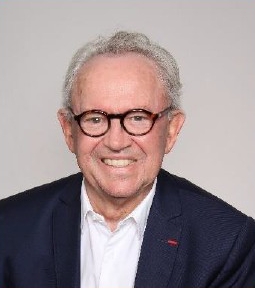 |
Jean-Claude Le Lan
Founder & Chairman of the Supervisory Board of Argan
“2024 marks the successful start of a strategy that combines long-term growth and deleveraging.” |
|
25 years already!
Starting from a blank sheet, ARGAN now has logistics real estate assets of nearly €4bn, consisting of around 100 warehouses spanning nearly 4 million sq.m and over €200m in rental income. I say “we”, because now we are a team of around 30 people who have joined me over time, each an expert in their field, forming a real team.
Financially, we saw capitalisation rates of 12% in 2000, down to 4.3% at the end of 2021, then stabilised in 2024 at 5.2% and borrowing rates close to 7% in 2000, down to nearly 1% in 2021 before rising to 4.5%.
We have always adapted to the circumstances, seizing opportunities while achieving or exceeding our goals year after year.
From a technical perspective, we have opted for a premium positioning of our assets and a low carbon footprint, particularly with our Aut0nom® certified warehouses.
Of course, this success was built with our tenant clients as part of a long-term partnership of trust. We have supported them in their projects and their loyalty has enabled us to grow! |
2025-2030
We recently presented our 2025-2030 master plan in a less favourable political and economic context than in recent years.
We are implementing it with the goal of combining growth and deleveraging. We are targeting minimum net growth of 3% per year, financed mainly by proceeds from asset disposals, which are one of the drivers of deleveraging.
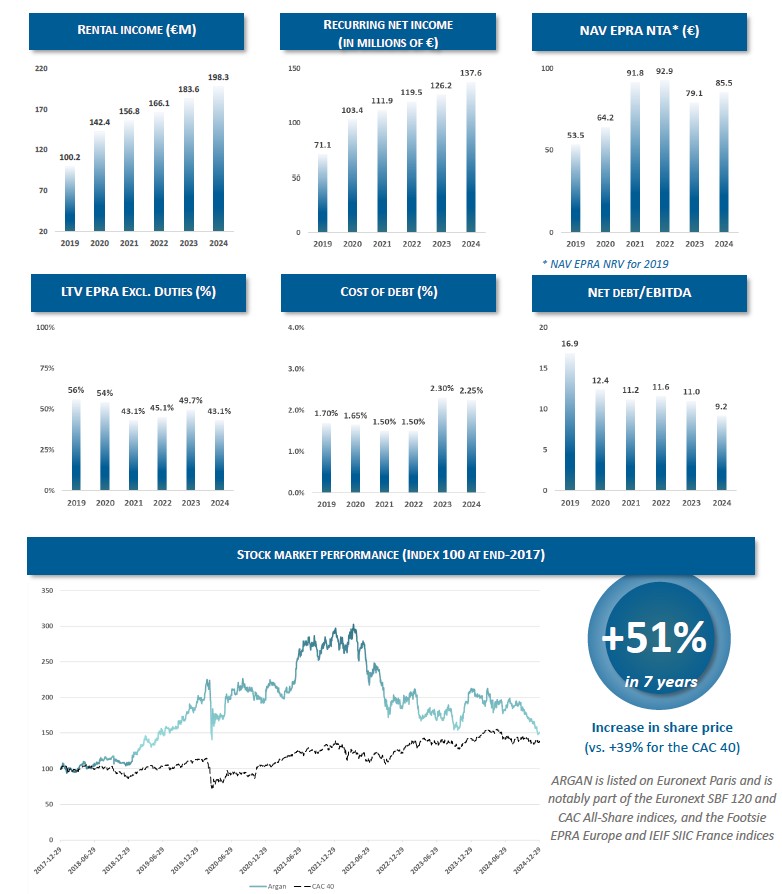
This is why our LTV ratio target is 30% in 2030 (vs. 43% in 2024) with a net debt-to-EBITDA ratio of 6x (vs. 9x in 2024). At the same time, we will strengthen our leading position on the French market by capitalising in particular on the Aut0nom® brand, which we will implement across all assets.
Our goal is also to achieve certification for all our warehouses and to reduce the CO2 emissions associated with the use of our warehouses by 50% by 2030.
This is how we will build profitable and sustainable growth.
|
5
The 10 highlights of 2024
 |
March 2024
ARGAN announced the development of a new Aut0nom® site for 4 Murs in Augny, near the site developed for Amazon. |
April 2024
Aymar de Germay joined the ARGAN Executive Board, as part of his duties as General Secretary. |
 |
 |
April 2024
Argan successfully carried out a capital increase of €150m, with 2 million shares created and a free float increased to 48% of the shareholding. |
May 2024
Standard & Poor’s confirmsedARGAN’s investment-grade status with a BBB- rating and raises the outlook to stable. |
 |
 |
June 2024
ARGAN publisheed its ESG report, with solid progress on the three pillars of its 2023-2030 strategy, including -14.5% in CO2 emissions of Scope 3 energy. |
|
July 2024
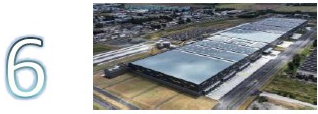
Delivery of the largest Aut0nom® facility in France (82,000 sq.m) in Mondeville for Carrefour, through the conversion of brownfield. |
 |
 |
September 2024
Stéphane Cassagne joined ARGAN as Director of Asset Management and is therefore appointed to the Group Executive Board. |
|
October 2024
ARGAN finalised its asset disposals plan for a total amount of €77m in 2024, with the sale of its Wissous data centre. |
 |
 |
October 2024
The Le Lan family and Predica confirmed their relationship of mutual trust by signing a new five-year shareholders’ agreement. |
|
December 2024
Eric Donnet is appointed independent member of the Supervisory Board, replacing François-Régis de Causans. |
 |
6
Summary presentation of ARGAN
Founded in 2000, ARGAN is the only family-owned French property company specialising in the development and rental of PREMIUM warehouses listed on EURONEXT, and the market leader in France.
| ■ | Our strengths |
Leadership and positioning
| ■ | A leadership position in the French market for development and premium logistics leasing |
| ■ | Development of platforms across the territory in prime locations |
Leading clients
| ■ | Leading and reliable clients, major groups or SMEs which are leaders in their markets |
| ■ | Firm long-term leases |
An involved and efficient organisation
| ■ | Management guided directly by the main shareholder |
| ■ | Controlled operating costs (<8% of rental income), among the lowest in the sector |
Large-scale assets
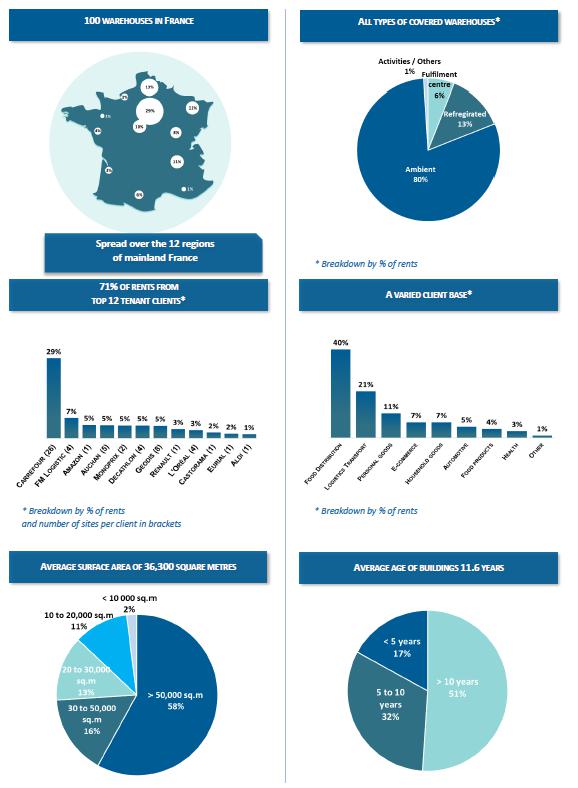
| ■ | Around one hundred Premium quality warehouses |
| ■ | A built area of 3.7 million square metres with a land reserve of 590,000 square metres available for development |
Consistent financial performance
| ■ | Rental income experiencing continuous growth since the end of 2016 |
| ■ | Over the same period, the average recurring net income margin on rental income was 69% |
Concrete ESG commitments
| ■ | An ambitious low-carbon approach with green energy produced on site and self-consumed by our tenant clients |
| ■ | Development of buildings with high environmental certifications (BREEAM or Biodivercity) |

7
| ■ | A strong commercial footprint |
Our tenant clients are largely leading companies.
| ■ | Either shippers (manufacturers or distributors) – 77% of the portfolio – such as Carrefour, Decathlon, Amazon, L’Oréal, Renault, BUT, etc. |
| ■ | Or logistics specialists operating on behalf of large companies (23% of the portfolio), such as FM Logistic, Geodis, DHL, Private Parcel, GXO, etc. |
A strong partnership with our clients
| Number of tenant clients | Occupancy rate | |
| 66 | 100% | |
| Remaining fixed term of leases | Employees of clients in our | |
| 5.3 years | warehouses |
8
9
ARGAN: a company with a fully integrated organisation
| ■ | ARGAN supports its clients throughout the logistics real estate value chain |

A commitment at all times
Our team of around thirty employees is fully committed to providing the best service to our tenant clients
Starting from a blank slate in 2000, ARGAN has developed global expertise in the development and leasing of PREMIUM warehouses.
ARGAN’s expertise can be seen at every stage of the warehouse development and rental management process and the Company’s positioning as a Pure Player ensures it is constantly being enhanced. This involves both:
| ● | Understanding and examining clients’ storage and distribution needs in depth, working with them to design their future warehouse and supporting them with active asset management; |
| ● | Finding suitable land and negotiating with communities and private owners to build up a high-quality land reserve in prime locations; |
| ● | Optimising the overall design of the logistics project thanks to in-depth knowledge of the operation of a warehouse and its flows of goods and vehicles; |
| ● | Maintaining a high level of expertise in urban planning, environmental regulations and ICPE (Facilities Classified for the Protection of the Environment) to guarantee feasibility and control project deadlines; |
| ● | Master the technical studies of all construction components and guarantee the quality of construction through close monitoring of the construction phase and the acceptance stages of the works; |
| ● | Effectively carry out rental and asset management missions in order to maintain the quality of the sites over time, to meet the expectations of tenant-clients (improvements, extensions, etc.) and, in general, to manage the portfolio assets by making relevant acquisitions or arbitrages; |
| ● | Assist our clients to help them reduce their energy consumption; |
Asset management certainly demands perfect knowledge of commercial leases, but above all it requires a spirit of long-term partnership and the utmost respect for clients.
10
2024 revenue model and key figures
| ■ | Resources |
Human capital
| ■ | 29 employees with multidisciplinary expertise |
| ■ | 19% female managers |
| ■ | Average age of 43 |
| ■ | Entrepreneurial spirit, awareness and innovation |
Real estate capital
| ■ | 100 logistics platforms meeting the highest standards in Prime locations |
| ■ | Assets of 3.7 million sq. metres on 590,000 sq. metres of land reserve |
Tenant-client base
| ■ | Loyal, creditworthy, mostly major corporates |
| ■ | A diversified base of shippers (77%), multi-client logistics specialists (17%) or single-client logistics specialists (6%), across all sectors |
Financial capital
| ■ | Family structure, long-term wealth vision |
| ■ | Solid financial structure: shareholders’ equity of €2.3bn |
| ■ | LTV ratio excl. tax of 43.1% and cost of debt of 2.25% for a maturity of 5 years |
Environmental capital
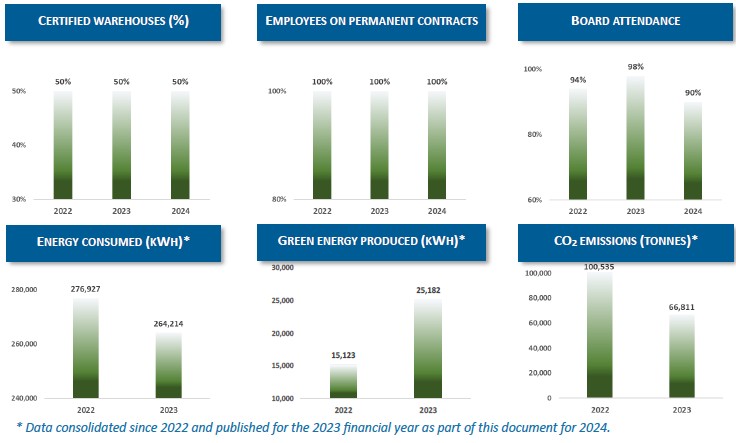
| ■ | 50% of the fleet certified BREEAM or HQE, and 100% of new projects now BREAM certified “Excellent” at least |
| ■ | Deployment of GTMs and heat pumps on existing sites |
Share capital
| ■ | Knowledge and strong presence with local authorities |
| ■ | Fifteen partner banks |
| ■ | Value created |
For our employees
| ■ | 100% permanent contracts |
| ■ | Professional mobility |
| ■ | Profit-sharing agreement and free share allocation for all |
| ■ | Fair group bonuses for new leases |
For our tenant clients
| ■ | Custom warehouses meeting the highest standards |
| ■ | Innovative low-carbon warehouses (100% new developments with Aut0nom®, the net zero warehouse in use) |
| ■ | 100% occupancy |
| ■ | An average of 95% of leases renewed with our customers over the last 5 years |
For our shareholders
| ■ | Rental income of €198m, +8% in 2024 (CAGR of +14% since 2016) |
| ■ | Recurring net income of €138m, +9% in 2024 (69% of revenues) |
| ■ | Assets of €3.9bn for a capitalisation rate of 5.20% (excluding transfer taxes) |
| ■ | Dividend of €3.30 proposed for 2024 (yield of 5.4% vs. a benchmark of €61.6: average price of December 2024) |
For our planet & the environment
| ■ | 27,000 MWh green energy production |
| ■ | €4m already invested to replace gas boilers with electric heat pumps |
| ■ | 0 tonnes of hazardous waste |
For our suppliers & territories
| ■ | Family structure, long-term wealth vision |
| ■ | 25,000 employees of our clients working in our logistics platforms |
| ■ | €180m in investments in logistics platforms delivered in 2024 |
11
Dialogue with stakeholders
| ■ | Clients |
Supporting them over the long term
| ■ | Once the building is delivered, our clients have a dedicated asset and property team for all sites (development and operation phases) |
| ■ | Regular contacts and permanent availability |
| ■ | Proposal of services meeting the latest requirements, in particular environmental requirements |
| ■ | Specific support: Resolution of claims, expansion projects, energy improvement works, ICPE monitoring |
| ■ | Shareholders |
Creating sustainable value
| ■ | Regular publications of information (in French and English) on current developments and financial and non-financial results |
| ■ | Participation in conferences and roadshows, in addition to the Annual General Meeting (open to the public) |
| ■ | All information available online (argan.fr) and from an Investor Relations department |
| ■ | An attractive dividend policy (steady increase in dividend per share and option to pay in shares) |
| ■ | Territories |
Working in close collaboration with municipalities and inter-municipality associations
| ■ | Ongoing dialogue with the representatives of the various territories (municipalities, inter-municipality associations, departments, regions or States) |
| ■ | Compliance with public disclosure obligations |
| ■ | Attention paid to the integration of our projects (quality of the buildings, jobs created, control of the environmental impact) |
| ■ | Contact with Argan by telephone (+33 1 47 47 05 46) and by e-mail (contact@argan.fr) |
12
Strategy and objectives
| ■ | ARGAN operates on the French logistics real estate market by leasing PREMIUM warehouses |
Our wealth management strategy
| PREMIUM WAREHOUSES | RENTAL POLICY | |
A family-owned property company, ARGAN’s strategy is to develop PREMIUM warehouses.
To maintain this “PREMIUM” portfolio, selective asset disposals take place periodically. The Group makes one-off and targeted acquisitions of high-quality and new warehouses ideally complementing its existing assets. |
The Company’s rental prices track market prices as closely as possible in the spirit of long-term partnership with its tenant clients.
This approach has made it possible to establish a relationship of trust that contributes to the commitment of tenant clients over firm |
| CONTROLLED FINANCIAL MANAGEMENT | STRONG COMMITMENT TO ESG | |
The Management teams pay great attention to the performance of developed projects, their sustainability and virtuous financing, with the ambition of maintaining sustainable debt ratios in a long-term wealth strategy. |
With exemplary corporate governance, conducted in the best interests of all its stakeholders (shareholders, clients and employees), Argan is also committed to a drastic reduction in its carbon footprint (production of solar energy, installation of heat pumps and GTMs). |
2025-2030 Ambitions
ARGAN’s strategy targets continuous development over the 2025-2030 period based on a strategy combining growth, through proprietary development and acquisitions, and deleveraging, through selective asset disposals. The Company is therefore targeting:
| ● | A steady pace of growth in rental income: +6% growth in 2025 then minimum 2025-2030 CAGR of +3%; |
| ● | An LTV excluding transfer taxes below 40% at the end of 2025, then around 30% at the end of 2030; |
| ● | A net debt-to-EBITDA ratio of approx. 8X at end-2025, then approx. 6X at end-2030. |
This trajectory notably includes for 2025:
| ● | An asset disposal programme of around €125m initiated over the year; |
| ● | Recurring net income of around €151m, up +11% compared with 2024. |
13
Governance and risk management
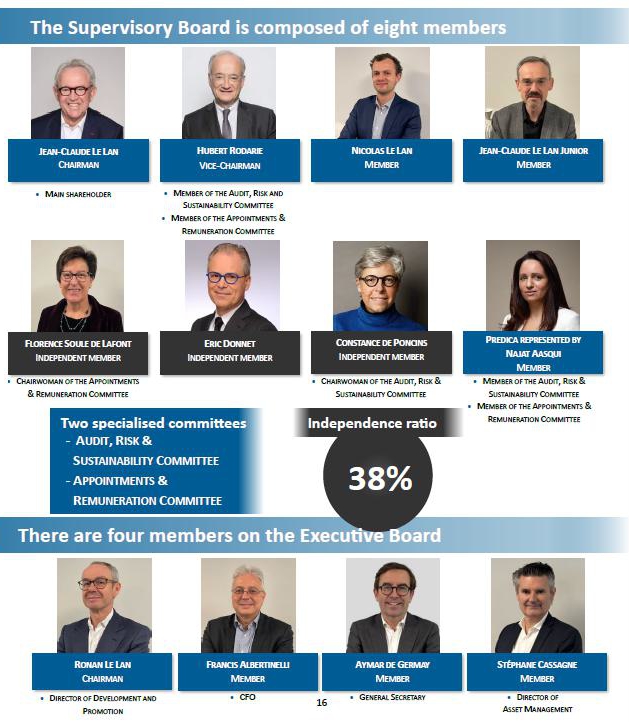
| ■ | ARGAN’s Governance is structured around a Supervisory Board and an Executive Board |
14
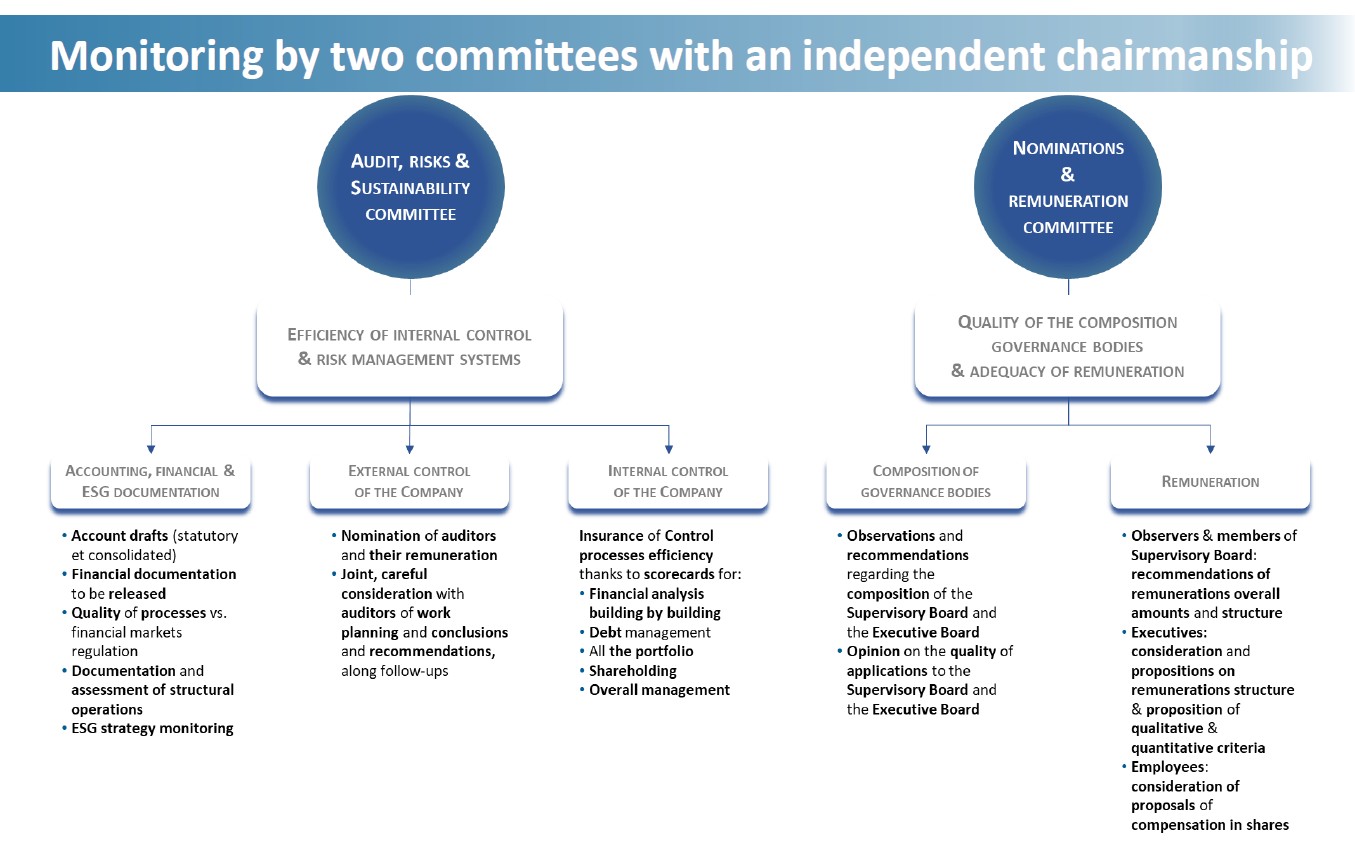
| ■ | Management bodies are organised in order to monitor and manage Risks and guarantee a high level of Internal Control |
Strong focus on risk management
ARGAN regularly conducts a review of the most significant risks. These are classified according to their importance but also their probability, according to their potential adverse impact on the business.
The risks associated with ARGAN’s business fall into five categories, presented below:
| ● | Risks related to the level of debt; |
| ● | Development risks; |
| ● | Risks related to its activity as a property investment company; |
| ● | Risks related to the logistics real estate market; |
| ● | Risks related to internal operation. |
A COMPREHENSIVE INTERNAL CONTROL SYSTEM
The Argan Supervisory Board defines, implements and guarantees the internal control procedures, with the aim of:
| ● | Reliable financial information, that is high quality and available; |
| ● | An effective operational organisation capable of achieving the objectives set; |
| ● | Compliance with the legal and regulatory framework; |
| ● | Preservation of assets; |
| ● | Fraud prevention and detection. |
15
Overall financial and non-financial performance
| ■ | Financial performance |
16
| ■ | Non-financial performance |
Improvement of existing stock
ARGAN has an existing fleet of 100 warehouses, with CO2 emissions estimated at 67,000 tonnes. In order to halve emissions from this fleet between 2022 and 2030, we plan to:
| ● | Ban gas heating (which emits 3.5 times more CO2 than electricity) thanks to the installation of electric heat pumps; |
| ● | Generalize GTM systems (Centralised Technical Management) to manage lighting and heating systems and reduce energy consumption by around 10%; |
| ● | Deploy solar canopies. |
Deployment of Aut0nom®
Aut0nom®, the purpose-built Net Zero warehouse that produces its own green energy, combines photovoltaic power plants on the roof and storage batteries. This new-generation warehouse covers:
| ● | 100% of the annual needs for lighting and heating & cooling; and |
| ● | Between 30% and 40% of overall needs by integrating the consumption related to the processes; |
CO2 emissions are reduced tenfold compared to a standard warehouse, with the remainder offset through a reforestation programme in France.
17
2 Presentation of the Group
| ARGAN: Leader in the French PREMIUM logistics warehouses | 19 |
| A leading player with proven strategy and performance | 19 |
| The strengths of the development model | 19 |
| Solid expertise in logistics real estate | 20 |
| ARGAN strategy and structure | 21 |
| History of the Group | 22 |
| The French logistics real estate market | 23 |
| The warehouse boom | 23 |
| The central importance of warehousing in the supply chain | 24 |
| Operators in the sector | 24 |
| Key competitors | 28 |
| Types of warehouses | 29 |
| Types of Lessees | 31 |
| Large-scale assets | 32 |
| Assets as at 31 December 2024 | 32 |
| Structure of the portfolio | 47 |
| Tenants | 48 |
| A high-profitability value creation model | 49 |
| A growth-oriented strategy | 49 |
| A model with proven high profitability with controlled debt | 49 |
| Regulatory framework | 50 |
| Regulation relating to town planning law | 50 |
| Rules relating to ICPE regulations | 50 |
| Health rules | 51 |
| Rules on passenger lift safety | 52 |
| Rules on environmental protection | 52 |
| Rules on rental | 55 |
| Rules pertaining to SIIC (Société d’Investissement Immobilier Cotée – listed real estate investment company) status | 55 |
| Exemption scheme | 56 |
| Appraisals | 59 |
| Background | 59 |
| Methodology | 61 |
| Conclusion | 63 |
| Qualifications and principles of involvement of the independent expert | 64 |
| Summary of results | 64 |
| Additional information on appraisals | 65 |
| Statement of faithful reproduction of the appraisal report on the assets | 65 |
18
2.1. ARGAN: Leader in the French PREMIUM logistics warehouses
2.1.1. A leading player with proven strategy and performance
ARGAN is the leader in the PREMIUM logistics warehouse sector in France. The Company specialises in the Development and Leasing of high-end and tailor-made logistics warehouses for leading companies.
Our aim is to build a PREMIUM portfolio of recent logistics sites that meet the highest standards, ensuring an optimal occupancy rate of close to 100%. This living heritage is constantly enriched by new turnkey developments and by the expansion of existing sites to meet the changing needs of our tenants.
At the same time, the sale through asset disposals of our mature platforms contributes to self-financed growth, alongside the cash flow generated by our business.
Development has been rapid and well managed. After starting its business in 2000, ARGAN now has assets of 3.7 million sq. meters, and rental income has since seen a double-digit average annual growth rate, reaching €198.3 million at the end of 2024.
This performance is due in particular to the commitment of employees who are proficient in all the business lines of the value creation chain: development, rental management and financial management.
As the only Pure Player in French logistics real estate, ARGAN is listed on Euronext Paris and is notably part of the Euronext SBF 120 and CAC All-Share indices, the Footsie EPRA Europe and IEIF SIIC France indices.
2.1.2. The strengths of the development model
In 25 years, ARGAN has become the LEADER in the French PREMIUM logistics warehouses, with development driven by unique strengths that distinguish the property company from its competitors:
| ● | Internal control of the value creation chain; |
| ● | An ideal position as a developer-investor to secure cost prices for construction; |
| ● | A growth strategy geared around PREMIUM logistics hubs in Prime locations, let on long-term leases to financially solvent tenants; |
| ● | Management by the majority shareholder; |
| ● | Operating costs (including developer’s costs) among the lowest in the sector, representing less than 8% of rental income; |
| ● | A portfolio of PREMIUM logistics Platforms with an average age of 11.6 years (31 December 2024); |
| ● | A 100% occupancy rate; |
| ● | An average residual fixed lease term of 5.3 years (31 December 2024), |
| ● | Tenants, most of whom are major corporates; |
| ● | Balanced tenant types: 77% are shippers, 17% are multi-client logistics specialists and 6% are single-client logistics specialists; |
| ● | A distributed dividend representing a yield of 5.4% (based on the average share price in December 2024, i.e. €61.6); |
| ● | Strong consideration of the environmental and societal impacts of its activities, in particular through the deployment of a demanding ESG policy aimed at all its stakeholders and intended in particular to reduce the environmental footprint of its activities (by reducing CO2 emissions from Scopes 1, 2 and 3 and the greening of its warehouse fleet) or to increase the co-benefits of its operations for local communities. |
19
2.1.3. Solid expertise in logistics real estate
ARGAN has acquired wide-ranging expertise in the development and rental of PREMIUM warehouses.
After starting its business in 2000, as at 31 December 2024, ARGAN already held a portfolio of 102 PREMIUM warehouses amounting to a total of 3.7 million sq. meters. Most of these sites were developed by the Company, and they are managed in-house.
ARGAN’s expertise can be seen at every stage of the warehouse development and rental management process and the Company’s positioning as a Pure Player ensures it is constantly being enhanced.
Each stage of development of a logistics platform requires specific skills:
| ● | Understanding and examining clients’ storage and distribution needs in depth, working with them to design their future warehouse and supporting them with active asset management; |
| ● | Finding suitable land and negotiating with communities and private owners to build up a high-quality land reserve in prime locations. |
| ● | Optimizing the overall design of a logistics project requires knowledge of how a warehouse operates and the flows of goods and vehicles in and out. It also requires a thorough understanding of the regulatory environment. Poor design not only increases construction costs, but more importantly operating costs, owing to lack of overall usability or energy efficiency. |
| ● | Handling the engineering analysis for all aspects of the build: soil stability and mechanical strength, pier and beam structure, paving, roofing, cladding and thermal insulation, to form the fabric of the building. Next, there are structural engineering plans to be developed and technical equipment to be assessed and selected: power distribution and lighting, heating, loading dock equipment and the whole of the safety system, including automatic fire-extinguishing, fire hose stations, etc. |
| ● | Maintaining a high level of expertise in the ICPE regulations (Installations Classées pour la Protection de l’Environnement – Classified Facilities for Environmental Protection) is essential. |
Depending on the nature and quantity of the products they store, warehouses must either make a declaration, registration or obtain prefectoral authorisation in order to operate. The ministerial decree of 11 April 2017 for combustible products, and other decrees covering more specific products, establish the requirements for fitting out storage bins, the fire-fighting equipment to be provided and the prevention of pollution risks.
The Company has long-standing experience of the regulations and is therefore fully conversant with their implementation.
| ● | Promoting sustainable development in every project: |
| o | Selection of materials with a small environmental footprint begins at design and engineering analysis stage, ensuring the best possible energy performance, |
| o | The main contributors in controlling the facility’s energy consumption and its carbon footprint are LED lighting with presence sensors and dimming systems, enhanced thermal insulation, lots of natural light, high-efficiency heating, solar water heaters and centralised technical management, |
| o | In addition, since 2018, all new warehouses have been equipped with photovoltaic power plants dedicated to the tenant’s self-consumption, |
| o | Since January 2022, the Company has offered its future tenants Aut0nom®, the Premium Net Zero warehouse in use, |
| o | Trees planted as part of the landscaping work are chosen from regional species, preferably broadleaved to optimise the carbon footprint, |
| o | Happy staff work better: ARGAN creates an atmosphere conducive to well-being, high-quality work, productivity and accident prevention with light colours on walls and the underside of the roof, good natural light distribution, an appropriate colour temperature and intensity for artificial light and high-quality office fittings, and by ensuring acoustic comfort and areas for staff to relax; |
| ● | Ensuring a high-quality build to guarantee the durability of the building and keep maintenance costs under control, by using top-tier construction companies and consultants with a reputation for experience, diligence and a high level of excellence; |
| ● | Asset management certainly demands expertise in commercial leases, but above all it requires a spirit of long-term partnership and the utmost respect for clients. |
20
2.1.4. ARGAN strategy and structure
2.1.4.1. PREMIUM Warehouse
ARGAN’s strategy is to develop PREMIUM warehouses to the latest standards. To maintain this “PREMIUM” asset base, selective multi-criteria asset disposals (asset age, location, cash in relation to rents sold and carbon footprint) are carried out periodically.
2.1.4.2. Rental policy
The Company’s rental prices track market prices as closely as possible in the spirit of long-term partnership with its tenant clients.
2.1.4.3. Management and control of ARGAN
The Company has a Supervisory Board and an Executive Board. The shareholding structure is broken down as follows: 37% for Jean-Claude Le Lan and his family, 15% for PREDICA and 48% free float (as at 31 December 2024).
There are 8 members on the Supervisory Board, including 3 independent members, as at 31 December 2024. Subject to the approval of the 2025 General Meeting, the Supervisory Board will be reduced to 6 members, including 2 independent members.
Since 2019, ARGAN has set up an Audit, Risk and Sustainability Committee and an Appointments and Remuneration Committee, each composed of three members appointed by the Supervisory Board from among its members. In addition, the Executive Board is composed of 4 members. For more information on the governance bodies, readers are invited to refer to their presentation in the Integrated Report or to Chapter 5 of this Universal Registration Document – Report of the Supervisory Board on Corporate Governance.
21
2.2. History of the Group
| ● | 2000: start of ARGAN’s activity on the metropolitan French logistics real estate market; |
| ● | 2007: ARGAN was successfully went public on 25 June 2007 for a price per share of €15 on compartment C of Euronext; |
| ● | 2009: Argan received the first HQE “Sustainable Logistics” certification covering all phases of the project to expand L’Oréal’s logistics platform in Vichy; |
| ● | 2010: ARGAN recorded its tenth year of double-digit growth in its rental income; |
| ● | 2011: success of the capital increase reserved for ARGAN employees; their share of the capital increased by more than 6 times on this occasion (from 0.2% to 1.3% of the capital); |
| ● | 2012: Argan joined Euronext compartment B; |
| ● | 2013: ARGAN successfully completed its first bond issue for an amount of €65m maturing in 2018; |
| ● | 2014: Obtaining the 1st HQE® EXCEPTIONAL Certivéa passport for the OXYLANE platform in Valenciennes; |
| ● | 2015: ARGAN’s assets exceeded €1 billion for the first time; |
| ● | 2016: Appointment of Jean-Claude Le Lan to the rank of knight in the order of the Legion of Honour; |
| ● | 2017: ARGAN successfully launched a €130m bond issue maturing in 2023; |
| ● | 2018: First delivery of a warehouse equipped with a photovoltaic power plant for the operator’s self-consumption, in Bordeaux; |
| ● | 2019: Acquisition from CARREFOUR and a group of leading institutional investors, of SCI “CARGO”, which owns 22 PREMIUM logistics platforms, at a price of €898 million; annual rental income exceeded €100 million for the first time; |
| ● | 2020: Assets were valued at €3 billion; ARGAN was included in compartment A of Euronext; |
| ● | 2021: Success of the €500 million bond issue maturing in November 2026 launched in November; delivery to AMAZON France of a new logistics platform at the cutting edge of technological and environmental standards that was started in 2018; |
| ● | 2022: In January, ARGAN delivered its first Aut0nom® platform, the warehouse that produces its own green energy with a rooftop photovoltaic power plant coupled with storage batteries, and equipped with electric air/air heat pumps and smart LED lighting; |
| ● | 2023: ARGAN strengthened its position among the largest capitalisations of listed real estate in France and joined the EPRA index in March, then the SBF 120 index in September; |
| ● | 2024: Success of the €150m capital increase carried out in April, leading to the creation of 2 million shares and an increase in the free-float share from 44% to 48%. |
22
2.3. The French logistics real estate market
ARGAN is only active in the warehouse market in mainland France.
2.3.1. The warehouse boom
The combined effects of globalisation and companies’ outsourcing of their logistics functions have led to in considerable growth in logistics real estate since the 2000s.
This shift has created logistics specialists and logistics service providers, a new profession that deals with storage and potentially transport, and this is how logistics specialists (such as FM LOGISTIC, GEODIS, XPO, KUEHNE+NAGEL, ID LOGISTICS, etc.) have emerged. Whilst they operate internationally, there are also smaller, more recent operators whose business is confined to the French market.
This development has led to the emergence of the logistics real estate industry, bringing together all the players in the chain: land developers, property developers, investors, builders, architects, engineering consultants and real-estate agents with specialist expertise in this asset class.
As a result, warehouses were “standardised” in line with requirements under the regulation of 5 August 2002, which was superseded by the version of 11 April 2017, and according to the needs expressed by logistics specialists. As such, since 2002, warehouses have been restricted to bins of 6 000 sq. meters separated by fire walls, include 35 m-long manoeuvring aprons for trucks, as well as safety systems under ICPE (Installations Classées pour la Protection de l’Environnement – Classified Facilities for Environmental Protection).
These qualitative standards are constantly evolving upward, particularly with regard to energy performance. In 2010, ARGAN was the first to develop a BBC (Bâtiment Basse Consommation - Low-energy Consumption Building) warehouse, for L’OREAL, and from 2018 onwards, it decided to install photovoltaic systems in all its new warehouses, for clients’ self-consumption, if they wish. In January 2022, ARGAN opened Aut0nom®, its carbon neutral warehouse in the operational phase. Aut0nom® is now the standard in all our new developments. As such, 12 Aut0nom® warehouses have already been delivered on the date of writing of this Universal Registration Document.
Clearance heights have also changed, from 8 metres in the 1980s and 1990s to 10 meters in 2000; since 2010, the requirement has been 12 metres.
To begin with, warehouses were developed mainly from north to south along the main routes from Lille to Marseille, including in the areas around Paris and Lyon, but the market has spread throughout the country in recent years. Today, the Atlantic Arc and the Normandy region are experiencing significant growth and represent a definite development opportunity.
The development of this market is being driven by the increasing importance of logistics in a connected economy, new patterns of consumption, especially via e-commerce, and demand for shorter delivery times.
Take-up of warehouses with an area of more than 5,000 sq. metres stood at 3.1 million sq. metres in 2024. Demand is therefore down 31% year on year (CBRE data). As a result, the vacancy rate increased slightly to 5.4% but remained at a controlled level at the end of December 2024, with a number of areas experiencing undersupply.
Investment in logistics real estate was around €5.1 billion in 2024, marking a very strong rebound compared to 2023 (+68%), to represent a historical share of all transactions in tertiary real estate of over 40%, thereby becoming the top asset class in 2024 ahead of offices.
23
2.3.2. The central importance of warehousing in the supply chain
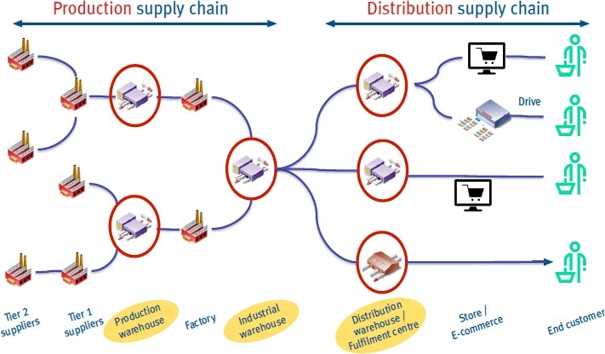
Note: There are always warehouses associated with a producer, in particular when it distributes its products itself.
2.3.3. Operators in the sector
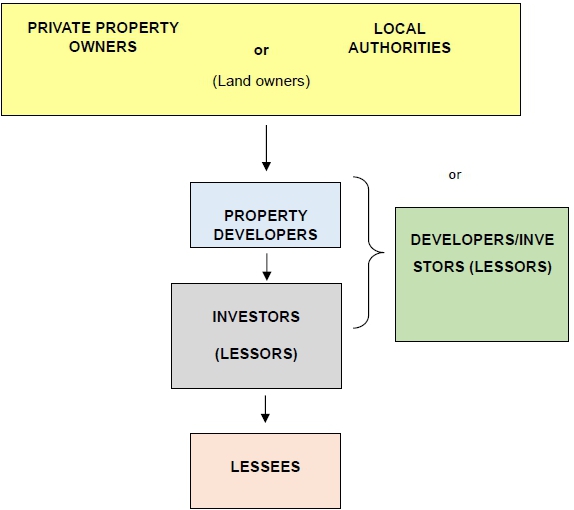
There are many operators in this sector and it is not always easy to identify individual roles, as some operators cover several areas. The sector includes: land developers, property developers, builders, investors, real-estate agents, lessees i.e. tenants, government agencies, local authorities (principally inter-municipality associations), architects, engineering consultants and Asset managers:
2.3.3.1. Land developers
Building a warehouse of 100,000 sq. meters requires at least double the land area - i.e. 200,000 sq. meters or 20 hectares. For lands to be built on, it must first be allocated for development. Allocation of lands in areas where houses, offices, shops or warehouses are to be built is the responsibility of the inter-municipality associations. This is managed via the PLU (Plan Local d’Urbanisme - Local urban development plan) or PLUI (Plan Local d’Urbanisme Intercommunal - Local intermunicipality urban development plan), which is approved by the government agencies (the prefecture).
PLUIs must be drafted to dovetail with the SCOT (Schéma de Cohérence Territoriale, a comprehensive zoning and development plan), the SRADDET (Schéma régional d’aménagement, de développement durable et d’égalité des territoires, regional Schemes for land use, sustainable development and equality) and, in Ile de France, with the SDRIF (Schéma Directeur Régional Ile de France, Regional masterplan for Ile de France).
Land developers are involved at an early stage, supporting and driving the process of allocating lands for building and then developing sites (laying roads, water and wastewater systems, gas, electricity and telephone).
Public works companies carry out development works on behalf of local authorities that own the lands and have generally purchased it from private owners, generally agricultural landowners.
Land developers may also purchase agricultural lands upfront, with a view to having them approved as land suitable for building by local authorities, then develop the lands and subsequently sell them to operators such as property developers, builders or development investors.
24

2.3.3.2. Property developers
Property developers buy lands from local authorities or land developers and build warehouses, generally leased off-plan (BEFA), and then sell them to investors.
They may also be asked to build for owner-users who do not wish to be tenants.
Before construction can start, the warehouse needs to be designed and administrative approvals must be obtained: the building permit and ICPE authorisation (Installations Classées pour la Protection de l’Environnement - Facilities Listed for the Protection of the Environment), for which property developers enlist the help of architects and specialist ICPE
engineering consultants.
Development cycle:

Length of cycle: approximately 18 months
2.3.3.3. Builders
There are two ways to build:
| ● | Either the project owner (land owner) instructs a design and build architect to carry out the project from A to Z; |
| ● | Or he hires a general contractor who will handle the process from end to end: |
| o | In the first scenario: |
The architect is responsible for design and for applying for building permit. He instructs specialist engineering consultants to apply for ICPE authorisation, performs structural calculations, and design the fluid systems (electricity, heating, installation of fire extinguishers, etc.),
The architect creates the project plans and writes the description of the construction work, awards contracts for the works in separate lots and manages the works,
In general in this model, the architect (project manager) does not provide the project owner with a guaranteed final price, since the price is only known following the outcome of the calls for tender;
| o | In the second scenario: |
The general contractor, who may be a consultancy or a contracting company, carries out all the tasks described above but also has a performance obligation under a CPI (Contrat de Promotion Immobilière - Real Estate Development Agreement) and commits to a fixed total price.
Note: The project owner is the land owner, the project manager is the architect or the person responsible for leading and overseeing delivery of the project.
25
2.3.3.4. Investors
Investors generally buy new warehouses from property developers or other investors in the event of resale, as their business is to rent these warehouses to shippers or logistics specialists.
These investors are Real Estate Companies or Funds:
| ● | Real Estate Companies like ARGAN are intended to be long-term concerns, managing a real estate portfolio for rent; |
| ● | Funds (very often British or American) are set up for predetermined periods at the end of which the assets are sold and the funds are dissolved. This is a strictly financial approach where the underlying asset is warehouses. |
The lines between roles are sometimes blurred:
| ● | Investors with a similar positioning to Argan may also take on property development themselves to pick up the property developer’s margin; |
| ● | Builders seeking to improve their bottom line are also becoming property developers and in some cases land developers as well; |
| ● | As a business area where there is ample supply, construction requires significant resources; |
| ● | Property developers work with little in the way of equity capital and around ten employees or even fewer, and can achieve successful outcomes when the climate is conducive to investment. What is key here is being able to sign a commercial lease with a future lessee prior to completion of the project. |
2.3.3.5. Real estate agents
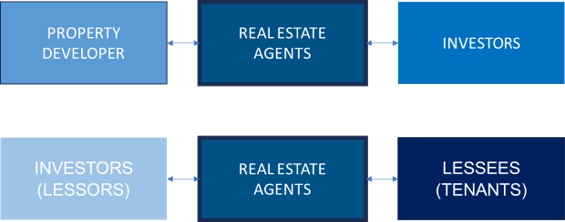
Real estate agents have earned an enviable position in this sector. where they act as an interface between supply and demand at all levels:
| ● | Between lessees and property developers or investors/property developers; |
| ● | Between property developers and investors. |
They generally operate at all levels of the sector.
Their fee is around 1% of the transaction amount for a sale (€200,000 for a sale of €20 million) and about 15% of the annual rent for a lease.
The critical factor for these professionals is having access to the following information: Who wants to buy? Who wants to sell? Who wants to rent?
26
2.3.3.6. Lessees
Tenants may be shippers or logistics specialists and are the most important players in the chain.
Rather than taking on the mantle of ownership by allocating their financial resources to property, they have chosen instead to devote them to their more profitable core business.
As a result, areas allocated to logistics real estate will be away from housing and as close as possible to main roads or motorways.
Warehouses must not be sited too far from labour pools, however.
2.3.3.7. Government agencies
Government agencies are responsible for reviewing building permit and ICPE applications and are supervised by the departmental prefects. It is the prefect who grants ICPE authorisations, but building permits are granted by district authorities further to referral and subject to State control.
2.3.3.8. Local authorities
Communes are of course concerned about town planning issues in their local areas and they determine the allocation of land for housing, shops, business operations and logistics via their PLU(I)s.
Three types of districts are identified:
| ● | Urban districts (> 250,000 inhabitants); |
| ● | Districts and conurbations (> 50,000 inhabitants); |
| ● | Communities of communes (>15,000 inhabitants). |
For certain communities, logistics businesses are not welcome on the pretext that they create noise and other pollution, especially because of the heavy vehicles involved. It is our sales team’s efforts to explain and persuade that make it possible to identify land and carry out projects by highlighting the fact that Argan is a French, family-owned company with a long-term and quality vision.
2.3.3.9. Architects and engineering consultants
These service providers act on behalf of operators in the development chain. Architects prepare building permits while engineering consultants provide input in their areas of expertise: land development, geotechnology, structural design, fluids, ICPE, etc.
2.3.3.10. Asset managers (property management companies)
Property investment funds make use of property management companies (Asset Managers) to manage their property assets.
These companies provide rental management, rent recovery and technical facility management services, either directly or indirectly.
27
Lessor/Lessee relationship
2.3.4. Key competitors
In recent years, the growth of warehouses has attracted strong interest from investors due to the rental profitability of this asset class, with a PRIME rate of return in France of 4.90% as at 31 December 2024 (Source: CBRE). This interest was reinforced during and after the COVID crisis during which this asset class showed its resilience, but also by the development of e-commerce, which posted double-digit or close to double-digit annual growth.
In 2024, warehouse transactions were around €5.1bn. Over 40% of commercial real estate transactions involved logistics real estate (Source: CBRE).
Two types of competitors are active in sales transactions or development:
| ● | Investment Funds – such as AEW, AXA Real Estate, CBRE GLOBAL INVESTORS, DWS or Patrizia – operate in the secondary market by trading portfolios of existing warehouses, not necessarily the most recent builds, and they take advantage of opportunities in the European, US and Asian markets depending on the economic environment. These funds are backed by banks or insurance companies and assign Asset Managers to manage their warehouses. They are not actually competitors for ARGAN, but rather, they are potential buyers; |
| ● | Developers/Investors – such as BARJANE, GLP, GOODMAN, SEGRO, SOGARIS, PARCOLOG and PROLOGIS – and Property Developers – such as PRD, Telamon and GICRAM – focus on the development of new warehouses intended for rental. In this segment, which represents over 700,000 sq. meters per year since 2020, ARGAN has an estimated market share of between 5% and 10%. |
28
The warehouse owners’ market is more fragmented owing to the presence of Developers/Investors, Investment Funds and owner-operators. Overall, the stock of warehouses (more than 5,000 sq. meters) in France is estimated to represent around 90 million square metres of built surface area (Source: Afilog).
Owner-operators are not direct competitors, but their activity reduces the market share of warehouses for rental. This segment mainly includes mass-market retailers such as AUCHAN, CARREFOUR, INTERMARCHE, LECLERC, SYSTEME U, etc., with some of them both owning and renting warehouses.
2.3.5. Types of warehouses
2.3.5.1. Segmentation by operating radius
| TYPE | REMARKS |
| NATIONWIDE WAREHOUSES | These facilities are relevant for companies that store a wide range of products with a low turnover. For example: automotive spare parts, homewares and household equipment |
| REGIONAL WAREHOUSES | Relevant for large volumes generating lots of transport operations For example: wholesale distribution |
| LOCAL WAREHOUSES OR FULFILMENT CENTRES | These are small warehousing facilities on the outskirts of towns for products requiring a high frequency of delivery For example: fresh products, pharmaceuticals |
29
2.3.5.2. Segmentation by type of products stored
| TYPE | REMARKS |
| DRY PRODUCT WAREHOUSES (No temperature control) |
Relevant for products that do not require temperature control Example: food supplies, manufactured components |
| TEMPERATURE-CONTROLLED WAREHOUSES | Relevant for products that need to be kept below a certain temperature (generally 25°C) For example: pharmaceuticals, chocolate, etc. |
| POSITIVE COLD STORAGE WAREHOUSES (1° to 8°C) |
Relevant for fresh products For example: vegetables, fruits, fish, etc. |
| FROZEN STORAGE WAREHOUSES (-20° to -30°) |
Relevant for frozen products The structure of these warehouses must be insulated from the ground when they are built. (The cost of production engineering for the freezing system is largely equivalent to the cost of the building’s structure). |
| DUAL- OR TRIPLE-TEMPERATURE WAREHOUSES | Generally relevant for major distributors, depending on the mix of products stored |
| E-COMMERCE WAREHOUSES | There are two major types: standard warehouses and highly mechanised warehouses |
30
2.3.5.3. Segmentation by size
| TYPE | REMARKS |
| XXL UNITS > 50,000 sq. meters | Large warehouses conducive to the consolidation of transport flows and management cost savings Relevant for national and regional warehouses and warehouses for major distribution |
| UNITS 20,000 to 50,000 sq. meters |
This kind of warehouse is the most numerous. They are generally regional or may be national in case of small volumes |
| UNITS < 20,000 sq. meters | Designed for smaller volumes or for local coverage |
2.3.6. Types of Lessees
2.3.6.1. Shippers or logistics specialists
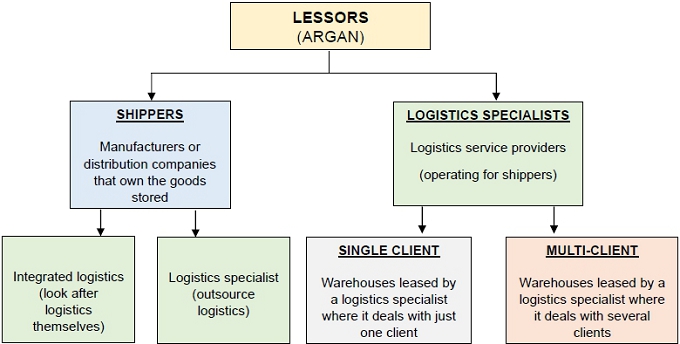
| àAdvantages for the lessor: A more sustainable arrangement in principle Increased visibility of the shipper’s strategy |
àDisadvantages for the lessor: - If the logistics specialist loses its client’s contract, the lease will not be renewed |
àAdvantages for the lessor: - If the logistics specialist loses a client, the rental continues - Consolidation of transport flows |
31
2.3.6.2. Single-tenant or multi-tenant rental
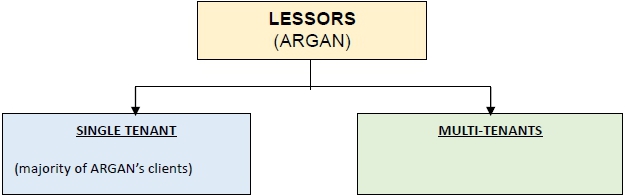
| àAnalysis: | àAnalysis: | ||
| just 1 tenant in the warehouse | Several tenants in the same warehouse | ||
Management is simpler
High risk in case of non-renewal of the lease. |
Management is costly (because of the need to split the charges).
Less risk in case one of the tenants does not renew, provided that it is not the main tenant. |
2.4. Large-scale assets
2.4.1. Assets as at 31 December 2024
ARGAN’s portfolio amounts to 3,710,000 sq. m, comprising 89 logistics platforms and 13 fulfilment centres, a total of 102 buildings.
The last sites delivered in 2024 by ARGAN are presented below by decreasing size:
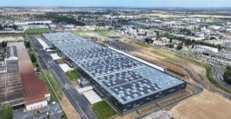
| ● | Mondeville (14), near Caen for Carrefour (82,000 sq. metres) |
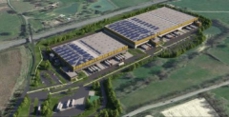
| ● | St-Jean-Sur-Veyle (01), near Lyon for U Proximité, a new client (31,300 sq. metres) |
32
| ● | Chartres (28), for a major healthcare player, a new client (18,000 sq. metres) |
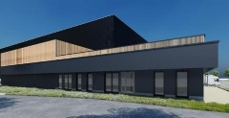
| ● | Bolbec (76), near Le Havre for DACHSER, a new client (15,200 sq. metres) |
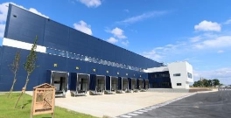
| ● | Augny (57), near Metz for 4 MURS, a new client (9,500 sq. metres) |
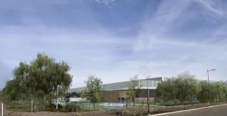
| ● | Eslettes (76), near Rouen for DSV (4,600 sq. metres) |
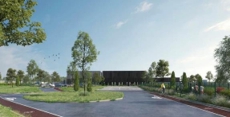
| ● | Castries (34), in the immediate vicinity of Montpellier, for Carrefour (4,300 sq. metres) |
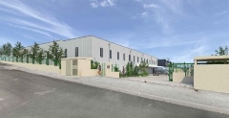
| ● | Bruguières (31), near Toulouse, for Géodis (2,800 sq. metres extension, giving a total of 13,400 sq. metres) |

33
The table below shows the locations and surface areas of the assets in the portfolio, how they are held and the ICPE sections, listed in chronological order:
| BUILDING USABLE AREA |
ICPE headings (if applicable) | ||||||||
| # |
Building address and type |
Holding type |
Land Area |
Warehouse |
Office space & social area |
TOTAL |
Authorisation |
Registration | Declaration |
| 1 |
Croissy Beaubourg (77) 9/11 rue Pelloutier
Logistics hub |
FO | 81,250 | 15,871 | 2,174 | 18,045 | 1510 |
2925, 1412, 1432, 2920 | |
| 2 |
Croissy Beaubourg (77) 23 Allée du 1er Mai
Logistics hub |
FO | 57,183 | 22,378 | 1,116 | 23,494 |
1510, 2663 |
2925, 1530, 1131, 2920 | |
| 3 |
Chaponnay (69) rue du professeur M. Dargent
Logistics hub |
FO | 57,860 | 25,991 | 2,546 | 28,537 |
1510, 2920, |
2925, 1432 | |
| 4 |
Creuzier Le Neuf (03) rue des Ancises
Logistics hub |
FO | 90,781 | 25,252 | 1,441 | 26,693 |
1510, 1432 |
2925, 1530, 2910, 2920 | |
| 5 |
Flévy (57) rue André Maginot
Logistics hub |
FO | 77,984 | 29,848 | 1,294 | 31,142 |
1510, 2663, |
2925, 1432 | |
| 6 |
Brie-Comte-Robert (77) Route de Férolles
Fulfilment centre |
FO | 36,112 | 6,593 | 456 | 7,049 | 2925 | ||
| 7 |
Tournan-en-Brie (77) “Le Closeau”
Logistics hub |
FO | 42,245 | 19,913 | 768 | 20,681 | 1510 | 2925 | |
| 8 |
Tournan-en-Brie (77) “Le Closeau”
Logistics hub |
FO | 22,500 | 2,211 | 720 | 2,931 | |||
| 9 |
Gonesse (95) Zac du Parc des Tulipes Sud
Logistics hub |
FO | 49,873 | 19,996 | 1,756 | 21,752 | 1510 |
2925, 2920 | |
34
| BUILDING USABLE AREA |
ICPE headings (if applicable) | ||||||||
| # |
Building address and type |
Holding type |
Land Area |
Warehouse |
Office space & social area |
TOTAL |
Authorisation |
Registration | Declaration |
| 10 |
Roye (80) Rue du champ Macret
Logistics hub |
FO | 149,085 | 49,161 | 1,727 | 50,887 |
1510, 1432 |
2925, 1530, 2910 | |
| 11 |
Roissy-en-Brie (77) Zac des Grands Champs
Logistics hub |
FO | 86,019 | 34,655 | 1,335 | 35,990 | 1510 | 2925 | |
| 12 |
Ferrières & Bussy (77) Zac du Bel Air
Logistics hub |
FO | 99,600 | 45,161 | 1,677 | 46,838 | 1510 |
2662, 2663, |
1311, 1530, 2910, 2925 |
| 13 |
Saint-Quentin- Fallavier (38) ZAC Chesnes
Logistics hub |
FO | 90,054 | 40,573 | 2,066 | 42,639 |
1510, 2662, 2663, 1530 |
2920, 2925, 2910 | |
| 14 |
Châtres (77) ZAC de Val Bréon
Logistics hub |
FO | 162,937 | 69,332 | 2,837 | 72,169 |
1510, 1530, 2663 |
2910, 2925 | |
| 15 |
Le Coudray- Montceaux (91) Bâtiment A
Logistics hub |
REFL | 166,351 | 81,367 | 3,640 | 85,007 |
1510, 1530, 2662, 2663, 1432 |
1412, 2910, 2925 | |
| 16 |
Chanteloup-en-Brie (77) ZAC du Chêne St Fiacre
Logistics hub |
FO | 55,309 | 24,317 | 2,233 | 26,550 | 1510 |
1131, 1432, 2663, 2925 | |
| 17 |
Trappes (78) 27 rue Roger Hennequin
Logistics hub |
FO | 115,325 | 49,866 | 2,409 | 52,275 |
1510, 1530, 1532, 2662, 2663, 1450, 2255 |
1412, 1432, 2925 | |
| 18 |
Wissous (91) 575- 619 rue du Berger
Logistics hub |
CL | 49,147 | 21,085 | 1,475 | 22,560 | 1510 |
2925, 2910 | |
35
| BUILDING USABLE AREA |
ICPE headings (if applicable) | ||||||||
| # |
Building address and type |
Holding type |
Land Area |
Warehouse |
Office space & social area |
TOTAL |
Authorisation |
Registration | Declaration |
| 19 |
Amblainville (60) Zac des Vallées
Logistics hub |
REFL | 122,307 | 41,349 | 1,133 | 42,482 |
1510, 1532, 2662 |
1530, 2663 |
2925 |
| 20 |
Longueil-Sainte- Marie (60) Zac Paris Oise
Logistics hub |
FO | 224,566 | 82,779 | 11,397 | 94,176 |
1510, 1530, 1432, 1412, 2920 |
1173, 2662, 2910, 2925 | |
| 21 |
Fauverney (21) “Boulouze”
Logistics hub |
FO | 242,686 | 75,896 | 1,620 | 77,516 |
1510, 1530, 1432, 1450, 2920, 1520, 1525, 1611, 1630, 2662, 2663, 2711 |
1172, 1412, 2255, 2910, 2925 | |
| 22 |
Trappes (78) 27 bis rue Roger Hennequin
Fulfilment centre |
FO | 19,900 | 4,269 | 399 | 4,668 | |||
| 23 |
Cergy (95) Av du fond de Vaux
Logistics hub |
FO | 45,246 | 12,883 | 757 | 13,640 |
2921, 2925, 4735 | ||
| 24 |
Ferrières-en-Brie du Bel Air
Logistics hub |
FO | 84,870 | 30,882 | 1,447 | 32,329 |
1510, 1530, 2662, 2663 |
2663 |
2714, 2925 |
| 25 |
Rouvignies (59) (Valenciennes)
Logistics hub |
FO | 171,203 | 73,139 | 1,865 | 75,004 |
1510, 1532, 2663 |
1530, 2662, |
2910, 2925 |
| 26 |
Mitry-Mory (77) Zac de la Villette aux Aulnes
Logistics hub |
FO | 41,677 | 12,371 | 2,904 | 15,275 | 1432 | 1510 |
1412, 2925, 2920 |
36
| BUILDING USABLE AREA |
ICPE headings (if applicable) | ||||||||
| # |
Building address and type |
Holding type |
Land Area |
Warehouse |
Office space & social area |
TOTAL |
Authorisation |
Registration | Declaration |
| 27 |
Wissous (91) 1549- 1641, rue du Berger
Logistics hub |
REFL/CL | 57,832 | 26,144 | 2,074 | 28,218 |
1510, 1532, 2662, 2663 |
1530, 2663 |
1136, 1511, 2921, 2925, 2150 |
| 28 |
Le Coudray- Montceaux (91) Bâtiment B
Logistics hub |
REFL | 152,868 | 74,057 | 3,563 | 77,620 |
1510, 1530, 2662, 2663, 1432 |
1412, 2910, 2925 | |
| 29 |
Saint-Bonnet-les- Oules (42) Zone de Lapra
Logistics hub |
FO | 143,358 | 50,361 | 1,669 | 52,030 | 1510 |
1200, 1414, 1530, 1532, 2255, 2925 | |
| 30 |
Ville-en-Vermois (54) Zac Moussière
Fulfilment centre |
FO | 62,252 | 11,678 | 1,631 | 13,309 | 1435 | ||
| 31 |
Saint-Aignan- Grandlieu (44) Zac Aéroport
Fulfilment centre |
FO | 51,366 | 9,187 | 2,453 | 11,640 | 1434 | ||
| 32 |
Bruguières (31) 80 Avenue de Toulouse
Fulfilment centre |
FO | 50,090 | 12,151 | 1,887 | 14,083 | |||
| 33 |
Bruges (33) Rue du Commandant Molliere
Fulfilment centre |
FO | 42,169 | 10,486 | 2,602 | 13,087 | |||
| 34 |
Trappes (78) 27 ter rue Roger Hennequin
Logistics hub |
FO | 66,029 | 24,217 | 1,724 | 25,941 |
1510, 1530, 2662 |
1532, 2663 |
4320, 4331, 2925 |
| 35 |
Cergy (95) 13 rue de la Garenne
Logistics hub |
FO | 74,482 | 29,121 | 906 | 30,027 |
1510, 1530, 2662, 4755 |
1532, 2663 |
2925 |
37
| BUILDING USABLE AREA |
ICPE headings (if applicable) | ||||||||
| # |
Building address and type |
Holding type |
Land Area |
Warehouse |
Office space & social area |
TOTAL |
Authorisation |
Registration | Declaration |
| 36 |
Valenton (94) ZAC Val de Pompadour, rue ferme de la Tour
Logistics hub |
FO | 37,447 | 4,423 | 760 | 5,183 |
1510, 1511 | ||
| 37 |
Athis-Mons (91), 1 rue du Jacana
Logistics hub |
CL | 32,925 | 10,904 | 671 | 11,575 | 2925 | ||
| 38 |
Lognes (77), 16 Bd de Courcerin
Fulfilment centre |
REFL | 51,879 | 9,238 | 3,826 | 13,064 | |||
| 39 |
Strasbourg (67) 10 rue la minoterie Schiltigheim
Logistics hub |
FO | 33,313 | 17,009 | 528 | 17,536 |
1510, 1530, 1532, 2662, 2663 |
||
| 40 |
Sauvian (34), ZAC Les portes de Sauvian
Logistics hub |
FO | 156,306 | 53,512 | 2,048 | 55,560 | 1510 |
1530, 2925, 4755 | |
| 41 |
Meung-sur-Loire (45) 9ème av. Parc Synergie
Logistics hub |
FO | 76,072 | 30,494 | 1,137 | 31,631 |
1510, 1530, 1532, 2662, 2663 |
2925 | |
| 42 |
Limeil-Brévannes (94), Avenue Jean Monnet
Fulfilment centre |
CL | 67,249 | 15,878 | 1,476 | 17,354 | |||
| 43 |
Guipavas (29), 370, rue Jacqueline Auriol - ZAC de Saint THUDON
Fulfilment centre |
FO | 19,863 | 3,571 | 1,069 | 4,640 | |||
| 44 | Sucy-en-Brie (94), Chemin du Marais
Logistics hub |
FO | 18,154 | 8,360 | 473 | 8,833 | 2565 | 1131, 2560, 2561, 2575 | |
| 45 | Wissous (91) Zac Haut de Wissous 2
Logistics hub |
FO | 115,115 | 48,693 | 3,971 | 52,664 | 1510, 1530, 1532, 2662, 2663 |
2663 | 1511, 2925, 4320, 4330, 4331, 4510, 4755 |
| 46 | Cestas (33) Zac JARY IV
Logistics hub |
FO | 67,830 | 18,724 | 1,121 | 19,845 | 1510 | 2910, 2663, 2925 | |
38
| BUILDING USABLE AREA | ICPE headings (if applicable) | ||||||||
| # | Building address and type |
Holding type | Land Area |
Warehouse |
Office space & social area |
TOTAL | Authorisation |
Registration | Declaration |
| 47 | Moissy-Cramayel 1 (77), parc d’activité Moissy Sud
Logistics hub |
FO | 42,249 | 22,276 | 2,232 | 24,508 | 1510 | ||
| 48 | Moissy-Cramayel 2 (77), parc d’activité Moissy Sud
Logistics hub |
FO | 43,357 | 19,167 | 844 | 20,011 | 1432 | 1510, 1530, 1532, 2662, 2663 |
1412, 2925 |
| 49 | Pusignan (69)
Logistics hub |
FO | 74,116 | 32,769 | 826 | 33,595 | 1510, 1530, 1532, 2662, 2663 |
2910, 2925 | |
| 50 | Fleury-Mérogis (91) Logistics
hub |
FO | 125,673 | 64,542 | 2,716 | 67,258 | 1510 | 1413, 1511, 2795, 2925, 4735 | |
| 51 | Albon (26)
Logistics hub |
FO | 81,104 | 30,348 | 886 | 31,234 | 1510, 1530, 1532, 2662, 2663 |
2925, 2910 | |
| 52 | La Crèche (79)
Logistics hub |
FO | 124,738 | 31,065 | 1,941 | 33,006 | 1511, 2925, 4735 | ||
| 53 | Gennevilliers (92)
Fulfilment centre |
PPOA | 35,065 | 8,227 | 3,560 | 11,787 | |||
| 54 |
Tours Chanceaux (37) Zac du Cassantin
Logistics hub |
FO | 68,728 | 15,983 | 1,238 | 17,221 |
1511, 2925, 4735 | ||
| 55 |
Strasbourg Vandenheim (67)
Logistics hub |
FO | 64,069 | 20,013 | 1,251 | 21,264 |
1511, 2925, 4735 | ||
| 56 |
Billy Berclau (62) Parc de l’industrie Artois Flandres
Fulfilment centre |
FO | 30,450 | 6,945 | 438 | 7,383 | |||
| 57 |
Artenay Poupry (28) ZA de Villeneuve II
Logistics hub |
FO | 341,668 | 126,437 | 4,754 | 131,191 |
1450, 1510, 1530, 1532, 2662, 2663 |
1436, 2910 | |
39
| BUILDING USABLE AREA |
ICPE headings (if applicable) | ||||||||
| # |
Building address and type |
Holding type |
Land Area |
Warehouse |
Office space & social area |
TOTAL |
Authorisation |
Registration | Declaration |
| 58 |
Le Mans Allonnes (72) Monne
Logistics hub |
FO | 273,073 | 76,622 | 4,062 | 80,684 |
1510, 1530, 1532, 2662, 2663 |
1511, 4331 |
1436, 1450, 2714, 2925, 4510, 4735, 4801 |
| 59 |
Lunéville (54) Ferme de la Maison de Briques
Logistics hub |
FO | 169,550 | 58,556 | 5,170 | 63,726 |
1510, 1530, 1532, 2662, 2663, 2920 |
4734 |
1436, 1450, 1511, 2714, 2910, 2921, 2925, 4320, 4510, 4511, 4735, 4741, 4801 |
| 60 |
Avignon Laudun (30) ZAC Antoine Lavoisier
Logistics hub |
FO | 133,572 | 84,147 | 1,398 | 85,545 |
4511, 4320, 4331, 1436, 1450, 1510 |
2662, 2663 |
4510, 4741, 4718, 4330, 4734, 4801, 1530, 1532, 1630, 2711, 2910, 2925 |
| 61 |
Aulnay-sous-Bois (93) Boulevard André Citroen
Logistics hub |
FO | 161,827 | 60,667 | 1,727 | 62,394 |
1510, 1530, 1532, 2662, 2663, 4511 |
1450, 2714, 2910, 2925, 4320, 4510, 4734, 4741, 4801 | |
| 62 |
Bourges (18) Le Vallon
Logistics hub |
FO | 198,815 | 66,190 | 2,337 | 68,527 |
1510, 1530, 1532, 2662, 2663 |
2663 |
1450, 1511, 2714, 2910, 2925, 4510, 4734, 4735, 4801 |
40
| BUILDING USABLE AREA |
ICPE headings (if applicable) | ||||||||
| # |
Building address and type |
Holding type |
Land Area |
Warehouse |
Office space & social area |
TOTAL |
Authorisation |
Registration | Declaration |
| 63 |
Vendin (62) ZA du Bois Rigault
Logistics hub |
FO | 171,724 | 51,397 | 3,735 | 55,132 |
1510, 1530, 1532, 2662, 2663, |
4331 |
4734, 2910, 4741, 1450, 2925, 4510, 4801, 4715, 4320 |
| 64 |
Épaux-Bézu (02) Z.I.D. de l’OMOIS
Logistics hub |
FO | 133,531 | 54,030 | 1,603 | 55,632 |
4001, 4510, 1450, 1510, 4755, |
2662, 2663, 4331 |
4440, 4441, 4320, 4718, 1436, 4801, 1530, 1532, 1630, 2925, 2711, 4220, |
| 65 |
Mâcon Bâgé (01)
Logistics hub |
FO | 177,420 | 57,720 | 1,583 | 59,303 |
1450, 1510, 1530, 1532, 2662, 2663 |
4734 |
1436, 2714, 2910, 2925, 4320, 4510, 4511, 4741, 4801 |
| 66 |
Savigny-sur-Clairis (89) Grands Champs
Logistics hub |
FO | 185,972 | 59,059 | 2,639 | 61,698 |
1412, 1432, 1450, 1510, 1530, 1532, 2255, 2662, 2663 |
1172, 1173, 1200, 1520, 1525, 2910, 1525 | |
| 67 |
Cholet (49) ZAC du Cormier 5
Logistics hub |
FO | 189,720 | 56,310 | 1,198 | 57,508 |
1450, 1510, 1530, 1532, 2662, 2663, 4001, 4320, 4331, 4755 |
4734 |
1436, 2925, 4110, 4120, 4130, 4140, 4220, 4441, 4510, 4741, 4801 |
41
| BUILDING USABLE AREA | ICPE headings (if applicable) | ||||||||
| # | Building address and type |
Holding type | Land Area |
Warehouse |
Office space & social area |
TOTAL | Authorisation |
Registration | Declaration |
| 68 |
Crépy-en-Valois (60) 12 rue Louis Armand
Logistics hub |
FO | 201,190 | 49,519 | 1,500 | 51,019 |
1510, 1511 |
1172, 1185, 1450, 1520, 1412, 1432, 1532, 2255, 2663, 2714, 2925 | |
| 69 | Billy-Berclau (62) 337 rue de Prague
Logistics hub |
FO | 123,195 | 33,911 | 1,549 | 35,460 | 1511, 2925, 1532 | ||
| 70 | La Courneuve (93) 51 - 53 av Verdun 81 rue Maurice Berteaux
Logistics hub |
FO | 52,613 | 20,794 | 1,310 | 22,104 | 1511, 2925, 2714 | ||
| 71 | Combs-la-Ville (77) ZAC rives Francilienne Bd Maurice Fauré
Logistics hub |
FO | 57,266 | 23,079 | 3,121 | 26,200 | 1510 | 2925 | |
| 72 | Brie-Comte-Robert (77) RD 316 Les Prey Le Roy
Logistics hub |
FO | 79,196 | 20,365 | 1,000 | 21,365 | 1511, 2925, 4735 | ||
| 73 | Toulouse Plaisance- du-Touch (31) 1 rue Docteur Charcot
Logistics hub |
FO | 91,357 | 30,762 | 2,584 | 33,346 | 1511 | 4802, 2925 | |
| 74 | Labenne (40) Artiguenave
Logistics hub |
FO | 123,746 | 33,711 | 1,721 | 35,432 | 1510 | 1414, 1511, 2910, 2925, 4802 | |
| 75 | Cestas (33) Parc activités Jarry III
Logistics hub |
FO | 107,228 | 18,428 | 1,339 | 19,767 | 1511, 1136, 2925 | ||
42
| BUILDING USABLE AREA | ICPE headings (if applicable) | ||||||||
| # | Building address and type |
Holding type | Land Area |
Warehouse |
Office space & social area |
TOTAL | Authorisation |
Registration | Declaration |
| 76 | Saint-Quentin- Fallavier (38) ZAC DE CHESNES NORD, 53 rue du Parc Forestier
Logistics hub |
FO | 61,408 | 22,699 | 2,265 | 24,963 | 1510 | 2925, 4802 | |
| 77 | Bain-de-Bretagne (35) 13 rue de la Seine
Logistics hub |
FO | 80,402 | 10,670 | 1,321 | 11,991 | 1511, 2925 | ||
| 78 | Ploufragan (22) rue du Boisillon
Logistics hub |
FO | 116,424 | 24,030 | 774 | 24,804 | 1510,2255 | 1434, 1530, 2925 | |
| 79 | Gondreville Fontenoy (54)
Logistics hub |
FO | 60,019 | 13,205 | 772 | 13,977 | 1510 | 2910-A-2, 2925-1 | |
| 80 | Metz (57) ZAC Sud Frescaty
Logistics hub |
FO | 191,827 | 174,573 | 11,135 | 185,708 | 1510-a | 2910-A-2, 1185-2-a, 2925-2 | |
| 81 | Escrennes (45)
Logistics hub |
FO | 87,212 | 18,384 | 847 | 19,231 | 1510, 4220 |
1436, 1450, 2910-A-1, 2925, 4320, 4321, 4330, 4331 | |
| 82 | Ludres Nancy (54)
Logistics hub |
FO | 86,612 | 41,830 | 1,718 | 43,548 | 1450-1, 1510-1, 1530-1, 1532-1, 4801-1, 2662-1, 2663-1-a |
1511-2, 2663-2-b |
2925, 1436, 2910-A-2, 4320-2, 4331-3, 4510-2, 4511-2 |
| 83 | Neuville Aux Bois (45)
Logistics hub |
FO | 225,492 | 82,645 | 2,180 | 84,825 | 1510-1 | 2662-2, 2663-1- b, 2663- 2-b |
1530-3, 1532-3, 2910-A-2, 2925-1, 4715- 31185-2-a |
43
| BUILDING USABLE AREA | ICPE headings (if applicable) | ||||||||
| # | Building address and type |
Holding type | Land Area |
Warehouse |
Office space & social area |
TOTAL | Authorisation |
Registration | Declaration |
| 84 | Ouarville (28) Bac Serres Besnard
Greenhouses |
CL | 108,503 | 6,000 | 6,000 | 4718-2-b | |||
| 85 | Le Plessis-Pâté (91) 8 Av, de la Tremblaie
Logistics hub |
FO | 62,436 | 22,034 | 2,562 | 24,596 | 1510-2 | 1511-3, 2925, 1450 | |
| 86 | Rognac (13) 47, Av. Lavoisier
Logistics hub |
FO | 33,222 | 20,299 | 2,363 | 22,662 | 1510 | 2925 | |
| 87 | Lens (62) 10 rue de l’Europe
Logistics hub |
FO | 78,353 | 25,441 | 2,945 | 28,386 | 1510 | 2925, 2910-A-2 | |
| 88 | Serris (94)
Logistics hub |
FO | 33,881 | 12,587 | 1,333 | 13,920 | 1510, 1530, 1532, 2662, 2663 |
2925 | |
| 89 | Saint Jean de la Neuville (76)
Logistics hub |
FO | 52,092 | 12,324 | 1,556 | 13,880 | 1510, 1530, 1532, 2662, 2663 |
2925, 2910, 4720 | |
| 90 | Compans (77)
Fulfilment centre |
CL | 49,105 | 14,465 | 800 | 15,265 | 2925 | ||
| 91 | Fouchères (89)
Logistics hub |
FO | 287,260 | 149,668 | 3,184 | 152,852 | 1510 | 2663-1- b, 2663- 2-a, 4431 |
1436, 2910-A-2, 2925, 4422, 4802-3-1b, 4320 |
| 92 | Janneyrias (87)
Logistics hub |
FO | 81,814 | 37,449 | 763 | 38,212 | 1510 1530.1 1532.1 2662.1 2663.1.a 2663.2.a |
2910.a.2 2925 | |
44
| BUILDING USABLE AREA |
ICPE headings (if applicable) | ||||||||
| # |
Building address and type |
Holding type |
Land Area |
Warehouse |
Office space & social area |
TOTAL |
Authorisation |
Registration | Declaration |
| 93 |
Mionnay (01)
Logistics hub |
FO | 32,398 | 13,523 | 1,499 | 15,022 |
1510 1530 1532 2662 2663-1 2663-2 |
||
| 94 |
Montbartier (82)
Logistics hub |
FO | 80,678 | 18,351 | 968 | 19,319 | 1510 |
2925 2910 4510 | |
| 95 |
St-Jean-Sur-Veyle (01)
Logistics hub |
FO | 60,285 | 13,817 | 691 | 14,508 | 1510 | 2925 | |
| 96 |
Eslettes (76)
Fulfilment centre |
FO | 23,281 | 3,992 | 571 | 4,563 | |||
| 97 |
Castries (34)
Logistics hub |
FO | 8,932 | 3,326 | 1,000 | 4,326 | |||
| 98 |
St-Jean-Sur-Veyle (01)
Logistics hub |
FO | 64,927 | 30,044 | 1,473 | 31,517 | 1510 | 2925 | |
| 99 |
Bolbec (76)
Logistics hub |
FO | 37,544 | 14,585 | 599 | 15,184 | 1510 |
2910 2925 | |
| 100 |
Mondeville (14)
Logistics hub |
FO | 304,422 | 78,223 | 3,955 | 82,178 | 2.1.5.0-1 |
4001 1510-2a 1185-2.a 1436-2 1450-2 2714-2 2910.A.2 2925-1 4320-2 4510-2 4511-2 4801-2 47XX | |
45
| BUILDING USABLE AREA |
ICPE headings (if applicable) | ||||||||
| # |
Building address and type |
Holding type |
Land Area |
Warehouse |
Office space & social area |
TOTAL |
Authorisation |
Registration | Declaration |
| 101 |
Augny (57)
Logistics hub |
FO | 36,984 | 9,229 | 269 | 9,498 | 1510 | 2925 | |
| 102 |
Chartres (28)
Logistics hub |
FO | 37,930 | 17,715 | 453 | 18,168 |
1510-2 1530-2 1532-2 2662-2 2663-1-b 2663-2-b 4331 |
||
| TOTAL | 9,864,324 | 3,509,490 | 197,037 | 3,706,527 | |||||
Types of holding:
| · | PPOA = Public Property Occupancy Agreement |
| · | CL = Construction Lease |
| · | REFL = Real Estate Finance Lease |
| · | FO = Full Ownership |
46
2.4.2. Structure of the portfolio
ARGAN’s entire warehouse portfolio is made up of recent PREMIUM logistics platforms. These warehouses are all located in mainland metropolitan France and mainly in Île-de-France (29% of ARGAN’s assets).
The majority of assets allow storage at room temperature (80% of warehouses), for an average age of 11.6 years, with 49% of assets held for less than 10 years. The average size of a platform is approximately 36,300 sq. metres. ARGAN owns in particular 28 XXL platforms (with an average surface area exceeding 50,000 sq. metres).
The Company’s built assets came to 3,710,000 sq. meters as at 31 December 2024, up by +4% compared with the previous year and +164% compared to the end of 2015. The table below shows the change in the warehouse surface areas of assets since 2010 as well as the valuation excluding transfer taxes, which stood at €3.9 billion at end-2024:
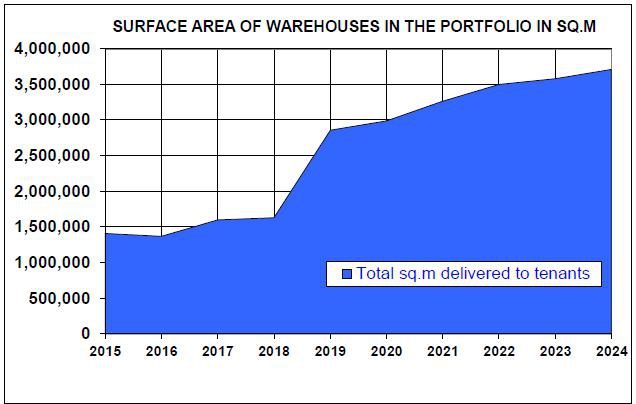
| 2015 | 2016 | 2017 | 2018 | 2019 | 2020 | 2021 | 2022 | 2023 | 2024 | |||||||||||||||||||||||||||||||
| Total sq.m delivered to tenants | 1,406,000 | 1,370,000 | 1,600,000 | 1,630,000 | 2,860,000 | 2,990,000 | 3,265,000 | 3,500,000 | 3,580,000 | 3,710,000 | ||||||||||||||||||||||||||||||
| Change year on year | 6 | % | -3 | % | 17 | % | 2 | % | 75 | % | 5 | % | 9 | % | 7 | % | 2 | % | 4 | % | ||||||||||||||||||||
| Value Excl.transf.tax.(€m) | 961.5 | 1,022.5 | 1,255.9 | 1,385.6 | 2,670.5 | 3,011.9 | 3,745.5 | 3,942.3 | 3,677.7 | 3,914.7 | ||||||||||||||||||||||||||||||
| Change year on year | 7 | % | 6 | % | 23 | % | 10 | % | 93 | % | 13 | % | 24 | % | 5 | % | -7 | % | 6 | % | ||||||||||||||||||||
47
The table below shows the change in assets since 2015 accompanied by the change in fair value per year over the period:
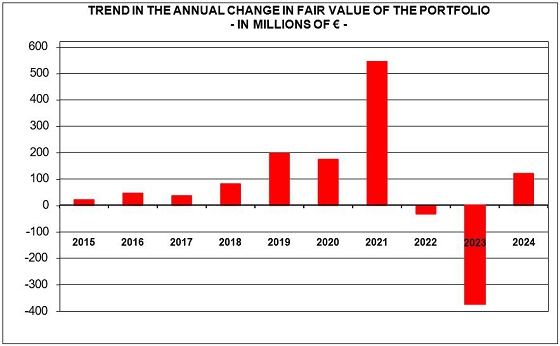
| 2015 | 2016 | 2017 | 2018 | 2019 | 2020 | 2021 | 2022 | 2023 | 2024 | |||||||||||||||||||||||||||||||
| Change in fair value | 21.1 | 46.3 | 37.0 | 81.2 | 197.1 | 174.6 | 544.6 | -31.8 | -370.8 | 120.4 | ||||||||||||||||||||||||||||||
| Portfolio excl.transf.tax. | 962 | 1,023 | 1,256 | 1,386 | 2,670 | 3,012 | 3,745 | 3,942 | 3,678 | 3,915 | ||||||||||||||||||||||||||||||
| Change in FV / Portfolio Y-1 | 2 | % | 5 | % | 4 | % | 6 | % | 14 | % | 7 | % | 18 | % | -1 | % | -9 | % | 3 | % | ||||||||||||||||||||
Changes in the valuation of assets depend on changes in capitalization rates, which in particular reflect market interest rates. As at 31 December 2024, the capitalisation rate excluding transfer taxes was 5.20%, up 10 basis points compared with end-December 2023. It should be noted that the capitalisation rate excluding transfer taxes at the end of 2024 nevertheless shows a downward shift of 10 basis points (5.30% as at 30 June 2024), following two years (2022 and 2023) of a rise in capitalisation rates.
This near-stability in capitalisation rates, combined with an increase in market rents, contributed to an increase in the fair value of assets of +€120.4 million in 2024.
For more information, readers are invited to refer to the extract from CBRE Valuation’s expert report, presented in paragraph 2.7 of this Universal Registration Document.
2.4.3. Tenants
The majority of ARGAN’s tenants are leading companies. Most (77%) are shippers, manufacturers or retailers – such as Auchan, BSH Electroménager and Carrefour – or logistics specialists (23%, of which 17% are multi-client logistics specialists and 6% are single-client) – such as Alloga, Arvato and FM Logistic. ARGAN’s top 12 clients (Carrefour, FM Logistic, Amazon, Auchan, Monoprix, Decathlon, Geodis, Renault, L’Oréal, Castorama, Eurial and Aldi) account for 71% of annualised rental income, spread over 58 sites. Food retail is the largest sector with 40% of ARGAN’s annualised rental income at the end of 2024, followed by logistics & transport (21%) and personal equipment (11%).
As at 31 December 2024, the occupancy rate was 100% for an average residual fixed lease term of 5.3 years, of which:
| · | More than 6 years: 43%; |
| · | 3 to 6 years: 29%; |
| · | Less than 3 years: 28%. |
48
2.5. A high-profitability value creation model
2.5.1. A growth-oriented strategy
ARGAN’s strategy is to develop PREMIUM warehouses to the latest standards. Trade-offs are made periodically on the oldest warehouses to maintain this “PREMIUM” portfolio. The Company’s rental prices track market prices as closely as possible in the spirit of long-term partnership with its tenant clients.
The attention paid to the quality of the assets held and to maintaining a long-term relationship of trust with clients has enabled ARGAN to record strong growth in its revenues. The revenue target for the end of 2025 is €210 million, after having achieved €198 million in 2024 and €67 million in 2016, which represents an average annual growth rate of rental income over the period 2016-2024 of around +14%.
More specifically, rental income increased strongly by +8% from end-2023 to end-2024. This €14.7 million increase in additional rental income is shown in the chart below:
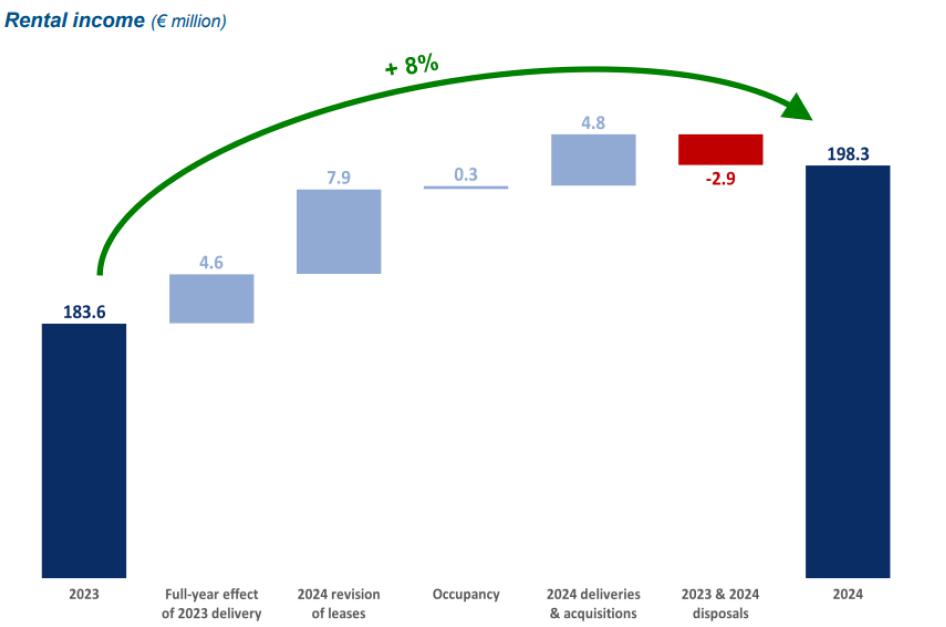
2.5.2. A model with proven high profitability with controlled debt
ARGAN’s development model is characterised by high profitability, with Recurring Net Income representing around 70% of rental income on average and over the long term. More specifically, this ratio stood at 69% in 2024.
This high profitability reflects an ability to respond to market developments and expectations and reflects the relevance of the strategic choices made by developing assets that:
| ● | Are PREMIUM quality in sought-after locations; and | |
| ● | Meet the expectations of tenant clients, with tailor-made warehouses of high technical and environmental quality, and a long-term relationship of trust. |
ARGAN also intends to pursue its development by relying on controlled debt. The EPRA LTV ratio reached 43.1% at end-2024 and, at a constant capitalisation rate or close to this level as at 31 December 2024 (5.2% excluding transfer taxes), and this ratio is expected to continue the significant decrease that has been under way, in a context where the Group ceases to raise new debt from 2024.
Against a backdrop of stabilising interest rates, the cost of debt stood at 2.25% at the end of 2024 versus 2.3% at the end of 2023. It is expected to fall to around 2.1% at the end of 2025, with a 3-month Euribor assumption of 2.5% over the year.
49
2.6. Regulatory framework
In developing and holding real estate assets, the Company is subject to various regulations and must both fulfil health risk prevention and personal safety requirements and protect the environment. The key features of these regulations are described below, bearing in mind that this overview is not intended to be a comprehensive analysis of the regulations that affect the Company.
2.6.1. Regulation relating to town planning law
When building its warehouses, ARGAN must heed the rules applicable in this area and in particular the local rules as laid down in the POS (Plan d’Occupation des Sols - land use plan) or, since the SRU (Solidarité et Renouvellement Urbain - Solidarity and Urban Renewal) law of 13 December 2000, the PLU (Plan Local d’Urbanisme - Local urban development plan) governed by Articles L.123-1 et seq. of the French Town Planning Code, as well as the ZAC (Zone d’Aménagement Concerté - Joint Development Zone). These must themselves be consistent with the supra-district standards such as the SCOT (Schéma de Cohérence Territoriale - a comprehensive zoning and development plan) governed by Articles L.122-1 et seq. of the French Town Planning Code and, in and around Paris, the SDRIF (Schéma Directeur Régional Ile de France - Regional Masterplan for Ile de France).
These various town planning documents apply the general principles set out in Article L.121-1 of the French Town Planning Code:
| ● | The balance between natural areas or farmland and developed areas or land approved for development; | |
| ● | The diversity of urban functions and social diversity in urban areas; | |
| ● | Control of motorised travel and prevention of nuisances, as well as the safeguarding of water, air and ecosystem quality. |
In the absence of a POS or PLU, the common law must be applied in accordance with the rules of the National Planning Regulation (NPR), in accordance with Articles L.111-1-1 et seq. of the French Town Panning Code.
2.6.2. Rules relating to ICPE regulations
The decree of 5 August 2002 is replaced by the ministerial decree of 11 April 2017 on loss prevention in covered storage facilities subject to authorisation, registration and reporting under section 1510. It applies to covered storage spaces (storing more than 500 tonnes of combustible materials, products or substances) with the exception of facilities used to store categories of materials, products or substances covered by the French Council of State classification, buildings intended exclusively for storing motor vehicles and trailers and establishments open to the public.
The authorisation is granted by the Prefect and examined by staff at the DREAL (Direction Régionale de l’Environnement, de l’Aménagement et du Logement - regional environment, planning and housing agency) and is intended to protect the environment, people and property. A public survey of neighbouring and local communities is conducted in this regard by an investigating commissioner, who submits a report setting out his or her opinion on the proposed development.
The Company uses specialised companies to build its hubs. It takes particular care to select high-quality contractors with the skills and experience necessary to safeguard the environmental quality of its projects.
ARGAN’s warehouses are all authorised depending on the size of the facility and the nature of the materials being stored.
Should the nature and quantity of the products stored change significantly, the DREALs could challenge prefectoral authorisations issued prior to the decree of 11 April 2017; in this case, the said decree would then be applied.
ARGAN owns buildings covered by authorisations that date from prior to the decree of 11 April 2017. If necessary, however, they would fulfil the criteria of the said decree, subject to some possible adaptations in due course.
50
There are currently three different ICPE regimes, namely:
| ● | A declaration regime for the storage of combustible products over 500 tonnes and a warehouse capacity of less than 50,000 cubic meters; |
| ● | A registration regime for the storage of combustible products over 500 tonnes and a warehouse capacity of between 50,000 cubic meters and 900,000 cubic meters; and | |
| ● | An authorisation regime for the storage of combustible products over 500 tonnes and a warehouse capacity of more than 900,000 cubic meters. |
ARGAN takes great care to comply with this regulation, which is essential in its sector of activity. The Company works with a specialised firm of engineering consultants to compile the application in conjunction with and on behalf of the tenant, and attends preparatory meetings until the prefectoral order is handed down in the tenant’s name.
As at 31 December 2024, the Group owned buildings with classified facilities listed in the table presenting the locations, ownership methods and surface areas of the assets, in chronological order, included in this document above.
2.6.3. Health rules
2.6.3.1. Asbestos
Asbestos was long used in the construction industry for its thermal and noise insulation properties and for fire protection, but the use of asbestos is prohibited in France since 1 January 1997, due to its carcinogenic effects.
The rules on the prevention of asbestos-related health risks are set out in Articles R.1334-14 to R.1334-29-9 of the French Public Health Code.
The rules require owners to look for asbestos in their buildings and to prepare and update the asbestos survey report. This report indicates the location and condition of any materials and products containing asbestos. It also specifies the removal and containment work carried out, as well as the safety instructions to follow when handling, managing and disposing of asbestos waste.
Under the French Public Health Code, when the asbestos survey report reveals the presence of asbestos, the owner must then check the condition of the sprayed insulation, lagging and false ceilings. Depending on how badly the asbestos has deteriorated, he must then carry out work to contain or remove it, to be completed within 36 months of the date of the inspection report.
The owner shall make the survey report available to the building’s occupants and furnish it to any person undertaking work in the building and to various bodies on request.
However, the obligation to prepare an asbestos survey report only applies to buildings for which a building permit was issued prior to 1 July 1997. The Group’s assets covered by the rules have all been investigated to establish whether asbestos is present and all the measures required in case of its discovery have been implemented.
The buildings owned by the Company do not fall within the scope of this regulation, having been constructed after 1 July 1997.
2.6.3.2. Lead poisoning
Lead poisoning results from lead absorption, particularly as a result of exposure to deteriorated surface coatings containing lead paint. Lead poisoning may cause anaemia or irreversible damage to the nervous system.
The rules on the prevention of health risks related to lead poisoning are set out in Articles L.1334-1 to L.1334-12 and R.1334-1 to R.1334-13 of the French Public Health Code, as amended by Decree No. 2006-474 of 25 April 2006 on the fight against lead poisoning and the decision of 19 August 2011 on identifying risks of lead exposure.
51
In this regard, when the prefect is notified of a case of lead poisoning in a child or a risk of lead exposure for a minor, the prefect immediately opens an investigation into the affected minor’s environment to determine the source of the poisoning.
As part of this investigation, the prefect may arrange for inspection of the cladding on the building or the part of the building the affected minor lives in or regularly frequents or for which a risk of lead exposure has been reported.
Should the investigation into the affected minor’s environment identify the presence of a source of lead exposure that is likely to have caused the child’s poisoning, with deteriorated coatings containing lead at concentrations in excess of the limits set by decree, the prefect will require the owner to carry out the necessary works, i.e. to place covering materials over the relevant surfaces and, where appropriate, to replace certain elements.
In addition, if a property constructed before 1 January 1949 is sold, a lead exposure risk report identifying coatings containing lead and, where applicable, a summary statement of the factors responsible for deterioration of the building is produced, depending on whether the building is located in an area classified as being at risk of lead exposure.
The buildings owned by the Company do not fall within the scope of this regulation, having been constructed after 1949.
2.6.3.3. Legionellosis
The legionella bacteria responsible for many diseases can proliferate in systems and equipment that allow water to circulate at a temperature of between 25°C and 45°C. There is a substantial risk of proliferation in domestic hot water installations (e.g. showers) and air treatment appliances (e.g. air cooling towers).
No case of legionellosis has been reported in the buildings owned by ARGAN.
2.6.4. Rules on passenger lift safety
A new regulation introduced by Decree N° 2004-964 of 9 September 2004 on lift safety, supplements the previous provisions and stipulates, in particular, that lifts are to be serviced to keep them in good working order and to ensure passenger safety, in accordance with the provisions of Articles R.125-2-1 and R.125-2-2 of the French Construction and Housing Code.
In general, the buildings owned by ARGAN do not have lifts. In the few buildings that have lifts, the tenant is responsible for their upkeep and maintenance under the terms of the lease.
2.6.5. Rules on environmental protection
2.6.5.1. Climate and Resilience Law
Adopted on 24 August 2021, the Climate and Resilience Law follows on from the 2018 Biodiversity Law and the 2019 Energy and Climate Law, and aims to combat climate change and strengthen resilience to its effects. It took effect on 1 January 2023.
This law concerns commercial and tertiary buildings, and in particular warehouses, with the aim of developing solar energy production through the land use of these buildings. In this respect, newly built warehouses joining ARGAN’s portfolio are concerned since it defines the solarisation of new buildings. It requires that building permits for new buildings or expansion projects include a renewable energy production process or a vegetation system.
Three key steps have been defined:
| ● | Since 1 January 2023: New industrial, commercial and artisanal buildings or warehouses and hangars of more than 500 sq. meters And office buildings of more than 1,000 sq. meters must vegetate or solarise 30% of their surface area; | |
| ● | Since 1 July 2023: existing car parks of more than 1,500 sq. metres must be equipped with solar canopies over at least half of their surface area (with a maximum implementation period between 2026 and 2028); |
| ● | Since 1 January 2024: New car parks of more than 500 sq. meters must vegetate or solarise 50% of their surface area, and 100% of shade canopies, where they exist. |
52
The Climate and Resilience Act also introduced the obligation, as of 1 July 2023, to integrate systems to manage runoff water in the car parks associated with the new buildings (permeable coatings, seepage nodes, etc.). This law was supplemented by the law of 10 March 2023 on the acceleration of the production of renewable energies.
In addition, there is an obligation to reduce final energy consumption for existing tertiary buildings at the time the law is applied, and exceeding 1,000 sq. metres per step:
| ● | 40% by 2030; | |
| ● | 50% by 2040; | |
| ● | 60% by 2050. |
ARGAN incorporates these obligations into all its developments and has accelerated its strategy of producing green energy at its sites in recent years by systematising the delivery of Aut0nom® warehouses for all new projects. These warehouses, the idea of which is to produce green energy locally through photovoltaic panels on the roof and to store energy using batteries, take care of self-consumption for heating, cooling and lighting needs. At the date of writing of this document, 12 Aut0nom®-labelled sites had been delivered. We have also begun the deployment of photovoltaic shade canopies on certain projects, such as the site delivered in 2023 to Decathlon in the municipality of Montbartier.
2.6.5.2. BACS decree:
The BACS (Building Automation and Control System) decree, published on 20 July 2020 and amended on 7 April 2023, aims to improve the energy performance of tertiary buildings by requiring the installation of automation and control systems. These systems enable efficient control of technical installations such as heating, ventilation and air conditioning, thereby contributing to energy savings while ensuring the comfort of occupants. They are integrated into all new buildings delivered by ARGAN and gradually into older buildings by gradual renovation in accordance with the obligations of the decree.
The regulations apply to tertiary buildings, thus including new or existing warehouses, equipped with heating or air conditioning systems, whether or not combined with a ventilation system, whose useful nominal power is greater than 70 kW. More specifically, this regulation applies to:
| ● | New buildings: For building permits filed after 8 April 2024 with the installation of an automation and control system mandatory from construction; | |
| ● | Existing buildings: whose required power is greater than 290 kW, with compliance required before 1 January 2025, then to buildings with power greater than 70 kW, with compliance required before 1 January 2027. |
2.6.5.3. Statement of Risks and Pollution (ERP)
If a property asset (residential or other) is located in an area covered by a natural, mining and technological risk prevention plan, or an area of seismic activity defined by decree, or a regulatory area of high radon potential, or on lands located in a soil information sector (SIS), the vendor or lessor must inform purchasers or tenants of the existence of the risks covered by that plan or decree. The details are provided in an ERP (Etat des Risques et Pollutions - statement of risks and pollution) based on the information supplied by the prefect. The statement is attached to the lease agreement or any unilateral agreement to sell or purchase, and any contract effecting or recording the sale. Decree N° 2018-434 of 4 June 2018 specifies the arrangements for making this disclosure and the content of such statement of risks and pollution.
53
This disclosure relates to properties located in:
| ● | The risk exposure zone demarcated by an approved technological risk prevention plan; | |
| ● | An area exposed to risk circumscribed by a foreseeable natural risk prevention plan that has been approved or where certain provisions have been made immediately enforceable pursuant to Article L. 562-2 of the French Environmental Code; | |
| ● | Zones being assessed with a view to developing a prescribed technological risk prevention plan or natural risk prevention plan; | |
| ● | Any of the areas of seismic activity 2, 3, 4 or 5 listed in Article R.563-4 of the French Environmental Code; | |
| ● | An area exposed to risk circumscribed by a foreseeable mining risk prevention plan that has been approved or where certain provisions have been made immediately enforceable pursuant to Article L.562-2 of the French Environmental Code; | |
| ● | An area of level 3 radon potential as defined in Article R.1333-29 of the French Public Health Code; | |
| ● | A district included in the list of lands classified as Soil Information Areas (SIS) provided for in Article L.125-6. |
The statement of risks and pollution attached to the lease agreement or any unilateral agreement to sell or purchase, and any contract effecting or recording the sale must mention the risks referred to in the documents described and the evidence attached to the prefectoral order and to which the building being sold or leased is exposed. The statement is supplied together with extracts from the documents and evidence used to pinpoint the building in relation to the risks incurred. The seller or lessor prepares the statement of risks and pollution using a template adopted by ministerial decree. The statement must be drawn up less than six months prior to the date of signature of the written lease agreement, the agreement to sell or the document effecting or recording the sale of the property asset.
The obligation for vendors and lessors to provide information on risks and pollution is applicable (in different forms) since 1 June 2006. For tenants, the obligation to attach the statement of risks relates to written lease agreements “noting the new tenant’s entry into the premises”.
2.6.5.4. Environmental Appendix
Law no. 2010-788 of 12 July 2010 establishing a national commitment for the environment and its implementing decree of 30 December 2011 (the “Grenelle 2 Law”) introduced the requirement, from 1 January 2012, for lease agreements (in particular commercial) on office premises or shops of more than 2,000 sq. meters to include an environmental appendix; this provision has applied to all current leases since 14 July 2013 (Article L.125-9 of the French Environmental Code).
This environmental appendix incorporates the information that the Lessor and the Lessee must provide on the characteristics of the building and the leased premises. They can then adopt a joint policy to limit energy and water consumption and CO2 emissions, improve waste recovery, encourage collective or ‘soft’ modes of transport and use more environmentally friendly construction materials.
2.6.5.5. Energy performance assessment
Articles L.134-1 et seq. of the French Construction and Housing Code require an energy performance assessment certificate to be drawn up. In the case of a proposed building, the project owner prepares the certificate for handover to the building’s owner, while for an existing building, it is the owner who prepares the certificate for handover at the time of sale or, if the building is for residential use, at the time of rental.
Pursuant to the Grenelle 2 Law, this assessment is mandatory when entering into a commercial lease on all or part of a building, and the certificate must be attached to the lease agreement for information purposes. When the commercial lease pertains to a proposed building, the tenant must be supplied with the assessment certificate no later than the time of receipt of the asset.
The assessment includes the amount of energy consumed or estimated and a reference scale-based classification for evaluating the building’s energy performance. It also includes recommendations for improving this performance.
54
The Group upholds compliance with these provisions.
2.6.5.6. Termites
The rules on environmental protection related to termites are set out in Articles L.133-1 to L.133-6 and R.133-1 to R.133-7 of the French Construction and Housing Code.
Responsibility for termite control lies with district or prefectoral authorities. If a building is located in an area that the district council has defined as being at risk, the mayor may require the building owner to check for termites and supply a parasite assessment report.
If applicable, should the assessment identify that termites are present, the mayor could enjoin the building owner to carry out the work needed to prevent or eradicate them. In addition, when termite outbreaks are identified in one or more districts, the areas of infestation or likely short-term infestation are demarcated by a prefectoral order.
In addition, the occupier of any existing or proposed building with a termite infestation must declare it at the town hall. In the absence of an occupier, the owner is responsible for making such declaration.
None of ARGAN’s buildings has any termite infestation.
2.6.6. Rules on rental
Rental of the Group’s property assets is governed by the provisions of Articles L.145-1 et seq. and R.145-3 et seq. of the French Commercial Code as amended by Law N° 2014-626 of 18 June 2014 (known as the “Pinel” Law), relating to commercial leases. In particular, the public policy provisions of this statute impose a minimum lease term of 9 years, the right for the tenant to renew, under certain conditions, and failing that, the right to compensation for eviction. They also govern rent reviews during the term of the lease and setting the rent when the lease is renewed.
ARGAN’s leases have been contracted in accordance with applicable legislation.
2.6.7. Rules pertaining to SIIC (Société d’Investissement Immobilier Cotée – listed real estate investment company) status
As of 1 July 2007, the Company opted for the SIIC tax regime (the French REIT regime) (Article 208 C of the French General Tax Code), to exempt it under certain conditions from corporate tax on rental income and capital gains earned on the disposal of buildings to unrelated persons, and income from participating interests in partnerships with the same corporate purpose and the same activity or subsidiaries that are also subject to the same regime.
A change in or loss of the SIIC tax regime could have a significant adverse effect on the Company’s results. The Company is currently compliant with all the requirements linked to developments in this regime, and in particular with the obligations around the maximum number of shares the majority shareholder may hold.
2.6.7.1. Scope
The SIIC regime is an optional regime for stock companies that continue to fulfil all the following criteria on an ongoing basis:
| ● | Listing on a regulated French or foreign market under certain conditions and share capital of €15 million or more; | |
| ● | The company’s corporate purpose and main activity is to acquire or construct buildings for rent and/or hold direct or indirect participating interests in legal entities with the same corporate purpose, whether their activity is conducted in France or abroad; | |
| ● | Since 1 January 2007, SIICs have also had to fulfil the following two criteria: |
| o | on the date the company opts for the SIIC regime and only on that date, at least 15% of the company must be owned by persons who each hold less than 2% of the capital and voting rights, directly or indirectly, | |
| o | the direct or indirect holding by a shareholder or group of shareholders, whether French or foreign, acting in concert within the meaning of Article L.233-10 of the French Commercial Code, must be less than 60% of the share capital or voting rights. This condition is assessed continuously during each financial year of the scheme’s application. It should be noted that this condition does not apply when the person or persons acting in concert also fall under the SIIC regime, but this exemption is not applicable to the subsidiaries of these same entities, including when they have opted for the special regime. |
55
Companies that opted for the regime prior to 1 January 2010 have had to fulfil this last criterion since 1 January 2007.
Subsidiary companies of the SIIC that are subject to corporate tax may also opt individually for this exemption regime if (i) they are controlled, directly or indirectly, to the extent of at least 95%, by one or more SIICs or at least 95% by one or more SIICs and/or one or more SPPICAVs and (ii) their main purpose and main activity are identical to those described above.
The income of the companies referred to in Article 8 of the French General Tax Code, whose corporate purpose is identical to that of their SIIC partners or subsidiaries that have opted for the new scheme, although they do not fall within its scope, benefit from the exemption subject to the condition of distribution. The results of transactions carried out by these partnerships (which are deemed to be carried out by the partners) are exempt with respect to their partners which have opted for the scheme, on a pro rata basis according to their rights and under the conditions provided for in Article 208 C of the French General Tax Code.
2.6.8. Exemption scheme
2.6.8.1. Exempted income
| ● | Profits taken from the lease of buildings or the operation (lease or sub-lease) of buildings as holders of certain similar real rights (construction lease, emphyteutic lease, usufruct) or from the subletting of leased buildings (new agreements or agreements entered into from 1 January 2005) by the SIIC and its subsidiaries that have opted for the scheme or have been granted temporary enjoyment thereof by the government, a local authority or one of its statutory bodies, are exempt from corporate tax provided that at least 95% of the amount of the profits is distributed before the end of the financial year in which the profits were made; | |
| ● | Capital gains resulting from the sale to non-related companies, within the meaning of Article 39-12 of the French General Tax Code, of buildings, certain real rights, rights associated with finance-leasing contracts relating to a building, for contracts signed or acquired with effect from 1 January 2005, securities of subsidiaries subject to corporate tax that have opted for the regime, and equity interests in the companies referred to in Article 8 of the French General Tax Code with an identical purpose to the SIIC are exempt from corporate tax, provided that at least 70% of the amount of the capital gains is distributed before the end of the second financial year after the gains are made; | |
| ● | Dividends received from subsidiaries that have opted in are exempt provided that they are distributed in full during the financial year following their receipt. A SIIC receiving dividends from another SIIC, a foreign company with equivalent status or a company investing primarily in property (Société de Placement à Prépondérance Immobilière à Capital Variable, SPPICAV) may also be exempted with respect to these dividends, provided that it redistributes them in full if it holds at least 5% of the capital and voting rights of the distributing company for a minimum period of 2 years. The share of earnings from partnerships returning to the SIIC or its subsidiaries that have opted for the regime is exempt, as a function of their respective rights, under the same conditions as above, including distribution. |
2.6.8.2. Taxable income
Earnings from other business activities are established and taxed in accordance with the rules of common law.
Procedures for allocating costs that are shared by the exempt and taxable sectors
The principle is that of full and exclusive allocation to any of the sectors, where possible and where the company can justify this.
If shared costs are not allocated exclusively, then as a general rule they may be allocated to the exempt sector using a ratio where the numerator is the amount of the income for the exempt sector and the denominator is the total amount of income for the company.
56
Procedures for allocating financial expenses
In principle, if net financial income is positive, it is subject to tax.
Conversely, if net financial income is negative:
| ● | The principle is that costs are allocated exclusively and in full to one of the sectors when this is possible and justified; | |
| ● | Failing that, the allocation to determine the result of each sector is based on a ratio where the numerator is the gross book value of the assets contributing to the generation of the exempt or taxable income (depending on the sector in question) and the denominator is the gross book value of all the assets. |
Tax regime for dividends distributed to SIIC shareholders pursuant to the distribution obligation
| ● | Dividends distributed pursuant to the distribution obligation cannot trigger the application of the parent company regime for the company that receives them; | |
| ● | Since 1 January 2018, dividends paid to natural persons domiciled for tax purposes in France have been taxed as follows: |
| o | In the year of payment, a non-definitive, flat-rate withholding tax at a rate of 12.8% as well as social security deductions at a rate of 17.2% (i.e. an overall rate of 30%); | |
| o | In the year after the dividend is paid: |
| - | a one-off, flat-rate withholding tax of 12.8% after deduction of the non-definitive withholding tax paid in the year of dividend payment; or | |
| - | the taxpayer may exercise an express, irrevocable and global option, meaning one that covers all revenue falling within the scope of the one-off, flat-rate withholding tax, such that the dividend may be subject to income tax in accordance with the progressive scale, with a 40% allowance applied on a limited basis to the portion of the dividend resulting from taxable activities. From the corresponding tax, the non-definitive, flat-rate withholding tax paid in the year of dividend payment is deducted (Articles 200 A, 13, and 158 of the French General Tax Code). Any surplus deduction is returned. In addition, with effect from 21 October 2011, SIIC securities and the corresponding dividends are no longer eligible for the PEA (Plan d’Epargne en Actions - Share Savings Plan), although shares already held within a PEA on that date may remain there. | |
| ● | The SIIC may also owe a 20% levy on distributions out of exempt income that are paid to shareholders, other than natural persons, who hold 10% or more of its capital directly or indirectly, and who would not be subject to corporate tax or an equivalent tax (amount equivalent to two thirds or more of the corporate tax payable under the same conditions in France) on dividends paid out by the SIIC. This withholding is not due if the beneficiary of the distribution is a company subject to an obligation to fully distribute the dividends that it receives and whose shareholders owning, directly or indirectly, at least 10% of its capital are subject to corporate tax or an equivalent tax on the distributions they receive. This withholding cannot be either charged or returned and does not qualify as a deductible expense when calculating the distributing company’s profit or loss. It must be paid voluntarily in the month following payment of the dividend; | |
| ● | Finally, with regard to foreign shareholders, the dividends paid to them will, in principle, be subject to withholding tax in France at the rate of 25% for legal entities or 12.8% for natural persons, subject to potential application of international tax treaties and regulations specific to certain non-cooperative States or territories. |
Restructuring operations or transactions within the Group
| ● | If need be, the legislation provides for a tax neutrality regime for mergers appropriate to the specific features of SIICs (Article 208 C bis of the French General Tax Code); | |
| ● | After opting for the exemption scheme, assets that become eligible for this exemption scheme give rise to payment of a corporate tax at a rate of 19% over four years calculated against the associated unrealised capital gains; | |
| ● | In addition, the capital gain realised by a SIIC or one of its subsidiaries on the sale of a building, real rights or rights relating to a leasing contract on a building is exempt with no requirement to make a distribution when (i) the buyer is covered by the exemption regime (SIICs, subsidiaries of SIICs, SPPICAVs, subsidiaries of SPPICAVs) and (ii) the seller and the buyer are related companies within the meaning of Article 39-12 of the French General Tax Code. However, the buyer must undertake to comply with certain conditions and commitments (comparable to those applicable in the event of a merger subject to the preferential scheme) and in particular, in the event of a sale of properties, to reintegrate over a period of fifteen years and in its exempt tax income subject to a distribution obligation up to 95% of the capital gain generated in respect of depreciable items (buildings). |
57
Exiting the exemption regime
Penalties or supplemental taxes are applied if an SIIC exits the exemption regime.
If exit occurs within ten years of opting in, the capital gains that were subject to the exit tax at SIIC level are subject to additional taxation at the corporate tax rate under ordinary law, less the exit tax paid at the time of entry into the scheme. No such sanction is applied if one of the subsidiaries exits the regime or if an SIIC is controlled to the extent of least 95% by another SIIC and remains subject to the exemption regime.
An additional tax of 25% is also payable on the portion of unrealised capital gains earned during the exemption period after application of a reduction of one tenth per calendar year elapsed since entry into the SIIC regime.
Furthermore, profits previously exempt under the SIIC regime are partially taxed under the conditions of common law. The reinstatement relates to the portion of the distributable profit within the meaning of the first paragraph of Article L232-11 of the French Commercial Code, existing at the end date of the exit period and resulting from profits that were previously exempt under the SIIC regime.
Finally, in the event that a SIIC exits the regime permanently following a suspension period because the 60% holding threshold was exceeded (see below), it must also pay corporate tax at the reduced rate of 19% on the unrealised capital gains generated during the period of suspension from the regime.
Special provisions concerning the limitation on equity interest of majority shareholders
| ● | Since 1 January 2010, for companies that have opted for the SIIC regime before 2007, a majority shareholder or a group of shareholders acting in concert must hold, directly or indirectly, less than 60% of the share capital and voting rights of the SIIC, failing which, the company will be liable for corporate tax in respect of the financial year in question. Fulfilment of this condition is assessed on an ongoing basis during a financial year and does not apply if the shareholder or shareholders in question are themselves SIICs. However, the 60% condition is temporarily set aside in the event of a takeover bid/public exchange offer within the meaning of Article L.433-1 of the French Monetary and Financial Code, restructuring operations referred to in Article 210-0 A of the French General Tax Code or a conversion or redemption of bonds into shares. In these situations, if the majority shareholder comes to hold 60% or more of the capital or voting rights of the SIIC during a financial year, the 60% condition is nevertheless deemed to have been respected if the holding rate is brought below 60% by the end of the period provided for the filing of the earnings report for the financial year during which the threshold was exceeded. | |
| ● | In the event of non-compliance with the condition that ownership of capital or voting rights must be kept below 60%, the exemption regime is temporarily suspended and the SIIC becomes subject to corporate tax under the conditions of common law for the financial year during which the 60% threshold was exceeded. Should a building be disposed of during the suspension period, the taxable capital gain is reduced by the cumulative amount of depreciation applied during the exemption period; | |
| ● | The regime may only be suspended once in the ten years after opting for the plan or the ten years thereafter. If the situation is not rectified within the specified period or the cap is exceeded on successive occasions, the SIIC exits the regime permanently, with the consequences being as described above (see the paragraph on Withdrawal from the exemption scheme); | |
| ● | Returning to the exemption regime has a similar impact in terms of tax treatment to a discontinuation of business, although with one mitigation measure: only net unrealised capital gains on assets eligible for the exemption regime generated during the suspension period are taxed at the rate of 19%. |
58
2.7. Appraisals
The value of ARGAN’s assets published in the Group’s financial documents as well as this Universal Registration Document is based on the conclusions of an expert report prepared by CBRE Valuation. The information below presents an extract from the Appraisal Report as at 31 December 2024 drawn up by CBRE Valuation – 131 avenue de Wagram, 75017 PARIS.
2.7.1. Background
ARGAN S.A., represented by Mr Francis Albertinelli and Mr Jean-Claude Le Lan Junior, respectively Chief Financial Officer and Management and Treasury Controller, asked us to carry out a study of the fair value as at 31 December 2024, given the current state of occupation, of 103 real estate complexes for use as warehouses located in the Paris Region and the Province.
The task was led by Anne Digard, FRICS, Chair of CBRE VALUATION, and involved a team of nine property experts based in Paris, Lyon, Bordeaux, Toulouse, Marseille, Lille and Nantes offices:
| ● | Marion Baco, Director; | |
| ● | Mathieu Mendiondou, Property Appraiser; | |
| ● | Jean de Torres, Analyst; | |
| ● | Marwa Gharbi, Analyst; | |
| ● | Déborah Cammisar, Property Appraiser; | |
| ● | Nizar Ferdadi, Property Appraiser; | |
| ● | Camille Klinklin, Property Appraiser; | |
| ● | Juliette Chabriais, Property Appraiser; | |
| ● | Antoine Robert, Property Appraiser; | |
| ● | Lorine Grellier, Property Expert. |
The task was confirmed by an amendment to the agreement dated 19 October 2024.
Note: As agreed in the framework agreement, the consolidated assets of the three entities ARGAN, NEPTUNE and CARGAN LOG will be presented. The portfolio of CARGAN LOG, which is the subject of a separate appraisal contract, are composed of five assets (Le Plessis-Pâté, Rognac, Lens, Mondeville and Castries) that will be added to the presentation and summary of the assets of the ARGAN portfolio. In total, the scope currently includes 98 + 5 assets that will be presented on a consolidated basis.
2.7.1.1. Appraisal & updating visit
103 properties were subject to either:
| ● | Initial appraisals (first 4 appraisals); | |
| ● | Updates without a visit (69 updates to property units); | |
| ● | Updates with a visit (27 updates); | |
| ● | 3 file-based reviews: Asset 242 – Augny – 4 Murs; Asset 246 – Bain-de-Bretagne – BSL; Asset 247 – Chartres – For a leading European healthcare player in Europe. |
59
2.7.1.2. Basis for work
We were provided with the following information for each of the property units:
| ● | A statement of the surface areas; | |
| ● | A statement of the terms of leases; | |
| ● | The rental situation as at 31 December 2024; | |
| ● | The tax regime applicable at the date of valuation in the event of resale of each asset; | |
| ● | Copies of any new leases, amendments and specific information on leases or renewals for certain assets. |
2.7.1.3. Observations – Reservations
| ● | Our starting point for surface areas was the surface area data supplied by our client; | |
| ● | As agreed with our client, we were not provided with the authorisations for Classified Facilities for Environmental Protection (ICPE). We take the default position that the information provided by Argan is accurate, that ICPE Authorisations are consistent with the current rules on Classified Facilities for the Environment and that the buildings’ status in respect of this regulation has no impact on the values determined in this report; | |
| ● | Should any differences in surface areas be identified as a result of a survey by a surveyor, our calculations and results would need to be amended accordingly; | |
| ● | With regard to the use of the premises in accordance with the applicable regulations, we have appraised the surface areas based on the information about use that our client supplied. |
When factoring the regime applicable in case of a transfer into our calculations, we use a fixed amount determined according to the regime to which the appraised property would be subject. As a result, the rate for acquisition expenses on a transaction subject to transfer taxes, is set at 6.90%.
Special cases: Ile de France
Pursuant to Article 50 of the Amending Finance Law adopted on 29 December 2015, with effect from 1 January 2016 an additional tax of 0.6% is collected for the Ile de France region, on top of the registration charges for transfers for consideration of premises for office or business use or for storage. We use a fixed rate of 7.50% for transfer taxes for these three categories of property. For other types of property, we use a fixed rate of 6.90%. For mixed-use buildings including housing and offices/business premises, we also use a fixed rate of 6.90% unless the tax authorities adopt a different position and specify the formula to be applied for deducting transfer taxes.
In the event of a transaction subject to VAT, the reform of 11 March 2010 amending the conditions for liability to the VAT regime, makes its application in respect of sales of property assets dependent on commitments made or options taken by the parties.
Any options and commitments are only known once the transaction has been completed. As a result, without accurate knowledge of all these parameters, we carried out this appraisal on the conventional basis of the most likely scenario, making certain implicit assumptions. CBRE Valuation cannot be held liable in the event that the tax conditions applied are different from those used in this appraisal.
In general, land charges are eligible for legal costs at a rate of 1.80%, based on a greenfield site for a proposed construction project.
| ● | If the information provided were shown to be incorrect or if we were provided with additional information at a later date, the accuracy of this valuation would be affected as a result and, in such circumstances, we reserve the right to amend our report accordingly. |
2.7.1.4. Report format
In accordance with our client’s instructions, we have prepared a summary 8 to 10 pages long for each building, containing the address, a photo of the building and a site plan (for buildings we visited), a brief description, the rental and legal situation and the valuation of the assets.
For newly acquired assets, we have prepared comprehensive reports including the address, photos of the building, site plans, aerial views, descriptions of the location and the asset, the rental and legal situation, information on town planning and the environment and the valuation of the assets.
60
2.7.2. Methodology
2.7.2.1. Principles
Our property appraisals conform to the following standards:
| ● | The current Charter of Property Valuation; | |
| ● | The current COB (Commission des Opérations de Bourse – Securities and Stock Exchange Commission) report of 3 February 2000 (the Barthès de Ruyter Report); | |
| ● | The current European Valuation Standards from The European Group of Valuers’ Associations (TEGoVA); | |
| ● | The current valuation standards of the Royal Institution of Chartered Surveyors (RICS). |
Regular external audits of compliance with confidentiality and ethics rules are conducted. The information disclosed to CBRE VALUATION may not be used for purposes other than valuation of the buildings (unless otherwise expressly instructed or authorised by the client). For the purpose of this assignment, CBRE Valuation has signed the NON-DISCLOSURE AGREEMENT drawn up by ARGAN SA.
Our appraisals are carried out by qualified experts in accordance with the criteria set out in these documents.
Each property is considered as an investment and is appraised on the basis of “Open Market Value”, i.e. the best price that might reasonably be expected for the sale of a property without regard to financing considerations on the valuation date. It assumes:
| ● | A willing vendor; | |
| ● | That a reasonable period has elapsed prior to the valuation date (review of the nature of the property and the state of the market) for letting the property and reaching an agreement on the price, terms and completion of the sale; | |
| ● | That the state of the market, values, and other circumstances were the same as on the valuation date, no matter when the contracts are assumed to have been exchanged prior to that date; | |
| ● | That any higher bid by a potential buyer with a special interest has been disregarded; and | |
| ● | That both parties to the transaction have acted with full knowledge of the facts, while exercising caution and without constraint. |
2.7.2.2. Methods
We will use the discounted cash flow method to determine the fair value of the assets of the ARGAN Group based on the assumptions used for this assignment.
Discounted cash flow method
We believe this method to be the most appropriate for the portfolio, given the change in rental conditions and particularly the reduction in fixed periods for most assets (10-year cash flow).
This method has proven to be the most appropriate for complex development of cash flows, particularly since leases are signed per asset.
It consists of discounting the expected net financial flows, including resale, over a given period (10 years).
In the Discounted Cash Flows method, the Current Value is calculated using the following elements:
| ● | Discounted net financial flows including income and expenses: |
| o | Income: guaranteed minimum rents, with indexation, | |
| o | Charges (if any): non-billable expenses, management and letting fees, doubtful rents, letting expenses, budgets for major repair works (non-refundable amounts), maintenance costs, etc. Note that for the majority of leases, all costs and works are charged to the lessee, including costs under Article 606 of the French Civil Code. |
| ● | The resale price at the end of the period: Net cash flow for year 11 capitalised and collected at the end of year 10; |
61
| ● | A discount rate: this rate is used to calculate the present value of future net cash flows. There are two ways to approach this discount rate: |
| o | Using the risk-free asset rate (10-year OAT), to which we add a liquidity premium and a risk premium associated with the building; | |
| o | By comparison with the discount rates applied to flows generated by assets of the same type. |
The discount rate for our review was calculated by overlapping these two approaches. Cash flows develop according to contractual indices and the market change indices used.
So largely according to these parameters (excluding assets with a pre-determined indexation):
| Change (Warehouse class | 2025 | 2026 | 2027 | 2028 | 2029 | 2030 | 2031 | 2032 | 2033 | 2034 | Annual average over 10 years | |||||||||||
| -Tertiary activities rent index rents | 4.45% 3.00% | 2.4% 3.00% | 2.4% 1.80% | 2.25% 1.80% | 2.25% 1.80% | 2.25% 1.80% | 2.25% 1.80% | 2.25% 1.80% | 2.25% 1.80% | 2.25% 1.80% | 2.50% 2.04% | |||||||||||
| -Rental value Constrained area | ||||||||||||||||||||||
| -Rental value Unconstrained area - Activities | 0.00% 1.50% | 1.00% 1.50% | 1.25% 1.50% | 1.50% 1.50% | 1.70% 1.70% | 1.70% 1.70% | 1.70% 1.70% | 1.70% 1.70% | 1.70% 1.70% | 1.70% 1.70% | 1.40% 1.62% |
All Cash Flows are then discounted over 10 years, bearing in mind that year 11 includes the receipt of rents as well as the net resale price of the property.
An exception to this rule is the DCF used for assets on construction leases. In this case, the discount period is modelled on the remaining period of the construction lease.
For cross-checking purposes, we also applied the income capitalisation method:
Income methods
These methods consist of applying a rate of return to an income (to capitalize it), whether this income is recognised or existing income or theoretical or potential income (market rent or market rental value).
The methods can be applied in different ways depending on the basis of the types of income considered (actual rent, market rent, net income), for which there are separate rates of return. To determine the rental value, we make a comparison with the market rents that may be obtained for property assets in a given region, under standard lease terms and conditions.
The concept of market rental value implies that at the time the lease is signed, no capital sum is paid to either the previous tenant (right to the lease) or the owner (key money, initial lease payment).
| ● | Definition of “Fair Value” (IFRS 13) |
Since 1 January 2013, it has been appropriate to consider “Fair Value” based on a new definition under IFRS 13 (Fair Value Measurement), whereby it is “the price that would be received to sell an asset or paid to transfer a liability in an orderly transaction between market participants at the measurement date”.
62
The standard establishes a hierarchy of the inputs used to measure fair value.
For assets within the scope of our assessment, we will categorise the inputs to our valuation as follows:
| Key inputs | Level | ||
| Warehouses: 5 relevant items of data | |||
| -Rate of return | 3 | ||
| -DCF discount rate | 3 | ||
| -Terminal value of the DCF | 3 | ||
| -MRV (market rental value) | 3 | ||
| -Rent accrued | 2 |
Highest and best use: We have not identified any alternative use for the assets that make up the portfolio covered by our assessment which, if redeveloped, would produce a fair value greater than we have calculated for its current use.
2.7.3. Conclusion
Based on our assessment, we arrived at rounded fair values for the ARGAN and CARGAN consolidated portfolio as at 31 December 2024 of:
| €3,914,720,000
excl. tax/excl. VAT and excl. agency fees or €4,146,338,013 excl. VAT/DI and FAI |
| Registration
costs and fees: ordinary law regime VAT regime: | 6.20%, 6.90% or 7.50% depending
on the region 1.80% |
Reserves: Warning clause: In addition to the ongoing war in Ukraine and Russia, geopolitical tensions in the Middle East recently intensified, increasing the risk of higher energy prices and destabilising security in the region. Although there has been recent economic growth in Europe, as well as expectations of further interest rate cuts and signs of a stabilisation in capital value in several sectors, some capital markets remain relatively limited.
Experience has shown that user and investor behaviour can change rapidly in times of heightened uncertainty. Lending or investment decisions should reflect any increased level of uncertainty and the possibility of changes in market conditions.
It is important to note that the findings set out in this report are only valid at the date of the appraisal. Where appropriate, we recommend that the assessment be closely monitored as we continue to monitor how markets respond to changing events.
| Marion Baco – REV-IFEI, Logistics Director | Mathieu Mendiondou, Property Appraiser |
Drawn up on 31 December 2024
63
2.7.4. Qualifications and principles of involvement of the independent expert
It should be noted that there is no conflict of interest with CBRE Valuation, either as a client or concerning real estate assets. The engagement carried out by CBRE Valuation represents less than 1% of the annual revenue of each real estate expert.
The real estate valuation appraisals conducted by CBRE Valuation comply with the following valuation standards:
| ● | The current Charter of Property Valuation; | |
| ● | The current COB (Commission des Opérations de Bourse – Securities and Stock Exchange Commission) report of 3 February 2000 (the Barthès de Ruyter Report); | |
| ● | The current European Valuation Standards from The European Group of Valuers’ Associations (TEGoVA); | |
| ● | The current valuation standards of the Royal Institution of Chartered Surveyors (RICS); |
The appraisals conducted by CBRE Valuation are carried out by qualified experts with regard to the criteria defined in the documents mentioned above.
CBRE Valuation is also a member of AFREXIM, RICS and ORIE.
The extracts from the CBRE Valuation appraisal report included in this Universal Registration Document have been included with the approval of the CBRE Valuation experts.
2.7.5. Summary of results
The appraisal by CBRE shows a value of €3.915bn excluding transfer taxes for the built portfolio at the end of December 2024, i.e. a capitalisation rate of 5.20% excluding transfer duty.
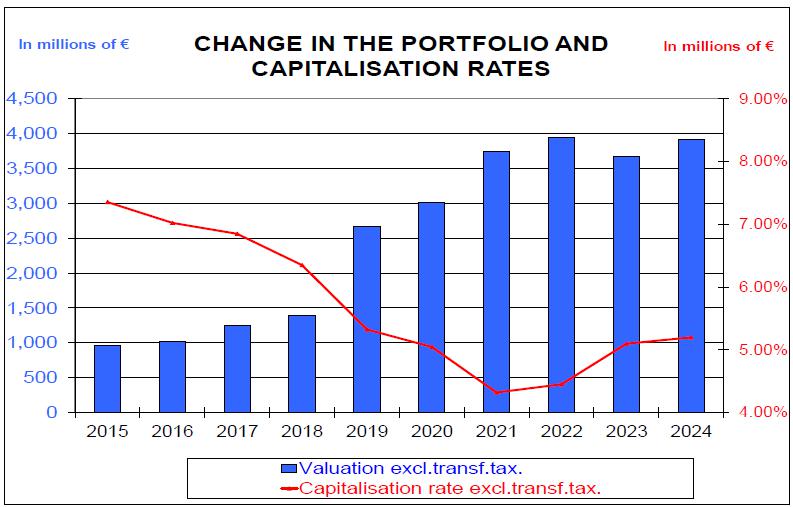
| 2015 | 2016 | 2017 | 2018 | 2019 | 2020 | 2021 | 2022 | 2023 | 2024 | |||||||||||||||||||||||||||||||
| Valuation excl.transf.tax. | 962 | 1,023 | 1,256 | 1,386 | 2,670 | 3,012 | 3,745 | 3,942 | 3,678 | 3,915 | ||||||||||||||||||||||||||||||
| Change year on year Y / Y-1 | 7 | % | 6 | % | 23 | % | 10 | % | 93 | % | 13 | % | 24 | % | 5 | % | -7 | % | 6 | % | ||||||||||||||||||||
| Capitalisation rate excl.transf.tax. | 7.35 | % | 7.0 | % | 6.85 | % | 6.35 | % | 5.3 | % | 5.05 | % | 4.3 | % | 4.45 | % | 5.10 | % | 5.20 | % | ||||||||||||||||||||
| Valuation incl.transf.tax. | 1,008 | 1,071 | 1,324 | 1,465 | 2,789 | 3,151 | 3,934 | 4,165 | 3,888 | 4,146 | ||||||||||||||||||||||||||||||
| Rate of return incl.transf.tax. | 7.0 | % | 6.7 | % | 6.5 | % | 6.0 | % | 5.1 | % | 4.8 | % | 4.1 | % | 4.2 | % | 4.85 | % | 4.9 | % | ||||||||||||||||||||
Over the 2015-2021 period, we have seen a steady decline in capitalisation rates (excluding transfer taxes) to 4.30% at the end of 2021. With the change in the economic cycle seen since 2022, capitalisation rates excluding transfer taxes, which were at 5.20% at the end of 2024, have started to rise. It should be noted that the capitalisation rate excluding transfer taxes at the end of 2024 (5.20%) nevertheless shows a slight compression of 10 basis points compared with the peak reached at the end of June 2024 (5.30%).
64
2.7.6. Additional information on appraisals
Information from third parties, expert certifications and declarations of interest.
The Company’s portfolio is valued every six months by an independent appraiser. For 2024, the Company instructed CBRE Valuation, 131 Avenue de Wagram, PARIS 75017, one of the leading valuers in France and worldwide. CBRE Valuation has around 50 appraisers in France, is part of AFREXIM and is a signatory to the Charte de l’Expertise en Evaluation Immobilière (Charter of real estate valuation).
The Company has worked with CBRE Valuation since 2007. CBRE Valuation regularly rotates its in-house teams responsible for appraising the Company’s assets.
The fees paid to the appraisers pertain solely to the half-yearly asset appraisal. They are based on unit cost scales for appraisals with a visit or an update to valuations. The appraisers are not paid any fees other than for valuations.
The appraisals conform to the national professional standards of the February 2000 COB/AMF report (Barthes de Ruyter) and the Charter of real estate valuation developed under the guidance of IFEI.
The appraisals also conform to the TEGOVA European professional standards. Specifically, the portfolio was valued in accordance with the Charter of real estate valuation.
The Discounted Cash Flow methodology is used and is cross-checked with the income capitalisation method. This method is preferred in view of the reduction in fixed terms for most assets and the complex change in cash flows provided for in the leases.
For a description of the methodology and definitions used by CBRE Valuation, see Section 2.7.2.2 of this Universal Registration Document.
Based on the values from the external appraisal by CBRE during December 2024, the total value of the asset portfolio is
€3.915bn excluding transfer taxes for the assets delivered as at 31 December 2024 (excluding buildings under construction, excluding IFRS 16 rights of use and excluding buildings covered by an agreement to sell and with land reserves).
This is the value adopted by the Company in preparing its consolidated financial statements as at 31 December 2024.
2.7.7. Statement of faithful reproduction of the appraisal report on the assets
ARGAN SA represents that it has faithfully reproduced the information from the Appraisal Report provided on 31 December 2024 by our independent expert valuer CBRE. As far as ARGAN SA is aware and is able to verify based on the data published in this section of the Universal Registration Document, no fact has been omitted that would render the information reproduced inaccurate or misleading.
All the information in this section 2.7 of this Universal Registration Document is thus either direct quotes or faithful transcriptions of the information contained in the CBRE appraisal report prepared for the ARGAN SA Group as at 31 December 2024.
65
3. Activity report
| Highlights of the financial year | 67 | |
| Change in share capital | 67 | |
| Members of the Executive Board | 67 | |
| Members of the Supervisory Board | 67 | |
| Consolidated earnings of the ARGAN Group | 68 | |
| Position of the consolidated group over the past financial year | 68 | |
| Report of operations | 68 | |
| Significant events post-closing on 31 December 2024 | 72 | |
| Scope of consolidation | 72 | |
| Consolidated financial statements | 72 | |
| ARGAN company results | 78 | |
| Financial statements | 78 | |
| Payment terms (Articles L.441-6-1 and D.441-4 of the French Commercial Code) | 80 | |
| Main subsidiaries | 81 | |
| Outlook | 83 | |
| Significant change in the financial or business position | 83 | |
| Investment strategy | 83 |
| Development | 83 | |
| Tax regime and shareholder distribution policy | 84 | |
| Shareholding | 84 | |
| Appendices to the management report | 85 | |
| Historical financial table | 85 | |
| Risk factors and insurance | 85 | |
| General comments and assessments relating to risks | 85 | |
| Risks related to the Company’s level of debt | 87 | |
| Development risks | 91 | |
| Risks related to Argan’s activity as a property investment company | 93 | |
| Risks related to the logistics real estate market | 95 | |
| Risks related to Argan’s internal operation | 95 | |
| Insurance cover | 96 | |
| Exceptional events and litigation | 97 | |
| Organisation and internal control | 97 | |
| Procedures and investigations | 97 | |
| Mandatory additional information | 97 | |
| Corporate governance report and ESG report | 97 |
66
3.1. Highlights of the financial year
3.1.1. Change in share capital
The Company’s share capital increased by a total of €4,645,952 following the issue of 2,322,976 new shares with a nominal value of €2 as part of the following transactions (shown in chronological order):
| ● | The free allocation of shares to ARGAN employees (€25,362 in share capital for 12,681 shares); | |
| ● | Payment of the dividend in shares (€566,534 in share capital for 283,267 shares); | |
| ● | A capital increase at a unit price of €74 for total gross proceeds of €150,000,072 (€4,054,056 in share capital for 2,027,028 shares). |
3.1.2. Members of the Executive Board
There were two changes to the composition of the Executive Board during the year:
Appointment of Mr Aymar de Germay to replace Mr Frédéric Larroumets, who resigned:
On 28 March 2024, Mr Frédéric Larroumets sent the Chairman a letter informing him of his decision to resign from the Executive Board for personal reasons with immediate effect. Informed of this resignation, the Appointments and Remuneration Committee met on Thursday 11 April 2024. The Committee proposed to replace Mr Frédéric Larroumets and to appoint, after pursuing the objective of seeking balanced representation in accordance with the provisions of article L.225-58 of the French Commercial Code, Mr Aymar de Germay as a member of the Executive Board under the same conditions, particularly in terms of duration and remuneration, as the office previously held by Mr Frédéric Larroumets.
The Supervisory Board meeting of 18 April 2024 decided to appoint Mr Aymar de Germay as a member of the Executive Board with effect from the same day and until the next renewal of the Executive Board.
Increase in the Committee to four members and appointment of Stéphane Cassagne:
Mr Stéphane Cassagne was hired as Director of Asset Management on 1 July 2024 to replace Mr Frédéric Larroumets, who left the company at the end of September 2024.
On the favourable opinion of the Appointments and Remuneration Committee on 28 June 2024, in accordance with article 13 of ARGAN’s Articles of Association, the Supervisory Board decided on 23 July 2024 to set the composition of the Executive Board at four members and to appoint Mr Stéphane Cassagne as a member of the Executive Board from 1 September 2024 until the next renewal of the Executive Board.
It should be noted that, in the absence of having been able to present at the last General Meeting of Shareholders a remuneration policy making it possible to assess the appointment of a new additional member to the Executive Board, the remuneration of Mr Stéphane Cassagne was determined in light of existing practices within the Company, in accordance with the provisions of article L.22-10-8 of the French Commercial Code.
3.1.3. Members of the Supervisory Board
The following renewals were approved at the Combined General Meeting of shareholders of 21 March 2024:
| ● | The office of Mrs Constance de Poncins as an independent member of the Supervisory Board for a period of four (4) years expiring at the end of the Ordinary General Meeting convened in 2028 to approve the financial statements for the financial year ending 31 December 2027. |
Furthermore, on 21 November 2024, François-Régis de Causans, an independent member of the Supervisory Board, sent the Chairman a letter of resignation with immediate effect and for personal reasons. Following a hearing with the Appointments and Remuneration Committee, it was decided to temporarily appoint Mr Eric Donnet, Chief Executive Officer of the real estate group Daniel Féau. Eric Donnet meets all the independence criteria set out in the Middlenext corporate governance code. His appointment will be subject to ratification by the General Meeting of 20 March 2025.
67
3.2. Consolidated earnings of the ARGAN Group
3.2.1. Position of the consolidated group over the past financial year
ARGAN is the only French real estate company specialising in the DEVELOPMENT & RENTAL OF PREMIUM WAREHOUSES listed on Euronext and is the market leader in France. It is included in the Euronext SBF 120, CAC All-Share, EPRA Europe and IEIF SIIC France indices.
The real estate portfolio, comprising built assets (excluding developments in progress), with an area of 3,710,000 sq. metres, was valued at €3.91bn excluding transfer taxes (€4.15bn including taxes) as at 31 December 2024.
Its property base consists of 102 buildings, mainly category A logistics centres (89 platforms and 13 fulfilment centres as at 31 December 2024), with a weighted average age of 11.6 years. The buildings are located throughout France, close to main traffic roads.
The breakdown of surface area by region is largely as follows:
| Ile de France | 29 | % | ||
| Hauts de France | 13 | % | ||
| Grand Est | 11 | % | ||
| Auvergne/Rhône-Alpes | 11 | % | ||
| Centre/Val de Loire | 10 | % | ||
| Bourgogne/Franche Comté | 8 | % | ||
| Occitanie | 6 | % | ||
| Pays de la Loire | 4 | % | ||
| Rest of France | 8 | % |
ARGAN was listed on compartment C of Euronext Paris on 25 June 2007. It joined compartment B in January 2012 and then compartment A in January 2020. It joined the EPRA FTSE Europe in March 2023 and the SBF 120 in September of that year.
Its market capitalisation as at 31 December 2024 was €1.537bn based on a price of €60.5/share.
ARGAN currently has four subsidiaries, CARGAN-LOG SCI, AVILOG SCI and NEPTUNE SCI (fully consolidated) and NANTOUR SCCV (consolidated using the equity method).
AVILOG and NANTOUR had no activity during the financial year.
SIIC regime: ARGAN has been placed under the SIIC (Société d’Investissement Immobilier Cotée - listed real estate investment company) tax regime (the French REIT regime). The exit tax for ARGAN was paid in full.
3.2.2. Report of operations
In 2024, ARGAN delivered eight new sites, all pre-leased in accordance with its policy, and at PRIME locations. The new platforms that became operational are leased to:
| ● | DSV Road for a 4,600 sq. metres Aut0nom®-certified distribution centre, delivered in February, located in Eslettes (76), on the outskirts of Rouen. Under a fixed nine-year lease, this second collaboration with DSV is characterised by a Net Zero Carbon footprint in the operating phase; | |
| ● | CARREFOUR for a 4,300 sq. metres multi-temperature urban logistics site, delivered in May, located in Castries (34), in the immediate vicinity of Montpellier, and leased under a fixed six-year lease; | |
| ● | U PROXIMITE (new client) for a 31,300 sq. metres tri-temperature Aut0nom®-certified warehouse, delivered in June. Located in St-Jean-sur-Veyle (01), near Mâcon and in the vicinity of the warehouse delivered to BACK EUROP France in 2023, it is leased under a 12-year lease; | |
| ● | DACHSER (new client), for a 15,200 sq. metres Aut0nom®-certified warehouse, delivered in June, in Bolbec (76), on the outskirts of Le Havre, near a site previously delivered to DIDACTIC in 2022; |
68
| ● | CARREFOUR, for a second site, delivered in July, with a surface area of 82,000 sq. metres and Aut0nom®-certified. This new site is located in Mondeville (14), on the Caen ring road, on a former PSA brownfield site, with a lease for a fixed term of nine years; | |
| ● | 4MURS (new client) for a 9,500 sq. metres Aut0nom® warehouse, delivered in December, in Augny (57) on the outskirts of Metz and in the vicinity of the site leased to AMAZON, operated under a 12-year lease, of which nine are fixed; | |
| ● | A new healthcare client for an 18,000 sq. metres Aut0nom® warehouse, delivered in December. This new site is located within an area of activity constituting the economic heart of the metropolis of Chartres (28) and is operated under a fixed 10-year lease; | |
| ● | GEODIS at the end of the rehabilitation and extension works on the fulfilment hub (13,400 sq. metres), delivered in December. Located in Bruguières (31), near Toulouse, the site is operated under a new lease signed for a fixed term of 12 years. |
In accordance with the announced business plan, ARGAN carried out nearly €180m in developments across 170,000 sq. metres in 2024, representing a remarkable volume. The average return on projects delivered in 2024 approached the 7% threshold at 6.6%, compared with 5.2% in 2023, for an additional €12m in annual rent. This high ratio reflects ARGAN’s solid ability to leverage the PRIME quality of its leased assets before their delivery and a unique level of execution recognised on the French market both for the development of its warehouses (quality of the Aut0nom® standard and adherence to deadlines) and for the monitoring of its asset-property teams (anticipating client needs and maintaining asset quality over time).
ARGAN intends to continue its solid momentum and has already identified €170m in investments over the 2025 and 2026 financial years. The planned investments are evenly split between proprietary developments, with an average yield of around 7%, and two acquisitions of new warehouses (subject to the standard conditions precedent), for which the company has exclusivity, with an average yield of 5.2%. The financing of these investments will be entirely provided by cash generation linked to ARGAN’s activity and the continuation of the asset disposal plan initiated in 2024.
69
From 2027, ARGAN has set itself the goal of investing an average of €100m per year to support its long-term growth:
| ● | The majority through self-development, by deploying its Aut0nom® certified warehouses; | |
| ● | The remainder through the acquisition of new warehouses at market prices. |
The change in rents received by the Group is as follows:
| ● | 2023: €183.6m in net rental income | |
| ● | 2024: €198.6m in net rental income |
An increase of 8% in 2024 compared with 2023.
The asset occupancy rate stood at 100% as at 31 December 2024 for the second year running, thus achieving maximum occupancy over the long term.
As at 31 December 2024, gross financial debt for the assets represented a total of €1.296bn, plus bond issues of €500m, i.e. total gross debt of €1.796bn.
Including residual cash of €86m, net LTV (net financial debt/value of assets) was 43.1%.
As a reminder, EPRA net LTV stood at nearly 50% as at 31 December 2023. In addition to the strong cash generation linked to ARGAN’s business model, the 7-point decrease in this ratio over the 12-month period is linked to the use of three levers simultaneously: the natural amortisation of mortgage loans exceeding €90m in 2024, a capital increase of €150m having taken place in April 2024, and an initial tranche of €77m linked to an asset disposal programme.
More specifically concerning the capital increase: this was carried out through an accelerated private placement on 23 April 2024, with the authorisation of the Executive Board granted to Ronan Le Lan, in his capacity as Chairman, on 18 April 2024, pursuant to the authorisation of the Company’s Supervisory Board (meeting previously on 18 April 2024) and by the Company’s General Meeting of 23 March 2023 in its 23rd resolution.
This transaction resulted in the issuance of 2,027,028 new ordinary shares, at a unit issue price of €74, this price being at least equal to the minimum price set by the General Meeting. The total gross proceeds from the capital increase thus came to €150,000,072, comprising a nominal capital increase of €4,054,056 and a total issue premium of €145,946,016.
Argan carried out this capital increase with a threefold objective:
| ● | Acceleration of deleveraging, with an EPRA LTV of 43.1% at end-2024 and 49.7% as at 31 December 2023, and a net debt-to-EBITDA ratio of 9.2x at end-2024, compared with 11x at end-2023; | |
| ● | Strengthening of the rental income growth profile; | |
| ● | Increase in the liquidity of the Argan share on the stock market, with a free-float proportion increased from 44% to 48% following the transaction. |
70
As specified above, ARGAN also successfully completed its asset disposal programme for the 2024 financial year, having contributed to continuing the Group’s deleveraging trajectory over the year. Two assets were included in this programme in 2024 for a combined amount of €77m, including:
| ● | €18m, with the sale, in the second quarter, of an 18,000 sq. metres logistics platform in Caen (14); | |
| ● | €59m, as part of the sale of the data centre located in Wissous (91), at the beginning of the fourth quarter, for a surface area of 22,000 sq. metres. |
The allocation of ARGAN’s gross financial debt as a percentage of capital is as follows:
| ● | 59% at a fixed rate, i.e. €1.06bn at an average rate of 1.31%; | |
| ● | 2% at a variable rate, i.e. €29m at an average rate of 3-month Euribor +1.10%; | |
| ● | 39% at a hedged variable rate, i.e. €707m at an average rate of 3.51%. |
Taking into account a 3-month Euribor of +3.60% on average over 2024, the ARGAN Group’s average rate for total debt was 2.25% as at 31 December 2024, compared with 2.30% as at 31 December 2023, with an average 3-month Euribor of -+3.40%.
The amount of financing items that are individually hedged and the hedging instruments entered into as at 31 December 2024 are as follows:
| ● | €8.0m: Collar -0%/+1.5% until 01/01/2025 | |
| ● | €2.5m: Collar -0.5%/+1.75% until 10/07/2025 | |
| ● | €1.3 million: Fixed rate swap at 0.63% until 10/04/26 | |
| ● | €69.8m: Cap Spread 1.5%/3.0% until 10/07/26 | |
| ● | €56.5m: Collar -0.745%/+1.5% until 12/10/2026 | |
| ● | €6.1M: Collar -0.525%/+1.5% until 12/10/2026 | |
| ● | €5.9m: Collar -0.54%/+1.2% until 10/04/2028 | |
| ● | €4.5m: Cap 1% until 10/04/2028 | |
| ● | €15.5m: Collar -0.64%/+2.5% until 10/07/2028 | |
| ● | €13.7m: Collar -0.54%/+1.2% until 10/07/2028 | |
| ● | €85.7m: Collar -0.40%/+1.5% until 23/01/2029 | |
| ● | €7.9M: Fixed rate swap at 0.53% until 10/07/29 | |
| ● | €7.3m: Cap Spread 2%/4% until 10/07/29 | |
| ● | €83.7m: Fixed rate swap at 1.87% until 10/10/29 | |
| ● | €7.7M: Fixed rate swap at 0.561% until 10/01/2030 | |
| ● | €31.0m: Fixed rate swap at 1.01% until 08/06/30 |
The Company has also entered into the following macro-hedge:
| ● | €300.0M: Collar +3.00%/+3.56% until 10/10/2028 |
71
Finally, our company received notice of a tax audit from the General Directorate of Public Finances covering the period from 01/01/2019 to 31/12/2021, the conclusions of which are not yet known at this stage.
3.2.3. Significant events post-closing on 31 December 2024
None.
3.2.4. Scope of consolidation
The scope of consolidation as at 31 December 2024 is as follows:
| Form | Companies | Company
registration N° (SIREN) | %
interest and control at 31.12.2024 | %
interest and control at 31.12.2023 | ||||||||||
| SA | ARGAN | 393,430,608 | 100.00 | % | 100.00 | % | ||||||||
| SCI | CARGAN-LOG | 894,352,780 | 60.00 | % | 60.00 | % | ||||||||
| SCCV | NANTOUR | 822,451,340 | 49.90 | % | 49.90 | % | ||||||||
| SCI | AVILOG | 841,242,274 | 99.90 | % | 100.00 | % | ||||||||
| SCI | NEPTUNE | 903,397,784 | 99.90 | % | 99.90 | % | ||||||||
The companies CARGAN-LOG, AVILOG and NEPTUNE, in which ARGAN holds more than a 50% share, are fully consolidated. SCCV NANTOUR is consolidated using the equity method. Argan and its subsidiaries CARGAN-LOG, NANTOUR, AVILOG and NEPTUNE form the Argan Group (the “Group”).
The NANTOUR and AVILOG companies had no activity during the financial year.
3.2.5. Consolidated financial statements
The consolidated annual financial statements for the period from 1 January to 31 December 2024 were adopted by the Executive Board on 13 January 2025.
In accordance with Regulation (EC) No 1606/2002 of 19 July 2002 on the application of international accounting standards, the ARGAN Group’s consolidated financial statements are prepared in accordance with IFRS as adopted in the European Union. The standards are available on the European Commission website: International Accounting Standards — IAS | EUR-Lex
The new standards, whose application is mandatory from 1 January 2024, are as follows:
| ● | Amendments to IAS 1 - Classification of liabilities as current or non-current. Non-current liabilities with early repayment clauses; | |
| ● | Amendments to IFRS 16 - Lease liability in a sale and leaseback transaction; | |
| ● | Amendments to IAS 7 and IFRS 7 – Supplier finance arrangement. |
The Group opted not to implement the standards, amendments to standards and interpretations adopted by the European Union that were eligible for early application from 1 January 2024.
72
The standards, amendments to standards and interpretations currently being adopted by the European Union have not been applied early.
| ● | Simplified consolidated income statement: |
| (in
thousands of €) Consolidated financial statements, IFRS standards | From
01/01/2024 to 31/12/2024 | From
01/01/2023 to 31/12/2023 | ||||||
| Rental income | 198,267 | 183,648 | ||||||
| Rebilled rental expenses and rental taxes | 37,110 | 33,902 | ||||||
| Rental expenses and rates | -37,680 | -35,094 | ||||||
| Other income from buildings | 3,596 | 3,227 | ||||||
| Other expenses on buildings | -407 | -216 | ||||||
| Net income from buildings | 200,885 | 185,469 | ||||||
| Current operating income | 185,718 | 172,145 | ||||||
| Operating income after value adjustments | 302,248 | -201,172 | ||||||
| Cost of net financial debt | -47,807 | -45,632 | ||||||
| o/w interest on loans and overdrafts | -43,866 | -41,363 | ||||||
| EBIT | 254,441 | -246,805 | ||||||
| Net income | 249,601 | -266,449 | ||||||
| Net income, Group share | 245,696 | -263,449 | ||||||
| Net income, Group share, per share | € | 9.96 | € | -11.44 | ||||
| Weighted number of shares | 24,657,305 | 23,030,242 | ||||||
| ● | Argan generated rental income of €198.3m during 2024, an increase of 8%. The difference between rental charges and the rebilling thereof is based on the contractual application of the clauses of the leases and the results of rental vacancies. Other property income and expenses mainly correspond to the application of IFRS 16. |
| ● | EBITDA (current operating income) amounted to €185.7m as at 31 December 2024, up 8% from the previous year (€172.1m in 2023). |
| ● | Operating income after value adjustments was -€302.2m (€201.2m in 2023), down sharply due mainly to a negative change in the fair value of the real estate assets turning positive again in 2024 (€120.4m versus -€370.8m in 2023). |
| ● | Net income was -€249.6m, after deducting the cost of net financial debt of -€47.8m (which includes income from cash of €1.3m, interest on loans and overdrafts of -€43.9m, interest related to IFRS 16 lease liabilities of -€1.9m, derivative instruments for -€0.1m and borrowing costs of -€3.3m), plus other financial income and expenses of - €4.9m, corresponding to the change in the fair value of debt hedging instruments, as well as €0.1m from the share of income from associates. |
73
| ● | Net income, Group share per share was therefore -€9.96, compared with €11.44 in the previous financial year. This income is calculated on the basis of a weighted number shares of 24,657,305. |
| ● | Statement of income and expenses recognised: |
| (in thousands of €) | From 01/01/2024 to 31/12/2024 | From 01/01/2023 to 31/12/2023 | ||||||
| Earnings for the period | 249,601 | -266,449 | ||||||
| Total gains and losses recognised directly in equity | -2,197 | -5,389 | ||||||
| Earnings for the period and gains and losses recognised directly in equity | 247,404 | -271,838 | ||||||
| o/w Group share | 243,499 | -268,839 | ||||||
Gains and losses recognised directly in equity amount to a loss of -€2.2m (versus a loss of -€5.4m the previous year). This corresponds to the change in fair value of hedging instruments (on the effective portion).
| ● | Calculation of recurring net income: |
| (in thousands of €) | From 01/01/2024 to 31/12/2024 | From 01/01/2023 to 31/12/2023 | ||||||
| Rental income | 198,267 | 183,648 | ||||||
| Current expenses | -14,818 | -13,872 | ||||||
| Income from cash | 1,300 | 1,533 | ||||||
| Interest on loans | -43,866 | -41,363 | ||||||
| Issue costs | -3,316 | -3,702 | ||||||
| Recurring net income | 137,567 | 126,244 | ||||||
| Recurring net income, Group share | 136,700 | 125,600 | ||||||
| Recurring net income/Rental income | 69 | % | 69 | % | ||||
| Recurring net income, Group share, per share | € | 5.54 | € | 5.45 | ||||
| Weighted number of shares | 24,657,305 | 23,030,242 | ||||||
74
Recurring net income amounted to €137.6m, up 9% compared to the previous year and now accounts for 69% of rental income (also 69% in 2023).
| ● | Simplified consolidated balance sheet: |
| (in thousands of €) | As at 31/12/24 | As at 31/12/23 | ||||||
| Non-current assets | 4,105,369 | 3,935,563 | ||||||
| Current assets | 156,924 | 118,110 | ||||||
| Assets held for sale | 0 | 17,464 | ||||||
| Total Assets | 4,262,293 | 4,071,136 | ||||||
| Equity, share of owners of the parent company | 2,226,068 | 1,887,799 | ||||||
| Minority interests | 38,528 | 34,624 | ||||||
| Non-current liabilities | 1,793,512 | 1,864,476 | ||||||
| Current liabilities | 204,185 | 276,201 | ||||||
| Liabilities classified as held for sale | 0 | 8,036 | ||||||
| Total Liabilities | 4,262,293 | 4,071,136 | ||||||
| ● | Balance sheet assets: |
| o | Non-current assets amounted to €4.1054bn, mainly comprising €3.9147bn in investment properties at their value, excluding transfer taxes, €72.7m in rights of use related to the application of IFRS 16, €39.9m in assets under construction, €11.2m in tangible fixed assets, €2.2m in other non-current assets, €8.9m in derivative instruments and €55.6m in goodwill resulting from the first-time consolidation of the “Cargo” portfolio; |
| o | Valuation of the portfolio showed a capitalisation rate of 5.20% excluding transfer taxes (i.e. an EPRA net initial rate of return of 4.90% including transfer taxes) as at 31 December 2024, up from 31 December 2023 (5.10% excluding transfer taxes) but marking a shift compared to the peak reached on 30 June 2024 (5.30% excluding transfer taxes); |
| o | Current assets amounted to €156.9m, comprising cash of €85.7m, trade receivables of €58.2m, and other current assets of €13.0m. |
| ● | Balance sheet liabilities: |
| o | Shareholders’ equity, share of owners of the parent company, was €2.2261bn as at 31 December 2024, up €338.3m compared with 31 December 2023. This increase over the period is the result of: |
| - | Consolidated income, Group share, for the period of -€245.7m, |
| - | The impact of net proceeds from the capital increase that took place in April 2024, amounting to €147.2m, |
| - | The impact of the free share allocation, amounting to +€0.9m; |
| - | The impact of the disposal of treasury shares for -€0.2m, |
| - | The impact of the valuation of treasury shares, amounting to -€0.7m, |
| - | The change in fair value of hedging instruments, amounting to -€2.2m, |
| - | A cash dividend distribution of -€52.5m; |
75
| o | Non-current liabilities amounted to €1.7935bn, consisting of €1.6944bn in long-term debt, €77.5m in liabilities related to the application of IFRS 16, €10.6m in financial derivative instruments and €11.1m in security deposits; |
| o | Current liabilities amounted to €204,2m, consisting of €96.8m in short-term debt, €1.8m in liabilities related to the application of IFRS 16, €18.2m in fixed asset liabilities and €87.4m in other liabilities. |
| ● | Simplified cash flow statement: |
| (in thousands of €) | As at 31/12/24 | As at 31/12/23 | ||||||
| Consolidated net income | 249,601 | -266,449 | ||||||
| Cash from operations before cost of debt and tax (A) | 186,895 | 173,056 | ||||||
| Current taxes (B) | 33 | 38 | ||||||
| Change in operating WCR (C) | -13,248 | 13,268 | ||||||
| Net cash flow from operations (D) = (A + B + C) | 173,679 | 186,286 | ||||||
| Net investing cash flow (E) | -34,775 | -161,193 | ||||||
| Net financing cash flow (F) | -105,163 | -142,450 | ||||||
| Net cash flow (D + E + F) | 33,742 | -117,357 | ||||||
| Opening cash position | 51,730 | 169,088 | ||||||
| Cash position on the balance sheet date | 85,471 | 51,730 | ||||||
| ● | Self-financing capacity before cost of debt and tax: |
| o | Self-financing capacity before cost of financial debt and before tax amounted to €186.9m, consisting mainly of consolidated income for the year of €249.6m, restated for: |
| - | Unrealised gains and losses related to changes in the fair value of investment property and derivatives, amounting to -€113.2m; |
| - | The cost of net financial debt of €47.8m; |
| - | Income from asset disposals and subsidies received, as well as the share of income from affiliated companies, amounting to €1.6m; |
| - | Calculated expenses and net depreciation, amortisation and provisions, amounting to €1.2m. |
| ● | Net cash flow from operations: |
| o | At €173.7m as at 31 December 2024, cash flow from operations over the period came from self-financing capacity before cost of financial debt and before tax of €186.9m, restated primarily for the negative impact of the change in working capital requirements of -€13.2m. |
| ● | Net investing cash flow: |
| o | Investing cash flow of -€34.8m resulted from: |
| - | Acquisitions of investment property fixed assets amounting to -€111.2m; |
| - | The change in fixed asset liabilities of €0.8m; |
| - | The sale of two fixed assets for €76.0m; |
76
| - | The combined effect of acquisitions of property, plant and equipment and financial assets and other flows related to investment operations of -€0.2m. |
| ● | Net financing cash flow: |
| o | Net cash flow from financing activities amounted to -€105.2m and came from: |
| - | Net proceeds received from the capital increase in April 2024, amounting to €147.2m; |
| - | A net impact of -€150.3m related to repayments (-€239.8m) and loan receipts (€89.5m); |
| - | The dividend paid in cash amounting to -€52.5m; |
| - | Net cash flow from financial income and expenses, amounting to -€48.7m; |
| - | The cash impact of the purchase and resale of treasury shares of -€0.8m. |
Note that the balance of credit lines received and not used as at 31 December 2024 was €305.0m. For more information on this subject, readers are invited to refer to note 33 of the notes to the consolidated financial statements of this Universal Registration Document.
| ● | Calculation of EPRA Revalued Net Asset Value (NAV) as at 31 December 2024: |
In accordance with the recommendations of the EPRA, the NAV is calculated based on the Company’s consolidated shareholders’ equity.
| o | The EPRA NRV NAV (Net Reinstatement Value) is a replacement NAV, |
| o | The EPRA NAV NTA (Net tangible Assets) is a continuation NAV, |
| o | The EPRA NAV NDV (Net Disposal Value) is a liquidation NAV. |
| EPRA NAV (in €m) | As at 31 December 2024 | As at 31 December 2023 | ||||||||||||||||||||||
| NRV | NTA | NDV | NRV | NTA | NDV | |||||||||||||||||||
| Consolidated shareholders’ equity | 2,226.1 | 2,226.1 | 2,226.1 | 1,887.8 | 1,887.8 | 1,887.8 | ||||||||||||||||||
| + Fair value of financial instruments | 1.6 | 1.6 | - | -5.5 | -5.5 | - | ||||||||||||||||||
| - Goodwill on the balance sheet | - | -55.6 | -55.6 | - | -55.6 | -55.6 | ||||||||||||||||||
| + Fair value of fixed-rate debt | - | - | 51.3 | - | - | 98.2 | ||||||||||||||||||
| + Transfer taxes | 229.2 | - | - | 208.4 | - | - | ||||||||||||||||||
| EPRA NAV | 2,456.9 | 2,172.0 | 2,221.7 | 2,090.7 | 1,826.6 | 1,930.4 | ||||||||||||||||||
| Number of shares | 25,402,673 | 23,079,697 | ||||||||||||||||||||||
| EPRA NAV in €/share | 96.7 | 85.5 | 87.5 | 90.6 | 79.1 | 83.6 | ||||||||||||||||||
The EPRA NAV NTA (continuation NAV) per share as at 31 December 2024 was therefore €85.5 compared with €79.1 as at 31 December 2023, an increase of +8%.
This €6.4 per share increase in EPRA NAV NTA from 31 December 2023 stems from:
| o | Net income (excluding changes in fair value): +€5.5; |
| o | The change in the value of the portfolio: -€4.5; |
| o | The dilutive impact of the creation of new shares linked to the capital increase carried out in H1 2024: -€0.5; |
| o | Payment of the dividend in cash: -€2.1; |
| o | The dilutive impact of new shares issued under the share dividend option: -€1.0. |
77
3.3. ARGAN company results
3.3.1. Financial statements
The annual financial statements for the year ended 31 December 2024 were prepared in accordance with the presentation rules and valuation methods provided for by the regulations in force.
Net results figures for our subsidiaries for the year ended 31 December 2024 are set out in the note to the balance sheet entitled “List of subsidiaries and equity investments”.
No changes were made to presentation compared with the previous financial year.
| ● | Simplified corporate income statement: |
| (in thousands of €) | From 01/01/2024 to 31/12/2024 | From 01/01/2023 to 31/12/2023 | ||||||
| Net sales | 234,597 | 215,384 | ||||||
| Operating income | 58,591 | 45,729 | ||||||
| Share of income from joint operations | - | - | ||||||
| Financial income | -35,890 | -34,387 | ||||||
| Extraordinary income | 39,085 | 4,146 | ||||||
| Taxes | 0 | 0 | ||||||
| Net income | 61,758 | 15,488 | ||||||
| o | Net sales essentially includes €192.4m in rents and €42.2m from other services (corresponding mainly to rebilling of costs to our tenants, for property tax, office tax, insurance, rental charges and land use fees); |
| o | Operating income amounted to €58.6m, compared with €45.7m the previous year, due to the increase in rental income (+€13.9m) and a reduction in lease-related expenses (+€4.7m), partially offset by an increase in depreciation and impairment allowances on fixed assets (-€5.6m) for the main variations; |
| o | There was no share of income from joint ventures in 2024; |
| o | Financial income was -€35.9m, including -€33.3m in interest on real estate loans and -€5.1m in interest on bond issues, -€0.1m in deferred hedging instrument exit costs, €1.3m of investment income, as well as €0.4m in lessee advance payments and -€0.2m in net expenses on disposals of treasury shares; |
| o | Extraordinary income derives primarily from disposals of buildings as well as from special depreciation allowances; |
| o | The Company’s net earnings therefore amounted to a profit of €61.8m. |
78
| ● | Simplified company balance sheet: |
| (in thousands of €) | As at 31/12/24 | As at 31/12/23 | ||||||
| Fixed assets | 2,080,474 | 2,158,933 | ||||||
| Current assets | 193,074 | 111,987 | ||||||
| Borrowing costs | 5,147 | 6,848 | ||||||
| Total Assets | 2,278,695 | 2,277,768 | ||||||
| Shareholders’ equity | 475,165 | 309,498 | ||||||
| Provisions for charges | - | - | ||||||
| Payables | 1,803,530 | 1,968,270 | ||||||
| Total Liabilities | 2,278,695 | 2,277,768 | ||||||
| ● | Balance sheet assets: |
| o | Fixed assets were €2.0805bn and comprise €1.7397bn in buildings at net book value, €27.6m in construction in progress, €259.8m in merger losses, €0.4m in other tangible fixed assets and €0.2m in other intangible assets, €1.3m in advances and prepayments, €6.4m in lessee loans on leasing agreements, €44.5m in equity investments in subsidiaries and €0.6m in other financial fixed assets. |
| o | Current assets consist mainly of the Company’s cash balance of €32.4m and other securities amounting to €50.0m, as well as trade receivables of €58.9m, €50.9m in other receivables, €0.3m in advances and deposits paid and €0.6m in prepaid expenses. |
| o | Borrowing costs consist of banking commissions for bond issues and mortgage financing and correspond to amounts not yet allocated, as the Company has opted to allocate these charges over the term of the loans. |
| ● | Balance sheet liabilities: |
| o | Shareholders’ equity breaks down as €50.8m in share capital, issue premiums of €335.9m, €4.6m in legal reserves, profit for the financial year of €61.8m, €11.7m in investment grants and €10.3m in special depreciation allowances. |
| o | Debts consist mainly of €1.1882bn in property loans, €500m in bond issues, €10.6m in security deposits received from tenants, as well as €10.9m in trade payables, €13.2m in tax and social security payables, €17.0m in payables on fixed assets, €1.4m in other debts and €62.2m in prepaid income. |
79
3.3.2. Payment terms (Articles L.441-6-1 and D.441-4 of the French Commercial Code)
The balance of trade and client payables by maturity date as at 31 December 2024 is as follows:
| Article D. 4411. -1° of the French Commercial Code: Invoices received not paid as at the closing date of the financial year and overdue | Article D. 4411. - 2° of the French Commercial Code: Invoices issued not paid at the closing date of the financial year and overdue | |||||||||||
| 0 day (indicative) | 1 to 30 days | 31 to 60 days | 61 to 90 days | 91 days or more | Total (1 day or more) | 0 day (indicative) | 1 to 30 days | 31 to 60 days | 61 to 90 days | 91 days or more | Total (1 day or more) | |
| (A) Late payment period | ||||||||||||
| Number of invoices affected | 11 | |||||||||||
| Total amount of invoices affected (specify whether incl. or excl. tax) | €133K incl. tax | |||||||||||
| Percentage of total amount of purchases for the financial year (specify whether incl. or excl. tax) | ||||||||||||
| Percentage of sales for the financial year (specify whether incl. or excl. tax) | 0.06% | |||||||||||
| (B) Invoices excluded from (A) relating to payables and receivables in dispute or not recognised | ||||||||||||
| Number of invoices excluded | 42 | |||||||||||
| Total amount of invoices excluded (specify whether incl. or excl. tax) | K299€ incl. tax | |||||||||||
| (C) ) Reference payment deadlines used (contractual or legal period - Article L. 441-6 or Article L. 443-1 of the French Commercial Code) | ||||||||||||
| Payment deadlines used to calculate late payments | - Legal deadlines: 60 days from the billing day | - Contractual deadlines: Quarterly billing with payment falling due | ||||||||||
80
3.3.3. Main subsidiaries
As at 31 December 2024, the Company holds the following equity investments:
| SUBSIDIARIES/EQUITY INVESTMENTS | SCCV NANTOUR1 |
| Head office | 36 rue Marbeuf – 75008 PARIS |
| Share capital | €10,000 |
| Shareholders’ equity excluding share capital and net income for the last financial year | -€158,268 |
| Percentage of the share capital held by the Company | 49.90% |
| Carrying amount of the shares held | €4,990 |
| Amount of loans and advances granted | €248,175 |
| Sales excl. tax | -€347,822 |
| Income for the last financial year | €100,391 |
| Dividends or income recognised by the Company during the financial year | €0 |
| SUBSIDIARIES/EQUITY INVESTMENTS | SCI AVILOG1 |
| Head office | 21 rue Beffroy – 92200 NEUILLY-SUR-SEINE |
| Share capital | €10,000 |
| Shareholders’ equity excluding share capital and net income for the last financial year | -€1,560 |
| Percentage of the share capital held by the Company | 99.9% |
| Carrying amount of the shares held | €8,939 |
| Amount of loans and advances granted | €0 |
| Sales excl. tax | €0 |
| Income for the last financial year | -€1,343 |
| Dividends or income recognised by the Company during the financial year | €0 |
| 1 | Data relating to the 2023 financial statements for SCCV Nantour and SCI Avilog, with the exception of loans and advances granted by ARGAN SA corresponding to the data recorded as at 31 December 2024. |
81
| SUBSIDIARIES/EQUITY INVESTMENTS | SCI CARGAN-LOG |
| Head office | 21 rue Beffroy – 92200 NEUILLY-SUR-SEINE |
| Share capital | €7,415,250 |
| Shareholders’ equity excluding share capital and net income for the last financial year | €63,695,021 |
| Percentage of the share capital held by the Company | 60% |
| Carrying amount of the shares held | €44,491,500 |
| Amount of loans and advances granted | €0 |
| Sales excl. tax | €3,966,550 |
| Income for the last financial year | -€3,688,781 |
| Dividends or income recognised by the Company during the financial year | €0 |
| SUBSIDIARIES/EQUITY INVESTMENTS | SCI NEPTUNE |
| Head office | 21 rue Beffroy – 92200 NEUILLY-SUR-SEINE |
| Share capital | €10,000 |
| Shareholders’ equity excluding share capital and net income for the last financial year | -€115,956 |
| Percentage of the share capital held by the Company | 99.9% |
| Carrying amount of the shares held | €9,990 |
| Amount of loans and advances granted | €42,235,598 |
| Sales excl. tax | €533,182 |
| Income for the last financial year | -€995,619 |
| Dividends or income recognised by the Company during the financial year | €0 |
82
3.4. Outlook
3.4.1. Significant change in the financial or business position
ARGAN has experienced no significant change in its financial or business situation since 31 December 2024.
3.4.2. Investment strategy
For more information, please refer to section 2.5 of Chapter 2 of this Universal Registration Document.
3.4.3. Development
Capitalising on its solid assets and recognised expertise, ARGAN intends to continue the implementation of its long-term strategy in order to increase the value created for shareholders, while adapting to a new economic environment characterised by interest rates that have stabilised and are durably higher than the previous cycle, with higher capitalisation rates having nevertheless reached a peak in June 2024 and higher and more volatile inflation.
Thus, ARGAN intends to remain a pure player in logistics real estate, maintaining its strategy of developing PREMIUM platforms, with investments of €170m already identified for 2025 and 2026 evenly split between proprietary developments and acquisitions (two acquisitions subject to the standard conditions precedent). The average expected yield is around 6%, with at least 7% for the share of proprietary and pre-let developments and 5.2% for the two identified acquisitions of new high environmental quality warehouses.
The Group then intends to continue, from 2027, annual investments of around €100m per year between now and 2030, with investments mainly linked to proprietary developments and the remainder to acquisitions of new assets at market prices and with high environmental quality, for which the combined yield is expected to be around 6%.
The Group also wishes to maintain its integrated and responsive operation and pursue the growth of its NAV while continuing to pay a dividend with an objective of €3.30 for 2024, then an anticipated €3.45 for 2025. ARGAN intends to self-finance its growth investments between now and the end of 2026 through cash generation from its activity and through a selective asset disposal programme, with a budget of around €125m planned for 2025-2026.
The combination of high-yield growth investments and selective asset disposals should enable ARGAN to record a rental income CAGR of at least +3% between end-2025 and end-2030.
In addition, more specifically for the 2025 financial year, while taking into account its development plan and the macroeconomic conditions currently anticipated, ARGAN has set the following objectives by the end of 2025:
| Key indicators | Objectives end-2025 | Change compared with end-2024 |
| Rental income | €210m | +6% |
| Recurring net income, Group share | €151m | +11% |
| EPRA LTV ratio* | < 40% | - 7 points |
| Net debt/EBITDA | 8x | -1x |
| Dividend per share** | €3.45 | +5% |
| (*) | At constant capitalisation rate compared to end-December 2024 (5.20% excluding transfer taxes). |
| (**) | The dividend will be subject to the approval of the CGM in 2026. |
Aut0nom® is now the Argan warehouse standard. Aut0nom® is a PREMIUM, Net Zero in use, warehouse equipped with a photovoltaic power plant and an battery-based energy storage system for self-consumption exclusively, which produces more energy over one year than is consumed for heating & cooling and lighting.
83
Alongside the generalisation of the Aut0nom® warehouse, an ambitious Plan will cover the entire existing stock. Gas heating systems will be replaced by electric heat pumps. ARGAN thus intends to significantly invest between 2030 and 2030 in the deployment of heat pumps to replace the gas boilers in its warehouse fleet.
See also Chapter 4 of the Universal Registration Document for ARGAN’s ESG policy and additional information on the environmental strategy.
3.4.4. Tax regime and shareholder distribution policy
For a detailed description of the tax regime applicable to ARGAN and the Group, see Chapter 2, paragraph 2.6.7 – Regulations relating to SIIC status and Chapter 8, paragraph 8.2.3.1 – Dividend distribution policy.
3.5. Shareholding
As at 31 December 2024, Jean-Claude Le Lan and his family own 36.8% of the shares, PREDICA owns 15.1% and the remaining 48.1% are free-float shares, thereby complying with the Company’s status as a SIIC, which it adopted on 1 July 2007.
A shareholders’ agreement was entered into on 25 October 2023 between the members of the Le Lan and Kerlan family, in the presence of ARGAN, at the same time as the contribution of 2,758,610 shares in ARGAN held by Jean-Claude Le Lan and his five children to SAS KERLAN. It replaces the Agreement signed in 2007.
As a result of these contributions, KERLAN holds 6,995,830 ARGAN shares representing 27.54% of the capital. Adding the ARGAN shares held directly by family members, the Le Lan family group holds 36.79% of the capital of ARGAN.
The Le Lan family and Predica, a subsidiary of Crédit Agricole Assurances, also confirmed their relationship of mutual trust by signing a new five-year agreement in 2024. Having entered into force on 15 October 2024, it replaces the previous agreement concluded in 2019, while reaffirming that it does not act in concert with regard to Argan (it being recalled that the members of the Le Lan family act in concert with each other with regard to Argan).
As part of this renewal, it is envisaged that Argan’s governance will evolve, with a streamlined Supervisory Board of around six members, compared with eight currently, aiming for increased efficiency in this central governance body. This change will be submitted for approval at the next Ordinary General Meeting to approve the financial statements for the financial year ending 31 December 2024. The Supervisory Board would then be composed of:
| ● | three members proposed by the Le Lan family; |
| ● | two independent members, in accordance with the recommendations of the Middlenext and AFEP-MEDEF corporate governance codes; |
| ● | Predica, as a legal entity. |
The new agreement also provides for the option for the Le Lan Family and Predica to each propose the appointment of a non-voting director to the Supervisory Board. The two standing committees of the Supervisory Board (Risk and Sustainability Audit Committee & Appointments and Remuneration Committee) will be kept in their current configuration and therefore will each remain chaired by one of the two independent members of the Supervisory Board.
For more information on changes in the shareholding structure, readers are invited to refer to Chapter 8 of this Universal Registration Document.
84
3.6. Appendices to the management report
3.6.1. Historical financial table
FINANCIAL DATA at 31 December 2024
| NATURE OF INFORMATION | FY. 31/12/2024 | FY. 31/12/2023 | FY. 31/12/2022 | FY. 31/12/2021 | FY. 31/12/2020 | |||||||||||||||
| 1.Capital at the end of the financial year | ||||||||||||||||||||
| Share capital | 50,805,346 | 46,159,394 | 45,902,580 | 45,177,090 | 44,618,454 | |||||||||||||||
| Number of existing ordinary shares | 25,402,673 | 23,079,697 | 22,951,290 | 22,588,545 | 22,309,227 | |||||||||||||||
| 2. Opérations et résultats de l’exercice | ||||||||||||||||||||
| Net sales excluding taxes | 234,596,831 | 215,384,088 | 194,773,219 | 181,591,302 | 168,514,414 | |||||||||||||||
| Pre-tax income, employee profit-sharing and amortisation, depreciation and provisions | 167,764,446 | 114,828,693 | 91,952,524 | 122,824,308 | 71,600,904 | |||||||||||||||
| Income tax | 0 | 0 | 32,959 | 27,703 | 24,652 | |||||||||||||||
| Employee profit-sharing payable for the financial year. | 0 | 0 | 0 | 0 | 0 | |||||||||||||||
| Income after tax, employee profit-sharing and amortisation, depreciation and provisions | 61,758,421 | 15,488,020 | 15,587 | 41,382,057 | 2,568,830 | |||||||||||||||
| Distributed income | *83,868,022 | 72,718,711 | 68,906,796 | 58,723,288 | 46,843,104 | |||||||||||||||
| 3. Earnings per share | ||||||||||||||||||||
| Income after tax and employee profit-sharing but before amortisation, depreciation and provisions | 6.60 | 4.98 | 4.00 | 5.44 | 3.21 | |||||||||||||||
| Income after tax, employee profit-sharing and amortisation, depreciation and provisions | 2.43 | 0.67 | 0.00 | 1.83 | 0.12 | |||||||||||||||
| Dividend allocated to each share | 3.30 | 3.15 | 3.00 | 2.60 | 2.10 | |||||||||||||||
| 4. Staff | ||||||||||||||||||||
| Average employee headcount during the year | 31 | 29 | 27 | 26 | 26 | |||||||||||||||
| Payroll expense for the year | 5,666,662 | 4,411,492 | 3,885,973 | 3,680,093 | 3,160,515 | |||||||||||||||
| Amounts paid in respect of employee benefits for the financial year (social security, employee welfare) | 2,524,837 | 2,329,193 | 1,609,199 | 1,524,771 | 1,974,116 | |||||||||||||||
3.7. Risk factors and insurance
3.7.1. General comments and assessments relating to risks
Investors are invited to take into consideration all the information contained in this Universal Registration Document, including risk factors, before deciding to acquire shares in the Company. However, they should be aware that other risks, of which ARGAN has no knowledge, or which are currently non-material, could become significant factors that could have a material adverse effect on ARGAN and its operations, financial position, performance or outlook.
The risks presented in this section have been updated to reflect recent developments linked to the economic and geopolitical environment in 2024 and to reassess the possible impacts of the current situation for the Company. Many uncertainties remain regarding the duration, scale and effects of the current environment, making it difficult to determine the future impact of these crises on the Company as at the filing date for this Universal Registration Document.
Unlike the 2023 financial year, no risk is considered “high” (categorised as “net” after mitigation measures in terms of impacts).
85
The table below lists net risks (i.e. after taking into account risk mitigation and prevention measures) by category and their level of priority according to their potential impact and their likelihood of occurrence:
| Risk category | Risk | Risk classification (net) | ||
| Risks related to the estimation of asset values | Medium | |||
| Risks related to the Company’s level of debt | Interest rate and financing risks | Low | ||
| Liquidity risks | Low | |||
| Risks related to the competitive environment | Medium | |||
| Risks associated with access to land, stricter environmental regulations and increased administrative recourse | Medium | |||
| Development risks | Risks associated with failure of approval of a development project | Low | ||
| Risks related to dependence on suppliers and quality control of the services provided by sub-contractors | Low | |||
| Risks of dependency on certain tenants and counterparty risks | Medium | |||
| Risks related to Argan’s activity as a property investment company | Risks associated with the difficulty of disposing of an asset under the arbitrage programme | Medium | ||
| Risks related to lease regulations and their renewal | Low | |||
| Risks related to ICPE authorisations | Low | |||
| Market risks in logistics real estate | Risks related to the tax regime for SIICs | Medium | ||
| Risks associated with not taking ESG obligations into account | Low | |||
| Internal Argan operational risks | Risks associated with the departure of a key person, in particular a member of the Le Lan family | Medium | ||
| Risks related to liquidity, the ARGAN share price and financial market regulations | Low |
86
3.7.2. Risks related to the Company’s level of debt
3.7.2.1. Risks related to the estimation of asset values
The Company’s portfolio is valued on a semi-annual basis by independent experts. The appraisals carried out meet the national professional standards of the Charte de l’Expertise en Evaluation Immobilière (Charter of real estate valuation) developed under the guidance of IFEI (Institut Français de l’Expertise Immobilière - French institute of real estate appraisal) and the COB report of February 2000 (the “Barthès de Ruyter” working group), the TEGOVA European professional standards and the principles of the Royal Institution of Chartered Surveyors (RICS), or any other equivalent standard that replaces them.
The latest appraisal report relates to the assets held by the Company as at 31 December 2024. The appraisal was carried out by CBRE VALUATION. The appraised value of the built assets (excluding development in progress and assets held for sale) was €3.91bn excluding transfer taxes, i.e. €4.15bn including transfer taxes.
The Expert Summary Report in Section 2.7 of this Universal Registration Document – Expert Reports sets out the context and methodology used by the experts.
The valuation for the assets may not be equivalent to their realisable value in the event of a disposal. This kind of distortion could occur, for example, in the event of a change in the asset valuation parameters between the date of the valuation report and the date of disposal.
In addition, the value provided by the appraisers may require the Company to set aside provisions for impairment, in accordance with the relevant accounting procedures, if the asset value determined by the Company with reference to the appraisal value is less than the net book value (the method applicable to the company’s financial statements).
Since the Company has opted to recognise investment properties on a fair value basis, its income statement may thus be impacted by a negative change in the fair value of its property, linked to a decrease in market values. On the other hand, the downward trend in market values may have an impact on obligations to comply with ratios or covenants vis-à-vis certain financial institutions under loan agreements.
With regard to debt, asset-backed financing with an obligation to comply with the LTV ratio on the Company’s assets (obligation to comply with a net LTV ratio excluding transfer taxes of less than 70%, mainly), accounted for 53% of all financing taken out, plus bonds, with the obligation to respect a net LTV ratio excluding transfer taxes of less than 65%, which accounted for 28% of all financing taken out. The Company’s net LTV ratio excluding transfer taxes stood at 43.1% and the secured LTV at 32.7% as at 31 December 2024, well below the level of its covenants. For information, an increase of 0.5% in the Company’s capitalisation rate (5.2% excluding transfer taxes as assessed by the appraisers as at 31 December 2024) would result in a fall of 8.7% in the value of the Company’s assets, i.e. an increase in net LTV excluding transfer taxes from 43.1% to 47.2% and in secured LTV from 32.7% to 35.8%.
A rise in rates characterised 2022 and 2023, which led to a crisis – with capitalisation rates rising over this period. This trend led to an unfavourable change in the valuation of real estate assets, which negatively affected the valuation of the Company’s assets. This unfavourable trend faded in 2024 in a context of stabilised interest rates. At the date of writing of this Universal Registration Document, interest rates appear to have reached a plateau, reducing uncertainty about the prolonged negative impacts of the crisis, particularly with regard to asset impairment. Furthermore, a default situation appears to be limited in light of the covenants outlined above.
In 2024, the logistics investment market saw a significant recovery, with an increase in transaction volumes of nearly 70%, crossing the €5bn threshold year on year, and representing a market share of around 40% of total commercial real estate to become the first segment ahead of offices (source: CBRE). In this context, capitalisation rates stabilised in 2024 (with a peak increase reached at the end of June 2024).
In its appraisal report as at 31 December 2024, the independent expert specifies: “In addition to the ongoing war in Ukraine and Russia, geopolitical tensions in the Middle East have recently intensified, increasing the risk of higher energy prices and destabilising security in the region. Although there has been recent economic growth in Europe, as well as expectations of further interest rate cuts and signs of a stabilisation in capital value in several sectors, some capital markets remain relatively limited.
87
Experience has shown that user and investor behaviour can change rapidly in times of heightened uncertainty. Lending or investment decisions should reflect any increased level of uncertainty and the possibility of changes in market conditions.
It is important to note that the findings set out in this report are only valid at the date of the appraisal. Where appropriate, we recommend that the assessment be closely monitored as we continue to monitor how markets respond to changing events.”
3.7.2.2. Interest rate and financing risks
With the Company using debt to finance its developments, any change in interest rates results in a change in the financial cost burden in respect of these loans. This is even more true following the interest rate hike observed during the 2022-2023 period. In 2024, rates began to decline slowly. The Company has entered into various interest rate hedges to reduce its exposure to variable rates as at 31 December 2024 to approximately only 2% of its total debt.
This hedging policy therefore kept the cost of debt at a low level of 2.25% at end-December 2024 (2.3% in 2023). This cost, as mentioned above, reflects the ratio between the annualised financial expenses generated by the stock of gross debt and the latter at the end of the 2024 financial year (taking into account an average 3-month Euribor rate of 3.6%). This calculation is detailed in the table below with the breakdown of debt between fixed rate, hedged variable rate and unhedged variable rate:
| €M | Total | o/w fixed | o/w hedged variable | o/w unhedged variable | ||||||||||||
| Bank debt linked to assets | 1,295.9 | 559.7 | 707.1 | 29.0 | ||||||||||||
| Lines of credit | 0.0 | 0.0 | 0.0 | 0.0 | ||||||||||||
| Bond issues | 500.0 | 500.0 | 0.0 | 0.0 | ||||||||||||
| Gross debt | 1,795.9 | 1,059.7 | 707.1 | 29.0 | ||||||||||||
| Interest rate | 2.25 | % | 1.30 | % | 3.50 | % | 4.60 | % | ||||||||
Argan also conducted a sensitivity analysis on interest rate risk. Taking into account the interest rate hedges put in place by the Group, a change of +50bp in the 3-month Euribor would have an impact of +€0.5m on the finance costs for the period.
In addition, the majority of financing contracts entered into at a variable rate include options for converting to a fixed rate.
In any event, in a context of interest rates remaining at higher levels than in the previous cycle, ARGAN’s financial strategy aims to cease borrowing by the end of 2026 in order to deleverage significantly. To achieve this, developments will mainly be financed by asset disposals based on a multi-criteria analysis (age, location, generation of rents and carbon footprint in particular). The aim is to sell a portfolio generating around €125m in additional cash over the 2025-2026 period.
In particular, Argan’s trajectory (at a capitalisation rate of 5.20% excluding transfer taxes or lower) is to reduce its LTV (excluding transfer taxes) ratio below 40% and its net debt-to-EBITDA ratio to around 8 times at end-2025 (compared to 49.7% and 11.0 times as at 31 December 2023, and 43.1% and 9.2 times at end-2024, respectively for these two indicators).
To date, the Company does not anticipate significant changes in financing risk. Since the bank debt subscribed can essentially be amortised, the Company does not need to refinance its debt in the short term.
88
Statement of borrowings in thousands of € as at 31/12/2024:
| Breakdown | ||||||||||||||||||||||||||
| References | Amort. start | Amort. end | Total residual | Fixed | Hedge variable | Unhedged variable | ||||||||||||||||||||
| Debt type | City | date | date | debt | Amount | Amount | Amount | |||||||||||||||||||
| HYP | CREUZIER LE NEUF (03) | 10/07/2022 | 10/04/2029 | 8,880.435 | 0 | 5,328 | 3,552 | |||||||||||||||||||
| HYP | CHAPONNAY (69) | 10/04/2023 | 10/01/2031 | 14,802.943 | 14,803 | 0 | ||||||||||||||||||||
| HYP | ROYE (80) | 10/10/2020 | 10/07/2035 | 22,216.234 | 0 | 15,538 | 6,678 | |||||||||||||||||||
| HYP | FERRIERES (77) | 10/01/2013 | 10/10/2026 | 7,164.663 | 0 | 0 | 7,165 | |||||||||||||||||||
| HYP | FERRIERES (77) | 10/10/2020 | 10/10/2026 | 8,800.000 | 0 | 2,464 | 6,336 | |||||||||||||||||||
| HYP | CHATRES (77) | 10/07/2022 | 10/04/2029 | 31,537.159 | 0 | 18,922 | 12,615 | |||||||||||||||||||
| CBI | COUDRAY MONTCEAUX(91) BatA | 10/07/2010 | 10/07/2025 | 10,325.718 | 0 | 0 | 10,326 | |||||||||||||||||||
| HYP | CHANTELOUP EN BRIE (77) | 10/07/2022 | 10/04/2029 | 11,797.399 | 0 | 7,078 | 4,719 | |||||||||||||||||||
| HYP | TRAPPES (78) | 10/07/2022 | 10/04/2029 | 29,468.929 | 0 | 17,681 | 11,788 | |||||||||||||||||||
| HYP | WISSOUS (91) | 10/01/2013 | 10/10/2027 | 2,290.236 | 0 | 0 | 2,290 | |||||||||||||||||||
| CBI | AMBLAINVILLE (60) | 25/05/2012 | 25/05/2027 | 4,281.392 | 0 | 0 | 4,281 | |||||||||||||||||||
| CBI | AMBLAINVILLE (60) - Avenant 1 | 26/07/2012 | 25/05/2027 | 163.850 | 0 | 0 | 164 | |||||||||||||||||||
| CBI | AMBLAINVILLE (60) - Extension | 10/04/2017 | 25/05/2027 | 2,309.206 | 0 | 0 | 2,309 | |||||||||||||||||||
| HYP | CERGY (95) | 10/07/2022 | 10/04/2028 | 5,012.336 | 0 | 0 | 5,012 | |||||||||||||||||||
| HYP | ROUVIGNIES (59) | 10/10/2020 | 10/07/2035 | 32,592.000 | 13,689 | 18,903 | ||||||||||||||||||||
| HYP | ROUVIGNIES (59) couverture | 10/10/2020 | 10/07/2035 | 5,867 | -5,867 | |||||||||||||||||||||
| HYP | ROUVIGNIES (59) couverture | 10/10/2016 | 10/04/2031 | 0 | 1,318 | -1,318 | ||||||||||||||||||||
| CBI | WISSOUS (91) | 17/09/2012 | 15/10/2027 | 4,799.345 | 0 | 0 | 4,799 | |||||||||||||||||||
| CBI | COUDRAY (91) Bat B | 29/03/2013 | 28/03/2028 | 15,572.039 | 0 | 0 | 15,572 | |||||||||||||||||||
| HYP | ST BONNET LES OULES (42) | 10/07/2022 | 10/04/2029 | 24,760.690 | 0 | 14,856 | 9,904 | |||||||||||||||||||
| HYP | ST BONNET LES OULES (42) | 10/07/2022 | 10/04/2029 | 0 | 7,700 | -7,700 | ||||||||||||||||||||
| HYP | BRUGES (33) | 10/07/2022 | 10/04/2029 | 9,970.388 | 0 | 5,982 | 3,988 | |||||||||||||||||||
| HYP | CERGY (95) | 10/07/2022 | 10/01/2032 | 8,569.647 | 0 | 0 | 8,570 | |||||||||||||||||||
| HYP | ATHIS MONS (91) | 10/10/2017 | 10/10/2032 | 5,344.748 | 0 | 0 | 5,345 | |||||||||||||||||||
| CBI | LOGNES (77) | 15/12/2016 | 15/12/2031 | 10,629.436 | 0 | 0 | 10,629 | |||||||||||||||||||
| HYP | MEUNG (45) | 10/04/2022 | 10/01/2037 | 13,311.920 | 0 | 0 | 13,312 | |||||||||||||||||||
| CBI | GUIPAVAS (29) | 01/01/2014 | 30/09/2025 | 0 | 322 | -322 | ||||||||||||||||||||
| CBI | LOMME (59) | 14/05/2012 | 13/05/2027 | 0 | 1,600 | -1,600 | ||||||||||||||||||||
| CBI | LOMME (59) | 01/01/2013 | 13/05/2027 | 0 | 28 | -28 | ||||||||||||||||||||
| CBI | SUCY EN BRIE (94) | 30/08/2013 | 29/08/2028 | 0 | 4,362 | -4,362 | ||||||||||||||||||||
| CBI | LA FARLEDE (83) | 05/04/2013 | 04/04/2025 | 0 | 1,147 | -1,147 | ||||||||||||||||||||
| CBI | CHANCEAUX TOURS (37) | 10/12/2009 | 09/12/2024 | 0 | 500 | -500 | ||||||||||||||||||||
| HYP | WISSOUS (91) | 08/06/2018 | 08/06/2033 | 38,634.880 | 0 | 30,994 | 7,640 | |||||||||||||||||||
| HYP | NEUILLY 21 BEFFROY (92) | 10/07/2019 | 10/11/2034 | 6,386.618 | 0 | 7,928 | -1,541 | |||||||||||||||||||
| HYP | NEUILLY 21 BEFFROY (92) | 10/07/2019 | 10/11/2034 | 2,000.000 | 0 | 0 | 2,000 | |||||||||||||||||||
| HYP | CESTAS (33) | 10/07/2019 | 10/07/2033 | 6,923.990 | 6,924 | 0 | ||||||||||||||||||||
| HYP | PUSIGNAN (69) | 10/01/2020 | 10/10/2034 | 12,768.153 | 0 | 0 | 12,768 | |||||||||||||||||||
| HYP | PUSIGNAN (69) | 10/01/2020 | 10/10/2034 | 3,200.000 | 0 | 0 | 3,200 | |||||||||||||||||||
| HYP | FLEURY MEROGIS (91) | 10/10/2019 | 27/02/2031 | 25,600.000 | 25,600 | 0 | ||||||||||||||||||||
| HYP | ALBON (26) | 01/12/2019 | 10/01/2035 | 5,683.334 | 0 | 4,538 | 1,145 | |||||||||||||||||||
| HYP | ALBON (26) | 10/10/2023 | 10/04/2037 | 7,345.455 | 0 | 7,345 | 0 | |||||||||||||||||||
| HYP | LA CRECHE (79) | 10/04/2020 | 10/01/2035 | 6,758.399 | 6,758 | 0 | ||||||||||||||||||||
| HYP | LA CRECHE (79) | 10/07/2024 | 10/01/2037 | 18,612.042 | 0 | 18,612 | ||||||||||||||||||||
| HYP | TOURS (37) | 10/04/2021 | 10/01/2036 | 12,934.832 | 12,935 | 0 | ||||||||||||||||||||
| HYP | STRASBOURG (67) | 01/07/2020 | 28/06/2035 | 16,555.538 | 0 | 0 | 16,556 | |||||||||||||||||||
89
| Breakdown | ||||||||||||||||||||||||||
| References | Amort. start | Amort. end | Total residual | Fixed | Hedge variable |
Unhedged variable |
||||||||||||||||||||
| Debt type | City | date | date | debt | Amount | Amount | Amount | |||||||||||||||||||
| HYP | BILLY-BERCLAU (62) | 01/07/2020 | 28/06/2035 | 3,373.669 | 3,374 | 0 | ||||||||||||||||||||
| HYP | ARTENEY (45) | 01/12/2019 | 01/12/2028 | 54,872.096 | 0 | 52,991 | 1,882 | |||||||||||||||||||
| HYP | ALLONES (72) | 01/12/2019 | 01/12/2026 | 42,663.643 | 42,664 | 0 | ||||||||||||||||||||
| HYP | LUNEVILLE (54) | 01/12/2019 | 01/12/2029 | 34,160.422 | 34,160 | 0 | ||||||||||||||||||||
| HYP | LAUDUN (30) | 01/12/2019 | 01/12/2031 | 32,482.500 | 32,483 | 0 | ||||||||||||||||||||
| HYP | AULNAY (93) | 01/12/2019 | 01/12/2031 | 35,380.000 | 35,380 | 0 | ||||||||||||||||||||
| HYP | VENDIN (62) | 01/12/2019 | 01/12/2026 | 28,959.804 | 28,960 | 0 | ||||||||||||||||||||
| HYP | EPAUX-BEZU (02) | 01/12/2019 | 01/12/2026 | 28,909.007 | 28,909 | 0 | ||||||||||||||||||||
| HYP | MACON (01) | 01/12/2019 | 01/12/2026 | 25,279.860 | 25,280 | 0 | ||||||||||||||||||||
| HYP | SAVIGNY-SUR-CLAIRIS (89) | 01/12/2019 | 01/12/2031 | 23,103.750 | 23,104 | 0 | ||||||||||||||||||||
| HYP | CHOLET (49) | 01/12/2019 | 01/12/2031 | 21,921.875 | 21,922 | 0 | ||||||||||||||||||||
| HYP | CREPY-EN-VALOIS (60) | 01/12/2019 | 01/12/2029 | 16,151.500 | 16,152 | 0 | ||||||||||||||||||||
| HYP | BILLY-BERCLAU (62) | 01/12/2019 | 01/12/2029 | 19,381.800 | 19,382 | 0 | ||||||||||||||||||||
| HYP | COMBS-LA-VILLE (77) | 01/12/2019 | 01/12/2026 | 16,441.221 | 16,441 | 0 | ||||||||||||||||||||
| HYP | BRIE-COMTE-ROBERT (77) | 01/12/2019 | 01/12/2026 | 20,911.338 | 20,911 | 0 | ||||||||||||||||||||
| HYP | PLAISANCE-DU-TOUCH (31) | 01/12/2019 | 01/12/2028 | 17,975.437 | 0 | 17,359 | 616 | |||||||||||||||||||
| HYP | SAINT-QUENTIN-FALLAVIER (38) | 01/12/2019 | 01/12/2028 | 9,413.598 | 0 | 9,091 | 323 | |||||||||||||||||||
| HYP | BAIN-DE-BRETAGNE (35) | 01/12/2019 | 01/12/2028 | 6,443.503 | 0 | 6,223 | 221 | |||||||||||||||||||
| HYP | PLOUFRAGAN-SAINT-BRIEUC (22) | 01/12/2019 | 01/12/2029 | 5,410.753 | 5,411 | 0 | ||||||||||||||||||||
| HYP | GONDREVILLE (54) | 10/07/2021 | 10/04/2036 | 7,323.866 | 0 | 0 | 7,324 | |||||||||||||||||||
| HYP | METZ (57) | 10/04/2022 | 10/10/2031 | 104,308.800 | 56,529 | 47,780 | ||||||||||||||||||||
| HYP | METZ (57) | 6,057 | -6,057 | |||||||||||||||||||||||
| HYP | ESCRENNES (45) | 10/01/2022 | 10/10/2034 | 8,116.594 | 0 | 8,117 | ||||||||||||||||||||
| HYP | NANCY (54) | 10/01/2021 | 10/10/2028 | 23,278.832 | 23,279 | 0 | ||||||||||||||||||||
| HYP | NEUVILLE-AUX-BOIS (45) | 10/01/2021 | 10/10/2028 | 42,295.343 | 42,295 | 0 | ||||||||||||||||||||
| HYP | SERRIS (77) | 10/04/2022 | 10/04/2037 | 9,666.667 | 0 | 9,667 | ||||||||||||||||||||
| HYP | SAINT JEAN DE LA NEUVILLE (76) | 10/10/2023 | 10/10/2038 | 6,486.735 | 0 | 6,487 | ||||||||||||||||||||
| HYP | MIONNAY (01) | 10/04/2024 | 10/01/2031 | 13,800.000 | 13,800 | 0 | ||||||||||||||||||||
| HYP | COMPANS (77) | 10/01/2023 | 10/10/2037 | 10,866.756 | 0 | 10,867 | ||||||||||||||||||||
| HYP | JANNEYRIAS (38) | 10/07/2023 | 10/04/2037 | 27,568.133 | 0 | 27,568 | ||||||||||||||||||||
| HYP | SENS (89) | 10/01/2023 | 10/10/2029 | 83,700.000 | 83,700 | |||||||||||||||||||||
| HYP | PLESSIS PATE (91) | 10/10/2021 | 10/04/2028 | 8,426.501 | 0 | 8,427 | ||||||||||||||||||||
| HYP | ROGNAC (13) | 10/07/2022 | 10/04/2030 | 6,600.000 | 6,600 | 0 | ||||||||||||||||||||
| HYP | ROGNAC (13) | 10/07/2022 | 10/04/2030 | 3,514.460 | 3,514 | 0 | ||||||||||||||||||||
| HYP | LENS (30) | 10/01/2023 | 10/10/2037 | 6,659.148 | 6,659 | 0 | ||||||||||||||||||||
| HYP | MONDEVILLE (14) | 10/01/2025 | 10/10/2039 | 42,000.000 | 42,000 | 0 | ||||||||||||||||||||
| OBLIG | ARGAN OBLIGATAIRE | 17/11/2026 | 500,000.000 | 500,000 | ||||||||||||||||||||||
| HEDGE | Tunnel 10 october 2023 macro 300 M€ | 10/10/2028 | 300,000 | -300,000 | ||||||||||||||||||||||
| TOTAL IN K€ | 1,795,852 | 1,059,699 | 707,137 | 29,016 | ||||||||||||||||||||||
| 100% | 59% | 39% | 2% | |||||||||||||||||||||||
The various credit agreements signed by the Company and its subsidiaries include standard early repayment clauses as well as fixed rate conversion opportunities for variable rate loans.
When they are set up, most of the financing is accompanied by guarantees: pledge of the leasing contract in the context of real estate leasing or mortgage in the context of borrowing, Dailly assignment of rents or sub-rents (see Section 9.2 of this Universal Registration Document Pledges & Mortgages).
Certain financing arrangements also include obligations to comply with ratios (or covenants); failure to comply may constitute an event of default. This is essentially an LTV ratio on the Company’s assets or only the assets financed.
90
With regard to debt, asset-backed financing with an obligation to comply with the LTV ratio on the Company’s assets (obligation to comply with a net LTV ratio excluding transfer taxes of less than 70%, mainly), accounted for 53% of all financing taken out, plus bonds, with the obligation to respect a net LTV ratio excluding transfer taxes of less than 65%, which accounted for 28% of all financing taken out. The Company’s net LTV ratio excluding transfer taxes stood at 43.1% and the secured LTV at 32.7% as at 31 December 2024, well below the level of its covenants. For information, an increase of 0.5% in the Company’s capitalisation rate (5.2% excluding transfer taxes as assessed by the appraisers as at 31 December 2024) would result in a fall of 8.7% in the value of the Company’s assets, i.e. an increase in net LTV excluding transfer taxes from 43.1% to 47.2% and in secured LTV from 32.7% to 35.8%.
The November 2021 bond issue maturing in November 2026 provides for the following financial commitments:
| - | Maintaining an LTV ratio of less than 65%, | |
| - | Maintaining an secured LTV ratio of less than 45%, and | |
| - | Compliance with an ICR ratio of more than 1.8x. |
3.7.2.3. Liquidity risks
The Company’s liquidity risk policy is to ensure that at all times, rental revenue exceeds what the Company needs to cover its operating expenses, interest and repayment charges for any financial debt it may take on in implementing its investment programme and the distribution of dividends under the SIIC (listed real estate investment company) regime.
In any event, liquidity facilities of over €300m are in place.
The Company has conducted a specific review of its liquidity risk and considers that it is able to meet its future maturities and at present, it does not anticipate an increased risk. See also Chapter 6 of this Universal Registration Document – Consolidated financial statements, sections 6.27.3 Liquidity risks and 20.2 Maturities of financial liabilities.
To finance its business, the Company has primarily used long-term mortgages and lease loans as well as, to a lesser extent, bond issues.
In view of its substantial leveraging and in the event of a credit crunch by the major financial institutions or an increase in credit rates, the Company might be unable to implement its development strategy as quickly as it would like due to a shortage of loans granted. However, it believes that the diversity of its financial partners allows it to arrange the financings it needs, bearing in mind that it may also, depending on market conditions, issue bonds.
That said, given the new economic and financial environment, the Company is prioritising deleveraging and wants to rebalance its sources of funding between bond debt (target of 50%) and amortising bank debt (target of 50%) in the medium term (from 2030).
3.7.3. Development risks
3.7.3.1. Risks related to the competitive environment
Economic cycles may lead to changes in the economic paradigm and the appearance of new competitors or, conversely, to a high concentration of certain players who would be in a situation of intense competition, which may call into question the conditions for carrying out Argan’s activity (reduction in development volumes and rental yields).
To this end, Argan has adapted its strategy by strengthening its sales team. The Group is also channelling a growing share of its business volumes towards mid-caps with a strong regional footprint and is strengthening its presence in small and medium-sized warehouses and fulfilment centres. Argan is also setting ambitious targets for brownfield redevelopment as part of its ESG policy, opening up new prospects.
91
3.7.3.2. Risks associated with access to land, stricter environmental regulations and increased administrative recourse
Access to land for logistics activities is more restricted under the effect of pressure exerted by other economic activities, the refusal of certain communities or groups of people or the implementation of restrictive regulations (Net Zero Artificialisation).
To this end, Argan’s sales team constantly identifies lands that can accommodate new developments. This activity is all the more effective because ARGAN’s long-term vision, thanks to its family identity and presence throughout France, facilitates contact with the communities in which it operates and in particular the local authorities.
Development constraints in terms of land are combined with environmental hardening (measurement and reduction of the carbon footprint, implementation of the tertiary decree or development of photovoltaic power plants). Argan’s approach in this area is to position these constraints as development levers by anticipating them in order to facilitate the activity of its tenant-clients. It is in this respect that our Group is developing all its projects under the Aut0nom® label, a Net Carbon Zero warehouse in use, gradually banning its gas boilers from its warehouses and increasing the skills of all its teams on these issues.
This environmental pressure can, in extreme cases, lead to administrative recourse that could impact the deadlines for carrying out a project, or even result in its cancellation. To this end, Argan covers the expenses incurred in connection with the letter of intent and is stepping up its policy of dialogue with elected representatives in order to better anticipate difficulties.
For more information on Argan’s environmental policy, readers are invited to read Chapter 4 of this Universal Registration Document and, more generally, Argan’s ESG strategy, available on the argan.fr website.
3.7.3.3. Risks associated with failure of approval of a development project
This risk could materialise in the event of a poor assessment of the feasibility of a project, the costs incurred or the completion deadlines. In addition to poor execution, this situation could lead to a long vacancy in the warehouse and a change in Argan’s image.
To this end, Argan has put in place a so-called “Go/No Go” procedure for each project based on a multi-criteria analysis enabling collective decision-making on the validation of a development project. The analysis grid is based in particular on the client’s business sector, its financial solidity and the probability of releasing the asset in the event of a vacancy (in particular through an assessment of the geographical area).
3.7.3.4. Risks related to dependence on suppliers and quality control of the services provided by subcontractors
Argan, as an economic player that is part of a value chain, naturally depends on suppliers (manufacturers, architects, engineering consultants, etc.). The risk of dependency is considered low due to the abundance of service providers in the Group’s business sector. In addition, Argan has adopted a policy aimed at identifying and retaining the best suppliers and selecting a minimum of three suppliers for its important and critical needs.
In addition, for the purpose of its development operations, ARGAN entrusts the construction of its warehouses to general contractors. Supply of this type of construction company is abundant and there is full competition.
The Company is in no way dependent on this offer. ARGAN also has the option of having its warehouses built in separate lots by the different trades.
The project undertaken, the attractiveness of real estate portfolios, rental income and valuations may be affected by potential tenants’ perception of the leased warehouses, i.e. the risk that these potential tenants may consider the quality, cleanliness and/or safety of the warehouses to be inadequate, or that they need to undertake restructuring, renovation or repair work.
92
As at 31 December 2024, 49% of the Company’s real estate stock is covered by a 10-year guarantee (by area), corresponding to 50 buildings, and tenants are responsible for upkeep of the buildings, other than the maintenance that falls under Article 606 of the French Civil Code and remains the lessor’s responsibility, which is covered by a 10-year guarantee.
3.7.4. Risks related to Argan’s activity as a property investment company
3.7.4.1. Risks of dependency on certain tenants and counterparty risks
The Company’s assets comprise 102 buildings, leased to a total of 66 different tenants. ARGAN’s top 12 tenants were responsible for 71% of annualised rental income for 2024 across 58 sites, as follows: Carrefour (29%), FM Logistic (7%), Amazon (5%), Auchan (5%), Monoprix (5%), Decathlon (5%), Géodis (5%), Renault (3%), L’Oréal (3%), Castorama (2%), Eurial (2%) and Aldi (1%).
The Company’s client portfolio is largely made up of leading companies whose financial position limits counterparty risk in principle.
Before a lease agreement is signed, the position of potential tenants, particularly their financial position, is examined. Leases include the following guarantees: security deposit or bank guarantee equivalent to 3 months’ minimum rent which may, if applicable, be increased depending on the user’s potential risk profile.
For the 2024 financial year, the annual rental revenue from the largest site represents 4.8% of the Company’s total annual rent roll. The Company is confident that it can handle a default of this magnitude for as long as necessary to install a new tenant on such a site.
During the 2024 financial year, the Company was not affected in terms of the recovery of its rents to date. It also did not receive any requests from clients linked to the indexation applicable from January 2025 (3.45% on average).
Changes in the economic situation have an impact on variations in the ILAT index produced by INSEE to which the Company’s rents are indexed, which represent 65% of annualised rents at end-2024.
In addition, the Company is exposed to changes in the real estate market, which could adversely affect its investment and trade-off policy, as well as its operations, financial position, performance and outlook. However, demand for logistics real estate remains at a high level, with a vacancy rate of 5.4% in France at the end of 2024 (source: CBRE).
The slowdown in the economy could adversely affect our tenants’ business operations and increase the Company’s exposure to counterparty risk for 2025. Rising inflation, persistently sluggish economic conditions, a return to rising interest rates or potentially rising geopolitical tensions could weaken some tenants, and thus have a long-term impact on the occupancy rate and tenants’ ability to pay their rent.
More specifically, with regard to the difficulties recently encountered by the Casino Group (Monoprix and Casino), they have not yet had any impact on Argan’s performance. As at 31 December 2024, there were no outstanding payments.
Until the end of 2023, the global Casino Group, through its various brands, accounted for 6% of rental income for Argan. Given the situation, Argan has decided to provide a more specific view, activity by activity, below.
As of the date of publication of this Universal Registration Document, Argan’s knowledge of this case is the same as the knowledge shared with the entire public by the media. 4.6% of annualised rental income in 2024 comes from two warehouses operated in the Paris region by the Monoprix brand (Casino Group brand) at prime sites. As part of the takeover strategy that has been made public, Monoprix remains within the scope of the future Casino Group. 1% of the remaining rental income comes from a warehouse initially leased to Casino for its hypermarket and supermarket activities near Saint-Etienne. The lease for this warehouse was transferred in 2024 to ID Logistics under the same conditions, operating for its client “Le Groupement des Mousquetaires”, purchaser of a portfolio of hypermarkets.
In any event, long-term leases are in place on the assets leased to Casino.
93
3.7.4.2. Risks associated with the difficulty of disposing of an asset under the arbitrage programme
For the purposes of its development and as part of its new financial strategy, the Company is carrying out a programme of selective sales of property assets (the oldest assets) over the 2024-2026 period. It cannot guarantee that such disposal opportunities will arise, nor that disposals will achieve the expected price.
Such disposals involve a number of risks relating to conditions on the property market, the presence of a sufficient number of investors in this market, the impact on the Company’s operating results, the involvement of executives and key personnel in such transactions and the discovery of problems inherent in such disposals.
Any difficulty experienced by the Company in selling old properties would affect its strategy and outlook. However, in 2024, ARGAN demonstrated its ability to conduct the first phase of its asset disposal programme, with a volume of €77m, mainly due to the quality of its assets and the attractiveness of logistics real estate for investors. The Company is therefore confident in its ability to conduct the second phase of this programme over the 2025-2026 period by aiming to sell a warehouse portfolio to generate cash of around €125m.
3.7.4.3. Risks related to lease regulations and their renewal
Buildings are let by ARGAN’s in-house teams (in the letting and development departments), with the ad hoc assistance of external lettings managers. Lease agreements are drawn up on the basis of a standard lease, reviewed periodically according to legal developments.
It remains possible that when a lease expires, some tenants may choose not to renew their lease agreement, and ARGAN may not be able to renew the relevant property quickly and on the same terms. Given the laddering of current leases, however, ARGAN believes it is in a position to deal with such eventualities.
It should be noted that as at 31 December 2024, the occupancy rate was 100%, with an average remaining fixed lease term of 5.3 years, as follows:
| Remaining fixed term of leases | Percentages | |||
| More than 6 years | 43 | % | ||
| 3 to 6 years | 29 | % | ||
| Less than 3 years | 28 | % | ||
3.7.4.4. Risks related to ICPE authorisations
The majority of the Company’s logistics hubs (where the quantity of combustible goods stored exceeds 500 tonnes) require a prefectoral authorisation to be able to operate (ICPE authorisation). These authorisations, which include requirements relating to the configuration of the building concerned, apply to the operating tenants, except in the case of multi-tenant sites for which the Company is the holder of the authorisation.
This authorisation is assigned to the site for its operating model (quantity and nature of products stored, method of storage, etc.), with no time limit. Only a development or a change in this operating model may require an update to the prefectoral authorisation for operations. The Company oversees the application for the said update.
During the operational phase, the Company contractually requires its tenants to comply with the authorisations for operations and ensures that they do so (duty to disclose correspondence with the DREAL, ban on terminating the order, warehouse inspections, etc.). ARGAN’s in-house property department is responsible for this oversight.
Although all of the Company’s assets are compliant with the ICPE regulations (Installations Classées pour la Protection de l’Environnement – Classified Facilities for Environmental Protection), it cannot guarantee that additional authorisations will be obtained if its tenants make a change to the way they operate its warehouses or that appeals will not be filed against prefectoral authorisations and building permits that have been issued. To date, the Company has not had to deal with any significant delay in updating a prefectoral authorisation for operations.
94
3.7.5. Risks related to the logistics real estate market
3.7.5.1. Risks related to the tax regime for SIICs
A change in or loss of the SIIC tax regime could have a significant adverse effect on the Company’s results. The Company is currently compliant with all the requirements linked to developments in this regime, known as SIIC 4, and in particular with the obligations around the maximum number of shares the majority shareholder may hold.
See also Chapter 6 of this Universal Registration Document – Consolidated financial statements, section 6.27.7 Risk related to the maintenance of the SIIC regime.
3.7.5.2. Risks associated with not taking ESG obligations into account
The risks associated with poor application of ESG requirements concern Argan’s image and reputation, with a potential impact on the share price and a possible deterioration in its relations with its stakeholders.
Argan strongly limits this risk by applying an ESG strategy overhauled in 2023 with an ambitious approach over the 2023-2030 period, incorporating in particular a demanding carbon trajectory in line with the Paris agreements to maintain global warming at a threshold of 1.5°C. With regard more specifically to the risks associated with the effects of climate change, readers are invited to refer to Chapter 4 of this Universal Registration Document, Section 4.2, paragraph 4.2.2.4.3 - Risk mitigation; and Note 6.27.8 of the Notes to the consolidated financial statements for the 2024 financial year.
In 2024, this approach resulted in the improvement of the Sustainalytics rating, from medium to low risk in 2023 (16.7 at end-December 2024) as well as an improvement in the Ethifinace rating (now a silver medal). Argan initiated its rating process with GRESB, with a first rating expected to be published during the 2025 session, and the Company was rated for the first time by Ecovadis, with which it obtained silver status, placing it among the top 15% of companies assessed by this independent body.
For more information on Argan’s ESG policy, readers are invited to refer to Chapter 4 of this Universal Registration Document as well as the ESG report, which is available in full at argan.fr.
3.7.6. Risks related to Argan’s internal operation
3.7.6.1. Risks associated with the departure of a key person, in particular a member of the Le Lan family
ARGAN’s development depends on the involvement of the Company’s top executives and key employees, particularly the Chairman of the Executive Board, Mr Ronan Le Lan, and the Chairman of the Supervisory Board, Mr Jean-Claude Le Lan. Should one of them leave or be otherwise unavailable, there is no guarantee that it would not have a significant negative impact on the ARGAN Group’s strategy and financial position as well as on the implementation of new projects necessary for its growth and development.
In order to address this possibility, ARGAN has created an organisational structure for the Company and expanded its management team.
In addition, Mr Jean-Claude Le Lan and his family are expected to remain the main shareholder of the Company, with significant influence in this respect. As at 31 December 2024, the Le Lan family held 36.8% of the Company’s share capital and voting rights (see Section 8.2.2.1 of this Universal Registration Document - Main shareholders). As a result, Mr Jean-Claude Le Lan and his family will continue to have a significant influence on the Company in the future and could also, depending on the level of investment of the other shareholders, adopt by themselves all resolutions submitted for the approval of shareholders at the Ordinary General Meeting and potentially at the Extraordinary General Meeting. Mr Jean-Claude Le Lan and his family therefore have a significant influence on major decisions concerning, in particular, the appointment of members of the Executive Board and the Supervisory Board, the approval of the annual financial statements, the distribution of dividends, as well as changes to the Company’s capital and the Articles of Association.
In addition, the Supervisory Board has three independent members at the time of writing of this Universal Registration Document, representing 37.5% of the members, in accordance with the recommendations of the Middlenext Corporate Governance Code, which recommends that at least one third of the members of a Supervisory Board of a controlled company be independent members. Therefore, the Company considers that there is little risk of abusive control because of the presence of the independent members.
95
3.7.6.2. Risks related to liquidity, the ARGAN share price and financial market regulations
The Company’s shares are admitted to trading on the Euronext Paris market; it is not possible to guarantee the existence of a liquid market for its shares, nor that such a market, if it develops, will persist. For information, it should be noted that the average daily transaction volume on ARGAN shares during 2024 was nearly 12,000 (source: Euronext).
The lack of liquidity of Argan shares could have an impact on their marketability and price, provided that the presence of benchmarks limits the risk of a decline in liquidity. In addition, the price of ARGAN shares may vary significantly compared with its NAV.
Lastly, as a listed company, ARGAN attaches particular importance to compliance with stock market regulations and thus produces regulated publications in accordance with the requirements of the rules and recommendations stipulated by the AMF, with which the Company is in regular contact, and has a public stock market ethics charter available on its website argan.fr.
3.7.7. Insurance cover
The lease agreements between the Company and its tenants provide for coverage of all insurance costs by the lessee, as they are all “triple net” leases.
3.7.7.1. Cover policy
The Company uses a real estate brokerage firm, ASSURANCES COSTE-FERMON S.A.S. ARGAN’s real estate assets and those of its subsidiaries, including the majority of the leased-financed assets, are covered by the insurance company AXA.
In general, the Company considers that its insurance policies are adequate in light of the value of the insured assets and the risk incurred. In particular, they cover the cost of reinstatement of all the property assets.
The table below shows the level of cover at replacement value per claim for the main risks as at 1 January 2025, on the understanding that this list cannot be exhaustive:
| Types of cover | Amount | ||||
| Direct damages | |||||
| ● | Comprehensive insurance covering all real estate assets by type or intended use, loss of rental income and including costs relating to the permanent repair or replacement of damaged property | Up to the amount of the damage and subject to the limit of the CIL (*) | |||
| Liability insurance, included in the CIL | |||||
| ● | Claims by neighbours and third parties | €10,000,000 | |||
| Extension of Costs and Losses cover, included in the CIL, in particular: | |||||
| ● | Clearance | Without sub-limit | |||
| ● | Protection and safeguarding of property | ||||
| Additional costs of Leak Detection, Temporary Repair, etc. | Limited to €750,000 | ||||
96
| Types of cover | Amount | ||||
Operating expenses |
|||||
| ● | Loss of Rental Income during the indemnity period | Within the limits of CIL | |||
| ● | Additional charges | ||||
| Cover common to all insured events | |||||
| ● | Policyholder’s adjuster’s fees | According to schedule | |||
| Additional cover | |||||
| ● | Replacement cost | ||||
(*) CIL = Contractual Indemnity Limit. From €50 million to €200 million depending on the policies.
The Company has also taken out a corporate civil liability policy (Contrat de Responsabilité Civile Entreprise) with AXA. This policy covers personal injury, up to a limit of €10,000,000 per year, as well as damages to property and non-physical damages resulting from a loss, up to the limit of €5,000,000 per year.
3.7.7.2. Insurance of corporate officers
None.
3.7.8. Exceptional events and litigation
To ARGAN’s knowledge, there are no litigations, arbitration proceedings or exceptional events that have had, or are likely to have, a significant adverse impact on its operations, financial position or performance.
3.7.9. Organisation and internal control
On behalf of the Supervisory Board, the Audit, Risk and Sustainability Committee monitors the effectiveness of the internal control and risk management systems and reports on them. This control is carried out in particular on the basis of dashboards that are updated every six months when the accounts are closed. For more information on the Company’s internal control, readers are invited to refer to the Supervisory Board’s report on corporate governance presented in Chapter 5 of this Universal Registration Document.
3.7.10. Procedures and investigations
There are no government, legal or arbitration proceedings, including any unresolved or outstanding proceedings of which the Company is aware, which might have or which have had over the last 12 months, a significant effect on the financial position or the profitability of the Company and/or the Group.
3.7.11. Mandatory additional information
As part of the mandatory information to be attached to the activity report since 1 January 2025, ARGAN indicates that it:
| ● | Is not dependent on “essential intangible resources” insofar as the revenue from its activity comes from the construction and rental of a physical stock of warehouses; |
| ● | Does not engage in activities that have the effect of creating a risk of tax evasion by their nature. The Group’s activities are exclusively located in France, with a value chain concentrated in mainland France, and the Company has a majority shareholding structure located in France (notably the shareholders of the agreement between the Le Lan family and Predica); |
| ● | Enables its employees to serve as reservists within the French Armed Forces: for example, Aymar de Germay is a Reserve Officer with the Directorate General of the National Gendarmerie. |
3.8. Corporate governance report and ESG report
This Universal Registration Document includes the report of the Supervisory Board on Corporate Governance, which constitutes Chapter 5 of the document, as well as the report on the Environment, Social/Societal and Governance (ESG) components, which constitutes Chapter 4 of this document.
97
4 ESG information
| A strong and ambitious ESG approach | 99 |
| Scope of non-financial information | 99 |
| Foundations of ARGAN’s ESG strategy | 99 |
| Summary of ESG commitments and achievements | 101 |
| ARGAN ESG strategy: achievements and ambition for 2023-2030 | 105 |
| Challenges and context | 105 |
| Foundations of the 2023-2030 ESG strategy | 106 |
| Solid non-financial achievements | 115 |
| Ambitions for 2025 & 2030 | 123 |
| Additional non-financial information | 127 |
| Corporate information | 127 |
| Additional environmental information | 129 |
| Key non-financial indicators at end-2023 | 130 |
98
4.1. A strong and ambitious ESG approach
4.1.1. Scope of non-financial information
Due to its size (29 employees as at 31 December 2024), ARGAN is not yet subject to the obligations relating to the CSRD directive. However, the Company has decided to report a comprehensive set of non-financial information, presented below, on the basis of a voluntary approach, reflecting the conviction that a successful business model can only be understood if it combines financial excellence with sustainable development requirements.
The reporting scope of non-financial information covers all the Group’s legal entities fully consolidated under IFRS: ARGAN SA and its subsidiaries CARGAN-LOG SCI, AVILOG SCI and NEPTUNE SCI.
The data reported in this chapter relating to ARGAN’s non-financial information concern the 2024 financial year for social and governance data and the 2023 financial year for data related to the environment (particularly energy and climate data).
For each of the three main categories of non-financial information declaration, the scopes of information are specified below:
| ● | For environmental information: |
| ○ | information relating to ARGAN as registered office: 100% of the ARGAN scope, |
| ○ | ARGAN carbon footprint (including upstream and downstream chains): 100% of the scope consisting of ARGAN and the upstream and downstream chains included in the carbon footprint, |
| ○ | declaration of the energy consumption of warehouse tenant clients: 100% of the scope of the scope of ARGAN and its tenant clients, |
| ○ | declaration of water consumption by warehouse tenant clients: 75% of the scope of ARGAN and its tenant clients, |
| ○ | declaration of waste produced by warehouse tenant clients: 50% of the scope of ARGAN and its tenant clients; |
| ● | For social information: 100% of the ARGAN scope; |
| ● | For information related to Governance: 100% of the ARGAN scope. |
Non-financial information relating to the scope of ARGAN as registered office is directly collected internally (particularly information relating to energy consumption and HR data). Data relating to tenant clients (energy and water consumption and waste production) is collected by asking clients directly, with centralisation and consolidation carried out by an individual in charge of non-financial reporting at ARGAN.
Lastly, ARGAN is supported by an independent third-party expert for the compilation and construction of ARGAN’s carbon footprint, as well as the definition of its strategy, the trajectory of which, scientifically based, complies with a global warming scenario of 1.5°C.
4.1.2. Foundations of ARGAN’s ESG strategy
4.1.2.1. An ambitious environmental strategy
As part of ARGAN’s new ESG strategy announced at the end of 2023, the Company has accelerated the deployment of the plans already launched (LED plan, “Heat Pump” plan to replace gas heating for an investment plan over 2024-2030, CTM plan) and initiated the construction of its Aut0nom® warehouses with the deployment of photovoltaic capacity dedicated to self-consumption.
Lastly, the Company is increasing its attention to water management and biodiversity conservation issues. This is in large part the purpose of the Biodiversity Strategy published during the fourth quarter of 2024 (publicly available on the argan.fr website in the ESG Commitments – Argan Charters section), which details the Group’s ambitions for 2030 on eight key areas for which it has set itself targets for 2030.
99
4.1.2.2. Integrate the best ESG standards
ARGAN intends to promote the formalisation and monitoring of its ESG strategy and performance by strengthening its assessment by recognised agencies and initiatives and through its inclusion in a growing number of these reference bodies on non-financial themes.
As of the date of publication of this Universal Registration Document, ARGAN is rated by Sustainalytics, Ecovadis (with an initial rating in 2024) and Ethifinance, and has initiated the assessment work with GRESB.
In addition, at the end of 2024, the Company also submitted its commitment application to the French Office for Biodiversity to have the action plan linked to the biodiversity strategy also defined and published (argan.fr) validated as part of this initiative.
4.1.2.3. Fair sharing of the value created
The family aspect of ARGAN is also reflected in a desire to share the value created for the Company’s various stakeholders:
| ● | For employees, by offering an attractive remuneration structure, supported in particular by a thirteenth month, sales bonuses linked to growth and fairly distributed among all employees, an incentive plan incorporating two ESG/Energy criteria from 2025, and a Free Share Allocation plan for all; |
| ● | For shareholders through the deployment of a long-term strategy around premium assets and regular dividend growth accompanied by a dividend payment option in shares, with regular and transparent communication of information relating to the company’s activities (financial and non-financial performance, asset development and delivery schedule, changes in governance, etc.). |
| ● | For local communities and authorities, by taking into account their expectations in connection with the Group’s locations and by aiming to include ARGAN’s growth policy in the best sustainable development standards (BREEAM “excellent” certifications, “biodiversity” labels, large-scale ESG strategy (and biodiversity more specifically), commitment to preserving green, blue and black corridors, etc.). |
4.1.2.4. Key performance indicators
ARGAN’s ESG strategy is defined with regard to its own activity as a developer and land developer of logistics warehouses, whose sites are located exclusively in continental France, as well as with regard to its partners in the logistics value chain and its stakeholders, including local authorities and communities and the Group’s investors.
With regard to the three pillars of ESG (Environment, Social/Societal and Governance), ARGAN has thus defined priority areas to meet the expectations of its strategic roadmap in terms of development, as well as those of its stakeholders. Each of the areas has key performance indicators to monitor the deployment of the ARGAN strategy and to indicate an annual progress report with regard to the objectives set, where applicable.
100
4.1.3. Summary of ESG commitments and achievements
4.1.3.1. Environmental commitments and objectives
| Category | Commitments | Indicators | Progress report for 2023 |
Objective 2025 |
Objective 2030 |
| Low-Carbon Strategy | Implement an ambitious decarbonisation strategy, aligned with the Paris agreements, at ARGAN level and by raising awareness among our clients about purchasing certified green energy. | Percentage of decrease in Scope 1 GHG emissions. | +42% Scope: Warehouses without sub-meters +34% Scope: Corporate emissions (service vehicles) | - | -70% |
| Percentage of decrease in Scope 2 GHG emissions. | -10% | - | Net Zero | ||
| Percentage of decrease in Scope 3 GHG emissions. Emissions from buildings in operation. | -14.5% | - | -50% | ||
| Percentage of decrease in Scope 3 GHG emissions. Construction of new buildings. | NA | - | Upcoming (2025 ESG report) | ||
| Aut0nom® and Energy Management | Accelerate and strengthen ARGAN’s energy policy. | Percentage of new developments to the Aut0nom® standard | 100% (excluding acquisitions) | 100% | 100% |
| Share of locally produced and self-consumed energy. | 23.6% on average on equipped sites | - | 100% eq. heating and lighting 35% total consumption | ||
| Share of ARGAN gas-free warehouses, in sq.m developed. | 32% | 45% | 65% | ||
| Share of ARGAN warehouses equipped with CTM/BMS. | 40% | 75% | 100% | ||
| Share of ARGAN warehouses with LED lighting. | 97% | 98% | 100% | ||
| Number of MWh of renewable energy produced. | 25,182 | 35,000 | 200,000 | ||
| Sustainable site management | Improve the environmental performance of all our new developments. | Percentage of new developments certified at or above BREEAM ‘Excellent’, by number of sites. | 16% | 75% | 100% |
| Land efficiency and fight against land artificialisation. | Percentage of new developments carried out on brownfield sites, in sq.m developed smoothed over 3 years. | NA | 10% | 20% | |
| Biodiversity preservation. | Percentage of new developments incorporating actions to preserve and strengthen biodiversity. | 100% | 100% | 100% | |
| Proportion of clients made aware of the sustainable management of sites (sustainable management of green spaces, best waste management practices, etc.). | 2% | 50% | 100% | ||
| Water management. | Share of new developments incorporating enhanced water management (infiltration, land management, limiting water consumption, rainwater collection, etc.). | 100% of developments carried out by ARGAN | 50% | 100% |
101
4.1.3.2. Social and societal commitments and objectives
| Category | Commitments | Indicators | Progress report for 2023 |
Objective 2025 |
Objective 2030 |
| Attractiveness, loyalty and upskilling | Deliver on our current value-sharing commitments by distributing free shares to all and maintaining the equity ratio (executive pay vs median pay) at the current level. | Percentage of employee shareholders of the company. | 100% | 100% | 100% |
| Equity ratio. | 2.4 | Minimum ratio maintained and well below 10 | Minimum ratio maintained and well below 10 | ||
| Percentage of employees eligible for the collective sales bonus and profit-sharing (contingent on the achieving targets). | 100% | 100% | 100% | ||
| Strengthen our actions to combat all forms of discrimination, for us and our value chain. | Gender pay gap for an equivalent position. | 0% | 0% | 0% | |
| Number of cases of harassment or discrimination. | 0 | 0 | 0 | ||
| Set up the “ARGAN Academy” training programme to further strengthen the skills of our employees and raise their awareness of ESG issues. | Percentage of managers with potential for whom a personalised training and coaching programme has been set up. | 17% | 50% | 100% | |
| Quality of life at work | Work with our stakeholders to further improve the performance of our warehouses and guarantee this performance over time, including in the face of climate change. | Percentage of employees working in the field who have completed a safety awareness and training course (electrical accreditation, road safety, etc.). | 100% | 100% | 100% |
| Ensure the inclusivity of the company in relation to disabilities, including for our visitors. | Share of business premises accessible to people with disabilities (registered office). | 100% | 100% | 100% | |
| Prevention, health and safety | Guarantee the safety of our employees by further strengthening prevention. | Percentage of employees working in the field who have completed a safety awareness and training course (electrical accreditation, road safety, etc.). | Action launched in 2024 | 75% | 100% |
| Work with our stakeholders to improve security during the construction and operation phases of our warehouses. | Percentage of manufacturers having signed the ARGAN ESG charter, including a security component. | Action launched in 2024 | 100% (construction target) | 100% (construction and maintenance target) | |
| Civic actions | Promote integration during the construction phases, for the maintenance and maintenance of our warehouses, in coordination with our partners and customers. | Share of construction, maintenance and upkeep contracts with inclusion clause. | Action launched in 2025 | 10% | 25% |
102
4.1.3.3. Governance commitments and objectives
| Category | Commitments | Indicators | Progress report for 2023 |
Objective 2025 |
Objective 2030 |
| ESG governance | Achieve the best management standards for our ESG policy, ensuring respect for human rights throughout its value chain. | Percentage of suppliers that have signed the ARGAN ESG charter, including a human rights component. | Action launched in 2024 | 100% | 100% |
| Promote these fundamental principles to all our stakeholders, in particular by developing our main contractual documents (CPI, BEFA, ITT, etc.). | Percentage of new contractual documents incorporating ESG criteria and approved by our stakeholders. | Action launched in 2024 | 100% | 100% | |
| Raise employee awareness of climate change. | Share of employees trained and/or made aware of climate change. | 100% | 100% | 100% | |
| Further strengthen our ethical approach and the fight against all forms of corruption. | Percentage of decision-making employees trained in the fight against corruption with signature of our ethics charter. | Charter published in 2023, commented and distributed to all employees | 100% | 100% | |
| Integrate ESG performance into the company’s compensation policy, particularly for the Executive Board. | Percentage of employees with a portion of compensation linked to ESG criteria. | New incentive scheme incorporating an Energy/ESG criterion in early 2025 | 100% of employees | 100% of employees | |
| Reporting and transparency | Prepare future regulatory deadlines (CSRD, Taxonomy, etc.) by addressing related issues (Fit for 55 etc.) | No linked indicator. | |||
| Define and integrate key standards and benchmarks to enable transparency and comparison of our ESG performance. | Number of databases and benchmarks integrated by ARGAN. | Global Compact Entreprises Engagées pour la Nature (signatory) Sustainalytics Ethifinance | Global Compact Entreprises Engagées pour la Nature Sustainalytics + GRESB Ethifinance | CDP SBTi (approval) |
103
| Category | Commitments | Indicators | Progress |
Objective |
Objective 2030 |
| Responsible purchasing | Develop our responsible purchasing policy, integrate our suppliers into the approach and train the employees concerned. | Percentage of purchasing employees trained in responsible purchasing. | 100% | 100% | 100% |
| More specifically, define a new sustainable, resilient and low-carbon warehouse format with our partner- manufacturers. | See carbon intensity environment indicator. | NA | NA | ||
| Regional development and new logistics formats | Define and implement a plan for optimising co-benefits when designing new projects, in consultation with the regions. | Percentage of new projects integrating a co-construction process with the regions. | 75% | 100% | 100% |
| Study new virtuous schemes around, in particular, brownfield rehabilitation. | No linked indicator. |
104
4.2. ARGAN ESG strategy: achievements and ambition for 2023-2030
4.2.1. Challenges and context
4.2.1.1. Environmental issues
The construction sector, residential and tertiary, accounts for 43% of energy consumption and around 23% of France’s greenhouse gas emissions. Reducing the environmental impact of this sector is therefore a key challenge to move towards carbon neutrality targets by 2050 and limit the increase in the average temperature of the earth to 1.5°C in accordance with the Paris Agreements. With around 90 million sq. meters of warehouses of more than 5,000 sq. meters in France (2021 data), the logistics and transport sector has a major role to play in this process of transition to a low-carbon economy. To protect ecosystems in the face of the climate emergency, the regulations imposed on us are accelerating, through the Tertiary Decree, the Net Zero Artificialisation (ZAN) objective, the Climate and Resilience Law and the Environmental Regulations “RE2020”, to name the most recent.
The elements to be taken into account for ARGAN include:
| ● | The increasing integration of renewable energies into the energy mix of our warehouses; |
| ● | Limiting the artificialisation of soils; |
| ● | The circular economy; |
| ● | The development of projects that preserve biodiversity; or |
| ● | Taking into account the impacts of climate change and adapting our warehouses. |
These elements are therefore multi-faceted and complex, and require high-performance and innovative solutions to enable a gradual and consistent transition to resilient warehouses.
4.2.1.2. Social and societal issues
The ARGAN model aims to design warehouses that meet the social challenges of tenant clients. These include themes of attracting and retaining employees, in particular through the creation of harmonious workspaces, combining ergonomics with acoustic, thermal and visual comfort to enhance well-being at work.
ARGAN’s goal is to guarantee equal and fair treatment of its employees regardless of their gender or their social or geographical background. This principle is enshrined in the guidelines of the 2023-2030 ESG strategy, published in October 2023 and reconfirmed in the 2024 ESG report published in June 2024. As such, ARGAN ensures respect for diversity, strict gender equality and the fight against all forms of discrimination on a daily basis and in its recruitment processes. ARGAN wants to increase the proportion of women in the company for the future; however, this objective is difficult to implement given the small size of the company, low turnover and a sector of activity with fewer women.
A whistleblowing procedure was also put in place at the end of 2023 to send any reports, comments or questions on these issues of equality, discrimination and inclusion. The whistleblowing system is incorporated into the ARGAN ethics charter available on argan.fr, with a dedicated email address for notifications (alerte.ethique@argan.fr). There are no notifications to report for the 2024 financial year.
Considering its activity as a driver of positive social impact, ARGAN intends, through its projects, to also increasingly integrate the aspect of creating as many local direct and indirect jobs as possible. This contributes, in particular, to the cohesion of the regions through harmonious economic development. There are also questions about the integration of features to increase automation and thus facilitate the work of employees.
More generally, ARGAN’s clients expect openness, advice, responsiveness, and innovative and personalised solutions that are co-constructed.
The Group’s policy has always been to anticipate all these aspects as early as possible in order to offer flexible, efficient workspaces and sources of social cohesion.
105
4.2.1.3. More significant challenges in a context of sustained development
The decline in land availability, or even the absence of land in certain territories, reinforced by the beginnings of the “Zero Net Artificialisation” trajectory, is pushing us to expand development scopes and consider new models (multi-storey warehouses, brownfield rehabilitation, etc.) that have yet to demonstrate their economic potential.
In addition, the environmental objectives of the major players, including ARGAN, should lead to portfolio reviews to arbitrate in favour of assets with the best environmental performances. A premium in terms of both rents and asset valuation is expected to increase in the coming years for PREMIUM assets, which are at the heart of ARGAN’s business, as can already be seen throughout Western and Northern Europe.
The consideration of these aspects is all the more important, as ARGAN has already identified €170m in investments (half in self-development and half through the acquisition of two new warehouses meeting the highest environmental standards). Thus, including as part of our deleveraging strategy, our pace of growth will remain strong for the following years and will enable us both to meet the needs of the market and to pursue a proactive policy of strengthening our ESG performance through the implementation of new generations of PREMIUM warehouses and the sale, on a case-by-case basis, of certain older assets.
4.2.2. Foundations of the 2023-2030 ESG strategy
4.2.2.1. Preamble
ARGAN’s ESG strategy for the 2023-2030 period is presented in its entirety in an initial report in October 2023, updated for recent achievements in the context of a 2024 edition published last June. ARGAN’s ESG reports are available in French, as well as in English, on the website argan.fr. As such, the information contained in this Chapter 4 of the Universal Registration Document is intended to provide an overview but does not attempt to replicate the exhaustive review of the aforementioned 2024 ESG Report.
ARGAN, as a family-owned French player driven by a long-term vision, has decided to update its environmental, social and governance commitments by giving a new impetus to its ESG strategy with the following priorities:
| ● | The implementation of proactive action plans to promote decarbonisation and the production of renewable energies; |
| ● | Support for the territories that host our warehouses; |
| ● | The satisfaction of our client and their support in the face of new challenges. |
4.2.2.2. Methodology
To make its ESG efforts a reality, ARGAN initiated dialogue with its main stakeholders. This participatory approach was carried out in 2023 by an independent external service provider (Spitha Pyxida) in order to guarantee the quality of the content and the correct reproduction of the various responses. It took the form of:
| ● | Precise mapping of relevant stakeholders; |
| ● | Personalised questionnaires on the actions, challenges, expectations and ambitions of each stakeholder on the three ESG components; |
| ● | Extensive consultation with 21 external stakeholders (clients, suppliers, local authorities, financial partners, professional organisations) and the extended ARGAN management team. 25 interviews were conducted with representatives of the targeted organisations and ARGAN employees as well as senior managers, operational managers and ESG managers, over a minimum period of one hour; |
| ● | An additional documentary analysis of the policies and commitments of these stakeholders on key themes, in particular the carbon strategy, and an analysis of best practices in the sector. |
This work made it possible to formalise the expectations of stakeholders on environmental, social and societal issues. Their contributions gave rise to several reports to ARGAN’s Senior Managers and were directly integrated into the formalisation of the main workstreams and the company’s ESG strategy.
106

4.2.2.3. 2023 – 2030 Priority workstreams
4.2.2.3.1. ARGAN, a leading player in ESG management
ARGAN intends to integrate the best management standards of its ESG policies by guaranteeing high transparency and obtaining recognition from the major French, European and international standards.
4.2.2.3.2. ARGAN, a leading player in energy and ecological transitions
ARGAN wishes to build on its initial achievements (Aut0nom® in particular) to become one of the leaders in decarbonising its business sector. In this context, the company intends to accelerate the deployment of an ambitious energy policy focused on self-consumption, at the service of its clients.
4.2.2.3.3. ARGAN, Working closely with employees
ARGAN values collective success by directly involving its employees in creating value through a policy of sharing wealth, unique in its sector. In addition, the company focuses on the health and safety of the employees of its manufacturing partners and its customers in its warehouses. They must be safe and pleasant places to work.
4.2.2.3.4. ARGAN, Partner of the regions
ARGAN is aware of its role as a player in regional economic development. The company wishes to continue to optimise the co-benefits of its sites while preparing for the major challenges of mixed uses and reducing soil artificialisation.
4.2.2.3.5. ARGAN, Forward-looking
ARGAN places innovation and customer satisfaction at the heart of its corporate mission. The company will step up its support to better integrate environmental and societal issues into the development of logistics activities.
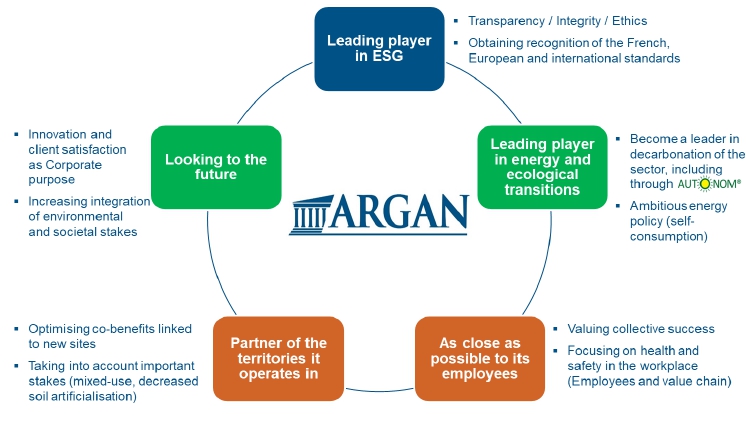
107
4.2.2.4. Consideration of ESG risks and reporting obligations
4.2.2.4.1. Dual materiality matrix
The materiality matrix presented below has been produced and prioritised by integrating stakeholders’ expectations, ARGAN’s overall performance challenges for the future, the company’s impacts on its environment and the potential financial impacts resulting from the ESG risk analysis, thus meeting the principle of dual materiality.
Interests and views of interested parties
The various stakeholders of ARGAN can be classified according to the following groups:
| ● | Clients; |
| ● | Local players, particularly local authorities; |
| ● | Suppliers and manufacturers in particular; |
| ● | Shareholders, financiers and analysts. |
These different groups were surveyed in order to build the ARGAN materiality matrix. From these interviews, the following main points emerge, reflecting the interests and views of the main stakeholders:
| Stakeholders | Key ESG expectations and perceptions | ||
| Customers | ● | A long-term relationship of very high quality thanks to agility and responsiveness, whether in the event of a problem or upstream during decision-making; | |
| ● | Actual ESG performance of warehouses is sought, particularly in relation to energy and GHG emissions; | ||
| ● | Integrated asset management and property management. | ||
| Local players and in particular local authorities | ● | Preparing for Zero Net Artificialisation with footprint reduction; | |
| ● | The challenges: carbon neutrality + renovation & rehabilitation; | ||
| ● | Are attentive to the stimulation of the local economic fabric, to the densification and diversity of uses; | ||
| ● | A well-received long-term relationship with a stable French player with a heritage and territorial vision. | ||
| Suppliers and manufacturers in particular | ● | ARGAN’s desire for dialogue and co-construction to implement decarbonisation and energy efficiency solutions for new projects is welcome. A lively dialogue is underway for 2024. | |
| Shareholders, Financiers, Analysts | ● | In 2023, formalisation of ESG strategies, particularly low-carbon strategies; | |
| ● | Commitments with specific indicators, particularly environmental indicators; | ||
| ● | The search for international labels, benchmarks and benchmarks; | ||
| ● | Perception | ||
| ○ | The Aut0nom® innovation was welcomed as well as the plan to renovate the existing fleet by installing heat pumps to replace gas boilers; | ||
| ○ | The presentation of ARGAN’s ESG strategy in October 2023 was very well received, with Sustainalytics taking into account very quickly (transition from medium risk to low risk). | ||
This is a one-off change in the matrix carried out last year, in accordance with the principles of the Corporate Sustainability Reporting Directive, as the scope of ARGAN has not been fundamentally modified since the previous financial year. Some materiality issues were slightly reprioritised to refine their impact levels and clarified to better describe all the elements integrated into each.
This double materiality matrix was validated by the ARGAN Executive Board and will be reviewed in 2025 to incorporate the results of the full resilience study planned for early 2025.
108
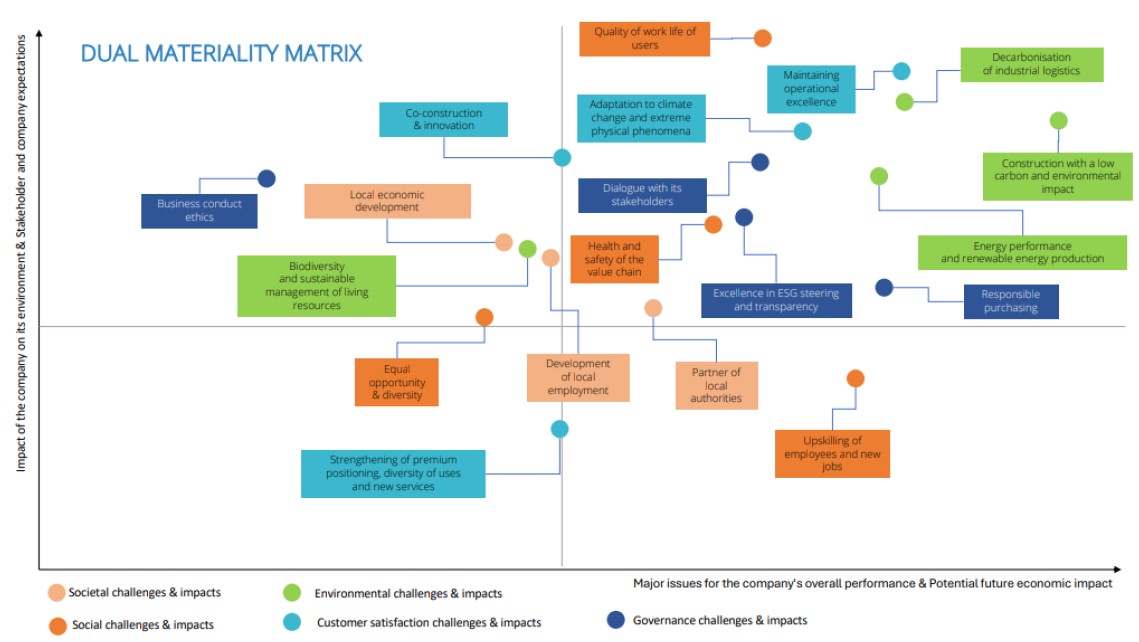
| ● | Environmental challenges and impacts: |
| ○ | Decarbonisation of industrial logistics, |
| ○ | Low-carbon and low-environmental-impact construction, |
| ○ | Energy performance and renewable energy production, |
| ○ | Biodiversity and sustainable management of living resources; |
| ● | Societal challenges and impacts: |
| ○ | Partner of local authorities, |
| ○ | Development of local employment, |
| ○ | Local economic development; |
109
| ● | Social issues: |
| ○ | Upskilling of employees and new jobs, |
| ○ | Quality of life at work for users, |
| ○ | Health and safety of the value chain, |
| ○ | Equal opportunities & diversity; |
| ● | Governance issues: |
| ○ | Dialogue with its stakeholders, |
| ○ | Responsible purchasing, |
| ○ | Excellence in ESG management and transparency, |
| ○ | Ethical business conduct; |
| ● | Customer satisfaction issues: |
| ○ | Maintaining operational excellence, |
| ○ | Adaptation to climate change and extreme weather phenomena, |
| ○ | Co-construction & innovation, |
| ○ | Strengthening of the PREMIUM positioning, diversity of uses and new services. |
For a detailed description of the various issues, readers are invited to refer to the 2024 ESG report published last June and available on the argan.fr website, in the ESG commitments section.
110
4.2.2.4.2. Preparation for CSRD compliance
With a view to preparing its future sustainability report, ARGAN notably reviewed its exposure to ESRS (European Sustainability Reporting Standards) themes. The company therefore considers the following levels of materiality:
| ESRS | Material for ARGAN | Integrated into ARGAN issues |
| Climate change | Yes |
● Decarbonisation of industrial logistics; ● Low-carbon and low-environmental-impact construction; ● Adaptation to climate change and extreme weather phenomena; ● Energy performance and renewable energy production.
|
| Pollution | No | |
| Water and marine resources | No While the total volume of water consumed is greater than 183,000 m3, it remains limited relative to the number of sites. Attention is paid to design to optimise plant and tree varieties to limit water consumption. Lawns are not systematically watered. Rainwater recovery systems are installed at some sites. Water consumption is limited to sanitary facilities and fire systems. No ARGAN site includes processes with high water consumption. Similarly, the risks of resource pollution due to site activities are limited and tightly controlled. ARGAN sites are not located in protected areas and are only marginally affected by water restriction measures. Periods of drought would have only a very limited impact on the activity of its sites. The associated risks will be reviewed regularly by the member of the Executive Board in charge of ESG and by the Audit Committee of the Supervisory Board. |
|
| Biodiversity and ecosystems | Yes | ● Biodiversity and sustainable management of living resources. |
| Resources and the circular economy | Yes | ● Low-carbon and low-environmental-impact construction. |
| Company-specific workforce | Yes | ● Health and safety of the value chain; ● Upskilling of employees and new jobs; ● Equal opportunities & diversity. |
111
| ESRS | Material for ARGAN | Integrated into ARGAN issues |
| Workers in the value chain | Yes | ● Health and safety of the value chain; ● Equal opportunities & diversity; ● Dialogue with our stakeholders; ● Responsible purchasing. |
| Affected communities | No | |
| Consumers and end users | No | |
| Conduct of business | Yes | ● Ethical business conduct; ● Dialogue with our stakeholders; ● Excellence in ESG management and transparency of information; ● Responsible purchasing. |
4.2.2.4.3. Risk mitigation
ARGAN updated the mapping of its ESG risks in order to bring it into line with the standards expected for the CSRD. This work made it possible to define the most significant potential impacts of ARGAN and the associated risks, taking into account the probability of their occurrence, their scope, their scale and their irremediable nature.
ARGAN has thus identified the main risks that could have a negative impact on its business, reputation, financial position, results, future valuation or development prospects.
In addition, ARGAN carried out an initial precise analysis of the opportunities linked to these impacts, particularly regarding its premium positioning in the face of changes in energy costs and climate change.
These elements have been incorporated into the work to update ARGAN’s materiality. It has also extended its impact analysis to its entire value chain, both upstream and downstream.
ARGAN’s upstream value chain includes its manufacturer partners and their employees.
ARGAN’s downstream value chain mainly includes its tenant customers.
More specifically, climate change risks can be broken down into:
| ● | physical risks resulting from damage caused directly by weather and climate events caused by changes in the climate system. |
These risks are controlled by applying current standards at construction stage and adjusting the property portfolio in response to climate change. For example, each warehouse is equipped with a lightning protection system. Its role is to prevent the destructive effects of lightning striking the building. Lightning rods placed on the roof of the warehouse are connected to a grounding loop (a buried bare copper cable that surrounds the building). In the event of thunderstorm, static electricity present in the ambient air is preferably discharged through the circuit running from the lightning rods to the earth, rather than by following a random path and potentially causing material damage or even human damage;
| ● | Transition risks resulting from modifications for transition to a low carbon economy. Risk control is based on the sustainable development policy adopted by the Company. As at 31 December 2024, the Company has not recognised any provision or guarantee for environmental risks. |
112
On the effects of climate change:
ARGAN profoundly overhauled its ESG strategy in 2023. It was published in October 2023 and includes, for the first time, a carbon assessment and a trajectory for reducing emissions for the three scopes. An update of the carbon assessment for 2023 was then published as part of the 2024 ESG report, in June 2024. This strategy will be enhanced by 2026, when ARGAN will be officially subject to the CSRD.
With regard to Scope 3, directly linked to ARGAN’s rental assets, an initial decarbonisation target has been published for emissions related to the energy consumption of its buildings: -50% by 2030.
In 2024, ARGAN initiated a consultation process with the companies that build its warehouses through Real Estate Development Contracts in order not only to post a target for reducing emissions related to the construction and end-of-life of its buildings, but also to discuss the impacts related to climate change. This consultation resulted in a targeted 30% reduction in construction-related emissions by 2030 compared to the reference year (2022). Argan also published its biodiversity strategy incorporating its 2025-2030 targets based on eight indicators. Over the last three years, the only major claims reported relate to hail (damage to roofs and sealing systems), which are fully covered by the “All Risks Except” policy. At this stage, no building has suffered any damage related to climate change directly.
Note that ARGAN’s real estate assets are all located in mainland France and none in mountain areas or close to a coastline.
It should also be remembered that ARGAN complies with the reinforced requirements resulting from the various town planning regulations, as well as those resulting from environmental studies.
Lastly, in 2025, Argan will launch a study on the risks linked to climate change to ensure the resilience of its assets for the years to come.
Thus, as at 31 December 2024, taking into account the effects of climate change had no significant impact on the judgements and main estimates necessary for the preparation of the Argan Group’s financial statements.
113
4.2.2.4.4. Ranking and summary of significant net ESG risks specific to ARGAN and/or its business sector
| Category | Risk | Means of control |
Key elements of the roadmap | |
| Environment | A. Climate | ● Tighter expectations and regulation towards a low-carbon economy |
o Significant reduction in the carbon impact of construction and operation o Decarbonisation of the entire supply chain o Renewable and local energy production o Watch |
o Low-carbon strategy (page 103) |
| B. Soil artificialisation | ● Tighter expectations and regulation towards “net zero artificialisation” |
o Anticipation o Stock of available land o Diversity of uses for new projects o Offsetting o Brownfield conversion |
o Sustainable site management, land efficiency and fight against land artificialisation (page 103) | |
| C. Adaptation to climate change |
● Resilience risks; ● Increase in average temperatures; ● Extreme weather events. |
o Precise analysis of potential impacts by asset; o Reversible Heat Pump systems; o Adaptation measures; o Resilience study scheduled for 2025. |
o Environmental commitments (page 103) | |
| D. Biodiversity | ● Strengthening biodiversity-related regulations. | o Dedicated biodiversity strategy |
o Sustainable site management (page 103) | |
| E. Circular economy | ● Strengthening of regulations related to the use of resources, particularly imported ones. |
o New environmental construction standard; o Use of LCAs; o Integration of recycled materials; o Dialogue initiated in 2024 with manufacturers. |
o Responsible purchasing (page 105) | |
|
Social |
F. Human capital |
● Maintaining ARGAN’s attractiveness despite fluctuations in workload; ● Continuity of the local relationship despite development; ● Maintenance and internal development of the property management activity; ● Securing the future. |
o Salary and profit sharing policy; o Improved quality of life at work; o Sound and planned management of jobs and careers; o Training and coaching. |
o Attractiveness, loyalty and upskilling (page 104) |
| G. New business lines/diversity of uses | ● Anticipation of the integration of new business lines (project management, energy management) and new forms of logistics buildings (multi-storey construction, diversity of uses, etc.) |
o Anticipation; o Continuing education; o Early integration of new skills. |
o Attractiveness, loyalty and upskilling (page 104) | |
| H. Health and safety of the value chain | ● Non-compliance with regulations by a subcontractor and accident on a site or site. |
o Responsible purchasing; o Raising awareness of the value chain; o More binding contractual clauses; o Strengthening of controls. |
o Prevention, health and safety (page 104) | |
114
| Category | Risk | Means of control |
Key elements of the roadmap | |
|
Societal & market |
I. Financing / debt / stock market listing |
● Higher and tighter financing and refinancing conditions ● Decline in the attractiveness of the stock market value |
o Green bonds; o Indexation of rents; o Voluntary ESG approach; o Diversification of funding sources; o Setting a cap on variable-rate loans; o Strengthening investor relations. |
o Set of objectives of the ESG roadmap (pages 103 to 105) |
| J. Market cycles and diversification |
● End of deployment of large and medium-sized warehouses ● Uncertainty on consumer goods and e-commerce |
o Diversification of the portfolio with a decrease in the share of XXL warehouses; o Long-term commitments/leases; o Diversification of commercial targets with strengthening of mid-caps and new industrial sectors (healthcare, etc.). |
o Regional development and new logistics formats (page 105) | |
| K. Project development |
● Difficulties in accessing land ● Rising raw materials and construction costs |
o Strong link with local authorities; o Co-construction with architects, project managers and builders to control additional costs. |
o Regional development and new logistics formats (page 105) | |
|
Governance |
L. Constitution and renewal of bodies | ● Departure of a member of the Le Lan family |
o Anticipation; o Transition before departures; o Reasserted family control (family agreement reported to the AMF); o Strengthening of the Executive Board. |
o Attractiveness, loyalty and upskilling (page 104) |
| M. Business ethics |
● Poorly controlled purchasing management ● Corruption |
o Charters; o Internal control; o Training, awareness-raising. |
o ESG governance (page 105) | |
4.2.3. Solid non-financial achievements
Argan has taken numerous actions for nearly 10 years, and the results are already convincing. This section of the Universal Registration Document aims to present the main achievements for the three components of our ESG policy.
4.2.3.1. For the Environment Pillar
ARGAN has initiated and deployed an ambitious environmental strategy, based on a low-carbon trajectory, scientifically established and aligned with a warming scenario compliant with the Paris Agreement at 1.5°C. This trajectory was built with an independent third-party expert, a member of the Open Carbon Practice and proficient in the GHG Protocol and Bilan Carbone methodologies. The work to determine the carbon trajectory to be followed by the end of 2030 in order to be scientifically aligned with the Paris agreements is part of ARGAN’s overall carbon footprint according to the three scopes, at the end of 2022, the reference year. This reference year will be regularly re-calibrated with regard to changes in ARGAN’s scope (developments, acquisitions or asset disposals) in order to measure the progress relative to the effort required in proportion to the starting point.
To this end, our Group is accelerating the deployment of the plans already launched (LEDs plan, “Heat Pump” plan to replace gas heating over the 2024-2030 period, CTM plan), building its Aut0nom® warehouses, Net Zero for use, and launching a new phase of the deployment of photovoltaic capacities dedicated to self-consumption on roofs or shade canopies.
4.2.3.1.1. Energy renovation of existing assets
ARGAN is continuously rolling out initiatives to renovate its warehouse fleet to meet the best current energy and environmental efficiency standards:
| ● | Since 2018, ARGAN has carried out an extensive relamping campaign, replacing old and energy-intensive lights with the latest generation of intelligent LED systems, controlled by natural light and human movement. More than 98% of this plan has now been rolled out by the end of 2024; |
115
| ● | ARGAN, in consultation with its clients, has also launched an ambitious plan to replace gas heating systems with the latest generation air/water heat pumps across its entire fleet by 2030. Pending full replacement, in 2021 ARGAN initiated a three-year plan to completely replace the oldest boilers with more efficient modular systems: high-performance boilers and modular burners. The switch to this new equipment enabled an average reduction in gas consumption of 10% to 20% for each change; |
| ● | As part of the tertiary decree, the Group has set up a vast programme for monitoring and managing consumption, making it possible to collect consumption data. However, ARGAN intends to go further by installing its own GTB/GTM systems that offer a fine degree of analysis, by cell or by type of equipment (air conditioning, for example). The Group now dedicates a position specifically to the issue of energy monitoring. |
In addition, in accordance with its 2024-2030 investment plan, ARGAN has already finalised or committed over €4m in investments through six projects to replace gas boilers with high CO2 emissions with air/water electric heat pumps. Alongside the development of new warehouses with the Aut0nom® label, the “Net Zero” warehouse in use, these investments will contribute to reducing CO2 emissions linked to the operation of the warehouses in the ARGAN fleet, in line with a trajectory to limit global warming to 1.5°C. The residual emissions linked to developments are now offset by a reforestation operation benefiting from the Low Carbon Label issued by the French State.
4.2.3.1.2. Deployment of Aut0nom® and photovoltaic production
In early 2022, ARGAN commissioned its first Aut0nom® warehouse, the net zero carbon warehouse in use. Since then, the company has initiated or studied more than ten projects based on this new standard. At the end of 2024, ARGAN had 12 warehouses that produce and consume their own green energy, have either been delivered or are under development.
4.2.3.1.3. Sustainable site management and biodiversity strategy
ARGAN systematically calls on an ecologist to carry out ecological diagnostics on each of the projects launched in development. The purpose of this work is to:
| ● | Identify habitat types, as well as the flora present on the sites (including invasive species and protected and/or threatened species); |
| ● | Identify protected and/or threatened wildlife species present or potentially present (assessment of wildlife habitat potential); |
| ● | Identify the remarkable elements to be conserved and recovered (tree serving as a nesting site, group of nectariferous plants of interest to pollinating insects, etc.); |
| ● | Issue instructions to preserve the most interesting elements for biodiversity and incorporate additional actions for possible restoration and/or offsetting. |
In addition, special measures may be taken at construction sites to limit their impact (working hours, start period, non-lighting at night, etc.).
Over the last two years, ARGAN has also strengthened the biodiversity potential of some of its warehouses through concrete targeted actions:
| ● | Planting of diverse local plant species; |
| ● | Creation of hay/flower meadows; |
| ● | Development of basins so that they are favourable to biodiversity; |
| ● | Installation of crossings for small wildlife; |
| ● | Raising awareness among its clients for sustainable management with limitation of the use of phytosanitary products and the implementation of eco-pastures; |
| ● | Installation of insect hotels, nesting boxes and bird feeders; |
| ● | Installation of rainwater recovery systems. |
116
Aligned with a continuous progress approach, as part of its 2023-2030 ESG roadmap, ARGAN finalised its biodiversity strategy, published at the end of 2024. Structured around eight ambitious goals, it aims in particular to limit the negative externalities linked to the Group’s sites and to make a net positive contribution to ecosystems, including through reforestation and the implementation of resources to protect wildlife and flora.
This ambitious strategy is part of the “Entreprises engagées pour la nature” initiative initiated by the French State and for which ARGAN is actively engaged.
The full biodiversity strategy is available on the argan.fr website, on the “ARGAN charters” tab of the “ESG commitments” section.
4.2.3.1.4. The low-carbon policy
Mindful of the imperative to minimize the footprint of all our activities as well as that of our warehouse portfolio, we take an approach of measuring our impact and systematically reducing emissions on the items where this is possible. This resulted in an initial carbon assessment in 2023, carried out on the three scopes for 2022, then a second in 2024 for the 2023 financial year.
Based on the 2023 emissions estimate, the total of our scopes 1 & 2 (directly linked to the operation of our teams) represents around 1% of our total emissions. Most of our emissions are based on the construction of our new warehouses/renovations/works/end of life and on the use of energy (scope 3).
Our emissions (tonnes of CO2 equivalent) by scope according to the GHG Protocol methodology (2022 & 2023 data)
| Scope | 2023 Assessment | In % | 2022 Assessment | Annual change | 2030 Objective (if applicable) |
| Scope 1 - Direct emissions from fixed combustion sources | 585 | 0.9% | 410 | +43% | -70% |
| Scope 1 - Direct emissions from mobile sources with internal combustion engines | 100 | 0.1% | 51 | +96% | |
| Scope 1 - Direct fugitive emissions | 5 | 0.0% | 28 | -82% | |
| Total Scope 1 | 690 | 1.0% | 489 | +41% | |
| Scope 2 - Indirect emissions related to electricity consumption | 3.6 | 0.0% | 4.0 | -10% | Carbon neutral |
| Total Scope 2 | 3.6 | 0.0% | 4.0 | -10% | |
| Purchases of products or services | 5,861 | 8.8% | 6,351 | -8% | |
| Property assets (construction) | 38,661 | 57.8% | 67,396 | -43% | -30% |
| Energy-related emissions not included in scopes 1 and 2 | 30 | 0.0% | 78 | -62% | |
| Waste generated by production (ARGAN) | 1 | 0.0% | 3 | -63% | |
| Business travel | 16 | 0.0% | 116 | -86% | |
| Commuting | 2 | 0.0% | 1 | +100% | |
| Downstream leasing | 21,520 | 32.2% | 25,101 | -14% | -50% |
| Other (upstream and downstream) | 26 | 0.0% | 996 | -97% | |
| Scope 3 | 66,117 | 99.0% | 100,042 | -34% | |
| Total | 66,811 | 100% | 100,535 | -34% |
2022 is the first year in terms of monitoring data related to Argan’s carbon footprint and, as such, it is the reference year. The allocation of data across the scope 3 categories according to the GHG Protocol was subsequently refined, explaining the variations in certain items between 2022 and 2023, and in particular the reduction in the “other” item. In accordance with the GHG Protocol methodology, ARGAN should regularly revise its reference year (2022) to take into account changes in its scope (developments, acquisitions or disposals) in order to measure changes compared to this updated reference. This adjustment is planned for 2025.
117
4.2.3.1. For the Social & Societal Pillar
ARGAN’s strategy in this area aims to strengthen its status as a responsible employer, promoting a motivating and fulfilling working environment. Its Social and Societal policy also aims to involve its employees in the company’s success.
4.2.3.1.1. Promotion of employees
ARGAN is governed by French law and operates exclusively in France. The property investment company therefore applies a regulatory and legal framework that is more favourable and protective than the fundamental conventions of the International Labour Organisation (ILO).
In addition, ARGAN is firmly committed, in particular through its contractual documents, to universal human rights:
| ● | Combating child labour; |
| ● | Combating forced or illegal labour; |
| ● | Dignified working conditions, fair compensation and value sharing; |
| ● | Health, safety and well-being at work of its employees, subcontractors, tenants; |
| ● | Health and safety and the local communities where its warehouses are located; |
| ● | Freedom of association; |
| ● | Diversity, gender equality and inclusion (partnerships with integration companies, for example). |
From a compensation standpoint, the company has put in place an attractive system aimed at motivating its employees that is based on individual and collective performance:
| ● | A fixed salary paid over 13 months; |
| ● | A collective sales bonus distributed in a strictly equal manner to all employees. Its amount depends on the rents generated by the new leases of the developments signed during the financial year, as well as their rental profitability and their fixed term; |
| ● | A classic collective profit-sharing agreement based on the company’s performance (according to the property developer margin and occupancy rate criteria). It is capped at two months’ salary per employee. Those who wish to do so can set aside the profit-sharing in an inter-company savings plan (PEIE) or a PERCOI. From 2025, this plan includes two ESG/Energy criteria; |
| ● | A free share allocation scheme. All employees thus benefit from free distribution of shares, the quantities of which will depend on the company’s performance over the three financial years 2022, 2023 and 2024. This expanded free share allocation scheme reflects everyone’s recognition of the Group’s overall performance and the desire to share results more fairly. Thus, 100% of ARGAN’s employees are shareholders on the date of publication of this Universal Registration Document. |
Beyond these aspects, which apply to all, executive compensation remains deliberately contained at levels that are significantly lower than the main listed groups and our peers. With regard to the Free Share Allocation plan for members of the Executive Board, 20% of the 2025 allocation is based on an ESG criterion corresponding to the reduction in CO2 emissions measured in 2025 compared with 2024.
The equity ratio, which measures the ratio between executive pay and average employee pay, stands at 2.4 for 2024 (compared with around 50 for SBF 120 companies and around 100 for the 100 largest French companies).
4.2.3.1.2. An inclusive and safe working environment
Fight against discrimination
No pay gap was observed between women and men of the organisation in equivalent positions. In addition, ARGAN ensures respect for diversity, strict gender equality and the fight against all forms of discrimination on a daily basis and in its recruitment processes.
ARGAN wants to increase the proportion of women in the company for the future; however, this objective is difficult to implement given the small size of the company, low turnover and a sector of activity with fewer women. Lastly, an alert procedure was put in place in 2023 to facilitate the reporting of incidents related to discrimination or harassment. It is incorporated into the company’s ethics charter.
118
Strong focus on the working environment
In addition, everything has been adapted to ensure the comfort and quality of our employees’ working environment. At the head office in Neuilly-sur-Seine, spacious offices have recently been refurbished, with LED lighting, bright and open meeting rooms, changing rooms with showers, kitchen, availability of coffee, fruit and pastries, etc.
Particular attention has been paid to the total accessibility of the building for people with disabilities, but also for people with visual and hearing impairments. Finally, the ARGAN head office allows us to test new approaches and new services that could, in the future, be integrated into the offices of our warehouses. Every week, a suitable place is rented by the company close to the head office to allow volunteers to practice a sporting activity together.
The working environment offered in our warehouses is, of course, an area of constant improvement, in close contact with our client. The light colour of the walls and the ceiling, the white paint applied to certain partition walls, specific effort regarding the diffusion of natural light with the integration of very large openings (bay windows, transom windows, etc.) including in the warehouses, the quality and intensity of artificial light, the ergonomics of the spaces, acoustic comfort, the presence of resting places, the emphasis on the quality and quantity of green spaces, etc. We lean on all possible levers under our control to help create an environment that is favourable to the quality of work and to well-being at work. These factors are becoming increasingly important for us and our customers, faced with less attractive logistics businesses and competition to attract the best talent. Beyond that, the comfort of the facilities and their adaptability will be even more central to continuing to offer quality workspaces that take into account the future impacts of climate change.
Training and coaching
An annual training plan is in place to upgrade the knowledge and skills of ARGAN employees. The establishment of ARGAN Academy, an employee training and coaching programme, was initiated in 2024. This programme will include, in particular, training related to ESG themes, on the three pillars.
Prevention, health and safety
The health and safety of our employees is at the heart of our social policy. Awareness-raising initiatives are therefore carried out regularly, particularly for employees who have to visit our sites or who work directly in our warehouses. In 2024, no accidents or near misses were recorded for ARGAN personnel. In 2025, a workplace first-aider was appointed after completing the necessary training.
4.2.3.1.3. Civic actions
ARGAN is continuing and strengthening its support for local actions to realise the co-benefits of installing its warehouses in the territories. In addition, ARGAN intends to mobilise its value chain to facilitate the hiring of workers in an integration program during the construction and maintenance phases of its warehouses in the future.
In this context, for example, our Group supported a former ARGAN employee, Alexandre Besnard, in a project to produce high-quality cherry tomatoes in a greenhouse but in a fully environmentally friendly manner. ARGAN supported its project in particular by supporting him with the design and financing of his environmentally friendly greenhouse. The results include:
| ● | 20 jobs created; |
| ● | A carbon footprint that is 60% below average; |
| ● | No use of pesticides; |
| ● | Greenhouse heating provided by reused energy (fatal heat from the household waste incineration plant); |
| ● | Rainwater recovery and irrigation water recycling; |
| ● | Local marketing, only in the months of natural harvests. |
In 2025, ARGAN will deliver an extension of this atypical facility.
119
4.2.3.2. For the Governance Pillar
Our Governance policy is based on principles of transparency, integrity and accountability. ARGAN is organised in such a way as to create favourable conditions for its development in compliance with the rules of good governance. It refers to and applies the MIDDLENEXT Corporate Governance Code for listed companies and is also inspired by the principles of the AFEP-MEDEF Code, updated in December 2022.
The Group has chosen a dual governance structure based on an Executive Board and a Supervisory Board.
This separation ensures a balance between management and control powers to enable the company to set its objectives and the means to achieve them in light of its values and missions.
ARGAN has robust policies, charters and procedures in place to prevent corruption and conflicts of interest. It is resolutely committed, with zero tolerance for acts related to corruption.
The credo of ARGAN’s strategy is: Transparency, integrity, accountability. Our Group’s achievements are focused on supporting our sustainable development policy, setting an example for our corporate governance and adding internal levers to our ESG policy. The company has also put in place the necessary internal control mechanisms to ensure the quality of financial information and minimise operational risks.
4.2.3.2.1. An organisation focused on sustainable development and compliance with ethics and regulations
In a context of land scarcity and the criticality of issues related to the footprint of artificialised soils and buildings in a context of accelerated climate change, ARGAN places increasing importance on the introduction of projects aimed at converting old brownfield sites for its new projects.
In this context, our Group recently completed a major project by delivering a logistics platform of 82,000 sq. metres for Carrefour’s supply chain division under a fixed 9-year lease, near Caen. This project took place on a former 30-hectare Stellantis-PSA brownfield site that was previously decontaminated.
The “recycling” of this land, carried out in coordination with the local authorities, makes it possible to limit soil artificialisation and the ecological impact of the operation.
Photovoltaic panels on the roof, coupled with storage batteries, will cover all the site’s needs in terms of lighting as well as heating and cooling through air-to-water air / water. The project also included a reforestation and vegetation component. The trees present were preserved and 11,000 new saplings – from local species – were planted using the Miyawaki method adapted to local conditions. Lastly, 41% of the land base is dedicated to green spaces.
In addition, the Company’s logistics hubs storing 500 tonnes or more of combustible goods require prefectoral authorisation to operate. The authorisation is granted by the Prefect and examined by staff at the DREAL (Direction Régionale de l’Environnement, de l’Aménagement et du Logement - regional environment, planning and housing agency) and is intended to protect the environment, people and property. A public survey of neighbouring and local communities is conducted in this regard by an investigating commissioner, who submits a report setting out his or her opinion on the proposed development.
The Company subcontracts the construction of its hubs to contractors or property developers specialised in logistics real estate. The contractor consultation phase requires the most careful handling in terms of corruption risk. To respond to this risk, the Development Department has introduced a formal tender process put in place within the Development Department and the final selection is signed off by the top management of the Company.
The Company takes particular care to select high-quality contractors with the skills and experience necessary to safeguard the environmental quality of its projects.
It also ensures that contractors are fully engaged in terms of their social responsibility. For example, it checks that they are upholding safety standards on construction sites. Lastly, the Company’s business activities contribute to regional economic development and the vitality of logistics business parks through the jobs created by tenant companies, which employ around 25,000 people for all the Company’s hubs.
120
4.2.3.2.2. Exemplary corporate governance
The organisation of Corporate Governance has been tightened and imposes a strict separation between its Executive Board and its Supervisory Board. For more information on the organisation of ARGAN’s Governance and the tasks assigned to the Executive Board and the Supervisory Board, readers are invited to review Chapter 5 of this Universal Registration Document and more specifically section 5.1 – Management and control of the Company.
More specifically with regard to our ESG policy, the Supervisory Board and the Executive Board carry out the duties assigned by law and act by considering the social and environmental issues of ARGAN’s activities.
| ● | Risks and opportunities: They regularly review opportunities and risks such as financial, legal, operational, social and environmental risks and the measures taken as a result. This is the role of the Audit, Risk and Sustainability Committee, which meets at least twice a year. |
| ● | Anti-corruption measures: Where applicable, they ensure that a system is in place to prevent and detect corruption and influence peddling. |
| ● | Diversity, equity, inclusion: They ensure the proper implementation of a non-discrimination and diversity policy. |
| ● | Strategic information: They ensure that shareholders and investors receive relevant, balanced and educational information on the strategy, the development model, the consideration of significant non-financial issues for the Group and its long-term prospects. |
| ● | Shareholders’ rights: In their governance, they must pay particular attention to a fair link between: |
| o | The entrepreneurial freedom of senior managers, |
| o | The protection of minority shareholders, |
| o | The sustainability of the company, |
| o | Accountability to the entire ecosystem, first and foremost its employees but also to all other stakeholders. |
During its meetings, the main topics addressed by the Supervisory Board are:
| o | The commercial policy, |
| o | The development strategy, |
| o | The social component (Human Resources), |
| o | ESG actions. |
The Supervisory Board is assisted by two committees: the Audit, Risk and Sustainability Committee and the Appointments and Remuneration Committee, each composed of three members appointed by the Supervisory Board. These two committees are chaired by an independent member. A complete list of the prerogatives and duties of these two committees is also included in Chapter 5 of this Universal Registration Document and more specifically in section 5.1 – Management and control of the Company.
4.2.3.2.3. Additional internal levers
ARGAN supplements its ESG Governance strategy and supports the missions of its corporate governance bodies with the internal bodies and policies detailed in the paragraphs below.
4.2.3.2.4. The Energy & Environment Monitoring Committee
An internal company committee dedicated to monitoring energy investment actions and plans meets once a month, bringing together the company’s main managers and the staff directly concerned. Since January 2024, this committee has been extended to monitoring all ARGAN’s environmental actions.
121
Since 2022, ARGAN has directly integrated the definition and coordination of the ESG strategy into the missions of its General Secretary. He is in charge of steering and monitoring the strategy validated by the Executive Board and reviewing the associated action plan. He also ensures its deployment at all levels and awareness-raising among all employees. Lastly, he reviews the environmental, social and societal risks resulting from the analysis of the company’s overall risks as well as a review of climate risks.
4.2.3.2.5. Lobbying activities
ARGAN does not use outside professionals to represent its interests. All actions in its area of activity are steered and financed by the FEI, the Fédération des Entreprises Immobilières, which represents players in the sector, including ARGAN, before the public authorities. ARGAN is also a member of AFILOG, which plays a similar role in its scope of action.
ARGAN shall refrain from any political intervention, participation or lobbying. It prohibits any kind of political involvement on its behalf. The company specifies its limits in its ethics charter.
4.2.3.2.6. Set of charters and good governance rules
| ● | Anti-corruption charter: It sets the rules for preventing and detecting corruption or influence peddling in all their forms, in strict compliance with the regulations. It applies to all ARGAN employees and governs our operation with our stakeholders. | |
| ● | Ethics Charter: The ethics charter, distributed to employees, aims to strictly comply with rules of conduct that promote honest and exemplary professional behaviour. Our ambition is to achieve the highest standards in terms of sustainable development through impeccable professional ethics. | |
| ● | Personal data charter: The purpose of the Personal Data Charter is to specify and recall the main principles relating to the practical procedures for accessing and using ARGAN’s resources, the conditions under which the use of these resources is authorised and, more specifically, the ethical, technical and legal security rules applicable to all users in compliance with the laws. It strengthens the company’s cybersecurity. | |
| ● | Responsible purchasing charter: The responsible purchasing charter governs ARGAN’s relationship with its suppliers in a proactive framework from an ESG perspective. It refers to the UN Global Compact with 10 principles around Labour Law, the Environment and the Fight against Corruption, and includes and recalls Argan’s ESG commitments, particularly with regard to climate issues, to reduce the carbon footprint of the value chain. | |
| ● | Stock market ethics charter: The stock market ethics charter aims to explain the set of stock market ethics rules, both internally and with respect to any third party, in force in France in order to avoid any risk of insider trading or unequal treatment of shareholders, particularly concerning the categories of inside information. | |
| ● | Biodiversity strategy: ARGAN’s biodiversity strategy sets eight key objectives by 2030 around four pillars: (i) Reduce the ecological footprint of our sites: efficient energy management and vegetation; (ii) Restore local ecosystems whenever possible: introduction of green spaces and wetlands; (iii) Raise awareness among stakeholders: practical guide to sustainable site management; (iv) Align with national and international reference commitments. |
This set of ESG charters or guidelines is publicly available on the argan.fr website under the “ESG commitments” section. In addition, training aimed at raising awareness about ESG commitments and these charters was provided to all ARGAN employees in 2024.
122
4.2.4. Ambitions for 2025 & 2030
4.2.4.1. Pillars of the 2030 ambition
For the coming years, ARGAN has decided to focus its efforts in three specific areas:
| · | Initiate and deploy an ambitious environmental strategy, around a scientifically determined low-carbon trajectory in order to be aligned with global warming limited to 1.5°C in accordance with the Paris Agreements; | |
| · | Bring ESG oversight to the best international standards; | |
| · | Continue to share financial and extra-financial value creation. |
In 2023, ARGAN notably committed to the United Nations Global Compact and its ten principles around human rights, labour standards, the environment and the fight against corruption. ARGAN published its first Communication on Progress (COP) in 2024.
In addition, ARGAN wanted its ESG strategy to take into account the 17 Sustainable Development Goals of the United Nations. Given its activity, its size and the relatively small number of its employees (around thirty), ARGAN has decided to focus its actions on the following five Sustainable Development Goals:
| · | Goal 7: Affordable and clean energy; | |
| · | Goal 9: Industry, innovation and infrastructure; | |
| · | Goal 11: Sustainable cities and communities; | |
| · | Goal 13: Climate action; | |
| · | Goal 15: Life on land. |
In addition to these five SDGs, ARGAN will remain particularly attentive to goals 5 (Gender equality), 6 (Clean water and sanitation), 8 (Decent jobs and economic growth) and 12 (Responsible consumption and production), both in its own activity and in its value chain.
4.2.4.2. Ambitions in favour of the environment
ARGAN now wants to strengthen its environmental commitments and implement a set of structured actions in the short and medium term. A plan to decarbonise its business in line with the Paris Agreements (1.5°C scenario), including a scientific establishment of the necessary carbon trajectory. Actions in favour of biodiversity and water management complete the system designed to reduce the impacts of our business and that of our clients.
The precise 2030 commitments made by ARGAN include:
4.2.4.2.1. Deployment of a low-carbon strategy
ARGAN aims to achieve an ambitious reduction in its carbon emissions for Scopes 1, 2 and 3 with regard to a 2022 base, the reference year:
| · | Scope 1: -70%; | |
| · | Scope 2: Net Zero; | |
| · | Scope 3: in-use emissions (mainly energy): -50%; | |
| · | Scope 3 - construction: -30% |
For 2023, the changes recorded by ARGAN for these three CO2 emissions indicators are as follows:
| ● | Scope 1: 690 tonnes, up 41% vs. 2022 (489 tonnes) |
Explanations:
| ○ | Two warehouses still included in Scope 1 in 2023 saw their gas consumption increase in 2023. These emissions are set to switch to Scope 3 in 2024 after the installation of sub-meters carried out since the end of 2023, | |
| ○ | The number of kilometres travelled with the company’s service vehicles also increased. | |
| ○ | Awareness-raising actions and a gradual shift of the fleet towards low-carbon transport will enable ARGAN to meet the targets set for Scope 1. |
123
| · | Scope 2: 3.6 tonnes, down 10% vs. 2022 (4 tonnes) |
Explanations
| ○ | The change is the result of increased awareness among head office employees about climate change and the importance of reducing energy consumption. |
| · | Scope 3 - in-use emissions (mainly energy): 21,450 tonnes, down 14.5% vs. 2022 (25,101 tonnes). |
Explanations:
| o | The decrease in scope 3 emissions for the operational part of warehouses in the portfolio results from a significant 26.5% reduction in gas consumption by ARGAN tenants in the 2023 financial year. |
4.2.4.2.2. Aut0nom® and energy management
Our Group intends to apply the Aut0nom® label to all new development projects by targeting 100% of new developments thus undertaken. That is, with a net zero in-use warehouse that produces its own green energy. The environmental quality of new developments is particularly important as we aim to have at least 75% of our new developments certified at the BREEAM Excellent level from 2025, then 100% by 2030.
This strategy will be combined with the roll-out of the PAC, CTM/BMS and LED plans for the existing fleet, aiming in 2025 to:
| · | Deploy GTM/GTB in 75% of our warehouses (100% by 2030); | |
| · | Equip 98% of our warehouses with LEDs (100% by 2030). |
All these commitments aim to significantly accelerate the production of green energy at our sites, primarily used for self-consumption, to reduce our clients’ emissions (27,000 MWh produced at the end of 2024).
4.2.4.2.3. Sustainable site management
In this area, ARGAN’s commitment is aimed in particular at supporting its clients in an enhanced responsible approach. The objectives for 2025 and 2030 include in particular:
| · | Raising client awareness of purchasing certified green energy (20% of volumes in 2030); | |
| · | 10% of developments on brownfield sites by 2025 (20% by 2030); | |
| · | 100% of projects incorporating actions to preserve and restore biodiversity; | |
| · | 50% of clients made aware of sustainable site management by 2025 (100% by 2030); | |
| · | 50% of developments incorporating enhanced water management by 2025 (100% by 2030). |
For more information on the 2025 and 2030 objectives set by ARGAN in terms of the Environment, readers are invited to refer to the 2023 ESG Report published on the argan.fr website.
4.2.4.3. Ambitions for our Social and Societal Policy
ARGAN wishes to promote a safe and pleasant working environment for its entire value chain by working with its partner-builders and its clients in order to preserve the health and safety of workers both during the construction and operation phases of buildings and by offering high-quality workplaces that enhance the attractiveness of logistics businesses.
124
The precise 2030 commitments made by ARGAN include:
4.2.4.3.1. Attractiveness, loyalty and upskilling
Our Group wishes to fulfil its current commitments to share value through the free distribution of shares for all and to strengthen its actions to combat all forms of discrimination, for us and our value chain.
In terms of training, ARGAN is also setting up an Academy to further strengthen the skills of its employees and raise their awareness of ESG issues.
In concrete terms, the objectives adopted include:
| · | An equity ratio maintained below a threshold of 10; | |
| · | Making 100% of Employees shareholders (AGA); | |
| · | Sales bonuses and profit sharing for all; | |
| · | Prevention of all forms of harassment and discrimination; | |
| · | 50% of high-potential managers trained and coached through a personalised programme by 2025 (100% by 2030) |
4.2.4.3.2. Quality of life at work
In this area, ARGAN works with its stakeholders to further improve the performance of its warehouses and guarantee it over time, including in the face of climate change. In this respect, the Company has undertaken, for example, to:
| · | Systematically integrate a co-construction process into all new projects with its client, aimed at improving the quality of life at work; | |
| · | Have 100% of the business premises accessible to people with disabilities (head office). |
4.2.4.3.3. Prevention, health & safety
In this area, ARGAN wishes to guarantee the safety of its employees by further strengthening prevention and works with its stakeholders to improve safety during the construction and operation phases of our warehouses. This ambition is reflected in particular in the implementation of a mandatory signing of an enhanced ESG charter by construction, maintenance and upkeep companies, in order to increase their commitments in terms of safety.
4.2.4.3.4. Civic actions
ARGAN also promotes integration during the construction phases for the maintenance and upkeep of its warehouses, in coordination with our partners and clients. As such, our Group aims to promote integration in coordination with its partners and customers during the construction, maintenance and upkeep phases. Thus, 10% of contracts will have to include an inclusion clause by the end of 2025, then 25% by 2030.
For more information on the 2025 and 2030 objectives set by ARGAN for the Social & Societal pillar, readers are invited to refer to the 2024 ESG Report published on the argan.fr website.
4.2.4.4. Governance ambitions
ARGAN has robust policies and procedures in place to prevent corruption and conflicts of interest. The company has put in place the necessary internal control mechanisms to ensure the quality of financial information and minimise operational risks. The Group wishes to accelerate in this direction and increase the integration of the criteria for achieving its ESG objectives in its Governance.
4.2.4.4.1. ESG governance
ARGAN’s objective is to achieve the best management standards for its ESG policy by ensuring respect for human rights throughout its value chain while promoting these fundamental principles to all our stakeholders, in particular by developing our main contractual documents (CPI, BEFA, RFP, etc.).
The Company also integrated ESG performance into the company’s remuneration policy for all its employees from the 2025 financial year.
125
The objectives in this area include:
| · | 100% of our main suppliers have signed our ESG charter, including a human rights component; | |
| · | 100% of contractual documents (including CPI) incorporate ESG commitments; | |
| · | 100% of Employees have been made aware of ESG and climate change issues; | |
| · | 100% of Employees’ remuneration incorporates ESG criteria by 2025. |
4.2.4.4.2. Reporting and transparency
ARGAN is also actively preparing future regulatory deadlines (CSRD, Taxonomy, etc.) by responding to the underlying issues (Fit for 55, etc.).
At the same time, the Group set itself the goal of defining and integrating key standards and benchmarks to enable transparency and comparison of its ESG performance. This is why ARGAN intends to increase the number of standards and benchmarks that include it in their ESG ratings (Sustainalytics, GRESB, etc.). It also wants to have its approach certified by independent bodies.
2024 was a year of solid progress in terms of the rating of ARGAN’s achievements and non-financial strategy by Sustainalytics and Ethifinance. In addition, as announced, ARGAN initiated the rating process with GRESB and also obtained an initial rating from ECOVADIS.
The ratings already obtained by ARGAN in 2024 and 2023, respectively for the 2022 and 2023 achievements, are summarised below (with an indication of the comparison with 2022 only if applicable):
| Body | For 2022 | For 2023 | Change |
 |
17.4 | 16.71 | Progress |
 |
Silver status (64/100) | Gold status (75/100) | Progress |
 |
Not applicable | Silver status (top 15%)
|
Not applicable |
In addition, as announced, ARGAN expanded the panel of agencies assessing its non-financial approach in 2024, with an initial rating by Ecovadis, which placed ARGAN in the top 15% of companies assessed, equivalent to a silver medal, and initiated the rating process with GRESB.
4.2.4.4.3. Responsible purchasing
ARGAN published a responsible purchasing charter, thus integrating its suppliers into the approach, and provides training for its relevant employees. More specifically, the Group is also defining a new format for a sustainable, resilient and net zero carbon warehouse in use (including a reforestation offset programme in France) with its partner-manufacturers, of which Aut0nom® is a key step.
In terms of responsible purchasing, ARGAN has set itself the following objectives:
| · | 100% of employees trained in responsible purchasing | |
| · | An Anti-Corruption and Responsible Purchasing Charter; | |
| · | Defined a new sustainable, resilient and low-carbon warehouse with its partner-manufacturers. |
4.2.4.4.4. Regional development and new logistics formats
Finally, in terms of local impact, ARGAN wishes to define and implement a plan for optimising co-benefits when designing new projects, in consultation with the regions. This involves studying new virtuous schemes around, for example, brownfield rehabilitation.
| 1 | The Sustainalytics memo, taking into account the scale of ARGAN’s 2023 achievements (indicated in particular in its 2024 ESG report published in June 2024), was still pending as of the date of preparation of this Universal Registration Document (URD). The partial revision of the rating established in May 2024 by Sustainalytics was based on the 2023 publication of the URD, which included non-financial data for 2022. |
126
For more information on the 2025 and 2030 objectives set by ARGAN for its Governance, readers are invited to refer to the 2024 ESG Report published on the argan.fr website.
4.3. Additional non-financial information
In accordance with the provisions of Articles L.225-102-1 (amended by Law No. 2018-938 of 30 October 2018) and L.22-10-36 of the French Commercial Code, below we provide the reader with the information listed in Article R.225-105 of the French Commercial Code, which the Company deemed relevant to add in addition to the previous paragraphs on how it takes into account the social and environmental consequences of its business as well as its societal commitments to sustainable development and to the fight against discrimination and the promotion of diversity.
The Company’s main business is developing warehouses that will be leased to future operators. While environmental impacts related to the construction phase can be controlled, the impacts associated with the operation of logistics warehouses remain the sole responsibility of tenants, although the Company strives to build warehouses that provide the best possible energy performance. As a result, we focus specifically on presenting the steps that are taken during the design and construction phases of our warehouses.
4.3.1. Corporate information
4.3.1.1. General social information
As at 31 December 2024, the total headcount was 29 employees (29 permanent contracts), including 27 managers (5 women and 22 men) and 2 non-executives (2 men), all based at the registered office in Neuilly-sur-Seine (92). 28 of these employees work full-time, and their employment contracts are governed by the national real estate collective bargaining agreement. In addition, 4 of the employees are currently members of the Executive Board and 2 are members of the Supervisory Board.
The employees’ average age is 43. As at 31 December 2023, the workforce was a total of 30 employees (30 permanent contracts). The table summarising changes in the workforce over the last three financial years is presented below:
| Categories | 2022 | 2023 | 2024 | |||
| Total headcount | 29 | 30 | 29 | |||
| Of which men | 24 | 24 | 24 | |||
| Of which women | 5 | 6 | 5 | |||
| Executives | 26 | 27 | 27 | |||
| Of which men | 22 | 22 | 22 | |||
| Of which women | 4 | 5 | 5 | |||
| Types of contracts | ||||||
| Permanent contracts | 29 | 30 | 29 | |||
| Fixed-term contracts | 0 | 0 | 0 | |||
There are no company agreements in force within the Company. Similarly, the Company has no staff representative body, has not set up a health and safety committee, and has not adopted any specific measures for the recruitment of disabled workers or a social welfare budget, given an overall workforce that is smaller than provided for by the regulations.
Five members of staff joined the Company on permanent contracts during financial year 2024, and there were six departures, including one retirement. The Company had no issues of staff absenteeism and there were no workplace accidents.
127
4.3.1.2. Profit-sharing agreements, share options and free shares for Company employees for financial year 2023
The Company has adopted staff incentive arrangements based on individual and collective performance:
| · | a profit sharing agreement is in force for 2024; | |
| · | a new free share allocation scheme was put in place in 2022 for financial years 2022-2023-2024 for all staff; | |
| · | an annual collective bonus scheme is in place and was applicable in 2024, based on the rental returns and the amount of rent generated by the new development leases signed during the financial year. |
Profit-sharing agreement
A new profit-sharing agreement was signed on 25 September 2023, ratified unanimously by the employees, and concluded for the 2024 financial year for all employees.
In general terms, the profit-sharing agreement provides for the allocation of a profit-sharing bonus to employees and corporate officers of the Company’s Executive Board which is intended to give them an interest in developing and improving performance.
Profit-sharing depends on two criteria:
| · | Performance of the Development, | |
| · | The building occupancy rate. |
The annual total profit-share is made up of the sum of the profit-share generated by each of these two criteria.
Given that it is by nature uncertain, the profit-share is variable and may be zero. Employees undertake to accept the result as determined by the earnings for each financial year. Consequently, the signatories do not believe that a profit-share will be paid as a matter of course to each eligible employee in respect of a financial year.
For the purposes of employment law, profit-share payments to employees are not qualify as salary. It does not constitute remuneration within the meaning of Article L. 242-1 of the French Social Security Code defining the basis for social security contributions. However, they are subject to the general social contribution (CSG) and the social debt reimbursement (CRDS) and to income tax.
By mutual agreement, it was within a range of 0 to 2 months’ salary for each employee and may not exceed 20% of the gross payroll for the company’s employees.
The profit-sharing agreements gave rise to the following payments in respect of the last three financial years:
| FINANCIAL YEARS | PROFIT SHARE AMOUNT PAID | |||
| 2022 | € | 403,965 | ||
| 2023 | € | 457,676 | ||
| 2024 | € | 512,256 | ||
On 6 September 2024, ARGAN staff unanimously approved a new profit-sharing agreement for 2025. This new plan is based on the results of the development (developer margin linked to developments in particular) and property/asset departments (income from rental management), incorporating ESG criteria, respectively rents from the Aut0nom® warehouses and the PAC (Heat Pumps) plan.
Share subscription options
There was no share purchase or subscription option plan specifically for employees or officers of the Company ongoing as at 31 December 2024.
128
Free share allocations
| · | 2022-2023-2024 plan |
The General Meeting of 24 March 2022 authorised the Executive Board, in its 19th resolution, to allocate, based on certain criteria and methods, free shares to all employees present under a three-year plan for 2022-2023-2024, the rules of which were submitted to the Supervisory Board on 9 February 2022.
At its meeting of 28 March 2022, the Executive Board resolved to introduce a system for allocating free shares to all the company’s employees and corporate officers for financial years 2022, 2023 and 2024. Under this three-year plan, the maximum number of free shares that may be allocated is 55,000 shares for all potential recipients. This free share allocation depends on the creation of value over the period in question based on 4 indicators: the property developer margin, the gain (or loss) on acquisition, the growth in recurring income and losses associated with vacancy.
Over the first two years, 2022 and 2023, an interim amount shall be awarded, equal to 25% of the maximum amount that may be allocated, converted into shares by dividing the sum obtained by the average share price in the 4th quarter of the year in question.
As a result, the Executive Board, at its meeting of 16 January 2023, resolved to allocate to current employees a total of 12,681 shares based on an average share price of €76.51 (Q4 2022), corresponding to 25% of the maximum quantity that could be allocated after analysing the four performance indicators provided for in the allocation rules.
Similarly, the Executive Board, at its meeting of 15 January 2024, resolved to allocate to current employees a total of 14,878 shares based on an average share price of €71.40 (Q4 2023), corresponding to 25% of the maximum quantity that could be allocated after analysing the four performance indicators provided for in the allocation rules.
Finally, in conclusion of the allocation plan for 2022-2023-2024, the Executive Board, at its meeting of 13 January 2025, resolved to allocate to current employees a total of 30,440 shares based on an average share price of €66.67 (Q4 2024), corresponding to the balance of 50% of the maximum quantity that could be allocated after analysing the four performance indicators provided for in the allocation rules.
Group bonus
Finally, a collective bonus scheme has been introduced for all employees. The scheme was effective within the Company for the 2024 financial year and depends on rental return and the amount of rent generated by new development leases signed in 2024.
4.3.2. Additional environmental information
The Company ensures that when making an acquisition, undertaking development work and for its buildings in operation, it upholds the following:
| · | compliance with the regulations governing town planning and construction; | |
| · | compliance with the regulatory framework for construction sites and renovation sites; | |
| · | Where applicable, the compliance of the site with the HQE (high environmental quality) approach and the BREEAM certificate (“excellent” level targeted for all new developments); | |
| · | obtaining all inspection reports from external supervisory bodies. |
The Company remains particularly alert to compliance with all rules and regulations (on asbestos, classified facilities, etc.) in the management and operation of its property assets, both in terms of its own obligations and in respect of those of its tenants. For more information on these regulations, readers are invited to refer to Chapter 2 of this Universal Registration Document, and more specifically to Section 2.6.5 – Environmental protection regulations.
129
4.3.3. Key non-financial indicators at end-2023
As part of the publication of its 2024 ESG report, ARGAN made summary non-financial indicators available to the public for 2023. These are included for the reader’s full information in the tables below according to the three ESG components:
| Environment | 2023 | 2022 | Change | Scope | GRI equivalent |
| Total power consumption (MWh) | 212,816 | 207,991 | +2.3% | 100% ARGAN + Tenant consumption |
302-1 |
| Of which renewable energy produced on site (MWh) | 25,182 | 15,123 | +66.6% | 100% ARGAN | 302-1 |
| Total gas consumption (MWh) | 50,626 | 68,872 | -26.5% | 100% ARGAN + Tenant consumption | 302-1 |
| Total fuel consumption (Litres) | 77,160 | 6,490 | Change in scope | 100% ARGAN + 71% tenant sites | 302-1 |
| Average energy intensity (KWh/sq.m) | 73.84 | 79.29 | -6.9% | 100% ARGAN + Tenant consumption |
302-3 |
| Scope 1 GHG emissions (tCO2e) | 690 | 489 | +41.1% | 100% ARGAN | 305-1 |
| Scope 2 GHG emissions (tCO2e) | 3.6 | 4 | -10% | 100% ARGAN | 305-2 |
| Scope 3 GHG emissions (tCO2e) | 66,117 | 100,042 | -33.9% | 100% ARGAN | 305-3 |
| Total GHG emissions (tCO2e) | 66,811 | 100,536 | -33.5% | 100% ARGAN | - |
| Total water consumption (m3) | 183,182 | NA | New indicator | 100% ARGAN + 75% tenant sites |
303-3 |
| Water intensity of buildings | ~11m3/FTE | NA | New indicator | 100% ARGAN + 75% tenant sites | - |
| % of buildings certified | 50 | 50 | - | 100% ARGAN | - |
| Total weight of hazardous waste generated (Tonnes) | 351; 0 at ARGAN | NA | New monitoring | 100% ARGAN + 44% of tenant sites | 306-3 |
| Total weight of non-hazardous waste generated (Tonnes) | 28,416; < 1T at ARGAN |
NA | New monitoring | 100% ARGAN + 44% of tenant sites |
306-3 |
| Waste recycling rate (%) | 72 | NA | New monitoring | 100% ARGAN + 44% of tenant sites | 306-4 |
| Number of trees planted | 363 | NA | New monitoring | 100% ARGAN | - |
| Shrubs planted | 2,560 | NA | New monitoring | 100% ARGAN | - |
130
| Social | 2023 | 2022 | Change | Scope | GRI equivalent |
| Total number of employees | 30 | 29 | +3% | 100% ARGAN | 2-7 and 401-1 |
| Permanent contract rate (%) | 100 | 100 | 100% ARGAN | 2-7 | |
| Ratio of female/male managers (%) | 19 | 18 | + 1 % pt | 100% ARGAN | 405-1 |
|
Total number of incidents of discrimination or harassment reported |
0 | 0 | - | 100% ARGAN | 406-1 |
| Equal pay ratio (%) | 100 | 100 | - | 100% ARGAN | 405-2 |
| Percentage of employees who received an annual assessment (%) | 100 | 100 | - | 100% ARGAN | 404-3 |
|
Share of employee shareholders (%) |
100 | NA | NA | 100% ARGAN | - |
| Turnover (%) | 13 | 7 | + 6 % pts | 100% ARGAN | 401-1 |
| Frequency rate of workplace accidents (%) | 0 | 0 | - | 100% ARGAN | 403-9 |
| Number of workplace accidents | 0 | 0 | - | 100% ARGAN | 403-9 |
| Governance | 2023 | 2022 | Change | Scope | GRI equivalent |
| % of women on the Supervisory Board | 38 | 38 | % | 100% ARGAN | 405-1 |
% of independent members on the Supervisory Board |
38 | 38 | % | 100% ARGAN | - |
| Equity ratio | 2.4 | 2.2 | # | +0.2 pt | - |
Total number of incidents concerning fraud, corruption and conflicts of interest reported |
0 | 0 | % | 100% ARGAN | 205-3 |
Total number of incidents endangering information security |
0 | 0 | % | 100% ARGAN | - |
The data for 2024 will be published at the end of March in the 2025 ESG report, which will be available on the argan.fr website.
131
5 Supervisory Board’s report on Corporate Governance
| Management and control of the Company | 133 | |
| Conditions for preparing and organising Corporate Governance (work of the Supervisory Board) | 133 | |
| Executive Board | 134 | |
| Supervisory Board | 139 | |
| Succession plan for executive corporate officers | 155 | |
| Diversity policy applied to the Company’s governance bodies and employees | 154 | |
| Agreements with Group companies | 156 | |
| Report on the compensation of corporate officers | 157 | |
| Schematic presentation of the remuneration policy and the overall remuneration structure of Executive Directors | 157 | |
| Approval of the remuneration policy for the Company’s corporate officers (7th and 10th resolutions of the Combined General Meeting) | 159 | |
| Approval of the report on the remuneration of the Company’s corporate officers and the elements of the remuneration paid or allocated for the financial year ended 31 December 2024 (11th to 17th resolutions) | 163 |
| Additional information on Corporate Governance | 173 | |
| Use of delegations of authority to the Executive Board | 173 | |
| Managers’ transactions on the Company’s securities | 174 | |
| Additional information and observations relating to the Executive Board’s report | 174 | |
| Summary tables of valid delegations of authority submitted to the Combined General Meeting of 20 March 2025 | 175 | |
| Delegations of authority granted to the Executive Board by the Combined General Meeting of 23 March 2023 | 175 | |
| Delegations of authority granted to the Executive Board by the Combined General Meeting of 21 March 2024 | 176 | |
| Delegations of authority submitted by the Executive Board to the Combined General Meeting of 20 March 2025 | 177 |
132
5.1. Management and control of the Company
5.1.1. Conditions for preparing and organising Corporate Governance (work of the Supervisory Board)
In accordance with the provisions of Articles L.225-68 and L.22-10-20 of the French Commercial Code, the Supervisory Board must present a report on corporate governance to the General Meeting. The purpose of this report is, in particular, to present the remuneration policy for the Company’s corporate officers, report on their remuneration for the financial year ended 31 December 2024 and present the composition and operation of the Supervisory Board. This report also contains the Supervisory Board’s observations on the Executive Board’s report and on the financial statements for the 2024 financial year.
The Company has introduced a set of measures based on the principles of corporate governance, including:
| ● | The Middlenext Corporate Governance Code published in December 2009 and updated in September 2021, which adapts these principles to medium- and small-cap companies (the “Middlenext Code”), to which the Company refers as a reference framework as a whole in terms of corporate governance; | |
| ● | The Middlenext Code can be consulted at the Company’s registered office and on the Middlenext website (www.middlenext.com). |
In accordance with the recommendations of the Middlenext Code and the provisions of Articles L.225-37-4 and L.22-10-10 of the French Commercial Code, the Supervisory Board prepared the following table which summarises the various recommendations that have not been applied and the reasons why (comply or explain):
R5 - Training of Board members
All members of the Supervisory Board have the skills required to fully understand the specificities of the Company and its activity. As a result, the Supervisory Board felt that it was not necessary to implement a three-year training plan.
|
R13 – Board evaluation
The Supervisory Board concluded that, given the limited number of members on its Board (8), each member is actively involved and can express his opinions on and freely discuss how the Board operates and how the work it conducts is carried out. The Board therefore considers that a formal evaluation of its work is not required.
|
R16 – Definition and transparency of the remuneration of executive corporate officers
Although the Company publishes equity ratios on an annual basis that make it possible to compare the level of executive corporate officers’ remuneration with the average, median and lowest remuneration of the Company’s employees, it has been decided not to publish an additional ratio in relation to the minimum wage, as this is a reference that is significantly lower than the lowest remuneration within the Company.
|
R21 - Stock options and free share allocations
The Supervisory Board decided to put in place, for the 2025 financial year, a free share allocation plan for all employees and members of the Company’s Executive Board. The number of shares to be allotted for each employee and member of the Executive Board will depend on the achievement of three precisely quantifiable targets which, although measured for the 2025 financial year alone, will, if achieved, result in medium/long-term profits for the Company (see Section 2.5 of this Universal Registration Document). |
133
5.1.2. Executive Board
5.1.2.1. Members of the Supervisory Board
Administration of the Company is entrusted to an executive board with at least two and no more than seven members, subject to the exceptions prescribed by law in the event of a merger.
The term of office of the members of the Executive Board is two years, renewable.
The members of the Company’s Executive Board are as follows as at the filing date for this document:
| Surname and First name | Date of first appointment | Date term of office ends1 | Main position held within the Company | Main position held outside the Company | Other offices and positions held in any company | |||||
| Ronan Le Lan | 17/04/2003 | 15/01/2027 | Chairman of the Executive Board and Director of Development | None | None | |||||
| Francis Albertinelli | 17/04/2007 | 15/01/2027 | Member of the Executive Board and Chief Financial Officer | None | None | |||||
| Aymar de Germay | 18/04/2024 | 15/01/2027 | Member of the Executive Board and General Secretary | None | Chairman of SAS Aylice Conseils | |||||
| Stéphane Cassagne | 01/09/2024 | 15/01/2027 | Member of the Executive Board and Director of Assets and Investments | None | Member of the Board of Directors of the professional sports limited company Aviron Bayonnais Rugby Pro |
The table above also specifies all the offices and positions held in any company by the members of the Company’s Executive Board as of the date of this Universal Registration Document.
Existing family tie: Ronan Le Lan is the son of Jean-Claude Le Lan, the Chairman of the Supervisory Board. It forms part of the family shareholders’ agreement, detailed in Chapter 8, paragraph 8.4.1 of this Universal Registration Document.
There are four members of the Executive Board as at the date of this report, all of whom are men.
The members of the Executive Board are domiciled for professional purposes at the registered office of the Company at 21 rue Beffroy, 92200 Neuilly-sur-Seine, France.
Changes in the composition of the Executive Board during the 2024 financial year
Appointment of Mr Aymar de Germay to replace Mr Frédéric Larroumets, who resigned:
On 28 March 2024, Mr Frédéric Larroumets sent the Chairman a letter informing him of his decision to resign from the Executive Board for personal reasons with immediate effect.
Informed of this resignation, the Appointments and Remuneration Committee met on Thursday 11 April 2024.
The Committee proposed to replace Mr Frédéric Larroumets and to appoint, after pursuing the objective of seeking balanced representation in accordance with the provisions of article L.225-58 of the French Commercial Code, Mr Aymar de Germay as a member of the Executive Board under the same conditions, particularly in terms of duration and remuneration, as the office previously held by Mr Frédéric Larroumets.
| 1 | The offices of the members of the Executive Board were renewed by the Supervisory Board at its meeting of 15 January 2025 |
134
The Supervisory Board meeting of 18 April 2024 decided to appoint Mr Aymar de Germay as a member of the Executive Board from the same day until the next renewal of the Executive Board and to set his remuneration at the same level as that previously received by Mr Frédéric Larroumets, i.e. €226,044 per year (pro rata temporis).
Composition of the Executive Board set at four members and appointment of Mr Stéphane Cassagne
Mr Stéphane Cassagne was hired as Director of Asset Management on 1 July 2024 to replace Mr Frédéric Larroumets, who left the company at the end of September 2024.
It seemed appropriate for him to join the Executive Board, which had until then been composed of three people, in order to have a balanced representation of ARGAN’s two business lines (development and asset management) and support services (finance department and general administration).
On the favourable opinion of the Appointments and Remuneration Committee on 28 June 2024, in accordance with Article 13 of ARGAN’s Articles of Association, the Supervisory Board decided on 23 July 2024 to:
| ● | Set the composition of the Executive Board to four members, | |
| ● | Appoint Mr Stéphane Cassagne as a member of the Executive Board from 1 September 2024 until the next renewal of the Executive Board and set his remuneration at €233,110 per year (pro rata temporis). |
It should be noted that, in the absence of having been able to present at the last General Meeting of Shareholders a remuneration policy making it possible to assess the appointment of a new additional member to the Executive Board, the remuneration of Mr Stéphane Cassagne was determined in light of existing practices within the Company, in accordance with the provisions of article L.22-10-8 of the French Commercial Code.
5.1.2.2. Professional backgrounds of the members of the Executive Board:
| ● | Ronan Le Lan: A graduate of ESTP Paris, from 1989 to 2000 Ronan Le Lan worked for Bouygues Construction – Ile de France as a site manager and then at Bouygues Immobilier – Ile de France as a programme manager. He joined ARGAN in 2001 as a project manager and is now Director of Development. He has been the Chairman of the Executive Board since 2003; | |
| ● | Francis Albertinelli: Francis Albertinelli is a graduate of ESTP Paris and IAE and worked at Bouygues Group from 1991 to 1998, first as Head of Reporting and then as Head of Management Control. From 1999 to 2003, he was Head of Management Control for Neuf Cegetel’s Network Division. He joined ARGAN in 2004 as Administrative and Financial Director and is a member of the Executive Board since 2007; | |
| ● | Aymar de Germay: A graduate of Sciences Po Paris and ESSEC, he began his career in the field of communication, notably at Renault, then in the Government Information Department. He then led a company in the construction and public works sector for nine years, then, from 2008 to 2019, joined a strategy and public affairs consulting firm for companies in the real estate, energy and utilities sectors. Before joining ARGAN in 2022, he was Chief Executive Officer of TILIA France, an ecological and energy transition consulting firm; | |
| ● | Stéphane Cassagne: Stéphane Cassagne holds a Master’s degree in commercial law and a postgraduate degree in business law. He began his career as Legal Director of the Calberson group from 1997 to 2003. At Geodis from 2003 to 2024, he has extensive experience in the logistics sector, having held various management positions, including Chief Executive Officer France and a member of the Group’s Executive Committee. In addition to his expertise in logistics and real estate, he knows ARGAN particularly well, having been a member of the Supervisory Board between 2019 and 2021. |
To the Company’s knowledge:
| ● | no member has been convicted of fraud in the past five years; | |
| ● | no member has been involved in a bankruptcy, receivership or liquidation proceeding over the past five years; |
135
| ● | no member has been charged with an offence or issued with a penalty handed down by a statutory or regulatory authority (including designated professional bodies) over the past five years; | |
| ● | no member has been barred by a court from serving as a member of an issuer’s administrative, management or supervisory body or from being involved in the management or conduct of an issuer’s business over the past five years; | |
| ● | there is no conflict of interest between the members of the Executive Board, the members of the Supervisory Board and the Company; | |
| ● | no member has been selected under an arrangement or agreement with the main shareholders, clients, suppliers or others. |
5.1.2.3. Renewal of the offices of the members of the Executive Board
Following the favourable opinion of the Appointments and Remuneration Committee on 29 November 2024, the Supervisory Board, meeting on 15 January 2025, decided to:
| ● | Renew the offices of the four (4) members of the Executive Board, Mr Ronan Le Lan, Mr Francis Albertinelli, Mr Aymar de Germay and Mr Stéphane Cassagne, from 16 January 2025 for a period of two (2) years, i.e. until 15 January 2027; | |
| ● | Renew for the duration of his office as a member of the Executive Board, Mr Ronan Le Lan, as Chairman of the Executive Board, in particular for the purpose of representing the Company in its relations with third parties. |
The 2025 remuneration policy for members of the Executive Board was approved by the Supervisory Board at its meeting of 10 December 2024 after the favourable opinion issued on 29 November 2024 by the Appointments and Remuneration Committee. It will be submitted to the General Shareholders’ Meeting of 20 March 2025 in accordance with the “say on pay” regulation.
5.1.2.4. Operation (Articles 13 to 19 of the Articles of Association)
5.1.2.4.1. Executive Board – Composition (Article 13 of the Articles of Association)
The Company is managed by an Executive Board under the control of the Supervisory Board established by Article 20 of these Articles of Association (see paragraph 5.1.3.4.1.). The Supervisory Board sets the number of members of the Executive Board, although it may not exceed seven.
If a seat is vacant, the Supervisory Board must, within two months of the vacancy, either change the number of seats it had previously set or fill the vacancy.
If the share capital is less than €150,000, the Supervisory Board may appoint a single person with the title of Sole Chief Executive Officer to perform the duties assigned to the Executive Board.
The members of the Executive Board or the Sole Chief Executive Officer do not need to be shareholders, but they must be natural persons.
The members of the Executive Board or the Sole Chief Executive Officer are appointed by the Supervisory Board. Members of the Executive Board may be removed at any time by the General Meeting. Members of the Executive Board may also be removed by the Supervisory Board.
Removal of a member of the Executive Board or the Sole Chief Executive Officer does not terminate any employment contract that the person concerned has entered into with the Company.
If a single person performs the duties assigned to the Executive Board with the title of Sole Chief Executive Officer, all the provisions of these Articles of Association concerning the Executive Board shall apply to the Sole Chief Executive Officer, with the exception of those which, particularly in Articles 14 to 19, apply to the Executive Board collectively (see below).
5.1.2.4.2. Term of office – Age limit (Article 14 of the Articles of Association)
The Executive Board is appointed for a period of two years, at the end of which the Board is renewed in full.
Members of the Executive Board are still eligible for reappointment.
136
No member of the Executive Board may be appointed if he is over sixty-five (65) years of age. Members of the incumbent Executive Board are automatically deemed to have resigned at the end of the financial year in which they reached that age.
5.1.2.4.3. Chairmanship of the Executive Board – Decisions (Article 15 of the Articles of Association)
The Supervisory Board appoints one of the members of the Executive Board as Chairman.
The Executive Board meets as often as the interests of the Company requires at the invitation of its Chairman or at least half of its members, either at the registered office or at any other location specified in the meeting invitation. The agenda may only be set at the time of the meeting.
The Chairman of the Executive Board chairs the meetings. The Executive Board appoints a secretary who does not need to be a member of the Board.
If the Executive Board consists of two members, decisions are taken unanimously. If it has more than two members, decisions must be taken by a majority of the members of the Executive Board, since proxy voting is not permitted. In the event of a tied vote, the Chairman has the casting vote.
Decisions are written up in minutes that are entered in a special register and signed by the members of the Executive Board who were present at the meeting.
5.1.2.4.4. Powers and obligations of the Executive Board – General Management (Article 16 of the Articles of Association)
The Executive Board has the broadest powers to represent the Company in all circumstances in its dealings with third parties, within the limits of the corporate purpose and subject to the powers that have been expressly granted by law to the Supervisory Board and to the Shareholders’ Meetings.
In its dealings with third parties, the Company shall be bound even by those actions of the Executive Board that fall outside the scope of the corporate purpose, unless it can prove that the third party knew that the action went beyond this purpose or that it could not have been unaware thereof given the circumstances, mere publication of the Articles of Association not being sufficient to constitute such proof.
In addition to the powers granted to the Supervisory Board by the applicable regulations (in particular the security interests, endorsements and guarantees that must be authorised by the Supervisory Board) and as a strictly internal measure not binding on third parties, the decisions listed below are subject to the prior authorisation of the Supervisory Board:
| ○ | by simple majority: |
| - | (i) remuneration of members of the Executive Board and observers in line with market practices; | |
| - | (ii) approval of the amount of the dividend and how it is to be distributed (cash and shares); | |
| - | (iii) any development, investment, acquisition or exchange of assets, branch of activity or equity investments exceeding €25 million1; | |
| - | (iv) any trade/sale of assets, branches of activity or equity investments exceeding an individual amount of €25 million1; | |
| - | (v) any transaction referred to in paragraphs (iii) and (iv) above which does not exceed €25 million1 but which would have the effect of (x) one tenant accounting for more than 1% of rental income or (y) increasing the LTV ratio to 20% or more; | |
| - | (vi) any debt (including due issuance of debt securities) exceeding an amount of €25 million1; and | |
| - | (vii) any collateralisation to guarantee one or more of ARGAN’s obligations in respect of a transaction for which the amount of security exceeds €25 million1. |
| ○ | by a two-thirds majority: |
| - | (i) approval of any annual budget as well as any material updates and any material amendments; | |
| - | (ii) any speculative real estate development project (new development not marketed at the start-up date) with no limit on the amount; |
1 It is proposed to the General Meeting of 20 March 2025 to raise these floors to €30 million.
137
| - | (iii) any trade/sale of assets, branches of activity or equity investments exceeding an individual amount of €70 million; | |
| - | (iv) any merger, spin-off or contribution of assets; | |
| - | (v) any action affecting the Company’s eligibility for the SIIC tax regime; | |
| - | (vi) any conclusion of an agreement likely to imply a conflict of interest between a member of the Supervisory Board or the Executive Board and the Company; | |
| - | (vii) any issue of securities likely to result in a change in the Company’s share capital (other than as a result of decisions and commitments made prior to 15 October 20191); and | |
| - | (viii) any significant change in the governance of the Company. |
Where a transaction requires the authorisation of the Supervisory Board and the Supervisory Board declines to give it, the Executive Board may submit the dispute to the General Shareholders’ Meeting, which will decide what action should be taken.
The Executive Board convenes all General shareholders’ Meetings, decides on the agenda for the meetings and implements the decisions from said meetings.
At least once a quarter, the Executive Board submits a report to the Supervisory Board. Within three months of the end of each financial year, it presents the annual financial statements and, where applicable, the consolidated financial statements to the Supervisory Board for the purposes of audit and control.
The Chairman of the Executive Board represents the Company in its dealings with third parties. The Supervisory Board may grant the same power of representation to one or more members of the Executive Board, who will then have the title of Chief Executive Officer.
The chairmanship and general management responsibilities may only be removed from members of the Executive Board by the Ordinary Meeting on a proposal from the Supervisory Board.
The Chairman of the Executive Board or any member of the Board who has been given the title of Chief Executive Officer by the Supervisory Board may act on behalf of the Company in respect of binding commitments to third parties.
5.1.2.4.5. Remuneration of members of the Executive Board (Article 17 of the Articles of Association)
The Supervisory Board determines the procedure and amount of remuneration for each of the members of the Executive Board.
5.1.2.4.6. Number of corporate offices held by the members of the Executive Board (Article 18 of the Articles of Association)
No-one may simultaneously hold more than one corporate office as a member of the Executive Board or as Sole Chief Executive Officer of Public Limited Companies having their registered office in France.
A second office of the same nature may be held in a controlled company, within the meaning of Article L. 233-16 of the French Commercial Code, by the Company in which the first office is held. Any individual who, when taking on a new corporate office, are in breach of the provisions above, must relinquish one of their corporate offices within three months of their appointment. On expiry of this period, they are deemed to have relinquished their new mandate and must return the remuneration received, although the validity of the deliberations in which they took part are not called into question.
The provisions set out in the two paragraphs above apply to the holding of multiple posts as Chief Executive Officer of Public Limited Companies with a Board of Directors.
5.1.2.4.7. Liability of the members of the Executive Board (Article 19 of the Articles of Association)
Without prejudice to the individual liability that may result from the Company’s admission to bankruptcy proceedings, the members of the Executive Board are liable, individually or jointly and severally, as the case may be, to the Company or to third parties, for offences against the laws or regulations applicable to Public Limited Companies, or for violations of the Articles of Association, or for offences committed in their management.
1 It is proposed to the General Meeting of 20 March 2025 to replace this date with 15 October 2024.
138
5.1.3. Supervisory Board
5.1.3.1. Members of the Supervisory Board
As of the date of this document, the Supervisory Board is composed of eight members, including three independent members.
Changes in the composition of the Supervisory Board during the 2024 financial year
On 21 November 2024, François-Régis de Causans, an independent member of the Supervisory Board, sent the Chairman a letter of resignation with immediate effect and for personal reasons. This resignation had the effect of no longer meeting the threshold, recommended by the corporate governance codes for controlled companies, of 33% independent members on the Supervisory Board.
Different profiles were reviewed to replace the resigning member.
The Appointments and Remuneration Committee, which met on Friday 29 November, interviewed Eric Donnet, a candidate for the position of independent member of the Supervisory Board.
Eric Donnet, a graduate of ICN and holder of a DESCF (Diploma in Advanced Accounting and Financial Studies), has over 25 years of experience in the finance and real estate sector. He was Chief Executive Officer of Groupama Immobilier from 2013 to 2024 and Chairman of Groupama Gan REIM from 2014 to 2024. Since March 2024, he has been Chief Executive Officer of the real estate group Daniel Féau.
In accordance with Article 23 of the Articles of Association, given the favourable opinion of the Committee, the Supervisory Board, at its meeting of 10 December 2024, unanimously decided to temporarily appoint Mr Eric Donnet as an independent member of the Supervisory Board, replacing Mr François-Régis de Causans.
It should be noted that Mr Eric Donnet holds, in accordance with the applicable provisions of the Articles of Association, at least one Argan share and meets all the independence criteria set out in the Middlenext corporate governance code.
This provisional appointment is subject to ratification by the Ordinary General Meeting of 20 March 2025, it being specified that his term of office will expire on the expiry date of the term of office of the person he replaces, i.e. the 2026 General Meeting called to approve the 2025 financial year.
Changes made or envisaged in the composition of the Supervisory Board during the 2025 financial year
On 22 October 2024, the Company announced its intention to propose to the General Meeting of 20 March 2025 a change in the composition of the Supervisory Board, from eight to six members, thus aiming for greater efficiency in this central governance body. To enable this reduction:
| ● | Florence Soulé de Lafont, whose term of office expires at the General Meeting of 20 March 2025, will not be a candidate for renewal of her office; | |
| ● | On 15 January 2025, Nicolas Le Lan sent the Chairman a letter of resignation with effect from the date of the General Meeting of 20 March 2025, it being specified that Nicolas Le Lan will remain part of the Company’s workforce under his employment contract. This resignation, justified by the objective described above, would not be the subject of any replacement appointment. |
Following the General Meeting of 20 March 2025, it is therefore envisaged that the Supervisory Board will be composed of six members, including two independent members, as well as Predica, as a legal entity.
Furthermore, after consultation of and approval from the Appointments and Remuneration Committee on 29 November 2024, the Supervisory Board will also propose to the General Meeting of 20 March 2025 the renewal as members of the Supervisory Board of the offices of Mr Jean-Claude Le Lan and Mr Hubert Rodarie, it being specified that in the event of renewal of his office, Mr Jean-Claude Le Lan would retain the role of Chairman of the Supervisory Board.
In addition, the appointment of Véronique Le Lan as non-voting member of the Supervisory Board will be proposed at the next General Meeting. The purpose of this appointment is to enable an additional member of the Le Lan family group to participate in Supervisory Board meetings without compromising the balance, and in particular the proportion of independent members, within the Supervisory Board.
139
A graduate of EDC Paris Business School in business administration and management, Mrs Véronique Le Lan has been Marketing Manager for the ILG Group, an international watchmaking and jewellery group created in 2010, since 2017.
Lastly, it should be noted that on 30 January 2025, the company received the resignation for professional reasons and with immediate effect of Mr Emmanuel Chabas from his office as a non-voting member of the Supervisory Board. It should be noted that the latter had been appointed at the proposal of Predica pursuant to the shareholders’ agreement in force between Predica and the members of the Le Lan family (see AMF opinion no. 224C2019 of 21 October 2024). As a result of this resignation, and at the proposal of Predica, the appointment of Mrs Florence Habib-Deloncle as non-voting director will also be proposed at the next General Meeting.
Florence Habib-Deloncle has over 20 years’ experience in real estate investment and asset management. She holds a postgraduate degree in Banking and Finance and a Master’s degree in Economics from Paris I Panthéon Sorbonne University. Before joining Crédit Agricole Assurances as Head of Real Estate, she was Deputy CEO of Harvestate Asset management. During her career, she was notably Director of Financial Engineering at Nexity REIM, Investment Manager at HAMMERSON France, Purchasing Manager for GIE AXA and Investment Director of the Office division at UNIBAIL.
General principles governing the composition of the Supervisory Board
The Ordinary General Shareholders’ Meeting may appoint one or more observers. They may be natural or legal persons who do not need to be shareholders, but under no circumstances may more than three observers be appointed.
5.1.3.2. List of offices and positions held by the members of the Supervisory Board:
In accordance with the provisions of Articles L.225-37-4 and L.22-10-10 of the French Commercial Code, we hereby disclose the list of all the terms of office and the positions held in any company by the members of the Supervisory Board.
As at the date of this document, the members of the Company’s Supervisory Board are as follows:
Last name, first name and position of the “members of the Supervisory Board” | Independence (Yes/No) | Date of first appointment | Date term of office ends | Audit, Risk and Sustainability Committee | Appointments & Remuneration Committee | Main position held outside the Company | Other offices and positions held in any company during the 2024 financial year | |||||||
| Mr Jean-Claude Le Lan Chairman of the Supervisory Board | No | 17/04/2003 | GMs called to approve the financial statements for 2024 | None | -Chairman of KERLAN SAS | |||||||||
Mr Hubert Rodarie1 Vice-Chairman of the Supervisory Board | No | 25/03/2021 | GMs called to approve the financial statements for 2024 | Member | Member | Chairman of the French Association of Institutional Investors (Af2i) | -Chairman of SICAV S2EIM - Director of Phitrust SA |
1 As Mr Hubert Rodarie was appointed on the proposal of the Le Lan family under the shareholders’ agreement entered into by the latter with Predica, it was decided not to consider him an independent member of the Supervisory Board.
140
Last
name, |
Independence (Yes/No) |
Date
of first appointment |
Date
term of office ends |
Audit,
Risk |
Appointments & Remuneration Committee |
Main
position held outside the Company |
Other
offices | |||||||
Mr Nicolas Le Lan1
Member of the Supervisory Board |
No | 23/03/2017 | GMs called to approve the financial statements for 2026 | None | None | |||||||||
Mr Jean- Claude Le Lan Junior
Member of the Supervisory Board |
No | 24/03/2022 | GMs approving the 2025 financial statements | None | - Member of the Board of Directors of the Marcelle and Robert de Lacour Foundation | |||||||||
Mrs Florence Soule de Lafont2
Member of the Supervisory Board |
Yes | 19/04/2007 | GMs called to approve the financial statements for 2024 | Chairman | ABCD Executive Search, Chairman | - Independent member of the Board of Directors and Chairman of the Remuneration Committee of Groupama Asset Management | ||||||||
Mr Eric Donnet
Member of the Supervisory Board |
Yes | 10/12/2024 | GMs called to approve the financial statements for 2025 | Chief Executive Officer of the Daniel FEAU Group |
1 Member who resigned with effect from the date of the General Meeting of 20 March 2025.
2 Member whose term of office expires at the General Meeting of 20 March 2025 and not renewed.
141
Last
name, |
Independence (Yes/No) |
Date
of first appointment |
Date
term of office ends |
Audit,
Risk |
Appointments & Remuneration Committee |
Main
position held outside the Company |
Other
offices | |||||||
Mrs Constance de PONCINS
Member of the Supervisory Board |
Yes | 19/03/2020 | GMs called to approve the financial statements for 2027 | Chairman | Director of CREPSA and supplementary pension at B2V, joint social protection group |
- Member of the Board, Chairman of the Audit and Risk Committee, Member of the Compensation Committee of Abeille Assurance - Chairman of CMDPH SASU - Member of the Supervisory Board and the Audit and Risk Committee of Tikehau Capital. - Member of the Board of Directors and Treasurer of APEPVT (Association for the protection of the environment and heritage of the municipalities of Villedieu les Bailleuls and Tournai sur Dives) - Member of Mirova’s Mission Committee | ||||||||
Mrs Najat Aasqui, permanent representative of PREDICA
Member of the Supervisory Board |
No | 15/10/2019 | GMs called to approve the financial statements for 2026 |
Member | Member | Head of Listed Equity and Land Investment Portfolios Investment Division |
- Permanent representative of Predica on the Supervisory Board of Altarea Cogedim SCA since 2019 - Representative on her own behalf on the Covivio Hotels Board since 2020 - Member of the Supervisory Board of Aéroport de Lyon and Aéroport de Lyon Participation |
Family ties: Jean-Claude Le Lan is the father of Ronan Le Lan, Jean-Claude Le Lan Junior and Nicolas Le Lan.
Jean-Claude Le Lan, Jean-Claude Le Lan Junior and Nicolas Le Lan are part of the family shareholders’ agreement, detailed in section 8.4 - Shareholders’ agreements of this Universal Registration Document.
The members of the Supervisory Board are domiciled for professional purposes at the registered office of the Company at 21 rue Beffroy, 92200 Neuilly-sur-Seine, France.
142
Professional backgrounds of the members of the Supervisory Board:
| ● | Jean-Claude Le Lan: With a dual technical (CNAM) and business management (IAE and E-MBA) background, he invented a patented process for self-supporting roofs for industrial and logistics buildings, founding BATIROC in 1979 to exploit it. He was a joint national winner of the business creation prize awarded by ANVAR as a result. Jean-Claude Le Lan founded ARGAN in 1993 and is the Chairman of the Supervisory Board since 2003. He is also Chevalier of the national order of the Legion of Honour. |
| ● | Mr Hubert Rodarie: A graduate of Ecole Centrale de Paris and the Institut d’Etudes Politiques de Paris and holds a DEA in soil mechanics and structures. He began his career in 1982 at the Equipment Department and the Finance Department of EDF, before becoming Chief Executive Officer of the Union de Garantie de Placement, then Director of Development of Financial Activities of Compagnie BTP and in 1994 Chief Executive Officer of BTP Investissement (a portfolio management company authorised by the AMF). From 2001 to 2020, he was Deputy Chief Executive Officer, then in 2006 Deputy Chief Executive Officer of SMABTP, SMAvie BTP and SGAM BTP, he was a director of several companies and Chairman of Société de la Tour Eiffel (SIIC) and SMA Gestion (a portfolio management company authorised by the AMF), Chief Executive Officer of SELICOMI (real estate company) and Investimo (credit institution approved by the ACPR). Since 2020, he has been Chairman of Af2i (French Association of Institutional Investors) and Chairman of the S2EIM SICAV. He is also Chevalier of the national order of the Legion of Honour. He joined ARGAN in 2021 as a member of the Supervisory Board. |
| ● | Nicolas Le Lan: A graduate of the ECE Paris graduate school of engineering, he was a Real Estate Appraisal Analyst at CBRE Paris. Currently, he is an Investment Consultant - Alternative Assets CBRE Capital Markets. He was appointed a member of the Supervisory Board at the General Meeting of 23 March 2017 and joined the company’s workforce in 2024 as Head of Asset Disposals and Acquisitions. |
| ● | Jean-Claude Le Lan Junior: Jean-Claude Le Lan Junior holds a Graduate Diploma in Finance and Accounting (DESCF) and worked for AXA Real Estate from 1994 to 2009, where he was an accounting and financial information systems project manager. He joined ARGAN at the end of 2009 as Head of Management Control and Treasury. He was a member of the Executive Board from late 2009 until the General Meeting on 24 March 2022. |
| ● | Florence Soule de Lafont: A graduate of ENSAE graduate engineering school, SFAF (French Society of Financial Analysts) and IEA graduate school of management, Florence Soule de Lafont also holds a Master’s in International Finance. She held various market and financing operations positions with the Caisse des Dépôts et Consignations from 1991 to 2000 and was then Director of Financing at Ixis CIB from 2000 to 2005. She moved into executive search in 2007 and is now President of the firm ABCD Executive Search. She joined ARGAN in 2007 as a member of the Supervisory Board. |
| ● | Constance de Poncins: She is a graduate of the Institut des Actuaires Français (IAF) and holds a postgraduate degree in Econometrics and an Executive MBA from the Management Institute of Paris (MIP/EDHEC). She is also certified as a company director. She began her career in 1992 in AXA France’s individual Life Technical Division, before becoming Director of Customer Service for Private Management and Finance, and then Director of Commitments and Group-wide Projects. In 2009, she joined Neuflize Vie as Technical and Investment Director, and Director of Asset and Liability Commitments, then she became General Delegate of the AGIPI Investor Association, a partner of AXA. She is now Director of CREPSA and supplementary pension at B2V, a joint social protection group. |
| ● | Najat Aasqui: Najat Aasqui holds a postgraduate degree in Banking and Finance from Université Paris X and a Master’s in Economics from Université Lille I. She held several business banking roles with Crédit Agricole group, including in acquisition financing, before joining Crédit Agricole Assurances in 2017 as an investment manager (private equity and listed equities). In March 2019, she was appointed Head of Listed Equity Investment Portfolios at Crédit Agricole Assurances. |
| ● | Eric Donnet: Graduate of ICN and holder of a DESCF (Diploma in Advanced Accounting and Financial Studies), has over 25 years of experience in the finance and real estate sector. He was Chief Executive Officer of Groupama Immobilier from 2013 to 2024 and Chairman of Groupama Gan REIM from 2014 to 2024. Since March 2024, he has been Chief Executive Officer of the real estate group Daniel Féau. |
It should also be noted that the General Meeting of 20 March 2025 will be asked to appoint Véronique Le Lan and Florence Habib-Deloncle as non-voting directors of the Supervisory Board for a term of four years.
143
To the Company’s knowledge:
| ● | no member has been convicted of fraud in the past five years, |
| ● | no member has been involved in a bankruptcy, receivership or liquidation proceeding over the past five years, |
| ● | no member has been charged with an offence or issued with a penalty handed down by a statutory or regulatory authority (including designated professional bodies) over the past five years, | |
| ● | no member has been barred by a court from serving as a member of an issuer’s administrative, management or supervisory body or from being involved in the management or conduct of an issuer’s business over the past five years, |
| ● | there is no conflict of interest between the members of the Executive Board, the members of the Supervisory Board and the Company. |
5.1.3.3. Independent members of the Supervisory Board
To qualify as an independent member, a person must be competent and independent:
Competence – an independent member must have the experience and skills to enable them to perform their duties in full as part of the Supervisory Board and the Committees on which they are likely to sit. In particular, independent members must be active, present and involved.
Independence – an independent member must fulfil a number of independence criteria in relation to the Company as well as in relation to its shareholders and officers. The following objective characteristics will be considered (criteria of the Middlenext Corporate Governance Code) when reviewing the nomination of an independent member:
| ● | has not been an employee or corporate officer of the Company or of a company within its group within the past five years; |
| ● | has not had a significant business relationship with the Company or its group within the past two years (as a client, supplier, competitor, service provider, creditor, banker, etc.); |
| ● | is not a reference shareholder of the Company or a holder of a significant percentage of voting rights; |
| ● | does not have close ties or a close family connection with a corporate officer or a reference shareholder; |
| ● | has not been the company’s statutory auditor within the past six years. |
The Supervisory Board may consider that one of its members is independent despite not meeting all of these criteria. On the other hand, it may also consider that a member who does fulfil all these criteria is not independent.
At the request of the Appointments and Remuneration Committee, an independence questionnaire is completed each year by the independent members.
144
Review of the independence of the members of the Supervisory Board with regard to the criteria defined by the Middlenext Code
| Member | Employee / Corporate officer |
Significant business relationship |
Reference shareholder |
Family tie |
Statutory auditor |
Independent |
| Jean-Claude Le Lan | - | ✓ | - | - | ✓ | - |
| Mr Hubert Rodarie | ✓ | ✓ | - | ✓ | ✓ | - |
| Nicolas Le Lan | - | ✓ | - | - | ✓ | - |
Jean-Claude Le Lan Junior |
- | ✓ | - | - | ✓ | - |
Florence Soule de Lafont |
✓ | ✓ | ✓ | ✓ | ✓ | ✓ |
| Eric Donnet | ✓ | ✓ | ✓ | ✓ | ✓ | ✓ |
| Constance de Poncins | ✓ | ✓ | ✓ | ✓ | ✓ | ✓ |
| Najat Aasqui, permanent representative of PREDICA | ✓ | ✓ | - | ✓ | ✓ | - |
5.1.3.4. Operation (Articles 20 to 29)
5.1.3.4.1. Supervisory Board – Composition – Observers (Article 20)
The Executive Board is controlled by a Supervisory Board composed of at least three members and a maximum of eighteen members, except when the temporary exemption provided for mergers applies, when it may be increased to twenty-four. The members of the Supervisory Board are natural or legal persons who are shareholders and are appointed by the Ordinary General Meeting, which may remove them at any time. Each member of the Supervisory Board must own a number of shares set at one (1).
In the event of a merger or demerger, however, the members of the Supervisory Board may be appointed by the Extraordinary General Meeting. Legal persons appointed to the Supervisory Board are required to appoint a permanent representative who is subject to the same conditions and obligations as if they were a member of the Board on their own behalf. Where a legal person dismisses its permanent representative, it is required to appoint its replacement at the same time. The same applies should the permanent representative die or resign.
No member of the Supervisory Board may be part of the Executive Board. If a member of the Supervisory Board is appointed to the Executive Board, his term of office on the Supervisory Board expires when he takes up office.
The Ordinary General Shareholders’ Meeting may appoint one or more observers. They may be natural or legal persons who do not need to be shareholders, but under no circumstances may more than three observers be appointed.
The Supervisory Board may also appoint observers, subject to ratification by the next Ordinary General Meeting. Observers may be removed at any time by the Ordinary General Shareholders’ Meeting.
They are appointed for a term of four years expiring at the end of the Ordinary General Shareholders’ Meeting having approved the financial statements for the past financial year and held in the year in which their term of office expires.
Observers are invited to meetings of the Supervisory Board and take part in deliberations in an advisory capacity (without voting rights), without their absence affecting the validity of these deliberations.
Observers are bound by the same confidentiality obligations as the members of the Supervisory Board.
The Supervisory Board may pay observers by making a deduction from the amount of remuneration allocated to Board members by the General Meeting.
145
5.1.3.4.2. Shares of members of the Supervisory Board (Article 21)
Each member of the Supervisory Board must own a number of shares as specified in Article 20.
If, on the date of his appointment, a member of the Supervisory Board does not own the number of shares required or if, during his term of office, he ceases to own them, he will be considered to have automatically resigned if he has not acquired the necessary shares within a period of six months.
5.1.3.4.3. Term of office – age limit – holding multiple corporate offices (Article 22)
Members of the Supervisory Board are appointed for a term of four years. Their terms of office expire at the end of the Ordinary General Shareholders’ Meeting having approved the financial statements for the past financial year and held in the year in which the term of office ends. They are eligible for re-election.
No individual over the age of seventy-five (75) years may be appointed as a member of the Supervisory Board if his appointment increases the number of members of the Supervisory Board over that age to more than one third.
A natural person may not simultaneously hold more than five corporate offices as a member of the Supervisory Board or as a director of Public Limited Companies having their registered office in France, unless otherwise provided for by the applicable laws or regulations.
5.1.3.4.4. Vacancies – co-optation – ratifications (Article 23)
In the event that one or more seats are vacated as a result of death or resignation, the Supervisory Board may make temporary appointments between two General Meetings. If the number of members of the Supervisory Board falls below three, the Executive Board must convene the Ordinary General Shareholders’ Meeting immediately in order to make up the Supervisory Board’s numbers.
Provisional appointments made by the Supervisory Board are subject to ratification by the next Ordinary General Meeting. Any member appointed to replace another member shall remain in office only for the remainder of the term of office of his predecessor.
5.1.3.4.5. Board Bureau (Article 24)
The Supervisory Board elects a Chairman and Vice-Chairman from its natural person members. They are responsible for convening meetings of the Board and overseeing its proceedings. They perform their duties during their term of office as a member of the Supervisory Board. The Board determines their remuneration, where appropriate. At each meeting, the Board may appoint a secretary who does not need to be a shareholder.
5.1.3.4.6. Board decisions – Minutes (Article 25)
The Supervisory Board meets whenever Company interests require it to do so. In any event, the Supervisory Board meets at least four times a year. The Supervisory Board met five times during the annual reporting period ended 31 December 2024, with an attendance rate of 90%.
It is convened by the Chairman or the Vice-President. However, the Chairman must call a Board meeting within fifteen days, if at least one member of the Executive Board or at least one third of the members of the Supervisory Board submit a reasoned request in this respect.
In the absence of a response to such requests, the initiators of the request may call the meeting themselves and set the meeting’s agenda. Otherwise, the agenda is decided by the Chairman and may only be set at the time of the meeting.
Meetings are held at any location specified in the meeting notice. An attendance register is kept which is signed by the members of the Supervisory Board attending the meeting. At least half of the members of the Board must attend in person to constitute a quorum for decision-making.
Decisions shall be taken, as appropriate and under the conditions referred to in Article 16 of the Articles of Association, by a simple majority (50% plus one vote) or by a majority of two-thirds of the votes of the members present or represented, each member present or represented having one vote and each member present having only one delegation of authority. Decisions not specifically referred to in Article 16 of the Articles of Association shall be taken by a simple majority of the votes of the members present or represented. The Chairman of the meeting shall have the casting vote in the event of a tie unless otherwise stipulated in the internal regulations of the Supervisory Board. If the Board is composed of fewer than five members and only two members attend the meeting, decisions must be taken unanimously.
146
The decisions of the Supervisory Board are written up in minutes that are entered in a special register held at the registered office.
The Supervisory Board may, by means of a written consultation of its members, take any decision falling within its own powers and for which this right is established by law.
The items on the agenda of the Supervisory Board meetings held in 2024 were as follows:
| ● | Meeting of 17 January 2024: |
| ○ | Presentation of the parent company and consolidated financial statements as at 31/12/2023, approved in advance by the Executive Board; | |
| ○ | Minutes of the Audit Committee; | |
| ○ | Contributions by the Statutory Auditors; | |
| ○ | Review of the IFRS parent company and consolidated financial statements as at 31 December 2023; | |
| ○ | Approval and signature of the last minutes; | |
| ○ | Slideshow of the SFAF presentation of the 2023 results on 18 January 2024; | |
| ○ | Report on Executive Board activity. |
| ● | Meeting of 6 February 2024: |
| ○ | Approval and signature of the minutes of the last meeting held on 17 January 2024; | |
| ○ | Preparation of the CGM of 21 March 2024: |
| - | Approval of the Supervisory Board’s report on corporate governance, | |
| - | Presentation of the resolutions and the report of the Executive Board on the draft resolutions, | |
| - | Presentation of the Executive Board’s management report, | |
| - | Draft reports by the Statutory Auditors; |
| ○ | Update of the Board’s Rules of Procedure applicable after the General Meeting of 21 March 2024; |
| ○ | Annual review of previous regulated agreements; |
| ○ | Any other business: |
| - | Recruitment of Nicolas Le Lan and purchase of vehicle, |
| - | Free Share Allocation: information on the creations and allocations decided by the Executive Board on 15 January 2024. |
147
| ● | Meeting of 18 April 2024: |
| ○ | Approval and signature of the minutes of the last meeting held on 6 February 2024; |
| ○ | Authorisation of a proposed capital increase by private placement; |
| ○ | Conclusion of a €30m revolving credit facility (RCF) with BPI France; |
| ○ | Composition of the Executive Board following the resignation of F. Larroumets on 28 March 2024. |
| ● | Meeting of 23 July 2024: |
| ○ | Presentation and approval of the consolidated financial statements as at 30/06/2024, previously approved by the Executive Board and presented to the Audit Committee on 18/07/2024; |
| ○ | Approval and signature of the minutes of the Board meeting of 18 April 2024; |
| ○ | Activity report by the Executive Board: |
| - | Update on developments, |
| - | Summary of the 2024 ESG Report; |
| ○ | Approval of the sale price of the Wissous asset located on Boulevard d’Arago; |
| ○ | Composition of the Executive Board (Appointment of Mr Stéphane Cassagne). |
| ● | Meeting of 10 December 2024: |
| ○ | Approval and signature of the last minutes; |
| ○ | Appointment of an independent member of the Supervisory Board; |
| ○ | Renewal of an RCF in the amount of €30,000,000; |
| ○ | Approval of the rules of the 2025 Free Share Allocation Plan; | |
| ○ | Presentation and approval of the 2025 budget; | |
| ○ | Miscellaneous: 2025 schedule of meetings of the Board and the two committees; | |
| ○ | Minutes of the Audit Committee and risk mapping; | |
| ○ | Report by the Appointments and Remuneration Committee (Committee Chair). |
148
5.1.3.4.7. Mandates and powers of the Supervisory Board (Article 26)
The Supervisory Board exercises permanent control over the management of the Company by the Executive Board, which has the broadest powers to represent the Company in all circumstances in its dealings with third parties, within the limits of the corporate purpose and subject to the powers that have been expressly granted by law to the Supervisory Board and to the Shareholders’ Meetings, and in compliance with the Articles of Association and the internal regulations of the Supervisory Board.
The Supervisory Board may carry out the controls and verifications at any time of year it considers appropriate for this purpose and may ask to be provided with the documents it considers useful for carrying out its duties. It also appoints the members of the Executive Board and determines their remuneration.
The Supervisory Board may authorise the Executive Board, with the option to delegate such powers, to give sureties, endorsements or guarantees under the conditions provided for by the applicable laws and regulations.
The Supervisory Board also grants the Executive Board, as an internal measure not binding on third parties, the authorisations provided for in Article 16 of the Articles of Association.
It authorises the agreements referred to in Article 29.
It submits its comments on the Executive Board report and the financial statements for the financial year to the annual Ordinary General Meeting.
It may decide to relocate the registered office within the same department or move it to a neighbouring department subject to ratification of this decision by the next Ordinary General Meeting.
The Supervisory Board may grant one or more of its members all special powers for one or more specific purposes.
The Supervisory Board may adopt internal regulations specifying how it will operate.
The Supervisory Board may decide to create committees to examine issues that the Board or its Chairman submits for their opinion. It decides on the composition and powers of the committees that carry out their activities under its responsibility. It sets the remuneration of the individuals on the Board.
Appointment and remuneration of corporate officers
The Supervisory Board is responsible for:
| ● | preparing for setting the overall remuneration of the corporate officers and, if applicable, proposing the qualitative and quantitative criteria for determining the variable portion of this remuneration; overall remuneration is understood to mean salary and bonuses, as well as present or future ancillary benefits such as benefits in kind, supplementary pension, etc.; |
| ● | reviewing the plans for free allocation of shares for the benefit of employees and senior managers, as well as the terms and conditions for allocation; |
| ● | examining the applications for membership of the Supervisory Board or the Executive Board in light of their business experience, skills and the extent to which they are representative of economic, social and cultural matters; |
| ● | making any proposals and issuing any opinions on remuneration and benefits for members of the management and supervisory bodies, assess the position of each of the members of the Executive Board or the Supervisory Board with regard to any relationships they may have with the Company or ARGAN Group companies that are likely to compromise their independent judgement or lead to potential conflicts of interest with the Company. |
On a practical level, the Executive Board provides the Supervisory Board with a statement of remuneration for corporate officers and statutory auditors.
In particular, the Board ensures that the remuneration for positions held by members of the Le Lan family is consistent and equitable with regard to other members of staff and comparable to the remuneration for equivalent positions in similar companies.
149
Investments – Arbitrages – Refinancing
The Supervisory Board reviews and approves the budget on an annual basis and receives quarterly reports on progress.
This annual budget was initiated by the Executive Board and shows the status of plans for refinancing and trade-offs as well the volume of investments based on self-financing capacity.
This budget shows the statement of cash balance resulting from income and expenditure (investments). The Board is particularly vigilant in ensuring that this balance is maintained.
The choice of investments is the responsibility of the Executive Board, which, together with specialised employees, looks for developments and acquisitions that meet our strategic criteria.
Internal and external audit and control of the Company
The Supervisory Board decided to set up an Audit Committee and an Appointments and Remuneration Committee tasked with formulating opinions and recommendations in an advisory capacity.
On behalf of the Supervisory Board, the Audit, Risk and Sustainability Committee ensures that the process for preparing financial information is followed and, where appropriate, makes recommendations to ensure its integrity.
On behalf of the Supervisory Board, the Audit, Risk and Sustainability Committee monitors the effectiveness of the internal control and risk management systems and reports on them.
In particular, it conducts reviews as follows:
| ● | Accounting and financial documents |
| ○ | Reviews the draft parent company and consolidated, semi-annual and annual financial statements, including any changes to the accounting principles and rules applied in their preparation; |
| ○ | Reviews the financial documents issued by the Company when the annual and half-yearly financial statements are prepared;
| |
| ○ | Monitors the quality of the procedures for compliance with stock market regulations; |
| ○ | Reviews draft accounts for specific transactions such as contributions, mergers, spin-offs and payment of interim dividends; |
| ○ | Analyses, where applicable, operations proposed by the Executive Board and submitted to the Supervisory Board with regard to equity investments, acquisitions or disposals. |
| ● | External control of the Company |
| ○ | Reviews the proposals for appointment of the Company’s statutory auditors and their remuneration; |
| ○ | Reviews each year with the statutory auditors: |
| - | Their action plan and conclusions, |
| - | Their recommendations and follow-up. | |
| ● | Internal control of the Company |
ARGAN has adopted an internal control system that encompasses the companies included in the consolidation scope, covering all the Company’s operations and those of its subsidiaries and meeting current standards.
Internal control covers all the procedures defined and implemented by the ARGAN Supervisory Board with the aim of ensuring:
| ○ | The reliability, quality and availability of accounting and financial information, |
| ○ | Efficiency in the conduct of the Group’s operations and support for the Group in achieving its strategic and operational objectives, |
| ○ | Compliance with applicable laws and regulations, |
| ○ | Safeguarding of the Group’s assets, | |
| ○ | Fraud prevention and detection. |
150
On behalf of the Supervisory Board, the Audit, Risk and Sustainability Committee monitors the effectiveness of the internal control and risk management systems and reports on them.
The overall objective of the internal control system is to prevent and control risks resulting from Group operations and the risks of error or fraud, particularly in the accounting and financial areas.
Like any control system, however, it cannot provide an absolute guarantee that these risks are completely eliminated.
The internal control procedures in place are as follows:
| ● | (i) An analytical financial dashboard by building showing, for example, the income statement forecast and the cash flow balance by building. |
This dashboard highlights the balance of rents/loan repayments and the level of residual debt compared with the market value of each building (LTV by building).
| ● | (ii) A debt dashboard showing overall debt as well as a breakdown by type (fixed – variable), by bank and by building, the traceability of the cost of debt and the debt forecast, and overall LTV. |
| ● | (iii) An asset dashboard including: |
| ○ | a statement of the buildings (floor areas – age – geographical location, etc.), | |
| ○ | a statement of the leases, including a schedule of the fixed and contractual terms and specific lease conditions (overview of leases), | |
| ○ | a statement of the rents, including a breakdown by tenant, amounts compared with market values, | |
| ○ | valuations of the buildings including a history of values and rates of return. |
| ● | (iv) A stock market dashboard including: |
| ○ | Change in the Argan share price, compared with the main indices and with its peers; | |
| ○ | Comparison of the main financial indicators of Argan and its peers; | |
| ○ | Financial rating and ESG; | |
| ○ | Shareholder changes. |
| ● | (v) A management dashboard including: |
| ○ | a statement of ARGAN’s sureties and guarantees to lenders (understanding of amounts and terms); | |
| ○ | the value and terms of the Group’s mortgage and lease loans; | |
| ○ | fact sheets summarising the contents of the various leases and a general schedule showing lease terms and renewal dates; | |
| ○ | VAT option declarations, self-supply procedures; | |
| ○ | a review of chargebacks of expenses on insurance policies held by the Company, which are charged back to subsidiaries and tenants where provided for in the lease. |
| ● | (vi) Monitoring of cost prices. This is a non-accounting monitoring with reconciliation of the recognised values. A reconciliation is also carried out during construction between amounts still to be paid to contractors and the amount of the financing in place that is available. |
| ● | (vii) Cash movement control procedures. The Company has entered into a cash management agreement with its subsidiaries in the form of a current account advance, producing an aggregate cash position managed at ARGAN level. All cash movements are checked twice: once when the movement order is issued, in a non-accounting table, and again when the movements are recognised in the accounts. |
The dashboards are updated biannually when the financial statements are prepared.
Risk review
The Audit, Risk and Sustainability Committee examines the relevance of the risk analysis and monitoring procedures for the Supervisory Board. It ensures that a process is established for identifying, quantifying and preventing the main risks involved in the Group’s operations.
151
Depending on the topics to be addressed, Committee meetings are attended by anyone whom the Committee wishes to interview, seek assistance from or simply have in attendance, including the statutory auditors, relevant members of the Executive Board, the Chief Financial Officer and the Head of Management Control.
Monitoring of ESG policy and sustainability
5.1.3.4.8. Remuneration of the members of the Supervisory Board (Article 27)
The General Meeting may allocate the members of the Supervisory Board an annual fixed amount as remuneration for their activity. The amount of this remuneration is charged to operating expenses. The Supervisory Board shall freely distribute the overall amounts allocated among its members.
The remuneration of the Chairman and the Vice-Chairman is determined by the Board.
The Board may grant exceptional remuneration for assignments or duties entrusted to its members. Such exceptional remuneration is subject to the provisions of Article 29.
5.1.3.4.9. Liability of members of the Supervisory Board (Article 28)
Members of the Supervisory Board are liable for any misconduct in the performance of their duties. They are not liable for any acts of management or the results thereof.
They may be held civilly liable for offences committed by members of the Executive Board if they were aware of them and failed to disclose them to the General Meeting.
5.1.3.4.10. Agreements between the Company and a member of the Executive Board or the Supervisory Board (Article 29)
The agreements referred to in Articles L.225-86 et seq. of the French Commercial Code are authorised in accordance with applicable laws and regulations.
5.1.3.5. Internal regulations
The Supervisory Board updates the rules of procedure that apply to all its members on an annual basis. The update to the rules of procedure for the 2025 financial year was approved by the Supervisory Board meeting of 4 February 2025. The rules of procedure are inspired by the principles of corporate governance resulting in particular from the Directors’ Charter published by the French Institute of Directors and the Middlenext Code. They also take account of the Company’s Articles of Association and the provisions of the new shareholders’ agreement entered into in 2024 between the members of the Le Lan family and Predica.
5.1.3.6. Procedure referred to in Articles L.225-87 and L.22-10-29 of the French Commercial Code
In accordance with Articles L.225-87 and L.22-10-29 of the French Commercial Code, the Supervisory Board must establish a procedure to assess on a regular basis whether the “agreements relating to day-to-day operations and concluded under normal conditions” (within the meaning of the regulated agreements) fulfil these conditions (persons with a direct or indirect interest in an agreement must not participate in the assessment thereof). In this case, however, as the Company has not entered into any agreements that meet this criterion, a specific assessment in this regard would be otiose.
5.1.3.7. Standing committees of the Supervisory Board
Pursuant to Article 26 of the Company’s Articles of Association, in 2019 the Supervisory Board decided to set up an Audit, Risk and Sustainability Committee and an Appointments and Remuneration Committee tasked with formulating opinions and recommendations in an advisory capacity. The Supervisory Board is responsible for determining the tasks of each of these two committees reporting to the Board.
The Supervisory Board appoints three of its members to the Audit, Risk and Sustainability Committee and three to the Appointments and Remuneration Committee for the duration of their terms of office as members of the Supervisory Board. At least one member of the Audit, Risk and Sustainability Committee must have specialist financial and accounting skills.
152
The Supervisory Board appoints an independent member to act as Chairman of each of the Committees. The Chairman is primarily responsible for the effective operation of the Committee that he or she chairs.
5.1.3.7.1. Audit, Risk and Sustainability Committee
The Audit, Risk and Sustainability Committee’s duties include:
| ● | following the process for preparing financial information and, where appropriate, making recommendations to ensure its integrity; |
| ● | monitoring the effectiveness of the internal control and risk management systems, as well as internal auditing, where appropriate, with regard to the procedures for preparing and processing accounting and financial information, without infringing on its independence; |
| ● | issuing a recommendation on the statutory auditors proposed for appointment by the General Meeting or who are being considered for reappointment; |
| ● | monitoring completion by the statutory auditors of their assignment and taking into account the findings and conclusions of the Haut Conseil du Commissariat aux Comptes, France’s supervisory body for auditors, following the audits carried out by the said body; |
| ● | ensuring that the statutory auditors are independent, in accordance with applicable legal and regulatory provisions; |
| ● | approving the provision of services that are not included in the statutory audit engagements; |
| ● | reporting regularly to the Supervisory Board on the performance of its tasks and the results of the account certification assignment, how this assignment has contributed to the integrity of the financial information and the role that it played in this process, and informing the Board of any issues encountered; |
| ● | reviewing the tools and resources implemented with respect to the Company’s main risks and reporting to the Board once a year; |
| ● | monitoring the implementation of the ESG strategy. |
At the date of this document, the Audit, Risk and Sustainability Committee is composed as follows:
| Members of the Audit, Risk and Sustainability Committee |
Role | Term of office end date |
| Mrs Constance de Poncins | Chairman | 2028 |
| Mr Hubert Rodarie | Member | 2025 |
| Mrs Najat Aasqui | Member | 2027 |
Furthermore, at its meeting of 4 February 2025, the Supervisory Board decided to change the composition of this committee, subject to (i) the renewal of the office of Mr Hubert Rodarie and (ii) the ratification of the appointment of Mr Eric Donnet by the General Meeting of 20 March 2025. Accordingly, and subject to the reservation expressed above, the Audit, Risk and Sustainability Committee is scheduled to be composed as follows following the General Meeting of 20 March 2025:
| Members of the Audit, Risk and Sustainability Committee |
Role | Term of office end date |
| Mr Eric Donnet | Chairman | 2026 |
| Mr Hubert Rodarie | Member | 2029 |
| Mrs Najat Aasqui | Member | 2027 |
153
5.1.3.7.2. The Appointments and Remuneration Committee
The Appointments and Remuneration Committee is specifically responsible for:
| ● | Making all relevant observations to the Supervisory Board on the composition of the Supervisory Board and the Executive Board, and presenting each year to the Supervisory Board its observations and recommendations on the succession plans for the Company’s executive corporate officers; |
| ● | issuing an opinion on the applications for membership of the Supervisory Board or the Executive Board in light of their business experience, skills and the extent to which they are representative of economic, social and cultural matters; in the particular case of members of the Executive Board, the selection process guarantees that at least one male and one female candidate are present until the process is concluded (Articles L.225-58 and L.22-10-18 of the French Commercial Code); |
| ● | issuing a recommendation on the total amount of remuneration and the procedures for allocation to members and non-voting members of the Supervisory Board; | |
| ● | examining and proposing all the elements of the overall remuneration of the Company’s corporate officers to the Supervisory Board and, if applicable, proposing the qualitative and quantitative criteria for determining the variable portion of this remuneration; overall remuneration is understood to mean salary and bonuses, as well as present or future ancillary benefits such as benefits in kind, supplementary pension, etc.; |
| ● | reviewing the plans for free allocation of shares, allocation of options for subscription or purchase of shares or any similar instrument for the benefit of employees and senior managers, as well as the terms and conditions for allocation. |
As at the date of this document, the members of the Appointments and Remuneration Committee are as follows:
|
Members of the Appointments and Remuneration Committee |
Role | Term of office end date |
| Mrs Florence Soule de Lafont | Chairman | 2025 |
| Mr Hubert Rodarie | Member | 2025 |
| Mrs Najat Aasqui | Member | 2027 |
In addition, at its meeting of 4 February 2025, the Supervisory Board also decided to change the composition of this committee, subject to the renewal of the office of Mr Hubert Rodarie by the General Meeting of 20 March 2025. Accordingly, and subject to the reservation expressed above, the Appointments and Remuneration Committee is scheduled to be composed as follows following the General Meeting of 20 March 2025:
| Members of the Appointments and Remuneration Committee |
Role | Term of office end date |
| Mrs Constance de Poncins | Chairman | 2028 |
| Mr Hubert Rodarie | Member | 2029 |
| Mrs Najat Aasqui | Member | 2027 |
5.1.3.8. Decisions of the Executive Board subject to the prior authorisation of the Supervisory Board pursuant to the Company’s Articles of Association and distribution of tasks
In addition to the powers granted to the Supervisory Board by the applicable regulations (in particular the security interests, endorsements and guarantees that must be authorised by the Supervisory Board), in accordance with Article 16 of the Company’s Articles of Association and as a strictly internal measure not binding on third parties, the decisions of the Executive Board listed in section 5.1.2.3 of this Universal Registration Document are subject to the prior authorisation of the Supervisory Board.
5.1.3.9. Powers delegated by the Supervisory Board to the Executive Board
The Supervisory Board authorises the Executive Board to allocate, under its responsibility, the tasks involved in managing the Company to the members of the Executive Board.
154
5.1.4. Succession plan for executive corporate officers
Each year, the governance bodies review the succession plan for executive corporate officers. This item was included on the agenda of a meeting of the Appointments and Remuneration Committee on 29 November 2024 and of the Supervisory Board on 10 December 2024.
In addition to the dual governance system and the collegiality of the Executive Board, the Company’s governance bodies have notably taken into account the expansion of the Executive Board, now composed of four members with the inclusion in 2024 of Messrs Aymar de Germay, General Secretary, and Stéphane Cassagne, Director of Asset Management. This expansion of the Executive Board and appointments provides a balanced representation of ARGAN’s two business lines (development and asset management) and support services (finance department and general administration).
Under the chairmanship of Ronan Le Lan, the Executive Board is now fully operational, bringing together complementary areas of expertise, and meets on average twice a month to make decisions and regularly review the company’s activity, such that each member of the Executive Board has a very high level of knowledge of matters related to the Company, which significantly reduces the governance risk in the event of the departure of one of its members.
5.1.5. Diversity policy applied to the Company’s governance bodies and employees
The composition of the Supervisory Board is intended to comply with a diversity policy that allows for a balance and complementarity in the experience of its members, taking into account various criteria such as age, gender, qualifications, professional experience and independence. The Supervisory Board considers that its current and planned composition reflects a satisfactory level of diversity with respect to these various criteria for the following reasons:
| ● | It is composed of three women and five men, in accordance with the provisions of Articles L.225-69-1 and L.22-10-21 of the French Commercial Code, and will be composed, subject to the approval of the renewals and ratification submitted to the General Meeting of 20 March 2025, of two women and four men; |
| ● | In addition to the Company’s founding shareholder, the Supervisory Board also includes three members qualified as independent according to the criteria adopted by the Board (see above), all with different professional backgrounds. Following the General Meeting of 20 March 2025 and in addition to Predica, one-third of the members of the Supervisory Board will be considered independent; |
| ● | several age groups are represented on the Board. |
Both the Supervisory Board and the Appointments and Remuneration Committee assess, as part of their respective duties, each appointment (including on a temporary basis) or renewal of a member of the Supervisory Board in light of these criteria before being proposed to the General Shareholders’ Meeting. In this respect, and as recalled above, the change in governance submitted to the General Meeting of 20 March 2025 takes into account the criteria considered within the framework of its diversity policy.
There are four members of the Executive Board as at the date of this report, all of whom are men. However, it should be noted that the appointments of each member of the Executive Board were systematically made following a process aimed at seeking balanced representation in accordance with the provisions of Article L.225-58 of the French Commercial Code.
Furthermore, for more information on the diversity policy pursued by the Company with regard to all its employees, readers are invited to refer to the 2024 ESG report published in June 2024 and available on the argan.fr website.
155
5.1.6. Agreements with Group companies
No new regulated agreements were entered into by the Company during the 2024 financial year. It should be noted that two regulated agreements between, firstly, the Company and Kerlan and, secondly, the Company and Mr Hubert Rodarie were entered into in the past and continued to have effect during the 2024 financial year.
For more information on these agreements, the reader is referred to the special report on regulated agreements drawn up by the Company’s statutory auditors and available on the Company’s website, and in Chapter 7, Section 7.16 of this Universal Registration Document.
156
5.2. Report on the compensation of corporate officers
This section of the Corporate Governance Report contains the remuneration policy for the Company’s corporate officers that will be submitted for approval to the Combined General Meeting of shareholders of 20 March 2025.
5.2.1. Schematic presentation of the remuneration policy and the overall remuneration structure of Executive Directors
The Appointments and Remuneration Committee, chaired by an independent member of the Supervisory Board, regularly reviews the remuneration components of the members of the Executive Board and the Supervisory Board, as well as the criteria for the variable components of the remuneration of all ARGAN employees (Profit-sharing, Free Share Allocation and Commercial Bonuses).
The Supervisory Board takes note of these recommendations and defines, on this basis, the remuneration policy for corporate officers, which is subsequently submitted to the shareholders for approval at the General Meeting in respect of the remuneration policy for the current financial year (ex ante say-on-pay).
For explanatory purposes, the Company presents below, for the reader of this Universal Registration Document, the processes for implementing the remuneration policy for Executive Directors. This schematic presentation does not replace an in-depth understanding of the resolutions submitted to shareholders for approval in respect of ex ante and ex post say-on-pay at each General Meeting.
Process for determining the remuneration policy applicable to Executive Directors
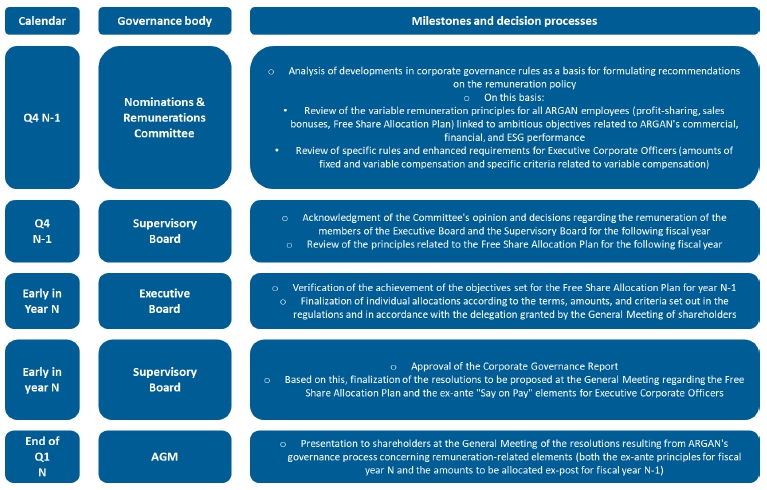
157
Remuneration structure of members of the Executive Board
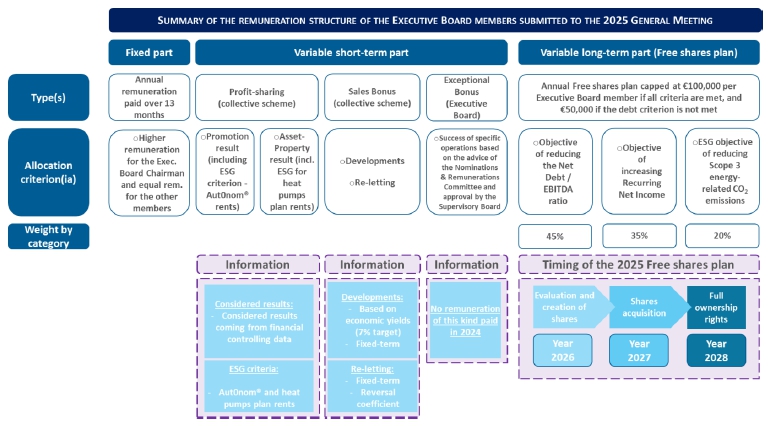
Remuneration structure of the Supervisory Board
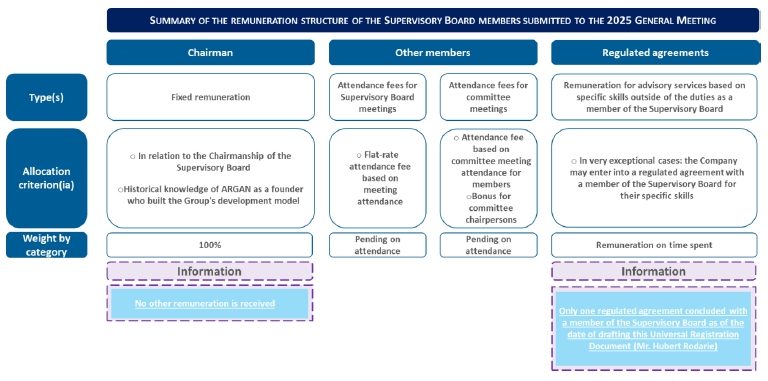
158
5.2.2. Approval of the remuneration policy for the Company’s corporate officers (7th and 10th resolutions of the Combined General Meeting)
In accordance with Articles L.22-10-26 and R.22-10-18 of the French Commercial Code, shareholders will be asked at the Combined General Meeting of 20 March 2025 (the “Combined General Meeting”) to approve the remuneration policy for the Company’s corporate officers (members of the Executive Board and members of the Supervisory Board).
It is the Supervisory Board’s view that the remuneration policy for the Company’s corporate officers is consistent with the Company’s corporate interest and contributes to its sustainability and business strategy because (i) it is based on the ongoing pursuit of a balance between the company’s interests, recognition of executives’ performance and consistency in remuneration practices and (ii) as well as fostering loyalty amongst Argan’s staff, the aim when setting remuneration is to reward performance and promote the Company’s own exacting standards.
The Supervisory Board reviews the remuneration policy for the Company’s corporate officers annually (setting the remuneration for the members of the Executive Board, the remuneration of the Chairman of the Supervisory Board and putting forward proposals for setting the overall remuneration of the members of the Supervisory Board). The Appointments and Remuneration Committee has been involved in making recommendations to the Supervisory Board in the areas referred to in section 5.1.3.7.2 of the Universal Registration Document.
5.2.2.1. Elements of the remuneration policy applicable specifically to members of the Executive Board for their term of office
All members of the Executive Board are employees of the Company and their remuneration is set individually by the Supervisory Board. The elements of remuneration for members of the Executive Board for their term of office are set out below.
Fixed remuneration
The fixed remuneration of the members of the Executive Board is decided annually on an individual basis by the Supervisory Board depending on the member’s responsibilities.
The Supervisory Board meeting of 10 December 2024, on the recommendation of the Appointments and Remuneration Committee, approved the annual fixed remuneration of the members of the Executive Board applicable from 1 January 2025 for the entire year:
| ● | The fixed annual remuneration for Mr Ronan Le Lan, Chairman of the Executive Board, was €250,000 as at 1 January 2025; |
| ● | The fixed annual remuneration for Mr Francis Albertinelli, member of the Executive Board, was €239,000 as at 1 January 2025; |
| ● | The fixed annual remuneration for Mr Aymar de Germay, member of the Executive Board, was €239,000 as at 1 January 2025; |
| ● | The fixed annual remuneration for Mr Stéphane Cassagne, member of the Executive Board, was €239,000 as at 1 January 2025. |
In the event of the departure of a member of the Executive Board, any new member appointed as a replacement shall receive fixed remuneration identical to that of the replaced member (pro rata temporis). In the event of the appointment of an additional member of the Executive Board, the fixed remuneration of the latter may not exceed the highest fixed remuneration received by a member of the Executive Board (i.e. for the 2025 financial year, a maximum of €250,000).
Annual variable remuneration
Members of the Executive Board do not receive annual variable remuneration.
Exceptional remuneration
The Supervisory Board may decide to allocate exceptional remuneration to one or more members of the Executive Board, linked to the success of specific transactions carried out by the Company and at the recommendation of the Appointments and Remuneration Committee.
It should be noted that no exceptional remuneration was granted to any of the members of the Executive Board for the financial year ended 31 December 2024.
159
Other benefits of any kind
The Supervisory Board may provide members of the Executive Board with a company car.
End of the three-year free share plan (2022-2024)
As a reminder, on 9 February 2022, the Supervisory Board decided to implement a 2022-2023-2024 plan for the free allocation of shares to all employees, including members of the Executive Board, and subject to value creation over the period in question based on four indicators:
| ● | The property developer’s margin generated during the three financial years in question on completed and delivered developments, equal to the difference between the cost price and the market value of each development; |
| ● | The gain or loss on purchase, calculated as the difference between the appraised market value of any warehouse purchased and its purchase price; |
| ● | Growth in recurring income, i.e. net income excluding changes in fair value on investment properties and debt hedging properties (and excluding gains or losses on disposals); |
| ● | And the loss generated as a result of any vacancy. |
The maximum number of shares that may be awarded under this three-year plan to all beneficiaries has been set at 55,000 shares. It was definitively approved by the Executive Board on 13 January 2025 on the basis of the average share price in the fourth quarter of 2024 (€66.67).
As a reminder, an initial portion assessed at 25% of the total distributable amount was allocated to beneficiaries in January 2023, a second equivalent portion was allocated in January 2024 and the balance was allocated to beneficiaries in January 2025.
This free share allocation contributes to the objectives of the remuneration policy in that it gives each member of the Executive Board (and each employee beneficiary) an increased stake in the Company’s development and in improving its performance, including over the long term.
The aforementioned free share allocation scheme stipulates a one-year vesting period and a one-year retention period for each member of the Executive Board. It should be noted that the Supervisory Board has decided not to set any minimum amount of shares granted free of charge that the corporate officers would be required to retain in registered form until they cease to hold office.
On 13 January 2025, the Executive Board, after having verified, at the end of the three-year period, the achievement of the targets set, decided to allocate the following amounts in share equivalents and in proportion to the time of attendance to each of the four members of the Executive Board:
| ● | Mr Ronan Le Lan: €246,946, or 3,704 shares |
| ● | Mr Francis Albertinelli: €246,946, or 3,704 shares |
| ● | Mr Aymar de Germay: €130,073, or 1,951 shares |
| ● | Mr Stéphane Cassagne: €33,735, or 506 shares |
It should be noted that in accordance with the terms of the Plan, these free shares may only vest to their allottees on expiry of a period of one year after their allocation date, i.e. on 13 January 2026.
2025 Free Share Allocation Plan
After an initial three-year Free Share Allocation plan for 2022-2023-2024 open to all employees contributing to the company’s development, ARGAN’s Management decided to renew this incentive scheme on an annual basis both for members of the Executive Board and all employees of the property company.
In accordance with the 16th resolution of the General Meeting of 21 March 2024, on the proposal of the Executive Board and after the favourable opinion of the Appointments and Remuneration Committee, meeting on 29 November 2024, the Supervisory Board, meeting on 10 December 2024, approved the regulations for this annual free share allocation plan.
For each member of the Executive Board, the scheme is capped at €100,000 to be converted into shares based on the average share price for the fourth quarter of 2025. It should also be noted that any person who becomes a member of the Executive Board during this financial year could benefit from this free share plan, under the same conditions and in proportion to their presence during this financial year.
160
It is based on three performance criteria specific to the Executive Board determined according to the company’s strategy:
| ● | The decrease in debt (financial criterion), with the net debt-to-EBITDA ratio as an indicator: 45% of the budget; |
| ● | Growth (financial criterion), with the increase in recurring net income as an indicator: 35% of the budget; |
| ● | Sustainability (ESG criterion), with the reduction of CO2 emissions measured for Scope 3 energy: 20% of the budget. |
It is also specified that if the net debt-to-EBITDA ratio is greater than or equal to 9, the amount allocated to each member of the Executive Board for the criteria for growth and reduction of CO2 emissions will be capped at €50,000, even if the targets for growth and/or reduction of CO2 emissions are met or even exceeded.
Group bonuses and profit-sharing agreements
Annual profit-sharing
Each member of the Executive Board may receive a payout under the group employee profit-sharing agreement set up within the Company and concluded for the 2025 financial year. This profit-sharing agreement provides for the allocation of an incentive bonus to employees and members of the Company’s Executive Board that is intended to involve them in the development and improvement of performance, the maximum amount of which is equal to two months’ salary of the beneficiary and depends on the level of the property developer margin generated over the financial year in question and the occupancy rate of the warehouses.
The equivalent of two months’ salary was thus paid in respect of the 2024 profit-sharing plan. For 2025, a new annual plan has been defined with new performance criteria.
Profit-sharing is based on management control results for:
| ● | Development, including an energy/ESG criterion (rents from Aut0nom® warehouses); |
| ● | Property and Asset Management, including an energy/ESG criterion (deployment of the PAC Plan). |
The amount distributed in respect of annual profit-sharing is equal to 5% of the cumulative income (Promotion + Asset/Property) converted into months of salary and allocated to each employee, or member of the Executive Board, in proportion to their salary with a cap of two months.
Commercial bonuses
In addition, each member of the Executive Board may receive a payout under the all-employee group bonus scheme. The scheme was set up within the Company for the 2025 financial year and depends on rental returns and the amount of rent generated by new development leases signed in 2025.
The amount of this collective bonus is the same for all employees and members of the Executive Board, and amounted to €31,492 for the 2024 financial year.
Terms of office and employment contracts
The term of office of each member of the Executive Board is two years. Each member of the Executive Board also has a permanent employment contract.
Each member of the Executive Board may be removed from office under the conditions laid down in ordinary law (the General Shareholders’ Meeting or the Supervisory Board is competent in this matter). If a member of the Executive Board is removed from office, this does not terminate his employment contract. Such termination may take place under the conditions of ordinary law (notice period and reasons).
None of the members of the Executive Board has entered into a service agreement with the Company.
161
Other
It should be noted that none of the members of the Executive Board receives any remuneration, compensation or benefits payable or likely to be payable as a result of termination or a change of duties or subsequent thereto, or any conditional rights granted under defined benefit pension liabilities with the characteristics of the plans mentioned in Articles L.137-11 and L.137-11-2 of the French Social Security Code.
5.2.2.2. Elements of the remuneration policy applicable specifically to members of the Supervisory Board for their office
Remuneration for the members of the Supervisory Board takes the form of a fixed overall sum which is allocated by the General Shareholders’ Meeting and then divided up by the Supervisory Board between its members (with the exception of the Chairman of the Board, who does not receive such remuneration). Mr Jean-Claude Le Lan receives fixed remuneration in his capacity as Chairman of the Supervisory Board.
Annual fixed amount allocated by the General Shareholders’ Meeting
The Supervisory Board sets the amount to be allocated to its members based on the overall amount decided by the General Meeting and in proportion to their actual presence at the Board meetings.
The fixed overall amount allocated for financial year 2025 is covered by the 18th resolution submitted for the approval of the Combined General Meeting of 20 March 2025.
On 29 November 2024, the Appointments and Remuneration Committee proposed setting this amount at €165,600 (versus €185,850 in 2024) for the financial year beginning on 1 January 2025, i.e. an amount €20,250 lower than the amount decided for the 2024 financial year, it being specified that the Supervisory Board determined the distribution of this amount among its members on the following basis:
| ● | a base of €3,250 (€3,150 previously) per member present per meeting of the Supervisory Board (six meetings planned, including two with eight members and four with six members), it being specified that the Chairman of the Board is not remunerated in this respect and that it is planned to reduce the Supervisory Board to six members instead of eight after the 2025 General Meeting; |
| ● | a base of €2,700 (previously €2,650) per member present per committee meeting (three meetings planned per committee), it being specified that an exceptional annual remuneration of €3,250 (previously €3,150) is allocated in addition to the €2,700 base for the Chairs of each of the two Committees. |
Fixed remuneration of the Chairman of the Supervisory Board
In his capacity as Chairman of the Supervisory Board, Mr Jean-Claude Le Lan receives annual fixed remuneration of €96,000 as at 1 January 2025 (amount unchanged). This remuneration may be reviewed annually by the Supervisory Board.
Exceptional remuneration
In accordance with Article 27 of the Company’s Articles of Association, the Supervisory Board may allocate exceptional remuneration to its members in the cases and under the conditions provided for by law.
Other benefits of any kind
The Supervisory Board may provide the Chairman of the Supervisory Board with a company car.
Terms of office and employment contracts
Members of the Supervisory Board are appointed for a term of four years.
Each member of the Supervisory Board may be removed from office under the conditions laid down in ordinary law (the General Shareholders’ Meeting is competent in this matter).
162
Mr Jean-Claude Le Lan Junior has an employment contract with the Company, the continuation of which was decided by the Supervisory Board with effect from the appointment of the latter by the General Meeting of 24 March 2022 as a member of the Supervisory Board.
In addition, Mr Nicolas Le Lan, also a member of the Supervisory Board1, entered into an employment contract, which effect on 6 April 2024. In both cases, the Supervisory Board verified that these employment contracts corresponded to functions distinct from their mandate as a member of the Supervisory Board, in accordance with the provisions of Article L.225-85 of the French Commercial Code.
None of the other members of the Supervisory Board has an employment contract with the Company, with the exception of Mr Hubert Rodarie2, or has entered into a service agreement with the Company.
Other
It is specified that, where applicable, none of the members of the Supervisory Board receives any remuneration, compensation or benefits payable or likely to be payable as a result of termination of his/her mandate or subsequent thereto, or any conditional rights granted under defined benefit pension liabilities with the characteristics of the plans mentioned in Articles L. 137-11 and L.137-11-2 of the French Social Security Code.
5.2.3. Approval of the report on the remuneration of the Company’s corporate officers and the elements of the remuneration paid or allocated for the financial year ended 31 December 2024 (11th to 17th resolutions)
In accordance with the provisions of Article L.22-10-34-I of the French Commercial Code, the Combined General Meeting of shareholders convened for 20 March 2025 must decide on a draft resolution concerning the information mentioned in Article L.22-10-9, I of the said Code. This information concerns each corporate officer, including corporate officers whose term of office ended and those newly appointed during the 2024 financial year.
In addition, in accordance with the provisions of Article L.22-10-34 II of the French Commercial Code, the shareholders must also approve separate resolutions stipulating the fixed, variable and exceptional elements of total remuneration and benefits of any kind paid in 2024 or allocated for that financial year for the Chairman of the Supervisory Board, the Chairman of the Executive Board and the other members of the Executive Board.
Consequently, the sub-sections below contain the information required under the aforementioned statutory provisions and also specify, for each of provision, the relevant resolutions of the Combined General Meeting of 20 March 2025.
5.2.3.1. Remuneration components paid or granted in respect of the financial year ended 31 December 2024 to Mr Ronan Le Lan as Chairman of the Executive Board (11th and 12th resolutions)
| Components of remuneration | Amounts | Description | ||||||
| A. | Fixed remuneration | € | 233,110 | Fixed annual remuneration of €215,184 and a 13th month of €17,932. | ||||
| B. | Annual variable remuneration | NA | No annual variable remuneration | |||||
| C. | Deferred variable remuneration | NA | No deferred variable remuneration | |||||
| D. | Multi-year variabl remuneration | NA | No multi-year variable remuneration | |||||
| E. | Exceptional remuneration | NA | No exceptional remuneration | |||||
| 1 | Until the General Meeting of 20 March 2025. |
| 2 | See paragraph 5.1.6. |
163
| Components of remuneration | Amounts | Description | ||||||
| F. | Argan purchase options | NA | No purchase options | |||||
| G. | Free allocation of Argan shares subject to performance conditions | € | 246,946 | Balance of the three-year plan granted for the 2024 financial year (3,704 shares) | ||||
| H. | Attendance fees | NA | No attendance fees. | |||||
| I. | Value of benefits of any kind | NA | No benefits of any kind | |||||
| J. | Severance pay | NA | No severance pay | |||||
| K. | Non-compete payment | NA | No non-compete payment | |||||
| L. | Supplementary pension plan | NA | No supplementary pension plan | |||||
| M. | Group schemes | € | 66,268 | Remuneration related to the application of the group profit-sharing agreement (€34,776) and the allocation of the group bonus linked to the signature of new leases (€31,492). | ||||
5.2.3.2. Remuneration components paid or granted in respect of the financial year ended 31 December 2024 to Mr Francis Albertinelli as member of the Executive Board (11th and 13th resolutions)
| Components of remuneration | Amounts | Description | ||||||
| A. | Fixed remuneration | € | 226,044 | Fixed annual remuneration of €208,656 and a 13th month of €17,388 | ||||
| B. | Annual variable remuneration | NA | No annual variable remuneration | |||||
| C. | Deferred variable remuneration | NA | No deferred variable remuneration | |||||
| D. | Compensation - multi-annual variable | NA | No multi-year variable remuneration | |||||
| E. | Exceptional remuneration | NA | No exceptional remuneration | |||||
| F. | Argan purchase options | NA | No purchase options | |||||
| G. | Free allocation of Argan shares subject to performance conditions | € | 246,946 | Balance of the three-year plan granted for the 2024 financial year (3,704 shares) | ||||
| H. | Attendance fees | NA | No attendance fees. | |||||
| I. | Value of benefits of any kind | NA | No benefits of any kind | |||||
164
| Components of remuneration | Amounts | Description | ||||||
| J. | Severance pay | NA | No severance pay | |||||
| K. | Non-compete payment | NA | No non-compete payment | |||||
| L. | Supplementary pension plan | NA | No supplementary pension plan | |||||
| M. | Group schemes | € | 66,268 | Remuneration related to the application of the group profit-sharing agreement (€34,776) and the allocation of the group bonus linked to the signature of new leases (€31,492). | ||||
5.2.3.3. Remuneration components paid or granted in respect of the financial year ended 31 December 2024 to Mr Frédéric Larroumets as member of the Executive Board (11th and 14th resolutions)
Member of the Executive Board until 28 March 2024 (resignation) – The remuneration indicated below relates to 2024 as a whole
| Components of remuneration | Amounts | Description | ||||||
| A. | Fixed remuneration | € | 168,705 | Fixed annual remuneration of €155,664 (9 months) and a 13th month of €13,041 | ||||
| B. | Annual variable remuneration | NA | No annual variable remuneration | |||||
| C. | Deferred variable remuneration | NA | No deferred variable remuneration | |||||
| D. | Compensation - multi-annual variable | NA | No multi-year variable remuneration | |||||
| E. | Exceptional remuneration | NA | No exceptional remuneration | |||||
| F. | Argan purchase options | NA | No purchase options | |||||
| G. | Free allocation of Argan shares subject to performance conditions | NA | Left the company. | |||||
| H. | Attendance fees | NA | No attendance fees. | |||||
| I. | Value of benefits of any kind | NA | No benefits of any kind | |||||
| J. | Severance pay | NA | No severance pay | |||||
| K. | Non-compete payment | NA | No non-compete payment | |||||
| L. | Supplementary pension plan | NA | No supplementary pension plan | |||||
| M. | Group schemes | € | 40,189 | Remuneration related to the application of the group profit-sharing agreement (€25,955) and the allocation of the group bonus linked to the signature of new leases (€14,234) | ||||
165
5.2.3.4. Remuneration components paid or granted in respect of the financial year ended 31 December 2024 to Mr Aymar de Germay as member of the Executive Board (11th and 15th resolutions)
Member of the Executive Board since 18 April 2024 – The remuneration indicated below relates to 2024 as a whole.
| Components of remuneration | Amounts | Description | ||||||
| A. | Fixed remuneration | € | 220,224 | Fixed annual remuneration of €203,224 and a 13th month of €17,388 | ||||
| B. | Annual variable remuneration | NA | No annual variable remuneration | |||||
| C. | Deferred variable remuneration | NA | No deferred variable remuneration | |||||
| D. | Compensation - multi-annual variable | NA | No multi-year variable remuneration | |||||
| E. | Exceptional remuneration | NA | No exceptional remuneration | |||||
| F. | Argan purchase options | NA | No purchase options | |||||
| G. | Free allocation of Argan shares subject to performance conditions | € | 130,073 | Balance of the three-year plan granted for the 2024 financial year (1,951 shares) | ||||
| H. | Attendance fees | NA | No attendance fees. | |||||
| I. | Value of benefits of any kind | NA | No benefits of any kind | |||||
| J. | Severance pay | NA | No severance pay | |||||
| K. | Non-compete payment | NA | No non-compete payment | |||||
| L. | Supplementary pension plan | NA | No supplementary pension plan | |||||
| M. | Group schemes | € | 65,422 | Remuneration related to the application of the group profit-sharing agreement (€33,930) and the allocation of the group bonus linked to the signature of new leases (€31,492) | ||||
166
5.2.3.5. Remuneration components paid or granted in respect of the financial year ended 31 December 2024 to Mr Stéphane Cassagne as member of the Executive Board (11th and 16th resolutions)
Member of the Executive Board since 1 September 2024 – The remuneration indicated below relates to 2024 as a whole.
| Components of remuneration | Amounts | Description | ||||||
| A. | Fixed remuneration | € | 94,488 | Fixed annual remuneration of €85,522 and a 13th month of €8,966 | ||||
| B. | Annual variable remuneration | NA | No annual variable remuneration | |||||
| C. | Deferred variable remuneration | NA | No deferred variable remuneration | |||||
| D. | Compensation - multi-annual variable | NA | No multi-year variable remuneration | |||||
| E. | Exceptional remuneration | NA | No exceptional remuneration | |||||
| F. | Argan purchase options | NA | No purchase options | |||||
| G. | Free allocation of Argan shares subject to performance conditions | € | 33,735 | Balance of the three-year plan granted for the 2024 financial year (506 shares) | ||||
| H. | Attendance fees | NA | No attendance fees. | |||||
| I. | Value of benefits of any kind | NA | No benefits of any kind | |||||
| J. | Severance pay | NA | No severance pay | |||||
| K. | Non-compete payment | NA | No non-compete payment | |||||
| L. | Supplementary pension plan | NA | No supplementary pension plan | |||||
| M. | Group schemes | € | 31,795 | Remuneration related to the application of the group profit-sharing agreement (€14,537) and the allocation of the group bonus linked to the signature of new leases (€17,258) | ||||
5.2.3.6. Components of the remuneration paid or allocated for the financial year ended 31 December 2024 to Mr Jean-Claude Le Lan as Chairman of the Supervisory Board (11th and 17th resolutions)
| Components of remuneration | Amounts | Description | ||||||
| A. | Fixed remuneration | € | 96,000 | As Chairman of the Supervisory Board, Mr Jean-Claude Le Lan is entitled to annual fixed remuneration of €96,000. | ||||
| B. | Annual variable remuneration | NA | No annual variable remuneration | |||||
| C. | Deferred variable remuneration | NA | No deferred variable remuneration | |||||
167
| Components of remuneration | Amounts | Description | ||||||
| D. | Multi-year variable remuneration | NA | No multi-year variable remuneration | |||||
| E. | Exceptional remuneration | NA | No exceptional remuneration | |||||
| F. | Argan purchase options | NA | No purchase options | |||||
| G. | Free allocation of Argan shares subject to performance conditions | NA | No free share allocation | |||||
| H. | Attendance fees | NA | No attendance fees. | |||||
| I. | Value of benefits of any kind | NA | No benefits of any kind | |||||
| J. | Severance pay | NA | No severance pay | |||||
| K. | Non-compete payment | NA | No non-compete payment | |||||
| L. | Supplementary pension plan | NA | No supplementary pension plan | |||||
| M. | Group schemes | NA | No Group scheme | |||||
5.2.3.7. Information referred to in Article L.22-10-9 concerning the remuneration allocated to members of the Supervisory Board (11th resolution)
For each of the members of the Supervisory Board other than Mr Jean-Claude Le Lan, Chairman of the Supervisory Board (see Section 5.2.3.6 above in relation to him), only the overall remuneration allocated by the General Shareholders’ Meeting pursuant to Articles L.225-83 and L.22-10-27 of the French Commercial Code is relevant in respect of the information required by Article L.22-10-9 of that Code. The table below provides this information in detail for 2024:
| Members of the Supervisory Board | Role | Amount of remuneration referred to in Articles L.225-83 and L.22-10-27 of the French Commercial Code for the 2024 financial year | ||||
| Mr Hubert Rodarie | Vice-Chairman | € | 34,125 | |||
| Mr Nicolas Le Lan | Member | € | 15,750 | |||
| Mr Jean-Claude Le Lan Junior | Member | € | 15,750 | |||
| Mr François Régis de Causans | Independent member | € | 12,600 | |||
| Mrs Florence Soule de Lafont | Independent member | € | 26,250 | |||
| Ms Constance de Poncins | Independent member | € | 23,625 | |||
| Predica, represented by Mrs Najat Aasqui | Member | € | 28,350 | |||
| TOTAL | € | 156,450 | ||||
168
5.2.3.8. Undertakings of any kind made by the Company and corresponding to elements of remuneration, compensation or benefits payable or likely to be payable as a result of taking, leaving or changing office or subsequent thereto (Art. L.22-10-9 of the French Commercial Code) (11th resolution)
There are no undertakings of any kind made for the benefit of the Company’s corporate officers for elements of remuneration, compensation or benefits payable or likely to be payable as a result of taking, leaving or changing office or subsequent thereto.
5.2.3.9. Information referred to in Article L.22-10-9, 6° of the French Commercial Code for the Chairman of the Supervisory Board and each member of the Executive Board (11th resolution)
In accordance with Article L.22-10-9, 6° of the French Commercial Code, the table below shows, for the Chairman of the Supervisory Board and each member of the Executive Board, the ratios for 2024 between the level of remuneration of each of these executives and, on the one hand, (i) the average remuneration on a full-time equivalent basis of the Company’s employees other than corporate officers and on the other, (ii) the median remuneration on a full-time equivalent basis of the Company’s employees other than corporate officers and (iii) the lowest total remuneration within the Company.
The compensation of directors used for the purposes of this table includes all components of compensation paid (fixed remuneration and group schemes). For employees, remuneration is calculated on a full-time equivalent basis and includes all components of compensation paid (fixed remuneration, variable compensation and group schemes).
Given the Company’s remuneration policy, no ratio is presented between the remuneration of executive corporate officers and the minimum wage, which is significantly lower than the Company’s lowest remuneration.
| Corporate officer | Ratio (financial year 2024) of Company’s employees (other (“RMO ratio”) | Ratio (financial year 2024) of remuneration of the (“RME ratio”) | Ratio (financial year 2024) Total remuneration of the corporate officer/lowest total remuneration of the Company (other than corporate officers) | ||||||
| Mr Jean-Claude Le Lan, Chairman of the Supervisory Board | 0.7 | 0.8 | 1.3 | ||||||
| Mr Ronan Le Lan, Chairman of the Executive Board | 2.2 | 2.4 | 4.1 | ||||||
| Mr Francis Albertinelli, Member of the Executive Board | 2.2 | 2.4 | 4 | ||||||
| Mr
Frédéric Larroumets, Member of the Executive Board (Until 28/03/2024) | 2.1 | 2.2 | 3.8 | ||||||
| Mr
Aymar de Germay Member of the Executive Board (since 18 April 2024) | 2.1 | 2.3 | 3.9 | ||||||
| Mr
Stéphane Cassagne, Member of the Executive Board (since 1 Sep. 2024) | 1.9 | 2.0 | 3.5 |
169
5.2.3.10. Information referred to in Article L.22-10-9 of the French Commercial Code (11th resolution)
In accordance with Article L.22-10-9 of the French Commercial Code, the table below shows the annual change in remuneration, in the Company’s performance and in average remuneration on a full-time equivalent basis of the Company’s employees other than executives, and the ratios mentioned in section 5.2.3.9 of this Universal Registration Document, for financial years 2020 to 2024:
| Financial year 2020 | Financial year 2021 | Financial year 2022 | Financial year 2023 | Financial year 2024 | ||||||||||||||||
| 1. Overall remuneration allocated by the General Shareholders’ Meeting to members of the Supervisory Board (Article L.225-83 of the French Commercial Code) and distributed by the Supervisory Board | ||||||||||||||||||||
| Mr Jean-Claude Le Lan, Chairman | N/A | N/A | N/A | N/A | N/A | |||||||||||||||
| Mr Hubert Rodarie, Vice-Chairman1 | N/A | € | 11,000 | € | 27,500 | € | 25,000 | € | 34,125 | |||||||||||
| Mr Nicolas Le Lan | € | 12,000 | € | 12,000 | € | 12,000 | € | 15,000 | € | 15,750 | ||||||||||
| Mr Jean-Claude Le Lan Junior | N/A | N/A | € | 9,000 | € | 15,000 | € | 15,750 | ||||||||||||
| Mr François-Régis de Causans | € | 33,000 | € | 22,000 | € | 17,500 | € | 15,000 | € | 12,600 | ||||||||||
| Mrs Florence Soule de Lafont | € | 25,500 | € | 22,500 | € | 25,500 | € | 17,500 | € | 26,250 | ||||||||||
| Mrs Constance de Poncins | € | 11,500 | € | 22,500 | € | 25,500 | € | 25,500 | € | 23,625 | ||||||||||
| Predica, represented by Mrs Najat Aasqui | N/A | € | 27,000 | € | 27,000 | € | 25,000 | € | 28,350 | |||||||||||
2. Remuneration of the Chairman of the Supervisory Board (Art. L.225-81 and L.22-10-25 of the French Commercial Code)
| Mr Jean-Claude Le Lan, Chairman | € | 96,000 | € | 96,000 | € | 96,000 | € | 96,000 | € | 96,000 |
| 1 | Since the General Meeting of 25 March 2021. |
170
| Financial year 2020 | Financial year 2021 | Financial year 2022 | Financial year 2023 | Financial year 2024 | ||||||||||||||||||
| 3. Remuneration of the members of the Executive Board | ||||||||||||||||||||||
| Mr Ronan Le Lan, Chairman | ||||||||||||||||||||||
| - | Fixed remuneration | € | 160,000 | € | 214,500 | € | 214,500 | € | 225,225 | € | 233,110 | |||||||||||
- | Value of free share allocation (performance condition) | N/A | € | 605,854 | € | 112,500 | € | 112,500 | € | 246,946 | ||||||||||||
| - | Group schemes | € | 39,219 | € | 62,129 | € | 50,490 | € | 64,533 | € | 66,268 | |||||||||||
| Mr Francis Albertinelli | ||||||||||||||||||||||
| - | Fixed remuneration | € | 160,000 | € | 173,342 | € | 208,000 | € | 218,400 | € | 226,044 | |||||||||||
- | Value of free share allocation (performance condition) | N/A | 605,854 | € | 112,500 | € | 112,500 | € | 246,946 | |||||||||||||
| - | Exceptional remuneration | N/A | N/A | N/A | N/A | N/A | ||||||||||||||||
| - | Group schemes | € | 39,298 | € | 58,043 | € | 49,490 | € | 63,491 | € | 66,268 | |||||||||||
| Frédéric Larroumets (member of the Executive Board until 28 March 2024) | ||||||||||||||||||||||
| - | Fixed remuneration | € | 160,000 | € | 173,342 | € | 208,000 | € | 218,400 | € | 168,705 | |||||||||||
- | Value of free share allocation (performance condition) | N/A | € | 605,854 | € | 112,500 | € | 112,500 | € | 0 | ||||||||||||
| - | Exceptional remuneration | N/A | N/A | € | 150,000 | N/A | N/A | |||||||||||||||
| - | Group schemes | € | 39,219 | € | 58,007 | € | 49,490 | € | 63,144 | € | 40,189 | |||||||||||
| Mr Aymar de Germay (member of the Executive Board since 18 April 2024) | ||||||||||||||||||||||
| - | Fixed remuneration | N/A | N/A | N/A | N/A | € | 220,224 | |||||||||||||||
- | Value of free share allocation (performance condition) | N/A | N/A | N/A | N/A | € | 130,073 | |||||||||||||||
| - | Exceptional remuneration | N/A | N/A | N/A | N/A | N/A | ||||||||||||||||
| - | Group schemes | N/A | N/A | N/A | N/A | € | 65,422 | |||||||||||||||
| Stéphane Cassagne (member of the Executive Board since 1 September 2024) | ||||||||||||||||||||||
| - | Fixed remuneration | N/A | N/A | N/A | N/A | € | 103,454 | |||||||||||||||
- | Value of free share allocation (performance condition) | N/A | N/A | N/A | N/A | € | 33,735 | |||||||||||||||
| - | Exceptional remuneration | N/A | N/A | N/A | N/A | N/A | ||||||||||||||||
| - | Group schemes | N/A | N/A | N/A | N/A | € | 31,795 | |||||||||||||||
| 4. Company’s performance | ||||||||||||||||||||
| Consolidated net income (in millions of €) | 279 | 676 | 95 | -266 | 250 | |||||||||||||||
| Recurring net income (in millions of €) | 103 | 112 | 120 | 126 | 138 | |||||||||||||||
| NAV EPRA NRV /share (€) | 73 | 103 | 105 | 91 | 97 | |||||||||||||||
| 5. Average remuneration (fixed + variable + group scheme) on a full-time equivalent basis of the Company’s employees other than executives | ||||||||||||||||||||
| Annual amount | € | 94,575 | € | 119,185 | € | 119,463 | € | 137,508 | € | 134,957 | ||||||||||
171
| Financial
year 2020 | Financial
year 2021 | Financial
year 2022 | Financial
year 2023 | Financial
year 2024 | ||||||
| 6. RMO and RME ratios | ||||||||||
| RMO ratio | ||||||||||
| Mr Jean-Claude Le Lan, Chairman of the Supervisory Board | 1.0 | 0.8 | 0.8 | 0.6 | 0.7 | |||||
| Mr Ronan Le Lan, Chairman of the Exec. Board | 2.1 | 2.3 | 2.2 | 2.4 | 2.2 | |||||
| Mr Francis Albertinelli, member of the Exec. Board | 2.1 | 1.9 | 2.1 | 2.4 | 2.2 | |||||
| Mr Frédéric Larroumets, member of the Exec. Board | 2.1 | 1.9 | 3.3 | 2.4 | 2.1 | |||||
| Mr Aymar de Germay, member of the Exec. Board | / | / | / | / | 2.1 | |||||
| Stéphane Cassagne, member of the Exec. Board | / | / | / | / | 1.9 | |||||
| RME ratio | ||||||||||
| Mr Jean-Claude Le Lan, Chairman of the Supervisory Board | 1.1 | 0.8 | 0.9 | 0.7 | 0.8 | |||||
| Mr Ronan Le Lan, Chairman of the Exec. Board | 2.3 | 2.4 | 2.4 | 2.8 | 2.4 | |||||
| Mr Francis Albertinelli, member of the Exec. Board | 2.3 | 2.0 | 2.4 | 2.7 | 2.4 | |||||
| Mr Frédéric Larroumets, member of the Exec. Board | 2.3 | 2.0 | 3.7 | 2.7 | 2.2 | |||||
| Mr Aymar de Germay, member of the Exec. Board | / | / | / | / | 2.3 | |||||
| Stéphane Cassagne, member of the Exec. Board | / | / | / | / | 2.0 | |||||
| Ratio of total remuneration of the corporate officer/lowest total remuneration of the Company (other than corporate officers) | ||||||||||
| Mr Jean-Claude Le Lan, Chairman of the Supervisory Board | / | / | / | / | 1.3 | |||||
| Mr Ronan Le Lan, Chairman of the Exec. Board | / | / | / | / | 4.1 | |||||
| Mr Francis Albertinelli, member of the Exec. Board | / | / | / | / | 4.0 | |||||
| Mr Frédéric Larroumets, member of the Exec. Board | / | / | / | / | 3.8 | |||||
| Mr Aymar de Germay, member of the Exec. Board | / | / | / | / | 3.9 | |||||
| Stéphane Cassagne, member of the Exec. Board | / | / | / | / | 3.5 | |||||
In accordance with Article L.22-10-9 of the French Commercial Code, it should be noted that the remuneration for each of the Company’s corporate representatives for the 2024 financial year as presented in this document complies with the Company’s remuneration policy for the said financial year.
Contribution to the Company’s long-term performance is ensured by the ongoing pursuit of a balance between the company’s interests, recognition of executives’ performance and consistency in remuneration practices. As well as fostering loyalty amongst Argan’s staff, the aim when setting remuneration is to reward performance and promote the Company’s own exacting standards.
172
5.3. Additional information on Corporate Governance
5.3.1. Use of delegations of authority to the Executive Board
Section 5.4 of this Universal Registration Document includes a table of the current delegations of authority granted by the General Shareholders’ Meeting in respect of capital increases pursuant to Articles L.225-129-1 and L.225-129-2.
In 2024, the Executive Board used the delegations of authority granted by the General Shareholders’ Meeting as follows:
Meeting of the Executive Board held on 15 January 2024:
| ● | Decision on the definitive allocation of the Free Shares in respect of the first advance payment of the 2022-2024 Plan; | |
| ● | Recognition of the Company’s capital increase by incorporation into the capital of a nominal amount of €25,362 deducted from “Issue premiums” representing 12,681 new shares, each with a nominal value of €2; | |
| ● | Consequently, resolution to increase the Company’s share capital to €46,184,756. |
Meeting of the Executive Board held on 18 April 2024:
| ● | Recognition of the increase in the Company’s share capital resulting from the option given to shareholders to receive payment of the dividend in the form of shares, amounting to €566,534, corresponding to the creation of 283,267 new shares each with a nominal value of €2; | |
| ● | Consequently, resolution to increase the Company’s share capital from €46,184,756 to €46,751,290; | |
| ● | Resolution to include the amount of the share premium, i.e. €19,627,570.43, in the special “issue premium” account as a liability of the Company; | |
| ● | Resolution to carry out a capital increase with cancellation of preferential subscription rights and by way of a private placement for a maximum amount of €200m within the limit of a unit subscription price at least equal to the weighted average price of the last three trading sessions preceding the launch of the Placement less a maximum discount of 10%; | |
| ● | Resolution to authorise Mr Ronan Le Lan, as Chairman of the Executive Board, with the right to sub-delegate, in accordance with the applicable laws and regulations, to one or more other members of the Executive Board, acting together or separately, to decide to launch the Placement and issue shares, or to postpone it, to set the final terms of the Placement and to carry out the issuance of shares or, where applicable, postpone it. |
Meeting of the Executive Board held on 4 June 2024:
| ● | The Chairman informed the members of the Executive Board that, on 23 April 2024, he had used the delegation granted by the Executive Board on 18 April 2024, and had therefore decided to issue 2,027,028 new ordinary shares, at a unit issue price of €74, this price being at least equal to the minimum price approved by the Shareholders’ Meeting. The total gross proceeds from the capital increase thus came to €150,000,072, comprising a nominal capital increase of €4,054,056 and a total issue premium of €145,946,016; | |
| ● | The Executive Board noted the completion of the capital increase on 26 April 2024, as shown by the depositary certificate drawn up by Uptevia on that date, and consequently the issuance of 2,027,028 new ordinary shares, fully paid up in cash; | |
| ● | As a result, the Capital Increase was definitively completed and the share capital was consequently increased from €46,751,290, divided into 23,375,645 ordinary shares with a nominal value of €2, to €50,805,346, divided into 25,402,673 ordinary shares with a nominal value of €2 each; | |
| ● | Resolves (i) to supplement the supplementary report, relating to the issuance of 2,027,028 new ordinary shares by public offering reserved for qualified investors to report on the use of the delegation granted by the General Meeting under the terms of the 23rd resolution, presented to it by the Chairman of the Executive Board, with a statement on the impact of the issuance of 2,027,028 shares on the Company’s equity as at 31 December 2023 and (ii) to make several additional corrections in response to the observations made by the statutory auditors. |
173
5.3.2. Managers’ transactions on the Company’s securities
The transactions carried out by the managers on the Company’s shares during the 2024 financial year are detailed in Section 8.2.2.3 of this Universal Registration Document.
5.3.3. Additional information and observations relating to the Executive Board’s report
All shareholders are entitled to attend General Meetings, for which the rules of procedure are set out in Title IV of the Company’s Articles of Association (Articles 31 to 40).
The factors likely to have an impact in the event of a public offer, as referred to in Article L.22-10-11 of the French Commercial Code, are set out below:
| ● | (i) Structure of the Company’s share capital: See Section 8 of this Universal Registration Document | |
| ● | (ii) Restrictions on the exercise of voting rights in the Articles of Association: None | |
| ● | (iii) Direct or indirect investments in the company’s capital: See Section 8 of this Universal Registration Document | |
| ● | (iv) Holders of securities with special control rights: None | |
| ● | (v) Control mechanisms provided for in an employee shareholding system: None | |
| ● | (vi) Agreements between shareholders of which the Company is aware and which may result in restrictions on the transfer of shares and the exercise of voting rights: the agreements entered into between several shareholders of the Company and of which the Company is aware are described in more detail in Section 8.4 of this Universal Registration Document | |
| ● | (vii) Rules applicable to the appointment and replacement of members of the Executive Board as well as the amendment of the Company’s Articles of Association: There are no specific rules relating to the appointment and replacement of members of the Executive Board as well as the amendment of the Company’s Articles of Association | |
| ● | (viii) Powers of the Executive Board to issue or buy back shares: See the summary table of delegations of authority in point 5.4 below of the Universal Registration Document | |
| ● | (ix) Main agreements entered into by the Company that will be amended or terminated in the event of a change in control of the Company: as part of the bond issue of €500m carried out in 2021 and maturing in November 2026, all bondholders may request the early repayment of all amounts owed in the event of a change in control of the Company | |
| ● | (x) Agreements providing for compensation for the Company’s executives and employees, if they resign or are dismissed without real and serious grounds or if their employment ends due to a public offer: None. |
Your Supervisory Board made no comments on the Executive Board’s report or on the consolidated and company financial statements as presented.
| Neuilly sur Seine, | |
| 4 February 2025 | |
| The Supervisory Board |
174
5.4. Summary tables of valid delegations of authority submitted to the Combined General Meeting of 20 March 2025
5.4.1. Delegations of authority granted to the Executive Board by the Combined General Meeting of 23 March 2023
| Resolution | Type of authority | Maximum amount | Duration
of the authority of 23 March 2023 | |||
Purpose of the resolution adopted in the extraordinary part of the Combined General Meeting of shareholders of the Company of 23 March 2023 | ||||||
| 20th | Delegation of authority to the Executive Board for the purpose of deciding to increase the share capital by incorporating premiums, reserves, profits or other | €15,000,000
(nominal) | twenty-six
(26) months | |||
| 21st | Delegation of authority to the Executive Board to decide to issue ordinary shares and/or securities which are equity securities giving access to other equity securities or conferring entitlement to the allocation of debt securities and/or securities giving access to equity securities to be issued – with maintenance of the preferential subscription right | €25,000,000
(nominal) | twenty-six
(26) months | |||
| 22nd | Delegation of authority to the Executive Board to decide to issue ordinary shares and/or miscellaneous securities – without preferential subscription right and via a public offering other than those referred to in Article L.411-2, 1° of the French Monetary and Financial Code, or as part of a public offer including an exchange component | €20,000,000
(nominal) | twenty-six
(26) months | |||
| 23rd | Delegation of authority to the Executive Board to decide to issue ordinary shares and/or miscellaneous securities without preferential subscription rights and via an offer referred to in Article L.411-2, 1° of the French Monetary and Financial Code | 20%
of the share capital per year | twenty-six
(26) months | |||
| 24th | Authorisation granted to the Executive Board to decide to issue ordinary shares and/or miscellaneous securities and freely determine the issue price, without preferential subscription rights | 10%
of the share capital per year | twenty-six
(26) months | |||
| 25th | Authorisation granted to the Executive Board to increase the number of shares and/or securities to be issued in case of a capital increase with or without preferential subscription rights | 15%
of the initial issue | twenty-six
(26) months | |||
| 26th | Delegation of powers to the Executive Board in order to proceed, without preferential subscription rights, with the issue of ordinary shares and/or securities which are equity securities giving access to other equity securities of the Company or conferring entitlement to the allocation of debt securities and/or securities giving access to equity securities to be issued in order to remunerate contributions in kind granted to the Company up to a limit of 10% of the share capital | 10% of share capital | twenty-six (26) months |
175
| Resolution | Type of authority | Maximum amount | Duration
of the authority of 23 March 2023 | |||
| 28th | Overall cap on share capital increases that may be implemented under the delegations of authority and authorisations in force | €50,000,000
(nominal) | ||||
| 29th | Delegation of authority to the Executive Board to increase the share capital, without preferential subscription rights, by issuing ordinary shares and/or securities reserved for members of a Company Savings Plan (PEE) | €1,000,000
(nominal) | twenty-six (26) months |
5.4.2. Delegations of authority granted to the Executive Board by the Combined General Meeting of 21 March 2024:
| Resolution | Type of authority | Maximum amount | Duration
of the 21 March 2024 | |||
Purpose of the resolution adopted in the ordinary part of the Combined General Meeting of shareholders of the Company of 21 March 2024 | ||||||
| 15th | Authorisation given to the Executive Board to purchase the Company’s shares | €60,000,000 | eighteen (18) months | |||
| Resolution | Purpose of the resolution adopted in the extraordinary part of the Combined General Meeting of shareholders of the Company of 21 March 2024 | |||||
| 16th | Authorisation given to the Executive Board for the purpose of awarding free shares to employees and/or corporate officers | 2% of the share capital | thirty-eight
(38) months | |||
17th | Authorisation granted to the Executive Board to reduce the capital by cancelling shares | 10% of the share capital | eighteen (18) months |
176
5.4.3. Delegations of authority submitted by the Executive Board to the Combined General Meeting of 20 March 2025:
| Resolution | Type of authority | Maximum | Duration
of the 20 March 2025 | |||
Purpose of the resolution submitted for approval in the ordinary part of the Combined General Meeting of shareholders of the Company of 20 March 2025 | ||||||
| 26th | Authorisation given to the Executive Board to purchase the Company’s shares | €50,000,000 | eighteen (18) months | |||
| Resolution | Purpose of the resolution submitted for approval in the extraordinary part of the Combined General Meeting of shareholders of the Company of 20 March 2025 | |||||
| 27th | Delegation of authority to the Executive Board for the purpose of deciding to increase the share capital by incorporating premiums, reserves, profits or other | €15,000,000
(nominal) | twenty-six (26) months | |||
| 28th | Delegation of authority to the Executive Board to decide to issue ordinary shares and/or securities which are equity securities giving access to other equity securities or conferring entitlement to the allocation of debt securities and/or securities giving access to equity securities to be issued – with maintenance of the preferential subscription right | €25,000,000
(nominal) | twenty-six (26) months | |||
| 29th | Delegation of authority to the Executive Board to decide to issue ordinary shares and/or miscellaneous securities – without preferential subscription right and via a public offering other than those referred to in Article L.411-2, 1° of the French Monetary and Financial Code, or as part of a public offer including an exchange component | €20,000,000
(nominal) | twenty-six (26) months | |||
| 30th | Delegation of authority to the Executive Board to decide to issue ordinary shares and/or miscellaneous securities without preferential subscription rights and via an offer referred to in Article L.411-2, 1° of the French Monetary and Financial Code | 20% of the share capital per year | twenty-six (26) months | |||
| 31st | Authorisation granted to the Executive Board to decide to issue ordinary shares and/or miscellaneous securities and freely determine the issue price, without preferential subscription rights | 10% of the share capital per year | twenty-six (26) months | |||
| 32nd | Authorisation granted to the Executive Board to increase the number of shares and/or securities to be issued in case of a capital increase with or without preferential subscription rights | 15% of the initial issue | twenty-six (26) months |
| Resolution | Type of authority | Maximum | Duration
of the 20 March 2025 | |||
| 33rd | Delegation of powers to the Executive Board in order to proceed, without preferential subscription rights, with the issue of ordinary shares and/or securities which are equity securities giving access to other equity securities of the Company or conferring entitlement to the allocation of debt securities and/or securities giving access to equity securities to be issued in order to remunerate contributions in kind granted to the Company up to a limit of 20% of the share capital | 20% of share capital | twenty-six (26) months | |||
| 34th | Authorisation granted to the Executive Board to reduce the capital by cancelling shares | 10% of the share capital | eighteen (18) months | |||
| 35th | Overall cap on share capital increases that may be implemented under the delegations of authority and authorisations in force | €50,000,000
(nominal) | ||||
| 36th | Delegation of authority to the Executive Board to increase the share capital, without preferential subscription rights, by issuing ordinary shares and/or securities reserved for members of a Company Savings Plan (PEE) | €1,000,000
(nominal) | twenty-six (26) months |
177
6 2024 Consolidated financial statements
| Consolidated balance sheet as at 31 December 2024 | 179 | |
| Consolidated income statement | 180 | |
| Statement of income and expenses recognised | 181 | |
| Consolidated cash flow statement | 182 |
| Statement of changes in consolidated equity | 183 | |
| Notes to the consolidated financial statements | 184 | |
| Report of the Statutory Auditors on the consolidated financial statements under IFRS for the year ended 31 December 2024 | 216 |
178
6.1. Consolidated balance sheet as at 31 December 2024
| ASSETS (in thousands of euros) | Notes | 31.12.2024 | 31.12.2023 | |||||||
| Non-current assets: | ||||||||||
| Goodwill | 8 | 55,648 | 55,648 | |||||||
| Other intangible assets | 9 | 0 | 1 | |||||||
| Tangible fixed assets | 10 | 11,195 | 11,291 | |||||||
| Assets under construction | 11.1 | 39,941 | 119,142 | |||||||
| Investment properties | 11.2 | 3,987,464 | 3,731,278 | |||||||
| Investments in associates | 17 | 5 | 0 | |||||||
| Financial derivative instruments | 12 | 8,929 | 16,373 | |||||||
| Other non-current assets | 13 | 2,186 | 1,830 | |||||||
| Total non-current assets | 4,105,369 | 3,935,563 | ||||||||
| Current assets: | ||||||||||
| Trade receivables | 14 | 58,249 | 38,604 | |||||||
| Other current assets | 15 | 12,970 | 27,543 | |||||||
| Financial derivative instruments | 12 | 18 | 0 | |||||||
| Cash and cash equivalents | 16 | 85,685 | 51,963 | |||||||
| Total current assets | 156,924 | 118,110 | ||||||||
| Assets held for sale | 18 | 17,464 | ||||||||
| TOTAL ASSETS | 4,262,293 | 4,071,136 | ||||||||
| LIABILITIES (in thousands of euros) | Notes | 31.12.2024 | 31.12.2023 | |||||||
| Shareholders’ equity: | ||||||||||
| Capital | 19.1 | 50,805 | 46,159 | |||||||
| Premiums | 19.1 | 334,911 | 229,418 | |||||||
| Reserves | 1,592,921 | 1,851,369 | ||||||||
| Treasury shares | 19.3 | -1,538 | -877 | |||||||
| Revaluation of financial instruments | 12 | 3,272 | 25,179 | |||||||
| Income | 245,696 | -263,449 | ||||||||
| Total equity, share of owners of the parent company | 2,226,068 | 1,887,799 | ||||||||
| Minority interests | 38,528 | 34,624 | ||||||||
| Total consolidated shareholders’ equity | 2,264,596 | 1,922,422 | ||||||||
| Non-current liabilities: | ||||||||||
| Long-term portion of financial liabilities | 20 | 1,771,895 | 1,841,485 | |||||||
| Financial derivative instruments | 12 | 10,565 | 10,850 | |||||||
| Security deposits | 22 | 11,052 | 12,141 | |||||||
| Provisions | 23 | 0 | 0 | |||||||
| Total non-current liabilities | 1,793,512 | 1,864,476 | ||||||||
| Current liabilities: | ||||||||||
| Short-term portion of financial liabilities | 20 | 98,642 | 167,386 | |||||||
| Financial derivative instruments | 12 | 0 | 0 | |||||||
| Short-term tax liabilities | 24 | 0 | 0 | |||||||
| Debts on fixed assets | 18,106 | 16,814 | ||||||||
| Provisions | 23 | 74 | ||||||||
| Other current liabilities | 25 | 87,437 | 91,928 | |||||||
| Total current liabilities | 204,185 | 276,201 | ||||||||
| Liabilities related to assets held for sale | 21 | 0 | 8,036 | |||||||
| TOTAL LIABILITIES | 4,262,293 | 4,071,136 | ||||||||
179
6.2. Consolidated income statement
Period from 1 January 2024 to 31 December 2024
| In thousands of euros | Notes | 31.12.2024 | 31.12.2023 | |||||||
| Rental income | 198,267 | 183,648 | ||||||||
| Rebilled rental expenses and rental taxes | 37,110 | 33,902 | ||||||||
| Rental expenses and rates | -37,680 | -35,094 | ||||||||
| Other income from buildings | 3,596 | 3,227 | ||||||||
| Other expenses on buildings | -407 | -216 | ||||||||
| Net income from buildings | 26 | 200,885 | 185,469 | |||||||
| Other income from operations | 0 | 0 | ||||||||
| Personnel expenses | -9,110 | -7,384 | ||||||||
| External expenses | -4,606 | -4,835 | ||||||||
| Taxes | -994 | -901 | ||||||||
| Amortisation, depreciation and provisions | -258 | -268 | ||||||||
| Other operating income and expenses | -199 | 65 | ||||||||
| Current operating income | 185,718 | 172,145 | ||||||||
| Other operating income and expenses | 11.5.1 | 0 | 0 | |||||||
| Income from disposals | 11.5.2 | -1,554 | -205 | |||||||
| Change in fair value of investment properties | 11 | 118,083 | -373,113 | |||||||
| Operating income | 302,248 | -201,172 | ||||||||
| Income from cash and cash equivalents | 27 | 1,300 | 1,533 | |||||||
| Cost of gross financial debt | 27 | -49,108 | -47,165 | |||||||
| Cost of net financial debt | 27 | -47,807 | -45,632 | |||||||
| Other financial income and expenses | 28 | -4,890 | -19,657 | |||||||
| Tax expense or income | 29 | 0 | 0 | |||||||
| Share of income from associates | 17 | 50 | 13 | |||||||
| Net income | 249,601 | -266,449 | ||||||||
| Equity holders of the parent | 245,696 | -263,449 | ||||||||
| Non-controlling interests | 3,905 | -2,999 | ||||||||
| Earnings per share in euros(1) | 30 | 9.96 | -11.44 | |||||||
| Diluted earnings per share in euros(1) | 30 | 9.96 | -11.43 | |||||||
(1) Earnings per share and diluted earnings per share were incorrect as at 31 December 2023. As a result, they have been restated in the income statement at 31 December 2023.
180
6.3. Statement of income and expenses recognised
| In thousands of euros | Notes | 31.12.2024 | 31.12.2023 | |||||||
| Earnings for the period | 249,601 | -266,449 | ||||||||
| Effective portion of gains and losses on hedging instruments | 12 | -2,197 | -5,389 | |||||||
| Total gains and losses recognised directly in equity | -2,197 | -5,389 | ||||||||
| Earnings for the period and gains and losses recognised directly in equity | 247,404 | -271,838 | ||||||||
| - Of which Group share | 243,499 | -268,839 | ||||||||
| - Of which non-controlling interests | 3,905 | -2,999 | ||||||||
181
6.4. Consolidated cash flow statement
| In thousands of euros | Notes | 31.12.2024 | 31.12.2023 | (1) | ||||||
| Consolidated net income (including minority interests) | 249,601 | -266,449 | ||||||||
| Net depreciation expense and provisions | 258 | 268 | ||||||||
| Unrealised gains and losses related to changes in fair value of investment properties | 11 | -118,083 | 373,113 | |||||||
| Unrealised gains and losses related to changes in fair value of derivative instruments | 12 | 4,890 | 19,657 | |||||||
| Calculated expenses | 919 | 643 | ||||||||
| Other operating income and expenses | 11.5.1 | 0 | 0 | |||||||
| Income from disposals of assets, grants received | 11.5.2 | 1,554 | 205 | |||||||
| Share of income related to associates | 17 | -50 | -13 | |||||||
| Cost of net financial debt | 27 | 47,807 | 45,632 | |||||||
| Tax expense (including deferred taxes) | 29 | 0 | 0 | |||||||
| Cash from operations before cost of debt and tax (A) | 186,895 | 173,056 | ||||||||
| Current taxes (B) | 33 | -38 | ||||||||
| Change in operating WCR (C) | -13,248 | 13,268 | ||||||||
| Net cash flow from operations (D) = (A + B + C) | 173,679 | 186,286 | ||||||||
| Acquisitions of property, plant and equipment | 10 | -161 | -136 | |||||||
| Acquisitions of investment property fixed assets | 11 | -111,234 | -172,315 | |||||||
| Change in fixed asset liabilities | 754 | -1,437 | ||||||||
| Disposals of fixed assets | 75,980 | 12,852 | ||||||||
| Acquisitions of financial capital assets | 13 | 0 | 0 | |||||||
| Decreases in financial capital assets | 0 | 0 | ||||||||
| Impact of business combinations | 32 | 0 | 0 | |||||||
| Dividends received (equity-accounted companies) | 17 | -29 | 0 | |||||||
| Other investing cash flow items | 13 | -85 | -157 | |||||||
| Net investing cash flow (E) | -34,775 | -161,193 | ||||||||
| Capital increase and reduction | 147,219 | 0 | ||||||||
| Purchase and resale of treasury shares | 19.3 | -844 | 55 | |||||||
| Investment grant received | 0 | 0 | ||||||||
| Dividend paid (shareholders of the parent company and minority interests) | 19.2 | -52,524 | -61,551 | |||||||
| Receipts from borrowing | 20.1 | 89,471 | 233,844 | |||||||
| Repayment of borrowings | 20.1 | -239,809 | -269,499 | |||||||
| Net cash flow from financial income and expenses | 27 | -48,677 | -45,300 | |||||||
| Other financing cash flow items (lessee advances) | 0 | 0 | ||||||||
| Net financing cash flow (F) | -105,163 | -142,450 | ||||||||
| Net cash flow (D + E + F) | 33,742 | -117,357 | ||||||||
| Opening cash position | 51,730 | 169,088 | ||||||||
| Cash position on the balance sheet date | 31 | 85,471 | 51,730 |
| (1) | From the year ended 31 December 2024; advances paid on property, plant and equipment are presented in Change in payables and receivables on the purchase of property, plant and equipment. Consequently, the 2023 consolidated balance sheet has been restated. |
182
6.5. Statement of changes in consolidated equity
| (in thousands of euros) | Capital | Premiums and Reserves |
Treasury shares |
Gains and losses recognised in equity |
Earnings | Shareholders’ equity, Group share |
Shareholders’ equity, minority interests’ share |
Total shareholders’ equity |
||||||||||||||||||||||||
| Shareholders’ equity as at 31 December 2022 | 45,903 | 2,065,820 | -791 | 11,467 | 95,090 | 2,217,489 | 37,623 | 2,255,112 | ||||||||||||||||||||||||
| Dividend | 197 | 7,160 | -68,907 | -61,550 | -61,550 | |||||||||||||||||||||||||||
| Allocation of retained earnings | 7,084 | 19,100 | -26,184 | 0 | 0 | |||||||||||||||||||||||||||
| Treasury shares | -86 | -86 | -86 | |||||||||||||||||||||||||||||
| Free share allocation | 643 | 643 | 643 | |||||||||||||||||||||||||||||
| Capital increases | 60 | -60 | 0 | 0 | ||||||||||||||||||||||||||||
| Income from disposal of treasury shares |
142 | 142 | 142 | |||||||||||||||||||||||||||||
| Comprehensive income as at 31 December 2023 |
-5,389 | -263,449 | -268,839 | -2,999 | -271,838 | |||||||||||||||||||||||||||
| Impact of changes in scope | 0 | 0 | ||||||||||||||||||||||||||||||
| Shareholders’ equity as at 31 December 2023 | 46,161 | 2,080,787 | -877 | 25,179 | -263,449 | 1,887,799 | 34,624 | 1,922,422 | ||||||||||||||||||||||||
| Dividend | 567 | 19,628 | -72,719 | -52,524 | -52,524 | |||||||||||||||||||||||||||
| Allocation of retained earnings | -316,459 | -19,709 | 336,168 | 0 | 0 | |||||||||||||||||||||||||||
| Treasury shares | -661 | -661 | -661 | |||||||||||||||||||||||||||||
| Free share allocation | 919 | 919 | 919 | |||||||||||||||||||||||||||||
| Capital increases | 4,078 | 143,141 | 147,219 | 147,219 | ||||||||||||||||||||||||||||
| Income from disposal of treasury shares |
-182 | -182 | -182 | |||||||||||||||||||||||||||||
| Comprehensive income as at 31 December 2024 |
-2,197 | 245,696 | 243,499 | 3,905 | 247,404 | |||||||||||||||||||||||||||
| Impact of changes in scope | 0 | 0 | ||||||||||||||||||||||||||||||
| Shareholders’ equity as at 31 December 2024 | 50,805 | 1,927,832 | -1,538 | 3,272 | 245,696 | 2,226,068 | 38,528 | 2,264,596 | ||||||||||||||||||||||||
183
6.6. Notes to the consolidated financial statements
Period from 1 January to 31 December 2024
| 1. | General information | 186 | ||
| 2. | Significant events | 186 | ||
| 3. | Background to the preparation of the consolidated financial statements | 187 | ||
| 4. | General principles of measurement and preparation | 187 | ||
| 5. | Use of estimates | 188 | ||
| 6. | Accounting principles, rules and methods | 188 | ||
| 6.1. | Consolidation methods | 188 | ||
| 6.2. | Consolidation period | 188 | ||
| 6.3. | Intergroup transactions | 188 | ||
| 6.4. | Business combinations | 188 | ||
| 6.5. | Intangible assets | 188 | ||
| 6.6. | Investment properties (IAS 40) | 189 | ||
| 6.6.1. | Methodology | 189 | ||
| 6.6.2. | Fair Value | 189 | ||
| 6.7. | Finance leases on investment properties | 190 | ||
| 6.8. | Lease agreements on investment properties | 190 | ||
| 6.9. | Tangible fixed assets | 191 | ||
| 6.10. | Investment properties under construction | 191 | ||
| 6.11. | Impairment of goodwill and fixed assets | 191 | ||
| 6.11.1 | Impairment of goodwill | 191 | ||
| 6.11.2. | Impairment of fixed assets | 192 | ||
| 6.12. | Trade and other receivables | 192 | ||
| 6.13. | Financial assets | 192 | ||
| 6.13.1. | Loans and receivables | 192 | ||
| 6.13.2. | Financial instruments | 192 | ||
| 6.13.3. | Financial assets at fair value through income | 193 | ||
| 6.13.4. | Cash and cash equivalents | 193 | ||
| 6.13.5. | Assets and liabilities held for sale | 193 | ||
| 6.14. | Shareholders’ equity | 194 | ||
| 6.14.1. | Treasury shares | 194 | ||
| 6.14.2. | Investment grants | 194 | ||
| 6.14.3. | Free share allocation scheme | 194 | ||
| 6.15. | Financial liabilities | 194 | ||
| 6.16. | Security deposits from lessees | 195 | ||
| 6.17. | Provisions | 195 | ||
| 6.18. | Suppliers | 195 | ||
| 6.19. | Taxes | 195 | ||
| 6.19.1. | Current taxes | 195 | ||
| 6.19.2. | Deferred taxes | 195 | ||
| 6.19.3. | SIIC regime | 195 | ||
| 6.20. | Post-employment benefits granted to employees | 196 | ||
| 6.21. | Rental income | 196 | ||
| 6.22. | Rental income and expenses | 196 | ||
| 6.23. | Other income and expenses on buildings | 196 | ||
| 6.24. | Earnings per share | 196 | ||
| 6.25. | Presentation of the financial statements | 197 | ||
| 6.26. | Operating sectors | 197 | ||
| 6.27. | Risk management | 197 | ||
| 6.27.1. | Real estate market risk | 197 | ||
| 6.27.2. | Counterparty risk | 198 | ||
| 6.27.3. | Liquidity risks | 198 | ||
| 6.27.4. | Interest rate risk | 198 | ||
| 6.27.5. | Equity market risk | 198 | ||
| 6.27.6. | Asset valuation risk | 198 | ||
| 6.27.7. | Risk associated with the SIIC regime | 199 | ||
| 6.28. | Effects of climate-related changes | 199 | ||
| 7. | Scope of consolidation | 200 | ||
| 8. | Goodwill | 200 | ||
| 9. | Intangible assets | 200 | ||
| 10. | Tangible fixed assets | 200 | ||
| 11. | Investment properties | 201 | ||
| 11.1. | Assets under construction | 201 | ||
| 11.2. | Investment properties | 201 | ||
| 11.3. | Fair value hierarchy | 202 | ||
| 11.4. | Summary of investment properties and assets under construction | 202 | ||
| 11.5. | Other operating income and expenses and income from the disposal of properties | 204 | ||
| 11.5.1. | Other operating income and expenses: | 204 | ||
| 11.5.2. | Income from disposal of buildings: | 204 | ||
| 11.6. | Minimum rents receivable | 204 | ||
| 12. | Financial derivative instruments and interest rate risk management | 205 | ||
| 13. | Other non-current financial assets | 207 | ||
184
| 14. | Trade receivables | 207 | ||
| 15. | Other current assets | 207 | ||
| 16. | Cash and cash equivalents | 208 | ||
| 17. | Investments in associates | 208 | ||
| 18. | Assets held for sale | 208 | ||
| 19. | Consolidated shareholders’ equity | 208 | ||
| 19.1. | Composition of share capital | 208 | ||
| 19.2. | Dividend paid | 208 | ||
| 19.3. | Treasury shares | 209 | ||
| 19.4. | Free shares | 209 | ||
| 20. | Financial liabilities | 209 | ||
| 20.1. | Change in financial liabilities and guarantees given | 209 | ||
| 20.2. | Maturities of financial liabilities and fixed-rate/variable-rate breakdown | 210 | ||
| 20.3. | Due dates for finance lease payments | 210 | ||
| 20.4. | Net financial debt | 210 | ||
| 21. | Liabilities held for sale | 211 | ||
| 22. | Security deposits | 211 | ||
| 23. | Provisions | 211 | ||
| 24. | Tax liability | 211 | ||
| 25. | Other current liabilities | 212 | ||
| 26. | Net income from buildings | 212 | ||
| 27. | Cost of net financial debt | 212 | ||
| 28. | Other financial income and expenses | 213 | ||
| 29. | Reconciliation of tax expense | 213 | ||
| 30. | Earnings per share | 213 | ||
| 31. | Breakdown of cash in the cash flow statement | 213 | ||
| 32. | Impact of business combinations on cash flows | 213 | ||
| 33. | Off-balance sheet commitments | 214 | ||
| 34. | Recognition of financial assets and liabilities | 214 | ||
| 35. | Related party relationships | 215 | ||
| 36. | Headcount | 215 | ||
| 37. | Statutory auditors’ fees | 215 | ||
| 38. | Post-closing events | 215 | ||
185
1. General information
ARGAN’s business is the construction, acquisition and rental of logistics facilities and warehouses.
The company has been covered by the tax regime for listed real estate investment companies (SIICs) since 1 July 2007.
The Group has held a 49.90% stake in SCCV Nantour since 9 September 2016.
On 15 May 2018, SCI Avilog was created. The Group holds 99.90% of the shares of this subsidiary.
On 18 February 2021, SCI CARGAN-LOG was created. The Group holds 60% of the shares of this subsidiary. On 16 September 2021, SCI NEPTUNE was created. The Group holds 99.90% of the shares of this subsidiary. ARGAN has been listed on NYSE Euronext Paris since 1 July 2007. It is part of compartment A.
2. Significant events
Over 12 months, ARGAN delivered eight new sites, all pre-leased in accordance with its policy, and at PRIME locations. The new platforms that have become operational are leased to:
| ● | DSV Road for a 4,600 sq. metres Aut0nom®-certified distribution centre, delivered in February, located in Eslettes (76), on the outskirts of Rouen. Under a fixed nine-year lease, this second collaboration with DSV is characterised by a Net Zero Carbon footprint in the operating phase; | |
| ● | CARREFOUR for a 4,300 sq. metres multi-temperature urban logistics site, delivered in May, located in Castries (34), in the immediate vicinity of Montpellier, and leased under a fixed six-year lease; | |
| ● | U PROXIMITE (new client) for a 31,300 sq. metres tri-temperature Aut0nom®-certified warehouse, delivered in June. Located in St-Jean-sur-Veyle (01), near Mâcon and in the vicinity of the warehouse delivered to BACK EUROP France in 2023, it is leased under a fixed 12-year lease; | |
| ● | DACHSER (new client), for a 15,200 sq. metres Aut0nom®-certified warehouse, delivered in June, in Bolbec (76), on the outskirts of Le Havre, near a site previously delivered to DIDACTIC in 2022; | |
| ● | CARREFOUR, for a second site, delivered in July, with a surface area of 82,000 sq. metres and Aut0nom®-certified. This new site is located in Mondeville (14), on the Caen ring road, on a former PSA brownfield site, with a fixed lease term of nine years; | |
| ● | 4MURS (new client) for a 9,500 sq. metres Aut0nom® warehouse, delivered in December, on the outskirts of Metz and in the vicinity of the site leased to AMAZON, operated under a 12-year lease, including nine years fixed; | |
| ● | A new healthcare client for an 18,000 sq. metres Aut0nom® warehouse, delivered in December. This new site is located within an area of activity constituting the economic hub of the Chartres metropolitan area (28) and is operated under a fixed 10-year lease; | |
| ● | GEODIS at the end of the rehabilitation and extension works on the fulfilment hub (13,400 sq. metres), delivered in December. Located in Bruguières (31), near Toulouse, the site is operated under a new lease signed for a fixed term of 12 years. |
In total, ARGAN therefore committed nearly €180m in developments for 170,000 sq. metres in 2024. The average return on delivered projects approached the 7% threshold at 6.6%.
At the same time, in the second quarter ARGAN sold an 18,000 sq. metres logistics platform located in Caen (14) and at the beginning of the fourth quarter a 22,000 sq. metres data centre located in Wissous (91).
Lastly, in April, Argan carried out a capital increase with cancellation of preferential subscription rights by means of accelerated bookbuilding for an amount of €150m at a price of €74 per share, representing the creation of 2,027,028 new shares.
186
3. Background to the preparation of the consolidated financial statements
The consolidated annual financial statements for the period from 1 January to 31 December 2024 were adopted by the Executive Board on 13 January 2025.
In accordance with Regulation (EC) No 1606/2002 of 19 July 2002 on the application of international accounting standards, the ARGAN Group’s consolidated financial statements are prepared in accordance with IFRS as adopted in the European Union. These standards are available on the European Commission’s website: https://eur-lex.europa.eu/FR/legal-content/summary/international-accounting-standards-ias-regulation.html
The new standards, amendments and interpretations adopted by the European Union and whose application is mandatory from 1 January 2024 are:
| ● | Amendments to IAS 1 - Classification of liabilities as current or non-current. Non-current liabilities with early repayment clauses. | |
| ● | Amendments to IFRS 16 - Lease liability in a sale and leaseback transaction. | |
| ● | Amendments to IAS 7 and IFRS 7 – Supplier finance arrangement. |
These new standards and amendments are not applicable to the Group.
The Group opted not to implement the standards, amendments to standards and interpretations adopted by the European Union that were eligible for early application from 1 January 2024.
The standards, amendments to standards and interpretations currently being adopted by the European Union have not been applied early.
4. General principles of measurement and preparation
The financial statements are presented in thousands of euros.
They are prepared according to the historical cost principle, except for investment properties and financial derivative instruments, which are measured at fair value.
Application of IFRS 13 “Fair Value Measurement”
Since 1 January 2013, the ARGAN Group has applied IFRS 13, which defines fair value as “the price that would be received to sell an asset or paid to transfer a liability in an orderly transaction between market participants at the measurement date”. The standard establishes a three-level fair value hierarchy for the inputs used in the valuations:
| ● | Level 1: Unadjusted quoted prices in an active market for identical assets and liabilities that the entity can access at the measurement date; | |
| ● | Level 2: Valuation model using inputs that are directly or indirectly observable in an active market; | |
| ● | Level 3: Valuation model using non-observable inputs in an active market. |
The hierarchical fair value level is therefore determined with reference to the levels of the inputs in the valuation technique. If a valuation technique is used with inputs at different levels, the asset or liability is included in one of the three levels on the basis of the lowest-level input that is significant to its valuation.
187
5. Use of estimates
Preparing the consolidated financial statements in accordance with the principles established by IFRS requires Management to make a number of estimates and certain assumptions that affect the amounts included in assets and liabilities, and the amounts included in the income and expense accounts during the financial year. These estimates are based on the going concern assumption and are on the information available at the time they are prepared.
Management’s key estimates in preparing the financial statements cover:
| ● | the assumptions used in valuing investment properties; | |
| ● | asset impairment and provisions; | |
| ● | current and non-current maturities of certain credit lines with outstanding drawdowns; | |
| ● | assessment of lease agreements, rental costs, taxes and insurance when these amounts are not known on the balance sheet date. |
Management regularly reviews its estimates and assessments to account for past experience and incorporate factors deemed relevant to economic conditions. However, since assumptions are by nature uncertain, actual figures may differ from the estimates.
6. Accounting principles, rules and methods
6.1. Consolidation methods
Companies controlled by the Group, i.e. those in which the Group has the power to govern the financial and operational policies so as to obtain benefits, are fully consolidated.
The list of consolidated companies is given in Note 7, “Scope of consolidation”.
6.2. Consolidation period
All companies included in the scope prepare interim financial statements or statements at the same date as that of the consolidated financial statements, with the exception of SCCV Nantour and SCI AVILOG, which present financial statements corresponding to those of the financial year preceding that of the preparation of the consolidated financial statements.
6.3. Intergroup transactions
Receivables, debts, income and expenses arising from transactions between consolidated companies are eliminated.
6.4. Business combinations
Business combinations are treated in accordance with IFRS 3. Under this method, when an entity over which the Group acquires sole control is consolidated for the first time, the assets and any liabilities acquired are recognised at fair value as at the acquisition date.
The difference between the purchase price and the purchaser’s interest in the fair value of the assets and liabilities acquired is recorded as Goodwill.
6.5. Intangible assets
Intangible assets acquired are recorded in the balance sheet at their acquisition cost less accumulated depreciation and impairment losses. These are primarily licenses for the use of low unit cost software.
188
6.6. Investment properties (IAS 40)
Real estate assets held directly or under a finance lease agreement to generate rental income or for capital appreciation or both are classified as “Investment properties” in the balance sheet.
Real estate assets consist solely of buildings under construction and buildings let under operating leases which meet the definition of investment properties.
Argan has opted to value its investment properties at fair value as defined by IFRS 13 (see Note 4). These buildings are therefore not subject to depreciation or impairment.
Buildings under construction or under development are recognised at fair value when this can be measured reliably. The Company’s view is that fair value can be measured reliably when there are no further major uncertainties about the cost price for the building. In most cases, the group considers that it is able to reliably determine the cost price of the building when the construction progress rate is greater than 50%. If fair value cannot be reliably determined, the property is recognised at its last known value plus any fixed costs over the period.
The fair value is applied on the basis of valuations carried out by a reputable independent appraiser. The appraisals conform to the national professional standards of the February 2000 COB/AMF report (Barthes de Ruyter) and the Charte de l’Expertise en Evaluation Immobilière (Charter of real estate valuation) developed under the guidance of IFEI. They also conform to the TEGOVA European professional standards. Specifically, the portfolio was valued in accordance with the Charter of real estate valuation. This assessment is carried out by the independent expert on a half-yearly basis.
6.6.1. Methodology
To determine the fair value of the Group’s property assets in accordance with the assumptions used, the Group favours the discounted cash flow method.
For cross-checking purposes, the income capitalisation method is also applied.
The values used exclude transfer taxes and fees. The difference in fair values from one period to the next is recognised in income.
The change in fair value of each building recorded in the income statement is calculated as follows: Market value n – (market value n-1 + amount of work and expenditure capitalised in year n).
Capitalised expenses are the prices paid, transfer taxes and acquisition costs for buildings. The gain on disposal of an investment properties is the difference between:
| ● | the net selling proceeds after deduction of related costs and rent guarantees granted; | |
| ● | the most recent fair value recorded in the closing balance sheet for the previous financial year. |
6.6.2. Fair Value
The fair value measurement must take into account the highest and best use of the asset. ARGAN Group has not identified any highest and best use of an asset that is different from the current use. As a result, the implementation of IFRS 13 did not change the assumptions used when valuing the assets.
Fair value measurement of investment properties involves the use of different valuation methods using unobservable or observable inputs to which certain adjustments have been applied. As a result, the Group’s assets are deemed to fall under Level 3 of the fair value hierarchy enacted by IFRS 13, notwithstanding the consideration of certain observable Level 2 inputs as set out below.
189
| Key inputs | Level | |
| Warehouses and Offices | ||
| - rate of return | 3 | |
| - discount rate and terminal value of the DCF rate | 3 | |
| - market rental value | 3 | |
| - rent accrued | 2 |
6.7. Finance leases on investment properties
Leases that transfer substantially all the risks and rewards of ownership incidental to the leased assets to the Group as lessee are classified as finance leases. The fair value of buildings covered by a finance lease agreement is recorded in assets. The principal owed to the lessor is recorded in current and non-current liabilities.
The buildings in question are recognised at period-end according to the fair value method (see paragraph 6.6).
Payments made under a lease agreement are broken down between financial expense and amortisation of the outstanding debt.
6.8. Lease agreements on investment properties
Lease agreements are recognised in the balance sheet from inception of the lease agreement at the discounted present value of future lease payments.
In accordance with IFRS 16, when real estate or movable property is held under a lease, the lessee shall recognise an asset in respect of the right-of-use and a lease liability at amortised cost.
Assets recognised as rights of use are included in the items where the corresponding underlying assets would be presented if they belonged to it. The lessee depreciates the right of use on a straight-line basis over the term of the lease, except for rights relating to investment properties, which are measured at fair value.
The Group has adopted the simplified retrospective method by applying the simplified measures provided for in the standard and has decided to exclude the initial direct costs in determining the right-of-use.
As at 31 December 2024, ARGAN’s lease agreements relate only to leases on lands under farm-out agreements (airports, ports, etc.). These are therefore measured at fair value, and the difference between the fair values from one period to the next is recognised in income.
The Group excludes the following contracts (no contract meeting these criteria at the closing date):
| ● | Tacit leases or those with a term of less than one year; and | |
| ● | Contracts relating to assets with a value of less than €5,000. |
The discount rate used is based on the Group’s average debt ratio as at 1 January 2019, adjusted to account for the average term of all the relevant contracts, i.e. 40 years at the initial recognition date. The discount rate for measuring rental debt is 2.241% for all existing agreements as at 1 January 2019. For policies taken out in 2023, the rate is 3%.
The Group has not identified any future cash outflow not taken into account in the measurement of rental commitments (variable rents, extension options, residual value guarantees, etc.).
190
6.9. Tangible fixed assets
Tangible fixed assets other than investment properties are recorded at their cost less accumulated depreciation and impairment losses.
Depreciation is recognised as expenses on a straight-line basis over the estimated useful life of tangible capital assets. Components with shorter useful lives than the asset to which they pertain are depreciated over their individual service lives.
Useful lives are estimated as:
| ● | Buildings: 10 to 60 years, |
| ● | Other tangible fixed assets: 3 to 10 years. |
6.10. Investment properties under construction
Sites for construction of a real estate complex intended for rent, as well as construction in progress, are recognised as investment properties in progress using the valuation methods described in paragraph 6.6 “Investment properties (IAS 40)”.
6.11. Impairment of goodwill and fixed assets
6.11.1. Impairment of goodwill
The Group is recognised as a single Cash-Generating Unit (CGU).
The single CGU to which goodwill has been assigned is tested for impairment each year, or more frequently if there is an indication that the unit may have lost value.
The value of goodwill in the balance sheet is compared with the recoverable value, which is the higher of the value in use and the fair value (less disposal costs). The recoverable value of fixed assets that do not generate a cash flow independently of other assets is calculated by combining them within the Cash-Generating Unit (CGU).
The value in use of the CGU is calculated using the discounted future cash flows (DCF) method over five years.
The recoverable value of the CGU calculated in this way is then compared with the contributory value in the consolidated balance sheet of the assets tested (including goodwill). An impairment loss is recognised, where applicable, if this value in the balance sheet is greater than the recoverable value of the CGU. It is charged first to goodwill and then to the other assets in the unit at the pro rata carrying amount of each of the assets in the unit. The impairment loss is first reduced by the carrying amount of any goodwill allocated to the unit.
This impairment loss is recognised in operating income. An impairment loss recognised for goodwill is not recovered in a subsequent period. An impairment test is performed annually.
As at 31 December 2024, the impairment test was performed on the basis of the following assumptions: WACC of 5.58%, perpetual growth rate of 2%.
No impairment is required on this basis.
Sensitivity tests were also carried out: a 100 basis points increase in the WACC rate and a 50 basis point decrease in the growth rate would not lead to goodwill impairment.
191
6.11.2. Impairment of fixed assets
Intangible fixed assets with indefinite useful lives are tested for impairment at each annual or semi-annual balance sheet date and whenever there is any indication that a decrease in value may have occurred. Other intangible and tangible fixed assets are also tested whenever there is an indication of an impairment loss.
Impairment loss is the difference between the net carrying amount and the recoverable value of the asset, which is its useful value or selling value, less disposal costs, if the selling value is greater than the useful value.
Investment properties are measured at fair value and are therefore not subject to any impairment.
6.12. Trade and other receivables
Trade receivables are initially stated at fair value and, where the impact is material, they are subsequently measured at their amortised cost, less provisions for impairment, using the effective interest rate method. The impairment model requires the recognition of expected credit losses (“ECLs”) on receivables resulting from lease agreements and commercial receivables. The aim of this approach is earlier recognition of expected losses, while the provisioning model prior to IFRS 9 was conditional on the occurrence of an incurred loss event. The impairment amount represents the difference between the carrying amount of the asset and the value of estimated future cash flows, discounted at the original effective interest rate. The asset’s carrying amount is reduced via an impairment account and the amount of the loss is recognised in the income statement. Non-recoverable receivables are derecognised and offset by reversal of the impairment to trade receivables. When a previously derecognised receivable is recovered the amount is credited to the income statement.
6.13. Financial assets
Financial assets include loans and receivables, derivative financial instruments, assets at fair value through profit or loss, and cash and cash equivalents.
6.13.1. Loans and receivables
These are financial assets with determined or determinable payments that are not listed on an active market. Loans and receivables are recognised at issue at fair value and are subsequently remeasured at amortised cost using the effective rate method. Any potential impairment recorded in the income statement under the heading of “Other financial income and expenses”.
The non-current “Loans and receivables” item includes deposits and guarantees paid with maturities of more than 12 months.
Other financial assets with a maturity of less than twelve months that are not designated as “financial assets at fair value through income” are recorded as “Other current assets” in balance sheet assets.
6.13.2. Financial instruments
IFRS 13 requires that the credit risk of a counterparty (i.e., the risk that a counterparty may default on any of its obligations) be taken into account when measuring the fair value of financial assets and liabilities.
IFRS 13 retains the IFRS 7 disclosure requirements about the three-level fair value hierarchy, whereby an entity is required to differentiate between the fair values of financial assets and financial liabilities on the basis of the observable nature of the inputs used to determine fair value.
As at 31 December 2013, the Group’s first application of IFRS 13 had not affected the fair value hierarchy for financial instruments, which had hitherto been Level 2 in accordance with IFRS 7 (valuation model based on observable market data) given that credit risk adjustment is considered to be an observable input.
192
Borrowings that are initially issued at a variable rate expose the Group to the risk of cash flows on interest rates. Borrowings that are initially issued at a fixed rate expose the Group to the risk of variations in the fair value of instruments associated with interest rate fluctuations.
The Group uses derivative instruments to hedge its variable-rate debt against interest rate risk (hedging of future cash flows) and applies hedge accounting when the documentation and effectiveness conditions are fulfilled:
| ● | Derivatives that do not meet the eligibility criteria for hedge accounting are recorded in the balance sheet at fair value with changes in fair value stated in the income statement; |
| ● | A hedge is deemed to be effective if the changes in cash flow of the hedged item are offset by a change in the hedging instrument within a range of 80 to 125%. In this case, the effective portion of the change in fair value of the hedging instrument is recognised in equity, and the change in fair value of the hedged portion of the hedged item is not recorded in the balance sheet. The change in value of the ineffective portion is recorded immediately in income for the period. Accumulated gains or losses in equity are transferred to income under the same heading as the hedged item over the same periods during which the hedged cash flows impact on income. |
The fair value of the derivative instruments is measured using generally accepted models (discounted future cash flow method, etc.) and based on market data. There was no material impact from counterparty credit risk in measuring the fair value of the Group’s financial instruments as at 31 December 2024.
Derivatives are classified in the balance sheet depending on their maturity dates.
6.13.3. Financial assets at fair value through income
Financial assets measured at fair value through income are held for trading, i.e., purchased at the outset with the intention to sell in the short term. They may also be assets purposely recorded in this class because they are managed on the basis of a net asset value that represents fair value, with an original maturity of more than three months.
Financial assets at fair value carried through income are presented in the cash flow statement under “Change in working capital”.
The fair value stated in assets is based on valuations reported by banks and changes in fair value are recognised in the income statement.
6.13.4. Cash and cash equivalents
This item includes cash in hand, short-term investments and other liquid and easily convertible instruments for which there is a negligible risk of impairment and which mature within three months of purchase at the latest. Investments held for over three months and frozen or pledged accounts are excluded from cash. Cash and cash equivalents are recognised at fair value and any changes in value are recorded in profit or loss.
6.13.5. Assets and liabilities held for sale
Non-current assets or a group of assets and liabilities are held for sale if the carrying amount will be recovered primarily through a sale rather than ongoing use. For this to be the case, the asset must be available for immediate sale in its current state and its sale must be highly probable within 12 months. The highly probable nature is assessed by the existence of a promise to sell or by a firm commitment. The relevant assets and liabilities are reclassified under “Assets held for sale” and “Liabilities related to assets held for sale” without the possibility of offsetting.
The fair value of properties covered by an agreement to sell corresponds to the sale value stated in the agreement.
193
6.14. Shareholders’ equity
6.14.1. Treasury shares
Pursuant to IAS 32, treasury shares and directly associated transaction costs are recognised as a deduction from consolidated equity. Proceeds from the sale of treasury shares are recognised in equity.
6.14.2. Investment grants
Investment grants received are all related to investment properties. They are deducted on receipt from the value of the relevant asset.
6.14.3. Free share allocation scheme
On 28 March 2022, the Executive Board set up a plan under which free shares would be allocated subject to certain performance criteria being exceeded in relation to the results for financial years 2022, 2023 and 2024. The free share allocation depends on the improvement in the Company’s performance as assessed on 31 December 2024, the end date for the current three-year plan, on the basis of two criteria:
| ● | The property developer margin on developments and acquisitions, plus income from disposals, less the shortfall related to asset vacancies over the three financial years; |
| ● | The sum of the increase in the Recurring Income generated in each of the three financial years. |
The maximum number of free shares that may be allocated for all three financial years, 2022, 2023 and 2024, is 55,000 shares for all employees.
Free shares will be awarded, at the end of the scheme, in January 2025, according to the performance of the three-year plan. Over the first two years, 2022 and 2023, an interim amount, equal to 25% of the maximum amount that may be allocated, will be awarded and converted into shares by dividing it by the average share price in the fourth quarter of the year in question. In the event that the quantity to be allocated at the end of the 3-year period is less than the interim allocations made, the recipients shall remain entitled to the interim allocations. This free share allocation scheme stipulates a one-year vesting period and a one-year retention period.
At its meeting of 16 January 2023, the Executive Board allocated the first interim payment of 25% converted into 12,681 company shares for the benefit of all company employees. These free shares were acquired definitively by the beneficiaries referred to above on 15 January 2024.
During its meeting of 15 January 2024, the Executive Board allocated the second interim payment of 25% converted into 11,879 shares in the company to all employees of the company. These free shares may only be definitively acquired by the beneficiaries referred to above at the end of a period of one year from said Executive Board meeting.
Pursuant to IFRS 2 “Share-based payments”, the fair value of these free shares represents an expense that will be recorded on a straight-line basis over the one-year vesting period from the date of the allocation. The fair value of the free shares was determined using the price on the allocation date less known future dividends. These additional expenses are classified as staff costs.
6.15. Financial liabilities
Interest-bearing borrowings are initially recognised at fair value less attributable transaction costs and are measured subsequently at amortised cost using the effective interest rate method.
The long-term portion of borrowings with a maturity of more than 12 months from the balance sheet date is classified as non-current debts and the short-term portion is classified as current debts. Where no final maturity has been set as at the date the financial statements are prepared, the company makes an estimate.
Borrowing costs are reported as a deduction from the borrowing in order to recognise the actual cash proceeds from subscriptions for such borrowing.
194
However, borrowing costs related to the acquisition or production of a property asset are capitalised as part of the cost of the asset when it is likely that they will generate future economic benefits for the business and the costs can be reliably assessed.
6.16. Security deposits from lessees
Security deposits are not discounted since the impact of discounting would be immaterial.
6.17. Provisions
In accordance with IAS 37, a provision is booked if, at the balance sheet date, the Group has an obligation as result of a past event, when it is likely that an outflow of resources representing economic benefits will be required and the amount of the obligation can be reliably estimated. The amount of the provision is discounted at the risk-free rate if the time value of the money is material and if a reliable schedule can be determined. Increases in provisions to reflect the passage of time are recorded in financial expenses. Provisions maturing beyond one year or with no fixed maturity are classified as non-current liabilities.
Contingencies are not recognised.
6.18. Suppliers
Trade payables are recognised initially at fair value and measured subsequently at amortised cost. When such liabilities have short maturities, the amounts obtained by applying this method are very close to the nominal value of the debts, which is therefore used.
6.19. Taxes
6.19.1. Current taxes
Some of the income of Argan SA, a company that opted for the SIIC regime, is still subject to corporate tax at the standard rate.
The operations of ARGAN’s subsidiaries SCI Cargan-Log and SCI Avilog do not qualify for the tax regime for listed real estate investment companies (SIICs).
6.19.2. Deferred taxes
Deferred taxes are recognised for all temporary differences between the carrying amount of assets and liabilities and their tax bases and are recorded using the liability method. They are calculated according to the regulations and the tax rates that have been adopted or announced as at the balance sheet date and taking into account the company’s tax status on the reporting date. Deferred tax assets and liabilities are calculated at the rate of 25% applicable for financial years beginning in 2022. In accordance with IAS 12, the calculated amounts are not discounted.
6.19.3. SIIC regime
The company has been covered by the tax regime for listed real estate investment companies (SIICs) since 1 July 2007.
Companies that adopt the SIIC regime are exempt from corporate tax on rental income and capital gains on the sale of property or certain interests in real estate companies.
In consideration of this tax exemption, SIICs are required to make a distribution to their shareholders of at least 95% of their exempt profits from rental operations and 70% of the exempt profits from capital gains on the sale of buildings or interests in real estate companies. They must also distribute 100% of the dividends received from any subsidiary subject to corporate tax that has adopted the SIIC regime.
Adoption of the SIIC scheme, subject to compliance with the conditions provided for by law regarding its corporate purpose, the composition of its assets, the amount of its share capital and its listing on a French regulated market, led to payment of corporate tax at the rate of 16.5%, assessed on the difference between the market value of its real estate assets on the date the SIIC regime was adopted and their taxable value. This tax, also referred to as exit tax, was paid in four equal instalments. Since 1 January 2019, the rate has increased to 19%.
195
6.20. Post-employment benefits granted to employees
Post-employment benefits with defined benefits granted to Group employees comprise lump-sum payments made on the retirement date.
Group employee pensions are paid by ‘pay as you go’ national pension organisations. Since the Group considers that it has no obligation beyond the payment of contributions to these bodies, contributions are recorded as an expense in the periods in which they are called.
6.21. Rental income
Rental income is recognised on the invoicing date and income from a rental period that extends beyond the balance sheet date is included in prepaid income.
To account fully for the economic benefits provided by assets, inducements granted to tenants (rent-free periods, rent ceilings, etc.), for which the counterpart is the level of rent assessed for the whole of the tenant’s commitment period, are spread over the probable term of the lease as estimated by the company without taking into account the impact of indexed rent increases, where this is material.
The impact resulting from this linearisation of revenue is included in the value of the investment properties.
6.22. Rental income and expenses
Property operating expenses and rates include all operating expenses and rates for rented or vacant premises, be they responsibility of the tenant or the owner.
Property operating expenses and rates are charged back to the tenant either euro for euro or at a flat rate.
Argan acts as principal on rental income and expenses.
6.23. Other income and expenses on buildings
Other property operating income is income that cannot be classified as rent or rebilled rental expenses (professional fees and miscellaneous services, etc.).
Other property operating expenses correspond to legal fees, doubtful receivables and expenses for works that are not by nature rental expenses.
As they are included in the fair value of investment properties, initial direct costs incurred in connection with the negotiation and drafting of operating leases are recognised as expenses at the time of signature of the leases to which they are attached and are therefore not expensed over the rental period.
In the particular case of leases entered into at the end of the year with rental income commencing only as from the following year, other property expenses are recorded as prepaid expenses.
With effect from 1 January 2019, the date of first application of IFRS 16, rental payments for lands under construction leases are no longer charged back with netting of these expenses. Instead, they are allocated to financial expense and depreciation expense.
6.24. Earnings per share
Net earnings per share (before dilution) is calculated as net income, Group share for the financial year divided by the weighted average number of shares outstanding during the financial year.
Diluted net earnings per share takes into account outstanding shares and dilutive financial instruments giving deferred access to the Group’s capital. The dilutive effect is calculated using the “share buyback” method, whereby the theoretical number of shares that would be issued at market price (average price of the share) is then deducted from the total number of shares resulting from the exercise of the dilutive instruments.
196
Treasury shares are deducted from the weighted average number of outstanding shares used as the basis for calculating net earnings per share (before and after dilution).
6.25. Presentation of the financial statements
Assets and liabilities with maturities of less than 12 months are classified in the balance sheet as current assets and liabilities. If their maturity exceeds 12 months. They are classified as non-current assets or liabilities.
Expenses in the income statement are shown by type.
In the cash flow statement, the net cash flow from operations is determined using the indirect method, whereby this net cash flow is derived from net income adjusted for non-monetary transactions, factors associated with net cash flows from investment and financing activities and changes in the working capital requirement.
Finance lease investments are excluded from investment activities in the cash flow statement. The portion of charges corresponding to the payment of financial expenses is shown in financing cash flow items. The portion of the charge corresponding to capital repayment is shown in financing items.
6.26. Operating sectors
The company has not identified distinct operating sectors insofar as its chief business is property investment, specifically the operation of investment properties that generate rental income. The Group does not offer any other products or services that could be considered a distinct component of the entity.
The portfolio consists solely of logistics hubs on French territory.
In accordance with IFRS 8.34, Argan specifies that Carrefour is the Group’s main client, accounting for 29% of rental income.
6.27. Risk management
6.27.1. Real estate market risk
Changes in the general economic environment are likely to influence demand for new warehouse space, as well as having an impact on the occupancy rate and tenants’ ability to pay their rents. The current inflationary environment could affect the profitability of our tenant clients and cause their solvency and, by extension, the Company’s ability to recover part of its rents, to deteriorate.
Economic developments have an impact on changes in the ILAT index (Tertiaries Activities Rent Index) to which the Company’s rents are indexed. As a reminder, in 35% of its leases, the Company has implemented a collar indexation clause or pre-indexation of rents that limits the effects of indexation under the ILAT index.
In addition, the Company is exposed to changes in the real estate market, which could adversely affect its investment and trade-off policy, as well as its operations, financial position, performance and outlook.
197
6.27.2. Counterparty risk
The Company’s client portfolio is largely made up of leading companies whose financial position limits credit risk in principle.
Prior to signing leases, the financial situation and other aspects of potential lessees’ situation are considered, and changes in their business and their financial solvency are monitored throughout the term of the lease.
Leases include the following guarantees: security deposit or bank guarantee equivalent to 3 months’ minimum rent which may, if applicable, be increased depending on the user’s potential risk profile.
The slowdown in the economy could adversely affect our tenants’ business operations and increase the Company’s exposure to counterparty risk.
6.27.3. Liquidity risks
The Company’s liquidity risk policy is to ensure that at all times, rental revenue exceeds what the Company needs to cover its operating expenses, interest and repayment charges for any financial debt it may take on in implementing its investment programme.
With regard to rents, leases entered into over relatively long fixed periods, the quality of the tenants and the zero vacancy to date provide good visibility on the collection of rents and the projected level of cash flow.
With regard to debt, asset-backed financing with an obligation to comply with the LTV ratio on the Company’s assets (obligation to comply with a net LTV ratio excluding transfer taxes of less than 70%, mainly), accounted for 53% of all financing taken out, plus bonds, with the obligation to respect a net LTV ratio excluding transfer taxes of less than 65%, which accounted for 28% of all financing taken out. The Company’s net LTV ratio excluding transfer taxes stood at 43.1% and the secured LTV at 32.7% as at 31 December 2024, well below the level of its covenants. For information, an increase of 0.5% in the Company’s capitalisation rate (5.2% excluding transfer taxes as assessed by the appraisers as at 31 December 2024) would result in a fall of 8.7% in the value of the Company’s assets, i.e. an increase in net LTV excluding transfer taxes from 43.1% to 47.2% and in secured LTV from 32.7% to 35.8%.
Given the cash available to the Company and its confirmed credit lines, the Company believes it will have no difficulty meeting its loan repayments due within one year. The Company also believes it is able to finance its development operations via medium/long-term financing from financial institutions.
6.27.4. Interest rate risk
The Company’s policy is to favour fixed-rate debt. For its variable-rate debt, the company limits the sensitivity of financial expenses to fluctuations in interest rates by setting up hedging instruments (fixed- for variable-rate swaps, Caps and Collars). Interest rate risk is managed by the company in this regard, and its residual exposure to variable rates is low, with around 2% of its debt being unhedged, variable-rate debt, as described in Note 12.
6.27.5. Equity market risk
As the Company holds a number of treasury shares, it is sensitive to fluctuations in the market price of its own shares which impact its equity. This risk is not material, given the small number of treasury shares held (see Note 19.3).
6.27.6. Asset valuation risk
The Company has adopted the fair value method for recognising investment properties. This fair value corresponds to the market value determined by appraisal, as the Company uses an independent appraiser to measure its assets. The Company’s income statement may therefore be impacted by a negative change in the fair value of its buildings resulting from a fall in market values. On the other hand, the downward trend in market values may have an impact on obligations to comply with ratios or covenants vis-à-vis certain financial institutions under loan agreements.
198
Following 2023, characterised by macroeconomic and financial turbulence, 2024 saw a relative stabilisation of the interest rate environment, which restored some visibility to investors and stimulated the recovery of their activity. Rates of return rose only slightly in 2024 and appear to have reached their equilibrium point, with an increase in rents offsetting the impact of this increase in rates of return on market values. The logistics asset class achieved a record market share of 40% of the total amount invested in commercial real estate in 2024.
6.27.7. Risk associated with the SIIC regime
These risks relate to the requirements of the tax regime applicable to listed real estate investment companies and possible changes in or loss of this status. The Company is eligible for the SIIC tax regime and, as such, is exempt from corporate tax. Eligibility for this tax regime is conditional on compliance with the obligation to redistribute a significant share of profits and with conditions relating to the Company’s shareholder base. Should the Company fail to comply with these conditions, its status as an SIIC may be jeopardised, or there may be financial consequences. In addition, the obligation for the Company to hold the assets acquired that entitle it to taxation under Article 210 E of the French General Tax Code for a minimum of five years could be a constraint, but the Company points out that both the assets that qualified for this treatment were acquired more than five years ago. Finally, loss of SIIC tax status and the corresponding tax saving or any substantial changes to the provisions applicable to SIICs would be likely to affect the Company’s business, results and financial position.
6.28. Effects of climate-related changes
ARGAN profoundly overhauled its ESG strategy in 2023. It was published in October 2023 and includes, for the first time, a carbon assessment and a trajectory for reducing emissions for the three scopes. An update of the carbon assessment for 2023 was then published as part of the 2024 ESG report, in June 2024. This strategy will be enhanced by 2026, when ARGAN will be officially subject to the CSRD.
With regard to Scope 3, directly linked to ARGAN’s rental assets, an initial decarbonisation target has been published for emissions related to the energy consumption of its buildings: -50% by 2030.
In 2024, ARGAN initiated a consultation process with the companies that build its warehouses through Real Estate Development Contracts in order not only to post a target for reducing emissions related to the construction and end-of-life of its buildings, but also to discuss the impacts related to climate change. This consultation resulted in a targeted 30% reduction in construction-related emissions by 2030 compared to the reference year (2022). Argan also published its biodiversity strategy incorporating its 2025-2030 targets based on eight indicators. Over the last three years, the only major claims reported relate to hail (damage to roofs and sealing systems), which are fully covered by the “All Risks Except” policy. At this stage, no building has suffered any damage related to climate change directly.
Note that ARGAN’s real estate assets are all located in mainland France and none in mountain areas or close to a coastline.
It should also be remembered that ARGAN complies with the reinforced requirements resulting from the various town planning regulations, as well as those resulting from environmental studies.
Lastly, in 2025, Argan will launch a study on the risks linked to climate change to ensure the resilience of its assets for the years to come.
Thus, as at 31 December 2024, taking into account the effects of climate change had no significant impact on the judgements and main estimates necessary for the preparation of the Argan Group’s financial statements.
199
7. Scope of consolidation
| Form | Companies | Company registration N° (SIREN) | % interest and control as at 31/12/2024 | % interest and control as at 31/12/2023 | ||||||||||
| SA | ARGAN | 393,430,608 | 100 | % | 100 | % | ||||||||
| SCI | NEPTUNE | 903,397,784 | 99.90 | % | 99.90 | % | ||||||||
| SCCV | NANTOUR | 822,451,340 | 49.90 | % | 49.90 | % | ||||||||
| SCI | AVILOG | 841,242,274 | 99.90 | % | 100.00 | % | ||||||||
| SCI | CARGAN-LOG | 894,352,780 | 60.00 | % | 60.00 | % | ||||||||
Companies in which ARGAN holds more than a 50% share are fully consolidated. SCCV Nantour is consolidated using the equity method.
The Nantour and Avilog companies had no activity during the financial year.
8. Goodwill
| (in thousands of euros) | Total | |||
| Gross values | ||||
| Balance at 31.12.2023 | 55,648 | |||
| Additional amounts recognised as a result of business combinations during the year | ||||
| Reclassified as held for sale | ||||
| Balance at 31.12.2024 | 55,648 | |||
| Cumulative impairment losses | ||||
| Balance at 31.12.2023 | ||||
| Impairment | ||||
| Balance at 31.12.2024 | 0 | |||
| Net value | ||||
| Net value at 31 December 2023 | 55,648 | |||
| Net value as at 31 December 2024 | 55,648 | |||
9. Intangible assets
(in thousands of euros) | Gross value as at 31.12.2023 |
Increase |
Decrease | Change in consolidation | Other changes | Gross value as at 31.12.2024 | ||||||||||||||||||
| Other intangible assets (software) | 80 | 80 | ||||||||||||||||||||||
| Amortisation Other intangible assets | -79 | -1 | -80 | |||||||||||||||||||||
| Net value | 1 | -1 | 0 | 0 | 0 | 0 | ||||||||||||||||||
10. Tangible fixed assets
| (in thousands of euros) | Gross value as at 31.12.2023 | Increase | Decrease | Other changes | Gross value as at 31.12.2024 | |||||||||||||||
| Land | 8,651 | 8,651 | ||||||||||||||||||
| Constructions | 3,001 | 3,001 | ||||||||||||||||||
| Depreciation of buildings | -755 | -137 | -892 | |||||||||||||||||
| Office furniture and equipment | 1,119 | 161 | -92 | 1,188 | ||||||||||||||||
| Depreciation of office furniture and equipment | -725 | -120 | 92 | -753 | ||||||||||||||||
| Net value | 11,291 | -96 | 0 | 0 | 11,195 | |||||||||||||||
200
11. Investment properties
11.1. Assets under construction
| (in thousands of euros) | Gross value as at 31.12.2023 | Increase | Decreases (1) | Other changes (2) | Line item to line item transfers (3) | Change in fair value | Gross value as at 31.12.2024 | |||||||||||||||||||||
| Value of constructions in progress | 119,142 | 112,120 | 3,283 | -204,346 | 9,742 | 39,941 | ||||||||||||||||||||||
| (1) | Corresponds to development projects abandoned during the financial year. |
| (2) | Corresponds to the spreading of rent-free periods. |
| (3) | Corresponds to the N-1 work in progress commissioned for the year and line item to line item transfers. |
Buildings under construction or under development are recognised at fair value when this can be measured reliably. If fair value cannot be reliably determined, the property is recognised at its last known value plus any fixed costs over the period. At each balance sheet date, an impairment test is used to confirm that the recognised value does not exceed the recoverable value of the building.
As at 31 December 2024, the balance of assets under construction is mainly composed of sites for construction and buildings for which delivery is planned for the first half of 2025.
11.2. Investment properties
“Investment properties” on the asset side of the balance sheet consists of investment properties and IFRS 16 rights of use relating to investment properties.
| (in thousands of euros) | Net value as at 31.12.2023 | Increase | Decrease | Other changes (1) | Line item | Fair value | IFRS 5 reclassification | Net value as at 31.12.2024 | ||||||||||||||||||||||||
| IFRS 16 rights of use | 70,242 | 4,856 | -2,354 | 72,744 | ||||||||||||||||||||||||||||
| Owned investment properties | 3,293,001 | 24 | -60,070 | -1,087 | 285,417 | 100,792 | 3,618,077 | |||||||||||||||||||||||||
| Investment properties under finance lease arrangements | 368,035 | -644 | 420 | -81,071 | 9,903 | 296,643 | ||||||||||||||||||||||||||
| Total investment properties | 3,731,278 | 4,236 | -60,070 | -667 | 204,346 | 108,341 | 0 | 3,987,464 | ||||||||||||||||||||||||
| (1) | For investment properties owned and under finance lease, the amount indicated corresponds to the deferral of rent-free periods. |
| (2) | Corresponds to the N-1 in progress work commissioned for the year and the reclassification of the fair value at 1 January 2024 of properties subject to early option exercised for €81,841K. |
The average rate of return from the independent valuation of the company’s assets was up from 5.10% excluding transfer taxes as at 31 December 2023 to 5.2% excluding transfer taxes as at 31 December 2024 (or 4.9% including transfer taxes).
The sensitivity of the portfolio’s market value to the change in this average capitalization rate excluding transfer taxes is as follows:
| · | An increase of 0.5% in the rate results in a decrease of 8.7% in the market value of the assets; |
| · | A decrease of 0.5% in the rate results in an increase of 10.6% in the market value of the assets. |
201
11.3. Fair value hierarchy
| Fair value at 31.12.2024 | Fair value at 31.12.2023 | |||||||||||||||||||||||
| Asset classification | level 1 | level 2 | level 3 | level 1 | level 2 | level 3 | ||||||||||||||||||
| Warehouse buildings | 0 | 0 | 3,914,720 | 0 | 0 | 3,661,036 | ||||||||||||||||||
| Office buildings | 0 | 0 | 0 | 0 | 0 | 0 | ||||||||||||||||||
| Total | 0 | 0 | 3,914,720 | 0 | 0 | 3,661,036 | ||||||||||||||||||
11.4. Summary of investment properties and assets under construction
| Amount as at 31.12.2024 | Amount as at 31.12.2023 | |||||||
| Opening value (of which work in progress) | 3,850,420 | 4,059,904 | ||||||
| Change in fair value of investment properties through operating income | 110,695 | -389,927 | ||||||
| Change in fair value of assets under construction through operating income | 9,742 | 19,163 | ||||||
| Acquisitions of investment properties | ||||||||
| Works and construction of investment properties | -620 | 3,815 | ||||||
| Work and construction of assets under construction | 112,120 | 170,243 | ||||||
| Deferral of rent-free periods | 2,616 | 1,206 | ||||||
| Buildings held for sale | -17,464 | |||||||
| Disposals of buildings | -60,070 | |||||||
| Disposals of assets under construction | -33 | |||||||
| New leases related to rights of use under IFRS 16 | 1,950 | |||||||
| Annual indexing of rights of use under IFRS 16 | 4,856 | 3,912 | ||||||
| Other changes in rights of use under IFRS 16 | ||||||||
| Change in fair value of rights of use under IFRS 16 | -2,354 | -2,349 | ||||||
| Closing value | 4,027,405 | 3,850,420 | ||||||
| Of which assets under construction | 39,941 | 119,142 | ||||||
| Of which Investment properties | 3,987,464 | 3,731,278 | ||||||
202
The various assumptions used by the independent appraiser in measuring fair values are as follows:
| Values by geographic area | Number of assets | Total value excl. taxes (in thousands of euros) | Rent € / sq. meter / year | Rental value € / sq. meter / year | Discount rate on firm flows | Discount rate on unsecured flows | Rate of return on sale | Tax rates included (including land value if land reserve) | ||||||||||||
| Highest/Average /Lowest | +high / Average / +low | +high / Average / +low | +high / Average / +low | +high / Average / +low | +high / Average / +low | +high / Average / +low | ||||||||||||||
| Ile de France / Oise | 41 | 1,516,220 | €180 / €62 / €31 | €137 / €64 / €38 | 6.20% / 5.43% / 4.75% | 6.60% / 5.82% / 5.00% | 6.60% / 5.54% /4.90% | 6.81% / 4.86% / 2.78% | ||||||||||||
| Rhône Alpes / Bourgogne / Auvergne | 15 | 684,160 | €113 / €50/ €32 | €104 / €55 / €40 | 6.55% / 5.81% / 5.00% | 6.75% / 6.03% / 5.25% | 6.20% / 5.50% / 5.15% | 7.01% / 4.80% / 3.53% | ||||||||||||
| Hauts de France | 7 | 278,720 | €59 / €49 / €31 | €74 / €52 / €42 | 6.25% / 5.91% / 5.60% | 6.50% / 6.18% / 6.05% | 6.25% / 5.58% / 5.30% | 5.36% / 5.04% / 4.75% | ||||||||||||
| Brittany/Pays de la Loire | 6 | 151,960 | €97 / €46 / €27 | €82 / €49 / €40 | 6.75% / 6.45% / 6.25% | 7.25% / 6.98% / 6.75% | 6.5% / 6.13% / 5.80% | 6.55% / 5.46% / 5.02% | ||||||||||||
| Grand Est | 9 | 458,930 | €105 / €57 / €38 | €98 / €54 / €40 | 6.78% / 5.71% / 4.75% | 7.03% / 6.05% / 5.00% | 6.85% / 5.66% / 5.15% | 5.76% / 4.83% / 4.27% | ||||||||||||
| Centre Val de Loire | 7 | 322,200 | €104 / €46 / €33 | €98 / €54 / €44 | 6.90% / 5.77% / 5.25% | 7.40% / 6.15% / 5.70% | 6.20% / 5.73% / 5.20% | 5.75% / 5.04% / 4.37% | ||||||||||||
| Other regions | 17 | 502,530 | €99 / €56 / €36 | €105 / €62 / €38 | 7.15% / 5.88% / 5.00% | 7.70% / 6.30% / 5.25% | 7.12% / 5.75% / 5.20% | 6.42% / 5.06% / 3.94% | ||||||||||||
All 102 assets comprising ARGAN’s portfolio and that of its subsidiaries CARGAN LOG and NEPTUNE were taken into account in this overview.
These are standard logistics warehouses but also specific assets such as cold stores, standard and cold fulfilment centres and assets not held in full ownership but built on a Temporary Occupation Permit or an organic greenhouse.
A sensitivity analysis of the value of the assets was carried out according to various criteria:
| ● | An increase (decrease) in the rate of return on exit of +0.5% (-0.5%) has a downward impact of €180.8m, or -4.62% (up €216.3m, or +5.52%) on the total value of the assets; |
| ● | An increase (decrease) in the discount rate for secured and unsecured flows of +0.5% (-0.5%) has a negative impact of -€141.5m, or -3.61% (up €147.8m, or +3.77%) on the total value of the assets; |
| ● | An increase (decrease) in the market rental value (MRV) of +5% (-5%) has an upward impact of €72.8m, or +1.86% (down -€72.9m, or -1.86%) on the total value of the assets. |
203
11.5. Other operating income and expenses and income from the disposal of properties
11.5.1. Other operating income and expenses:
| Other operating income and expenses 31.12.2024 | Other operating income and expenses 31.12.2023 | |||||||
| Other operating income | ||||||||
| Other operating expenses | 0 | |||||||
| Total other operating income and expenses | 0 | 0 | ||||||
11.5.2. Income from disposal of buildings:
| Income from disposal of investment properties 31.12.2024 | Income from disposal of investment properties 31.12.2023 | |||||||
| Disposal price of buildings sold | 76,504 | 13,000 | ||||||
| Sale price of assets under construction | 106 | 0 | ||||||
| Fair value at opening of the properties sold | -77,534 | -13,000 | ||||||
| Fair value at opening of assets under construction sold | -33 | |||||||
| Disposal costs and investments | -652 | -195 | ||||||
| Price adjustments on previous disposals | ||||||||
| Capital gains and losses on disposals of other fixed assets | 22 | 23 | ||||||
| Total income from disposals | -1,554 | -205 | ||||||
11.6. Minimum rents receivable
| (in thousands of euros) | Within less than one year | Within one to five years | Within more than five years | Total | ||||||||||||
| Minimum rents receivable | 203,677 | 592,281 | 283,797 | 1,079,755 | ||||||||||||
This table shows rental commitments from tenants in the form of fixed periods of 3, 6, 9 or 12 years.
204
12. Financial derivative instruments and interest rate risk management
| (in thousands of euros) | Fair value at 31.12.2024 | Fair value at 31.12.2023 | Change in fair value | Of which change in fair value through equity | Of which change in fair value through income | Of which cash equalisation payment | ||||||||||||||||||
| Fixed-payer interest rate swaps | 3,801 | 6,052 | -2,251 | -2,251 | ||||||||||||||||||||
| Caps and collars | -5,418 | -529 | -4,890 | -4,890 | 54 | |||||||||||||||||||
| Amortising cash | 54 | -54 | ||||||||||||||||||||||
| Total cash flow hedging instruments | -1,617 | 5,523 | -7,140 | -2,197 | -4,890 | 0 | ||||||||||||||||||
| Of which against equity | 3,272 | 25,179 | -21,906 | |||||||||||||||||||||
| Of which against income | -4,890 | -19,709 | 14,820 | |||||||||||||||||||||
| Of which against debt (balancing payment) | 0 | 54 | -54 | |||||||||||||||||||||
| Amount as at 31.12.2024 | Amount as at 31.12.2023 | |||||||||||||||||||||||
| (in thousands of euros) | Fixed | Hedged variable | Unhedged variable | Fixed | Hedged variable | Unhedged variable | ||||||||||||||||||
| Borrowings | 1,059,699 | 399,179 | 288,893 | 1,066,342 | 428,125 | 313,332 | ||||||||||||||||||
| Finance lease debt | 7,958 | 40,123 | 47,050 | 21,511 | ||||||||||||||||||||
| Borrowings on RCF | 70,010 | |||||||||||||||||||||||
| Macroeconomic swap | ||||||||||||||||||||||||
| Collar macroeconomic swap | 300,000 | -300,000 | 300,000 | -300,000 | ||||||||||||||||||||
| Financial liabilities | 1,059,699 | 707,137 | 29,016 | 1,066,342 | 775,175 | 104,853 | ||||||||||||||||||
| Total | 1,795,852 | 1,946,370 | ||||||||||||||||||||||
The Group uses derivative instruments to manage and reduce its net exposure to interest rate fluctuations.
The Group has entered into interest swaps and collars with a zero premium; these limit the impact of volatility of future cash flows from interest payments on variable-rate loans.
Under the terms of these swaps, the Group pays fixed interest rates as specified below and receives variable interest on the amounts of the hedged principal, calculated using 3-month Euribor.
205
Collars are derivative instruments used to regulate the change in a variable rate.
List of hedging and trading instruments already taken out as at 1 January 2024:
| (in thousands of euros) | Amount originally hedged | Amount as at 31.12.2024 | Type | Fixed rate/Collar | Variable rate | Period covered | ||||||||||
| Swap 17 | 22,000 | 7,700 | Fixed- for variable-rate | 0.561% | 3-month Euribor | 2015-2030 | ||||||||||
| Collar 41 | 28,190 | 7,958 | Zero premium collar | 0%/+1.5% | 3-month Euribor | 2018-2025 | ||||||||||
| Swap 42 | 2,505 | 1,318 | Fixed- for variable-rate | 0.630% | 3-month Euribor | 2018-2026 | ||||||||||
| Swap 43 | 43,000 | 30,994 | Fixed- for variable-rate | 1.010% | 3-month Euribor | 2018-2030 | ||||||||||
| Swap 44 | 10,900 | 7,928 | Fixed- for variable-rate | 0.530% | 3-month Euribor | 2019-2029 | ||||||||||
| Collar 43 | 109,058 | 85,663 | Zero premium collar | -0.40%/+1.5% | 3-month Euribor | 2020-2029 | ||||||||||
| Collar 44 | 20,700 | 15,538 | Zero premium collar | -0.64%/+2.5% | 3-month Euribor | 2020-2028 | ||||||||||
| Collar 45 | 3,080 | 2,464 | Zero premium collar | -0.5%/+1.75% | 3-month Euribor | 2020-2025 | ||||||||||
| Collar 46 | 8,000 | 5,867 | Zero premium collar | -0.54%/+1.2% | 3-month Euribor | 2020-2028 | ||||||||||
| Collar 47 | 18,900 | 13,689 | Zero premium collar | -0.54%/+1.2% | 3-month Euribor | 2020-2028 | ||||||||||
| Collar 49 | 6,160 | 4,538 | Cap with smooth premium 0.1675% | 1 | 3-month Euribor | 2020-2028 | ||||||||||
| Collar 50 | 67,200 | 56,529 | Zero premium collar | -0.745%/+1.5% | 3-month Euribor | 2021-2026 | ||||||||||
| Collar 51 | 7,200 | 6,057 | Zero premium collar | -0.525%/+1.5% | 3-month Euribor | 2021-2026 | ||||||||||
| Collar 52 | 83,760 | 69,849 | Cap Spread | -1.5%/+3.0% | 3-month Euribor | 2022-2026 | ||||||||||
| Collar 53 | 8,080 | 7,345 | Cap Spread | 2%/4% | 3-month Euribor | 2023-2029 | ||||||||||
| Collar 54 | 90,000 | 83,700 | Fixed- for variable-rate | 1.870% | 3-month Euribor | 2023-2029 | ||||||||||
| Collar 55 | 300,000 | 300,000 | Zero premium collar | -3%/+3.56% | 3-month Euribor | 2023-2028 | ||||||||||
206
List of hedging and trading instruments taken out during the 2024 financial year:
| (In thousands of euros) | Amount originally hedged | Amount
as at 31.12.2024 | Type | Fixed rate/Collar | Variable rate | Period covered | ||||||||||
| None | ||||||||||||||||
13. Other non-current financial assets
| (in thousands of euros) | Amount
as at 31.12.2023 | Increase | Decrease | Reclassification
maturing within 1 year | Amount
as at 31.12.2024 | |||||||||||||||
| Deposits and guarantees paid | 653 | 88 | -4 | 737 | ||||||||||||||||
| Advances paid on fixed assets | 1,177 | 677 | -405 | 1,449 | ||||||||||||||||
| Total | 1,830 | 765 | -409 | 0 | 2,186 | |||||||||||||||
14. Trade receivables
| (in thousands of euros) | Amount as at 31.12.2024 | Amount as at 31.12.2023 | ||||||
| Trade and other receivables | 58,249 | 38,604 | ||||||
| Doubtful receivables | ||||||||
| Total gross trade receivables | 58,249 | 38,604 | ||||||
| Impairment | 0 | 0 | ||||||
| Total net trade receivables | 58,249 | 38,604 | ||||||
Receivables mainly correspond to invoices for rents for Q1 2025, which are produced before 31 December 2024.
15. Other current assets
| (in thousands of euros) | Amount as at 31.12.2024 | Amount as at 31.12.2023 | ||||||
| Tax and social security receivables | 6,248 | 11,211 | ||||||
| Other operating receivables | 5,742 | 14,483 | ||||||
| Deferral of rent-free periods under IFRS 16 | 791 | 801 | ||||||
| Other prepaid expenses | 190 | 1,048 | ||||||
| Other current operating assets | 12,970 | 27,543 | ||||||
| Accrued interest on finance lease transactions | ||||||||
| Other current financial assets | 0 | 0 | ||||||
| Total other current assets | 12,970 | 27,543 | ||||||
Tax receivables mainly relate to recoverable VAT. Other operating receivables recognise provisions on notarial costs, among others.
207
16. Cash and cash equivalents
| (in thousands of euros) | Amount
as at 31.12.2024 | Amount
as at 31.12.2023 | Change | |||||||||
| Risk-free, highly liquid investment securities | 50,001 | 1 | 50,000 | |||||||||
| Cash in hand | 35,684 | 51,962 | -16,278 | |||||||||
| Cash | 85,685 | 51,963 | 33,722 | |||||||||
Investment securities consist primarily of term deposits and money market OEIC funds.
17. Investments in associates
| (in thousands of euros) | Equity- accounted investments | Impairment of equity- accounted investments | Net | |||||||||
| As at 01.01.2024 | -74 | 74 | 0 | |||||||||
| Share of income 31.12.2024 | 50 | 50 | ||||||||||
| Share of dividend distribution | 29 | 29 | ||||||||||
| Reclassification of provisions on equity- accounted investments (see §23) | 0 | -74 | -74 | |||||||||
| Balance at 31.12.2024 | 5 | 0 | 5 | |||||||||
The Group’s share in the net fair value of the entity’s identifiable assets and liabilities amounted to €5,000 as at 31 December 2024.
18. Assets held for sale
| (in thousands of euros) | Amount as at 31.12.2023 | Increase | Decrease | Amount as at 31.12.2024 | ||||||||||||
| Investment properties | 17,464 | -17,464 | 0 | |||||||||||||
| Assets held for sale | 17,464 | 0 | -17,464 | 0 | ||||||||||||
Details of assets held for sale are presented in Note 11.2.
19. Consolidated shareholders’ equity
19.1. Composition of share capital
| (in thousands of euros) | Number of shares issued | Par value (in €) | Total capital after the transaction | Share premium after the transaction | ||||||||||||
| Position as at 1 January 2024 | 23,079,697 | 2 | 46,159 | 229,418 | ||||||||||||
| Free shares | 12,681 | 2 | 25 | -27 | ||||||||||||
| Dividend in shares | 283,267 | 2 | 567 | 19,571 | ||||||||||||
| Dividend | -57,216 | |||||||||||||||
| Capital increase of 26/04/2024 | 2,027,028 | 2 | 4,054 | 143,165 | ||||||||||||
| Amount of capital as at 31 December 2024 | 25,402,673 | 2 | 50,805 | 334,911 | ||||||||||||
19.2. Dividend paid
| (in thousands of euros) | 31.12.2024 | 31.12.2023 | ||||||
| Net dividend per share (in euros) | 3.15 | 3.00 | ||||||
| Overall dividend paid | 72,719 | 68,907 | ||||||
| Impact of the option to pay the dividend in shares | -20,194 | -7,356 | ||||||
| Dividend paid | 52,524 | 61,551 | ||||||
208
19.3. Treasury shares
| (in thousands of euros) | Closing amount | Opening amount | Change | Income from disposal | Cash impact | |||||||||||||||
| Acquisition cost | 1,538 | 877 | 660 | -182 | -842 | |||||||||||||||
| Impairment | 0 | 0 | 0 | |||||||||||||||||
| Net value | 1,538 | 877 | 660 | |||||||||||||||||
| Number of treasury shares | 16,859 | 17,507 | -648 | |||||||||||||||||
19.4. Free shares
| (in euros) | 2022/2023/2024 plan | 2022/2023/2024 plan (1) | ||||||
| Allocation date | 15/01/2024 | 16/01/2023 | ||||||
| Number of beneficiaries | 23 | 24 | ||||||
| Acquisition date | 14/01/2025 | 15/01/2024 | ||||||
| Number of free shares | 11,879 | 12,681 | ||||||
| Price on the allocation date (in €) | 84.7 | 80.7 | ||||||
| Dividend/share expected year N+1 (in €) | 3.15 | 3.00 | ||||||
| Fair Value of shares (in €) | 81.55 | 77.7 | ||||||
| Expense recognised for the period (in €) | 1,067,212 | -148,549 | ||||||
| (1) | The expense recognised for the period does not take into account the employer’s contribution paid of €215k, which is presented under “Payroll costs”. |
20. Financial liabilities
20.1. Change in financial liabilities and guarantees given
| (in thousands of euros) | Amount as at 31.12.2023 | Change in consolidation | Increase | Decrease | Other changes (1) | Line item to line item transfers | Amount as at 31.12.2024 | |||||||||||||||||||||
| Borrowings | 1,222,838 | 26,384 | -84,344 | 1,164,877 | ||||||||||||||||||||||||
| Lines of credit | 10 | -10 | 0 | |||||||||||||||||||||||||
| Bond issues | 500,000 | 500,000 | ||||||||||||||||||||||||||
| Finance lease | 55,312 | -16,742 | 38,570 | |||||||||||||||||||||||||
| Issue costs | -11,153 | -1,403 | 3,551 | -9,005 | ||||||||||||||||||||||||
| Non-current IFRS 16 lease liabilities | 74,478 | 4,856 | -1,880 | 77,454 | ||||||||||||||||||||||||
| Non-current financial liabilities | 1,841,484 | 0 | 24,981 | 0 | 4,856 | -99,425 | 1,771,895 | |||||||||||||||||||||
| Borrowings | 76,924 | -86,412 | 92,380 | 82,894 | ||||||||||||||||||||||||
| Lines of credit | 70,000 | 64,490 | -134,500 | 10 | 0 | |||||||||||||||||||||||
| Bond issues | 0 | 0 | ||||||||||||||||||||||||||
| Finance lease | 13,249 | -20,480 | 16,742 | 9,511 | ||||||||||||||||||||||||
| Issue costs | -3,402 | 3,316 | -3,551 | -3,637 | ||||||||||||||||||||||||
| Accrued interest on loans | 8,733 | -869 | 7,863 | |||||||||||||||||||||||||
| Bank loans | 233 | -19 | 214 | |||||||||||||||||||||||||
| Current IFRS 16 lease liabilities | 1,648 | -1,732 | 1,880 | 1,797 | ||||||||||||||||||||||||
| Current financial liabilities | 167,388 | 0 | 64,490 | -239,809 | -889 | 107,461 | 98,642 | |||||||||||||||||||||
| Borrowings on assets held for sale | 8,036 | -8,036 | 0 | |||||||||||||||||||||||||
| Total gross financial liabilities | 2,016,909 | 0 | 89,471 | -239,809 | 3,968 | 0 | 1,870,538 | |||||||||||||||||||||
| (1) | Includes the impact of the annual indexation of IFRS 16 rents and the reclassification of the cost of issuing new loans. |
209
Most of the borrowings were covered by the following guarantees to financial institutions when they were set up:
| ● | mortgages and lenders’ liens on the buildings concerned, amounting to: |
| ○ | as at 31 December 2024: €1,247,442k; and |
| ○ | as at 31 December 2023: €1,307,442k. |
ARGAN did not grant any guarantees during the financial years ended 31 December 2024 and 31 December 2023.
20.2. Maturities of financial liabilities and fixed-rate/variable-rate breakdown
| (in thousands of euros) | 31.12.2024 | Portion due in less than one year | Portion due in more than one year and less than 5 years | Portion due in more than 5 years | ||||||||||||
| Variable rate borrowings (a) | 672,103 | 46,672 | 400,765 | 224,666 | ||||||||||||
| Fixed rate borrowings | 1,075,667 | 36,222 | 813,609 | 225,836 | ||||||||||||
| Variable-rate credit lines (a) | 0 | 0 | 0 | 0 | ||||||||||||
| Variable rate capital lease obligations (a) | 48,081 | 9,511 | 17,077 | 21,493 | ||||||||||||
| Fixed rate capital lease obligations | 0 | 0 | 0 | 0 | ||||||||||||
| Undiscounted contractual cash flows | 1,795,852 | 92,405 | 1,231,451 | 471,996 | ||||||||||||
| IFRS 16 lease liabilities | 79,251 | 1,797 | 7,625 | 69,829 | ||||||||||||
| Issue costs | -12,643 | -3,637 | -7,213 | -1,792 | ||||||||||||
| Accrued interest on loans | 7,863 | 7,863 | 0 | 0 | ||||||||||||
| Bank loans | 214 | 214 | 0 | 0 | ||||||||||||
| Discounted contractual cash flows | 74,686 | 6,237 | 411 | 68,037 | ||||||||||||
| Capital financial liabilities | 1,870,538 | 98,642 | 1,231,862 | 540,033 | ||||||||||||
| (a) | Original variable rate – the hedged portion of these borrowings is specified in Note 12 |
The Company has estimated the maturities for its credit lines.
Taking into account the interest rate hedges put in place by the Group, a variation of +50bp in the 3-month Euribor would have an impact of +€0.5m on financial expenses for the period.
20.3. Due dates for finance lease payments
| (in thousands of euros) | Finance lease commitment as at 31.12.2024 | Portion due in less than one year | Portion due in more than one year and less than 5 years | Portion due in more than 5 years | Option exercise price | |||||||||||||||
| Fixed-rate lease payments | ||||||||||||||||||||
| Variable-rate lease payments | 52,213 | 11,484 | 19,285 | 2,488 | 18,955 | |||||||||||||||
| Total future lease payments | 52,213 | 11,484 | 19,285 | 2,488 | 18,955 | |||||||||||||||
The maturities (capital and interest) of variable rate finance leases included in the commitment amount shown above under lease agreements were calculated using the interest rate applicable on the reporting date.
20.4. Net financial debt
Net financial debt consists of gross financial debt less net cash.
| (in thousands of euros) | Amount as at 31.12.2024 | Amount as at 31.12.2023 | Change | |||||||||
| Gross financial liabilities | 1,791,287 | 1,940,783 | -149,496 | |||||||||
| Cash and cash equivalents | -85,685 | -51,963 | -33,722 | |||||||||
| Net financial debt before IFRS 16 | 1,705,605 | 1,888,820 | -183,215 | |||||||||
| IFRS 16 lease liabilities | 79,251 | 76,127 | 3,124 | |||||||||
| Net financial debt | 1,784,856 | 1,964,947 | -180,091 | |||||||||
210
Changes in the liabilities included in the Group’s financing activities result from:
| (in thousands of euros) | Amount as at 31.12.2023 | Cash flow | Change in Consolidation | Fair values | IFRS 5 reclassification | Amount as at 31.12.2024 | ||||||||||||||||||
| Cash and cash equivalents | 51,963 | 33,722 | 85,685 | |||||||||||||||||||||
| Non-current financial liabilities | 1,767,007 | -72,564 | 1,694,443 | |||||||||||||||||||||
| Current financial liabilities | 165,738 | -76,930 | 8,036 | 96,844 | ||||||||||||||||||||
| Borrowings on assets held for sale | 8,036 | -8,036 | 0 | |||||||||||||||||||||
| Gross debt before IFRS 16 | 1,940,782 | -149,494 | 0 | 0 | 1,791,287 | |||||||||||||||||||
| Net financial debt before IFRS 16 | 1,888,820 | -183,216 | 0 | 0 | 0 | 1,705,602 | ||||||||||||||||||
| IFRS 16 lease liabilities | 76,127 | 3,124 | 79,251 | |||||||||||||||||||||
| Borrowings on assets held for sale | 0 | 0 | ||||||||||||||||||||||
| Gross debt | 2,016,909 | -146,370 | 0 | 0 | 0 | 1,870,538 | ||||||||||||||||||
| Net financial debt | 1,964,947 | -180,091 | 0 | 0 | 0 | 1,784,856 | ||||||||||||||||||
21. Liabilities held for sale
| (in thousands of euros) | Amount as at 31.12.2024 | Amount as at 31.12.2023 | Change | |||||||||
| Borrowings | 8,036 | -8,036 | ||||||||||
| Lease liabilities | 0 | |||||||||||
| Net financial debt | 0 | 8,036 | -8,036 | |||||||||
22. Security deposits
| (in thousands of euros) | Amount as at 31.12.2024 | Amount as at 31.12.2023 | Change | |||||||||
| Tenant security deposits | 11,052 | 12,141 | -1,089 | |||||||||
23. Provisions
| (in thousands of euros) | Amount as at 31.12.2023 | Increase | Decrease | Changes in scope | Amount as at 31.12.2024 | |||||||||||||||
| Provisions for current equity-accounted investments | 74 | -74 | 0 | |||||||||||||||||
| Provisions for non-current contingencies | 0 | |||||||||||||||||||
| Provisions for current expenses | 0 | |||||||||||||||||||
| Provisions for liabilities and charges | 74 | 0 | -74 | 0 | 0 | |||||||||||||||
| Of which provisions used | -74 | |||||||||||||||||||
| Of which unused provisions | ||||||||||||||||||||
24. Tax liability
The tax liability amounted to €0k as at 31 December 2024 compared with €5k as at 31 December 2023.
211
25. Other current liabilities
| (in thousands of euros) | Amount as at 31.12.2024 | Amount as at 31.12.2023 | ||||||
| Trade and other payables | 9,815 | 18,035 | ||||||
| Tax liabilities | 11,809 | 8,775 | ||||||
| Social security liabilities | 1,471 | 1,243 | ||||||
| Other current liabilities | 1,497 | 2,946 | ||||||
| Prepaid income | 62,844 | 60,928 | ||||||
| Total other current liabilities | 87,437 | 91,928 | ||||||
Tax liabilities relate primarily to VAT collected on receipts and accrued expenses.
Since rents are invoiced quarterly in advance, deferred income relates to rents for the quarter following the reporting date.
26. Net income from buildings
| (in thousands of euros) | Amount as at 31.12.2024 | Amount as at 31.12.2023 | ||||||
| Rental income | 198,267 | 183,648 | ||||||
| Rebilled rental expenses and rental taxes | 37,110 | 33,902 | ||||||
| Other income from buildings | 3,596 | 3,227 | ||||||
| Total income from buildings | 238,973 | 220,778 | ||||||
| Rental expenses and rates | 37,680 | 35,094 | ||||||
| Other expenses on buildings | 407 | 216 | ||||||
| Total expenses on buildings | 38,087 | 35,309 | ||||||
| Net income from buildings | 200,885 | 185,469 | ||||||
There were no variable rents in the company’s leases as at 31 December 2024 and 31 December 2023.
27. Cost of net financial debt
| (in thousands of euros) | Amount as at 31.12.2024 | Amount as at 31.12.2023 | ||||||
| Income from money market investment securities < 3 months | ||||||||
| Income from cash and cash equivalents | 1,300 | 1,533 | ||||||
| Income from interest rate hedges | ||||||||
| Income from cash | 1,300 | 1,533 | ||||||
| Interest on loans and overdrafts | -43,866 | -41,363 | ||||||
| Interest on IFRS 16 lease liabilities | -1,872 | -1,859 | ||||||
| Derivative instruments | -54 | -241 | ||||||
| Borrowing costs | -3,316 | -3,702 | ||||||
| Exit penalties relating to bank loans and borrowing costs | ||||||||
| Cost of gross financial debt | -49,108 | -47,165 | ||||||
| Cost of net financial debt | -47,807 | -45,632 | ||||||
| Change in accrued interest | -870 | 280 | ||||||
| Deferral of early repayments swaps | 53 | |||||||
| Net cash flow from financial income and expenses | -48,677 | -45,300 | ||||||
212
28. Other financial income and expenses
| (in thousands of euros) | Amount as at 31.12.2024 | Amount as at 31.12.2023 | ||||||
| Fair value financial income on trading instruments | ||||||||
| Fair value financial expenses on trading instruments | -4,890 | -19,657 | ||||||
| Interest on current accounts of associates | ||||||||
| Other financial income and expenses | -4,890 | -19,657 | ||||||
29. Reconciliation of tax expense
| (in thousands of euros) | Amount as at 31.12.2024 | Amount as at 31.12.2023 | ||||||
| Profit before tax | 249,551 | -266,462 | ||||||
| Theoretical tax expense (income) at the prevailing rate in France | -62,388 | 66,615 | ||||||
| Impact of the non-taxable sector | 62,388 | -66,615 | ||||||
| Exceptional contribution of 3% on distribution | ||||||||
| Corporate tax on previous financial years | ||||||||
| Unused tax losses | ||||||||
| Actual tax expense | 0 | 0 | ||||||
The amount of tax loss carryforwards available to the Group as at 31 December 2024 was €28,058k. All of these tax loss carryforwards are not capitalised.
30. Earnings per share
| Calculation of earnings per share | Amount as at 31.12.2024 | Amount as at 31.12.2023 | ||||||
| Net income, Group share (in thousands of €) | 245,696 | -263,449 | ||||||
| Weighted average number of capital shares | 24,674,164 | 23,047,749 | ||||||
| Treasury shares (weighted) | -16,859 | -17,507 | ||||||
| Number of shares retained | 24,657,305 | 23,030,242 | ||||||
| Earnings per share(1) (in euros) | 9.96 | -11.44 | ||||||
| Free shares awarded | 11,879 | 12,681 | ||||||
| Number of shares retained | 24,669,184 | 23,042,923 | ||||||
| Diluted earnings per share(1) (in euros) | 9.96 | -11.43 | ||||||
| (1) | Earnings per share and diluted earnings per share were incorrect as at 31 December 2023. As a result, they have been restated in the income statement at 31 December 2023. |
31. Breakdown of cash in the cash flow statement
Cash net of bank overdrafts is as follows:
| (in thousands of euros) | Amount as at 31.12.2024 | Amount as at 31.12.2023 | ||||||
| Cash and cash equivalents | 85,685 | 51,963 | ||||||
| Bank loans, commercial paper and accrued interest | -214 | -233 | ||||||
| Cash in the cash flow statement | 85,471 | 51,730 | ||||||
32. Impact of business combinations on cash flows
None.
213
33. Off-balance sheet commitments
| (in thousands of euros) | Amount as at 31.12.2024 | Amount as at 31.12.2023 | ||||||
| Commitments received: | ||||||||
| Credit lines received and unused | 305,000 | 201,990 | ||||||
| Signed loans undisbursed | 26,384 | |||||||
| Sureties received from tenants | 84,131 | 83,389 | ||||||
| Total commitments in assets | 389,131 | 311,763 | ||||||
| Commitments given: | ||||||||
| Sureties and guarantees given | 543 | 543 | ||||||
| Commitments to acquire investment properties | ||||||||
| Work undertaken head office | ||||||||
| Total commitments in liabilities | 543 | 543 | ||||||
| Reciprocal commitments: | ||||||||
| Commitments to build investment properties | 8,588 | 61,609 | ||||||
| Total commitments in assets and liabilities | 8,588 | 61,609 | ||||||
34. Recognition of financial assets and liabilities
| (in thousands of euros) | Loans and receivables | Liabilities at amortised cost | Assets/liabilities measured at fair value through income | Fair value through equity | Total | Fair Value | ||||||||||||||||||
| Financial assets | 2,186 | 2,186 | 2,186 | |||||||||||||||||||||
| Cash in hand | 1 | 85,684 | 85,685 | 85,685 | ||||||||||||||||||||
| Current and non-current financial instruments | 8,947 | 8,947 | 8,947 | |||||||||||||||||||||
| Other assets | 71,029 | 71,029 | 71,029 | |||||||||||||||||||||
| TOTAL FINANCIAL ASSETS | 73,215 | 1 | 85,684 | 8,947 | 167,847 | 167,847 | ||||||||||||||||||
| Non-current IFRS 16 financial liabilities and lease liabilities | 1,771,295 | 1,771,295 | 1,771,295 | |||||||||||||||||||||
| Current and non-current financial instruments | 10,565 | 10,565 | 10,565 | |||||||||||||||||||||
| Current IFRS 16 financial liabilities and lease liabilities | 98,642 | 98,642 | 98,642 | |||||||||||||||||||||
| Financial liabilities on assets held for sale | 0 | 0 | ||||||||||||||||||||||
| Other liabilities | 42,699 | 42,699 | 42,699 | |||||||||||||||||||||
| Security deposit | 11,052 | 11,052 | 11,052 | |||||||||||||||||||||
| TOTAL FINANCIAL LIABILITIES | 0 | 1,923,688 | 0 | 10,565 | 1,934,253 | 1,934,253 | ||||||||||||||||||
214
35. Related party relationships
The remuneration over the period of the members of the Executive Board and the members of the Supervisory Board is as follows:
| (in thousands of euros) | Amount as at 31.12.2024 | Amount as at 31.12.2023 | ||||||
| Salaries | 1,095 | 1,030 | ||||||
| Attendance fees | 156 | 138 | ||||||
| Overall remuneration | 1,252 | 1,168 | ||||||
The company has not made any special pension or severance arrangements in the event of termination of the duties of corporate officers. Other than senior managers, no other related parties have been identified.
36. Headcount
| Executives | Non- executives | Total | ||||||||||
| Average headcount as at 31 December 2023 | 26 | 3 | 29 | |||||||||
| Average headcount as at 31 December 2024 | 28 | 3 | 31 | |||||||||
37. Statutory auditors’ fees
| Forvis Mazars | Exponens | Total | ||||||||||||||||||||||
| (in thousands of euros) | 31.12.2024 | 31.12.2023 | 31.12.2024 | 31.12.2023 | 31.12.2024 | 31.12.2023 | ||||||||||||||||||
| Audit, statutory auditor, certification, review of individual and consolidated financial statements | ||||||||||||||||||||||||
| ARGAN | 118 | 115 | 75 | 72 | 193 | 187 | ||||||||||||||||||
| CARGAN-LOG | 19 | 18 | 0 | 0 | 19 | 18 | ||||||||||||||||||
| Sub-total | 137 | 133 | 75 | 72 | 212 | 205 | ||||||||||||||||||
| Services other than certifying the financial statements | ||||||||||||||||||||||||
| ARGAN | 5 | 5 | 2 | 2 | 7 | 7 | ||||||||||||||||||
| CARGAN-LOG | 0 | 0 | 0 | 0 | 0 | 0 | ||||||||||||||||||
| Sub-total | 5 | 5 | 2 | 2 | 7 | 7 | ||||||||||||||||||
| Grand total | 142 | 138 | 77 | 74 | 219 | 212 | ||||||||||||||||||
38. Post-closing events
None.
215
6.7. Report of the Statutory Auditors on the consolidated financial statements under IFRS for the year ended 31 December 2024
ARGAN
Public
limited company with an Executive Board and Supervisory Board
with capital of €50,805,346
Registered
office: 21, rue Beffroy – 92200 NEUILLY-SUR-SEINE, France
Trade and Companies Register: NANTERRE B 393 430 608
Statutory
auditors’ report on the
consolidated financial statements
General
Meeting approving the financial statements for
the financial year ended 31 December 2024
| EXPONENS | FORVIS MAZARS | |
| ARGAN | ||
Public limited company with an Executive Board and Supervisory Board
Statutory auditors’ report
on the consolidated financial statements
To the Argan General Meeting,
Opinion
In performance of the assignment entrusted to us by your General Meeting, we have audited the consolidated financial statements of ARGAN for the financial year ended 31 December 2024, as appended to this report.
We certify that the consolidated financial statements are accurate and consistent and give a true and fair view of the income from operations for the past financial year as well as the financial position and assets of the group of consolidated companies at the end of the year, in accordance with IFRS as adopted by the European Union.
216
The opinion set out above is consistent with the content of our report to the Audit Committee.
Basis of opinion
Auditing standards
We conducted our audit in accordance with the professional standards applicable in France. We believe that the evidence collected in our audit is sufficient and appropriate to provide a basis for our opinion.
Our responsibilities pursuant to these standards are described in the section of this report on “Responsibilities of the Statutory Auditors in the audit of the consolidated financial statements” of this report.
Independence
We conducted our audit in accordance with the independence rules set out in the French Commercial Code and the French Code of Ethics for Statutory Auditors, over the period from 1 January 2024 to the date of issue of our report, and in particular we have not provided any services prohibited by Article 5(1) of Regulation (EU) No 537/2014.
Justification of assessments – Key points of the audit
In accordance with the provisions of Articles L.821-53 and R.821-180 of the French Commercial Code relating to the justification of our assessments, we draw to your attention the key points of the audit relating to the risks of material misstatement which, in our professional judgement, were of most significance in the audit of the consolidated financial statements for the financial year, and our responses to these risks.
These assessments were part of our audit of the consolidated financial statements, taken as a whole, and contributed to the opinion we formed which is expressed above. We do not express an opinion on elements of these consolidated financial statements taken individually.
Valuation of investment properties
(Notes 6.6, 6.10 and 11 to the consolidated financial statements)
Identified risk
Nearly all Argan’s real estate assets are investment properties that have been delivered and/or are under construction and are let on operating leases.
As at 31 December 2024, the net value of investment property (delivered and in progress) was €4.027 billion, compared with total assets of €4.262 billion.
As stated in the Notes to the consolidated financial statements, Argan opted, as permitted by IAS 40, for a fair value valuation of investment properties. This applies to leased buildings and buildings under construction or under development, where fair value can be reliably measured. The fair value is applied on the basis of valuations by an independent Property Appraiser.
The majority of these valuations are based on unobservable Level 3 data, as defined in IFRS 13 “Fair Value Measurement” and described in the Notes to the consolidated financial statements, which are therefore based on estimates. The Property Appraiser’s valuation of investment properties considers specific information such as the nature of each asset, its location, its rental income, the remaining fixed term of the leases, the rate of return and investment expenditures.
We considered the valuation of investment properties to be a key point in our audit because of the materiality of this item as regards the consolidated financial statements, the high degree of judgement required from Management to determine the main assumptions used and in view of the sensitivity of the fair value of investment properties to these assumptions.
217
Our response
Under these circumstances, our work consisted of:
| ● | Assessing the Property Appraiser’s qualifications, certifications and independence, based on their engagement letter; |
| ● | Assessing the completeness of the scope evaluated by the Property Appraiser by comparison with the managed rental income statement as at 31 December 2024; |
| ● | Carrying out a critical review of the valuation method used at the end of the financial year for investment properties under construction (historical cost or fair value); |
| ● | Assessing the relevance of the information provided by the Group to the Property Appraiser (rental income statements, investment expenditure budget), more specifically for acquisitions/extensions/deliveries of investment properties in the financial year; |
| ● | Obtaining the property valuation reports and confirming the change in fair value of the property portfolio in light of the valuation methods used, changes in the scope and the market inputs on which the Property Appraiser’s valuations are based, such as the discount rate, the rate of return and the market rental value; |
| ● | Conducting an interview with the Finance Department and the Property Appraiser to justify the overall valuation of the portfolio and the appraisal values for specific assets that have come to our attention; |
| ● | Assessing the appropriateness of the information shown in the Notes to the consolidated financial statements. |
Specific verifications
We also performed specific verifications of the information about the Group given in the Executive Board’s management report, as required under statutory and regulatory provisions in accordance with the professional auditing standards applicable in France.
We have no matters to report regarding the fair presentation of this information and its consistency with the consolidated financial statements.
Other verifications or information required by legal and regulatory texts
Presentation format of the consolidated financial statements to be included in the annual financial report
In accordance with the professional standards relating to the statutory auditor’s due diligence on the annual and consolidated financial statements presented in accordance with the single European electronic reporting format, we also verified compliance with this format as defined by Delegated European Regulation No. 2019/815 of 17 December 2018 in the presentation of the annual financial statements intended to be included in the consolidated financial report referred to in Article L. 451-1-2 of the French Monetary and Financial Code, drawn up under the responsibility of the Chairman of the Executive Board. As these are consolidated financial statements, our due diligence includes verifying that the tagging of these accounts complies with the format defined in the aforementioned regulation.
On the basis of our work, we conclude that the presentation of the annual accounts intended to be included in the consolidated financial report complies, in all material respects, with the single European electronic information format.
It is not our responsibility to verify that the consolidated financial statements that will actually be included by your company in the annual financial report filed with the AMF correspond to those we have used to carry out our work.
Appointment of Statutory Auditors
We were appointed as Statutory Auditors of Argan by your Ordinary General Meeting of 20 December 2006 (Forvis Mazars) and the Combined General Meeting of 15 April 2008 (Exponens Conseil & Expertise).
218
As at 31 December 2024, Forvis Mazars was in its 20th consecutive year of appointment and Exponens Conseil & Expertise in the 17th year, marking their 19th and 17th years, respectively, since the company’s securities were admitted to trading on a regulated market.
Responsibilities of management and of the persons charged with corporate governance in relation to the consolidated financial statements
The management is responsible for the preparation of consolidated financial statements that give a true and fair view in accordance with IFRS as adopted in the European Union and for implementing the internal controls it deems necessary for the preparation of consolidated financial statements that are free from material misstatements, whether due to fraud or error.
When preparing the consolidated financial statements, management is responsible for assessing the company’s ability to continue as a going concern, for presenting the information required in these financial statements, where applicable, in relation to the continuity of operations, and for applying the going concern accounting policy, unless there is a plan to liquidate the company or cease its operations.
The Audit Committee is responsible for monitoring the financial reporting process and the effectiveness of the internal control and risk management systems, as well as internal auditing, where appropriate, with regard to the procedures for preparing and processing accounting and financial information.
The consolidated financial statements have been approved by the Executive Board.
Responsibilities of the Statutory Auditors in the audit of the consolidated financial statements
Audit objective and procedure
We are responsible for preparing a report on the consolidated financial statements. Our objective is to obtain reasonable assurance that the consolidated financial statements taken as a whole are free from material misstatement. Reasonable assurance means a high level of assurance, but this does not guarantee that an audit carried out in accordance with professional standards can always detect every material misstatement. Misstatements may result from fraud or error and are considered material when it can reasonably be expected that they might, individually or collectively, influence the financial decisions taken by users of the financial statements on the basis of those statements.
As specified in Article L.821-55 of the French Commercial Code, our certification of the financial statements does not involve any guarantee of the viability or quality of your company’s management.
In an audit carried out in accordance with the professional standards applicable in France, the statutory auditor exercises professional judgement throughout the audit. In addition, the statutory auditor:
| ● | identifies and assesses the risks of material misstatement in the consolidated financial statements, whether due to fraud or error, develops and implements audit procedures in response to these risks, and gathers information that it considers sufficient and appropriate to support its opinion. The risk of failing to detect a material misstatement resulting from fraud is greater than in the case of a material misstatement resulting from error, since fraud may involve collusion, falsification, deliberate omissions, false declarations or the circumvention of the internal control system; |
| ● | obtains an understanding of the aspects of internal control that are relevant for the audit in order to develop appropriate audit procedures in the circumstances, and not to express an opinion as to the effectiveness of the internal control systems; |
| ● | assesses the appropriateness of the accounting policies used, and the reasonableness of the accounting estimates made by the management and the related information provided in the consolidated financial statements; |
219
| ● | assesses the appropriateness of the management’s application of the going concern accounting principle and, according to the evidence collected, whether there is material uncertainty connected with events or circumstances that could jeopardise the company’s ability to continue its operations. This assessment is based on the evidence collected up to the date of the statutory auditor’s report, but it is noted that subsequent circumstances or events could jeopardise the continuity of operations. If the auditor concludes that there is material uncertainty, they draw the attention of readers of the report to the information provided in the consolidated financial statements concerning this uncertainty or, if this information is not provided or is not relevant, it issues a certification with reservations or refuses to certify; |
| ● | appraises the overall presentation of the consolidated financial statements and evaluates whether the consolidated financial statements reflect the underlying transactions and events in a way that gives a true and fair view; |
| ● | the auditor collects evidence on the financial information of the persons or entities included in the scope of consolidation that it considers sufficient and appropriate to express an opinion on the consolidated financial statements. It is responsible for the management, supervision and performance of the audit of the consolidated financial statements as well as for the opinion expressed on these financial statements. |
Report to the Audit Committee
We provide the Audit Committee with a report that describes the scope of the audit and the programme of work carried out, as well as the conclusions resulting from our work. We also draw its attention to any significant weaknesses in the internal control system that we have identified with regard to the procedures for preparing and processing accounting and financial information.
The report to the Audit Committee includes information on the risks of material misstatement that we consider to have been the most important for the audit of the consolidated financial statements for the financial year and which therefore constitute the key audit matters that we have to describe in this report.
We also provide the Audit Committee with the declaration set out in Article 6 of Regulation (EU) No. 537/2014 confirming our independence, within the meaning of the rules applicable in France laid down by Articles L.821-27 to L.821-34 of the French Commercial Code and in the French Code of Ethics for Statutory Auditors. Where necessary, we discuss the risks to our independence and the safeguard measures applied with the Audit Committee.
The Statutory Auditors.
| Forvis
Mazars Paris La Défense, 19 February 2025 |
Exponens
Conseil et Expertise Paris, 19 February 2025 | |
| Saïd
Benhayoune Partner |
Yvan
Corbic Partner |
220
7 Parent company financial statements of Argan SA
| Balance Sheet - Assets | 222 |
| Balance Sheet - Liabilities | 223 |
| Income statement | 224 |
| Accounting rules and methods | 225 |
| Significant events | 228 |
| Notes on the balance sheet | 229 |
| Monitoring of merger losses | 236 |
| Change in shareholders’ equity | 237 |
| Notes on the income statement | 238 |
| Other information | 240 |
| Cash flow statement | 242 |
| Breakdown of income and related distribution obligations | 243 |
| Degree of market risk exposure | 244 |
| Post-closing events | 244 |
| Statutory auditors’ report on the annual financial statements | 246 |
| Statutory auditors’ special report on regulated agreements | 251 |
221
7.1. Balance Sheet - Assets
| Gross | Amortisation Depreciation | Net 31/12/2024 | Net 31/12/2023 | |||||||||||||
| Uncalled subscribed capital | ||||||||||||||||
| FIXED ASSETS | ||||||||||||||||
| Intangible assets | ||||||||||||||||
| Set-up costs | ||||||||||||||||
| Research and development costs | ||||||||||||||||
| Concessions, patents, licences, software & similar rights | 80,218 | 79,901 | 317 | 1,110 | ||||||||||||
| Goodwill (1) | ||||||||||||||||
| Other intangible assets | 159,153 | 159,153 | 159,153 | |||||||||||||
| Advances and deposits on intangible assets | ||||||||||||||||
| Tangible fixed assets | ||||||||||||||||
| Lands | 297,086,135 | 297,086,135 | 298,468,685 | |||||||||||||
| Buildings | 1,913,711,912 | 471,108,620 | 1,442,603,292 | 1,504,370,243 | ||||||||||||
| Industrial plant, tools and equipment | ||||||||||||||||
| Other tangible fixed assets | 316,032,843 | 55,815,298 | 260,217,544 | 271,133,343 | ||||||||||||
| Tangible assets under construction | 27,613,678 | 27,613,678 | 29,664,848 | |||||||||||||
| Advances and deposits | 1,256,401 | 1,256,401 | 718,190 | |||||||||||||
| Financial assets (2) | ||||||||||||||||
| Investments (equity accounted) | ||||||||||||||||
| Other equity investments | 44,515,419 | 44,515,419 | 44,515,427 | |||||||||||||
| Receivables on investments | ||||||||||||||||
| Other long-term investments | ||||||||||||||||
| Loans | 6,373,408 | 6,373,408 | 9,249,590 | |||||||||||||
| Other financial assets | 649,113 | 649,113 | 652,395 | |||||||||||||
| TOTAL FIXED ASSETS | 2,607,478,280 | 527,003,820 | 2,080,474,460 | 2,158,932,984 | ||||||||||||
| CURRENT ASSETS | ||||||||||||||||
| Inventory and work in progress | ||||||||||||||||
| Raw materials and supplies | ||||||||||||||||
| Work in progress (goods and services) | ||||||||||||||||
| Intermediate and finished products | ||||||||||||||||
| Goods | ||||||||||||||||
| Advances and deposits paid on orders | 255,767 | 255,767 | 304,974 | |||||||||||||
| Receivables (3) | ||||||||||||||||
| Trade and other | 58,890,502 | 58,890,502 | 38,865,557 | |||||||||||||
| Other receivables | 50,886,652 | 50,886,652 | 29,188,162 | |||||||||||||
| Capital subscribed and called, not paid up | ||||||||||||||||
| Miscellaneous | ||||||||||||||||
| Transferable securities | 51,555,365 | 16,669 | 51,538,696 | 877,550 | ||||||||||||
| Cash in hand | 30,889,557 | 30,889,557 | 41,954,288 | |||||||||||||
| Prepaid expenses (3) | 612,506 | 612,506 | 796,241 | |||||||||||||
| TOTAL CURRENT ASSETS | 193,090,349 | 16,669 | 193,073,680 | 111,986,773 | ||||||||||||
| Borrowing costs to be deferred | 5,146,973 | 5,146,973 | 6,848,329 | |||||||||||||
| Redemption premiums on bonds | ||||||||||||||||
| Conversion differences - assets | ||||||||||||||||
| GRAND TOTAL | 2,805,715,602 | 527,020,489 | 2,278,695,113 | 2,277,768,085 | ||||||||||||
| (1) Of which right to lease | ||||||||||||||||
| (2) Of which falling due within one year (gross) | 2,024,889 | 2,801,052 | ||||||||||||||
| (3) Of which falling due after one year (gross) | 42,483,772 | 11,761,098 | ||||||||||||||
222
7.2. Balance Sheet - Liabilities
| 31/12/2024 | 31/12/2023 | |||||||
| SHAREHOLDERS’ EQUITY | ||||||||
| Capital | 50,805,346 | 46,159,394 | ||||||
| Issue, merger, acquisition premiums, etc. | 335,874,980 | 230,382,420 | ||||||
| Revaluation difference | ||||||||
| Legal reserve | 4,675,129 | 4,615,939 | ||||||
| Reserves required under the Articles of Association or contractually | ||||||||
| Regulated reserves | ||||||||
| Other reserves | 22,280 | 37,296 | ||||||
| Carried forward | ||||||||
| INCOME FOR THE YEAR (profit or loss) | 61,758,421 | 15,488,020 | ||||||
| Investment grants | 11,713,883 | 5,579,667 | ||||||
| Regulated provisions | 10,315,037 | 7,235,349 | ||||||
| TOTAL SHAREHOLDERS’ EQUITY | 475,165,076 | 309,498,086 | ||||||
| OTHER EQUITY | ||||||||
| Income from issues of equity securities | ||||||||
| Conditional advances | ||||||||
| TOTAL OTHER EQUITY | ||||||||
| PROVISIONS FOR LIABILITIES AND CHARGES | ||||||||
| Provisions for liabilities | ||||||||
| Provisions for charges | ||||||||
| TOTAL PROVISIONS FOR LIABILITIES AND CHARGES | ||||||||
| DEBT (1) | ||||||||
| Convertible bond issues | ||||||||
| Other bond issues | 500,000,000 | 500,000,000 | ||||||
| Bank borrowings (2) | 1,188,168,252 | 1,342,730,003 | ||||||
| Loans and other financial liabilities (3) | 10,551,405 | 11,844,920 | ||||||
| Advances and deposits paid on orders in progress | ||||||||
| Trade and other payables | 10,936,556 | 19,163,205 | ||||||
| Tax and social security payables | 13,238,351 | 10,119,405 | ||||||
| Payables on fixed assets and related accounts | 17,004,985 | 19,364,403 | ||||||
| Other payables | 1,445,736 | 2,903,395 | ||||||
| Prepaid income | 62,184,751 | 62,144,669 | ||||||
| TOTAL DEBT (1) | 1,803,530,037 | 1,968,269,999 | ||||||
| Conversion differences - liabilities | ||||||||
| GRAND TOTAL | 2,278,695,113 | 2,277,768,085 | ||||||
| (1) Of which falling due after more than one year (a) | 1,611,625,714 | 1,691,134,854 | ||||||
| (1) Of which falling due within one year (a) | 191,904,323 | 277,135,145 | ||||||
| (2) Of which bank loans and bank credit balances | 213,856 | 207,210 | ||||||
| (3) Of which participation borrowings | ||||||||
| (a) With the exception of advances and deposits received on orders in progress | ||||||||
223
7.3. Income statement
| FRANCE | Exports | 31/12/2024 | 31/12/2023 | |||||||||||||
| Operating income (1) | ||||||||||||||||
| Sales of goods | ||||||||||||||||
| Production sold (goods) | ||||||||||||||||
| Production sold (services) | 234,596,831 | 234,596,831 | 215,384,088 | |||||||||||||
| Net sales | 234,596,831 | 234,596,831 | 215,384,088 | |||||||||||||
| Production in inventory | ||||||||||||||||
| Capitalised production | 52,704,095 | 111,590,228 | ||||||||||||||
| Operating subsidies | ||||||||||||||||
| Write-backs of provisions (and depreciation), transfers of expenses | 7,057,074 | 11,728,516 | ||||||||||||||
| Other income | 68,917 | 55,013 | ||||||||||||||
| Total operating income (I) | 294,426,918 | 338,757,844 | ||||||||||||||
| Operating expenses (2) | ||||||||||||||||
| Purchases of goods | ||||||||||||||||
| Changes in inventory | ||||||||||||||||
| Purchases of raw materials and supplies | ||||||||||||||||
| Changes in inventory | ||||||||||||||||
| Other purchases and external expenses (a) | 98,213,456 | 164,538,328 | ||||||||||||||
| Taxes and similar payments | 26,305,104 | 24,186,724 | ||||||||||||||
| Wages and salaries | 5,666,662 | 4,411,492 | ||||||||||||||
| Social security contributions | 2,524,837 | 2,329,193 | ||||||||||||||
| Amortisation and depreciation: | ||||||||||||||||
| - On fixed assets: depreciation | 100,273,624 | 97,347,727 | ||||||||||||||
| - On fixed assets: impairment | 2,662,641 | |||||||||||||||
| - On current assets: impairment | ||||||||||||||||
| - For liabilities and charges: provisions | ||||||||||||||||
| Other expenses | 189,170 | 215,305 | ||||||||||||||
| Total operating expenses (II) | 235,835,493 | 293,028,770 | ||||||||||||||
| OPERATING INCOME (I-II) | 58,591,425 | 45,729,075 | ||||||||||||||
| Share of income from joint operations | ||||||||||||||||
| Profit appropriated or loss transferred (III) | ||||||||||||||||
| Loss incurred or profit transferred (IV) | ||||||||||||||||
| Financial income | ||||||||||||||||
| From equity investments (3) | 10,226,629 | 103,357 | ||||||||||||||
| From other transferable securities and fixed asset receivables (3) | 418,979 | 512,913 | ||||||||||||||
| Other interest and similar income (3) | 1,343,703 | 10,962,006 | ||||||||||||||
| Write-backs on provisions and impairment and transfers of expenses | 38,003 | 3,046 | ||||||||||||||
| Positive translation differences | ||||||||||||||||
| Net income from disposals of transferable securities | 59,117 | 272,320 | ||||||||||||||
| Total financial income (V) | 12,086,430 | 11,853,642 | ||||||||||||||
| Financial expenses | ||||||||||||||||
| Amortisation, depreciation and provisions | 28,076 | 29,642 | ||||||||||||||
| Interest and similar expenses (4) | 47,603,486 | 46,148,355 | ||||||||||||||
| Negative translation differences | ||||||||||||||||
| Net expenses on disposals of transferable securities | 344,455 | 62,589 | ||||||||||||||
| Total financial expenses (VI) | 47,976,017 | 46,240,585 | ||||||||||||||
| FINANCIAL INCOME (V-VI) | -35,889,587 | -34,386,944 | ||||||||||||||
| RECURRING INCOME before tax (I-II+III-IV+V-VI) | 22,672,957 | 11,342,131 | ||||||||||||||
| Extraordinary income | ||||||||||||||||
| On management transactions | 270,380 | |||||||||||||||
| On capital transactions | 77,507,625 | 14,007,123 | ||||||||||||||
| Write-backs on provisions and impairment and transfers of expenses | ||||||||||||||||
| Total extraordinary income (VII) | 77,507,625 | 14,277,502 | ||||||||||||||
| Extraordinary expenses | ||||||||||||||||
| On management transactions | 6,538 | 577 | ||||||||||||||
| On capital transactions | 35,335,935 | 8,164,686 | ||||||||||||||
| Amortisation, depreciation and provisions | 3,079,688 | 1,966,350 | ||||||||||||||
| Total extraordinary expenses (VIII) | 38,422,161 | 10,131,613 | ||||||||||||||
| EXTRAORDINARY INCOME (VII-VIII) | 39,085,464 | 4,145,889 | ||||||||||||||
| Employee profit-sharing (IX) | ||||||||||||||||
| Income tax (X) | ||||||||||||||||
| Total income (I+III+V+VII) | 384,020,973 | 364,888,988 | ||||||||||||||
| Total expenses (II+IV+VI+VIII+IX+X) | 322,262,552 | 349,400,968 | ||||||||||||||
| PROFIT OR LOSS | 61,758,421 | 15,488,020 | ||||||||||||||
| (a) Including | ||||||||||||||||
| - Equipment leasing fees | ||||||||||||||||
| - Real estate leasing fees | 19,217,488 | 23,953,966 | ||||||||||||||
| (1) Of which income relating to previous financial years | ||||||||||||||||
| (2) Of which expenses relating to previous financial years | ||||||||||||||||
| (3) Of which income relating to related entities | 1,040,685 | 103,357 | ||||||||||||||
| (4) Of which interest relating to related entities | ||||||||||||||||
224
7.4. Accounting rules and methods
Name of the Company: SA ARGAN
Notes to the balance sheet before appropriation for the financial year ended 31/12/2024, the total of which is €2,278,695,113 and to the income statement for the financial year, presented in list form, showing a profit of €61,758,421.
The financial year lasts for 12 months and covers the period from 01/01/2024 to 31/12/2024.
The notes or tables below form an integral part of the annual financial statements.
The annual financial statements were approved by the Executive Board on 13/01/2025.
General rules
The annual financial statements for the financial year as at 31/12/2024 were prepared in accordance with French Accounting Standards Authority regulation No. 2014-03 consolidated as at 1 January 2024.
The accounting principles were applied consistently in line with the principle of prudence, in accordance with the following basic assumptions:
| ● | going concern, |
| ● | consistency of accounting methods from one financial year to the next |
| ● | independence of financial years. |
and in accordance with the general rules governing the preparation and presentation of the annual financial statements.
The basic method used when stating the value of items in the financial statements is the historical cost method.
Only material information is disclosed. Unless otherwise stated, amounts are expressed in euros.
Intangible and tangible fixed assets
Intangible and tangible fixed assets are valued at their acquisition cost for assets acquired for consideration, at their production cost for assets produced by the company and at their market value for assets acquired free of charge and through exchange.
The cost of a capital asset consists of its purchase price, including customs duties and non-recoverable taxes, after deduction of rebates, trade discounts and cash discounts from all directly attributable costs incurred in creating and developing the asset such that it is operational for its intended use. Transfer taxes, fees or commissions and legal costs related to the acquisition are not allocated to this acquisition cost. All costs that are not part of the acquisition price of the capital asset and that cannot be allocated directly to the costs required to create and develop the asset such that it is operational for its intended use are recognised as expenses.
The gross value of tangible fixed assets is reduced by any accumulated depreciation and impairment losses, as determined from the fair value of the assets. In this regard, Management has introduced a process for valuation of the property portfolio by an independent Property Appraiser, to estimate the fair value of the assets. This is described in the note on “Valuation of equity securities and the real estate portfolio”.
225
Intangible assets consist of rights to leases.
In accordance with the French general chart of accounts (Article 745-5), technical losses have been assigned to identifiable assets contributed for which an actual value can be reliably estimated.
Technical losses resulting from the universal transfers of assets from the SCIs in the Cargo scope were allocated to the real estate assets contributed, using the values determined by the independent appraiser as at 31 December 2019.
The technical loss resulting from the merger of SAS PORTIMMO into ARGAN SA was allocated to real estate assets.
As at 31 December 2024, technical losses were allocated to the following identifiable asset groups:
| ● | €159,153 in technical losses on intangible assets, excluding goodwill |
| ● | €314,845,257 in technical losses on tangible fixed assets. |
For the purpose of depreciation, the same accounting treatment is applied to the technical loss as to the underlying asset to which it is allocated: if the underlying asset is depreciable, the share of the affected technical loss is depreciated at the same rate.
Depreciation
Depreciation is calculated by component. For simplicity, movable property is depreciated over the period of use:
| ● | Logistics hub: |
| ○ | Roads and external works: 30 years |
| ○ | Envelope: 15 and 30 years |
| ○ | Equipment: 10 to 20 years |
| ○ | General equipment and sundry fixtures and fittings: 10 years |
| ● | Offices |
| ○ | Structure: 60 years |
| ○ | Frontage: 30 years |
| ○ | Equipment: 20 years |
| ○ | Fittings: 10 years |
| ● | Other capital assets |
| ○ | Concessions, software and patents: 1 to 3 years |
| ○ | Vehicles: 4 to 5 years |
| ○ | Office equipment: 5 to 10 years |
| ○ | Computer hardware: 3 years |
| ○ | Furniture: 10 years |
226
The company applies the special depreciation allowance in order to qualify for the tax deduction for capital assets with an accounting lifetime that exceeds the tax lifetime. When acquiring a property that was previously on a finance lease, the company has chosen not to recognise a special depreciation allowance on the portion of the tax basis of the building corresponding to the basic exit tax paid when the SIIC regime was adopted.
Valuation of equity securities and the real estate portfolio
The real estate portfolio held directly or indirectly by Argan SA is valued biannually by an independent appraiser.
The appraisals carried out meet the French national professional standards of the Charte de l’Expertise en Evaluation Immobilière (Charter of real estate valuation) developed under the guidance of IFEI and the COB report of February 2002 (COB has been AMF since 2004). These appraisals also conform to the TEGOVA European professional standards and the principles of the Royal Institution of Chartered Surveyors (RICS).
The main methodologies used are the net income capitalisation or discounted future cash flow methods. The latter method is preferred in view of the reduction in fixed terms for most assets and the complex change in cash flows provided for in the leases. Consequently, the valuation of the assets may not be equivalent to their realisable value in the event of a disposal.
At each closing date, the net book value of each real estate asset is compared with the appraisal value excluding transfer taxes carried out by an independent appraiser. The Company, with regard to the value communicated by the independent appraiser, may be required to depreciate its real estate assets, if the appraised value of an asset proves to be over 10% higher than its net book value and the technical loss, if any, over two consecutive financial years.
Properties for sale or intended for sale in the short term are valued by reference to their market value and are subject to impairment if this amount is less than the net book value.
Buildings under construction or delivered during the year are only tested for impairment if there is evidence of a proven loss of value (vacancy, technical malfunction, etc.).
Equity securities are recognised at their acquisition or subscription cost, including acquisition charges. The book value of the equity securities is determined by reference to the use value of the equity investment. If applicable, it also takes into account the appraisal value of the property assets of the controlled entity.
Receivables
Receivables are valued at their nominal value. An impairment is applied if the asset value is less than the carrying amount.
Provisions
Any current obligation resulting from a past company event vis-à-vis a third party, which may be estimated with sufficient reliability, and covering identified risks, is recognised as a provision.
Borrowing costs
The Company has opted to defer the borrowing costs as defined in accordance with CNC opinion no. 2006-A of 7 June 2006.
Work in progress
Project management in progress is recorded using the percentage of completion method.
Rental income
Rental income is recognised on the invoicing date and income from a rental period that extends beyond the balance sheet date is included in prepaid income. Rent-free periods granted are not treated as deferred rent.
Accordingly, no income is recognised during the rent-free period.
227
Taxes
The Company recognises corporate tax at the standard rate on activities not covered by the SIIC regime.
Financial futures and hedging transactions
The Company uses derivative financial instruments (swaps, caps and interest rate collars) to hedge its exposure to market risk arising from fluctuations in interest rates.
The use of derivatives is carried out as part of the Company’s policy for managing interest rate risks.
In the case of hedging derivative instruments, unrealised gains and losses resulting from the difference between the market value of the contracts estimated at the reporting date and their nominal value are not recognised. The fair value of the derivative instruments presented in the appendix is measured using generally accepted models (discounted future cash flow method, etc.) and based on market data.
Extraordinary income and expenses
Extraordinary income and expenses reflect items that do not relate to normal day-to-day operations.
Identity of consolidating parent company
Company: ARGAN
Form: French public limited company
Capital of: €50,805,346
Registered office: 21 rue Beffroy 92200 Neuilly-sur-Seine, France
SIRET (Business registration number): 393,430,608
7.5. Significant events
Other significant items
Over 12 months, ARGAN delivered two new sites and an extension, all pre-leased in accordance with its policy, and at PRIME locations. The new platforms that have become operational are leased to:
| ● | DSV Road for a 4,600 sq. metres Aut0nom®-certified distribution centre, delivered in February, located in Eslettes (76), on the outskirts of Rouen. Under a fixed nine-year lease, this second collaboration with DSV is characterised by a Net Zero Carbon footprint in the operating phase; |
| ● | U PROXIMITE (new client) for a 31,300 sq. metres tri-temperature Aut0nom®-certified warehouse, delivered in June. Located in St-Jean-sur-Veyle (01), near Mâcon and in the vicinity of the warehouse delivered to BACK EUROP France in 2023, it is leased under a fixed 12-year lease; |
| ● | GEODIS at the end of the rehabilitation and extension works on the fulfilment hub (13,400 sq. metres), delivered in December. Located in Bruguières (31), near Toulouse, the site is operated under a new lease signed for a fixed term of 12 years. |
At the same time, in the second quarter ARGAN sold an 18,000 sq. metres logistics platform located in Caen (14) and at the beginning of the fourth quarter a 22,000 sq. metres data centre located in Wissous.
Lastly, in April, Argan carried out a capital increase with cancellation of preferential subscription rights by means of accelerated bookbuilding for an amount of €150m at a price of €74 per share, representing the creation of 2,027,028 new shares.
228
7.6. Notes on the balance sheet
Fixed assets
Fixed asset schedule
| At the start of the period | Increase | Decrease | At the end of the period | |||||||||||||
Set-up and development costs | ||||||||||||||||
| Goodwill | ||||||||||||||||
| Other intangible assets | 239,371 | 239,371 | ||||||||||||||
| Intangible assets | 239,371 | 239,371 | ||||||||||||||
| Lands | 298,468,685 | 6,815,225 | 8,197,775 | 297,086,135 | ||||||||||||
| Buildings on freehold land | 1,813,847,062 | 55,134,911 | 34,172,134 | 1,834,809,840 | ||||||||||||
| Buildings on non-freehold land | 78,925,096 | 23,024 | 78,902,072 | |||||||||||||
| General building fixtures and fittings | ||||||||||||||||
| Industrial plants, tools and equipment | ||||||||||||||||
| General fixtures and fittings | 92,805 | 92,805 | ||||||||||||||
| Vehicles | 754,218 | 145,478 | 92,460 | 807,236 | ||||||||||||
| Office and IT equipment, furniture | 271,907 | 15,638 | 287,544 | |||||||||||||
| Merger losses on tangible assets | 314,845,257 | 314,845,257 | ||||||||||||||
| Tangible assets under construction | 29,664,848 | 49,293,130 | 51,344,299 | 27,613,678 | ||||||||||||
| Advances and deposits | 718,190 | 676,874 | 138,663 | 1,256,401 | ||||||||||||
| Tangible fixed assets | 2,537,588,069 | 112,081,255 | 93,968,354 | 2,555,700,969 | ||||||||||||
Equity-accounted investments | ||||||||||||||||
| Other equity investments | 44,515,427 | 8 | 44,515,419 | |||||||||||||
| Other long-term investments | ||||||||||||||||
| Loans and other financial assets | 9,901,984 | 218 | 2,879,682 | 7,022,520 | ||||||||||||
| Financial assets | 54,417,411 | 218 | 2,879,690 | 51,537,939 | ||||||||||||
| FIXED ASSETS | 2,592,244,851 | 112,081,473 | 96,848,044 | 2,607,478,280 | ||||||||||||
229
The asset flows are as follows:
| Intangible assets | Tangible fixed assets | Financial assets | Total | ||||||||||||
| Breakdown of increases | |||||||||||||||
| Line item to line item transfers | 51,244,979 | 51,244,979 | |||||||||||||
| Current asset transfers | 218 | 218 | |||||||||||||
| Acquisitions | 60,836,276 | 60,836,276 | |||||||||||||
| Contributions | |||||||||||||||
| Creations | |||||||||||||||
| Revaluations | |||||||||||||||
| Increases in the financial year | 112,081,255 | 218 | 112,081,473 | ||||||||||||
| Breakdown of decreases | |||||||||||||||
| Line item to line item transfers | 51,244,979 | 51,244,979 | |||||||||||||
| Breakdown of decreases | |||||||||||||||
| Transfers to current assets | 2,879,682 | 2,879,682 | |||||||||||||
| Disposals | 42,723,375 | 8 | 42,723,383 | ||||||||||||
| Spin-offs | |||||||||||||||
| Decommissioning | |||||||||||||||
| Decreases in the financial year | 93,968,354 | 2,879,690 | 96,848,044 | ||||||||||||
230
Financial assets
List of subsidiaries and equity investments
Detailed information on each security
| Capital | Shareholders’ equity (other than capital) | Share of capital held | Income for the last financial year ended | |||||||||||||
| -Subsidiaries (ownership of more than 50%) | ||||||||||||||||
| SCI CARGAN-LOG 92200 NEUILLY-SUR-SEINE, France | 7,415,250 | 63,695,021 | 60.00 | 3,688,781 | ||||||||||||
| SCI NEPTUNE 92200 NEUILLY SUR SEINE, France | 10,000 | -115,956 | 99.90 | -995,619 | ||||||||||||
| SCI AVILOG 92200 NEUILLY-SUR-SEINE, France | 10,000 | -1,560 | 99.90 | -1,343 | ||||||||||||
| -Equity investments (ownership of between 10 and 50%) | ||||||||||||||||
| SCI SCCV NANTOUR 75008 PARIS, France | 10,000 | -158,268 | 49,90 | 100,391 | ||||||||||||
The information concerning SCI Avilog and SCCV Nantour comes from the financial statements for the year ended 31 December 2023.
Comprehensive information on all subsidiaries
| Gross carrying amount | Net carrying amount | Amounts of loans and advances | Sureties and endorsements | Dividends received | ||||||||||||||||
| -Subsidiaries | 44,510,429 | 44,510,429 | 42,235,598 | |||||||||||||||||
| (ownership of more than 50%) | ||||||||||||||||||||
| -Equity investments | 4,990 | 4,990 | ||||||||||||||||||
| (ownership of between 10 and 50%) | 248,175 | |||||||||||||||||||
| - Other French subsidiaries | ||||||||||||||||||||
| - Other foreign subsidiaries | ||||||||||||||||||||
| - Other French equity investments | ||||||||||||||||||||
| - Other foreign equity investments | ||||||||||||||||||||
231
Depreciation of fixed assets
| At the start of the period | Increase | Decrease | At the end of the period | |||||||||||||
| Set-up and development costs | ||||||||||||||||
| Goodwill | ||||||||||||||||
| Other intangible assets | 79,108 | 793 | 79,901 | |||||||||||||
| Intangible assets | 79,108 | 793 | 79,901 | |||||||||||||
| Lands | ||||||||||||||||
| Buildings on freehold land | 369,747,343 | 83,993,900 | 7,212,996 | 446,528,246 | ||||||||||||
| Buildings on non-freehold land | 18,654,573 | 3,263,160 | 21,917,733 | |||||||||||||
| General building fixtures and fittings | ||||||||||||||||
| Industrial plants, tools and equipment | ||||||||||||||||
| General fixtures and fittings | 8,711 | 1,931 | 10,642 | |||||||||||||
| Vehicles | 491,714 | 96,035 | 92,460 | 495,289 | ||||||||||||
| Office and IT equipment, furniture | 224,218 | 22,312 | 246,530 | |||||||||||||
| Merger losses on tangible assets | 44,106,201 | 10,956,637 | 55,062,838 | |||||||||||||
| Tangible fixed assets | 433,232,760 | 98,333,975 | 7,305,455 | 524,261,278 | ||||||||||||
| FIXED ASSETS | 433,311,868 | 98,334,768 | 7,305,455 | 524,341,180 | ||||||||||||
Current assets
Receivables schedule
Total receivables at the end of the financial year were €117,412,181. The detailed ranking by maturity is as follows:
| Gross amount | Maturities within one year | Maturities of more than one year | ||||||||||
| Fixed asset receivables: | ||||||||||||
| Receivables on equity investments | ||||||||||||
| Loans | 6,373,408 | 2,024,889 | 4,348,519 | |||||||||
| Other | 649,113 | 649,113 | ||||||||||
| Current asset receivables: | ||||||||||||
| Trade and other receivables | 58,890,502 | 58,890,502 | ||||||||||
| Other | 50,886,652 | 8,402,880 | 42,483,772 | |||||||||
| Capital subscribed – called, not paid up | ||||||||||||
| Prepaid expenses | 612,506 | 612,506 | ||||||||||
| Total | 117,412,181 | 69,930,777 | 47,481,403 | |||||||||
| Loans granted during the financial year | ||||||||||||
| Loans recovered during the financial year | 2,876,182 | |||||||||||
232
Accrued income
| Amount | ||||
| Unbilled trade receivables | 1,293,079 | |||
| Supplier credit notes outstanding | 6,722 | |||
| Accrued income | 19,755 | |||
| Bank- accrued interest receivable | 795,114 | |||
| Other accrued income | 48,322 | |||
| Total | 2,162,992 | |||
Asset depreciation
The asset flows are as follows:
| Impairment at the start of the period | Provisions for the financial year | Reversals for the financial year | Impairment at the end of the period | |||||||||||||
| Intangible assets | ||||||||||||||||
| Tangible fixed assets | 2,662,641 | 2,662,641 | ||||||||||||||
| Financial assets | ||||||||||||||||
| Inventory | ||||||||||||||||
| Receivables and Transferable securities | ||||||||||||||||
| TOTAL | 2,662,641 | 2,662,641 | ||||||||||||||
| Breakdown of provisions and reversals | ||||||||||||||||
| Operating | 2,662,641 | |||||||||||||||
| Financial | ||||||||||||||||
| Exceptional | ||||||||||||||||
Shareholders’ equity
Composition of share capital
Share capital of €50,805,346.00 divided into 25,402,673 securities with a nominal value of €2.00.
| Number | Par value | |||||||
| Securities making up the share capital at the start of the period | 23,079,697 | 2.00 | ||||||
| Securities issued during the period | 2,322,976 | 2.00 | ||||||
| Securities redeemed during the period | ||||||||
| Securities making up the share capital at the end of the period | 25,402,673 | 2.00 | ||||||
233
Regulated provisions
| Provisions at the start of the period | Provisions for the financial year | Reversals for the financial year | Provisions at the end of the period | |||||||||||||
| Petroleum depletion | ||||||||||||||||
| For price increases | ||||||||||||||||
| Special depreciation allowances | 7,235,349 | 3,079,688 | 10,315,037 | |||||||||||||
| Start-up loans | ||||||||||||||||
| Other provisions | 26,596 | 28,076 | 38,003 | 16,669 | ||||||||||||
| TOTAL | 7,261,945 | 3,107,764 | 38,003 | 10,331,706 | ||||||||||||
| Breakdown of provisions and reversals | ||||||||||||||||
| Operating | ||||||||||||||||
| Financial | 28,076 | 38,003 | ||||||||||||||
| Exceptional | 3,079,688 | |||||||||||||||
Payables
Schedule of payables
Total payables at the end of the financial year were €1,803,530,037. The detailed ranking by maturity is as follows:
| Gross amount | Maturities within one year | Maturities of more than one year | Maturities of more than 5 years | |||||||||||||
| Convertible bonds (*) | ||||||||||||||||
| Other bonds (*) | 500,000,000 | 500,000,000 | ||||||||||||||
| Loans (*) and other borrowings from credit institutions of which: | ||||||||||||||||
| - due within a maximum of 1 year from the outset | 213,856 | 213,856 | ||||||||||||||
| - due more than 1 year from the outset | 1,187,954,396 | 86,507,343 | 692,733,999 | 408,713,054 | ||||||||||||
| Loans and other financial liabilities (*) | 10,548,717 | 372,744 | 4,431,583 | 5,744,390 | ||||||||||||
| Trade and other payables | 10,936,556 | 10,936,556 | ||||||||||||||
| Tax and social security payables | 13,238,352 | 13,238,352 | ||||||||||||||
| Payables on fixed assets and related accounts | 17,004,985 | 17,004,985 | ||||||||||||||
| Group and partner | 2,688 | 2,688 | ||||||||||||||
| Other liabilities (**) | 1,445,736 | 1,445,736 | ||||||||||||||
| Prepaid income | 62,184,751 | 62,184,751 | ||||||||||||||
| TOTAL | 1,803,530,037 | 191,904,323 | 1,197,165,582 | 414,460,132 | ||||||||||||
| (*) Loans underwritten during the period | 65,597,019 | |||||||||||||||
| (*) Loans repaid over the period including: | 219,301,003 | |||||||||||||||
| (**) Of which to groups and affiliates | ||||||||||||||||
234
Accrued expenses
| Amount | ||||
| Invoices receivable | 8,666,185 | |||
| Suppliers of fixed assets. Invoices not received | 8,482,499 | |||
| Accrued interest on loans | 7,383,927 | |||
| Banks – accrued interest payable | 213,856 | |||
| Provision for paid leave | 169,552 | |||
| Provision for profit-sharing bonus | 514,022 | |||
| Provision for expenses on paid leave | 79,232 | |||
| Government – sundry provisions | 520,966 | |||
| Government – C3S provision | 350,000 | |||
| Government – provision for tax on company vehicles | 114,663 | |||
| Trade credit notes to be issued | 485,310 | |||
| Total | 26,980,212 | |||
Adjustment accounts
Prepaid expenses
| Operating expenses | Financial expenses | Extraordinary expenses | ||||||||||
| Prepaid expenses | 612,506 | |||||||||||
| Total | 612,506 | |||||||||||
Prepaid income
Operating income | Financial income | Extraordinary income | ||||||||||
| Prepaid inc. | 57,965,709 | |||||||||||
| Prepaid inc. on deferred rental surcharge - Croissy | 21,598 | |||||||||||
| Prepaid inc. on deferred rental surcharge - Flevy | 8,628 | |||||||||||
| Prepaid inc. on deferred rental surcharge - Ferrières | 16,902 | |||||||||||
| Prepaid inc. on deferred rental surcharge - Chanteloup | 57,581 | |||||||||||
| Prepaid inc. on deferred rental surcharge - Athis-Mons | 89,028 | |||||||||||
| Prepaid inc. on deferred rental surcharge - Fleury | 424,854 | |||||||||||
| Prepaid inc. on deferred rental surcharge - Chanceaux | 28,875 | |||||||||||
| Prepaid inc. on deferred rental surcharge - Vendenheim | 26,821 | |||||||||||
| Prepaid inc. on deferred rent - Green Yellow | 2,620,370 | |||||||||||
| Prepaid inc. on deferred rental surcharge - Gondreville | 412,925 | |||||||||||
| Prepaid inc. on deferred rental surcharge - Escrennes | 6,709 | |||||||||||
| Prepaid inc. on deferred rental surcharge - St-Jean/Veyle | 38,235 | |||||||||||
| Prepaid inc. on deferred rental surcharge - St-Jean/Veyle | 62,903 | |||||||||||
| Prepaid inc. on deferred rental surcharge - Montbartier | 130,967 | |||||||||||
| Prepaid inc. on deferred rental surcharge - Janneyrias | 70,024 | |||||||||||
| Prepaid inc. on deferred rental surcharge - Rouvignies Dallage | 84,572 | |||||||||||
| Prepaid inc. on deferred rental surcharge - Ferrières Parking | 118,049 | |||||||||||
| Total | 62,184,751 | |||||||||||
235
7.7. Monitoring of merger losses
In accordance with the French general chart of accounts (Article 745-5), ARGAN assigned technical losses to identifiable assets contributed for which an actual value can be reliably estimated.
Technical losses resulting from the universal transfers of assets from the SCIs in the Cargo scope were allocated to the real estate assets contributed, using the values determined by the independent appraiser as at 31 December 2019.
The loss resulting from the merger of Portimmo into ARGAN SA was allocated to real estate assets.
| Fixed assets | Depreciation | Net carrying amount | ||||||||||||||||||||||||||||||||||
| In euros | 31/12/2023 | Increases | Decreases | 31/12/2024 | 31/12/2023 | Increases | Decreases | 31/12/2024 | 31/12/2024 | |||||||||||||||||||||||||||
| Capri Artenay | 37,543,085 | 37,543,085 | 5,327,206 | 1,331,801 | 6,659,007 | 30,884,078 | ||||||||||||||||||||||||||||||
| Capri Allones | 22,392,837 | 22,392,837 | 3,067,678 | 766,919 | 3,834,597 | 18,558,240 | ||||||||||||||||||||||||||||||
| Capri Luneville | 24,736,394 | 24,736,394 | 3,648,062 | 912,015 | 4,560,077 | 20,176,316 | ||||||||||||||||||||||||||||||
| Capri Laudun | 15,716,507 | 15,716,507 | 2,314,590 | 578,648 | 2,893,238 | 12,823,269 | ||||||||||||||||||||||||||||||
| Capri Aulnay | 22,557,847 | 22,557,847 | 2,643,182 | 660,795 | 3,303,977 | 19,253,870 | ||||||||||||||||||||||||||||||
| Capri Bourges | 16,131,981 | 16,131,981 | 2,321,684 | 580,421 | 2,902,105 | 13,229,876 | ||||||||||||||||||||||||||||||
| Capri Vendin | 24,768,311 | 24,768,311 | 3,619,933 | 904,983 | 4,524,916 | 20,243,394 | ||||||||||||||||||||||||||||||
| Capri Epaux-Bézu | 14,609,560 | 14,609,560 | 2,197,685 | 549,421 | 2,747,107 | 11,862,453 | ||||||||||||||||||||||||||||||
| Capri Bagé La Ville | 17,383,955 | 17,383,955 | 2,391,628 | 597,907 | 2,989,535 | 14,394,421 | ||||||||||||||||||||||||||||||
| Capri Savigny sur Clairis | 13,639,492 | 13,639,492 | 2,024,362 | 506,091 | 2,530,453 | 11,109,040 | ||||||||||||||||||||||||||||||
| Capri Cholet | 15,929,501 | 15,929,501 | 2,323,789 | 580,947 | 2,904,736 | 13,024,765 | ||||||||||||||||||||||||||||||
| Capri Crépy | 8,510,305 | 8,510,305 | 1,032,101 | 258,025 | 1,290,126 | 7,220,179 | ||||||||||||||||||||||||||||||
| Capri Billy | 9,133,660 | 9,133,660 | 1,331,080 | 332,770 | 1,663,850 | 7,469,810 | ||||||||||||||||||||||||||||||
| Capri La Courneuve | 12,167,584 | 12,167,584 | 1,581,886 | 395,472 | 1,977,358 | 10,190,226 | ||||||||||||||||||||||||||||||
| Capri Combs La Ville | 8,156,855 | 8,156,855 | 1,089,666 | 272,417 | 1,362,083 | 6,794,772 | ||||||||||||||||||||||||||||||
| Capri Brie Comte Robert | 13,819,739 | 13,819,739 | 1,702,260 | 425,565 | 2,127,824 | 11,691,915 | ||||||||||||||||||||||||||||||
| Capri Plaisance du Touch | 7,790,738 | 7,790,738 | 1,104,283 | 276,071 | 1,380,354 | 6,410,384 | ||||||||||||||||||||||||||||||
| Capri Labenne | 5,032,198 | 5,032,198 | 654,693 | 163,673 | 818,366 | 4,213,832 | ||||||||||||||||||||||||||||||
| Capri Cestas | 8,415,685 | 8,415,685 | 1,155,070 | 288,768 | 1,443,838 | 6,971,847 | ||||||||||||||||||||||||||||||
| Capri Saint Quentin Fallavier | 4,252,206 | 4,252,206 | 554,033 | 138,508 | 692,541 | 3,559,665 | ||||||||||||||||||||||||||||||
| Capri Bain de Bretagne | 3,744,056 | 3,744,056 | 529,541 | 132,385 | 661,927 | 3,082,129 | ||||||||||||||||||||||||||||||
| Capri Ploufragan | 1,014,812 | 1,014,812 | 112,983 | 28,246 | 141,229 | 873,582 | ||||||||||||||||||||||||||||||
| Sub-total for Cargo | 307,447,307 | 0 | 0 | 307,447,307 | 42,727,397 | 10,681,849 | 0 | 53,409,246 | 254,038,061 | |||||||||||||||||||||||||||
| Immotournan | 275,345 | 275,345 | 0 | 0 | 275,345 | |||||||||||||||||||||||||||||||
| Immogonesse | 41,341 | 41,341 | 17,023 | 2,432 | 19,454 | 21,886 | ||||||||||||||||||||||||||||||
| Portimmo (Gennevilliers) | 7,081,263 | 7,081,263 | 1,361,781 | 272,356 | 1,634,138 | 5,447,126 | ||||||||||||||||||||||||||||||
| Total of Technical losses | 314,845,256 | 0 | 0 | 314,845,256 | 44,106,201 | 10,956,637 | 0 | 55,062,838 | 259,782,419 | |||||||||||||||||||||||||||
236
7.8. Change in shareholders’ equity
| 31/12/2023 | Free share allocation | Allocation of income and decision to distribute a dividend (CGM 21/04/2024) | Impact of payment in shares of the dividend decided by the CGM of 21/03/2024 | Income 31/12/2024 | Capital increase according to Executive Board minutes of 26/04/24 | 31/12/2023 | ||||||||||||||||||||||
| Share capital | 46,159,394 | 25,362 | 566,534 | 4,054,056 | 50,805,346 | |||||||||||||||||||||||
| Issue premium | 94,484,245 | 27,899 | 19,570,917 | 143,165,216 | 257,192,479 | |||||||||||||||||||||||
| Acquisition premium | 135,898,176 | 57,215,674 | 78,682,502 | |||||||||||||||||||||||||
| Legal reserve | 4,615,939 | 2,537 | 56,653 | 4,675,129 | ||||||||||||||||||||||||
| Other Reserves | 37,296 | 37,296 | 22,280 | 22,280 | ||||||||||||||||||||||||
| Income for the period to 31/12/23 | 15,488,020 | 15,488,020 | 0 | |||||||||||||||||||||||||
| Income for the period to 31/12/24 | 61,758,421 | 61,758,421 | ||||||||||||||||||||||||||
| Shareholders’ equity before grants and special depreciation allowances | 296,683,070 | 0 | -72,740,990 | 20,216,384 | 61,758,421 | 147,219,272 | 453,136,157 | |||||||||||||||||||||
The Combined General Meeting of 21 March 2024:
| ● | Allocated the profit for the 2023 financial year to the dividend distribution for €15,488,020.27. |
| ● | Resolved to withdraw €57,215,674.43 from the issue premium account, |
| ● | Resolved to withdraw €37,296 from the Other reserves account, |
| ● | Resolved to distribute a dividend of €3.15/share, i.e. €72,740,990. |
On 22 April 2024, the Executive Board declared that the dividend distribution is carried out as follows: payment in shares in the amount of €20,194,104 and cash payment in the amount of €52,546,886.
Treasury shares
ARGAN holds 24,944 treasury shares as at 31 December 2024, i.e. less than 0.098% of the capital.
The value of the shares is €1,554,313 and no impairment was recognised given the market value for €16,669.
Changes in treasury shares during the financial year involved 215,990 purchases and 201,926 sales.
Free share allocation
The Combined Shareholders’ Meeting of 8 April 2010 authorised the Executive Board to make free allocations of shares either in issue or to be issued, for the benefit of employees and corporate officers of the Company or related companies. The total number of shares that may be issued or purchased may not exceed 2% of the share capital.
Allocation of the shares to their beneficiaries will only be final at the end of a minimum vesting period of 1 year. In addition, beneficiaries may only dispose of the shares allocated to them after a minimum retention period of 1 year.
237
The Executive Board set up a plan under which free shares would be allocated subject to certain performance criteria being exceeded in relation to the results for financial years 2022, 2023 and 2024. The free share allocation depends on the success of the three-year plan, which will be measured on 31 December 2024, the end date for this three-year plan. During its meeting of 15 January 2024, the Executive Board allocated a second interim payment of 25% converted into 11,879 company shares for the benefit of all company employees.
7.9. Notes on the income statement
Sales
Breakdown by business sector
| BUSINESS SECTOR | 31/12/2024 | |||
| RENTS | 192,428,239 | |||
| PROJECT MANAGEMENT | 1,723,446 | |||
| MANAGEMENT FEES | 0 | |||
| MISCELLANEOUS RENTALS | 100 | |||
| REBILLED EXPENSES | 40,445,045 | |||
| TOTAL | 234,596,831 | |||
Operating and financial expenses and income
Remuneration of statutory auditors
Statutory auditors
Fee for certification of accounts: €194,000
Fee for other services: €7,000
Related parties
Amount included in operating income:
| ● | With SCI Cargan-Log in the amount of amount of €476,710; |
| ● | With SCI Neptune in the amount of €1,822,725; |
| ● | With SAS KERLAN in the amount of €50,100. |
Amount included in operating income:
| ● | with SCI Neptune in the amount of €1,040,685. |
238
Extraordinary expenses and income
Extraordinary income
Transactions in the period
| Expenses | Income | |||||||
| Carrying amount of equity securities sold | 8 | |||||||
| Carrying amounts of assets disposed of | 35,335,927 | |||||||
| Special depreciation allowances | 3,079,688 | |||||||
| Other exceptional expenses on management operations | 6,538 | |||||||
| Proceeds from disposals of assets | 76,631,945 | |||||||
| Investment grants transferred to income | 875,670 | |||||||
| Proceeds from disposals of equity investments | 10 | |||||||
| TOTAL | 38,422,161 | 77,507,625 | ||||||
Income and income taxes
Tax breakdown
| Income before tax | Corresponding tax | Income after tax | ||||||||||
| + Recurring income | 22,672,957 | 22,672,957 | ||||||||||
| + Extraordinary income | 39,085,464 | 39,085,464 | ||||||||||
| + Employee profit-sharing | ||||||||||||
| Accounting income | 61,758,421 | 61,758,421 | ||||||||||
Other information
Headcount
Average headcount: 31 people.
The average headcount breaks down as follows:
| ● | Executives: 28 people |
| ● | Employees: 3 people |
239
Information on senior managers
Remuneration allocated to members of the management bodies
This information is not mentioned because it would indirectly lead to providing individual remuneration. The remuneration allocated to members of the management bodies amounted to €999,442.
The remuneration allocated to members of the supervisory bodies amounted to €252,450, broken down as follows:
| ● | Attendance fees: €156,450; |
| ● | Chairman’s allowance: €96,000. |
7.10. Other information
Financial commitments
| Commitments given | Amount in euros | |||
| Discounted unexpired bills | ||||
| Endorsements and sureties | 543,499 | |||
| Pension commitments | ||||
| Commitments under equipment leases | ||||
| Commitments under real estate leases | 52,212,705 | |||
| Mortgage and lender’s lien on the properties | 1,180,570,468 | |||
| FINANCIAL LIABILITIES SUBJECT TO INTEREST RATE/SWAP HEDGING ARRANGEMENTS | 131,640,000 | |||
| FINANCIAL LIABILITIES SUBJECT TO INTEREST RATE/COLLAR HEDGING ARRANGEMENTS | 575,497,000 | |||
| Other commitments given | 707,137,000 | |||
| TOTAL | 1,940,463,672 | |||
| Of which pertaining to: | ||||
| Senior managers | ||||
| Subsidiaries | ||||
| Equity investments | ||||
| Other related companies | ||||
| Commitments backed by collateral | ||||
The maturities of the commitments given for endorsements and sureties in the following financial years are as follows:
| ● | 2025: €232K |
| ● | 2026: €311K |
240
Pension commitments are considered immaterial.
Most of the borrowings were covered by the following guarantees to financial institutions when they were set up: mortgages and lenders’ liens on the buildings concerned, amounting to €1,180,570k as at 31 December 2024.
For 2024, the Company hedged its interest rates via swap and collar arrangements. These hedges provide a 5- to 15-year guarantee of a fixed rate for a variable rate on a capital outstanding of €131,640k (Swap) and €575,497k (Collar) on the reporting date for 2024.
| Commitments received | Amount in euros | |||
| Signed loans undisbursed | 0 | |||
| Sureties received from tenants | 83,194,914 | |||
| Credit lines received not used | 305,000,000 | |||
| TOTAL | 388,194,914 | |||
Finance Lease
| Land | Constructions | Tools and Equipment | Other | Total | ||||||||||||||||
| Original value | 155,166,958 | 155,166,958 | ||||||||||||||||||
| Total from previous periods | ||||||||||||||||||||
| Provisions for the financial year | ||||||||||||||||||||
| Depreciation | ||||||||||||||||||||
| Total from previous periods | 122,368,430 | 122,368,430 | ||||||||||||||||||
| Financial year | 13,687,097 | 13,687,097 | ||||||||||||||||||
| Fees paid | 136,055,527 | 136,055,527 | ||||||||||||||||||
| Within one year | 11,484,088 | 11,484,088 | ||||||||||||||||||
| More than one year and less than five years | 19,285,406 | 19,285,406 | ||||||||||||||||||
| More than five years | 2,488,330 | 2,488,330 | ||||||||||||||||||
| Fees payable | 33,257,823 | 33,257,823 | ||||||||||||||||||
| Within one year | 8,204,880 | 8,204,880 | ||||||||||||||||||
| More than one year and less than five years | 7,750,001 | 7,750,001 | ||||||||||||||||||
| More than five years | 3,000,000 | 3,000,000 | ||||||||||||||||||
| Residual value | 18,954,881 | 18,954,881 | ||||||||||||||||||
| Amount defrayed during the financial year | 19,217,488 | 19,217,488 | ||||||||||||||||||
241
7.11. Cash flow statement
| HEADINGS | 31/12/2024 | 31/12/2023 | ||||||
| Net income | 61,758,421 | 15,488,020 | ||||||
| Net depreciation expense and provisions | 106,015,953 | 99,314,077 | ||||||
| Other calculated income and expenses | 875,670 | 441,268 | ||||||
| Gains and losses on disposals | 41,352,691 | 5,395,951 | ||||||
| Self-financing capacity after cost of net financial debt and tax | 125,546,013 | 108,964,878 | ||||||
| Cost of net financial debt | 36,940,198 | 34,463,704 | ||||||
| Tax expense | ||||||||
| Self-financing capacity before cost of net financial debt and tax (A) | 162,486,211 | 143,428,582 | ||||||
| Tax paid | 32,960 | 38,215 | ||||||
| Change in operating WCR | 49,342,247 | 7,947,513 | ||||||
| NET CASH FLOW FROM OPERATING ACTIVITIES (D) | 113,176,924 | 151,337,880 | ||||||
| Outflows related to acquisitions of property, plant and equipment and intangible assets | 62,756,320 | 166,279,340 | ||||||
| Proceeds from disposals of property, plant and equipment and intangible assets | 76,631,944 | 13,560,637 | ||||||
| Outflows related to acquisitions of financial fixed assets | 538,211 | 111,814 | ||||||
| Proceeds from disposals of financial fixed assets | ||||||||
| Impact of changes in scope | 10 | |||||||
| Change in loans and advances granted | 3,282 | 156,702 | ||||||
| Investment grants received | 7,009,886 | 2,175,093 | ||||||
| NET CASH FLOW FROM INVESTING ACTIVITIES (E) | 20,350,591 | -150,812,126 | ||||||
| Amounts received from shareholders during capital increases: | 147,219,272 | |||||||
| Repurchase and resale of treasury shares | 651,219 | 112,421 | ||||||
| Dividends paid (to parent shareholders and minority shareholders) | 52,524,606 | 61,550,505 | ||||||
| Inflows linked to new borrowings | 65,597,019 | 216,192,106 | ||||||
| Loan repayments | 219,301,002 | 239,558,189 | ||||||
| Net interest paid | 37,804,611 | 34,216,287 | ||||||
| Other cash flows related to financing transactions | 2,876,182 | 5,127,050 | ||||||
| NET CASH FLOWS RELATING TO FINANCING ACTIVITIES ( F ) | -94,588,965 | -114,118,246 | ||||||
| Impact of changes in exchange rates (G) | ||||||||
| CHANGE IN NET CASH H = ( D + E + F + G ) | 38,938,550 | -113,592,492 | ||||||
| OPENING CASH POSITION | 41,721,505 | 155,313,997 | ||||||
| CLOSING CASH POSITION | 80,660,055 | 41,721,505 | ||||||
242
7.12. Breakdown of income and related distribution obligations
Breakdown of income and related distribution obligations:
| Amount of income | Loss carryforwards | Net income after losses | Distribution obligations | |||||||||||||||||
| Financial year N | N+1 | N+2 | ||||||||||||||||||
| Rental | 36,484,563 | 36,484,563 | 34,660,335 | |||||||||||||||||
| Capital gains on disposals | 41,290,218 | 41,290,218 | 0 | 28,903,152 | ||||||||||||||||
| Dividends | ||||||||||||||||||||
| Exempt income before loss carryforwards | 77,774,781 | 0 | 77,774,781 | 63,563,488 | ||||||||||||||||
| Loss carried forward | 0 | |||||||||||||||||||
| Exempt income after loss carryforwards | 77,774,781 | |||||||||||||||||||
| Taxable income | 644,845 | |||||||||||||||||||
| Accounting income | 61,758,421 | |||||||||||||||||||
The distribution obligation is equal to €63,563,488, taking into account the amount of exempt income.
Monitoring of distribution obligations made in N:
| Obligations | Accounting |
Obligations to be | ||||||||||||||||||||||||||
| Financial year in which the | Obligations deferred | income of | Distribution | deferred | ||||||||||||||||||||||||
| exempt income originated | 3 | 4 | Bonds in N | N - 1 | made in N | 3 | 4 | |||||||||||||||||||||
| N - 1 | ||||||||||||||||||||||||||||
| N - 2 | ||||||||||||||||||||||||||||
| N - 3 | ||||||||||||||||||||||||||||
| N - 4 | ||||||||||||||||||||||||||||
| N - 5 | ||||||||||||||||||||||||||||
| 0 | 0 | 0 | 0 | |||||||||||||||||||||||||
243
7.13. Degree of market risk exposure
| (in thousands of euros) | Notional as at 31.12.2024 | Fair value at 31.12.2024 | Fair value at 31.12.2024 | Change in fair value | ||||||||||||
| Fixed-payer interest rate swaps | 131,640 | 3,801 | 6,052 | -2,251 | ||||||||||||
| Rate caps and collars | 575,497 | 5,418 | -529 | -4,890 | ||||||||||||
| Amortising cash | ||||||||||||||||
| Total cash flow hedging instruments | 707,137 | -1,617 | 5,523 | -7,140 | ||||||||||||
| Amount as at 31.12.2024 | Amount as at 31.12.2023 | |||||||||||||||||||||||
| (in thousands of euros) | Fixed | Hedged variable | Unhedged variable | Fixed | Hedged variable | Unhedged variable | ||||||||||||||||||
| Borrowings | 1,000,925 | 399,179 | 280,466 | 1,031,818 | 428,125 | 304,322 | ||||||||||||||||||
| Finance lease debt | 7,958 | 40,123 | 47,050 | 21,511 | ||||||||||||||||||||
| Borrowings on RCF | 70,010 | |||||||||||||||||||||||
| Macroeconomic swap | ||||||||||||||||||||||||
| Collar macroeconomic swap | 300,000 | -300,000 | 300,000 | -300,000 | ||||||||||||||||||||
| Financial liabilities | 1,000,925 | 707,137 | 20,589 | 1,031,818 | 775,175 | 95,843 | ||||||||||||||||||
| Total | 1,728,651 | 1,902,836 | ||||||||||||||||||||||
The Group uses derivatives to manage and reduce its net exposure to interest rate fluctuations.
The Group has entered into interest swaps and collars with a zero premium; these limit the impact of volatility of future cash flows from interest payments on variable-rate loans.
Under the terms of these swaps, the Group pays fixed interest rates and receives variable interest on the amounts of the hedged principal, calculated using 3-month Euribor.
Collars are derivative instruments used to regulate the change in a variable rate.
7.14. Post-closing events
None.
244
ARGAN
Public limited company with an Executive
Board and Supervisory Board
with capital of €50,805,346
Registered office: 21, rue Beffroy
– 92200 NEUILLY-SUR-SEINE, France
Trade and Companies Register: NANTERRE B 393 430 608
Statutory auditors’ report on the
annual financial statements
General Meeting
approving the financial statements for
the financial year ended 31 December 2024
| EXPONENS | FORVIS MAZARS |
245
7.15. Statutory auditors’ report on the annual financial statements
ARGAN
Public limited company with an Executive Board and Supervisory Board
Statutory auditors’ report
on the annual financial statements
To the Argan General Meeting,
Opinion
In performance of the assignment entrusted to us by your General Meeting, we have audited the consolidated financial statements of ARGAN for the financial year ended 31 December 2024, as appended to this report.
We certify that the annual financial statements are accurate and consistent and give a true and fair view of the income from operations for the past financial year as well as the financial position and assets of the company at the end of the year, in accordance with French accounting rules and principles.
The opinion set out above is consistent with the content of our report to the Audit Committee.
Basis of opinion
Auditing standards
We conducted our audit in accordance with the professional standards applicable in France. We believe that the evidence collected in our audit is sufficient and appropriate to provide a basis for our opinion.
Our responsibilities pursuant to these standards are described in the section of this report on “Responsibilities of the Statutory Auditors in the audit of the annual financial statements” of this report.
Independence
We conducted our audit in accordance with the rules of independence imposed by the French Commercial Code and the code of ethics of the profession of statutory auditor for the period from 1 January 2024 to the issue date of our report, and in particular we did not provide any services prohibited by Article 5(1) of Regulation (EU) no. 537/2014.
Justification of assessments – Key points of the audit
In accordance with the provisions of Articles L.821-53 and R.821-180 of the French Commercial Code relating to the justification of our assessments, we draw to your attention the key points of the audit relating to the risks of material misstatement which, in our professional judgement, were of most significance in the audit of the annual financial statements for the financial year, and our responses to these risks.
These assessments were part of our audit of the annual financial statements, taken as a whole, and contributed to the opinion we formed which is expressed above. We do not express an opinion on elements of these annual financial statements taken individually.
246
Valuation of the real estate portfolio
(Note on “Accounting rules and methods”, paragraphs on “Intangible and tangible fixed assets” and “Valuation of equity securities and the real estate portfolio” and notes on “Fixed asset schedule” and “Depreciation of fixed assets” in the notes to the annual financial statements)
Identified risk
Tangible fixed assets represent a net carrying amount of €2,029 million as at 31 December 2024, i.e. 89% of the company’s assets. They are primarily real estate assets considered to be investment properties.
Tangible assets are recognised at acquisition cost less accumulated depreciation and any impairment losses, as determined from the fair value of the assets. In this regard, Management has introduced a process for valuation of the property portfolio by an independent Property Appraiser, to estimate the fair value of the assets. This is described in the note on “Valuation of equity securities and the real estate portfolio” in the notes to the annual financial statements.
Valuation of the real estate portfolio is an estimation exercise. The independent Property Appraiser’s valuation of the real estate assets considers specific information such as the nature of each asset, its location, its rental income, the remaining fixed term of the leases, the rate of return and investment expenditure.
This valuation may result, where applicable, in the recognition of an impairment if the value of the real estate assets estimated by the Property Appraiser turns out to be significantly lower than their net carrying amount.
We considered the valuation of the real estate portfolio to be a key point in our audit because of the material nature of this item as regards the annual financial statements, the high degree of judgement required from Management to determine the main assumptions used and in view of the sensitivity of the fair value of real estate assets to these assumptions.
Our response
Under these circumstances, our work consisted of:
| ● | Assessing the Property Appraiser’s qualifications, certifications and independence, based on their engagement letter; |
| ● | Assessing the completeness of the scope evaluated by the Property Appraiser by comparison with the managed rental income statement as at 31 December 2024; |
| ● | Assessing the relevance of the information provided by the company for the Property Appraiser (rental income statements, investment expenditure budget), more specifically for acquisitions / extensions / deliveries of real estate assets in the financial year; |
| ● | Obtaining the property valuation reports and confirming the fair value of the real estate assets in light of the valuation methods used, changes in the scope and the market inputs on which the Property Appraiser’s valuations are based, such as the discount rate, the rate of return and the market rental value; |
| ● | Conducting an interview with the Finance Department and the Property Appraiser to justify the appraisal values for specific assets that have come to our attention; |
| ● | On this basis, comparing the fair value and the net carrying amount of the property assets, and assessing whether adequate impairment losses have been recorded; |
| ● | Assessing the appropriateness of the information shown in the Notes to the annual financial statements indicated above. |
Specific verifications
We also performed specific verifications as required under statutory and regulatory provisions in accordance with the professional auditing standards applicable in France.
247
Information given in the management report and other documents sent to shareholders on the financial position and annual financial statements
We have no matters to report regarding the fair presentation and consistency with the annual financial statements of the information in the Executive Board’s management report and in the other documents on the financial position and the annual financial statements sent to shareholders.
We certify that the annual financial statements are consistently accurate as regards the information on terms of payment laid down in Article D.441-6 of the French Commercial Code.
Corporate governance report
We certify that the information required by Articles L.225-37-4, L.22-10-10 and L.22-10-9 of the French Commercial Code is included in the Supervisory Board’s report on corporate governance.
We verified that the information provided pursuant to the provisions of Article L.22-10-9 of the French Commercial Code on the remuneration and benefits paid or allocated to corporate officers as well as the commitments made in their favour is consistent with the financial statements or with the data used to prepare these financial statements. Where applicable, we also verified that this information is consistent with the evidence collected by your company from companies that it controls that fall within the scope of consolidation. On the basis of this work, we certify that this information is accurate and fairly presented.
Other verifications or information required by legal and regulatory texts
Presentation format of the annual financial statements to be included in the annual financial report
In accordance with the professional standards relating to the statutory auditor’s due diligence on the annual and consolidated financial statements presented in accordance with the single European electronic reporting format, we also verified compliance with this format as defined by Delegated European Regulation No. 2019/815 of 17 December 2018 in the presentation of the annual financial statements intended to be included in the annual financial report referred to in Article L. 451-1-2 of the French Monetary and Financial Code, drawn up under the responsibility of the Chairman of the Executive Board.
On the basis of our work, we conclude that the presentation of the annual accounts intended to be included in the annual financial report complies, in all material respects, with the single European electronic information format.
It is not our responsibility to verify that the annual financial statements that will actually be included by your company in the annual financial report filed with the AMF correspond to those we have used to carry out our work.
Appointment of Statutory Auditors
We were appointed as Statutory Auditors of Argan by your Ordinary General Meeting of 20 December 2006 (Mazars) and the Combined General Meeting of 15 April 2008 (Exponens Conseil & Expertise).
As at 31 December 2024, Forvis Mazars was in its 20th consecutive year of appointment and Exponens Conseil & Expertise in the 17th year, marking their 19th and 17th years, respectively, since the company’s securities were admitted to trading on a regulated market.
Responsibilities of management and of the persons charged with corporate governance in relation to the annual financial statements
The management is responsible for the preparation of annual financial statements that give a true and fair view in accordance with French accounting rules and principles and for implementing the internal controls it deems necessary for the preparation of annual financial statements that are free from material misstatements, whether due to fraud or error.
248
When preparing the annual financial statements, management is responsible for assessing the company’s ability to continue as a going concern, for presenting the information required in these financial statements, where applicable, in relation to the continuity of operations, and for applying the going concern accounting policy, unless there is a plan to liquidate the company or cease its operations.
The Audit Committee is responsible for monitoring the financial reporting process and the effectiveness of the internal control and risk management systems, as well as internal auditing, where appropriate, with regard to the procedures for preparing and processing accounting and financial information.
The annual financial statements have been adopted by the Executive Board.
Responsibilities of the Statutory Auditors in the audit of the annual financial statements
Audit objective and procedure
We are responsible for preparing a report on the annual financial statements. Our objective is to obtain reasonable assurance that the annual financial statements taken as a whole are free from material misstatement. Reasonable assurance means a high level of assurance, but this does not guarantee that an audit carried out in accordance with professional standards can always detect every material misstatement. Misstatements may result from fraud or error and are considered material when it can reasonably be expected that they might, individually or collectively, influence the financial decisions taken by users of the financial statements on the basis of those statements.
As specified in Article L.821-55 of the French Commercial Code, our certification of the financial statements does not involve any guarantee of the viability or quality of your company’s management.
In an audit carried out in accordance with the professional standards applicable in France, the statutory auditor exercises professional judgement throughout the audit. In addition, the statutory auditor:
| ● | identifies and assesses the risks of material misstatement in the annual financial statements, whether due to fraud or error, develops and implements audit procedures in response to these risks, and gathers information that it considers sufficient and appropriate to support its opinion. The risk of failing to detect a material misstatement resulting from fraud is greater than in the case of a material misstatement resulting from error, since fraud may involve collusion, falsification, deliberate omissions, false declarations or the circumvention of the internal control system; |
| ● | obtains an understanding of the aspects of internal control that are relevant for the audit in order to develop appropriate audit procedures in the circumstances, and not to express an opinion as to the effectiveness of the internal control systems; |
| ● | assesses the appropriateness of the accounting policies used, and the reasonableness of the accounting estimates made by the management and the related information provided in the annual financial statements; |
| ● | assesses the appropriateness of the management’s application of the going concern accounting principle and, according to the evidence collected, whether there is material uncertainty connected with events or circumstances that could jeopardise the company’s ability to continue its operations. This assessment is based on the evidence collected up to the date of the statutory auditor’s report, but it is noted that subsequent circumstances or events could jeopardise the continuity of operations. If the auditor concludes that there is material uncertainty, they draw the attention of readers of the report to the information provided in the annual financial statements concerning this uncertainty or, if this information is not provided or is not relevant, it issues a certification with reservations or refuses to certify; |
| ● | appraises the overall presentation of the annual financial statements and evaluates whether the annual financial statements reflect the underlying transactions and events in a way that gives a true and fair view. |
249
Report to the Audit Committee
We provide the Audit Committee with a report that describes the scope of the audit and the programme of work carried out, as well as the conclusions resulting from our work. We also draw its attention to any significant weaknesses in the internal control system that we have identified with regard to the procedures for preparing and processing accounting and financial information.
The report to the Audit Committee includes information on the risks of material misstatement that we consider to have been the most important for the audit of the annual financial statements for the financial year and which therefore constitute the key audit matters that we have to describe in this report.
We also provide the Audit Committee with the declaration set out in Article 6 of Regulation (EU) No. 537/2014 confirming our independence, within the meaning of the rules applicable in France laid down by Articles L.821-27 to L.821-34 of the French Commercial Code and in the French Code of Ethics for Statutory Auditors. Where necessary, we discuss the risks to our independence and the safeguard measures applied with the Audit Committee.
The Statutory Auditors
| Forvis Mazars Paris La Défense, 19 February 2025 |
Exponens Conseil et Expertise Paris, 19 February 2025 |
| Said Benhayoune Partner |
Yvan Corbic Partner |
250
7.16. Statutory auditors’ special report on regulated agreements
ARGAN
Public
limited company with an Executive Board and Supervisory Board
with capital of €50,805,346
Registered
office: 21, rue Beffroy – 92200 NEUILLY-SUR-SEINE, France
Trade and Companies Register: NANTERRE B 393 430 608
Statutory
auditors’ special report on
regulated agreements
General
Meeting approving the financial statements for
the financial year ended 31 December 2024
| EXPONENS | FORVIS MAZARS |
251
ARGAN
Public limited company with an Executive Board and Supervisory Board
Statutory auditors’ special report on regulated agreements
General Meeting to approve the financial statements for the year ended 31 December 2024
To the Argan General Meeting,
In our capacity as statutory auditors of your company, we present below our report on regulated agreements.
Our obligation is to inform you, on the basis of the information given to us, of the characteristics and the main terms of the agreements of which we were informed or which we discovered in the course of our work, along with the reasons they are beneficial to the company. We do not comment as to their usefulness or appropriateness, or investigate whether any additional agreements exist. Your obligation, under the terms of Article R. 225-58 of the French Commercial Code, is to determine whether the agreements are of benefit and should be approved.
It is also our responsibility, where applicable, to provide you with the information provided for in Article R. 225-58 of the French Commercial Code relating to the execution, during the past financial year, of agreements already approved by the General Meeting.
We have followed due diligence as we deemed necessary as a result of the professional standards of the French national institute of statutory auditors (Compagnie nationale des commissaires aux comptes) relating to this assignment. This due diligence involved verifying the consistency of the information provided to us with the basic documents from which it was obtained.
AGREEMENTS SUBMITTED TO THE GENERAL MEETING
We inform you that we have not been notified of any authorized and concluded agreement during the past financial year that requires submission for approval by the general meeting in accordance with the provisions of Article L.225-86 of the Commercial Code.
ALREADY APPROVED BY THE GENERAL MEETING
Pursuant to Article R. 225-57 of the French Commercial Code, we were informed that the following agreements, approved by the General Meeting in previous financial years, continued to be performed during the past financial year.
Service agreement with Kerlan SAS
Persons concerned: Kerlan SAS, a shareholder holding more than 10% of the share capital, and Mr Jean-Claude Le Lan, Chairman of Kerlan SAS and Chairman of the Supervisory Board of Argan SA.
Subject: your Supervisory Board meeting of 18 January 2023 authorised the signing of a service agreement including the keeping of accounting entries for Kerlan SAS and one of its subsidiaries, it being specified that the accounting is carried out by a chartered accountant at the initiative and at the expense of Kerlan SAS, and the maintenance of a real estate asset acquired through SCI Vénus, a 99%-owned subsidiary of Kerlan SAS.
Term: the effective date of the agreement is set at 18 January 2023 for an initial period ending on 31 December 2023 and tacitly renewable for periods of two calendar years, it being specified that the agreement will end on 31 December 2030 at the latest.
252
Terms: the annual amount of the service is set at €50,000 excl. tax per year corresponding to 40 working days at €1,250 excl. tax. The amount invoiced by Argan SA to Kerlan SAS under this agreement for the 2024 financial year was €50,000 excl. tax.
Reasons given by the Supervisory Board justifying the benefits of this agreement for the company: Kerlan SAS, the main shareholder of Argan SA, has no employees.
Service Agreement with Mr Hubert Rodarie
Subject: Participation of Mr Hubert Rodarie in team meetings organised by Argan SA or the provision by Mr Hubert Rodarie of face-to-face consulting services in the form of half-day sessions in order to share with the teams his experience and expertise on the various topics that will be discussed there.
Companies concerned: Argan SA and RDR Conseil, represented by Mr Hubert Rodarie (Vice-Chairman of the Supervisory Board, member of the Audit Committee).
Terms:
| ● | monthly invoicing and fixed remuneration calculated on the basis of €1,000, excluding tax, per half-day; |
| ● | no expense was recorded in this respect during the 2024 financial year. |
Duration: Signature of the agreement on 1 December 2021 for two renewable years; by way of exception, the agreement will cease to have effect should Mr Hubert Rodarie lose his position as a member of the Supervisory Board for any reason whatsoever.
Reasons given by the Supervisory Board justifying the interest of this agreement for the company: Mr Hubert Rodarie’s involvement with Argan SA’s teams and his participation in the meetings organised by Argan SA would bring a certain added value, particularly in light of his financial expertise and his extensive experience.
The Statutory Auditors
| Forvis Mazars Paris La Défense, 19 February 2025 |
Exponens Conseil et Expertise Paris, 19 February 2025 |
| Said Benhayoune Partner |
Yvan Corbic Partner |
253
8 Legal and organisational information
| Organisation chart | 255 |
| Share capital, shareholding and stock market performance | 256 |
| Information on the capital | 256 |
| Group share ownership | 260 |
| Dividends paid for the last three financial years | 262 |
| Transactions on the Company’s securities | 263 |
| Stock market performance and NAV | 264 |
| Financial communication policy and timetable | 267 |
| Principles and organisation of Argan’s financial communication | 267 |
| Financial reporting timetable | 268 |
| Shareholders’ agreements | 268 |
| Shareholders’ agreement between the members of the Le Lan family | 268 |
| Shareholders’ agreement between the Le Lan family and Predica | 269 |
| Other information relating to the Group’s shareholding and capital | 270 |
| Rules for allocation and distribution of profits (Article 43 of the Articles of Association) | 271 |
| General Meetings | 272 |
| Meeting notice (Article 32 of the Articles of Association) | 272 |
| Agenda (Article 33 of the Articles of Association) | 273 |
| Admission to Shareholders’ Meetings – Powers (Article 34 of the Articles of Association) | 273 |
| Meeting procedures – Meeting officers – Minutes (Article 35 of the Articles of Association) | 273 |
| Quorum – Voting (Article 36 of the Articles of Association) | 274 |
| Ordinary General Meeting (Article 37 of the Articles of Association) | 274 |
| Extraordinary General Meeting (Article 38 of the Articles of Association) | 274 |
| Special Shareholders’ Meetings (Article 39 of the Articles of Association) | 274 |
254
8.1. Organisation chart
As at 31 December 2024, the Group’s legal structure is as follows:
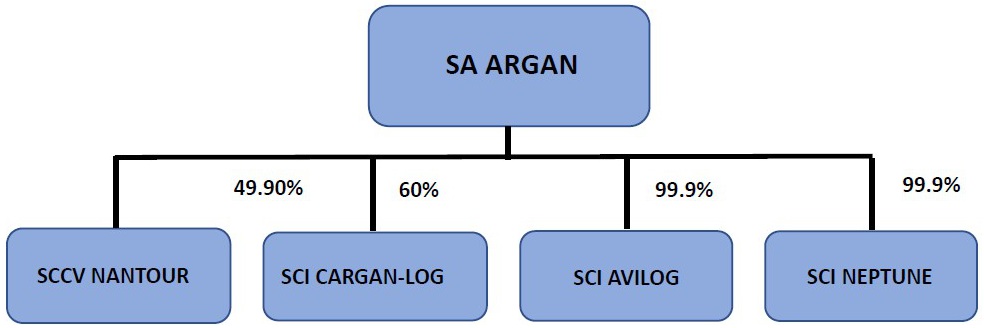
Argan and its subsidiaries form the Argan Group (the “Group”).
As at 31 December 2024, the Group included ARGAN and the NANTOUR SCCV subsidiaries, which are 49.90% owned, AVILOG SCI, 99,9% owned, NEPTUNE SCI, 99.9% owned, as well as CARGAN-LOG SCI, 60% owned (see Financial Information in Chapter 3, paragraph 3.3.3 - Main Subsidiaries).
All five companies have the same primary corporate purpose, namely, “The purchase and/or construction of all lands, buildings and property assets and rights for rental, management or leasing; the development of all lands and property assets and rights; fitting out all property units for rental; and all other ancillary or related activities pertaining to the above-mentioned business activity; all being performed directly or indirectly, either alone, in partnership or as part of a joint venture, grouping or company, with any other persons or companies”.
SCI AVILOG, SCI NEPTUNE and SCI CARGAN-LOG are fully consolidated, and SCCV NANTOUR is consolidated using the equity method.
As at 31 December 2024, 102 constructed buildings were owned by the ARGAN Group, including five buildings constructed by CARGAN-LOG.
The Group presents its consolidated financial statements in accordance with IFRS and has opted to recognise its portfolio of real estate assets at fair value on the balance sheet. ARGAN adopted the SIIC tax regime on 1 July 2007.
It has twenty-nine (29) employees (including 28 full-time employees) as at 31 December 2024. They deal with asset management, property and rental management of the asset portfolio and implement the policy on acquisitions, arbitrage and its own development with the support of the Administration, Finance and ESG Department and the Legal Department.
ARGAN takes the form of a public limited company with an Executive Board and a Supervisory Board. As at 31 December 2024, its share capital comprised 25,402,673 shares, each with a nominal value of €2.
ARGAN is listed on Euronext Paris, in Compartment A, and is part of the SBF 120 and FTSE EPRA Europe as at 31 December 2024.
255
8.2. Share capital, shareholding and stock market performance
8.2.1. Information on the capital
The Company is controlled by its main shareholder (see table of main shareholders in section 8.2.2.1 on the following pages).
As at 31 December 2024, the share capital was set at FIFTY MILLION EIGHT HUNDRED AND FIVE THOUSAND THREE HUNDRED AND FORTY-SIX EUROS (€50,805,346).
It is divided into TWENTY-FIVE MILLION FOUR HUNDRED AND TWO THOUSAND SIX HUNDRED AND SEVENTY-THREE (25,402,673) shares, all of the same class, with a nominal value of TWO (2) euros each, fully paid up.
As at 31 December 2024, the Company did not, to the best of its knowledge, have any pledge on a significant portion of its share capital.
8.2.1.1. Change in share capital
The table below shows how the Company’s share capital has changed over the past three years:
| Date | Transaction | Capital increase/ reduction | Par value | Issue, contribution or merger premium | Number of shares created / cancelled | Total number of shares | Capital after transaction | |||||||||||||||||||
| 26/04/22 | Capital increase by payment of the dividend in shares | 725,490 | € | 2 | € | 36,245,480 | 362,745 | 22,951,290 | 45,902,580 | |||||||||||||||||
| 16/01/23 | Capital increase resulting from the free allocation of shares | 60,148 | € | 2 | € | -66,163 | 30,074 | 22,981,364 | 45,962,728 | |||||||||||||||||
| 25/04/23 | Capital increase by payment of the dividend in shares | 196,666 | € | 2 | 7,159,626 | 98,333 | 23,079,697 | 46,159,394 | ||||||||||||||||||
| 15/01/24 | Capital increase resulting from the free allocation of shares | 25,362 | € | 2 | 27,898 | 12,681 | 23,092,378 | 46,184,756 | ||||||||||||||||||
| 18/04/24 | Capital increase by payment of the dividend in shares | 566,534 | € | 2 | 19,627,570 | 283,267 | 23,375,645 | 46,751,290 | ||||||||||||||||||
| 26/04/24 | Capital increase by private placement | 4,054,056 | € | 2 | 145,946,016 | 2,027,028 | 25,402,673 | 50,805,346 | ||||||||||||||||||
256
8.2.1.2. Statutory information on share capital
8.2.1.2.1. Change in share capital (Article 8)
Share capital increase
The share capital may be increased by any means and in accordance with all the terms and conditions provided for by the applicable laws and regulations.
The Extraordinary General Meeting has sole authority on the Executive Board’s report to decide to increase the capital. It may delegate this authority to the Executive Board under the conditions set by the applicable laws and regulations.
The share capital may be increased either by issuing ordinary shares or preferred shares or by increasing the nominal amount of existing capital securities. It may also be increased via the exercise of rights attached to transferable securities giving access to the capital, under the conditions provided for by the applicable laws and regulations.
Shareholders have a preferential right in proportion to the amount of their shares to the subscription of cash shares issued to carry out a capital increase. Shareholders may waive their preferential right on an individual basis.
The right to allocate new shares to shareholders, following the capitalisation of reserves, profits or issue premiums, belongs to the bare owner, subject to the rights of the beneficiary.
Payment for shares
New equity securities are issued either at their nominal amount or at this amount plus an issue premium. Payment in consideration for such securities may be made in cash, including by offset against debts due and payable by the Company, or by contributions in kind, by capitalisation of reserves, profits or issue premiums, or as the result of a merger or a demerger. They may also be paid up following the exercise of a right attached to transferable securities giving access to the capital including, where applicable, the payment of the corresponding sums.
For shares subscribed in cash, at least one quarter of their nominal value must be paid up at the time of subscription together with, where applicable, the entirety of the issue premium. The balance should be paid in one or more instalments, as decided by the Executive Board, within five years from the day on which the capital increase was completed.
Subscribers are notified of calls for funds by registered letter with acknowledgement of receipt sent at least fifteen days prior to the date set for each payment. Payments shall be made either at the registered office or at any other place indicated for this purpose.
Any delay in the payments due on the unpaid amount of the shares will automatically, and without any further formalities whatsoever, result in payment of interest at the statutory rate, accruing from the date such payment was due, without prejudice to actions that the Company may bring against the defaulting shareholder or any enforcement measures provided by the applicable laws and regulations.
257
Capital reduction
The Extraordinary General Meeting may authorise a capital reduction or decide to reduce the capital, and may delegate the broadest powers to the Executive Board to complete the reduction. It may not, under any circumstances, derogate from the principle of equality of shareholders.
The share capital may only be reduced to an amount below the legal minimum on the condition precedent of a capital increase intended to increase it to at least this minimum amount, unless the Company is converted into a different form of company.
In the event of failure to comply with these provisions, any interested party may seek the dissolution of the Company in court.
The court may not order the dissolution of the Company, however, if the situation has been remedied on the date on which it rules on the case.
Capital depreciation
The capital may be depreciated as provided for by the applicable laws and regulations. Depreciated shares are called dividend shares; the right to any distribution or reimbursement on the nominal value of the securities is reduced by the amount of the depreciation, but they retain their other rights.
8.2.1.2.2. Form of shares (Article 9 of the Articles of Association)
Identification of shareholders
Shares may be either registered shares or bearer shares as decided by the holder. Registered shares may be converted to bearer shares and vice versa, subject to the applicable laws and regulations.
Ownership of the shares results from their entry in the account under the conditions and in the manner stipulated by the applicable laws and regulations.
For the purpose of identifying the holders of bearer securities, the Company or its representative is entitled to request, under the applicable legal and regulatory conditions, information concerning the owners of its shares and securities conferring the immediate or future right to vote at its own shareholders’ meetings. Such information may be requested at any time and at the Company’s own expense, either from the central custodian in charge of the administration of its share issue account, or directly from one or more financial intermediaries mentioned in Article L.211-3 of the French Monetary and Financial Code.
Where the deadline stipulated by the applicable laws and regulations for disclosure of such information is not met, or where the information provided is incomplete or incorrect, the central custodian, the Company or its representative or the account administrator may apply to the presiding judge of the court ruling in summary proceedings to enforce fulfilment of the disclosure obligation.
Under the conditions specified by the applicable laws and regulations (particularly those concerning time limits), intermediaries acting on behalf of owners of registered securities who are domiciled outside France are required to disclose information about the owners of such securities, at the request of the Company or its representative, which may be made at any time.
Should the Company deem that certain holders of bearer or registered securities whose identity has been disclosed to it hold such securities on behalf of third-party owners, it is entitled to ask these holders to disclose information about the owners of such securities held by each of them, under the conditions specified by the applicable laws and regulations.
258
In the event that the threshold of 10% of the Company’s capital is exceeded (where this is understood as holding 10% or more of the rights to dividends paid by the company), whether directly or indirectly, any shareholder who is not a natural person must state in their declaration of threshold crossing whether they are a Shareholder Subject to Withholding Tax (as defined in Article 43 of the Articles of Association). If such a shareholder declares itself to be a Shareholder Subject to Withholding Tax, it must register all the shares it actually owns in registered form and ensure that the entities that it controls within the meaning of Article L.233-3 of the French Commercial Code also register all the shares that they hold in registered form. Should such shareholder declare that it is not a Shareholder Subject to Withholding Tax, it must provide evidence of this at any such request from the company. Additionally, if the company requests it, the shareholder must provide a legal opinion from an international tax consultancy firm. Any shareholder other than a natural person who has reported that they have crossed the threshold of 10% of the company’s capital, whether directly or indirectly, must notify the company promptly of any change in its tax status that would cause it to acquire or lose the status of Shareholder Subject to Withholding Tax.
Declaration of thresholds crossing
In addition to the obligation to inform the Company of the holding of certain fractions of capital or voting rights pursuant to Articles L. 233-7 et seq. of the French Commercial Code, any natural or legal person, acting alone or in concert with others, who becomes the direct or indirect holder of a number of shares, voting rights or securities issued in representation of shares corresponding to 2% of the Company’s capital or voting rights shall be required, within five trading days from the date of the registration of the shares that mean it reaches or exceeds this threshold, to inform the Company by registered letter with acknowledgement of receipt of its total holding of number of shares, voting rights and securities giving access to the capital.
This reporting obligation will apply under the conditions above whenever the holder exceeds or falls below the next 2% threshold, no matter what the reason, and applies when the 5% threshold is exceeded.
In case of failure to comply with the provisions above and in paragraph 3, point 6, of this Article, the shareholder(s) concerned will, subject to the conditions and limits laid down by the applicable laws and regulations, be deprived of the voting rights relating to the securities above the thresholds subject to reporting, if one or more shareholders holding at least 2% of the capital or voting rights requests this at the General Meeting.
Rights and obligations attached to the shares (Article 12 of the Articles of Association)
Each share confers the right to a share of the profits and corporate assets that is proportional to the capital it represents and confers the right to vote and to be represented at General Meetings under the conditions laid down in the applicable legal and regulatory conditions and in these Articles of Association.
Pursuant to the option provided by Article L.225-123 of the French Commercial Code, any mechanism that automatically confers double voting rights on shares for which proof of registration in the name of one and the same shareholder for at least two years can be provided is expressly excluded by these Articles of Association.
All shareholders have the right to be informed about the Company’s operations and to access certain corporate documents at the time and under the conditions laid down by the applicable laws and regulations.
Shareholders are only liable for losses up to the amount of their contribution.
Subject to the legal and statutory provisions, no majority may impose an increase in shareholders’ commitments.
The rights and obligations attached to shares are transferred with the shares.
Possession of a share automatically implies full adherence to the resolutions of the General Meeting and to these Articles of Association.
259
Transfer includes all dividends due that have not been paid and all dividends falling due in the future, as well as any share in reserve funds, unless otherwise stipulated to the Company.
Heirs, creditors, beneficiaries or other representatives of a shareholder may not be entitled on any grounds whatsoever to request that the Company’s assets and documents be placed under seal or request their distribution or sale by auction, or interfere in the administration of the Company; for the exercise of their rights, they should refer to the list of company assets and liabilities and the resolutions of the General Meeting.
Whenever it is necessary to hold a number of shares to exercise any particular right, for a share exchange, consolidation or allocation, or as a result of a capital increase or reduction, a merger or any other transaction, shareholders with isolated shares or with fewer shares than the number required are personally responsible for obtaining the number of shares necessary to exercise their rights, buying or selling shares if necessary to achieve this.
8.2.2. Group share ownership
8.2.2.1. Main shareholders
The purpose of the table below is to illustrate the distribution of the share capital amongst the shareholders on 31 December 2022, 2023 and 2024:
| 31 December 2022 | 31 December 2023 | 31 December 2024 | ||||||||||||||||||||||||||||||||||
| Main shareholders | Number of securities | % capital | % voting rights | Number of securities | % capital | % voting rights | Number of securities | % capital | % voting rights | |||||||||||||||||||||||||||
| Le Lan family (in concert) of whom: | 9,163,515 | 39.93 | % | 39.94 | % | 9,328,205 | 40.42. | % | 40.44 | % | 9,346,088 | 36.79 | % | 36.83 | % | |||||||||||||||||||||
| Jean-Claude Le Lan | 704,955 | 3.07 | % | 3.07 | % | 400,000 | 1.73 | % | 1.73 | % | 400,000 | 1.57 | % | 1.58 | % | |||||||||||||||||||||
| KERLAN SAS (*) | 4,237,220 | 18.46 | % | 18.46 | % | 6,995,830 | 30.31 | % | 30.33 | % | 6,995,830 | 27.54 | % | 27.57 | % | |||||||||||||||||||||
| Jean-Claude Le Lan Junior | 879,661 | 3.83 | % | 3.83 | % | 215,701 | 0.94 | % | 0.94 | % | 224,587 | 0.88 | % | 0.88 | % | |||||||||||||||||||||
| Nicolas Le Lan | 871,476 | 3.8 | % | 3.8 | % | 198,409 | 0.86 | % | 0.86 | % | 198,409 | 0.78 | % | 0.78 | % | |||||||||||||||||||||
| Charline Le Lan | 874,403 | 3.81 | % | 3.81 | % | 157,609 | 0.68 | % | 0.68 | % | 157,609 | 0.62 | % | 0.62 | % | |||||||||||||||||||||
| Ronan Le Lan | 850,229 | 3.70 | % | 3.70 | % | 500,467 | 2.17 | % | 2.17 | % | 501,937 | 1.98 | % | 1.98 | % | |||||||||||||||||||||
| Eugénie Le Lan | 12,554 | 0.05 | % | 0.05 | % | 13,030 | 0.06 | % | 0.06 | % | 13,521 | 0.05 | % | 0.05 | % | |||||||||||||||||||||
| Véronique Le Lan Chaumet | 633,610 | 2.76 | % | 2.76 | % | 500,000 | 2.17 | % | 2.17 | % | 500,000 | 1.97 | % | 1.97 | % | |||||||||||||||||||||
| Alexia Chaumet Le Lan | 12,554 | 0.05 | % | 0.05 | % | 13,068 | 0.06 | % | 0.06 | % | 13,645 | 0.05 | % | 0.05 | % | |||||||||||||||||||||
| Charles Chaumet Le Lan | 12,554 | 0.05 | % | 0.05 | % | 13,030 | 0.06 | % | 0.06 | % | 13,521 | 0.05 | % | 0.05 | % | |||||||||||||||||||||
| Karine Le Lan | 74,299 | 0.32 | % | 0.32 | % | 321,061 | 1.39 | % | 1.39 | % | 327,029 | 1.29 | % | 1.29 | % | |||||||||||||||||||||
| Public, of whom: | 13,777,412 | 60.03 | % | 60.06 | % | 13,740,612 | 59.54 | % | 59.56 | % | 16,031,641 | 63.11 | % | 63.17 | % | |||||||||||||||||||||
| Crédit Agricole Assurances | 3,820,134 | 16.65 | % | 16.65 | % | 3,820,134 | 16.55 | % | 16.56 | % | 3,820,134 | 15.04 | % | 15.05 | % | |||||||||||||||||||||
| Other public | 9,957,278 | 43.38 | % | 43.40 | % | 9,920,478 | 42.99 | % | 43.00 | % | 12,211,507 | 48.07 | % | 48.12 | % | |||||||||||||||||||||
| Treasury shares (**) | 10,363 | 0.04 | % | 0.00 | % | 10,880 | 0.05 | % | 0.00 | % | 24,944 | 0.10 | % | 0.00 | % | |||||||||||||||||||||
| TOTAL | 22,951,290 | 100.0 | % | 100.0 | % | 23,079,697 | 100.0 | % | 100.0 | % | 25,402,673 | 100.0 | % | 100.0 | % | |||||||||||||||||||||
| (*) | KERLAN SAS is a company wholly owned by Mr Jean-Claude Le Lan and his five children. |
| (**) | under the liquidity contract. |
The main characteristics of the shareholders’ agreement between the members of the Le Lan family and the shareholders’ agreement signed between Predica and the Le Lan family are set out in paragraph 8.4.2 of this Universal Registration Document – Shareholders agreements.
Regarding majority control of the Company by the Le Lan family, see Chapter 3, section 3.7, subsection 3.7.6, paragraph 3.7.6.1 - Risks associated with the departure of a key person, in particular a member of the Le Lan family.
260
Each ARGAN share gives a voting right of one vote at Ordinary and Extraordinary General Meetings, so the voting rights are proportional to the holding in the capital of ARGAN (from which treasury shares are withdrawn, where applicable). This concerns all shareholders, and in particular the main members of the agreement between the Le Lan family and Predica (Crédit Agricole Assurances).
As at 31 December 2024, the Company held 24,944 of its own shares with a nominal value of €2 each and a net book value on its balance sheet of €1,554,313.
8.2.2.2. Crossing of statutory thresholds and disclosure of intent
The various levels for reporting the crossing of thresholds are summarised in Section 8.2.1.2.2 of this Universal Registration Document.
| ● | As a result of the capital increase carried out on 26 April, the family holding company Kerlan and certain members of the Le Lan family declared to the AMF the crossing of legal and statutory thresholds: |
| ○ | Kerlan (family holding company and simplified joint stock company) fell below the statutory thresholds of 32% and 30% of the capital and voting rights, taking into account the ARGAN shares held directly by Mr Jean-Claude Le Lan. As a result of this transaction, the family holding company Kerlan and Jean-Claude Le Lan (individually) held respectively 6,995,830 shares, or 27.54% of the capital and voting rights, and 400,000 shares, or 1.58% of the capital and voting rights, |
| ○ | Mrs Véronique Le Lan and Mr Ronan Le Lan fell below the threshold of 2% of the company’s share capital and voting rights. As a result of this transaction, Mrs Véronique Le Lan and Mr Ronan Le Lan held 500,000 shares, or 1.97% of the share capital and voting rights, and 501,937, or 1.98% of the share capital and voting rights, respectively, |
| ○ | As a result, the Le Lan family concert fell below 40% and 38% of the company’s share capital and voting rights. The holding of the Le Lan family (including the holdings of the Kerlan family holding company and the individual holdings of the family members as presented in segment 8.2.2.1 of this Universal Registration Document) following this transaction amounts to 9,346,088 shares, or 36.79% of the share capital and voting rights; |
| ● | In a letter dated 25 April 2024, COHEN & STEERS disclosed that it had exceeded the threshold of 2% of ARGAN’s capital and voting rights and now held 671,396 shares, representing 2.64% of the capital and voting rights; |
| ● | In a letter dated 24 June 2024, COHEN & STEERS disclosed that it had exceeded the threshold of 3% of ARGAN’s capital and voting rights and now held 838,616 shares, representing 3.30% of the capital and voting rights; |
| ● | In a letter dated 18 November 2024, Ameriprise Financial Group disclosed that it had exceeded the threshold of 4% of ARGAN’s capital and voting rights and now held 1,016,341 shares, representing 4.00% of the capital and voting rights; |
| ● | In a letter dated 27 November 2024, Zürcher Kantonalbank disclosed that it had exceeded the threshold of 2% of ARGAN’s capital and voting rights and now held 509,289 shares, representing 2.01% of the capital and voting rights; |
| ● | In a letter dated 3 December 2024, Zürcher Kantonalbank disclosed that it fell below the threshold of 2% of ARGAN’s capital and voting rights and now held 490,376 shares, representing 1.93% of the capital and voting rights; |
| ● | In a letter dated 9 December 2024, Zürcher Kantonalbank disclosed that it had fallen below the threshold of 2% of ARGAN’s capital and voting rights and now held 512,224 shares, representing 2.02% of the capital and voting rights; |
| ● | In a letter dated 17 December 2024, COHEN & STEERS disclosed that it fell below the threshold of 3% of ARGAN’s capital and voting rights and now held 752,611 shares, representing 2.96% of the capital and voting rights; |
| ● | In a letter dated 20 December 2024, AXA Investment Managers S.A. disclosed that it fell below the threshold of 2% of ARGAN’s capital and voting rights and now held 507,099 shares representing 2.00% of the capital and voting rights; |
261
| ● | In a letter dated 24 December 2024, AXA Investment Managers S.A. disclosed that it had exceeded the threshold of 2% of ARGAN’s capital and voting rights and now held 449,303 shares representing 1.95% of the capital and voting rights; |
| ● | In a letter dated 30 December 2024, Ameriprise Financial Group disclosed that it fell below the threshold of 4% of ARGAN’s capital and voting rights and now held 1,002,948 shares, representing 3.95% of the capital and voting rights. |
8.2.2.3. Managers’ transactions on the Company’s securities:
Managers carried out the following transactions on the Company’s shares during the 2024 financial year:
| Reporting entity | Nature of the transaction | Description of the financial instrument | Date of transaction | Total amount of the transaction (in euros) | Exercise of the shares (X) | |||||||
| FRÉDÉRIC LARROUMETS | Assignment | Share | 19/01/2024 | € | 239,965.97 | |||||||
| FRÉDÉRIC LARROUMETS | Assignment | Share | 08/03/2024 | € | 198,527.92 | |||||||
| FRÉDÉRIC LARROUMETS | Assignment | Share | 20/03/2023 | € | 140,175.00 | |||||||
| ALEXIA CHAUMET | Acquisition | Share | 22/04/2024 | € | 41,134.33 | X | ||||||
| CHARLES CHAUMET | Acquisition | Share | 22/04/2024 | € | 35,003.39 | X | ||||||
| JEAN-CLAUDE LE LAN JUNIOR | Acquisition | Share | 22/04/2024 | € | 582,225.43 | X | ||||||
| EUGENIE LE LAN | Acquisition | Share | 22/04/2024 | € | 35,003.39 | X | ||||||
| KARINE LE LAN | Acquisition | Share | 22/04/2024 | € | 425,316.14 | X | ||||||
| FRANCIS ALBERTINELLI | Assignment | Share | 03/05/2024 | € | 408,149.82 | |||||||
| FRANCIS ALBERTINELLI | Assignment | Share | 06/05/2024 | € | 77,500.00 | |||||||
| FRANCIS ALBERTINELLI | Assignment | Share | 07/05/2024 | € | 68,571.80 | |||||||
8.2.2.4. Acquisitions of equity interests and controlling interests during the 2024 financial year:
| ● | Takeovers: None |
| ● | Equity investments: None |
| ● | Disposals of equity investments: During the past financial year, ARGAN SA sold a share in its subsidiary SCI AVILOG to SAS KERLAN. |
8.2.3. Dividends paid for the last three financial years
8.2.3.1. Dividend distribution policy
The Company has historically distributed a dividend representing a yield of around 2% to 5% based on the ARGAN share price.
It intends to pursue a consistent distribution policy, in accordance with the rules of the SIIC tax regime, i.e. in short, a minimum of 95% of the results from rental operations, 70% of the realised capital gains and 100% of the dividends received from its subsidiaries.
In view of the Company’s excellent performance in 2024, it will be proposed to the Combined General Meeting of shareholders on 20 March 2025 that a dividend of €3.30/share be approved, an increase of +5% compared with the previous year.
262
8.2.3.2. Dividend distribution table for the last three financial years The following dividends have been paid for the last three financial years:
| FINANCIAL YEAR | DIVIDEND | |||
| Financial year ended 31 December 2021 | € | 2.60 | (*) | |
| Financial year ended 31 December 2022 | € | 3.00 | (**) | |
| Financial year ended 31 December 2023 | € | 3.15 | (***) | |
| (*) | Including €0.77 treated for tax purposes as a recapitalisation within the meaning of Article 112 1° of the French General Tax Code and therefore not constituting distributed income within the meaning of the provisions of Article 243 bis of that Code. |
| (**) | Including €2.47 treated for tax purposes as a recapitalisation within the meaning of Article 112 1° of the French General Tax Code and therefore not constituting distributed income within the meaning of the provisions of Article 243 bis of that Code. |
| (***) | Including €1.62 treated for tax purposes as a recapitalisation within the meaning of Article 112 1° of the French General Tax Code and therefore not constituting distributed income within the meaning of the provisions of Article 243 bis of that Code. |
8.2.4. Transactions on the Company’s securities
On 16 December 2021, the Company entered into a liquidity contract with ODDO.
In running its liquidity contract, ARGAN carried out the following transactions on its own shares during 2024:
| 2024 | Number of securities purchased | Number of securities sold | ||||||
| January | 28,701 | 26,595 | ||||||
| February | 17,801 | 15,079 | ||||||
| March | 16,145 | 23,112 | ||||||
| April | 14,952 | 8,724 | ||||||
| May | 15,548 | 16,413 | ||||||
| June | 21,647 | 16,163 | ||||||
| July | 12,505 | 17,015 | ||||||
| August | 11,066 | 11,921 | ||||||
| September | 15,482 | 12,527 | ||||||
| October | 21,594 | 16,018 | ||||||
| November | 18,952 | 21,095 | ||||||
| December | 21,597 | 17,264 | ||||||
| Total | 215,990 | 201,926 | ||||||
263
On 1 January 2024, the liquidity account held the following assets:
| ● | 10,880 securities |
| ● | €1,331,303.94 |
On 31 December 2024, the liquidity account held the following assets:
| ● | 24,944 securities |
| ● | €394,746.84 |
In accordance with the provisions of Article L.225-211, paragraph 2 of the French Commercial Code, ARGAN has not acquired any shares for allocation to its employees under a profit-sharing plan.
8.2.5. Stock market performance and NAV
8.2.5.1. Change in share price since end-2017
Argan has been listed on Euronext Paris since 25 June 2007. It joined compartment B in January 2012 and then compartment A in January 2020. Since 2023, it has been part of the FTSE EPRA Europe and SBF 120 indices.
The market capitalisation as at 31 December 2024 was €1.537bn based on a price of €60.5 per share.
Argan is part of the SBF 120, CAC All-Shares, FTSE EPRA Europe and IEIF SIIC France indices. ARGAN’s ISIN Code is FR0010481960.
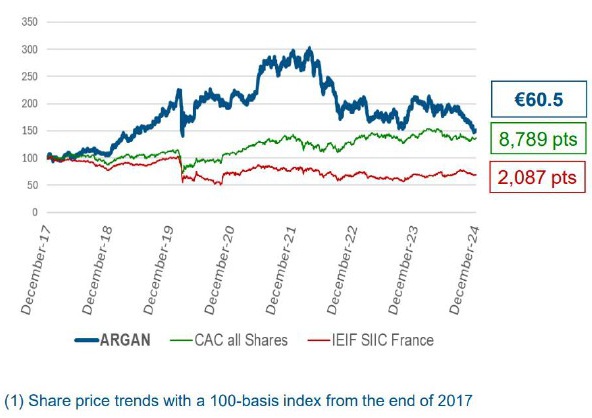
The lowest and highest share prices over the past seven years have been as follows:
| 2018 | 2019 | 2020 | 2021 | 2022 | 2023 | 2024 | ||||||||||||||||||||||
| Lowest price | 37.80 | 42.40 | 56.40 | 79.40 | 68.10 | 61.4 | 58.6 | |||||||||||||||||||||
| Highest price | 47.40 | 78.00 | 90.80 | 118.00 | 121.80 | 88.7 | 86.1 | |||||||||||||||||||||
264
8.2.5.2. Change in the share price and the EPRA NRV NAV
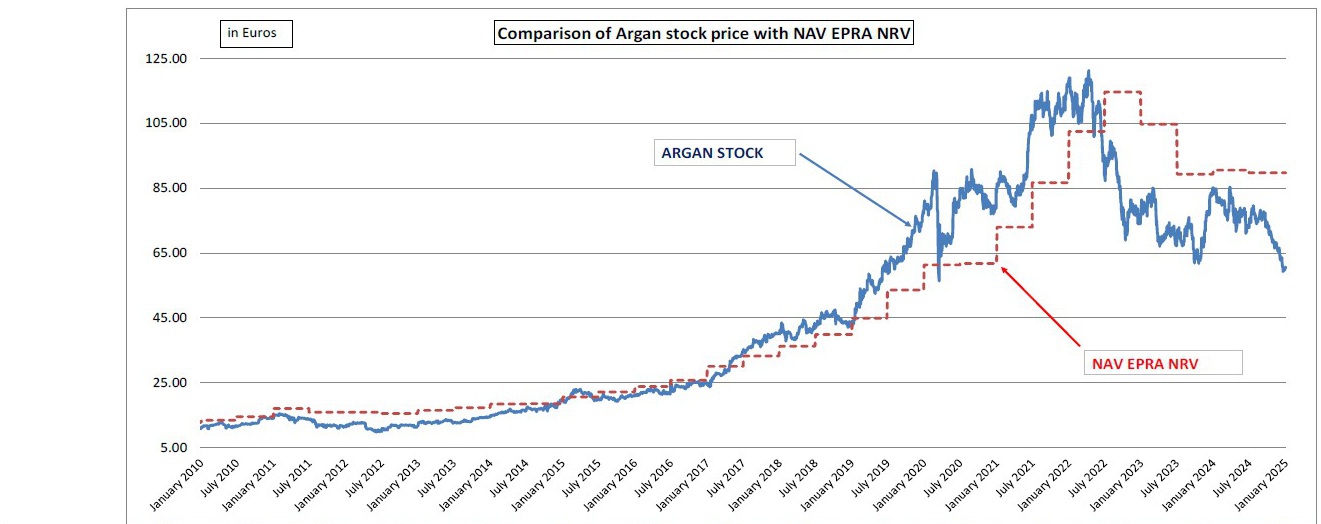
| 2010 | 2011 | 2012 | 2013 | 2014 | 2015 | 2016 | 2017 | 2018 | 2019 | 2020 | 2021 | 2022 | 2023 | 2024 | ||||||||||||||||||||||||||||||||||||||||||||||||||||||||||||||||||||||||||||||||||||||||||||||||||||||||||
| 1st half | 2nd half | 1st half | 2nd half | 1st half | 2nd half | 1st half | 2nd half | 1st half | 2nd half | 1st half | 2nd half | 1st half | 2nd half | 1st half | 2nd half | 1st half | 2nd half | 1st half | 2nd half | 1st half | 2nd half | 1st half | 2nd half | 1st half | 2nd half | 1st half | 2nd half | 1st half | 2nd half | |||||||||||||||||||||||||||||||||||||||||||||||||||||||||||||||||||||||||||||||||||||||||||
| ARGAN share price (half-year average) | 11.7 | 12.9 | 14.3 | 11.9 | 11.4 | 11.4 | 12.8 | 13.5 | 15.8 | 17.4 | 21.1 | 20.3 | 22.0 | 24.1 | 29.2 | 37.7 | 40.8 | 44.6 | 53.5 | 67.1 | 76.2 | 83.0 | 87.7 | 109.7 | 110.1 | 83.8 | 75.0 | 70.9 | 78.6 | 71.4 | ||||||||||||||||||||||||||||||||||||||||||||||||||||||||||||||||||||||||||||||||||||||||||
| EPRA NAV/share NRV in € | 13.4 | 14.5 | 16.9 | 15.8 | 15.9 | 15.5 | 16.4 | 17.2 | 18.3 | 18.5 | 20.5 | 22.1 | 23.8 | 25.7 | 30.0 | 33.2 | 36.3 | 39.8 | 44.8 | 53.6 | 61.3 | 61.8 | 73.0 | 86.7 | 102.5 | 114.7 | 104.8 | 89.3 | 90.6 | 89.7 | ||||||||||||||||||||||||||||||||||||||||||||||||||||||||||||||||||||||||||||||||||||||||||
| Discount - / Premium + | -13 | % | -11 | % | -16 | % | -24 | % | -28 | % | -26 | % | -22 | % | -22 | % | -14 | % | -6 | % | 3 | % | -8 | % | -8 | % | -6 | % | -3 | % | 14 | % | 12 | % | 12 | % | 19 | % | 25 | % | 24 | % | 34 | % | 20 | % | 26 | % | 7 | % | -27 | % | -28 | % | -21 | % | -13 | % | -20 | % | ||||||||||||||||||||||||||||||||||||||||||||||||||||||||||||
| * | For the financial years 2010 to 2018, this is the former NAV index, including transfer taxes. |
This table shows the discount or premium on the ARGAN share in relation to its EPRA NRV NAV.
It compares the half-year average of the ARGAN share price to the last EPRA NRV NAV published at the end of the previous half-year. For example, the average closing price of the share in the second half of 2024, i.e. €71.4, represents a discount of -20% compared with the EPRA NRV NAV as at 30 June 2024, i.e. €89.7 and taken as a comparative for the half-year in question.
For information, as at 31 December 2024, the ARGAN closing share price was €60.5, with a discount of -29% compared with the EPRA NTA NAV as at 31 December 2024 (€85.5).
265
8.2.5.3. Change in the NAV per share1
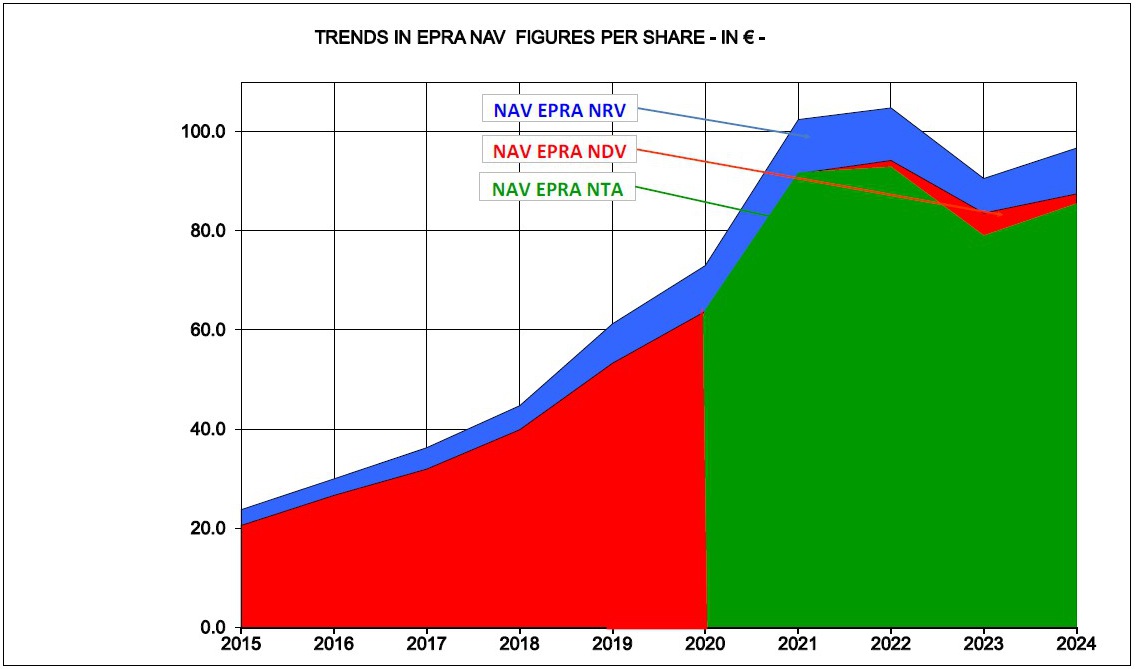
| 2015 | 2016 | 2017 | 2018 | 2019 | 2020 | 2021 | 2022 | 2023 | 2024 | |||||||||||||||||||||||||||||||
| EPRA Net Reinstatement Value per share (NRV) | 23.8 | 30.0 | 36.3 | 44.8 | 61.3 | 73.0 | 102.5 | 104.8 | 90.6 | 96.7 | ||||||||||||||||||||||||||||||
| Change year on year Y / Y-1 | 16 | % | 26 | % | 21 | % | 23 | % | 37 | % | 19 | % | 40 | % | 2 | % | -14 | % | 7 | % | ||||||||||||||||||||
| EPRA Net Disposal Value per share (NDV) | 20.6 | 26.7 | 32.0 | 39.9 | 53.3 | 63.8 | 91.6 | 94.2 | 83.6 | 87.5 | ||||||||||||||||||||||||||||||
| Change year on year Y / Y-1 | 17 | % | 30 | % | 20 | % | 25 | % | 34 | % | 20 | % | 44 | % | 3 | % | -11 | % | 5 | % | ||||||||||||||||||||
EPRA Net Tangible Assets per share (NTA) | 64.2 | 91.8 | 92.9 | 79.1 | 85.5 | |||||||||||||||||||||||||||||||||||
| Change year on year Y / Y-1 | 43 | % | 1 | % | -15 | % | 8 | % | ||||||||||||||||||||||||||||||||
The EPRA NAV NRV (replacement value) per share as at 31 December 2023 was accordingly €96.7, compared with €90.6 as at 31 December 2023, an increase of +7%.
| 1 | The NTA NAV is presented from 2020. |
266
The EPRA NAV NTA per share increased from €79.1 to €85.5 in 2024. This increase, stemming from the increase in the fair value of the assets due to the stabilisation of capitalisation rates supplemented by deliveries of warehouses during the financial year, breaks down as follows:
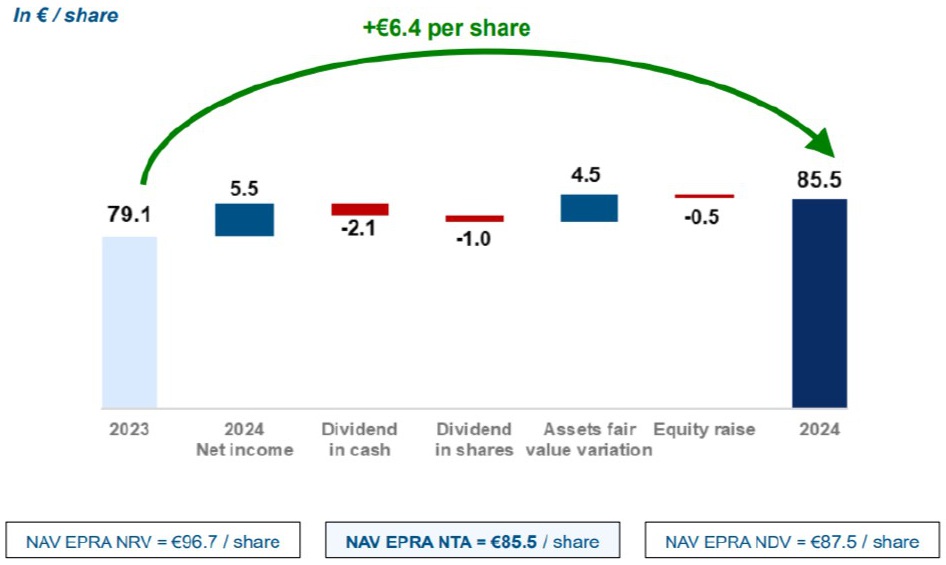
8.3. Financial communication policy and timetable
8.3.1. Principles and organisation of Argan’s financial communication
Argan has a financial communication policy intended to inform the broadest possible public of the Group’s performance and financial news, as well as information related to Argan’s commercial developments, structural and organisational changes, as well as its ESG strategy and results. This communication policy is more broadly part of a desire for transparency with regard to the performances and trajectories that Argan sets itself.
Argan has a structure dedicated to investor relations and financial communication, and the information provided mobilises the management teams more broadly, but also the people directly responsible for specific operational topics depending on the topics addressed in the communications shared or questions addressed to the Group.
All documentation produced by Argan complies with the requirements set out in terms of regulated information (in accordance with the provisions of Articles 221-1 et seq. of the AMF General Regulation), with publications made on dates announced in advance, in particular for publications of results and rental income or for the holding of the Annual General Meeting. The full range of regulated information has been available since the 2007 IPO on the argan.fr website. The documentation is produced in French and English to ensure the widest possible accessibility.
At the time of the annual financial results publications, Argan also holds a conference in Paris at which the management team gives a summary presentation of the results. This conference is filmed, and a few days later the video (also translated into English) is made freely accessible on the property investment company’s website. In addition to videoconferencing, investor meetings are regularly organised in France and Europe to comment on the annual and half-year results and present the company’s strategy (financial, commercial or ESG).
All questions and clarifications requested in connection with financial communications may be sent by email to contact@argan.fr or by paper mail to 21, rue Beffroy 92200 Neuilly-sur-Seine (France).
267
8.3.2. Financial reporting timetable
8.3.2.1. Dates of the most recent financial communications
| ● | Revenue for Q4 2024: 3 January 2025 |
| ● | Annual results 2024: 16 January 2025 |
8.3.2.2. Provisional financial reporting timetable for 2025:
| ● | 2025 General Meeting: 20 March 2025 |
| ● | Rental income for Q1 2025: 1 April 2025 |
| ● | Rental income for Q2 2025: 1 July 2025 |
| ● | First half-year results (H1 2025): 17 July 2025 |
| ● | Rental income for Q3 2025: 1 October 2025 |
8.3.2.3. Provisional financial reporting timetable for 2026:
| ● | Revenue for Q4 2025: 5 January 2026 |
| ● | Annual results 2025: 22 January 2026 |
| ● | 2026 General Meeting: 19 March 2026 |
8.4. Shareholders’ agreements
8.4.1. Shareholders’ agreement between the members of the Le Lan family
A first shareholders’ agreement was concluded between the members of the Le Lan family on 10 October 2007 for a period of five years, renewable by tacit agreement every five years. It was amended by an amendment dated 27 June 2014 and then supplemented by a preferential agreement in December 2022.
Its purpose was to ensure control of ARGAN by formalising the joint action between the signatories and to manage the movements of the Company’s shares in order to ensure cohesion and representation of the signatories.
A new Agreement was entered into on 25 October 2023 between the members of the Le Lan and Kerlan family, in the presence of ARGAN, at the same time as the contribution of 2,758,610 shares in ARGAN held by Jean-Claude Le Lan and his five children to SAS KERLAN. It replaces the Agreement signed in 2007.
As a result of these contributions, KERLAN holds 6,995,830 ARGAN shares representing 27.54% of the capital as at 31 December 2024. Adding the ARGAN shares held directly by members of the family, the Le Lan family group held 36.79% of the capital of ARGAN on 31 December 2024.
This Agreement is for a term of 10 years, renewable by express renewal. It should be noted that the agreement would automatically cease to have effect with regard to any party that no longer holds any ARGAN shares or KERLAN shares.
The main purpose of this agreement is to organise more precisely the objectives and terms of the joint action existing between the members of the Le Lan family group. The main provisions of this shareholders’ agreement are summarised as follows:
8.4.1.1. Governance:
The parties to the agreement reiterate their decision to act in concert with each other and undertake to implement a common sustainable management policy with regard to ARGAN with a view to ensuring the sustainability of family control. In this context, the parties undertake to consult each other prior to certain decisions subject to the approval of ARGAN’s Supervisory Board or its general meeting; this consultation is carried out through meetings of a shareholders’ committee made up of KERLAN’s shareholders.
268
The parties to the agreement undertake to vote in the manner determined by the Shareholders’ Committee within any ARGAN corporate body and in favour of each candidate proposed by the Shareholders’ Committee for a position as a member of the Supervisory Board.
8.4.1.2. Transfer of ARGAN shares:
| ● | Anti-dilution: in the event of an issue of ARGAN shares with maintenance of preferential subscription rights, each party undertakes to make his/her best efforts to subscribe to the issue in order to maintain his/her stake in the Company’s share capital in the same proportions as before the issue and, failing this, undertakes to assign the preferential subscription rights concerned to KERLAN for a unit price equal to the theoretical value of said preferential subscription rights; |
| ● | Information on transfers, acquisitions and holding of ARGAN shares: the parties undertake to favour registration in pure registered form for all the ARGAN shares that they hold or that they may hold, subject to certain exceptions. The parties also undertake to notify KERLAN of any planned acquisition or disposal of ARGAN shares; |
| ● | Right of first offer: the parties mutually agree, and as a priority to KERLAN, on a right of first offer applicable to any transfer of ARGAN shares, in any way whatsoever, regardless of the existence or otherwise of an offer from a third-party purchaser; |
| ● | Limitations on transfers of ARGAN shares: the parties undertake, for a period of ten (10) years, not to sell, individually or collectively, a number of ARGAN shares per calendar year exceeding 1% of the total number of ARGAN shares in circulation on 1 January of the year in question. |
Furthermore, it should be noted that a new shareholders’ agreement with respect to ARGAN was concluded on 15 October 2024 between the members of the family group and Prédica (see segment 8.4.2 of this Universal Registration Document).
8.4.2. Shareholders’ agreement between the Le Lan family and Predica
For the purpose of acquiring the “Cargo” portfolio, the Le Lan family, the simplified joint stock company CRFP8 and the public limited company Predica Prévoyance Dialogue du Crédit Agricole (Prédica), decided to conclude a shareholders’ agreement on 10 July 2019 in the presence of ARGAN, under which they agreed not to act in concert.
This agreement was concluded for a period of five years from 15 October 2019 and may be expressly renewed for successive two-year periods. It was registered on 18 July 2019 with the Autorité des Marchés Financiers (the French Financial Markets Authority) under number 219C1208, in accordance with the applicable regulations.
In 2024, the Le Lan family1 and Predica, a subsidiary of Crédit Agricole Assurances, confirmed their relationship of mutual trust by signing a new five-year agreement2. Having entered into force on 15 October 2024, it replaces the previous agreement concluded in 2019, while reaffirming that it does not act in concert with regard to Argan (it being recalled that the members of the Le Lan family act in concert with each other with regard to Argan).
The stakeholders have agreed to meet before the expiry of this pact, i.e. on 14 October 2029, to, if necessary, define the terms of a new agreement. As a reminder, since Argan’s capital increase of 23 April, the respective holdings in Argan’s capital are 36.7% for the Le Lan family and 15.0% for Predica.
| 1 | The Le Lan family consists of Mr Jean-Claude Le Lan, Mr Jean-Claude Le Lan (junior), Mr Ronan Le Lan, Mrs Véronique Le Lan, Mr Nicolas Le Lan, Mrs Charline Le Lan, Mrs Alexia Le Lan, Mr Charles Le Lan and Mrs Karine Weisse and the family company Kerlan (Kerlan SAS, a company 100% controlled by certain members of the Le Lan family). |
| 2 | The main provisions of the new shareholders’ agreement are reproduced in AMF notice no. 224C2019, available on the AMF’s website. |
269
The main provisions of the renewed shareholders’ agreement are as follows:
Governance: As part of this renewal, it is envisaged that Argan’s governance will evolve, with a streamlined Supervisory Board of around six members, compared with eight currently, aiming for increased efficiency in this central governance body. This change will be submitted for approval at the next Ordinary General Meeting to approve the financial statements for the financial year ending 31 December 2024. The Supervisory Board would then be composed of:
| ● | three members proposed by the Le Lan family; |
| ● | two independent members, in accordance with the recommendations of the Middlenext and AFEP-MEDEF corporate governance codes; |
| ● | Predica, as a legal entity. |
The new agreement also provides for the option for the Le Lan Family and Predica to each propose the appointment of a non-voting director to the Supervisory Board.
Standing Committees: two standing committees (the Audit, Risk and Sustainability Committee and the Appointments and Remuneration Committee) of the Supervisory Board are maintained under the agreement renewed in 2024 in their previous configuration. They will thus each remain chaired by one of the two independent members of the Supervisory Board.
No concerted action: Each party shall freely exercise its voting rights on the supervisory board, committees or any other body of the company. The parties to the agreement declare that they are not acting in concert with each other with respect to the company, it being recalled that the members of the Le Lan family are acting in concert with each other with respect to the company under a shareholders’ agreement entered into on 25 October 2023.
The parties agree that the company will continue to apply the Middlenext corporate governance code as the corporate governance code within the meaning of Article L.22-10-10, 4° of the French Commercial Code.
8.5. Other information relating to the Group’s shareholding and capital
| ● | Existence of statutory restrictions on the exercise of voting rights and transfers of shares or clauses of agreements pursuant to Article L.233-11 of the French Commercial Code: None |
| ● | List of holders of any security with special control rights and a description thereof: None |
| ● | Control mechanism provided for in any employee share ownership scheme where control rights are not exercised by the employees: None |
| ● | Agreement between shareholders of which the Company is aware and which may result in restrictions on the transfer of shares and the exercise of voting rights: |
See the main characteristics of the shareholders’ agreement signed between the members of the Le Lan and Predica family as part of the new shareholders’ agreement signed on October 15, 2024 described above in section 8.4.2 - Shareholders’ agreements.
| ● | Rules applicable to the appointment and replacement of members of the Executive Board as well as the amendment of the Company’s Articles of Association: |
The Articles of Association stipulate that the members of the Executive Board are appointed by the Supervisory Board during the life of the company. Members of the Executive Board may be removed at any time by the General Meeting. Members of the Executive Board may also be removed by the Supervisory Board. Members of the Executive Board are still eligible for reappointment.
Direct or indirect amendments to the Articles of Association are decided or authorised by the Company’s Extraordinary Shareholders’ Meetings.
| ● | Powers of the Executive Board to issue or buy back shares: |
See the summary table of delegations of authority in section 5.4 of this Universal Registration Document – Delegations of authority in force.
| ● | Agreements entered into by the Company that will be amended or terminated in the event of a change in control of the Company: as part of the bond issue of €500 million carried out in 2021 and maturing in November 2026, all bondholders may request the early repayment of all amounts owed in the event of a change in control of the Company. |
270
| ● | Agreements providing for compensation for members of the Executive Board or employees if they resign or are dismissed without real and serious grounds or if their employment ends due to a public offer: None |
| ● | Current delegations of authority and powers to increase capital: The delegations of authority and powers relating to capital increases granted by the General Shareholders’ Meeting of the Company are summarised in the table in paragraph 5.4 of this Universal Registration Document – Current delegations of authority, and their renewal will be proposed at the General Meeting of 20 March 2025. |
| ● | Right to dividends: A dividend of €3.30 per share will be proposed at the General Meeting of 20 March 2025 (4th resolution). This dividend will be paid on 17 April 2025, with an ex-dividend date of 26 March 2025. An option for the payment of this dividend in shares will also be offered to shareholders, for an issue price equal to 95% of the average of the first listed prices of the shares during the 20 trading sessions preceding the date of the General Meeting, less the net amount of the dividend (5th resolution). |
| ● | Voting rights: See section 8.7.5 of this Universal Registration Document. |
| ● | Rights to a share of the issuer’s profits: See Section 8.2.1.2.2 of this Universal Registration Document. |
| ● | Rights to liquidation surplus, in the event of liquidation: See Section 8.2.1.2.2 of this Universal Registration Document. |
| ● | Redemption conditions: As ARGAN SA is not a variable capital company, shareholders do not have the option to redeem their shares at their discretion. ARGAN SA, as a company, is nevertheless entitled to buy back its own shares, see the summary table of delegations in section 5.4 of this Universal Registration Document. |
| ● | Rules establishing amortisation reserves or funds: See section 8.6 of this Universal Registration Document on the rules for the allocation and distribution of profits. |
| ● | Obligations to respond to additional capital calls: See Section 8.2.1.2.2 of this Universal Registration Document. |
| ● | Potential discrimination between shareholders (current or potential): See Section 8.7.5 of this Universal Registration Document. |
8.6. Rules for allocation and distribution of profits (Article 43 of the Articles of Association)
Amounts to be set aside to reserves are deducted first from the profit for each financial year, less any prior losses, in accordance with the laws and regulations.
Accordingly, 5% is deducted to form the legal reserve; this deduction is no longer mandatory once the said fund reaches one-tenth of the share capital; the obligation applies once more if, for any reason, the legal reserve falls below this fraction.
Distributable profit consists of the profit for the financial year less prior losses and amounts set aside to reserves pursuant to the legal and regulatory provisions or the Articles of Association, plus retained earnings.
The General Meeting then determines the amount of this profit that it deems appropriate to transfer to any discretionary, ordinary or extraordinary reserves or to the retained earnings account.
Any remaining amount is divided between all shares in proportion to the amount paid up and not depreciated.
Except in the case of a capital reduction, however, no distribution may be made to shareholders when equity falls below an amount of the capital plus reserves which may not be distributed under the legal and regulatory provisions or the Articles of Association, or would fall below it subsequent to the distribution.
Any shareholder, other than a natural person:
(i) with a direct or indirect holding, at the time that any distribution is paid out, of at least 10% of the company’s divide nd rights, and (ii) whose own situation or that of its partners with a direct or indirect holding, in respect of the payment of any distribution, of 10% or more of its dividend rights renders the company liable for the withholding tax of 20% referred to in Article 208 C II ter of the French General Tax Code (the “Withholding Tax”) (such shareholder being hereinafter referred to as a “Shareholder Subject to Withholding Tax”), shall, at the time that any distribution is paid out, owe the company an amount corresponding to the Withholding Tax payable by the company in respect of the said distribution.
271
In the event that the company has a direct or indirect holding of 10% or more in one or more listed real estate investment companies referred to in Article 208 C of the French General Tax Code (a “Daughter SIIC”), the Shareholder Subject to Withholding Tax will also, at the time that any distribution is paid out, owe the company an amount equal to the difference (the “Difference”) between (i) the amount that would have been paid to the company by one or more Daughter SIICs if the said Daughter SIIC(s) had not been subject to Withholding Tax because of the Shareholder Subject to Withholding Tax, multiplied by the percentage of dividend rights held by shareholders other than the Shareholder Subject to Withholding Tax and (ii) the amount actually paid by the said Daughter SIIC(s) multiplied by the percentage of dividend rights held by shareholders other than the Shareholder Subject to Withholding Tax, such that the other shareholders do not have to pay any part of the Withholding Tax paid by any one of the SIICs in the chain of equity investments because of the Shareholder Subject to Withholding Tax. The company will be liable to shareholders other than Shareholders Subject to Withholding Tax for an amount equal to the Difference, in proportion to their dividend rights.
If there are multiple Shareholders Subject to Withholding Tax, each Shareholder Subject to Withholding Tax shall be liable to the company for the share of the Withholding Tax payable by the company that their direct or indirect investment has generated. The status of Shareholder Subject to Withholding Tax is assessed on the date of payment for the distribution.
Subject to the information provided in accordance with paragraph 3, point 6 of Article 9 of the Articles of Association (paragraph 8.2.1.2.2 of this Universal Registration Document), any shareholder who is not a natural person and who holds or acquires, directly or indirectly, at least 10% of the capital of the company shall be deemed to be a Shareholder Subject to Withholding Tax.
Payment of any distribution to a Shareholder Subject to Withholding Tax will be made as an entry in the shareholder’s individual current account (such sums will not produce interest); the current account will be reimbursed within five working days of the said entry once the sums owed by the Shareholder Subject to Withholding Tax have been offset, pursuant to the provisions set out above.
The General Meeting may decide to distribute all or part of the discretionary reserves in the form of a full or partial dividend, or as an exceptional distribution. In this case, the decision expressly identifies the reserve line items from which the amounts are to be debited. However, dividends are deducted first from the distributable profit for the year.
Following approval of the financial statements by the General Meeting, any losses are booked in a special account to be offset against future profits until the losses are eliminated.
More specifically, for 2024, a dividend of €3.30 per share will be proposed to the General Meeting of 20 March 2025 (4th resolution). This dividend will be paid on 17 April 2025, with an ex-dividend date of 26 March 2025. An option for the payment of this dividend in shares will also be offered to shareholders, for an issue price equal to 95% of the average of the first listed prices of the shares during the 20 trading sessions preceding the date of the General Meeting (5th resolution)
8.7. General Meetings
8.7.1. Meeting notice (Article 32 of the Articles of Association)
General Meetings are convened either by the Executive Board or, failing that, by the Supervisory Board or the Statutory Auditor(s) or by any person authorised for this purpose by the statutory or regulatory provisions. General Meetings will be held at the registered office or at any other location given in the meeting notice.
General Meetings are convened and held in accordance with the applicable laws and regulations. In particular, any shareholder may, if the Executive Board so decides, participate and vote at the General Meeting by videoconference or by any other means of telecommunication enabling it to be identified under the conditions set by law and the regulations in force and shall be deemed present for the calculation of the quorum and majority.
272
8.7.2. Agenda (Article 33 of the Articles of Association)
Meeting agendas are prepared by the person convening the meeting.
One or more shareholders, representing at least the proportion of the share capital stipulated by the applicable laws and regulations or a group of shareholders fulfilling the conditions set out in Article L.225-120 of the French Commercial Code, have the right to request the inclusion of items or draft resolutions on the agenda. Requests to include items or draft resolutions on the agenda for the meeting must be sent to the registered office of the Company by registered letter with acknowledgement of receipt or in electronic form. The Shareholders’ Meeting cannot discuss an item that is not on the agenda, which cannot be amended if the meeting is convened a second time. However, it may, under any circumstances, remove one or more members of the Supervisory Board and replace them.
8.7.3. Admission to Shareholders’ Meetings – Powers (Article 34 of the Articles of Association)
In accordance with the applicable laws and regulations, shareholders are entitled to participate in the General Meeting if the securities are recorded in the securities account in their name or the name of the registered intermediary (in accordance with the seventh paragraph of Article L.228-1 of the French Commercial Code) at midnight, Paris time, on the second business day preceding the Meeting, either in the registered securities accounts held by the Company, or in the bearer securities accounts held by an intermediary mentioned in Article L.211-3 of the French Monetary and Financial Code.
Any shareholder may vote by post using a form that can be obtained as indicated in the meeting notice.
A shareholder may be represented by any natural or legal person of their choice as provided for by the applicable laws and regulations.
If the Executive Board so decides when convening the Meeting, shareholders may use an application form for admission and proxy or remote voting in electronic format under the conditions set by law and the regulations in force. In this case, the electronic signature used must be obtained from a reliable identification process guaranteeing its link with the voting form to which it is attached. The proxy or vote cast electronically before the Generally Meeting, as well as the acknowledgement of receipt thereof, shall be considered non-revocable and enforceable written documents, it being specified that in the event of a sale of securities occurring before the date set by the regulations in force, the company will therefore invalidate or modify, as the case may be, the proxy or vote cast before that date. Those shareholders who use the proposed electronic voting or proxy form within the required time limits are equivalent to those shareholders who are present or represented.
8.7.4. Meeting procedures – Meeting officers – Minutes (Article 35 of the Articles of Association)
An attendance register containing all the information stipulated by the applicable laws and regulations is duly signed by the shareholders present and the shareholders’ proxies; the powers granted to each representative and, if applicable, the postal voting forms, are attached to the attendance register. The officers for the Shareholders’ Meeting certify that the attendance register is accurate. Meetings are chaired by the Chairman of the Supervisory Board or, in their absence, by the Vice-Chairman. Failing this, they are chaired by the Chairman of the Executive Board or by any other person that the meeting elects. If the Shareholders’ Meeting is called by a Statutory Auditor or a court officer, it is chaired by the person convening the meeting. Provided they accept, the two shareholders present who represent the largest number of votes, both by themselves and as proxies, act as deputy returning officers.
These meeting officers (the chair and the deputy returning officers) then appoint a secretary who does not need to be a member of the Shareholders’ Meeting. The meeting officers run the Shareholders’ Meeting, their role being to verify, certify and sign the attendance register, ensure that discussions are properly held, settle any differences that may arise in the course of the meeting, count the votes cast and ensure their validity, and ensure that minutes of the meeting are drawn up. Any member of the Shareholders’ Meeting may request that the meeting officers’ decisions be subject to the sovereign vote of the Shareholders’ Meeting itself.
Proceedings are recorded in minutes signed by the meeting officers and kept in a special register in accordance with the applicable laws and regulations. Copies of and excerpts from are valid when certified under the conditions provided for by the applicable laws and regulations.
273
8.7.5. Quorum – Voting (Article 36 of the Articles of Association)
Calculation of the quorum is based on all the shares that make up the share capital, except in Special Shareholders’ Meetings, where it is based on all the shares of the relevant class, less any shares with no voting rights under the applicable laws and regulations. In the event of a postal vote, only forms that have been duly completed and received by the Company at least three days before the date of the Meeting will be taken into account for calculation of the quorum. Voting rights attached to capital or dividend shares are proportional to the capital they represent. Each share confers one vote. Votes are taken by a show of hands, by roll call or by secret ballot, as decided by the meeting officers or the shareholders. Shareholders may also vote by post.
8.7.6. Ordinary General Meeting (Article 37 of the Articles of Association)
The Ordinary General Meeting takes any decisions which exceed the powers of the Executive Board and which are not intended to amend the Articles of Association.
The Ordinary General Meeting is held at least once a year, within six months of the end of the financial year, to approve the financial statements for this financial year, unless this period is extended by a court decision. When convened for the first time, it can only make valid decisions if the shareholders present or represented or voting by post hold at least one fifth of the shares with voting rights. No quorum is required when the meeting is convened for a second time. Resolutions are passed by a majority of the votes of the shareholders present, represented or voting by post.
8.7.7. Extraordinary General Meeting (Article 38 of the Articles of Association)
The Extraordinary General Meeting may amend any provisions of the Company’s Articles of Association and may decide, for example, to adopt another civil or commercial legal form for the Company. It may not, however, increase the commitments of shareholders, excepting transactions resulting from a consolidation of shares performed in a due and proper manner. The Extraordinary General Meeting can only make valid decisions if the shareholders present or represented or voting by post hold at least one quarter of the shares with voting rights the first time the meeting is convened, and one fifth of the said shares the second time it is convened. Should the latter quorum not be achieved, the second Meeting may be postponed to a date no more than two months later than the date for which it was convened.
Resolutions are passed by a two-thirds majority of the votes of the shareholders present, voting by post or represented. In constitutive Extraordinary Shareholders’ Meetings, i.e. meetings called to discuss the approval of a contribution in kind or the grant of a special benefit, the contributor or the beneficiary is not entitled to vote either on their own account or as a proxy.
8.7.8. Special Shareholders’ Meetings (Article 39 of the Articles of Association)
If there are several share classes, no change may be made to the rights of the shares of any of these classes without the requisite vote of an Extraordinary General Meeting open to all shareholders and, moreover, without the requisite vote of a Special Shareholders’ Meeting open only to owners of shares of the relevant class. Special Shareholders’ Meeting can only make valid decisions if the shareholders present or represented hold at least one third of the shares of the relevant class the first time the meeting is convened, and one fifth of the said shares the second time it is convened. Invitations for and decisions of Special Shareholders’ Meetings are issued in accordance with the applicable legal and regulatory conditions.
274
9 Additional information
| General information | 276 |
| Corporate purpose (Article 3 of the Articles of Association) | 276 |
| Company name | 276 |
| Location and unique identification number | 276 |
| Date of incorporation and lifetime | 276 |
| Registered office, legal form and applicable legislation | 276 |
| Company LEI code | 276 |
| Company website | 276 |
| History of the Company’s capital | 277 |
| Pledges and mortgages | 281 |
| Persons responsible and access to financial information | 281 |
| Person responsible for financial information | 281 |
| Statutory auditors | 282 |
| The Statutory Auditors | 282 |
| Alternate statutory auditors | 282 |
| Statutory auditors’ fees and their network | 283 |
| List of regulated information for the past year | 284 |
| Documents available to the public | 285 |
| Financial and regulated documentation | 285 |
| Disclosure of the information required by Articles L.225-100-1 and L.22-10-35 of the French Commercial Code | 285 |
| Cross-reference tables | 286 |
| Cross-reference table with the headings of Annexes 1 and 2 of Delegated European Regulation No. 2019/980 | 286 |
| Cross-reference table for the annual financial report | 290 |
| Information included by reference | 290 |
| Glossary | 291 |
| EPRA indicators | 294 |
| Recurring net income Group share, i.e. EPRA Income | 294 |
| EPRA NAV | 295 |
| EPRA rental vacancy | 295 |
| EPRA LTV | 295 |
| Like-for-like change in rental income | 296 |
275
9.1. General information
9.1.1. Corporate purpose (Article 3 of the Articles of Association)
The Company’s purpose is, in France or abroad:
| ● | Primarily, the purchase and/or construction of all lands, buildings and property assets and rights for rental, management or leasing; the development of all lands and property assets and rights; fitting out all property units for rental; and all other ancillary or related activities pertaining to the above-mentioned business activity; all being performed directly or indirectly, either alone, in partnership or as part of a joint venture, grouping or company, with any other persons or companies; |
| ● | On an ancillary basis, services relating to real estate and, in particular, delegated project management, buildings maintenance and rental management. |
| ● | Involvement, by any means, in any transactions that may relate to its purpose, by acquiring any interests and shareholdings, by any means and in any form whatsoever, in any French or foreign company, including by means of acquisition, creation of new companies, subscription for or purchase of securities or membership rights, contributions, mergers, partnerships, joint ventures, economic interest groupings or otherwise, as well as the administration, management and control of such interests and shareholdings; |
| ● | And, more generally, any property and financial transactions that may relate directly or indirectly to the corporate purpose or to any similar or related purposes likely to expedite its expansion or development, including the possibility of trading its assets, including by way of sale. |
9.1.2. Company name
The Company’s name is “ARGAN”.
9.1.3. Location and unique identification number
The Company is registered with the Nanterre Trade and Companies Register under the unique identification number 393 430 608.
9.1.4. Date of incorporation and lifetime
The Company was incorporated on 30 December 1993 for a term of ninety-nine (99) years expiring on 30 December 2092.
9.1.5. Registered office, legal form and applicable legislation
The registered office of the Company is located at 21, rue Beffroy 92200 Neuilly-sur-Seine, – France (telephone: +33 (0)1.47.47.05.46).
The Company was incorporated as a limited liability company and was converted into a simplified joint stock company on 16 December 1999.
It became a public limited company with an Executive Board and a Supervisory Board on 17 April 2003.
The Company is a French public limited company (société anonyme), governed in particular by the provisions of the French Commercial Code.
9.1.6. Company LEI code
Argan’s LEI code is: 529900FXM41XSCUSGH04.
9.1.7. Company website
Argan’s website is www.argan.fr.
Please note that unless otherwise stipulated in this Universal Registration Document, the information on the website is not included in this document.
276
9.1.8. History of the Company’s capital
The Company was created on 30 December 1993 under the name “ARGAN”, with capital of €60,979.61 (400,000 French francs) by Mr Jean-Claude Le Lan, the current Chairman of the Supervisory Board.
The Extraordinary General Meeting of 16 December 1999 decided to convert the share capital into euros by converting the nominal value and increasing the capital by a sum of €3,020.40 by raising the par value of the shares and by capitalisation of the same amount deducted from the “retained earnings” account.
By a decision of the Extraordinary General Meeting of 29 December 2000, the share capital was increased to €700,000 by means of a capital increase in kind of €230,784 and capitalisation of €405,216 of the share premium, fully paid up.
By a decision of the Combined General Meeting of 31 March 2005, the share capital was increased to €3,062,500 by means of the capitalisation of €2,362,500 of ordinary reserves, fully paid up.
The Combined General Meeting of 19 April 2007 resolved to divide the share capital into 1,531,250 shares with a par value of two euros (€2) each. In addition, the Combined General Meeting of 19 April 2007 resolved to increase the share capital to €15,000,000 by means of (i) a capital increase of €2,590,000 in connection with ARGAN’s merger by absorption of IMMOFINANCE and (ii) capitalisation of €9,347,500 of the merger premium resulting from the above-mentioned merger by absorption, fully paid up.
On 19 June 2007, the Executive Board decided, pursuant to a delegation of authority granted by the Combined General Shareholders’ Meeting of 19 April 2007 in its 8th resolution on an extraordinary basis, to increase the Company’s share capital by a nominal amount of €4,000,000 by issuing 2,000,000 new shares, each with a par value of €2, thereby taking the share capital to €19,000,000.
On 8 June 2009, the Executive Board resolved to record the final completion of the Company’s capital increase of €488,988 resulting from the resolution by the Combined General Shareholders’ Meeting of 28 April 2009 to offer shareholders payment of the dividend in shares for the financial year ended 31 December 2008 of €0.60 net per share. At this time, the Company issued 244,494 new shares, each with a par value of €2, thereby taking the Company’s share capital to €19,488,988.
On 13 May 2010, the Executive Board resolved to record the final completion of the Company’s capital increase of €784,040 resulting from the resolution by the Combined General Meeting of 8 April 2010 to offer shareholders payment of the dividend in shares for the financial year ended 31 December 2009 of €0.66 net per share. At this time, the Company issued 392,020 new shares, each with a par value of €2, thereby taking the Company’s share capital to
€20,273,028.
On 30 March 2011, the General Meeting approved the merger by absorption of IMMOGONESSE, a simplified joint stock company with share capital of €5,360,000 with its registered office at 10 rue Beffroy, 92200 Neuilly-sur-Seine, France, registered in the Nanterre Trade and Companies Register under number 489 587 758, of which it already held all the shares. Hence, the transaction did not result in any capital increase.
The net assets contributed amounted to €69,733.76.
On 19 April 2011, the Chairman of the Executive Board resolved to record the final completion of the capital increase, maintaining preferential subscription rights for the Company’s shareholders, for a nominal amount of €6,358,356 resulting from the resolutions of the Executive Board meetings of 21 March 2011 and 15 April 2011. In this, he made use of the delegations of authority and authorisations granted by the 13th and 16th resolutions of the Company’s General Meeting of 28 April 2009. At this time, the Company issued 3,179,178 new shares, each with a par value of €2, thereby taking the Company’s share capital to €26,631,384.
277
On 6 May 2011, the Executive Board resolved to record the final completion of the Company’s capital increase of €494,060 resulting from the resolution by the Combined General Meeting of 30 March 2011 to offer shareholders payment of the dividend in shares for the financial year ended 31 December 2010 of €0.75 net per share. At this time, the Company issued 247,030 new shares, each with a par value of €2, thereby taking the Company’s share capital to €27,125,444.
On 15 June 2011, the Chairman of the Executive Board resolved to record the final completion of the capital increase for one category of beneficiaries for a nominal amount of €300,000 resulting from the resolutions of the Executive Board meeting of 6 June 2011. In this, he made use of the delegation of authority granted by the 1st resolution of the Company’s General Meeting of 6 June 2011. At this time, the Company issued 150,000 new shares, each with a par value of €2, thereby taking the Company’s share capital to €27,425,444.
On 15 May 2012, the Chairman of the Executive Board resolved to record the final completion of the Company’s capital increase of a nominal amount of €754,312 resulting from the resolution by the Combined General Meeting of 30 March 2012 to offer shareholders payment of the dividend in shares for the financial year ended 31 December 2011 of €0.80 net per share. At this time, the Company issued 357,156 new shares, each with a par value of €2, thereby taking the Company’s share capital to €28,179,756.
On 1 February 2013, the Executive Board used the delegations of authority granted to it by the Company’s General Meetings of 8 April 2010 (13th resolution) and 30 March 2011 (11th resolution), resolving to record the final completion of the Company’s capital increase of a nominal amount of €72,900 resulting from the free allocation of 36,450 new shares, each with a par value of €2, thereby taking the Company’s share capital to €28,252,656.
On 31 January 2014, the Executive Board used the delegations of authority granted to it by the Company’s General Meetings of 8 April 2010 (13th resolution) and 28 March 2013 (8th resolution), resolving to record the final completion of the capital increase of a nominal amount of €71,600 resulting from the free allocation of 35,800 new shares, each with a par value of €2, thereby taking the Company’s share capital to €28,324,256.
On 19 January 2015, the Executive Board used the delegations of authority granted to it by the Company’s General Meetings of 8 April 2010 (13th resolution) and 28 March 2013 (8th resolution), resolving to record the final completion of the capital increase of a nominal amount of €73,500 resulting from the free allocation of 36,750 new shares, each with a par value of €2, thereby taking the Company’s share capital to €28,397,756.
On 21 January 2016, the Executive Board used the delegations of authority granted to it by the Company’s General Meetings of 28 March 2013 (16th resolution) and 27 March 2015 (12th resolution), resolving to record the final completion of the capital increase of a nominal amount of €21,600 resulting from the free allocation of 10,800 new shares, each with a par value of €2, thereby taking the Company’s share capital to €28,419,356.
On 27 April 2016, the Executive Board resolved to record the final completion of the Company’s capital increase of €538,542 resulting from the resolution by the Combined General Meeting of 24 March 2016 to offer shareholders payment of the dividend in shares for the financial year ended 31 December 2015 of €0.88 net per share. At this time, the Company issued 269,271 new shares, each with a par value of €2, thereby taking the Company’s share capital to €28,957,898.
On 20 January 2017, the Executive Board used the delegations of authority granted to it by the Company’s General Meetings of 28 March 2013 (16th resolution) and 27 March 2015 (12th resolution), resolving to record the final completion of the capital increase of a nominal amount of €19,200 resulting from the free allocation of 9,600 new shares, each with a par value of €2, thereby taking the Company’s share capital to €28,977,098.
278
On 27 April 2017, the Executive Board resolved to record the final completion of the Company’s capital increase of €639,350 resulting from the resolution by the Combined General Meeting of 23 March 2017 to offer shareholders payment of the dividend in shares for the financial year ended 31 December 2016 of €0.92 net per share. At this time, the Company issued 319,675 new shares, each with a par value of €2, thereby taking the Company’s share capital to €29,616,448.
The Extraordinary General Meeting of 13 December 2017 approved the contribution in kind by GERILOGISTIC of two warehouse buildings in Moissy Cramayel (77) to the Company and resolved (i) to increase the share capital correspondingly by a nominal amount of €2,711,864 by issuing 1,355,932 new shares in consideration of the said contribution, and (ii) that the difference between the value of the contribution in kind (i.e. €40,000,000) and the nominal value of the shares allocated in consideration of the said contribution (i.e. €2,711,864) equates to a share premium of €37,288,136.
On 19 January 2018, the Executive Board used the delegations of authority granted to it by the Company’s General Meetings of 28 March 2013 (16th resolution) and 23 March 2017 (15th resolution), resolving to record the final completion of the capital increase of a nominal amount of €39,190 resulting from the free allocation of 19,595 new shares, each with a par value of €2, thereby taking the Company’s share capital to €32,367,502.
On 27 April 2018, the Executive Board resolved to record the final completion of the Company’s capital increase of €387,764 resulting from the resolution by the Combined General Meeting of 22 March 2018 to offer shareholders payment of the dividend in shares for the financial year ended 31 December 2017 of €1.02 net per share. At this time, the Company issued 193,882 new shares, each with a par value of €2, thereby taking the Company’s share capital to €32,755,266.
On 26 April 2019, the Executive Board resolved to record the final completion of the Company’s capital increase of €490,684 resulting from the resolution by the Combined Shareholders’ Meeting of 21 March 2019 to offer shareholders payment of the dividend in shares for the financial year ended 31 December 2018 of €1.35 net per share. At this time, the Company issued 245,342 new shares, each with a par value of €2, thereby taking the Company’s share capital to €33,245,950.
The Extraordinary General Meeting of 15 October 2019 approved the contribution in kind by CRFP 8, Predica Prévoyance Dialogue du Crédit Agricole and Primonial Capimmo of a total of 22,737,976 membership shares of SCI Cargo Property Assets and resolved (i) to increase the share capital correspondingly by a nominal amount of €11,177,988 by issuing 5,588,994 new shares in consideration of the said contribution, and (ii) that the difference between the value of the contribution in kind (i.e. €279,449,725.04) and the nominal value of the shares allocated in consideration of the said contribution (i.e. €11,177,988) equated to a share premium of €268,271,737.04.
On 15 January 2020, the Executive Board used the delegations of authority granted to it by the Company’s General Meetings of 24 March 2016 (13th resolution) and 21 March 2019 (16th resolution), resolving to record the final completion of the capital increase of a nominal amount of €83,936 resulting from the free allocation of 41,968 new shares, each with a par value of €2, thereby taking the Company’s share capital to €44,507,874.
On 22 April 2020, the Executive Board resolved to record the final completion of the Company’s capital increase of €110,580 resulting from the resolution by the Combined General Meeting of 19 March 2020 to offer shareholders payment of the dividend in shares for the financial year ended 31 December 2019 of €1.90 net per share. At this time, the Company issued 55,290 new shares, each with a par value of €2, thereby taking the Company’s share capital to €44,618,454.
279
On 29 April 2021, the Executive Board resolved to record the final completion of the Company’s capital increase of €558,636 resulting from the resolution by the Combined General Meeting of 25 March 2021 to offer shareholders payment of the dividend in shares for the financial year ended 31 December 2020 of €2.10 per share. At this time, the Company issued 279,318 new shares, each with a par value of €2, thereby taking the Company’s share capital to €45,177,090.
On 26 April 2022, the Executive Board resolved to record the final completion of the Company’s capital increase of €725,490 resulting from the resolution by the Combined General Meeting of 24 March 2022 to offer shareholders payment of the dividend in shares for the financial year ended 31 December 2021 of €2.60 per share. At this time, the Company issued 362,745 new shares, each with a par value of €2, thereby taking the Company’s share capital to €45,902,580.
On 16 January 2023, the Executive Board used the delegations of authority granted to it by the Company’s General Meetings of 21 March 2019 (23rd resolution) and 24 March 2022 (19th resolution), resolving to record the final completion of the capital increase of a nominal amount of €60,148 resulting from the free allocation of 30,074 new shares, each with a par value of €2, thereby taking the Company’s share capital to €45,962,728.
On 25 April 2023, the Executive Board resolved to record the final completion of the Company’s capital increase of €196,666 resulting from the resolution by the Combined General Meeting of 23 March 2023 to offer shareholders payment of the dividend in shares for the financial year ended 31 December 2022 of €3 per share. At this time, the Company issued 98,333 new shares, each with a par value of €2, thereby taking the Company’s share capital to €46,159,394.
On 15 January 2024, the Executive Board used the delegations of authority granted to it by the Company’s General Meetings of 24 March 2022 (19th resolution) and 23 March 2023 (20th resolution), resolving to record the final completion of the capital increase of a nominal amount of €25,362 resulting from the free allocation of 12,681 new shares, each with a nominal value of €2, thereby taking the Company’s share capital to €46,184,756.
On 18 April 2024, the Executive Board resolved to record the final completion of the Company’s capital increase of €566,534 resulting from the resolution by the Combined General Meeting of 21 March 2024 to offer shareholders payment of the dividend in shares for the financial year ended 31 December 2023 of €3.15 per share. At this time, the Company issued 283,267 new shares, each with a nominal value of €2, thereby taking the Company’s share capital to €46,751,290.
In a decision dated 26 April 2024, the Chairman of the Executive Board recorded the final completion of the capital increase with cancellation of the preferential subscription rights of the Company’s shareholders for a nominal amount of €4,054,056 resulting from the decisions of the Chairman of the Executive Board of 23 April 2024, himself using the powers delegated to him by the Company’s Executive Board at its meeting on 18 April 2024, itself acting pursuant to the authorisation granted by the Company’s Supervisory Board pursuant to a meeting on 18 April 2024 and by the Company’s General Shareholders’ Meeting on 23 March 2023 (23rd resolution). At this time, the Company issued 2,027,028 new shares, each with a nominal value of €2, thereby taking the Company’s share capital to €50,805,346.
280
9.2. Pledges and mortgages
The share of collateral granted on buildings financed through bank loans (excluding leasing, equity loans and bridge loans) amounts to €1.296bn and is based on assets representing 45% of the total appraised value excluding transfer taxes of the property in question (€2.85bn).
9.3. Persons responsible and access to financial information
9.3.1. Person responsible for financial information
9.3.1.1. Person responsible for the Universal Registration Document
Ronan Le Lan, Chairman of the Company’s Executive Board.
9.3.1.2. Person responsible for the Universal Registration Document including an annual financial report
Ronan Le Lan, Chairman of the Company’s Executive Board.
“I hereby certify that the information contained in this Universal Registration Document, to the best of my knowledge, gives a true and fair view of the facts and contains no omission likely to affect its import.
I hereby certify that, to the best of my knowledge, the financial statements have been prepared in accordance with applicable accounting standards and give a fair and honest view of the assets and the liabilities, financial position and profits and losses of the Company and of all the companies included in the scope of consolidation, and that the management report on pages 68 to 99 provides an accurate picture of the changes in the business, the results and the financial position of the Company and of all the companies included in the scope of consolidation and describes the main risks and uncertainties to which they are exposed.”
Neuilly sur Seine, 21 February 2025
Ronan Le Lan
Chairman of the Executive Board
281
9.4. Statutory auditors
9.4.1. The Statutory Auditors
| ● | FORVIS MAZARS represented by Mr Saïd Benhayoune, 61 rue Henri Regnault – 92400 COURBEVOIE |
FORVIS MAZARS is a public limited company providing accounting and statutory auditing services and is a member of the Compagnie Régionale de Versailles (the Versailles branch of the French Institute of Statutory Auditors).
Date of first appointment: Mazars was appointed statutory auditor of the Company by the General Shareholders’ Meeting of 20 December 2006.
Date of appointment for the current term of office: FORVIS MAZARS was appointed statutory auditor of the Company by the General Shareholders’ Meeting of 23 March 2023.
Current term of office (the last): six (6) fiscal years.
Expiry date of the current term of office: at the end of the Ordinary General Shareholders’ Meeting called to approve the financial statements for the financial year ended 31 December 2028.
| ● | EXPONENS, represented by Mr Yvan Corbic, 20 rue Brunel – 75017 Paris, France |
EXPONENS is a simplified joint stock company providing accounting and statutory auditing services and is a member of the Compagnie Régionale de Paris (the Paris branch of the French Institute of Statutory Auditors).
Date of first appointment: EXPONENS was appointed statutory auditor of the Company by the General Shareholders’ Meeting of 15 April 2008.
Date of appointment for the current term of office: EXPONENS was appointed statutory auditor of the Company by the General Shareholders’ Meeting of 24 March 2022
Current term of office: six (6) financial years.
Expiry date of the current term of office: at the end of the Ordinary General Shareholders’ Meeting which will be called to approve the financial statements for the year ended 31 December 2027.
9.4.2. Alternate statutory auditors
The term of office of the alternate Statutory Auditor, Mr Loïc WALLAERT, expired at the end of the Ordinary General Shareholders’ Meeting called to approve the financial statements for the financial year ended 31 December 2022. It has not been renewed, as the presence of an alternate Statutory Auditor is not mandatory.
282
9.4.3. Statutory auditors’ fees and their network
The following table shows the amount of fees and disbursements, exclusive of taxes, that the Company and its fully consolidated subsidiaries have paid to the Statutory Auditors and their network in respect of the last two financial years. The table separates fees for statutory tasks and procedures directly related thereto from fees for other services:
| FORVIS MAZARS | EXPONENS | TOTAL | ||||||||||||||||||||||||||||||||||||||
| Financial year 2023 | Financial year 2024 | Financial year 2023 | Financial year 2024 | 2023 | 2024 | |||||||||||||||||||||||||||||||||||
| Amount excl. tax (€) | % | Amount excl. tax (€) | % | Amount excl. tax (€) | % | Amount excl. tax (€) | % | Amount excl. tax (€) | Amount excl. tax (€) | |||||||||||||||||||||||||||||||
| Audit | ||||||||||||||||||||||||||||||||||||||||
| . Statutory auditor, certification, review of individual and consolidated financial statements | 115,200 | 118,000 | 72,375 | 75,000 | 187,575 | 193,000 | ||||||||||||||||||||||||||||||||||
| . Issuer | ||||||||||||||||||||||||||||||||||||||||
| . Fully consolidated subsidiaries | 18,050 | 19,000 | 0 | 0 | 18,050 | 19,000 | ||||||||||||||||||||||||||||||||||
| Other services related to the statutory auditor’s assignment | ||||||||||||||||||||||||||||||||||||||||
| . Issuer | ||||||||||||||||||||||||||||||||||||||||
| . Fully consolidated subsidiaries | ||||||||||||||||||||||||||||||||||||||||
| - Non-recurring fees (ESEF reporting) | 0 | 0 | 0 | 0 | ||||||||||||||||||||||||||||||||||||
| Sub-total | 133,250 | 65 | % | 137,000 | 65 | % | 72,375 | 35 | % | 75,000 | 35 | % | 205,625 | 212,000 | ||||||||||||||||||||||||||
| Other services provided by the networks to fully consolidated subsidiaries | 5,100 | 5,000 | 1,700 | 2,000 | 6,800 | 7,000 | ||||||||||||||||||||||||||||||||||
| . Legal, tax, social security | ||||||||||||||||||||||||||||||||||||||||
| . Other (indicate if 10% of audit fees) | ||||||||||||||||||||||||||||||||||||||||
| Sub-total | 5,100 | 75 | % | 5,000 | 71 | % | 1,700 | 25 | % | 2,000 | 29 | % | 6,800 | 7,000 | ||||||||||||||||||||||||||
| TOTAL | 138,350 | 65 | % | 142,000 | 65 | % | 74,075 | 35 | % | 77,000 | 35 | % | 212,425 | 219,000 | ||||||||||||||||||||||||||
283
9.5. List of regulated information for the past year
Please find below the list of press releases issued as regulated information from 1 January 2024 to the date of this Universal Registration Document:
| Date | Subject | Theme | ||
| 3 January 2024 | Q4 2023 rental income | Sales | ||
| 18 January 2024 | Annual results 2023 | Earnings | ||
| 6 March 2024 | Launch of an Aut0nom® site in Augny for 4MURS | Developments | ||
| 7 March 2024 | Standard & Poor’s confirms ARGAN’s investment-grade status | Debt | ||
| 27 March 2024 | Delivery of a distribution platform for DSV in Normandy | Developments | ||
| 29 March 2024 | Resignation from the Executive Board of Frédéric Larroumets | Governance | ||
| 2 April 2024 | Q1 2024 rental income | Sales | ||
| 15 April 2024 | Launch of a new 18,000 sq. metres project in Chartres | Developments | ||
| 18 April 2024 | Dividend in shares: 28% of shareholders subscribed in 2024 | Stock market | ||
| 19 April 2024 | Mr Aymar de Germay joins the Executive Board of ARGAN | Governance | ||
| 23 April 2024 | Launch of a capital increase | Stock market | ||
| 24 April 2024 | Finalisation of the capital increase | Stock market | ||
| 6 May 2024 | Total number of voting rights and shares as at 30 April 2024 | Stock market | ||
| 13 May 2024 | S&P raises ARGAN’s “BBB-” rating outlook to “Stable” | Debt | ||
| 26 June 2024 | ARGAN unveils an urban logistics site in Montpellier | Developments | ||
| 27 June 2024 | 2024 ESG Report: CO2 emissions down 33.5% | ESG | ||
| 1 July 2024 | Q4 2024 rental income | Sales | ||
| 3 July 2024 | New Aut0nom® project planned in the South of Rennes | Developments | ||
| 15 July 2024 | Delivery of a new warehouse for U Proximité | Developments | ||
| 24 July 2024 | H1 2024 results | Earnings | ||
| 4 September 2024 | Stéphane Cassagne joins the Executive Board | Governance | ||
| 1 October 2024 | Q3 2024 rental income | Sales | ||
| 8 October 2024 | 2024 asset disposal plan finalised: sale of the Wissous data centre | Asset disposals | ||
| 16 October 2024 | Delivery of an Aut0nom® site through the conversion of a brownfield site | Developments | ||
| 22 October 2024 | Renewal of the agreement between the Le Lan and Predica family for five years | Governance | ||
| 23 October 2024 | Two new leases signed in Tours and Béziers | Developments | ||
| 29 October 2024 | Second logistics platform at the Bolbec park | Developments | ||
| 22 November 2024 | Changes to the Supervisory Board of ARGAN | Governance | ||
| 28 November 2024 | Construction of a 9,000 sq. metres cross-dock fulfilment centre in Lens | Developments | ||
| 10 December 2024 | Full focus on Deleveraging | Debt | ||
| 11 December 2024 | Eric Donnet joins the Supervisory Board of ARGAN | Governance | ||
| 3 January 2025 | Q4 2024 rental income | Sales | ||
| 16 January 2025 | 2024 annual results | Earnings |
284
9.6. Documents available to the public
9.6.1. Financial and regulated documentation
Copies of this Universal Registration Document are available free of charge from the Company and on its website (www.argan.fr).
All legal and financial documents relating to the Company and to be made available to shareholders in accordance with the applicable regulations are available to view at the Company’s registered office.
9.6.2. Disclosure of the information required by Articles L.225-100-1 and L.22-10-35 of the French Commercial Code
Each of the items of information required by Articles L.225-100-1 and L.22-10-35 of the French Commercial Code is included in the Executive Board’s management report to the General Meeting, which is itself available on the ARGAN company website (www.argan.fr).
285
9.7. Cross-reference tables
9.7.1. Cross-reference table with the headings of Annexes 1 and 2 of Delegated European Regulation No. 2019/980
This cross-reference table lists the headings referred to in Annexes 1 and 2 to Commission Delegated Regulation (EU) 2019/980 of 14 March 2019 supplementing Regulation (EU) 2017/1129 of the European Parliament and of the Council and repealing Commission Regulation (EC) No 809/2004, and refers to the pages of this Universal Registration Document where the information relating to each of the headings can be found:
Information under Appendix 1
| Headings | Chapters or paragraphs | Pages | ||
| 1. Persons responsible, third party information, experts’ reports and competent authority approval | ||||
| 1.1 Identity of the persons responsible | 9.3.1.1 | 282 | ||
| 1.2 Declaration by the persons responsible | 9.3.1.2 | 282 | ||
| 1.3 Name, address, qualifications and potential interests of persons acting as experts | 2.7 | 61 to 67 | ||
| 1.4 Statement relating to third party information | 2.7 | 61 to 67 | ||
| 1.5 Declaration on the filing of the document with the competent authority | AMF insert | 3 | ||
| 2. Statutory auditors | ||||
| 2.1 Information on the statutory auditors | 9.4.1, 9.4.2 | 283 | ||
| 2.2 Information in the event that the statutory auditors have resigned or have not been reappointed | 9.4.2 | 283 | ||
| 3. Risk factors | 3.7 | 86 to 98 | ||
| 4. Information about the issuer | ||||
| 4.1 Corporate name and trade name of the issuer | 9.1.1 | 277 | ||
| 4.2 Place of registration of the issuer, its registration number and legal entity identifier (LEI) | 9.1.3, 9.1.6 | 277 | ||
| 4.3 Date of incorporation and length of life of the issuer | 9.1.4 | 277 | ||
| 4.4 Registered office, legal form of the issuer, applicable legislation, its country of incorporation, address and telephone number of the registered office, website with a disclaimer | 9.1.5, 9.1.7 | 277 | ||
| 5. Business overview | ||||
| 5.1 Principal activities | ||||
| 5.1.1 Nature of the issuer’s transactions and main activities | 3.2.1 | 70 | ||
| 5.1.2 Significant new product or service launched on the market | 3.2.2 | 70 to 73 | ||
| 5.2 Principal markets | 2.3 | 25 to 34 | ||
| 5.3 Important events in the development of the issuer’s business | 3.1, 3.4 | 69, 84 to 85 | ||
| 5.4 Strategy and objectives | 2.1.4 | 23 | ||
| 5.5 Extent to which the issuer is dependent on patents or licences, industrial, commercial or financial contracts or new manufacturing processes | 2.1.4 | 23 | ||
| 5.6 Basis for any statements made by the issuer regarding its competitive position | 2.3.4, 3.7.3 | 30 to 31, 92 to 94 | ||
| 5.7 Investments | ||||
| 5.7.1 Material investments made by the issuer | 3.2.2 | 70 to 73 | ||
| 5.7.2 Material investments in progress or for which firm commitments have already been made, including their geographic distribution and the method of financing | 3.2.2 | 70 to 73 | ||
| 5.7.3 Joint ventures and undertakings in which the issuer holds a proportion of the capital likely to have a significant impact on the assessment of its own assets and liabilities, financial position or profits and losses | 3.3.3 | 82 to 83 |
286
| Headings | Chapters or paragraphs | Pages | ||
| 5.7.4 A description of any environmental issues that may affect the issuer’s utilisation of the tangible fixed assets | 4.2.2.4.3 | 112 to 113 | ||
| 6. Organisational structure | ||||
| 6.1 Brief description of the Group | 8.1 | 256 | ||
| 6.2 List of significant subsidiaries | 3.3.3 | 82 to 83 | ||
| 7. Operating and financial review | ||||
| 7.1 Financial position | ||||
| 7.1.1 Changes in results and financial position including financial and, where applicable, non-financial key performance indicators | 3.2, 3.3 | 70 to 83 | ||
| 7.1.2 Indication of the issuer’s likely future development and its activities in the field of research and development | 3.4 | 84 to 85 | ||
| 7.2 Operating results | ||||
| 7.2.1 Significant factors materially affecting the issuer’s income from operations | 3.2.2 | 70 to 73 | ||
| 7.2.2 Narrative discussion of the reasons for material changes in net sales or revenues | 3.2.2 | 70 to 73 | ||
| 8. Capital resources | ||||
| 8.1 Information concerning the issuer’s capital resources | 3.1.1 | 69 | ||
| 8.2 Sources and amounts of and a narrative description of the issuer’s cash flows | 3.2.5 | 73 to 78 | ||
| 8.3 Information on the borrowing requirements and funding structure of the issuer | 6.4 | 182 | ||
| 8.4 Information regarding any restrictions on the use of capital resources that have materially affected, or could materially affect, directly or indirectly, the issuer’s operations | 3.7.2.2, 8.2.1 | 89 to 92, 257 to 260 | ||
| 8.5 Anticipated sources of funds needed to fulfil commitments referred to in item 5.7.2 | 6.4 | 182 | ||
| 9. Regulatory environment | 2.6, 3.1, 3.2 | 52 to 60, 69 to 78 | ||
| 10. Trend information | ||||
| 10.1 Main trends affecting production, sales and inventories, as well as costs and selling prices and significant change in the group’s financial performance between the end of the last financial year and the date of the registration document, or provide an appropriate negative statement | 2.3, 3.4 | 25 to 34, 84 to 85 | ||
| 10.2 Any known trends, uncertainties, demands, commitments or events that are reasonably likely to have a material effect on the issuer’s prospects for at least the current financial year | 2.3, 3.4 | 25 to 34, 84 to 85 | ||
| 11. Profit forecasts or estimates | ||||
| 11.1 Published profit forecasts or estimates | 3.4 | 84 to 85 | ||
| 11.2 Main assumptions on which the issuer based its forecast or estimate | 3.4 | 84 to 85 | ||
| 11.3 Statement of comparability with historical financial information and compliance of accounting policies | N/A | N/A | ||
| 12. Administrative, management and supervisory bodies and Senior Management | ||||
| 12.1 Information about the members of the Company’s administrative and management bodies | 5.1.2.1, 5.1.3.1, 5.1.3.2, 5.1.3.3 | 134 to 135, 139 to 145 | ||
| 12.2 Administrative, management and supervisory bodies and senior management conflicts of interests | 5.1.2.1, 5.1.3.2 | 134 to 135, 140 to 144 | ||
| 13. Remuneration and benefits | ||||
| 13.1 Amount of remuneration paid and benefits in kind | 5.2 | 156 to 171 | ||
| 13.2 Total amounts set aside or accrued by the issuer or its subsidiaries to provide for pension, retirement or similar benefits | 5.2 | 156 to 171 | ||
| 14. Board practices | ||||
| 14.1 Date of expiration of the current term of office | 5.1.2.1, 5.1.3.2 | 134 to 135, 140 to 144 |
287
| Headings | Chapters or paragraphs | Pages | ||
| 14.2 Members of the administrative, management or supervisory bodies’ service contracts with the issuer or any of its subsidiaries | 5.1.2.1, 5.1.3.1, 7.16 | 134 to 135, 139 to 140, 252 to 254 | ||
| 14.3 Information on the issuer’s Audit, Risk and Sustainability Committee and Remuneration Committee | 5.1.3.7.1, 5.1.3.7.2 | 152, 153 | ||
| 14.4 A statement as to whether or not the issuer complies with the corporate governance regime(s) applicable to the issuer | 5.1.1, 5.1.3.3, 5.3 | 133, 144 to 145, 172 to 173 | ||
| 14.5 Potential material impacts on the corporate governance, including future changes in board and committee composition | 5.1.3.1 | 139 to 140 | ||
| 15. Employees | ||||
| Number of employees | 4.3.1.1 | 127 | ||
| Shareholdings and stock options | 4.3.1.2 | 128 to 129 | ||
| Arrangements for involving the employees in the capital of the issuer | 4.3.1.2 | 128 to 129 | ||
| 16. Main shareholders | ||||
| 16.1 Shareholders holding more than 5% of the capital | 8.2.2.1 | 261 to 262 | ||
| 16.2 Existence of different voting rights | 8.7.5 | 275 | ||
| 16.3 Direct or indirect ownership or control of the issuer | 8.1 | 256 | ||
| 16.4 Any arrangements, the operation of which may result in a change in control of the issuer | 8.4 | 269 to 271 | ||
| 17. Related party transactions | 7.16, Chapter 6, Notes to the consolidated financial statements number 35 | 252 to 254, 214 | ||
| 18. Financial information concerning assets and liabilities, financial position and profits and losses | ||||
| 18.1 Historical financial information | ||||
| 8.1.1 Audited historical financial information covering the latest three financial years and the audit report in respect of each year. | Chapters 6 and 7 | 178 to 254 | ||
| 18.1.2 Change of accounting reference date | N/A | N/A | ||
| 18.1.3 Accounting standards | Chapters 6 and 7 | 178 to 254 | ||
| 18.1.4 Change in accounting framework | N/A | |||
| 18.1.5 Financial information under French GAAP | Chapter 7 | 221 to 254 | ||
| 18.1.6 Consolidated financial statements | Chapter 6 | 178 to 220 | ||
| 18.1.7 Date of the latest financial information | 8.3.2 | 269 | ||
| 18.2 Interim and other financial information | N/A | N/A | ||
| 18.3 Auditing of historical annual financial information | ||||
| 18.3.1 Financial information subject to an independent audit | Chapters 6 and 7 | 178 to 254 | ||
| 18.3.2 Other information audited by the statutory auditors. | Chapters 6 and 7 | 178 to 254 | ||
| 18.3.3 Unaudited financial information and its source | Chapters 6 and 7 | 178 to 254 | ||
| 18.4 Pro forma financial information | N/A | N/A | ||
| 18.5 Dividend policy | ||||
| 18.5.1 Dividend distribution policy and any applicable restrictions | 8.2.3 | 263 to 264 | ||
| 18.5.2 Dividend paid per share | 8.2.3 | 263 to 264 | ||
| 18.6 Legal and arbitration proceedings | 3.7.8 | 98 | ||
| 18.7 Significant change in the issuer’s financial position | 3.4.1 | 84 | ||
| 19. Additional information | ||||
| 19.1 Share capital | ||||
| 19.1.1 Amount of issued capital and information for each class of share capital | 3.1.1 | 69 | ||
| 19.1.2 Shares not representing capital, number and main characteristics of such shares | N/A | |||
| 19.1.3 The number, book value and face value of shares in the issuer held by or on behalf of the issuer itself or by subsidiaries of the issuer | 8.2.2.1 | 261 to 262 |
288
| Headings | Chapters or paragraphs | Pages | ||
| 19.1.4 The amount of any convertible securities, exchangeable securities or securities with warrants, with an indication of the conditions governing and the procedures for conversion, exchange or subscription | 5.4 | 174 to 177 | ||
| 19.1.5 Information about terms of any acquisition rights and/or obligations over authorised but unissued capital or an undertaking to increase the capital | N/A | |||
| 19.1.6 Information about any capital of any member of the group which is under option or agreed conditionally or unconditionally to be put under option and details of such options including those persons to whom such options relate | N/A | |||
| 19.1.7 A history of share capital for the period covered by the historical financial information | 8.2.1.1 | 257 to 258 | ||
| 19.2 Memorandum and Articles of Association | 8.2.1.2, 8.6, 8.7, 9.1.1 | 258 to 260, 272 to 273, 273 to 275, 277 | ||
| 19.2.1 Register and entry number in the register; Issuer’s corporate purpose | 9.1.3, 9.1.1 | 277 | ||
| 19.2.2 Where there is more than one class of existing shares, a description of the rights, preferences and restrictions attaching to each class | 8.2.1.2.2 - Rights and obligations attached to the shares (Article 12 of the Articles of Association) | 259 to 260 | ||
| 19.2.3 Any provision of the issuer’s Articles of Association, statutes, charter or bylaws that would have the effect of delaying, deferring or preventing a change in control of the issuer | 8.5 | 271 to 272 | ||
| 20. Material contracts | N/A | |||
| 21. Documents available | 9.6 | 286 |
Information under Appendix 2
| Headings | Chapters or paragraphs | Pages | ||
| 1. Information to be disclosed about the issuer | ||||
| 1.1 The issuer shall disclose information in accordance with the disclosure requirements for the Universal Registration Document for equity securities laid down in Appendix 1. | See Annex 1 | 287 to 290 | ||
| 1.2 When the Universal Registration Document is filed and published without prior approval, item 1.2 of Appendix 1.5 shall be replaced with a statement that: (a) the Universal Registration Document has been filed with the French Financial Markets Authority (AMF) as competent authority under Regulation (EU) 1 without prior approval pursuant to Article 2017/1129 of the said regulation; (b) the Universal Registration Document may be used for the purposes of an offer to the public of securities or admission of securities to trading on a regulated market if approved by the AMF together with any amendments, if applicable, and a securities note and summary approved in accordance with Regulation (EU) 2017/1129. | Insert on page 3 of this Universal Registration Document | 3 |
289
9.7.2. Cross-reference table for the annual financial report
The cross-reference table below identifies the information that constitutes the Annual Financial Report to be published by listed companies in accordance with Articles L. 451-1-2 of the French Monetary and Financial Code and 222-3 of the General Regulation of the Autorité des Marchés Financiers:
| Headings | Chapters or paragraphs | Pages | ||
| 1. Annual financial statements | 7 | 221 to 251 | ||
| 2. Consolidated financial statements | 6 | 178 to 220 | ||
| 3. Management report | 3 | 68 to 99 | ||
| Information referred to in Articles L.225-100-1 and L.22-10-35 of the French Commercial Code | 3 | 68 to 99 | ||
| Information referred to in Article 225-100-3 of the French Commercial Code | 8.5, 8.2.2.2 | 271 to 272, 262 to 263 | ||
| Information referred to in Article 225-211 of the French Commercial Code (table of delegations) | 5.4 | 174 to 177 | ||
| 4. Statement by natural persons with responsibility for the annual financial report | 9.3 | 282 | ||
| 5. Statutory auditors’ reports on the annual and consolidated financial statements | 6.7, 7.15, 7.16 | 216 to 220, 247 to 254 | ||
| 6. Statutory auditors’ fees | 9.4.3 | 284 | ||
| 7. Supervisory Board’s report on corporate governance | 5 | 132 to 177 |
9.7.3. Information included by reference
Pursuant to Article 19 of Regulation (EU) 2017/1129 of the European Parliament and of the Council of 14 June 2017, the following information is included by reference in this Universal Registration Document:
| · | For 2023: the consolidated financial statements for the year ended 31 December 2023 and the corresponding Statutory Auditors’ report, the parent company financial statements, the corresponding Statutory Auditors’ report and the financial information contained in the management report included in the Universal Registration Document filed with the AMF on 23 February 2024 under no. D.24-0065; |
| · | For 2022: the consolidated financial statements for the year ended 31 December 2022 and the corresponding Statutory Auditors’ report, the parent company financial statements, the corresponding Statutory Auditors’ report and the financial information contained in the management report included in the Universal Registration Document filed with the AMF on 24 February 2023 under no. D.23-0059. |
The parts of these documents not referred to above are either not applicable for the investor or covered elsewhere in this Universal Registration Document.
290
9.8. Glossary
NAV (Revalued Net Asset Value): Net assets after revaluation of a property investment company’s real estate assets by independent experts.
Off-Plan Lease (BEFA): The purpose of the off-plan lease is to lease a property to be built on the date of conclusion of the lease contract.
BREEAM: The Building Research Establishment Environmental Assessment Method (BREEAM) is a UK method for assessing the environmental performance of buildings. This is a label similar to the French High Environmental Quality (HQE) certification. BREEAM certification is awarded following an audit carried out by a BREEAM sworn expert, and takes into account numerous criteria (building management, energy consumption, level of air and water pollution, location in relation to means of transport (and their CO2 consumption), the level of resource consumption, etc.).
Biodivercity: The Biodivercity label attests to the actions taken to take into account all biodiversity-related issues at the various stages of a real estate project. Biodivercity is particularly suitable for buildings that have (or will eventually have) large outdoor spaces on the ground or on the building. It applies for construction and renovation. It includes in its scope of analysis the diversity of ecosystems, the diversity of species and the relationship with humans.
Cost of debt: The cost of debt corresponds to the ratio between the annualised financial expenses related to the gross debt stock and the latter at a given point in time. This cost takes into account all short- and long-term financing instruments issued.
CPI (Property Development Agreement): A property development agreement is a mandate of common interest under which the property developer undertakes to the project owner to have a property built (under certain terms and conditions). Within the framework of this CPI, the developer is notably the guarantor of the performance of the obligations incumbent on the persons with whom it has dealt in the name of the project owner and is bound by the obligations of a contractor with regard to the part or parts of the operations of the programme that it undertakes to carry out itself (if it has made such commitments).
Net debt: Net financial debt is defined as the sum of current borrowings (to be repaid within one year) and non-current borrowings (to be repaid within more than one year) less cash and cash equivalents and marketable securities.
Brownfield: Site having experienced an initial phase of activity (particularly industrial or commercial) that ceased, leading to its abandonment or underutilisation. This site is therefore often degraded and may also be contaminated due to the initial activities, requiring rehabilitation before any new use.
GHGs (greenhouse gases): Gas present in the atmosphere that retains part of the heat received by the solar energy in the atmosphere. The increase in the concentration of greenhouse gases in the atmosphere results in an increase in its temperature. Some gases are of natural origin (e.g. water vapour) and/or from human activities (CO2, methane, fluorinated gases, etc.). In the context of a company’s activities, GHGs can be broken down into three categories according to their source: Scope 1 representing direct GHG emissions produced by the company, Scope 2 corresponding to indirect emissions related to energy, but which do not occur directly on the company’s site, and finally Scope 3 related to indirect emissions that are not under the company’s control, for example from the activities of a tenant client on one of the sites leased by the Group.
CTM/BMS: Centralised Technical Management (CTM) or Building Management System (BMS) systems refer to systems or approaches that aim to monitor, control and optimise energy consumption in a building or infrastructure, thus being levers for reducing the building’s carbon footprint.
Logistics warehouse: A logistics warehouse is a space built for the storage and distribution of goods. Warehouses are used by shippers (manufacturers or distributors with leases) or logistics specialists (operating on behalf of shippers who have outsourced the logistics function). These are fairly large buildings, the surface area of which is generally tens of thousands of square metres, broken down into one or more cells depending on their size.
291
EPRA (European Public Real Estate Association): European association representing listed property investment companies. In particular, it lays down standards and recommendations for the publication of financial and non-financial information for these companies.
EPRA NDV (Net Disposal Value): Reflects the share of net assets in the event of disposal. Shareholders wish to assess all liabilities and the resulting shareholder value, if the assets were to be sold or the liabilities not held to maturity. As such, the NDV NAV provides a scenario in which deferred taxes, financial instruments and certain other adjustments are calculated on the basis of their full impact on liabilities, including net taxes and duties not included in the balance sheet.
This indicator does not calculate a “Net Asset Value at Liquidation” since the market values of the assets often differ from their net asset value.
EPRA NRV (Net Reinvestment Value): Measures the replacement value of long-term Assets. Assets and liabilities whose value is not expected to be crystallised under normal conditions, such as changes in the fair value of derivative financial instruments and changes in the fair value of deferred taxes on unrealised capital gains on real estate assets, are excluded. Given that the objective of the indicator is also to reflect the cost that would be necessary to reconstitute the Company via the investment market, based on its balance sheet structure, the costs inherent in these transactions, such as taxes, are included.
EPRA NTA (Net Tangible Value): Reflects the real estate activity of a property investment company. Takes into account the fact that companies buy and sell assets, thereby crystallising certain deferred tax liabilities.
ICPE (Classified Facilities for Environmental Protection): Warehouses are subject to ICPE regulations (Installations Classées pour la Protection de l’Environnement – Classified Facilities for Environmental Protection) and are subject to registration or authorisation reporting regimes depending on the volumes and nature of the products stored.
Fulfilment centre: The fulfilment centre allows parcels or goods to be transported from the sender to the recipient within a short time. This platform allows goods to be sorted before being delivered. Generally used in the context of traditional distribution, mass distribution or mass production, fulfilment centre transport is based on the notion of speed of execution.
PLU (Plan Local d’Urbanisme - Local urban development plan): Document intended to define the general intended purpose of land more simply than does the Land Use Plan (POS). Since the vote of the SRU (Solidarity Urban Renewal) law by Parliament on 13 December 2000, the PLU has replaced the POS. It defines the rules indicating which forms the buildings must take, which areas must remain natural, which areas are reserved for future construction, etc. In particular, it must clearly set out the overall urban planning project or PADD (Sustainable Planning and Development Project) which summarises the general intentions of the local authority regarding the development of the agglomeration.
Equity ratio: The equity ratios show the differences between the remuneration of executives and the average salaries of employees on a full-time equivalent basis, but also with the median salary of the employees.
LTV (Loan-to-Value) debt ratio: The Loan-to-Value ratio is calculated by dividing the consolidated net debt by the total value of the assets as determined by independent appraisers.
292
Recurring net income: Recurring net income is defined as rental income from which current expenses, cash income and financial expenses including interest and issuance costs related to borrowings are deducted.
Scopes 1, 2 & 3 (GHG emissions): Depending on their origin, greenhouse gas (GHG) emissions are classified in scopes 1, 2 and 3. This classification makes it possible to establish the carbon footprint of a company or product. Scope 1 covers direct greenhouse gas emissions from fossil fuels (oil, gas, coal, etc.), Scope 2 covers indirect emissions resulting from the production of energy purchased and consumed by the organisation (electricity and heating/cooling networks) and Scope 3 covers a wider range of emissions and includes indirect emissions resulting from the Company’s activities, but which are outside its direct control (products and services purchased, transport and logistics, emissions from tenant-client activities, etc.).
SIIC (Listed Real Estate Investment Company): Tax regime provided for in Article 208 C of the French General Tax Code, which allows companies to benefit from tax exemptions in exchange for obligations to distribute their profits. Their share capital must exceed €15 million, and their main purpose must be the acquisition and/or construction of buildings with a view to their rental or the direct or indirect holding of interests in legal entities with an identical corporate purpose.
Capitalization rate (excluding taxes): The capitalization rate (excluding taxes) is defined as the ratio of annualised rental income based on current rents, net of non-recoverable property charges, to the gross market value of the asset excluding taxes.
EPRA Net Initial Yield: The EPRA Net Initial Yield (NIY) is defined as the ratio of annualised rental income based on current rents, net of non-recoverable property charges, to the gross market value of the asset, including taxes. Transfer taxes are paid in the event of a transfer of ownership, at the time of the sale of the asset or the owning company (notary fees, registration fees, etc.).
EPRA vacancy rate: The EPRA vacancy rate is calculated by comparing the rental value of the units of vacant warehouses to the annualised rent of all the spaces comprising the occupied or vacant ARGAN assets.
293
9.9. EPRA indicators
The EPRA standards indicators published by ARGAN as part of its 2024 annual results are summarised in the table below.
The indicators that are the subject of detailed tables concerning their calculation are also listed below:
| Aggregate | Unit | 31 Dec. 2024 | 31 Dec. 2023 | |||||||
| EPRA income (Group share of recurring net income) | €M | 136.7 | 125.6 | |||||||
| EPRA earnings per share (Recurring net income Group share, per share) | €/share | 5.5 | 5.5 | |||||||
| EPRA NTA NAV | €/share | 85.5 | 79.1 | |||||||
| EPRA NRV NAV | €/share | 96.7 | 90.6 | |||||||
| EPRA NDV NAV | €/share | 87.5 | 83.6 | |||||||
| EPRA rental vacancy | % | 0.0 | % | 0.0 | % | |||||
| NIY EPRA (Rate of return including transfer taxes) | % | 4.90 | % | 4.85 | % | |||||
| EPRA LTV (excluding transfer duties) | % | 43.1 | % | 49.7 | % | |||||
| Like-for-Like EPRA | % | +4.4% | +4.8% | |||||||
9.9.1. Recurring net income Group share, i.e. EPRA Income
| In millions of € | 31 Dec. 2024 | 31 Dec. 2023 | ||||||
| Consolidated net income | 249.6 | -266.4 | ||||||
| Change in fair value of financial instruments | 5.0 | 19.9 | ||||||
| Change in the fair value of the portfolio | -120.4 | 370.8 | ||||||
| Income from disposals | 1.6 | 0.2 | ||||||
| Taxes | - | - | ||||||
| Share of income of equity-accounted companies | -0.1 | - | ||||||
| Penalties on early repayments | - | - | ||||||
| Free share allocation | 0.9 | 0.6 | ||||||
| Other non-recurring operating expenses | - | - | ||||||
| Impact of IFRS 16 | 1.1 | 1.3 | ||||||
| Recurring net income | 137.6 | 126.2 | ||||||
| Minority interests | 0.9 | 0.6 | ||||||
| Recurring net income - Group share (EPRA) | 136.7 | 125.6 | ||||||
| Recurring net income margin - Group share (EPRA) on rental income | 68.9 | % | 68.4 | % | ||||
Recurring net income - Group share (EPRA) per share (€/share) | 5.5 | 5.5 | ||||||
294
9.9.2. EPRA NAV
| 31 Dec. 2024 | 31 Dec. 2023 | |||||||||||||||||||||||
| NRV | NTA | NDV | NRV | NTA | NDV | |||||||||||||||||||
| Equity attributable to shareholders in €m | 2,226.1 | 2,226.1 | 2,226.1 | 1,887.8 | 1,887.8 | 1,887.8 | ||||||||||||||||||
Equity attributable to shareholders in €/share | 87.6 | 87.6 | 87.6 | 81.8 | 81.8 | 81.8 | ||||||||||||||||||
| + Fair value of financial instruments (in millions of €) | 1.6 | 1.6 | -5.5 | -5.5 | ||||||||||||||||||||
| - Goodwill on the balance sheet in €m | -55.6 | -55.6 | -55.6 | -55.6 | ||||||||||||||||||||
| + Fair value of fixed-rate debt in €m | 51.3 | 98.2 | ||||||||||||||||||||||
| + Transfer taxes in €m | 229.2 | 208.4 | ||||||||||||||||||||||
| = NAV in €m | 2,456.9 | 2,172.0 | 2,221.7 | 2,090.7 | 1,826.6 | 1,930.4 | ||||||||||||||||||
| = NAV in €/share | 96.7 | 85.5 | 87.5 | 90.6 | 79.1 | 83.6 | ||||||||||||||||||
9.9.3. EPRA rental vacancy
| €M | 31 Dec. 2024 | 31 Dec. 2023 | ||||||
| Estimated rental value of vacant space (A) | 0.0 | 0.0 | ||||||
| Total estimated rental value (B) | 204.2 | 200.7 | ||||||
| EPRA vacancy rate (A/B) | 0.0 | % | 0.0 | % | ||||
9.9.4. EPRA LTV
| €M | Consolidated group 2024 | Consolidated group 2023 | ||||||
| Includes | ||||||||
| Borrowings from financial institutions | 1,247.8 | 1,299.8 | ||||||
| Lines of credit | 0.0 | 70.0 | ||||||
| Bond loans | 500.0 | 500.0 | ||||||
| Finance lease | 48.1 | 68.6 | ||||||
| Loans on assets held for sale | 0.0 | 8.0 | ||||||
| Excludes | ||||||||
| Cash and cash equivalents | -85.7 | -52.0 | ||||||
| Total net debt (a) | 1,710.2 | 1,894.4 | ||||||
| Includes | ||||||||
| Property occupied by the owner | 11.2 | 11.3 | ||||||
| Investment property at fair value | 3,914.7 | 3,661.0 | ||||||
| Buildings under development | 39.9 | 119.1 | ||||||
| Assets held for sale | - | 17.5 | ||||||
| Total assets (b) | 3,965.9 | 3,808.9 | ||||||
| LTV (a) / (b) | 43.1 | % | 49.7 | % | ||||
| Transfer taxes (c) | 232.0 | 210.0 | ||||||
| LTV including transfer taxes (a)/((b)+(c)) | 40.7 | % | 47.1 | % | ||||
295
9.9.5. Like-for-like change in rental income
9.9.5.1. Like-for-like change in 2024
Amount (€M) | Effect (%) | o/w | ||||||||
| 2023 Rental income | 183.6 | |||||||||
| (a) Full-year effect of 2023 deliveries | 4.6 | +2.5% | ||||||||
| (b) Lease renegotiations and reversion 2024 | 7.9 | +4.2% | ||||||||
| (c) Occupation | 0.3 | +0.2% | +4.4% | |||||||
| (d) Deliveries and acquisitions 2024 | 4.8 | +2.4% | ||||||||
| (e) 2023 and 2024 disposals | -2.9 | -1.4 | % | |||||||
| 2024 rental income | 198.3 | +8.0% | ||||||||
9.9.5.2. Like-for-like change in 2023
Amount (€M) | Effect (%) | o/w | ||||||||
| 2022 Rental income | 166.1 | |||||||||
| (a) Full-year effect of 2022 deliveries | 8.2 | +4.9% | ||||||||
| (b) Lease renegotiations and reversion 2023 | 6.8 | +3.9% | ||||||||
| (c) Occupation | 1.5 | +0.8% | +4.8% | |||||||
| (d) Deliveries and acquisitions 2023 | 2.2 | +1.2% | ||||||||
| (e) Disposals 2022 and 2023 | -1.2 | -0.7 | % | |||||||
| 2023 Rental income | 183.6 | +10.5% | ||||||||
| 1 | Like-for-like growth = organic growth. |
296

297
