Exhibit 99.1
Tafenoquine for Severe Babesiosis Study Interim Data Readout Webinar October 6, 2026 Today's discussion • Clinical context and current standard of care • Published evidence supporting tafenoquine + atovaquone • Hospital study interim analysis and DSMB feedback • Next steps and regulatory path • Near term catalysts 1
Disclaimer and Forward-Looking Statements DISCLAIMER. The information contained herein has been prepared to assist prospective investors in making their own evaluation of 60 Degrees Pharmaceuticals, Inc. (the "Company") and does not purport to be all- inclusive or to contain all of the information a prospective or existing investor may desire. In all cases, interested parties will be expected to have conducted their own due diligence investigation regarding these and all other matters pertinent to investment in the Company. The Company makes no representation or warrant as to the accuracy or completeness of this information and shall not have any liability for any representations (expressed or implied) regarding information contained in, or for any omissions from, this information or any other written or oral communications transmitted to the recipient in the course of its evaluation of the Company. This presentation and contents herein are the exclusive property of the Company and may not be copied without the express prior written consent of the Company. FORWARD LOOKING STATEMENTS. This communication includes forward-looking statements based on the Company's current expectations and projections about future events. All statements contained in this communication other than statements of historical fact, including any statements regarding our future operations, are forward-looking statements. The words "believe", "may", "will", "estimate", "continue", "anticipate", "intend", "expect", "could", "would", "project", "plan", "potentially", "likely" and similar expressions are intended to identify forward-looking statements as defined in the Private Securities Litigation Reform Act of 1995. Important factors that could cause our actual results and financial conditions to differ materially from those indicated in the forward-looking statements include, among others, the following: there is substantial doubt as to our ability to continue on a going-concern basis; we might not be eligible for Australian government research and development tax rebates; if we are not able to successfully develop, obtain FDA approval for, and otherwise provide for the commercialization of non-malaria prevention indications for Tafenoquine (Arakoda or other regimen) or Celgosivir/Australian Chestbut extracts in a timely manner, we may not be able to expand our business operations; we cannot guarantee our ability to conduct successful clinical trials; and we have no manufacturing capacity which poses the risk of lengthy and costly delays of bringing our products to market. More detailed information about the Company and the risk factors that may affect the realization of forward-looking statements is set forth in the Company's filings with the Securities and Exchange Commission (SEC), including our Annual Report on Form 10-K and our subsequent Quarterly Reports on Form 10-Q. Investors and security holders are urged to read these documents free of charge on the SEC's website at www.sec.gov. As a result of these matters, changes in fact, assumptions not being realized or other circumstances, the Company's actual results may differ materially from the expected results discussed in the forward-looking statements contained in this presentation. In light of these risks, uncertainties and assumptions, you should not place undue reliance on these forward-looking statements, which speak only as of the date of this presentation. Although we believe our expectations are based on reasonable assumptions, we can give no assurance that our expectations will materialize. Unless required by law, we undertake no obligation to update or revise any forward-looking statements, whether as a result of new information, future events, or otherwise. ©2026 60 Degrees Pharmaceuticals, Inc. CONFIDENTIAL All rights reserved. 22
2
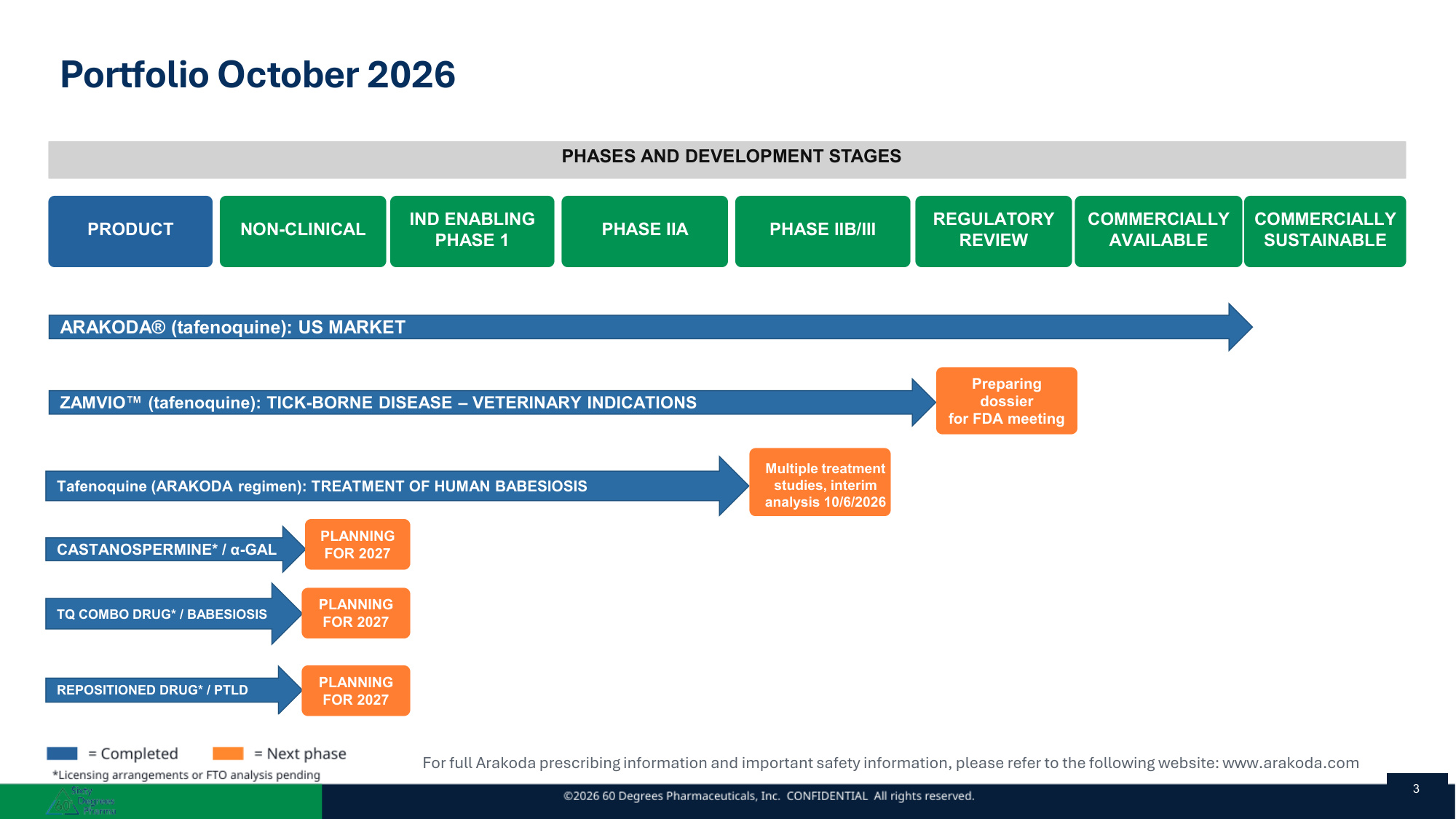
PHASES AND DEVELOPMENT STAGES PRODUCT NON-CLINICAL IND ENABLING PHASE 1 PHASE IIA PHASE IIB/III REGULATORY REVIEW COMMERCIALLY AVAILABLE COMMERCIALLY SUSTAINABLE ARAKODA® (tafenoquine): US MARKET ZAMVIO (tafenoquine): TICK-BORNE DISEASE – VETERINARY INDICATIONS Tafenoquine (ARAKODA regimen): TREATMENT OF HUMAN BABESIOSIS CASTANOSPERMINE* / α-GAL TQ COMBO DRUG* / BABESIOSIS REPOSITIONED DRUG* / PTLD Preparing dossier for FDA meeting Multiple treatment studies, interim analysis 10/6/2026 PLANNING FOR 2027 PLANNING FOR 2027 PLANNING FOR 2027 Portfolio October 2026 For full Arakoda prescribing information and important safety information, please refer to the following website: www.arakoda.com 3
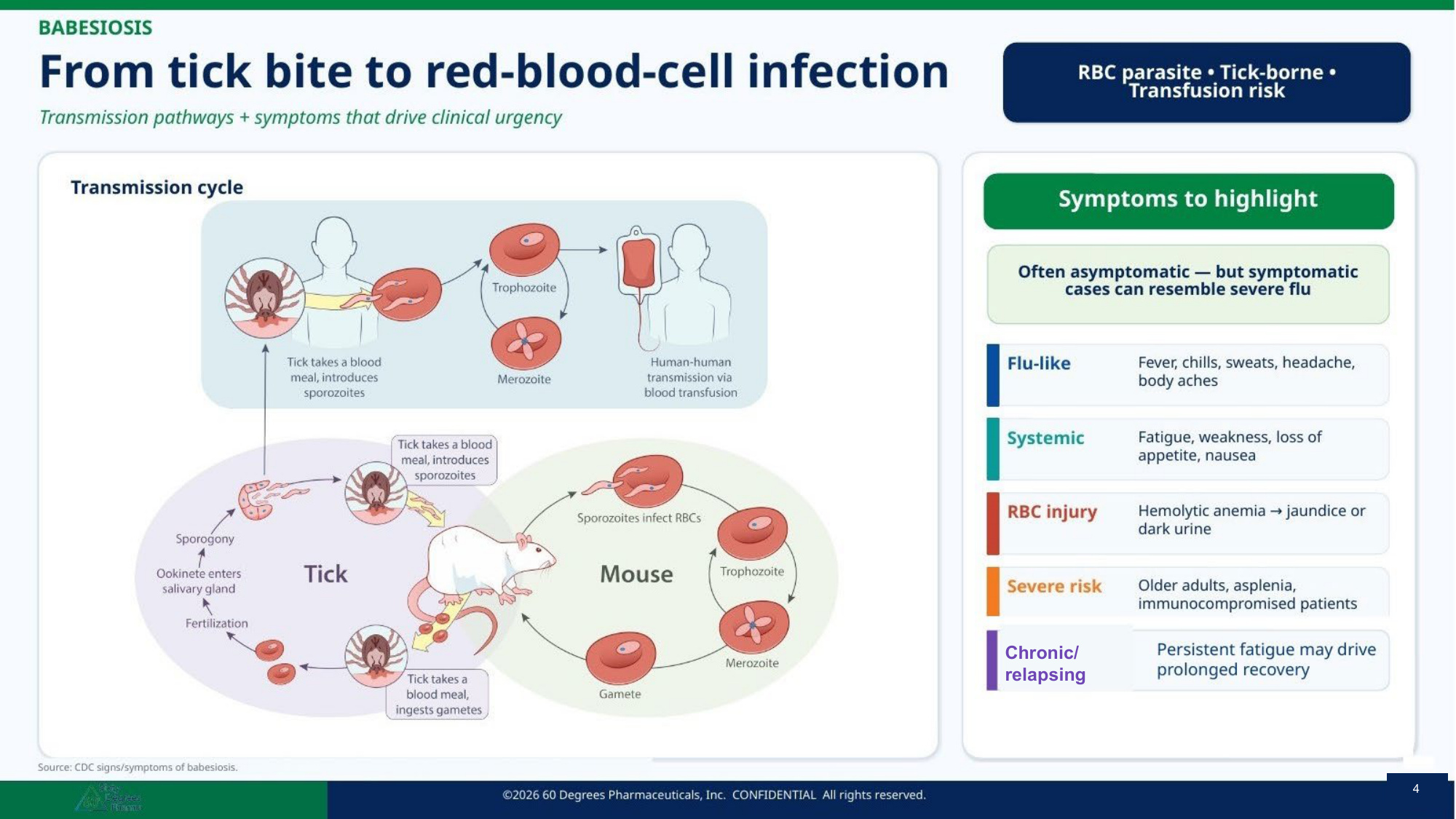
Chronic/ relapsing 4
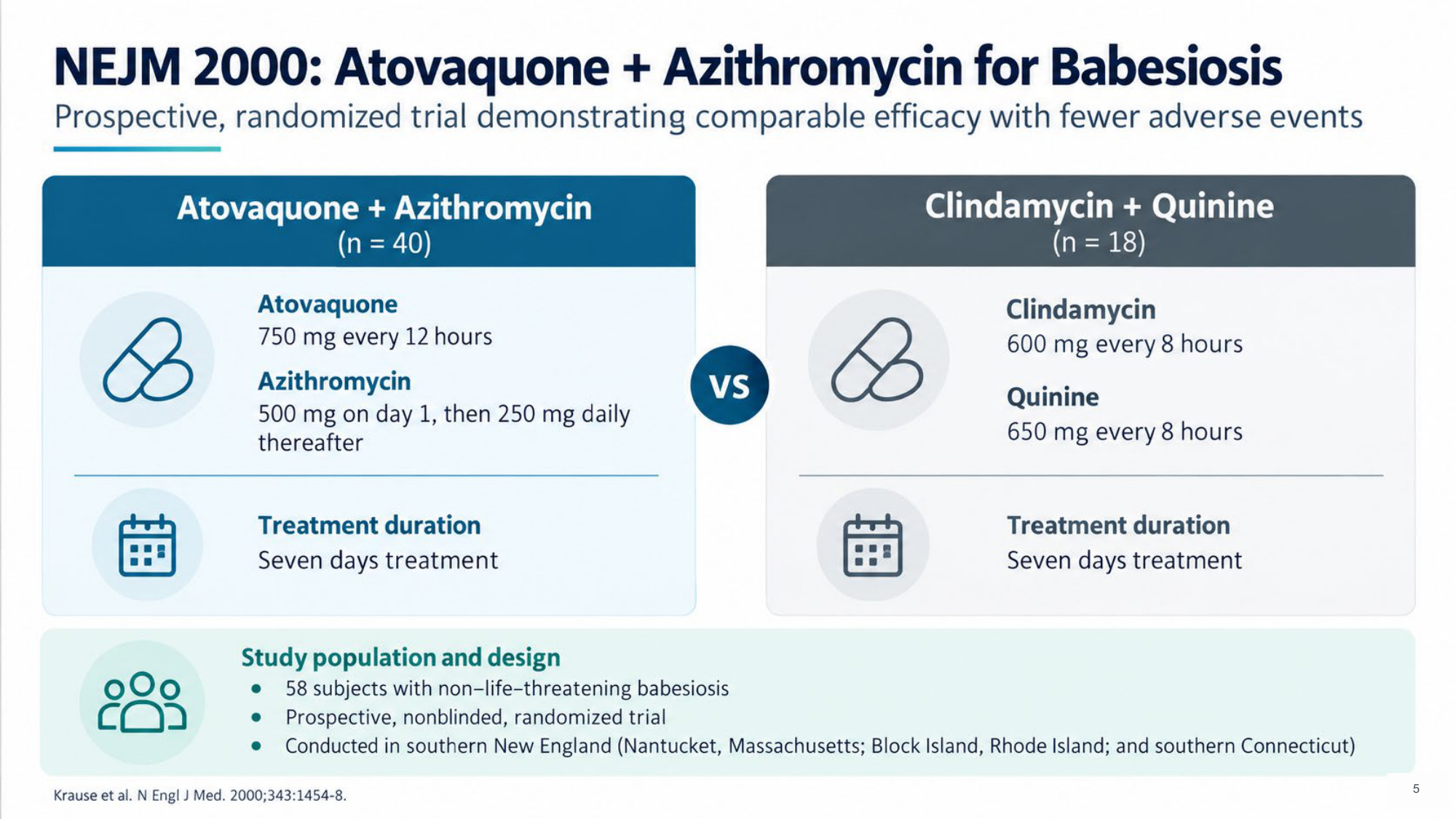
5
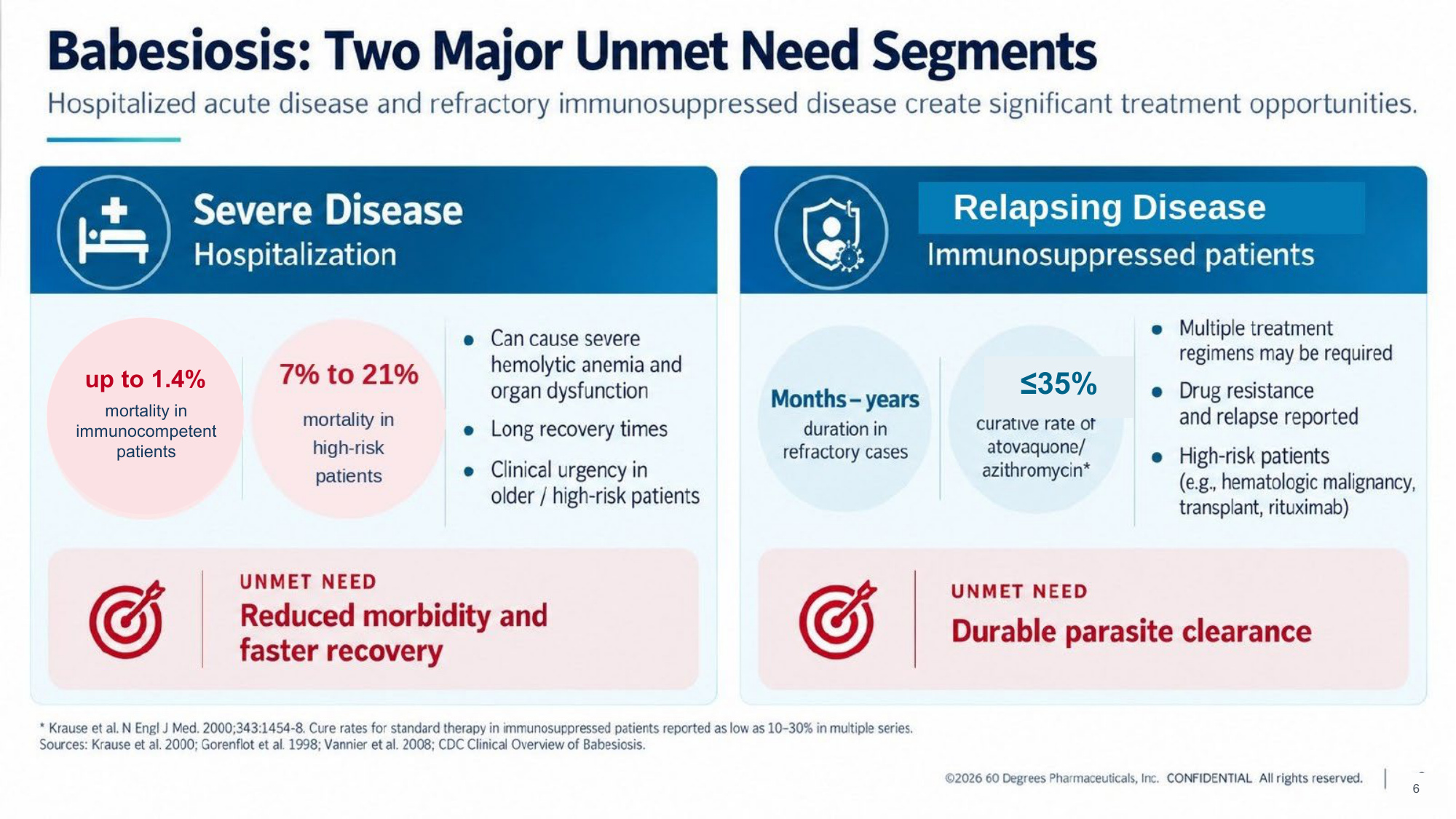
≤35% up to 1.4% mortality in immunocompetent patients 6
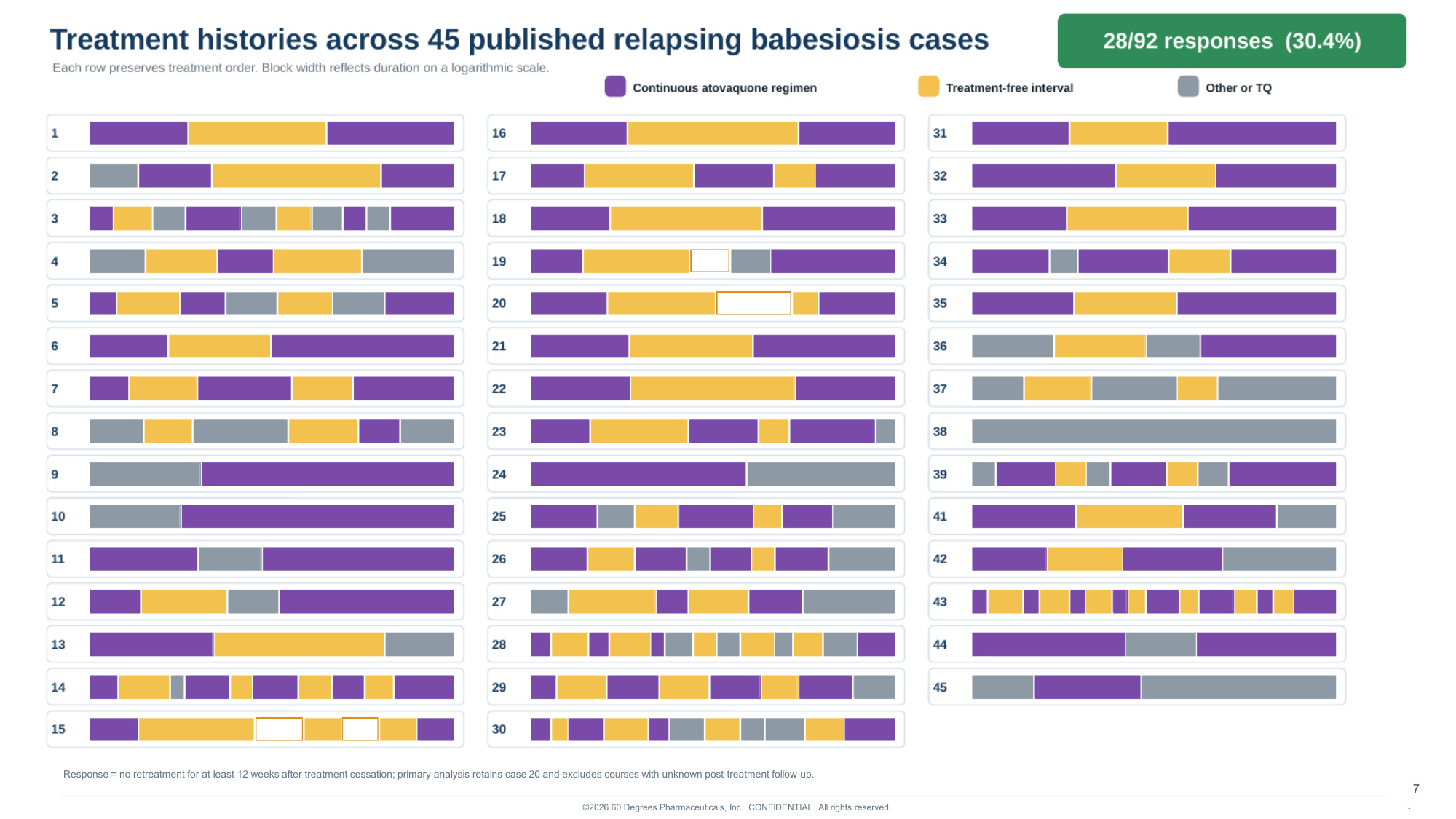
Response = no retreatment for at least 12 weeks after treatment cessation; primary analysis retains case 20 and excludes courses with unknown post-treatment follow-up. ©2026 60 Degrees Pharmaceuticals, Inc. CONFIDENTIAL All rights reserved. 7 7
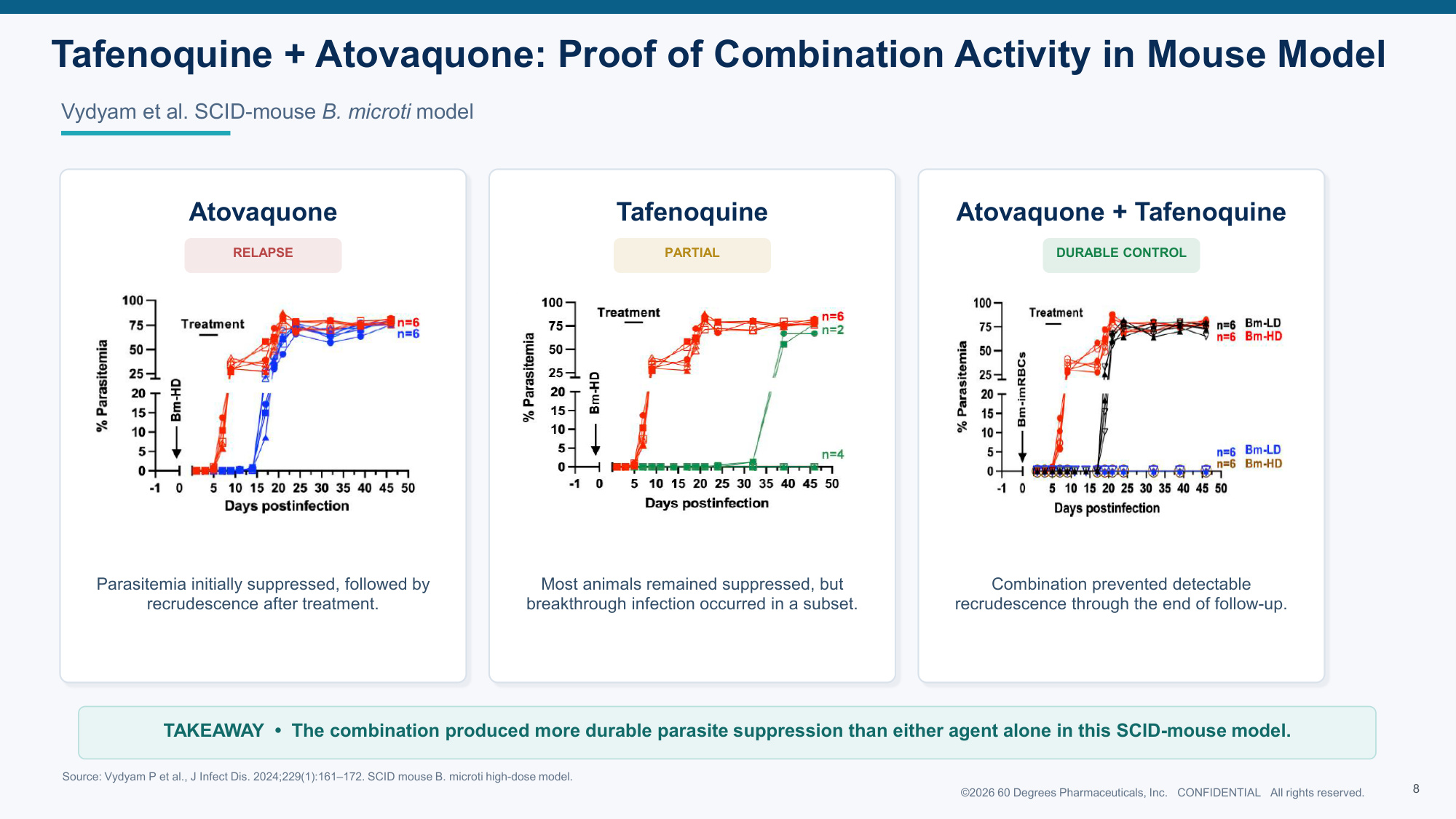
©2026 60 Degrees Pharmaceuticals, Inc. CONFIDENTIAL All rights reserved. 8 Tafenoquine + Atovaquone: Proof of Combination Activity in Mouse Model Vydyam et al. SCID-mouse B. microti model Atovaquone RELAPSE Parasitemia initially suppressed, followed by recrudescence after treatment. Tafenoquine PARTIAL Most animals remained suppressed, but breakthrough infection occurred in a subset. Atovaquone + Tafenoquine DURABLE CONTROL Combination prevented detectable recrudescence through the end of follow-up. TAKEAWAY • The combination produced more durable parasite suppression than either agent alone in this SCID-mouse model. Source: Vydyam P et al., J Infect Dis. 2024;229(1):161–172. SCID mouse B. microti high-dose model. 8
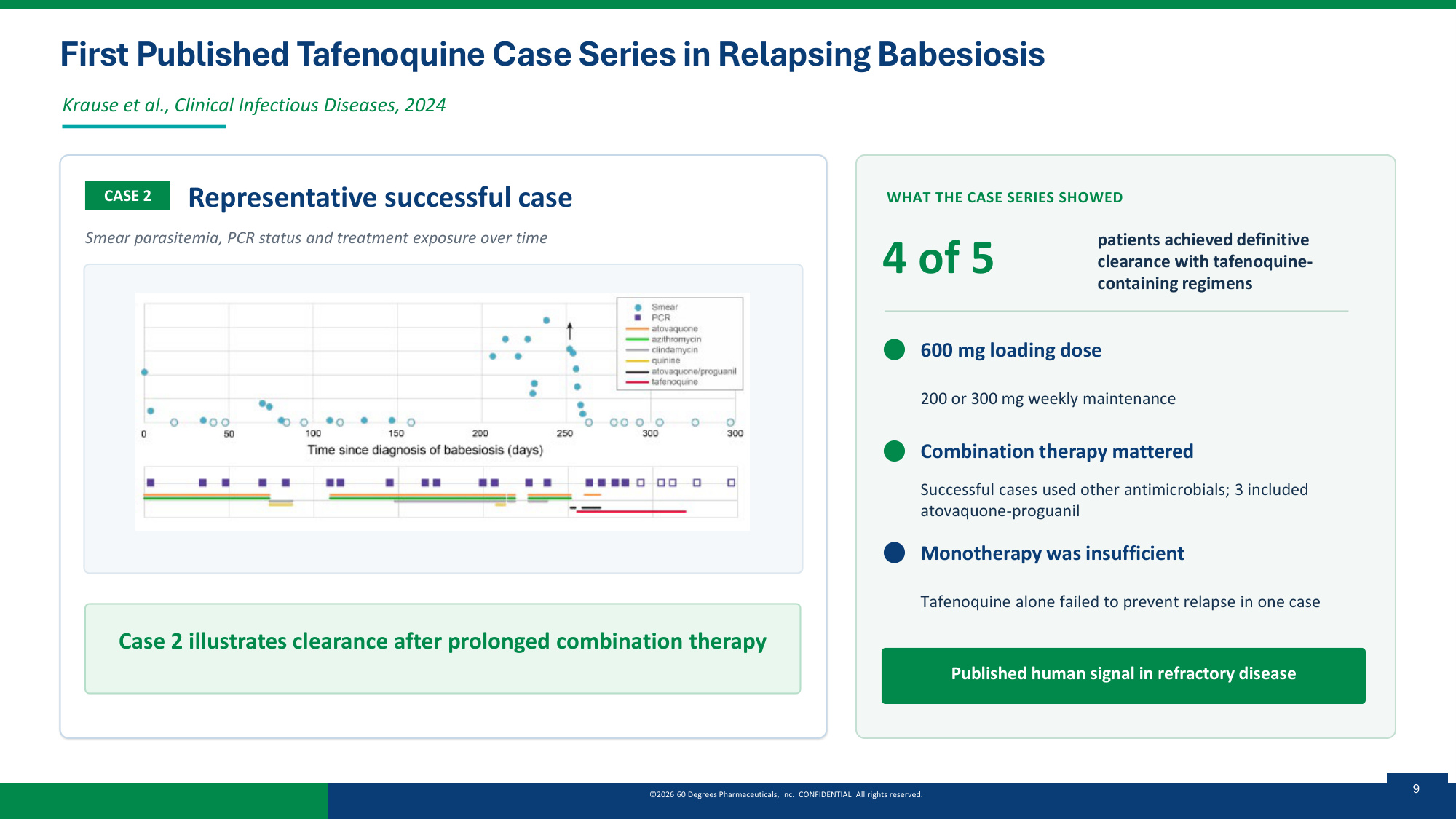
First Published Tafenoquine Case Series in Relapsing Babesiosis Krause et al., Clinical Infectious Diseases, 2024 CASE 2 Representative successful case Smear parasitemia, PCR status and treatment exposure over time Case 2 illustrates clearance after prolonged combination therapy WHAT THE CASE SERIES SHOWED 4 of 5 patients achieved definitive clearance with tafenoquine- containing regimens 600 mg loading dose 200 or 300 mg weekly maintenance Combination therapy mattered Successful cases used other antimicrobials; 3 included atovaquone-proguanil Monotherapy was insufficient Tafenoquine alone failed to prevent relapse in one case Published human signal in refractory disease ©2026 60 Degrees Pharmaceuticals, Inc. CONFIDENTIAL All rights reserved. 99
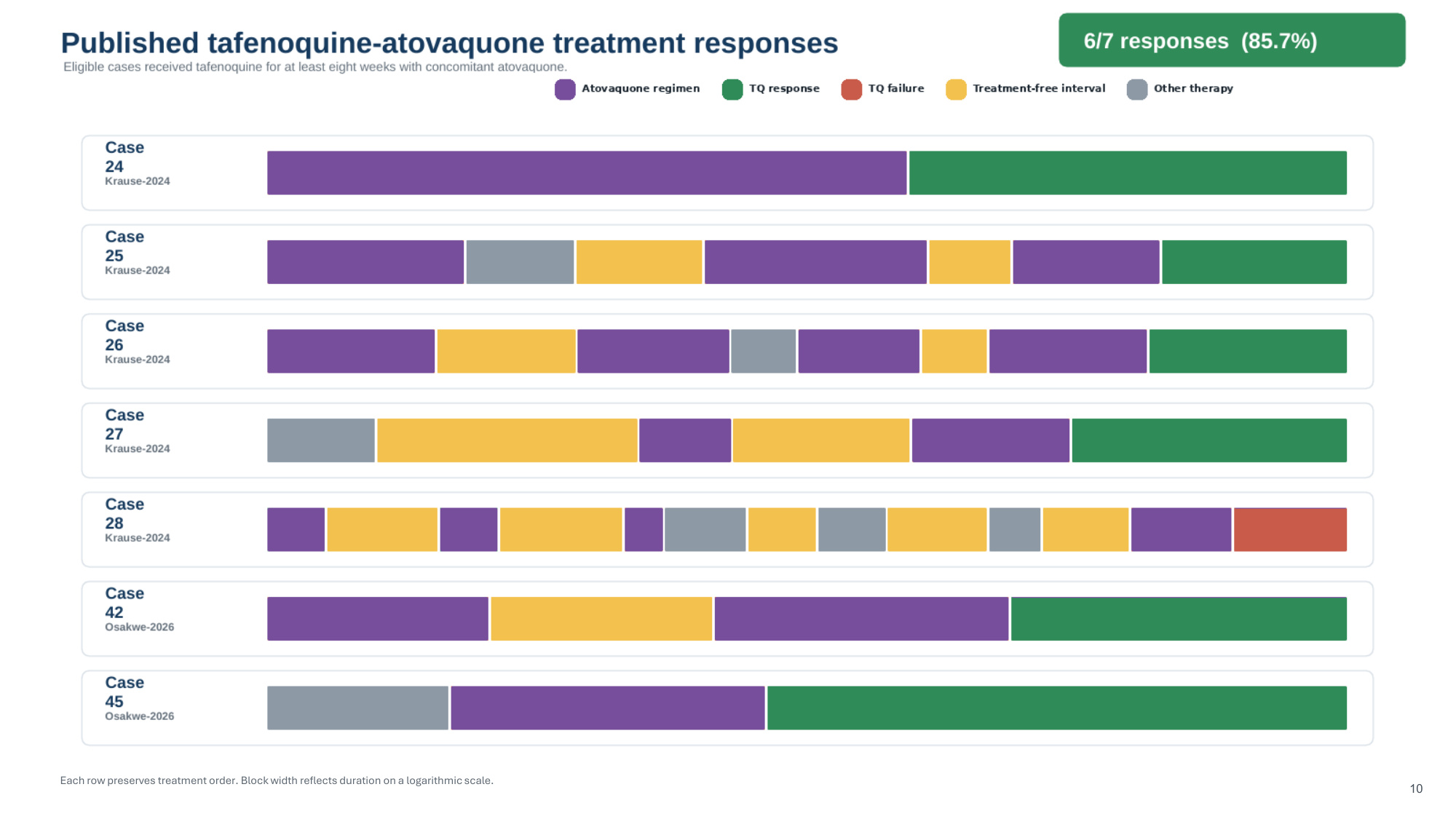
Each row preserves treatment order. Block width reflects duration on a logarithmic scale. 10
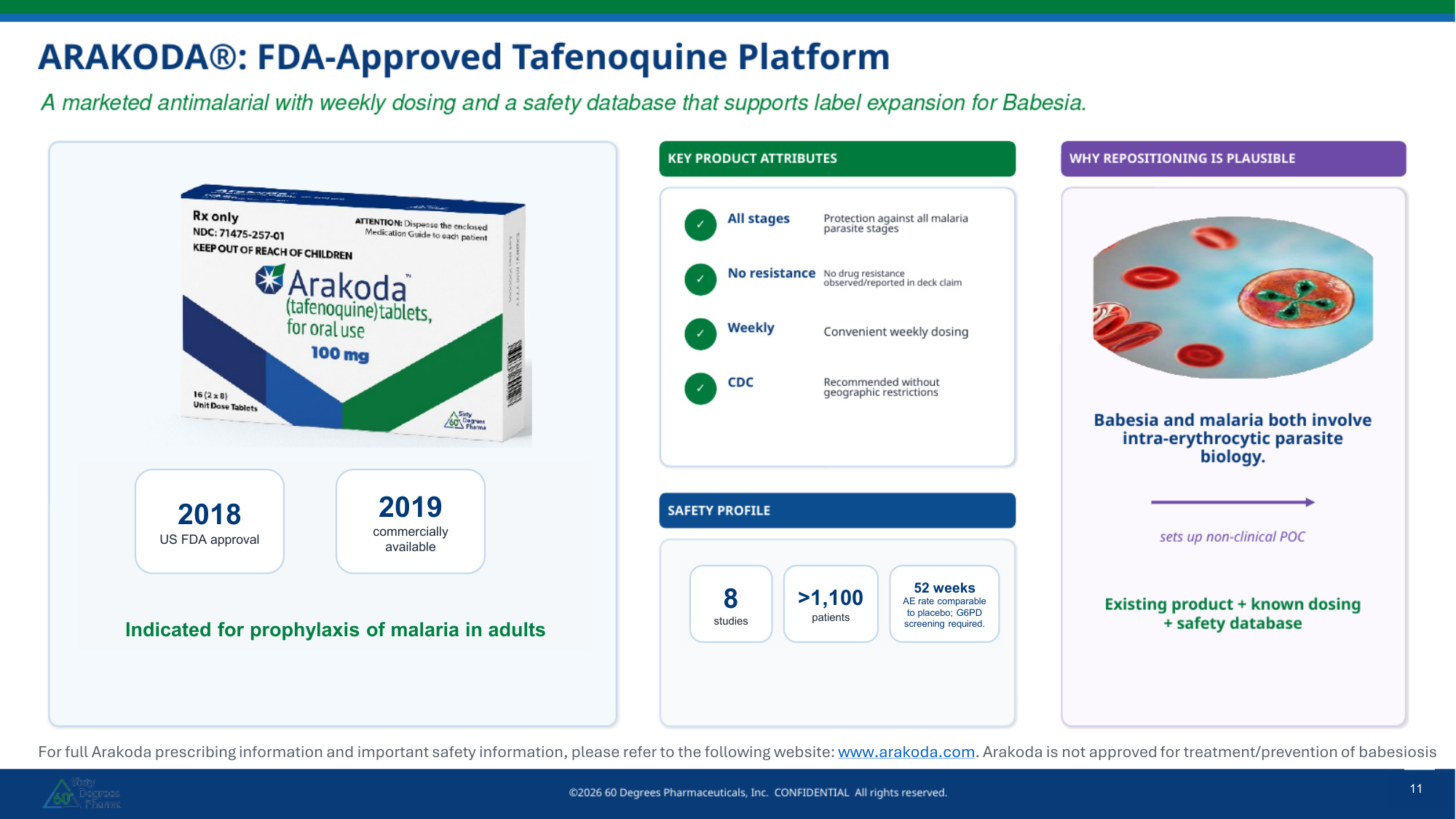
11 adult age group indicated 11 11 11 2018 US FDA approval 2019 commercially available Indicated for prophylaxis of malaria in adults 8 studies >1,100 patients 52 weeks AE rate comparable to placebo; G6PD screening required. For full Arakoda prescribing information and important safety information, please refer to the following website: www.arakoda.com. Arakoda is not approved for treatment/prevention of babesiosis 11
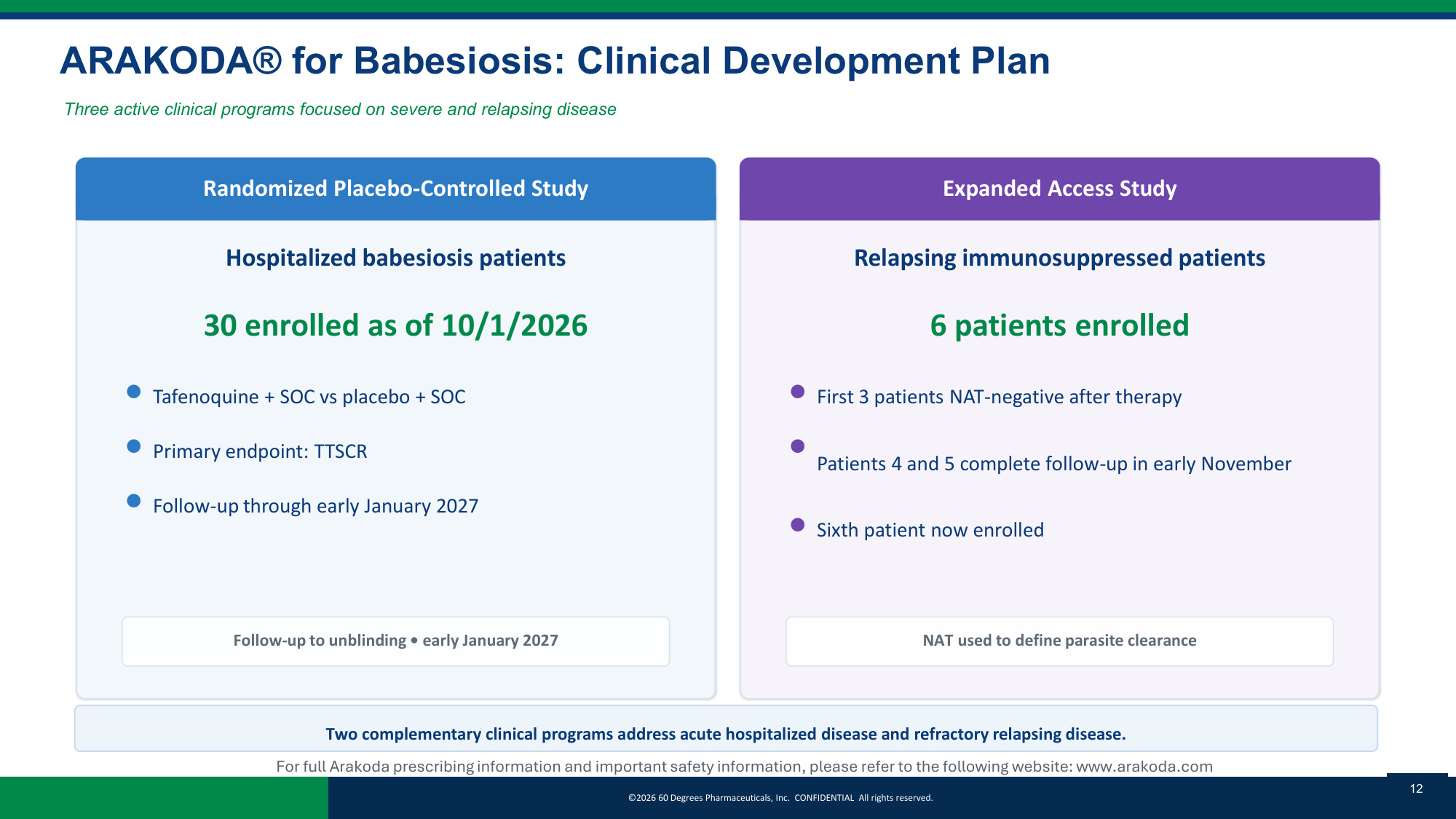
ARAKODA® for Babesiosis: Clinical Development Plan Three active clinical programs focused on severe and relapsing disease Randomized Placebo-Controlled Study Hospitalized babesiosis patients 30 enrolled as of 10/1/2026 Tafenoquine + SOC vs placebo + SOC Primary endpoint: TTSCR Follow-up through early January 2027 Follow-up to unblinding • early January 2027 Expanded Access Study Relapsing immunosuppressed patients 6 patients enrolled First 3 patients NAT-negative after therapy Patients 4 and 5 complete follow-up in early November Sixth patient now enrolled NAT used to define parasite clearance Two complementary clinical programs address acute hospitalized disease and refractory relapsing disease. ©2026 60 Degrees Pharmaceuticals, Inc. CONFIDENTIAL All rights reserved. 12 For full Arakoda prescribing information and important safety information, please refer to the following website: www.arakoda.com 12
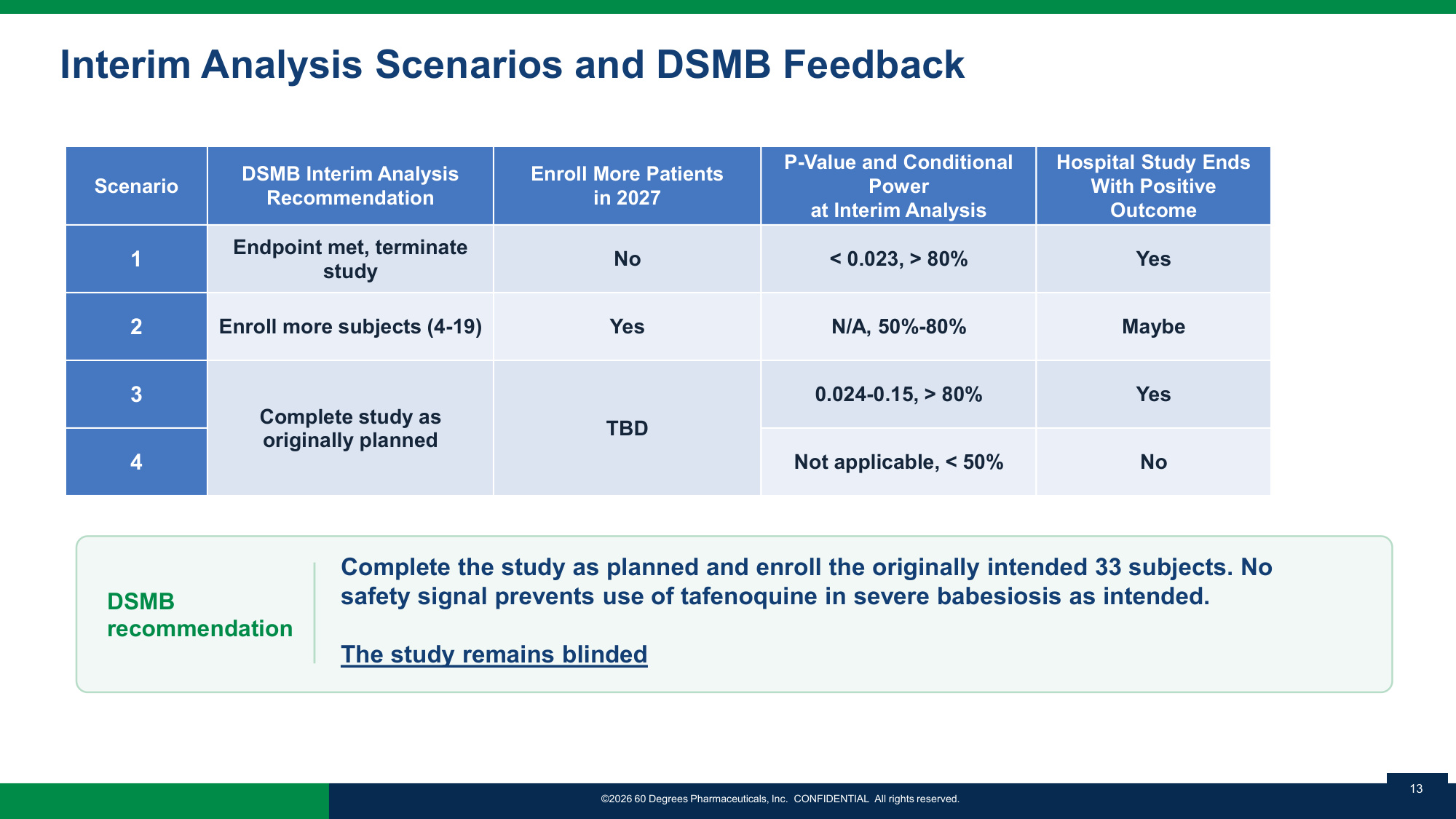
Interim Analysis Scenarios and DSMB Feedback Scenario DSMB Interim Analysis Recommendation Enroll More Patients in 2027 P-Value and Conditional Power at Interim Analysis Hospital Study Ends With Positive Outcome 1 2 3 4 Endpoint met, terminate study Enroll more subjects (4-19) Complete study as originally planned No Yes TBD < 0.023, > 80% N/A, 50%-80% 0.024-0.15, > 80% Not applicable, < 50% Yes Maybe Yes No DSMB recommendation Complete the study as planned and enroll the originally intended 33 subjects. No safety signal prevents use of tafenoquine in severe babesiosis as intended. The study remains blinded ©2026 60 Degrees Pharmaceuticals, Inc. CONFIDENTIAL All rights reserved. 13 13
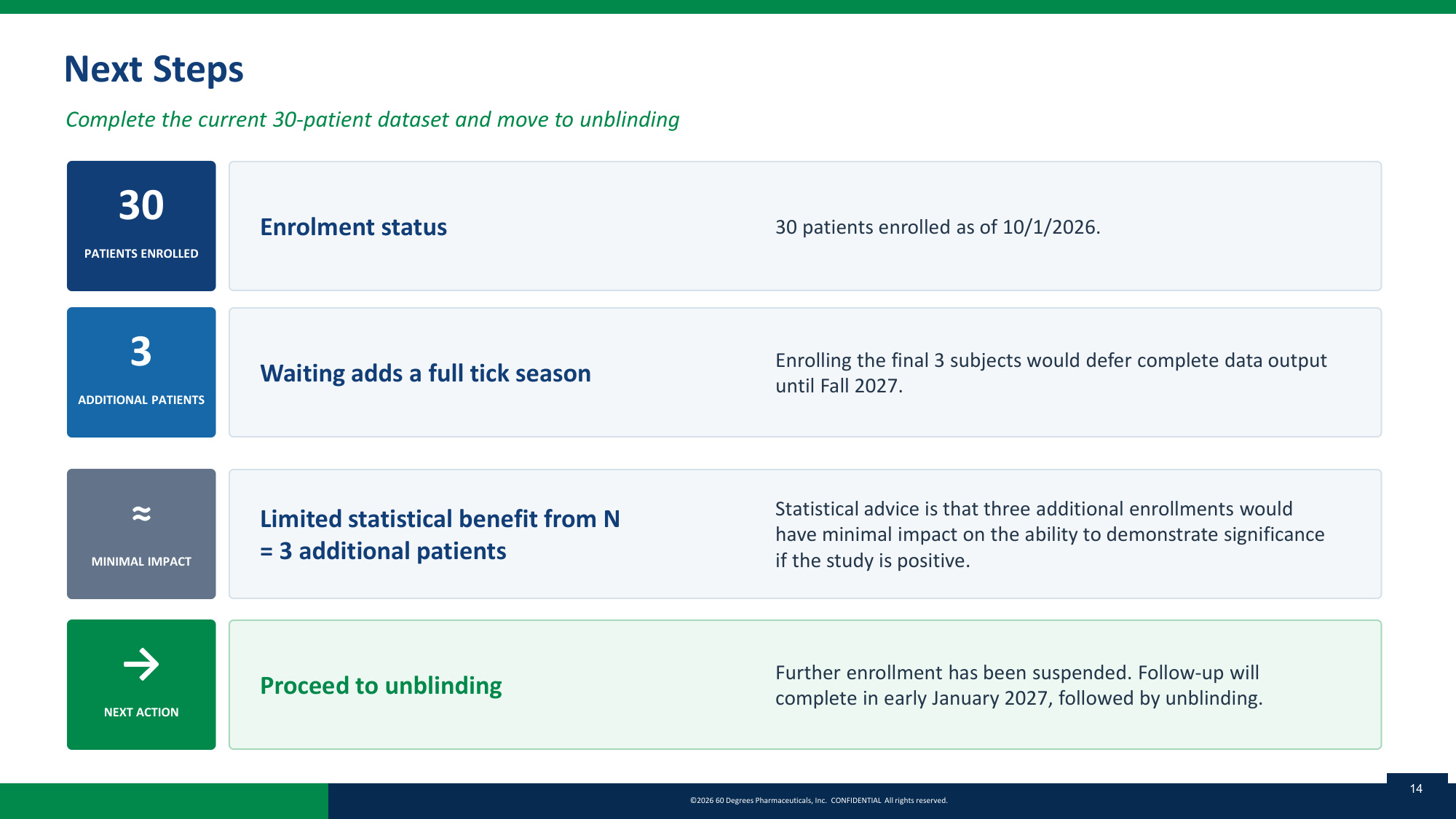
Next Steps Complete the current 30-patient dataset and move to unblinding 30 PATIENTS ENROLLED Enrolment status 30 patients enrolled as of 10/1/2026. 3 ADDITIONAL PATIENTS Waiting adds a full tick season Enrolling the final 3 subjects would defer complete data output until Fall 2027. ≈ MINIMAL IMPACT Limited statistical benefit from N = 3 additional patients Statistical advice is that three additional enrollments would have minimal impact on the ability to demonstrate significance if the study is positive. → NEXT ACTION Proceed to unblinding Further enrollment has been suspended. Follow-up will complete in early January 2027, followed by unblinding. ©2026 60 Degrees Pharmaceuticals, Inc. CONFIDENTIAL All rights reserved. 14 14
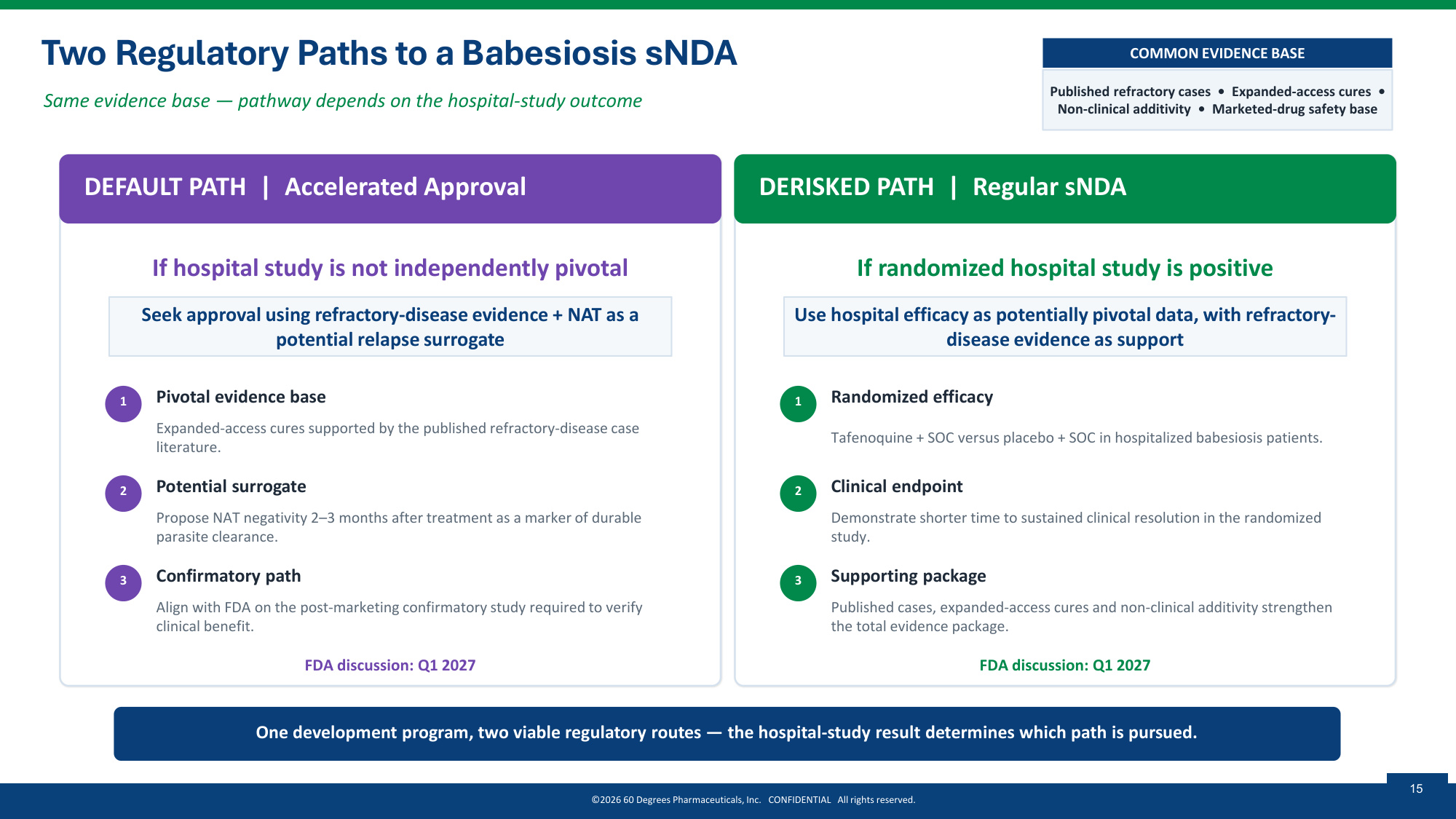
Two Regulatory Paths to a Babesiosis sNDA Same evidence base — pathway depends on the hospital-study outcome COMMON EVIDENCE BASE Published refractory cases • Expanded-access cures • Non-clinical additivity • Marketed-drug safety base DEFAULT PATH | Accelerated Approval If hospital study is not independently pivotal Seek approval using refractory-disease evidence + NAT as a potential relapse surrogate 1 Pivotal evidence base Expanded-access cures supported by the published refractory-disease case literature. 2 Potential surrogate Propose NAT negativity 2–3 months after treatment as a marker of durable parasite clearance. 3 Confirmatory path Align with FDA on the post-marketing confirmatory study required to verify clinical benefit. FDA discussion: Q1 2027 DERISKED PATH | Regular sNDA If randomized hospital study is positive Use hospital efficacy as potentially pivotal data, with refractory- disease evidence as support 1 Randomized efficacy Tafenoquine + SOC versus placebo + SOC in hospitalized babesiosis patients. 2 Clinical endpoint Demonstrate shorter time to sustained clinical resolution in the randomized study. 3 Supporting package Published cases, expanded-access cures and non-clinical additivity strengthen the total evidence package. FDA discussion: Q1 2027 One development program, two viable regulatory routes — the hospital-study result determines which path is pursued. ©2026 60 Degrees Pharmaceuticals, Inc. CONFIDENTIAL All rights reserved. 15 15
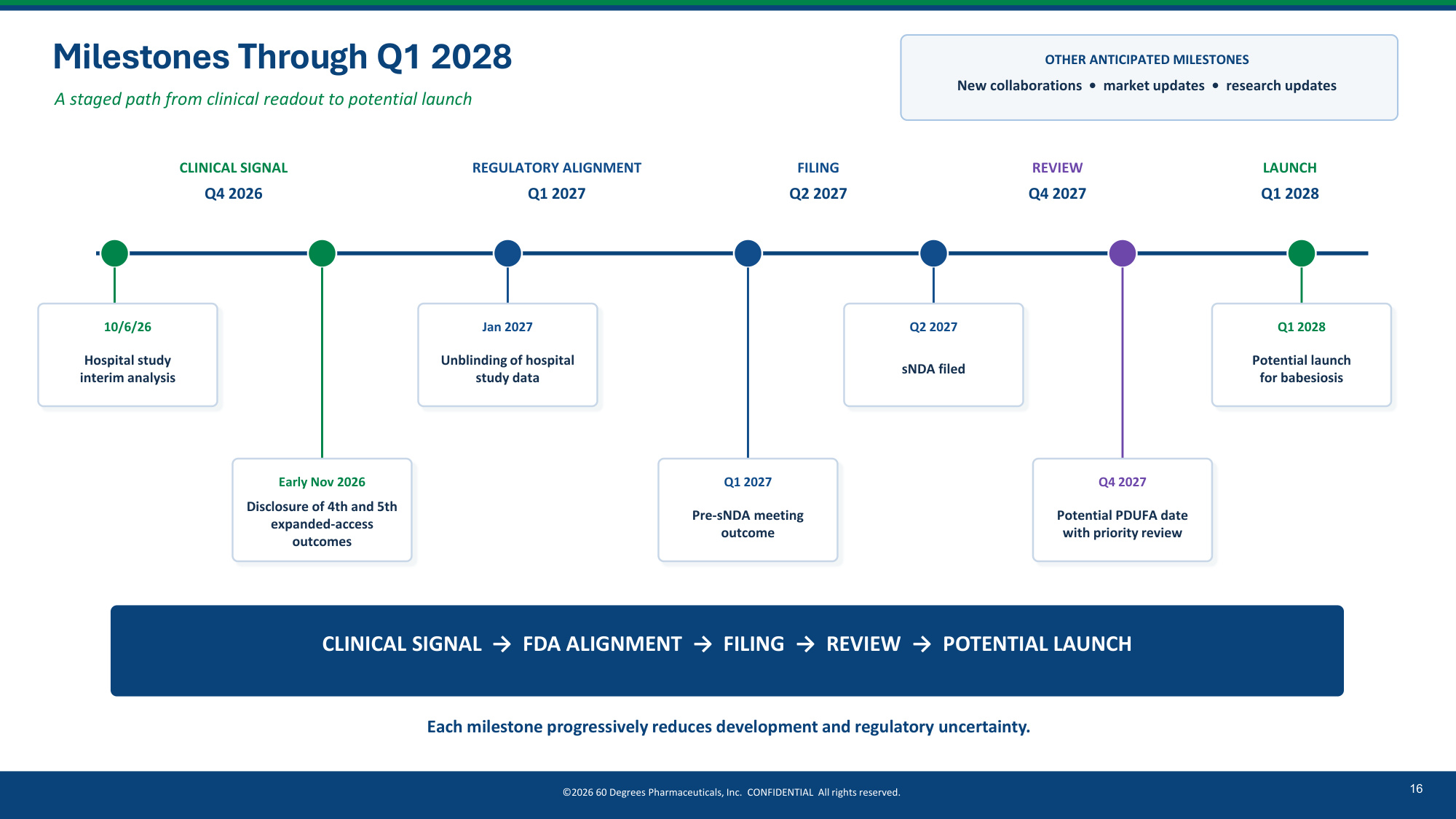
Milestones Through Q1 2028 A staged path from clinical readout to potential launch OTHER ANTICIPATED MILESTONES New collaborations • market updates • research updates CLINICAL SIGNAL Q4 2026 REGULATORY ALIGNMENT Q1 2027 FILING Q2 2027 REVIEW Q4 2027 LAUNCH Q1 2028 10/6/26 Hospital study interim analysis Early Nov 2026 Disclosure of 4th and 5th expanded-access outcomes Jan 2027 Unblinding of hospital study data Q1 2027 Pre-sNDA meeting outcome Q2 2027 sNDA filed Q4 2027 Potential PDUFA date with priority review Q1 2028 Potential launch for babesiosis CLINICAL SIGNAL → FDA ALIGNMENT → FILING → REVIEW → POTENTIAL LAUNCH Each milestone progressively reduces development and regulatory uncertainty. ©2026 60 Degrees Pharmaceuticals, Inc. CONFIDENTIAL All rights reserved. 1616
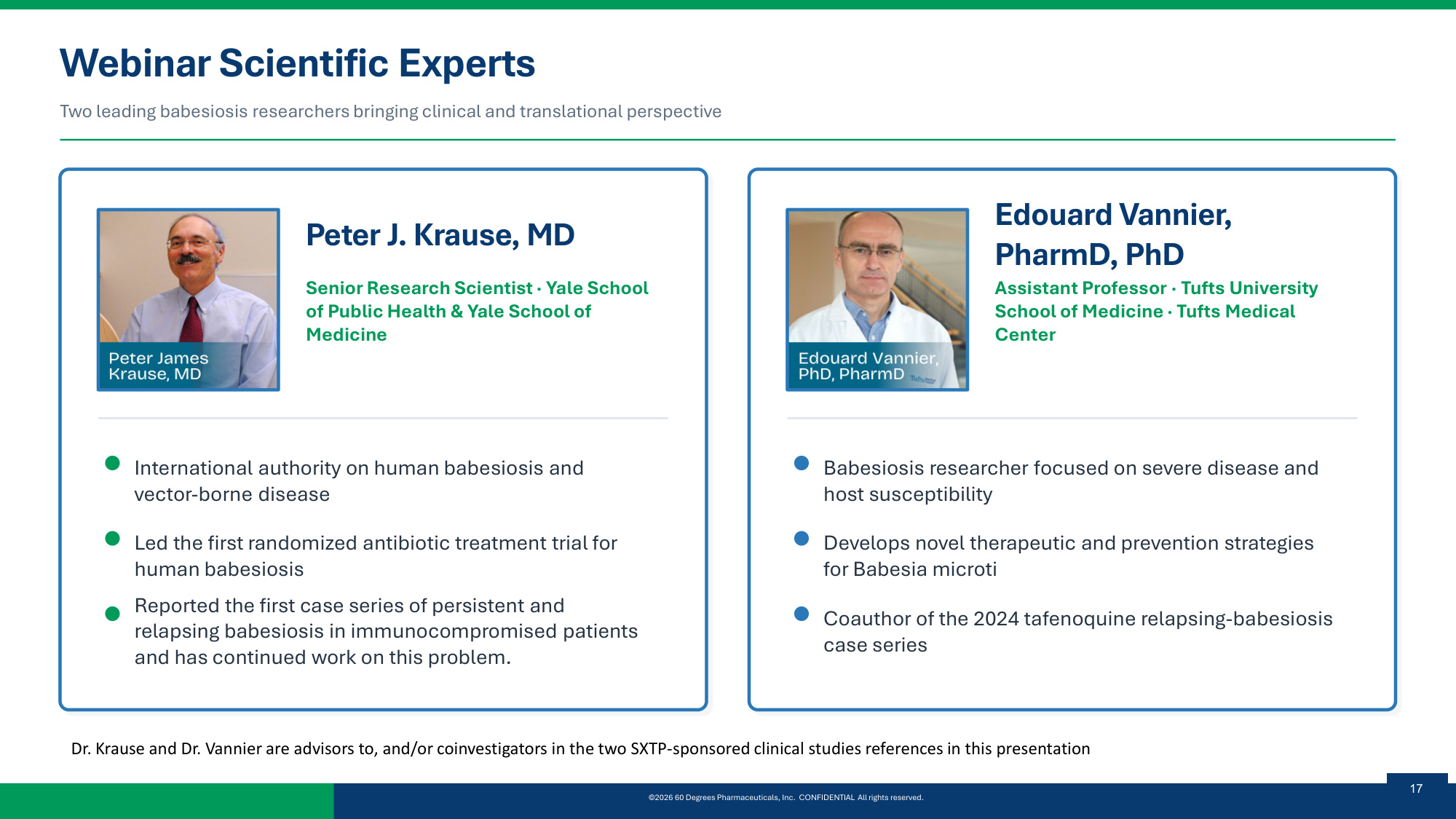
Webinar Scientific Experts Two leading babesiosis researchers bringing clinical and translational perspective Peter J. Krause, MD Senior Research Scientist · Yale School of Public Health & Yale School of Medicine International authority on human babesiosis and vector-borne disease Led the first randomized antibiotic treatment trial for human babesiosis Reported the first case series of persistent and relapsing babesiosis in immunocompromised patients and has continued work on this problem. Edouard Vannier, PharmD, PhD Assistant Professor · Tufts University School of Medicine · Tufts Medical Center Babesiosis researcher focused on severe disease and host susceptibility Develops novel therapeutic and prevention strategies for Babesia microti Coauthor of the 2024 tafenoquine relapsing-babesiosis case series ©2026 60 Degrees Pharmaceuticals, Inc. CONFIDENTIAL All rights reserved. 17 Dr. Krause and Dr. Vannier are advisors to, and/or coinvestigators in the two SXTP-sponsored clinical studies references in this presentation 17