ANNUAL REPORT 2025-26
EXHIBIT (c)(viii)
Queensland Treasury Corporation Annual Report for the Fiscal Year Ended June 30, 2026
FORWARD-LOOKING STATEMENTS
This exhibit contains forward-looking statements. Statements that are not historical facts, including statements about the beliefs and expectations of Queensland Treasury Corporation (“QTC”) or the State of Queensland (the “State” or “Queensland”), are forward-looking statements. These statements are based on current plans, budgets, estimates and projections and therefore you should not place undue reliance on them. The words “believe”, “may”, “will”, “should”, “estimate”, “continue”, “anticipate”, “intend”, “expect”, “forecast” and similar words are intended to identify forward-looking statements. Forward-looking statements speak only as of the date they are made, and neither QTC nor the State undertake any obligation to update publicly any of them in light of new information or future events.
Forward-looking statements are based on current plans, estimates and projections and, therefore, undue reliance should not be placed on them. Although QTC and the State believe that the beliefs and expectations reflected in such forward-looking statements are reasonable, no assurance can be given that such beliefs and expectations will prove to have been correct. Forward-looking statements involve inherent risks and uncertainties. We caution you that actual results may differ materially from those contained in any forward-looking statements.
A number of important factors could cause actual results to differ materially from those expressed in any forward-looking statement. Factors that could cause the actual outcomes to differ materially from those expressed or implied in forward-looking statements include:
| • | the international and Australian economies, and in particular the rates of growth (or contraction) of the State’s major trading partners; |
| • | the effects, both internationally and in Australia, of any economic downturn, as well as the effect of ongoing economic, banking and sovereign debt risk; |
| • | the effect of natural disasters, epidemics and geopolitical events, such as the Russian invasion of Ukraine and the conflicts in the Middle East, including their impact on global energy supply and prices; |
| • | increases or decreases in international and Australian domestic interest rates; |
| • | changes in and increased volatility in currency exchange rates; |
| • | changes in the State’s domestic consumption; |
| • | changes in the State’s labor force participation and productivity; |
| • | downgrades in the credit ratings of the State or Australia; |
| • | changes in the rate of inflation in the State; |
| • | changes in environmental and other regulation; and |
| • | changes in the distribution of revenue from the Commonwealth of Australia Government to the State. |
(c)(viii)-1
ANNUAL REPORT 2025-26
Acknowledgement of Country
QTC acknowledges the Aboriginal and Torres Strait Islander ancestors of this land, their spirits and their legacy. The foundations laid by these ancestors—of the First Nations peoples—give strength, inspiration and courage to current and future generations towards creating a better Queensland.
Artwork: ‘Walking With Purpose’ artwork by David Williams of Gilimbaa.
CONTENTS
| Letter of compliance |
2 | |||
| Queensland Treasury Corporation |
3 | |||
| Role and responsibilities |
4 | |||
| Year in review |
5 | |||
| Chair’s report |
6 | |||
| Chief Executive Officer’s report |
8 | |||
| Funding, debt and treasury management |
10 | |||
| Consulting and capability development |
13 | |||
| Advisory solutions and expertise |
15 | |||
| Operational excellence |
16 | |||
| Great place to work |
17 | |||
| Risk mindset |
18 | |||
| Environmental, social and governance commitment |
19 | |||
| Corporate governance |
20 | |||
| Financial Statements |
26–69 | |||
| Appendices |
70 | |||
| Appendix A - Statutory and mandatory disclosures |
71 | |||
| Appendix B - Glossary |
72 | |||
| Appendix C - Compliance checklist |
73 | |||
| Appendix D - Contacts |
74 | |||
Turrbal Country (Meanjin)
Level 30, 111 Eagle Street
Brisbane Queensland Australia
Telephone: +61 7 3842 4600
Email: enquiry@qtc.com.au
Queensland Treasury Corporation’s annual reports (ISSN 1837-1256 print; ISSN 1837-1264 online)
are available on QTC’s website.
| QUEENSLAND TREASURY CORPORATION | ANNUAL REPORT 2025–26 | 1 |
| 27 August 2026 |

|
The Honourable David Janetzki MP
Treasurer, Minister for Energy and Minister for Home Ownership
GPO Box 611
Brisbane QLD 4001
Dear Treasurer
I am pleased to submit for presentation to the Parliament the Annual Report 2025–26 and financial statements for Queensland Treasury Corporation.
I certify that this Annual Report complies with:
| • | the prescribed requirements of the Financial Accountability Act 2009 and the Financial and Performance Management Standard 2019, and |
| • | the detailed requirements set out in the Annual Report requirements for Queensland Government agencies. |
A checklist outlining the annual reporting requirements can be found on page 73 of this Annual Report.
Yours sincerely

Steve Johnston
Chair
LEVEL 30, 111 EAGLE STREET, BRISBANE QUEENSLAND AUSTRALIA 4000
GPO BOX 1096, BRISBANE QUEENSLAND AUSTRALIA 4001
T: 07 3842 4600
| 2 | QUEENSLAND TREASURY CORPORATION | ANNUAL REPORT 2025–26 |
QUEENSLAND TREASURY CORPORATION
Queensland Treasury Corporation (QTC) has a statutory responsibility to advance the financial position of the State. It also manages and minimises financial risks in the Queensland public sector. Established under the Queensland Treasury Corporation Act 1988 (QTC Act), QTC is a corporation sole, reporting through the Under Treasurer to the Treasurer and the Queensland Parliament.
Purpose
We create value for all Queenslanders through our trusted expertise.
Vision
A world-class financial partner of government.
Values
| IMPACT We make a difference Purpose, value and continuous improvement guide how we prioritise, define success and use resources. |
INTEGRITY We are accountable Reliability, consistency and humility guide how we commit, follow through, speak up and learn. |
RESPECT We work well together Consideration and curiosity guide how we collaborate, listen, include others and recognise contributions. | ||||||
Strategic pillars
To serve Queensland and our clients we will:

|
FORTIFY - Funding, debt and treasury management
To deliver on the State’s growing needs in a dynamic market. | |

|
SCALE - Consulting and capability development
To deliver high-quality cost-effective consulting services and increase public sector capability. | |

|
FOCUS - Advisory solutions and expertise
To deliver expert analysis and advice, supporting government priorities. | |
Our client services are enabled by:

|
Operational excellence
An efficient and flexible organisation that leverages technology and reduces complexity. | |

|
Great place to work
A collaborative and inclusive workplace where leaders drive performance and develop talent. | |

|
Risk mindset
A leader in risk management within public-sector finance. | |
| QUEENSLAND TREASURY CORPORATION | ANNUAL REPORT 2025–26 | 3 |
ROLE AND RESPONSIBILITIES
At QTC, we are committed to protecting and advancing the financial interests of Queensland.
QTC is the central financing authority for the Queensland Government and provides financial resources and services for the State. We manage the State’s funding program in global capital markets to deliver sustainable and cost-effective borrowings for the Queensland Government—principally through Queensland Treasury. Our clients also include Queensland Government Owned Corporations (GOCs), departments, agencies, local governments, and other entities such as universities.
With a statutory role to advance the financial interests and development of the State, we work closely with Queensland Treasury and other clients to deliver financial, economic and social outcomes. This includes the development of innovative, long-term solutions that contribute to the growth of Queensland’s economy.
We protect Queensland’s financial interests and deliver better financial outcomes by centralising the management of our clients’ borrowings, cash investments, and financial risks. We also work closely with our clients on their financial exposures, to identify opportunities to minimise costs and risks, and maximise outcomes.
| 4 | QUEENSLAND TREASURY CORPORATION | ANNUAL REPORT 2025–26 |
YEAR IN REVIEW
| Creating value for all Queenslanders through trusted expertise | ||
| $32.5B the State’s borrowing requirement completed ahead of schedule, supporting government priorities and infrastructure delivery. |
$23.3B in new client borrowings delivered through QTC funding solutions. | |
| ~$98B in payments facilitated through proactive cash centralisation, ensuring sufficient liquidity to support the Queensland Government’s daily operational requirements. |
$14.5M estimated client savings delivered through foreign exchange services. | |
| $105.7M operating profit after tax from capital markets operations. |
$465B in transaction volume settled with zero cost of errors. | |
| >> | Australia’s largest sub-sovereign green bond issuer, with $15.7 billion in green bonds outstanding. | |
| >> | Supporting Queensland’s public sector through strategic, financial and commercial advice to Queensland Treasury, GOCs and local governments. | |
| >> | Building the financial capability of Queensland’s public sector through practical training and education services. | |
| >> | Queensland Government Consulting Services (QGCS) established to support the Queensland Government’s commitment to reduce reliance on external consultants and transfer skills to the State’s public sector. | |
Figures as of 30 June 2026. All amounts in AUD.
NOOSA QUEENSLAND, AUSTRALIA
| QUEENSLAND TREASURY CORPORATION | ANNUAL REPORT 2025–26 | 5 |
STEVE JOHNSTON
CHAIR
“QTC completed the State’s $32.5 billion indicative term debt borrowing requirement ahead of schedule while continuing to diversify funding sources and expand its investor base across domestic and international markets.”
CHAIR’S REPORT
In 2025–26, Queensland Treasury Corporation continued to play an important role in supporting Queensland’s financial strength, resilience and long-term prosperity.
Against a backdrop of ongoing economic uncertainty, evolving market conditions and increasing expectations of the public sector, QTC continued to provide trusted specialist expertise to support government decision-making and deliver value for Queenslanders. Through its unique role as the State’s central financing authority and financial services provider, QTC continues to make an important contribution to Queensland’s economic and fiscal wellbeing.
The Board’s focus throughout the year was to ensure QTC remained well positioned to support the State’s financial and community objectives while maintaining strong governance, financial discipline and organisational resilience.
A significant achievement during the year was the successful execution of Queensland’s borrowing program. QTC completed the State’s $32.5 billion indicative term debt borrowing requirement ahead of schedule while continuing to diversify funding sources and expand its investor base across domestic and international markets. These outcomes reinforce Queensland’s strong standing in global capital markets and reflect the confidence investors continue to place in both the State and QTC.
While funding remains central to QTC’s role, the organisation’s contribution extends well beyond capital markets. Throughout the year, QTC continued to support Queensland’s public sector through advisory, treasury management, consulting and education services. These activities strengthened capability across government, supported informed decision-making and contributed to improved outcomes for Queenslanders.
Maintaining strong governance and a positive risk culture remained a key priority for the Board. During the year, QTC continued to strengthen its enterprise risk management, compliance and operational resilience capabilities. In an increasingly complex environment, these foundations are essential to maintaining trust and ensuring the organisation can continue to deliver critical services while safeguarding the State’s financial interests.
The Board also recognises that organisational capability is critical to QTC’s long-term success. Continued investment in leadership, workforce capability and culture helps ensure the organisation remains well positioned to meet the evolving needs of clients and stakeholders and deliver sustainable value into the future.
| 6 | QUEENSLAND TREASURY CORPORATION | ANNUAL REPORT 2025–26 |
“With strong foundations, robust governance and a clear strategic direction, QTC is well positioned to continue supporting Queensland’s prosperity and delivering value for Queenslanders.”
As part of its stewardship role, the Board approved QTC’s Strategic Plan 2026–2030. The plan will help guide the organisation’s future priorities and support its continued contribution to Queensland’s economic and fiscal wellbeing.
During the year, the Board also underwent a period of renewal. We welcomed new directors whose experience and perspectives further strengthen the breadth of expertise available to QTC. I extend my sincere thanks to those directors who concluded their service during the year. Their contribution and stewardship have helped position the organisation strongly for the future.
On behalf of the Board, I thank Simon Ling, the Executive Leadership Team and all QTC employees for their professionalism, expertise and commitment. I also thank our clients, investors, stakeholders and partners for their continued confidence and support.
As we look ahead, the Board remains confident in QTC’s future. With strong foundations, robust governance and a clear strategic direction, QTC is well positioned to continue supporting Queensland’s prosperity and delivering value for Queenslanders.

STEVE JOHNSTON
Chair
27 August 2026
| QUEENSLAND TREASURY CORPORATION | ANNUAL REPORT 2025–26 | 7 |

SIMON LING
CHIEF EXECUTIVE OFFICER
“During 2025–26, QTC delivered strong results across all areas of the organisation while continuing to strengthen our capability, services and impact.”
CHIEF EXECUTIVE OFFICER’S REPORT
At QTC, we create value for all Queenslanders through our trusted expertise.
Every day, our people bring this purpose to life by supporting government, clients and stakeholders through funding, treasury management, advisory services, consulting, education and financial risk management. By combining deep technical expertise with a strong understanding of the public sector, we help clients make informed decisions, build capability and deliver better outcomes for Queensland communities.
During 2025–26, QTC delivered strong results across all areas of the organisation while continuing to strengthen our capability, services and impact.
A major focus throughout the year was the successful delivery of Queensland’s funding program. In 2025–26, QTC completed the State’s $32.5 billion indicative term debt borrowing program on 13 May 2026, ahead of schedule. Additional issuance and liability management activities contributed a further $4.75 billion towards the 2026–27 program. We continued to diversify funding sources and expand our domestic and international investor base, maintaining reliable and cost-effective access to capital while strengthening Queensland’s position in global financial markets.
QTC also reinforced its position as Australia’s largest sub-sovereign green bond issuer, contributing to the continued growth of sustainable finance markets.
Our funding, debt and treasury management activities continued to deliver significant value for clients. During the year, QTC delivered $23.3 billion in new client borrowings, facilitated approximately $98 billion in cash management centralisation on behalf of government and provided foreign exchange and commodity services that helped clients manage risk and improve financial outcomes. Through wholesale pricing and a cost-recovery approach, our foreign exchange services delivered estimated savings of $14.5 million for clients compared with client-accessible market rates.
QTC reported an operating profit after tax from its capital markets operations of $105.7 million (2024–25: $126.6 million). This outcome was supported by effective liquidity management, which generated a positive 26 basis points in net returns. Expenditure was also closely managed within approved limits.
QTC’s net asset balance of $681 million demonstrates its strong financial position with retained earnings closely monitored. In addition, QTC’s net earnings have contributed to the payment of $590 million in dividends to the State over the past five years.
QTC also continued to support government priorities through its advisory solutions and expertise. Across infrastructure, energy, housing, investment and social
| 8 | QUEENSLAND TREASURY CORPORATION | ANNUAL REPORT 2025–26 |
services, our teams provided commercial, financial and strategic advice to help clients navigate complex decisions and maximise value from public sector investments and initiatives. Through this work, QTC contributed to economic, fiscal and social outcomes that benefit Queenslanders.
One example was assisting Queensland Treasury with the delivery and ongoing management of the Boost to Buy home ownership scheme, which opened to eligible first home buyers in December 2025.
Consulting and capability development remained a major area of focus. Following establishment on 1 July 2025, Queensland Government Consulting Services (QGCS) scaled up during its first year of operation, supporting agencies through strategic, analytical and commercial engagements while embedding skills transfer into project delivery. QTC Education also expanded its reach across Queensland’s public sector, helping strengthen financial literacy, commercial capability and decision-making. Together, these activities support stronger capability across government and create lasting value for clients.
Our success in delivering these outcomes is underpinned by strong organisational foundations. Throughout the year, we continued to invest in operational excellence through improvements to technology, systems and processes, while further strengthening organisational capability. We also enhanced enterprise risk management, operational resilience, compliance and assurance frameworks, helping ensure QTC remains agile, resilient and well positioned to support clients in a rapidly changing environment.
During the year, QTC progressed the first phase of its People
Strategy
2025–29, establishing a strong foundation for the future through targeted focus on culture, leadership development, capability building, wellbeing and inclusion. The strategy reflects our belief that a great workplace is
critical to delivering exceptional outcomes for clients and stakeholders. By continuing to foster an inclusive, purpose-led environment where people can thrive, QTC is well positioned to attract, develop and
retain the talent needed for future success.
QTC finalised its Strategic Plan 2026–2030. Building on the organisation’s strong foundations, the plan provides a clear direction for the future and will help guide the continued evolution of QTC’s services, capabilities and expertise in support of government, clients and Queenslanders.
I thank our clients, investors, stakeholders and partners for their continued trust and collaboration. Most importantly, I thank all QTC employees for their expertise, professionalism and commitment throughout the year.
Together, we remain focused on delivering trusted expertise, supporting government and creating value for Queenslanders.

S LING
Chief Executive Officer
27 August 2026
“Together, we remain focused on delivering trusted expertise, supporting government and creating value for Queenslanders.”
| QUEENSLAND TREASURY CORPORATION | ANNUAL REPORT 2025–26 | 9 |
FUNDING, DEBT AND TREASURY MANAGEMENT
In 2025–26, QTC completed the State’s $32.5 billion indicative term debt borrowing program on 13 May 2026, ahead of schedule, and through its additional issuance and liability management activities contributed a further $4.75 billion towards the 2026–27 program. QTC continued to attract a diversified investor base, supported by the establishment of seven new bond lines, and delivered treasury management, financial risk and advisory services to government clients across borrowing, investment, capital structure and infrastructure funding decisions.
Meeting the State’s funding requirements
QTC is an established bond issuer in global fixed-income markets and raises the funds needed by the State each year, with its bond issues consistently oversubscribed.
On 24 June 2025, following the release of the 2025–26 State Budget, QTC announced it would raise $33.5 billion to meet the State’s term debt borrowing requirement.
On 15 December 2025, the requirement was decreased by $1 billion to $32.5 billion, following the Queensland Mid-Year Fiscal and Economic Review (MYFER).
QTC met its borrowing requirement of $32.5 billion and contributed an additional $4.75 billion towards the 2026–27 program. QTC continued to adhere to a disciplined approach to issuance with over 75 per cent of issuance via public format including syndication and tenders.
In 2025–26, QTC maintained the State’s strong liquidity position, which supported the State’s credit rating and provided reserves during periods of market volatility.
QTC’s well-managed funding program and reputation for high-quality debt issuance enabled Queensland to attract a broad and diverse investor base, including new investors, to secure the necessary funds at cost-effective rates. To support this, QTC offered a wide range of high-quality financial instruments aligned with investor needs.
2025–26 funding highlights included seven new bond lines:
| ∎ | AUD3 billion August 2038 benchmark bond |
| ∎ | AUD2 billion March 2036 green bond |
| ∎ | EUR1.5 billion March 2036 benchmark bond |
| ∎ | CHF165 million June 2041 bond |
| ∎ | AUD1.5 billion November 2029 floating rate note |
| ∎ | AUD2.35 billion November 2030 floating rate note |
| ∎ | AUD2 billion November 2031 floating rate note |
On 23 June 2026, QTC announced its indicative $28.7 billion term debt borrowing requirement for 2026–27.
Funding performance
QTC’s proactive management of the State’s borrowing program and clients’ funding requirements continued to focus on smoothing the maturity profile of debt on issue. All fixed rate debt issued in 2025–26 was in maturities 2030 and longer.
Over the financial year, QTC kept the market informed with open and transparent information on funding activity. This included regular market engagements through the Funding and Markets Division, digital communication channels, virtual and face-to-face meetings and events. QTC’s funding strategy continued to support its commitment to a diverse range of funding sources, complementing its core AUD benchmark bonds and offering investors flexibility in their investment options.
Sustainable finance
Since 2017, QTC has contributed to the ongoing development of Australia’s sustainable finance market. As at 30 June 2026, QTC remained the largest sub-sovereign Australian dollar green bond issuer with approximately $15.7 billion total outstandings across six green bond lines.
Complementing QTC’s benchmark bond lines, green bonds supported diversification of QTC’s funding mix and investor base. This financial year, QTC issued a new $2 billion 10 March 2036 green bond under its new Sustainable Bond Framework, with an additional $600 million face value* added to the maturity via tender.
Funding instruments
QTC has a diverse range of funding instruments in a variety of markets and currencies. The majority of QTC’s funding is sourced through long-term debt instruments, with QTC’s AUD benchmark bonds being the principal source of funding. As at 30 June 2026, QTC’s total debt outstanding was approximately $187.1 billion at face value*.
In March 2026, QTC issued a EUR1.5 billion 10-year benchmark bond via syndication. This was the second time QTC had issued a benchmark bond denominated in euros. QTC also issued a 15-year CHF165 million bond, the first time QTC had issued in the Swiss market in 15 years. Long-term debt instruments available under QTC’s funding programs include Australian dollar denominated bonds (benchmark and non-benchmark) as well as multi-currency Euro Medium Term Notes (MTN) and United States MTN. Short-term instruments include domestic treasury notes, Euro Commercial Paper (CP) and US CP.
*Face value is the dollar amount due to investors once a bond reaches maturity.
| 10 | QUEENSLAND TREASURY CORPORATION | ANNUAL REPORT 2025–26 |
Debt management
A total of $23.3 billion in new client borrowings was delivered across 2025–26. QTC worked closely with clients to structure these borrowings prudently and align with their risk objectives. Treasury Management teams maintain deep engagement with clients to understand their needs and ensure onlendings are delivered effectively, balancing cost and risk.
Loans to clients
| TOTAL DEBT OUTSTANDING (FAIR VALUE) |
TOTAL DEBT (FAIR VALUE) |
|||||||
| 30 JUNE 26 | 30 JUNE 25 | |||||||
| A$‘000 | A$‘000 | |||||||
| Government Departments |
76,037,326 | 60,611,338 | ||||||
| Government Owned Corporations |
34,427,179 | 33,047,844 | ||||||
| Statutory Bodies1 |
19,797,058 | 19,586,085 | ||||||
| Local Government |
6,950,738 | 6,977,277 | ||||||
| Other Entities |
351,604 | 408,626 | ||||||
| Total |
137,563,905 | 120,631,170 | ||||||
1 Includes Queensland water entities, universities, grammar schools and water boards.
Cash management
QTC continued to manage the general government’s daily cash requirements, ensuring sufficient liquidity in agency bank accounts to smooth timing differences between revenue receipts and payments. In 2025–26, approximately $98 billion in payments was facilitated through proactive cash management.
The Cash Fund remained underpinned by a high-quality investment portfolio, with 100 per cent of investments rated ‘A-’ or higher by S&P Global Ratings as at 30 June 2026. The Fund continued to provide clients with reliable liquidity while prudently managing money market and term investments through a volatile interest rate and credit spread environment. For the 2025–26 financial year, the Cash Fund delivered a total return of 4.48 per cent for clients.
Foreign exchange
In 2025–26, QTC’s client dealing desk, including its online platform, processed AUD1.4 billion in FX via circa 4,400 separate transactions. Through wholesale pricing and a cost recovery approach, this is estimated to have saved clients AUD14.5 million compared to client accessible market rates. Education services also continued to be rolled out across the government sector, strengthening capability in managing FX risks, particularly in procurement contracts.
Carbon and commodities
QTC completed its first commodity transaction in 2025–26 since relaunching this offering. In addition, oversubscribed workshops and education programs facilitated by QTC have highlighted the financial risks associated with goods and services procurement across the State.
Economic research
In 2025–26, QTC delivered a range of economic research services to its clients. These services encompassed regular publications and topical research, in-person presentations and webinars, as well as additional support like highlighting research pertinent to clients’ areas of operations and addressing inquiries or requests.
Assistance for Government Owned Corporations and other statutory entities
During the period, QTC assisted GOCs and other statutory entities with risk management, financial advisory, forecasting, capital structure and debt strategies, and regulated debt advice.
Services for Queensland’s local government sector
During the period, QTC also delivered treasury management services to the local government sector, including the provision of debt and investment advice and transactional services support.
| QUEENSLAND TREASURY CORPORATION | ANNUAL REPORT 2025–26 | 11 |
“The second euro benchmark issue in March 2026 reinforced QTC’s commitment to the market, supporting the development of a benchmark curve and strengthening long-term relationships with global investors.”
CASE STUDY
Expanding QTC’s global investor base
QTC continued to advance its funding in EUR during the financial year with the issuance of a EUR1.5 billion 10-year euro-denominated benchmark bond, its second benchmark-size transaction in euros.
The transaction built on QTC’s inaugural euro benchmark bond, priced in May 2025. As the first foreign-currency benchmark bond in the Australian semi-government sector, QTC’s inaugural EUR1.25 billion 2035 bond was an important milestone in broadening QTC’s global investor base.
The second euro benchmark issue in March 2026 reinforced QTC’s commitment to the market, supporting the development of a benchmark curve and strengthening long-term relationships with global investors.
The EUR1.5 billion transaction was well supported, with final order books closing at approximately EUR5.5 billion. The issue further expanded QTC’s investor base, with a number of new investors participating who had been waiting to see QTC return as a repeat issuer.
Non-AUD issuance forms an important part of QTC’s long-term funding strategy, helping to diversify funding sources. Access to international capital markets provides funding flexibility and enhances QTC’s ability to secure funding across a range of market conditions.
Investor statistics – QTC’s new EUR1.5 billion
2036 benchmark bond
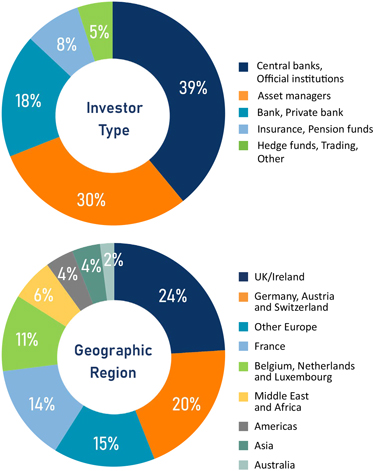
Source: Queensland Treasury Corporation; figures are rounded.
| 12 | QUEENSLAND TREASURY CORPORATION | ANNUAL REPORT 2025–26 |
CONSULTING AND CAPABILITY DEVELOPMENT
Queensland Government Consulting Services
QGCS was established in QTC on 1 July 2025 to support the Queensland Government’s commitment to reduce reliance on external consultants, and transfer skills to Queensland’s public sector. QGCS is one part of the government’s strategy to achieve these commitments.
Over the period following establishment, QGCS scaled up its consulting capability and service offerings. This supported work that would otherwise have been outsourced by the public sector, to external consultants.
Consulting services spanned strategy, policy analysis, commercial and transaction support, aligned to Queensland Government priorities. Clients included key front-line agencies providing critical services for Queensland.
The division is supporting government’s commitment to build capability by delivering skills transfer through a number of mechanisms including:
| ∎ | designing deliverables and processes that enable clients to apply their learning, including through workshops |
| ∎ | developing reusable collateral so key methodologies, tools and intellectual property are retained within government |
| ∎ | QGCS staff working alongside departmental officers, providing shadowing opportunities and applying skills transfer through day-to-day collaboration |
| ∎ | drawing on QTC Education, where appropriate, to deliver targeted learning aligned to client needs. An example of this is course work in financial modelling skills. |
QGCS is experiencing strong demand, with an increasing volume of project requests from departments alongside enquiries from GOCs and statutory entities, reflecting growing awareness and traction across the public sector.
QGCS charges its clients on a cost reflective basis. In the division’s first year of operation, fee income was $2.6 million. The amount of $15 million was allocated to support the establishment of QGCS. QGCS drew down $2.7 million of these funds in 2025–26. QGCS intends to draw down funds only as needed and may not need the full $15 million of the establishment funds.
Departments engage QGCS services through the whole of government Contractor and Consultant Engagement Framework.
QTC Education: enhancing financial capability in Queensland’s public sector
Over the period, QTC Education enhanced financial decision-making across the Queensland public sector through education services delivered in partnership with world-class providers. Since its relaunch in June 2025, QTC Education has rapidly expanded its reach, delivering a range of financial literacy topics through open courses available to all Queensland public sector employees, and tailored training for government entities and agencies. Participant feedback was exceptional.
A key highlight was a joint education initiative with the Department of Local Government, Water and Volunteers (DLGWV), delivered to mayors, councillors and council staff across Queensland. QTC also supported new and returning learners to gain insights into economic trends and other financial topics through QTC Education’s webinar series.
| QUEENSLAND TREASURY CORPORATION | ANNUAL REPORT 2025–26 | 13 |
“More than 44 councils participated in the QTC Education program during 2025–26, reflecting strong demand for financial education and consistently high participant satisfaction.”
CASE STUDY
Driving stronger financial outcomes for the State at a local level
Queensland councils are navigating a more complex operating environment, balancing rising community expectations with financial sustainability, asset stewardship and long-term service planning. To support this, QTC Education in partnership with the DLGWV, set out to strengthen capability at the point where critical decisions are made.
A targeted education initiative was delivered for local government employees and elected members, focused on practical, role-relevant learning. This included short courses in service planning, financial management and infrastructure asset management, designed specifically for council environments.
Courses were developed with real operating conditions in mind to build skills that can be directly applied in day-to-day decision-making. This involved combining applied content, relevant case studies and flexible delivery formats to enable participation across geographically dispersed councils.
The initiative delivered strong results. More than 44 councils participated in the QTC Education program during 2025–26, reflecting strong demand for financial education and consistently high participant satisfaction.
Feedback highlighted tangible benefits, with QTC Education program course participants reporting increased knowledge, confidence and capability to make informed decisions for their communities.
This work strengthened local leadership capability and supported better, more sustainable outcomes for Queensland communities.
| 14 | QUEENSLAND TREASURY CORPORATION | ANNUAL REPORT 2025–26 |
ADVISORY SOLUTIONS AND EXPERTISE
In 2025–26, QTC’s Advisory Division supported Queensland Treasury and other key clients, providing trusted expertise to create value for Queensland. The division’s work aligns with the government’s priorities to maximise fiscal, economic and social outcomes, contribute to more informed decision-making and enhance Queensland’s prosperity.
Key priority areas included energy, infrastructure, investment, home ownership and social services. Highlights included:
| ∎ | financial and risk advice – assisted Queensland Treasury with key projects including financial analysis of government GST revenues, investment due diligence advice on high-priority projects, and the establishment of the Office of Social Impact and several underlying funds. |
| ∎ | capital program – continued to assist Queensland Treasury and the Department of State Development, Infrastructure and Planning with a coordinated program of work to help further inform and manage the whole-of-government capital program. |
| ∎ | home ownership – assisted Queensland Treasury with the delivery and ongoing management of the Boost to Buy home ownership scheme, which opened to eligible first home buyers in December 2025. |
QTC delivered a broad range of financial advisory assignments with local governments and GOCs that supported these entities to deliver sound investment, manage risks, increase efficiencies and deliver broader social and economic outcomes. Highlights included:
| ∎ | GOCs – QTC delivered timely and impactful commercial advice to Queensland Treasury, shareholding departments and government businesses with insights into financial performance, analysis of corporate plan forecasts and identification of key risks for the businesses and their industries. This included detailed annual borrowing assessments and credit reviews, as well as funding options analysis for large infrastructure projects. |
| ∎ | energy – supported Queensland Treasury’s preparation of the Queensland Energy Roadmap and continued to contribute to informing Queensland’s energy system through market modelling, analysis and research. |
| ∎ | local government – supported the financial sustainability of the local government sector as financier and through treasury management, advisory and education services. |
Fostering strong relationships with local government
QTC continued to work closely with State Government, local government and key stakeholders to support the delivery of financially sustainable outcomes for councils. In 2025–26 QTC delivered services to the local government sector such as:
| ∎ | treasury management services including debt and investment advice |
| ∎ | advisory services, including the provision of financial management, risk management and capital project planning and prioritisation assistance, to support local governments’ financial sustainability and sector capability, and |
| ∎ | education services and capability uplift training via our joint initiative with DLGWV for Elected Members, and council and department staff across the 2025–26 financial year. |
During the period, QTC supported DLGWV’s annual Finance Officer Network program, presenting at all eight of these regional forums.
QTC delivered a program of economic updates throughout the year, as well as contributed to sector events for the Local Government Association of Queensland (LGAQ) and Local Government Finance Professionals (LGFP).
| QUEENSLAND TREASURY CORPORATION | ANNUAL REPORT 2025–26 | 15 |
During 2025–26, QTC continued to strengthen its operations through investment in technology, data, and business processes. Initiatives were delivered to simplify ways of working, enhance operational resilience and strengthen decision-making, improving organisational efficiency and supporting delivery of client and government outcomes.
Technology, data and digital enablement
QTC accelerated implementation of its Data and Technology Strategy, strengthening enterprise data management and enhancing digital capabilities across the organisation, including the following initiatives:
| ∎ | established the Unified Data Program, embedding data as a strategic asset, lifting data governance maturity and expanding the use of analytics and digital tools to improve productivity, decision-making and innovation |
| ∎ | continued investment in QTC’s cyber resilience, strengthening security controls and uplifting organisation preparedness, and |
| ∎ | matured QTC’s data and technology operating model, including centralisation of services, focused on improving stability, efficiency and business outcomes. |
These initiatives strengthened QTC’s ability to respond to evolving client and business needs by improving access to data and digital capability. In collaboration with technology and delivery partners, QTC leveraged external expertise and industry perspectives to challenge existing practices, identify improvement opportunities and accelerate adoption of contemporary operating models and technologies.
QTC progressed the practical adoption of artificial intelligence (AI), supported by governance arrangements, defined guardrails and targeted workforce capability initiatives. This ensured AI was adopted in a responsible, transparent and risk-informed manner while enabling employees to explore new ways to improve productivity, efficiency and service delivery.
Enterprise resilience and service continuity
Throughout the year, QTC maintained high levels of technology and operational resilience and service continuity while supporting the State’s funding program, responding to changing client needs and delivering major organisational initiatives. Strong governance, business continuity and risk management practices ensured critical services remained available and responsive, reinforcing confidence in QTC’s ability to support clients and government priorities in a dynamic operating environment.
Operational performance and financial stewardship
QTC maintained a strong focus on operational excellence across its core activities. During the year, QTC successfully settled $465 billion in transactions and facilitated more than 47,000 trades.
Operations supported the implementation of new financial products and investment instruments within core treasury systems and continued to optimise processes across key business activities. By leveraging automation, refining workflows and enhancing controls settings, the business was able to simplify operations, reduce manual effort and strengthened operational resilience.
The finance function continued to strengthen financial control, governance and reporting processes. Focus on audit readiness, control effectiveness and process optimisation supported reliable financial reporting and compliance with statutory and regulatory obligations.
Enhanced financial modelling, business intelligence dashboards and self-service reporting solutions strengthened access to timely, data-driven insights, supporting more informed decision-making across the organisation.
Procurement improvement
QTC continued its focus on simplifying processes and improving efficiency through targeted business improvement initiatives. The Procurement Improvement Program implemented a centre-led operating model, simplified procurement processes, enhanced procurement and contract management workflows, and delivered a vendor management framework aligned to leading practices across industry and regulatory guidance.
These improvements continue to strengthen and mature the procurement function, ensuring strong governance, improved supplier management, value-for-money outcomes, and consistent procurement practices across the organisation.
Change portfolio
QTC’s change portfolio continued to strengthen organisational capability, foster innovation and support strategic priorities. Delivered by cross-functional teams, initiatives focused on modernising technology platforms, simplifying business processes and improving service delivery.
During the year, initiatives delivered tangible business benefits, including an enhanced physical workplace, improved client service processes, implementation support for the Queensland Government’s Boost to Buy home ownership scheme, and deployment of key establishment systems for QGCS.
Continued maturity of project governance and delivery practices through strengthened portfolio oversight, planning and reporting, providing improved visibility of priorities, risks, resourcing and benefits realisation. This helped ensure investment decisions remained aligned to strategic priorities and delivered tangible value to clients, government and the organisation.
Collectively, these initiatives reinforced QTC’s commitment to continuous improvement, innovation and operational excellence. By simplifying processes, strengthening controls, leveraging technology and embracing new ways of working, QTC continued to build organisational capability and position itself to deliver greater value for clients, government and stakeholders into the future.
| 16 | QUEENSLAND TREASURY CORPORATION | ANNUAL REPORT 2025–26 |
QTC delivered the first 12 months of initiatives under its People Strategy 2025–29, with a focus on strengthening culture, developing leaders, maturing performance and reward practices, promoting wellbeing and safety, and reflecting on its relationships with First Nations peoples.
In 2025–26, QTC delivered the following people-focused initiatives:
| ∎ | Defined a shared organisational culture, including a cultural ambition statement, refreshed organisational values, and behavioural expectations for leaders and team members. This work was developed collaboratively by QTC’s Executive Leadership Team, a cross-organisational employee design group, and the People and Culture Division. |
| ∎ | Delivered the organisation’s inaugural Reflect Reconciliation Action Plan (RAP), discussed further in the Environmental, social and governance commitment section of this Annual Report. |
| ∎ | Launched the Leading @ QTC program, a rolling 12-month leadership and management development program. |
| ∎ | Established leadership communication channels and forums to support clearer information flows and strengthen capability, accountability and organisational trust. |
| ∎ | Strengthened performance and remuneration processes, including role benchmarking, cascading corporate KPIs into individual goals, and cross-organisational performance moderation. |
| ∎ | Continued to mature the work health and safety (WHS) framework, including establishing a QTC WHS Committee, enhancing risk assessment processes, and developing a new wellbeing framework. |
Learning and development initiatives introduced in 2024–25 continued to be embedded and expanded across the organisation. This included refining the corporate professional development program and delivering the second iteration of the QTC Mentoring Program.
Looking ahead to 2026–27, QTC will refresh its Diversity, Equity and Inclusion Strategy and Learning and Development Strategy, expand the Leading @ QTC program, and further strengthen talent, performance, reward and organisational architecture. Work will also continue to embed the target culture and progress Reflect RAP initiatives.
QTC also strengthened policies and practices in response to Australia’s evolving employee relations landscape.
Diversity and wellbeing
QTC’s Diversity, Equity and Inclusion Strategy for 2024–26 was adopted in 2023. The strategy focused on advancing equity outcomes for women, while broadening engagement with other diversity groups.
Key initiatives included:
| ∎ | Introduced an Inclusion Index within the Annual Engagement Survey, expanding its scope to include inclusion, belonging and psychological safety. |
| ∎ | Maintained membership of Women in Banking and Finance (WiBF) at silver tier, providing development opportunities for emerging female leaders. |
| ∎ | Integrated DEI priorities within QTC’s Sustainability Working Group, particularly across social and governance commitments. |
| ∎ | Launched organisational training to support employees experiencing domestic and family violence. |
| ∎ | Continued embedding flexible work practices. |
| ∎ | Provided ongoing support for mental health and wellbeing, including accredited Mental Health First Aid Officers, wellbeing content, and access to an Employee Assistance Program. |
| ∎ | Supported physical health through employee benefits such as Fitness Passport subsidies, influenza vaccinations, ergonomic support, and health screening programs. |
| ∎ | Supported financial wellbeing through employee benefits, including CBA Workplace Banking, SG Fleet, and Bupa Health Insurance. |
| ∎ | Delivered QTC’s inaugural Reflect RAP, discussed further in the Environmental, social and governance commitment section of this Annual Report. |
QTC also increased its focus on recognising days of significance across the organisation, including:
| ∎ | International Women’s Day 2026, through participation in UN Women Australia events, internal sessions with Challenge DV, and women-focused financial wellbeing seminars. |
| ∎ | NAIDOC Week 2025 and National Reconciliation Week 2026, including executive-hosted events focused on QTC’s work with Indigenous councils, cultural awareness activities, and the launch of the Reflect RAP. |
| ∎ | Mental Health Week 2025, supported by externally facilitated wellbeing seminars and initiatives encouraging employees to prioritise wellbeing time. |
| ∎ | Recognition of key awareness days through organisational and employee-led activities, including R U OK? Day 2025, Wear It Purple Day 2025, International Day of Persons with Disabilities 2025, Harmony Day 2026, and International Day Against Homophobia, Biphobia, Intersex Discrimination and Transphobia (IDAHOBIT) 2026. |
| ∎ | A new Diversity, Equity and Inclusion Strategy will be developed during 2026–27 in collaboration with QTC employees. |
| QUEENSLAND TREASURY CORPORATION | ANNUAL REPORT 2025–26 | 17 |
During the period, QTC’s strong risk culture supported informed decision-making, strategy delivery and organisational resilience. With a focus on continuous improvement and emerging risks and opportunities, QTC remained well positioned in a dynamic operating environment.
Corporate risk management and efficiency
Risk management remained a core business priority, supported by a proactive approach to identifying and mitigating risks. Regular assurance was provided to senior leadership and the Board regarding the effective design and operation of key internal controls.
As part of its ongoing commitment to excellence, QTC continued to mature its risk management framework. A comprehensive review of risks, controls and supporting policies was completed to improve clarity and consistency.
Significant progress was made in uplifting operational resilience capability, establishing a clearer, enterprise-wide model for managing disruption risk and maintaining critical operations.
A new, integrated suite of policy, frameworks, standards, and response plans strengthened governance, clarified accountability and improved coordination across business continuity, crisis management and cyber incident response. This work is ongoing and continues to embed resilience within core risk management practices, enhancing QTC’s ability to sustain operations and respond effectively under stress.
QTC’s internal audit program continued to focus on assessing and improving the effectiveness of key controls in managing and mitigating material risks. Improvements were implemented, with Board oversight, to drive efficiency and ensure effective ongoing risk management.
QTC continued to evolve its mandatory compliance training program to ensure employees understand their risks and obligations. New workplace health and safety, discrimination and harassment mandatory learning modules were introduced with tailored content to QTC. In addition, all QTC staff were required to complete mandatory training across core compliance areas, including the Code of Conduct, Insider Trading, Cyber Risk, and Privacy. QTC also delivered tailored market conduct training aligned with Australian Financial Markets Association’s (AFMA) guidelines, reinforcing staff understanding of expected ethical and market conduct.
QTC employees are expected to maintain high standards of integrity and conduct, and to affirm their compliance with QTC’s policies and procedures annually through completion of the Annual Compliance Declaration.
| 18 | QUEENSLAND TREASURY CORPORATION | ANNUAL REPORT 2025–26 |
ENVIRONMENTAL, SOCIAL AND GOVERNANCE COMMITMENT
QTC’s Sustainable Bond Framework
During 2025–26, QTC updated its Green Bond Framework to a Sustainable Bond Framework as it continued to support the Queensland Government’s commitment to financing green and social economic activities. The updated Framework provides greater flexibility for QTC to issue bonds across green, social and sustainability bond formats.
In May 2026, QTC published its 2026 Sustainable Bond Framework Annual Report, providing information on notionally allocated proceeds against eligible assets, together with asset descriptions and relevant performance indicators. Governance processes, which are set out in QTC’s Sustainable Bond Framework, are aligned with International Capital Market Association (ICMA) principles. Concurrent with the release of the Annual Report, QTC’s asset pool was increased by $3.385 billion through the inclusion of eligible expenditure on assets under development and three newly added assets.
Supporting the Queensland Government Emissions Measurement and Reporting Framework
In partnership with QTC’s education provider, QTC developed a foundational emissions measurement and reporting course to assist government agencies to build organisational capability.
Assisting the Queensland Government to deliver initiatives that support ESG outcomes for Queensland
QTC continued to support Queensland’s energy system through its work with the energy GOCs regarding strategic performance reviews, borrowing assessments, credit reviews and funding advice.
QTC also worked closely with its clients on initiatives that support social outcomes for the State, including projects to support the Queensland Government to address challenges to meet the housing needs of Queenslanders.
Providing QTC clients carbon offsets execution capability
QTC has continued to work with clients seeking to purchase or sell Australian Carbon Credit Units (ACCUs) in the secondary market. Since the capability was launched in 2024–25, QTC has assisted four local councils to sell ACCUs generated from projects linked to landfill waste. Two councils utilised QTC’s Client Dealing Desk to sell nearly 60,000 ACCUs, valued at more than $2 million, in 2025–26.
Enhancing cultural awareness of First Nations Peoples
As identified in the Great place to work section of this Annual Report, QTC launched its inaugural Reflect Reconciliation Action Plan (RAP) during National Reconciliation Week 2026. The RAP was developed by a cross-organisational working group with Executive sponsorship.
The Reflect RAP consists of 37 initiatives that will support QTC to continue its reconciliation work by embedding culturally respectful practices in the way we work, strengthening our relationships with First Nations stakeholders and communities, and ensuring First Nations perspectives are better reflected in our decisions. It includes one organisation-specific initiative focused on reflecting on the unique contributions QTC can make in furthering reconciliation through its operations with Indigenous Councils.
The Reflect RAP also continues and deepens QTC’s ongoing commitment to enhancing employees’ cultural awareness of First Nations peoples, which includes the ongoing recognition of key dates of significance, provision of cultural awareness learning opportunities and strengthened relationships with First Nations suppliers.
Providing organisational contributions that benefit the community
QTC contributed to a range of social and community initiatives in 2025–26, including in a corporate capacity and through employee activities. QTC maintained its organisational relationships with FareShare, a meal relief charity, and Stepping Stone, which supports people living with mental illness with employment opportunities and community connection.
Utilising QTC’s paid community leave day, employees continued to volunteer for organisations such as FareShare.
QTC plans to mature its approach to corporate volunteering and philanthropy over 2026–27.
| QUEENSLAND TREASURY CORPORATION | ANNUAL REPORT 2025–26 | 19 |
QTC is committed to maintaining the high standards of governance, transparency and accountability expected in the public sector to support the achievement of QTC’s objectives in accordance with legislative and regulatory obligations, fulfillment of QTC’s purpose and maintenance of the corporation’s sustainability.
QTC and its Boards
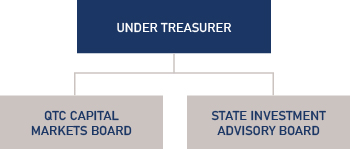
QTC was established by the Queensland Treasury Corporation Act 1988 (the QTC Act) as a corporation sole (ie, a corporation that consists solely of a nominated office holder). The Under Treasurer of Queensland is QTC’s nominated office holder and has delegated powers to its two Boards:
| ∎ | the Queensland Treasury Corporation Capital Markets Board (the Board), established in 1991 to manage all of QTC’s operations except those relating to certain superannuation and other long-term assets, and |
| ∎ | the State Investment Advisory Board (SIAB), established in July 2008 to manage the State’s long-term investment assets. |
QTC Capital Markets Board
The Under Treasurer, as QTC’s corporation sole, and the QTC Capital Markets Board have agreed on the terms and administrative arrangements for exercising the powers that the corporation sole has delegated to the Board.
The Board operates in accordance with its charter, which sets out its roles and responsibilities (based on its delegated powers), and the conduct of meetings. The charter provides that the role and functions of the Board are to:
| ∎ | take responsibility for the corporate governance of QTC |
| ∎ | set strategic direction, policies and risk appetite |
| ∎ | promote and monitor the organisational culture |
| ∎ | monitor the implementation of QTC’s strategy |
| ∎ | ensure the effectiveness of the risk management framework |
| ∎ | monitor QTC’s financial and business performance |
| ∎ | ensure compliance with legal and regulatory obligations |
| ∎ | ensure integrity of reporting, and |
| ∎ | safeguard the reputation of QTC. |
The Board typically holds at least seven meetings each year and may, whenever necessary, hold additional meetings.
Board appointments
The Board consists of members appointed by the Governor-in-Council, in accordance with section 10(2) of the QTC Act. Each Board member is selected based on their qualifications, experience, skills, strategic ability, and commitment to contributing to QTC’s performance and achieving its corporate objectives. The Board is composed of a Queensland Treasury ex officio representative and non-executive members.
Conflict of interest
Board members are required to monitor and disclose any actual or potential conflicts of interest. Unless the Board decides otherwise, a conflicted Board member may not receive any Board papers, attend meetings, or take part in decisions relating to their declared interests.
Performance and remuneration
To ensure continuous improvement and enhance overall effectiveness, the Board conducts an annual assessment of its performance. Board members’ remuneration is determined by the Governor-in-Council, with details disclosed in QTC’s financial statements.
Board committees
The Board has established four committees, each with its own charter, to assist in overseeing and governing various QTC activities. The complete roles and responsibilities of each committee are outlined in their charters, available on the QTC website.
| 20 | QUEENSLAND TREASURY CORPORATION | ANNUAL REPORT 2025–26 |
Funding and Markets Committee
The Funding and Markets Committee assists the Board to fulfill its corporate governance responsibilities related to borrowing, liquidity, onlending, financial risk management and non-debt financial services. The Committee makes strategic recommendations, monitors implementation, and reports to the Board on performance. It also oversees QTC’s financial risk management culture and relevant policies, and ensures compliance with legal and regulatory obligations. The Committee meets at least four times a year and comprises at least three Board members.
People and Culture Committee
The People and Culture Committee assists the Board to fulfill its corporate governance responsibilities related to people, culture, and remuneration. The Committee makes strategic recommendations, monitors implementation, and reports to the Board on performance. It oversees QTC’s organisational culture, values, behaviours and relevant policies, and ensures compliance with legal and regulatory obligations. The Committee also monitors people and culture related risks and key management personnel development and remuneration. The Committee meets at least three times a year and comprises at least three Board members.
Risk and Audit Committee
The Risk and Audit Committee assists the Board to fulfill its corporate governance responsibilities related to QTC’s enterprise risk management framework, compliance, financial reporting and audit. The Committee makes strategic recommendations, monitors implementation, and reports to the Board on performance. It oversees QTC’s risk and control culture and relevant policies, and ensures compliance with legal and regulatory obligations. The Committee meets at least four times a year and comprises at least three Board members.
During the year, the Risk and Audit Committee recommended the adoption of annual financial statements, reviewed external and internal audit reports and the progress in implementing the recommendations from those reports, approved QTC’s Internal Audit Plan and reviewed the Queensland Audit Office’s External Audit Plan.
Advisory and Consulting Committee
The Advisory and Consulting Committee assists the Board to fulfill its corporate governance responsibilities relating to QGCS and QTC advisory services. The Committee meets at least four times a year and comprises at least three Board members.
Meetings held
| BOARD
|
FUNDING AND MARKETS COMMITTEE |
PEOPLE AND CULTURE COMMITTEE |
RISK AND AUDIT COMMITTEE |
ADVISORY AND CONSULTING COMMITTEE | ||||||||||||||||
| ORDINARY MEETINGS HELD | 11 | 4 | 4 | 5 | 7 | |||||||||||||||
| ATTENDED | ELIGIBLE TO ATTEND |
ATTENDED | ELIGIBLE TO ATTEND |
ATTENDED | ELIGIBLE TO ATTEND |
ATTENDED | ELIGIBLE TO ATTEND |
ATTENDED | ELIGIBLE TO ATTEND | |||||||||||
| Steve Johnston1 | 7 | 10 | 1* | — | 2 | 3 | 2* | — | 1* | — | ||||||||||
| Damien Frawley2 | 5 | 5 | — | — | 2 | 2 | 1 | 3 | 4 | 5 | ||||||||||
| Berkeley Cox3 | 8 | 9 | 3 | 3 | — | — | 3 | 3 | 2 | 3 | ||||||||||
| Rachel Crossland4 | 1 | 1 | — | — | — | — | — | — | — | — | ||||||||||
| Tricia Ho-Hudson5 | 10 | 10 | 3 | 3 | — | — | 3 | 3 | 2 | 3 | ||||||||||
| Neville Ide6 | 1 | 1 | 1 | 1 | 1* | — | 1 | 2 | — | — | ||||||||||
| Karina Kwan7 | 9 | 9 | 3 | 3 | 3 | 3 | 3 | 3 | 1* | — | ||||||||||
| Natalie Smith | 11 | 11 | — | — | 4 | 4 | — | — | 6 | 7 | ||||||||||
| Karen Smith-Pomeroy8 | 3 | 4 | 2 | 2 | 1* | — | 3 | 3 | 5 | 5 | ||||||||||
| Rosemary Vilgan | 11 | 11 | — | — | 4 | 4 | 4 | 5 | 7 | 7 | ||||||||||
| Paul Williams9 | 8 | 11 | 1 | 4 | — | — | — | — | — | — | ||||||||||
| John Wilson10 | 2 | 4 | 2 | 2 | 1 | 2 | — | — | — | — | ||||||||||
* Indicates attendance as a Board member, not as a committee member
1 Mr Johnston’s term on the Board commenced on 1 October 2025 and as Chair on 1 January 2026. Attendance reflects a period of medical leave.
2 Mr Frawley’s term on the Board concluded on 31 December 2025.
3 Mr Cox’s term on the Board commenced on 1 November 2025.
4 Ms Crossland attended one meeting as Acting Under Treasurer, representing the Under Treasurer’s ex-officio Board position.
5 Ms Ho-Hudson’s term on the Board commenced on 1 October 2025.
6 Mr Ide’s term on the Board concluded on 30 September 2025.
7 Ms Kwan’s term on the Board commenced on 1 November 2025.
8 Ms Smith-Pomeroy’s term on the Board concluded on 30 November 2025.
9 This position is an ex officio appointment within Queensland Treasury. Mr Williams started on the Board on 24 February 2025.
10 Mr Wilson’s term on the Board concluded on 30 November 2025.
| QUEENSLAND TREASURY CORPORATION | ANNUAL REPORT 2025–26 | 21 |
| QTC’s Capital Markets Board members
as at 30 June 2026 | ||||
| STEVE JOHNSTON BBUS (MGT), BBUS (PUB ADMIN)
Chair
Appointed 1 October 2025 Tenure to 31 December 2028
Board Committees
∎ Member, People and Culture Committee |
Steve Johnston was appointed as Chief Executive Officer and Managing Director of Suncorp in September 2019.
Steve joined Suncorp in 2006 and has held various executive positions. Prior to his appointment, Steve was the Suncorp Group Chief Financial Officer with responsibility for financial reporting and management, legal and company secretariat, taxation, investor relations, corporate affairs and sustainability. |
Steve’s previous roles include Deputy Chief Financial Officer and Executive General Manager Investor Relations and Corporate Affairs. Prior to joining Suncorp, Steve held senior positions at Telstra and the Queensland Government.
Steve joined the Insurance Council of Australia Board as a Director in August 2021 and commenced his term as Chair in January 2025. | ||
| BERKELEY COX
Appointed 1 November 2025 Tenure to 31 December 2028
Board Committees
∎ Member, Advisory and Consulting Committee
∎ Member, Funding and Markets Committee
∎ Member, Risk and Audit Committee |
Berkeley has 40 years’ experience in the law including 24 years as a partner of Mallesons. He served as its Australian Chief Executive Partner from 2017 to 2022. In practice his focus for most of his career was debt capital markets, structured finance and derivatives.
Using legal, strategic and commercial skills along with his experience navigating complex environments with multiple stakeholders, Berkeley currently spends much of his time respectfully and actively |
supporting First Nations’ Community Controlled Organisations (primarily in remote parts at a local level) in a manner consistent with the Priority Reforms in the National Agreement on Closing the Gap.
Berkeley is a member of the Board of Trustees of Brisbane Girls Grammar School and has previously served on the boards of Act for Kids, Corporate Mental Health Australia Alliance and Workplace Giving Australia. | ||
| TRICIA HO-HUDSON
BEC, LLB (HONS), LLM, M APP FIN, STONIER DIP BANKING, GAICD, CTA
Appointed 1 October 2025 Tenure to 31 December 2028
Board Committees
∎ Chair, Funding and Markets Committee
∎ Member, Advisory and Consulting Committee
∎ Member, Risk and Audit Committee |
Tricia Ho-Hudson is an experienced finance executive, specialising in treasury and balance sheet management.
She spent 15 years in leadership roles at ASX10 companies including the Commonwealth Bank of Australia, Woolworths Group and Wesfarmers. Prior to that, she was an investment banker and lawyer advising large listed and private companies. |
Tricia has a strong history of contributing her finance and risk skills to the not- for-profit sector. She is Deputy Chair of Spare Parts Puppet Theatre, which tours nationally including to regional Queensland, and a Board member of national charity The LBW Trust. She is a member of the Board of Advice to the Discipline of Accounting, Governance and Regulation at the University of Sydney. | ||
| KARINA KWAN
BEC (USYD), FINSIA GRAD DIP APPLIED FINANCE, FELLOW CPA, GAICD
Appointed 1 November 2025 Tenure to 31 December 2028
Board Committees
∎ Chair, Risk and Audit Committee
∎ Member, Funding and Markets Committee
∎ Member, People and Culture Committee |
Karina has over 35 years’ experience in financial services, particularly banking, with specialist financial accounting and treasury risk management skills.
Prior to embarking on a Board portfolio, her executive roles included Corporate Treasurer, Financial Controller and Chief Financial Officer of Citi Australia & New Zealand and Chief Financial Officer/General Manager of the corporate centre divisions of the Commonwealth Bank of Australia. |
Karina is currently a director of HSBC Bank Australia Limited, Export Finance Australia and WAM Active Limited, part of the Wilson Asset Management group. Her prior Board directorships include: Trustee of the MLC superannuation funds, Newcastle Permanent Building Society and anti money laundering compliance data provider Kyckr Limited. Karina also teaches as an Adjunct Professor within the Discipline of Finance at the University of Sydney Business School. | ||
| 22 | QUEENSLAND TREASURY CORPORATION | ANNUAL REPORT 2025–26 |
QTC’s Capital Markets Board members
as at 30 June 2026
DR NATALIE SMITH
BSC (COMP SC & MATHS), M HR & ORG DEV, RESEARCH
MASTERS FLEX WORK PRAC, PHD GOV DIGITAL TRANS
Appointed 21 September 2023
Tenure to 30 September 2026
Board Committees
| ∎ | Chair, Advisory and Consulting Committee |
| ∎ | Member, People and Culture Committee |
ROSEMARY VILGAN
BBUS, DIP SUPN MGT, FAICD, FASFA
Appointed 1 October 2020
Tenure to 30 September 2026
Board Committees
| ∎ | Chair, People and Culture Committee |
| ∎ | Member, Advisory and Consulting Committee |
| ∎ | Member, Risk and Audit Committee |
PAUL WILLIAMS
Appointed 24 February 2025
Tenure to 30 September 2026
Board Committees
| ∎ | Member, Funding and Markets Committee |
Dr Natalie Smith has over 30 years’ experience in technology and transformation consulting, predominantly in financial services and government. She has a combination of executive, corporate governance and academic expertise in digital and transformational projects.
Dr Smith is an Associate Professor of Practice at the University of Queensland and Deputy Chair of UnitingCare Queensland.
Rosemary Vilgan is an experienced non-executive director, with specific expertise in financial services and business leadership and transformation. She was the Chief Executive of QSuper, a global financial services business with $90 billion in accounts, from 1998 until 2015.
She is currently Chair of Vincent Fairfax Family Foundation, a member of the Cambooya Investment Advisory Committee, and a member of the Future Fund Board of Guardians. Ms Vilgan’s former roles include Chairperson of the Federal Government’s Safety, Rehabilitation and Compensation
Paul Williams commenced as Under Treasurer in February 2025. He is an experienced senior executive with more than 25 years’ experience in the banking and finance sector. He has held Board and Committee positions across funds management, hospitality, sport and the not-for-profit sector.
She leads a Digital Governance Consortium with University of Queensland.
Previously, Dr Smith was an Associate Professor of Practice at the University of Sydney, a partner in Deloitte’s Risk Advisory practice, Deputy Chair of Mercy Community Services, and a member of the Financial Investment and Property Board and Property Trust for the Uniting Church in Queensland.
Commission, a member of the Board of the Children’s Hospital Foundation (Qld), a member of the Board of the Guardians of New Zealand Superannuation, and a Queensland council member of Australian Institute of Company Directors (AICD). She is a former Councillor, Deputy Chancellor and Chairperson of the Audit and Risk Committee at Queensland University of Technology (QUT), and a former director and Chair of the Board of the Association of Superannuation Funds of Australia (ASFA).
In 2013, Ms Vilgan was named the Telstra Australian Businesswoman of the Year.
Mr Williams is also Chair of the State Investment Advisory Board and a member of the Economic Development Queensland and South Bank Corporation Boards.
| QUEENSLAND TREASURY CORPORATION | ANNUAL REPORT 2025–26 | 23 |
QTC Executive Leadership Team
The responsibility for the day-to-day operation and administration of QTC is delegated by the Board to the Chief Executive Officer. The Chief Executive Officer is appointed by the Board and executives are appointed by the Chief Executive Officer. Executive Leadership Team appointments are made on the basis of qualifications, experience, skills, strategic ability, and commitment to contribute to QTC’s performance and achievement of its corporate objectives.
| QTC’S EXECUTIVE LEADERSHIP TEAM AS AT 30 JUNE 2026 | ||
| Simon Ling |
Chief Executive Officer | |
| Susan Buckley |
Managing Director – Funding and Markets | |
| Giselle Hodgson1 |
Managing Director – Queensland Government Consulting Services | |
| Maryanne Kelly2 |
Managing Director – Advisory | |
| Chris Noot |
Managing Director – Risk, and Chief Risk Officer | |
| Jody Keys3 |
Managing Director – Business Services, and Chief Operating Officer | |
| Lona Baskerville |
Managing Director – People and Culture, and Chief People Officer | |
1 Commenced on 10 November 2025.
2 Commenced on 1 October 2025.
3 Commenced on 2 October 2025.
Internal audit
The Financial and Performance Management Standard 2019 (Qld) (Standard) governs the operation of QTC’s internal audit function. QTC outsourced its independent internal audit function for the 2025–26 financial year. Internal Audit reports to the Board, via the Risk and Audit Committee, consistent with the relevant audit and ethical standards. The role of internal audit is to provide the Board (through the Risk and Audit Committee) with independent and objective assurance and advice on the adequacy and effectiveness of QTC’s governance and risk management (including controls).
Internal audit is responsible for:
| ∎ | developing an annual audit plan, based on the assessment of strategic, financial and operational risks with regard to QTC’s purpose and strategy, which is approved by the Risk and Audit Committee |
| ∎ | providing regular audit reports and periodic program reports to the management team and the Risk and Audit Committee, and |
| ∎ | working constructively with QTC’s management team to challenge and improve established and proposed practices and to put forward ideas for process improvement. |
External audit
In accordance with the provisions of the Auditor-General Act 2009, the Queensland Audit Office is the external auditor for QTC. The Queensland Audit Office has the responsibility for forming opinions about the reliability of QTC’s financial statements, along with other public sector entities, with the results of these financial audits tabled in Queensland’s Parliament.
All audit recommendations raised by the Queensland Audit Office that were due during the reporting period were addressed.
State Investment Advisory Board
The State Investment Advisory Board (SIAB) was established in 2008 as an advisory Board of Queensland Treasury Corporation under section 10 of the QTC Act. The SIAB was established to manage long-term assets for the State by a board independent of QTC’s capital markets operations. The long-term assets have no impact on QTC’s capital markets operations and there is no cash flow effect for QTC.
In 2025–26, with power delegated from QTC, the SIAB was responsible for:
| ∎ | oversight of the financial assets set aside by the Queensland Government to meet future employee liabilities and other long-term obligations of the State |
| ∎ | oversight of the financial assets set aside to support long-term initiatives of the Queensland Government, and |
| ∎ | providing investment governance assistance in connection with the Financial Provisioning Fund established under the Mineral and Energy Resources (Financial Provisioning) Act 2018 and the National Injury Insurance Scheme Fund, Queensland. |
The SIAB members are appointed by the Governor-in-Council, in accordance with section 10(2) of the QTC Act.
Remuneration for the SIAB members is determined by the Governor-in-Council.
Meetings held
| POSITION | ATTENDED | ELIGIBLE TO ATTEND | ||||
| Paul Williams, Under Treasurer1 |
Chair | 5 | 5 | |||
| Dennis Molloy, Deputy Under Treasurer2 |
Chair | 1 | 1 | |||
| Matt Bonaventura, Deputy Under Treasurer3 |
Member | 3 | 3 | |||
| Danielle Lead, Head of Transactions4 |
Member | 2 | 2 | |||
| William Ryan, Head of Fiscal5 |
Member | 1 | 1 | |||
| Glenn Miller, Acting Deputy Under Treasurer6 |
Member | 2 | 2 | |||
| Cameron McLeod, Head of Transactions7 |
Member | 1 | 1 | |||
| Philip Graham, External Member |
Member | 6 | 6 | |||
| Cate Wood AM, External Member |
Member | 1 | 1 | |||
| Wendy Tancred, External Member |
Member | 6 | 6 | |||
| Brendan O’Farrell, External Member |
Member | 6 | 6 | |||
1 This position is an ex officio appointment within Queensland Treasury. Mr Williams commenced as Chair on 1 October 2025.
2 This position is an ex officio appointment within Queensland Treasury. Mr Molloy’s term as Chair concluded on 26 August 2025.
3 This position is an ex officio appointment within Queensland Treasury. Mr Bonaventura’s term commenced on 5 January 2026.
4 This position is an ex officio appointment within Queensland Treasury. Ms Lead’s term commenced on 24 November 2025 and concluded on 27 March 2026.
5 This position is an ex officio appointment within Queensland Treasury. Mr Ryan’s term concluded on 30 September 2025.
6 This position is an ex officio appointment within Queensland Treasury. Mr Miller’s term commenced on 29 August 2025 and concluded on 2 January 2026.
7 This position is an ex officio appointment within Queensland Treasury. Mr McLeod’s term commenced on 1 October 2025 and concluded on 19 November 2025.
| 24 | QUEENSLAND TREASURY CORPORATION | ANNUAL REPORT 2025–26 |
SIAB Board Members
as at 30 June 2026
| PAUL WILLIAMS
Appointed 1 October 2025
Tenure to 30 September 2026 |

|
Paul Williams commenced as Under Treasurer in February 2025. He is an experienced senior executive with more than 25 years’ experience in the banking and finance sector. He has held Board and Committee positions across funds management, hospitality, sport and the not-for-profit sector. Most recently he was the Chief Financial Officer with People First Bank and has previously held executive roles in strategy, finance and investment with Heritage Bank as well as the Bank of Queensland. | ||
| PHILIP (PHIL) GRAHAM
BA (ECON. HONS), MCOM (FIN, HONS), CFA, GAICD
Appointed 4 July 2019
Tenure to 30 September 2027 |
Phil Graham has extensive experience in investment management, financial markets, and economic policy. Mr Graham was Senior Portfolio Strategist and Deputy Chief Investment Officer at Mercer from 2007-18. He also held senior roles at QIC and Access Capital Advisors, and prior to this he worked for the Reserve Bank of Australia and the ANZ Banking Group. Mr Graham is a past-President of the CFA Society of Melbourne and was the President’s Council Representative for the CFA Asia Pacific North and Oceania region in 2015-19. He currently serves on the CFA Disciplinary Review Committee and is a trustee of the Research Foundation of the CFA Institute. | |||
| BRENDAN O’FARRELL
MBA, GAICD, DIPSM
Appointed 21 September 2023
Tenure to 30 September 2026 |
Brendan O’Farrell is an experienced Non-Executive Director. He has more than 25 years’ financial services experience in senior executive roles including as Chief Executive Officer and Chief Investment Officer with his most recent role as Chief Executive Officer (including Chief Investment Officer) of lntrust Super from 2005-21. He currently runs his own consulting business, Maple Tree Consulting Pty Ltd. Mr O’Farrell’s current directorships include Brighter Super (Independent director and member of Investment, Audit, Risk and Technology Committees), Broncos Leagues Club Pty Ltd, Stadiums Queensland (Chair of Strategy and Planning Committee and Member of the Remuneration Committee), CMBM Facility Services Advisory Board, and Chair of Economic Development Queensland (member of Audit, Risk and Performance, and People and Culture Committee) and Chair of Clubs Queensland. | |||
| WENDY TANCRED
BCOM, CPA, DIPFP, CSM, GRAD CERT MGMT. FFIN, FAICD
Appointed 21 September 2023
Tenure to 30 September 2026 |
Wendy Tancred has more than 35 years’ experience in the financial services industry, including banking, financial planning and superannuation. Following executive roles within AMP and Westpac, she was the Chief Executive Officer of two superannuation funds and a trustee director. While also having Chief Executive Officer and director roles in other industries, the majority of Ms Tancred’s career has been in highly regulated sectors, ensuring strong risk management and governance capability. She has deep investment expertise gained across multiple roles with a focus on long-term drivers of sustainable outcomes. | |||
| MATT BONAVENTURA
Appointed 5 January 2026
Tenure to 30 September 2029 |
Matt Bonaventura was appointed Deputy Under Treasurer Fiscal Economic and Commercial in January 2026. Matt is an experienced executive leader with a background in banking and finance. He has extensive expertise leading teams responsible for commercial negotiation, financial planning and analysis, infrastructure finance, and project delivery. |
| QUEENSLAND TREASURY CORPORATION | ANNUAL REPORT 2025–26 | 25 |
| FINANCIAL STATEMENTS
For the year ended 30 June 2026
|
||||
| Statement of Comprehensive Income |
27 | |||
| Balance Sheet |
28 | |||
| Statement of Changes in Equity |
29 | |||
| Statement of Cash Flows |
30 | |||
| Notes to the Financial Statements |
32 | |||
◾ Capital Markets Operations |
36 | |||
◾ State Investment Operations |
51 | |||
◾ Other Information |
57 | |||
| Certificate of the Queensland Treasury Corporation |
66 | |||
| Independent Auditor’s Report |
67 | |||
| 26 |
QUEENSLAND TREASURY CORPORATION | ANNUAL REPORT 2025–26 |
Statement of Comprehensive Income
For the year ended 30 June 2026
| Note | 2026 $000 |
2025 $000 |
||||||||||
| CAPITAL MARKETS OPERATIONS |
||||||||||||
| Net gain on financial instruments at fair value through profit or loss |
||||||||||||
| Gain on financial assets |
3 | 4 985 764 | 10 112 653 | |||||||||
| Loss on financial liabilities |
3 | (4 886 616) | (9 982 402) | |||||||||
| 99 148 | 130 251 | |||||||||||
|
|
||||||||||||
| Other income |
||||||||||||
| Fee income |
133 107 | 115 214 | ||||||||||
| Other income |
3 561 | - | ||||||||||
| 136 668 | 115 214 | |||||||||||
|
|
||||||||||||
| Expenses |
||||||||||||
| Administration and general expenses |
4 | (114 825) | (101 791) | |||||||||
| (114 825) | (101 791) | |||||||||||
| Profit from Capital Markets Operations before income tax |
120 991 | 143 674 | ||||||||||
| Income tax expense |
5 | (15 266) | (17 058) | |||||||||
| Profit from Capital Markets Operations after income tax |
105 725 | 126 616 | ||||||||||
|
|
||||||||||||
| STATE INVESTMENT OPERATIONS |
||||||||||||
| Net return from investments |
||||||||||||
| Net change in fair value of unit trusts |
14 | 7 906 915 | 6 374 875 | |||||||||
| Net change in fair value of fixed rate notes |
14 | (4 671 057) | (3 121 715) | |||||||||
| Interest on fixed rate notes |
14 | (2 930 629) | (2 965 690) | |||||||||
| Management fees |
14 | (305 229) | (287 470) | |||||||||
| Profit from State Investment Operations |
- | - | ||||||||||
|
|
||||||||||||
| Total net profit for the year after tax |
105 725 | 126 616 | ||||||||||
|
|
||||||||||||
| Total comprehensive profit attributable to the owner |
105 725 | 126 616 | ||||||||||
|
|
||||||||||||
| Total comprehensive income derived from: |
||||||||||||
| Capital Markets Operations |
105 725 | 126 616 | ||||||||||
| State Investment Operations |
- | - | ||||||||||
| Total comprehensive income |
105 725 | 126 616 | ||||||||||
The accompanying notes form an integral part of these financial statements.
Throughout these financial statements the Capital Markets Operations and the State Investment Operations have been disclosed separately to distinguish between QTC’s main central financing authority role and its additional responsibilities following the transfer of portfolios of assets to QTC to support the State’s superannuation obligations and other long-term Government initiatives (refer note 1).
|
QUEENSLAND TREASURY CORPORATION | ANNUAL REPORT 2025–26 |
27 |
Balance Sheet
As at 30 June 2026
| Note | 2026 $000 |
2025 $000 |
||||||||||
| ASSETS – CAPITAL MARKETS OPERATIONS |
||||||||||||
| Cash and cash equivalents |
6 | 8 413 634 | 4 916 948 | |||||||||
| Receivables |
37 157 | 31 780 | ||||||||||
| Financial assets at fair value through profit or loss |
7 | 41 000 234 | 37 253 645 | |||||||||
| Derivative financial assets |
8 | 391 068 | 452 032 | |||||||||
| Onlendings |
9 | 137 563 905 | 120 631 170 | |||||||||
| Other assets |
25 499 | 23 526 | ||||||||||
| Deferred tax asset |
6 763 | 6 559 | ||||||||||
| 187 438 260 | 163 315 660 | |||||||||||
| ASSETS – STATE INVESTMENT OPERATIONS |
||||||||||||
| Financial assets at fair value through profit or loss |
14 | 53 376 572 | 49 169 621 | |||||||||
| 53 376 572 | 49 169 621 | |||||||||||
| Total Assets |
240 814 832 | 212 485 281 | ||||||||||
| LIABILITIES – CAPITAL MARKETS OPERATIONS |
||||||||||||
| Payables |
34 362 | 33 965 | ||||||||||
| Derivative financial liabilities |
8 | 438 438 | 241 540 | |||||||||
| Financial liabilities at fair value through profit or loss |
||||||||||||
| - Interest-bearing liabilities |
10(a) | 173 586 581 | 149 967 066 | |||||||||
| - Deposits |
10(b) | 12 657 075 | 12 564 589 | |||||||||
| Other liabilities |
40 844 | 43 265 | ||||||||||
| 186 757 300 | 162 850 425 | |||||||||||
| LIABILITIES – STATE INVESTMENT OPERATIONS |
||||||||||||
| Financial liabilities at fair value through profit or loss |
14 | 53 376 572 | 49 169 621 | |||||||||
| 53 376 572 | 49 169 621 | |||||||||||
| Total Liabilities |
240 133 872 | 212 020 046 | ||||||||||
| Net Assets |
680 960 | 465 235 | ||||||||||
| EQUITY – CAPITAL MARKETS OPERATIONS |
||||||||||||
| Retained surplus |
520 960 | 465 235 | ||||||||||
| Contributed equity |
160 000 | - | ||||||||||
| 680 960 | 465 235 | |||||||||||
| EQUITY – STATE INVESTMENT OPERATIONS |
||||||||||||
| Retained surplus |
- | - | ||||||||||
| Total Equity |
680 960 | 465 235 | ||||||||||
The accompanying notes form an integral part of these financial statements.
| 28 |
QUEENSLAND TREASURY CORPORATION | ANNUAL REPORT 2025–26 |
Statement of Changes in Equity
For the year ended 30 June 2026
| NOTE |
CAPITAL
RETAINED |
CAPITAL
CONTRIBUTED $000 |
STATE
RETAINED |
TOTAL EQUITY $000 |
||||||||||||||||
| Balance at 1 July 2024 |
838 619 | - | - | 838 619 | ||||||||||||||||
| Profit for the year |
126 616 | - | - | 126 616 | ||||||||||||||||
| Transactions with owners in their capacity as owners: |
||||||||||||||||||||
| Dividend paid |
22 | (500 000) | - | - | (500 000) | |||||||||||||||
| Balance at 30 June 2025 |
465 235 | - | - | 465 235 | ||||||||||||||||
| Balance at 1 July 2025 |
465 235 | - | - | 465 235 | ||||||||||||||||
| Profit for the year |
105 725 | - | - | 105 725 | ||||||||||||||||
| Transactions with owners in their capacity as owners: |
||||||||||||||||||||
| Contributed equity |
- | 160 000 | - | 160 000 | ||||||||||||||||
| Dividend paid |
22 | (50 000) | - | - | (50 000) | |||||||||||||||
| Balance at 30 June 2026 |
520 960 | 160 000 | - | 680 960 | ||||||||||||||||
The accompanying notes form an integral part of these financial statements.
|
QUEENSLAND TREASURY CORPORATION | ANNUAL REPORT 2025–26 |
29 |
Statement of Cash Flows
For the year ended 30 June 2026
| NOTE | 2026 $000 |
2025 $000 |
||||||||||
| Cash flows from operating activities |
||||||||||||
| Interest received from onlendings |
5 216 687 | 4 219 799 | ||||||||||
| Interest received from investments and other sources |
1 859 212 | 1 800 716 | ||||||||||
| Fees received |
133 107 | 115 214 | ||||||||||
| Other income received |
3 561 | - | ||||||||||
| Net Goods and Services Tax (GST) |
(118) | 56 | ||||||||||
| Interest paid on interest-bearing liabilities |
(8 465 059) | (7 411 112) | ||||||||||
| Administration expenses paid |
(113 999) | (101 094) | ||||||||||
| Interest paid on deposits |
(520 025) | (680 767) | ||||||||||
| Income tax paid |
(20 441) | (22 279) | ||||||||||
| Net cash used in operating activities |
13(a) | (1 907 075) | (2 079 467) | |||||||||
| Cash flows from investing activities |
||||||||||||
| Proceeds from sale of investments |
73 177 764 | 59 797 235 | ||||||||||
| Payments for investments |
(77 072 359) | (63 798 223) | ||||||||||
| Net client onlendings |
(18 837 657) | (18 647 171) | ||||||||||
| Payments for other assets |
(5 114) | (388) | ||||||||||
| Net cash used in investing activities |
(22 737 366) | (22 648 547) | ||||||||||
| Cash flows from financing activities |
||||||||||||
| Proceeds from interest-bearing liabilities |
61 027 610 | 44 146 007 | ||||||||||
| Repayment of interest-bearing liabilities |
(33 100 602) | (24 122 343) | ||||||||||
| Net client deposits |
104 119 | 2 488 332 | ||||||||||
| Contributed equity |
160 000 | - | ||||||||||
| Dividends paid |
(50 000) | (500 000) | ||||||||||
| Net cash provided by financing activities |
13(b) | 28 141 127 | 22 011 996 | |||||||||
| Net increase in cash and cash equivalents held |
3 496 686 | (2 716 018) | ||||||||||
| Cash and cash equivalents at 1 July |
4 916 948 | 7 632 966 | ||||||||||
| Cash and cash equivalents at 30 June |
6 | 8 413 634 | 4 916 948 | |||||||||
The accompanying notes form an integral part of these financial statements.
| 30 |
QUEENSLAND TREASURY CORPORATION | ANNUAL REPORT 2025–26 |
THIS PAGE HAS BEEN INTENTIONALLY LEFT BLANK
|
QUEENSLAND TREASURY CORPORATION | ANNUAL REPORT 2025–26 |
31 |
Notes to the Financial Statements
For the year ended 30 June 2026
| Contents | ||||||
| 1 |
General information | 32 | ||||
| 2 |
Material accounting policies and other explanatory information | 33 | ||||
| Capital Markets Operations | ||||||
| 3 |
Net gain/(loss) on financial instruments at fair value through profit or loss | 36 | ||||
| 4 |
Administration and general expenses | 36 | ||||
| 5 |
Income tax expense | 37 | ||||
| 6 |
Cash and cash equivalents | 37 | ||||
| 7 |
Financial assets at fair value through profit or loss | 38 | ||||
| 8 |
Derivative financial assets and derivative financial liabilities | 38 | ||||
| 9 |
Onlendings | 39 | ||||
| 10 |
Financial liabilities at fair value through profit or loss | 39 | ||||
| 11 |
Financial risk management | 41 | ||||
| 12 |
Fair value hierarchy | 48 | ||||
| 13 |
Notes to the statement of cash flows | 50 | ||||
| State Investment Operations | ||||||
| 14 |
Financial instruments at fair value through profit or loss | 51 | ||||
| 15 |
Financial risk management | 54 | ||||
| 16 |
Fair value hierarchy | 55 | ||||
| Other Information | ||||||
| 17 |
Contingent liabilities | 57 | ||||
| 18 |
Related party transactions | 57 | ||||
| 19 |
Key management personnel | 58 | ||||
| 20 |
Auditor’s remuneration | 65 | ||||
| 21 |
Investments in companies | 65 | ||||
| 22 |
Dividends | 65 | ||||
| 23 |
Events subsequent to balance date | 65 | ||||
| Certification | ||||||
| Certificate of the Queensland Treasury Corporation |
66 | |||||
| Independent Auditor’s Report |
67 | |||||
| 1 | General information |
Queensland Treasury Corporation (QTC) is the Queensland Government’s central financing authority. It also provides a range of financial services to State public sector entities, local governments and universities. QTC is constituted under the Queensland Treasury Corporation Act 1988 (the QTC Act), with the Under Treasurer designated as the Corporation Sole under section 5(2) of the Act. QTC is domiciled in Queensland, Australia, with its principal place of business being 111 Eagle Street, Brisbane, Queensland. QTC’s ultimate parent is the State of Queensland (the State).
QTC’s business operations are made up of two segments, namely Capital Markets Operations and State Investment Operations (SIO).
Capital Markets Operations
The Capital Markets Operations are overseen by the Capital Markets Board (CMB). The remit of Capital Markets Operations includes:
| (a) | Borrowing, lending, financial risk management and investment services |
QTC’s capital markets functions include debt funding, cash management, and the provision of lending, investment, and financial risk management products, as well as dealings in financial instruments including Australian Carbon Credit Units (ACCUs), foreign exchange (FX), and commodities. Debt funding is provided to clients at an interest rate based on QTC’s cost of funds plus a loan administration fee. The loan administration fee contributes to funding the operational expenses associated with the Capital Markets Operations. QTC passes on the returns of the cash management activities to its clients and retains the unrealised gains/losses associated with credit spread movements on its balance sheet until the sale of the asset or its maturity. Capital Markets Operations also generates a net return from financial markets instruments held for capital and liquidity purposes. In undertaking its capital markets activities, QTC maintains adequate capital to manage its risks having regard to its Capital Policy.
| (b) | Advisory services |
QTC provides advisory services as part of the loan facilities provided to Queensland Treasury, local governments (as defined in the Local Government Act 2009 including the Queensland Government department responsible for local government), and universities. These services are provided to advance the State’s fiscal position and financial strength, and support QTC loan positions.
| (c) | Queensland Government Consulting Services (QGCS) |
In July 2025 QGCS was established as a division of QTC. QGCS delivers professional consulting services and skills transfer on a fee for service basis to Queensland Government departments, Government Owned Corporations (as defined in the Government Owned Corporations Act 1993) and statutory bodies (as defined in the Financial Accountability Act 2009 and the Statutory Bodies Financial Arrangements Act 1982).
| (d) | Boost to Buy Scheme |
To support increased home ownership in Queensland, during the 2025–26 financial year the Queensland Government established the Boost to Buy home ownership scheme which QTC has been asked to facilitate on behalf of the Queensland Government. Under the scheme, QTC provides funding to eligible homebuyers to acquire residential properties. By accepting QTC’s funding the homebuyer is obliged to, upon sale or refinance of the property or through voluntary repayment, pay to QTC an amount equal to the proportionate percentage of QTC’s funding relative to the value or sale price of the property at the time. This supports recognition as a financial asset. These payment obligations are secured by a sub-ordinated mortgage over the property.
These assets are funded through contributed equity from Queensland Treasury and are recognised as financial assets measured at fair value through profit or loss. The mark to market value of these obligations varies with movements in the underlying property market, exposing QTC to residential property price risk. The contributed equity provides a buffer against this property price risk on QTCs balance sheet. QTC realises gains or losses on its investment under certain conditions including upon sale or refinance of the property or through voluntary repayment.
| 32 |
QUEENSLAND TREASURY CORPORATION | ANNUAL REPORT 2025–26 |
Notes to the Financial Statements
For the year ended 30 June 2026
State Investment Operations
SIO consists of portfolios of assets that were transferred to QTC by the State.
The assets of this segment are held in unit trusts managed by QIC Limited (QIC) and overseen by the State Investment Advisory Board (SIAB). These assets are invested in two portfolios, the Long Term Assets (LTA) portfolio and the Queensland Future Fund (QFF) portfolio. Each portfolio has its own investment management agreement. In the case of the Long Term Assets portfolio, a number of sub portfolios exist. The assets of the State Investment Operations segment have no impact on QTC’s Capital Market Operations and there is no cash flow effect for QTC.
Long Term Assets Portfolio
The LTA portfolio consists of assets that were transferred to QTC by the State and invested in several sub-portfolios:
| a | Endowment Portfolio: The assets in this portfolio are held to fund the State’s superannuation and other long-term obligations. On 31 March 2026, $3.0 billion of defined benefits scheme surplus was transferred into the Debt Retirement Fund (DRF) to support debt repayment. |
| b | State Initiatives Portfolio: Held investments to support state initiatives. This portfolio was closed on 31 March 2026, with the portfolio holdings of $3.2 billion transferred to the Debt Retirement Fund. |
There were no additional non-cash assets transferred to, or from these portfolios during the 2025–26 financial year.
Queensland Future Fund - Debt Retirement Fund
The QFF and its sub portfolio, the DRF were established as funds under the Queensland Future Fund Act 2020. The DRF was set up to support both the State’s credit rating and generate returns to reduce the State’s debt burden. Withdrawals from the DRF are limited to amounts to reduce the State’s debt, and fees or expenses associated with administering the fund by the Queensland Future Fund Act 2020. During the 2025–26 financial year, $1.4 billion was withdrawn from the DRF to repay the Queensland Government’s debt administered by QTC. The transaction is reflected as a reduction in QTC’s onlendings within the Capital Markets Operations segment.
Fixed Rate Notes
A Fixed Rate Note (FRN) has been issued by QTC for each of the SIO portfolios in return for the transfer of assets from the State. The interest rate on both FRNs is 7% (2025: 7%). Interest accrues on the book value of each FRN.
| ∎ | The FRN issued to match the LTA portfolio is for the benefit of the State Consolidated Fund. |
| ∎ | The FRN issued to match the QFF portfolio is for the benefit of Queensland Treasury. |
Recognising the direct relationship between the FRNs and the assets of SIO, any difference between the return paid by QTC on the FRNs and the return received by QTC on the invested assets is recognised in the financial statements annually as a market value adjustment to the value of the FRNs. Any market value adjustment does not impact QTC’s Capital Markets Operations or its ability to meet its obligations.
SIAB members include representatives from Queensland Treasury and external members with experience in investment management and governance. SIAB has been delegated all responsibility for overseeing SIO within a framework provided by the State. This includes determining an appropriate investment strategy, monitoring investment performance and the performance of the investment manager (QIC), and monitoring compliance with relevant internal controls, standards and legislation. The formulation of strategic asset allocation, performance and monitoring of SIO’s assets is therefore distinct from QTC’s CMB and day-to-day Capital Markets Operations. Specifically, it is the responsibility of SIAB and its appointed investment manager (QIC).
Each year, QTC’s CMB receives relevant information about the assets of SIO in order to prepare financial statements in accordance with Australian Accounting Standards and other prescribed requirements. QIC is responsible for assisting SIAB to provide this relevant information to the QTC CMB.
| 2 | Material accounting policies and other explanatory information |
The material accounting policies adopted in the preparation of the financial report are set out below and in the relevant notes to the financial statements.
| (a) | Basis of preparation |
These general purpose financial statements for the year ended 30 June 2026 have been prepared in accordance with Australian Accounting Standards and Interpretations adopted by the Australian Accounting Standards Board (AASB), the Financial Accountability Act 2009, the Financial and Performance Management Standard 2019, and the Financial Reporting Requirements for Queensland Government Agencies (as applicable to statutory bodies) for reporting periods beginning on or after 1 July 2025.
Compliance with International Financial Reporting Standards
QTC is a not-for-profit entity, however in preparing these financial statements QTC has elected to comply with International Financial Reporting Standards (IFRS) as issued by the International Accounting Standards Board (IASB) as if it is a for-profit entity.
Changes in material accounting policies, disclosures, standards and interpretations
New accounting standards and interpretations
No new accounting standards became effective for the year ended 30 June 2026. Amendments to current accounting standards and interpretations which are effective for the first time for the year ended 30 June 2026 have had no material impact on the financial statements.
Standards and interpretations not yet adopted
Certain new accounting standards and interpretations have been issued that are not mandatory for the current reporting period. The future adoption of Australian Accounting Standards and Interpretations that have been issued but not yet effective are not expected to have a material impact on QTC’s financial statements. However, they may result in changes to how information is currently disclosed.
Basis of measurement
These financial statements are prepared on the basis of fair value measurement of assets and liabilities except where otherwise stated. Fair value is the amount for which an asset could be exchanged, or liability settled between knowledgeable, willing parties in an arm’s length transaction.
Functional and presentation currency
These financial statements are presented in Australian dollars, which is QTC’s functional currency.
|
QUEENSLAND TREASURY CORPORATION | ANNUAL REPORT 2025–26 |
33 |
Notes to the Financial Statements
For the year ended 30 June 2026
| 2 | Material accounting policies and other explanatory information continued |
Classification of assets and liabilities
The balance sheet is presented on a liquidity basis. Assets and liabilities are presented in decreasing order of liquidity and are not distinguished between current and non-current.
| (b) | Foreign currency |
Foreign currency transactions are initially translated into Australian dollars at the rate of exchange applying at the date of the transaction. At balance date, amounts payable to and by QTC in foreign currencies have been valued using current exchange rates after considering interest rates and accrued interest. Exchange gains/losses are brought to account in the statement of comprehensive income.
| (c) | Collateral |
QTC enters into a range of transactions with counterparties, which require the lodgement of collateral subject to agreed market thresholds. Where these thresholds are exceeded, QTC may be required to either pledge assets to, or be entitled to receive pledged assets from the counterparty to secure these transactions. The assets pledged or received are primarily in the form of cash.
| (d) | Financial assets and liabilities |
Financial assets on initial recognition are classified at fair value through profit or loss and include:
| ∎ | cash and cash equivalents |
| ∎ | financial assets at fair value through profit or loss |
| ∎ | derivative financial instruments, and |
| ∎ | onlendings |
Financial liabilities are measured at fair value through profit or loss and include:
| ∎ | derivative financial instruments |
| ∎ | interest-bearing liabilities |
| ∎ | deposits, and |
| ∎ | fixed rate notes |
Financial assets and liabilities are recognised on the balance sheet when QTC becomes party to the contractual provisions of the financial instrument, which is the settlement date of the transaction. A financial asset is derecognised when the contractual rights to the cash flows from the financial assets expire or are transferred and no longer controlled by QTC. A financial liability is derecognised when the obligation specified in the contract is discharged, cancelled or expires.
Financial assets and liabilities are measured at fair value through profit or loss by reference to quoted market exit prices where available. If quoted market prices are not available, then fair values are estimated on the basis of pricing models or other recognised valuation techniques.
QTC uses mid-market rates as the basis for establishing fair values of quoted financial instruments with offsetting risk positions. In general, the risk characteristics of funds borrowed, together with the financial derivatives used to manage interest rate and foreign currency risks, closely match those of funds on-lent. In all other cases, the bid-offer spread is applied where material.
Gains and losses on financial assets and liabilities at fair value through profit or loss are recorded in the statement of comprehensive income.
| (e) | Offsetting financial instruments |
QTC offsets financial assets and liabilities where there is a legally enforceable right to set-off, and there is an intention to settle on a net basis or to realise the asset and settle the liability simultaneously (refer note 11(c)(iv)).
| (f) | Repurchase agreements |
Securities sold under agreements to repurchase at an agreed price are retained within the financial assets at fair value through profit or loss category while the obligation to repurchase is disclosed as a financial liability at fair value through profit or loss.
| (g) | Fee income |
Fee income includes:
| ∎ | management fee income, which represents income earned from the management of QTC’s onlendings and deposits, and is recognised over time when the service has been provided in accordance with client mandates |
| ∎ | consulting fee income, which represents income earned by QGCS for providing consulting services to Queensland Government departments, Government Owned Corporations and statutory bodies, and is recognised over time as performance obligations are satisfied, |
| ∎ | other fees, which are recognised in the period the services are provided to the extent that it is probable that the economic benefits will flow to QTC and can be measured reliably, and |
| ∎ | revenue on financial guarantees, which is recognised on an ongoing basis over the contract term. The probability of default on a financial guarantee is extremely low due to counter indemnities and therefore, revenue receivable is reflective of fair value. |
| (h) | Other income |
Other income includes:
| ∎ | grant income, representing funding received from Queensland Treasury to support the establishment and initial operations of QGCS. The funding is accounted for as a government grant and is recognised in profit or loss over the periods in which QTC incurs the eligible establishment and operating costs that the grant is intended to compensate, and |
| ∎ | reimbursement of Boost to Buy establishment costs from Queensland Treasury, which is recognised in profit or loss over the periods in which the related costs are incurred. |
| (i) | Profits/losses |
Unless otherwise determined by the Governor in Council, the Act requires that all profits shall accrue to the benefit of the State Consolidated Fund and all losses shall be the responsibility of the State Consolidated Fund. Return of profits to the State Consolidated Fund is made by way of dividends, which are provided for following approval by the CMB after considering QTC’s capital requirements.
| (j) | Receivables |
Receivables are measured at amortised cost, which approximates their fair value at reporting date. Trade debtors are recognised at the amounts due at the time of sale or service delivery i.e. the agreed purchase/contract price. Other debtors generally arise from transactions outside the usual operating activities of QTC and are recognised at their assessed values with terms and conditions similar to trade debtors.
| (k) | Impairment |
Where an impairment is recognised the following methodology is applied:
Receivables: The loss allowance for trade and other debtors reflects lifetime expected credit losses and incorporates reasonable and supportable forward-looking information. Economic changes impacting QTC’s debtors and relevant industry data form part of QTC’s impairment assessment.
Where there is no reasonable expectation of recovering an amount owed by a debtor, the debt is written off by directly reducing the receivable against the loss allowance. If the amount of debt written off exceeds the loss allowance, the excess is recognised as an impairment loss.
Non-financial assets: The carrying value of non-financial assets is reviewed at each reporting date for where there is an indication of impairment. If an indication of impairment exists, the asset’s recoverable amount is determined. Any amount by which the asset’s carrying amount exceeds the recoverable amount is recorded as an impairment loss. The asset’s recoverable amount is determined as the higher of the asset’s fair value less cost of disposal or value in use.
| 34 |
QUEENSLAND TREASURY CORPORATION | ANNUAL REPORT 2025–26 |
Notes to the Financial Statements
For the year ended 30 June 2026
| (l) | Employee benefits |
A liability is recognised for employee benefits including salaries, superannuation, annual leave, long service leave and short-term incentives where there is a present or constructive obligation as a result of past service. The liability is based on the amount expected to be paid provided that the obligation can be measured reliably. These are measured on an undiscounted basis where the amounts are expected to be paid within the next 12 months. For amounts where the payment date is expected to exceed 12 months, such as long service leave, future pay increases are projected and then discounted using Australian Government Bond Generic Yields. As sick leave is non-vesting, this is recognised as and when this leave is taken.
| (m) | Rounding |
Amounts have been rounded to the nearest thousand dollars except as otherwise stated.
| (n) | Comparative figures |
Comparative information disclosed in note 19 key management personnel has been restated to align with the methodology applied in the current year for determining key management personnel remuneration. As a result, the comparative remuneration amounts reported for 2024–25 have been revised. No other material changes have been made to the prior year comparative information.
| (o) | Judgements and assumptions |
The preparation of the financial statements requires management to make judgements, estimates and assumptions that affect the reported amounts in the financial statements. Management evaluates its judgements, estimates and underlying assumptions on an ongoing basis. Revisions to accounting estimates are recognised in the period in which the estimate is revised and in any future period affected. The areas involving a higher degree of judgement or complexity, or areas where assumptions or estimates may be significant to the financial statements are shown below:
Fair value of financial assets and financial liabilities
Financial assets and financial liabilities (including derivatives) are measured at fair value by reference to quoted market prices where available. The fair value of financial instruments that are not traded in an active market, is determined by reference to market quotes for similar instruments or by use of valuation techniques. Valuation techniques may include applying trading margins to the swap curve or counterparty credit spreads for similar instruments, adjusted for changes in the credit worthiness of the counterparty. A margin may be applied based on the original purchase margin where an instrument is not actively traded. The fair value of assets in the Queensland Government’s Boost to Buy home ownership scheme is determined using a market approach valuation technique incorporating region-based residential property indices derived from observable market data.
Judgement may be applied in selecting valuation methods or assumptions where an active market quote is not available (refer notes 12 and 16).
Investments in Queensland Treasury Holdings Pty Ltd (QTH)
Queensland Treasury holds a 60% beneficial interest in QTH and 76% of the voting rights. The remaining 40% beneficial interest and 24% voting rights is held by QTC. QTC does not apply the equity method to its investment in QTH as it does not have control or significant influence over the entity, exposure or rights to variable returns or the power to affect those returns. Queensland Treasury controls the significant transactions and bears all the risks and benefits of QTH and accordingly, QTH is consolidated into the financial statements of Queensland Treasury.
Environmental, Social, and Governance (ESG) related impacts
The majority of QTC’s assets (onlendings and cash and cash equivalents) are valued daily at fair value and therefore no further adjustment is required as a result of climate change, changes to laws and regulations or other policies adopted by governments or regulatory authorities. Counterparty credit risk and credit risk associated with QTC’s clients is separately monitored by QTC (refer note 11(c)). ESG and other sustainability risks are key considerations in determining credit ratings. The majority of QTC’s onlendings are guaranteed by the State, including lending to carbon intensive businesses.
|
QUEENSLAND TREASURY CORPORATION | ANNUAL REPORT 2025–26 |
35 |
Notes to the Financial Statements
Capital Markets Operations
For the year ended 30 June 2026
| 3 | Net gain/(loss) on financial instruments at fair value through profit or loss |
Summary of material accounting policy
Gain/(loss) on financial assets and financial liabilities at fair value through profit or loss includes:
| ∎ | net interest income and expense recognised under the accrual basis |
| ∎ | net realised gain/(loss) resulting from market rate movements recognised on settlement date from the sale of investments and the pre-redemption of borrowings, and |
| ∎ | net unrealised gain/(loss) resulting from market rate movements from investments, certain onlendings and borrowings. |
| 2026 $000 |
2025 $000 |
|||||||||||
| Net gain on financial assets at fair value through profit or loss |
||||||||||||
| Cash and cash equivalents |
187 699 | 166 534 | ||||||||||
| Financial assets at fair value through profit or loss(1) |
1 468 846 | 1 485 265 | ||||||||||
| Derivatives |
17 454 | 519 380 | ||||||||||
| Onlendings |
3 311 765 | 7 941 474 | ||||||||||
| 4 985 764 | 10 112 653 | |||||||||||
| Net loss on financial liabilities at fair value through profit or loss |
||||||||||||
| Derivatives |
(626 026) | (218 373) | ||||||||||
| Financial liabilities at fair value through profit or loss |
||||||||||||
| - Short-term |
(253 054) | (303 534) | ||||||||||
| - Long-term |
(3 474 890) | (8 756 197) | ||||||||||
| Deposits |
(508 392) | (684 746) | ||||||||||
| Other |
(24 254) | (19 552) | ||||||||||
| (4 886 616) | (9 982 402) | |||||||||||
| (1) | As at 30 June 2026, $0.32 million relate to net gain on QTC’s funding of residential properties under the Boost to Buy home ownership scheme (2025: Nil). |
| 4 | Administration and general expenses |
| 2026 $000 |
2025 $000 |
|||||||||||
| Salaries and related costs |
65 528 | 53 883 | ||||||||||
| Superannuation contributions |
6 084 | 4 755 | ||||||||||
| Special payments(1) |
187 | 770 | ||||||||||
| Contractors |
4 787 | 4 718 | ||||||||||
| Consultants’ fees |
1 717 | 7 140 | ||||||||||
| Information and registry services |
5 130 | 4 791 | ||||||||||
| Depreciation and amortisation of other assets |
3 237 | 3 074 | ||||||||||
| Office occupancy |
3 131 | 2 014 | ||||||||||
| Information and communication technology |
17 926 | 15 547 | ||||||||||
| Other administration expenses |
7 098 | 5 099 | ||||||||||
| 114 825 | 101 791 | |||||||||||
| (1) | Special payments include ex-gratia payments over $5,000 made to employees on the cessation of their employment. |
| 36 |
QUEENSLAND TREASURY CORPORATION | ANNUAL REPORT 2025–26 |
Notes to the Financial Statements
Capital Markets Operations
For the year ended 30 June 2026
| 5 | Income tax expense |
Summary of material accounting policy
QTC is exempt from the payment of income tax under section 50-25 of the Income Tax Assessment Act 1997 (as amended). QTC makes a payment in lieu of income tax to the State Consolidated Fund. The calculation of the income tax liability is based on the income of certain activities controlled by QTC’s Capital Markets Operations. No income tax is payable on the SIO segment or a large part of the net gain/(loss) on financial instruments.
| 2026 $000 |
2025 $000 |
|||||||||||
| Current tax |
15 470 | 20 441 | ||||||||||
| Deferred tax (benefit)/expense |
(204) | (3 383) | ||||||||||
| Total income tax expense recognised in the year |
15 266 | 17 058 | ||||||||||
| Numerical reconciliation between income tax expense and pre-tax accounting profit |
||||||||||||
| Profit for the year before tax |
120 991 | 143 674 | ||||||||||
| Less profit from non-taxable portfolios: |
||||||||||||
| - Capital Markets Operations |
70 104 | 86 814 | ||||||||||
| Operating profit from taxable portfolios |
50 887 | 56 860 | ||||||||||
| Tax at the Australian tax rate of 30% on taxable portfolios |
15 266 | 17 058 | ||||||||||
| 6 | Cash and cash equivalents |
Summary of material accounting policy
Cash and cash equivalents include cash on hand and on demand deposits which are highly liquid investments and readily convertible to cash.
| 2026 $000 |
2025 $000 |
|||||||
| Cash at bank |
8 413 634 | 4 916 948 | ||||||
|
QUEENSLAND TREASURY CORPORATION | ANNUAL REPORT 2025–26 |
37 |
Notes to the Financial Statements
Capital Markets Operations
For the year ended 30 June 2026
| 7 | Financial assets at fair value through profit or loss |
Summary of material accounting policy
Financial assets are recognised on the balance sheet when QTC becomes party to the contractual provisions of the financial instrument with gains and losses recognised in the statement of comprehensive income.
All financial assets are measured at fair value by reference to quoted market exit prices where available. If quoted market prices are not available, then fair values are estimated on the basis of pricing models or other recognised valuation techniques.
| 2026 $000 |
2025 $000 |
|||||||
| Discount securities |
18 502 999 | 15 733 409 | ||||||
| Commonwealth and state securities (1) |
1 300 282 | 1 561 855 | ||||||
| Floating rate notes |
12 997 997 | 12 326 601 | ||||||
| Term deposits |
7 774 647 | 6 433 700 | ||||||
| Other investments (2) |
424 309 | 1 198 080 | ||||||
| 41 000 234 | 37 253 645 | |||||||
| (1) | QTC maintains holdings of its own securities. These holdings are netted off and therefore excluded from financial assets and financial liabilities at fair value through profit or loss. |
| (2) | Other investments include QTC’s funding of residential properties under the Boost to Buy home ownership scheme. As at 30 June 2026, $23.6 million of other investments relate to the Boost to Buy home ownership scheme (2025: Nil). |
As at 30 June 2026, $9.2 billion (2025: $10.5 billion) of financial assets will mature after 12 months.
| 8 | Derivative financial assets and derivative financial liabilities |
Summary of material accounting policy
All derivatives are measured at fair value through profit or loss with gains and losses recognised in the statement of comprehensive income. Derivatives are carried on the balance sheet as assets when the fair value is positive and as liabilities when the fair value is negative.
QTC uses derivative financial instruments to hedge its exposure to interest rate and foreign currency as part of its asset and liability management activities. In addition, derivatives may be used to deliver long-term floating rate or long-term fixed rate exposure.
QTC may also enter into derivative transactions from time to time where instructed by its clients. When entering a derivative transaction with a client, QTC will concurrently execute a back-to-back principal transaction with a market counterparty resulting in QTC’s payment and delivery obligations under the market transaction and the client transaction being on the same economic terms.
| 2026 $000 |
2025 $000 |
|||||||
| Derivative financial assets |
||||||||
| Interest rate swaps |
217 456 | 261 857 | ||||||
| Cross currency swaps |
100 654 | 174 543 | ||||||
| Foreign exchange contracts |
54 534 | 4 990 | ||||||
| Futures contracts |
18 386 | 10 642 | ||||||
| Other derivatives |
38 | - | ||||||
| 391 068 | 452 032 | |||||||
| Derivative financial liabilities |
||||||||
| Interest rate swaps |
(199 799) | (128 042) | ||||||
| Cross currency swaps |
(200 013) | (56 399) | ||||||
| Foreign exchange contracts |
(35 356) | (57 089) | ||||||
| Futures contracts |
(3 232) | (10) | ||||||
| Other derivatives |
(38) | - | ||||||
| (438 438) | (241 540) | |||||||
| Net derivatives |
(47 370) | 210 492 | ||||||
As at 30 June 2026, derivatives with a net liability position of $75.5 million have maturity dates exceeding 12 months (2025: net asset position of $224.1 million).
As at 30 June 2026, the value of the derivative transactions entered into by QTC on behalf of its clients was $11.5 million (2025: $30.1 million). These arrangements have back-to-back contracts between QTC and the client and QTC and the market, reducing the risk for QTC.
| 38 |
QUEENSLAND TREASURY CORPORATION | ANNUAL REPORT 2025–26 |
Notes to the Financial Statements
Capital Markets Operations
For the year ended 30 June 2026
| 9 | Onlendings |
Summary of material accounting policy
QTC borrows from financial markets and lends to its clients at an interest rate based on QTC’s cost of funds plus an administration fee to cover the cost of QTC’s operations.
Onlendings are initially recognised at the amount drawn-down. Following initial recognition, onlendings are included in the balance sheet at fair value by reference to either the underlying debt portfolio, or in the case of fixed rate loans, on a discounted cash flow basis.
| 2026 $000 |
2025 $000 |
|||||||
| Government departments and agencies |
76 037 326 | 60 611 338 | ||||||
| Government owned corporations |
34 427 179 | 33 047 844 | ||||||
| Statutory bodies |
19 797 058 | 19 586 085 | ||||||
| Local governments |
6 950 738 | 6 977 277 | ||||||
| QTC related entities (1) |
94 305 | 96 192 | ||||||
| Other bodies |
257 299 | 312 434 | ||||||
| 137 563 905 | 120 631 170 | |||||||
| (1) | QTC related entities includes DBCT Holdings Pty Ltd. |
At 30 June 2026, client deposits of $2.7 billion were placed in redraw facilities and offset the value of onlendings in the balance sheet (2025: $0.7 billion). The gross value of onlendings at 30 June 2026 was $140.2 billion (2025: $121.3 billion).
As at 30 June 2026, $141.5 billion of principal repayments of a total book value of $144.2 billion is expected to be received after 12 months (2025: $122.7 billion of a total book value of $125.5 billion).
| 10 | Financial liabilities at fair value through profit or loss |
| (a) | Interest-bearing liabilities |
Interest-bearing liabilities mainly consist of short-term treasury notes, Australian bonds and floating rate notes. Australian bonds include QTC’s domestic, capital indexed and public bonds.
| 2026 $000 |
2025 $000 |
|||||||
| Interest-bearing liabilities |
||||||||
| Short-term |
||||||||
| Treasury notes |
6 370 206 | 3 877 827 | ||||||
| Commercial paper |
1 352 875 | 2 000 053 | ||||||
| 7 723 081 | 5 877 880 | |||||||
| Long-term |
||||||||
| AUD bonds |
140 585 228 | 124 821 163 | ||||||
| Floating rate notes |
19 363 129 | 15 750 955 | ||||||
| Medium-term notes (1) |
5 815 545 | 3 246 721 | ||||||
| Other |
99 598 | 270 347 | ||||||
| 165 863 500 | 144 089 186 | |||||||
| Total interest-bearing liabilities |
173 586 581 | 149 967 066 | ||||||
| (1) | As at 30 June 2026, $4.7 billion (2025: $2.3 billion) relate to the market value of Euro denominated benchmark bonds. |
QTC borrowings are guaranteed by the Queensland Government under the Act. As at 30 June 2026, $157.0 billion (2025: $133.3 billion) of debt securities are expected to be settled after more than 12 months.
Instruments denominated in foreign currency are fully hedged resulting in no net exposure to any foreign currency movements. Details of QTC’s exposure to foreign currencies and the derivatives used to hedge this exposure are disclosed in note 11(a)(i).
As at 30 June 2026, QTC has issued green bonds with a market value of $14.8 billion (2025: $12.4 billion). QTC has established a Sustainable Bond Framework with the goal of supporting the Queensland Government’s commitment of financing green, social and sustainable economic activities. The Framework sets out the governance and processes that underpin QTC’s issuance of green, social and sustainable bonds.
|
QUEENSLAND TREASURY CORPORATION | ANNUAL REPORT 2025–26 |
39 |
Notes to the Financial Statements
Capital Markets Operations
For the year ended 30 June 2026
| 10 | Financial liabilities at fair value through profit or loss continued |
| (a) | Interest-bearing liabilities continued |
The difference between the carrying amount of financial liabilities and the amount contractually required to be paid at maturity to the holder of the obligation is set out in the following table:
| AS AT 30 JUNE 2026 | FAIR VALUE $000 |
REPAYMENT $000 |
DIFFERENCE $000 |
|||||||||
| Interest-bearing liabilities |
||||||||||||
| Short-term |
||||||||||||
| Treasury notes |
6 370 206 | 6 450 000 | (79 794) | |||||||||
| Commercial paper |
1 352 875 | 1 365 485 | (12 610) | |||||||||
| 7 723 081 | 7 815 485 | (92 404) | ||||||||||
| Long-term |
||||||||||||
| AUD bonds |
140 585 228 | 153 457 644 | (12 872 416) | |||||||||
| Floating rate notes |
19 363 129 | 19 200 000 | 163 129 | |||||||||
| Medium-term notes |
5 815 545 | 5 943 349 | (127 804) | |||||||||
| Other |
99 598 | 99 170 | 428 | |||||||||
| 165 863 500 | 178 700 163 | (12 836 663) | ||||||||||
| Total interest-bearing liabilities |
173 586 581 | 186 515 648 | (12 929 067) | |||||||||
| AS AT 30 JUNE 2025 | FAIR VALUE $000 |
REPAYMENT $000 |
DIFFERENCE $000 |
|||||||||
| Interest-bearing liabilities |
||||||||||||
| Short-term |
||||||||||||
| Treasury notes |
3 877 827 | 3 920 000 | (42 173) | |||||||||
| Commercial paper |
2 000 053 | 2 025 396 | (25 343) | |||||||||
| 5 877 880 | 5 945 396 | (67 516) | ||||||||||
| Long-term |
||||||||||||
| AUD bonds |
124 821 163 | 133 490 525 | (8 669 362) | |||||||||
| Floating rate notes |
15 750 955 | 15 700 000 | 50 955 | |||||||||
| Medium-term notes |
3 246 721 | 3 432 126 | (185 405) | |||||||||
| Other |
270 347 | 269 630 | 717 | |||||||||
| 144 089 186 | 152 892 281 | (8 803 095) | ||||||||||
| Total interest-bearing liabilities |
149 967 066 | 158 837 677 | (8 870 611) | |||||||||
| 40 |
QUEENSLAND TREASURY CORPORATION | ANNUAL REPORT 2025–26 |
Notes to the Financial Statements
Capital Markets Operations
For the year ended 30 June 2026
| 10 | Financial liabilities at fair value through profit or loss continued |
| (b) | Deposits |
Client deposits are accepted to either the QTC Cash Fund or Working Capital Facility. Income derived from the investment of these deposits accrues to depositors daily. The amount shown in the balance sheet represents the market value of deposits held at balance date.
Collateral held is disclosed as deposits.
| 2026 $000 |
2025 $000 |
|||||||
| Client deposits |
||||||||
| Local governments |
5 407 067 | 4 670 214 | ||||||
| Statutory bodies |
5 373 773 | 4 913 588 | ||||||
| Government departments and agencies |
171 036 | 2 136 702 | ||||||
| Government owned corporations |
272 300 | 65 867 | ||||||
| QTC related entities (1) |
117 031 | 104 591 | ||||||
| Other depositors |
368 402 | 364 492 | ||||||
| 11 709 609 | 12 255 454 | |||||||
| Collateral held |
190 951 | 306 420 | ||||||
| Repurchase agreements |
756 515 | 2 715 | ||||||
| Total deposits |
12 657 075 | 12 564 589 | ||||||
| (1) | QTC related entities include Queensland Treasury Holdings Pty Ltd and its subsidiaries Brisbane Port Holdings Pty Ltd, DBCT Holdings Pty Ltd and Queensland Lottery Corporation Pty Ltd. |
As at 30 June 2026, $12.6 billion (2025: $12.5 billion) of the deposits will mature within 12 months.
| 11 | Financial risk management |
QTC’s activities expose it to a variety of financial risks including market (such as foreign exchange risk, interest rate risk, and other price risk), funding, liquidity and credit risk. QTC’s financial risk management focuses on protecting the stability and long-term value of its balance sheet on behalf of the State of Queensland. To assist in managing financial risk, QTC uses derivative financial instruments such as foreign exchange contracts, interest rate swaps and futures contracts.
Robust systems are in place for managing financial risk and compliance. Adherence to financial risk policies is monitored daily. To ensure independence, measurement and monitoring of financial risks is performed by teams separate to those transacting.
All financial risk management activities are conducted within CMB-approved policies, as set out in the Financial Markets Risk Policy, with new financial instruments requiring executive approval under delegated authority and subsequent Board notification. Any breaches of the Financial Markets Risk Policy are escalated to management, the Chief Executive and the Funding and Markets Committee and presented at the next Board meeting as appropriate.
QTC endeavours to maintain adequate capital to support its business activities, risk profile and risk appetite in accordance with a Board-approved Capital Policy. The Capital position is reported to the Board at each Board meeting. The Capital Policy is reviewed and approved by the Board on an annual basis.
| (a) | Market risk |
Market risk is the risk of incurring profit or loss in positions arising from movements in financial market prices. QTC’s exposure to market risk is through its borrowing and investment activities. QTC is exposed to market risk arising from the impact of movements in foreign exchange rates, interest rates and credit spreads. QTC is also exposed to residential property price risk through its funding of the Boost to Buy home ownership scheme, where changes in property market values directly affect the fair value of these assets.
As a consequence of market price movements, there are residual risk positions that may result in realised and unrealised accounting gains or losses being recorded during the year. Depending on whether these transactions are held to maturity, the unrealised gains or losses may be reversed in subsequent accounting periods.
|
QUEENSLAND TREASURY CORPORATION | ANNUAL REPORT 2025–26 |
41 |
Notes to the Financial Statements
Capital Markets Operations
For the year ended 30 June 2026
| 11 | Financial risk management continued |
| (a) | Market risk continued |
| (i) | Foreign exchange risk |
QTC has funding facilities that allow for borrowing in foreign currencies. At times, QTC’s Cash Fund invests in foreign currency assets. QTC enters into both forward exchange contracts and cross currency swaps to hedge the exposure of foreign currency borrowings and offshore investments from fluctuations in exchange rates. The following table summarises the hedging effect, in Australian dollars, that cross currency swaps and forward exchange contracts have had on the face value of offshore borrowings and investments.
| BORROWINGS | DERIVATIVE CONTRACTS | NET EXPOSURE | ||||||||||||||||||||||
| 2026 $000 |
2025 $000 |
2026 $000 |
2025 $000 |
2026 $000 |
2025 $000 |
|||||||||||||||||||
| USD |
(1 365 486) | (2 025 396) | 1 365 486 | 2 025 396 | - | - | ||||||||||||||||||
| CHF |
(494 275) | (210 725) | 494 275 | 210 725 | - | - | ||||||||||||||||||
| JPY |
(134 410) | (159 277) | 134 410 | 159 277 | - | - | ||||||||||||||||||
| EUR |
(5 314 664) | (3 062 124) | 5 314 664 | 3 062 124 | - | - | ||||||||||||||||||
| (ii) | Interest rate risk |
QTC lends to clients based on a duration profile specified in the client mandates. QTC then manages any mismatch between the duration profile of client loans and QTC’s funding within the Asset and Liability Mismatch Portfolio. Duration is a measure of the sensitivity of a financial instrument or a portfolio of financial instruments to changes in interest rates, estimating the change in value based on parallel shifts in the yield curve. All costs or benefits of managing any mismatch between client loans and QTC’s funding are passed on to the State through the Asset and Liability Mismatch Portfolio, ensuring that QTC is effectively immunised from interest rate risk with respect to these portfolios.
QTC’s interest rate risk, which results from borrowing in advance and investing surplus funds in high credit quality, highly liquid assets, is managed with consideration given to duration risk, yield curve risk, basis risk and Value-at-Risk (VaR).
QTC uses an approved VaR framework with CMB oversight to manage QTC’s exposure to market risk complemented by other measures such as defined stress tests. The VaR measure estimates the potential mark-to-market loss over a given holding period at a 99% confidence level. QTC uses the historical simulation approach to calculate VaR with a holding period of ten business days.
To manage the risk of non-parallel yield curve movements, QTC manages portfolio cash flows in a series of time periods so that the net interest rate risk in each time period can be measured. QTC enters into interest rate swaps and futures contracts to assist in the management of interest rate risk.
In QTC’s Liquidity portfolio, interest rate swaps may be utilised to change the interest rate exposure of medium to long-term fixed rate borrowings into that of a floating rate borrowing. At times, fixed to floating interest rate swaps may be undertaken to generate a floating rate term liability profile or vice versa. QTC is exposed to basis risk when interest rate swaps are used in the Liquidity portfolio. Basis risk represents a mark-to-market exposure due to movements between the swap curve, as well as, bank bill and bond futures contracts and QTC’s yield curve.
Client deposits in the QTC Cash Fund are invested on behalf of clients and returns received from these investments are passed onto QTC’s clients except for mark-to-market gains or losses from credit spread movements. QTC generally holds these investments to maturity and therefore any mark-to-market impacts from credit spread changes are typically realised over the life of the assets.
| (iii) | Property price risk |
QTC is exposed to residential property price risk through its proportional funding under the Boost to Buy home ownership scheme. Movements in residential property prices directly affect the fair value of these assets. QTC monitors this risk using market-based residential property indices applied through a market approach valuation technique.
| (iv) | Other price risk |
During the year the Capital Markets Operations segment had no net exposure to equity or commodity price changes, as client commodity hedges are executed on a back-to-back basis.
| 42 |
QUEENSLAND TREASURY CORPORATION | ANNUAL REPORT 2025–26 |
Notes to the Financial Statements
Capital Markets Operations
For the year ended 30 June 2026
| 11 | Financial risk management continued |
| (b) | Funding and liquidity risks |
QTC has a robust internal framework whereby extensive liquidity scenario analysis and forecasting is undertaken to understand assumption sensitivities to ensure there is appropriate forward looking visibility of the State’s liquidity position.
QTC debt is a Level 1 asset for Australian banks under Basel III reforms with a zero per cent capital risk weighting. Even in difficult market circumstances, this generally ensures QTC debt is in high demand. Demand is further supported by the fact that QTC borrowings are guaranteed by the State (QTC has been rated AA+(negative)/Aa1(stable) by ratings agencies Standard & Poors and Moody’s respectively) and that QTC benchmark bonds are Reserve Bank of Australia (RBA) repurchase agreement eligible (repo eligible). The ability to readily issue debt is considered a potential source of liquidity.
QTC maintains appropriate liquidity to meet minimum requirements as defined by the Funding and Markets Committee of the CMB. Limits are approved by the Funding and Markets Committee on behalf of the CMB and reviewed annually for the following metrics:
| ∎ | QTC Liquidity Coverage Ratio – QTC must maintain a minimum liquidity balance sufficient to cover a stressed liquidity requirement over a set horizon. |
| ∎ | Standard & Poor’s Liquidity Ratio – QTC must maintain a minimum ratio of liquid assets to debt servicing requirements at all times over a rolling 12 month horizon. |
| ∎ | Cash Flow Waterfall – QTC must maintain positive cash equivalents net of all inflows and outflows over a set horizon. |
In addition to adhering to Board-approved metrics, QTC holds contingent liquid assets in the form of public sector entity deposits and investments owned through the SIO segment of QTC.
QTC maintains its AUD benchmark bond facility as its core medium to long-term funding facility and its domestic treasury note facility as its core short-term funding facility. In addition, QTC has in place a green bond program, Euro and US medium-term note facilities and Euro and US commercial paper facilities to take advantage of alternative funding opportunities in global markets. These facilities ensure that QTC is readily able to access both the domestic and international financial markets.
Deposits on account of the Cash Fund and Working Capital Facility are repayable at call while deposits held as security for stock lending and repurchase agreements are repayable when the security is lodged with QTC.
Except for deposits and payables, the maturity analysis for liabilities has been calculated based on the contractual cash flows relating to the repayment of the principal (face value) and interest amounts over the contractual terms.
Except for cash and receivables, the maturity analysis for assets has been calculated based on the contractual cash flows relating to repayment of the principal (face value) and interest amounts over the contractual terms.
In relation to client onlendings, certain loans are interest only with no fixed repayment date for the principal component (i.e. loans are made based on the quality of the client’s business and its financial strength). For the purposes of completing the maturity analysis, the principal component of these loans has been included in the greater than five-year time band with no interest payment assumed in this time band.
|
QUEENSLAND TREASURY CORPORATION | ANNUAL REPORT 2025–26 |
43 |
Notes to the Financial Statements
Capital Markets Operations
For the year ended 30 June 2026
| 11 | Financial risk management continued |
| (b) | Funding and liquidity risks continued |
The following table sets out the contractual cash flows relating to financial assets and financial liabilities held by QTC at balance date.
| CONTRACTUAL MATURITIES AS AT 30 JUNE 2026 |
3 MONTHS $000 |
3 - 6 MONTHS $000 |
6 - 12 MONTHS $000 |
1 - 5 YEARS $000 |
MORE THAN $000 |
TOTAL $000 |
FAIR VALUE $000 |
|||||||||||||||||||||
| Financial assets |
||||||||||||||||||||||||||||
| Cash and cash equivalents |
8 413 634 | - | - | - | - | 8 413 634 | 8 413 634 | |||||||||||||||||||||
| Receivables |
37 157 | - | - | - | - | 37 157 | 37 157 | |||||||||||||||||||||
| Onlendings (1) |
2 741 772 | 2 615 633 | 2 617 251 | 28 701 063 | 139 228 965 | 175 904 684 | 137 563 905 | |||||||||||||||||||||
| Financial assets at fair value through profit or loss (2) | 13 357 446 | 24 507 271 | 3 556 977 | 9 800 601 | 6 431 842 | 57 654 137 | 41 000 234 | |||||||||||||||||||||
| Total financial assets |
24 550 009 | 27 122 904 | 6 174 228 | 38 501 664 | 145 660 807 | 242 009 612 | 187 014 930 | |||||||||||||||||||||
| Financial liabilities |
||||||||||||||||||||||||||||
| Payables |
(34 362) | - | - | - | - | (34 362) | (34 362) | |||||||||||||||||||||
| Deposits |
(13 294 147) | (22 091) | (3 235) | (25 882) | (130 757) | (13 476 112) | (12 657 075) | |||||||||||||||||||||
| Financial liabilities at fair value through profit or loss | ||||||||||||||||||||||||||||
| - Short-term |
(2 963 965) | (4 851 520) | - | - | - | (7 815 485) | (7 723 081) | |||||||||||||||||||||
| - Long-term |
(9 078 305) | (324 519) | (5 033 535) | (77 408 731) | (125 096 137) | (216 941 227) | (165 863 500) | |||||||||||||||||||||
| Total financial liabilities |
(25 370 779) | (5 198 130) | (5 036 770) | (77 434 613) | (125 226 894) | (238 267 186) | (186 278 018) | |||||||||||||||||||||
| Derivatives |
||||||||||||||||||||||||||||
| Interest rate swaps |
24 590 | (34 708) | (10 079) | 12 444 | 49 872 | 42 119 | 17 658 | |||||||||||||||||||||
| Cross currency swaps |
(70 345) | (72 948) | 1 446 | (568 084) | (894 142) | (1 604 073) | (99 360) | |||||||||||||||||||||
| Foreign exchange contracts |
(12 777) | 30 352 | - | - | - | 17 575 | 19 178 | |||||||||||||||||||||
| Futures contracts |
- | 500 000 | 3 095 000 | 3 869 800 | (803 800) | 6 661 000 | 15 154 | |||||||||||||||||||||
| Net derivatives |
(58 532) | 422 696 | 3 086 367 | 3 314 160 | (1 648 070) | 5 116 621 | (47 370) | |||||||||||||||||||||
| Net (liabilities)/assets |
(879 302) | 22 347 470 | 4 223 825 | (35 618 789) | 18 785 843 | 8 859 047 | 689 542 | |||||||||||||||||||||
| Cumulative |
(879 302) | 21 468 168 | 25 691 993 | (9 926 796) | 8 859 047 | |||||||||||||||||||||||
| (1) | A large proportion of QTC’s onlendings are based on the quality of the business and financial strength of the client. Funds are on-lent on the basis of these businesses being going concerns and continuing to meet key credit metric criteria such as debt to capital and interest coverage ratios. Accordingly, a significant portion of the onlendings portfolio has a loan maturity profile that is greater than five years with the interest rate risk of these loans being managed based on the client’s business risk such that the funding is structured on the underlying business profile. QTC’s liability maturity profile can be shorter or longer than the asset maturity profile depending on investor demand for QTC bonds and client borrowing demand. While interest rate risk mismatches are hedged with swap and futures contracts, this approach requires QTC to undertake periodic refinancing of its liabilities. |
| (2) | Liquidity risk in relation to QTC’s funding of residential properties under the Boost to Buy home ownership scheme arises from the uncertainty in the timing of cash inflows as these investments do not generate regular or fixed contractual cash flows and are realised only upon participant partial repayment, refinancing or sale of the underlying residential property. The cashflows associated with these assets are considered long-term in nature and are included in the greater than five-year maturity band for the purposes of liquidity risk analysis, with no cash inflows assumed within shorter time bands. |
| 44 |
QUEENSLAND TREASURY CORPORATION | ANNUAL REPORT 2025–26 |
Notes to the Financial Statements
Capital Markets Operations
For the year ended 30 June 2026
| 11 | Financial risk management continued |
| (b) | Funding and liquidity risks continued |
| CONTRACTUAL MATURITIES AS AT 30 JUNE 2025 |
3 MONTHS OR LESS $000 |
3 - 6 MONTHS $000 |
6 - 12 $000 |
1 - 5 YEARS $000 |
MORE THAN 5 YEARS $000 |
TOTAL $000 |
FAIR VALUE $000 |
|||||||||||||||||||||
| Financial assets |
||||||||||||||||||||||||||||
| Cash and cash equivalents |
4 916 948 | - | - | - | - | 4 916 948 | 4 916 948 | |||||||||||||||||||||
| Receivables |
31 780 | - | - | - | - | 31 780 | 31 780 | |||||||||||||||||||||
| Onlendings (1) |
2 360 576 | 2 053 463 | 2 053 977 | 23 825 347 | 120 888 689 | 151 182 052 | 120 631 170 | |||||||||||||||||||||
| Financial assets at fair value through profit or loss | 14 225 769 | 11 969 913 | 1 316 961 | 9 010 656 | 3 046 352 | 39 569 651 | 37 253 645 | |||||||||||||||||||||
| Total financial assets |
21 535 073 | 14 023 376 | 3 370 938 | 32 836 003 | 123 935 041 | 195 700 431 | 162 833 543 | |||||||||||||||||||||
| Financial liabilities |
||||||||||||||||||||||||||||
| Payables |
(33 965) | - | - | - | - | (33 965) | (33 965) | |||||||||||||||||||||
| Deposits |
(10 458 443) | (2 012 856) | (973) | (8 513) | (85 792) | (12 566 577) | (12 564 589) | |||||||||||||||||||||
| Financial liabilities at fair value through profit or loss | ||||||||||||||||||||||||||||
| - Short-term |
(2 092 579) | (3 752 818) | (100 000) | - | - | (5 945 397) | (5 877 880) | |||||||||||||||||||||
| - Long-term |
(9 695 484) | (265 807) | (5 253 822) | (63 742 753) | (105 171 673) | (184 129 539) | (144 089 186) | |||||||||||||||||||||
| Total financial liabilities |
(22 280 471) | (6 031 481) | (5 354 795) | (63 751 266) | (105 257 465) | (202 675 478) | (162 565 620) | |||||||||||||||||||||
| Derivatives |
||||||||||||||||||||||||||||
| Interest rate swaps |
32 236 | (6 317) | 25 111 | 69 865 | 31 354 | 152 249 | 133 815 | |||||||||||||||||||||
| Cross currency swaps |
(295) | (62 609) | (3 685) | (266 731) | (298 485) | (631 805) | 118 144 | |||||||||||||||||||||
| Foreign exchange contracts |
(42 512) | (5 346) | - | - | - | (47 858) | (52 099) | |||||||||||||||||||||
| Futures contracts |
- | - | - | 2 032 700 | 681 600 | 2 714 300 | 10 632 | |||||||||||||||||||||
| Net derivatives |
(10 571) | (74 272) | 21 426 | 1 835 834 | 414 469 | 2 186 886 | 210 492 | |||||||||||||||||||||
| Net (liabilities)/assets |
(755 969) | 7 917 623 | (1 962 431) | (29 079 429) | 19 092 045 | (4 788 161) | 478 415 | |||||||||||||||||||||
| Cumulative |
(755 969) | 7 161 654 | 5 199 223 | (23 880 206) | (4 788 161) | |||||||||||||||||||||||
| (1) | A large proportion of QTC’s onlendings are based on the quality of the business and financial strength of the client. Funds are on-lent on the basis of these businesses being going concerns and continuing to meet key credit metric criteria such as debt to capital and interest coverage ratios. Accordingly, a significant portion of the onlendings portfolio has a loan maturity profile that is greater than five years with the interest rate risk of these loans being managed based on the client’s business risk such that the funding is structured on the underlying business profile. QTC’s liability maturity profile can be shorter or longer than the asset maturity profile depending on investor demand for QTC bonds and client borrowing demand. While interest rate risk mismatches are hedged with swap and futures contracts, this approach requires QTC to undertake periodic refinancing of its liabilities. |
|
QUEENSLAND TREASURY CORPORATION | ANNUAL REPORT 2025–26 |
45 |
Notes to the Financial Statements
Capital Markets Operations
For the year ended 30 June 2026
| 11 | Financial risk management continued |
| (c) | Credit risk |
| (i) | Financial markets counterparties |
Financial markets credit exposure is estimated as the potential loss at balance date associated with QTC’s investments in the Cash Fund and other direct investments in financial instruments. In addition, QTC has counterparty credit exposure in the form of derivative contracts. Credit risk is the risk that these counterparties are not able to meet the payment obligations associated with QTC’s investments.
The credit exposure for non-derivative investments is calculated daily based on the higher of the market value or face value of the instrument. Exposure to derivative contracts is based on a notional ‘add-on’ factor applied to the value of the instrument. The ‘add-on’ factor varies depending on the type of derivative. Derivatives are marked-to-market daily with zero thresholds under all QTC’s credit support annexes. QTC uses collateral arrangements to limit its exposure to counterparties with which it trades derivatives (refer note 11(c)(iv) master netting arrangements).
The following tables represent QTC’s exposure to credit risk at 30 June:
| BY CREDIT RATING (1) 30 JUNE 2026 |
AAA $000 |
AA+ $000 |
AA $000 |
AA- $000 |
A+ $000 |
A $000 |
OTHER (2) $000 |
TOTAL $000 |
||||||||||||||||||||||||
| Cash & cash equivalents |
- | - | - | 8 413 634 | - | - | - | 8 413 634 | ||||||||||||||||||||||||
| Financial assets (3) |
1 950 798 | 697 040 | 650 844 | 34 171 344 | 1 337 079 | 1 990 585 | 239 119 | 41 036 809 | ||||||||||||||||||||||||
| Derivatives |
- | - | - | 186 095 | 17 030 | - | - | 203 125 | ||||||||||||||||||||||||
| 1 950 798 | 697 040 | 650 844 | 42 771 073 | 1 354 109 | 1 990 585 | 239 119 | 49 653 568 | |||||||||||||||||||||||||
| 4% | 1% | 1% | 86% | 3% | 4% | 1% | 100% | |||||||||||||||||||||||||
| BY CREDIT RATING (1) 30 JUNE 2025 |
AAA $000 |
AA+ $000 |
AA $000 |
AA- $000 |
A+ $000 |
A $000 |
OTHER (2) $000 |
TOTAL $000 |
||||||||||||||||||||||||
| Cash & cash equivalents |
- | - | - | 4 916 948 | - | - | - | 4 916 948 | ||||||||||||||||||||||||
| Financial assets (3) |
1 457 216 | 971 980 | 619 326 | 28 966 066 | 1 241 064 | 2 452 989 | 128 968 | 35 837 609 | ||||||||||||||||||||||||
| Derivatives |
- | - | - | 119 570 | 15 241 | - | - | 134 811 | ||||||||||||||||||||||||
| 1 457 216 | 971 980 | 619 326 | 34 002 584 | 1 256 305 | 2 452 989 | 128 968 | 40 889 368 | |||||||||||||||||||||||||
| 4% | 2% | 2% | 83% | 3% | 6% | 0% | 100% | |||||||||||||||||||||||||
| (1) | Credit rating as per Standard & Poor’s or equivalent agency. |
| (2) | Includes long-term ratings of A- and BBB+, or a short term rating of A-1+ & A-2. |
| (3) | Financial assets are based on unsettled face value and consist mainly of discount securities, Commonwealth and State securities, floating rate notes and term deposits. |
QTC has a significant concentration of credit risk to the banking sector and in particular, the domestic banking sector. At 30 June 2026, QTC’s exposure to systemically important domestic banks (which are rated AA-) was approximately 77% (2025: 70%). QTC’s concentrated investment exposure to domestic banks reflects the structure of the Australian credit markets whereby these markets are dominated by issuance from Australian banks rather than corporations and other entities. Due to this structure, QTC executes a range of risk management processes to deliver a heightened and continuous monitoring of the domestic and global banking sectors and the credit markets they operate within. These measures consist of weekly counterparty exposure reporting, credit reviews of QTC’s counterparties, monitoring of ratings agency assessments and market developments relating to the credit quality of counterparties, and thematic reporting on macro and event-driven developments. This credit risk management framework is used to inform decisions on credit limits within Board appetite and to assist decision making in managing these exposures (such as altering investments or duration).
QTC adopts a cautious approach to the management of credit risk with a strong bias to high credit quality counterparties. QTC has a requirement to invest with counterparties rated BBB+ or higher, that have their head offices in politically stable countries with strong legal and regulatory frameworks associated with financial institutions and financial markets.
QTC’s Board establishes maximum counterparty dollar value and term limits related to issuer credit ratings. Actual limits for individual counterparties will be within these Board limits and depend on a range of factors including an assessment against key credit risk metrics and characteristics of their Australian dollar funding program.
Ratings agencies are used as the prime source of credit ratings information by QTC’s credit team. This information is supported by the credit team’s own credit analysis methodology and practice for exposure monitoring and reporting.
| 46 |
QUEENSLAND TREASURY CORPORATION | ANNUAL REPORT 2025–26 |
Notes to the Financial Statements
Capital Markets Operations
For the year ended 30 June 2026
| 11 | Financial risk management continued |
| (c) | Credit risk continued |
| (ii) | Onlending counterparties |
QTC is also exposed to the credit risk associated with onlendings to clients. Except for some small exposures to private companies, QTC onlends funds to Queensland Government sector entities (including Queensland Treasury, statutory bodies and Government owned corporations) and non-State Government entities (including local governments, universities and grammar schools).
75.3% of QTC’s onlendings (2025: 72.7%) are explicitly guaranteed by the State, including most debt held by clients operating in key Environmental, Social and Governance (ESG) impacted areas such as coal-based power generation. QTC is directly exposed to credit default risk to the extent of its non-guaranteed lending of approximately $33.9 billion at 30 June 2026 (2025: $32.3 billion).
All QTC’s outstanding client onlending exposures are actively monitored in accordance with approved Client Credit Procedures. These procedures include regular Credit Reviews and covenant monitoring to ensure all counterparties maintain adequate debt serviceability and long-term financial stability.
QTC has a robust credit assessment and ratings methodology in place that informs its onlending recommendations to the State. This methodology includes analysis of quantitative and qualitative factors (industry, regional, demographic and economic characteristics) across a number of years. An assessment of a client’s
performance against key credit metrics is made and borrowing recommendations are appraised by an independent Credit Committee prior to being communicated to the State.
QTC adopts a cautious risk appetite to ensure onlendings are provided to clients with satisfactory credit profiles, or where directed by the State. The majority of QTC’s onlending clients maintain an adequate financial buffer to manage short term financial shocks, though longer term financial impacts may adversely affect their performance. Of the non-guaranteed onlending, over 97 per cent (2025: 99 per cent) has been provided to clients that have been assigned a credit rating of Moderate or above by QTC. QTC’s Moderate credit rating approximates to an Investment Grade rating used by the major rating agencies.
| (iii) | Fair value attributable to credit risk of QTC’s liabilities |
All QTC’s borrowings are guaranteed by the State. As a result, credit risk is not a significant factor in the determination of fair value. Changes in fair value are mainly attributable to the market fluctuations.
| (iv) | Master netting arrangements |
QTC enters into all derivative transactions under International Swaps and Derivatives Association (ISDA) Master Agreements. QTC does not currently have any master netting arrangements where a default event has occurred, and therefore presents all derivative financial instruments on a gross basis in the statement of financial position. QTC also has Credit Support Annexes in place with each ISDA, under which collateral is transferred every business day. This further reduces QTC’s credit exposure.
The following table presents the financial instruments that are offset, or subject to enforceable master netting arrangements and other similar agreements but not offset. The column ‘net amount’ shows the impact on QTC’s balance sheet if all set-off rights were exercised.
| RELATED TO AMOUNTS NOT SET OFF IN THE BALANCE SHEET | ||||||||||||
| GROSS AND NET AMOUNTS ON THE BALANCE SHEET $000 |
CASH COLLATERAL RECEIVED OR GIVEN $000 |
NET AMOUNT $000 |
||||||||||
| 2026 |
||||||||||||
| Derivative assets: - subject to master netting arrangements |
391 068 | (318 141) | 72 927 | |||||||||
| Derivative liabilities: - subject to master netting arrangements |
(438 438) | 440 341 | 1 903 | |||||||||
| Net exposure |
(47 370) | 122 200 | 74 830 | |||||||||
| 2025 |
||||||||||||
| Derivative assets: - subject to master netting arrangements |
452 032 | (402 100) | 49 932 | |||||||||
| Derivative liabilities: - subject to master netting arrangements |
(241 540) | 222 063 | (19 477) | |||||||||
| Net exposure |
210 492 | (180 037) | 30 455 | |||||||||
| (v) | Boost to buy |
Credit risk for the Boost to Buy home ownership scheme arises from the potential that QTC may not fully recover the amount due and payable upon a participant’s partial repayment, refinancing, or sale of the underlying residential property. QTC’s exposure is driven by movements in property values and its subordinated position behind the first-ranking secured lender, noting that no contractual cash flows are due prior to realisation events. QTC’s maximum exposure to credit risk in relation to the Boost to Buy assets is equal to their carrying amount, as disclosed in note 7. Credit risk is mitigated through scheme design, eligibility criteria, and security arrangements.
|
QUEENSLAND TREASURY CORPORATION | ANNUAL REPORT 2025–26 |
47 |
Notes to the Financial Statements
Capital Markets Operations
For the year ended 30 June 2026
| 12 | Fair value hierarchy |
Financial instruments measured at fair value have been classified in accordance with the hierarchy described in AASB 13 Fair Value Measurement. The fair value hierarchy is categorised into three levels based on the observability of the inputs used.
• Level 1 – quoted prices (unadjusted) in active markets that QTC can access at measurement date for identical assets and liabilities.
• Level 2 – inputs other than quoted prices included within Level 1 that are observable for the asset or liability, either directly or indirectly.
• Level 3 – inputs for the asset or liability that are not based on observable market data (unobservable inputs).
All QTC’s financial instruments at fair value through profit or loss are valued with reference to either quoted market prices or observable inputs, with no significant adjustments applied to instruments held. QTC holds no Level 3 financial instruments.
Financial assets classified as Level 1 consist primarily of short-term and tradeable bank deposits, Commonwealth and semi-government bonds and futures contracts where an active market has been established.
Financial assets classified as Level 2 include non-actively traded corporate and semi-government bonds, certain money market securities, floating rate notes, term deposits, QTC onlendings, over-the-counter derivatives and funding in the Boost to Buy home ownership scheme. The principal inputs in determining fair value include benchmark interest rates such as interbank rates, quoted interest rates in the swap, bond and futures markets, trading margins to the swap curve and counterparty credit spreads for similar instruments adjusted for changes in the credit worthiness of the counterparty. A margin may be applied based on the original purchase margin where the instrument is not actively traded. QTC onlendings are priced based on the underlying liability portfolio. The fair value of assets in the Boost to Buy home ownership scheme is determined using a market approach valuation technique, which incorporates region-based residential property indices derived from observable market data.
Financial liabilities classified as Level 1 consist of QTC benchmark bonds.
Financial liabilities classified as Level 2 include commercial paper, treasury notes, medium-term notes, floating rate notes, and client deposits. The principal inputs in determining fair value include benchmark interest rates such as interbank rates and quoted interest rates in the swap and bond markets. Valuations may include a fixed margin to risk free rate (RFR) or swap curve. Client deposits are principally held in the QTC Cash Fund, which is capital guaranteed.
Over-the-counter derivatives are typically valued as Level 2 and include foreign exchange (FX) forwards, FX swaps, interest rate and cross currency swaps. The principal inputs in determining fair value include quoted interest rates in the swap market, spot FX rates and basis curves.
During the year, QTC updated the reference point used on the swap curve in the valuation of QTC’s floating rate notes and certain derivatives including cross currency swaps, to improve alignment with market-quoted instruments and enhance the representativeness of the resulting fair value. The valuation technique remained unchanged.
QTC applies mid-market pricing as a practical and consistent method for fair value measurements within the bid-ask spread. Classification of instruments into fair value hierarchy levels is reviewed annually and where there has been a significant change to the valuation inputs and a transfer is deemed to occur, this is effected at the end of the relevant reporting period.
| 48 |
QUEENSLAND TREASURY CORPORATION | ANNUAL REPORT 2025–26 |
Notes to the Financial Statements
Capital Markets Operations
For the year ended 30 June 2026
| 12 | Fair value hierarchy continued |
| AS AT 30 JUNE 2026 | QUOTED PRICES LEVEL 1 $000 |
OBSERVABLE INPUTS LEVEL 2 $000 |
TOTAL $000 |
|||||||||
| Financial assets |
||||||||||||
| Cash and cash equivalents |
8 413 634 | - | 8 413 634 | |||||||||
| Financial assets through profit or loss |
27 667 858 | 13 332 376 | 41 000 234 | |||||||||
| Derivative financial assets |
18 386 | 372 682 | 391 068 | |||||||||
| Onlendings |
- | 137 563 905 | 137 563 905 | |||||||||
| Total financial assets |
36 099 878 | 151 268 963 | 187 368 841 | |||||||||
| Financial liabilities |
||||||||||||
| Derivative financial liabilities |
3 232 | 435 206 | 438 438 | |||||||||
| Financial liabilities through profit or loss |
||||||||||||
| - Short-term |
- | 7 723 081 | 7 723 081 | |||||||||
| - Long-term |
122 854 135 | 43 009 365 | 165 863 500 | |||||||||
| Deposits |
- | 12 657 075 | 12 657 075 | |||||||||
| Total financial liabilities |
122 857 367 | 63 824 727 | 186 682 094 | |||||||||
| QTC holds no Level 3 financial instruments. |
| |||||||||||
| There were no transfers between levels during the year ended 30 June 2026 and 30 June 2025. |
| |||||||||||
| AS AT 30 JUNE 2025 | QUOTED PRICES LEVEL 1 $000 |
OBSERVABLE INPUTS LEVEL 2 $000 |
TOTAL $000 |
|||||||||
| Financial assets |
||||||||||||
| Cash and cash equivalents |
4 916 948 | - | 4 916 948 | |||||||||
| Financial assets through profit or loss |
23 968 883 | 13 284 762 | 37 253 645 | |||||||||
| Derivative financial assets |
10 642 | 441 390 | 452 032 | |||||||||
| Onlendings |
- | 120 631 170 | 120 631 170 | |||||||||
| Total financial assets |
28 896 473 | 134 357 322 | 163 253 795 | |||||||||
| Financial liabilities |
||||||||||||
| Derivative financial liabilities |
10 | 241 530 | 241 540 | |||||||||
| Financial liabilities through profit or loss |
||||||||||||
| - Short-term |
- | 5 877 880 | 5 877 880 | |||||||||
| - Long-term |
109 418 380 | 34 670 806 | 144 089 186 | |||||||||
| Deposits |
- | 12 564 589 | 12 564 589 | |||||||||
| Total financial liabilities |
109 418 390 | 53 354 805 | 162 773 195 | |||||||||
| QTC holds no Level 3 financial instruments. |
| |||||||||||
|
QUEENSLAND TREASURY CORPORATION | ANNUAL REPORT 2025–26 |
49 |
Notes to the Financial Statements
Capital Markets Operations
For the year ended 30 June 2026
| 13 | Notes to the statement of cash flows |
| (a) | Reconciliation of profit after tax to net cash provided by operating activities |
| 2026 | 2025 | |||||||
| $000 | $000 | |||||||
| Profit for the year |
105 725 | 126 616 | ||||||
|
Non-cash flows in operating surplus |
||||||||
| (Gain)/loss on interest-bearing liabilities |
(2 065 032) | 4 331 222 | ||||||
| Loss on deposits held |
19 | 18 | ||||||
| Loss/(gain) on onlendings |
1 964 204 | (3 663 651) | ||||||
| Loss/(gain) on financial assets at fair value through profit or loss |
95 055 | (343 032) | ||||||
| Depreciation and amortisation |
3 237 | 3 074 | ||||||
| Changes in assets and liabilities |
||||||||
| Decrease/(increase) in financial assets at fair value through profit or loss |
113 918 | (8 212) | ||||||
| Increase in deferred tax asset |
(204) | (3 383) | ||||||
| Increase in onlendings |
(59 282) | (58 024) | ||||||
| Increase in receivables |
(5 536) | (12 180) | ||||||
| Decrease in interest-bearing liabilities |
(2 045 563) | (2 463 964) | ||||||
| (Decrease)/increase in deposits |
(11 652) | 4 027 | ||||||
| (Decrease)/increase in payables and other liabilities |
(1 964) | 8 022 | ||||||
| Net cash used in operating activities |
(1 907 075) | (2 079 467) | ||||||
| (b) | Reconciliation of liabilities arising from financing activities |
| FOREIGN | OTHER | |||||||||||||||||||||||
| OPENING | CASH | FAIR VALUE | EXCHANGE | NON-CASH | CLOSING | |||||||||||||||||||
| BALANCE | FLOWS | MOVEMENT | MOVEMENT | MOVEMENTS | BALANCE | |||||||||||||||||||
| AS AT 30 JUNE 2026 | $000 | $000 | $000 | $000 | $000 | $000 | ||||||||||||||||||
| Interest-bearing liabilities (1) |
150 208 606 | 27 927 008 | (4 709 848) | 2 644 816 | (2 045 563) | 174 025 019 | ||||||||||||||||||
| Deposits |
12 564 589 | 104 119 | 19 | - | (11 652) | 12 657 075 | ||||||||||||||||||
| Contributed equity |
- | 160 000 | - | - | (160 000) | - | ||||||||||||||||||
| Dividend paid |
- | (50 000) | - | - | 50 000 | - | ||||||||||||||||||
| 162 773 195 | 28 141 127 | (4 709 829) | 2 644 816 | (2 167 215) | 186 682 094 | |||||||||||||||||||
| OPENING | CASH | FAIR VALUE | FOREIGN EXCHANGE |
OTHER NON-CASH |
CLOSING | |||||||||||||||||||
| BALANCE | FLOWS | MOVEMENT | MOVEMENT | MOVEMENTS | BALANCE | |||||||||||||||||||
| AS AT 30 JUNE 2025 | $000 | $000 | $000 | $000 | $000 | $000 | ||||||||||||||||||
| Interest-bearing liabilities (1) |
128 317 684 | 20 023 664 | 4 161 776 | 169 446 | (2 463 964) | 150 208 606 | ||||||||||||||||||
| Deposits |
10 072 212 | 2 488 332 | 18 | - | 4 027 | 12 564 589 | ||||||||||||||||||
| Dividend paid |
- | (500 000) | - | - | 500 000 | - | ||||||||||||||||||
| 138 389 896 | 22 011 996 | 4 161 794 | 169 446 | (1 959 937) | 162 773 195 | |||||||||||||||||||
| (1) | Includes derivatives. |
| 50 |
QUEENSLAND TREASURY CORPORATION | ANNUAL REPORT 2025–26 |
Notes to the Financial Statements
State Investment Operations
For the year ended 30 June 2026
| 14 | Financial instruments at fair value through profit or loss |
Summary of material accounting policy – classification and measurement
Financial instruments on initial recognition are classified into the following categories:
| ∎ | financial assets at fair value through profit or loss, and |
| ∎ | financial liabilities at fair value through profit or loss. |
Financial assets at fair value through profit or loss
Financial assets at fair value through profit or loss include investments held in unit trusts managed by QIC. These investments include cash, international equities and other diversified products, which are measured at market value based on a hard close unit price quoted by QIC (adjusted for fees outstanding on the account and net of any GST recoverable) for the end of the financial year.
Financial liabilities at fair value through profit or loss
Financial liabilities at fair value through profit or loss consist of FRNs issued to the State in exchange for portfolios of assets. The FRNs were initially recognised at a value that equated to the fair value of the financial assets contributed by the State. The FRNs will terminate upon the greater of 50 years from the initial transaction date or the date that the FRNs are repaid in full. The market value of the FRNs is payable by QTC to the State. Interest on the FRNs is capitalised monthly. The FRN interest rate may be varied by the State under the terms of their corresponding agreements.
Recognising the direct relationship between the FRNs and the assets of SIO, financial liabilities at fair value through profit or loss are determined by reflecting the changes (including market value movements) in the value of the invested assets of the portfolio, as equivalent market value movements in the FRNs. That is, any difference between the return paid by QTC on the FRNs and the return received by QTC on the invested assets is recognised as a market value adjustment to the value of the FRNs, eliminating any accounting mismatch between the financial assets and liabilities in this segment.
| 2026 | ||||||||||||
| TOTAL STATE | ||||||||||||
| INVESTMENT | ||||||||||||
| LTA(1) | QFF(2) | OPERATIONS | ||||||||||
| FINANCIAL ASSETS AT FAIR VALUE THROUGH PROFIT OR LOSS | $000 | $000 | $000 | |||||||||
| Investments in unit trusts and other holdings - QIC: |
||||||||||||
| Movement during the year: |
||||||||||||
| Opening balance |
37 304 344 | 11 865 277 | 49 169 621 | |||||||||
| Deposits (3) |
511 791 | 6 247 485 | 6 759 276 | |||||||||
| Withdrawals (4) |
(8 754 011) | (1 400 000) | (10 154 011) | |||||||||
| Fees paid |
(217 886) | (87 343) | (305 229) | |||||||||
| Net change in fair value of unit trusts |
2 479 917 | 5 426 998 | 7 906 915 | |||||||||
| Closing balance |
31 324 155 | 22 052 417 | 53 376 572 | |||||||||
| (1) | The LTA are assets held to fund the defined benefit superannuation and other long-term obligations of the State as well as assets to support other State initiatives. |
| (2) | At 30 June 2026, the only sub fund of the QFF is the DRF. The DRF was established to support both the State’s credit rating and generate returns to reduce the State’s debt burden. |
| (3) | For every investment deposited or withdrawn from the LTA or QFF, there is an equivalent increase or decrease to the corresponding FRN. |
| (4) | $1.4 billion was withdrawn from the DRF during 2025–26 financial year to pay down the Queensland Government’s debt administered by QTC. |
| 2025 | ||||||||||||
| TOTAL STATE | ||||||||||||
| INVESTMENT | ||||||||||||
| LTA(1) | QFF(2) | OPERATIONS | ||||||||||
| FINANCIAL ASSETS AT FAIR VALUE THROUGH PROFIT OR LOSS | $000 | $000 | $000 | |||||||||
| Investments in unit trusts and other holdings - QIC: |
||||||||||||
| Movement during the year: |
||||||||||||
| Opening balance |
36 775 389 | 9 772 830 | 46 548 219 | |||||||||
| Deposits (3) |
636 348 | 553 553 | 1 189 901 | |||||||||
| Withdrawals (3) |
(4 655 904) | - | (4 655 904) | |||||||||
| Fees paid |
(221 342) | (66 128) | (287 470) | |||||||||
| Net change in fair value of unit trusts |
4 769 853 | 1 605 022 | 6 374 875 | |||||||||
| Closing balance |
37 304 344 | 11 865 277 | 49 169 621 | |||||||||
| (1) | The LTA are assets held to fund the defined benefit superannuation and other long-term obligations of the State as well as assets to support other State initiatives. |
| (2) | At 30 June 2025, the only sub fund of the QFF is the DRF. The DRF was established to support both the State’s credit rating and generate returns to reduce the State’s debt burden. |
| (3) | For every investment deposited or withdrawn from the LTA or QFF, there is an equivalent increase or decrease to the corresponding FRN. |
|
QUEENSLAND TREASURY CORPORATION | ANNUAL REPORT 2025–26 |
51 |
Notes to the Financial Statements
State Investment Operations
For the year ended 30 June 2026
| 14 | Financial instruments at fair value through profit or loss continued |
| 2026 | ||||||||||||
| TOTAL STATE | ||||||||||||
| INVESTMENT | ||||||||||||
| LTA(1) | QFF(2) | OPERATIONS | ||||||||||
| FINANCIAL ASSETS AT FAIR VALUE THROUGH PROFIT OR LOSS | $000 | $000 | $000 | |||||||||
| Comprised of the following asset class: |
||||||||||||
| Defensive assets |
||||||||||||
| Cash |
3 684 275 | 4 020 155 | 7 704 430 | |||||||||
| Fixed interest |
1 042 092 | 324 395 | 1 366 487 | |||||||||
| Growth assets |
||||||||||||
| Equities |
11 339 560 | 3 279 870 | 14 619 430 | |||||||||
| Diversified alternatives |
6 789 773 | 2 543 161 | 9 332 934 | |||||||||
| Unlisted assets |
||||||||||||
| Infrastructure |
1 878 663 | 4 747 612 | 6 626 275 | |||||||||
| Private equity |
2 209 884 | 1 725 987 | 3 935 871 | |||||||||
| Real estate |
4 452 615 | 5 443 130 | 9 895 745 | |||||||||
| Currency overlay |
(72 707 | ) | (31 893 | ) | (104 600 | ) | ||||||
| 31 324 155 | 22 052 417 | 53 376 572 | ||||||||||
| 2025 | ||||||||||||
| TOTAL STATE | ||||||||||||
| INVESTMENT | ||||||||||||
| LTA(1) | QFF(2) | OPERATIONS | ||||||||||
| FINANCIAL ASSETS AT FAIR VALUE THROUGH PROFIT OR LOSS | $000 | $000 | $000 | |||||||||
| Comprised of the following asset class: |
||||||||||||
| Defensive assets |
||||||||||||
| Cash |
5 670 251 | 1 484 738 | 7 154 989 | |||||||||
| Fixed interest |
1 139 315 | 332 473 | 1 471 788 | |||||||||
| Growth assets |
||||||||||||
| Equities |
8 173 553 | 3 644 249 | 11 817 802 | |||||||||
| Diversified alternatives |
6 858 068 | 1 543 215 | 8 401 283 | |||||||||
| Unlisted assets |
||||||||||||
| Infrastructure |
4 766 132 | 1 505 875 | 6 272 007 | |||||||||
| Private equity |
3 140 097 | 984 695 | 4 124 792 | |||||||||
| Real estate |
7 199 181 | 2 337 110 | 9 536 291 | |||||||||
| Currency overlay |
357 747 | 32 922 | 390 669 | |||||||||
| 37 304 344 | 11 865 277 | 49 169 621 | ||||||||||
| (1) | The LTA are assets held to fund the defined benefit superannuation and other long-term obligations of the State as well as assets to support other State initiatives. |
| (2) | The only sub fund of the QFF is the DRF. The DRF was established to support both the State’s credit rating and generate returns to reduce the State’s debt burden. |
| 52 |
QUEENSLAND TREASURY CORPORATION | ANNUAL REPORT 2025–26 |
Notes to the Financial Statements
State Investment Operations
For the year ended 30 June 2026
| 14 | Financial instruments at fair value through profit or loss continued |
| 2026 | ||||||||||||
| TOTAL STATE | ||||||||||||
| INVESTMENT | ||||||||||||
| LTA(1) | QFF(2) | OPERATIONS | ||||||||||
| FINANCIAL LIABILITIES AT FAIR VALUE THROUGH PROFIT OR LOSS | $000 | $000 | $000 | |||||||||
| Fixed rate notes |
||||||||||||
| Movement during the year |
||||||||||||
| Opening balance |
37 304 344 | 11 865 277 | 49 169 621 | |||||||||
| Increases(3) |
511 791 | 6 247 485 | 6 759 276 | |||||||||
| Interest |
2 092 970 | 837 660 | 2 930 630 | |||||||||
| Decreases(3) |
(8 754 011 | ) | (1 400 000 | ) | (10 154 011 | ) | ||||||
| Net change in fair value of the fixed rate note (4) |
169 061 | 4 501 995 | 4 671 056 | |||||||||
| Closing balance |
31 324 155 | 22 052 417 | 53 376 572 | |||||||||
| 2025 | ||||||||||||
| TOTAL STATE | ||||||||||||
| INVESTMENT | ||||||||||||
| LTA(1) | QFF(2) | OPERATIONS | ||||||||||
| FINANCIAL LIABILITIES AT FAIR VALUE THROUGH PROFIT OR LOSS | $000 | $000 | $000 | |||||||||
| Fixed rate notes |
||||||||||||
| Movement during the year |
||||||||||||
| Opening balance |
36 775 389 | 9 772 830 | 46 548 219 | |||||||||
| Increases(3) |
636 348 | 553 553 | 1 189 901 | |||||||||
| Interest |
2 284 992 | 680 698 | 2 965 690 | |||||||||
| Decreases(3) |
(4 655 904 | ) | - | (4 655 904 | ) | |||||||
| Net change in fair value of the fixed rate note (4) |
2 263 519 | 858 196 | 3 121 715 | |||||||||
| Closing balance |
37 304 344 | 11 865 277 | 49 169 621 | |||||||||
| (1) | The LTA are assets held to fund the defined benefit superannuation and other long term obligations of the State as well as assets to support other State initiatives. |
| (2) | The only sub fund of the QFF is the DRF. The DRF was established to support both the State’s credit rating and generate returns to reduce the State’s debt burden. |
| (3) | For every investment deposited or withdrawn from the LTA or QFF, there is an equivalent increase or decrease to the corresponding FRN. |
| (4) | The positive net change in the fair value of the fixed rate notes for 2026 and 2025 reflects the higher returns achieved on the invested assets when compared to the interest paid by QTC on the FRN of 7%. |
|
QUEENSLAND TREASURY CORPORATION | ANNUAL REPORT 2025–26 |
53 |
Notes to the Financial Statements
State Investment Operations
For the year ended 30 June 2026
| 15 | Financial risk management |
QTC also holds a portfolio of assets that was transferred to QTC by the State but is managed by QIC on behalf of SIAB. SIAB members include representatives from Queensland Treasury and four external members with experience in investment management and governance.
The assets of SIO are invested in unlisted unit trusts held with QIC. The trusts hold investments in a variety of financial instruments including derivatives, which expose these assets to market risk, liquidity risk and credit risk. Market risk arises due to changes in interest rates, foreign exchange rates, property prices and equity prices. However, as these investments are long-term in nature, market fluctuations are expected to even out over the term of the investment.
SIAB determines the investment objectives, risk profiles and strategy for the invested assets of the SIO segment within the framework provided by the State. It is responsible for formulating a strategic asset allocation to achieve the objectives of the investments in line with the required risk profile. The invested assets of the SIO segment are therefore distinct from QTC’s CMB and day-to-day Capital Markets Operations and are the responsibility of SIAB and its appointed investment manager (QIC).
QIC provides assistance to SIAB in discharging its responsibilities. As the State’s investment manager, QIC is responsible for implementing the investment strategy of each portfolio of invested assets of the SIO segment. QIC’s role includes recommending investment product objectives, risk profiles and strategic asset allocations to achieve objectives within the targets and risk controls set. SIAB oversees QIC’s implementation and monitors adherence to the targets, risk controls and limits under which QIC is approved to manage the invested assets of the SIO segment.
QIC has established risk management policies to identify and analyse risk, and to set risk limits and controls that comply with SIAB’s instructions. QIC’s risk control framework is confirmed in a GS007 report signed by the Auditor-General of Queensland.
The interest rate applicable on the FRN liabilities of QTC for both the LTA and the QFF portfolios is set at 7% per annum (2025: 7%) on the book value of the notes.
| (a) | Market risk |
The assets of SIO expose QTC to market risk, including interest rate risk, foreign currency risk, property price risk and equity price risk, resulting from its investments in unit trusts and the underlying movement in the net asset values through these trusts. While the portfolios do not have direct exposure to interest rate, foreign currency and credit risk, the unit price of the fund in which the assets are invested will change in response to the market’s perception of changes in these underlying risks.
Market risk is mitigated through diversified portfolios of investments in unit trusts held with QIC in accordance with the investment strategies approved by SIAB. The investment strategy targets a diversified portfolio across a broad range of asset classes.
QIC adheres to prudential controls contained in the Investment Management Agreement for each portfolio of assets. Under these agreements, derivative products are not permitted to be used for speculative purposes but are used as hedging instruments against existing positions or for efficient trading and asset allocation purposes to assist in achieving the overall investment returns and volatility objectives of the portfolio.
A sensitivity analysis for the key types of market risk that apply to the investments of the funds has been undertaken by QIC. QIC has provided a range of reasonably possible changes in key risk variables including the ASX 200 Index, the MSCI World ex Australia Equities Index, the Reserve Bank of Australia official cash rate, the US Federal Reserve official cash rate and real estate capitalisation rates.
The foreign currency exposure of SIO is managed at a whole of portfolio level rather than at an individual asset class level. For this reason, sensitivity to foreign exchange rate movements has been shown as a currency overlay on the whole portfolios.
Based on changes to key risk variables and applying a range of valuation methodologies, a reasonably possible change in value of applicable investments held at 30 June is as follows:
| 2026 CHANGE | 2026 PROFIT/EQUITY | 2025 CHANGE | 2025 PROFIT/EQUITY | |||||||||||||||||||||||||||||||||||||
| Low | High | Decrease | Increase | Low | High | Decrease | Increase | |||||||||||||||||||||||||||||||||
| % | % | $000 | $000 | % | % | $000 | $000 | |||||||||||||||||||||||||||||||||
| Cash and fixed interest (1) |
-16% | 16% | (1 460 417) | 1 460 417 | -16% | 16% | (1 375 971) | 1 375 971 | ||||||||||||||||||||||||||||||||
| Equities |
-16% | 16% | (2 353 728) | 2 353 728 | -16% | 16% | (1 884 939) | 1 884 939 | ||||||||||||||||||||||||||||||||
| Diversified alternatives (2) |
-16% | 16% | (1 502 602) | 1 502 602 | -16% | 16% | (1 340 005) | 1 340 005 | ||||||||||||||||||||||||||||||||
| Infrastructure |
-16% | 16% | (1 066 830) | 1 066 830 | -16% | 16% | (1 000 385) | 1 000 385 | ||||||||||||||||||||||||||||||||
| Private equities |
-16% | 16% | (633 675) | 633 675 | -16% | 16% | (657 904) | 657 904 | ||||||||||||||||||||||||||||||||
| Real estate |
-16% | 16% | (1 593 215) | 1 593 215 | -16% | 16% | (1 521 039) | 1 521 039 | ||||||||||||||||||||||||||||||||
| Currency overlay |
-16% | 16% | 16 841 | (16 841) | -16% | 16% | (62 312) | 62 312 | ||||||||||||||||||||||||||||||||
| (8 593 626) | 8 593 626 | (7 842 555) | 7 842 555 | |||||||||||||||||||||||||||||||||||||
| (1) | Cash and fixed interest include exposure to interest rate and inflation overlays on hedging instruments. |
| (2) | Diversified alternatives include exposure to both price and interest rate risk. |
| (b) | Liquidity risk |
No external cash flows are generated by QTC from SIO. Deposits and withdrawals from SIO result in a corresponding change to the value of the FRNs. Interest owing to Treasury on the FRNs is capitalised, as are returns and fees to the SIO. As such, daily movements in these cash flows do not expose QTC to liquidity risk.
| (c) | Credit risk |
QIC is responsible for implementing the investment strategy for SIO. The investment strategy targets a widely diversified portfolio of assets across a broad range of asset classes, helping to minimise credit risk.
| 54 |
QUEENSLAND TREASURY CORPORATION | ANNUAL REPORT 2025–26 |
Notes to the Financial Statements
State Investment Operations
For the year ended 30 June 2026
| 16 | Fair value hierarchy |
Financial instruments have been classified in accordance with the hierarchy described in AASB 13 Fair Value Measurement, as per note 12.
| OBSERVABLE | UNOBSERVABLE | |||||||||||
| INPUTS | INPUTS | |||||||||||
| LEVEL 2 | LEVEL 3 | TOTAL | ||||||||||
| AS AT 30 JUNE 2026 | $000 | $000 | $000 | |||||||||
| Cash and cash equivalents |
7 704 430 | - | 7 704 430 | |||||||||
| Fixed interest |
1 366 487 | - | 1 366 487 | |||||||||
| Equities |
14 619 430 | - | 14 619 430 | |||||||||
| Diversified alternatives |
- | 9 332 934 | 9 332 934 | |||||||||
| Infrastructure |
427 977 | 6 198 298 | 6 626 275 | |||||||||
| Private equities |
- | 3 935 871 | 3 935 871 | |||||||||
| Real estate |
681 467 | 9 214 278 | 9 895 745 | |||||||||
| Currency overlay |
(104 600 | ) | - | (104 600 | ) | |||||||
| Total financial assets |
24 695 191 | 28 681 381 | 53 376 572 | |||||||||
| Financial liabilities |
||||||||||||
| Fixed rate note - LTA |
- | 31 324 155 | 31 324 155 | |||||||||
| Fixed rate note - QFF |
- | 22 052 417 | 22 052 417 | |||||||||
| Total financial liabilities |
- | 53 376 572 | 53 376 572 | |||||||||
There were no transfers between levels during the year ended 30 June 2026.
| AS AT 30 JUNE 2025 | OBSERVABLE $000 |
UNOBSERVABLE LEVEL 3 $000 |
TOTAL $000 |
|||||||||
| Cash and cash equivalents |
7 154 989 | - | 7 154 989 | |||||||||
| Fixed interest |
1 471 788 | - | 1 471 788 | |||||||||
| Equities |
11 817 802 | - | 11 817 802 | |||||||||
| Diversified alternatives |
- | 8 401 283 | 8 401 283 | |||||||||
| Infrastructure |
393 080 | 5 878 927 | 6 272 007 | |||||||||
| Private equities |
- | 4 124 792 | 4 124 792 | |||||||||
| Real estate |
631 334 | 8 904 957 | 9 536 291 | |||||||||
| Currency overlay |
390 669 | - | 390 669 | |||||||||
| Total financial assets |
21 859 662 | 27 309 959 | 49 169 621 | |||||||||
| Financial liabilities |
||||||||||||
| Fixed rate note - LTA |
- | 37 304 344 | 37 304 344 | |||||||||
| Fixed rate note - QFF |
- | 11 865 277 | 11 865 277 | |||||||||
| Total financial liabilities |
- | 49 169 621 | 49 169 621 | |||||||||
There were no transfers between levels during the year ended 30 June 2025.
Investments in unit trusts are valued by QIC using fair value methodologies adjusted for fees outstanding. QIC reports the net asset value based on the unit price at measurement date.
|
QUEENSLAND TREASURY CORPORATION | ANNUAL REPORT 2025–26 |
55 |
Notes to the Financial Statements
State Investment Operations
For the year ended 30 June 2026
| 16 | Fair value hierarchy continued |
| (a) | Level 3 financial assets and liabilities - valuation techniques utilising significant unobservable inputs |
Valuations of investments in unit trusts that are Level 3 in the fair value hierarchy are based on the prices of the assets underlying these unit trusts. Investments in unlisted externally managed investment schemes are valued by QIC based on the latest available net asset value advised by the fund manager. Where the fund invests in illiquid assets, the investments are priced by independent valuers as there is no readily observable market price.
In some instances, the prices advised by QIC are based on unaudited valuation statements provided by the external managers of underlying investments that relate to a date prior to 30 June 2026. QIC continues to monitor and provide updated advice to QTC on the potential impact on the value of these investments arising from the subsequent receipt of updated valuations from external managers and audited financial statements.
While QTC utilises the unit price of investments provided by QIC at the relevant reporting date to report the fair value of the investments, the table below shows the valuation techniques used to calculate the unit price for the Level 3 fair values and the significant unobservable inputs used.
| CLASS | VALUATION TECHNIQUE | UNOBSERVABLE INPUTS | ||
| Diversified alternatives |
Based on valuations provided by an independent external valuer or external manager in accordance with relevant industry standards | The valuation model considers the future net cash flows expected to be generated from the asset and are discounted using a risk adjusted discount rate | ||
| Infrastructure |
Based on valuations provided by an independent external valuer or external manager in accordance with relevant industry standards | The valuation model considers the future net cash flows expected to be generated from the asset and are discounted using a risk adjusted discount rate | ||
| Private equities |
Based on valuations provided by an independent external valuer or external manager in accordance with International Private Equity and Venture Capital Valuation Guidelines | The valuation model considers the future net cash flows expected to be generated from the asset and are discounted using a risk adjusted discount rate | ||
| Real estate |
Based on valuations provided by an independent external valuer or external manager in accordance with Australian Property Institute’s valuation and Property Standards | The valuation model considers the future net cash flows expected to be generated from the asset and are discounted using a risk adjusted discount rate | ||
| Fixed Rate Notes |
Based on the value of the corresponding portfolio of assets in the SIO segment | The valuation is based on the fair values of the related assets which are derived using Level 3 inputs | ||
| (b) | Reconciliation of Level 3 fair value movements |
The table below shows the breakdown of gains and losses in respect of Level 3 fair values.
| 30 JUNE 2026 | OPENING | UNREALISED | CLOSING | |||||||||||||||||||||
| BALANCE | DISTRIBUTIONS(1) | MARKET MOVEMENTS(1) | SETTLEMENTS(1) | TRANSFERS | BALANCE | |||||||||||||||||||
| ASSET CLASS | $000 | $000 | $000 | $000 | $000 | $000 | ||||||||||||||||||
| Diversified alternatives |
8 401 283 | (951 950 | ) | 726 151 | 1 157 449 | - | 9 332 934 | |||||||||||||||||
| Infrastructure |
5 878 927 | (100 968 | ) | 399 382 | 20 957 | - | 6 198 298 | |||||||||||||||||
| Private equities |
4 124 792 | (374 053 | ) | 882 750 | (697 618 | ) | - | 3 935 871 | ||||||||||||||||
| Real estate |
8 904 957 | (191 595 | ) | 363 069 | 137 847 | - | 9 214 278 | |||||||||||||||||
| (1) | Data in the above table is based on movements in the unit trusts that hold the assets. |
| 30 JUNE 2025 | OPENING | UNREALISED | CLOSING | |||||||||||||||||||||
| BALANCE | DISTRIBUTIONS(1) | MARKET MOVEMENTS(1) | SETTLEMENTS(1) | TRANSFERS | BALANCE | |||||||||||||||||||
| ASSET CLASS | $000 | $000 | $000 | $000 | $000 | $000 | ||||||||||||||||||
| Diversified alternatives |
8 099 689 | (848 698 | ) | 114 752 | 1 035 540 | - | 8 401 283 | |||||||||||||||||
| Infrastructure |
5 891 250 | (807 216 | ) | 769 205 | 25 688 | - | 5 878 927 | |||||||||||||||||
| Private equities |
3 957 221 | (348 713 | ) | 464 331 | 51 953 | - | 4 124 792 | |||||||||||||||||
| Real estate |
8 073 018 | (105 713 | ) | 983 922 | (46 270 | ) | - | 8 904 957 | ||||||||||||||||
| (1) | Data in the above table is based on movements in the unit trusts that hold the assets. |
FRN movements are disclosed in note 14.
| (c) | Level 3 – Sensitivity analysis |
Note 15 provides the impact to a change in market prices in respect of all asset classes including those categorised as Level 3.
| 56 |
QUEENSLAND TREASURY CORPORATION | ANNUAL REPORT 2025–26 |
Notes to the Financial Statements
Other Information
For the year ended 30 June 2026
| 17 | Contingent liabilities |
The following contingent liabilities existed at balance date:
| ∎ | QTC has provided guarantees to the value of $3.1 billion (2025: $2.5 billion) to support the commercial activities of various Queensland public sector entities. In each case, a counter indemnity has been obtained by QTC from the appropriate public sector entity. |
| 18 | Related party transactions |
QTC’s related parties are those entities that it controls, is controlled by, shares common control with, or can exert significant influence over. This includes controlled entities of the State, being Queensland Treasury, government departments, statutory bodies (excluding universities) and Government owned corporations, and also includes QTC’s key management personnel and their related parties. Along with universities, local governments are not considered as related parties of QTC.
| (a) | Ultimate controlling entity |
The immediate controlling entity is the Under Treasurer of Queensland as the Corporation Sole of QTC and the ultimate controlling entity is the State. No remuneration is payable by QTC to the Under Treasurer in relation to this role.
| (b) | Key management personnel |
Disclosures relating to key management personnel are set out in note 19.
| (c) | Investments in companies |
Details of investments in associates and other companies are set out in note 21.
| (d) | Transactions with related parties |
Transactions undertaken with related parties during the year include:
| ∎ | loan balances with a book value of $131.7 billion (2025: $113.2 billion) and interest received $4.8 billion (2025: $3.8 billion) |
| ∎ | investment of cash surpluses $3.7 billion (2025: $5.3 billion) and interest paid $179.2 million (2025: $405.4 million) |
| ∎ | fees received of $109.9 million (2025: $95.0 million) |
| ∎ | other income of $3.6 million (2025: nil) |
| ∎ | dividends paid to the State Consolidated Fund $50 million (2025: $500 million) |
| ∎ | contributed equity of $160 million from the State Consolidated Fund (2025: nil) |
QTC may from time to time indirectly hold a small amount of investments in QTC bonds via its investments in unit trusts managed by QIC. QTC does not have direct legal ownership of these assets and therefore, no adjustment has been made in the financial statements. QTC through SIO has paid $312.9 million (2025: $291.3 million) to QIC for management fees and $0.6 million (2025: $0.6 million) to Queensland Treasury for board secretariat services to SIAB.
The nature and amount of any individually significant transactions with principal related parties are disclosed below.
| ∎ | QTC sometimes acts as an agent to government entities in the procurement of advice from consultants. In these situations, QTC does not bear any significant risks or benefits associated with the advice and is generally reimbursed for the costs of the consultant by the government entity. Any funds received as reimbursement offset consultant costs in the financial statements. The amount of such costs reimbursed to QTC during the financial year totalled $0.1 million (2025: $3.8 million). In circumstances where QTC does not act as an agent and instead bears the risks and rewards associated with the engagement, any reimbursement received is recognised as income and is not offset against consultant costs, which are presented on a gross basis in the statement of comprehensive income. The total amount of such reimbursements during the financial year was $0.9 million (2025: Nil). |
| ∎ | QTC may enter into derivative transactions from time to time where instructed by its clients. These derivative arrangements have back-to-back contracts between QTC and the client and QTC and the market (refer note 8). |
| ∎ | QTC has a shareholding in QTH and its associated entities (QTH group). The QTH group holds deposits of $117.0 million (2025: $104.6 million) and loans of $94.3 million (2025: $96.2 million) with QTC, provided on an arm’s length basis and are subject to QTC’s normal terms and conditions. QTC also provides company secretariat services to the QTH group on a cost recovery basis and received fees of $0.3 million (2025: $0.3 million) for the provision of these services. |
| (e) | Agency arrangements |
QTC undertakes the following agency arrangements on behalf of its clients.
| ∎ | QTC provides services on behalf of Queensland Treasury under a GOC Cash Management Facility. QTC is not exposed to the risks and benefits of this facility and therefore does not recognise these deposits on its balance sheet. QTC charges a fee for this service. The balance of deposits under this facility at year end was $2.3 billion (2025: $3.4 billion). |
| ∎ | From time to time QTC holds foreign exchange balances in segregated accounts on behalf of its clients to facilitate foreign exchange transactions. QTC is not exposed to the risks and benefits of these balances as it does not own or control these accounts. The balances of the foreign exchange in these segregated accounts at year end was nil (2025: $1.0 million). |
| ∎ | QTC offers an ACCU custody service to its clients. QTC holds clients’ ACCUs in trust as a custodian with the clients retaining all rights to the benefits derived from the ACCUs. As at 30 June 2026, QTC held 73,832 ACCUs (2025: 107,286) on behalf of its clients. The value of these ACCUs was $2.8 million (2025: $3.9 million). |
|
QUEENSLAND TREASURY CORPORATION | ANNUAL REPORT 2025–26 |
57 |
Notes to the Financial Statements
Other Information
For the year ended 30 June 2026
| 19 | Key management personnel |
Key management personnel are defined as those persons having authority and responsibility for planning, directing and controlling the activities of QTC, being members of the Board and the Executive Leadership Team (ELT).
| (a) | QTC’s Boards |
QTC has delegated its powers to its two boards, the Capital Markets Board (CMB) and the State Investment Advisory Board (SIAB). Both boards are appointed by the Governor in Council, pursuant to section 10(2) of the Act. The CMB has been delegated the governance role over QTC by the Under Treasurer.
| (b) | Remuneration principles |
Capital Markets Board - Directors
Any changes to Board remuneration require consideration by Queensland Treasury and the Department of the Premier and Cabinet to ensure remuneration is commensurate with government policy. Cabinet endorsement of any changes is required prior to approval by the Governor in Council. Remuneration was last increased effective 21 September 2023.
State Investment Advisory Board - Directors
When the Long Term Asset Advisory Board was renamed and reconstituted as SIAB on 4 July 2019, external Board members were appointed who were entitled to remuneration. Remuneration for the external Board members was set by Queensland Treasury in consultation with the Department of the Premier and Cabinet prior to approval by the Governor in Council.
Executives and employees
QTC employees (including the ELT) are employed on individual contracts and are appointed pursuant to the Act. As the majority of QTC’s employees are sourced from the financial services industry, the professional services industry and other comparable organisations, QTC’s employment practices are competitive with these markets. The remuneration framework comprises both fixed and variable remuneration (in the form of an annual short-term incentive (STI) opportunity), which are approved by the QTC Board annually. The fixed remuneration component is market-competitive and the variable remuneration component is linked to individual and corporate performance.
Remuneration governance
The People & Culture Committee of the Board is responsible for governance of remuneration practices and arrangements, with the Board maintaining ultimate responsibility and decision making for remuneration matters. QTC receives annual industry benchmarking data which captures remuneration data from organisations within the financial services industry, professional services industry and other relevant comparable organisations. Analysis and advice are obtained from external consultants to ensure that QTC continues to align roles to the market.
Total compensation
The total compensation fixed remuneration for QTC employees is reviewed each year and is considered against industry benchmarking data, where applicable. Total compensation levels were set around the market median position of a relevant sub-set of the peer group comparators. Role scope and complexity, knowledge, experience, skills and performance were considered when determining the remuneration level of each employee.
Variable remuneration - short-term incentives for employees
QTC’s variable remuneration framework provides an annual STI opportunity for eligible employees, aligned to individual and corporate performance for the financial year. This opportunity is designed to differentiate and reward performance. It also aims to ensure market competitiveness, with ‘target’ STI outcomes aligned to the relevant market position and is approved at Board level each year. For the year ended 30 June 2026, STI payments will be made to eligible staff in September 2026.
Subject to meeting certain criteria, the STI of eligible employees may be deferred.
Variable remuneration – short term incentives for the Executive Leadership Team
Members of the ELT are eligible for an STI if their performance meets or exceeds corporate and individual key performance indicators. STIs are at risk, with additional premiums of up to 30% of the target paid for above expected performance.
STI payments are based on a percentage of individual total fixed remuneration with the STI ‘target’ range for permanent ELT members of between 40% and 60%. The total STI entitlement for the ELT includes the STI deferral between 25% and 40%, which is to be paid over 24 months comprising two deferral periods:
| ∎ | 50% of the deferred amount paid out at the conclusion of 12 months after the original STI was determined, and |
| ∎ | 50% of the deferred amount paid out at the conclusion of 24 months after the original STI was determined. |
Payment of the deferred STI will be subject to satisfying the criteria outlined in the Risk Gateway, which is defined in the QTC Remuneration Framework. At the end of each deferral period, a report prepared on the criteria in the Risk Gateway will be assessed by the Board to determine whether the deferred STI will vest.
QTC’s overall performance for 2025–26, documented in the annual performance assessment reviewed and approved by QTC’s Board, was assessed as exceeding the benchmark. This reflects the performance achieved across QTC’s whole-of-State, client, funding, and operational activities. This performance assessment led to individual STIs for the ELT of between 40% and 60% of fixed remuneration.
The STI deferral has been fully expensed in 2025–26 and recognised as a long-term employee benefit.
| 58 |
QUEENSLAND TREASURY CORPORATION | ANNUAL REPORT 2025–26 |
Notes to the Financial Statements
Other Information
For the year ended 30 June 2026
| 19 | Key management personnel continued |
| (c) | Remuneration by category |
| CAPITAL MARKETS OPERATIONS | 2026 $ |
2025 (RESTATED) $ |
||||||
| Directors |
||||||||
| Short-term employment benefits (1) |
506 530 | 490 819 | ||||||
| Post-employment benefits (4) |
59 045 | 54 869 | ||||||
| Total |
565 575 | 545 688 | ||||||
| Executive management |
||||||||
| Short-term employment benefits (2) |
4 562 473 | 3 424 015 | ||||||
| Long-term employment benefits (3) |
521 321 | 196 306 | ||||||
| Post-employment benefits (4) |
211 803 | 166 958 | ||||||
| Special payments (5) |
186 790 | 770 137 | ||||||
| Termination benefits (6) |
101 526 | 542 588 | ||||||
| Total |
5 583 913 | 5 100 004 | ||||||
|
|
||||||||
| STATE INVESTMENT OPERATIONS | 2026 $ |
2025 $ |
||||||
| Directors |
||||||||
| Short-term employment benefits (1) |
186 875 | 230 000 | ||||||
| Post-employment benefits (4) |
22 425 | 26 448 | ||||||
| Total |
209 300 | 256 448 | ||||||
| (1) | Directors’ short-term benefits include Board member and committee fees, professional memberships and in relation to the Chair of the Capital Markets Board, it also includes the provision of a car park. |
| (2) | Executive management short-term benefits include wages, annual leave taken, short-term incentives and non-monetary benefits such as car parks and motor vehicle benefits (where applicable). |
| (3) | Long-term employment benefits relate to long service leave and deferred STI. |
| (4) | Post-employment benefits include superannuation contributions made by QTC. |
| (5) | QTC made ex-gratia payments to employees on cessation of their respective employment with QTC. The payments made were duly considered and authorised by the CMB in accordance with QTC’s Remuneration Framework and took account of the nature of the separation. Payments were within the delegations contained in section 14 of the Act. |
| (6) | Termination benefits relate to benefits provided as a result of the termination of employment and provided in addition to any entitlements under normal employment conditions. These include payments in lieu of notice in accordance with contractual provisions. |
|
QUEENSLAND TREASURY CORPORATION | ANNUAL REPORT 2025–26 |
59 |
Notes to the Financial Statements
Other Information
For the year ended 30 June 2026
| 19 | Key management personnel continued |
| (c) | Remuneration by category continued |
Capital markets operations
| (i) | Directors |
Details of the nature and amount of each major element of the remuneration are as follows:
| SHORT-TERM | POST-EMPLOYMENT | |||||||||||||||||||||||
| EMPLOYMENT BENEFITS | BENEFITS | TOTAL | ||||||||||||||||||||||
| 2026 | 2025 | 2026 | 2025 | 2026 | 2025 | |||||||||||||||||||
| $ | $ | $ | $ | $ | $ | |||||||||||||||||||
| Steve Johnston – Chair (1) |
63 901 | - | 6 883 | - | 70 784 | - | ||||||||||||||||||
| Damien Frawley – Chair (2) |
74 688 | 142 601 | 8 098 | 14 928 | 82 786 | 157 529 | ||||||||||||||||||
| Paul Williams (3) |
- | - | - | - | - | - | ||||||||||||||||||
| Rosemary Vilgan |
77 500 | 72 337 | 9 212 | 8 235 | 86 712 | 80 572 | ||||||||||||||||||
| Dr Natalie Smith |
71 612 | 64 954 | 8 593 | 7 470 | 80 205 | 72 424 | ||||||||||||||||||
| Karina Kwan (4) |
51 051 | - | 6 126 | - | 57 177 | - | ||||||||||||||||||
| Berkeley Cox (4) |
50 172 | - | 6 021 | - | 56 193 | - | ||||||||||||||||||
| Tricia Ho-Hudson (5) |
38 382 | - | 4 606 | - | 42 988 | - | ||||||||||||||||||
| Karen Smith-Pomeroy (6) |
31 985 | 69 036 | 3 838 | 7 939 | 35 823 | 76 975 | ||||||||||||||||||
| John Wilson (6) |
29 336 | 70 106 | 3 520 | 8 062 | 32 856 | 78 168 | ||||||||||||||||||
| Neville Ide (7) |
17 903 | 71 785 | 2 148 | 8 235 | 20 051 | 80 020 | ||||||||||||||||||
| Total |
506 530 | 490 819 | 59 045 | 54 869 | 565 575 | 545 688 | ||||||||||||||||||
| (1) | Appointed 1 October 2025, Appointed to Chair position 1 January 2026. |
| (2) | Term ended 31 December 2025. |
| (3) | No remuneration is payable to the Queensland Treasury representative. |
| (4) | Appointed 1 November 2025. |
| (5) | Appointed 1 October 2025. |
| (6) | Term ended 30 November 2025. |
| (7) | Term ended 30 September 2025. |
| 60 |
QUEENSLAND TREASURY CORPORATION | ANNUAL REPORT 2025–26 |
Notes to the Financial Statements
Other Information
For the year ended 30 June 2026
| 19 | Key management personnel continued |
| (c) | Remuneration by category continued |
Capital markets operations continued
| (ii) | Executive Leadership Team |
Details of the nature and amount of each major element of the remuneration of the executive management personnel are as follows:
| SHORT-TERM |
POST- |
LONG-TERM | SPECIAL | TERMINATION | ||||||||||||||||||||||||||||
| EMPLOYMENT BENEFITS | BENEFITS | BENEFITS | PAYMENTS | BENEFITS | TOTAL | |||||||||||||||||||||||||||
| 30 JUNE 2026 | BASE $ |
SHORT-TERM INCENTIVE $ |
NON- MONETARY |
$ | $ | $ | $ | |||||||||||||||||||||||||
| Chief Executive Officer (1) | 827 761 | 219 724 | 18 919 | 29 984 | 150 478 | - | - | 1 246 866 | ||||||||||||||||||||||||
| Managing Director, Funding and Markets | 534 173 | 294 125 | 17 605 | 29 897 | 101 979 | - | - | 977 779 | ||||||||||||||||||||||||
| Managing Director, QGCS (4) | 305 336 | 100 163 | 12 068 | 19 548 | 33 388 | - | - | 470 503 | ||||||||||||||||||||||||
| Managing Director, Advisory (2) | 441 491 | 164 243 | 17 605 | 29 897 | 100 791 | - | - | 754 027 | ||||||||||||||||||||||||
| Managing Director, Risk, and Chief Risk Officer (3) | 417 184 | 140 450 | 18 919 | 29 897 | 48 848 | - | - | 655 298 | ||||||||||||||||||||||||
| Managing Director, Business Services and Chief Operating Officer (5) | 282 451 | 93 244 | 14 613 | 21 850 | 34 582 | - | - | 446 740 | ||||||||||||||||||||||||
| Acting Managing Director, Business Services and Chief Operating Officer (6) | 78 011 | - | 5 636 | 20 833 | - | 186 790 | 101 526 | 392 796 | ||||||||||||||||||||||||
| Managing Director, People and Culture and Chief People Officer | 397 865 | 147 651 | 13 236 | 29 897 | 51 255 | - | - | 639 904 | ||||||||||||||||||||||||
| Total | 3 284 272 | 1 159 600 | 118 601 | 211 803 | 521 321 | 186 790 | 101 526 | 5 583 913 | ||||||||||||||||||||||||
| (1) | Commenced 30 June 2025. |
| (2) | Appointed permanently from acting role 1 October 2025. |
| (3) | Commenced 30 June 2025. |
| (4) | Commenced 10 November 2025. |
| (5) | Commenced 2 October 2025. |
| (6) | Ceased 2 October 2025. |
|
QUEENSLAND TREASURY CORPORATION | ANNUAL REPORT 2025–26 |
61 |
Notes to the Financial Statements
Other Information
For the year ended 30 June 2026
| 19 | Key management personnel continued |
(c) Remuneration by category continued
Capital markets operations continued
| (ii) | Executive Leadership Team continued |
| SHORT-TERM |
POST- EMPLOYMENT |
LONG-TERM | SPECIAL | TERMINATION | TOTAL | |||||||||||||||||||||||||||
| EMPLOYMENT BENEFITS | BENEFITS | BENEFITS | PAYMENTS | BENEFITS | (RESTATED) | |||||||||||||||||||||||||||
| (RESTATED) | ||||||||||||||||||||||||||||||||
| BASE (RESTATED) |
SHORT-TERM INCENTIVE |
NON- MONETARY |
||||||||||||||||||||||||||||||
| 30 JUNE 2025 (RESTATED) | $ | $ | $ | $ | $ | $ | $ | |||||||||||||||||||||||||
| Chief Executive Officer (1) | 531 094 | - | 13 680 | 19 504 | - | 480 828 | 415 571 | 1 460 677 | ||||||||||||||||||||||||
| Acting Chief Executive (2) | 201 072 | 104 561 | 5 830 | 10 326 | 36 153 | - | - | 357 942 | ||||||||||||||||||||||||
| Managing Director, Funding and Markets (3) | 345 949 | 197 505 | 11 444 | 19 504 | 68 288 | - | - | 642 690 | ||||||||||||||||||||||||
| Acting Managing Director, Funding and Markets (4) | 134 833 | 62 895 | 4 754 | 10 326 | 3 653 | - | - | 216 461 | ||||||||||||||||||||||||
| Managing Director, Advisory (5) | 176 880 | 75 425 | 9 569 | 13 768 | 26 950 | - | - | 302 592 | ||||||||||||||||||||||||
| Acting Managing Director, Advisory (6) | 208 329 | 98 119 | 8 256 | 16 062 | 10 373 | - | - | 341 139 | ||||||||||||||||||||||||
| Managing Director, Risk, and Chief Risk Officer (7) | 277 933 | - | 12 084 | 17 210 | - | 162 292 | - | 469 519 | ||||||||||||||||||||||||
| Acting Managing Director, Risk, and Chief Risk Officer (8) | 155 900 | 52 987 | 7 287 | 12 620 | 4 485 | - | - | 233 279 | ||||||||||||||||||||||||
| Managing Director, Business Services and Chief Operating Officer (9) |
137 010 | - | 4 135 | 15 514 | - | 127 017 | 127 017 | 410 693 | ||||||||||||||||||||||||
| Acting Managing Director, Business Services and Chief Operating Officer (10) |
225 922 | 87 996 | 10 087 | 16 062 | 31 441 | - | - | 371 508 | ||||||||||||||||||||||||
| Chief People Officer (11) | 210 401 | 44 890 | 7 188 | 16 062 | 14 963 | - | - | 293 504 | ||||||||||||||||||||||||
| Total | 2 605 323 | 724 378 | 94 314 | 166 958 | 196 306 | 770 137 | 542 588 | 5 100 004 | ||||||||||||||||||||||||
| (1) | Ceased 19 February 2025. |
| (2) | Commenced 20 February 2025. |
| (3) | Ceased 19 February 2025. |
| (4) | Commenced 20 February 2025. |
| (5) | Ceased 17 December 2024. |
| (6) | Commenced 18 December 2024. |
| (7) | Ceased 24 January 2025. |
| (8) | Commenced 25 January 2025. |
| (9) | Ceased 30 September 2024. |
| (10) | Commenced 18 December 2024. |
| (11) | The position was introduced 18 December 2024. |
| 62 |
QUEENSLAND TREASURY CORPORATION | ANNUAL REPORT 2025–26 |
Notes to the Financial Statements
Other Information
For the year ended 30 June 2026
| 19 | Key management personnel continued |
(c) Remuneration by category continued
Capital markets operations continued
| (ii) | Executive Leadership Team continued |
Details regarding the STI paid and deferred of the executive management personnel are as follows:
| POSITION | STI CASH AMOUNT 2026 |
DEFERRED PERFORMANCE AMOUNT RELATING TO 2026 |
TOTAL PERFORMANCE RELATED INCENTIVES 2026 |
DEFERRED STI RELATING TO PRIOR YEAR PERFORMANCE VESTING IN 2026 |
||||||||||||
| $ | $ | $ | $ | |||||||||||||
| Chief Executive Officer |
219 724 | 146 483 | 366 207 | - | ||||||||||||
| Managing Director, Funding and Markets |
294 125 | 98 041 | 392 166 | 85 977 | ||||||||||||
| Managing Director, QGCS |
100 163 | 33 388 | 133 551 | - | ||||||||||||
| Managing Director, Advisory |
164 243 | 54 748 | 218 991 | - | ||||||||||||
| Managing Director, Risk, and Chief Risk Officer |
140 450 | 46 817 | 187 267 | - | ||||||||||||
| Managing Director, Business Services and Chief Operating Officer |
93 244 | 31 081 | 124 325 | - | ||||||||||||
| Managing Director, People and Culture and Chief People Officer |
147 651 | 49 217 | 196 868 | 13 895 | ||||||||||||
| Total |
1 159 600 | 459 775 | 1 619 375 | 99 872 | ||||||||||||
The STI for all managing directors contained a deferred element in 2025-26.
| POSITION | STI CASH AMOUNT 2025 |
DEFERRED PERFORMANCE AMOUNT RELATING TO 2025 |
TOTAL PERFORMANCE RELATED INCENTIVES 2025 |
DEFERRED STI RELATING TO PRIOR YEAR PERFORMANCE VESTING IN 2025 |
||||||||||||
| $ | $ | $ | $ | |||||||||||||
| Acting Chief Executive Officer |
104 561 | 34 854 | 139 415 | - | ||||||||||||
| Managing Director, Funding and Markets |
197 505 | 65 835 | 263 340 | 35 632 | ||||||||||||
| Acting Managing Director, Funding and Markets |
62 895 | - | 62 895 | - | ||||||||||||
| Managing Director, Advisory |
75 425 | 25 142 | 100 567 | 25 790 | ||||||||||||
| Acting Managing Director, Advisory |
98 119 | - | 98 119 | - | ||||||||||||
| Acting Managing Director, Risk, and Chief Risk Officer |
52 987 | - | 52 987 | - | ||||||||||||
| Acting Managing Director, Business Services and Chief Operating Officer |
87 996 | 29 332 | 117 328 | - | ||||||||||||
| Chief People Officer |
44 890 | 14 963 | 59 853 | - | ||||||||||||
| Total |
724 378 | 170 126 | 894 504 | 61 422 | ||||||||||||
The STI for some managing directors contained a deferred element in 2024-25.
|
QUEENSLAND TREASURY CORPORATION | ANNUAL REPORT 2025–26 |
63 |
Notes to the Financial Statements
Other Information
For the year ended 30 June 2026
| 19 | Key management personnel continued |
(c) Remuneration by category continued
State Investment Operations
| (iii) | Directors |
Details of the nature and amount of each major element of the remuneration are as follows:
| SHORT-TERM |
POST-EMPLOYMENT |
TOTAL | ||||||||||||||||||||||
| EMPLOYMENT BENEFITS | BENEFITS | |||||||||||||||||||||||
| 2026 | 2025 | 2026 | 2025 | 2026 | 2025 | |||||||||||||||||||
| $ | $ | $ | $ | $ | $ | |||||||||||||||||||
| Paul Williams - Chair (1)(2) |
- | - | - | - | - | - | ||||||||||||||||||
| Matt Bonaventura (1)(3) |
- | - | - | - | - | - | ||||||||||||||||||
| Dennis Molloy (1)(4) |
- | - | - | - | - | - | ||||||||||||||||||
| William Ryan (1)(5) |
- | - | - | - | - | - | ||||||||||||||||||
| Glenn Miller (1)(6) |
- | - | - | - | - | - | ||||||||||||||||||
| Danielle Anna Lead (1)(7) |
- | - | - | - | - | - | ||||||||||||||||||
| Philip Graham |
57 500 | 57 500 | 6 900 | 6 612 | 64 400 | 64 112 | ||||||||||||||||||
| Brendan O’Farrell |
57 500 | 57 500 | 6 900 | 6 612 | 64 400 | 64 112 | ||||||||||||||||||
| Wendy Tancred |
57 500 | 57 500 | 6 900 | 6 612 | 64 400 | 64 112 | ||||||||||||||||||
| Cate Wood (8) |
14 375 | 57 500 | 1 725 | 6 612 | 16 100 | 64 112 | ||||||||||||||||||
| Total |
186 875 | 230 000 | 22 425 | 26 448 | 209 300 | 256 448 | ||||||||||||||||||
| (1) | Queensland Treasury representative. No additional remuneration is paid for this appointment. |
| (2) | Appointed 1 October 2025. |
| (3) | Appointed 5 January 2026. |
| (4) | Term ended 26 August 2025. |
| (5) | Term ended 30 September 2025. |
| (6) | Appointed 29 August 2025, Term ended 2 January 2026. |
| (7) | Appointed 24 November 2025, Term ended 27 March 2026. |
| (8) | Term ended 30 September 2025. |
| (d) | Other transactions |
QTC’s CMB members’ directorships are disclosed in the corporate governance section of the Annual Report. No remuneration is paid or payable by QTC to the Under Treasurer as QTC’s Corporation Sole.
There were no transactions between QTC and entities controlled by key management personnel or loans to/from key management personnel during the financial year.
| 64 |
QUEENSLAND TREASURY CORPORATION | ANNUAL REPORT 2025–26 |
Notes to the Financial Statements
Other Information
For the year ended 30 June 2026
| 20 | Auditor’s remuneration |
The external auditor (Auditor-General of Queensland) does not provide any consulting services to QTC. Details of amounts paid or payable to the auditor of QTC (GST exclusive) are shown below:
| 2026 $ |
2025 $ |
|||||||
| AUDIT SERVICES |
||||||||
| Audit of QTC financial statements |
510 885 | 507 785 | ||||||
| 21 | Investments in companies |
Investments in the following companies are held at cost:
| NAME | PRINCIPAL ACTIVITIES | |
| Queensland Treasury Holdings Pty Ltd (QTH) |
Holding company for several subsidiaries and strategic investments held on behalf of the State of Queensland | |
| Queensland Lottery Corporation Pty Ltd |
Holds the Golden Casket lottery licence and trademarks | |
| DBCT Holdings Pty Ltd |
Holds the bulk coal terminal tenure and facilities at Dalrymple Bay near Mackay, which it has leased under a long-term lease arrangement | |
| Queensland Airport Holdings (Mackay) Pty Ltd |
Owns the Mackay airport land and infrastructure, which it has leased under a 99 year lease arrangement | |
| Queensland Airport Holdings (Cairns) Pty Ltd |
Owns the Cairns airport land and infrastructure, which it has leased under a 99 year lease arrangement | |
| Brisbane Port Holdings Pty Ltd |
Owns the Port of Brisbane tenure and infrastructure, which it has leased under a 99 year lease arrangement | |
QTH is incorporated and domiciled in Brisbane, Australia. QTH holds a 100% beneficial interest in the companies listed above. QTC does not apply the equity method to its investment in QTH (refer note 2(o) Judgments and assumptions).
| 22 | Dividends |
Each year the CMB determines the appropriate level of dividends to be paid to the State Consolidated Fund taking into consideration the financial situation of the Corporation. A dividend of $50 million was paid during the year (2025: $500 million).
| 23 | Events subsequent to balance date |
There are no matters or circumstances that have arisen since the end of the financial year that have significantly affected or may significantly affect either the Capital Markets Operations segment or the State Investment Operations segment of QTC, the results of these operations or the state of affairs of these segments in future years.
|
QUEENSLAND TREASURY CORPORATION | ANNUAL REPORT 2025–26 |
65 |
Certificate of the Queensland Treasury Corporation
The foregoing general purpose financial statements have been prepared pursuant to section 62(1) of the Financial Accountability Act 2009 (the FA Act), section 39 of the Financial and Performance Management Standard 2019 and other prescribed requirements.
The Directors draw attention to note 2(a) to the financial statements, which includes a statement of compliance with International Financial Reporting Standards.
In accordance with section 62(1)(b) of the FA Act we certify that in our opinion:
| i | the prescribed requirements for establishing and keeping the accounts have been complied with in all material respects, and |
| ii | the foregoing annual financial statements have been drawn up so as to present a true and fair view of Queensland Treasury Corporation’s assets and liabilities, financial position and financial performance for the year ended 30 June 2026. |
We acknowledge responsibility under section 7 and section 11 of the Financial and Performance Management Standard 2019 for the establishment and maintenance, in all material respects, of an appropriate and effective system of internal controls and risk management processes with respect to financial reporting throughout the reporting period.
The financial statements are authorised for issue on the date of signing this certificate which is signed in accordance with a resolution of the Capital Markets Board.
|
|
|
|||
| S JOHNSTON | S LING | |||
| Chairman | Chief Executive Officer | |||
| Brisbane | ||||
| 20 August 2026 | ||||
| 66 |
QUEENSLAND TREASURY CORPORATION | ANNUAL REPORT 2025–26 |

INDEPENDENT AUDITOR’S REPORT
To the Capital Markets Board of Queensland Treasury Corporation (QTC)
Report on the audit of the financial report
Opinion
I have audited the accompanying financial report of Queensland Treasury Corporation.
The financial report comprises the balance sheet as at 30 June 2026, the statement of comprehensive income, statement of changes in equity and statement of cash flows for the year then ended, notes to the financial statements including material accounting policy information, and the certificate of the Queensland Treasury Corporation.
In accordance with s. 40 of the Auditor-General Act 2009, for the year ended 30 June 2026:
| a) | I received all the information and explanations I required. |
| b) | I consider that, the prescribed requirements in relation to the establishment and keeping of accounts were complied with in all material respects. |
| c) | In my opinion, the financial report: |
| i. | gives a true and fair view of the entity’s financial position as at 30 June 2026, and its financial performance and cash flows for the year then ended |
| ii. | complies with the Financial Accountability Act 2009, the Financial and Performance Management Standard 2019 and Australian Accounting Standards and International Financial Reporting Standards. |
Basis for opinion
I conducted my audit in accordance with the Auditor-General Auditing Standards, which incorporate the Australian Auditing Standards. My responsibilities under those standards are further described in the Auditor’s Responsibilities for the Audit of the Financial Report section of my report.
I am independent of the entity in accordance with the ethical requirements of the Accounting Professional and Ethical Standards Board’s APES 110 Code of Ethics for Professional Accountants (including independence standards) (the Code) that are relevant to my audit of the financial report in Australia. I have also fulfilled my other ethical responsibilities in accordance with the Code and the Auditor-General Auditing Standards.
I believe that the audit evidence I have obtained is sufficient and appropriate to provide a basis for my opinion.
Key audit matters
Key audit matters are those matters that, in my professional judgement, were of most significance in my audit of the financial report of the current period. I addressed these matters in the context of my audit of the financial report as a whole, and in forming my opinion thereon, and I do not provide a separate opinion on these matters.
|
QUEENSLAND TREASURY CORPORATION | ANNUAL REPORT 2025–26 |
67 |
Valuation, presentation and disclosure of financial assets at fair value through profit or loss for State Investment Operations (SIO) ($53.4 billion as at 30 June 2026)
Refer to notes 14, 15 and 16 in the financial report.
| Key audit matter | How my audit addressed the key audit matter | |
Financial assets at fair value through profit or loss held by State Investment Operations (SIO) (which incorporates the Long Term Assets (LTA) and the Queensland Future Fund (QFF)) represent investments in unlisted unit trusts (‘the trusts’) managed by QIC Limited (QIC). The trusts in turn invest in various asset classes, some of which are illiquid in nature (‘underlying investments’).
The fair value of these underlying investments is based on the pre-distribution exit prices as at 30 June 2026 as advised by QIC to QTC on 10 August 2026.
In some instances, the prices advised by QIC are based on unaudited valuation statements provided by the external managers of the underlying investments that relate to a date prior to 30 June 2026. Significant judgement is required to determine whether the unaudited valuations advised by QIC are materially consistent with the fair value as at 30 June 2026, or if an adjustment is required.
QIC continues to monitor and provides updated advice to QTC on the potential impact on the value of these investments arising from the subsequent receipt of updated valuations from external managers and audited financial statements.
Additionally, there is a high level of subjectivity in classifying the investments in the appropriate level within the fair value hierarchy for the following reasons:
| a. | some of the underlying assets are considered illiquid in nature (i.e., these are not readily convertible to cash) |
| b. | SIO is the sole investor in some of the trusts, and as a result there are restrictions that may be imposed by QIC on SIO to liquidate the investments. |
My procedures included, but were not limited to:
| • | evaluating the audited assurance report on controls over investment management services to confirm that the controls at QIC are appropriately designed and implemented and operating effectively. |
| • | assessing the representation letter provided by QIC to QTC confirming the following processes were performed by QIC: |
| – | checks performed over pricing of the underlying assets at 30 June 2026 and |
| – | checks performed post balance date on prices for highly illiquid investments. |
| • | confirming the value of the investments reported at 30 June 2026 by: |
| – | agreeing the reported value in QIC’s confirmation to the financial statements |
| – | obtaining a confirmation from QIC on any changes to the value initially reported and assessing the impact of changes in value to the financial statements. Where the change in prices is materially different to the prices initially determined at 30 June 2026, we request management to recognise the change in the prices to reflect the correct valuation. |
| • | obtaining an understanding of the underlying investments in the trusts and the pricing mechanism adopted by QIC. This in turn determines the appropriate fair value hierarchy disclosure in the financial statements of QTC under AASB13 Fair Value Measurement. |
| • | evaluating the fair value hierarchy disclosure in note 16 to ensure the classification is in accordance with my understanding of the underlying investment and pricing mechanism, and in accordance with AASB13 Fair Value Measurement. |
Other information
Those charged with governance are responsible for the other information.
The other information comprises the information included in the entity’s annual report for the year ended 30 June 2026, but does not include the financial report and our auditor’s report thereon.
My opinion on the financial report does not cover the other information and accordingly I do not express any form of assurance conclusion thereon.
| 68 |
QUEENSLAND TREASURY CORPORATION | ANNUAL REPORT 2025–26 |
In connection with my audit of the financial report, my responsibility is to read the other information identified above and, in doing so, consider whether the other information is materially inconsistent with the financial report or my knowledge obtained in the audit or otherwise appears to be materially misstated.
If, based on the work I have performed, I conclude that there is a material misstatement of this other information, I am required to report that fact. I have nothing to report in this regard.
Responsibilities of the Board for the financial report
The Board is responsible for:
| • | the preparation of the financial report that gives a true and fair view in accordance with the Financial Accountability Act 2009, the Financial and Performance Management Standard 2019 and Australian Accounting Standards, and such internal control as they determine is necessary to enable the preparation of the financial report that is free from material misstatement, whether due to fraud or error |
| • | the establishment and keeping of accounts in accordance with prescribed requirements |
| • | assessing the entity’s ability to continue as a going concern, disclosing, as applicable, matters relating to going concern and using the going concern basis of accounting unless it is intended to abolish the entity or to otherwise cease operations. |
Auditor’s responsibilities for the audit of the financial report
My objectives are to obtain reasonable assurance about whether the financial report as a whole is free from material misstatement, whether due to fraud or error, and to issue an auditor’s report that includes my opinion. Reasonable assurance is a high level of assurance, but is not a guarantee that an audit conducted in accordance with the Australian Auditing Standards will always detect a material misstatement when it exists. Misstatements can arise from fraud or error and are considered material if, individually or in the aggregate, they could reasonably be expected to influence the economic decisions of users taken on the basis of this financial report.
A further description of my responsibilities for the audit of the financial report is located at the Auditing and Assurance Standards Board website at:
www.auasb.gov.au/auditors_responsibilities/ar6.pdf
A further description of my responsibilities under the Auditor-General Act 2009 and Auditor-General Auditing Standards is located at the Queensland Audit Office website at:
www.qao.qld.gov.au/audit-program/audit-standards
These descriptions form part of my auditor’s report.
|
|
26 August 2026
| |
| Rachel Vagg | Queensland Audit Office | |
| Auditor-General | Brisbane |
|
QUEENSLAND TREASURY CORPORATION | ANNUAL REPORT 2025–26 |
69 |

|
APPENDICES
|
|||
| Appendix A – |
||||
| Statutory and mandatory disclosures |
71 | |||
| Appendix B – Glossary |
72 | |||
| Appendix C – Compliance checklist |
73 | |||
| Appendix D – Contacts |
74 | |||
| 70 |
QUEENSLAND TREASURY CORPORATION | ANNUAL REPORT 2025–26 |
Appendix A – Statutory and mandatory disclosures
QTC is required to make various disclosures in its Annual Report. QTC is also required to make various disclosures on the Queensland Government’s Open Data website in lieu of inclusion in its Annual Report. This appendix sets out those mandatory disclosure statements that are not included elsewhere in the report or made available on the Open Data website.
QTC is committed to providing accessible services to Queensland residents from culturally and linguistically diverse backgrounds. QTC did not receive any requests for interpreters in 2025–26.
Information systems and record keeping
QTC complies with the Public Records Act 2023 and manages information, data and records as strategic assets that support operational effectiveness, accountability and regulatory compliance. No serious breaches of QTC’s information were identified during the reporting period.
During 2025–26, QTC continued to improve its information and records management maturity through the expansion of Records365 across Microsoft 365 services, implementation of updated information and records management policies and procedures, enhancement of records disposal governance, and delivery of the organisation-wide sensitivity labelling program.
QTC continues to assess and improve its information and records management maturity in accordance with the Queensland Government Records Governance Policy, with progress monitored through established governance forums including the Enterprise Risk Committee and the Information Governance Working Group.
Public Sector Ethics Act 1994
QTC provides the following information pursuant to obligations under section 23 of the Public Sector Ethics Act 1994 (Qld) (the PSE Act) to report on action taken to comply with certain sections of the PSE Act.
QTC employees are required to comply with QTC’s Code of Conduct, which aligns with the ethics principles and values in the PSE Act, as well as the Australian Financial Markets Association’s (AFMA) Code of Conduct and market standards. Both codes are available to employees via QTC’s intranet. A copy of QTC’s Code of Conduct can be inspected by contacting QTC’s People & Culture Group (see Appendix D - Contacts). Appropriate education and training about QTC’s Code of Conduct, expected standards of conduct and ethical issues has been provided to all new and existing QTC staff.
QTC’s corporate policies and procedures ensure that QTC acts ethically with regard to the conduct of its business activities and within appropriate law, policy and convention, and addresses the systems and processes necessary for the proper direction and management of its business and affairs.
QTC is committed to observing high standards of integrity and fair dealing in the conduct of its business, and acting with due care, diligence and skill. A tailored training session was delivered to the Funding and Markets Division on expected ethical conduct in line with the AFMA Code of Conduct.
QTC’s compliance policy requires that QTC and all employees comply with the letter and the spirit of all laws and regulations, industry standards, and relevant government policies, as well as QTC’s own policies and procedures. The Policy also requires staff to promptly report any potential or actual compliance breaches or issues. Safeguards for QTC staff who make a public interest disclosure or assist with an inquiry or investigation are set out in QTC’s Public Interest Disclosure Procedure.
Human Rights Act 2019
QTC’s strategic and operational plans are in line with the objectives of the Human Rights Act 2019 (the HR Act). The plans aim to ensure QTC is respecting, protecting and promoting human rights in decision-making and actions.
The HR Act requires QTC to consider human rights when performing functions of a public nature and only limit human rights after careful consideration. QTC’s internal policies and practices are aligned to the HR Act.
Remuneration: Board and Committee
For the year ending 30 June 2026, the remuneration and committee fees for members of the QTC Capital Markets Board (excluding superannuation contributions and non-monetary benefits) were as follows:
| BOARD |
COMMITTEE | |||||||
| Chairperson |
$119,500 | Chairperson | $6,658 | |||||
| Member |
$59,800 | Member | $5,152 | |||||
The fees shown are the current annual fee rates approved by the Governor-in-Council and represent remuneration payable for a full year of service. Remuneration reported in the financial statements reflects the actual amounts recognised during the reporting period.
The total remuneration paid to the members of the QTC Capital Markets Board was $551,091 and the total on-costs (including travel, accommodation, car parking and professional memberships for members) were $60,043.
For the year ending 30 June 2026, the remuneration and committee fees of the QTC State Investment Advisory Board members (excluding superannuation contributions and non-monetary benefits) were as follows:
| BOARD |
||
| Member |
$57,500 | |
The total remuneration paid to the members of the QTC State Investment Advisory Board was $209,300 and the total on-costs (including travel and accommodation for members) was $7,805.
Related entities
The related entities in Note 21 are not equity accounted in the financial report of QTC. These entities are consolidated into Queensland Treasury’s financial report.
|
QUEENSLAND TREASURY CORPORATION | ANNUAL REPORT 2025–26 |
71 |
Appendix B – Glossary
ACCUs: Australian Carbon Credit Units.
Basis point: One hundredth of one per cent (0.01 per cent).
BBSW: Bank Bill Swap Rate.
Bond: A financial debt instrument where the borrower agrees to pay the investor a rate of interest for a fixed period of time. A typical bond will involve regular interest payments and a return of principal at maturity.
MYFER: Mid-Year Fiscal and Economic Review.
CP (commercial paper): A short-term financial debt instrument issued at a discount with the full face value repaid at maturity. CP can be issued in various currencies with a term to maturity of less than one year.
Credit rating: Measures a borrower’s creditworthiness and provides an international framework for comparing the credit quality of issuers and rated debt securities. Rating agencies allocate three kinds of ratings: issuer credit ratings, long-term debt and short-term debt. Issuer credit ratings are among the most widely watched. They measure the creditworthiness of the borrower including its capacity and willingness to meet financial obligations.
Fixed Income Distribution Group: A group of financial intermediaries who market and make prices in QTC’s debt instruments.
Floating rate notes (FRNs): A financial debt instrument that pays a variable rate of interest (coupon) at specified dates over the term of the debt, as well as repaying the principal at the maturity date. The floating rate is usually a money market reference rate, such as BBSW, plus a fixed margin. Typically the interest is paid quarterly or monthly.
GOC: Government Owned Corporation.
Green bonds: QTC green bonds on issue are guaranteed by the Queensland State Government, issued under the AUD Bond Program with Rule 144A capability. Net proceeds from QTC green bonds are notionally allocated against eligible expenditures in accordance with QTC’s Sustainable Bond Framework. Eligible projects and assets are those funded, entirely or in part, by the Queensland Government, State-Government related entities and local governments that deliver environmental and/or social benefits associated with the State of Queensland. QTC’s Sustainable Bond Framework is aligned with the International Capital Market Association (ICMA) Principles. An independent third party provides assurance of QTC’s Framework, eligible expenditure and green bonds on issue.
Issue price: The price at which a new security is issued in the primary market.
Liquid: Markets or instruments are described as being liquid, and having depth, if there are enough buyers and sellers to absorb sudden shifts in supply and demand without price distortions.
Market value: The price at which an instrument can be purchased or sold in the current market.
MTN (Medium-Term Note): A financial debt instrument that can be structured to meet an investor’s requirements in regards to interest rate basis, currency and maturity. MTNs usually have maturities between nine months and 30 years.
Public issuance: Refers to the wholesale offering of debt securities – such as bonds and MTNs – that are broadly marketed and made available to investors.
QTC: Queensland Treasury Corporation.
RBA: Reserve Bank of Australia.
T-Note (Treasury Note): A short-term financial debt instrument issued at a discount with the full face value repaid at maturity. T-Notes are issued in Australian dollars with a term to maturity of less than one year.
| 72 |
QUEENSLAND TREASURY CORPORATION | ANNUAL REPORT 2025–26 |
Appendix C – Compliance checklist
| SUMMARY OF REQUIREMENT | BASIS FOR REQUIREMENT | ANNUAL REPORT REFERENCE | ||||
| Letter of compliance | A letter of compliance from the accountable |
ARRs – section 7 | Page 2 | |||
| Accessibility | Table of contents |
ARRs – section 9.1 | Page 1 | |||
| Glossary |
ARRs – section 9.1 | Appendix B | ||||
| Public availability |
ARRs – section 9.2 | Page 1, Appendix D | ||||
| Interpreter service statement |
Queensland Government Language Services Policy ARRs – section 9.3 |
Appendix D | ||||
| Copyright notice |
Copyright Act 1968 ARRs – section 9.4 |
Back cover | ||||
| General information | Introductory information |
ARRs – section 10 | Pages 3-4, 8-9 | |||
| Non-financial performance | Government’s objectives for the community |
ARRs – section 11.1 | Pages 3-7, 13-15, 19 | |||
| Agency objectives and performance indicators |
ARRs – section 11.2 | Pages 3-5, 13-15 | ||||
| Financial performance | Summary of financial performance |
ARRs – section 12.1 | Pages 5-11, Notes to financial pages 32-65 | |||
| Governance – management and structure | Organisational structure |
ARRs – section 13.1 | Pages 20-23 | |||
| Executive management |
ARRs – section 13.2 | Page 24 | ||||
| Public Sector Ethics |
Public Sector Ethics Act 1994 ARRs – section 13.4 |
Appendix A | ||||
| Human Rights |
Human Rights Act 2019 ARRs – section 13.5 |
Appendix A | ||||
| Governance – risk management and accountability |
Risk management |
ARRs – section 14.1 | Pages 18, 24 | |||
| Audit committee |
ARRs – section 14.2 | Page 21 | ||||
| Internal audit |
ARRs – section 14.3 | Pages 18, 24 | ||||
| External scrutiny |
ARRs – section 14.4 | None | ||||
| Information systems and record keeping |
ARRs – section 14.5 | Page 16, Appendix A | ||||
| Governance – human resources | Strategic workforce planning and performance |
ARRs – section 15.1 | Page 17 | |||
| Open Data | Statement advising publication of information |
ARRs – section 16 | Appendix A | |||
| Consultancies |
ARRs – section 31.1 | Appendix A | ||||
| Overseas travel |
ARRs – section 32.2 | Appendix A | ||||
| Queensland Language Services Policy |
ARRs – section 31.3 | Appendix A | ||||
| Financial statements | Certification of financial statements |
FAA – section 62
FPMS – sections 38, 39 and 46 |
Page 66 | |||
| Independent Auditor’s Report |
FAA – section 62
FPMS – section 46
ARRs – section 17.2 |
Pages 67-69 | ||||
Note: This checklist excludes reference to any requirements that do not apply to QTC for the current reporting period.
FAA: Financial Accountability Act 2009.
FPMS: Financial and Performance Management Standard 2019.
ARRs: Annual Report Requirements for Queensland Government agencies.
|
QUEENSLAND TREASURY CORPORATION | ANNUAL REPORT 2025–26 |
73 |
Appendix D – Contacts
Level 30, 111 Eagle Street
Brisbane Queensland Australia
GPO Box 1096
Brisbane Queensland
Australia 4001
| Telephone: | +61 7 3842 4600 | |
| Email: | enquiry@qtc.com.au |
Queensland Treasury Corporation’s annual reports (ISSN 1837-1256 print; ISSN
1837-1264 online) are available on QTC’s website.
If you would like a copy of a report posted to you, please call QTC’s reception on +61 7 3842 4600. If you would like to comment on a report, please complete the online enquiry form located on our website.
| Telephone | ||
| Queensland Treasury Corporation (Reception) |
+61 7 3842 4600 | |
| Stock Registry (Link Market Services Ltd) |
1800 777 166 | |

QTC is committed to providing accessible services to Queensland residents from culturally and linguistically diverse backgrounds. If you have difficulty understanding this report, please contact QTC’s reception on +61 7 3842 4600 and we will arrange for an interpreter to assist you.
Information for institutional investors
Core to its key funding principles, QTC is committed to transparency with investors and financial market participants.
QTC’s website provides comprehensive information on its various funding instruments, indicative term debt borrowing requirement, daily bond outstandings and Fixed Income Distribution Group. The website also provides information about Australia and Queensland to help investors gain a better understanding of:
| ∎ | the different levels of government in Australia |
| ∎ | the forms of fiscal support the Australian Government provides to the states and territories |
| ∎ | financial data and budget information, and |
| ∎ | economic and trade data. |
Institutional investors can subscribe to QTC’s market announcements and QTC’s weekly AUD Bond Outstandings report via its website.
Bloomberg ticker: qtc
| 74 |
QUEENSLAND TREASURY CORPORATION | ANNUAL REPORT 2025–26 |
THIS PAGE HAS BEEN INTENTIONALLY LEFT BLANK