Consolidated Financial Statements

Statement of Responsibility

for the Consolidated Financial Statements

of the Province of Nova Scotia

Responsibility for the integrity, objectivity, and fair presentation of the consolidated financial statements of the Province of Nova Scotia rests with the government. These financial statements are prepared on behalf of the Minister and Deputy Minister of Finance and Treasury Board by the Controller in accordance with Canadian public sector accounting standards.

The consolidated financial statements include a Consolidated Statement of Financial Position, Consolidated Statement of Operations, Consolidated Statement of Changes in Net Debt, Consolidated Statement of Remeasurement Gains and Losses, Consolidated Statement of Cash Flow, and notes and schedules to the consolidated financial statements. They present fairly, in all material respects, the financial position and the results of operations for the year ended March 31, 2026.

Management maintains a system of internal accounting and administrative controls, which give consideration to costs, benefits and risks, in order to provide reasonable assurance that transactions are appropriately authorized and executed in accordance with prescribed legislation and regulations, assets are safeguarded, and financial records are properly maintained. In preparing the consolidated financial statements, the Controller obtains financial information from the departments, funds, agencies, and Crown-controlled corporations as necessary.

Under the mandate in Section 19 of the Auditor General Act, the Auditor General of Nova Scotia provides an independent opinion on the consolidated financial statements prepared by the government.

Approved by:
 

LOGO

Kelliann Dean

Executive Deputy Minister of Finance and Treasury Board
 

LOGO

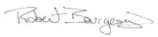
Robert Bourgeois, CPA, CA

Controller

Halifax, Nova Scotia

September 10, 2026


 Exhibit 99.1

67


   Auditor General of Nova Scotia       LOGO

Independent Auditor’s Report

To the Members of the Legislative Assembly of Nova Scotia

Report on the Audit of the Consolidated Financial Statements


Opinion

I have audited the consolidated financial statements of the Province of Nova Scotia, which comprise the consolidated statement of financial position as at March 31, 2026, and the consolidated statement of operations, consolidated statement of changes in net debt, consolidated statement of remeasurement gains and losses, and consolidated statement of cash flow for the year then ended, and notes and schedules to the consolidated financial statements, including a summary of significant accounting policies.

In my opinion, the accompanying consolidated financial statements present fairly, in all material respects, the consolidated financial position of the Province of Nova Scotia as at March 31, 2026, and the consolidated results of its operations, consolidated changes in its net debt, consolidated remeasurement gains and losses, and its consolidated cash flows for the year then ended in accordance with Canadian public sector accounting standards.


Basis for Opinion

I conducted my audit in accordance with Canadian generally accepted auditing standards. My responsibilities under those standards are further described in the Auditor’s Responsibilities for the Audit of the Consolidated Financial Statements section of my report. I am independent of the Province of Nova Scotia in accordance with the ethical requirements that are relevant to my audit of the consolidated financial statements in Canada, and I have fulfilled my other ethical responsibilities in accordance with these requirements. I believe that the audit evidence I have obtained is sufficient and appropriate to provide a basis for my opinion.


Key Audit Matters


Key audit matters are those matters that, in my professional judgment, were of most significance in my audit of the consolidated financial statements of the Province of Nova Scotia for the year ended March 31, 2026. In applying my professional judgment to determine key audit matters, I considered those matters that are complex, have a high degree of uncertainty, or are important to the public because of their significance.

The key audit matters were addressed in the context of my audit of the consolidated financial statements of the Province of Nova Scotia as a whole, and in forming my opinion thereon. I do not provide a separate opinion on these matters.


KEY AUDIT MATTER


HOW WE ADDRESSED THIS MATTER

Major tax revenues (PIT, CIT, HST)


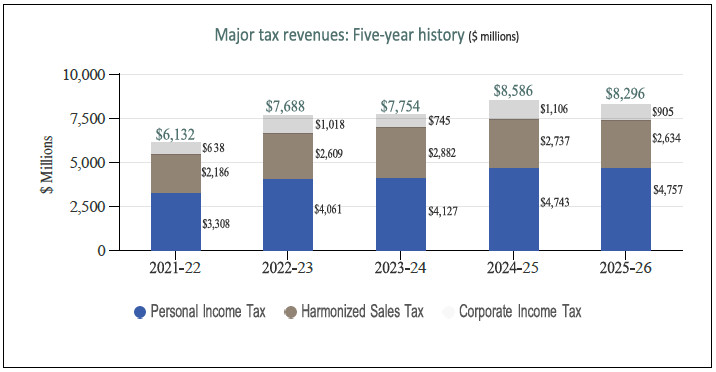
Major tax revenues include personal income tax (PIT), corporate income tax (CIT), and harmonized sales tax (HST) and were determined to be a key audit matter because:


•

Major tax revenues are material and are based on management’s best estimates using statistical models and assumptions; and


•

Significant uncertainty is present in these estimates, as they involve forecasting future economic and tax filing data since there is a delay in when the Province receives actual results (i.e. once personal tax returns are filed).


Major tax revenues are disclosed in:


•

Note 1, Financial Reporting and Accounting Policies; and


•

Schedule 1, Revenue.


We concluded that major tax revenues are fairly stated, in all material respects, and are disclosed appropriately in accordance with Canadian public sector accounting standards.


The matter was addressed by:


•

Obtaining an understanding of the systems, processes, and controls over major tax revenues, and assessing the appropriateness of the method used to make the estimate.


•

Performing variance analysis over significant balances including retrospective review to assess the accuracy of previous estimates made and potential impact to current year results.


•

Testing the underlying data used in the various tax revenue estimation models and reviewing evidence to support the key assumptions.


•

Reviewing the estimate for indications of management bias.


LOGO


KEY AUDIT MATTER


HOW WE ADDRESSED THIS MATTER

Pension, retirement and other obligations


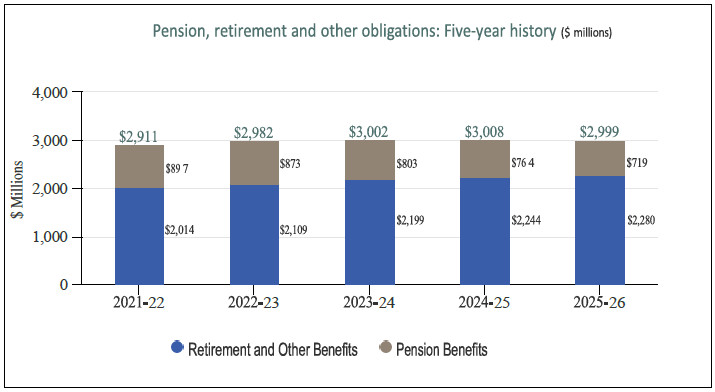
Pension, retirement, and other obligations are a key audit matter because:


•

The Province’s liability is material and is determined by an actuarial expert;


•

Significant uncertainty exists as the liability is based on detailed actuarial assumptions which are subject to change in the future; and


•

Amounts recorded in the financial statements may materially change as assumptions vary.


Pension, retirement, and other obligations are disclosed in:


•

Note 1, Financial Reporting and Accounting Policies; and


•

Note 5, Pension, Retirement and Other Obligations.


We concluded that pension, retirement, and other obligations are fairly stated, in all material respects, and are disclosed appropriately in accordance with Canadian public sector accounting standards.


The matter was addressed by:


•

Obtaining an understanding of the systems, processes, and controls used to value the liability and assessing the appropriateness of the method used.


•

Reviewing the valuation of the liability, including key assumptions, for indications of management bias.


•

Testing the underlying employee data used in the valuation of the Province’s liability and reviewing evidence to support the key assumptions used.


•

Relying on the work of the Province’s consulting actuary.


LOGO


Other Information


Management is responsible for the other information. The other information comprises the information included in Volume 1 of the Public Accounts of Nova Scotia, but does not include the consolidated financial statements and my auditor’s report thereon, which I obtained prior to the date of this auditor’s report, and the Form 18-K Securities and Exchange Commission filing, which is expected to be made available to us after that date.

My opinion on the consolidated financial statements does not cover the other information and I do not and will not express any form of assurance conclusion thereon.

In connection with my audit of the consolidated financial statements, my responsibility is to read the other information identified above and, in doing so, consider whether the other information is materially inconsistent with the consolidated financial statements or my knowledge obtained in the audit, or otherwise appears to be materially misstated.

If, based on the work I have performed on the other information that I obtained prior to the date of this auditor’s report, I conclude that there is a material misstatement of this other information, I am required to report that fact. I have nothing to report in this regard.

When I read the Form 18-K Securities and Exchange Commission filing, if I conclude that there is a material misstatement therein, I am required to communicate the matter to those charged with governance (the Minister and Executive Deputy Minister of Finance and Treasury Board).

Responsibilities of Management and Those Charged with Governance for the Consolidated Financial Statements


Management is responsible for the preparation and fair presentation of the consolidated financial statements in accordance with Canadian public sector accounting standards, and for such internal control as management determines is necessary to enable the preparation of consolidated financial statements that are free from material misstatement, whether due to fraud or error.

In preparing the consolidated financial statements, management is responsible for assessing the Province of Nova Scotia’s ability to continue as a going concern, disclosing, as applicable, matters related to going concern assumption. The going concern basis of accounting has been used in the preparation of the consolidated financial statements, as the Province of Nova Scotia continues to operate as a going concern.

Those charged with governance are responsible for overseeing the Province of Nova Scotia’s financial reporting process.

Auditor’s Responsibilities for the Audit of the Consolidated Financial Statements


My objectives are to obtain reasonable assurance about whether the consolidated financial statements as a whole are free from material misstatement, whether due to fraud or error, and to issue an auditor’s report that includes my opinion. Reasonable assurance is a high level of assurance but is not a guarantee that an audit conducted in accordance with Canadian generally accepted auditing standards will always detect a material misstatement when it exists. Misstatements can arise from fraud or error and are considered material if, individually or in the aggregate, they could reasonably be expected to influence the economic decisions of users taken on the basis of these consolidated financial statements.

As part of an audit in accordance with Canadian generally accepted auditing standards, I exercise professional judgment and maintain professional skepticism throughout the audit. I also:


  •  

Identify and assess the risks of material misstatement of the consolidated financial statements, whether due to fraud or error, design and perform audit procedures responsive to those risks, and obtain audit evidence that is sufficient and appropriate to provide a basis for my opinion. The risk of not detecting a material misstatement resulting from fraud is higher than for one resulting from error, as fraud may involve collusion, forgery, intentional omissions, misrepresentations, or the override of internal control.


LOGO


  •  

Obtain an understanding of internal control relevant to the audit in order to design audit procedures that are appropriate in the circumstances, but not for the purpose of expressing an opinion on the effectiveness of the Province of Nova Scotia’s internal control.


  •  

Evaluate the appropriateness of accounting policies used and the reasonableness of accounting estimates and related disclosures made by management.


  •  

Conclude on the appropriateness of management’s use of the going concern basis of accounting and, based on the audit evidence obtained, whether a material uncertainty exists related to events or conditions that may cast significant doubt on the Province of Nova Scotia’s ability to continue as a going concern. If I conclude that a material uncertainty exists, I am required to draw attention in my auditor’s report to the related disclosures in the consolidated financial statements or, if such disclosures are inadequate, to modify my opinion. My conclusions are based on the audit evidence obtained up to the date of my auditor’s report. However, future events or conditions may cause the Province of Nova Scotia to cease to continue as a going concern.


  •  

Evaluate the overall presentation, structure, and content of the consolidated financial statements, including the disclosures, and whether the consolidated financial statements represent the underlying transactions and events in a manner that achieves fair presentation.


  •  

Obtain sufficient appropriate audit evidence regarding the financial information of the entities or business activities within the Province of Nova Scotia to express an opinion on the consolidated financial statements. I am responsible for the direction, supervision, and performance of the group audit. I remain solely responsible for my audit opinion.

I communicate with those charged with governance regarding, among other matters, the planned scope and timing of the audit and significant audit findings, including any significant deficiencies in internal control that I identify during my audit.

I also provide those charged with governance with a statement that I have complied with relevant ethical requirements regarding independence, and to communicate with them all relationships and other matters that may reasonably be thought to bear on my independence, and where applicable, related safeguards.

From the matters communicated with those charged with governance, I determine those matters that were of most significance in the audit of the Province’s financial statements of the current period and are therefore the key audit matters. I describe these matters in my auditor’s report unless law or regulation precludes public disclosure about the matter or when, in extremely rare circumstances, I determine that a matter should not be communicated in my auditor’s report because the adverse consequences of doing so would reasonably be expected to outweigh the public interest benefits of such communication.


LOGO

Kim Adair, FCPA, FCA, ICD.D

Auditor General of Nova Scotia

Halifax, Nova Scotia

September 10, 2026


LOGO


Consolidated Financial Statements

Statement 1

Province of Nova Scotia

Consolidated Statement of Financial Position

As at March 31, 2026

($ thousands)


     2026     2025  
           (as restated)  

Financial Assets


Cash and Short-Term Investments

     1,706,391       1,564,477  

Accounts Receivable (Note 17)

     1,744,271       1,684,407  

Inventories for Resale

     3,516       3,602  

Loans Receivable (Schedule 3)

     2,333,935       2,112,167  

Investments (Schedule 3)

     1,564,041       1,545,590  

Investment in Government Business Enterprises (Schedule 6)

     283,314       298,459  

Derivative Financial Assets (Note 13)

     16,315       15,518  

Assets Held for Sale

     26,361       —   


     7,678,144       7,224,220  

Liabilities


Bank Advances and Short-Term Borrowings

     1,460,707       1,061,696  

Accounts Payable and Accrued Liabilities

     3,816,317       2,920,319  

Deferred Revenue (Note 4)

     321,864       308,972  

Accrued Interest

     250,031       223,430  

Pension, Retirement and Other Obligations (Note 5)

     2,999,184       3,007,946  

Asset Retirement Obligations (Note 10)

     660,537       600,488  

Liabilities for Contaminated Sites (Note 11)

     619,722       613,978  

Unmatured Debt (Schedules 4 and 5)

     21,633,693       19,309,590  

Derivative Financial Obligations (Note 13)

     12,783       21,401  


     31,774,838       28,067,820  

Net Debt

     (24,096,694 )      (20,843,600 ) 


Non-Financial Assets


Tangible Capital Assets (Schedule 7)

     13,770,504       11,960,417  

Inventories of Supplies

     147,396       140,550  

Prepaid Expenses

     109,398       54,525  


     14,027,298       12,155,492  


Accumulated Deficits

     (10,069,396 )      (8,688,108 ) 


Accumulated Deficits are comprised of:


Accumulated Operating Deficits

     (10,123,475 )      (8,716,436 ) 

Accumulated Remeasurement Gains

     54,079       28,328  


     (10,069,396 )      (8,688,108 ) 


Restricted Assets (Note 3)


Contingencies and Contractual Obligations/Rights (Note 12)


Public Private Partnerships (P3s) (Note 14)


Trust Funds Under Administration (Note 15)


Subsequent Events (Note 19)


The accompanying notes and schedules are an integral part of these Consolidated Financial Statements


7 5


LOGO

76


Public Accounts Volume 1 — Consolidated Financial Statements

Statement 2

Province of Nova Scotia

Consolidated Statement of Operations

For the fiscal year ended March 31, 2026

($ thousands)


     Adjusted
Estimate
    Actual     Actual  
     2026     2026     2025  

Revenue (Schedule 1)


Provincial Sources


Tax Revenue

     8,831,935       8,989,167       9,302,801  

Other Provincial Revenue

     1,820,410       2,010,778       2,187,934  

Net Income from Government Business Enterprises (Schedule 6)

     465,447       471,418       490,867  

Investment Income

     225,805       180,728       231,652  


     11,343,597       11,652,091       12,213,254  

Federal Sources

     6,218,127       6,327,771       6,007,425  


Total Revenue

     17,561,724       17,979,862       18,220,679  


Expenses (Schedule 2)


Advanced Education

     837,260       854,907       859,641  

Agriculture

     60,333       79,465       59,658  

Communities, Culture, Tourism and Heritage

     172,989       211,217       244,034  

Cyber Security and Digital Solutions

     283,921       280,372       241,493  

Education and Early Childhood Development

     2,689,809       2,655,073       2,440,009  

Emergency Management

     71,668       78,956       51,551  

Energy

     48,613       58,142       43,738  

Environment and Climate Change

     154,133       149,185       148,313  

Finance and Treasury Board

     69,706       86,311       68,683  

Fisheries and Aquaculture

     15,396       14,379       13,246  

Growth and Development

     485,168       481,965       503,132  

Health and Wellness

     6,408,234       6,833,966       6,359,221  

Justice

     492,629       512,508       486,485  

Labour, Skills and Immigration

     224,037       199,441       214,949  

Municipal Affairs

     337,882       278,524       314,508  

Natural Resources

     110,502       176,664       117,532  

Opportunities and Social Development

     1,674,544       1,673,130       1,610,816  

Public Service

     196,754       207,308       201,742  

Public Works

     772,705       806,137       788,528  

Seniors and Long-Term Care

     1,363,033       1,425,571       1,295,527  

Service Nova Scotia

     164,887       174,187       215,028  

Restructuring Costs

     551,472       1,144,079       661,765  

Pension Valuation Adjustment (Note 5)

     17,079       (40,265 )      (16,151 ) 

Refundable Tax Credits

     147,960       165,302       155,907  

Net Loss on Disposal of Crown Assets

     —        10,786       2,023  

Debt Servicing Costs (Note 7)

     908,509       869,591       874,513  


Total Expenses (Note 8)

     18,259,223       19,386,901       17,955,891  


Contingency

     200,000       —        —   


Provincial Surplus (Deficit)

     (897,499 )      (1,407,039 )      264,788  

Accumulated Operating Deficits, Beginning of Year

       (8,716,436 )      (8,981,224 ) 


Accumulated Operating Deficits, End of Year

       (10,123,475 )      (8,716,436 ) 


The accompanying notes and schedules are an integral part of these Consolidated Financial Statements


Consolidated Financial Statements

Statement 3

Province of Nova Scotia

Consolidated Statement of Changes in Net Debt

For the fiscal year ended March 31, 2026

($ thousands)


     Adjusted
Estimate
    Actual     Actual  
     2026     2026     2025  

Net Debt, Beginning of Year

     (20,843,600 )      (20,843,600 )      (19,100,212 ) 

Changes in the Year


Provincial Surplus (Deficit)

     (897,499 )      (1,407,039 )      264,788  

Acquisitions and Transfers of Tangible Capital Assets

     (2,353,594 )      (2,542,000 )      (2,589,440 ) 

Amortization of Tangible Capital Assets

     681,200       703,651       611,531  

Disposals of Tangible Capital Assets

     —        28,262       6,891  

Acquisitions of Inventories of Supplies

     —        (6,846 )      (16,148 ) 

Use (Acquisitions) of Prepaid Expenses

     —        (54,873 )      8,139  

Net Remeasurement Gains (Losses)

     —        25,751       (29,149 ) 


Total Changes in the Year

     (2,569,893 )      (3,253,094 )      (1,743,388 ) 


Net Debt, End of Year

     (23,413,493 )      (24,096,694 )      (20,843,600 ) 


The accompanying notes and schedules are an integral part of these Consolidated Financial Statements


77


LOGO

78


Public Accounts Volume 1 — Consolidated Financial Statements

Statement 4

Province of Nova Scotia

Consolidated Statement of Remeasurement Gains and Losses

For the fiscal year ended March 31, 2026

($ thousands)


     2026     2025  

Accumulated Remeasurement Gains, Beginning of Year

     28,328       57,477  

Unrealized Gains (Losses) During the Year


Portfolio Investments in an Active Market

     993       (3,275 ) 

Derivative Financial Instruments

     9,375       (36,172 ) 

Other Comprehensive Income from Government Partnership Arrangements

     372       182  

Other Comprehensive Income from Government Business Enterprises (Schedule 6)

     14,942       6,411  


     25,682       (32,854 ) 


Realized Gains (Losses) Reclassified to the Statement of Operations During the Year


Portfolio Investments in an Active Market

     60       3,800  

Derivative Instruments

     40       (46 ) 

Designated Fair Value Financial Instruments

     (31 )      (49 ) 


     69       3,705  


Net Remeasurement Gains (Losses) For the Year

     25,751       (29,149 ) 


Accumulated Remeasurement Gains, End of Year

     54,079       28,328  


Accumulated Remeasurement Gains comprised of:


Portfolio Investments in an Active Market

     3,248       2,195  

Derivative Financial Instruments

     3,201       (6,183 ) 

Other Comprehensive Loss from Government Partnership Arrangements

     (180 )      (552 ) 

Other Comprehensive Income from Government Business Enterprises

     47,810       32,868  


     54,079       28,328  


The accompanying notes and schedules are an integral part of these Consolidated Financial Statements


Consolidated Financial Statements

Statement 5

Province of Nova Scotia

Consolidated Statement of Cash Flow

For the fiscal year ended March 31, 2026

($ thousands)


     2026     2025  

Operating Transactions


Provincial Surplus (Deficit)

     (1,407,039 )      264,788  

Net Remeasurement Gains (Losses) for the Year

     25,751       (29,149 ) 

Sinking Fund and Public Debt Management Fund Earnings

     (26,220 )      (25,856 ) 

Amortization of Premiums and Discounts on Unmatured Debt

     17,417       16,322  

Net Income from Government Business Enterprises (Schedule 6)

     (471,418 )      (490,867 ) 

Profit Distributions from Government Business Enterprises

     486,563       642,825  

Amortization of Tangible Capital Assets (Schedule 7)

     703,651       611,531  

Loss on Disposal of Tangible Capital Assets

     852       4,361  

Net Change in Other Items (Note 9)

     1,243,675       367,805  


     573,232       1,361,760  


Investing Transactions


Repayment of Loans Receivable

     435,873       369,590  

Advances and Investments

     (678,785 )      (491,443 ) 

Write-offs

     28,116       38,841  


     (214,796 )      (83,012 ) 


Capital Transactions


Acquisitions of Tangible Capital Assets

     (2,542,000 )      (2,589,440 ) 

Proceeds from Disposal of Tangible Capital Assets

     27,410       2,530  


     (2,514,590 )      (2,586,910 ) 


Financing Transactions


Debentures and Other Debt Issued

     5,059,191       2,598,318  

Repayment of Debentures and Other Long-Term Obligations

     (2,761,123 )      (924,658 ) 


     2,298,068       1,673,660  


Cash Inflows

     141,914       365,498  

Cash Position, Beginning of Year

     1,564,477       1,198,979  


Cash Position, End of Year

     1,706,391       1,564,477  


Cash Position Represented by:


Cash and Short-Term Investments

     1,706,391       1,564,477  


The accompanying notes and schedules are an integral part of these Consolidated Financial Statements


79


LOGO

80


Public Accounts Volume 1 — Consolidated Financial Statements

Province of Nova Scotia

Notes to the Consolidated Financial Statements

As at March 31, 2026


1.

Financial Reporting and Accounting Policies

The Province’s consolidated financial statements are prepared in accordance with Canadian public sector accounting standards using the following significant accounting policies:


  a)

Government Reporting Entity

The government reporting entity (GRE) includes government components within the General Revenue Fund, other governmental units (GUs), government business enterprises (GBEs), and the Province’s share of government partnership arrangements (GPAs). GUs and GBEs are government-controlled entities. Control is the power to govern financial and operating policies of another organization with the expected benefits or risks from the other organization’s activities. Control exists even if the government chooses not to exercise it, as long as the ability to govern remains. Control must exist at the financial statement date without the need to amend legislation or agreements. GPAs represent entities for which decision making and significant risks and benefits are shared with other parties outside of the GRE.

Trust funds that are administered by the Province but not controlled are excluded from the GRE and disclosed in Note 15.


  b)

Principles of Consolidation

A government component is not a separate entity but is an integral part of government, such as a department, agency, or public service unit within the General Revenue Fund, or a special purpose fund. A GU is a government organization that is not a GBE, GPA, or government component. GUs include certain boards, commissions, service organizations, and government not-for-profit entities. Government components and GUs are consolidated on a line-by-line basis after adjusting their accounting policies to be consistent with those described in Note 1 d). Significant inter-organization balances and transactions are eliminated.

A GBE is a self-sustaining organization with the delegated financial and operating authority whose principal activity and source of revenue are to sell goods and services outside of the Province’s GRE. GBEs are accounted for on the modified equity basis, without adjusting accounting principles to conform with those of the Province. Total net assets of all GBEs are reported as Investment in Government Business Enterprises on the Consolidated Statement of Financial Position. Total net income from all GBEs is reported separately as revenue on the Consolidated Statement of Operations.

A GPA is a contractual arrangement between the government and a party or parties outside of the GRE. The partners have clearly defined common goals, make a financial investment, share control of decision making, and share, on an equitable basis, the significant risks and benefits of the government partnership. Government business partnerships are self-sustaining GPAs with the delegated financial and operating authority whose principal activity and source of revenue are to sell goods and services outside of the Province’s GRE. The Province accounts for its interest in GPAs and government business partnerships using the modified equity method.

A listing of the organizations within the Province’s GRE is provided in Schedule 10.


Notes to the Consolidated Financial Statements

Province of Nova Scotia

Notes to the Consolidated Financial Statements

As at March 31, 2026


1.

Financial Reporting and Accounting Policies (continued)


  c)

Presentation of Estimates

Annually, the Province prepares the Estimates, which are presented to the House of Assembly for the fiscal year commencing April 1. The Estimates form the basis of the Appropriations Act and are prepared primarily for managing and overseeing the General Revenue Fund based upon the government’s policies, programs, and priorities. Consolidation impacts are summarized in the Estimates and included on a net basis as Consolidation and Accounting Adjustments.

For consolidation purposes, the 2025-26 Estimates, tabled on February 18, 2025, were adjusted line-by-line by grossing up the associated revenues and expenses with those of the Province’s governmental units. This classification provides proper comparability in these consolidated financial statements.


  d)

Significant Accounting Policies

Revenue

Revenue is recorded on an accrual basis in the fiscal year when the events giving rise to the revenue occurs. Revenue from transactions with no performance obligations is recognized when the authority to claim or retain an economic inflow is in place and the events giving rise to the revenue have occurred. Revenue from transactions with performance obligations is recognized when those performance obligations have been satisfied. The following are typical performance obligations in relation to the Province’s general revenues:


Key Revenue Stream


Common Performance

Obligations

   Recognition    Examples
Registry of Motor Vehicles    Provide rights    At point of sale    Drivers Licence / Vehicle
Permit
Licences          Insurance Agents License /
Direct Sellers License
Incorporation Fees          Certificate of Incorporation /
Certificate of Registration
Vital Statistics          Birth Certificate / Marriage
Certificate
Royalties    Provide rights    Over production
contract
   Royalties on Minerals
Petroleum Royalties
Recoveries    Qualifying / eligible expenses for recovery    When recovery
conditions are
satisfied
   Federal funding agreements,
RCMP policing costs
Tuition and Memberships    Provision of access / instruction    As access and /
or instruction is
provided
   NSCC Courses
Art Gallery of Nova Scotia
Memberships
Fines    None    When collectible
under the Act
   Statutory fines


81


LOGO

82


Public Accounts Volume 1 — Consolidated Financial Statements

Province of Nova Scotia

Notes to the Consolidated Financial Statements

As at March 31, 2026


1.

Financial Reporting and Accounting Policies (continued)

Revenue from personal and corporate income taxes, as well as harmonized sales taxes, is recorded in the year in which the taxable event occurs based on estimates using statistical models. These estimates consider certain non-refundable tax credits and other adjustments from the federal government. Adjustments to tax revenues recognized in prior years, as a result of actual or more current economic data and federal government information, are recorded in the current year. Non-refundable personal and corporate income tax credits are tax concessions (relief of taxes owing) that reduce corresponding tax revenues. Refundable personal and corporate income tax credits are transfers made through the tax system (financial benefits other than relief of taxes owing) and are recorded as expenses.

Government transfers received for operating purposes are recognized in the period during which the transfer is authorized and all eligibility criteria (if any) are met, except when and to the extent that the transfer stipulations create an obligation that meets the definition of a liability. Transfers meeting the definition of a liability are recorded as deferred revenue and recognized as revenue as the stipulations are satisfied.

Government transfers received for capital purposes and contributed assets are recognized as revenue in the period the tangible capital assets are acquired. Capital transfers received in advance of project completion are recorded as deferred revenue and recognized as revenue as the related eligible expenditures are incurred.

Investment income includes interest, amortization of premiums or discounts using the effective interest method, and realized fair value gains and losses on portfolio investments.

Expenses

Expenses are recorded on the accrual basis in the fiscal year when the events giving rise to the expenses occur and are reported in more detail in Note 8, Expenses by Object.

Grants and other government transfers are recognized as expenses in the period at the earlier of: 1) transfer being authorized and recipient meeting all eligibility criteria, and 2) time of payment.

Provisions are made for probable losses on certain loans, investments, loan guarantees, accounts receivable, advances, forgivable loans, and contingent liabilities when it is likely that a liability exists and the amount can be reasonably determined. At least annually, provisions are updated as estimates are revised.

Debt servicing costs include interest on debentures issued, pension, retirement and other obligations, capital leases, long-term debt from Public Private Partnership (P3) arrangements, amortization of premiums and discounts using the effective interest method, and realized fair value gains and losses on derivatives and foreign currency transactions. Debt servicing costs are recorded net of interest revenue associated with repurchased Province of Nova Scotia debentures.


Notes to the Consolidated Financial Statements

Province of Nova Scotia

Notes to the Consolidated Financial Statements

As at March 31, 2026


1.

Financial Reporting and Accounting Policies (continued)

Financial Assets

Cash and Short-Term Investments are recorded at cost, which approximates market value, and include cash on hand, demand deposits, R-1 (low, middle, high) rated federal and provincial government bills or promissory notes, bankers’ acceptances, term deposits, and commercial paper. Terms of investments are generally 1 to 90 days. The weighted average interest rate of short-term investments was 2.76 per cent at year-end.

Accounts Receivable are recorded at the principal amount less valuation allowances.

Inventories for Resale are held for sale in the ordinary course of operations and are recorded at the lower of cost and net realizable value.

Loans Receivable are recorded at cost less adjustments for concessionary assistance and any prolonged impairment in value. Investments not traded on an active market, including the Public Debt Management Fund, are recorded at amortized cost using the effective interest method less adjustments for concessionary assistance and any prolonged impairment in value. Concessionary assistance consists of subsidies provided by the Province and is recognized as an expense at the loan issuance or investment date. Loans usually bear interest at approximate market rates and normally have fixed repayment schedules. Any write-down, due to loss in value, reflected in a loan or investment is not reversed if there is a subsequent increase in value. Any write-off must be approved by Governor in Council.

Equity investments traded on an active market are measured at fair value. Unrealized changes in fair value are recognized in the Consolidated Statement of Remeasurement Gains and Losses until they are realized and then reclassified to the Consolidated Statement of Operations.

Derivative financial instruments, including embedded derivatives, are recorded at fair value.

Fair value is the estimated amount for which a financial instrument could be exchanged between willing parties in an arm’s length transaction based on the current market conditions. Fair value measurements are classified using the Fair Value Hierarchy:


Level 1    Quoted prices (unadjusted) in active markets for identical assets or liabilities
Level 2    Inputs other than quoted prices included within Level 1 that are observable for the asset or liability, either directly (i.e., as prices) or indirectly (i.e., derived from prices)
Level 3    Inputs for the asset or liability that are not based on observable market data (unobservable inputs)

Financial assets are assessed for impairment on an annual basis. When a decline is determined to be other than temporary, the amount of the loss is recorded in the Consolidated Statement of Operations, and any applicable unrealized gain or loss is adjusted through the Consolidated Statement of Remeasurement Gains and Losses.


83


LOGO

84


Public Accounts Volume 1 — Consolidated Financial Statements

Province of Nova Scotia

Notes to the Consolidated Financial Statements

As at March 31, 2026


1.

Financial Reporting and Accounting Policies (continued)

Assets Held for Sale are measured at their net carrying value upon reclassification from Tangible Capital Assets. An asset is classified as held for sale when management has approved a plan to sell the asset, the asset is available for immediate sale in its present condition, the asset is actively and publicly marketed for sale, an active market exists for the asset, and the sale is expected to be completed within one year of the financial statement date.

Liabilities

Bank Advances and Short-Term Borrowings are recorded at cost, which approximates market value, and have initial maturities of one year or less. The weighted average interest rate of short-term Canadian dollar borrowings was 2.28 per cent at year-end.

Deferred Revenue is recorded when funds received are externally restricted for a stated purpose, such as a specific program or the purchase of tangible capital assets. Deferred revenue is recognized as revenue as the stipulations are met, funds are used for their intended purpose, or related eligible capital expenditures are incurred.

Pension, Retirement and Other Obligations include various employee future benefit plans, where the Province is responsible for the provision of benefits. Liabilities for these plans are calculated using the projected benefit actuarial method using accounting assumptions that reflect the Province’s best estimates. This actuarial method attributes the estimated cost of benefits to the periods of employee service. The net liability represents accrued employee benefits less the market-related value of plan assets (if applicable) and the balance of unamortized experience gains and losses. Market-related values are determined in a rational and systematic manner, recognizing asset market value gains and losses over a five-year period.

Asset Retirement Obligations are recognized when there is a legal obligation to incur retirement costs in relation to a tangible capital asset, the past transaction or event giving rise to the liability has occurred, the Province expects to give up future economic benefits, and a reasonable estimate of the amount can be made. These liabilities include direct costs related to asset retirement activities, including post-retirement operation, maintenance, and monitoring that are integral to the retirement of the tangible capital asset. They are measured based on the best estimate of the expenditures required to complete the retirement activities using the information available at year-end.

Upon initial recognition, asset retirement costs are capitalized as part of the carrying amount of the related tangible capital assets. These capitalized costs are amortized on the same basis as the related tangible capital assets, and any accretion expense is recognized in the Consolidated Statement of Operations. Asset retirement costs related to unrecognized tangible capital assets or tangible capital assets no longer in productive use are expensed immediately.

Carrying amounts of asset retirement obligations are reviewed at each financial reporting date. Changes to the liabilities arising from revisions to either the timing or the amount of the original estimate of undiscounted cash flows are recognized as an increase or decrease to the carrying amounts of the related tangible capital assets.


Notes to the Consolidated Financial Statements

Province of Nova Scotia

Notes to the Consolidated Financial Statements

As at March 31, 2026


1.

Financial Reporting and Accounting Policies (continued)

Liabilities for Contaminated Sites are recognized when an existing environmental standard is exceeded, the Province is directly responsible or accepts responsibility, the Province expects to remediate and give up future economic benefits, and a reasonable estimate of the amounts can be made. Contaminated sites are a result of any chemical, organic, radioactive material, or live organism being introduced directly or via the air into soil, water, or sediment that exceeds an environmental standard. These liabilities include the costs directly attributable to remediation activities, including costs related to post-remediation operation, maintenance, and monitoring that are an integral part of the remediation strategy. They are measured based on the best estimate of the expenditures required to complete the remediation. The carrying amounts of liabilities for contaminated sites are reviewed at each financial reporting date and updated as additional information is available. Any revisions to the amounts previously recognized are accounted for in the period in which the revisions are made.

Unmatured Debt is comprised of debentures and various loans in Canadian and foreign currencies, capital leases, and long-term debt related to Public-Private Partnership (P3) assets. Premiums and discounts, as well as underwriting commissions, relating to the issuance of debentures are included in the item’s opening carrying value. Debt is recorded at amortized cost using the effective interest method, net of repurchased Province of Nova Scotia debentures. Under P3 arrangements, the Province uses private sector partners to design, build, finance, and maintain certain infrastructure assets. Assets procured through P3s are recognized as tangible capital assets, and the related long-term obligations are recognized as other unmatured debt in these consolidated financial statements as the assets are constructed.

Unrealized Foreign Exchange Translation Gains and Losses result when assets and liabilities denominated in foreign currencies are translated into Canadian dollars at the rate of exchange in effect at March 31st. Unrealized foreign exchange translation gains and losses are recognized in the Consolidated Statement of Remeasurement Gains and Losses. Once settled, the realized foreign exchange gains and losses are recognized in the Consolidated Statement of Operations and the unrealized balances are reversed from the Consolidated Statement of Remeasurement Gains and Losses.

Contingent Liabilities, including provisions for losses on loan guarantees, are potential obligations that may become actual liabilities when one or more future events occur or fail to occur. If the future event is likely, and a reasonable estimate of the loss can be made, an estimated liability is accrued and an expense is recorded. If the likelihood is not determinable or an amount cannot be reasonably estimated, the contingency is disclosed in the notes to the consolidated financial statements. In cases where an accrual is made, but exposure exists beyond the amount accrued, this excess exposure would also be disclosed, unless the impact is immaterial or the disclosure would have an adverse effect on the outcome of the contingency.

Net Debt

Net Debt is the difference between the Province’s liabilities and financial assets, which is the accumulation of all past annual surpluses and deficits, net changes in remeasurement gains and losses, and cumulative net acquisitions of non-financial assets.


85


LOGO

86


Public Accounts Volume 1 — Consolidated Financial Statements

Province of Nova Scotia

Notes to the Consolidated Financial Statements

As at March 31, 2026


1.

Financial Reporting and Accounting Policies (continued)

Non-Financial Assets

Tangible Capital Assets have useful lives extending beyond the accounting period, are held for use in the production and supply of goods and services, and are not intended for sale in the ordinary course of operations. They are recorded at gross historical cost (or estimated cost when the actual cost is unknown) and include all costs directly attributable to the acquisition, design, construction, development, installation, and betterment of the tangible capital asset, as well as interest related only to the financing of P3 assets during construction. Cost also includes the estimated cost of legally required activities to retire a tangible capital asset. Tangible capital assets include land, land improvements, buildings, major equipment and software, vehicles, ferries, roads, highways, and bridges.

Tangible capital assets are written down when conditions indicate that they no longer contribute to the Province’s ability to provide services, or when the value of future economic benefits associated with the tangible capital assets are less than their net book value. Net write-downs are accounted for as amortization expense and are not reversed.

Contributed tangible capital assets received are recorded at their fair market value on the date of contribution, except in circumstances where the value cannot be reasonably determined, in which case they are recognized at nominal value. Tangible capital assets do not include intangibles or assets acquired by right, such as forests, water, and mineral resources, or works of art and historical treasures. Tangible capital assets are amortized to expense over the useful lives of the assets. The amortization methods and rates applied by the other governmental units are not adjusted to the methods and rates used by the General Revenue Fund.

Inventories of Supplies are held for consumption or use by the Province in the course of its operations and are recorded at the lower of cost and current replacement cost.

Prepaid Expenses are cash disbursements for goods or services, other than tangible capital assets and inventories of supplies, that will provide economic benefits in one or more future periods. The prepaid amount is recognized as an expense in the year the good or service is used or consumed.

Purchased intangible assets, which are non-physical assets acquired through an arm’s length exchange transaction between willing parties, are recognized as non-financial assets. This excludes software, which is recognized as a tangible capital asset.

Accumulated Deficits

Accumulated Deficits are the difference between the Province’s Net Debt and non-financial assets. This represents the cumulative balance of net surpluses and deficits arising from the operations of the Province and accumulated remeasurement gains and losses.


  e)

Measurement Uncertainty

Measurement uncertainty exists in determining certain amounts included in these consolidated financial statements. Many items are measured using management’s best estimates based on assumptions that reflect the most probable set of economic conditions and planned courses of action. Uncertainty exists whenever estimates are used because actual results may differ materially from the Province’s estimates.


Notes to the Consolidated Financial Statements

Province of Nova Scotia

Notes to the Consolidated Financial Statements

As at March 31, 2026


1.

Financial Reporting and Accounting Policies (continued)

Material measurement uncertainty exists in the estimation of tax revenues, pension, retirement and other obligations, asset retirement obligations, liabilities for contaminated sites, and the value of tangible capital assets.

Personal Income Tax (PIT) revenue of $4.76 billion (2025 – $4.74 billion), Corporate Income Tax (CIT) revenue of $905 million (2025 – $1.11 billion), and Harmonized Sales Tax (HST) revenue of $2.63 billion (2025 – $2.74 billion), see Schedule 1, may be subject to future revisions based on changes to key tax revenue inputs. Changes to tax revenue inputs can be based on new or revised information, possible differences between the estimated and actual economic growth, and other assumptions used in statistical modelling to accrue these revenues. When these changes affect revenue estimates of prior years, they are classified as prior years’ adjustments (PYAs), see Note 6. Revisions to tax revenue inputs and variances in actual experience can result in significant estimate changes. Some of the key variable inputs related to tax revenues include, but are not limited to, the following:


Personal Income Tax


Corporate Income Tax


Harmonized Sales Tax

Personal taxable income levels    National corporate taxable income levels as provided by Finance Canada    Personal consumer expenditure levels
Provincial taxable income yield    Nova Scotia’s share of national taxable income   

Provincial GDP


Rebate levels

Tax credits uptake   

Tax credits uptake

   Residential housing investment

Pension, Retirement and Other Obligations of $3.00 billion (2025 – $3.01 billion), see Note 5, are subject to uncertainty because actual results may differ significantly from the Province’s long-term assumptions about plan members, return on investment of pension fund assets, health care cost trend rates for retiree benefits, the Province’s long-term cost of borrowing, and other economic conditions.

Asset retirement obligations of $660.5 million (2025 – $600.5 million), see Note 10, require estimates regarding the useful lives of the affected tangible capital assets, amount of regulated materials, and expected retirement costs, including the timing and duration of those retirement costs.

Liabilities for contaminated sites of $619.7 million (2025 – $614.0 million), see Note 11, may differ significantly from anticipated remediation plans once the actual nature and extent of the remediation activities, methods, and site contamination are known.

The net book value of tangible capital assets of $13.77 billion (2025 – $11.96 billion ), see Schedule 7, is subject to uncertainty because of differences between estimated and actual useful lives.

Other areas requiring the use of management estimates include allowances for doubtful accounts and the valuation of loans receivable and investments.


87


LOGO

88


Public Accounts Volume 1 — Consolidated Financial Statements

Province of Nova Scotia

Notes to the Consolidated Financial Statements

As at March 31, 2026


1.

Financial Reporting and Accounting Policies (continued)


  f)

Future Changes in Accounting Standards

The Public Sector Accounting Board (PSAB) has issued: The Conceptual Framework for Financial Reporting in the Public Sector and PS 1202, Financial Statement Presentation, effective April 1, 2026. These standards will replace the existing conceptual framework and financial reporting model, PS 1000, Financial Statement Concepts, and PS 1100, Financial Statement Objectives, along with PS 1201, Financial Statement Presentation.

These new standards have not been applied in preparing these statements but are expected to significantly impact the presentation of the consolidated financial statements.

Two additional accounting standards issued by the Public Sector Accounting Board have not been applied in preparing these financial statements. The Province is assessing the impact that these standards will have on the consolidated financial statements:


  •   PS 3251 Employee Benefits, effective April 1, 2029, will replace two existing standards setting foundational guidance for the recognition, measurement, presentation, and disclosure of all employee benefits.


  •   PS 3150 Tangible Capital Assets, effective April 1, 2030, has been amended to incorporate government not-for-profit standards.


2.

Accounting Changes

Correction to Department of Education and Early Childhood Development Accounts Receivable

During the year, the Province identified an overstatement of accounts receivable and deferred revenue related to the Canada-Nova Scotia Canada-wide Early Learning and Child Care Agreement. Accounts receivable and deferred revenue were reduced by $75.3 million for the year-ending March 31, 2025. This correction has no impact on Net Debt, Accumulated Deficits, or the prior year Provincial Surplus.


3.

Restricted Assets

As at March 31, 2026, assets of $131.9 million (2025 – $122.0 million) were designated for restricted purposes by external parties. Restricted cash and short-term investments totaled $27.2 million (2025 – $13.1 million), comprised of: $18.2 million for Nova Scotia Health Authority (NSHA) research and other purposes (2025 – $nil), $5.0 million for gas market development as part of the Nova Scotia Market Development Initiative Fund (2025 – $4.8 million), $3.7 million for endowment and scholarship funds (2025 – $7.6 million), and $0.3 million for the Independent Production Fund (2025 – $0.6 million).

Restricted investments totaled $104.8 million (2025 – $108.9 million), comprised of: $63.4 million for NSHA research and other purposes (2025– $72.2 million) and $41.4 million for endowment funds (2025 – $36.7 million).

Externally restricted inflows not spent by year-end create a liability that will be settled by using the restricted assets for their intended purposes. The restricted assets described in this note are segregated from other assets and will be used as prescribed in a future period.


Notes to the Consolidated Financial Statements

Province of Nova Scotia

Notes to the Consolidated Financial Statements

As at March 31, 2026


4.

Deferred Revenue


($ thousands)    2026      2025  
     (as restated)  

Annapolis Valley Regional Centre for Education

     3,120        2,900  

Build Nova Scotia

     2,565        2,532  

Canada - Affordable Housing Fund

     7,035        8,247  

Canada - CMHC National Housing Strategy

     28,086        38,452  

Canada - CMHC Social Housing Agreement

     1,446        2,340  

Canada Community-Building Fund (formerly Federal Gas Tax Fund)

     5,503        5,429  

Canada - COVID-19 Proof of Vaccination Fund

     6,438        6,438  

Canada - Nova Scotia Canada-Wide Early Learning and Child Care Agreement

     25,474        7,544  

Canada - Nova Scotia Home and Community Care and Mental Health and Addictions Services Funding Agreement

     2,238        2,375  

Conseil scolaire acadien provincial

     1,933        3,347  

Halifax Regional Centre for Education

     7,805        7,431  

Izaak Walton Killam Health Centre – Capital, Research, and Other Restricted Funds

     37,554        37,342  

Nova Scotia Community College

     49,261        46,983  

Nova Scotia Health Authority – Capital, Research, and Other


Restricted Funds

     80,155        67,468  

Nova Scotia School Lunch Program

     —         3,032  

Perennia Food and Agriculture Incorporated

     1,264        4,133  

Public Archives of Nova Scotia

     3,905        3,644  

Resource Recovery Fund Board Inc. – Unearned Revenue from Container Deposits, Paint Levies, and Tire Deposits

     24,399        23,779  

Seniors Pharmacare

     15,014        15,254  

Social Infrastructure Fund

     2,315        2,315  

Other Externally Restricted Funds

     16,354        17,987  


Total Deferred Revenue

     321,864        308,972  


5.

Pension, Retirement and Other Obligations

The Province provides its employees a variety of pension, retirement, post-employment, compensated absences (accumulated sick leave), and special termination benefits. Most plans are unfunded and are economically dependent on the Province. Except as otherwise noted, the cost of benefits is recognized in the periods the employee provides service. For benefits that do not vest or accumulate, a liability is recognized when an event occurs that obligates the Province to pay benefits.


  a)

Description of Obligations

Pension Benefit Plans

The Province participates in multiple funded pension plans. The Nova Scotia Public Service Superannuation Plan (PSSP) and the Nova Scotia Teachers’ Pension Plan (TPP) are defined benefit plans with plan assets primarily composed of Canadian and foreign equities, government and corporate bonds, debentures, secured mortgages, and real estate.


89


LOGO

90


Public Accounts Volume 1 — Consolidated Financial Statements

Province of Nova Scotia

Notes to the Consolidated Financial Statements

As at March 31, 2026


5.

Pension, Retirement and Other Obligations (continued)

These plans are jointly funded with the Province matching contributions from employees. Retirement benefits paid are based on an employee’s length of service, rate of pay, and inflation adjustments.

The PSSP operates under the responsibility of the Public Service Superannuation Plan Trustee Inc. (PSSPTI). PSSPTI is a body corporate comprised of 13 board members – six represent the Province as the employer, six represent the employees, and an independent chairperson. The Province’s responsibility regarding this plan is limited to its pension expense for employer contributions paid to the PSSP, which are equal to the employee contributions. The contribution rate is set by PSSPTI pursuant to the legislated funding policy and is set for a five-year cycle.

As at March 31, 2026, the PSSP was 105.5 per cent funded. Indexing is based on a funded health review occurring every five years. The most recent funded health review for the period from January 1, 2026 to December 31, 2030 was completed in the first half of 2025. Based on the PSSP’s December 31, 2024 funding ratio of 114.6 per cent, 2.61 per cent indexing will be paid during the following five-year cycle and no changes to contributions will be made. The Province’s employer contributions to the PSSP in 2026 were $131.6 million (2025 – $111.6 million).

The TPP operates under the responsibility of the Teachers’ Pension Plan Trustee Inc. (TPPTI). TPPTI is a body corporate comprised of nine board members – four nominated by the Nova Scotia Teachers’ Union (NSTU), four nominated by the Province, and one Chair agreed to by both parties. Under a joint governance structure, the Province and NSTU membership equally share all surpluses and deficits of the plan. The Province accounts for one-half of all components of the accrued benefit liability associated with this plan in these consolidated financial statements. In addition, the Province recognizes one-half of the components associated with the net benefit plan expense associated with this plan. As at March 31, 2026, the total accrued benefit liability associated with this plan was $671.9 million (2025 – $748.0 million).

As at December 31, 2025, the TPP was 86.8 per cent funded. The TPP Regulations stipulate that when the most recent actuarial valuation shows an actuarial deficit of more than 10.0 per cent, no indexing shall be provided to those pensioners under the variable indexing provision (those who retired on or after August 1, 2006, and those who retired prior to August 1, 2006 but elected to participate in the variable indexing provision). In accordance with Regulation 27C(1), the Province contributed an additional $31.5 million to the TPP in 2026 (2025 – $44.5 million) based on the present value of the forgone indexing as determined by the TPP’s actuary. The Province’s total contributions to the TPP in 2026 were $172.1 million (2025 – $185.3 million).

During the year, the weighted average actual rate of return on TPP plan assets was 6.34 per cent (2025 – 6.95 per cent). The total market value of plan assets at March 31, 2026 was $6.5 billion (2025 – $6.2 billion). The liability recorded in 2026 for the TPP was based on the most recent actuarial valuation performed at December 31, 2024, extrapolated to March 31, 2026.


Notes to the Consolidated Financial Statements

Province of Nova Scotia

Notes to the Consolidated Financial Statements

As at March 31, 2026


5.

Pension, Retirement and Other Obligations (continued)

The Province is also a participating employer of the Nova Scotia Health Employee’s Pension Plan (NSHEPP), a multiemployer defined benefit pension plan, funded by employer and employee contributions. As at December 31, 2025, the NSHEPP was 110.8 per cent funded. As the Province does not sponsor this plan, the annual net benefit plan expense is limited to the amount of required contributions provided for employees’ services rendered during the year. The most recent actuarial valuation was performed on July 1, 2024 and extrapolated to December 31, 2025, which indicated a funding surplus of $1.3 billion (2025 – $0.8 billion). The Province’s contributions to this plan in 2026 were $184.2 million (2025 – $166.6 million).

The Province is responsible for the Pension Plan for the Non-Teaching Employees of the Nova Scotia Education Entities, providing pension benefits to the non-teaching employees of the participating Regional Centres for Education (RCEs) and the Conseil scolaire acadien provincial (CSAP). The Province fully accounts for the accrued benefit asset and net benefit plan expense of this plan. The most recent actuarial valuation was performed on December 31, 2022 and extrapolated to March 31, 2026. As at December 31, 2022, the plan was 114.2 per cent funded, and the total market value of the plan assets at March 31, 2026 was $312.9 million (2025 – $276.7 million). Employer contributions in 2026 were $8.2 million (2025 – $7.4 million).

The Province has several other unfunded defined benefit pension plans. The liabilities for these other plans recorded in 2026 were based on the most recent actuarial valuations performed between September 30, 2023 and December 31, 2024 and extrapolated to

March 31, 2026.

Special Termination Benefits

The Province offered early retirement incentive programs to members of the PSSP and TPP in 1986 and 1994, respectively. Qualified members were offered additional years of pensionable service if they elected to retire early. The cost of these benefits was accrued in the year the employee accepted the early retirement option and continue to be calculated using actuarial valuations.

The liabilities for these termination benefits recorded in 2026 were based on the most recent actuarial valuations performed at December 31, 2024 and extrapolated to March 31, 2026.

Post-Employment Benefits

The Province sponsors two unfunded post-employment benefit plans: a Self-Insured Workers’ Compensation Plan and retirement health benefits, some of which contain a life insurance provision. Retirement health benefits vary depending on the negotiated collective agreements. The Province pays 65.0 per cent and 100.0 per cent of the cost of retirement health benefits for the PSSP and TPP retirees, respectively.

For the Self-Insured Workers’ Compensation Plan, the amount recorded in these consolidated financial statements represents the actual amount of benefits paid during the year plus the actuarial estimate of future payments based on claims ongoing at year-end.

The liabilities for these post-employment benefit plans recorded in 2026 were based on the most recent actuarial valuations performed between March 31, 2023 and December 31, 2024 and extrapolated to March 31, 2026.


91


LOGO

92


Public Accounts Volume 1 — Consolidated Financial Statements

Province of Nova Scotia

Notes to the Consolidated Financial Statements

As at March 31, 2026


5.

Pension, Retirement and Other Obligations (continued)

The Province also participates in the Nova Scotia Public Service Long Term Disability Plan (LTD Plan). The Province does not sponsor the LTD Plan; as a result, the Province does not account for any net position of the LTD Plan in these consolidated financial statements. The LTD Plan is managed and administered, under joint trusteeship, by a Board of Trustees appointed by the two plan sponsors: five nominated by the Province, five nominated by the Nova Scotia Government and General Employees Union (NSGEU), and one Chair agreed to by both sponsors. The LTD Plan is funded equally by employer and employee contributions. The most recent actuarial valuation was performed at December 31, 2024, and indicated a funded ratio of 115.4 per cent. The Province’s contributions to this plan in 2026 were $11.6 million (2025 – $9.7 million).

Accumulated Sick Leave Benefits

The Province’s RCEs and CSAP, health authorities, and Nova Scotia Community College (NSCC) collective agreements contain sick leave provisions that accumulate but do not vest. The Province measures and records a liability associated with the accumulated sick leave benefits (ASLBs) anticipated to be used in future years. The Province’s ASLBs are unfunded, meaning there are no assets set aside to cover the related costs of these benefits in the future.

Due to the nature of these benefits, a liability and expense are measured using actuarial valuations to estimate their financial value. An actuarial assumption is developed to reflect the probability of employees using ASLB “banked days”. This involves a detailed analysis of several years of data to determine historical usage. A historical usage pattern is not based on the data group as a whole but takes into account a number of specific factors such as, but not limited to, gender, age, and type of contract or job functions, each of which may impact the anticipated amount of accumulated sick leave time to be taken in the future. As a result, the anticipated usage assumption may involve a number of criteria and circumstances that then must be applied to the data in coordination with other actuarial assumptions such as the discount rate, retirement age assumptions, future salary increases, mortality rates, etc.

The liabilities for ASLBs recorded in 2026 were based on the most recent actuarial valuations performed between June 30, 2023 and March 31, 2024 and extrapolated to March 31, 2026.

Retirement Allowances

The Province sponsors retirement allowance plans for which benefits are paid upon retirement based on an employee’s length of service and rate of pay. These retirement allowance plans were discontinued for unionized staff and non-union civil servant/ management employees on April 1, 2015 and August 11, 2015 (discontinuation dates), respectively, and no new members will be admitted into the plans. Effective April 1, 2020, service accumulation ceased for public service awards for those entitled to receive a service award under the Public Service Award Regulations made under the Provincial Court Act. Any remaining retirement allowances will be paid upon retirement based on accumulated service as of the discontinuation dates and salary upon retirement.

The liabilities for these retirement allowance plans recorded in 2026 were based on the most recent actuarial valuations performed between March 31, 2024 and March 31, 2025 and extrapolated to March 31, 2026.


Notes to the Consolidated Financial Statements

Province of Nova Scotia

Notes to the Consolidated Financial Statements

As at March 31, 2026


5.

Pension, Retirement and Other Obligations (continued)


b)

Summary of Balances


                                         2026     2025  
($ thousands)    Teachers’
Pension
Plan
    Other
Pension
Plans
    Total
Pension
Benefits
    Retirement
Health
Benefits
    Other
Benefits
    Total
Other
Benefits
    Total     Total  

Projected Benefit Obligation, Beginning of Year

     3,539,164       699,304       4,238,468       1,369,544       357,480       1,727,024       5,965,492       6,019,975  

Current Benefit Cost

     81,087       27,122       108,209       49,154       43,487       92,641       200,850       195,614  

Interest Cost

     226,441       32,368       258,809       51,929       13,390       65,319       324,128       312,889  

Actuarial Losses (Gains)

     (32,539 )      11,722       (20,817 )      (98,310 )      (28,858 )      (127,168 )      (147,985 )      (226,412 ) 

Benefit/Premium Payments

     (230,838 )      (44,157 )      (274,995 )      (32,763 )      (39,601 )      (72,364 )      (347,359 )      (343,559 ) 

Other

     1,145       (47 )      1,098       (116 )      16,867       16,751       17,849       3,309  

Plan Amendments

     —        —        —        —        —        —        —        3,676  


Projected Benefit Obligation, End of Year

     3,584,460       726,312       4,310,772       1,339,438       362,765       1,702,203       6,012,975       5,965,492  


Market Related Value of Plan Assets,


Beginning of Year

     3,126,821       371,843       3,498,664       —        —        —        3,498,664       3,297,547  

Expected Return on Plan Assets

     205,551       21,338       226,889       —        —        —        226,889       210,486  

Actuarial Gains (Losses)

     (25,622 )      11,448       (14,174 )      —        —        —        (14,174 )      46,845  

Benefit Payments

     (230,838 )      (44,245 )      (275,083 )      —        —        —        (275,083 )      (271,384 ) 

Other

     1,145       (943 )      202       —        —        —        202       717  

Employer Contributions

     86,066       40,630       126,696       —        —        —        126,696       133,621  

Employee Contributions

     70,560       11,534       82,094       —        —        —        82,094       80,832  


Market Related Value of Plan Assets, End of Year

     3,233,683       411,605       3,645,288       —        —        —        3,645,288       3,498,664  


Net Benefit Plans Deficiency, End of Year

     350,777       314,707       665,484       1,339,438       362,765       1,702,203       2,367,687       2,466,828  

Unamortized Net Actuarial Gains (Losses)

     (14,850 )      34,000       19,150       532,896       45,478       578,374       597,524       517,042  

Valuation Allowance

     —        33,973       33,973       —        —        —        33,973       24,076  


Accrued Benefit Liability, End of Year

     335,927       382,680       718,607       1,872,334       408,243       2,280,577       2,999,184       3,007,946  


93


LOGO

94


Public Accounts Volume 1 —  Consolidated Financial Statements


Province of Nova Scotia

Notes to the Consolidated Financial Statements

As at March 31, 2026


5.  Pension, Retirement and Other Obligations (continued)


c)  Net Benefit Plans Expense


                                         2026     2025  
($ thousands)    Teachers’
Pension
Plan
    Other
Pension
Plans
    Total
Pension
Benefits
    Retirement
Health
Benefits
    Other
Benefits
    Total
Other
Benefits
    Total     Total  

Current Benefit Cost

     81,087       27,122       108,209       49,154       43,487       92,641       200,850       195,614  

Employee Contributions

     (70,560 )      (11,534 )      (82,094 )      —        —        —        (82,094 )      (80,832 ) 

Employer Contributions *

     86,066       —        86,066       —        —        —        86,066       92,655  

Plan Amendments

     —        —        —        —        —        —        —        3,676  

Amortization of Net Actuarial Losses (Gains)

     16,595       (4,324 )      12,271       (31,849 )      (33,786 )      (65,635 )      (53,364 )      (21,495 ) 

Other

     —        391       391       427       16,867       17,294       17,685       2,002  

Increase in Valuation Allowance

     —        9,897       9,897       —        —        —        9,897       6,080  

Interest Cost

     226,441       32,368       258,809       51,929       13,390       65,319       324,128       312,889  

Expected Return on Plan Assets

     (205,551 )      (21,338 )      (226,889 )      —        —        —        (226,889 )      (210,486 ) 

Employer Contributions to Multi-Employer Plans

     —        315,786       315,786       —        11,605       11,605       327,391       287,888  


Net Benefit Plans Expense

     134,078       348,368       482,446       69,661       51,563       121,224       603,670       587,991  


Recorded as:


Fringe Benefits Expense

     140,586       331,837       472,423       25,188       49,085       74,273       546,696       501,739  

Pension Valuation Adjustment

     (27,398 )      5,501       (21,897 )      (7,456 )      (10,912 )      (18,368 )      (40,265 )      (16,151 ) 

Net Pension Interest Cost

     20,890       11,030       31,920       51,929       13,390       65,319       97,239       102,403  


Net Benefit Plans Expense

     134,078       348,368       482,446       69,661       51,563       121,224       603,670       587,991  


*

This represents one-half of the employer contributions made by the Province to the TPP. Included in the figures above are one-half of all transactions associated with the TPP to reflect the Province’s share of this plan under joint trusteeship.


Notes to the Consolidated Financial Statements

Province of Nova Scotia

Notes to the Consolidated Financial Statements

As at March 31, 2026


5.

Pension, Retirement and Other Obligations (continued)


  d)

Plan Composition

The table below shows the composition of the plan balances and net benefit plans expense.


($ thousands)    2026      2025      2026      2025  
     Accrued
Benefit
(Asset)
Liability
     Accrued
Benefit
(Asset)
Liability
     Net
Benefit
Plans
Expense
     Net
Benefit
Plans
Expense
 

Pension Benefits


Public Service Superannuation Plan *

     —         —         131,631        111,612  

Teachers’ Pension Plan

     335,927        373,983        134,078        150,529  

Health Employees Pension Plan *

     —         —         184,155        166,601  

Educational Non-Teaching Plans

     (6,283 )       (6,494 )       11,171        6,998  

Members of the Legislative Assembly Pension Plan

     129,343        126,608        8,560        13,140  

Sysco Pension Plan

     80,491        88,151        1,119        (70 ) 

Supplementary Pensions

     179,129        181,869        11,732        12,572  


Total Pension Benefits

     718,607        764,117        482,446        461,382  


Other Benefits


Public Service Superannuation Plan


Health Benefits

     318,954        325,877        (1,331 )       6,106  

Teachers’ Pension Plan Health Benefits

     1,130,731        1,094,864        54,213        59,399  

Health Sector Retirement Health Benefits

     286,814        280,335        13,351        12,814  

Other Retirement Health Benefits

     135,835        134,864        3,428        4,190  

Self-Insured Workers’ Compensation Plan

     163,426        160,979        18,336        14,125  

Public Service Long Term Disability Plan *

     —         —         11,605        9,675  

Accumulated Sick Leave Benefits

     219,210        217,904        23,006        20,836  

Retirement Allowances

     25,607        29,006        (1,384 )       (536 ) 


Total Other Benefits

     2,280,577        2,243,829        121,224        126,609  


Pension, Retirement and Other Obligations

     2,999,184        3,007,946        603,670        587,991  


*

Province does not sponsor these plans; the annual net benefit plan expense is limited to the employer contributions paid by the Province.


95


LOGO

96


Public Accounts Volume 1 — Consolidated Financial Statements

Province of Nova Scotia

Notes to the Consolidated Financial Statements

As at March 31, 2026


5.

Pension, Retirement and Other Obligations (continued)


  e)

Actuarial Assumptions

The significant assumptions used to measure the Province’s benefit plan obligations are:


     2026     2025  
     Pension
Benefits
    Other
Benefits
    Pension
Benefits
    Other
Benefits
 

Long-term inflation rate

     2.00 %      2.00 %      2.00 %      2.00 % 

Expected real rate of return on plan assets


TPP

     4.56 %      —        4.41 %      —   

NSECSB

     3.87 %      —        4.07 %      —   

Rate of compensation increase

     0.00% - 2.50 %      1.50% - 2.50 %      0.0% - 3.5 %      1.5% - 3.0 % 
     + merit       + merit       + merit       + merit  

Discount rates:


TPP

     6.65 %        6.50 %   

NSECSB

     5.95 %        6.15 %   

Other Plans

       4.06 %        3.67 % 

Other Assumptions


  •   7.0 per cent annual rate increase in the cost per person of covered health care benefits for 2025-26, decreasing to an ultimate rate of 4.0 per cent per annum over 20 years


  •   7.0 per cent annual rate increase in the cost per person of covered prescription drugs for 2025-26, decreasing to an ultimate rate of 4.0 per cent per annum over 20 years

Actuarial assumptions are reviewed and assessed on an annual basis, taking into account various changing conditions and reflecting the Province’s best estimate of performance over the long term.

The net unamortized actuarial gains (losses) are amortized on a straight-line basis over the expected average remaining service life (EARSL) of the related employee groups ranging from 6.0 to 16.0 years. The Province’s weighted-average EARSL is 14.9 years.


  f)

Sensitivity Analysis

Changes in actuarial assumptions can result in significantly different estimates of the projected benefit obligations. The table below indicates the possible changes to these obligations for the more significant benefit plans as a result of slightly different key actuarial assumptions.


     2026  
($ thousands)    Pension
Benefits
    Other
Benefits
    Total  

Possible change in obligations due to:


a)  Discount Rate – 0.5% Decrease

     232,560        5.9 %      148,048        8.6 %      380,608        6.7 % 

b)  Salary Growth Rate – 1.0% Increase

     143,255        3.6 %      20,724        1.2 %      163,979        2.9 % 

c)  Health Care Cost Trend Rate – 1.0% Increase

     n/a        n/a       309,289        18.1 %      309,289        5.4 % 

The sensitivity analyses are based on a change in one assumption while holding all other assumptions constant. In practice, this is unlikely to occur, and changes in some of the assumptions may be correlated.


Notes to the Consolidated Financial Statements

Province of Nova Scotia

Notes to the Consolidated Financial Statements

As at March 31, 2026


6.

Prior Years’ Adjustments (PYAs)

PYAs resulting from measurement uncertainty, see Note 1 e), reflect updates to the Province’s forecasts and revisions to information obtained from the federal government relating to prior years. The current year revenues and corresponding PYAs are reported in Schedule 1 as follows:


($ thousands)    2026      2025  
     Current      PYA      Total      Current      PYA     Total  

Provincial Sources


Personal Income Tax

     4,743,879        13,117        4,756,996        4,471,232        272,059       4,743,291  

Corporate Income Tax

     900,665        4,698        905,363        942,496        163,933       1,106,429  

Harmonized Sales Tax

     2,567,300        66,529        2,633,829        2,667,054        70,145       2,737,199  

Petroleum Royalties

     —         —         —         —         55,324       55,324  

Financial Institutions Capital Tax 1

     76,985        2,732        79,717        75,056        14,692       89,748  

Large Corporations Tax 1

     —         21        21        —         (94 )      (94 ) 


        87,097              576,059    


Federal Sources


Canada Health Transfer

     1,435,328        8,937        1,444,265        1,357,718        1,173       1,358,891  

Canada Social Transfer

     457,125        2,901        460,026        440,804        (631 )      440,173  


        11,838              542    


1 

Included in Other Tax Revenue in Schedule 1


7.

Debt Servicing Costs


($ thousands)    2026      2025  

CDN$ Denominated Debt

     724,231        681,891  

Pension, Retirement and Other Obligations

     97,239        102,403  

Capital Leases

     6,976        7,392  

Public Private Partnerships (P3s)

     9,630        9,950  

Other Debt

     14,117        56,572  

Amortization of Premiums and Discounts on Unmatured Debt

     17,417        16,322  

Amortization of Foreign Exchange Gains

     (19 )       (17 ) 


Total Debt Servicing Costs      869,591        874,513  


Debt servicing costs have been offset with associated interest revenue of $0.4 million (2025 – $0.2 million) on repurchased debt instruments.

For the year ended March 31, 2026, total debt servicing costs for the Province’s government business enterprises were $4.5 million (2025 – $9.5 million), see Schedule 6.


97


LOGO

98


Public Accounts Volume 1 — Consolidated Financial Statements

Province of Nova Scotia

Notes to the Consolidated Financial Statements

As at March 31, 2026


8.

Expenses by Object


($ thousands)    2026      2025  
Grants and Subsidies      6,593,353        6,452,072  
Salaries and Employee Benefits      7,445,281        6,439,690  
Operating Goods and Services      3,145,952        2,984,448  
Professional Services      616,686        589,458  
Amortization      703,651        611,531  
Debt Servicing Costs      869,591        874,513  
Other      12,387        4,179  


Total Expenses by Object      19,386,901        17,955,891  


9.

Cash Flow — Net Change in Other Items


($ thousands)    2026      2025  
            (as restated)  

Decrease (Increase) in Accounts Receivable

     (59,864 )       276,923  

Decrease in Inventories for Resale

     86        389  

Increase in Assets Held for Sale

     (26,361 )       —   

Increase (Decrease) in Bank Advances and Short-Term Borrowings

     399,011        (52,743 ) 

Increase in Accounts Payable and Accrued Liabilities

     895,998        143,018  

Increase (Decrease) in Deferred Revenue

     12,892        (56,010 ) 

Increase in Accrued Interest

     26,601        36,107  

Increase (Decrease) in Pension, Retirement and Other Obligations

     (8,762 )       5,922  

Increase in Asset Retirement Obligations

     60,049        8,506  

Increase in Liabilities for Contaminated Sites

     5,744        13,702  

Increase in Inventories of Supplies

     (6,846 )       (16,148 ) 

Decrease (Increase) in Prepaid Expenses

     (54,873 )       8,139  


Total Net Change in Other Items

     1,243,675        367,805  


10.

Asset Retirement Obligations

The Province owns and operates various assets that are subject to asset retirement obligations. As at March 31, 2026, a total liability for asset retirement obligations of $660.5 million (2025 – $600.5 million) has been recorded in these consolidated financial statements. The Province has not set aside assets designated for settling asset retirement obligations.


Notes to the Consolidated Financial Statements

Province of Nova Scotia

Notes to the Consolidated Financial Statements

As at March 31, 2026


10.

Asset Retirement Obligations (continued)

The Province’s estimates for the decommissioning of assets at retirement are based on engineering reports developed using available data such as environmental reports, building management reports, and internal data and records, which were supplemented as required by the past experience of internal experts in relation to these types of regulated materials. Given the nature of these obligations, significant measurement uncertainty exists in both the amount and timing of the estimates, see Note 1 e).

These estimates have been measured on an undiscounted basis and consist of several types of asset retirement obligations as follows:

Asbestos Abatement

Many provincially owned buildings are known or expected to contain asbestos, which represents a health hazard upon demolition of the building. The Province is legally required to perform abatement activities upon renovation or demolition of these buildings. Abatement activities include handling and disposing of the asbestos in a prescribed manner when it is disturbed. The estimated total liability for asbestos abatement is $526.3 million (2025 – $473.5 million).

Lead

The provincially owned buildings are also known or expected to contain lead-based materials such as drywall, plaster, painted wood, pipe insulation, and flooring materials, which represent health hazards upon handling of those materials. The Province is legally required to dispose of these materials in a regulated manner. The estimated total liability related to the proper disposal of lead-containing materials is $124.9 million (2025 – $119.4 million).

Underground Fuel Storage Tanks

According to legislation, the Province is required to decommission provincially owned underground fuel storage tanks in a prescribed manner at the time of their replacement or at the end of their useful life. The estimated total liability related to the decommissioning of underground fuel storage tanks is $1.3 million (2025 – $1.3 million).

Other

The Province has a number of other regulated building materials, such as mercury, polychlorinated biphenyls (PCBs), and refrigerants, as well as gravel pits that arise due to contractual obligations. The estimated total liability related to these other materials is $8.0 million (2025 – $6.3 million).

Amortization is calculated on a declining balance basis for most assets with asset retirement obligations of the General Revenue Fund. Amortization is generally calculated on a straight-line basis for most assets with asset retirement obligations of the governmental units. Amortization rates are identified in Schedule 7.


99


LOGO

100


Public Accounts Volume 1 — Consolidated Financial Statements

Province of Nova Scotia

Notes to the Consolidated Financial Statements

As at March 31, 2026


10.

Asset Retirement Obligations (continued)

The tables below show the continuity of Asset Retirement Obligations:


($ thousands)    2026  
         Fuel      
     Asbestos     Lead     Tanks     Other     Total  

Balance, Beginning of Year

     473,488       119,401       1,275       6,324       600,488  

Liabilities Incurred During Year

     1,011       141       10       —        1,162  

Liabilities Settled During Year

     (2,023 )      (714 )      (180 )      (39 )      (2,956 ) 

Changes in Estimated Costs

     53,781       6,101       160       1,694       61,736  

Accretion Expense

     20       —        —        87       107  


Balance, End of Year

     526,277       124,929       1,265       8,066       660,537  


     2025  
         Fuel      
     Asbestos     Lead     Tanks     Other     Total  

Balance, Beginning of Year

     465,618       118,731       1,395       6,238       591,982  

Liabilities Incurred During Year

     —        —        —        —        —   

Liabilities Settled During Year

     (2,213 )      (442 )      (120 )      —        (2,775 ) 

Changes in Estimated Costs

     10,083       1,112       —        —        11,195  

Accretion Expense

     —        —        —        86       86  


Balance, End of Year

     473,488       119,401       1,275       6,324       600,488  


Asset Retirement Obligations and the associated Tangible Capital Asset Class:


($ thousands)

Asset Type and Class

   Asset
Net Book Value
     ARO
Liability
 

Buildings and Land Improvements

     177,698        612,706  

Other

     7        3,680  

Unrecorded Assets

     —         44,151  


Total

     177,705        660,537  


11.

Liabilities for Contaminated Sites

Various provincially owned sites throughout the province are known to be or are at risk of being contaminated. Studies are ongoing to assess the nature and extent of damage to develop remediation plans. Provisions for these costs are recorded when it is determined a liability exists and a reasonable estimate of the remediation costs can be made. As at March 31, 2026, a total liability for contaminated sites of $619.7 million (2025 – $614.0 million) has been recorded in these consolidated financial statements.


Notes to the Consolidated Financial Statements

Province of Nova Scotia

Notes to the Consolidated Financial Statements

As at March 31, 2026


11.

Liabilities for Contaminated Sites (continued)

The Province’s estimates for remediation are based on environmental studies, engineering reports, and if appropriate, extrapolation techniques similar to those used for other contaminated sites with which the Province was involved. These estimates have been measured on an undiscounted basis. The Province has identified and continues to track approximately 205 sites in total. Of these, 97 were identified as sites where action is likely and for which a liability was recorded, including the following:

Boat Harbour in Pictou County

A liability of $419.0 million (2025 – $405.7 million ) has been recognized for the remediation of effluent on site. At this stage in the process, the Province continues to test and refine its current remediation strategy, and as a result, there remains significant measurement uncertainty related to this estimate.

The federal government has committed to reimbursing the Province for up to $100.0 million in eligible remediation costs incurred on this project. This federal commitment has not been reflected as part of the Boat Harbour remediation liability but has been disclosed as a contractual right in Note 12 e) and is expected to result in revenue in future periods as the remediation is completed.

Sydney Steel Corporation (SYSCO) including Sydney Tar Ponds/Coke Ovens Site

A liability of $45.8 million (2025 – $49.8 million) has been recognized for future decommissioning, demolition, and remediation of SYSCO’s and adjacent sites, including the long-term maintenance and monitoring of the Sydney Tar Ponds/Coke Ovens site expected until 2039.

Abandoned Mine Sites

The Province is responsible for the risk management and potential remediation of certain historic abandoned mines that exist on Crown land. For most of these mine sites, the companies that caused the contamination no longer exist. The mining operations were primarily comprised of gold and other metals, coal, gypsum, and limestone. The risk of contamination at these sites primarily comes from mine tailings and other possible contaminants that were left on site.

A liability of $141.3 million (2025 – $144.0 million) has been recognized for the remediation of abandoned mine sites. The Province has identified seven former mine sites (five gold, one coal, one celestite) where contamination is known to exceed an environmental standard. A liability of $90.7 million (2025 – $90.3 million) has been recognized for these seven sites. A liability of $50.6 million (2025 – $53.5 million) has also been recognized for the remaining 53 former mine sites based on the Province’s assessment of risk using past experience and assessments performed on other similar sites. While remediation is expected in the future, further testing and evaluation is required to determine the extent of contamination and possible site management options. These liabilities will be revised when the extent of future remediation is known, and the future costs can be more precisely measured.

At year-end, detailed site assessments were underway for four former coal mine sites and one former gold mine site located on Crown lands where contamination is expected to exceed an environmental standard. The province will continue to provide notification in accordance with the Contaminated Sites Regulations as required.


101


LOGO

102


Public Accounts Volume 1 — Consolidated Financial Statements

Province of Nova Scotia

Notes to the Consolidated Financial Statements

As at March 31, 2026


11.

Liabilities for Contaminated Sites (continued)

Other Contaminated Sites

A liability of $13.6 million (2025 — $14.5 million) has been recognized for various other contaminated sites associated with highway maintenance, commercial, and industrial operations.

For the remaining 108 identified sites, no liability for remediation has been recorded either because they have a minimal risk of requiring future remediation or the extent of contamination and possible remediation activities are unknown. They are at various stages of contamination evaluation, and studies will continue to assess the nature and extent of contamination to develop remediation plans and record a liability, if necessary. For the sites with minimal contamination, the Province does not expect to give up any future economic benefits as there is likely no significant environmental impact or risks to human health.


12.

Contingencies and Contractual Obligations/Rights


  a)

Contingent Liabilities

Lawsuits

The Province is involved in various legal proceedings arising from government activities. These disputes have resulted from breaches of contract, damages suffered by individuals or property, and related elements. These claims include items with pleading amounts and items where an amount is not specified. While the total amount claimed in these actions may be significant, their outcomes are not certain.

When a loss due to a lawsuit is likely to occur and the amount can be reasonably estimated, the amount is recorded as an accrued liability and an expense. The accrued liability for pending litigation in process as at March 31, 2026 was $165.2 million (2025 – $222.7 million).

Guarantees

Guarantees by the Province are authorized by various acts of legislature and provided through specific agreements and programs to repay promissory notes, bank loans, lines of credit, mortgages, and other securities. Provisions for losses on guarantees are recorded when it is likely that a loss will occur. The amount of the loss provisions represents the Province’s best estimate of future payments. Estimates take into consideration the nature of the loan guarantees, loss experience, and current conditions. The provisions are reviewed on an ongoing basis and changes in the provisions are recorded as expenses in the year they become known. Details on guarantees authorized, utilized, and accrued are presented in Schedule 8.

Other Contingent Liabilities

The Province also has contingent liabilities in the form of indemnities. The Province’s potential liability, if any, cannot be determined at this time.


Notes to the Consolidated Financial Statements

Province of Nova Scotia

Notes to the Consolidated Financial Statements

As at March 31, 2026


12.

Contingencies and Contractual Obligations/Rights (continued)


  b)

Contingent Assets

The Province may receive funds in the future from recoveries of various types of claims paid out and other agreements pending the occurrence of certain events. Recoveries are recorded once the contingent events occur, are measurable, and collectability is reasonably assured.

On April 6, 2023, the Province issued an order for Nova Scotia Power Incorporated (NSPI) to pay a $10.0 million penalty for not meeting its renewable electricity targets under the Renewable Electricity Regulations. NSPI has requested the Energy and Regulatory Boards Tribunal to overturn the penalty. The Court decision has not been made yet as of March 31, 2026. This $10 million penalty has not been recognized in these consolidated financial statements.


  c)

Contractual Obligations

As at March 31, 2026, the Province had contractual obligations as follows:


($ thousands)

Fiscal Year

   General Revenue
Fund
     Governmental
Units
     Government
Business
Enterprises
     Total
Contractual
Obligations
 

2027

     4,827,887        448,654        —         5,276,541  

2028

     3,517,782        272,393        —         3,790,175  

2029

     2,635,485        183,870        —         2,819,355  

2030

     1,773,583        145,027        —         1,918,610  

2031

     1,505,242        98,893        —         1,604,135  

2032 to 2036

     6,248,596        1,041,876        —         7,290,472  

2037 to 2041

     3,688,236        —         —         3,688,236  

2042 to 2046

     3,722,915        —         —         3,722,915  

2047 and thereafter

     5,526,473        —         —         5,526,473  


     33,446,199        2,190,713        —         35,636,912  


These contractual obligations are comprised of $33.45 billion from the General Revenue Fund, and $2.2 billion from governmental units. Included are contractual obligations for the Department of Seniors and Long-Term Care of $20.29 billion for service agreements with long-term care facilities, $6.54 billion for the Department of Health and Wellness (DHW) for future commitments related to P3 arrangements (of which $2.86 billion is for the capital portion and $3.68 billion for the operating and maintenance portion), $1.29 billion for the Department of Justice for the Royal Canadian Mounted Police (RCMP) policing services, $956.1 million for the Department of Public Works for various school, health, and highway projects, $945.4 million for DHW relating to medical transportation services, $831.5 million for the Department of Opportunities and Social Development for Disability Support Program Homes Contracts, and $398.6 million for the Department of Advanced Education for various bilateral agreements with various universities.


103


LOGO

104


Public Accounts Volume 1 — Consolidated Financial Statements

Province of Nova Scotia

Notes to the Consolidated Financial Statements

As at March 31, 2026


12.

Contingencies and Contractual Obligations/Rights (continued)


  d)

Operating Leases

As at March 31, 2026, the Province was contractually obligated under various operating leases. Future minimum annual lease payments were as follows:


($ thousands)

Fiscal Year

   General Revenue
Fund
     Governmental
Units
     Government
Business
Enterprises
     Total
Lease

Payments
 

2027

     85,981        52,570        79        138,630  

2028

     68,019        45,822        81        113,922  

2029

     61,878        40,809        83        102,770  

2030

     55,446        38,156        —         93,602  

2031

     30,765        33,866        —         64,631  

2032 to 2036

     62,758        129,338        —         192,096  

2037 to 2041

     6,290        11,347        —         17,637  

2042 to 2046

     1,533        6,956        —         8,489  


     372,670        358,864        243        731,777  


  e)

Contractual Rights

As at March 31, 2026, the Province had contractual rights as follows:


($ thousands)

Fiscal Year

   General Revenue
Fund
     Governmental
Units
     Government
Business
Enterprises
     Total
Contractual

Rights
 

2027

     660,568        —         —         660,568  

2028

     480,333        —         —         480,333  

2029

     287,879        —         —         287,879  

2030

     268,014        —         —         268,014  

2031

     247,456        —         —         247,456  

2032 to 2036

     3,754        —         —         3,754  

2037 to 2041

     2,381        —         —         2,381  

2042 to 2046

     913        —         —         913  


     1,951,298        —         —         1,951,298  


These contractual rights are comprised of $1.09 billion for the Department of Education and Early Childhood Development for Early Learning and Child Care programs and other federal funding programs, $255.9 million for the Department of Municipal Affairs for various funding commitments under the Investing in Canada Infrastructure Program and Canada Community Building Fund, $135.2 million for the Department of Public Works for various federal funding programs, including $100.0 million for the reimbursement of remediation costs associated with the Boat Harbour site in Pictou County as described in Note 11, $95.8 million for the Department of Labour, Skills and Immigration for the Labour Market Development program, and $93.1 million for the Department of Growth and Development for federal funding initiatives under the National Housing Strategy.


Notes to the Consolidated Financial Statements

Province of Nova Scotia

Notes to the Consolidated Financial Statements

As at March 31, 2026


13.

Risk Management and Financial Instruments

As a result of borrowing in both Canadian and foreign financial markets and being a party to financial instruments, the Province is exposed to credit risk, liquidity risk, and market risks (including interest rate risk and foreign exchange risk). The Province employs various risk management strategies and operates within fixed risk exposure limits to ensure exposure to risk is managed in a prudent and cost effective manner. A variety of strategies are used, including the use of derivative financial instruments (derivatives). Derivatives are financial contracts, the value of which is derived from underlying instruments. The Province uses derivatives to hedge and to mitigate foreign exchange risk and interest rate risk. The Province does not use derivatives for speculative purposes.

Credit Risk

Credit risk exposure is attributed to the risk that a counterparty to a financial instrument will cause a financial loss to the Province. The Province’s exposure is held in its cash, receivables, investments, and derivative financial instruments.

For certain loans, credit risk is managed through collateral security pledged by the borrowers and the appropriate provision for loan losses. Additionally, the risk of counterparty default is managed through evaluation of accounts receivable, loans receivable, and investment balances. When evaluation of these balances indicates a counterparty may be unable to fulfill their commitment, the Province recognizes an allowance for doubtful accounts or valuation allowance as required.

The use of derivatives introduces credit risk, which is the risk of a counterparty defaulting on contractual derivative obligations in which the Province has an unrealized gain. The Province manages its credit risk exposure from derivatives by, among other activities, dealing only with high credit quality counterparties and regularly monitoring compliance to credit limits. The

Province’s policy requires that a minimum credit rating for counterparties to derivative transactions be “A-” with a stable outlook as determined by the major credit rating agencies. The Province uses derivatives to manage the fixed and floating interest rate mix of its debt portfolio. Interest rate contracts include swap agreements and options on swaps. These contracts are used to vary the amounts and periods for which interest rates on borrowings are fixed or floating.

As at March 31, 2026, the Province has 30 interest rate swap contracts to convert certain interest payments from fixed to floating and from floating to fixed. These swaps have terms remaining of 0.16 years to 19.65 years, a notional principal value of $1.02 billion and a mark to market value of ($3.5) million. Notional amounts represent the volume of outstanding derivative contracts and are not indicative of credit risk.

The table below presents the credit risk and maturity profile associated with the derivative financial instrument portfolio measured using observable market data at year-end.


105


LOGO

106


Public Accounts Volume 1 — Consolidated Financial Statements

Province of Nova Scotia

Notes to the Consolidated Financial Statements

As at March 31, 2026


13.

Risk Management and Financial Instruments (continued)

($ thousands)


Maturity

Date

   Current
Currency
     Current
Notional
     Fair
Value1


Derivative Financial Assets


2027

   CDN$          —         —   

2028

   CDN$          94        —   

2029

   CDN$          202,975        2,679  

2030

   CDN$          2,588        6  

2031

   CDN$          10,463        195  

2032 and thereafter

   CDN$          471,911        13,435  


Total

        688,031        16,315  


Derivative Financial Obligations


2027

   CDN$          3,271        (20 ) 

2028

   CDN$          1,649        (5 ) 

2029

   CDN$          3,490        (42 ) 

2030

   CDN$          4,389        (16 ) 

2031

   CDN$          —         —   

2032 and thereafter

   CDN$          323,105        (12,700 ) 


Total

        335,904        (12,783 ) 


1 

Fair value is based on the Mark to Market, an indication of the swap’s market value as at March 31, 2026. It is also the equivalent of the present value of future cash flows based on market conditions at March 31, 2026.

The Province’s carrying amounts for financial assets best represent its maximum exposure to credit risk.

Liquidity Risk

Liquidity risk is the risk that the Province will not be able to meet its financial commitments over the short term. To reduce liquidity risk, the Province maintains liquid reserves (cash and cash equivalents) at levels that will meet cash requirements in the near future and will give the Province flexibility in the timing of issuing debt. In addition, the Province has a short-term note program, uncommitted bank lines, and discretionary sinking funds as alternative sources of liquidity. This risk is also managed by distributing debt maturities over many years and having up to 50.0 per cent of long-term debt with a maturity of over 15.0 years.

Market Risk

Interest rate risk is the risk that debt servicing costs will vary unfavourably due to fluctuations in interest rates. As at March 31, 2026, a one per cent increase or decrease in interest rates would result in a $6.2 million increase or decrease in operating results on floating financial instruments outstanding at the end of the fiscal year and fixed income securities maturing within 12 months. As discussed under Credit Risk, the Province uses derivatives to manage the fixed and floating interest rate mix of its debt portfolio.

Foreign exchange risk is the risk that the cash flows needed to repay the interest and principal on loans in foreign currencies will vary due to fluctuations in foreign exchange rates. As at March 31, 2026, the Province has no material foreign exchange exposure.


Notes to the Consolidated Financial Statements

Province of Nova Scotia

Notes to the Consolidated Financial Statements

As at March 31, 2026


13.

Risk Management and Financial Instruments (continued)

Fair Value

Financial instruments recorded at fair value are classified using a fair value hierarchy that reflects the significance of the inputs used in making the measurements. Financial instruments were measured using a commonly used valuation model that includes all factors market participants would consider in pricing a transaction and is consistent with economic methodologies for financial instruments. The following table presents the financial instruments recorded at fair value in the Consolidated Statement of Financial Position, classified using the fair value hierarchy described in Note 1 d).


($ thousands)

Fair Value Hierarchy

   Fair
Value
     Cost /
Amortized Cost
     Total  

Cost/Amortized Cost


Investments

     —         1,178,679        1,178,679  

Level 1


Investments

     347,340        —         347,340  

Level 2


Investments

     38,022        —         38,022  


     385,362        1,178,679        1,564,041  


Derivative Financial Assets

     16,315        —         16,315  

Derivative Financial Obligations

     (12,783 )       —         (12,783 ) 


Total

     388,894        1,178,679        1,567,573  


There have been no significant transfers between Level 1 and Level 2 of the fair value hierarchy. There were no fair value measurements classified as Level 3.


14.

Public Private Partnerships (P3)

The Province is party to three public private partnership (P3s) arrangements for the procurement of tangible capital assets:

Highway 104 Sutherland’s River Twinning Project

The Highway 104 Sutherland’s River Twinning (H104 P3) Project is for the design, construction, financing, operation, and maintenance of a highway, including construction of new interchanges and bridges, between Sutherland’s River, Pictou County and Antigonish. The private sector partner will operate and maintain the highway for 20 years post substantial completion. The project began construction in May 2020 and substantial completion was reached on August 31, 2023.

The H104 P3 monthly service payments are subject to deductions for availability and quality failures. The agreement allows for termination under limited circumstances including in the event of private sector partner default, relief event that causes any failure by a Party to perform any of its obligations as defined in the project agreement, force majeure, or at the Province’s convenience. Both parties are to use commercially reasonable efforts to remedy any failures to perform.


107


LOGO

108


Public Accounts Volume 1 — Consolidated Financial Statements

Province of Nova Scotia

Notes to the Consolidated Financial Statements

As at March 31, 2026


14.

Public Private Partnerships (P3) (continued)

Bayers Lake Community Outpatient Centre Project

The Bayers Lake Community Outpatient Centre (BLCOC) Project is for the design, construction, financing, operation, and maintenance of a healthcare facility. The private sector partner will maintain the facility for 30 years post substantial completion. The project began construction in November 2020 and substantial completion was reached on August 15, 2023. The facility opened for operation on November 20, 2023.

The BLCOC monthly service payments are subject to deductions for availability, service, quality, and system failures. The agreement allows for termination similar to the above noted for the H104 P3 arrangement.

Halifax Infirmary Expansion Project Acute Care Tower

The Halifax Infirmary Expansion Project Acute Care Tower (HIEP ACT) Project is for the design, construction, financing, and maintenance of a healthcare facility. The private sector partner will maintain the facility for 30 years post substantial completion. The project closed in February 2025 and substantial completion is anticipated to occur in November 2030.

The HIEP ACT monthly service payments are subject to deductions for availability, service, quality, and system failures. The agreement allows for termination similar to the above noted for the H104 P3 arrangement.

The Province retains ownership of the tangible capital assets acquired under these P3 arrangements. Assets acquired are recognized at cost and amortized over their estimated useful lives using the declining balance method, as reported in Schedule 7. P3 liabilities are recognized at the same amount as the related asset and subsequently measured at amortized cost using the effective interest method. The liabilities are settled through future cash payments and are reported in Schedules 4 and 5. Operating and/or maintenance costs within the P3 arrangements have been recognized as expenses in the period to which they relate. Future commitments related to these P3 arrangements are disclosed in Note 12 c).


15.

Trust Funds Under Administration

Trust fund assets solely administered by the Province are as follows:


($ thousands)    2026      2025  

Nova Scotia Credit Union Deposit Insurance Corporation 1

     60,879        55,211  

Public Trustee 2

     88,637        80,840  

Miscellaneous Trusts 3

     76,796        70,507  


Total Trust Funds Under Administration

     226,312        206,558  


  1 

Represents trust with December 31 year-end.

  2 

Financial statements of these funds are available in Public Accounts – Volume 2.

  3 

Miscellaneous trusts include a large number of relatively small funds.


Notes to the Consolidated Financial Statements

Province of Nova Scotia

Notes to the Consolidated Financial Statements

As at March 31, 2026


15.

Trust Funds Under Administration (continued)

Other Trusts

The Nova Scotia Teachers’ Union and the Province agreed to joint trusteeship of the Teachers’ Pension Plan (TPP) effective April 1, 2006. Under joint trusteeship, the trustee of the Plan is the Teachers’ Pension Plan Trustee Inc. (TPPTI), of which the Province appoints four of nine members. TPPTI is responsible for the administration of the trust fund and investment management of fund assets. The total net assets available for benefits as at December 31, 2025 were $6.5 billion (2024 – $6.2 billion).

The Public Service Superannuation Plan operates under the responsibility of the Public Service Superannuation Plan Trustee Inc. (PSSPTI), of which the Province appoints six of the 13 members. Due to changes made to the Public Service Superannuation Act effective April 1, 2013, the Province no longer has any responsibility for this plan. As at March 31, 2026, the total net assets available for benefits were $8.7 billion (2025 – $8.3 billion).

The Nova Scotia Public Service Long Term Disability Plan (LTD Plan) operates as a joint trusteeship between the Province and the Nova Scotia Government and General Employees Union (NSGEU), of which the Province appoints five of 11 trustees. The Trustees are responsible for the administration of the trust fund and investment management of fund assets, and all liability for benefits resides exclusively with the LTD Plan’s trust fund. The total net assets available for benefits as of December 31, 2025 were $163.9 million (2024 – $159.1 million).


16.

Related Party Transactions

Included in these consolidated financial statements are insignificant transactions with various provincial Crown corporations, agencies, boards, and commissions. Significant related party transactions have been eliminated for purposes of consolidated reporting. Parties are deemed to be related to the General Revenue Fund due to common control or ownership by the Province.

Related parties also include key management personnel having the authority and responsibility for planning, directing, and controlling the activities of the Province, their close family members, and any entities closely affiliated with these individuals. Key management personnel for the Province have been identified as the Premier, Cabinet Ministers, other MLAs appointed to Treasury and Policy Board, Deputy Ministers, Associate Deputy Ministers, and the senior leaders and Board members of the Province’s controlled entities. The Province may enter into transactions with these individuals and entities in the normal course of business measured at the exchange amount.

For the year ended March 31, 2026, there were no transactions to report between the Province and key management personnel, their close family members, or any entities affiliated with them at a price different than fair market value or under terms different than what two unrelated parties would agree to.

The most significant unadjusted related party transactions are described in more detail in Schedule 6 – Government Business Enterprises.


109


LOGO

110


Public Accounts Volume 1 — Consolidated Financial Statements

Province of Nova Scotia

Notes to the Consolidated Financial Statements

As at March 31, 2026


17.

Accounts Receivable


($ thousands)    2026      2025  
            (as restated)  

Gross Accounts Receivable

     1,764,781        1,699,916  

Allowance for Doubful Accounts

     (20,510 )       (15,509 ) 


Net Accounts Receivable

     1,744,271        1,684,407  


Tobacco Settlement

On March 6, 2025, the Ontario Superior Court of Justice approved a $32.5 billion settlement agreement in Canada under the Companies’ Creditors Arrangement Act arising from litigation against three major tobacco companies for healthcare-related costs. The total settlement will be payable partly by an upfront lump-sum payment and the balance through annual payments. The annual payments will be a percentage of these tobacco companies’ after-tax income and depend on the profit they earn in each subsequent year. The percentage commences with 85 per cent of the net after-tax income for the first five years, reduced by 5 per cent for each increment of five years. The annual payments are reduced to 70 per cent of the net after-tax income starting in year 16 until the total amount is paid. Under the terms of the settlement, $24.7 billion is payable to the Provinces and Territories with the upfront payment being $6.4 billion.

Nova Scotia’s share of the Provinces and Territories portion is approximately 3.17 per cent, which represents $784.8 million of the total settlement with $203.1 million being the upfront payment and the balance to be paid over the settlement period. The Province recognized $203.1 million in the 2024-25 fiscal year (gross of legal fees totalling $19.2 million). No amount was recognized in the 2025-26 fiscal year.

The remaining balance of the settlement has not been recognized given the significant uncertainty related to the amount of future annual payments from these tobacco companies based on their long-term financial performance and estimated future profits that may be affected by economic, regulatory and the changing market preferences for combustible tobacco products. Subsequently, revenue will be recognized annually when there is certainty of the amounts, determined by these tobacco companies’ annual after-tax profit.


18.

Contributed Services

Volunteers contribute a significant amount of their time each year to support the delivery of certain programs and services within the health and education sectors. The fair value of these contributed services is not readily determinable and, as such, they are not recognized in these consolidated financial statements.


Notes to the Consolidated Financial Statements

Province of Nova Scotia

Notes to the Consolidated Financial Statements

As at March 31, 2026


19.

Subsequent Events

Northern Pulp Group of Companies Settlement Agreement

On July 14, 2025, the Northern Pulp Group of Companies (NP Group) announced that the establishment of a new mill operation in Nova Scotia was not economically feasible. Under the settlement agreement, if the NP Group did not proceed with a new mill, the proceeds of the sale of the timberlands owned by Northern Timber Nova Scotia Corporation (NT) would be used to pay, in full and final satisfaction, all provincial debts and obligations in the priority set out in the settlement agreement. As a result, the NP Group, under the supervision of the Companies’ Creditors Arrangement Act (CCAA) Monitor, commenced a process to sell the timberlands.

An auction for the timberlands was held on November 27, 2025, and the third-party successful bidder was approved by the Supreme Court of British Columbia on December 16, 2025. Subsequent to year-end, information became available confirming that the successful bid was sufficient for the Province to recover the full amount of its $102.3 million statement of claim. As this information provided evidence of conditions that existed at March 31, 2026, the Province recognized revenue of $102.3 million in the fiscal year ended March 31, 2026.


20.

Comparative Figures

Certain of the prior year’s figures have been reclassified to conform to the presentation format adopted in the current year. The reclassifications are mainly the departmental restructurings and name changes. The more significant reclassifications are attributed to the departmental restructurings that were announced and made effective in December 2025, under Order in Council 2025-366 and April 2025, under Order in Council 2025-115. For the purposes of these Public Accounts and comparability with Budget 2025-26, the name changes have been reflected, and the estimates and prior year actual figures of the affected departments have been reclassified.


111


LOGO

112


Public Accounts Volume 1 — Consolidated Financial Statements

Schedule 1

Province of Nova Scotia

Revenue

For the fiscal year ended March 31, 2026

($ thousands)


     2026      2025  

Provincial Sources


Tax Revenue


Personal Income Tax *

     4,756,996        4,743,291  

Corporate Income Tax *

     905,363        1,106,429  

Harmonized Sales Tax *

     2,633,829        2,737,199  

Tobacco Tax

     92,372        108,335  

Motive Fuel Tax

     278,972        272,370  

Cannabis and Vaping Products Tax

     23,713        22,122  

Non-Resident Deed Transfer Tax

     18,189        14,559  

Other Tax Revenue *

     279,733        298,496  


     8,989,167        9,302,801  


Other Provincial Revenue


Recoveries

     683,259        642,301  

Other Revenue of Governmental Units

     496,495        526,972  

Municipal Contributions to Regional Centres for Education

     385,830        356,317  

Petroleum Royalties *

     —         55,324  

Registry of Motor Vehicles

     158,539        155,286  

Other Government Charges

     73,383        72,242  

Miscellaneous (Note 17)

     213,272        370,506  

Net Gain on Disposal of Crown Assets

     —         8,986  


     2,010,778        2,187,934  


Net Income from Government Business Enterprises (Schedule 6)

     471,418        490,867  


Investment Income


Interest Revenue

     154,508        205,796  

Sinking Fund and Public Debt Management Fund Earnings

     26,220        25,856  


     180,728        231,652  


Total Provincial Sources

     11,652,091        12,213,254  


Federal Sources


Equalization Payments

     3,464,825        3,284,338  

Canada Health Transfer *

     1,444,265        1,358,891  

Canada Social Transfer *

     460,026        440,173  

Recoveries

     667,022        653,384  

TCA Cost Shared Revenue

     46,618        28,889  

Other Federal Transfers

     245,015        241,750  


Total Federal Sources

     6,327,771        6,007,425  


Total Revenue

     17,979,862        18,220,679  


*

See Note 6 for details of Prior Years’ Adjustments


Schedules to the Consolidated Financial Statements

Schedule 2

Province of Nova Scotia

Expenses

For the fiscal year ended March 31, 2026

($ thousands)


     2026      2025  

Advanced Education


Department of Advanced Education

     553,825        559,515  

Nova Scotia Community College

     301,082        300,126  


     854,907        859,641  


Agriculture


Department of Agriculture

     40,934        39,644  

Nova Scotia Crop and Livestock Insurance Commission

     17,617        3,533  

Nova Scotia Harness Racing Fund

     1,369        1,552  

Perennia Food and Agriculture Corporation

     19,545        14,929  


     79,465        59,658  


Communities, Culture, Tourism and Heritage


Department of Communities, Culture, Tourism and Heritage

     202,163        236,192  

Art Gallery of Nova Scotia

     5,888        4,910  

Gaels Forward Fund

     22        20  

Public Archives of Nova Scotia

     168        132  

Sherbrooke Restoration Commission

     2,913        2,733  

Vive l’Acadie Community Fund

     63        47  


     211,217        244,034  


Cyber Security and Digital Solutions


Department of Cyber Security and Digital Solutions

     280,372        241,493  


Education and Early Childhood Development


Department of Education and Early Childhood Development

     391,576        249,115  

Annapolis Valley Regional Centre for Education

     235,550        218,824  

Cape Breton-Victoria Regional Centre for Education

     227,232        218,189  

Chignecto Central Regional Centre for Education

     337,257        327,796  

Conseil scolaire acadien provincial

     148,416        145,725  

Halifax Regional Centre for Education

     910,356        879,674  

Nova Scotia Education Common Services Bureau

     1,994        1,956  

Nova Scotia School Insurance Program

     14,193        16,019  

South Shore Regional Centre for Education

     128,567        127,587  

Strait Regional Centre for Education

     133,977        131,675  

Tri-County Regional Centre for Education

     125,955        123,449  


     2,655,073        2,440,009  


Emergency Management


Department of Emergency Management

     70,458        41,887  

Nova Scotia E911 Cost Recovery Fund

     8,498        9,664  


     78,956        51,551  


113


LOGO

114


Public Accounts Volume 1 — Consolidated Financial Statements

Province of Nova Scotia

Expenses (continued)

For the fiscal year ended March 31, 2026

($ thousands)


     2026      2025  

Energy


Department of Energy

     58,142        43,738  


Environment and Climate Change


Department of Environment and Climate Change

     72,345        75,948  

Resource Recovery Fund Board Inc.

     76,840        72,365  


     149,185        148,313  


Finance and Treasury Board


Department of Finance and Treasury Board

     46,944        57,008  

Halifax-Dartmouth Bridge Commission

     26,279        —   

Nova Scotia Gaming Corporation

     13,088        11,675  


     86,311        68,683  


Fisheries and Aquaculture


Department of Fisheries and Aquaculture

     14,372        13,246  

Nova Scotia Sportfish Habitat Fund

     7        —   


     14,379        13,246  


Growth and Development


Department of Growth and Development

     262,810        261,107  

Invest Nova Scotia

     54,587        55,386  

Nova Scotia Provincial Housing Agency

     164,568        186,639  


     481,965        503,132  


Health and Wellness


Department of Health and Wellness

     2,030,472        1,890,249  

Izaak Walton Killam Health Centre

     476,348        422,192  

Nova Scotia Health Authority

     4,323,397        4,046,780  

Physician Assessment Centre of Excellence

     3,749        —   


     6,833,966        6,359,221  


Justice


Department of Justice

     462,916        442,546  

CorFor Capital Repairs and Replacement Fund

     472        291  

Nova Scotia Legal Aid Commission

     47,014        41,757  

Workers Compensation Appeals Tribunal

     2,106        1,891  


     512,508        486,485  


Labour, Skills and Immigration


Department of Labour, Skills and Immigration

     199,090        214,869  

Occupational Health and Safety Trust Fund

     351        80  


     199,441        214,949  


Municipal Affairs


Department of Municipal Affairs

     278,524        314,508  


Schedules to the Consolidated Financial Statements

Province of Nova Scotia

Expenses (continued)

For the fiscal year ended March 31, 2026

($ thousands)


     2026     2025  

Natural Resources


Department of Natural Resources

     172,051       112,777  

Acadia Coal Company Limited Fund

     —        2  

Crown Land Mine Remediation Fund

     —        16  

Crown Land Silviculture Fund

     1,569       1,750  

Habitat Conservation Fund

     267       218  

Nova Scotia Market Development Initiative Fund

     15       —   

Off-highway Vehicle Infrastructure Fund

     2,280       2,419  

Pengrowth Nova Scotia Energy Scholarship Fund

     132       —   

Species-at-risk Conservation Fund

     350       350  


     176,664       117,532  


Opportunities and Social Development


Department of Opportunities and Social Development

     1,673,130       1,610,816  


Public Service


Public Service Units

     194,062       189,686  

Energy and Regulatory Boards Tribunal

     13,209       12,021  

Mi’kmaw Youth Fund

     37       35  


     207,308       201,742  


Public Works


Department of Public Works

     754,547       743,434  

Build Nova Scotia

     46,670       42,621  

Link Nova Scotia

     4,920       2,473  


     806,137       788,528  


Seniors and Long-Term Care


Department of Seniors and Long-Term Care

     1,425,571       1,295,527  


Service Nova Scotia


Department of Service Nova Scotia

     174,187       215,028  


Restructuring Costs

     1,144,079       661,765  


Pension Valuation Adjustment

     (40,265 )      (16,151 ) 


Refundable Tax Credits

     165,302       155,907  


Net Loss on Disposal of Crown Assets

     10,786       2,023  


115


LOGO

116


Public Accounts Volume 1 — Consolidated Financial Statements

Province of Nova Scotia

Expenses (continued)

For the fiscal year ended March 31, 2026

($ thousands)


     2026     2025  

Debt Servicing Costs


General Revenue Fund

     850,694       856,275  

Annapolis Valley Regional Centre for Education

     437       384  

Art Gallery of Nova Scotia

     12       10  

Build Nova Scotia

     50       42  

Cape Breton-Victoria Regional Centre for Education

     398       348  

Chignecto Central Regional Centre for Education

     733       637  

Conseil scolaire acadien provincial

     263       240  

Energy and Regulatory Boards Tribunal

     26       26  

Halifax Regional Centre for Education

     1,733       1,461  

Halifax-Dartmouth Bridge Commission

     17       —   

Invest Nova Scotia

     102       1,294  

Izaak Walton Killam Health Centre

     1,020       909  

Nova Scotia Community College

     3,169       2,996  

Nova Scotia Gaming Corporation

     —        3  

Nova Scotia Health Authority

     10,127       8,981  

Nova Scotia Legal Aid Commission

     482       424  

Nova Scotia Provincial Housing Agency

     20       18  

Resource Recovery Fund Board Inc.

     156       114  

South Shore Regional Centre for Education

     (194 )      (16 ) 

Strait Regional Centre for Education

     235       212  

Tri-County Regional Centre for Education

     111       155  


     869,591       874,513  


Total Expenses

     19,386,901       17,955,891  


Schedules to the Consolidated Financial Statements

Schedule 3

Province of Nova Scotia

Loans and Investments

As at March 31, 2026

($ thousands)

 
     Loans      Provisions      Net
2026
     Net
2025
 

Loans Receivable


Advanced Education – Student Loans Direct Lending

     228,568        100,604        127,964        121,784  

Agriculture and Rural Credit Act

     340,485        8,104        332,381        304,805  

Finance and Treasury Board – Loans to Municipalities

     965,289        —         965,289        903,791  

Fisheries Development Act

     399,815        2,911        396,904        348,948  

Growth and Development – Housing Loans

     152,964        4,256        148,708        112,488  

Invest Nova Scotia

     101,614        1,437        100,177        112,820  

Nova Scotia Jobs Fund

     300,289        38,787        261,502        206,346  

Other

     1,251        241        1,010        1,185  


Total Loans Receivable

     2,490,275        156,340        2,333,935        2,112,167  


     Investments      Provisions      Net
2026
     Net
2025
 

Investments


Art Gallery of Nova Scotia

     7,318        —         7,318        7,364  

Finance and Treasury Board – Public Debt Management Fund

     1,045,650        —         1,045,650        1,019,436  

Finance and Treasury Board – Other

     3,032        —         3,032        4,781  

Invest Nova Scotia

     99,744        27,411        72,333        69,028  

Nova Scotia Community College

     51,140        —         51,140        52,052  

Nova Scotia Health Authority

     63,365        —         63,365        71,767  

Nova Scotia Power Finance Corporation

     261,379        —         261,379        273,655  

Nova Scotia School Insurance Program

     6,978        —         6,978        6,630  

Perennia Food and Agriculture Corporation

     22,217        —         22,217        14,362  

Public Archives of Nova Scotia

     3,713        —         3,713        3,440  

Resource Recovery Fund Board Inc.

     26,916        —         26,916        23,075  


Total Investments

     1,591,452        27,411        1,564,041        1,545,590  


All loans have been recognized at cost or amortized cost. Investments are recognized at fair value, cost, or amortized cost, as classified in Note 13.

The provisions listed above include $2.5 million (2025 – $2.5 million) for possible guarantee pay-outs from the Nova Scotia Jobs Fund Act. Other provisions include $nil (2025 – $7.3 million) for the Debt Reduction Assistance Program related to the student loans portfolio of the Department of Advanced Education, which ended in 2025-26.

Maturity dates for loans range from calendar year 2026 to 2058, with some loans having no set maturity date. Interest rates for loans range from 0.0 to 10.7 per cent, with some loans having variable interest rates. Most investments have no set maturity dates or interest rates.

The security on loans can include life insurance, company assets, personal guarantees, or the value of the parent company, if applicable. Security ranges from an unsecured position to a fully secured position.

Some loan agreements have forgiveable conditions; however, reasonable expectation of recovery remains.


117


LOGO

118


Public Accounts Volume 1 — Consolidated Financial Statements

Province of Nova Scotia

Loans and Investments (continued)

As at March 31, 2026


Designated Investments

The portfolio of investments held by the Nova Scotia Power Finance Corporation are defeasance assets to indemnify the long-term debt held by the Corporation. The Province has recognized defeasance assets equivalent to the outstanding long-term debt of the Nova Scotia Power Finance Corporation included in Schedule 4.

The Public Debt Management Fund is considered an unrestricted sinking fund. While these funds are not restricted by debt covenants, they are bound by legislation under the Finance Act to be used to pay or retire debentures, securities, or other debt instruments of the Province. The term to maturity of the investments within this unrestricted sinking fund are summarized in Schedule 4.

Allowance for Impaired Loans and Investments

Loans and investments are considered impaired when there is no longer reasonable assurance of the timely collection of the full amount of principal and interest. The allowance is comprised of two components, the specific allowance for individually identified impaired loans and investments and a general allowance for unidentified impaired loans and investments. The specific allowance for individually impaired loans and investments was established based on a review of impaired loans and investments. Specific allowances are identified based on review of specific accounts in arrears or once returned as defaulted. The collective allowance for unidentified impaired loans and investments is based on management’s best estimate of the loss that is likely to be experienced on impaired loans and investments that were not known to be impaired at the financial statement date. The collective allowance was determined based on management’s judgment and reviews of historic write-offs.

Loans Past Due but Not Impaired

A loan is considered past due when a counterparty has not made a payment by the contractual due date. The following table presents the carrying value of loans that are past due but not classified as impaired because they have not met the aging threshold for impairment, or other factors such as credit rating, loan security, and collection efforts are expected to result in repayment. Loans that are past due but not impaired are as follows:


($ thousands)                             2026      2025  
    1 - 30
days
   31 - 60
days
     61 - 90
days
     91 +
days
     Total      Total  
  3,312      8,858        2,702        21,230        36,102        33,345  


Schedules to the Consolidated Financial Statements

Schedule 4

Province of Nova Scotia

Unmatured Debt

As at March 31, 2026

($ thousands)


                   2026      2025  
     Gross
Unmatured

Debt
     Repurchased
Own Debt

Instruments
     Net
Unmatured

Debt
     Net
Unmatured

Debt
 

General Revenue Fund

     21,364,195        441        21,363,754        19,030,909  

Nova Scotia Health Authority

     8,555        —         8,555        5,019  

Nova Scotia Education Common Services Bureau

     5        —         5        7  

Nova Scotia Power Finance Corporation

     261,379        —         261,379        273,655  


Total Unmatured Debt

     21,634,134        441        21,633,693        19,309,590  


Gross Unmatured Debt

All debt is presented in Canadian dollars. The Province does not hold debt denominated in foreign currencies at year-end.

Gross Unmatured Debt consists of the outstanding current and long-term debt of the Province’s General Revenue Fund and governmental units. Current and long-term debt of the government business enterprises is reflected as part of Investment in Government Business Enterprises on the Consolidated Statement of Financial Position and further detailed in Schedule 6.

Repurchased Own Debt Instruments

As at March 31, 2026, the Province held a carrying value of $441 thousand (2025 – $20.9 million) of its own debentures. When a government repurchases its own debt instruments, the repurchased instruments offset the original liabilities on the statement of financial position and this represents the Net Unmatured Debt of the Province.

Similarly, any interest revenue and interest expense associated with these repurchased debt instruments are offset in the Consolidated Statement of Operations.

Nova Scotia Power Finance Corporation

As per the Nova Scotia Power Corporation Privatization Agreement (Agreement), Nova Scotia Power Finance Corporation provides for defeasance of its debt. The portfolio of defeasance assets consists of Nova Scotia Power Corporation, other provincial governments, and Federal bonds, coupons, and residuals. As at March 31, 2026, the carrying value of the fully defeased long-term debt of Nova Scotia Power Finance Corporation is $261.4 million (2025 – $273.7 million) with a par value of $200.0 million (2025 – $200.0 million). The related defeasance assets recognized by the Nova Scotia Power Finance Corporation are included in Schedule 3.

Should there be a deficiency in defeasance assets, as part of the Agreement, Nova Scotia Power Incorporated is obligated to indemnify Nova Scotia Power Finance Corporation against all costs which Nova Scotia Power Finance Corporation may suffer or incur as a consequence of a deficiency in defeasance assets. Nova Scotia Power Incorporated is responsible for managing the portfolio of defeasance assets and is obligated to match its cashflows with the principal and interest streams of the related debt.


119


LOGO

120


Public Accounts Volume 1 — Consolidated Financial Statements

Province of Nova Scotia

Unmatured Debt (continued)

As at March 31, 2026

($ thousands)


Debt Repayments

Projected net principal debt repayments, capital lease payments, and payments related to Public-Private Partnership (P3) arrangements for the next five years and thereafter are as follows:


     Net Principal
Repayments
     Capital Lease
Payments
     P3 Payments      Total
Payments
 

2027

     14,490        6,586        8,260        29,336  

2028

     1,197,925        4,980        8,606        1,211,511  

2029

     1,073,480        4,904        8,966        1,087,350  

2030

     1,109,811        4,834        9,342        1,123,987  

2031

     1,206,107        4,911        10,377        1,221,395  

2032 and thereafter

     16,477,533        80,692        401,889        16,960,114  


     21,079,346        106,907        447,440        21,633,693  


Net principal repayments are comprised of the principal amounts due on loans, debentures, and long-term debt related to leased capital assets and assets acquired under P3 arrangements.

In addition, the Province has approximately $1.05 billion (2025 – $1.02 billion) in unrestricted sinking funds held in the Public Debt Management Fund. While these funds are not restricted by debt covenants, they are bound by legislation under the Finance Act to be used to pay or retire debentures, securities, or other debt instruments of the Province. Sinking fund assets are now recorded on a gross basis in investments further detailed in Schedule 3. The use of these funds is evaluated each year based on a detailed analysis of cash requirements and market conditions. These unrestricted sinking funds consist of cash and cash equivalents, primarily of Canadian financial institution bankers’ acceptances, provincial commercial paper, and longer term investments of fixed and/or floating federal, federal agency, and provincial term credits.

The term to maturity of these unrestricted sinking funds are summarized as follows:


     2026      2025  

Term to Maturity


Cash and Cash Equivalents

     277,464        296,413  

1 to 3 years

     599,772        569,965  

3 to 5 years

     168,414        153,058  


Public Debt Management Fund

     1,045,650        1,019,436  


Schedules to the Consolidated Financial Statements

Schedule 5

Province of Nova Scotia

Gross Unmatured Debt

As at March 31, 2026

($ thousands)


     CDN $
Amount
     Maturity
Dates
     Interest Rates  

Debentures


General Revenue Fund

     20,769,214        2028 to 2075        1.10% to 6.60 % 

Nova Scotia Power Finance Corporation

     261,379        2031        11.00 % 


Total Debentures

     21,030,593        


Loans


General Revenue Fund – Other Debt

     49,189        2026 to 2049        0.00% to 21.50 % 

Nova Scotia Education Common Services Bureau

     5        2029        10.27 % 


Total Loans

     49,194        


Capital Leases and P3 Arrangements


General Revenue Fund – Capital Leases

     98,352        2027 to 2043        6.82% to 6.86 % 

General Revenue Fund – P3 Arrangements

     447,440        2043 to 2061        3.95% to 6.05 % 

Nova Scotia Health Authority – Capital Leases

     8,555        2027 to 2033        3.14% to 3.95 % 


Total Capital Leases and P3 Arrangements

     554,347        


Gross Unmatured Debt

     21,634,134        


Call, Redemption and Other Features

General Revenue Fund

Canadian debentures include $627.4 million in Canada Pension Plan (CPP) debentures, which are redeemable in whole or in part before maturity, on six months’ notice, at the option of the Minister of Finance of Canada. All debt is presented in Canadian dollars. The Province does not hold debt denominated in foreign currencies at year-end.

Long-term debt obligations arising from P3 arrangements are recognized as unmatured debt as the underlying tangible capital assets are constructed. The remaining balance will be repaid over the term of the contracts. A listing of P3 arrangements can be found in Note 14.

The interest rates shown for the outstanding debentures reflect the fixed interest rates only. There are debentures that have floating interest rates. Floating interest rates are adjusted on a quarterly basis.


121


LOGO

122


Public Accounts Volume 1 — Consolidated Financial Statements

Schedule 6

Province of Nova Scotia

Government Business Enterprises

As at March 31, 2026

($ thousands)


                          2026      2025  
     Highway 104
Western
Alignment
Corporation
     Nova Scotia
Gaming
Corporation
     Nova Scotia
Liquor
Corporation
     Total      Total  

Cash

     1,956        35,371        28,934        66,261        86,394  

Accounts Receivable

     442        9,152        7,271        16,865        18,199  

Inventory

     —         3,579        85,652        89,231        84,468  

Investments

     70,132        41,762           111,894        98,256  

Tangible Capital Assets

     35,239        57,934        110,751        203,924        206,117  

Other Assets

     1,103        4,429        8,621        14,153        14,341  


Total Assets

     108,872        152,227        241,229        502,328        507,775  


Accounts Payable

     2,244        26,685        71,118        100,047        107,091  

Unmatured Debt

     —         46,969        45,985        92,954        76,362  

Other Liabilities

     853        2,691        22,469        26,013        25,863  


Total Liabilities

     3,097        76,345        139,572        219,014        209,316  


Equity

     105,775        75,882        101,657        283,314        298,459  


Total Liabilities and Equity

     108,872        152,227        241,229        502,328        507,775  


Total Revenue

     14,947        376,555        902,742        1,294,244        1,333,839  

Debt Servicing Costs

     1        1,891        2,629        4,521        9,511  

Other Expenses

     11,146        175,820        631,339        818,305        833,461  


Total Expenses

     11,147        177,711        633,968        822,826        842,972  


Net Income

     3,800        198,844        268,774        471,418        490,867  


Other Comprehensive Income

     —         14,078        864        14,942        6,411  


Comprehensive Income

     3,800        212,922        269,638        486,360        497,278  


Schedules to the Consolidated Financial Statements

Province of Nova Scotia

Government Business Enterprises (continued)

As at March 31, 2026


Highway 104 Western Alignment Corporation

The Highway 104 Western Alignment Corporation (H104) was established for the purpose of financing, designing, constructing, operating, and maintaining a 45 km stretch of highway (referred to as the Cobequid Pass) between Masstown and Thomson Station in the counties of Colchester and Cumberland, Nova Scotia.

H104’s main source of revenue is tolls. H104’s mandate is to manage toll revenue collection and to fund annual and long-term maintenance. On December 16, 2021, the Highway 104 Western Alignment Regulations were amended by Order in Council 2021-288, with respect to the classification of vehicles and exemption of vehicles registered in Nova Scotia. As a result, the payment of tolls is no longer required for vehicles with Nova Scotia registered license plates effective December 16, 2021.

Related Party Transactions

Government grants cover certain expenses incurred and costs of assets. They are recognized initially as deferred revenue at fair value when there is reasonable assurance that they will be received and H104 will comply with the conditions associated with them. Grants to cover expenses incurred are recognized in profit or loss on a systematic basis in the same periods in which the expenses are recognized. Grants to cover the cost of an asset are deferred and amortized to operations over the expected project life or useful life of the asset using the straightline method.

Transactions with various Crown corporations, ministries, agencies, boards, and commissions related to H104 by virtue of common control by the Province are included in the financial statements of H104 and are routine operating transactions carried out as part of H104’s normal day-to-day operations. These transactions are individually insignificant, and collectively, include maintenance services of $1.6 million (2025 – $1.5 million), as well as costs related to the Annual Roadway Maintenance Agreement.

Annual Roadway Maintenance Agreement

The Annual Roadway Maintenance Agreement is a 30-year agreement between H104 and the Department of Public Works for the provision of annual roadway maintenance services and is renewed annually. The annual fee was $1.6 million for the current fiscal year (2025– $1.6 million). During the year, H104 also incurred management fees of $21.3 thousand (2025 – $371.8 thousand) to the Province on the tenders the Province manages on behalf of the Corporation. These costs are capitalized to property, plant and equipment.

Nova Scotia Gaming Corporation

The Nova Scotia Gaming Corporation (NSGC) was incorporated on February 15, 1995 by Chapter 4 of the Acts of 1994-95, the Gaming Control Act. The principal activities of NSGC are to develop, undertake, organize, conduct, and manage casinos and other lottery business on behalf of the Province of Nova Scotia. Revenues of NSGC are derived from two casinos, located in Halifax and Sydney, as well as ticket and video lottery sales. NSGC is the party with the authority to operate casinos in Nova Scotia under the Criminal Code (Canada) and Gaming Control Act (Nova Scotia).


123


LOGO

124


Public Accounts Volume 1 — Consolidated Financial Statements

Province of Nova Scotia

Government Business Enterprises (continued)

As at March 31, 2026


Nova Scotia Gaming Corporation (continued)

On December 1, 2022, the Province passed legislation that resulted in the removal of the Board of Directors of NSGC, whereby transitioning the status of NSGC from a Government Business Enterprise (GBE) to an Other Government Organization (OGO) under Public Sector Accounting Standards. The corporation continues to exist but with no staff. NSGC has three distinct and separate operating segments – casino operations, lottery sales, and corporate services. As a result of the restructuring, NSGC reassessed its accounting and determined that Casino Nova Scotia (CNS) is a government business enterprise and Atlantic Lottery Corporation (ALC) is a government business partnership.

For the 2025-26 fiscal year, NSGC is being accounted for in the following manner:


  •   Line-by-line consolidation for the corporate services segment


  •   Modified equity method for CNS and ALC.


($ thousands)                  2026      2025  
     Casino
Nova Scotia
     Atlantic
Lottery
Corporation
     Total      Total  

Cash

     25,359        10,012        35,371        36,701  

Accounts Receivable

     466        8,686        9,152        10,515  

Inventory

     347        3,232        3,579        4,255  

Investments

     —         41,762        41,762        27,684  

Tangible Capital Assets

     14,628        43,306        57,934        63,894  

Other Assets

     2,399        2,030        4,429        4,744  


Total Assets

     43,199        109,028        152,227        147,793  


Accounts Payable

     4,941        21,744        26,685        27,339  

Unmatured Debt

     2,137        44,832        46,969        34,342  

Other Liabilities

     2,002        689        2,691        2,646  


Total Liabilities

     9,080        67,265        76,345        64,327  


Equity

     34,119        41,763        75,882        83,466  


Total Liabilities and Equity

     43,199        109,028        152,227        147,793  


Total Revenue

     91,989        284,566        376,555        385,636  

Debt Servicing Costs

     —         1,891        1,891        1,754  

Other Expenses

     57,653        118,167        175,820        177,198  


Total Expenses

     57,653        120,058        177,711        178,952  


Net Income

     34,336        164,508        198,844        206,684  


Other Comprehensive Income

     —         14,078        14,078        3,488  


Comprehensive Income

     34,336        178,586        212,922        210,172  


Schedules to the Consolidated Financial Statements

Province of Nova Scotia

Government Business Enterprises (continued)

As at March 31, 2026


Nova Scotia Gaming Corporation (continued)

Disputed Harmonized Sales Tax Assessments

ALC received Notices of Assessment from Canada Revenue Agency (CRA) for Harmonized Sales Tax (HST) in respect of the operation of video lottery terminals located on First Nation reserves in Nova Scotia for the periods June 1, 2009 to October 31, 2013. Through ALC, NSGC has remitted, on a without prejudice basis, the amount of the assessments to avoid the accumulation of interest and penalties. Remittances up to and including March 31, 2023, totaled $94.1 million. The CRA agreed to a settlement of 80 per cent recovery of remittances during the year ended March 31, 2025. As a result, ALC adjusted self-assessed HST for periods beginning April 1, 2023 ensuring that no further recoveries would be required.

During the year ended March 31, 2025, amounts totaling $55.6 million were received from CRA as recovery of amounts previously remitted for the periods June 1, 2009 to October 31, 2013 and some periods between November 1, 2013 to March 31, 2023. The total amount remitted with an expected recovery up to March 31, 2026 is $8.9 million and is presented on the consolidated statement of financial position as a non-current asset, and $1.7 million is presented on the consolidated statement of net income in cost of sales. Interest received from CRA on the recovery amounts totaled $10.4 million and is presented as interest income on the consolidated statement of net income for March 31, 2025. Settlement discussions are ongoing for the remaining periods.

Due to Atlantic Gaming Equipment Limited

As at March 31, 2026, the amount due to Atlantic Gaming Equipment Limited was $44.4 million (2025 – $31.6 million ), of which $7.0 million (2025– $6.0 million) was classified as current. This liability represents a portion of ALC’s debt used in the acquisition of property, plant and equipment operated on behalf of NSGC. The amount owing has no fixed terms of repayment, is non-interest bearing, and is due on demand if NSGC withdraws from the ALC Unanimous Shareholders Agreement.

Other Comprehensive Income

During the year, NSGC reported $14.1 million in other comprehensive income (OCI) related to its share of ALC’s OCI (2025 – $3.5 million). As at March 31, 2026, accumulated OCI was $41.8 million (2025 – $27.7 million).

Nova Scotia Liquor Corporation

The Nova Scotia Liquor Corporation (NSLC) was created June 1, 2001, by Chapter 4 of the Government Restructuring (2001) Act, via continuance of the Nova Scotia Liquor Commission as a body corporate. NSLC derives its mandate from the Liquor Control Act, Chapter 260 of the Revised Statutes of Nova Scotia, 1989 and the Nova Scotia Cannabis Control Act passed in the Nova Scotia Legislature on April 17, 2018. NSLC is Nova Scotia’s largest retailer of liquor and cannabis products and its network includes over 100 retail stores, e-commerce, 62 agency stores, four private wine and specialty stores, and one standalone cannabis store. The Corporation serves as a wholesaler to more than 2,000 bars and restaurants across the province.

Related Party Transactions

During the year, remittances to the Minister of Finance and Treasury Board totaled $281.0 million (2025 – $281.0 million), which are disclosed in NSLC’s statement of changes in equity. All other transactions with the Province are deemed to be collectively insignificant to NSLC’s financial statements.


125


LOGO

126


Public Accounts Volume 1 — Consolidated Financial Statements

Province of Nova Scotia

Government Business Enterprises (continued)

As at March 31, 2026


Nova Scotia Liquor Corporation (continued)

Lease Obligations

The Corporation leases properties for its retail stores. Lease contracts are typically made for fixed periods of 2 to 20 years but many have extension options. Lease terms are negotiated on an individual basis and contain a wide range of different terms and conditions. As at March 31, 2026, NSLC has total lease obligations of $46.0 million (2025 – $42.0 million), of which $6.0 million is considered current. Net minimum lease payments are due as follows: $6.6 million in 2027, an average of $5.8 million per year from 2028 to 2032, an average of $1.7 million per year from 2033 to 2037, and an average of $0.3 million per year from 2038 to 2042.

Equity

Upon conversion to International Financial Reporting Standards (IFRS) in 2012, NSLC reclassified its payable to the Minister of Finance and Treasury Board from a liability to equity. NSLC’s equity was $101.7 million (2025 – $113.0 million) at year-end. NSLC’s main objectives for managing capital are to ensure sufficient liquidity in support of its financial obligations to achieve its business plans and to continue as a self-sufficient entity in order to provide continuous remittances to the Province.

Other Comprehensive Income

During the year, NSLC reported $0.9 million in other comprehensive income (OCI) related to actuarial gains on defined benefit plans (2025 – $2.9 million). As at March 31, 2026, accumulated OCI was $14.1 million (2025 – $13.2 million).


Schedules to the Consolidated Financial Statements

Schedule 7

Province of Nova Scotia

Tangible Capital Assets

As at March 31, 2026

($ thousands)


                                   2026     2025  
     Land     Buildings and
Land
Improvements
    Machinery,
Computers
and
Equipment
    Vehicles
and
Ferries
    Roads,
Bridges and
Highways
    Total     Total  

Costs


Opening Costs

     1,332,605       10,534,723       1,972,190       293,291       6,842,542       20,975,351       18,342,936  

Transfers

     —        (2,280 )      (66,114 )      278       73,485       5,369       451,909  

Additions

     71,009       1,548,336       346,398       34,998       535,890       2,536,631       2,271,133  

Disposals

     (150 )      (60,294 )      (55,224 )      (15,252 )      (12 )      (130,932 )      (90,627 ) 


Closing Costs

     1,403,464       12,020,485       2,197,250       313,315       7,451,905       23,386,419       20,975,351  


Accumulated Amortization


Opening Accumulated Amortization

     —        (4,185,804 )      (1,224,563 )      (191,066 )      (3,413,501 )      (9,014,934 )      (8,353,537 ) 

Transfers

     —        —        —        —        —        —        (133,602 ) 

Disposals

     —        40,089       47,513       15,056       12       102,670       83,736  

Amortization Expense

     —        (244,231 )      (112,401 )      (22,890 )      (324,129 )      (703,651 )      (611,531 ) 


Closing Accumulated Amortization

     —        (4,389,946 )      (1,289,451 )      (198,900 )      (3,737,618 )      (9,615,915 )      (9,014,934 ) 


Net Book Value

     1,403,464       7,630,539       907,799       114,415       3,714,287       13,770,504       11,960,417  


Opening Balance

     1,332,605       6,348,919       747,627       102,225       3,429,041       11,960,417       9,989,399  

Closing Balance

     1,403,464       7,630,539       907,799       114,415       3,714,287       13,770,504       11,960,417  


Increase in Net Book Value

     70,859       1,281,620       160,172       12,190       285,246       1,810,087       1,971,018  


127


LOGO

128


Public Accounts Volume 1 — Consolidated Financial Statements

Province of Nova Scotia

Tangible Capital Assets (continued)

As at March 31, 2026


Amortization is calculated on a declining balance basis for most assets of the General Revenue Fund. The amortization percentages of the more common tangible capital assets are as follows:


Buildings and Land Improvements

     5 - 30 per cent  

Machinery, Computers and Equipment

     20 - 50 per cent  

Vehicles and Ferries

     15 - 35 per cent  

Roads, Bridges and Highways

     5 - 15 per cent  

Capital leases and long-term care buildings of the General Revenue Fund are amortized on a straight-line basis over the length of each agreement, ranging from 4 to 25 years.

Amortization is generally calculated on a straight-line basis for assets of the governmental units. The estimated useful lives of the more common tangible capital assets are as follows:


Buildings (including Leasehold Improvements) and Land Improvements

     2 - 60 years  

Machinery, Computers and Equipment

     1 - 60 years  

Vehicles and Ferries

     3 - 7 years  

Capital leases of the governmental units are amortized on a straight-line basis over the length of each lease, ranging from 5 to 45 years.

Capital leases are included in the various asset classes as at March 31, 2026 as follows:


     Cost      Accumulated
Depreciation
 

Buildings and Land Improvements

   $ 227.1 million      $ 110.9 million  

Machinery, Computers and Equipment

   $ 6.0 million      $ 2.8 million  

Vehicles and Ferries

   $ 31.7 million      $ 14.3 million  

Social Housing assets are included in Buildings and Land Improvements and relate to the Department of Growth and Development. These assets are amortized using the declining balance method. The net book value of these assets is $310.2 million (2025 – $283.4 million).

Included in the closing costs of the various classes as at March 31, 2026 are costs for assets under construction, which have not yet been amortized. These costs relate to Buildings and Land Improvements of $2.88 billion; Machinery, Computers and Equipment of $408.8 million; Vehicles and Ferries of $29.1 million; and Roads, Bridges and Highways of $258.6million.

Of the current year P3 expenditures, 99.9 per cent relates to health care infrastructure and 0.01 per cent relates to highways. Additional detail on the three P3 arrangements can be found in Note 14. P3 arrangements are included in the following asset classes.


     Cost      Accumulated
Depreciation
 

Buildings and Land Improvements

   $ 1,105.8 million      $ 12.5 million  

Roads, Bridges and Highways

   $ 406.4 million      $ 76.6 million  


Schedules to the Consolidated Financial Statements

Schedule 8

Province of Nova Scotia

Direct Guarantees

As at March 31, 2026

($ thousands)


     2026     2025  
     Foreign                      
     Exchange                      
     Rate      Authorized      Utilized     Utilized  

Bank Loans


Department of Advanced Education – Student Loan Program

        6        6       7  

Department of Growth and Development – Forestry Contractor Relief Program

        5,000        410       494  

Department of Growth and Development – Small Business Loan Guarantee Program

        20,000        8,451       11,744  

Department of Growth & Development - First-Time Homeowners Program

        87,900        772       —   

Department of Public Works (US$)

     0.717        6,970        —        —   

Nova Scotia Independent Energy System Operator

        37,500        —        —   

Nova Scotia Jobs Fund Act

        40,434        30,719       32,790  


Total Bank Loan Guarantees

        197,810        40,358       45,035  


Mortgages


Canada Mortgage and Housing Corporation Indemnities

        1,497        1,497       2,793  


Total Mortgage Guarantees

        1,497        1,497       2,793  


Total Direct Guarantees

        199,307        41,855       47,828  


Less: Provision for Guarantee Payout


Department of Growth and Development – Forestry Contractor Relief Program

           (158 )      (158 ) 

Department of Growth and Development – Small Business Loan Guarantee Program

           (1,443 )      (1,443 ) 

Canada Mortgage and Housing Corporation Indemnities

           (2,585 )      (2,585 ) 

Nova Scotia Jobs Fund Act

           (2,500 )      (2,500 ) 


           (6,686 )      (6,686 ) 


Less: Provision for Student Debt Reduction Program


Department of Advanced Education – Student Loan Program

           —        (7 ) 


Net Direct Guarantees

           35,169       41,135  


129


LOGO

130


Public Accounts Volume 1 — Consolidated Financial Statements

Schedule 9

Province of Nova Scotia

Segment Reporting

For the fiscal year ended March 31, 2026


Segment reporting is designed to assist users in identifying the resources allocated to support the major activities of government and to better understand the performance of segments.

The following schedules provide segment information for the 2026 and 2025 fiscal years. Segment results represent the activities of that segment and include any inter-segment transactions. Inter-segment eliminations are shown in a separate column and show the reconciliation to total consolidated amounts. The Province has determined that the following segments represent the major activities of government.

Health

The provision of such services and institutions to the public that will lead to a higher state of personal health.

Education

The provision of all aspects and phases of training to equip people with necessary skills to pursue productive lives. This includes: Primary to Grade 12, post-secondary, and advanced education.

Infrastructure & Public Works

The provision of the means to facilitate the effective and efficient movement of persons and property. This includes the net results of the Halifax-Dartmouth Bridge Commission and the Highway 104 Western Alignment Corporation.

Social Services

The provision of services and assistance to economically and/or socially disadvantaged persons requiring aid.

Natural Resources & Economic Development

The provision for the maintenance and upkeep, efficient extraction, processing, and utilization of the natural attributes of the province with the aim of creating employment, supporting labour, and contributing to the material well-being of residents.

Other Government

Revenues and expenses that relate to activities that are not identified as a separate segment or cannot be directly allocated on a reasonable basis to individual segments because they support a wide range of service delivery activities. This includes certain items from the General Revenue Fund such as general tax revenues, Public Debt Management Fund earnings, debt servicing costs, and the pension valuation adjustment.


Schedules to the Consolidated Financial Statements

Province of Nova Scotia

Segment Reporting (continued)

For the fiscal year ended March 31, 2026

($ thousands)


     Health     Education    

Infrastructure &

Public Works

    Social Services  
     2026     2025     2026     2025     2026     2025     2026     2025  

Revenue


Provincial Sources


Tax Revenue

     116,085       108,335       —        —        278,972       272,370       —        —   

Other Provincial Revenue

     1,017,961       1,002,528       570,099       564,691       29,379       35,706       220,894       225,820  

Net Income from GBEs

     —        —        —        —        3,800       3,994       —        —   

Investment Income

     5,405       7,902       16,622       18,572       362       40       2,221       2,233  

Federal Sources

     1,595,583       1,549,469       224,993       388,519       20,170       16,834       506,700       308,992  


Total Revenue

     2,735,034       2,668,234       811,714       971,782       332,683       328,944       729,815       537,045  


Expenses


Grants and Subsidies

     1,556,707       1,474,206       873,327       1,039,950       71,807       71,763       3,007,901       2,835,776  

Salaries and Employee Benefits

     3,751,437       3,192,449       2,272,484       2,026,893       148,548       148,646       285,230       241,525  

Operating Goods and Services

     1,863,636       1,684,674       459,610       460,867       188,135       179,817       177,404       220,261  

Professional Services

     179,703       194,575       11,340       36,806       58,831       81,529       20,937       27,547  

Amortization

     126,434       112,341       127,322       112,931       357,561       307,490       31,268       30,636  

Debt Servicing Costs

     11,147       9,890       6,884       6,418       17       —        502       442  

Other

     983       2,023       —        —        916       —        —        —   


Total Expenses

     7,490,047       6,670,158       3,750,967       3,683,865       825,815       789,245       3,523,242       3,356,187  


Segment Result

     (4,755,013 )      (4,001,924 )      (2,939,253 )      (2,712,083 )      (493,132 )      (460,301 )      (2,793,427 )      (2,819,142 ) 


131


LOGO

132


Public Accounts Volume 1 — Consolidated Financial Statements

Province of Nova Scotia

Segment Reporting (continued)

For the fiscal year ended March 31, 2026

($ thousands)


Natural Resources &

Economic Development

    Other Government     

Inter-Segment

Eliminations

    Total  
   2026     2025     2026      2025      2026     2025     2026     2025  

Revenue


Provincial Sources


Tax Revenue

     331       414       8,593,779        8,921,682        —        —        8,989,167       9,302,801  

Other Provincial Revenue

     240,363       252,119       697,440        841,358        (765,358 )      (734,288 )      2,010,778       2,187,934  

Net Income from GBEs

     —        —        467,618        486,873        —        —        471,418       490,867  

Investment Income

     13,088       (13,590 )      143,385        216,797        (355 )      (302 )      180,728       231,652  

Federal Sources

     262,877       220,064       3,717,448        3,523,547        —        —        6,327,771       6,007,425  


Total Revenue

     516,659       459,007       13,619,670        13,990,257        (765,713 )      (734,590 )      17,979,862       18,220,679  


Expenses


Grants and Subsidies

     365,149       430,113       1,404,737        1,177,860        (686,275 )      (577,596 )      6,593,353       6,452,072  

Salaries and Employee Benefits

     253,213       186,128       739,036        652,147        (4,667 )      (8,098 )      7,445,281       6,439,690  

Operating Goods and Services

     224,111       194,115       290,831        375,673        (57,775 )      (130,959 )      3,145,952       2,984,448  

Professional Services

     42,217       22,256       303,770        227,798        (112 )      (1,053 )      616,686       589,458  

Amortization

     11,248       29,647       49,818        18,486        —       —       703,651       611,531  

Debt Servicing Costs

     308       1,450       867,617        873,197        (16,884 )      (16,884 )      869,591       874,513  

Other

     675       2,110       9,813        46        —        —        12,387       4,179  


Total Expenses

     896,921       865,819       3,665,622        3,325,207        (765,713 )      (734,590 )      19,386,901       17,955,891  


Segment Result

     (380,262 )      (406,812 )      9,954,048        10,665,050        —        —        (1,407,039 )      264,788  


Schedules to the Consolidated Financial Statements

Schedule 10

Province of Nova Scotia

Government Reporting Entity

As at March 31, 2026


The General Revenue Fund is comprised of the Province’s departments, public service units, special operating agencies, and the net income from government business enterprises, which are consolidated with the special purpose funds, governmental units, and a proportionate share of the government partnership arrangements to form the Province’s government reporting entity.

Departments and Public Service Units

(Consolidation Method)


Advanced Education    Public Service (continued)
Agriculture   

Intergovernmental Affairs

Communities, Culture, Tourism and Heritage   

Legislative Services

Nova Scotia Independent Production Fund


Nova Scotia Police Complaints Commissioner

Cyber Security and Digital Solutions   

Nova Scotia Securities Commission

Education and Early Childhood Development   

Office of Addictions and Mental Health

Emergency Management   

Office of Equity and Anti-Racism

Energy   

Office of Healthcare Professionals

Environment and Climate Change   

Recruitment

Finance and Treasury Board   

Office of L’nu Affairs

Muggah Creek Remediation Fund


Office of the Auditor General

Public Debt Management Fund


Office of the Ombudsman

SYSCO Decommissioning Fund


Office of Service Efficiency

Fisheries and Aquaculture   

Public Prosecution Service

Growth and Development   

Public Service Commission

Community Economic Development Fund

   Public Works

Nova Scotia Jobs Fund

   Seniors and Long-Term Care
Health and Wellness    Service Nova Scotia
Justice   
Labour, Skills and Immigration    Special Operating Agencies
Municipal Affairs    (Consolidation Method)
Natural Resources   
Opportunities and Social Development    Nova Scotia Apprenticeship Agency
Public Service    Nova Scotia Home for Colored Children

Elections Nova Scotia


Restorative Inquiry

Executive Council

   Public Safety Field Communications Agency

Freedom of Information and Protection

   Sydney Tar Ponds Agency (inactive)

of Privacy Review Office


Human Rights Commission


133


LOGO

134


Public Accounts Volume 1 — Consolidated Financial Statements

Province of Nova Scotia

Government Reporting Entity (continued)

As at March 31, 2026


Special Purpose Funds    Government Business Enterprises
(Consolidation Method)    (Modified Equity Method)
Acadia Coal Company Limited Fund    Highway 104 Western Alignment Corporation
CorFor Capital Repairs and Replacements Fund    Atlantic Lottery Corporation (25% ownership) 2
Crown Land Mine Remediation Fund    Casino Nova Scotia 2
Crown Land Silviculture Fund    Nova Scotia Liquor Corporation
Democracy 250 (inactive)   
Gàidheil Air Adhart (Gaels Forward Fund)   
Gaming Addiction Treatment Trust Fund    Government Partnership Arrangements
Habitat Conservation Fund    (Modified Equity Method) 3
Mi’kmaw Youth Fund   
Nova Scotia Coordinate Referencing System Trust Fund    Atlantic Provinces Special Education Authority
Nova Scotia E911 Cost Recovery Fund   

(approximately 32% share)

Nova Scotia Environmental Trust    Canada-Nova Scotia Offshore Energy Regulator
Nova Scotia Government Acadian Bursary Program   

(50% share)

Fund

   Canadian Sports Centre Atlantic
Nova Scotia Harness Racing Fund   

(approximately 8% share)

Nova Scotia Market Development Initiative Fund    Council of Atlantic Premiers
Nova Scotia Securities Commission Fund   

(approximately 46% share)

Nova Scotia Sportfish Habitat Fund    Halifax Convention Centre Corporation
Occupational Health and Safety Trust Fund   

(50% share)

Off-highway Vehicle Infrastructure Fund   
P3 Schools Capital and Technology Refresh Fund 1   
Pengrowth Nova Scotia Energy Scholarship Fund   
Scotia Learning Technology Refresh Fund   
Select Nova Scotia Fund   
Species-at-risk Conservation Fund   
Sustainable Forestry Fund   
Vive l’Acadie Community Fund   


1 

Includes refresh funds related to P3 schools.

2 

Government Business Partnership Arrangement and Government Business Enterprise of Nova Scotia Gaming Corporation.

3 

GPAs do not meet the threshold of materiality and cost-benefit to use the proportionate consolidation. Proportionate share is subject to change each year based on changes to funding levels or residual interest.


Schedules to the Consolidated Financial Statements

Province of Nova Scotia

Government Reporting Entity (continued)

As at March 31, 2026


Governmental Units

(Consolidation Method)


Annapolis Valley Regional Centre for Education    Nova Scotia Health Authority
Art Gallery of Nova Scotia   

Provincial Drug Distribution Program

Arts Nova Scotia    Nova Scotia Legal Aid Commission
Build Nova Scotia    Nova Scotia Power Finance Corporation
Cape Breton-Victoria Regional Centre for Education    Nova Scotia Primary Forest Products Marketing
Check Inns Limited (inactive)   

Board

Chignecto Central Regional Centre for Education    Nova Scotia Provincial Housing Agency
Conseil scolaire acadien provincial    Nova Scotia School Insurance Exchange
Creative Nova Scotia Leadership Council    Nova Scotia School Insurance Program Association
Energy and Regulatory Boards Tribunal 1    Nova Scotia Strategic Opportunities Fund Inc.
Halifax-Dartmouth Bridge Commission   

(inactive)

Halifax Regional Centre for Education    Peggy’s Cove Commission
Housing Nova Scotia (inactive) 2    Perennia Food and Agriculture Corporation
Invest Nova Scotia    Physician Assessment Centre of Excellence 5
Izaak Walton Killam Health Centre    Public Archives of Nova Scotia 6

Link Nova Scotia 3

   Resource Recovery Fund Board Inc.
Nova Scotia Arts Council (inactive)    Schooner Bluenose Foundation (Inactive) 7
Nova Scotia Boxing Authority    Sherbrooke Restoration Commission
Nova Scotia Community College 4    South Shore Regional Centre for Education

Nova Scotia Community College Foundation

   Strait Regional Centre for Education
Nova Scotia Crop and Livestock Insurance    Sydney Environmental Resources Limited (inactive)

Commission

   Sydney Steel Corporation
Nova Scotia Education Common Services Bureau    Tri-County Regional Centre for Education
Nova Scotia Farm Loan Board    Upper Clements Family Theme Park Limited (inactive)
Nova Scotia Fisheries and Aquaculture Loan Board    Workers Compensation Appeals Tribunal
Nova Scotia Gaming Corporation    3052155 Nova Scotia Limited (inactive)

Interprovincial Lottery Corporation (10% ownership)


Nova Scotia Gaming Equipment Limited


1 

Through Bill 404, the Energy Reform (2024) Act, Nova Scotia Utility and Review Board was re-organized and renamed to the Energy and Regulatory Boards Tribunal, effective April 1, 2025.

2 

The Housing Nova Scotia Act was repealed in force on July 15, 2025 through Order in Council 2025-212.

3 

The Joint Regional Transportation Authority was renamed to Link Nova Scotia through updated legislation under the Link Nova Scotia Act

4 

Responsibility transferred from the Minister of Advanced Education to the Minister of Labour, Skills and Immigration through Order in Council 2025-366.

5 

Designation as a Special Operating Agency revoked on October 31, 2025, by Order in Council 2025-301. Criteria for a Governmental Unit is met.

6 

Responsibility transferred from the Minister of Communities, Culture, Tourism and Heritage to the Minister of Service Nova Scotia through Order in Council 2025-115.

7 

The Schooner Bluenose Foundation Act was repealed in force on June 17, 2025 through Order in Council 2025-180.


135