
Exhibit 99.01
AVNHT 2026-HE1
Due Diligence Review
Narrative Summary
August 3, 2026 (updated September 25, 2026)
Prepared by
Mission Global, LLC
For
Aven Financial, Inc.
This report summarizes the results of a due diligence review performed on a pool of one thousand nine hundred sixty-three (1,963) loans reviewed on behalf of Aven Financial, Inc. ("Client”) who provided Mission Global, LLC ("Mission") with a data tape from which 100% of the loan sample was selected. The loans are HELOC loans. The entire population of the pool is expected to be approximately six thousand three hundred fifty (6,350) loans (the “2026-HE1 Pool”) of which Mission performed due diligence on a 31% sample of the overall population. The selected loans are all included in the AVNHT 2026-HE1 transaction and are composed of Aven Simple Loans© together with participation interests in receivables associated with the credit card/HELOC structure. The loan data was entered into and analyzed and due diligence performed using the Mission Global Grade® Underwriting and Diligence grading solution.
Mission Global is a technology-forward service provider built on a culture of deep client service. Mission is a rating agency approved Third Party Review firm delivering underwriting and compliance audits for residential and business purpose loans. Since 1994, Mission Global and its predecessor company, Global Financial Review have provided comprehensive loan due diligence, re-underwriting, and asset management services to clients in the financial services industry. In 2015, Global Financial Review merged with the leading Secondary Market consulting firm Mission Capital Advisors, LLC to form Mission Global, LLC. In 2020, Mission Capital Advisors, LLC and Mission Global, LLC were acquired by the leading real estate sales, financing and advisory service firm and now a wholly owned subsidiary of Marcus & Millichap (NYSE:MMI).
| 1. | PROJECT SCOPE AND OVERVIEW |
Mission performed a full credit re-underwrite, regulatory compliance, valuation and data integrity review to meet the criteria as published by the Nationally Recognized Statistical Rating Organizations. This deal is to be rated in accordance with the published review criteria of S&P Global Ratings - Global Methodology And Assumptions: Assessing Pools Of Residential Loans dated February 21, 2025 and DBRS Third-Party Due-Diligence and Representations & Warranties Criteria for U.S. RMBS Transactions – dated September, 2024.
| Confidential and Privileged. Use is restricted without the written consent of the Author. | Page | 1 |
The loans in the 2026-HE1 pool were reviewed at different points in time from August 2025 to June 2026. The sample pool is comprised of Home Equity Line of Credit (HELOC) open-ended residential mortgage loans secured in either a first, second or third position. The loans are HELOC loans and therefore exempt from QM/ATR requirements on residential mortgage loans. The loan pool is all secured by the following types of residential collateral: single family residential or one-to-four family multi-family condominiums, townhomes, and PUDs. There are two hundred thirty-three (233) loans secured in a first lien position, one thousand seven hundred twenty-three (1,723) loans secured in second lien position, seven (7) secured in third lien position.
The loans were originated through Coastal Community Bank, a Washington State chartered bank (“CCB”) through its Home Equity Line of Credit card products (HELOC), and are serviced by Aven Financial, Inc. ("Aven"). We understand the relationship between CCB and Aven is one where CCB continues to hold and own accounts and Aven services all accounts and may own the receivables.
The loans are unique in many ways. They are originated and secured as residential loans and are therefore subject to the normal regulatory requirements applicable to traditional HELOC loans. The Credit and Underwriting Guidelines are generally similar in form and substance to those used by traditional banks and HELOC originators. However, they are distinct in that the loan can be funded through a credit card; accordingly, the HELOC Agreement more closely resembles, and incorporates features and restrictions more typically found in credit card lending than in mortgage lending. Further, the AVEN HELOC/Credit Card hybrid system incorporates a high degree of online automation in the underwriting, approval and enrollment systems. From application, to underwriting, approval, enrollment and funding, nearly all processes are completed online with limited human intervention, thereby creating a hybrid environment resembling both a credit card application approval process and a home equity line of credit process.
| 2. | Sample Size Determination |
Mission used a random sampling methodology based on a framework appropriate for GSE-related transactions and generally accepted industry practices. Mission’s TPR reviews were conducted from August 2025 through June 2026 as part of periodic reviews (the “Periodic Review Period”), as well as an additional one-time review in June 2026 to reach the desired sample size. To preserve the integrity of the random sampling process and prevent adverse loan selection, during the Periodic Review Period the Client provided Mission with the full population of available loans at the start of each periodic review. Mission then selected a 30% random sample from each available population. During the Periodic Review Period, Aven provided lists totaling approximately twelve thousand eight hundred ninety-five (12,895) loans, from which Mission randomly selected and reviewed three thousand eight hundred sixty-eight (3,868) loans, or approximately 30% of the full population.
| Confidential and Privileged. Use is restricted without the written consent of the Author. | Page | 2 |
The final random sample includes one thousand eight hundred and twenty-four loans previously reviewed during the Periodic Review Period, representing approximately 93% of the total sample of 1,963 loans, and one hundred thirty nine (139) loans not previously reviewed. Mission reviewed the new loans and combined them with the previously reviewed loans to form the complete review population. Mission believes this methodology and sample size were sufficient to provide a 94% confidence level with a 1.65% margin of error, consistent with industry standards for Nationally Recognized Statistical Rating Organizations. This approach supports statistical inferences about the full population based on a representative random subset.
The sample population characteristics also closely reflect that of the full population of the subject loan pool. In fact, of the full loan population reviewed of three thousand eight hundred sixty-eight (3,868) loans reviewed during the Periodic Review Period, 97.4% or 3,772 of the loans received an A grade, forty-eight (48) or 1.2% a B grade, and forty-eight (48) or 1.2% a C grade. No loans received a D grade.
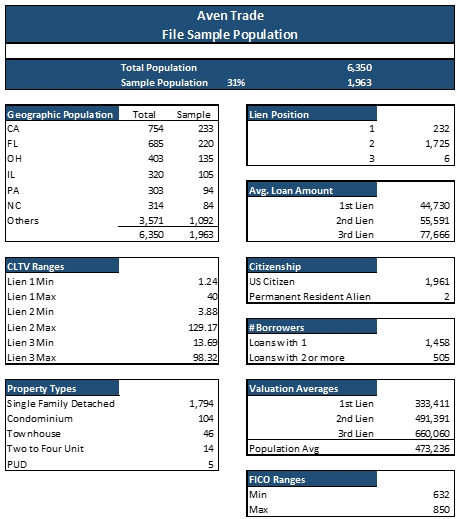
The table shown below illustrates some of the characteristics of the subject sample population selected for this review.
| Confidential and Privileged. Use is restricted without the written consent of the Author. | Page | 3 |
3. File RE-Underwrite Credit Review
As noted earlier, CCB and Aven use various automated methods to gather and capture borrower documentation and relevant loan data used in underwriting and approval. As discussed below, online processes are used to capture income, credit, borrower identity, property valuation and title information. Data was provided to Mission in electronic output files in either JSON or XML format, rather than through traditional loan documents in paper or PDF format. The Aven document vault provides certain documents, including the Account Agreement (Aven Note), Deed of Trust and Right to Cancel/Rescission documents. In limited circumstances, and as necessary, additional documentation was made available, including flood insurance policies, title policies and manual underwriting documents, such as paystubs and tax returns.
A full manual re-underwriting credit review was performed to verify that the requisite underwriting guidelines as specified by Client were met. Confirmation of the loan terms was conducted through recalculation and review of documentation contained in the electronic loan files and documents provided to Mission.
The Credit Qualification review consisted of the following:
| 3.2 | Guidelines and Overlays |
The loans were underwritten to the Lender CCB Coastal Home Credit Policies. As noted earlier, the policy is similar in substance and form to that of a traditional HELOC lender.
These guideline provided specific qualification requirements and program specific metrics such as minimum and maximum loan amounts, cash out limits, specific income and DTI qualifications, ranges of value acceptance for LTV and CLTV, geographic eligibility, note, rate and term specific details, qualifying property types, residency requirements, valuation and title requirements The guidelines also specify borrower requirements such as credit tradeline and credit event requirements, income qualifications, and citizenship requirements.
Mission reviewed each mortgage loan to ensure it met the requisite guideline requirements noted in the Client guidelines.
| 3.3 | Employment |
Aven verified employment through an automated process using Experian and The Work Number by Equifax, or Plaid, or in limited cases through paystubs. Self-employed employment was verified through tax returns, or Plaid, or transcripts. Mission verified the data provided for minimum required level of employment and income verifications in accordance with Client underwriting guidelines.
| Confidential and Privileged. Use is restricted without the written consent of the Author. | Page | 4 |
| 3.4 | Income and Income Verification |
The loans were all qualified using various income qualification methods. Income for employed borrowers was verified primarily in an automated manner using The Work Number or Experian. Similarly, a system called Plaid was used to gather bank statement data for bank statement loans. Manual Award letters and/or SSA statements were provided for retirement income verification. In limited circumstances, when income could not be verified via an automated means or in the case of self-employed borrowers, manual underwritten employment was verified by tax returns or transcripts, or through hard copy paystubs.
Guidelines require the income used for qualification to be the lower of a stated income figure from borrower or derived income (which is the verified figure). If stated income allowed DTI to fall within max DTI allowance, stated income was used. If using the lower stated income which causes the DTI to not meet guidelines, we then use the higher derived income, which is supported and validated, to qualify and to calculate DTI.
Mission used either the electronic data provided or the available income documentation to recalculate each borrower’s monthly gross income and verify the income calculations used at origination to determine compliance with the Client underwriting guidelines.
Although Aven’s underwriting process is automated, Aven collects several forms of income verification documentation, including tax returns in many cases. When The Work Number is used, it provides verification of the borrower’s most recently reported paystub, as well as income verification for the prior one or two years. Mission treated this information as supporting verification and paystub-equivalent documentation and considered the applicable loans to be income verified up to ASF Level 4.
| 3.5 | Debt Calculation |
Debts were verified and calculated using primarily the electronic credit report data provided though Experian. For purposes of payments, all revolving or unsecured installment debt minimum payments were either captured as verified or are derived by various means using data codes as identified in the Experian data. First lien data was either calculated from the credit report or in some cases derived from the Corelogic property transaction history report or in limited circumstances the House Canary Value Analysis report.
In all cases, Mission verified debt used for qualification in accordance with Client provided underwriting guidelines.
| 3.6 | Debt-to-Income Ratio |
Aven uses a proprietary algorithm for calculating DTI. In general, it follows standard FNMA methodology. It is then adjusted by a factor that takes into account the borrowers stated loan purpose and a swap factor which assumes some portion of the current debt is refinanced by the borrower. DTI is then calculated assuming the full line utilization to arrive at a fully utilized maximum DTI .
| Confidential and Privileged. Use is restricted without the written consent of the Author. | Page | 5 |
As stated earlier, Mission recalculated and verified the debt-to-income ratio used at origination. Mission uses a manual process to recalculate Aven’s proprietary algorithm for calculating DTI in each loan. This process can be challenging because senior liens are often present and specific payment data is frequently unavailable, particularly when those senior liens are not reported on the credit report. In these cases, Aven takes a more conservative posture and approximates a payment based upon the lien balance, while Mission does not include any payment since the lien is not on title. It is also not uncommon for us to have different calculations for minimum debt payments for revolving credit or other debts when the actual payment is not present on the credit reports. While our TPR Verified DTI calculation was not exact in each case, our calculation allowed us to approximate the Aven calculated DTI and to adequately determine compliance with Client underwriting guidelines at least within a 5% variance as a tolerance level. To the extent that our DTI calculation was significantly greater than the 5% tolerance, or in any case where the estimated DTI is in excess of allowable guideline limit, we issued a finding and worked with Aven to resolve any discrepancies.
| 3.7 | Credit History |
Mission reviewed the electronic credit report data provided through Experian and/or Vantage used at origination to verify that the borrower(s) demonstrate adequate credit depth to comply with the Client provided underwriting guideline requirements.
| 3.8 | Credit Scores |
Aven underwriting guidelines requires the lower credit score provided by either Experian or Vantage for Program eligibility. When there are multiple applicants, the lower of the two applicants’ scores is used to determine program eligibility.
| 3.9 | Compensating Factors |
The Client generally does not maintain a waiver process, borrowers either met the applicable guideline requirements or were rejected. In a limited number of circumstances, the credit guidelines were not met in their entirety, primarily with respect to CLTV limits, due to isolated system errors or algorithmic limitations that were later addressed by the Client. In these cases, Mission reviewed the guideline deviation reasons provided and verified that deviations to the Client-provided underwriting guidelines were documented and non-material.
| 3.10 | Property Valuation |
Aven uses a waterfall approach to its valuation analysis. An initial AVM is extracted through online automation from HouseCanary. The assessment generally follows accepted industry practices.
| Confidential and Privileged. Use is restricted without the written consent of the Author. | Page | 6 |
The AVM output for any property must meet the following conditions to be considered a valid evaluation and will cascade as follows:
1. HouseCanary Value Analysis
a. AVM Recommended Approach= "No Exceptions"
b. AVM Recommended Approach= "Minor Exceptions" AND AVM Confidence is "High"
c. AVM Recommended Approach= "Minor Exceptions" AND AVM Confidence "Average"
2. Corelogic THVX for Risk Management
a. FSD (Forecast Standard Deviation) Score<= 0.3
3. DataTree Precision Premier
a. FSD (Forecast Standard Deviation) Score <= 30
Property Condition Evaluation – BPO
If HouseCanary Value Analysis' Recommended Approach = "Minor Exceptions" AND AVM Confidence is "Low"
| a. | Aven will use HouseCanary Agile Evaluation to conduct a physical I external only evaluation of the property to estimate the property value. |
The aforementioned waterfall guidelines went into effect in March of 2023. In each case, the values calculated at origination using this method were supported by post-closing value support pulled by Mission.
Mission analyzed all electronic data from the value tools used to qualify the loan for completeness of data and reasonableness of estimated value. Mission verified the valuation waterfall in each case to determine if the waterfall requirements were met and to verify all valuation documentation met the requirements of Client underwriting guidelines.
| 3.11 | Loan-to-Value Ratio |
Mission recalculated and verified that the loan-to-value ratio (LTV) and combined loan-to-value ratio (CLTV) were accurate at origination and met the Client’s underwriting guideline requirements. Mission also calculated LTV and CLTV based on loan utilization as of the effective cut-off date provided by the Client, using balances drawn as of that date.
3.12 Lien Position
Lien position was verified in an automated manner using the CoreLogic transaction history report, or, in cases where title was provided, the actual title report. Although the CoreLogic transaction history report is not a comprehensive E&O report, it is an industry-accepted online database that uses public records data to verify property-related information, including liens and encumbrances. Aven also obtains a full title commitment on all loans in excess of $100,000, which includes a lien position search. There is an updated Aven HELOC guidelines as of April 20, 2026 which includes an exception to the title commitment requirement for loans originated in AR, ID, LA, NM, OK, SD, and WY.
Mission verified lien position using the electronic data provided through CoreLogic or, where available, the title commitments provided by Aven in the document vault. In all cases, Mission believes the lien position was accurate as reported. However, because Mission did not evaluate a separate independent title report for each loan, the reported lien position was verified only to the extent it was reflected in the origination data provided. There are also circumstances where the initial data reports provided show no lien, but there are mortgages identified on the credit report. In at least one loan in the pool, the initial CoreLogic transaction history report showed the lien position as 1 and Mission processed the loan as a 1st lien. The Client provided a subsequent Datatree property report which did show a corresponding lien. Given there was a corresponding mortgage on credit that aligned with the lien now shown in the property report, Mission was able to verify that it was in fact a 2nd lien at origination and the loan was subsequently reprocessed as a 2nd lien.
| Confidential and Privileged. Use is restricted without the written consent of the Author. | Page | 7 |
4. Document Review
Mission reviewed each loan file and confirmed the presence of material documentation, as applicable to the specific loan transaction and applicable guidelines. As noted earlier, most underwriting data was provided electronically. However, a limited number of documents were provided in PDF format, and Aven also provided access to review documents online through its Document Vault repository.
4.1 Title Commitment and Policy
Aven is unique among HELOC and second-lien lenders in that it requires and obtains title and title insurance for loans exceeding $100,000. There is an updated Aven HELOC guidelines as of April 20, 2026 which includes an exception to the title commitment requirement for loans originated in AR, ID, LA, NM, OK, SD, and WY. Where available, Mission verified the presence of, at a minimum, the initial title commitment or final title policy. For loans where title documentation was present, Mission confirmed the vested parties, property description, liens and tax assessments. Given the recent origination of many loans, several files contained only an initial title commitment. For loans where the final title policy remained pending, comments were noted in the resolution for each loan in the grading findings.
4.2 HELOC Agreement /Note
Aven uses an Account Agreement/Aven Account Agreement in lieu of a Promissory Note. As noted earlier, the Agreement is a hybrid of a credit card agreement and a mortgage loan note, covering all the terms of the loan. Mission confirmed that Agreement was adjustable according to requirements of the Client provided underwriting guidelines and captured relevant loan data specific to each loan.
4.3 Deed of Trust
Mission verified the presence of a copy of the Deed of Trust and confirmed that all required parties executed the documents.
4.4 Income Documentation
Mission verified the presence of income and employment related documentation as required by the Client provided underwriting guidelines for all borrowing parties contributing income to the debt ratio calculation.
4.5 Asset Documentation
Asset documentation was not required as a factor for loan approval.
4.6 HELOC Disclosure
Mission verified the HELOC Agreement contained all necessary disclosures and was signed and dated by each borrower.
| Confidential and Privileged. Use is restricted without the written consent of the Author. | Page | 8 |
4.7 Right of Recission/Right to Cancel
Mission verified the presence of a Right of Recission and Right to Cancel, that all were properly executed by the Borrowers and that all TILA/RESPA requirements were met including adherence to various date testing.
4.8 Various State Disclosures
Mission verified the presence of all state disclosure related documentation.
| 5. | Regulatory Compliance |
For each loan file, Mission conducted a post-closing regulatory compliance review to verify that each loan was originated in compliance with applicable federal, state and local anti-predatory lending statutes in effect at the time of origination. Regulatory compliance review for open-end HELOC loans is limited in scope.
Mission tested all loans for adherence to certain applicable federal, state and local consumer protection laws, to the extent possible and subject to the caveats below. The review included applicable disclosure requirements and prohibitions under state, county and municipal laws and ordinances enacted to combat predatory lending, as applicable based on the specific characteristics of each loan and as such laws were amended, restated or replaced from time to time.
| 5.1 | Federal Truth in Lending Act (“TILA”), as implemented by Regulation Z, 12 C.F.R. Part 1026, as set forth below including 1026.6, 1026.15 and 1026.40. |
| · | Failure to provide the right of rescission notice |
| · | Failure to provide the right of rescission notice in a timely manner and to the correct consumer(s) |
| · | Errors in the right of rescission notice |
| · | Failure to provide the correct form of right of rescission notice |
| · | Failure to provide the three (3) business day rescission period |
| · | any material disclosure violation on a rescindable loan that gives rise to the right of rescission under TILA, which means the required disclosures of the annual percentage rate, the finance charge, the amount financed, the total of payments, the payment schedule, the HOEPA disclosures |
| 5.2 | TILA. High-cost Mortgage (§§1026.31, 32 and 33): |
| · | Points and fees threshold test |
| · | APR threshold test |
| · | Prepayment penalty test |
| · | Compliance with the disclosure requirements, limitation on terms and prohibited acts or |
| · | practices in connection with a high-cost mortgage |
| 5.3 | Fed/State/Local Predatory Lending: |
| · | The disclosure requirements and prohibitions of state, county and municipal laws and ordinances with respect to “high-cost” mortgage loans, “covered” mortgage loans, “higher priced” mortgage loans, “home” mortgage loans or any other similarly designated mortgage loan as defined under such authorities, or subject to any other laws that were enacted to combat predatory lending, as may have been amended from time to time |
| · | State specific laws and ordinances relative to Secondary mortgage Loans and specific fee tolerances and exclusions |
| Confidential and Privileged. Use is restricted without the written consent of the Author. | Page | 9 |
| 5.4 | Prepay Penalties and Late Fees: |
| · | Federal and state specific late charge and prepayment penalty provisions relative to Secondary mortgage Loans. Check for all proper disclosures |
| · | Technical formatting of disclosures |
| · | Other post-consummation disclosures, including Escrow Closing Notice; and Mortgage servicing transfer and partial payment notices |
| · | Whether the loans comply with all federal, state or local laws, constitutional provisions, regulations or ordinances that are not expressly enumerated above |
| 5.5 | Federal Truth in Lending Act/Regulation Z |
A review of the material compliance disclosures set forth in Reg Z, as amended, including the Truth in Lending Disclosure and the Notice of Right-to-Cancel, if applicable; and a review and comparison of the material disclosures with a report outlining any TILA violations. This includes a re-calculation of disclosed finance charge [§1026.18(d)], proper execution by all required parties [§1026.17(b)], principal and interest calculations [§1026.18(s)], payment stream(s), recalculation of disclosed APR [§1026.22], and a review to ensure disclosure differences are within the allowed tolerances [§1026.18(d) and §1026.23(g)].
A review of the Notice of Right to Cancel (§1026.15 I §1026.23): Review includes a verification of the transaction date and expiration date, ensures proper execution of the Notice of Right to Cancel by all required parties verifies the disbursement date and determines if a full 3 day rescission period was adequately provided to the borrower(s).
| 5.6 | Home Ownership Equity Protection Act (HOEPA) testing, to include: |
| 5.6.1 | APR test [HOEPA (§1026.32(a)(l))] and [HPML(§1026.35(a)(l))] |
| 5.6.2 | Points and Fees test [HOEPA (§1026.32(a)(2))] |
Review of HOEPA disclosure (§1026.32(c)) for accuracy (i.e. payment stream, highest payment scenario; dates disclosed, dates acknowledged)
| 5.6.3 | Review and confirm documentation type (i.e. full, stated, no ratio) |
| 5.6.4 | Review for evidence of prepayment penalty |
| 5.6.5 | Verification of Debt-to-Income conformity, when necessary. |
HOEPA (Section 32) loan coverage has been expanded to include purchase-money mortgages and open-end credit plans (i.e., home equity lines of credit or HELOCS), as well as the amendment of rate and points and fees threshold testing. Mission system requirements have been updated to address the expansion of coverage as well as amendments to threshold testing. In addition, there is a homeownership counseling requirement that was verified for all covered loans.
| Confidential and Privileged. Use is restricted without the written consent of the Author. | Page | 10 |
| 5.7 | High Cost- State & Local Anti-Predatory Regulations: |
In addition to federal rules and applicable points and fees testing and APR thresholds, Mission reviewed the anti-predatory lending statutes in the following states and local municipalities, as applicable:
| 6.12.1 | Arkansas Home Loan Protection Act, AR. Stat. Ann.§ 23-53-101 et seq. |
| 6.12.2 | California Anti-Predatory Lending Statute, CA. Fin. Code§ 4970 et seq. |
| 6.12.3 | 4.3 California Higher Priced Mortgage Loan Statute, CA. Fin Code § 4995 et seq. |
| 6.12.4 | 4.4 Colorado Consumer Equity Protection Act, CO. Rev. Stat. § 5-3.5-101 et seq. and as amended by Senate Bi11216 (2007) and House Bi111322 (2007) |
| 6.12.5 | Colorado Consumer Credit Code, CO. Rev. Stat. 5-1-101 et seq. |
| 6.12.6 | Connecticut Abusive Home Loan Lending Practices Act, CT. Stat. Ann. § 36a-746 et seq. and the Responsible Lending and Economic Security Act, CT. House Bill 5577 (2008). |
| 6.12.7 | Connecticut Nonprime Home Loan Statute, CT. Gen. Stat. §§ 36a-760 et seq. (as originally enacted and as amended by Senate Bill 949. |
| 6.12.8 | District of Columbia Home Loan Protection Act of 2002, D.C. Official Code § 26-1151.01 et seq., as implemented by 20 D.C. Municipal Reg. § 2000.1 et seq. and DC Mortgage Disclosure Act of2007. |
| 6.12.9 | Florida Fair Lending Act, FL. Stat. Ann. § 494.0078 et seq. |
| 6.12.10 | Georgia Fair Lending Act, GA. Stat. Ann.§ 7-6A-1 et seq. (as originally enacted by House Bill 02-1361 and as modified by Senate Bill 03-53) |
| 6.12.11 | Idaho Residential Mortgage Practices Act, ID. Code§ 26-3101 et seq. |
| 6.12.12 | Illinois High Risk Home Act, IL. Comp Stat. tit. 815, §§ 137/5 et seq. |
| 6.12.13 | Illinois High Risk Home Loan Regulations, 38 IL. Admin. Code § 345.10 et seq. |
| 6.12.14 | Illinois High Risk Home Loan Act, Public Act. 93-0561 (2003). |
| 6.12.15 | City of Chicago, Illinois, Anti-Predatory Lending Ordinance, Chicago Municipal Code, §§ 2-32-440; 2-32-455; 2-92-325; 4-4-155; 8-4-325. |
| 6.12.16 | Cook County, Illinois, Anti-Predatory Lending Ordinance, Ordinance No. 240864 (2001) as amended by Illinois SB 1167 (2007). |
| 6.12.17 | Indiana Home Loan Practices Act, IN. Code§ 24-9-1-1 et seq. and as amended by 2005 In. P.L. 141 § 6 P2013-011. |
| 6.12.18 | Kansas Consumer Credit Code, KS. Stat. Ann. § 16a-1-101 et seq. Sections 16a-1-301, 16a-3- 207 and 16a-3-308a. |
| 6.12.19 | Kentucky Anti-Predatory Lending Statute, KY. Rev. Stat. § 360.100 et seq. and as amended by KY. House Bill 552 (2008). |
| 6.12.20 | Maine, An Act to Enhance Consumer Protections in Relation to Certain Mortgages, 9A ME. Rev. Stat. Ann. §§ 8-101; 8-103(1); 8-206(8); 8-206A and ME. Legislative Document 1869 (2007). |
| 6.12.21 | Maryland Commercial Law, MD. Stat. Ann. §§ 12-124.1; 12-127; 12-409.1; 12-1029 and as amended by MD. Senate Bill 270 (2008) and Maryland Regulations under the MD. Mortgage Lender Law (2009). |
| 6.12.22 | Maryland Regulations for Higher Priced Mortgage Loans, as promulgated under the MD. Mortgage Lender Law, MD. Code Ann., Fin. Instit. Code §§ 11-501 et seq.; MD. Code Regs. §§ 09.03.06.01 et seq. |
| Confidential and Privileged. Use is restricted without the written consent of the Author. | Page | 11 |
| 6.12.23 | Massachusetts High Cost Mortgage Regulations, 209 CMR § 32.32 et seq. including MA. House Bill4387 (2008) 20. MA. Predatory Home Loan Practices Act, M.G.L. Chapter 183(C). |
| 6.12.24 | Massachusetts Regulations for Higher Priced Mortgage Loans, 209 MA. Code Regs. §§ 32.00 |
| 6.12.25 | Massachusetts "Borrower's Interest" Standard, M.G.L. Chapter 183, §28C. |
| 6.12.26 | Massachusetts Mortgage Lender and Broker Regulations, 940 CMR § 8.00 (15-17). |
| 6.12.27 | Michigan Consumer Mortgage Protection Act, MI. Stat. Ann. § 445-1631 et seq. |
| 6.12.28 | Minnesota Mortgage Originator and Service Licensing Act, § 58.137 etal. (S.F. 2988 (2002) and as amended by House File 1004 and SF 98 (2007) and SF 3154 and 3214 (2008). |
| 6.12.29 | Nebraska Mortgage Bankers Registration and Licensing Act, NE. Stat.§ 45-702 et seq. |
| 6.12.30 | Nevada Anti-Predatory Lending Law, NV. Rev. Stat. § 598D.010 et seq. and as amended by AB 440 and492. |
| 6.12.31 | New Jersey Home Ownership Security Act of 2002, NJ. Stat. Ann. §C:46:10 B-22 et seq. and as amended by PL. 2004, Ch. 84 § 1. |
| 6.12.32 | New Mexico Home Loan Protection Act, NM. Stat. Ann. § 58-21A-1 et seq. and as amended by Senate Bill 342 (2009 High Cost Home Loan Act, NY. Bank. L. Ch. 626., as implemented by 3 NYCCR Part 41 (2003) and as amended by Senate Bill 8143-A (2008). Banking Law Article 6-1 (2003) and 6-m (2008). |
| 6.12.33 | New York High Cost Home Loan Regulations, 3 NYCCR Part 41 (2001). |
| 6.12.34 | New York High Cost Home Loan Act, NY. Bank. L. Ch. 626., as implemented by 3 NYCCR Part 41 (2003) and as amended by Senate Bill 8143-A (2008). Banking Law Article 6-1 (2003) and 6-m (2008). |
| 6.12.35 | North Carolina Anti-Predatory Lending Law, NC. Gen. Stat. §§ 24-l.1 to 24-10.2 and North Carolina Amendments to Anti-Predatory Lending Law, NC. Gen. Stat. §§ 24-9; 24-l.l(E)(a); 24-10.2(a) and as amended by House Bill1817 (2007). |
| 6.12.36 | Ohio Anti-Predatory Lending Statute, OH. Rev. Code Ann. §§ 1349.25 to 1349.37and § 1.63 and as amended by S.B. 185. |
| 6.12.37 | City of Cleveland Heights, Ohio, Anti-Predatory Lending Ordinance, Ordinance No. 72-2003. |
| 6.12.38 | Oklahoma Anti-Predatory Lending Law, House Bill No. 1574 (2003). |
| 6.12.39 | Oklahoma Higher -Priced Mortgage Loans Law, OK. Admin. Code§§ 160:45-9-1 et seq. |
| 6.12.40 | Pennsylvania Consumer Equity Protection Act, 63 PA. Cons. Stat. Ann. § 456.501 et seq. 4.41 City of Providence, Rhode Island Predatory Lending Ordinance, Ordinance No. 245, Chapter 2006-33 as amended. |
| 6.12.41 | Rhode Island Home Loan Protection Act, Chapter 25.2 of Title 34 of RI. Gen. Laws. §§ 34-25.2-1 et seq., including the Emergency and Final Regulations. |
| 6.12.42 | South Carolina High-Cost and Consumer Home Loans Act, SC. Code§ 37-23-10 et seq. |
| Confidential and Privileged. Use is restricted without the written consent of the Author. | Page | 12 |
| 6.12.43 | South Carolina Consumer Protection Code, SC. Code 37-1-101 et seq. |
| 6.12.44 | Tennessee Home Loan Protection Act, TN. Code Annotated §§ 45-20-101 et seq., Title 47 et seq. |
| 6.12.45 | Texas High-Cost Home Loan Statute, TX. Fin. Code Ann.§ 343.201 et seq. |
| 6.12.46 | Texas Constitution, Section 50(a)(6), Article XVI |
| 6.12.47 | Utah Residential Mortgage Practices Amendments, UT. Code Ann.§ 61- 2c-102 et seq. |
| 6.12.48 | Utah High Cost Home Loan Act, UT. Code § 61-2d-101 et seq. |
| 6.12.49 | Vermont Interest Act, 9 V.S.A. § 104, implemented by Regulation B-98-2. |
| 6.12.50 | Virginia Mortgage Lender and Broker Act (for loans originated prior to July 1, 2003), VA. Code Ann.§§ 6.1-413; 6.1-422, 6.1-428. |
| 6.12.51 | Virginia Mortgage Lender and Broker Act (for loans originated after July 1, 2003), VA. Code Ann.§§ 6.1-411; 6.1-422.1, 6.1-425.1; 6.1-425.2. |
| 6.12.52 | Washington House Bill 2770, Mortgage Lending and Homeownership, Chapter 108, Laws of 2008. |
| 6.12.53 | Wisconsin Responsible High Cost Mortgage Lending Act, WI. Stat. § 428.202. |
| 6.12.54 | West Virginia Residential Mortgage Lender, Broker and Servicer Act, WV. Code § 31-17-1 et seq. |
| 6.12.55 | Wyoming Credit Code, WY. Stat. Ann.§§ 40-14-101 et seq. |
| 6.13 | Regulatory Compliance Disclaimer |
Please be advised that Mission did not make a determination as to whether loans complied with federal, state or local laws, constitutional provisions, regulations or ordinances that are not expressly enumerated herein. There can be no assurance that the review uncovered all issues relating to the origination of the mortgage loans, their compliance with applicable law and regulation and the original appraisals relating of the mortgaged properties or uncovered all relevant factors that could affect the future performance of the mortgage loans. Furthermore, the findings reached by Mission are dependent upon its receiving complete and accurate data regarding the mortgage loans from loans originators and other third parties upon which Mission is relying in reaching such findings.
Please be further advised that Mission does not employ personnel who are licensed to practice law in various jurisdictions, and the findings set forth in the reports prepared by Mission do not constitute legal advice or opinions. They are recommendations or conclusions based on information provided to Mission. All final decisions as to whether to purchase or enter into a transaction related to any individual mortgage loan or the mortgage loans in the aggregate, any investment strategy and any legal conclusions, including potential liability related to the purchase or other transaction involving any such loans, shall be made solely by the Client, or other agreed upon party, that has engaged Mission to prepare its reports pursuant to its instructions and guidelines. Client, or other agreed upon party, acknowledges and agrees that the scoring models applied by Mission are designed to identify potential risks and the Client, or other agreed upon party, assumes sole responsibility for determining the suitability of the information for its particular use.
| Confidential and Privileged. Use is restricted without the written consent of the Author. | Page | 13 |
| 6.14 | Misrepresentation and Third-Party Report Review |
Aven uses a system called IDology to verify borrower identity, check OFAC and identify potential mis-representation issues. Mission verified that IDology was performed on all borrowers and citizenship was verified on all loans.
| 6.14.1 | Alerts |
Mission validated credit report alerts for accuracy and potential issues.
| 6.14.2 | Social Security Numbers |
Mission verified SSN(s) across all file documents.
| 6.14.3 | Document Integrity |
Mission validated to the extent possible for apparent alterations to loan documents.
| 6.14.4 | Data Consistency |
Mission validated the documents contained in the loan file for consistency of data.
| 7. | Data Integrity Reviews |
TPR Data Integrity
As part of the due diligence review, Mission was provided with a client data tape to conduct a Data Integrity Review. The Client provided a data tape with the following data fields and Mission compared the field to the applicable source document and reported all variances.
The following fields were provided and compared:
· Account Open Date
· Amount of Other Lien
· B1FirstName
· B1LastName
· B2FirstName
· B2LastName
· Current End Of Month Balance
· Current Interest Rate
· Current Max Line Of Credit As Of Cutoff Date
· Documentation type
· Initial Rate
· Lender Name
· Lien Position
· Loan Amount
· Loan ID
· Loan Program
· Loan Purpose
· Margin
| Confidential and Privileged. Use is restricted without the written consent of the Author. | Page | 14 |
· Occupancy
· Original Draw Term
· Postline Dti Tape Value
· Property Address
· Property City
· Property County
· Property State
· Property Type
· Property Value
· Property Zip Code
· Qualifying CLTV
· Qualifying FICO
· Qualifying Payment Factor
· Refinance Of Prior Heloc
· Refinance Type
· Term
· TILA Status
· Underwriting Guideline Name
· Underwriting Guideline Version
· Underwriting Guideline Version Date
The Mission data integrity review was conducted in accordance with generally accepted industry standards and that to the best of its knowledge, the review meets the specific grading required criteria by the nationally recognized statistical rating organization (NRSRO) including the credit rating agencies mentioned above.
ASL Certificate Data Integrity
Mission was also tasked to complete an independent assessment of the data integrity and the accuracy of the specific data contained within the ASL Certificates.
The Client provided to Mission specific copies of two thousand two hundred sixty (2,260) ASL Certificates prepared related to the aforementioned transaction, along with a data tape containing data for four specific fields. Mission then compared the data specifically present in each of the ASL Certificates to that present in the specified data tape and reported variances accordingly:
The four specific fields subject to this comparison were:
· PLAN APR
· PLAN ORIGINAL BALANCE
· PLAN ORIGINAL TERM
· PLAN START DATE
Mission completed this comparison on July 6, 2026. Mission did not identify any variances from the tape data to the actual ASL certificate data.
| Confidential and Privileged. Use is restricted without the written consent of the Author. | Page | 15 |
The engagement objectives for this review were designed and implemented to enable Mission to conduct meaningful transaction-level data integrity review. This report may not be suitable for any other purpose.
This task was conducted in accordance with generally accepted industry standards. The procedures performed were not intended to satisfy any specific criteria for due diligence published by the nationally recognized statistical rating organizations (“NRSROs”), but rather the procedures performed were deemed appropriate to meet the intended purpose of assisting specified parties in evaluating the accuracy of the specified attributes in the Data File and the associated ASL Certificates.
| 8. | Loan and Exception Level Grading Methodology |
Pursuant to the applicable NRSRO criteria, Mission graded each loan exception with an event level 1 for exceptions findings that are informational in nature, event level 2 for exceptions findings that are considered non-material, event level 3 for exceptions findings that are considered material. In accordance applicable NRSRO criteria exceptions and overall initial loan grades and final loan Grades were assigned with an A, B, C or D. The methodology for the application of RMBS grading is defined by each NRSRO in their current industry publications as updated from time to time.
Pursuant to the applicable NRSRO criteria, Mission graded certain compliance exceptions as nonmaterial based on seasoning of the mortgage loan. Where applicable, mortgage loans that are seasoned beyond the applicable period under TILA in which affirmative claims could be brought by a consumer. The period is not limited to claims, other than recission, which are raised as a defense to foreclosure. Information contained in any Mission reports related to the applicable statute of limitations for certain claims may not be accurate or reflect the most recent controlling case law. Further, a particular court in a particular jurisdiction may extend, not enforce or otherwise allow claims beyond the statute of limitations identified in the report based on certain factors, including the facts and circumstances of an individual loan.
| Confidential and Privileged. Use is restricted without the written consent of the Author. | Page | 16 |
NRSRO GRADING METHODOLOGY
| S&P/DBRS Grade | # of Loans | % of Loans (by count) in MISSION Population | ||||||
| A | 1,907 | 97.1 | % | |||||
| B | 26 | 1.4 | % | |||||
| C | 30 | 1.5 | % | |||||
| D | 0 | 0 | % | |||||
|
NRSRO GRADE |
| NRSRO GRADE | # of Loans | % of Loans (by count) in MISSION Population | ||||||
| CREDIT | ||||||||
| A | 1,929 | 98.3 | % | |||||
| B | 23 | 1.2 | % | |||||
| C | 11 | 0.6 | % | |||||
| D | 0 | 0 | % | |||||
| COMPLIANCE | ||||||||
| A | 1,960 | 99.9 | % | |||||
| B | 3 | 0.1 | % | |||||
| C | 0 | 0 | % | |||||
| D | 0 | 0 | % | |||||
| PROPERTY/VALUE | ||||||||
| A | 1,944 | 99.0 | % | |||||
| B | 0 | 0 | % | |||||
| C | 19 | 1.0 | % | |||||
| D | 0 | 0 | % | |||||
| 9. | Results and Conclusions of the Review |
| 9.1 | Credit Review |
All but thirty-four (34) of the loans met all credit underwriting guidelines essentially without exception. There were one thousand nine hundred twenty-nine (1,929) or 98.3% of the sample population with no unresolved credit exceptions and were assigned a Grade A EV1.
There were twenty-three (23) loans with minor credit issues or some with missing income documentation or where the Lender failed to consider an open lien on credit in calculating CLTV. All of these were deemed to be minor guideline issues and were graded a B EV-2 non-material.
| Confidential and Privileged. Use is restricted without the written consent of the Author. | Page | 17 |
In all, there were there were 14 C graded credit exceptions across 11 loans, as one loan can have more than one exception associated with it. There were seven (7) loans where the Lenders algorithm failed to pick up an existing first lien mortgage from title or had some form of lien related issue. Six (6) of the subject loans are in 3rd lien position and one (1) is in 2nd lien position. There is one (1) loan with a CLTV issue. There are also three (3) loans with DTI related issues.
| 9.2 | Regulatory Compliance Review |
As noted earlier, the Regulatory review for HELOC loans is rather limited in scope by the loan’s nature. Of the sample reviewed 1,959 or 99.8% had no issue and were deemed fully compliant and thereby assigned a Grade A EV1.
With respect to the loans that received an initial Grade B EV2, these loans fall into one of three buckets; 1) loans that failed minimum late fee payment or timing restrictions, grace period and other state restrictions, 2) loans that had APR above state limits, or 3) state high cost violations.
To address issue 1) and 2) above, Aven provided a legal opinion prepared May 17, 2024 by Robertson, Anschutz, Schneid, Crane & Partners, PLLC regarding the application of preemption for interest rates and late fees under 12 U.S.C. 1831d(a)i as a state-chartered regulated bank under the FDIC, and therefore export interest rates of its home state Washington to other states. Wherein it is clear that CCB may exercise preemption in this regard, they further state, wherein it is clear under 12 U.S.C. 1831d(a) that “It is well established that late fees are considered “interest” under the National Bank Act and its governing Rules. Case law is also established that accepts this conclusion. While these interpretations are under the National Bank Act, the FDIC’s interpretation under 1831d(a) adopts OCC’s Rules under § 7.4002 and thus a similar interpretation of late fees may apply as to “interest,” and ultimately as to the preemption of late fees. They conclude with “the current practice of exporting Washington state’s interest and late fees to other states is proper under preemption of § 1831d(a). We also believe the current timing of the late fee is proper, as the borrower agrees that a late fee will be imposed if a Minimum Payment Due is not received by the Payment Due Date. As a result, we do not believe further notification or remediation would be required, whether to investors, regulatory agencies or borrowers.”
Mission reviewed this opinion with outside counsel at Garris Horn LLP. We concur with the opinion in that the provision they cite, 12 U.S.C. § 1831d(a), section 521 of the Depository Institutions Deregulation and Monetary Control Act of 1980 (“DIDMCA”), provides that state-chartered banks that are FDIC-insured can charge “interest” at the rates allowed under the laws of the bank’s home state when making loans in other states (known as “rate exportation”). This ability has been interpreted by OCC and FDIC to include other types of payments (by interpreting “interest” broadly), such as late fees.
Therefore, we accepted the application of DIDMCA Preemption in those cases These findings were resolved and a Compliance Grade A EV1 non-material was assigned to each.
| Confidential and Privileged. Use is restricted without the written consent of the Author. | Page | 18 |
There were then three (3) loans remaining with issue 3) that had some form of High Cost state predatory lending violation identified. It’s important to note first that all of the loans in question passed Federal High cost testing so there were no issues with regard to §1026.32. The failures were limited to a certain number of states primarily Illinois and Alabama.
With regard to Illinois, each finding involved either a specific exemption, a state code exemption or case law supporting preemption of state regulations. For the Illinois loans, the lender had properly filed for an exemption, and each recorded loan was accompanied by a Certificate of Exemption. In the case of Cook County Illinois loans, these were considered Cook County threshold loans. In each case, the requisite Cook County tests were satisfied and the loans were therefore deemed not to be predatory lending violations. Mission deemed these Illinois findings to be Grade B EV2 non-material violations based on the circumstances applicable to each respective state. The Alabama loan was cured post-close and therefore graded a B.
| 9.3 | Property & Valuation Review |
All but nineteen (19) loans met all property related underwriting and March 2023 Valuation Waterfall guidelines essentially without exception representing 99.0% of the sample population with a Grade A EV1.
Mission performed a full post-close valuation review. All loans had a post-close secondary AVM ordered through another AVM vendor different than the original to ensure value was supported within 10% of original AVM value, if value was supported an A value was assigned. Mission considers loan with a 10.49% value or lower to meet the 10% threshold.
Given the size of the population, Mission had to use several different vendors to obtain a valid AVM, as many vendors do not have all properties present in the database. Mission used Collateral Analytics, Black Knight, House Canary and Corelogic to obtain values on the entire pool. If value was not supported by an AVM or unavailable for a particular property as was the case in twenty-one of the loans, we cascaded to a Post-close BPO provided either from House Canary or Clear Capital.
As noted earlier, the aforementioned waterfall guidelines went into effect in March of 2023. In each case, the values calculated at origination using this method were supported by post-closing value support pulled by Mission.
There were nineteen loans where a supporting value within the 10% threshold could not be obtained through either an alternate AVM or a BPO. Mission attempted several alternative products but was unsuccessful in obtaining one that supported the value within the 10% threshold. These loans remain a Property grade C EV3 material violation with post-closing value unsupported.
| Confidential and Privileged. Use is restricted without the written consent of the Author. | Page | 19 |
Risk Grading – Loan & Exception Level Grading
| Credit Risk Grades | |
| A |
The loan fully adheres to originator guidelines without exception or waiver. The loan has no origination, fraud, title, and/or litigation concerns. Aven provided data for employment, income, assets, credit/debts and occupancy are supported and verifiable. |
| B |
The loan falls outside of required loan characteristics within the guidelines but there are adequate waivers or there are documented compensating factors for exceptions to the guidelines or the issue was deemed non-material. The loan has origination or credit underwriting concerns that present low risk to the client. Aven provided data for employment, income, assets, credit/debts and occupancy are supported and verifiable. |
| C |
The loan does not meet applicable guideline for the program. The loan characteristics are outside the guidelines and there are weak or no compensating factors for exceeding guidelines, and therefore the loan may not be eligible for purchase. Various underwriting issues regarding borrower qualifications, occupancy status, employment, income or assets are not considered reasonable or are not supported. Key ratios may not be qualified. The loan has origination, fraud, title, and/or litigation concerns that present medium or better risk to the client. Title issues may be present, or liens were not paid off on HUD, or there may be issues with vesting or legal descriptions, delinquent taxes set for tax sale but not yet sold, and borrower contested foreclosures. Occupancy status, employment, income or assets are not considered to be reasonable and are not supported. There are material credit exceptions which may carry assignee liability and may negatively impact the overall value or salability of the loan. Violations could impair enforceability of the mortgage or the servicer's ability to foreclose. |
| D | The loan file is missing necessary required credit document(s) as required in the guidelines or would be required to underwrite the loan to meet guideline requirements. |
| Compliance Risk Grades | |
| A | The loan complies with federal, state and local regulations without exception or waiver. The borrower’s ability and willingness to repay the loan have been demonstrated and documented where applicable. The review confirmed loan status with regard to QM designation (QM, HPQM, Non-QM or Exempt) and ATR designations where applicable. |
| B |
The loan complies with federal, state and local regulations, but minor issues exist regarding late charge, prepayment penalty, HPML, and/or FNMA 5% guideline adherence; or loan had a Section 32 loan violation, or other state and local regulatory or predatory lending issues, and the issue was properly disclosed. The loan may not fully comply with federal, state and local regulations but such failure is mitigated with an cure as specified in the code. These failures do not materially affect the assignee liability nor would they that would not impair enforceability of the mortgage or the servicer's ability to foreclose. Loan remains eligible for purchase. |
| C |
The loan does not comply with all enforceable federal, state and local laws Regulatory requirements. The loan may not meet TRID or other disclosure related issues or federal or state predatory lending requirements. Where applicable QM/ATR failures may be present or the borrower’s ability to repay or designation is not fully supported. There are material regulatory compliance exceptions which may carry assignee liability and may negatively impact the overall value or salability of the loan. Loan is likely not eligible for purchase. Violations could impair enforceability of the mortgage or the servicer's ability to foreclose. |
| D |
The loan file is missing necessary required document(s) required to conduct regulatory compliance assessment, or credit or valuation assessment. In limited circumstances. A material compliance exception has been identified but is not curable. Loan is not eligible for purchase. |
| Confidential and Privileged. Use is restricted without the written consent of the Author. | Page | 20 |
| Property/Value Risk Grades | |
| A | The loan has no apparent issues with subject property. The valuation performed meets the requirements for loan type as required in the guidelines and is prepared consistent with industry standards. Where required, first secondary value is no more than 10% below the original value at origination. |
| B |
The valuation performed meets the requirements for loan type as required in the guidelines and is prepared consistent with industry standards. Where required, additional secondary value no more than 10% below the original value. The loan has minor issues with subject property noted in collection comments and/or on BPO(s). This includes damage with a low repair cost such as fence repair, paint needed on outside of the house, and yard work needed, or other minor damage issues noted that may have minor negative impact on value. |
| C |
The valuation does not meet industry standards and/or additional secondary value more than 10% below the original appraisal. The property is in below "average" condition or the property is not complete or requires significant repairs. The loan may also have significant issues with subject property noted in collection comments and/or on BPO(s). This includes damage with a high repair cost such as roof or siding replacement, as well as city/county code violations that are fixable. Property is habitable. |
| D |
Loan file is missing the original value or the original valuation is incomplete. The loan could also have major issues with subject property noted in collection comments and/or on BPO(s). This includes damage that is unfixable such as fire, mold, or cracked foundations, as well as property seizures, demolished properties, or properties set for demolition. Property is uninhabitable. |
| QM/ATR Risk Grades | |
| A | The loan complies with both QM and ATR, or is exempt from testing. Aven loans are HELOC loans and therefore exempt. |
| B |
The loan reflects non-material findings that are deemed to be curable due to missing documentation or information in the file. Aven loans are HELOC loans and therefore exempt. |
| C | The loan has material findings which do not comply with QM/ATR requirements. Aven loans are HELOC loans and therefore exempt. |
| D |
The loan is missing critical documentation necessary to assess compliance with QM/ATR requirements. Aven loans are HELOC loans and therefore exempt. |
| Event Level Grades | |
| EV1 |
The specific exception event is fully compliant, or was properly cleared. The specific exception event is now fully compliant with all federal, state and local regulations, or all credit and property/value issues have been resolved or are now compliant. |
| EV2 | The specific exception may not be fully compliant with all federal, state and local regulations, or all or all credit and property/value requirements, but the issue is deemed a non-material exception. Event may also be noted as a caution. Generally, events with EV2 carry no or limited assignee liability and have minimal impact on overall value, salability of the loan, and will not impair enforceability of the mortgage or the servicer's ability to foreclose. |
| EV3 | The specific exception is not compliant with all federal, state and local regulations or all credit and property/value issues is deemed a material exception. Generally, events with EV3 are likely to carry some level assignee liability, may or may not be curable and usually have substantial impact on overall value or salability of the loan. They may also be likely to impair enforceability of the mortgage or the servicer's ability to foreclose. |
| Confidential and Privileged. Use is restricted without the written consent of the Author. | Page | 21 |
DATA INTEGRITY REVIEW
| TPR Review Data Compare Summary | ||||
| 3375_AVNHT 2026-HE1_Final_7-22-26 | ||||
| Run Date - 7/22/2026 9:30:00 AM | ||||
| Field Label | Loans With Discrepancy |
Total Times Compared |
% Variance |
Comments |
| Account Open Date | 492 | 1963 | 25.06% | The date captured by Mission reflects the HELOC Agreement Date, which is the date used for compliance testing. Aven's Account Open Date in tape represents the subsequent operational activation date after completion of required post-closing checks (e.g., compliance, lien, and other operational validations). As a result, minor differences between these dates are expected. |
| All Borrower Total Qualifying Income | 5 | 1963 | 0.25% | In each case Mission verified all income from borrowers by reviewing income docs provided. |
| AmountofOtherLien | 26 | 1818 | 1.43% | In each case the difference was in the estimated or calculated first lien balance. Mission used lien balance shown on credit report and in some cases there was no 1st lien balance or Aven calculated a balance slightly different. In each case the differences verified were within guidelines max CLTV. |
| B1FirstName | 0 | 1963 | 0.00% | |
| B1LastName | 1 | 1963 | 0.05% | All variances were spelling differences in the tape vs on the note. |
| B2FirstName | 0 | 508 | 0.00% | |
| B2LastName | 1 | 508 | 0.20% | All variances were spelling differences in the tape vs on the note. |
| CurrentEndOfMonthBalance | 0 | 1963 | 0.00% | |
| CurrentInterestRate | 0 | 1963 | 0.00% | |
| CurrentMaxLineOfCreditAsOfCutoffDate | 0 | 1963 | 0.00% | |
| Documentation type | 0 | 1963 | 0.00% | |
| InitialRate | 2 | 1963 | 0.10% | In all cases Mission verified the initial rate from the HELOC Agreement. |
| LenderName | 0 | 1963 | 0.00% | |
| LienPosition | 19 | 1963 | 0.97% | In each case mission verified lien position from title report and credit report data provided. |
| LoanAmount | 0 | 1963 | 0.00% | |
| LoanID | 0 | 1963 | 0.00% | |
| LoanProgram | 0 | 1692 | 0.00% | |
| LoanPurpose | 0 | 1963 | 0.00% | |
| Confidential and Privileged. Use is restricted without the written consent of the Author. | Page | 22 |
| Margin | 1962 | 1963 | 99.95% | In these loans the Aven servicing platform (CoreCard) does not support negative margin values. To accommodate accounts with negative margins for the revolving plans, we embedded the negative margin into the index rate on the servicing system and a 0% margin to make the calculation work. For example, a Prime - 2.00% revolving plan will be represented in the tape with an Index of “WSJ Prime minus 2” ("WSJ_PRIME_MINUS_2") and a margin of 0%, which keeps every account's margin positive. The borrower-facing terms and the resulting APR are unaffected. The borrower still sees the APR that based on WSJ Prime and margin as mentioned in the account agreement. Mission simply captures the actual margin shown in the HELOC agreement. |
| Occupancy | 0 | 1963 | 0.00% | |
| Original Draw Term | 0 | 1963 | 0.00% | |
| PostlineDtiTapeValue | 0 | 1963 | 0.00% | |
| PropertyAddress | 20 | 1963 | 1.02% | All variances were various slight spelling differences in the tape vs on the deed of trust. |
| PropertyCity | 0 | 1963 | 0.00% | |
| PropertyCounty | 0 | 1963 | 0.00% | |
| PropertyState | 0 | 1963 | 0.00% | |
| PropertyType | 0 | 1963 | 0.00% | |
| PropertyValue | 1 | 1963 | 0.05% | In all cases Mission verified values from appraisal documents and 2nd lien values from 2nd lien documents or credit reports. |
| PropertyZipCode | 0 | 1963 | 0.00% | All variances were various slight spelling differences in the tape vs on the deed of trust. |
| QualifyingCLTV | 81 | 1963 | 4.13% | In each case except one the lien amounts used in calculation of CLTV were pulled from existing title reports and verified from credit reports. In each case while CLTV was different, the verified CLTV was still within guidelines. |
| QualifyingFICO | 0 | 1963 | 0.00% | |
| QualifyingPaymentFactor | 0 | 273 | 0.00% | |
| RefinanceOfPriorHeloc | 0 | 1963 | 0.00% | |
| RefinanceType | 0 | 1963 | 0.00% | |
| Term | 5 | 1963 | 0.25% | In each case Mission verified the term from the Heloc Agreement. |
| TILA Status | 0 | 1963 | 0.00% | TILA status is not applicable since these loans are ATR/QM: Exempt |
| UnderwritingGuidelineName | 0 | 1963 | 0.00% | |
| UnderwritingGuidelineVersion | 0 | 1963 | 0.00% | |
| UnderwritingGuidelineVersionDate | 0 | 1963 | 0.00% |
| Confidential and Privileged. Use is restricted without the written consent of the Author. | Page | 23 |
POOL DETAILS
| AMORTIZATION TYPE | Count | % of Pool |
ORIGINAL INTEREST RATE | Count | % of Pool | |
| HELOC - ARM | 1962 | 99.95% | 5.500 - 5.999% | 58 | 2.95% | |
| HELOC - Fixed | 1 | 0.05% | 6.000 - 6.499% | 23 | 1.17% | |
| Grand Total | 1963 | 100.00% | 6.500 - 6.999% | 302 | 15.38% | |
| 7.000 - 7.499% | 179 | 9.12% | ||||
| LOAN PURPOSE | Count | % of Pool |
7.500 - 7.999% | 172 | 8.76% | |
| Cash Out - Debt Consolidation | 575 | 29.29% | >= 8.000% | 1229 | 62.61% | |
| Cash Out - Home Improvement/Reno | 646 | 32.91% | Grand Total | 1963 | 100.00% | |
| Cash Out - Other | 742 | 37.80% | ||||
| Grand Total | 1963 | 100.00% | VERIFIED DTI | Count | % of Pool | |
| < 10 or Null | 26 | 1.32% | ||||
| OCCUPANCY | Count | % of Pool |
10 - 19 | 125 | 6.37% | |
| Primary Residence | 1953 | 99.49% | 20 - 29 | 360 | 18.34% | |
| Investment | 10 | 0.51% | 30 - 39 | 531 | 27.05% | |
| Grand Total | 1963 | 100.00% | 40 - 49 | 621 | 31.64% | |
| > = 50 | 300 | 15.28% | ||||
| PROPERTY TYPE | Count | % of Pool |
Grand Total | 1963 | 100.00% | |
| Condominium | 104 | 5.30% | ||||
| PUD | 5 | 0.25% | QUALIFYING FICO | Count | % of Pool | |
| Single Family Detached | 1794 | 91.39% | 601 - 700 | 496 | 25.27% | |
| Two to Four Unit | 14 | 0.71% | 701 - 800 | 1123 | 57.21% | |
| Townhouse | 46 | 2.34% | 801 - 900 | 344 | 17.52% | |
| Grand Total | 1963 | 100.00% | Grand Total | 1963 | 100.00% |
| Confidential and Privileged. Use is restricted without the written consent of the Author. | Page | 24 |