Exhibit T3E-1
IN THE UNITED STATES BANKRUPTCY COURT
FOR THE DISTRICT OF RHODE ISLAND
|
In re:
CENTRAL FALLS DETENTION FACILITY CORPORATION, d/b/a Donald W. Wyatt Detention Facility
Debtor.1 |
) ) ) ) ) ) ) ) |
Chapter 11
Case No. 26 -_____________
|
DISCLOSURE STATEMENT FOR CHAPTER 11 PLAN
CENTRAL FALLS DETENTION FACILITY CORPORATION
|
Partridge Snow & Hahn LLP
Daniel E. Burgoyne (#7541) Matthew A. Lopes, Jr. (#3877) 40 Westminster Street Suite 1100 Providence, RI 02903 T: (401) 861-8254 F: (401) 861-8210 dburgoyne@psh.com mlopes@psh.com
|
Troutman Pepper Locke LLP
Jonathan W. Young (pro hac vice forthcoming) Hanna J. Redd (pro hac vice forthcoming) 111 Huntington Ave., 9th Floor Boston, MA 02199 T: (617) 239-0100 F: (617) 227-4420 jonathan.young@troutman.com hanna.redd@troutman.com
– and –
Aaron C. Smith (pro hac vice forthcoming) 111 South Wacker Drive Chicago, IL 60606 T: (312) 443-700 F: (312) 443-0336 aaron.smith@troutman.com |
DATED: July 10, 2026
1 The last four digits of the Debtor’s federal employer identification number are 5439. The address of the Debtor is 950 High Street, Central Falls, RI 02863.
DISCLOSURE STATEMENT, DATED July 10, 2026
Solicitation of Votes on the
Plan of Reorganization of
CENTRAL FALLS DETENTION FACILITY CORPORATION
from the holders of outstanding
EXISTING BOND SECURED CLAIMS AND CITY CLAIMS
| THE VOTING DEADLINE TO ACCEPT OR REJECT THE PLAN IS [●] [A.M./P.M.] (EASTERN TIME) ON [●], 2026, UNLESS EXTENDED BY THE DEBTOR IN WRITING. THE RECORD DATE FOR DETERMINING WHICH HOLDERS OF CLAIMS MAY VOTE ON THE PLAN IS [●], 2026 (THE “VOTING RECORD DATE”). |
RECOMMENDATION BY THE DEBTOR
The board of directors of the Central Falls Detention Facility Corporation has unanimously approved the transactions contemplated by the Solicitation and the Plan and recommends that all creditors whose votes are being solicited submit ballots to accept the Plan.
Subject to the Restructuring Support Agreement (as defined below), holders of approximately 71.2% of the outstanding principal amount of the Existing Bond Secured Claims and the City of Central Falls, Rhode Island have each agreed to vote in favor of, or otherwise support, the Plan. |
HOLDERS OF CLAIMS SHOULD NOT CONSTRUE THE CONTENTS OF THIS DISCLOSURE STATEMENT AS PROVIDING ANY LEGAL, BUSINESS, FINANCIAL, OR TAX ADVICE AND ARE URGED TO CONSULT WITH THEIR OWN ADVISORS BEFORE CASTING A VOTE WITH RESPECT TO THE PLAN.
NO HOLDERS OF CLAIMS, ANY CONSENTING HOLDER, OR ANY OF THEIR RESPECTIVE LEGAL OR FINANCIAL ADVISORS MAKE ANY REPRESENTATION OR WARRANTY, EXPRESS OR IMPLIED, AS TO THE FUTURE PERFORMANCE OF THE DEBTOR (AS DEFINED BELOW) OR THE ACCURACY OR COMPLETENESS OF THE INFORMATION CONTAINED HEREIN OR IN THE PLAN, NOR HAS ANY SUCH PERSON INDEPENDENTLY VERIFIED THE INFORMATION HEREIN.
CERTAIN STATEMENTS CONTAINED IN THIS DISCLOSURE STATEMENT, INCLUDING STATEMENTS INCORPORATED BY REFERENCE, PROJECTED FINANCIAL INFORMATION, AND OTHER FORWARD-LOOKING STATEMENTS, ARE BASED ON ESTIMATES AND ASSUMPTIONS AND ARE NECESSARILY SPECULATIVE. THERE CAN BE NO ASSURANCE THAT SUCH STATEMENTS WILL BE REFLECTIVE OF ACTUAL OUTCOMES. FORWARD-LOOKING STATEMENTS THAT ARE PROVIDED IN THIS DISCLOSURE STATEMENT SHOULD BE EVALUATED IN THE CONTEXT OF THE ESTIMATES, ASSUMPTIONS, UNCERTAINTIES, AND RISKS DESCRIBED HEREIN.
FURTHER, READERS ARE CAUTIONED THAT ANY FORWARD-LOOKING STATEMENTS HEREIN ARE BASED ON ASSUMPTIONS THAT ARE BELIEVED TO BE REASONABLE, BUT ARE SUBJECT TO A WIDE RANGE OF RISKS IDENTIFIED IN THIS DISCLOSURE STATEMENT. DUE TO THESE UNCERTAINTIES, READERS CANNOT BE ASSURED THAT ANY FORWARD-LOOKING STATEMENTS WILL PROVE TO BE CORRECT.
NO INDEPENDENT AUDITOR OR ACCOUNTANT HAS REVIEWED OR APPROVED THE FINANCIAL PROJECTIONS OR THE LIQUIDATION ANALYSIS HEREIN.
THE DEBTOR HAS NOT AUTHORIZED ANY PERSON TO GIVE ANY INFORMATION OR ADVICE, OR TO MAKE ANY REPRESENTATION, IN CONNECTION WITH THE PLAN OR THIS DISCLOSURE STATEMENT.
THE STATEMENTS CONTAINED IN THIS DISCLOSURE STATEMENT ARE MADE AS OF THE DATE HEREOF UNLESS OTHERWISE SPECIFIED. THE DEBTOR IS UNDER NO OBLIGATION TO (AND EXPRESSLY DISCLAIMS) ANY OBLIGATION TO) UPDATE OR ALTER ANY FORWARD-LOOKING STATEMENTS WHETHER AS A RESULT OF NEW INFORMATION, FUTURE EVENTS, OR OTHERWISE, UNLESS INSTRUCTED TO DO SO BY THE BANKRUPTCY COURT. THE TERMS OF THE PLAN GOVERN IN THE EVENT OF ANY INCONSISTENCY WITH THE SUMMARIES IN THIS DISCLOSURE STATEMENT.
THE INFORMATION IN THIS DISCLOSURE STATEMENT IS BEING PROVIDED SOLELY FOR PURPOSES OF VOTING TO ACCEPT OR REJECT THE PLAN OR OBJECTING TO CONFIRMATION. NOTHING IN THIS DISCLOSURE STATEMENT MAY BE USED BY ANY PARTY FOR ANY OTHER PURPOSE.
ALL EXHIBITS TO THIS DISCLOSURE STATEMENT ARE INCORPORATED INTO AND ARE A PART OF THIS DISCLOSURE STATEMENT AS IF SET FORTH IN FULL HEREIN.
Exhibit T3E-1
TABLE OF CONTENTS
| I. INTRODUCTION | 1 | |
| II. SUMMARY OF PLAN TREATMENT | 3 | |
| III. OVERVIEW OF THE DEBTOR’S OPERATIONS | 6 | |
| A. | Overview of the Debtor’s Business | 6 |
| B. | History of the Debtor | 7 |
| C. | Debtor’s Management | 8 |
| D. | Bond Issuance and Indenture | 8 |
| E. | Other Obligations | 9 |
| F. | Material Prepetition Litigation | 10 |
| IV. KEY EVENTS LEADING TO THE COMMENCEMENT OF CHAPTER 11 CASES | 12 | |
| A. | Operational Challenges | 12 |
| B. | Keepership and Forbearance Agreements Under Indenture | 13 |
| C. | Restructuring Support Agreement and Plan | 14 |
| V. ANTICIPATED EVENTS DURING THE CHAPTER 11 CASES | 15 | |
| A. | Commencement of the Chapter 11 Case and First Day Motions | 15 |
| B. | Data Security Incident Class Action Settlement Motion | 17 |
| C. | Retention of Chapter 11 Professionals | 17 |
| D. | Confirmation Hearing | 17 |
| E. | Timetable for the Chapter 11 Case | 17 |
| VI. SUMMARY OF THE PLAN | 18 | |
| A. | Classification of Claims Against the Debtor | 18 |
| B. | Treatment of Claims Against the Debtor | 18 |
| C. | Classification of Claims | 20 |
| D. | Acceptance or Rejection of The Plan | 23 |
| E. | Means For Implementation of the Plan | 24 |
| F. | Treatment of Executory Contracts and Unexpired Leases | 34 |
| G. | Releases, Discharge, Injunction and Exculpation | 36 |
| VII. CERTAIN U.S. FEDERAL INCOME TAX CONSEQUENCES OF THE PLAN | 40 | |
| A. | Consequences to Holders of Existing Bond Secured Claims | 41 |
| VIII. CERTAIN RISK FACTORS TO BE CONSIDERED | 45 | |
| A. | Certain Bankruptcy Law Considerations | 45 |
| B. | Additional Factors Affecting the Value of the Reorganized Debtor | 48 |
| C. | Additional Factors | 49 |
| IX. VOTING PROCEDURES | 50 | |
| A. | Holders of Claims Entitled to Vote | 50 |
| B. | Voting Record Date | 50 |
| C. | Voting Deadline | 50 |
| D. | Ballots Not Counted | 51 |
| X. CONFIRMATION OF THE PLAN | 52 | |
| A. | Confirmation Hearing | 52 |
| B. | Objections to Confirmation | 52 |
| C. | Requirements for Confirmation of the Plan | 54 |
| XI. ALTERNATIVES TO CONFIRMATION AND CONSUMMATION OF THE PLAN | 58 | |
| A. | Alternative Plan of Reorganization | 58 |
| B. | Sale Under Section 363 of the Bankruptcy Code | 58 |
| C. | Liquidation Under Chapter 7 of the Bankruptcy Code | 58 |
| XII. CONCLUSION AND RECOMMENDATION | 59 | |
| EXHIBITS | ||
| EXHIBIT A: | Plan | |
| EXHIBIT B: | Restructuring Support Agreement | |
| EXHIBIT C: | Liquidation Analysis | |
| EXHIBIT D: | Financial Projections | |
ii
Exhibit T3E-1
I.
INTRODUCTION
Central Falls Detention Facility Corporation, as debtor and debtor in possession in the above-captioned chapter 11 case (the “Debtor”), submits this disclosure statement (as may be amended, the “Disclosure Statement”) in connection with the solicitation of votes (the “Solicitation”) on the Chapter 11 Plan of Central Falls Detention Facility Corporation, dated May 1, 2026 (the “Plan”) attached hereto as Exhibit A.2
The Debtor commenced a voluntary case (the “Chapter 11 Case”) under chapter 11 of title 11 of the United States Code (the “Bankruptcy Code”) in the United States Bankruptcy Court for the District of Rhode Island (the “Bankruptcy Court”) on or about July 10, 2026 (the “Petition Date”). During this Chapter 11 Case, the Debtor continues to operate its business in the ordinary course. The Debtor is commencing this Solicitation to implement a comprehensive financial restructuring to deleverage the Debtor’s balance sheet to ensure the long-term viability of the Donald W. Wyatt Detention Facility (the “Facility”). As a result of extensive negotiations with its secured bondholders and the City, the Debtor entered into a restructuring support agreement (including any amendments, modifications and joinders thereto, the “Restructuring Support Agreement”), a copy of which is attached hereto as Exhibit B (attachments omitted), with the Consenting Holders who hold, in the aggregate, approximately 71.2% of the outstanding principal amount of the Existing Bonds (as defined below) and the City of Central Falls, Rhode Island (the “City”, and together with the Consenting Holders, the “Consenting Parties”).
Under the terms of the Restructuring Support Agreement, the Debtor and the Consenting Parties agreed, subject to the terms and conditions of the Restructuring Support Agreement, to support a deleveraging transaction to restructure the Debtor’s balance sheet, to be effectuated in chapter 11 through the Plan (the “Restructuring”) pursuant to, among other things, the Amended and Restated Indenture of Trust, by and between the Reorganized Debtor and the New Bond Trustee, relating to the Series 2026 Bonds (the “Restated Indenture” and together with each other Existing Bond Document that is restated on and following the Effective Date in accordance with the terms of the Restructuring Support Agreement, Plan, and Confirmation Order, the “Restated Bond Documents”). The Restated Bond Documents shall be filed with the Plan Supplement.
The Restructuring contemplated by the Plan will result in a reduction of the Debtor’s liability to the bondholders by over $100,000,000 and the dismissal of the Federal Court Litigation, bringing an end to years of costly and time-consuming litigation among the Debtor, bondholders, and the City. This deleveraging and settlement of liabilities will enhance the Debtor’s long-term prospects and allow the Debtor to refocus its efforts on operating the Facility.
The Plan provides for, in relevant part, the following treatment of Claims:
| · | Holders of Allowed Other Secured Claims and Allowed Other Priority Claims will be unimpaired under the Plan. |
2 Capitalized terms used but not otherwise defined in this Disclosure Statement will have the meaning ascribed to such terms in the Plan. The summary of the Plan provided herein is qualified in its entirety by reference to the Plan. In the case of any inconsistency between this Disclosure Statement and the Plan, the Plan will govern.
| · | Holders of Allowed Existing Bond Secured Claims shall receive, in full and final satisfaction of such Claims, their Pro Rata share of (i) $27.5 million in face amount of New Series 2026A Bonds, and (ii) $40 million in face amount of New Series 2026B Bonds, in each case, to be issued by the Reorganized Debtor on the Effective Date under the Restated Indenture; |
| · | In full and final satisfaction of the City Claims, the City shall receive the terms of the City Settlement set forth in Section 5.04 of the Plan, which includes, among other things, (i) go-forward annual Local Impact Fees totaling $250,000 per year, payable in monthly installments so long as scheduled monthly payments to the Trustee on account of the New Series 2026A Bonds are current and there is no Event of Default under the Restated Bond Documents, (ii) five (5) percent of Excess Cash Flow as and when Excess Cash Flow is remitted to the Bond Trustee for redemption of New Series 2026B Bonds, (iii) a $25,000 annual charitable donation to federally tax-exempt nonprofits providing services in the City for public safety, public health, or workforce development, and (iv) within the first twelve (12) months following the Effective Date, reimbursement for up to $400,000 for community amenities identified by the City and approved by the Reorganized Debtor. |
| · | Holders of Allowed Unsecured Litigation Claims will have their Claims Reinstated as of the Effective Date. Any amounts payable on account of any Allowed Class 5 Claim that is or has been (i) reduced to judgment or (ii) settled, in each case, pursuant to a Final Order of a court of competent jurisdiction or settled by the Debtor or Reorganized Debtor, shall be payable by the Debtor or Reorganized Debtor solely to the extent that such amounts are not otherwise paid or payable from proceeds of applicable insurance policies of the Debtor or Reorganized Debtor. |
| · | Holders of Allowed Data Security Incident Class Action Claims shall receive either the terms of the Data Security Incident Class Action Settlement or have their Claims Reinstated, in each case, subject to the terms and conditions set forth in the Plan. |
| · | Holders of Allowed General Unsecured Claims shall receive on the Effective Date, in full and final satisfaction of such Claims, either (i) payment in full in Cash; or (ii) Reinstatement of their Allowed General Unsecured Claims. |
There are two (2) creditor groups whose votes for acceptance of the Plan are being solicited: (i) holders of Existing Bond Secured Claims, and (ii) the holder of City Claims. Article IX of this Disclosure Statement contains an overview of the voting procedures and related requirements.
Section II hereof contains a summary of the treatment of various creditor groups under the Plan.
WHO IS ENTITLED TO VOTE: Under the Bankruptcy Code, only “impaired” holders of claims or interests are entitled to vote on the Plan (unless, for reasons discussed in more detail below, such holders are deemed to reject the Plan pursuant to section 1126(g) of the Bankruptcy Code). Under section 1124 of the Bankruptcy Code, a class of claims or interests is deemed to be “impaired” under the Plan unless: (i) the Plan leaves unaltered the legal, equitable, and contractual rights to which such claim or interest entitles the holder thereof; or (ii) notwithstanding any legal right to an accelerated payment of such claim or interest, the Plan, among other things, cures all existing defaults (other than defaults resulting from the occurrence of events of bankruptcy), and reinstates the maturity of such claim or interest as it existed before the default.
2
II.
SUMMARY OF PLAN TREATMENT
The following table summarizes: (i) the treatment of Claims under the Plan; (ii) which Classes are impaired by the Plan; (iii) which Classes are entitled to vote on the Plan; and (iv) the estimated recoveries for holders of Claims.3 The table is qualified in its entirety by reference to the full text of the Plan.
| Class | Claim | Treatment | Impaired or Unimpaired | Entitlement to Vote |
Approx. Percentage Recovery |
| 1 | Other Priority Claims | Except to the extent a Holder of a Class 1 Claim agrees to less favorable treatment, each Holder of an Allowed Class 1 Claim shall receive from the Disbursing Agent, in full satisfaction and discharge thereof, Cash equal to the unpaid amount of such Allowed Other Priority Claim on or as soon as reasonably practicable after the latest of (i) the Effective Date, (ii) the date on which such Other Priority Claim becomes Allowed, and (iii) such other date as mutually may be agreed to by and among such Holder and the Debtor. | Unimpaired | No – Presumed to Accept | 100% |
3 Any Claim or Interest in a Class that is considered vacant under Section 4.05 of the Plan will receive no Plan Distribution.
3
| Class | Claim | Treatment | Impaired or Unimpaired | Entitlement to Vote |
Approx. Percentage Recovery |
| 2 | Other Secured Claims | Except to the extent a Holder of a Class 2 Claim agrees to less favorable treatment, each Holder of an Allowed Class 2 Claim shall receive, at the Debtor’s or Reorganized Debtor’s option with the consent of the Bond Trustee, either (i) payment in full in Cash; (ii) the collateral securing its Allowed Other Secured Claim; (iii) Reinstatement of its Allowed Other Secured Claim; or (iv) such other treatment rendering its Allowed Other Secured Claim unimpaired in accordance with section 1124 of the Bankruptcy Code. | Unimpaired | No – Presumed to Accept | 100% |
| 3 | Existing Bond Secured Claims | Except to the extent that a Holder of an Allowed Class 3 Claim agrees to less favorable treatment, in full and final satisfaction, compromise, settlement, and release of and in exchange for each Class 3 Claim, and in accordance with Section 5.03 of the Plan, each Holder of an Allowed Class 3 Claim shall receive its Pro Rata share of the Series 2026 Bonds in accordance with the Restructuring Transactions on the Effective Date or as soon as practicable thereafter. Any deficiency claim in respect of the Existing Bond Secured Claims by operation of Section 506(a) of the Bankruptcy Code or otherwise shall be deemed waived as of the Effective Date. | Impaired | Yes – Entitled to Vote | [•]% |
| 4 | City Claims | In full and final satisfaction, compromise, settlement, and release of and in exchange for its Class 4 Claim, and in accordance with Section 5.04 of the Plan, the City shall receive the terms set forth in the City Settlement. | Impaired | Yes – Entitled to Vote | [•]% |
4
| Class | Claim | Treatment | Impaired or Unimpaired | Entitlement to Vote |
Approx. Percentage Recovery |
| 5 | Unsecured Litigation Claims | Except to the extent that a Holder of an Class 5 Claim agrees to less favorable treatment, each Class 5 Claim shall be Reinstated as of the Effective Date. Any amounts payable on account of any Allowed Class 5 Claim that is or has been (i) reduced to judgment or (ii) settled, in each case, pursuant to a Final Order of a court of competent jurisdiction or settled by the Debtor or Reorganized Debtor, shall be payable by the Debtor or Reorganized Debtor solely to the extent that such amounts are not otherwise paid or payable from proceeds of applicable insurance policies of the Debtor or Reorganized Debtor. | Unimpaired | No – Presumed to Accept | [100]% |
| 6 | Data Security Incident Class Settlement Claims |
Except to the extent that a Holder of an Allowed Class 6 Claim agrees to less favorable treatment, in full and final satisfaction, compromise, settlement, and release of and in exchange for each Class 6 Claim, on the Effective Date, each Holder of an Allowed Class 6 Claim shall receive the following treatment: (i) If the Data Security Incident Class Settlement is approved by the Bankruptcy Court on a final basis, each Holder of an Allowed Class 6 Claim shall receive the terms set forth in the Data Security Incident Class Settlement. (ii) If the Data Security Incident Class Settlement is not approved by the Bankruptcy Court on a final basis, each Allowed Class 6 Claim shall be Reinstated as of the Effective Date. Each Data Security Incident Class Member will receive a Data Security Incident Class Opt-Out Form and Notice of Non-Voting Status Package. Each Data Security Incident Class Member that does not validly and timely opt out of the Data Security Incident Settlement Class will be treated in Class 6. Any Data Security Incident Class Member that validly and timely opts out of the Data Security Incident Settlement Class will receive the same treatment as Class 5. |
Umimpaired | No – Presumed to Accept | [100]% |
5
| Class | Claim | Treatment | Impaired or Unimpaired | Entitlement to Vote |
Approx. Percentage Recovery |
| 7 | General Unsecured Claims | Except to the extent that a Holder of an Allowed Class 7 Claim agrees to less favorable treatment, in full and final satisfaction, compromise, settlement, and release of and in exchange for each Class 7 Claim, on the Effective Date, each Holder of an Allowed Class 7 Claim shall receive, at the Debtor’s or Reorganized Debtor’s option with the consent of the Bond Trustee, either (i) payment in full in Cash; or (ii) Reinstatement of its Allowed General Unsecured Claim. | Unimpaired | No – Presumed to Accept | [100]% |
III.
OVERVIEW OF THE DEBTOR’S OPERATIONS
| A. | Overview of the Debtor’s Business |
The Debtor owns and operates the Donald W. Wyatt Detention Facility (the “Facility”). The Facility is comprised of (i) a three-story building built in 1993 located at 950 High Street, Central Falls, Rhode Island owned in fee simple by the Debtor, and (ii) the Wyatt Detention Facility Training Building at 935 High Street, Central Falls, Rhode Island (including adjacent employee and visitors parking lots) (“935 High Street”), which the Debtor acquired on December 23, 2019 following its exercise of a purchase option under a prior lease.4 Following an expansion of the Facility in December 2006, its maximum occupancy increased from 300 male detainees to its current capacity of 770 detainees, including a 40-bed unit for female detainees (the “2006 Expansion”).
4 The Debtor previously leased the 935 High Street property pursuant to that certain Lease Agreement between Sanford Fink and Francine Fink, as lessors, and Debtor, as lessee, dated as of May 1, 2005.
6
Consistent with the purpose of its formation, the Facility provides significant economic development in Rhode Island. Over the period 2020–2024, the Facility made payments to Rhode Island-based employees and vendors totaling approximately $27 million annually, on average. Over the same period, the Facility employed an average of over 200 Rhode Island residents annually, resulting in further economic benefit to the State.
The Debtor currently accepts detainees from the United States Marshals Service (“USMS”) pursuant to that certain Office of Detention Services Intergovernmental Agreement, dated June 1, 2022 (as modified, amended, or supplemented from time to time, the “2022 IGA”, and together with appendices and exhibits thereto referred herein as the “USMS Contract”). Under the USMS Contract, the Debtor houses federal detainees awaiting trial or sentencing in Federal Court. As also needed, the Debtor houses adult detainees from the Federal Bureau of Prisons.
On March 1, 2019, the Debtor’s agreement with the USMS was modified to add Immigration and Customs Enforcement (“ICE”) as an additional party and allow the housing of ICE detainees at the Facility in addition to the USMS detainees (as modified, amended, or supplemented from time to time, the “ICE Addendum”).
The Facility also houses United States Navy military personnel who have been placed in the custody of the General Court-Martial Convening Authority (the “GCMC”). In 2016, the Debtor entered into a contract (the “Navy Contract”) with the United States Naval Submarine Base New London in Groton, Connecticut to provide detention services for military personnel who have been placed in the custody of the GCMC for the United States Navy Mid-Atlantic Region Commander. The Navy Contract was recently extended through March 2027.
| B. | History of the Debtor |
The Debtor is a public corporation authorized by the State of Rhode Island under the Act Creating Municipal Detention Facility Corporations under the provisions of Chapter 421 of the 1991 Public Laws of Rhode Island (the “Act”), codified at R.I. Gen. Laws § 45-54-1 et seq. (1991). The General Assembly of the State of Rhode Island passed the Act in July 1991 seeking to promote economic development in Rhode Island and address the detention facility needs of the United States. Pursuant to the Act, a “municipal detention facility corporation” was authorized in each city and town in Rhode Island. However, as a condition to the continued existence of the corporations created by the Act, any city or town wishing to construct a detention facility pursuant to the terms thereof was required, prior to December 31, 1991, to (i) pass appropriate resolutions, (ii) enter into a contract for the operation of a detention facility with the United States Marshals Service (“USMS”), and (iii) receive all necessary zoning approvals for the site of the detention facility.
7
On May 29, 1991, the City Council of the City of Central Falls (the “City Council”) passed its Resolution in Support of Creating a Municipal Detention Facility Corporation (the “May 1991 Resolution”) supporting passage of the Act and declaring a need for the development of a detention facility as a catalyst for economic growth in the City. On August 5, 1991, the City Council passed its Resolution Regarding the Central Falls Detention Facility Corporation (the “August 1991 Resolution,” and together with the May 1991 Resolution, the “1991 Resolutions”) declaring a need for the Debtor to function in the City. On August 9, 1991, the Debtor entered into a certain “Inter-Governmental Agreement 70-91-0033” between the USMS and the Debtor, as required by R.I. Gen. Laws § 45-54-1(c). In addition, the Debtor was awarded all necessary zoning relief for the site of the detention facility effective December 19, 1991.
The Debtor thus was created for the purpose of acquiring land and constructing, managing and operating a detention facility in the City pursuant to the Act.
| C. | Debtor’s Management |
Pursuant to the Act, the Debtor is managed by a five-member board of directors (the “Board”) appointed by the City’s Mayor, with such appointments subject to the approval of the City Council. See R.I. Gen. Laws § 45-54-5(a). The current Board of the Debtor is comprised of the following directors:
| Name | Position |
| Herman Yip | Director |
| Anthony Goes | Director |
| Anthony Manfredi | Director |
| Matthew Mulligan | Director |
The City’s involvement with the Debtor is limited to the appointments to the Board made by the Mayor and approved by the City Council. Once appointed to the Board, each director’s fiduciary duties run solely to the Debtor. See R.I. Gen. Laws § 45-54-2(d). The directors receive no compensation for the performance of their duties, but are reimbursed for their reasonable expenses incurred in carrying out their duties. The Board, in turn, appoints the warden, who is responsible for overseeing the management and overall operation of the Debtor and the Facility.
| D. | Bond Issuance and Indenture |
| i. | Bond Indenture |
In order to fund the 2006 Expansion, on or about June 30, 2005, the Debtor issued the $106,380,000 Central Falls Detention Facility Revenue Refunding Bonds (The Donald W. Wyatt Detention Facility) Series 2005A (the “Existing Bonds”) pursuant to the Indenture of Trust dated June 1, 2005 (the “Existing Indenture”) by and between UMB Bank, N.A., as successor trustee under the Indenture of Trust dated June 1, 2005 (the “Bond Trustee”) and the Debtor. Approximately 71.2% of the Existing Bonds are held by the Consenting Holders (as defined below, and collectively with the other holders of Existing Bonds, the “Bondholders”). As of the Petition Date, the principal amount of Existing Bonds outstanding is approximately $97.3 million, and the outstanding interest on the bonds is approximately $71.8 million.
8
| ii. | Open End Mortgage and Security Agreement |
The Existing Bonds are secured by and payable solely from Revenues (as defined in the Existing Indenture) and other funds generated by the Facility as set forth in the Existing Indenture (the “Existing Indenture Collateral”). As further security for the Debtor’s obligations under the Existing Indenture, the Debtor entered into that certain Open-End Mortgage, Deed, Leasehold Mortgage and Security Agreement, dated as of June 30, 2005 (the “Mortgage”, and together with the Existing Indenture and any and all documents relating to the Existing Bonds, the “Existing Bond Documents”) with the Bond Trustee. Pursuant to the Mortgage, the Debtor granted to the Bond Trustee a first priority security interest in, and lien on: (i) the real property titled in the name of the Debtor, (ii) all revenues of the Debtor, (iii) all personal property of the Debtor, and (iv) all leases and rents associated with the Facility5 (collectively, the “Mortgage Collateral,” and together with the Existing Indenture Collateral, the “Collateral”). The Bond Trustee perfected its security interest in, and lien on, the Mortgage Collateral by recording the Mortgage on June 29, 2005 with the Office of the City Clerk.
| E. | Other Obligations |
| i. | Local Impact Fees Owed to the City |
Between 1994 and 2009, the Debtor paid the City approximately $5,386,130 in local impact fees. Under the Existing Indenture, the Debtor was only authorized to make payment for local impact fees to the City after satisfying the required principal and interest payments on the Existing Bonds, and making provisions for certain reserve funds. In 2009, the Debtor ceased payment of local impact fees because the Debtor had insufficient funds to do so. Since 2015, the Debtor has made payments to the City totaling approximately $516,166.50, including the 2015 Forbearance City Payments (defined below) the Debtor agreed to pay as part of forbearance and settlement discussions. In connection with the RSA, on April 10, 2026, the Debtor also made a payment of $250,000 constituting annual local impact fees due to the City for the period of July 1, 2025 through June 30, 2026.
| ii. | General Unsecured Claims |
As of the Petition Date, the Debtor also owes A de minimis amount in general unsecured claims. Under the Plan (defined below), Allowed General Unsecured Claims will be Reinstated or paid in full on the Effective Date.
| iii. | No Equity Security Holders |
The Debtor is a public corporation and has no “equity security holders” as that term is defined under the Bankruptcy Code.
5 The Mortgage also includes as collateral subject to the Bond Trustee’s lien “the Debtor’s leasehold interest in the real property lease and installment purchase agreement, between Sanford Fink and Francine Fink and Debtor.” The Fink lease related to the real property at 935 High Street, which as noted above the Debtor now owns in fee simple.
9
| F. | Material Prepetition Litigation |
| i. | Data Security Incident Class Action. |
On or around July 19, 2024, a Class Action Complaint was filed in the United States District Court for the District of Rhode Island. See Hellested v. Central Falls Detention Facility Corp., Case No. 1:24-cv-00284 (D. R.I. Jul. 19, 2024) (the “Data Security Incident Class Action”). The plaintiffs in the Data Security Incident Class Action seek, inter alia, actual, compensatory and statutory damages in an amount to be determined at trial in connection with a ransomware attack on the Debtor’s IT infrastructure.
As of the Petition Date, the Debtor has reached an agreement in principle with respect to the terms of a settlement of the Data Security Incident Class Action with the plaintiffs. The Debtor intends to file a motion seeking preliminary approval of the Data Security Incident Class Settlement, including to establish notice and opt-out procedures and schedule a final approval hearing. Subject to Bankruptcy Court approval, Holders of Data Security Incident Claims who do not timely opt-out of the Data Security Incident Class Settlement will receive the settlement terms described in Section 5.05 of the Plan. Holders of Data Security Incident Claims who timely opt out of the Data Security Incident Class Settlement will have their Data Security Incident Claims treated as Class 5 Claims and Reinstated as of the Effective Date, all subject to the terms and conditions set forth in the Plan.
| ii. | UMB Federal Court Litigation. |
On or around April 10, 2019, the Bond Trustee filed a verified petition and complaint in the United States District Court for the District of Rhode Island, in a case captioned UMB Bank N.A. v. City of Central Falls et al., Case No. 19-0182-WES-PAS, against the Debtor, the City, Mayor James A. Diossa, City Councilors Maria Rivera, Jonathan Acosta, Hugo Figueroa, Franklin Solano, and Jessica Vega, and the Debtor’s Board of Directors, seeking appointment of a receiver and other causes of action against certain of the defendants for breach of the indenture, breach of fiduciary duty, and breach of the Act, among others (the “Federal Court Litigation”).
The Federal Court Litigation was precipitated by a series of alleged actions taken by the Debtor and by the City with respect to the Debtor, including the City’s alleged attempt to dissolve the Debtor and close the Facility. On April 3, 2019, the City’s Mayor called a special meeting of the City Council to consider resolutions to effectuate the dissolution of the Debtor. The City Council passed two such resolutions, the first Rescinding Withdrawing, Denouncing, Invalidating and Terminating the August 5, 1991 “City Council Resolution of Approval” Regarding the Central Falls Detention Facility Corporation, and the second Rescinding Withdrawing, Denouncing, Invalidating and Terminating the August 5, 1991 “Resolution Regarding the Central Falls Detention Facility Corporation.” The Bond Trustee alleged that these actions constituted the City’s tortious interference with the Mortgage, the Existing Indenture, and the USMS Contract by impairing the revenue stream of the Debtor and its ongoing viability. The Bond Trustee also alleged that the City took steps to impermissibly extract money from the Debtor ahead of the Bond Trustee, including by attempting to collect property taxes from the Debtor on account of the Fink Property.
10
On April 5, 2019, the Board (i) voted to “suspend” the ICE Addendum for a period of ninety (90) days, and (ii) directed the Warden to return all immigrant detainees to ICE custody within seven (7) days (the “ICE Suspension”). The Bond Trustee alleged that the ICE Suspension constituted a breach of the USMS Contract, which constitutes the Bond Trustee’s collateral under the Existing Indenture. The Bond Trustee also brought claims of tortious interference with the Mortgage, the Existing Indenture, and the USMS Contract against the Board and breach of fiduciary duty claims against members of the Board.
As part of the Federal Court Litigation, on April 23, 2019, the City also filed certain crossclaims against the Debtor, including for breach of the 2015 Forbearance Agreement (defined below) as a result of the Debtor’s failure to make the 2015 Forbearance City Payments (defined below), and counterclaims against the Bond Trustee for breach of the 2015 Forbearance Agreement and anti-SLAPP claims.
On or around April 26, 2019, the Rhode Island District Court entered an Order Granting Preliminary Injunction and Appointment of Board Monitor Pursuant to Federal Rule of Civil Procedure, Case No. 19-00182-WES-PAS, Docket No. 47 (the “Preliminary Injunction”). Pursuant to the Preliminary Injunction, the Board was ordered to rescind several votes related to the suspension of the ICE Addendum and the removal of ICE detainees from the Facility. The Board was further ordered to ratify a new addendum related to renewed detention of ICE detainees. A Board Monitor was appointed effective April 24, 2019 to monitor all material communications to or from the Board to the extent they impact the assets of the Debtor, the security of the bonds, and/or the revenue stream of the Debtor. On April 26, 2019, the Court also ordered the appointment of a Special Master.
The Rhode Island District Court terminated the appointment of the Special Master and the Board Monitor on February 26, 2020 and February 28, 2023, respectively. Currently, the Federal Court Litigation is stayed by mutual agreement of the parties through July 24, 2026 by the District Court’s text order dated July 1, 2026.
11
IV.
KEY EVENTS LEADING TO THE COMMENCEMENT OF CHAPTER 11 CASES
| A. | Operational Challenges |
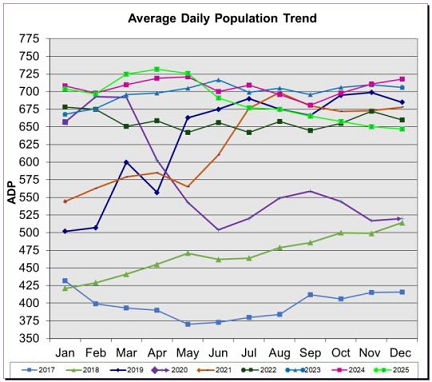
The Debtor’s financial health is directly tied to its Average Daily Population (“ADP”). The chart below shows the fluctuating nature of the Debtor’s ADP for the years 2015 through 2025:
In March 2020, as a result of the COVID-19 pandemic, the Governor of Rhode Island declared a state of emergency and ordered all non-essential business services to temporarily cease, leading to increased costs associated with operating the Facility while at the same time resulting in a substantial drop in ADP due to releases of detainees. In an effort to address this calamitous “perfect storm” – increased expenses and decreased revenue – management implemented steps to mitigate the negative effects on operations, including but not limited to, availing itself of available government assistance. In April 2020, Debtor received a Paycheck Protection Program (“PPP”) Loan under the Coronavirus Aid, Relief, and Economic Security Act in the amount of $2,903,400. Proceeds of the loan were used to cover eligible payroll, related benefits, worker expenses and utilities. The loan was forgiven by the Small Business Administration in July 2021. In February 2021, the Corporation received an additional PPP loan in the amount of $2,000,000. Proceeds of the loan were used to cover eligible payroll, related benefits, worker expenses and utilities. The loan was forgiven by the Small Business Administration in October 2021.
The Debtor suffered further financial difficulty due to a ransomware attack in November 2023. While the Facility’s technological infrastructure was eventually reconstructed and brought back online, the Debtor later learned that as a result of the attack, certain information regarding approximately 18,500 former and current detainees, employees, and vendors had been released on the dark web. The ransomware attack is the subject of the Class Action.
Over the life of the Facility, it has been consistently unable to sustain a population rate to fund both its operations and its obligations under the Existing Indenture. As noted above, the Facility has the capacity to house 770 detainees; however, due to practical limitations relating to the inflow and outflow of detainees from the Facility, it cannot practically house 770 detainees at one time. Over the past approximately five years, the Facility has continued to operate at well below its maximum capacity, with ADP averaging approximately 675 detainees. As a result, the Debtor has not paid its debt service obligations on the Existing Bonds since 2015, or paid local impact fees to the City since 2009.
12
| B. | Keepership and Forbearance Agreements Under Indenture |
In 2014, the Debtor filed a receivership petition in the Rhode Island Superior Court (the “2014 Keepership”), resulting in the appointment of a temporary receiver, Jonathan Savage, whose role was subsequently modified to a “keeper” (the “Keeper”). To resolve the 2014 Keepership, the Debtor, City, Bond Trustee, and Keeper negotiated a forbearance agreement, dated March 30, 2015, among the Debtor, City, and Bond Trustee (the “2015 Forbearance Agreement”), pursuant to which the Bond Trustee agreed to forbear from exercising its rights and remedies under the Existing Indenture over a four (4) year period. The parties also agreed that the Debtor was authorized to transfer to the City $16,666 monthly in an aggregate amount of up to $800,000 from its revenues, to the extent funds were available subsequent to payment of operation and maintenance expenses (the “2015 Forbearance City Payments”). From March 2015 to August 2017, the Debtor made the 2015 Forbearance City Payments of $16,666 per month. Pursuant to the 2015 Forbearance Agreement, the Board resumed oversight of the Debtor in April 2015.
On May 3, 2017, the Debtor and the Bond Trustee (but not the City) executed a certain Amendment to Forbearance Agreement (the “First Amendment to 2015 Forbearance Agreement”), pursuant to which the Bond Trustee advanced approximately $900,000 to the Debtor to fund security-based capital expenses and budgeted operational shortfalls. This amendment also provided that if the Debtor experienced future operational expense shortfalls that required funding from the Bond Trustee to meet its most essential operating expenses, the Debtor would be prohibited from making any monthly 2015 Forbearance City Payments for a period of 60 days from such budget shortfall requests.
On March 12, 2018, the Debtor and the Bond Trustee executed a certain Second Amendment to the Forbearance Agreement (the “Second Amendment to 2015 Forbearance Agreement”), in which the Bond Trustee agreed to advance up to $388,000 in additional funds from the Debt Service Reserve Fund to pay for half of the Debtor’s financial needs to construct a portion of its perimeter fence requested by the USMS (the “Fence Project”). The balance of the cost of the Fence Project was to be reimbursed by the USMS.
On January 16, 2019, the Debtor and the Bond Trustee executed a certain Third Amendment to Forbearance Agreement (the “Third Amendment to 2015 Forbearance Agreement”), pursuant to which the Bond Trustee advanced funds as a bridge loan to the Debtor to meet essential budgeted expenses, including payroll. On February 19, 2019, the Debtor satisfied all of its obligations to the Bond Trustee under the bridge loan under the Third Amendment to Forbearance Agreement and the parties terminated that emergency loan.
On April 10, 2019, the Bond Trustee provided written notice to the Debtor that the 2015 Forbearance Agreement terminated pursuant to Section 4.2(ii) of the 2015 Forbearance Agreement. Specifically, the Bond Trustee terminated the 2015 Forbearance Agreement due, in part, to the City’s unsuccessful attempt to dissolve the Debtor.
13
Following the filing of the Federal Court Litigation in April 2019, on October 30, 2019, the Debtor and the Bond Trustee entered into a new Forbearance Agreement (the “2019 Forbearance Agreement”), pursuant to which the Bond Trustee agreed to forbear from the exercise of remedies under the Existing Indenture and to stay the Federal Court Litigation. Pursuant to the 2019 Forbearance Agreement, the Bond Trustee advanced additional funds to the Debtor to meet essential budgeted expenses, including payroll, and the Debtor agreed that the Bond Trustee was entitled to debt service payments for remaining amounts in excess of $400,000 following payment of operating expenses by the Debtor. The 2019 Forbearance Agreement was ultimately terminated on April 10, 2019.
Throughout the course of the Federal Court Litigation, the Debtor, Bond Trustee, and the City have engaged in mediated confidential settlement discussions before Magistrate Judge Patricia A. Sullivan in an attempt to negotiate global resolution (the “Federal Court Mediation”). As part of the Federal Court Mediation, the parties have agreed to a series of stays of the Federal Court Litigation, most recently through May 1, 2026. The Federal Court Mediation has proven fruitful, resulting in the agreement that the Debtor would file this chapter 11 case and implement the restructuring embodied in the Plan (defined below).
| C. | Restructuring Support Agreement and Plan |
On June 19, 2026, following months of extensive, arm’s-length negotiations, the Debtor entered into a Restructuring Support Agreement (as amended from time to time and including all exhibits thereto, the “RSA”), with (a) holders representing approximately (i) 71.2% of the aggregate outstanding principal amount of Class 3 Claims (Existing Bond Secured Claims) (collectively, the “Consenting Holders”), and (b) the City (and together with the Consenting Holders, the “Consenting Parties”). Under the RSA, the Consenting Parties have agreed to support the Restructuring as set forth the Plan. The Plan will result in a reduction of the Debtor’s outstanding secured debt obligations by approximately $100 million, leaving the Debtor better positioned to implement its long-term business plan and reset its relationship with the City. Significantly, the Plan also provides that all allowed claims, other than the Existing Bond Secured Claims and the City Claims (the treatment of which is set forth in the Restructuring Support Agreement), will be paid in full or reinstated on the Effective Date, thus preserving value for local suppliers, trade creditors, litigation claimants, and other stakeholders of the Debtor.
Under the Plan, the Debtor intends and expects that its day-to-day operations post-petition will continue as normal, and that all post-petition debts (including wage payments to its employees) will be paid in the ordinary course. Further, the Plan will provide that holders of Class 3 Claims (Existing Bond Secured Claims) will receive their pro rata share of Series 2026 Bonds in the face amount of $67,500,000, $27.5 million of which will amortize and the remainder of which will be payable solely from excess cash flow. The Plan also implements the terms of a settlement between the Debtor and the City in full and final satisfaction of the City’s claims in the Federal Court Litigation, whereby the Debtor shall, among other things, make (i) go-forward payments of local impact fees to the City in the annual amount of $250,000, (ii) an annual charitable donation of $25,000 to agreed-upon non-profits providing services in the City for public safety, and (iii) reimbursement to the City of $400,000 in the first 12 months following the Effective Date of the Plan for community amenities to be provided by the City.
14
V.
ANTICIPATED EVENTS DURING THE CHAPTER 11 CASES
The Debtor is operating its business in the ordinary course during the pendency of the Chapter 11 Case. As described more fully below, on the Petition Date, the Debtor filed various motions seeking important and urgent relief from the Bankruptcy Court. Capitalized terms used but not defined in this section have the meanings given such terms in the applicable motion or other document.
| A. | Commencement of the Chapter 11 Case and First Day Motions |
On the Petition Date, the Debtor filed multiple motions seeking various relief from the Bankruptcy Court and authorizing the Debtor to maintain its operations in the ordinary course. Such relief is designed to ensure a seamless transition between the Debtor’s prepetition and postpetition business operations, facilitate a smooth reorganization through the Chapter 11 Case, and minimize any disruptions to the Debtor’s operations. The following is a brief overview of the substantive relief the Debtor is seeking on the Petition Date to maintain its operations in the ordinary course.
| 1. | Cash Collateral Motion |
The Debtor’s obligations to the Bond Trustee under the Existing Indenture are secured by liens on and security interests in: (i) the real property titled in the name of the Debtor, (ii) all revenues of the Debtor, (iii) all personal property of the Debtor, and (iv) all leases and rents associated with the Facility. During the Chapter 11 Case, the Debtor must obtain consent of the Bond Trustee, or without the consent of the Bond Trustee, court authorization, to continue using “cash collateral” of the Bond Trustee (“Cash Collateral”).
| 2. | Cash Management System |
The Debtor maintains an integrated, centralized cash management system in the ordinary course of its operations to collect, transfer, and disburse funds generated by the Facility’s operations (the “Cash Management System”). Pursuant to the Cash Management Motion, the Debtor requests entry of interim and final orders (a) authorizing, but not directing the Debtor to maintain and use its existing cash management system, including existing bank accounts, checks, and business forms, (b) granting the Debtor a waiver of certain bank account and related requirements of the U.S. Trustee to the extent that such requirements are inconsistent with the Debtor’s practices under the existing Cash Management System or other actions described herein; (c) authorizing, but not directing, the Debtor to continue to maintain and use the existing deposit practices notwithstanding the provisions section 345(b) of the Bankruptcy Code and (d) authorizing the Debtor to pay ordinary course fees and service charges in connection with the maintenance of its existing cash management system. The Debtor is also requesting that the Court authorize the Banks to (a) continue to charge the Debtor the Bank Fees and (b) charge-back returned items to the Bank Accounts, whether such items are dated prior to, on, or subsequent to the Petition Date, in the ordinary course of business.
15
| 3. | Utilities |
In the ordinary course of business, the Debtor incurs certain expenses related to the essential utility services, such as electricity, natural gas, water and sewage, telecommunications, internet, waste, and other similar services. On the Petition Date, the Debtor is seeking authority to provide such utility providers with adequate assurance in the amount of approximately $75,000 to be held in a segregated account and approval of procedures for resolving objections relating to the adequacy of the proposed adequate assurance.
| 4. | Insurance |
In connection with the operation of the Debtor’s businesses, the Debtor maintains various insurance policies designed to protect its property, assets, key personnel, and business operations. Accordingly, the Debtor is seeking entry of an order authorizing the Debtor to (i) continue, in its sole discretion, its workers’ compensation program (the “Workers Compensation Program”) and its insurance policies and programs (collectively, the “Insurance Programs”) that were in effect on or prior to the Petition Date; (ii) pay, in its sole discretion, all undisputed prepetition obligations for the Insurance Programs, including all premiums, obligations, brokerage fees, deductibles, and administration fees arising thereunder or in connection therewith (collectively, the “Insurance Obligations”).
| 5. | Employee Wages and Benefits |
As of the Petition Date, the Facility employs approximately 263 individuals (collectively, the “Employees”), of whom approximately 11 are part-time or per diem Employees. The Employees serve a number of critical roles at the Facility, including correctional officers, support staff, and administrative personnel. The wages motion requests authority to pay certain prepetition wages, salaries, reimbursable employee expenses and other compensation obligations to Employees (the “Employee Wages”). In the ordinary course of business, the Debtor also provides various employee benefit programs and incurs related obligations, such as vacation, federal and state withholding taxes and other withheld amounts, health and welfare benefits, workers’ compensation and programs that the Debtor historically has provided in the ordinary course of business (collectively, the “Employee Benefits Obligations”, and together with the Employee Compensation Obligations, the “Employee Obligations”). Accordingly, on the Petition Date, the Debtor is seeking to pay the Employee Obligations in the ordinary course of business.
| 6. | Other Procedural Motions and Retention of Professionals |
The Debtor has filed various motions regarding procedural matters that are common to chapter 11 case of similar size and complexity as this Chapter 11 Case, seeking to, among other things:
| · | Implement certain case management procedures; |
| · | Redact certain personally identifiable information from publicly filed papers; and |
| · | Receive an extension of the deadline by which the Debtor must file its schedules and statements. |
16
| B. | Data Security Incident Class Action Settlement Motion |
The Debtor intends to file a motion seeking preliminary approval of the Data Security Incident Class Settlement, including to establish notice and opt-out procedures and schedule a final approval hearing. The terms of the Data Security Incident Class Action Settlement are described in Section 5.05 of the Plan.
| C. | Retention of Chapter 11 Professionals |
The Debtor has filed, or intends to file, several applications and obtained authority to retain various professionals to assist the Debtor in carrying out its duties under the Bankruptcy Code during the Chapter 11 Case. These professionals include: (i) Troutman Pepper Locke LLP (“TPL”) and Partridge Snow & Hahn LLP, as legal counsel; (ii) Getzler Henrich & Associates LLC, as financial advisor, and (iii) Epiq Corporate Restructuring, LLC (“Epiq”), as claims, noticing and solicitation agent.
| D. | Confirmation Hearing |
After filing the Plan, the Debtor will seek an order of the Bankruptcy Court (i) approving the Disclosure Statement, (ii) scheduling a hearing to consider confirmation of the Plan, and (iii) granting other related relief. The Debtor anticipates that notice of these hearings will be published and mailed to all known holders of Claims as ordered by the Bankruptcy Court before the date by which objections must be filed with the Bankruptcy Court.
| E. | Timetable for the Chapter 11 Case |
In accordance with the Restructuring Support Agreement, the Debtor has agreed to proceed with the implementation of the Plan through the Chapter 11 Case. Among the Milestones contained in the Restructuring Support Agreement is the requirement that the Debtor obtain entry of the order confirming the Plan no later than October 8, 2026. The Restructuring Support Agreement also requires that the Effective Date occur no later than 30 days after entry of the Confirmation Order. Although the Debtor will request that the Bankruptcy Court approve a timetable consistent with the Restructuring Support Agreement, there can be no assurance that the Effective Date will occur on this timetable.
17
VI.
SUMMARY OF THE PLAN
A. Classification of Claims Against the Debtor
With the exception of those Claims set forth in Section 3.01 of the Plan, including Administrative Claims, Professional Fee Claims, and Priority Tax Claims, all Claims against the Debtor are classified for all purposes (unless otherwise specified), including voting and Distribution pursuant to the Plan, as follows:
| Class | Designation | Treatment | Entitled to Vote |
| 1 | Other Priority Claims | Unimpaired | No |
| 2 | Other Secured Claims | Unimpaired | No |
| 3 | Existing Bond Secured Claims | Impaired | Yes |
| 4 | City Claims | Impaired | Yes |
| 5 | Unsecured Litigation Claims | Unimpaired | No |
| 6 | Data Security Incident Class Settlement Claims | Unimpaired | No |
| 7 | General Unsecured Claims | Unimpaired | No |
B. Treatment of Claims Against the Debtor
1. Unclassified Claims.
(a) Administrative Claims. Each Holder of an Allowed Administrative Claim shall receive, in full satisfaction and discharge thereof, Cash equal to the unpaid amount of such Allowed Administrative Claim (except to the extent that such Holder agrees to less favorable treatment thereof) on or as soon as practicable after the latest of (a) the Effective Date, (b) the date on which such Administrative Claim becomes Allowed, (c) the date on which such Administrative Claim becomes due and payable, and (d) such other date as mutually agreed to by such Holder and the Debtor.
(b) Establishment of Administrative Claims Bar Date. Except as otherwise provided in the Plan with respect to Professional Fee Claims or with respect to those Claims set forth in Section 3.01(e) of the Plan, each Holder of an Administrative Claim (other than an Administrative 503(b)(9) Claim) shall File with the Bankruptcy Court and serve on counsel to the Debtor, at the addresses set forth in Section 12.11 of the Plan, an Administrative Claim Request, so as to be actually received on or before 4:00 p.m. (prevailing Eastern time) on the Administrative Claims Bar Date. Any Holder of an Administrative Claim (other than an Administrative 503(b)(9) Claim) that is required to File and serve and Administrative Claim Request and fails to timely file and serve an Administrative Claim Request by the applicable deadline set forth in Section 3.01(b) of the Plan shall be forever barred, estopped, and enjoined from asserting such Administrative Claim against the Debtor, the Estate or the Reorganized Debtor, and such Administrative Claim will be deemed discharged as of the Effective Date in accordance with Section 11.04 of the Plan. Notwithstanding anything in Section 3.01(b) of the Plan to the contrary, the Bar Date for Administrative 503(b)(9) Claims shall be the General Bar Date established by the Bar Date Order and not by Section 3.01(b) of the Plan.
(c) Priority Tax Claims. Each Holder of an Allowed Priority Tax Claim shall receive, in full satisfaction and discharge thereof, Cash equal to the unpaid amount of such Allowed Priority Tax Claim (except to the extent that such Holder agrees to less favorable treatment thereof) on or as soon as practicable after the latest of (a) the Effective Date, (b) the date on which such Priority Tax Claim becomes Allowed, (c) the date on which such Priority Tax Claim becomes due and payable, and (d) such other date as mutually agreed to by and among such Holder and the Debtor; provided, however, that the Debtor may, at its option and in lieu of payment in full in Cash of an Allowed Priority Tax Claim as provided in clauses (a) through (d) hereof, make deferred Cash payments on account of such Allowed Priority Tax Claim in the manner and to the extent permitted under section 1129(a)(9)(C) of the Bankruptcy Code.
18
2. Professional Fees.
(a) Final Fee Applications. All final requests for payment of Professional Fee Claims must be Filed with the Bankruptcy Court and served on the Reorganized Debtor and the Bond Trustee no later than forty-five (45) days after the Effective Date. The Bankruptcy Court shall determine the Allowed amounts of such Professional Fee Claims after notice and a hearing in accordance with the procedures established by the Bankruptcy Code and consistent with any prior orders of the Bankruptcy Court in the Chapter 11 Case. The Disbursing Agent shall make all Distributions on account of Allowed Professional Fee Claims as soon as reasonably practicable after such Claims become Allowed in amounts consistent with the following paragraph. Such Distributions shall be paid in Cash from the Professional Fee Escrow.
(b) Professional Fee Escrow. As soon as reasonably practicable after the Confirmation Date and no later than the Effective Date, the Debtor shall establish and fund the Professional Fee Escrow with Cash equal to the Professional Person’s good faith estimate of their actual unpaid Professional Fee Claim as of the Effective Date; provided that the Professional Person shall deliver such good faith estimate and a detailed calculation thereof to the Debtor no later than five (5) Business Days prior to the Effective Date. No Liens, Claims, or interests shall encumber the Professional Fee Escrow in any way (whether on account of the Series 2026 Bonds or otherwise). The Professional Fee Escrow (including funds held in the Professional Fee Escrow) (i) shall not be and shall not be deemed property of the Debtor or the Reorganized Debtor and (ii) shall be held in trust for the Professional Person; provided that funds remaining in the Professional Fee Escrow after all Allowed Professional Fee Claims have been irrevocably paid in full shall revert to the Reorganized Debtor. Allowed Professional Fee Claims shall be paid in Cash to such Professional Person from funds held in the Professional Fee Escrow when such Claims are Allowed by an order of the Bankruptcy Court; provided that the Debtor’s obligations with respect to Professional Fee Claims shall not be limited nor deemed to be limited in any way to the balance of funds held in the Professional Fee Escrow. If the amount of funds in the Professional Fee Escrow is insufficient to fund payment in full of all Allowed Professional Fee Claims and any other Allowed amounts owed to Professional Persons, the deficiency shall be promptly funded to the Professional Fee Escrow from the Debtor’s Estate without any further action or order of the Bankruptcy Court.
(c) Post-Effective Date Fees and Expenses. Any requirement that Professionals comply with sections 327 through 331 and 1103 of the Bankruptcy Code in seeking retention or compensation for services rendered after the Effective Date shall terminate, and the Reorganized Debtor may employ and pay any Professional in the ordinary course of business without any further notice, application, order or approval of the Bankruptcy Court.
3. Bond Trustee’s Fees and Expenses.
(a) On the Effective Date, to the extent not previously satisfied pursuant to the Cash Collateral Orders, or if not yet due on the Effective Date, then as a component of the Global 9019 Settlement, when such fees and expenses are due, the Disbursing Agent shall (I) pay to the Bond Trustee an amount equal to the unpaid reasonable fees and expenses incurred by the Bond Trustee through and including the Effective Date, and (II) pay to the Bond Trustee’s legal counsel an amount equal to the unpaid reasonable fees and expenses incurred through and including the Effective Date, and (III) pay to the Bond Trustee’s financial advisor an amount equal to the unpaid reasonable fees and expenses incurred through and including the Effective Date.
19
(b) Upon payment of the amounts set forth in Section 3.01(e) of the Plan, the Debtor shall be deemed to have satisfied in full its obligations to the Bond Trustee for any fees and expenses incurred in connection with the Chapter 11 Case. Upon the Effective Date, the Bond Trustee shall be deemed to have waived any and all rights to be reimbursed for any fees and expenses incurred by its professionals in connection with the Chapter 11 Case from the Debtor, its Estate, or the Reorganized Debtor other than as set forth in Section 3.01(e) of the Plan.
(c) Any of the professionals retained by the Bond Trustee seeking reimbursement of professional fees and expenses in accordance with Section 3.01(e) of the Plan shall submit a final summary invoice for such professional fees and expenses within forty-five (45) days after the Effective Date and such fees and expenses shall be paid by the Reorganized Debtor without the need for any further approval by the Bankruptcy Court.
C. Classification of Claims
1. Class 1 Claims: Other Priority Claims.
Classification: Class 1 Claims consist of all Other Priority Claims.
Allowance: Class 1 Claims shall be in such amounts as Allowed.
Treatment: Except to the extent a Holder of a Class 1 Claim agrees to less favorable treatment, each Holder of an Allowed Class 1 Claim shall receive, in full satisfaction and discharge thereof, Cash equal to the unpaid amount of such Allowed Other Priority Claim on or as soon as reasonably practicable after the latest of (i) the Effective Date, (ii) the date on which such Other Priority Claim becomes Allowed, and (iii) such other date as mutually may be agreed to by and among such Holder and the Debtor.
Voting: Class 1 Claims are Unimpaired, and the Holders of Class 1 Claims shall be conclusively deemed to have accepted the Plan pursuant to section 1126(f) of the Bankruptcy Code. Therefore, the Holders of Class 1 Claims shall not be entitled to vote to accept or reject the Plan. Holders of Allowed Class 1 Claims shall receive a Notice of Non-Voting Status Package.
2. Class 2 Claims: Other Secured Claims.
Allowance: Class 2 Claims shall be in such amounts as Allowed.
Classification: Class 2 Claims consist of Other Secured Claims.
Treatment: Except to the extent a Holder of a Class 2 Claim agrees to less favorable treatment, each Holder of an Allowed Class 2 Claim shall receive, at the Debtor’s or Reorganized Debtor’s option with the consent of the Bond Trustee, either (i) payment in full in Cash; (ii) the collateral securing its Allowed Other Secured Claim; (iii) Reinstatement of its Allowed Other Secured Claim; or (iv) such other treatment rendering its Allowed Other Secured Claim unimpaired in accordance with section 1124 of the Bankruptcy Code.
Voting: Class 2 Claims are Unimpaired, and the Holders of Class 2 Claims will be conclusively deemed to have accepted the Plan pursuant to section 1126(f) of the Bankruptcy Code. Therefore, the Holders of Class 2 Claims shall not be entitled to vote to accept or reject the Plan. Holders of Allowed Class 2 Claims shall receive a Notice of Non-Voting Status Package.
20
3. Class 3 Claims: Existing Bond Secured Claims.
Classification: Class 3 Claims consist of all Existing Bond Secured Claims.
Allowance: The Class 3 Claims shall be deemed Allowed in the aggregate principal amount of $97,300,000, plus accrued and unpaid interest through the Petition Date, plus any accrued and unpaid fees and expenses of the Bond Trustee and its professionals arising under or in connection with the Existing Bond Documents, which shall not be subject to any avoidance, reductions, setoff, offset, recharacterization, subordination, counterclaims, cross-claims, defenses, disallowance, impairments or any other challenges under applicable law or regulation by any entity, as of the Effective Date. For the avoidance of doubt, Holders of Existing Bond Secured Claims are not required to file Proofs of Claim with respect to Existing Bond Secured Claims. The Class 3 Claims are secured by valid, binding, and perfected first priority liens and security interests in (i) the Revenues and all Funds and Accounts (each, as defined in the Existing Indenture) created or established by or maintained pursuant to the Existing Indenture and (ii) the Mortgaged Property (as defined in the Mortgage).
Treatment: Except to the extent that a Holder of an Allowed Class 3 Claim agrees to less favorable treatment, in full and final satisfaction, compromise, settlement, and release of and in exchange for each Class 3 Claim, and in accordance with Section 5.03 of the Plan, each Holder of an Allowed Class 3 Claim shall receive its Pro Rata share of the Series 2026 Bonds in accordance with the Restructuring Transactions on the Effective Date or as soon as practicable thereafter. Any deficiency claim in respect of the Existing Bond Secured Claims by operation of Section 506(a) of the Bankruptcy Code or otherwise shall be deemed waived as of the Effective Date.
Voting: Class 3 Claims are Impaired under the Plan and the Holders of Class 3 Claims shall be entitled to vote to accept or reject the Plan.
4. Class 4 Claims: City Claims.
Classification: Class 4 Claims consist of all City Claims.
Allowance: The Class 4 Claims shall be deemed Allowed in the aggregate amount of $1.00 as of the Effective Date.
Treatment: In full and final satisfaction, compromise, settlement, and release of and in exchange for its Class 4 Claim, and in accordance with Section 5.04 of the Plan, the City shall receive the terms set forth in the City Settlement.
Voting: Class 4 Claims are Impaired under the Plan and the Holders of Class 4 Claims shall be entitled to vote to accept or reject the Plan.
21
5. Class 5 Claims: Unsecured Litigation Claims.
Classification: Class 5 Claims consist of Unsecured Litigation Claims, including Data Security Incident Class Opt-Out Claims.
Allowance: Class 5 Claims shall be in such amounts as Allowed.
Treatment: Except to the extent that a Holder of a Class 5 Claim agrees to less favorable treatment, each Class 5 Claim shall be Reinstated as of the Effective Date. Any amounts payable on account of any Allowed Class 5 Claim that is or has been (i) reduced to judgment or (ii) settled, in each case, pursuant to a Final Order of a court of competent jurisdiction or settled by the Debtor or Reorganized Debtor, shall be payable by the Debtor or Reorganized Debtor solely to the extent that such amounts are not otherwise paid or payable from proceeds of applicable insurance policies of the Debtor or Reorganized Debtor.
Voting: Class 5 Claims are Unimpaired by the Plan. Holders of Class 5 Claims are not entitled to vote to accept or reject the Plan. Holders of Class 5 Claims shall receive a Notice of Non-Voting Status Package.
6. Class 6 Claims: Data Security Incident Class Settlement Claims.
Classification: Class 6 Claims consist of Data Security Incident Class Settlement Claims.
Allowance: Class 6 Claims shall be Allowed in the amount of the Data Security Incident Class Allowed Claim. Date Security Incident Class Counsel shall be required to timely file a Data Security Incident Class Proof of Claim. Data Security Incident Class Members are not required to file Proofs of Claim with respect to such Data Security Incident Claims.
Treatment: Except to the extent that a Holder of an Allowed Class 6 Claim agrees to less favorable treatment, in full and final satisfaction, compromise, settlement, and release of and in exchange for each Class 6 Claim, on the Effective Date, each Holder of an Allowed Class 6 Claim shall receive the following treatment:
(i) If the Data Security Incident Class Settlement is approved by the Bankruptcy Court on a final basis, each Holder of an Allowed Class 6 Claim shall receive the terms set forth in the Data Security Incident Class Settlement.
(ii) If the Data Security Incident Class Settlement is not approved by the Bankruptcy Court on a final basis, each Allowed Class 6 Claim shall be Reinstated as of the Effective Date.
Voting: Class 6 Claims are Unimpaired by the Plan. Holders of Allowed Class 6 Claims are not entitled to vote to accept or reject the Plan. Each Data Security Incident Class Member will receive a Data Security Incident Class Opt-Out Form and Notice of Non-Voting Status Package. Each Data Security Incident Class Member that does not validly and timely opt out of the Data Security Incident Settlement Class will be treated in Class 6. Any Data Security Incident Class Member that validly and timely opts out of the Data Security Incident Settlement Class will receive the same treatment as Class 5.
22
7. Class 7 Claims: General Unsecured Claims.
Classification: Class 7 Claims consist of General Unsecured Claims.
Allowance: Class 7 Claims shall be in such amounts as Allowed.
Treatment: Except to the extent that a Holder of an Allowed Class 7 Claim agrees to less favorable treatment, in full and final satisfaction, compromise, settlement, and release of and in exchange for each Class 7 Claim, on the Effective Date, each Holder of an Allowed Class 7 Claim shall receive, at the Debtor’s or Reorganized Debtor’s option with the consent of the Bond Trustee either (i) payment in full in Cash; or (ii) Reinstatement of its Allowed General Unsecured Claim.
Voting: Class 7 Claims are Unimpaired by the Plan. Holders of Allowed Class 7 Claims are not entitled to vote to accept or reject the Plan. Holders of Allowed Class 7 Claims shall receive a Notice of Non-Voting Status Package.
D. Acceptance or Rejection of The Plan
1. Classes of Claims Solicited to Vote.
Only the votes of Holders of Class 3 Claims and Class 4 Claims shall be solicited with respect to the Plan.
2. Acceptance by a Voting Class.
In accordance with section 1126(c) of the Bankruptcy Code, and except as provided in section 1126(e) of the Bankruptcy Code, a voting Class of Claims shall have accepted the Plan if the Holders of at least two-thirds (2/3) in dollar amount and more than one-half (1/2) in number of the Allowed Claims that have timely and properly cast ballots vote to accept or reject the Plan.
3. Presumed Acceptances by Unimpaired Classes.
Class 1 Claims, Class 2 Claims, Class 5 Claims, Class 6 Claims, and Class 7 Claims are Unimpaired under the Plan. Under section 1126(f) of the Bankruptcy Code, Holders of such Unimpaired Claims are conclusively presumed to have accepted the Plan. Accordingly, the votes of Holders of Class 1 Claims, Class 2 Claims, Class 5 Claims, Class 6 Claims, and Class 7 Claims shall not be solicited.
4. Confirmation Pursuant to Section 1129(b) of the Bankruptcy Code.
The Debtor reserves the right to request Confirmation of the Plan, as it may be modified from time to time, under section 1129(b) of the Bankruptcy Code. The Debtor reserves the right to alter, amend, modify, revoke, or withdraw the Plan, the Plan Supplement, or any schedule or exhibit, including to amend or modify it to satisfy the requirements of section 1129(b) of the Bankruptcy Code, if necessary, in each case subject to the terms of the Restructuring Support Agreement.
23
5. Elimination of Vacant Classes.
Any Class of Claims against the Debtor that does not contain, as of the date of the commencement of the Confirmation Hearing, a Holder of an Allowed Claim, or a Holder of a Claim temporarily allowed under Bankruptcy Rule 3018, shall be deemed deleted from the Plan for all purposes, including for purposes of determining acceptance of the Plan by such Class under section 1129(a)(8) of the Bankruptcy Code.
E. Means For Implementation of the Plan
1. Global 9019 Settlement; Compromise and Settlement of Claims and Controversies.
(a) The Plan embodies and implements a comprehensive settlement and compromise among the Debtor, holders of a majority in principal amount of the Existing Bonds, and the City, related to a number of issues affecting the Debtor and the Facility (the “Global 9019 Settlement”). The Global 9019 Settlement is centered on resolving (i) the Debtor’s obligations associated with its senior secured indebtedness, the Existing Bonds, which have been in default for over ten years, and (ii) the Federal Court Litigation and the City’s claims for impact fees that have gone unpaid for years given the Debtor’s financial condition. The Global 9019 Settlement permits payment in full of General Unsecured Claims, including trade creditors.
(b) Pursuant to sections 363 and 1123 of the Bankruptcy Code and Bankruptcy Rule 9019, the provisions of the Plan, including the settlement of all Claims and controversies among the Debtor, the Holders of Existing Bond Secured Claims, and the City, are given in consideration of the value provided to the Estate by the Bond Trustee, the Consenting Holders, and the City. The terms of the Global 9019 Settlement are set out in the Restructuring Support Agreement and incorporated by reference into the Plan, and shall constitute an integrated and global good faith compromise and settlement of all Claims and controversies relating to the contractual, legal, and subordination rights that a creditor may have with respect to any Allowed Claim or any distribution to be made on account of such Allowed Claim.
(c) The Global 9019 Settlement is comprised of (i) the classification and treatment of the Existing Bond Secured Claims specified in the Plan; (ii) the classification and treatment of the City Claims specified in the Plan; (iii) the resolution of the Data Security Incident Class Settlement Claims; and (iv) the general treatment of all other Allowed Claims to render them unimpaired. To facilitate this intricate resolution, the Global 9019 Settlement is premised on a Plan outcome that resolves or otherwise mitigates all known Claims against the Debtor and re-sets the Debtor’s balance sheet and liabilities. Essential and mandatory terms of the Global 9019 Settlement to accomplish this include the release and exculpation provisions by and in favor of the Debtor, the Reorganized Debtor, the Bond Trustee, the Consenting Holders, the City, and each of their Related Parties as specified in the Plan.
(d) The Plan shall constitute a motion to approve the Global 9019 Settlement. Subject to the occurrence of the Effective Date, the entry of the Confirmation Order shall constitute the Bankruptcy Court’s integrated and global approval of the Global 9019 Settlement pursuant to Bankruptcy Rule 9019 (which is inclusive of the releases by the Debtor and the Estate) and the compromise or settlement of all such Allowed Claims and controversies, as well as a finding by the Bankruptcy Court that such compromise, settlement, and transactions are in the best interests of the Debtor, its Estate, and all Holders of Claims against the Estate, and is fair, equitable, and is within the range of reasonableness. If the Effective Date does not occur, the Global 9019 Settlement shall be deemed to have been withdrawn without prejudice to the respective positions of the parties.
24
2. Continued Corporate Existence; Effectuating Documents; Vesting of Assets.
(a) The Debtor, as the Reorganized Debtor, shall continue to exist on and after the Effective Date with all the powers available to it under applicable law. At this time, the Debtor is not entering into new Reorganized Debtor Corporate Governance Documents but reserves the right to do so to the extent necessary or desirable in to implement the terms of the Plan. On the Effective Date, pursuant to section 1141(b) and (c) of the Bankruptcy Code, legal and equitable title to the Facility, and all other assets of the Debtor, including Causes of Action, will vest in the Reorganized Debtor free and clear of all Claims, Liens, encumbrances, charges and other interests except as provided in the Plan or the Confirmation Order; provided, however, that on and following the Effective Date, the Liens and security interests securing the Existing Bond Secured Claims pursuant to the Restated Mortgage and the other Existing Bond Documents shall secure the Reorganized Debtor’s obligations under the Restated Bond Documents, which shall continue to secure the Reorganized Debtor’s obligations under the Restated Bond Documents in accordance with Section 5.03 of the Plan. In addition, all rights, benefits, and protections provided to the Debtor or its Estate pursuant to the Plan, the Plan Supplement, or the Confirmation Order including, but not limited to, the release, exculpation, and injunction provisions provided in Article 11 of the Plan, shall vest in the Reorganized Debtor unless expressly provided otherwise by the Plan or the Confirmation Order. On and after the Effective Date, the Reorganized Debtor may operate its business and use, acquire, lease, sell, or dispose of its assets without supervision or approval by the Bankruptcy Court and free from any restrictions of the Bankruptcy Code or the Bankruptcy Rules.
(b) Upon the Effective Date, all actions contemplated by the Plan shall be deemed authorized and approved in all respects, including (i) the assumption of executory contracts and unexpired leases as provided herein, (ii) the retention of the Debtor’s directors as directors of the Reorganized Debtor, (iii) the entry into or execution of the Restated Bond Documents, including definitive documentation related thereto, and (iv) all other actions contemplated by the Plan (whether to occur before, on, or after the Effective Date), in each case in accordance with and subject to the terms hereof.
(c) The board of directors of the Debtor and the Reorganized Debtor is authorized and directed, in each case, acting in accordance with Rhode Island law, to issue, execute, deliver, file, or record such contracts, securities, instruments, releases, indentures, and other agreements or documents and take such actions as may be necessary or appropriate to effectuate, implement, and further evidence the terms and conditions of the Plan and the securities issued pursuant to the Plan in the name of and on behalf of the Reorganized Debtor, all of which shall be authorized and approved in all respects, in each case, without the need for any approvals, authorization, consents, or any further action required under applicable law, regulation, order, or rule (including, without limitation, any action by directors or managers of the Debtor or the Reorganized Debtor) except for those expressly required pursuant to the Plan. The Confirmation Order shall and shall be deemed to, pursuant to sections 363, 1123, and 1142 of the Bankruptcy Code, authorize and direct parties, as applicable, among other things, to take all actions as may be necessary or appropriate to enter any transaction described in, approved by, contemplated by, or necessary to effectuate the Plan.
25
3. Restated Bond Documents.
(a) On and following the Effective Date, in accordance with, and subject to, the terms of the Restructuring Support Agreement, the Plan, and the Confirmation Order, and pursuant to the Global 9019 Settlement, the Existing Bond Documents shall be amended and restated as the Restated Bond Documents. The Liens and security interests securing the Existing Bond Secured Claims pursuant to the Mortgage and the other Existing Bond Documents shall secure the Reorganized Debtor’s obligations under the Restated Bond Documents, and such Liens and security interests shall be (i) valid, binding, perfected, and enforceable first-priority Liens and security interests in the personal and real property described in and subject to the Restated Mortgage, with the priorities established in respect thereof under applicable non-bankruptcy law, and (ii) not subject to avoidance, recharacterization, or subordination under any applicable law, the Plan or the Confirmation Order.
(b) On or before (as applicable) the Effective Date, the Debtor shall be authorized to execute, deliver, and enter into and perform under the Restated Bond Documents without further (a) notice to or order or other approval of the Bankruptcy Court, (b) act or omission under applicable law, regulation, order, or rule, (c) vote, consent, authorization, or approval of any Person, or (d) action by Holders of Claims. The Restated Bond Documents shall constitute legal, valid, binding and authorized obligations of the Reorganized Debtor, enforceable in accordance with their terms and such obligations shall not be enjoined or subject to discharge, impairment, release, avoidance, recharacterization, or subordination under applicable law, the Plan or the Confirmation Order. The Restated Bond Documents are reasonable and being entered into in good faith.
(c) On the Effective Date, the Reorganized Debtor shall issue the Series 2026 Bonds in accordance with the terms of the Plan, the Restructuring Support Agreement, the Confirmation Order, and pursuant to the Restated Bond Documents. As part of the entry into the Restated Bond Documents and the issuance of the Series 2026 Bonds, the Existing Bonds and all obligations of the Debtor under the Existing Bond Documents will be cancelled. The Existing Bonds will be exchanged for the Series 2026 Bonds on the primary economic terms as follows:
| New Series 2026A Bonds | |
| Principal: | $27,500,000.00 on the terms and conditions set forth in the Restated Bond Documents. |
| Rate of Interest and Payment Terms: |
The New Series 2026A Bonds will bear interest at a fixed rate of 7.25% per annum.
Payments on the New Series 2026A Bonds shall consist of (i) semi-annual interest payments each June 15 and December 15 commencing December 15, 2026 and (ii) annual principal payments each June 15 commencing June 2027. |
| Final Maturity Date: | June 15, 2037 |
| Collateral: | The New Series 2026A Bonds will be secured by a first priority lien on all assets of the Reorganized Debtor, subject to Permitted Encumbrances (as defined in the Restated Indenture). |
26
| New Series 2026B Bonds | |
| Principal: | $40,000,000.00 on the terms and conditions set forth in the Restated Bond Documents. |
| Rate of Interest and Payment Terms: |
The New Series 2026B Bonds will bear interest at a fixed rate of 1.5% per annum.
Payments on the New Series 2026B Bonds shall consist of (i) annual interest payments each March 15 commencing March 15, 2027, payable solely from Excess Cash Flow, and if there is insufficient Excess Cash Flow, such interest shall continue to be due and payable, but shall not accrue interest and the failure to pay such interest due to the insufficiency of Excess Cash Flow shall not be an Event of Default under the Restated Indenture, and (ii) annual principal payments each March 15 commencing March 15, 2027 solely from Excess Cash Flow then on deposit in the Series 2026B Redemption Account.
If all or any portion of the Project is sold, disposed of, licensed, or otherwise transferred after the Series 2026B Bonds mature but before twenty years after the Effective Date, and any interest or principal was unpaid on the Series 2026B Bonds maturity date, the net proceeds from the Project Sale shall be remitted to the Trustee for application to unpaid accrued interest and principal on the Series 2026B Bonds until paid in full as provided in Section 7.28(d) of the Restated Indenture. |
| Final Maturity Date: | “Series 2026B Termination Date” means (i) if no Event of Default has occurred and is then continuing, [March 15, 2043], or if such date is not a Business Day, the Business Day next succeeding such date and (ii) if an Event of Default has occurred and is then continuing, the Business Day next succeeding [March 15, 2043] on which the Event of Default shall have been cured and all damages related to such Event of Default shall have been paid in full, but in no event later than the date specified in Section 7.28(d) of the Restated Indenture. |
| Collateral: | The New Series 2026B Bonds will be secured by a first priority lien on all assets of the Reorganized Debtor, subject to Permitted Encumbrances (as defined in the Restated Indenture). |
27
(d) On the Effective Date, and after the payment of any and all amounts properly payable from the funds held by the Bond Trustee on account of the Existing Bonds (including, without limitation, the fees and expenses of the Bond Trustee and its legal and financial advisors), any balances held by the Bond Trustee on account of the Existing Bonds will be used to fund the Accounts established under the Restated Bond Documents in the following manner:
(i) $2,750,000 to fund the Debt Service Reserve Fund established under the Restated Indenture;
(ii) $4,000,000 to fund the Capital Reserve Fund established under the Restated Indenture;
(iii) $7,000,000 to fund the Operating Reserve Fund established under the Restated Indenture; and
(iv) the remainder to fund the Revenue Fund.
(e) On the Effective Date, all of the Liens and security interests to be granted in accordance with the Restated Bond Documents or that otherwise secure the Series 2026 Bonds (a) shall be deemed to be granted, (b) shall be legal, binding, and enforceable Liens on and security interests in the collateral granted thereunder in accordance with the terms of the Restated Bond Documents, (c) shall be deemed automatically perfected on the Effective Date (without any further action being required by the Reorganized Debtor, the New Bond Trustee, or any of Holders of Series 2026 Bonds), having the priority set forth in the Restated Bond Documents and subject only to such Liens and security interests as may be permitted under the Restated Bond Documents, and (d) shall not be subject to avoidance, recharacterization, or subordination (including equitable subordination) for any purposes whatsoever and shall not constitute preferential transfers, fraudulent conveyances, or other voidable transfers under the Bankruptcy Code or any applicable non-bankruptcy law.
(f) The issuance of the Series 2026 Bonds for Distribution under the Plan is authorized without the need for further corporate action, and all of the Series 2026 Bonds issued or issuable under the Plan shall be duly authorized and validly issued under the Plan. The Debtor shall cause to be delivered customary legal opinions and other documents in connection with the issuance of the Series 2026 Bonds, in form and substance acceptable to the New Bond Trustee, including, without limitation, (i) an Opinion of bond counsel, and (ii) a lender’s title policy with respect to the real property securing the obligations under the Restated Bond Documents, subject to such exceptions as are reasonably acceptable to the New Bond Trustee.
28
(g) The Reorganized Debtor and the New Bond Trustee are authorized to make all filings, amendments and recordings, and to obtain all governmental approvals and consents necessary, to establish, perfect and continue the Liens and security interests securing the Debtor’s obligations under the Restated Bond Documents under the provisions of the state, federal, or other law (whether domestic or foreign) that would be applicable in the absence of the Plan and the Confirmation Order (it being understood that the Liens and security interests granted pursuant to the Existing Bond Documents are duly perfected in accordance with applicable law, and such Liens and security interests shall not be affected by the Plan, including the discharge and release provisions set forth in Article 11 thereof, or entry of the Confirmation Order, except as may be expressly modified by their respective terms) and will thereafter cooperate to make all other filings and recordings that otherwise would be necessary under applicable law to give notice of such Liens and security interests to third parties.
(h) Exemption from Registration. The offer, issuance and distribution of the Series 2026 Bonds to Holders of Existing Bond Secured Claims shall be exempt from the registration requirements under the Securities Act and any state or local law requiring registration for the offer, issuance or distribution of securities, pursuant to Section 1145 of the Bankruptcy Code and/or one or more other applicable exemptions. All Series 2026 Bonds issued under the Plan will be freely tradable under the Securities Act by the recipients thereof (other than underwriters within the meaning of Section 1145(b) of the Bankruptcy Code), subject to the requirements of the Series 2026 Bonds.
4. City Settlement.
(a) On and after the Effective Date, in full and final satisfaction of all City Claims, as part of the Global 9019 Settlement, the City shall receive the terms of the City Settlement, which are as follows:
(i) Local Impact Fee: Upon execution of the Restructuring Support Agreement, the Debtor made a payment to the City in the amount of $250,000 constituting annual Local Impact Fees due to the City for the period of July 1, 2025 through June 30, 2026. Following the Plan Effective Date, the Reorganized Debtor shall pay an annual Local Impact Fee of $250,000 to the City in regular monthly installments. To the extent the Plan Effective Date occurs after July 31, 2026, the Reorganized Debtor shall make additional monthly payments to the City so that the City receives $250,000 in Local Impact Fees for the period of July 1, 2026 through June 30, 2027, to the extent this $250,000 payment shall have not have been already made by the Effective Date. The Reorganized Debtor shall pay the Local Impact Fee to the City so long as scheduled payments to the New Bond Trustee on account of the New Series 2026A Bonds are current and there is no Event of Default under the Restated Bond Documents. The City and the Reorganized Debtor shall collaborate on appropriate public recognition for payments of Local Impact Fee as such payments are made.
(ii) Excess Cash Flow Payments: The City shall also receive five percent (5%) of Excess Cash Flow as and when Excess Cash Flow is remitted to the Bond Trustee for redemption of New Series 2026B Bonds.
29
(iii) Annual Charitable Donation: The Reorganized Debtor shall budget a $25,000 annual charitable donation to federally tax-exempt nonprofits providing services in the City for public safety, public health, or workforce development as recommended by the City and approved by the Reorganized Debtor (which approval shall not be unreasonably withheld). The City and the Reorganized Debtor shall collaborate on appropriate public recognition for these as made.
(iv) Effective Date Fee: Within the first twelve (12) months following the Effective Date, the City shall receive reimbursement from the Reorganized Debtor for up to $400,000 for community amenities identified by the City and approved by the Reorganized Debtor (which approval shall not be unreasonably withheld). The City and the Reorganized Debtor shall collaborate in good faith on appropriate public recognition for this contribution.
(b) Parties’ Representations in Connection with City Settlement:
(i) City. On and after the Effective Date, the City will not hinder or delay the Reorganized Debtor’s operation of the Detention Facility consistent with existing practices of the Debtor as of the Effective Date or the Reorganized Debtor’s performance of contractual obligations relating to the detention of persons at the Facility in accordance with contractual terms and under applicable law.
(ii) Reorganized Debtor. The Reorganized Debtor shall continue to operate the Facility in compliance with requirements under applicable laws and regulations, including from the agencies with oversight of the Facility regarding safety and public health issues and as to procurement rules that encourage consideration of City-based and other underrepresented vendors.
(c) Dismissal of Federal Court Litigation. As soon as reasonably practicable following the Effective Date, the Reorganized Debtor, Bond Trustee, and the City shall jointly file, in form and substance satisfactory to the Reorganized Debtor, a Stipulation of Dismissal of the Federal Court Litigation with prejudice and without costs and all rights of appeal waived, and take all other actions as may be necessary or desirable to effectuate the dismissal of the Federal Court Litigation.
| 5. | Data Security Incident Class Action Settlement. |
(a) Claims for Actual Losses. Subject to Bankruptcy Court approval of the Data Security Incident Class Settlement Agreement, each Holder of a Data Security Incident Class Settlement Claim that has suffered losses fairly-traceable to the Data Security Incident will be entitled to claim from the Data Security Incident Class Settlement Fund: (a) up to $5,000 in actual, documented losses, and (b) up to four (4) hours of time spent responding to the Data Security Incident, compensated at $20/hour, up to a maximum aggregate cost to the Debtor of $100,000. Any amounts due to Holders of Data Security Incident Class Settlement Claims shall be payable solely from the Data Security Incident Class Settlement Fund on a claims-made basis.
(b) Named Plaintiff Incentive Fee. Subject to Bankruptcy Court approval of the Data Security Incident Class Settlement Agreement, Jacob Hellested, the named plaintiff in the Data Security Incident Class Action, shall be entitled to seek an incentive fee of $2,000 out of the Data Security Class Settlement Fund.
30
(c) Credit Monitoring and Costs of Notice and Claims Administration. Subject to Bankruptcy Court approval of the Data Security Incident Class Settlement Agreement, each Holder of a Data Security Incident Class Settlement Claim shall be offered five (5) years of one-bureau free credit monitoring, and the Debtor, or after the Effective Date, the Reorganized Debtor, shall pay the costs of that credit monitoring as well as the costs for notice and claims administration, in connection with the Data Security Incident Class Settlement.
(d) Attorneys’ Fees. Subject to Bankruptcy Court approval of the Data Security Incident Class Settlement Agreement, the Debtor, or after the Effective Date, the Reorganized Debtor, shall fund up to $90,000 in attorneys’ fees and costs incurred by the plaintiff in connection with the Data Security Incident Class Action.
(e) Escrow. Subject to Bankruptcy Court approval of the Data Security Incident Class Settlement Agreement, the Data Security Incident Class Settlement Fund and the amounts set forth in subsections (c) and (d) above shall be funded by the Debtor into escrow on the Effective Date of the Plan pending approval of the Data Security Incident Class Settlement by the Bankruptcy Court. Any amounts due to Holders of Data Security Incident Class Settlement Claims shall be payable solely from the Data Security Incident Settlement Fund. Any amounts not paid or payable to Holders of Data Security Incident Class Settlement Claims from the Data Security Incident Class Settlement Fund, as well as uncashed checks paid to Allowed Data Security Incident Class Claims shall revert to the Reorganized Debtor free and clear of all Data Security Incident Class Settlement Claims in accordance with the terms of the Data Security Incident Class Settlement Agreement.
6. Cancellation of Instruments.
(a) On the Effective Date, except to the extent otherwise specifically provided in the Plan, any notes, bonds, certificates, or other instruments or documents evidencing or creating any Claims that are Impaired by the Plan, shall be automatically cancelled without further act or action under any applicable agreement, law, regulation, order, or rule and deemed terminated, satisfied, and discharged. Notwithstanding the foregoing, Existing Bond Documents that are amended and/or restated as Restated Bond Documents and the indemnification terms of the Existing Bond Documents in favor of the Bond Trustee shall be and are Reinstated as of the Effective Date and the Reorganized Debtor shall otherwise continue to indemnify the Existing Trustee, its successors and assigns with respect to matters affecting the Existing Bonds whether arising prior to, on or after the Petition Date including, for the avoidance of doubt, any controversies relating to holders of Class 5 Claims.
(b) Any provision in any document, instrument, lease, or other agreement that causes or effectuates, or purports to cause or effectuate, a default, termination, waiver, or other forfeiture of, or by, the Debtor or its interests, as a result of the cancellations, terminations, satisfaction, releases, or discharges provided for in this section shall be deemed null and void and shall be of no force and effect. Nothing contained herein shall be deemed to cancel, terminate, release, or discharge the obligation of the Debtor or any of its counterparties under any executory contract or lease to the extent such executory contract or lease has been assumed by the Debtor pursuant to a Final Order of the Bankruptcy Court or hereunder.
31
7. Cancellation of Certain Liens.
(a) Upon the full payment or other satisfaction of an Allowed Other Secured Claim, or promptly thereafter, the holder of such Allowed Other Secured Claim shall deliver to the Debtor or the Reorganized Debtor, as applicable, any collateral or other property of a Debtor held by such holder, together with any termination statements, instruments of satisfaction, or releases of all security interests with respect to its Allowed Other Secured Claim that may be reasonably required to terminate any related financing statements, mortgages, mechanics’ or other statutory Liens, or lis pendens, or similar interests or documents.
(b) Pursuant to Sections 1123(b)(5) and 506(d) of the Bankruptcy Code, on the Effective Date, any Holder of a Claim purported to be secured by a Lien the amount of which exceeds the value of the Holder’s interest in the Estate’s interest in property shall be terminated, cancelled, extinguished, discharged, and of no further force or effect. Any such Claims shall not be Secured Claims and shall be treated as General Unsecured Claims for all purposes under the Plan. On the Effective Date or promptly thereafter, any such Holder shall deliver to the Debtor or the Reorganized Debtor, as applicable, any collateral or other property of a Debtor held by such Holder, together with any termination statements, instruments of satisfaction, or releases of all security interests with respect to its Claim that may be reasonably required to terminate any related financing statements, mortgages, mechanics’ or other statutory Liens, or lis pendens, or similar interests or documents.
(c) Notwithstanding any other provision of the Plan or Confirmation Order to the contrary, the Liens and security interests granted pursuant to the Existing Bond Documents shall not be terminated, cancelled, extinguished, discharged, or otherwise affected by the Plan, including the discharge and release provisions set forth in Article 11 thereof, or entry of the Confirmation Order, except as may be expressly modified by their respective terms, and shall automatically secure the Reorganized Debtor’s obligations under the Restated Bond Documents by virtue of the entry of the Confirmation Order without the need for any filings or recordings under the provisions of the state, federal, or other law (whether domestic or foreign) that would be applicable in the absence of the Plan and the Confirmation Order.
8. Reorganized Debtor’s Officers.
Pursuant to section 1129(a)(5) of the Bankruptcy Code, the identity and affiliations of each of the Reorganized Debtor’s Officers (and, if such Person is an insider, the nature of any compensation for such Person, if any) will be provided in the Disclosure Statement or the Plan Supplement. Any subsequent officers shall be appointed in a manner consistent with the applicable Reorganized Debtor Corporate Governance Documents and applicable non-bankruptcy law. Prior to the Petition Date, the Debtor did not have any officers, and the Reorganized Debtor does not intend to appoint any individuals to serve as the Reorganized Debtor’s Officers.
32
9. Reorganized Debtor’s Board of Directors.
Pursuant to section 1129(a)(5) of the Bankruptcy Code, the identity and affiliations of each of the Reorganized Debtor’s Board of Directors (and, if such Person is an insider, the nature of any compensation for such Person) will be filed with the Plan Supplement. Each member of the Reorganized Debtor’s Board of Directors shall assume the position on the day immediately following the Effective Date. Any subsequent Reorganized Debtor’s Board of Directors shall be appointed and composed in a manner consistent with the applicable Reorganized Debtor Corporate Governance Documents and applicable non-bankruptcy law, including RI Gen L § 45-54-5. The Debtor and Reorganized Debtor do not anticipate any changes to its Board of Directors prior to or after the Effective Date.
10. Corporate Action.
Upon the Effective Date, all actions contemplated by the Plan shall be deemed authorized and approved in all respects, including (a) the assumption of all employee compensation and Employee Arrangements of the Debtor as provided herein, (b) the selection of the directors for the Reorganized Debtor, (c) the execution and entry into the Restated Bond Documents, (d) the issuance and distribution of the New Series 2026A Bonds and New Series 2026B Bond as provided in the Plan; and (e) all other actions contemplated by the Plan (whether to occur before, on, or after the Effective Date), in each case in accordance with and subject to the terms hereof and the Restructuring Support Agreement. The entry of the Confirmation Order shall constitute authorization for the Debtor and the Reorganized Debtor to take or cause to be taken all corporate actions necessary or appropriate to consummate and implement the provisions of the Plan prior to, on, and after the Effective Date. Any corporate action required by the Debtor or the Reorganized Debtor in connection with the Plan shall be deemed to have occurred and shall be in effect, without any requirement of further action by the directors of the Debtor or the Reorganized Debtor. On or (as applicable) before the Effective Date, the appropriate directors of the Debtor or the Reorganized Debtor, shall be authorized and directed to issue, execute, and deliver the agreements, documents, securities, and instruments contemplated by the Plan (or necessary or desirable to effect the transactions contemplated by the Plan) in the name of and on behalf of the Debtor and the Reorganized Debtor, as applicable, including, but not limited to, (w) the Reorganized Debtor Corporate Governance Documents, (x) Restated Bond Documents, and (z) any and all other agreements, documents, securities, and instruments relating to the foregoing. The authorizations and approvals contemplated by Section 5.10 of the Plan shall be effective notwithstanding any requirements under non-bankruptcy law.
11. Exemption from Certain Transfer Taxes.
Pursuant to section 1146(a) of the Bankruptcy Code, the issuance, transfer, or exchange of a security, or the making or delivery of an instrument of transfer from the Debtor to the Reorganized Debtor or any other Person or Entity pursuant to the Plan, including the Series 2026 Bonds, and the granting or recording of any Lien or mortgage on any property under the Series 2026 Bonds, shall not be subject to any document recording tax, stamp tax, conveyance fee, intangibles or similar tax, mortgage tax, stamp act, real estate transfer tax, mortgage recording tax, or other similar tax or governmental assessment. State or local governmental officials or agents are directed to forego the collection of any such tax or governmental assessment and to accept for Filing and recordation any of the foregoing instruments or other documents without the payment of any such tax or governmental assessment.
33
12. Nonconsensual Confirmation.
The Debtor intends to seek confirmation of the Plan under section 1129(b) of the Bankruptcy Code as to any Classes that reject or are deemed to reject the Plan.
13. Closing of the Chapter 11 Case.
After the Estate has been fully administered, the Reorganized Debtor shall promptly seek authority from the Bankruptcy Court to close the Chapter 11 Case in accordance with the Bankruptcy Code and Bankruptcy Rules.
F. Treatment of Executory Contracts and Unexpired Leases
1. Assumption or Rejection of Executory Contracts and Unexpired Leases.
(a) All Executory Contracts and Unexpired Leases of the Debtor that are not (i) rejected by the Debtor prior to the Effective Date, (ii) subject to a motion seeking such rejection on or before the Effective Date, (iii) the subject of a pending objection Filed by the Debtor to a Proof of Claim filed by the counterparty to such Executory Contract and/or Unexpired Lease on account of Cure amounts alleged to be due thereunder, or (iv) identified in the List of Rejected Contracts, shall be deemed to have been assumed by the Debtor on the Effective Date pursuant to sections 365 and 1123 of the Bankruptcy Code without further notice or order of the Bankruptcy Court. The Debtor reserves the right after the Confirmation Date to withdraw any pending motions seeking to assume or reject any Executory Contracts or Unexpired Leases that have not been approved by Final Order, in which case such executory contracts or unexpired leases shall be deemed assumed pursuant to the Plan as of the date of such withdrawal.
(b) To the maximum extent permitted by law, to the extent any provision in any executory contract or unexpired lease assumed pursuant to the Plan restricts or prevents, or purports to restrict or prevent, or is breached or deemed breached by, the assumption of such executory contract or unexpired lease (including any “change of control” provision), then such provision shall be deemed modified such that the transactions contemplated by the Plan shall not entitle the non-Debtor party thereto to terminate such executory contract or unexpired lease or to exercise any other default-related rights with respect thereto.
(c) Any Cure amount due under any Executory Contract or Unexpired Lease to be assumed pursuant to the Plan or separate order of the Bankruptcy Court shall be satisfied, in accordance with section 365(b)(1) of the Bankruptcy Code, by payment of such amount in Cash, as and when provided in the Confirmation Order or upon such other terms as the parties to such Executory Contract or Unexpired Lease may otherwise agree. Any Proofs of Claim filed with respect to an executory contract or unexpired lease that has been assumed shall be deemed disallowed and expunged, without further notice to or action, order or approval of the Bankruptcy Court or any other Entity, upon the deemed assumption of such contract or unexpired lease.
34
(d) If a dispute arises regarding (i) the amount of any Cure payments required under section 365(b)(1) of the Bankruptcy Code, (ii) the ability of the Reorganized Debtor or any assignee thereof to provide “adequate assurance of future performance” (within the meaning of section 365 of the Bankruptcy Code) under the contract or lease to be assumed, or (iii) any other matter pertaining to assumption under section 365 of the Bankruptcy Code, such dispute shall be heard by the Bankruptcy Court prior to such assumption or assumption and assignment, as applicable, being effective; provided, however, on the Effective Date or as soon as reasonably practicable thereafter, or on such other terms as the parties to such executory contract or unexpired lease may otherwise agree, the Debtor or the Reorganized Debtor, as applicable, may settle any dispute regarding the Cure amount or the nature thereof without any further notice to any party or any action, order, or approval of the Bankruptcy Court.
2. Claims Based on Rejection of Executory Contracts or Unexpired Leases. All Proofs of Claim with respect to Claims arising from the rejection of Executory Contract or Unexpired Lease, if any, must be Filed by the later of (a) the General Bar Date or (b) within thirty (30) days after the date of any deemed rejection or entry of an order of the Bankruptcy Court approving such rejection. Any Claim arising from the rejection of an Executory Contract or Unexpired Lease for which a Proof of Claim is not Filed within such time period shall forever be barred from assertion against the Debtor or the Reorganized Debtor, the Estate, and its property, unless otherwise ordered by the Bankruptcy Court. The Allowed amount of any Claim arising from the rejection of an Executory Contract or Unexpired Lease for which a Proof of Claim was timely Filed shall be, and shall be treated as, an Allowed General Unsecured Claim under the terms hereof (subject to any limitation under section 502(b) of the Bankruptcy Code or other applicable law).
3. Insurance Policies.
(a) Notwithstanding Section 6.01 of the Plan, unless otherwise rejected by the Debtor prior to the Effective Date or subject to a motion seeking such rejection as of the Effective Date, all of the Debtor’s insurance policies and any agreements, documents, or instruments relating thereto shall be deemed to be, and treated, as Executory Contracts and shall be assumed on the Effective Date pursuant to sections 365 and 1123 of the Bankruptcy Code. Nothing contained in Section 6.03 of the Plan shall constitute or be deemed a waiver of any Cause of Action that the Debtor may hold against any Entity under any of the Debtor’s insurance policies, including, without limitation, any insurer or reinsurer.
(b) In the event that the Debtor determines that an Allowed Claim is covered in full or in part under one of the Debtor’s insurance policies, no distributions under the Plan shall be made on account of such Allowed Claim unless and until, and solely to the extent that, (i) the Holder of such Allowed Claim has exhausted all remedies with respect to such insurance policy, and (ii) an insurer authorized to issue a coverage position under such insurance policy, or the agent of such insurer, issues a formal determination, which the Debtor or, as the case may be, the Reorganized Debtor, in its sole discretion does not contest, that coverage under such insurance policy is excluded or otherwise unavailable for losses arising from such Allowed Claim. Any proceeds available pursuant to one of the Debtor’s insurance policies shall reduce the Allowed amount of a Claim on a dollar-for-dollar basis. To the extent that one or more of the Debtor’s insurers agrees to satisfy a Claim in full or in part (if and to the extent adjudicated by a court of competent jurisdiction), then immediately upon such insurers’ agreement, the applicable portion of such Claim may be expunged without a Claim objection having to be Filed and without any further notice to or action, order, or approval of the Bankruptcy Court. Nothing in the Plan shall be construed to limit, extinguish, or diminish the insurance coverage that may exist or shall be construed as a finding that liquidated any Claim payable pursuant to an insurance policy
35
4. Modifications, Amendments, Supplements, Restatements, or Other Agreements. Unless otherwise provided in the Plan, each Executory Contract or Unexpired Lease that is assumed or rejected shall include all modifications, amendments, supplements, restatements, or other agreements that in any manner affect such executory contract or unexpired lease and all executory contracts or unexpired leases related thereto, if any, including all easements, licenses, permits, rights, privileges, immunities, options, rights of first refusal, and any other interests, unless any of the foregoing agreements has been previously rejected or repudiated or is rejected or repudiated under the Plan. Modifications, amendments, supplements, and restatements to prepetition executory contracts and unexpired leases that the Debtor executed during the Chapter 11 Case shall not be deemed to alter the prepetition nature of such executory contract or unexpired lease, or the validity, priority, or amount of any Claims that may arise in connection therewith.
G. Releases, Discharge, Injunction and Exculpation
1. Generally.
Under Article XI of the Plan, the Debtor, the Reorganized Debtor, the Bond Trustee, the Consenting Holders, the City, and each of their Related Partes will exchange mutual releases of certain claims and causes of action, as set forth more fully in the Plan. In addition, the Plan proposes to exculpate the Exculpated Parties. The release, injunction, and exculpation provisions included in the Plan are an integral part of the Debtor’s overall restructuring efforts and were essential to obtaining the support of the Consenting Holders, the Bond Trustee, and the City. Moreover, the Released Parties and the Exculpated Parties have made substantial and valuable contributions to the Debtor’s restructuring through efforts to negotiate and implement the Plan, which will maximize and preserve the going-concern value of the Debtor for the benefit of all parties in interest. Accordingly, each of the Released Parties and the Exculpated Parties warrants the benefit of the release and exculpation provisions. The Plan’s releases and exculpations are as set forth below.
2. Certain Definitions in the Plan.
“Exculpated Party” means the Debtor, the Reorganized Debtor, the Bond Trustee, the Consenting Holders, and any of their present or former officers, directors, employees, advisors, attorneys, agents, successors or assigns.
“Released Parties” means (i) the Debtor and its Estate; (ii) the Reorganized Debtor; (iii) the Consenting Holders; (iv) the Bond Trustee; (v) the City; and (vi) with respect to each of the foregoing Persons in clauses (i) through (vi), all Related Parties.
“Releasing Parties” means (i) the Debtor and its Estate; (ii) the Reorganized Debtor; (iii) the Consenting Holders; (iv) the Bond Trustee; (v) the City; and (vi) with respect to each of the foregoing Persons in clauses (i) through (vi), all Related Parties.
36
“Related Parties” means, with respect to a Person, that Person’s predecessors, successors, assigns, subsidiaries, Affiliates, managed accounts or funds, current and former officers, directors, principals, shareholders, members, partners, managers, employees, agents, advisory board members, financial advisors, attorneys, accountants, investment bankers, consultants, representatives, management companies, fund advisors and other professionals, investment advisors, sub-advisors, collateral managers, and such Person’s respective heirs, executors, estates, and nominees, in each case in their capacity as such.
3. Releases and Related Matters.
(a) Notwithstanding anything contained in the Plan to the contrary, as of the Effective Date, pursuant to section 1123(b) of the Bankruptcy Code, for good and valuable consideration, the adequacy of which is hereby confirmed, including the obligations of the Debtor under the Plan and the contributions of the Released Parties to facilitate and implement the Plan, except (i) for the right to enforce the Plan or any right or obligation arising under the Definitive Documents that remain in effect or become effective after the Effective Date or (ii) as otherwise provided in the Plan or in the Confirmation Order, on and after the Effective Date, the Released Parties are deemed conclusively, absolutely, unconditionally and irrevocably, released and discharged by the Releasing Parties from any and all Claims, obligations, rights, suits, damages, Causes of Action, remedies, and liabilities whatsoever, including any derivative claims asserted or assertable on behalf of the Debtor, whether known or unknown, foreseen or unforeseen, existing or hereinafter arising, in law, equity, or otherwise, that the Releasing Parties would have been legally entitled to assert in their own right (whether individually or collectively) or on behalf of the holder of any Claim or other Person, based on or relating to, or in any manner arising from, in whole or in part, the Chapter 11 Case, the Debtor, the governance, management, transactions, ownership, or operation of the Debtor, the purchase, sale or rescission of any security of the Debtor or the Reorganized Debtor, the Restructuring Support Agreement, the Definitive Documents, the Existing Bond Documents, the Existing Bonds, the Cash Collateral Orders, and any and all related agreements, instruments, and/or other documents, the formulation, preparation, dissemination, solicitation, negotiation, entry into, or filing of the Plan (including the Plan Supplement), the Disclosure Statement, the Restructuring Support Agreement, or any Restructuring Transaction, contract, instrument, release, or other agreement or document (including any legal opinion requested by any Entity regarding any transaction, contract instrument, document, or other agreement contemplated by the Plan or the reliance by any Released Party on the Plan or Confirmation Order in lieu of such legal opinion) created or entered into in connection with the Restructuring Support Agreement, the Plan, the Plan Supplement, the Disclosure Statement, the Series 2026 Bonds, the Restated Bond Documents, the Chapter 11 Case, the pursuit of confirmation and consummation of the Plan, the administration and implementation of the Plan or Confirmation Order, including the issuance or distribution of securities pursuant to the Plan, or the distribution of property under the Plan, or any other agreement, act or omission, transaction, event, or other occurrence taking place on or before the Effective Date. Notwithstanding anything to the contrary in the foregoing, the releases set forth in this Section 11.01(a)(i) shall only be applicable to the maximum extent permitted by law; (ii) shall not be construed as (a) releasing any Released Party from Claims or Causes of Action arising from an act or omission that is judicially determined by a Final Order to have constituted actual fraud (provided that actual fraud shall not exempt from the scope of these releases any Claims or Causes of Action arising under sections 544 or 548 of the Bankruptcy Code or state laws governing fraudulent or otherwise avoidable transfers or conveyances), willful misconduct, or gross negligence, or (b) releasing any post-Effective Date obligations of any party or Entity under the Plan, the Confirmation Order, any Restructuring Transaction, any Definitive Document, the Restated Bond Documents, or any document, instrument, or agreement (including those set forth in the Plan Supplement) executed to implement the Plan.
37
(b) Exculpation and Limitation of Liability.
Except as otherwise specifically provided in the Plan, no Exculpated Party shall have or incur liability for, and each Exculpated Party is hereby released and exculpated from, any Cause of Action for any claim related to any act or omission in connection with, relating to, or arising out, in whole or in part, from the Petition Date through the Effective Date, of the Chapter 11 Case, the Debtor, the governance, management, transactions, ownership, or operation of the Debtor, the purchase, sale or rescission of any security of the Debtor or the Reorganized Debtor, the Restructuring Support Agreement, the Definitive Documents, the Existing Bond Documents, the Existing Bonds, the Cash Collateral Orders, and any and all related agreements, instruments, and/or other documents, the formulation, preparation, dissemination, solicitation, negotiation, entry into, or filing of the Plan (including the Plan Supplement), the Disclosure Statement, the Restructuring Support Agreement, or any Restructuring Transaction, contract, instrument, release, or other agreement or document (including any legal opinion requested by any Entity regarding any transaction, contract instrument, document, or other agreement contemplated by the Plan or the reliance by any Exculpated Party on the Plan or Confirmation Order in lieu of such legal opinion) created or entered into in connection with the Restructuring Support Agreement, the Plan, the Plan Supplement, the Disclosure Statement, the Series 2026 Bonds, the Restated Bond Documents, the Chapter 11 Case, the pursuit of confirmation and consummation of the Plan, the administration and implementation of the Plan or Confirmation Order, including the issuance or distribution of securities pursuant to the Plan, or the distribution of property under the Plan, except for Claims or Causes of Action arising from an act or omission that is judicially determined in a Final Order to have constituted actual fraud, willful misconduct, or gross negligence, but in all respects, such Exculpated Parties shall be entitled to reasonably rely upon the advice of counsel with respect to their duties and responsibilities. The Exculpated Parties have, and upon completion of the Plan, shall be deemed to have, participated in good faith and in compliance with all applicable laws with regard to the solicitation and distribution of, consideration pursuant to the Plan and, therefore, are not, and on account of such distributions shall not be, liable at any time for the violation of any applicable law, rule, or regulation governing the solicitation of acceptances or rejections of the Plan or such distributions made pursuant to the Plan. Notwithstanding anything to the contrary in the foregoing, the exculpations set forth in this Section 11.02 (i) shall only be applicable to the maximum extent permitted by law; and (ii) shall not be construed as (a) exculpating any Exculpated Party from Claims or Causes of Action arising from an act or omission that is judicially determined by a Final Order to have constituted actual fraud (provided that actual fraud shall not exempt from the scope of these exculpations any Claims or Causes of Action arising under sections 544 or 548 of the Bankruptcy Code or state laws governing fraudulent or otherwise avoidable transfers or conveyances), willful misconduct, or gross negligence, or (b) exculpating any post-Effective Date obligations of any party or Entity under the Plan, any Restructuring Transaction, any Definitive Document, the Series 2026 Bonds, or any document, instrument, or agreement (including those set forth in the Plan Supplement) executed to implement the Plan.
38
4. Injunction.
In addition to any injunction provided in the Final Cash Collateral Order, except as otherwise expressly provided in the Plan or for distributions required to be paid or delivered pursuant to the Plan or the Confirmation Order, all Entities that have held, hold, or may hold Claims that have been released, discharged, or are Disallowed or subject to exculpation are permanently enjoined, from and after the Effective Date, from taking any of the following actions against, as applicable, the Debtor, the Reorganized Debtor, the Released Parties, and/or the Exculpated Parties (to the extent of the exculpation provided pursuant to Section 11.02 with respect to the Exculpated Parties) or the property to be distributed under the Plan: (i) commencing or continuing in any manner any action or other proceeding of any kind on account of or in connection with or with respect to any such Claims; (ii) enforcing, attaching, collecting, or recovering by any manner or means any judgment, award, decree, or order against such Entities on account of or in connection with or with respect to any such Claims; (iii) creating, perfecting, or enforcing any Lien or encumbrance of any kind against such Entities or the property or the estates of such Entities on account of or in connection with or with respect to any such Claims; (iv) asserting any right of setoff, subrogation, or recoupment of any kind against any obligation due from such Entities or against the property of such Entities on account of or in connection with or with respect to any such Claims unless such right to setoff arises under a post-petition agreement with the Debtor or (i) an executory contract or (ii) an unexpired lease that has been assumed by the Debtor as of the Effective Date; and (v) commencing or continuing in any manner any action or other proceeding of any kind on account of or in connection with or with respect to any such Claims released, settled, and/or treated, entitled to a distribution, or cancelled pursuant to the Plan; provided that such persons who have held, hold, or may hold Claims against the Debtor, Reorganized Debtor, or the Estate shall not be precluded from exercising their rights and remedies, or obtaining the benefits, solely pursuant to and consistent with the terms of the Plan.
Subject in all respects to Section 11.01, no entity or person may commence or pursue a Claim or Cause of Action of any kind against any Released Party or Exculpated Party that arose or arises from, in whole or in part, the Chapter 11 Case, the Debtor, the governance, management, transactions, ownership, or operation of the Debtor, the purchase, sale or rescission of any security of the Debtor or the Reorganized Debtor, the Restructuring Support Agreement, the Definitive Documents, the Existing Bond Documents, the Existing Bonds, the Cash Collateral Orders, and any and all related agreements, instruments, and/or other documents, the formulation, preparation, dissemination, solicitation, negotiation, entry into, or filing of the Plan (including the Plan Supplement), the Disclosure Statement, the Restructuring Support Agreement, or any Restructuring Transaction, contract, instrument, release, or other agreement or document (including any legal opinion requested by any Entity regarding any transaction, contract instrument, document, or other agreement contemplated by the Plan or the reliance by any Released Party or Exculpated Party on the Plan or Confirmation Order in lieu of such legal opinion) created or entered into in connection with the Restructuring Support Agreement, the Plan, the Plan Supplement, the Disclosure Statement, the Series 2026 Bonds, the Restated Bond Documents, the Chapter 11 Case, the pursuit of confirmation and consummation of the Plan, the administration and implementation of the Plan or Confirmation Order, including the issuance or distribution of securities pursuant to the Plan, or the distribution of property under the Plan, or any other agreement, act or omission, transaction, event, or other occurrence taking place on or before the Effective Date related or relating to the foregoing without the Bankruptcy Court (i) first determining, after notice and a hearing, that such Claim or Cause of Action represents a claim of willful misconduct, fraud or gross negligence against a Released Party or Exculpated Party and (ii) specifically authorizing such Entity or Person to bring such Claim or Cause of Action against any such Released Party or Exculpated Party. The Bankruptcy Court shall have sole and exclusive jurisdiction to determine whether a Claim or Cause of Action is colorable and, only to the extent legally permissible and as provided for in Section 11.01, shall have jurisdiction to adjudicate the underlying colorable Claim or Cause of Action.
39
5. Discharge.
Pursuant to section 1141(d) of the Bankruptcy Code, and except as otherwise specifically provided in the Definitive Documents, the Plan or in a contract, instrument, or other agreement or document executed pursuant to the Plan, the distributions, rights, and treatment that are provided in the Plan shall be in complete satisfaction, discharge, and release, effective as of the Effective Date, of Claims and Causes of Action of any nature whatsoever, including any interest accrued on Claims from and after the Petition Date, whether known or unknown, against, liabilities of, Liens on, obligations of, rights against, and interests in, the Debtor or any of its assets or properties, regardless of whether any property shall have been distributed or retained pursuant to the Plan on account of such Claims, including demands, liabilities, and Causes of Action that arose before the Effective Date, any contingent or non-contingent liability on account of representations or warranties issued on or before the Effective Date, and all debts of the kind specified in sections 502(g), 502(h), or 502(i) of the Bankruptcy Code, in each case whether or not (i) a Proof of Claim based upon such debt or right is filed or deemed filed pursuant to section 501 of the Bankruptcy Code; (ii) a Claim based upon such debt or right is Allowed pursuant to section 502 of the Bankruptcy Code; or (iii) the holder of such a Claim has voted to accept the Plan. Any default or “event of default” by the Debtor with respect to any Claim that existed immediately before or on account of the filing of the Chapter 11 Case shall be deemed cured (and no longer continuing) as of the Effective Date with respect to a Claim that is Unimpaired by the Plan. The Confirmation Order shall be a judicial determination of the discharge of all Claims subject to the Effective Date occurring.
VII.
CERTAIN U.S. FEDERAL INCOME TAX CONSEQUENCES OF THE PLAN
The following discussion summarizes certain U.S. federal income tax consequences of the implementation of the Plan to certain holders of Allowed Claims. This summary does not address the U.S. federal income tax consequences to holders of Claims whose Claims are entitled to payment in full in Cash, or holders of Claims who are deemed to have accepted or rejected the Plan. This summary also does not address tax consequences to the Debtor, as the Debtor is exempt from most state and federal taxation.
40
This summary is based on the U.S. Internal Revenue Code of 1986, as amended (the “Tax Code”), existing and proposed U.S. Treasury Regulations thereunder (the “Treasury Regulations”), judicial decisions, and published administrative rules and pronouncements of the Internal Revenue Service (the “IRS”) all as in effect on the date hereof, all of which are subject to change, possibly on a retroactive basis. Any such change could significantly affect the U.S. federal income tax consequences described below.
The U.S. federal income tax consequences of the Plan are complex and subject to significant uncertainties. Due to the lack of definitive judicial and administrative authority in a number of areas, substantial uncertainty may exist with respect to some of the tax consequences described below. The Debtor has not requested an opinion of counsel or a ruling from the IRS with respect to any of the tax aspects of the Plan. The discussion below is not binding upon the IRS or the courts. No assurance can be given that the IRS would not assert, or that a court would not sustain, a different position from any position discussed herein.
This summary does not address foreign, state, local, gift or estate tax consequences of the Plan, nor does it purport to address all aspects of U.S. federal income taxation that may be relevant to the Debtor or to certain holders of Claims in light of their individual circumstances or to a holder that may be subject to special tax rules (such as any person who is not a U.S. Holder (as defined below), as well as broker-dealers, banks, mutual funds, insurance companies, financial institutions, thrifts, small business investment companies, regulated investment companies, real estate investment trusts, tax-exempt organizations, retirement plans, individual retirement, and other tax-deferred accounts, S corporations, partnerships, or other pass-through entities for U.S. federal income tax purposes, persons holding securities as part of a hedging, straddle, conversion or constructive sale transaction or other integrated investment, traders in securities that elect to use a mark-to-market method of accounting for their security holding, dealers in securities or foreign currencies, U.S. Holders whose functional currency is not the U.S. dollar, and persons who use the accrual method of accounting and report income on an “applicable financial statement”). Additionally, this discussion does not address the Foreign Account Tax Compliance Act, U.S. federal taxes other than income taxes, the alternative minimum tax, or the “Medicare” tax on net investment income, nor does it apply to any person that acquires the Series 2026 Bonds in the secondary market or otherwise not pursuant to the Plan.
The discussion assumes that all Existing Bond Secured Claims are held as “capital assets” (generally, property held for investment) within the meaning of section 1221 of the Tax Code (unless otherwise indicated), and that such Claims will be respected as debt for U.S. federal income tax purposes in accordance with their form.
The following summary of certain U.S. federal income tax consequences is for informational purposes only and is not a substitute for careful tax planning and advice based upon a holder’s individual circumstances. Holders of Claims are urged to consult their own tax advisor with respect to the U.S. federal, state, local, and other tax consequences applicable under the Plan.
| A. | Consequences to Holders of Existing Bond Secured Claims |
As used in this section of the Disclosure Statement, the term “U.S. Holder” means a beneficial owner of Existing Bond Secured Claims that is for U.S. federal income tax purposes:
41
| • | an individual who is a citizen or resident of the United States; |
| • | a corporation, or other entity taxable as a corporation for U.S. federal income tax purposes, created or organized in or under the laws of the United States, any state thereof or the District of Columbia; |
| • | an estate, the income of which is subject to U.S. federal income taxation regardless of its source; or |
| • | a trust, if a court within the United States is able to exercise primary jurisdiction over its administration and one or more U.S. persons have authority to control all of its substantial decisions, or if the trust has a valid election in effect under applicable Treasury Regulations to be treated as a U.S. person. |
If a partnership or other entity or arrangement taxable as a partnership for U.S. federal income tax purposes holds such Claims, the tax treatment of a partner in such partnership generally will depend upon the status of the partner and the activities of the partnership. Partnerships and U.S. Holders, who are partners in a partnership holding any such Claims, are urged to consult their own tax advisors regarding the U.S. federal income tax consequences of the Plan.
The following discussion is based in part on the preliminary terms of the Series 2026 Bonds, which are subject to change in whole or in part.
The U.S. federal income tax consequences of a holder of Existing Bond Secured Claims exchanging the Existing Bonds for Series 2026 Bonds pursuant to the Plan may depend on whether the differences between the Existing Bonds and the Series 2026 Bonds constitute a “significant modification.” In general, there will be a significant modification if, based on all the facts and circumstances, and taking into account all modifications collectively, the changes to the legal rights and obligations are “economically significant.” Although not free from doubt, we believe that the changes between the Existing Bonds and the Series 2026 Bonds should be considered a significant modification, and therefore that the exchange of Bonds for Series 2026 Bonds should be considered an exchange for U.S. federal income tax purposes (the “Exchange”). The remainder of this discussion assumes that our position is correct. If, notwithstanding our position, the changes were not considered a significant modification, the exchange of Bonds for Series 2026 Bonds would be a non-event for U.S. federal income tax purposes and an exchanging holder’s tax basis and holding period in the Series 2026 Bonds would be the same as its adjusted tax basis and holding period in the Existing Bonds exchanged therefor.
The U.S. federal income tax treatment of the Exchange with respect to the Existing Bonds also will depend on whether the Exchange qualifies as a recapitalization pursuant to Section 368(a)(1)(E) of the Tax Code with respect to the Existing Bonds, as discussed below. If the Exchange of the Existing Bonds qualifies as a recapitalization, a U.S. Holder of such notes will not recognize any gain or loss on the Exchange other than to the extent that the aggregate principal amount of the Series 2026 Bonds received by such Holder exceeds the aggregate principal amount of the Existing Bonds exchanged therefor. A U.S. Holder will take a tax basis in the Series 2026 Bonds equal to its adjusted tax basis in the Existing Bonds exchanged therefor immediately prior to the Exchange (increased by the amount of any gain recognized on the Exchange), and such U.S. Holder’s holding period for the Series 2026 Bonds will include its holding period in the Existing Bonds exchanged therefor.
42
In general, the Exchange will qualify as a recapitalization only if both the Existing Bonds and the Series 2026 Bonds that are subject to such Exchange constitute “securities” for purposes of Section 368(a)(1)(E) of the Tax Code. The rules for determining whether a debt instrument constitutes a security under the recapitalization provisions of U.S. federal income tax law are unclear. The term “security” is not defined for this purpose in the Tax Code or the Treasury Regulations and has not been clearly defined by judicial decisions. The determination of whether a debt instrument is a security involves an overall evaluation of the nature of the debt instrument, the extent of the investor’s proprietary interest in the issuer compared with the similarity of the debt instrument to a right to receive a cash payment and certain other considerations. One of the most significant factors considered in determining whether a particular debt instrument is a security is its original term. In general, debt instruments with a term of less than five years are not likely to (but may in certain circumstances) be considered securities, debt instruments with a term of ten years or more are likely to be considered securities, while debt instruments with an initial term at issuance of five to ten years are often considered securities, but their status may be unclear. Because the Existing Bonds had terms of more than five years, we believe that both the Existing Bonds and the Series 2026 Bonds should be considered securities based on the all the relevant facts and circumstances, and the Exchange should qualify as a recapitalization.
This determination is not free from doubt, however, and it is possible that the IRS could take a contrary view. The IRS might assert that either the Existing Bonds or the Series 2026 Bonds were not “securities” for U.S. federal income tax purposes, or the Exchange is otherwise not a tax-free recapitalization for U.S. federal income tax purposes. If the Exchange were to fail to qualify for treatment as a tax-free recapitalization, a holder of Bonds generally would recognize gain or loss for U.S. federal income tax purposes in an amount equal to the difference between the amount realized by such holder in the Exchange (other than any portion of such amount treated as attributable to accrued interest not previously included in income) and its adjusted tax basis in the Existing Bonds exchanged. Holders are urged to consult their own tax advisors as to the amount and character of any gain or loss that might be recognized for U.S. federal income tax purposes if the Exchange were treated as a taxable exchange.
Regardless of whether the Exchange of Bonds for Series 2026 Bonds qualifies as a recapitalization, cash payments or New Notes received in respect of accrued and unpaid interest on the Existing Bonds will be taxed as ordinary interest income to the extent not previously includible in income.
If a U.S. Holder receives cash in lieu of fractional Series 2026 Bonds, the amount of such cash may be considered, in whole or in part, taxable gain or, alternatively, such U.S. Holder may be treated as having received such fractional Series 2026 Bonds and having had such bonds retired for cash. Holders are urged to consult their own tax advisors as to the amount and character of any gain or loss in respect of a fractional Series 2026 Bonds that might be recognized for U.S. federal income tax purposes.
Payment of Interest. Interest on a Series 2026 Bond generally will be included in the income of a U.S. Holder as ordinary interest income at the time it is accrued or is received in accordance with the U.S. Holder’s regular method of accounting for U.S. federal income tax purposes. It is expected, and this discussion assumes, that the New Notes will be issued without original issue discount for U.S. federal income tax purposes.
43
Treatment of Series 2026 Bonds. A U.S. Holder who acquires the Series 2026 Bonds at a premium (i.e., the excess of the holder’s adjusted tax basis over the note’s stated redemption price at maturity) generally may elect to amortize that premium (“amortizable bond premium”) from the purchase date to the Series 2026 Bonds' maturity date under a constant yield method that reflects semiannual compounding based on the note’s payment period. Amortizable bond premium is treated as an offset to interest income on the Series 2026 Bonds and not as a separate deduction. The election to amortize bond premium, once made, applies to all debt obligations held or subsequently acquired by the electing U.S. Holder on or after the first day of the first taxable year to which the election applies and may not be revoked without the consent of the IRS. If such an election to amortize bond premium is not made, a U.S. Holder must include all amounts of taxable interest without reduction for such premium, and may receive a tax benefit from the premium only in computing such U.S. Holder’s gain or loss upon a disposition of the Series 2026 Bonds.
Sale, Exchange, or Retirement of the Series 2026 Bonds. Upon the sale, exchange, retirement, or other taxable disposition of the Series 2026 Bonds, a U.S. Holder will recognize gain or loss equal to the difference between the amount realized upon the sale, exchange, retirement, or other taxable disposition (other than amounts attributable to accrued but unpaid interest, which will be taxed as such) and the U.S. Holder’s adjusted tax basis in the Series 2026 Bonds. The amount realized by the Holder will equal the amount of any cash and the fair market value of any other property received for the Series 2026 Bond. A U.S. Holder’s adjusted tax basis in a Series 2026 Bond generally will be the cost of the Series 2026 Bond to such U.S. Holder. Gain or loss realized on the sale, exchange, retirement, or other taxable disposition of the Series 2026 Bonds generally will be capital gain or loss and will be long-term capital gain or loss if the Series 2026 Bond has been held for more than one year. Long term capital gains of non-corporate U.S. Holders are generally subject to preferential rates of U.S. federal income taxation. The deductibility of capital losses is subject to limitations under the Tax Code. Any amount attributable to accrued but unpaid interest will be treated as a payment of interest and taxed in the manner described above under “— Payment of Interest.”
U.S. Holders of Existing Bond Secured Claims are urged to consult their own tax advisors regarding the appropriate status of such Claims for U.S. federal income tax purposes. The U.S. federal income tax discussion set forth above is included for general information only and may not be applicable depending upon a holder’s particular situation. U.S. Holders of Existing Bond Secured Claims should consult their own tax advisors with respect to the tax consequences to them of the Exchange of the Existing Bonds for Series 2026 Bonds pursuant to the Plan and the acquisition, ownership and disposition of the Series 2026 Bonds, including the tax consequences under state, local, foreign and other tax laws and the possible effects of changes in U.S. federal or other tax laws.
44
VIII.
CERTAIN RISK FACTORS TO BE CONSIDERED
Prior to voting to accept or reject the Plan, holders of Claims should read and carefully consider the risk factors set forth below, in addition to the information set forth in this Disclosure Statement together with any attachments, exhibits, or documents incorporated by reference hereto. The factors below should not be regarded as the only risks associated with the Debtor’s business, the Plan, or its implementation.
THIS SECTION PROVIDES INFORMATION REGARDING POTENTIAL RISKS IN CONNECTION WITH THE PLAN. THE FACTORS BELOW SHOULD NOT BE REGARDED AS THE ONLY RISKS ASSOCIATED WITH THE PLAN OR ITS IMPLEMENTATION. NEW FACTORS, RISKS AND UNCERTAINTIES EMERGE FROM TIME TO TIME AND IT IS NOT POSSIBLE TO PREDICT ALL SUCH FACTORS, RISKS AND UNCERTAINTIES.
| A. | Certain Bankruptcy Law Considerations |
| 1. | General |
While the Debtor believes that the Chapter 11 Case will be of short duration and will not be materially disruptive to its business, the Debtor cannot be certain that this will be the case. Although the Plan is designed to minimize the length of the Chapter 11 Case, it is impossible to predict with certainty the amount of time that the Debtor may spend in bankruptcy or to assure parties-in-interest that the Plan will be confirmed. Even if confirmed on a timely basis, bankruptcy proceedings to confirm the Plan could have an adverse effect on the Debtor’s business. Among other things, it is possible that bankruptcy proceedings could adversely affect the Debtor’s relationships with key customers, vendors, suppliers, and employees. The proceedings will also involve additional expense and may divert some of the attention of the Debtor’s management away from business operations.
| 2. | Risk of Material Adverse Effect on Operations |
The commencement of this Chapter 11 Case could adversely affect the relationship between the Debtor and its customers, employees, bondholders, lenders, partners and others. There is a risk, due to uncertainty about the Debtor’s future, that: (i) it may be more difficult to attract or replace employees; (ii) employees could be distracted from performance of their duties or more easily attracted to other career opportunities; (iii) suppliers, vendors, and service providers could seek to terminate their relationship with the Debtor or require financial assurances or enhanced performance; and (iv) additional involvement by regulatory and other government authorities may increase the administrative burden on the Debtor and its operations. These factors could adversely affect the Debtor’s ability to obtain confirmation of the Plan.
| 3. | Risk Related to Obtaining First Day Relief |
The Debtor has tried to address potential concerns of key employees and other key parties in interest that might arise through a variety of provisions incorporated into or contemplated by the Plan, including the Debtor’s intention to seek appropriate court orders to ensure a seamless transition between the Debtor’s prepetition and postpetition business operations. However, there can be no guarantee that the Debtor will be successful in obtaining the necessary approvals of the Bankruptcy Court for such relief, and as a result, the Debtor’s business might suffer.
45
| 4. | Non-Consensual Confirmation |
In the event that an impaired class of claims does not accept or is deemed not to accept a plan of reorganization, a bankruptcy court may nevertheless confirm such plan at the proponent’s request if at least one (1) impaired class has voted to accept the plan (with such acceptance being determined without including the vote of any “insider” in such class), and as to each impaired class that has not accepted the plan, the bankruptcy court determines that the plan “does not discriminate unfairly” and is “fair and equitable” with respect to the dissenting impaired classes. Should any Class vote to reject the Plan, then these requirements must be satisfied with respect to such rejecting Classes. The Debtor believes that the Plan satisfies these requirements; however, there can be no assurances that the Bankruptcy Court will reach the same conclusion.
| 5. | Risk Related to Classification of Claims |
Section 1122 of the Bankruptcy Code provides that a plan may place a claim or an interest in a particular class only if such claim or interest is substantially similar to the other claims or interests in such class. The Debtor believes that the classification of Claims under the Plan complies with the requirements set forth in the Bankruptcy Code. However, there can be no assurance that a party in interest will not object or that the Bankruptcy Court will approve the classifications.
The Debtor reserves the right to object to the amount or classification of any Claim under the Plan. The estimates set forth in this Disclosure Statement cannot be relied upon by any holder of a Claim where such Claim is subject to an objection. Any holder of a Claim that is subject to an objection thus may not receive its expected share of the estimated distributions described in this Disclosure Statement.
| 6. | Risks Related to Possible Objections to the Plan |
There is a risk that certain parties could oppose and object to either the entirety of the Plan or specific provisions of the Plan. Although the Debtor believes that the Plan complies with all relevant Bankruptcy Code provisions, there can be no guarantee that a party in interest will not file an objection to the Plan or that the Bankruptcy Court will not sustain such an objection.
| 7. | Releases, Injunctions, and Exculpation Provisions May Not Be Approved |
Article XI of the Plan provides for certain releases, injunctions, and exculpations, for claims and Causes of Action that may otherwise be asserted against the Debtor, the Reorganized Debtor, the Exculpated Parties, or the Released Parties, as applicable. The releases, injunctions, and exculpations provided in the Plan are subject to objection by parties in interest and may not be approved. If the releases and exculpations are not approved, certain parties may not be considered Released Parties or Exculpated Parties, and certain Released Parties or Exculpated Parties may withdraw their support for the Plan.
46
| 8. | Risk of Non-Confirmation of the Plan |
Although the Debtor believes that the Plan will satisfy all requirements necessary for confirmation by the Bankruptcy Court, there can be no assurance that the Bankruptcy Court will reach the same conclusion or that modifications to the Plan will not be required for confirmation or that such modifications would not necessitate re-solicitation of votes. Moreover, the Debtor can make no assurances that it will receive the requisite votes for acceptance to confirm the Plan. Even if the voting class votes in favor of the Plan or the requirements for “cramdown” are met with respect to any Class that rejected the Plan, the Bankruptcy Court could decline to confirm the Plan if it finds that any of the statutory requirements for Confirmation are not met. If the Plan is not confirmed, it is unclear what distributions holders of Claims ultimately would receive with respect to their Claims in a subsequent plan of reorganization. Furthermore, if the Plan is not confirmed, the Restructuring Support Agreement could be terminated, and if the Restructuring Support Agreement were to be terminated, the Debtor’s efforts to reorganize would be delayed and possibly jeopardized. Additionally, should the Plan fail to be approved, confirmed, or consummated, non-debtor parties-in-interest may file alternative plans of reorganization pursuant to section 1121 of the Bankruptcy Code.
| 9. | Risk of Non-Occurrence of the Effective Date |
Although the Debtor believes that the Effective Date will occur soon after the Confirmation Date, there can be no assurance as to the timing of the Effective Date. If the conditions precedent to the Effective Date set forth in the Plan have not occurred or have not been waived as set forth in Article IX of the Plan, then the Confirmation Order may be vacated, in which event no distributions would be made under the Plan, the Debtor and all holders of Claims or Interests would be restored to the status quo as of the day immediately preceding the Confirmation Date, and the Debtor’s obligations with respect to Claims would remain unchanged.
| 10. | Risk of Termination of the Restructuring Support Agreement |
The Restructuring Support Agreement contains certain provisions that give the Consenting Parties the ability to terminate the Restructuring Support Agreement if various conditions are satisfied. Termination of the Restructuring Support Agreement would result in a protracted Chapter 11 Case, which could significantly and detrimentally impact the Debtor’s relationships with, among others, vendors, suppliers, employees, and other stakeholders.
| 11. | Conversion into Chapter 7 Case |
If no plan of reorganization can be confirmed, or if the Bankruptcy Court otherwise finds that it would be in the best interest of holders of Claims, the Chapter 11 Case may be converted to cases under chapter 7 of the Bankruptcy Code, pursuant to which a trustee would be appointed or elected to liquidate the Debtor’s assets for distribution in accordance with the priorities established by the Bankruptcy Code. See Section XI.C hereof, as well as the Liquidation Analysis attached hereto as Exhibit C, for a discussion of the effects that a chapter 7 liquidation would have on the recoveries of holders of Claims.
47
| 12. | Restructuring of the Debtor’s Obligations Under the Existing Indenture Outside of Chapter 11 |
During the several years of negotiations leading up to this Chapter 11 Case, the Debtor, Bond Trustee and the City considered numerous restructuring options other than implementation of the restructuring through this Chapter 11 Case. Given the substantial modifications required to the Existing Indenture with respect to the principal, interest, maturity date and debt service schedules for the Series 2026 Bonds, all out-of-court restructuring options would have required 100% bondholder consent, which the Debtor and Consenting Parties determined would be difficult, if not impossible, to obtain. Accordingly, the Debtor believes that the implementation of the Restructuring Transactions through the Plan represents the best available alternative to restructure the Debtor’s obligations under the Existing Indenture, and the Debtor does not believe that a more favorable alternative transaction could be consummated outside of chapter 11.
| B. | Additional Factors Affecting the Value of the Reorganized Debtor |
| 1. | Claims Could Be More than Projected |
There can be no assurance that the estimated Allowed amount of Claims in certain Classes will not be significantly more than projected, which in turn, could lead to material changes in the feasibility analysis herein. Inevitably, some assumptions will not materialize, and unanticipated events and circumstances may affect the ultimate results. Therefore, the actual amount of Allowed Claims may vary from the Financial Projections attached hereto as Exhibit D and feasibility analysis herein, and the variation may be material.
| 2. | Projections and Other Forward-Looking Statements Are Not Assured, and Actual Results May Vary |
Certain of the information contained in this Disclosure Statement is, by nature, forward-looking, and contains estimates and assumptions, which might ultimately prove to be incorrect, and projections, which may be materially different from actual future experiences. There are uncertainties associated with any projections and estimates, and they should not be considered assurances or guarantees of the amount of funds or the amount of Claims in the various Classes that might be allowed.
| 3. | Factors Affecting Debtor’s Business |
As noted above, the Debtor’s overall financial health depends on the average daily population of detainees housed at the Facility (“ADP”). The Debtor has historically operated below its maximum capacity, with ADP averaging approximately 675 over the past five years. There can be no assurance that ADP will continue at a level necessary to continue to sustain the Debtor’s operations and its obligations under the Series 2026 Bonds and the City Settlement. The Debtor’s business is also subject to fluctuations in costs and expenses associated with operating the Facility, including costs of supplies, utilities, and labor, which have recently been increasing.
48
| 4. | Post-Effective Date Indebtedness |
Following the Effective Date, the Reorganized Debtor will have outstanding secured indebtedness of approximately $67.5 million under the Series 2026 Bonds. The Reorganized Debtor’s ability to service its debt obligations will depend, among other things, on its future operating performance, which, as described above, depends partly on economic, financial, and other factors beyond the Reorganized Debtor’s control. The Reorganized Debtor may not be able to generate sufficient cash from operations to meet their debt service obligations as well as fund necessary capital expenditures and maintain reserves at amounts required under the Restated Indenture. In addition, if the Reorganized Debtor needs to refinance its debt, obtain additional financing, or sell assets, it may not be able to do so on commercially reasonable terms, if at all.
| C. | Additional Factors |
| 1. | Debtor Could Withdraw Plan |
Subject to the terms of, and without prejudice to, the rights of any party to the Restructuring Support Agreement, the Plan may be revoked or withdrawn prior to the Confirmation Date by the Debtor.
| 2. | Debtor Has No Duty to Update |
The statements contained in this Disclosure Statement are made by the Debtor as of the date hereof, unless otherwise specified herein, and the delivery of this Disclosure Statement after that date does not imply that there has been no change in the information set forth herein since that date. The Debtor has no duty to update this Disclosure Statement unless otherwise ordered to do so by the Bankruptcy Court.
| 3. | No Representations Outside this Disclosure Statement Authorized |
No representations concerning or related to the Debtor, the Chapter 11 Case, or the Plan are authorized by the Bankruptcy Court or the Bankruptcy Code, other than as set forth in this Disclosure Statement.
Any representations or inducements made to secure your vote for acceptance or rejection of the Plan that are other than those contained in, or included with, this Disclosure Statement should not be relied upon in making the decision to vote to accept or reject the Plan.
| 4. | No Legal or Tax Advice Is Provided by this Disclosure Statement |
The contents of this Disclosure Statement should not be construed as legal, business, or tax advice. Each creditor or equity interest holder is urged to consult their own legal counsel and accountant as to legal, tax, and other matters concerning their Claim or Equity Interest.
This Disclosure Statement is not legal advice to you. This Disclosure Statement may not be relied upon for any purpose other than to determine how to vote on the Plan or object to confirmation of the Plan.
49
| 5. | No Admission Made |
Nothing contained herein or in the Plan will constitute an admission of, or will be deemed evidence of, the tax or other legal effects of the Plan on the Debtor or holders of Claims or Interests.
| 6. | Certain Tax Consequences |
For a discussion of certain tax considerations to the Debtor and certain holders of Claims in connection with the implementation of the Plan, see Section VIII hereof.
IX.
VOTING PROCEDURES
This Disclosure Statement, which is accompanied by a ballot or ballots to be used for voting on the Plan, is being distributed to the Holders of Claims in those Classes that are entitled to vote to accept or reject the Plan. The procedures and instructions for voting and related deadlines will be set forth in the exhibit annexed to the order approving the Disclosure Statement (the “Disclosure Statement Order”).
THE DISCUSSION OF THE SOLICITATION AND VOTING PROCESS SET FORTH IN THIS DISCLOSURE STATEMENT IS ONLY A SUMMARY. PLEASE REFER TO THE DISCLOSURE STATEMENT ORDER FOR A MORE COMPREHENSIVE DESCRIPTION OF THE SOLICITATION AND VOTING PROCESS.
| A. | Holders of Claims Entitled to Vote |
Only Holders of Claims in Classes 3 and 5 (the “Voting Classes”) may vote to accept or reject the Plan pursuant to section 1126 of the Bankruptcy Code. Each Holder of an Existing Bond Secured Claim in Class 3 or a City Claim in Class 4 shall be solicited, and allowed to vote in accordance with the customary procedures for soliciting and tabulating votes of the holders of securities as of the Voting Record Date (defined below). The Debtor is not soliciting votes from holders of Claims in Classes 1, 2, 4, 6, 7, and 8.
| B. | Voting Record Date |
The Court has approved August 12, 2026, as the record date for determining which Holders of Claims are entitled to vote on the Plan (the “Voting Record Date”). The Voting Record Date is the record date for the purpose of determining which Holders of Claims against the Debtor are entitled to vote on the Plan and/or receive the applicable notice(s) relating to solicitation and confirmation
| C. | Voting Deadline |
The Court has approved September 17, 2026, at 4:00 p.m. (prevailing Eastern Time) (the “Voting Deadline”) as the deadline for voting on the Plan. The Debtor may extend the Voting Deadline, in its sole discretion, without further order of the Court. To be counted as votes to accept or reject the Plan, all ballots and master ballots (each a “Ballot” and collectively, the “Ballots”) must be properly executed, completed, and actually received by no later than the Voting Deadline by the Debtor’s administrative agent, Epiq Corporate Restructuring LLC (the “Voting Agent”).
50
| D. | Ballots Not Counted |
Under the following circumstances, Ballots shall not be counted or considered for any purpose in determining whether the Plan has been accepted or rejected:
| (a) | any Ballot received after the Voting Deadline, unless the Debtor grants an extension to the Voting Deadline with respect to such Ballot; |
| (b) | any Ballot that is illegible or contains insufficient information; |
| (c) | any Ballot cast by a Person or Entity that does not hold a Claim in a Voting Class; |
| (d) | any Ballot timely received that is cast in a manner that indicates neither acceptance nor rejection of the Plan or that indicates both acceptance and rejection of the Plan; |
| (e) | simultaneous duplicative Ballots voted inconsistently; |
| (f) | a creditor may not split their vote(s), and thus a Ballot that partially rejects and partially accepts that Plan shall not be counted; |
| (g) | any attempt to cast a vote on a form other than the official form sent by the Voting Agent; |
| (h) | any unsigned Ballot; or |
| (i) | any Ballot not cast in accordance with the procedures approved in the Disclosure Statement Order. |
If two (2) or more valid Ballots are cast that attempt to vote the same Claim prior to the Voting Deadline, the last valid Ballot received prior to the Voting Deadline shall be deemed to reflect the voter’s intent and thus to supersede any prior Ballots; provided, however, that where an ambiguity exists as to which Ballot was the latest mailed, the Voting Agent reserves the right to contact the Holder of the Claim and count the vote according to such voter’s stated intent, which shall be noted in the Voting Agent’s voting report.
Any Class that contains Claims entitled to vote but no votes are returned for such Class shall be deemed to have accepted the Plan.
Subject to any contrary order of the Court and except as otherwise set forth herein, it may waive any defects or irregularities as to any particular Ballot at any time, either before or after the Voting Deadline, and any such waivers shall be documented in the vote tabulation certification prepared by the Voting Agent.
51
ANY BALLOT RECEIVED AFTER THE VOTING DEADLINE OR THAT IS OTHERWISE NOT IN COMPLIANCE WITH THE DISCLOSURE STATEMENT ORDER WILL NOT BE COUNTED.
X.
CONFIRMATION OF THE PLAN
| A. | Confirmation Hearing |
Section 1128(a) of the Bankruptcy Code requires the Bankruptcy Court to hold a confirmation hearing upon appropriate notice to all required parties. Notice of the Confirmation Hearing will be provided to all known creditors or their representatives. The Confirmation Hearing may be adjourned from time to time by the Bankruptcy Court without further notice except for the announcement of the continuation date made at the Confirmation Hearing, at any subsequent continued Confirmation Hearing, or pursuant to a notice filed on the docket for the Chapter 11 Case.
| B. | Objections to Confirmation |
Section 1128(b) of the Bankruptcy Code provides that any party-in-interest may object to the confirmation of a plan. Any objection to confirmation of the Plan must (a) be in writing; (b) conform to the Bankruptcy Rules, the Bankruptcy Local Rules, and any order of the Court; (c) state the name and address of the objecting party and the amount and nature of the claim or interest asserted by the objector against or in the Debtor; (d) state with particularity the legal and factual bases for the objection and, if practicable, a proposed modification to the Plan that would resolve such objection; and (e) be filed, together with proof of service, with the Court and served so they are actually received by the following parties:
| A. | Proposed counsel to the Debtor at |
Partridge Snow & Hahn LLP
Attn: Daniel E. Burgoyne and Matthew A. Lopes, Jr.
40 Westminster Street
Suite 1100
Providence, Rhode Island 02903
dburgoyne@psh.com
mlopes@psh.com
Troutman Pepper Locke LLP
Jonathan W. Young
Hanna J. Redd
111 Huntington Ave., 9th Floor
Boston, MA 02199
T: (617) 239-0100
F: (617) 227-4420
jonathan.young@troutman.com
hanna.redd@troutman.com
52
– and –
Aaron C. Smith
111 South Wacker Drive
Chicago, IL 60606
T: (312) 443-0700
F: (312) 443-0336
aaron.smith@troutman.com
| B. | The United States Trustee at |
Office of The United States Trustee
U.S. Courthouse
One Exchange Terrace, Suite 431
Providence, RI 02903
| C. | Counsel to the Bond Trustee at |
Mintz, Levin, Cohn, Ferris, Glovsky and Popeo, P.C.
Attn: Ian A. Hammel
One Financial Center
Boston, MA 02111
iahammel@mintz.com
– and –
Attn: Megan Preusker and Kaitlin R. Walsh
919 Third Avenue
New York, NY 10022
mpreusker@mintz.com
krwalsh@mintz.com
– and –
Duffy & Sweeney, a Division of Stevens and Lee
Robert M. Duffy
321 S. Main St., Suite 400
Providence, RI 02903
(T) 401-455-0700
Robert.duffy@stevenslee.com
UNLESS AN OBJECTION TO CONFIRMATION IS TIMELY SERVED AND FILED, IT MAY NOT BE CONSIDERED BY THE BANKRUPTCY COURT.
53
| C. | Requirements for Confirmation of the Plan |
| 1. | Requirements of Section 1129(a) of the Bankruptcy Code |
General Requirements.
At the Confirmation Hearing, the Bankruptcy Court will determine whether the confirmation requirements specified in section 1129(a) of the Bankruptcy Code have been satisfied including, without limitation, whether:
| (i) | the Plan complies with the applicable provisions of the Bankruptcy Code; |
| (ii) | the Debtor has complied with the applicable provisions of the Bankruptcy Code; |
| (iii) | the Plan has been proposed in good faith and not by any means forbidden by law; |
| (iv) | any payment made or to be made by the Debtor for services or for costs and expenses in or in connection with the Chapter 11 Case, or in connection with the Plan and incident to the Chapter 11 Case, has been approved by, or is subject to the approval of, the court as reasonable; |
| (v) | the Debtor has disclosed the identity and affiliations of any individual proposed to serve, after confirmation of the Plan, as a director or officer of the Reorganized Debtor, an affiliate of the Debtor participating in a Plan with the Debtor, or a successor to the Debtor under the Plan, and the appointment to, or continuance in, such office of such individual is consistent with the interests of holders of Claims and with public policy, and the Debtor has disclosed the identity of any insider who will be employed or retained by the Reorganized Debtor, and the nature of any compensation for such insider; |
| (vi) | with respect to each Class of Claims, each holder of an impaired Claim has either accepted the Plan or will receive or retain under the Plan, on account of such holder’s Claim, property of a value, as of the Effective Date of the Plan, that is not less than the amount such holder would receive or retain if the Debtor were liquidated on the Effective Date of the Plan under chapter 7 of the Bankruptcy Code; |
| (vii) | except to the extent the Plan meets the requirements of section 1129(b) of the Bankruptcy Code (as discussed further below), each Class of Claims either accepted the Plan or is not impaired under the Plan; |
54
| (viii) | except to the extent that the holder of a particular Claim has agreed to a different treatment of such Claim, the Plan provides that administrative expenses and priority Claims, other than Priority Tax Claims, will be paid in full on the Effective Date, and that Priority Tax Claims will receive either payment in full as soon as practicable after the latest of (a) the Effective Date, (b) the date on which such Priority Tax Claim becomes Allowed, (c) the date on which such Priority Tax Claim becomes due and payable, and (d) such other date as mutually agreed to by and among such Holder and the Debtor, or deferred cash payments in the manner and to the extent permitted under section 1129(a)(9)(C) of the Bankruptcy Code; |
| (ix) | at least one Class of impaired Claims has accepted the Plan, determined without including any vote for acceptance of the Plan by any insider holding a Claim in such Class; |
| (x) | confirmation of the Plan is not likely to be followed by the liquidation, or the need for further financial reorganization, of the Debtor or any successor to the Debtor under the Plan; and |
| (xi) | all fees payable under section 1930 of title 28, as determined by the Bankruptcy Court at the Confirmation Hearing, have been paid or the Plan provides for the payment of all such fees on the Effective Date of the Plan. |
Best Interests Test.
As noted above, with respect to each impaired class of claims and equity interests, confirmation of a plan requires that each such holder either: (i) accept the plan; or (ii) receive or retain under the plan property of a value, as of the effective date of the plan, that is not less than the value such holder would receive or retain if the debtor were liquidated under chapter 7 of the Bankruptcy Code. This requirement is referred to as the “best interests test.”
This test requires a bankruptcy court to determine what the holders of allowed claims and allowed equity interests in each impaired class would receive from a liquidation of the debtor’s assets and properties in the context of a liquidation under chapter 7 of the Bankruptcy Code. To determine if a plan is in the best interests of each impaired class, the value of the distributions from the proceeds of the liquidation of the debtor’s assets and properties (after subtracting the amounts attributable to the aforesaid claims) is then compared with the value offered to such classes of claims and equity interests under the plan.
55
The Debtor believes that under the Plan all holders of impaired Claims will receive property with a value not less than the value such holder would receive in a liquidation under chapter 7 of the Bankruptcy Code. The Debtor’s belief is based primarily on: (i) consideration of the effects that a chapter 7 liquidation would have on the ultimate proceeds available for distribution to holders of impaired Claims; and (ii) the Liquidation Analysis attached hereto as Exhibit C.
The Debtor believe that any liquidation analysis is speculative, as it is necessarily premised on assumptions and estimates which are inherently subject to significant uncertainties and contingencies, many of which would be beyond the control of the Debtor. The Liquidation Analysis provided in Exhibit C is solely for the purpose of disclosing to holders of Claims the effects of a hypothetical chapter 7 liquidation of the Debtor, subject to the assumptions set forth therein. There can be no assurance as to values that would actually be realized in a chapter 7 liquidation nor can there be any assurance that a bankruptcy court will accept the Debtor’s conclusions or concur with such assumptions in making its determinations under section 1129(a)(7) of the Bankruptcy Code.
Feasibility
Section 1129(a)(11) of the Bankruptcy Code requires that a debtor demonstrate that confirmation of a plan is not likely to be followed by liquidation or the need for further financial reorganization. For purposes of determining whether the Plan meets this requirement, the Debtor and its financial advisor has analyzed their ability to meet their obligations under the Plan. As part of this analysis, the Debtor and its financial advisor has prepared the Financial Projections attached hereto as Exhibit D. Based upon such Financial Projections, the Debtor believes it will have sufficient resources to make all payments required pursuant to the Plan and that confirmation of the Plan is not likely to be followed by liquidation or the need for further reorganization. Moreover, Article VIII hereof sets forth certain risk factors that could impact the feasibility of the Plan.
Acceptance by Impaired Classes.
The Bankruptcy Code requires, as a condition to confirmation, except as described in the following section, that each class of claims or equity interests impaired under a plan, accept the plan. A class that is not “impaired” under a plan is deemed to have accepted the plan and, therefore, solicitation of acceptances with respect to such a class is not required. Section 1126(c) of the Bankruptcy Code defines acceptance of a plan by a class of impaired claims as acceptance by holders of at least two-thirds in dollar amount and more than one-half in a number of allowed claims in that class, counting only those claims that have actually voted to accept or to reject the plan. Thus, a class of Claims will have voted to accept the Plan only if two-thirds in amount and a majority in number of the Allowed Claims in such class that vote on the Plan actually cast their ballots in favor of acceptance.
| 2. | Additional Requirements for Non-Consensual Confirmation |
In the event that any impaired Class of Claims or Interests does not accept or is deemed to reject the Plan, the Court may still confirm the Plan at the request of the Debtor if, as to each impaired Class of Claims that has not accepted the Plan, the Plan “does not discriminate unfairly” and is “fair and equitable” with respect to such Classes of Claims or Interests, pursuant to section 1129(b) of the Bankruptcy Code. Both of these requirements are in addition to other requirements established by case law interpreting the statutory requirements.
56
The Debtor submits that it satisfies the “unfair discrimination” and “fair and equitable” tests, as discussed in further detail below.
Unfair Discrimination Test
The “no unfair discrimination” test applies to Classes of Claims or Interests that are of equal priority and are receiving different treatment under the Plan. A chapter 11 plan does not discriminate unfairly, within the meaning of the Bankruptcy Code, if the legal rights of a dissenting Class are treated in a manner consistent with the treatment of other Classes whose legal rights are substantially similar to those of the dissenting Class and if no Class of Claims or Interests receives more than it legally is entitled to receive for its Claims or Interests. This test does not require that the treatment be the same or equivalent, but that such treatment is “fair.”
The Debtor believe the Plan satisfies the “unfair discrimination” test. Claims of equal priority are receiving comparable treatment and such treatment is fair under the circumstances.
Fair and Equitable Test
The “fair and equitable” test applies to classes of different priority and status (e.g., secured versus unsecured) and includes the general requirement that no class of claims receives more than 100% of the allowed amount of the claims in such class. As to dissenting classes, the test sets different standards depending on the type of claims in such class. The Debtor believe that the Plan satisfies the “fair and equitable” test as further explained below.
| (i) | Secured Creditors |
The Bankruptcy Code provides that each holder of an impaired secured claim either: (i) retains its liens on the property to the extent of the allowed amount of its secured claim and receives deferred cash payments having a value, as of the effective date, of at least the allowed amount of such claim; or (ii) has the right to credit bid the amount of its claim if its property is sold and retains its liens on the proceeds of the sale (or if sold, on the proceeds thereof); or (iii) receives the “indubitable equivalent” of its allowed secured claim.
| (ii) | Unsecured Creditors |
The Bankruptcy Code provides that either: (i) each holder of an impaired unsecured claim receives or retains under the plan of reorganization, property of a value equal to the amount of its allowed claim; or (ii) the holders of claims and equity interests that are junior to the claims of the dissenting class will not receive any property under the plan of reorganization. Accordingly, the Plan meets the “fair and equitable” test with respect to unsecured Claims.
57
XI.
ALTERNATIVES TO CONFIRMATION AND CONSUMMATION OF THE PLAN
The Debtor has evaluated several alternatives to the Plan. After studying these alternatives, the Debtor has concluded that the Plan is the best alternative and will maximize recoveries to parties-in-interest, assuming confirmation and consummation of the Plan. If the Plan is not confirmed and consummated, the alternatives to the Plan are: (i) the preparation and presentation of an alternative reorganization; (ii) a sale of some or all of the Debtor’s assets pursuant to section 363 of the Bankruptcy Code; or (iii) a liquidation under chapter 7 of the Bankruptcy Code.
| A. | Alternative Plan of Reorganization |
If the Plan is not confirmed, the Debtor (or if the Debtor’s exclusive period in which to file a plan of reorganization has expired, any other party-in-interest) could attempt to formulate a different plan. Such a plan might involve either: (i) a reorganization and continuation of the Debtor’s business; or (ii) an orderly liquidation of its assets. The Debtor, however, submits that the Plan, as described herein, enables its creditors to realize the most value under the circumstances. In addition, if the Plan is not confirmed under the terms of the Restructuring Support Agreement, the Consenting Parties have the right to terminate the Restructuring Support Agreement and all obligations thereunder.
| B. | Sale Under Section 363 of the Bankruptcy Code |
If the Plan is not confirmed, the Debtor could seek from the Bankruptcy Court, after notice and hearing, authorization to sell its assets under section 363 of the Bankruptcy Code. Holders of Claims in Class 3 would be entitled to credit bid on any property to which their security interest is attached to the extent of the value of such security interest. In addition, the security interests in the Debtor’s assets held by holders of Claims in Class 3 would attach to the proceeds of any sale of the Debtor’s assets. After these Claims are satisfied, the remaining funds, if any, could be used to pay holders of Claims in Classes 4, 6, 7, and 8. Upon analysis and consideration of this alternative, the Debtor does not believe a sale of its assets under section 363 of the Bankruptcy Code would yield a higher recovery for the holders of Claims under the Plan.
| C. | Liquidation Under Chapter 7 of the Bankruptcy Code |
If no plan can be confirmed, the Chapter 11 Case may be converted to a case under chapter 7 of the Bankruptcy Code in which a trustee would be elected or appointed to liquidate the assets of the Debtor for distribution to its creditors in accordance with the priorities established by the Bankruptcy Code. The effect that a chapter 7 liquidation would have on the recovery of holders of Allowed Claims is set forth in the Liquidation Analysis attached hereto as Exhibit C.
The Debtor believes that liquidation under chapter 7 would result in smaller distributions to creditors than those provided for in the Plan due to, among other reasons, the delay resulting from the conversion of the Chapter 11 Case and the additional administrative expenses associated with the appointment of a trustee and the trustee’s retention of professionals who would be required to become familiar with the many legal and factual issues in the Debtor’s Chapter 11 Case.
58
XII.
CONCLUSION AND RECOMMENDATION
The Debtor believe the Plan is in the best interests of all stakeholders and urge the holders of Claims in Class 3 and Class 4 to vote in favor thereof.
59
| Dated: July 10, 2026 | ||
| Respectfully submitted, | ||
| CENTRAL FALLS DETENTION FACILITY CORPORATION, Debtor and Debtor-in-Possession | ||
| By: | /s/ Daniel Polsky | |
| Name: | Daniel Polsky | |
| Title: | Authorized Signatory | |
[Signature Page to Disclosure Statement]