Exhibit 99.1
The share exchange described in this press release involves securities of a Japanese company.
The share exchange is subject to disclosure requirements of Japan that are different from those of the United States. Financial information included in this document, if any, was excerpted from financial statements prepared in accordance with
foreign accounting standards that may not be comparable to the financial statements of United States companies.
It may be difficult for you to enforce your rights and any claim you may have arising under the U.S. federal
securities laws, since the issuer is located in Japan and some or all of its officers and directors reside outside of the United States. You may not be able to sue a Japanese company or its officers or directors in a Japanese court for violations of
the U.S. securities laws. It may be difficult to compel a Japanese company and its affiliates to subject themselves to a U.S. court’s judgment.
You should be aware that the issuer may purchase securities otherwise than under the share
exchange, such as in the open market or through privately negotiated purchases.

Notice: This document is an English translation of a statement written originally in
Japanese. The Japanese original should be considered as the primary version.
September 30, 2026
To whom it may concern:
|
|
|
|
|
|
|
|
|
|
Company name: |
|
Mitsubishi Kakoki Kaisha, Ltd. |
|
|
|
|
|
Name of representative: |
|
Toshikazu Tanaka, Representative Director, President and CEO
(Securities code: 6331; Prime Market of the Tokyo Stock Exchange) |
|
|
|
|
|
Inquiries: |
|
Tomoki Nakatani, Deputy Division Director,
Planning & Administrative Division General Manager, Planning Department (TEL. +81-44-333-5354) |
|
|
|
|
|
Company name: |
|
TSUKISHIMA HOLDINGS CO., LTD. |
|
|
|
|
|
Name of representative: |
|
Jun Kawasaki, President, Representative Director (Securities code: 6332; Prime Market of the Tokyo Stock Exchange) |
|
|
|
|
|
Inquiries: |
|
Takashi Ochi, General Manager of Public Relation and Investor Relations Dept. (TEL. +81-3-5560-6503) |
1
Notice Concerning the Conclusion of Business Integration Agreement and Share Exchange
Agreement in Respect of the Business Integration of Mitsubishi Kakoki Kaisha, Ltd. and TSUKISHIMA HOLDINGS CO., LTD., the Transition to a Holding Company Structure through an Absorption-Type Company Split of Mitsubishi Kakoki Kaisha, Ltd., the
Change of Trade Name, Other Partial Amendments to the Articles of Incorporation, and the Change in Representative Director
Mitsubishi Kakoki Kaisha, Ltd. (“Mitsubishi Kakoki”) and TSUKISHIMA HOLDINGS CO., LTD. (“Tsukishima
Holdings;” Mitsubishi Kakoki and Tsukishima Holdings are hereinafter collectively referred to as “Companies”), for the purpose of implementing a business integration (“Business Integration”) based on the principle of
equality as of April 1, 2027 (scheduled), have agreed to implement (I) an absorption-type company split (“Absorption-type Company Split”) in which Mitsubishi Kakoki will be the company splitting in the absorption-type split and
MKK Next, Ltd., a wholly owned subsidiary of Mitsubishi Kakoki established today (“Preparatory Company”), will be the company succeeding in the absorption-type split, thereby making Mitsubishi Kakoki a holding company by causing the
Preparatory Company to succeed to the rights and obligations relating to all of Mitsubishi Kakoki’s businesses except for the businesses related to certain functions necessary for Mitsubishi Kakoki to become a holding company (“Business
to be Succeeded”), (II) a share exchange (“Share Exchange”) between the Companies subject to the Absorption-Type Company Split becoming effective, and (III) a series of transactions under such holding company as described in
“(1) Method of the Business Integration” under “2. Summary of the Business Integration,” under “I. Business Integration” below to reorganize the businesses in their respective groups. Pursuant to resolutions
adopted at board meetings of the Companies held today, the Companies have executed, based on the principle of equality, a business integration agreement (“Business Integration Agreement”) and a share exchange agreement with respect to
the Share Exchange (“Share Exchange Agreement”), and Mitsubishi Kakoki has also executed, pursuant to a resolution adopted at its board meeting held today, an absorption-type company split agreement with respect to the Absorption-Type
Company Split (“Absorption-Type Company Split Agreement”). Therefore, the Companies hereby announce the following.
The implementation of the Business Integration and the Share Exchange, and the Absorption-type Company Split is subject to
approval at the shareholders’ meetings of the Companies, as well as the obtaining of any necessary permits and approvals required for the Business Integration.
In addition, because the Absorption-type Company Split is an absorption-type company split in which Mitsubishi Kakoki will
cause its wholly owned subsidiary to succeed to its business, certain disclosure items and details have been omitted.
Details
| 1. |
Background and purpose of the Business Integration |
| (1) |
Background of the Business Integration |
Mitsubishi Kakoki was founded in 1935 as a manufacturer specializing in chemical machinery, and today operates
an engineering business focused on the design and construction of plants and environmental control facilities, as well as an industrial machinery business that manufactures and sells various standalone equipment, such as centrifuges. In its
engineering business, Mitsubishi Kakoki provides a wide range of industry sectors, including city gas, hydrogen, petrochemicals, semiconductor-related materials, and water treatment, with comprehensive solutions spanning from the provision of
hydrogen production equipment, plant design and construction, supply of products and equipment to after-sales services. In its industrial machinery business, based on the “solid liquid separation technology” cultivated since its
founding, Mitsubishi Kakoki has provided a full range of services from manufacturing and selling of, as well as after-sales service for, oil purifiers for marine vessels, which hold a high share of the domestic market, and industrial machinery in a
variety of fields, including pharmaceuticals, food, and chemicals. In addition, in pursuit of the four strategic business domains set forth in the “Mitsubishi Kakoki Group’s Management Vision for 2050” (“business for
realizing a sustainable recycling society,” “hydrogen-based clean energy business,” “business of saving labor and energy utilizing digital technology,” and “business of developing next-generation technologies for
solving issues related to water, food, natural disaster”), Mitsubishi Kakoki has redefined the GX business, carved out from its existing businesses, as a growth area and is accelerating and expanding its businesses by positioning it at the
center of its long-term growth strategy.
2
Meanwhile, Tsukishima Holdings was founded in 1905 as an
industrial machinery manufacturer, and today operates a water environmental business, whose main market is machinery and plants for public water infrastructure, as well as an industrial business, whose main market is machinery and plants for
industrial infrastructure and the environment. In its water environmental business, Tsukishima Holdings provides a full range of services, from the design and construction of equipment and plants for water infrastructure facilities such as water
purification plants and sewage treatment plants, to lifecycle business including O&M (operations and maintenance). In 2023, through the integration of its domestic water engineering business with JFE Engineering Corporation (“JFE
Engineering”), Tsukishima JFE Aqua Solution Co., Ltd. (“Tsukishima JFE Aqua Solution”) was established, and Tsukishima Holdings is working to create synergies in the water environmental business and strengthen its ability to
support public-private partnership projects. On the other hand, in its industrial business, in addition to providing equipment and plants for the chemical, life science, and energy sectors, Tsukishima Holdings is also expanding into wastewater
treatment and recycling for industrial waste and semiconductors. In recent years, Tsukishima Holdings has been working to expand sales of equipment for the chemical recycling sector and the high-functionality materials sector, such as electronic
materials, and to strengthen after-sales services.
Mitsubishi Kakoki and Tsukishima Holdings have had a
long-standing relationship. Mitsubishi Kakoki was established with investments from Mitsubishi group companies and Tsukishima Holdings (then Tsukishima Kikai Co., Ltd.). Over the course of nearly a century, the Companies have a history of growing
together while continuously pushing each other to improve under a shared commitment to the domestic production of industrial machinery. They also share a strong affinity not only in their corporate cultures rooted in what is commonly referred to as
“monozukuri,” a manufacturing ethos, founded on the production and sale of various equipment, but also in their business models centered on engineering and after-sales service.
As described above, the Companies operate businesses in the engineering and industrial machinery fields as well
as the water environmental field. In recent years, social demands for contributions to a sustainable society, such as the realization of carbon neutrality and resource circulation, have been increasing. At the same time, in the domestic market,
challenges arising from population decline, such as medium- to long-term market contraction, labor shortages, and the transfer of skills and know-how, have become more apparent, and companies are being called
upon to strengthen competitiveness and make effective use of management resources.
Mitsubishi Kakoki has
established high profitability in the industrial machinery business by leveraging its diverse lineup, centered on oil purifiers for marine vessels, which command a high market share in Japan and overseas, as well as its after-sales service system.
On the other hand, in the engineering business, including water treatment, the competitive environment is becoming increasingly severe, and strengthening the ability to support public-private partnership projects such as Water PPP, an area expected
to see future market expansion, has become an issue. At Tsukishima Holdings, its water environmental business has a well-developed product lineup centered on sludge treatment and a top-tier domestic market
share in sewage sludge incinerators and other products, while also having extensive experience in public-private partnership projects such as PFI and DBO businesses. On the other hand, its industrial business faces issues of expanding the scale of
the business and further improving profitability.
Based on this understanding, Mitsubishi Kakoki and
Tsukishima Holdings have reached a shared recognition that (i) combining the management resources of the Companies, whose strengths and challenges are complementary, in the areas in which each excels and consolidating their resources to enhance
their business efficiency, competitiveness, and quality and (ii) improving profitability to establish a solid business foundation in a manner that enables the Companies to capture growth markets while responding to future changes in the social
and industrial structure will result in the sustainable enhancement of corporate value and greater contributions to all stakeholders, even in the face of an increasingly challenging competitive environment. Accordingly, the Companies have decided to
carry out the Business Integration based on the principle of equality.
3
(2) Purpose of and approach to the Business Integration
Through the Business Integration, we will make the most of the management resources that the Companies have
cultivated over many years, including their technological capabilities, customer bases, and business know-how, under a new integrated structure. We will also strive to become a “leading company in
machinery and engineering that supports water, energy, and industrial infrastructures” leveraging the trust and brand strength as a member of the Mitsubishi group, and build a solid business foundation and further enhance corporate value.
Specifically, we will promote the following initiatives.
| |
(I) |
Strengthening the business foundation by leveraging the strengths of the Companies (existing areas)
|
The Companies operate in the common business areas of equipment, engineering, and water
environmental businesses, and each possesses distinct strengths and competitive advantages. Through the Business Integration, we will strengthen the value chain for equipment, from development, design, and manufacturing through after-sales service,
and further expand their earnings base through cross-selling that leverages the Companies’ customer bases.
Mitsubishi Kakoki has established high profitability in its industrial machinery business by leveraging its
diverse product lineup such as oil purifiers for marine vessels which hold a high market share in Japan and overseas, and its comprehensive after-sales service structure, while Tsukishima Holdings has a competitive product lineup including
crystallizers, dryers, filters and agitators.
Through the Business Integration, we will expand sales
opportunities by mutually leveraging the Companies’ product lineups and customer bases. Specifically, we will promote cross-selling such as by proposing Mitsubishi Kakoki’s centrifuges and filters to Tsukishima Holdings’ existing
customers, and Tsukishima Holdings’ crystallizers and dryers to Mitsubishi Kakoki’s existing customers, and by making optimal process proposals that combine the Companies’ equipment in order to improve our proposal capabilities to
customers. One example is a proposal for a high-value-added unit that combines Tsukishima Holdings’ dryer with the downstream process of Mitsubishi Kakoki’s separator, thereby achieving space savings and shorter construction periods.
In addition, we will optimize manufacturing bases for equipment, the after-sales service network, and
research and development bases, while also promoting productivity improvements through the use of digital technology, in order to further strengthen our competitiveness.
The Companies have their own unique strengths and customer bases in industrial sectors such as chemicals, life
sciences, energy, semiconductors, and hydrogen and provide a wide range of plant engineering and after-sales services.
Through the Business Integration, by making optimal use of the people, technology, and know-how possessed by the Companies, we will strengthen our ability to support larger-scale projects and proposal capabilities, thereby expanding sales opportunities. In addition, we will promote higher
profitability by increasing the adoption of in-house manufactured equipment in treatment processes and strengthening after-sales service.
In the environmental-related field, by deploying Tsukishima Holdings’ waste treatment facilities and
wastewater treatment facilities, in which Tsukishima Holdings has strength, to Mitsubishi Kakoki’s customer base, we will create new business opportunities and expand our business scope.
4
| |
• |
|
Water environmental business |
Tsukishima Holdings has a comprehensive product lineup centered on sludge treatment in its water environmental
business and also holds a top-tier share in the Japanese sewage sludge incinerator market. In addition, it has extensive experience in public-private partnership projects, including PFI and DBO businesses.
Through the Business Integration, we will leverage Tsukishima Holdings’ accumulated expertise and know-how in public-private partnership projects to pursue further large-scale projects, while expanding our business scale by complementing the Companies’ regional and customer bases, where they have their own
strengths. In the operations management area, we will deploy Tsukishima Holdings’ DX solutions, such as remote monitoring systems for water infrastructure and robot inspection using AI and IoT, to the facilities operated and managed by
Mitsubishi Kakoki under contract, thereby improving the efficiency of operations management services and further enhancing service quality. In addition, we will address social issues such as shortages of operations management personnel and
contribute to the sustainable operation of water infrastructure.
| |
(II) |
Creating new growth opportunities by leveraging synergies (growth areas) |
In the GX and advanced functional materials fields, which are positioned as future growth drivers, we will
promote the creation of high-value-added solutions by combining the technologies, products, and customer bases of the Companies.
A symbolic initiative is the development of a “water, energy, and resource circulation solution”
centered on sewage treatment plants. Mitsubishi Kakoki has extensive knowledge and strong competitiveness in hydrogen production technology, and is also working on carbon dioxide capture technology. Tsukishima Holdings, on the other hand, has
extensive track records and know-how in the effective use of sewage resources, including digestion of sewage sludge (methane fermentation), biogas power generation, and sludge fuel conversion. By combining the
technologies of the Companies through the Business Integration, including the utilization of biogas derived from sewage sludge, hydrogen production, and captured carbon dioxide, we will aim to create new integrated solutions that simultaneously
generate clean energy, realize carbon neutrality, and promote resource circulation. In addition, since these technologies can be applied not only to public water infrastructure but also to environmental-related fields such as industrial wastewater
treatment facilities, we believe that they will lead to new business opportunities in the GX field. Through this technology integration, we aim to contribute to solving social issues such as global warming prevention, while also building a new
revenue base that supports sustainable growth.
In addition to organic growth through the initiatives
described above, we will also actively pursue inorganic growth through M&A, in response to ongoing industry consolidation in Japan and overseas.
We will also accelerate overseas business development, particularly in East Asia and ASEAN, by leveraging the
technologies, human resources, and sales networks possessed by both Companies.
In addition, by
strengthening collaboration with the broad customer base and business network of the Mitsubishi group, we aim to create new business opportunities and achieve further growth.
| |
(III) |
Enhancing the management foundation and creating corporate value through collaboration
|
Under the new holding company structure, we will promote the enhancement of corporate
governance and management control systems. To improve the productivity of corporate functions, we will optimize personnel allocation and integrate and consolidate core systems. At the same time, in line functions such as EPC, manufacturing, and
after-sales service, we will introduce the latest digital technologies such as AI and robotics to improve efficiency and enhance cost competitiveness.
5
In addition, through personnel exchanges and joint projects
between the Companies, we will promote the integration of management resources and, by mutually enhancing expertise in each field, foster a collaborative corporate culture that supports new value creation. Through these initiatives, we will aim to
build a strong management foundation that supports sustainable growth.
By steadily advancing the
initiatives (I) through (III) above, we will maximize the synergies from the Business Integration and aim for group management targets in the fiscal year ending March 31, 2036 of net sales of 350 billion yen and operating income of
30 billion yen or more. Of these, we expect the synergies to generate 50 billion yen in net sales and 8 billion yen in operating income by the fiscal year ending March 31, 2036.
| 2. |
Summary of the Business Integration |
| (1) |
Method of the Business Integration |
In the Business Integration Agreement, the Companies have agreed in principle on the structure of the Business
Integration as follows. Please also see the reference diagrams below for the method of the Business Integration.
| |
(I) |
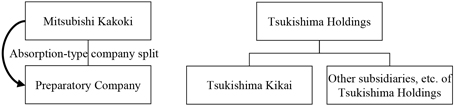
Effective as of April 1, 2027, Mitsubishi Kakoki will cause the Preparatory Company to succeed to the
rights and obligations related to the Business to be Succeeded by conducting the Absorption-type Company Split, in which Mitsubishi Kakoki will be the company splitting in the absorption-type split and the Preparatory Company will be the company
succeeding in the absorption-type split. |
| |
(II) |
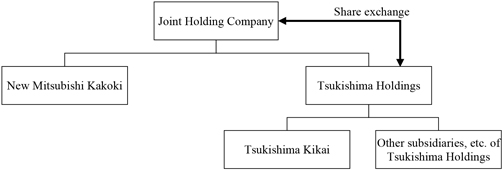
Effective as of April 1, 2027, subject to the Absorption-type Company Split and the First Amendment to
the Articles of Incorporation (as defined in “1. Reasons for amendment to the articles of incorporation” under “IV. Change of Trade Name and Other Partial Amendments to the Articles of Incorporation” below) becoming
effective, Mitsubishi Kakoki and Tsukishima Holdings will conduct the Share Exchange, in which Mitsubishi Kakoki will be the wholly owning parent company in the share exchange and Tsukishima Holdings will be the wholly owned subsidiary in the share
exchange. Subject to the Share Exchange becoming effective, Mitsubishi Kakoki plans to change its trade name to Mitsubishi Tsukishima Kakoki Holdings Co., Ltd. (“Joint Holding Company”), and the Preparatory Company plans to change its
trade name to Mitsubishi Kakoki Kaisha, Ltd. (“New Mitsubishi Kakoki”). |
| |
(III) |
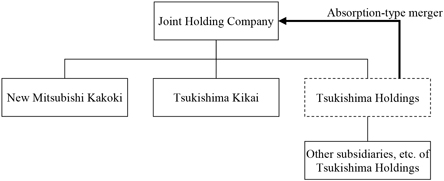
In order to avoid retaining an intermediate (pure) holding company, and thereby improve the efficiency of
group company management, the Joint Holding Company and Tsukishima Holdings plan to conduct an absorption-type merger (“Absorption-type Merger I”), in which the Joint Holding Company will be the company surviving the absorption-type
merger and Tsukishima Holdings will be the company disappearing in the absorption-type merger. The effective date of the Absorption-type Merger I is scheduled for July 1, 2027. |
| |
(IV) |
The industrial machinery businesses of the Companies will be operated by New Mitsubishi Kakoki and
Tsukishima Kikai Co., Ltd. (“Tsukishima Kikai”), respectively. For the purpose of consolidating these businesses into New Mitsubishi Kakoki and making New Mitsubishi Kakoki the operating subsidiary primarily engaged in the industrial
machinery business within the Joint Holding Company group, New Mitsubishi Kakoki and Tsukishima Kikai plan to conduct an absorption-type merger (“Absorption-type Merger II”), in which New Mitsubishi Kakoki will be the company surviving
the absorption-type merger and Tsukishima Kikai will be the company disappearing in the absorption-type merger. The effective date of the Absorption-type Merger II is scheduled for July 1, 2027. Subject to the Absorption-type Merger II becoming
effective, New Mitsubishi Kakoki plans to change its trade name to Mitsubishi Tsukishima Kakoki Machinery Co., Ltd. (“Mitsubishi Tsukishima Kakoki Machinery”). |
6
< Current structure >
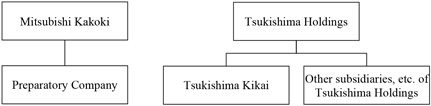
< Absorption-type Company Split (April 1, 2027 (scheduled)) >
< Share Exchange (April 1, 2027 (scheduled)) >
< Absorption-type Merger I (July 1, 2027 (target)) >
< Absorption-type Merger II (July 1, 2027 (target)) >
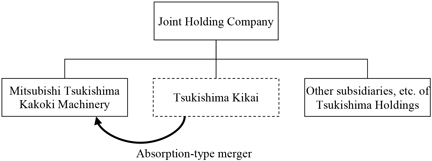
7
<After Absorption-type Merger II >
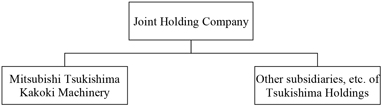
| (2) |
Status, etc. after the Business Integration |
| |
(I) |
Overview of the Joint Holding Company (scheduled) |
|
|
|
| Trade name |
|
Mitsubishi
Tsukishima Kakoki Holdings Kabushiki Kaisha (in English: Mitsubishi Tsukishima Kakoki Holdings Co., Ltd.) |
| Location of the registered office |
|
3-5-1, Harumi,
Chuo-ku, Tokyo |
| Location of the head office |
|
3-5-1, Harumi,
Chuo-ku, Tokyo |
| Governance structure |
|
Company with audit and supervisory committee |
| Representatives and officers to be appointed |
|
Toshikazu Tanaka, Chairman, Representative
Director Jun Kawasaki, President, Representative Director
Toru Takano, Director, Senior Executive Vice President, Chief Financial Officer (CFO)
Naoko Shimura, Director (Part-Time) Tokuya Wada, Director
(Part-Time) Mika Nakayama, Director (Part-Time) Shinichi
Sakemi, Director (Audit and Supervisory Committee Member) Junichi Masuda, Director (Audit and Supervisory Committee Member)
Hiroki Kitagata, Director (Audit and Supervisory Committee Member (Part-Time)) |
| Description of business |
|
Business management of subsidiaries, etc., and any and all businesses incidental or related thereto |
| Share capital |
|
5,000 million yen |
| Fiscal year-end |
|
March 31 |
| Net assets |
|
Not finalized at this time. |
| Total assets |
|
Not finalized at this time. |
| Listed stock exchange |
|
Prime Market of the Tokyo Stock Exchange, Inc. (“TSE”) |
| Accounting auditor |
|
Ernst & Young ShinNihon LLC |
| Shareholder register administrator |
|
Mitsubishi UFJ Trust and Banking Corporation |
| |
(II) |
Corporate philosophy of the Joint Holding Company |
| |
• |
|
We contribute to a sustainable society through solid technologies rooted in our manufacturing expertise.
|
| |
• |
|
We provide optimal products and services through thorough safety and strict quality management.
|
| |
• |
|
We aim to be an enriching and rewarding company by fostering a corporate culture of challenge and co-creation. |
| |
• |
|
We live up to the trust of society through sincere and highly transparent management. |
8
| |
(III) |
Purpose of the Joint Holding Company |
| |
|
Creating a comfortable future with solid technologies |
| |
(IV) |
Overview of Mitsubishi Tsukishima Kakoki Machinery (scheduled) |
|
|
|
| Trade name |
|
Mitsubishi Tsukishima Kakoki Machinery Co., Ltd. |
| Location |
|
2-1 Ohkawa-cho,
Kawasaki-ku, Kawasaki, Kanagawa |
| Name and title of the representative |
|
Toshikazu Tanaka, Representative Director, President and CEO |
| Description of business |
|
Design, manufacture, installation, sale, and other related operations of a wide range of plants, environmental control facilities, and many
kinds of industrial machinery and equipment |
| Share capital |
|
Not finalized at this time. |
| Fiscal-year end |
|
March 31 |
| Major shareholders and shareholding ratios |
|
Mitsubishi Tsukishima Kakoki Holdings 100% |
| |
(V) |
Reorganization after the Business Integration |
The water environmental businesses of the Companies will be operated by Mitsubishi Tsukishima Kakoki Machinery
and Tsukishima JFE Aqua Solution, respectively. For the purpose of consolidating these businesses into Tsukishima JFE Aqua Solution and making Tsukishima JFE Aqua Solution the operating subsidiary primarily engaged in the water environmental
business within the Joint Holding Company group, the Companies are considering an absorption-type company split to have Tsukishima JFE Aqua Solution succeed to Mitsubishi Tsukishima Kakoki Machinery’s water environmental business, in which
Tsukishima JFE Aqua Solution will be the company succeeding in the absorption-type split and Mitsubishi Tsukishima Kakoki Machinery will be the company splitting in the absorption-type split. However, regarding this absorption-type company split,
although the Companies will proceed with discussions for its implementation with Tsukishima JFE Aqua Solution and its shareholder, JFE Engineering, the details including the timing thereof remain undetermined at this time.
Other matters concerning the management system of the Joint Holding Company will be determined by the
effective date of the Absorption-type Company Split and the Share Exchange upon further consultation between the Companies.
| (3) |
Schedule of the Business Integration |
|
|
|
|
Board of directors meeting to approve the Business Integration Agreement and the Share Exchange Agreement (the Companies) |
|
September 30, 2026 (today) |
|
Board of directors meeting to approve the Absorption-type Company Split Agreement (Mitsubishi Kakoki) |
|
September 30, 2026 (today) |
|
Date of public notice of the record date for the extraordinary shareholders’ meeting (the Companies) |
|
September 30, 2026 (today) |
|
Record date for the extraordinary shareholders’ meeting (the Companies) |
|
October 16, 2026 (scheduled) |
|
Extraordinary shareholders’ meeting to approve the Business Integration Agreement and the Share Exchange Agreement (the
Companies) |
|
December 4, 2026 (scheduled) |
|
Extraordinary shareholders’ meeting to approve the Absorption-type Company Split Agreement (Mitsubishi Kakoki) |
|
December 4, 2026 (scheduled) |
|
Last trading day on the TSE (Tsukishima Holdings) |
|
March 29, 2027 (scheduled) |
|
Date of delisting from the TSE (Tsukishima Holdings) |
|
March 30, 2027 (scheduled) |
|
Effective date of the Absorption-type Company Split and the Share Exchange |
|
April 1, 2027 (scheduled) |
|
Date of trade name change (Mitsubishi Kakoki and the Preparatory Company) |
|
April 1, 2027 (scheduled) |
9
|
|
|
| (Note) |
|
The above is a tentative schedule and subject to change upon consultation between the Companies if necessary in the course
of the procedures for the Business Integration, the Share Exchange, and the Absorption-type Company Split, or for other reasons. |
| II. |
Absorption-type Company Split |
| 1. |
Summary of the Absorption-type Company Split |
| (1) |
Background and purpose of the Absorption-type Company Split |
Please see “1. Background and purpose of the Business Integration” under “I. Business
Integration” above.
| (2) |
Method of the Absorption-type Company Split |
It will be conducted through an absorption-type company split, in which Mitsubishi Kakoki will be the company
splitting in the absorption-type split and the Preparatory Company, a wholly owned subsidiary of Mitsubishi Kakoki, will be the company succeeding in the absorption-type split. The Absorption-type Company Split is scheduled to be conducted with an
effective date of April 1, 2027, subject to the approval of the Absorption-type Company Split Agreement at the extraordinary shareholders’ meeting of Mitsubishi Kakoki scheduled to be held on December 4, 2026.
| (3) |
Schedule of the Absorption-type Company Split |
Please see “(3) Schedule of the Business Integration” under “2. Summary of the Business
Integration” under “I. Business Integration” above.
| (4) |
Details of the allotment upon the Absorption-type Company Split |
Since the Absorption-type Company Split will be conducted between a wholly owning parent company and its wholly
owned subsidiary, there will be no allotment of shares or other money, etc. by the Preparatory Company upon the Absorption-type Company Split.
| (5) |
Treatment of stock acquisition rights and bonds with stock acquisition rights in connection with the
Absorption-type Company Split |
This is not applicable because Mitsubishi Kakoki has not
issued any stock acquisition rights or bonds with stock acquisition rights.
| (6) |
Increase or decrease in share capital as a result of the Absorption-type Company Split |
There will be no increase or decrease in the amount of share capital as a result of the Absorption-type Company
Split.
| (7) |
Rights and obligations to be succeeded to by the succeeding company |
The rights and obligations to be succeeded to by the Preparatory Company from Mitsubishi Kakoki will be the
assets, liabilities, contracts, and other rights and obligations (including contractual status) related to the Business to be Succeeded, as specified in the Absorption-type Company Split Agreement.
| (8) |
Prospects of fulfillment of obligations |
In connection with the Absorption-type Company Split, it has been determined that there will be no problems
with the prospects of fulfillment of the obligations to be performed by Mitsubishi Kakoki and the Preparatory Company on or after the effective date of the Absorption-type Company Split.
10
| 2. |
Overview of the parties to the Absorption-type Company Split |
Please see “3. Overview of the parties to the Share Exchange” under “III. Share
Exchange” below.
| (2) |
Preparatory Company (as of the establishment today) |
|
|
|
|
|
| (1)
Trade name |
|
MKK Next, Ltd. |
| (2) Location |
|
2-1 Ohkawa-cho, Kawasaki-ku, Kawasaki, Kanagawa |
| (3) Name and title of the representative |
|
Shiro Yajima,
Representative Director |
| (4) Description of business |
|
Design, manufacture, installation, sale, and other related operations of a wide range of plants, environmental control
facilities, and many kinds of industrial machinery and equipment |
| (5) Share capital |
|
25 million
yen |
| (6) Date of establishment |
|
September 30,
2026 |
| (7) Number of issued shares |
|
1,000
shares |
| (8) Fiscal-year end |
|
March 31 |
| (9) Major shareholders and shareholding ratios |
|
Mitsubishi Kakoki
100% |
| (10) Relationship between the parties |
|
Capital relationship |
|
Mitsubishi
Kakoki holds 100% of the issued shares of the Preparatory Company. |
| |
Personnel relationship |
|
One
director of the Preparatory Company concurrently serves as a director of Mitsubishi Kakoki. |
| |
Business relationship |
|
Since the
Preparatory Company has not commenced operations, there is no business relationship with Mitsubishi Kakoki. |
| |
Related party relationship |
|
Since the
Preparatory Company is a wholly owned subsidiary of Mitsubishi Kakoki, Mitsubishi Kakoki and the Preparatory Company mutually fall under related parties. |
|
|
|
| (Note 1) |
|
The Preparatory Company plans to change its trade name to “Mitsubishi Kakoki Kaisha, Ltd.,” subject to the
Absorption-type Company Split becoming effective on April 1, 2027. |
|
|
| (Note 2) |
|
Since the Preparatory Company is established today and has no operating results for the immediately preceding fiscal year,
its financial position and operating results for the immediately preceding fiscal year are not stated. |
| 3. |
Overview of the business division to be split off |
| (1) |
Description of business of the division to be split off |
All of Mitsubishi Kakoki’s businesses except for the businesses related to certain functions necessary for Mitsubishi Kakoki to become a holding company
| (2) |
Operating results of the division to be split off (for the fiscal year ended March 31, 2026)
|
|
|
|
|
|
|
|
| |
|
Results of the business to be split off
(a) |
|
Non-consolidated results of the splitting company (b) |
|
Ratio (a/b) |
|
Sales |
|
74,100 million yen |
|
74,100 million yen |
|
100% |
11
| (3) |
Items and book values of assets and liabilities to be split off (as of March 31, 2026)
|
|
|
|
|
|
|
|
| Assets |
|
Liabilities |
| Current assets |
|
44,602 million yen |
|
Current liabilities |
|
17,563 million yen |
| Non-current assets |
|
16,378 million yen |
|
Non-current liabilities |
|
4,220 million yen |
| Total |
|
60,981 million yen |
|
Total |
|
21,783 million yen |
|
|
|
| (Note) |
|
Since the items and amounts of the assets and liabilities to be split off are based on the figures as of March 31,
2026, the actual amounts to be succeeded to (the above amounts adjusted for any increases or decreases up to the effective date of the Absorption-type Company Split) will differ from these amounts. |
| 4. |
Status after the Absorption-type Company Split |
Please see “(2) Status, etc. after the Business Integration” under “2. Summary of the
Business Integration” under “I. Business Integration” above.
Management policies, plans, earnings forecasts, and other relevant matters following the Business Integration
will be discussed by the Companies and announced as soon as they are finalized.
| 1. |
Summary of the Share Exchange |
| (1) |
Background and purpose of the Share Exchange |
Please see “1. Background and purpose of the Business Integration” under “I. Business
Integration” above.
| (2) |
Method of the Share Exchange |
Please see “(1) Method of the Business Integration” under “2. Summary of the Business
Integration” under “I. Business Integration” above.
| (3) |
Schedule of the Share Exchange |
Please see “(3) Schedule of the Business Integration” under “2. Summary of the Business
Integration” under “I. Business Integration” above.
| (4) |
Details of the allotment in the Share Exchange (share exchange ratio) |
|
|
|
|
|
| |
|
Mitsubishi Kakoki (parent company
in the share exchange) |
|
Tsukishima Holdings (subsidiary in
the share exchange) |
| Exchange ratio in the share exchange |
|
1 |
|
0.88 |
| Number of shares to be delivered in the Share Exchange |
|
Shares of the common stock of Mitsubishi Kakoki: 34,811,735 shares (scheduled) |
12
|
|
|
|
|
| |
(Note 1) |
|
|
Share allotment ratio
0.88 shares of the common stock of Mitsubishi Kakoki will be allotted and delivered for each share of the common stock of Tsukishima Holdings.
However, the share exchange ratio stated above (“Share Exchange Ratio”) is subject to change upon consultation between the Companies in the event of any material change to the conditions forming the basis of its calculation. If a
decision is made to change the Share Exchange Ratio, it will be disclosed immediately. |
| |
(Note 2) |
|
|
Number of shares to be delivered in the Share Exchange
34,811,735 shares of the common stock of Mitsubishi Kakoki
(scheduled) The above number of shares of the common
stock is calculated based on the total number of issued shares of the common stock (40,125,800 shares) and the number of treasury shares (567,010 shares) of Tsukishima Holdings as of June 30, 2026.
Upon the Share Exchange, Mitsubishi Kakoki plans to allot
and deliver the number of shares of the common stock of Mitsubishi Kakoki calculated based on the Share Exchange Ratio to the shareholders of Tsukishima Holdings as of the time immediately preceding the time when Mitsubishi Kakoki acquires all of
the issued shares of Tsukishima Holdings (“Record Time”), in exchange for the shares of the common stock of Tsukishima Holdings held by them. In addition, regarding the shares of the common stock of Mitsubishi Kakoki to be delivered,
Mitsubishi Kakoki plans to appropriate a portion of the treasury shares it holds and newly issue 34,151,480 shares of the common stock.
Furthermore, the actual number of shares of the common stock to be delivered by Mitsubishi Kakoki is subject to change in the future, as
Tsukishima Holdings plans to cancel, at the Record Time, all of its treasury shares held at the time immediately preceding the Record Time (including shares acquired upon demand for the purchase of shares by dissenting shareholders in connection
with the Share Exchange pursuant to Article 785, Paragraph 1 of the Companies Act) by a resolution of the board of directors of Tsukishima Holdings at a meeting to be held by the day immediately preceding the effective date of the Share
Exchange. |
| |
(Note 3) |
|
|
Treatment of shares less than one unit |
|
|
|
|
|
|
It is expected that some shareholders will newly hold shares of Mitsubishi Kakoki less than one unit in connection with the Share Exchange, but such shares cannot be sold on financial instruments exchange markets. Shareholders of
Tsukishima Holdings who will hold shares of Mitsubishi Kakoki less than one unit may use the following systems on or after the effective date of the Share Exchange. |
|
|
| |
(I) |
|
|
System for demanding the purchase of shares less than one unit (sale of shares less than one unit) |
|
|
|
|
|
|
Pursuant to the provisions of Article 192, Paragraph 1 of the Companies Act, shareholders may demand that Mitsubishi Kakoki purchase the shares less than one unit held by them. |
|
|
| |
(II) |
|
|
System for purchasing additional shares less than one unit (purchase of additional shares to constitute one unit) |
|
|
|
|
|
|
Pursuant to the provisions of Article 194, Paragraph 1 of the Companies Act and the articles of incorporation of Mitsubishi Kakoki, shareholders may demand that Mitsubishi Kakoki sell them the number of shares that, together with
the number of shares less than one unit to be held by them, will constitute one unit of shares (100 shares), except where Mitsubishi Kakoki does not hold the number of treasury shares to meet such demand. |
|
|
| |
(Note 4) |
|
|
Treatment of fractions of one share |
|
|
|
|
|
|
With respect to the shareholders of Tsukishima Holdings who will receive an allotment of fractions of one share of the common stock of Mitsubishi Kakoki in connection with the Share Exchange, Mitsubishi Kakoki will pay them an
amount corresponding to such fractions of one share in accordance with the provisions of Article 234 of the Companies Act and other relevant laws and regulations. |
13
| (5) |
Treatment of stock acquisition rights and bonds with stock acquisition rights in connection with the Share
Exchange |
This is not applicable because Tsukishima Holdings, which will become a wholly
owned subsidiary in the share exchange, has not issued any stock acquisition rights or bonds with stock acquisition rights.
Mitsubishi Kakoki plans to pay a dividend of up to 60 yen per share, with a record date of September 30,
2026, and a dividend of up to 75 yen per share, with a record date of March 31, 2027.
Tsukishima
Holdings plans to pay a dividend of up to 44 yen per share, with a record date of September 30, 2026, and a dividend of up to 50 yen per share, with a record date of March 31, 2027. Additionally, Tsukishima Holdings may repurchase its own
shares up to a total amount of 3,000,000,000 yen, in accordance with applicable laws and regulations, until the day before the effective date of the Share Exchange.
| (7) |
Voting rights of shareholders of Tsukishima Holdings to whom shares of the common stock of Mitsubishi Kakoki
will be allotted and delivered upon the Share Exchange |
Today, Mitsubishi Kakoki’s
board of directors has resolved, pursuant to the provisions of Article 124, Paragraph 4 of the Companies Act, to grant to the shareholders of Tsukishima Holdings to whom shares of the common stock of Mitsubishi Kakoki are to be allotted and
delivered upon the Share Exchange, voting rights with respect to their allotted and delivered shares of Mitsubishi Kakoki common stock, which are exercisable at the annual shareholders’ meeting of the Joint Holding Company scheduled for June
2027. The grant of voting rights will be subject to the conditions precedent that (i) the amendment to Tsukishima Holdings’ articles of incorporation, which deletes the provision regarding the record date for voting rights at its annual
shareholders’ meetings, as described in the “Notice Regarding the Record Date for an Extraordinary General Meeting of Shareholders, Amendments to the Articles of Incorporation, and Revision of the Restricted Stock Compensation
Plan” announced today by Tsukishima Holdings, has taken effect, and that (ii) the Share Exchange has taken effect.
| 2. |
Basis for the details of the allotment in the Share Exchange |
| (1) |
Basis and reasons for the details of the allotment |
To ensure the fairness and appropriateness of the Share Exchange Ratio in valuating the Share Exchange Ratio
described in “(4) Details of the allotment in the Share Exchange (share exchange ratio)” under “1. Summary of the Share Exchange” above, Mitsubishi Kakoki selected Mitsubishi UFJ Morgan Stanley Securities Co., Ltd.
(“Mitsubishi UFJ Morgan Stanley Securities”), and Tsukishima Holdings selected Nomura Securities Co., Ltd. (“Nomura Securities”), as their respective financial advisors and third-party valuators independent of the
Companies.
Mitsubishi Kakoki engaged in careful and repeated discussions and deliberations based on the
results of the valuation of the share exchange ratio and advice received from Mitsubishi UFJ Morgan Stanley Securities, a third-party valuator, as described in “(I) Procurement of valuation reports from independent third-party valuators”
under “(4) Measures to ensure fairness” below, the legal advice from Anderson Mori & Tomotsune, as described in “(II) Advice procured from independent law firms” under “(4) Measures to ensure fairness”
below, as well as the results of various due diligence processes conducted by Mitsubishi Kakoki and its advisors on Tsukishima Holdings, among others, taking into account the financial conditions, performance trends, and stock price trends of the
Companies. Consequently, Mitsubishi Kakoki has determined that the Share Exchange Ratio described in “(4) Details of the allotment in the Share Exchange (share exchange ratio)” under “1. Summary of the Share Exchange” above
is appropriate and that the Share Exchange will serve the interests of shareholders of Mitsubishi Kakoki.
14
Tsukishima Holdings engaged in careful and repeated
discussions and deliberations based on the results of the valuation of the share exchange ratio and advice received from Nomura Securities, a third-party valuator, as described in “(I) Procurement of valuation reports from independent
third-party valuators” under “(4) Measures to ensure fairness” below, the legal advice from Nishimura & Asahi (Gaikokuho Kyodo Jigyo), as described in “(II) Advice procured from independent law firms” under
“(4) Measures to ensure fairness” below, as well as the results of various due diligence processes conducted by Tsukishima Holdings and its advisors on Mitsubishi Kakoki, among others, taking into account the financial conditions,
performance trends, and stock price trends of the Companies. Consequently, Tsukishima Holdings has determined that the Share Exchange Ratio described in “(4) Details of the allotment in the Share Exchange (share exchange ratio)” under
“1. Summary of the Share Exchange” above is appropriate and that the Share Exchange will serve the interests of shareholders of Tsukishima Holdings.
As outlined above, there have been careful and repeated negotiations and discussions between the Companies
based on the results of the due diligence conducted by each of the Companies on the other. The Companies took into account the valuation and analysis results provided by third-party valuators and the advice of legal advisors and comprehensively
considered the financial conditions, future prospects, and stock price trends of the Companies. As a result, the Companies have finally determined that the Share Exchange Ratio described in (4) Details of the allotment in the Share Exchange
(share exchange ratio)” under “1. Summary of the Share Exchange” above is appropriate and that the Share Exchange will serve the interests of the shareholders of the Companies. Consequently, at the Companies’ board of
directors meetings held today, resolutions were passed to enter into the Business Integration Agreement and the Share Exchange Agreement, and the Business Integration Agreement and the Share Exchange Agreement were executed.
| (2) |
Matters concerning valuation |
| |
(I) |
Valuators’ names and relationships with the Companies |
Neither Mitsubishi UFJ Morgan Stanley Securities nor Nomura Securities is a related party of either of the
Companies, and neither has any material interest in the Share Exchange that should be disclosed.
| |
(II) |
Overview of valuation |
Mitsubishi UFJ Morgan Stanley Securities adopted the following valuation methods for each of the Companies and
performed the valuations: a market share price analysis, given that the Companies’ shares are listed on a financial instruments exchange and have respective market prices; a comparable company analysis, as there are multiple comparable similar
listed companies for the Companies, allowing for the estimation by analogy of their share value through such analysis; and a discounted cash flow analysis (“DCF Analysis”) to reflect the future state of their business activities in the
valuation.
For the market share price analysis, setting the valuation reference date at
September 29, 2026, Mitsubishi UFJ Morgan Stanley Securities used the closing price on the valuation reference date, as well as the simple average of the closing prices on each trading day during the
one-month, three-month, and six-month periods up to the valuation reference date, each on the TSE.
The valuation in the DCF Analysis is based on various factors, including the revenue and investment plans set
forth in the financial forecasts presented by the Companies’ respective managements, which the Companies agreed to the use for valuation purposes, the results of due diligence conducted on the Companies, and other publicly available
information. Please note that the financial forecasts of the Companies used as assumptions in the valuation do not include any fiscal year in which significant increases or decreases in income are anticipated.
The valuation results for each method are indicated below. The following is the valuation range for the number
of shares of the common stock of Mitsubishi Kakoki to be allotted for each share of the common stock of Tsukishima Holdings, based on each method.
15
|
|
|
| Method adopted |
|
Valuation range of the share exchange ratio |
| Market share price analysis |
|
0.79 - 0.83 |
| Comparable company analysis |
|
0.52 - 1.23 |
| DCF Analysis |
|
0.70 - 1.24 |
(Note) The analysis by Mitsubishi UFJ Morgan Stanley Securities and the analysis of the
share exchange ratio on which it is based are intended solely for the reference of the board of directors of Mitsubishi Kakoki. These analyses are not a financial opinion or recommendation by Mitsubishi UFJ Morgan Stanley Securities or its
affiliates. They do not express an opinion or make a recommendation to the shareholders of Mitsubishi Kakoki or Tsukishima Holdings regarding their approval of the Share Exchange, the transfer and acquisition of shares, the exercise of voting rights
or other shareholder rights, their consent to the Share Exchange, or any other related matters. In analyzing and valuating the share exchange ratio, Mitsubishi UFJ Morgan Stanley Securities has relied on information that has already been made
public, that was provided by Mitsubishi Kakoki or Tsukishima Holdings, or otherwise made available to it, assuming that such information is accurate and complete, without independently conducting a verification of the accuracy or completeness of
said information. Furthermore, Mitsubishi UFJ Morgan Stanley Securities assumes that the financial forecasts have been reasonably prepared and compiled by the respective managements of the Companies to reflect the best available forecasts and
judgments at the time they were provided regarding their future financial conditions. Mitsubishi UFJ Morgan Stanley Securities has not conducted its own evaluation or appraisal of the assets and liabilities (including
off-balance-sheet assets and liabilities and other contingent liabilities) of Mitsubishi Kakoki, Tsukishima Holdings, and their respective affiliates. Mitsubishi UFJ Morgan Stanley Securities has not been
provided with any such evaluation or appraisal, nor has it requested any third-party institution to conduct appraisal or evaluation. Mitsubishi UFJ Morgan Stanley Securities’ analysis is predicated on economic, financial, market, and other
conditions as of the valuation reference date of the share exchange ratio valuation report, and is based on information available to Mitsubishi UFJ Morgan Stanley Securities as of that date. Events occurring on or after that date may have an impact
on the assumptions used in Mitsubishi UFJ Morgan Stanley Securities’ analysis and the preparation of the share exchange ratio valuation report. However, Mitsubishi UFJ Morgan Stanley Securities is not obligated to update, revise, or reaffirm
the share exchange ratio valuation report or its analysis. Furthermore, the preparation of the share exchange ratio valuation report and the underlying analysis involved a complex process and may not be suitable for partial analysis or summary
presentation. The valuation ranges, based on specific analyses described herein, should not be construed as Mitsubishi Kakoki’s or Tsukishima Holdings’ actual value as assessed by Mitsubishi UFJ Morgan Stanley Securities.
Nomura Securities performed the valuations by adopting the following valuation methods: the market price
average method, given that the shares of the Companies are listed on the TSE Prime Market and market prices are available; the comparable company analysis method, as there are several similar comparable listed companies for the Companies, allowing
for the estimation by analogy of share value using this method; and the discounted cash flow method (“DCF Method”) to reflect the future state of their business activities in the valuation.
The valuation range for the share exchange ratio, with per-share value
of the common stock of Mitsubishi Kakoki set at 1 under each method, is as follows:
|
|
|
| Method adopted |
|
Valuation range of the share exchange ratio |
| Market price average method |
|
0.79 - 0.83 |
| Comparable company analysis method |
|
0.66 - 0.80 |
| DCF Method |
|
0.84 - 1.28 |
For the market price average method, setting the valuation reference
date at September 29, 2026, Nomura Securities used the closing price of the stock of the Companies on the valuation reference date, as well as the simple average of closing prices on trading days during the most recent five business days, and
the one-month, three-month, and six-month periods up to the valuation reference date, each on the TSE Prime Market.
16
Regarding the DCF Method, enterprise value has been
determined by discounting the future cash flows generated by the Companies to their present value, based on the business plans provided by Tsukishima Holdings, as well as the business plans that were provided by Mitsubishi Kakoki and acknowledged by
Tsukishima Holdings.
In valuating the share exchange ratio, Nomura Securities has assumed that the
publicly available information and all pieces of information provided to Nomura Securities by the Companies are accurate and complete and has not independently verified the accuracy or completeness of such information. With regard to the assets and
liabilities of the Companies and their affiliates (including financial derivative instruments, off-balance-sheet assets and liabilities, and other contingent liabilities), Nomura Securities has not conducted
any independent evaluation, appraisal, or assessment, including an analysis and evaluation of individual assets and liabilities, nor has it requested any third-party institution to perform such an appraisal or assessment. Nomura Securities’
valuation of the share exchange ratio reflects the information and economic conditions available to Nomura Securities as of September 29, 2026. Nomura Securities assumes that the respective financial projections of the Companies (including
income plans and other relevant information) have been reasonably reviewed and confirmed by their respective managements based on the best available forecasts and judgments at this time, and that the financial conditions of Mitsubishi Kakoki and
Tsukishima Holdings will evolve in accordance with those forecasts.
Additionally, the business plans of
the Companies, which Nomura Securities used as the basis for the DCF Method, do not incorporate the synergies expected from the Share Exchange. Furthermore, the business plans of Mitsubishi Kakoki and Tsukishima Holdings, both for the period from
the fiscal year ending March 31, 2027 through the fiscal year ending March 31, 2030, which Nomura Securities used as assumptions for the DCF Method, include fiscal years in which significant changes in free cash flow are projected compared
to the previous fiscal year. Specifically, for Mitsubishi Kakoki, a significant increase in free cash flow is projected for the fiscal year ending March 31, 2029 and the fiscal year ending March 31, 2030 due to a decline in capital expenditures
beginning in the fiscal year ending March 31, 2028. For Tsukishima Holdings, a substantial increase in free cash flow is projected for the fiscal year ending March 31, 2028, due to a smaller increase in working capital and a decrease in capital
expenditures, and for the fiscal year ending March 31, 2030, a substantial increase in free cash flow is projected due to a smaller increase in working capital.
| (3) |
Possibility of delisting and reason therefor |
As a result of the Share Exchange, Mitsubishi Kakoki is scheduled to acquire all of the issued shares in Tsukishima Holdings on
April 1, 2027, the effective date of the Share Exchange. Prior to that, shares of the common stock of Tsukishima Holdings are scheduled to be delisted on March 30, 2027, following the prescribed procedures in accordance with the
TSE’s delisting criteria (the last trading day will be March 29, 2027).
Meanwhile, shares of the common stock
of Mitsubishi Kakoki, which serve as the consideration for the Share Exchange, are listed on the TSE and will continue to be tradable on the TSE.
| (4) |
Measures to ensure fairness |
To ensure the fairness of the Share Exchange, the Companies have implemented the following measures:
| |
(I) |
Procurement of valuation reports from independent third-party valuators |
In order to ensure the fairness and appropriateness of the Share Exchange, on September 29, 2026,
Mitsubishi Kakoki obtained a valuation report regarding the share exchange ratio from Mitsubishi UFJ Morgan Stanley Securities, a third-party valuator independent of the Companies. For the outline of the valuation report, please see “(2)
Matters concerning valuation” above.
Meanwhile, in order to ensure the fairness and appropriateness
of the Share Exchange, on September 29, 2026, Tsukishima Holdings obtained a valuation report regarding the share exchange ratio from Nomura Securities, a third-party valuator independent of the Companies. For the outline of the valuation
report, please see “(2) Matters concerning valuation” above.
17
| |
(II) |
Advice procured from independent law firms |
In order to ensure the fairness and legality of the board of directors’ decision-making regarding the
Business Integration, Mitsubishi Kakoki has obtained advice from Anderson Mori & Tomotsune, its legal advisor, regarding the various procedures for the Business Integration and the methods and processes of the board of directors’
decision-making from a legal perspective.
Meanwhile, in order to ensure the fairness and legality of the
board of directors’ decision-making regarding the Business Integration, Tsukishima Holdings has obtained advice from Nishimura & Asahi (Gaikokuho Kyodo Jigyo), its legal advisor, regarding the various procedures for the Business
Integration and the methods and processes of the board of directors’ decision-making from a legal perspective.
Anderson Mori & Tomotsune and Nishimura & Asahi (Gaikokuho Kyodo Jigyo) are both independent
of the Companies and have no material interest in either of them.
| (5) |
Measures to avoid conflict of interest |
As no particular conflict of interest arises between Mitsubishi Kakoki and Tsukishima Holdings in connection with the Share
Exchange, no special measures have been taken.
| 3. |
Overview of the parties to the Share Exchange |
|
|
|
|
|
|
|
|
|
| (1) Name |
|
Mitsubishi Kakoki Kaisha, Ltd. |
|
TSUKISHIMA HOLDINGS CO., LTD. |
| (2) Location |
|
2-1 Ohkawa-cho, Kawasaki-ku, Kawasaki, Kanagawa, 210-8560 |
|
3-5-1, Harumi Chuo-ku, Tokyo, 104-0053 |
| (3) Name and title of the
representative |
|
Toshikazu Tanaka
Representative Director, President and CEO |
|
Jun
Kawasaki President, Representative Director |
| (4) Description of
business |
|
Design, manufacture, installation, sale, and other related operations of a wide range of plants, environmental
control facilities, and many kinds of industrial machinery and equipment. |
|
Design and construction of water purification plants and sewage treatment plants, sludge
recycling plants, and biomass utilization plants, among other businesses. |
| (5) Share capital |
|
3,956 million
yen (As of June 30, 2026) |
|
6,646 million yen (As of June 30, 2026) |
| (6) Date of
establishment |
|
September 1, 1949 |
|
May 31, 1917 |
| (7) Number of issued
shares |
|
23,741,850 shares
(As of June 30, 2026) |
|
40,125,800 shares (As of June 30, 2026) |
| (8) Fiscal year-end |
|
March 31 |
|
March 31 |
| (9) Number of employees
(consolidated) |
|
1,044
(As of March 31, 2026) |
|
3,367 (As of March 31, 2026) |
| (10) Major business
partners |
|
Companies in the chemical, semiconductor, food, energy, shipbuilding, and other industries, and local
governments. |
|
Local governments, water and sewerage utilities, and companies in the chemical, food, and waste
management industries, among others. |
18
|
|
|
|
|
|
|
|
|
| (11) Main financing
banks |
|
MUFG Bank, Ltd.
The Bank of Yokohama, Ltd. |
|
MUFG Bank, Ltd. |
| (12) Major
shareholders and shareholding ratios (as of March 31, 2026) |
|
The Master Trust Bank of Japan, Ltd. (trust account) |
|
12.87% |
|
The Master Trust Bank of Japan, Ltd. (trust account) |
|
9.82% |
| |
Meiji Yasuda Life Insurance Company (Standing Proxy: Custody Bank of Japan, Ltd.) |
|
5.41% |
|
Tsukishima Holdings Employee Stock Ownership |
|
5.38% |
| |
Mitsubishi Kakoki Client Stock Ownership |
|
4.19% |
|
The Japan Steel Works, Ltd. |
|
4.47% |
| |
Custody Bank of Japan, Ltd. (trust account) |
|
3.61% |
|
Tokyo Century Corporation |
|
4.44% |
| |
Mitsubishi Kakoki Employee Stock Ownership |
|
2.43% |
|
Tsukishima Holdings Client Stock Ownership |
|
3.07% |
| |
BNY GCM CLIENT ACCOUNT JPRD AC ISG (FE-AC) (Standing Proxy: MUFG Bank, Ltd.) |
|
1.69% |
|
GOVERNMENT OF NORWAY (Standing Proxy: Citibank, N.A., Tokyo Branch) |
|
2.60% |
| |
The Bank of Yokohama, Ltd. (Standing Proxy: Custody Bank of Japan, Ltd.) |
|
1.62% |
|
MUFG Bank, Ltd. |
|
2.38% |
| |
DFA INTL SMALL CAP VALUE PORTFOLIO (Standing Proxy: Citibank, N.A., Tokyo Branch) |
|
1.31% |
|
TOYO DENKI SEIZO K.K. |
|
2.22% |
| |
|
STATE STREET BANK AND TRUSTCOMPANY 505223 (Standing Proxy: Mizuho Bank, Ltd., Settlement & Clearing Services
Department) |
|
1.30% |
|
Custody Bank of Japan, Ltd. (trust account) |
|
2.08% |
| |
|
DAIICHI JITSUGYO CO., LTD. |
|
1.16% |
|
OKAMURA CORPORATION |
|
1.91% |
|
(13) Relationships between the parties |
|
|
|
|
|
|
|
|
|
|
|
| |
|
Capitalrelationship |
|
Not applicable. |
| |
|
Personnelrelationship |
|
Not applicable. |
| |
|
Businessrelationship |
|
Not applicable. |
| |
|
Relatedparty relationship |
|
Not applicable. |
19
|
|
|
|
|
|
|
|
|
|
|
|
|
|
|
|
|
|
|
|
|
|
|
|
|
|
(14) Financial positions and operating results for the most recent three years |
|
| Fiscal year |
|
|
Mitsubishi Kakoki (consolidated) |
|
|
|
Tsukishima Holdings (consolidated) |
|
| |
|
Fiscal year
ended
March 2024 |
|
|
|
Fiscal year
ended
March 2025 |
|
|
|
Fiscal year
ended
March 2026 |
|
|
|
Fiscal year
ended
March 2024 |
|
|
|
Fiscal year
ended March
2025 |
|
|
|
Fiscal year
ended March
2026 |
|
Consolidated net assets
(million yen) |
|
|
34,577 |
|
|
|
38,227 |
|
|
|
44,932 |
|
|
|
105,538 |
|
|
|
112,054 |
|
|
|
117,466 |
|
| Consolidated total assets (million yen) |
|
|
63,170 |
|
|
|
66,174 |
|
|
|
78,093 |
|
|
|
208,014 |
|
|
|
192,248 |
|
|
|
203,021 |
|
| Consolidated net assets per share (yen) |
|
|
1,513.35 |
|
|
|
1,674.46 |
|
|
|
1,972.37 |
|
|
|
2,040.89 |
|
|
|
2,159.30 |
|
|
|
2,482.03 |
|
Consolidated net sales
(million yen) |
|
|
47,774 |
|
|
|
59,202 |
|
|
|
84,240 |
|
|
|
124,205 |
|
|
|
139,235 |
|
|
|
148,954 |
|
| Consolidated operating income (million yen) |
|
|
4,410 |
|
|
|
5,694 |
|
|
|
9,181 |
|
|
|
6,765 |
|
|
|
8,915 |
|
|
|
9,842 |
|
| Consolidated ordinary income (million yen) |
|
|
4,709 |
|
|
|
5,626 |
|
|
|
9,462 |
|
|
|
7,810 |
|
|
|
10,254 |
|
|
|
10,987 |
|
| Consolidated profit attributable to owners of parent (million yen) |
|
|
5,397 |
|
|
|
4,879 |
|
|
|
7,546 |
|
|
|
2,675 |
|
|
|
6,669 |
|
|
|
16,910 |
|
| Consolidated net income per share (yen) |
|
|
236.23 |
|
|
|
213.79 |
|
|
|
331.34 |
|
|
|
62.38 |
|
|
|
154.97 |
|
|
|
412.69 |
|
| Dividend per share (yen) |
|
|
110.00 |
|
|
|
210.00 |
|
|
|
115.00 |
|
|
|
42.00 |
|
|
|
78.00 |
|
|
|
85.00 |
|
| (Note) |
Mitsubishi Kakoki has implemented a
3-for-1 share split of its common stock, effective April 1, 2025. Accordingly, consolidated net assets per share and consolidated net income per share of Mitsubishi
Kakoki for the fiscal years ended March 31, 2024 and March 31, 2025 have been calculated as if the share split had occurred at the beginning of the respective consolidated fiscal years. The dividends per share of Mitsubishi Kakoki for the
fiscal years ended March 31, 2024 and March 31, 2025 reflect the actual dividend amounts prior to the share split. The dividend per share of Mitsubishi Kakoki for the fiscal year ended March 31, 2026, excluding the effect of this
share split, would be 345 yen. |
| 4. |
Overview of the accounting treatment related to the Share Exchange |
As the Share Exchange will be accounted for as a “reverse acquisition” under the Accounting
Standards for Business Combinations, the purchase method is expected to be applied, with Tsukishima Holdings considered the acquiring enterprise and Mitsubishi Kakoki the acquired enterprise. As a result of the application of the purchase method,
goodwill (or negative goodwill) is expected to arise in the consolidated financial statements of the Joint Holding Company, though the amount has not yet been determined.
20
The Joint Holding Company aims to further enhance shareholder value by combining profit growth driven by the
early realization of synergies with flexible capital policies, including the acquisition of its own shares.
Furthermore, the Joint Holding Company plans to consider specific measures to implement shareholder returns,
including the acquisition of its own shares, promptly after its establishment, with a view to offsetting the dilution resulting from the Business Integration within approximately two years following the effective date of the Share Exchange, while
balancing these efforts with growth investments.
In addition, specific business plans (management
policies, plans, earnings forecasts, key KPIs, and other relevant matters) following the Business Integration will be discussed by the Companies and announced as soon as they are finalized.
| IV. |
Change of Trade Name and Other Partial Amendments to the Articles of Incorporation |
| 1. |
Reasons for amendment to the articles of incorporation |
In conjunction with the transition to a holding company structure as part of the Business Integration,
Mitsubishi Kakoki resolved at its board of directors meeting held today to (a) increase the total number of shares authorized to be issued as set forth in “(1) First Amendment to the Articles of Incorporation” under
“2. Details of the amendments to the articles of incorporation” below for the purpose of implementing the Share Exchange, subject to the Absorption-type Company Split becoming effective (“First Amendment to the Articles of
Incorporation”), and to (b) change its trade name to “Mitsubishi Tsukishima Kakoki Holdings Co., Ltd.” and the Preparatory Company’s trade name to “Mitsubishi Kakoki Kaisha, Ltd.” and to amend the
company’s business purposes and other provisions as set forth in “(2) Second Amendment to the Articles of Incorporation” under “2. Details of the amendments to the articles of incorporation” below as of the
effective date of the Share Exchange, subject to the Share Exchange becoming effective (“Second Amendment to the Articles of Incorporation”), both with the approval at the extraordinary shareholders’ meeting of Mitsubishi Kakoki
scheduled for December 4, 2026.
21
| 2. |
Details of the amendments to the articles of incorporation |
| (1) |
First Amendment to the Articles of Incorporation |
(The underlined portions indicate the change.)
|
|
|
|
Current articles of incorporation |
|
Proposed amendment |
| CHAPTER II.
SHARES Article 6. Total Number of Shares Authorized to be Issued
The total number of shares authorized to be issued by the Company shall be
forty-eight million (48,000,000) shares. |
|
CHAPTER II. SHARES
Articles 6. Total
Number of Shares Authorized to be Issued The total number of shares authorized to be
issued by the Company shall be eighty million (80,000,000) shares. |
| (2) |
Second Amendment to the Articles of Incorporation |
(The underlined portions indicate the changes.)
|
|
|
|
Current articles of incorporation |
|
Proposed amendments |
| CHAPTER I.
GENERAL PROVISIONS Article 1. Trade Name
The name of the Company shall be
Mitsubishi Kakoki Kabushiki Kaisha.
In English, it shall be called Mitsubishi Kakoki Kaisha, Ltd.
Article 2. Objectives and
Purposes The
Company’s objectives are to engage in the following businesses:
1. The manufacture, repair and sale of plants and equipment for oil refining,
petro-chemical industry, gas industry, iron manufacturing, atomic energy, fertilizer industry, food industry, medical industry and other various chemical and general industries;
2. The manufacture, repair and sale of plants and equipment for air pollution
prevention, water treatment, waste treatment, and other pollution prevention and environmental sanitation;
3. The manufacture, repair and sale of centrifugal separators, filters, dryers,
agitators, dust collectors, cleaning machines and other general machinery;
4. The manufacture, repair and sale of luminaires;
5. The manufacture and sale of various high-pressure gases;
6. The vapor deposition on optical parts, mechanical parts, tools, personal ornaments
and other glass, metal and plastic products, and the manufacture and sale of such vapor deposited products; |
|
CHAPTER I. GENERAL PROVISIONS
Article 1. Trade Name
The name of the Company shall be
Mitsubishi Tsukishima Kakoki Holdings Kabushiki Kaisha.
In English, it shall be called Mitsubishi Tsukishima Kakoki Holdings Co., Ltd.
Article 2. Objectives and
Purposes The Company’s
objectives are to engage in the following businesses and to control or manage the business activities of companies (including foreign companies) and other legal entities engaged in such businesses by holding shares or equity interests in such
entities:
(1) The design, manufacture, installation, repair, sale,
leasing, and supervision of machinery, equipment, and tanks for use in the chemical, pharmaceutical, food, steel, fertilizer, energy, and other industrial sectors;
(2) The design, manufacture, installation, repair, sale,
leasing, and supervision of machinery and equipment for water supply and sewerage systems, water treatment, waste treatment, prevention of air pollution and other forms of environmental pollution, and environmental improvement;
(3) The design, construction, supervision, operation, and
maintenance of civil engineering, architectural, electrical, steel structure, and machinery and equipment installation projects for industrial, water supply and sewerage, water treatment, waste treatment, and other types of
plants; |
22
|
|
|
|
7. The design, supervision and construction of projects in areas including civil
engineering, building, piping, tiling, brick and block, steel structures, installation of machinery and apparatuses, water supply facilities, waste treatment facilities, scaffolding, earthworks, and painting;
8. Engineering business and lease of the items listed in the preceding Items;
9. Cleaning services for buildings, structures, industrial equipment, machinery
apparatuses and parts;
10. The manufacture and sale of chemicals, extracts from animals and plants, chemical
products such as deodorants and aromatics that contain any of the foregoing, medicines, quasi-pharmaceutical products, processed foods such as starch food, protein food, vitamin food and calcium food, food additives, fodder and fodder
additives;
11. Consulting services and the sale of technology related to the items listed in the
preceding Items;
12. Nonlife insurance agency business;
13. Purchase and sale of construction materials, office consumable supplies, factory
consumables such as tools, welding auxiliary materials and oils, clothing and daily necessaries;
14. Business concerning the treatment of various waste
matters;
15. Purchase, sale, leasing and management of real
estate;
16. Services related to power generation and electricity
sales;
17. Agency and intermediary business connected with the
activities itemized in the preceding Items; and
18. All businesses incidental to the activities in the
preceding Items. Article 3.
Location of Head Office The
Company shall have its head office in Kawasaki-ku, Kawasaki-shi, Kanagawa.
Article 4. Governing Bodies
In addition to the General Meeting of Shareholders and Directors, the Company shall have the following bodies:
1. Board of Directors;
2. Audit and Supervisory Committee; and
3. Accounting Auditors.
Article 5 (Texts omitted.) |
|
(4) Collection, transportation, and treatment of general
and industrial waste;
(5) Implementation of soil contamination surveys and
assessments, and the design, construction and supervision of soil remediation projects;
(6) The manufacture and sale of various high-pressure
gases;
(7) The manufacture, import, and sale of chemical
products, industrial chemicals, pharmaceuticals, processed foods, food additives, animal feed, feed additives, and fertilizers; and the import and sale of factory supplies, clothing, and daily necessities;
(8) Consulting services, development and sale of software,
and the licensing and sale of technology related to the items listed in the preceding Items;
(9) The purchase, sale, leasing, brokerage, management,
and operation of real estate, the reclamation of land, and the sale of land in lots;
(10) The power generation business, its supervision and
operation, and businesses involving the purchase and sale of electricity;
(11) Temporary staffing services;
(12) Support for business management, oversight of business
operations, and support for the formulation of management policies and business plans, and guidance, advice, and consulting services related to these areas;
(13) The acceptance of commissions and agency services for
administrative tasks related to finance, general affairs, legal affairs, human resources, information systems, public relations, testing and research, analysis, among others, and advisory and consulting services; and
(14) All businesses incidental to the activities in the
preceding Items. Article 3. Location of Head
Office The Company shall have its head office
in Chuo-ku, Tokyo.
Article 4. Governing Bodies
In addition to the General Meeting of Shareholders and Directors, the Company shall have the following governing
bodies:
(1) Board of Directors;
(2) Audit and Supervisory Committee; and
(3) Accounting Auditors.
Article 5 (Texts remain unchanged.) |
|
| |
|
|
23
|
|
|
|
CHAPTER II. SHARES
Article 6. Total Number of Shares Authorized to be Issued
The total number of shares authorized
to be issued by the Company shall be eighty million (80,000,000) shares.
Article 7. Acquisition of Own Shares
The Company may, by resolution of the Board of Directors, acquire its own shares through market transactions or
otherwise pursuant to the provisions of Article 165, Paragraph 2 of the Companies Act.
Article 8 (Texts omitted.)
Article 9. Rights concerning Shares Less Than One Unit
Shareholders holding Shares Less than
One Unit of the Company are not entitled to exercise any rights other than those enumerated below.
1. The rights provided for in each item of Article 189,
Paragraph 2 of the Companies Act;
2. The right to make a claim as provided in Article 166,
Paragraph 1 of the Companies Act; and
3. The right to receive an allotment of shares for
subscription and an allotment of stock acquisition rights for subscription, in proportion to the number of shares held by them.
(Newly established.)
Article 10. Share Handling Rules
The business to handle the shares of the Company and fees thereof shall be governed by, in addition to laws or
regulations or these Articles of Incorporation, the Share Handling Rules established by the Board of Directors.
Article 11. Administrator of Shareholders’ Register
The Company shall appoint an
Administrator of Shareholders’ Register.
The Administrator of Shareholders’ Register and its handling offices shall be determined by resolution of the Board
of Directors, and a public notice thereof shall be given.
The preparation and maintenance of the Company’s shareholder register and stock acquisition right register, as well
as other administrative matters related to such registers, shall be entrusted to the Administrator of Shareholders’ Register. The Company shall not handle these matters itself.
|
|
CHAPTER II. SHARES
Article 6. Total Number of Shares Authorized to be Issued
The total number of shares authorized
to be issued by the Company shall be two hundred and twenty million (220,000,000) shares.
(Deleted.)
Article 7 (Texts remain unchanged.)
Article 8. Rights concerning Shares Less Than One Unit
Shareholders holding Shares Less than
One Unit of the Company are not entitled to exercise any rights other than those enumerated below.
(1) The rights provided for in each item of Article
189, Paragraph 2 of the Companies Act;
(2) The right to make a claim as provided in Article
166, Paragraph 1 of the Companies Act;
(3) The right to receive an allotment of shares for
subscription and an allotment of stock acquisition rights for subscription, in proportion to the number of shares held by them; and
(4) The right to make the request prescribed in the
following Article. Article
9. Additional Purchase for Shares Less Than One Unit to Constitute One Unit
A shareholder may, in accordance with the provisions of the Share Handling Rules, demand that the Company sell a number
of shares that, together with the number of shares less than one unit that the shareholder holds, constitutes a single share unit.
Article 10. Share Handling Rules
The handling of the Company’s stock and associated fees shall be governed by, in addition to laws or
regulations or these Articles of Incorporation, the Share Handling Rules established by the Board of Directors.
Article 11. Administrator of Shareholders’ Register
1. The Company shall appoint an Administrator of
Shareholders’ Register.
2. The Administrator of Shareholders’ Register and its
handling offices shall be determined by resolution of the Board of Directors, and a public notice thereof shall be given.
3. The preparation and maintenance of the Company’s
shareholder register and stock acquisition right register, as well as other administrative matters related to such registers, shall be entrusted to the Administrator of Shareholders’ Register. The Company shall not handle these matters
itself. |
24
|
|
|
| CHAPTER III.
GENERAL MEETINGS OF SHAREHOLDERS
Article 12 and 13
(Texts omitted.)
Article 14. Convening Authority and Chairman of General Meeting of
Shareholders General Meetings of Shareholders
shall be convened and presided over by the Chairman or the President and CEO, by resolution of the Board of Directors, unless otherwise provided by laws or regulations.
In the absence of the Chairman or
the President and CEO, other directors shall assume the roles in accordance with the order previously established by the Board of Directors.
Article 15. Measures for Electronic Provision, etc.
When convening a General Meeting of Shareholders, the Company shall take measures for electronic provision for the
information contained in the reference documents and other materials for the General Meeting of Shareholders.
Regarding all or part of the items that are subject to electronic provision measures as specified by the Ministry of
Justice Order, the Company may omit such items from the paper-based documents provided to shareholders who have requested delivery of paper-based documents by the record date for voting rights.
Article 16. Methods of Resolution
Unless otherwise set forth in laws or regulations
or these Articles of Incorporation, all resolutions of a General Meeting of Shareholders shall be adopted by a majority of the votes of shareholders present who are entitled to exercise their voting rights thereat.
Resolutions set forth in Article 309,
Paragraph 2 of the Companies Act shall be adopted by at least two-thirds (2/3) of the voting rights of shareholders present at the meeting, where shareholders holding at least one-third (1/3) of the voting rights of the shareholders who are entitled
to exercise their voting rights are present.
Article 17. Exercise of Voting Rights by Proxy
A shareholder may exercise his/her/its voting rights by designating one (1) proxy who is another shareholder holding
voting rights of the Company. The
shareholder or the proxy must submit to the Company a document evidencing his/her/its authority of representation for each General Meeting of Shareholders. |
|
CHAPTER III.
GENERAL MEETINGS OF SHAREHOLDERS
Articles 12 and 13
(Texts remain unchanged.)
Article 14. Convening Authority and Chairman of General Meeting of
Shareholders
1. General Meetings of Shareholders shall be convened
and presided over by the Director and President, by resolution of the Board of Directors, unless otherwise provided by laws or regulations.
2. In the absence of the Director and
President, other directors shall assume the roles in accordance with the order previously established by the Board of Directors.
Article 15. Measures for Electronic Provision, etc.
1. When convening a General Meeting of Shareholders, the
Company shall take measures for electronic provision for the information contained in the reference documents and other materials for the General Meeting of Shareholders.
2. Regarding all or part of the items that are subject to
electronic provision measures as specified by the Ministry of Justice Order, the Company may omit such items from the paper-based documents provided to shareholders who have requested delivery of paper-based documents by the record date for voting
rights. Article 16. Methods of Resolution
1. Unless otherwise set forth in laws or regulations or these
Articles of Incorporation, all resolutions of a General Meeting of Shareholders shall be adopted by a majority of the votes of shareholders present who are entitled to exercise their voting rights thereat.
2. Resolutions set forth in Article 309, Paragraph 2 of the
Companies Act shall be adopted by at least two-thirds (2/3) of the voting rights of shareholders present at the meeting, where shareholders holding at least one-third (1/3) of the voting rights of the shareholders who are entitled to exercise their
voting rights are present. Article 17. Exercise
of Voting Rights by Proxy
1. A shareholder may exercise his/her/its voting rights by
designating one (1) proxy who is another shareholder holding voting rights of the Company.
2. The shareholder or the proxy must submit to the Company a
document evidencing his/her/its authority of representation for each General Meeting of Shareholders. |
25
|
|
|
| CHAPTER IV.
DIRECTORS AND BOARD OF DIRECTORS
Article 18. Number of Directors
The number of Directors (excluding
Directors who are Audit and Supervisory Committee Members) of the Company shall be within ten (10).
The number of Directors who are Audit and Supervisory Committee Members of the Company shall be within four (4).
Article 19. Election of Directors
Directors of the Company shall be elected at a
General Meeting of Shareholders by distinguishing between Directors who are Audit and Supervisory Committee Members and other Directors.
Directors shall be elected by a majority of the voting rights of the shareholders present at a General Meeting of
Shareholders, at which shareholders holding one third (1/3) or more of the voting rights of shareholders entitled to exercise their voting rights are present.
As to resolutions for the election of Directors, no cumulative voting shall be adopted.
Article 20. Term of Office of Directors
The term of office of Directors (excluding
Directors who are Audit and Supervisory Committee Members) of the Company shall expire upon the conclusion of the Ordinary General Meeting of Shareholders with respect to the last business year ending within one (1) year after their election.
The term of office of Directors who
are Audit and Supervisory Committee Members of the Company shall expire upon the conclusion of the Ordinary General Meeting of Shareholders with respect to the last business year ending within two (2) years after their election.
The term of office of Directors who
are Audit and Supervisory Committee Members of the Company and are elected to fill vacancies of Directors who were Audit and Supervisory Committee Members and retired before the expiry of term of office shall expire at the end of the remaining term
of their predecessors. A
resolution for the election of substitute Directors who are Audit and Supervisory Committee Members of the Company shall be effective until the opening of the Ordinary General Meeting of Shareholders with respect to the last business year ending
within two (2) years after their election. |
|
CHAPTER IV.
DIRECTORS, BOARD OF DIRECTORS, AND EXECUTIVE OFFICERS
Article 18.
Number of Directors
1. The number of Directors (excluding Directors who are Audit
and Supervisory Committee Members) of the Company shall be within ten (10).
2. The number of Directors who are Audit and Supervisory
Committee Members of the Company shall be within four (4).
Article 19. Election of Directors
1. Directors of the Company shall be elected at a General
Meeting of Shareholders by distinguishing between Directors who are Audit and Supervisory Committee Members and other Directors.
2. Directors shall be elected by a majority of the voting
rights of the shareholders present at a General Meeting of Shareholders, at which shareholders holding one third (1/3) or more of the voting rights of shareholders entitled to exercise their voting rights are present.
3. As to resolutions for the election of Directors, no
cumulative voting shall be adopted. Article 20.
Term of Office of Directors
1. The term of office of Directors (excluding Directors who
are Audit and Supervisory Committee Members) of the Company shall expire upon the conclusion of the Ordinary General Meeting of Shareholders with respect to the last business year ending within one (1) year after their election.
2. The term of office of Directors who are Audit and
Supervisory Committee Members of the Company shall expire upon the conclusion of the Ordinary General Meeting of Shareholders with respect to the last business year ending within two (2) years after their election.
3. The term of office of Directors who are Audit and
Supervisory Committee Members of the Company and are elected to fill vacancies of Directors who were Audit and Supervisory Committee Members and retired before the expiry of term of office shall expire at the end of the remaining term of their
predecessors.
4. A resolution for the election of substitute Directors who
are Audit and Supervisory Committee Members of the Company shall be effective until the opening of the Ordinary General Meeting of Shareholders with respect to the last business year ending within two (2) years after their
election. |
26
|
|
|
| Article 21. Representative Directors and Chairman
The Board of Directors shall, by resolution,
appoint one or more Representative Directors of the Company from among the Directors (excluding Directors who are Audit and Supervisory Committee Members).
Representative Directors shall each represent the Company and carry out the business of the Company in accordance with
resolutions of the Board of Directors.
The Board of Directors may, by resolution, appoint a Chairman from among the Directors (excluding Directors who are
Audit and Supervisory Committee Members).
Article 22. Convocation of Board of Directors Meetings
Meetings of the Board of Directors shall be
convened and presided over by the Chairman.
In the event that the Chairman is unable to perform these duties or if the position remains unfilled,
another Director shall act as chairman in the order previously established by the Board of Directors.
Notice of the convocation of the Board of Directors meetings shall be dispatched to each Director at least three
(3) days prior to the meeting date. However, this may be shortened in case of emergency.
(Newly established.)
Articles 23 and 24
(Texts omitted.)
(Newly established.)
(Newly established.) |
|
Article 21. Representative Directors and Directors with Titles
1. The Board of Directors shall, by resolution, appoint
Representative Directors of the Company from among the Directors (excluding Directors who are Audit and Supervisory Committee Members).
2. The Board of Directors may, by resolution, appoint a
Director and President, and a Director and Chairman, respectively, from among the Directors (excluding Directors who are Audit and Supervisory Committee Members).
Article 22. Convocation of Board of Directors Meetings
1. Meetings of the Board of Directors shall be convened and
presided over by a director designated in advance by the Board of Directors, unless otherwise provided by law.
2. In the event that the designated director is unable
to perform these duties, another Director shall act as chairman in the order previously established by the Board of Directors.
Article 23. Notice of Convocation of Board of Directors Meetings
1. Notice of the convocation of the Board of Directors
meetings shall be dispatched to each Director at least three (3) days prior to the meeting date. However, this may be shortened in case of emergency.
2. With the unanimous consent of the Directors, Board of
Directors meetings may be held without following the formal convening procedures.
Articles 24 and 25
(Texts remain unchanged.)
Article 26. Board of Directors Regulations
Matters concerning the Board of Directors shall be governed by laws and regulations, these Articles of Incorporation,
and the Board of Directors Regulations established by the Board of Directors.
Article 27. Compensation and Benefits
The determination of the
compensation, bonuses, and other financial benefits that Directors receive from the Company in consideration for the performance of their duties shall be made by a resolution of the General Meeting of Shareholders, distinguishing between Directors
(excluding Directors who are Audit and Supervisory Committee Members) and Directors who are Audit and Supervisory Committee Members. |
27
|
|
|
| Article 25. (Exemption from Liability of
Directors) In accordance with
Article 426, Paragraph 1 of the Companies Act, the Company may, by a resolution of the Board of Directors, exempt Directors (including persons who were Directors) from their liability for damages caused by their dereliction of duty, within the
limits stipulated by laws or regulations.
In accordance with Article 427, Paragraph 1 of the Companies Act, the Company may enter into a contract with Directors
(excluding Directors who are Audit and Supervisory Committee Members) that limits their liability for indemnity arising from negligence in the performance of their duties. However, the limit on liability amount based on the relevant contract shall
be the amount stipulated by laws or regulations.
Article 26 (Texts omitted.)
Article 27. President and
CEO The Board of Directors shall
elect a President and CEO by its resolution from among the Directors (excluding Directors who are Audit and Supervisory Committee Members) or the Executive Officers.
CHAPTER V.
AUDIT AND SUPERVISORY COMMITTEE
Article 28. Convocation of the Audit and Supervisory Committee
Meetings Notice of the convocation of the Audit
and Supervisory Committee meetings shall be dispatched to each of the Audit and Supervisory Committee Members at least three (3) days prior to the meeting date. However, this may be shortened in case of emergency.
Article 29 (Texts
omitted.) (Newly
established.) |
|
Article 28. (Exemption from Liability of Directors)
1. In accordance with Article 426, Paragraph 1 of the
Companies Act, the Company may, by a resolution of the Board of Directors, exempt Directors (including persons who were Directors) from their liability for damages caused by their dereliction of duty, within the limits stipulated by laws or
regulations.
2. In accordance with Article 427, Paragraph 1 of the
Companies Act, the Company may enter into a contract with Directors (excluding Directors who are Audit and Supervisory Committee Members) that limits their liability for indemnity arising from negligence in the performance of their duties. However,
the limit on liability amount based on the relevant contract shall be the amount stipulated by laws or regulations.
Article 29 (Texts remain unchanged.)
Article 30. President
The Board of Directors shall elect a
President by its resolution from among the Directors (excluding Directors who are Audit and Supervisory Committee Members).
CHAPTER V.
AUDIT AND SUPERVISORY COMMITTEE
Article 31. Convocation of the Audit and Supervisory Committee
Meetings
1. Notice of the convocation of the Audit and
Supervisory Committee meetings shall be dispatched to each of the Audit and Supervisory Committee Members at least three (3) days prior to the meeting date. However, this may be shortened in case of emergency.
2. With the unanimous consent of the Audit and
Supervisory Committee Members, Audit and Supervisory Committee meetings may be held without following the formal convening procedures.
Article 32 (Texts remain unchanged.)
Article 33. Audit and Supervisory Committee Regulations
Matters concerning the Audit and Supervisory
Committee shall be governed by laws and regulations, these Articles of Incorporation, and the Audit and Supervisory Committee Regulations established by the Audit and Supervisory
Committee. |
28
|
|
|
| CHAPTER VI. ACCOUNTING AUDITORS
Article 30
(Texts
omitted.) Article 31. Term of Office of
Accounting Auditors The term of
office of the Accounting Auditors shall continue until the conclusion of the Ordinary General Meeting of Shareholders pertaining to the last business year ending within one (1) year after their election.
Unless a resolution to the contrary is
adopted at the Ordinary General Meeting of Shareholders referred to in the preceding paragraph, the Accounting Auditors shall be deemed to have been reappointed at that meeting.
CHAPTER VII. ACCOUNTS
Article 32
(Texts omitted.)
(Newly established.) |
|
CHAPTER VI. ACCOUNTING AUDITORS
Article 34
(Texts remain unchanged.)
Article 35. Term of Office of Accounting
Auditors 1. The
term of office of the Accounting Auditors shall continue until the conclusion of the Ordi\nary General Meeting of Shareholders pertaining to the last business year ending within one (1) year after their election.
2. Unless a resolution to the contrary is adopted at
the Ordinary General Meeting of Shareholders referred to in the preceding paragraph, the Accounting Auditors shall be deemed to have been reappointed at that meeting.
CHAPTER VII. ACCOUNTS
Article 36
(Texts remain unchanged.) |
29
|
|
|
|
Article 33. Record Date for Dividends of Surplus
The record date for year-end dividends of the Company shall be March 31 each
year. Article 34. Interim Dividends
The Company may, by resolution of the Board of
Directors, pay interim dividends, with the record date of September 30 each year.
Article 35 (Texts omitted.)
SUPPLEMENTAL PROVISIONS
Article 1. Transitional Measures Regarding Exemption from Liability of
Corporate Auditors In accordance with
Article 426, Paragraph 1 of the Companies Act, the Company may by a resolution of the Board of Directors exempt Corporate Auditors (including persons who were Corporate Auditors) from their liability for damages caused by their dereliction of duty,
within the limits stipulated by laws or regulations prior to the effective date of the partial amendments to the Articles of Incorporation made at the 92nd Ordinary General Meeting of Shareholders
held in June, 2016.
Article 2. Transitional Measures Regarding Agreement on Limitation of
Liability of Corporate Auditors An
agreement with Corporate Auditors which limits their liability specified by Article 423, Paragraph 1 of the Companies Act shall remain in force for the actions of Corporate Auditors (including persons who were Corporate Auditors) conducted before
the conclusion of the 92nd Ordinary General Meeting of Shareholders held in June, 2016. |
|
Article 37. Body Responsible for Determining Dividends of Surplus
The Company may, by resolution of the Board of
Directors, determine the distribution of surplus and other matters specified in each item of Article 459, Paragraph 1 of the Companies Act, unless otherwise provided by law or regulation.
Article 38. Record Date for
Dividends of Surplus
1. The record date for
year-end dividends of the Company shall be March 31 each year.
2. The record date for interim dividends of the Company shall be
September 30 of each year.
3. In addition to the preceding two paragraphs, the Company may
distribute dividends from surplus by establishing a record date.
(Deleted.)
Article 39 (Texts remain unchanged.)
(Deleted.)
(Deleted.)
(Deleted.) |
V. Change in Representative Director
1. Reason for the change
In pursuit of the
Business Integration based on the principle of equality with Tsukishima Holdings, Mitsubishi Kakoki has informally decided to add one representative director, bringing the total to two, subject to the effectuation of the Absorption-type Company
Split and the Share Exchange.
30
2. Name and title of the newly appointed representative director
|
|
|
|
|
| (Newly appointed) |
|
Name: |
|
Jun Kawasaki |
|
|
New title: |
|
President, Representative Director |
3. Brief biography of the newly appointed representative director
|
|
|
|
|
|
|
| |
|
|
|
Name Date of birth |
|
Brief biography |
|
Number of shares held |
| |
|
|
|
| Jun Kawasaki |
|
April 1992 |
|
Joined Tsukishima Holdings |
|
0 share |
| |
|
|
|
| July 29, 1971 |
|
January 2006 |
|
General Manager, Secretary Sec. |
|
|
| |
|
|
|
| |
|
April 2010 |
|
Senior General Manager, Personnel and Administration Dept. |
|
|
| |
|
|
|
| |
|
April 2014 |
|
Senior General Manager, Corporate Management Planning Dept. |
|
|
| |
|
|
|
| |
|
April 2015 |
|
Executive Officer |
|
|
| |
|
|
|
| |
|
April 2017 |
|
Managing Executive Officer, Deputy Corporate General Manager, Corporate Planning and Administration Division |
|
|
| |
|
|
|
| |
|
April 2019 |
|
Corporate General Manager, Corporate Administration Division |
|
|
| |
|
|
|
| |
|
June 2019 |
|
Director |
|
|
| |
|
|
|
| |
|
April 2021 |
|
Director, Senior Managing Executive Officer |
|
|
| |
|
|
|
| |
|
April 2022 |
|
Senior Managing Executive Officer, Representative Director |
|
|
| |
|
|
|
| |
|
April 2023 |
|
President, Representative Director (present position) |
|
|
| (Note) |
As of September 30, 2026, Jun Kawasaki holds 72,545 shares of the common stock of Tsukishima Holdings.
He will be allotted shares of the common stock of Mitsubishi Kakoki through the Share Exchange, and it is anticipated that he will hold 63,839 shares in the Joint Holding Company as of April 1, 2027. |
End of Document
31
Supplementary Materials on the
Business Integration between Tsukishima Holdings and Mitsubishi Kakoki September 30, 2026
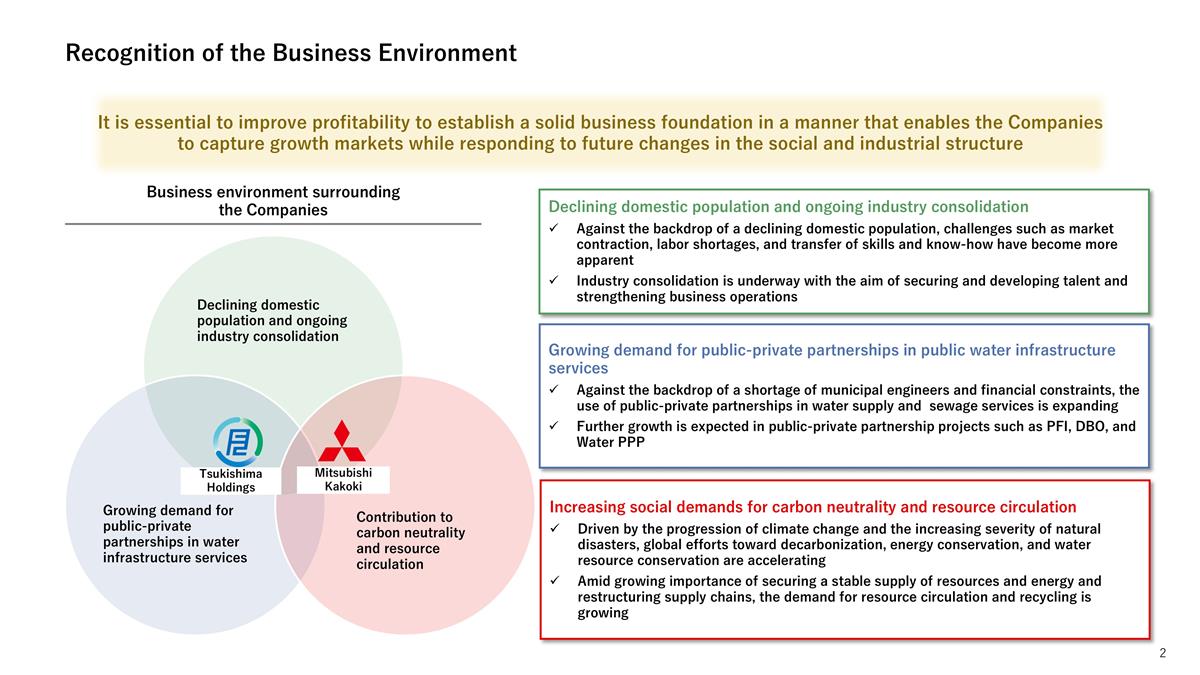
Recognition of the Business
Environment It is essential to improve profitability to establish a solid business foundation in a manner that enables the Companies to capture growth markets while responding to future changes in the social and industrial structure Declining
domestic population and ongoing industry consolidation Against the backdrop of a declining domestic population, challenges such as market contraction, labor shortages, and transfer of skills and know-how have become more apparent Industry
consolidation is underway with the aim of securing and developing talent and strengthening business operations Growing demand for public-private partnerships in public water infrastructure services Against the backdrop of a shortage of municipal
engineers and financial constraints, the use of public-private partnerships in water supply and sewage services is expanding Further growth is expected in public-private partnership projects such as PFI, DBO, and Water PPP Business environment
surrounding the Companies Declining domestic population and ongoing industry consolidation Mitsubishi Kakoki Tsukishima Holdings Contribution to carbon neutrality and resource circulation Growing demand for public-private partnerships in water
infrastructure services Increasing social demands for carbon neutrality and resource circulation Driven by the progression of climate change and the increasing severity of natural disasters, global efforts toward decarbonization, energy
conservation, and water resource conservation are accelerating Amid growing importance of securing a stable supply of resources and energy and restructuring supply chains, the demand for resource circulation and recycling is growing
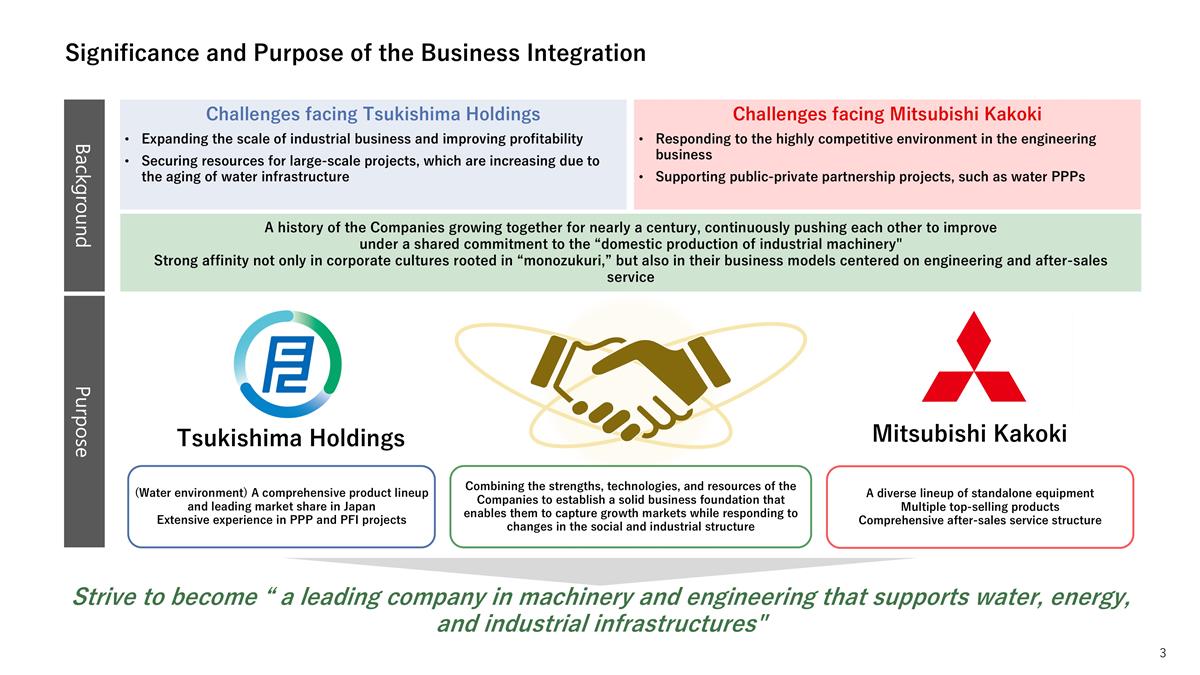
Significance and Purpose of the
Business Integration Purpose Background Challenges facing Tsukishima Holdings Expanding the scale of industrial business and improving profitability Securing resources for large-scale projects, which are increasing due to the aging of water
infrastructure A history of the Companies growing together for nearly a century, continuously pushing each other to improve under a shared commitment to the “domestic production of industrial machinery" Strong affinity not only in corporate
cultures rooted in “monozukuri,” but also in their business models centered on engineering and after-sales service Combining the strengths, technologies, and resources of the Companies to establish a solid business foundation that
enables them to capture growth markets while responding to changes in the social and industrial structure Strive to become “ a leading company in machinery and engineering that supports water, energy, and industrial infrastructures" A diverse
lineup of standalone equipment Multiple top-selling products Comprehensive after-sales service structure (Water environment) A comprehensive product lineup and leading market share in Japan Extensive experience in PPP and PFI projects Mitsubishi
Kakoki Tsukishima Holdings Challenges facing Mitsubishi Kakoki Responding to the highly competitive environment in the engineering business Supporting public-private partnership projects, such as water PPPs
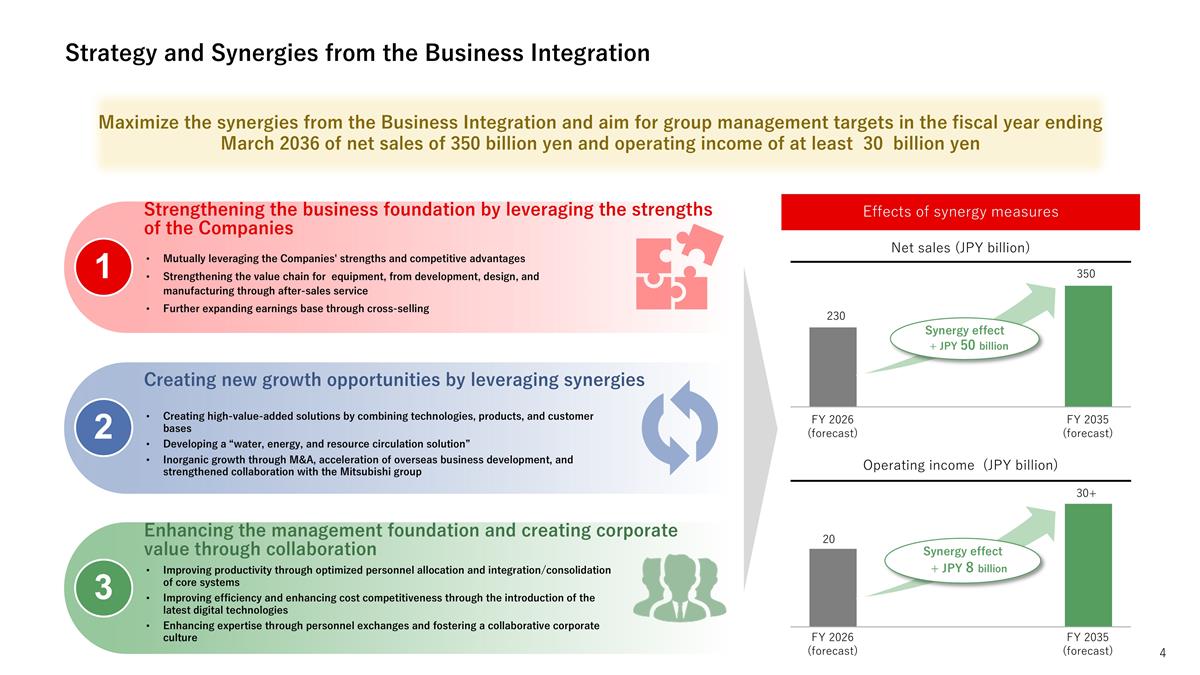
Enhancing the management foundation
and creating corporate value through collaboration Creating new growth opportunities by leveraging synergies Strengthening the business foundation by leveraging the strengths of the Companies Strategy and Synergies from the Business Integration
Effects of synergy measures 3 2 1 Mutually leveraging the Companies' strengths and competitive advantages Strengthening the value chain for equipment, from development, design, and manufacturing through after-sales service Further expanding earnings
base through cross-selling 350 230 Maximize the synergies from the Business Integration and aim for group management targets in the fiscal year ending March 2036 of net sales of 350 billion yen and operating income of at least 30 billion yen
Creating high-value-added solutions by combining technologies, products, and customer bases Developing a “water, energy, and resource circulation solution” Inorganic growth through M&A, acceleration of overseas business development,
and strengthened collaboration with the Mitsubishi group Improving productivity through optimized personnel allocation and integration/consolidation of core systems Improving efficiency and enhancing cost competitiveness through the introduction of
the latest digital technologies Enhancing expertise through personnel exchanges and fostering a collaborative corporate culture Net sales (JPY billion) Operating income (JPY billion) FY 2026 (forecast) FY 2035 (forecast) FY 2026 (forecast) FY 2035
(forecast) Synergy effect + JPY 50 billion Synergy effect + JPY 8 billion 20 30+
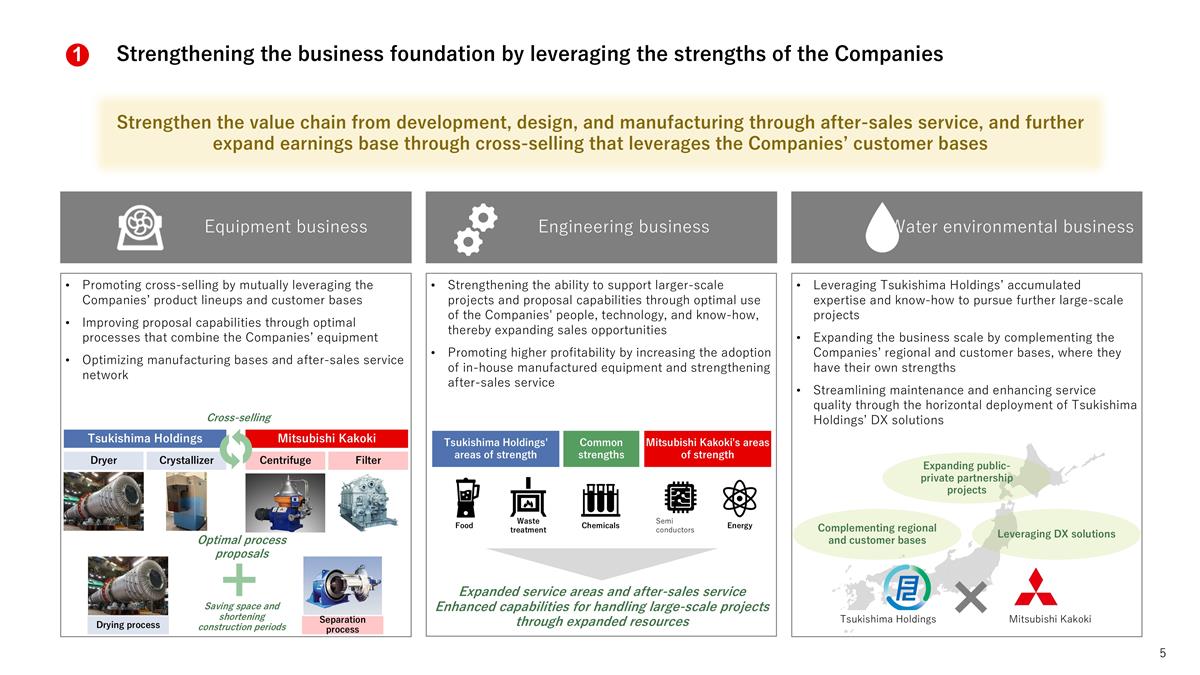
Strengthening the
business foundation by leveraging the strengths of the Companies Promoting cross-selling by mutually leveraging the Companies’ product lineups and customer bases Improving proposal capabilities through optimal processes that combine the
Companies’ equipment Optimizing manufacturing bases and after-sales service network Strengthening the ability to support larger-scale projects and proposal capabilities through optimal use of the Companies' people, technology, and know-how,
thereby expanding sales opportunities Promoting higher profitability by increasing the adoption of in-house manufactured equipment and strengthening after-sales service Leveraging Tsukishima Holdings’ accumulated expertise and know-how to
pursue further large-scale projects Expanding the business scale by complementing the Companies’ regional and customer bases, where they have their own strengths Streamlining maintenance and enhancing service quality through the horizontal
deployment of Tsukishima Holdings’ DX solutions Equipment business Engineering business Water environmental business 1 Strengthen the value chain from development, design, and manufacturing through after-sales service, and further expand
earnings base through cross-selling that leverages the Companies’ customer bases Complementing regional and customer bases Leveraging DX solutions Expanding public-private partnership projects Tsukishima Holdings Dryer Crystallizer Semi
conductors Energy Expanded service areas and after-sales service Enhanced capabilities for handling large-scale projects through expanded resources Chemicals Drying process Saving space and shortening construction periods Optimal process proposals
Mitsubishi Kakoki's areas of strength Common strengths Tsukishima Holdings' areas of strength Food Waste treatment Mitsubishi Kakoki Tsukishima Holdings Mitsubishi Kakoki Centrifuge Filter Cross-selling Separation process
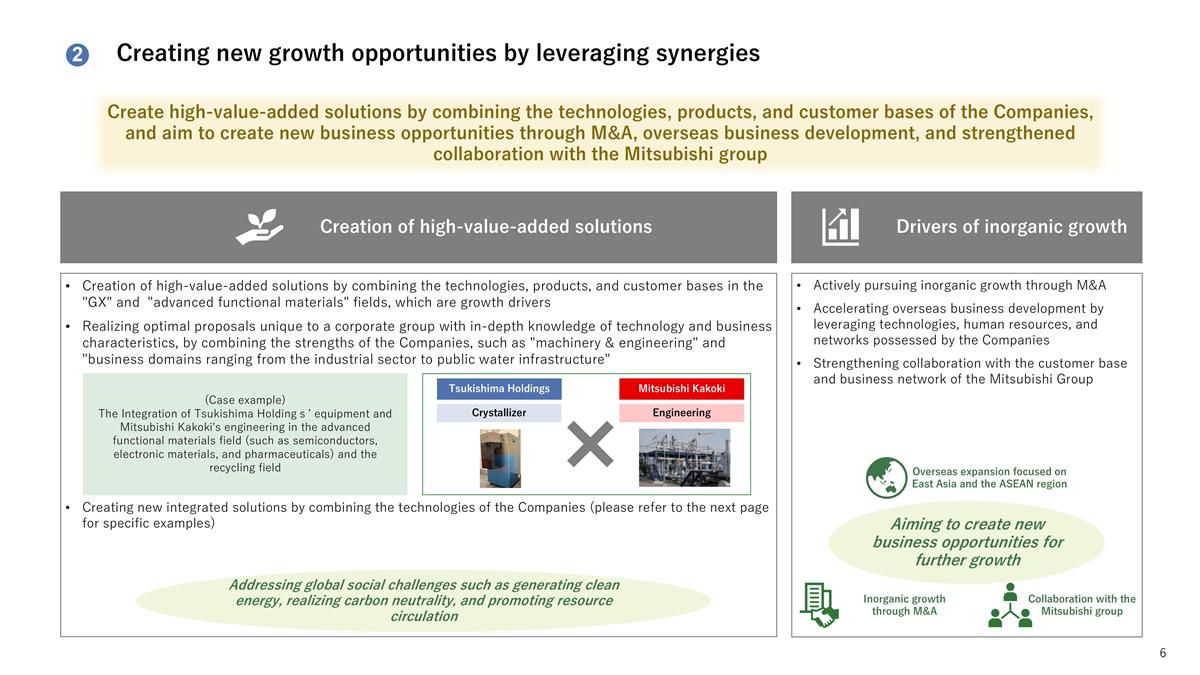
Creating new
growth opportunities by leveraging synergies Creation of high-value-added solutions by combining the technologies, products, and customer bases in the "GX" and "advanced functional materials" fields, which are growth drivers Realizing optimal
proposals unique to a corporate group with in-depth knowledge of technology and business characteristics, by combining the strengths of the Companies, such as "machinery & engineering" and "business domains ranging from the industrial sector to
public water infrastructure" Creating new integrated solutions by combining the technologies of the Companies (please refer to the next page for specific examples) Creation of high-value-added solutions Actively pursuing inorganic growth through
M&A Accelerating overseas business development by leveraging technologies, human resources, and networks possessed by the Companies Strengthening collaboration with the customer base and business network of the Mitsubishi Group Drivers of
inorganic growth Create high-value-added solutions by combining the technologies, products, and customer bases of the Companies, and aim to create new business opportunities through M&A, overseas business development, and strengthened
collaboration with the Mitsubishi group 2 Aiming to create new business opportunities for further growth Overseas expansion focused on East Asia and the ASEAN region Inorganic growth through M&A Collaboration with the Mitsubishi group Addressing
global social challenges such as generating clean energy, realizing carbon neutrality, and promoting resource circulation (Case example) The Integration of Tsukishima Holdings’ equipment and Mitsubishi Kakoki's engineering in the
advanced functional materials field (such as semiconductors, electronic materials, and pharmaceuticals) and the recycling field Tsukishima Holdings Crystallizer Mitsubishi Kakoki Engineering
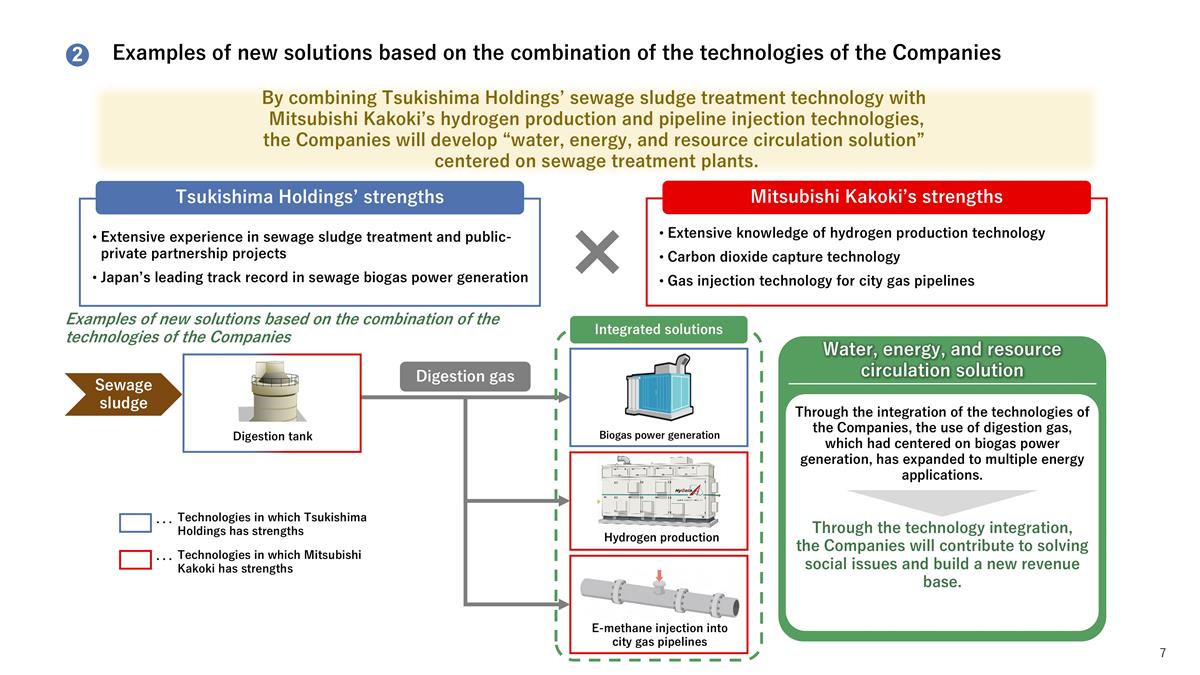
Examples of new
solutions based on the combination of the technologies of the Companies By combining Tsukishima Holdings’ sewage sludge treatment technology with Mitsubishi Kakoki’s hydrogen production and pipeline injection technologies, the Companies
will develop “water, energy, and resource circulation solution” centered on sewage treatment plants. 2 Mitsubishi Kakoki’s strengths Extensive knowledge of hydrogen production technology Carbon dioxide capture technology Gas
injection technology for city gas pipelines Tsukishima Holdings’ strengths Extensive experience in sewage sludge treatment and public-private partnership projects Japan’s leading track record in sewage biogas power generation Digestion
tank Biogas power generation Hydrogen production E-methane injection into city gas pipelines Digestion gas ・・・ Technologies in which Mitsubishi Kakoki has strengths ・・・ Technologies in which Tsukishima
Holdings has strengths Water, energy, and resource circulation solution Through the integration of the technologies of the Companies, the use of digestion gas, which had centered on biogas power generation, has expanded to multiple energy
applications. Through the technology integration, the Companies will contribute to solving social issues and build a new revenue base. Integrated solutions Sewage sludge Examples of new solutions based on the combination of the technologies of the
Companies
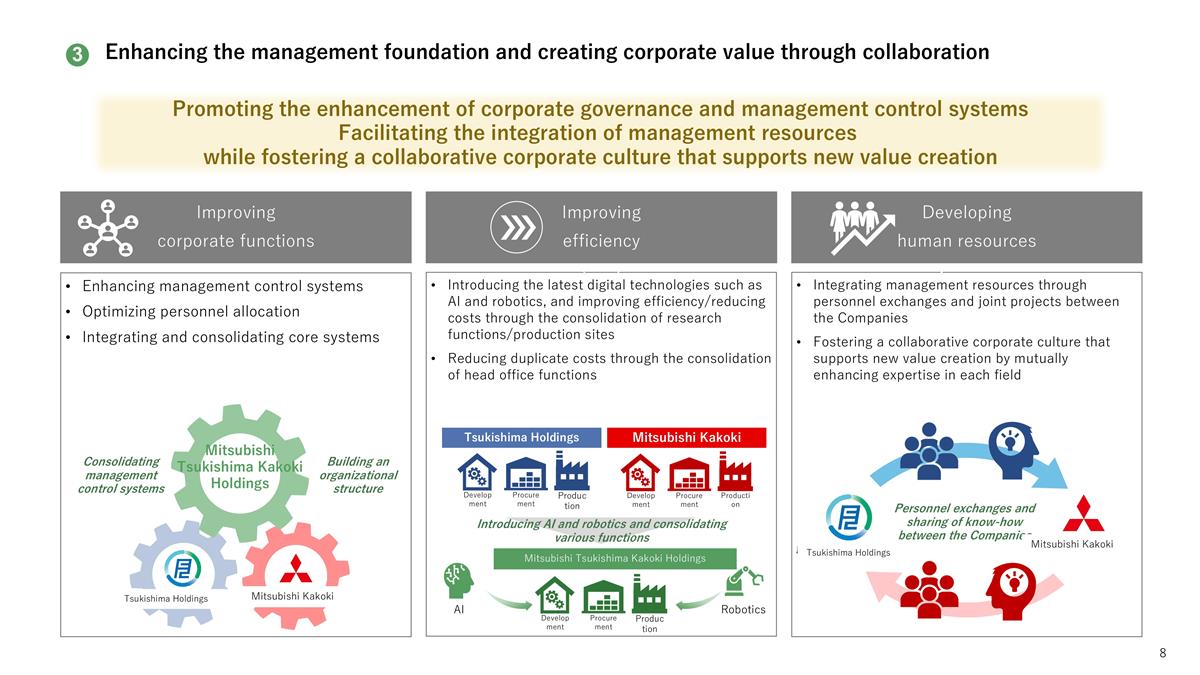
Enhancing the
management foundation and creating corporate value through collaboration Enhancing management control systems Optimizing personnel allocation Integrating and consolidating core systems Introducing the latest digital technologies such as AI and
robotics, and improving efficiency/reducing costs through the consolidation of research functions/production sites Reducing duplicate costs through the consolidation of head office functions Integrating management resources through personnel
exchanges and joint projects between the Companies Fostering a collaborative corporate culture that supports new value creation by mutually enhancing expertise in each field Mitsubishi Tsukishima Kakoki Holdings Development Procurement Production
Development Procurement Production Development Procurement Production Introducing AI and robotics and consolidating various functions Personnel exchanges and sharing of know-how between the Companies Consolidating management control systems Building
an organizational structure 3 AI Robotics Promoting the enhancement of corporate governance and management control systems Facilitating the integration of management resources while fostering a collaborative corporate culture that supports new value
creation Mitsubishi Kakoki Tsukishima Holdings Mitsubishi Kakoki Tsukishima Holdings Mitsubishi Tsukishima Kakoki Holdings Improving corporate functions Improving efficiency Developing human resources Tsukishima Holdings Mitsubishi Kakoki
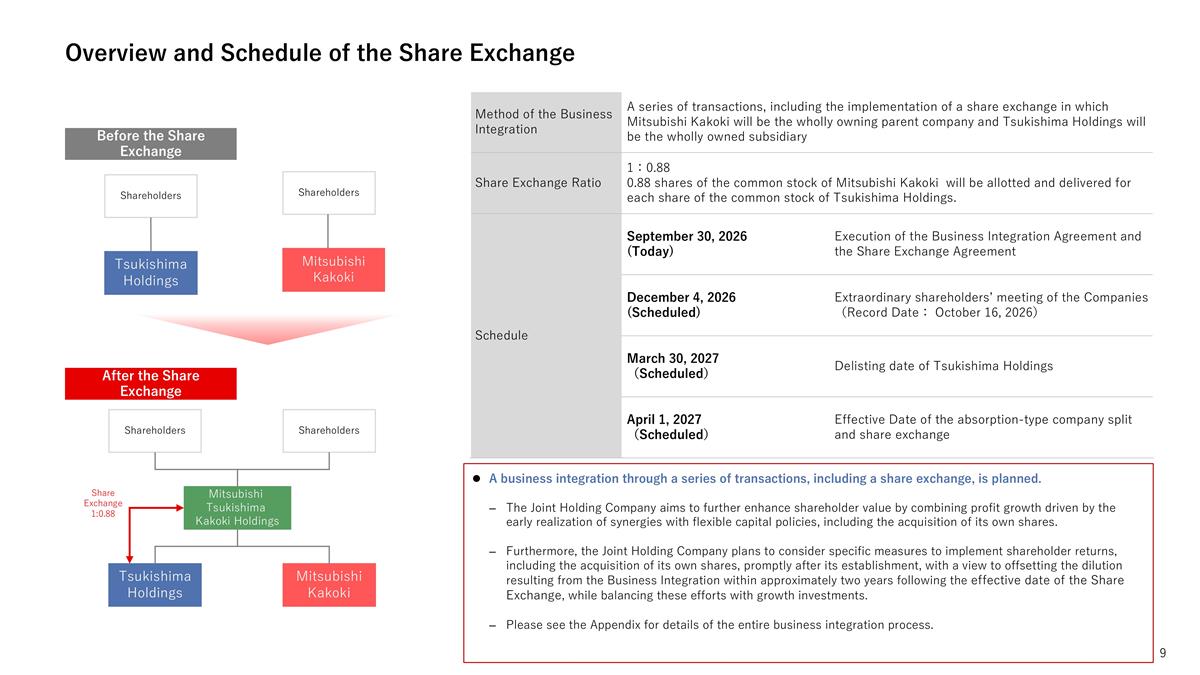
Overview and Schedule of the Share
Exchange Before the Share Exchange After the Share Exchange Shareholders Mitsubishi Kakoki Shareholders Tsukishima Holdings Method of the Business Integration A series of transactions, including the implementation of a share exchange in which
Mitsubishi Kakoki will be the wholly owning parent company and Tsukishima Holdings will be the wholly owned subsidiary Share Exchange Ratio 1:0.88 0.88 shares of the common stock of Mitsubishi Kakoki will be allotted and delivered for each
share of the common stock of Tsukishima Holdings. Schedule September 30, 2026 (Today) Execution of the Business Integration Agreement and the Share Exchange Agreement December 4, 2026 (Scheduled) Extraordinary shareholders’ meeting of the
Companies (Record Date: October 16, 2026) March 30, 2027 (Scheduled) Delisting date of Tsukishima Holdings April 1, 2027 (Scheduled) Effective Date of the absorption-type company split and share
exchange A business integration through a series of transactions, including a share exchange, is planned. The Joint Holding Company aims to further enhance shareholder value by combining profit growth driven by the early realization of synergies
with flexible capital policies, including the acquisition of its own shares. Furthermore, the Joint Holding Company plans to consider specific measures to implement shareholder returns, including the acquisition of its own shares, promptly after its
establishment, with a view to offsetting the dilution resulting from the Business Integration within approximately two years following the effective date of the Share Exchange, while balancing these efforts with growth investments. Please see the
Appendix for details of the entire business integration process. Mitsubishi Tsukishima Kakoki Holdings Shareholders Shareholders Tsukishima Holdings Mitsubishi Kakoki Share Exchange 1:0.88
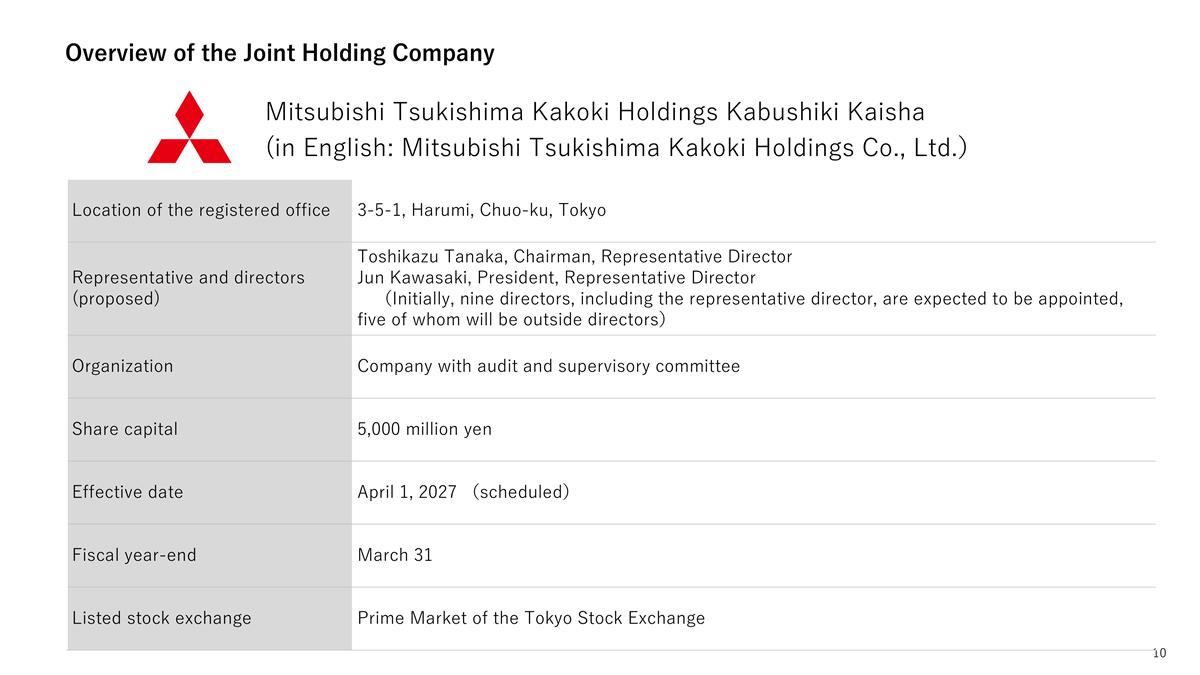
Overview of the Joint Holding
Company Mitsubishi Tsukishima Kakoki Holdings Kabushiki Kaisha (in English: Mitsubishi Tsukishima Kakoki Holdings Co., Ltd.) Location of the registered office 3-5-1, Harumi, Chuo-ku, Tokyo Representative and directors (proposed) Toshikazu
Tanaka, Chairman, Representative Director Jun Kawasaki, President, Representative Director (Initially, nine directors, including the representative director, are expected to be appointed, five of whom will be outside directors)
Organization Company with audit and supervisory committee Share capital 5,000 million yen Effective date April 1, 2027 (scheduled) Fiscal year-end March 31 Listed stock exchange Prime Market of the Tokyo Stock Exchange
Appendix
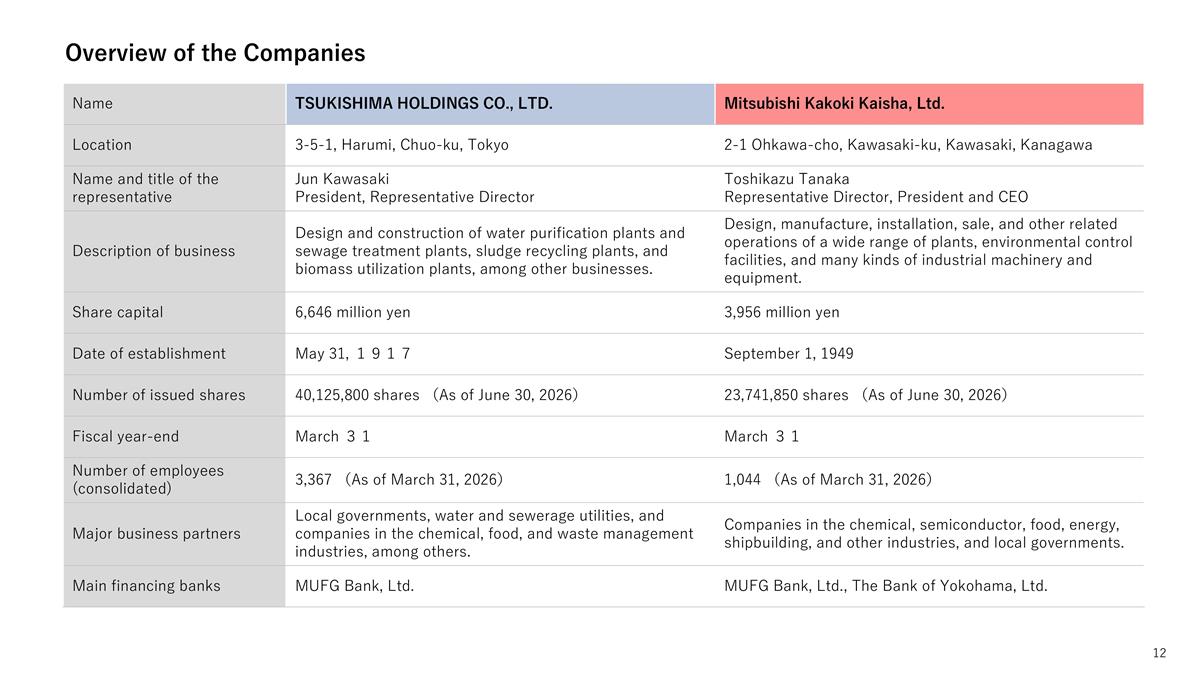
Overview of the Companies Name
TSUKISHIMA HOLDINGS CO., LTD. Mitsubishi Kakoki Kaisha, Ltd. Location 3-5-1, Harumi, Chuo-ku, Tokyo 2-1 Ohkawa-cho, Kawasaki-ku, Kawasaki, Kanagawa Name and title of the representative Jun Kawasaki President, Representative Director Toshikazu Tanaka
Representative Director, President and CEO Description of business Design and construction of water purification plants and sewage treatment plants, sludge recycling plants, and biomass utilization plants, among other businesses. Design,
manufacture, installation, sale, and other related operations of a wide range of plants, environmental control facilities, and many kinds of industrial machinery and equipment. Share capital 6,646 million yen 3,956 million yen Date of establishment
May 31, 1917 September 1, 1949 Number of issued shares 40,125,800 shares (As of June 30, 2026) 23,741,850 shares (As of June 30, 2026) Fiscal year-end March 31 March
31 Number of employees (consolidated) 3,367 (As of March 31, 2026) 1,044 (As of March 31, 2026) Major business partners Local governments, water and sewerage utilities, and companies in the chemical, food,
and waste management industries, among others. Companies in the chemical, semiconductor, food, energy, shipbuilding, and other industries, and local governments. Main financing banks MUFG Bank, Ltd. MUFG Bank, Ltd., The Bank of Yokohama,
Ltd.
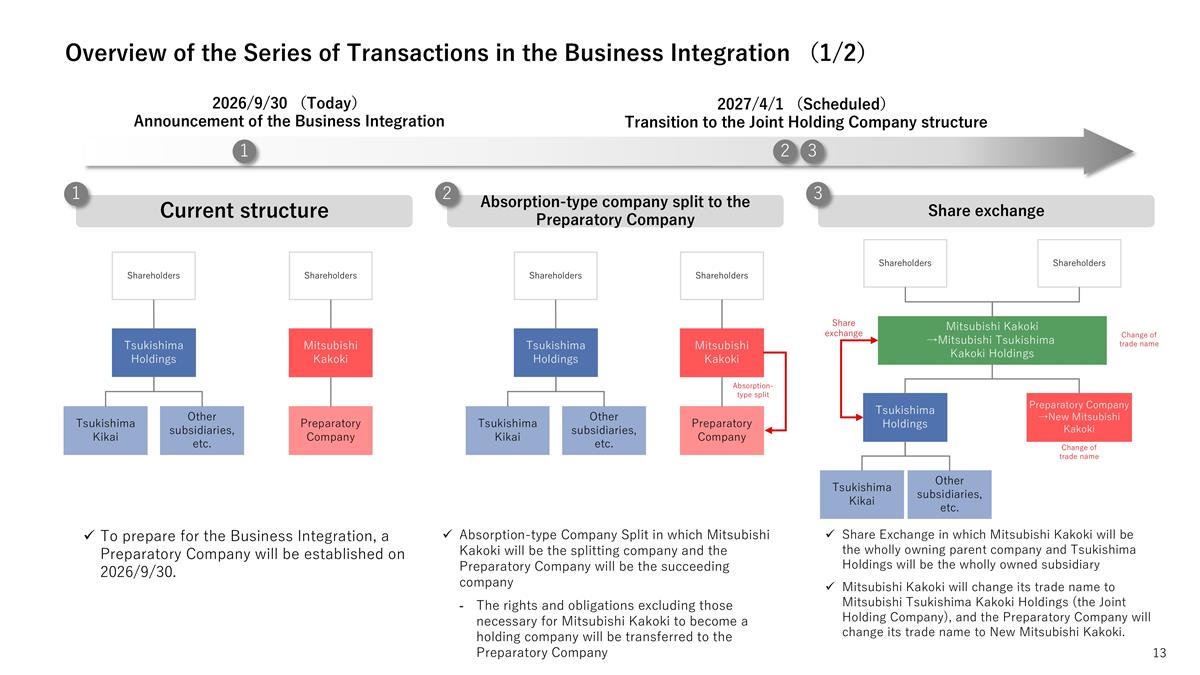
To prepare for the Business
Integration, a Preparatory Company will be established on 2026/9/30. Overview of the Series of Transactions in the Business Integration (1/2) Current structure 1 Absorption-type company split to the Preparatory Company 2 Share
exchange 3 Absorption-type Company Split in which Mitsubishi Kakoki will be the splitting company and the Preparatory Company will be the succeeding company The rights and obligations excluding those necessary for Mitsubishi Kakoki to become a
holding company will be transferred to the Preparatory Company Share Exchange in which Mitsubishi Kakoki will be the wholly owning parent company and Tsukishima Holdings will be the wholly owned subsidiary Mitsubishi Kakoki will change its trade
name to Mitsubishi Tsukishima Kakoki Holdings (the Joint Holding Company), and the Preparatory Company will change its trade name to New Mitsubishi Kakoki. 2027/4/1 (Scheduled) Transition to the Joint Holding Company structure 2 3 1
2026/9/30 (Today) Announcement of the Business Integration Shareholders Tsukishima Holdings Other subsidiaries, etc. Tsukishima Kikai Shareholders Mitsubishi Kakoki Preparatory Company Shareholders Tsukishima Holdings Other
subsidiaries, etc. Tsukishima Kikai Shareholders Mitsubishi Kakoki Preparatory Company Absorption-type split Mitsubishi Kakoki →Mitsubishi Tsukishima Kakoki Holdings Shareholders Shareholders Tsukishima Holdings Preparatory Company →New
Mitsubishi Kakoki Share exchange Change of trade name Change of trade name Other subsidiaries, etc. Tsukishima Kikai
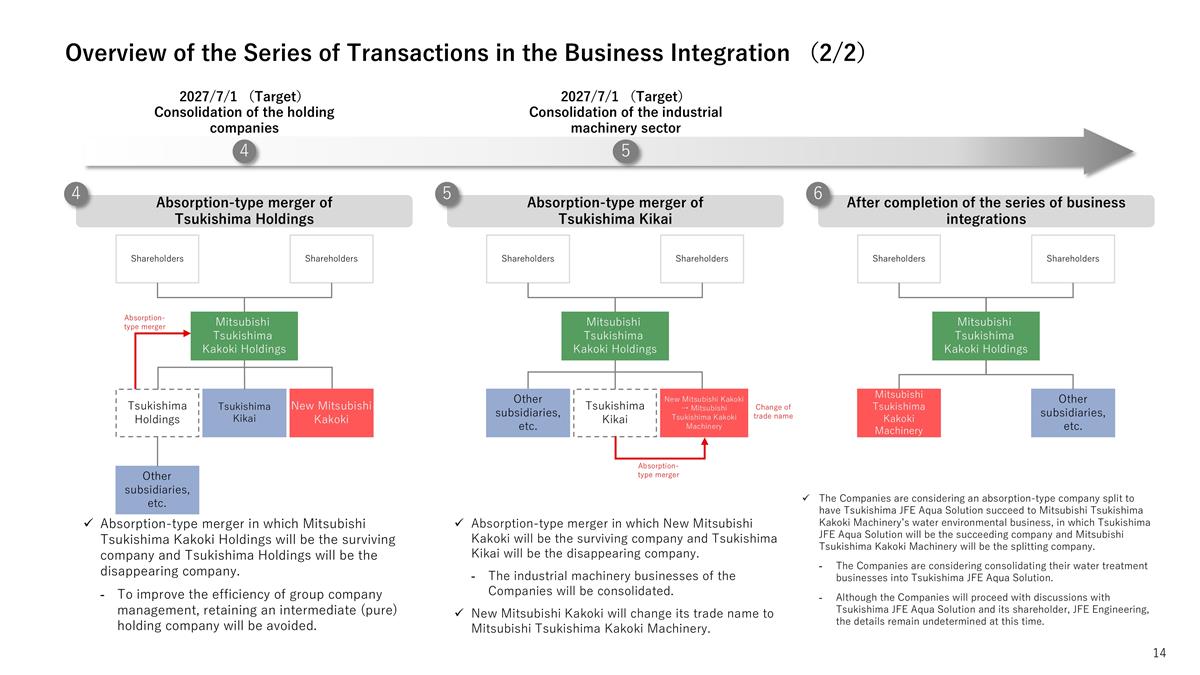
Overview of the Series
of Transactions in the Business Integration (2/2) Absorption-type merger of Tsukishima Holdings 4 Absorption-type merger in which Mitsubishi Tsukishima Kakoki Holdings will be the surviving company and Tsukishima Holdings will be the
disappearing company. To improve the efficiency of group company management, retaining an intermediate (pure) holding company will be avoided. Absorption-type merger of Tsukishima Kikai 5 After completion of the series of business integrations 6
Absorption-type merger in which New Mitsubishi Kakoki will be the surviving company and Tsukishima Kikai will be the disappearing company. The industrial machinery businesses of the Companies will be consolidated. New Mitsubishi Kakoki will change
its trade name to Mitsubishi Tsukishima Kakoki Machinery. The Companies are considering an absorption-type company split to have Tsukishima JFE Aqua Solution succeed to Mitsubishi Tsukishima Kakoki Machinery’s water environmental business, in
which Tsukishima JFE Aqua Solution will be the succeeding company and Mitsubishi Tsukishima Kakoki Machinery will be the splitting company. The Companies are considering consolidating their water treatment businesses into Tsukishima JFE Aqua
Solution. Although the Companies will proceed with discussions with Tsukishima JFE Aqua Solution and its shareholder, JFE Engineering, the details remain undetermined at this time. 4 2027/7/1 (Target) Consolidation of the holding
companies 5 2027/7/1 (Target) Consolidation of the industrial machinery sector Mitsubishi Tsukishima Kakoki Holdings Shareholders Shareholders New Mitsubishi Kakoki Tsukishima Kikai Tsukishima Holdings Other subsidiaries, etc.
Mitsubishi Tsukishima Kakoki Holdings Shareholders Shareholders New Mitsubishi Kakoki → Mitsubishi Tsukishima Kakoki Machinery Tsukishima Kikai Other subsidiaries, etc. Mitsubishi Tsukishima Kakoki Holdings Shareholders Shareholders Mitsubishi
Tsukishima Kakoki Machinery Other subsidiaries, etc. Absorption-type merger Absorption-type merger Change of trade name
Inquiries TSUKISHIMA HOLDINGS
CO., LTD., Public Relation and Investor Relations Dept., Tel: +81-3-5560-6503 Mitsubishi Kakoki Kaisha, Ltd., Planning Department, Tel: +81-44-333-5354