http://fasb.org/srt/2026#ChiefOperatingOfficerMember
Exhibit 99.1
Huachen AI Parking Management Technology Holding
Co., Ltd
CONDENSED
CONSOLIDATED BALANCE SHEETS
(Expressed in U.S. Dollars, except for the number
of shares)
| |
|
As of |
|
| |
|
June 30,
2026 |
|
|
December 31,
2025 |
|
| |
|
Unaudited US$ |
|
|
US$ |
|
| ASSETS |
|
|
|
|
|
|
| Current assets |
|
|
|
|
|
|
| Cash and cash equivalents | | | 61,896 | | | | 389 | |
| Accounts receivable | | | 4,242,678 | | | | 7,070,814 | |
| Other receivables - related parties | | | 4,925,692 | | | | 4,779,184 | |
| Prepaid expenses and other current assets | | | 87,653 | | | | 101,344 | |
| Total current assets | | | 9,317,919 | | | | 11,951,731 | |
| |
|
|
|
|
|
|
|
|
| Non-current asset |
|
|
|
|
|
|
|
|
| Right-of-use asset, net | | | 29,393 | | | | 39,552 | |
| Total non-current asset | | | 29,393 | | | | 39,552 | |
| |
|
|
|
|
|
|
|
|
| TOTAL ASSETS | | | 9,347,312 | | | | 11,991,283 | |
| |
|
|
|
|
|
|
|
|
| LIABILITIES AND SHAREHOLDERS’ EQUITY |
|
|
|
|
|
|
|
|
| Current liabilities |
|
|
|
|
|
|
|
|
| Accounts payable | | | 2,661,465 | | | | 6,593,137 | |
| Accrued liabilities and other payables | | | 997,741 | | | | 73,638 | |
| Other payables - related parties | | | 39,315 | | | | 21,587 | |
| Taxes payable | | | 196,423 | | | | 59,531 | |
| Lease liability - current | | | 25,411 | | | | 24,229 | |
| Total current liabilities | | | 3,920,355 | | | | 6,772,122 | |
| |
|
|
|
|
|
|
|
|
| Non-current liability |
|
|
|
|
|
|
|
|
| Lease liability – non-current | | | 6,493 | | | | 18,735 | |
| Total non-current liability | | | 6,493 | | | | 18,735 | |
| |
|
|
|
|
|
|
|
|
| TOTAL LIABILITIES | | | 3,926,848 | | | | 6,790,857 | |
| |
|
|
|
|
|
|
|
|
| Shareholders’ equity |
|
|
|
|
|
|
|
|
| Class A ordinary shares (par value of US$0.0000375 per share; 1,666,666,667 Class A ordinary shares authorized, 629,942 and 629,942 Class A ordinary shares issued and outstanding as of June 30, 2026 and December 31, 2025, respectively) | | | 24 | | | | 24 | |
| Class B ordinary shares (par value of US$0.0000375 per share; 416,666,667 Class B ordinary shares authorized, 533,334 and 533,334 Class B ordinary shares issued and outstanding as of June 30, 2026 and December 31, 2025, respectively) | | | 20 | | | | 20 | |
| Additional paid-in capital | | | 30,196,454 | | | | 30,196,454 | |
| Accumulated deficits | | | (24,992,538 | ) | | | (25,043,811 | ) |
| Accumulated other comprehensive income | | | 217,086 | | | | 48,321 | |
| TOTAL HUACHEN CAYMAN SHAREHOLDERS’ EQUITY | | | 5,421,046 | | | | 5,201,008 | |
| Non-controlling interest | | | (582 | ) | | | (582 | ) |
| TOTAL SHAREHOLDERS’ EQUITY | | | 5,420,464 | | | | 5,200,426 | |
| |
|
|
|
|
|
|
|
|
| TOTAL LIABILITIES AND SHAREHOLDERS’ EQUITY | | | 9,347,312 | | | | 11,991,283 | |
Huachen AI Parking Management Technology Holding
Co., Ltd
UNAUDITED CONDENSED CONSOLIDATED
STATEMENTS OF INCOME
(Expressed in U.S. Dollars, except for the number
of shares)
| |
|
For the Six Months Ended June 30, |
|
| |
|
2026 |
|
|
2025 |
|
| REVENUE |
|
|
|
|
|
|
|
|
| Revenue | | $ | 2,473,192 | | | $ | - | |
| |
|
|
|
|
|
|
|
|
| Total revenue | | | 2,473,192 | | | | - | |
| |
|
|
|
|
|
|
|
|
| COST OF REVENUE AND RELATED TAX | | | 1,469,300 | | | | - | |
| |
|
|
|
|
|
|
|
|
| GROSS PROFIT | | | 1,003,892 | | | | - | |
| |
|
|
|
|
|
|
|
|
| OPERATING EXPENSES |
|
|
|
|
|
|
|
|
| General and administrative expenses | | | 941,483 | | | | 616,628 | |
| Total operating expenses | | | 941,483 | | | | 616,628 | |
| |
|
|
|
|
|
|
|
|
| INCOME(LOSS) FROM OPERATIONS | | | 62,409 | | | | (616,628 | ) |
| |
|
|
|
|
|
|
|
|
| OTHER INCOME (EXPENSE) |
|
|
|
|
|
|
|
|
| |
|
|
|
|
|
|
|
|
| Interest income | | | - | | | | (960 | ) |
| Other expenses, net | | | (8,248 | ) | | | - | |
| Total other expense, net | | | (8,248 | ) | | | (960 | ) |
| INCOME(LOSS) BEFORE INCOME TAX PROVISION | | | 54,161 | | | | (617,588 | ) |
| Income tax expense | | | 2,888 | | | | - | |
| INCOME(LOSS) FROM CONTINUING OPERATIONS | | | 51,273 | | | | (617,588 | ) |
| Income from discontinued operation (net of tax) | | | - | | | | 1,865,348 | |
| NET INCOME | | | 51,273 | | | | 1,247,760 | |
| |
|
|
|
|
|
|
|
|
| Net (loss) income attributable to the noncontrolling interest | | | - | | | | 431,821 | |
| Continuing operations | | | - | | | | - | |
| Discontinued operations | | | - | | | | 431,821 | |
| Net income attributable to common shareholders | | | 51,273 | | | | 815,939 | |
| Continuing operations | | | 51,273 | | | | (617,588 | ) |
| Discontinued operations | | | - | | | | 1,433,527 | |
| OTHER COMPREHENSIVE INCOME |
|
|
|
|
|
|
|
|
| Foreign currency translation income | | | 168,765 | | | | 1,412,731 | |
| Other comprehensive income, net of tax | | | 168,765 | | | | 1,412,731 | |
| TOTAL COMPREHENSIVE INCOME | | | 220,038 | | | $ | 2,660,491 | |
| |
|
|
|
|
|
|
|
|
| Earnings per common share - basic and diluted |
|
|
|
|
|
|
|
|
| Continuing operations | | | 0.04 | | | | (0.57 | ) |
| Discontinued operations | | | - | | | | 1.32 | |
| Weighted average shares - basic and diluted | | | 1,163,276 | | | | 1,087,421 | |
Huachen AI Parking Management Technology Holding
Co., Ltd
UNAUDITED CONDENSED CONSOLIDATED STATEMENTS
OF CHANGES IN SHAREHOLDERS’ EQUITY
(Expressed in U.S. Dollars, except for the number
of shares)
| |
|
|
|
|
|
|
|
|
|
|
|
|
|
Accumulated |
|
|
|
|
|
|
|
|
|
|
| |
|
Class A
Ordinary Shares |
|
|
Class B
Ordinary Shares |
|
|
Additional
Paid in |
|
|
Statutory |
|
|
Other
Retained |
|
|
Non-
Comprehensive |
|
|
Controlling |
|
|
|
|
| |
|
Shares* |
|
|
Amount |
|
|
Shares |
|
|
Amount |
|
|
Capital |
|
|
Reserves |
|
|
Earnings |
|
|
Income (Loss) |
|
|
Interests |
|
|
Total |
|
| |
|
|
|
|
|
|
|
|
|
|
|
|
|
|
|
|
|
|
|
|
|
|
|
|
|
|
|
|
|
|
| Balance as of December 31, 2024 | | | 1,000,000 | | | | 38 | | | | - | | | | - | | | | 3,462,427 | | | | 400,454 | | | | 16,873,997 | | | | (4,924,576 | ) | | | 12,032,635 | | | | 27,844,975 | |
| Net income | | | - | | | | - | | | | | | | | | | | | - | | | | - | | | | 815,939 | | | | - | | | | - | | | | 815,939 | |
| Issuance of shares for cash | | | 163,276 | | | | 6 | | | | - | | | | - | | | | - | | | | - | | | | - | | | | - | | | | - | | | | 6 | |
| Re-designation of shares | | | (533,334 | ) | | | (20 | ) | | | 533,334 | | | | 20 | | | | - | | | | - | | | | - | | | | - | | | | - | | | | - | |
| Additional Paid-in Capital | | | - | | | | - | | | | - | | | | - | | | | 5,422,744 | | | | - | | | | - | | | | - | | | | - | | | | 5,422,744 | |
| Allocation to non-controlling interests | | | - | | | | - | | | | - | | | | - | | | | - | | | | - | | | | - | | | | - | | | | 431,821 | | | | 431,821 | |
| Foreign currency translation gain | | | - | | | | - | | | | - | | | | - | | | | - | | | | - | | | | - | | | | 1,412,731 | | | | - | | | | 1,412,731 | |
| Balance as of June 30, 2025 (Unaudited) | | | 629,942 | | | | 24 | | | | 533,334 | | | | 20 | | | | 8,885,171 | | | | 400,454 | | | | 17,689,936 | | | | (3,511,845 | ) | | | 12,464,456 | | | | 35,928,216 | |
| |
|
|
|
|
|
|
|
|
|
|
|
|
|
|
|
|
|
|
|
|
|
|
|
|
|
|
|
|
|
|
|
|
|
|
|
|
|
|
|
|
| Balance as of December 31, 2025 | | | 629,942 | | | | 24 | | | | 533,334 | | | | 20 | | | | 30,196,454 | | | | - | | | | (25,043,811 | ) | | | 48,321 | | | | (582 | ) | | | 5,200,426 | |
| Net income | | | - | | | | - | | | | | | | | | | | | - | | | | - | | | | 51,273 | | | | - | | | | - | | | | 51,273 | |
| Foreign currency translation gain | | | - | | | | - | | | | - | | | | - | | | | - | | | | - | | | | - | | | | 168,765 | | | | - | | | | 168,765 | |
| Balance as of June 30, 2026 (Unaudited) | | | 629,942 | | | | 24 | | | | 533,334 | | | | 20 | | | | 30,196,454 | | | | - | | | | (24,992,538 | ) | | | 217,086 | | | | (582 | ) | | | 5,420,464 | |
Huachen AI Parking Management Technology Holding
Co., Ltd
UNAUDITED CONDENSED CONSOLIDATED STATEMENTS
OF CASH FLOWS
(Expressed in U.S. Dollars, except for the
number of shares)
| |
|
For
the Six Months Ended
June 30,
|
|
| |
|
2026 |
|
|
2025 |
|
| Cash flows from operating activities: |
|
|
|
|
|
|
| Net income | | $ | 51,273 | | | $ | 1,247,760 | |
| Net income from discontinued operations | | | - | | | | 1,865,348 | |
| Net income(loss) from continuing operations | | | 51,273 | | | | (617,588 | ) |
| Adjustments to reconcile net income to net cash provided by (used in) operating activities: |
|
|
|
|
|
|
|
|
| Amortization of right-of-use asset | | | 11,244 | | | | - | |
| |
|
|
|
|
|
|
|
|
| Changes in operating assets and liabilities: |
|
|
|
|
|
|
|
|
| Accounts receivable | | | 3,010,596 | | | | - | |
| Other receivable - related parties | | | - | | | | (4,045,445 | ) |
| Accounts payables | | | (4,087,223 | ) | | | - | |
| Accrued liabilities and other payables | | | 928,336 | | | | 2,270 | |
| Lease liability | | | (12,237 | ) | | | - | |
| Prepaid expenses and other current assets | | | 15,093 | | | | (643,020 | ) |
| Taxes payable | | | 133,546 | | | | - | |
| Net cash provided by (used in) operating activities - continuing operations | | | 50,628 | | | | (5,303,783 | ) |
| Net cash used in operating activities - discontinued operations | | | - | | | | (147,296 | ) |
| Net cash provided (used in) by operating activities | | | 50,628 | | | | (5,451,079 | ) |
| |
|
|
|
|
|
|
|
|
| Cash flows from financing activity: |
|
|
|
|
|
|
|
|
| Proceeds from additional paid-in capital | | | - | | | | 5,353,931 | |
| Net cash provided by financing activities - continuing operations | | | - | | | | 5,353,931 | |
| Net cash used in financing activities - discontinued operations | | | - | | | | (696,853 | ) |
| Net cash provided by financing activity | | | - | | | | 4,657,078 | |
| |
|
|
|
|
|
|
|
|
| Effect of exchange rate changes on cash from continuing operations | | | 10,879 | | | | (50,381 | ) |
| Effect of exchange rate changes on cash from discontinued operations | | | - | | | | 863,223 | |
| |
|
|
|
|
|
|
|
|
| Net change in cash, including cash from discontinued operations | | | 61,507 | | | | 18,841 | |
| |
|
|
|
|
|
|
|
|
| Cash, including cash from discontinued operations - beginning of year | | | 389 | | | | 28,654 | |
| Cash, including cash from discontinued operations - end of year | | | 61,896 | | | | 47,495 | |
| Less cash from discontinued operations | | | - | | | | 47,219 | |
| Cash from continuing operations, end of year | | | 61,896 | | | | 276 | |
| |
|
|
|
|
|
|
|
|
Supplemental
of cash disclosure information: |
|
|
|
|
|
|
|
|
| Cash paid for interest | | $ | - | | | $ | 23,112 | |
| Cash paid for income tax | | | - | | | | - | |
Huachen AI Parking Management Technology Holding
Co., Ltd AND SUBSIDIARIES
NOTES TO UNAUDITED CONSOLIDATED FINANCIAL
STATEMENTS
For the Six Months Ended June 30, 2026 and 2025
Note 1 — ORGANIZATION AND BUSINESS DESCRIPTION
Huachen AI Parking Management Technology Holding Co., Ltd (“Huachen” or the “Company”) is a company that was established under the laws of Cayman Islands as a holding company on September 30, 2021. Our main business operations are conducted through our subsidiaries in the People’s Republic of China. We are a comprehensive electric vehicle charging solutions and equipment structural parts provider.
On December 22, 2025, the Company and Hua Chen Intelligent Technology Co., Limited, a company formed under the laws of Hong Kong and a subsidiary of the Company (the “Target”) entered into a share purchase agreement (the “Agreement”) with a buyer (the “Buyer”). Pursuant to the Agreement, the Company agreed to sell and the Buyer agreed to purchase all the issued and outstanding shares of the Target at a purchase price of $50,000, which sale includes the sale of the Target’s subsidiaries, including Huachen AI Technology (Zhejiang) Co., Ltd., Zhejiang Huachen Technology Co., Ltd., Shanghai Tiandidaochuan Parking Equipment Manufacturing Co., Ltd., Zhejiang Tiandidaochuan Parking Equipment Co., Ltd., Shanghai Tiandiricheng Parking Lots Management Co., Ltd., Shanghai Yufeng Information Technology Co., Ltd., Shanghai Tiandi Puji Parking Management Co., Ltd. Shanghai Tiandidaochuan Parking Equipment Installation Co., Ltd., and Zhejiang Xinfeng Trade Co., Ltd. Except as a party to the Agreement, the Buyer has no current or prior relationship with the Company and has no family relationship with any of the Company’s directors or officers. As a result of this transaction, the Company has discontinued its cubic parking garage business and maintenance services in mainland China. Hua Chen Intelligent Technology Co., Limited and its subsidiaries have been retrospectively reclassified as discontinued operations in all periods presented in the consolidated financial statements.
As of June 30, 2026, the Company’s subsidiaries are as follows:
| | | | | | | Percentage of | |
| | | | | | | direct/indirect | |
| | | Date of | | Jurisdiction of | | Economic | |
| Subsidiaries | | Incorporation | | Formation | | Ownership | |
| Yu He Chuang Co., Ltd (“YHC HK”) | | April 1, 2025 | | Hong Kong | | | 100.00 | % |
| Chuang Yu He (Shanghai) Industrial Co., Ltd. (“CYH Shanghai”) | | June 12, 2025 | | Shanghai | | | 100.00 | % |
| Hangzhou Zhihuichong Technology Co., Ltd. (“Hangzhou ZHC”) | | November 20, 2025 | | Zhejiang | | | 90.00 | % |
| Jiaxing Xuchen Technology Co., Ltd. (“Jiaxing XC”) | | September 9, 2025 | | Zhejiang | | | 100.00 | % |
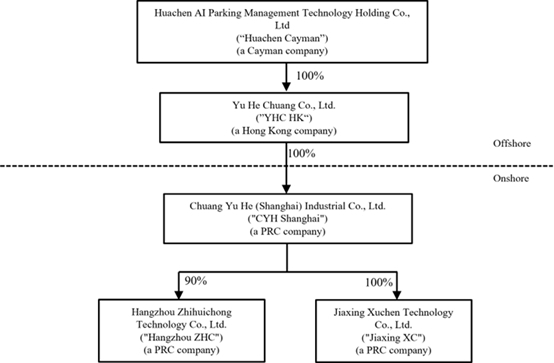
The Company, through a series of transactions which are accounted for as a reorganization of entities under common control (the “Reorganization”), became the ultimate parent of its subsidiaries. The reorganization involved: the formation of the Company’s wholly-owned subsidiary-YHC HK and YHC HK’s wholly owned subsidiary — CYH Shanghai.
Before and after the reorganization, the Company, together with its subsidiaries, is effectively controlled by the same shareholders, and therefore the reorganization is considered as a recapitalization of entities under common control in accordance with Accounting Standards Codification (“ASC”) 805-50-25. The consolidation of the Company and its subsidiaries have been accounted for at historical cost and prepared on the basis as if the aforementioned transactions had become effective as of the beginning of the first period presented in the accompanying consolidated financial statements in accordance with ASC 805-50-45-5.
Note 2 — SUMMARY OF SIGNIFICANT ACCOUNTING POLICIES
Method of accounting
The accompanying unaudited consolidated financial statements include the accounts of the Company and its subsidiaries (collectively the “Company”). Management has eliminated all significant inter-company balances and transactions in preparing the accompanying unaudited consolidated financial statements.
Management has prepared the accompanying unaudited consolidated financial statements and these notes in accordance with generally accepted accounting principles in the United States (“US GAAP”) for interim financial information. The Company maintains its general ledger and journals with the accrual method accounting.
Principles of consolidation
The consolidated financial statements include the financial statements of the Company and its subsidiaries. All intercompany transactions and balances are eliminated upon consolidation. All intercompany transactions and balances between the Company and its subsidiaries are eliminated upon consolidation.
Subsidiaries are those entities in which the Company, directly or indirectly, controls more than one half of the voting power; or has the power to govern the financial and operating policies, to appoint or remove the majority of the members of the board of directors, or to cast a majority of votes at the meeting of directors.
Non-controlling interest represents the portion of the net assets of subsidiaries attributable to interests that are not owned by the Company. The non-controlling interest is presented in the consolidated balance sheets, separately from equity attributable to the shareholders of the Company. Non-controlling interest’s operating result is presented on the face of the consolidated statements of income and comprehensive income as an allocation of the total income for the year between non-controlling shareholders and the shareholders of the Company.
Uses of estimates
In preparing the unaudited condensed consolidated financial statements in conformity with US GAAP, management makes estimates and assumptions that affect the reported amounts of assets and liabilities and disclosure of contingent assets and liabilities at the date of the financial statements and the reported amounts of revenues and expenses during the reporting period. These estimates are based on information as of the date of the unaudited condensed consolidated financial statements.
Significant estimates required to be made by management are specifically driven by the Company’s current asset and liability structure, which include, but are not limited to: (i) the allowance for credit losses (CECL) on trade accounts receivable and other receivables from related parties, (ii) the assessment of collectability and valuation of prepaid expenses and other current assets, (iii) the determination of the incremental borrowing rate used to measure lease liabilities and the corresponding right-of-use assets, and (iv) provisions necessary for taxes payable and other contingent liabilities. Actual results could differ from those estimates.
Cash and cash equivalents
Cash and cash equivalents represent cash at bank which are unrestricted as to withdrawal and use, and which have original maturities of three months or less.
Accounts receivable
Accounts receivable are presented net of allowance for credit losses.
Accounts receivable are recorded at the gross billing amount less an allowance for any uncollectible accounts due from the customers. Accounts receivable do not bear interest.
Since January 1, 2023, the Company adopted Accounting Standards Update (“ASU”) No. 2016-13, Financial Instruments-Credit Losses (Topic 326): Measurement of Credit Losses on Financial Instruments (“ASU 2016-13”), using the modified retrospective transition method. ASU 2016-13 replaces the existing incurred loss impairment model with an expected loss methodology, which will result in more timely recognition of credit losses. Upon adoption, the Company changed the impairment model to utilize a forward-looking current expected credit losses (CECL) model in place of the incurred loss methodology for financial instruments measured at amortized cost and receivables resulting from the application of ASC 606, including contract assets.
The Company maintains an allowance for credit losses and records the allowance for credit losses as an offset to accounts receivable and the estimated credit losses charged to the allowance is classified as “General and administrative expenses” in the consolidated statements of comprehensive income(loss). The Company assesses collectability by reviewing accounts receivable on aging schedules because the accounts receivable were primarily consisted of receivables arising from sales of our products. In determining the amount of the allowance for credit losses, the Company considers historical collectability based on past due status, the age of the balances, current economic conditions, reasonable and supportable forecasts of future economic conditions, and other factors that may affect the Company’s ability to collect from customers. Delinquent account balances are written-off against the allowance for expected credit.
As of June 30, 2026 and December 31, 2025, there is no allowance for credit losses balances from continuing operations.
Prepaid expenses and other current assets
Prepaid expenses and other current assets are recorded at cost less any provision for impairment.
Prepaid expenses primarily include Nasdaq membership fees, which are amortized on a straight-line basis over the period benefited of five years. As of June 30, 2026 and December 31, 2025, the balance of prepaid expenses from Nasdaq membership is $36,984 and $41,011.
Other current assets primarily consist of amounts due from third-party individuals for fund transactions and deposits for daily operations. The Company reviews the recoverability of other current assets on a regular basis and records an allowance for credit loss when collection is considered doubtful. As of June 30, 2026 and December 31, 2025, there is no allowance for credit losses balances from continuing operations.
Accounts payable
Accounts payable are initially recognized at fair value and subsequently measured at amortized cost using the effective interest method. Accounts payable primarily consist of amounts due to suppliers and vendors for goods received in the ordinary course of business. Amounts due to related parties are separately disclosed. Due to their short-term nature, the carrying amounts of accounts payable approximate their fair values. The Company recognizes payables when the risks and rewards associated with the underlying goods have been transferred to the Company and the obligation to pay is established.
Leases
The Company adopted the new lease standard, ASC 842, Leases (Topic 842) since December 1, 2022. The Company elected the package of practical expedients permitted under the transition guidance within ASC Topic 842, which among other things, allows the Company to carry forward certain historical conclusions reached under ASC Topic 840 regarding lease identification, classification, and the accounting treatment of initial direct costs. The Company elected not to record assets and liabilities on its consolidated balance sheets for any new or existing lease arrangements with lease terms of twelve months or less. The Company recognizes lease expenses for such leases on a straight-line basis over the lease term. The Company elected the transition method which allows entities to initially apply the requirements by recognizing a cumulative-effect adjustment to the opening balance of retained earnings in the period of adoption.
Operating lease assets are included within “Right-of-use asset”, and the corresponding operating lease liabilities are included within “Lease liability-current” for the current portion, and within “Lease liability-non-current” for the long-term portion on the consolidated balance sheets as of June 30, 2026 and December 31, 2025.
The initial lease liability is equal to the future fixed minimum lease payments discounted using the Company’s incremental borrowing rate, on a secured basis. The lease term includes optional renewal periods and early termination payments when it is reasonably certain that the Company will exercise those rights. The initial measurement of the right-of-use asset is equal to the initial lease liability plus any initial direct costs and prepayments, less any lease incentives.
Impairment of Long-lived Assets
The Company reviews long-lived assets, including definitive-lived intangible assets, for impairment whenever events or changes in circumstances indicate that the carrying amount of an asset may not be recoverable. If the estimated cash flows from the use of the asset and its eventual disposition below are the asset’s carrying value, then the asset is deemed to be impaired and written down to its fair value. There were no impairments of these assets as of June 30, 2026 and December 31, 2025.
Fair value of financial instruments
Fair value is defined as the price that would be received to sell an asset or paid to transfer a liability in an orderly transaction between market participants at the measurement date. A three-level fair value hierarchy prioritizes the inputs used to measure fair value. The hierarchy requires entities to maximize the use of observable inputs and minimize the use of unobservable inputs. The three levels of inputs used to measure fair value are as follows:
| | ● | Level 1 — inputs to the valuation methodology are quoted prices (unadjusted) for identical assets or liabilities in active markets. |
| | ● | Level 2 — inputs to the valuation methodology include quoted prices for similar assets and liabilities in active markets, quoted market prices for identical or similar assets in markets that are not active, inputs other than quoted prices that are observable and inputs derived from or corroborated by observable market data. |
| | ● | Level 3 — inputs to the valuation methodology are unobservable. |
Unless otherwise disclosed, the fair value of the Company’s financial instruments, including cash and cash equivalents, accounts receivable, other receivables - related parties, other current assets, accounts payable, other payables - related parties, and accrued liabilities and other payable, approximate the fair value of the respective assets and liabilities as of June 30, 2026 and December 31, 2025 based upon the short-term nature of the assets and liabilities.
Discontinued operations
A component of a reporting entity or a group of components of a reporting entity that are disposed or meet the criteria to be classified as held for sale, such as the management, having the authority to approve the action, commits to a plan to sell the disposal group, should be reported as discontinued operations if the disposal represents a strategic shift that has (or will have) a major effect on an entity’s operations and financial results. Discontinued operations are reported when a component of an entity comprising operations and cash flows that can be clearly distinguished, operationally and for financial reporting purposes, from the rest of the entity is classified as held for disposal or has been disposed of, if the component either (1) represents a strategic shift or (2) have a major impact on an entity’s financial results and operations. Included in the consolidated statements of operations and comprehensive income (loss), the results from discontinued operations are reported separately from the income and expense from continuing operations and prior periods are presented on a comparative basis. In order to present the financial effects of the continuing operations and discontinued operations, revenues and expenses arising from intra-group transactions are eliminated except for those revenues and expenses that are considered to continue after the disposal of the discontinued operations, if any.
Revenue recognition
The Company adopted ASC 606 “Revenue Recognition.” It recognizes revenue when control of the promised goods or services is transferred to customers, in an amount that reflects the consideration we expect to be entitled to in exchange for those goods or services. The Company recognizes revenue based on the consideration specified in the applicable agreement.
Revenue from contracts with customers is recognized using the following five steps:
| 1. | Identify the contract(s) with a customer; |
| 2. | Identify the performance obligations in the contract; |
| 3. | Determine the transaction price; |
| 4. | Allocate the transaction price to the performance obligations in the contract; and |
| 5. | Recognize revenue when (or as) the entity satisfies a performance obligation. |
Generally, revenues are recognized when the Company has negotiated the terms of the transaction, which includes determining either the overall price, or price for each performance obligation in the form of a service or a product, the service or product has been delivered to the customer, no obligation is outstanding regarding that service or product, and the Company is reasonably assured that funds have been or will be collected from the customer.
A summary of each of the Company’s revenue streams under ASC 606 is as follows:
Performance obligations satisfied at a point in time
Equipment structural parts income
Revenue from sales of equipment structural parts is recognized when the products are delivered and accepted by customers, which is the point when title has transferred and risk of ownership has passed. Return allowances is determined by an estimate of expected customer merchandise returns, which is calculated based on historical return patterns, and recorded as a refund liability included in accrued liabilities and other payables.
For equipment structural parts sales, the Company passed the control of the goods to the customers at a point in time, typically occurs at the delivery. Revenue from sales of equipment structural parts is recognized when the products are delivered and accepted by customers, which is the point when title has transferred and risk of ownership has passed. There are no other performance obligations in the contract, so we consider there is only one performance obligation for each contract.
For equipment structural parts sales, the transaction price was set up when customer places the purchase order, which in some cases are governed by master sales agreements. Total amount of each transaction was determined based on the unit price multiplied with the delivery quantity of the products ordered, or based on the services priced that was agreed between the parties.
For equipment sales, the Company’s payment terms are generally less than one year. The Company has elected the practical expedient under ASC 606-10-32-18 to not assess whether a contract has a significant financing component.
According to 5-Step revenue analysis, the Company considers customer purchase orders, which in some cases are governed by master sales agreements, to be the contracts with a customer. This purchase order determination guided product sales. The Company signs master agreement with its customers which include the customer’s name, the products’ specifications, payment terms, product acceptance criteria, and other necessary information. The purchase orders, which in some cases are governed by master sales agreements, would be sent to the Company at each time of the purchase. For product, the PO (purchase order) includes types and quantities of goods to be purchased, the place of delivery, and other information relating to the purchase. The master agreement and purchase order signed between the parties create enforceable rights and obligations.
From time to time, the Company and its customers may renegotiate existing contracts to reflect changes of price and other terms. Such modifications are treated as separate contract if both of the following conditions are met:
| ● | The scope of the contract increases because of the addition of promised goods or services that are distinct. |
| ● | The price of the contract increases by an amount of consideration that reflects the entity’s standalone selling prices of the additional promised goods and any appropriate adjustments to that price to reflect the circumstances of the particular contract. |
The Company considers customer purchase orders, which in some cases are governed by master sales agreements, to be the contracts with a customer. As part of its consideration of the contract, the Company evaluates certain factors including the customer’s ability to pay (or credit risk). For each contract, the Company considers the promise to transfer products or service delivery, each of which are distinct, to be the identified performance obligations.
The Company negotiates with customers for agreed-upon specifications for products or services customer ordered, and such agreed-upon terms are usually documented in the master sales agreement between the Company and its customers.
For product, the Company typically provides 2 years warranty and, under the warranty term, the Company is obligated to either fix the defective product or exchange for functioning products for the portion of defective products without charges. However, within two years, if the failure is caused by the customer’s improper use, then the Company repairs, the customer needs to provide parts and labor costs to the Company. During the years in 2025 and 2024, there is no warranty claim by customer and the Company did not accounted provision for warranty cost.
For product sales, the transaction price of a contract is allocated to each distinct goods stated in the purchase order. The price of each distinct goods is determined by the ordered quantities and price quotation.
The summary of the Company’s total revenues by activity categories for the six months ended June 30, 2026 and 2025 was as follows:
| | | For the Six Months Ended | |
| | | June 30, | |
| | | 2026 | | | 2025 | |
| Equipment structural parts | | $ | 2,473,192 | | | | 1,840,487 | |
| Cubic parking garage | | | - | | | | 6,240,539 | |
| Maintenance services | | | - | | | | 60,748 | |
| Others | | | - | | | | 3,483 | |
| Total revenue | | $ | 2,473,192 | | | $ | 8,145,257 | |
| Timing of Revenue Recognition: | | | | | | | | |
| Performance obligations satisfied over time | | $ | - | | | $ | 60,748 | |
| Performance obligations satisfied at a point in time | | | 2,473,192 | | | | 8,084,509 | |
| Total Revenue | | $ | 2,473,192 | | | $ | 8,145,257 | |
All revenue for the six months ended June 30 2025 was included under Income from discontinued operations in the Consolidated Statement of Operations and Comprehensive (Loss) Income.
Research and development expenses
In connection with the design and development of cubic parking garage and related equipment products, the Company expense all internal research costs as incurred, which primarily comprise employee costs, internal and external costs related to execution of studies, including manufacturing costs, facility costs of the research center, amortization to intangible assets, and depreciation to plant and equipment used in the research and development activities. For the six months ended June 30, 2026 and 2025, research and development expenses were $nil and $43,860.
Income taxes
The Company accounts for current income taxes in accordance with the laws of the relevant tax authorities. Deferred income taxes are recognized when temporary differences exist between the tax bases of assets and liabilities and their reported amounts in the consolidated financial statements. Deferred tax assets and liabilities are measured using enacted tax rates expected to apply to taxable income in the years in which those temporary differences are expected to be recovered or settled. The effect on deferred tax assets and liabilities of a change in tax rates is recognized in income in the period including the enactment date. Valuation allowances are established, when necessary, to reduce deferred tax assets to the amount expected to be realized.
An uncertain tax position is recognized as a benefit only if it is “more likely than not” that the tax position would be sustained in a tax examination. The amount recognized is the largest amount of tax benefit that is greater than 50% likely of being realized on examination. For tax positions not meeting the “more likely than not” test, no tax benefit is recorded. Penalties and interest incurred related to underpayment of income tax are classified as income tax expense in the period incurred. No significant penalties or interest relating to income taxes have been incurred during the six months ended June 30, 2026 and 2025. The Company does not believe there was any uncertain tax provision at June 30, 2026 and 2025.
The Company’s subsidiaries in China are subject to the income tax laws of the PRC. No income was generated outside the PRC for the six months ended June 30, 2026 and 2025. As of June 30, 2026, all of the Company’s tax returns of its PRC operating entities remain open for statutory examination by PRC tax authorities.
Share-based compensation
ASC 718-10 requires that share-based payment transactions with employees and nonemployees, such as share options, be measured based on the grant-date fair value of the equity instrument issued and recognized as compensation expense over the requisite service period, with a corresponding addition to equity. Under this method, compensation cost related to employee share options or similar equity instruments is measured at the grant date based on the fair value of the award and is recognized over the period during which an employee is required to provide service in exchange for the award, which generally is the vesting period.
Value added tax (“VAT”)
Sales revenue is reported net of VAT. The VAT is based on gross sales price and VAT rates range up to 13%, depending on the type of products sold. The VAT may be offset by VAT paid by the Company on raw materials and other materials included in the cost of producing or acquiring its finished products. The Company recorded a VAT payable or receivable net of payments in the accompanying consolidated financial statements.
Earnings per Share
The Company computes earnings per share (“EPS”) in accordance with ASC 260, “Earnings per Share” (“ASC 260”). ASC 260 requires companies with complex capital structures to present basic and diluted EPS. Basic EPS is measured as net income divided by the weighted average common shares outstanding for the period. Diluted presents the dilutive effect on a per share basis of potential common shares (e.g., convertible securities, options and warrants) as if they had been converted at the beginning of the periods presented, or issuance date, if later. Potential common shares that have an anti-dilutive effect (i.e., those that increase income per share or decrease loss per share) are excluded from the calculation of diluted EPS. For the six months ended June 30, 2026 and 2025, there were no dilutive shares.
Foreign currency translation
Since the Company operates all in the PRC, the Company’s functional currency is the Chinese Yuan (“RMB”). The Company’s consolidated financial statements have been translated into the reporting currency U.S. Dollars (“US$”). Assets and liabilities of the Company are translated at the exchange rate at each reporting period end date. Equity is translated at historical rates. Income and expense accounts are translated at the average rate of exchange during the reporting period. The resulting translation adjustments are reported under other comprehensive income (loss). Gains and losses resulting from the translations of foreign currency transactions and balances are reflected in the results of operations.
The RMB is not freely convertible into foreign currency and all foreign exchange transactions must take place through authorized institutions. No representation is made that the RMB amounts could have been, or could be, converted into US$ at the rates used in translation.
The following table outlines the currency exchange rates that were used in creating the consolidated financial statements in this report:
| | | | For the Six Months Ended | |
| | | | June 30, | |
| | | | 2026 | | | | 2025 | |
| Year-end spot rate | | | US$1=RMB 6.7851 | | | | US$1=RMB 7.1636 | |
| Average rate | | | US$1=RMB 6.8624 | | | | US$1=RMB 7.2526 | |
Comprehensive income
Comprehensive income consists of two components, net income/(loss) and other comprehensive income /(loss). Other comprehensive income/(loss) refers to revenue, expenses, gains and losses that under GAAP are recorded as an element of shareholders’ equity but are excluded from net income. Other comprehensive income consists of a foreign currency translation adjustment resulting from the Company not using US$ as its functional currency.
Risks and uncertainties
The main operation of the Company is located in the PRC. Accordingly, the Company’s business, financial condition, and results of operations may be influenced by political, economic, and legal environments in the PRC, as well as by the general state of the PRC economy. The Company’s results may be adversely affected by changes in the political, regulatory and social conditions in the PRC. Although the Company has not experienced losses from these situations and believes that it is in compliance with existing laws and regulations including its organization and structure disclosed in Note 1, this may not be indicative of future results.
The Company’s business, financial condition and results of operations may also be negatively impacted by risks related to natural disasters, extreme weather conditions, health epidemics and other catastrophic incidents, which could significantly disrupt the Company’s operations.
In December 2019, a sudden coronavirus epidemic swept through China and then spread to the rest of the world. For parking field, whether parking equipment manufacturing enterprises or parking management and operation enterprises, due to the significant delay in the working time, normal production cannot be produced, resulting in a decrease in the order volume of parking equipment manufacturing enterprises. Due to the basic stop of travel, parking income has been greatly reduced, and some cities have reduced parking fees, which has further extended the impact on parking income. The extent of the impact on the Company’s future financial results will be dependent on future developments such as the length and severity of the crisis, the potential resurgence of the crisis, future government actions in response to the crisis and the overall impact of the COVID-19 pandemic on the global economy and capital markets, among many other factors, all of which remain highly uncertain and unpredictable. Given this uncertainty, the Company is currently unable to quantify the expected impact of the COVID-19 pandemic on its future operations, financial condition, liquidity and results of operations if the current situation continues.
Recent accounting pronouncements
We consider the applicability and impact of all accounting standards updates (“ASUs”). Management periodically reviews new accounting standards that are issued.
In April 2026, the FASB issued ASU 2026-01, Equity (Topic 505): Initial Measurement of Paid-in-Kind Dividends on Equity-Classified Preferred Stock. The amendments require PIK dividends to be measured based on agreement rates to improve comparability and eliminate practice diversity. Effective for annual periods beginning after December 15, 2026, and interim periods therein. Early adoption is permitted. The Company is currently evaluating the impact that adoption of this ASU will have on its interim financial statement disclosures.
In May 2026, the FASB issued ASU 2026-02, Environmental Credits and Environmental Credit Obligations (Topic 818). The amendments establish a comprehensive model for the recognition, measurement, presentation, and disclosure of environmental credits and compliance obligations. The amendments are effective for fiscal years beginning after December 15, 2027, and interim periods within those fiscal years. Early adoption is permitted. The Company is currently evaluating the impact that adoption of this ASU will have on its interim financial statement disclosures.
In December 2025, the FASB issued ASU 2025-11, which clarifies the scope and disclosure requirements for interim financial reporting under ASC 270. The amendments introduce a principle requiring disclosure of events and transactions occurring after the end of the most recent annual reporting period that have a material impact on the entity and consolidate certain interim disclosure requirements. The amendments are effective for interim reporting periods within annual reporting periods beginning after December 15, 2027. Early adoption is permitted. The Company is currently evaluating the impact that adoption of this ASU will have on its interim financial statement disclosures.
In November 2025, the FASB issued ASU 2025-08, Financial Instruments — Credit Losses (“Topic 326”): Purchased Loans (“ASU 2025-08”). The amendments expand the population of acquired loans subject to the gross-up approach, treating non-credit-deteriorated loans (excluding credit cards) as “seasoned” if purchased at least 90 days after origination or acquired in a business combination. ASU 2025-08 is effective for annual reporting periods beginning after December 15, 2026 and interim reporting periods within those annual reporting periods. Early adoption is permitted. The Company is currently evaluating the impact that adoption of this ASU will have on its interim financial statement disclosures.
In September 2025, the FASB issued ASU 2025-07, Derivatives and Hedging (“Topic 815”) and Revenue from Contracts with Customers (“Topic 606”): Derivatives Scope Refinements and Scope Clarification for Share-Based Noncash Consideration from a Customer in a Revenue Contract (“ASU 2025-07”). ASU 2025-07, expands an existing scope exception under Topic 815 to exclude non-exchange-traded contracts where the underlying is based on the operations or activities specific to one of the contract parties. The Company is currently evaluating the impact of this ASU on its financial statements.
In July 2025, the FASB issued ASU 2025-05, Financial Instruments — Credit Losses (Topic 326): Measurement of Credit Losses for Accounts Receivable and Contract Assets (“ASU 2025-05”). The amendments in ASU 2025-05 provide entities with a practical expedient to simplify the estimation of expected credit losses on current accounts receivable and current contract assets that arise from transactions accounted for under ASC 606, Revenue from Contracts with Customers (“ASC 606”) by allowing the assumption that current conditions as of the balance sheet date will not change during the remaining life of the asset. ASU 2025-05 is effective for the Company for its for annual reporting periods beginning after December 15, 2025, and interim reporting periods within those annual reporting periods, with early adoption permitted. The Company is currently evaluating the impact ASU 2025-05 will have on its financial statements.
Other accounting standards that have been issued or proposed by the FASB or other standards-setting bodies that do not require adoption until a future date are not expected to have a material impact on the Company’s consolidated financial statements upon adoption.
NOTE 3 — DISCONTINUED OPERATIONS AND DECONSOLIDATION
In accordance with ASC 205-20 Presentation of Financial Statements: Discontinued Operations, a disposal of a component of an entity or a group of components of an entity is required to be reported as discontinued operations if the disposal represents a strategic shift that has (or will have) a major impact on an entity’s operations and financial results when the components of an entity meets the criteria in ASC paragraph 205-20-45-10. In the period in which the component meets the held for sale or discontinued operations criteria the major assets, other assets, current liabilities and non-current liabilities shall be reported as a component of total assets and liabilities separate from those balances of the continuing operations. At the same time, the results of all discontinued operations, less applicable income taxes (benefit), shall be reported as components of net income (loss) separate from the income (loss) of continuing operations.
Disposition of a Subsidiary:
On December 22, 2025, the Company and Hua Chen Intelligent Technology Co., Limited, a company formed under the laws of Hong Kong and a subsidiary of the Company (the “Target”) entered into a share purchase agreement (the “Agreement”) with an unrelated third party, Chen Yi San (the “Buyer”). Pursuant to the Agreement, the Company agreed to sell and the Buyer agreed to purchase all the issued and outstanding shares of the Target at a purchase price of $50,000, which sale includes the sale of the Target’s subsidiaries, including Huachen AI Technology (Zhejiang) Co., Ltd., Zhejiang Huachen Technology Co., Ltd., Shanghai Tiandidaochuan Parking Equipment Manufacturing Co., Ltd., Zhejiang Tiandidaochuan Parking Equipment Co., Ltd., Shanghai Tiandiricheng Parking Lots Management Co., Ltd., Shanghai Yufeng Information Technology Co., Ltd., Shanghai Tiandi Puji Parking Management Co., Ltd. Shanghai Tiandidaochuan Parking Equipment Installation Co., Ltd., and Zhejiang Xinfeng Trade Co., Ltd. Except as a party to the Agreement, the Buyer has no current or prior relationship with the Company and has no family relationship with any of the Company’s directors or officers.
The subsidiary comprises our historical equipment structural parts and cubic parking garage-related business operating segment. As a result of the planned disposition of the subsidiary, this historical segment meets the held for sale criteria of ASC 205-20. Accordingly, the historical results of operations of this legacy segment have been reflected as discontinued operations in our consolidated financial statement for all periods prior to the Agreement on December 22, 2025. Subsequent to the disposal, the Company strategically re-entered the equipment structural parts market by acquiring and establishing new operating subsidiaries, the results of which are fully reflected in the Company’s continuing operations for the six months ended June 30, 2026.
As a result of the sale of the subsidiary completed during the period ended December 31, 2025, the Company deconsolidated the subsidiary as of December 31, 2025. Therefore, the Company reported no assets or liabilities of the subsidiary as of December 31, 2025 and recognized a net loss on deconsolidation of $22,119,583, which has been reflected as a component of other (expense) income on the accompanying consolidated statements of operations and comprehensive income (loss).
Summary Reconciliation of Discontinued Operations
The following tables present the balance sheets and the results of operations of the Company classified as discontinued operations for the periods presented:
HUA CHEN INTELLIGENT TECHNOLOGY CO., LIMITED AND ITS SUBSIDIARY
CONSOLIDATED STATEMENTS OF OPERATIONS AND COMPREHENSIVE LOSS
| | | For the Six Months Ended June 30, | |
| | | 2026 | | | 2025 | |
| REVENUE | | | | | | |
| Revenue | | $ | - | | | $ | 8,145,257 | |
| | | | | | | | | |
| Total revenue | | | - | | | | 8,145,257 | |
| | | | | | | | | |
| COST OF REVENUE AND RELATED TAX | | | - | | | | 5,576,746 | |
| | | | | | | | | |
| GROSS PROFIT | | | - | | | | 2,568,511 | |
| | | | | | | | | |
| OPERATING EXPENSES | | | | | | | | |
| Selling and marketing expenses | | | - | | | | 485 | |
| General and administrative expenses | | | - | | | | 631,247 | |
| Research and development expenses | | | - | | | | 43,860 | |
| Total operating expenses | | | - | | | | 675,592 | |
| | | | | | | | | |
| INCOME FROM OPERATIONS | | | - | | | | 1,892,919 | |
| | | | | | | | | |
| OTHER INCOME (EXPENSE) | | | | | | | | |
| | | | | | | | | |
| Interest expense, net | | | - | | | | (21,940 | ) |
| Other income, net | | | - | | | | (5,625 | ) |
| Total other income(expense), net | | | - | | | | (27,565 | ) |
| INCOME BEFORE INCOME TAX PROVISION | | | - | | | | 1,865,354 | |
| | | | | | | | | |
| INCOME TAXE EXPENSE | | | - | | | | 6 | |
| | | | | | | | | |
| INCOME FROM DISCONTINUED OPERATIONS | | | - | | | | 1,865,348 | |
| | | | | | | | | |
| Net income attributable to the noncontrolling interest | | | - | | | | 431,821 | |
| | | | | | | | | |
| Net income attributable to common shareholders | | | - | | | | 1,433,527 | |
| OTHER COMPREHENSIVE INCOME | | | | | | | | |
| Foreign currency translation income | | | - | | | | 1,423,993 | |
| Other comprehensive loss, net of tax | | | - | | | | 1,423,993 | |
| TOTAL COMPREHENSIVE (LOSS) INCOME FROM DISCONTINUED OPERATIONS | | | - | | | $ | 3,289,341 | |
NOTE 4 — ACCOUNTS RECEIVABLE
Accounts receivable consists of the following:
| | | As of | |
| | | June 30, | | | December 31, | |
| | | 2026 | | | 2025 | |
| Accounts receivable: | | $ | 4,242,678 | | | $ | 7,070,814 | |
The Company’s accounts receivable primarily arise from the sales of products to its customers in the ordinary course of business. As of June 30, 2026, the accounts receivable balance was $4,242,678, representing a decrease from $7,070,814 as of December 31, 2025, which was primarily driven by accelerated collections during the six months ended June 30, 2026. As of June 30, 2026 and December 31, 2025, the aging of all the Company’s accounts receivable was less than 12 months. Based on the historical collection experience, current economic conditions, and the short-term nature of these balances, the Company determined that the risk of expected credit losses was remote. Accordingly, no allowance for credit losses was deemed necessary or recorded as of June 30, 2026 and December 31, 2025.
NOTE 5 — PREPAID EXPENSES AND OTHER CURRENT ASSETS
Prepaid expenses and other current assets consist of the following:
| | | As of | |
| | | June 30, | | | December 31, | |
| | | 2026 | | | 2025 | |
| Prepaid expenses and other current assets | | | | | | |
| Prepaid expenses | | $ | 36,984 | | | $ | 41,011 | |
| Other receivables | | | 50,669 | | | | 60,333 | |
| Total | | $ | 87,653 | | | $ | 101,344 | |
Prepaid expenses and other current assets are composed of other receivables and prepaid expenses. As of June 30, 2026, other receivables primarily consisted of $50,000 in disposal proceeds receivable from the sale of the Company’s discontinued operations, representing approximately 99% of the total other receivables balance. The remaining balance of $669 was composed of lease deposits, short-term advances for business expenses, and petty cash floats. Subsequent to June 30, 2026 and up to the date of this report, RMB 1,500 has been collected against the remaining other receivables balance.
Prepaid expenses primarily consist of the Nasdaq membership fee, which is amortized using the straight-line method. The membership was initially recorded in January 2025 with an original purchase value of approximately $50,986. Accumulated amortization amounted to $14,002 as of June 30, 2026, and the unamortized portion of the Nasdaq membership was $36,984 as of June 30, 2026.
NOTE 6 — LEASE
The Company has one lease contract was for the company’s office space, located on Room 201, 2nd Floor, No. 6395 Hutai Road, Baoshan District, Shanghai, China, the original leases are from August 1, 2025 to September 30, 2027, and the leaseholder is Shanghai Yuanbang Enterprise Management Co., Ltd. For lease liability, the Company has classified current portion and non-current portion liabilities. Total lease liability equals the total amount of present value of future lease payments. Current portion equals the present value of the future 12 months lease payments. Non-current portion equals the remaining of lease liability balance.
Supplemental balance sheet information related to operating leases was as follows:
| | | As of | |
| | | June 30, | | | December 31, | |
| | | 2026 | | | 2025 | |
| Right-of-use asset, net | | $ | 29,393 | | | $ | 39,552 | |
| | | | | | | | | |
| Lease liability – current | | | 25,411 | | | | 24,229 | |
| Lease liability – non-current | | | 6,493 | | | | 18,735 | |
| Total | | $ | 31,904 | | | $ | 42,964 | |
The weighted average discount rates and lease cost for all of operating leases were as follows as of June 30, 2026 and December 31, 2025
| | | June 30, | | | December 31, | |
| Weighted average discount rates and lease cost: | | 2026 | | | 2025 | |
| Weighted average discount rate | | | 3.50 | % | | | 3.50 | % |
| | | | | | | | | |
| Operating lease cost | | | 11,921 | | | | 9,485 | |
The following table presents maturity of lease liability as of June 30, 2026:
| | | As of | |
| | | June 30, | |
| Twelve months ending June 30, | | 2026 | |
| FY2026 | | $ | 13,062 | |
| FY2027 | | | 19,592 | |
| Total future minimum lease payments | | | 32,654 | |
| Less: imputed interest | | | (750 | ) |
| Present value of lease liability | | $ | 31,904 | |
NOTE 7 — RELATED PARTY TRANSACTIONS
Due from related party consists of the following:
| | | | | As of | |
| Name | | Related party relationship | | June 30,
2026 | | | December 31,
2025 | |
| Zhejiang TD Parking | | Under common control of Bin Lu | | $ | 4,925,692 | | | $ | 4,779,184 | |
| Total due from related party | | | | $ | 4,925,692 | | | $ | 4,779,184 | |
The Company has historically provided interest-free advances to related parties for business purposes. These advances are non-interest bearing and due on demand, and are recorded as amounts due from related parties in the consolidated financial statements. Management periodically evaluates the collectability of these receivables based on the related parties’ financial condition and repayment history. Management believes the outstanding balances are fully collectible as of the balance sheet date, and accordingly, no allowance for doubtful accounts has been recognized.
Due to related parties consists of the following:
| | | | | As of | |
| Name | | Related party relationship | | June 30,
2026 | | | December 31,
2025 | |
| Guowei Xie | | Director of Jiaxing XC and CYH Shanghai | | | 37,400 | | | | 19,728 | |
| Chenjie Hong | | Director of Hangzhou ZHC | | | 1,915 | | | | 1,859 | |
| Total due to related parties | | | | $ | 39,315 | | | $ | 21,587 | |
As of June 30, 2026 and December 31, 2025, the balance due to related parties was used for working capital during the Company’s normal course of business. These advances are non-interest bearing and due on demand.
NOTE 8 — TAXES
Corporate Income Taxes (“CIT”)
The Company is subject to income taxes on an entity basis on income arising in or derived from the tax jurisdiction in which each entity is domiciled.
Under the current laws of the Cayman Islands, the Company is not subject to tax on income or capital gain. In addition, no Cayman Islands withholding tax will be imposed upon the payment of dividends by the Company to its shareholders.
Huachen HK is subject to Hong Kong profits tax at a rate of 16.5%. However, it did not generate any assessable profits arising in or derived from Hong Kong for the six months ended June 30, 2026 and fiscal years ended December 31, 2025 and accordingly no provision for Hong Kong profits tax has been made in these periods.
The Company’s other operating subsidiaries are incorporated in the PRC and are subject to the PRC Enterprise Income Tax (“EIT”). Under the EIT Law of the PRC, domestic enterprises and Foreign Investment Enterprises (“FIE”) are generally subject to a unified statutory enterprise income tax rate of 25% on net income reported in their statutory financial statements after appropriate tax adjustments.
For the six months ended June 30, 2026, the Company recorded an income tax expense of $2,888 for its operations in the PRC. The effective tax rate for the Company’s taxable operations deviated from the standard 25% statutory rate primarily due to permanent and temporary tax adjustments, as well as the utilization of prior years’ tax losses carry-forward as permitted under the EIT Law. Certain operating entities within the Company that did not generate taxable income recorded no income tax expense for the period.
The Company’s PRC subsidiaries are subject to VAT on taxable goods and services. Under China’s current tax regulations, operating entities registered as general VAT taxpayers are subject to a statutory VAT rate of 13% for sales of products, and 6% for providing services. Input VAT can be used to offset output VAT in accordance with applicable tax laws. Furthermore, the Company’s PRC subsidiaries are subject to various local tax surcharges based on the actual amount of VAT paid, which include the Urban Maintenance and Construction Tax (subject to differential rates of 7%, 5%, or 1% depending on the specific location of the entities), National Education Surcharge (3%), and Local Education Surcharge (2%).
Taxes payable consist of the following:
| | | As of | |
| | | June 30, | | | December 31, | |
| | | 2026 | | | 2025 | |
| Income tax payable | | $ | 5,843 | | | $ | 2,924 | |
| Other taxes payable | | | 190,580 | | | | 56,607 | |
| Total taxes payable | | $ | 196,423 | | | $ | 59,531 | |
As of June 30, 2026, other taxes payable primarily consisted of value-added tax (“VAT”) payable of $185,512, representing approximately 97.3% of the total other taxes payable balance. The remaining balance of $5,068 was composed of local tax surcharges (including urban maintenance and construction tax of $2,401, education surcharge of $1,441, and local education surcharge of $961) and stamp duty of $265.
Income tax expenses consist of the following:
| | | For the Six Months Ended | |
| | | June 30, | | | June 30, | |
| | | 2026 | | | 2025 | |
| Income tax expense | | $ | 2,888 | | | $ | - | |
NOTE 9 — CONCENTRATIONS
The Company’s revenue and expense transactions are denominated in RMB and of the Company and its subsidiaries’ assets and liabilities are denominated in RMB. RMB is not freely convertible into foreign currencies. In the PRC, foreign exchange transactions are required by law to be transacted only by authorized financial institutions at exchange rates set by the People’s Bank of China (“PBOC”). Remittances in currencies other than RMB may require certain supporting documentation to affect the remittance.
As of June 30, 2026 and December 31, 2025, $61,896 and $389 of the Company’s cash was on deposit at financial institutions in the PRC. The Company has not experienced any losses in such accounts and believes it is not exposed to any risks on its cash on bank accounts. For the six months ended June 30, 2026 and 2025, the Company’s all assets were located in the PRC and the Company’s all revenues were derived from its subsidiaries located in the PRC.
As of June 30, 2026 and December 31, 2025, there is no restricted cash was on deposit at financial institutions in the PRC. Restricted cash represents cash that cannot be withdrawn without the permission of third parties. The Company’s restricted cash is substantially a cash balance on deposit required by its business partners and commercial banks.
As of June 30, 2026, one supplier accounted for approximately 100% of the Company’s total cost. As of December 31, 2025, three suppliers accounted for approximately 41.3% ,28.1%, and 25.5% of the Company’s total cost, respectively.
As of June 30, 2026, one customer accounted for 100% of the Company’s total revenue, respectively. As of December 31, 2025, three customers accounted for 38.6%, 18.6%, and 8.9% of the Company’s total revenue, respectively.
NOTE 10 — SHAREHOLDERS’ EQUITY
Ordinary Shares
Huachen Cayman was established under the laws of the Cayman Islands on September 30, 2021. The original authorized number of Ordinary Shares was 50,000,000 shares with par value of US$0.001 per share which was retroactively applied as if the transaction occurred at the beginning of the period presented (see Note 1).
On August 12, 2024, Huachen Cayman effected a 1-for-800 forward split of our Ordinary Shares, cancelled certain authorized but unissued Ordinary Shares and diminished the Company’s authorized share capital. As a result, the authorized share capital of the Company is $250 divided into 200,000,000 shares of a par value of $0.00000125. 30,000,000 shares were issued and outstanding as of December 31, 2024.
Immediately upon the completion of the forward split, cancellation of authorized but unissued Ordinary Shares and diminution of authorized share capital, the board of directors of the Company approved the surrender of a total of 10,000,000 Ordinary Shares for no consideration to the Company for cancellation, among which (i) 6,317,000 Ordinary Shares were surrendered by Huahao (BVI) Limited, (ii) 1,000,000 Ordinary Shares were surrendered by Huayue (BVI) Holding Limited, (iii) 846,000 Ordinary Shares were surrendered by Huajing (BVI) Limited, (iv) 884,000 Ordinary Shares were surrendered by Huamao (BVI) Limited, (v) 953,000 Ordinary Shares were surrendered by Huaxuan (BVI) Limited. As a result, the total number of Ordinary Shares issued and outstanding became 30,000,000 Ordinary Shares and each of Huahao (BVI) Limited, Huayue (BVI) Holding Limited, Huajing (BVI) Limited, Huamao (BVI) Limited and Huaxuan (BVI) Limited owns 18,951,000 Ordinary Shares, 3,000,000 Ordinary Shares, 2,538,000 Ordinary Shares, 2,652,000 Ordinary Shares, and 2,859,000 Ordinary Shares, respectively.
On February 4, 2025, the Company entered into an underwriting agreement (the “Underwriting Agreement”) with Benjamin Securities, Inc., as the representative of the underwriters listed on Schedule 1 thereto, in connection with the initial public of 1,500,000 ordinary shares, par value $0.00000125 per share, of the Company (the “Ordinary Shares”) at an offering price of $4.00 per share (the “Public Offering Price”). Pursuant to the Underwriting Agreement, the Company also granted the underwriters a 45-day option to purchase up to 225,000 Ordinary Shares at the Public Offering Price, less the underwriting discount, to cover over-allotment, if any (the “Over-Allotment Option”).
On March 7, 2025, the underwriters fully exercised the Over-Allotment Option to purchase an additional 225,000 Ordinary Shares. The Company received $713,500 in net proceeds from the exercise of the Over-Allotment Option, after deducting underwriting discounts and other estimated expenses payable by the Company. The closing of the Over-Allotment Option took place on March 11, 2025.
On May 20, 2025, the Company decided to increase the Company’s authorized share capital from $250 divided into 200,000,000 shares of a par value of $0.00000125 each (“Ordinary Shares”) to $500 divided into 400,000,000 Ordinary Shares, by the creation of 200,000,000 new Ordinary Shares (the “Share Capital Increase”); re-designate all of the issued and outstanding Ordinary Shares into class A ordinary shares of a par value of $0.00000125 each, each having one (1) vote per share and the other rights attached to it as set out in the Company’s amended and restated memorandum and articles of association (“Class A Ordinary Shares”) on a one-for-one basis, re-designate 50,000,000 of the authorized but unissued Ordinary Shares into class B ordinary shares of a par value of $0.00000125 each, each having thirty (30) votes per share and the other rights attached to it as set out in the Company’s amended and restated memorandum and articles of association (“Class B Ordinary Shares”) on a one-for-one basis; and re-designate all of the remaining authorized but unissued Ordinary Shares into Class A Ordinary Shares on a one-for-one basis.
On April 8, 2026, the Company announced that a 1-for-30 reverse stock split of its Class A and Class B ordinary shares, which became effective at the open of business on April 13, 2026. Upon effectiveness, every thirty Class A Ordinary Shares with a par value of US$0.00000125 each were consolidated into one Class A Ordinary Share with a par value of US$0.0000375, and every thirty Class B Ordinary Shares with a par value of US$0.00000125 each were consolidated into one Class B Ordinary Share with a par value of US$0.0000375, reducing outstanding Class A shares from approximately 18,897,500 to approximately 629,942 and outstanding Class B shares from approximately 16,000,000 to approximately 533,334, with no fractional shares issued and any fractional shares rounded up to the next whole post-split share. Concurrently, the Company amended its Memorandum of Association to proportionately reduce the number of authorized ordinary shares to 2,083,333,334, comprising 1,666,666,667 Class A Ordinary Shares and 416,666,667 Class B ordinary shares, and to change the par value of post-reverse stock split ordinary shares to US$0.0000375 per share. The effects of the 1-for-30 reverse stock split have been retrospectively applied to the consolidated financial statements for fiscal years 2025, 2024 and 2023.
As of June 30, 2026 and December 31, 2025, the Company had 629,942 and 629,942 Class A Ordinary Shares issued and outstanding, respectively. As of June 30, 2026 and December 31, 2025, the Company had 533,334 and 533,334 Class B Ordinary Shares issued and outstanding.
NOTE 11 — SEGMENT REPORTING
An operating segment is a component of the Company that engages in business activities from which it may earn revenues and incur expenses, and is identified on the basis of the internal financial reports that are provided to and regularly reviewed by the Company’s chief operating decision maker in order to allocate resources and assess performance of the segment.
In accordance with ASC 280, Segment Reporting, operating segments are defined as components of an enterprise about which separate financial information is available that is evaluated regularly by the chief operating decision maker (“CODM”), or decision making group, in deciding how to allocate resources and in assessing performance. The Company uses the “management approach” in determining reportable operating segments. The management approach considers the internal organization and reporting used by the Company’s chief operating decision maker for making operating decisions and assessing performance as the source for determining the Company’s reportable segments. Management, including the chief operating decision maker, reviews operation results by the revenue of different services. Based on management’s assessment, the Company has determined that it has only one reported operating segments as defined by ASC 280.
NOTE 12 — COMMITMENTS AND CONTINGENCIES
The Company may be involved in certain legal proceedings, claims and other disputes arising from the commercial operations, projects, employees and other matters which, in general, are subject to uncertainties and in which the outcomes are not predictable. The Company determine whether an estimated loss from a contingency should be accrued by assessing whether a loss is deemed probable and can be reasonably estimated. Although the outcomes of these legal proceedings cannot be predicted, the Company does not believe these actions, in the aggregate, will have a material adverse impact on its financial position, results of operations or liquidity.
Lease Commitments
The company’s subsidiary, CYH Shanghai has entered into one operating lease agreement with the owner to lease office space in Shanghai.
As of June 30, 2026, the total future minimum non-cancelable commitments solely related to the property management fees with respect to the office are payable as follows:
| | | Lease
Commitment | |
| Within 1 year | | | 6,507 | |
| 2-5 years | | | 1,627 | |
| Total | | | 8,134 | |
NOTE 13 — SUBSEQUENT EVENTS
The Company has evaluated subsequent events through September 30, 2026, the date the financial statements were issued and filed with the U.S. Securities and Exchange Commission. Based on the Company’s evaluation, except as disclosed in the financial statements, no other event has occurred requiring adjustment or disclosure in the notes to the consolidated financial statements.
Additionally, the Company issued a notice on July 17, 2026, for a separate meeting of Class A shareholders and an Extraordinary General Meeting of shareholders held on August 18, 2026. At these meetings, the shareholders approved the increase of the voting rights of Class B Ordinary Shares from thirty (30) votes per share to two hundred (200) votes per share, alongside the adoption of the Amended and Restated Memorandum and Articles of Association.
Following the Extraordinary Meeting, on August 18, 2026, the sole shareholder of the Class B ordinary shares entered into a Voting Rights Waiver Agreement with the Company, pursuant to which the Class B shareholder voluntarily and irrevocably waived the additional one hundred seventy (170) votes per share, such that the effective voting power of each Class B Ordinary Share shall remain limited to thirty (30) votes per share for all matters submitted to a vote of the Company’s shareholders.
On September 9, 2026, the Company entered into a non-exclusive strategic cooperation framework agreement with Beyinda Limited to expand their precision metal components business in the Chinese market, targeting new energy vehicles, electric vehicle charging piles, and energy storage systems.