AN OFFERING STATEMENT PURSUANT TO REGULATION A RELATING TO THESE SECURITIES HAS BEEN FILED WITH THE SECURITIES AND EXCHANGE COMMISSION. INFORMATION CONTAINED IN THIS PRELIMINARY OFFERING CIRCULAR IS SUBJECT TO COMPLETION OR AMENDMENT. THESE SECURITIES MAY NOT BE SOLD NOR MAY OFFERS TO BUY BE ACCEPTED BEFORE THE OFFERING STATEMENT FILED WITH THE COMMISSION IS QUALIFIED. THIS PRELIMINARY OFFERING CIRCULAR SHALL NOT CONSTITUTE AN OFFER TO SELL OR THE SOLICITATION OF AN OFFER TO BUY NOR MAY THERE BE ANY SALES OF THESE SECURITIES IN ANY STATE IN WHICH SUCH OFFER, SOLICITATION OR SALE WOULD BE UNLAWFUL BEFORE REGISTRATION OR QUALIFICATION UNDER THE LAWS OF SUCH STATE. THE COMPANY MAY ELECT TO SATISFY ITS OBLIGATION TO DELIVER A FINAL OFFERING CIRCULAR BY SENDING YOU A NOTICE WITHIN TWO BUSINESS DAYS AFTER THE COMPLETION OF THE COMPANY’S SALE TO YOU THAT CONTAINS THE URL WHERE THE FINAL OFFERING CIRCULAR OR THE OFFERING STATEMENT IN WHICH SUCH FINAL OFFERING CIRCULAR WAS FILED MAY BE OBTAINED.
PRELIMINARY OFFERING CIRCULAR – SUBJECT TO COMPLETION
DATED SEPTEMBER 30, 2026
Reiturn Fund 1 LLC
848 W North Avenue
Pittsburgh, PA 15233
412-567-1324
www.reiturn.com
Up to 73,770,491 in Class A Units
Including up to 12,295,082 Bonus Units
Reiturn Fund 1 LLC (the “Company,” “we,” “our,” or “us”) is offering, on a “best efforts” basis, a maximum of 73,770,491 in Class A membership interests of the Company (the “A Units”), comprised of 61,475,409 Class A Units to be offered for $1.00 per Class A Unit, for up to $61,475,409 in cash consideration payable to the Company, and a maximum of an additional 12,295,082 Class A Units to be issued as “Bonus Units” for no additional cash consideration to eligible investors in this offering based on certain criteria. The Company will also charge investors a fee (“Investor Fee”) of two percent (2%) of their investment amounts. The minimum investment in this offering is $1,020.00 (1,000 Class A Units at $1.00 each plus the Investor Fee of $20.00); however, the Company may accept subscriptions for a lower amount and may waive its Investor Fee in its sole discretion. See “Securities Being Offered” for more information on the Class A Units being offered by the Company.
The sale of Class A Units (this “Offering”) will commence within two days from the date the offering statement of which this Offering Circular is a part, as amended, is qualified by the Securities and Exchange Commission (the “SEC” or “Commission”). We intend to hold closings on a rolling basis. Once we receive a subscription to purchase Class A Units, we will make the decision to accept or reject such subscription within 30 days or less. This Offering will terminate on the earlier to occur of (i) the date that all Class A Units hereby offered have been sold, (ii) the date three years from the date this Offering Circular is initially qualified by the SEC (notwithstanding the foregoing, the Company reasonably expects to sell all Class A Units within two years from qualification), or (iii) such earlier date as terminated by the Company.
Price Per Unit to the Public | Underwriting Discounts and Commissions, per share(2) | Proceeds to Company Before Expenses | ||||||||||
| Per Class A Unit(4) | $ | 1.000 | $ | 0.045 | $ | 0.9550 | ||||||
| Investor Fee Per Unit3) | $ | 0.020 | $ | 0.001 | $ | 0.0191 | ||||||
| Per Unit Plus Investor Fee | $ | 1.020 | $ | 0.046 | $ | 0.9741 | ||||||
| Total Maximum Including Investor Fee (4) | $ | 62,704,917 | $ | 2,821,721 | $ | 59,883,196 | ||||||
| Total Maximum Including Deemed Value of Bonus Units and Investor Fee | $ | 74,999,999 | (6) | $ | 2,821,721 | $ | 59,883,196 | |||||
| (1) | The Company is offering up to 61,475,409 in Class A Units directly to investors (the “Cash Units”) for up to a maximum of 61,475,409, plus up to 12,295,082 of additional Class A Units eligible to be issued as Bonus Units to eligible investors at no additional charge based certain criteria. See “Plan of Distribution” for further details. |
| (2) | The Company has engaged DealMaker Securities, LLC, member FINRA/SIPC (“Broker” or “DealMaker” or “Dealmaker Securities”), as broker-dealer of record, to perform broker-dealer administrative and compliance related functions in connection with this Offering. The Broker will not purchase any securities from the issuer with a view to sell those for the issuer as part of the distribution of the security. Once the Commission has qualified the Offering Statement and this Offering commences, Broker will receive a cash commission equal to four and one-half percent (4.5%) of the amount raised in the Offering. Neither the Broker nor its affiliates are charging compensation on Bonus Units that are issued. See “Plan of Distribution and Selling Security Holders” for more details. In the case of a fully subscribed offering in which all investments are made through Broker, the maximum amount the Company would pay Broker and its affiliate is $2,821,721 in underwriting compensation. The maximum of $42,750 in fees payable to the Broker and its affiliates for other services is treated as an offering expense and is not included in the underwriting discounts and commissions or the proceeds to Company before expenses shown in the table above. To the extent that the Company’s officers and directors make any communications in connection with the Offering they intend to conduct such efforts in accordance with an exemption from registration contained in Rule 3a4-1 under the Securities Exchange Act of 1934, as amended (the “Exchange Act”), and, therefore, none of them is required to register as a broker-dealer. |
| (3) | Investors will be responsible for paying an Investor Fee of two percent (2%) of their investment amounts, subject to a maximum Investor Fee of $200.00 per investment (which represents the fee for a $10,000 investment). If fully subscribed, and assuming no investment exceeds $10,000 (such that the $200.00 per-investment cap does not reduce the fee below two percent (2%)), the maximum aggregate Investor Fees would be $1,229,508; to the extent investments exceed $10,000, aggregate Investor Fees, and the related commissions payable to the Broker, would be correspondingly lower. Broker will receive commissions on the Investor Fees. If fully subscribed, this would represent a maximum additional commission of $55,328. See Plan of Distribution for additional discussion of this Investor Fee. We note that the Investor Fee will only be based on the purchase price for units in this Offering, and therefore will not be affected by any Bonus Units investors receive in this Offering. |
| (4) | The total maximum gross offering proceeds that the Company may receive in this Offering is $62,704,917 (which includes the Investor Fees of $1,229,508 and potential proceeds from the sale of units by the Company of $61,475,409). |
| (5) | Each purchaser of Class A Units is limited to up to a maximum of one-fifth of one Bonus Unit for each Class A Unit purchased for $1.00 each, subject to the eligibility criteria described below. See “Plan of Distribution” for further details, including the eligibility criteria to receive Bonus Units in this Offering. We note that purchasing Class A Units in this offering is a requirement to receive Bonus Units. |
| (6) | While the Company will not receive any additional consideration for the Bonus Units, pursuant to Rule 251(a), the total value of this Offering is $74,999,999, comprised of maximum gross offering proceeds to the Company of $62,704,917 (which includes Investor Fees of $1,229,508 and potential proceeds from the sale of units by the Company of $61,475,409) and the value of the Bonus Units of $12,295,082. |
Bonus Units are available to investors based on the criteria discussed below under “Plan of Distribution.” Investors will pay full price for their securities and, if eligible, may receive Bonus Units equal to an amount that is between 5% to 20% of the number of units purchased. Those investors not eligible for the maximum value of Bonus Units will experience additional dilution compared to investors receiving the maximum number of Bonus Units
This Offering does not have a minimum offering amount. The Company will not utilize a third-party escrow account for this offering, and all funds tendered by investors will be held in a segregated account until investor subscriptions are accepted by the Company and reviewed by DealMaker Securities. Once investor subscriptions are accepted by the Company, funds will be deposited into an account controlled by the Company for its immediate use. Investors should be aware that accepted subscription funds will be available to the Company immediately upon acceptance and will not be held in escrow or trust for the benefit of investors.
THE UNITED STATES SECURITIES AND EXCHANGE COMMISSION DOES NOT PASS UPON THE MERITS OR GIVE ITS APPROVAL OF ANY SECURITIES OFFERED OR THE TERMS OF THE OFFERING, NOR DOES IT PASS UPON THE ACCURACY OR COMPLETENESS OF ANY OFFERING CIRCULAR OR OTHER SOLICITATION MATERIALS. THESE SECURITIES ARE OFFERED PURSUANT TO AN EXEMPTION FROM REGISTRATION WITH THE COMMISSION; HOWEVER, THE COMMISSION HAS NOT MADE AN INDEPENDENT DETERMINATION THAT THE SECURITIES OFFERED ARE EXEMPT FROM REGISTRATION.
GENERALLY, NO SALE MAY BE MADE TO YOU IN THIS OFFERING IF THE AGGREGATE PURCHASE PRICE YOU PAY IS MORE THAN 10% OF THE GREATER OF YOUR ANNUAL INCOME OR NET WORTH. DIFFERENT RULES APPLY TO ACCREDITED INVESTORS AND NON-NATURAL PERSONS. BEFORE MAKING ANY REPRESENTATION THAT YOUR INVESTMENT DOES NOT EXCEED APPLICABLE THRESHOLDS, WE ENCOURAGE YOU TO REVIEW RULE 251(d)(2)I(c) OF REGULATION A. FOR GENERAL INFORMATION ON INVESTING, WE ENCOURAGE YOU TO REFER TO www.investor.gov.
No public market has developed nor is expected to develop for our Class A Units, and we do not intend to list Class A Units on a national securities exchange or interdealer quotational system.
Investing in our securities involves a high degree of risk, including the risk that you could lose all of your investment. Please read the section entitled “Risk Factors” beginning on page 7 of this Offering Circular about the risks investors should consider before investing.
The Company is following the “Offering Circular” format of disclosure under Regulation A.
TABLE OF CONTENTS
| 1 |
Implications of Being an Emerging Growth Company
The Company is not subject to the ongoing reporting requirements of the Securities Exchange Act of 1934, as amended (the “Exchange Act”) because it is not registering its securities under the Exchange Act. Rather, it will be subject to the more limited reporting requirements under Regulation A, including the obligation to electronically file:
| ● | annual reports (including disclosure relating to the company’s business operations for the preceding three fiscal years, or, if in existence for less than three years, since inception, related party transactions, beneficial ownership of the issuer’s securities, executive officers and directors and certain executive compensation information, management’s discussion and analysis (“MD&A”) of the issuer’s liquidity, capital resources, and results of operations, and two years of audited financial statements), |
| ● | semi-annual reports (including disclosure primarily relating to the issuer’s interim financial statements and MD&A) and |
| ● | current reports for certain material events. |
In addition, at any time after completing reporting for the fiscal year in which this offering statement was qualified, if the securities of each class to which this offering statement relates are held of record by fewer than 300 persons and offers or sales are not ongoing, the company may immediately suspend the Company’s ongoing reporting obligations under Regulation A.
If and when the Company becomes subject to the ongoing reporting requirements of the Exchange Act, as an issuer with less than $1.07 billion in total annual gross revenues during its last fiscal year, it will qualify as an “emerging growth company” under the Jumpstart Our Business Startups Act of 2012 (the “JOBS Act”) and this status will be significant. An emerging growth company may take advantage of certain reduced reporting requirements and is relieved of certain other significant requirements that are otherwise generally applicable to public companies. In particular, as an emerging growth company it:
| ● | will not be required to obtain an auditor attestation on its internal controls over financial reporting pursuant to the Sarbanes-Oxley Act of 2002; |
| ● | will not be required to provide a detailed narrative disclosure discussing its compensation principles, objectives and elements and analyzing how those elements fit with its principles and objectives (commonly referred to as “compensation discussion and analysis”); |
| ● | will not be required to obtain a non-binding advisory vote from its shareholders on executive compensation or golden parachute arrangements (commonly referred to as the “say-on-pay,” “say-on-frequency” and “say-on-golden-parachute” votes); |
| ● | will be exempt from certain executive compensation disclosure provisions requiring a pay-for-performance graph and CEO pay ratio disclosure; |
| ● | may present only two years of audited financial statements and only two years of related Management’s Discussion and Analysis of Financial Condition and Results of Operations, or MD&A; and |
| ● | will be eligible to claim longer phase-in periods for the adoption of new or revised financial accounting standards. |
The Company intends to take advantage of all of these reduced reporting requirements and exemptions, including the longer phase-in periods for the adoption of new or revised financial accounting standards under Section 107 of the JOBS Act. The company’s election to use the phase-in periods may make it difficult to compare its financial statements to those of non-emerging growth companies and other emerging growth companies that have opted out of the phase-in periods under Section 107 of the JOBS Act.
| 2 |
Under the JOBS Act, the Company may take advantage of the above-described reduced reporting requirements and exemptions for up to five years after the company’s initial sale of common equity pursuant to a registration statement declared effective under the Securities Act of 1933, as amended, or such earlier time should it no longer meet the definition of an emerging growth company. Note that this offering, while a public offering, is not a sale of common equity pursuant to a registration statement, since the offering is conducted pursuant to an exemption from the registration requirements. In this regard, the JOBS Act provides that the Company would cease to be an “emerging growth company” if the Company has more than $1.07 billion in annual revenues, has more than $700 million in market value of its common stock held by non-affiliates, or issues more than $1 billion in principal amount of non-convertible debt over a three-year period.
Certain of these reduced reporting requirements and exemptions are also available to the Company due to the fact that it may also qualify, once listed, as a “smaller reporting company” under the Commission’s rules. For instance, smaller reporting companies are not required to obtain an auditor attestation on their assessment of internal control over financial reporting; are not required to provide a compensation discussion and analysis; are not required to provide a pay-for-performance graph or CEO pay ratio disclosure; and may present only two years of audited financial statements and related MD&A disclosure.
Disclaimer Regarding Forward-Looking Statements
THIS OFFERING CIRCULAR MAY CONTAIN FORWARD-LOOKING STATEMENTS AND INFORMATION RELATING TO, AMONG OTHER THINGS, THE COMPANY, ITS BUSINESS PLAN AND STRATEGY, AND ITS INDUSTRY. THESE FORWARD-LOOKING STATEMENTS ARE BASED ON THE BELIEFS OF, ASSUMPTIONS MADE BY, AND INFORMATION CURRENTLY AVAILABLE TO THE COMPANY’S MANAGEMENT. WHEN USED IN THE OFFERING MATERIALS, THE WORDS “ESTIMATE,” “PROJECT,” “BELIEVE,” “ANTICIPATE,” “INTEND,” “EXPECT” AND SIMILAR EXPRESSIONS ARE INTENDED TO IDENTIFY FORWARD-LOOKING STATEMENTS, WHICH CONSTITUTE FORWARD LOOKING STATEMENTS. THESE STATEMENTS REFLECT MANAGEMENT’S CURRENT VIEWS WITH RESPECT TO FUTURE EVENTS AND ARE SUBJECT TO RISKS AND UNCERTAINTIES THAT COULD CAUSE THE COMPANY’S ACTUAL RESULTS TO DIFFER MATERIALLY FROM THOSE CONTAINED IN THE FORWARD-LOOKING STATEMENTS. INVESTORS ARE CAUTIONED NOT TO PLACE UNDUE RELIANCE ON THESE FORWARD-LOOKING STATEMENTS, WHICH SPEAK ONLY AS OF THE DATE ON WHICH THEY ARE MADE. THE COMPANY DOES NOT UNDERTAKE ANY OBLIGATION TO REVISE OR UPDATE THESE FORWARD-LOOKING STATEMENTS TO REFLECT EVENTS OR CIRCUMSTANCES AFTER SUCH DATE OR TO REFLECT THE OCCURRENCE OF UNANTICIPATED EVENTS.
ABOUT THIS CIRCULAR
We have prepared this Offering Circular to be filed with the SEC for our offering of securities. The Offering Circular includes exhibits that provide more detailed descriptions of the matters discussed in this Offering Circular.
You should rely only on the information contained in this Offering Circular and its exhibits. We have not authorized any person to provide you with any information different from that contained in this Offering Circular. The information contained in this Offering Circular is complete and accurate only as of the date of this Offering Circular, regardless of the time of delivery of this Offering Circular or sale of our shares. This Offering Circular contains summaries of certain other documents, but reference is hereby made to the full text of the actual documents for complete information concerning the rights and obligations of the parties thereto. All documents relating to this offering and related documents and agreements, if readily available to us, will be made available to a prospective investor or its representatives upon request.
INDUSTRY AND MARKET DATA
The industry and market data used throughout this Offering Circular have been obtained from our own research, surveys or studies conducted by third parties and industry or general publications. Industry publications and surveys generally state that they have obtained information from sources believed to be reliable, but do not guarantee the accuracy and completeness of such information. We believe that each of these studies and publications is reliable. We have not engaged any person or entity to provide us with industry or market data.
TAX CONSIDERATIONS
No information contained herein, nor in any prior, contemporaneous or subsequent communication should be construed by a prospective investor as legal or tax advice. We are not providing any tax advice as to the acquisition, holding or disposition of the securities offered herein. In making an investment decision, investors are strongly encouraged to consult their own tax advisor to determine the U.S. Federal, state and any applicable foreign tax consequences relating to their investment in our securities. This written communication is not intended to be “written advice,” as defined in Circular 230 published by the U.S. Treasury Department
| 3 |
The following summary of certain information contained in this Offering Circular is not intended to be complete in itself. The summary does not provide all the information necessary for you to make an investment decision. You are encouraged to review the more detailed information in the remainder of the Offering Circular.
As used in this offering circular (this “Offering Circular”), unless the context otherwise requires, the terms “Company”, “Reiturn Fund”, “Reiturn REIT”, “we”, “our” and “us” refer to Reiturn Fund 1 LLC and its subsidiaries, on a consolidated basis, unless the context indicates otherwise.
Company Overview
Reiturn Fund 1 LLC was recently formed to acquire, own, operate, finance and/or sell income-producing real estate, and to let people invest in that real estate the way they would invest in a company, by buying shares, rather than having to buy a property themselves. The Company intends to elect to be taxed as a real estate investment trust (“REIT”), if and when eligible.
The Company’s investment objective is to generate stable current income and long-term capital appreciation for holders of the Company’s Class A Units by acquiring, improving, and operating income-producing multifamily residential real estate. The Company intends to focus on apartment communities rather than other commercial real estate sectors, and to build a portfolio of stabilized, cash-flowing properties that produce recurring rental income available for distribution to investors.
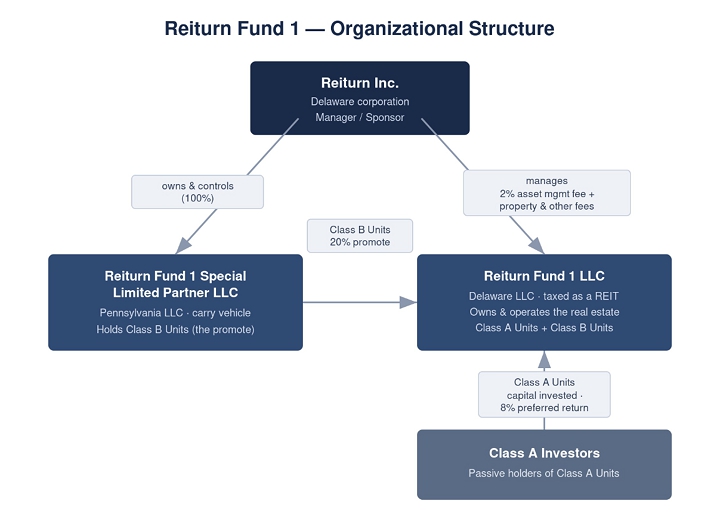
The Company is managed by Reiturn Inc. (the “Manager”), a newly formed Delaware corporation controlled by Birgo Capital.
Distributions
Subject to the availability of Distributable Cash (defined in “Securities Being Offered”), the Company will generally pay Class A Members an eight percent (8%) preferred return on their unreturned capital contributions and, after a catch-up to the Special Limited Partner (the Class B Units holder), eighty percent (80%) of remaining Distributable Cash (with the remaining twenty percent (20%) paid to the Special Limited Partner). In the case of Distributable Cash arising from capital transactions, such as a sale or refinancing, Class A Members will also receive a return of their allocated capital contributions before the catch-up and the 80%/20% split. All distributions are subject to the specific waterfall provisions contained in the Company’s Operating Agreement.
Transfer Restrictions
Our Operating Agreement contains significant restrictions on transfer of Class A Units. Our Manager may refuse a transfer of Class A Units for any number of reasons. Furthermore, transfers of our Class A Units may only be effected pursuant to exemptions under the Securities Act and as permitted by applicable state securities laws. In addition, there is no market for our Class A Units, and none is likely to develop in the future.
Going Concern
The consolidated financial statements included in this Offering Circular have been prepared on a going concern basis which assumes the Company will be able to realize its assets and discharge its liabilities in the normal course of business for the foreseeable future.
The ability to continue as a going concern is dependent upon the Company generating profitable operations in the future and/or obtaining the necessary financing to meet its obligations and repay its liabilities arising from normal business operations when they come due. The Company’s ability to raise additional capital through future issuances of debt or equity is unknown. The obtainment of additional financing, the successful development of the Company’s contemplated plan of operations, or its attainment of profitable operations are necessary for the Company to continue operations. The ability to successfully resolve these factors raise substantial doubt about the Company’s ability to continue as a going concern. The consolidated financial statements of the Company do not include any adjustments that may result from the outcome of these aforementioned uncertainties.
| 4 |
Selected Risks Associated With The Business
Our business is subject to a number of risks and uncertainties, including those highlighted in the section titled “Risk Factors” immediately following this summary. These risks include, but are not limited to, the following:
| ● | We have no operating history, and this is a “blind pool” offering. | |
| ● | There is no public market for our Class A Units, and our redemption program is limited. | |
| ● | We depend entirely on the Manager and its affiliates. | |
| ● | Our value-add strategy may not achieve the returns we project. | |
| ● | Our agreements with the Manager and its affiliates were not negotiated at arm’s length. |
| ● | Failure to qualify or remain qualified as a REIT would significantly reduce returns. | |
| ● | This is a best-efforts offering, and we may not raise enough capital to execute our strategy or to diversify. | |
| ● | Distributions are not guaranteed and may be funded from sources other than operating cash flow, including offering proceeds or borrowings. | |
| ● | The Manager and its affiliates receive substantial fees regardless of our performance, and our operating agreement reduces or eliminates their fiduciary duties. | |
| ● | We have significant conflicts of interest with our Manager and its affiliates and have not adopted a conflicts of interest policy. | |
| ● | Your interest may be diluted by future issuances of units and by the Bonus Units issued in this offering. | |
| ● | Our Class A Units are subordinate to our debt and other obligations, and our use of leverage increases the risk of loss. | |
| ● | We will concentrate in Class B “workforce housing” in Midwest secondary markets, which increases our exposure to economic and geographic risks. | |
| ● | Our results are subject to the general risks of owning real estate, including illiquidity, uninsured losses, and environmental and regulatory liabilities. | |
| ● | We are not registered under the Investment Company Act, and any requirement to register could force us to liquidate or rescind this offering. | |
| ● | Investors have limited voting rights and little ability to influence or replace the Manager. |
| 5 |
Offering Terms
| Securities Offered by the Company | Maximum of 61,475,409 Class A Units at $1.00 per unit for up to $61,475,409, plus up to 12,295,082 additional Class A Units eligible to be issued as Bonus Units for no additional consideration. See “Plan of Distribution” for more information on the eligibility criteria to receive Bonus Units, which will only be offered to investors in this Offering. | |
Investor Fee Minimum Investment |
Investors will be charged an Investor Fee of two percent (2%) of their investment amounts, for which no Class A Units will be issued. The maximum Investor Fee payable for any investment is $200.00, which presumes an investment of $10,000.00
The minimum investment in this offering is $1,020.00 (1,000 Class A Units plus the Investor Fee). | |
Securities outstanding before the Offering (as of September 15, 2026): |
Class A Units 0 Class B Units 1 | |
Securities outstanding after the Offering (assuming the maximum number of Class A Units are sold and/or issued in this offering). |
||
| Class A Units | 73,770,491 | |
| Class B Units | 1 | |
| Use of Proceeds | The proceeds of this Offering will be used for acquisitions, general operating expenses, offering expenses, and marketing. See the “Use of Proceeds” section of this Offering Circular for further details. |
| 6 |
The SEC requires that we identify risks that are specific to our business and financial condition. We are still subject to all the same risks that all companies in our business, and all companies in the economy, are exposed to. These include risks relating to economic downturns, political and economic events and technological developments (such as hacking and the ability to prevent hacking). Additionally, early-stage companies are inherently more risky than more developed companies. You should consider general risks as well as specific risks when deciding whether to invest.
Risks Related to Our Structure and This Offering
We have no operating history, and this is a “blind pool” offering.
The Company was formed in 2026 and has not yet acquired any properties. Investors will not have the opportunity to evaluate the specific properties we will acquire before investing, and must rely on the Manager’s ability to identify, acquire, and manage assets consistent with our strategy. There is no assurance we will achieve our investment objectives.
This is a best-efforts offering, and we may not raise enough capital to execute our strategy or to diversify.
We are offering Class A Units on a best-efforts basis, with no minimum offering amount required to be sold and no escrow. If we raise substantially less than the maximum offering amount, our portfolio may be smaller and less diversified, increasing the impact of any single underperforming property on overall returns.
This is an exempt offering under Regulation A, with less disclosure than a registered offering.
As a Tier 2 Regulation A offering, we are not subject to all of the disclosure, review, and ongoing reporting requirements that apply to companies registered under the Securities Act and Exchange Act. Investors will have access to less information than they would in a registered public offering.
The offering price of our Class A Units was determined by the Manager and may not reflect their value.
The price of our Class A Units was set by the Manager and is not based on an independent appraisal or an established trading market. The price may be higher than the amount a buyer would pay for the units in an arm’s-length transaction or than the net asset value of the underlying assets.
Our net asset value (NAV) is an estimate determined by the Manager and may not reflect the actual value of our assets.
To the extent unit pricing or redemptions are based on NAV, that NAV is an estimate calculated by the Manager using assumptions that may prove inaccurate. The Manager may amend its valuation policy, and there are limits on independent oversight of these valuations.
There is no public market for our Class A Units, and our redemption program is limited.
Our Class A Units are illiquid. There is no public trading market, and none is expected to develop. Investors may be unable to sell their units when they wish. Any redemption program is limited in amount, may be suspended or modified at the Manager’s discretion, and should not be relied upon as a source of liquidity.
Distributions are not guaranteed and may be funded from sources other than operating cash flow.
We are not required to make distributions, and the 8% preferred return is a feature of our distribution waterfall, not a guarantee of payment. Distributions, if any, may be paid from offering proceeds, borrowings, or return of capital, which would reduce the capital available for investment and could lower the value of your units.
| 7 |
Given our start-up nature, investors may not be interested in making an investment and we may not be able to raise all of the capital we seek and this could have a material adverse effect upon our Company and the value of your interests.
Due to the start-up nature of our Company, there can be no guarantee that we will reach our funding target from potential investors. In the event we do not reach a funding target, we may not be able to achieve our investment objectives.
— Non-compliance with certain securities regulations may result in the liquidation and winding up of our Company.
We are not registered and will not be registered as an investment company under the Investment Company Act of 1940, as amended (“Investment Company Act”), and neither our Manager nor its managers is or will be registered as an investment adviser under the Investment Advisers Act of 1940, as amended (“Investment Advisers Act”), and thus the interests do not have the benefit of the protections of the Investment Company Act or the Investment Advisers Act. We and our Manager have taken the position that the underlying assets are not “securities” within the meaning of the of the Investment Company Act or the Investment Advisers Act, and thus our assets will comprise of less than 40% investment securities under the Investment Company Act and our Manager and our asset managers will not be advising with respect to securities under the Investment Advisers Act. This position, however, is based upon applicable case law that is inherently subject to judgments and interpretation. If we were to be required to register under the Investment Company Act or our Manager were to be required to register under the Investment Advisers Act, it could have a material and adverse impact on the results of operations and expenses of our Company and our Manager may be forced to liquidate and wind up our Company or rescind the offering of interests.
There may be deficiencies with our internal controls that require improvements, and if we are unable to adequately evaluate internal controls, we may be subject to sanctions.
As a Tier 2 issuer, we will not need to provide a report on the effectiveness of our internal controls over financial reporting, and we will be exempt from the auditor attestation requirements concerning any such report so long as we are a Tier 2 issuer. We are in the process of evaluating whether our internal control procedures are effective and therefore there is a greater likelihood of undiscovered errors in our internal controls or reported financial statements as compared to issuers that have conducted such evaluations.
Using a credit card to purchase shares may impact the return on your investment as well as subject you to other risks inherent in this form of payment.
Investors in this offering may have the option of paying for their investment with a credit card, which is not usual in the traditional investment markets. Transaction fees charged by your credit card company and interest charged on unpaid card balances (which can reach almost 25% in some states) add to the effective purchase price of the interests you buy. The cost of using a credit card may also increase if you do not make the minimum monthly card payments and incur late fees. Using a credit card is a relatively new form of payment for securities and will subject you to other risks inherent in this form of payment, including that, if you fail to make credit card payments (e.g. minimum monthly payments), you risk damaging your credit score and payment by credit card may be more susceptible to abuse than other forms of payment. Moreover, where a third-party payment processor is used, as in this offering, your recovery options in the case of disputes may be limited. The increased costs due to transaction fees and interest may reduce the return on your investment.
The SEC’s Office of Investor Education and Advocacy issued an Investor Alert dated February 14, 2018 entitled Credit Cards and Investments – A Risky Combination, which explains these and other risks you may want to consider before using a credit card to pay for your investment.
Risks Related to Our Management and Conflicts of Interest
We are externally managed and depend entirely on the Manager and its affiliates.
We have no employees and rely completely on Reiturn Inc. and its affiliated real estate operating platform to source, acquire, finance, and manage our properties. Our success depends on the skill and continued involvement of the Manager’s key personnel, the loss of any of whom could materially harm us.
| 8 |
Investors have limited voting rights and little ability to influence or replace the Manager.
Holders of Class A Units have limited voting rights and do not participate in management. It will be difficult for investors to remove the Manager or to change our policies, even if they are dissatisfied with our performance.
The Manager and its affiliates receive substantial fees regardless of our performance.
We pay the Manager a 2% annual asset management fee on capital contributions, plus property management, acquisition, disposition, and other fees that may be paid to the Manager or its affiliates. These fees are payable whether or not the Company is profitable and reduce the cash available for distribution to investors.
The carried interest payable to the Special Limited Partner may create incentives to take greater risk.
The Special Limited Partner, an affiliate of the Manager, holds the Class B Units and is entitled to a 20% carried interest above the preferred return. This promote may incentivize the Manager to pursue riskier or more highly leveraged investments than it otherwise would, because the Manager’s affiliate shares disproportionately in the upside.
Our agreements with the Manager and its affiliates were not negotiated at arm’s length.
The management agreement, property management arrangements, the operating agreement, and related terms were established by affiliated parties rather than through independent, arm’s-length negotiation, and may be less favorable to investors than terms obtainable from unaffiliated third parties.
The Manager may face conflicts in allocating investment opportunities among affiliated programs.
The Manager and its affiliates manage, and intend to launch, other real estate programs (including additional Reg A REITs and parallel funds) with overlapping strategies. The Manager has discretion to allocate acquisition opportunities, and conflicts may arise that disadvantage the Company.
Our operating agreement contains provisions that reduce or eliminate duties (including fiduciary duties) of our Manager.
Our operating agreement provides that our Manager, in exercising its rights in its capacity as Manager, will be entitled to consider only such interests and factors as it desires and will have no duty or obligation (fiduciary or otherwise) to give any consideration to any interest of or factors affecting us or any of our investors and will not be subject to any different standards imposed by our operating agreement, the LLC Act or under any other law, rule or regulation or in equity. The operating agreement allows our Manager and its affiliates to have other business interests, including those that compete with our Company.
We do not have a conflicts of interest policy.
Our Company, our Manager and their affiliates will try to balance our interests with their own. However, to the extent that such parties take actions that are more favorable to other entities than our Company, these actions could have a negative impact on our financial performance and, consequently, on distributions to investors and the value of each series of interests. We have not adopted, and do not intend to adopt in the future, either a conflicts of interest policy or a conflicts resolution policy.
Conflicts may exist among our Manager, operators and their respective employees or affiliates.
Our Manager and our operators will engage with, on behalf of our Company, a number of brokers, asset sellers, insurance companies, and maintenance providers and other service providers and thus may receive in-kind discounts. In such circumstances, it is likely that these in-kind discounts may be retained for the benefit of our Manager or operators and not our Company. Our Manager or operators may be incentivized to choose a service provider or seller based on the benefits they are to receive.
| 9 |
There may be conflicting interests of investors.
Our Manager will determine whether or not to acquire or liquidate our properties. When determining to acquire or liquidate a property, our Manager will do so considering all of the circumstances at the time, this may include obtaining or paying a price for an underlying asset that is in the best interests of some but not all of the investors.
Risks Related to an Investment in Our Units
Your interest may be diluted by future issuances of units.
We may issue additional Class A Units (or other securities) in this or future offerings. Such issuances would dilute the percentage interest and economic rights of existing investors and could reduce the value of your units. Other offerings may be on terms more favorable to those offered here, which could dilute investors in this offering in the future.
Our Class A Units are subordinate to our debt and other obligations.
If we incur debt, those lenders will have claims on our assets and cash flow that rank senior to the Class A Units. In a liquidation, investors would receive distributions only after our debts and other senior obligations are satisfied, and may receive less than their original investment, or nothing.
The preferred return is not a guaranteed payment.
The 8% cumulative, non-compounded preferred return accrues but is only payable to the extent we have distributable cash and the Manager declares distributions. Accrued preferred return may go unpaid for extended periods, or permanently, if the Company underperforms.
There are restrictions on an investor’s ability to sell its Class A Units making it difficult to transfer, sell or otherwise dispose of our Class A Units.
Each state has its own securities laws, often called “blue sky” laws, which limit sales of securities to a state’s residents unless the securities are registered in that state or qualify for an exemption from registration. Before a security is sold in a state, there must be a registration in place to cover the transaction, or it must be exempt from registration.
Our Class A Units will not be registered under the laws of any states. There may be significant state blue sky law restrictions on the ability of investors to sell, and on purchasers to buy, our Class A Units. Investors should consider the resale market for our Class A Units to be limited. Investors may be unable to resell their Class A Units, or they may be unable to resell them without the significant expense of state registration or qualification.
In addition, there are significant transfer restrictions contained in our operating agreement that prohibit transfers of Class A Units unless approved by our Manager, in its sole discretion, and the transferee and transferor have met other conditions established by our operating agreement.
Risks Related to Our Business and Real Estate
Our results are subject to the general risks of owning real estate.
Real estate values and rental income are affected by factors beyond our control, including economic conditions, local supply and demand, interest rates, operating costs, vacancy, tenant defaults, and changes in laws. Declines in property values or rents would reduce our income and the value of your investment.
We will concentrate in Class B “workforce housing,” whose tenants may be more sensitive to economic stress.
Our “Forgotten Middle” strategy focuses on Class B multifamily housing serving middle-income renters. These tenants may be more vulnerable to job loss, inflation, and rising living costs, which could increase delinquencies, vacancies, and turnover during economic downturns.
| 10 |
We will be geographically concentrated in Midwest secondary markets.
We intend to concentrate in markets such as Pittsburgh, Cincinnati, Buffalo, and Louisville. Adverse economic, demographic, regulatory, or weather-related developments in these markets would affect us more than a geographically diversified portfolio.
Our value-add strategy may not achieve the returns we project.
Our strategy depends on acquiring stabilized assets and improving their performance through management and renovation. Renovation and repositioning may cost more, take longer, or generate lower rent increases than projected, and may not produce the returns we anticipate.
Our use of leverage increases the risk of loss.
We expect to finance acquisitions in part with mortgage debt. Leverage magnifies losses as well as gains, and rising interest rates increase borrowing costs, reduce distributable cash, and can make refinancing difficult or impossible, potentially resulting in default or loss of properties.
We depend on property managers, which may include affiliates of the Manager.
The performance of our properties depends on effective property management, which may be performed by the Manager’s affiliates under agreements that were not negotiated at arm’s length. Poor management or misaligned incentives could harm occupancy, expenses, and returns.
Real estate is illiquid, and we may be unable to sell properties on favorable terms.
We may not be able to sell properties quickly or at expected prices in response to changing conditions or to meet our obligations, which could force sales at a loss or limit our ability to make distributions.
We may incur uninsured losses and environmental or regulatory liabilities.
Some losses (such as certain natural disasters) may be uninsurable or exceed our coverage. We may also face environmental liabilities and changing landlord-tenant, rent-regulation, eviction, and habitability laws that increase costs or limit our flexibility.
Competition for acquisitions may raise prices and reduce available returns.
We compete for properties with other REITs, funds, and private buyers, many with greater resources. Increased competition may drive up acquisition prices and reduce the yields available to us.
Our short-term residential leases expose us to frequent re-leasing and vacancy risk.
Apartment leases are typically for one year or less, so a substantial portion of our leases turn over each year. High turnover increases vacancy, unit make-ready and re-leasing costs, and our exposure to softening rents. During downturns we may be unable to renew leases or re-lease units promptly on comparable terms, reducing occupancy and income.
We depend on tenants renewing their leases and on maintaining high occupancy.
Our cash flow depends on keeping units occupied at adequate rents. If residents do not renew, or if we cannot attract new residents at expected rents, our occupancy and income will decline. Workforce-housing residents may be particularly sensitive to rent increases, which could limit our ability to raise rents to offset rising costs.
| 11 |
Rising operating expenses may outpace rent growth and reduce cash available for distributions.
Property taxes, insurance premiums, utilities, payroll, and maintenance and repair costs may increase faster than rents, particularly for older Class B assets. Because many of these costs are fixed or continue regardless of occupancy, increases directly reduce net operating income and the cash available for distribution to investors.
Renovation and improvement projects may be delayed or cost more than expected.
Our value-add strategy involves renovating and repositioning properties. Construction delays, labor and material shortages, cost overruns, permitting issues, and contractor performance problems could increase costs, postpone projected rent gains, and reduce our returns.
Our properties are subject to extensive regulation and use restrictions.
Our properties may be subject to zoning, building, environmental, accessibility and fair-housing, and health and safety laws, landlord-tenant regulation, potential rent-control or rent-stabilization measures, and private use restrictions. Compliance can be costly, and changes in these laws or the adoption of new restrictions could limit our operations, increase our expenses, or reduce the value of our properties.
Competition and any increased affordability of single-family homes could limit our ability to lease our apartments or maintain or increase rents, which may materially and adversely affect us, including our financial condition, cash flows, results of operations and growth prospects.
The multifamily industry is highly competitive, and we face competition from many sources, including from other multifamily apartment communities both in the immediate vicinity and the geographic market where our properties are and will be located. If so, this would increase the number of apartments units available and may decrease occupancy and unit rental rates. Furthermore, multifamily apartment communities we invest in compete, or will compete, with numerous housing alternative in attracting residents, including owner occupied single and multifamily homes available to rent or purchase. The number of competitive properties and/or condominiums in a particular area, or any increased affordability of owner occupied single and multifamily homes caused by declining housing prices, mortgage interest rates and government programs to promote home ownership, could adversely affect our ability to retain our residents, lease apartment units and maintain or increase rental rates. These factors could materially and adversely affect us.
We may not make a profit if we sell a property.
The prices that we can obtain when we determine to sell a property will depend on many factors that are presently unknown, including the operating history, tax treatment of real estate investments, demographic trends in the area and available financing. There is a risk that we will not realize any significant appreciation on our investment in a property. Accordingly, your ability to recover all or any portion of your investment under such circumstances will depend on the amount of funds so realized and claims to be satisfied therefrom.
Inventory or available properties might not be sufficient to realize our investment goals.
We may not be successful in identifying suitable real estate properties or other assets that meet our investment criteria, or consummating acquisitions or investments on satisfactory terms. Failures in identifying or consummating acquisitions or investments would impair the pursuit of our business plan. Moreover, our investment strategy could involve significant risks that could inhibit our growth and negatively impact our operating results, including the following: increases in asking prices by acquisition candidates to levels beyond our financial capability or to levels that would not result in the returns required by our investment criteria; diversion of management’s attention to expansion efforts; unanticipated costs and contingent or undisclosed liabilities associated with investments; failure of the properties we invest in to achieve expected results; and difficulties entering markets in which we have no or limited experience.
| 12 |
The consideration paid for our properties may exceed fair market value, which may harm our financial condition and operating results.
The consideration that we pay will be based upon numerous factors, and the properties may be purchased in a negotiated transaction rather than through a competitive bidding process. We cannot assure anyone that the purchase price that we pay for a property or its appraised value will be a fair price, that we will be able to generate an acceptable return on such property, or that the location, lease terms or other relevant economic and financial data of any properties that we invest in will meet acceptable risk profiles. We may also be unable to lease vacant space or renegotiate existing leases at market rates, which would adversely affect our returns on a property. As a result, our investments in our properties may fail to perform in accordance with our expectations, which may substantially harm our operating results and financial condition.
The failure of our properties to generate positive cash flow or to sufficiently appreciate in value would most likely preclude our investors from realizing an attractive return on their interest ownership.
There is no assurance that our real estate investments will appreciate in value or will ever be sold at a profit. The marketability and value of the properties will depend upon many factors beyond the control of our management. There is no assurance that there will be a ready market for the properties, since investments in real property are generally non-liquid. The real estate market is affected by many factors, such as general economic conditions, availability of financing, interest rates and other factors, including supply and demand, that are beyond our control. We cannot predict whether we will be able to sell any property for the price or on the terms set by it, or whether any price or other terms offered by a prospective purchaser would be acceptable to us. We also cannot predict the length of time needed to find a willing purchaser and to close the sale of a property. Moreover, we may be required to expend funds to correct defects or to make improvements before a property can be sold. We cannot assure any person that we will have funds available to correct those defects or to make those improvements. In investing in a property, we may agree to lockout provisions that materially restrict us from selling that property for a period of time or impose other restrictions, such as a limitation on the amount of debt that can be placed or repaid on that property. These lockout provisions would restrict our ability to sell a property. These factors and any others that would impede our ability to respond to adverse changes in the performance of our properties could significantly harm our financial condition and operating results.
We may experience liability for environmental issues
Under various federal, state and local environmental and public health laws, regulations and ordinances, our Company may be required, regardless of knowledge or responsibility, to investigate and remediate the effects of hazardous or toxic substances or petroleum product releases (including in some cases natural substances such as methane or radon gas) and may be held liable under these laws or common law to a governmental entity or to third-parties for property, personal injury or natural resources damages and for investigation and remediation costs incurred as a result of the real or suspected presence of these substances in soil or groundwater beneath a property. These damages and costs may be substantial and may exceed insurance coverage our Company has for such events.
Buildings and structures on a property may have contained hazardous or toxic substances or have released pollutants into the environment; or may have known or suspected asbestos-containing building materials, lead based paint, mold, or insect infestations (such as roaches or bed bugs), that our Company may be required to mitigate. Undetected or unmitigated conditions such as these may cause (or be suspected to cause) personal injury and/or property damage, which could subject the properties, our Manager, and/or our Company to litigation with and liability to third parties.
Our Manager will attempt to limit exposure to such conditions by conducting due diligence on a Property, however, all or some of these conditions may not be discovered or occur until after that Property has been acquired by our Company.
We may experience liability for alleged or actual harm to third parties and costs of litigation
Owning and operating the properties subjects our Company to the risk of lawsuits filed by tenants, past and present employees, contractors, competitors, business partners, and others in the ordinary course of business. As with all legal proceedings, no assurance can be provided as to the outcome of these matters, and legal proceedings can be expensive and time consuming. Our Company may not be successful in the defense or prosecution of these lawsuits, which could result in settlements or damages that could result in substantial Losses to our Company. Even if our Company is successful, there may be substantial costs associated with the legal proceeding, and our Manager may be delayed or prevented from implementing the business plan of our Company.
| 13 |
Title insurance may not cover all title defects
Our Manager will acquire title insurance on each property, but It is possible that uninsured title defects could arise in the future, which our Company may have to defend or otherwise resolve, the cost of which may impact the profitability of each property and/or our Company as a whole.
Compliance with Americans with Disabilities Act
Under the Americans with Disabilities Act of 1990 (the ADA), all public accommodations are required to meet certain federal requirements related to access and use by disabled persons. A determination that a property is not in compliance with the ADA could result in imposition of fines or an award of damages to private litigants. Furthermore, substantial modifications made to comply with the ADA could adversely affect our Company’s ability to make cash distributions to its members.
Due diligence may not uncover all material facts
Our Manager, through its members will endeavor to obtain and verify material facts regarding the properties. It is possible, however, that our Manager will not discover certain material facts about a property, because information presented by the sellers may have been prepared in an incomplete or misleading fashion, and material facts related to such property may not yet have been discovered.
Financial projections may be wrong
Certain financial projections concerning the future performance of the properties are based on assumptions of an arbitrary nature and may prove to be materially incorrect. No assurance is given that actual results will correspond with the results contemplated by these projections. It is possible that returns may be lower than projected, or that there may be no returns at all.
These and all other financial projections, and any other statements previously provided to the Purchaser relating to our Company or its prospective business operations that are not historical facts, are forward-looking statements that involve risks and uncertainties. Sentences or phrases that use such words as “believes,” “anticipates,” “plans,” “may,” “hopes,” “can,” “will,” “expects,” “is designed to,” “with the intent,” “potential” and others indicate forward-looking statements, but their absence does not mean that a statement is not forward- looking.
Such statements are based on our Manager’s current estimates and expectations, along with currently available competitive, financial, and economic data. However, forward-looking statements are inherently uncertain. A variety of factors could cause business conditions and results to differ materially from what is contained in any such forward-looking statements.
It is possible that actual results from operation of the properties will be different than the returns anticipated by our Manager and/or that these returns may not be realized in the timeframe projected by our Manager, if at all.
Risks Related to Our REIT Tax Status
The Company intends to elect to be taxed as a REIT, if and when eligible. The Company may never qualify or elect to be taxed as a REIT.
The failure of the Company to qualify or remain qualified as a REIT would subject the Company to U.S. federal income tax and potentially state and local tax and would adversely affect the Company’s operations and the market price of the Class A Units. We intend for the Company to elect and qualify to be taxed as a REIT under Sections 856 through 860 of the Internal Revenue Code, commencing with the first full taxable year following the closing of this Offering and intend to operate the Company in a manner that would allow the Company to continue to qualify as a REIT. However, we may terminate the Company’s REIT qualification, if our Manager determines that not qualifying as a REIT is in the best interests of the Company, or inadvertently. The Company’s qualification as a REIT depends upon its ability to meet, through actual annual operating results, distribution levels, and diversity of ownership, the various and complex REIT qualification tests imposed under the Internal Revenue Code. To qualify as a REIT, the Company must comply with certain highly technical and complex requirements. We cannot be certain that the Company has complied or will comply with these requirements because there are few judicial and administrative interpretations of these provisions. In addition, facts and circumstances that may be beyond our control may affect our ability to qualify as a REIT. We cannot assure you that new legislation, regulations, administrative interpretations or court decisions will not change the tax laws significantly with respect to the Company’s qualification as a REIT or with respect to the federal income tax consequences of qualification. We cannot assure you that we will qualify or will remain qualified as a REIT.
| 14 |
If the Company fails to qualify as a REIT, it will not be allowed to deduct distributions to investors in computing taxable income and will be subject to federal income tax at regular rates. In addition, the Company may be barred from qualification as a REIT for the four taxable years following disqualification. The additional tax incurred at regular corporate rates would significantly reduce the taxable cash flow available for distribution to investors and for debt service. Furthermore, the Company would no longer be required by the Internal Revenue Code to make any distributions to our investors as a condition of REIT qualification. Any distributions to investors would be taxable as ordinary income to the extent of the Company’s current and accumulated earnings and profits. Corporate distributees, however, may be eligible for the dividends received deduction on the distributions, subject to limitations under the Internal Revenue Code.
Even if the Company qualifies as a REIT, in certain circumstances, it may incur tax liabilities that would reduce its cash available for distribution to our investors. Even if the Company qualifies and maintains its status as a REIT, it may be subject to U.S. federal, state and local income taxes. For example, net income from the sale of properties that are “dealer” properties sold by a REIT (a “prohibited transaction” under the Internal Revenue Code) will be subject to a 100% excise tax, and some state and local jurisdictions may tax some or all of our income because not all states and localities treat REITs the same as they are treated for U.S. federal income tax purposes. The Company may not make sufficient distributions to avoid excise taxes applicable to REITs. The Company also may decide to retain net capital gain we earn from the sale or other disposition of our property and pay U.S. federal income tax directly on such income. In that event, our investors would be treated as if they earned that income and paid the tax on it directly. However, investors that are tax-exempt, such as charities or qualified pension plans, would have no benefit from their deemed payment of such tax liability unless they file U.S. federal income tax returns and thereon seek a refund of such tax. The Company also will be subject to corporate tax on any undistributed REIT taxable income. Cash used for paying taxes will not be available for distribution or reinvestment by the Company.
The taxation of distributions to our investors can be complex; however, distributions that we make to our investors generally will be taxable as ordinary income or constitute a return of capital, which may reduce your anticipated return from an investment in us. Distributions that the Company makes to our taxable investors out of current and accumulated earnings and profits (and not designated as capital gain dividends or qualified dividend income) generally will be taxable as ordinary income. However, a portion of our distributions may (1) constitute a return of capital generally to the extent that they exceed our accumulated earnings and profits as determined for U.S. federal income tax purposes, (2) be designated by us as capital gain dividends generally taxable as long-term capital gain to the extent that they are attributable to net capital gain recognized by us, or (3) be designated by us as qualified dividend income generally to the extent they are attributable to dividends we receive from our taxable REIT subsidiaries (“TRSs”). A return of capital is not taxable, but has the effect of reducing the basis of an investor’s investment in our Class A Units. Due to our investment in real estate, depreciation deductions and interest expense may reduce our earnings and profits in our early years with the result that a large portion of distributions to our investors in early years may constitute a return of capital rather than ordinary income.
Dividends payable by REITs generally do not qualify for the reduced tax rates available for some dividends. Qualified dividend income payable to U.S. investors that are individuals, trusts, and estates is subject to the reduced maximum tax rate applicable to long-term capital gains. Dividends payable by REITs, however, generally are not eligible for this reduced rate. For taxable years beginning after December 31, 2017, non-corporate taxpayers generally may deduct up to 20% of certain pass-through business income, including “qualified REIT dividends” (generally, dividends received by a REIT that are not designated as capital gain dividends or qualified income), subject to certain limitations, resulting in an effective maximum federal income tax rate of 29.6% on such income. This deduction, which had been scheduled to expire for taxable years beginning after December 31, 2025, was made permanent by the One Big Beautiful Bill Act, enacted July 4, 2025. In addition, individuals, trusts, and estates whose income exceeds certain thresholds are subject to 3.8% Medicare tax on dividends received by us. Although the reduced U.S. federal income tax rate applicable to qualified dividend income does not adversely affect the taxation of REITs or dividends payable by REITs, the more favorable rates applicable to regular corporate dividends could cause investors who are individuals, trusts, and estates to perceive investments in REITs to be relatively less attractive than investments in the stocks of non-REIT corporations that pay dividends, which could adversely affect the value of our Class A Units. Tax rates could be changed in future legislation.
| 15 |
If the Company were considered to actually or constructively pay a “preferential dividend” to certain of our investors, the Company’s status as a REIT could be adversely affected. In order to qualify as a REIT, the Company must distribute annually to its investors at least 90% of the Company’s REIT taxable income (which does not equal net income, as calculated in accordance with GAAP), determined without regard to the deduction for dividends paid and excluding net capital gain. In order for distributions to be counted as satisfying the annual distribution requirements for REITs, and to provide the Company with a REIT-level tax deduction, the distributions must not be “preferential dividends.” A dividend is not a preferential dividend if the distribution is pro rata among all outstanding units within a particular class, and in accordance with the preferences among different classes of units as set forth in our organizational documents. Currently, there is uncertainty as to the IRS’s position regarding whether certain arrangements that REITs have with their investors could give rise to the inadvertent payment of a preferential dividend. While we believe that our operations have been structured in such a manner that we will not be treated as inadvertently paying preferential dividends, there is no de minimis exception with respect to preferential dividends. Therefore, if the IRS were to take the position that the Company inadvertently paid a preferential dividend, the Company may be deemed either to (a) have distributed less than 100% of its REIT taxable income and be subject to tax on the undistributed portion, or (b) have distributed less than 90% of its REIT taxable income and the Company’s status as a REIT could be terminated for the year in which such determination is made if the Company were unable to cure such failure. If, however, the Company qualifies as a “publicly offered REIT” (within the meaning of Section 562(c) of the Internal Revenue Code) in the future, the preferential dividend rules will cease to apply to us. In addition, the IRS is authorized to provide alternative remedies to cure a failure to comply with the preferential dividend rules, but as of the date hereof, no such authorized procedures have been promulgated.
Complying with REIT requirements may limit our ability to hedge our liabilities effectively and may cause us to incur tax liabilities. The REIT provisions of the Internal Revenue Code may limit our ability to hedge our liabilities. Any income from a hedging transaction we enter into to manage risk of interest rate changes, price changes or currency fluctuations with respect to borrowings made or to be made to acquire or carry real estate assets, if properly identified under applicable Treasury Regulations, does not constitute “gross income” for purposes of the 75% or 95% gross income tests. To the extent that we enter into other types of hedging transactions, the income from those transactions will likely be treated as non-qualifying income for purposes of both of the gross income tests. As a result of these rules, we may need to limit our use of advantageous hedging techniques or implement those hedges through a TRS. This could increase the cost of our hedging activities because our TRSs would be subject to tax on gains or expose us to greater risks associated with changes in interest rates than we would otherwise want to bear. In addition, losses in a TRS generally will not provide any tax benefit, except for being carried forward against future taxable income of such TRS.
The ability of our Manager to revoke the REIT qualification of the Company without approval may subject the Company to U.S. federal income tax and reduce distributions to our investors. Our Operating Agreement provides that our Manager may revoke or otherwise terminate the Company’s REIT election, without the approval of our investors, if it determines that it is no longer in the Company’s best interest to continue to qualify as a REIT. While we intend for the Company to elect and qualify to be taxed as a REIT, the Company may not elect to be treated as a REIT or may terminate its REIT election if we determine that qualifying as a REIT is no longer in the best interests of our investors. If the Company ceases to be a REIT, it would become subject to U.S. federal income tax on its taxable income and would no longer be required to distribute most of its taxable income to our investors, which may have adverse consequences on the total return to our investors and on the market price of the Class A Units.
Legislative or regulatory action with respect to tax laws and regulations could adversely affect the Company and our investors. On December 22, 2017, H.R. 1, informally titled the Tax Cuts and Jobs Act, or the TCJA, was enacted. The TCJA made major changes to the Internal Revenue Code, including a number of provisions of the Internal Revenue Code that affect the taxation of REITs and their investors. The long-term effect of the significant changes made by the TCJA remains uncertain, and additional administrative guidance will be required in order to fully evaluate the effect of many provisions. The effect of technical corrections with respect to the TCJA could have an adverse effect on the Company and our investors. We are also subject to state and local tax laws and regulations. Changes in state and local tax laws or regulations may result in an increase in our tax liability. A shortfall in tax revenues for states and municipalities in which we operate may lead to an increase in the frequency and size of such changes. If such changes occur, we may be required to pay additional taxes on our assets or income. These increased costs could adversely affect our financial condition, results of operations and the amount of cash available for the payment of dividends.
In addition, in recent years, numerous legislative, judicial and administrative changes have been made to the federal income tax laws applicable to investments in REITs and similar entities. Additional changes to tax laws are likely to continue to occur in the future, and we cannot assure our investors that any such changes will not adversely affect the taxation of an investment in our Class A Units. We cannot assure you that future changes to tax laws and regulations will not have an adverse effect on an investment in our Class A Units.
| 16 |
You are urged to consult with your tax advisor with respect to the impact of recent legislation on your investment in our Class A Units and the status of legislative, regulatory or administrative developments and proposals and their potential effect on an investment in our Class A Units.
Although REITs generally receive better tax treatment than entities taxed as regular corporations, it is possible that future legislation would result in a REIT having fewer tax advantages, and it could become more advantageous for a company that invests in real estate to elect to be treated for U.S. federal income tax purposes as a corporation. As a result, the operating agreement provides our Manager with the power, under certain circumstances, to revoke or otherwise terminate the Company’s REIT election and cause the Company to be taxed as a regular corporation, without the vote of our investors. Our Manager could only cause such changes in the Company’s tax treatment if it determines in good faith that such changes are in the best interest of our investors.
The ownership restrictions of the Internal Revenue Code for REITs and the 9.8% ownership limit in the operating agreement may inhibit market activity in our Class A Units and restrict our business combination opportunities. The Internal Revenue Code imposes certain limitations on the ownership of the stock of a REIT. For example, not more than 50% in value of our outstanding interests may be owned, directly or indirectly, by five or fewer individuals (as defined in the Internal Revenue Code) during the last half of any taxable year. To protect the Company’s REIT status, the operating agreement prohibits any holder from acquiring more than 9.8% (in value or number of interests, whichever is more restrictive) of the aggregate of the outstanding interests of the Company or more than 9.8% (in value or number of interests, whichever is more restrictive) of our Class A Units or any class of the outstanding interests unless our Manager determines that it is no longer in the Company’s best interests to continue to qualify as a REIT or that compliance with the restriction is no longer required in order for the Company to continue to so qualify as a REIT. The ownership limitation may limit the opportunity for investors to receive a premium for their interests that might otherwise exist if an investor were attempting to assemble a block of interests in excess of 9.8% of the outstanding interests or otherwise effect a change in control.
Potential characterization of distributions or gain on sale may be treated as unrelated business taxable income to tax-exempt investors. If (a) we are a “pension-held REIT,” (b) a tax-exempt entity has incurred (or deemed to have incurred) debt to purchase or hold our Class A Units, or (c) a holder of our Class A Units is a certain type of tax-exempt entity, dividends on, and gains recognized on the sale of, our Class A Units by such tax-exempt entity may be subject to U.S. federal income tax as unrelated business taxable income under the Internal Revenue Code.
Possible changes in federal/local tax laws or the application of existing federal/local tax laws may result in significant variability in our results of operations and tax liability for the investor.
The Internal Revenue Code of 1986, as amended, is subject to change by Congress, and interpretations may be modified or affected by judicial decisions, by the Treasury Department through changes in regulations and by the Internal Revenue Service through its audit policy, announcements, and published and private rulings. Although significant changes to the tax laws historically have been given prospective application, no assurance can be given that any changes made in the tax law affecting an investment in any series of interest of our Company would be limited to prospective effect. Accordingly, the ultimate effect on an investor’s tax situation may be governed by laws, regulations or interpretations of laws or regulations which have not yet been proposed, passed or made, as the case may be.
Furthermore, investors may reside in various tax jurisdictions throughout the world. To the extent that there are changes to tax laws or tax reporting obligations in any of these jurisdictions, such changes could adversely impact the ability and/or willingness of investors to purchase our Class A Units. Failure to assess or pay the correct amount of tax on a transaction may expose us to claims from tax authorities.
Risks Related to Our Sponsor’s Track Record
The prior performance of the Manager’s affiliates is not indicative of our future results.
Information about the historical performance of Birgo Capital and other affiliated programs reflects separate entities, different assets, and different market conditions. It is not a guarantee or reliable predictor of the Company’s performance, and investors should not rely on it when making an investment decision.
| 17 |
Dilution means a reduction in value, control or earnings of the interests the investors. An affiliate of our Manager was granted Class B membership interests in our Company for $0 cash contribution as compared to contributions of $1.00 per Class A Unit to be paid by investors pursuant to this offering. Because our Manager has been issued Class B interests in consideration for our Manager’s services, investors will experience economic dilution as a result of their purchase of Units since the Class B Holder will be entitled to residual of distributions of 20%. Certain investors will also experience minor dilution due to sales of Bonus Units to other investors pursuant to this offering. If the maximum number of Bonus Units is issued in this Offering, the blended effective cash purchase price across all Class A Units issued (including Bonus Units) would be approximately $0.83 per Unit, as compared to the $1.00 per Unit cash purchase price, representing immediate dilution of approximately $0.17 per Unit (approximately 16.7%). Because Bonus Units are allocated based on investor eligibility, investors who receive fewer or no Bonus Units will pay a higher effective price per Unit and will experience proportionately greater dilution than investors who receive the maximum number of Bonus Units.
If the Company decides to issue more Class A Units, an investor could experience value dilution, with each Class A Units being worth less than before, and/or control dilution, with the total percentage an investor owns being less than before. There may also be earnings dilution, with a reduction in the amount earned per Unit. Dilution can make drastic changes to the value of each Unit, ownership percentage, voting control, and earnings per share. In some cases, dilution can also completely wipe out the value of investments made by early investors, without any person being at fault. Investors should understand how dilution works and the lack of availability of anti-dilution protection for this investment.
Valuation considerations
Any valuation of a company is difficult to assess and may be derived using a number of different methodologies, each of which would generate a different valuation. The valuation for the Class A Units was established by the Company arbitrarily. The valuation of the Company will determine the amount by which an investor’s stake is diluted in the future, if at all. No single valuation method can determine the precise value of the Company or the securities offered. The offering price reflects management’s judgment, informed by multiple valuation perspectives, market conditions, and the Company’s stage of development. Investors should consider the offering price in light of the speculative nature of early-stage investments and the possibility that future valuations may differ materially from the valuation implied by this offering.
| 18 |
The following table illustrates the amount of net proceeds to be received by our Company on the sale of the Class A interests offered hereby and the intended uses of such proceeds. It is possible that we may not raise the entire offering amount through this Offering Circular. In such case, we will reallocate the use of proceeds as the Manager deems to be in the best interests of our Company in order to effectuate its business plan. The intended use of proceeds are as follows:
| 100% | 75% | 50% | 25% | |||||||||||||
| Total Raise | $ | 62,704,918 | % | $ | 47,028,689 | % | $ | 31,352,459 | % | $ | 15,676,230 | |||||
| Offering Expenses | ||||||||||||||||
| Commissions & Variable Expenses | $ | (2,864,471 | ) | $ | (2,159,041 | ) | $ | (1,453,611 | ) | $ | (748,180 | ) | ||||
| Fixed Costs | $ | (46,950 | ) | $ | (46,950 | ) | $ | (46,950 | ) | $ | (46,950 | ) | ||||
| Net Proceeds | $ | 59,793,496.72 | $ | 44,822,697.54 | $ | 29,851,898.36 | $ | 14,881,099.18 | ||||||||
| Use of Proceeds | Amount | % | Amount | % | Amount | % | Amount | % | ||||||||||||||||||||||||
| Acquisiton of Properies | $ | 38,167,838 | 64 | % | $ | 28,586,526 | 64 | % | $ | 19,005,215 | 64 | % | $ | 9,423,903 | 63 | % | ||||||||||||||||
| Rehabilation of Properties | $ | 8,371,090 | 14 | % | $ | 6,275,178 | 14 | % | $ | 4,179,266 | 14 | % | $ | 2,083,354 | 14 | % | ||||||||||||||||
| General & Administrative | $ | 100,000 | 0 | % | $ | 100,000 | 0 | % | $ | 100,000 | 0 | % | $ | 100,000 | 1 | % | ||||||||||||||||
| Marketing | $ | 11,958,699 | 20 | % | $ | 8,964,540 | 20 | % | $ | 5,970,380 | 20 | % | $ | 2,976,220 | 20 | % | ||||||||||||||||
| Asset Management Fee | $ | 1,195,870 | 2 | % | $ | 896,454 | 2 | % | $ | 597,038 | 2 | % | $ | 297,622 | 2 | % | ||||||||||||||||
| Total Use of Proceeds | $ | 59,793,497 | $ | 44,822,698 | $ | 29,851,898 | $ | 14,881,099 | ||||||||||||||||||||||||
| (1) | The above table assumes commissions and expenses payable to Broker, which, include commissions of 4.5%, the 2% investor fee, as well as a maximum of $42,750 paid for other services, plus legal and accounting expenses totaling $. It also includes the collected investor fees by the company and the expected use of those to pay the estimated payment processing fees of 2% on all units sold. |
The allocation of the use of proceeds among the categories of anticipated expenditures represents management’s best estimates based on the current status of our Company’s proposed operations, plans, investment objectives, capital requirements, and financial conditions. Future events, including changes in economic or competitive conditions of our business plan or the completion of less than the total offering, may cause our Company to modify the above-described allocation of proceeds. Our Company’s use of proceeds may vary significantly in the event any of our Company’s assumptions prove inaccurate. We reserve the right to change the allocation of net proceeds from the offering as unanticipated events or opportunities arise.
| 19 |
Company Overview & Investment Strategy
Reiturn Fund 1 LLC was recently formed to acquire, own, operate, finance and/or sell income-producing real estate, and to let people invest in that real estate the way they would invest in a company, by buying shares, rather than having to buy a property themselves. The Company intends to elect to be taxed as a real estate investment trust (“REIT”), if and when eligible. The Company’s investment objective is to generate stable current income and long-term capital appreciation for holders of the Company’s Class A Units by acquiring, improving, and operating income-producing multifamily residential real estate. The Company intends to focus on apartment communities rather than other commercial real estate sectors, and to build a portfolio of stabilized, cash-flowing properties that produce recurring rental income available for distribution to investors.
The Company intends to pursue what the Manager refers to as its “Forgotten Middle” strategy: investing in Class B workforce housing that serves middle-income renters. Rather than competing for premium Class A or luxury assets, or assuming the execution risk of heavily distressed properties, the Company targets well-occupied, moderately priced apartment communities that house working households. The Company believes this segment is underserved and frequently mispriced, and that disciplined ownership and operational improvement of these assets can deliver attractive risk-adjusted returns while supporting the stability and quality of the communities in which the Company invests.
The Company intends to concentrate on secondary markets in the American Midwest and “Heartland” rather than higher-priced coastal markets. Its initial target markets include Pittsburgh, Pennsylvania; Cincinnati, Ohio; Buffalo, New York; and Louisville, Kentucky. The Manager believes these markets offer lower acquisition cost bases, more stable occupancy and rent dynamics, and more durable cash flows relative to coastal gateway markets, and that these characteristics are well-suited to the Company’s income-oriented objective.
The Company expects its acquisitions to range from 150 to 200 units, with rehabilitation to average approximately $10,000 per unit, focused on updating paint, flooring, fixtures, and appliances. We expect the typical hold time for each property to be approximately 5 to 7 years, although the Manager has ultimate discretion over when to sell a property, which may be more or less than this time.
The Company intends to employ a value-oriented acquisition approach, seeking to acquire stabilized multifamily assets and to enhance their performance through active management, operational improvements, and selective renovation of units and common areas, while distributing rental cash flow to investors.
Our Manager has the authority to make all the decisions regarding our investments. The criteria that our Manager will consider when evaluating prospective investment opportunities include, but are not limited to:
| ● | macroeconomic conditions that may influence operating performance; | |
| ● | real estate market factors that may influence real estate valuations; | |
| ● | analysis of the real estate, zoning, operating costs and the asset’s overall competitive position in its market; | |
| ● | real estate and sales market conditions affecting the real estate; | |
| ● | the estimated costs and timing associated with capital improvements of the real estate; | |
| ● | a valuation of the investment, investment basis relative to its value and the ability to liquidate an investment through a sale or refinancing of the real estate; | |
| ● | review of third party reports, including appraisals, engineering and environmental reports; | |
| ● | physical inspections of the real estate and analysis of markets; and | |
| ● | the overall structure of the investment and rights. |
| 20 |
Description of Properties
Because the Company was formed in May 2026 and has not yet raised capital, it currently owns no real estate properties.
Organizational Structure and Management
The Company was formed in May 2026. The Company’s equity consists of two classes of membership units: Class A Units, which are to be offered and held by investors (also known as “Class A Members”), and Class B Units, which are held by the Special Limited Partner described below. Holders of Class A Units are passive investors and do not participate in the management of the Company.
The Company is managed by Reiturn Inc., a Delaware corporation. The Manager is responsible for the day-to-day operations of the Company and for all investment, financing, leasing, and distribution decisions, subject to the terms of the Company’s operating agreement. The Manager is not required to devote its full time to the Company’s business and may engage in other activities, including the sponsorship of parallel funds, co-investment vehicles, and other special purpose entities.
Reiturn Fund 1 Special Limited Partner LLC, a Pennsylvania limited liability company (the “Special Limited Partner”), is an affiliate of the Manager and holds the Company’s Class B Units. The Special Limited Partner performs no operational role; it exists to hold the carried interest, or “promote,” in the Company and to receive the performance-based share of the Company’s profits allocable to the sponsor. The Special Limited Partner is owned and controlled by the Manager, Reiturn Inc. As a result, Reiturn Inc. sits at the top of the structure in two capacities: as the Manager of the Company and as the owner of the Special Limited Partner. Reiturn, Inc. is ultimately controlled by Birgo Capital via common management.
| 21 |
Competition
The multifamily real estate industry is highly competitive, and we face competition from many sources, including from other income producing real estate both in the immediate vicinity and the geographic market where our properties are and will be located. If so, this would increase the number of units available and may decrease occupancy and unit rental rates. Furthermore, our multifamily apartment communities will compete with numerous housing alternatives in attracting residents, including owner occupied single and multifamily homes available to rent or purchase. The number of competitive properties and/or condominiums in a particular area, or any increased affordability of owner occupied single and multifamily homes caused by declining housing prices, mortgage interest rates and government programs to promote home ownership, could adversely affect our ability to retain our residents, lease apartment units and maintain or increase rental rates. These factors could materially and adversely affect us.
Government Regulation
Regulation of the ownership and rental of multifamily properties varies from jurisdiction to jurisdiction and state to state. In any jurisdictions or states in which we operate, we may be required to obtain licenses and permits to conduct business. Claims arising out of actual or alleged violations of law could be asserted against us by individuals or governmental authorities and could expose us or each series of interests to significant damages or other penalties.
Legal
We are not aware of any pending or threatened legal actions that we believe would have a material impact on our business.
Employees
The Company has no employees. All services are provided via agents of our Manager.
| 22 |
MANAGEMENT’S DISCUSSION AND ANALYSIS OF
FINANCIAL CONDITION AND RESULTS OF OPERATIONS
The following discussion and analysis should be read together with our audited financial statements and the related notes included elsewhere in this Offering Circular. This discussion contains forward-looking statements that involve risks and uncertainties. Our actual results could differ materially from those anticipated in these forward-looking statements as a result of various factors, including those set forth under “Risk Factors.” We assume no obligation to update any of the forward-looking statements included herein, except as required by law.
No Operating History
We were recently formed and have no prior operating history upon which prospective investors may evaluate our likely performance. We are subject to all of the business risks and uncertainties associated with any new business, including the risk that we will not achieve our investment objectives and that the value of an investment in us could decline substantially. Our audited financial statements as of May 12, 2026, our date of inception, reflect no assets, no liabilities, and no results of operations, and indicate that we had not yet commenced operations and were in the pre-revenue stage. Our ability to commence and expand operations depends on our ability to raise capital in this offering and to identify, acquire, and manage suitable real estate investments.
Our Manager and the Special Limited Partner
We have no employees and are managed by our Manager, Reiturn Inc. All of our investment, financing, and operating decisions are made by our Manager. In exchange for its services, our Manager and its affiliates are entitled to receive 2% of the total of all capital contributions of the Class A Members on an annual basis. In addition, through its ownership of our Class B Units, the Special Limited Partner is entitled to a carried interest equal to twenty percent (20%) of distributions after our Class A Members have received their preferred return and, in the case of capital transactions, a return of their allocated capital contributions, as described under “—Distribution Policy” below. Because our Manager and the Special Limited Partner are affiliated, these arrangements were not negotiated at arm’s length and give rise to conflicts of interest, which are described under “Conflicts of Interest” and “Risk Factors.”
Plan of Operation
We intend to use a significant portion of the net proceeds of this offering, after payment of offering expenses and fees payable to our Manager and its affiliates, to acquire and operate a diversified portfolio of real estate investments consistent with our investment strategy and our intended qualification as a REIT. We expect to deploy capital as it is raised. Because we have not yet identified the specific assets we will acquire, we are organized as a “blind pool,” and investors will not have the opportunity to evaluate our investments before we make them. The number, size, and mix of investments we make, and the pace at which we make them, will depend principally on the amount of capital we raise in this offering and on market conditions. We expect to be able to acquire our first property within 12-18 months from raising sufficient capital from this Offering. Assuming we have raised sufficient capital from this Offering, we expect to acquire approximately ____ - ____ properties in our first year of operations.
We intend to elect and qualify to be taxed as a REIT for U.S. federal income tax purposes commencing with our taxable year ending December 31, 2027.
Results of Operations
Because we were formed on May 12, 2026 and have not commenced operations, we have limited financial results to discuss, and no comparative prior-period information is presented. From our inception through the date of our audited financial statements, we did not generate any revenue and had not acquired any real estate investments. As of May 12, 2026, we had total assets of $0, total liabilities of $0, and no members’ equity, and we had no cash and cash equivalents. In accordance with our accounting policies, organizational costs are expensed as incurred. We do not expect to generate meaningful revenue, or to incur significant operating expenses relating to real estate operations, until we have raised sufficient capital in this offering and deployed it into income-producing real estate investments.
For periods following our inception, we expect our results of operations to be driven principally by the amount of capital we raise, the timing and terms of the real estate investments we acquire, the rental and other income generated by those investments, the interest expense on any indebtedness we incur, and the fees and expenses payable to our Manager and its affiliates. Until we have a meaningful operating history, period-to-period comparisons of our results of operations may not be meaningful.
| 23 |
Liquidity and Capital Resources
We are dependent upon the net proceeds of this offering to conduct our planned operations. We intend to fund our real estate investments and operating needs through a combination of the net proceeds of this offering and via debt, with approximately 70% of each acquisition being funded by debt. Our Operating Agreement provides that the Company may be funded by the sale of Units and by one or more secured or unsecured loans, as determined by our Manager in its sole discretion, and does not require our members to make any additional capital contributions beyond their initial subscription.
As of May 12, 2026, we had no cash and cash equivalents and no borrowings outstanding. Our short-term liquidity requirements are expected to consist principally of offering and organizational expenses and fees payable to our Manager, and our longer-term liquidity requirements are expected to consist principally of the funds necessary to acquire and operate real estate investments, to service any indebtedness, and to make distributions to our members. If we are unable to raise substantial funds in this offering, we will make fewer investments, resulting in less diversification, and our expenses as a percentage of the capital we raise will be higher.
Our ability to continue as a going concern in the twelve months following our inception is dependent upon our ability to obtain capital financing from investors in this offering sufficient to meet our current and future obligations and to commence our planned operations. There can be no assurance that we will be successful in raising sufficient capital on acceptable terms, or at all.
Critical Accounting Policies and Estimates
Our financial statements are prepared in accordance with accounting principles generally accepted in the United States (“U.S. GAAP”), using the accrual method of accounting. The preparation of financial statements in conformity with U.S. GAAP requires management to make estimates and assumptions that affect the reported amounts of assets and liabilities and the disclosure of contingent assets and liabilities. We believe that the following accounting policies will be most critical to an understanding of our financial condition and results of operations once we commence operations:
Real estate investments. Upon acquisition of real property, we expect to allocate the purchase price to land, building, improvements, and identified intangibles at their relative fair values, and to depreciate the depreciable components over their estimated useful lives. We will evaluate our real estate investments for impairment whenever events or changes in circumstances indicate that the carrying amount of an asset may not be recoverable.
Revenue recognition. We expect to derive rental and other income from our real estate investments and to recognize such income in accordance with the applicable U.S. GAAP guidance for leases and for revenue from contracts with customers.
Organizational and offering costs. In accordance with FASB ASC 720, organizational costs, including accounting fees, legal fees, and costs of formation, are expensed as incurred. Offering costs are treated in accordance with applicable guidance.
Income taxes. We intend to be taxed as a REIT and to make distributions sufficient to satisfy the REIT distribution requirements; accordingly, we do not expect to record a material provision for U.S. federal income tax so long as we qualify as a REIT.
Off-Balance Sheet Arrangements
As of the date of our audited financial statements, we had no off-balance sheet arrangements that have or are reasonably likely to have a current or future material effect on our financial condition, results of operations, liquidity, capital expenditures, or capital resources.
Trend Information
The Company has a limited operating history and no historical operating data for trend analysis. Nonetheless, the Company’s business is subject to general business and economic conditions in the U.S. and worldwide along with local, state, and federal governmental policy decisions and general trends in the real estate industry. Events including, but not limited to, recession; inflation; downturn or otherwise; government regulations and political policies; travel restrictions; changes in the real estate market; and interest-rate fluctuations could have a material adverse effect on the Company’s financial condition and the results of its operations.
| 24 |
DIRECTORS, EXECUTIVE OFFICERS AND SIGNIFICANT EMPLOYEES
We do not have officers or directors but are managed by our Manager, Reiturn Inc. The following table sets forth the name and position of each of the current officers and directors of our Manager.
| Name | Position | Age | Term of Office (Beginning) | Approximate Hours Per Week for Part-Time Employees | ||||||
| Andrew Reichert | CEO and director of Manager | 41 | May 2026- Present | Expected 10 hours per week | ||||||
| Joshua “Ed” Sateia | CFO and director of Manager | 40 | May 2026- Present | Expected 10 hours per week | ||||||
Andrew Reichert
Andrew Reichert has served as Chief Executive Officer, Founder and Director of Reiturn Fund 1, LLC since the Company was incorporated in May 2026, and as Chief Executive Officer and Founder of Reiturn Inc., the Company’s external manager, since the Manager was founded in February 2026. Mr. Reichert has also served as Chief Executive Officer, Founder and Director of Birgo Realty since 2007, and as Partner of Birgo Capital since 2015. In these roles, Mr. Reichert is responsible for the overall management, business development, marketing and operations of the Company, the Manager, Birgo Realty and Birgo Capital, a fully integrated private equity real estate platform based in Pittsburgh, Pennsylvania that manages apartment communities and real estate investment funds across the Midwest and Northeast United States under the mission of “Improving Lives Through Real Estate.”
Ed Sateia
Joshua “Ed” Sateia has served as Chief Financial Officer and Director of Reiturn Fund 1, LLC since May 2026, and as Chief Financial Officer of Reiturn Inc., the Company’s external manager, since February 2026. Mr. Sateia has also served as Chief Financial Officer and Director of Birgo Realty since 2025, where he is responsible for finance and operations. He previously served as Chief Operating Officer of Birgo Realty from 2023 to 2025, and as Head of Finance of Birgo Realty from 2021 to 2023, in each case with responsibility for finance and operations. At the Company and the Manager, Mr. Sateia is likewise responsible for finance and operations.
There are no family relationships between the foregoing individuals. To the best of our knowledge, none of our Manager’s management has, during the past five years:
| ● | been convicted in a criminal proceeding (excluding traffic violations and other minor offences); or |
| ● | had any petition under the federal bankruptcy laws or any state insolvency law was filed by or against, or a receiver, fiscal agent or similar officer was appointed by a court for the business or property of such person, or any partnership in which he was general partner at or within two years before the time of such filing, or any corporation or business association of which he was an executive officer at or within two years before the time of such filing. |
Family Relationships
There are no familial relationships between management.
Director or Officer Involvement in Certain Legal Proceedings
Our management has not at any time in the past five (5) years been convicted in a criminal proceeding (excluding traffic violations and other minor offenses) and no petition under the federal bankruptcy laws or any state insolvency law was filed by or against, or a receiver, fiscal agent or similar officer was appointed by a court for the business or property of any such persons, or any partnership in which they were a general partner at or within two years before the time of such filing, or any corporation or business association of which he or she was an executive officer at or within two years before the time of such filing.
Code of Ethics
We have not adopted a Code of Ethics.
| 25 |
COMPENSATION OF DIRECTORS AND EXECUTIVE OFFICERS
In consideration for its management services, the Manager is entitled to an asset management fee equal to two percent (2%) per annum of the aggregate capital contributions made to the Company by its Class A Members, payable monthly. In addition, the Manager or its affiliates may receive property management fees pursuant to property management agreements entered into with respect to the Company’s properties, together with customary leasing fees, development fees, and other fees for services rendered to the Company. These fees are payable to the Manager and its affiliates regardless of the Company’s investment performance and will reduce the cash available for distribution to investors. No fees have been paid to the Manager as of the date of this Offering Circular.
The Manager or its Affiliates will receive reimbursement of reasonable expenses paid or incurred by the Manager or its Affiliates in connection with the Company’s operations, including any legal, financial and tax reporting, and accounting costs, which may be paid from Capital Contributions, operating revenue, or reserves. The Manager may also reimburse Members of the Company for such expenses incurred by them in connection with the Company’s operations, as decided in the Manager’s sole discretion. In addition, the Manager or its Affiliates will be reimbursed the fair value for provision of services to the Company at reasonable commercial rates on either an hourly or per-service basis, as permitted by Section 6.3 of the Operating Agreement.
The Manager, in its sole discretion, may suspend, delay, accrue, or forego payment of any of the fees listed above unless otherwise contractually bound. Fees not paid when earned will be paid at such later time as the Manager may determine in its sole discretion, as an expense of the Company when Company resources allow or after the sale of the Company’s assets.
SECURITY OWNERSHIP OF MANAGEMENT AND CERTAIN SECURITY HOLDERS
The Company is currently wholly owned by an affiliate of our Manager. The following table details the ownership of all of our issued and outstanding Units as of the date of this Offering Circular. There are no Class A Units outstanding as of the date of this offering circular.
| Title of Class | Name and Address of Beneficial Owner | Amount and Nature of Beneficial Ownership | Amount and Nature of Beneficial Ownership Acquirable | Percent of Class | ||||||
| Class B Units | Reiturn Fund 1 Special Limited Partner LLC (1) | |||||||||
| 848 W North Avenue Pittsburgh, PA 15233 | 1 Class B Unit | N/A | 100 | % | ||||||
(1) Our Special Limited Partner is controlled by the same individuals who control our Company, Andrew Reichert and Ed Sateia.
| 26 |
INTEREST OF MANAGEMENT AND OTHERS IN CERTAIN TRANSACTIONS
AND CONFLICTS OF INTEREST
Related Party Transactions
None of the following parties (each a “Related Party”) has, since inception to June 30,2026, had any material interest, direct or indirect, in any transaction with us or in any presently proposed transaction that has or will materially affect us:
| ● | any of our Manager or its members; | |
| ● | any person who beneficially owns, directly or indirectly, Interests carrying more than 10% of the voting rights attached to our outstanding interests; or | |
| ● | any member of the immediate family (including spouse, parents, children, siblings and in- laws) of any of the above persons. |
The Special Limited Partner has been issued all Class B Units. As a Class B member, it has executed, and is a party to, our Operating Agreement.
Our Manager and/or its affiliates have paid for all of the Company’s offering and other expenses. These advances total $92,399 as of September 2026.
Conflicts of Interests
There may be conflicts of interest between the Company, its management, and investors. Our Manager and its members may act as members and/or members of other entities and may have current or future responsibilities to such entities, which entities may have similar business plans to the Company and may compete with the Company. Investors will have no right to participate in such entities or have any rights to the assets or operations thereof. To the extent our Manager or its members are required to spend time on such investment and/or management activities, they may not be able to devote full-time to the Company’s operations.
Our Manager and its members try to balance our interests with their duties to other entities owned or managed by them. However, to the extent that such persons take actions that are more favorable to other entities than to us, these actions could have a negative impact on our financial performance and, consequently, on distributions to our investors and the value of our interests. To the extent that those other entities have investment objectives that compete with the Company, our Manager will allocate opportunities between the Company and these other entities using its business judgement. Factors that our Manager may consider include investment objectives and criteria for each entity, cash requirements and capital in the Company and the other entities available for investment when the opportunity arises, the effect of inclusion of the opportunity on portfolio diversity, leverage ability for each entity, and anticipated cash flow and holding periods.
Conflicts of interest will exist to the extent that we may acquire properties in the same geographic areas where properties owned or managed by our Manager, or its affiliates are located. In such a case, a conflict could arise in connection with the resale of such properties if there were an attempt to sell similar properties at the same time. Conflicts of interest may also exist at such time as we and such other property seek to employ developers, contractors or other service providers, as well as under other circumstances.
The Manager or its affiliates may “pre-fund” a property or otherwise loan money to the Company, with any such loan paying market rate terms which the Manager believes to be no less favorable to the Company than what would be available from third parties. The Manager also may enlist the services of one or more affiliated entities in order to manage our assets. The compensation for those affiliated entities will be at market rates. Market rates are determined by the Manager based on industry standards and expectations of what the Manager would be able to negotiate with a third-party on an arm’s length basis; however, the terms will be established by the Manager and not as a result of arm’s length negotiations.
The interests of the Special Limited Partner in our Distributable Cash may cause our Manager to make more risky business decisions than it would otherwise in the absence of such carried interest. However, our Manager will evaluate investments on the terms set forth herein.
Certain legal, accounting, and other advisors, including real estate brokers, of the Company may also serve as representatives or agents of our Manager or its members. As a result, conflicts of interests could arise and, in such cases, such representatives or agents may have to withdraw from representation of the Company if such conflicts cannot be resolved.
The Company does not have any formal policies in place to resolve conflicts of interest.
| 27 |
General
The Company is offering 61,475,409 of Class A Units for cash consideration, plus up to 12,295,082 of Class A Units eligible to be issued as Bonus Units.
The Company has authorized two classes of membership interests, designated as Class A Units and Class B Units, each having the rights, preferences, and obligations set forth in the Company’s Operating Agreement dated June 23, 2026 (the “Operating Agreement”). Class A Units are the units being offered to investors in this offering. Class B Units are not offered to investors and are reserved for the Special Limited Partner, an affiliate of the Manager. The number of authorized Units is unlimited, and the Manager may create additional classes of Units in the future with such rights and obligations as the Manager may determine. The Company intends to qualify and be taxed as a real estate investment trust (“REIT”) under the Internal Revenue Code, and certain terms of the Units are designed to preserve that status. The following summary is qualified in its entirety by reference to the Operating Agreement, a copy of which is filed as an exhibit to this offering statement.
Voting rights. Each Member is entitled to one vote per Unit on all matters on which members are entitled to vote under the Operating Agreement or Delaware law. Members do not participate in the management of the Company, which is vested exclusively in the Manager.
Redemption; liquidity. The Class A Units are illiquid. As of the date of the Operating Agreement, the Manager has not established a redemption plan, and no member has the right to require the Company to redeem any Units. The Manager may, in its sole discretion, adopt, amend, suspend, or terminate a redemption plan and may decline any redemption request, including to preserve the Company’s REIT status. In addition, the Manager may compel the redemption of Units at Fair Market Value where necessary to protect the Company’s REIT status or to avoid adverse tax or ERISA consequences. Members have no right to withdraw or to receive a return of their capital contributions except as provided in the Operating Agreement.
Ownership and transfer restrictions. To protect the Company’s qualification as a REIT, no person may beneficially or constructively own Class A Units in excess of the Unit Ownership Limit of 9.8% (by value or number of the outstanding Class A Units, whichever is more restrictive), and Units are subject to significant restrictions on transfer set forth in the Operating Agreement. Purported transfers or ownership in violation of these limits may be void or result in Units being transferred to a charitable trust.
Additional Classes
The Manager may amend the applicable provisions of the Operating Agreement at any time to provide for the issuance and creation of additional classes of Units with such rights and responsibilities as the Manager may determine. The issuance of additional Units or classes of Units could dilute the interests of existing Class A Members.
Distributions
Holders of Class A Units are entitled to a preferred return equal to eight percent (8%) per annum, calculated on a cumulative, non-compounded basis (using an actual/365-day count) on their unreturned capital contributions. The Special Limited Partner is entitled to a carried interest equal to twenty percent (20%) of the Company’s distributions, realized through the distribution waterfalls described below. Distributions are made at the times and in the amounts determined by the Manager, but not less frequently than annually and at least in the amounts necessary to maintain the Company’s qualification as a REIT.
Distributable Cash from operations is distributed in the following order of priority: first, to the Class A Members until they have received their accrued and unpaid preferred return; second, one hundred percent (100%) to the Special Limited Partner until it has received, in the aggregate, an amount equal to twenty percent (20%) of the total amounts then distributed (a catch-up); and thereafter, eighty percent (80%) to the Class A Members, pro rata, and twenty percent (20%) to the Special Limited Partner.
| 28 |
Distributable Cash arising from capital transactions, such as the sale, refinancing, condemnation, or other disposition of a Company asset, is distributed on an asset-by-asset basis to the extent the Manager does not elect to reinvest the proceeds. Such proceeds are distributed in the following order of priority: first, to the Class A Members until they have received the preferred return allocated to the subject asset; second, to the Class A Members until the capital contributions allocated to the subject asset have been returned in full; third, one hundred percent (100%) to the Special Limited Partner until its aggregate distributions equal twenty percent (20%) of total distributions (a catch-up); and thereafter, eighty percent (80%) to the Class A Members, pro rata, and twenty percent (20%) to the Special Limited Partner.
Amounts distributed to the Special Limited Partner are in turn distributed to its own members in proportion to their respective percentage interests. Because the Special Limited Partner is owned and controlled by Reiturn Inc., the Manager realizes economic value from the Company in two distinct ways: first, through the management and related fees it receives directly in its capacity as Manager; and second, through the carried interest it receives indirectly by virtue of its ownership of the Special Limited Partner. Investors should review the Company’s operating agreement and the related risk factors, including those relating to the conflicts of interest inherent in this affiliated structure.
To qualify as a REIT, we generally must distribute at least 90% of our REIT taxable income to our members each year. We may fund distributions from sources other than cash flow from operations, including offering proceeds and borrowings, particularly during our offering and ramp-up period. Distributions funded from offering proceeds or borrowings reduce the amount of capital available for investment and may constitute a return of capital. Our Manager has not established a redemption plan as of the date of this Offering Circular, and, unless and until a redemption plan is established, our members will have no right to require us to redeem their Units. Investors should therefore view an investment in our Class A Units as illiquid and long-term.
So long as we qualify as a REIT, we generally will not be subject to U.S. federal income tax on the REIT taxable income that we distribute to our members, provided we distribute at least 90% of our REIT taxable income and satisfy the various asset, income, distribution, and ownership requirements applicable to REITs. If we fail to qualify as a REIT in any taxable year and do not qualify for certain statutory relief provisions, we would be subject to U.S. federal income tax on our taxable income at regular corporate rates, which would reduce the cash available for distribution to our members. To assist us in qualifying as a REIT, our Operating Agreement contains restrictions on the ownership and transfer of our Units, including a 9.8% ownership limit, and authorizes our Manager to compel the redemption of Units where necessary to preserve our REIT status.
Summary of the Operating Agreement
The following is a summary of certain additional material terms of the Operating Agreement that are not otherwise described in this section. This summary is qualified in its entirety by reference to the full text of the Operating Agreement, a copy of which is filed as an exhibit to the offering statement of which this Offering Circular forms a part. Capitalized terms used but not defined in this summary have the meanings given to them in the Operating Agreement.
Capital Contributions. The Company is funded through the sale of Units and one or more secured or unsecured loans, as determined by the Manager in its sole discretion. The Manager determines the consideration payable for Units, and Members are not required to make any capital contributions beyond their initial subscription. Funds tendered by investors are held in a Subscription Account until the applicable Investment Date and earn no interest, distributions, or other rights while held in that account.
Management. The Company is managed exclusively by the Manager, initially Reiturn Inc., a Delaware corporation. The Manager has full and exclusive authority, power, and discretion to manage the business and affairs of the Company, including the authority to issue Units, acquire, hold, finance, encumber, and dispose of Company Assets, borrow money, enter into contracts, appoint officers and agents, form subsidiaries and sponsor parallel funds, delegate authority to Affiliates, and amend the Operating Agreement as permitted. Members (other than a Manager that is also a Member) do not participate in, and have no authority to bind, the Company.
| 29 |
Duties, Exculpation, and Indemnification. To the greatest extent permitted by law, the Operating Agreement disclaims and eliminates the duties (including fiduciary duties) of the Manager and its related parties, except for the implied contractual covenant of good faith and fair dealing and liability for fraud, gross negligence, or willful misconduct. The Manager, its Affiliates, the Special Limited Partner, and other designated persons are indemnified out of Company assets to the fullest extent permitted by law, subject to customary exceptions for bad faith, gross negligence, willful misconduct, and fraud.
Removal and Resignation of the Manager. Members have no right to remove the Manager except as expressly provided in the Operating Agreement. The Manager may be removed only by the affirmative vote or written consent of Members holding at least seventy-five percent (75%) of the outstanding Units, and only upon a determination that the Manager has engaged in fraud, willful misconduct, or a material breach of the Operating Agreement. A Manager may resign at any time on written notice to the Members, with the resignation taking effect one hundred eighty (180) days after notice (or at such other time specified in the notice) and subject to any required lender approval. If all Managers withdraw, are removed, or otherwise cannot serve, the Members must, within ninety (90) days after the last Manager ceases to serve, designate one or more successor Managers by the vote or consent of the holders of a majority of the Units; otherwise, the withdrawal of the Manager may trigger dissolution of the Company. Compensation accrued by a Manager prior to its removal or resignation is unaffected, and compensation accruing thereafter is reallocated among the remaining or replacement Manager(s).
Amendment. The Manager may amend the Operating Agreement and the Company’s Certificate of Formation without the consent of Members so long as the Manager reasonably determines that the amendment will not subject any Member to material adverse economic consequences, including amendments to cure ambiguities, comply with applicable law, add classes of Units, and address regulatory or tax matters.
Term, Dissolution, and Liquidation. The Company commenced on the date of its formation and continues in perpetuity unless earlier dissolved. The Company will be dissolved upon the occurrence of specified events, including a determination by the Manager following liquidation of the Company’s assets, the withdrawal of the Manager (subject to replacement provisions), the withdrawal of all Members, entry of a judicial dissolution, or the fifteenth (15th) anniversary of the Effective Date unless Members holding a majority of the Units vote to continue the Company. Upon dissolution, the Company’s assets will be liquidated, creditors and reserves will be satisfied, and remaining proceeds will be distributed to the Members in accordance with the distribution provisions of the Operating Agreement.
Transfer Restrictions. Units may not be transferred except in compliance with the Operating Agreement. A transferee of Units is admitted as a substitute Member only in the Manager’s sole discretion and only after executing a Form of Adherence and delivering such instruments and information (including tax information) and paying such costs as the Manager requires; until admitted, a transferee is an Assignee with only the economic right to receive distributions and no voting or information rights. The Manager will approve certain estate-planning transfers (for example, to a Member’s spouse or Immediate Family, or to trusts for their benefit) so long as the transfer does not violate the ownership limits applicable to the Units, and does not jeopardize the Company’s REIT status, result in a default under any Company indebtedness, violate the Securities Act, cause a reassessment of any Company Assets, or otherwise cause a material adverse effect to the Company. Transfers that would violate the Operating Agreement’s ownership limits are subject to the automatic charitable-trust transfer mechanism applicable to the Units and may be void ab initio, with the intended transferee acquiring no rights in the affected Units.
| 30 |
PLAN OF DISTRIBUTION AND SELLING SECURITY HOLDERS
Plan of Distribution
The Company is directly offering up to 61,475,409 of Class A Units for $1.00 per Units, plus up to 12,295,082 additional Class A Units for Bonus Units.
The Company has engaged DealMaker Securities, LLC as the broker-dealer of record to assist in the offering of its securities. DealMaker Securities is under no obligation to purchase any securities or arrange for the sale of any specific number or dollar amount of securities.
Commissions and Discounts
DealMaker Securities
The following table shows the total discounts and commissions payable to DealMaker Securities in connection with this Offering:
| Per Unit | Maximum | |||||||
| Public Offering Price | $ | 1.0000 | $ | 61,475,409 | ||||
| Investor Fee (1) | $ | 0.0200 | $ | 1,229,508 | ||||
| Commissions (2) | $ | 0.0459 | $ | 2,821,721 | ||||
| Proceeds, before expenses, to us (or to selling stockholders, as applicable) | $ | 0.9741 | $ | 59,883,196 | ||||
| (1) | Investors will be responsible for a transaction fee equal to two percent (2.0%) of the purchase price for Class A Units paid at the time of investment (the “Investor Fee”). DealMaker will receive commissions on the Investor Fee. If fully subscribed, this would represent a maximum commission of $55,328. | |
| (2) | Represents the 4.5% commissions payable to DealMaker on proceeds raised in this offering. |
Bonus Units for Certain Investors (Up to 20%)
Certain investors in this Offering are eligible to receive bonus Class A Units, which effectively gives them a discount on their investment. Those investors will receive, as part of their investment, additional units for their Class A Units purchased (“Bonus Units”). The amount of Bonus Units investors in this offering are eligible to receive and the criteria for receiving such Bonus Units is as follows:
| (i) | Existing Reiturn, Inc. Investors. Individuals or entities that are existing investors of Reiturn, Inc., the Company’s Manager will be eligible to receive an additional 20% Bonus Units if they invest in this Offering. | |
| (iii) | Volume Bonus. Investors that have not previously invested in the Company will be eligible to receive the following Bonus Units based on the amount of their investment in this offering. The below table indicates the % of Bonus Units such investors will be eligible to receive based on their investment amount: |
| Investment Range | Bonus Units | |||
| $5.000+ | 5 | % | ||
| $10,000+ | 10 | % | ||
| $25,000+ | 15 | % | ||
| $50,000+ | 20 | % | ||
| 31 |
Bonus Unit Limits
Investors in this Offering are eligible to receive any of the above Bonus Units in any combination. However, the maximum amount of Bonus Units that any one investor may receive is 20% of their cash investment amount.
DealMaker Securities, LLC is a broker-dealer registered with the Commission and a member of FINRA that has been engaged to provide administrative and compliance related functions in connection with this offering, and as broker-dealer of record, but not for underwriting or placement agent services. Affiliates of DealMaker have also been engaged to provide technology services and marketing advisory services, specifically Novation Solutions Inc. O/A DealMaker and DealMaker Reach, LLC.
The aggregate compensation payable to DealMaker and its affiliates are described below.
| a.) | Administrative and Compliance Related Functions |
DealMaker will provide administrative and compliance related functions in connection with this offering, including
| ● | Reviewing investor information, including identity verification, performing Anti-Money Laundering (“AML”) and other compliance background checks, and providing the Company with information on an investor in order for the Company to determine whether to accept such investor into the offering; | |
| ● | If necessary, discussions with us regarding additional information or clarification on a Company-invited investor; | |
| ● | Coordinating with third party agents and vendors in connection with performance of services; | |
| ● | Reviewing each investor’s subscription agreement to confirm such investor’s participation in the offering and provide a recommendation to us whether or not to accept the subscription agreement for the investor’s participation; | |
| ● | Contacting and/or notifying us, if needed, to gather additional information or clarification on an investor; | |
| ● | Providing a dedicated account manager; | |
| ● | Providing ongoing advice to us on compliance of marketing material and other communications with the public, including with respect to applicable legal standards and requirements; | |
| ● | Reviewing and performing due diligence on the Company and the Company’s management and principals and consulting with the Company regarding same; | |
| ● | Consulting with the Company on best business practices regarding this raise in light of current market conditions and prior self-directed capital raises; | |
| ● | Providing white labelled platform customization to capture investor acquisition through DealMaker’s platform’s analytic and communication tools | |
| ● | Consulting with the Company on question customization for investor questionnaire; | |
| ● | Consulting with the Company on selection of webhosting services; | |
| ● | Consulting with the Company on completing template for the offering campaign page; | |
| ● | Advising us on compliance of marketing materials and other communications with the public with applicable legal standards and requirements; | |
| ● | Providing advice to the Company on preparation and completion of this Offering Circular; | |
| ● | Advising the Company on how to configure our website for the offering working with prospective investors; | |
| ● | Providing extensive review, training and advice to the Company and Company personnel on how to configure and use the electronic platform for the offering powered by DealMaker. | |
| ● | Assisting the Company in the preparation of state, Commission and FINRA filings related to the Offering; and | |
| ● | Working with Company personnel and counsel in providing information to the extent necessary. |
Such services will not include providing any investment advice or any investment recommendations to any investor.
For these services, we have agreed to pay DealMaker a cash commission equal to four and one-half percent (4.5%) of the amount raised in the Offering not to exceed $2,821,721, if fully subscribed (which includes commissions on the Investor Fee charged to investors that invest via DealMaker).
| 32 |
| b.) | Technology Services |
The Company has also engaged Novation Solutions Inc. O/A DealMaker, an affiliate of DealMaker Securities to create and maintain the online subscription processing platform for the Offering.
After the qualification by the Commission of the Offering Statement of which this Offering Circular is a part, this Offering will be conducted using the online subscription processing platform of DealMaker through our website at invest.reiturn-reit.com, whereby investors will receive, review, execute and deliver subscription agreements electronically as well as make payment of the purchase price through a third party processor by ACH debit transfer or wire transfer or credit card or USDC stablecoin to an account we designate. DealMaker is providing the back-end technology to process investments on our invest.reiturn.com website through its integrated payment solutions. There is no escrow established for this offering. We will hold closings upon the receipt of investors’ subscriptions and our acceptance of such subscriptions.
There are no fees charged by DealMaker for these services.
The maximum compensation to be paid to Broker and affiliates is $2,864,471 (4.57% of total Offering proceeds, including commissions on Investor Fees).
Subscription Procedures – DealMaker Securities
After the Offering Statement has been qualified by the Commission, the Company will accept tenders of funds to purchase the units. The Company may close on investments on a “rolling” basis (so not all investors will receive their units on the same date). Investors may subscribe by tendering funds via wire, credit or debit card, or ACH only or USDC stablecoin only, and checks will not be accepted. Investors will subscribe via the Company’s website and investor funds will be processed via DealMaker’s integrated payment solutions. Funds will be held in the Company’s payment processor account until DealMaker has reviewed the proposed subscription, and the Company has accepted the subscription. Funds released to the Company’s bank account will be net funds (investment less payment for processing fees and a holdback equivalent to 5% for 90 days).
In order for an Investor to pay with USDC, they will select the “Stablecoin” option at the payment screen and then press submit. They will then be redirected to the payment processor to connect their crypto wallet in order to process the payment. Once the payment is processed, the investor will then be taken back to the DealMaker checkout page and will receive a payment confirmation.
The Company will be responsible for payment processing fees. Upon each closing, funds tendered by investors will be made available to the Company and the selling stockholders for their use, as applicable.
In order to invest you will be required to subscribe to the offering via the Company’s website, invest.reiturn.com, integrating DealMaker’s technology and agree to the terms of the offering, Subscription Agreement, and any other relevant exhibit attached thereto.
| 33 |
Any investor that will be receiving Bonus Units will also be required to subscribe to the offering via the Company’s website integrating DealMaker’s technology or via a separate electronic document signature technology employed by the Company. All investors that receive Bonus Units will be required to agree to the terms of the offering, Subscription Agreement, and any other relevant exhibit attached thereto.
Investors will be required to complete a subscription agreement in order to invest. The subscription agreement includes a representation by the investor to the effect that, if the investor is not an “accredited investor” as defined under securities law, the investor is investing an amount that does not exceed the greater of 10% of his or her annual income or 10% of their net worth (excluding the investor’s principal residence).
Any potential investor will have ample time to review the subscription agreement, along with their counsel, prior to making any final investment decision. Broker will review all subscription agreements completed by the investor. After Broker has completed its review of a subscription agreement for an investment in the Company, and the Company has elected to accept the investor into the offering, the funds may be released to the Company.
Broker has not investigated the desirability or advisability of investment in the units, nor approved, endorsed or passed upon the merits of purchasing the units. Under no circumstances will the Broker recommend the Company’s securities or provide investment advice to any prospective investor, or make any securities recommendations to investors. The Broker does not purchase any securities from the Company with a view to sell those for the Company as part of the distribution of the security. Broker is not distributing any Offering Circulars or making any oral representations concerning this Offering Circular or this offering. Based upon Broker’s anticipated limited role in this offering, it has not and will not conduct extensive due diligence of this offering and no investor should rely on the involvement of Broker in this offering as any basis for a belief that it has done extensive due diligence. Broker does not expressly or impliedly affirm the completeness or accuracy of the Offering Statement and/or Offering Circular presented to investors by the Company. All inquiries regarding this offering should be made directly to the Company.
Investor Fee
Investors that invest via DealMaker will be responsible for a 2.0% transaction fee applicable to the purchase amount paid by investors at the time of investment, which amounts to $20.00 for the minimum investment amount. Commissions are charged on the Investor Fee. This fee is not considered part of the cost basis of the subscribed Securities and will be remitted directly to the Company. All investments will have a maximum Investor Fee of $200.00, which represents the fee for a $10,000 investment.
Transfer Agent and Registrar
DealMaker Transfer Agent will serve as transfer agent to maintain shareholder information on a book-entry basis. We will not issue Class A Units in physical or paper form. Instead, our Class A Units will be recorded and maintained in book form by our transfer agent.
| 34 |
ONGOING REPORTING AND SUPPLEMENTS TO THIS OFFERING CIRCULAR
We will be required to make annual and semi-annual filings with the SEC. We will make annual filings on Form 1-K, which will be due by the end of April each year and will include audited financial statements for the previous fiscal year. We will make semi-annual filings on Form 1-SA, which will be due by September 28 each year, which will include unaudited financial statements for the six months to June 30. We will also file a Form 1-U to announce important events such as the loss of a senior officer, a change in auditors or certain types of capital-raising. We will be required to keep making these reports unless we file a Form 1-Z to exit the reporting system, which we will only be able to do if we have less than 300 shareholders of record and have filed at least one Form 1-K.
At least every 12 months while this offering is open, we will file a post-qualification amendment to the Offering Statement of which this Offering Circular forms a part, to include the company’s recent financial statements.
We may supplement the information in this Offering Circular by filing a Supplement with the SEC.
All these filings will be available on the SEC’s EDGAR filing system. You should read all the available information before investing.
U.S. FEDERAL INCOME TAX CONSIDERATIONS
The following is a summary of certain U.S. federal income tax considerations relating to the Company, which intends to elect to be taxed as a REIT. Investors should consult with their tax professional to determine the effects of the tax treatment of the Class A Units with respect to their individual situation. For purposes of this section, references to “we,” “us” or “our” mean the Company, except as otherwise indicated.
This summary is based upon the Internal Revenue Code, the regulations promulgated by the U.S. Treasury Department, current administrative interpretations and practices of the IRS (including administrative interpretations and practices expressed in private letter rulings which are binding on the IRS only with respect to the particular taxpayers who requested and received those rulings) and judicial decisions, all as currently in effect and all of which are subject to differing interpretations or to change, possibly with retroactive effect. No assurance can be given that the IRS would not assert, or that a court would not sustain, a position contrary to any of the tax considerations described below. No advance ruling has been or will be sought from the IRS regarding any matter discussed in this summary. The summary is also based upon the assumption that the operation of the Company, and of any subsidiaries and other lower-tier affiliated entities, will be in accordance with its applicable organizational documents and as described in this Offering Circular. This summary is for general information only, and does not purport to discuss all aspects of U.S. federal income taxation that may be important to a particular investor in light of its investment or tax circumstances or to investors subject to special tax rules, such as:
| ● | U.S. expatriates; | |
| ● | persons who mark-to-market our Class A Units; | |
| ● | subchapter S corporations; | |
| ● | U.S. investors who are U.S. persons (as defined below) whose functional currency is not the U.S. dollar; | |
| ● | financial institutions; | |
| ● | insurance companies; | |
| ● | broker-dealers; | |
| ● | REITs; |
| 35 |
| ● | regulated investment companies; | |
| ● | trusts and estates; | |
| ● | holders who receive our Class A Units through the exercise of employee stock options or otherwise as compensation; | |
| ● | persons holding our Class A Units as part of a “straddle,” “hedge,” “short sale,” “conversion transaction,” “synthetic security” or other integrated investment; | |
| ● | non-corporate taxpayers subject to the alternative minimum tax provisions of the Internal Revenue Code; | |
| ● | persons holding our Class A Units through a partnership or similar pass-through entity; | |
| ● | persons holding a 10% or more (by vote or value) beneficial interest in the Company; | |
| ● | tax exempt organizations, except to the extent discussed below in “—Treatment of Tax Exempt U.S. investors;” and | |
| ● | non-U.S. persons (as defined below), except to the extent discussed below in “—U.S. Taxation of Non-U.S. investors.” |
Except to a limited extent noted below, this summary does not address state, local or non-U.S. tax considerations. This summary assumes that investors will hold our Class A Units as capital assets, within the meaning of Section 1221 of the Internal Revenue Code, which generally means as property held for investment.
For the purposes of this summary, a U.S. person is a beneficial owner of our Class A Units who for U.S. federal income tax purposes is:
| ● | a citizen or resident of the United States; | |
| ● | a corporation (including an entity treated as a corporation for U.S. federal income tax purposes) created or organized in or under the laws of the United States or of a political subdivision thereof (including the District of Columbia); | |
| ● | an estate whose income is subject to U.S. federal income taxation regardless of its source; or | |
| ● | any trust if (1) a U.S. court is able to exercise primary supervision over the administration of such trust and one or more U.S. persons have the authority to control all substantial decisions of the trust or (2) it has a valid election in place to be treated as a U.S. person. |
For the purposes of this summary, a U.S. investor is a beneficial owner of our Series Interests who is a U.S. person. A tax exempt organization is a U.S. person who is exempt from U.S. federal income tax under Section 401(a) or 501(a) of the Internal Revenue Code. For the purposes of this summary, a non-U.S. person is a beneficial owner of our Series Interests who is a nonresident alien individual or a non-U.S. corporation for U.S. federal income tax purposes, and a non-U.S. investor is a beneficial owner of our Series Interests who is a non-U.S. person. The term “corporation” includes any entity treated as a corporation for U.S. federal income tax purposes, and the term “partnership” includes any entity treated as a partnership for U.S. federal income tax purposes.
The information in this section is based on the current Code, current, temporary and proposed Treasury Regulations, the legislative history of the Internal Revenue Code, current administrative interpretations and practices of the IRS, including its practices and policies as endorsed in private letter rulings, which are not binding on the IRS except in the case of the taxpayer to whom a private letter ruling is addressed, and existing court decisions. Future legislation, regulations, administrative interpretations and court decisions could change current law or adversely affect existing interpretations of current law, possibly with retroactive effect. Any change could apply retroactively. We have not obtained any rulings from the IRS concerning the tax treatment of the matters discussed below. Thus, it is possible that the IRS could challenge the statements in this discussion that do not bind the IRS or the courts and that a court could agree with the IRS.
| 36 |
THE U.S. FEDERAL INCOME TAX TREATMENT OF HOLDERS OF OUR INTERESTS DEPENDS IN SOME INSTANCES ON DETERMINATIONS OF FACT AND INTERPRETATIONS OF COMPLEX PROVISIONS OF U.S. FEDERAL INCOME TAX LAW FOR WHICH NO CLEAR PRECEDENT OR AUTHORITY MAY BE AVAILABLE. IN ADDITION, THE TAX CONSEQUENCES OF HOLDING OUR INTERESTS TO ANY PARTICULAR INVESTOR WILL DEPEND ON THE INVESTOR’S PARTICULAR TAX CIRCUMSTANCES. YOU ARE URGED TO CONSULT YOUR TAX ADVISOR REGARDING THE U.S. FEDERAL, STATE, LOCAL, AND NON-U.S. INCOME AND OTHER TAX CONSEQUENCES TO YOU, IN LIGHT OF YOUR PARTICULAR INVESTMENT OR TAX CIRCUMSTANCES, OF ACQUIRING, HOLDING, AND DISPOSING OF OUR INTERESTS.
Taxation of Our Company
We intend to elect to be taxed as a REIT under Sections 856 through 860 of the Internal Revenue Code, commencing with our taxable year ending December 31, 2027. A REIT generally is not subject to U.S. federal income tax on the income that it distributes to its investors if it meets the applicable REIT distribution and other requirements for qualification. We believe that we will be organized, owned and operated in conformity with the requirements for qualification and taxation as a REIT under the Internal Revenue Code, and that our proposed ownership, organization and method of operation will enable us to meet the requirements for qualification and taxation as a REIT under the Internal Revenue Code. However, given the highly complex nature of the rules governing REITs, the ongoing importance of factual determinations (including with respect to matters that we may not control or for which it is not possible to obtain all the relevant facts) and the possibility of future changes in our circumstances or applicable law, no assurance can be given by us that we will so qualify for any particular year or that the IRS will not challenge our conclusions with respect to our satisfaction of the REIT requirements.
Qualification and taxation as a REIT depends on our ability to meet, on a continuing basis, through actual results of operations, distribution levels, diversity of share ownership and various qualification requirements imposed upon REITs by the Internal Revenue Code, discussed below. In addition, our ability to qualify as a REIT may depend in part upon the operating results, organizational structure and entity classification for U.S. federal income tax purposes of certain entities in which we invest, which we may not control. Our ability to qualify as a REIT also requires that we satisfy certain asset and income tests, some of which depend upon the fair market values of assets directly or indirectly owned by us. Such values may not be susceptible to a precise determination. Accordingly, no assurance can be given that the actual results of our operations for any taxable year will satisfy the requirements for qualification and taxation as a REIT.
Taxation of REITs in General
Provided that we qualify as a REIT, we will generally be entitled to a deduction for dividends that we pay and, therefore, will not be subject to U.S. federal corporate income tax on our net taxable income that is currently distributed to our investors. This treatment substantially eliminates the “double taxation” at the corporate and levels that results generally from investment in a corporation. Rather, income generated by a REIT is generally taxed only at the level, upon a distribution of dividends by the REIT.
Even if we qualify for taxation as a REIT, we will be subject to U.S. federal income taxation as follows:
| ● | We will be subject to regular U.S. federal corporate tax on any undistributed income, including capital gain and undistributed cashless income such as accrued but unpaid interest. | |
| ● | If we have net income from “prohibited transactions,” which are, in general, sales or other dispositions of property held primarily for sale to customers in the ordinary course of business, other than foreclosure property, such income will be subject to a 100% tax. See “—Prohibited Transactions” and “— Foreclosure property” below. |
| 37 |
| ● | If we elect to treat property that we acquire in connection with a foreclosure of a mortgage loan or from certain leasehold terminations as “foreclosure property,” we may thereby avoid (1) the 100% tax on gain from a resale of that property (if the sale would otherwise constitute a prohibited transaction) and (2) treating any income from such property as non-qualifying for purposes of the REIT gross income tests discussed below, provided however, that the gain from the sale of the property or net income from the operation of the property that would not otherwise qualify for the 75% income test but for the foreclosure property election will be subject to U.S. federal corporate income tax at the highest applicable rate (currently 21%). | |
| ● | If we fail to satisfy the 75% gross income test or the 95% gross income test, as discussed below, but nonetheless maintain our qualification as a REIT because other requirements are met, we will be subject to a 100% tax on an amount equal to (1) the greater of (A) the amount by which we fail the 75% gross income test or (B) the amount by which we fail the 95% gross income test, as the case may be, multiplied by (2) a fraction intended to reflect profitability. | |
| ● | If we fail to satisfy any of the REIT asset tests, as described below, other than a failure of the 5% or 10% REIT asset tests that do not exceed a statutory de minimis amount as described more fully below, but our failure is due to reasonable cause and not due to willful neglect and we nonetheless maintain our REIT qualification because of specified cure provisions, we will be required to pay a tax equal to the greater of $50,000 or the highest corporate tax rate of the net income generated by the non-qualifying assets during the period in which we failed to satisfy the asset tests. | |
| ● | If we fail to satisfy any provision of the Internal Revenue Code that would result in our failure to qualify as a REIT (other than a gross income or asset test requirement) and the violation is due to reasonable cause and not due to willful neglect, we may retain our REIT qualification but we will be required to pay a penalty of $50,000 for each such failure. | |
| ● | If we fail to distribute during each calendar year at least the sum of (1) 85% of our REIT ordinary income for such year, (2) 95% of our REIT capital gain net income for such year and (3) any undistributed taxable income from prior periods (or the required distribution), we will be subject to a 4% excise tax on the excess of the required distribution over the sum of (A) the amounts actually distributed (taking into account excess distributions from prior years), plus (B) retained amounts on which income tax is paid at the corporate level. | |
| ● | We may be required to pay monetary penalties to the IRS in certain circumstances, including if we fail to meet record-keeping requirements intended to monitor our compliance with rules relating to the composition of our investors, as described below in “—Requirements for Qualification as a REIT.” | |
| ● | A 100% excise tax may be imposed on some items of income and expense that are directly or constructively paid between us and any taxable REIT subsidiary, or TRS, and any other TRSs we may own if and to the extent that the IRS successfully adjusts the reported amounts of these items because the reported amounts were not consistent with arm’s length amounts. | |
| ● | If we acquire appreciated assets from a corporation that is not a REIT in a transaction in which the adjusted tax basis of the assets in our hands is determined by reference to the adjusted tax basis of the assets in the hands of the non-REIT corporation, we may be subject to tax on such appreciation at the highest U.S. federal corporate income tax rate then applicable if we subsequently recognize gain on a disposition of any such assets during the 5-year period following their acquisition from the non-REIT corporation. | |
| ● | We may elect to retain and pay U.S. federal income tax on our net long-term capital gain. In that case, an investor would include its proportionate share of our undistributed long-term capital gain in its income (to the extent we make a timely designation of such gain to the), would be deemed to have paid the tax that it paid on such gain, and would be allowed a credit for its proportionate share of the tax deemed to have been paid, and an adjustment would be made to increase the investor’s basis in their ownership of our Series Interests. | |
| ● | We may own subsidiaries that will elect to be treated as TRSs and we may hold equity interests in our borrowers or other investments through such TRSs, the earnings of which will be subject to U.S. federal corporate income tax. |
No assurance can be given that the amount of any such U.S. federal income or excise taxes will not be substantial. In addition, we may be subject to a variety of taxes other than U.S. federal income tax, including state, local, and non-U.S. income, franchise property and other taxes. We could also be subject to tax in situations and on transactions not presently contemplated.
Requirements for Qualification as a REIT
We intend to elect to be taxable as a REIT for U.S. federal income tax purposes for our taxable year ending December 31 and for all subsequent taxable years. In order to have so qualified, we must meet and continue to meet the requirements discussed below (or as in effect for prior years), relating to our organization, ownership, sources of income, nature of assets and distributions of income to investors.
The Internal Revenue Code defines a REIT as a corporation, trust or association:
(1) that is managed by one or more trustees or directors;
(2) the beneficial ownership of which is evidenced by transferable interests or by transferable certificates of beneficial interest;
| 38 |
(3) that would be taxable as a domestic corporation but for its election to be subject to tax as a REIT under Sections 856 through 860 of the Internal Revenue Code;
(4) that is neither a financial institution nor an insurance company subject to specific provisions of the Internal Revenue Code;
(5) commencing with its second REIT taxable year, the beneficial ownership of which is held by 100 or more persons during at least 335 days of a taxable year of 12 months, or during a proportionate part of a taxable year of less than 12 months;
(6) in which, commencing with its second REIT taxable year, during the last half of each taxable year, not more than 50% in value of the outstanding stock is owned, directly or indirectly, by five or fewer “individuals” as defined in the Internal Revenue Code to include specified entities (the “5/50 Test”);
(7) that makes an election to be a REIT for the current taxable year or has made such an election for a previous taxable year that has not been terminated or revoked and satisfies all relevant filing and other administrative requirements established by the IRS that must be met to elect and maintain REIT status;
(8) that has no earnings and profits from any non-REIT taxable year at the close of any taxable year;
(9) that uses the calendar year for U.S. federal income tax purposes, and complies with the record-keeping requirements of the Internal Revenue Code and the regulations promulgated thereunder; and
(10) that meets other tests described below, including with respect to the nature of its income and assets and the amount of its distributions.
For purposes of condition (1), “directors” generally means persons treated as “directors” for purposes of the Investment Company Act, which we believe includes the Manager. Our interests are generally freely transferable, and we believe that the restrictions on ownership and transfers of our Class A Units do not prevent us from satisfying condition (2). We believe that the interests sold in this Offering will allow us to timely comply with condition (6). However, depending on the number of investors who subscribe for interests in this Offering and the timing of subscriptions, we may need to conduct an additional offering of our Class A Units to timely comply with (5). For purposes of determining stock ownership under condition (6) above, a certain stock bonus, pension, or profit sharing plan, a supplemental unemployment compensation benefits plan, a private foundation and a portion of a trust permanently set aside or used exclusively for charitable purposes generally are each considered an individual. A trust that is a qualified trust under Code Section 401(a) generally is not considered an individual, and beneficiaries of a qualified trust generally are treated as holding interests of a REIT in proportion to their actuarial interests in the trust for purposes of condition (6) above.
To monitor compliance with our ownership requirements, we are generally required to maintain records regarding the actual ownership of our Series Interests. Provided we comply with these recordkeeping requirements and that we would not otherwise have reason to believe we fail the 5/50 Test after exercising reasonable diligence, we will be deemed to have satisfied the 5/50 Test. In addition, the operating agreement provides restrictions regarding the ownership and transfer of our Series Interests, which are intended to assist us in satisfying the ownership requirements described above.
For purposes of condition (9) above, we will use a calendar year for U.S. federal income tax purposes, and we intend to comply with the applicable recordkeeping requirements.
| 39 |
Effect of Subsidiary Entities
Ownership of Partnership interests
In the case of a REIT that is a partner in an entity that is treated as a partnership for U.S. federal income tax purposes, the REIT is deemed to own its proportionate share of the partnership’s assets and to earn its proportionate share of the partnership’s gross income based on its pro rata share of capital interests in the partnership for purposes of the asset and gross income tests applicable to REITs, as described below. However, solely for purposes of the 10% value test, described below, the determination of a REIT’s interest in partnership assets will be based on the REIT’s proportionate interest in any securities issued by the partnership, excluding for these purposes, certain excluded securities as described in the Internal Revenue Code. For purposes of determining the amount of the REIT’s taxable income that must be distributed, or is subject to tax, the REIT’s share of partnership income is determined under the partnership tax provisions of the Internal Revenue Code and will reflect any special allocations of income or loss that are not in proportion to capital interests. Income earned through partnerships retains its character for U.S. federal income tax purposes when allocated among its partners. We intend to obtain covenants from any partnerships in which we invest but do not control to operate in compliance with the REIT requirements, but we may not control any particular partnership into which we invest, and thus no assurance can be given that any such partnerships will not operate in a manner that causes us to fail an income or asset test requirement. In general, partnerships are not subject to U.S. federal income tax. However, if a partnership in which we invest is audited, it may be required to pay the hypothetical increase in partner level taxes (including interest and penalties) resulting from an adjustment of partnership tax items on the audit, unless the partnership elects an alternative method under which the taxes resulting from the adjustment (and interest and penalties) are assessed at the partner level. It is possible that partnerships in which we directly and indirectly invest may be subject to U.S. federal income tax, interest and penalties in the event of a U.S. federal income tax audit.
Disregarded Subsidiaries
If a REIT owns a corporate subsidiary that is a “qualified REIT subsidiary,” that subsidiary is disregarded for U.S. federal income tax purposes, and all assets, liabilities and items of income, deduction and credit of the subsidiary are treated as assets, liabilities and items of income, deduction and credit of the REIT itself, including for purposes of the gross income and asset tests applicable to REITs, as summarized below. A qualified REIT subsidiary is any corporation, other than a TRS, that is wholly owned by a REIT, by other disregarded subsidiaries of a REIT or by a combination of the two. Single member limited liability companies or other domestic unincorporated entities that are wholly owned by a REIT are also generally disregarded as separate entities for U.S. federal income tax purposes, including for purposes of the REIT gross income and asset tests unless they elect TRS status. Disregarded subsidiaries, along with partnerships in which we hold an equity interest, are sometimes referred to herein as “pass-through subsidiaries.”
In the event that a disregarded subsidiary ceases to be wholly owned by us (for example, if any equity interest in the subsidiary is acquired by a person other than us or another disregarded subsidiary of ours), the subsidiary’s separate existence would no longer be disregarded for U.S. federal income tax purposes. Instead, it would have multiple owners and would be treated as either a partnership or a taxable corporation. Such an event could, depending on the circumstances, adversely affect our ability to satisfy the various asset and gross income tests applicable to REITs, including the requirement that REITs generally may not own, directly or indirectly, more than 10% of the value or voting power of the outstanding securities of another corporation. See “—Asset Tests” and “—Gross Income Tests.”
Taxable REIT Subsidiaries
A REIT, in general, may jointly elect with a subsidiary corporation, whether or not wholly owned, to treat the subsidiary corporation as a TRS. The separate existence of a TRS or other taxable corporation, unlike a disregarded subsidiary as discussed above, is not ignored for U.S. federal income tax purposes. Accordingly, such an entity would generally be subject to U.S. federal income tax on its taxable income, which may reduce the cash flow generated by us and our subsidiaries in the aggregate and our ability to make distributions to our investors.
A REIT is not treated as holding the assets of a TRS or other taxable subsidiary corporation or as receiving any income that the subsidiary earns. Rather, the stock issued by the subsidiary is an asset in the hands of the REIT, and the REIT generally recognizes dividend income when it receives distributions of earnings from the subsidiary. This treatment can affect the gross income and asset test calculations that apply to the REIT, as described below. Because a parent REIT does not include the assets and income of its TRSs in determining the parent REIT’s compliance with the REIT requirements, such entities may be used by the parent REIT to undertake indirectly activities that the REIT rules might otherwise preclude the parent REIT from doing directly or through pass-through subsidiaries. If dividends are paid to us by one or more domestic TRSs we may own, then a portion of the dividends that we distribute to investors who are taxed at individual rates generally will be eligible for taxation at preferential qualified dividend income tax rates rather than at ordinary income rates. See “—Taxation of Taxable U.S. investors” and “—Annual Distribution Requirements.”
| 40 |
We may hold any equity interests we receive in our borrowers or certain other investments through one or more TRSs. While we intend to manage the size of our TRSs and dividends from our TRSs in a manner that permits us to qualify as a REIT, it is possible that the equity investments appreciate to the point where our TRSs exceed the thresholds mandated by the REIT rules. In such cases, we could lose our REIT status if we are unable to satisfy certain exceptions for failing to satisfy the REIT income and asset tests. In any event, any earnings attributable to equity interests held in TRSs or origination activity conducted by TRSs will be subject to U.S. federal corporate income tax.
To the extent we hold an interest in a non-U.S. TRS, potentially including a collateralized debt obligation (“CDO”) investment, we may be required to include our portion of its earnings in our income irrespective of whether or not such non-U.S. TRS has made any distributions. Any such income will not be qualifying income for purposes of the 75% gross income test and may not be qualifying income for purposes of the 95% gross income test.
Certain Equity Investments and Kickers
We expect to hold certain equity investments (with rights to receive preferred economic returns) in entities treated as partnerships for U.S. federal income tax purposes and may hold “kickers” in entities treated as partnerships for U.S. federal income tax purposes (and may hold such a kicker outside of a TRS). When we hold investments treated as equity in partnerships, as discussed above, for purposes of the REIT income and asset tests we are required to include our proportionate share of the assets and income of the partnership, based on our share of partnership capital, as if we owned such share of the issuer’s assets directly. As a result, any nonqualifying income generated, or nonqualifying assets held, by the partnerships in which we hold such equity could jeopardize our compliance with the REIT income and asset tests. We intend to obtain covenants from our equity issuers (including a kicker issuer if the kicker is held outside of a TRS) to operate in compliance with the REIT requirements, but we generally will not control such issuers, and thus no assurance can be given that any such issuers will not operate in a manner that causes us to fail an income or asset test requirement. Moreover, at least one IRS internal memorandum would treat the preferred return on certain equity investments as interest income for purposes of the REIT income tests, which treatment would cause such amounts to be nonqualifying income for purposes of the 75% gross income test. Although we do not believe that interest income treatment is appropriate, and that analysis was not followed in subsequent IRS private letter rulings, the IRS could re-assert that position. In addition, if the underlying property is dealer property and our equity investment (with rights to receive preferred economic returns) is treated as equity for U.S. federal income tax purposes, our gains from the sale of the property would be subject to 100% tax.
In some, or many, cases, the proper characterization of certain equity investments (with rights to receive preferred economic returns) as unsecured indebtedness or as equity for U.S. federal income tax purposes may be unclear. Characterization of such an equity investment as unsecured debt for U.S. federal income tax purposes would subject the investment to the various asset test limitations on investments in unsecured debt, and our preferred return would be treated as non-qualifying income for purposes of the 75% gross income test (but we would not have to include our share of the underlying assets and income of the issuer in our tests). Thus, if the IRS successfully challenged our characterization of an investment as equity for U.S. federal income tax purposes, or successfully treated a preferred return as interest income, we could fail an income or asset test. In that event, we could face substantial penalty taxes to cure the resulting violations, as described in “—Failure to Qualify” below, or, if we were deemed to have acted unreasonably in making the investment, lose our REIT status. Conversely, we also could fail an applicable income or asset test if we have treated a preferred equity investment as indebtedness for U.S. federal income tax purposes and the IRS successfully characterizes the investment as equity for U.S. federal income tax purposes.
| 41 |
Gross Income Tests
In order to maintain our qualification as a REIT, we annually must satisfy two gross income tests. First, at least 75% of our gross income for each taxable year, excluding gross income from sales of inventory or dealer property in “prohibited transactions” and certain hedging and foreign currency transactions, must be derived from investments relating to real property or mortgages on real property, including “rents from real property,” dividends received from and gains from the disposition of other interests of REITs, interest income derived from mortgage loans secured by real property or by interests in real property, and gains from the sale of real estate assets, including personal property treated as real estate assets, as discussed below (but not including certain debt instruments of publicly-offered REITs that are not secured by mortgages on real property or interests in real property), as well as income from certain kinds of temporary investments. interest and gain on debt instruments issued by publicly offered REITs that are not secured by mortgages on real property or interests in real property are not qualifying income for purposes of the 75% income test. Second, at least 95% of our gross income in each taxable year, excluding gross income from prohibited transactions and certain hedging and foreign currency transactions, must be derived from some combination of income that qualifies under the 75% income test described above, as well as other dividends, interest, and gain from the sale or disposition of stock or securities, which need not have any relation to real property.
Hedging Transactions
We may enter into hedging transactions with respect to one or more of our assets or liabilities. Hedging transactions could take a variety of forms, including interest rate swap agreements, interest rate cap agreements, options, forward rate agreements or similar financial instruments. Except to the extent provided by Treasury Regulations, any income from a hedging transaction, including gain from the sale or disposition of such a transaction, will not constitute gross income for purposes of the 75% or 95% gross income test if (i) we enter into the hedging transaction in the normal course of business primarily to manage risk of interest rate or price changes or currency fluctuations with respect to borrowings made or to be made, or ordinary obligations incurred or to be incurred, to acquire or carry real estate assets, and the hedge is clearly identified as specified in Treasury regulations before the close of the day on which it was acquired, originated, or entered into, (ii) we enter into the hedging transaction primarily to manage risk of currency fluctuations with respect to any item of income or gain that would be qualifying income under the 75% or 95% gross income tests and the hedge is clearly identified as such before the close of the day on which it was acquired, originated, or entered into, or (iii) we enter into the hedging transaction that hedges against transactions described in clause (i) or (ii) and is entered into in connection with the extinguishment of debt or sale of property that are being hedged against by the transactions described in clauses (i) or (ii) and the hedge complies with certain identification requirements. To the extent that we enter into other types of hedging transactions, including hedges of interest rates on debt we acquire as assets, or do not make proper tax identifications, as applicable, the income from those transactions is likely to be treated as non-qualifying income for purposes of both of the 75% and 95% gross income tests. We intend to structure any hedging transactions in a manner that does not jeopardize its qualification as a REIT. No assurances can be given, however, that our hedging activities will not give rise to income that does not qualify for purposes of either or both of the gross income tests and that such income will not adversely affect our ability to satisfy the REIT qualification requirements.
Rents from Real Property
We expect to acquire interests in real property and may acquire other interests in real property (including equity participations). However, to the extent that we own real property or interests therein, rents we receive qualify as “rents from real property” in satisfying the gross income tests described above, only if several conditions are met, including the following. If rent attributable to personal property leased in connection with a lease of real property is greater than 15% of the total rent received under any particular lease (determined based on the fair market values as of the beginning and end of the taxable year), then all of the rent attributable to such personal property will not qualify as rents from real property. The determination of whether an item of personal property constitutes real or personal property under the REIT provisions of the Internal Revenue Code is subject to both legal and factual considerations and therefore can be subject to different interpretations.
In addition, in order for rents received by us to qualify as “rents from real property,” the rent must not be based in whole or in part on the income or profits derived by any person from such real property. However, an amount will not be excluded from rents from real property solely by reason of being based on a fixed percentage or percentages of sales or if it is based on the net income of a tenant which derives substantially all of its income with respect to such property from subleasing of substantially all of such property, to the extent that the rents paid by the subtenants would qualify as rents from real property, if earned directly by us. Moreover, for rents received to qualify as “rents from real property,” we generally must not furnish or render certain services to the tenants of such property, other than through an “independent contractor” who is adequately compensated and from which we derive no income or through a TRS. We are permitted, however, to perform services that are “usually or customarily rendered” in connection with the rental of space for occupancy only and are not otherwise considered rendered to the occupant of the property. In addition, we may directly or indirectly provide non-customary services to tenants of our properties without disqualifying all of the rent from the property if the payment for such services or, if greater, 150% of our cost of providing such services, does not exceed 1% of the total gross income from the property. In such a case, only the amounts for non-customary services are not treated as rents from real property and the provision of the services does not disqualify the related rent.
| 42 |
Rental income will qualify as rents from real property only to the extent that we do not directly or constructively own, (1) in the case of any tenant which is a corporation, stock possessing 10% or more of the total combined voting power of all classes of stock entitled to vote, or 10% or more of the total value of interests of all classes of stock of such tenant, or (2) in the case of any tenant which is not a corporation, an interest of 10% or more in the assets or net profits of such tenant.
Failure to Satisfy the Gross Income Tests
We intend to monitor our sources of income, including any non-qualifying income received by us, and manage our assets so as to ensure our compliance with the gross income tests. We cannot assure you, however, that we will be able to satisfy the gross income tests. If we fail to satisfy one or both of the 75% or 95% gross income tests for any taxable year, we may still qualify as a REIT for the year if we are entitled to relief under applicable provisions of the Internal Revenue Code. These relief provisions will generally be available if our failure to meet these tests was due to reasonable cause and not due to willful neglect and, following the identification of such failure, we set forth a description of each item of our gross income that satisfies the gross income tests in a schedule for the taxable year filed in accordance with the Treasury Regulations. It is not possible to state whether we would be entitled to the benefit of these relief provisions in all circumstances. If these relief provisions are inapplicable to a particular set of circumstances involving us, we will not qualify as a REIT. As discussed above under “—Taxation of REITs in General,” even where these relief provisions apply, a tax would be imposed upon the profit attributable to the amount by which we fail to satisfy the particular gross income test.
Asset Tests
At the close of each quarter of our taxable year, we must also satisfy five tests relating to the nature of our assets. First, at least 75% of the value of our total assets must be represented by some combination of “real estate assets,” cash, cash items, and U.S. Government securities. For this purpose, real estate assets include loans secured by mortgages on real property or on interests in real property to the extent described below, certain mezzanine loans and mortgage backed securities as described below, interests in real property (such as land, buildings, leasehold interests in real property and personal property leased with real property if the rents attributable to the personal property would be rents from real property under the income tests discussed above), interests in other qualifying REITs and stock or debt instruments held for less than one year purchased with the proceeds from an offering of stock or certain debt. Second, not more than 25% of our assets may be represented by securities other than those in the 75% asset test. Third, of the assets that do not qualify for purposes of the 75% test and that are not securities of our TRSs: (i) the value of any one issuer’s securities owned by us may not exceed 5% of the value of our gross assets, and (ii) we generally may not own more than 10% of any one issuer’s outstanding securities, as measured by either voting power or value. Fourth, the aggregate value of all securities of TRSs held by us may not exceed 25% of the value of our gross assets (increased from 20% for taxable years beginning after December 31, 2025 by the One Big Beautiful Bill Act). Fifth, not more than 25% of the value of our gross assets may be represented by debt instruments of publicly offered REITs that are not secured by mortgages on real property or interests in real property.
Securities for purposes of the asset tests may include debt securities that are not fully secured by a mortgage on real property (or treated as such). However, the 10% value test does not apply to certain “straight debt” and other excluded securities, as described in the Internal Revenue Code, including any loan to an individual or an estate, any obligation to pay rents from real property and any security issued by a REIT. In addition, (1) a REIT’s interest as a partner in a partnership is not considered a security for purposes of applying the 10% value test; (2) any debt instrument issued by a partnership (other than straight debt or other excluded security) will not be considered a security issued by the partnership if at least 75% of the partnership’s gross income is derived from sources that would qualify for the 75% REIT gross income test; and (3) any debt instrument issued by a partnership (other than straight debt or other excluded security) will not be considered a security issued by the partnership to the extent of the REIT’s interest as a partner in the partnership.
| 43 |
Failure to Satisfy Asset Tests
After initially meeting the asset tests at the close of any quarter, we will not lose our qualification as a REIT for failure to satisfy the asset tests at the end of a later quarter solely by reason of changes in asset values. If we fail to satisfy the asset tests because we acquire assets during a quarter, we can cure this failure by disposing of sufficient non-qualifying assets within 30 days after the close of that quarter. If we fail the 5% asset test, or the 10% vote or value asset tests at the end of any quarter and such failure is not cured within 30 days thereafter, we may dispose of sufficient assets (generally within six months after the last day of the quarter in which the identification of the failure to satisfy these asset tests occurred) to cure such a violation that does not exceed the lesser of 1% of our assets at the end of the relevant quarter or $10,000,000. If we fail any of the other asset tests or our failure of the 5% and 10% asset tests is in excess of the de minimis amount described above, as long as such failure was due to reasonable cause and not willful neglect, we are permitted to avoid disqualification as a REIT, after the 30 day cure period, by taking steps, including the disposition of sufficient assets to meet the asset test (generally within six months after the last day of the quarter in which we identified the failure to satisfy the REIT asset test) and paying a tax equal to the greater of (x) $50,000 or (y) the amount determined by multiplying the net income generated during a specified period by the assets that cause the failure by the highest U.S. federal income tax rate applicable to corporations.
Annual Distribution Requirements
In order to qualify as a REIT, we are required to distribute dividends, other than capital gain dividends, to our investors in an amount at least equal to:
(a) the sum of:
| ● | 90% of our “REIT taxable income” (computed without regard to its deduction for dividends paid and its net capital gains); and | |
| ● | 90% of the net income (after tax), if any, from foreclosure property (as described below); minus |
(b) the sum of certain items of non-cash income.
These distributions must be paid in the taxable year to which they relate or in the following taxable year if such distributions are declared in October, November or December of the taxable year, are payable to investors of record on a specified date in any such month and are actually paid before the end of January of the following year. Such distributions are treated as both paid by us and received by each on December 31 of the year in which they are declared. In addition, at our election, a distribution for a taxable year may be declared before we timely file our tax return for the year and be paid with or before the first regular dividend payment after such declaration, provided that such payment is made during the 12-month period following the close of such taxable year. These distributions are taxable to our investors in the year in which paid, even though the distributions relate to our prior taxable year for purposes of the 90% distribution requirement.
In order for distributions to be counted towards our distribution requirement and to give rise to a tax deduction by us, they must not be “preferential dividends.” A dividend is not a preferential dividend if it is pro rata among all outstanding shares of stock within a particular class and is in accordance with the preferences among different classes of stock as set forth in the organizational documents. To avoid paying preferential dividends, we must treat every of the class of interests with respect to which we make a distribution the same as every other of that class, and we must not treat any class of interests other than according to its dividend rights as a class. Under certain technical rules governing deficiency dividends, we could lose our ability to cure an under-distribution in a year with a subsequent year deficiency dividend if we pay preferential dividends. Preferential dividends potentially include “dividend equivalent redemptions.” Accordingly, we intend to pay dividends pro rata within each class, and to abide by the rights and preferences of each class of our Series Interests, if there is more than one, and will seek to avoid dividend equivalent redemptions. If, however, we qualify as a “publicly offered REIT” (within the meaning of Section 562(c) of the Internal Revenue Code) in the future, the preferential dividend rules will cease to apply to us. In addition, the IRS is authorized to provide alternative remedies to cure a failure to comply with the preferential dividend rules, but as of the date hereof, no such authorized procedures have been promulgated.
| 44 |
To the extent that we distribute at least 90%, but less than 100%, of our “REIT taxable income,” as adjusted, we will be subject to tax at ordinary U.S. federal corporate tax rates on the retained portion. In addition, we may elect to retain, rather than distribute, our net long-term capital gains and pay tax on such gains. In this case, we could elect to have our investors include their proportionate share of such undistributed long-term capital gains in income and receive a corresponding credit or refund, as the case may be, for their proportionate share of the tax paid by us. Our investors would then increase the adjusted basis of their stock in us by the difference between the designated amounts included in their long-term capital gains and the tax deemed paid with respect to their proportionate interests.
If we fail to distribute during each calendar year at least the sum of (1) 85% of our REIT “ordinary income” for such year as defined in Section 4981(e)(1) of the Internal Revenue Code, (2) 95% of our REIT “capital gain net income” for such year as defined in Section 4981(e)(2) of the Internal Revenue Code and (3) 100% of any corresponding undistributed amounts from prior periods, we will be subject to a 4% nondeductible federal excise tax on the excess of such required distribution over the sum of amounts actually distributed plus retained income from such taxable year on which we paid corporate income tax. We intend to make timely distributions so that we are not subject to the 4% excise tax.
It is possible that we, from time to time, may not have sufficient cash from operations to meet the distribution requirements, for example, due to timing differences between the actual receipt of cash and the inclusion of the corresponding items in income by us for U.S. federal income tax purposes prior to receipt of such income in cash or non-deductible expenditures. In the event that such shortfalls occur, to meet our distribution requirements it might be necessary to arrange for short-term, or possibly long-term, borrowings, use cash reserves, liquidate non-cash assets at rates or times that we regard as unfavorable or pay dividends in the form of taxable stock dividends. In the case of a taxable stock dividend, investors would be required to include the dividend as income and would be required to satisfy the tax liability associated with the distribution with cash from other sources.
We may be able to rectify a failure to meet the distribution requirements for a year by paying “deficiency dividends” to investors in a later year, which may be included in our deduction for dividends paid for the earlier year. In this case, we may be able to avoid losing our qualification as a REIT or being taxed on amounts distributed as deficiency dividends. However, we will be required to pay interest and may be required to pay a penalty based on the amount of any deduction taken for deficiency dividends.
In the event that we undertake a transaction (such as a tax-free merger) in which we succeed to earnings and profits of a taxable corporation, in addition to the distribution requirements above we also must distribute such non-REIT earnings and profits to our investors by the close the taxable year of the transaction. Such additional dividends are not deductible against our REIT taxable income. We may be able to rectify a failure to distribute any such non-REIT earnings and profits by making distributions in a later year comparable to deficiency dividends noted above and paying an interest charge.
Liquidating distributions generally will be treated as dividends for purposes of the above rules to the extent of current earnings and profits in the year paid provided we complete our liquidation within 24 months following our adoption of a plan of liquidation. Compliance with this 24-month requirement could require us to sell assets at unattractive prices, distribute unsold assets to a “liquidating trust” for the benefit of our investors, or terminate our status as a REIT. The U.S. federal income tax treatment of a beneficial interest in a liquidating trust would vary significantly from the U.S. federal income treatment of ownership of our Series Interests.
Prohibited Transactions
Net income we derive from a prohibited transaction outside of a TRS is subject to a 100% tax unless the transaction qualifies for a statutory safe harbor discussed below. The term “prohibited transaction” generally includes a sale or other disposition of property (other than foreclosure property) that is held as inventory or primarily for sale to customers, in the ordinary course of a trade or business by a REIT. For purposes of this 100% tax, income earned from a shared appreciation provision in a mortgage loan (see below) is treated as if the REIT sold an interest in the underlying property (thus subjecting such income to 100% tax if we hold the shared appreciation mortgage outside of a TRS and the underlying property is inventory or held for sale). The 100% tax will not apply to gains from the sale of property held through a TRS or other taxable corporations (which are taxed at regular corporate rates).
| 45 |
Foreclosure property
Foreclosure property is real property and any personal property incident to such real property (1) that is acquired by a REIT as a result of the REIT having bid on the property at foreclosure or having otherwise reduced the property to ownership or possession by agreement or process of law after there was a default (or default was imminent) on a lease of the property or a mortgage loan held by the REIT and secured by the property, (2) for which the related loan or lease was acquired by the REIT at a time when default was not imminent or anticipated and (3) for which such REIT makes a proper election to treat the property as foreclosure property. REITs generally are subject to tax at the highest U.S. federal corporate rate on any net income from foreclosure property, including any gain from the disposition of the foreclosure property, other than income that would otherwise be qualifying income for purposes of the 75% gross income test. Any gain from the sale of property for which a foreclosure property election is in effect will not be subject to the 100% tax on gains from prohibited transactions described above, even if the property would otherwise constitute inventory or property held for sale in the hands of the selling REIT.
Failure to Qualify
In the event that we violate a provision of the Internal Revenue Code that would result in our failure to qualify as a REIT, we may nevertheless continue to qualify as a REIT under specified relief provisions available to us to avoid such disqualification if (i) the violation is due to reasonable cause and not due to willful neglect, (ii) we pay a penalty of $50,000 for each failure to satisfy a requirement for qualification as a REIT and (iii) the violation does not include a violation under the gross income or asset tests described above (for which other specified relief provisions are available). This cure provision reduces the instances that could lead to our disqualification as a REIT for violations due to reasonable cause. If we fail to qualify for taxation as a REIT in any taxable year and none of the relief provisions of the Internal Revenue Code apply, we will be subject to U.S. federal corporate income tax. Distributions to our investors in any year in which we are not a REIT will not be deductible by us, nor will they be required to be made. In this situation, to the extent of current or accumulated earnings and profits, and, subject to limitations of the Internal Revenue Code, distributions to our investors will generally be taxable as qualified dividend income. Subject to certain limitations, dividends in the hands of our corporate U.S. investors may be eligible for the dividends received deduction. Unless we are entitled to relief under the specific statutory provisions, we will also be disqualified from re-electing to be taxed as a REIT for the four taxable years following a year during which qualification was lost. It is not possible to state whether, in all circumstances, we will be entitled to statutory relief.
Taxation of Taxable U.S. Investors
This section summarizes the taxation of U.S. investors that are not tax-exempt organizations.
Distributions
Provided that we qualify as a REIT, distributions made to our taxable U.S. investors out of our current or accumulated earnings and profits, and not designated as capital gain dividends, will generally be taken into account by them as ordinary dividend income and will not be eligible for the dividends received deduction for corporations. Dividends received from REITs are generally not eligible to be taxed at the preferential qualified dividend income rates applicable to individual U.S. investors who receive dividends from taxable subchapter C corporations. However, for taxable years beginning after December 31, 2017 and subject to certain limitations, individuals and other non-corporate taxpayers may deduct up to 20% of “qualified REIT dividends.” This deduction, which had been scheduled to expire for taxable years beginning after December 31, 2025, was made permanent by the One Big Beautiful Bill Act, enacted July 4, 2025. Qualified REIT dividends eligible for this deduction generally will include our dividends received by a non-corporate U.S. investor that we do not designate as capital gain dividends and that are not qualified dividend income. If we fail to qualify as a REIT, such investors may not claim this deduction with respect to dividends paid by us.
| 46 |
Distributions from us that are designated as capital gain dividends will be taxed to U.S. investors as long-term capital gains, to the extent that they do not exceed our actual net capital gain for the taxable year, without regard to the period for which the U.S. investor has held our Series Interests. To the extent that we elect under the applicable provisions of the Internal Revenue Code to retain our net capital gains, U.S. investors will be treated as having received, for U.S. federal income tax purposes, our undistributed capital gains as well as a corresponding credit or refund, as the case may be, for taxes paid by us on such retained capital gains. U.S. investors will increase their adjusted tax basis in our Series Interests by the difference between their allocable share of such retained capital gain and their share of the tax paid by us. Corporate U.S. investors may be required to treat up to 20% of some capital gain dividends as ordinary income. Long-term capital gains are generally taxable at maximum U.S. federal rates of 20% in the case of U.S. investors who are individuals and 21% for corporations. Capital gains attributable to the sale of depreciable real property held for more than 12 months generally are subject to a 25% maximum U.S. federal income tax rate for U.S. investors who are individuals, to the extent of previously claimed depreciation deductions. Capital gain dividends are not eligible for the dividends-received deduction for corporations.
Distributions from us in excess of our current or accumulated earnings and profits will not be taxable to a U.S. investor to the extent that they do not exceed the adjusted tax basis of the U.S. investor’s interests in respect of which the distributions were made, but rather will reduce the adjusted tax basis of these Class A Units. To the extent that such distributions exceed the adjusted tax basis of a U.S. investor’s interests, they will be treated as gain from the disposition of the interests and thus will be included in income as long-term capital gain, or short-term capital gain if the Class A Units have been held for one year or less.
To the extent that we have available net operating losses and capital losses carried forward from prior tax years, such losses, subject to limitations, may reduce the amount of distributions that must be made in order to comply with the REIT distribution requirements. See “—Taxation of Our Company” and “—Annual Distribution Requirements.” Such losses, however, are not passed through to U.S. investors and do not offset income of U.S. investors from other sources, nor do they affect the character of any distributions that are actually made by us.
Passive Activity Loss and Investment Interest Limitations; No Pass-Through of Losses
Dividends paid by us and gain from the disposition of our Series Interests will not be treated as passive activity income and, therefore, U.S. investors will not be able to apply any “passive losses” against such income. With respect to non-corporate U.S. investors, our dividends (to the extent they do not constitute a return of capital) that are taxed at ordinary income rates will generally be treated as investment income for purposes of the investment interest limitation; however, net capital gain from the disposition of our Series Interests (or distributions treated as such), capital gain dividends, and dividends taxed at net capital gains rates generally will be excluded from investment income except to the extent the U.S. elects to treat such amounts as ordinary income for U.S. federal income tax purposes. U.S. investors may not include in their own U.S. federal income tax returns any of our net operating or net capital losses.
Sales or Dispositions of Our Interests
In general, capital gains recognized by an investor that is not a dealer in securities upon the sale or disposition of our Series Interests will be subject to tax at long-term capital gains rates, if such Class A Units were held for more than one year, and will be taxed at ordinary income rates if such interests of interests were held for one year or less. Gains recognized by U.S. investors that are corporations are subject to U.S. federal corporate income tax, whether or not classified as long-term capital gains.
Capital losses recognized by a U.S. investor upon the disposition of our Series Interests held for more than one year at the time of disposition will be considered long-term capital losses (or short-term capital losses if the interests have not been held for more than one year) and are generally available only to offset capital gain income of the U.S. investor but not ordinary income. In addition, any loss upon a sale or exchange of our Series Interests by a U.S. investor who has held the interests for six months or less, after applying holding period rules, will be treated as a long-term capital loss to the extent of distributions received from us that were required to be treated by the U.S. investor as long-term capital gain.
| 47 |
Liquidating Distributions
Once we have adopted (or are deemed to have adopted) a plan of liquidation for U.S. federal income tax purposes, liquidating distributions received by a U.S. investor with respect to our Series Interests will be treated first as a recovery of the investor’s basis in the Class A Units (computed separately for each block of interests) and thereafter as gain from the disposition of our Series Interests.
Medicare Tax on Unearned Income
U.S. investors that are individuals, estates or trusts may be required to pay an additional 3.8% tax on, among other things, dividends on our Series Interests (without regard to the 20% deduction on ordinary REIT dividends) and capital gains from the sale or other disposition of stock. U.S. investors should consult their tax advisors regarding the effect, if any, of this legislation on their ownership and disposition of our Series Interests.
Treatment of Tax-Exempt U.S. Investors
U.S. tax exempt entities, including qualified employee pension and profit sharing trusts and individual retirement accounts, generally are exempt from U.S. federal income taxation. However, they are subject to taxation on their unrelated business taxable income, or UBTI. While many investments in real estate may generate UBTI, the IRS has ruled that regular distributions from a REIT to a tax exempt entity do not constitute UBTI. Based on that ruling, and provided that (1) a tax exempt U.S. investor has not held our Series Interests as “debt financed property” within the meaning of the Internal Revenue Code (that is, where the acquisition or holding of a property is financed through a borrowing by the tax exempt) and (2) we do not hold REMIC residual interests or interests in a taxable mortgage pool that gives rise to “excess inclusion income,” distributions from us and income from the sale of our Series Interests generally should not give rise to UBTI to a tax exempt U.S. investor.
Tax exempt U.S. investors that are social clubs, voluntary employee benefit associations, or supplemental unemployment benefit trusts exempt from U.S. federal income taxation under Sections 501(c)(7), (c)(9), or (c)(17) of the Internal Revenue Code, respectively, are subject to different UBTI rules, which generally will require them to characterize distributions from us as UBTI.
A pension trust (1) that is described in Section 401(a) of the Internal Revenue Code, (2) is tax exempt under Section 501(a) of the Internal Revenue Code, and (3) that owns more than 10% of the Company’s Class A Units could be required to treat a percentage of the dividends from us as UBTI if we are a “pension-held REIT.” We will not be a pension-held REIT unless (1) either (A) one pension trust owns more than 25% of the value of the Class A Units, or (B) a group of pension trusts, each individually holding more than 10% of the value of the Class A Units, collectively owns more than 50% of such interests; and (2) we would not have satisfied the 5/50 Test but for a special rule that permits us to “look-through” such trusts to the ultimate beneficial owners of such trusts in applying the 5/50 Test.
In general, the U.S. federal income tax rules applicable to REITs will require us to complete our liquidation within 24 months following our adoption of a plan of liquidation. Compliance with this 24-month requirement could require us to distribute unsold assets to a liquidating trust. The U.S. federal income tax treatment of ownership an interest in any such liquidating trust would differ materially from the U.S. federal income tax treatment of an investment in our Series Interests, including the potential incurrence of income treated as UBTI.
Tax exempt U.S. investors are urged to consult their tax advisors regarding the U.S. federal, state, local and non-U.S. tax consequences of owning our Series Interests.
U.S. Taxation of Non-U.S. Investors
General
In general, non-U.S. investors will not be considered to be engaged in a U.S. trade or business solely as a result of their ownership of our Series Interests. In cases where a non-U.S. investor’s investment in our Series Interests is, or is treated as, effectively connected with the non-U.S. investor’s conduct of a U.S. trade or business, dividend income received in respect of our Series Interests and gain from the sale of our Series Interests generally will be “effectively connected income” (“ECI”) subject to U.S. federal income tax at graduated rates in the same manner as if the non-U.S. investor were a U.S. investor, and such dividend income may also be subject to the 30% branch profits tax (subject to possible reduction under a treaty) on the income after the application of the income tax in the case of a non-U.S. investor that is a corporation. Additionally, non-U.S. investors that are nonresident alien individuals who are present in the U.S. for 183 days or more during the taxable year and have a “tax home” in the U.S. are subject to a 30% withholding tax on their capital gains. The remaining discussion below assumes the dividends and gain generated in respect of our Series Interests is not effectively connected to a U.S. trade or business of the non-U.S. investor and that the non-U.S. investor is not present in the U.S. for more than 183 days during any taxable year.
| 48 |
FIRPTA
Under the Foreign Investment in Real Property Tax Act (“FIRPTA”), gains from U.S. real property interests (“USRPIs”) are generally treated as ECI subject to U.S. federal income tax at graduated rates in the same manner as if the non-U.S. investor were a U.S. investor (and potentially branch profits tax to non-U.S. corporations), and will generate return filing obligations in the United States for such non-U.S. investors. USRPIs for purposes of FIRPTA generally include interests in real property located in the United States and loans that provide the lender with a participation in the profits, gains, appreciation (or similar arrangements) of real property located in the United States. Loans secured by real property located in the United States that do not provide the lender with a participation in profits, gains, appreciation (or similar arrangements) of the real property are generally not treated as USRPIs.
In addition, stock of a domestic corporation (including a REIT such as us) will be a USRPI if at least 50% of its real property assets and assets used in a trade or business are USRPIs at any time during a prescribed testing period. Notwithstanding the foregoing rule, (i) our Series Interests will not be a USRPI if we are “domestically-controlled,” (ii) our Series Interests will not be a USRPI with respect to a selling non-U.S investor. if the interests sold are of a class that is regularly traded on an established securities market and the selling non-U.S. investor owned, actually or constructively, 10% or less of our outstanding stock of that class at all times during a specified testing period (generally the lesser of the five year period ending on the date of disposition or the period of our existence), or (iii) with respect to a selling non-U.S. investor that is a “qualified” (as described below) or (iv) with respect to a selling non-U.S. investor that is a “qualified foreign pension fund” (as described below).
A domestically controlled REIT is a REIT in which, at all times during a specified testing period (generally the lesser of the five-year period ending on the date of disposition of the REIT’s Class A Units or the period of the REIT’s existence), less than 50% in value of its outstanding Class A Units is held directly or indirectly by non-U.S. persons. For these purposes, a person holding less than 5% of our Series Interests for five years will be treated as a U.S. person unless we have actual knowledge that such person is not a U.S. person.
Ordinary Dividends
The portion of dividends received by non-U.S. investors payable out of our earnings and profits that are not attributable to gains from sales or exchanges of USRPIs will generally be subject to U.S. federal withholding tax at the rate of 30%, unless reduced or eliminated by an applicable income tax treaty. Under some treaties, however, lower rates generally applicable to dividends do not apply to dividends from REITs.
Non-Dividend Distributions
A non-U.S. investor should not incur tax on a distribution in excess of our current and accumulated earnings and profits if the excess portion of the distribution does not exceed the adjusted basis of its interests. Instead, the excess portion of the distribution will reduce the adjusted basis of its interests. A non-U.S. investor generally will not be subject to U.S. federal income tax (but will be subject to withholding as described below) on a distribution that exceeds both our current and accumulated earnings and profits and the adjusted basis of its interests unless our Series Interests constitutes a USRPI and no other exception applies to the selling non-U.S. investor. If our Series Interests is a USRPI, and no other exception applies to the selling non-U.S. investor, distributions in excess of both our earnings and the non-U.S. investor’s basis in our Series Interests will be treated as ECI subject to U.S. federal income tax. Regardless of whether the distribution exceeds basis, we will be required to withhold 15% of any distributions to non-U.S. investors in excess of our current year and accumulated earnings (i.e., including distributions that represent a return of the non-U.S. investor’s tax basis in our Series Interests). The withheld amounts will be credited against any U.S. tax liability of the non-U.S. investor, and may be refundable to the extent such withheld amounts exceed the investor’s actual U.S. federal income tax liability. Even in the event our Series Interests is not a USRPI, we may choose to withhold on the entire amount of any distribution at the same rate as we would withhold on a dividend because we may not be able to determine at the time we make a distribution whether or not the distribution will exceed our current and accumulated earnings and profits. However, a non-U.S. investor may obtain a refund of amounts that we withhold if we later determine that a distribution in fact exceeded our current and accumulated earnings and profits, to the extent such withheld amounts exceed the investor’s actual U.S. federal income tax liability.
| 49 |
Capital Gain Dividends and Distributions of FIRPTA Gains
Subject to the exceptions that may apply if our Series Interests are regularly traded on an established securities market or if the selling non-U.S. investor is a “qualified” or a “qualified foreign pension fund,” each as described below, under a FIRPTA “look-through” rule, any of our distributions to non-U.S. investors of gain attributable to the sale of a USRPI will be treated as ECI and subject to the 21% FIRPTA withholding regardless of whether our Series Interests constitutes a USRPI. Amounts treated as ECI under the look-through rule may also be subject to the 30% branch profits tax (subject to possible reduction under a treaty), after the application of the income tax to such ECI, in the case of a non-U.S. investor that is a corporation. In addition, we will be required to withhold tax at the highest U.S. federal corporate income tax rate on the maximum amount that could have been designated as capital gains dividends. Capital gain dividends received by a non-U.S. investor that are attributable to dispositions of our assets other than USRPIs are not subject to U.S. federal income tax. This FIRPTA look through rule also applies to distributions in redemption of interests and liquidating distributions, to the extent they represent distributions of gain attributable to the sale of a USRPI.
A distribution that would otherwise have been treated as gain from the sale of a USRPI under the FIRPTA look-through rule will not be treated as ECI, and instead will be treated as otherwise described herein without regard to the FIRPTA look-through rule, if (1) the distribution is received with respect to a class of stock that is regularly traded on an established securities market located in the United States, and (2) the recipient non-U.S. investor does not own more than 10% of that class of stock at any time during the one-year period ending on the date on which the distribution is received. We currently are not publicly traded and such rules will not apply unless and until our Series Interests becomes “regularly traded” on an established securities exchange in the future.
Sales or Dispositions of Our Interests
If gain on the sale of our Class A Units were taxed under FIRPTA, a non-U.S. investor would be taxed on that gain in the same manner as U.S. investors with respect to that gain, subject to any applicable alternative minimum tax. A non-U.S. investor generally will not incur tax under FIRPTA on a sale or other disposition of our Class A Units if we are a “domestically controlled qualified investment entity,” which requires that, during the five-year period ending on the date of the distribution or disposition, non-U.S. investors hold, directly or indirectly, less than 50% in value of the Class A Units and the Company is qualified as a REIT. For such testing periods that end on or after December 18, 2015, a person holding less than 5% of our regularly traded classes of stock for five years has been, and will be, treated as a U.S. person unless we have actual knowledge that such person is not a U.S. person. Because we may not be able to verify the ultimate ownership of all of our Class A Units, we cannot assure you that we are or will be in the future a domestically controlled qualified investment entity. There is no established trading market for our Class A Units, and we do not expect one to develop; accordingly, the exception described below for interests that are regularly traded on an established securities market is not expected to be available. If, however, our Class A Units were regularly traded on an established securities market, gain recognized by a non-U.S. investor from a sale of our Class A Units would not be subject to tax under FIRPTA if (i) our securities are considered regularly traded under applicable Treasury Regulations on an established securities market and (ii) the non-U.S. investor owned, actually and constructively, 10% or less of the value of such class of securities at all times during the specified testing period ending on the date of the disposition. The testing period referred to in the previous sentence is the shorter of (x) the period during which the non-U.S. investor held the stock and (y) the five-year period ending on the date of the disposition. We currently are not publicly traded and such rules will not apply unless and until our Class A Units becomes “regularly traded” on an established securities exchange in the future. Non-U.S. investors should consult their tax advisors as to the availability of the exception for holders of less than 10% of our securities in the case of a class of our securities that is not regularly traded on an established securities market.
| 50 |
In addition, even if we are a domestically controlled qualified investment entity, upon a disposition of our Class A Units, a non-U.S. investor may be treated as having gain from the sale or exchange of a United States real property interest if the non-U.S. investor (i) disposes of an interest in our Class A Units during the 30-day period preceding the ex-dividend date of a distribution, any portion of which, but for the disposition, would have been treated as gain from the sale or exchange of a United States real property interest, and (ii) directly or indirectly acquires, enters into a contract or option to acquire, or is deemed to acquire, other Class A Units within 30 days before or after such ex-dividend date. The foregoing rule does not apply if the exception described above for dispositions by 10% or smaller holders of regularly traded classes of stock is satisfied.
Furthermore, a non-U.S. investor generally will incur tax on gain not subject to FIRPTA if (i) the gain is effectively connected with the non-U.S. investor’s U.S. trade or business and, if certain treaties apply, is attributable to a U.S. permanent establishment maintained by the non-U.S. investor, in which case the non-U.S. investor will be subject to the same treatment as U.S. investors with respect to such gain and may be subject to the 30% branch profits tax in the case of a non-U.S. corporation, or (ii) the non U.S. investor is a nonresident alien individual who was present in the United States for 183 days or more during the taxable year and has a “tax home” in the United States, in which case the non-U.S. investor will generally incur a 30% tax on his or her net U.S. source capital gains. Purchasers of our Series Interests from a non-U.S. investor generally will be required to withhold and remit to the IRS 15% of the purchase price unless at the time of purchase (i) any class of our securities is regularly traded on an established securities market (subject to certain limits if the interests of stock sold are not themselves part of such a regularly traded class) or (ii) we are a domestically controlled qualified investment entity. The non-U.S. investor may receive a credit against his or her U.S. tax liability for the amount withheld.
To the extent our Series Interests is held directly (or indirectly through one or more partnerships) by a “qualified,” our Series Interests will not be treated as a USRPI. Further, to the extent such treatment applies, any distribution to such will not be treated as gain recognized from the sale or exchange of a USRPI. For these purposes, a qualified is generally a non-U.S. investor that (i)(A) is eligible for treaty benefits under an income tax treaty with the United States that includes an exchange of information program, and the principal class of interests of which is listed and regularly traded on one or more stock exchanges as defined by the treaty, or (B) is a foreign limited partnership organized in a jurisdiction with an exchange of information agreement with the United States and that has a class of regularly traded limited partnership units (having a value greater than 50% of the value of all partnership units) on the New York Stock Exchange or Nasdaq, (ii) is a “qualified collective investment vehicle” (within the meaning of Section 897(k)(3)(B) of the Internal Revenue Code) and (iii) maintains records of persons holding 5% or more of the class of interests described in clauses (i)(A) or (i)(B) above. However, in the case of a qualified having one or more “applicable investors,” the exception described in the first sentence of this paragraph will not apply to the applicable percentage of the qualified investor’s stock (with “applicable percentage” generally meaning the percentage of the value of the interests in the qualified held by applicable investors after applying certain constructive ownership rules). The applicable percentage of the amount realized by a qualified on the disposition of our securities or with respect to a distribution from us attributable to gain from the sale or exchange of a USRPI will be treated as amounts realized from the disposition of USRPI. Such treatment will also apply to applicable investors in respect of distributions treated as a sale or exchange of stock with respect to a qualified. For these purposes, an “applicable investor” is a person (other than a qualified) who generally holds an interest in the qualified and holds more than 10% of our securities applying certain constructive ownership rules.
Special FIRPTA Rules
For FIRPTA purposes, a “qualified foreign pension fund” will not be treated as a non-U.S. investor, and any entity all of the interests of which are held by a qualified foreign pension fund will be treated as such a fund. A “qualified foreign pension fund” is an organization or arrangement (i) created or organized in a foreign country, (ii) established to provide retirement or pension benefits to current or former employees (including self-employed individuals) or their designees by either (A) a foreign country as a result of services rendered by such employees to their employers, or (B) one or more employers in consideration for services rendered by such employees to such employers, (iii) which does not have a single participant or beneficiary that has a right to more than 5% of its assets or income, (iv) which is subject to government regulation and with respect to which annual information about its beneficiaries is provided, or is otherwise available, to relevant local tax authorities and (v) with respect to which, under its local laws, (A) contributions that would otherwise be subject to tax are deductible or excluded from its gross income or taxed at a reduced rate, or (B) taxation of its investment income is deferred, or such income is excluded from its gross income or taxed at a reduced rate.
| 51 |
U.S. Federal Income Tax Returns
If a non-U.S. investor is subject to taxation under FIRPTA on proceeds from the sale of our Class A Units or on distributions, the non-U.S. investor will be required to file a U.S. federal income tax return.
Liquidating Distributions
Once we have adopted (or are deemed to have adopted) a plan of liquidation for U.S. federal income tax purposes, liquidating distributions received by a non-U.S. investor with respect to our Class A Units will be treated first as a recovery of the investor’s basis in the Class A Units (computed separately for each block of interests) and thereafter as gain from the disposition of our Class A Units. Subject to the FIRPTA look-through rule, (i) if our Class A Units are a USRPI, gain from a liquidating distribution with respect to our Class A Units would be ECI to the non-U.S. investor unless such non-U.S. investor were a qualified or qualified foreign pension fund, as described above, and (ii) if our Class A Units are not a USRPI, gain from a liquidating distribution with respect to our Class A Units would not be subject to U.S. federal income tax. In general, the U.S. federal income tax rules applicable to REITs will require us to complete our liquidation within 24 months following our adoption of a plan of liquidation. Compliance with this 24-month requirement could require us to distribute unsold assets to a “liquidating trust.” The U.S. federal income tax treatment of ownership an interest in any such liquidating trust would differ materially from the U.S. federal income tax treatment of an investment in our securities, including the potential incurrence of income treated as ECI and the likely requirement to file U.S. federal income tax returns.
The IRS takes the view that under the FIRPTA look-through rule, but subject to the exceptions described above that may apply to a holder of no more than 10% of our Series Interests if our Series Interests is regularly traded on an established securities market, to a qualified or to a qualified foreign pension fund, distributions in redemption of our Series Interests and liquidating distributions to non-U.S. investors will be treated as ECI and subject to withholding at the highest U.S. federal corporate income rate, and also potentially subject to branch profits tax in the case of corporate non-U.S. investors, to the extent that the distributions are attributable to gain from the sale of a USRPI, regardless of whether our securities are a USRPI and regardless of whether the distribution is otherwise treated as a sale or exchange.
Backup Withholding and Information Reporting
We will report to our U.S. investors and the IRS the amount of dividends paid during each calendar year and the amount of any tax withheld. Under the backup withholding rules, a U.S. investor may be subject to backup withholding with respect to dividends paid unless the holder is a corporation or comes within other exempt categories and, when required, demonstrates this fact or provides a taxpayer identification number or social security number, certifies as to no loss of exemption from backup withholding and otherwise complies with applicable requirements of the backup withholding rules. A U.S. investor that does not provide his or her correct taxpayer identification number or social security number may also be subject to penalties imposed by the IRS. Backup withholding is not an additional tax. In addition, we may be required to withhold a portion of dividends or capital gain distribution to any U.S. investor who fails to certify their non-foreign status.
U.S. investors. In general, information reporting requirements will apply to payments of distributions on our securities and payments of the proceeds of the sale of our securities to some investors. Further, the payor will be required to backup withhold on any payments at the current rate of 24% if:
| (1) | the payee fails to furnish a taxpayer identification number, or TIN, to the payor or establish an exemption from backup withholding; | |
| (2) | the IRS notifies the payor that the TIN furnished by the payee is incorrect; | |
| (3) | the payee fails to certify under the penalty of perjury that the payee is not subject to backup withholding under the Internal Revenue Code; or | |
| (4) | there has been a notified payee underreporting with respect to dividends described in Code Section 3406(c). |
| 52 |
Some U.S. investors, including corporations and tax-exempt organizations, will be exempt from backup withholding. Any amounts withheld under the backup withholding rules from a payment to an will be allowed as a credit against the investor’s U.S. federal income tax and may entitle the investor to a refund, provided that the required information is furnished to the IRS on a timely basis.
Non-U.S. Investors. Information reporting requirements and backup withholding may apply to (i) payments of distributions on our securities to a non-U.S. investor and (ii) proceeds a non- U.S. investor receives upon the sale, exchange, redemption, retirement or other disposition of our securities. Information reporting and backup withholding will generally not apply if an appropriate IRS Form W-8 is duly provided by such non-U.S. investor or the otherwise establishes an exemption, provided that the withholding agent does not have actual knowledge or reason to know that the is a U.S. person or that the claimed exemption is not in fact satisfied. Even without having executed an appropriate IRS Form W-8 or substantially similar form, however, in some cases information reporting and backup withholding will not apply to proceeds received through a broker’s foreign office that a non-U.S. investor receives upon the sale, exchange, redemption, retirement or other disposition of our securities. However, this exemption does not apply to brokers that are U.S. persons and certain foreign brokers with substantial U.S. ownership or operations. Any amount withheld under the backup withholding rules is allowable as a credit against such investor’s U.S. federal income tax liability (which might entitle such holder to a refund), provided that such holder furnishes the required information to the IRS. Payments not subject to information reporting requirements may nonetheless be subject to other reporting requirements
Foreign Accounts and FATCA
The Foreign Account Tax Compliance Act (“FATCA”) provisions of the Internal Revenue Code, subject to administrative guidance and certain intergovernmental agreements entered into thereunder, currently imposes withholding taxes on certain U.S. source passive payments to “foreign financial institutions” (as specifically defined in the Internal Revenue Code) and certain other non-U.S. entities. Under this legislation, the failure to comply with additional certification, information reporting and other specified requirements could result in withholding tax being imposed on payments of dividends and sales proceeds to U.S. investors who own our Series Interests through foreign accounts or foreign intermediaries and certain non-U.S. investors. The legislation imposes a 30% withholding tax on dividends on our Series Interests paid to a foreign financial institution or to a foreign entity other than a financial institution, unless (i) the foreign financial institution (as the beneficial owner or as an intermediary for the beneficial owners) undertakes certain diligence and reporting obligations or (ii) the foreign entity (as the beneficial owners or, in certain cases, as an intermediary for the beneficial owners) is not a financial institution and either certifies it does not have any substantial U.S. owners or furnishes identifying information regarding each substantial U.S. owner. If the payee is a foreign financial institution (that is not otherwise exempt), it must either (1) enter into an agreement with the U.S. Treasury Department requiring, among other things, that it undertake to identify accounts held by certain U.S. persons or U.S.-owned foreign entities, annually report certain information about such accounts, and withhold 30% on payments to account holders whose actions prevent it from complying with these reporting and other requirements or (2) in the case of a foreign financial institution that is resident in a jurisdiction that has entered into an intergovernmental agreement to implement FATCA, comply with the revised diligence and reporting obligations of such intergovernmental agreement. Prospective investors should consult their tax advisors regarding this legislation.
State, Local and Non-U.S. Taxes
We and our investors may be subject to state, local or non-U.S. taxation in various jurisdictions, including those in which it or they transact business, own property or reside. The state, local or non-U.S. tax treatment of us and our investors may not conform to the U.S. federal income tax treatment discussed above. Any non-U.S. taxes incurred by us would not pass through to investors as a credit against their U.S. federal income tax liability. Prospective investors should consult their tax advisors regarding the application and effect of state, local and non-U.S. income and other tax laws on an investment in our Series Interests.
| 53 |
Legislative or Other Actions Affecting REITs
The rules dealing with U.S. federal income taxation are constantly under review by persons involved in the legislative process and by the IRS and the U.S. Department of the Treasury. No assurance can be given as to whether, when, or in what form, U.S. federal income tax laws applicable to us and our investors may be enacted. Changes to the U.S. federal income tax laws and interpretations of U.S. federal income tax laws could adversely affect an investment in our Class A Units.
The TCJA, generally applicable for tax years beginning after December 31, 2017, made significant changes to the Internal Revenue Code, including a number of provisions of the Internal Revenue Code that affect the taxation of businesses and their owners, including REITs and their investors.
Among other changes, the TCJA made the following changes:
| ● | For tax years beginning after December 31, 2017, (i) the U.S. federal income tax rates on ordinary income of individuals, trusts and estates have been generally reduced and (ii) non-corporate taxpayers are permitted to take a deduction for certain pass-through business income, including, as discussed above, dividends received from REITs that are not designated as capital gain dividends or qualified dividend income, subject to certain limitations. These changes, which had been scheduled to expire for tax years beginning after December 31, 2025, were made permanent by the One Big Beautiful Bill Act, enacted July 4, 2025. | |
| ● | The maximum U.S. federal income tax rate for corporations has been reduced, and corporate alternative minimum tax has been eliminated for corporations, which would generally reduce the amount of U.S. federal income tax payable by our TRSs and by us to the extent we were subject corporate U.S. federal income tax. In addition, the maximum withholding rate on distributions by us to non-U.S. investors that are treated as attributable to gain from the sale or exchange of a U.S. real property interest has been reduced. | |
| ● | Certain new limitations on the deductibility of interest expense now apply, which limitations may affect the deductibility of interest paid or accrued by us or our TRSs. | |
| ● | Certain new limitations on net operating losses now apply, which limitations may affect net operating losses generated by us or our TRSs. | |
| ● | A U.S. tax-exempt that is subject to tax on its UBTI will be required to separately compute its taxable income and loss for each unrelated trade or business activity for purposes of determining its UBTI. | |
| ● | Accounting rules generally require us to recognize income items for federal income tax purposes no later than when we take the item into account for financial statement purposes, which may accelerate our recognition of certain income items. |
The long-term effect of the TCJA on us and our investors remains uncertain, and administrative guidance will be required in order to fully evaluate the effect of many provisions. Any technical corrections with respect to the TCJA could have an adverse effect on us or our investors.
On July 4, 2025, the One Big Beautiful Bill Act (the “OBBBA”) was enacted. The OBBBA made a number of changes relevant to REITs and their investors, including (i) making permanent the Section 199A deduction (including the deduction for qualified REIT dividends) that had been scheduled to expire for taxable years beginning after December 31, 2025, (ii) increasing the limit on the value of securities of taxable REIT subsidiaries that a REIT may hold from 20% to 25% of the value of the REIT’s assets, effective for taxable years beginning after December 31, 2025, and (iii) restoring the more favorable EBITDA-based calculation of “adjusted taxable income” for purposes of the limitation on the deductibility of business interest under Section 163(j). The long-term effect of the OBBBA on us and our investors remains subject to future administrative guidance, and any technical corrections with respect to the OBBBA could have an adverse effect on us or our investors.
| 54 |
ERISA CONSIDERATIONS
Each respective Member that is an employee benefit plan or trust (an “ERISA Plan”) within the meaning of, and subject to, the provisions of the Employee Retirement Income Security Act of 1974 (“ERISA”), or an individual retirement account (“IRA”) or Keogh Plan subject to the Internal Revenue Code, should consider the matters described below in determining whether to invest in our Company.
In addition, ERISA Plan fiduciaries must give appropriate consideration to, among other things, the role that an investment in our Company plays in such ERISA Plan’s portfolio, taking into consideration (i) whether the investment is reasonably designed to further the ERISA Plan’s purposes, (ii) an examination of the risk and return factors, (iii) the portfolio’s composition with regard to diversification, (iv) the liquidity and current return of the total portfolio relative to the ERISA Plan’s objectives and (v) the limited right of Members to withdraw all or any part of their capital accounts or to transfer their interests in our Company.
If the assets of our Company were regarded as “plan assets” of an ERISA Plan, an IRA, or a Keogh Plan, our Manager of our Company would be a “fiduciary” (as defined in ERISA) with respect to such plans and would be subject to the obligations and liabilities imposed on fiduciaries by ERISA. Moreover, other various requirements of ERISA would also be imposed on our Company. In particular, any rule restricting transactions with “parties in interest” and any rule prohibiting transactions involving conflicts of interest on the part of fiduciaries would be imposed on our Company which may result in a violation of ERISA unless our Company obtained an appropriate exemption from the Department of Labor allowing our Company to conduct its operations as described herein.
Regulations adopted by the Department of Labor (the “Plan Regulations”) provides that when a Plan invests in another entity, the Plan’s assets include both the equity interest and an undivided interest in each of the underlying assets of the entity, unless it is established that, among other exceptions, the equity participation in the entity by “benefit plan investors” is not “significant.” The Pension Protection Act of 2006 amended the definition of “benefit plan investors” to include only plans and plan asset entities (i.e., entities that are themselves deemed to hold plan assets by virtue of investments in them by plans) that are subject to part 4 of Title I of ERISA or section 4975 of the Internal Revenue Code. This new definition excludes governmental, church, and foreign benefit plans from consideration as benefit plan investors.
Under the Plan Regulations, participation by benefit plan investors is “significant” on any date if, immediately after the last acquisition, 25% or more of the value of any class of equity interests in the entity is held by benefit plan investors. our Company intends to limit the participation in our Company by benefit plan investors to the extent necessary so that participation by benefit plan investors will not be “significant” within the meaning of the Plan Regulations. Therefore, it is not expected that our Company assets will constitute “plan assets” of plans that acquire interests.
It is the current intent of our Company to limit the aggregate investment by benefit plan investors to less than 25% of the value of the Members’ membership interests so that equity participation of benefit plan investors will not be considered “significant.” Our Company reserves the right, however, to waive the 25% limitation. In such an event, our Company would expect to seek exemption from application of “plan asset” requirements under the real estate operating company exemption.
ACCEPTANCE OF SUBSCRIPTIONS ON BEHALF OF INDIVIDUAL RETIREMENT ACCOUNTS OR OTHER EMPLOYEE BENEFIT PLANS IS IN NO RESPECT A REPRESENTATION BY OUR COMPANY OR ITS OFFICERS, DIRECTORS, OR ANY OTHER PARTY THAT THIS INVESTMENT MEETS ALL RELEVANT LEGAL REQUIREMENTS WITH RESPECT TO INVESTMENTS BY ANY PARTICULAR PLAN. THE PERSON WITH INVESTMENT DISCRETION SHOULD CONSULT WITH HIS OR HER ATTORNEY AND FINANCIAL ADVISERS AS TO THE PROPRIETY OF SUCH AN INVESTMENT IN LIGHT OF THE CIRCUMSTANCES OF THAT PARTICULAR PLAN AND CURRENT TAX LAW.
| 55 |
PRIOR PERFORMANCE
Prior Performance is Not Indicative of Future Results
The Company is managed by its officers and directors. Birgo Realty, LLC (operating as Birgo Capital) (“Birgo” or the “Sponsor”) is the Sponsor of the Company.
Over the last 10 years, Birgo has sponsored five commingled fund programs (and several single-asset syndications) in which capital was raised from investors, and properties were purchased in Pennsylvania, Ohio, West Virginia, New York, and Kentucky. Approximately 14.9% of the sponsored programs (by purchase price) are commercial, and approximately 85.1% are residential (multifamily). Approximately 1% are new construction properties, and 99% are existing (“old”) properties (by purchase price). The aggregate purchase price for all properties is approximately $475 million.
These programs raised approximately $101.4 million (paid-in capital, per financials) from approximately 266 investors. As of the launch of this offering, approximately 25 properties have been sold; see Table V for property sales within the last three years. 100% of the programs described above have investment objectives similar to that of the Company.
Over the last three years, Birgo’s programs have continued to acquire property (principally Fund 4 and Fund 5); per-property acquisition detail is omitted from this package under Topic 6 (Table VI) but is available on request.
Because of these similarities, investors who are considering purchasing Securities from the Company might find it useful to review information about the programs. Prospective investors should bear in mind that prior performance does not guarantee future results. The fact that a prior program has been successful (or unsuccessful) does not mean the Company will experience the same results.
The programs described above have not had any major adverse business developments or conditions that would be material to investors in the project being pursued by the Company.
Table 1 – Experience in raising and Investing Funds (unaudited)
Limited to Topic 6 data points. Includes only Fund 4 and Fund 5 — the programs closed within the last three years or currently open.
| Opportunistic Fund | Heartland V | |||
| Dollar Amount Offered | $50,000,000 | $150,000,000 (hard cap; $100M target) | ||
| Dollar Amount Raised (paid-in capital)1 | $22,973,262 | $8,762,272 | ||
| Length of Offering (months) | 31 (closed) | 16 (open) | ||
| Months to invest 90% of amount available | 15 | Still open (not yet 90% invested) |
1 As of September 17, 2026
Source: dollar amounts per Birgo’s internal “One IRR Calc to Rule Them All” tracking workbook (as reflected in the live draft). Length-of-offering and months-to-invest-90% are not derivable from the fund financial statements and require the offering/subscription records.
Table 2 – Compensation to Sponsor (unaudited)
Omitted under Topic 6. As noted in Table IV below, Birgo has no completed programs.
| 56 |
Table 3 – Operating Results of Prior Programs (unaudited)
Limited to the Topic 6 items: summary GAAP balance sheet, income statement, and cash-flow-from-operations data; distribution data per $1,000 invested; the relationship of cash flow from operations to total distributions paid; and estimated value per unit, if disclosed to investors. All five funds are included as relevant prior programs with similar investment objectives. GAAP figures are from the Cohen & Company review financials (or, for Fund 5, unreviewed management-prepared financials).
Fund 1 — Birgo Income Fund, LP
| Line item | 2025 | 2024 | 2023 | 2022 | 2021 | |||||||||||||||
| Total Revenues | $ | 5,448,326 | $ | 7,105,579 | $ | 8,053,479 | $ | 8,366,301 | $ | 9,396,490 | ||||||||||
| Gain on Sale of Properties | $ | 5,980,020 | $ | 996,566 | $ | 576,654 | $ | 6,229,761 | $ | 1,741,604 | ||||||||||
| Other Income (Expense), net | $ | 80,198 | $ | (6,269 | ) | $ | 53,400 | $ | (173,999 | ) | $ | 0 | ||||||||
| Less: Operating Expenses | $ | 5,064,797 | $ | 5,430,173 | $ | 5,530,300 | $ | 6,038,174 | $ | 5,836,853 | ||||||||||
| Less: Interest Expense | $ | 1,432,735 | $ | 1,830,908 | $ | 2,071,419 | $ | 2,045,045 | $ | 2,169,403 | ||||||||||
| Less: Depreciation & Amortization | $ | 1,489,342 | $ | 1,887,242 | $ | 1,996,811 | $ | 1,969,627 | $ | 1,922,436 | ||||||||||
| Net Income (Loss) — GAAP | $ | 3,521,670 | $ | (1,052,447 | ) | $ | (914,997 | ) | $ | 4,369,217 | $ | 1,209,402 | ||||||||
| Total Real Estate Assets, Net (period end) | $ | 24,983,995 | $ | 36,242,308 | $ | 40,197,803 | $ | 44,384,775 | $ | 56,022,126 | ||||||||||
| Total Assets (period end) | $ | 26,647,873 | $ | 38,526,409 | $ | 42,662,484 | $ | 46,428,964 | $ | 57,444,009 | ||||||||||
| Total Mortgages & Notes Payable (period end) | $ | 22,815,033 | $ | 33,613,011 | $ | 35,593,052 | $ | 37,249,506 | $ | 45,503,317 | ||||||||||
| Total Liabilities (period end) | $ | 24,013,455 | $ | 35,198,702 | $ | 37,316,113 | $ | 38,271,064 | $ | 46,744,683 | ||||||||||
| Total Partners’ Capital (period end) | $ | 2,634,418 | $ | 3,327,707 | $ | 5,346,371 | $ | 8,157,900 | $ | 10,699,326 | ||||||||||
| Cash Flow from Operations | $ | (1,040,588 | ) | $ | 77,033 | $ | 730,932 | $ | (140,004 | ) | $ | 1,463,950 | ||||||||
| Cash Distributions Paid to Investors | $ | 4,026,754 | $ | 1,024,886 | $ | 1,024,886 | $ | 7,168,179 | $ | 2,039,320 | ||||||||||
| Distribution per $1,000 Invested | $ | 246.50 | $ | 62.74 | $ | 62.74 | $ | 438.80 | $ | 124.84 | ||||||||||
| Cash Flow from Operations as % of Distributions Paid | 0 | % | 7.5 | % | 71.3 | % | -2.0 | % | 71.8 | % | ||||||||||
Source: 2023, 2024, and 2025 BG Real Estate Income Fund, LP financial statements.
| 57 |
Fund 2 — Birgo Income Fund II, LP
| Line item | 2025 | 2024 | 2023 | 2022 | 2021 | |||||||||||||||
| Total Revenues | $ | 17,166,583 | $ | 19,969,141 | $ | 19,456,696 | $ | 17,709,439 | $ | 11,131,079 | ||||||||||
| Gain on Sale of Properties | $ | 8,402,506 | $ | 12,413,279 | $ | 557,306 | $ | 0 | $ | 0 | ||||||||||
| Other Income (Expense), net | $ | 206,613 | $ | (248,220 | ) | $ | 140,440 | $ | 8,797 | $ | 0 | |||||||||
| Less: Operating Expenses | $ | 12,479,004 | $ | 13,454,696 | $ | 13,290,310 | $ | 11,097,616 | $ | 6,129,861 | ||||||||||
| Less: Interest Expense | $ | 4,335,751 | $ | 5,305,073 | $ | 5,498,224 | $ | 4,608,595 | $ | 2,634,430 | ||||||||||
| Less: Depreciation & Amortization | $ | 4,598,876 | $ | 5,282,441 | $ | 5,596,930 | $ | 4,277,629 | $ | 2,884,074 | ||||||||||
| Net Income (Loss) — GAAP | $ | 4,362,071 | $ | 8,091,990 | $ | (4,231,022 | ) | $ | (2,265,604 | ) | $ | (517,286 | ) | |||||||
| Total Real Estate Assets, Net (period end) | $ | 96,774,976 | $ | 112,687,270 | $ | 135,843,346 | $ | 142,668,804 | $ | 116,983,527 | ||||||||||
| Total Assets (period end) | $ | 103,233,513 | $ | 119,674,142 | $ | 141,461,598 | $ | 147,512,544 | $ | 129,379,546 | ||||||||||
| Total Mortgages & Notes Payable (period end) | $ | 81,862,513 | $ | 95,356,946 | $ | 114,596,627 | $ | 114,284,135 | $ | 90,863,967 | ||||||||||
| Total Liabilities (period end) | $ | 84,860,086 | $ | 98,698,909 | $ | 118,195,248 | $ | 116,072,268 | $ | 92,793,443 | ||||||||||
| Total Partners’ Capital (period end) | $ | 18,373,427 | $ | 20,975,233 | $ | 23,266,350 | $ | 31,440,276 | $ | 36,586,103 | ||||||||||
| Cash Flow from Operations | $ | 607,230 | $ | 1,566,809 | $ | 1,635,593 | $ | 1,927,030 | $ | 3,990,903 | ||||||||||
| Cash Distributions Paid to Investors (cash basis) | $ | 6,573,596 | $ | 6,261,317 | * | $ | 3,247,860 | $ | 6,411,753 | $ | 2,091,000 | |||||||||
| Distribution per $1,000 Invested | $ | 145.27 | $ | 138.37 | $ | 71.85 | $ | 142.65 | $ | 46.52 | ||||||||||
| Cash Flow from Operations as % of Distributions Paid | 9.2 | % | 25.0 | % | 50.4 | % | 30.1 | % | 190.9 | % | ||||||||||
* 2024 included a non-cash distribution of $4,041,094 which is excluded from the cash distribution of $6,261,317.
Source: 2023, 2024, and 2025 BG Real Estate Income Fund II, LP financial statements.
| 58 |
Fund 3 — Birgo Income Fund III, LP (f/k/a Birgo Evergreen Residential Fund, LP)
| Line item | 2025 | 2024 | 2023 | 2022 | ||||||||||||
| Total Revenues | $ | 4,331,377 | $ | 4,351,769 | $ | 3,800,175 | $ | 1,209,002 | ||||||||
| Gain on Sale of Properties | $ | 3,532,704 | $ | 0 | $ | 0 | $ | 0 | ||||||||
| Other Income (Expense), net | $ | (165,904 | ) | $ | (4,360 | ) | $ | (4,950 | ) | $ | 5,989 | |||||
| Less: Operating Expenses | $ | 3,527,284 | $ | 3,101,253 | $ | 2,677,685 | $ | 721,411 | ||||||||
| Less: Interest Expense | $ | 2,111,034 | $ | 2,055,739 | $ | 1,846,891 | $ | 342,165 | ||||||||
| Less: Depreciation & Amortization | $ | 1,862,369 | $ | 1,735,198 | $ | 1,724,948 | $ | 1,028,849 | ||||||||
| Net Income (Loss) — GAAP (total, incl. NCI) | $ | 197,490 | $ | (2,544,781 | ) | $ | (2,454,299 | ) | $ | (877,434 | ) | |||||
| Net Income (Loss) attributable to the Partnership | $ | 312,084 | $ | (2,453,315 | ) | $ | (2,454,299 | ) | $ | (877,434 | ) | |||||
| Total Real Estate Assets, Net (period end) | $ | 24,901,848 | $ | 55,303,246 | $ | 36,853,653 | $ | 36,685,615 | ||||||||
| Total Assets (period end) | $ | 30,347,245 | $ | 56,949,849 | $ | 37,970,882 | $ | 38,642,902 | ||||||||
| Total Mortgages & Notes Payable (period end) | $ | 22,868,797 | $ | 45,527,148 | $ | 28,975,556 | $ | 26,898,520 | ||||||||
| Total Liabilities (period end) | $ | 23,752,514 | $ | 47,307,968 | $ | 29,942,093 | $ | 28,439,944 | ||||||||
| Total Owners’ Capital (period end, incl. NCI) | $ | 6,594,731 | $ | 9,641,881 | $ | 8,028,789 | $ | 10,202,958 | ||||||||
| Cash Flow from Operations | $ | (1,767,394 | ) | $ | 231,003 | $ | (1,070,582 | ) | $ | 1,273,521 | ||||||
| Cash Distributions Paid to Investors | $ | 875,132 | $ | 753,128 | $ | 703,728 | $ | 0 | ||||||||
| Distribution per $1,000 Invested | $ | 59.42 | $ | 51.16 | $ | 56.79 | $ | 0.00 | ||||||||
| Cash Flow from Operations as % of Distributions Paid | 0 | % | 30.7 | % | 0 | % | N/A (no distributions) | |||||||||
Source: Birgo Evergreen Residential Fund 2023 Review (FY2023/FY2022); 2024 and 2025 Birgo Income Fund III financial statements. Fund 3’s FY2024 cash flow from operations and notes payable balance were restated between the FY2024 and FY2025 filings — see Open Items above.
| 59 |
Fund 4 — Birgo Opportunistic Fund, LP
| Line item | 2025 | 2024 | 2023 (2/13–12/31) | |||||||||
| Total Revenues | $ | 4,728,439 | $ | 3,896,339 | $ | 1,054,210 | ||||||
| Gain on Sale of Properties | $ | 0 | $ | 0 | $ | 0 | ||||||
| Other Income (Expense), net | $ | (377,625 | ) | $ | (86,215 | ) | $ | (86,790 | ) | |||
| Less: Operating Expenses | $ | 4,249,580 | $ | 3,337,234 | $ | 773,468 | ||||||
| Less: Interest Expense | $ | 2,188,569 | $ | 1,862,783 | $ | 383,965 | ||||||
| Less: Depreciation & Amortization | $ | 1,355,890 | $ | 1,736,028 | $ | 370,869 | ||||||
| Net Loss — GAAP (total, incl. NCI) | $ | (3,443,225 | ) | $ | (3,125,921 | ) | $ | (560,882 | ) | |||
| Net Loss attributable to the Partnership | $ | (2,960,449 | ) | $ | (2,659,619 | ) | $ | (560,882 | ) | |||
| Total Real Estate Assets, Net (period end) | $ | 32,324,664 | $ | 32,311,760 | $ | 17,425,753 | ||||||
| Total Assets (period end) | $ | 43,559,794 | $ | 40,728,164 | $ | 27,171,965 | ||||||
| Total Mortgages & Notes Payable (period end) | $ | 25,975,852 | $ | 25,571,391 | $ | 13,828,769 | ||||||
| Total Liabilities (period end) | $ | 27,438,162 | $ | 26,781,157 | $ | 15,635,987 | ||||||
| Total Owners’ Capital (period end, incl. NCI) | $ | 16,121,632 | $ | 13,947,007 | $ | 11,535,978 | ||||||
| Cash Flow from Operations | $ | (2,470,575 | ) | $ | (2,345,365 | ) | $ | 845,594 | ||||
| Cash Distributions Paid to Investors | $ | 0 | $ | 0 | $ | 0 | ||||||
| Distribution per $1,000 Invested | $ | 0.00 | $ | 0.00 | $ | 0.00 | ||||||
| Cash Flow from Operations as % of Distributions Paid | N/A (no distributions) | N/A (no distributions) | N/A (no distributions) | |||||||||
Source: 2023, 2024, and 2025 Birgo Opportunistic Fund financial statements. No cash distributions have been made in any period to date.
| 60 |
Fund 5 — Birgo Heartland Multifamily Fund V, LP
| Line item | 2025 (6/11–12/31, inception) | |||
| Total Revenues | $ | 785,721 | ||
| Gain on Sale of Properties | $ | 0 | ||
| Other Income (Expense), net | $ | (19,031 | ) | |
| Less: Operating Expenses | $ | 514,980 | ||
| Less: Interest Expense | $ | 346,987 | ||
| Less: Depreciation & Amortization | $ | 328,254 | ||
| Net Loss — GAAP (total, incl. NCI) | $ | (423,531 | ) | |
| Net Loss attributable to the Partnership | $ | (310,277 | ) | |
| Total Real Estate Assets, Net (period end) | $ | 17,404,385 | ||
| Total Assets (period end) | $ | 18,845,151 | ||
| Total Mortgages & Notes Payable (period end) | $ | 12,196,099 | ||
| Total Liabilities (period end) | $ | 12,743,564 | ||
| Total Owners’ Capital (period end, incl. NCI) | $ | 6,101,587 | ||
| Cash Flow from Operations | $ | (53,562 | ) | |
| Cash Distributions Paid to Investors | $ | 0 | ||
| Distribution per $1,000 Invested | $ | 0.00 | ||
| Cash Flow from Operations as % of Distributions Paid | N/A (no distributions) | |||
Source: 2025 Birgo Heartland Multifamily Fund V financial statements (unreviewed, management-prepared; fund launched June 11, 2025). No cash distributions have been made to date.
Table 4 – Results of Completed Programs
There are no completed programs. No Birgo fund program has been completed (i.e., fully liquidated, with all properties sold) within the last five years, or at all; each of the five funds continues to hold real estate and/or residual NAV as of its most recent financial statements. For the Programs discussed above, the Sponsor expects such Programs to close as follows:
| Program | Stated term end | Extension right | Outside date | |||
| BG Real Estate Income Fund, LP | November 3, 2025 | 5 × 12 months, GP sole discretion | Nov 3, 2030 | |||
| BG Real Estate Income Fund II, LP | February 22, 2028 | 3 × 12 months, GP sole discretion | Feb 22, 2031 | |||
| Birgo Income Fund III, LP | December 31, 2027 | 3 × 12 months, GP sole discretion | Dec 31, 2030 | |||
| Birgo Opportunistic Fund, LP | January 31, 2028 | 3 × 12 months, GP sole discretion | Jan 31, 2031 |
| 61 |
Table 5 – Sales or Disposals of properties (unaudited)
Birgo’s prior programs have had property sales/disposals within the last three years (2023–2025); this table is accordingly included, itemized on a per-property basis from each fund’s “Real Estate Dispositions” footnote.
Fund I
| Property | Date Sold | Contract Price | Gain | Net Cash Proceeds | ||||||||||
| Royal Arms Apartments | December 2023 | $ | 1,900,000 | $ | 576,654 | $ | 690,690 | |||||||
| Lysle Square (commercial) | February 2024 | $ | 1,235,000 | $ | 324,758 | $ | 445,630 | |||||||
| Wilson School Apartments | June 2024 | $ | 2,405,000 | $ | 671,808 | $ | 753,585 | |||||||
| Brighton Road Apartments | February 2025 | $ | 1,290,000 | $ | 200,436 | $ | 471,969 | |||||||
| Churchill Square Apartments | March 2025 | $ | 4,347,000 | $ | 1,586,105 | $ | 1,568,777 | |||||||
| Edgewood Court | April 2025 | $ | 6,800,000 | $ | 2,935,486 | $ | 2,287,535 | |||||||
| Brentwood Towne Apartments | August 2025 | $ | 2,100,000 | $ | 596,434 | $ | 820,539 | |||||||
| Jacksonian Schoolhouse Apartments | October 2025 | $ | 1,786,000 | $ | 661,559 | $ | 713,618 | |||||||
Subsequent to 12/31/25 (not yet in the 3-year GAAP window but disclosed as subsequent events): Rosedale Apartments, $725,000 (Feb. 2026); Apartments on Academy, $5,800,000 (Mar. 2026); Central Square Apartments, $3,600,000 (Mar. 2026).
Fund II
| Property | Date Sold | Contract Price | Gain | Net Cash Proceeds | ||||||||||
| West Liberty Plaza (commercial) | August 2023 | $ | 2,450,000 | $ | 557,306 | $ | 854,662 | |||||||
| Henrietta (Cincinnati, OH) | August 2024 | $ | 4,800,000 | $ | 1,894,695 | $ | 2,140,888 | |||||||
| South Terrace (Cincinnati, OH) | August 2024 | $ | 5,807,000 | $ | 1,171,218 | $ | 1,638,278 | |||||||
| Ridgemont (Pittsburgh, PA) | October 2024 | $ | 1,500,000 | $ | 327,369 | $ | 524,529 | |||||||
| Pinnacle Heights (Morgantown, WV) | October 2024 | $ | 19,400,000 | $ | 9,019,997 | $433,646 cash (+ $1,375,855 notes and $4,148,529 units received) | ||||||||
| Eastwood Garden Apartments | August 2025 | $ | 12,300,000 | $ | 5,660,214 | $ | 4,401,845 | |||||||
| Fairhaven Garden & Hampshire Garden | September 2025 | $ | 1,501,923 | $ | 615,134 | $ | 218,199 | |||||||
| Hartford Square Townhouses | September 2025 | $ | 2,048,077 | $ | 838,818 | $ | 297,544 | |||||||
Also in 2025: partial disposition of Huntley Ridge Apartments (via BG278 Properties, LLC) on an agreed value of $6,000,000 for a 46.6% interest sold to an unaffiliated third party; the Fund retained a 53.4% equity-method interest and recognized a $1,288,340 remeasurement gain. Pinnacle Heights was subsequently reacquired by Fund III in October 2024 through a related-party syndication vehicle (BG223 Holdings) — see Table VI.
Fund III (f/k/a Birgo Evergreen Residential Fund)
| Property | Date Sold | Contract Price | Gain | Net Cash Proceeds | ||||||||
| Oakridge Estates (Buffalo, NY) | August 2025 | $ | 13,300,000 | $ | 3,195,454 | $3,426,520 cash (+ $2,630,000 seller-financed promissory note) | ||||||
Opportunistic Fund and Heartland V have not sold any property to date.
Source: Real Estate Dispositions footnotes, 2023/2024/2025 financial statements for Funds I, II, and III.
Table 6 – acquisitions of Properties
Omitted under Topic 6
EXPERTS
Our inception financial statements for fiscal period ended May 12, 2026 included in this Offering Circular have been audited by Alice CPA LLC, as stated in their reports appearing herein. Such financial statements have been so included in reliance upon the report of such firm given upon their authority as experts in accounting and auditing.
| 62 |
INDEX OF FINANCIAL INFORMATION
| TABLE OF CONTENTS | Page | |
| Report of Independent Auditor | FS-4 | |
| Financial Statements: | ||
| Balance Sheet | FS-6 | |
| Income Statement | FS-7 | |
| Statement of Changes in Member’ Equity | FS-8 | |
| Statements of Cash Flows | FS-9 | |
| Notes to Financial Statements | FS-10 |
| FS-1 |
(a Delaware Limited Liability Company)
Audited Financial Statements
As of the date of inception May 12, 2026
Audited by

Alice.CPA LLC
A New Jersey CPA Company
| FS-2 |
Financial Statements
Reiturn Fund 1 LLC
Table of Contents
| Independent Accountant’s Auditor Report | FS - 4 |
| Audited Financial Statements as of the date of inception May 12, 2026 | |
| Balance Sheet | FS - 6 |
| Income Statement | FS - 7 |
| Statements of Changes in Member’s Equity | FS - 8 |
| Statements of Cash Flows | FS - 9 |
| Notes to Financial Statements | FS - 10 |
| FS-3 |

June 26, 2026
To the Prospective Investors of Reiturn Fund 1 LLC Pittsburgh,
Pennsylvania
Report on the Audit of the Financial Statements
Opinion
We have audited the financial statements of Reiturn Fund 1 LLC (the “Company”), which comprise the balance sheet as of May 12, 2026 (the date of inception), and the related statements of income, changes in members’ equity, and cash flows for the date then ended, and the related notes to the financial statements.
In our opinion, the accompanying financial statements present fairly, in all material respects, the financial position of Reiturn Fund 1 LLC as of May 12, 2026 (the date of inception), and the results of its operations and its cash flows for the date then ended in accordance with accounting principles generally accepted in the United States of America.
Basis for Opinion
We conducted our audit in accordance with auditing standards generally accepted in the United States of America (GAAS). Our responsibilities under those standards are further described in the Auditor’s Responsibilities for the Audit of the Financial Statements section of our report. We are independent of Reiturn Fund 1 LLC in accordance with the relevant ethical requirements relating to our audit and have fulfilled our other ethical responsibilities in accordance with these requirements. We believe that the audit evidence we have obtained is sufficient and appropriate to provide a basis for our audit opinion.
Responsibilities of Management for the Financial Statements
Management is responsible for the preparation and fair presentation of these financial statements in accordance with accounting principles generally accepted in the United States of America; and for the design, implementation, and maintenance of internal control relevant to the preparation and fair presentation of financial statements that are free from material misstatement, whether due to fraud or error.
In preparing the financial statements, management is required to evaluate whether there are conditions or events, considered in the aggregate, that raise substantial doubt about the Company’s ability to continue as a going concern for one year after the date the financial statements are issued.
Auditor’s Responsibilities for the Audit of the Financial Statements
Our objectives are to obtain reasonable assurance about whether the financial statements as a whole are free from material misstatement, whether due to fraud or error, and to issue an auditor’s report that includes our opinion. Reasonable assurance is a high level of assurance but is not absolute assurance and therefore is not a guarantee that an audit conducted in accordance with GAAS will always detect a material misstatement when it exists. Misstatements can arise from fraud or error and are considered material if, individually or in the aggregate, they could reasonably be expected to influence the economic decisions of users made on the basis of these financial statements.

| FS-4 |
As part of an audit in accordance with GAAS, we:
| ● | Exercise professional judgment and maintain professional skepticism throughout the audit. | |
| ● | Identify and assess the risks of material misstatement of the financial statements, whether due to fraud or error, and design and perform audit procedures responsive to those risks. Such procedures include examining, on a test basis, evidence regarding the amounts and disclosures in the financial statements. | |
| ● | Obtain an understanding of internal control relevant to the audit in order to design audit procedures that are appropriate in the circumstances, but not for the purpose of expressing an opinion on the effectiveness of the Company’s internal control. Accordingly, no such opinion is expressed. | |
| ● | Evaluate the appropriateness of accounting policies used and the reasonableness of significant accounting estimates made by management, as well as the overall presentation of the financial statements. | |
| ● | Conclude whether, in our judgment, there are conditions or events, considered in the aggregate, that raise substantial doubt about the Company’s ability to continue as a going concern for a reasonable period of time. |
We are required to communicate with those charged with governance regarding, among other matters, the planned scope and timing of the audit, significant audit findings, and certain internal control–related matters that we identified during the audit.
Alice.CPA LLC
Alice.CPA LLC Robbinsville,
New Jersey June 26, 2026

| FS-5 |
BALANCE SHEET
As of May 12, 2026 (date of inception)
(Audited)
| ASSETS | ||||
| Current Assets | ||||
| Cash and cash equivalents | $ | - | ||
| Total Current Assets | - | |||
| Total Assets | $ | - | ||
| LIABILITIES AND MEMBERS’ EQUITY | ||||
| Current Liabilities | ||||
| Accounts payable | $ | - | ||
| Total Current Liabilities | - | |||
| Total Liabilities | - | |||
| Members’ Equity | ||||
| Members contributions | - | |||
| Retained Earnings/ (Accumulated deficit) | - | |||
| Total Members’ Equity | - | |||
| Total Liabilities and Members’ Equity | $ | - |
The accompanying footnotes are an integral part of these financial statements.
| FS-6 |
INCOME STATEMENT
As of May 12, 2026 (date of inception)
(Audited)
| Revenues | $ | - | ||
| Operating Expenses | ||||
| Advertising and marketing | - | |||
| General and administrative | - | |||
| Salaries and wages | - | |||
| Depreciation and amortization | - | |||
| Total Operating Expenses | - | |||
| Net Income (Loss) | $ | - |
The accompanying footnotes are an integral part of these financial statements.
| FS-7 |
STATEMENT OF CHANGES IN MEMBERS’ EQUITY
As of May 12, 2026 (date of inception)
(Audited)
Members contributions | Retained
Earnings/ (Accumulated Deficit) | Total Members’ Equity | ||||||||||
| Beginning Balance | $ | - | $ | - | $ | - | ||||||
| Members contributions | - | - | - | |||||||||
| Net loss | - | - | - | |||||||||
| Balance as of May 12, 2026 | $ | - | $ | - | $ | - | ||||||
The accompanying footnotes are an integral part of these financial statements.
| FS-8 |
STATEMENT OF CASH FLOWS
As of May 12, 2026 (date of inception)
(Audited)
| Cash Flows from Operating Activities | ||||
| Net Income (Loss) | $ | - | ||
| Adjustments to reconcile net income (loss) to net cash provided by operations: | ||||
| Depreciation and amortization | - | |||
| Changes in operating assets and liabilities: | ||||
| Accounts payable | - | |||
| Net cash provided by (used in) operating activities | - | |||
| Cash Flows from Investing Activities | ||||
| Net cash used in investing activities | - | |||
| Cash Flows from Financing Activities Members contributions | - | |||
| Net cash used in financing activities | - | |||
| Net change in cash and cash equivalents | - | |||
| Cash and cash equivalents at beginning of year | - | |||
| Cash and cash equivalents at end of year | $ | - | ||
| Supplemental information | ||||
| Interest paid | $ | - | ||
| Income taxes paid | $ | - |
The accompanying footnotes are an integral part of these financial statements.
| FS-9 |
NOTES TO FINANCIAL STATEMENTS
AS OF MAY 12, 2026 (INCEPTION) (AUDITED)
NOTE 1 – NATURE OF OPERATIONS
Reiturn Fund 1 LLC (which may be referred to as the “Company,” “we,” “us,” or “our”) is a Delaware Limited Liability Company formed on May 12, 2026. The Company was formed to acquire, hold, operate, and dispose of investments primarily in real estate assets, including properties and interests in real property, mortgages, and related investments (see Note 7).
NOTE 2 – SUMMARY OF SIGNIFICANT ACCOUNTING POLICIES
Basis of Presentation
The accompanying financial statements have been prepared using the accrual method of accounting in conformity with accounting principles generally accepted in the United States of America (“US GAAP”). Any reference in these notes to applicable guidance is meant to refer to U.S. GAAP as found in the Accounting Standards Codification (“ASC”) and Accounting Standards Updates (“ASU”) of the Financial Accounting Standards Board (“FASB”).
Use of Estimates
The preparation of the financial statements in conformity with US GAAP requires management to make estimates and assumptions that affect the amounts reported in the financial statements and the footnotes thereto. Actual results could differ from those estimates. It is reasonably possible that changes in estimates will occur in the near term.
Risks and Uncertainties
The Company has a limited operating history. The Company’s business and operations are sensitive to general business and economic conditions in the United States. A host of factors beyond the Company’s control could cause fluctuations in these conditions. Adverse conditions may include recession, downturn or otherwise, local competition or changes in consumer taste. These adverse conditions could affect the Company’s financial condition and the results of its operations.
Cash and Cash Equivalents
The Company considers short-term, highly liquid investments with original maturities of three months or less at the time of purchase to be cash equivalents. As of May 12, 2026, the Company had no cash and cash equivalents.
Fair Value Measurements
Generally accepted accounting principles define fair value as the price that would be received to sell an asset or be paid to transfer a liability in an orderly transaction between market participants at the measurement date (exit price) and such principles also establish a fair value hierarchy that prioritizes the inputs used to measure fair value using the following definitions (from highest to lowest priority):
● Level 1 – Unadjusted quoted prices in active markets that are accessible at the measurement date for identical, unrestricted assets or liabilities.
● Level 2 – Observable inputs other than quoted prices included within Level 1 that are observable for the asset or liability, either directly or indirectly, including quoted prices for similar assets and liabilities in active markets; quoted prices for identical or similar assets and liabilities in markets that are not active; or other inputs that are observable or can be corroborated by observable market data by correlation or other means.
● Level 3 – Prices or valuation techniques requiring inputs that are both significant to the fair value measurement and unobservable.
| FS-10 |
REITURN FUND 1 LLC
NOTES TO FINANCIAL STATEMENTS
AS OF MAY 12, 2026 (INCEPTION) (AUDITED)
There were no assets or liabilities requiring fair value measurement as of May 12, 2026. Revenue Recognition
The Company recognizes revenue when persuasive evidence of an arrangement exists, performance has occurred, the fee for the arrangement is fixed or determinable and collectability is reasonably assured. As of May 12, 2026, the Company has not yet started operations and is in the pre-revenue stage.
Organizational Costs
In accordance with FASB ASC 720, organizational costs, including accounting fees, legal fee, and costs of incorporation, are expensed as incurred.
Recent Accounting Pronouncements
The FASB issues ASUs to amend the authoritative literature in ASC. Management believes that those issued to date either (i) provide supplemental guidance, (ii) are technical corrections, (iii) are not applicable to us or (iv) are not expected to have a significant impact on our financial statements.
NOTE 3 – DEBT AND RELATED PARTY TRANSACTIONS
As of May 12, 2026 (date of inception), the Company has no debt outstanding and has not initiated any related party transactions.
NOTE 4 – EQUITY
As of May 12, 2026 (date of inception), the Company has not yet received any investments.
NOTE 5 – COMMITMENTS AND CONTINGENCIES
The Company may be subject to pending legal proceedings and regulatory actions in the ordinary course of business. The results of such proceedings cannot be predicted with certainty, but the Company does not anticipate that the outcome, if any, arising out of any such matter will have a material adverse effect on its business, financial condition or results of operations.
NOTE 6 – GOING CONCERN
These financial statements are prepared on a going concern basis. The Company’s ability to continue is dependent upon management’s plan to raise additional funds through a crowdfunding campaign, capital contributions from members and the ability to achieve profitable operations. The financial statements do not include any adjustments that might be necessary if the Company is not able to continue as a going concern.
| FS-11 |
REITURN FUND 1 LLC
NOTES TO FINANCIAL STATEMENTS
AS OF MAY 12, 2026 (INCEPTION) (AUDITED)
NOTE 7 – SUBSEQUENT EVENTS
Operating Agreement
On June 23, 2026, the Company entered into an Operating Agreement governing its management and operations.
Pursuant to the Operating Agreement, the Company was established and will be managed by Reiturn, Inc. (the “Manager”), which has full authority, discretion and control over the management, operations and investment decisions of the Company. The Manager’s responsibilities include, but not are not limited to, sourcing and executing investments, managing Company assets, arranging, financing and overseeing day-to-day operations.
The Operating Agreement also provides for the issuance of membership interests in the form Units, including Class A Units to investors and Class B Units to Reiturn Fund 1 Special Limited Partner LLC, an affiliate of the Manager. Members generally have limited rights in the management of the Company and participate in profits and distributions in accordance with the provisions of the Operating Agreement.
Management’s Evaluation
Management has evaluated subsequent events through June 26, 2026, the date the financial statements were available to be issued. Based on this evaluation, no additional material events were identified which require adjustment or disclosure in the financial statements.
| FS-12 |
PART III – EXHIBITS
EXHIBIT INDEX
| Exhibit 2.1 | Certificate of Formation of Reiturn Fund 1 LLC | |
| Exhibit 2.2 | Operating Agreement of Reiturn Fund 1 LLC | |
| Exhibit 4.1 | Form of Subscription Agreement | |
| Exhibit 6.1 | Broker Dealer Agreement between Reiturn Fund 1LLC and DealMaker Securities LLC | |
Exhibit 11.1 |
||
| Exhibit 12.1 | Opinion of Solon Law, PC |
| 63 |
Signatures
Pursuant to the requirements of Regulation A, the issuer certifies that it has reasonable grounds to believe that it meets all of the requirements for filing on Form 1-A and has duly caused this offering statement to be signed on its behalf by the undersigned, thereunto duly authorized, in the City of Pittsburg, State of Pennsylvania, on September 30, 2026.
| REITURN FUND 1 LLC | ||
| By: | Reiturn, Inc., its managing member | |
| By: | /s/ Andrew Reichert | |
| Name: | Andrew Reichert | |
| Title: | Chief Executive Officer | |
| SIGNATURE | TITLE | DATE | ||
| /s/ Andrew Reichert | Chief Executive Officer of Reiturn Inc. | September 30, 2026 | ||
| Andrew Reichert | (principal executive officer) | |||
/s/ Ed Sateia |
Chief Financial Officer of Reiturn Inc. | September 30, 2026 | ||
Ed Sateia |
(principal financial and accounting officer) |
| 64 |