Exhibit 99.2
LICHEN INTERNATIONAL LIMITED
INDEX TO INTERIM UNAUDITED CONDENSED CONSOLIDATED FINANCIAL STATEMENTS
F-1
LICHEN INTERNATIONAL LIMITED
CONDENSED CONSOLIDATED BALANCE SHEETS
AS OF JUNE 30, 2026 AND DECEMBER 31, 2025
(UNAUDITED)
(All amounts in thousands of USD, except for share and per share data, unless otherwise noted)
| As of June 30, 2026 | As of December 31, 2025 | |||||||
| Assets | ||||||||
| Current assets: | ||||||||
| Cash | $ | $ | ||||||
| Accounts receivable and contract assets | ||||||||
| Prepayments, deposits, and other current assets | ||||||||
| Total current assets | ||||||||
| Long-term investment | ||||||||
| Property and equipment, net | ||||||||
| Intangible assets, net | ||||||||
| Right-of-use assets | ||||||||
| Goodwill | ||||||||
| Prepaid and other assets | ||||||||
| Total assets | $ | $ | ||||||
| Liabilities And Shareholders’ Equity | ||||||||
| Current liabilities: | ||||||||
| Accounts payable | $ | $ | ||||||
| Accrued expenses and other current liabilities | ||||||||
| Contract liabilities | ||||||||
| Taxes payable | ||||||||
| Due to the related parties | ||||||||
| Lease liabilities | ||||||||
| Total current liabilities | ||||||||
| Lease liabilities | ||||||||
| Total non-current liability | ||||||||
| Total Liabilities | ||||||||
| Commitments and contingencies | ||||||||
| Shareholders’ equity: | ||||||||
| Class A Ordinary Share, $ | ||||||||
| Class B Ordinary Share, $ | ||||||||
| Additional paid-in capital | ||||||||
| Statutory surplus reserves | ||||||||
| Retained earnings | ||||||||
| Accumulated other comprehensive loss | ( | ) | ( | ) | ||||
| Total shareholders’ equity | ||||||||
| Total liabilities and shareholders’ equity | $ | $ | ||||||
| 1 |
The accompanying notes are an integral part of these interim unaudited condensed consolidated financial statements.
F-2
LICHEN INTERNATIONAL LIMITED
CONDENSED CONSOLIDATED STATEMENTS OF LOSS AND COMPREHENSIVE LOSS
FOR THE SIX MONTHS ENDED JUNE 30, 2026 AND 2025
(UNAUDITED)
(All amounts in thousands of USD, except for share and per share data, unless otherwise noted)
| June 30, 2026 | June 30, 2025 | |||||||
| Revenues | ||||||||
| Financial and taxation solution services | $ | $ | ||||||
| Education support services | ||||||||
| Software and maintenance services | ||||||||
| Pre-IPO advisory services | ||||||||
| Total revenues | ||||||||
| Cost of revenues | ( | ) | ( | ) | ||||
| Gross profit | ||||||||
| Operating expenses: | ||||||||
| Selling and marketing | ( | ) | ( | ) | ||||
| General and administrative | ( | ) | ( | ) | ||||
| Total operating expenses | ( | ) | ( | ) | ||||
| Loss from operations | ( | ) | ( | ) | ||||
| Other income (expense) | ||||||||
| Other expense, net | ( | ) | ( | ) | ||||
| Interest income | ||||||||
| Loss before income taxes | ( | ) | ( | ) | ||||
| Income tax expenses | ( | ) | ( | ) | ||||
| Net loss | $ | ( | ) | $ | ( | ) | ||
| Less: Net income attributable to non-controlling interests | ||||||||
| Net loss attributable to Lichen International Limited | ( | ) | ( | ) | ||||
| Comprehensive (loss) income: | ||||||||
| Net loss | $ | ( | ) | $ | ( | ) | ||
| Foreign currency translation adjustments | ||||||||
| Comprehensive loss | $ | ( | ) | $ | ( | ) | ||
| Weighted average number of ordinary shares outstanding – basic and diluted1 | ||||||||
| Loss per ordinary share – basic and diluted1 | ( | ) | ( | ) | ||||
| 1 |
The accompanying notes are an integral part of these interim unaudited condensed consolidated financial statements.
F-3
LICHEN INTERNATIONAL LIMITED
CONDENSED CONSOLIDATED STATEMENTS OF CHANGES IN SHAREHOLDERS’ EQUITY
(UNAUDITED)
(All amounts in thousands of USD, except for share and per share data, unless otherwise noted)
FOR THE SIX MONTHS ENDED JUNE 30, 2026 and 2025
| Class
A Ordinary Shares (US$ 0.008 par value)1 |
Class
B Ordinary Shares (US$ 0.008 par value) 1 |
Additional paid-in capital |
Statutory surplus reserve |
Retained Earnings |
Accumulated other comprehensive loss |
Total
Lichen International Limited shareholders’ equity |
Non- controlling interests |
Total
Shareholders’ equity |
||||||||||||||||||||||||||||||||||||
| Balance as of December 31, 2024 | $ | |
$ | $ | $ | $ | ( |
) | $ | $ | $ | |||||||||||||||||||||||||||||||||
| Net (loss) income | - | - | - | - | - | - | ( |
) | - | ( |
) | ( |
) | |||||||||||||||||||||||||||||||
| Ordinary shares issue for cash | - | - | - | - | - | - | ||||||||||||||||||||||||||||||||||||||
| Business acquisition | - | - | - | - | ( |
) | - | - | - | ( |
) | ( |
) | ( |
) | |||||||||||||||||||||||||||||
| Round-up shares | - | - | - | - | - | - | - | - | - | - | ||||||||||||||||||||||||||||||||||
| Foreign currency translation | - | - | - | - | - | - | - | - | ||||||||||||||||||||||||||||||||||||
| Balance as of June 30, 2025 | $ | $ | $ | $ | $ | $ | ( |
) | $ | $ | - | $ | ||||||||||||||||||||||||||||||||
| Class
A Ordinary Shares (US$ 0.008 par value)1 |
Class
B Ordinary Shares (US$ 0.008 par value) 1 |
Additional paid-in capital |
Statutory surplus reserve |
Retained Earnings |
Accumulated other comprehensive loss |
Total
Lichen International Limited shareholders’ equity |
Non- controlling interests |
Total
Shareholders’ equity |
||||||||||||||||||||||||||||||||||||
| Balance as of December 31, 2025 | $ | |
$ | |
$ | $ | $ | $ | ( |
) | $ | $ | $ | |||||||||||||||||||||||||||||||
| Net loss | - | - | - | - | - | - | ( |
) | - | ( |
) | - | ( |
) | ||||||||||||||||||||||||||||||
| Foreign currency translation | - | - | - | - | - | - | - | - | ||||||||||||||||||||||||||||||||||||
| Balance as of June 30, 2026 | $ | $ | $ | $ | $ | $ | ( |
) | $ | $ | ||||||||||||||||||||||||||||||||||
| 1 |
The accompanying notes are an integral part of these interim unaudited condensed consolidated financial statements.
F-4
LICHEN INTERNATIONAL LIMITED
CONDENSED CONSOLIDATED STATEMENTS OF CASH FLOWS
FOR THE SIX MONTHS ENDED JUNE 30, 2026 AND 2025
(UNAUDITED)
(All amounts in thousands of USD, except for share and per share data, unless otherwise noted)
| June 30, 2026 | June 30, 2025 | |||||||
| Cash flows from operating activities: | ||||||||
| Net loss | $ | ( | ) | $ | ( | ) | ||
| Adjustments to reconcile net income to net cash provided by operating activities: | ||||||||
| Depreciation of property and equipment | ||||||||
| Amortization of other assets | ||||||||
| Amortization of right-of-use assets | ||||||||
| Amortization of intangible assets | ||||||||
| Investment loss | ||||||||
| Loss on disposal of property and equipment | ||||||||
| Changes in operating assets and liabilities: | ||||||||
| Accounts receivable and contract assets | ||||||||
| Prepayments and other current assets | ( | ) | ||||||
| Right-of-use assets | ( | ) | ( | ) | ||||
| Accounts payable | ( | ) | ||||||
| Contract liabilities | ( | ) | ||||||
| Accrued expenses and other current liabilities | ||||||||
| Tax payables | ( | ) | ( | ) | ||||
| Inventories | ||||||||
| Net cash used in operating activities | ( | ) | ( | ) | ||||
| Cash flows from investing activities: | ||||||||
| Purchase of intangible assets | ( | ) | ||||||
| Investment in potential company | ( | ) | ( | ) | ||||
| Proceeds from disposal of equipment | ||||||||
| Disposal of the subsidiary | ||||||||
| The deposits for software | ( | ) | ||||||
| Acquisition of Bondly HK | ( | ) | ||||||
| Net cash used in investing activities | ( | ) | ( | ) | ||||
| Cash flows from financing activities: | ||||||||
| Ordinary shares issued for cash | ||||||||
| Due to the related parties | ( | ) | ||||||
| Net cash provided by financing activities | ||||||||
| Effects of foreign currency exchange rate changes on cash | ) | |||||||
| Net decrease in cash | ( | ) | ( | ) | ||||
| Cash, beginning of period | ||||||||
| Cash, end of period | $ | $ | ||||||
| Supplemental disclosure of cash flows information: | ||||||||
| Cash paid for income taxes | $ | $ | ||||||
| Supplemental disclosure of non-cash information: | ||||||||
| Obtaining right-of-use assets in exchange for operating lease liabilities | $ | $ | ||||||
| Purchase of intangible assets prepaid in prior year | $ | $ | ||||||
The accompanying notes are an integral part of these interim unaudited condensed consolidated financial statements.
F-5
LICHEN INTERNATIONAL LIMITED
NOTES TO INTERIM UNAUDITED CONDENSED CONSOLIDATED FINANCIAL STATEMENTS
| 1. | ORGANIZATION AND NATURE OF OPERATIONS |
Legend
China Limited was incorporated in the Cayman Islands on
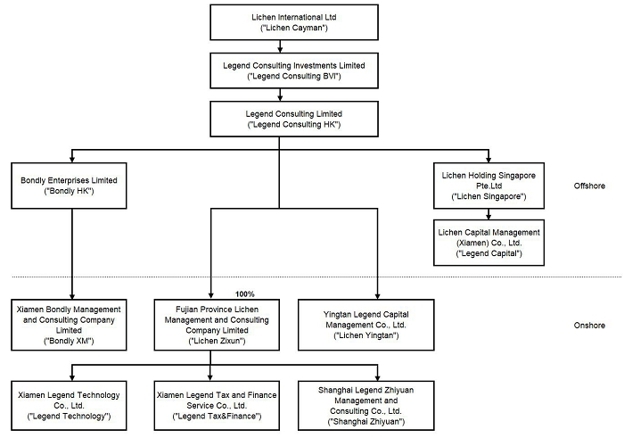
Lichen is an investment holding company. Through its wholly owned subsidiaries, Lichen is principally engaged in the provision of: (i) financial and taxation solution services; (ii) education support services to partnered institutions; (iii) software and maintenance services, and (iv) Pre-IPO advisory services.
Lichen
owns
F-6
During the reporting periods, the Company has several subsidiaries in PRC. Details of the Company and its operating subsidiaries are set out below:
| Name of subsidiaries | Place of incorporation | Date of incorporation | Percentage of direct or indirect interests | Principal activities | ||||||
| Legend Consulting Investments Limited (“Legend Consulting BVI”) | % | |||||||||
| Legend Consulting Limited (“Legend Consulting HK”) | % | |||||||||
| Lichen Holding Singapore Pte. Ltd. (“Lichen Singapore”) | % | |||||||||
| Fujian Province Lichen Management and Consulting Company Limited (“Lichen Zixun”) | % | |||||||||
| Bondly Enterprises Limited (“Bondly HK”) | % | |||||||||
| Xiamen Bondly Management and Consulting Company Limited (Bondly XM) | % | |||||||||
| Yingtan Legend Capital Management Co., Ltd. (“Lichen Yingtan”) | % | |||||||||
| Xiamen Legend Technology Co., Ltd. (“Legend Technology”) | % | |||||||||
| Xiamen Legend Tax and Finance Service Co., Ltd. (“Legend Tax&Finance”) | % | |||||||||
| Shanghai Legend Zhiyuan Management and Consulting Co., Ltd. (“Shanghai Zhiyuan”) | % | |||||||||
| Lichen Capital Management (Xiamen) Co., Ltd. (“Legend Capital”) | % | |||||||||
Legend Consulting BVI is an investment holding company wholly owned by Lichen.
Legend Consulting HK is an investment holding company wholly owned by Legend Consulting BVI.
Lichen Zixun, which is wholly owned by Legend Consulting HK, is engaged in providing financial and taxation solution services and education support services.
Lichen Singapore, which is wholly owned and established by Legend Consulting HK on December 28, 2023, is engaged in providing financial and taxation solution services and education support services.
The
acquisition of
Bondly XM, which is wholly owned and established by Bondly HK on August 25, 2022, is engaged in providing financial and taxation solution services.
Lichen Yingtan is an investment holding company wholly owned by Legend Consulting HK.
F-7
Legend Technology, which is wholly owned and established by Lichen Zixun on July 9, 2025, is engaged in providing technology promotion and application services.
Legend Tax&Finance, which is wholly owned and established by Lichen Zixun on October 11, 2025, is engaged in providing financial and taxation solution services.
Shanghai
Zhiyuan, established by Lichen Zixun on October 11, 2025, in which Lichen Zixun holds a
Legend Capital, which is wholly owned and established by Legend Consulting HK on November 19, 2025, is engaged in providing financial and taxation solution services and education support services.
Reorganization and Share Issuance
On
April 28, 2021, Lichen passed a resolution to increase the share capital. Pursuant to such resolution, the authorized share capital of
Lichen was increased from HK$
On
December 15, 2021, Lichen executed a special resolution to change the par value of the ordinary shares from $
The consideration paid by Lichen and its subsidiaries has been accounted for at historical cost and prepared on the basis as if the aforementioned transactions had become effective as of the beginning of the first period presented in the unaudited condensed consolidated financial statements. As all the entities involved in the process of the Reorganization are under common control before and after the Reorganization, the Reorganization is accounted for in a manner similar to a pooling-of-interest with the assets and liabilities of the parties to the Reorganization carried over at their historical amounts.
Initial Public Offering
On
February 8, 2023, the Company closed its initial public offering of
| 2. | SUMMARY OF SIGNIFICANT ACCOUNTING POLICIES |
Basis of presentation
The accompanying unaudited condensed consolidated financial statements have been prepared in accordance with accounting principles generally accepted in the United States of America (“U.S. GAAP”) for information pursuant to the rules and regulations of the Securities Exchange Commission (“SEC”).
F-8
Principles of consolidation
The
accompanying unaudited condensed consolidated financial statements include the unaudited financial statements of the Company and its
subsidiaries, which include the BVI-registered entity, Hong Kong-registered entity, Singapore-registered entity, and PRC-registered entities
directly or indirectly owned by the Company. All transactions and balances among the Company and its subsidiaries have been eliminated
upon consolidation. The results of subsidiaries acquired or disposed of are recorded in the consolidated income statements from the effective
date of acquisition or up to the effective date of disposal, as appropriate. A subsidiary is an entity in which (i) the Company directly
or indirectly controls more than
Use of estimate and assumptions
The preparation of the Company’s unaudited condensed consolidated financial statements in conformity with U.S. GAAP requires management to make estimates and assumptions that affect the reported amounts of assets and liabilities and disclosure of contingent assets and liabilities at the dates of the unaudited condensed consolidated financial statements and the reported amounts of revenues and expenses during the reporting periods presented. Estimates are adjusted to reflect actual experience when necessary. Significant accounting estimates reflected in the Company’s unaudited condensed consolidated financial statements include, allowance for doubtful accounts, useful lives of long-lived assets, impairment of long-lived assets and uncertain tax position. Actual results could differ from these estimates.
Business combination
Business combinations are recorded using the acquisition method of accounting. The assets acquired, the liabilities assumed, and any non-controlling interests of the acquiree at the acquisition date, if any, are measured at their fair values as of the acquisition date. Goodwill is recognized and measured as the excess of the total consideration transferred plus the fair value of any non-controlling interest of the acquiree and fair value of previously held equity interest in the acquiree, if any, at the acquisition date over the fair values of the identifiable net assets acquired. Common forms of the consideration made in acquisitions include cash and common equity instruments. Consideration transferred in a business acquisition is measured at the fair value as of the date of acquisition. Acquisition-related expenses and restructuring costs are expensed as incurred.
Accounting
Standards Codification (“ASC”) 805 establishes a measurement period to provide the Company with a reasonable amount of time
to obtain the information necessary to identify and measure various items in a business combination and cannot extend beyond
Functional currency and foreign currency translation
The reporting currency of the Company is the United States dollar (“US$”). The Company’s operations are principally conducted through its subsidiaries in PRC in the local currency, Renminbi (RMB), as its functional currency. The functional currency of the Company’s entities incorporated in Hong Kong is the Hong Kong dollars (“HK$”). The determination of the respective functional currency is based on the criteria of Accounting Standard Codification (“ASC”) 830, Foreign Currency Matters. Assets and liabilities are translated at the unified exchange rate as quoted by the PBOC (“The People’s Bank of China”) at the balance sheet date. The statement of income accounts is translated at the average exchange rates for the periods and the equity accounts are translated at historical rates. Translation adjustments resulting from this process are included in accumulated other comprehensive income (loss). Transaction gains and losses that arise from exchange rate fluctuations on transactions denominated in a currency other than the functional currency are included in the results of operations as incurred.
Translation
adjustments included in accumulated other comprehensive loss amounted to $
F-9
Translation
of foreign currencies into US$
| As of June 30, 2026 | As of December 31, 2025 | |||||||
| Period-end RMB: US$1 exchange rate | ||||||||
| Period-end HK$: US$1 exchange rate | ||||||||
| Period-end SG$: US$1 exchange rate | ||||||||
| For the six months ended June 30, | ||||||||
| 2026 | 2025 | |||||||
| Period-average RMB: US$1 exchange rate | ||||||||
| Period-average HK$: US$1 exchange rate | ||||||||
| Period-average SG$: US$1 exchange rate | ||||||||
Related parties
Parties, which can be a corporation or individual, are considered to be related if the Company has the ability, directly or indirectly, to control the other party or exercise significant influence over the other party in making financial and operating decisions. Companies are also considered to be related if they are subject to common control or common significant influence, such as a family member or relative, shareholder, or a related corporation.
Fair value of financial instruments
ASC 825-10 requires certain disclosures regarding the fair value of financial instruments. Fair value is defined as the price that would be received to sell an asset or paid to transfer a liability in an orderly transaction between market participants at the measurement date. A three-level fair value hierarchy prioritizes the inputs used to measure fair value. The hierarchy requires entities to maximize the use of observable inputs and minimize the use of unobservable inputs. The three levels of inputs used to measure fair value are as follows:
| ● | Level 1 — inputs to the valuation methodology are quoted prices (unadjusted) for identical assets or liabilities in active markets. |
| ● | Level 2 — inputs to the valuation methodology include quoted prices for similar assets and liabilities in active markets, quoted market prices for identical or similar assets in markets that are not active, inputs other than quoted prices that are observable and inputs derived from or corroborated by observable market data. |
| ● | Level 3 — inputs to the valuation methodology are unobservable. |
The fair value of the Company’s financial instruments, including cash, accounts receivable, accounts payable, accrued expenses and other current liabilities, approximate their recorded values due to their short-term maturities as of June 30, 2026 and December 31, 2025.
Cash
Cash consist of cash on hand, cash in banks, which are unrestricted as to withdrawal or use, and have insignificant risk of changes in value. The Company maintains most of its bank accounts in the Cayman and mainland of China.
Accounts receivable, net
Accounts receivable are recorded at the gross billing amount less an allowance for any uncollectible accounts due from the customers. Accounts receivable do not bear interest.
F-10
Since January 1, 2024, the Company adopted Accounting Standards Update (“ASU”) No. 2016-13, Financial Instruments-Credit Losses (Topic 326): Measurement of Credit Losses on Financial Instruments (“ASU 2016-13”), using the modified retrospective transition method. ASU 2016-13 replaces the existing incurred loss impairment model with an expected loss methodology, which will result in more timely recognition of credit losses. Upon adoption, the Company changed the impairment model to utilize a forward-looking current expected credit losses (CECL) model in place of the incurred loss methodology for financial instruments measured at amortized cost and receivables resulting from the application of ASC 606, including contract assets.
The Company maintains an allowance for credit losses and records the allowance for credit losses as an offset to accounts receivable and the estimated credit losses charged to the allowance is classified as “General and administrative expenses” in the consolidated statements of loss and comprehensive loss. The Company assesses collectability by reviewing accounts receivable on aging schedules because the accounts receivable were primarily consisted of receivables arising from (i) financial and taxation solution services; (ii) education support services to partnered institutions; (iii) software and maintenance services, and (iv) Pre-IPO advisory services. In determining the amount of the allowance for credit losses, the Company considers historical collectability based on past due status, the age of the balances, current economic conditions, reasonable and supportable forecasts of future economic conditions, and other factors that may affect the Company’s ability to collect from customers. Delinquent account balances are written-off against the allowance for expected credit loss after management has determined that the likelihood of collection is not probable.
For the six months ended June 30, 2026 and 2025,
the Company did
Contract assets
Contract assets represent the Company’s right to consideration in exchange for goods and service performed, which invoice has not been issued.
Inventories
Inventories
are stated at the lower of cost and net realizable value. Cost elements of inventories comprise the purchase price of products, shipping
charges to receive products from the suppliers when they are embedded in the purchase price. Cost is determined using the weighted average
method. Provisions are made for excessive, slow moving, expired and obsolete inventories as well as for inventories with carrying values
in excess of market. Certain factors could impact the realizable value of inventory, so the Company continually evaluates the recoverability
based on assumptions about customer demand and market conditions. The evaluation may take into consideration historical usage, inventory
aging, expiration date, expected demand, anticipated sales price, product obsolescence and other factors. The reserve or write-down is
equal to the difference between the cost of inventory and the estimated net realizable value based upon assumptions about future demand
and market conditions. If actual market conditions are less favorable than those projected by management, additional inventory reserves
or write-downs may be required that could negatively impact the Company’s gross margin and operating results. If actual market
conditions are more favorable, the Company may have higher gross margin when products that have been previously reserved or written down
are eventually sold. As of June 30, 2026 and December 31, 2025, management compared the cost of inventories with their net realizable
value and determined
Prepayments, deposits and other current assets
Prepayments, deposits, and other current assets mainly represents deferred input VAT. The deposits are refundable and bear no interest pursuant to terms of contract.
Long-term investments
The Company’s long-term investments primarily consist of equity investments accounted for using the equity method and other investments accounted for at fair value.
F-11
Equity investments accounted for using the equity method
The Group applies the equity method of accounting to account for equity investments and limited partnership in a private equity fund, according to ASC 323 Investment—Equity Method and Joint Ventures, over which it has significant influence but does not own a majority equity interest or otherwise control. Under the equity method, the Group initially records the investments at cost and the difference between the cost of the equity investee and the fair value of the underlying equity in the net assets of the equity investee is recognized as equity method goodwill, which is included in the equity method investments on the consolidated balance sheets. The Group subsequently adjusts the carrying amount of the investments to recognize its proportionate share of each equity investee’s net income or loss into earnings and cash distributions from investees, after the date of investment. The Group evaluates the equity method investments for impairment under ASC 323. An impairment loss on the equity method investments is recognized as “Investment loss, net (including impairments)” in the consolidated statements of loss and comprehensive loss when the decline in value is determined to be other-than-temporary.
Investments accounted for at fair value
In accordance with ASC 825, Financial Instruments, for financial products with variable interest rates referenced to performance of underlying assets and with original maturities greater than one year, the Group elected the fair value method at the date of initial recognition and carries these investments at fair value. Changes in the fair value of these investments are reflected on the consolidated statements of loss and comprehensive loss as “Investment loss, net (including impairments)”.
Property and equipment
Property
and equipment are stated at cost less accumulated depreciation and impairment if any.
| Categories | Useful Life | Estimated
Residual Value |
||||
| Building | |
% | ||||
| Motor vehicles | % | |||||
| Furniture and equipment | % | |||||
| Office improvements | % | |||||
The cost and related accumulated depreciation of assets sold or otherwise retired are eliminated from the accounts and any gain or loss is included in the unaudited condensed consolidated statements of loss and comprehensive loss. Expenditures for maintenance and repairs are charged to earnings as incurred, while additions, renewals and betterments, which are expected to extend the useful life of assets, are capitalized. The Company also re-evaluates the periods of depreciation to determine whether subsequent events and circumstances warrant revised estimates of useful lives.
Intangible assets
An
intangible asset is recognized when it is probable that the expected future economic benefits that are attributable to the asset will
flow to the entity and the cost of the asset can be measured reliably. Intangible assets are initially recognized at cost, less any accumulated
amortization and any impairment losses.
| Categories | Estimated Useful Life | ||
| Licensed software | |||
| Customer relationship |
Goodwill
Goodwill represents the excess of the purchase price over the fair value of the identifiable assets and liabilities acquired in a business combination.
F-12
Goodwill is not depreciated or amortized but is tested for impairment on an annual basis as of December 31, and in between annual tests when an event occurs or circumstances change that could indicate that the asset might be impaired. In accordance with the FASB ASC 350 guidance on “Testing of Goodwill for Impairment”, a company first has the option to assess qualitative factors to determine whether it is more likely than not that the fair value of a reporting unit is less than its carrying amount. If the company decides, as a result of its qualitative assessment, that it is more likely than not that the fair value of a reporting unit is less than its carrying amount, the quantitative impairment test is mandatory. Otherwise, no further testing is required. The quantitative impairment test consists of a comparison of the fair value of each reporting unit with its carrying amount, including goodwill. If the carrying amount of each reporting unit exceeds its fair value, an impairment loss equal to the difference between the fair value of the reporting unit and the carrying amount will be recorded. Application of a goodwill impairment test requires significant management judgment, including the identification of reporting units, assigning assets and liabilities to reporting units, assigning goodwill to reporting units, and determining the fair value of each reporting unit. The judgment in estimating the fair value of reporting units includes estimating future cash flows, determining appropriate discount rates and making other assumptions. Changes in these estimates and assumptions could materially affect the determination of fair value for each reporting unit.
Prepaid and other assets
Mainly
represents the deposit of the new purchased property and prepaid renovation expense. The deposits are refundable and bear
no interest pursuant to terms of contract. The property under development is scheduled to being completed by the end of 2028.
The amortization period of the renovation is
Impairment of long-lived assets
The Company evaluates its long-lived assets, including property and equipment and intangibles with finite lives, for impairment whenever events or changes in circumstances, such as a significant adverse change to market conditions that will impact the future use of the assets, indicate that the carrying amount of an asset may not be fully recoverable. When these events occur, the Company evaluates the recoverability of long-lived assets by comparing the carrying amount of the assets to the future undiscounted cash flows expected to result from the use of the assets and their eventual disposition. If the sum of the expected undiscounted cash flows is less than the carrying amount of the assets, the Company recognizes an impairment loss based on the excess of the carrying amount of the assets over their fair value. Fair value is generally determined by discounting the cash flows expected to be generated by the assets, when the market prices are not readily available. The adjusted carrying amount of the assets become new cost basis and are depreciated over the assets’ remaining useful lives. Long-lived assets are grouped with other assets and liabilities at the lowest level for which identifiable cash flows are largely independent of the cash flows of other assets and liabilities. Given no events or changes in circumstances indicating the carrying amount of long-lived assets may not be recovered through the related future net cash flows, the Company did not recognize any impairment loss on long-lived assets for the six months ended June 30, 2026 and 2025. There can be no assurance that future events will not have impact on the Company’s revenue or financial position which could result in impairment in the future.
Operating leases
The Company, through its subsidiary, leases its office, which are classified as operating leases in accordance with ASC 842. Operating leases are required to record in the balance sheet as right-of-use assets and lease liabilities, initially measured at the present value of the lease payments. The Company has elected the package of practical expedients, which allows the Company not to reassess (1) whether any expired or existing contracts as of the adoption date are or contain a lease, (2) lease classification for any expired or existing leases as of the adoption date, and (3) initial direct costs for any expired or existing leases as of the adoption date. The Company elected the short-term lease exemption for the lease terms that are 12 months or less.
At inception of a contract, the Company assesses whether a contract is, or contains, a lease. A contract is or contains a lease if it conveys the right to control the use of an identified asset for a period of time in exchange of a consideration. To assess whether a contract is or contains a lease, the Company assesses whether the contract involves the use of an identified asset, whether it has the right to obtain substantially all the economic benefits from the use of the asset and whether it has the right to control the use of the asset. The right-of-use assets and related lease liabilities are recognized at the lease commencement date. The Company recognizes operating lease expenses on a straight-line basis over the lease term and had no finance leases for any of the periods stated herein.
F-13
The
right-of-use of asset is initially measured at cost, which comprises the initial amount of the lease liability adjusted for any lease
payments made at or before the commencement date, plus any initial direct costs incurred and less any lease incentive received. All right-of-use
assets are reviewed for impairment annually. There was
Share-based compensation
The Company accounts for stock-based compensation to employees in accordance with ASC 718, “Compensation-Stock Compensation”. ASC 718 requires companies to measure the cost of employee services received in exchange for an award of equity instruments, including the equity incentive plan, based on the grant date fair value of the award and to recognize it as compensation expense over the period the employee is required to provide service in exchange for the award, usually the vesting period. Stock option forfeitures are recognized at the date of employee termination. Effective January 1, 2024, the Company adopted ASU 2018-07 for the accounting of share-based payments granted to non-employees for goods and services and no material impacts to the Financial Statements.
Contingencies
From time to time, the Company is a party to various legal actions arising in the ordinary course of business. The Company accrues costs associated with these matters when they become probable and the amount can be reasonably estimated. Legal costs incurred in connection with loss contingencies are expensed as incurred. The Company’s management does not expect any liability from the disposition of such claims and litigation individually or in the aggregate would have a material adverse impact on the Company’s consolidated financial position, results of operations and cash flows.
Revenue recognition
The Company adopted ASC Topic 606, Revenue from Contracts with Customers, effective as of January 1, 2019. Accordingly, the unaudited condensed consolidated financial statements for the six months ended June 30, 2026 and 2025 are presented under ASC 606. The core principle of the guidance is that an entity should recognize revenue to depict the transfer of promised goods or services to customers in an amount that reflects the consideration to which the entity expects to be entitled in exchange for those goods or services. Revenue is the transaction price the Company expects to be entitled to in exchange for the promised goods or services in a contract in the ordinary course of the Company’s activities and is recorded net of value-added tax (“VAT”). To achieve that core principle, the Company applies the following steps:
Step 1: Identify the contract (s) with a customer
Step 2: Identify the performance obligations in the contract
Step 3: Determine the transaction price
Step 4: Allocate the transaction price to the performance obligations in the contract
Step 5: Recognize revenue when (or as) the entity satisfies a performance obligation
No practical expedients were used when the Company adopted the ASC 606. Revenue recognition policies for each type of revenue stream are as follow:
Financial and taxation solution services
Revenues from financial and taxation solution services for which control of services is transferred over time is recognized progressively based on the contract costs incurred to date (primarily comprising staff costs and industry expert cost by reference to the time as recorded in the monthly working record incurred to date) as compared to the total costs to be incurred under the transaction (by reference to the total budgeted time of the respective project) to depict the Company’s performance in transferring control of services promised to a customer. The Company recognizes revenues over time only if it can reasonably measure its progress toward complete satisfaction of the performance obligation. The Company normally requires the customers to pay a deposit upon entering into the service contracts.
F-14
For revenue generated from the provision of financial and taxation solution services, the arrangement involves a bundle of activities (e.g., scheme design, implementation guidance, evaluation) that are substantially the same and have the same pattern of transfer to the customer. Accordingly, these activities are not separately identifiable and form only one series of distinct service.
The series of distinct services within the contract are treated as one performance obligation because they are substantially the same and transfer to the customer in the same pattern over time. The Company evaluates that it acts as the principal in these arrangements. It controls the promised services before transfer, is primarily responsible for fulfilment, and has discretion in pricing. Therefore, the Company reports revenues from financial and taxation solution services on a gross basis. We do not provide any other credit and incentive related to our services, therefore there is no variable consideration in the arrangement. As our services are provided without right of return and we do not provide any other credit and incentive to our customers, therefore, the provision of financial and taxation solution services does not involve variable consideration.
Education support services - sales of teaching and learning materials
Revenues from the sales of educational materials for which control of assets is transferred at a point in time is recognized when the goods are delivered to customers. The Company does not provide any sales-related warranties. There is no right of return by customers under the Company’s standard contract terms.
Education support services - Provision of marketing, operation and technical support services
Revenues from provision of marketing, operation and technical support services from the partnered institutions is recognized on a straight-line basis over the term of the agreement. The transaction price inclusive of value added tax as received from customers in advance is recognized as a contract liability at the time of the initial transaction and is released on a straight-line basis over the period of service (usually one year).
Software and maintenance services
Standard software is a right to use license because the software has standalone functionality and the customer can use the software as it is available at a point in time. The Company recognizes revenues for such licenses at a point in time when the customer has received licenses and thus has control over the software. In case there is an update of the standard software, end customers or distributors are required to pay additional consideration to buy upgraded version. Revenues from maintenance services is recognized over time within the service period.
For revenue generated from the software and maintenance services, one software and maintenance service is normally included as a bundle package for the first-time purchase. There are two separate performance obligations in such bundle sales as the software is a distinct good while the maintenance service is a distinct service. We allocate the transaction price to each distinct performance obligation based on their relative standalone selling prices.
The Company evaluates that it acts as the principal in these arrangements. It controls the promised services before transfer, is primarily responsible for fulfilment, and has discretion in pricing. Therefore, the Company reports revenues from the software and maintenance services on a gross basis. We do not provide any other credit and incentive related to our services, therefore there is no variable consideration in the arrangement. As our services are provided without right of return and we do not provide any other credit and incentive to our customers, therefore, software and maintenance services does not involve variable consideration.
Pre-IPO advisory services
Revenues from the provision of Pre-IPO advisory services is recognized on a straight-line basis over the term of the agreement. The arrangement involves a bundle of activities (e.g., planning, guidance and participation in the pre-IPO-related matters) that are substantially the same and have the same pattern of transfer to the customer. Accordingly, these activities are not separately identifiable and form only one series of distinct service.
The series of distinct services within the contract is treated as one performance obligation because the services are substantially the same and transfer to the customer in the same pattern over time. The Company determines that it acts as the principal in these arrangements, as it controls the promised services before transfer, is primarily responsible for fulfilment, and has discretion in pricing. Accordingly, the Company reports revenues from Pre-IPO advisory services on a gross basis.
F-15
The transaction price consists of a fixed component and a variable component. The success fee is variable consideration that depends on the outcome of a future event (the IPO funding amount). At contract inception, significant uncertainty exists regarding whether the IPO will occur and the amount of funding. Given this uncertainty, the success fee is constrained and not included in the initial transaction price, as including it would result in a significant revenue reversal if the IPO fails.
Contract liabilities
Contract liability is recorded when a payment is received from a customer before the Company transfers the related services. Contract liability is recognized as revenue when the Company performs the services under the contract.
Disaggregated information of revenues by services:
| For the six months ended June 30 | ||||||||
| 2026 | 2025 | |||||||
| Financial and taxation solution services | $ | $ | ||||||
| Education support services | ||||||||
| Software and maintenance services | ||||||||
| Pre-IPO advisory services | ||||||||
| Revenues | $ | $ | ||||||
Segment reporting
An operating segment is a component of the Company that engages in business activities from which it may earn revenue and incur expenses and is identified on the basis of the internal financial reports that are provided to and regularly reviewed by the Company’s chief operating decision maker (“CODM”) in order to allocate resources and assess performance of the segment.
In
accordance with ASC 280, Segment Reporting, operating segments are defined as components of an enterprise about which separate financial
information is available that is evaluated regularly by the CODM, in deciding how to allocate resources and in assessing performance.
The Company’s revenue segments have similar economic characteristics and they are managed as a single business unit. The Company
uses the “management approach” in determining reportable operating segments. The management approach considers the internal
organization and reporting used by the CODM, which is comprised of the executive directors of the Company, for making operating decisions
and assessing performance as the source for determining the Company’s reportable segments. The Company has determined that there
is only
Value added tax (“VAT”)
Revenue
represents the invoiced value of goods and service, net of VAT. The VAT is based on gross sales price and VAT rates range up to
Income taxes
The Company follows the liability method of accounting for income taxes in accordance with ASC 740 (“ASC 740”), Income Taxes. The Company accounts for current income taxes in accordance with the laws of the relevant tax authorities. Deferred income taxes are recognized when temporary differences exist between the tax bases of assets and liabilities and their reported amounts in the consolidated financial statements. Deferred tax assets and liabilities are measured using enacted tax rates expected to apply to taxable income in the years in which those temporary differences are expected to be recovered or settled. The effect on deferred tax assets and liabilities of a change in tax rates is recognized in income in the period including the enactment date. Valuation allowances are established, when necessary, to reduce deferred tax assets to the amount expected to be realized.
F-16
The Company is not subject to tax on income or capital gain under the current tax laws of U.S. And the Company is subject to tax on income or capital gain under the tax laws of PRC.
An
uncertain tax position is recognized as a benefit only if it is “more likely than not” that the tax position would be sustained
in a tax examination. The amount recognized is the largest amount of tax benefit that is greater than
Statutory surplus reserves
The
Company’s PRC subsidiaries are required to allocate at least
Advertising expenses
Advertising
expenditures are expensed as incurred and such expenses were included as part of selling and marketing expenses. For the six months ended
June 30, 2026 and 2025, the advertising expenses amounted to approximately $
Comprehensive loss
Comprehensive loss consists of two components, net loss and other comprehensive income (loss). Other comprehensive income (loss) refers to revenue, expenses, gains and losses that under GAAP are recorded as an element of equity but are excluded from net income. Other comprehensive income (loss) consists of a foreign currency translation adjustment resulting from the Company not using the U.S. dollar as its functional currencies.
(Loss) Earnings per ordinary share
The Company computes earnings per share (“EPS”) in accordance with ASC 260, Earnings per Share. ASC 260 requires companies to present basic and diluted EPS. Basic EPS is measured as net income divided by the weighted average common share outstanding for the period. Diluted EPS presents the dilutive effect on a per-share basis of the potential Ordinary Shares (e.g., convertible securities, options and warrants) as if they had been converted at the beginning of the periods presented, or issuance date, if later. Potential Ordinary Shares that have an anti-dilutive effect (i.e., those that increase income per share or decrease loss per share) are excluded from the calculation of diluted EPS. There were no dilutive or anti-dilutive potential Ordinary Shares or effect for the six months ended June 30, 2026 and 2025.
Recent accounting pronouncements
In December 2025, the FASB issued ASU 2025-12, which is to correct, clarify, and otherwise improve U.S. GAAP. ASU 2025-12 includes 33 improvements that span a wide range of topics, including Clarifying diluted earnings per share (EPS) calculation when a loss from continuing operations exists, Clarifying disclosure requirements for lease receivables from sales-type or direct financing leases, Revising the calculation of the reference amount for beneficial interests to prevent double counting credit losses, Clarifying the permissible methods to account for treasury stock retirements, and Clarifying the guidance for transfers of receivables from contracts with customers. The amendments in this Update are effective for all entities for annual reporting periods beginning after December 15, 2026, and interim reporting periods within those annual reporting periods. Early adoption is permitted in both interim and annual reporting periods in which financial statements have not yet been issued or made available for issuance. If an entity adopts the amendments in this Update in an interim period, it must adopt them as of the beginning of the annual reporting period that includes that interim reporting period. An entity may elect to early adopt the amendments on an issue-by-issue basis. For example, an entity may decide to early adopt certain amendments and adopt the remaining amendments at the effective date. An entity should apply the amendments in this Update (except for the amendments to Topic 260, Earnings Per Share, related to Issue 4) using one of the following transition methods: (i) Prospectively to all transactions recognized on or after the date that the entity first applies the amendments, or (ii) Retrospectively to the beginning of the earliest comparative period presented. An entity should adjust the opening balance of retained earnings (or other appropriate components of equity or net assets in the statement of financial position) as of the beginning of the earliest comparative period presented. The Company is currently evaluating these new disclosure requirements and does not expect the adoption to have a material impact.
F-17
In December 2025, the FASB issued ASU 2025-11, which is intended to improve the navigability of the guidance in ASC 270 and clarify when it applies. Under the amendments, an entity is subject to ASC 270 if it provides interim financial statements and notes in accordance with GAAP. The ASU also addresses the form and content of such financial statements, adds lists to ASC 270 of the interim disclosures required by all other Codification topics, and establishes a principle under which an entity must disclose events since the end of the last annual reporting period that have a material impact on the entity. As the Board stated in the proposed guidance and reiterates in the ASU, the amendments are not intended to change the fundamental nature of interim reporting or expand or reduce current interim disclosure requirements. For public business entities, the amendments in ASU 2025-11 are effective for interim reporting periods within annual reporting periods beginning after December 15, 2027. For entities other than public business entities, for interim reporting periods within annual reporting periods beginning after December 15, 2028. Early adoption is permitted for all entities. The Company is currently evaluating these new disclosure requirements and does not expect the adoption to have a material impact.
In December 2025, the FASB issued ASU 2025-10, Government Grants (Topic 832): Accounting for Government Grants Received by Business Entities. The ASU establishes authoritative guidance on the accounting for government grants received by business entities. This update is effective beginning with annual reporting period beginning after December 15, 2029, with early adoption permitted. The Company is currently evaluating the impact that the adoption of this standard will have on its combined financial statements.
On September 18, 2025, the FASB issued Accounting Standards Update (ASU) 2025-06, Intangibles—Goodwill and Other—Internal-Use Software (Subtopic 350-40): Targeted Improvements to the Accounting for Internal-Use Software. ASU 2025-06 modernizes the accounting for internal-use software (the existing internal-use software guidance does not contemplate more current methods of software development). The amendments in ASU 2025-06 are limited and focused on the key challenge that entities face in applying FASB Accounting Standards Codification (FASB ASC) 350-40—applying that guidance to software that is developed using modern, iterative approaches such as Agile, DevOps, and continuous-deployment models that do not fit neatly into the legacy “preliminary-project / application-development / post-implementation” stages described in today’s Subtopic 350-40.The amendments in this Update are effective for all entities for annual reporting periods beginning after December 15, 2027, and interim reporting periods within those annual reporting periods. Early adoption is permitted as of the beginning of an annual reporting period. The Company expects the adoption on this ASU will not have a material effect on the Company’s consolidated financial statements.
In January 2025, the FASB issued ASU 2025-01, “Income Statement – Comprehensive Income – Expense Disaggregation Disclosure (Subtopic 220-40): Clarifying the Effective Date.” This pronouncement revises the effective date of ASU 2024-03 and clarify that all public business entities are required to adopt the guidance in annual reporting periods beginning after December 15, 2026, and interim periods within annual reporting periods beginning after December 15, 2027. Entities within the ASU’s scope are permitted to early adopt the accounting standard update. The Company is currently evaluating these new disclosure requirements and does not expect the adoption to have a material impact.
In November 2024, the FASB issued ASU 2024-03, “Income Statement — Reporting Comprehensive Income (Subtopic 220-40): Disaggregation of Income Statement Expenses.” This pronouncement introduces new disclosure requirements aimed at enhancing transparency in financial reporting by requiring disaggregation of specific income statement expense captions. Under the new guidance, entities are required to disclose a breakdown of certain expense categories, such as: employee compensation; depreciation; amortization, and other material components. The disaggregated information can be presented either on the face of the income statement or in the notes to the financial statements, often using a tabular format. The ASU is effective for fiscal years beginning after December 15, 2026, and interim periods within those fiscal years. In January 2025, the FASB issued ASU 2025-01, “Income Statement – Comprehensive Income – Expense Disaggregation Disclosure (Subtopic 220-40): Clarifying the Effective Date.” This pronouncement revises the effective date of ASU 2024-03 and clarifies that all public business entities are required to adopt the guidance in annual reporting periods beginning after December 15, 2026, and interim periods within annual reporting periods beginning after December 15, 2027. Entities within the ASU’s scope are permitted to early adopt the accounting standard update. The Company is currently evaluating these new disclosure requirements and does not expect the adoption to have a material impact.
F-18
In October 2023, the FASB issued ASU 2023-06, Disclosure Improvements — Codification Amendments in Response to SEC’s Disclosure Update and Simplification Initiative which amend the disclosure or presentation requirements of codification subtopic 230-10 Statement of Cash Flows — Overall, 250-10 Accounting Changes and Error Corrections — Overall, 260-10 Earnings Per Share — Overall, 270-10 Interim Reporting — Overall, 440-10 Commitments — Overall, 470-10 Debt — Overall, 505-10 Equity — Overall, 815-10 Derivatives and Hedging — Overall, 860-30 Transfers and Servicing — Secured Borrowing and Collateral, 932-235 Extractive Activities — Oil and Gas — Notes to Financial Statements, 946-20 Financial Services — Investment Companies — Investment Company Activities, and 974-10 Real Estate — Real Estate Investment Trusts — Overall. The amendments represent changes to clarify or improve disclosure and presentation requirements of the above subtopics. Many of the amendments allow users to more easily compare entities subject to the SEC’s existing disclosures with those entities that were not previously subject to the SEC’s requirements. Also, the amendments align the requirements in the codification with the SEC’s regulations. For entities subject to existing SEC disclosure requirements or those that must provide financial statements to the SEC for securities purposes without contractual transfer restrictions, the effective date aligns with the date when the SEC removes the related disclosure from Regulation S-X or Regulation S-K. Early adoption is not allowed. For all other entities, the amendments will be effective two years later from the date of the SEC’s removal.
Except for the above-mentioned pronouncements, there are no new recent issued accounting standards that will have a material impact on the unaudited condensed consolidated financial position, statements of operations and cash flows.
| 3. | Cash |
Cash
consist of cash on hand, cash in banks, which are unrestricted as to withdrawal or use, and have insignificant risk of changes in value.
| As of June 30, 2026 | As of December 31, 2025 | |||||||
| RMB | $ | $ | ||||||
| HKD | ||||||||
| SGD | ||||||||
| USD | ||||||||
| Total | $ | $ | ||||||
| 4. | Accounts receivable and contract assets |
Accounts receivable and contract assets consisted of the following as of June 30, 2026 and December 31, 2025:
| As of June 30, 2026 | As of December 31, 2025 | |||||||
| In thousands of USD | ||||||||
| Accounts receivables | $ | $ | ||||||
| Contract assets | ||||||||
| Total | $ | $ | ||||||
There was
F-19
| 5. | Prepayments, deposits and other current assets |
Prepayments, deposits and other current assets consisted of the following:
| As of June 30, 2026 | As of December 31, 2025 | |||||||
| In thousands of USD | ||||||||
| Deposits to software developer1 | $ | $ | ||||||
| Rental deposit | ||||||||
| Deferred input VAT2 | ||||||||
| Income tax refundable | ||||||||
| Prepaid service fee | ||||||||
| Other current assets | ||||||||
| Total | $ | $ | ||||||
| 1 | On May 9, 2025, the Company entered into a Technical service agreement with Xiamen Kuashangtong Technology Co., Ltd. to load the service centered on voice recognition technology into the AI finance and tax large model; The Company paid $ |
| 2 | Deferred input VAT mainly represents input VAT on invoices received for capitalized intangible assets that had not yet been certified by the tax authorities. Under PRC VAT rules, input VAT can only be used to offset output VAT after the related invoices are certified. As of June 30, 2026, the Company recorded deferred input VAT of $ |
| 6. | Property and equipment, net |
Property and equipment, net consisted of the following:
| As of June 30, 2026 | As of December 31, 2025 | |||||||
| In thousands of USD | ||||||||
| Buildings | $ | $ | ||||||
| Furniture and equipment | ||||||||
| Motor vehicles | ||||||||
| Office improvements | ||||||||
| Subtotal | ||||||||
| Less: accumulated depreciation | ( | ) | ( | ) | ||||
| Property and equipment, net | $ | $ | ||||||
Depreciation
expenses for the six months ended June 30, 2026 and 2025 amounted to approximately $
During the six months
ended June 30, 2026 the Company disposed of certain property, plant and equipment with a total cost of $
The Company did not recognize any impairment loss on property and equipment for the six months ended June 30, 2026 and year ended December 31, 2025.
F-20
| 7. | Intangible assets |
The Company’s intangible assets with definite useful lives primarily consisted of licensed software and customer relationship, which are for sales or support the Company’s business and operation. The following table summarizes the components of acquired intangible asset balances.
| As of June 30, 2026 | As of December 31, 2025 | |||||||
| In thousands of USD | ||||||||
| Software | $ | $ | ||||||
| Customer relationship | ||||||||
| Less: accumulated amortization | ( | ) | ( | ) | ||||
| Intangible assets, net | $ | $ | ||||||
Amortization expense
recognized in cost of revenues for the six months ended June 30, 2026 and 2025 amounted to approximately $
The Company did not recognize any impairment loss on intangible assets for the six months ended June 30, 2026 and the year ended December 31, 2025.
The future amortization expense of the intangible assets for the twelve months ending June 30 of the following years is expected as follows:
| Twelve months ending June 30, | Amortization expenses | |||
| In thousands of USD | ||||
| 2027 | $ | |||
| 2028 | ||||
| 2029 | ||||
| 2030 | ||||
| 2031 | ||||
| Total | $ | |||
| 8. | Goodwill |
| As of June 30, 2026 | As of December 31, 2025 | |||||||
| In thousands of USD | ||||||||
| Bondly HK | $ | $ | ||||||
| Less: impairment | ( | ) | ( | ) | ||||
| Total | $ | $ | ||||||
| As of June 30, 2026 | As of December 31, 2025 | |||||||
| In thousands of USD | ||||||||
| Balance as of December 31, | $ | $ | ||||||
| Impairment | ( | ) | ||||||
| Goodwill, net | $ | $ | ||||||
F-21
| 9. | Leases |
As of June 30, 2026, the Company had the following non-cancellable lease contract.
| Description of the lease | Lease term | ||
| Office premises |
(a) Amount recognized in the consolidated balance sheet:
Operating lease right -of-use assets, net was as follows as of June 30, 2026 and December 31, 2025:
| As of June 30, 2026 | As of December 31, 2025 | |||||||
| In thousands of USD | ||||||||
| Right-of-use assets | $ | $ | ||||||
| Lease liabilities, current | $ | $ | ||||||
| Lease liabilities, non-current | ||||||||
| Total operating lease liabilities | $ | $ | ||||||
(b)
| For the six months ended June 30, | ||||||||
| 2026 | 2025 | |||||||
| In thousands of USD | ||||||||
| Amortization of right-of-use assets | $ | $ | ||||||
| Interest of lease liabilities | $ | $ | ||||||
Maturity analysis of operating lease liabilities of June 30, 2026 is as follows:
| Operating lease payment | In thousands of USD | |||
| Within one year | ||||
| One to three years | ||||
| Three to five years | ||||
| Total future minimum lease payments | $ | |||
| Less: imputed interest | ( | ) | ||
| Total | ||||
F-22
| 10. | Prepaid and other assets |
Other assets consisted of the following:
| As of June 30, 2026 | As of December 31, 2025 | |||||||
| In thousands of USD | ||||||||
| Deposit of Haicang property1 | $ | $ | ||||||
| Deposits to software developer2 | ||||||||
| The deposits for potential acquisition3 | ||||||||
| Other current assets | ||||||||
| Total | $ | $ | ||||||
| 1 |
| 2 |
| 3 |
| 11. | Related party transactions and balances |
The table below sets forth the major related parties and their relationships with the Company as of and for the six months ended June 30, 2026 and 2025:
| Name of related parties | Relationship with the Company | |
| Mr. Ya Li |
| i) |
| As of June 30, 2026 | As of December 31, 2025 | |||||||
| In thousands of USD | ||||||||
| Due to the related parties | ||||||||
| Ya Li | $ | $ | ||||||
| Total | $ | $ | ||||||
Balances due to Ya Li are the result of the normal business transactions stated above. The balances were all unsecured, non-interest bearing and payable on demand.
F-23
| 12. | Accrued expenses and other current liabilities |
Accrued expenses and other current liabilities consisted of the following:
| As of June 30, 2026 | As of December 31, 2025 | |||||||
| In thousands of USD | ||||||||
| Salary payable | $ | $ | ||||||
| Acquisition in long term investment1 | ||||||||
| Accrued service fees | ||||||||
| Employee loan | ||||||||
| Others | ||||||||
| Total | $ | $ | ||||||
| 1 |
| 13. | Contract liabilities |
| As of June 30, 2026 | As of December 31, 2025 | |||||||
| In thousands of USD | ||||||||
| Contract liabilities | $ | $ | ||||||
| Total | $ | $ | ||||||
| 14. | Taxes |
| (a) | Taxes payable |
Taxes payable consisted of the following:
| As of June 30, 2026 | As of December 31, 2025 | |||||||
| In thousands of USD | ||||||||
| Income tax payable | $ | $ | ||||||
| VAT payable | ||||||||
| Other tax payable | ||||||||
| Total | $ | $ | ||||||
| (b) | Corporate Income Taxes (“CIT”) |
Cayman Islands
Under the current tax laws of Cayman Islands, the Company is not subject to tax on income or capital gain. Additionally, the Cayman Islands does not impose a withholding tax on payments of dividends to shareholders.
BVI
Under the current tax laws of BVI, the Company is not subject to tax on income or capital gain. Additionally, the BVI does not impose a withholding tax on payments of dividends to shareholders.
F-24
Hong Kong
Under
the current Hong Kong Inland Revenue Ordinance, the Company’s subsidiaries incorporated in Hong Kong are subject to
PRC
The
Company’s PRC subsidiaries are governed by the income tax laws of the PRC and the income tax expense in respect to operations in
the PRC is calculated at the applicable tax rates on the taxable income for the periods based on existing legislation, interpretations
and practices in respect thereof. Under the Enterprise Income Tax Laws of the PRC (the “EIT Laws”), domestic enterprises
and Foreign Investment Enterprises (the “FIE”) are usually subject to a unified
| i) |
| For the six months ended June 30, 2026 | For the six months ended June 30, 2025 | |||||||
| In thousands of USD | ||||||||
| Provisions for current income tax | $ | $ | ||||||
| Provisions for deferred income | ||||||||
| Total | $ | $ | ||||||
There are no deferred tax assets recognized or impaired for the six months ended June 30, 2026 and 2025.
| ii) | The following table reconciles PRC statutory rates to the Company’s effective tax rate: |
The following table reconciles the China statutory rates to the Company’s effective tax rate for the six months ended June 30, 2026 and 2025:
| For the six months ended June 30, 2026 | For the six months ended June 30, 2025 | |||||||
| PRC statutory income tax rate | % | % | ||||||
| Effect of different tax jurisdiction | ( | )% | ( | )% | ||||
| Non-deductible expenses (1) | ( | )% | ( | )% | ||||
| Change in valuation allowance | ( | )% | ( | )% | ||||
| Effective income tax rate | ( | )% | % | |||||
| (1) |
| iii) |
| For the six months ended June 30, 2026 | For the six months ended June 30, 2025 | |||||||
| In thousands of USD | ||||||||
| Deferred tax assets: | ||||||||
| Net accumulated loss-carry forward | $ | $ | ||||||
| Less: valuation allowance | ( | ) | ( | ) | ||||
| Net deferred tax assets | $ | $ | ||||||
F-25
Movement of valuation allowance is as follows:
| For the six months ended June 30, 2026 | For the six months ended June 30, 2025 | |||||||
| In thousands of USD | ||||||||
| Beginning balance | $ | $ | ||||||
| Write-off | ( | ) | ( | ) | ||||
| Change of valuation allowance | ||||||||
| Ending balance | $ | $ | ||||||
Certain
subsidiaries had tax loss of approximately $
Uncertain tax positions
The Company evaluates each uncertain tax position (including the potential application of interest and penalties) based on the technical merits, and measure the unrecognized benefits associated with the tax positions. As of June 30, 2026 and December 31, 2025, the Company did not have any significant unrecognized uncertain tax positions. The Company did not incur interest and penalties during the six months ended June 30, 2026 and 2025.
15. Business Combination
Acquisition of Bondly HK
On
July 29, 2024, the Company acquired
On
February 26, 2025, the Company acquired the remaining
The Company engaged an independent valuation firm to assist management in valuing assets acquired, liabilities assumed, intangible assets identified and contingent consideration as of the acquisition day.
The identifiable intangible assets acquired upon acquisition were proprietary technology with definite useful life. All other current assets and current liabilities carrying value approximated fair value at the time of acquisition. The fair value of the consideration was based on closing market price of the Company’s common share on the acquisition date.
According
to the independent valuation report, the purchase price was allocated to the assets acquired and liabilities assumed based on their fair
values.
| Fair value of total consideration transferred: | ||||
| Cash consideration | $ | |||
| Subtotal | $ | |||
| Recognized amounts of identifiable assets acquired and liability assumed: | ||||
| Cash | $ | |||
| Current assets other than cash | ||||
| Intangible asset – customer relationships | ||||
| Other non-current assets | ||||
| Current liabilities | ( | ) | ||
| Total identifiable net assets | $ | |||
| Fair value of non-controlling interests* | ||||
| Goodwill | $ | |||
F-26
| 16. | Share Based Compensation |
2023 Equity incentive plan
In
September 2023, the Company adopted the 2023 Equity incentive plan which allows the Company to offer incentive awards to employee, directors
and consultants (collectively, “the Participants”). Under the 2023 Equity incentive plan, the Company issued
| 17. | Ordinary share |
The
Company was established as a holding company under the laws of Cayman Islands. The Company’s authorized share capital of US$
On
February 6, 2023, the Company announced the closing of its initial public offering of
On
March 12, 2024, the Company issued an aggregate of
On
May 2, 2024, the Company entered into the Securities Purchase Agreements with eight purchasers, each an unrelated third party to the
Company (collectively, the “Purchasers”). Pursuant to the Securities Purchase Agreements, the Purchasers agreed to subscribe
for and purchase, and the Company agreed to issue and sell to the Purchasers, an aggregate of
On
November 8, 2024, the Company issued an aggregate of
On
December 12, 2024, the Company entered into a securities purchase agreement (the “Purchase Agreement”) with certain institutional
investors (collectively, the “Purchasers”). Pursuant to the Securities Purchase Agreements, the Purchasers agreed to subscribe
for and purchase, and the Company agreed to issue and sell to the Purchasers, an aggregate of
On
December 26, 2024, the Company entered into a securities purchase agreement (the “Purchase Agreement”) with certain institutional
investors (collectively, the “Purchasers”). Pursuant to the Securities Purchase Agreements, the Purchasers agreed to subscribe
for and purchase, and the Company agreed to issue and sell to the Purchasers, an aggregate of
F-27
On
December 29, 2024, the Company entered into a securities purchase agreement with certain institutional investors named thereto (the “Purchasers”).
Pursuant to the Securities Purchase Agreements, the Purchasers agreed to subscribe for and purchase, and the Company agreed to issue
and sell to the Purchasers, an aggregate of
On
January 28, 2025, the Company entered into a securities purchase agreement with certain institutional investors named thereto (the “Purchasers”).
Pursuant to the Securities Purchase Agreements, the Purchasers agreed to subscribe for and purchase, and the Company agreed to issue
and sell to the Purchasers, an aggregate of
On February 10, 2025, the Board approved a one-for-two hundred (1:200) Reverse Split of the Company’s issued and unissued Class A and Class B ordinary shares.
On
September 15, 2025, the Company entered into a certain securities purchase agreement (the “SPA”) with certain investors (the
“Purchasers”), pursuant to which the Company agreed to sell up to
On
August 27, 2025, the Company issued an aggregate of
On
December 30, 2025, the Company convened its extraordinary general meeting of shareholders, during which the shareholders of the Company
adopted resolutions approving an increase of the Company’s share capital to US$
As
of June 30, 2026,
| 18. | Statutory surplus reserves |
The
Company is required to make appropriations to certain reserve funds, comprising the statutory surplus reserve and the discretionary surplus
reserve, based on after-tax net income determined in accordance with generally accepted accounting principles of the PRC (“PRC
GAAP”). Appropriations to the statutory surplus reserve are required to be at least
| 19. | Restricted assets |
The Company’s ability to pay dividends is primarily dependent on the Company receiving distributions of funds from its subsidiary. Relevant PRC statutory laws and regulations permit payments of dividends by the PRC subsidiaries only out of its retained earnings, if any, as determined in accordance with PRC accounting standards and regulations. The results of operations reflected in the accompanying consolidated financial statements prepared in accordance with U.S. GAAP differ from those reflected in the statutory financial statements of the PRC entities.
F-28
The
PRC entities are required to set aside at least
As
a result of the foregoing restrictions, the PRC entities are restricted in their ability to transfer their assets to the Company. Foreign
exchange and other regulation in the PRC may further restrict the PRC entities from transferring funds to the Company in the form of
dividends, loans and advances. As of June 30, 2026 and December 31, 2025, amounts restricted are the paid-in-capital and statutory reserve
of the PRC entities, which amounted to $
| 20. | Risks and Concentration |
| a) | Concentration of credit risk |
Financial
instruments that potentially subject the Company to significant concentrations of credit risk consist primarily of cash. As of June 30,
2026 and December 31, 2025, approximately $
The Company is also exposed to risk from its accounts receivable and other receivables. These assets are subjected to credit evaluations. An allowance has been made for estimated unrecoverable amounts which have been determined by reference to past default experience and the current economic environment.
A majority of the Company’s expense transactions are denominated in RMB and a significant portion of the Company and its subsidiaries’ assets and liabilities are denominated in RMB. RMB is not freely convertible into foreign currencies. In the PRC, certain foreign exchange transactions are required by law to be transacted only by authorized financial institutions at exchange rates set by the People’s Bank of China (“PBOC”). Remittances in currencies other than RMB by the Company in China must be processed through the PBOC or other China foreign exchange regulatory bodies which require certain supporting documentation in order to affect the remittance.
The
Company’s functional currency is RMB, and its unaudited condensed consolidated financial statements are presented in U.S. dollars.
The RMB appreciated by
To the extent that the Company needs to convert U.S. dollars into RMB for capital expenditures and working capital and other business purposes, appreciation of RMB against U.S. dollar would have an adverse effect on the RMB amount the Company would receive from the conversion. Conversely, if the Company decides to convert RMB into U.S. dollar for the purpose of making payments for dividends, strategic acquisition or investments or other business purposes, appreciation of U.S. dollar against RMB would have a negative effect on the U.S. dollar amount available to the Company.
| b) | Concentration of customers and suppliers |
Almost
For
the six months ended June 30, 2026, Beijing Duoying Times Culture Media Co., Ltd contributed approximately
F-29
| 21. | Commitments and contingencies |
| (a) | Commitments |
Capital expenditure commitments
The
Company has commitments for capital expenditures totaling $
The Company did not have any significant commitments, long-term obligations, or guarantees as of June 30, 2026 and December 31, 2025.
| (b) | Contingencies |
The Company is subject to legal proceedings and regulatory actions in the ordinary course of business. The results of such proceedings cannot be predicted with certainty, but the Company does not anticipate that the final outcome arising out of any such matter will have a material adverse effect on our consolidated financial position, cash flows or results of operations on an individual basis or in the aggregate. As of June 30, 2026 and December 31, 2025, the Company is not a party to any material legal or administrative proceedings.
| 22. | Subsequent events |
In preparing these unaudited condensed consolidated financial statements, the Company has evaluated events and transactions for potential recognition or disclosure through September 30, 2026, the date the unaudited condensed consolidated financial statements were available to be issued. No events require adjustment to or disclosure in the unaudited condensed consolidated financial statements.
F-30