AN OFFERING STATEMENT PURSUANT TO REGULATION A RELATING TO THESE SECURITIES HAS BEEN FILED WITH THE SECURITIES AND EXCHANGE COMMISSION. INFORMATION CONTAINED IN THIS PRELIMINARY OFFERING CIRCULAR IS SUBJECT TO COMPLETION OR AMENDMENT. THESE SECURITIES MAY NOT BE SOLD NOR MAY OFFERS TO BUY BE ACCEPTED BEFORE THE OFFERING STATEMENT FILED WITH THE COMMISSION IS QUALIFIED. THIS PRELIMINARY OFFERING CIRCULAR SHALL NOT CONSTITUTE AN OFFER TO SELL OR THE SOLICITATION OF AN OFFER TO BUY NOR MAY THERE BE ANY SALES OF THESE SECURITIES IN ANY STATE IN WHICH SUCH OFFER, SOLICITATION OR SALE WOULD BE UNLAWFUL BEFORE REGISTRATION OR QUALIFICATION UNDER THE LAWS OF SUCH STATE. THE COMPANY MAY ELECT TO SATISFY ITS OBLIGATION TO DELIVER A FINAL OFFERING CIRCULAR BY SENDING YOU A NOTICE WITHIN TWO BUSINESS DAYS AFTER THE COMPLETION OF THE COMPANY’S SALE TO YOU THAT CONTAINS THE URL WHERE THE FINAL OFFERING CIRCULAR OR THE OFFERING STATEMENT IN WHICH SUCH FINAL OFFERING CIRCULAR WAS FILED MAY BE OBTAINED.
PRELIMINARY OFFERING CIRCULAR
DATED SEPTEMBER 30, 2026
Altivera Vision Inc.
8 The Green, Suite 26492
Dover, DE, 19901
(302) 495 3308
Altiveravision.com
Up to
85,714,286 shares of Class B Common Stock(1)
We are offering, on a “best efforts” basis, a maximum of 85,714,286 shares of Class B Common Stock, composed of 71,428,571 shares to be offered directly for cash consideration of up to $20,000,000 and a maximum of 14,285,715 shares to be issued as “Bonus Shares” for no additional cash consideration to eligible investors in this offering based on certain criteria.
The minimum investment in this offering is $999.88, or 3,571 shares of Class B Common Stock, plus an investor fee equal to 2.0% or $20.00; however, the Company may accept subscriptions for a lower amount and waive its investor fee in its sole discretion.
Price Per Share to the Public(1) | Underwriting Discounts and Commissions, per share(2) | Proceeds to Company Before Expenses | ||||||||||
| Per Share of Class B Common Stock(4) | $ | 0.280 | $ | 0.013 | $ | 0.267 | ||||||
| Investor Fee Per Share(3) | $ | 0.006 | $ | 0.001 | $ | 0.005 | ||||||
| Per Share Plus Investor Fee | $ | 0.286 | $ | 0.014 | $ | 0.273 | ||||||
| Total Maximum Including Investor Fee | $ | 20,400,000 | (5) | $ | 964,750 | $ | 19,435,250 | |||||
| Total Maximum Including Value of Bonus Shares and Investor Fee | $ | 24,400,000 | (6) | $ | 964,750 | $ | 19,435,250 | |||||
| (1) | The Company is offering up to 71,428,571 shares of Class B Common Stock directly to investors (the “Cash Shares”) for up to a maximum of $20,000,000 plus up to 14,285,715 additional shares of Class B Common Stock eligible to be issued as Bonus Shares to eligible investors at no additional charge based certain criteria. |
| (2) | The Company has engaged DealMaker Securities, LLC, member FINRA/SIPC (“Broker” or “DealMaker” or “Dealmaker Securities”), as broker-dealer of record, to perform broker-dealer administrative and compliance related functions in connection with this Offering. The Broker does not purchase any securities from the issuer with a view to sell those for the issuer as part of the distribution of the security. The Broker and its affiliate are performing services and there will be accountable expenses of $28,750 charged to the Company. Once the Commission has qualified the Offering Statement and this Offering commences, Broker will receive a cash commission equal to four and a half percent (4.5%) of the amount raised in the Offering based on its sales. Broker’s affiliate will receive additional compensation of $18,000. Neither the Broker nor its affiliates are charging compensation on Bonus Shares that are issued. See “Plan of Distribution” for more details. In the case of a fully subscribed offering in which all investments are made through Broker, the maximum amount the Company would pay Broker and its affiliate is $964,750 in underwriting compensation. To the extent that the Company’s officers and directors make any communications in connection with the Offering they intend to conduct such efforts in accordance with an exemption from registration contained in Rule 3a4-1 under the Securities Exchange Act of 1934, as amended (the “Exchange Act”), and, therefore, none of them is required to register as a broker-dealer. |
| (3) | Investors will be responsible for a transaction fee equal to two percent (2%) of the purchase price for shares of Class B Common Stock paid at the time of investment (the “Investor Fee”). Broker will receive commissions on the Investor Fee. If fully subscribed, this would represent a maximum commission of $18,000. See Plan of Distribution and for additional discussion of this Investor Fee. We note that the Investor Fee will only be based on the purchase price for shares in this Offering, and therefore will not be affected by any Bonus Shares investors receive in this Offering. All investments will have a maximum Investor Fee of $200.00, which represents the fee for a $10,000 investment. |
| (4) | Does not include effective discount that would result from the issuance of Bonus Shares. For details of the effective discount, see “Plan of Distribution” |
| (5) | The total maximum gross offering proceeds that the Company may receive in this Offering is $20,400,000 (which includes the Investor Fees of $400,000). |
| (6) | While the Company will not receive any additional consideration for the Bonus Shares issued as part of this Offering, pursuant to Rule 251(a), the total value of this Offering is $24,400,000 comprised of $20,000,000 in actual proceeds to the Company from investors, $400,000 from the Investor Fee, and the value of the Bonus Shares of $4,000,000. |
Bonus Shares are available to investors based on the criteria discussed below under “Plan of Distribution.” Investors will pay full price for their securities, and if eligible may receive Bonus Shares equal to an amount that is 5% to 20% of the number of shares purchased. Those investors not eligible for the maximum value of Bonus Shares will experience additional dilution compared to investors receiving the maximum number of Bonus Shares.
The Company is selling shares of Class B Common Stock.
This offering (the “Offering”) will terminate at the earlier of the date at which the maximum offering amount has been sold or the date at which the offering is earlier terminated by the Company at its sole discretion. At least every 12 months after this Offering has been qualified by the United States Securities and Exchange Commission, the Company will file a post-qualification amendment to include the Company’s recent financial statements. The Offering covers an amount of securities that we reasonably expect to offer and sell within two years, although the Offering Statement of which this Offering Circular forms a part may be used for up to three years and 180 days under certain conditions.
This Offering does not have a minimum offering amount. The Company will not utilize a third-party escrow account for this offering, and all funds tendered by investors will be held in a segregated account until investor subscriptions are accepted by the Company and reviewed by DealMaker Securities. Once investor subscriptions are accepted by the Company and reviewed by DealMaker Securities, funds will be deposited into an account controlled by the Company.
THE UNITED STATES SECURITIES AND EXCHANGE COMMISSION DOES NOT PASS UPON THE MERITS OR GIVE ITS APPROVAL OF ANY SECURITIES OFFERED OR THE TERMS OF THE OFFERING, NOR DOES IT PASS UPON THE ACCURACY OR COMPLETENESS OF ANY OFFERING CIRCULAR OR OTHER SOLICITATION MATERIALS. THESE SECURITIES ARE OFFERED PURSUANT TO AN EXEMPTION FROM REGISTRATION WITH THE COMMISSION; HOWEVER, THE COMMISSION HAS NOT MADE AN INDEPENDENT DETERMINATION THAT THE SECURITIES OFFERED ARE EXEMPT FROM REGISTRATION.
GENERALLY, NO SALE MAY BE MADE TO YOU IN THIS OFFERING IF THE AGGREGATE PURCHASE PRICE YOU PAY IS MORE THAN 10% OF THE GREATER OF YOUR ANNUAL INCOME OR NET WORTH. DIFFERENT RULES APPLY TO ACCREDITED INVESTORS AND NON-NATURAL PERSONS. BEFORE MAKING ANY REPRESENTATION THAT YOUR INVESTMENT DOES NOT EXCEED APPLICABLE THRESHOLDS, WE ENCOURAGE YOU TO REVIEW RULE 251(d)(2)(i)(c) OF REGULATION A. FOR GENERAL INFORMATION ON INVESTING, WE ENCOURAGE YOU TO REFER TO www.investor.gov.
This Offering is inherently risky. See “Risk Factors” on page 3.
Sales of these securities commenced on approximately [_________]
The Company is following the “Offering Circular” format of disclosure under Regulation A.
The Company has elected to delay complying with any new or revised financial accounting standard until the date that a company that is not an issuer (as defined under section 2(a) of the Sarbanes-Oxley Act of 2002 (15 U.S.C. 7201(a)) is required to comply with such new or revised accounting standard, if such standard also applies to companies that are not issuers.
Implications of Applicable Accounting and Reporting Requirements
The Company is not subject to the ongoing reporting requirements of the Securities Exchange Act of 1934, as amended (the “Exchange Act”) because it is not registering its securities under the Exchange Act. Rather, it will be subject to the more limited reporting requirements under Regulation A, including the obligation to electronically file:
| ● | annual reports (including disclosure relating to the company’s business operations for the preceding three fiscal years, or, if in existence for less than three years, since inception, related party transactions, beneficial ownership of the issuer’s securities, executive officers and directors and certain executive compensation information, management’s discussion and analysis (“MD&A”) of the issuer’s liquidity, capital resources, and results of operations, and two years of audited financial statements), | |
| ● | semi-annual reports (including disclosure primarily relating to the issuer’s interim financial statements and MD&A) and | |
| ● | current reports for certain material events. |
In addition, at any time after completing reporting for the fiscal year in which this offering statement was qualified, if the securities of each class to which this offering statement relates are held of record by fewer than 300 persons and offers or sales are not ongoing, the company may immediately suspend the Company’s ongoing reporting obligations under Regulation A.
If and when the Company becomes subject to the ongoing reporting requirements of the Exchange Act, as an issuer with less than $1.07 billion in total annual gross revenues during its last fiscal year, it will qualify as an “emerging growth company” under the Jumpstart Our Business Startups Act of 2012 (the “JOBS Act”) and this status will be significant. An emerging growth company may take advantage of certain reduced reporting requirements and is relieved of certain other significant requirements that are otherwise generally applicable to public companies. In particular, as an emerging growth company it:
| ● | will not be required to obtain an auditor attestation on its internal controls over financial reporting pursuant to the Sarbanes-Oxley Act of 2002; | |
| ● | will not be required to provide a detailed narrative disclosure discussing its compensation principles, objectives and elements and analyzing how those elements fit with its principles and objectives (commonly referred to as “compensation discussion and analysis”); | |
| ● | will not be required to obtain a non-binding advisory vote from its shareholders on executive compensation or golden parachute arrangements (commonly referred to as the “say-on-pay,” “say-on-frequency” and “say-on-golden-parachute” votes); | |
| ● | will be exempt from certain executive compensation disclosure provisions requiring a pay-for-performance graph and CEO pay ratio disclosure; | |
| ● | may present only two years of audited financial statements and only two years of related Management’s Discussion and Analysis of Financial Condition and Results of Operations, or MD&A; and | |
| ● | will be eligible to claim longer phase-in periods for the adoption of new or revised financial accounting standards. |
The Company intends to take advantage of all of these reduced reporting requirements and exemptions, including the longer phase-in periods for the adoption of new or revised financial accounting standards under Section 107 of the JOBS Act. The company’s election to use the phase-in periods may make it difficult to compare its financial statements to those of non-emerging growth companies and other emerging growth companies that have opted out of the phase-in periods under Section 107 of the JOBS Act.
Under the JOBS Act, the Company may take advantage of the above-described reduced reporting requirements and exemptions for up to five years after the company’s initial sale of common equity pursuant to a registration statement declared effective under the Securities Act of 1933, as amended, or such earlier time should it no longer meet the definition of an emerging growth company. Note that this offering, while a public offering, is not a sale of common equity pursuant to a registration statement, since the offering is conducted pursuant to an exemption from the registration requirements. In this regard, the JOBS Act provides that the Company would cease to be an “emerging growth company” if the Company has more than $1.07 billion in annual revenues, has more than $700 million in market value of its common stock held by non-affiliates, or issues more than $1 billion in principal amount of non-convertible debt over a three-year period.
Certain of these reduced reporting requirements and exemptions are also available to the Company due to the fact that it may also qualify, once listed, as a “smaller reporting company” under the Commission’s rules. For instance, smaller reporting companies are not required to obtain an auditor attestation on their assessment of internal control over financial reporting; are not required to provide a compensation discussion and analysis; are not required to provide a pay-for-performance graph or CEO pay ratio disclosure; and may present only two years of audited financial statements and related MD&A disclosure.
The following summary of certain information contained in this Offering Circular is not intended to be complete in itself. The summary does not provide all the information necessary for you to make an investment decision. You are encouraged to review the more detailed information in the remainder of the Offering Circular.
As used in this Offering Circular, unless the context otherwise requires, the terms “Company”, “Altivera”, “ AVI”, “we”, “our” and “us” refer to Altivera Vision Inc. unless the context indicates otherwise.
THIS OFFERING CIRCULAR MAY CONTAIN FORWARD-LOOKING STATEMENTS AND INFORMATION RELATING TO, AMONG OTHER THINGS, THE COMPANY, ITS BUSINESS PLAN AND STRATEGY, AND ITS INDUSTRY. THESE FORWARD-LOOKING STATEMENTS ARE BASED ON THE BELIEFS OF, ASSUMPTIONS MADE BY, AND INFORMATION CURRENTLY AVAILABLE TO THE COMPANY’S MANAGEMENT. WHEN USED IN THE OFFERING MATERIALS, THE WORDS “ESTIMATE,” “PROJECT,” “BELIEVE,” “ANTICIPATE,” “INTEND,” “EXPECT” AND SIMILAR EXPRESSIONS ARE INTENDED TO IDENTIFY FORWARD-LOOKING STATEMENTS, WHICH CONSTITUTE FORWARD LOOKING STATEMENTS. THESE STATEMENTS REFLECT MANAGEMENT’S CURRENT VIEWS WITH RESPECT TO FUTURE EVENTS AND ARE SUBJECT TO RISKS AND UNCERTAINTIES THAT COULD CAUSE THE COMPANY’S ACTUAL RESULTS TO DIFFER MATERIALLY FROM THOSE CONTAINED IN THE FORWARD-LOOKING STATEMENTS. INVESTORS ARE CAUTIONED NOT TO PLACE UNDUE RELIANCE ON THESE FORWARD-LOOKING STATEMENTS, WHICH SPEAK ONLY AS OF THE DATE ON WHICH THEY ARE MADE. THE COMPANY DOES NOT UNDERTAKE ANY OBLIGATION TO REVISE OR UPDATE THESE FORWARD-LOOKING STATEMENTS TO REFLECT EVENTS OR CIRCUMSTANCES AFTER SUCH DATE OR TO REFLECT THE OCCURRENCE OF UNANTICIPATED EVENTS.
Altivera Vision Company Overview
Altivera Vision Inc. was formed on July 7, 2025 and its indirectly wholly owned subsidiary, Altivera Vision Management, LLC, was formed on March 20, 2026 to scale ophthalmic vision-care practices across the United States. Altivera intends to combine proprietary technology with custom-built workflows and AI-driven marketing playbooks to elevate patient conversion, drive premium procedure volume, and scale practice revenues. Under a Corporate Practice of Medicine (“CPOM”)-compliant approach, Altivera intends to execute this model through the Company’s indirectly wholly owned management services organization subsidiary, Altivera Vision Management LLC (the “MSO”) which will acquire all the non-clinical assets of, and establish long-term Management Services Agreements (“MSAs”) with, each practice (the “Practice or Practices”) joining its AI-enabled marketing and management platform designed to support ophthalmology practices, increase elective and premium surgical volume, improve practice-level and platform margins, and build long-term enterprise value (the “Platform”). This allows the MSO to secure control over non-clinical operations and capture a majority of the practice’s economics while physician partners retain clinical autonomy and aligned equity.
Incorporated in Delaware as a majority-owned affiliate of RAD Technologies Inc. (“RAD Intel”), the Company secured exclusive licenses to RAD Intel’s audience intelligence platform under a Software License Agreement, effective September 1, 2026. The Company has also entered into a Managed Services Agreement with RAD Intel, effective September 1, 2026, whereby RAD Intel provides accounting, human resources, information technology, and strategic and executive management support services to the Company, in exchange for cost-plus and revenue-based fees described below. See “Interest of Management and Others in Certain Transactions” for a complete description of the terms of these agreements.
| 1 |
Offering Terms
| Securities Offered by the Company | Maximum of 71,428,571 shares of Class B Common Stock at $0.28 per share for up to $20,000,000, plus up to 14,285,715 additional shares of Class B Common Stock eligible to be issued as Bonus Shares for no additional consideration. See “Plan of Distribution” for more information on the eligibility criteria to receive Bonus Shares, which will only be offered to investors in this Offering. | |
| Minimum Investment | The minimum investment in this offering is $999.88, or 3,571 shares of Class B Common Stock. | |
| Securities outstanding before the Offering (as of September 30, 2026): | ||
| Class A Common Stock | 200,000,000 | |
| Class B Common Stock | 0 | |
| Securities outstanding after the Offering (assuming the maximum number of shares of Class B Common Stock are sold and/or issued in this offering). | ||
| Class A Common Stock | 200,000,000 | |
| Class B Common Stock | 85,714,286 | |
| Use of Proceeds | The proceeds of this Offering will be used for investments, operations, repayment of certain related party loans, and marketing. See the “Use of Proceeds” section of this Offering Circular for further details. |
| 2 |
The SEC requires the Company to identify risks that are specific to its business and its financial condition. The Company is still subject to all the same risks that all companies in its business, and all companies in the economy, are exposed to. These include risks relating to economic downturns, political and economic events, healthcare policy shifts, and technological developments (such as cyber-attacks and data breaches). Additionally, early-stage companies are inherently riskier than more developed companies. You should consider general risks as well as specific risks when deciding whether to invest.
Risks Related To Our Company and its Operations
We are a pre-revenue company with no operating history.
The Company was formed on July 7, 2025, and has not yet generated revenue or demonstrated proof of concept at scale. There is no historical financial or operational data upon which prospective investors can evaluate our performance, business model, or long-term prospects. Our survival depends entirely on our ability to successfully execute our management services organization (“MSO”) business model, secure long-term management agreements with ophthalmology practices, and integrate patient marketing platforms to drive revenue expansion, none of which have been established or proven yet. Pre-revenue companies fail at a significantly higher rate than established operating businesses.
Our majority owner has no obligation to ensure the financial viability of the Company.
Altivera is currently majority owned by RAD Intel. RAD Intel has had more extensive operating and capital raising history than the Company. Further, the Company has entered into certain agreements with RAD Intel that are described more fully below. However, RAD Intel has no obligations to provide further financial support to the Company, or to ensure its financial viability. As a result, investors are placing their full faith in the ability of the Company and its management to achieve the goals set out by the Company as discussed in “Our Business” and “Management’s Discussion and Analysis—Plan of Operations” below.
Our audited financial statements have been prepared on a going concern basis.
Because the Company has not generated operating revenues and expects to incur significant operational, legal, and integration expenses prior to achieving positive cash flow, our financial statements reflect substantial doubt about our ability to continue as a going concern. Our ability to survive over the next twelve months depends entirely on our ability to raise sufficient capital through equity or debt offerings and successfully deploy that capital into income-generating practice partnerships.
We hold no proprietary technology and rely entirely on intellectual property exclusively licensed from our majority-owner and parent company.
The Company does not own any proprietary technology, artificial intelligence, software source code, or patented algorithms. Our AI-driven patient marketing and lead-generation tools depend entirely on an exclusive license agreement with our majority equity holder and parent company, RAD Technologies Inc. (“RAD Intel”). The terms of this license agreement were not negotiated on an arm’s length basis, and as such, there is a risk that the terms of this agreement are not as favorable to our Company as they would have been if the agreement had been negotiated with a third party at arm’s length. Further, if our license agreement with RAD Intel is terminated, disputed, or modified on unfavorable terms, or if RAD Intel fails to properly maintain, update, or protect its underlying technology stack (including the Lickly platform), our operational differentiation and ability to drive patient volume would be severely compromised.
| 3 |
Our AI-enabled patient acquisition systems are in early stages and may not perform as intended.
Our patient growth strategy assumes that applying RAD Intel’s audience intelligence, Lickly’s micro-community targeting and commercial execution to ophthalmology practices will materially increase surgical volume and margin performance. These technologies have not been widely deployed or validated across independent ophthalmology practices at scale. If these systems produce inaccurate targeting, fail to generate qualified leads, or fail to convert prospective patients into scheduled surgical bookings, our value creation playbook will fail to achieve anticipated returns.
We rely on a small management team and key clinical leaders to execute our business strategy.
Our success depends heavily on the personal reputations, networks, and industry relationships of a limited leadership team, including CEO Steven Silver, President and CMO Dr. Jeffrey Machat, CFO Deon Kibel, and Vice President of Business Development Alan Arnstein. Dr. Machat’s reputation in the ophthalmic surgical community is critical for establishing trust with prospective physician partners. The loss of any key executive could severely hinder our ability to source partnership targets, negotiate MSO agreements, raise capital, and onboard practices.
Defects, errors, or outages in our scheduling, reminder, and patient-communication technology could contribute to clinical disruption and expose us to liability, even though we do not exercise clinical judgment.
Our CRM and patient-journey tools automate appointment scheduling, confirmation and reminder sequences, and pre- and post-operative communications and care management for our Practices. Because these systems affect whether and when patients receive care, defects, errors, outages, or miscalibration — including in the underlying AI models or automation logic — could cause a patient to miss a scheduled appointment, reminder, or follow-up communication, including for time-sensitive ophthalmic conditions where delay could result in irreversible vision loss. Although physicians retain sole clinical authority and our technology does not make or influence clinical determinations, we could still face claims of negligence in the design, implementation, or oversight of this technology, indemnification claims from Practices under our MSAs, or agency or apparent-authority theories, any of which could result in damages, reputational harm, loss of Practice relationships, and costs not fully covered by insurance.
Risks
Related To Our M&A, Practice Acquisition, and Partnership Strategy
Our growth model depends entirely on management relationships with independent ophthalmology practices and ASCs, which we may fail to execute.
Altivera’s enterprise value creation model relies on sourcing, negotiating, and closing long-term management contracts with established, surgeon-led practices. There is no guarantee that we will locate suitable targets, that target ophthalmology practices will be willing to enter into long-term management agreements, or that practice valuations will remain acceptable. If our pipeline stalls, our business strategy cannot succeed.
Letters of Intent (LOIs) are non-binding and may not result in closed partnerships.
Initial practice partnership opportunities typically begin with non-binding Letters of Intent (LOIs). Non-binding LOIs do not obligate target practices or physician owners to execute definitive management agreements. Prospective physician partners may abandon negotiations, accept competing offers from private equity platforms, or fail due diligence. As of the date of this Offering Circular, the Company holds no non-binding LOIs nor is it engaged in any discussions to acquire non-clinical assets from, or enter into, MSAs with any practices, or acquire any affiliated ASC’s for acquisition.
| 4 |
We face intense competition for practice acquisitions from well-capitalized private equity platforms and health systems.
The consolidation of independent ophthalmology practices is a highly competitive market dominated by private equity-backed MSOs, large hospital networks, and strategic acquirers. Many of these competitors possess significantly greater financial resources, longer operating track records, established capital markets access, and larger existing footprints than Altivera. These competitors may outbid us for prime practices or offer more favorable liquidity terms to selling physicians, if applicable, foreclosing key regional expansion opportunities.
Integration of managed practices carries substantial execution risk.
Integrating managed practice operations into a centralized MSO platform involves significant friction, including unifying legacy billing systems, retraining clinical staff on best-practice consultation workflows, and aligning practice cultures. Disruptions during the onboarding process can cause operational backlogs, staff turnover, patient loss, and reduced surgical capacity, impairing the financial performance of the managed practice.
We depend on key physicians and surgeons remaining with the practice during our management relationship.
Surgical volume and practice revenue are directly tied to the skill, reputation, and clinical capacity of the individual ophthalmic surgeons in each partner practice. While our MSO model leaves physicians with meaningful retained equity and economic upside, the loss, retirement, or disability of a primary surgeon could lead to an immediate, material drop in practice revenue and operating margins and, thus, impair the practice’s ability to pay a fair market value management fee to the MSO.
Even if we successfully enter into a management services agreement and/or equity relationship with a practice, there is no assurance that the practice will become or remain successful or profitable.
Our growth strategy assumes that Practices affiliated with our platform will achieve increased patient volume, premium procedure mix, and operating margins as a result of our management and marketing services. These anticipated improvements depend on numerous factors outside our control, including local market demand, competition, physician performance and productivity, reimbursement rates, and general economic conditions, and we cannot assure you that any Practice will realize the anticipated benefits of our platform, or that it will be profitable at all, even if we successfully complete the transaction and integration process.
Risks Related to Healthcare, Regulation, and Data Security
Changes in healthcare reimbursement rates could adversely impact practice margins.
While Altivera will emphasize high-margin, cash-pay elective procedures (such as premium IOLs and refractive surgery), the practices we intend to manage will remain reliant on commercial insurance, Medicare, and Medicaid reimbursement for core diagnostic and cataract procedures. Reductions in government reimbursement schedules, changes to coverage policies, or payor pushback could erode practice-level margins and impair overall MSO fee collections.
Data security breaches involving Protected Health Information (PHI) could create severe legal liability.
Altivera’s technology workflows ingest and manage sensitive patient communications, scheduling data, and marketing records across partner practices. Compliance with the Health Insurance Portability and Accountability Act (HIPAA) and state privacy mandates is complex and costly. A breach of our CRM infrastructure or marketing databases could expose the Company to major regulatory fines, civil litigation, reputational damage, and loss of partner practice trust.
| 5 |
We operate in a complex, highly regulated healthcare environment, and compliance failures across partner practices could materially harm our operations.
Although Altivera does not directly provide medical care, diagnose patients, perform surgical procedures, or employ physicians, the partner ophthalmology practices and ambulatory surgery centers that we seek to support (“ASCs”) operate in a heavily regulated industry. These operations are governed by extensive federal, state, and local laws covering practice ownership, licensure, third-party reimbursement, fraud and abuse, marketing, and data privacy. Changes in laws, regulatory interpretations, or enforcement priorities may require costly modifications to our business model, limit regional expansion, or increase ongoing legal and compliance overhead.
Federal and state healthcare fraud, waste, and abuse laws create significant legal exposure and potential penalties.
Practices participating in federal and state programs (such as Medicare and Medicaid) are subject to the federal Anti-Kickback Statute, the Stark Law, the federal False Claims Act, and analogous state laws. The Anti-Kickback Statute prohibits offering or receiving remuneration to induce referrals for items or services covered by federal healthcare programs, while the Stark Law strictly limits physician referrals for designated health services to entities with which the physician has a financial relationship. While we structure our operations to comply with these statutory requirements, non-compliance—whether by Altivera or our partner practices—could result in substantial civil or criminal monetary penalties, exclusion from government healthcare programs, repayment obligations, and severe reputational damage.
Changes in Medicare, Medicaid, and commercial reimbursement rates could compress practice margins and reduce management fee revenue.
The financial viability of partner ophthalmology practices depends significantly on reimbursement from commercial insurers, Medicare, and Medicaid for core diagnostic and surgical procedures. Payor reimbursement schedules, coverage policies, coding rules, and documentation standards are frequently revised by government agencies and private payors. Reductions in reimbursement rates or heightened audit scrutiny could erode practice margins, impairing the practice’s ability to pay management fees to Altivera.
Failure to comply with HIPAA and healthcare privacy regulations could expose us to severe regulatory liability and operational friction.
Under the Health Insurance Portability and Accountability Act (“HIPAA”) and the HITECH Act, strict privacy and cybersecurity standards govern Protected Health Information (“PHI”). Because Altivera’s platforms ingest and manage patient scheduling, communications, and marketing records, we may be classified as a Business Associate subject to HIPAA statutory mandates and mandatory Business Associate Agreements (“BAAs”). A data breach or failure to comply with HIPAA privacy standards could trigger government investigations, hefty fines, contractual disputes, and loss of partner trust.
Evolving state privacy and consumer data protection laws impose increasing operational and cybersecurity costs.
Comprehensive state privacy laws governing consumer data collection, retention, and processing apply to our AI-driven marketing and patient-acquisition activities. Complying with evolving state privacy rules and consumer request rights requires continuous software updates, operational security measures, and third-party vendor oversight, increasing our long-term technology operating costs.
| 6 |
Healthcare advertising and consumer protection regulations subject our marketing and lead-generation activities to regulatory scrutiny.
Our patient-growth model relies heavily on digital marketing, targeted lead generation, and patient engagement platforms. These activities are regulated by the Federal Trade Commission (“FTC”), state attorneys general, and healthcare advertising boards. False advertising claims, unverified clinical outcomes, deceptive trade practices, or non-compliant physician testimonials could expose the company to regulatory enforcement actions, mandatory corrective marketing, or monetary fines.
Ambulatory Surgery Center (“ASC”) regulations impose distinct operational and licensure burdens on our expansion strategy.
Partner practices that operate or maintain relationships with ASCs must comply with facility licensure, Medicare certification, accreditation standards, and specialized fraud and abuse provisions. If Altivera acquires equity ownership in ASCs where legally permissible, we will become subject to these facility-level regulatory obligations. Any revocation of an ASC’s license or accreditation would directly diminish surgical volume and management revenues.
Physician licensure, scope of practice, and telehealth regulations could restrict clinical delivery and patient throughput.
Physicians within partner practices must maintain active state medical licenses and credentials. Any virtual consultations or telehealth operations offered through partner platforms are subject to federal and state telehealth prescribing, licensure, and recordkeeping laws. Shifts in telehealth rules or licensing friction could restrict clinical service delivery, harming patient volume and overall financial performance of partner practices we have a vested interest in, which could negatively affect our results of operations.
Rapid and unpredictable legislative developments in healthcare regulation could adversely affect our long-term business strategy.
Healthcare
delivery laws, MSO structural rules, corporate ownership limits, and corporate transparency frameworks continue to evolve at both state
and federal levels. Unforeseen statutory amendments or administrative enforcement shifts could render our management structures non-compliant
or prohibitively expensive to maintain, requiring significant operational reorganizations.
| 7 |
Corporate Practice of Medicine and healthcare entity ownership restrictions may limit our ability to execute Management Services Agreements or force costly operational restructurings.
Many states maintain Corporate Practice of Medicine (“CPOM”) doctrines and related laws that generally prohibit non-physicians or non-professional entities from owning, controlling, or exercising any influence over the clinical practice of medicine. These laws ensure medical decisions remain under the exclusive authority of licensed physicians. Our MSO model is structured to enter into Management Services Agreements (“MSAs”) with ophthalmology practices and ASCs where physician partners retain 100% ownership and clinical control, while Altivera provides non-clinical management, technology, marketing, and administrative support for a fair market value fee. However, CPOM laws vary significantly by jurisdiction and continue to evolve. If regulatory authorities determine that our arrangements constitute the unauthorized practice of medicine or violate CPOM rules, we could face substantial administrative fines, voided contracts, or mandatory structural divestitures, which would adversely affect our growth and financial condition.
State fee-splitting restrictions may prohibit certain compensation structures and increase compliance costs.
Many states restrict arrangements where a licensed practitioner shares professional fees with non-practitioners. These fee-splitting prohibitions are closely tied to CPOM rules and can limit allowable compensation structures between medical practices, ASCs, and management companies. For example, states such as New York prohibit management fees structured as a percentage of practice or ASC revenue. While we intend to structure all management arrangements to comply with fee-splitting laws and obtain independent third-party Fair Market Value (“FMV”) opinions for all fee structures, limited judicial and regulatory guidance creates inherent uncertainty. Any regulatory determination that our management fee structures violate fee-splitting prohibitions could result in heavy fines, contract invalidation, or forced restructuring.
Uncertainties and emerging regulatory frameworks surrounding Artificial Intelligence may disrupt our core technology stack and patient-acquisition strategies.
We intend to utilize AI and machine-learning technologies for patient acquisition, digital marketing, lead scoring, workflow optimization, and analytics. Federal and state policymakers are rapidly evaluating new laws governing artificial intelligence, automated decision-making systems, algorithmic transparency, and consumer protection. New AI-related legal requirements could increase compliance costs, restrict the deployment of our core systems, require modifications to our software stack, or subject our marketing activities to heightened oversight by the FTC and state attorneys general.
We operate in a highly competitive and consolidating ophthalmology MSO market dominated by larger, well-capitalized competitors, and we may be unable to compete successfully for practice partnerships, physicians, management talent, or capital.
The U.S. ophthalmology MSO and consolidation sector includes numerous large, well-established, and well-capitalized private-equity-backed platforms, many of which have significantly greater financial resources, longer operating histories, broader geographic footprints, and more established physician and payor relationships than we do. These and other competitors compete with us for the same limited pool of attractive practice partnership opportunities, physician relationships, ASC affiliations, experienced management talent, and access to capital, and some may be willing or able to offer more favorable economic terms, greater operational autonomy, or more attractive equity rollover opportunities to physicians than we can offer. Because we have not yet identified or entered into agreements with any target Practices or ASCs, and because our differentiated technology platform is unproven at scale, we may be at a competitive disadvantage in attracting physician partners relative to more established competitors, which could limit our ability to grow our platform, achieve the scale necessary to realize our anticipated cost and marketing efficiencies, or achieve the returns anticipated by investors in this offering.
Risks Related to the Securities in this Offering
Our valuation and offering price have been established internally and are difficult to assess.
The Company has set the price of its Class B Common Stock at $0.28 per share. In addition, investors will pay a 2.0% Investor Fee, which is capped at a maximum of $200 per transaction. This fee is intended to offset third-party administrative and transaction processing costs. Including this fee increases the effective price you pay per share for your investment. The valuation for this offering was established internally by the Company and has not been validated by an independent third-party appraisal or arm’s-length negotiation. Valuations for early-stage MSOs and technology-enabled platforms are inherently speculative, and you risk overpaying for your investment.
There is no guarantee of return on investment.
There is no assurance that a purchaser will realize a return on its investment or that it will not lose its entire investment. For this reason, you should not invest in this Offering if you are unable to withstand losing your entire investment. Each purchaser should read this Offering Circular and all exhibits carefully and should consult with its own attorney and business advisor prior to making any investment decision.
| 8 |
Our potential issuance of Bonus Shares may result in a discounted offering price being paid by certain investors in this Offering.
Certain investors may be entitled to Bonus Shares in this Offering, which results in an effective discount on any shares purchased. These shares will immediately dilute the value of your shares. Therefore, the value of shares of investors who pay the full price in this Offering will be diluted by investments made by investors entitled to these shares, who will effectively pay less per share. Investors may also suffer immediate dilution if they qualify for a lesser amount of Bonus Shares than other investors, who will effectively pay less per share.
There is no current market for any shares of the Company’s stock.
There is currently no formal marketplace for the resale of the Company’s Class B Common Stock. Investors should assume that they may not be able to liquidate their investment for an indefinite period or pledge their shares as collateral. If an investor seeks to find a secondary buyer for resale of their securities, without an existing trading market establishing a market price for the securities, the investor may not be able to find a purchaser that values the securities at the same price. The Company currently has no plans to list any of its shares on any OTC or similar exchange. It is also unlikely that the Company will ever go public or get acquired by a bigger company. That means the money you paid for these securities could be tied up for a long time.
This is a “best-efforts” offering with no minimum raise requirement.
This offering is being conducted on a “best-efforts” basis with no minimum raise amount set as a condition to closing, and funds received will not be deposited into a third-party escrow account prior to their release to the Company. This means that we will accept and have access to funds as they are received, but we may never raise enough to execute the business plan or even cover the costs of the Offering. The Company will have immediate access to any funds tendered by investors to pay offering expenses and operational costs. If we manage to raise only a fraction of the maximum offering amount of $20,000,000, we will lack adequate working capital to execute practice acquisitions, deploy licensed AI platforms, or sustain overhead operations.
Investors in this Offering are purchasing Securities with No Voting Rights.
The Class B Common Stock that we are offering to investors in this offering has no voting rights. This means that you will have no rights in dictating on how the Company will be run. You are trusting that the Company will make good business decisions that will grow your investment.
Investors are subject to dilution from future equity issuances and acquisition-related share consideration.
Executing our M&A strategy will require issuing equity securities as partial purchase consideration to seller physicians, rewarding key management under equity incentive plans, and raising subsequent growth capital. These future issuances will potentially dilute the ownership percentages, and economic interests of investors participating in this offering.
The Company’s management has discretion as to use of proceeds.
The proceeds from this Offering will be used for the purposes described under “Use of Proceeds.” The Company reserves the right to use the funds obtained from this Offering for other similar purposes not presently contemplated which it deems to be in the best interests of the Company and its investors in order to address changed circumstances or opportunities. As a result of the foregoing, the success of the Company will be substantially dependent upon the discretion and judgment of management with respect to application and allocation of the net proceeds of this Offering. Investors for the Class B Common Stock hereby will be entrusting their funds to the Company’s management, upon whose judgment and discretion the investors must depend.
The Company’s future fundraising may affect the rights of investors.
In order to expand, the Company is likely to raise funds again in the future, either by offerings of securities or through borrowing from banks or other sources. The terms of future capital raising, such as loan agreements, may include covenants that give creditors greater rights over the financial resources of the Company. The Company may also offer securities with rights that are preferential to the Class B Common Stock in this Offering.
| 9 |
The Investor Fee may not count toward your cost basis for tax purposes.
The IRS and/or another relevant tax authority may consider the price of the share before including the Investor Fee as the cost basis for determining any gain or loss at a realization event. You should discuss with your tax advisor the appropriate way to determine the relevant tax obligation.
The subscription agreement that investors must sign to invest in this Offering has a forum selection provision that requires disputes be resolved in state or federal courts in the State of Delaware, regardless of convenience or cost to you, the investor.
In order to invest in this Offering, investors agree to resolve disputes arising under the subscription agreement in state or federal courts located in the State of Delaware, for the purpose of any suit, action or other proceeding arising out of or based upon the agreement. Section 22 of the Securities Act creates concurrent jurisdiction for federal and state courts over all suits brought to enforce any duty or liability created by the Securities Act or the rules and regulations thereunder. We believe that the exclusive forum provision applies to claims arising under the Securities Act, but there is uncertainty as to whether a court would enforce such a provision in this context. Section 27 of the Exchange Act creates exclusive federal jurisdiction over all suits brought to enforce any duty or liability created by the Exchange Act or the rules and regulations thereunder. As a result, the exclusive forum provision will not apply to suits brought to enforce any duty or liability created by the Exchange Act or any other claim for which the federal courts have exclusive jurisdiction. You will not be deemed to have waived the Company’s compliance with the federal securities laws and the rules and regulations thereunder. This forum selection provision may limit your ability to obtain a favorable judicial forum for disputes with us. Alternatively, if a court were to find the provision inapplicable to, or unenforceable in an action, we may incur additional costs associated with resolving such matters in other jurisdictions, which could adversely affect our business, financial condition or results of operations.
Investors in this Offering may not be entitled to a jury trial with respect to claims arising under the subscription agreement, which could result in less favorable outcomes to the plaintiff(s) in any action under the agreement.
Investors in this Offering will be bound by the subscription agreement, which includes a provision under which investors waive the right to a jury trial of any claim they may have against the Company arising out of or relating to the agreement, including any claims made under the federal securities laws. By signing the agreement, the investor warrants that the investor has reviewed this waiver with his or her legal counsel, and knowingly and voluntarily waives the investor’s jury trial rights following consultation with the investor’s legal counsel.
If we opposed a jury trial demand based on the waiver, a court would determine whether the waiver was enforceable based on the facts and circumstances of that case in accordance with the applicable state and federal law. To our knowledge, the enforceability of a contractual pre-dispute jury trial waiver in connection with claims arising under the federal securities laws has not been finally adjudicated by a federal court. However, we believe that a contractual pre-dispute jury trial waiver provision is generally enforceable, including under the laws of the State of Delaware, which governs the agreement, by a federal or state court in the State of New York. In determining whether to enforce a contractual pre-dispute jury trial waiver provision, courts will generally consider whether the visibility of the jury trial waiver provision within the agreement is sufficiently prominent such that a party knowingly, intelligently and voluntarily waived the right to a jury trial. We believe that this is the case with respect to the subscription agreement. You should consult legal counsel regarding the jury waiver provision before entering into the subscription agreement.
If you bring a claim against the Company in connection with matters arising under the agreement, including claims under the federal securities laws, you may not be entitled to a jury trial with respect to those claims, which may have the effect of limiting and discouraging lawsuits against the Company. If a lawsuit is brought against the Company under the agreement, it may be heard only by a judge or justice of the applicable trial court, which would be conducted according to different civil procedures and may result in different outcomes than a trial by jury would have had, including results that could be less favorable to the plaintiff(s) in such an action.
Nevertheless, if the jury trial waiver provision is not permitted by applicable law, an action could proceed under the terms the agreement with a jury trial. No condition, stipulation or provision of the subscription agreement serves as a waiver by any holder of the Company’s securities or by the Company of compliance with any substantive provision of the federal securities laws and the rules and regulations promulgated under those laws.
In addition, when the shares are transferred, the transferee is required to agree to all the same conditions, obligations and restrictions applicable to the shares or to the transferor with regard to ownership of the shares, that were in effect immediately prior to the transfer of the shares, including but not limited to the subscription agreement.
Using a credit card to purchase shares may impact the return on your investment as well as subject you to other risks inherent in this form of payment.
Investors in this Offering have the option of paying for their investment with a credit card, which is not usual in the traditional investment markets. Transaction fees charged by your credit card company (which can reach 5% of transaction value if considered a cash advance) and interest charged on unpaid card balances (which can reach almost 25% in some states) add to the effective purchase price of the shares you buy. See “Plan of Distribution and Selling Securityholders.” The cost of using a credit card may also increase if you do not make the minimum monthly card payments and incur late fees. Using a credit card is a relatively new form of payment for securities and will subject you to other risks inherent in this form of payment, including that, if you fail to make credit card payments (e.g. minimum monthly payments), you risk damaging your credit score and payment by credit card may be more susceptible to abuse than other forms of payment. Moreover, where a third-party payment processor is used, as in this Offering, your recovery options in the case of disputes may be limited. The increased costs due to transaction fees and interest may reduce the return on your investment.
The SEC’s Office of Investor Education and Advocacy issued an Investor Alert dated February 14, 2018 entitled: Credit Cards and Investments – A Risky Combination, which explains these and other risks you may want to consider before using a credit card to pay for your investment.
| 10 |
Dilution means a reduction in value, control or earnings of the shares the investor owns.
Immediate dilution
An early-stage company typically sells its shares (or grants options over its shares) to its founders and early employees at a very low cash cost, because they are, in effect, putting their “sweat equity” into the Company. When the Company seeks cash investments from outside investors, like you, the new investors typically pay a much larger sum for their shares than the founders or earlier investors, which means that the cash value of your stake is diluted because each share of the same type is worth the same amount, and you paid more for your shares than earlier investors did for theirs.
The following table compares the price that new investors are paying for their shares with the effective cash price paid by existing shareholders, giving effect to full conversion of all outstanding stock options, and assuming that the shares are sold at $0.28 per share. The schedule presents shares and pricing as issued and reflects all transactions since inception, which gives investors a better picture of what they will pay for their investment compared to the Company’s insiders than just including such transactions for the last 12 months, which is what the SEC requires.
| Date Issued | Issued Shares | Potential Shares | Total Issued and Potential Shares | Effective Cash Price per Share at Issuance or Potential Conversion | Total Raised | |||||||||||||||||||
| Class A Voting Common Stock | 2026 | 200,000,000 | 0 | 200,000,000 | $ | 0.00 | $ | 0 | ||||||||||||||||
| Total Common Share Equivalents | 200,000,000 | 0 | 200,000,000 | $ | 0.00 | $ | 0 | |||||||||||||||||
| Investors in Class B Non-Voting Common Stock, assuming maximum amount raised | 85,714,286 | (1) | 0 | 85,714,286 | $ | 0.23 | $ | 20,000,000 | ||||||||||||||||
| Total After Inclusion of this Offering | 285,714,286 | 0 | 285,714,286 | $ | 0.07 | $ | 20,000,000 | |||||||||||||||||
(1) Assumes the issuance of 100% of the available bonus shares (14,285,715)
The following table demonstrates the dilution that new investors will experience upon investment in the Company. The price per share in this table reflects the price of Class B Common Stock in the Offering of $0.28. This table uses the Company’s audited net tangible book value as of December 31, 2025 of ($333,370.00) which is derived from the net equity/(deficit) of the Company in the December 31, 2025 audited financial statements.
| 11 |
The offering costs assumed in the following table includes up to $964,750 in commissions and other fees to Broker and affiliates incurred for this Offering. The table presents four approximate scenarios for the convenience of the reader: a $5 million raise from this Offering, a $12 million raise from this Offering, a $15 million raise from this Offering and a $20 million raise from this Offering, which is not including the investor fees collected, if the offering is fully subscribed.
| $5 million | $12 million | $15 million | $20 million | |||||||||||||
| On Basis of Full Conversion of Issued Instruments | Raise | Raise | Raise | Raise | ||||||||||||
| Price Per Share | $ | 0.28 | $ | 0.28 | $ | 0.28 | $ | 0.28 | ||||||||
| New Shares Issued | 21,428,571 | (1) | 51,428,571 | (1) | 64,285,714 | (1) | 85,714,286 | (1) | ||||||||
| Capital Raised | $ | 5,000,000 | (2) | $ | 12,000,000 | (2) | $ | 15,000,000 | (2) | $ | 20,000,000 | (2) | ||||
| Less: Offering Costs | $ | (341,750 | )(3) | $ | (663,050 | )(3) | $ | (800,750 | )(3) | $ | (1,030,250 | )(3) | ||||
| Net Offering Proceeds | $ | 4,658,250 | $ | 11,336,950 | $ | 14,199,250 | $ | 18,969,750 | ||||||||
| Net Tangible Book Value Pre-Financing | $ | (333,370 | ) | $ | (333,370 | ) | $ | (333,370 | ) | $ | (333,370 | ) | ||||
| Net Tangible Book Value Post-Financing | $ | 4,324,880 | $ | 11,003,580 | $ | 13,865,880 | $ | 18,636,380 | ||||||||
| Shares Issued and Outstanding Pre-Financing | 200,000,000 | 200,000,000 | 200,000,000 | 200,000,000 | ||||||||||||
| Post-Financing Shares Issued and Outstanding | 221,428,572 | 251,428,572 | 264,285,715 | 285,714,286 | ||||||||||||
| Net Tangible Book Value Per Share Prior To Offering | $ | 0.00 | $ | 0.00 | $ | 0.00 | $ | 0.00 | ||||||||
| Increase/(Decrease) Per Share Attributable to New Investors | $ | 0.02 | $ | 0.05 | $ | 0.05 | $ | 0.07 | ||||||||
| Net Tangible Book Value Per Share After Offering | $ | 0.02 | $ | 0.04 | $ | 0.05 | $ | 0.07 | ||||||||
| Dilution Per Share To New Investors ($) | $ | 0.26 | $ | 0.24 | $ | 0.23 | $ | 0.21 | ||||||||
| Dilution Per Share to New Investors (%) | 93.02 | % | 84.37 | % | 81.26 | % | 76.70 | % | ||||||||
| (1) | Assumes the issuance of all the available bonus shares |
| (2) | Assumes the collection of the Investor Fee from investors (2% of the gross proceeds) and use of it for the payment of third-party payment processing fees (approximately 2% of the investor collected cash). These cancel each other and neither are included above. |
| (3) | Assumes Broker and affiliate costs, which include underwriting compensation as well as $65,500 for legal and accounting fees. |
Future Dilution
Another important way of looking at dilution is the dilution that happens due to future actions by a company. The investor’s stake in a company could be diluted due to the company issuing additional shares, whether as part of a capital-raising event, or issued as compensation to the company’s employees or marketing partners. In other words, when the company issues more shares, the percentage of the company that you own will go down, even though the value of the company may go up. You will own a smaller piece of a larger company. This increase in number of shares outstanding could result from a stock offering (such as an initial public offering, another crowdfunding round, a venture capital round, or an angel investment), employees exercising stock options, or by conversion of certain instruments (e.g. convertible bonds, preferred shares or warrants) into stock.
If the company decides to issue more shares, an investor could experience value dilution, with each share being worth less than before, and control dilution, with the total percentage an investor owns being less than before. There may also be earnings dilution, with a reduction in the amount earned per share (though this typically occurs only if the company offers dividends, and most development stage companies do not pay dividends for some time).
The type of dilution that hurts early-stage investors most occurs when the company sells more shares in a “down round,” meaning at a lower valuation than in earlier offerings. An example of how this might occur is as follows (numbers are for illustrative purposes only):
| ● | In June 2014, Jane invests $20,000 for shares that represent 2% of a company valued at $1 million. | |
| ● | In December, the company is doing very well and sells $5 million in shares to venture capitalists on a valuation (before the new investment) of $10 million. Jane now owns only 1.3% of the company, but her stake is worth $200,000. | |
| ● | In June 2015, the company has run into serious problems, and in order to stay afloat, it raises $1 million at a valuation of only $2 million (the “down round”). Jane now owns only 0.89% of the company, and her stake is worth only $26,660. |
If you are making an investment expecting to own a certain percentage of the company or expecting each share to hold a certain amount of value, it’s important to realize how the value of those shares can decrease by actions taken by the company. Dilution can make drastic changes to the value of each share, ownership percentage, voting control, and earnings per share. In some cases, dilution can also completely wipe out the value of investments made by early investors, without any person being at fault.
As of September 30, 2026 (the most recent practicable date for providing such information), prior to the commencement of this offering, we had outstanding approximately 200,000,000 of our shares of Class A Voting Common Stock issued and outstanding. Based on this number of outstanding shares and the price at which we are offering new shares of Class B Non-Voting Common Stock (the “Shares”) in this offering, the pre-offering value of our Company, prior to the issue and sale of any Shares in this offering, could be calculated to be $56,000,000 on a fully diluted basis including options. This calculation is provided for informational purposes only. It is based on assumptions and expectations made as of the date of this offering circular and is subject to significant economic, market and operational uncertainties and to changes and developments subsequent to the date of this Offering Circular. Important factors that could cause our results of operations, financial condition and value to differ materially from expectations include, among other things, the risk factors discussed in this Offering Circular. This calculation is not a guarantee of actual future market value. It does not represent a verified market transaction or a formal finding or opinion. It should not be relied upon as investment, tax, or legal advice. Investors should conduct their own due diligence and analysis, and consult with professional advisors, before making any financial decisions.
Investors should understand how dilution works and the availability of anti-dilution protection.
| 12 |
Please see the table below for a summary our intended use of proceeds from this Offering under various raise scenarios:
| Use of Proceeds(1) | $5,100,000 Raise Amount | % | $12,240,000 Raise Amount | % | $15,300,000 Raise Amount | % | $20,400,000 Raise Amount | % | ||||||||||||||||||||||||
| Underwriting Compensation and Commissions (2) | $ | 276,250 | $ | 597,550 | $ | 735,250 | $ | 964,750 | ||||||||||||||||||||||||
| Payment Processing (2) | $ | 102,000 | $ | 244,800 | $ | 306,000 | $ | 408,000 | ||||||||||||||||||||||||
| Other Expenses(2) | $ | 65,500 | $ | 65,500 | $ | 65,500 | $ | 65,500 | ||||||||||||||||||||||||
| Net Proceeds | $ | 4,656,250 | $ | 11,332,150 | $ | 14,193,250 | $ | 18,961,750 | ||||||||||||||||||||||||
| Offering Marketing Expenses | $ | 1,396,875 | 30 | % | $ | 3,399,645 | 30 | % | $ | 4,257,975 | 30 | % | $ | 5,688,525 | 30 | % | ||||||||||||||||
| Internal Marketing and Tech Development | $ | 465,625 | 10 | % | $ | 1,133,215 | 10 | % | $ | 1,419,325 | 10 | % | $ | 1,896,175 | 10 | % | ||||||||||||||||
| Investments | $ | 1,955,625 | 42 | % | $ | 4,759,503 | 42 | % | $ | 5,961,165 | 42 | % | $ | 7,963,935 | 42 | % | ||||||||||||||||
| Operations Working Capital | $ | 651,875 | 14 | % | $ | 1,586,501 | 14 | % | $ | 1,987,055 | 14 | % | $ | 2,654,645 | 14 | % | ||||||||||||||||
| Repayment of amounts borrowed under the Delayed Draw Term Loan(3) | $ | 186,250 | 4 | % | $ | 453,286 | 4 | % | $ | 567,730 | 4 | % | $ | 758,470 | 4 | % | ||||||||||||||||
| Total Use of Proceeds | $ | 4,656,250 | $ | 11,332,150 | $ | 14,193,250 | $ | 18,961,750 | ||||||||||||||||||||||||
| (1) | The Proceeds reflected as the Raised Amounts, represent the cash collected from Share Sales and the Investor Fee associated with the Shares sold. | |
| (2) | The above table assumes commissions and expenses payable to Broker and affiliates, which include commissions of 4.5% and $46,750 for other services. Other included Selling expenses are those for payment processing (2% of total raised), plus legal and accounting expenses totaling $65,500. | |
| (3) | The Company intends to use some of the proceeds from this Offering to repay certain amounts borrowed under the Delayed Draw Term Loan described in the “Our Business” section below under “Delayed-Term Loan and Security Agreement between the MSO and RAD Intel”. As of September 16, 2026 the Company has drawn a total of $1,396,370, which has been used towards expenses associated with formation of the Company, initial operations, and expenses associated with this Offering. |
Because the Offering is a “best efforts,” we may close the Offering without sufficient funds for all the intended purposes set out above, or even to cover the costs of this Offering.
The Company reserves the right to change the above use of proceeds if management believes it is in the best interests of the Company.
| 13 |
This Offering Circular contains statistics, data, and other information relating to markets, market sizes, industries, and other topics obtained from independent industry publications, third-party research, government and industry sources, and other publicly available information. Some data is also based on our good faith estimates, which are derived from our review of internal sources as well as the independent sources described herein. Although we believe these third-party sources to be reliable as of their respective dates, we have not independently verified the accuracy or completeness of any such information, and we make no representation or warranty as to its accuracy. Similarly, internal estimates, while believed to be reliable, have not been independently verified.
Any websites, reports, articles, or other sources referenced or cited in this Offering Circular are provided for informational purposes only and are not incorporated by reference into, and do not form a part of, this Offering Circular. No information contained on, or accessible through, any such website or source shall be deemed to be part of, or incorporated into, this Offering Circular unless expressly and specifically stated otherwise herein.
Company Overview
Altivera Vision Inc. was formed on July 7, 2025 and its indirectly wholly owned subsidiary, Altivera Vision was formed on March 20, 2026 to scale ophthalmic vision-care practices across the United States.
Altivera intends to combine proprietary technology with custom-built workflows and AI-driven marketing playbooks to elevate patient conversion, drive premium procedure volume, and scale practice revenues. Under a Corporate Practice of Medicine (“CPOM”)-compliant approach Altivera intends to execute this model through the Company’s indirectly wholly owned management services organization subsidiary, Altivera Vision Management LLC (the “MSO”) which will acquire all the non-clinical assets of, and establish long-term Management Services Agreements (“MSAs”) with, each practice (the “Practice or Practices”) joining its AI-enabled marketing and management platform designed to support ophthalmology practices, increase elective and premium surgical volume, improve practice-level and platform margins, and build long-term enterprise value (the “Platform”). This allows the MSO to secure control over non-clinical operations and capture a majority of the practice’s economics while physician partners retain clinical autonomy and aligned equity.
Incorporated in Delaware as a majority-owned affiliate of RAD Technologies Inc. (“RAD Intel”), the Company secured exclusive licenses to RAD Intel’s audience intelligence platform under a Software License Agreement, effective September 1, 2026. The Company has also entered into a Managed Services Agreement with RAD Intel, effective September 1, 2026, whereby RAD Intel provides accounting, human resources, information technology, and strategic and executive management support services to the Company, in exchange for cost-plus and revenue-based fees described below. See “Interest of Management and Others in Certain Transactions” for a complete description of the terms of these agreements.
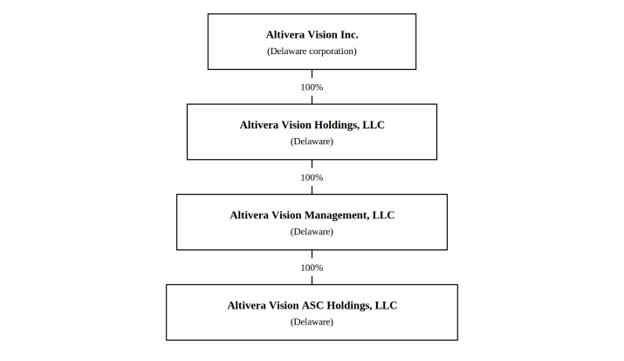
Organizational Structure
| Entity | Business Description | |
| Altivera Vision Inc. | Parent company and primary manager of the operations of the group of Altivera companies. Majority owned by RAD Intel. | |
| Altivera Vision Holdings, LLC | Intermediate holding company between the Company and Altivera Vision Management, LLC. Wholly owned by Altivera Vision Inc. | |
| Altivera Vision Management, LLC | Formed to act as the Altivera group’s management services organization (MSO), contracting with clinical practices to provide management services, staffing, non-clinical assets and software and IP licensing. Wholly owned by Altivera Vision Holdings, LLC. | |
| Altivera Vision ASC Holdings, LLC | Formed to hold equity interests in ambulatory surgery centers acquired by the group. Wholly owned by Altivera Vision Management, LLC. |
Business Model
Altivera, through its subsidiaries, intends to operate the Platform — an AI-enabled marketing and management platform designed to support ophthalmology practices, increase elective and premium surgical volume, improve practice-level and platform margins, and build long-term enterprise value.
| 14 |
Altivera intends to execute this model through a disciplined partnership strategy in which the Company’s MSO, will acquire all the non-clinical assets of, and establish long-term MSAs with, each Practice joining its Platform. Where regulations permit, the MSO or its wholly owned subsidiaries will also acquire direct majority ownership positions in any Ambulatory Surgery Centers (“ASCs”) affiliated with the Practices. Under the MSAs, the acquired non-medical assets and ASCs are then made available for the operations of the Practice, together with other administrative, technology, financial and marketing services provided by the MSO, and compensated through fair market value management fees pursuant to the MSAs. Through this combination of acquiring all Practice non-clinical assets and affiliated ASCs, and the MSAs under which management fees are levied, the MSO maintains control of all non-clinical operations and decision making and captures a contractually durable cash flow stream flowing from the Practices and ASCs, representing a fair market value management fee for its management services and, typically a significant or majority portion of their combined cashflow. Consistent with state corporate practice of medicine and/or optometry requirements, the physician partners retain ownership and full clinical control of the Practices and where required by regulation the ASCs. In jurisdictions lacking CPOM restrictions, the MSO may own the Practices and the clinical assets, provided the physicians maintain independent clinical judgment in all patient care decision-making. Under either Practice ownership model the physician partners also retain a meaningful stake in the economics of the Practices and ASC’s, which is intentionally designed to keep them clinically engaged and financially aligned with earnings, future growth and enterprise value.
Once a practice joins the Platform and a MSA is executed, the MSO will deploy its services, including exclusively licensed AI marketing and AI lead-generation platforms and proven best-practice patient consultation and conversion processes all designed to elevate the patient experience, accelerate scheduled surgical bookings (with particular emphasis on premium procedures) and expand Practice Margins.
As practices are added to its Platform, Altivera intends to refine its marketing (patient acquisition, education, scheduling, consultation, conversion and retention) and practice management capabilities using operational insights generated across its network. Over time, the Company expects these continuously improving workflows and operating processes to become a differentiated source of operational and marketing intelligence designed specifically for ophthalmology practices.
The Company believes this focus on clinical, marketing and operational excellence through a combination of disciplined MSO management, financially aligned physicians, exclusive marketing and patient lead generation AI technology platforms, and proven best-practice patient consultation and conversion processes will provide a distinct competitive advantage capable of driving meaningful enterprise value creation at both the practice level and across the consolidated Altivera Platform.
The Company’s business model is built on four complementary layers, all delivered within this physician-aligned partnership framework.
| 1. | MSO Services Offering |
Through the MSO, Altivera intends to provide Practices with a comprehensive suite of management and marketing services that allow surgeons to focus on patient care while the MSO delivers institutional-grade business infrastructure. The MSO services are anticipated to include:
| 1. | marketing and lead-generation; | |
| 2. | accounting, financial reporting, and budgeting; | |
| 3. | revenue cycle management, payor contracting, and billing; | |
| 4. | human resources, recruiting, and staff training; | |
| 5. | legal, compliance, and risk management support; | |
| 6. | procurement and vendor management; and | |
| 7. | day-to-day operational support including Company marketing, KPI reporting, and centralized administrative infrastructure. |
| 15 |
| 2. | Exclusively Licensed AI-Driven Marketing Engine |
Altivera’s marketing capability will be based on a combination of an AI driven marketing and lead-generation engine for the Ophthalmology market, that we expect to be powered by exclusive licenses for RAD Intel’s AI audience intelligence and lead generation platforms, and existing and proven best-in-class marketing practices and technologies. The Company believes this technology centered marketing strategy represents an innovative and differentiated approach to patient acquisition in ophthalmology, bringing a level of sophistication, expertise and discipline not traditionally applied in this sector.
A core pillar of this engine is Lickly, RAD Intel’s proprietary marketing platform. Lickly uses an audience-first methodology to map real-time digital behaviors and micro-communities, identifying the precise channels and content that resonate with prospective patients. By configuring Lickly specifically for ophthalmic care, Altivera expects to be able to target high-intent candidates for premium procedures with a high degree of precision.
Together, these tools are intended to analyze digital engagement behavior, demographic data, consumer health indicators, and marketing conversion metrics to:
| a. | improve marketing efficiency and lower patient acquisition cost; | |
| b. | enhance the consultation conversion rate, increasing the number of scheduled procedures; | |
| c. | increase the percentage of patients pursuing premium and cash-pay procedures; and | |
| d. | fill underutilized surgical capacity at our Practices. |
Independent case-study data from a U.S. ophthalmology practice illustrates the magnitude of return that integrated, AI-optimized digital marketing can deliver, including paid search returns on ad spend exceeding 30 times, organic traffic gains in excess of 90%, and material lifts in consultation conversion and patient engagement metrics.1 Altivera believes that its technology centered marketing approach, deployed across multiple partner practices through a centralized MSO, can capture similar economics at scale.
| 3. | Best-Practice Clinical, Consultation, and Conversion Workflows |
Under the leadership of its Chief Medical Officer, the MSO will seek to implement established, proven best practices across clinical, consultation, conversion, and surgical workflows to improve efficiency across the clinic and surgical center while elevating the patient experience. These practices are designed to:
| a. | optimize clinic scheduling, utilization, and staff workflow; | |
| b. | automate routine administrative tasks and reduce manual data entry; | |
| c. | develop and apply AI-supported consultation tools that present treatment options, expected outcomes, and financing in a clear, personalized way; | |
| d. | proactively address patient concerns, fears, and financial questions during the consultation – the stage at which most patients decide whether to schedule; | |
| e. | leverage AI intelligence to personalize each consultation based on the data collected throughout the patient journey; | |
| f. | apply predictive lead scoring to prioritize the highest-intent prospects for rapid outreach, improving lead-to-book conversion rates; | |
| g. | offer virtual consultations with AI assistance, expanding geographic reach and convenience for prospective patients while preserving consultation quality; | |
| h. | analyze patient feedback and sentiment across reviews, surveys, and direct communications to surface service-quality issues and refine the consultation experience; | |
| i. | deliver interactive, AI-driven staff training modules covering consultation flow, financial counseling, and patient communication best practices, standardizing performance across partner practices; and | |
| j. | increase scheduled booking rates and elective conversion through a more sophisticated, elevated consultation experience. |
1 Patterson, C. (2025). U.S. Refractive Surgery Market Report (2018–2025): Search Demand, Procedure Trends, and Economic Drivers. Digital Space Marketing.
| 16 |
| 4. | Integrated CRM and Patient-Journey Management |
Rather than building proprietary CRM tools, the MSO intends to configure established, readily available and cost-effective CRM tooling and integrate it with its marketing and lead-generation environment to support Practices on our Platform across the entire patient journey — from initial lead generation through consultation, scheduling, treatment, post-operative follow-up, reviews, and referrals. The Company believes its differentiation will lie in this combination of marketing, lead-generation practices and technology, and best-practice consultation and conversion capabilities that drive revenues and margins, not in the underlying CRM software itself. The integrated CRM will be configured to:
| a. | ingest leads generated through the exclusively licensed AI marketing and Lickly lead-generation platforms; | |
| b. | nurture prospective patients with AI-personalized communications from first touch through scheduled consultation; | |
| c. | automate appointment scheduling and deliver multi-channel confirmation and reminder sequences designed to reduce no-show rates; | |
| d. | orchestrate consultation, scheduling, and pre-operative communications; | |
| e. | deliver structured, AI-personalized post-operative communications and care management; | |
| f. | systematically request and capture online reviews on relevant platforms; | |
| g. | identify and activate patient referral opportunities; | |
| h. | measure patient-reported satisfaction and outcomes across the lifecycle; and | |
| i. | close the loop with marketing and consultation data so that downstream learnings improve upstream patient acquisition. |
Together, these four layers — MSO services, AI marketing and lead generation, best-practice clinical and consultation workflows, and integrated CRM and patient-journey management — are designed to create a flywheel in which each partner practice benefits from coordinated patient acquisition, conversion, delivery, and retention. The economic uplift generated by this flywheel — increased surgical volumes, increased premium-procedure mix and improved operating margins are expected to translate into enterprise value accretion at both the practice level and across the consolidated Altivera Platform.
The Revenue and Enterprise Value Model
Altivera intends to earn revenue through two primary avenues: (i) revenues from the MSO generated by service fees paid by the Practices onboarded onto the Platform; and (ii) revenues generated by the ASCs affiliated with Practices that the Company will capture through its direct ownership of interests in these entities.
For the MSO revenue stream, revenues will be comprised of fair market value fees for services rendered, and for non-clinical assets leased or made available to the Practices by the MSO for their operation. Fees will typically comprise a combination of some of the following, subject to the laws and regulations of the applicable jurisdiction:
| a. | Percentage-of-collections fee: MSO takes a set % of the Practice’s net patient revenue or collections in exchange for providing everything non-clinical. | |
| b. | EBITDA-based fee: MSO takes a share of the Practice’s operating profit after physician compensation. | |
| c. | Cost-plus / management fee: MSO charges its actual costs for services (staffing, rent, supplies, technology, marketing etc.) plus a markup. | |
| d. | Fixed or tiered fee: a flat monthly or annual fee, sometimes scaling with Practice size or volume. |
Enterprise value will accrue to the MSO and therefore to the Company through:
| a. | Long-duration Management Services Agreements with restrictive termination and non-compete/non-solicit provisions (subject to applicable laws and regulations), combined with ownership interests in affiliated ASCs which represent a contractually durable and growing cash flow stream. The durability and growth of this cash flow stream creates and increases MSO enterprise value which can be monetized through the sale of the MSO to acquirors or later-stage investors. | |
| b. | Management Aggregation: The MSO rolls up many individual practices under one management umbrella - the Platform - consolidating back-office costs and creating scale economics that justify a materially higher valuation multiple on an exit than any single practice could command alone. | |
| c. | Physician equity rollover: Physicians entering into MSAs with the MSO retain equity and a material economic interest in the Practices and any affiliated ASCs. This aligns physicians with the Practice and Platform growth and gives them aligned incentives for the next liquidity event (by selling a portion of this retained equity and economics), while also giving the Platform a cheaper source of capital and retention. |
| 17 |
As of the date of this Offering Circular, the Company has not identified any target practices for the MSO to acquire non-clinical assets from or enter into MSAs with, nor has it identified any affiliated ASCs for acquisition or made any related offers.
Growth Strategy
Altivera intends to build the MSO as a scalable, multi-state ophthalmology MSO, and where regulations allow, an ASC acquisition platform.
The Company’s objective is to achieve sustainable growth in earnings and practice value through the development and implementation of best-in-class operating practices and AI driven brand building, demand generation, lead generation and patient acquisition systems and technologies.
In so doing it intends to become a highly attractive MSO and partnership destination for physician practice and ASC owners who are attracted by its capacity to drive growth in practice revenues, margins and value and who match its operating and investment strategy and criteria and commitment to high-quality patient care.
The MSO targets established practices with successful regional franchises, high-quality physicians, and meaningful surgical capacity. Each opportunity is evaluated on its potential to materially benefit from the Platform’s infrastructure, roll meaningful equity, and adopt MSO operating strategies.
To scale efficiently, the MSO will prioritize building regional density of partner practices. We believe that density will allow the Company to maximize the impact of centralized MSO services, shared surgical infrastructure, and localized AI marketing campaigns. Rather than pursuing expensive new clinic construction, the Company focuses on capacity optimization — maximizing the utilization of existing physical infrastructure. By driving higher volumes of premium and elective procedures through our AI-powered patient acquisition and CRM, we intend to drive margin growth and a corresponding step-up in practice-level enterprise value, the economic benefit of which is shared between Altivera and the aligned physician partner.
Once the MSO model is established and optimized in an initial region, Altivera intends to replicate the Platform in additional geographic markets. This multi-state expansion will leverage our existing centralized infrastructure, playbooks, and cloud-based technology rather than rebuilding overhead in each new geography, allowing the company to scale efficiently.
Software License Agreement with RAD Intel
Altivera has entered into a Software License Agreement, effective September 1, 2026, with RAD Intel, governing Altivera’s use of RAD Intel’s proprietary, AI-powered software platform (the “RAD AI Platform”) for market intelligence, customer acquisition, lead generation, and demand generation.
The license grants Altivera an exclusive, worldwide, sublicensable right to use the RAD AI Platform and all improvements to provide marketing and related services to ophthalmology, optometry, and other vision-care practices (the “Field”). The exclusivity prohibits RAD Intel and its other customers from exploiting the RAD AI Platform within the Field during the term. Altivera may sublicense to affiliates, participating practices, and its service providers.
| 18 |
In consideration for the license, Altivera pays RAD Intel a royalty equal to 12.5% of net marketing fee revenues generated by Altivera (comprised of service fees Altivera and its affiliates collect for providing marketing services to practices, net of pass-through media spend, third-party costs, refunds, and taxes reported) which shall be paid quarterly. The parties may revise the fee structure in good faith if Altivera adopts a subscription or other pricing model.
Altivera funds customization of the RAD AI Platform for the Field, including efforts to achieve HIPAA compliance, managed by RAD Intel. Such improvements are jointly owned, with and the parties will negotiate in good faith regarding compensation for Altivera for improvements RAD Intel deploys to clients outside the Field; RAD Intel may not deploy them to any competitor within the Field. Altivera owns all client, patient, and practice data it inputs or derives; RAD Intel retains ownership of the underlying RAD AI Platform.
The agreement has a 20-year initial term, automatically renewing for successive two-year periods, and is terminable principally for uncured material breach or insolvency. If it terminates for any reason other than Altivera’s uncured breach, Altivera receives an exclusive, perpetual license to continue using the Platform and improvements in the Field, with access to source code held in escrow if needed.
A copy of this agreement is filed as exhibit 6.1 to the Offering Statement of which this Offering Circular forms a part.
Managed Services Agreement with RAD Intel
Altivera has entered into a Managed Services Agreement, effective September 1, 2026, with RAD Intel. Under the agreement, RAD Intel provides management, operational, and administrative support services to Altivera and its designated subsidiaries. These services include accounting and bookkeeping, human resources support, information technology support, and strategic and executive management support, as detailed in service schedules that the parties may update by mutual written agreement. The agreement expressly excludes the license of RAD Intel’s software platform, which is governed separately by the Software License Agreement between the parties.
For accounting, human resources, and IT services, Altivera pays a monthly direct service fee equal to RAD Intel’s cost plus 5% (estimated, for planning purposes only, at $10,000 to $25,000 per month), plus reimbursement of third-party platform and subscription costs at cost without markup. For strategic and executive management support, Altivera pays a management fee equal to 0.75% of the consolidated gross revenues of Altivera and its subsidiaries, payable quarterly in arrears. However, no fees accrue or become payable until the consolidated trailing twelve-month gross revenues of Altivera and its subsidiaries first reach $3,000,000 – after which, payment of fees under this agreement will commence on the first day of the calendar month following the month in which this revenue threshold is first met.
The agreement has an initial term of three years, automatically renewing for successive one-year terms unless either party gives 30 days’ notice of non-renewal. Either party may terminate for convenience on 30 days’ notice, for uncured material breach, or upon the other party’s insolvency. The parties act as independent contractors, and the agreement recites that the services and fees are intended to reflect arm’s-length terms notwithstanding the affiliate relationship. Other provisions address confidentiality, intellectual property ownership (each party retains its pre-existing IP; RAD Intel retains ownership of work product and the RAD AI Platform), a limitation of liability, mutual indemnification, and dispute resolution.
A copy of this agreement is filed as exhibit 6.2 to the Offering Statement of which this Offering Circular forms a part.
Delayed-Term Loan and Security Agreement between the MSO and RAD Intel
Altivera has entered into a Delayed Draw Term Loan and Security Agreement, effective September 1, 2026, with RAD Intel. The agreement establishes a delayed draw term loan facility of up to $2,500,000, which the Company may draw in tranches (minimum $25,000 per advance) subject to RAD Intel’s approval and satisfaction of customary funding conditions. RAD Intel has no obligation to increase the commitment. Amounts RAD Intel advanced to or for the benefit of the Company or the Guarantors (defined below) before the effective date (which amounted to $1,046,370 as of September 1, 2026) are deemed to constitute the initial advance under the facility and are subject to its terms. As of September 16, 2026, the Company has drawn a total of $1,396,370.00.
| 19 |
Advances bear interest at 9.0% per annum. During the first 24 months (the “PIK Period”), interest is paid in kind by capitalizing and compounding it quarterly into the outstanding principal balance rather than being paid in cash. After the PIK Period, RAD Intel may elect, in its discretion, to require cash interest payments. A default rate of an additional 5.0% applies during an event of default, and the Company pays a 1.0% annual unused line fee on the undrawn commitment.
The facility matures three years after the effective date of September 1, 2026, with all outstanding obligations due in full at maturity and no scheduled amortization beforehand. Voluntary prepayment is permitted, but the agreement provides that the aggregate amount received by Rad Intel in connection with an early prepayment of the facility shall equal to the greater of the outstanding obligations or 105% of the aggregate principal advanced.
The facility is guaranteed jointly and severally by Altivera Vision Holdings LLC, Altivera Vision Management LLC and Altivera Vision ASC Holdings LLC (the “Guarantors”) and is secured by a first-priority security interest in substantially all personal property of the Company and the Guarantors (including intellectual property). Use of proceeds of the facility is limited solely for working capital and other general corporate purposes of the Company and the Guarantors and allows for distributions, dividends, capital contributions or other such transfers by the Company to the Guarantors for their working capital and general corporate purposes. The agreement contains customary affirmative and negative covenants (limiting additional indebtedness, liens, asset dispositions, distributions, and affiliate transactions), representations, events of default, and remedies.
A copy of this loan facility is filed as exhibit 6.3 to the Offering Statement of which this Offering Circular forms a part.
Industry Overview
The U.S. ophthalmology market represents a large and growing healthcare segment driven by demographic trends, increasing prevalence of vision disorders, and advances in surgical technology.
Market Size
The U.S. ophthalmology services market is estimated to exceed $50 billion annually, and the ophthalmic surgical market is estimated to exceed $30 billion annually. The market is expected to grow at approximately 6-8% per year, supported by population aging and increasing demand for surgical and elective vision correction procedures2 3.
Cataract Surgery
Cataract surgery is the most commonly performed surgical procedure in the United States. Approximately 4 million cataract procedures are performed annually in the U.S.4 Demand is expected to increase significantly as the population ages. Approximately 25% of individuals over age 65 are affected by cataracts, with approximately 70% affected by age 805. The U.S. Census Bureau projects the population aged 65 and older will reach approximately 73 million by 2030, increasing the prevalence of age-related eye disease6.
2 Grand View Research (2024). U.S. Ophthalmology Market Size, Share & Trends Analysis Report. Grand View Research, Inc.
3 Mordor Intelligence (2024). United States Ophthalmology Devices and Services Market – Growth, Trends, and Forecasts. Mordor Intelligence Industry Reports.
4 American Academy of Ophthalmology. EyeWiki and Industry Statistics on Cataract and Ophthalmic Surgical Procedure Volumes in the United States. American Academy of Ophthalmology, San Francisco, CA.
5 National Eye Institute (2024). Cataracts: Prevalence and Age-Related Statistics; Age-Related Eye Disease Prevalence Data. National Eye Institute, National Institutes of Health.
6 U.S. Census Bureau (2023). 2023 National Population Projections: Projected Population by Age and Sex, 2022–2100. U.S. Census Bureau, Washington, D.C.
| 20 |
Other Age-Related Ocular Disease
In addition to cataracts, the prevalence of other age-related ocular conditions – including macular degeneration, glaucoma, and diabetic retinopathy – is also increasing at approximately 2–3% annually, expanding the addressable patient population for diagnostic, medical, and surgical ophthalmic services7 8.
Ophthalmologist Workforce Shortage
Compounding demographic-driven demand, the supply of ophthalmologists in the United States is projected to decline meaningfully over the coming decade. A workforce study published in the American Academy of Ophthalmology’s peer-reviewed journal Ophthalmology anticipates an approximately 12% decline in full-time equivalent (FTE) ophthalmologists by 2035, driven primarily by retirements outpacing new entrants and constrained by a limited number of ophthalmology residency positions. Over the same period, demand for ophthalmic services is projected to increase by approximately 24%, resulting in an estimated 30% shortfall in ophthalmologist supply relative to demand for comprehensive vision care and surgical services9.
This structural workforce shift over the next decade has two important implications for ophthalmology practices. First, practices must become significantly more efficient in caring for patients – leveraging technology, optimized workflows, and structured patient-journey management – in order to deliver high-quality care with fewer surgeons per patient. Second, the supply-demand imbalance is expected to materially expand the economic opportunity for ophthalmic practices that are positioned to capture incremental demand. Practices able to combine surgical capacity with modernized patient acquisition, conversion, and lifecycle management infrastructure are expected to disproportionately benefit from this multi-year trend. Altivera believes that its AI-enabled MSO platform can be specifically designed to help partner practices address both of these dynamics.
Myopia Growth
The prevalence of myopia (nearsightedness) has increased dramatically over the past 50 years. Research indicates that myopia prevalence in the United States increased from approximately 25% of the population in the 1970s to roughly 40% today, creating a large and growing population of potential candidates for refractive vision correction procedures10.
LASIK and Refractive Surgery
Laser vision correction procedures such as LASIK remain one of the most widely performed elective surgeries in ophthalmology. Approximately 700,000 to 800,000 LASIK procedures are performed annually in the United States11. Industry modeling estimates the total U.S. refractive procedure market at approximately $1.44 billion to $2.3 billion in 2025, with the broader retail refractive surgery market projected to grow to roughly $12 billion globally by 203012 13 14. In addition, advances in refractive lens exchange (RLE), phakic IOLs, and premium cataract procedures are expanding the elective vision correction market. Lens-based and implantable procedures are growing faster than traditional LASIK: RLE has shown moderate, steady growth among presbyopic patients aged 40 and above, and the EVO Implantable Collamer Lens (ICL) has experienced rapid adoption since its FDA approval in March 2022, with ICL share at select U.S. refractive practices roughly doubling from 6.5% in 2022 to 12.8% in 202315 16 17. EVO ICL also commands meaningfully higher average pricing (approximately $4,000 to $6,000 per eye) than LASIK (approximately $1,900 to $2,400 per eye), providing partner practices with a path to higher revenue per case as the procedure mix continues to shift18. Together, these demographic and technological trends support continued long-term growth in the ophthalmology sector.
7 American Academy of Ophthalmology. EyeWiki and Industry Statistics on Cataract and Ophthalmic Surgical Procedure Volumes in the United States. American Academy of Ophthalmology, San Francisco, CA.
8 National Eye Institute (2024). Cataracts: Prevalence and Age-Related Statistics; Age-Related Eye Disease Prevalence Data. National Eye Institute, National Institutes of Health.
9 Berkowitz, S. T., Finn, A. P., Parikh, R., Kuriyan, A. E., & Patel, S. (2024). Ophthalmology Workforce Projections in the United States, 2020 to 2035. Ophthalmology, Journal of the American Academy of Ophthalmology, 131(2), 133–139.
10 Vitale, S., Sperduto, R. D., & Ferris, F. L. (2009). Increased Prevalence of Myopia in the United States Between 1971–1972 and 1999–2004. Archives of Ophthalmology, 127(12), 1632–1639.
11 Refractive Surgery Council (2024). LVC (Laser Vision Correction) Procedure Volume Reports. Refractive Surgery Council.
12 Market Scope (2024). U.S. Refractive Surgery Market Report. Market Scope, LLC.
13 Eyewire+ (2023). Refractive Surgery Market Outlook. Eyewire+ Industry Reports.
14 Patterson, C. (2025). U.S. Refractive Surgery Market Report (2018–2025): Search Demand, Procedure Trends, and Economic Drivers. Digital Space Marketing.
15 Ophthalmology Management (2024). Annual Refractive and Cataract Procedure Trends. Ophthalmology Management Industry Reports.
16 U.S. Food and Drug Administration (2022). Premarket Approval (PMA): EVO Implantable Collamer Lens (ICL). FDA PMA Database.
17 Patterson, C. (2025). U.S. Refractive Surgery Market Report (2018–2025): Search Demand, Procedure Trends, and Economic Drivers. Digital Space Marketing.
18 Patterson, C. (2025). U.S. Refractive Surgery Market Report (2018–2025): Search Demand, Procedure Trends, and Economic Drivers. Digital Space Marketing; Market Scope (2024). U.S. Refractive Surgery Market Report. Market Scope, LLC.
| 21 |
Structural Inefficiencies in Ophthalmology
Despite favorable market dynamics, many ophthalmology practices remain operationally under-optimized. Traditional ophthalmology practices commonly experience:
| 2. | underutilized surgical and clinical capacity; | |
| 3. | limited digital marketing sophistication and an absence of modern social and digital media marketing; | |
| 4. | inefficient patient conversion processes and weak consultation workflows; | |
| 5. | under-developed financial counseling that fails to address patient affordability concerns for premium procedures; | |
| 6. | limited adoption of data analytics and artificial intelligence across the patient journey; and | |
| 7. | minimal structured patient engagement throughout the lifecycle, leading to lost referrals and a lower volume of online reviews. |
Because surgical infrastructure carries significant fixed costs, incremental procedures performed within existing facilities can generate high-margin revenue growth. Altivera believes that applying advanced AI-driven patient acquisition, best-practice consultation and conversion workflows, and integrated patient-journey management can significantly improve utilization rates and profitability without requiring major capital investment.
Independent industry analysis underscores the size of this opportunity. Despite a U.S. candidate pool estimated at more than 50 million people, annual penetration of laser vision correction has historically remained at approximately 0.2% of eligible patients per year, well below the early-2000s peak of approximately 1.4 million procedures19 20. Prospective refractive patients now spend an average of nearly 49 days researching providers before scheduling a consultation, and roughly 60% of Google searches end without a click as AI overviews increasingly satisfy user intent directly, meaning practices without authoritative digital content and strong reputational signals are systematically overlooked21 22 23. Surveys further indicate that 60% to 75% of U.S. adults have used AI tools for health information, and AI search platforms disproportionately cite sources with strong expertise, authority, and trust signals24 25 26. These dynamics reward platforms able to deploy authority-optimized content, structured patient journeys, and integrated CRM at scale, the precise capabilities Altivera is positioned intends to deliver to partner practices.
The economic impact of these inefficiencies can be quantified across a four-part patient acquisition framework that practices use to evaluate marketing return on investment: (i) cost per lead (CPL), determined by creative quality, targeting, and platform mix; (ii) lead-to-book rate (scheduled consultations ÷ total leads), determined by speed to contact, caller skill, and follow-up process; (iii) no-show rate (no-shows ÷ total scheduled), determined by confirmation sequences, reminders, and patient experience; and (iv) consult-to-surgery conversion (scheduled surgeries ÷ total patients showing up), determined by consultation flow, surgeon trust, and pricing presentation. Industry benchmarks for social media lead-form campaigns indicate an average lead-to-book rate of approximately 15% (rising to 20% or higher with strong follow-up), an average no-show rate of approximately 35%, and consult-to-surgery conversion that varies meaningfully by procedure and practice, with higher-cost premium procedures typically converting at lower rates27. Because each stage compounds multiplicatively, incremental improvements at any single stage produce disproportionate gains in surgeries scheduled and revenue per marketing dollar deployed. The Company expects that its Platform, with its marketing and lead-generation abilities combined with its best-practice consultation and conversion processes, will deliver measurable improvement at every stage of this funnel.
Regulatory Environment
The Practices and ASCs with which Altivera intends to enter into MSAs operate in a highly regulated industry and are subject to extensive federal, state, and local laws and regulations. These laws govern the ownership, management, and operation of medical practices and ASCs, patient privacy, healthcare marketing, professional licensure, third-party reimbursement, referral source relationships, and the delivery of healthcare services generally.
Altivera’s business model depends upon its ability to establish and maintain MSAs with the Practices and ASCs in compliance with applicable federal and state law. Changes in laws, regulations, regulatory interpretations, or enforcement priorities may require modifications to or restructuring of the business model, increase compliance costs, limit expansion opportunities, or otherwise adversely affect our business, financial condition, or results of operations.
19 Joffe, S. N. (2021). The 25th Anniversary of Laser Vision Correction in the United States. Clinical Ophthalmology, 15, 1401–1426.
20 Patterson, C. (2025). U.S. Refractive Surgery Market Report (2018–2025): Search Demand, Procedure Trends, and Economic Drivers. Digital Space Marketing.
21 Pierce, D. (2023). Consumer Research Behavior in Elective Healthcare: Path-to-Consultation Analysis. Industry research report.
22 Search Engine Land (2024). Zero-Click Search and the Rise of AI Overviews. Search Engine Land Research.
23 SparkToro (2024). 2024 Zero-Click Search Study. SparkToro, Inc.
24 Annenberg Public Policy Center (2025). Consumer Use of AI Tools for Health Information. University of Pennsylvania.
25 eMarketer (2025). U.S. Consumer AI Usage Survey. eMarketer / Insider Intelligence.
26 Ranktracker (2025). AI Search Citation Patterns: Expertise, Authority, and Trust Signals. Ranktracker Research.
27]Industry benchmark data for U.S. elective-ophthalmology patient acquisition funnels, including cost-per-lead, lead-to-book conversion, no-show, and consult-to-surgery conversion metrics for social media lead-form campaigns, drawn from refractive- and cataract-focused practice marketing presentations and operator surveys (2024–2025).
| 22 |
Corporate Practice of Medicine and Healthcare Entity Ownership Restrictions
Many states maintain CPOM doctrines and related laws that generally prohibit non-physicians or non-professional entities from owning, controlling, or exercising undue influence over the practice of medicine and/or optometry. These laws are intended to ensure that medical decisions remain under the purview of licensed physicians rather than business organizations. Altivera’s MSO intends to enter into MSAs with ophthalmology practices and ASCs in a manner designed to comply with applicable CPOM requirements in those states where it operates. Under this model, existing physician owners will retain ownership of and clinical control over the medical practice and where required by regulation any affiliated ASCs, while Altivera’s MSO will provide non-clinical management, technology, marketing, administrative, and other operational support services in exchange for a fair market value fee. Because CPOM laws vary significantly among jurisdictions and continue to evolve, regulatory authorities could determine that certain aspects of our arrangements are inconsistent with applicable laws or regulations. Such determinations could result in disciplinary action against clinician-licensees, fines or penalties, or require us to modify, restructure, or terminate existing arrangements, which could adversely affect our growth strategy and financial performance.
Fee-Splitting Restrictions
Many states prohibit or restrict arrangements under which a physician or other licensed practitioner shares professional fees with non-practitioners. These fee-splitting laws are often closely related to CPOM restrictions and may limit the compensation structures that can be used between a medical practice or an ASC and the MSO. For example, in certain states such as New York, management fees that are structured as a percentage of a practice’s or ASC’s revenue are prohibited. Altivera intends to structure its MSAs and related fees in a manner designed to comply with applicable fee-splitting restrictions and to obtain third-party fair market value opinions for its management fees. However, because these laws differ among jurisdictions and are often subject to limited judicial or regulatory guidance, governmental authorities could conclude that certain aspects of our arrangements violate applicable fee-splitting requirements. Any such finding could result in licensee discipline, fines, penalties, the invalidation of contractual arrangements, or the need to restructure our business relationships. Additionally, CPOM and fee-splitting restrictions increase Altivera’s compliance costs required to ensure there are no violations.
Federal and State Healthcare Fraud, Waste, and Abuse Laws
Managed practices operating on the Platform may participate in federal and state healthcare programs, including Medicare and Medicaid. As a result, such practices are subject to various federal and state healthcare fraud and abuse laws, including the federal Anti-Kickback Statute, the federal physician self-referral law commonly known as the Stark Law, the federal False Claims Act, and analogous state laws. The Anti-Kickback Statute generally prohibits the knowing offer, payment, solicitation, or receipt of remuneration to induce or reward referrals or generate business reimbursable under federal healthcare programs. The Stark Law generally prohibits physicians from referring patients for certain designated health services to entities with which the physician or immediate family members have specified financial relationships unless an exception applies. Although Altivera intends to structure its operations and contractual arrangements in compliance with applicable fraud, waste, and abuse laws, the governing regulatory framework is complex and requires heightened costs to ensure compliance. Violations of these laws may result in substantial civil or criminal penalties (including imprisonment), exclusion from participation in government healthcare programs, repayment obligations, and significant reputational harm.
Medicare, Medicaid, and Commercial Reimbursement
The financial performance of many ophthalmology practices depends heavily upon reimbursement from Medicare, Medicaid, and commercial health insurers. Reimbursement methodologies, coverage policies, coding requirements, documentation standards, and payment rates are established and periodically revised by governmental agencies and private payors. Future reductions in reimbursement rates, increases in reimbursement scrutiny, modifications to coverage policies, or changes to documentation requirements may adversely affect the profitability of ophthalmology practices and reduce the value of Altivera’s management relationships.
| 23 |
HIPAA and Healthcare Information Privacy
The Health Insurance Portability and Accountability Act of 1996 (“HIPAA”), as amended by the Health Information Technology for Economic and Clinical Health Act (“HITECH”), establishes requirements relating to the privacy, security, transmission, and safeguarding of protected health information (“PHI”). Altivera expects to receive, process, analyze, or otherwise access PHI through its marketing, CRM, patient-journey management, lead-generation, and operational support activities. To the extent Altivera is deemed to create, receive, maintain, or transmit PHI on behalf of healthcare providers, Altivera will be required to comply with HIPAA’s privacy, security, and breach-notification requirements and enter into business associate agreements with partner practices. Failure to comply with HIPAA or other applicable privacy laws could result in governmental investigations, enforcement actions, monetary penalties, contractual liability, reputational harm, and increased compliance costs.
State Privacy and Consumer Data Protection Laws
Numerous states have enacted comprehensive privacy laws governing the collection, use, disclosure, retention, and protection of personal information. Such laws may apply to Altivera’s collection and use of patient, consumer, and marketing-related data through the Platform and patient-acquisition activities. These laws continue to evolve and may impose additional compliance obligations, including requirements relating to consumer disclosures, data processing practices, cybersecurity measures, consumer rights requests, and vendor management. Compliance with these laws may increase Altivera’s operating costs and require modifications to its technology systems and business practices.
Marketing, Advertising, and Consumer Protection Regulation
Altivera’s business strategy relies significantly on patient-acquisition activities, digital marketing, lead generation, content development, and consumer engagement initiatives. These activities are subject to oversight under federal and state consumer protection and advertising laws, including regulations enforced by the Federal Trade Commission (“FTC”), state attorneys general, and other regulatory authorities (including but not limited to healthcare fraud and abuse laws). Healthcare-related advertising and marketing communications are also subject to requirements concerning accuracy, substantiation of claims, disclosures, endorsements, testimonials, and deceptive or unfair trade practices. Regulatory scrutiny of artificial intelligence applications in advertising, consumer targeting, and automated decision-making continues to increase. Any determination that Altivera’s marketing activities violate applicable advertising or consumer protection requirements could result in investigations, enforcement actions, corrective measures, fines, or restrictions on our marketing practices.
Physician Licensure and Telehealth Requirements
The ophthalmologists and other healthcare professionals practicing within partner practices must maintain all licenses, certifications, permits, and registrations required under applicable law. In addition, any telehealth or virtual-consultation services offered through partner practices may be subject to additional federal and state requirements governing patient interactions, licensure, information technology security, informed consent, prescribing practices, and recordkeeping. Changes in telehealth regulations or professional licensure requirements could affect the ability of partner practices to offer certain services, which may adversely affect patient volumes and practice profitability.
Ambulatory Surgery Center Regulation
Many ophthalmology practices operate, own, or maintain relationships with ASCs. ASCs are subject to extensive federal, state, and local regulation, including licensure, accreditation, patient safety, quality-of-care, Medicare certification, facility standards, and distinct healthcare fraud, waste, and abuse and disclosure laws. Compliance costs associated with ASCs are increased for these reasons. To the extent Altivera acquires ownership interests in ASCs, where permitted by law, the Company may become subject to additional regulatory obligations and liabilities. Failure of an ASC to maintain required licenses, certifications, accreditations, and/or compliance with applicable fraud and abuse laws or disclosure obligations could adversely affect patient care operations and financial performance.
| 24 |
Artificial Intelligence and Emerging Regulatory Frameworks
Altivera intends to utilize artificial intelligence and machine-learning technologies in connection with patient acquisition, marketing, consultation support, lead scoring, workflow optimization, and analytics. Federal and state policymakers continue to evaluate new laws and regulations governing artificial intelligence, automated decision-making systems, data usage, algorithmic transparency, and consumer protection. The adoption of new AI-related requirements could increase compliance costs, restrict the use of certain technologies, require modifications to existing systems, or delay the deployment of new products and services. As regulatory frameworks continue to evolve, Altivera may be required to adapt its operations and Platform to comply with future legal requirements.
Future Regulatory Developments
Healthcare regulation in the United States continues to evolve rapidly. Future legislative, regulatory, judicial, or enforcement developments affecting healthcare delivery, MSO structures, physician-practice ownership, investment, and management, healthcare marketing, artificial intelligence, privacy, reimbursement, disclosure obligations, or fraud, waste, and abuse laws may materially affect Altivera’s business model and operating results. Although the Company intends to monitor regulatory developments and adapt its business practices as necessary, there can be no assurance that future changes in law or regulatory interpretation will not adversely affect the Company’s operations, growth strategy, financial condition, or prospects.
Competitive Landscape
The ophthalmology MSO and consolidation sector includes several large physician-practice management platforms and private equity–backed organizations. Notable industry participants include:
Ophthalmic PE-Backed Platforms
| Rank | Company | Notes on Scale* | ||
| 1 | EyeCare Partners | Widely considered the largest integrated ophthalmology + optometry platform in the U.S.; ~671 locations, 300+ ophthalmologists, 700+ optometrists. Backed by Partners Group. | ||
| 2 | Retina Consultants of America | Largest retina-only platform in the country; 200+ locations and 220+ retina specialists. Backed historically by Webster Equity and now part of Cencora expansion strategy. | ||
| 3 | EyeSouth Partners | One of the largest comprehensive ophthalmology platforms in North America; 290+ physicians, 160+ locations. Retina division recently sold for $1.1B. Backed by Olympus Partners. | ||
| 4 | American Vision Partners | Major Southwest-focused ophthalmology consolidator with 60+ locations and 20+ ASCs. Backed by H.I.G. Capital. | ||
| 5 | Nvision Eye Centers | Large refractive/cataract-focused platform with LASIK emphasis and national branding presence. PE-backed historically by KKR. Ranked among largest ophthalmology groups nationally. | ||
| 6 | CVP (CEI Vision Partners) | One of the earliest ophthalmology PE roll-ups; strong Midwest footprint with cataract/ASC strength. Backed by Revelstoke historically. | ||
| 7 | Prism Vision Group | Large East Coast integrated ophthalmology group with strong retina presence. Backed by Quad-C. | ||
| 8 | SightMD | Rapidly expanding Northeast eye-care platform with ophthalmology, retina, and optometry integration. PE-backed. | ||
| 9 | ReFocus Eye Health | Significant New England and Northeast footprint with multispecialty ophthalmology integration. | ||
| 10 | Vision Innovation Partners | Large Mid-Atlantic regional consolidator with extensive ophthalmology network and ASC infrastructure. | ||
| 11 | Eye Health America | Large Southeastern integrated ophthalmology platform backed by PE. | ||
| 12 | Comprehensive EyeCare Partners | Strong retina and surgical ophthalmology footprint in western U.S. markets. | ||
| 13 | Midwest Vision Partners | Midwest-focused consolidation platform with strong physician partnership model. | ||
| 14 | SEES Group | Growing Southeast-focused ophthalmology/optometry platform backed by Shore Capital. | ||
| 15 | Atlantic Vision Partners | Smaller but active ophthalmology consolidator in the Mid-Atlantic/Southeast regions. |
*Company-level rankings, location counts, ophthalmologist and optometrist counts, and ownership information for the platforms listed above are based on publicly available industry sources, including PitchBook Healthcare Private Equity Reports and McGuireWoods Healthcare Private Equity Reports.
These organizations compete with the Company for partnership opportunities, physician relationships, management talent, and capital. Many competitors have greater financial resources, longer operating histories, or broader geographic footprints. However, the Company believes that its ability to offer a combination of a disciplined, compliant management and ASC partnership model that keeps physicians aligned combined with MSO services, exclusively licensed AI marketing and lead-generation services, best-practice clinical and consultation workflows, and integrated patient-journey management will give Altivera the ability to compete successfully in this market.
Employees
As of the date of this Offering Circular, the Company has 2 full-time employees.
Legal Proceedings
We know of no existing or pending legal proceedings against us, nor are we involved as a plaintiff in any proceeding or pending litigation. There are no proceedings in which any of our directors, officers or any of their respective affiliates, or any beneficial stockholder, is an adverse party or has a material interest adverse to our interest.
| 25 |
Altivera Vision Inc. operates on a fully-remote basis and does not have a headquarters. The Company has limited fixed assets consisting mostly of computer hardware used by employees. The Company’s current mailing address is associated with its registered agent, 8 The Green, Suite 26492, Dover, DE, 19901.
| 26 |
MANAGEMENT’S DISCUSSION AND ANALYSIS OF FINANCIAL CONDITION AND RESULTS OF OPERATIONS
The following discussion of our financial condition and results of operations should be read in conjunction with our audited financial statements as of December 31, 2025 and for the period from July 7, 2025 (inception) through December 31, 2025, and the related notes included in this offering statement. The following discussion contains forward-looking statements that reflect our plans, estimates, and beliefs. Our actual results could differ materially from those discussed in the forward-looking statements as a result of various factors, including those set forth under “Risk Factors” and elsewhere in this offering circular.
Results of Operations
The Company was incorporated on July 7, 2025 and, as of December 31, 2025, had not commenced its principal operations, completed any acquisitions, or generated any revenue. The Company’s activities to date have consisted of organizational efforts and the initial development of its business plan, funded primarily through advances and a loan from its parent and controlling stockholder, Rad Technologies, Inc. The Company incurred a net loss of $333,370 for the period from July 7, 2025 (inception) through December 31, 2025, consisting of general and administrative expenses of $145,019 and sales and marketing expenses of $188,351. The Company generated no revenue during the period.
Cash Flows
For the period from July 7, 2025 (inception) through December 31, 2025, net cash used in operating activities was $0. The Company’s net loss of $333,370 was offset by $396,370 of expenses that RAD Intel paid directly on the Company’s behalf (rather than through a cash advance to the Company), partially reduced by a $63,000 increase in prepaid expenses. Net cash provided by financing activities was $150,000, representing the proceeds of a loan from RAD Intel described below. As a result, the Company’s cash increased from $0 at inception to $150,000 as of December 31, 2025.
Because RAD Intel funded substantially all of the Company’s operating expenses directly during the period, rather than through cash advances to the Company, the Company’s reported net cash used in operating activities does not reflect the full economic cost of its operations to date. Absent this related-party funding, the Company would not have had sufficient cash to fund its operations for the period presented.
Liquidity and Capital Resources
As of December 31, 2025, the Company had cash of $150,000, total liabilities of $546,370 (consisting entirely of related-party advances and a related-party loan described below), and a working capital deficit and accumulated deficit of $333,370.
Since inception, the Company has been dependent on funding from RAD Intel to sustain its operations. As of December 31, 2025:
● RAD Intel had paid $396,370 of the Company’s general and administrative, sales and marketing, and other organizational expenses on the Company’s behalf. The full amount remained outstanding and unpaid as “due to related parties” on the Company’s balance sheet as of December 31, 2025. These advances are unsecured, non-interest-bearing, and have no fixed repayment terms.
● The Company had also borrowed $150,000 from RAD Intel under a non-interest-bearing loan payable on demand. The full amount remained outstanding as of December 31, 2025.
There can be no assurance that RAD Intel will continue to fund the Company’s operations, or that the terms of any continued funding will not change. See “Interest of Management and Others in Certain Transactions” and Note 5 to the audited financial statements.
Delayed Draw Term Loan and Security Agreement
Subsequent to December 31, 2025, Altivera entered into a Delayed Draw Term Loan and Security Agreement with RAD Intel, effective September 1, 2026, establishing a new committed source of capital for the Company’s operations. The facility provides for delayed draw term loans of up to $2,500,000 in the aggregate, drawable in tranches of a minimum of $25,000 per advance, subject to RAD Intel’s approval and the satisfaction of customary funding conditions. RAD Intel is not obligated to increase its commitment beyond $2,500,000. Amounts RAD Intel advanced to or for the benefit of the Company or the guarantors prior to the effective date are deemed to constitute the initial advance under the facility and are subject to its terms.
| 27 |
Advances bear interest at 9.0% per annum. During the first 24 months following the effective date (the “PIK Period”), interest is paid in kind by capitalizing and compounding it quarterly into outstanding principal, rather than being paid in cash, which will increase the principal amount owed over time even absent additional draws. After the PIK Period, RAD Intel may elect, in its discretion, to require cash interest payments, which would increase the Company’s cash operating requirements. A default rate of an additional 5.0% applies during an event of default, and a 1.0% annual fee is payable on the undrawn portion of the commitment.
As of the date of this Offering Circular, $1,396,370 in aggregate principal was outstanding under the facility (before the effective date of September 1, 2026 this amounted to $1,046,370) and $1,103,630 remained available for future draws, subject to RAD Intel’s approval and the satisfaction of customary funding conditions.
A copy of this facility is filed as exhibit 6.3 to the Offering Statement of which this Offering Circular forms a part and is described more fully in the “Interest of Management and Others in Certain Transactions” section of this Offering Circular.
The Company expects to repay the amounts outstanding under the facility at maturity through a combination of proceeds of this offering or potential future offerings and operating cash flow generated by the MSO’s expected management fees and ASC ownership interests. Because the facility does not amortize and interest compounds during the PIK Period, the amount ultimately due at maturity will be significantly larger than the amounts initially drawn, and the Company’s ability to repay or refinance the facility will depend on factors that are not yet known or assured, including the success of this offering and the pace at which the Company is able to generate management fee revenue from Practices.
Other Related-Party Fee Obligations
Subsequent to December 31, 2025, the Company also entered into a Software License Agreement and a Managed Services Agreement with RAD Intel, each effective September 1, 2026, and described under the “Interest of Management and Others in Certain Transactions” Section of this Offering Circular. These agreements will require the Company to pay RAD Intel (i) a royalty of 12.5% of net marketing fee revenue under the Software License Agreement, (ii) a monthly service fee equal to RAD Intel’s cost plus 5%, for accounting, human resources, and information technology services under the Managed Services Agreement, plus reimbursement of related third-party costs at cost, and (iii) once the Company’s consolidated trailing-twelve-month gross revenues first reach $3,000,000, a management fee equal to 0.75% of consolidated gross revenues, payable quarterly in arrears, for strategic and executive management support. These payment obligations will represent additional demands on the Company’s future cash resources as its business scales.
| 28 |
Going Concern
As discussed in Note 3 to the Company’s audited financial statements, the Company has not commenced its principal operations or generated any revenue since inception, incurred a net loss of $333,370 for the period from inception through to December 31, 2025, had a working capital deficit of $333,370 as of December 31, 2025, and has no committed sources of revenue. These factors raise substantial doubt about the Company’s ability to continue as a going concern, and the independent auditor’s report accompanying the Company’s financial statements includes an explanatory paragraph regarding this uncertainty. Management’s plans to address these conditions include continuing to rely on financial support from RAD Intel (including under the Delayed Draw Term Loan and Security Agreement described above), raising additional capital through this offering and other equity or debt financings, and ultimately generating revenue from the operation of acquired ophthalmology practices and/or services provided to ophthalmology practices. There can be no assurance that any such financing will be available on acceptable terms, or at all, or that the Company’s acquisition and growth strategy will be successfully executed. The Company’s financial statements do not include any adjustments that might result from the outcome of this uncertainty.
Plan of Operations
During the twelve months following the commencement of this offering, the Company’s plan of operations is to establish the foundational elements of its MSO model and to prepare the Platform for practice partnerships. The Company’s principal objectives during this period are described below.
a. Develop, refine and validate the core components of the Company’s partnership model, including:
i. the legal and commercial structures and forms of agreement for management services arrangements with practices and, where applicable, for the acquisition of interests in affiliated ambulatory surgery centers;
ii. the configuration and deployment of the Company’s exclusively licensed AI marketing and lead-generation technology (i.e. the Platform) and the associated patient consultation and conversion processes;
iii. clinical and surgical operating structures and workflows intended to support efficiency and quality of care at partner practices; and
iv. the initial MSO infrastructure required to deliver accounting, revenue cycle management, human resources, legal, procurement, technology and general operational and administrative support to partner practices.
b. Identify and evaluate candidate markets and practices and seek to establish the Company’s initial management services arrangement or arrangements and, where applicable and permitted, related surgery center interests.
c. Continue to build the Company’s management team and internal capabilities to support the foregoing activities.
The pace and extent of the Company’s activities, and the number of practice partnerships or surgery center interests, if any, that the Company establishes during this period, will depend on a number of factors, including the amount of proceeds raised in this offering, the availability of suitable partnership candidates and market conditions. As of the date of this Offering Circular, the Company has not identified any target practices or affiliated surgery centers, has not entered into any management services agreement, and has made no acquisition offers. Establishing a practice partnership or completing any acquisition will be a prerequisite to our Company generating revenues, and there can be no assurance that the Company will establish any practice partnership or complete any acquisition during the first twelve months or at all.
The Company expects that, if the maximum offering amount is raised, the net proceeds of this offering, together with the Company’s other available resources, will be sufficient to fund its planned operations for at least the twelve months following the commencement of this offering.
Proceeds are expected to be applied principally to the configuration and deployment of the Company’s licensed technology and related marketing capabilities, the build-out of initial MSO infrastructure, the establishment of its initial practice partnership arrangements and related transaction costs, and general working capital. Because the Company is in its development stage, its objective is to scale with the level of proceeds raised and the timing of its activities, and the Company intends to manage expenditures to extend its runway across, and, if practicable, beyond, the twelve-month period.
| 29 |
This offering is being conducted on a “best efforts” basis, and there is no assurance that the maximum amount will be raised. If the Company raises less, it intends to prioritize the activities most critical to its plan of operations and to adjust the scope, sequencing and timing of its remaining activities — which may include deferring discretionary expenditures, limiting the number of partnerships or acquisitions it pursues, or extending its timeline. A significant shortfall could delay or curtail the plan of operations and require the Company to seek additional financing sooner than anticipated. As an additional resource, the Company has access to undrawn availability under a delayed-draw term loan facility with RAD Intel, which it may draw upon, subject to the terms and conditions of that facility, in the event of lower-than-expected proceeds or higher-than-anticipated expenditures. There can be no assurance as to the amount that will ultimately be available.
If the Company’s available resources prove insufficient, it may need to raise additional capital through subsequent equity or debt financings, or to modify or delay elements of its plan of operations. Such financing may not be available on acceptable terms, or at all, and the Company’s ability to continue as a going concern depends on its ability to raise sufficient capital in this offering and, as necessary, from other sources. These matters should be read
together with the risk factors set forth elsewhere in this Offering Circular.
Trend Information
The Company has a limited operating history and has not yet generated revenue from its intended operations. As a result, it has no historical sales, inventory, order book, or selling-price trends to report. The Company’s business plan is nonetheless informed by favorable demand trends in the U.S. ophthalmology market, including an aging population, rising prevalence of age-related ocular conditions, and a projected shortfall between ophthalmologist supply and patient demand, alongside a continuing shift toward higher-priced, lens-based elective procedures. The Company’s future results will also be affected by known uncertainties, including continued consolidation of the ophthalmology MSO sector, evolving corporate-practice-of-medicine, fee-splitting, healthcare fraud and abuse, artificial intelligence, and privacy regulation, changes in third-party reimbursement, the Company’s dependence on RAD Intel for its licensed technology, management services, and secured financing, and the amount and timing of capital it is able to raise, including in this offering.
| 30 |
DIRECTORS, EXECUTIVE OFFICERS AND SIGNIFICANT EMPLOYEES
| Name | Position | Age | Term in Office | Approximate
hours per week for part-time employees | ||||
| Executive Officers | ||||||||
| Steven Silver* | Chief
Executive Officer |
59 | July 2026 to Present | Part-time | ||||
| Dr. Jeffrey Machat† | President, Chief Medical Officer | 64 | July 2026 to Present | 32 hours per week | ||||
| Deon Kibel | Chief Operating and Financial Officer | 64 | July 2025 to Present | Full-time | ||||
| Alan Arnstein | Vice President, Business Development | July 2025 to Present | Part-time | |||||
| Directors | 58 | |||||||
| Jeremy Barnett | Director | 51 | July 2025 to Present | |||||
| Bradley Silver | Director | 52 | July 2025 to Present | |||||
| Dr. Jeffrey Machat | Director | 64 | July 2025 to Present | |||||
| Steven Silver | Director | 59 | September 2026 to Present |
*Steven Silver previously served as the Company’s President from March 17, 2026 through June 30, 2026.
†Dr. Jeffrey Machat previously served as the Company’s Chief Executive Officer from March 17, 2026 through June 30, 2026.
Steven Silver – Chief Executive Officer, and Director
Steven Silver serves as Chief Executive Officer of Altivera Vision and leads the Company’s overall strategy and execution. Mr. Silver has served as the Company’s Chief Executive Officer since July 2026. Prior to that, he served as the Company’s President from March 2026 to June 2026. Mr. Silver is an experienced media, operations, and growth leader who also serves as Chief Operating Officer at RAD Intel, where he drives scale in its AI-driven marketing and intelligence platform and has served since 2025. In the 5 years prior to joining RAD Intel full time, Mr. Silver served as a strategic and operational consultant to companies in the healthcare, technology, and media sectors, including RAD Intel, advising on growth strategy, mergers and acquisitions, organizational development, operations, and technology-enabled business models. Previously, Mr. Silver served as CEO of Kew Media Group from 2016 to March 2020, where he led a global portfolio of production companies. He brings a disciplined approach to building Altivera’s Platform and integrating RAD Intel’s AI marketing and intelligence capabilities into ophthalmology.
Dr. Jeffrey Machat – President, Chief Medical Officer, and Director
Dr. Jeffrey Machat serves as Chief Medical Officer of Altivera Vision and leads the Company’s physician relationships, clinical strategy, and internal clinical processes, including the development and implementation of Altivera’s best-practice clinical, consultation, and conversion workflows. Dr. Machat has served as the Company’s Chief Medical Officer and President since July 2026. Prior to that, he served as the Company’s Chief Executive Officer from March 2026 to June 2026. Dr. Machat is a refractive surgeon and entrepreneur with more than three decades of experience in ophthalmology practice development and scaling. He has performed over 110,000 LASIK procedures and previously co-founded TLC Laser Eye Centers, which grew to 83 clinics and became the largest LASIK provider in North America. Dr. Machat has also played a senior role in building Optical Express into a leading European platform and has consulted for multiple large vision-care organizations. He has been the Medical Director and a LASIK Surgeon at the Lasik Vision Institute since June 2019. The Company believes this depth of clinical and operational experience is critical to its ability to partner effectively with surgeons and execute its growth strategy. Dr. Machat also holds a senior leadership role within RAD Intel.
Deon Kibel – Chief Operating and Financial Officer
Deon Kibel serves as Chief Operating Officer and Chief Financial Officer of Altivera Vision. Mr. Kibel has extensive experience operating, financing, acquiring, and integrating mid-market businesses as well as in investment banking and mezzanine debt financing in Europe and North America. In the 5 years prior to joining Altivera Mr. Kibel has been engaged as the founder and operator of a privately owned real-estate investment and development company focused on developing and investing in value-add retail and multi-residential apartment properties in Canada and the US. Previously, Mr. Kibel has been the VP Finance/CFO of Carina Furniture Industries, a leading North American manufacturer of ready-to-assemble furniture, and Vice President, Corporate Finance at TD Securities, the investment banking arm of TD Bank.
Alan Arnstein – Vice President, Business Development
Alan Arnstein serves as Vice President of Business Development and leads the Company’s partner-practice pipeline, including evaluation and execution of management-partnership opportunities across the U.S. ophthalmology market. Previously, Alan has held the position of President at Arnstein Consulting Inc, between the years of 2023 and 2025, before that Alan was the Vice President of Business Development at AmeriVet Veterinary Partners for six years between 2017 and 2023.
Jeremy Barnett, Director
Jeremy Barnett, is the CEO and co-founder of RAD Intel and is a 3x startup founder with 2 exits, including Trendy Butler (fashion tech). Jeremy has successfully led companies and raised capital with institutional investors such as Fidelity Investments, SOS Ventures, Expert Dojo, and more. He has experience building companies from 0-100+ employees. Mr. Barnett has served as CEO for RAD Intel since the company was founded in March 2018.
Bradley Silver, Director
Bradley Silver is the President and co-founder of RAD Intel and is also a 3x startup founder with 2 exits including Brand Protect. He has extensive experience raising capital and has worked with investors such as Fidelity Investments, GenWealth Ventures, MaRS AF, Brigus Capital, and Greybrook. He has experience scaling companies to $30m+ in annual recurring revenue. Mr. Silver has been with RAD Intel since June 2021. Prior to that he served as the CEO of Atomic Reach from November 2010 until October 2021.
| 31 |
COMPENSATION OF DIRECTORS AND EXECUTIVE OFFICERS
For the period from July 7, 2025 (inception) to December 31, 2025, the Company compensated its executive officers and directors as follows:
| Name | Capacities
in which compensation was received | Cash Compensation | Other Compensation | Total Compensation | ||||||||||
| Steven Silver | CEO, Director | $ | 0 | $ | 0 | $ | 0 | |||||||
| Dr. Jeffrey Machat | President, Chief Medical Officer | $ | 90,000 | $ | 0 | $ | 90,000 | |||||||
| Deon Kibel | Chief Operating and Financial Officer | $ | 52,000 | $ | 0 | $ | 52,000 | |||||||
| Alan Arnstein | Vice President, Business Development | $ | 0 | $ | 0 | $ | 0 | |||||||
| Jeremy Barnett | Director | $ | 0 | $ | 0 | $ | 0 | |||||||
| Bradley Silver | Director | $ | 0 | $ | 0 | $ | 0 | |||||||
| 32 |
SECURITY OWNERSHIP OF MANAGEMENT AND CERTAIN SECURITY HOLDERS
The following information on the security ownership of management and others is as of September 30, 2026:
| Name and Address of Beneficial Owner (1) | Amount and nature of beneficial ownership (3) | Amount and nature of beneficial ownership acquirable | Percent of class | |||||||||
| RAD Technologies Inc. (2)(4) | 146,511,627 | 0 | 73.26 | % | ||||||||
| Jeff Machat(4) | 16,279,070 | 0 | 8.14 | % | ||||||||
| Jeremy Barnett | 11,627,907 | 0 | 5.81 | % | ||||||||
| Bradley Silver | 11,627,907 | 0 | 5.81 | % | ||||||||
| Jacaranda Capital Inc. (5) | 6,976,744 | 0 | 3.49 | % | ||||||||
| Alan Arnstein | 2,325,582 | 0 | 1.16 | % | ||||||||
| Joseph Freedman | 2,325,582 | 0 | 1.16 | % | ||||||||
| Deon Kibel(4) | 2,325,581 | 0 | 1.16 | % | ||||||||
| Totals | 200,000,000 | 0 | % | 100.00 | % | |||||||
| (1) | The address of all beneficial owners is the Company’s address: 8 The Green, Suite 26492, Dover, DE, 19901. | |
| (2) | The shares owned by Rad Technologies Inc. may be deemed to be beneficially owned by the board of directors of Rad Technologies Inc., acting by majority vote. No individual director has sole voting or dispositive power over the shares of the Company held by Rad Technologies Inc. | |
| (3) | Represents shares of the Company’s Class A Common Stock. | |
| (4) | In September 2026, the Company’s board approved the following transfers amongst its shareholders: Jeffrey Machat transferred 27,906,976 shares to RAD Technologies and 2,325,581 shares to Deon Kibel. | |
| (5) | Jacaranda Capital Inc. is 50% owned by Deon Kibel, the Company’s Chief Financial Officer, and Steven Silver, the Company’s Chief Executive Officer. |
| 33 |
INTEREST OF MANAGEMENT AND OTHERS IN CERTAIN TRANSACTIONS
RAD Intel Relationship
RAD Intel is the Company’s affiliate and, as of the date of this Offering Circular, holds a majority of the Company’s outstanding equity. In addition, certain of the Company’s officers and directors also hold executive or director positions with RAD Intel, as follows:
| ● | Steven Silver, the Company’s Chief Executive Officer, also serves as Chief Operating Officer of RAD Intel, a position he has held since 2025. | |
| ● | Jeremy Barnett, a director of the Company, has served as Chief Executive Officer of RAD Intel since RAD Intel’s founding in March 2018. | |
| ● | Bradley Silver, a director of the Company, has served as President of RAD Intel since June 2021. |
| 34 |
Because of RAD Intel’s status as the Company’s majority stockholder and the overlapping officers and directors described above, each of the agreements between the Company (or its subsidiaries) and RAD Intel described below is a related-party transaction and was not negotiated at arm’s length by parties free of affiliation.
Software License Agreement
As described above under “Altivera Vision Company Overview,” Altivera has entered into a Software License Agreement with RAD Intel, effective September 1, 2026, granting Altivera an exclusive, worldwide, field-limited license to RAD Intel’s AI-powered marketing and lead-generation platform (the “RAD AI Platform”). In consideration, Altivera pays RAD Intel a royalty of 12.5% of net marketing fee revenue, reported and paid quarterly. The agreement has a 20-year initial term with successive two-year renewals.
A copy of this agreement is filed as exhibit 6.1 to the Offering Statement of which this Offering Circular forms a part.
Managed Services Agreement
As described above under “Altivera Vision Company Overview,” Altivera has entered into a Managed Services Agreement with RAD Intel, effective September 1, 2026, under which RAD Intel provides accounting, human resources, information technology, and strategic and executive management support services. Altivera pays cost-plus-5% fees for accounting, human resources, and information technology services (estimated at $10,000 to $25,000 per month), plus reimbursement of third-party costs at cost, and a management fee equal to 0.75% of consolidated gross revenues, payable quarterly in arrears, for strategic and executive management support, provided that no such management fee accrues or becomes payable until the Company’s consolidated trailing-twelve-month gross revenues first reach $3,000,000. The agreement has an initial three-year term, automatically renewing for successive one-year terms.
A copy of this agreement is filed as exhibit 6.2 to the Offering Statement of which this Offering Circular forms a part.
Delayed Draw Term Loan and Security Agreement
Altivera Vision Inc. has entered into a Delayed Draw Term Loan and Security Agreement, effective September 1, 2026, with RAD Intel, as lender. The agreement establishes a delayed draw term loan facility of up to $2,500,000, which the Company may draw in tranches (minimum $25,000 per advance), subject to RAD Intel’s approval and the satisfaction of customary funding conditions; RAD Intel has no obligation to increase its commitment. Amounts RAD Intel advanced to, or for, the benefit of the Company or the guarantors before the effective date are deemed to constitute the initial advance under the facility and are subject to its terms. Amounts RAD Intel advanced to or for the benefit of the Company or the Guarantors (defined below) before the effective date (which amounted to $1,046,370 as of September 1, 2026) are deemed to constitute the initial advance under the facility and are subject to its terms. As of September 16, 2026, the Company has drawn a total of $1,396,370.00.
Advances bear interest at 9.0% per annum. During the first 24 months, interest is paid in kind by capitalizing and compounding it quarterly into the outstanding principal balance, rather than being paid in cash; after, RAD Intel may elect, in its discretion, to require cash interest payments. A default rate of an additional 5.0% applies during an event of default, and the Company pays a 1.0% annual unused line fee on the undrawn commitment.
The facility matures three years after the effective date, with all outstanding obligations due in full at maturity and no scheduled amortization beforehand. Voluntary prepayment is permitted, subject to an early repayment premium on any full payoff before maturity equal to the greater of the outstanding obligations or 105% of the aggregate principal advanced.
The loan is secured by a first-priority security interest in substantially all personal property of the Company and the guarantors, including intellectual property, and is guaranteed jointly and severally by Altivera Vision Management, LLC, Altivera Vision Holdings LLC, and Altivera Vision ASC Holdings LLC.
A copy of this agreement is filed as exhibit 6.3 to the Offering Statement of which this Offering Circular forms a part.
| 35 |
General
This
offering consists of shares of our Class B Common Stock, par value $0.0001 per share (“Class B Common Stock”). The
Company is offering 71,428,571 shares of Class B Common Stock directly, plus up to 14,285,715 additional shares of Class B Common Stock
eligible to be issued as Bonus Shares.
The following description summarizes the material terms of our capital stock and the respective rights of holders of Class B Common Stock and Class A Common Stock, and is qualified in its entirety by reference to our Amended and Restated Certificate of Incorporation (the “A&R Certificate of Incorporation”), a copy of which is filed as an exhibit to the offering statement of which this Offering Circular forms a part.
Under our A&R Certificate of Incorporation, as amended, our authorized capital stock consists of:
500,000,000 shares of Common Stock, par value $0.0001 per share
●200,000,000 shares designated as Class A Common Stock; and
●300,000,000 shares designated as Class B Common Stock.
Class A Common Stock
Voting Rights
Holders of Class A Common Stock are entitled to one vote for each share held on all matters submitted to a vote of our stockholders, including the election of directors, and may act by written consent in lieu of a meeting to the extent permitted by our A&R Certificate of Incorporation and Delaware law. There is no cumulative voting for the election of directors.
Conversion Rights
Voluntary Conversion: Each holder of Class A Common Stock has the right, at such holder’s sole election and at any time, to convert any or all of such holder’s shares of Class A Common Stock into an equal number of shares of Class B Common Stock, by delivering written notice to the Company. Conversion is effective upon delivery of the notice, at which point the Company updates its books and records to reflect the conversion. Class A Common Stock is not convertible into any other class of our capital stock other than Class B Common Stock, and, as noted above, Class B Common Stock is not convertible into Class A Common Stock.
Automatic Conversion: Shares Class A Common Stock will convert automatically into shares of Class B Common Stock upon a transfer, unless the transfer is (A) to another holder of shares of Class A Common Stock; (B) to a trust, family limited partnership, limited liability company, or other estate planning vehicle established for the benefit of the transferring holder or members of the transferring holder’s immediate family; (C) to an entity wholly owned and controlled by the transferring holder, or (D) that is approved in advance by the board of directors.
Additional information can be found in the Company’s A&R Certificate of Incorporation.
Class B Common Stock
Voting Rights
The shares of Class B Common Stock have no voting rights of any kind, except as may be otherwise required by law.
Other Rights & Terms
Other than the voting distinction described above, Class B Common Stock is entitled to the same dividend, distribution, and liquidation rights as Class A Common Stock. Class B Common Stock is not convertible into Class A Common Stock or any other class or series of our capital stock.
Additional information can be found in the Company’s A&R Certificate of Incorporation, as amended, filed as exhibit 2.1 to the Offering Statement of which this Offering Circular forms a part.
| 36 |
PLAN OF DISTRIBUTION AND SELLING SECURITY HOLDERS
Plan of Distribution
The Company is directly offering up to 71,428,571 shares of Class B Common Stock, plus up to 14,285,715 additional shares of Class B Common Stock as Bonus Shares.
The Company has engaged DealMaker Securities, LLC as the broker-dealer of record to assist in the offering of its securities. DealMaker Securities is under no obligation to purchase any securities or arrange for the sale of any specific number or dollar amount of securities. Although this role differs from that of a traditional underwriter in that the Broker does not purchase any securities from the Company with a view to sell such for the Company as part of the distribution of the security, the Broker is a statutory underwriter under Section 2(a)(11) of the Securities Act of 1933.
Commissions and Discounts
DealMaker Securities
The following table shows the total discounts and commissions payable to DealMaker Securities in connection with this Offering:
| Per Share | Maximum | |||||||
| Public Offering Price | $ | 0.280 | $ | 20,000,000 | ||||
| Investor Fee (1) | $ | 0.006 | $ | 400,000 | ||||
| Commissions (2) | $ | 0.014 | $ | 918,000 | ||||
| Proceeds, before expenses, to us | $ | 0.272 | $ | 19,482,000 | ||||
| (1) | Investors will be responsible for a transaction fee equal to two percent (2.0%) of the purchase price for shares of Class B Common Stock paid at the time of investment (the “Investor Fee”), up to a maximum fee of $200 per transaction. DealMaker will receive commissions on the Investor Fee. If fully subscribed, the total Investor Fees collected would equal $400,000. | |
| (2) | Represents the 4.5% commissions payable to DealMaker on proceeds raised in this offering. |
Bonus Shares for Certain Investors (Up to 20%)
Certain investors in this Offering are eligible to receive bonus shares of Class B Common Stock, which effectively gives them a discount on their investment. Those investors will receive, as part of their investment, additional shares for their shares purchased (“Bonus Shares”). The amount of Bonus Shares investors in this offering are eligible to receive and the criteria for receiving such Bonus Shares is as follows:
| (i) | “RAD Investor” Shares. Individuals or entities that are existing investors of RAD Technologies Inc. will be eligible to receive an additional 5% Bonus Shares based on the amount of their investment in this Offering. |
| 37 |
| (ii) | Volume Bonus. Investors that have not previously invested in the Company will be eligible to receive the following Bonus Shares based on the amount of their investment in this offering. The below table indicates the % of Bonus Shares such investors will be eligible to receive based on their investment amount: |
| Investment Range | Bonus Shares | |||
| $5,000+ | 5 | % | ||
| $10,000+ | 10 | % | ||
| $25,000+ | 15 | % | ||
Bonus Share Limits
Investors in this Offering are eligible to receive any of the above Bonus Shares in any combination. However, for the categories of Bonus Shares that may only be received if an investor purchases shares with cash, the maximum amount of Bonus Shares that any one investor may receive is 20% of their cash investment amount. This means that investors can only ever receive, cumulatively among cash investment Bonus Shares, Bonus Shares equal to 20% of the number of shares they have purchased.
DealMaker Securities has not been engaged to assist in the distribution of the Bonus Shares and will not receive any compensation related to the Bonus Shares.
DealMaker Securities, LLC is a broker-dealer registered with the Commission and a member of FINRA that has been engaged to provide administrative and compliance related functions in connection with this offering, and as broker-dealer of record, but not for underwriting or placement agent services. Affiliates of DealMaker have also been engaged to provide technology services, specifically Novation Solutions Inc. O/A DealMaker.
The aggregate compensation payable to Broker and its affiliates are described below.
| a.) | Administrative and Compliance Related Functions |
Broker will provide administrative and compliance related functions in connection with this offering, including
| ● | Reviewing investor information, including identity verification, performing Anti-Money Laundering (“AML”) and other compliance background checks, and providing the Company with information on an investor in order for the Company to determine whether to accept such investor into the offering; | |
| ● | If necessary, discussions with us regarding additional information or clarification on a Company-invited investor; | |
| ● | Coordinating with third party agents and vendors in connection with performance of services; | |
| ● | Reviewing each investor’s subscription agreement to confirm such investor’s participation in the offering and provide a recommendation to us whether or not to accept the subscription agreement for the investor’s participation; | |
| ● | Contacting and/or notifying us, if needed, to gather additional information or clarification on an investor; | |
| ● | Providing a dedicated account manager; | |
| ● | Providing ongoing advice to us on compliance of marketing material and other communications with the public, including with respect to applicable legal standards and requirements; | |
| ● | Reviewing and performing due diligence on the Company and the Company’s management and principals and consulting with the Company regarding same; | |
| ● | Consulting with the Company on best business practices regarding this raise in light of current market conditions and prior self-directed capital raises; | |
| ● | Providing white labelled platform customization to capture investor acquisition through DealMaker’s platform’s analytic and communication tools | |
| ● | Consulting with the Company on question customization for investor questionnaire; |
| 38 |
| ● | Consulting with the Company on selection of webhosting services; | |
| ● | Consulting with the Company on completing template for the offering campaign page; | |
| ● | Advising us on compliance of marketing materials and other communications with the public with applicable legal standards and requirements; | |
| ● | Providing advice to the Company on preparation and completion of this Offering Circular; | |
| ● | Advising the Company on how to configure our website for the offering working with prospective investors; | |
| ● | Providing extensive review, training and advice to the Company and Company personnel on how to configure and use the electronic platform for the offering powered by DealMaker. | |
| ● | Assisting the Company in the preparation of state, Commission and FINRA filings related to the Offering; and | |
| ● | Working with Company personnel and counsel in providing information to the extent necessary. |
Such services will not include providing any investment advice or any investment recommendations to any investor.
For these services, we have agreed to pay Broker a one-time cash payment of $17,750 for accountable expenses, and a cash commission equal to four and one-half percent (4.5%) of the amount raised in the Offering, together not to exceed $935,749.99 if fully subscribed (which includes commissions on the Investor Fee charged to investors who invest via DealMaker).
| b.) | Technology Services |
The Company has also engaged Novation Solutions Inc. O/A DealMaker, an affiliate of DealMaker Securities to create and maintain the online subscription processing platform for the Offering.
After the qualification by the Commission of the Offering Statement of which this Offering Circular is a part, this Offering will be conducted using the online subscription processing platform of DealMaker through our website at invest.altiveravision.com, whereby investors will receive, review, execute and deliver subscription agreements electronically as well as make payment of the purchase price through a third party processor by ACH debit transfer or wire transfer or credit card or USDC stablecoin to an account we designate. DealMaker is providing the back-end technology to process investments on our invest.altiveravision.com website through its integrated payment solutions. There is no escrow established for this offering. We will hold closings upon the receipt of investors’ subscriptions and our acceptance of such subscriptions.
For these services, we have agreed to pay DealMaker a one-time payment of $5,000, plus a monthly payment of $2,000 not to exceed three months ($6,000) for accountable expenses. Once the Offering commences, we will pay a monthly account management fee of $2,000 for up to 9 months ($18,000). The maximum compensation to be paid to DealMaker is $29,000.
The maximum compensation to be paid to Broker and affiliates is $964,750 of the Offering proceeds.
Subscription Procedures – DealMaker Securities
After the Offering Statement has been qualified by the Commission, the Company will accept tenders of funds to purchase the Class B Common Stock. The Company may close on investments on a “rolling” basis (so not all investors will receive their shares on the same date). Investors may subscribe by tendering funds via wire, credit or debit card, or ACH only or USDC stablecoin only, and checks will not be accepted. Investors will subscribe via the Company’s website and investor funds will be processed via DealMaker’s integrated payment solutions. Funds will be held in the Company’s payment processor account until DealMaker has reviewed the proposed subscription, and the Company has accepted the subscription. Funds released to the Company’s bank account will be net funds (investment less payment for processing fees and a holdback equivalent to 5% for 90 days).
In order for an Investor to pay with USDC, they will select the “Stablecoin” option at the payment screen and then press submit. They will then be redirected to the payment processor to connect their crypto wallet in order to process the payment. Once the payment is processed, the investor will then be taken back to the DealMaker checkout page and will receive a payment confirmation.
The Company will be responsible for payment processing fees. Upon each closing, funds tendered by investors will be made available to the Company for its use.
| 39 |
In order to invest you will be required to subscribe to the offering via the Company’s website, invest.altiveravision.com integrating DealMaker’s technology and agree to the terms of the offering, Subscription Agreement, and any other relevant exhibit attached thereto.
Any investor that will be receiving Bonus Shares will also be required to subscribe to the offering via the Company’s website integrating DealMaker’s technology or via a separate electronic document signature technology employed by the Company. All investors that receive Bonus Shares will be required to agree to the terms of the offering, Subscription Agreement, and any other relevant exhibit attached thereto.
Investors will be required to complete a subscription agreement in order to invest. The subscription agreement includes a representation by the investor to the effect that, if the investor is not an “accredited investor” as defined under securities law, the investor is investing an amount that does not exceed the greater of 10% of his or her annual income or 10% of their net worth (excluding the investor’s principal residence).
Any potential investor will have ample time to review the subscription agreement, along with their counsel, prior to making any final investment decision. Broker will review all subscription agreements completed by the investor. After Broker has completed its review of a subscription agreement for an investment in the Company, and the Company has elected to accept the investor into the offering, the funds may be released to the Company.
Broker has not investigated the desirability or advisability of investment in the Class B Common Stock, nor approved, endorsed or passed upon the merits of purchasing the Class B Common Stock. Under no circumstances will the Broker recommend the Company’s securities or provide investment advice to any prospective investor, or make any securities recommendations to investors. The Broker does not purchase any securities from the Company with a view to sell those for the Company as part of the distribution of the security. Broker is not distributing any Offering Circulars or making any oral representations concerning this Offering Circular or this offering. Based upon Broker’s anticipated limited role in this offering, it has not and will not conduct extensive due diligence of this offering and no investor should rely on the involvement of Broker in this offering as any basis for a belief that it has done extensive due diligence. Broker does not expressly or impliedly affirm the completeness or accuracy of the Offering Statement and/or Offering Circular presented to investors by the Company. All inquiries regarding this offering should be made directly to the Company.
Investor Fee
Investors that invest via DealMaker will be responsible for a 2.0% transaction fee applicable to the purchase amount paid by investors at the time of investment, which amounts to $20.00 for the minimum investment amount (the “Investor Fee”). Commissions are charged on the Investor Fee. This fee is not considered part of the cost basis of the subscribed Securities and will be remitted directly to the Company. All investments will have a maximum Investor Fee of $200.00, which represents the fee for a $10,000 investment.
Transfer Agent and Registrar
DealMaker Transfer Agent will serve as transfer agent to maintain shareholder information on a book-entry basis. We will not issue shares in physical or paper form. Instead, our shares will be recorded and maintained on our shareholder register.
Provisions of Note in Our Subscription Agreement
Forum Selection Provision
The subscription agreement that investors will execute in connection with the Offering includes a forum selection provision that requires any claims against the Company based on the agreement to be brought in a state or federal court of competent jurisdiction in the State of Delaware for the purpose of any suit, action or other proceeding arising out of or based upon the agreement. To the extent it is enforceable, the forum selection provision may limit investors’ ability to bring claims in judicial forums that they find favorable to such disputes and may discourage lawsuits with respect to such claims. The Company has adopted the provision to limit the time and expense incurred by its management to challenge any such claims. As a company with a small management team, this provision allows its officers to not lose a significant amount of time travelling to any particular forum so they may continue to focus on operations of the Company. Section 22 of the Securities Act creates concurrent jurisdiction for federal and state courts over all suits brought to enforce any duty or liability created by the Securities Act or the rules and regulations thereunder. We believe that the exclusive forum provision applies to claims arising under the Securities Act, but there is uncertainty as to whether a court would enforce such a provision in this context. Section 27 of the Exchange Act creates exclusive federal jurisdiction over all suits brought to enforce any duty or liability created by the Exchange Act or the rules and regulations thereunder. As a result, the exclusive forum provision will not apply to suits brought to enforce any duty or liability created by the Exchange Act or any other claim for which the federal courts have exclusive jurisdiction. Investors will not be deemed to have waived the Company’s compliance with the federal securities laws and the rules and regulations thereunder.
| 40 |
ONGOING REPORTING AND SUPPLEMENTS TO THIS OFFERING CIRCULAR
We will be required to make annual and semi-annual filings with the SEC. We will make annual filings on Form 1-K, which will be due by the end of April each year and will include audited financial statements for the previous fiscal year. We will make semi-annual filings on Form 1-SA, which will be due by September 28 each year, which will include unaudited financial statements for the six months to June 30. We will also file a Form 1-U to announce important events such as the loss of a senior officer, a change in auditors or certain types of capital-raising. We will be required to keep making these reports unless we file a Form 1-Z to exit the reporting system, which we will only be able to do if we have less than 300 shareholders of record and have filed at least one Form 1-K.
At least every 12 months while this offering is open, we will file a post-qualification amendment to the Offering Statement of which this Offering Circular forms a part, to include the company’s recent financial statements.
We may supplement the information in this Offering Circular by filing a Supplement with the SEC.
All these filings will be available on the SEC’s EDGAR filing system. You should read all the available information before investing.
| 41 |
ALTIVERA VISION INC.
Altivera Vision Inc. (f/k/a VisAI Partners Inc)
Financial Statements and Independent Auditors’ Report
As of
December 31, 2025
And
For the Period from July 7, 2025 (Inception) to December 31, 2025
| F-1 |
Altivera Vision Inc. (f/k/a VisAI Partners Inc)
| F-2 |

To the Board of Directors of
Altivera Vision Inc. (f/k/a VisAI Partners Inc.)
Dover, DE
Opinion
We have audited the accompanying financial statements of Altivera Vision Inc. (f/k/a VisAI Partners Inc) (the “Company”), which comprise the balance sheet as of December 31, 2025, related statements of operations, changes in stockholder’s equity/(deficit), and cash flows for the period from July 7, 2025 (inception) through December 31, 2025, and the related notes to the financial statements.
In our opinion, the financial statements referred to above present fairly, in all material respects, the financial position of the Company as of December 31, 2025, and the results of its operations and its cash flows for the period from July 7, 2025 (inception) through December 31, 2025 in accordance with accounting principles generally accepted in the United States of America.
Basis for Opinion
We conducted our audit in accordance with auditing standards generally accepted in the United States of America (GAAS). Our responsibilities under those standards are further described in the Auditor’s Responsibilities for the Audit of the Financial Statements section of our report. We are required to be independent of the Company and to meet our other ethical responsibilities in accordance with the relevant ethical requirements relating to our audits. We believe that the audit evidence we have obtained is sufficient and appropriate to provide a basis for our audit opinion.
Substantial Doubt About the Company’s Ability to Continue as a Going Concern
The accompanying financial statements have been prepared assuming that the Company will continue as a going concern. As described in Note 3 to the financial statements, the Company has not commenced its principal operations nor generated revenues since inception, has incurred a net loss of $333,370 for the period ended December 31, 2025, and as of December 31, 2025, had a working capital deficit of $333,370. These factors, among others, raise substantial doubt about the Company’s ability to continue as a going concern. Management’s plans in regard to these matters are also described in Note 3. The financial statements do not include any adjustments that might result from the outcome of this uncertainty. Our opinion is not modified with respect to this matter.
Responsibilities of Management for the Financial Statements
Management is responsible for the preparation and fair presentation of the financial statements in accordance with accounting principles generally accepted in the United States of America, and for the design, implementation, and maintenance of internal control relevant to the preparation and fair presentation of the financial statements that are free from material misstatement, whether due to fraud or error.
Artesian CPA, LLC
1312 17th Street, #462 | Denver, CO 80202
p: 877.968.3330 f: 720.634.0905
info@ArtesianCPA.com | www.ArtesianCPA.com
| F-3 |
In preparing the financial statements, management is required to evaluate whether there are conditions or events, considered in the aggregate, that raise substantial doubt about the Company’s ability to continue as a going concern within one year after the date that the financial statements are available to be issued.
Auditor’s Responsibilities for the Audit of the Financial Statements
Our objectives are to obtain reasonable assurance about whether the financial statements as a whole are free from material misstatement, whether due to fraud or error, and to issue an auditor’s report that includes our opinion. Reasonable assurance is a high level of assurance but is not absolute assurance and therefore is not a guarantee that an audit conducted in accordance with generally accepted auditing standards will always detect a material misstatement when it exists. The risk of not detecting a material misstatement resulting from fraud is higher than for one resulting from error, as fraud may involve collusion, forgery, intentional omissions, misrepresentations, or the override of internal control. Misstatements, including omissions, are considered material if there is a substantial likelihood that, individually or in the aggregate, they would influence the judgment made by a reasonable user based on the financial statements.
In performing an audit in accordance with generally accepted auditing standards, we:
| ● | Exercise professional judgment and maintain professional skepticism throughout the audit. |
| ● | Identify and assess the risks of material misstatement of the financial statements, whether due to fraud or error, and design and perform audit procedures responsive to those risks. Such procedures include examining, on a test basis, evidence regarding the amounts and disclosures in the financial statements. |
| ● | Obtain an understanding of internal control relevant to the audit in order to design audit procedures that are appropriate in the circumstances, but not for the purpose of expressing an opinion on the effectiveness of the Company’s internal control. Accordingly, no such opinion is expressed. |
| ● | Evaluate the appropriateness of accounting policies used and the reasonableness of significant accounting estimates made by management, as well as evaluate the overall presentation of the financial statements. |
| ● | Conclude whether, in our judgment, there are conditions or events, considered in the aggregate, that raise substantial doubt about the Company’s ability to continue as a going concern for a reasonable period of time. |
We are required to communicate with those charged with governance regarding, among other matters, the planned scope and timing of the audit, significant audit findings, and certain internal control-related matters that we identified during the audit.
/s/ Artesian CPA, LLC
Denver, Colorado
May 20, 2026
Artesian CPA, LLC
1312 17th Street, #462 | Denver, CO 80202
p: 877.968.3330 f: 720.634.0905
info@ArtesianCPA.com | www.ArtesianCPA.com
| F-4 |
Altivera Vision Inc. (f/k/a VisAI Partners Inc)
BALANCE SHEET
AS OF DECEMBER 31, 2025
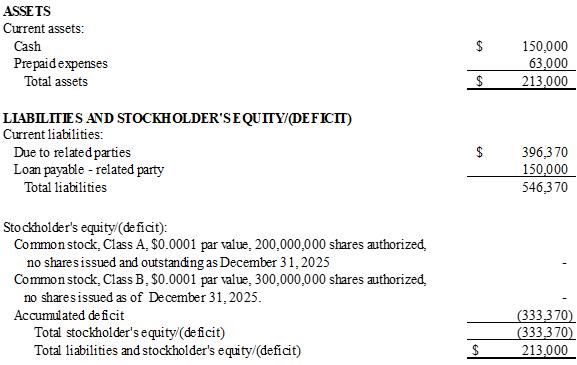
See Independent Auditor’s Report and accompanying notes, which are an integral part of these financial statements.
| F-5 |
Altivera Vision Inc. (f/k/a VisAI Partners Inc)
STATEMENT OF OPERATIONS
FOR THE PERIOD FROM JULY 7, 2025 (INCEPTION) TO DECEMBER 31, 2025
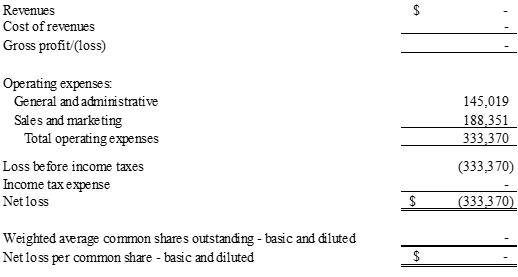
See Independent Auditor’s Report and accompanying notes, which are an integral part of these financial statements.
| F-6 |
Altivera Vision Inc. (f/k/a VisAI Partners Inc)
STATEMENT OF CHANGES IN STOCKHOLDER’S EQUITY/(DEFICIT)
FOR THE PERIOD FROM JULY 7, 2025 (INCEPTION) TO DECEMBER 31, 2025

See Independent Auditor’s Report and accompanying notes, which are an integral part of these financial statements.
| F-7 |
Altivera Vision Inc. (f/k/a VisAI Partners Inc)
STATEMENT OF CASH FLOWS
FOR THE PERIOD FROM JULY 7, 2025 (INCEPTION) TO DECEMBER 31, 2025
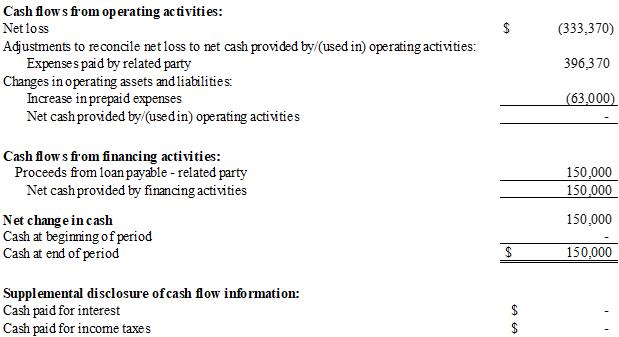
See Independent Auditor’s Report and accompanying notes, which are an integral part of these financial statements.
| F-8 |
Altivera Vision Inc. (f/k/a VisAI Partners Inc.)
NOTES TO THE FINANCIAL STATEMENTS
AS OF DECEMBER 31, 2025 AND FROM JULY 7, 2025 (INCEPTION) TO DECEMBER 31, 2025
NOTE 1: NATURE OF OPERATIONS
Altivera Vision Inc. (f/k/a VisAI Partners Inc.) (the “Company”) is a Delaware corporation organized under the laws of Delaware and is controlled by its parent, RAD Technologies, Inc. (“RAD”). The Company was formed to acquire, consolidate, and operate ophthalmology practices in the United States.
The Company’s principal business activities consist of acquiring controlling ownership interests in established ophthalmology practices, implementing technology-enabled patient acquisition strategies utilizing data intelligence tools and marketing infrastructure provided by RAD, and deploying standardized clinical and operational protocols designed to increase revenue from elective and premium cash-pay procedures, including premium intraocular lens (“Premium IOL”) implantation and LASIK surgery.
As of December 31, 2025, the Company has not completed any acquisitions and has not commenced principal operations. Accordingly, the Company is considered to be in the development stage.
NOTE 2: SUMMARY OF SIGNIFICANT ACCOUNTING POLICIES
Basis of Presentation
The accompanying financial statements have been prepared in accordance with accounting principles generally accepted in the United States of America (“US GAAP”). The financial statements cover the period from July 7, 2025 (inception) to December 31, 2025, which represents the Company’s initial operating period.
Use of Estimates
The preparation of financial statements in conformity with US GAAP requires management to make estimates and assumptions that affect the reported amounts of assets and liabilities, the disclosure of contingent assets and liabilities at the date of the financial statements, and the reported amounts of expenses during the reporting period. Actual results could differ from those estimates. Given the early stage of the Company’s operations, management does not believe that significant estimates or judgments were required in the preparation of these financial statements.
Significant Risks and Uncertainties
The Company’s business and operations are sensitive to general business and economic conditions in the United States and other countries that the Company operates in a host of factors beyond the Company’s control could cause fluctuations in these conditions. Adverse conditions may include recession, downturn or otherwise, or competition. These adverse conditions could affect the Company’s financial condition and the results of its operations. The Company is subject to customary risks and uncertainties associated with development of new technology and operating a business, including, but not limited to, the need for protection of intellectual property dependence on key personnel, costs of services provided by third parties, the need to obtain additional financing, and limited operating history.
Cash and Cash Equivalents
The Company considers all highly liquid investments with an original maturity of three months or less at the time of purchase to be cash equivalents. As of December 31, 2025, the Company held $150,000 in cash deposited with a financial institution. The Company had no cash equivalents as of December 31, 2025.
Concentration of Credit Risk
Financial instruments that potentially subject the Company to concentration of credit risk consist principally of cash. The Company maintains its cash balances at one financial institution. Balances may at times exceed federally insured limits. The Company has not experienced any losses in such accounts and does not believe it is exposed to significant credit risk.
See Independent Auditor’s Report.
| F-9 |
Altivera Vision Inc. (f/k/a VisAI Partners Inc.)
NOTES TO THE FINANCIAL STATEMENTS
AS OF DECEMBER 31, 2025 AND FROM JULY 7, 2025 (INCEPTION) TO DECEMBER 31, 2025
Fair Value of Financial Instruments
Financial Accounting Standards Board (“FASB”) guidance specifies a hierarchy of valuation techniques based on whether the inputs to those valuation techniques are observable or unobservable.
Observable inputs reflect market data obtained from independent sources, while unobservable inputs reflect market assumptions.
The hierarchy gives the highest priority to unadjusted quoted prices in active markets for identical assets or liabilities (Level 1 measurement) and the lowest priority to unobservable inputs (Level 3 measurement). The three levels of the fair value hierarchy are as follows:
Level 1 - Unadjusted quoted prices in active markets for identical assets or liabilities that the reporting entity has the ability to access at the measurement date. Level 1 primarily consists of financial instruments whose value is based on quoted market prices such as exchange-traded instruments and listed equities.
Level 2 - Inputs other than quoted prices included within Level 1 that are observable for the asset or liability, either directly or indirectly (e.g., quoted prices of similar assets or liabilities in active markets, or quoted prices for identical or similar assets or liabilities in markets that are not active).
Level 3 - Unobservable inputs for the asset or liability. Financial instruments are considered Level 3 when their fair values are determined using pricing models, discounted cash flows or similar techniques and at least one significant model assumption or input is unobservable.
The carrying amounts reported in the balance sheet approximate their fair value.
Related Party Transactions
The Company follows ASC 850, Related Party Disclosures, for the identification and disclosure of related party transactions and balances. As of December 31, 2025, the Company had amounts due to related parties of $396,370 and loan payable – related party of $150,000, representing advances and loan, respectively, from RAD Technologies, Inc., the Company’s parent, used to fund operating and organizational expenditures since inception. These advances and loan are unsecured, non-interest bearing, and have no fixed repayment terms.
Revenue Recognition
Accounting Standards Codification (“ASC”) Topic 606, “Revenue from Contracts with Customers” establishes principles for reporting information about the nature, amount, timing and uncertainty of revenue and cash flows arising from the entity’s contracts to provide goods or services to customers.
Revenues will be recognized when control of the promised goods or services is transferred to a customer, in an amount that reflects the consideration that the Company expects to receive in exchange for those goods or services. The Company applies the following five steps in order to determine the appropriate amount of revenue to be recognized as it fulfills its obligations under each of its agreements:
1) identify the contract with a customer;
2) identify the performance obligations in the contract;
3) determine the transaction price;
4) allocate the transaction price to performance obligations in the contract; and
5) recognize revenue as the performance obligation is satisfied.
For the period ended December 31, 2025, no revenue has been earned or recognized by the Company.
Operating Expenses
Operating expenses are recognized in the period in which they are incurred. For the period from July 7, 2025 (inception) to December 31, 2025, operating expenses consisted of general and administrative expenses of $145,019 and sales and marketing expenses of $188,351.
See Independent Auditor’s Report.
| F-10 |
Altivera Vision Inc. (f/k/a VisAI Partners Inc.)
NOTES TO THE FINANCIAL STATEMENTS
AS OF DECEMBER 31, 2025 AND FROM JULY 7, 2025 (INCEPTION) TO DECEMBER 31, 2025
Income Taxes
The Company uses the liability method of accounting for income taxes as set forth in ASC 740, Income Taxes.
Under the liability method, deferred taxes are determined based on the temporary differences between the financial statement and tax basis of assets and liabilities using tax rates expected to be in effect during the years in which the basis differences reverse. A valuation allowance is recorded when it is unlikely that the deferred tax assets will not be realized.
The Company assesses its income tax positions and records tax benefits for all years subject to examination based upon our evaluation of the facts, circumstances and information available at the reporting date. In accordance with ASC 740-10, for those tax positions where there is a greater than 50% likelihood that a tax benefit will be sustained, the Company’s policy is to record the largest amount of tax benefit that is more likely than not to be realized upon ultimate settlement with a taxing authority that has full knowledge of all relevant information. For those income tax positions where there is less than 50% likelihood that a tax benefit will be sustained, no tax benefit will be recognized in the financial statements. The Company has evaluated its income tax positions and has determined that it does not have any uncertain tax positions. The Company will recognize interest and penalties related to any uncertain tax positions through its income tax expense.
The Company accounts for income taxes with the recognition of estimated income taxes payable or refundable on income tax returns for the current period and for the estimated future tax effect attributable to temporary differences and carryforwards. Measurement of deferred income items is based on enacted tax laws including applicable tax rates. Deferred tax assets are reduced by a valuation allowance for those tax benefits that are not expected to be realized.
As of December 31, 2025, the Company has net operating loss (“NOL”) carryforwards of approximately $333,370, which may be available to offset future taxable income, subject to applicable limitations. These NOLs give rise to deferred tax assets; however, as this represents the Company’s first year of operations and it does not have a sufficient history of generating taxable income, management has concluded that it is more likely than not that these deferred tax assets will not be realized. Accordingly, a full valuation allowance has been recorded against the deferred tax assets. As a result, the net deferred tax assets as of December 31, 2025 are nil, and the Company has not recognized any income tax provision or benefit for the year.
Net Loss per Share
The Company computes net loss per share in accordance with ASC 260, Earnings Per Share. Basic net loss per share is computed by dividing net loss by the weighted average number of common shares outstanding during the period. Diluted net loss per share is computed by dividing net loss by the weighted average number of common shares outstanding, adjusted for the dilutive effect of potential common shares. For the period from July 7, 2025 (inception) to December 31, 2025, no shares of common stock were issued or outstanding and no dilutive securities existed; accordingly, basic and diluted net loss per share are both reported as $0.
Recent Accounting Pronouncements
The Company has reviewed recently issued accounting pronouncements and does not believe that any such pronouncements will have a material effect on the Company’s financial statements, given the early stage and limited nature of its current operations.
See Independent Auditor’s Report.
| F-11 |
Altivera Vision Inc. (f/k/a VisAI Partners Inc.)
NOTES TO THE FINANCIAL STATEMENTS
AS OF DECEMBER 31, 2025 AND FROM JULY 7, 2025 (INCEPTION) TO DECEMBER 31, 2025
NOTE 3: GOING CONCERN
The accompanying financial statements have been prepared on a going concern basis, which contemplates the realization of assets and the satisfaction of liabilities in the normal course of business.
The Company was incorporated on July 7, 2025 and has not commenced its principal operations or generated any revenues since inception. For the period from July 7, 2025 (inception) to December 31, 2025, the Company incurred a net loss of $333,370 and, as of December 31, 2025, had a working capital deficit of $333,370. The Company has no committed source of revenue, has not completed any acquisitions, and is dependent upon its parent company, RAD Technologies, Inc., and other outside financing to fund its operations and execute its business plan.
These factors, among others, raise substantial doubt about the Company’s ability to continue as a going concern within one year after the date these financial statements are issued.
Management’s plans to address these conditions include continuing to rely on financial support from RAD Technologies, Inc., raising additional capital through equity or debt financing, and ultimately generating revenue from the operation of acquired ophthalmology practices. However, there can be no assurance that such financing will be available on acceptable terms, or at all, or that the Company’s acquisition strategy will be successfully executed.
The accompanying financial statements do not include any adjustments that might result from the outcome of this uncertainty. Accordingly, the financial statements do not include any adjustments relating to the recoverability and classification of recorded asset amounts, or the amounts and classification of liabilities that might be necessary if the Company is unable to continue as a going concern
NOTE 4: STOCKHOLDER’S EQUITY/(DEFICIT)
Common Stock
The Company is authorized to issue two classes of common stock:
Class A Common Stock — As of December 31, 2025, the Company was authorized to issue 10,000,000 shares of Class A common stock, $0.00001 par value per share. On March 18, 2026, the Company filed a Certificate of Amendment to its Certificate of Incorporation (see Note 8) that increased the Class A authorization to 200,000,000 shares, $0.0001 par value per share. No shares of Class A common stock were issued or outstanding as of December 31, 2025.
Class B Common Stock — As of December 31, 2025, the Company was authorized to issue 10,000,000 shares of Class B common stock, $0.00001 par value per share. On March 18, 2026, the Company filed a Certificate of Amendment to its Certificate of Incorporation (see Note 8) that increased the Class B authorization to 300,000,000 shares, $0.0001 par value per share. No shares of Class B common stock were issued or outstanding as of December 31, 2025.
Voting Rights. Each share of Class A Common Stock is entitled to one vote per share on all matters submitted to a vote of stockholders. The Class B Common Stock is non-voting, except as otherwise required by applicable law.
Conversion. Each share of Class A Common Stock is convertible, at the holder’s election and at any time, into one share of Class B Common Stock on a one-for-one basis. The Class B Common Stock is not convertible into Class A Common Stock.
Dividend and Distribution Rights. Except for voting rights, the Class A Common Stock and Class B Common Stock have identical rights and privileges and rank equally on a per-share basis, including with respect to dividends, distributions, and distributions in connection with a change of control transaction. As of December 31, 2025, no dividends or distributions had been declared or paid on any class of common stock.
NOTE 5: RELATED PARTY TRANSACTIONS
Parent Company Relationship
The Company is controlled by its parent, RAD Technologies, Inc. (“RAD”). RAD controlled the Company as of December 31, 2025, and in 2026 become the majority stockholder of the Company, as discussed in Note 8. Dr. Jeffrey Machat serves as the Chief Executive Officer of the Company and holds a senior leadership role within RAD.
See Independent Auditor’s Report.
| F-12 |
Altivera Vision Inc. (f/k/a VisAI Partners Inc.)
NOTES TO THE FINANCIAL STATEMENTS
AS OF DECEMBER 31, 2025 AND FROM JULY 7, 2025 (INCEPTION) TO DECEMBER 31, 2025
Advances from Parent
Since inception, the Company has funded its operations through advances from RAD. For the period from July 7, 2025 (inception) to December 31, 2025, RAD paid expenses of $396,370 of behalf of the Company to fund general and administrative expenses, sales and marketing expenses, and other organizational expenditures. This includes $90,000 in cash compensation paid to Jeffrey Machat and $52,000 in cash compensation paid to Deon Kibel. As of December 31, 2025, the full amount of $396,370 remains outstanding and is reflected as “Due to related parties” on the balance sheet. The advances are unsecured, non-interest bearing, and have no fixed repayment terms. There can be no assurance that RAD will continue to fund the Company’s operations or that the terms of such funding will not change.
Loan Payable – Related Party
The Company obtained a non-interest-bearing loan of $150,000 from RAD. The loan is due on demand and does not carry any stated interest rate. As of December 31, 2025, the full amount of $150,000 remains outstanding.
Technology and Services
The Company utilizes data intelligence and marketing infrastructure developed and maintained by RAD to support its patient acquisition strategy. The terms and pricing of any such arrangement have not been formalized in a written agreement as of December 31, 2025. For the period from July 7, 2025 (inception) to December 31, 2025, no separate payments were made to RAD for such services outside of the related party advances described above.
Management Compensation
For the period from July 7, 2025 (inception) to December 31, 2025, RAD paid $90,000 in cash compensation to Jeffrey Machat and $52,000 in cash compensation to Deon Kibel.
NOTE 6: INCOME TAXES
The Company accounts for income taxes in accordance with ASC 740, Income Taxes, using the asset and liability method. For the period from July 7, 2025 (inception) to December 31, 2025, the Company generated a net operating loss of $333,370. The components of the Company’s deferred tax assets as of December 31, 2025 are as follows:

The deferred tax asset of approximately $93,344 (calculated at the 21% federal statutory rate and 7% effective California rate after federal tax benefit, for a combined effective rate of 28%, applied to the net operating loss of $333,370) has been fully offset by a valuation allowance, as management believes it is more likely than not that the deferred tax asset will not be realized given the Company’s lack of operating history and absence of committed revenue.
See Independent Auditor’s Report.
| F-13 |
Altivera Vision Inc. (f/k/a VisAI Partners Inc.)
NOTES TO THE FINANCIAL STATEMENTS
AS OF DECEMBER 31, 2025 AND FROM JULY 7, 2025 (INCEPTION) TO DECEMBER 31, 2025
A reconciliation of the U.S. federal statutory income tax rate to the Company’s effective income tax rate is as follows:

As of December 31, 2025, the Company had a federal net operating loss carryforward of approximately $333,370, which does not expire under current federal tax law and may be carried forward indefinitely. However, utilization of NOL carryforwards may be subject to annual limitations under Section 382 of the Internal Revenue Code in the event of certain ownership changes. The Company’s income tax returns are subject to examination by federal and applicable state taxing authorities for all periods since inception
Tax Payment
No tax was due or paid during the period ended December 31, 2025.
NOTE 7: COMMITMENTS AND CONTINGENCIES
The Company may be subject to pending legal proceedings and regulatory actions in the ordinary course of business. The results of such proceedings cannot be predicted with certainty, but the Company does not anticipate that the final outcome, if any, arising out of any such matters will have a material adverse effect on its business, financial condition or results of operations.
Legal Proceedings
As of December 31, 2025, the Company is not a party to any pending legal proceedings. The Company may from time to time become subject to claims or litigation in the ordinary course of business. No such matters existed as of the balance sheet date.
Operating and Capital Leases
As of December 31, 2025, the Company has no operating leases, capital leases, or right-of-use assets. The Company does not occupy any dedicated office space and has no lease commitments.
Contractual Obligations
As of December 31, 2025, the Company has no material contractual purchase commitments, service agreements, or other financial obligations other than the related party advances described in Note 5.
NOTE 8: SUBSEQUENT EVENTS
Regulation Crowdfunding and Regulation A Offerings
The Company intends to initiate Regulation Crowdfunding and Regulation A offerings of its common stock in 2026.
Amendment to Certificate of Incorporation
On March 18, 2026, the Company filed a Certificate of Amendment to its Certificate of Incorporation with the Delaware Secretary of State. The amendment effected the following changes:
(i) changed the entity’s name from “VisAi Partners Inc” to “Altivera Vision Inc.”; and
See Independent Auditor’s Report.
| F-14 |
Altivera Vision Inc. (f/k/a VisAI Partners Inc.)
NOTES TO THE FINANCIAL STATEMENTS
AS OF DECEMBER 31, 2025 AND FROM JULY 7, 2025 (INCEPTION) TO DECEMBER 31, 2025
(ii) increased the total authorized capital stock from 10,000,000 shares of common stock, par value $0.00001 per share, to 500,000,000 shares, consisting of (a) 200,000,000 shares of Class A Common Stock, par value $0.0001 per share, and (b) 300,000,000 shares of Class B Common Stock, par value $0.0001 per share.
The Class A Common Stock is entitled to one vote per share. The Class B Common Stock is non-voting, except as otherwise required by law. Except for voting rights, the two classes have identical rights and privileges and rank equally on a per-share basis, including with respect to dividends and distributions in connection with a change of control transaction. Each share of Class A Common Stock is convertible at the holder’s election, at any time, into one share of Class B Common Stock.
Formation of Subsidiaries
On March 20, 2026, the Company formed three wholly owned subsidiaries as limited liability companies under the laws of Delaware: Altivera Vision Holdings, LLC, Altivera Vision Management, LLC and Altivera Vision ASC Holdings, LLC.
Stock Issuances
In 2026, the Company issued 200,000,000 shares of Class A Common Stock, including 118,604,651 shares to RAD, representing 59.3% of the then issued and outstanding common stock.
Management’s Evaluation
The management has evaluated subsequent events from December 31, 2025 through May 20, 2026, which is the date the financial statements were available to be issued. No additional material subsequent events have occurred that require recognition or disclosure in the financial statements.
See Independent Auditor’s Report.
| F-15 |
INDEX TO EXHIBITS
*To be filed by amendment
| 42 |
SIGNATURES
Pursuant to the requirements of Regulation A, the issuer certifies that it has reasonable grounds to believe that it meets all of the requirements for filing on Form 1-A and has duly caused this Offering Statement to be signed on its behalf by the undersigned, thereunto duly authorized, in Los Angeles on September 30, 2026.
| Altivera Vision Inc. | ||
| By | /s/ Steven Silver | |
| Steven Silver, Chief Executive Officer | ||
| Altivera Vision Inc. | ||
| Date: September 30, 2026 | ||
The following persons in the capacities and on the dates indicated have signed this Offering Statement.
| By | /s/ Steven Silver | |
| Steven Silver, Chief Executive Officer, Principal Executive Officer, Director | ||
| Altivera Vision Inc. | ||
| Date: September 30, 2026 | ||
| By | /s/ Deon Kibel | |
| Deon Kibel, Chief Financial Officer, Principal Financial Officer, Principal Accounting Officer | ||
| Altivera Vision Inc. | ||
| Date: September 30, 2026 | ||
| By | /s/ Jeremy Barnett | |
| Jeremy Barnett, Director | ||
| Altivera Vision Inc. | ||
| Date: September 30, 2026 | ||
| By | /s/ Bradley Silver | |
| Bradley Silver, Director | ||
| Altivera Vision Inc. | ||
| Date: September 30, 2026 | ||
| By | /s/ Jeffrey Machat | |
| Dr. Jeffrey Machat, President, Chief Medical Officer, Director | ||
| Altivera Vision Inc. | ||
| Date: September 30, 2026 | ||
| 43 |