
Exhibit 99.18
NOTICE OF ANNUAL GENERAL MEETING OF UNITHOLDERS
AND
MANAGEMENT INFORMATION CIRCULAR
ANNUAL GENERAL MEETING OF UNITHOLDERS
TO BE HELD ON MAY 14, 2026
March 11, 2026
| Table of Contents |
| Table of Contents | 1 |
| Notice of Annual General Meeting of Unitholders | 3 |
| Letter To Unitholders | 4 |
| Management Information Circular | 7 |
| Proxy Solicitation and Voting | 7 |
| Solicitation of Proxies | 7 |
| Notice and Access | 7 |
| Appointment of Proxies | 8 |
| Revocation of Proxies | 8 |
| Voting of Proxies | 8 |
| Quorum | 9 |
| Information for Beneficial Holders of Securities | 9 |
| Attending and Voting at the Meeting | 10 |
| Attendance | 10 |
| Registered Holders | 10 |
| Beneficial Holders | 10 |
| Voting Securities and Principal Holders Thereof | 10 |
| Units | 10 |
| Class B Units | 10 |
| Eligibility for Voting | 11 |
| Principal Unitholders | 11 |
| Voting Results | 12 |
| Matters to be Considered at the Meeting | 12 |
| 1. Financial Statements | 12 |
| 2. Election of Trustees | 12 |
| 3. Appointment of Auditor | 23 |
| Compensation | 24 |
| Compensation Governance | 24 |
| Overview | 24 |
| Compensation Discussion and Analysis | 25 |
| Compensation – Named Executive Officers | 31 |
| Employment Agreements – Named Executive Officers | 38 |
| Performance Graph | 41 |
| Compensation – Trustees | 41 |
| Securities Authorized for Issuance Under Equity Compensation Plans | 45 |
| Statement of Governance Practices | 46 |
| Governance Highlights | 46 |
| Composition of Board of Trustees and Independence | 47 |
| Nomination of Trustees | 47 |
| Term Limits and Retirement Age | 48 |
| Board Assessments | 48 |
| Board Mandate | 48 |
| Position Descriptions | 49 |
| Orientation and Continuing Education | 49 |
| Ethical Business Conduct | 50 |
| Whistleblower Policy | 50 |
| Insider Trading Policy | 51 |
| Disclosure and Confidential Information Policy | 51 |
| Environmental, Social and Governance | 51 |
| Diversity | 55 |
| Conflicts of Interest | 56 |
| Board Committees | 57 |
| Succession Planning | 59 |
| Risk Oversight | 59 |
| Equity Incentive Plan | 60 |
| Material Features of the Equity Incentive Plan | 60 |
| Normal Course Issuer Bid | 64 |
| Trustees’ and Officers’ Insurance and Indemnification | 64 |
| Indebtedness of Trustees and Officers | 64 |
| Interests of Certain Persons or Companies in Matters to be Acted Upon | 64 |
| Interest of Informed Persons in Material Transactions | 65 |
| Other Business | 66 |
| Additional Information | 66 |
| Non-GAAP Measures | 66 |
| Approval of Trustees | 69 |
| SCHEDULE A : Charter of the Board of Trustees | A-1 |
| Notice of Annual General Meeting of Unitholders |
NOTICE IS HEREBY GIVEN that an annual general meeting (the “Meeting”) of the holders of units (“Unitholders”) of BSR Real Estate Investment Trust (the “REIT”) will be held at the offices of Goodmans LLP at Bay Adelaide Centre – West Tower, 333 Bay Street, Suite 3400, Toronto, Ontario, M5H 2S7 on Thursday, May 14, 2026 at 2:00 p.m. (Toronto time), for the following purposes:
| 1. | TO RECEIVE the financial statements of the REIT and the auditors’ report thereon, for the year ended December 31, 2025; |
| 2. | TO ELECT members of the board of trustees of the REIT; |
| 3. | TO APPOINT auditors and to authorize the board of trustees of the REIT to fix their remuneration; and |
| 4. | TO TRANSACT such other business as may properly come before the Meeting or any adjournment thereof. |
Unitholders of record at the close of business on Wednesday, March 25, 2026 (the “Record Date”) will be entitled to vote at the Meeting.
The REIT is using “notice and access” delivery to furnish proxy materials to Unitholders via the Internet. Management of the REIT believes that this delivery process will expedite Unitholders’ receipt of proxy materials and lower the costs and reduce the environmental impact of the Meeting. On or around April 9, 2026, the REIT will send to Unitholders of record as of the Record Date a notice and access notification (the “N&A Notice”) containing instructions on how to access the REIT’s proxy materials for the fiscal year ended December 31, 2025. The N&A Notice will also provide instructions on how to vote and how to receive a paper copy of the proxy materials by mail.
Unitholders who are unable to be present in person at the Meeting are requested to sign, date and return the form of proxy or voting instruction form received in accordance with the instructions provided. The accompanying management information circular provides additional information relating to the matters to be dealt with at the Meeting and forms part of this notice.
DATED at Toronto, Ontario this 11th day of March, 2026.
| BY ORDER OF THE BOARD OF TRUSTEES | |
| “S. Jane Marshall” | |
| Chair of the Board of Trustees | |
| BSR Real Estate Investment Trust |
- 4 -
| Letter To Unitholders |
To Our Fellow Unitholders:
2025 was another dynamic year for BSR Real Estate Investment Trust (the “REIT” or “BSR”). We monetized nearly a third of our portfolio at, or above, our stated Net Asset Value.1 We streamlined our capital structure affording REIT Unitholders more control, and we strategically redeployed disposition proceeds into newer, higher-quality, opportunistic acquisitions. This was all done despite continued, albeit waning, macro-level challenges in the multifamily sector at large. The REIT’s consistent strategy of identifying profitable acquisitions, driving efficiencies with its internal management platform, and crystalizing efficiencies by executing on material transactions with significant incremental growth potential highlights management’s and the Board’s unwavering commitment to maximize Unitholder value.
The year began with the redemption of our outstanding 2025 convertible debentures, which we redeemed at par on January 3, 2025 because we believe it enhanced value for our Unitholders. At the same time, we began our strategic lease-up plan in earnest at Aura 35Fifty, the REIT’s development asset which was completed in December of 2024. A 238 apartment unit, phase two community located in Austin, TX (which is directly adjacent to our Aura 36Hundred asset we acquired in 2021), Aura 35Fifty provided Unitholders increasing value throughout the year as the asset continuously gained physical occupancy. Also in January, the REIT acquired Venue Craig Ranch, in Dallas, TX. Venue Craig Ranch presented a small underwritten value-add strategy of a 2017 vintage asset, the value-add portion of which was executed within nine months of acquisition by BSR and is already contributing incremental cash flow to the REIT.
In February, we announced the strategic disposition of nine properties for total consideration of $618.5 million. The disposition provided three key benefits to BSR. First it provided cash proceeds to the REIT which were redeployed into newer, higher quality assets. Second, these newer assets represent a greater growth opportunity for the REIT relative to the mature assets and crystalized over $110 million of Unitholder profit. Thirdly, the Transaction resulted in the cancellation of approximately 75% of our previously outstanding Class B Units, increasing REIT Unitholders’ diluted ownership of the REIT to over 80% and significantly increasing their overall governance and influence over the REIT.
In May, the REIT acquired Botanic Living and Forayna Vintage Park, both in the Houston, TX MSA. These assets both represented substantially leased-up new builds where BSR could a) acquire highly sought after, nearly brand new product, b) capture the small remaining embedded lease-up opportunity, c) turn the rent roll into one that reflects a stabilizing high-quality asset over the next 12-24 months, all while d) expanding ownership in a high growth submarket within northwest Houston.
In August, the REIT acquired The Ownsby, a newly completed, 368 apartment unit, lease-up asset in Dallas, TX. The Ownsby completed the REIT’s 2025 asset rotations, having full redeployed all proceeds from the strategic disposition and one other, smaller asset sale in Oklahoma City, OK completed in March. Consistent with our historical acquisition strategy, the new properties are all new, high-quality, well-amenitized, path of growth assets that are expected to bring continued upside to the REIT.
In total, in 2025, the REIT disposed of 10 assets or 3,017 apartment units, for $647 million, while concurrently eliminating 15,000,000 Class B Units. In turn, the REIT acquired 4 assets or 1,283 apartment units for $290 million. The rotations also decreased the REIT’s ownership concentration in Austin to 19% of NOI (down from 23% as of December 31, 2024), increased its ownership in Houston to 39% of NOI (up from 25% of NOI as of December 31, 2024), and downsized its concentration in Dallas to 31% of NOI (from 42% of NOI as of December 31, 2024).1 Finally, the rotations lowered the average age of the REIT’s portfolio to 13 years from 14 years as of December 31, 2024. This redistribution of NOI further positions the REIT to continue to grow while insulating it against the more challenging supply backdrop market in Austin. Management believes the REIT’s current market concentration is prudent for the macroeconomic backdrop today, particularly in light of the pricing levels achieved.
- 5 -
On the operating front, BSR’s platform continued to shine throughout the year, despite a softer prime leasing season. Same Community occupancy averaged 95% throughout the year, endorsing the high-quality nature of our portfolio and operational excellence of our on-site BSR team members.1 However, Same Community average rents declined 1.3% which drove a reduction in rental income year-over-year. Our decision to focus on what we can control, maximizing occupancy, and surrender to what the market controls, average rents, is characteristic of the REIT leadership’s approach to real estate management.
As we anticipated, the primary culprit of 2025 top-line headwinds was acute and temporary over-supply created by significant new construction in many growth markets in the U.S., including in Texas. To us, significant new supply affecting our markets is not always a bad thing. Rather, it should act as an endorsement confirming that we have invested your money into markets and locations situated directly in the path of desirable renter migration. This new supply has and will continue to wane and migration to our markets undeniably continues, which collectively support our investment conviction. Simply put, unregulated lower tax markets fuel outsized job and population growth of, precisely, our renter base.
The fading supply headwind only seeks to enhance the already robust fundamental story in our core “Texas Triangle” markets. According to the U.S. Census Bureau, from July 2023 to July 2024 Houston, Austin and Dallas represented the second, fourth and fifth fastest growing MSA’s in the country (for MSAs at or above 1,000,000 residents), respectively. Looking forward, according to Berkadia, the Austin, Dallas and Houston markets will represent the first, fifth and sixth fastest growing metro areas for population growth between 2026 and 2031 (for markets at or above 1,000,000 residents), respectively. When combined with robust employment backdrops (Austin unemployment as of December 2025 was 3.2%, Houston 4.2%, and Dallas 3.6%), we continue to have strong conviction in the overall health of our selected core markets. The fundamental setup we are facing, summarized as low supply and continued best-in-class demand, is expected to drive outsized rental income growth in the future.
In December of 2025, we released an updated investor presentation highlighting the embedded growth potential the REIT expects to realize beginning in 2026 and ramping in 2027 and 2028. Macro trends aside, the REIT is positioned for relative outsized growth via the stabilization of our 2025 acquisitions, the internalization of real estate adjacent service lines and the ability to leverage our platform more broadly in the future. If you haven’t reviewed the presentation already, we would encourage you to do so.
Finally, we would be remiss if we didn’t mention the changes to the Board of Trustees (the “Board”) that occurred at the beginning of 2026 and that we expect to occur at our upcoming annual general meeting of Unitholders (the “Meeting”). In January, we welcomed Mark Decker, Jr. to the Board and announced the retirement of W. Daniel Hughes, Jr. As we highlighted at the time, Daniel has been a lynchpin to the BSR story and we are grateful for his ongoing support as a material Unitholder. At the same time, we are also very excited to welcome Mark to the Board. His unique perspectives as a current REIT CEO in the healthcare space, former multifamily REIT CEO, and long-time capital markets expert, will prove invaluable in the boardroom going forward.
In addition, in conjunction with the Meeting, Bryan H. Held is retiring from the Board. Bryan’s contributions to the REIT cannot be overstated. As a member of the Board since the REIT’s IPO in 2018, Bryan has served in various capacities including as former Chair of the Audit Committee and the current Chair of the Compensation, Governance and Nominating Committee. Bryan helped steer BSR through many seasons and played an integral role in shaping the REIT we have today. We wish Bryan the very best in his retirement.
To fill Bryan’s vacancy, the Board, on the recommendation of the Compensation, Governance and Nominating Committee, has nominated Karine MacIndoe for election as a Trustee at the Meeting. Karine’s full biography speaks for itself and is included herein, but suffice to say she brings a depth of board experience to BSR that will complement the existing competencies well. We are excited about all that she will bring your Board. At BSR, we believe healthy regular board refreshment ultimately enhances all stakeholder interests, and we thank you in advance for your support of our full state of nominees.
- 6 -
Our mission is to provide an exceptional living experience for our residents at a community they are proud to call home, while creating value for our Unitholders through strength, profitability, and growth. With our high-quality portfolio, exposure to high-growth markets, proven management platform, experienced team and healthy balance sheet, we believe that we are incredibly well positioned to continue generating strong financial and operating performance in 2026 and beyond.
We are pleased to invite you to the Meeting, which is being held in Toronto on Thursday, May 14, 2026. During the Meeting, management will provide a presentation, and there will be an opportunity to ask questions of management and the Board. We look forward to providing you with an update on the REIT’s recent achievements at the Meeting, as well our plans for the future. We encourage you to take time to review this document and to vote your Units, either by proxy or by attending the Meeting in person.
On behalf of the Board and the management team, we want to thank you for your continued confidence and support. We would also like to thank all of the BSR team members for their dedication and hard work, which has been crucial to the REIT’s success.
| Highest Regards, | |
| “S. Jane Marshall” | “Daniel M. Oberste” |
| S. Jane Marshall | Daniel M. Oberste |
| Chair of the Board | President and Chief Executive Officer |
Notes:
Capitalized terms used in this letter but not otherwise defined herein have the meanings ascribed thereto in the accompanying management information circular. This letter contains “forward-looking information” as defined under Canadian securities laws, which are not historical facts but instead represent management’s expectations, estimates and projections regarding future events or circumstances, which are subject to inherent risks, uncertainties and changes beyond the REIT’s control and which may prove to be incorrect.
1 This letter refers to certain non-GAAP measures including Net Asset Value (NAV), NOI and Same Community. These measures are not recognized under IFRS Accounting Standards and do not have standardized meanings prescribed by IFRS Accounting Standards. See “Non-GAAP Measures” in the accompanying management information circular.
- 7 -

BSR REAL ESTATE INVESTMENT TRUST
| Management Information Circular |
Unless otherwise indicated herein, or the context otherwise requires, “REIT”, “BSR”, “we”, and “our” refers to BSR Real Estate Investment Trust including its direct and indirect subsidiaries. Unless otherwise indicated herein, all dollar amounts are stated in U.S. dollars and references to dollars or “$” are to U.S. currency and references to Canadian dollars or “C$” are to Canadian currency. The board of trustees of the REIT is referred to herein as the “Board” or the “Trustees”, and a “Trustee” means any one of them.
This management information circular (the “Information Circular”) is furnished in connection with the solicitation of proxies by or on behalf of management of the REIT, for use at the annual general meeting (the “Meeting”) of holders (“Unitholders”) of units (“Units”) of the REIT scheduled to be held on Thursday, May 14, 2026 at the offices of Goodmans LLP at Bay Adelaide Centre – West Tower, 333 Bay Street, Suite 3400, Toronto, Ontario, M5H 2S7 at 2:00 p.m. (Toronto time), and at all postponements or adjournments thereof, for the purposes set forth in the accompanying notice of the Meeting (the “Notice of Meeting”). Unitholders of record at the close of business on Wednesday, March 25, 2026 (the “Record Date”) will be entitled to vote at the Meeting.
Except as otherwise stated in this Information Circular, the information contained herein is given as of March 11, 2026.
| Proxy Solicitation and Voting |
Solicitation of Proxies
The REIT will use the “notice and access” delivery model (“Notice and Access”) to conduct the solicitation of proxies in connection with this Information Circular. Proxies may also be solicited personally or by telephone by individual Trustees of the REIT or by officers and/or other employees of the REIT. The REIT will bear the cost in respect of the solicitation of proxies for the Meeting and will bear the legal, printing and other costs associated with the preparation of the Information Circular. The REIT will also pay the fees and costs of intermediaries for their services in transmitting proxy-related materials in accordance with National Instrument 54-101 — Communication with Beneficial Owners of Securities of a Reporting Issuer (“NI 54-101”). This cost is expected to be nominal.
Copies of the REIT’s annual consolidated financial statements and annual information form (“AIF”) for the fiscal year ended December 31, 2025 are available on the System for Electronic Document Analysis and Retrieval (“SEDAR+”) website at www.sedarplus.ca.
Notice and Access
The REIT is using Notice and Access for both Registered Holders and Beneficial Holders (each as defined below), which allows the REIT to furnish proxy materials via the Internet to Unitholders instead of mailing paper copies of such materials. Using Notice and Access, the REIT can deliver proxy-related materials by (i) posting the Information Circular (and other proxy related materials) on a website other than SEDAR+ and (ii) sending a notice informing Unitholders that the Information Circular and proxy related materials have been posted and explaining how to access such materials (the “N&A Notice”).
On or around April 9, 2026, the REIT will send to Unitholders of record as of the Record Date a notice package containing the N&A Notice and the relevant voting document (a form of proxy or voting instruction form, as applicable). The N&A Notice will contain basic information about the Meeting and the matters to be voted on, instructions on how to access the proxy materials in respect of the Meeting, an explanation of the Notice and Access process and details of how to obtain a paper copy of this Information Circular upon request at no cost.
- 8 -
Appointment of Proxies
Unitholders will receive a form of proxy (“Form of Proxy”) or voting instruction form (“VIF”) for use in connection with the Meeting. The persons named in such Form of Proxy and VIF are currently Trustees and/or officers of the REIT. A Unitholder who wishes to appoint some other person to represent him, her or it at the Meeting may do so by following the instructions on the Form of Proxy or VIF. Such other person need not be a Unitholder of the REIT.
To be valid, proxies or instructions must be completed, signed, dated and returned in one of the manners indicated on the Form of Proxy or VIF, at any time up to and including 2:00 p.m. (Toronto time) on Tuesday, May 12, 2026, or if the meeting is adjourned, not later than 48 hours (excluding Saturdays, Sundays and statutory holidays) preceding the time of such adjourned meeting.
The document appointing a proxy or providing instructions must be in writing and completed and signed by a Unitholder or their attorney authorized in writing or, if the Unitholder is a corporation, under its corporate seal or by an officer or attorney thereof duly authorized, or duly submitted online in accordance with the instructions in the Form of Proxy or VIF, as applicable. Persons signing as officers, attorneys, executors, administrators, and trustees or similarly otherwise should so indicate.
Revocation of Proxies
A proxy given by a Unitholder for use at the Meeting may be revoked at any time prior to its use. In addition to revocation in any other manner permitted by law, a proxy may be revoked by an instrument in writing executed by the Unitholder or by their attorney authorized in writing or, if the Unitholder is a corporation, under its corporate seal or by an officer or attorney thereof duly authorized and deposited in one of the manners indicated on the Form of Proxy or VIF at any time up to and including two business days preceding the Meeting or any adjournment thereof at which the proxy is to be used, and upon such deposit, the proxy is revoked.
Only Registered Holders (as defined below) have the right to revoke a proxy. Beneficial Holders (as defined below) who wish to change their vote must make appropriate arrangements with their respective dealers or other intermediaries.
Voting of Proxies
The persons named in the Form of Proxy and VIF will vote, or withhold from voting, the Units in respect of which they are appointed, on any ballot that may be called for, in accordance with the instructions of the Unitholder as indicated on the Form of Proxy or VIF. In the absence of such specification, such Units will be voted at the Meeting as follows:
| · | FOR the election of those persons listed in this Information Circular as the proposed Trustees for the ensuing year; and |
| · | FOR the appointment of KPMG LLP, Chartered Accountants, as auditor of the REIT for the ensuing year, and the authorization of the Board to fix the auditor’s remuneration. |
For more information on these issues, please see the section entitled “Matters to be Considered at the Meeting” in this Information Circular.
The persons appointed under the Form of Proxy and VIF are conferred with discretionary authority with respect to amendments to or variations of matters identified in the Form of Proxy and VIF and the Notice of Meeting and with respect to other matters which may properly come before the Meeting. In the event that amendments or variations to matters identified in the Notice of Meeting are properly brought before the Meeting, it is the intention of the persons designated in the Form of Proxy and VIF to vote in accordance with their best judgment on such matter or business. As at the date of this Information Circular, the Trustees know of no such amendments, variations or other matters.
- 9 -
Quorum
The quorum at the Meeting or any adjournment thereof shall be individuals deemed to be present in person at the Meeting or represented by proxy, not being less than two in number and such persons holding or representing by proxy in aggregate not less than 25% of the total number of outstanding Units.
| Information for Beneficial Holders of Securities |
Information set forth in this section is very important to persons who hold Units otherwise than in their own names. A Unitholder who beneficially owns Units (a “Beneficial Holder”) that are registered in the name of an intermediary (such as a securities broker, financial institution, trustee, custodian or other nominee who holds securities on behalf of the Beneficial Holder or in the name of a clearing agency in which the intermediary is a participant) should note that only proxies or instructions deposited by securityholders whose names are on the records of the REIT as the registered holders of Units (“Registered Holders”) can be recognized and acted upon at the Meeting.
Units that are listed in an account statement provided to a Beneficial Holder by a broker are likely not registered in the Beneficial Holder’s own name on the records of the REIT and such Units are more likely registered in the name of CDS Clearing and Depository Services Inc. (“CDS”) or its nominee.
Applicable regulatory policy in Canada requires brokers and other intermediaries to seek voting instructions from Beneficial Holders in advance of securityholder meetings. Every broker or other intermediary has its own mailing procedures and provides its own return instructions, which should be carefully followed by Beneficial Holders in order to ensure that their Units are voted at the Meeting. Often, the VIF supplied to a Beneficial Holder by its broker is identical to that provided to registered securityholders. However, its purpose is limited to instructing the registered securityholder how to vote on behalf of the Beneficial Holder. Most brokers now delegate responsibility for obtaining instructions from clients to Broadridge Investor Communication Solutions (“Broadridge”). Broadridge typically prepares a machine-readable voting instruction form, mails those forms to the Beneficial Holders and asks Beneficial Holders to return the forms to Broadridge. Broadridge then tabulates the results of all instructions received and provides appropriate instructions representing the voting of the securities to be represented at the Meeting. A Beneficial Holder receiving a Broadridge voting instruction form cannot use that voting instruction form to vote Units directly at the Meeting. The voting instruction form must be returned to Broadridge well in advance of the Meeting in order to have the Units voted. Proxy-related materials will not be sent by the REIT directly to “non-objecting beneficial owners” under NI 54-101. The REIT intends to pay for intermediaries to deliver proxy-related materials to “objecting beneficial owners” and Form 54-101F7 (the request for voting instructions), in accordance with NI 54-101.
Although Beneficial Holders may not be recognized directly at the Meeting for the purposes of voting Units registered in the name of CDS or their broker or other intermediary, a Beneficial Holder may attend the Meeting as proxy holder for the Registered Holder and vote their Units in that capacity. Beneficial Holders who wish to attend the Meeting and indirectly vote their own Units as proxy holder for the Registered Holder should enter their own names in the blank space on the VIF provided to them and return the same to their broker or other intermediary (or the agent of such broker or other intermediary) in accordance with the instructions provided by such broker, intermediary or agent well in advance of the Meeting. Appointees can only be validated at the Meeting using the name used in the VIF.
- 10 -
| Attending and Voting at the Meeting |
Attendance
The REIT is holding the Meeting in-person this year. The Meeting will be held at the offices of Goodmans LLP at Bay Adelaide Centre – West Tower, 333 Bay Street, Suite 3400, Toronto, Ontario, M5H 2S7 on Thursday, May 14, 2026 at 2:00 p.m. (Toronto time).
Registered Holders
Registered Holders can vote their Units in-person at the Meeting or by proxy, pursuant to the instructions in the Form of Proxy. However, even if you plan to attend the Meeting, the REIT recommends that you vote your Units in advance, so that your vote will be counted if you later decide not to attend the Meeting. Voting by proxy can be completed via the Internet, or by returning the Form of Proxy. Sending in a Form of Proxy will not prevent a Registered Holder from voting in-person at the Meeting, if they then revoke their proxy. Such registered Unitholder’s vote will then be taken and counted at the Meeting.
Beneficial Holders
Beneficial Holders can vote their Units either (i) in-person at the Meeting if they have appointed themselves as proxy pursuant to the instructions in the VIF, or (ii) in advance of the Meeting by completing the VIF or appointing the management nominees stated therein as their proxy, pursuant to the instructions in the VIF. However, even if you plan to attend the Meeting, the REIT recommends that you vote your Units in advance. To vote by proxy, Beneficial Holders should follow the instructions on the VIF they receive and contact their intermediaries promptly if they need assistance. Sending in a VIF will not prevent a Beneficial Holder from voting in-person at the Meeting if they have appointed themselves as proxy.
| Voting Securities and Principal Holders Thereof |
Units
The REIT is authorized to issue an unlimited number of Units. The Units are listed and posted for trading on the Toronto Stock Exchange (the “TSX”) in U.S. dollars under the symbol “HOM.U” and in Canadian dollars under the symbol “HOM.UN”. No Unit has any preference or priority over another. Each Unit represents a Unitholder’s proportionate undivided beneficial ownership interest in the REIT and confers the right to one vote at any meeting of Unitholders and to participate pro rata in any distributions by the REIT.
As of the date hereof, there are 33,990,419 Units outstanding.
Class B Units
BSR Trust, LLC, the operating subsidiary of the REIT, has class B units (“Class B Units”) outstanding. The Class B Units are, in all material respects, economically equivalent to the Units on a per unit basis, and are redeemable by the holder thereof for cash or Units (on a one-for-one basis subject to customary anti-dilution adjustments), as determined by BSR Trust, LLC in its sole discretion. The holders of Class B Units are entitled to receive distributions from BSR Trust, LLC on the same per unit basis as holders of Units. However, Class B Units do not carry a voting right with respect to matters put before Unitholders of the REIT for a vote. The Class B Units are non-voting as a result of tax considerations applicable to the cross-border REIT structure, and do not give the holders of Class B Units any enhanced economic or voting power at the REIT level relative to the voting public Unitholders. Accordingly, the Class B Units do not create a traditional dual-class voting structure of the REIT. The holders of Class B Units are also entitled to receive copies of all proxy materials, information statements, reports and other written communications distributed to Unitholders.
- 11 -
After holding Class B Units for at least 12 months (subject to acceleration in certain circumstances), the holders of Class B Units, acting individually, have the right to cause BSR Trust, LLC to redeem all or a portion of such Class B Units for a cash payment of equivalent value or Units, as determined by BSR Trust, LLC and as directed by the REIT in their sole discretion. If BSR Trust, LLC elects to redeem Class B Units for Units, the REIT will generally deliver (indirectly) one Unit for each Class B Unit redeemed (subject to customary anti-dilution adjustments). In connection with the exercise of these redemption rights, a holder of Class B Units will be required to make certain representations, including that the delivery of Units upon redemption will not result in such holder owning Units in excess of the REIT’s ownership limits.
As of the date hereof, there are 4,785,935 Class B Units outstanding.
Eligibility for Voting
At the Meeting, each Unitholder of record at the close of business on the Record Date, will be entitled to one vote for each Unit held on all matters proposed to come before the Meeting. Any Unitholder who was a Unitholder on the Record Date shall be entitled to receive notice of and vote at the Meeting or any adjournment thereof, even though he, she or it has since that date disposed of his, her or its Units, and no Unitholder becoming such after that date shall be entitled to receive notice of and vote at the Meeting or any adjournment thereof or to be treated as a Unitholder of record for purposes of such other action. Class B Units do not carry a voting right with respect to matters put before Unitholders of the REIT for a vote.
Principal Unitholders
To the knowledge of the REIT and its executive officers, John S. Bailey is the only person or company that beneficially owns, controls or directs, directly or indirectly, voting securities of the REIT carrying 10% or more of the votes attached to any class of issued and outstanding Units of the REIT as of the date hereof. John S. Bailey, the REIT’s former Chief Executive Officer and former Executive Vice-Chair of the Board, serves as a trustee or manager for, and therefore has control or direction over, various entities which beneficially own Units and Class B Units. Mr. Bailey currently sits as a non-voting observer to the Board. As of the date hereof Mr. Bailey has control or direction over the following Units and Class B Units:
| Name
and Municipality of Residence |
Number
of Units Owned, Controlled or Directed(1) |
Percentage
of Outstanding Units |
Number
of Class B Units Owned, Controlled or Directed(1) |
Percentage
of Outstanding Units (determined as if Mr. Bailey’s Class B Units are redeemed for Units) |
| John S. Bailey(2) | 1,840,351 | 5.41% | 1,771,116 | 10.10% |
Notes:
(1) The number of Units or Class B Units beneficially owned includes any Units or Class B Units over which the person has sole or shared voting power or investment power.
(2) John S. Bailey serves as a trustee or manager for, and therefore has control or direction over, various entities which beneficially own Units and/or Class B Units. Such Units and Class B Units have been included in the table.
Management of the REIT understands that the Units registered in the name of CDS are beneficially owned through various dealers and other intermediaries on behalf of their clients and other parties. The names of the Beneficial Holders of such Units are not known to the REIT. Except as set out above, the REIT and its executive officers have no knowledge of any person or company that beneficially owns, or controls or directs, directly or indirectly, 10% or more of the outstanding Units of the REIT.
- 12 -
Voting Results
Voting results of the Meeting will be filed on SEDAR+ at www.sedarplus.ca following the Meeting. Voting results for each of the matters voted on at the REIT’s last annual meeting of Unitholders held on May 8, 2025 are as follows:
| Votes For | % Votes For | Votes Withheld | %
Votes Withheld | |
| Election of Trustees: | ||||
| William A. Halter | 16,790,668 | 96.634% | 584,919 | 3.366% |
| Bryan H. Held | 13,000,279 | 74.819% | 4,375,308 | 25.181% |
| W. Daniel Hughes, Jr. | 17,141,091 | 98.650% | 234,497 | 1.350% |
| S. Jane Marshall | 16,793,790 | 96.652% | 581,798 | 3.348% |
| Teresa Neto | 16,314,369 | 93.892% | 1,061,220 | 6.108% |
| Daniel M. Oberste | 17,347,368 | 99.838% | 28,221 | 0.162% |
| Graham D. Senst | 16,664,568 | 95.908% | 711,020 | 4.092% |
| Appointment of Auditor: | ||||
| KPMG LLP | 19,955,444 | 98.918% | 218,324 | 1.082% |
| Matters to be Considered at the Meeting |
1. Financial Statements
The financial statements of the REIT for the year ended December 31, 2025 and the auditors’ report thereon will be placed before the Unitholders at the Meeting. No formal action will be taken at the Meeting to approve the financial statements. If any Unitholder has questions regarding such financial statements, such questions may be brought forward at the Meeting.
2. Election of Trustees
The present term of office of each Trustee of the REIT will expire upon the election of Trustees at the Meeting. It is proposed that each of the persons whose name appears below be elected as a Trustee of the REIT to serve until the close of the next annual meeting of Unitholders or until his or her successor is elected.
Board Changes
On January 1, 2026, W. Daniel Hughes, Jr. retired from the Board, and Mark Decker, Jr. was concurrently appointed to the Board to serve as a Trustee until the next annual meeting of Unitholders or until a successor is appointed. Mr. Decker sits on the investment committee of the REIT (the “Investment Committee”). Additionally, Bryan H. Held, the current chair of the compensation, governance and nominating committee of the REIT (the “Compensation, Governance and Nominating Committee”) is also retiring from the Board effective at the Meeting, having served eight years on the Board, and will not be standing for re-election at the Meeting. At the recommendation of the Compensation, Governance and Nominating Committee, the Board has nominated Karine MacIndoe to replace Mr. Held on the Board and stand for election at the Meeting.
Advance Notice Policy
The Declaration of Trust contains an advance notice policy (the “Advance Notice Policy”) which requires a nominating Unitholder to provide notice to the Trustees of proposed Trustee nominations not less than 30 days prior to the date of the applicable annual meeting (being not later than April 14, 2026 for purposes of the Meeting). This advanced notice period is intended to give the REIT and its Unitholders sufficient time to consider any proposed nominees. A copy of the Declaration of Trust, which sets out the Advance Notice Policy, is available on the SEDAR+ website at www.sedarplus.ca.
- 13 -
Majority Voting Policy
The Board has adopted a majority voting policy (the “Majority Voting Policy”) in Trustee elections that applies at any meeting of Unitholders where an uncontested election of Trustees is held, including at the Meeting. Pursuant to this policy, if the number of proxy votes withheld for a particular Trustee nominee is greater than the votes in favour of such nominee, the Trustee nominee shall immediately tender his or her resignation to the Chair of the Board following the Meeting. Following receipt of a resignation submitted pursuant to this policy, the Compensation, Governance and Nominating Committee shall consider whether or not to accept the offer of resignation and shall recommend to the Board whether or not to accept it. With the exception of exceptional circumstances that would warrant the continued service of the applicable Trustee on the Board, the Compensation, Governance and Nominating Committee shall accept and recommend acceptance of the resignation by the Board. Within 90 days following the Meeting, the Board shall make its decision, on the Compensation, Governance and Nominating Committee’s recommendation. Following the Board’s decision on the resignation, the Board shall promptly disclose, via press release (a copy of which shall be provided to the TSX), its decision as to whether or not to accept the Trustee’s resignation offer, including the reasons for rejecting the resignation offer, if applicable. A Trustee who tenders his or her resignation pursuant to the Majority Voting Policy will not be permitted to participate in any meeting of the Board or the Compensation, Governance and Nominating Committee at which the resignation is considered. In the event of a “contested election”, where the number of nominees for trustee exceeds the number of trustees to be elected, subject to applicable law, the voting method to be applied for purposes of electing trustees at the meeting will be determined by the chair of the meeting in his or her sole discretion.
Nominees
Certain of the Unitholders and holders of Class B Units are members or affiliates of the Bailey family (the “Bailey Holders”) or are members or affiliates of the Hughes family (the “Hughes Holders”, and together with the Bailey Holders, the “Bailey/Hughes Holders”), who together founded BSR Trust, LLC prior to the formation of the REIT.
Pursuant to an amended and restated investor rights agreement dated April 30, 2025 (the “Amended and Restated Investor Rights Agreement”), the Bailey/Hughes Holders have the right to nominate one Trustee on the Board, provided that they own, in the aggregate, at least 10% of the Units (determined as if all Class B Units are redeemed for Units). Upon the Bailey/Hughes Holders’ aggregate ownership falling below 10%, the Bailey/Hughes Holders will not have any Board nomination rights and the Amended and Restated Investor Rights Agreement shall automatically terminate. The Amended and Restated Investor Rights Agreement is available on the SEDAR+ website at www.sedarplus.ca. See “Interest of Informed Persons in Material Transactions”.
As of the date hereof, the Bailey/Hughes Holders own, in the aggregate, 18.8% of the outstanding Units (determined as if all Class B Units are redeemed for Units) and are therefore entitled to nominate one Trustee at the Meeting. Currently, William A. Halter serves on the Board pursuant to the Bailey/Hughes Holders’ nomination right and Mr. Halter has been nominated pursuant to the Bailey/Hughes Holders’ nomination right for re-election at the Meeting.
The persons named in the Form of Proxy and VIF, if not expressly directed to the contrary in such Form of Proxy or VIF, intend to vote such proxies FOR the election, as Trustees, of the proposed nominees whose names are set out below.
It is not contemplated that any of the proposed nominees will be unable to serve as a Trustee but, if that should occur for any reason prior to the Meeting, the persons named in the Form of Proxy and VIF reserve the right to vote for another nominee at their discretion. Each nominee elected as a Trustee will hold office until the close of the next annual meeting of the Unitholders or until his or her successor is elected or appointed. The Declaration of Trust provides for the Board to consist of a minimum of one and a maximum of ten Trustees. The Board currently has seven Trustees and it is proposed that seven Trustees be elected at the Meeting.
- 14 -
Skills Matrix
The following chart illustrates the relevant skills possessed by each nominee who is proposed for election at the Meeting:
| Accounting / Financial Literacy |
Real
Estate Finance / Investment |
Real
Estate Operations |
Capital Markets |
Other
Public Board Experience |
Business Leadership |
Comp.
/ Human Resources |
Corporate Governance |
Risk
Mgmt. | |
| Mark Decker, Jr. |  |
|
|
|
|
|
|
|
|
| William A. Halter |  |
|
|
|
|
|
|
| |
| Karine MacIndoe | |
|
|
|
|
|
|
| |
| S. Jane Marshall | |
|
|
|
|
|
|
|
|
| Teresa Neto | |
|
|
|
|
|
|
| |
| Daniel M. Oberste | |
|
|
|
|
|
|
|
|
| Graham D. Senst | |
|
|
|
|
|
|
|
|
- 15 -
About the Nominees
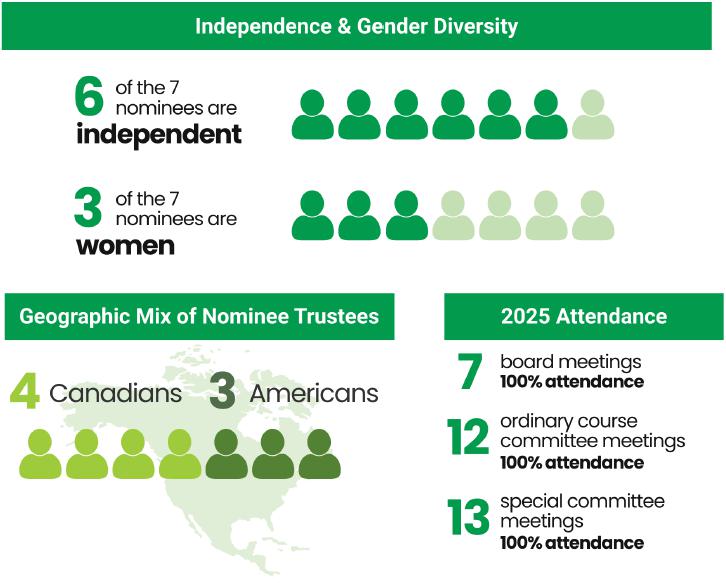
The following infographics depict information regarding Trustee nominee independence and gender diversity, geographic mix and 2025 meeting attendance for the Board as a whole.
- 16 -
The following information sets forth the names of, and certain other biographical information for, the seven individuals proposed to be nominated for election as Trustees at the Meeting.
| MARK DECKER, JR. | Principal Occupation |
Age: 51 Location: Edina, Minnesota, USA Trustee Since: January 1, 2026 Status: INDEPENDENT | Mr. Decker serves as a Trustee of the REIT, joining on January 1, 2026 and is a member of the Investment Committee. He is currently the President, Chief Executive Officer, and a Director of Chiron Real Estate Inc., a U.S. healthcare real estate investor. Prior to joining Chiron, Mr. Decker served as a Managing Director at Proterra Investment Partners from 2023 to 2025, where he founded the firm’s real estate strategy and currently serves as a senior advisor. Mr. Decker also has extensive experience in the U.S. multifamily sector, having previously served as President, CEO, Trustee and Chief Investment Officer at Centerspace, where he led that company’s transition from diversified real estate investments into an owner/operator of multifamily apartment real estate. Prior to joining Centerspace, he spent 20 years as a senior banker advising public real estate owner/operators, lodging companies and real estate services firms, ultimately serving as Managing Director and U.S. Group Head of Real Estate Investment and Corporate Banking at BMO Capital Markets. Mr. Decker holds a Bachelor of Arts in History from the College of William & Mary. |
| Other Public Board Memberships | |
| Chiron Real Estate Inc. (NYSE) | |
| Board / Committee Memberships | Attendance
at Regular Meetings |
Overall Attendance |
| Board | N/A | N/A |
| Investment Committee | N/A |
| Securities
Beneficially Owned or Controlled (as at March 11, 2026) | |||||||
| Units | Deferred Units | Total
Units and Deferred Units |
Unit Ownership Requirement | ||||
| Number | Market Value(1) |
Number | Market Value(1) |
Number | Market Value(1) |
Minimum
Ownership Requirement |
Complies
with Minimum Ownership Requirement? (2) |
| 0 | $0 | 0 | $0 | 0 | $0 | 5X Annual Cash Retainer ($225,000) |
Not yet |
Notes:
(1) These amounts were determined by multiplying the number of Units or Deferred Units (as applicable) by the closing price of the Units on March 11, 2026, being $12.14 per Unit.
(2) The REIT’s Equity Ownership Policy provides that each Trustee has within the later of five years from the date of (i) the policy and (ii) becoming a Trustee to comply with the guidelines therein. The Equity Ownership Policy also provides that, for the purposes of the policy, the value of Units held is calculated using the higher of the cost base and current market price.
- 17 -
| WILLIAM A. HALTER | Principal Occupation |
Age: 65 Location: Little Rock, Arkansas, USA Trustee Since: April 2018 Status: INDEPENDENT | Lieutenant Governor William A. Halter serves as a Trustee of the REIT and as a member of the Compensation, Governance and Nominating Committee. Mr. Halter currently serves as the Chief Executive Officer of Scenic Hill Solar, a developer, owner, and operator of solar power plants for commercial, industrial and municipal utility clients. Mr. Halter served as the Lieutenant Governor of Arkansas from January 2007 to January 2011. He was the chair of the Democratic Lieutenant Governors Association and also served as the chair of the Southern Region of the National Lieutenant Governors Association. Before his election as Lieutenant Governor, from 1999 to 2001, Mr. Halter served as Deputy Commissioner and later as Acting Commissioner of Social Security of the United States Social Security Administration. From 1993 to 1999, he served as a Senior Advisor in the Director’s Office, Office of Management and Budget, Executive Office of the President of the United States. Mr. Halter also served as Economist for the Joint Economic Committee of Congress and as the Chief Economist of the U.S. Senate Committee on Finance. Before entering public service, he served as a Management Consultant with McKinsey & Company. He has served as a Director of five public companies including Akamai Technologies Inc., InterMune Inc., Threshold Pharmaceuticals Inc., webMethods Inc., and Xenogen Corporation, Mr. Halter has also served as a Director of five privately held companies. Mr. Halter serves a Trustee Emeritus of Stanford University and has served on several Advisory Councils of Stanford. Mr. Halter is a Rhodes Scholar and holds a Master of Philosophy in Economics from Oxford University and a BA in Economics and Political Science from Stanford University where he was a Truman Scholar. |
| Other Public Board Memberships | |
| N/A | |
| Board / Committee Memberships | Attendance
at Regular Meetings |
Overall Attendance |
| Board | 7/7 | 100% |
| Compensation, Governance and Nominating Committee | 4/4 |
| Securities
Beneficially Owned or Controlled (as at March 11, 2026) | |||||||
| Units and Class B Units | Deferred Units | Total
Units, Class B Units and Deferred Units |
Unit Ownership Requirement | ||||
| Number | Market Value(1) |
Number | Market Value(1) |
Number | Market Value(1) |
Minimum
Ownership Requirement |
Complies
with Minimum Ownership Requirement? (2) |
| 153 | $1,857.42 | 67,994 | $825,447.16 | 68,147 | $827,304.58 | 5X Annual Cash Retainer ($225,000) |
Yes |
Notes:
(1) These amounts were determined by multiplying the number of Units, Class B Units or Deferred Units (as applicable) by the closing price of the Units on March 11, 2026, being $12.14 per Unit.
(2) The REIT’s Equity Ownership Policy provides that each Trustee has within the later of five years from the date of (i) the policy and (ii) becoming a Trustee to comply with the guidelines therein. The Equity Ownership Policy also provides that, for the purposes of the policy, the value of Units held is calculated using the higher of the cost base and current market price.
- 18 -
| KARINE MACINDOE | Principal Occupation | ||||||
Age: 52 Location: Mississauga, Ontario, Canada Status: INDEPENDENT |
Karine MacIndoe has 30 years of professional experience, mostly in real estate and capital markets, and over 10 years of public board experience. She is currently on the boards of Killam Apartment REIT and Vital Infrastructure Property Trust, a global healthcare properties REIT, and was previously on the boards of Dream Office REIT and Dream Impact Trust. Ms. MacIndoe’s committee responsibilities include Chairing the Audit Committee at Killam, past Chair of the Audit Committee at Dream Office, past Chair of the Compensation Committee at Killam, and being on the Audit and Investment Committees at Vital Infrastructure. Prior to these board roles, Ms. MacIndoe was a Managing Director and Senior Equity Research Analyst at BMO Capital Markets covering Real Estate & REITs across all property types (retail, office, industrial, multi-residential, seniors housing and hotels). During her career at BMO, she was consistently top-ranked in the Brendan Wood Canadian Equity Research Survey; both for the quality of her research and strength of client relationships. Prior work experience also includes M&A Advisory at NM Rothschild & Sons, and management of sales planning at Canadian Airlines International. Ms. MacIndoe has an MBA from the Richard Ivey School of Business (Ivey Scholar) and a Bachelor of Commerce from the University of Calgary (Honor Society). | ||||||
| Other Public Board Memberships | |||||||
Killam Apartment REIT (TSX) Vital Infrastructure Property Trust (TSX) | |||||||
| Board / Committee Memberships | Attendance
at Regular Meetings |
Overall Attendance | |||||
| N/A | N/A | N/A | |||||
| Securities
Beneficially Owned or Controlled (as at March 11, 2026) | |||||||
| Units | Deferred Units | Total
Units and Deferred Units |
Unit Ownership Requirement | ||||
| Number | Market Value(1) |
Number | Market Value(1) |
Number | Market Value(1) | Minimum Ownership Requirement |
Complies
with Minimum Ownership Requirement?(2) |
| 1,500 | $18,210.00 | 0 | $0 | 1,500 | $18,210.00 | 5X Annual Cash Retainer ($225,000) |
Not yet |
Notes:
(1) These amounts were determined by multiplying the number of Units or Deferred Units (as applicable) by the closing price of the Units on March 11, 2026, being $12.14 per Unit.
(2) The REIT’s Equity Ownership Policy provides that each Trustee has within the later of five years from the date of (i) the policy and (ii) becoming a Trustee to comply with the guidelines therein. The Equity Ownership Policy also provides that, for the purposes of the policy, the value of Units held is calculated using the higher of the cost base and current market price.
- 19 -
| S. JANE MARSHALL | Principal Occupation | |||||||
Age: 69 Location: Toronto, Ontario, Canada Trustee Since: May 11, 2022 Status: INDEPENDENT |
Ms. Marshall serves as a Trustee and Chair of the Board of the REIT. She has more than 30 years of experience in real estate management, particularly with food and retail companies. Ms. Marshall has been a trustee of Riocan REIT since 2015, Chair of their Investment Committee from 2017 to 2022 and is now Chair of Riocan’s People Culture and Compensation Committee. In 2019, she was appointed to the board of Plaza Retail REIT. Ms. Marshall spent the majority of her career in various senior leadership roles at Loblaw Companies Ltd./Weston Foods including Chief Operating Officer of Choice Properties REIT and Executive Vice President of Loblaw Properties and Business Strategy. At Loblaw, Ms. Marshall was responsible for the acquisition, development, construction and management of its real estate portfolio. She also initiated/led several strategic initiatives including the redevelopment of Maple Leaf Gardens, the acquisition of T&T Supermarkets and the IPO of Choice Properties REIT. Ms. Marshall was the CEO of GoodLeaf Farms from 2017 to 2019. Ms. Marshall has a B.A. from the University of Toronto and holds the ICD.D designation of the Institute of Corporate Directors. | |||||||
| Other Public Board Memberships | ||||||||
| RioCan Real Estate Investment Trust (TSX) | ||||||||
| Plaza REIT (TSX) | ||||||||
| Board / Committee Memberships | Attendance
at Regular Meetings |
Overall Attendance | ||||||
| Board (Chair) | 7/7 | 100% | ||||||
| Compensation, Governance and Nominating Committee | 4/4 | |||||||
| Investment Committee | 4/4 | |||||||
| Special Committee | 13/13 | |||||||
| Securities
Beneficially Owned or Controlled (as at March 11, 2026) | ||||||||
| Units | Deferred Units | Total
Units and Deferred Units |
Unit Ownership Requirement | |||||
| Number | Market Value(1) |
Number | Market
Value(1) |
Number | Market
Value(1) |
Minimum
Ownership Requirement |
Complies
with Minimum Ownership Requirement?(2) | |
| 9,000 | $109,260.00 | 42,669 | $518,001.66 | 51,669 | $627,261.66 | 5X Annual Cash Retainer ($225,000) | Yes | |
Notes:
(1) These amounts were determined by multiplying the number of Units or Deferred Units (as applicable) by the closing price of the Units on March 11, 2026, being $12.14 per Unit.
(2) The REIT’s Equity Ownership Policy provides that each Trustee has within the later of five years from the date of (i) the policy and (ii) becoming a Trustee to comply with the guidelines therein. The Equity Ownership Policy also provides that, for the purposes of the policy, the value of Units held is calculated using the higher of the cost base and current market price.
- 20 -
| TERESA NETO | Principal Occupation | |||||||
Age: 60 Location: Toronto, Ontario, Canada Trustee Since: January 1, 2022 Status: INDEPENDENT
|
Ms. Neto serves as a Trustee of the REIT and Chair of the Audit Committee. She is currently the Chief Financial Officer of Granite REIT, appointed in July 2019. Previously, since 2010, Ms. Neto held CFO positions at five publicly traded real estate investment trusts in Canada, most recently with Pure Industrial Real Estate Trust from 2016-2019. As a CFO, Ms. Neto has overseen three M&A transactions and raised billions of dollars of capital in debt and equity markets. Ms. Neto has over 38 years of varied business experience with a focus on corporate finance, financial planning, accounting & reporting, tax and treasury. Ms. Neto entered the real estate industry in 2006. Previous to that, Ms. Neto held various progressive positions in the telecommunications and consumer packaged goods sectors and started her career at Touche Ross, a predecessor entity of Deloitte. Ms. Neto holds a Chartered Professional Accountant, CPA, CA designation and has a B.A. from Laurentian University. Ms. Neto is a member of the Institute of Corporate Directors and holds the ICD.D designation. | |||||||
| Other Public Board Memberships | ||||||||
| N/A | ||||||||
| Board / Committee Memberships | Attendance
at Regular Meetings |
Overall Attendance | ||||||
| Board | 7/7 | 100% | ||||||
| Audit Committee (Chair) | 4/4 | |||||||
| Investment Committee | 4/4 | |||||||
| Special Committee | 13/13 | |||||||
| Securities
Beneficially Owned or Controlled (as at March 11, 2026) | ||||||||
| Units | Deferred Units | Total
Units and Deferred Units |
Unit Ownership Requirement | |||||
| Number | Market Value(1) |
Number | Market Value(1) | Number | Market Value(1) | Minimum
Ownership Requirement |
Complies
with Minimum Ownership Requirement?(2) | |
| 6,338 | $76,943.32 | 38,384 | $465,981.76 | 44,722 | $542,925.08 | 5X Annual Cash Retainer ($225,000) | Yes | |
Notes:
(1) These amounts were determined by multiplying the number of Units or Deferred Units (as applicable) by the closing price of the Units on March 11, 2026, being $12.14 per Unit.
(2) The REIT’s Equity Ownership Policy provides that each Trustee has within the later of five years from the date of (i) the policy and (ii) becoming a Trustee to comply with the guidelines therein. The Equity Ownership Policy also provides that, for the purposes of the policy, the value of Units held is calculated using the higher of the cost base and current market price.
- 21 -
| DANIEL M. OBERSTE | Principal Occupation | |||||||
Age: 44 Location: Little Rock, Arkansas, USA Trustee Since: January 1, 2022 Status: NOT INDEPENDENT
|
Mr. Oberste serves as a Trustee of the REIT. He is also the President, Chief Executive Officer & Chief Investment Officer, promoted from President & Chief Investment Officer on January 1, 2022. Mr. Oberste served as Chief Investment Officer of BSR Trust, LLC since 2012. Prior to this, Mr. Oberste was BSR Trust, LLC’s Executive Vice President – Investments, General Counsel and Corporate Secretary. Before joining BSR Trust, LLC in 2012, Mr. Oberste served as the Vice President of Investments for Bailey Properties, LLC from 2009, gaining extensive experience in sourcing, underwriting, and administering the multifamily and commercial investment, acquisition, and disposition process. Prior to joining Bailey Properties, LLC, Mr. Oberste worked as an attorney with the Corporate Practice Group at Kutak Rock LLP. Mr. Oberste earned his undergraduate degree from the Sam M. Walton College of Business at the University of Arkansas and his Juris Doctorate from the Leflar School of Law at the University of Arkansas. Mr. Oberste has recently served as chair of the University of Arkansas at Pulaski Technical College Foundation. From 2013 to 2023, Mr. Oberste served on the board of Good Shepherd Ecumenical Retirement Center, an affordable senior living non-profit organization. He served as its Chairman until February 2023. | |||||||
| Other Public Board Memberships | ||||||||
| Nexus Industrial REIT (TSX) | ||||||||
| Board / Committee Memberships | Attendance
at Regular Meetings |
Overall Attendance | ||||||
| Board | 7/7 | 100% | ||||||
| Securities
Beneficially Owned or Controlled (as at March 11, 2026) | ||||||||
| Units and Class B Units | Restricted
Units and Performance Units |
Total
Units, Class B Units, Restricted Units and Performance Units |
Unit Ownership Requirement | |||||
| Number | Market Value(1) |
Number | Market
Value(1) |
Number | Market
Value(2) |
Minimum Ownership Requirement |
Complies
with Minimum Ownership Requirement?(2) | |
| 471,959 | $5,729,576.19 | 170,020 | $2,064,042.80 | 641,979 | $7,793,618.99 | 5X Annual Base Salary ($2,625,000) | Yes | |
Notes:
(1) These amounts were determined by multiplying the number of Units, Class B Units or Deferred Units (as applicable) by the closing price of the Units on March 11, 2026, being $12.14 per Unit.
(2) The REIT’s Equity Ownership Policy provides that for the Chief Executive Officer of the REIT, the ownership guideline is five times annual base salary. The Equity Ownership Policy also provides that, for the purposes of the policy, the value of Units held is calculated using the higher of the cost base and current market price.
- 22 -
| GRAHAM D. SENST | Principal Occupation | ||||||||
Age: 77 Location: Toronto, Ontario, Canada Trustee Since: January 2018 Status: INDEPENDENT
|
Mr. Senst serves as a Trustee of the REIT and Chair of the Investment Committee of the REIT. Mr. Senst served as a trustee of NexPoint Hospitality Trust and chair of its audit committee from 2019 until its sale in 2025. Mr. Senst served as President of the Institute of Canadian Real Estate Investment Managers until its sale in August 2012. Prior to this role, Mr. Senst served as Managing Director of KingSett Capital Real Estate Income Fund and as an Executive Vice President of Bentall Capital and Penreal Capital Management. Mr. Senst also served as an Executive Vice President of Bentall Investment Management. Prior to joining Bentall in April 2003, Mr. Senst served as Vice President of Real Estate for the OMERS Administration Corp. (also known as Ontario Municipal Employees Retirement System). Mr. Senst has many years of senior real estate investment experience as a Vice President with a major Ontario pension fund and other Canadian financial institutions. Prior to joining OMERS, Mr. Senst served as Vice President of Real Estate at a Subsidiary of Mackenzie Financial Corporation, where he developed debt and equity investment products for various Mackenzie funds. Mr. Senst served as the Vice President of Corporate Real Estate at both Canada Trust and Truscan Realty. He served as a member of the Advisory Board at KingSett Capital Income Fund, Morgan Stanley Real Estate Fund IV and Soros Real Estate Investors, C.V. and as a trustee of Residential Equities Real Estate Investment Trust (ResREIT). He also served as a director of Oxford Properties Group, Inc. Mr. Senst served as a trustee of Milestone Apartments Real Estate Investment Trust (including as the chair of the Investment Committee) and Partners REIT (including as the chair of the Audit Committee). Mr. Senst holds an Honours of Business Administration and a Masters of Business Administration from the Ivey School of Business at the University of Western Ontario in London, Ontario and is a 2011 graduate of the Institute of Corporate Directors. | ||||||||
| Other Public Board Memberships | |||||||||
| N/A | |||||||||
| Board / Committee Memberships | Attendance
at Regular Meetings |
Overall Attendance | |||||||
| Board | 7/7 | 100% | |||||||
| Investment Committee (Chair) | 4/4 | ||||||||
| Audit Committee | 4/4 | ||||||||
| Special Committee | 13/13 | ||||||||
| Securities
Beneficially Owned or Controlled (as at March 11, 2026) | |||||||||
| Units | Deferred Units | Total
Units and Deferred Units |
Unit Ownership Requirement | ||||||
| Number | Market Value(1) |
Number | Market
Value(1) |
Number | Market Value(1) |
Minimum Ownership Requirement |
Complies
with Minimum Ownership Requirement? (2) | ||
| 132,851 | $1,612,811.14 | 89,294 | $1,084,029.16 | 222,145 | $2,696,840.30 | 5X Annual Cash Retainer ($225,000) | Yes | ||
Notes:
(1) These amounts were determined by multiplying the number of Units or Deferred Units (as applicable) by the closing price of the Units on March 11, 2026, being $12.14 per Unit.
(2) The REIT’s Equity Ownership Policy provides that each Trustee has within the later of five years from the date of (i) the policy and (ii) becoming a Trustee to comply with the guidelines therein. The Equity Ownership Policy also provides that, for the purposes of the policy, the value of Units held is calculated using the higher of the cost base and current market price.
- 23 -
Corporate Cease Trade Orders or Bankruptcies
During the past 10 years, no nominee proposed for election has been a director, chief executive officer or chief financial officer of any company that:
| (i) | was subject to a cease trade order or similar order or an order that denied the company access to any exemption under securities legislation for a period of more than 30 consecutive days while the nominee was acting in such capacity; or |
| (ii) | was subject to a cease trade order or similar order or an order that denied the company access to any exemption under securities legislation for a period of more than 30 consecutive days that was issued after the nominee ceased to act in such capacity and which resulted from an event that occurred while the nominee was acting in such capacity. |
During the past 10 years, no nominee proposed for election has been a director or executive officer of any company that, while the nominee was acting in such capacity, or within a year of the nominee ceasing to act in such capacity, became bankrupt, made a proposal under any legislation relating to bankruptcy or insolvency or was subject to or instituted any proceedings, arrangement or compromise with creditors or had a receiver, receiver manager or trustee appointed to hold its assets.
Personal Bankruptcies
No nominee proposed for election has, within the 10 years prior to the date of this Information Circular, become bankrupt or made a proposal under any legislation relating to bankruptcy or insolvency, or been subject to or instituted any proceedings, arrangement or compromise with creditors, or had a receiver, receiver manager or trustee appointed to hold the assets of the nominee.
Penalties or Sanctions
No nominee proposed for election has been subject to any penalties or sanctions imposed by a court relating to securities legislation or by a securities regulatory authority or has entered into a settlement agreement with a Canadian securities regulatory authority or been subject to any other penalties or sanctions imposed by a court or regulatory body that would likely be considered important to a reasonable investor making an investment decision.
3. Appointment of Auditor
The audit committee of the REIT (the “Audit Committee”) recommends to the Unitholders that KPMG LLP (“KPMG”) be appointed as the independent auditor of the REIT, to hold office until the close of the next annual meeting of the Unitholders or until its successor is appointed, and that the Trustees be authorized to fix the remuneration of the auditor.
KPMG has been the auditor of the REIT since its inception on January 9, 2018. The persons named in the Form of Proxy and VIF, if not expressly directed to the contrary in such Form of Proxy or VIF, intend to vote such proxies FOR a resolution to appoint KPMG as auditor of the REIT and to authorize the Trustees to fix KPMG’s remuneration.
Audit Committee Information
Reference is made to the REIT’s current AIF for information relating to the Audit Committee, as required under Form 52-110F1 – Audit Committee Information Required in an AIF. The AIF is available on the SEDAR+ website at www.sedarplus.ca. Upon request, the REIT will promptly provide a copy of the AIF free of charge to a securityholder of the REIT.
- 24 -
| Compensation |
Compensation Governance
Compensation, Governance and Nominating Committee
The Compensation, Governance and Nominating Committee is comprised of three Trustees, all of whom have been determined by the Board to be independent Trustees and the majority of whom are residents of Canada. The Compensation, Governance and Nominating Committee is charged with reviewing, overseeing and evaluating the compensation, corporate governance and nominating policies of the REIT. The Compensation, Governance and Nominating Committee is currently comprised of Bryan H. Held (Chair), William A. Halter and S. Jane Marshall. Mr. Held is retiring from the Board and not standing for re-election at the Meeting. Accordingly, Mr. Held’s position on the Compensation, Governance and Nominating Committee will be filled by appointment of the Board following the Meeting.
The Board has adopted a written charter for the Compensation, Governance and Nominating Committee setting out its responsibilities for: (i) assessing the effectiveness of the Board, each of its committees and individual Trustees; (ii) overseeing the recruitment and selection of candidates as Trustees of the REIT, other than the candidates nominated by the Bailey/Hughes Holders; (iii) organizing an orientation and education program for new Trustees; (iv) considering and approving proposals by the Trustees to engage outside advisors on behalf of the Board as a whole or on behalf of the independent Trustees; (v) reviewing and making recommendations to the Board concerning any change in the number of Trustees composing the Board; (vi) considering questions of management succession; (vii) administering securities based compensation plans of the REIT including the Equity Incentive Plan (as defined below), any purchase plan of the REIT, and any other compensation incentive programs; (viii) assessing the performance of management of the REIT; (ix) reviewing and approving the compensation paid by the REIT, if any, to the officers of the REIT; and (x) reviewing and making recommendations to the Board concerning the level and nature of the compensation payable to Trustees and officers of the REIT.
The Board believes that the members of the Compensation, Governance and Nominating Committee individually and collectively possess the requisite knowledge, skill and experience in governance and compensation matters, including human resource management, executive compensation matters and general business leadership, to fulfill the committee’s mandate. All members of the Compensation, Governance and Nominating Committee have substantial knowledge and experience as current and former senior executives of large and complex organizations and on the boards of other publicly traded entities. For additional details regarding the relevant education and experience of each member of the Compensation, Governance and Nominating Committee (with the exception of Mr. Held, who is not standing for re-election at the Meeting), see “Matters to be Considered at the Meeting – 2. Election of Trustees – Nominees”.
Overview
The compensation discussion and analysis below sets out the REIT’s philosophy for compensating its executive officers and Trustees, and explains how its policies and practices implement that philosophy.
The Compensation, Governance and Nominating Committee oversees compensation programs and related governance matters. The President & Chief Executive Officer provides information to be used by the Compensation, Governance and Nominating Committee in its determinations and reports on historical compensation levels, methods of compensation, and achieved performance relative to organizational and individual objectives.
The REIT is internally managed by a senior team of seasoned professionals who have extensive real estate experience. The following discussion describes the significant elements of the REIT’s executive compensation program, with particular emphasis on the process for determining compensation payable to the President & Chief Executive Officer, the Chief Financial Officer and the Chief Operating Officer in respect of the year ended December 31, 2025, each of whom is employed directly by BSR Management, LLC, a subsidiary of the REIT. The President & Chief Executive Officer, the Chief Financial Officer and the Chief Operating Officer are referred to herein as the “named executive officers” in accordance with applicable Canadian securities laws in respect of the year ended December 31, 2025 (“Fiscal 2025”).
- 25 -
Effective March 17, 2025, the Board appointed Tom Cirbus as the Chief Financial Officer and Corporate Secretary of the REIT. In connection with the appointment of Mr. Cirbus, Ms. Rosenbaum stepped down as Interim Chief Financial Officer and Corporate Secretary effective March 17, 2025 and continues in her role as Chief Operating Officer.
For Fiscal 2025, the REIT only had three named executive officers in accordance with applicable Canadian securities laws. Beyond the three named executive officers herein, no other employee of BSR meets the definition of named executive officer.
Compensation Discussion and Analysis
Compensation Objectives
The REIT’s compensation program is designed to be (i) aligned with both the REIT’s performance and the individual performance of the named executive officers, (ii) supportive of the creation of long-term Unitholder value, (iii) competitive and market-aligned to attract and retain top executive talent, and (iv) affordable to the REIT and reflective of responsible pay practices. The primary objective of the REIT’s compensation program is to maximize the REIT’s competitive advantage, performance and Unitholder value by attracting, motivating and retaining its most qualified employees. The REIT also strives to ensure a strong link between compensation and performance to align the senior management team’s interests with the interests of Unitholders. The compensation program is designed to reward meaningful results that support the REIT’s strategic goals and Unitholder interests as well as the accomplishments of individual executives.
The REIT’s policy is to provide target total compensation that is generally competitive with the median of a group of size and industry relevant companies when performance expectations are met. The compensation program is structured to provide compensation that is above the market median when results exceed the REIT’s business objectives and below the market median when results are not met. In this manner, the financial interest of the executive officers is aligned with the financial interest of Unitholders. See below under “Peer Benchmarking Groups”.
In determining total compensation for the REIT’s executive officers, the Compensation, Governance and Nominating Committee and the Board consider a number of key factors, including (i) relative total Unitholder return (“TUR”), (ii) acquisitions, financings and refinancings and (iii) the financial performance of the REIT. The Compensation, Governance and Nominating Committee and the Board also assess the individual performance of each executive including a consideration of leadership, team development, asset management, investment and financing strategy development and execution, public company governance, and execution of specific objectives and SMART (defined herein) goals assigned to each executive.
Principal Elements of Compensation
The following discussion supplements the more detailed information concerning executive compensation provided below under “Compensation in Fiscal 2025” and “Summary Compensation Table – Named Executive Officers”. For the purposes of this Information Circular, “Fiscal 2023” is defined as the period from January 1, 2023 to December 31, 2023, “Fiscal 2024” is defined as the period from January 1, 2024 to December 31, 2024, and “Fiscal 2025” is defined as the period from January 1, 2025 to December 31, 2025. The compensation of the named executive officers includes three principal elements: (i) base salary; (ii) annual cash incentives; and (iii) long-term incentives, which consist of Restricted Units, Performance Units, Deferred Units, Options or other equity-based incentive compensation awards granted under the Equity Incentive Plan, each as described in further detail below. No Options have been issued under the Equity Incentive Plan.
- 26 -
| Compensation Element |
How
it is Paid |
Purpose
and What it is Designed to Reward |
Key Features |
| Base Salary | Cash |
þ Provides appropriate fixed compensation to assist in retention and recruitment
þ Rewards skills, knowledge and experience
|
þ Determined on an individual basis
þ Factors considered include past, current and potential contribution to the REIT’s success, position and responsibilities and competitive industry pay practices for other real estate investment trusts and companies of comparable size
|
| Annual Incentives | Cash |
þ Motivates executives to achieve strategic business and financial objectives of the REIT
þ Rewards financial and strategic achievements of the REIT as well as individual contribution to the REIT’s performance
|
þ Awarded based on qualitative and quantitative performance standards
þ Determined by the Compensation, Governance and Nominating Committee within the contractually established range, based on enterprise level performance of the REIT and specific individual contributions relative to financial and operational performance objectives
þ Recommended for approval annually by the Compensation, Governance and Nominating Committee and the Board
þ The President & Chief Executive Officer recommends, and the Compensation, Governance and Nominating Committee approves, pre-determined goals and objectives including a target for the REIT and tailored individual performance objectives for each employee
þ Awards subject to Clawback Policy (as defined below)
|
| Long-Term Incentives | Restricted Units, Performance Units, Deferred Units, Options, and other awards denominated or payable in Units |
þ Provides management with a strong link to long-term performance and the creation of Unitholder value
þ Retention of successful executives
þ Aligns interests of executives closely with interests of Unitholders
|
þ The Board, acting on the recommendation of the Compensation, Governance and Nominating Committee, designates individuals eligible to receive grants of equity-based incentive awards
þ Factors considered include individual’s position, scope of responsibility, contributions to the REIT’s success, ability to affect profits, historic and recent performance, tenure and any previous grants, and the value of the awards in relation to other elements of the named executive officer’s total compensation in respect of any grants
þ Awards subject to Clawback Policy
|
Peer Benchmarking Groups
The REIT has identified and established, upon the advice of an independent compensation consultant, a peer group of companies for the purpose of benchmarking executive and Trustee compensation (the “Compensation Peer Group”) as well as a peer group of companies for the purposes of evaluating relative TUR (the “Performance Peer Group”).
- 27 -
Compensation Peer Group
The companies currently within the Compensation Peer Group exhibit similar characteristics to the REIT, are publicly listed, are headquartered in the United States or Canada, are internally managed, and have a focus on residential properties, where possible. When the Compensation Peer Group was last reviewed and approved by the Compensation, Governance and Nominating Committee, the REIT was positioned at approximately the median of the Compensation Peer Group in terms of assets, revenue and market capitalization.
The REIT reviews its Compensation Peer Group every three years, to ensure that the peers used are relevant in terms of scale and complexity. In fiscal 2025, the Compensation Peer Group was reviewed and updated by the Compensation, Governance and Nominating Committee in consultation with Meridian Compensation Partners, LLC (“Meridian”). The current Compensation Peer Group is comprised of the following comparable companies and real estate investment trusts.
| Compensation Peer Group | |
| Artis Real Estate Investment Trust | Centerspace |
| Chatham Lodging Trust | Clipper Realty Inc. |
| Community Healthcare Trust Incorporated | Elme Communities |
| Flagship Communities Real Estate Investment Trust | Independence Realty Trust, Inc. |
| Killam Apartment REIT | Mainstreet Equity Corp. |
| Minto Apartment Real Estate Investment Trust | One Liberty Properties, Inc. |
| Plymouth Industrial REIT, Inc. | Primaris Real Estate Investment Trust |
| UMH Properties, Inc. | |
- 28 -
Performance Peer Group
The companies currently within the Performance Peer Group also exhibit similar characteristics to the REIT, are publicly listed, are headquartered in the United States or Canada, and have a focus on residential properties, where possible. These companies are used to measure relative TUR for the Performance Units, as they share similar investment characteristics (e.g., competitors for investor capital) and generally respond similarly to external conditions. The current Performance Peer Group is comprised of the following comparable companies and real estate investment trusts.
| Performance Peer Group | |
| American Homes 4 Rent | Apartment Investment and Management Company |
| AvalonBay Communities, Inc. | Boardwalk Real Estate Investment Trust |
| BRT Apartments Corp. | Camden Property Trust |
| Canadian Apartment Properties Real Estate Investment Trust | Centerspace |
| Clipper Realty Inc. | Equity LifeStyle Properties, Inc. |
| Equity Residential | Essex Property Trust, Inc. |
| European Residential Real Estate Investment Trust | Flagship Communities Real Estate Investment Trust |
| Independence Realty Trust, Inc. | InterRent Real Estate Investment Trust |
| Invitation Homes Inc. | Killam Apartment Real Estate Investment Trust |
| Mid-America Apartment Communities, Inc. | Minto Apartment Real Estate Investment Trust |
| Morguard North America Residential Real Estate Investment Trust | NexPoint Residential Trust, Inc. |
| Sun Communities, Inc. | UDR, Inc. |
| UMH Properties, Inc. | |
Compensation Risk
The Compensation, Governance and Nominating Committee considers the implications of the risks associated with the REIT’s compensation policies and practices as part of its responsibility to ensure that the compensation for the Trustees and the named executive officers of the REIT align their interests with Unitholders and the REIT as a whole. The REIT has certain policies and procedures in place to mitigate any risk associated with its compensation program, including the following:
| · | The REIT’s insider trading policy (the “Insider Trading Policy”) prohibits all officers and Trustees of the REIT from selling “short” or selling “call options” on any of the REIT’s securities and from purchasing financial instruments, such as prepaid variable forward contracts, equity swaps, collars or units of exchange funds that are designed to hedge or offset a decrease in the market value of equity securities granted to such executive officers and Trustees as compensation or held directly or indirectly by such person. |
| · | The REIT’s compensation clawback policy (the “Clawback Policy”) allows the REIT to recoup incentive compensation paid under certain circumstances. |
| · | The REIT’s equity ownership policy (the “Equity Ownership Policy”) establishes minimum equity ownership levels for Trustees and executive officers to provide alignment with Unitholders. |
- 29 -
| · | A substantial portion of executive pay is delivered through long-term incentives, which focus executives on sustained, long-term Unitholder value creation. Long-term incentives are awarded annually, with overlapping vesting periods, ensuring that executives remain exposed to the longer-term risks of their decision making through unvested equity incentives. |
| · | 60% of long-term incentive awards are comprised of Performance Units, which are based on objective performance measures (including absolute and relative) to further enhance the alignment between pay and performance relative to the REIT’s comparable peers. |
| · | The Compensation, Governance and Nominating Committee has discretion over the incentive awards granted to the executive team, thereby providing oversight of the total value awarded. In addition, the Board evaluates and approves the compensation packages for each of the REIT’s named executive officers that are recommended by the Compensation, Governance and Nominating Committee each year, which provides a further level of oversight. |
| · | The REIT has engaged a compensation consultant to advise on various compensation matters, including any risks inherent in the design and structure of the REIT’s compensation program. |
| · | From time to time, the Compensation, Governance and Nominating Committee reviews the compensation program currently in place to identify any risks related to compensation. |
Equity Incentive Plan Awards
The REIT has adopted an omnibus equity incentive plan (the “Equity Incentive Plan”). All equity and equity-based awards made or granted, including future grants to be made to executive officers of the REIT, are made under the Equity Incentive Plan. The Equity Incentive Plan provides eligible participants with compensation opportunities that encourage ownership of Units, enhance the REIT’s ability to attract, retain and motivate executive officers and other key members of management and incentivizes them to increase the long-term growth and equity value of the REIT in alignment with the interests of Unitholders. The material features of the Equity Incentive Plan are summarized under “Equity Incentive Plan – Material Features of the Equity Incentive Plan”.
Types of Awards
The Equity Incentive Plan provides for awards of Restricted Units, Performance Units, Deferred Units, Options, and other awards denominated or payable in, valued in whole or in part by reference to, or otherwise based on, or related to, Units, each as defined and discussed in further detail below.
| · | Restricted Units. A Restricted Unit award is an award denominated in notional units that vests three years after the grant date and which is settled by Units issued from treasury or, if so elected by the participant and subject to the approval of the Board, cash based on the value of a Unit at the date of settlement. |
| · | Performance Units. A Performance Unit award is an award denominated in notional units that vests after a designated performance period as designated by the Board, subject to performance based vesting conditions and which is settled by Units issued from treasury or, if so elected by the participant and subject to the approval of the Board, cash payable upon vesting. |
| · | Deferred Units. A Deferred Unit award is an award denominated in notional units that vests immediately upon grant and which is settled by Units issued from treasury or, if so elected by the participant and subject to the approval of the Board, cash based on the value of a Unit at the date of settlement. Deferred Units may not be redeemed until the participant ceases to hold any position with the REIT. The Board has the discretion to vary the manner in which the REIT contributed Deferred Units vest for any participant. |
- 30 -
| · | Options. An Option award entitles the holder to acquire one Unit upon the exercise of the Option at the exercise price as determined by the Board at the time of the Option grant. Options vest in accordance with a vesting schedule as determined by the Board and as detailed in the individual Option agreement for each Option award. Unless otherwise determined by the Board, all Options have a maximum term of ten years from the date of grant, provided that if the expiry falls during or within ten business days immediately following a blackout period, the expiry date will automatically extend until ten business days after the end of the blackout period. Options are settled by Units issued from treasury payable upon the exercise by the participant. The Equity Incentive Plan also allows for a cashless exercise of Options under certain circumstances. |
| · | Other Awards. The Board may, from time to time, subject to the provisions of the Equity Incentive Plan, and subject to the approval of the TSX, grant other awards to participants which are denominated or payable in, valued in whole or in part by reference to, or otherwise based on, or related to, Units (including, without limitation, securities convertible into Units). The Board determines the terms and conditions of such other awards. |
Equity Ownership Policy
The REIT’s guidelines under the Equity Ownership Policy are intended to align the interests of Trustees and executive officers with those of the Unitholders. The Equity Ownership Policy establishes minimum equity ownership levels for each Trustee and executive officer of the REIT to be achieved within the later of five years from the date of (i) the policy, and (ii) becoming a member of senior management or a trustee, as applicable. The Equity Ownership Policy requires the Chief Executive Officer, and encourages other C-Suite Officers and Trustees, to meet the following target equity ownership levels.
| Participant | Target Equity Ownership Level |
| Chief Executive Officer | 5 times annual base salary |
| Other C-Suite Officers | 1.5 times annual base salary |
| Trustees | 5 times annual cash retainer (excluding retainers paid in respect of Board or Committee Chair roles) |
For Trustees, these guidelines apply for so long as the individual is a Trustee of the REIT. For members of senior management, these guidelines apply for so long as the individual is employed by the REIT and for six months thereafter (except in respect of the Chief Executive Officer, for which the guidelines apply for one year thereafter), subject to the waiver of such requirement, in the REIT’s sole discretion, for employees retiring on good terms or for good reason, being terminated without cause, or as a result of death or disability. Awards granted under the Equity Incentive Plan are included in determining an individual’s equity ownership value.
Clawback Policy
To further align management’s interests with Unitholders, the REIT adopted the Clawback Policy. The Clawback Policy provides that the Board, at the recommendation of the Compensation, Governance and Nominating Committee, may seek reimbursement of annual or long-term incentive compensation awarded to executives if the Board believes the compensation paid would have been lower based on financial results that were subject to (i) a material restatement (other than a restatement caused by a change in applicable accounting rules or interpretations) or (ii) a material inaccuracy, and the executive engaged in fraud, gross negligence or intentional misconduct that materially contributed to the restatement or inaccuracy. In addition, incentive compensation may be recovered if the Board determines that a member of management committed a material breach of the REIT’s Code of Conduct (as defined below).
- 31 -
Compensation Consultant
The REIT has retained Meridian since 2019 to provide annual services in connection with executive officer and Trustee compensation matters, including, among other things, to:
| · | review the Compensation Peer Group for the purposes of benchmarking executive and Trustee pay; |
| · | review the Performance Peer Group for the purposes of benchmarking performance of the REIT; |
| · | benchmark executive and Trustee pay levels to determine market pay levels; |
| · | provide commentary on the competitiveness of the executive and Trustee compensation program, including incentive design; and |
| · | provide commentary on the REIT’s compensation discussion and analysis included in this Information Circular. |
The Compensation, Governance and Nominating Committee considers the information provided by Meridian and the recommendations it makes in connection with the above; however, the decisions made regarding final compensation and incentive plan design are made by, and are the responsibility of, the Board on recommendation of the Compensation, Governance and Nominating Committee.
Executive Compensation-Related Fees
The following table summarizes the fees billed by Meridian in respect of services provided in Fiscal 2024 and Fiscal 2025:
| 2025 | 2024 | |
| Executive Compensation-Related Fees | $140,945 (1) | $32,547 (2) |
| All Other Fees | – | – |
Notes:
(1)These fees represent the total fees billed by Meridian in respect of Fiscal 2025.
(2) These fees represent the total fees billed by Meridian in respect of Fiscal 2024.
Meridian does not provide any services to the REIT other than directly to the Compensation, Governance and Nominating Committee or as approved and overseen by the Compensation, Governance and Nominating Committee.
Compensation – Named Executive Officers
Compensation in Fiscal 2025
The total compensation earned by the named executive officers in respect of Fiscal 2025 is set out in the table below under “Summary Compensation Table – Named Executive Officers”. The following sections provide details on each of the elements of compensation actually earned in respect of Fiscal 2025.
Base Salary
Base salary is provided as a fixed source of compensation for the REIT’s named executive officers, determined on an individual basis taking into account the scope of responsibilities, experience and expected contribution of the individual. In assessing market competitiveness, the Compensation, Governance and Nominating Committee considers comparable compensation data of the Compensation Peer Group. Base salaries of the named executive officers of the REIT in respect of Fiscal 2025 were as follows:
- 32 -
| Name and Principal Position | Base Salary |
Daniel Oberste President & Chief Executive Officer |
$525,000 |
Tom Cirbus Chief Financial Officer |
$275,000 |
Susan Rosenbaum Chief Operating Officer |
$382,500(1) |
Notes:
(1) Ms. Rosenbaum previously served as both Chief Operating Officer and as Interim Chief Financial Officer and Corporate Secretary. In connection with the appointment of Mr. Cirbus, Ms. Rosenbaum stepped down as Interim Chief Financial Officer and Corporate Secretary effective March 17, 2025 and continues in her role as Chief Operating Officer. Ms. Rosenbaum received $360,000 in salary as compensation for her role as Chief Operating Officer. As compensation for her additional responsibilities as Interim Chief Financial Officer, Ms. Rosenbaum was paid $7,500 per month while serving as Interim Chief Financial Officer.
Annual Incentives
In March 2025, following a review and recommendation by the Compensation, Governance and Nominating Committee, the Compensation, Governance and Nominating Committee and the Board approved the annual incentive plan design for Fiscal 2025. The annual incentive plan design takes into account the REIT’s compensation philosophy and reflects a review of the REIT’s practices against the Compensation Peer Group. The key annual incentive plan design elements effective for Fiscal 2025 were as follows:
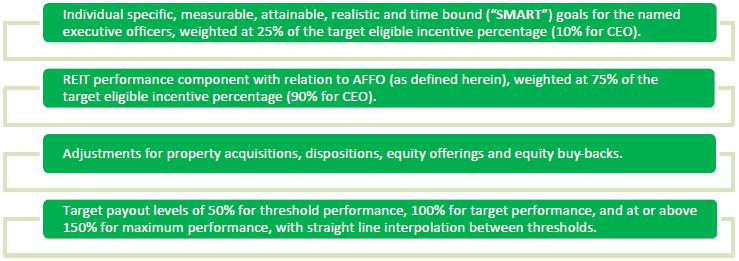
- 33 -
The annual incentive plan awards are paid in cash and are designed to motivate and reward named executive officers for progress against the REIT’s strategic business and financial objectives. The target eligible percentage of base salary is provided for in the named executive officers’ individual employment agreements, with any adjustments approved by the Board, on the advice of the Compensation, Governance and Nominating Committee. The named executive officers of the REIT earned the following annual cash incentives for Fiscal 2025:
| Name and Principal Position | Target Eligible Percentage of Base Salary | Annual Incentive Earned |
Daniel Oberste President & Chief Executive Officer |
90% | $592,846 |
Tom Cirbus Chief Financial Officer |
50% | $166,684 |
Susan Rosenbaum Chief Operating Officer |
55% | $252,397 |
As noted above, the annual cash incentives awarded by the REIT have both an individual performance component and a REIT performance component.
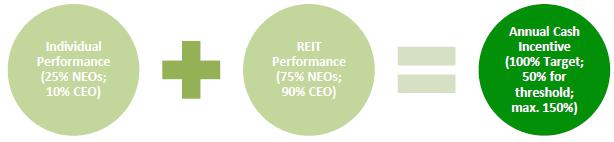
| · | Individual Performance. In Fiscal 2025, each named executive officer was eligible to receive 25% of their total eligible incentive percentage, included in the table above, based on individual performance (except for the Chief Executive Officer, who was eligible to receive 10% based on individual performance). The Fiscal 2025 annual incentives related to individual performance were based on the successful completion of individual SMART goals tailored to each executive and their role, as reviewed and approved by the Compensation, Governance and Nominating Committee and the Board. Evaluation of individual performance included a consideration of leadership, team development, asset management, investment and financing strategy development and execution, public company governance, and execution of specific objectives. The individual performance component of the annual incentives was paid in March of 2026. The individual performance component enables the Board to tie a portion of the named executive officer’s annual incentive to successful progress in areas of strategic importance for which they are accountable. |
| · | REIT Performance. For each of the annual incentives awarded in respect of Fiscal 2025, 75% of the target eligible percentage, included in the table above, was awarded based on the successful strategic and financial performance of the REIT, as reviewed and approved by the Compensation, Governance and Nominating Committee and the Board (except for the Chief Executive Officer, who was eligible to receive 90% based on REIT performance). The performance goal used to determine the REIT performance component for each of the annual incentives awarded to the named executive officers was based on the REIT successfully meeting or exceeding set performance levels for the Fiscal 2025 budget of AFFO, adjusted for acquisitions, dispositions, equity offerings and equity buy-backs, which resulted in a threshold performance for AFFO set at $25,602,205, target performance set at $28,446,894 and maximum performance set at $31,291,584, in each case after adjustments. The REIT performance portion of the budget was achieved and paid in March of 2026, with payout at 128.3% of target. |
- 34 -
Long-Term Incentives
In March 2025, following a review and recommendation by the Compensation, Governance and Nominating Committee, the Compensation, Governance and Nominating Committee and the Board approved the long-term incentive plan design for Fiscal 2025, taking into account the REIT’s compensation philosophy and upon a review of the REIT’s practises against the Compensation Peer Group. The key long-term incentive plan design elements effective for Fiscal 2025 were as follows:
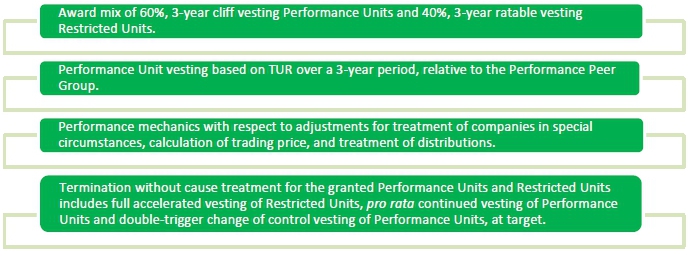
Long-term incentive awards granted by the REIT to its named executive officers in Fiscal 2025 include Restricted Units and Performance Units. Such awards are intended to provide management of the REIT with a strong link to the long-term performance of the REIT and the creation of Unitholder value. Such awards are granted at the discretion of the Board upon recommendation by the Compensation, Governance and Nominating Committee. The Restricted Units and Performance Units granted to the named executive officers in respect of Fiscal 2025 include awards granted to the named executive officers on March 17, 2025, Performance Units granted to the named executive officers pursuant to a special, forward looking, award made on May 19, 2025 and awards granted monthly that are equivalent to the cash distributions paid on the underlying Units. The total Restricted Units and Performance Units awarded to each named executive officer in Fiscal 2025 is as follows:
| Name and Principal Position | Restricted Units | Performance Units |
Daniel Oberste President & Chief Executive Officer |
22,842 | 87,582(1) |
Tom Cirbus Chief Financial Officer |
6,442 | 24,980(2) |
Susan Rosenbaum Chief Operating Officer |
12,616 | 48,351(3) |
Notes:
(1) This includes 50,465 Performance Units awarded pursuant to the 2025 LTUA Award (as defined below).
(2) This includes 14,922 Performance Units awarded pursuant to the 2025 LTUA Award.
(3) This includes 27,907 Performance Units awarded pursuant to the 2025 LTUA Award.
| · | 2025 Restricted Units. The Restricted Units granted in Fiscal 2025 vest rateably over three years with 1/3 vesting on each of December 31, 2025, 2026 and 2027. The Restricted Units are settled by Units issued from treasury or, if so elected by the participant and subject to the approval of the Board, cash payable upon vesting. In the event the executive’s employment is terminated without “cause” or the executive resigns for “good reason” (each, as defined in the executive’s employment agreement), including following a change of control of the REIT, the Restricted Units that have not otherwise vested will vest immediately and be settled. This effectively provides for a double-trigger before vesting upon a change of control. Resigning for “good reason” following a change of control includes, but is not limited to, a material diminution in the executive’s position, a reduction in base salary, a reduction or elimination of benefits, and a material change in geographic location. |
- 35 -
| · | 2025 Performance Units. The Performance Units granted in the ordinary course in Fiscal 2025 vest after a three-year performance period beginning on January 1, 2025 and ending on December 31, 2027. All Performance Units are subject to performance based vesting conditions, and are settled by Units issued from treasury or, if so elected by the participant and subject to the approval of the Board, cash payable upon vesting. In the event the executive’s employment is terminated without “cause” or for “good reason” (each, as defined in the executive’s employment agreement), a pro rata portion of the Performance Units that have not otherwise vested shall vest at the end of the performance period and the remaining portion shall immediately terminate and expire. If within 12 months following a change of control transaction, the executive’s employment is terminated without “cause” or the executive resigns for “good reason” (each, as defined in the executive’s employment agreement), all Performance Units that have not otherwise vested shall immediately vest and be settled at the target level of achievement. This effectively provides for a double-trigger before vesting upon a change of control. Resigning for “good reason” following a change of control includes, but is not limited to, a material diminution in the executive’s position, a reduction in base salary, a reduction or elimination of benefits, and a material change in geographic location. |
The number of Performance Units granted in the ordinary course on March 17, 2025 that are paid out is determined by reference to the TUR generated by the REIT over the performance period, relative to the Performance Peer Group as follows:
| Threshold | Target | Maximum | |
| Performance | 25th Percentile | 50th Percentile | 75th Percentile |
| Payout (% of target) | 50% | 100% | 200% |
| *Straight line interpolation between points | |||
| · | 2025 Long-Term Unitholder Alignment Performance Units. On May 19, 2025, the Board, upon the recommendation of the Compensation, Governance and Nominating Committee in consultation with its independent advisor, approved a special grant of Performance Units (the “2025 LTUA Award”) to the REIT’s executives. The 2025 LTUA Award was granted to incentivize executives to deliver on the REIT’s forward-looking strategic objectives following the Transaction (as defined below) during a period of anticipated significant transformation for the REIT. The 2025 LTUA Award is 100% contingent on FFO per Unit performance and will only be earned if rigorous performance thresholds are achieved over the period ending December 31, 2027. The REIT has not disclosed the precise FFO per Unit targets, as it considers these forward-looking targets to be strategic and confidential, and their disclosure could seriously prejudice the REIT’s interests. The Committee believes that the goals represent a significant stretch relative to historical performance and market expectations. As a result, payouts are contingent on the delivery of sustained, above-market growth in FFO per Unit, and can range between 50% to 200% of target based on performance outcomes, with no payout if performance falls below the threshold level. Straight line interpolation between points is used. The size of the 2025 LTUA Award was set at 100% of each executive’s existing long-term incentive target in Fiscal 2025. In sizing the award, the Compensation, Governance and Nominating Committee took a disciplined approach considering the conservative positioning of target total compensation relative to the Compensation Peer Group and the objective of strengthening alignment with Unitholder outcomes. Performance Units granted under the 2025 LTUA Award are subject to the same terms applicable to the 2025 Performance Units. |
Senior Management Changes
Effective March 17, 2025, the Board appointed Mr. Cirbus as the Chief Financial Officer and Corporate Secretary of the REIT. In connection with the appointment of Mr. Cirbus, Ms. Rosenbaum stepped down as Interim Chief Financial Officer and Corporate Secretary effective March 17, 2025 and continues in her role as Chief Operating Officer. See “Succession Planning”.
- 36 -
Summary Compensation Table – Named Executive Officers
The following table sets out information concerning the compensation earned by the named executive officers in respect of Fiscal 2023, Fiscal 2024 and Fiscal 2025.
| Name
and Principal Position |
Fiscal Year |
Salary ($) |
Unit-based awards(1) (2)(3)(4) ($) |
Non-equity
incentive plan compensation ($) |
Pension value ($) |
All
other compensation ($) |
Total
compensation ($) | |
| Annual
incentive plans |
Long- term incentive plans | |||||||
| Daniel
Oberste President & Chief Executive Officer |
2025 | $525,000 | $1,392,344 | $592,846 | $2,510,190 | |||
| 2024 | $525,000 | $711,491 | $478,454 | – | – | – | $1,714,945 | |
| 2023 | $525,000 | $695,553 | $458,042 | – | – | – | $1,678,605 | |
| Tom
Cirbus Chief Financial Officer |
2025 | $275,000 | $396,555 | $166,684 | $838,239 | |||
| 2024 | – | – | – | – | – | – | – | |
| 2023 | – | – | – | – | – | – | – | |
| Susan
Rosenbaum Chief Operating Officer |
2025 | $382,500(5) | $768,770 | $252,397 | $1,403,667 | |||
| 2024 | $450,000(5) | $392,574 | $250,099 | – | – | – | $1,092,673 | |
| 2023 | $360,000 | $347,985 | $192,654 | – | – | – | $900,639 | |
Notes:
| (1) | In respect of Fiscal 2023, represents Restricted Units (40%) and Performance Units (60%) granted on March 13, 2023 under the REIT’s Equity Incentive Plan that are subject to vesting conditions. The grant date fair value of the Restricted Units and Performance Units has been calculated as the number of Restricted Units and Performance Units times the March 13, 2023 closing price of $13.41 per Unit. Also represents Restricted Units and Performance Units granted in Fiscal 2023 that are equivalent to the cash distributions paid on Units. The value of Performance Unit awards assumes vesting at 100% of target. The number of Performance Units that vest will range between 0% and 200% of the number granted. See “Compensation – Outstanding Unit Based Awards – Named Executive Officers”. |
| (2) | In respect of Fiscal 2024, represents Restricted Units (40%) and Performance Units (60%) granted on March 15, 2024 under the REIT’s Equity Incentive Plan that are subject to vesting conditions. The grant date fair value of the Restricted Units and Performance Units has been calculated as the number of Restricted Units and Performance Units times the five-day volume weighted average closing price on March 15, 2024 of $11.39 per Unit. Also represents Restricted Units and Performance Units granted in Fiscal 2024 that are equivalent to the cash distributions paid on Units. The value of Performance Unit awards assumes vesting at 100% of target. The number of Performance Units that vest will range between 0% and 200% of the number granted. See “Compensation – Outstanding Unit Based Awards – Named Executive Officers”. |
| (3) | In respect of Fiscal 2025, represents Restricted Units (40%) and Performance Units (60%) granted on March 17, 2025 under the REIT’s Equity Incentive Plan that are subject to vesting conditions. The grant date fair value of the Restricted Units and Performance Units has been calculated as the number of Restricted Units and Performance Units times the five-day volume weighted average closing price on March 17, 2025 of $12.36 per Unit. Also represents Restricted Units and Performance Units granted in Fiscal 2025 that are equivalent to the cash distributions paid on Units. The value of Performance Unit awards assumes vesting at 100% of target. The number of Performance Units that vest will range between 0% and 200% of the number granted. See “Compensation – Outstanding Unit Based Awards – Named Executive Officers”. |
- 37 -
| (4) | In respect of Fiscal 2025, includes the 2025 LTUA Award of Performance Units granted on May 19, 2025 to further reinforce management’s alignment with the creation of long-term Unitholder value subject to certain vesting conditions. The grant date fair value of the Performance Units awarded pursuant to the 2025 LTUA Award has been calculated as the number of Performance Units times the five-day volume weighted average closing price on May 19, 2025 of $12.90 per Unit. The Performance Units granted pursuant to the 2025 LTUA Award will vest on December 31, 2027, with vesting amount being dependent on the FFO per Unit generated by the REIT over the applicable performance period. The value of 2025 LTUA Award of Performance Units assumes vesting at 100% of the aspirational threshold. See “Compensation – Long-Term Incentives – 2025 Long-Term Unitholder Alignment Performance Units” and “Compensation – Outstanding Unit Based Awards – Named Executive Officers”. |
| (5) | Ms. Rosenbaum received $360,000 in salary as compensation for her role as Chief Operating Officer. As compensation for her additional responsibilities as Interim Chief Financial Officer, Ms. Rosenbaum was paid $7,500 per month while serving as Interim Chief Financial Officer. |
The compensation payable to the named executive officers in the previous three most recently completed financial years consisted of base salary, a short-term cash incentive and long-term incentive grants under the Equity Incentive Plan. For more information see above under “Compensation in Fiscal 2025”.
Outstanding Unit Based Awards – Named Executive Officers
In Fiscal 2025, the REIT granted a total of 47,125 Restricted Units and 174,230 Performance Units to its employees pursuant to the Equity Incentive Plan, representing approximately 0.7% of the total issued and outstanding number of Units as of December 31, 2025 (0.6% determined as if all Class B Units are redeemed for Units) and approximately 5.6% of the maximum authorized number of Units issuable pursuant to the Equity Incentive Plan (3,970,824).
The Restricted Units granted in Fiscal 2023, Fiscal 2024 and Fiscal 2025 vest rateably over three years with 1/3 vesting on December 31 of each of the three ensuing years. See “Compensation – Named Executive Officers – Long-Term Incentives” for more details.
The Performance Units granted in March 2023, March 2024 and March 2025 vest three years from the date of grant depending on the TUR generated by the REIT over the applicable three-year performance period, as compared to the Performance Peer Group. If the REIT’s percentile TUR ranking is in the 75th percentile of the Performance Peer Group 200% of the Performance Units granted will vest. If the REIT’s percentile TUR ranking is at 50% of the Performance Peer Group 100% of the Performance Units granted will vest. If the REIT’s percentile TUR ranking is in the bottom 25th percentile of the Performance Peer Group none of the Performance Units granted will vest. Straight line interpolation between points is used. See “Compensation – Named Executive Officers – Long-Term Incentives” for more details.
On May 19, 2025, the named executive officers received the 2025 LTUA Award of Performance Units. The 2025 LTUA Award is 100% contingent on FFO per Unit performance and will only be realized through the successful achievement of ambitious FFO per Unit goals over the performance period ending on December 31, 2027. See “Compensation – Named Executive Officers – Long-Term Incentives” for more details.
The following table describes the outstanding Unit-based awards held by named executive officers as of December 31, 2025. As of December 31, 2025, no Options have been awarded under the Equity Incentive Plan.
| Unit-based awards | |||
| Name and Principal Position | Number
of underlying Units that have not vested (#) |
Market
or payout value of ($)
|
Market or payout value of vested Unit-based awards not paid out or distributed ($)
|
Daniel Oberste President & Chief Executive Officer |
199,842 | $2,508,017 | – |
Tom Cirbus Chief Financial Officer |
31,422 | $394,346 | – |
Susan Rosenbaum Chief Operating Officer (2) |
108,366 | $1,359,993 | – |
Notes:
| (1) | Represents Restricted Units and Performance Units granted in Fiscal 2023, Fiscal 2024, Fiscal 2025 and monthly that are equivalent to the cash distributions paid on the underlying Units. The market value of Unit-based awards was calculated based on the closing price of the Units on December 31, 2025 ($12.55), the last trading day of the fiscal year. The value of Performance Unit awards assumes vesting at 100% of target. The number of Performance Units that vest will range between 0% and 200% of the number granted. |
| (2) | Ms. Rosenbaum previously served as both Chief Operating Officer and as Interim Chief Financial Officer and Corporate Secretary. In connection with the appointment of Mr. Cirbus, Ms. Rosenbaum stepped down as Interim Chief Financial Officer and Corporate Secretary effective March 17, 2025 and continues in her role as Chief Operating Officer. |
- 38 -
Incentive Plan Awards – Value Vested or Earned During the Year – Named Executive Officers
| Name | Unit-based
awards – value vested during the year(1) (2) |
Non-equity
incentive plan compensation – value earned during the year |
Daniel Oberste President & Chief Executive Officer |
$705,243 | $592,846 |
Tom Cirbus Chief Financial Officer |
– | $166,684 |
Susan Rosenbaum Chief Operating Officer & Interim Chief Financial Officer (3) |
$411,461 | $252,397 |
Notes:
(1) This represents Restricted Units and Performance Units that vested in Fiscal 2025.
(2) In 2025, the REIT identified a factual error in third-party provided data which supported the calculation of the REIT’s historical relative TUR and which was used as the basis for determining historical Performance Unit vesting levels. The erroneous data drove a vesting determination which, upon review of the corrected data, resulted in an under vesting of certain Performance Units in 2021, 2024 and 2025. The Compensation, Governance and Nominating Committee and the Board determined the error was immaterial. To rectify the miscalculation and maintain the integrity of REIT’s Equity Incentive Plan, and valuation/accounting methodologies, effective December 31, 2025, the Compensation, Governance and Nominating Committee and the Board approved the re-determination of the vesting of the affected awards. Net of withholding tax, 41,401 additional Units were issued under the Equity Incentive Plan in settlement thereof. The figures herein include the impact of this re-determination for Mr. Oberste (21,383 Units) and Mrs. Rosenbaum (12,777 Units). The remaining Units were issued to other, non-NEO’s of the REIT. For the avoidance of doubt, the error did not result in an overstatement of any historical vesting levels and there is no material impact to the REIT’s historical financial statements due to the error or the re-determination of vesting.
(3) Ms. Rosenbaum previously served as both Chief Operating Officer and as Interim Chief Financial Officer and Corporate Secretary. In connection with the appointment of Mr. Cirbus, Ms. Rosenbaum stepped down as Interim Chief Financial Officer and Corporate Secretary effective March 17, 2025 and continues in her role as Chief Operating Officer.
Employment Agreements – Named Executive Officers
Each of the named executive officers of the REIT in respect of Fiscal 2025 served in their respective positions pursuant to the terms of individual employment agreements with BSR Management, LLC, a subsidiary of the REIT, which provide for an indefinite term. The following sets out the individual terms of the employment agreements, with common elements summarized thereafter.
President & Chief Executive Officer
Mr. Oberste serves as the REIT’s President & Chief Executive Officer. His agreement provides for an annual base salary of $525,000 and the ability to earn an annual short-term cash incentive up to 90% of his annual salary.
- 39 -
Chief Financial Officer
Mr. Cirbus serves as the REIT’s Chief Financial Officer and Corporate Secretary, appointed March 17, 2025. His agreement provides for an annual base salary of $275,000 and the ability to earn an annual short-term cash incentive up to 50% of his annual salary.
Chief Operating Officer
Ms. Rosenbaum serves as the REIT’s Chief Operating Officer, appointed January 1, 2023. Ms. Rosenbaum also served as Interim Chief Financial Officer and Corporate Secretary from November 8, 2023 to March 17, 2025, when Mr. Cirbus was appointed Chief Financial Officer. Her agreement provides for an annual base salary of $360,000, a monthly $7,500 additional salary during her service as Interim Chief Financial Officer, and the ability to earn an annual short-term cash incentive up to 55% of her annual salary.
Common Employment Agreement Terms
The following table sets forth the common elements of the employment agreements for the REIT’s named executive officers, unless otherwise noted above.
| Employment Agreement Term | Summary |
| Term | Indefinite |
| Termination “without cause” (as defined in the agreement) | Entitled to (i) accrued amounts for (a) earned but unpaid base salary, vacation and benefits up to the termination date, and (b) earned but unpaid short-term cash incentive for the previously completed calendar year, (ii) a lump sum severance payment equal to two times (a) base salary plus (b) prior actual short term cash incentive earned, which is to be paid in a single lump sum within 30 days following termination, (iii) accelerated vesting of awards granted under the Equity Incentive Plan, and (iv) a continuation of benefits (except for disability insurance and others that cannot be continued) for two years or until he or she becomes eligible for such benefits from a new employer. (1) |
| Termination due to death or “disability” (as defined in the agreement) | Entitled to (i) a lump sum severance payment equal to one times (a) base salary immediately prior to termination (or any higher base salary in effect during the 12 months prior to termination) plus (b) the greater of the short term cash incentive paid or earned for the prior year or the average short term cash incentive paid or earned for the two prior years, and (ii) accelerated vesting of awards granted under the Equity Incentive Plan. |
| Restrictive Covenants | Non-compete with the REIT for a period of one year following termination of employment and non-solicit with respect to certain employees for a period of three years following termination of employment, in each case subject to certain exceptions. |
Notes:
(1) Prior actual short-term cash incentive in section (ii)(b) shall be equivalent to the greater of the actual bonus earned in the year prior to termination, or the average of the actual bonus earned in the two years prior to termination.
Termination and Change of Control Benefits
The following table indicates the amount payable to each named executive officer under the terms of their employment agreements upon termination other than for cause, assuming employment was terminated on December 31, 2025. For purposes of valuing Unit-based awards, a price of $12.55 is used, which is the closing price of the Units on the TSX on December 31, 2025, the last trading day of the fiscal year.
- 40 -
| Name
and Principal Position |
Event | Severance(1) ($) |
Accelerated
Vesting of Equity Incentive Plan Awards(2) ($) |
Total ($) |
Daniel Oberste President & Chief Executive Officer |
Termination without cause or resignation for good reason | $2,006,908 | $1,646,334 | $3,653,242 |
| Death or disability | $1,003,454 | $2,508,017 | $3,511,471 | |
| Termination following change of control | $2,006,908 | $2,508,017 | $4,514,925 | |
| Resignation | - | - | - | |
Tom Cirbus Chief Financial Officer |
Termination without cause or resignation for good reason | $825,000 | $185,347 | $1,010,347 |
| Death or disability | $412,500 | $394,346 | $806,846 | |
| Termination following change of control | $825,000 | $394,346 | $1,219,346 | |
| Resignation | - | - | - | |
Susan Rosenbaum Chief Operating Officer (3)
|
Termination without cause or resignation for good reason | $1,265,198 | $883,369 | $2,148,567 |
| Death or disability | $632,599 | $1,359,993 | $1,992,592 | |
| Termination following change of control | $1,265,198 | $1,359,993 | $2,625,191 | |
| Resignation | - | - | - |
Notes:
(1) Including accrued amounts for earned but unpaid base salary, vacation and benefits, or earned but unpaid short-term cash incentive.
(2) Represents amounts payable in respect of Restricted Units and Performance Units. Upon a termination without cause or resignation for good reason, unvested Restricted Units are immediately vested and settled, and a pro rata portion of unvested Performance Units vest at the end of the performance period depending on achievement (between 0%-200%), and the remaining portion shall immediately terminate and expire. If such termination or resignation occurs within 12 months following a change of control transaction, all Performance Units that have not otherwise vested shall immediately vest and be settled at the target level of achievement. Calculation assumes vesting at 100% of target.
(3) Ms. Rosenbaum previously served as both Chief Operating Officer and as Interim Chief Financial Officer and Corporate Secretary. In connection with the appointment of Mr. Cirbus, Ms. Rosenbaum stepped down as Interim Chief Financial Officer and Corporate Secretary effective March 17, 2025 and continues in her role as Chief Operating Officer.
- 41 -
Performance Graph
The graph below compares the cumulative TUR of $100 invested in Units (assuming distributions are reinvested) with the cumulative total return of the S&P/TSX Composite Index and the S&P/TSX Capped REIT Index for the prior five most recently completed fiscal years (from December 31, 2020 to December 31, 2025).
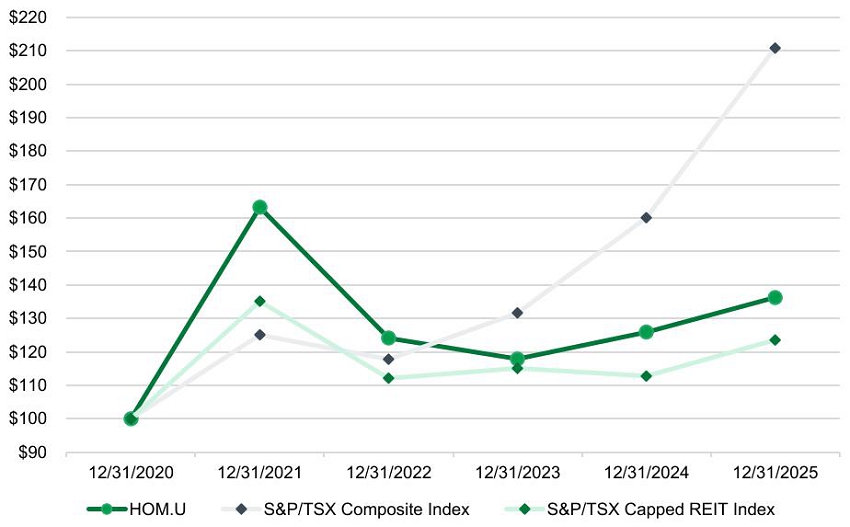
Source: TSX Infosuite.
During the period, the cumulative TUR for $100 invested in Units was $136, as compared to $211 and $124 for the S&P/TSX Composite Index and the S&P/TSX Capped REIT Index, respectively. The trend in the REIT’s TUR over the period is strong as compared to both indices and the compensation of the executive officers of the REIT generally correlates to this trend.
Over the same period, the REIT made changes to its compensation program to strengthen the alignment between named executive officer compensation and the REIT’s performance as well as to better align with the Compensation Peer Group. This included the 2025 LTUA Award of Performance Units granted in 2025 to further reinforce management’s alignment with long-term Unitholder value and to incentivize executives to deliver on the REIT’s strategic initiatives during a transformational period for the REIT. The Compensation, Governance and Nominating Committee believes the current compensation program for named executive officers, which has a significant relative performance weighting against the Performance Peer Group, will ensure that compensation continues to align with the interests of Unitholders.
Compensation – Trustees
Individual Trustees add value to the Board and to the REIT by bringing skills, knowledge and experiences that complement those of their colleagues, so that collectively, the Board provides diversity and balance in views and perspectives, ensuring a challenging and thoughtful exchange with management. Trustee attendance at meetings is mandatory and, additionally, there is an expectation that all Trustees will be available as needed outside of meetings. Board membership is reviewed annually to ensure the right mix and skills are present.
- 42 -
Trustee compensation is structured to recognize Trustees for their skills, knowledge, experiences and attention in overseeing the governance of the REIT, and to align with Unitholders’ interests. The Compensation, Governance and Nominating Committee reviews Trustee compensation and recommends any changes to the Board to ensure that Trustee compensation is competitive. In making its recommendation, the Compensation, Governance and Nominating Committee considers:
| · | the level of compensation required to fairly reflect the risks and responsibilities of serving as a Trustee; and |
| · | the alignment of the interests of Trustees and Unitholders by requiring that independent Trustees meet the Unit ownership guidelines established in the REIT’s Equity Ownership Policy. |
In respect of Fiscal 2025, the Trustee compensation framework was as follows:
| Annual Board Retainer | |
| Non-management Trustee | $40,000 |
| Meeting Fees | |
| Per Board or Committee Meeting | N/A |
| Chair Retainers | |
| Non-Management Board Chair | $75,000 |
| Audit Committee Chair | $25,000 |
| Compensation, Governance and Nominating Committee Chair | $25,000 |
| Investment Committee Chair | $25,000 |
| Committee Retainer | |
| Committee member | $7,500 |
| Equity | |
| Deferred Units (annual grant) | $55,000 |
| Travel | |
| Reasonable Travel and ancillary expenses | Reimbursed |
| Continuing Education | |
| Trustee continuing education events, training opportunities and materials | Reimbursed up to $3,000 |
In November 2025, based on a report of the REIT’s independent compensation consultant, Meridian, and following a review and recommendation by the Compensation, Governance and Nominating Committee, the Compensation, Governance and Nominating Committee and the Board approved a $5,000 increase of the annual board retainer and a $10,000 increase to the equity retainer, both of which took effect on January 1, 2026, to bring Trustee compensation more in line with market peers and ensure the REIT remains competitive. These changes take into account the REIT’s compensation philosophy and reflect a review of the REIT’s practices against the Compensation Peer Group as well as individual Trustee contributions.
The Trustees do not receive any additional remuneration for acting as directors on the boards of any of the REIT’s subsidiaries. Trustees who are also members of management do not receive any remuneration for their role as a Trustee.
Trustees have the option to elect to receive up to 100% of all fees that are otherwise payable in cash (i.e. annual board retainer and additional retainers) in the form of Deferred Units. The number of Deferred Units awarded to a Trustee in respect of Fiscal 2025 was equal to (i) the value of all fees that the Trustee elected to receive in the form of Deferred Units, (ii) divided by the volume weighted average trading price of a Unit on the TSX for the five trading days prior to the date of the award. Trustees must complete an election form to receive Deferred Units in lieu of the cash component of their fees no later than December 31 of the year preceding the applicable grant year. Elections are irrevocable for the year in respect of which they are made. In Fiscal 2025, Trustees received Deferred Units quarterly. See “Equity Incentive Plan – Material Features of the Equity Incentive Plan”.
- 43 -
Effective December 19, 2024, the Board established a special committee of independent Trustees (the “Special Committee”), comprised of S. Jane Marshall, as chair of the committee, Bryan H. Held, Teresa Neto, and Graham D. Senst, to evaluate a strategic asset sale transaction that was subsequently publicly announced by the REIT on February 27, 2025 (the “Transaction”) and closed in two separate transactions on March 31, 2025 and April 30, 2025. Compensation for the Special Committee members was fixed at (i) $1,000 per meeting, payable in cash or Deferred Units at the Trustee’s election, which fees were paid in the second quarter of 2025, and (ii) the reimbursement of all reasonable expenses incurred in connection with their service as members of the special committee. Following the completion of the Transaction and after having discharged its mandate, the Special Committee was dissolved on May 6, 2025.
Summary Compensation Table – Trustees
The following table sets out information concerning the compensation earned by the Trustees in respect of Fiscal 2025.
| Name | Fees earned(1) ($) |
Unit-based awards(2) ($) |
Non-equity incentive plan compensation ($) |
Pension value ($) |
All
other compensation ($) |
Total ($) |
| William A. Halter Trustee |
– | $136,881 | – | – | – | $136,881 |
| Bryan H. Held Trustee |
$29,250 | $157,279 | – | – | – | $186,835 |
| W. Daniel Hughes, Jr. (3) Former Trustee |
– | $129,161 | – | – | – | $129,161 |
| S.
Jane Marshall Trustee |
$13,000 | $203,294 | – | – | – | $216,294 |
| Teresa
Neto Trustee |
– | $157,810 | – | – | – | $157,810 |
| Daniel
M. Oberste (4) Trustee President & Chief Executive Officer |
– | – | – | – | – | – |
| Graham
D. Senst Trustee |
$13,000 | $172,835 | – | – | – | $185,835 |
Notes:
(1) Reflects fees paid in cash.
(2) Reflects fees paid in Deferred Units as opposed to cash as well as Deferred Units granted monthly that are equivalent to the cash distributions paid on Units.
(3) Mr. Hughes retired from the Board effective January 1, 2026.
(4) Mr. Oberste is also a named executive officer. Mr. Oberste does not receive fees in respect of his role as a Trustee. His compensation as a named executive officer is reflected under “Summary Compensation Table – Named Executive Officers”.
- 44 -
Outstanding Unit Based Awards – Trustees
The following table describes the outstanding Unit-based awards and Option-based awards held by Trustees at December 31, 2025. As of December 31, 2025, no Options have been awarded to Trustees.
| Unit-based awards | |||
| Name and Principal Position | Number of underlying Units that have not vested |
Market or payout value of unvested Unit based awards |
Market or payout value of vested Unit-based awards not paid out or distributed(1) |
| William A. Halter Trustee |
– | – | $853,319 |
| Bryan H. Held Trustee |
– | – | $979,214 |
| W. Daniel Hughes, Jr. (2) Former Trustee |
– | – | $843,530 |
| S. Jane Marshall Trustee |
– | – | $535,496 |
| Teresa Neto Trustee |
– | – | $481,719 |
| Daniel M. Oberste (3) Trustee President & Chief Executive Officer |
– | – | – |
| Graham D. Senst Trustee |
– | – | $1,120,639 |
Notes:
(1) Represents Deferred Units granted annually and quarterly to Trustees as well as Deferred Units granted monthly that are equivalent to the cash distributions paid on Units. The grant date fair value of the Deferred Units has been calculated, in accordance with the Equity Incentive Plan, as the number of Deferred Units granted times the volume weighted average price of all Units traded on the TSX for the five trading days immediately preceding such date.
(2) Mr. Hughes retired from the Board effective January 1, 2026.
(3) Mr. Oberste is also a named executive officer. Mr. Oberste’s Unit-based awards are reflected under “Outstanding Unit Based Awards – Named Executive Officers”.
- 45 -
Incentive Plan Awards – Value Vested or Earned During the Year – Trustees
| Name | Unit-based
awards – value vested during the year(1) |
Non-equity
incentive plan compensation – value earned during the year |
| William
A. Halter Trustee |
$136,881 | – |
| Bryan
H. Held Trustee |
$157,279 | $29,250 |
| W.
Daniel Hughes, Jr. (2) Former Trustee |
$129,161 | – |
| S.
Jane Marshall Trustee |
$203,294 | $13,000 |
| Teresa
Neto Trustee |
$157,810 | – |
| Daniel
M. Oberste (3) Trustee President & Chief Executive Officer |
– | – |
| Graham
D. Senst Trustee |
$172,835 | $13,000 |
Notes:
(1) Represents Deferred Units granted in Fiscal 2025, which vested immediately upon grant.
(2) Mr. Hughes retired from the Board effective January 1, 2026.
(3) Mr. Oberste is also a named executive officer. The value vested in respect of Mr. Oberste’s Unit-based awards is reflected under “Incentive Plan Awards – Value Vested or Earned During the Year – Named Executive Officers”.
Securities Authorized for Issuance Under Equity Compensation Plans
The following table summarizes certain information as of December 31, 2025 regarding compensation plans of the REIT under which equity securities are authorized for issuance.
| Plan Category | Number
of securities to be issued upon exercise of outstanding options, warrants and rights (#) |
Weighted-average
exercise price of outstanding options, warrants and rights ($) |
Number
of securities remaining available for future issuance under equity compensation plans (excluding securities reflected in first column) (#) |
| Equity compensation plans approved by securityholders – N/A | – | – | – |
| Equity compensation plans not approved by securityholders – Equity Incentive Plan(1) | 765,303 | N/A | 2,842,687 |
Notes:
(1) See “Equity Incentive Plan – Material Features of the Equity Incentive Plan” for a description of the material features of the Equity Incentive Plan. The Equity Incentive Plan was adopted in connection with the REIT’s initial public offering on May 18, 2018, and was amended on March 10, 2020, which amendment did not require securityholder approval. As of December 31, 2025, Deferred Units, Restricted Units and Performance Units were outstanding under the Equity Incentive Plan.
- 46 -
Statement of Governance Practices
The Board believes that strong corporate governance is important to the long-term success of the REIT and maintaining the trust of Unitholders, operating partners and the communities in which the REIT operates.
In accordance with the corporate governance guidelines set out under National Instrument 58-101 – Disclosure of Corporate Governance Practices (“NI 58-101”) and National Policy 58-201 – Corporate Governance Guideline (together with NI 58-101, the “CSA Governance Rules”), the following is a summary of the governance practices of the REIT.
Governance Highlights
| Governance Element | REIT Practice |
| Board Size | 7 Trustees |
| Board Independence | Majority
Independent Trustees (6 of 7 Trustees standing for nomination at the Meeting) |
| Board Gender Diversity | 2
Women of 7 Trustees (3 of 7 Trustees standing for nomination at the Meeting) |
| Entirely Independent Committees | Audit
Committee Compensation Governance and Nominating Committee Investment Committee |
| Independent Board and Committee Meetings | Audit
Committee Compensation Governance and Nominating Committee Investment Committee |
| Voting Standard for Board Elections | Annually by a majority of votes cast |
| Majority Voting Policy | Yes |
| Equity Ownership Guidelines | Yes |
| New Trustee Orientation and Continuing Education | Yes |
| Annual Board Assessments | Yes |
To comply with the various applicable governance standards and to achieve best practices, the REIT has adopted comprehensive corporate governance policies and procedures, including:
| · | Code of Business Conduct and Ethics |
| · | Board Charter |
| · | Audit Committee Charter |
| · | Compensation, Governance and Nominating Committee Charter |
| · | Investment Committee Charter |
- 47 -
| · | Position Descriptions for the Chief Executive Officer, Chair of the Board, and Committee Chairs |
| · | Diversity Policy |
| · | Majority Voting Policy |
| · | Whistleblower Policy |
| · | Insider Trading Policy |
| · | Disclosure and Confidential Information Policy |
| · | Environmental and Social Responsibility Policy |
| · | Compensation Clawback Policy |
| · | Equity Ownership Policy |
The Board believes that the REIT’s governance practices are in compliance with the CSA Governance Rules.
Composition of Board of Trustees and Independence
The Board is currently comprised of seven Trustees, a majority of whom are independent and Canadian residents. Pursuant to NI 58-101, an independent Trustee is one who is free from any direct or indirect relationship which could, in the view of the Board, be reasonably expected to interfere with a Trustee’s independent judgment. The REIT has determined that S. Jane Marshall (Chair), Mark Decker, Jr., William A. Halter, Bryan H. Held, Teresa Neto and Graham D. Senst are independent under NI 58-101 and that Daniel M. Oberste, the REIT’s current President & Chief Executive Officer, is not independent. All of the trusteeships and directorships of the Trustees with other public entities are disclosed in the biographical information for each Trustee are set out under “Matters to be Considered at the Meeting – 2. Election of Trustees – Nominees”.
The independent Trustees hold in-camera sessions at the conclusion of each regularly scheduled Board and committee meeting. The Chair of the Board conducts the in-camera sessions of the Board and the Chair of each committee conducts the in-camera sessions of its committee, as applicable, without Mr. Oberste present.
Nomination of Trustees
Other than the Bailey/Hughes Holders’ nominee nominated pursuant to the Amended and Restated Investor Rights Agreement, all Board nominees are nominated by the Compensation, Governance and Nominating Committee, who make such nominations after considering the mix of skills and experience it believes are necessary to further the REIT’s goals. The written charter of the Compensation, Governance and Nominating Committee sets out the committee’s responsibilities with respect to nominating Board member candidates, which include to: (i) review annually the competencies, skills and personal qualities of the Board, in light of current and expected future needs; (ii) seek individuals qualified (in the context of the needs of the REIT) to become members of the Board; (iii) review and recommend to the Board, the membership and allocation of Board members to the various committees of the Board; and (iv) consider the level of diversity on the Board (including the level of female representation).
On January 1, 2026, upon recommendation of the Compensation, Governance and Nominating Committee, the Compensation, Governance and Nominating Committee and the Board approved the appointment of Mark Decker, Jr. to the Board concurrent with the retirement of Daniel Hughes, Jr. Separately, in connection with the retirement of Bryan H. Held effective at the Meeting, upon recommendation of the Compensation, Governance and Nominating Committee, the Compensation, Governance and Nominating Committee and the Board approved the nomination of Karine MacIndoe.
The Compensation, Governance and Nominating Committee seeks and monitors prospective candidates for the Board who are independent, have recognized functional and industry experience, sound business judgement, high ethical standards, time to devote to the Board and the ability to contribute to the Board’s diversity (with respect to gender, experience, geography, ethnicity and age). The Compensation, Governance and Nominating Committee intends to identify qualified candidates when necessary through a number of possible sources, including an evergreen list and executive recruiters.
- 48 -
Trustees elected at an annual meeting are elected for a term expiring at the close of the subsequent annual meeting and are eligible for re-election. Trustees appointed by the Trustees between meetings of Unitholders in accordance with the Declaration of Trust are appointed for a term expiring at the close of the next annual meeting and are eligible for election or re-election, as the case may be.
For a chart illustrating the relevant skills possessed by each Trustee who is proposed for election at the Meeting, see “Matters to be Considered at the Meeting – 2. Election of Trustees – Nominees – Skills Matrix”.
Term Limits and Retirement Age
The REIT does not currently impose term limits on its Trustees. The REIT has also not adopted a formal retirement age policy for its Trustees. Instead, the REIT assesses the performance of Board members annually (see below under “Board Assessments”) and considers each Trustee’s ability to continue to make a meaningful contribution. The REIT is committed to ensuring that its Board is comprised of individuals with appropriate skill sets, and considers from time to time the appropriateness of adopting policies regarding term limits and a mandatory retirement age that would be consistent with best practices.
Board Assessments
The Compensation, Governance and Nominating Committee conducts a comprehensive annual assessment of the Board, its committees, the Board Chair and the committee Chairs. An annual assessment survey is sent to each Trustee for completion which canvasses the composition of the Board and committees, effectiveness of the Chair and committee Chairs and overall functioning and effectiveness of the Board and committees in terms of process and execution. The survey also provides the opportunity for confidential and subjective comments on areas for improvement or issues that are relevant or notable for the Board or committees.
Following receipt of the completed questionnaires, the Board Chair and the Chair of the Compensation, Governance and Nominating Committee conduct open and confidential one-on-one meetings to provide an additional opportunity for feedback with respect to the performance of the Board and its committees.
The results from the assessments are then collated and presented by the Chair of the Compensation, Governance and Nominating Committee to the Board. The Board Chair and committee Chairs take into consideration the overall results and suggestions derived from the annual Board performance assessment to improve the functioning and activities of the Board and committees. This process is used by the Board and the Compensation, Governance and Nominating Committee (i) as an assessment tool; (ii) as a component of the regular review process of Board members’ participation; (iii) to assist with the Board’s succession planning; (iv) to improve functioning and activities of the Board and its committees; and (v) to determine appropriate individuals to stand for re-election to the Board.
Board Mandate
The mandate of the REIT’s Board is one of stewardship and oversight of the REIT and its business. In fulfilling its mandate, the Board has adopted a written charter setting out its responsibility for, among other things, (i) participating in the development of and approving a strategic plan for the REIT; (ii) supervising the activities and managing the investments and affairs of the REIT; (iii) approving major decisions regarding the REIT; (iv) defining the roles and responsibilities of management; (v) reviewing and approving the business and investment objectives to be met by management; (vi) assessing the performance of and overseeing management; (vii) reviewing the REIT’s debt strategy; (viii) identifying and managing risk exposure; (ix) ensuring the integrity and adequacy of the REIT’s internal controls and management information systems; (x) succession planning; (xi) establishing committees of the Board, where required or prudent, and defining their mandate; (xii) maintaining records and providing reports to Unitholders; (xiii) ensuring effective and adequate communication with Unitholders, other stakeholders and the public; (xiv) determining the amount and timing of distributions to Unitholders; and (xv) acting for, voting on behalf of and representing the REIT as a holder of shares of certain of its subsidiaries, including BSR Trust, LLC. A copy of the Board’s current written charter is attached to this Information Circular as Schedule A.
- 49 -
Position Descriptions
Chair of the Board and Committee Chairs
The Board has adopted a written position description for the Chair of the Board, which sets out the Chair’s key responsibilities, including, as applicable, duties relating to setting Board meeting agendas, chairing Board and Unitholder meetings, Trustee development and communicating with Unitholders and regulators. The Board has also adopted a written position description for each of the committee chairs which sets out each of the committee chair’s key responsibilities, including duties relating to setting committee meeting agendas, chairing committee meetings and working with the respective committee members and management to ensure, to the greatest extent possible, the effective functioning of the committee.
Chief Executive Officer
The Board has adopted a written position description and mandate for the Chief Executive Officer of the REIT which sets out the key responsibilities of the Chief Executive Officer. The primary functions of the Chief Executive Officer are to lead management of the business and affairs of the REIT, to lead the implementation of the resolutions and the policies of the Board, to supervise day to day management of the REIT and to communicate with Unitholders and regulators. The Chief Executive Officer mandate is considered by the Board for approval annually.
Orientation and Continuing Education
New Trustees
When new Trustees are elected to the Board, they can be expected to participate in a comprehensive orientation program. The orientation program familiarizes new Trustees with the REIT’s business and operations, including structure, operations, and risks. They will be briefed on the role of the Board, its committees and the contributions individual Trustees are expected to make. New Trustees can also be expected to receive an orientation package containing all committee mandates and charters, copies of the REIT’s policies and other background information on the REIT’s business, operations and risks.
Continuing Education
The REIT’s continuing education program for its Trustees involves the ongoing evaluation by the Compensation, Governance and Nominating Committee of the skills and competencies of existing Trustees. The Board is currently comprised of highly qualified and experienced Trustees with impressive levels of skill and knowledge. Many of the Trustees are seasoned business executives, directors or professionals with considerable experience, including as directors of other significant public companies. The Compensation, Governance and Nominating Committee continually monitors the composition of the Board and will recommend the adoption of a formal continuing education program should it be determined to be necessary.
As part of the REIT’s continuing education program, Trustees:
| · | receive a comprehensive electronic package of information prior to each board and committee meeting; |
| · | obtain a quarterly report on the REIT’s operations and markets from management; |
| · | receive updates and presentations from management and third parties (including advisors) on regulatory developments and trends and issues related to the REIT’s business; |
| · | receive reports on the work of Board committees following committee meetings; |
- 50 -
| · | complete an annual tour of certain REIT properties; |
| · | are encouraged to attend industry conferences and events; and |
| · | receive an annual budget of $3,000 per Trustee for the reimbursement of all reasonable costs for continuing education events, training opportunities, materials, subscriptions etc. that are relevant to their duties and responsibilities as a Trustee. |
As part of the continuing education program in Fiscal 2025, Trustees:
| · | received frequent updates and presentations from management regarding industry tends; |
| · | received third-party presentations from the REIT’s financial advisors regarding current U.S. macroeconomic trends in the real estate market and the capital markets; |
| · | received additional presentations from various third-party advisors on various strategic alternatives available to the REIT; and |
| · | were encouraged to use their continuing education budget on external opportunities. |
Certain Trustees also individually attended pertinent educational seminars and conferences, including with respect to accounting (including IFRS 18), artificial intelligence adoption, board performance fraud prevention, women in fixed income, currencies, and commodities, current trends in derivatives, capital markets, real estate markets, taxes and tariffs, and general economic updates.
Ethical Business Conduct
The REIT has adopted a written code of business conduct and ethics (the “Code of Conduct”) that applies to all Trustees, officers, employees, contractors and consultants of the REIT and its subsidiaries. The objective of the Code of Conduct is to provide guidelines for maintaining the integrity, reputation, honesty, objectivity and impartiality of the REIT and its subsidiaries. The Code of Conduct addresses compliance with laws, rules and regulations, conflicts of interest, corporate opportunities, protecting the REIT’s assets, confidentiality, information protection, competition and fair dealing with securityholders, gifts and entertainment, payments to government personnel, lobbying, discrimination and harassment, health and safety, accuracy of records and reporting and use of e-mail, social media and Internet services. As part of the Code of Conduct, any person subject to the Code of Conduct is required to avoid or fully disclose interests or relationships that are harmful or detrimental to the REIT’s best interests or that may give rise to real, potential, or the appearance of, conflicts of interest. The Board has the ultimate responsibility for the stewardship of the Code of Conduct. The Code of Conduct is available on the REIT’s website at www.bsrreit.com and on the SEDAR+ website at www.sedarplus.ca.
In order to ensure compliance with the Code of Conduct, REIT personnel are encouraged to talk to supervisors, managers or other appropriate personnel about observed illegal or unethical behavior and when in doubt about the best course of action in a particular situation. Employees may report violations of the Code of Conduct anonymously. It is the policy of the REIT not to allow retaliation for reports of misconduct by others made in good faith. It is, at the same time, unacceptable to file a report knowing it is false.
In addition, to foster a strong culture of ethical business conduct, the REIT has implemented several other policies discussed in further detail below and elsewhere in this Information Circular.
Whistleblower Policy
The REIT has adopted a whistleblower policy (the “Whistleblower Policy”) which sets out established procedures for personnel of the REIT to confidentially and anonymously submit concerns to the Chair of the Audit Committee (who is independent of the REIT) or to a third-party reporting system regarding any accounting or auditing matter or any other matter which the individual believes to be in violation of the Code of Conduct. Personnel may also report concerns to government agencies or regulators directly (including, but not limited to, the Ontario Securities Commission in respect of securities law violations).
- 51 -
Insider Trading Policy
The REIT’s Insider Trading Policy expressly states that no one with any knowledge of a material fact or a material change in the affairs of the REIT that has not been generally disclosed to the public should purchase or sell any securities of the REIT, inform anyone of such material fact or material change (other than in the necessary course of business) or advise anyone to purchase, sell, hold or exchange securities of the REIT (or any other securities whose price or value may reasonably be expected to be affected by material changes affecting the REIT) until the information has been generally disclosed to the public and sufficient time has elapsed for such information to have been adequately disseminated to the public. For the purpose of implementing such principles, the Insider Trading Policy sets out a number of guidelines, including directives to Trustees, officers and employees of the REIT and requirements for pre-clearing of all trades in securities of the REIT.
Disclosure and Confidential Information Policy
The REIT has adopted a disclosure and confidential information policy (the “Disclosure and Confidential Information Policy”) which provides guidelines on the disclosure of material information and the protection of confidential information. The guidelines include the directive to disclose any material change in respect of the REIT, whether favourable or unfavourable, to the public promptly via news release and to not engage in selective disclosure (except if the limited “necessary course of business” exception applies). All written and oral disclosure, including news releases, must be approved, before public disclosure, by a majority of the disclosure committee of the REIT (or designated members thereof) and any two of the Chair of the Board, the Chair of the Audit Committee, the Chair of the Compensation, Governance and Nominating Committee and the Chair of the Investment Committee. The Disclosure and Confidential Information Policy also establishes guidelines with respect to electronic communications, dealings with the investment community and forward-looking information. To prevent the inadvertent disclosure of confidential information, the Disclosure and Confidential Information Policy provides that BSR personnel should not discuss the affairs of the REIT with, or make information about the REIT available to, outsiders and should take specific steps to preserve confidentiality where information is required to be disclosed to third parties.
Environmental, Social and Governance
At our core, BSR is focused on our company’s impact on our residents, employees, stakeholders and communities where we operate and serve. The mission of BSR is to provide an exceptional living experience for residents at a community they are proud to call home while creating value for our Unitholders through strength, profitability and growth. BSR conducts business with integrity and strives for the highest ethical standards by always treating partners, team members, residents and vendors with respect, honesty and fairness. We believe that any interaction with our company should be a genuinely positive experience and we believe in leaving things better than we found them. This ideology has been integral to our success since the roots of the formation of BSR Trust, LLC in 1956.
The REIT’s environmental and social responsibility policy outlines the REIT’s approach to environmental sustainability and social responsibility from a corporate governance perspective as well as the REIT’s commitments to embed these practices into its business model. Additionally, the REIT’s enhanced diversity policy (the “Diversity Policy”) reflects the REIT’s commitment toward adding additional members to the REIT’s Board of Trustees and senior management team with diversity in business and other professional experience, gender, geography, age, race and ethnicity.
- 52 -
The following is an outline of the REIT’s ongoing efforts to summarize our organization’s impact:
Environmental
BSR is committed to operating in an environmentally responsible manner, and we continue to identify and implement innovative practices that promote sustainability and resilience.
| · | BSR has upgraded 3,003 apartment units in the current portfolio with smart home and energy management technology. This results in an energy reduction of up to 15-20% for our residents and around 50% savings for any vacant BSR apartment units under this program. |
| · | BSR invests in smart waste management across all properties to optimize dumpster capacity and identify contamination issues. |
| · | Utilities for 61% of BSR properties are sub-metered. On average, properties that are sub-metered are 38% more efficient than non-sub-metered properties. |
| · | Multiple BSR communities have electric vehicle charging stations for resident use. |
| · | BSR uses a third-party utility biller providing vacant apartment unit charge backs, energy consumption variance reporting, pre-acquisition energy audits and detection of water leaks. |
| · | BSR uses smart irrigation systems to conserve water usage through the analysis of weather data. |
| · | Air filters in BSR suites are changed and inspected on a quarterly basis. |
| · | When performing renovations, BSR uses low-flow toilets, LED lighting, high efficiency fixtures and Energy Star approved appliances. |
| · | BSR offers virtual signatures on leasing documents, paperless rent payments, and service requests. |
| · | When identifying properties to acquire, the REIT obtains a Phase I environmental report conducted by independent and experienced consultants prior to an acquisition, and if recommended, the REIT also obtains a Phase II environmental report. |
Social
Residents
BSR is committed to providing healthy and safe living spaces as well as exceptional customer service to our residents.
| · | J Turner Research publishes Online Reputation Assessment (ORA) scores between 1 and 100, measuring online review sentiment for all multifamily properties across the United States. BSR’s score consistently ranks in the Top 5 of publicly traded multifamily REITs. BSR placed second with an ORA score of 81.29 for 2024 while the national average ORA score of all U.S. multifamily properties was 62.05. |
| · | J Turner Research announced its Elite 1% list in February 2025 which included four BSR properties. Further, BSR was ranked 23rd of approximately 500 public and private multifamily companies for the highest percentage of its portfolio in the Elite 1%. |
| · | BSR provides its residents access to a credit builder program, which reports on-time rent payment history and paid-in-full status to TransUnion and Equifax to help residents build better credit scores. |
| · | To encourage resident health, wellness and quality of life, 100% of BSR’s apartment communities have on-site pools and fitness centers. |
- 53 -
| · | 34% of BSR employees chose to live alongside our residents at our communities. This shows the level of pride BSR team members have in our product and also enhances the experience and service provided for all of our residents. |
Employees
BSR is committed to maintaining a workplace culture that attracts, retains and rewards the best and brightest people.
| · | BSR is committed to providing a diverse and inclusive workforce. We currently have 45% female and 55% male team members, approximately 64% of which are racially diverse. |
| · | In 2025, for the fourth year in a row, BSR was named one of the Best Places to Work in Multifamily, awarded by Best Companies Group. |
| · | BSR was named one of the Best Places to Work in Multifamily for Women, awarded by Best Companies Group at the Multifamily Innovations Awards held in December 2025. |
| · | BSR conducts a company-wide Team Member Satisfaction Survey every year, and the feedback is meticulously reviewed by our executive team. Results are shared throughout the organization, along with action items resulting from the feedback in the survey. A few key responses are highlighted below: |
| o | 94% of our team members say BSR provides them the opportunity to excel in their position through professional development and in-house training. |
| o | 91% of our team members are proud of BSR’s brand. |
| o | 99% of our team members say BSR operates in a socially responsible manner. |
| o | 96% of our team members say BSR’s work positively impacts people’s lives. |
| o | 92% of our team members are satisfied with the workplace flexibility offered by BSR. |
| o | 94% of our team members are satisfied with BSR’s investment in training and education. |
| o | 91% of our team members are inspired to give their best effort at work each day. |
| o | 87% of our team members are satisfied with BSR’s total benefits package. |
| · | BSR provided $1.3 million of employee rent discounts at BSR communities in 2025. |
| · | BSR’s Career Succession Program provides a framework for employees to reach their career goals at BSR. In 2025, we promoted 18 team members internally. |
| · | Our comprehensive training program of over 1,200 courses offers many options for team members including on-demand, virtual live instruction and in-person training. Many courses are available in both English and Spanish. Topics include fair housing and safety compliance, team member orientation, sales, management development, and virtual reality maintenance skills training. In 2025, BSR employees completed 3,089 courses. |
| · | BSR’s Team Member Appreciation Month is a special time to show appreciation to our team members for serving our residents well. |
- 54 -
| · | Our annual Celebration of Excellence Award Ceremony recognizes our on-site management teams and the corporate team with awards based on job performance. Our most recent Celebration of Excellence was held in February 2026 in Dallas, Texas. |
| · | Each quarter, we celebrate team member achievements in our internal newsletter and intranet. |
| · | BSR team members have an opportunity to become “BSR Certified” which consists of completing orientation training and taking a certification exam with one of our area proctors. Certifications are available for the following positions: Community Manager, Assistant Community Manager, Leasing Specialist and Service Manager. Team members can pass a test on a variety of position related policies and procedures to show they have a working knowledge of their role. |
| · | BSR has kept voluntary employee turnover below the industry average (19.8% in 2025 compared to the industry average of 33.8%). Further, the average tenure of our employees is four years. |
Community
| · | BSR formed the Home Away from Home Foundation (HAFH), established in 2021. The non-profit initiative provides short term housing to those traveling for medical treatment or displaced by natural disasters. Our furnished HAFH apartments have sheltered numerous families in need for over 1,500 nights at BSR properties. |
| · | In 2025, HAFH provided lodging at a BSR property for families receiving long term medical treatment. |
| · | BSR maintains an active partnership with local colleges providing internships, new graduate job opportunities, and serving as guest speakers for advanced Commercial Real Estate classes. |
| · | BSR team members are deeply engaged in the community, actively volunteering with local nonprofits and serving in key leadership roles on their Boards. The community involvement and professional achievements of BSR employees have led to eight different “20 in their 20s” and “40 Under 40” distinctions in recent years |
Governance
BSR is committed to good corporate governance to maximize shareholder value in a manner consistent with the highest standards of integrity.
| · | The Board maintains oversight of the individual committees’ responsibilities and environmental, social and governance (ESG) matters as a whole, along with overall enterprise risk management. |
| · | Our executive management team maintains regular contact with a broad base of investors. |
| · | BSR maintains high quality IT infrastructure and active cybersecurity monitoring and protection initiatives. |
| · | BSR leadership and audit committee chair actively monitor our third-party anonymous whistleblower hotline. |
| · | Our Board survey is conducted every year, which is collectively discussed and reviewed to gauge completeness and effectiveness of corporate governance. |
| · | BSR maintains a code of business conduct and ethics, as well as a disclosure and confidential information policy. |
- 55 -
| · | BSR has a non-discrimination policy which protects residents and prospective residents from discrimination based on race, color, national origin, religion, sex, family status and disability as covered under the Fair Housing Act. |
| · | BSR maintains an employee handbook which is accessible by all team members. |
| · | BSR has a Diversity Policy that reflects our commitment toward adding additional members to the Board and senior management team with diversity in business and other professional experience, gender, geography, age, race and ethnicity. BSR’s Board has 29% female representation and 71% male representation. |
Diversity
The REIT is committed to fostering an open and inclusive workplace culture. The REIT underscores a commitment to diversity and recognizes it as an important asset. The REIT and its affiliates are firmly committed to providing equal opportunity in all aspects of employment.
The Compensation, Governance and Nominating Committee values and considers diversity as part of its overall annual evaluation of Trustee nominees for election or re-election, as well as candidates for management positions.
Gender and geography (subject to the limitations set forth in the Declaration of Trust) are of particular importance to the REIT in ensuring diversity within the Board and management. Recommendations concerning Trustee nominees are, foremost, based on merit and performance, but diversity is taken into consideration, as it is beneficial that a diversity of backgrounds, views and experiences be present at the Board and management levels.
In furtherance of the REIT’s commitment to diversity at the Board level, the Board has adopted the Diversity Policy. The Diversity Policy emphasizes the REIT’s belief in diversity and the potential for diversity in the composition of the Board and senior management of the REIT, to advance the best interests of the REIT. In this context, diversity may encompass a variety of dimensions (including, among other things, diversity in business and other professional expertise and experience, gender, geography, age, race, sexual orientation, disability and ethnicity), the relative importance of which may change from time to time.
The Board recognizes the importance of positions being filled by the most suitable and competent individuals and that bias and discrimination – whether conscious or unconscious – may inhibit, among other things, diversity and the selection, retention and promotion of individuals based on merit. The Board also recognizes that “the tone is set at the top” and the processes applicable to determining the composition of the Board and senior management will have significant impact on attracting and retaining individuals throughout the REIT.
As specified in the Diversity Policy, diversity, including the level of representation of women, is considered by the REIT, the Board and the Compensation, Governance and Nominating Committee in the identification and nomination of Trustees and in the hiring of senior management. In furtherance of the foregoing principles, the Diversity Policy provides that the Board and Compensation, Governance and Nominating Committee are committed to achieving at least 30% representation of women on the Board. The REIT is pleased to report that if all seven Trustee nominees are elected to the Board at the Meeting, there will be three female Trustees on the Board (43%), and three of the six independent Trustees will be women (50%).
The Board remains committed to the concept of board renewal, as it believes that new perspectives generally serve to advance the interests of the REIT and Unitholders. The REIT welcomes two new Trustee nominees standing for election at the Meeting as part of its recent refreshment initiatives, and will continue to actively identify additional independent Trustees to serve the REIT in the coming years.
Any third parties engaged by the REIT to assist in identifying possible members of the Board or senior management of the REIT are to be advised of the REIT’s recognition of the potential benefits of diversity and the need for the process pursued by the third party on behalf of the REIT to minimize the potential adverse impact of bias and discrimination. The Board also recognizes the importance of Trustee continuity in the composition of the Board and balances this criterion with importance of diversity.
- 56 -
The Board ensures compliance with the Diversity Policy by requiring that the Compensation, Governance and Nominating Committee conduct annual reviews of the Diversity Policy and an assessment of its effectiveness.
There are currently two female Trustees on the Board (29%) and one female of three named executive officers of the REIT or any of its major subsidiaries (33%). If all seven Trustee nominees are elected to the Board at the Meeting, there will be three female Trustees on the Board (43%), and three of the six independent Trustees will be women (50%).
Conflicts of Interest
The Declaration of Trust contains “conflict of interest” provisions to protect Unitholders without creating undue limitations on the REIT. As the Trustees are engaged in a wide range of real estate and other activities, the Declaration of Trust contains provisions, similar to those contained in the Canada Business Corporations Act, that require each Trustee to disclose to the REIT, at the first meeting of Trustees at which a proposed contract or transaction is considered, any interest in a material contract or transaction or proposed material contract or transaction with the REIT (including a contract or transaction involving the making or disposition of any investment in real property or a joint venture agreement) or the fact that such person is a director or officer of or otherwise has a material interest in any person who is a party to a material contract or transaction or proposed material contract or transaction with the REIT. If a material contract or transaction or proposed material contract or transaction is one that in the ordinary course would not require approval by the Trustees, a Trustee is required to disclose in writing to the REIT, or request to have entered into the minutes of meetings of Trustees, the nature and extent of his or her interest forthwith after the Trustee becomes aware of the contract or transaction or proposed contract or transaction. In any case, a Trustee who has made disclosure to the foregoing effect is not be entitled to vote on any resolution to approve the contract or transaction unless the contract or transaction primarily relates to his or her remuneration or is for an indemnity under the provisions of the Declaration of Trust or the purchase or maintenance of liability insurance.
All decisions of the Board require the approval of a majority of the Trustees present in person or by phone at a meeting of the Board, except for each of the following matters which also require the approval of a majority of the independent Trustees:
| · | an acquisition of a property or an investment in a property, whether by co-investment or otherwise, in which any related party of the REIT has any direct or indirect interest, whether as owner, operator or manager; |
| · | a material change to any agreement with a related party of the REIT or any renewal, extension or termination thereof or any increase in any fees (including any transaction fees) or distributions payable thereunder; |
| · | the entering into of, or the waiver, exercise or enforcement of any rights or remedies under, any agreement entered into by the REIT, or the making, directly or indirectly, of any co-investment, in each case with (a) any Trustee, (b) any entity directly or indirectly controlled by any Trustee or in which any Trustee holds a significant interest, or (c) any entity for which any Trustee acts as a director or other similar capacity; |
| · | the refinancing, increase or renewal of any indebtedness owed by or to (a) any Trustee, (b) any entity directly or indirectly controlled by any Trustee or in which any Trustee holds a significant interest, or (c) any entity for which any Trustee act as a director or other similar capacity; |
| · | decisions relating to any claims by or against one or more parties to any agreement with any related party to the REIT; or |
- 57 -
| · | the appointment of members of the board of directors of BSR REIT Holdings, Inc., a subsidiary of the REIT. |
In connection with any transaction involving the REIT, including any transaction which requires the approval of a majority of the independent Trustees, the Board has the authority to retain external legal counsel, consultants or other advisors to assist it in negotiating and completing such transaction without consulting or obtaining the approval of any officer of the REIT.
Board Committees
The Board has established three standing committees: (i) the Audit Committee; (ii) the Compensation, Governance and Nominating Committee; and (iii) the Investment Committee.
Additionally, effective December 19, 2024, the Board established the Special Committee of independent Trustees, comprised of S. Jane Marshall, as chair of the committee, Bryan H. Held, Teresa Neto, and Graham D. Senst, to evaluate the Transaction. Following the completion of the Transaction, and after having discharged its mandate, the Special Committee was dissolved on May 6, 2025.
Audit Committee
The Audit Committee must consist of at least three Trustees, all of whom must be persons determined by the Board to be both independent Trustees and financially literate within the meaning of National Instrument 52-110 – Audit Committees (“NI 52-110”) and all of whom must be residents of Canada. The Audit Committee is currently comprised of Teresa Neto (Chair), Bryan H. Held and Graham D. Senst, each of whom has been determined by the REIT to be independent and is a resident of Canada. Mr. Held will be retiring from the Board effective at the Meeting and will not stand for re-election at the Meeting. Accordingly, a new member will be appointed to the Audit Committee by the Board following the Meeting.
Ms. Neto has sixteen years of experience as a Chief Financial Officer for publicly-traded real estate investment trusts in Canada and holds a Chartered Professional Accountant, CPA, CA designation and has a B.A. from Laurentian University. Mr. Held is a Chartered Professional Accountant (FCPA, FCA), has previous experience serving on and chairing audit committees and was a partner of Arthur Andersen & Co. Mr. Senst holds an Honours and Masters of Business Administration from the Ivey School of Business and has previous experience serving on public boards. Each of the Audit Committee members has an understanding of the accounting principles used to prepare financial statements and varied experience as to the general application of such accounting principles, as well as an understanding of the internal controls and procedures necessary for financial reporting. For additional details regarding the relevant education and experience of each member of the Audit Committee, see “Matters to be Considered at the Meeting – 2. Election of Trustees – Nominees”.
The Board has adopted a written charter for the Audit Committee, which sets out the Audit Committee’s responsibilities. The Audit Committee’s responsibilities include: (i) reviewing the REIT’s procedures for internal control with the REIT’s auditors and Chief Financial Officer; (ii) reviewing and approving the engagement of the auditors; (iii) reviewing annual and quarterly financial statements and all other material continuous disclosure documents, including the REIT’s annual information form and management’s discussion and analysis; (iv) assessing the REIT’s senior financial and accounting personnel; (v) assessing the REIT’s accounting policies; (vi) reviewing the REIT’s risk management procedures; (vii) reviewing any significant transactions outside the REIT’s ordinary course of business and any pending litigation involving the REIT; (viii) overseeing the work and reviewing of the independence of the external auditors and (ix) reviewing, evaluating and approving the internal control procedures that are implemented and maintained by management.
The Audit Committee is responsible for reviewing related party transactions in the context of financial reporting and the disclosure and legal compliance in respect thereof, and to assist the Compensation, Governance and Nominating Committee and the Board in their evaluation thereof. The Compensation, Governance and Nominating Committee is responsible for evaluating related party transactions and other matters involving conflicts of interest, other than to the extent to which such matters fall within the mandate of the Audit Committee. In the case of any transactions or agreement in respect of which a Trustee or executive officer of the REIT has a material interest, the Trustee or officer is required to disclose his or her interest. Where applicable, he or she is also generally required to exclude him or herself from any deliberations or votes relating to such transaction or agreement.
- 58 -
The Audit Committee receives regular reports from management with respect to the REIT’s systems, policies, controls and procedures that management has implemented to identify, manage and mitigate risks related to information technology. Further to its responsibilities outlined in the charter, the Audit Committee reviews annually with management and the Board the REIT’s information governance policies and programs, privacy, information technology and cyber security risk exposures identified by management, and the adequacy of the steps management has taken to monitor and mitigate privacy, information technology and cyber security risks.
The Audit Committee has direct communication channels with the Chief Financial Officer and the external auditors of the REIT to discuss and review such issues as the Audit Committee may deem appropriate.
Reference is made to the AIF for information relating to the Audit Committee as required under Form 52-110F1 – Audit Committee Information Required in an AIF. The AIF is available on the SEDAR+ website at www.sedarplus.ca. Upon request, the REIT will promptly provide a copy of the AIF free of charge to a Unitholder of the REIT.
Compensation, Governance and Nominating Committee
The Compensation, Governance and Nominating Committee must be comprised of at least three Trustees, a majority of whom must be persons determined by the Board to be independent Trustees and a majority of whom must be residents of Canada. The Compensation, Governance and Nominating Committee is charged with reviewing, overseeing and evaluating the compensation, corporate governance and nominating policies of the REIT. The Compensation, Governance and Nominating Committee is currently comprised of Bryan H. Held (Chair), William A. Halter and S. Jane Marshall, each of whom has been determined by the REIT to be independent and the majority of whom are residents of Canada. Mr. Held will be retiring from the Board effective at the Meeting and will not stand for re-election at the Meeting. Accordingly, a new Chair of the Compensation, Governance and Nominating Committee will be appointed by the Board following the Meeting. For additional details regarding the Compensation, Governance and Nominative Committee, see “Compensation – Compensation Governance – Compensation, Governance and Nominating Committee”.
Investment Committee
The Investment Committee must be comprised of at least three Trustees, a majority of whom must be persons determined by the REIT to be independent Trustees and residents of Canada and each of whom must have at least five years of substantial experience in the real estate industry. The Investment Committee is charged with assessing particular acquisition opportunities based on a variety of factors, including the expected risk-adjusted returns, credit fundamentals, liquidity, availability of adequate financing, borrowing costs and macroeconomic conditions. The Investment Committee is currently comprised of Graham D. Senst (Chair), Mark Decker, Jr., S. Jane Marshall and Teresa Neto, each of whom has been determined by the REIT to be independent Trustees and the majority of whom are residents of Canada.
The Board has adopted a written charter for the Investment Committee setting out its responsibilities and duties. The Investment Committee’s primary responsibility is reviewing proposed transactions (including acquisitions, dispositions and financings) with management and making recommendations regarding such transactions to the Board. Given the nature of the REIT’s business, the Investment Committee has delegated authority to management of the REIT to approve individual investments less than $65 million and meeting certain other acquisition criteria. The Investment Committee has the authority to approve investments above such criteria, however full Board approval is required if an investment exceeds 20% of the Gross Book Value (as defined below) of the REIT in a given year. The Investment Committee also has the overall responsibility of ensuring that the REIT’s investment transactions comply with the REIT’s investment guidelines and operating policies, as referenced in Sections 6.1 and 6.2, respectively, of the REIT’s Declaration of Trust. The Investment Committee carries out its responsibilities with a view to achieving the REIT’s strategic objectives of acquiring a portfolio of high quality assets and delivering the benefits of such real estate ownership to Unitholders.
- 59 -
The Board believes that the members of the Investment Committee individually and collectively possess the requisite knowledge, skill and experience in investment matters to fulfill the Investment Committee’s mandate. For additional details regarding the relevant education and experience of each member of the Investment Committee, see “Matters to be Considered at the Meeting – 2. Election of Trustees – Nominees”.
Succession Planning
The Board is responsible for providing guidance and oversight on succession management processes for the Chief Executive Officer and other key executives. As part of its mandate, the Compensation, Governance and Nominating Committee periodically reviews with the Board the succession plans relating to the position of the Chief Executive Officer and other senior positions. In addition, management is regularly asked to work with the Board to assess and enhance talent within the organization with the goal of investing time and resources in the managerial capabilities of its existing and future leaders.
Specifically, the succession planning process of the REIT includes periodically reviewing the REIT’s organizational structure and considering policies and principles for the selection and retention of executive management. This includes identifying prospects for high-performing executives, comprehensive training and development for future executives and current executives, including by third party consultants, replacement scenarios for unexpected events and cross-training and development opportunities for the current senior management team. When required, the REIT also supplements with external hiring to address talent gaps and acquire critical skills. Specific customized succession plans are prepared to address any identified gaps or anticipated exits.
Most recently, Mr. Cirbus was appointed as Chief Financial Officer on March 17, 2025. Ms. Rosenbaum previously served as both Chief Operating Officer and as Interim Chief Financial Officer and Corporate Secretary. In connection with the appointment of Mr. Cirbus, Ms. Rosenbaum stepped down as Interim Chief Financial Officer and Corporate Secretary effective March 17, 2025 and continues in her role as Chief Operating Officer.
Structural changes such as this are the result of a tailored succession plan for the REIT’s senior management team that includes comprehensive internal identification and selection processes and in-depth training and transition plans.
Risk Oversight
The Board is responsible for identifying the principal risks of the REIT’s business and ensuring these risks are being appropriately managed. The Board periodically discusses with management guidelines and policies with respect to risk assessment, risk management, and major strategic, financial and operational risk exposures, and the steps management has taken to monitor and control any exposure resulting from such risks. The Board relies on the President & Chief Executive Officer, Chief Operating Officer, and Chief Financial Officer to supervise day-to-day risk management, and management reports periodically to the Audit Committee and Board of Trustees on risk management matters. A discussion of the primary risks facing the REIT’s business are discussed in the REIT’s AIF available on the SEDAR+ website at www.sedarplus.ca.
In order to identify and address any material risks, the REIT has an enterprise risk management program through which risks are identified, reported to the Board, and then assessed and evaluated based on the REIT’s vulnerability to the risk and the potential impact that the underlying risk would have on the REIT’s ability to execute its strategies and achieve its objectives. On a quarterly basis, management provides an update on the status of the key risks under the enterprise risk management framework based on significant changes from the prior update, anticipated impacts in future quarters, and significant changes in key risk indicators. In addition, long-term risk levels are assessed to monitor potential long-term risk impacts, which may assist in risk mitigation planning activities. The REIT’s management, Audit Committee and Board are responsible for the review and oversight of the REIT’s privacy, information technology and cyber security risk exposures specifically.
- 60 -
The REIT has not, to its knowledge, experienced any information security breach in the last three years. To reduce the level of vulnerability to information security risks, the REIT has implemented various security measures, including the monitoring, testing and maintenance of protective systems and contingency plans to protect and to prevent unauthorized access of confidential and personal information and to reduce the likelihood of disruptions to its information technology systems. Access to confidential and personal information is controlled through organizational measures and technical information technology security mechanisms. The REIT is not audited or certified by top information security standards. It continues to monitor and assess the risks surrounding collection, usage, storage, protection, and retention/destruction practices of confidential and personal information. The REIT’s management, Audit Committee and Board are responsible for the review and oversight of the REIT’s privacy, information technology and cyber security risk exposures. To assist in identifying the principal risks faced by the REIT, the Audit Committee and the Board receive regular presentations from management assessing the REIT’s enterprise risk management framework, including information security risks.
Equity Incentive Plan
Material Features of the Equity Incentive Plan
The material features of the Equity Incentive Plan are summarized below.
Administration and Eligibility
The Equity Incentive Plan is administered by the Board, provided that the Board may, in its discretion, delegate its administrative powers under the Equity Incentive Plan to the Compensation, Governance and Nominating Committee. The Board has the authority to, among other things, determine eligibility for awards to be granted, determine, modify or waive the type or types of, and terms and conditions of, awards, to accelerate the vesting or exercisability of awards, to interpret the terms and provisions of the Equity Incentive Plan and any award agreement, and to otherwise do all things necessary or appropriate to carry out the purposes of the Equity Incentive Plan. The Board of Trustees’ decisions with respect to the Equity Incentive Plan and any award under the Equity Incentive Plan are binding upon all persons. All Trustees, officers, employees and consultants of the REIT and its designated affiliates who, in the opinion of the Board, have dedicated significant time and attention to the affairs and business of the REIT are eligible to participate in the Equity Incentive Plan.
Types of Awards
The Equity Incentive Plan provides for awards of Restricted Units, Performance Units, Deferred Units, Options, and other awards denominated or payable in, valued in whole or in part by reference to, or otherwise based on, or related to, Units, each as defined and discussed under “Compensation – Equity Incentive Plan Awards”.
The number of Restricted Units, Performance Units, or Deferred Units, as applicable, granted at any particular time pursuant to the Equity Incentive Plan is calculated by dividing (i) the dollar value of the participant’s award, by (ii) the market value of a Unit on the award date. “Market value” of a Unit at any date for purposes of the Equity Incentive Plan means the volume weighted average closing price of all Units traded on the TSX for the five trading days immediately preceding such date (or, if such Units are not listed and posted for trading on the TSX, on such stock exchange on which such Units are listed and posted for trading as may be selected for such purpose by the Board of Trustees). In the event that the Units are not listed and posted for trading on any stock exchange, the market value shall be the fair market value of the Units as determined by the Board of Trustees in its sole discretion.
Wherever cash distributions are paid on the Units, additional Restricted Units, Performance Units or Deferred Units, as the case may be, are credited to the participant’s account. The number of such additional Restricted Units, Performance Units or Deferred Units, as the case may be, is calculated by multiplying the aggregate number of Restricted Units, Performance Units or Deferred Units (in each case, vested and unvested), as the case may be, held on the relevant distribution record date by the distribution paid by the REIT on each Unit, and dividing the result by the market value of the Units on the Distribution Date. These additional Restricted Units, Performance Units or Deferred Units, as the case may be, vest on the same basis as the initial Restricted Units, Performance Units or Deferred Units, as the case may be, to which they relate.
- 61 -
With respect to Options, in order to facilitate the payment of the exercise price of the Options, the Equity Incentive Plan has a cashless exercise feature (with a deduction from the number of Units available for issuance under the Equity Incentive Plan equal to the Units actually granted to the participant pursuant to such cashless exercise). The participant may elect to surrender their Options to the REIT in consideration for an amount from the REIT equal to (i) the market value of the Units issuable on the exercise of such Option as of the date such Option is exercised, less (ii) the aggregate exercise price of the Option surrendered relating to such Units. The REIT shall satisfy payment of such amount by delivering to the participant the number of Units (rounded down to the nearest whole number) having a fair market value equal to such amount.
Under no circumstances are Restricted Units, Performance Units, Deferred Units and Options considered Units nor do they entitle a participant to any rights as a Unitholder, including, without limitation, voting rights, distribution entitlements (other than as set out above) or rights on liquidation.
Units Subject to the Equity Incentive Plan and Participation Limits
The maximum number of Units that are available for issuance under the Equity Incentive Plan is 3,970,824, which represents approximately 11.71% of the issued and outstanding Units as of December 31, 2025 (or 10.26% of the outstanding Units determined as if all Class B Units are redeemed for Units), or such greater number as may be determined by the Board and approved by the Unitholders and, if required, by any relevant stock exchange or other regulatory authority. In Fiscal 2025, the REIT granted 47,125 Restricted Units and 174,230 Performance Units to executive officers, and 75,575 Deferred Units to Trustees. As of December 31, 2025, there were a total of 765,303 Restricted Units, Performance Units and Deferred Units, in the aggregate, outstanding, representing approximately 0.7% of the issued and outstanding Units (or 0.6% of the outstanding Units determined as if all Class B Units are redeemed for Units). As of December 31, 2025, there were 2,842,687 Units remaining available for grant under the Equity Incentive Plan, representing approximately 8.4% of the issued and outstanding Units (or 7.3% of the outstanding Units determined as if all Class B Units are redeemed for Units).
Units underlying Options that have expired or have been cancelled will become available for subsequent issuance under the Equity Incentive Plan. Units underlying Restricted Units, Performance Units and Deferred Units that have expired or have been cancelled or settled in cash or without issuing Units from treasury will become available for subsequent issuance under the Equity Incentive Plan. Any Units issued by the REIT through the assumption or substitution of outstanding Options or other equity-based awards from an acquired company shall not reduce the number of Units available for issuance pursuant to the exercise of awards granted under the Equity Incentive Plan.
The number of Units issuable to insiders of the REIT at any time pursuant to all of the REIT’s security-based compensation arrangements, including the Equity Incentive Plan, shall not exceed 10% of the outstanding Units on a non-diluted basis, and the number of Units issued to insiders of the REIT within any one-year period pursuant to all of the REIT’s security-based compensation arrangements, including the Equity Incentive Plan, shall not exceed 10% of the outstanding Units on a non-diluted basis. The maximum aggregate value of securities issuable to any non-management Trustee under the Equity Incentive Plan shall not exceed $150,000 per annum, which limitations do not apply to (i) grants of Deferred Units made pursuant to the Equity Incentive Plan in lieu of any cash retainer, or (ii) a one-time initial grant of Deferred Units or Units to a non-management Trustee upon such Trustee joining the Board.
Termination of Employment
Unless otherwise determined by the Board, and subject to the specific terms of the participant’s employment agreement, upon a participant’s resignation or the termination of a participant’s employment with the REIT for any reason, (a) all unvested awards granted pursuant to the Equity Incentive Plan shall immediately terminate, (b) all vested Deferred Units, Restricted Units and Performance Units shall be redeemable; provided that if such awards are not redeemed within 30 days of termination or resignation such awards shall be settled for Units on such date without any action required on the part of the participant, and (c) all vested Options will be exercisable until the date that is 12 months after the date of termination or resignation, following which they will expire.
- 62 -
Change in Control
Unless otherwise determined by the Board, if a participant’s employment is terminated without cause or the participant resigns with good reason, in each case, within 12 months following a change of control of the REIT, all Performance Units, Restricted Units and Deferred Units granted under the Equity Incentive Plan that have not otherwise vested will immediately vest and be settled and all Options will immediately vest and be exercisable until the earlier of 12 months after the termination date and the expiry date of the Options, after which time all Options will expire.
In the event of a change of control of the REIT, the Board has the authority to take all necessary steps to ensure the preservation of the economic interests of the participants in, and to prevent the dilution or enlargement of, any awards granted under the Equity Incentive Plan, including ensuring that the REIT or any entity which is or would be the successor to the REIT or which may issue securities in exchange for the Units upon the change of control will assume each outstanding award, or provide each participant with new, replacement or amended awards which will continue to vest following the change of control on similar terms and conditions as provided in the Equity Incentive Plan, failing which all outstanding awards will vest and be settled (having regard to the performance achieved prior to the change of control in respect of Performance Units) or be exercisable, as applicable, prior to the date on which the change of control is consummated.
Assignability
Except as required by law, the rights of participants under the Equity Incentive Plan are not transferable or assignable.
Adjustments
In the event of an extraordinary distribution, securities based distribution, stock split or combination (including a reverse stock split) or any recapitalization, business combination, merger, amalgamation, consolidation, spin-off, exchange of Units, liquidation or dissolution of the REIT or other similar transaction affecting the Units, the Board will make such proportionate adjustments, if any, as it determines in its sole discretion to the number and kind of Units available for issuance under the Equity Incentive Plan, the annual per-participant Unit limits, the number, class, exercise price (or base value), performance objectives applicable to outstanding awards and any other terms of outstanding awards affected by such transaction to preserve the proportionate rights and obligations of the participants under the Equity Incentive Plan. The Board may also make adjustments of the type described in the preceding sentence to take into account distributions and events other than those listed above if it determines that adjustments are appropriate to avoid distortion in the operation of the Equity Incentive Plan and to preserve the proportionate rights and obligations of the participants under the Equity Incentive Plan.
Discontinuance and Amendments
The Board may amend the Equity Incentive Plan or outstanding awards, or terminate the Equity Incentive Plan as to future grants of awards, except that the Board is not able to alter the terms of an award if it would affect materially and adversely a participant’s rights under the award without the participant’s consent. Notwithstanding the above, Unitholder approval is required for the following amendments to the Equity Incentive Plan:
| · | increasing the number of Units available for issuance under the Equity Incentive Plan, except pursuant to the provisions in the Equity Incentive Plan which permit the plan administrator to make equitable adjustments in the event of transactions affecting the REIT or its capital; |
| · | increasing or removing the insider participation limit; |
- 63 -
| · | reducing the exercise price of an Option, except pursuant to the provisions in the Equity Incentive Plan which provide for the plan administrator to make equitable adjustments in the event of transactions affecting the REIT or its capital; |
| · | extending the term of any award granted beyond its original expiry date; |
| · | permitting an Option to be exercisable beyond ten years from its date of grant (except where an expiry date would have fallen within a blackout period of the REIT); |
| · | modifying the class of persons eligible for participation in the Equity Incentive Plan; |
| · | increasing the length of the period after a blackout period during which Options may be exercised; |
| · | permitting awards to be transferred other than for normal estate settlement purposes; and |
| · | deleting or reducing the range of amendments which require approval of the Unitholders. |
Without limiting the generality of the Board’s discretion to amend the Equity Incentive Plan, and subject to the above, Unitholder approval is not required for, among others, the following amendments to the Equity Incentive Plan:
| · | amending the general vesting provisions of each award; |
| · | amending the provisions with respect to termination of employment or services; |
| · | adding covenants of the REIT for the protection of participants, as the case may be, provided that the plan administrator shall be of the good faith opinion that such additions will not be prejudicial to the rights or interests of the participants, as the case may be; |
| · | making amendments not inconsistent with the Equity Incentive Plan as may be necessary or desirable with respect to matters or questions which, in the good faith opinion of the plan administrator, having in mind the best interests of the participants, it may be expedient to make, including amendments that are desirable as a result of changes in law in any jurisdiction where a participant resides, provided that the plan administrator shall be of the opinion that such amendments and modifications will not be prejudicial to the interests of the participants and Trustees; or |
| · | making such changes or corrections which, on the advice of counsel to the REIT, are required for the purpose of curing or correcting any ambiguity or defect or inconsistent provision or clerical omission or mistake or manifest error, provided that the plan administrator shall be of the opinion that such changes or corrections will not be prejudicial to the rights and interests of the participants. |
- 64 -
Burn Rate
The following table sets forth the annual burn rate, calculated in accordance with the rules of the TSX, in respect of the Equity Incentive Plan for each of the three most recently completed financial years:
| Fiscal 2025 | Fiscal 2024 | Fiscal 2023 | |
| Number of Units granted under the Equity Incentive Plan | 296,930 | 220,393 | 213,130 |
| Weighted average of outstanding Units | 43,926,448 | 53,822,578 | 56,781,907 |
| Annual Burn Rate(1) | 0.7% | 0.4% | 0.4% |
Notes:
(1) The annual burn rate is calculated as follows and expressed as a percentage:
Number of securities granted under the specific plan during the applicable fiscal year
÷
Weighted average number of securities outstanding for the applicable fiscal year
Normal Course Issuer Bid
On March 11, 2026, the REIT announced that the TSX approved the REIT’s intention to conduct a normal course issuer bid (the “NCIB”), pursuant to which the REIT is authorized to purchase for cancellation up to a maximum of 3,148,801 Units, or approximately 10% of the public float, over the 12-month period commencing March 16, 2026 and expiring on March 15, 2027. Purchases under the 2026 NCIB will be made through the facilities of the TSX and/or through alternative Canadian trading systems and in accordance with applicable regulatory requirements at a price per Unit representative of the market price at the time of acquisition. The number of Units that can be purchased pursuant to the NCIB is subject to a current daily maximum of 12,383 (which is equal to 25% of 49,536, being the average daily trading volume from September 1, 2025 to February 28, 2026), subject to the REIT's ability to make block purchases of Units that exceed such limits. All Units purchased under the NCIB will be cancelled upon their purchase. The REIT intends to fund the purchases out of its available resources. Unitholders may obtain a copy of the notice of intention in respect of the 2026 NCIB, without charge, by contacting the Corporate Secretary of the REIT.
Trustees’ and Officers’ Insurance and Indemnification
The REIT has obtained trustees’ and officers’ liability insurance policies, which cover indemnification of Trustees and officers of the REIT in certain circumstances. In addition, the REIT has entered into indemnification agreements with each of its Trustees and officers for liabilities and costs in respect of any action or suit against them in connection with the execution of their duties, subject to customary limitations prescribed by applicable law.
Indebtedness of Trustees and Officers
None of the Trustees, executive officers, employees, former executive officers or former employees of the REIT or any of its subsidiaries, and none of their respective associates, is or has at any time since the beginning of the most recently completed financial year been indebted to the REIT or any of its subsidiaries or another entity whose indebtedness is the subject of a guarantee, support agreement, letter of credit or other similar agreement or understanding provided by the REIT or any of its subsidiaries.
Interests of Certain Persons or Companies in Matters to be Acted Upon
Other than the election of Trustees, none of the Trustees or executive officers of the REIT who have been a Trustee or executive officer at any time since the beginning of the REIT’s last financial year, none of the proposed nominees for election as Trustees of the REIT, and no associate or affiliate of any of the foregoing, have any material interest, direct or indirect, by way of beneficial ownership of securities or otherwise, in any matter to be acted upon at the Meeting.
- 65 -
Interest of Informed Persons in Material Transactions
Other than the Contribution Transaction described below, to the knowledge of the Trustees of the REIT, no informed person (as defined in National Instrument 51-102 – Continuous Disclosure Obligations) of the REIT, no proposed Trustee of the REIT and no known associate or affiliate of any such informed person or proposed Trustee, during the year ended December 31, 2025, has or has had any material interest, direct or indirect, by way of beneficial ownership of securities or otherwise, in any transaction which has or would materially affect the REIT or any of its subsidiaries. Pursuant to the Declaration of Trust, a majority of the independent Trustees must approve all related-party transactions of the REIT. See the REIT’s annual financial statements and annual management’s discussion and analysis (“MD&A”) in respect of the year ended December 31, 2025 for a description of related party transactions (as defined in Multilateral Instrument 61-101 – Protection of Minority Security Holders in Special Transactions) of the REIT in Fiscal 2025, none of which were material to the REIT except for the Contribution Transaction.
On April 30, 2025, the REIT sold six properties (Auberry at Twin Creeks, Aura Benbrook, Lakeway Castle Hills, Satori Frisco, Vale Frisco and Wimberly), comprising 1,844 apartment units located in the Dallas, TX MSA for a contractual sale price of $431.5 million (the “Contribution Transaction”). Consideration for the Contribution Transaction included (i) $193 million in cash and (ii) the exchange and cancellation of 15,000,000 (approximately 75%) of the then outstanding Class B Units. Cash proceeds were utilized for debt repayment, transaction expenses, and general corporate purposes. In addition, in connection with the exchange and cancellation of 15,000,000 Class B Units (the majority of which were held by the Legacy BSR Holders, including the Bailey/Hughes Holders) certain contractual rights held by the Bailey/Hughes Holders under the investor rights agreement in effect at the time, including consent rights over certain fundamental sale transactions, pre-emptive rights, tag-along rights and piggy-back and demand registration rights, were eliminated and the Amended and Restated Investor Rights Agreement was entered into. Pursuant to the Amended and Restated Investor Rights Agreement, the Bailey/Hughes Holders retain the right to nominate one Trustee on the Board provided they own, in the aggregate, at least 10% of the Units (determined as if all Class B Units are redeemed for Units).
Interested Persons with a Material Interest in the Contribution Transaction
The following persons were informed persons with respect to the Contribution Transaction: (i) Mr. Halter and Mr. Hughes were each Trustees on the Board and own Class B Units; (ii) Mr. Oberste is a Trustee on the Board and the President and Chief Executive Officer and owns Class B Units; (iii) Mr. Bailey owns, controls or directs, directly or indirectly, voting securities of the REIT carrying 10% or more of the votes attached to the issued and outstanding Units of the REIT and owns Class B Units; and (iv) Ms. Rosenbaum is an executive officer and owns Class B Units.
Mr. Halter, Mr. Hughes and Mr. Oberste declared their interest in the Contribution Transaction and abstained from voting in respect thereof. The Contribution Transaction was unanimously approved and recommended by the Special Committee of independent Trustees and unanimously approved by the Board, excluding Mr. Halter, Mr. Hughes and Mr. Oberste who abstained from voting thereon.
Mr. Halter, Mr. Oberste, and Ms. Rosenbaum did not participate in the Contribution Transaction in respect of their Class B Units.
Mr. Bailey and Mr. Hughes, and their respective affiliates and controlled entities, participated in the Contribution Transaction in respect of an aggregate of 9,143,995 Class B Units (which were exchanged for equity of a newly formed partnership entity of the purchaser at the same exchange ratio as all other holders of Class B Units separately participating in the Contribution Transaction).
- 66 -
Other Business
The Trustees are not aware of any matters intended to come before the Meeting other than those items of business set forth in the Notice of Meeting accompanying this Information Circular. If any other matters properly come before the Meeting, it is the intention of the persons named in the Form of Proxy and VIF to vote in respect of those matters in accordance with their judgment.
Additional Information
Financial information is provided in the REIT’s comparative financial statements and the REIT’s MD&A for the year ended December 31, 2025. Copies of the REIT’s financial statements for the year ended December 31, 2025, together with the auditors’ report thereon, the MD&A, the AIF and this Information Circular are available upon written request to the REIT (at BSR Real Estate Investment Trust, 1400 W. Markham, Suite 202, Little Rock, AR 72201, U.S.A., Attention: Tom Cirbus, Chief Financial Officer). The REIT may require payment of a reasonable charge if the request is made by a person who is not a Unitholder. These documents and additional information relating to the REIT may also be found on the SEDAR+ website at www.sedarplus.ca and on the REIT’s website at www.bsrreit.com.
Non-GAAP Measures
The REIT uses certain non-GAAP financial measures, non-GAAP ratios and real estate industry supplementary financial measures, to measure, compare and explain the operating results and financial performance of the REIT. These measures are commonly used by entities in the real estate industry as useful metrics for measuring performance and we believe that providing these performance measures on a supplemental basis is helpful to investors in assessing the overall financial performance of the REIT’s business. However, they do not have any standardized meaning prescribed by International Financial Reporting Standards as issued by the International Accounting Standards Board (“IFRS Accounting Standards”) and are not necessarily comparable to similar measures presented by other publicly traded entities. These measures should be considered as supplemental in nature and not as a substitute for related financial information prepared in accordance with IFRS Accounting Standards. Because non-GAAP financial measures, non-GAAP ratios and supplementary financial measures do not have standardized meanings prescribed under IFRS Accounting Standards, securities regulators require that such measures be clearly defined, identified, and reconciled to their nearest IFRS Accounting Standards measure. The reconciliations of the non-GAAP financial measures and non-GAAP ratios used by the REIT to the most directly comparable IFRS Accounting Standards measures are provided under the section titled “Reconciliation of Non-GAAP Measures” in the REIT’s MD&A, which section is hereby expressly incorporated herein by reference. A copy of the MD&A is available under the REIT’s profile on the SEDAR+ website at www.sedarplus.ca.
Net Operating Income and NOI Margin
Net operating income (“NOI”) is defined as total revenue from properties (i.e. rental revenue and other property income) less direct property operating expenses and realty taxes accounted for in accordance with IFRS Accounting Standards, except for adjustments related to IFRS Interpretations Committee – 21 Levies. NOI should not be construed as an alternative to net income (loss) determined in accordance with IFRS Accounting Standards. The REIT’s method of calculating NOI may differ from other issuers’ methods and, accordingly, may not be comparable to NOI reported by other issuers.
The REIT regards NOI as an important measure of the income generated from the income producing properties and is used by the REIT in evaluating the performance of the REIT’s properties. It is also a key input in determining the value of the REIT’s properties.
“NOI Margin” is defined as NOI divided by total revenue from properties, as a percentage. Management believes that NOI Margin is a meaningful supplementary measure of operating performance of the REIT’s income producing properties. NOI Margin is an important measure of the percentage of income generated from the income producing properties and is used by the REIT in evaluating the performance of the portfolio.
- 67 -
Same Community and Non-Same Community
“Same Community” results are used by management to evaluate performances of investment properties owned by the REIT during comparative periods. Same Community results are a meaningful measure of operating performance because it allows management to assess rent growth and leasing activity of its portfolio on a same property basis and the impact of capital investments. The REIT calculates Same Community results for revenue, NOI, NOI Margin and certain operating metrics.
The Same Community results include the financial and operational results of stabilized properties the REIT has consistently owned throughout both the current and comparative periods, thus excluding the results of any acquisitions, dispositions and non-stabilized properties from the beginning of the comparative period. The properties excluded from Same Community results are collectively referred to as “Non-Same Community” properties. For the periods presented, Non-Same Community properties include the following:
| · | Venue Craig Ranch Apartments, Forayna Vintage Park, Botanic Luxury Living and The Ownsby; |
| · | Aura 35Fifty; and |
| · | Bluff Creek Apartments, Cielo I, Cielo II, Retreat at Wolf Ranch, Auberry at Twin Creeks, Aura Benbrook, Lakeway Castle Hills, Satori Frisco, Vale Frisco and Wimberly. |
Funds from Operations and Adjusted Funds from Operations
In January 2022, the Real Property Association of Canada (“REALPAC”) published a white paper titled “White Paper on Funds from Operations & Adjusted Funds from Operations for IFRS”. The purpose of the white paper is to provide reporting issuers and investors with guidance on the definition of funds from operations (“FFO”) and adjusted funds from operations (“AFFO”) and to help promote more consistent disclosure from reporting issuers. The REIT’s method of calculating FFO and AFFO is substantially in accordance with REALPAC’s recommendations, but may differ from other issuers’ methods and, accordingly, may not be comparable to FFO and AFFO, respectively, reported by other issuers.
The REIT defines FFO as IFRS Accounting Standards consolidated net income or loss adjusted for items such as unrealized changes in the estimated fair value of investment properties, the effect of changes in value of puttable instruments classified as financial liabilities, property taxes accounted for under IFRS Interpretations Committee – 21 Levies, transaction costs expensed as a result of the purchase of a property being accounted for as a business combination, transaction costs expensed as a result of the issuance of convertible debentures, changes in the fair value of financial instruments which are economically effective hedges but do not qualify or were not designated for hedge accounting, losses on extinguishment of debt, operational revenue and expenses from right of use assets, transaction costs expensed as a result of property dispositions and restructuring costs. FFO should not be construed as an alternative to net income (loss) or cash flows provided by or used in operating activities determined in accordance with IFRS Accounting Standards. The REIT regards FFO as a key measure of operating performance.
The REIT defines AFFO as FFO adjusted for items such as actual maintenance capital expenditures incurred and straight-line rental revenue differences. AFFO should not be construed as an alternative to net income (loss) or cash flows provided by or used in operating activities determined in accordance with IFRS Accounting Standards. The REIT regards AFFO as a key measure of operating performance.
FFO per Unit and AFFO per Unit
“FFO per Unit” is defined as FFO divided by the weighted average Unit count for the period, which is representative of the combined Units, Class B Units and Deferred Units.
“AFFO per Unit” is defined as AFFO divided by the weighted average Unit count for the period, which is representative of the combined Units, Class B Units and Deferred Units.
- 68 -
The REIT regards FFO per Unit and AFFO per Unit as important measures to further evaluate the performance of FFO and AFFO on a per Unit basis in order to normalize for changes driven by unit issuances and therefore better compare the REIT’s performance period to period.
AFFO Payout Ratio
“AFFO Payout Ratio” is defined as total cash distributions of the REIT (including distributions on Class B Units) divided by AFFO. The REIT uses the AFFO Payout Ratio in assessing its distribution paying capacity.
Gross Book Value
“Gross Book Value” means the book value of the total assets of the REIT and its consolidated subsidiaries, as shown on its then most recent consolidated statement of financial position prepared in accordance with IFRS Accounting Standards. Note that this definition differs from the definition of “Gross Book Value” in the REIT’s Declaration of Trust, which is used for purposes of the REIT’s investment guidelines and operating policies, but which arrives at the same result.
Debt to Gross Book Value Ratio
“Debt to Gross Book Value Ratio” is calculated by dividing Debt by Gross Book Value.
EBITDA
“EBITDA” is defined as consolidated net income (loss) adjusted for finance costs, finance income, fair value adjustments to investment properties, derivates, other financial liabilities and unit-based compensation, distributions on Class B Units and costs associated with the disposition of investment properties. The REIT uses EBITDA as a supplemental measure to evaluate operating performance.
Liquidity
“Liquidity” is defined as (a) cash and cash equivalents (unrestricted), plus (b) borrowing capacity available under the REIT’s credit facility. This metric is a useful measure of the REIT’s cash resources and credit available under committed credit facilities.
Net Asset Value and Net Asset Value per Unit
Net Asset Value (“NAV”) is calculated as the sum of the value of Unitholders' equity and Class B Units as of the balance sheet date. NAV is a useful measure of the overall value of the REIT’s investment properties (net of outstanding debt) as of a point in time and also serves as a measure to depict the overall value driven from the performance of the REIT’s assets.
“NAV per Unit” is calculated by dividing NAV by the number of Units, Class B Units and Deferred Units outstanding as of the balance sheet date. The REIT regards NAV per Unit as an important measure to further evaluate the performance of NAV in order to normalize for changes driven by unit issuances and therefore better compares the REIT’s overall value.
Annual Cash Distribution Yield
“Annual Cash Distribution Yield” is defined as the per annual per Unit distributions of the REIT divided by the price of value of a Unit.
- 69 -
Approval of Trustees
The contents and the sending of this Information Circular to the Unitholders have been approved by the Board of Trustees.
| BY ORDER OF THE BOARD OF TRUSTEES | |
| Dated: March 11, 2026 | “S. Jane Marshall” |
| Chair of the Board of Trustees | |
| BSR Real Estate Investment Trust |
- A-1 -
SCHEDULE A: Charter of the Board of Trustees

CHARTER
OF THE BOARD OF TRUSTEES
(the “Charter”)
| 1. | Purpose |
The purpose of this Charter is to set out the mandate and responsibilities of the board of trustees (the “Board”) of BSR Real Estate Investment Trust (the “REIT”). By approving this Charter, the Board confirms its responsibility for the stewardship of the REIT and its affairs. This stewardship function includes responsibility for the matters set out in this Charter. The responsibilities of the Board described herein are pursuant to, and subject to, the provisions of applicable statutes and the Declaration of Trust of the REIT and do not impose any additional responsibilities or liabilities on the trustees at law or otherwise.
| 2. | Composition |
The Board shall be constituted with a majority of individuals who qualify as “independent” as defined in National Instrument 58-101 – Disclosure of Corporate Governance Practices (“NI 58-101”), provided, however, that if at any time a majority of the trustees are not independent because of the death, resignation, bankruptcy, adjudicated incompetence, removal or change in circumstance of any trustee who was an independent trustee within the meaning of NI 58-101, this requirement shall not be applicable for a period of 60 days thereafter, during which time the remaining trustees shall appoint a sufficient number of trustees who qualify as “independent” to comply with this requirement.
Pursuant to NI 58-101, an independent trustee is one who is free from any direct or indirect relationship which could, in the view of the Board, be reasonably expected to interfere with a trustee’s independent judgment.
| 3. | Limitations on Duties |
In contributing to the Board’s discharge of its duties under this Charter, each member of the Board will be obliged to exercise the care, diligence and skill that a reasonably prudent person would exercise in comparable circumstances. Nothing in this Charter is intended or may be construed as imposing on any member of the Board a standard of care or diligence that is in any way more onerous or extensive than the standard to which any member of the Board may be otherwise subject.
Members of the Board are entitled to rely, absent actual knowledge to the contrary, on (i) the integrity of the persons and organizations from whom they receive information, (ii) the accuracy and completeness of the information provided, (iii) representations and reports made by management of the REIT, and (iv) any report of a lawyer, accountant, engineer, appraiser or other person whose profession lends credibility to a statement made by any such person.
| 4. | Responsibilities of the Board of Trustees |
The Board is responsible for the stewardship and oversight of the REIT and in that regard shall be specifically responsible for:
| (a) | participating in the development of and approving a strategic plan for the REIT; |
- A-2 -
| (b) | supervising the activities and managing the investments and affairs of the REIT; |
| (c) | approving major decisions regarding the REIT; |
| (d) | defining the roles and responsibilities of management; |
| (e) | reviewing and approving the business and investment objectives to be met by management; |
| (f) | assessing the performance of and overseeing management; |
| (g) | issuing securities of the REIT for such consideration as the Board may deem appropriate, subject to applicable law; |
| (h) | reviewing the REIT’s debt strategy; |
| (i) | identifying and managing risk exposure; |
| (j) | identify and manage risks specifically concerning corporate social responsibility matters, including environmental, social and governance (ESG) matters; |
| (k) | ensuring the integrity and adequacy of the REIT’s internal controls and management information systems; |
| (l) | succession planning; |
| (m) | establishing committees of the Board, where required or prudent, and defining their mandate; |
| (n) | establishing and maintaining procedures and policies to ascertain trustee independence; |
| (o) | maintaining records and providing reports to unitholders; |
| (p) | ensuring effective and adequate communication with unitholders, other stakeholders and the public; |
| (q) | determining the amount and timing of distributions to unitholders; and |
| (r) | acting for, voting on behalf of and representing the REIT as a holder of shares of BSR REIT Holdings, Inc. and, indirectly, the Class A Units of BSR Trust, LLC. |
It is recognized that every trustee in exercising powers and discharging duties must act honestly and in good faith with a view to the best interest of the REIT. Trustees must exercise the care, diligence and skill that a reasonably prudent person would exercise in comparable circumstances. In this regard, they will comply with their duties of honesty, loyalty, care, diligence, skill and prudence.
In addition, trustees are expected to carry out their duties in accordance with policies and regulations adopted by the Board from time to time, the current Trustees’ Regulations being annexed as Schedule A to the REIT’s Declaration of Trust.
It is expected that management will co-operate in all ways to facilitate compliance by the Board with its legal duties by causing the REIT and its subsidiaries to take such actions as may be necessary in that regard and by promptly reporting any data or information to the Board that may affect such compliance.
- A-3 -
| 5. | Expectations of Trustees |
The Board has developed a number of specific expectations of trustees to promote the discharge by the trustees of their responsibilities and to promote the proper conduct of the Board.
| (a) | Commitment and Attendance. All trustees are expected to maintain a high attendance record at meetings of the Board and the committees of which they are members. Attendance by telephone or video conference may be used to facilitate a trustee’s attendance. |
| (b) | Preparation for Meetings. All trustees are expected to review the materials circulated in advance of meetings of the Board and its committees and should arrive prepared to discuss the issues presented. Trustees are encouraged to contact the Chair of the Board (the “Chair”), the Chief Executive Officer and any other appropriate executive officer(s) of the REIT to ask questions and discuss agenda items prior to meetings. |
| (c) | Participation in Meetings. Each trustee is expected to be sufficiently knowledgeable of the business of the REIT, including its financial statements, and the risks it faces, to ensure active and effective, and candid and forthright participation in the deliberations of the Board and of each committee on which he or she serves. |
| (d) | Loyalty and Ethics. In their roles as trustees, all members of the Board owe a duty of loyalty to the REIT. This duty of loyalty mandates that the best interests of the REIT take precedence over any other interest possessed by a trustee. Trustees are expected to conduct themselves in accordance with the REIT’s Code of Business Conduct and Ethics. |
| (e) | Other Board Memberships and Significant Activities. The REIT values the experience trustees bring from other boards on which they serve and other activities in which they participate, but recognizes that those boards and activities also may present demands on a trustee’s time and availability and may present conflicts or legal issues, including independence issues. Each member of the Board should, when considering membership on another board or committee, make every effort to ensure that such membership will not impair the member’s time and availability for his or her commitment to the REIT. Trustees should advise the Chair and the Chief Executive Officer before accepting membership on other public company boards or any audit committee or other significant committee assignment on any other board, or establishing other significant relationships with businesses, institutions, governmental units or regulatory entities, particularly those that may result in significant time commitments or a change in the member’s relationship to the REIT. |
| (f) | Personal Conduct. Trustees are expected to: (i) exhibit high standards of personal integrity, honesty and loyalty to the REIT; (ii) project a positive image of the REIT to news media, the financial community, governments and their agencies, unitholders and employees; (iii) be willing to contribute extra efforts, from time to time, as may be necessary including, among other things, being willing to serve on committees of the Board; and (iv) disclose any potential conflict of interest that may arise with the affairs or business of the REIT and, generally, avoid entering into situations where such conflicts could arise or could reasonably be perceived to arise. |
| (g) | Confidentiality. The proceedings and deliberations of the Board and its committees are confidential. Each member of the Board will maintain the confidentiality of information received in connection with his or her service as a trustee. |
- A-4 -
| 6. | Meetings |
The Board will meet not less than four times per year: three meetings to review quarterly results and one meeting prior to the issuance of the annual financial results of the REIT. The Board shall meet periodically without management present to ensure that the Board functions independently of management. At each Board meeting, unless otherwise determined by the Board, an in-camera meeting of independent trustees will take place, which session will be chaired by the Chair of the Board. In discharging its mandate, the Board and any committee of the Board will have the authority to retain and receive advice from outside financial, legal or other advisors (at the cost of the REIT) as the Board or any such committee determines to be necessary to permit it to carry out its duties.
The Board appreciates having certain members of senior management attend each Board meeting to provide information and opinion to assist the trustees in their deliberations. Management attendees who are not Board members will be excused for any agenda items which are reserved for discussion among trustees only.
| 7. | Board Meeting Agendas and Information |
The Chair, in consultation with management, will develop the agenda for each Board meeting. Agendas will be distributed to the trustees before each meeting, and all trustees shall be free to suggest additions to the agenda in advance of the meeting.
Whenever practicable, information and reports pertaining to Board meeting agenda items will be circulated to the trustees in advance of the meeting. Reports may be presented during the meeting by members of the Board, management and/or staff, or by invited outside advisors. It is recognized that under some circumstances, due to the confidential nature of matters to be discussed at a meeting, it will not be prudent or appropriate to distribute written materials in advance.
| 8. | Measures for Receiving Unitholder Feedback |
All publicly disseminated materials of the REIT shall provide for a mechanism for feedback of unitholders.
| 9. | Telephone Board Meetings |
A trustee may participate in a meeting of the trustees or in a committee meeting by means of telephone, electronic or such other communications facilities as permit all persons participating in the meeting to communicate with each other and a trustee participating in such a meeting by such means is deemed to be present at the meeting.
While it is the intent of the Board to follow an agreed meeting schedule as closely as possible, it is felt that, from time to time, with respect to time sensitive matters telephone board meetings may be required to be called in order for trustees to be in a position to better fulfill their legal obligations. Alternatively, management may request the trustees to approve certain matters by unanimous written consent.
| 10. | Expectations of and Access to Management |
Management shall be required to report to the Board at the request of the Board on the performance of the REIT, new and proposed initiatives, the REIT’s business and investments, management concerns and any other matter the Board or its Chair may deem appropriate. In addition, the Board expects management to promptly report to the Chair any significant developments, changes, transactions or proposals respecting the REIT or its subsidiaries. All members of the Board should be free to contact management at any time to discuss any aspect of the REIT’s business. Trustees should use their judgement to ensure that any such contact is not disruptive to the operations of the REIT. The Board expects that there will be frequent opportunities for members of the Board to meet with management in meetings of the Board and committees, or in other formal or informal settings.
| 11. | Access to Outside Advisors |
The Board may, in its sole discretion, retain and obtain the advice and assistance of such advisors as it deems necessary to fulfil its duties and responsibilities under this Charter. The Board may set the compensation and oversee the work of such advisors to be paid by the REIT.
- A-5 -
| 12. | Communications Policy |
The Board shall approve the content of the REIT’s major communications to unitholders and the investing public including any Annual Report, Management Information Circular, Annual Information Form and any prospectuses which may be issued. The Audit Committee shall review and recommend to the Board the approval of the quarterly and annual financial statements (including the Management Discussion & Analysis) and press releases relating to financial matters. The Board also has responsibility for monitoring all of the REIT’s external communications. However, the Board believes that it is generally the function of management to speak for the REIT in its communications with the investment community, the media, customers, suppliers, employees, governments and the general public. The Board will appoint an independent, non-executive trustee to be available to unitholders with concerns should communications with management fail to resolve the issue or such contact is inappropriate.
The Board shall have responsibility for reviewing the REIT’s policies and practices with respect to disclosure of financial and other information including insider reporting and trading. The Board shall approve and monitor the disclosure policies designed to assist the REIT in meeting its objective of providing timely, consistent and credible dissemination of information, consistent with disclosure requirements under applicable securities law. The Board shall review the REIT’s policies relating to communication and disclosure on an annual basis.
| 13. | Internal Control and Management Information Systems |
The Board has responsibility for the integrity of the REIT’s internal control and management information systems. All material matters relating to the REIT and its business require the prior approval of the Board, subject to the Board’s ability to delegate such matters to, among others, the REIT’s Audit Committee, Investment Committee, Compensation, Governance and Nominating Committee, Disclosure Committee and management. Management is authorized to act, without Board approval, on all ordinary course matters relating to the REIT’s business subject to any management authority guidelines adopted by the Board.
The Audit Committee has responsibility for ensuring internal controls are appropriately designed, implemented and monitored and for ensuring that management’s financial reporting is fairly presented, even though management may be charged with developing and implementing the necessary procedures.
| 14. | Delegation of Powers |
The trustees may establish one or more committees and may delegate to such committees any of the powers of the Board. The trustees may also delegate powers to manage the business and affairs of the REIT to such of the officers of the REIT as they, in their sole and absolute discretion, may deem necessary or desirable to appoint, and define the scope of and manner in which such powers will be exercised by such persons as they may deem appropriate.
The Board retains responsibility for oversight of any matters delegated to any trustee(s) or any committee of the Board, to management or to other persons.
| 15. | Board Effectiveness |
The Board shall review and, if determined appropriate, approve the recommendations of the applicable committee of the Board, if any, concerning formal position descriptions for the Chair, and for each committee of the Board, and for the Chief Executive Officer, provided that in approving a position description for the Chief Executive Officer, the Board shall consider the input of the Chief Executive Officer and shall develop and approve corporate goals and objectives that the Chief Executive Officer is responsible for meeting (which may include goals and objectives relevant to the Chief Executive Officer’s compensation, as recommended by the applicable committee of the Board, if any).
The Board shall review and, if determined appropriate, adopt a process recommended by the applicable committee of the Board, if any, for reviewing the performance and effectiveness of the Board as a whole, the committees of the Board and the contributions of individual trustees on an annual basis.
- A-6 -
| 16. | Education and Training |
The Board will provide newly elected trustees with an orientation program to educate them on the REIT, their roles and responsibilities on the Board or Committees, as well as the REIT’s internal controls, financial reporting and accounting practices. In addition, trustees will, from time to time, as required, receive: (a) training to increase their skills and abilities, as it relates to their duties and their responsibilities on the Board; and (b) continuing education about the REIT to maintain a current understanding of the REIT’s business, including its operations, internal controls, financial reporting and accounting practices.
| 17. | No Rights Created |
This Charter is a broad policy statement and is attended to be part of the Board’s flexible governance framework. While this Charter should comply with all applicable law and the REIT’s constating documents, this Charter does not create any legally binding obligations on the Board, any Committee, any trustee or the REIT.
- A-7 -
SCHEDULE A TO THE CHARTER OF THE BOARD OF TRUSTEES
BSR REAL ESTATE INVESTMENT TRUST
TRUSTEES’ REGULATIONS
INTERPRETATION
| 1. | Interpretation. In these Trustees’ Regulations, unless the context otherwise specifies or requires: |
| (a) | all terms used in these Trustees’ Regulations not otherwise defined herein shall have the meanings given to such terms in the Declaration of Trust; |
| (b) | words importing the singular number only shall include the plural and vice versa and words importing a specific gender shall include the other gender; and |
| (c) | the headings used in these Trustees’ Regulations are inserted for reference purposes only and are not to be considered or taken into account in construing the terms or provisions thereof or to be deemed in any way to clarify, modify or explain the effect of any such terms or provisions. |
MEETINGS OF TRUSTEES
| 2. | Place and Time of Meeting. All meetings of the Trustees called by the giving of notice shall be held at a place in Canada and, unless consented to in writing by a majority of the Trustees, on a Business Day which place and time shall be specified in the notice. |
| 3. | Notice. The notice of any meeting may but need not specify the purpose of or the business to be transacted at the meeting. |
| 4. | Adjournment. Any meeting of Trustees may be adjourned from time to time by the chairperson of the meeting, with the consent of the meeting, to another business day at a fixed time and place. Notice of any adjourned meeting of Trustees is not required to be given if the time and place of the adjourned meeting is announced at the original meeting, but notice of the adjourned meeting shall be given to the Trustees not present at such original meeting by delivering (not mailing) the same not less than one day (exclusive of the day on which the notice is delivered but inclusive of the day for which notice is given) before the adjourned meeting. Any adjourned meeting shall be duly constituted if held in accordance with the terms of the adjournment and a quorum is present thereat. The Trustees who formed a quorum at the original meeting are not required to form the quorum at the adjourned meeting. If there is no quorum present at the adjourned meeting, the original meeting shall be deemed to have terminated forthwith after its adjournment. Any business may be brought before or dealt with at any adjourned meeting which might have been brought before or dealt with at the original meeting in accordance with the notice calling the same. |
| 5. | Minutes of Meetings. The Chair of Trustees shall appoint a secretary to act as secretary of each meeting of the Trustees and of the Unitholders. Written records and minutes of all meetings of Trustees shall be maintained by the secretary of each meeting and shall be placed in the minute book of the Trust. Any written records and minutes of meetings of any committee of Trustees shall be maintained by the secretary of such meeting may but need not be placed in the minute book of the Trust. There shall be inserted or entered into the records and minutes of the meetings of Trustees all written disclosures or requests made to have entered into the minutes of the meeting, of the nature and extent of a Person’s interest in a material agreement or transaction or proposed material agreement or transaction with the Trust made pursuant to Section 4.10 of the Declaration of Trust. |
- A-8 -
FOR THE PROTECTION OF TRUSTEES AND OFFICERS
| 6. | For the Protection of Trustees and Officers. The provisions of the Declaration of Trust pertaining to the liability and indemnification of Trustees shall apply mutatis mutandis to the officers of the Trust or Persons who act or acted at the Trust’s request as a director or officer of a body corporate of which the Trust is or was a shareholder or creditor, and his heirs and legal representatives. |
The Trust shall also indemnify any such Person in such other circumstances as the Declaration of Trust or law permits, subject to the Declaration of Trust, or requires. Nothing in these Trustees’ Regulations shall limit the right of any Person entitled to indemnity to claim indemnity apart from the provisions of these Trustees’ Regulations to the extent permitted by the Declaration of Trust or law.
OFFICERS
| 7. | Appointment and Removal. The Trustees may annually or more often, pursuant to the provisions of the Declaration of Trust, appoint the officers of the Trust who may or may not be Trustees. Notwithstanding the foregoing, each incumbent officer of the Trust shall continue in office until the earliest of (a) his resignation, which resignation shall be effective at the time a written resignation is received by the Trust or at the time specified in the resignation, whichever is later, (b) the appointment of his successor, (c) his removal, and (d) his death. The Trustees may from time to time and subject to the provisions of the Declaration of Trust, prescribe, vary, add to or limit the duties and powers of any officer. |
All officers, in the absence of agreement to the contrary, shall be subject to removal by resolution of the Trustees at any time, with or without cause.
| 8. | Chairperson. The Chair of Trustees shall be appointed from among the Trustees. The Chair shall preside as chair at all meetings of the Trustees and at all meetings of the Unitholders, unless a Trustee who is not the Chair is selected to do so by the Trustees in accordance with Section 9.5 of the Declaration of Trust. |
| 9. | Powers and Duties. Subject to the provisions of the Declaration of Trust, all officers of the Trust shall sign such contracts, documents or instruments in writing as require their respective signatures and shall respectively have and perform all powers and duties incident to their respective offices and such other powers and duties respectively as may from time to time be assigned to them by the Trustees. |
| 10. | Duties May be Delegated. Subject to the provisions of the Declaration of Trust, in case of the absence or inability to act of any officer of the Trust or for any other reason that the Trustees may deem sufficient, the Trustees may delegate all or any of the powers of such officer to any other officer or to any Trustee for the time being. |
| 11. | Vacancies. If the office of any officer of the Trust shall be or become vacant by reason of death, resignation, removal or otherwise, the Trustees may appoint a Person to fill such vacancy. |
UNITHOLDERS’ MEETINGS
| 12. | Place and Time of Meetings. Each meeting of the Unitholders shall be held at a place in Canada on a Business Day which place and time shall be specified in the notice calling the meeting. |
| 13. | Notice. A printed, written or typewritten notice stating the day, hour and place of any meeting of the Unitholders as well as the purpose shall be given by serving such notice on each Unitholder entitled to vote at such meeting, on each Trustee and on the auditor of the Trust in the manner provided for in the Declaration of Trust and in these Trustees’ Regulations. A meeting of the Unitholders may be held for any purpose on any day and at any time without notice if all of the Unitholders and all other Persons entitled to attend such meeting are present in Person or, where appropriate, represented by proxy at the meeting (except where a Unitholder or other Person attends the meeting for the express purpose of objecting to the transaction of any business on the grounds that the meeting is not lawfully called) or if all of the Unitholders and all other Persons entitled to attend such meeting who are not present in Person or, where appropriate, represented by proxy thereat waive notice before or after the date of such meeting. |
- A-9 -
| 14. | Waiver of Notice. A Unitholder and any other Person entitled to attend a meeting of the Unitholders may in any manner waive notice of a meeting of the Unitholders and attendance of any such Person at a meeting of the Unitholders shall constitute a waiver of notice of the meeting except where such Person attends a meeting for the express purpose of objecting to the transaction of any business on the grounds that the meeting is not lawfully called. |
| 15. | Votes. Every question submitted to any meeting of the Unitholders, other than in respect of a Special Resolution, shall be decided in the first instance by a show of hands unless a Person entitled to vote at the meeting has demanded a ballot. |
A ballot may be demanded either before or after any vote by show of hands by any Person entitled to vote at the meeting. If at any meeting a ballot is demanded on the election of a chairperson or on the question of adjournment it shall be taken forthwith without adjournment. If at any meeting a ballot is demanded on any other question or as to the election of Trustees, the vote shall be taken by ballot in such manner and either at once, later in the meeting or after adjournment as the chairperson of the meeting directs. The result of a ballot shall be deemed to be the resolution of the meeting at which the ballot was demanded. A demand for a ballot may be withdrawn.
Where two or more Persons hold the same Unit or Units jointly, one of those holders present at a meeting of the Unitholders may, in the absence of the other or others, vote the Unit or Units but if two or more of those Persons who are present, in Person or by proxy vote, they shall vote as one on the Unit or Units jointly held by them.
At any meeting of the Unitholders unless a ballot is demanded, a declaration by the chairperson of the meeting that a resolution has been carried or carried unanimously or by a particular majority or lost or not carried by a particular majority shall be conclusive evidence of the fact.
| 16. | Proxies. At every meeting at which he is entitled to vote, every Unitholder and/or Person appointed by proxy and/or individual so authorized to represent a Unitholder who is present in Person shall have one vote on a show of hands. Upon a ballot at which he is entitled to vote, every Unitholder present in Person or represented by proxy or by an individual so authorized shall (subject to the provisions, if any, of the Declaration of Trust) have one vote for every Unit held by him. |
A proxy shall be executed by the Unitholder or his attorney authorized in writing or, if the Unitholder is a body corporate or association, by an officer or attorney thereof duly authorized. If the Units are publicly traded, a proxy appointing a proxyholder ceases to be valid one year from its date.
A proxy may be in the following form:
The undersigned Unitholder of BSR Real Estate Investment Trust hereby appoints _________________________ of ___________________ or failing him or her, ____________________ as the nominee of the undersigned to attend and act for the undersigned and on behalf of the undersigned at the said meeting of the Unitholders of the said Trust to be held on the day of and at any adjournment thereof in the same manner, to the same extent and with the same power as if the undersigned were present at the said meeting or such adjournment thereof. This proxy is [not] solicited by or on behalf of management of the Trust.
DATED this day of
| Signature of Unitholder |
- A-10 -
The Trustees may from time to time institute procedures regarding the lodging of proxies at some place or places other than the place at which a meeting or adjourned meeting of the Unitholders is to be held and for particulars of such proxies to be sent by telecopier or in writing before the meeting or adjourned meeting to the Trust or any agent of the Trust for the purpose of receiving such particulars and providing that proxies so lodged may be voted upon as though the proxies themselves were produced at the meeting or adjourned meeting and votes given in accordance with such procedures shall be valid and shall be counted. The chairperson of any meeting of the Unitholders may, in his discretion, accept telecopier or written communication as to the authority of any Person claiming to vote on behalf of and to represent a Unitholder notwithstanding that no proxy conferring such authority has been lodged with the Trust, and any votes given in accordance with such telecopier or written communication accepted by the chairperson of the meeting shall be valid and shall be counted.
| 17. | Adjournment. The chairperson of any meeting of the Unitholders may with the consent of the meeting adjourn the same from time to time to another Business Day at a fixed time and place and no notice of such adjournment need be given to the Unitholders. Any business may be brought before or dealt with at any adjourned meeting for which no notice is required which might have been brought before or dealt with at the original meeting in accordance with the notice calling the same. |
Any adjourned meeting shall be duly constituted if held in accordance with the terms of the adjournment and a quorum is present thereat. The Persons who formed a quorum at the original meeting are not required to form the quorum at the adjourned meeting. If there is no quorum present at the adjourned meeting the original meeting shall be deemed to have terminated forthwith after its adjournment.
| 18. | Quorum. No business shall be transacted at any meeting of the Unitholders unless the requisite quorum is present at the time of the transaction of such business. If a quorum is not present at the time appointed for a meeting of the Unitholders or within 30 minutes thereafter, the Persons present and entitled to vote may adjourn the meeting to another business day not less than 14 days later at a fixed time and place, but may not transact any other business and the provisions of paragraph 17 with regard to notice shall apply to such adjournment. |
| 19. | Minutes of Meetings. Written records and minutes of each meeting of the Unitholders shall be maintained by the secretary of each meeting and shall be placed in the minute book of the Trust. |
CERTIFICATES
| 20. | Certificates. Certificates representing Units shall be signed by at least one Trustee or officer of the Trust holding office at the time of signing and unless otherwise decided by the Trustees, by or on behalf of a registrar, transfer agent, branch transfer agent or issuing or other authenticating agent of the Trust and any signatures required on a certificate representing Units may be printed or otherwise mechanically reproduced thereon. |
A certificate representing Units containing the signature of a Person which is printed, engraved, lithographed or otherwise mechanically reproduced thereon may be issued notwithstanding that the Person has ceased to be a Trustee or an officer, as the case may be, of the Trust and shall be as valid as if he were a Trustee or an officer, as the case may be, at the date of its issue.
TRANSFER OF UNITS
| 21. | Register. The Register shall be kept as provided for in the Declaration of Trust at the principal office of the Trust in Toronto, Ontario. |
- A-11 -
VOTING SHARES AND SECURITIES IN BODIES CORPORATE
| 22. | Voting Shares and Securities in Bodies Corporate. All of the shares or other securities carrying voting rights of any body corporate held from time to time by the Trust may be voted at any and all meetings of shareholders or holders of other securities (as the case may be) of such body corporate and in such manner and by such Person or Persons as the Trustees shall from time to time determine. The duly authorized signing officers of the Trust may also from time to time execute and deliver for and on behalf of the Trust proxies and/or arrange for the issuance of voting certificates and/or other evidence of the right to vote in such names as they may determine without the necessity of a resolution or other action by the Trustees. |
NOTICES
| 23. | Service. If a notice or document is sent to a Unitholder by prepaid first-class mail in accordance with the provisions of the Declaration of Trust and the notice or document is returned on three consecutive occasions because the Unitholder cannot be found, it shall not be necessary to send any further notices or documents to the Unitholder until he informs the Trust in writing of his new address. |
| 24. | Units Registered in More Than One Name. All notices or other documents with respect to any Units registered in more than one name shall be given to whichever of such Persons is named first in the records of the Trust and any notice or other document so given shall be sufficiently given to all of the holders of such Units. |
| 25. | Deceased Unitholders. Any notice or other document delivered or sent in a manner contemplated in the Declaration of Trust to the address of any Unitholder as the same appears in the records of the Trust shall, notwithstanding that such Unitholder be then deceased, and whether or not the Trust has notice of his death, be deemed to have been duly served in respect of the Units held by such Unitholder (whether held solely or with any other Person or Persons) until some other Person be entered in his stead in the records of the Trust as the holder or one of the holders thereof and such service shall for all purposes be deemed a sufficient service of such notice or document on his heirs, executors or administrators and on all Persons, if any, interested through him or with him in such Units. |
| 26. | Signature to Notices. The signature of any Trustee or officer of the Trust to any notice or document to be given by the Trust may be written, stamped, typewritten or printed or partly written, stamped, typewritten or printed. |
| 27. | Computation of Time. Where a given number of days’ notice or notice extending over a period is required to be given under any provisions of the Declaration of Trust or these Trustees’ Regulations, the day of service or posting of the notice or document shall not, unless it is otherwise provided, be counted in such number of days or other period, but the day of receipt of the notice or document shall, unless it is otherwise provided, be counted in such number of days or other period. |
| 28. | Proof of Service. With respect to every notice or other document sent by post, it shall be sufficient to prove that the envelope or wrapper containing the notice or other document was properly addressed as provided in the Declaration of Trust and in these Trustees’ Regulations and put into a post office or into a letter box. A certificate of an officer of the Trust in office at the time of the making of the certificate or of a transfer officer of any transfer agent or branch transfer agent of Units of the Trust as to facts in relation to the sending or delivery of any notice or other document to any Unitholder, Trustee, officer or auditor of the Trust or publication of any notice or other document shall be conclusive evidence thereof and shall be binding on every Unitholder, Trustee, officer or auditor of the Trust, as the case may be. |
CHEQUES, DRAFTS AND NOTES
| 29. | Cheques, Drafts and Notes. All cheques, drafts or orders for the payment of money and all notes and acceptances and bills of exchange shall be signed by such officer or officers of the Trust or Person or Persons, whether or not officers of the Trust, and in such manner as the Trustees may from time to time designate. |
- A-12 -
CUSTODY OF SECURITIES
| 30. | Custody of Securities. All shares and other securities owned by the Trust shall be lodged (in the name of the Trust) with a chartered bank or a trust company, in a safety deposit box or with a law firm acting on behalf of the Trust or, if so authorized by resolution of the Trustees, with such other depositories or in such other manner as may be determined from time to time by the Trustees. |
All shares and other securities belonging to the Trust may be issued, or held in the name of a nominee or nominees of the Trust (and if issued or held in the names of more than one nominee shall be held in the names of the nominees jointly with right of survivorship) and any shares or other securities so issued or held shall be endorsed in blank with endorsement guaranteed in order to enable transfer to be completed and registration to be effected.
EXECUTION OF INSTRUMENTS
| 31. | Execution of Instruments. All contracts, documents or instruments in writing requiring the signature of the Trust may be signed by any officer or Trustee of the Trust and all contracts, documents and instruments in writing so signed shall be binding upon the Trust without any further authorization or formality. The Trustees shall have power from time to time to appoint any officer or officers, or any Person or Persons, on behalf of the Trust either to sign contracts, documents and instruments in writing generally or to sign specific contracts, documents or instruments in writing. |
The term “contracts, documents or instruments in writing” as used in these Trustees’ Regulations shall include (without limitation) security certificates, deeds, mortgages, hypothecs, charges, conveyances, transfers and assignments of property real or personal, immovable or movable, agreements, releases, receipts and discharges for the payment of money or other obligations and conveyances, transfers and assignments of shares, share warrants, stocks, bonds, debentures or other securities and all paper writings.
Without limiting the foregoing, any officer or Trustee of the Trust shall have authority to sell, assign, transfer, exchange, convert or convey any and all shares, stocks, bonds, debentures, rights, warrants or other securities owned by or registered in the name of the Trust and to sign and execute all assignments, transfers, conveyances, powers of attorney and other instruments that may be necessary for the purpose of selling, assigning, transferring, exchanging, converting or conveying any such shares, stocks, bonds, debentures, rights, warrants or other securities.
The signature or signatures of the officers and Trustees of the Trust and/or of any other Person or Persons appointed as aforesaid by the Trustees may, if specifically authorized by the Trustees, be printed, engraved, lithographed or otherwise mechanically reproduced upon any contracts, documents or instruments in writing or bonds, debentures or other securities of the Trust executed or issued by or on behalf of the Trust and all contracts, documents or instruments in writing or bonds, debentures or other securities of the Trust on which the signature or signatures of any one or more of the foregoing officers or Trustees or the officers or Persons authorized as aforesaid shall be so reproduced pursuant to such authorization by the Trustees shall be deemed to have been manually signed by each such officer, Trustee or Person whose signature is so reproduced and shall be as valid to all intents and purposes as if they had been signed manually and notwithstanding that any such officer, Trustee or Person whose signature is so reproduced may have ceased to hold office at the date of the delivery or issue of such contracts, documents or instruments in writing or bonds, debentures or other securities of the Trust.
- A-13 -
INCONSISTENCIES WITH DECLARATION OF TRUST OF TRUST
| 32. | Inconsistencies. In the event of any conflict or inconsistency between these Trustees’ Regulations and the provisions of the Declaration of Trust, as amended, restated or amended and restated from time to time, the provisions hereof shall be ineffective and shall be superseded by the provisions of such Declaration of Trust to the extent necessary to resolve such conflict or inconsistency. |