http://fasb.org/us-gaap/2026#UsefulLifeShorterOfTermOfLeaseOrAssetUtilityMember
http://fasb.org/srt/2026#ChiefExecutiveOfficerMember
Exhibit 99.1
One and one Green Technologies. INC
UNAUDITED INTERIM CONDENSED Consolidated Balance Sheets
(In U.S. dollar except for share and per share data)
| |
|
June 30,
2026 (Unaudited) |
|
|
December 31,
2025 |
|
| ASSETS |
|
|
|
|
|
|
| Current Assets |
|
|
|
|
|
|
| Cash and cash equivalents | | $ | 2,712,933 | | | $ | 957,285 | |
| Accounts receivable, net | | | 32,745,976 | | | | 26,634,057 | |
| Inventories, net | | | 17,195,077 | | | | 7,230,581 | |
| Advances to suppliers | | | 1,351,811 | | | | 1,914,972 | |
| Loan receivable | | | 1,860,000 | | | | 2,000,000 | |
| Other receivables and current assets | | | 1,102,301 | | | | 216,042 | |
| Total Current Assets | | | 56,968,098 | | | | 38,952,937 | |
| Non-Current Assets |
|
|
|
|
|
|
|
|
| Property, plant and equipment, net | | | 10,167,824 | | | | 10,284,569 | |
| Deferred tax assets | | | - | | | | 109,826 | |
| Other non-current assets | | | 200,000 | | | | 690,135 | |
| Operating lease right-of-use assets, net | | | 5,810,975 | | | | 6,007,527 | |
| Total Non-Current Assets | | | 16,178,799 | | | | 17,092,057 | |
| Total Assets | | | 73,146,897 | | | | 56,044,994 | |
| |
|
|
|
|
|
|
|
|
| LIABILITIES AND SHAREHOLDERS’ EQUITY |
|
|
|
|
|
|
|
|
| Current Liabilities |
|
|
|
|
|
|
|
|
| Accounts payable | | | 4,212,075 | | | | 1,712,220 | |
| Due to related parties | | | 202,971 | | | | 585,193 | |
| Taxes payable | | | 8,577,445 | | | | 7,390,025 | |
| Operating lease liabilities – current | | | - | | | | 641,564 | |
| Other payables and accrued expenses | | | 427,038 | | | | 579,744 | |
| Total Current Liabilities | | | 13,419,529 | | | | 10,908,746 | |
| Non-Current Liabilities |
|
|
|
|
|
|
|
|
| Deferred tax liabilities | | | 6,540 | | | | - | |
| Operating lease liabilities – non-current | | | 3,042,152 | | | | 3,301,395 | |
| Other non-current liabilities | | | 5,984 | | | | 13,727 | |
| Total Non-Current Liabilities | | | 3,054,676 | | | | 3,315,122 | |
| Total Liabilities | | | 16,474,205 | | | | 14,223,868 | |
| |
|
|
|
|
|
|
|
|
| Commitments and Contingencies (Note 14) | | | | | | | | |
| |
|
|
|
|
|
|
|
|
| Shareholders’ Equity |
|
|
|
|
|
|
|
|
| Class A Ordinary Shares, $0.0001 par value; 489,796,040 shares authorized as of June 30, 2026 and December 31, 2025; 45,829,373 and 44,096,040 shares issued and outstanding as of June 30, 2026 and December 31, 2025, respectively | | | 4,583 | | | | 4,410 | |
| Class B Ordinary Shares, $0.0001 par value; 10,203,960 shares authorized as of June 30, 2026 and December 31, 2025; 10,203,960 and 10,203,960 shares issued and outstanding as of June 30, 2026 and December 31, 2025, respectively | | | 1,020 | | | | 1,020 | |
| Shares subscription receivable | | | (5,200 | ) | | | (5,200 | ) |
| Additional paid-in capital | | | 22,045,669 | | | | 10,220,329 | |
| Retained earnings | | | 38,159,356 | | | | 33,666,679 | |
| Accumulated other comprehensive loss | | | (3,532,736 | ) | | | (2,066,112 | ) |
| Total Shareholders’ Equity | | | 56,672,692 | | | | 41,821,126 | |
| Total Liabilities and Shareholders’ Equity | | $ | 73,146,897 | | | $ | 56,044,994 | |
The accompanying notes are an integral part of these unaudited interim condensed consolidated financial statements.
One and one Green Technologies. INC
UNAUDITED INTERIM CONDENSED Consolidated Statements of Income and Comprehensive Income
(In U.S. dollar except for share and per share data)
| |
|
For the Six months ended June 30, |
|
| |
|
2026 (Unaudited) |
|
|
2025 (Unaudited) |
|
| Revenues | | $ | 33,380,930 | | | $ | 28,129,714 | |
| Cost of revenues | | | 26,127,199 | | | | 21,008,170 | |
| Gross profit | | | 7,253,731 | | | | 7,121,544 | |
| |
|
|
|
|
|
|
|
|
| Operating expenses: |
|
|
|
|
|
|
|
|
| Selling and marketing expenses | | | 219,295 | | | | 249,558 | |
| General and administrative expenses | | | 2,047,280 | | | | 1,167,954 | |
| Total operating expenses | | | 2,266,575 | | | | 1,417,512 | |
| |
|
|
|
|
|
|
|
|
| Income from operations | | | 4,987,156 | | | | 5,704,032 | |
| |
|
|
|
|
|
|
|
|
| Other income (expenses): |
|
|
|
|
|
|
|
|
| Interest income | | | 29,114 | | | | 307 | |
| Other income (expenses), net | | | 1,120,518 | | | | (790,420 | ) |
| Interest expense | | | (2,870 | ) | | | (3,013 | ) |
| Total other income (expenses) | | | 1,146,762 | | | | (793,126 | ) |
| |
|
|
|
|
|
|
|
|
| Income before income tax expenses | | | 6,133,918 | | | | 4,910,906 | |
| |
|
|
|
|
|
|
|
|
| Income tax expenses | | | 1,641,241 | | | | 1,084,606 | |
| Net income | | $ | 4,492,677 | | | $ | 3,826,300 | |
| |
|
|
|
|
|
|
|
|
| Weighted average shares outstanding for Class A and Class B ordinary shares |
|
|
|
|
|
|
|
|
| Basic and diluted | | | 55,056,538 | | | | 52,000,000 | |
| |
|
|
|
|
|
|
|
|
| Earnings per share for Class A and Class B ordinary shares |
|
|
|
|
|
|
|
|
| Basic and diluted | | $ | 0.08 | | | $ | 0.07 | |
| |
|
|
|
|
|
|
|
|
| Other comprehensive income (loss): |
|
|
|
|
|
|
|
|
| Net income | | $ | 4,492,677 | | | $ | 3,826,300 | |
| Foreign currency translation adjustment, net of tax of nil | | | (1,466,624 | ) | | | 703,331 | |
| Total comprehensive income | | $ | 3,026,053 | | | $ | 4,529,631 | |
The accompanying notes are an integral part of these unaudited interim condensed consolidated financial statements.
One and one Green Technologies. INC
UNAUDITED INTERIM CONDENSED Consolidated Statements of Changes in Shareholders’ Equity
(In U.S. dollar except for share and per share data)
| |
|
Class A |
|
|
Class B |
|
|
|
|
|
|
|
|
|
|
|
|
|
|
|
|
| |
|
Ordinary Shares |
|
|
Ordinary Shares |
|
|
|
|
|
|
|
|
|
|
|
Accumulated |
|
|
|
|
| |
|
Number of |
|
|
|
|
|
|
|
|
Shares
Subscription |
|
|
Additional
Paid-in |
|
|
Retained |
|
|
other
Comprehensive |
|
|
|
|
| |
|
Shares |
|
|
Amount |
|
|
Capital |
|
|
Amount |
|
|
Receivables |
|
|
Capital |
|
|
Earnings |
|
|
Loss |
|
|
Total |
|
| Balance at December 31, 2024 | | | 41,796,040 | | | | 4,180 | | | | 10,203,960 | | | | 1,020 | | | | (5,200 | ) | | | 392,356 | | | | 21,855,065 | | | | (1,498,270 | ) | | | 20,749,151 | |
| Net income | | | - | | | | - | | | | - | | | | - | | | | - | | | | - | | | | 3,826,300 | | | | | | | | 3,826,300 | |
| Foreign currency translation adjustment | | | - | | | | - | | | | - | | | | - | | | | - | | | | - | | | | - | | | | 703,331 | | | | 703,331 | |
| Balance at June 30, 2025 (Unaudited) | | | 41,796,040 | | | | 4,180 | | | | 10,203,960 | | | | 1,020 | | | | (5,200 | ) | | | 392,356 | | | | 25,681,365 | | | | (794,939 | ) | | | 25,278,782 | |
| |
|
|
|
|
|
|
|
|
|
|
|
|
|
|
|
|
|
|
|
|
|
|
|
|
|
|
|
|
|
|
|
|
|
|
|
|
| Balance at December 31, 2025 | | | 44,096,040 | | | $ | 4,410 | | | | 10,203,960 | | | $ | 1,020 | | | $ | (5,200 | ) | | $ | 10,220,329 | | | $ | 33,666,679 | | | $ | (2,066,112 | ) | | $ | 41,821,126 | |
| Issuance of shares and warrants net of offering costs | | | 1,733,333 | | | | 173 | | | | - | | | | - | | | | - | | | | 11,825,340 | | | | - | | | | - | | | | 11,825,513 | |
| Net income | | | - | | | | - | | | | - | | | | - | | | | - | | | | - | | | | 4,492,677 | | | | - | | | | 4,492,677 | |
| Foreign currency translation adjustment | | | - | | | | - | | | | - | | | | - | | | | - | | | | - | | | | - | | | | (1,466,624 | ) | | | (1,466,624 | ) |
| Balance at June 30, 2026 (Unaudited) | | | 45,829,373 | | | $ | 4,583 | | | | 10,203,960 | | | $ | 1,020 | | | $ | (5,200 | ) | | $ | 22,045,669 | | | $ | 38,159,356 | | | $ | (3,532,736 | ) | | $ | 56,672,692 | |
The accompanying notes are an integral part of these unaudited interim condensed consolidated financial statements.
One and one Green Technologies. INC
UNAUDITED INTERIM CONDENSED Consolidated Statements of Cash Flows
(In U.S. dollar except for share and per share data)
| |
|
For the Six months ended June 30, |
|
| |
|
2026 (Unaudited) |
|
|
2025 (Unaudited) |
|
| Cash flows from operating activities |
|
|
|
|
|
|
| Net income | | $ | 4,492,677 | | | $ | 3,826,300 | |
| Adjustments to reconcile net income to net cash provided by operating activities |
|
|
|
|
|
|
|
|
| Depreciation of property, plant and equipment | | | 434,996 | | | | 456,709 | |
| Amortization of operating lease right-of-use assets | | | (50,329 | ) | | | 79,867 | |
| Deferred income tax | | | 114,558 | | | | (1,145 | ) |
| Amortization of deferred expenses | | | 206,404 | | | | - | |
| Changes in assets and liabilities |
|
|
|
|
|
|
|
|
| Accounts receivable | | | (7,373,982 | ) | | | 667,809 | |
| Inventories | | | (10,506,363 | ) | | | (15,034,423 | ) |
| Advances to suppliers | | | 496,473 | | | | - | |
| Other receivables and current assets | | | (1,113,176 | ) | | | (327 | ) |
| Other non-current assets | | | 477,789 | | | | - | |
| Accounts payable | | | 2,631,534 | | | | 7,149,232 | |
| Other payables and accrued expenses | | | (137,946 | ) | | | 538,611 | |
| Taxes payable | | | 1,525,401 | | | | 1,079,500 | |
| Due to related parties | | | (372,251 | ) | | | (28,714 | ) |
| Operating lease liabilities | | | (757,286 | ) | | | (465,891 | ) |
| Net cash used in operating activities | | | (9,931,501 | ) | | | (1,732,472 | ) |
| |
|
|
|
|
|
|
|
|
| Cash flows from investing activities |
|
|
|
|
|
|
|
|
| Purchase of property, plant and equipment | | | (746,169 | ) | | | - | |
| Collection of loan receivable | | | 140,000 | | | | - | |
| Net cash used in investing activities | | | (606,169 | ) | | | - | |
| |
|
|
|
|
|
|
|
|
| Cash flows from financing activities |
|
|
|
|
|
|
|
|
| Payment of deferred offering costs | | | - | | | | (25,516 | ) |
| Net proceeds from share and warrants issuance | | | 11,825,513 | | | | - | |
| Principal payments on financed amount for purchase of vehicle | | | (7,353 | ) | | | - | |
| Net cash provided by (used in) financing activities | | | 11,818,160 | | | | (25,516 | ) |
| |
|
|
|
|
|
|
|
|
| Effect of exchange rate changes on cash and cash equivalents | | | 475,158 | | | | 32,921 | |
| |
|
|
|
|
|
|
|
|
| Net (decrease) increase of cash and cash equivalents | | | 1,755,648 | | | | (1,725,067 | ) |
| Cash and cash equivalents – beginning of the year | | | 957,285 | | | | 1,847,634 | |
| Cash and cash equivalents – end of the year | | $ | 2,712,933 | | | $ | 122,567 | |
| |
|
|
|
|
|
|
|
|
| Supplementary cash flow information: |
|
|
|
|
|
|
|
|
| Interest paid | | $ | 2,870 | | | $ | 3,013 | |
| Income taxes paid | | $ | 1,252 | | | $ | 978 | |
The accompanying notes are an integral part of these unaudited interim condensed consolidated financial statements.
ONE AND ONE GREEN TECHNOLOGIES. INC
NOTES TO UNAUDITED INTERIM CONDENSED CONSOLIDATED FINANCIAL STATEMENTS
| 1. | Organization and Business |
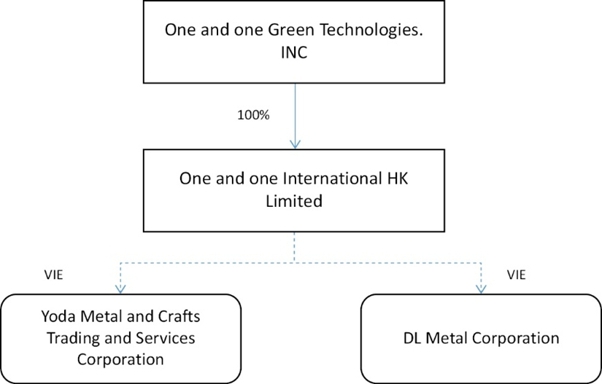
One and one Green Technologies. INC (“One and one Cayman”) was incorporated in the Cayman Islands on April 17, 2024. On May 29, 2024, One and one Cayman established One and one International HK Limited (“One and One HK”), a wholly-owned subsidiary, as an investment holding company. One and one Cayman, through its subsidiary and two variable interest entities (“VIE”) (collectively, the “Company”), is primarily engaged in recycling, production, and trading of recycled scrap metals in the Republic of Philippines (the “Philippines”).
Reorganization
In preparation for its listing, a reorganization of the Company’s legal structure (the “Reorganization”) was completed on June 10, 2024. The Reorganization involved formation of One and one Cayman and One and one HK; and execution of a series of Contractual Arrangements between One and one HK and each of the shareholders of Yoda Metal and Crafts Trading and Services Corp. (“Yoda Metal”) and DL Metal Corporation (“DL Metal”), thereby establishing a VIE structure (Refer to Note 3 for details).
As a result of the Reorganization, One and one Cayman became the ultimate holding company of Yoda Metal and DL Metal through contractual agreements, rather than direct ownership. This Reorganization is considered a recapitalization under common control of the same group of shareholders before and after the reorganization. Therefore, the consolidation of One and one Cayman, its subsidiary, and the VIEs has been accounted for at historical cost and presented as if the aforementioned transactions had become effective as of the beginning of the first period presented in the accompanying unaudited interim condensed consolidated financial statements.
In October 2025, the Company completed its Initial Public Offering (“IPO”) and Nasdaq listing, resulting in the aggregate issuance of 2,300,000 Class A ordinary shares. Subsequently, on April 13, 2026, the Company closed a follow-on offering of 1,733,333 units. For further details regarding the terms and proceeds of these offerings, please refer to Note 12.
Information of One and one Cayman’s consolidated subsidiary and the VIEs are summarized as follows:
| Name of entity | | Date of
incorporation | | Ownership | | Place of
incorporation | | Principal
business
activities |
| One and one HK | | May 29, 2024 | | 100% | | Hong Kong, SAR | | Investment Holding |
| Yoda Metal | | March 20, 2014 | | Contractual Arrangement | | Republic of the Philippines | | Manufacturing and trading |
| DL Metal | | March 3, 2022 | | Contractual Arrangement | | Republic of the Philippines | | Manufacturing and trading |
ONE AND ONE GREEN TECHNOLOGIES. INC
NOTES TO UNAUDITED INTERIM CONDENSED CONSOLIDATED FINANCIAL STATEMENTS
| 2. | Summary of Significant Accounting Policies |
The Company’s consolidated financial statements are prepared on the accrual basis of accounting in accordance with generally accepted accounting principles in the United States of America (“U.S. GAAP”). Certain information and footnote disclosures normally included in the annual financial statements prepared in conformity with U.S. GAAP have been condensed or omitted pursuant to the rules and regulations of the U.S. Securities and Exchange Commission (SEC) for interim financial reporting. Accordingly, these statements should be read in conjunction with the Company’s audited consolidated financial statements for the year ended December 31, 2025.
In the opinion of the management, the accompanying unaudited interim condensed consolidated financial statements reflect all normal recurring adjustments, which are necessary for a fair statement of financial results for the interim periods presented. The Company believes that the disclosures are adequate to make the information presented not misleading. The accompanying unaudited interim condensed consolidated financial statements have been prepared using the same accounting policies as used in the preparation of the Company’s consolidated financial statements for the year ended December 31, 2025. The results of operations for the six months ended June 30, 2026 are not necessarily indicative of the results for the full year.
| b) | Principles of consolidation |
The Company’s unaudited interim condensed consolidated financial statements include the financial statements of the Company, its subsidiary and the VIEs. All inter-company transactions and balances among the Company, its subsidiary and the VIEs have been eliminated upon consolidation.
The preparation of unaudited interim condensed consolidated financial statements in conformity with U.S. GAAP requires management to make estimates and assumptions that affect the reported amounts of assets and liabilities and the related disclosure of contingent assets and liabilities at the date of these unaudited interim condensed consolidated financial statements, and the reported amounts of revenue and expenses during the reporting period. The Company continually evaluates these estimates and assumptions based on the most recently available information, historical experience and various other assumptions that the Company believes to be reasonable under the circumstances. Significant accounting estimates reflected in the Company’s unaudited interim condensed consolidated financial statements include but are not limited to estimates and judgments applied in determination of allowance for credit losses on accounts receivable and loan receivable, impairment losses for long-lived assets, discount rate used to measure present value of lease liabilities, estimate of the lease terms . Since the use of estimates is an integral component of the financial reporting process, actual results could differ from those estimates.
| d) | Foreign currency translation and transactions |
The Company’s reporting currency is US dollars (“USD”). The Company’s operations are principally conducted through the VIEs located in the Philippines where Philippine peso (“PHP”) is the functional currency, and its subsidiary located in Hong Kong where Hong Kong dollar (“HKD”) is the functional currency.
Transactions denominated in foreign currencies are re-measured into the functional currency at the exchange rates at the beginning of the month. Monetary assets and liabilities denominated in foreign currencies are re-measured at the exchange rates prevailing at the balance sheet date. Non-monetary items that are measured in terms of historical cost in foreign currency are re-measured using the exchange rates at the dates of the initial transactions. Exchange gains and losses are included in the consolidated statements of income and comprehensive income.
For entities which are located in the Philippines and have the functional currency as PHP, the financial statements are translated from their respective functional currencies into USD. Assets and liabilities are translated using the exchange rate at each balance sheet date’s period end rate. Revenue and expenses are translated using average rates prevailing during each reporting period, and shareholders’ equity is translated at historical exchange rates. Adjustments resulting from the translation are recorded as a separate component of accumulated other comprehensive loss in shareholders’ equity.
Exchange rate used for the translation as follows:
| USD to PHP | | Period End | | | Average Rate | |
| June 30, 2026 | | | 61.38300 | | | | 59.94491 | |
| December 31, 2025 | | | 58.87250 | | | | N/A | |
| June 30, 2025 | | | 56.31650 | | | | 57.09491 | |
No representation is intended to imply that the PHP amounts could have been, or could be, converted, realized or settled into USD at that rate on June 30, 2026, or at any other rate.
ONE AND ONE GREEN TECHNOLOGIES. INC
NOTES TO UNAUDITED INTERIM CONDENSED CONSOLIDATED FINANCIAL STATEMENTS
| 2. | Summary of Significant Accounting Policies (cont.) |
| e) | Cash and cash equivalents |
Cash and cash equivalents consist of bank deposits and cash on hand, which are unrestricted as to withdrawal and use. The Company considers all highly liquid investments with original maturities of three months or less at the time of purchase to be cash equivalents.
| f) | Accounts receivable, net |
The Company records accounts receivable at net realizable value consisting of the carrying amount less an allowance for credit losses. An estimate for the allowance for credit losses is discussed below in “Credit Losses on Financial Instruments”. Account balances are charged off against the allowance after all means of collection have been exhausted and the potential for recovery is considered remote.
| g) | Credit Losses on Financial Instruments |
The Company accounted for credit losses in accordance with ASU 2016-13, Financial Instruments - Credit Losses. The Company uses the Current Expected Credit Losses (CECL) model to estimate credit losses on financial assets measured at amortized cost including accounts receivable and loan receivable, as well as certain off-balance sheet credit exposures. When similar risk characteristics exist, the Company assesses collectability and measures expected credit losses on a collective basis for a pool of assets, whereas if similar risk characteristics do not exist, the Company assesses collectability and measures expected credit losses on an individual asset basis.
Under the CECL model, the estimation of credit losses involves significant judgment and estimation uncertainty. Management exercises its judgment based on historical loss experience, the age and other relevant characteristics of accounts receivable and loan receivable, current economic conditions, and reasonable and supportable forecasts that may affect the customers’ or borrower’s ability to pay. Changes in these factors could have a material impact on the estimated credit losses.
Inventories are stated at the lower of cost or net realizable value, with net realized value represented by estimated selling prices in the ordinary course of business, less reasonably predictable costs of completion, disposal and transportation. Cost of inventory is determined using the weighted average cost method. No inventory write-down was recorded for the six months ended June 30, 2026 and 2025.
| i) | Property, plant and equipment, net |
The Company’s property, plant and equipment are recorded at cost less accumulated depreciation and impairment loss, if any. Depreciation is calculated on the straight-line method after taking into account their respective estimated residual values over the following estimated useful lives:
| Category | | Useful life |
| Land | | Indefinite |
| Real property and buildings | | 20 years |
| Vehicle | | 5 years |
| Machinery and equipment | | 10 years |
Expenditures for repairs and maintenance are expensed as incurred, whereas the costs of betterments that extend the useful life of property, plant and equipment are capitalized as additions to the related assets. Gain or loss on disposal of property, plant and equipment, if any, is recognized in the consolidated statements of income and comprehensive income as the difference between the net sales proceeds and the carrying amount of the underlying asset.
ONE AND ONE GREEN TECHNOLOGIES. INC
NOTES TO UNAUDITED INTERIM CONDENSED CONSOLIDATED FINANCIAL STATEMENTS
| 2. | Summary of Significant Accounting Policies (cont.) |
The Company recognizes construction in progress (“CIP”) at cost, which includes all expenditures directly attributable to the construction or acquisition of the related property, plant, and equipment. These costs may include materials, labor, and applicable overhead costs, which are indirect costs associated with the construction. CIP is not depreciated until the related assets are substantially complete and ready for their intended use..
| j) | Impairment of long-lived assets |
All long-lived assets, which include tangible long-lived assets and right-of-use assets, are reviewed for impairment whenever events or changes in circumstances indicate that the carrying amount of an asset may not be recoverable. Recoverability of long-lived assets to be held and used is measured by a comparison of the carrying amount of the asset to the estimated undiscounted future cash flows expected to be generated by the assets. If the carrying amount of an asset exceeds its estimated future undiscounted cash flows, an impairment loss is recognized for the difference between the carrying amount of the asset and its fair value.
For the six months ended June 30, 2026 and 2025, the Company did not recognize any impairment loss on long-lived assets.
| k) | Fair value of financial instruments |
The Company’s financial instruments primarily consist of cash and cash equivalents, accounts receivable, net, loan receivable, other receivables, accounts payable, other payables and accrued expenses, and due to related parties. The carrying amounts of these financial instruments approximate their fair values, except for financial instruments for which fair value differs materially from carrying value, if any, based on their nature, contractual terms, and remaining maturities.
Fair value is defined as the exchange price that would be received for an asset or paid to transfer a liability (an exit price) in the principal or most advantageous market for the asset or liability in an orderly transaction between market participants on the measurement date. This note also establishes a fair value hierarchy which requires classification based on observable and unobservable inputs when measuring fair value. There are three levels of inputs that may be used to measure fair value:
| | Level 1 - | | Quoted prices in active markets for identical assets or liabilities. |
| | Level 2 - | | Observable inputs other than Level 1 prices such as quoted prices for similar assets or liabilities; quoted prices in markets that are not active; or other inputs that are observable or can be corroborated by observable market data for substantially the full term of the assets or liabilities. |
| | Level 3 - | | Unobservable inputs that are supported by little or no market activity and that are significant to the fair value of the assets or liabilities. |
Determining which category an asset or liability falls within the hierarchy requires significant judgment. The Company evaluates its hierarchy disclosures on a recurring basis which involves reassessing the appropriateness of the chosen hierarchy level as new information or market conditions become available.
ONE AND ONE GREEN TECHNOLOGIES. INC
NOTES TO UNAUDITED INTERIM CONDENSED CONSOLIDATED FINANCIAL STATEMENTS
| 2. | Summary of Significant Accounting Policies (cont.) |
In accordance with ASC Topic 606, revenues are recognized when control of the contracted goods or services is transferred to the Company’s customers, in an amount that reflects the consideration the Company expects to be entitled to in exchange for those goods or services. In determining when and how much revenue is recognized from contracts with customers, the Company performs the following five-step analysis: (1) identify the contract(s) with a customer; (2) identify the performance obligations in the contract; (3) determine the transaction price; (4) allocate the transaction price to the performance obligations in the contract; (5) recognize revenue when (or as) the entity satisfies a performance obligation. The Company assesses its revenue arrangements against specific criteria in order to determine if it is acting as principal or agent. Revenue is recognized upon the transfer of control of contracted goods to a customer.
Trading of recycled scrap metals
Revenues are generated from trading of recycled scrap metals.
The Company is the principal party in fulfilling the identified performance obligation as it controls the finished goods prior to the transfer to the customer, assumes the risks and rewards associated with the transactions, including bearing any associated costs and risks, bearing the risk of loss or damage to inventory, and bearing the credit risk associated with customers’ ability to pay for the goods. The revenue is recognized at a point in time concurrent with the transfer of control, which usually occurs, depending on shipping terms, upon shipment, issuance of bill of lading or customer receipt. In addition, revenue is deferred when cash payments are received or due in advance of performance.
Payment terms are not explicitly specified in the Company’s contracts. Customers are generally invoiced upon or after the Company satisfies its performance obligations, and payment is typically collected within a reasonable customary credit period of approximately 180 days. In instances where the timing of revenue recognition differs from the timing of invoicing, the Company has determined that the contracts do not include a significant financing component.
The Company applies the practical expedient under ASC 606-10-25-18(b) and accounts for shipping and handling activities performed after control of the goods has transferred to the customer as activities to fulfil the promise to transfer the goods, rather than as a separate performance obligation. Accordingly, the related shipping and handling costs are recognized as expenses as incurred.
Revenues are measured as the amount of consideration the Company expects to receive in exchange for transferring the finished goods to customers, which generally reflects current market prices at the time the contract is entered into. Consideration is recorded net of value-added tax, and no variable consideration exists in the trading of the goods.
The Company did not have contract assets or contract liabilities as of June 30, 2026 and December 31, 2025.
For the six months ended June 30, 2026 and 2025, the Company recognized $nil and $nil, respectively, of revenue that was included in historical advances from customers at the beginning of those respective periods. The Company had no outstanding advances from customers as of June 30, 2026 and December 31, 2025, respectively.
Cost of revenues primarily consists of cost of goods sold which are manufactured by the Company.
The Company follows the guidance of ASC Topic 740 “Income taxes” and uses liability method to account for income taxes. Under this method, deferred tax assets and liabilities are determined based on the difference between the financial reporting and tax bases of assets and liabilities using enacted tax rates that will be in effect in the period in which the differences are expected to reverse. The Company records a valuation allowance to offset deferred tax assets, if based on the weight of available evidence, it is more-likely-than-not that some portion, or all, of the deferred tax assets will not be realized. The effect on deferred taxes of a change in tax rates is recognized in statement of income and comprehensive income in the period that includes the enactment date.
ONE AND ONE GREEN TECHNOLOGIES. INC
NOTES TO UNAUDITED INTERIM CONDENSED CONSOLIDATED FINANCIAL STATEMENTS
| 2. | Summary of Significant Accounting Policies (cont.) |
The Company uses a more likely than not threshold for financial statement recognition and measurement of a tax position taken or expected to be taken in a tax return. As a result, the impact of an uncertain income tax position is recognized at the largest amount that is more-likely-than-not to be sustained upon audit by the relevant tax authority. An uncertain income tax position will not be recognized if it has less than a 50% likelihood of being sustained.
| o) | Value added tax (“VAT”) |
The Company is subject to VAT on revenue generated from production and trading of scrap metals. The Company records revenue net of VAT. This VAT may be offset by qualified input VAT paid by the Company to suppliers. As of June 30, 2026 and December 31, 2025, the Company did not have net VAT recoverable balance. When applicable, such balances are presented under “Other receivables and current assets” on the consolidated balance sheets. The tax is equivalent to a uniform rate of 12%, based on the gross selling price of goods or properties sold, or gross receipts from the sale of services. Qualifying export sales are subject to zero-rated VAT treatment in accordance with applicable Philippine tax regulations..
The Company operates and manages its business as a single segment and has one operating and reportable segment, trading of recycled scrap metals.
The Company’s chief operating decision maker (“CODM”) is the Chief Executive Officer (“CEO”). The CODM evaluates the Company’s operating performance and allocates resources on a consolidated basis using net income as the measure of segment profit or loss. The CODM also reviews operating metrics and the unaudited interim condensed consolidated financial statements in evaluating the Company’s overall performance and making resource allocation decisions
The accounting policies of the segment are the same as those described in the summary of significant accounting policies. The significant expense categories regularly provided to and reviewed by the CODM are those separately presented in the consolidated statements of income and comprehensive income. There are no significant segment expense categories regularly provided to the CODM that are not separately presented in the unaudited interim condensed consolidated financial statements.
The Company’s segment profit or loss is consistent with consolidated net income, and segment assets are consistent with total consolidated assets.
Comprehensive income includes all changes in equity from transactions and other events and circumstances excluding transactions resulting from investments from owners and distributions to owners. For the periods presented, total comprehensive income included foreign currency translation adjustments.
Earnings per share are computed in accordance with ASC 260. Holders of Class A ordinary shares and Class B ordinary shares have the same rights, except for voting and conversion rights. Each Class A ordinary share is entitled to one vote; and each Class B ordinary share is entitled to twenty votes and is convertible into one Class A ordinary share at any time by the holder thereof. Class A ordinary shares are not convertible into Class B ordinary shares under any circumstances.
ONE AND ONE GREEN TECHNOLOGIES. INC
NOTES TO UNAUDITED INTERIM CONDENSED CONSOLIDATED FINANCIAL STATEMENTS
| 2. | Summary of Significant Accounting Policies (cont.) |
As the liquidation and dividend rights are identical, the undistributed earnings are allocated on a proportionate basis. The earnings per share are the same for Class A and Class B ordinary shares because the holders of each class are entitled to equal per share dividends or distributions in liquidation.
Basic earnings per ordinary share is computed by dividing net income attributable to holders of ordinary shares by the weighted average number of ordinary Shares outstanding during the period. Diluted earnings per share is calculated by dividing net income attributable to ordinary shareholders by the weighted average number of ordinary and dilutive ordinary equivalent shares outstanding during the year. Ordinary equivalent shares are not included in the denominator of the diluted earnings per share calculation when inclusion of such shares would be anti-dilutive or in the case of contingently issuable shares that all necessary conditions for issuance have not been satisfied. For the six months ended June 30, 2026, 2,600,000 Class A ordinary shares issuable upon the exercise of outstanding warrants were excluded from the computation of diluted earnings per share because the exercise price of the warrants was greater than the average market price of the Class A ordinary shares, and their inclusion would have been anti-dilutive. There were no dilutive ordinary equivalent shares for the six months ended June 30, 2025.
| s) | Commitments and contingencies |
The Company accrues estimated losses from loss contingencies by a charge to income when information available before financial statements are issued or are available to be issued indicates that it is probable that an asset had been impaired, or a liability had been incurred at the date of the financial statements and the amount of the loss can be reasonably estimated. Legal expenses associated with the contingency are expensed as incurred. If a loss contingency is not probable or reasonably estimable, disclosure of the loss contingency is made in the financial statements when it is at least reasonably possible that a material loss could be incurred.
As of June 30, 2026 and December 31, 2025, there were no contingent liabilities relating to litigations against the Company.
The Company accounts for leases under FASB ASC Topic 842, Leases, and recognizes right-of-use assets and related lease liabilities for all operating leases with terms greater than 12 months.
The Company evaluates whether agreements constitute leases by reviewing the contractual terms to determine which party obtains both the economic benefits and control of the assets at the inception of the contract. Leases with contractual terms longer than twelve months are categorized as operating or finance leases at the commencement date.
The Company recognizes a lease liability for future lease payments and a right-of-use (ROU) asset representing the right to use the underlying asset for the lease term. The lease term is based on the non-cancellable term of the lease and may contain options to extend the lease when it is reasonably certain that the Company will exercise the option. Lease liabilities are recognized at the commencement date based on the present value of lease payments over the lease term using the rate implicit in the lease, if available, or the Company’s incremental borrowing rate. Leases with an initial term of 12 months or less were short-term leases and not recognized as right-of-use assets and lease liabilities on the consolidated balance sheets.
ROU assets are measured at the amount of the lease liabilities with adjustments for lease prepayments made prior to or at lease commencement, initial direct costs incurred by the Company, deferred rent and lease incentives, and any off-market terms present in the lease. ROU assets are expensed over their useful life, considering the lease term and any residual value under straight line basis. The Company evaluates the carrying value of ROU assets if there are indicators of impairment and reviews the recoverability of the related asset.
ONE AND ONE GREEN TECHNOLOGIES. INC
NOTES TO UNAUDITED INTERIM CONDENSED CONSOLIDATED FINANCIAL STATEMENTS
| 2. | Summary of Significant Accounting Policies (cont.) |
The Company reassesses if a contract is or contains a leasing arrangement and re-measures ROU assets and liabilities upon modification of the contract. Differences are recognized in the consolidated statement of income on contract termination.
| u) | Warrants and Related Transaction Costs |
The Company accounts for warrants as either equity-classified or liability-classified instruments based on an assessment of the warrant’s specific terms and applicable authoritative guidance in Financial Accounting Standards Board ("FASB") Accounting Standards Codification ("ASC") 480, Distinguishing Liabilities from Equity ("ASC 480") and ASC 815, Derivatives and Hedging ("ASC 815"). This assessment is conducted at the time of warrant issuance and is continually monitored for any required changes in classification.
For warrants that meet all criteria for equity classification, the instruments are recorded in stockholders' equity. When equity-classified warrants are issued to investors as part of a unit alongside ordinary shares in a follow-on offering, the gross cash proceeds are recorded entirely within stockholders' equity. Because both the shares and the warrants are equity-classified, no separate fair value allocation is bifurcated into a distinct warrant account at issuance; rather, the combined proceeds are recorded to ordinary shares and additional paid-in capital. No further accounting is required until the warrants are exercised, at which time the cash received for the exercise price is recorded as an addition to stockholders' equity.
Warrants issued to placement agents as consideration for services rendered in connection with an equity offering are accounted for as equity issuance costs. The fair value of these placement agent warrants is recorded as both an issuance cost (a direct reduction of equity) and an issuance of equity, resulting in no net impact to total stockholders' equity. All cash transaction costs related to the issuance of equity-classified warrants in an offering are recorded as a direct reduction of the gross offering proceeds. Equity-classified warrants are not subsequently remeasured.
For warrants that do not meet all criteria for equity classification, the instruments are recorded as liabilities at their initial fair value on the date of issuance and are subject to remeasurement at each subsequent balance sheet date. Any change in fair value is recognized as a component of other income (expense) in the consolidated statements of operations and comprehensive income (loss). For liability-classified warrants, all related transaction costs are expensed directly as incurred.
ONE AND ONE GREEN TECHNOLOGIES. INC
NOTES TO UNAUDITED INTERIM CONDENSED CONSOLIDATED FINANCIAL STATEMENTS
| 2. | Summary of Significant Accounting Policies (cont.) |
| v) | Recent issued or adopted accounting standards |
The Company is an “emerging growth company” (“EGC”) as defined in the Jumpstart Our Business Startups Act of 2012 (the “JOBS Act”). Under the JOBS Act, EGC can delay adopting new or revised accounting standards issued subsequent to the enactment of the JOBS Act until such time as those standards apply to private companies. The Company does not opt out of extended transition period for complying with any new or revised financial accounting standards. Therefore, the Company’s financial statements may not be comparable to companies that comply with public company effective dates.
In December 2025, the FASB issued ASU 2025-12, Codification Improvements, which is intended to address suggestions received from stakeholders regarding the Accounting Standards Codification and makes other incremental improvements to U.S. GAAP. The update represents changes to the Codification that clarify, correct errors in or make other improvements to a variety of topics that are intended to make it easier to understand and apply. ASU 2025-12 is effective for fiscal years beginning after December 15, 2026 and interim periods within those fiscal years. Entities will be required to apply the amendments to ASC 260 retrospectively. All other amendments may be applied prospectively or retrospectively. Early adoption is permitted. The Company is currently evaluating the impact of this ASU on its unaudited interim condensed consolidated financial statements
In September 2025, the FASB issued ASU 2025-07, Derivatives and Hedging (Topic 815) and Revenue from Contracts with Customers (Topic 606): Scope Refinements and Clarification for Share-Based Noncash Consideration from a Customer. This ASU clarifies the application of derivative guidance to contracts whose underlying is based on one party’s operations or activities and provides interpretive guidance on share-based noncash consideration in revenue arrangements. The amendments are effective for fiscal years beginning after December 15, 2026, including interim periods within those fiscal years, with early adoption permitted. The Company does not expect adoption of this ASU to have a material impact on its unaudited interim condensed consolidated financial statements.
In July 2025, the FASB issued ASU 2025-05, Financial Instruments - Credit Losses (Topic 326): Measurement of Credit Losses for Accounts Receivable and Contract Assets. The ASU provides a practical expedient and accounting policy election for measuring expected credit losses on certain trade receivables and contract assets arising under ASC 606. The amendments are effective for fiscal years beginning after December 15, 2025, and interim periods within those fiscal years, with early adoption permitted. The adoption of this ASU did not have an impact on its measurement of expected credit losses. Upon adoption on January 1, 2026, the Company elected to apply the practical expedient.
In May 2025, the FASB issued ASU 2025-03, Business Combinations (Topic 805) and Consolidation (Topic 810): Determining the Accounting Acquirer in the Acquisition of a Variable Interest Entity. This ASU updates guidance for determining the accounting acquirer when the acquiree is a variable interest entity (“VIE”) and the transaction is affected primarily through an exchange of equity interests. Under the new guidance, entities are required to apply the general business combination criteria in ASC 805-10-55-12 through 55-15 (such as relative voting rights, governance, and size of the combining entities) rather than automatically identifying the primary beneficiary of the VIE as the accounting acquirer. The amendments are effective for fiscal years beginning after December 15, 2026, including interim periods within those fiscal years. Early adoption is permitted. The Company is currently evaluating the impact of this ASU on its unaudited interim condensed consolidated financial statements, including potential implications for transactions involving entities determined to be VIEs.
In November 2024, the FASB issued ASU 2024-03, Income Statement - Reporting Comprehensive Income - Expense Disaggregation Disclosures (Subtopic 220-40), which requires entities to disaggregate any relevant expense caption presented on the face of the income statement within continuing operations into the following required natural expense categories, as applicable: (1) purchases of inventory, (2) employee compensation, (3) depreciation, (4) intangible asset amortization, and (5) depreciation, depletion, and amortization recognized as part of oil- and gas-producing activities or other depletion expenses. An entity’s share of earnings or losses from investments accounted for under the equity method is not a relevant expense caption that requires disaggregation. Such ASU’s amendments are effective for all public business entities for annual reporting periods beginning after December 15, 2026, and interim reporting periods beginning after December 15, 2027. In January 2025, FASB issued ASU 2025-01, which revises the effective date of ASU 2024-03 to clarify that all public business entities are required to adopt the guidance in annual reporting periods beginning after December 15, 2026, and interim periods within annual reporting periods beginning after December 15, 2027. Early adoption of ASU 2024-03 is permitted. The Company is currently evaluating the impact of this ASU on its unaudited interim condensed consolidated financial statements.
ONE AND ONE GREEN TECHNOLOGIES. INC
NOTES TO UNAUDITED INTERIM CONDENSED CONSOLIDATED FINANCIAL STATEMENTS
| 2. | Summary of Significant Accounting Policies (cont.) |
In December 2023, the FASB issued ASU 2023-09, Income Taxes (Topic 740): Improvements to Income Tax Disclosures. This update enhances the transparency of income tax disclosures by requiring public business entities to disclose specific categories in the effective tax rate reconciliation on an annual basis. It also requires the disclosure of additional information for reconciling items that meet a quantitative threshold of 5%. Furthermore, the amendments require all entities to disclose the amount of income taxes paid (net of refunds received) disaggregated by federal (national), state, and foreign taxes, and by individual jurisdictions where the amount is 5% or more of total income taxes paid. For public business entities, the amendments are effective for annual periods beginning after December 15, 2024. Early adoption is permitted. The Company adopted this standard effective January 1, 2025. Related annual disclosures are presented in the annual financial statements included in the 2025 Form 20-F. The adoption did not impact the Company’s consolidated balance sheets, statements of operations, or cash flows.
Other accounting pronouncements that have been issued or proposed by the FASB or other standards-setting bodies that do not require adoption until a future date are not expected to have a material impact on the Company’s consolidated financial position and results of operations upon adoption.
| 3. | Variable Interest Entities |
On June 10, 2024, the directors of Yoda Metal and DL Metal approved and adopted board resolutions whereby they irrevocably designated Hua Jun Yan as the authorized legal representative to sign and process any transaction for and on behalf of Yoda Metal and DL Metal. This authorization includes the use of electronic signatures for all directors as deemed necessary for any transactions.
On June 10, 2024, the Company’s wholly owned subsidiary, One and One HK, executed a series of Contractual Arrangement with each of the shareholders of Yoda Metal and DL Metal, establishing a variable interest entity (“VIE”) structure. These Contractual Arrangements include:
Exclusive Business Cooperation Agreements
Pursuant to the Exclusive Business Cooperation Agreement between (i) Yoda Metal and One and one HK, (ii) DL Metal and One and one HK, to provide Yoda Metal and DL Metal with technical support, consulting services and other management services relating to its day-to-day business operations and management, on an exclusive basis, utilizing its advantages in technology, business management and information. For services rendered to Yoda Metal and DL Metal by One and one HK under these agreement, One and one HK is entitled to collect a service fee that shall be calculated based upon service hours and multiple hourly rates provided by One and one HK. The service fee should approximately equal to Yoda Metal and DL Metal’s net profit.
The Exclusive Business Cooperation Agreement was executed on June 10, 2024, and has an initial term of ten years, expiring on June 10, 2034. Upon expiration of the initial term, the agreement automatically extends for successive ten-year terms unless One and one HK provides written notice of its intent not to renew. Yoda Metal (and DL Metal) do not have the right to terminate the agreement or block its automatic renewal. Furthermore, while One and one HK may terminate the agreement at any time by providing 30 days’ written notice, Yoda Metal is contractually prohibited from terminating the agreement unilaterally unless required by applicable law.
Exclusive Share Pledge Agreements
Under the Share Pledge Agreement between (i) One and one HK and each of the shareholders of Yoda Metal, and (ii) One and one HK and each of the shareholders of DL Metal, together holding 100% of the equity interests, of each Yoda Metal and DL Metal (“Yoda Metal and DL Metal Shareholders”), the Yoda Metal and DL Metal Shareholders pledged all of their equity interests in Yoda Metal and DL Metal to One and one HK to guarantee the performance of Yoda Metal and DL Metal’s obligations under the Exclusive Business Cooperation Agreement.
Under the terms of the Share Pledge Agreement, in the event that Yoda Metal and DL Metal breaches its contractual obligations under the Exclusive Business Cooperation Agreement, One and one HK, as pledgee, will be entitled to certain rights, including, but not limited to, the right to dispose of dividends generated by the pledged equity interests. The Yoda Metal and DL Metal Shareholders also agreed that upon occurrence of any event of default, as set forth in the Share Pledge Agreement, One and one HK is entitled to dispose of the pledged equity interest in accordance with applicable laws. The Yoda Metal and DL Metal Shareholders further agree not to dispose of the pledged equity interests or take any actions that would prejudice One and one HK’s interest.
ONE AND ONE GREEN TECHNOLOGIES. INC
NOTES TO UNAUDITED INTERIM CONDENSED CONSOLIDATED FINANCIAL STATEMENTS
| 3. | Variable Interest Entities (cont.) |
The Share Pledge Agreement shall be effective until the full payment of the service fees under the Business Cooperation Agreement has been made and upon termination of Yoda Metal and DL Metal’s obligations under the Business Cooperation Agreement.
The purposes of the Share Pledge Agreement are to (1) guarantee the performance of Yoda Metal and DL Metal’s obligations under the Exclusive Business Cooperation Agreement, (2) ensure the shareholders of Yoda Metal and DL Metal do not transfer or assign the pledged equity interests, or create or allow any encumbrance that would prejudice One and one HK’s interests without One and one HK’s prior written consent and (3) provide One and one HK control over Yoda Metal and DL Metal.
Exclusive Option Agreement
Under the Exclusive Option Agreement, the shareholders of Yoda Metal and DL Metal irrevocably granted One and one HK (or its designee) an exclusive right to purchase, to the extent permitted under Philippines law, once or at multiple times, at any time, a portion or whole of the equity interests or assets in Yoda Metal and DL Metal held by the each of the entities’ shareholders. The purchase price is equal to the capital paid in by the Shareholders, adjusted pro rata for purchase of less than all of the Equity Interest and subject to any appraisal or restrictions required by applicable Philippine laws and regulations. The agreement will remain effective until all equity interests in Yoda Metal and DL Metal held by the shareholders of Yoda Metal and DL Metal are transferred or assigned to One and one HK or its designated person(s). The shareholders and Yoda Metal and DL Metal shall not have any right to terminate this agreement in any event unless otherwise required by Philippine laws.
As a result of these board resolutions and agreements, One and one HK has the power to direct the activities of Yoda Metal and DL Metal that most significantly impact their economic performance. Additionally, One and one HK has the right to receive benefits from Yoda Metal and DL Metal that could potentially be significant to Yoda Metal and DL Metal. Therefore, One and one HK is considered the primary beneficiary of Yoda Metal and DL Metal. Consequently, the financial results of Yoda Metal and DL Metal are consolidated into the financial statements of One and one HK in accordance with U.S. GAAP.
While the VIE structure allows for the consolidation of Yoda Metal and DL Metal, it also brings certain risks and uncertainties, and it is subject to significant scrutiny and could be impacted by regulatory changes including but not limited to:
| | ● | Enforceability of the Contractual Arrangements under the applicable local laws |
| | ● | Potential changes in laws and regulations that could affect the enforceability of these arrangements |
| | ● | The ability of One and one HK to exercise control over Yoda Metal and DL Metal as anticipated |
Management regularly assesses the VIE arrangements to ensure compliance with existing laws and regulations and to evaluate any potential changes in circumstances that could affect the consolidation of the VIE entities.
The following financial statement amounts and balances of the VIEs were included in the accompanying unaudited interim condensed consolidated financial statements after elimination of intercompany transactions and balances:
| | | June 30,
2026 | | | December 31,
2025 | |
| Current assets | | $ | 54,187,626 | | | $ | 37,244,260 | |
| Non-current assets | | | 15,578,800 | | | | 17,092,057 | |
| Total assets | | | 69,766,426 | | | | 54,336,317 | |
| Current liabilities | | | 13,121,558 | | | | 18,099,856 | |
| Non-current liabilities | | | 3,054,676 | | | | 3,315,122 | |
| Total Liabilities | | | 16,176,234 | | | | 21,414,978 | |
| Net assets | | $ | 53,590,192 | | | $ | 32,921,339 | |
| | | Six Months Ended
June 30, | |
| | | 2026 | | | 2025 | |
| Revenues | | $ | 33,380,930 | | | $ | 28,129,714 | |
| Gross profit | | | 7,253,731 | | | | 7,121,544 | |
| Income before income tax expenses | | | 6,958,007 | | | | 4,910,906 | |
| Net income | | $ | 5,316,766 | | | $ | 3,826,300 | |
ONE AND ONE GREEN TECHNOLOGIES. INC
NOTES TO UNAUDITED INTERIM CONDENSED CONSOLIDATED FINANCIAL STATEMENTS
| 3. | Variable Interest Entities (cont.) |
| | | Six Months Ended
June 30, | |
| | | 2026 | | | 2025 | |
| Net cash (used in) / provided by operating activities | | $ | 812,574 | | | $ | (1,732,472 | ) |
| Net cash used in investing activities | | | 353,812 | | | | - | |
| Net cash used in financing activities | | | (84,088 | ) | | | (25,516 | ) |
The assets of the VIEs have not been pledged or used as collateral for other obligations and are solely for the VIEs’ own use and to settle their own obligations. The creditors of the VIEs can only claim against the assets of the VIEs and do not have the right to seek repayment from the Company’s assets.
| 4. | Accounts receivables, net |
Accounts receivables, net consist of the following:
| | | June 30,
2026 | | | December 31,
2025 | |
| Accounts receivable | | $ | 32,745,976 | | | $ | 26,634,057 | |
| Allowance for credit losses | | | - | | | | - | |
| Total, net | | $ | 32,745,976 | | | $ | 26,634,057 | |
Subsequent to June 30, 2026 and through the date of issuance of the unaudited interim condensed consolidated financial statements, the Company collected approximately $17.04 million of accounts receivable outstanding as of June 30, 2026, representing approximately 52% of the total accounts receivable balance as of June 30, 2026.
For the six months ended June 30, 2026 and 2025, the Company did not recognize any allowance for credit losses related to accounts receivable.
Inventories, net consisted of the following:
| | | June 30,
2026 | | | December 31,
2025 | |
| Raw materials | | $ | 12,344,246 | | | $ | 5,833,689 | |
| Materials in transit | | | 4,666,469 | | | | 618,938 | |
| Finished goods | | | 184,362 | | | | 536,386 | |
| Spare parts | | | - | | | | 241,568 | |
| Less: Obsolete/write-down inventory | | | - | | | | - | |
| Total, net | | $ | 17,195,077 | | | $ | 7,230,581 | |
For the six months ended June 30, 2026 and 2025, no inventory write-down was recognized.
Raw materials represent the materials purchased readily for production and held by the Company in its warehouse.
Materials in transit represent the materials shipping on the road but not yet arrived at the warehouse of the Company. Under the shipment terms of FOB (Free on Board), the risk of loss and damage was transferred from the seller to the buyer when materials were loaded onto the vessel and are a trigger for the purchaser’s legal obligation to pay for the goods, which correspondingly brought the balance of materials in transit recorded under inventories.
ONE AND ONE GREEN TECHNOLOGIES. INC
NOTES TO UNAUDITED INTERIM CONDENSED CONSOLIDATED FINANCIAL STATEMENTS
| 6. | Other receivables and assets, current and non-current |
Other receivables and assets consist of the following:
| | | June 30,
2026 | | | December 31,
2025 | |
| Current: | | | | | | |
| Prepaid social insurance | | $ | 2,122 | | | $ | 603 | |
| Prepaid expenses | | | 239,162 | | | | 200,761 | |
| Prepaid promotion service fees | | | 400,000 | | | | - | |
| Workshop consumables and production materials | | | 457,729 | | | | - | |
| Other receivables | | | 3,288 | | | | 14,678 | |
| Total other receivables and current assets | | | 1,102,301 | | | | 216,042 | |
| | | | | | | | | |
| Non-Current: | | | | | | | | |
| Prepaid promotion service fees, net of current portion | | | 200,000 | | | | - | |
| Deposits for workshop consumables and production materials | | | - | | | | 690,135 | |
| Total other non-current assets | | $ | 200,000 | | | $ | 690,135 | |
Prepaid promotion service fees
On June 20, 2026, the Company made a $600,000 prepayment for marketing and promotion services covering an 18-month contract period through December 30, 2027. The Company amortizes this fee on a straight-line basis over the service period. As of June 30, 2026, $400,000 is classified within current assets, representing services to be received within the next 12 months, and the remaining unamortized balance of $200,000 is classified within other non-current assets.
Workshop consumables and production materials
The Company makes bulk purchases of workshop consumables, forklift parts, and production materials for use in its manufacturing facilities. As of December 31, 2025, the Company had advanced $690,135 as deposits for these bulk materials, which were classified as non-current assets due to expected delivery and consumption timelines extending beyond 12 months. Upon receipt, these materials are amortized using a straight-line method, with the amortization recorded as manufacturing overhead and capitalized into production costs. As of June 30, 2026, the remaining unamortized materials on hand of $457,729 are expected to be consumed within the next 12 months and are classified entirely within current assets.
On October 15, 2025, the Company provided an unsecured loan of $2,000,000 to a third party, Hong Kong Xinda Mining Resources Investment Holding Group Limited, to support the borrower’s general working capital needs. The loan originally bore interest at 0.25% per month and was repayable by June 14, 2026. Pursuant to a supplementary agreement executed on June 15, 2026, the loan’s maturity date was extended to April 14, 2027, and the interest rate was amended to 0.3% per month. On January 15, 2026, the borrower repaid $200,000, which consisted of $140,000 in principal repayment, $40,000 for interest accrued up to January 14, 2026, and $20,000 in compensation interest. The outstanding loan receivable was $1,860,000 and $2,000,000 as of June 30, 2026 and December 31, 2025, respectively.
The Company evaluates the loan receivable for expected credit losses in accordance with the CECL model under ASC 326. In evaluating the collectability of the loan receivable, management considered the contractual terms of the loan, including the revised maturity date and interest rate, the borrower’s payment history, subsequent collections, and other available information relevant to the collectability of the outstanding balance. Based on management’s assessment, no allowance for credit losses was recorded as of June 30, 2026.
ONE AND ONE GREEN TECHNOLOGIES. INC
NOTES TO UNAUDITED INTERIM CONDENSED CONSOLIDATED FINANCIAL STATEMENTS
| 8. | Property, plant, and equipment, net |
Property, plant, and equipment, net consist of the following:
| | | June 30,
2026 | | | December 31,
2025 | |
| At Cost: | | | | | | |
| Land | | $ | 69,366 | | | $ | 72,324 | |
| Real property and building | | | 8,263,902 | | | | 8,616,300 | |
| Machinery and equipment | | | 4,691,764 | | | | 4,891,835 | |
| Vehicle | | | 53,859 | | | | 56,155 | |
| Construction in progress | | | 756,398 | | | | 28,892 | |
| Subtotal | | | 13,835,289 | | | | 13,665,506 | |
| Less: Accumulated depreciation | | | (3,667,465 | ) | | | (3,380,937 | ) |
| Total, net | | $ | 10,167,824 | | | $ | 10,284,569 | |
Depreciation expenses for the six months ended June 30, 2026 and 2025 were $434,996 and 456,709, respectively as follows:
| | | Six Months Ended
June 30, | |
| | | 2026 | | | 2025 | |
| Depreciation expenses-Selling, general and admin | | $ | 98,533 | | | $ | 159,492 | |
| Depreciation-Manufacturing costs (1) | | | 336,463 | | | | 297,217 | |
| Total | | $ | 434,996 | | | $ | 456,709 | |
| (1) | Represents total depreciation incurred for manufacturing operations, which is capitalized into cost of inventory. |
For the six months ended June 30, 2026 and 2025, no impairment loss was recognized for the Company’s property, plant and equipment.
| 9. | Related party transactions and balances |
The following table presents the Company’s related parties and the nature of their relationships:
| Name | | Relationship | | Purpose/Nature |
| HuaJun Yan | | Chief Operating Officer and Director | | Working capital advances and accrued compensation |
| Caifen Yan | | Chief Executive Officer, Chairman of the Board and Director | | Accrued compensation |
Related party transactions
During the six months ended June 30, 2026, the Company recognized $340,860 as compensation expenses for key management personnel, including the Chief Executive Officer and Chief Operating Officer. Additionally, the Company paid $300,000 to settle accrued compensation due to Caifen Yan as of December 31, 2025, resulting in total payments of $640,860 to key management personnel.
No compensation expenses to key management personnel were recognized during the six months ended June 30, 2025.
Due to related parties
Amounts due to related parties primarily represent (i) funds advanced to or from Mr. Huajun Yan on behalf of the Company for working capital purposes, such as payment of staff salaries and service provider fees, and (ii) accrued but unpaid compensation to key management personnel, including salaries. These balances are non-interest bearing and have no fixed repayment terms.
The following table presents amounts due to related parties as of June 30, 2026 and December 31, 2025:
| Amounts due to related parties | | June 30,
2026 | | | December 31,
2025 | |
| HuaJun Yan | | $ | 202,971 | | | $ | 285,193 | |
| Caifen Yan | | | - | | | | 300,000 | |
| Total | | $ | 202,971 | | | $ | 585,193 | |
As of June 30, 2026, the balance due to Mr. Huajun Yan consists both advances by him to the Company for working capital purposes and accrued compensation.
ONE AND ONE GREEN TECHNOLOGIES. INC
NOTES TO UNAUDITED INTERIM CONDENSED CONSOLIDATED FINANCIAL STATEMENTS
The Company calculates its interim income tax provision based on its estimated annual effective tax rate. The Company’s effective income tax rate for the six months ended June 30, 2026, and 2025, was 26.76% and 22.09%, respectively. This effective rate differs from the applicable statutory rates, primarily the Cayman Islands statutory rate of 0%, the Hong Kong two-tier statutory rates of 8.25% and 16.5%, and the Philippine statutory corporate income tax rates of 21% for 2026 (22% for 2025) for Yoda Metal and 20% for DL Metal, due to the mix of earnings generated in these jurisdictions. due to the mix of earnings generated in these jurisdictions.
The increase in the effective tax rate for the six months ended June 30, 2026, compared to the same period in 2025, was primarily driven by an increase in unbenefited expenses, specifically higher compensation and professional fees incurred by the Cayman Islands and Hong Kong entities, which reduced consolidated pre-tax income without providing a corresponding tax benefit.
The Company did not identify any material unrecognized tax benefits for the periods presented.
Taxes payable consisted of the following:
| | | June 30,
2026 | | | December 31,
2025 | |
| Income tax payable | | $ | 7,659,524 | | | $ | 6,432,962 | |
| VAT | | | 917,921 | | | | 957,063 | |
| Total | | $ | 8,577,445 | | | $ | 7,390,025 | |
For the six months ended June 30, 2026, the Company did not have any material interest or penalties associated with tax positions. The Company did not have any significant unrecognized uncertain tax positions as of June 30, 2026 and December 31, 2025. The Company does not expect that its assessment regarding unrecognized tax positions will materially change over the next 12 months.
The increase of $1,187,420 in total taxes payable was primarily driven by lower VAT obligations, partially offset by higher accrued income tax liabilities due to increased profitability during the period.
| 11. | Employee contribution plan |
The Company operates in the Philippines, where applicable laws require both employers and employees to contribute to statutory benefit programs, including the Social Security System (“SSS”), the Home Development Mutual Fund (“Pag-IBIG Fund”), and the Philippine Health Insurance Corporation (“PhilHealth”).
Contributions to these programs are recognized as employee benefit expenses in the Company’s unaudited interim condensed consolidated financial statements and are determined based on applicable statutory contribution rates and salary levels, subject to prescribed caps.
The SSS provides social security benefits such as sickness, maternity, disability, retirement, and death benefits. The Pag-IBIG Fund provides housing-related and short-term financing programs as well as savings and dividend benefits. PhilHealth provides healthcare coverage, including inpatient and outpatient services.
The Company’s contributions to these statutory benefit programs were $17,222 and $5,454 for the six months ended June 30, 2026 and 2025, respectively.
Ordinary shares
The authorized share capital of the Company was US$50,000, divided into 500,000,000 ordinary shares with par value of $0.0001 each. On April 17, 2024, the Company issued 20,000,000 shares to shareholders at par value of $0.0001 per share.
On December 27, 2024, the board of directors approved additional issuance of 32,000,000 ordinary shares to existing shareholders at par value of $0.0001 per share on pro rata basis and redesignation of all the 10,203,960 issued and outstanding ordinary shares held by One and one International Limited into 10,203,960 Class B ordinary shares of a par value of USD0.0001 each; 41,796,040 issued and outstanding ordinary shares held by shareholders of the Company other than One and one International Limited and all the 448,000,000 unissued ordinary shares into 489,796,040 Class A ordinary shares of a par value of USD0.0001 each.
Holders of Class A ordinary shares and Class B ordinary shares have the same rights, except for voting and conversion rights. Each Class A ordinary share is entitled to one vote; and each Class B ordinary share is entitled to twenty votes and is convertible into one Class A ordinary share at any time by the holder thereof. Class A ordinary shares are not convertible into Class B ordinary shares under any circumstances.
ONE AND ONE GREEN TECHNOLOGIES. INC
NOTES TO UNAUDITED INTERIM CONDENSED CONSOLIDATED FINANCIAL STATEMENTS
| 12. | Shareholders’ Equity (cont.) |
On October 10, 2025, the Company completed its Initial Public Offering (“IPO”) of 2,000,000 Class A ordinary shares, par value $0.0001 per share, at a public offering price of $5.00 per share. Subsequently, on October 24, 2025, the underwriters fully exercised their over-allotment option to purchase an additional 300,000 Class A ordinary shares, which closed on October 28, 2025. In aggregate, the Company issued 2,300,000 Class A ordinary shares resulting in total net proceeds of approximately $9.8 million, after deducting underwriting discounts, commissions, and other offering expenses of approximately $1.7 million.
On April 13, 2026, the Company closed a follow-on offering with three institutional investors for the sale of 1,733,333 units (the “Units”) at a purchase price of $7.50 per Unit. Each Unit consists of one Class A ordinary share, par value $0.0001 per share, and one warrant (the “Warrant”) to purchase one and one-half (1.5) Class A ordinary shares. The gross proceeds from the offering were $13.0 million After deducting underwriting discounts, commissions and other offering expenses totaling $1,174,487, the offering generated net proceeds of $11,825,513. The Company intends to utilize the net proceeds from the offering for working capital and general corporate purposes. In connection with the offering, the investors were granted the right, exercisable for a period of 45 days following the closing, to purchase up to an additional $3.0 million of Units on the same terms and conditions. The investors’ 45-day option to purchase the additional Units expired unexercised in May 2026. The warrants issued in the offering have not expired and remain outstanding.
As of June 30, 2026, there are 45,829,373 Class A ordinary shares and 10,203,960 Class B ordinary shares issued and outstanding, As of December 31, 2025, there are 44,096,040 Class A ordinary shares and 10,203,960 Class B ordinary shares issued and outstanding.
Restricted net assets
The Company’s ability to pay dividends is contingent on receiving distributions from the VIEs. According to Philippine statutory laws and regulations, dividends can only be declared from the Company’s unrestricted retained earnings, if any, as determined by Philippine accounting standards. Consequently, the financial results presented in the Company’s unaudited interim condensed consolidated financial statements prepared under U.S. GAAP might differ from the financial results presented in the VIEs’ statutory financial statements.
Accumulated income represents the Company’s accumulated profits not distributed as dividends and not designated for specific purposes. While there is no statutory reserve requirement to allocate specific reserve funds, the Company cannot declare dividends if such action would render it insolvent or impair its capital. The board of directors has discretion to allocate profits to various reserves, such as contingency funds, expansion funds, or employee benefit funds.
The aforementioned restrictions do not necessarily prohibit the VIEs from transferring its net assets to the Company, and the agreements with the VIEs do not include clauses that restrict such distributions.
Warrants
In connection with the Company’s follow-on offering in April 2026, the Company issued several classes of warrants to purchase Class A ordinary shares. The contractual terms, allocations, and statuses of these warrants are detailed below:
Greenshoe Warrants: The Company granted warrants to purchase up to 400,000 Class A ordinary shares at an exercise price of $7.50 per share. These warrants carried a contractual expiration window of 45 days from the transaction closing date. In May 2026, these warrants expired unexercised in full. No shares were issued under this arrangement.
Common Investor Warrants: The Company issued warrants to purchase up to 2,600,001 Class A ordinary shares at an exercise price of $8.25 per share. Each warrant unit entitles the holder to purchase 1.5 Class A ordinary shares upon exercise. These warrants became fully exercisable upon issuance and expire in October 2029.
Placement Agent Warrants: The Company issued warrants to purchase up to 86,667 Class A ordinary shares to its placement agents at an exercise price of $9.00 per share. These warrants expire in October 2029. Pursuant to FINRA regulations, these warrants were subject to a mandatory 180-day lock-up period, which expire on October 10, 2026.
ONE AND ONE GREEN TECHNOLOGIES. INC
NOTES TO UNAUDITED INTERIM CONDENSED CONSOLIDATED FINANCIAL STATEMENTS
| 12. | Shareholders’ Equity (cont.) |
The activities of the warrants with weighted average exercise price and remaining life as of and for the six months ended June 30, 2026 as follows:
| | | Number of
Warrants | | | Weighted-
Average
Exercise
Price | | | Weighted-
Average
Remaining
Life | |
| Outstanding at January 1, 2026 | | | - | | | $ | - | | | | - | |
| Granted / Issued | | | 3,086,668 | | | | 8.17 | | | | | |
| Exercised | | | - | | | | - | | | | | |
| Expired / Forfeited | | | (400,000 | ) | | | 7.50 | | | | | |
| Outstanding at June 30, 2026 | | | 2,686,668 | | | $ | 8.27 | | | | 3.29 years | |
| Exercisable at June 30, 2026 | | | 2,686,668 | | | | | | | | 3.29 years | |
| 13. | Concentration of Risk |
Currency Convertibility Risk
The VIEs in the Philippines primarily conducts business in Philippine Peso (PHP). While PHP is generally considered a convertible currency, there is a level of risk associated with its convertibility into other currencies. This risk arises from potential limitations on exchanging PHP, particularly for less common currencies or during periods of economic or political instability. Any future limitations could impact the Company’s ability to repatriate funds or settle obligations denominated in foreign currencies which could affect the Company’s operation. The Company continues to monitor the convertibility of PHP and assesses potential risks.
Foreign Currency Exchange Rate Risk
The VIEs in the Philippines principally transacts in Philippine Peso (PHP) for its revenues, expenses, assets, and liabilities. The exchange rate of the PHP can fluctuate due to changes in Philippine central bank policies, international economic conditions, and political developments. These fluctuations can impact the unaudited interim condensed consolidated financial statements through translation adjustments, which arise from translating the VIEs’ financial statements prepared in PHP into the Company’s reporting currency using the current exchange rate. Transaction gains (losses) may also occur due to the settlement of PHP-denominated transactions at exchange rates different from the rates used at the transaction date. The Company has not engaged in any foreign currency hedging strategies to hedge for foreign currency risk.
Credit risk
Financial instruments that potentially subject the Company to significant concentrations of credit risk consist primarily of cash and cash equivalents, and accounts receivable.
The Company’s cash and cash equivalents were held by major financial institutions located in the Philippines. The Company believes these institutions to be of high credit quality. While deposits in these institutions are insured by the Philippine Deposit Insurance Corporation (PDIC) up to PHP 500,000 per depositor (not each individual account), this insurance coverage may not be sufficient to fully protect the Company’s cash balance in the event of a bank failure. As of June 30, 2026, the Company maintained cash balances that exceeded these insured limits by approximately $20,903. The Company acknowledges this limitation and considers the credit quality of the financial institutions a primary factor in mitigating the risk of loss.
Cybersecurity Risk
The Company relies on information technology (IT) systems and networks, including those managed by third-party service providers, to conduct its business, process financial transactions, and safeguard sensitive data. Cyberattacks, malicious software, ransomware, and other unauthorized intrusions are continuously evolving and becoming increasingly sophisticated. While the Company has implemented security protocols, internal controls, and monitoring systems designed to protect its IT infrastructure and proprietary information, these measures may not be entirely effective in preventing all security breaches or system failures.
A material compromise of the Company’s IT systems, or those of its third-party vendors, could result in the unauthorized disclosure, modification, or loss of sensitive information. Such an event could lead to significant operational disruptions, reputational harm, exposure to legal or regulatory actions, and substantial remediation costs. As of June 30, 2026, the Company had not experienced any material cybersecurity incidents that had a significant adverse effect on its business, financial condition, or results of operations.
ONE AND ONE GREEN TECHNOLOGIES. INC
NOTES TO UNAUDITED INTERIM CONDENSED CONSOLIDATED FINANCIAL STATEMENTS
| 13. | Concentration of Risk (cont.) |
For accounts receivable, the Company extends credit based on an evaluation of the customer’s or other parties’ financial condition, generally without requiring collateral or other security. In order to minimize the credit risk, the Company delegated a team responsible for credit approvals and other monitoring procedures to ensure that follow-up action is taken to recover overdue debts. Further, at each balance sheet date, the Company assesses collectability and measures expected credit losses on a collective basis for a pool of assets when similar risk characteristics exist, or on an individual asset basis if similar risk characteristics do not exist. This estimation incorporates historical loss experience, current economic conditions, and reasonable and supportable forecasts to ensure adequate allowances for credit losses are recorded. In this regard, the Company considers that the Company’s credit risk for accounts receivable is significantly reduced.
Concentration of customers consist of the following:
| | | Six Months Ended
June 30,
2026 | | | As of
June 30,
2026 | | | Six Months Ended
June 30,
2025 | | | As of
June 30,
2025 | |
| | | Revenues | | | Receivables | | | Revenues | | | Receivables | |
| Customer A | | | 19.23 | % | | | 19.55 | % | | | 27.55 | % | | | 33.40 | % |
| Customer B | | | 77.22 | % | | | 78.26 | % | | | 42.68 | % | | | 66.60 | % |
| Customer C | | | * | % | | | * | % | | | 29.77 | % | | | * | |
Customer A and Customer B are separate legal entities and are under common control. Although Customer A and Customer B are presented separately in the table above, they represent a significant concentration of the Company’s revenues and accounts receivable.
For the six months ended June 30, 2026 and 2025, Customer A and Customer B, in aggregate, accounted for approximately 96.45% and 70.23% of the Company’s total revenues, respectively.
As of June 30, 2026 and June 30, 2025, Customer A and Customer B, in aggregate, accounted for approximately 97.81% and 100.00% of the Company’s total accounts receivable, respectively.
For the six months ended June 30, 2026, Customer A and Customer B accounted for 19.23% and 77.22% of the Company’s total revenues, respectively, and 19.55% and 78.26% of the Company’s total accounts receivable as of June 30, 2026, respectively.
For the six months ended June 30, 2025, Customer A, Customer B and Customer C accounted for 27.55%, 42.68% and 29.77% of the Company’s total revenues, respectively. As of June 30, 2025, Customer A and Customer B accounted for 33.40% and 66.60% of the Company’s total accounts receivable, respectively.
Concentration of suppliers consist of the following:
| | | Six Months Ended
June 30,
2026 | | | As of
June 30,
2026 | | | Six Months Ended
June 30,
2025 | | | As of
June 30,
2025 | |
| | | Purchases | | | Payables | | | Purchases | | | Payables | |
| Supplier A | | | 65.83 | % | | | 73.77 | % | | | 41.37 | % | | | 18.58 | % |
| Supplier B | | | * | | | | * | | | | 17.25 | % | | | 42.54 | % |
| Supplier C | | | * | | | | * | | | | 10.74 | % | | | * % | |
| Supplier D | | | * | | | | * | | | | * | | | | 10.75 | % |
| Supplier E | | | * | | | | * | | | | * | | | | 10.42 | % |
| Supplier G | | | 13.14 | % | | | 11.01 | % | | | * | | | | * | |
For the six months ended June 30, 2026, Supplier A and Supplier G accounted for 65.83% and 13.14% of the Company’s total purchase amount, respectively.
As of June 30, 2026, Supplier A and Supplier G accounted for 73.77% and 11.01% of the Company’s accounts payable, respectively.
For the six months ended June 30, 2025, Supplier A, Supplier B, Supplier C accounted for 41.37%, 17.25% and 10.74% of the Company’s total purchase amount, respectively.
As of June 30, 2025, Supplier A, Supplier B, Supplier D and Supplier E accounted for 18.58%, 42.54%, 10.75% and 10.42% of the Company’s accounts payable, respectively.
ONE AND ONE GREEN TECHNOLOGIES. INC
NOTES TO UNAUDITED INTERIM CONDENSED CONSOLIDATED FINANCIAL STATEMENTS
| 14. | Commitments and Contingencies |
Litigations and claims
To the best of the Company’s knowledge and based on information available as of June 30, 2026 and December 31, 2025, the Company is not involved in any material claims or legal actions arising from the ordinary course of business. However, the Company is exposed to various risks and uncertainties that could potentially result in litigation or claims in the future. The Company continuously evaluates these contingencies and will adjust its disclosures as necessary.
Environmental matters
The Company is subject to various environmental laws and regulations. While the Company has implemented policies and procedures to comply with these regulations, there may be instances of non-compliance that could result in potential environmental liabilities. As of June 30, 2026 and December 31, 2025, the Company is not involved in any liabilities for environmental remediation costs. However, the identification of environmental issues in the future, such as contamination or waste disposal could result in significant costs, which may have a material adverse effect on the Company’s financial condition.
Insurance coverage
The Company does not maintain insurance coverage for certain risks, including general liability, property damage, and employee-related claims. As a result, the Company may be exposed to significant financial losses in the event of such risks materializing. The absence of insurance coverage may have a material adverse effect on the Company’s financial condition and results of operations.
The Company continuously evaluates these contingencies based on the available information and will adjust its estimates and accruals as necessary.
| 15. | Disaggregation of revenue |
The Company disaggregates its revenue by product types, as the Company believes this disaggregation best depicts how the nature, amount, timing and uncertainty of the revenue and cash flows are affected by economic factors.
| | | Six Months Ended
June 30, | |
| | | 2026 | | | 2025 | |
| Revenue by product types: | | | | | | |
| Aluminum alloy | | $ | 6,419,807 | | | $ | 8,608,800 | |
| Copper alloy ingots | | | 25,710,094 | | | | 18,510,036 | |
| Brass alloy ingots | | | 1,251,029 | | | | 1,000,960 | |
| Slag | | | - | | | | 9,918 | |
| Total revenue | | $ | 33,380,930 | | | $ | 28,129,714 | |
| | | Six Months Ended
June 30, | |
| | | 2026 | | | 2025 | |
| Revenue by geographic area: | | | | | | |
| Philippines | | $ | 1,183,861 | | | $ | 8,381,298 | |
| China | | | 32,197,069 | | | | 19,748,416 | |
| Total revenue | | $ | 33,380,930 | | | $ | 28,129,714 | |
ONE AND ONE GREEN TECHNOLOGIES. INC
NOTES TO UNAUDITED INTERIM CONDENSED CONSOLIDATED FINANCIAL STATEMENTS
Components of lease cost, weighted average remaining lease terms and discount rates of operating lease consist of the following:
| | | June 30,
2026 | | | December 31,
2025 | |
| Lease assets and liabilities | | | | | | |
| Operating lease right-of-use assets, net | | $ | 5,810,975 | | | $ | 6,007,527 | |
| Operating lease liabilities-current | | | - | | | | 641,564 | |
| Operating lease liabilities-noncurrent | | | 3,042,152 | | | | 3,301,395 | |
| Operating lease liabilities-total | | | 3,042,152 | | | | 3,942,959 | |
| | | Six Months Ended
June 30, | |
| | | 2026 | | | 2025 | |
| Lease expenses | | | | | | |
| Operating lease expenses-Selling, general & admin portion | | $ | 15,073 | | | $ | 8,765 | |
| Operating lease expenses-Manufacturing costs | | | 99,422 | | | | 71,102 | |
| Total | | $ | 114,495 | | | $ | 79,867 | |
| | | | | | | | | |
| Other Information | | | | | | | | |
| Cash paid for amounts included in the measurement of lease liabilities | | | | | | | | |
| Operating cash flows – operating leases | | $ | (757,286 | ) | | $ | (465,891 | ) |
| | | | | | | | | |
| Weighted average remaining lease term (in years) | | | | | | | | |
| Operating leases | | | 29.50 | | | | 1.50 | |
| | | | | | | | | |
| Average discount rate | | | | | | | | |
| Operating leases | | | 8.03 | % | | | 5.99 | % |
| | | Operating
Leases | |
| Future minimum lease payments | | | |
| For the year ending December 31, | | | |
| 2026 (6 months remaining) | | $ | - | |
| 2027 | | | - | |
| 2028 | | | 3,665,510 | |
| 2029 | | | - | |
| 2030 | | | - | |
| 2031 | | | - | |
| Thereafter | | | - | |
| Total | | | 3,665,510 | |
| Less: interest | | | 623,358 | |
| Present value of lease liabilities | | $ | 3,042,152 | |
During the year ended December 31, 2025, the Company modified its existing operating lease agreement for land located in San Rafael, Bulacan, Philippines. The modification effectively extended the lease period, resulting in a new non-cancellable term expiring on December 31, 2055.
In accordance with ASC 842, this extension was accounted for as a lease modification. Consequently, the Company remeasured the lease liability based on the extended future minimum lease payments and recognized a corresponding adjustment to the operating lease right-of-use (ROU) asset. Following this remeasurement, the total operating lease ROU asset and corresponding lease liability for this property were approximately $5.75 million. The modified lease agreement does not include additional options to extend the lease term.
The Company has evaluated subsequent events through the date of issuance of these unaudited interim condensed consolidated financial statements; there were no subsequent events occurred that would require recognition or disclosure in the Company’s unaudited interim condensed consolidated financial statements.